HMH Go Math

Go Math Grade 3 Chapter 9 Answer Key Pdf Compare Fractions

Go Math Grade 3 Chapter 9 Answer Key Pdf: In order to solve real-world mathematical problems, students must understand how the information is related, and analyze the relationships and draw conclusions. This will be possible only when you start from the basics. Download Free Pdf of Go Math Grade 3 Answer Key Chapter 9 Compare Fractions to practice the exercise and homework problems. Write the Mid Chapter Checkpoint test to know how much you learned previously from this chapter.

Compare Fractions Go Math Grade 3 Chapter 9 Answer Key Pdf

The topics included in this chapter are Compare fractions with the same Numerator and Denominators, Equivalent Fractions, Compare and order fractions, and so on. Most of the students feel that fractions are difficult. Don’t worry we have provided the easy way to understand the concept of fractions. The HMH Go Math Grade 3 Answer Key Chapter 9 Compare Fractions helps your child to score the highest marks in the marks. So, practice the problems given in the 3rd Grade Go Math Solution Key Chapter 9 and try to solve the questions provided at the end of the chapter.

Lesson 1: Compare Fractions 

Lesson 2: Problem Solving • Compare Fractions 

Lesson 3: Compare Fractions with the Same Denominator 

Lesson 4: Compare Fractions with the Same Numerator 

Lesson 5: Compare Fractions 

Mid -Chapter Checkpoint

Lesson 6: Compare and Order Fractions

Lesson 7: Model Equivalent Fractions 

Lesson 9.7 – Page No. 548

Lesson 9: Equivalent Fractions 

Review/ Test

Compare Fractions – Page No. 509

Share and Show

Question 1.
At the park, people can climb a rope ladder to its top. Rosa climbed \(\frac{2}{8}\) of the way up the ladder. Justin climbed \(\frac{2}{6}\) of the way up the ladder. Who climbed higher on the rope ladder?
First, what are you asked to find?
Type below:
____________

Answer: Justin climbed higher on the rope ladder.

Explanation:

Given,
Rosa climbed \(\frac{2}{8}\) of the way up the ladder
Justin climbed \(\frac{2}{6}\) of the way up the ladder
We are asked to find who climbed higher on the rope ladder
By comparing the denominators we can say that Justin Climbed higher than Rosa on the rope ladder.

Go Math Grade 3 Chapter 9 Answer Key Pdf Question 2.
Then, model and compare the fractions.
Type below:
____________

Answer:

Go Math Grade 3 Chapter 9 Answer Key Compare fractions solution img_1

Question 3.
Last, find the greater fraction.
\(\frac{2}{6}\) _____ \(\frac{2}{8}\)

Answer: \(\frac{2}{6}\) > \(\frac{2}{8}\)

Explanation:

When comparing fractions such as \(\frac{2}{8}\) and \(\frac{2}{6}\), you could also convert the fractions (if necessary) so they have the same denominator and then compare which numerator is larger.

Question 4.
___________ climbed higher on the rope ladder

Answer: Justin climbed higher on the rope ladder.

Question 5.
What if Cara also tried the rope ladder and climbed \(\frac{2}{4}\) of the way up? Who climbed the highest on the rope ladder: Rosa, Justin, or Cara? Explain how you know.
___________

Answer: If Cara also tried the rope ladder and climbed \(\frac{2}{4}\) of the way up then Cara would have climbed highest on the rope ladder.
Because comparing fractions \(\frac{2}{4}\), \(\frac{2}{6}\), \(\frac{2}{8}\) Cara climbed high among the three. The fraction \(\frac{2}{4}\) is the greater than other 2 fractions. So by seeing this, we can say that Cara climbed highest on the rope ladder.

Compare Fractions – Page No. 510

Use the table for 4–5.
Go Math Grade 3 Answer Key Chapter 9 Compare Fractions Compare Fractions img 1

Question 1.
Suri is spreading jam on 8 biscuits for breakfast. The table shows the fraction of biscuits spread with each jam flavor. Which flavor did Suri use on the most biscuits?
___________

Answer: Raspberry

Explanation:

The above table shows the fraction of jam frosted on the biscuits.
First, check the denominators to compare the fractions.
The denominators are the same. So, Compare with the numerators. The numerator of Raspberry is larger than other two flavors. So, Suri used Raspberry flavor on the most biscuits.

Question 2.
What’s the Question? The answer is strawberry
Type below:
___________

Answer:

Suri is spreading jam on 8 biscuits for breakfast. The table shows the fraction of biscuits spread with each jam flavor. She frosted \(\frac{3}{8}\) of the biscuits with peach jam, \(\frac{4}{8}\) with raspberry jam, and \(\frac{1}{8}\) with strawberry jam. Which flavor of jam did Suri use least on the biscuits?

Question 3.
Suppose Suri had also used plum jam on the biscuits. She frosted \(\frac{1}{2}\) of the biscuits with peach jam, \(\frac{1}{4}\) with raspberry jam, \(\frac{1}{8}\) with strawberry jam, and \(\frac{1}{8}\) with plum jam. Which flavor of jam did Suri use on the most biscuits?
___________

Answer: Peach

Explanation:

The fraction of peach jam is greater than raspberry jam, strawberry jam, and plum jam.
So, the answer is the peach jam.

Question 4.
Ms. Gordon has many snack bar recipes. One recipe uses \(\frac{1}{3}\) cup oatmeal, \(\frac{1}{4}\) vcup of milk, and \(\frac{1}{2}\) cup flour. Which ingredient will Ms. Gordon use the most of?
___________

Answer: flour

\(\frac{1}{2}\) > \(\frac{1}{3}\) and \(\frac{1}{4}\)
So, by comparing fractions we can say that Ms. Gordon uses the most flour for snack bar recipes.

Question 5.
Rick lives \(\frac{4}{6}\) mile from school. Noah lives \(\frac{3}{6}\) mile from school. Use the fractions and symbols to show which distance is longer.
Go Math Grade 3 Answer Key Chapter 9 Compare Fractions Compare Fractions img 2
\(\frac{4}{6}\) _____ \(\frac{3}{6}\)

Answer: \(\frac{4}{6}\) > \(\frac{3}{6}\)

Explanation:

First of all, compare the denominators. If the denominators are the same then check the numerators.
Here 4 is greater than 3. So, \(\frac{4}{6}\) > \(\frac{3}{6}\)

Problem Solving Compare Fractions – Page No. 511

Solve.

Question 1.
Luis skates \(\frac{2}{3}\) mile from his home to school. Isabella skates \(\frac{2}{4}\) mile to get to school. Who skates farther?
Think: Use fraction strips to act it out.
Luis

Answer: Luis

Explanation:

Given,
Luis skates \(\frac{2}{3}\) mile from his home to school.
Isabella skates \(\frac{2}{4}\) mile to get to school.
To find Who stakes farther we have to compare the fractions.
\(\frac{2}{3}\), \(\frac{2}{4}\)
The numerator of both fractions is the same and the denominators are different.
So, first, make the denominators equal.
\(\frac{2}{3}\) × \(\frac{4}{4}\) = \(\frac{8}{12}\)
\(\frac{2}{4}\) × \(\frac{3}{3}\) = \(\frac{6}{12}\)
Now denominators are the same.
Compare fractions \(\frac{8}{12}\) and \(\frac{6}{12}\)
8 is greater than 6. So, \(\frac{8}{12}\) > \(\frac{6}{12}\)
Therefore Luis Skates farther to school.

3rd Grade Math Review Pdf Topic 9 Lesson 9.2 Answer Key Question 2.
Sandra makes a pizza. She puts mushrooms on \(\frac{2}{8}\) of the pizza. She adds green peppers to \(\frac{5}{8}\) of the pizza. Which topping covers more of the pizza?
___________

Answer: Green Peppers

Explanation:

Sandra makes a pizza. She puts mushrooms on \(\frac{2}{8}\) of the pizza.
She adds green peppers to \(\frac{5}{8}\) of the pizza.
Compare the fractions of mushrooms and green peppers.
\(\frac{2}{8}\), \(\frac{5}{8}\)
The denominators are the same. So compare the numerators.
2 is lesser than 5. Thus \(\frac{2}{8}\) < \(\frac{5}{8}\)
Thus Green Peppers covers more of the pizza.

Question 3.
The jars of paint in the art room have different amounts of paint. The green paint jar is \(\frac{4}{8}\) full. The purple paint jar is \(\frac{4}{6}\) full. Which paint jar is less full?
The _______ paint jar

Answer: The green paint jar

Explanation:

The jars of paint in the art room have different amounts of paint.
The green paint jar is \(\frac{4}{8}\) full.
The purple paint jar is \(\frac{4}{6}\) full.
The numerators of both the fractions are the same.
Compare the denominators of green paint and purple paint jars.
The denominator with the greatest number will be the smallest fraction.
Therefore \(\frac{4}{8}\) < \(\frac{4}{6}\)
Thus green paint jar is less full.

Question 4.
Jan has a recipe for bread. She uses \(\frac{2}{3}\) cup of flour and \(\frac{1}{3}\) cup of chopped onion. Which ingredient does she use more of, flour or onion?
_______

Answer: Flour

Explanation:

Jan has a recipe for bread. She uses \(\frac{2}{3}\) cup of flour and \(\frac{1}{3}\) cup of chopped onion.
Compare the fraction of flour and onion.
The denominators of both the fractions are the same. So, compare the numerators.
2 is greater than 1. Thus \(\frac{2}{3}\) > \(\frac{1}{3}\)
That means Jan used more flour for bread.

Question 5.
Edward walked \(\frac{3}{4}\) mile from his home to the park. Then he walked \(\frac{2}{4}\) mile from the park to the library. Which distance is shorter?
_______

Answer: \(\frac{2}{4}\) mile

Explanation:

Edward walked \(\frac{3}{4}\) mile from his home to the park.
Then he walked \(\frac{2}{4}\) mile from the park to the library.
To find the shorter distance we have to compare the fractions of Edward from home to park and from park to library.
\(\frac{3}{4}\), \(\frac{2}{4}\)
The denominators of both the fractions are the same.
So compare the numerators.
3 is greater than 2. Thus \(\frac{3}{4}\) > \(\frac{2}{4}\)
Thus the distance from the park to the library is shorter.

Problem Solving Compare Fractions – Page No. 512

Lesson Check

Question 1.
Ali and Jonah collect seashells in identical buckets. When they are finished, Ali’s bucket is \(\frac{2}{6}\) full and Jonah’s bucket is \(\frac{3}{6}\) full. Which of the following correctly compares the fractions?
Options:
a. \(\frac{2}{6}\) = \(\frac{3}{6}\)
b. \(\frac{2}{6}\) > \(\frac{3}{6}\)
c. \(\frac{3}{6}\) < \(\frac{2}{6}\)
d. \(\frac{3}{6}\) > \(\frac{2}{6}\)

Answer: \(\frac{3}{6}\) > \(\frac{2}{6}\)

Explanation:

Given that, Ali and Jonah collect seashells in identical buckets.
When they are finished, Ali’s bucket is \(\frac{2}{6}\) full and Jonah’s bucket is \(\frac{3}{6}\) full
Compare fractions \(\frac{2}{6}\) and \(\frac{3}{6}\)
We observe that the denominators are the same. So, compare the numerators of both the fractions.
3 is greater than 2.
Thus \(\frac{3}{6}\) > \(\frac{2}{6}\)
So, the correct answer is option D.

Question 2.
Rosa paints a wall in her bedroom. She puts green paint on \(\frac{5}{8}\) of the wall and blue paint on \(\frac{3}{8}\) of the wall. Which of the following correctly compares the fractions?
Options:
a. \(\frac{5}{8}\) > \(\frac{3}{8}\)
b. \(\frac{5}{8}\) < \(\frac{3}{8}\)
c. \(\frac{3}{8}\) > \(\frac{5}{8}\)
d. \(\frac{3}{8}\) = \(\frac{5}{8}\)

Answer: \(\frac{5}{8}\) > \(\frac{3}{8}\)

Explanation:

Given:
Rosa paints a wall in her bedroom.
She puts green paint on \(\frac{5}{8}\) of the wall and blue paint on \(\frac{3}{8}\) of the wall.
The denominators are the same so compare the numerators of both the fractions.
5 is greater than 3. So, \(\frac{5}{8}\) > \(\frac{3}{8}\)
Thus the correct answer is option A.

Spiral Review

Question 3.
Dan divides a pie into eightths. How many equal parts are there?
Options:
a. 3
b. 6
c. 8
d. 10

Answer: 8

Dan divides a pie into eightths.
Eighths are nothing but the names of the parts. Eighths is equal to 8.
So, the correct answer is option C.

Question 4.
Which shows equal parts?
a. Go Math Grade 3 Answer Key Chapter 9 Compare Fractions Problem Solving Compare Fractions img 3
b. Go Math Grade 3 Answer Key Chapter 9 Compare Fractions Problem Solving Compare Fractions img 4
c. Go Math Grade 3 Answer Key Chapter 9 Compare Fractions Problem Solving Compare Fractions img 5
d. Go Math Grade 3 Answer Key Chapter 9 Compare Fractions Problem Solving Compare Fractions img 6

Answer:

Go Math Grade 3 Answer Key Chapter 9 Compare Fractions Problem Solving Compare Fractions img 4

Explanation:

Among all the figures circle is equally divided into 6 parts.
So, the answer is option B.

Go Math Lesson 9.2 Grade 3 Question 5.
Charles places 30 pictures on his bulletin board in 6 equal rows. How many pictures are in each row?
Options:
a. 3
b. 4
c. 5
d. 6

Answer: 5

Explanation:

Given, Charles places 30 pictures on his bulletin board in 6 equal rows.
Number of pictures in each row = x
x × 6 = 30
x = 30/6 = 5
Therefore there are 5 pictures in each row.

Question 6.
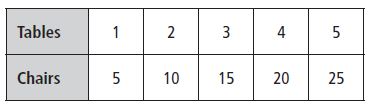
Which of the following describes a pattern in the table?
Go Math Grade 3 Answer Key Chapter 9 Compare Fractions Problem Solving Compare Fractions img 7
Options:
a. Add 1.
b. Add 4.
c. Multiply by 2.
d. Multiply by 5.

Answer: Multiply by 5

Explanation:

The above table shows that number of tables is multiplied by 5.
So, the correct answer is option D.

Compare Fractions with the Same Denominator – Page No. 517

Compare. Write <, >, or =.

Question 1.
Go Math Grade 3 Answer Key Chapter 9 Compare Fractions Compare Fractions with the Same Denominator img 8

Answer: \(\frac{3}{4}\) > \(\frac{1}{4}\)

Explanation:

Check whether the denominators of the two fractions are the same.
Here the denominators of \(\frac{3}{4}\) and \(\frac{1}{4}\) are same. So compare the numerators.
3 is greater than 1.
Therefore, \(\frac{3}{4}\) > \(\frac{1}{4}\)

Question 2.
\(\frac{3}{6}\) ______ \(\frac{0}{6}\)

Answer: \(\frac{3}{6}\) > \(\frac{0}{6}\)

Explanation:

First, check whether the denominators of the two fractions are the same or not.
After that compare the numerators.
3 > 0
So, \(\frac{3}{6}\) > \(\frac{0}{6}\)

Question 3.
\(\frac{1}{2}\) ______ \(\frac{1}{2}\)

Answer: \(\frac{1}{2}\) = \(\frac{1}{2}\)

Explanation:

First, compare fractions with the same denominators.
If both are the same, then compare the numerators of both fractions.
The denominators and numerators are same for \(\frac{1}{2}\)
Thus \(\frac{1}{2}\) = \(\frac{1}{2}\)

Question 4.
\(\frac{5}{6}\) ______ \(\frac{6}{6}\)

Answer: \(\frac{5}{6}\) < \(\frac{6}{6}\)

Explanation:

Compare the denominators of the fractions
The denominators of \(\frac{5}{6}\) and \(\frac{6}{6}\)
Now compare the numerators of the fractions.
5 < 6
So, \(\frac{5}{6}\) < \(\frac{6}{6}\)

Chapter 9 Review Test 3rd Grade Answer Key Question 5.
\(\frac{7}{8}\) ______ \(\frac{5}{8}\)

Answer: \(\frac{7}{8}\) > \(\frac{5}{8}\)

Explanation:

Check whether the denominators are the same or not.
The denominator of \(\frac{7}{8}\) and \(\frac{5}{8}\) are same.
Now check the numerators 7 > 5.
Thus \(\frac{7}{8}\) > \(\frac{5}{8}\)

Question 6.
\(\frac{2}{3}\) ______ \(\frac{2}{3}\)

Answer: \(\frac{2}{3}\) = \(\frac{2}{3}\)

Explanation:

Compare the denominators of 2 fractions.
Here numerators and denominators are the same.
So, \(\frac{2}{3}\) = \(\frac{2}{3}\)

Question 7.
\(\frac{8}{8}\) ______ \(\frac{0}{8}\)

Answer: \(\frac{8}{8}\) > \(\frac{0}{8}\)

Explanation:

Check whether the denominators are the same. Now compare the numerators of two fractions.
8 > 0.
So, \(\frac{8}{8}\) > \(\frac{0}{8}\)

Question 8.
\(\frac{1}{6}\) ______ \(\frac{1}{6}\)

Answer: \(\frac{1}{6}\) = \(\frac{1}{6}\)

Explanation:

When the denominators are the same, the whole is divided into the same size pieces. Now compare the numerators of both the fractions.
\(\frac{1}{6}\) = \(\frac{1}{6}\)

Question 9.
\(\frac{3}{4}\) ______ \(\frac{2}{4}\)

Answer: \(\frac{3}{4}\) > \(\frac{2}{4}\)

Explanation:

Check whether the denominators are the same. If same that means the whole is divided into the same size pieces.
The denominators of \(\frac{3}{4}\) and \(\frac{2}{4}\)
Now compare the numerators of both fractions.
3 is greater than 2.
Thus \(\frac{3}{4}\) > \(\frac{2}{4}\)

Question 10.
\(\frac{1}{6}\) ______ \(\frac{2}{6}\)

Answer: \(\frac{1}{6}\) < \(\frac{2}{6}\)

Explanation:

Check whether the denominators are the same. If same that means the whole is divided into the same size pieces.
The denominators of \(\frac{1}{6}\) and \(\frac{2}{6}\)
Now check the numerator 1 is less than 2.
Therefore, \(\frac{1}{6}\) < \(\frac{2}{6}\)

Question 11.
\(\frac{1}{2}\) ______ \(\frac{0}{2}\)

Answer: \(\frac{1}{2}\) > \(\frac{0}{2}\)

Explanation:

When the denominators are the same, the whole is divided into the same pieces. Now check the numerators.
1 is greater than 0
Thus \(\frac{1}{2}\) > \(\frac{0}{2}\)

Question 12.
\(\frac{3}{8}\) ______ \(\frac{3}{8}\)

Answer: \(\frac{3}{8}\) = \(\frac{3}{8}\)

Explanation:

Check the denominators of two fractions. If both are equal then compare the numerators.
The numerators of both fractions are equal.
So, \(\frac{3}{8}\) = \(\frac{3}{8}\)

Question 13.
\(\frac{1}{4}\) ______ \(\frac{4}{4}\)

Answer: \(\frac{1}{4}\) < \(\frac{4}{4}\)

Explanation:

Compare fractions with the same denominators.
The denominators of \(\frac{1}{4}\) and \(\frac{4}{4}\) are same.
Compare numerators 1 and 4.
1 is less than 4.
Thus \(\frac{1}{4}\) < \(\frac{4}{4}\)

Question 14.
\(\frac{5}{8}\) ______ \(\frac{4}{8}\)

Answer: \(\frac{5}{8}\) > \(\frac{4}{8}\)

Explanation:

Check whether the denominators are the same or not.
Now compare the numerators.
5 is greater than 4.
\(\frac{5}{8}\) > \(\frac{4}{8}\)

Question 15.
\(\frac{4}{6}\) ______ \(\frac{6}{6}\)

Answer: \(\frac{4}{6}\) < \(\frac{6}{6}\)

Explanation:

Check whether the denominators of both the fractions are the same or not.
The denominators of \(\frac{4}{6}\) and \(\frac{6}{6}\) are the same.
Now compare the numerators 4 and 6.
4 is less than 6. So, \(\frac{4}{6}\) < \(\frac{6}{6}\)

Problem Solving

Question 16.
Ben mowed \(\frac{5}{6}\) of his lawn in one hour. John mowed \(\frac{4}{6}\) of his lawn in one hour. Who mowed less of his lawn in one hour?
___________

Answer: John

Explanation:

Given,
Ben mowed \(\frac{5}{6}\) of his lawn in one hour.
John mowed \(\frac{4}{6}\) of his lawn in one hour.
Compare the denominators of both the fractions.
As the denominators are the same compare the numerators of the fractions.
4 is less than 5.
\(\frac{4}{6}\) < \(\frac{5}{6}\)
So, John mowed less of his lawn in one hour.

Chapter 9 Go Math Grade 3 Question 17.
Darcy baked 8 muffins. She put blueberries in \(\frac{5}{8}\) of the muffins. She put raspberries in \(\frac{3}{8}\) of the muffins. Did more muffins have blueberries or raspberries?
___________

Answer: Blueberries

Explanation:

Given,
Darcy baked 8 muffins.
She put blueberries in \(\frac{5}{8}\) of the muffins.
She put raspberries in \(\frac{3}{8}\) of the muffins.
\(\frac{5}{8}\) is greater than \(\frac{3}{8}\)
Thus there are more blueberries in muffins.

Compare Fractions with the Same Denominator – Page No. 518

Lesson Check

Question 1.
Julia paints \(\frac{2}{6}\) of a wall in her room white. She paints more of the wall green. Which fraction could show the part of the wall that is green?
Options:
a. \(\frac{1}{6}\)
b. \(\frac{2}{6}\)
c. \(\frac{3}{6}\)
d. \(\frac{0}{6}\)

Answer: \(\frac{3}{6}\)

Explanation:

First compare the denominators of given options and then compare the numerators
A. \(\frac{3}{6}\) < \(\frac{2}{6}\)
B. \(\frac{2}{6}\) = \(\frac{2}{6}\)
C. \(\frac{3}{6}\) > \(\frac{2}{6}\)
D. \(\frac{0}{6}\) < \(\frac{2}{6}\)
So, the answer is option C.

Question 2.
Liam is comparing fraction circles. Which of the following statements is true?
Options:
a. \(\frac{1}{2}\) = \(\frac{1}{2}\)
b. \(\frac{3}{4}\) > \(\frac{4}{4}\)
c. \(\frac{4}{6}\) < \(\frac{3}{6}\)
d. \(\frac{2}{8}\) = \(\frac{3}{8}\)

Answer: \(\frac{1}{2}\) = \(\frac{1}{2}\)

Explanation:

Check whether the denominators are same. If both are same then compare the numerators.
\(\frac{1}{2}\) = \(\frac{1}{2}\)
Option A is the correct answer.

Spiral Review

Question 3.
Mr. Edwards buys 2 new knobs for each of his kitchen cabinets. The kitchen has 9 cabinets. How many knobs does he buy?
Options:
a. 20
b. 18
c. 16
d. 12

Answer: 18

Explanation:

Given, Mr. Edwards buys 2 new knobs for each of his kitchen cabinets.
The kitchen has 9 cabinets.
Number of knobs he buys = x
x = 9 × 2 = 18
Thus the correct answer is option B.

Question 4.
Allie builds a new bookcase with 8 shelves. She can put 30 books on each shelf. How many books can the bookcase hold?
Options:
a. 30
b. 38
c. 240
d. 300

Answer: 240

Explanation:

Given that Allie builds a new bookcase with 8 shelves.
She can put 30 books on each shelf.
Let the number of books can the bookcase hold = y
y = 30 × 8
y = 240
Thus the correct answer is option C.

Question 5.
The Good Morning Café has 28 customers for breakfast. There are 4 people sitting at each table. How many tables are filled?
Options:
a. 8
b. 7
c. 6
d. 4

Answer: 7

Explanation:

The Good Morning Café has 28 customers for breakfast.
There are 4 people sitting at each table.
Number of tables be t
t ×4 = 28
t = 28/4 = 4
Thus the number of tables filled = 7

Question 6.
Ella wants to use the Commutative Property of Multiplication to help find the product 5 × 4. Which number sentence can she use?
Options:
a. 5 + 4 = 10
b. 5 × 5 = 25
c. 5 − 4 = 1
d. 4 × 5 = 20

Answer: 4 × 5 = 20

Explanation:

According to the commutative property of multiplication, changing the order of the numbers we are multiplying, does not change the product.
a × b = b × a
5 × 4 = 4 × 5 = 20
So, the correct answer is option D.

Compare Fractions with the Same Numerator – Page No. 523

Compare. Write <, >, or =.

Question 1.
Go Math Grade 3 Answer Key Chapter 9 Compare Fractions Compare Fractions with the Same Numerator img 9

Question 2.
\(\frac{3}{8}\) ______ \(\frac{3}{6}\)

Answer: \(\frac{3}{8}\) < \(\frac{3}{6}\)

Explanation:

When comparing fractions with the same numerator, the fraction with the smaller denominator is greater.
So, \(\frac{3}{8}\) < \(\frac{3}{6}\)

Question 3.
\(\frac{2}{3}\) ______ \(\frac{2}{4}\)

Answer: \(\frac{2}{3}\) > \(\frac{2}{4}\)

Explanation:

Compare the fractions \(\frac{2}{3}\) and \(\frac{2}{4}\)
The numerators of both the fractions are the same. So compare the denominators.
The fraction with the smaller denominator is greater
So, \(\frac{2}{3}\) > \(\frac{2}{4}\)

Question 4.
\(\frac{2}{8}\) ______ \(\frac{2}{3}\)

Answer: \(\frac{2}{8}\) < \(\frac{2}{3}\)

Explanation:

Compare \(\frac{2}{8}\) and \(\frac{2}{3}\)
When comparing fractions with the same numerator, the fraction with the smaller denominator is greater.
\(\frac{2}{8}\) < \(\frac{2}{3}\)

Question 5.
\(\frac{3}{6}\) ______ \(\frac{3}{4}\)

Answer: \(\frac{3}{6}\) < \(\frac{3}{4}\)

Explanation:

Compare the fractions \(\frac{3}{6}\) and \(\frac{3}{4}\)
The numerators are the same and the denominators are different.
The number with the smallest number will be the greatest.
So, \(\frac{3}{6}\) < \(\frac{3}{4}\)

Question 6.
\(\frac{1}{2}\) ______ \(\frac{1}{6}\)

Answer: \(\frac{1}{2}\) > \(\frac{1}{6}\)

Explanation:

When comparing fractions with the same numerator, the fraction with the smaller denominator is greater.
2 is greater than 6.
\(\frac{1}{2}\) > \(\frac{1}{6}\)

Go Math Grade 3 Chapter 9 Pdf Lesson 9.4 Compare Fractions Question 7.
\(\frac{5}{6}\) ______ \(\frac{5}{8}\)

Answer: \(\frac{5}{6}\) > \(\frac{5}{8}\)

Explanation:

We observe that numerators are the same and the denominators are different.
The fraction with the smallest number will be the greatest.
So, \(\frac{5}{6}\) > \(\frac{5}{8}\)

Question 8.
\(\frac{4}{8}\) ______ \(\frac{4}{8}\)

Answer: \(\frac{4}{8}\) = \(\frac{4}{8}\)

Explanation:

The numerators and denominators of both the fractions are the same.
So, \(\frac{4}{8}\) = \(\frac{4}{8}\)

Question 9.
\(\frac{6}{8}\) ______ \(\frac{6}{6}\)

Answer: \(\frac{6}{8}\) < \(\frac{6}{6}\)

Explanation:

Compare the fractions \(\frac{6}{8}\) and \(\frac{6}{6}\)
We observe that numerators are the same and the denominators are different.
So, \(\frac{6}{8}\) < \(\frac{6}{6}\)

Problem Solving

Question 10.
Javier is buying food in the lunch line. The tray of salad plates is \(\frac{3}{8}\) full. The tray of fruit plates is \(\frac{3}{4}\) full. Which tray is more full?
The tray of ______ plates

Answer: The fruit plate tray

Explanation:

Javier is buying food in the lunch line. The tray of salad plates is \(\frac{3}{8}\) full.
The tray of fruit plates is \(\frac{3}{4}\) full.
Compare the fraction of salad plates and fruit plates.
\(\frac{3}{8}\) and \(\frac{3}{4}\)
The numerators are the same. So compare the denominators.
So, \(\frac{3}{8}\) <\(\frac{3}{4}\)
Thus the fruit plate tray is more full than the salad plate tray.

Question 11.
Rachel bought some buttons. Of the buttons, \(\frac{2}{4}\) are yellow and \(\frac{2}{8}\) are red. Rachel bought more of which color buttons?
More _______ buttons

Answer: Yellow

Explanation:

Rachel bought some buttons. Of the buttons, \(\frac{2}{4}\) are yellow and \(\frac{2}{8}\) are red.
Compare \(\frac{2}{4}\) and \(\frac{2}{8}\)
The fraction with the smaller denominator is greater.
\(\frac{2}{4}\) >\(\frac{2}{8}\)
Therefore there are more yellow buttons.

Compare Fractions with the Same Numerator – Page No. 524

Lesson Check

Question 1.
Which symbol makes the statement true?
\(\frac{3}{4}\) O \(\frac{3}{8}\)
a. >
b. <
c. =
d. none

Answer: >

Explanation:

In the above statement, the fractions are of the same numerators. So, we need to check the denominators.
The number with the highest number will be the least fraction.
So, \(\frac{3}{4}\) > \(\frac{3}{8}\)
Thus the correct answer is option A.

Question 2.
Which symbol makes the statement true?
\(\frac{2}{4}\) O \(\frac{2}{3}\)
a. >
b. <
c. =
d. none

Answer: <

Explanation:

The fractions are of the same numerators. So, we need to see the denominators.
The number with the highest number will be the least fraction.
So, \(\frac{2}{4}\) < \(\frac{2}{3}\)
So, the correct answer is option B.

Spiral Review

Question 3.
Anita divided a circle into 6 equal parts and shaded 1 of the parts. Which fraction names the part she shaded?
Options:
a. \(\frac{1}{6}\)
b. \(\frac{1}{5}\)
c. \(\frac{5}{6}\)
d. \(\frac{1}{1}\)

Answer: \(\frac{1}{6}\)

Explanation:

Given that, Anita divided a circle into 6 equal parts and shaded 1 of the parts.
So, the fraction of the shaded part is \(\frac{1}{6}\)
Thus the correct answer is option A.

Question 4.
Which fraction names the shaded part of the rectangle?
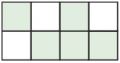
Go Math Grade 3 Answer Key Chapter 9 Compare Fractions Compare Fractions with the Same Numerator img 10
Options:
a. \(\frac{1}{8}\)
b. \(\frac{2}{8}\)
c. \(\frac{6}{8}\)
d. \(\frac{8}{8}\)

Answer: \(\frac{2}{8}\)

Explanation:

The rectangle is divided into 8 equal parts. Out of 8 two parts are shaded.
So, the fraction name of the shaded part is \(\frac{2}{8}\)
The correct answer is option B.

Question 5.
Chip worked at the animal shelter for 6 hours each week for several weeks. He worked for a total of 42 hours. Which of the following can be used to find the number of weeks Chip worked at the animal shelter?
Options:
a. 6 + 42
b. 42 − 6
c. 42 ÷ 6
d. 42 × 6

Answer: 42 ÷ 6

Explanation:

Chip worked at the animal shelter for 6 hours each week for several weeks.
Number of hours he worked = 42 hours
Number of weeks he worked at the animal shelter = x
x × 6 = 42
x = 42 ÷ 6
Thus the correct answer is option C.

Question 6.
Mr. Jackson has 20 quarters. If he gives 4 quarters to each of his children, how many children does Mr. Jackson have?
Options:
a. 3
b. 4
c. 5
d. 6

Answer: 5

Explanation:

Given, Mr. Jackson has 20 quarters.
If he gives 4 quarters to each of his children
Number of children Mr. Jackson have = y
y × 4 = 20
y = 20/4 = 5
Therefore, Mr. Jackson has 5 children.

Compare Fractions – Page No. 529

Compare. Write <, >, or =. Write the strategy you used.

Question 1.
Go Math Grade 3 Answer Key Chapter 9 Compare Fractions Compare Fractions img 11

Answer: Same Numerator

Question 2.
\(\frac{2}{3}\) ______ \(\frac{7}{8}\)

Answer: \(\frac{2}{3}\) < \(\frac{7}{8}\)

Missing pieces

Explanation:

Compare the fractions \(\frac{2}{3}\), \(\frac{7}{8}\)
The numerators and denominators are different here.
\(\frac{2}{3}\) × \(\frac{8}{8}\) = \(\frac{16}{24}\)
\(\frac{7}{8}\) × \(\frac{3}{3}\) = \(\frac{21}{24}\)
16 is less than 24.
So, \(\frac{16}{24}\) < \(\frac{21}{24}\)
That means \(\frac{2}{3}\) < \(\frac{7}{8}\)

Question 3.
\(\frac{3}{4}\) ______ \(\frac{1}{4}\)

Answer: \(\frac{3}{4}\) > \(\frac{1}{4}\)

Explanation:

The Denominator is the same here. So compare the numerators.
\(\frac{3}{4}\), \(\frac{1}{4}\)
3 is greater than 1.
Thus \(\frac{3}{4}\) > \(\frac{1}{4}\)

Name a fraction that is less than or greater than the given fraction. Draw to justify your answer.

Go Math Grade 3 Chapter 9 Operations with Fractions Answer Key Question 4.
greater than \(\frac{1}{3}\)
Type below:
___________

Answer: \(\frac{2}{3}\)

Explanation:

Go Math Chapter 9 Answer Key Grade 3 Compare fractions image_5

\(\frac{2}{3}\) is greater than \(\frac{1}{3}\)

Question 5.
less than \(\frac{3}{4}\)
Type below:
___________

Answer: \(\frac{2}{4}\)

Explanation:

Go Math Solution Key Grade 3 Chapter 9 solution image_6

\(\frac{2}{4}\) is less than \(\frac{3}{4}\)

Problem Solving

Question 6.
At the third-grade party, two groups each had their own pizza. The blue group ate \(\frac{7}{8}\) pizza. The green group ate \(\frac{2}{8}\) pizza. Which group ate more of their pizza?
The _______ group

Answer: The blue group

Explanation:

Given,
At the third-grade party, two groups each had their own pizza.
The blue group ate \(\frac{7}{8}\) pizza.
The green group ate \(\frac{2}{8}\) pizza.
Compare the fractions of the blue group and green group.
\(\frac{7}{8}\) and \(\frac{2}{8}\)
The denominators are the same here. So compare the numerators.
The numerator with the greatest number will be the greatest fraction.
Therefore \(\frac{7}{8}\) > \(\frac{2}{8}\)
So, the blue group ate more pizza.

Question 7.
Ben and Antonio both take the same bus to school. Ben’s ride is \(\frac{7}{8}\) mile. Antonio’s ride is \(\frac{3}{4}\) mile. Who has a longer bus ride?
___________

Answer: Ben

Explanation:

Ben and Antonio both take the same bus to school.
Ben’s ride is \(\frac{7}{8}\) mile.
Antonio’s ride is \(\frac{3}{4}\) mile.
Compare the fractions \(\frac{7}{8}\), \(\frac{3}{4}\)
Make the denominators equal to compare the fractions.
\(\frac{3}{4}\) × \(\frac{8}{8}\) = \(\frac{24}{32}\)
\(\frac{7}{8}\) × \(\frac{4}{4}\) = \(\frac{28}{32}\)
\(\frac{28}{32}\) > \(\frac{24}{32}\)
\(\frac{7}{8}\) > \(\frac{3}{4}\)
Thus Ben has a longer bus ride.

Compare Fractions – Page No. 530

Lesson Check

Question 1.
Which statement is correct?
Options:
a. \(\frac{2}{3}\) > \(\frac{7}{8}\)
b. \(\frac{2}{3}\) < \(\frac{7}{8}\)
c. \(\frac{2}{3}\) = \(\frac{7}{8}\)
d. \(\frac{7}{8}\) = \(\frac{2}{3}\)

Answer: \(\frac{2}{3}\) < \(\frac{7}{8}\)

Explanation:

A. \(\frac{2}{3}\) > \(\frac{7}{8}\)
Here the numerator of one fraction is greater than the numerator of the other fraction.
So, \(\frac{2}{3}\) is not greater than \(\frac{7}{8}\)
B. \(\frac{2}{3}\) < \(\frac{7}{8}\)
Here the numerator of one fraction is greater than the numerator of the other fraction.
2 is less than 7.
Thus the statement \(\frac{2}{3}\) < \(\frac{7}{8}\) is true.
Option B is the answer.

Question 2.
Which symbol makes the statement true?
\(\frac{2}{4}\) O \(\frac{2}{6}\)
a. >
b. <
c. =
d. none

Answer: >

Explanation:

Compare the fractions \(\frac{2}{4}\) & \(\frac{2}{6}\)
The numerator of both fractions is the same.
So we need to compare the denominators.
The denominator with the greater number will be the smallest fraction.
Therefore, \(\frac{2}{4}\) > \(\frac{2}{6}\)
The correct answer is option A.

Spiral Review

Question 3.
Cam, Stella, and Rose each picked 40 apples. They put all their apples in one crate. How many apples are in the crate?
Options:
a. 40
b. 43
c. 120
d. 123

Answer: 120

Explanation:

Given that, Cam, Stella, and Rose each picked 40 apples.
They put all their apples in one crate.
That means each person picked 40 apples = 40 + 40 + 40 = 120 apples
Therefore there are 120 apples in the crate.
The correct answer is option C.

Question 4.
Each shape is 1 whole. Which fraction is represented by the shaded part of the model?
Go Math Grade 3 Answer Key Chapter 9 Compare Fractions Compare Fractions img 12
Options:
a. \(\frac{2}{4}\)
b. \(\frac{4}{4}\)
c. \(\frac{8}{4}\)
d. \(\frac{8}{1}\)

Answer: \(\frac{8}{4}\)

Explanation:

From the figure we observe that there are 2 squares.
Each square is divided into 4 equal parts.
Total number of shaded parts = 4
So, the fraction of 1 whole shaded part is \(\frac{8}{4}\)
Thus the correct answer is option C.

Question 5.
Which related multiplication fact can you use to find
16 ÷ ■ = 2?
Options:
a. 4 × 4 = 16
b. 8 × 2 = 16
c. 8 × 1 = 8
d. 4 × 2 = 8

Answer: 8 × 2 = 16

Explanation:

16 ÷ ■ = 2
■ = 16/2 = 8
So, the related multiplication fact of 16 ÷ ■ = 2 is 8 × 2 = 16.
The correct answer is option B.

Question 6,
What is the unknown factor?
9 × ■ = 36
Options:
a. 7
b. 6
c. 4
d. 3

Answer: 4

Explanation:

■ is the unknown factor
9 × ■ = 36
■ = 36/9 = 4
Thus the correct answer is option C.

Mid -Chapter Checkpoint – Page No. 531

Concepts and Skills

Question 1.
When two fractions refer to the same whole, explain why the fraction with a lesser denominator has larger pieces than the fraction with a greater denominator.
Type below:
___________

Answer: If two fractions have the same numerator but different denominators the fraction with greater denominator is smaller.
Example: Let us consider an apple that is divided into equal parts.
If the apple is divided among 2 people.
Then each get \(\frac{1}{2}\) part of the apple.
If the apple is divided among 4 people.
Then each get \(\frac{1}{4}\) part of an apple.
Hence, in the first case, people get more amount of apple than the second.
Hence, if as a whole the denominator is less the fraction is greater.

Question 2.
When two fractions refer to the same whole and have the same denominators, explain why you can compare only the numerators
Type below:
___________

Answer: If the denominators are the same, then the fraction with the greater numerator is the greater fraction. The fraction with the lesser numerator is the lesser fraction.
Example:
Let us consider a pizza which is cut into 4 parts.
One person ate 3 pieces then the fraction is \(\frac{3}{4}\)
And the other person ate 1 piece then the fraction is \(\frac{1}{4}\)
Now compare the fractions \(\frac{1}{4}\) and \(\frac{3}{4}\)
First person ate 2 pieces more than the second person.
Hence the fraction with the greater numerator is the greater fraction.

Compare. Write <, >, or =.

Question 3.
\(\frac{1}{6}\) ______ \(\frac{1}{4}\)

Answer: \(\frac{1}{6}\) < \(\frac{1}{4}\)

Explanation:

\(\frac{1}{6}\), \(\frac{1}{4}\)
In this case the numerators are same and the denominators are different.
We know that the two fractions have the same numerator but different denominators the fraction with greater denominator is smaller.
So, \(\frac{1}{6}\) < \(\frac{1}{4}\)

Question 4.
\(\frac{1}{8}\) ______ \(\frac{1}{8}\)

Answer: \(\frac{1}{8}\) = \(\frac{1}{8}\)

Explanation:

Compare the fractions \(\frac{1}{8}\) & \(\frac{1}{8}\)
The numerators and the denominators are the same here. Thus these are the equivalent fractions.
Hence, \(\frac{1}{8}\) = \(\frac{1}{8}\)

Question 5.
\(\frac{2}{8}\) ______ \(\frac{2}{3}\)

Answer: \(\frac{2}{8}\) < \(\frac{2}{3}\)

Explanation:

Compare the fractions \(\frac{2}{8}\) & \(\frac{2}{3}\)
The numerators are the same and the denominators are different.
As we know the denominators with the greatest number will be the smallest fraction.
\(\frac{2}{8}\) < \(\frac{2}{3}\)

Question 6.
\(\frac{4}{2}\) ______ \(\frac{1}{2}\)

Answer: \(\frac{4}{2}\) > \(\frac{1}{2}\)

Explanation:

Compare both the fractions \(\frac{4}{2}\) and \(\frac{1}{2}\)
In this case, the denominators are the same but the numerators are different.
So compare the numerators.
4 is greater than 1.
Thus \(\frac{4}{2}\) > \(\frac{1}{2}\)

Question 7.
\(\frac{7}{8}\) ______ \(\frac{3}{8}\)

Answer: \(\frac{7}{8}\) > \(\frac{3}{8}\)

Explanation:

Comparing the fractions \(\frac{7}{8}\) and \(\frac{3}{8}\)
The denominators are same but the numerators are different.
We know that the denominators are the same, then the fraction with the greater numerator is the greater fraction. The fraction with the lesser numerator is the lesser fraction.
7 is greater than 3.
So, \(\frac{7}{8}\) > \(\frac{3}{8}\)

Question 8.
\(\frac{5}{6}\) ______ \(\frac{2}{3}\)

Answer: \(\frac{5}{6}\) > \(\frac{2}{3}\)

Explanation:

Compare the fractions \(\frac{5}{6}\) and \(\frac{2}{3}\)
In this case the numerators and the denominators are different.
So, we have to make the denominators equal.
\(\frac{5}{6}\) × \(\frac{3}{3}\) = \(\frac{15}{18}\)
\(\frac{2}{3}\) × \(\frac{6}{6}\) = \(\frac{12}{18}\)
Now the denominators are same. So compare the numerators 15 is greater than 12.
So, \(\frac{15}{18}\) > \(\frac{12}{18}\)
That means \(\frac{5}{6}\) > \(\frac{2}{3}\)

Question 9.
\(\frac{2}{4}\) ______ \(\frac{3}{4}\)

Answer: \(\frac{2}{4}\) < \(\frac{3}{4}\)

Explanation:

The denominators are the same. So compare the fractions with the numerators.
2 is less than 3.
So, \(\frac{2}{4}\) < \(\frac{3}{4}\)

Question 10.
\(\frac{6}{6}\) ______ \(\frac{6}{8}\)

Answer: \(\frac{6}{6}\) > \(\frac{6}{8}\)

Explanation:

Here the numerators are same but the denominators are different.
We know that denominators with the greatest number will be the smallest fraction.
Therefore, \(\frac{6}{6}\) > \(\frac{6}{8}\)

Question 11.
\(\frac{3}{4}\) ______ \(\frac{7}{8}\)

Answer: \(\frac{3}{4}\) < \(\frac{7}{8}\)

Explanation:

Compare the fractions \(\frac{3}{4}\) and \(\frac{7}{8}\)
The numerators and denominators are different.
So, we have to make the denominators equal.
\(\frac{3}{4}\) × \(\frac{8}{8}\) = \(\frac{24}{32}\)
\(\frac{7}{8}\) × \(\frac{4}{4}\) = \(\frac{28}{32}\)
Now the denominators are equal. So compare the numerators of both the fractions.
\(\frac{24}{32}\) < \(\frac{28}{32}\)
Therefore \(\frac{3}{4}\) < \(\frac{7}{8}\)

Name a fraction that is less than or greater than the given fraction. Draw to justify your answer.

Question 12.
greater than \(\frac{2}{6}\)
Type below:
___________

Answer: \(\frac{4}{6}\)
\(\frac{4}{6}\) > \(\frac{2}{6}\)

Question 13.
less than \(\frac{2}{3}\)
Type below:
___________

Answer: \(\frac{1}{3}\)
\(\frac{1}{3}\) < \(\frac{2}{3}\)

Mid-Chapter Checkpoint – Page No. 532

Question 14.
Two walls in Tiffany’s room are the same size. Tiffany paints \(\frac{1}{4}\) of one wall. Roberto paints \(\frac{1}{8}\) of the other wall. Who painted a greater amount in Tiffany’s room?
___________

Answer: Tiffany

Explanation:

Given that, Two walls in Tiffany’s room are the same size. Tiffany paints \(\frac{1}{4}\) of one wall.
Roberto paints \(\frac{1}{8}\) of the other wall.
The numerators are the same and the denominators are different here.
So, we have to make the denominators same.
\(\frac{1}{4}\) × \(\frac{8}{8}\) = \(\frac{8}{32}\)
\(\frac{1}{8}\) × \(\frac{4}{4}\) = \(\frac{4}{32}\)
Now compare the fractions \(\frac{8}{32}\) and \(\frac{4}{32}\)
8 is greater than 4.
\(\frac{8}{32}\) > \(\frac{4}{32}\)
Therefore, Tiffany painted greater amount than Roberto.

Question 15.
Matthew ran \(\frac{5}{8}\) mile during track practice. Pablo ran \(\frac{5}{6}\) mile. Who ran farther?
___________

Answer: Pablo

Explanation:

Given,
Matthew ran \(\frac{5}{8}\) mile during track practice.
Pablo ran \(\frac{5}{6}\) mile.
Compare the fractions \(\frac{5}{8}\) and \(\frac{5}{6}\)
Numerators are the same and denominators are different.
The denominator with the greatest number will be the smallest fraction.
Thus \(\frac{5}{8}\) < \(\frac{5}{6}\)
Pablo ran farther than Matthew.

Question 16.
Mallory bought 6 roses for her mother. Two-sixths of the roses are red and \(\frac{4}{6}\) is yellow. Did Mallory buy fewer red roses or yellow roses?
___________

Answer: Red Roses

Explanation:

Mallory bought 6 roses for her mother.
Two-sixths of the roses are red and \(\frac{4}{6}\) is yellow.
Compare fractions \(\frac{4}{6}\) and \(\frac{2}{6}\)
The denominators of both the fractions are the same and numerators are different.
4 is greater than 2. So, \(\frac{4}{6}\) > \(\frac{2}{6}\)
Therefore Mallory buys fewer red roses.

Question 17.
Lani used \(\frac{2}{3}\) cup of raisins, \(\frac{3}{8}\) cup of cranberries, and \(\frac{3}{4}\) cup of oatmeal to bake cookies. Which ingredient did Lani use the least amount of?
___________

Answer: Cranberries

Explanation:

Lani used \(\frac{2}{3}\) cup of raisins, \(\frac{3}{8}\) cup of cranberries, and \(\frac{3}{4}\) cup of oatmeal to bake cookies.
Compare the fractions \(\frac{2}{3}\), \(\frac{3}{8}\) and \(\frac{3}{4}\)
The numerators and denominators are different in this case.
The denominator with the highest number will be the smallest fraction.
Therefore Lani used the least amount of cranberries.

Compare and Order Fractions – Page No. 537

Write the fractions in order from greatest to least.

Question 1.
Go Math Grade 3 Answer Key Chapter 9 Compare Fractions Compare and Order Fractions img 13

Question 2.
\(\frac{2}{8}\), \(\frac{5}{8}\), \(\frac{1}{8}\)
Type below:
___________

Answer: \(\frac{5}{8}\), \(\frac{2}{8}\), \(\frac{1}{8}\)

Explanation:

The denominators of three fractions are same. So compare the numerators of the fractions.
5 is greater than 2 is greater than 1.
Thus the order of the fraction is \(\frac{5}{8}\), \(\frac{2}{8}\), \(\frac{1}{8}\)

Question 3.
\(\frac{1}{3}\), \(\frac{1}{6}\), \(\frac{1}{2}\)
Type below:
___________

Answer: \(\frac{1}{2}\), \(\frac{1}{3}\), \(\frac{1}{6}\)

Explanation:

Compare the three fractions \(\frac{1}{3}\), \(\frac{1}{6}\), \(\frac{1}{2}\)
We observe that the numerators of the fractions are same and the denominators are different.
We know that the denominators with the smallest number will be the greater fraction.
Therefore, \(\frac{1}{2}\), \(\frac{1}{3}\), \(\frac{1}{6}\)

Go Math 3rd Grade Pdf Model Equivalent Fractions Lesson 9.6 Question 4.
\(\frac{2}{3}\), \(\frac{2}{6}\), \(\frac{2}{8}\)
Type below:
___________

Answer: \(\frac{2}{3}\), \(\frac{2}{6}\), \(\frac{2}{8}\)

Explanation:

Comparing the fractions \(\frac{2}{3}\), \(\frac{2}{6}\), \(\frac{2}{8}\)
The numerators are the same but the denominators are different.
We know that the denominators with the greatest number will be the smallest fraction.
3 is greater than 6 is greater than 8.
So, the order of the fraction is \(\frac{2}{3}\), \(\frac{2}{6}\), \(\frac{2}{8}\)

Write the fractions in order from least to greatest.

Question 5.
\(\frac{2}{4}\), \(\frac{4}{4}\), \(\frac{3}{4}\)
Type below:
___________

Answer: \(\frac{2}{4}\), \(\frac{3}{4}\), \(\frac{4}{4}\)

Explanation:

The denominators are same but the numerators are different.
So compare the numerators of three fractions.
2 < 3 < 4
\(\frac{2}{4}\), \(\frac{3}{4}\), \(\frac{4}{4}\)

Question 6.
\(\frac{4}{6}\), \(\frac{5}{6}\), \(\frac{2}{6}\)
Type below:
___________

Answer: \(\frac{2}{6}\), \(\frac{4}{6}\), \(\frac{5}{6}\)

Explanation:

Compare the fractions \(\frac{4}{6}\), \(\frac{5}{6}\), \(\frac{2}{6}\)
The denominators are same but the numerators are different.
So compare the numerators of the three fractions.
The order of fractions from least to greatest is \(\frac{2}{6}\), \(\frac{4}{6}\), \(\frac{5}{6}\)

Question 7.
\(\frac{7}{8}\), \(\frac{0}{8}\), \(\frac{3}{8}\)
Type below:
___________

Answer: \(\frac{0}{8}\), \(\frac{3}{8}\), \(\frac{7}{8}\)

Explanation:

Compare the fractions \(\frac{7}{8}\), \(\frac{0}{8}\), \(\frac{3}{8}\)
The numerators of the fractions are different. But the denominators are same.
0 < 3 < 7
The order from least to greatest is \(\frac{0}{8}\), \(\frac{3}{8}\), \(\frac{7}{8}\)

Question 8.
\(\frac{3}{4}\), \(\frac{3}{6}\), \(\frac{3}{8}\)
Type below:
___________

Answer: \(\frac{3}{8}\), \(\frac{3}{6}\), \(\frac{3}{4}\)

Explanation:

Compare the fractions \(\frac{3}{4}\), \(\frac{3}{6}\), \(\frac{3}{8}\)
The numerators are same but the denominators of the three fractions are different.
So, compare the denominators.
The denominators with the greatest number will be the smallest fraction.
So, the order of fractions from least to greatest is \(\frac{3}{8}\), \(\frac{3}{6}\), \(\frac{3}{4}\)

Problem Solving

Question 9.
Mr. Jackson ran \(\frac{7}{8}\) mile on Monday. He ran \(\frac{3}{8}\) mile on Wednesday and \(\frac{5}{8}\) mile on Friday. On which day did Mr. Jackson run the shortest distance?
On ___________

Answer: Wednesday

Explanation:

Mr. Jackson ran \(\frac{7}{8}\) mile on Monday.
He ran \(\frac{3}{8}\) mile on Wednesday and \(\frac{5}{8}\) mile on Friday
The denominators of the fractions are the same. So, compare the numerators.
Compare to all Mr. Jackson run the shortest distance on Wednesday.

Question 10.
Delia has three pieces of ribbon. Her red ribbon is \(\frac{2}{4}\) foot long. Her green ribbon is \(\frac{2}{3}\) foot long. Her yellow ribbon is \(\frac{2}{6}\) foot long. She wants to use the longest piece for a project. Which color ribbon should Delia use?
The _______ ribbon

Answer: Green

Explanation:

Delia has three pieces of ribbon. Her red ribbon is \(\frac{2}{4}\) foot long.
Her green ribbon is \(\frac{2}{3}\) foot long.
Her yellow ribbon is \(\frac{2}{6}\) foot long.
Compare the fractions to know which color should Delia use.
\(\frac{2}{4}\), \(\frac{2}{3}\) and \(\frac{2}{6}\)
The numerators of the three fractions are the same but the denominators are different.
\(\frac{2}{3}\) is longest among all.
so, the answer is Green ribbon.

Compare and Order Fractions – Page No. 538

Lesson Check

Question 1.
Which list orders the fractions from least to greatest?
Options:
a. \(\frac{1}{8}\), \(\frac{1}{3}\), \(\frac{1}{6}\)
b. \(\frac{1}{3}\), \(\frac{1}{6}\), \(\frac{1}{8}\)
c. \(\frac{1}{8}\), \(\frac{1}{6}\), \(\frac{1}{3}\)
d. \(\frac{1}{6}\), \(\frac{1}{8}\), \(\frac{1}{3}\)

Answer: \(\frac{1}{8}\), \(\frac{1}{6}\), \(\frac{1}{3}\)

Explanation:

When the numerators are the same, think about the denominators to compare and order fractions.
The denominator with the greatest number is the smallest fraction.
\(\frac{1}{8}\) < \(\frac{1}{6}\) < \(\frac{1}{3}\)
So, the order is \(\frac{1}{8}\), \(\frac{1}{6}\), \(\frac{1}{3}\)

Question 2.
Which list orders the fractions from greatest to least?
Options:
a. \(\frac{3}{8}\), \(\frac{3}{6}\), \(\frac{3}{4}\)
b. \(\frac{3}{4}\), \(\frac{3}{6}\), \(\frac{3}{8}\)
c. \(\frac{3}{4}\), \(\frac{3}{8}\), \(\frac{3}{4}\)
d. \(\frac{3}{6}\), \(\frac{3}{4}\), \(\frac{3}{8}\)

Answer: \(\frac{3}{4}\), \(\frac{3}{6}\), \(\frac{3}{8}\)

Explanation:

If the numerators are the same, think about the denominators to compare and order fractions.
The denominators with the smallest number will be the greatest fraction.
\(\frac{3}{4}\) > \(\frac{3}{6}\) > \(\frac{3}{8}\)
Thus the fractions from greatest to least are \(\frac{3}{4}\), \(\frac{3}{6}\), \(\frac{3}{8}\)

Spiral Review

Question 3.
What fraction of the group of cars is shaded?
Go Math Grade 3 Answer Key Chapter 9 Compare Fractions Compare and Order Fractions img 14
Options:
a. \(\frac{3}{8}\)
b. \(\frac{1}{2}\)
c. \(\frac{5}{8}\)
d. \(\frac{3}{5}\)

Answer: \(\frac{3}{8}\)

Explanation:

Total number of cars = 8
Number of shaded cars among those 8 cars = 3
So, the fraction of the shaded cars = 3/8
Thus the answer is option A.

Question 4.
Wendy has 6 pieces of fruit. Of these, 2 pieces are bananas. What fraction of Wendy’s fruit is bananas?
Options:
a. \(\frac{2}{6}\)
b. \(\frac{2}{4}\)
c. \(\frac{4}{6}\)
d. \(\frac{2}{2}\)

Answer: \(\frac{2}{6}\)

Explanation:

Given that, Wendy has 6 pieces of fruit.
Of these, 2 pieces are bananas.
The fraction of Wendy’s fruit is 2/6
Thus the correct answer is \(\frac{2}{6}\) i.e., option A.

Go Math Grade 3 Lesson 6 Compare and Order Fractions Answer Key Question 5.
Toby collects data and makes a bar graph about his classmates’ pets. He finds that 9 classmates have dogs, 2 classmates have fish, 6 classmates have cats, and 3 classmates have gerbils. Which pet will have the longest bar on the bar graph?
Options:
a. dog
b. fish
c. cat
d. gerbil

Answer: dog

Explanation:

Number of classmates who have dogs = 9
Number of classmates who have fish = 2
Number of classmates who have cats = 6
Number of classmates who have gerbils = 3
So, dogs will have the longest bar on the bar graph.

Question 6.
The number sentence is an example of which multiplication property?
6 × 7 = (6 × 5) + (6 × 2)
Options:
a. Associative
b. Commutative
c. Distributive
d. Identity

Answer: Distributive

Explanation:

6 × 7 = (6 × 5) + (6 × 2)
Here 7 is distributed into 5 + 2
According to the distributive property, multiplying the sum of two or more addends by a number will give the same result as multiplying each addend individually by the number and then adding the products together.
So, the answer is option C.

Model Equivalent Fractions – Page No. 543

Shade the model. Then divide the pieces to find the equivalent fraction.

Question 1.
Go Math Grade 3 Answer Key Chapter 9 Compare Fractions Model Equivalent Fractions img 15

Answer: \(\frac{4}{8}\)
Explanation:

The figure shows that there are 8 equal parts and 4 of them are shaded.
The Fraction of the shaded part is \(\frac{4}{8}\)
Thus, \(\frac{4}{8}\) = \(\frac{2}{4}\)

Question 2.
Go Math Grade 3 Answer Key Chapter 9 Compare Fractions Model Equivalent Fractions img 16
\(\frac{1}{3}\) = \(\frac{■}{6}\)
\(\frac{□}{□}\)

Answer: \(\frac{2}{6}\)

Explanation:

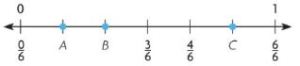
Go Math Grade 3 Key Chapter 9 Review solution image 7

There are 6 equal parts in which 2 parts are shaded. Now the fraction for the shaded part is \(\frac{2}{6}\)

\(\frac{1}{3}\) = \(\frac{2}{6}\)

Use the number line to find the equivalent fraction.

Question 3.
Go Math Grade 3 Answer Key Chapter 9 Compare Fractions Model Equivalent Fractions img 17
\(\frac{1}{2}\) = \(\frac{■}{4}\)
\(\frac{□}{□}\)

Answer: \(\frac{2}{4}\)

HMH Go Math Answer Grade 3 Chapter 9 Review Solution image_8

The fraction \(\frac{1}{2}\) and \(\frac{2}{4}\) lies on the same point.

Therefore, \(\frac{1}{2}\) = \(\frac{2}{4}\)

Go Math Grade 3 Lesson 9.7 Answer Key Question 4.
Go Math Grade 3 Answer Key Chapter 9 Compare Fractions Model Equivalent Fractions img 18
\(\frac{3}{4}\) = \(\frac{■}{8}\)
\(\frac{□}{□}\)

Answer: \(\frac{6}{8}\)

Go Math Grade 3 Compare fractions key review solution image_9

The above figure shows that the point \(\frac{6}{8}\) and \(\frac{3}{4}\) lies on the same point on the number line.

Thus \(\frac{3}{4}\) = \(\frac{6}{8}\)

Problem Solving

Question 5.
Mike says that \(\frac{3}{3}\) of his fraction model is shaded blue. Ryan says that \(\frac{6}{6}\) of the same model is shaded blue. Are the two fractions equivalent? If so, what is another equivalent fraction?
___________

Answer: \(\frac{2}{2}\)

Explanation:

Mike says that \(\frac{3}{3}\) of his fraction model is shaded blue.
Ryan says that \(\frac{6}{6}\) of the same model is shaded blue.
The two fractions are equivalent.
\(\frac{3}{3}\) = \(\frac{6}{6}\) = \(\frac{2}{2}\)

Question 6.
Brett shaded \(\frac{4}{8}\) of a sheet of notebook paper. Aisha says he shaded \(\frac{1}{2}\) of the paper. Are the two fractions equivalent? If so, what is another equivalent fraction?
___________

Answer: \(\frac{2}{4}\)

Explanation:

\(\frac{1}{2}\) = \(\frac{4}{8}\)
So, the two fractions are equivalent.
The another equivalent fraction is \(\frac{2}{4}\).

Model Equivalent Fractions – Page No. 544

Lesson Check

Question 1.
Find the fraction equivalent to \(\frac{2}{3}\).
Go Math Grade 3 Answer Key Chapter 9 Compare Fractions Model Equivalent Fractions img 19
Options:
a. \(\frac{3}{2}\)
b. \(\frac{4}{6}\)
c. \(\frac{3}{6}\)
d. \(\frac{1}{3}\)

Answer: \(\frac{4}{6}\)

Go Math Grade 3 Answer Key Compare fractions review solution image_10

\(\frac{2}{3}\) = \(\frac{4}{6}\)

Go Math Grade 3 Chapter 9 Review Test Answer Key Question 2.
Find the fraction equivalent to \(\frac{1}{4}\).
Go Math Grade 3 Answer Key Chapter 9 Compare Fractions Model Equivalent Fractions img 20
Options:
a. \(\frac{1}{2}\)
b. \(\frac{2}{4}\)
c. \(\frac{2}{8}\)
d. \(\frac{6}{8}\)

Answer: \(\frac{2}{8}\)

Explanation:

The fugure shows that the \(\frac{1}{4}\) and \(\frac{2}{8}\) lies on the same point.
So, the equivalent fraction of \(\frac{1}{4}\) is \(\frac{2}{8}\)
Thus the correct answer is option C.

Spiral Review

Question 3.
Eric practiced piano and guitar for a total of 8 hours this week. He practiced the piano for \(\frac{1}{4}\) of that time. How many hours did Eric practice the piano this week?
Options:
a. 6 hours
b. 4 hours
c. 3 hours
d. 2 hours

Answer: 2 hours

Explanation:

Eric practiced piano and guitar for a total of 8 hours this week.
He practiced the piano for \(\frac{1}{4}\) of that time.
To find how many hours did Eric practice the piano this week
You need to multiply the total number of hours with a fraction of the time he practiced.
8 ×  \(\frac{1}{4}\) = 2 hours
Thus the correct answer is option D.

Question 4.
Kylee bought a pack of 12 cookies. One-third of the cookies are peanut butter. How many of the cookies in the pack are peanut butter?
Options:
a. 9
b. 6
c. 4
d. 3

Answer: 4

Explanation:

Given,
Kylee bought a pack of 12 cookies.
One-third of the cookies are peanut butter.
To find the number of cookies in the pack is peanut butter.
Multiply number of cookies with a fraction of cookies are peanut butter
12 × \(\frac{1}{3}\) = 4
So, the correct answer is option C.

Question 5.
There are 56 students going to the game. The coach puts 7 students in each van. Which number sentence can be used to find how many vans are needed to take the students to the game?
Options:
a. 56 + 7 = ■
b. ■ + 7 = 56
c. ■ × 7 = 56
d. 56 − 7 = ■

Answer: ■ × 7 = 56

Explanation:

There are 56 students going to the game.
The coach puts 7 students in each van.
Let ■ be the number of vans
56 ÷ 7 = ■
■ × 7 = 56
■ = 8
Thus the correct answer is option C.

Question 6.
Which number sentence can be used to describe the picture?
Go Math Grade 3 Answer Key Chapter 9 Compare Fractions Model Equivalent Fractions img 21
Options:
a. 2 + 4 = 6
b. 4 − 2 = 2
c. 4 × 1 = 4
d. 8 ÷ 2 = 4

Answer: 8 ÷ 2 = 4

Explanation:

Number of counters = 8
Number of equal groups = 4
Number in each group = 2
The division equation is 8 ÷ 2 = 4
So, the answer is option D.

Lesson 9.7 – Page No. 548

Question 13.
Christy bought 8 muffins. She chose 2 apple, 2 banana, and 4 blueberry. She and her family ate the apple and banana muffins for breakfast. What fraction of the muffins did they eat? Write an equivalent fraction. Draw a picture.
\(\frac{□}{□}\)

Answer: \(\frac{4}{8}\)

Explanation:

Given:
Christy bought 8 muffins.
She chose 2 apples, 2 bananas, and 4 blueberries. She and her family ate the apple and banana muffins for breakfast.
They had 2 apples and 2 banana muffins for their breakfast.
Only 4 blueberries are left out of 8 muffins.
The fraction of the muffins they ate = \(\frac{4}{8}\) or \(\frac{1}{2}\)

Go Math Third Grade Pdf Chapter 9 Review Test Question 14.
After dinner, \(\frac{2}{3}\) of the cornbread is left. Suppose 4 friends want to share it equally. What fraction names how much of the whole pan of cornbread each friend will get? Use the model on the right. Explain your answer.
Go Math Grade 3 Answer Key Chapter 9 Compare Fractions Lesson 9.7 img 22
\(\frac{□}{□}\)

Answer: \(\frac{1}{6}\)

Explanation:

To know the fraction of the whole pan of cornbread that each friend gets. I divide each third into 2 equal pieces to get 4 pieces in all.
\(\frac{2}{3}\) = \(\frac{1}{6}\) + \(\frac{1}{6}\) + \(\frac{1}{6}\) + \(\frac{1}{6}\)
That means each friend gets \(\frac{1}{6}\) of cornbread of the whole pan.

Question 15.
There are 16 people having lunch. Each person wants \(\frac{1}{4}\) of a pizza. How many whole pizzas are needed? Draw a picture to show your answer.
______ pizzas

Answer: 4 pizzas

Explanation:

Given that, There are 16 people having lunch.
Each person wants \(\frac{1}{4}\) of a pizza.
Multiply the total number of people by a fraction of each pizza for one person.
= 16 × \(\frac{1}{4}\)
= 16/4 = 4
Therefore 4 pizzas are needed for 16 people.

Question 16.
Lucy has 5 oatmeal bars, each cut in half. What fraction names all of the oatmeal bar halves?
Go Math Grade 3 Answer Key Chapter 9 Compare Fractions Lesson 9.7 img 23
\(\frac{□}{□}\)

Answer: \(\frac{10}{2}\)

Explanation:

Lucy has 5 oatmeal bars, each cut in half.
Total number of oatmeal bars = 5
5 oatmeal bars are divided into halves = 5 + 5 = 10
So. the fraction name for all of the oatmeal bar halves = \(\frac{10}{2}\)

Question 16.
What if Lucy cuts each part of the oatmeal bar into 2 equal pieces to share with friends? What fraction names all of the oatmeal bar pieces now?
\(\frac{□}{□}\)

Answer: \(\frac{10}{2}\)

Explanation:

The above figure shows that there are 5 oatmeal bars.
And each oatmeal bar is divided into halves = 5 × 2 = 10
The fraction for the all of the oatmeal bar halves = \(\frac{10}{2}\)
The equivalent fraction of \(\frac{10}{2}\) is \(\frac{20}{4}\)

Question 17.
Mr. Peters made a pizza. There is \(\frac{4}{8}\) of the pizza left over. Select the fractions that are equivalent to the part of the pizza that is left over. Mark all that apply.
Go Math Grade 3 Answer Key Chapter 9 Compare Fractions Lesson 9.7 img 24
Options:
a. \(\frac{5}{8}\)
b. \(\frac{3}{4}\)
c. \(\frac{2}{4}\)
d. \(\frac{1}{2}\)

Answer: \(\frac{2}{4}\)

Explanation:

Mr. Peters made a pizza. There is \(\frac{4}{8}\) of the pizza left over.
The equivalent fraction of \(\frac{4}{8}\) is \(\frac{2}{4}\)
So, the correct answer is option C.

Equivalent Fractions – Page No. 549

Each shape is 1 whole. Shade the model to find the equivalent fraction.

Question 1.
Go Math Grade 3 Answer Key Chapter 9 Compare Fractions Equivalent Fractions img 25

Answer: \(\frac{3}{6}\)

Explanation:

The circle is divided into 6 equal groups. Each group is \(\frac{1}{6}\) of the whole circle.
There are 3 shaded parts in the circle.
So, the fraction of the shaded part is \(\frac{3}{6}\).
\(\frac{1}{2}\) = \(\frac{3}{6}\)

Question 2.
Go Math Grade 3 Answer Key Chapter 9 Compare Fractions Equivalent Fractions img 26
\(\frac{3}{4}\) = \(\frac{6}{■}\)
\(\frac{□}{□}\)

Answer: \(\frac{6}{8}\)

Explanation:

The square is divided into 8 equal parts. Each group is \(\frac{1}{8}\) of the whole square.
There are 6 shaded parts in the square.
Thus the fraction of the shaded part is 6/8
So, \(\frac{3}{4}\) = \(\frac{6}{8}\)

Circle equal groups to find the equivalent fraction.

Question 3.
Go Math Grade 3 Answer Key Chapter 9 Compare Fractions Equivalent Fractions img 27
\(\frac{2}{4}\) = \(\frac{■}{2}\)
\(\frac{□}{□}\)

Answer: \(\frac{1}{2}\)

Explanation:

Rectangle is divided into 4 equal parts. The fraction of each group is 1/4.
There are 2 shaded parts out of 4 = \(\frac{2}{4}\)
latex]\frac{2}{4}[/latex] = \(\frac{1}{2}\)

Question 4
Go Math Grade 3 Answer Key Chapter 9 Compare Fractions Equivalent Fractions img 28
\(\frac{4}{6}\) = \(\frac{■}{3}\)
\(\frac{□}{□}\)

Answer: \(\frac{2}{3}\)

Explanation:

The figure shows that the rectangle is divided into 6 equal parts and 4 are shaded among them.
The fraction of the shaded part is \(\frac{4}{6}\)
We can also write it as \(\frac{2}{3}\)
Thus, \(\frac{4}{6}\) = \(\frac{2}{3}\)

Problem Solving

Question 5.
May painted 4 out of 8 equal parts of a poster board blue. Jared painted 2 out of 4 equal parts of a same-size poster board red. Write fractions to show which part of the poster board each person painted.
Type below:
____________

Answer: May \(\frac{4}{8}\); Jared \(\frac{2}{4}\)

Explanation:

Given that, May painted 4 out of 8 equal parts of a poster board blue.
4 parts are shaded out of 8 parts. So, the fraction of the shaded part is \(\frac{4}{8}\)
Jared painted 2 out of 4 equal parts of a same-size poster board red.
The fraction of the shaded part is \(\frac{2}{4}\)

Question 6.
Are the fractions equivalent? Draw a model to explain.
____________

Answer: Yes

Equivalent Fractions – Page No. 550

Lesson Check

Question 1.
Which fraction is equivalent to \(\frac{6}{8}\)?
Go Math Grade 3 Answer Key Chapter 9 Compare Fractions Equivalent Fractions img 29
Options:
a. \(\frac{1}{4}\)
b. \(\frac{1}{3}\)
c. \(\frac{3}{4}\)
d. \(\frac{4}{6}\)

Answer: \(\frac{3}{4}\)

Explanation:

Go Math Grade 3 Chapter 9 Answer Key Review solution_1

\(\frac{6}{8}\) = \(\frac{3}{4}\)
So, the correct answer is option C.

Question 2.
Which fraction is equivalent to \(\frac{1}{3}\) ?
Go Math Grade 3 Answer Key Chapter 9 Compare Fractions Equivalent Fractions img 30
Options:
a. \(\frac{1}{6}\)
b. \(\frac{2}{8}\)
c. \(\frac{2}{6}\)
d. \(\frac{2}{3}\)

Answer: \(\frac{2}{6}\)

Explanation:

Go Math Grade 3 Key Chapter 9 Review solution image_4

\(\frac{1}{3}\) = \(\frac{2}{6}\)
The correct answer is option C.

Spiral Review

Question 3.
Which number sentence is shown by the array?
Go Math Grade 3 Answer Key Chapter 9 Compare Fractions Equivalent Fractions img 31
Options:
a. 8 − 2 = 6
b. 8 × 1 = 8
c. 2 + 8 = 10
d. 16 ÷ 2 = 8

Answer: 16 ÷ 2 = 8

Explanation:

Number of counters = 16
Number of rows = 2
Divide the Number of counters by the number of rows
= 16 ÷ 2 = 8
Thus the correct answer is option D.

Go Math Grade 3 Chapter 9 Answer Key Question 4.
Cody put 4 plates on the table. He put 1 apple on each plate. Which number sentence can be used to find the total number of apples on the table?
Options:
a. 4 + 1 = 5
b. 4 − 1 = 3
c. 4 × 1 = 4
d. 4 ÷ 2 = 2

Answer: 4 × 1 = 4

Explanation:

Cody put 4 plates on the table.
He put 1 apple on each plate.
The total number of apples on each table = 4 × 1 = 4
So, the correct answer is option C.

Question 5.
Which number sentence is a related fact to 7 × 3 = 21?
Options:
a. 7 + 3 = 10
b. 7 − 3 = 4
c. 7 × 2 = 14
d. 21 ÷ 3 = 7

Answer: 21 ÷ 3 = 7

Explanation:

The related division fact of 7 × 3 = 21 is 21 ÷ 3 = 7
The correct answer is option D.

Question 6.
Find the quotient.
4)\(\bar{3 6}\)
Options:
a. 9
b. 8
c. 7
d. 6

Answer: 9

Explanation:

36 ÷ 4 = 9
4 divides 36 nine times. So the quotient is 9.
So, the correct answer is option A.

Review/Test – Page No. 551

Question 1.
Alexa and Rose read books that have the same number of pages. Alexa’s book is divided into 8 equal chapters. Rose’s book is divided into 6 equal chapters. Each girl has read 3 chapters of her book.
Write a fraction to describe what part of the book each girl read. Then tell who read more pages. Explain.
Type below:
_____________

Answer: Rose read more pages than Alexa

Explanation:

Given that,
Alexa and Rose read books that have the same number of pages.
Alexa’s book is divided into 8 equal chapters.
Rose’s book is divided into 6 equal chapters.
Each girl has read 3 chapters of her book.
The fraction of Alexa’s book = \(\frac{3}{8}\)
The fraction of Rose’s book = \(\frac{3}{6}\)
Now, compare the fractions to find who read more pages.
\(\frac{3}{8}\) & \(\frac{3}{6}\)
The numerators of the two fractions are the same. So compare the denominators.
The denominator of the greater number will be the smallest fraction.
\(\frac{3}{8}\) < \(\frac{3}{6}\)
By this, we can say that Rose read more pages than Alexa.

Question 2.
David, Maria, and Simone are shading same-sized index cards for a science project. David shaded \(\frac{2}{4}\) of his index card. Maria shaded \(\frac{2}{8}\) of her index card and Simone shaded \(\frac{2}{6}\) of her index card.
For 2a–2d, choose Yes or No to indicate whether the comparisons are correct.
a. \(\frac{2}{4}\) > \(\frac{2}{8}\)
i. yes
ii. no

Answer: Yes

Explanation:

\(\frac{2}{4}\) > \(\frac{2}{8}\)
The denominators with the smallest number will be the greatest fraction.
Thus the statement \(\frac{2}{4}\) > \(\frac{2}{8}\) is true.

Question 2.
b. \(\frac{2}{8}\) > \(\frac{2}{6}\)
i. yes
ii. no

Answer: No

Explanation:

\(\frac{2}{8}\) > \(\frac{2}{6}\)
The numerators are same so compare the denominators.
The denominator with the greatest number will be the smallest fraction.
\(\frac{2}{8}\) < \(\frac{2}{6}\)
Thus the statement is false.

Question 2.
c. \(\frac{2}{6}\) < \(\frac{2}{4}\)
i. yes
ii. no

Answer: Yes

Explanation:

\(\frac{2}{6}\), \(\frac{2}{4}\)
The numerators are same so compare the denominators.
The denominator with the greatest number will be the smallest fraction.
\(\frac{2}{6}\) < \(\frac{2}{4}\)
Thus the statement is correct.

Question 2.
d. \(\frac{2}{8}\) = \(\frac{2}{4}\)
i. yes
ii. no

Answer: No

Explanation:

\(\frac{2}{8}\) = \(\frac{2}{4}\)
The numerators and denominators are different.
So, \(\frac{2}{8}\) is not equal to \(\frac{2}{4}\)
The statement is false.

Go Math Grade 3 Chapter 9 Pdf Question 3.
Dan and Miguel are working on the same homework assignment. Dan has finished \(\frac{1}{4}\) of the assignment. Miguel has finished \(\frac{3}{4}\) of the assignment. Which statement is correct? Mark all that apply.
Options:
a. Miguel has completed the entire assignment.
b. Dan has not completed the entire assignment.
c. Miguel has finished more of the assignment than Dan.
d. Dan and Miguel have completed equal parts of the assignment.

Answer: B & C are the correct statements.

Explanation:

Given, Dan and Miguel are working on the same homework assignment.
Dan has finished \(\frac{1}{4}\) of the assignment.
Miguel has finished \(\frac{3}{4}\) of the assignment.
A. Miguel has completed the entire assignment.
Miguel has finished \(\frac{3}{4}\) of the assignment. So the statement is false.
B. Dan has not completed the entire assignment.
Dan has finished \(\frac{1}{4}\) of the assignment. So the statement is true.
C. Miguel has finished more of the assignment than Dan.
\(\frac{3}{4}\) > \(\frac{1}{4}\)
So, the statement is true.
D. Dan and Miguel have completed equal parts of the assignment.
\(\frac{3}{4}\) is not equal to \(\frac{1}{4}\)
Thus the statement is false.
So the correct answer is B & C.

Review/Test – Page No. 552

Question 4.
Bryan cut two peaches that were the same size for lunch. He cut one peach into fourths and the other into sixths. Bryan ate \(\frac{3}{4}\) of the first peach. His brother ate \(\frac{5}{6}\) of the second peach. Who ate more peach? Explain the strategy you used to solve the problem.
___________

Answer: Bryan’s brother

Explanation:

Given that,
Bryan cut two peaches that were the same size for lunch.
He cut one peach into fourths and the other into sixths.
Bryan ate \(\frac{3}{4}\) of the first peach.
His brother ate \(\frac{5}{6}\) of the second peach.
Compare the fractions \(\frac{3}{4}\) and \(\frac{5}{6}\)
The numerators and denominators are different.
\(\frac{3}{4}\) × \(\frac{6}{6}\) = \(\frac{18}{24}\)
\(\frac{5}{6}\) × \(\frac{3}{4}\) = \(\frac{15}{24}\)
\(\frac{15}{24}\) < \(\frac{18}{24}\)
By this we can say that Bryan’s brother ate more peach.

Question 5.
A nature center offers 2 guided walks. The morning walk is \(\frac{2}{3}\) mile. The evening walk is \(\frac{3}{6}\) mile. Which walk is shorter? Explain how you can use the model to find the answer.
Go Math Grade 3 Answer Key Chapter 9 Compare Fractions Review/Test img 32
___________

Answer: Evening walk

Explanation:

Given, The morning walk is \(\frac{2}{3}\) mile
The evening walk is \(\frac{3}{6}\) mile.
The shorter among both is \(\frac{3}{6}\) i.e, evening walk

HMH Go math Answer Key Grade 3 Chapter 9 Review solution image_3

\(\frac{2}{3}\) > \(\frac{3}{6}\)

Question 6.
Chun lives \(\frac{3}{8}\) mile from school. Gail lives \(\frac{5}{8}\) mile from school. Use the fractions and symbols to show which distance is longer.
Go Math Grade 3 Answer Key Chapter 9 Compare Fractions Review/Test img 33
\(\frac{□}{□}\) mile

Answer: \(\frac{3}{8}\) < \(\frac{5}{8}\)

Explanation:

Given,
Chun lives \(\frac{3}{8}\) mile from school.
Gail lives \(\frac{5}{8}\) mile from school.
Denominators are the same so we have to compare the numerators.
3 is less than 5. \(\frac{3}{8}\) < \(\frac{5}{8}\)

Review/Test – Page No. 553

Question 7.
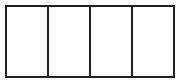
Mrs. Reed baked four pans of lasagna for a family party. Use the rectangles to represent the pans.
Go Math Grade 3 Answer Key Chapter 9 Compare Fractions Review/Test img 34
Part A
Draw lines to show how Mrs. Reed could cut one pan of lasagna into thirds, one into fourths, one into sixths, and one into eighths.
Type below:
___________

Answer:

Mrs. Reed could cut one pan of lasagna into thirds:

Go Math Solution Key Grade 3 Chapter 9 Review solution image_ 2a

Mrs. Reed could cut one pan of lasagna into fourths:

Compare fractions Go Math Grade 3 Answer Key Review solution Image_ 2b

Mrs. Reed could cut one pan of lasagna into sixths:

HMH Go Math Key Grade 3 Chapter 9 Review Solution Image_2c

Mrs. Reed could cut one pan of lasagna into eighths:

Go Math Grade 3 Chapter 9 Key Review Solution Image_2d

Question 7.
Part B
At the end of the dinner, equivalent amounts of lasagna in two pans were left. Use the models to show the lasagna that might have been left over. Write two pairs of equivalent fractions to represent the models.
Type below:
___________

Answer:

Answer Key for Go Math Grade chapter 9 Review solution image_2e

\(\frac{1}{3}\) = \(\frac{2}{6}\)

Go Math Grade 3 Chapter 9 key review solution image_2f

\(\frac{1}{4}\) = \(\frac{2}{8}\)

Question 8.
Tom rode his horse for \(\frac{4}{6}\) mile. Liz rode her horse for an equal distance. What is an equivalent fraction that describes how far Liz rode? Use the models to show your work.
Go Math Grade 3 Answer Key Chapter 9 Compare Fractions Review/Test img 35
\(\frac{4}{6}\) = \(\frac{□}{□}\)

Answer: \(\frac{4}{6}\) = \(\frac{2}{3}\)

Explanation:

The above figure shows that the fraction of the first figure \(\frac{4}{6}\) is equal to the fraction of the second figure i.e., \(\frac{2}{3}\).

Question 9.
Avery prepares 2 equal-size oranges for the bats at the zoo. One dish has \(\frac{3}{8}\) of an orange. Another dish has \(\frac{1}{4}\) of an orange. Which dish has more orange? Show your work. \(\frac{□}{□}\)

Answer: First, we need to find an equivalent fraction to \(\frac{1}{4}\) so it would have the same denominator as \(\frac{3}{8}\)
\(\frac{1}{4}\) = \(\frac{2}{8}\) – equivalent fractions
Now we can compare the fractions:
\(\frac{2}{8}\) < \(\frac{3}{8}\)
Therefore \(\frac{1}{4}\) < \(\frac{3}{8}\)
So, the answer is \(\frac{3}{8}\)

Review/Test – Page No. 554

Question 10.
Jenna painted \(\frac{1}{8}\)of one side of a fence. Mark painted \(\frac{1}{6}\) of the other side of the same fence. Use >, =, or < to compare the parts that they painted.
\(\frac{1}{8}\) ______ \(\frac{1}{6}\)

Answer: \(\frac{1}{8}\) < \(\frac{1}{6}\)

Explanation:

Jenna painted \(\frac{1}{8}\)of one side of a fence.
Mark painted \(\frac{1}{6}\) of the other side of the same fence.
The numerators of both fractions are the same. So compare the denominators.
\(\frac{1}{8}\) & \(\frac{1}{6}\)
The denominator with the greatest number will be the smallest fraction.
So, \(\frac{1}{8}\) < \(\frac{1}{6}\)

Question 11.
Bill used \(\frac{1}{3}\) cup of raisins and \(\frac{2}{3}\) cup of banana chips to make a snack. For 11a–11d, select True or False for each comparison.
a. \(\frac{1}{3}\) > \(\frac{2}{3}\)
i. True
ii. False

Answer: False

Explanation:

The denominators are the same here. So check the numerators.
1 is less than 2.
\(\frac{1}{3}\) > \(\frac{2}{3}\)
The statement is false.

Question 11.
b. \(\frac{2}{3}\) = \(\frac{1}{3}\)
i. True
ii. False

Answer: False

Explanation:

The denominators and numerators are not equal in this equation.
So, the statement is false.

Question 11.
c. \(\frac{1}{3}\) < \(\frac{2}{3}\)
i. True
ii. False

Answer: True

Explanation:

The denominators of both the fractions are the same.
Compare the numerators. 1 is less than 2.
So, \(\frac{1}{3}\) < \(\frac{2}{3}\).
The statement is true.

Question 11.
d. \(\frac{2}{3}\) > \(\frac{1}{3}\)
i. True
ii. False

Answer: True

Explanation:

The denominators of both the fractions are the same.
Compare the numerators. 2 is greater than 1.
\(\frac{2}{3}\) > \(\frac{1}{3}\)
The statement is true.

Question 12.
Jorge, Lynne, and Crosby meet at the playground. Jorge lives \(\frac{5}{6}\) mile from the playground. Lynne lives \(\frac{4}{6}\) mile from the playground. Crosby lives \(\frac{7}{8}\) mile from the playground.
Part A
Who lives closer to the playground, Jorge or Lynne?
Explain how you know.
_____

Answer: Lynne

Explanation:

Jorge lives \(\frac{5}{6}\) mile from the playground.
Lynne lives \(\frac{4}{6}\) mile from the playground.
The denominators are the same. So, compare the numerators.
5 is greater than 4. So, \(\frac{5}{6}\) > \(\frac{4}{6}\)
Therefore, Lynne lives closer to the playground.

Question 12.
Part B
Who lives closer to the playground, Jorge or Crosby?
Explain how you know.
_____

Answer: Jorge

Explanation:

Jorge lives \(\frac{5}{6}\) mile from the playground.
Crosby lives \(\frac{7}{8}\) mile from the playground.
Compare the fraction of both Jorge and Crosby.
\(\frac{5}{6}\) × \(\frac{8}{8}\) = \(\frac{40}{48}\)
\(\frac{7}{8}\) × \(\frac{6}{6}\) = \(\frac{42}{48}\)
\(\frac{40}{48}\) < \(\frac{42}{48}\)
Therefore, Jorge lives closer to the playground.

Review/Test – Page No. 555

Question 13.
Ming needs \(\frac{1}{2}\) pint of red paint for an art project. He has 6 jars that have the following amounts of red paint in them. He wants to use only 1 jar of paint. Mark all of the jars of paints that Ming could use.
Options:
a. \(\frac{2}{3}\) pint
b. \(\frac{1}{4}\) pint
c. \(\frac{4}{6}\) pint
d. \(\frac{3}{4}\) pint
e. \(\frac{3}{8}\) pint
f. \(\frac{2}{6}\) pint

Answer: \(\frac{2}{3}\) pint, \(\frac{3}{4}\) pint, \(\frac{4}{6}\) pint

Explanation:

We have to find all the jars that have an amount of paint greater than \(\frac{1}{2}\)
A. \(\frac{2}{3}\) pint > \(\frac{1}{2}\)
B. \(\frac{1}{4}\) pint < \(\frac{1}{2}\)
C. \(\frac{4}{6}\) pint > \(\frac{1}{2}\)
D. \(\frac{3}{4}\) pint < \(\frac{1}{2}\)
E. \(\frac{3}{8}\) pint < \(\frac{1}{2}\)
F. \(\frac{2}{6}\) pint < \(\frac{1}{2}\)

Question 14.
There are 12 people having lunch. Each person wants \(\frac{1}{3}\) of a sub sandwich. How many whole sub sandwiches are needed? Use the models to show your answer.
Go Math Grade 3 Answer Key Chapter 9 Compare Fractions Review/Test img 36
______ sub sandwiches

Answer: 4 sub sandwiches

Explanation:

Given that, There are 12 people having lunch.
Each person wants \(\frac{1}{3}\) of a sub sandwich.
Multiply the number of people with Each person wants of a sub sandwich.
12 × \(\frac{1}{3}\)
3 divides 12 four times. So, the answer is 4 sub sandwiches.

Question 15.
Mavis mixed \(\frac{2}{4}\) quart of apple juice with \(\frac{1}{2}\) quart of cranberry juice. Compare the fractions. Choose the symbol that makes the statement true.
\(\frac{2}{4}\) Go Math Grade 3 Answer Key Chapter 9 Compare Fractions Review/Test img 37 \(\frac{1}{2}\)
______

Answer:  \(\frac{2}{4}\) = \(\frac{1}{2}\)

Question 16.
Pat has three pieces of fabric that measure \(\frac{3}{6}\), \(\frac{5}{6}\), and \(\frac{2}{6}\) yards long. Write the lengths in order from least to greatest.
Type below:
___________

Answer: \(\frac{2}{6}\), \(\frac{3}{6}\), \(\frac{5}{6}\)

Explanation:

The denominators of \(\frac{3}{6}\), \(\frac{5}{6}\), and \(\frac{2}{6}\) are same. So, Compare the numerators 2 < 3, 5

Review/Test – Page No. 556

Question 17.
Cora measures the heights of three plants. Draw a line to match each height on the left to the word on the right that describes its place in the order of heights.
Go Math Grade 3 Answer Key Chapter 9 Compare Fractions Review/Test img 38
Type below:
___________

Answer:

Chapter 9 Go Math Grade 3 Answer Key Review solution image_1

Explanation:

\(\frac{4}{6}\) < \(\frac{4}{4}\)
\(\frac{4}{8}\) < \(\frac{4}{4}\)
\(\frac{4}{6}\) > \(\frac{4}{8}\)
The numerators are same. So, compare the denominators. The greatest fraction will have the lesser denominator.
\(\frac{4}{8}\) < \(\frac{4}{6}\) < \(\frac{4}{4}\).

Question 18.
Danielle drew a model to show equivalent fractions.
Go Math Grade 3 Answer Key Chapter 9 Compare Fractions Review/Test img 39
Use the model to complete the number sentence.
\(\frac{1}{2}\) = \(\frac{□}{□}\) = \(\frac{□}{□}\)
Type below:
___________

Answer: \(\frac{1}{2}\) = \(\frac{2}{4}\) = \(\frac{4}{8}\)

Total number of boxes are 4 and each are grouped into 2 = 8
Out of 4 boxes 2 boxes are shaded = \(\frac{2}{4}\)
\(\frac{2}{4}\) = \(\frac{1}{2}\)
Next out of 8 grouped squares 4 are shaded = \(\frac{4}{8}\)
\(\frac{4}{8}\) = \(\frac{1}{2}\)
Therefore the equivalent fractions are \(\frac{1}{2}\) = \(\frac{2}{4}\) = \(\frac{4}{8}\)

Question 19.
Floyd caught a fish that weighed \(\frac{2}{3}\) pound. Kira caught a fish that weighed \(\frac{7}{8}\) pound. Whose fish weighed more? Explain the strategy you used to solve the problem.
_____

Answer: Kira

Explanation:

We need to find equivalent fractions with the same denominator:
So Make the denominators of \(\frac{2}{3}\) and \(\frac{7}{8}\) equal.
\(\frac{2}{3}\) × \(\frac{8}{8}\) = \(\frac{16}{24}\)
\(\frac{7}{8}\) × \(\frac{3}{3}\) = \(\frac{21}{24}\)
\(\frac{16}{24}\) < \(\frac{21}{24}\)
Therefore \(\frac{2}{3}\) < \(\frac{7}{8}\)

Question 20.
Sam went for a ride on a sailboat. The ride lasted \(\frac{3}{4}\) hour.
Go Math Grade 3 Answer Key Chapter 9 Compare Fractions Review/Test img 40
What fraction is equivalent to \(\frac{3}{4}\)?
\(\frac{□}{□}\)

Answer: \(\frac{6}{8}\)

Explanation:

Total number of boxes are 4 and each is grouped into 2 = 8
Out of 4 boxes 3 boxes are shaded = \(\frac{3}{4}\)
Next out of 8 grouped squares 6 are shaded = \(\frac{6}{8}\)
Thus the fraction is equivalent to \(\frac{3}{4}\) is \(\frac{6}{8}\)

Conclusion

Use the practice and Homework pages links to learn the concepts and skills which are provided in the Go Math Answer Key for Grade 3 Chapter 9 Compare Fractions. Help your child to climb greater heights and fall in love with Math learning. If you want to practice more problems you can go through the Go Math Grade 3 Answer Key Chapter 9 Compare Fractions Extra Practice.

Go Math Grade 3 Chapter 9 Answer Key Pdf Compare Fractions Read More »

go-math-grade-3-answer-key-chapter-10-time-length-liquid-volume-and-mass

Go Math Grade 3 Chapter 10 Answer Key Pdf Time, Length, Liquid Volume, and Mass

Time to the Minute – Page No. 565

Write the time. Write one way you can read the time.

Question 1.
Go Math Grade 3 Answer Key Chapter 10 Time, Length, Liquid Volume, and Mass Time to the Minute img 1

Answer:  1:16; sixteen minutes after one

Explanation:
Count on by fives and ones from the 12 on the clock to where the minute hand is pointing. Write the missing counting numbers next to the clock.
Write: 1 Hour 16 minutes
Read:  sixteen minutes after  one

Question 2.
Go Math Grade 3 Answer Key Chapter 10 Time, Length, Liquid Volume, and Mass Time to the Minute img 2
Type below:
___________

Answer: 10:20; twenty minutes after ten

Explanation:
Count by fives and ones from the 12 on the clock to where the minute hand is pointing. Write the missing counting numbers next to the clock.
Write: 10 Hours 20 minutes
Read:  twenty minutes after  ten

Grade 3 Chapter 10 Fractions Minute Answer Key Question 3.
Go Math Grade 3 Answer Key Chapter 10 Time, Length, Liquid Volume, and Mass Time to the Minute img 3
Type below:
____________

Answer: 4:13;  thirteen minutes after four

Explanation:
Count by fives and ones from the 12 on the clock to where the minute hand is pointing. Write the missing counting numbers next to the clock.
Write: 4 Hour 13 minutes
Read:  thirteen minutes after  four

Question 4.
Go Math Grade 3 Answer Key Chapter 10 Time, Length, Liquid Volume, and Mass Time to the Minute img 4
Type below:
____________

Answer: 12:05; five minutes after twelve

Explanation:
Count by fives and ones from the 12 on the clock to where the minute hand is pointing. Write the missing counting numbers next to the clock.
Write: 12 Hour 05 minutes
Read:  five minutes after  twelve

Question 5.
Go Math Grade 3 Answer Key Chapter 10 Time, Length, Liquid Volume, and Mass Time to the Minute img 5
Type below:
____________

Answer: 7:24; twenty-four minutes after seven

Explanation:
Count on by fives and ones from the 12 on the clock to where the minute hand is pointing. Write the missing counting numbers next to the clock.
Write: 7 Hour 24 minutes
Read: twenty-four minutes after seven

Question 6.
Go Math Grade 3 Answer Key Chapter 10 Time, Length, Liquid Volume, and Mass Time to the Minute img 6
Type below:
____________

Answer: 2:51; nine minutes before three

Explanation:
Count by fives and ones from the 12 on the clock back to where the minute hand is pointing. Write the missing counting numbers next to the clock.
Write: 2:51
Read:
nine minutes before three

Write the time another way.

Question 7.
23 minutes after 4
______ : ______

Answer: 4:23

Explanation:
Count on by fives and ones from the 12 on the clock to where the minute hand is pointing. Write the missing counting numbers next to the clock.

Question 8.
18 minutes before 11
______ : ______

Answer: 10:42

Explanation:
Count by fives and ones from the 12 on the clock back to where the minute hand is pointing. Write the missing counting numbers next to the clock.

Question 9.
10 minutes before 9
______ : ______

Answer: 8:50

Explanation:
Count by fives and ones from the 12 on the clock back to where the minute hand is pointing. Write the missing counting numbers next to the clock.

Question 10.
7 minutes after 1
______ : ______

Answer: 1:07

Explanation:
Count on by fives and ones from the 12 on the clock to where the minute hand is pointing. Write the missing counting numbers next to the clock.

Problem Solving

Question 11.
What time is it when the hour hand is a little past the 3 and the minute hand is pointing to the 3?
______ : ______

Answer: 3:15

Explanation:
Count on by fives and ones from the 12 on the clock to where the minute hand is pointing. Write the missing counting numbers next to the clock.

Question 8.

Question 12.
Pete began practicing at twenty-five minutes before eight. What is another way to write this time?
______ : ______

Answer: 7:35

Explanation:
Count by fives and ones from the 12 on the clock back to where the minute hand is pointing. Write the missing counting numbers next to the clock.

Time to the Minute – Page No. 566

Lesson Check

Question 1.
Which is another way to write 13 minutes before 10?
Options:
a. 9:47
b. 10:13
c. 10:47
d. 11:13

Answer: a. 9:47

Explanation:
Count by fives and ones from the 12 on the clock back to where the minute hand is pointing. Write the missing counting numbers next to the clock.

Question 2.
What time does the clock show?
Go Math Grade 3 Answer Key Chapter 10 Time, Length, Liquid Volume, and Mass Time to the Minute img 7
Options:
a. 2:20
b. 2:40
c. 3:20
d. 4:10

Answer: a. 2:20

Explanation:
Count on by fives and ones from the 12 on the clock to where the minute hand is pointing. Write the missing counting numbers next to the clock.

Spiral Review

Question 3.
Each bird has 2 wings. How many wings will 5 birds have?
Options:
a. 7
b. 8
c. 9
d. 10

Answer: d. 10

Explanation:
STEP 1 Draw 2 counters in each group.
STEP 2 Skip count to find how many wings in all. Skip count by 2s until you say 5 numbers (groups)
There are 5 groups with 2 wings in each group. So, there are 10 wings in all.

Grade 3 Math The Necklace Answer Key Question 4.
Find the unknown factor.
9 × ■ = 36
Options:
a. 4
b. 6
c. 8
d. 27

Answer: a. 4

Explanation:
Count how many rows of 36 counters there are.
There are  9 rows of 36 counters. The unknown factor is 4 (c0lumns). n = 4
9× 4 = 36

Question 5.
Mr. Wren has 56 paintbrushes. He places 8 paintbrushes on each of the tables in the art room. How many tables are in the art room?
Options:
a. 6
b. 7
c. 9
d. 48

Answer: b. 7

Explanation:
STEP 1 Draw 56 counters.
STEP 2 Make a group of 8 counters by drawing a circle around them. Continue circling groups of 8 until all 56 counters are in groups.
There are 7 groups of 56 counters.

Question 6.
Which number completes the equations?
4 × ▲ = 20 20 ÷ 4 = ▲
Options:
a. 4
b. 5
c. 6
d. 16

Answer: b. 5

Explanation:
Count how many rows of 20 counters there are. There are  4 rows of 20 counters. The unknown factor is 5 (c0lumns). n = 5
4× 5 = 20
STEP 1 Draw 20 counters.
STEP 2 Make a group of 4 counters by drawing a circle around them. Continue circling groups of 4 until all 20 counters are in groups.
There are 5 groups of 20 counters.

A.M. and P.M. – Page No. 571

Write the time for the activity. Use A.M. or P.M.

Question 1.
eat lunch
Go Math Grade 3 Answer Key Chapter 10 Time, Length, Liquid Volume, and Mass A.M. and P.M. img 8

Answer: 12:20 P.M.

Explanation:
The times afternoon and before midnight is written with P.M. Since we have our lunch in the afternoon around 12:00 noon to 1:00 P.M. which falls in the period of 12:00 noon to 12:00 at midnight hence the time 12:20 is considered to be P.M.

Question 2.
go home after school
Go Math Grade 3 Answer Key Chapter 10 Time, Length, Liquid Volume, and Mass A.M. and P.M. img 9
_____ : _____ _____ (A.M./P.M.)

Answer: 2:53 P.M.

Explanation:
The times afternoon and before midnight is written with P.M. Since the school hours end in the evening and students return to their home around 2:30 P.M. to 3:30 P.M. which falls in the period of 12:00 noon to 12:00 at midnight hence the time 2:53 is considered to be P.M.

Question 3.
see the sunrise
Go Math Grade 3 Answer Key Chapter 10 Time, Length, Liquid Volume, and Mass A.M. and P.M. img 10
_____ : _____ _____ (A.M./P.M.)

Answer: 6:18 A.M.

Explanation:
The times after midnight and before noon is written with A.M. At the early hours of the day sunrises which falls in the period of  12:00 at midnight to 12:00 noon, therefore the time 6:18 is considered to be A.M.

Question 4.
go for a walk
Go Math Grade 3 Answer Key Chapter 10 Time, Length, Liquid Volume, and Mass A.M. and P.M. img 11
_____ : _____ _____ (A.M./P.M.)

Answer: 3:55 P.M.

Explanation:
The times afternoon and before midnight is written with P.M. Since the people go for a walk to refresh their minds in the evening hours which falls in the period of 12:00 noon to 12:00 at midnight the time 3:55 is considered to be P.M.

Question 5.
go to school
Go Math Grade 3 Answer Key Chapter 10 Time, Length, Liquid Volume, and Mass A.M. and P.M. img 12
_____ : _____ _____ (A.M./P.M.)

Answer: 8:10 A.M.

Explanation:
The times after midnight and before noon is written with A.M. Since students go to the school in the morning hours which falls in the period of  12:00 at midnight to 12:00 noon, therefore, the time 8:10 is considered to be A.M.

Question 6.
get ready for art class
Go Math Grade 3 Answer Key Chapter 10 Time, Length, Liquid Volume, and Mass A.M. and P.M. img 13
_____ : _____ _____ (A.M./P.M.)

Answer: 10:36 A.M.

Explanation:
The times after midnight and before noon is written with A.M. Since students go to the art class in the morning hours which falls in the period of  12:00 at midnight to 12:00 noon, therefore, the time 10:36 is considered to be A.M.

Write the time. Use A.M. or P.M.

Question 7.
13 minutes after 5:00 in the morning
_____ : _____ _____ (A.M./P.M.)

Answer: 5:13 A.M.

Explanation:
The times after midnight and before noon is written with A.M. Since 5:00 in the morning falls in the period of 12:00 at midnight to 12:00 noon, therefore, the time is considered to be A.M.


Question 8.
19 minutes before 9:00 at night
_____ : _____ _____ (A.M./P.M.)

Answer: 8:41 P.M.

Explanation:
The times afternoon and before midnight is written with P.M.  Since 8:41 in the night time falls in the period of 12:00 noon to 12:00 at midnight, therefore, the time 8:41 is considered to be P.M.

Question 9.
quarter before midnight
_____ : _____ _____ (A.M./P.M.)

Answer: 11:45P.M.

Explanation:
The times afternoon and before midnight is written with P.M. Since 11:45 in the night time falls in the period of 12:00 noon to 12:00 at midnight, therefore, the time 11:45 is considered to be P.M.

Question 10.
one-half hour after 4:00 in the morning
_____ : _____ _____ (A.M./P.M.)

Answer: 4:30 A.M.

Explanation:
One-half hour = 30 minutes So, by adding 30 minutes to 4:00 A.M. in the morning. We get the time to be 4:30 A.M.
The times after midnight and before noon is written with A.M.  Since 4:30 in the morning falls in the period of 12:00 at midnight to 12:00 noon, therefore, the time is considered to be A.M

Problem Solving

Question 11.
Jaime is in math class. What time is it? Use A.M. or P.M.
Go Math Grade 3 Answer Key Chapter 10 Time, Length, Liquid Volume, and Mass Go Math Grade 3 Answer Key Chapter 10 Time, Length, Liquid Volume, and Mass img 14 img 14
_____ : _____ _____ (A.M./P.M.)

Answer: 1:25 P.M.

Explanation:
The times afternoon and before midnight is written with P.M. Since 1:25 in the afternoon hours fall in the period of 12:00 noon to 12:00 at midnight, therefore, the time1:25 is considered to be P.M.

Question 12.
Pete began practicing his trumpet at fifteen minutes past three. Write this time using A.M. or P.M.
_____ : _____ _____ (A.M./P.M.)

Answer: 3:15 P.M.

Explanation:
The times afternoon and before midnight is written with P.M. Since 3:15 in the evening hours fall in the period of 12:00 noon to 12:00 at midnight, therefore, the time 3:15 is considered to be P.M.

A.M. and P.M. – Page No. 572

Lesson Check

Question 1.
Steven is doing his homework. What time is it? Use A.M. or P.M.
Go Math Grade 3 Answer Key Chapter 10 Time, Length, Liquid Volume, and Mass A.M. and P.M. img 15
Options:
a. 4:15 P.M.
b. 4:25 A.M.
c. 4:35 P.M.
d. 4:35 A.M.

Answer: c. 4:35 P.M.

Explanation:
The times afternoon and before midnight is written with P.M. Since 4:35 in the evening hours falls in the period of 12:00 noon to 12:00 at midnight, therefore, the time 4:35 is considered to be P.M.

Go Math Grade 3 Pdf Lesson 10.3 Answer Key Question 2.
After he finished breakfast, Mr. Edwards left for work fifteen minutes after seven. What time is this? Use A.M. or P.M.
Options:
a. 6:15 A.M.
b. 7:15 A.M.
c. 6:45 P.M.
d. 7:30 P.M.

Answer: b. 7:15 A.M.

Explanation:
The times after midnight and before noon is written with A.M. Since 7:15 in the morning falls in the period of 12:00 at midnight to 12:00 noon, therefore, the time 7:15 is considered to be A.M.

Spiral Review

Question 3.
Which division equation is related to the multiplication equation 4 × 6 = 24
Options:
a. 24 ÷ 8 = 3
b. 12 ÷ 3 = 4
c. 6 × 4 = 24
d. 24 ÷ 4 = 6

Answer: d. 24 ÷ 4 = 6

Explanation:
STEP 1 Draw 24 counters.
STEP 2 Make a group of 4 counters by drawing a circle around them. Continue circling groups of 4 until all 24 counters are in groups.
There are 6 groups of 24 counters.

Question 4.
There are 50 toothpicks in each box. Jaime buys 4 boxes for her party platter. How many toothpicks does Jaime buy in all?
Options:
a. 20
b. 54
c. 200
d. 2,000

Answer: c. 200

Explanation:
Step1 let there be 50 toothpicks in each box.
Step2 the number of boxes required is 4
Step3 total number of toothpicks will be the number of boxes multiplied by the number of toothpicks in each box.
4 × 50=200

Question 5.
A pet store sold 145 bags of beef-flavored dog food and 263 bags of cheese-flavored dog food. How many bags of dog food were sold in all?
Options:
a. 118
b. 308
c. 408
d. 422

Answer: c. 408

Explanation:
Total number of bags of dog food sold=145+263


Question 6.
Victoria and Melody are comparing fraction strips. Which statement is NOT correct?
Options:
a. \(\frac{1}{4}\) < \(\frac{4}{4}\)
b. \(\frac{3}{6}\) > \(\frac{4}{6}\)
c. \(\frac{2}{8}\) > \(\frac{1}{8}\)
d. \(\frac{2}{3}\) > \(\frac{3}{3}\)

Answer: b. \(\frac{3}{6}\) > \(\frac{4}{6}\)

Explanation:

Take two blocks of the same size and both are made of 6 equal-size squares.
3  squares are shaded green while 4 are shaded with red.
Compare 3/6 and 4/6.
The greater fraction will have the larger
amount of the whole shaded.
Therefore, 3/6>4/6.

Measure Time Intervals – Page No. 577

Find the elapsed time.

Question 1.
Start: 8:10 A.M. End: 8:45 A.M.
Go Math Grade 3 Answer Key Chapter 10 Time, Length, Liquid Volume, and Mass Measure Time Intervals img 16

Answer: 35 minutes

Explanation:
STEP 1 Find 8:10 A.M. on the number line. Count on from 8:10 A.M. to 8:45 A.M. Draw marks and record the times on the number line. Then draw and label the jumps.
STEP 2 Add to find the total minutes from 8:10 A.M. to 8:45 A.M. From 8:10 A.M. to 8:45 A.M. is 35 minutes.
So, the elapsed time is 35 minutes

Question 2.
Start: 6:45 P.M. End: 6:54 P.M.
Go Math Grade 3 Answer Key Chapter 10 Time, Length, Liquid Volume, and Mass Measure Time Intervals img 17
_______ minutes

Answer: 9 minutes

Explanation:
STEP 1 Find the starting time on the clock.
STEP 2 Count the minutes by counting on by fives and ones to 6:54 P.M. Write the missing counting numbers next to the clock.
So, the elapsed time is 9 minutes.

Question 3.
Start: 3:00 P.M. End: 3:37 P.M.
Go Math Grade 3 Answer Key Chapter 10 Time, Length, Liquid Volume, and Mass Measure Time Intervals img 18
_______ minutes

Answer: 37 minutes

Explanation:
STEP 1 Find3:00 P.M. on the number line. Count on from 3:00 P.M. to 3:37 P.M. Draw marks and record the times on the number line. Then draw and label the jumps.
STEP 2 Add to find the total minutes from3:00 P.M. to 3:37 P.M. From 3:00 P.M. to 3:37 P.M. is 37 minutes.
So, the elapsed time is 37 minutes

Question 4.
Start: 10:05 A.M. End: 10:21 A.M.
Go Math Grade 3 Answer Key Chapter 10 Time, Length, Liquid Volume, and Mass Measure Time Intervals img 19
_______ minutes

Answer: 16 minutes

Explanation:
STEP 1 Find10:05 A.M. on the number line. Count on from 10:05 A.M. to 10:21 A.M. Draw marks and record the times on the number line. Then draw and label the jumps.
STEP 2 Add to find the total minutes from 10:05 A.M. to 10:21 A.M. From 10:05 A.M. to 10:21 A.M. is 16 minutes.
So, the elapsed time is 16 minutes

Question 5.
Start: 7:30 A.M. End: 7:53 A.M.
Go Math Grade 3 Answer Key Chapter 10 Time, Length, Liquid Volume, and Mass Measure Time Intervals img 20
_______ minutes

Answer: 23 minutes

Explanation:
STEP 1 Find the starting time on the clock.
STEP 2 Count the minutes by counting on by fives and ones to7:53 A.M. Write the missing counting numbers next to the clock.
So, the elapsed time is 23 minutes.

Question 6.
Start: 5:20 A.M. End: 5:47 A.M.
Go Math Grade 3 Answer Key Chapter 10 Time, Length, Liquid Volume, and Mass Measure Time Intervals img 21
_______ minutes

Answer: 27 minutes

Explanation:
STEP 1 Find the starting time on the clock.
STEP 2 Count the minutes by counting on by fives and ones to 5:47 A.M. Write the missing counting numbers next to the clock.
So, the elapsed time is 27 minutes.

Problem Solving

Question 7.
A show at the museum starts at 7:40 P.M. and ends at 7:57 P.M. How long is the show?
_______ minutes

Answer: 17 minutes

Explanation:
STEP 1 Find 7:40 P.M. on the number line. Count on from 7:40 P.M. to 7:57 P.M. Draw marks and record the times on the number line. Then draw and label the jumps.
STEP 2 Add to find the total minutes from 7:40 P.M. to 7:57 P.M. From 7:40 P.M. to 7:57 P.M. is 17 minutes.
So, the elapsed time is 17 minutes
The duration of the show is 17 minutes.

Question 8.
The first train leaves the station at 6:15 A.M. The second train leaves at 6:55 A.M. How much later does the second train leave the station?
_______ minutes

Answer: 40 minutes later

Explanation:
STEP 1 Find 6:15 A .M. on the number line. Count on from 6:15 A.M. to 6:55 A.M. Draw marks and record the times on the number line. Then draw and label the jumps.
STEP 2 Add to find the total minutes from 6:15 A.M. to 6:55 A.M. From 6:15 A .M. to 6:55 A.M. is 40 minutes.
So, the second train will leave the station in 40 minutes

Measure Time Intervals – Page No. 578

Lesson Check

Question 1.
Marcus began playing basketball at 3:30 P.M. and stopped playing at 3:55 P.M. For how many minutes did he play basketball?
Options:
a. 25 minutes
b. 30 minutes
c. 55 minutes
d. 85 minutes

Answer: a. 25 minutes

Explanation:
STEP 1 Find 3:30 P.M. on the number line. Count on from 3:30 P.M. to 3:55 P.M. Draw marks and record the times on the number line. Then draw and label the jumps.
STEP 2 Add to find the total minutes from3:30 P.M. to3:55 P.M. From 3:30 P.M. to 3:55 P.M. is 25 minutes.
So, the elapsed time is 25 minutes
Marcus played basketball for 25 minutes.

Question 2.
The school play started at 8:15 P.M. and ended at 8:56 P.M. How long was the school play?
Options:
a. 15 minutes
b. 31 minutes
c. 41 minutes
d. 56 minutes

Answer: c. 41 minutes

Explanation:
STEP 1 Find 8:15 P.M. on the number line. Count on from 8:15 P.M. to 8:56 P.M. Draw marks and record the times on the number line. Then draw and label the jumps.
STEP 2 Add to find the total minutes from 8:15 P.M. to 8:56 P.M. From 8:15 P.M. to 8:56 P.M. is 41  minutes.
So, the elapsed time is 41 minutes
Therefore, the school play was for 41 minutes.

Spiral Review

Question 3.
Each car has 4 wheels. How many wheels will 7 cars have?
Options:
a. 11
b. 24
c. 27
d. 28

Answer: d. 28

Explanation:
STEP 1 Draw 4 counters in each group.
STEP 2 Skip count to find how many wheels in all. Skip count by 4s until you say 7 numbers (groups)
There are 7 groups with 4 wheels in each group. So, there are 28 wheels in all.

Question 4.
Which number completes the equations?
3 × ■ = 27 27 ÷ 3 = ■
Options:
a. 6
b. 7
c. 8
d. 9

Answer: d. 9

Explanation:
Count how many rows of 27 counters there are. There are  3 rows of 27 counters. The unknown factor is 9 (c0lumns). n = 9
3 × 9 = 27
STEP 1 Draw 27 counters.
STEP 2 Make a group of 3 counters by drawing a circle around them. Continue circling groups of 3 until all 27 counters are in groups.
There are 9 groups of 27 counters.

Question 5.
There are 20 napkins in each package. Kelli bought 8 packages for her party. How many napkins did Kelli buy in all?
Options:
a. 28
b. 40
c. 160
d. 180

Answer: c. 160

Explanation:
Step1 let there be 20 napkins in each package.
Step2 the number of packages required is 8
Step3 total number of napkins will be the number of packages multiplied by the number of napkins in each package.
8 × 20=160

Question 6.
Mr. Martin drove 290 miles last week. This week he drove 125 miles more than last week. How many miles did Mr. Martin drive this week?
Options:
a. 125 miles
b. 165 miles
c. 315 miles
d. 415 miles

Answer: d. 165 miles

Explanation:
Total number of miles drove by Mr Martin in this week = 290+125

Use Time Intervals – Page No. 583

Find the starting time.

Question 1.
Ending time: 4:29 P.M.
Elapsed time: 55 minutes
Go Math Grade 3 Answer Key Chapter 10 Time, Length, Liquid Volume, and Mass Use Time Intervals img 22

Answer: 3:34 P.M.

Explanation:
STEP 1 Find the starting time on the number line
STEP 2 Count back on the number line to subtract the elapsed time. Draw and label the jumps to show the minutes.
STEP 3 Write the times below the number line.
You jumped back to 55 minutes
So, the starting time is 3:34 P.M.

Question 2.
Ending time: 10:08 A.M.
Elapsed time: 30 minutes
Go Math Grade 3 Answer Key Chapter 10 Time, Length, Liquid Volume, and Mass Use Time Intervals img 23
______ : ______ ______ (A.M./P.M.)

Find the ending time.

Answer: 9:38 A.M.

Explanation:
STEP 1 Find the starting time on the clock.
STEP 2 Count back by fives for the elapsed time of 3o minutes. Write the missing counting numbers next to the clock.
So, the starting time is 9:38 A.M.

Question 3.
Starting time: 2:15 A.M.
Elapsed time: 45 minutes
Go Math Grade 3 Answer Key Chapter 10 Time, Length, Liquid Volume, and Mass Use Time Intervals img 24
______ : ______ ______ (A.M./P.M.)

Answer: 3:00 A.M.

Explanation:
STEP 1 Find the ending time on the number line.
STEP 2 Count forward on the number line to add the elapsed time. Draw and label the jumps to show the minutes.
STEP 3 Write the times below the number line.
The jumps end at 3:00 A.M.
So, the ending time is 3:00 A.M.

Question 4.
Starting time: 6:57 P.M.
Elapsed time: 47 minutes
Go Math Grade 3 Answer Key Chapter 10 Time, Length, Liquid Volume, and Mass Use Time Intervals img 25
______ : ______ ______ (A.M./P.M.)

Answer: 7:44 P.M.

Explanation:
STEP 1 Find the ending time on the clock.
STEP 2 Count on by fives and ones for the elapsed time of 47 minutes. Write the missing counting numbers next to the clock.
So, the ending time is 7:44 P.M.

Problem Solving

Question 5.
Jenny spent 35 minutes doing research on the Internet. She finished at 7:10 P.M. At what time did Jenny start her research?
______ : ______ ______ (A.M./P.M.)

Answer: 6:35 P.M.

Explanation:
STEP 1 Find the starting time on the clock.
STEP 2 Count back by fives for the elapsed time of 35 minutes. Write the missing counting numbers next to the clock.
So, the starting time is 6:35 A.M.

Question 6.
Clark left for school at 7:43 A.M. He got to school 36 minutes later. At what time did Clark get to school?
______ : ______ ______ (A.M./P.M.)

Answer: 8:19 A.M.

Explanation:
STEP 1 Find the ending time on the clock.
STEP 2 Count on by fives and ones for the elapsed time of 36 minutes. Write the missing counting numbers next to the clock.
So, the ending time is 8:19 A.M.

Use Time Intervals – Page No. 584

Lesson Check

Question 1.
Cody and his friends started playing a game at 6:30 P.M. It took them 37 minutes to finish the game. At what time did they finish?
Options:
a. 5:07 P.M.
b. 5:53 P.M.
c. 6:53 P.M.
d. 7:07 P.M.

Answer: d. 7:07 P.M.

Explanation:
STEP 1 Find the ending time on the clock.
STEP 2 Count on by fives and ones for the elapsed time of 37 minutes. Write the missing counting numbers next to the clock.
So, the ending time is 7:07 P.M.

Question 2.
Delia worked for 45 minutes on her oil painting. She took a break at 10:35 A.M. At what time did Delia start working on the painting?
Options:
a. 9:40 A.M.
b. 9:50 A.M.
c. 11:20 A.M.
d. 11:30 A.M.

Answer: b. 9:50 A.M.

Explanation:
STEP 1 Find the starting time on the clock.
STEP 2 Count back by fives for the elapsed time of 45 minutes. Write the missing counting numbers next to the clock.
So, the starting time is 9:50 A.M.

Spiral Review

Question 3.
Sierra has 30 collector’s pins. She wants to put an equal number of pins in each of 5 boxes. How many pins should she put in each box?
Go Math Grade 3 Answer Key Chapter 10 Time, Length, Liquid Volume, and Mass Use Time Intervals img 26
Options:
a. 4
b. 5
c. 6
d. 8

Answer: c. 6

Explanation:
Use 30 counters.
Take 5 boxes.
Place 1 counter at a time in each box until all 30 counters are used.
Place the rest of the counters till all the 30 counters (pins) are completed.
Total number of counters in each box is 6.

Question 4.
What time is shown on the clock?
Go Math Grade 3 Answer Key Chapter 10 Time, Length, Liquid Volume, and Mass Use Time Intervals img 27
Options:
a. 1:24
b. 2:24
c. 4:12
d. 5:12

Answer: b. 2:24

Explanation:
Count on by fives and ones from the 12 on the clock to where the minute hand is pointing. Write the missing counting numbers next to the clock.
Write: 2:24
Read:
• twenty-four minutes after two

Question 5.
Ricardo has 32 books to put on 4 shelves. He puts the same number of books on each shelf. How many books does Ricardo put on each shelf?
Options:
a. 6
b. 7
c. 8
d. 9

Answer: c. 8

Explanation:
Use 32 counters. (books)
The number of shelves is 4.
Place 1 counter at a time in each shelf until all 32 counters are used.
Place the rest of the counters till all the 32 counters (books) are completed.
Total number of counters in each shelf is 8.

Question 6.
Jon started playing a computer game at 5:35 P.M. He finished the game at 5:52 P.M. How long did Jon play the game?
Options:
a. 17 minutes
b. 23 minutes
c. 25 minutes
d. 27 minutes

Answer: a. 17 minutes

Explanation:
STEP 1 Find the ending time on the clock.
STEP 2 Count the minutes by counting on by fives and ones to 5:52 P.M. Write the missing counting numbers next to
the clock.
So, Jon has spent 17 minutes on the computer playing a game.

Lesson 5 – Page No. 587

Share and Show

Question 1.
Patty went to the shopping mall at 11:30 a.m. She shopped for 25 minutes. She spent 40 minutes eating lunch.
Then she met a friend at a movie.
At what time did Patty meet her friend?
_______ : ________

Answer: 12:35 P.M.

Explanation:
The times afternoon and before midnight is written with P.M.
Count (25+40) minutes after 11:30 A.M.
Therefore the time at which Patty met her friend is 11:30 A.M.+1:05 hrs = 12:35 P.M.

Question 2.
What if Patty goes to the mall at 11:30 A.M. and meets a friend at a movie at 1:15 P.M.?
Patty wants to shop and have 45 minutes for lunch before meeting her friend.
How much time can Patty spend shopping?
_______ minutes

Answer: 60 minutes

Explanation:
The times afternoon and before midnight are written with P.M.
Count 45 minutes before 1:15 P.M. (for lunch) which is equal to 12:30 P.M.
The difference between 12:30 P.M. and 11:30 A.M. gives the time spent by Patty in shopping.
STEP 1 Find 12:30 P.M. on the number line. Count on from 12:30 P.M. to 11:30 A.M. Draw marks and record the times on the number line. Then draw and label the jumps.
STEP 2 Add to find the total minutes from 12:30 P.M. to 11:30 A.M. From 12:30 P.M. to 11:30 A.M. is 60 minutes.
So, the time spent on shopping is 60 minutes

Go Math Grade 3 Chapter 10 Pdf Question 3.
Avery got on the bus at 1:10 p.m. The trip took 90 minutes. Then she walked for 32 minutes to get home. At what time did Avery arrive at home?
_______ : ________ P.M.

Answer: 3:12 P.M.

Explanation:
STEP 1 Find 1:10 P.M. on the number line. Count on from 1:10 P.M.
STEP2 Time spent in the trip= 90 minutes
Time Avery walked to get home = 32 minutes
STEP3 Then draw and label the jumps on the number line.
Add the total minutes; 90+32=122 minutes
So the time at which Avery arrives home is calculated by the cumulative jumps on the number line which is equal to 3:12 P.M.
Question 4.
Kyle and Josh have a total of 64 CDs. Kyle has 12 more CDs than Josh. How many CDs does each boy have?
Josh _______ CDs
Kyle _______ CDs

Answer: Josh has 26 CDs
Kyle has 38 CDs

Explanation:
STEP 1 There are 64 counters. (CDs)
STEP2 Kyle has 12 CDs more than Josh. Place these 12 in a separate group. The leftover number of CDs is 64-12=52
STEP 3 Make 2 group and start placing the counters one after the other in each group until all the 52 counters are grouped
There are 2 groups of 26 counters.
Josh has 26 CDs while Kyle has 26+12 = 38 CDs

Lesson 5 – Page No. 588

Question 5.
Jamal spent 60 minutes using the computer. He spent a half hour of the time playing games and the rest of the time researching his report. How many minutes did Jamal spend researching his report?
_______ minutes

Answer: 30 minutes

Explanation: Jamal has spent half hour=30 minutes playing games and the rest of the time researching for his report.
STEP1 There are 60 counters(minutes).
STEP2 Remove the 30 counters which were used to play games
STEP3 The remaining number of counters in the box is 30
So the time spent on the report =30 minutes

Question 6.
When Caleb got home from school, he worked on his science project for 20 minutes. Then he studied for a test for 30 minutes. He finished at 4:35 p.m. At what time did Caleb get home from school?
_______ : _______ P.M.

Answer: 3:45 P.M

Explanation:
STEP 1 Find the time on the number line when Caleb finished his homework.
STEP 2 Count back on the number line to subtract the elapsed time. Draw and label the jumps to show the minutes.
STEP 3 Write the times below the number line.
You jumped back to 30+20=50 minutes
Therefore Caleb got home from school at 3:45 P.M.

Question 7.
Miguel played video games each day for a week. On Monday, he scored 83 points. His score went up 5 points each day. On what day did Miguel score 103 points? Explain how you found your answer
_____________

Answer: 5 days

Explanation:
STEP1 Miguel scored 83 points on Monday. His score went up 5 points each day.
STEP2 Add 5n counters to the points to reach 103
STEP3 Adding 5 points 5 times gives us the score to be 103 (83+5*5)
STEP4 Therefore Miguel takes 5 days to score 103 points

Question 8.
When Laura arrived at the library, she spent 40 minutes reading a book. Then she spent 15 minutes reading a magazine. She left the library at 4:15 p.m. Circle the time that makes the sentence true.
Laura arrived at the library at:
_______ : _______ P.M.

Answer: 3:20 P.M.

Explanation:
STEP 1 Find the time on the number line when Laura arrived at the library.
STEP 2 Count back on the number line to subtract the elapsed time. Draw and label the jumps to show the minutes.
STEP 3 Write the times below the number line.
You jumped back to 40+15=55 minutes
Therefore Laura arrived at the library at 3:20 P.M.

Problem Solving Time Intervals – Page No. 589

Solve each problem. Show your work.

Question 1.
Hannah wants to meet her friends downtown. Before leaving home, she does chores for 60 minutes and eats lunch for 20 minutes. The walk downtown takes 15 minutes. Hannah starts her chores at 11:45 A.M. At what time does she meet her friends?
Go Math Grade 3 Answer Key Chapter 10 Time, Length, Liquid Volume, and Mass Problem Solving Time Intervals img 28

Answer: 1:20 P.M.

Explanation:
STEP 1 Find the ending time on the clock, the time at which Hannah meets her friends.
STEP 2 Count back by fives for the elapsed time of 95 minutes. Write the missing counting numbers next to the clock.
So, the ending time is 1:20 P.M.

Question 2.
Katie practiced the flute for 45 minutes. Then she ate a snack for 15 minutes. Next, she watched television for 30 minutes, until 6:00 P.M. At what time did Katie start practicing the flute?
_______ : ________ (A.M./P.M.)

Answer: 4:30 P.M.

Explanation:
STEP 1 Find the starting time on the clock.
STEP 2 Count back by fives for the elapsed time of 90 minutes. Write the missing counting numbers next to the clock.
So, the starting time is 4:30 P.M.

Question 3.
Nick gets out of school at 2:25 P.M. He has a 15-minute ride home on the bus. Next, he goes on a 30-minute bike ride. Then he spends 55 minutes doing homework. At what time does Nick finish his homework?
_______ : ________ (A.M./P.M.)

Answer: 4:05 P.M.

Explanation:
STEP 1 Find the ending time on the clock, the time at which Nick finishes his work.
STEP 2 Count back by fives for the elapsed time of 100 minutes. Write the missing counting numbers next to the clock.
So, the ending time is 4:05 P.M.

Question 4.
The third-grade class is going on a field trip by bus to the museum. The bus leaves the school at 9:45 a.m The bus ride takes 47 minutes. At what time does the bus arrive at the museum?
_______ : ________ (A.M./P.M.)

Answer: 10:32 A.M.

Explanation:
STEP 1 Find the ending time on the clock, the time at which the students arrive at the museum.
STEP 2 Count back by fives for the elapsed time of 47 minutes. Write the missing counting numbers next to the clock.
So, the ending time is 10:32 A.M.

Problem Solving Time Intervals – Page No. 590

Lesson Check

Question 1.
Gloria went to the mall and spent 50 minutes shopping. Then she had lunch for 30 minutes. If Gloria arrived at the mall at 11:00 A.M., at what time did she finish lunch?
Options:
a. 11:30 A.M.
b. 11:50 A.M.
c. 12:20 P.M.
d. 12:30 P.M.

Answer: c. 12:20 P.M.

Explanation:
STEP 1 Find the ending time on the clock, the time at which Gloria finish her lunch.
STEP 2 Count back by fives for the elapsed time of 80 minutes. Write the missing counting numbers next to the clock.
So, the ending time is 12:20 P.M.

Question 2.
The ball game begins at 2:00 P.M. It takes Ying 30 minutes to get to the ballpark. At what time should Ying leave home to get to the game 30 minutes before it starts?
Options:
a. 12:30 P.M.
b. 1:00 P.M.
c. 1:30 P.M.
d. 3:00 P.M.

Answer: b. 1:00 P.M.

Explanation:
STEP 1 Find the starting time on the clock.
STEP 2 Count back by fives for the elapsed time of 60 minutes. Write the missing counting numbers next to the clock.
So, the starting time is 1:00 P.M.

Spiral Review

Question 3.
Which lists the fractions in order from least to greatest?
Options:
a. \(\frac{2}{8}\), \(\frac{2}{4}\), \(\frac{2}{6}\)
b. \(\frac{2}{4}\), \(\frac{2}{8}\), \(\frac{2}{6}\)
c. \(\frac{2}{8}\), \(\frac{2}{6}\), \(\frac{2}{4}\)
d. \(\frac{2}{4}\), \(\frac{2}{6}\), \(\frac{2}{8}\)

Answer: c. \(\frac{2}{8}\), \(\frac{2}{6}\), \(\frac{2}{4}\)

Explanation:
When the numerators are the same, think about the  pieces to compare and order fractions. So, the order from least to greatest  is \(\frac{2}{8}\), \(\frac{2}{6}\), \(\frac{2}{4}\)

Question 4.
Find the unknown factor.
6 × ■ = 36
Options:
a. 4
b. 6
c. 7
d. 8

Answer: b. 6

Explanation:
Count how many rows of 36 counters there are.
There are  6 rows of 36 counters. The unknown factor is 6 (c0lumns). n = 6
6× 6 = 36

Question 5.
There were 405 books on the library shelf. Some books were checked out. Now there are 215 books left on the shelf. How many books were checked out?
Options:
a. 620
b. 220
c. 210
d. 190

Answer: d. 190

Explanation:
STEP1 Let there be 405 books in a shelf of Library.
STEP2 Some books were checked out.
STEP3 Number of books left in the shelf are 215.
STEP4 Take a box filled with 405 counters.
STEP5 Place 215 counters in another box from the initial 405 counters.
STEP6 The number of counters left in the first box is equal to the books checked out.
405-215=190

Question 6.
Savannah has 48 photos. She places 8 photos on each page of her photo album. How many pages in the album does she use?
Options:
a. 5
b. 6
c. 7
d. 9

Answer: b. 6

Explanation:
STEP 1 Draw 48 counters.
STEP 2 Make a group of 8 counters by drawing a circle around them. Continue circling groups of 8 until all 48 counters are in groups.
There are 6 groups of 48 counters.

Mid -Chapter Checkpoint – Page No. 591

Vocabulary

Choose the best term from the box.
Go Math Grade 3 Answer Key Chapter 10 Time, Length, Liquid Volume, and Mass Mid -Chapter Checkpoint img 29

Question 1.
In one __________, the minute hand moves from one mark to the next on a clock.

Answer: Minute

Explanation: The minute hand moves after every 60 seconds = 1 Minute to the next mark on the clock.

Question 2.
The times afternoon and before midnight are written with __________ .
__________

Answer: P.M.

Explanation:
The times afternoon and before midnight are written with P.M.

Concepts and Skills

Write the time for the activity. Use A.M. or P.M.

Question 3.
play ball
Go Math Grade 3 Answer Key Chapter 10 Time, Length, Liquid Volume, and Mass Mid -Chapter Checkpoint img 30
______ : ______ ______ (A.M./P.M.)

Answer: 4:30 P.M.

Explanation:
The times afternoon and before midnight is written with P.M. Since we play ball in the evening, the time is considered to be P.M.

Question 4.
eat breakfast
Go Math Grade 3 Answer Key Chapter 10 Time, Length, Liquid Volume, and Mass Mid -Chapter Checkpoint img 31
______ : ______ ______ (A.M./P.M.)

Answer: 7:06 A.M.

Explanation:
The times after midnight and before noon is written with A.M. Since we have our breakfast in the morning, the time is considered to be  A.M.

Question 5.
do homework
Go Math Grade 3 Answer Key Chapter 10 Time, Length, Liquid Volume, and Mass Mid -Chapter Checkpoint img 32
______ : ______ ______ (A.M./P.M.)

Answer: 5:45 P.M.

Explanation:
The times afternoon and before midnight is written with P.M. Since we do our homework in the evening, the time is considered to be P.M.

Question 6.
sleep
Go Math Grade 3 Answer Key Chapter 10 Time, Length, Liquid Volume, and Mass Mid -Chapter Checkpoint img 33
______ : ______ ______ (A.M./P.M.)

Answer: 11:06 P.M.

Explanation:
The times afternoon and before midnight is written with P.M. Since we go to sleep in the night hours, the time is considered to be P.M.

Find the elapsed time.

Question 7.
Start: 10:05 A.M. End: 10:50 A.M.
Go Math Grade 3 Answer Key Chapter 10 Time, Length, Liquid Volume, and Mass Mid -Chapter Checkpoint img 34
_______ minutes

Answer: 45 minutes

Explanation:
STEP 1 Find 10:05 A.M. on the number line. Count from 10:05 A.M. to 10:50 A.M. Draw marks and record the times on the number line. Then draw and label the jumps.
STEP 2 Add to find the total minutes from 10:05 A.M. to 10:50 A.M. From 10:05 A.M. to 10:50 A.M. is 45 minutes.
So, the elapsed time is 45 minutes

Question 8.
Start: 5:30 P.M.
End: 5:49 P.M.
Go Math Grade 3 Answer Key Chapter 10 Time, Length, Liquid Volume, and Mass Mid -Chapter Checkpoint img 35
_______ minutes

Answer: 19 minutes

Explanation:
STEP 1 Find the starting time on the clock that is 5:30 P.M.
STEP 2 Count the minutes by counting on by fives and ones to 5:49 P.M. Write the missing counting numbers next to the clock.
So, the elapsed time is 19 minutes.

Find the starting time or the ending time.

Question 9.
Elapsed time: 50 minutes
Ending time: 9:05 A.M.
Go Math Grade 3 Answer Key Chapter 10 Time, Length, Liquid Volume, and Mass Mid -Chapter Checkpoint img 36
Starting time: ______ : ______ A.M.

Answer: 8:15 A.M.

Explanation:
STEP 1 Find the starting time on the number line
STEP 2 Count back on the number line to subtract the elapsed time. Draw and label the jumps to show the minutes.
STEP 3 Write the times below the number line.
You jumped back to 50 minutes
So, the starting time is 8:15 A.M.

Question 10.
Starting time: 2:46 P.M.
Elapsed time: 15 minutes
Go Math Grade 3 Answer Key Chapter 10 Time, Length, Liquid Volume, and Mass Mid -Chapter Checkpoint img 37
Ending time: ______ : ______ P.M.

Answer: 3:01 P.M.

Explanation:
STEP 1 Find the ending time on the clock
STEP 2 Count back by fives for the elapsed time of 15 minutes. Write the missing counting numbers next to the clock.
So, the ending time is 3:01 P.M.

Mid -Chapter Checkpoint – Page No. 592

Question 11.
Veronica started walking to school at 7:45 A.M. She 0 arrived at school 23 minutes later. At what time did Veronica arrive at school?
______ : ______ ______

Answer: 8:08 A.M.

Explanation:
STEP 1 Find the ending time on the number line.
STEP 2 Count forward on the number line to add the elapsed time. Draw and label the jumps to show the minutes.
STEP 3 Write the times below the number line.
The jumps end at 8:08 A.M.
So, the ending time is 8:08 A.M.

Question 12.
The clock shows the time the art class ends. At what time does it end? If the class started 37 minutes before the time shown, at what time did the class start?
Go Math Grade 3 Answer Key Chapter 10 Time, Length, Liquid Volume, and Mass Mid -Chapter Checkpoint img 38
Type below:
____________

Answer: Time at which the class ends= 1:57 P.M.
Time at which the class starts= 1:20 P.M.

Explanation:
Count by fives and ones from the 12 on the clock back to where the minute hand is pointing. Write the missing counting numbers next to the clock.
Write: 1:57 P.M.
Read:
Three minutes before two
STEP 1 Find the starting time on the clock.
STEP 2 Count back by fives for the elapsed time of 37 minutes. Write the missing counting numbers next to the clock.
So, the starting time is 1:20 P.M.

Question 13.
Matt went to his friend’s house. He arrived at 5:10 P.M. He left at 5:37 P.M. How long was Matt at his friend’s house?
______ minutes

Answer: 27 minutes

Explanation:
STEP 1 Find 5:10 P.M. on the number line. Count on from 5:10 P.M. to 5:37 P.M. Draw marks and record the times on the number line. Then draw and label the jumps.
STEP 2 Add to find the total minutes from 5:10 P.M. to 5:37 P.M. From 5:10 P.M. to 5:37 P.M. is 27 minutes.
So, the elapsed time is 27 minutes

Go Math Grade 3 Measure Length Lesson 10.6 Question 14.
Brenda’s train leaves at 7:30 A.M. She needs to arrive 10 minutes early to buy her ticket. It takes her 20 minutes to get to the train station. At what time should Brenda leave her house?
______ : ______ A.M.

Answer: 7:00 A.M.

Explanation:
STEP 1 Find the starting time on the number line
STEP 2 Count back on the number line to subtract the elapsed time. Draw and label the jumps to show the minutes.
STEP 3 Write the times below the number line.
You jumped back to 30 minutes
So, the starting time is 7:00 A.M.

Question 15.
Write the time you get home from school.
Type below:
____________

Answer: 4:00 P.M

Explanation:
The times afternoon and before midnight is written with P.M. Since we get home from school in the evening, the time is considered to be P.M.

Measure Length – Page No. 597

Measure the length to the nearest half inch.

Question 1.
Go Math Grade 3 Answer Key Chapter 10 Time, Length, Liquid Volume, and Mass Measure Length img 39

Answer: 1 1/2 inches

Explanation:
Line up the left end of the glue stick with the zero mark on the ruler.
The right end of the glue stick is between the half-inch marks for 1 and 2.
The mark that is closest to the right end of the glue stick is for one and a half inches.
So, the length of the glue stick to the nearest half-inch is 1 1/2 inches.

Question 2.
Go Math Grade 3 Answer Key Chapter 10 Time, Length, Liquid Volume, and Mass Measure Length img 40
______ inches

Answer: 3

Explanation:
Line up the left end of the glue stick with the zero mark on the ruler.
The right end of the glue stick is between the half-inch marks for 1 and 3.
The mark that is closest to the right end of the glue stick is for three inches.
So, the length of the glue stick to the nearest half-inch is 3 inches.

Question 3.
Go Math Grade 3 Answer Key Chapter 10 Time, Length, Liquid Volume, and Mass Measure Length img 41
______ \(\frac{□}{□}\) inches

Answer: 4 1/2 inches

Explanation:
Line up the left end of the glue stick with the zero mark on the ruler.
The right end of the glue stick is between the half-inch marks for4 and 5.
The mark that is closest to the right end of the glue stick is for four and a half  inches.
So, the length of the glue stick to the nearest half-inch is 4 1/2 inches.

Measure the length to the nearest fourth inch.

Question 4.
Go Math Grade 3 Answer Key Chapter 10 Time, Length, Liquid Volume, and Mass Measure Length img 42
______ \(\frac{□}{□}\) inches

Answer: 1 1/4 inches

Explanation:
Line up the left end of the paper clip with the zero mark on the ruler.
The right end of the paper clip is between the fourth-inch marks for 1 and2.
The mark that is closest to the right end of the paper clip is for 1 1/4 inches.
So, the length of the paper clip to the nearest fourth inch is 1 1/4 inches.

Question 5.
Go Math Grade 3 Answer Key Chapter 10 Time, Length, Liquid Volume, and Mass Measure Length img 43
______ \(\frac{□}{□}\) inches

Answer: 2 3/4 inches

Explanation:
Line up the left end of the paper clip with the zero mark on the ruler.
The right end of the paper clip is between the fourth-inch marks for 2 and 3.
The mark that is closest to the right end of the paper clip is for 2 3/4 inches.
So, the length of the paper clip to the nearest fourth inch is 2 3/4 inches.

Question 6.
Go Math Grade 3 Answer Key Chapter 10 Time, Length, Liquid Volume, and Mass Measure Length img 44
\(\frac{□}{□}\) inch

Answer: 3/4 inches

Explanation:
Line up the left end of the paper clip with the zero mark on the ruler.
The right end of the paper clip is between the fourth-inch marks for 0 and1.
The mark that is closest to the right end of the paper clip is for 3/4 inches.
So, the length of the paper clip to the nearest fourth inch is 3/4 inches.

Question 7.
Go Math Grade 3 Answer Key Chapter 10 Time, Length, Liquid Volume, and Mass Measure Length img 45

______ inches

Answer: 2 inches

Explanation:
Line up the left end of the paper clip with the zero mark on the ruler.
The right end of the paper clip is between the fourth-inch marks for 1 and2.
The mark that is closest to the right end of the paper clip is for 2 inches.
So, the length of the paper clip to the nearest fourth inch is 2 inches.

Problem Solving

Use a separate sheet of paper for 8.

Question 8.
Draw 8 lines that are between 1 inch and 3 inches long. Measure each line to the nearest fourth inch, and make a line plot.

Answer:

Explanation:

Question 9.
The tail on Alex’s dog is 5\(\frac{1}{4}\) inches long. This length is between which two inch-marks on a ruler?
Between ______ and ______ inch-marks

Answer: Between 5 and 6 inches

Explanation:
Line up the left end of the paper clip with the zero mark on the ruler.
The right end of the paper clip is between the fourth-inch marks for 5 and 6.
The mark that is closest to the right end of the paper clip is for 5 1/4 inches.
So, the length of the paper clip to the nearest fourth inch is 5 1/4 inches.

Measure Length – Page No. 598

Lesson Check

Question 1.
What is the length of the eraser to the nearest half inch?
Go Math Grade 3 Answer Key Chapter 10 Time, Length, Liquid Volume, and Mass Measure Length img 46
Options:
a. \(\frac{1}{2}\) inch
b. 1 inch
c. 1 \(\frac{1}{2}\) inch
d. 2 inch

Answer: c. 1 \(\frac{1}{2}\) inch

Explanation:
Line up the left end of the glue stick with the zero mark on the ruler.
The right end of the glue stick is between the half-inch marks for 1 and 2.
The mark that is closest to the right end of the glue stick is for one and a half inches.
So, the length of the glue stick to the nearest half-inch is 1 1/2 inches.

Question 2.
What is the length of the leaf to the nearest fourth inch?
Go Math Grade 3 Answer Key Chapter 10 Time, Length, Liquid Volume, and Mass Measure Length img 47
Options:
a. 1 \(\frac{1}{2}\) inches
b. 1 \(\frac{3}{4}\) inches
c. 2 inches
d. 2 \(\frac{1}{4}\) inches

Answer: c. 2 inches

Explanation:
Line up the left end of the paper clip with the zero mark on the ruler.
The right end of the paper clip is between the fourth-inch marks for 1 and 2.
The mark that is closest to the right end of the paper clip is for 2 inches.
So, the length of the paper clip to the nearest fourth inch is 2 inches.

Spiral Review

Question 3.
Which equation is NOT included in the same set of related facts as 6 × 8 = 48?
Options:
a. 8 × 6 = 48
b. 8 × 8 = 64
c. 48 ÷ 6 = 8
d. 48 × 8 = 6

Answer: b. 8 × 8 = 64

Explanation:
STEP 1 Use 8 tiles to make an array with 6 equal rows.
Draw the rest of the tiles.
There are 8 tiles in each row.
Write a division equation for the array using the total number of tiles as the dividend and the number of rows as the divisor.
48÷ 6= 8
So, 48 ÷ 8 = 6, 8 × 6 = 48,
and 6 ×8  = 48 are related facts.

Question 4.
Brooke says there are 49 days until July 4. There are 7 days in a week. In how many weeks will it be July 4?
Options:
a. 9 weeks
b. 8 weeks
c. 7 weeks
d. 6 weeks

Answer: c. 7 weeks

Explanation:
Draw 1 tile in each of 7 rows.
Continue drawing 1 tile in each of the 7 rows until all 49 tiles are drawn.
Count the number of tiles in each row.
There are 7 tiles in each row.
So, there are 7 weeks till July 4.

Question 5.
It is 20 minutes before 8:00 in the morning. Which is the correct way to write that time?
Options:
a. 7:40 A.M.
b. 7:40 P.M.
c. 8:20 A.M.
d. 8:40 A.M.

Answer: a. 7:40 A.M.

Explanation:
Count by fives and ones from the 12 on the clock back to where the minute hand is pointing. Write the missing counting numbers next to the clock.
Write: 7:40 A.M.
Read:
Twenty minutes before eight

Question 6.
Marcy played the piano for 45 minutes. She stopped playing at 4:15 P.M. At what time did she start playing the piano?
Options:
a. 3:00 P.M.
b. 3:30 P.M.
c. 4:45 P.M.
d. 5:00 P.M.

Answer: b. 3:30 P.M.

Explanation:
STEP 1 Find the starting time on the number line
STEP 2 Count back on the number line to subtract the elapsed time. Draw and label the jumps to show the minutes.
STEP 3 Write the times below the number line.
You jumped back to 45 minutes
So, the starting time is 3:30 P.M.

Estimate and Measure Liquid Volume – Page No. 603

Estimate how much liquid volume there will be when the container is filled. Write more than 1 liter, about 1 liter, or less than 1 liter.

Question 1.
large milk container
Go Math Grade 3 Answer Key Chapter 10 Time, Length, Liquid Volume, and Mass Estimate and Measure Liquid Volume img 48

Answer: more than one liter

Explanation:
Pour 1 liter of milk into one of the large containers. Repeat until the container is full. Record the number of liters you poured. This proves that the container can hold more than one liter.

Question 2.
small milk container
Go Math Grade 3 Answer Key Chapter 10 Time, Length, Liquid Volume, and Mass Estimate and Measure Liquid Volume img 49
____________

Answer: less than one liter

Explanation:
Pour 1 liter of milk into one of the small containers. There is some quantity of milk left in the pack of one liter, this proves that the container can hold less than one liter.

Question 3.
water bottle
Go Math Grade 3 Answer Key Chapter 10 Time, Length, Liquid Volume, and Mass Estimate and Measure Liquid Volume img 50
____________

Answer: about one liter

Explanation:
A water bottle holds about 1 liter.

Question 4.
spoonful of water
Go Math Grade 3 Answer Key Chapter 10 Time, Length, Liquid Volume, and Mass Estimate and Measure Liquid Volume img 51
____________

Answer: less than one liter

Explanation:
Pour 100 ml of water into a spoon. The excess water flow out, this proves that the spoon can hold less than one liter.

Question 5.
bathtub filled halfway
Go Math Grade 3 Answer Key Chapter 10 Time, Length, Liquid Volume, and Mass Estimate and Measure Liquid Volume img 52
____________

Answer: more than one liter

Explanation:
Pour 1 liter of water into the bathtub. Repeat until the tub is full. Record the number of liters you poured.This proves that the container can hold more than one liter.

Question 6.
filled eyedropper
Go Math Grade 3 Answer Key Chapter 10 Time, Length, Liquid Volume, and Mass Estimate and Measure Liquid Volume img 53
____________

Answer: less than one liter

Explanation:
Place the eyedropper in a bottle of the quantity, one liter. The eyedropper picks only few drops of the water, this proves that the eyedropper can hold less than one liter.

Problem Solving

Use the pictures for 7–8. Alan pours water into four glasses that are the same size.
Go Math Grade 3 Answer Key Chapter 10 Time, Length, Liquid Volume, and Mass Estimate and Measure Liquid Volume img 54

Question 7.
Which glass has the most amount of water?
_______

Answer: Glass D

Explanation:
It can be observed that glass D is almost completely filled. So, glass D most amount of water.

Question 8.
Which glass has the least amount of water?
_______

Answer: Glass A

Explanation:
It can be observed that glass A contains the least amount of water. So, glass A has the least amount of water.

Estimate and Measure Liquid Volume – Page No. 604

Lesson Check

Question 1.
Felicia filled the bathroom sink with water. About how much water does she put in the sink?
Options:
a. about 1 liter
b. more than 1 liter
c. a little less than 1 liter
d. much less than 1 liter

Answer: b. more than 1 liter

Explanation:
Pour one liter of water into the sink. By repeating the same process we can say that, a sink can hold more than one liter of water. Hence it contains more than one liter of water.

Question 2.
Kyle needed about 1 liter of water to fill a container. Which container did Kyle most likely fill?
Options:
a. a small glass
b. a spoon
c. a large pail
d. a vase

Answer: d. a vase

Explanation:
A vase holds about 1 liter while a small glass, a spoon can only hold small quantity of water. A large pail holds water more than one liter.

Spiral Review

Question 3.
Cecil had 6 ice cubes. He put 1 ice cube in each glass. In how many glasses did Cecil put ice cubes?
Options:
a. 6
b. 5
c. 1
d. 0

Answer: a. 6

Explanation:
If there is the same number of ice cubes and glasses, then 1 ice cube goes in each glass. Since each ice cube is to be placed in each glass.
6÷ 1 = 6
Number of glasses=6

Question 4.
Juan has 12 muffins. He puts \(\frac{1}{4}\) of the muffins in a bag. How many muffins does Juan put in the bag?
Go Math Grade 3 Answer Key Chapter 10 Time, Length, Liquid Volume, and Mass Estimate and Measure Liquid Volume img 55
Options:
a. 2
b. 3
c. 4
d. 5

Answer: b. 3

Explanation:
Put 12 counters(muffins) on the table.
Since you want to find 1/4 of the group, there should be equal groups of muffins.
Circle one of the groups to show 1/4th part of the muffins. Then count the number of counters in that group.
There are 3 counters in 1 group. 1/4 of 12 = 3
So,  Juan has put 3 muffins in his bag.

Estimate and Measure Mass Lesson 10.8 Question 5.
Which is one way to read the time shown on the clock?
Go Math Grade 3 Answer Key Chapter 10 Time, Length, Liquid Volume, and Mass Estimate and Measure Liquid Volume img 56
Options:
a. 4 minutes before 7
b. 26 minutes before 11
c. 54 minutes after 6
d. 56 minutes after 7

Answer: a. 4 minutes before 7

Explanation:
Count by fives and ones from the 12 on the clock back to where the minute hand is pointing. Write the missing counting numbers next to the clock.
Write: 6:56
Read:
four minutes before seven

Question 6.
Julianne drew the line segment below. Use your ruler to measure the segment to the nearest fourth inch.
Go Math Grade 3 Answer Key Chapter 10 Time, Length, Liquid Volume, and Mass Estimate and Measure Liquid Volume img 57
Options:
a. \(\frac{3}{4}\) inch
b. 1 \(\frac{1}{4}\) inches
c. 1 \(\frac{1}{2}\) inches
d. 1 \(\frac{3}{4}\) inches

Answer: d. 1 \(\frac{3}{4}\) inches

Explanation:
Line up the left end of the paper clip with the zero mark on the ruler.
The right end of the paper clip is between the fourth-inch marks for 1 and 2.
The mark that is closest to the right end of the paper clip is for 1 \(\frac{3}{4}\) inches.
So, the length of the paper clip to the nearest fourth inch is 1 \(\frac{3}{4}\) inches.

Estimate and Measure Liquid Volume – Page No. 609

Choose the unit you would use to measure the mass. Write a gram or kilogram.

Question 1.
CD
Go Math Grade 3 Answer Key Chapter 10 Time, Length, Liquid Volume, and Mass Estimate and Measure Mass img 58
gram

Answer: Gram

Explanation:
The gram (g) is the basic metric unit for measuring mass or the amount of matter in an object. Mass can also be measured by using the metric unit kilogram (kg).
A small CD has a mass measured in grams.

Question 2.
boy
Go Math Grade 3 Answer Key Chapter 10 Time, Length, Liquid Volume, and Mass Estimate and Measure Mass img 59
________

Answer: Kilogram

Explanation:
A boy’s mass must be measured in kilograms, the metric unit. Since gram is the basic unit of mass and this measuring mass is used to measure small items such as CDs, paper pins, ice cream sticks etc.

Question 3.
bag of sugar
Go Math Grade 3 Answer Key Chapter 10 Time, Length, Liquid Volume, and Mass Estimate and Measure Mass img 60
________

Answer: Kilogram

Explanation:
A bag contains more than or equal to 1000 grams of measuring mass.
1000grams=1kilogram
Hence we can say that the sugar is measured in kilograms.

Question 4.
lion
Go Math Grade 3 Answer Key Chapter 10 Time, Length, Liquid Volume, and Mass Estimate and Measure Mass img 61
________

Answer: Kilogram

Explanation: Lion is a huge animal with muscles and hard bones. Hence, Lion is measured in kilograms.

Question 5.
paper clip
Go Math Grade 3 Answer Key Chapter 10 Time, Length, Liquid Volume, and Mass Estimate and Measure Mass img 62
________

Answer: Gram

Explanation:
A paper clip is light measured clip its mass is about 1 gram.

Question 6.
empty plastic bottle
Go Math Grade 3 Answer Key Chapter 10 Time, Length, Liquid Volume, and Mass Estimate and Measure Mass img 63
________

Answer: Gram

Explanation:
The amount of water in the bottle justifies the mass/volume of the bottle. Since the bottle is empty it is only measured in grams.

Compare the masses of the objects. Write is less than,
is the same as, or is more than.

Question 7.
Go Math Grade 3 Answer Key Chapter 10 Time, Length, Liquid Volume, and Mass Estimate and Measure Mass img 64
The mass of the candle ________ the mass of the light bulb.

Answer: is more than

Explanation:
Both candle and bulb measure in grams comparatively candle seems to have more mass than bulb.
Therefore we can say that mass of candle is more than a mass of bulb.

Question 8.
Go Math Grade 3 Answer Key Chapter 10 Time, Length, Liquid Volume, and Mass Estimate and Measure Mass img 65
The mass of the watch ________ the mass of the necklace.

Answer: is the same as

Explanation:
Both the watch and the necklace seem to have same amount of mass in grams.

Problem Solving

Question 9.
A red ball has a mass that is less than 1 kilogram. A blue ball has a mass of 1 kilogram. Is the mass of the blue ball more than or less than the mass of the red ball?
The mass of the blue ball is ________ the mass of the red ball

Answer: more than

Explanation:
Blue ball has a mass of 1 kilogram which more than that of the red ball because it has a mass less than 1 kilogram.

Question 10.
Brock’s dog is a collie. To find the mass of his dog, should Brock use grams or kilograms?
__________

Answer: kilograms

Explanation:

Estimate and Measure Liquid Volume – Page No. 610

Lesson Check

Question 1.
Which unit of measure would you use to measure the mass of a grape?
Options:
a. gram
b. inch
c. kilogram
d. meter

Answer: a. gram

Explanation:
A bunch of grapes are measured in kilograms while a single grape is measured in grams.

Question 2.
Elsie wants to find the mass of her pony. Which unit should she use?
Options:
a. gram
b. liter
c. kilogram
d. centimeter

Answer: c. kilogram

Explanation:
The mass of the pony is calculated in kilogram because the cluster of grams is called as kilogram.

Spiral Review

Question 3.
Marsie blew up 24 balloons. She tied the balloons together in groups of 4. How many groups did Marsie make?
Options:
a. 5
b. 6
c. 7
d. 8

Answer: b. 6

Explanation:
STEP 1 Let 24 counters be ballons.
STEP 2 Make a group of 4 counters tied together into a group. Continue making groups of 4 until all 24 counters are in groups.
There are 6 groups of 24 counters.

Question 4.
Clark used the order of operations to find the unknown number in 15 − 12 ÷ 3 = n. What is the value of the unknown number?
Options:
a. 1
b. 6
c. 9
d. 11

Answer: d. 11

Explanation:
STEP 1 Let there be 12 counters in a box.
STEP 2 Make a group of 3 counters by drawing a circle around them. Continue circling groups of 3 until all 12 counters are in groups.
There are 4 groups of 12 counters.
STEP3 There are 15 counters in a box
STEP4 Remove 4 counters from the box, then only 11 counters are left in the box.

Use the pictures for 5–6. Ralph pours juice into four bottles that are the same size.
Go Math Grade 3 Answer Key Chapter 10 Time, Length, Liquid Volume, and Mass Estimate and Measure Mass img 66

Question 5.
Which bottle has the most amount of juice?
Options:
a. Bottle A
b. Bottle B
c. Bottle C
d. Bottle D

Answer: a. Bottle A

Explanation:
Comparatively in all the four bottles bottle A is almost completely filled. Therefore bottle A has the most amount of juice.

Question 6.
Which bottle has the least amount of juice?
Options:
a. Bottle A
b. Bottle B
c. Bottle C
d. Bottle D

Answer: d. Bottle D

Explanation:
Comparatively in all the four bottles bottle D has the least amount of juice. Therefore bottle A has the least amount of juice.

Solve Problems About Liquid Volume and Mass – Page No. 615

Write an equation and solve the problem.

Question 1.
Luis was served 145 grams of meat and 217 grams of vegetables at a meal. What was the total mass of the meat and the vegetables?
Think: Add to find how much in all.
145 + 217 = _______ grams

Answer: 145 + 217 = 362 grams

Explanation:
STEP 1 Place 145 grams mass of meat.
STEP 2 Place 217 grams mass of vegetables at a meal .
STEP 3 To find the total mass of the meat and the vegetables is 362 grams.
So, the total mass of the meat and the vegetables is 362 grams.

Question 2.
The gas tank of a riding mower holds 5 liters of gas. How many 5-liter gas tanks can you fill from a full 20-liter gas can?
_______ ÷ _______ = _______ 5-liter gas tanks

Answer: 20 ÷ 5 = 4 gas tanks

Explanation:
STEP1 A single gas tank of a riding mower holds 5 liters of gas.
STEP2 Quantity of gas given to fill in the tanks is 20 liters.
STEP3 To calculate the number of tanks, we should make groups of 5 liters of gas such that the total quantity of 20 liters is completed
STEP4 The number of gas tanks is the number of counters in which the 20 liter of gas is filled.
Therefore the number of tanks are 4

Question 3.
To make a lemon-lime drink, Mac mixed 4 liters of lemonade with 2 liters of limeade. How much lemon-lime drink did Mac make?
_______ + _______ = _______ liters lemon-lime

Answer: 4 + 2 = 6 liters

Explanation:
STEP 1 Place 4 liters of lemonade for preparing the lemon-lime drink.
STEP 2 Place 2 liters of limeade for preparing the lemon-lime drink.
STEP 3Mass of lemon-lime drink made by Mac is 4+2=6 liters.
So, the total mass of the lemon-lime drink made is 6 liters.

Question 4.
A nickel has a mass of 5 grams. There are 40 nickels in a roll of nickels. What is the mass of a roll of nickels?
_______ × _______ = _______grams

Answer: 5 × 40 = 200 grams

Explanation:
STEP1 Given that there are 40 nickels in a roll of nickels.
STEP2 Each nickel has a mass of 5 grams.
STEP3 Place the counters(nickels) in rows.
STEP4 Find the mass of a roll of nickels.
STEP5 Mass of a roll of nickels=5×40
STEP6 Place 5 boxes each containing 40 counters. Add the counters in the boxes, total number of counters is equal to 200.

Question 5.
Four families share a basket of 16 kilograms of apples equally. How many kilograms of apples does each family get?
_______ ÷ _______ = _______ kilograms

Answer: 20 ÷ 5 = 4

Explanation:
STEP1 Total number of apples =16
STEP2 Number of families =4
STEP3 Number of apples each family shared=16÷4
=4 apples

Question 6.
For a party, Julia made 12 liters of fruit punch. There were 3 liters of fruit punch left after the party. How much fruit punch did the people drink at the party?
_______ – _______ = _______ liters

Answer: 12 – 3 = 9 liters

Explanation:
STEP1 Quantity of fruit punch made by Julia=12 liters
STEP2 Quantity of fruit punch left after the party=3 liters
STEP3 Quantity of fruit punch the people drank in the party=12-3 = 9 liters

Problem Solving

Question 7.
Zoe’s fish tank holds 27 liters of water. She uses a 3-liter container to fill the tank. How many times does she have to fill the 3-liter container in order to fill her fish tank?
_______ times

Answer: 9 times

Explanation:
STEP1 Quantity of water Zoe’s fish tank holds=27 liters
STEP2  Zoe has a 3-liter container to fill the tank.
STEP3 Total number of times  she has to fill the 3-liter container in order to fill her fish tank=27÷3=9 times

Question 8.
Adrian’s backpack has a mass of 15 kilograms. Theresa’s backpack has a mass of 8 kilograms. What is the total mass of both backpacks?
15 + 8 = _______ kilograms

Answer: 23 kilograms

Explanation:
STEP1 Mass of Adrian’s backpack = 15 kilograms
STEP2 Mass of Theresa’s backpack= 8 kilograms
STEP3  Total mass of both backpacks=15+8=23 kilograms

Solve Problems About Liquid Volume and Mass – Page No. 616

Lesson Check

Question 1.
Mickey’s beagle has a mass of 15 kilograms. His dachshund has a mass of 13 kilograms. What is the combined mass of the two dogs?
Options:
a. 2 kilograms
b. 18 kilograms
c. 23 kilograms
d. 28 kilograms

Answer: d. 28 kilograms

Explanation:
Mickey has 2 dogs beagle and dachshund
STEP1 Mass of Beagle=15 kilograms
STEP2 Mass of dachshund= 13 kilograms
STEP3 Combined mass of the two dogs= 15+13=28 kilograms

Question 2.
Lois put 8 liters of water in a bucket for her pony. At the end of the day, there were 2 liters of water left. How much water did the pony drink?
Options:
a. 4 liters
b. 6 liters
c. 10 liters
d. 16 liters

Answer: b. 6 liters

Explanation:
STEP1 Quantity of the water put in the bucket by Lois=8 liters
STEP2 Quantity of the water left in the bucket=2 liters
STEP3 Quantity of the water drank by pony= 8-2 = 6 liters

Spiral Review

Question 3.
Josiah has 3 packs of toy animals. Each pack has the same number of animals. Josiah gives 6 animals to his sister Stephanie. Then Josiah has 9 animals left. How many animals were in each pack?
Options:
a. 1
b. 3
c. 5
d. 6

Answer: c. 5

Explanation:
STEP1 Number of packs Josiah has =3
STEP2 Number of animals given by Josiah to his sister =6
STEP3 Total number of animals = 6+9=15
According to the problem,
Each pack has the same number of animals.
3× ■ = 15
Count how many rows of 15 counters there are. There are  3 rows of 15 counters. The unknown factor is 5 (c0lumns). n = 5
3 × 5 = 15

Question 4.
Tom jogged \(\frac{3}{10}\) mile, Betsy jogged \(\frac{5}{10}\) mile, and Sue jogged \(\frac{2}{10}\) mile. Who jogged a longer distance than \(\frac{4}{10}\) mile?
Options:
a. Betsy
b. Sue
c. Tom
d. None

Answer: a. Betsy

Explanation:
When the numerators are the same, think about the of the pieces to compare and order fractions. So, the order from greatest to least gives, the greatest fraction and the person who jogged a longer distance than \(\frac{4}{10}\) mile.
\(\frac{5}{10}\)>\(\frac{3}{10}\)>\(\frac{2}{10}\)
Therefore Betsy jogged a longer distance than \(\frac{4}{10}\) mile.

Question 5.
Bob started mowing at 9:55 A.M. It took him 25 minutes to mow the front yard and 45 minutes to mow the back yard. At what time did Bob finish mowing?
Options:
a. 10:20 A.M.
b. 10:55 A.M.
c. 11:05 A.M.
d. 11:20 A.M.

Answer: c. 11:05 A.M.

Explanation:
STEP1 Time Bob spent in mowing=25+45=70 minutes
STEP2 Finding the time at which Bob finished mowing
STEP3 Find the ending time on the number line.
STEP4 Count forward on the number line to add the elapsed time. Draw and label the jumps to show the minutes.
STEP5 Write the times below the number line.
The jumps end at 11:05 A.M.
So, the ending time is 11:05 A.M.

Question 6.
Juliana wants to find the mass of a watermelon. Which unit should she use?
Options:
a. gram
b. kilogram
c. liter
d. meter

Answer: b. kilogram

Explanation:
Mass is measured in grams and kilograms small quantities like paper clips, pins are measured in grams while large quantities are measured in kilograms. Therefore watermelon is measured in kilogram.

Review/Test – Page No. 617

Question 1.
Yul and Sarah’s art class started at 11:25 a.m. The class lasted 30 minutes. Yul left when the class was done. Sarah stayed an extra 5 minutes to talk with the teacher and then left.
Write the time that each student left. Explain how you found each time.
Yul: _______ A.M.
Sarah: ______ P.M.

Answer: Yul: 11:55 A.M.
Sarah: 12:05 P.M.

Explanation:
Yul:
STEP 1 Find the ending time on the number line.
STEP 2 Count forward on the number line to add the elapsed time, 30 minutes. Draw and label the jumps to show the minutes.
STEP 3 Write the times below the number line.
The jumps end at 11:55 A.M.
So, the ending time is 11:55 A.M.
Sarah:
STEP 1 Find the starting time on the number line
STEP 2 Count back on the number line to subtract the elapsed time, 30+5=35 minutes. Draw and label the jumps to show the minutes.
STEP 3 Write the times below the number line.
The jumps end at  12:05 P.M.
So, the starting time is 12:05 P.M.

Question 2.
Julio measured an object that he found. It was about 3/4 inch wide.
For numbers 2a–2d, choose Yes or No to tell whether the object could be the one Julio measured.
a. Go Math Grade 3 Answer Key Chapter 10 Time, Length, Liquid Volume, and Mass Review/Test img 67
i. yes
ii. no

Answer: ii. no

Question 2.
b. Go Math Grade 3 Answer Key Chapter 10 Time, Length, Liquid Volume, and Mass Review/Test img 68
i. yes
ii. no

Answer: i. yes

Explanation:
The mark that is closest to the right end of the stamp is for 1 inch. So, the length of the stamp to the nearest fourth inch is 3/4 inches. Therefore the stamp is about 3/4 inch wide.

Question 2.
c. Go Math Grade 3 Answer Key Chapter 10 Time, Length, Liquid Volume, and Mass Review/Test img 69
i. yes
ii. no

Answer: ii. no

Question 2.
d. Go Math Grade 3 Answer Key Chapter 10 Time, Length, Liquid Volume, and Mass Review/Test img 70
i. yes
ii. no

Answer: ii. no

Review/Test – Page No. 618

Question 3.
Dina started swimming at 3:38 p.m. She swam until 4:15 p.m. How long did Dina swim?
________ minutes

Answer: 37 minutes

Explanation:
STEP 1 Find 3:38 P.M. on the number line. Count on from 3:38 P.M. to 4:15 P.M. Draw marks and record the times on the number line. Then draw and label the jumps.
STEP 2 Add to find the total minutes from 3:38 P.M. to 4:15 p.M. From 3:38 P.M. to 4:15 P.M. is 37 minutes.
So, the elapsed time is 37 minutes

Question 4.
Rita’s class begins social studies at ten minutes before one in the afternoon. At what time does Rita’s class begin social studies? Circle a time that makes the sentence true.
Rita’s class begins social studies at Go Math Grade 3 Answer Key Chapter 10 Time, Length, Liquid Volume, and Mass Review/Test img 71
__________

Answer: 12:50 P.M.

Explanation:
Rita’s class begins social studies at ten minutes before one in the afternoon. So, the time at which the class begins is 10 minutes subtracted from 1:00 P.M. is 12:50 P.M.

Question 5.
Select the objects with a mass greater than 1 kilogram.
Mark all that apply.
Options:
a. bicycle
b. pen
c. eraser
d. math book

Answer: a. bicycle, has a mass greater than 1 kilogram.

Explanation:
Mass is measured in grams and kilograms small quantities like paper clips, pins are measured in grams while large quantities are measured in kilograms. Therefore mass of bicycle is measured in kilograms.

Question 6.
A chicken dish needs to bake in the oven for 35 minutes. The dish needs to cool for at least 8 minutes before serving. Scott puts the chicken dish in the oven at 5:14 p.m. For numbers 6a–6d, select True or False for each statement.
a. Scott can serve the dish at 5:51 p.m.
i. True
ii. False

Answer: ii. False

Question 6.
b. Scott can serve the dish at 5:58 p.m.
i. True
ii. False

Answer: ii. False

Question 6.
c. Scott should take the dish out of the oven at 5:51 a.m
i. True
ii. False

Answer: ii. False

Question 6.
d. Scott should take the dish out of the oven at 5:49 p.m.
i. True
ii. False

Answer: i. True

Explanation:
STEP 1 Find the ending time on the number line.
STEP 2 Count forward on the number line to add the elapsed time, 35 minutes ie. the time when the dish is kept in the oven to bake. Draw and label the jumps to show the minutes.
STEP 3 Write the times below the number line.
The jumps end at 5:49 P.M.
So, the ending time is 5:49 P.M.

Review/Test – Page No. 619

Question 7.
Anthony’s family went out to dinner. They left at the time shown on the clock. They returned home at 6:52 p.m.
Go Math Grade 3 Answer Key Chapter 10 Time, Length, Liquid Volume, and Mass Review/Test img 72
Part A
How long was Anthony’s family gone?
_____ hour _____ minutes

Answer: 5 hours 05 minutes
6 hours 52 minutes

Explanation:
Anthony’s family left for dinner at 5 hours 05 minutes
Anthony’s family returned back home at 6 hours 52 minutes

Question 7.
Part B
Explain how you found your answer.
Type below:
__________

Answer: 107 minutes

Explanation:
STEP 1 Find 5:05 P.M. on the number line. Count on from 5:05 P.M. to 6:52 P.M. Draw marks and record the times on the number line. Then draw and label the jumps.
STEP 2 Add to find the total minutes from 5:05 P.M. to 6:52 p.M. From 5:05 P.M. to 6:52 P.M. is 107 minutes.
So, the elapsed time is 107 minutes

Question 8.
Tran checked the time on his watch after he finished his daily run.
Go Math Grade 3 Answer Key Chapter 10 Time, Length, Liquid Volume, and Mass Review/Test img 73
Select the time that Tran finished running. Mark all that apply.
Options:
a. 14 minutes before nine
b. eight forty-six
c. quarter to nine
d. nine forty-six

Answer: a. 14 minutes before nine
b. eight forty-six

Explanation:
a. Count by fives and ones from the 12 on the clock back to where the minute hand is pointing. Write the missing counting numbers next to the clock.
b. Count on by fives and ones from the 12 on the clock to where the minute hand is pointing. Write the missing counting numbers next to the clock.
Write: 8 Hour 46 minutes

Question 9.
Cara uses a balance scale to compare mass.
Go Math Grade 3 Answer Key Chapter 10 Time, Length, Liquid Volume, and Mass Review/Test img 75
Circle a symbol that makes the comparison true.
The mass of the blocks img 73 the mass of the erasers.
________

Answer: mass of the blocks>mass of the erasers

Explanation:
Mass of the blocks is measured in kilograms while mass of the erasers is measured in grams.

Review/Test – Page No. 620

Question 10.
A large bottle of water holds about 2 liters. For numbers 10a–10e, choose Yes or No to tell whether the container will hold all of the water.
a. kitchen sink
i. yes
ii. no

Answer: i. yes

Explanation: A kitchen sink can hold about 2 liters. Due to the larger surface area, the kitchen sink can hold about 2 liters.

Question 10.
b. water glass
i. yes
ii. no

Answer: ii. no

Question 10.
c. ice cube tray
i. yes
ii. no

Answer: ii. no

Question 10.
d. large soup pot
i. yes
ii. no

Answer: ii. no

Question 10.
e. lunchbox thermos
i. yes
ii. no

Answer: i. yes

Explanation: Lunchbox thermos can hold about only 2 liters due to its surface area, and height.

Question 11.
Select the items that would be best measured in grams.
Mark all that apply.
Options:
a. watermelon
b. lettuce leaf
c. grape
d. onion

Answer: b. lettuce leaf
c. grape

Explanation: A single leaf is measured in grams.
Mass of a single grape is measured in grams.

Question 12.
Samir made a list of what he did on Tuesday. Write the letter for each activity next to the time he did it.

A. Get out of bed. 8:05 a.m.(b)
B. Walk to school. 6:25 p.m.(e)
C. Eat lunch. 3:50 p.m.(d)
D. Go to guitar lesson after school. 11:48 a.m.(c)
E. Eat dinner at home. 6:25 a.m.(a)

Explanation:
The times after midnight and before noon is written with A.M. The times afternoon and before midnight is written with P.M.Samir gets out of the bed at 6:25 a.m. in the morning and walk to school by 8:05 a.m. in the morning. Samir finishes his lunch in the school by 11:48 a.m. After school hours Samir goes to guitar lessons at 3:50 p.m. After attending his classes Samir at 6:25 p.m. eats his dinner at home.

Review/Test – Page No. 621

Question 13.
Amy has 30 grams of flour. She puts 4 grams of flour in each pot of chowder that she makes. She puts 5 grams of flour in each pot of potato soup that she makes. She makes 4 pots of chowder. Does Amy have enough flour left over to make 3 pots of potato soup?
______

Answer: No

Explanation:
Mass of flour Amy has= 30grams
Mass of flour in each pot of chowder= 4grams
Mass of flour in each pot of potato soup= 5grams
According to the problem,
Amy makes 4 pots of chowder.
Mass of flour used to make 4 pots of chowder= 4×4= 16grams
Leftover mass of flour=30-16=14 grams
Mass of flour used to make 3 pots of potato soup=5×3=15 grams
But, Amy only has 14 grams. So, we can say that Amy doesn’t have enough flour leftover to make 3 pots of potato soup.

Question 14.
Use an inch ruler to measure.
Go Math Grade 3 Answer Key Chapter 10 Time, Length, Liquid Volume, and Mass Review/Test img 76
Part A
What is the length of the leaf to the nearest fourth inch?
Type below:
__________

Answer: 2 1/4 inches

Explanation:
Line up the left end of the leaf with the zero mark on the ruler.
The right end of the leaf is between the fourth-inch marks for 2 and 3.
The mark that is closest to the right end of the leaf is for 1/4 inches.
So, the length of the leaf to the nearest fourth inch is 2 1/4 inches.

Question 14.
Part B
Explain what happens if you line up the left side of the object with the 1 on the ruler.
Type below:
__________

Answer: 1 1/4

Explanation:
Line up the left end of the object with the one mark on the ruler.
The right end of the paper clip is between the fourth-inch marks for 2 and 3.
The mark that is closest to the right end of the paper clip is for 1/4 inches.
So, the length of the paper clip to the nearest fourth inch is 1 1/4 inches.

Question 15.
Mrs. Park takes the 9:38 a.m. train to the city. The trip takes 3 hours and 20 minutes. What time does Mrs. Park arrive in the city?
______ : _______ _______

Answer: 12:58 P.M.

Explanation:
STEP 1 Find the ending time on the clock, the time at which Mrs. Park arrive in the city.
STEP 2 Count forward by hours and then by fives for the elapsed time of 3 hours 20 minutes. Write the missing counting numbers next to the clock.
So, the ending time is 12:58 P.M.

Question 16.
Hector buys two bags of gravel for his driveway. He buys a total of 35 kilograms of gravel. Select the bags he buys.
Go Math Grade 3 Answer Key Chapter 10 Time, Length, Liquid Volume, and Mass Review/Test img 77

Answer: 17 kg and 18 kg

Explanation:
Hector buys two bags of gravel for his delivery.
Hector buys a total of 35 kilograms of gravel.
According to the problem,
The bags selected by Hector are 17 kg and 18 kg because 17+18=35 kg

Review/Test – Page No. 622

Question 17.
Ashley measures the shells she collects. She records the measurements in a chart.
Go Math Grade 3 Answer Key Chapter 10 Time, Length, Liquid Volume, and Mass Review/Test img 78
Part A
Ashley found a razor clam shell this long. Use an inch ruler to measure. Record the measurement in the chart.
Go Math Grade 3 Answer Key Chapter 10 Time, Length, Liquid Volume, and Mass Review/Test img 79
_____ \(\frac{□}{□}\) inches

Answer: 4 inches

Question 17.
Part B
Complete the line plot to show the data in the chart. How many shells are longer than 2 inches? Tell how you know.
Go Math Grade 3 Answer Key Chapter 10 Time, Length, Liquid Volume, and Mass Review/Test img 80
_______ shells

Answer: 4

Explanation:
Calculate the number of shells which are longer than 2 inches.
By observing the number line we find 2. From 2 draw curves to the next values in such a way that the other values are greater than 2.
We need to draw the curves till 4.
Count the curves drawn from 2 to 4 the number of curves=number of shells (which are measured to the nearest half-inch)=4

Question 18.
Lucy fills a bathroom sink with water. Is the amount of water more than 1 liter, about 1 liter, or less than 1 liter?
Explain how you know.
________

Answer: More than one liter

Explanation:
Volume is measured in milliliters and liters. Small quantities like syrup, water in glass etc. are measured in milliliters while the volume of water in the bathroom sink, oil can are measured in liters. Therefore, the bathroom sink with water can hold more than one liter of water.

Go Math Grade 3 Chapter 10 Answer Key Pdf Time, Length, Liquid Volume, and Mass Read More »

Go Math Grade 3 Chapter 11 Answer Key Pdf Perimeter and Area

Go Math Grade 3 Chapter 11 Answer Key Pdf: Go Math Grade 3 Answer Key Chapter 11 Perimeter and Area is an essential study material for students. Basic concepts of Perimeter and Area are clearly explained to score high marks for students. Also, in-depth knowledge of Chapter 11 Perimeter and Area Go Math Grade 3 Answer Key mentioned with a clear explanation. Furthermore, Go Math Grade 3 Perimeter and Area is very convenient for students who are struggling and want to do extra practice in small groups. Every problem is solved and mentioned with a detailed explanation to support the students while their practice. The quiz, homework, formative assessment, or just extra practice whatever you wish to solve can easily do using Go Math Grade 3 Answer Key Chapter 11 Perimeter and Area Answer Key.

Perimeter and Area Go Math Grade 3 Chapter 11 Answer Key Pdf

For the bright future of students, following Go Math Grade 3 Chapter 11 Answer Key Perimeter and Area is mandatory. Improve problem-solving capacity by using HMH Go Math Grade 3 Answer Key.

Lesson 1: Model Perimeter

Lesson 2: Find Perimeter

Lesson 3: Find Unknown Side Lengths

Lesson 4: Understand Area

Lesson 5: Measure Area

Lesson 6: Use Area Models

Mid -Chapter Checkpoint

Lesson 7: Problem Solving Area of Rectangles

Lesson 8: Area of Combined Rectangles

Lesson 9: Same Perimeter, Different Areas

Review/Test

Model Perimeter – Page No. 629

Find the perimeter of the shape. Each unit is 1 centimeter.

Question 1.
Go Math Grade 3 Answer Key Chapter 11 Perimeter and Area Model Perimeter img 1
22 centimeters

Answer:
22 centimeters

Explanation:
Model Perimeter Image 1
Each square in the grid is a 1 by 1-centimeter square. So, we have to do is add up the lengths of the dark segments right over the figure. Start the count from the box where 1 is placed. This parameter is 1, 2, 3, 4, 5, 6, 7, 8, 9, 10, 11, 12, 13, 14, 15, 16, 17, 18, 19, 20, 21, 22 centimeters long. So, it is 22 centimeters.

Question 2.
Go Math Grade 3 Answer Key Chapter 11 Perimeter and Area Model Perimeter img 2
__________ centimeters

Answer:
22 centimeters

Explanation:
Model Perimeter Image 2
Look at the length of each side. Then, add the length of each side to get the perimeter of the given shape. The lengths of the sides are 6 + 5 + 6 + 5 = 22 centimeters.

Go Math Grade 3 Practice Book Pdf Lesson 11.1 Answer Key Question 3.
Go Math Grade 3 Answer Key Chapter 11 Perimeter and Area Model Perimeter img 3
__________ centimeters

Answer:
26 centimeters

Explanation:
Model perimeter Image 3
Given that each unit is 1 centimeter. Count the lengths of each box from number 1. So, this parameter is 26 centimeters long. or 6 + 5 + 2 + 2 + 2 + 2 + 2 + 5 = 26.

Question 4.
Go Math Grade 3 Answer Key Chapter 11 Perimeter and Area Model Perimeter img 4
__________ centimeters

Answer:
30 centimeters

Explanation:
Model Perimeter Image 4
Look at the length of each side. Then, add the length of each side to get the perimeter of the given shape. The lengths of the sides are 2 + 3 + 3+ 3 + 2 + 5 + 7 + 5 = 30 centimeters long.

Problem Solving

Use the drawing for 5–6. Each unit is 1 centimeter.
Go Math Grade 3 Answer Key Chapter 11 Perimeter and Area Model Perimeter img 5

Question 5.
What is the perimeter of Patrick’s shape?
__________ centimeters

Answer:
20 centimeters

Explanation:
Model Perimeter Image 5
The perimeter of Patrick’s shape = 5 + 5 + 5 + 5 =20 centimeters.

Question 6.
How much greater is the perimeter of Jillian’s shape than the perimeter of Patrick’s shape?
__________ centimeters

Answer:
2 centimeters

Explanation:
Model Perimeter Image 6
First, the perimeter of Jillian’s shape = 8 + 1 + 4 + 2 + 4 + 3 = 22 centimeters.
Difference = 22 – 20 = 2 centimeters.
The perimeter of Jillian’s shape is 2 centimeters greater than the perimeter of Patrick’s shape.

Model Perimeter – Page No. 630

Lesson Check

Question 1.
Find the perimeter of the shape.
Each unit is 1 centimeter.
Go Math Grade 3 Answer Key Chapter 11 Perimeter and Area Model Perimeter img 6
Options:
a. 14 centimeters
b. 16 centimeters
c. 18 centimeters
d. 20 centimeters

Answer:
d. 20 centimeters

Explanation:
Model Perimeter Image 7
Given that each unit is 1 centimeter. Count the lengths of each box of the dark lines from number 1. So, this parameter is 20 centimeters long.

Grade 3 Assessment Test Pdf Chapter 11 Answers Question 2.
Find the perimeter of the shape.
Each unit is 1 centimeter.
Go Math Grade 3 Answer Key Chapter 11 Perimeter and Area Model Perimeter img 7
Options:
a. 19 centimeters
b. 26 centimeters
c. 33 centimeters
d. 55 centimeters

Answer:
b. 26 centimeters

Explanation:
Model Perimeter Image 9
Find the length of each box and add them to find the perimeter of the given shape. The perimeter of the given shape is 8 + 4 +3 + 1 + 4 + 4 + 1 + 1 = 26 centimeters.

Spiral Review

Question 3.
Which lists the fractions in order from least to greatest?
\(\frac{2}{4}, \frac{2}{3}, \frac{2}{6}\)
Options:
a. \(\frac{2}{3}, \frac{2}{4}, \frac{2}{6}\)
b. \(\frac{2}{6}, \frac{2}{4}, \frac{2}{3}\)
c. \(\frac{2}{4}, \frac{2}{3}, \frac{2}{6}\)
d. \(\frac{2}{3}, \frac{2}{6}, \frac{2}{4}\)

Answer:
b. \(\frac{2}{6}, \frac{2}{4}, \frac{2}{3}\)

Explanation:
The numerator of the given factors is the same. So, look at the denominators to compare the size of the pieces. As the denominator gets smaller, the fraction gets larger. In the given problem, 3 is the smaller denominator compared to 4 and 6. Then, 4 is the next smaller denominator. So, the fractions in order from least to greatest are 2/6, 2/4, 2/3.

Question 4.
Kasey’s school starts at the time shown on the clock. What time does Kasey’s school start?
Go Math Grade 3 Answer Key Chapter 11 Perimeter and Area Model Perimeter img 8
Options:
a. 6:40
b. 8:06
c. 8:30
d. 9:30

Answer:
c. 8:30

Explanation:
In the figure, hour-hand is indicating number 8. So, we say it is 8 hours. The minute hand is on 6. To find the minutes, multiply 6 x 5 = 30. So, it indicates 30 minutes. The time is 8 hours 30 minutes.

Question 5.
Michael and Dex are comparing fraction strips. Which statement is NOT correct?
Options:
a. \(\frac{1}{2}<\frac{2}{2}\)
b. \(\frac{2}{3}>\frac{1}{3}\)
c. \(\frac{4}{8}<\frac{3}{8}\)
d. \(\frac{4}{6}>\frac{2}{6}\)

Answer:
c. \(\frac{4}{8}<\frac{3}{8}\)

Explanation:
The denominators of the given fractions are the same. So, look at the numerators to compare the numbers.
1 < 2 is correct.
2 > 1 is correct.
4 < 3 is not correct. So, 4/8 < 3/8 is not correct.

Question 6.
Aiden wants to find the mass of a bowling ball. Which unit should he use?
Options:
a. liter
b. inch
c. gram
d. kilogram

Answer:
d. kilogram

Explanation:
The kilogram is used to find the mass of a bowling ball.

Find Perimeter – Page No. 635

Use a ruler to find the perimeter. (Note: on mobile devices like smart phones or tablets, the measurements will not be accurate.)

Question 1.
Go Math Grade 3 Answer Key Chapter 11 Perimeter and Area Find Perimeter img 9
12 centimeters

Answer:
12 cm

Explanation:
Add the lengths of the sides measured to the perimeter. 4 + 3 + 2 + 3 = 12 cm.

Question 2.
Go Math Grade 3 Answer Key Chapter 11 Perimeter and Area Find Perimeter img 10
_________ centimeters

Answer:
13 centimeters

Explanation:
Use a centimeter ruler to measure the length of each side.
Record and add the lengths of the sides measured to the nearest centimeter.
5 cm + 1 cm + 1 cm + 2 cm + 4 cm = 13 centimeters.

Question 3.
Go Math Grade 3 Answer Key Chapter 11 Perimeter and Area Find Perimeter img 11
_________ inches

Answer:
8 inches

Explanation:
Use an inch ruler to measure the length of each side to the nearest inch.
Record and add the lengths of the sides measured to the nearest inch.
2 in + 2 in + 2 in + 2 in =8 inches.

Third Grade Go Math How to Find The Perimeter and Area Question 4.
Go Math Grade 3 Answer Key Chapter 11 Perimeter and Area Find Perimeter img 12
_________ inches

Answer:
6 inches

Explanation:
Use an inch ruler to measure the length of each side.
Record and add the lengths of the sides measured to the nearest inch.
2 in + 2 in + 2 in = 6 inches.

Problem Solving

Draw a picture to solve 5–6.

Question 5.
Evan has a square sticker that measures 5 inches on each side. What is the perimeter of the sticker?
_________ inches

Answer:
20 inches

Explanation:
Chapter 11 - Find Perimeter- image 33
The square has equal sides. Each side has 5 inches. So, the perimeter of the sticker is 5 x 4 = 20 inches.

Question 6.
Sophie draws a shape that has 6 sides. Each side is 3 centimeters. What is the perimeter of the shape?
_________ centimeters

Answer:
18 centimeters

Explanation:
The perimeter of the shape is = Addition of all sides.
Given that Sophie draws a shape that has 6 sides with 3 centimeters. So, the perimeter of the shape = 3 + 3 + 3 + 3 + 3 + 3 = 18 centimeters

Find Perimeter – Page No. 636

Lesson Check

Use an inch ruler for 1–2.

Question 1.
Ty cut a label the size of the shape shown. What is the perimeter, in inches, of Ty’s label?
Go Math Grade 3 Answer Key Chapter 11 Perimeter and Area Find Perimeter img 13
Options:
a. 4 inches
b. 5 inches
c. 6 inches
d. 7 inches

Answer:
c. 6 inches

Explanation:
Chapter 11 - Find perimeter - image 34
By using an inch ruler, Ty can measure the length of each side of the given shape. Now, find the lengths of each side.
1 in + 2 in + 1 in + 2 in = 6 inches.

Question 2.
Julie drew the shape shown below. What is the perimeter, in inches, of the shape?
Go Math Grade 3 Answer Key Chapter 11 Perimeter and Area Find Perimeter img 14
Options:
a. 2 inches
b. 4 inches
c. 6 inches
d. 8 inches

Answer:
d. 8 inches

Explanation:
Chapter 11 - Find perimeter - image 35
Julie can use an inch ruler to measure the length of each side of the shape. Now, find the lengths of each side. Each side has 2 inches. So, the perimeter of the shape is 2 in + 2 in + 2 in + 2 in = 8 inches.

Spiral Review

Question 3.
What is the perimeter of the shape below?
Go Math Grade 3 Answer Key Chapter 11 Perimeter and Area Find Perimeter img 15
Options:
a. 8 units
b. 10 units
c. 20 units
d. 22 units

Answer:
c. 20 units

Explanation:
Model Perimeter Image 10
From the figure, each unit is 1 centimeter. Count the lengths of each box from number 1. So, this parameter is 20 units long.

Go Math 3rd Grade Pdf Chapter 11 Measurement Answers Question 4.
Vince arrives for his trumpet lesson after school at the time shown on the clock. What time does Vince arrive for his trumpet lesson?
Go Math Grade 3 Answer Key Chapter 11 Perimeter and Area Find Perimeter img 16
Options:
a. 3:26 A.M.
b. 4:26 A.M.
c. 3:26 P.M.
d. 4:26 P.M.

Answer:
c. 3:26 P.M.

Explanation:
Given that Vince arrives for his trumpet lesson after school at the time shown on the clock. As it is mentioned after school time, it is Noon. The times afternoon and before midnight are written with P.M. The hour hand is indicating the number 3. So, the answer is 3:26 P.M.

Question 5.
Matthew’s small fish tank holds 12 liters. His large fish tank holds 25 liters. How many more liters does his large fish tank hold?
Options:
a. 12 liters
b. 13 liters
c. 25 liters
d. 37 liters

Answer:
b. 13 liters

Explanation:
To get the more liters, do subtraction of large fish tank liters to small fish tank liters. So, The large fish tank is 25 liters – 12 liters = 13 liters more than Matthew’s small fish tank.

Question 6.
Cecila and Sasha are comparing fraction strips. Which statement is correct?
Options:
a. \(\frac{1}{2}<\frac{1}{3}\)
b. \(\frac{1}{8}>\frac{1}{6}\)
c. \(\frac{1}{4}>\frac{1}{2}\)
d. \(\frac{1}{6}<\frac{1}{4}\)

Answer:
d. \(\frac{1}{6}<\frac{1}{4}\)

Explanation:
Cecila and Sasha are comparing fraction strips. In the given fractions, the numerators are same. So, compare the denominators to find the largest fraction. As the denominator gets smaller, the fraction gets larger.
2 < 3 wrong.
8 > 6 wrong.
4 > 2 wrong.
6 < 4 correct.
So, 1/6 < 1/4 is the correct answer.

Find Unknown Side Lengths – Page No. 641

Find the unknown side lengths.

Question 1.
Perimeter = 33 centimeters
Go Math Grade 3 Answer Key Chapter 11 Perimeter and Area Find Unknown Side Lengths img 17
5 + 8 + 7 + 4 + x = 33
24 + x = 33
x = 9
x = ____ 9 _____ centimeters

Answer:
9 centimeters

Explanation:
If I knew the length x, I would add all the side lengths to find the perimeter. Given Perimeter = 33 centimeters.
Add the lengths of the given sides. 5 + 8 + 7 + 4 + x = 33.
24 + x = 33.
x = 33 – 24 =9.
x = 9 centimeters.

Question 2.
Perimeter = 14 feet
Go Math Grade 3 Answer Key Chapter 11 Perimeter and Area Find Unknown Side Lengths img 18
r = ____ feet

Answer:
3 feet

Explanation:
Given Perimeter = 14 feet.
Add the lengths of the given sides to find r.
4 ft + 4 ft + r + r = 14 feet.
If r =1 -> 4 + 4 + 1 + 1 = 10 not equal to 14.
If r = 2 -> 4 + 4 + 2 + 2 = 12 not equal to 14.
If r = 3 -> 4 + 4 + 3 + 3 = 14 equal to 14.
So, r = 3 feet.

3rd Grade Go Math Topic 11 Lesson 11.3 Answer Key Question 3.
Perimeter = 37 meters
Go Math Grade 3 Answer Key Chapter 11 Perimeter and Area Find Unknown Side Lengths img 19
s = ____ meters

Answer:
11 meters

Explanation:
Given that Perimeter = 37 meters.
Add the lengths of the given sides to find s.
8 + 11 + 5 + 2 + s = 37.
26 + s = 37.
s = 37 – 26 = 11.
s = 11 meters.

Question 4.
Perimeter = 92 inches
Go Math Grade 3 Answer Key Chapter 11 Perimeter and Area Find Unknown Side Lengths img 20
t = ____ inches

Answer:
15 inches

Explanation:
Given that Perimeter = 92 inches.
Add the lengths of the given sides to find t.
7 + 23 + 12 + 12 +23 + t = 92
77 + t = 92.
s = 92 – 77 = 15.
s = 15 inches.

Problem Solving

Question 5.
Steven has a rectangular rug with a perimeter of 16 feet. The width of the rug is 5 feet. What is the length of the rug? ____ feet

Answer:
3 feet

Explanation:
Chapter 11 - FInd unknown side lengths - image 36
Given that Steven has a rectangular rug with a perimeter of 16 feet. Rectangular has 4 sides with two pairs of opposite sides that are equal in length.
Let the length will be x.
If x = 1 feet -> 5 + x + 5 + x = 5 + 1 + 5 + 1 = 12 feet not equal to 16.
If x = 2 feet -> 5 + x + 5 + x = 5 + 2 + 5 + 2 = 14 feet not equal to 16.
If x = 3 feet -> 5 + x + 5 + x = 5 + 3 + 5 + 3 = 16 feet equal to 16.
So, the length of the blanket is 3 feet.

Question 6.
Kerstin has a square tile. The perimeter of the tile is 32 inches. What is the length of each side of the tile?
____ inches

Answer:
8 inches

Explanation:
Chapter 11 - FInd unknown side lengths - image 37
A square has four sides that are equal in length.
So, 4 x s = 32
4 x 8 = 32.
So, the length of each side of the square is 8 inches.

Find Unknown Side Lengths – Page No. 642

Lesson Check

Question 1.
Jesse is putting a ribbon around a square frame. He uses 24 inches of ribbon. How long is each side of the frame? Options:
a. 4 inches
b. 5 inches
c. 6 inches
d. 8 inches

Answer:
c. 6 inches

Explanation:
Jesse is putting a ribbon around a square frame. A square has four sides that are equal in length.
So, 4 x k = 24 inches.
4 x 6 = 24 inches.
Each side of the frame 6 inches.

Question 2.
Davia draws a shape with 5 sides. Two sides are each 5 inches long. Two other sides are each 4 inches long. The perimeter of the shape is 27 inches. What is the length of the fifth side?
Options:
a. 9 inches
b. 13 inches
c. 14 inches
d. 18 inches

Answer:
a. 9 inches

Explanation:
. From the given information, Davia draws a shape with 5 sides.
2 sides = each 5 inches long.
2 sides = each 4 inches long.
Let the other side is k.
The perimeter of the shape = 5 + 5 + 4 + 4 + k = 27 inches.
18 + k = 27 inches.
k = 27 – 18 inches.
k = 9 inches.

Spiral Review

Question 3.
Which of the following represents 7 + 7 + 7 + 7?
Options:
a. 4 × 4
b. 4 × 7
c. 6 × 7
d. 7 × 7

Answer:
b. 4 × 7

Explanation:
7 + 7 + 7 + 7 = 28.
4 x 4 = 16 not equal to 28.
4 x 7 = 28 equal to 28.
7 + 7 + 7 + 7 = 4 × 7.

Go Math Grade 3 Chapter 11 Review/Test Answer Key Question 4.
Bob bought 3 packs of model cars. He gave 4 cars to Ann. Bob has 11 cars left. How many model cars were in each pack?
Options:
a. 18
b. 11
c. 7
d. 5

Answer:
d. 5

Explanation:
If Bob has 11 cars left after he gave 4 to Ann, that means he had 15 cars in total. If Bob had 15 cars in total, and these 15 cars were divided into 3 packs, that means each pack contained 5 cars. The answer is 5 cars in each pack.

Question 5.
Randy looked at his watch when he started and finished reading. How long did Randy read?
Go Math Grade 3 Answer Key Chapter 11 Perimeter and Area Find Unknown Side Lengths img 21
Options:
a. 55 minutes
b. 45 minutes
c. 35 minutes
d. 15 minutes

Answer:
b. 45 minutes

Explanation:
Randy started reading at 4:10.
Randy finished reading at 4:55.
Subtract to find the Randy read time.
4:55 – 4:10 = 45 minutes
So, Randy read 45 minutes.

Question 6.
Which statement does the model represent?
Go Math Grade 3 Answer Key Chapter 11 Perimeter and Area Find Unknown Side Lengths img 22
Options:
a. \(\frac{4}{4}\) = 1
b. \(\frac{3}{4}\) = 1
c. \(\frac{2}{4}\) = 1
d. \(\frac{1}{4}\) = 1

Answer:
a. \(\frac{4}{4}\) = 1

Explanation:
The first image represents the whole circle divided into 4 equal parts. So, each part is \(\frac{1}{4}\).
Together, all 4 parts represent \(\frac{4}{4}\) or one whole circle.
The second image represents one whole circle.
\(\frac{4}{4}\) = 1.

Understand Area – Page No. 647

Count to find the area for the shape.

Question 1.
Go Math Grade 3 Answer Key Chapter 11 Perimeter and Area Understand Area img 23
Area = 6 square units

Answer:
6 square units

Explanation:
chapter 11 - understand area - image 1
The area is the measure of the number of unit squares needed to cover a flat surface. A unit square is a square with a side length of 1 unit. It has an area of 1 square unit (sq un). Count the number of Squares to get the answers. 1, 2, 3, 4, 5, 6.
Area = 6 square units.

Question 2.
Go Math Grade 3 Answer Key Chapter 11 Perimeter and Area Understand Area img 24
Area = ______ square units

Answer:
4 square units

Explanation:
chapter 11 - understand area - image 2
Count the number of Squares to get the answers. 1, 2, 3, 4.
Area = 4 square units.

Question 3.
Go Math Grade 3 Answer Key Chapter 11 Perimeter and Area Understand Area img 25
Area = ______ square units

Answer:
5 square units

Explanation:
chapter 11 - understand area - image 3
Count the number of Squares to get the answers. 1, 2, 3, 4, 5.
Area = 5 square units.

Question 4.
Go Math Grade 3 Answer Key Chapter 11 Perimeter and Area Understand Area img 26
Area = ______ square units

Answer:
7 square units

Explanation:
chapter 11 - understand area - image 4
Count the number of Squares to get the answers. 1, 2, 3, 4, 5, 6, 7.
Area = 7 square units.

Question 5.
Go Math Grade 3 Answer Key Chapter 11 Perimeter and Area Understand Area img 27
Area = ______ square units

Answer:
8 square units

Explanation:
chapter 11 - understand area - image 5
Count the number of Squares to get the answers. 1, 2, 3, 4, 5, 6, 7, 8.
Area = 8 square units.

Question 6.
Go Math Grade 3 Answer Key Chapter 11 Perimeter and Area Understand Area img 28
Area = ______ square units

Answer:
13 square units

Explanation:
chapter 11 - understand area - image 6
Count the number of Squares to get the answers. 1, 2, 3, 4, 5, 6, 7, 8,9, 10, 11, 12, 13.
Area = 13 square units.

Write area or perimeter for each situation.

Question 7.
carpeting a floor
_________

Answer:
Area

Question 8.
fencing a garden
_________

Answer:
2. Perimeter

Problem Solving

Use the diagram for 9–10.
Go Math Grade 3 Answer Key Chapter 11 Perimeter and Area Understand Area img 29

Answer:
12 square units

Explanation:
chapter 11 - understand area - image 7
Count the number of Squares to get the answers. 1, 2, 3, 4, 5, 6, 7, 8,9, 10, 11, 12.
Area = 12 square units.

Question 9.
Rober to is building a platform for his model railroad. What is the area of the platform?
Area = ______ square units

Answer:
12 square units

Explanation:
The area of the platform = Count the total number of Squares to get the answers. 1, 2, 3, 4, 5, 6, 7, 8,9, 10, 11, 12.
Area = 12 square units.

Question 10.
Rober to will put a border around the edges of the platform. How much border will he need?
Border = ______ units

Answer:
16 units

Explanation:
To know the edges of the platform, we need to calculate the perimeter of the given shape. So, we need to add the length of all sides. 2 + 4 + 3 + 2 + 1 + 1 + 2 + 1 = 16 units.

Understand Area – Page No. 648

Lesson Check

Question 1.
Josh used rubber bands to make the shape below on his geoboard. What is the area of the shape?
Go Math Grade 3 Answer Key Chapter 11 Perimeter and Area Understand Area img 30
Options:
a. 3 square units
b. 4 square units
c. 5 square units
d. 6 square units

Answer:
a. 3 square units

Explanation:
chapter 11 - understand area - image 8
If Josh used rubber bands to make the shape below on his geoboard, he can divide the shape into 2 smaller regular shapes.
The shape 1 marked as square = 1 square unit.
The shape 2 marked as rectangle = 2 square units.
The total area = Shape 1 + Shape 2 = 1 + 2 = 3 square units.

Go Math Grade 3 Pdf Chapter 11 Review/Test Question 2.
Wilma drew the shape below on dot paper. What is the area of the shape she drew?
Go Math Grade 3 Answer Key Chapter 11 Perimeter and Area Understand Area img 31
Options:
a. 4 square units
b. 5 square units
c. 6 square units
d. 7 square units

Answer:
b. 5 square units

Explanation:
chapter 11 - understand area - image 9
Wilma drew the shape below on dot paper.
The area of the shape = number of unite square boxes = 1 + 1 + 1 + 1 + 1 = 5 square units.

Spiral Review

Question 3.
Leonardo knows it is 42 days until summer break. How many weeks is it until Leonardo’s summer break? (Hint: There are 7 days in a week.)
Options:
a. 5 weeks
b. 6 weeks
c. 7 weeks
d. 8 weeks

Answer:
b. 6 weeks

Explanation:
Leonardo knows it is 42 days until summer break. There are 7 days in a week. So, by dividing 42 with 7 Leonardo can find summer break in weeks. 42/7 = 6 weeks.

Question 4.
Nan cut a submarine sandwich into 4 equal parts and ate one part. What fraction represents the part of the sandwich Nan ate?
Options:
a. \(\frac{1}{4}\)
b. \(\frac{1}{3}\)
c. \(\frac{4}{4}\)
d. \(\frac{4}{1}\)

Answer:
a. \(\frac{1}{4}\)

Explanation:
Nan cut a submarine sandwich into 4 equal parts and ate one part. So, remaining parts are 3. The fraction of the sandwich Nan ate = \(\frac{1}{4}\).

Question 5.
Wanda is eating breakfast. Which is a reasonable time for Wanda to be eating breakfast?
Options:
a. 7:45 A.M.
b. 7:45 P.M.
c. 2:15 P.M.
d. 2:15 A.M.

Answer:
a. 7:45 A.M.

Explanation:
The reasonable time for Wanda to eat breakfast is 7:45 A.M. Because breakfast will eat in the morning i.e, A.M.

Question 6.
Dick has 2 bags of dog food. Each bag contains 5 kilograms of food. How many kilograms of food does Dick have in all?
Options:
a. 3 kilograms
b. 5 kilograms
c. 7 kilograms
d. 10 kilograms

Answer:
d. 10 kilograms

Explanation:
Dick has 2 x 5 = 10 kilograms of food in total.

Measure Area – Page No. 653

Count to find the area of the shape. Each unit square is 1 square centimeter.

Question 1.
Go Math Grade 3 Answer Key Chapter 11 Perimeter and Area Measure Area img 32
Area 14 square centimeters.

Answer:
14 square centimeters

Explanation:
Model Perimeter image 11
The number of unit square in the given figure is 14. So, the area of the shape = 14 square centimeters.

Question 2.
Go Math Grade 3 Answer Key Chapter 11 Perimeter and Area Measure Area img 33
Area = ________ square centimeters

Answer:
16 square centimeters

Explanation:
Model Perimeter Image 12
The area of the shape = 16 square centimeters.

Go Math 3rd Grade Chapter 11 Test Question 3.
Go Math Grade 3 Answer Key Chapter 11 Perimeter and Area Measure Area img 34
Area = ________ square centimeters

Answer:
11 square centimeters

Explanation:
Model Perimeter Image 13
The area of the shape = 11 square centimeters.

Question 4.
Go Math Grade 3 Answer Key Chapter 11 Perimeter and Area Measure Area img 35
Area = ________ square centimeters

Answer:
22 square centimeters

Explanation:
Model Perimeter Image 14
The area of the shape = 22 square centimeters.

Problem Solving

Alan is painting his deck gray. Use the diagram at the right for 5–6. Each unit square is 1 square meter.
Go Math Grade 3 Answer Key Chapter 11 Perimeter and Area Measure Area img 36

Question 5.
What is the area of the deck that Alan has already painted gray?
_______ square meters

Answer:
16 square meters

Explanation:
Model Perimeter Image 17
The area of the deck that Alan has already painted gray is 16 square meters.

Question 6.
What is the area of the deck that Alan has left to paint?
_______ square meters

Answer:
19 square meters

Explanation:
Model Perimeter Image 18
The area of the deck that Alan has left to paint is 19 square meters.

Measure Area – Page No. 654

Lesson Check

Each unit square in the diagram is 1 square foot.
Go Math Grade 3 Answer Key Chapter 11 Perimeter and Area Measure Area img 37

Question 1.
How many square feet are shaded?
Options:
a. 19 square feet
b. 21 square feet
c. 23 square feet
d. 25 square feet

Answer:
c. 23 square feet

Explanation:
Model Perimeter Image 20

Question 2.
What is the area that has NOT been shaded?
Options:
a. 19 square feet
b. 21 square feet
c. 23 square feet
d. 25 square feet

Answer:
a. 19 square feet

Explanation:
Model Perimeter Image 21

Spiral Review

Question 3.
Sonya buys 6 packages of rolls. There are 6 rolls in each package. How many rolls does Sonya buy?
Options:
a. 42
b. 36
c. 24
d. 12

Answer:
b. 36

Explanation:
6 x 6 = 36. Sonya buys 36 rolls.

Go Math Grade 3 Chapter 11 Test Answer Key Question 4.
Charlie mixed 6 liters of juice with 2 liters of soda to make fruit punch. How many liters of fruit punch did Charlie make?
Options:
a. 3 liters
b. 4 liters
c. 8 liters
d. 12 liters

Answer:
c. 8 liters

Explanation:
6 + 2 = 8 liters. Charlie can make 8 liters of fruit punch.

Question 5.
Which drawing shows \(\frac{2}{3}\) of the circle shaded?
Options:
a. Go Math Grade 3 Answer Key Chapter 11 Perimeter and Area Measure Area img 38
b. Go Math Grade 3 Answer Key Chapter 11 Perimeter and Area Measure Area img 39
c. Go Math Grade 3 Answer Key Chapter 11 Perimeter and Area Measure Area img 40
d.Go Math Grade 3 Answer Key Chapter 11 Perimeter and Area Measure Area img 41

Answer:
d. Go Math Grade 3 Answer Key Chapter 11 Perimeter and Area Measure Area img 41

Explanation:
Option d is the correct answer. 2/3 means the whole circle has 3 parts. 2 of the parts are shaded.

Question 6.
Use the models to name a fraction that is equivalent to \(\frac{1}{2}\).
Go Math Grade 3 Answer Key Chapter 11 Perimeter and Area Measure Area img 42
Options:
a. \(\frac{2}{1}\)
b. \(\frac{2}{2}\)
c. \(\frac{2}{4}\)
d. \(\frac{4}{4}\)

Answer:
c. \(\frac{2}{4}\)

Explanation:
\(\frac{2}{4}\) = \(\frac{1}{2}\). So, the answer is \(\frac{2}{4}\)

Use Area Models – Page No. 659

Find the area of each shape. Each unit square is 1 square foot.

Question 1.
Go Math Grade 3 Answer Key Chapter 11 Perimeter and Area Use Area Models img 43

Answer:
24 square feet

Explanation:
Chapter 11- Use area Models - Image 25 (659)
There are 3 rows of 8 unit squares.
3 x 8 = 24.

Question 2.
Go Math Grade 3 Answer Key Chapter 11 Perimeter and Area Use Area Models img 44

_________ square feet

Find the area of each shape.
Each unit square is 1 square meter.

Answer:
16 square feet

Explanation:
Chapter 11 - Use area models - image 26
There are 4 rows of 4 unit squares.
4 x 4 = 16 square feet.

Question 3.
Go Math Grade 3 Answer Key Chapter 11 Perimeter and Area Use Area Models img 45
_________ square meters

Answer:
12 square meters

Explanation:
Chapter 11 - Use area models - image 27
There are 2 rows of 6 unit squares.
2 x 6 = 12 square meters.

Question 4.
Go Math Grade 3 Answer Key Chapter 11 Perimeter and Area Use Area Models img 46
_________ square meters

Answer:
24 square meters

Explanation:
Chapter 11- use area models - Image 28
There are 4 rows of 6 unit squares.
4 x 6 = 24 square meters.

Question 5.
Go Math Grade 3 Answer Key Chapter 11 Perimeter and Area Use Area Models img 47
_________ square meters

Answer:
15 square meters

Explanation:
Chapter 11 - Use area models - image 29
There are 5 rows of 3 unit squares.
5 x 3 = 15 square meters.

Problem Solving

Question 6.
Landon made a rug for the hallway. Each unit square is 1 square foot. What is the area of the rug?
Go Math Grade 3 Answer Key Chapter 11 Perimeter and Area Use Area Models img 48
_________ square feet

Answer:
20 square feet

Explanation:
chapter 11- use area models - Image 30
Count the number of unit square boxes = 20 square feet. Or, there are 2 rows of 10 unit squares.
2 x 10 = 20 square feet.

Go Math 3rd Grade Chapter 11 Review Test Answer Key Question 7.
Eva makes a border at the top of a picture frame. Each unit square is 1 square inch. What is the area of the border? Go Math Grade 3 Answer Key Chapter 11 Perimeter and Area Use Area Models img 49
_________ square feet

Answer:
8 square feet

Explanation:
Chapter 11 - use area models - image 31
Count the number of unit square boxes = 20 square feet. Or, there are 1 rows of 8 unit squares.
1 x 8 = 8 square feet.

Use Area Models – Page No. 660

Lesson Check

Question 1.
The entrance to an office has a tiled floor. Each square tile is 1 square meter. What is the area of the floor?
Go Math Grade 3 Answer Key Chapter 11 Perimeter and Area Use Area Models img 50
Options:
a. 8 square meters
b. 9 square meters
c. 10 square meters
d. 12 square meters

Answer:
b. 9 square meters

Explanation:
Chapter 11- Use area Models-Image 23(660)
There are 9 square boxes available. So, the area of the floor = 9 square meters.

Question 2.
Ms. Burns buys a new rug. Each unit square is 1 square foot. What is the area of the rug?
Go Math Grade 3 Answer Key Chapter 11 Perimeter and Area Use Area Models img 51
Options:
a. 5 square feet
b. 7 square feet
c. 10 square feet
d. 12 square feet

Answer:
c. 10 square feet

Explanation:
Chapter 11- Use area models-Image 24(660(2))
The area of the rug = 10 square feet.

Spiral Review

Question 3.
Ann and Bill are comparing fraction strips. Which statement is correct?
Options:
a. \(\frac{3}{8}>\frac{5}{8}\)
b. \(\frac{3}{4}<\frac{1}{4}\)
c. \(\frac{3}{6}>\frac{4}{6}\)
d. \(\frac{1}{3}<\frac{2}{3}\)

Answer:
d. \(\frac{1}{3}<\frac{2}{3}\)

Explanation:
The denominator of the given fractions are same. So, compare the numerators to find the correct answer.
3 > 5 wrong.
3 < 1 wrong.
3 > 4 wrong.
1 < 2 correct.
The answer is \(\frac{1}{3}<\frac{2}{3}\).

Question 4.
Claire bought 6 packs of baseball cards. Each pack had the same number of cards. If Claire bought 48 baseball cards in all, how many cards were in each pack?
Options:
a. 54
b. 42
c. 8
d. 6

Answer:
c. 8

Explanation:
6 x k = 48. So, k = 48/6 = 8.
8 cards were in each pack.

Question 5.
Austin left for school at 7:35 A.M.. He arrived at school 15 minutes later. What time did Austin arrive at school?
Options:
a. 7:40 A.M.
b. 7:50 A.M.
c. 7:55 A.M.
d. 8:00 A.M.

Answer:
b. 7:50 A.M.

Explanation:
7:35 A.M. + 15 minutes = 7:50 A.M

Question 6.
Wyatt’s room is a rectangle with a perimeter of 40 feet. The width of the room is 8 feet. What is the length of the room?
Options:
a. 5 feet
b. 12 feet
c. 16 feet
d. 32 feet

Answer:
b. 12 feet

Explanation:
The perimeter of rectangle = 40 feet.
The width of the room is 8 feet.
8 + k + 8 + k = 40.
If k = 10 -> 8 + 10 + 8 + 10 = 36.
If k = 11 -> 8 + 11 + 8 + 11 = 38.
If k = 12 -> 8 + 12 + 8 + 12 = 40.
So, the length of the room = 12 feet.

Mid -Chapter Checkpoint – Page No. 661

Vocabulary

Choose the best term from the box.
Go Math Grade 3 Answer Key Chapter 11 Perimeter and Area Mid -Chapter Checkpoin img 52

Question 1.
The distance around a figure is the _____________ .
_____________

Answer:
Perimeter

Question 2.
The measure of the number of unit squares needed to cover a figure with no gaps or overlaps is the _____________ .
_____________

Answer:
Area

Concepts and Skills

Find the perimeter of the figure. Each unit is 1 centimeter.

Question 3.
Go Math Grade 3 Answer Key Chapter 11 Perimeter and Area Mid -Chapter Checkpoin img 53
_______ centimeters

Answer:
16 centimeters

Explanation:
Chapter 11 - Concepts and Skills -image 32. jpg (2)
5 + 2 + 2 + 1 + 2 + 1 + 1 + 2 = 16 centimeters.

Question 4.
Go Math Grade 3 Answer Key Chapter 11 Perimeter and Area Mid -Chapter Checkpoin img 54
_______ centimeters

Answer:
14 cm

Explanation:
Chapter 11 - Concepts and Skills -image 33. jpg
4 + 3 + 4 + 3 = 14 cm.

Find the unknown side lengths.

Question 5.
Perimeter = 33 centimeters
Go Math Grade 3 Answer Key Chapter 11 Perimeter and Area Mid -Chapter Checkpoin img 55
g = ______ centimeters

Answer:
3 centimeters

Explanation:
Given that Perimeter = 33 centimeters.
10 + 6 + 10 + g + 4 = 33 centimeters.
30 + g = 33 centimeters.
g= 33 – 30 centimeters.
g = 3 centimeters.

Go Math Chapter 11 Grade 3 Answer Key Question 6.
Perimeter = 32 feet
Go Math Grade 3 Answer Key Chapter 11 Perimeter and Area Mid -Chapter Checkpoin img 56
k = ______ feet

Answer:
4 feet

Explanation:
Perimeter = 32 feet.
12 ft + k + 12 ft + k = 32 feet.
If k = 1 then 12 + 1 + 12 + 1 = 26 feet not equal to 32 feet.
If k = 2 then 12 + 2 + 12 + 2 = 28 feet not equal to 32 feet.
If k = 3 then 12 + 3 + 12 + 3 = 30 feet not equal to 32 feet.
If k = 4 then 12 + 4 + 12 + 4 = 32 feet equal to 32 feet.
So, k = 4 feet.

Find the area of the figure. Each unit square is 1 square meter.

Question 7.
Go Math Grade 3 Answer Key Chapter 11 Perimeter and Area Mid -Chapter Checkpoin img 57
______ square meters

Answer:
14 square meters

Explanation:
Chapter 11 - Concepts and Skills -image 32

Question 8.
Go Math Grade 3 Answer Key Chapter 11 Perimeter and Area Mid -Chapter Checkpoin img 58
______ square meters

Answer:
30 square meters

Explanation:
Chapter 11 - Concepts and Skills -image 33 (2)
10 x 3 = 30 square meters.

Mid -Chapter Checkpoint – Page No. 662

Question 9.
Ramona is making a lid for her rectangular jewelry box. The jewelry box has side lengths of 6 centimeters and 4 centimeters. What is the area of the lid Ramona is making?
Go Math Grade 3 Answer Key Chapter 11 Perimeter and Area Mid -Chapter Checkpoint img 59
______ square meters

Answer:
24 square meters.

Explanation:
The area of the lid = 4 cm x 6 cm = 24 cm.
Ramona making 24 cm lid for her rectangular jewelry box.

Question 10.
Adrienne is decorating a square picture frame. She glued 36 inches of ribbon around the edge of the frame. What is the length of each side of the picture frame?
Go Math Grade 3 Answer Key Chapter 11 Perimeter and Area Mid -Chapter Checkpoint img 60
a = ______ inches

Answer:
9 inches

Explanation:
A square has the same lengths.
The length of each side 4 x a = 36 inches.
a = 36/4 = 9 inches.

Question 11.
Margo will sweep a room. A diagram of the floor that she needs to sweep is shown at the right. What is the area of the floor?
Go Math Grade 3 Answer Key Chapter 11 Perimeter and Area Mid -Chapter Checkpoint img 61
______ square units

Answer:
27 square units

Explanation:
Chapter 11 - Mid chapter checkpoint - image 38 662
27 square units

Question 12.
Jeff is making a poster for a car wash for the Campout Club. What is the perimeter of the poster?
Go Math Grade 3 Answer Key Chapter 11 Perimeter and Area Mid -Chapter Checkpoint img 62
______ feet

Answer:
8 ft

Explanation:
Perimeter = 3 + 1 + 3 + 1 = 8 ft.

Question 13.
A rectangle has two side lengths of 8 inches and two side lengths of 10 inches. What is the perimeter of the rectangle? What is the area of the rectangle?
Perimeter ______ inches
Area = ______ square inches

Answer:
Perimeter = 36 inches.
Area = 80 square inches.

Explanation:
Chapter 11 - Mid chapter checkpoint - image 39
The perimeter of the rectangle = 8 + 10 + 8 + 10 = 36.
Area = 10 x 8 = 80 square inches.

Problem Solving Area of Rectangles – Page No. 667

Use the information for 1–3.

An artist makes rectangular murals in different sizes. Below are the available sizes. Each unit square is 1 square meter.
Go Math Grade 3 Answer Key Chapter 11 Perimeter and Area Problem Solving Area of Rectangles img 63

Chapter 11 - problem solving area of rectangles-images 39

Question 1.
Complete the table to find the area of each mural.

Mural Length (in meters) Width (in meters) Area (in square meters)
A 2 1 2
B 2 2 4
C 2 __4_______ __8_______
D 2 ____8_____ ___16______

Question 2.
Find and describe a pattern of how the length changes and how the width changes for murals A through D.
Type below:
_____________

Answer:
For each mural, the width doubles and the length stays the same.

Question 3.
How do the areas of the murals change when the width changes?
Type below:
_____________

Answer:
For each mural, the area doubles.

Question 4.
Dan built a deck that is 5 feet long and 5 feet wide. He built another deck that is 5 feet long and 7 feet wide. He built a third deck that is 5 feet long and 9 feet wide. How do the areas change?
Type below:
_____________

Answer:
The area of each deck is increased by 10 square feet.

Explanation:
1st deck area = 5 x 5 = 25 feet.
2nd deck area = 5 x 7 = 35 feet.
3rd deck area = 5 x 9 = 45 feet.
The area of each deck is increased by 10 square feet.

Problem Solving Area of Rectangles – Page No. 668

Lesson Check

Question 1.
Lauren drew the designs below. Each unit square is 1 square centimeter. If the pattern continues, what will be the area of the fourth shape?
Go Math Grade 3 Answer Key Chapter 11 Perimeter and Area Problem Solving Area of Rectangles img 64
Options:
a. 10 square centimeters
b. 12 square centimeters
c. 14 square centimeters
d. 16 square centimeters

Answer:
b. 12 square centimeters

Explanation:
Chapter 11 - problem solving area of rectangles-images 40
4 x 3 = 12 cm. The area of the fourth shape is 12 square centimeters.

Question 2.
Henry built one garden that is 3 feet wide and 3 feet long. He also built a garden that is 3 feet wide and 6 feet long, and a garden that is 3 feet wide and 9 feet long. How do the areas change?
Options:
a. The areas do not change.
b. The areas double.
c. The areas increase by 3 square feet.
d. The areas increase by 9 square feet.

Answer:
d. The areas increase by 9 square feet.

Explanation:
1st garden = 3 x 3 = 9 feet.
2nd garden = 3 x 6 = 18 feet.
3rd garden = 3 x 9 = 27 feet.
The areas increase by 9 square feet.

Spiral Review

Question 3.
Joe, Jim, and Jack share 27 football cards equally. How many cards does each boy get?
Options:
a. 7
b. 8
c. 9
d. 10

Answer:
c. 9

Explanation:
x + x + x = 27.
3x = 27.
x = 27/3 = 9.
Each boy gets 9 football cards.

Question 4.
Nita uses \(\frac{1}{3}\) of a carton of 12 eggs. How many eggs does she use?
Go Math Grade 3 Answer Key Chapter 11 Perimeter and Area Problem Solving Area of Rectangles img 65
Options:
a. 3
b. 4
c. 6
d. 9

Answer:
b. 4

Explanation:
\(\frac{1}{3}\) of a carton of 12 eggs = \(\frac{1}{3}\) x 12 = 4.
Nita uses 4 eggs.

Question 5.
Brenda made 8 necklaces. Each necklace has 10 large beads. How many large beads did Brenda use to make the necklaces?
Options:
a. 80
b. 85
c. 90
d. 100

Answer:
a. 80

Explanation:
8 x 10 = 80 beads.
Brenda uses 80 beads to make the necklaces

3rd Grade Math Book Answers How to Find Area and Perimeter Question 6.
Neal is tiling his kitchen floor. Each square tile is 1 square foot. Neal uses 6 rows of tiles with 9 tiles in each row. What is the area of the floor?
Options:
a. 15 square feet
b. 52 square feet
c. 54 square feet
d. 57 square feet

Answer:
c. 54 square feet

Explanation:
The area of the floor = 6 x 9 = 54 square feet.

Area of Combined Rectangles – Page No. 673

Use the Distributive Property to find the area.
Show your multiplication and addition equations.

Question 1.
Go Math Grade 3 Answer Key Chapter 11 Perimeter and Area Area of Combined Rectangles img 66

Answer:
28 Square Units

Explanation:
Chapter 11 - area of combined rectangles - image 40

Question 2.
Go Math Grade 3 Answer Key Chapter 11 Perimeter and Area Area of Combined Rectangles img 67
_______ square units

Answer:
27 square units

Explanation:
Chapter 11 - area of combined rectangles - image 41
3 x 3 = 9; 3 x 6 = 18.
9 + 18 = 27
27 square units.

Draw a line to break apart the shape into rectangles. Find the area of the shape.

Question 3.
Go Math Grade 3 Answer Key Chapter 11 Perimeter and Area Area of Combined Rectangles img 68
Type below:
_____________

Answer:
31 square units

Explanation:
Chapter 11 - area of combined rectangles - image 42
5 x 5 = 25; 2 x 3 = 6
25 + 6 = 31
31 square units

Question 4.
Go Math Grade 3 Answer Key Chapter 11 Perimeter and Area Area of Combined Rectangles img 69
Type below:
_____________

Answer:
32 square units

Explanation:
Chapter 11 - area of combined rectangles - image 43
4 x 4 = 16; 2 x 8 = 16.
16 + 16 = 32.
32 square units

Problem Solving

A diagram of Frank’s room is at right. Each unit square is 1 square foot.
Go Math Grade 3 Answer Key Chapter 11 Perimeter and Area Area of Combined Rectangles img 70

Question 5.
Draw a line to divide the shape of Frank’s room into rectangles.

Answer:
Chapter 11 - area of combined rectangles - image 45 (2)

Question 6.
What is the total area of Frank’s room?
_______ square feet

Answer:
75 square feet

Explanation:
Chapter 11 - area of combined rectangles - image 44
6 x 5 = 30; 5 x 9 = 45
30 + 45 = 75.
75 square feet

Area of Combined Rectangles – Page No. 674

Lesson Check

Question 1.
The diagram shows Ben’s backyard. Each unit square is 1 square yard. What is the area of Ben’s backyard?
Go Math Grade 3 Answer Key Chapter 11 Perimeter and Area Area of Combined Rectangles img 71
Options:
a. 12 square yards
b. 16 square yards
c. 18 square yards
d. 24 square yards

Answer:
b. 16 square yards

Explanation:
Chapter 11 - area of combined rectangles - image 45
6 x 3 = 18 square yards

Question 2.
The diagram shows a room in an art gallery. Each unit square is 1 square meter. What is the area of the room?
Go Math Grade 3 Answer Key Chapter 11 Perimeter and Area Area of Combined Rectangles img 72
Options:
a. 24 square meters
b. 30 square meters
c. 36 square meters
d. 40 square meters

Answer:
b. 30 square meters

Explanation:
Chapter 11 - area of combined rectangles - image 46
3 x 5 = 15; 3 x 5 = 15
15 + 15 = 30 square meters

Spiral Review

Question 3.
Naomi needs to solve 28 ÷ 7 = ■. What related multiplication fact can she use to find the unknown number?
Options:
a. 3 × 7 = 21
b. 4 × 7 = 28
c. 5 × 7 = 35
d. 6 × 7 = 42

Answer:
b. 4 × 7 = 28

Explanation:
28 ÷ 7 = 4. So, 4 x 7 = 28 is the answer.

Go Math Workbook Grade 3 Pdf Perimeter Answer Key Question 4.
Karen drew a triangle with side lengths of 3 centimeters, 4 centimeters, and 5 centimeters. What is the perimeter of the triangle?
Options:
a. 7 centimeters
b. 9 centimeters
c. 11 centimeters
d. 12 centimeters

Answer:
d. 12 centimeters

Explanation:
Perimeter = 3 centimeters + 4 centimeters + 5 centimeters = 12 centimeters.

Question 5.
The rectangle is divided into equal parts. What is the name of the equal parts?
Go Math Grade 3 Answer Key Chapter 11 Perimeter and Area Area of Combined Rectangles img 73
Options:
a. half
b. third
c. fourth
d. sixth

Answer:
c. fourth

Question 6.
Use an inch ruler. To the nearest half inch, how long is this line segment?
Go Math Grade 3 Answer Key Chapter 11 Perimeter and Area Area of Combined Rectangles img 74
Options:
a. 1
b. 1 \(\frac{1}{2}\)
c. 2
d. 2 \(\frac{1}{2}\)

Answer:
c. 2

Explanation:
The line segment = 2 inches.

Same Perimeter, Different Areas – Page No. 679

Find the perimeter and the area.
Tell which rectangle has a greater area.

Question 1.
Go Math Grade 3 Answer Key Chapter 11 Perimeter and Area Same Perimeter, Different Areas img 75
A: Perimeter = 12 ;
Area = 9 square units

B: Perimeter = ______ units;
Area = ______ square units;
Rectangle ______ has a greater area.

Answer:
Rectangle A has a greater area.

Explanation:
Chapter 11 - same perimeter, different areas - image 1
A: Perimeter = 12 ;
Area = 9 square units
B: Perimeter = 2 + 4 + 2 + 4 = 12
Area = 2 x 4 = 8 square units
Rectangle A has a greater area.

Question 2.
Go Math Grade 3 Answer Key Chapter 11 Perimeter and Area Same Perimeter, Different Areas img 76
A: Perimeter = ______ units;
Area = ______ square units;

B: Perimeter = ______ units;
Area = ______ square units;
Rectangle ______ has a greater area.

Answer:
Rectangle A has a greater area.

Explanation:
Chapter 11 - same perimeter, different areas - image 2

A: Perimeter = 4 + 1 + 4 + 1 = 10
Area = 4 x 1 = 4 square units
B: Perimeter = 3 + 2 + 3 + 2 = 10
Area = 3 x 2 = 6 square units
Rectangle B has a greater area.

Problem Solving

Question 3.
Tara’s and Jody’s bedrooms are shaped like rectangles. Tara’s bedroom is 9 feet long and 8 feet wide. Jody’s bedroom is 7 feet long and 10 feet wide. Whose bedroom has the greater area? Explain.
_________ ‘s bedrooms is greater.

Answer:
Tara’s bedroom has a greater area than Jody’s bedroom area.

Explanation:
Tara’s bedroom area = 9 x 8 = 72 feet.
Jody’s bedroom area = 7 x 10 = 70 feet.
72 feet > 70 feet.
Tara’s bedroom has a greater area than Jody’s bedroom area.

Chapter 11 Mid Chapter Test Go Math Grade 3 Question 4.
Mr. Sanchez has 16 feet of fencing to put around a rectangular garden. He wants the garden to have the greatest possible area. How long should the sides of the garden be?
Width: ______ Length: ______ feet long

Answer:
All four sides should be 4 feet long.

Explanation:
Mr. Sanchez has 16 feet of fencing to put around a rectangular garden.
Perimeter = 1 + 7 + 1 + 7 = 16 feet. Area = 1 x 7 = 7 feet.
Perimeter = 2 + 6 + 2 + 6 = 16 feet. Area = 2 x 6 = 12 feet.
Perimeter = 3 + 5 + 3 + 5 = 16 feet. Area = 3 x 5 = 15 feet.
perimeter = 4 + 4 + 4 + 4 = 16 feet. Area = 4 x 4 = 16 feet.
The area is maximum when all the four sides are 4 feet long.

Same Perimeter, Different Areas – Page No. 680

Question 1.
Which shape has a perimeter of 12 units and an area of 8 square units?
Options:
a. Go Math Grade 3 Answer Key Chapter 11 Perimeter and Area Same Perimeter, Different Areas img 77
b. Go Math Grade 3 Answer Key Chapter 11 Perimeter and Area Same Perimeter, Different Areas img 78
c. Go Math Grade 3 Answer Key Chapter 11 Perimeter and Area Same Perimeter, Different Areas img 79
d. Go Math Grade 3 Answer Key Chapter 11 Perimeter and Area Same Perimeter, Different Areas img 80

Answer:
b

Explanation:
Perimeter = 2 + 4 + 2 + 4 = 12 units.
Area = 2 x 4 = 8 square units

Question 2.
All four rectangles below have the same perimeter. Which rectangle has the greatest area?
Options:
a. Go Math Grade 3 Answer Key Chapter 11 Perimeter and Area Same Perimeter, Different Areas img 81
b. Go Math Grade 3 Answer Key Chapter 11 Perimeter and Area Same Perimeter, Different Areas img 82
c. Go Math Grade 3 Answer Key Chapter 11 Perimeter and Area Same Perimeter, Different Areas img 83
d. Go Math Grade 3 Answer Key Chapter 11 Perimeter and Area Same Perimeter, Different Areas img 84

Answer:
d

Explanation:
a. Area = 2 x 10 = 20.
b. Area = 3 x 9 = 27.
c. Area = 4 x 8 = 32.
d. Area = 5 x 7 = 35.
d has the greatest area.

Spiral Review

Question 3.
Kerrie covers a table with 8 rows of square tiles. There are 7 tiles in each row. What is the area that Kerrie covers in square units?
Options:
a. 15 square units
b. 35 square units
c. 42 square units
d. 56 square units

Answer:
d. 56 square units

Explanation:
Area = 8 x 7 = 56.
Kerrie covers 56 square units area.

Question 4.
Von has a rectangular workroom with a perimeter of 26 feet. The length of the workroom is 6 feet. What is the width of Von’s workroom?
Options:
a. 7 feet
b. 13 feet
c. 20 feet
d. 26 feet

Answer:
a. 7 feet

Explanation:
Perimeter = 26 feet.
Length = 6 feet.
Given Von has a rectangular workroom. So, two lengths and two widths are the same for a rectangle.
Perimeter of a rectangle = Length + Width + Length + Width = 6 + W + 6 + W = 26 feet.
12 + 2W = 26 feet.
2W = 26 – 12 = 14.
W = 14/2 = 7 feet.

Same Perimeter, Different Areas – Page No. 685

Find the perimeter and the area. Tell which rectangle has a greater perimeter.

Question 1.
Go Math Grade 3 Answer Key Chapter 11 Perimeter and Area Same Area, Different Perimeters img 85
A: Area = 8 square units ;
Perimeter = 18 units ;

B: Area = _______ square units;
Perimeter = _______ units;
Rectangle _______ has a greater perimeter.

Answer:
Rectangle A has a greater perimeter

Explanation:
Chapter 11 - same perimeter, different areas - image 5
A: Area = 8 square units ;
Perimeter = 18 units ;
B: Area = ___8____ square units;
Perimeter = ____12___ units;
Rectangle ___A____ has a greater perimeter.

Question 2.
Go Math Grade 3 Answer Key Chapter 11 Perimeter and Area Same Area, Different Perimeters img 86
A: Area = _______ square units;
Perimeter = _______ units;

Question 2.
Go Math Grade 3 Answer Key Chapter 11 Perimeter and Area Same Area, Different Perimeters img 87
B: Area = _______ square units;
Perimeter = _______ units;
Rectangle _______ has a greater perimeter.

Answer:
Rectangle B has a greater perimeter

Explanation:
Chapter 11 - same perimeter, different areas - image 6
Chapter 11 - same perimeter, different areas - image 7
A: Area = 12 square units ;
Perimeter = 14 units ;
B: Area = ___12____ square units;
Perimeter = ____16___ units;
Rectangle ___B____ has a greater perimeter.

Question 3.
Go Math Grade 3 Answer Key Chapter 11 Perimeter and Area Same Area, Different Perimeters img 88
A: Area = _______ square units;
Perimeter = _______ units;

Question 3.
Go Math Grade 3 Answer Key Chapter 11 Perimeter and Area Same Area, Different Perimeters img 89
B: Area = _______ square units;
Perimeter = _______ units;
Rectangle _______ has a greater perimeter.

Answer:
Rectangle B has a greater perimeter

Explanation:
Chapter 11 - same perimeter, different areas - image 8
Chapter 11 - same perimeter, different areas - image 9
A: Area = 16 square units ;
Perimeter = 16 units ;
B: Area = ___16____ square units;
Perimeter = ____20___ units;
Rectangle ___B____ has a greater perimeter.

Problem Solving

Use the tile designs for 4–5.
Go Math Grade 3 Answer Key Chapter 11 Perimeter and Area Same Area, Different Perimeters img 90

Chapter 11 - same perimeter, different areas - image 10

Perimeter and Area Answer Key Go Math Florida Grade 3 Question 4.
Compare the areas of Design A and Design B.
The area of Design A ________ The area of Design B

Answer:
The area of Rectangle A and Rectangle B are equal.

Explanation:
A: Area = 20 square units ;
B: Area = ___20____ square units;

Question 5.
Compare the perimeters. Which design has the greater perimeter?
The perimeter of A ________ The perimeter of B

Answer:
The perimeter of A Greater than the perimeter of B

Explanation:
A: Perimeter = 24 units ;
B: Perimeter = ____18___ units;

Same Perimeter, Different Areas – Page No. 686

Lesson Check

Question 1.
Jake drew two rectangles. Which statement is true?
Go Math Grade 3 Answer Key Chapter 11 Perimeter and Area Same Area, Different Perimeters img 91
Options:
a. The perimeters are the same.
b. The area of A is greater.
c. The perimeter of A is greater.
d. The perimeter of B is greater

Answer:
d. The perimeter of B is greater

Explanation:
Chapter 11 - same perimeter, different areas - image 11
A: Area = 6 square units ;
Perimeter = 10 units ;
B: Area = ___6____ square units;
Perimeter = ____14___ units;
The perimeter of B is greater.

Question 2.
Alyssa drew two rectangles. Which statement is true?
Go Math Grade 3 Answer Key Chapter 11 Perimeter and Area Same Area, Different Perimeters img 92
Options:
a. The perimeter of B is greater.
b. The perimeter of A is greater.
c. The area of B is greater.
d. The perimeters are the same.

Answer:
b. The perimeter of A is greater.

Explanation:
Chapter 11 - same perimeter, different areas - image 12
A: Area = 18 square units ;
Perimeter = 22 units ;
B: Area = ___18____ square units;
Perimeter = ____18___ units;
The perimeter of A is greater.

Spiral Review

Question 3.
Marsha was asked to find the value of 8 – 3 x 2. She wrote a wrong answer. Which is the correct answer?
Options:
a. 22
b. 10
c. 4
d. 2

Answer:
d. 2

Explanation:
8 – (3 x 2) = 8 – 6 = 2

Go Math Grade 3 Chapter 11 Answer Key Pdf Question 4.
What fraction names the point on the number line?
Go Math Grade 3 Answer Key Chapter 11 Perimeter and Area Same Area, Different Perimeters img 93
Options:
a. \(\frac{1}{4}\)
b. \(\frac{2}{3}\)
c. \(\frac{3}{4}\)
d. \(\frac{3}{1}\)

Answer:
c. \(\frac{3}{4}\)

Explanation:
From the given figure, we can write the fraction name the point on the number line = \(\frac{3}{4}\)

Question 5.
Kyle drew three line segments with these lengths: \(\frac{2}{4}\) inch, \(\frac{2}{3}\) inch, and \(\frac{2}{6}\) inch. Which list orders the fractions from least to greatest?
Options:
a. \(\frac{2}{6}, \frac{2}{4}, \frac{2}{3}\)
b. \(\frac{2}{3}, \frac{2}{4}, \frac{2}{6}\)
c. \(\frac{2}{4}, \frac{2}{3}, \frac{2}{6}\)
d. \(\frac{2}{6}, \frac{2}{3}, \frac{2}{4}\)

Answer:
c. \(\frac{3}{4}\)

Explanation:
Given fractions are \(\frac{2}{4}\) inch, \(\frac{2}{3}\) inch, and \(\frac{2}{6}\) inch.
All the fractions have the same numerator. The denominators should compare to find the answer. The smaller denominator represents the larger number. So, \(\frac{2}{6}, \frac{2}{4}, \frac{2}{3}\) is the answer.

Question 6.
On Monday, \(\frac{3}{8}\) inch of snow fell. On Tuesday, \(\frac{5}{8}\) inch of snow fell. Which statement correctly compares the snow amounts?
Options:
a. \(\frac{3}{8}=\frac{5}{8}\)
b. \(\frac{3}{8}<\frac{5}{8}\)
c. \(\frac{5}{8}<\frac{3}{8}\)
d. \(\frac{3}{8}>\frac{5}{8}\)

Answer:
b. \(\frac{3}{8}<\frac{5}{8}\)

Explanation:
Given fractions are \(\frac{3}{8}\) and \(\frac{5}{8}\).
The denominators are equal for given fractions. So, compare numerators to find the correct equation.
3 < 5. So, \(\frac{3}{8}<\frac{5}{8}\) is the correct answer.

Review/Test – Page No. 687

Question 1.
Find the perimeter of each figure on the grid. Identify the figure that have a perimeter of 14 units. Mark all that apply.
Options:
a. Go Math Grade 3 Answer Key Chapter 11 Perimeter and Area Review/Test img 94
b. Go Math Grade 3 Answer Key Chapter 11 Perimeter and Area Review/Test img 95
c. Go Math Grade 3 Answer Key Chapter 11 Perimeter and Area Review/Test img 96
d. Go Math Grade 3 Answer Key Chapter 11 Perimeter and Area Review/Test img 97

Answer:
a and c have a perimeter of 14 units.

Explanation:
a. The Perimeter of A = 14 units.
b. The perimeter of B = 16 units.
c. The perimeter of C = 14 units.
d. The perimeter of D = 16 units

Question 2.
Kim wants to put trim around a picture she drew. How many centimeters of trim does Kim need for the perimeter of the picture?
Go Math Grade 3 Answer Key Chapter 11 Perimeter and Area Review/Test img 98
_________ centimeters

Answer:
24 centimeters

Explanation:
Perimeter = 6 + 6 + 6+ 6 = 24 centimeters.

Question 3.
Sophia drew this rectangle on dot paper. What is the area of the rectangle?
Go Math Grade 3 Answer Key Chapter 11 Perimeter and Area Review/Test img 99
_________ square units

Answer:
8 square units

Explanation:
Chapter 11 - review & test - image 1. jpg
8 square units

Review/Test – Page No. 688

Question 4.
The drawing shows Seth’s plan for a fort in his backyard. Each unit square is 1 square foot.
Go Math Grade 3 Answer Key Chapter 11 Perimeter and Area Review/Test img 100
Which equations can Seth use to find the area of the fort?
Mark all that apply.
Options:
a. 4 + 4 + 4 + 4 = 16
b. 7 + 4 + 7 + 4 = 22
c. 7 + 7 + 7 + 7 = 28
d. 4 × 4 = 16
e. 7 × 7 = 49
f. 4 × 7 = 28

Answer:
b and f are correct.

Explanation:
Chapter 11 - review & test - image 2. jpg
Area = 4 × 7 = 28
Perimeter = 7 + 4 + 7 + 4 = 22.

Question 5.
Which rectangle has a number of square units for its area equal to the number of units of its perimeter?
Options:
a. Go Math Grade 3 Answer Key Chapter 11 Perimeter and Area Review/Test img 101
b. Go Math Grade 3 Answer Key Chapter 11 Perimeter and Area Review/Test img 102
c. Go Math Grade 3 Answer Key Chapter 11 Perimeter and Area Review/Test img 103
d. Go Math Grade 3 Answer Key Chapter 11 Perimeter and Area Review/Test img 104

Answer:
B rectangle has a number of square units for its area equal to the number of units of its perimeter

Explanation:
a. Area = 1 x 7 = 7 units.
Perimeter = 1 + 7 + 1 + 7 = 16 units.
b. a. Area = 4 x 4 = 16 units.
Perimeter = 4 + 4 + 4 + 4 = 16 units.
c. a. Area = 2 x 6 = 12 units.
Perimeter = 2 + 6 + 2 + 6 = 16 units.
d. a. Area = 3 x 5 = 7 units.
Perimeter = 3 + 5 + 3 + 5 = 16 units.

Question 6.
Vanessa uses a ruler to draw a square. The perimeter of the square is 12 centimeters. Select a number to complete the sentence.
Go Math Grade 3 Answer Key Chapter 11 Perimeter and Area Review/Test img 105

The square has a side length of Go Math Grade 3 Answer Key Chapter 11 Perimeter and Area Review/Test img 106 centimeters.
_________ centimeters

Answer:
3 centimeters

Explanation:
Perimeter = s + s + s + s = 12 centimeters.
4s = 12 centimeters.
s = 3 centimeters.

Review/Test – Page No. 689

Question 7.
Tomas drew two rectangles on grid paper.
Circle the words that make the sentence true.
Go Math Grade 3 Answer Key Chapter 11 Perimeter and Area Review/Test img 107
Rectangle A has an area that is Go Math Grade 3 Answer Key Chapter 11 Perimeter and Area Review/Test img 108 the area of Rectangle B, and a perimeter that is Go Math Grade 3 Answer Key Chapter 11 Perimeter and Area Review/Test img 109 the perimeter of Rectangle B.
Type below:
_____________

Answer:
Rectangle A has an area that is the same as the area of Rectangle B.
A perimeter that is less than the perimeter of Rectangle B.

Explanation:
Chapter 11 - review & test - image 3. jpg
A: Area = 3 x 4 = 12 units.
Perimeter = 3 + 4 + 3 + 4 = 14 units.
B: Area = 2 x 6 = 12 units.
Perimeter = 2 + 6 + 2 + 6 = 16 units.

Question 8.
Yuji drew this figure on grid paper. What is the perimeter of the figure?
Go Math Grade 3 Answer Key Chapter 11 Perimeter and Area Review/Test img 110
________ units

Answer:
18 units

Explanation:
chapter 11 Review 689 image 1

Question 9.
What is the area of the figure shown? Each unit square is 1 square meter.
Go Math Grade 3 Answer Key Chapter 11 Perimeter and Area Review/Test img 111
________ square meters

Answer:
13 square meters

Explanation:
Chapter 11 - review & test - image 5. jpg

Review/Test – Page No. 690

Question 10.
Shawn drew a rectangle that was 2 units wide and 6 units long. Draw a different rectangle that has the same perimeter but a different area.
Go Math Grade 3 Answer Key Chapter 11 Perimeter and Area Review/Test img 112
Type below:
_____________

Answer:
Chapter 11 Review image 1 690
Area = 2 x 6 = 12 Square Units.
Area = 4 x 4 = 16 Square Units.

Question 11.
Mrs. Rios put a wallpaper border around the room shown below. She used 72 feet of wallpaper border. What is the unknown side length? Show your work.
Go Math Grade 3 Answer Key Chapter 11 Perimeter and Area Review/Test img 113
a = ________ ft

Answer:
16 feet

Explanation:
20 + a + 6 + 8 + 14 + 8 = 72 feet.
a + 56 = 72 feet.
a = 72 – 56 feet.
a = 16 feet.

Question 12.
Elizabeth has two gardens in her yard. The first garden is 8 feet long and 6 feet wide. The second garden is half the length of the first garden. The area of the second garden is twice the area of the first garden. For numbers 12a–12d, select True or False.

First garden = 8 x 6 = 48 feet.
Second garden length = Half the length of the first garden = 4 feet.
Second Garden Area = Twice the area of the first garden = 2 x 48 = 96.
Second Garden Area Width = 4 x s = 96.
s = 96/4 = 24

a. The area of the first garden is 48 square feet.
i. True
ii. False

Answer:
i. True

Question 12.
b. The area of the second garden is 24 square feet.
i. True
ii. False

Answer:
ii. False

Question 12.
c. The width of the second garden is 12 feet.
i. True
ii. False

Answer:
ii. False

Explanation:

Question 12.
d. The width of the second garden is 24 feet.
i. True
ii. False

Answer:
i. True

Review/Test – Page No. 691

Question 13.
Marcus bought some postcards. Each postcard had a perimeter of 16 inches. Which could be one of the postcards Marcus bought? Mark all that apply.
Options:
a. Go Math Grade 3 Answer Key Chapter 11 Perimeter and Area Review/Test img 114
b. Go Math Grade 3 Answer Key Chapter 11 Perimeter and Area Review/Test img 115
c. Go Math Grade 3 Answer Key Chapter 11 Perimeter and Area Review/Test img 116
d. Go Math Grade 3 Answer Key Chapter 11 Perimeter and Area Review/Test img 117

Answer:
a and d options are correct.

Explanation:
3 + 5 + 3 + 5 = 16 inches
4 + 6 + 4 + 6 = 20 inches.
5 + 10 + 5 + 10 = 30 inches.
4 + 4 + 4 + 4 = 16 inches.

Question 14.
Anthony wants to make two different rectangular flowerbeds, each with an area of 24 square feet. He will build a wooden frame around each flowerbed. The flowerbeds will have side lengths that are whole numbers.
Part A
Each unit square on the grid below is 1 square foot. Draw two possible flowerbeds. Label each with a letter.
Go Math Grade 3 Answer Key Chapter 11 Perimeter and Area Review/Test img 118
Type below:
__________

Answer:

Chapter 11 - review & test - image 8. jpg

Question 14.
Part B
Which of the flowerbeds will take more wood to the frame?
Explain how you know.
Type below:
__________

Answer:
A Perimeter is greater than B Perimeter.

Explanation:
Area = 24.
3 x 8 = 24; 4 x 6 = 24.
A Perimeter = 8 + 3 + 8 + 3 = 22 feet.
B Perimeter = 4 + 6 + 4 + 6 = 20 feet.
A Perimeter is greater than B Perimeter.

Review/Test – Page No. 692

Question 15.
Keisha draws a sketch of her living room on grid paper. Each unit square is 1 square meter. Write and solve a multiplication equation that can be used to find the area of the living room in square meters.
Go Math Grade 3 Answer Key Chapter 11 Perimeter and Area Review/Test img 119
Type below:
__________

Answer:
40 meter.

Explanation:
Chapter 11 - review & test - image 6. jpg
4 x 10 = 40 m.

Question 16.
Mr. Wicks designs houses. He uses grid paper to plan a new house design. The kitchen will have an area between 70 square feet and 85 square feet. The pantry will have an area between 4 square feet and 15 square feet. Draw and label a diagram to show what Mr. Wicks could design. Explain how to find the total area.
Go Math Grade 3 Answer Key Chapter 11 Perimeter and Area Review/Test img 120
Type below:
__________

Answer:
78 square feet

Explanation:Chapter 11 - review & test - image 7. jpg
Are of Kitchen = 8 x 9 = 72 square feet. (70 < 72 < 85)
Area of Pantry = 3 x 2 = 6 square feet. (4 < 6 < 15)
Total area of kitchen and pantry = 72 + 6 = 78 square feet.

Conclusion

Go Math Grade 3 Answer Key Chapter 11 Perimeter and Area is given with answers and explanations. Move with every step of solving the process to solve your problems easily. Also, you will be the topper with excessive skills if you follow Go Math Grade 3 Chapter 11 Perimeter and Area Answer Key. All chapters with explanations are available at go math answer key. Practice Go Math Grade 3 Answer Key Chapter 11 Perimeter and Area Extra Practice to grab more knowledge.

Go Math Grade 3 Chapter 11 Answer Key Pdf Perimeter and Area Read More »

go-math-grade-3-answer-key-chapter-12-two-dimensional-shapes

Go Math Grade 3 Chapter 12 Answer Key Pdf Two-Dimensional Shapes

Go Math Grade 3 Chapter 12 Answer Key Pdf: Follow the Go Math Grade 3 Answer Key Chapter 12 Two-Dimensional Shapes for Answers with an explanation. Additional practice problems with a detailed step-by-step explanation will help the students for a better understanding. Also, students can easily improve their problem-solving skills with the help of Go Math Grade 3 Answer Key. Quick learning is possible with the clear explanations of Grade 3 Chapter 12 Answer Key. So, instantly start your practicing now and strengthen the knowledge. Complete concepts are solved with simple steps included in the Go Math Answer Key for Grade 3 Chapter 12 Two-Dimensional Shapes.

Two-Dimensional Shapes Go Math Grade 3 Chapter 12 Answer Key Pdf

The practice is the only way to get knowledge. So, solving simple tricks and techniques will lead the students to get high grades. Go Math Grade 3 Answer Key Chapter 12 is a one-stop solution for learning problem-solving skills. Easy learning and fast solving will comes at the same place by using Go Math Grade 3 Answer Key Chapter 12 Two-Dimensional Shapes.

Lesson 1: Describe Plane Shapes

Lesson 2: Describe Angles in Plane Shapes

Lesson 3: Identify Polygons

Chapter: Unlock the Problem – Page No. 715

Lesson 4: Describe Sides of Polygons

Mid -Chapter Checkpoint

Lesson 5: Classify Quadrilaterals

Lesson 6: Draw Quadrilaterals

Lesson 7: Describe Triangles

Lesson 8: Problem Solving Classify Plane Shapes

Lesson 9: Relate Shapes, Fractions, and Area

Review/Test

Describe Plane Shapes – Page No. 701

Write how many line segments the shape has.

Question 1.
Go Math Grade 3 Answer Key Chapter 12 Two-Dimensional Shapes Describe Plane Shapes img 1
4 line segments

Answer:
4 line segments

Explanation:
Chapter 12 Describe Plane Shapes image 1 701

Question 2.
Go Math Grade 3 Answer Key Chapter 12 Two-Dimensional Shapes Describe Plane Shapes img 2
________ line segments

Answer:
6 line segments

Explanation:
Chapter 12 Describe Plane Shapes image 2 701

Describe Sides of Polygons Question 3.
Go Math Grade 3 Answer Key Chapter 12 Two-Dimensional Shapes Describe Plane Shapes img 3
________ line segments

Answer:
8 line segments

Explanation:
Chapter 12 Describe Plane Shapes image 3 701

Question 4.
Go Math Grade 3 Answer Key Chapter 12 Two-Dimensional Shapes Describe Plane Shapes img 4
________ line segments

Answer:
5 line segments

Explanation:
Chapter 12 Describe Plane Shapes image 4 701

Write whether the shape is open or closed.

Question 5.
Go Math Grade 3 Answer Key Chapter 12 Two-Dimensional Shapes Describe Plane Shapes img 5
________

Answer:
Open

Explanation:
The given shape does not start and ends at the same point. So, the shape is open.

Question 6.
Go Math Grade 3 Answer Key Chapter 12 Two-Dimensional Shapes Describe Plane Shapes img 6
________

Answer:
Closed

Explanation:
The given shape started and ends at the same point. So, the shape is closed.

Problem Solving

Question 7.
Carl wants to show a closed shape in his drawing. Show and explain how to make the drawing a closed shape.
Go Math Grade 3 Answer Key Chapter 12 Two-Dimensional Shapes Describe Plane Shapes img 7
Type below:
___________

Answer:
chapter 12 image 1 702
Add a fourth line segment, so the shape starts and ends at the same point.

Explanation:
Add a fourth line segment, so the shape starts and ends at the same point.

Question 8.
The shape of a fish pond at a park is shown below. Is the shape open or closed?
Go Math Grade 3 Answer Key Chapter 12 Two-Dimensional Shapes Describe Plane Shapes img 8
________

Answer:
Closed

Explanation:
The given shape started and ends at the same point. So, the shape is closed.

Describe Plane Shapes – Page No. 702

Lesson Check

Question 1.
How many line segments does this shape have?
Go Math Grade 3 Answer Key Chapter 12 Two-Dimensional Shapes Describe Plane Shapes img 9
Options:
a. 2
b. 3
c. 4
d. 5

Answer:
d. 5

Explanation:
Chapter 12 Describe Plane Shapes image 5 701

Question 2.
Which of these is part of a line, has one endpoint, and continues in one direction?
Options:
a. ray
b. line
c. line segment
d. point

Answer:
a. ray

Explanation:
The line has one endpoint and continues in one direction is called a ray.

Spiral Review

Question 3.
What multiplication sentence does the array show?
Go Math Grade 3 Answer Key Chapter 12 Two-Dimensional Shapes Describe Plane Shapes img 10
Options:
a. 3 × 8 = 24
b. 4 × 8 = 32
c. 8 × 5 = 40
d. 4 × 9 = 36

Answer:
b. 4 × 8 = 32

Explanation:
There are 4 rows and 8 columns available. 4 x 8 = 32 is the answer.

Question 4.
What is the unknown factor and quotient?
9 × ■ = 27
27 ÷ 9 = ■
Options:
a. 3
b. 4
c. 5
d. 6

Answer:
a. 3

Explanation:
9 x 3 = 27.
27 ÷ 9 = 3.
The answer is 3.

Question 5.
Which fraction is equivalent to \(\frac{4}{8}\)?
Go Math Grade 3 Answer Key Chapter 12 Two-Dimensional Shapes Describe Plane Shapes img 11
Options:
a. \(\frac{3}{4}\)
b. \(\frac{1}{2}\)
c. \(\frac{1}{4}\)
d. \(\frac{1}{8}\)

Answer:
b. \(\frac{1}{2}\)

Explanation:
\(\frac{4}{8}\) = b. \(\frac{1}{2}\).

Question 6.
Mr. MacTavish has 30 students from his class going on a field trip to the zoo. He is placing 6 students in each group. How many groups of students from Mr. MacTavish’s class will be going to the zoo?
Options:
a. 5
b. 6
c. 7
d. 36

Answer:
a. 5

Explanation:
1 group = 6 students.
6 x number of groups = 30 students.
6 x s = 30.
s = 30 ÷ 6
s = 5.
5 groups of students from Mr. MacTavish’s class will be going to the zoo.

Describe Angles in Plane Shapes – Page No. 707

Use the corner of a sheet of paper to tell whether the angle is a right angle, less than a right angle, or greater than a right angle.

Question 1.
Go Math Grade 3 Answer Key Chapter 12 Two-Dimensional Shapes Describe Angles in Plane Shapes img 12
less than a right angle

Answer:
less than a right angle

Question 2.
Go Math Grade 3 Answer Key Chapter 12 Two-Dimensional Shapes Describe Angles in Plane Shapes img 13
________

Answer:
Right Angle:

Question 3.
Go Math Grade 3 Answer Key Chapter 12 Two-Dimensional Shapes Describe Angles in Plane Shapes img 14
________

Answer:
Greater than a right angle

Write how many of each type of angle the shape has.

Question 4.
Go Math Grade 3 Answer Key Chapter 12 Two-Dimensional Shapes Describe Angles in Plane Shapes img 15
________ right
________ less than a right
________ greater than a right

Answer:
4 right
0 less than a right
0 greater than a right

Explanation:
Chapter 12 Describe Angles in Plane Shapes image 1 707
4 right Angles.
0 less than right angles.
0 greater than right angles.

Describe Angles in Plane Shapes Question 5.
Go Math Grade 3 Answer Key Chapter 12 Two-Dimensional Shapes Describe Angles in Plane Shapes img 16
________ right
________ less than a right
________ greater than a right

Answer:
0 right
0 less than a right
5 greater than a right

Explanation:
Chapter 12 Describe Angles in Plane Shapes image 2 707
0 right Angles
0 less than right angles
5 greater than right angles

Question 6.
Go Math Grade 3 Answer Key Chapter 12 Two-Dimensional Shapes Describe Angles in Plane Shapes img 17
________ right
________ less than a right
________ greater than a right

Answer:
2 right
0 less than a right
4 greater than a right

Explanation:
Chapter 12 Describe Angles in Plane Shapes image 4 707
2 right angles.
0 less than right angles
4 greater than right angles.

Problem Solving

Question 7.
Jeff has a square piece of art paper. He cuts across it from one corner to the opposite corner to make two pieces. What is the total number of sides and angles in both of the new shapes?
________ sides
________ angle

Answer:
The new shape has 6 sides and 6 angles

Explanation:
Chapter 12 Describe Angles in Plane Shapes image 8 707
The new shape has 6 sides and 6 angles

Question 8.
Kaylee tells Aimee that the shape of a stop sign has at least one right angle. Aimee says that there are no right angles. Who is correct? Explain.
Go Math Grade 3 Answer Key Chapter 12 Two-Dimensional Shapes Describe Angles in Plane Shapes img 18
________

Answer:
Aimee’s answer is correct

Explanation:
Chapter 12 Describe Angles in Plane Shapes image 5 707
All the angles are greater than a right angle. Aimee’s answer is correct.

Describe Angles in Plane Shapes – Page No. 708

Lesson Check

Question 1.
What describes this angle?
Go Math Grade 3 Answer Key Chapter 12 Two-Dimensional Shapes Describe Angles in Plane Shapes img 19
Options:
a. right angle
b. less than a right angle
c. greater than a right angle
d. small angle

Answer:
c. greater than a right angle

Explanation:
The given shape has a greater angle than the right angle. So, the answer is greater than a right angle.

Go Math Florida Grade 3 Chapter 12 Answer Key Question 2.
How many right angles does this shape have?
Go Math Grade 3 Answer Key Chapter 12 Two-Dimensional Shapes Describe Angles in Plane Shapes img 20
Options:
a. 1
b. 2
c. 3
d. 4

Answer:
c. 3

Explanation:
Chapter 12 Describe Angles in Plane Shapes image 5 708

Spiral Review

Question 3.
What fraction of the group is shaded?
Go Math Grade 3 Answer Key Chapter 12 Two-Dimensional Shapes Describe Angles in Plane Shapes img 21
Options:
a. \(\frac{5}{6}\)
b. \(\frac{1}{3}\)
c. \(\frac{1}{6}\)
d. \(\frac{1}{8}\)

Answer:
c. \(\frac{1}{6}\)

Explanation:
There are 6 circles. And one circle is shaded out of 6 circles. So, answer is \(\frac{1}{6}\).

Question 4.
Compare.
\(\frac{4}{8}\) _____ \(\frac{3}{8}\)
Options:
a. >
b. <
c. =
d. ÷

Answer:
a. >

Explanation:
Given fractions have the same denominators. So, compare numerators to get the answer.
4 > 3. The answer is \(\frac{4}{8}\) > \(\frac{3}{8}\).

Question 5.
Which of the following does NOT describe a line segment?
Options:
a. does not end
b. is straight
c. is part of a line
d. has 2 endpoints

Answer:
a. does not end

Explanation:
The line segment is a straight line that has two end points. a. does not end not describes a line segment.

Question 6.
How many line segments does this shape have?
Go Math Grade 3 Answer Key Chapter 12 Two-Dimensional Shapes Describe Angles in Plane Shapes img 22
Options:
a. 5
b. 6
c. 7
d. 8

Answer:
c. 7

Explanation:
Chapter 12 Describe Angles in Plane Shapes image 6 708

Identify Polygons – Page No. 713

Is the shape a polygon? Write yes or no.

Question 1.
Go Math Grade 3 Answer Key Chapter 12 Two-Dimensional Shapes Identify Polygons img 23
no

Answer:
No

Explanation:
No, The given image doesn’t have line segments.

Question 2.
Go Math Grade 3 Answer Key Chapter 12 Two-Dimensional Shapes Identify Polygons img 24
_____

Answer:
Yes

Explanation:
Yes, A polygon is a closed plane shape that is made up of line segments that meet only at their endpoints. Each line segment in a polygon is a side.

Question 3.
Go Math Grade 3 Answer Key Chapter 12 Two-Dimensional Shapes Identify Polygons img 25
_____

Answer:
No

Explanation:
No, the given shape is an open shape. It is not a polygon.

Go Math Grade 3 Relate Shapes Fractions and Area Question 4.
Go Math Grade 3 Answer Key Chapter 12 Two-Dimensional Shapes Identify Polygons img 26
_____

Answer:
No

Explanation:
No, it has a curved path. So, the given shape is not a polygon.

Write the number of sides and the number of angles. Then name the polygon.

Question 5.
Go Math Grade 3 Answer Key Chapter 12 Two-Dimensional Shapes Identify Polygons img 27
_______ sides
_______ angles
_______

Answer:
6 sides; 6 angles; hexagon

Explanation:
Chapter 12 Identify Polygons image 1 713

Question 6.
Go Math Grade 3 Answer Key Chapter 12 Two-Dimensional Shapes Identify Polygons img 28
_______ sides
_______ angles
_______

Answer:
4 sides; 4 angles; quadrilateral

Explanation:
Chapter 12 Identify Polygons image 2 713

Problem Solving

Question 7.
Mr. Murphy has an old coin that has ten sides. If its shape is a polygon, how many angles does the old coin have?
_______ angles

Answer:
10 angles

Explanation:
Given that the shape has ten sides. So, the old coin will have 10 angles.

Question 8.
Lin says that an octagon has six sides. Chris says that it has eight sides. Whose statement is correct?
_______ statement

Answer:
Chris’s statement is correct.

Explanation:
Chris’s statement is correct. An octagon has eight sides.

Identify Polygons – Page No. 714

Lesson Check

Question 1.
Which is a name for this polygon?
Go Math Grade 3 Answer Key Chapter 12 Two-Dimensional Shapes Identify Polygons img 29
Options:
a. hexagon
b. octagon
c. quadrilateral
d. pentagon

Answer:
c. quadrilateral

Explanation:
Chapter 12 Identify Polygons image 1 714
It has 4 sides and 4 angles. The name of the polygon is quadrilateral.

Question 2.
How many sides does this polygon have?
Go Math Grade 3 Answer Key Chapter 12 Two-Dimensional Shapes Identify Polygons img 30
Options:
a. 4
b. 5
c. 6
d. 7

Answer:
c. 6

Explanation:
Chapter 12 Identify Polygons image 2 714

Spiral Review

Go Math Chapter 12 Grade 3 Answer Key Question 3.
How many right angles does this shape have?
Go Math Grade 3 Answer Key Chapter 12 Two-Dimensional Shapes Identify Polygons img 31
Options:
a. 4
b. 3
c. 2
d. 0

Answer:
a. 4

Explanation:
Chapter 12 Identify Polygons image 3 714

Question 4.
Erica has 8 necklaces. One fourth of the necklaces are blue. How many necklaces are blue?
Options:
a. 2
b. 3
c. 4
d. 8

Answer:
a. 2

Explanation:
Erica has 8 necklaces. One-fourth of the necklaces are blue. So, 2 necklaces are blue.

Question 5.
Which of these is straight, is part of a line, and has 2 endpoints?
Options:
a. line
b. line segment
c. point
d. ray

Answer:
b. line segment

Question 6.
What describes this angle?
Go Math Grade 3 Answer Key Chapter 12 Two-Dimensional Shapes Identify Polygons img 32
Options:
a. greater than a right angle
b. large angle
c. less than a right angle
d. right angle

Answer:
c. less than a right angle

Unlock the Problem – Page No. 715

Question 1.
Look at the polygon. How many pairs of sides are parallel?
Go Math Grade 3 Answer Key Chapter 12 Two-Dimensional Shapes Unlock the Problem img 33
________ pair(s)

Answer:
1 pair of sides are parallel

Question 2.
How do you know the shape is a polygon?
Type below:
___________

Answer:
A polygon is a closed plane shape that is made up of line segments that meet only at their endpoints. Each line segment in a polygon is a side.

Question 3.
Lines that cross or meet are intersecting lines. Intersecting lines form angles.
Go Math Grade 3 Answer Key Chapter 12 Two-Dimensional Shapes Unlock the Problem img 34

Answer:
Either less than the right angle or more than the right angle.

Question 4.
Go Math Grade 3 Answer Key Chapter 12 Two-Dimensional Shapes Unlock the Problem img 35
The orange and blue line segments meet and form an angle. So, they are __________________
___________

Answer:
Intersecting lines

Question 5.
Intersecting lines that cross or meet to form right angles are perpendicular lines.
Go Math Grade 3 Answer Key Chapter 12 Two-Dimensional Shapes Unlock the Problem img 36

Answer:
90 degrees

Go Math Grade 3 Chapter 12 Answer Key Pdf Question 6.
Go Math Grade 3 Answer Key Chapter 12 Two-Dimensional Shapes Unlock the Problem img 37
The red and blue line segments meet to form a right angle. So, they are ________________
___________

Answer:
Perpendicular lines

Question 7.
Lines that never cross or meet and are always the same distance apart are parallel lines. They do not form any angles.
Go Math Grade 3 Answer Key Chapter 12 Two-Dimensional Shapes Unlock the Problem img 38
So, the polygon above has _ pair of parallel sides
_________ pair(s)

Answer:
The polygon has 1 pair of parallel sides

Question 8.
Go Math Grade 3 Answer Key Chapter 12 Two-Dimensional Shapes Unlock the Problem img 39
The green and blue line segments would never cross or meet. They are always the same distance apart. So, they appear to be _________________
_________

Answer:
Parallel lines

Describe Sides of Polygons – Page No. 719

Look at the dashed sides of the polygon. Tell if they appear to be intersecting, perpendicular, or parallel. Write all the words that describe the sides.

Question 1.
Go Math Grade 3 Answer Key Chapter 12 Two-Dimensional Shapes Describe Sides of Polygons img 40
parallel

Answer:
parallel lines

Explanation:
The dashed sides are not intersecting with each other. So, the given lines are parallel lines.

Question 2.
Go Math Grade 3 Answer Key Chapter 12 Two-Dimensional Shapes Describe Sides of Polygons img 41
_______
_______

Answer:
perpendicular lines

Explanation:
The dashed sides meet to form a right angle. So, they are perpendicular lines.

Question 3.
Go Math Grade 3 Answer Key Chapter 12 Two-Dimensional Shapes Describe Sides of Polygons img 42
_______

Answer:
intersecting lines

Explanation:
The dashed line segments meet and form an angle. So, they are intersecting lines.

Question 4.
Go Math Grade 3 Answer Key Chapter 12 Two-Dimensional Shapes Describe Sides of Polygons img 43
_______

Answer:
intersecting lines

Explanation:
The dashed line segments meet and form an angle. So, they are intersecting lines.

Question 5.
Go Math Grade 3 Answer Key Chapter 12 Two-Dimensional Shapes Describe Sides of Polygons img 44
_______
_______

Answer:
perpendicular lines

Explanation:
The dashed line segments meet to form a right angle. So, they are perpendicular lines.

Question 6.
Go Math Grade 3 Answer Key Chapter 12 Two-Dimensional Shapes Describe Sides of Polygons img 45
_______

Answer:
parallel lines

Explanation:
The dashed line segments would never cross or meet. They are always the same distance apart. So, they are parallel lines.

Question 7.
Go Math Grade 3 Answer Key Chapter 12 Two-Dimensional Shapes Describe Sides of Polygons img 46
_______

Answer:
parallel lines

Explanation:
The dashed line segments would never cross or meet. They are always the same distance apart. So, they are parallel lines.

Question 8.
Go Math Grade 3 Answer Key Chapter 12 Two-Dimensional Shapes Describe Sides of Polygons img 47
_______

Answer:
intersecting lines

Explanation:
The dashed line segments meet and form an angle. So, they are intersecting lines.

Place Two Dimensional Shapes on the Page Question 9.
Go Math Grade 3 Answer Key Chapter 12 Two-Dimensional Shapes Describe Sides of Polygons img 48
_______
_______

Answer:
perpendicular lines

Explanation:
The dashed line segments meet to form a right angle. So, they are perpendicular lines.

Problem Solving

Use shapes A–D for 10–11.
Go Math Grade 3 Answer Key Chapter 12 Two-Dimensional Shapes Describe Sides of Polygons img 49

Question 10.
Which shapes appear to have parallel sides?
_______ ; _______ ; _______

Answer:
A, C, D

Explanation:
A, C, D have lines that appear to never meet and are always the same distance apart. So, they have parallel lines.

Question 11.
Which shapes appear to have perpendicular sides?
_______ ; _______

Answer:
B, C

Explanation:
B, C have lines that meet to form right angles. So, they have perpendicular sides.

Describe Sides of Polygons – Page No. 720

Lesson Check

Question 1.
How many pairs of parallel sides does the quadrilateral appear to have?
Go Math Grade 3 Answer Key Chapter 12 Two-Dimensional Shapes Describe Sides of Polygons img 50
Options:
a. 1
b. 2
c. 3
d. 4

Answer:
b. 2

Explanation:
Chapter 12 Identify Polygons image 5 714
Side a and a are one pair of parallel lines.
Side b and b are one pair of parallel lines.
The quadrilateral has 2 pairs of parallel sides.

Question 2.
Which sides appear to be parallel?
Go Math Grade 3 Answer Key Chapter 12 Two-Dimensional Shapes Describe Sides of Polygons img 51
Options:
a. a and c only
b. b and d only
c. a and b, c and d
d. a and c, b and d

Answer:
d. a and c, b and d

Explanation:
a and c are parallel lines. They appear to never meet and are always the same distance apart. They do not form any angles.
Similarly, b and d are parallel lines.

Spiral Review

Question 3.
Mr. Lance designed a class banner shaped like the polygon shown. What is the name of the polygon?
Go Math Grade 3 Answer Key Chapter 12 Two-Dimensional Shapes Describe Sides of Polygons img 52
Options:
a. pentagon
b. octagon
c. hexagon
d. decagon

Answer:
a. pentagon

Explanation:
Chapter 12 Describe Sides of Polygons image 1 720
The polygon has 5 sides and 5 angles. So, the given polygon is a pentagon.

Question 4.
How many angles greater than a right angle does this shape have?
Go Math Grade 3 Answer Key Chapter 12 Two-Dimensional Shapes Describe Sides of Polygons img 53
Options:
a. 0
b. 1
c. 2
d. 3

Answer:
b. 1

Explanation:
Chapter 12 Describe Sides of Polygons image 2 720
One angle is greater than the right angles.

Question 5.
How many line segments does this shape have?
Go Math Grade 3 Answer Key Chapter 12 Two-Dimensional Shapes Describe Sides of Polygons img 54
Options:
a. 6
b. 7
c. 8
d. 9

Answer:
c. 8

Explanation:
Chapter 12 Describe Sides of Polygons image 3 720
The given shape has 8 line segments.

3rd Grade Math Assessment 12.4 Practice A Geometry Answers Question 6.
Which fraction names the shaded part?
Go Math Grade 3 Answer Key Chapter 12 Two-Dimensional Shapes Describe Sides of Polygons img 55
Options:
a. \(\frac{1}{3}\)
b. \(\frac{1}{4}\)
c. \(\frac{1}{6}\)
d. \(\frac{5}{6}\)

Answer:
c. \(\frac{1}{6}\)

Explanation:
The given image has 6 parts. 1 part is shaded out of 1 part. The answer is \(\frac{1}{6}\)

Mid -Chapter Checkpoint – Page No. 721

Vocabulary

Choose the best term from the box to complete the sentence.
Go Math Grade 3 Answer Key Chapter 12 Two-Dimensional Shapes Mid -Chapter Checkpoint img 56

Question 1.
An __________ is formed by two rays that share an endpoint.
__________

Answer:
Angle

Explanation:

Question 2.
A _____________ is a closed plane shape made up of line segments.
________

Answer:
Polygon

Question 3.
A ____________ forms a square corner.
________

Answer:
Right Angle

Concepts and Skills

Use the corner of a sheet of paper to tell whether the angle is a
right angle, less than a right angle, or greater than a right angle.

Question 4.
Go Math Grade 3 Answer Key Chapter 12 Two-Dimensional Shapes Mid -Chapter Checkpoint img 57
________

Answer:
less than a right angle

Question 5.
Go Math Grade 3 Answer Key Chapter 12 Two-Dimensional Shapes Mid -Chapter Checkpoint img 58
________

Answer:
right angle

Question 6.
Go Math Grade 3 Answer Key Chapter 12 Two-Dimensional Shapes Mid -Chapter Checkpoint img 59
________

Answer:
greater than a right angle

Write the number of sides and the number of angles.
Then name the polygon.

Question 7.
Go Math Grade 3 Answer Key Chapter 12 Two-Dimensional Shapes Mid -Chapter Checkpoint img 60
________ sides
________ angles
________

Answer:
6 sides; 6 angles

Explanation:
Chapter 12 Identify Polygons image 1 713
6 sides; 6 angles

Question 8.
Go Math Grade 3 Answer Key Chapter 12 Two-Dimensional Shapes Mid -Chapter Checkpoint img 61
________ sides
________ angles
________

Answer:
4 sides; 4 angles

Explanation:
Chapter 12 Concepts and Skills image 2 721
4 sides; 4 angles

Question 9.
Go Math Grade 3 Answer Key Chapter 12 Two-Dimensional Shapes Mid -Chapter Checkpoint img 62
________ sides
________ angles
________

Answer:
5 sides; 5 angles

Explanation:
Chapter 12 Concepts and Skills image 3 721
5 sides; 5 angles

Mid -Chapter Checkpoint – Page No. 722

Question 10.
Anne drew the shape at the right. Is her shape an open shape or a closed shape?
Go Math Grade 3 Answer Key Chapter 12 Two-Dimensional Shapes Mid -Chapter Checkpoint img 63
________

Answer:
Closed Shape

Explanation:
The given shape started and ends at the same point. So, the shape is closed.

Question 11.
This sign tells drivers there is a steep hill ahead. Write the number of sides and the number of angles in the shape of the sign. Then name the shape.
Go Math Grade 3 Answer Key Chapter 12 Two-Dimensional Shapes Mid -Chapter Checkpoint img 64
________ sides
________ angles
________

Answer:
4 sides; 4 angles

Explanation:
Chapter 12 Concepts and Skills image 4 721
4 sides; 4 angles

Question 12.
Why is this closed plane shape NOT a polygon?
Go Math Grade 3 Answer Key Chapter 12 Two-Dimensional Shapes Mid -Chapter Checkpoint img 65
Type below:
________

Answer:
2 × 5 = 10

Explanation:
The given shape started and ends at the same point. So, the shape is closed. A polygon is made up of line segments that meet only at their endpoints. So, the given shape is not a polygon.

Question 13.
Sean drew a shape with 2 fewer sides than an octagon. Which shape did he draw?
________

Answer:
pentagon

Explanation:
octagon has 8 sides.
2 + 8 = 10 sides

Question 14.
John drew a polygon with two line segments that meet to form a right angle. Circle the words that describe the line segments.
Go Math Grade 3 Answer Key Chapter 12 Two-Dimensional Shapes Mid -Chapter Checkpoint img 66
Type below:
________

Answer:
perpendicular

Classify Quadrilaterals – Page No. 727

Click all the words that describe the quadrilateral.

Question 1.
Go Math Grade 3 Answer Key Chapter 12 Two-Dimensional Shapes Classify Quadrilaterals img 67

Answer:
Square; Rectangle; Rhombus

Question 2.
Go Math Grade 3 Answer Key Chapter 12 Two-Dimensional Shapes Classify Quadrilaterals img 68
Options:
a. square
b. rectangle
c. rhombus
d. trapezoid

Answer:
b. rectangle

Explanation:
The given shape has two pairs opposite with the same length. Also, all the angles are right angles. The given shape is a rectangle.

Question 3.
Go Math Grade 3 Answer Key Chapter 12 Two-Dimensional Shapes Classify Quadrilaterals img 69
Options:
a. square
b. rectangle
c. rhombus
d. trapezoid

Answer:
d. trapezoid

Explanation:
Even though the given shape has four sides, they are not equal. Also, it has only two right angles. The given shape is a trapezoid.

Use the quadrilaterals below for 4–6.
Go Math Grade 3 Answer Key Chapter 12 Two-Dimensional Shapes Classify Quadrilaterals img 70

Question 4.
Which quadrilaterals appear to have no right angles?
______ ; ______ ; ______

Answer:
B, D, and E

Explanation:
B, D, E don’t have right angles.

Question 5.
Which quadrilaterals appear to have 4 right angles?
______ ; ______

Answer:
A and C

Explanation:
A and C both shapes have right angles.

Question 6.
Which quadrilaterals appear to have 4 sides of equal length?
______ ; ______ ; ______

Answer:
B, C, and D

Explanation:
The B, C, and D have all the equal lengths.

Problem Solving

Question 7.
A picture on the wall in Jeremy’s classroom has 4 right angles, 4 sides of equal length, and 2 pairs of opposite sides that are parallel. What quadrilateral best describes the picture?
_______

Answer:
Square

Explanation:
A square has 4 right angles, 4 sides of equal length, and 2 pairs of opposite sides that are parallel.

Question 8.
Sofia has a plate that has 4 sides of equal length, 2 pairs of opposite sides that are parallel, and no right angles. What quadrilateral best describes the plate?
_________

Answer:
rhombus

Explanation:
A rhombus has 4 sides of equal length, 2 pairs of opposite sides that are parallel, and no right angles.

Classify Quadrilaterals – Page No. 728

Lesson Check

Question 1.
Which word describes the quadrilateral?
Go Math Grade 3 Answer Key Chapter 12 Two-Dimensional Shapes Classify Quadrilaterals img 71
Options:
a. square
b. trapezoid
c. rhombus
d. rectangle

Answer:
b. trapezoid

Explanation:
The given quadrilateral doesn’t have right angles. So, it is not a square and a rectangle. Also, the quadrilateral doesn’t have equal sides. So, it is not a rhombus.

Question 2.
Which quadrilaterals appear to have 2 pairs of opposite sides that are parallel?
Go Math Grade 3 Answer Key Chapter 12 Two-Dimensional Shapes Classify Quadrilaterals img 72
Options:
a. A and B
b. A, B, and C
c. A only
d. B only

Answer:
a. A and B

Explanation:
The A and B shapes have 2 pairs of opposite sides that are parallel.

Spiral Review

Question 3.
Aiden drew the polygon shown. What is the name of the polygon he drew?
Go Math Grade 3 Answer Key Chapter 12 Two-Dimensional Shapes Classify Quadrilaterals img 73
Options:
a. decagon
b. hexagon
c. octagon
d. pentagon

Answer:
a. decagon

Explanation:
Chapter 12 Classify Quadrilaterals image 1 728
10 sides; 10 angles

Question 4.
How many pairs of parallel sides does this shape appear to have?
Go Math Grade 3 Answer Key Chapter 12 Two-Dimensional Shapes Classify Quadrilaterals img 74
Options:
a. 4
b. 2
c. 1
d. 0

Answer:
b. 2

Explanation:
Chapter 12 Identify Polygons image 5 714

Side a and a are one pair of parallel lines.
Side b and b are one pair of parallel lines.
The quadrilateral has 2 pairs of parallel sides.

Question 5.
What word describes the dashed sides of the shape shown?
Go Math Grade 3 Answer Key Chapter 12 Two-Dimensional Shapes Classify Quadrilaterals img 75
Options:
a. intersecting
b. parallel
c. perpendicular
d. right

Answer:
b. parallel

Explanation:
The dashed sides of the shape would never cross or meet. They are always the same distance apart. So, they appear to be parallel lines.

Question 6.
How many right angles does this shape have?
Go Math Grade 3 Answer Key Chapter 12 Two-Dimensional Shapes Classify Quadrilaterals img 76
Options:
a. 0
b. 1
c. 2
d. 3

Answer:
a. 0

Explanation:
There are no right angles available for the given shape.

Draw Quadrilaterals – Page No. 733

Draw a quadrilateral that is described.
Name the quadrilateral you drew.

Question 1.
4 sides of equal length
Go Math Grade 3 Answer Key Chapter 12 Two-Dimensional Shapes Draw Quadrilaterals img 77

Answer:
square

Explanation:
A square has four equal sides and four equal angles

Question 2.
1 pair of opposite sides that are parallel
Go Math Grade 3 Answer Key Chapter 12 Two-Dimensional Shapes Draw Quadrilaterals img 78
_________

Answer:
trapezoid

Explanation:
Chapter 12 Draw Quadrilaterals image 1 733
trapezoid

Draw a quadrilateral that does not belong.
Then explain why.

Go Math Grade 3 Practice Book Answer Key Pdf Question 3.
Go Math Grade 3 Answer Key Chapter 12 Two-Dimensional Shapes Draw Quadrilaterals img 79

Answer:
Chapter 12 Classify Quadrilaterals image 2 728

Explanation:
The shape is a trapezoid. It has only 1 pair of opposite sides that are parallel. The 3 quadrilaterals shown have 2 pairs of sides that are parallel.

Problem Solving

Question 4.
Layla drew a quadrilateral with 4 right angles and 2 pairs of opposite sides that are parallel. Name the quadrilateral she could have drawn.
_________

Answer:
square or rectangle

Explanation:
The square or rectangle has 4 right angles and 2 pairs of opposite sides that are parallel.

Question 5.
Victor drew a quadrilateral with no right angles and 4 sides of equal length. What quadrilateral could Victor have drawn?
_________

Answer:
rhombus.

Explanation:
A rhombus has no right angles and 4 sides of equal length.

Draw Quadrilaterals – Page No. 734

Lesson Check

Question 1.
Chloe drew a quadrilateral with 2 pairs of opposite sides that are parallel. Which shape could NOT be Chloe’s quadrilateral?
Options:
a. rectangle
b. rhombus
c. square
d. trapezoid

Answer:
d. trapezoid

Explanation:
A trapezoid will have only one pair of parallel lines.

Question 2.
Mike drew a quadrilateral with four right angles. Which shape could he have drawn?
Options:
a. rectangle
b. hexagon
c. trapezoid
d. triangle

Answer:
a. rectangle

Explanation:
A rectangle will have four right angles.

Spiral Review

Question 3.
A quadrilateral has 4 right angles and 4 sides of equal length. What is the name of the quadrilateral?
Options:
a. pentagon
b. square
c. trapezoid
d. hexagon

Answer:
b. square

Explanation:
A square has 4 right angles, 4 sides of equal length, and 2 pairs of opposite sides that are parallel.

Question 4.
Mark drew two lines that form a right angle. Which word describes the lines Mark drew?
Options:
a. perpendicular
b. parallel
c. acute
d. obtuse

Answer:
a. perpendicular

Explanation:
Intersecting lines that cross or meet to form right angles are perpendicular lines.

Question 5.
Dennis drew the rectangle on grid paper. What is the perimeter of the rectangle Dennis drew?
Go Math Grade 3 Answer Key Chapter 12 Two-Dimensional Shapes Draw Quadrilaterals img 80
Options:
a. 7 units
b. 12 units
c. 14 units
d. 15 units

Answer:
b. 12 units

Explanation:
Chapter 12 Draw Quadrilaterals image 1 734
3 + 3 + 3 + 3 = 12 units.

Question 6.
Jill drew the rectangle on grid paper. What is the area of the rectangle Jill drew?
Go Math Grade 3 Answer Key Chapter 12 Two-Dimensional Shapes Draw Quadrilaterals img 81
Options:
a. 12 square units
b. 15 square units
c. 16 square units
d. 18 square units

Answer:
b. 15 square units

Explanation:
Chapter 12 Draw Quadrilaterals image 3 734
5 x 3 = 15 square units.

Describe Triangles – Page No. 739

Use the triangles for 1–3. Write A, B, or C.
Then complete the sentences.
Go Math Grade 3 Answer Key Chapter 12 Two-Dimensional Shapes Describe Triangles img 82

Question 1.
Triangle B has 3 angles less than a right angle and
appears to have 3 sides of equal length.

Answer:
B

Question 2.
Triangle _________ has 1 right angle and appears to have
_________ sides of equal length.

Answer:
Triangle C has 1 right angle and appears to have 0 sides of equal length.

Question 3.
Triangle _________ has 1 angle greater than a right angle and appears to have
_________ sides of equal length.

Answer:
Triangle A has 1 angle greater than a right angle and appears to have 2 sides of equal length.

Question 4.
Kyle, Kathy, and Kelly each drew a triangle. Who drew the triangle that has 1 angle greater than a right angle and appears to have no sides of equal length?
Go Math Grade 3 Answer Key Chapter 12 Two-Dimensional Shapes Describe Triangles img 83
_________

Answer:
Kathy

Explanation:
Kathy triangle has 1 angle greater than a right angle and has no sides of equal length.

Problem Solving

Question 5.
Matthew drew the back of his tent. How many sides appear to be of equal length?
Go Math Grade 3 Answer Key Chapter 12 Two-Dimensional Shapes Describe Triangles img 84
_________ sides

Answer:
2 sides

Explanation:
Chapter 12 Describe Triangles image 1 739
a and b are 2 sides have equal lengths.

Question 6.
Sierra made the triangular picture frame shown. How many angles are greater than a right angle?
Go Math Grade 3 Answer Key Chapter 12 Two-Dimensional Shapes Describe Triangles img 85
_________

Answer:
0

Explanation:
Chapter 12 Describe Triangles image 3 739
0 angles are greater than a right angle.

Describe Triangles – Page No. 740

Lesson Check

Question 1.
How many angles less than a right angle does this triangle have?
Go Math Grade 3 Answer Key Chapter 12 Two-Dimensional Shapes Describe Triangles img 86
Options:
a. 0
b. 1
c. 2
d. 3

Answer:
d. 3

Explanation:
Chapter 12 Describe Triangles image 1 740
3 angles less than a right angle.

Question 2.
How many sides of equal length does this triangle appear to have?
Go Math Grade 3 Answer Key Chapter 12 Two-Dimensional Shapes Describe Triangles img 87
Options:
a. 0
b. 1
c. 2
d. 3

Answer:
c. 2

Explanation:
The two lines forming the right angle are equal in length.

Spiral Review

Question 3.
A quadrilateral has 4 right angles and 2 pairs of opposite sides that are parallel. Which quadrilateral could it be?
Options:
a. trapezoid
b. hexagon
c. triangle
d. rectangle

Answer:
d. rectangle

Explanation:
A rectangle has 4 right angles and 2 pairs of opposite sides that are parallel.

Question 4.
Mason drew a quadrilateral with only one pair of opposite sides that are parallel. Which quadrilateral did Mason draw?
Options:
a. square
b. rhombus
c. trapezoid
d. rectangle

Answer:
c. trapezoid

Explanation:
A trapezoid will have only one pair of opposite sides that are parallel.

Question 5.
Which shape has an area of 8 square units and a perimeter of 12 units?
Options:
a. Go Math Grade 3 Answer Key Chapter 12 Two-Dimensional Shapes Describe Triangles img 88
b. Go Math Grade 3 Answer Key Chapter 12 Two-Dimensional Shapes Describe Triangles img 89
c. Go Math Grade 3 Answer Key Chapter 12 Two-Dimensional Shapes Describe Triangles img 90
d. Go Math Grade 3 Answer Key Chapter 12 Two-Dimensional Shapes Describe Triangles img 91

Answer:
a

Explanation:
a. Area = 2 x 4 = 8 square units; Perimeter = 2 + 4 + 2 + 4 = 12 units.

Question 6.
What fraction of the square is shaded?
Go Math Grade 3 Answer Key Chapter 12 Two-Dimensional Shapes Describe Triangles img 92
Options:
a. \(\frac{3}{5}\)
b. \(\frac{5}{3}\)
c. \(\frac{3}{8}\)
d. \(\frac{8}{5}\)

Answer:
c. \(\frac{3}{8}\)

Explanation:
The image has 8 parts. 3 parts are shaded out of 8 parts. So, \(\frac{3}{8}\) is the answer.

Problem Solving Classify Plane Shapes – Page No. 745

Solve each problem.

Question 1.
Steve drew the shapes below. Write the letter of each shape where it belongs in the Venn diagram.
Go Math Grade 3 Answer Key Chapter 12 Two-Dimensional Shapes Problem Solving Classify Plane Shapes img 93
Go Math Grade 3 Answer Key Chapter 12 Two-Dimensional Shapes Problem Solving Classify Plane Shapes img 94

Answer:
Go Math Grade 3 Answer Key Chapter 12 Two-Dimensional Shapes Problem Solving Classify Plane Shapes img 94

Question 2.
Janice drew the shapes below. Write the letter of each shape where it belongs in the Venn diagram.
Go Math Grade 3 Answer Key Chapter 12 Two-Dimensional Shapes Problem Solving Classify Plane Shapes img 95
Go Math Grade 3 Answer Key Chapter 12 Two-Dimensional Shapes Problem Solving Classify Plane Shapes img 96

Answer:
Chapter 12 Problem Solving Classify Plane Shapes image 1 745

3rd Grade Math Assessment Lesson 12.7 Answer Key Question 3.
Beth drew the shapes below. Write the letter of each shape where it belongs in the Venn diagram.
Go Math Grade 3 Answer Key Chapter 12 Two-Dimensional Shapes Problem Solving Classify Plane Shapes img 97
Go Math Grade 3 Answer Key Chapter 12 Two-Dimensional Shapes Problem Solving Classify Plane Shapes img 98

Answer:

Chapter 12 Problem Solving Classify Plane Shapes image 2 745

Problem Solving Classify Plane Shapes – Page No. 746

Lesson Check

Go Math Grade 3 Answer Key Chapter 12 Two-Dimensional Shapes Problem Solving Classify Plane Shapes img 99

Question 1.
Which shape would go in the section where the two circles overlap?
Options:
a. triangle
b. trapezoid
c. square
d. hexagon

Answer:
c. square

Explanation:
A square is a rectangle with equal lengths of all sides.

Question 2.
Which shape could NOT go in the circle labeled All Sides of Equal Length?
Options:
a. rhombus
b. trapezoid
c. square
d. triangle

Answer:
b. trapezoid

Explanation:
A trapezoid will not have All Sides of Equal Length.

Spiral Review

Question 3.
How many angles greater than a right angle does this triangle have?
Go Math Grade 3 Answer Key Chapter 12 Two-Dimensional Shapes Problem Solving Classify Plane Shapes img 100
Options:
a. 0
b. 1
c. 2
d. 3

Answer:
b. 1

Explanation:
Chapter 12 Problem Solving Classify Plane Shapes image 3 745
1 angle is greater than a right angle.

Question 4.
How many sides of equal length does this triangle appear to have?
Go Math Grade 3 Answer Key Chapter 12 Two-Dimensional Shapes Problem Solving Classify Plane Shapes img 101
Options:
a. 0
b. 1
c. 2
d. 3

Answer:
d. 3

Explanation:
The triangle appears to have 3 sides of equal length.

Question 5.
Madison drew this shape. How many angles less than a right angle does it have?
Go Math Grade 3 Answer Key Chapter 12 Two-Dimensional Shapes Problem Solving Classify Plane Shapes img 102
Options:
a. 0
b. 1
c. 3
d. 5

Answer:
a. 0

Explanation:
Chapter 12 Describe Angles in Plane Shapes image 2 707
0

Question 6.
How many dots are in \(\frac{1}{2}\) of this group?
Go Math Grade 3 Answer Key Chapter 12 Two-Dimensional Shapes Problem Solving Classify Plane Shapes img 103
Options:
a. 6
b. 8
c. 9
d. 18

Answer:
c. 9

Explanation:
9 dots are in \(\frac{1}{2}\) of this group.

Relate Shapes, Fractions, and Area – Page No. 751

Draw lines to divide the shape into equal parts that show the fraction given.

Question 1.
Go Math Grade 3 Answer Key Chapter 12 Two-Dimensional Shapes Relate Shapes, Fractions, and Area img 104
\(\frac{1}{3}\)

Answer:
\(\frac{1}{3}\)

Question 2.
Go Math Grade 3 Answer Key Chapter 12 Two-Dimensional Shapes Relate Shapes, Fractions, and Area img 105
\(\frac{1}{8}\)

Answer:

Chapter 12 Relate Shapes, Fractions, and Area image 1 751

Question 3.
Go Math Grade 3 Answer Key Chapter 12 Two-Dimensional Shapes Relate Shapes, Fractions, and Area img 106
\(\frac{1}{2}\)

Answer:
Chapter 12 Relate Shapes, Fractions, and Area image 2 751

Draw lines to divide the shape into parts with equal area. Write the area of each part as a unit fraction.

Question 4.
Go Math Grade 3 Answer Key Chapter 12 Two-Dimensional Shapes Relate Shapes, Fractions, and Area img 107
4 equal parts
\(\frac{□}{□}\)

Answer:
Chapter 12 Relate Shapes, Fractions, and Area image 4 751
\(\frac{1}{4}\)

Question 5.
Go Math Grade 3 Answer Key Chapter 12 Two-Dimensional Shapes Relate Shapes, Fractions, and Area img 108
6 equal parts
\(\frac{□}{□}\)

Answer:
Chapter 12 Relate Shapes, Fractions, and Area image 5 751
\(\frac{1}{6}\)

Question 6.
Go Math Grade 3 Answer Key Chapter 12 Two-Dimensional Shapes Relate Shapes, Fractions, and Area img 109
3 equal parts
\(\frac{□}{□}\)

Answer:
Chapter 12 Relate Shapes, Fractions, and Area image 6 751
\(\frac{1}{3}\)

Problem Solving

Question 7.
Robert divided a hexagon into 3 equal parts. Show how he might have divided the hexagon. Write the fraction that names each part of the whole you divided.
Go Math Grade 3 Answer Key Chapter 12 Two-Dimensional Shapes Relate Shapes, Fractions, and Area img 110
\(\frac{□}{□}\)

Answer:
Chapter 12 Relate Shapes, Fractions, and Area image 7 751
\(\frac{1}{3}\)

Question 8.
Show how you might divide the shape into 8 equal parts. What fraction names the area of each part of the divided shape?
Go Math Grade 3 Answer Key Chapter 12 Two-Dimensional Shapes Relate Shapes, Fractions, and Area img 111
\(\frac{□}{□}\)

Answer:
Chapter 12 Relate Shapes, Fractions, and Area image 8 751
\(\frac{1}{8}\)

Relate Shapes, Fractions, and Area – Page No. 752

Lesson Check

Question 1.
What fraction names each part of the divided whole?
Go Math Grade 3 Answer Key Chapter 12 Two-Dimensional Shapes Relate Shapes, Fractions, and Area img 112
Options:
a. \(\frac{1}{2}\)
b. \(\frac{1}{3}\)
c. \(\frac{1}{4}\)
d. \(\frac{1}{6}\)

Answer:
b. \(\frac{1}{3}\)

Explanation:
Chapter 12 Relate Shapes, Fractions, and Area image 2 752
The shape has 3 parts. One part is shaded out of 3.

Question 2.
What fraction names the whole area that was divided?
Go Math Grade 3 Answer Key Chapter 12 Two-Dimensional Shapes Relate Shapes, Fractions, and Area img 113
Options:
a. \(\frac{1}{8}\)
b. \(\frac{1}{2}\)
c. \(\frac{8}{8}\)
d. \(\frac{8}{1}\)

Answer:
c. \(\frac{8}{8}\)

Explanation:
Chapter 12 Relate Shapes, Fractions, and Area image 9 752
8 parts are shaded out of 8 parts. So, \(\frac{8}{8}\) is the answer.

Spiral Review

Question 3.
Lil drew the figure below. Which word does NOT describe the shape?
Go Math Grade 3 Answer Key Chapter 12 Two-Dimensional Shapes Relate Shapes, Fractions, and Area img 114
Options:
a. plane shape
b. closed shape
c. open shape
d. curved path

Answer:
c. open shape

Explanation:
The given shape is started and ended at the same point. So, it is not an open shape.

Question 4.
How many line segments does this shape have?
Go Math Grade 3 Answer Key Chapter 12 Two-Dimensional Shapes Relate Shapes, Fractions, and Area img 115
Options:
a. 6
b. 5
c. 4
d. 3

Answer:
b. 5

Explanation:
Chapter 12 Describe Plane Shapes image 4 701
5

Use the Venn diagram for 5–6.
Go Math Grade 3 Answer Key Chapter 12 Two-Dimensional Shapes Relate Shapes, Fractions, and Area img 116

Question 5.
Which shape would go in the section where the two circles overlap?
Options:
a. triangle
b. square
c. trapezoid
d. pentagon

Answer:
b. square

Explanation:
A square have right angles and all sides with equal lengths.

Question 6.
Which shape could NOT go in the circle labeled All Sides of Equal Length?
Options:
a. square
b. rhombus
c. triangle
d. rectangle

Answer:
d. rectangle

Explanation:
A rectangle doesn’t have All Sides of Equal Length.

Review/Test – Page No. 753

Question 1.
Which words describe this shape? Mark all that apply.
Go Math Grade 3 Answer Key Chapter 12 Two-Dimensional Shapes Review/Test img 117
Options:
a. polygon
b. open shape
c. pentagon
d. quadrilateral

Answer:
a. polygon
c. pentagon

Explanation:
Chapter 12 Concepts and Skills image 3 721
A polygon is a closed plane shape that is made up of line segments that meet only at their endpoints. Each line segment in a polygon is a side. So, the shape is a polygon. Also, the shape has five sides and five angles. So, it is a pentagon.

Question 2.
Umberto drew one side of a quadrilateral with 4 equal sides and no right angles. Draw the other 3 sides to complete Umberto’s shape.
Go Math Grade 3 Answer Key Chapter 12 Two-Dimensional Shapes Review/Test img 118
Type below:
____________

Answer:
Chapter 12 Review image 1 753

Question 3.
Mikael saw a painting that included this shape.
Go Math Grade 3 Answer Key Chapter 12 Two-Dimensional Shapes Review/Test img 119
For numbers 3a–3d, select True or False for each statement about the shape.
a. The shape has no right angles.
i. True
ii. False

Answer:
ii. False

Question 3.
b. The shape has 2 angles greater than a right angle.
i. True
ii. False

Answer:
ii. False

Question 3.
c. The shape has 2 right angles.
i. True
ii. False

Answer:
i. True

Question 3.
d. The shape has 1 angle greater than a right angle.
i. True
ii. False

Answer:
i. True

Review/Test – Page No. 754

Question 4.
Fran used a Venn Diagram to sort shapes.
Go Math Grade 3 Answer Key Chapter 12 Two-Dimensional Shapes Review/Test img 120
Part A
Draw another plane shape that belongs inside the left circle of the diagram but NOT in the section where the circles overlap.
Type below:
____________

Answer:
Chapter 12 Review image 1 754

Question 4.
Part B
How can you describe the shapes in the section where the circles overlap?
Type below:
____________

Answer:
The shapes in the circle overlap are polygons with right angles. Also, those shapes have 4 sides and 4 angles named as quadrilaterals.

Question 5.
Match each object in the left column with its name in the right column.
Go Math Grade 3 Answer Key Chapter 12 Two-Dimensional Shapes Review/Test img 121
Type below:
____________

Answer:
Chapter 12 Review image 2 754

Question 6.
Describe the angles and sides of this triangle.
Go Math Grade 3 Answer Key Chapter 12 Two-Dimensional Shapes Review/Test img 122
Type below:
____________

Answer:
The triangle has 3 sides of equal length. Also, the triangle has 3 angles with less than a right angle.

Review/Test – Page No. 755

Question 7.
Which words describe this shape. Mark all that apply.
Go Math Grade 3 Answer Key Chapter 12 Two-Dimensional Shapes Review/Test img 123
Options:
a. rectangle
b. rhombus
c. quadrilateral
d. square

Answer:
a. rectangle
c. quadrilateral
d. square

Explanation:
The given shape is a square or rectangle with 4 sides and 4 angles.

Question 8.
Divide each shape into the number of equal parts shown. Then write the fraction that describes each part of the whole.
Go Math Grade 3 Answer Key Chapter 12 Two-Dimensional Shapes Review/Test img 124
Type below:
____________

Answer:
\(\frac{1}{3}\)
\(\frac{1}{6}\)
\(\frac{1}{8}\)

Explanation:
Chapter 12 Review image 1 755
\(\frac{1}{3}\)
\(\frac{1}{6}\)
\(\frac{1}{8}\)

Question 9.
Han drew a triangle with 1 angle greater than a right angle.
For numbers 9a–9d, choose Yes or No to tell whether the triangle could be the triangle Han drew.
a. Go Math Grade 3 Answer Key Chapter 12 Two-Dimensional Shapes Review/Test img 125
i. yes
ii. no

Answer:
ii. no

Explanation:
It has all the angles less than a right angle.

Question 9.
b. Go Math Grade 3 Answer Key Chapter 12 Two-Dimensional Shapes Review/Test img 126
i. yes
ii. no

Answer:
ii. no

Explanation:
It has one right angle and two angles with less than a right angle.

Question 9.
c. Go Math Grade 3 Answer Key Chapter 12 Two-Dimensional Shapes Review/Test img 127
i. yes
ii. no

Answer:
i. yes

Explanation:
It has one angle greater than a right angle

Question 9.
d. Go Math Grade 3 Answer Key Chapter 12 Two-Dimensional Shapes Review/Test img 128
i. yes
ii. no

Answer:
i. yes

Explanation:
It has one angle greater than a right angle

Review/Test – Page No. 756

Question 10.
Look at this group of pattern blocks.
Go Math Grade 3 Answer Key Chapter 12 Two-Dimensional Shapes Review/Test img 129
Chapter 12 Review image 6 756
Part A
Sort the pattern blocks by sides. How many groups did you make? Explain how you sorted the shapes.
Type below:
____________

Answer:
A has 6 sides 6 angles = hexagon.
B has 4 sides 4 angles = quadrilateral
C has 4 sides 4 angles = quadrilateral
D has 3 sides 3 angles = triangle
E has 4 sides 4 angles = quadrilateral
F has 4 sides 4 angles = quadrilateral
1 triangle, 4 quadrilateral, and 1 hexagon blocks available.

Question 10.
Part B
Sort the pattern blocks by angles. How many groups did you make? Explain how you sorted the shapes.
Type below:
____________

Answer:
A and F have greater than a right angle.
B has 4 right angles.
C, D, and E have all the angles less than a right angle.

Question 11.
Teresa drew a quadrilateral that had 4 sides of equal length and no right angles. What quadrilateral did she draw?
____________

Answer:
rhombus

Review/Test – Page No. 757

Question 12.
Rhea used a Venn diagram to sort shapes. What label could she use for circle A?
Go Math Grade 3 Answer Key Chapter 12 Two-Dimensional Shapes Review/Test img 130
Type below:
____________

Answer:
Right Angle

Question 13.
Colette drew lines to divide a rectangle into equal parts that each represent \(\frac{1}{6}\) of the whole area. Her first line is shown. Draw lines to complete Colette’s model.
Go Math Grade 3 Answer Key Chapter 12 Two-Dimensional Shapes Review/Test img 131
Type below:
____________

Answer:
Chapter 12 Review image 1 757

Question 14.
Brad drew a quadrilateral. Select the pairs of sides that appear to be parallel. Mark all that apply.
Go Math Grade 3 Answer Key Chapter 12 Two-Dimensional Shapes Review/Test img 132
Options:
a. a and b
b. b and d
c. c and a
d. d and c

Answer:
b. b and d
c. c and a

Review/Test – Page No. 758

Question 15.
Give two reasons that this shape is not a polygon.
Go Math Grade 3 Answer Key Chapter 12 Two-Dimensional Shapes Review/Test img 133
Type below:
____________

Answer:
1. The shape is not a closed shape.
2. The shape has no line segments.

Question 16.
A triangle has 1 angle greater than a right angle. What must be true about the other angles? Mark all that apply.
Options:
a. At least one must be less than a right angle.
b. One could be a right angle.
c. Both must be less than a right angle.
d. One must be greater than a right angle.

Answer:
c. Both must be less than a right angle.

Question 17.
Ava drew a quadrilateral with 2 pairs of opposite sides that are parallel. The shape has at least 2 right angles. Draw a shape that Ava could have drawn.
Type below:
____________

Answer:
Chapter 12 Describe Angles in Plane Shapes image 1 707

Question 18.
For 18a–18d, select True or False for each description of a ray.
Go Math Grade 3 Answer Key Chapter 12 Two-Dimensional Shapes Review/Test img 134
a. straight
i. True
ii. False

Answer:
i. True

Question 18.
b. has 2 endpoints
i. True
ii. False

Answer:
ii. False

Question 18.
c. part of a line
i. True
ii. False

Answer:
i. True

Question 18.
d. continues in 1 direction
i. True
ii. False

Answer:
i. True

Conclusion

Go Math Grade 3 Answer Key Chapter 12 Two-Dimensional Shapes for students who want to top. Learn the flexible learning using HMH Go Math Grade 3 Answer Key. Refer Go Math Grade 3 Answer Key PDF for quick support. Get Go Math Grade 3 Answer Key Chapter 12 Two-Dimensional Shapes Extra Practice for more practice.

Go Math Grade 3 Chapter 12 Answer Key Pdf Two-Dimensional Shapes Read More »

Go Math Grade 3 Answer Key Chapter 5 Use Multiplication Facts

Go Math Grade 3 Chapter 5 Answer Key Pdf Use Multiplication Facts

Go Math Grade 3 Chapter 5 Answer Key Pdf: Get Free pdf of Go Math Grade 3 Answer Key Chapter 5 Use Multiplication Facts here. Solving Go Math Grade 3 Answer Key Chapter 5 helps you to improve your math skills and interest on the subject. This chapter contains all the basic concepts of multiplication facts. If you solve all the questions here then you can become a master in mathematics. Because multiplications and additions are the most essential for scoring the highest marks in the exams.

Use Multiplication Facts Go Math Grade 3 Chapter 5 Answer Key Pdf

Students can get point to point explanation of the problems by the Math experts. So, you can start your preparation and score good marks in your exams. Check out the overview of all the topics covered in this chapter. Parents can go through the in-depth explanations given in the Grade 3 HMH Go Math Answer Key Chapter 5 Use Multiplication Facts and clarify the doubts of your children. Practice all the sums given in the lessons and try to solve the problems in the review/test. Tap on the below-attached Go Math 3rd standard Grade 3 Chapter Key links and start your preparation.

Lesson 1: Algebra • Describe Patterns

Lesson 2: Algebra • Find Unknown Numbers

Mid-Chapter Checkpoint

Lesson 3: Problem Solving • Use the Distributive Property

Lesson 4: Multiplication Strategies with Multiples of 10

Lesson 5: Multiply 1-Digit Numbers by Multiplies of 10

Chapter 5 Review/Test

Describe Patterns Page No 265

Describe a pattern for the table. Then complete the table.

Question 1.
Go Math Grade 3 Answer Key Chapter 5 Use Multiplication Facts Describe Patterns img 1
Answer: Add 6 muffins for each pan; Multiply the number of pans by 6.

Explanation:

Now we have to multiple no. of pans by 6
4 × 6 = 24; 5 × 6 = 30

Question 2.

Wagons 2 3 4 5 6
Wheels 8 12 16 _______ _______

Answer:

Wagons 2 3 4 5 6
Wheels 8 12 16 20 24

Explanation:

Add 4 wheels for each Wagons; Multiply the number of Wagons by 4
5 × 4 = 20; 6 × 4 = 24

Go Math 3rd Grade Chapter 5 Review Test Answer Key Question 3.

Vases Flowers
2 14
3 _______
4 28
5 _______
6 42

Answer:

Vases Flowers
2 14
3 21
4 28
5 35
6 42

Explanation:

Add 7 flowers for each vase; Multiply the number of flowers by 7
3 × 7 = 21; 5 × 7 = 35

Question 4.

Spiders Legs
1 8
2 _______
3 24
4 _______
5 40

Answer:

Spiders Legs
1 8
2 16
3 24
4 32
5 40

Explanation:

Add 8 legs for each spider and then multiply the number of spiders by 8
i.e., 8 × 2 = 16; 8 × 4 = 32

Problem Solving

Question 5.
Caleb buys 5 cartons of yogurt. Each carton has 8 yogurt cups. How many yogurt cups does Caleb buy?
_________ yogurt cups

Answer: 40 cups

Explanation:

Given,
Caleb buys 5 cartons of yogurt
Each carton has 8 yogurt cups
To find how many yogurt cups does Caleb buy ‘x’
x = 8 × 5 = 40
Thus the number of yogurt cups does Caleb buy is 40 cups

Question 6.
Libby bought 4 packages of pencils. Each package has 6 pencils. How many pencils did Libby buy?
_________ pencils

Answer: 24 pencils

Explanation:

Libby bought 4 packages of pencils
Each package has 6 pencils
Number of pencils did Libby buy is x
x × 1= 6 × 4
x = 24
Therefore no. of pencils Libby bought = 24 pencils

Describe Patterns Lesson Check Page No 266

Question 1.
Which of the following describes a pattern in the table?
Go Math Grade 3 Answer Key Chapter 5 Use Multiplication Facts Describe Patterns img 2
Options:
a. Multiply by 3.
b. Multiply by 5.
c. Add 1.
d. Add 4.

Answer: Multiply by 5

Explanation:

From the above table, we can see that each chair is added by 5 for each table.
So, multiply the number of tables by 5
The correct answer is option B

Question 2.
Which number completes this table?
Go Math Grade 3 Answer Key Chapter 5 Use Multiplication Facts Describe Patterns img 3
Options:
a. 30
b. 20
c. 24
d. 22

Answer: 24

Explanation:

Each butterfly is added by 4
Multiply the number of butterflies by 4
4 × 6 = 24 wings
So, the correct answer is option C

Spiral Review

Question 3.
Jennilee buys 7 packs of crayons. There are 6 crayons in each pack. How many crayons does Jennilee buy in all?
Options:
a. 13
b. 36
c. 42
d. 48

Answer: 42

Explanation:

Given that, Jennilee buys 7 packs of crayons
There are 6 crayons in each pack
1 pack = 6 crayons
7 packs = x
x × 1 = 6 × 7
x = 42

Question 4.
Maverick has 5 books of circus tickets. Each book has 5 tickets. How many tickets does Maverick have in all?
Options:
a. 10
b. 15
c. 20
d. 25

Answer: 25

Explanation:

Maverick has 5 books on circus tickets
Each book has 5 tickets
1 book =5 tickets
5 books = x tickets
x × 1 = 5 × 5
x = 25
Thus the correct answer is option D

Question 5.
Bailey walked his dog 2 times each day for 9 days. How many times did Bailey walk his dog in all?
Options:
a. 9
b. 11
c. 18
d. 27

Answer: 18

Explanation:

Given, Bailey walked his dog 2 times each day for 9 days
Number of times did Bailey walk his dog in all = x
x = 9 × 2
x = 18
Thus the correct answer is option C

Go Math 3rd Grade Chapter 5 Answer Key Question 6.
Drew’s Tree Company delivers pear trees in groups of 4. Yesterday, the company delivered 8 groups of pear trees. How many pear trees were delivered in all?
Options:
a. 12
b. 16
c. 24
d. 32

Answer: 32

Explanation:

Given,

Drew’s Tree Company delivers pear trees in groups of 4
Yesterday, the company delivered 8 groups of pear trees
How many pear trees were delivered in all = x
x = 4 × 8
x = 32
Thus the correct answer is option D

Find Unknown Numbers Page No 271

Find the unknown factor.

Question 1.
n × 3 = 12
Think: How many groups of 3 equal 12?
n = 4

Answer: 4

Explanation:

n × 3 = 12
n = 12/4
n = 3

Question 2.
s × 8 = 64
s = ________

Answer: 8

Explanation:

How many groups of 8 equals 64?

s × 8 = 64
s = 64/8
s = 8

Question 3.
21 = 7 × n
n = ________

Answer: 3

Explanation:

Number of groups 7 equals 21

21 = 7 × n
n = 21/7
n = 3

Question 4.
y × 2 = 18
y = ________

Answer: 9

Explanation:

y × 2 = 18
y = 18/2
y = 9

Question 5.
5 × p = 10
p = ________

Answer: 2

Explanation:

p is the unknown factor

5p = 10
p = 10/5
p = 2

Question 6.
56 = 8 × t
t = ________

Answer: 7

Explanation:

8 × t = 56
8t = 56
t = 56/8
t = 7
Therefore, the answer is 7

Question 7.
m × 4 = 28
m = ________

Answer: 7

Explanation:

Here m is the unknown product
4 × m = 28
4m = 28
m = 28/4
m = 7

Question 8.
★ × 1 = 9
★ = ________

Answer: 9

Explanation:

Here the symbol ★ is the unknown product
★ = 9/1
★ = 9

Question 9.
18 = 6 × r
r = ________

Answer: 3

Explanation:

r is the unknown product
6 × r = 18
r = 18/6
r = 3

Question 10.
u × 5 = 30
u = ________

Answer: 6

Explanation:

u is the unknown product
u × 5 = 30
5u = 30
u = 30/5
u = 6

Question 11.
4 × ■ = 24
■ = ________

Answer: 6

Explanation:

■ is the unknown product
4 × ■ = 24
■ = 24/4
■ = 6
Therefore the answer is 6

Question 12.
w × 7 = 35
w = ________

Answer: 5

Explanation:

The letter w is the unknown product
w × 7 = 35
w = 35/7
w = 5

Question 13.
b × 6 = 54
b = ________

Answer: 9

Explanation:

b × 6 = 54
b = 54/6
b = 9
Thus the unknown product is 9

Question 14.
5 × ▲ = 40
▲ = ________

Answer: 8

Explanation:

Here the symbol ▲ is the unknown product
▲ × 5 = 40
▲ = 40/5
▲ = 8

Question 15.
30 = d × 3
d = ________

Answer: 10

Explanation:

d is the unknown product
30 = d × 3
30/3 = d
d = 30/3
d = 10
Therefore the answer is 10

Question 16.
7 × k = 42
k = ________

Answer: 6

Explanation:

k is the unknown product
7 × k = 42
k = 42/7
k = 6

Problem Solving

Question 17.
Carmen spent $42 for 6 hats. How much did each hat cost?
$ ________

Answer: 7

Explanation:

Given that
Carmen spent $42 for 6 hats
The cost spent on each hat = x
x × 6 = 42
x = 42/6
x = 7
Thus Carmen spent $7 for each hat

Go Math Grade 3 Chapter 5 Test Pdf Question 18.
Mark has a baking tray with 24 cupcakes. The cupcakes are arranged in 4 equal rows. How many cupcakes are in each row?
________ cupcakes

Answer: 6 cupcakes

Explanation:

Mark has a baking tray with 24 cupcakes
The cupcakes are arranged in 4 equal rows
No. of cupcakes in each row = x
x × 4 = 24
x = 24/4
x = 6
Therefore the number of cupcakes in each row = 6

Find Unknown Numbers Lesson Check Page No 272

Question 1.
What is the unknown factor?
b × 7 = 56
Options:
a. 6
b. 7
c. 8
d. 9

Answer: 8

Explanation:

b × 7 = 56
b = 56/7
Now we have to check how many groups of 7 equals 56
7 × 8 = 56
b = 8
Thus the answer is option C

Question 2.
What is the unknown factor shown by this array?
Go Math Grade 3 Answer Key Chapter 5 Use Multiplication Facts Find Unknown Numbers img 4
3 × ■ = 24
Options:
a. 3
b. 6
c. 8
d. 9

Answer: 8

Explanation:

The unknown product is ■
Here we have to find the product of 3 × ■  which equals 24
3 × ■ = 24
■ = 24/3
■ = 8
Therefore the unknown factor shown by this array is 8

Spiral Review

Question 3.
Which is an example of the Commutative Property of Multiplication?
Options:
a. 6 + 4 = 4 + 6
b. 4 × 6 = 6 × 4
c. 4 × 3 = 4 + 8
d. 3 × 6 = 9 × 2

Answer: 4 × 6 = 6 × 4

Explanation:

According to the commutative property of multiplication, changing the order of the numbers we are multiplying, does not change the product.
a × b = b × a
So, the answer is 4 × 6 = 6 × 4

Question 4.
Find the product.
5 × (4 × 2)
Options:
a. 13
b. 22
c. 40
d. 80

Answer: 40

Explanation:

This is in the form of a × (b × c)
First, multiply 4 and 2
5 × (4 × 2) = 5 × 8
5 × 8 = 40
Therefore the correct answer is option D

Question 5.
Which number sentence is an example of the Distributive Property?
Options:
a. 4 × 7 = (4 × 3) + (4 × 4)
b. 4 × 7 = 7 × 4
c. 4 × 7 = 28
d. 7 × 4 = 15 + 13

Answer: 4 × 7 = (4 × 3) + (4 × 4)

Example:

To “distribute” means to divide something or give a share or part of something. According to the distributive property, multiplying the sum of two or more addends by a number will give the same result as multiplying each addend individually by the number and then adding the products together.
The example of Distributive Property is 4 × 7 = (4 × 3) + (4 × 4)

Question 6.
In a group of 10 boys, each boy had 2 hats. How many hats did they have in all?
Options:
a. 5
b. 12
c. 20
d. 40

Answer: 20

Explanation:

Given that,
Each boy has 2 hats
Group of 10 boys has x hats
x × 1 = 2 × 10
x = 20

Mid-Chapter Checkpoint Page No 273

Vocabulary
Choose the best term from the box.
Go Math Grade 3 Answer Key Chapter 5 Use Multiplication Facts Mid -Chapter Checkpoint img 5

Question 1.
An __________ is a number sentence that uses the equal sign to show that two amounts are equal.
__________

Answer: Equation

Explanation:

The definition of the Equation is the number sentence that uses an equal sign to show that two amounts are equal.

Concepts and Skills

Describe a pattern in the table. Then complete the table.

Question 2.
Go Math Grade 3 Answer Key Chapter 5 Use Multiplication Facts Mid -Chapter Checkpoint img 6
Type below:
__________

Answer:

Weeks 1 2 3 4 5
Days 7 14 21 28 35

Explanation:

First of all look for the pattern to complete the table.
As you look across the rows you can find the days are increased by 7 for each week.
Now use the pattern to find the number of days in 4 and 5 weeks.
7 × 4 = 28; 7 × 5 = 35

Question 3.
Go Math Grade 3 Answer Key Chapter 5 Use Multiplication Facts Mid -Chapter Checkpoint img 7
Type below:
__________

Answer:

Tickets 2 3 4 5 6
Cost $8 $12 $16 $20 $24

Explanation:

Look for the pattern to complete the table.
As you look across the rows you can find the cost increased by $4 for each ticket.
Now use the pattern to find the cost for 5 and 6 tickets
4 × 5 = 20; 4 × 6 = 24

Question 4.
Go Math Grade 3 Answer Key Chapter 5 Use Multiplication Facts Mid -Chapter Checkpoint img 8
Type below:
__________

Answer:

Project Teams Members
3 9
4 12
5 15
6 18
7 21

Explanation:

Look for the pattern by comparing the columns in the table. You can multiply the number of project teams by 3 to find the members.
3 × 5 = 15; 3 × 7 = 21

Go Math 3rd Grade Chapter 5 Question 5.
Go Math Grade 3 Answer Key Chapter 5 Use Multiplication Facts Mid -Chapter Checkpoint img 9
Type below:
__________

Answer:

Tables Chairs
1 8
2 16
3 24
4 32
5 40

Explanation:

Look for the pattern by comparing the rows in the table.
Now multiply the number of tables by 8 so that you can find the number of chairs for 3 and 5 tables.
3 × 8 = 24; 5 × 8 = 40

Find the unknown number.

Question 6.
m × 5 = 30
m = _______

Answer: 6

Explanation:

m is the unknown product
m × 5 = 30
m = 30/5
m = 6
Therefore the value of m is 6

Question 7.
■ × 6 = 48
■ = _______

Answer: 8

Explanation:

■ is the symbol of the unknown product
■ × 6 = 48
■ = 48/6
■ = 8

Question 8.
n = 2 × 10
n = _______

Answer: 5

Explanation:

n is the unknown product
We have to product of where 2 and 10 meet
n = 2 × 10
n = 20

Question 9.
4 × 8 = p
p = _______

Answer: 32

Explanation:

p is the unknown product
p = 8 × 4
p = 32
So, the answer is 32

Question 10.
25 = y × 5
y = _______

Answer: 5

Explanation:

y is the unknown product
y × 5 = 25
y = 25/5
y = 5

Question 11.
★ × 10 = 10
★ = _______

Answer: 1

Explanation:

★ is the symbol of the unknown product
★ × 10 = 10
★ = 10/10
★ = 1

Mid-Chapter Checkpoint Lesson Check Page No 274

Question 12.
Describe a pattern in the table.
Go Math Grade 3 Answer Key Chapter 5 Use Multiplication Facts Mid -Chapter Checkpoint img 10
Type below:
__________

Answer: Multiply by 6

Explanation:

As you look across the rows, you can see that the number of stickers increases by 6 for each package.

Question 13.
What number makes the equation true?
a × 8 = 72
a = _______

Answer: 9

Explanation:

a is the unknown product
Here we have to find the number that makes the equation true
a × 8 = 72
a = 72/8
a = 9

Go Math Grade 3 Chapter 5 Pdf Question 14.
Mia bought 2 copies of the same book. She spent $18. What was the cost of one book?
$ _______

Answer: $9

Explanation:

Given that, Mia bought 2 copies of the same book.
Mia spent $18 for 2 books
Cost of one book = x
x × 2 = $18
x = 18/2
x = 9
Therefore the cost of one book = $9

Question 15.
Kyle saves $10 every week for 6 weeks. How much money will Kyle have in Week 6?
Go Math Grade 3 Answer Key Chapter 5 Use Multiplication Facts Mid -Chapter Checkpoint img 11
a. 60

Answer:

Weeks 1 2 3 4 5 6
Amount $10 $20 $30 $40 $50 $60

Explanation:

Look for the pattern to complete the table.
As you look across the rows you can find the amount increased for each week.
You can multiply 10 by week 4, 5 and 6
i.e., 10 × 4 = 40; 10 × 5 = 50; 10 × 6 = 60

Question 16.
Tennis balls cost $7 for a can of 3. Steve gives the cashier $40 to buy balls and receives $12 in change. How many tennis balls did Steve buy?
_______ tennis balls

Answer: 12 tennis balls

Explanation:

Steve spent $40 – $12 = $28
Let y represent the number of cans.
Tennis balls cost $7 for a can of 3
7 × y = 28
y = 28/7
y = 4 cans
So, Steve buys 4 cans of 3 tennis balls
Then, we need to multiply the no. of cans, 4, by the number of tennis balls in each can, 3
4 × 3 = 12 tennis balls

Use the Distributive Property Page No 279

Read each problem and solve.

Question 1.
Each time a student turns in a perfect spelling test, Ms. Ricks puts an achievement square on the bulletin board. There are 6 rows of squares on the bulletin board. Each row has 30 squares. How many perfect spelling tests have been turned in?
Think: 6 × 30 = 6 × (10 + 10 + 10)
= 60 + 60 + 60 = 180
180 spelling tests

Answer: 180 spelling test

Explanation:

There are 6 rows of squares on the bulletin board
Each row has 30 squares
We can use the distributive property to find the number of perfect spelling tests have been turned in
6 × 30 = 6 × (10+10+10)
6 × 10 + 6 × 10 + 6 × 10
60 + 60 + 60 = 180 spelling test

Question 2.
Norma practices violin for 50 minutes every day. How many minutes does Norma practice violin in 7 days?
_______ minutes

Answer: 350 minutes

Explanation:

Given,
Norma practices violin for 50 minutes every day
To find:
How many minutes does Norma practice violin in 7 days?
We can solve this problem by using the distributive property
7 × 50 = 7 × (20 + 30) = (7 × 20) + (7 × 30)
= 350 minutes

Question 3.
A kitchen designer is creating a new backsplash for the wall behind a kitchen sink. The backsplash will have 5 rows of tiles. Each row will have 20 tiles. How many tiles are needed for the entire backsplash?
_______ tiles

Answer: 100 tiles

Explanation:

Given: The backsplash will have 5 rows of tiles
Each row will have 20 tiles
By using a distributive property we can know the no. of tiles needed for the entire backsplash
5 × 20 = 5 × (10 + 10)
(5× 10) + (5× 10) = 50 +50
= 100 tiles
Therefore 100 tiles are needed for the entire backsplash

Go Math Grade 3 Chapter 5 Review Test Question 4.
A bowling alley keeps shoes in rows of cubbyholes. There are 9 rows of cubbyholes, with 20 cubbyholes in each row. If there is a pair of shoes in every cubbyhole, how many pairs of shoes are there?
_______ pairs of shoes

Answer: 180 pairs of shoes

Explanation:

There are 9 rows of cubbyholes, with 20 cubbyholes in each row
To find the number of pairs of shoes in every cubbyhole
9 × 20 = 9 × (10 + 10)
9 × 10 + 9 × 10
90 + 90 = 180 pairs of shoes

Question 5.
The third-grade students are traveling to the science museum in 8 buses. There are 40 students on each bus. How many students are going to the museum?
_______ students

Answer: 320 students

Explanation:

Given that, The third-grade students are traveling to the science museum in 8 buses
There are 40 students on each bus
We can know the number of students going to the museum by using the distributive property
8 × 40 = 8 × (20 + 20) = 8 × 20 + 8 × 20
160 + 160 = 320 students
Therefore the number of students going to the museum is 320

Use the Distributive Property Lesson Check Page No 280

Question 1.
Each snack pack holds 20 crackers. How many crackers in all are there in 4 snack packs?
Options:
a. 60
b. 80
c. 100
d. 800

Answer: 80

Explanation:

Given:
Each snack pack holds 20 crackers
To find:
How many crackers in all are there in 4 snack packs
By using the Distributive property we can find the crackers in 4 snack packs
4 × 20 = 4 × (10 + 10)
4 × 10 + 4 × 10 = 40 + 40 = 80
Thus the correct answer is option B

Question 2.
A machine makes 70 springs each hour. How many springs will the machine make in 8 hours?
Options:
a. 500
b. 520
c. 540
d. 560

Answer: 560

Explanation:

Given,
A machine makes 70 springs each hour
To find:
How many springs will the machine make in 8 hours
8 × 70 = 8 × (35 + 35)
= (8 × 35) + (8 × 35)
= 280 + 280
= 560
Thus option D is the correct answer

Spiral Review

Question 3.
Lila read 142 pages on Friday and 168 pages on Saturday. Which is the best estimate of how many pages Lila read on Friday and Saturday combined?
Options:
a. 100
b. 200
c. 300
d. 400

Answer: 300

Explanation:

Lila read 142 pages on Friday and 168 pages on Saturday
We can estimate the number of pages Lila read on Friday and Saturday combined by using the Distributive property
142 + 168 = (2 × 71) + (2 × 84) = 300
So, the correct answer is option C

Go Math Grade 3 Chapter 5 Review/Test Answer Key Question 4.
Jessica wrote 6 + 6 + 6 + 6 on the board. Which is another way to show 6 + 6 + 6 + 6?
Options:
a. 4 × 4
b. 4 × 6
c. 4 × 4 × 6
d. 6 × 6

Answer: 4 × 6

Explanation:
Jessica wrote 6 + 6 + 6 + 6 on the board
The another way to write 6 + 6 + 6 + 6 is 4 × 6
Because here 6 is added 4 times. So the multiplication form of 6 + 6 + 6 + 6 is 4 × 6
So, the correct answer is option B

Use the line plot for 5–6.
Go Math Grade 3 Answer Key Chapter 5 Use Multiplication Facts Use the Distributive Property img 12

Question 5.
Eliot made a line plot to record the number of birds he saw at his bird feeder. How many more sparrows than blue jays did he see?
Options:
a. 2
b. 3
c. 4
d. 5

Answer: 4

Explanation:

Number of sparrows = 5
Number of Blue Jays = 1
To know how many more sparrows than blue jays we have to subtract number of blue jay from number of sparrows
= 5 – 1 = 4
So, the correct answer is option C

Question 6.
How many robins and cardinals combined did Eliot see?
Options:
a. 2
b. 3
c. 4
d. 5

Answer: 5

Explanation:

Number of robins = 3
Number of Cardinals = 2
Total Number of robins and cardinals = 3 + 2 = 5
So, the answer is option D

Multiplication Strategies with Multiples of 10 Page No 285

Use a number line to find the product.

Question 1.
2 × 40 = 80
Go Math Grade 3 Answer Key Chapter 5 Use Multiplication Facts Multiplication Strategies with Multiples of 10 img 13

Answer: 80

Explanation:

The number line given above shows that there are 2 groups of 4 tens
So, 2 × 4 tens
2 × 40 = 80

Question 2.
Go Math Grade 3 Answer Key Chapter 5 Use Multiplication Facts Multiplication Strategies with Multiples of 10 img 14
4 × 30 = _______

Answer: 120

Explanation:

There are 4 groups of 3 tens
So, the number jumps from 0 to 30, 30 to 60, 60 to 90, and from 90 to 120.
4 × 3 tens = 4 × 30 = 120

Use place value to find the product.

Question 3.
5 × 70 = 5 × _______ tens
= _______ tens = _______

Answer:

i. 7 tens
ii. 35 tens
iii. 350

Explanation:

70 = 7 × 10 = 7 tens
5 × 70 = 35 × 10 = 35 tens = 350

Question 4.
60 × 4 = _______ tens × 4
= _______ tens = _______

Answer:

i. 6 tens
ii. 24 tens
iii. 240

Explanation:

Here 60 is multiplied with 4
60 = 6 × 10 = 6 tens
60 × 4 = 6 tens × 4
24 tens = 24 × 10 = 240

Question 5.
7 × 30 = 7 × _______ tens
= _______ tens = _______

Answer:

i. 3 tens
ii. 21 tens
iii. 210

Explanation:

30 = 3 × 10 = 3 × 1 ten = 3 tens
7 × 30 = 7 × 3 tens
= 21 tens
= 21 × 10 = 210

Question 6.
90 × 3 = _______ tens × 3
= tens = _______

Answer:

i. 9 tens
ii. 27 tens
iii. 270

Explanation:

90 = 9 × 1 ten = 9 × 10 = 9 tens
9 tens × 3 = 27 tens
27 tens = 27 × 1 ten
= 27 × 10 = 270

Problem Solving

Question 7.
One exhibit at the aquarium has 5 fish tanks. Each fish tank holds 50 gallons of water. How much water do the 5 tanks hold in all?
_______ gallons of water

Answer: 250 gallons of water

Explanation:

Given: One exhibit at the aquarium has 5 fish tanks
Each fish tank holds 50 gallons of water
5 × 50 = 5 × 5 tens
= 25 tens = 25 × 1 ten
25 × 10 = 250 gallons of water

Question 8.
In another aquarium display, there are 40 fish in each of 7 large tanks. How many fish are in the display in all?
_______ fish

Answer: 280 fish

Explanation:

There are 40 fish in each of 7 large tanks
To know the number of fishe are in the display in all
40 × 7 = 4 × 1 ten = 4 tens
4 tens × 7 = 28 tens
28 × 10 = 280 fishes

Multiplication Strategies with Multiples of 10 Lesson Check Page No 286

Question 1.
Each bag of pattern blocks contains 50 blocks. To make a class pattern, the teacher combines 4 bags of blocks. How many pattern blocks are there in all?
Options:
a. 20
b. 200
c. 240
d. 250

Answer: 200

Explanation:

Given,
Each bag of pattern blocks contains 50 blocks
To make a class pattern, the teacher combines 4 bags of blocks
Here we make use of multiplication strategies to know the number of pattern blocks
50 × 4 = 5 tens × 4
= 20 tens = 20 × 10 = 200
Therefore the correct answer is option B

Multiplication Strategies with Multiples of 10 Grade 3 Go Math Question 2.
A deli received 8 blocks of cheese. Each block of cheese weighs 60 ounces. What is the total weight of the cheeses?
Options:
a. 420 ounces
b. 460 ounces
c. 480 ounces
d. 560 ounces

Answer: 480 ounces

Explanation:

A deli received 8 blocks of cheese
Each block of cheese weighs 60 ounces
60 × 8 = 6 tens × 8
48 tens = 48 × 10 = 480 ounces
So, the correct answer is option C

Spiral Review

Question 3.
Alan and Betty collected cans for recycling. Alan collected 154 cans. Betty collected 215 cans. How many cans did they collect in all?
Options:
a. 369
b. 379
c. 469
d. 479

Answer: 369

Explanation:

Given, Alan and Betty collected cans for recycling
Alan collected 154 cans
Betty collected 215 cans
To know total cans they collected in all, we have to add both the cans of Alan and Betty
154 + 215 = 369 cans
Therefore the correct answer is option A

Question 4.
The third graders collected 754 cans. The fourth graders collected 592 cans. Which is the best estimate of how many more cans the third graders collected?
Options:
a. 50
b. 100
c. 200
d. 300

Answer: 200

Explanation:

Given,
The third graders collected 754 cans
The fourth graders collected 592 cans
To find the best estimate of how many more cans the third graders collected
We have to subtract fourth graders cans from third graders can
Here they are asking the estimated number if cans the third graders collected
754 rounded to the nearest hundred is 800 and
592 rounded to the nearest hundred is 600
800 – 600 = 200
Therefore the correct answer is 200

Use the bar graph for 5–6.
Go Math Grade 3 Answer Key Chapter 5 Use Multiplication Facts Multiplication Strategies with Multiples of 10 img 15

Question 5.
How many more books did Ed read than Bob?
Options:
a. 2
b. 3
c. 4
d. 5

Answer: 3

Explanation:

The bar graph shows that Ed read 8 books in June
Bob read 5 books in June
To know the number of books Ed read than Bob
We have to subtract the no. of books Bob read from Ed
= 8 – 5 = 3 books
So, the correct answer is option B

Question 6.
How many books in all did the four students read in June?
Options:
a. 22
b. 24
c. 26
d. 36

Answer: 26

Explanation:

Bob read 5 books in June
Ed read 8 books in June
Eve read 7 books in June
Ann read 6 books in June
Total = 5 + 8 + 7 + 6 = 26 books
So, the answer is option C

Multiply 1-Digit Numbers by Multiplies of 10 Page No 291

Find the product. Use base-ten blocks or draw a quick picture.

Question 1.
4 × 50 = 200
Go Math Grade 3 Answer Key Chapter 5 Use Multiplication Facts Multiply 1-Digit Numbers by Multiples of 10 img 16

Answer: 200

Explanation:

First, multiply the ones
4 × o ones = 0
Next, multiply the tens
4 × 5 tens = 200

Question 2.
60 × 3 = _______

Answer: 180

Explanation:

Multiply the ones
3 × o ones = 0
Now multiply the tens
3 × 6 tens = 18 tens = 180

Go Math Chapter 5 Review Test 3rd Grade Question 3.
_______ = 60 × 5

Answer: 300

Explanation:

Multiply the ones
5 × 0 ones = 0
Multiply the tens
5 × 6 tens = 30 tens
= 300

Find the product.

Question 4.
3 0
× 8
—–
_______

Answer: 240

Explanation:

Multiply the ones
8 × 0 ones = 0
Multiply the tens
8 × 3 tens = 24 tens = 240

Question 5.
5 0
× 2
—–
_______

Answer: 100

Explanation:

Multiply the ones
2 × 0 ones = 0
Multiply the tens
2 × 5 tens = 10 tens = 100

Question 6.
6 0
× 7
—–
_______

Answer: 420

Explanation:

Multiply the ones
7 × 0 ones = 0
Multiply the tens
7 × 6 tens = 42 tens = 420

Question 7.
70
× 4
—–
_______

Answer: 280

Explanation:

Multiply the ones
4× 0 ones = 0
Multiply the tens
4 × 7 tens = 28 tens = 280

Question 8.
6 × 90 = _______

Answer: 540

Explanation:

Multiply the ones
6 × 0 ones = 0
Multiply the tens
6 × 9 tens = 54 tens = 540

Question 9.
9 × 70 = _______

Answer: 630

Explanation:

Multiply the ones
9 × 0 ones = 0
Multiply the tens
9 × 7 tens = 63 tens = 630

Question 10.
8 × 90 = _______

Answer: 720

Explanation:

Multiply the ones
8 × 0 ones = 0
Multiply the tens
8 × 9 tens = 72 tens = 720

Question 11.
_______ = 6 × 80

Answer: 480

Explanation:

Multiply the ones
6 × 0 ones = 0
Multiply the tens
6 × 8 tens = 48 tens = 480

Problem Solving

Question 12.
Each model car in a set costs $4. There are 30 different model cars in the set. How much would it cost to buy all the model cars in the set?
$ _______

Answer: $120

Explanation:

There are 30 different model cars in the set
Each model car in a set costs $4
To find the cost to buy all the model cars in the set
30 × $4 = $120

Go Math Grade 3 Chapter 5 Review/Test Answers Question 13.
Amanda exercises for 50 minutes each day. How many minutes will she exercise in 7 days?
minutes _______

Answer: 350 minutes

Explanation:

Given,
Amanda exercises for 50 minutes each day
We have to find how many minutes will she exercise in 7 days
50 × 7 = 350 minutes

Multiply 1-Digit Numbers by Multiplies of 10 Lesson Check Page No 292

Question 1.
Each shelf in one section of the library holds 30 books. There are 9 shelves in that section. How many books will these shelves hold?
Options:
a. 220
b. 260
c. 270
d. 280

Answer: 270

Explanation:

Given,

Each shelf in one section of the library holds 30 books
There are 9 shelves in that section
30 × 9 = 3 tens × 9
= 27 tens = 270
Therefore the correct answer is option C

Question 2.
One can of juice mix makes 60 ounces of juice. How many ounces of juice can be made from 6 cans of juice mix?
Options:
a. 300 ounces
b. 360 ounces
c. 390 ounces
d. 600 ounces

Answer: 360 ounces

Explanation:

Given,
One can of juice mix makes 60 ounces of juice
Number of ounces of juice can be made from 6 cans of juice mix
60 ounces × 6 = 6 tens × 6
= 36 tens = 360 ounces
Thus the answer is option B

Spiral Review

Question 3.
Sue bought 7 cans of tennis balls. There are 3 balls in each can. How many balls did Sue buy?
Options:
a. 10
b. 21
c. 28
d. 37

Answer: 21

Explanation:

Sue bought 7 cans of tennis balls
There are 3 balls in each can
To know the number of balls Sue buy
We have multiply number of cans and number of balls
= 7 × 3 = 21 balls

Question 4.
Which is an example of the Commutative Property of Multiplication?
Options:
a. 3 + 4 = 4 + 3
b. 5 × 0 = 0
c. 1 × 7 = 7
d. 3 × 4 = 4 × 3

Answer: 3 × 4 = 4 × 3

Explanation:

According to the commutative property of multiplication, changing the order of the numbers we are multiplying, does not change the product.
a × b = b × a
3 × 4 = 4 × 3
Option D is the correct example of the Commutative property

Question 5.
Lyn drew this bar model to solve a problem. Which operation should she use to find the unknown number?
Go Math Grade 3 Answer Key Chapter 5 Use Multiplication Facts Multiply 1-Digit Numbers by Multiples of 10 img 17
Options:
a. addition
b. division
c. multiplication
d. subtraction

Answer: addition

Explanation:

In order to know the unknown number we have to add both the number of flowers
90 + 54 = 144

Question 6.
Joe drew this bar model to find the unknown number of balls. Which is the correct answer?
Go Math Grade 3 Answer Key Chapter 5 Use Multiplication Facts Multiply 1-Digit Numbers by Multiples of 10 img 18
Options:
a. 356
b. 256
c. 144
d. 124

Answer: 144

Explanation:

Given that
Joe drew this bar model to find the unknown number of balls
106 balls + ___ = 250 balls
let the unknown number be x
106 + x = 250
x = 250 – 106
x = 144 balls

Review/Test Page No 293

Question 1.
The camping club wants to rent rafts. Each raft can hold 8 people. Which equation could be used to find how many rafts are needed for 32 people?
Options:
a. 8 × 32 = ■
b. 32 × ■ = 8
c. ■ × 8 = 32
d. 32 × 8 = ■

Answer: ■ × 8 = 32

Explanation:

Each raft can hold 8 people
■ represents raft that can hold 32 people
Now we have to multiple number of people with rafts for 32 people
■ × 8 = 32
■ = 32/8
■ = 4
Therefore 4 rafts are needed for 32 people

Question 2.
Select the equations that show the Distributive Property. Mark all that apply.
Options:
a. 8 × 20 = 8 × (10 + 10)
b. 5 × 60 = 5 × (20 + 40)
c. 30 × 6 = 6 × 30
d. 9 × (4 + 3) = 9 × 7

Answer: a, b, d

Explanation:

The sum of two numbers times a third number is equal to the sum of each addend times the third number.
The above 3 options satisfy the law of Distributive Property

Question 3.
Choose the number from the box that makes the sentence true.
A library has 48 shelves of fiction books. There are 6 shelves in each cabinet.
There are Go Math Grade 3 Answer Key Chapter 5 Use Multiplication Facts Review/Test img 19 cabinets of fiction books in the library.
_________

Answer: 8

Explanation:

Let x represent cabinets of fiction in the library
x × 6 = 48
x = 48/6
x = 8
Therefore the answer is 8

Review/Test Page No 294

Question 4.
For numbers 4a–4d, choose True or False for each equation.
a. 5 × (4 + 4) = 8 × 5
i. True
ii. False

Answer: True

Explanation:

The above question satisfies the distributive property
5 × (4 + 4) = 5 × 8 = 40
8 × 5 = 40
Therefore LHS = RHS
So, the equation is true

Question 4.
b. 8 × (3 + 3) = 8 × 5
i. True
ii. False

Answer: False

Explanation:

8 × (3 + 3) = 8 × 6 = 48
8 × 5 = 40
So, the equation is false

Question 4.
c. (3 × 5) + (5 × 5) = 8 × 5
i. True
ii. False

Answer: True

Explanation:

(3 × 5) + (5 × 5) = 8 × 5
The above question satisfies the distributive property
8 × 5 = 40
(3 × 5) + (5 × 5) = 15 + 25 = 40
Both LHS and RHS are equal
So, the answer is true

Question 4.
d. (3 × 2) + (8 × 3) = 8 × 5
i. True
ii. False

Answer: False

Explanation:

(3 × 2) + (8 × 3)
3 × 2 = 6; 8 × 3 = 24
= (3 × 2) + (8 × 3) = 6 + 24
But it is given as 8 × 5
So, the answer is false

Go Math Grade 3 Workbook Pdf Question 5.
Alya planted 30 trays of flowers. Each tray held 8 flowers. Javon planted 230 flowers. Did Alya plant more flowers than Javon, the same number of flowers as Javon, or fewer flowers than Javon?
Options:
a. She planted more flowers than Javon.
b. She planted the exact same number of flowers as Javon.
c. She planted fewer flowers than Javon. 6.

Answer: She planted more flowers than Javon.

Explanation:

Given that, Alya planted 30 trays of flowers and each tray held 8 flowers
30 × 8 = 240 flowers
So, Alya planted 240 flowers
Javon planted 230 flowers
To know whether Alya plant more flowers than Javon, the same number of flowers as Javon, or fewer flowers than Javon
We have to subtract Number of flowers planted by Javon from Alya
240 – 230 = 10
So, Alya planted more flowers than Javon

Question 6.
For numbers, 6a–6d, choose Yes or No to show whether the unknown number is 6.

a. 4 × ■ = 32

i. Yes
ii. No

Answer: No

Explanation:

■ = 6
Now we have to substitute ■ = 6 in the above question
4 × 6 = 24
So, the answer is No

b. ■ × 6 = 36

i. Yes
ii. No

Answer: Yes

Explanation:

■ = 6
6 × 6 = 36
It satisfies the above equation
So, the answer is Yes

c. 8 × ■ = 49

i. Yes
ii. No

Answer: No

Explanation:

■ = 6
8 × 6 = 48 but not 49
So, the answer is No

d. ■ × 30 = 180

i. Yes
ii. No

Answer:

Explanation:

■ = 6
6 × 30 = 180
It satisfies the above equation
So, the answer is yes

Question 7.

Each train can carry 20 cars. Use the number line to find how many cars 6 trains can carry.

Go Math Grade 3 Chapter 5 Answer Key Review

Answer: 120 cars

Chapter 5 Go Math Grade 3 Solution Key Review solution image_1

Explanation:

Each train can carry 20 cars
6 trains can carry x cars
x × 1 = 20 × 6
x = 120 cars

Review/Test Page No 295

Question 8.
Samantha made this multiplication model. Complete the equation that represents the model.
Go Math Grade 3 Answer Key Chapter 5 Use Multiplication Facts Review/Test img 20
_____ × _____ = _____
Type below:
__________

Answer: 90

Explanation:

Each vertical bar represents a ten. Each group of 3 vertical bars represents 30
We have 3 groups of 30, therefore the equation that represents the model is
3 × 30 = 90 models

Question 9.
A printer prints newsletters for many groups every month. Which group uses the greatest number of pieces of paper?
Go Math Grade 3 Answer Key Chapter 5 Use Multiplication Facts Review/Test img 21
__________

Answer: Book Lovers Club

Explanation:

From the above table, we can say that Book Lovers Club group uses the greatest number of pieces of paper

Question 10.
A store has 30 boxes of melons. Each box holds 4 bags. Each bag holds 2 melons. What is the total number of melons in the store?
__________ melons

Answer: 240 melons

Explanation:

Given,
A store has 30 boxes of melons
Each box holds 4 bags
Each bag holds 2 melons
1 box holds 4 bags
30 × 4 = 120 bags
1 bag = 2 melons
120 bags = x
x = 120 × 2
x = 240 melons
Therefore total number of melons in the store = 240 melons

Question 11.
Heather’s puppy weighs 23 pounds. He has been gaining 3 pounds every month as he grows. If this pattern continues, how much will the puppy weigh 5 months
from now?
__________ pounds

Answer: 38 pounds

Explanation:

Heather’s puppy weighs 23 pounds
He has been gaining 3 pounds every month as he grows
To find the weigh of the puppy after 5 months
If puppy weights 3 pounds in 1 month
For 5 months it weighs = 3 × 5 = 15 pounds
Actual of Heather’s puppy + puppy weight after 5 months
= 23 + 15 = 38 pounds

Review/Test Page No 296

Question 12.
Tim describes a pattern. He says the pattern shown in the table is “Add 3.” Is Tim correct? Explain how you know.
Go Math Grade 3 Answer Key Chapter 5 Use Multiplication Facts Review/Test img 22
Type below:
__________

Answer:

No, Tim is not correct
The pattern works for the first pair of numbers 1 + 3 = 4
But it doesn’t work for any of the other pairs. The pattern should be Multiply the number of packages by 4

Question 13.
This shows a part of a multiplication table. Find the missing numbers. Explain how you found the numbers.
Go Math Grade 3 Answer Key Chapter 5 Use Multiplication Facts Review/Test img 23
Type below:
__________

Answer:

Go Math Grade 3 Key Chapter 5 Review solution image_2

Explanation:

The only numbers that have a product of 35 are 5 and 7. The only numbers that have a product of 40 are 5 and 8.
This tells us that 5 is the number for the row. That means 6 is the next row down, and 7 is the row after that. The factors of 7 and 8 are the columns, so we can multiply to find the missing numbers

Question 14.
Describe a pattern for this table.
Go Math Grade 3 Answer Key Chapter 5 Use Multiplication Facts Review/Test img 24
Pattern: _____
How would the table change if the pattern was “Multiply the number of tanks by 8”? Explain.
Type below:
__________

Answer: Multiply the number of tanks by 80
The table would change by taking a zero off each number of fish in the second row because you would be multiplying by ones, not tens.

Review/Test Page No 297

Question 15.
Devon has 80 books to pack in boxes. She packs 20 books in each box. How many boxes does she need?
Write an equation using the letter n to stand for the unknown factor. Explain how to find the unknown factor.
Type below:
__________

Answer: n × 20 = 80
We can draw an array of 80 squares with 20 squares in each row.
There are 4 rows, so n = 4. Devon needs 4 boxes.

Go Math 3rd Grade Answer Key for Chapter 5 Review solution image_4

Question 16.
The bookstore has 6 shelves of books about animals. There are 30 books on each shelf. How many books about animals does the bookstore have?
Shade squares to make a diagram to show how you can use the Distributive Property to find the number of books about animals in the bookstore.
Go Math Grade 3 Answer Key Chapter 5 Use Multiplication Facts Review/Test img 25
__________ animal books

Answer:

6 × (10 + 10 + 10) = (6 × 10) + (6 × 10) + (6 × 10)
= 60 + 60 + 60
= 180 animal books

Grade 3 Go Math Answer Key Chapter 5 Review solution image_3

Review/Test Page No 298

Question 17.
Cody saves all his nickels. Today he is getting them out of his piggy bank and wrapping them to take to the bank. He finds he has 360 nickels. It takes 40 nickels to fill each paper wrapper and make a roll. How many wrappers does he need?
Part A
Write an equation using n for the unknown number. Find the number of wrappers needed.
______ × ______ = ______

Answer: n × 40 = 360

Explanation:

n represents no. of wrappers need
Each paper wrapper needs 40 nickels
Cody has 360 nickels
n × 40 = 360

Question 17.
Part B
Explain how you solved this problem and how you know your answer is correct.
Type below:
__________

Answer:

Explanation:

Given that Cony has 360 nickels
Each paper wrapper needs 40 nickels
Let n be the number of wrappers needed
That means n × 40 = 360
n = 360/40
n = 9
So, n wrappers are needed to make the rolls

Question 18.
Ruben is collecting cans for the recycling contest at school. He makes two plans to try to collect the most cans.
Plan A: Collect 20 cans each week for 9 weeks.
Plan B: Collect 30 cans each week for 7 weeks.
Part A
Which plan should Ruben choose?
__________

Answer: Plan B

Collect 30 cans each week for 7 weeks.

Question 18.
Part B
Explain how you made your choice.
Type below:
__________

Answer:

Given that Ruben is collecting cans for the recycling contest at school
His plan is to collect more cans
That means he has to collect more number of cans in less number of weeks
So, Plan B is perfect to win the recycling contest at school

I wish the answers provided in the Go Math Grade 3 Chapter 5 Answer Key is helpful for you. For unlimited practice Check out Go Math Grade 3 Answer Key Chapter 5 Use Multiplication Facts Extra Practice. So, access all the links provided here and prepare well for your exams. Students who are confused about How to Download pdf of Chapter 5 can go through the Go Math Grade 3 Solution Key article.

Go Math Grade 3 Chapter 5 Answer Key Pdf Use Multiplication Facts Read More »

Go Math Grade 3 Answer Key Chapter 4 Multiplication Facts and Strategies

Go Math Grade 3 Chapter 4 Answer Key Pdf Multiplication Facts and Strategies

Go Math Answer Key for Grade 3 Chapter 4 Multiplication Facts and Strategies

Go Math Grade 3 Chapter 4 Answer Key Pdf: Go Math Grade 3 Answer Key Chapter 4 Multiplication Facts and Strategies helps thousands of students to achieve excellent grades. Students can effectively solve problems and grab knowledge and skills by using Go Math Grade 3 Answer Key. Help your students keep up and catch up to do the math with the reference of HMH Go Math Solution Key Grade 3. It’s important to know the process of solving a problem more than finding the correct answer to improve the skills of your students. Go Math Answer Key Grade 3 Chapter 4 Multiplication Facts and Strategies will give all that flexibility to build their confidence to do math in an easy way.

Multiplication Facts and Strategies Go Math Grade 3 Chapter 4 Answer Key Pdf

In order to move successfully, refer to Grade 3 Multiplication Facts. Help your children to move to the next grade level by encouraging them with a lot of practice. Use Go Math Grade 3 Answer Key Chapter 4 Multiplication Facts and Strategies and achieve your goals easily.

Lesson 1: Multiply with 2 and 4

Lesson 2: Multiply with 5 and 10

Lesson 3: Multiply with 3 and 6

Lesson 4: Algebra • Distributive Property

Lesson 5: Multiply with 7

Mid-Chapter Checkpoint

Lesson 6: Algebra • Associative Property of Multiplication

Lesson 7: Algebra • Patterns on the Multiplication Table

Lesson 8: Multiply with 8

Lesson 9: Multiply with 9

Lesson 10: Problem Solving • Multiplication

Chapter 4 Review/Test

Multiply with 2 and 4 Page No 195

Write a multiplication sentence for the model.

Question 1.
Go Math Grade 3 Answer Key Chapter 4 Multiplication Facts and Strategies Multiply with 2 and 4 img 1
Think: There are 2 groups of
5 counters.

Answer:
2 × 5 = 10

Explanation:
Draw 2 counters. Place 5 Objectives in 2 counters. Count the total number of objectives and them. Add 5 + 5 to get the answer. Finally, you get 10.

Question 2.
Go Math Grade 3 Answer Key Chapter 4 Multiplication Facts and Strategies Multiply with 2 and 4 img 2
______ × ______ = ______

Find the product.

Answer:
4×3 = 12

Explanation:
Look at the above figure. You can see 4 Counters and 3 objectives on each counter. So, you have to multiply 4×3. When you multiply with 4, you can first multiply with 2 and then double the product. Multiply 3 with 2. You will get 2×3 is 6. Now, double the number 6. The final answer is 12.

Question 3.
2
× 6
——–
________

Answer:
2×6 = 12

Explanation:
When there is a multiplication requires with 2, you can double the given number 6 to get the final answer. The answer is 6+6 = 12.

Question 4.
4
× 8
———
________

Answer:
4×8 = 32

Explanation:
You can double 2×8 to get 4×8. Multiply 8 with 2. You will get 16. Then, double the product to get the answer to 4×8. You will get 16+16 = 32. So, you get the final answer as 32.

Go Math 3rd Grade Homework Book Answers Question 5.
2
× 3
——–
________

Answer:
2×3 = 6

Explanation:
Draw two counters. Place three objectives in two counters. Now, add the objectives in two counters. The final answer is 3+3 = 6. So, 2×3=6 is the answer.

Question 6.
4
× 6
———
_________

Answer:
4×6 = 24

Explanation:
You can double 2×6 to get 4×6. Multiply 6 with 2. You will get 12. Then, double the product to get the answer to 4×6. You will get 12+12 = 24. So, you get the final answer as 24.

Question 7.
4
× 4
———
_________

Answer:
4×4 = 16

Explanation:
Multiply 4 with 2. 2×4 = 8. Now, double the number 8. 8+8 = 16. The answer for 4×4 is 16

Question 8.
2
× 7
——–
_________

Answer:
2×7 = 14

Explanation:
The given multiplication is 2×7. The answer to any number multiplies with 2 is double of that number. So, the 2×7 can find by doing 7+7. The answer is 7+7 = 14. So, the final answer is 2×7 = 14.

Question 9.
4
× 5
———
_________

Answer:
4×5 = 20

Explanation:
Firstly, multiply 2×5 to get the answer for 4×5. Then, double the answer of 2×5 to get the final answer. So, do 2×5 = 10. Double the number 10 to get the 4×5 Answer. The double of 10 is 10+10 = 20. The answer to 4×5 is 20.

Question 10.
2
× 4
——–
_________

Answer:
2×4 = 8

Explanation:
The multiplication begins with 2. So, you can double 4 to get the answer of 2×4. The double of 4 is 4+4 = 8. The answer for 2×4 is 8.

Problem Solving

Question 11.
On Monday, Steven read 9 pages of his new book. To finish the first chapter on Tuesday, he needs to read double the number of pages he read on Monday. How many pages does he need to read on Tuesday?
__________ pages

Answer:
18

Explanation:
Steven read 9 pages of his new book on Monday. He wants to finish his first chapter on Tuesday. To finish the chapter, he needs to double the number of pages he read on Monday.

Double of pages read on Monday = 9 x 2 =18.

Steven needs to read 18 pages on Tuesday.

Go Math Grade 3 Chapter 4 Answer Key Pdf Question 12.
Courtney’s school is having a family game night. Each table has 4 players. There are 7 tables in all. How many players are at the game night?
__________ players

Answer:
28

Explanation:
From the given information Courtney’s school is having a family game night. Each table has 4 players. There are 7 tables in all. So, every table has 4 players. To know the total number of players at the game night, we need to multiply 7 with 4.

Total Number of players at the game night = 7 x 4 = 28.

Multiply with 2 and 4 Lesson Check Page No 196

Lesson Check

Question 1.
Which multiplication sentence matches the model?
Go Math Grade 3 Answer Key Chapter 4 Multiplication Facts and Strategies Multiply with 2 and 4 img 3
Options:
a. 3 × 2 = 6
b. 4 × 2 = 8
c. 4 × 4 = 16
d. 4 × 8 = 32

Answer:
b

Explanation:
The above figure consists of 4 counters. Also, each counter has two objectives in it. So, we need to multiply the number of counters with a number of objectives. The answer is 4×2 = 8.

Question 2.
Find the product.
2
× 8
——-
________
Options:
a. 10
b. 14
c. 16
d. 18

Answer:
c

Explanation:
To solve the 2×8, double the number 8. The answer for 2×8 is 8+8. So, the final answer is 2×8 = 16.

Question 3.
Sean made a picture graph to show his friends’ favorite colors. This is the key for the graph.
Each Ο = 2 friends.
How many friends does Ο Ο Ο Ο stand for?
Options:
a. 4
b. 8
c. 20
d. 40

Answer:
b

Explanation:
Sean made 4 picture graphs to show his friends’ favorite colors. Each Ο represents 2 friends. So, to find the final answer, we need to add all the colors. As there are 4 picture graphs you need to do 2+2+2+2 = 8. There are 8 friends available.

Question 4.
The table shows the lengths of some walking trails.
Go Math Grade 3 Answer Key Chapter 4 Multiplication Facts and Strategies Multiply with 2 and 4 img 4
How many feet longer is Mountain Trail than Harmony Trail?
Options:
a. 216 feet
b. 264 feet
c. 316 feet
d. 528 feet

Answer:
c

Explanation:
In the above table, we can see three different walking trails lengths of three persons. The walking trail length of the Mountain is 844feets. The walking trail length of Lake is 792 feet. Also, the Harmony walking trail length is 528 feet. To get How many feet longer is Mountain Trail than Harmony Trail, we need to subtract Harmony walking trail length from Mountain Trail length. So, now we have to do 844-528 which is equal to 316 feet. So, Mountain Trail walked 316 feet than Harmony trail.

Question 5.
Find the sum.
5 2 7
+ 1 5 4
———-
Options:
a. 373
b. 581
c. 671
d. 681

Answer:
c

Explanation:
Break apart the addends from the given values. Start with the hundreds. Then, add each place value.
Let’s write 527 as 500+20+7 and 154 as 100+50+4.
Sum up the above two values. Then you get 600+70+11. Add the ones and then add the 10’s and 100’s. The final answer is 681.

Question 6.
A bar graph shows that sports books received 9 votes. If the scale is 0 to 20 by twos, where should the bar end for the sports books?
Options:
a. between 8 and 10
b. on 10
c. on 8
d. between 6 and 8

Answer:
c

Explanation:
As per the given data, the sports books received 9 votes. If we take a bar graph with a scale of 0 to 20 by twos, the graph is 0, 2, 4, 6, 8, 10, 12, 14, 16, 18, 20. So, the number 9 will lie between numbers 8 to 10. Therefore, the answer is between 8 and 10.

Multiply with 5 and 10 Page No 201

Find the product.

Question 1.
5 × 7 = 35

Answer:
35

Explanation:
Skip count by 5’s until you say 7 numbers. 5, 10, 15, 20, 25, 30, 35. Now, the count of the number is 7. So, the answer for 5 x 7 is 35.

Question 2.
5 × 1 = _______

Answer:
5

Explanation:
Any number multiplied by 1 is the same number. So, the answer is 5.

Question 3.
2 × 10 = _______

Answer:
20

Explanation:
A multiple of 10 is any product that has 10 as one of its factors. So, the multiplication of any number with 10 is 10’s of that particular number. The answer is 20.

Question 4.
________ = 8 × 5

Answer:
40

Explanation:
From Commutative Law of Multiplication, you can write 8 x 5 = 5 x 8. So, to find the multiplication of 5 x 8, Skip count by 5’s until you say 8 numbers. 5, 10, 15, 20, 25, 30, 35, 40. Now, the count of the number is 8. So, the answer for 5 x 8 is 40. Therefore, the answer for 8 x 5 is 40.

Question 5.
1 × 10 = ________

Answer:
10

Explanation:
Multiplication of any number with 1 is the same number. So, 1 x 10 = 10.

Question 6.
_______ = 4 × 5

Answer:
20

Explanation:
Using the Commutative Law of Multiplication, you can write 4 x 5 = 5 x 4. Now, Skip count by 5’s until you say 4 numbers. 5, 10, 15, 20. Therefore, the answer for 5 x 4 is 20.

Question 7.
5 × 10 = _______

Answer:
50

Explanation:
Skip-count by 5’s 10 times. You can write as 5, 10, 15, 20, 25, 30, 35, 40, 45, 50. The answer for 5 x 10 is 50.

Question 8.
7 × 5 = ________

Answer:
35

Explanation:
Write 7 x 5 as 5 x 7 according to the Commutative Law of Multiplication. Now do multiply for 5 x 7. Skip-count by 5’s seven times. Now, you can write as 5, 10, 15, 20, 25, 30, 35. The answer for 5 x 7 is 35. So, the answer for 7 x 5 is also 35.

Question 9.
_______ = 5 × 5

Answer:
25

Explanation:
Skip-count by 5’s 5 times. You can get 5, 10, 15, 20, 25. The answer for 5 x 5 is 25.

Chapter 4 Review Test Go Math 3rd Grade Question 10.
5 × 8 = _________

Answer:
40

Explanation:
You can Skip-count by 5’s 8 times. Write like 5, 10, 15, 20, 25, 30, 35, 40. So, the answer for 5 x 8 is 40.

Question 11.
______ = 5 × 9

Answer:
45

Explanation:
The multiplication of 5 × 9 is calculated as Skip-count by 5’s 9 times. You can write as 5, 10, 15, 20, 25, 30, 35, 40, 45. The final answer for 5 × 9 is 45.

Question 12.
10 × 0 = _________

Answer:
0

Explanation:
Multiplication of any number with 0 is 0. So, the answer for 10 x 0 is 0.

Question 13.
5
× 6
——–
________

Answer:
30

Explanation:
Skip count by 5’s until you say 6 numbers. 5, 10, 15, 20, 25, 30. So, the answer for 5 x 6 is 35.

Question 14.
10
× 7
———
________

Answer:
70

Explanation:
Add 10’s until you say 7 numbers. Now, you can write as 10 + 10 + 10 + 10 + 10 + 10 + 10. Now, add the 10’s to get the final answer. There are seven 10’s available. So, the answer is 70.

Question 15.
5
× 3
——–
________

Answer:
15

Explanation:
Skip count by 5’s until you say 3 numbers. Write like 5, 10, 15. The answer for 5 x 3 is 15.

Question 16.
10
× 4
——–
_________

Answer:
40

Explanation:
Add 10’s until you say 4 numbers. Then, write like 10 + 10 + 10 + 10 to get the answer. The answer for 10 x 4 is 40.

Question 17.
5
× 0
——-
_________

Answer:
0

Explanation:
Multiplication of any number with 0 is 0. So, the answer for 5 x 0 is 0.

Question 18.
10
× 8
——-
__________

Answer:
80

Explanation:
You have to add 10’s until you say 8 numbers. Write as 10 + 10 + 10 + 10 + 10 + 10 + 10 + 10. Now, add the 10’s to get the final answer. There are eight 10’s available. So, the answer for 10 x 8 is 80.

Question 19.
5
× 2
——-
__________

Answer:
10

Explanation:
Skip count by 5’s until you say 2 numbers. Write like 5, 10. The answer for 5 x 2 is 10.

Question 20.
10
× 6
——–
_________

Answer:
60

Explanation:
Add 10’s until you say 6 numbers. Write as 10 + 10 + 10 + 10 + 10 + 10. Now, add the 10’s to get the final answer. So, the answer for 10 x 6 is 60.

Problem Solving

Question 21.
Ginger takes 10 nickels to buy some pencils at the school store. How many cents does Ginger have to spend?
________ cents

Answer:
50

Explanation:
From the given data, Ginger takes 10 nickels to buy some pencils at the school store. One nickel can be treated as 5 cents. So, 10 nickels value is 10 nickels x 5 cents = 50 cents.

Ginger has to spend 50 cents to buy some pencils at the school store.

Question 22.
The gym at Evergreen School has three basketball courts. There are 5 players on each of the courts. How many players are there in all?
__________ players

Answer:
15

Explanation:
As per the given data, the gym at Evergreen School has three basketball courts. There are 5 players on each of the courts. The number of players in there in all = 3 basketball courts x 5 players = 15 players.

15 players are available in total.

Multiply with 5 and 10 Lesson Check Page No 202

Question 1.
Mrs. Hinely grows roses. There are 6 roses on each of her 10 rose bushes. How many roses in all are on Mrs. Hinely’s rose bushes?
Options:
a. 16
b. 54
c. 60
d. 66

Answer:
60

Explanation:
There are 10 rose bushes available. In each rose bush, Mrs. Hinely growing 6 roses. So, to find the number of roses, you need to multiply 10 x 6. The multiplication of 10 x 6 is 60. The number of roses in all are on Mrs. Hinely’s rose bushes are 60.

Question 2.
Find the product.
5
× 8
——-
Options:
a. 8
b. 16
c. 35
d. 40

Answer:
40

Explanation:
Skip-count by 5’s 8 times. Write like 5, 10, 15, 20, 25, 30, 35, 40. So, the answer for 5 x 8 is 40.

Spiral Review

Question 3.
Mr. Miller’s class voted on where to go for a field trip. Use the picture graph to find which choice had the most votes.
Go Math Grade 3 Answer Key Chapter 4 Multiplication Facts and Strategies Multiply with 5 and 10 img 5
Options:
a. Science Center
b. Aquarium
c. Zoo
d. Museum

Answer:
c. Zoo

Explanation:
From the given figure, Mr. Miller’s class voted for a field trip. From the table, every start represents 2 votes. It is mentioned that for the Science Center, Mr. Miller’s given two starts. As one star represents 2 votes, he gave 4 votes for Science Center. Similarly, Aquarium = 3 and a half stars. The half star represents one vote. So, the number of votes given for the Aquarium is 7. For Zoo, he has given 4 stars. So, every start means 2 votes. The total number of votes is 8. Finally, the number of starts for the Museum is 2. So, the total number of votes is 4.

Mr. Miller’s class is given a high number of votes for Zoo. So, Mr. Miller’s class wishes to go for Zoo.

Question 4.
Zack made this table for his survey.
Go Math Grade 3 Answer Key Chapter 4 Multiplication Facts and Strategies Multiply with 5 and 10 img 6
How many students were surveyed in all?
Options:
a. 38
b. 43
c. 47
d. 49

Answer:
c. 47

Explanation:
Zack prepared a table of flavors and votes. So, every vote represents one person. By adding the total number of votes, we can get the total number of students participated in ina survey.
Add 16 + 10 + 9 + 12 = 47. 47 students were surveyed in all to vote for their favorite juice.

Question 5.
Which of the following numbers is even?
25, 28, 31, 37
Options:
a. 25
b. 28
c. 31
d. 37

Answer:
b. 28

Explanation:
Even numbers are divided by 2. Also, even numbers end with a digit of 0, 2, 4, 6, or 8. So, the given number out of the given numbers is 28. It is ended with 8 and also it can divide by 2.

Question 6.
Estimate the sum.
4 7 9
+ 8 9
———
Options:
a. 568
b. 400
c. 500
d. 600

Answer:
a. 568

Explanation:
Add the ones. Regroup the ones as tens and ones. So, 9 + 9 = 18. Remain the 8 same and add the 1 to the tens. Add the tens. Regroup the tens as hundreds and tens. Now, add 7 + 8 + 1 = 16. place the 6 in the tens place and move the 1 to hundreds. Add the hundreds now. 4 + 1 = 5. So, now place the numbers in order. The final answer is 568.

Note:The option is modified for the above question. There is no correct answer available in the given options. So, option a is changed to the correct answer. The answer is explained with the place value to add two addends method.

Multiply with 3 and 6 Page No 207

Find the product.

Question 1.
6 × 4 = 24
Think: You can use doubles.
3 × 4 = 12
12 + 12 = 24

Answer:
24

Explanation:
By using doubles, we can find a 6 x 4 value. First, multiply the factor with half of 6. So, now we can do 3 x 4 = 12. Now, we can double the value of 3 x 4. That is 12 + 12 = 24. So, the answer for 6 x 4 = 24.

Question 2.
3 × 7 = _______

Answer:
21

Explanation:
Skip count by 3’s until you say 7 numbers. 3, 6, 9, 12, 15, 18, 21. So, the answer for 3 x 7 is 21.

Question 3.
________ = 2 × 6

Answer:
12

Explanation:
With the Commutative Law of Multiplication, you can write 2 x 6 as 6 x 2. Multiply the factor 2 with 5 and then add the factor to it to get the final answer. First, multiply the factor with 5. That is 5 x 2 = 10. Now, add the factor with the answer of 5 x 2. 10 +2 = 12. The answer for 6 x 2 is 12. So, the answer for 2 x 6 is 12.

Question 4.
________ = 3 × 5

Answer:
15

Explanation:
You can skip count by 3’s until you say 5 numbers. 3, 6, 9, 12, 15. So, the final answer for 3 x 5 is 15.

Question 5.
1 × 3 = ________

Answer:
3

Explanation:
Multiplication of any number with 1 is the same number. So, 1 x 3 = 3.

Question 6.
________ = 6 × 8

Answer:
48

Explanation:
Use doubles to find the answer of 6 x 8. Firstly, multiply 3 x 8 = 24. Then, double the value of 3 x 8. 24 + 24 = 48. The answer for 6 x 8 is 48.

Question 7.
3 × 9 = ________

Answer:
27

Explanation:
Skip count by 3’s until you say 9 numbers. Write like 3, 6, 9, 12, 15, 18, 21, 24, 27. The answer for 3 x 9 is 27.

Question 8.
_______ = 6 × 6

Answer:
36

Explanation:
Use doubles to find the answer of 6 x 6. Firstly, multiply 3 x 6 = 18. Then, double the value of 3 x 6. 18 + 18 = 36. The answer for 6 x 6 is 36.

Question 9.
4
× 3
——
________

Answer:
12

Explanation:
Write 4 x 3 as 3 x 4 according to the Commutative Law of Multiplication. Now do multiplication for 3 x 4. Skip-count by 3’s four times. Now, you can write as 3, 6, 9, 12. The answer for 3 x 4 is 12. So, the answer for 4 x 3 is also 12.

Go Math Grade 3 Chapter 4 Pdf Question 10.
6
× 5
——
_________

Answer:
30

Explanation:
Multiply the given factor 5 with 5. Then, add 5 to the answer to get the answer for 6 x 5. Firstly, multiply 5 x 5 = 25. Add 5 to 25. 5 + 25 = 30. So, the answer for 6 x 5 is 30.

Question 11.
2
× 3
——
_________

Answer:
6

Explanation:
Using the Commutative Law of Multiplication, you can write 2 x 3 = 3 x 2. Now, Skip count by 3’s until you say 2 numbers. 3, 6. Therefore, the answer to 3x 2 is 6. The answer for 2 x 3 is 6.

Question 12.
6
× 3
——–
_________

Answer:
18

Explanation:
Double the value of 3 x 3 to get the answer for 6 x 3. The answer for 3 x 3 = 9. Now, double the value of 9. The answer for 6 x 3 is 9 + 9 = 18.

Question 13.
10
× 6
——-
_________

Answer:
60

Explanation:
Using the Commutative Law of Multiplication, you can write as 10 x 6 = 6 x 10. Now, multiply the 10 with 5. The answer is 5 x 10 = 50. Now, add the 10 to 50 to get the answer. The answer for 6 x 10 is 10 + 50 = 60. So, the answer for 10 x 6 is 60.

Question 14.
3
× 6
——-
__________

Answer:
18

Explanation:
Skip-count by 3’s 6 times. You can write as 3, 6, 9, 12, 15, 18. The answer for 3 x 6 is 18.

Question 15.
7
× 6
——-
__________

Answer:
42

Explanation:
With the help of the Commutative Law of Multiplication, you can change 7 x 6 to 6 x 7. Double the value of 3 x 7 to get 6 x 7. Now, do 3 x 7 = 21. Double the 21. 21 + 21 = 42. The answer for 6 x 7 = 42. So, the answer for 7 x 6 is 42.

Question 16.
3
× 0
——-
_________

Answer:
0

Explanation:
Multiplication of any number with 0 is 0. So, the answer for 3 x 0 is 0.

Question 17.
9
× 6
——-
__________

Answer:
54

Explanation:
Write 9 x 6 as 6 x 9 using the Commutative Law of Multiplication. Multiply the 9 with 5. 5 x 9 = 45. Now add the 45 to the 9. So, the answer for 6 x 9 is 45 + 9 = 54. Therefore, the answer for 9 x 6 is 54.

Question 18.
3
× 3
——-
__________

Answer:
9

Explanation:
Skip count by 3’s until you say 3 numbers. 3, 6, 9. So, the answer for 3 x 3 is 9.

Question 19.
10
× 3
——–
___________

Answer:
30

Explanation:
Use Commutative Law of Multiplication to write 10 x 3 to 3 x 10. Now, skip count by 3’s until you say 10 numbers. 3, 6, 9, 12, 15, 18, 21, 24, 27, 30. So, the answer for 3 x 10 is 30. Therefore, the answer for 10 x 3 is 30.

Question 20.
1
× 6
——–
________

Answer:
6

Explanation:
Multiplication of any number with 1 is the same number. So, 1 x 6 = 6.

Problem Solving

Question 21.
James got 3 hits in each of his baseball games. He has played 4 baseball games. How many hits has he had in all?
_________ hits

Answer:
12 hits

Explanation:
As per the given data, James got 3 hits in each of his baseball games. He has played 4 baseball games. To find the number of hits has he had in all, we need to multiply, 3 hits x 4 baseball games. So, the answer is 3 x 4 = 12 hits.

Question 22.
Mrs. Burns is buying muffins. There are 6 muffins in each box. If she buys 5 boxes, how many muffins will she buy?
__________ muffins

Answer:
30 muffins

Explanation:
From the provided information, Mrs. Burns is buying muffins. She is going to buy 5 boxes each has 6 muffins in it. So, to find the total number of muffins, we need to multiply, number of boxes and number of muffins in it. The total number of muffins = 6 x 5 = 30. She is going to buy 30 muffins.

Multiply with 3 and 6 Lesson Check Page No 208

Question 1.
Paco buys a carton of eggs. The carton has 2 rows of eggs. There are 6 eggs in each row. How many eggs are in the carton?
Options:
a. 8
b. 12
c. 14
d. 24

Answer:
b. 12

Explanation:
From the given data, Paco buys a carton of eggs. The carton has 2 rows in it. Every row has 6 eggs. To find the number of eggs, we need to multiply the number of rows and the number of eggs for each row. Therefore, the number of eggs in the carton are 2 x 6 = 12. 12 eggs are available in the carton.

Question 2.
Find the product.
9
× 3
——
Options:
a. 18
b. 24
c. 27
d. 36

Answer:
c. 27

Explanation:
Use Commutative Law of Multiplication to write 9 x 3 to 3 x 9. Now, skip count by 3’s until you say 9 numbers. 3, 6, 9, 12, 15, 18, 21, 24, 27. So, the answer for 3 x 9 is 27. Therefore, the answer for 9 x 3 is 27.

Spiral Review

Question 3.
Find the difference.
5 6 8
– 2 8 3
———
Options:
a. 285
b. 325
c. 385
d. 851

Answer:
a. 285

Explanation:
Subtract the ones. 8 – 3 = 5. Then, Subtract the tens. 6 < 8. So, regroup 5 hundreds 6 tens equal to 4 hundreds 8 tens. 16 – 8 = 8. Subtract the hundreds and add them to check the answer. 4 – 2 = 2. The final answer is 285.

Go Math Grade 3 Chapter 4 Test Pdf Question 4.
Dwight made double the number of baskets in the second half of the basketball game than in the first half. He made 5 baskets in the first half. How many baskets did he make in the second half?
Options:
a. 7
b. 9
c. 10
d. 20

Answer:
c. 10

Explanation:
Given that Dwight made double the number of baskets in the second half of the basketball game than in the first half. He made 5 baskets in the first half. So, to find the second-half baskets, we need to double the baskets in the first half. Baskets in the second half = 5 x 2 = 10.

Question 5.
In Jane’s picture graph, the 😊 smile symbol represents two students. One row in the picture graph has 8 symbols. How many students does that represent?
Options:
a. 40
b. 32
c. 24
d. 16

Answer:
d. 16

Explanation:
From Jane’s picture graph, the 😊 smile symbol represents 2 students. The one row in the picture graph has 8 symbols. To find the total number of students, we need to multiply the number of smiles and the number of students for each smile. The number of students for a row is 8 x 2 = 16.

Question 6.
What multiplication sentence does this array show?
Go Math Grade 3 Answer Key Chapter 4 Multiplication Facts and Strategies Multiply with 3 and 6 img 7
Options:
a. 5 × 6 = 30
b. 6 × 6 = 36
c. 5 × 5 = 25
d. 1 × 6 = 6

Answer:
a. 5 × 6 = 30

Explanation:
The given array shows that it has 6 boxes for a row and 5 boxes for a column. So, by multiplying the number of rows x number of columns the correct answer is 6 x 5 = 30. By using the Commutative Law of Multiplication, we can write 6 x 5 = 5 x 6. So, the answer from the given options is 5 × 6 = 30.

Distributive Property Page No 213

Write one way to break apart the array.
Then find the product.

Question 1.
Go Math Grade 3 Answer Key Chapter 4 Multiplication Facts and Strategies Distributive Property img 8
(3 × 7) + (3 × 7)
42

Answer:
42

Explanation:
The given array is 6 x 7. Use the Distributive Property to get the final answer. Break the array rows to make two smaller arrays with the facts 3 and 3. Now, you can write the given array as (3 + 3) x 7. Then, multiply each addend with 7. The equation becomes (3 x 7) +(3 x 7). Now simplify and add them to get the final answer. 21 + 21 = 42.

Question 2.
Go Math Grade 3 Answer Key Chapter 4 Multiplication Facts and Strategies Distributive Property img 9
_________

Answer:
32

Explanation:
The given array has 8 columns and 4 rows. Simplify the answer using Distributive Property. Now, break the array rows to make two smaller arrays with the facts 2 and 2. To get the answer, we have to write 4 x 8. By doing smaller arrays, you can write it as (2 + 2) x 8. Multiply each addend with 8. The equation becomes (2 x 8) +(2 x 8). Now simplify and add them to get the final answer. 16 + 16 = 32.

Question 3.
Go Math Grade 3 Answer Key Chapter 4 Multiplication Facts and Strategies Distributive Property img 10
___________

Answer:
54

Explanation:
The given figure has 9 columns and 6 rows. Use Distributive Property to get the answer of a given array. Let’s break the array rows with two smaller arrays with the facts 3 and 3. Now, write the equation as 6 x 9 = (3 + 3) x 9. Multiply each 3 with 9. 27 + 27. The final answer is 54.

Question 4.
Go Math Grade 3 Answer Key Chapter 4 Multiplication Facts and Strategies Distributive Property img 11
_________

Answer:
56

Explanation:
The given array has 8 columns and 7 rows. With the help of Distributive Property, you can solve the given array. Break the array columns with two smaller arrays with the facts 4 and 4. Write the equation as (7 x 4) + (7 x 4) = 28 + 28 = 56.

Problem Solving

Question 5.
There are 2 rows of 8 chairs set up in the library for a puppet show. How many chairs are there in all? Use the Distributive Property to solve.
____________ chairs

Answer:
16

Explanation:
From the given information, there are 2 rows of 8 chairs set up in the library for a puppet show. So, in the array, there are 2 rows and 8 columns. To find the answer, we have to multiply 2 x 8. Using Distributive Property, we can solve 2 x 8. Sum the number 2 with facts 1 and 1. So, we can write as (1 + 1) x 8. Simplify the answer by multiplying each addend to 8. (1 x 8) + (1 x 8) = 8 + 8 = 16. There are 16 chairs available in 2 rows.

Go Math Grade 3 Chapter 4 Pdf Lesson 4.4 Extra Practice Answer Key Question 6.
A marching band has 4 rows of trumpeters with 10 trumpeters in each row. How many trumpeters are in the marching band? Use the Distributive Property to solve.
___________ trumpeters

Answer:
40

Explanation:
From the given information, a marching band has 4 rows of trumpeters with 10 trumpeters in each row. To know the number of trumpeters, we have to calculate 4 x 10. With the help of Distributive Property, you can separate the one number with its sums. Now write the 4 with its sums 2 and 2. (2 + 2) x 10. Now, you can multiply each addend with 10. (2 x 10) + (2 x 10) = 20 + 20 = 40. 40 trumpeters are in the marching band.

Distributive Property Lesson Check Page No 214

Question 1.
Which number sentence is an example of the Distributive Property?
Options:
a. 7 × 6 = 6 × 7
b. 7 × (2 × 3) = (7 × 2) × 3
c. 7 × 6 = (7 × 3) + (7 × 3)
d. 7 + 6 = 7 + 3 + 3

Answer:
c. 7 × 6 = (7 × 3) + (7 × 3)

Explanation:
Distributive Property: The Distributive Property states that multiplying a sum by a number is the same as multiplying each addend by the number and then adding the products. So, from the given options, c. 7 × 6 = (7 × 3) + (7 × 3) is the correct answer.

Question 2.
What is one way to break apart the array?
Go Math Grade 3 Answer Key Chapter 4 Multiplication Facts and Strategies Distributive Property img 12
Options:
a. (2 × 6) + (2 × 6)
b. (4 × 2) + (4 × 2)
c. (4 × 4) + (4 × 4)
d. (6 × 3) + (6 × 3)

Answer:
a. (2 × 6) + (2 × 6)

Explanation:
The given figure has 6 columns and 4 rows. By using Distributive Property, you can find the answer easily. Let’s break the array rows with two smaller arrays with the facts 2 and 2. Now, write the equation as 4 x 6 = (2 + 2) x 6. Multiply each 2 with 6. the equation can be written as (2 x 6) + (2 x 6).

Spiral Review

Question 3.
The school auditorium has 448 chairs set out for the third-grade performance. What is 448 rounded to the nearest ten?
Options:
a. 500
b. 440
c. 450
d. 400

Answer:
c. 450

Explanation:
Given that the school auditorium has 448 chairs set out for the third-grade performance. The 448 number lies between 440 and 450. 448 is closer to 450 than it is to 440. So, 448 rounds to 450.

Go Math 3rd Grade Chapter 4 Mid Chapter Checkpoint Question 4.
Find the difference.
4 0 0
– 2 9 6
———-
Options:
a. 104
b. 114
c. 204
d. 296

Answer:
a. 104

Explanation:
Subtract the ones. 0<6. so regroup 0 tens 0 ones = 1 tens 4 ones. Now, do 10 – 6 = 4. Then, Subtract the tens. 9 = 9. So, so regroup. 4 hundred 9 tens = 3 hundred 4 tens. 9 – 9 = 0. Subtract the hundreds and add them to check the answer. 3 – 2 = 1. The final answer is 104.

Question 5.
There are 622 fruit snacks in one crate and 186 in another crate. How many fruit snacks are there in all?
6 2 2
+ 1 8 6
———-
Options:
a. 436
b. 708
c. 768
d. 808

Answer:
d. 808

Explanation:
Break apart the addends from the given values. Start with the hundreds. Then, add each place value. Let’s write 622 as 600 + 20 + 2 and 186 as 100 + 80 + 6.
Sum up the above two values. Then you get 700 + 100 + 8. Add the ones and then add the 10’s and 100’s. The final answer is 808.

Question 6.
Which sport do 6 students play?
Go Math Grade 3 Answer Key Chapter 4 Multiplication Facts and Strategies Distributive Property img 13
a. Football
b. Baseball
c. Basketball
d. Soccer

Answer:
a. Football

Explanation:
From the given picture, it is mentioned that the sports students play and the number of students for that game. As mentioned, Football needs 6 students. Baseball needs 12 students. Basketball needs 10 students. Also, Soccer needs 16 students. So, the answer is Football sport required 6 students to play.

Multiply with 7 Page No 219

Find the product.

Question 1.
6 × 7 = 42

Answer:
42

Explanation:
By using doubles, we can find a 6 x 7 value. First, multiply the factor with half of 6. So, now we can do 3 x 7 = 21. Now, we can double the value of 3 x 7. That is 21 + 21 = 42. So, the answer for 6 x 7 = 42.

Question 2.
________ = 7 × 9

Answer:
63

Explanation:
Use the Distributive Property to find the value of 7 x 9. If we take 7 rows and 9 columns of an array, then we can break the array into two smaller arrays with the facts of 9. Now, write the 7 x 9 as 7 x (6 + 3). Multiply the facts with the 7. Then, you get (7 x 6) + (7 x 3). Therefore, you get the answer as 42 + 21 = 63.

Question 3.
_______ = 1 × 7

Answer:
7

Explanation:
Multiplication of any number with 1 is the same number. So, 1 x 7 = 7.

Question 4.
3 × 7 = _______

Answer:
21

Explanation:
Skip count by 3’s until you say 7 numbers. 3, 6, 9, 12, 15, 18, 21. So, the answer for 3 x 7 is 21.

Question 5.
7 × 7 = ________

Answer:
49

Explanation:
Let us take the array has 7 columns and 7 rows. Simplify the answer using Distributive Property. Now, break the array rows to make two smaller arrays with the facts 4 and 3. To get the answer, we have to write 7 x 7. By doing smaller arrays, you can write it as (4 + 3) x 7. Multiply each addend with 7. The equation becomes (4 x 7) +(3 x 7). Now simplify and add them to get the final answer. 28 + 21 = 49.

Question 6.
_______ = 2 × 7

Answer:
14

Explanation:
Draw two counters. Place seven objectives in two counters. Now, add the objectives in two counters. The final answer is 7 + 7 = 14. So, 2×7 = 14 is the answer.

Question 7.
7 × 8 = _________

Answer:
56

Explanation:
Distributive Property: The Distributive Property states that multiplying a sum by a number is the same as multiplying each addend by the number and then adding the products. So, from the given options, c. 7 × 8 = (7 × 4) + (7 × 4) = 28 + 28 = 56.

Question 8.
______ = 4 × 7

Answer:
28

Explanation:
Firstly, multiply 2×7 to get the answer for 4×7. Then, double the answer of 2×7 to get the final answer. So, do 2×7 = 14. Double the number 14 to get the 4×7 Answer. The double of 14 is 14 +14 = 28. The answer to 4×7 is 28.

Go Math Grade 3 Chapter 4 Answer Key Question 9.
7
× 5
——-
__________

Answer:
35

Explanation:
From Commutative Law of Multiplication, you can write 7 x 5 = 5 x 7. So, to find the multiplication of 5 x 7, skip count by 5’s until you say 7 numbers. 5, 10, 15, 20, 25, 30, 35. Now, the count of the number is 7. So, the answer for 5 x 7 is 35. Therefore, the answer for 7 x 5 is 35.

Question 10.
7
× 1
——-
_________

Answer:
7

Explanation:
Using the Commutative Law of Multiplication, you can write 7 x 1 = 1 x 7. Multiplication of any number with 1 is the same number. So, 1 x 7 = 7.

Question 11.
6
× 7
——-
__________

Answer:
42

Explanation:
Use doubles to find the answer of 6 x 7. Firstly, multiply 3 x 7 = 21. Then, double the value of 3 x 7. 21 + 21 = 42. The answer for 6 x 7 is 42.

Question 12.
7
× 4
——-
__________

Answer:
28

Explanation:
Write 7 x 4 as 4 x 7 according to the Commutative Law of Multiplication. Now, do multiplication for 4 x 7. You can double 2×7 to get 4×7. Multiply 7 with 2. You will get 14. Then, double the product to get the answer to 4×7. You will get 14 +14 = 28. So, you get the final answer as 28.

Question 13.
2
× 7
——-
___________

Answer:
14

Explanation:
The given multiplication is 2×7. The answer to any number multiplies with 2 is double of that number. So, the 2×7 can find by doing 7+7. The answer is 7+7 = 14. So, the final answer is 2×7 = 14.

Question 14.
10
× 7
——
____________

Answer:
70

Explanation:
A multiple of 10 is any product that has 10 as one of its factors. So, the multiplication of any number with 10 is 10’s of that particular number. The answer is 70.

Question 15.
3
× 7
——-
____________

Answer:
21

Explanation:
Skip count by 3’s until you say 7 numbers. Write like 3, 6, 9, 12, 15, 18, 21. The answer for 3 x 7 is 21.

Question 16.
7
× 9
——
___________

Answer:
63

Explanation:
Use the Distributive Property to find the value of 7 x 9. If we take 7 rows and 9 columns of an array, then we can break the array into two smaller arrays with the facts of 9. Now, write the 7 x 9 as 7 x (6 + 3). Multiply the facts with the 7. Then, you get (7 x 6) + (7 x 3). Therefore, you get the answer as 42 + 21 = 63.

Question 17.
8
× 7
——-
__________

Answer:
56

Explanation:
Distributive Property: The Distributive Property states that multiplying a sum by a number is the same as multiplying each addend by the number and then adding the products. So, from the given options, c. 8 x 7 = (4 + 4) x 7 = (4 x 7) + (4 x 7) = 28 + 28 = 56 is the correct answer.

Go Math Grade 3 Chapter 4 Review/Test Pdf Question 18.
7
× 0
——
__________

Answer:
0

Explanation:
Multiplication of any number with 0 is 0. So, the answer for 7 x 0 is 0.

Problem Solving

Question 19.
Julie buys a pair of earrings for $7. Now she would like to buy the same earrings for 2 of her friends. How much will she spend for all 3 pairs of earrings?
$ __________

Answer:
$21

Explanation:
From the given information, Julie buys a pair of earrings for $7. She also wants to buy 2 more pairs of earrings for her 2 friends. So, a total she needs to but 3 pairs of earrings. To know the total amount she is going to spend on earrings, we need to multiply the total number of earrings pair with a cost for each earring. So, we can do 3 x $7 = $21. Julie needs to spend $21 to buy 3 pairs of earrings.

Question 20.
Owen and his family will go camping in 8 weeks. There are 7 days in 1 week. How many days are in 8 weeks?
_________ days

Answer:
56 days

Explanation:
Given that Owen and his family will go camping in 8 weeks. There are 7 days in 1 week. So, to calculate the total number of days in 8 weeks, multiply 8 x 7 = 56. There are 56 days in 8 weeks.

Multiply with 7 Lesson Check Page No 220

Question 1.
Find the product.
7
× 8
——
Options:
a. 54
b. 56
c. 64
d. 66

Answer:
b. 56

Explanation:
Distributive Property: The Distributive Property states that multiplying a sum by a number is the same as multiplying each addend by the number and then adding the products. So, from the given options, c. 7 × 8 = (7 × 4) + (7 × 4) = 28 + 28 = 56.

Question 2.
What product does the array show?
Go Math Grade 3 Answer Key Chapter 4 Multiplication Facts and Strategies Multiply with 7 img 14
Options:
a. 14
b. 17
c. 21
d. 24

Answer:
c. 21

Explanation:
The given array has 7 columns and 3 rows. Simplify the answer using Distributive Property. Now, break the array rows to make two smaller arrays with the facts 1 and 2. To get the answer, we have to write 3 x 7. By doing smaller arrays, you can write it as (1 + 2) x 7. Multiply each addend with 8. The equation becomes (1 x 7) +(2 x 7). Now simplify and add them to get the final answer. 7 + 14 = 21.

Spiral Review

Question 3.
Which statement is true about the numbers below?
6, 12, 18, 24, 30
Options:
a. All of the numbers are odd.
b. Some of the numbers are odd.
c. All of the numbers are even.
d. Some of the numbers are even.

Answer:
c. 21

Explanation:
All the given numbers are divided by 2. So, the answer is All of the numbers are even

Question 4.
How many more people chose retriever than poodle?
Go Math Grade 3 Answer Key Chapter 4 Multiplication Facts and Strategies Multiply with 7 img 15
Options:
a. 31
b. 39
c. 41
d. 49

Answer:
b. 39

Explanation:
To know more people chose retriever than poodle, we have to do subtraction from retriever to poodle. So, 65 – 26 = 39. 39 more people chose retriever than poodle.

Question 5.
What is 94 rounded to the nearest ten?
Options:
a. 90
b. 94
c. 95
d. 100

Answer:
a. 90

Explanation:

94 is between 90 and 100. 94 is closer to 90 than is to 100. 94 rounded to the nearest ten is 90.

Question 6.
Jack has 5 craft sticks. He needs 4 times that number for a project. How many craft sticks does Jack need altogether?
Options:
a. 9
b. 16
c. 20
d. 24

Answer:
c. 20

Explanation:
Jack has 5 craft sticks. He needs 4 times that number for a project. To find the total number of craft sticks does Jack needs altogether are 5 x 4 = 20. 20 craft sticks need to Jack.

Mid-Chapter Checkpoint Page No 221

Vocabulary

Choose the best term from the box to complete the sentence.
Go Math Grade 3 Answer Key Chapter 4 Multiplication Facts and Strategies Mid -Chapter Checkpoint img 16

Question 1.
A __________ of 4 is any product that has 4 as one of its factors.
_________

Answer:
Commutative Property of Multiplication

Question 2.
This is an example of the ______________ .
3 × 8 = (3 × 6) + (3 × 2)
This property states that multiplying a sum by a number is the same as multiplying each addend by the number and then adding the products.
__________

Answer:
Distributive Property of Multiplication

Concepts and Skills

Write one way to break apart the array.
Then find the product.

Question 3.
Go Math Grade 3 Answer Key Chapter 4 Multiplication Facts and Strategies Mid -Chapter Checkpoint img 17
__________

Answer:
7 x 5 = 35

Explanation:

The provided array has 7 columns and 5 rows. Let’s simplify the answer by using Distributive Property. Now, break the array rows to make two smaller arrays with the facts 2 and 3. Now, do 7 x 5. By doing smaller arrays, you can write it as 7 x (2 + 3). Multiply 7 with 2 and 7 with 3. Write (7 x 2) + (7 x 3). Now add them to get the final answer. 14 + 21 = 35.

Question 4.
Go Math Grade 3 Answer Key Chapter 4 Multiplication Facts and Strategies Mid -Chapter Checkpoint img 18
__________

Answer:
9 x 4 = 36

Explanation:
The given array has 9 columns and 4 rows. Now, do 9 x 4. Using Distributive Property break the array rows to make two smaller arrays with the 4 facts 2 and 2. Now, add 9 x (2 + 2). Multiply 9 with 2 and 9 with 2. Write (9 x 2) + (9 x 2). Now add them to get the final answer. 18 + 18 = 36.

Find the product.

Go Math Grade 3 Chapter 4 Multiplication Facts and Answers Question 5.
3 × 1 = __________

Answer:
3

Explanation:
Using the Commutative Law of Multiplication, Write 3 x 1 = 1 x 3. Multiplication of any number with 1 is the same number. So, 1 x 3 = 3.

Question 6.
5 × 6 = _________

Answer:
30

Explanation:
Skip-count by 5’s 6 times. You can write as 5, 10, 15, 20, 25, 30. The answer for 5 x 6 is 30.

Question 7.
________ = 7 × 7

Answer:
49

Explanation:
Use Distributive Property, to get the answer. Given 7 x 7. Write the facts for 7. 7 = 4 + 3. Now, write 7 x 7 = 7 x (4 + 3). Multiply 7 with 4 and 7 with 3. (7 x 4) + (7 x 3) = 28 + 21 = 49.

Question 8.
2 × 10 = _________

Answer:
20

Explanation:
Double the 10 to get the answer for 2 x 10. So, now write 10 + 10 = 20. The answer for 2 x 10 = 20.

Question 9.
2
× 1
——–
_________

Answer:
2

Explanation:
Add 1 + 1 to get 2 x 1. 1 + 1 = 2. The answer for 2 x 1 = 2.

Question 10.
6
× 6
——–
_________

Answer:
36

Explanation:
Use doubles to get 6 x 6. First, multiply 3 x 6 = 18. Then, double the value of 3 x 6. 18 + 18 = 36. The answer for 6 x 6 is 36.

Question 11.
8
× 7
——-
__________

Answer:
56

Explanation:
Use Distributive Property to find 8 x 7 = (4 + 4) x 7 = (4 x 7) + (4 x 7) = 28 + 28 = 56 is the correct answer.

Question 12.
6
× 0
——
___________

Answer:
0

Explanation:

The multiplication of any number with 0 is 0. So, the answer for 10 x 0 is 0.

Question 13.
3
× 8
——-
__________

Answer:
24

Explanation:
Skip-count by 3’s 8 times. You can write as 3, 6, 9, 12, 15, 18, 21, 24. The answer for 3 x 8 is 24.

Mid-Chapter Checkpoint Page No 222

Question 14.
Lori saw 6 lightning bugs. They each had 6 legs. How many legs did the lightning bugs have in all?
__________ legs

Answer:
36

Explanation:
Given that, Lori saw 6 lightning bugs. Each lightning bug had 6 legs. To find the total number of legs, do 6 x 6 = 36. The lightning bugs have 36 in all.

Question 15.
Zach walked his dog twice a day, for 7 days. Moira walked her dog three times a day for 5 days. Whose dog was walked more times? How many more?
Type below:
_________

Answer:
Moira’s dog walked more than Zach’s dog. It walked one time more than Zach’s dog.

Explanation:
Zach walked his dog twice a day, for 7 days. So, Zach’s dog walked 7 x 2 = 14 times in total. Moira walked her dog three times a day for 5 days. Moira’s dog walked 3 x 5 = 15 days. So, Moira’s dog walked more times than Zach’s dog. It walked one time more than Zach’s dog.

Question 16.
Annette buys 4 boxes of pencils. There are 8 pencils in each box. Jordan buys 3 boxes of pencils with 10 pencils in each box. Who buys more pencils? How many more?
Type below:
__________

Answer:
Annette has more pencils than Jordan. He has 2 pencils more than Jordan.

Explanation:
Annette buys 4 boxes of pencils. Each box has 8 pencils in it. So, Annette has 4 x 8 = 32 pencils. Jordan buys 3 boxes of pencils with 10 pencils in each box. So, he has 3 x 10 = 30 pencils. Annette has 2 pencils more than Jordan.

Question 17.
Shelly can paint 4 pictures in a day. How many pictures can she paint in 7 days?
_________ pictures

Answer:
28

Explanation:
Shelly can paint 4 pictures in a day. In 7 days, she can paint 7 x 4 = 28 pictures.

Associative Property of Multiplication Page No 227

Write another way to group the factors.
Then find the product.

Question 1.
(3 × 2) × 5
3 × (2 × 5)
30

Answer:
30

Explanation:
Using the Associative Property of Multiplication, we can write (3 × 2) × 5 = 3 × (2 × 5).
Find (3 × 2) × 5. Multiply 3 x 2 = 6. Then, multiply 6 x 5 = 30.
Find 3 x (2 x 5). Multiply 2 x 5 = 10. Then, multiply 3 x 10 = 30.
So, (3 × 2) × 5 = 3 × (2 × 5). The product value is 30.

Question 2.
(4 × 3) × 2 =
________

Answer:
(4 × 3) × 2 = 4 x (3 x 2)
24

Explanation:
Use Associative Property of Multiplication to write other groups the factors. (4 × 3) × 2 = 4 x (3 x 2). Now, multiply 4 x 3 = 12. Then, multiply 12 x 2 = 24. So, (4 × 3) × 2 = 24.

Question 3.
2 × (2 × 8) =
________

Answer:
2 × (2 × 8) = (2 x 2) x 8
32

Explanation:
With Associative Property of Multiplication, 2 × (2 × 8) = (2 x 2) x 8. Now, multiply 2 x 8 = 16. Then, multiply 16 x 2 = 32. So, 2 × (2 × 8) = 32.

Question 4.
9 × (2 × 1) =
________

Answer:
9 × (2 × 1) = (9 × 2) × 1
18

Explanation:
Using Associative Property of Multiplication, we can write 9 × (2 × 1) = (9 × 2) × 1. Now, multiply 2 x 1 = 2. Then, multiply 2 x 9 = 18. So, 9 × (2 × 1) = 18.

Question 5.
2 × (3 × 6) =
________

Answer:
2 × (3 × 6) = (2 x 3) x 6
36

Explanation:
With the help of Associative Property of Multiplication, we can write 2 × (3 × 6) = (2 x 3) x 6. Now, multiply 2 x 3 = 6. Then, multiply 6 x 6 = 36. So, 2 × (3 × 6) = 36.

Question 6.
(4 × 2) × 5 =
________

Answer:
(4 × 2) × 5 = 4 x (2 x 5)
40

Explanation:
Use Associative Property of Multiplication, to write (4 × 2) × 5 = 4 x (2 x 5). Now, multiply 2 x 5 = 10. Then, multiply 4 x 10 = 40. So, (4 × 2) × 5 = 40.

Use parentheses and multiplication properties.
Then, find the product.

Question 7.
9 × 1 × 5
( 9 × 1 ) × 5 = ________

Answer:
( 9 × 1 ) × 5 = 9 x (1 x 5)
45

Explanation:
Use Associative Property of Multiplication. ( 9 × 1 ) × 5 = 9 x (1 x 5). Now, multiply 9 x 1 = 9. Then, multiply 9 x 5 = 45. So, ( 9 × 1 ) × 5 = 45.

Mathematics Grade 3 Pdf Lesson 4.6 Answer Key Question 8.
3 × 3 × 2
( 3 × 3 ) × 2 = _________

Answer:
( 3 × 3 ) × 2 =
18

Explanation:
Use Associative Property of Multiplication. ( 3 × 3 ) × 2 = 3 x (3 x 2). Now, multiply 3 x 3 = 9. Then, multiply 9 x 2 = 18. So, ( 3 × 3 ) × 2 = 18.

Question 9.
2 × 4 × 3
( 2 × 4 ) × 3 = _________

Answer:
( 2 × 4 ) × 3 = 2 x (4 x 3)
24

Explanation:
Now use Associative Property of Multiplication. ( 2 × 4 ) × 3 = 2 x (4 x 3). Now, multiply 2 x 4 = 8. Then, multiply 8 x 3 = 24. So, ( 2 × 4 ) × 3 = 24.

Question 10.
5 × 2 × 3
( 5 × 2 ) × 3 = _________

Answer:
( 5 × 2 ) × 3 = 5 x (2 x 3)
30

Explanation:
Use Associative Property of Multiplication. ( 5 × 2 ) × 3 = 5 x (2 x 3). Now, multiply 5 x 2 = 10. Then, multiply 10 x 3 = 30. So, ( 5 × 2 ) × 3 = 30.

Question 11.
7 × 1 × 5
( 7 × 1 ) × 5 = ________

Answer:
( 7 × 1 ) × 5 = 7 x (1 x 5)
35

Explanation:
Use Associative Property of Multiplication. ( 7 × 1 ) × 5 = 7 x (1 x 5). Now, multiply 7 x 1 = 7. Then, multiply 7 x 5 = 35. So, ( 7 × 1 ) × 5 = 35.

Question 12.
8 × 2 × 3
( 8 × 2 ) × 3 = _________

Answer:
( 8 × 2 ) × 3 = 8 x (2 x 3)
48

Explanation:
Use Associative Property of Multiplication. ( 8 × 2 ) × 3 = 8 x (2 x 3). Now, multiply 8 x 2 = 16. Then, multiply 16 x 3 = 48. So, ( 8 × 2 ) × 3 = 48.

Question 13.
7 × 2 × 3
( 7 × 2 ) × 3 = ________

Answer:
( 7 × 2 ) × 3 = 7 x (2 x 3)
42

Explanation:
Use Associative Property of Multiplication. ( 7 × 2 ) × 3 = 7 x (2 x 3). Now, multiply 2 x 3 = 6. Then, multiply 7 x 6 = 42. So, ( 7 × 2 ) × 3 = 42.

Question 14.
4 × 1 × 3
( 4 × 1 ) × 3 = ________

Answer:
12

Explanation:
Use Associative Property of Multiplication. ( 4 × 1 ) × 3 = 4 x (1 x 3). Now, multiply 4 x 1 = 4. Then, multiply 4 x 3 = 12. So, ( 4 × 1 ) × 3 = 12.

Question 15.
10 × 2 × 4
( 10 × 2 ) × 4 = ________

Answer:
80

Explanation:
Use Associative Property of Multiplication. ( 10 × 2 ) × 4 = 10 x (2 x 4). Now, multiply 2 x 4 = 8. Then, multiply 10 x 8 = 80. So, ( 10 × 2 ) × 4 = 80.

Problem Solving

Question 16.
Beth and Maria are going to the county fair. Admission costs $4 per person for each day. They plan to go for 3 days. How much will the girls pay in all?
$ _________

Answer:
$24

Explanation:
From the given information, County fair admission costs $4 per person for each day. To go for 3 days, it costs, 3 x $4 = $12. Beth and Maria are going to the county fair. So, 2 members are going to the county fair. The total amount is 2 X $12 = $24.

Question 17.
Randy’s garden has 3 rows of carrots with 3 plants in each row. Next year he plans to plant 4 times the number of rows of 3 plants. How many plants will he have next year?
_________ plants

Answer:
36

Explanation:
From the given information, Randy’s garden has 3 rows of carrots with 3 plants in each row. So, 3 x 3 = 9. To plant 4 times the number of rows of 3 plants, 9 x 4 = 36. 36 plants will have to plant by Randy’s garden next year.

Associative Property of Multiplication Lesson Check Page No 228

Question 1.
There are 2 benches in each car of a train ride. Two people ride on each bench. If a train has 5 cars, how many people in all can be on a train?
Options:
a. 4
b. 9
c. 10
d. 20

Answer:
d. 20

Explanation:
Given that there are 2 benches in each car of a train ride. If a train has 5 cars in total, the number of benches = 5 x 2 = 10. From the given information, two people ride on each bench. So, 10 x 2 = 20 people will travel on a train if the train has 5 cars.

Question 2.
Crystal has 2 CDs in each box. She has 3 boxes on each of her 6 shelves. How many CDs does Crystal have in all?
Options:
a. 6
b. 12
c. 18
d. 36

Answer:
d. 36

Explanation:
The crystal has 3 boxes on each of her 6 shelves. So, she has 3 x 6 = 18 boxes with her. Each box has 2 CDs in it. So, 2 x 18 = 36 CDs available at crystal.

Spiral Review

Question 3.
Find the sum.
4 7 2
+ 1 8 6
——–
Options:
a. 658
b. 648
c. 558
d. 286

Answer:
30

Explanation:

Add the ones. Add 2 + 6 =8. Then, Add the tens. Regroup hundreds and tens. Add 7 + 8 = 15. Remember to carry over. Add the hundreds. Add 4 + 1 + 1 = 6. Place the one’s, ten’s and hundreds to get the sum. The sum is 658.

Question 4.
Trevor made a picture graph to show how many minutes each student biked last week. This is his key.
Each Go Math Grade 3 Answer Key Chapter 4 Multiplication Facts and Strategies Associative Property of Multiplication img 19 = 10 minutes.
What Go Math Grade 3 Answer Key Chapter 4 Multiplication Facts and Strategies Associative Property of Multiplication img 20 does stand for?
Options:
a. 2 minutes
b. 10 minutes
c. 20 minutes
d. 25 minutes

Answer:
d. 25 minutes

Explanation:
Given Go Math Grade 3 Answer Key Chapter 4 Multiplication Facts and Strategies Associative Property of Multiplication img 19 = 10 minutes. So, half time symbol = 5 minutes.  Therefore, Go Math Grade 3 Answer Key Chapter 4 Multiplication Facts and Strategies Associative Property of Multiplication img 20 = 10 + 10 + 5 = 25 minutes.

Question 5.
Madison has 142 stickers in her collection. What is 142 rounded to the nearest ten?
Options:
a. 40
b. 140
c. 150
d. 200

Answer:
b. 140

Explanation:
The 142 lies between 140 and 150. But the 142 is closer to 140 than it is to 150. So, 142 is rounded to the 140.

Question 6.
There are 5 pages of photos. Each page has 6 photos. How many photos are there in all?
Options:
a. 12
b. 20
c. 24
d. 30

Answer:
d. 30

Explanation:
Given that there are 5 pages of photos. And, each page has 6 photos. Total photos = 5 x 6 = 30.

Patterns on the Multiplication Table Page No 233

Is the product even or odd? Write even or odd.

Question 1.
2 × 7 = even
Think: Products with 2 as a factor are even.

Answer:
even

Explanation:
Products with 2 as a factor are even.

Question 2.
4 × 6 = ________

Answer:
even

Explanation:
The numbers end with 0, 2, 4, 6, 8 are even numbers. So, 24 is even number. The 4 × 6 an even number.

Go Math Grade 3 Algebra Lesson 4.7 Question 3.
8 × 3 = ________

Answer:
even

Explanation:
8 is an even number. 3 is an odd number. The product of an odd number and an even number is even. The answer is even.

Question 4.
2 × 3 = _________

Answer:
even

Explanation:
Products with 2 as a factor are even.

Question 5.
9 × 9 = ________

Answer:
odd

Explanation:
9 is an odd number. The product of two odd numbers is an odd number. The answer is odd.

Question 6.
5 × 7 = _________

Answer:
odd

Explanation:
The numbers end with 1,3, 5, 7, 9 are odd numbers. So, 35 is an odd number. The 5 × 7 an odd number.

Question 7.
6 × 3 = ________

Answer:
even

Explanation:
6 is an even number. 3 is an odd number. The product of an odd number and an even number is even. The answer is even.

Use the multiplication table. Describe a pattern you see.

Go Math Grade 3 Answer Key Chapter 4 Multiplication Facts and Strategies Patterns on the Multiplication Table img 21

Question 8.
in the column for 5
_________

Answer:
The one’s digits repeat 0 and 5. Each number is 5 more than the number above it.

Explanation:
Each number is added with 5. One’s digit is repeated with 0 and 5.

Question 9.
in the row for 10
________

Answer:
Add 10. All the products are even. The one’s digit is always 0.

Explanation:
All the products are even. Also, the one’s digit is always 0. Add 10 for every product to get the next number to it.

Question 10.
in the rows for 3 and 6
Type below:
_________

Answer:
The products of 6 are the products of 3 doubled.

Explanation:
Add 3 for row 3. The products of 6 are the products of 3 doubled.

Question 11.
Carl shades a row in the multiplication table. The products in the row are all even. The ones digits in the products repeat 0, 4, 8, 2, 6. What row does Carl shade?
Carl shaded row for _________

Answer:
The row for 4.

Explanation:
From the given data, the answer is row 4.

Question 12.
Jenna says that no row or column contains products with only odd numbers. Do you agree? Explain.
_________

Answer:
Yes, Either the products are all even, or there is an even and odd number pattern.

Explanation:
Jenna said correctly. Either the products are all even, or there is an even and odd number pattern.

Patterns on the Multiplication Table Lesson Check Page No 234

Question 1.
Which has an even product?
Options:
a. 1 × 9
b. 3 × 3
c. 5 × 7
d. 4 × 9

Answer:
d. 4 × 9

Explanation:
The product of an odd number and an even number is even. The answer is 4 × 9.

Question 2.
Which describes this pattern?
10, 15, 20, 25, 30
Options:
a. Even and then odd
b. Add 10.
c. Subtract 5.
d. Multiply by 5.

Answer:
a. Even and then odd

Explanation:
The given pattern is the combination of even and add.

Spiral Review

Question 3.
Lexi has 2 cans of tennis balls. There are 3 tennis balls in each can. She buys 2 more cans. How many tennis balls does she now have in all?
Options:
a. 12
b. 9
c. 7
d. 6

Answer:
a. 12

Explanation:
Lexi has 2 cans of tennis balls. There are 3 tennis balls in each can. So, she has 2 x 3 = 6 balls. She buys 2 more cans. So, again 2 cans with 3 tennis balls = 2 x 3 =6. Total = 6 + 6 = 12. 12 tennis balls she is going to have with her.

Go Math Answer Key Lesson 4.7 Answer Key Question 4.
Use the picture graph.
Go Math Grade 3 Answer Key Chapter 4 Multiplication Facts and Strategies Patterns on the Multiplication Table img 22
How many students have green eyes?
Options:
a. 4
b. 8
c. 12
d. 16

Answer:
d. 16

Explanation:
From the given picture, Green eyes have 4 circles. Each circle =4. 4 x 4 = 16. 16 students have green eyes.

Question 5.
Sasha bought 3 boxes of pencils. If each box has 6 pencils, how many pencils did Sasha buy in all?
Options:
a. 9
b. 12
c. 18
d. 24

Answer:
b. 12

Explanation:
Sasha bought 3 boxes of pencils. If each box has 6 pencils, 3 x 6 = 12 pencils Sasha can buy in all.

Question 6.
Find the sum.
2 1 9
+ 7 6 3
———–
Options:
a. 992
b. 982
c. 976
d. 972

Answer:
b. 982

Explanation:
Break apart the addends from the given values. Start with the hundreds. Then, add each place value.
Let’s write 219 as 200+10+9 and 763 as 700+60+3.
Sum up the above two values. Then you get 900+70+12. Add the ones and then add the 10’s and 100’s. The final answer is 982.

Multiply with 8 Page No 239

Find the product.

Question 1.
8 × 10 = 80

Answer:
80

Explanation:
8 × 10 = (2 x 4) x 10
Use the Associative Property.
8 × 10 = 2 x (4 x 10)
Multiply. 4 × 10
8 × 10 = 2 x 40
Double the product.
8 × 10 = 40 + 40
8 × 10 = 80

Question 2.
8 × 8 = ________

Answer:
64

Explanation:
Factor 8 is an even number. 4+ 4
8 x 4 = 32.
32 doubled is 64.
8 x 8 = 64.

Question 3.
8 × 5 = ________

Answer:
40

Explanation:
8 × 5 = (2 x 4) x 5
Use the Associative Property.
8 × 5 = 2 x (4 x 5)
Multiply. 4 × 5
8 × 5 = 2 x 20
Double the product.
8 × 5 = 20 + 20
8 × 5 = 40

Question 4.
3 × 8 = ________

Answer:
24

Explanation:
Factor 8 is an even number. 4+ 4
3 x 4 = 12.
12 doubled is 24.
3 x 8 = 24.

Question 5.
_______ = 4 × 8

Answer:
32

Explanation:
Factor 8 is an even number. 4+ 4
4 x 4 = 16.
16 doubled is 32.
4 x 8 = 32.

Question 6.
8 × 7 = ________

Answer:
56

Explanation:
8 × 7 = (2 x 4) x 7
Use the Associative Property.
8 × 7 = 2 x (4 x 7)
Multiply. 4 × 7
8 × 7 = 2 x 28
Double the product.
8 × 7 = 28 + 28
8 × 7 = 56.

Question 7.
6 × 8 = ________

Answer:
48

Explanation:
Factor 8 is an even number. 4+ 4
6 x 4 = 24.
24 doubled is 48.
6 x 8 = 48.

Question 8.
_______ = 9 × 8

Answer:
72

Explanation:
Factor 8 is an even number. 4+ 4
9 x 4 = 36.
36 doubled is 72.
9 x 8 = 72.

Question 9.
8
× 2
——
________

Answer:
16

Explanation:
Using the Commutative Law of Multiplication, 2 x 8 = 8 x 2.
Factor 8 is an even number. 4+ 4
2 x 4 = 8.
8 doubled is 16.
2 x 8 = 16.
So, 8 x 2 =16.

Question 10.
6
× 8
——-
________

Answer:
48

Explanation:
Factor 8 is an even number. 4+ 4
6 x 4 = 24.
24 doubled is 48.
6 x 8 = 48.

Question 11.
8
× 7
——
_________

Answer:
56

Explanation:
Using the Commutative Law of Multiplication, 8 x 7 = 7 x 8.
Factor 8 is an even number. 4+ 4
7 x 4 = 28.
28 doubled is 56.
7 x 8 = 56.

Question 12.
0
× 8
——-
____________

Answer:
0

Explanation:

Multiplication of any number with 0 is 0. So, the answer for 0 x 8 is 0.

Question 13.
8
× 5
——
___________

Answer:
40

Explanation:
8 × 5 = (2 x 4) x 5
Use the Associative Property.
8 × 5 = 2 x (4 x 5)
Multiply. 4 × 5
8 × 5 = 2 x 20
Double the product.
8 × 5 = 20 + 20
8 × 5 = 40.

Question 14.
8
× 8
——–
___________

Answer:
64

Explanation:
Factor 8 is an even number. 4+ 4
8 x 4 = 32.
32 doubled is 64.
8 x 8 = 64.

Question 15.
9
× 8
——-
___________

Answer:
72

Explanation:
Factor 8 is an even number. 4+ 4
9 x 4 = 36.
36 doubled is 72.
9 x 8 = 72.

Question 16.
8
× 3
——
___________

Answer:
24

Explanation:
8 × 3 = (2 x 4) x 3
Use the Associative Property.
8 × 3 = 2 x (4 x 3)
Multiply. 4 × 3
8 × 3 = 2 x 12
Double the product.
8 × 3 = 12 + 12
8 × 3 = 24.

Question 17.
8
× 1
——
___________

Answer:
8

Explanation:

Multiplication of any number with 1 is the same number. So, 1 x 8 = 8.

Question 18.
4
× 8
——
___________

Answer:
32

Explanation:
Factor 8 is an even number. 4+ 4
4 x 4 = 16.
16 doubled is 32.
4 x 8 = 32.

Problem Solving

Question 19.
There are 6 teams in the basketball league. Each team has 8 players. How many players are there in all?
____________ players

Answer:
48

Explanation:
Multiply 6 x 8 to get the total number of players. 6 x 8 = 48 players are in the basketball league.

Question 20.
Lynn has 4 stacks of quarters. There are 8 quarters in each stack. How many quarters does Lynn have in all?
___________ quarters

Answer:
32

Explanation:
Multiply 4 x 8 to find quarters in stacks. Lynn has 4 x 8 = 32 quarters in total.

Question 21.
Tomas is packing 7 baskets for a fair. He is placing 8 apples in each basket. How many apples are there in all?
___________ apples

Answer:
56

Explanation:
Multiply 7 x 8 to get the total number of apples. Tomas have 7 x 8 = 56 apples.

Question 22.
There are 10 pencils in each box. If Jenna buys 8 boxes, how many pencils will she buy?
_____________ pencils

Answer:
80

Explanation:
To get total pencils, if Jenna buys 8 boxes, multiply 10 x 8. So, Jenna buys 10 x 8 = 80 pencils.

Multiply with 8 Lesson Check Page No 240

Question 1.
Find the product.
5 × 8 = ■
Options:
a. 30
b. 32
c. 42
d. 40

Answer:
d. 40

Explanation:
Using Commutative Property of Multiplication, write 5 x 8 = 8 x 5
8 × 5 = (2 x 4) x 5
Use the Associative Property.
8 × 5 = 2 x (4 x 5)
Multiply. 4 × 5
8 × 5 = 2 x 20
Double the product.
8 × 5 = 20 + 20
8 × 5 = 40

Question 2.
There are 7 tarantulas in the spider exhibit at the zoo. Each tarantula has 8 legs. How many legs do the 7 tarantulas have in all?
Options:
a. 15
b. 49
c. 56
d. 63

Answer:
c. 56

Explanation:
Multiply 7 x 8 to find the 7 tarantulas legs. 7 tarantulas have 7 x 8 = 56 legs.

Spiral Review

Question 3.
Find the difference.
6 5 2
– 9 9
———
Options:
a. 99
b. 552
c. 553
d. 653

Answer:
c. 553

Explanation:
Subtract the ones. 2<9. so regroup 5 tens 2 ones = 4 tens 3 ones. Now, do 12 – 9 = 3. Then, Subtract the tens. 4 < 9. So, regroup 6 hundred 5 tens = 5 hundred 5 tens. 14 – 9 = 5. Subtract the hundreds and add them to check the answer. 5 – 0 = 5. The final answer is 553.

Division and the Distributive Property Lesson 4.8 Answer Key Question 4.
The school library received an order of 232 new books. What is 232 rounded to the nearest ten?
Options:
a. 200
b. 230
c. 240
d. 300

Answer:
b. 230

Explanation:
The 232 lies between 230 and 240. But the 232 is closer to 230 than it is to 240. So, 232 is rounded to the 230.

Question 5.
Sam’s picture graph shows that 8 students chose pizza as their favorite lunch. This is the key for the graph.
Each ☺ smile = 2 students.
How many ☺ smile should be next to pizza on Sam’s graph?
Options:
a. 2
b. 4
c. 6
d. 8

Answer:
b. 4

Explanation:
Given 1 smile = 2 students.
2 smiles = 4 students
3 smiles = 6 students
4 smiles = 8 students
4 smiles required for Sam for her next pizza on the graph.

Question 6.
Tashia buys 5 packages of oranges. Each package has 4 oranges. How many oranges in all does Tashia buy?
Options:
a. 1
b. 9
c. 20
d. 25

Answer:
d. 25

Explanation:
To know the total number of oranges, multiply 5 x 5. Tashia buys 5 x 5 = 25 oranges.

Multiply with 9 Page No 245

Find the product.

Question 1.
10 × 9 = 90

Answer:
90

Explanation:
The tens digit is 1 less than the factor that is multiplied by 9. So, ten’s digit number is 10 – 1 = 9. The sum of the digits in the product is always 9. So, to multiply 10 × 9, think the tens digit is 9 and the one’s digit is 0. The product is 90.

Question 2.
2 × 9 = ________

Answer:
18

Explanation:
9 = 3 + 6
2 × 9 = 2 x (3 + 6)
Multiply each addend by 2.
2 × 9 = (2 × 3) + (2 × 6)
Add the products.
2 × 9 = 6 + 12
2 × 9 = 18.

Question 3.
9 × 4 = ________

Answer:
36

Explanation:
9 = 3 + 6
9 × 4 = (3 + 6) x 4
Multiply each addend by 4.
9 × 4 = (3 x 4) + (6 x 4)
Add the products.
9 × 4 = 12 + 24
9 × 4 = 36.

Question 4.
0 × 9 = ________

Answer:
0

Explanation:

Multiplication of any number with 0 is 0. So, the answer for 0 x 9 is 0.

Question 5.
1 × 9 = ________

Answer:
9

Explanation:

Multiplication of any number with 1 is the same number. So, 1 x 9 = 9.

Question 6.
8 × 9 = ________

Answer:
72

Explanation:
9 = 3 + 6
8 × 9 = 8 x (3 + 6)
Multiply each addend by 8.
8 × 9 = (8 × 3) + (8 × 6)
Add the products.
8 × 9 = 24 + 48
8 × 9 = 72.

Question 7.
9 × 5 = ________

Answer:
45

Explanation:
9 = 3 + 6
9 × 5 = (3 + 6) x 5
Multiply each addend by 5.
9 × 5 = (3 x 5) + (6 x 5)
Add the products.
9 × 5 = 15 + 30
9 × 5 = 45.

Question 8.
6 × 9 = ________

Answer:
54

Explanation:
9 = 3 + 6
6 × 9 = 6 x (3 + 6)
Multiply each addend by 6.
6 × 9 = (6 × 3) + (6 × 6)
Add the products.
6 × 9 = 18 + 36
6 × 9 = 54.

Question 9.
9
× 4
——–
________

Answer:
36

Explanation:
9 = 3 + 6
9 × 4 = (3 + 6) x 4
Multiply each addend by 4.
9 × 4 = (3 x 4) + (6 x 4)
Add the products.
9 × 4 = 12 + 24
9 × 4 = 36.

Question 10.
5
× 9
——–
________

Answer:
45

Explanation:
9 = 3 + 6
5 × 9 = 5 x (3 + 6)
Multiply each addend by 5.
5 × 9 = (5 × 3) + (5 × 6)
Add the products.
5 × 9 = 15 + 30
5 × 9 = 45.

Question 11.
9
× 7
——–
________

Answer:
63

Explanation:
9 = 3 + 6
9 × 7 = (3 + 6) x 7
Multiply each addend by 7.
9 × 7 = (3 x 7) + (6 x 7)
Add the products.
9 × 7 = 21 + 42
9 × 7 = 63.

Question 12.
2
× 9
——–
________

Answer:
18

Explanation:
9 = 3 + 6
2 × 9 = 2 x (3 + 6)
Multiply each addend by 2.
2 × 9 = (2 × 3) + (2 × 6)
Add the products.
2 × 9 = 6 + 12
2 × 9 = 18.

Question 13.
9
× 9
——–
________

Answer:
81

Explanation:
The tens digit is 1 less than the factor that is multiplied by 9. So, ten’s digit number is 9 – 1 = 8. The sum of the digits in the product is always 9. So, add 1 to 8 to get one’s digit 1 + 8 = 9. The product is 81.

Question 14.
10
× 9
——–
________

Answer:
90

Explanation:
The tens digit is 1 less than the factor that is multiplied by 9. So, ten’s digit number is 10 – 1 = 9. The sum of the digits in the product is always 9. So, to multiply 10 × 9, think the tens digit is 9 and the one’s digit is 0. The product is 90.

Question 15.
3
× 9
——–
________

Answer:
27

Explanation:
9 = 3 + 6
3 × 9 = 3 x (3 + 6)
Multiply each addend by 3.
3 × 9 = (3 × 3) + (3 × 6)
Add the products.
3 × 9 = 9 + 18
3 × 9 = 27.

Question 16.
9
× 8
——–
________

Answer:
72

Explanation:
9 = 3 + 6
8 × 9 = 8 x (3 + 6)
Multiply each addend by 8.
8 × 9 = (8 × 3) + (8 × 6)
Add the products.
8 × 9 = 24 + 48
8 × 9 = 72.

Question 17.
6
× 9
——–
________

Answer:
54

Explanation:
9 = 3 + 6
6 × 9 = 6 x (3 + 6)
Multiply each addend by 6.
6 × 9 = (6 × 3) + (6 × 6)
Add the products.
6 × 9 = 18 + 36
6 × 9 = 54.

Question 18.
9
× 1
——–
________

Answer:
9

Explanation:
Multiplication of any number with 1 is the same number. So, 1 x 9 = 9.

Problem Solving

Question 19.
There are 9 positions on the softball team. Three people are trying out for each position. How many people in all are trying out?
___________ people

Answer:
27

Explanation:
To find the total number of people trying for a position on the softball team, multiply 9 x 3. 9 x 3 = 27 people are trying for a softball team position.

Question 20.
Carlos bought a book for $9. Now he would like to buy 4 other books for the same price. How much will he have to pay in all for the other 4 books?
$ _____________

Answer:
$36

Explanation:
Carlos bought a book for $9. Now he would like to buy 4 other books for the same price. So, to get them all 4 books, he needs to pay 4 x $9 = $36.

Multiply with 9 Lesson Check Page No 246

Question 1.
Find the product.
7 × 9 = ■
Options:
a. 63
b. 56
c. 45
d. 36

Answer:
a. 63

Explanation:
9 = 3 + 6
9 × 7 = (3 + 6) x 7
Multiply each addend by 7.
9 × 7 = (3 x 7) + (6 x 7)
Add the products.
9 × 7 = 21 + 42
9 × 7 = 63.

Question 2.
Clare buys 5 tickets for the high school musical. Each ticket costs $9. How much do the tickets cost in all?
Options:
a. $36
b. $40
c. $45
d. $52

Answer:
c. $45

Explanation:
Multiply 5 with $9 to get the total number of tickets. Clare buys 5 tickets for 5 x $9 = $45.

Spiral Review

Question 3.
The table shows the hair color of girls in Kim’s class. How many girls have brown hair?
Go Math Grade 3 Answer Key Chapter 4 Multiplication Facts and Strategies Multiply with 9 img 23
Options:
a. 1
b. 3
c. 4
d. 6

Answer:
d. 6

Explanation:
From the given figure, there are 6 bars available in the Number of Girls for Brown. So, the answer is 6.

Question 4.
Miles picked up 9 shirts from the dry cleaners. It costs $4 to clean each shirt. How much did Miles spend to have all the shirts cleaned?
Options:
a. $13
b. $22
c. $36
d. $45

Answer:
c. $36

Explanation:
Miles spend 9 x $4 = $36 to have all the shirts cleaned.

Question 5.
In a picture graph, each picture of a baseball is equal to 5 games won by a team. The row for the Falcons has 7 baseballs. How many games have the Falcons won?
Options:
a. 40
b. 35
c. 12
d. 7

Answer:
a. 63

Explanation:
From given data, 1 baseball = 5 games. The row for the Falcons has 7 baseballs. So, Falcons won 7 x 5 = 35 games.

Question 6.
An array has 8 rows with 4 circles in each row. How many circles are in the array?
Options:
a. 12
b. 24
c. 32
d. 36

Answer:
a. 63

Explanation:
8 x 4 = 32 circles are in the array.

Multiplication Page No 251

Solve.

Question 1.
Henry has a new album for his baseball cards. He uses pages that hold 6 cards and pages that hold 3 cards. If Henry has 36 cards, how many different ways can he put them in his album?
Henry can put the cards in his album 5 ways.
Go Math Grade 3 Answer Key Chapter 4 Multiplication Facts and Strategies Multiplication img 24

Answer:
5 ways

Explanation:
Henry can put the cards in 5 ways. They are
1. (1 x 6 cards pages) x (10 x 3 cards pages) = 6 cards + 30 cards = 36 cards.
2. (2 x 6 cards pages) x (8 x 3 cards pages) = 12 cards + 24 cards = 36 cards.
3. (3 x 6 cards pages) x (6 x 3 cards pages) = 18 cards + 18 cards = 36 cards.
4. (4 x 6 cards pages) x (4 x 3 cards pages) = 24 cards + 12 cards = 36 cards.
5. (5 x 6 cards pages) x (2 x 3 cards pages) = 30 cards + 6 cards = 36 cards.

Question 2.
Ms. Hernandez has 17 tomato plants that she wants to plant in rows. She will put 2 plants in some rows and 1 plant in the others. How many different ways can she plant the tomato plants? Make a table to solve.

Rows With 2 Plants ___8__ ___7___ ____6__ ___5___ __4____ ____3__ _____2_ _____1_
Rows With 1 Plants ____1__ ___3___ ___5___ ___7___ ___9___ ____11__ ___13___ ____15__
Total Plants ____17__ ___17___ __17____ __17____ ___17___ ___17___ ____17__ ____17__
Ms. Hernandez can plant the tomato plants ___8___ Ways.

Answer:
8 ways

Explanation:
Ms. Hernandez wants to grow 2 tomoto plants in one row and 1 in other row. The total number of plants should be 17. So,
1. (8 rows x 2 plants) x (1 row x 1plant) = 16 plants + 1 plant = 17 plants.
2. (7 rows x 2 plants) x (3 rows x 1plant) = 14 plants + 3 plant = 17 plantst.
3. (6 rows x 2 plants) x (5 rows x 1plant) = 12 plants + 5 plant = 17 plants.
4. (5 rows x 2 plants) x (7 rows x 1plant) = 10 plants + 7 plant = 17 plants.
5. (4 rows x 2 plants) x (9 rows x 1plant) = 8 plants + 9 plant = 17 plants.
6. (3 rows x 2 plants) x (11 rows x 1plant) = 6 plants + 11 plant = 17 plants.
7. (2 rows x 2 plants) x (13 rows x 1plant) = 4 plants + 13 plant = 17 plants.
8. (1 rows x 2 plants) x (15 rows x 1plant) = 2 plants + 15 plant = 17 plants.

Question 3.
Bianca has a total of 25¢. She has some nickels and pennies. How many different combinations of nickels and pennies could Bianca have? Make a table to solve.

Number of Nickels ___1___ ___2___ ____3__ ____4__
Number of Pennies ___20___ ___15___ ___10___ ____5__
Total Value ___25¢___ ___25¢___ ___25¢___ ___25¢___
Bianca could have ___4___ Combination of 25 ¢.

Answer:
4 ways

Explanation:
1 Nickel = 5 pennies.
Bianca can have combinations of nickels and pennies to get 25¢ are
1. 1 Nickel + 20 Pennies = 5 Pennies + 20 Pennies = 25 Pennies = 25¢
2. 2 Nickels + 15 Pennies = 10 Pennies + 15 Pennies = 25 Pennies = 25¢
3. 3 Nickels + 10 Pennies = 15 Pennies + 10 Pennies = 25 Pennies = 25¢
4. 4 Nickels + 5 Pennies = 20 Pennies + 5 Pennies = 25 Pennies = 25¢

Multiplication Lesson Check Page No 252

Question 1.
The table shows different ways that Cameron can display his 12 model cars on shelves. How many shelves will display 2 cars if 8 of the shelves each display 1 car?
Options:
a. 1
b. 2
c. 3
d. 4

Question 1.
Go Math Grade 3 Answer Key Chapter 4 Multiplication Facts and Strategies Multiplication img 25

Answer:
b. 2

Explanation:
1. (Shelves with 1 car x 2) + (Shelves with 2 cars x 5) = 2 Cars + 10 Cars = 12 Cars
2. (Shelves with 1 car x 4) + (Shelves with 2 cars x 4) = 4 Cars + 8 Cars = 12 Cars
3. (Shelves with 1 car x 6) + (Shelves with 2 cars x 3) = 6 Cars + 6 Cars = 12 Cars
4. (Shelves with 1 car x 8) + (Shelves with 2 cars x 2) = 8 Cars + 4 Cars = 12 Cars
5. (Shelves with 1 car x 10) + (Shelves with 2 cars x 1) = 10 Cars + 2 Cars = 12 Cars
Therefore, 2 shelves will display 2 cars if 8 of the shelves each display 1 car.

Spiral Review

Question 2.
Find the sum.
3 1 7
+ 1 5 1
——–
Options:
a. 166
b. 268
c. 468
d. 568

Answer:
c. 468

Explanation:
Add the ones. Add 7 + 1 =8. Then, Add the tens. Add 1 + 5 = 6. Add the hundreds. Add 3 + 1 = 4. Place the one’s, ten’s and hundreds to get the sum. The sum is 468.

Question 3.
The school cafeteria has an order for 238 hot lunches. What is 238 rounded to the nearest ten?
Options:
a. 300
b. 240
c. 230
d. 200

Answer:
b. 240

Explanation:
The 238 lies between 230 and 240. But the 238 is closer to 240 than it is to 230. So, 238 is rounded to the 240.

Go Math 3rd Grade Lesson 4.10 Homework Question 4.
Tyler made a picture graph to show students’ favorite colors. This is the key to his graph.
Each Go Math Grade 3 Answer Key Chapter 4 Multiplication Facts and Strategies Multiplication img 26 = 3 votes.
If 12 students voted for green, how many Go Math Grade 3 Answer Key Chapter 4 Multiplication Facts and Strategies Multiplication img 27 should there be in the green row of the graph?
Options:
a. 3
b. 4
c. 9
d. 12

Answer:
b. 4

Explanation:
Each circle = 3 votes. If 12 students voted for green, total votes = 12. Write 12 = 3 + 3 + 3 +3. So, 4 circles represent 12 votes.

Question 5.
There are 5 bikes in each bike rack at the school. There are 6 bike racks. How many bikes in all are in the bike racks?
Options:
a. 11
b. 24
c. 25
d. 30

Answer:
d. 30

Explanation:
To find the total bikes in the bike rack at the school, multiply 5 bikes x 6 bike racks. 5 x 6 = 30 bikes are available in bike racks.

Review/Test Page No 253

Question 1.
Mrs. Ruiz sorted spools of thread into 4 boxes. Each box holds 5 spools. How many spools of thread does Mrs. Ruiz have? Draw circles to model the problem. Then solve.
________ spools

Answer:
20 spools

Explanation:
4 boxes of spools x 5 spools = 20 spools. Mrs. Ruiz has 20 spools of thread.

Question 2.
For numbers 2a–2d, select True or False for each multiplication sentence.
a. 2 × 8 = 16
i. True
ii. False

Answer:
i. True

Explanation:
Double 8.
8 + 8 = 16.
So, 2 x 8 = 16.

Question 2.
b. 5 × 8 = 40
i. True
ii. False

Answer:
i. True

Explanation:
Skip-count by 5’s 8 times. Write like 5, 10, 15, 20, 25, 30, 35, 40. So, the answer for 5 x 8 is 40.

Question 2.
c. 6 × 8 = 56
i. True
ii. False

Answer:
ii. False

Explanation:

Use doubles to find the answer of 6 x 8. Firstly, multiply 3 x 8 = 24. Then, double the value of 3 x 8. 24 + 24 = 48. The answer for 6 x 8 is 48. So, 6 × 8 = 56 is false.

Question 2.
d. 8 × 8 = 64
i. True
ii. False

Answer:
i. True

Explanation:
Factor 8 is an even number. 4+ 4
8 x 4 = 32.
32 doubled is 64.
8 x 8 = 64.

Question 3.
Bella is planning to write in a journal. Some pages will have one journal entry on them, and other pages will have two journal entries on them. If Bella wants to make 10 entries, how many different ways can she write them in her journal?
________ different ways

Answer:
4 ways

Explanation:
1. (1 journal entry x 2) + (2 journal entries x 4) = 2 journals + 8 journals = 10 journals.
2. (1 journal entry x 4) + (2 journal entries x 3) = 4 journals + 6 journals = 10 journals.
3. (1 journal entry x 6) + (2 journal entries x 2) = 6 journals + 4 journals = 10 journals.
4. (1 journal entry x 8) + (2 journal entries x 1) = 8 journals + 2 journals = 10 journals.

Bella can use 4 ways to write journals.

Question 4.
There are 7 days in 1 week. How many days are there in 4 weeks?
_______ days

Answer:
28 days

Explanation:
1 week = 1 x 7 = 7 days.
4 weeks = 4 x 7 = 28 days.

Review/Test Page No 254

Question 5.
Circle groups to show 3 × (2 × 3).
Go Math Grade 3 Answer Key Chapter 4 Multiplication Facts and Strategies Review/Test img 28
Type below:
__________

Answer:
18

Explanation:

3 × (2 × 3) = 3 x 6 = 18.

Question 6.
Dale keeps all of his pairs of shoes in his closet. Select the number of shoes that Dale could have in his closet. Mark all that apply.
Options:
a. 3
b. 4
c. 6
d. 7
e. 8

Answer:
b. 4
c. 6
e. 8

Explanation:
Pair of shoes have 2 in number. So, the possible ways are always even. Dale could have 4, 6, 8 in his closet.

Question 7.
Lisa completed the table to describe the product of a mystery one-digit factor and each number.
Go Math Grade 3 Answer Key Chapter 4 Multiplication Facts and Strategies Review/Test img 29
Part A
Give all of the possible numbers that could be Lisa’s mystery one-digit factor.
Type below:
__________

Answer:
0, 2, 4, 6, 8

Question 7.
Part B
Explain how you know that you have selected all of the correct possibilities.
Type below:
__________

Answer:
Given that the product numbers are even. The product of an even number with another number is even. So, we should take the mystery factor as an even number.

Review/Test Page No 255

Question 8.
Kate drew 7 octagons. An octagon has 8 sides. How many sides did Kate draw?
Go Math Grade 3 Answer Key Chapter 4 Multiplication Facts and Strategies Review/Test img 30
_________ sides

Answer:
56

Explanation:
Kate drew 7 octagons. An octagon has 8 sides. Kate draw 8 x 7 = 56 sides.

Question 9.
José buys 6 bags of flour. Each bag weighs 5 pounds. How many pounds of flour did José buy?
_________ pounds

Answer:
30 pounds

Explanation:
6 x 5 = 30. José spends 30 pounds to buy flours.

Question 10.
Break apart the array to show 8 × 6 = (4 × 6) + (4 × 6).
Go Math Grade 3 Answer Key Chapter 4 Multiplication Facts and Strategies Review/Test img 31

Answer:


Explanation:
Break the array of 4 columns and 6 rows to get the answer.

Question 11.
Circle the symbol that makes the multiplication sentence true.
9 × 6Go Math Grade 3 Answer Key Chapter 4 Multiplication Facts and Strategies Review/Test img 32 3 × (3 × 9)
_________

Answer:
<

Explanation:
9 x 6 = 54
3 x 27 = 81
54 < 81.
So, 9 x 6 < 3 x (3 x 9)

Question 12.
Roberto wants to make $2.00 using dollars, half dollar, and quarters. How many different ways can he make $2.00?
__________ different ways

Answer:
18

Explanation:
0.25  – 8 |6 |4 |4 |2 |2 |0 |0 |0
0.50 – 0 |1 |2 |0 |3 |1 |2 |4 |0
1        -0 |0 |0 |1 |0 |1 |1 |0 |2

Review/Test Page No 256

Question 13.
A carpenter builds stools that have 3 legs each. How many legs does the carpenter use to build 5 stools? Use the array to explain how you know your answer is correct.
_________ legs

Answer:
15 legs

Explanation:
Each stool has 3 legs. To build 5 stools, 5 x 3 = 15 legs. 15 legs need to build 5 stools.

Question 14.
Etta buys some ribbon and cuts it into 7 pieces that are the same length. Each piece is 9 inches long. How long was the ribbon that Etta bought?
_________ inches

Answer:
63 inches

Explanation:
The length of the ribbon is 7 x 9 inches = 63 inches.

Question 15.
Antoine and 3 friends divide some pennies evenly among themselves. Each friend separates his pennies into 3 equal stacks with 5 pennies in each stack.
Write a multiplication sentence that shows the total number of pennies.
Type below:
_________

Answer:
4 x (5 x 3)

Explanation:
5 pennies into 3 equal stacks = 5 x 3 = 15.
15 stacks shared between 4 friends = 4 x 15 = 4 x (5 x 3).

Question 16.
Luke is making 4 first-aid kits. He wants to put 3 large and 4 small bandages in each kit. How many bandages does he need for the kits? Show your work.
_________ bandages

Answer:
28 bandages

Explanation:
Luke wants to put 3 large and 4 small bandages in each kit. So, total = 3 + 4 = 7 bandages.
He is making 4 first-aid kits. So, 4 x 7 bandages = 28 bandages.

Review/Test Page No 257

Question 17.
For numbers 17a–17d, select True or False for each equation.
a. 3 × 7 = 21
i. True
ii. False

Answer:
i. True

Explanation:

Skip count by 3’s until you say 7 numbers. 3, 6, 9, 12, 15, 18, 21. So, the answer for 3 x 7 is 21. The answer is true.

Question 17.
b. 5 × 7 = 28
i. True
ii. False

Answer:
ii. False

Explanation:

Skip count by 5’s until you say 7 numbers. 5, 10, 15, 20, 25, 30, 35. Now, the count of the number is 7. So, the answer for 5 x 7 is 35. The answer is False.

Question 17.
c. 8 × 7 = 49
i. True
ii. False

Answer:
ii. False

Explanation:

Use Distributive Property to find 8 x 7 = (4 + 4) x 7 = (4 x 7) + (4 x 7) = 28 + 28 = 56 is the correct answer. The answer is False.

Question 17.
d. 9 × 7 = 63
i. True
ii. False

Answer:
i. True

Explanation:
9 = 3 + 6
9 × 7 = (3 + 6) x 7
Multiply each addend by 7.
9 × 7 = (3 x 7) + (6 x 7)
Add the products.
9 × 7 = 21 + 42
9 × 7 = 63.
The answer is true.

Question 18.
Circle the number that makes the multiplication sentence true.
10 × Go Math Grade 3 Answer Key Chapter 4 Multiplication Facts and Strategies Review/Test img 33 = 40

Answer:
4

Explanation:
The value of 10 x4 = 40. So, the answer is 4.

Question 19.
For numbers 19a–19d, select Yes or No to indicate whether the number sentence has the same value as 8 × 6.
a. 8 + (4 × 2) = ■
i. yes
ii. no

Answer:
ii. no

Explanation:
8 x 6 = 48.
8 + (4 x 2) = 8 + 8 =16. The answer is no.

Question 19.
b. (8 × 4) + (8 × 2) = ■
i. yes
ii. no

Answer:
i. yes

Explanation:
8 x 6 = 48.
(8 x 4) + (8 x 2) = 32 + 16 = 48. The answer is yes.

Question 19.
c. (6 × 4) + (6 × 2) = ■
i. yes
ii. no

Answer:
ii. no

Explanation:
8 x 6 = 48.
(6 × 4) + (6 × 2) = 24 + 12 = 36. The answer is no.

Question 19.
d. 6 × (4 + 4) = ■
i. yes
ii. no

Answer:
i. yes

Explanation:
8 x 6 = 48.
6 × (4 + 4) = 6 x 8 = 48. The answer is yes.

Question 20.
Chloe bought 4 movie tickets. Each ticket cost $6. What was the total cost of the movie tickets?
$ _________

Answer:
$24

Explanation:
The total cost of the movie tickets = 4 x $6 = $24.

Question 21.
Write a multiplication sentence using the following numbers and symbols.
Go Math Grade 3 Answer Key Chapter 4 Multiplication Facts and Strategies Review/Test img 34
Type below:
__________

Answer:
6 x (5 x 2) = 60

Explanation:
We can write as 6 x (5 x 2) = 60.

Review/Test Page No 258

Question 22.
Louis started a table showing a multiplication pattern.
Part A
Complete the table. Describe a pattern you see in the products.
Go Math Grade 3 Answer Key Chapter 4 Multiplication Facts and Strategies Review/Test img 35
Type below:
__________

Answer:
12, 15, 18, 21, 24, 27, 30. Add 3 to the product to get the next product.

Explanation:
Add 3 to the product to get the next product.
9+3 = 12.
12 + 3 = 15.
15 + 3 = 18.
18 + 3 = 21.
21 + 3 = 24.
24 + 3 = 27.
27 + 3 = 30.

Question 22.
Part B
If you multiplied 3 × 37, would the product be an even number or an odd number? Use the table to explain your reasoning.
__________

Answer:
When an even number is multiplied by 3 (an odd number), the product is even. When an odd number is multiplied by 3, the product is odd, so the product of 3 × 37 would be odd.

Question 23.
Use the number line to show the product of 4 × 8.
Go Math Grade 3 Answer Key Chapter 4 Multiplication Facts and Strategies Review/Test img 36
4 × 8 = _______

Answer:
32

Explanation:
Skip 2 numbers to get the product of 4 multiples. If you skip 2 numbers until you count 8, you can get 32. The answer is 32.

Conclusion

Find Go Math Grade 3 Answer Key Chapter 4 Multiplication Facts and Strategies along with an explanation for each question. Get third-grade multiplication facts for better practice. All the questions and answers explained with images, graphs for easy understanding. Do all the activities and check your answers.

Your students can strengthen their knowledge by practicing all the multiplications available on this page. Learn multiplication concepts easily in the best way using our Go Math Answer Key for Grade 3 Chapter 4 Multiplication Facts and Strategies. Examples can also include along with the concepts to make your experience better.

Quickly get Go Math Grade 3 Answer Key and know the process of solving every multiplication to grab the knowledge. We support you with our Go Math Grade 3 Answer Key Chapter 4 Multiplication Facts and Strategies Extra Practice PDF every time.

Go Math Grade 3 Chapter 4 Answer Key Pdf Multiplication Facts and Strategies Read More »

go-math-grade-4-answer-key-chapter-12-relative-sizes-of-measurement-units

Go Math Grade 4 Chapter 12 Answer Key Pdf Relative Sizes of Measurement Units

Go Math Grade 4 Chapter 12 Answer Key Pdf: All the students who are searching for the Download pdf of Go Math Grade 4 Answer Key Chapter 12 Relative Sizes of Measurement Units can get them here. With the help of this Go Math Grade 4 Answer Key Chapter 12 pdf, you can learn the concepts of Relative Sizes of Measurement Units in a simple manner. In addition to that, the students can score good marks in the exams. Not only in your exams the concept of Relative Sizes of Measurement Units will help you in real life also.

Relative Sizes of Measurement Units Go Math Grade 4 Chapter 12 Answer Key Pdf

Before you start the preparation go through the topics covered in this Relative Sizes of Measurement Units chapter. We have provided the Go Math Grade 4 Answer Key Chapter 12 Relative Sizes of Measurement Units Download pdf link in the below section. So, make use of that link and try to solve all the problems given in this chapter.

Lesson 1:

Lesson 2:

Common Core

Lesson 3:

Common Core

Lesson 4:

Common Core

Lesson 5:

Common Core

Mid Chapter Checkpoint

Lesson 6:

Common Core

Lesson 7:

Common Core

Lesson 8:

Common Core

Lesson 9: Problem Solving • Elapsed Time

Common Core

Chapter 12: Page No. 699

Chapter 12: Page No. 700

Lesson 10:

Lesson 11: Algebra • Patterns in Measurement Units

Common Core

Chapter 12: Review/Test

Common Core – New – Page No. 645

Measurement Benchmarks

Use benchmarks to choose the customary unit you would use to measure each.
Go Math Grade 4 Answer Key Chapter 12 Relative Sizes of Measurement Units Common Core - New img 1

Question 1.
height of a computer
foot

Question 2.
weight of a table
________

Answer: Pound

The customary unit to measure the weight of the table is Pound.

Question 3.
length of a semi-truck
________

Answer: Yard

The unit to measure the length of a semi-truck is the yard.

Question 4.
the amount of liquid a bathtub holds
________

Answer: Gallon

The customary unit to measure the amount of liquid a bathtub holds is Gallon.

Use benchmarks to choose the metric unit you would use to measure each.
Go Math Grade 4 Answer Key Chapter 12 Relative Sizes of Measurement Units Common Core - New img 2

Question 5.
mass of a grasshopper
________

Answer: Gram

The metric unit to measure the mass of a grasshopper is the gram.

Question 6.
the amount of liquid a water bottle holds
________

Answer: Liter

The metric unit to measure the amount of liquid a water bottle holds is Liter.

Question 7.
length of a soccer field
________

Answer: Meter

The metric unit to measure the length of a soccer field is meter.

Question 8.
length of a pencil
________

Answer: Centimeter

The metric unit to measure the length of a pencil is Centimeter.

Circle the better estimate.

Question 9.
mass of a chicken egg
a. 50 grams
b. 50 kilograms

Answer: 50 grams

The better estimate to measure the mass of a chicken egg is 50 grams.

Question 10.
length of a car
a. 12 miles
b. 12 feet

Answer: 12 feet

The better estimate to measure the length of a car is 12 feet.

Question 11.
amount of liquid a drinking glass holds
a. 8 ounces
b. 8 quarts

Answer: 8 ounces

The better estimate to measure the amount of liquid a drinking glass holds is 8 ounces.

Complete the sentence. Write more or less.

Question 12.
A camera has a length of _______ than one centimeter.

Answer: more

Explanation:

The length of a camera will greater than a centimeter. So, A camera has a length of more than one centimeter.

Go Math Grade 4 Chapter 12 Review Answers Question 13.
A bowling ball weighs _______ than one pound.

Answer: more

The unit of the pound is very less compared to the length of the ball.
So, A bowling ball weighs more than one pound.

Problem Solving

Question 14.
What is the better estimate for the mass of a textbook, 1 gram or 1 kilogram?
1 ________

Answer: 1 kilogram

The weight of a book will be more than a gram. So, the better estimate for the mass of a textbook is 1 kilogram.

Question 15.
What is the better estimate for the height of a desk, 1 meter or 1 kilometer?
1 ________

Answer: 1 meter

The kilometer is not suitable to measure the height of the desk. So, the better estimate for the height of a desk is 1 meter.

Common Core – New – Page No. 646

Lesson Check

Question 1.
Which is the best estimate for the weight of a stapler?
Options:
a. 4 ounces
b. 4 pounds
c. 4 inches
d. 4 feet

Answer: 4 ounces

The best estimate for the weight of a stapler is 4 ounces
So, the correct answer is option A.

Question 2.
Which is the best estimate for the length of a car?
Options:
a. 4 kilometers
b. 4 tons
c. 4 kilograms
d. 4 meters

Answer: 4 meters

The unit to measure the length of the car is meters.
Thus the answer is option D.

Spiral Review

Question 3.
Bart practices his trumpet 1 \(\frac{1}{4}\) hours each day. How many hours will he practice in 6 days?
Options:
a. 8 \(\frac{2}{4}\) hours
b. 7 \(\frac{2}{4}\) hours
c. 7 hours
d. 6 \(\frac{2}{4}\) hours

Answer: 7 \(\frac{2}{4}\) hours

Explanation:

Bart practices his trumpet 1 \(\frac{1}{4}\) hours each day.
The normal fraction for 1 \(\frac{1}{4}\) = \(\frac{5}{4}\)
In order to calculate the number of hours for 6 days, we need to multiply the fraction with 6.
6 × \(\frac{5}{4}\) = \(\frac{30}{4}\)
The mixed fraction of \(\frac{30}{4}\) is 7 \(\frac{2}{4}\) hours
So, the correct answer is otpion D.

Question 4.
Millie collected 100 stamps from different countries. Thirty-two of the stamps are from countries in Africa. What is \(\frac{32}{100}\) written as a decimal?
Options:
a. 32
b. 3.2
c. 0.32
d. 0.032

Answer: 0.32

The decimal for the fraction is \(\frac{32}{100}\) = 0.32
Thus the answer is option C.

Question 5.
Diedre drew a quadrilateral with 4 right angles and 4 sides of the same length. What kind of polygon did Diedre draw?
Options:
a. square
b. trapezoid
c. hexagon
d. pentagon

Answer: square

Explanation:

A square has four sides of equal length and 4 right angles (right angle = 90 degrees).
So, the correct answer is option A.

Question 6.
How many degrees are in an angle that turns through \(\frac{1}{2}\) of a circle?
Options:
a. 60°
b. 90°
c. 120°
d. 180°

Answer: 180°

Explanation:

\(\frac{1}{2}\) × 360°
360°/2 = 180°
So, the correct answer is option D.

Page No. 649

Question 1.
Compare the size of a yard to the size of a foot.
Use a model to help.
Go Math Grade 4 Answer Key Chapter 12 Relative Sizes of Measurement Units img 3
Go Math Grade 4 Answer Key Chapter 12 Relative Sizes of Measurement Units img 4
1 yard is ____ times as long as ____ foot.
____              ____

Answer: 1 yard is three times as long as one feet.

Complete.

Question 2.
2 feet = ____ inches

Answer: 24 inches

Explanation:

1 foot = 12 inches
2 feets = 2 × 12 inches = 24 inches

Question 3.
3 yards = ____ feet

Answer: 9 feets

Explanation:

1 yard = 3 feets
3 yards = 3 × 3 = 9 feets

Question 4.
7 yards = ____ feet

Answer: 21 feets

Explanation:

1 yard = 3 feets
7 yards = 3 × 7 = 21 feets
Therefore 7 yards = 21 feets

Lesson 12 Homework Answer Key Grade 4 Question 5.
4 yards = ____ feet

Answer: 12 feets

Explanation:

1 yard = 3 feet
4 yards = 4 × 3 feets = 12 feets
4 yards = 12 feets

Question 6.
10 yards = ____ feet

Answer: 30 feet

Explanation:

1 yard = 3 feets
10 yards = 10 × 3 feets = 30 feets
10 yards = 30 feets

Question 7.
7 feet = ____ inches

Answer: 84 inches

Explanation:

1 feet = 12 inches
7 feets = 7 × 12 = 84 inches

Use Symbols Algebra Compare using <, >, or =.

Question 8.
1 foot ____ 13 inches

Answer: 1 foot < 13 inches

Explanation:

We know that 1 foot = 12 inches
12 inches is less than 13 inches
So, 1 foot < 13 inches

Question 9.
2 yards ____ 6 feet

Answer: 2 yards = 6 feet

Explanation:

1 yard = 3 feets
2 yards = 2 × 3 feets = 6 feets
2 yards = 6 feet

Question 10.
6 feet ____ 60 inches

Answer: 6 feet > 60 inches

Explanation:

1 feet = 12 inches
6 feets = 6 × 12 inches = 72 inches
72 inches is greater than 60 inches
So, 6 feet > 60 inches

Question 11.
Joanna has 3 yards of fabric. She needs 100 inches of fabric to make curtains. Does she have enough fabric to make curtains? Explain. Make a table to help.
Type below:
________

Answer:

Given that, Joanna has 3 yards of fabric. She needs 100 inches of fabric to make curtains.
1 yard = 36 inches
3 yards = 36 × 3 = 108 inches
108 inches > 100 inches
So, she has enough fabric to make curtains.

Question 12.
Select the measures that are equal. Mark all that apply.
Options:
a. 4 feet
b. 12 yards
c. 36 feet
d. 480 inches
e. 15 feet
f. 432 inches

Answer: B = C = F

Explanation:

1 yard = 3 feet
12 yards = 12 × 3 = 36 feet
So, B = C

1 feet = 12 inches
36 feet = 12 × 36 inches = 432 inches
C = F
Therefore B = C = F

Page No. 650

Question 13.
Jasmine and Luke used fraction strips to compare the size of a foot to the size of an inch using fractions. They drew models to show their answers. Whose answer makes sense? Whose answer is nonsense? Explain your reasoning.
Jasmine’s Work
Go Math Grade 4 Answer Key Chapter 12 Relative Sizes of Measurement Units img 5
1 inch is \(\frac{1}{12}\) of a foot.
Luke’s Work
Go Math Grade 4 Answer Key Chapter 12 Relative Sizes of Measurement Units img 6
1 inch is \(\frac{1}{3}\) of a foot.
_______ ‘s answer makes sense

Answer: Jasmine’s answer makes sense

Question 13.
a. Apply For the answer that is nonsense, write an answer that makes sense.
Type below:
________

Answer: Luke’s answer is nonsense and Jasmine’s answer makes sense.
Because 1 foot = 12 inches. The fraction of 1 inch = \(\frac{1}{3}\) of a foot.

Question 13.
b. Look back at Luke’s model. Which two units could you compare using his model? Explain.
Type below:
________

Answer: Luke’s model will be suitable to compare the size of a foot to the size of a yard using fractions.

1 feet = 12 inches
3 feet = 36 inches
36 inches = 1 yard
So, 1 yard = \(\frac{12}{36}\)
1 yard = \(\frac{1}{3}\) feet

Common Core – New – Page No. 651

Customary Units of Length

Complete.

Question 1.
3 feet = 36 inches
Think: 1 foot = 12 inches,
so 3 feet = 3 × 12 inches, or 36 inches

Question 2.
2 yards = ____ feet

Answer: 6

Explanation:

1 yard = 3 feet
2 yards = 2 × 3 = 6 feets

Question 3.
8 feet = ____ inches

Answer: 96 inches

Explanation:

1 foot = 12 inches
8 feet = 12 × 8 = 96 inches
So, 8 feet = 96 inches

Question 4.
7 yards = ____ feet

Answer:21 feets

Explanation:

1 yard = 3 feet
7 yards = 7 × 3 feet = 21 feets
So, 7 yards = 21 feets

Go Math Grade 4 Chapter 12 Test Answer Key Question 5.
4 feet = ____ inches

Answer: 48 inches

Explanation:

1 foot = 12 inches
4 feet = 4 × 12 inches = 48 inches
So, 4 feet = 48 inches

Question 6.
15 yards = ____ feet

Answer: 45 feet

Explanation:

1 yard = 3 feet
15 yards = 15 × 3 feet = 45 feet
So, 15 yards = 45 feet

Question 7.
10 feet = ____ inches

Answer: 120 inches

Explanation:

1 foot = 12 inches
10 feet = 10 × 12 inches
10 feet = 120 inches

Compare using <, >, or =.

Question 8.
3 yards ____ 10 feet

Answer: 3 yards < 10 feet

Explanation:

1 yard = 3 feet
3 yards = 3 × 3 feet = 9 feet
9 feet is less than 10 feet
So, 3 yards < 10 feet

Question 9.
5 feet ____ 60 inches

Answer: 5 feet = 60 inches

Explanation:

1 foot = 12 inches
5 feet = 5 × 12 inches = 60 inches
So, 5 feet = 60 inches

Question 10.
8 yards ____ 20 feet

Answer: 8 yards > 20 feet

Explanation:

1 yard = 3 feet
8 yards = 8 × 3 feet = 24 feet
24 feet is greater than 20 feet
So, 8 yards > 20 feet

Question 11.
3 feet ____ 10 inches

Answer: 3 feet > 10 inches

Explanation:

1 foot = 12 inches
3 feet = 3 × 12 inches = 36 inches
36 inches is greater than 10 inches
So, 3 feet > 10 inches

Question 12.
3 yards ____ 21 feet

Answer: 3 yards < 21 feet

Explanation:

1 yard = 3 feet
3 yards = 3 × 3 feet = 9 feet
9 feet is less than 21 feet
So, 3 yards < 21 feet

Question 13.
6 feet ____ 72 inches

Answer: 6 feet = 72 inches

Explanation:

1 foot = 12 inches
6 feet = 6 × 12 inches = 72 inches
6 feet = 72 inches

Problem Solving

Question 14.
Carla has two lengths of ribbon. One ribbon is 2 feet long. The other ribbon is 30 inches long. Which length of the ribbon is longer?
2 feet ____ 30 inches

Answer: 2 feet < 30 inches

Explanation:

Carla has two lengths of ribbon. One ribbon is 2 feet long. The other ribbon is 30 inches long.
1 feet = 12 inches
2 feet = 2 × 12 inches = 24 inches
24 inches is less than 30 inches
30 inches is greater than 2 feet.
2 feet < 30 inches

Question 15.
A football player gained 2 yards on one play. On the next play, he gained 5 feet. Was his gain greater on the first play or the second play?
2 yards ____ 5 feet

Answer: 2 yards > 5 feet

Explanation:

A football player gained 2 yards on one play.
On the next play, he gained 5 feet.
1 yard = 3 feet
2 yards = 2 × 3 feet = 6 feet
The first play > The second play

Common Core – New – Page No. 652

Lesson Check

Question 1.
Marta has 14 feet of wire to use to make necklaces. She needs to know the length in inches so she can determine how many necklaces to make. How many inches of wire does Marta have?
Options:
a. 42 inches
b. 84 inches
c. 168 inches
d. 504 inches

Answer: 168 inches

Explanation:

Marta has 14 feet of wire to use to make necklaces.
1 feet = 12 inches
14 feet = 14 × 12 inches
14 feet = 168 inches
So, the correct answer is option C.

Question 2.
Jarod bought 8 yards of ribbon. He needs 200 inches to use to make curtains. How many inches of ribbon does he have?
Options:
a. 8 inches
b. 80 inches
c. 96 inches
d. 288 inches

Answer: 288 inches

Explanation:

Jarod bought 8 yards of ribbon. He needs 200 inches to use to make curtains.
1 yard = 36 inches
8 yards = 288 inches
Thus he has 288 inches of ribbon.
So, the correct answer is option D.

Spiral Review

Question 3.
Which describes the turn shown below?
Go Math Grade 4 Answer Key Chapter 12 Relative Sizes of Measurement Units Common Core - New img 7
Options:
a. \(\frac{1}{4}\) turn counterclockwise
b. \(\frac{1}{4}\) turn clockwise
c. \(\frac{1}{2}\) turn clockwise
d. \(\frac{3}{4}\) turn counterclockwise

Answer: \(\frac{1}{4}\) turn counterclockwise

By seeing the above figure we can say that the circle turn \(\frac{1}{4}\) in counterclockwise direction.

Question 4.
Which decimal represents the shaded part of the model below?
Go Math Grade 4 Answer Key Chapter 12 Relative Sizes of Measurement Units Common Core - New img 8
Options:
a. 0.03
b. 0.3
c. 0.33
d. 0.7

Answer: 0.3

Explanation:

The square is divided into 10 parts. Among them, 3 parts are shaded.
The fraction of the shaded part is \(\frac{3}{10}\)
The decimal that represents the above figure is 0.3
Thus the correct answer is option B.

Question 5.
Three sisters shared $3.60 equally. How much did each sister get?
Options:
a. $1.00
b. $1.20
c. $1.80
d. $10.80

Answer: $1.20

Explanation:

Three sisters shared $3.60 equally.
The amount that each sister get = x
x × 3 = $3.60
x = $3.60/3 = $1.20
So, the correct answer is option B.

Question 6.
Which is the best estimate for the width of your index finger?
Options:
a. 1 millimeter
b. 1 gram
c. 1 centimeter
d. 1 liter

Answer: 1 centimeter

The unit to measure the width of your index finger is 1 centimeter
The answer is option C.

Page No. 655

Go Math Grade 4 Answer Key Chapter 12 Relative Sizes of Measurement Units img 9
Question 1.
4 tons = ______ pounds

Answer: 8000 pounds

Explanation:

1 ton = 2000 pounds
4 tons = 4 × 2000 pounds = 8000 pounds
4 tons = 8000 pounds

Complete.

Question 2.
5 tons = ______ pounds

Answer: 10,000 pounds

1 ton = 2000 pounds
5 tons = 5 × 2000 pounds
5 tons = 10,000 pounds

Question 3.
6 pounds = ______ ounces

Answer: 96 ounces

1 pound = 16 ounces
6 pounds = 6 × 16 ounces
6 pounds = 96 ounces

Question 4.
7 pounds = ______ ounces

Answer: 112 ounces

1 pound = 16 ounces
7 pounds = 7 × 16 ounces
7 pounds = 112 ounces

Question 5.
6 tons = ______ pounds

Answer:

1 ton = 2000 pounds
6 tons = 6 × 2000 pounds
6 tons = 12,000 pounds

Use Symbols Algebra Compare using >, <, or =.

Question 6.
1 pound ______ 15 pounds

Answer: 1 pound < 15 pounds
1 is greater than 15.
So, 1 pound < 15 pounds

Question 7.
2 tons ______ 2 pounds

Answer: 2 tons > 2 pounds
1 ton is greater than 1 pound.
So, 2 tons > 2 pounds

Question 8.
A landscaping company ordered 8 tons of gravel. It sells the gravel in 50-pound bags. How many pounds of gravel did the company order?
______ 50-pound bags.

Answer: 16000 pounds

A landscaping company ordered 8 tons of gravel. It sells the gravel in 50-pound bags.
1 ton = 2000 pounds
8 tons = 8 × 2000 pounds = 16000 pounds

Question 9.
If you could draw a number line that shows the relationship between tons and pounds, what would it look like? Explain.

Answer:
Since 1 ton = 2000 pounds, the number line would show tick marks for every whole number from 0 to 2000. Each tick mark from 0 to 2000 would represent 1 pound. The tick mark in 2000 would represent 1 ton.

Question 10.
Write the symbol that compares the weights correctly.
Go Math Grade 4 Answer Key Chapter 12 Relative Sizes of Measurement Units img 10
160 ounces ______ 10 pounds

Answer: 160 ounces = 10 pounds
1 pound = 16 ounces
16 pounds = 10 × 16 ounces = 160 ounces
160 ounces = 10 pounds

Question 10.
600 pounds ______ 1 ton

Answer: 600 pounds < 1 ton
1 ton = 2000 pounds
600 pounds is less than 2000 pounds
600 pounds < 1 ton

Page No. 656

Question 11.
Alexis bought \(\frac{1}{2}\) pound of grapes. How many ounces of grapes did she buy?
Dan drew the number line below to solve the problem. He says his model shows that there are 5 ounces in \(\frac{1}{2}\) pound. What is his error?
Go Math Grade 4 Answer Key Chapter 12 Relative Sizes of Measurement Units img 11
Look at the way Dan solved the problem.
Draw a correct number line and solve the problem.
Find and describe his error.
So, Alexis bought ______ ounces of grapes.
Type below:
________

1 pound = 16 ounces
\(\frac{1}{2}\) pound = 8 ounces
The error of Dan is he must draw the mark till 8 but he drew till 5 ounces.

Question 11.
Look back at the number line you drew. How many ounces are in \(\frac{1}{4}\) pound? Explain.
Type below:
________

Answer: There are 4 ounces in \(\frac{1}{4}\) pound.

Common Core – New – Page No. 657

Customary Units of Weight

Complete.

Question 1.
5 pounds = 80 ounces
Think: 1 pound = 16 ounces, so
5 pounds = 5 × 16 ounces, or 80 ounces

Question 2.
7 tons = _____ pounds

Answer: 14,000 pounds

Explanation:

1 ton = 2000 pounds
7 tons = 7 × 2000 pounds = 14000 pounds
7 tons = 14000 pounds

Question 3.
2 pounds = _____ ounces

Answer: 32 ounces

Explanation:

1 pound = 16 ounces
2 pounds = 2 × 16 ounces = 32 ounces
2 pounds = 32 ounces

Question 4.
3 tons = _____ pounds

Answer: 6,000 pounds

Explanation:

1 ton = 2000 pounds
3 tons = 3 × 2000 pounds = 6000 pounds
3 tons = 6000 pounds

Question 5.
10 pounds = _____ ounces

Answer: 160 ounces

Explanation:

1 pound = 16 ounces
10 pounds = 10 × 16 ounces = 160 ounces
10 pounds = 160 ounces

Question 6.
5 tons = _____ pounds

Answer: 10,000 pounds

Explanation:

1 ton = 2000 pounds
5 tons = 5 × 2000 pounds = 10000 pounds
5 tons = 10000 pounds

Question 7.
7 pounds = _____ ounces

Answer: 112 ounces

Explanation:

1 pound = 16 ounces
7 pounds = 7 × 16 ounces = 112 ounces
7 pounds = 112 ounces

Compare using <, >, or =.

Question 8.
8 pounds _____ 80 ounces

Answer: 8 pounds > 80 ounces

Explanation:

1 pound = 16 ounces
8 pounds = 128 ounces
128 ounces is greater than 80 ounces
So, the answer is 8 pounds > 80 ounces

Question 9.
1 ton _____ 100 pounds

Answer: 1 ton > 100 pounds

Explanation:

1 ton = 2000 pounds
2000 pounds is greater than 100 pounds
1 ton > 100 pounds

Question 10.
3 pounds _____ 50 ounces

Answer: 3 pounds < 50 ounces

Explanation:

1 pound = 16 ounces
3 pounds = 3 × 16 ounces = 48 ounces
3 pounds = 48 ounces
3 pounds < 50 ounces

Question 11.
5 tons _____ 1,000 pounds

Answer: 5 tons > 1,000 pounds

Explanation:

1 ton = 2000 pounds
5 tons = 5 × 2000 pounds = 10000 pounds
10000 pounds is greater than 1000 pounds
5 tons > 1,000 pounds

Question 12.
16 pounds _____ 256 ounces

Answer: 16 pounds = 256 ounces

Explanation:

1 pound = 16 ounces
16 pounds = 16 × 16 ounces = 256 ounces
16 pounds = 256 ounces

Question 13.
8 tons _____ 16,000 pounds

Answer: 8 tons = 16,000 pounds

Explanation:

1 ton = 2000 pounds
8 tons = 8 × 2000 pounds = 16,000 pounds
8 tons = 16,000 pounds

Problem Solving

Question 14.
A company that makes steel girders can produce 6 tons of girders in one day. How many pounds is this?
6 tons = _____ pounds

Answer: 12,000 pounds

Explanation:

A company that makes steel girders can produce 6 tons of girders in one day.
1 ton = 2000 pounds
6 tons = 6 × 2000 pounds = 12000 pounds
6 tons = 12000 pounds

Question 15.
Larry’s baby sister weighed 6 pounds at birth. How many ounces did the baby weigh?
6 pounds = _____ ounces

Answer: 96 ounces

Explanation:

Larry’s baby sister weighed 6 pounds at birth.
1 pound = 16 ounces
6 pounds = 6 × 16 ounces = 96 ounces

Common Core – New – Page No. 658

Lesson Check

Question 1.
Ann bought 2 pounds of cheese to make lasagna. The recipe gives the amount of cheese needed in ounces. How many ounces of cheese did she buy?
Options:
a. 20 ounces
b. 32 ounces
c. 40 ounces
d. 64 ounces

Answer: 32 ounces

Explanation:

Ann bought 2 pounds of cheese to make lasagna.
1 pound = 16 ounces
2 pounds = 2 × 16 ounces = 32 ounces
So, the answer is option is option B.

Question 2.
A school bus weighs 7 tons. The weight limit for a bridge is given in pounds. What is this weight of the bus in pounds?
Options:
a. 700 pounds
b. 1,400 pounds
c. 7,000 pounds
d. 14,000 pounds

Answer: 14,000 pounds

Explanation:

A school bus weighs 7 tons. The weight limit for a bridge is given in pounds.
1 ton = 2000 pounds
7 tons = 7 × 2000 pounds
7 tons = 14000 pounds
So, the correct answer is option D.

Spiral Review

Question 3.
What is the measure of m∠EHG?
Go Math Grade 4 Answer Key Chapter 12 Relative Sizes of Measurement Units Common Core - New img 12
Options:
a. 60°
b. 100°
c. 120°
d. 130°

Answer: 120°

Explanation:

m∠EHG = m∠EHF + m∠FHG
m∠EHG = 90° + 30° = 120°
m∠EHG = 120°
The correct answer is option C.

Question 4.
How many lines of symmetry does the square below have?
Go Math Grade 4 Answer Key Chapter 12 Relative Sizes of Measurement Units Common Core - New img 13
Options:
a. 0
b. 2
c. 4
d. 6

Answer: 4

Explanation:

A square contains 4 right angles.
So, the answer is option C.

Question 5.
To make dough, Reba needs 2 \(\frac{1}{2}\) cups of flour. How much flour does she need to make 5 batches of dough?
Options:
a. 14 \(\frac{1}{2}\) cups
b. 12 \(\frac{1}{2}\) cups
c. 11 \(\frac{1}{2}\) cups
d. 10 \(\frac{1}{2}\) cups

Answer: 12 \(\frac{1}{2}\) cups

Explanation:

To make dough, Reba needs 2 \(\frac{1}{2}\) cups of flour.
5 × 2 \(\frac{1}{2}\)
= 12 \(\frac{1}{2}\) cups
She need 12 \(\frac{1}{2}\) cups of flour to make dough.
So, the correct answer is option B.

Question 6.
Judi’s father is 6 feet tall. The minimum height to ride a rollercoaster is given in inches. How many inches tall is Judi’s father?
Options:
a. 60 inches
b. 66 inches
c. 72 inches
d. 216 inches

Answer: 72 inches

Explanation:

Judi’s father is 6 feet tall. The minimum height to ride a rollercoaster is given in inches.
1 feet = 12 inches
6 feet = 6 × 12 inches = 72 inches
Thus the correct answer is option C.

Page No. 661

Question 1.
Compare the size of a quart to the size of a pint.
Use a model to help.
Go Math Grade 4 Answer Key Chapter 12 Relative Sizes of Measurement Units img 14
Go Math Grade 4 Answer Key Chapter 12 Relative Sizes of Measurement Units img 15
1 quart is ____ times as much as _____ pint.

Answer: 1 quart is 2 times as much as 1 pint.

Complete.

Question 2.
2 pints = _____ cups

Answer: 4 cups

Explanation:

1 pint = 2 cups
2 pints = 2 × 2 cups = 4 cups
2 pints = 4 cups

Question 3.
3 gallons = _____ quarts

Answer: 12 quarts

Explanation:

1 gallon = 4 quarts
3 gallons = 3 × 4 quarts = 12 quarts
3 gallons = 12 quarts

Question 4.
6 quarts = _____ cups

Answer: 24 cups

Explanation:

1 quart = 4 cups
6 quarts = 6 × 4 cups = 24 cups
6 quarts = 24 cups

Use a model or Tools to complete.

Question 5.
4 gallons = _____ pints

Answer: 32 pints

Explanation:

1 gallon = 8 pints
4 gallons = 4 × 8 pints = 32 pints
4 gallons = 32 pints

Question 6.
5 cups = _____ fluid ounces

Answer:

1 cup = 8 fluid ounces
5 cups = 5 × 8 fluid ounces = 40 fluid ounces
5 cups = 40 fluid ounces

Use Symbols Algebra Compare using >, <, or =.

Question 7.
2 gallons _____ 32 cups

Answer: 2 gallons = 32 cups

Explanation:

1 gallon = 16 cups
2 gallons = 2 × 16 cups = 32 cups
2 gallons = 32 cups

Question 8.
4 pints _____ 6 cups

Answer: 4 pints > 6 cups

Explanation:

1 pint = 2 cups
4 pints = 4 × 2 cups = 8 cups
So, 4 pints > 6 cups

Question 9.
5 quarts _____ 11 pints

Answer: 5 quarts < 11 pints

Explanation:

1 quart = 2 pints
5 quarts = 5 × 2 pints = 10 pints
10 is less than 11 pints
So, 5 quarts < 11 pints

Go Math Workbook Grade 4 Lesson 12.5 Line Plots Question 10.
A soccer team has 25 players. The team’s thermos holds 4 gallons of water. If the thermos is full, is there enough water for each player to have 2 cups? Explain. Make a table to help.
Go Math Grade 4 Answer Key Chapter 12 Relative Sizes of Measurement Units img 16
________

Answer: Enough water

Gallons Cups
1 16
2 32
3 48
4 64

Page No. 662

Question 11.
Verify the Reasoning of Others Whose statement makes sense? Whose statement is nonsense? Explain your reasoning.
Go Math Grade 4 Answer Key Chapter 12 Relative Sizes of Measurement Units img 17
_______ ’s statement makes sense.

Answer: Angela’s Statement is true. A gallon is 8 times as much as a pint, so 1 pint is 1/8 of a gallon.
Zach’s statement is nonsense. There are 8 pints in a gallon, not 4, so a pint cannot be 1/4 of a gallon.

Question 12.
Peter’s glasses each hold 8 fluid ounces. How many glasses of juice can Peter pour from a bottle that holds 2 quarts?
_____ glasses

Answer: 8 glasses

Explanation:

Peter’s glasses each hold 8 fluid ounces.
There is 32oz per quart. 8 goes into 32 a total of four times. So since there are two quarts, Peter can pour 8 glasses.

Question 13.
A pitcher contains 5 quarts of water. Josy says the pitcher contains 10 cups of water. Explain Josy’s error. Then find the correct number of cups the pitcher contains.
Type below:
________

Answer: 20 cups

Explanation:

Josy multiplied the number of quarts by 2.
There are 4 cups in each quart.
She should have multiplied the number of quarts by 4
5 × 4 = 20
Therefore there are 20 cups in the pitcher.

Common Core – New – Page No. 663

Customary Units of Liquid Volume

Complete.

Question 1.
6 gallons = 24 quarts
Think: 1 gallon = 4 quarts,
so 6 gallons = 6 × 4 quarts, or 24 quarts

Question 2.
12 quarts = _____ pints

Answer: 24 pints

Explanation:

1 quart = 2 pints
12 quarts = 12 × 2 pints
12 pints = 24 pints

Question 3.
6 cups = _____ fluid ounces

Answer: 48 fluid ounces

Explanation:

1 cup = 8 fluid ounces
6 cups = 6 × 8 fluid ounces = 48 fluid ounces
So, 6 cups = 48 fluid ounces

Question 4.
9 pints = _____ cups

Answer: 18 cups

Explanation:

1 pint = 2 cups
9 pints = 9 × 2 cups = 18 cups
9 pints = 18 cups

Question 5.
10 quarts = _____ cups

Answer: 40 cups

Explanation:

1 quart = 4 cups
10 quarts = 10 × 4 cups = 40 cups
10 quarts = 40 cups

Question 6.
5 gallons = _____ pints

Answer: 40 pints

Explanation:

1 gallon = 8 pints
5 gallons = 5 × 8 pints = 40 pints
5 gallons = 40 pints

Question 7.
3 gallons = _____ cups

Answer: 48 cups

Explanation:

1 gallon = 16 cups
3 gallons = 3 × 16 cups = 48 cups
Therefore 3 gallons = 48 cups

Compare using <, >, or =.

Question 8.
6 pints _____ 60 fluid ounces

Answer: 6 pints > 60 fluid ounces

Explanation:

1 pint = 16 fluid ounces
6 pints = 6 × 16 fluid ounces = 96 fluid ounces
96 fluid ounces is greater than 60 fluid ounces
So, 6 pints > 60 fluid ounces

Question 9.
3 gallons _____ 30 quarts

Answer: 3 gallons < 30 quarts

Explanation:

1 gallon = 4 quarts
3 gallons = 3 × 4 quarts = 12 quarts
12 is less than 30
So, 3 gallons < 30 quarts

Question 10.
5 quarts _____ 20 cups

Answer: 5 quarts = 20 cups

Explanation:

1 quart = 4 cups
5 quarts = 5 × 4 cups = 20 cups
5 quarts = 20 cups

Question 11.
6 cups _____ 12 pints

Answer: 6 cups < 12 pints

Explanation:

1 cup = \(\frac{1}{2}\) pint
6 cups = 6 × \(\frac{1}{2}\) pint = 3 pints
3 is less than 12.
So, 6 cups < 12 pints

Question 12.
8 quarts _____ 16 pints

Answer: 8 quarts = 16 pints

Explanation:

1 quart = 2 pints
8 quarts = 8 × 2 pints = 16 pints
8 quarts = 16 pints

Question 13.
6 gallons _____ 96 pints

Answer: 6 gallons < 96 pints

Explanation:

1 gallon = 8 pints
6 gallons = 6 × 8 pints = 48 pints
48 is less than 96 pints
So, 6 gallons < 96 pints

Problem Solving

Question 14.
A chef makes 1 \(\frac{1}{2}\) gallons of soup in a large pot. How many 1-cup servings can the chef get from this large pot of soup?
_____ 1-cup servings

Answer: 24 1-cup servings

Explanation:

A chef makes 1 \(\frac{1}{2}\) gallons of soup in a large pot.
1 gallon = 16 cups
We have to convert a mixed fraction into a proper fraction.
1 \(\frac{1}{2}\) = \(\frac{3}{2}\)
\(\frac{3}{2}\) × 16 cups = 24 cups
Thus the chef get 24 1-cup servings from this large pot of soup.

Question 15.
Kendra’s water bottle contains 2 quarts of water. She wants to add a drink mix to it, but the directions for the drink mix give the amount of water in fluid ounces. How many fluid ounces are in her bottle?
_____ fluid ounces

Answer: 64 fluid ounces

Explanation:

Kendra’s water bottle contains 2 quarts of water.
She wants to add a drink mix to it, but the directions for the drink mix give the amount of water in fluid ounces.
1 quart = 4 cups
1 cup = 8 fluid ounces
4 cups = 4 × 8 fluid ounces = 32 fluid ounces
2 quarts = 2 × 32 fluid ounces = 64 fluid ounces
Thus 64 fluid ounces are in her bottle.

Common Core – New – Page No. 664

Lesson Check

Question 1.
Joshua drinks 8 cups of water a day. The recommended daily amount is given in fluid ounces. How many fluid ounces of water does he drink each day?
Options:
a. 16 fluid ounces
b. 32 fluid ounces
c. 64 fluid ounces
d. 128 fluid ounces

Answer: 64 fluid ounces

Explanation:

1 cup = 8 fluid ounces
8 cups = 8 × 8 fluid ounces = 64 fluid ounces
8 cups = 64 fluid ounces
Thus the correct answer is option C.

Question 2.
A cafeteria used 5 gallons of milk in preparing lunch. How many 1-quart containers of milk did the cafeteria use?
Options:
a. 10
b. 20
c. 40
d. 80

Answer: 20

Explanation:

A cafeteria used 5 gallons of milk in preparing lunch.
1 gallon = 4 quarts
5 gallons = 5 × 4 quarts = 20 quarts
5 gallons = 20 quarts
So, the correct answer is option B.

Spiral Review

Question 3.
Roy uses \(\frac{1}{4}\) cup of batter for each muffin. Which list shows the amounts of batter he will use depending on the number of muffins he makes?
Options:
a. \(\frac{1}{4}, \frac{1}{5}, \frac{1}{6}, \frac{1}{7}, \frac{1}{8}\)
b. \(\frac{1}{4}, \frac{2}{4}, \frac{3}{4}, \frac{4}{4}, \frac{5}{4}\)
c. \(\frac{1}{4}, \frac{2}{8}, \frac{3}{12}, \frac{4}{16}, \frac{5}{20}\)
d. \(\frac{1}{4}, \frac{2}{8}, \frac{4}{16}, \frac{6}{24}, \frac{8}{32}\)

Answer: \(\frac{1}{4}, \frac{2}{4}, \frac{3}{4}, \frac{4}{4}, \frac{5}{4}\)

Explanation:

Given that, Roy uses \(\frac{1}{4}\) cup of batter for each muffin.
The amounts of batter he will use depending on the number of muffins he makes is \(\frac{1}{4}, \frac{2}{4}, \frac{3}{4}, \frac{4}{4}, \frac{5}{4}\)
The correct answer is option B.

Question 4.
Beth has \(\frac{7}{100}\) of a dollar. Which shows the amount of money Beth has?
Options:
a. $7.00
b. $0.70
c. $0.07
d. $0.007

Answer: $0.07

Explanation:

Beth has \(\frac{7}{100}\) of a dollar.
The decimal of \(\frac{7}{100}\) = 0.07
The amount of money Beth has is $0.07
So, the answer is option C.

Question 5.
Name the figure that Enrico drew below.
Go Math Grade 4 Answer Key Chapter 12 Relative Sizes of Measurement Units Common Core - New img 18
Options:
a. a ray
b. a line
c. a line segment
d. an octagon

Answer: a ray

Explanation:

A part of a line with a start point but no endpoint is called a ray.
The above figure has no endpoint.
So, the answer is option A.

Question 6.
A hippopotamus weighs 4 tons. Feeding instructions are given for weights in pounds. How many pounds does the hippopotamus weigh?
Options:
a. 4,000 pounds
b. 6,000 pounds
c. 8,000 pounds
d. 12,000 pounds

Answer: 8,000 pounds

Explanation:

A hippopotamus weighs 4 tons. Feeding instructions are given for weights in pounds.
We know that 1 ton = 2000 pounds
4 tons = 4 × 2000 pounds = 8000 pounds
Thus the answer is option C.

Page No. 667

Question 1.
A food critic collected data on the lengths of time customers waited for their food. Order the data from least to greatest time. Make a tally table and a line plot to show the data.
Go Math Grade 4 Answer Key Chapter 12 Relative Sizes of Measurement Units img 19
Go Math Grade 4 Answer Key Chapter 12 Relative Sizes of Measurement Units img 20
Go Math Grade 4 Answer Key Chapter 12 Relative Sizes of Measurement Units img 21
Type below:
________

Answer:

Tally Table:

Time Customers waited for Food
Time (in hour) Tally
\(\frac{1}{2}\) ||
\(\frac{1}{4}\) |||
\(\frac{3}{4}\) |
1 |

Line plot:

Go Math Solution Key Grade 4 Chapter 12 solution image_2

Use your line plot for 2 and 3.

Question 2.
On how many customers did the food critic collect data?
________

Answer: 7

Explanation:

Number of customers waited for half an hour = 2
Number of customers waited for an hour = 1
Number of customers waited for \(\frac{3}{4}\) of an hour = 1
Number of customers waited for \(\frac{1}{4}\) of an hour = 3
Total number of customers = 2 + 1 + 1 + 3 = 7
The food critic collects data from 7 customers.

Question 3.
What is the difference between the longest time and the shortest time that customers waited?
\(\frac{□}{□}\)

Answer: \(\frac{3}{4}\)

The longest time is 1 hour
And the shortest time is \(\frac{1}{4}\)
1 – \(\frac{1}{4}\) = \(\frac{3}{4}\)

Go Math 4th Grade Workbook Measuring and Showing Data Answer Key Question 4.
Use Models The data show the lengths of the ribbons Mia used to wrap packages. Make a tally table and a line plot to show the data.
Go Math Grade 4 Answer Key Chapter 12 Relative Sizes of Measurement Units img 22
Go Math Grade 4 Answer Key Chapter 12 Relative Sizes of Measurement Units img 23
Go Math Grade 4 Answer Key Chapter 12 Relative Sizes of Measurement Units img 24
Type below:
________

Answer:

Ribbon used to Wrap Packages
Length (in yards) Tally
\(\frac{1}{6}\) |
\(\frac{2}{6}\) |||
\(\frac{5}{6}\) |
\(\frac{6}{6}\) |
\(\frac{3}{6}\) ||

Line plot:

Go math Grade 4 Solution Key Chapter 12 solution image_3

Question 5.
What is the difference in length between the longest ribbon and the shortest ribbon Mia used?
\(\frac{□}{□}\) yard

Answer: \(\frac{5}{6}\) yard

Explanation:

The longest ribbon is \(\frac{6}{6}\) yard
The shortest ribbon is \(\frac{1}{6}\) yard
To find the difference of both the ribbons we have to subtract the shortest ribbon from the longest ribbon
\(\frac{6}{6}\) – \(\frac{1}{6}\) = \(\frac{5}{6}\)

Page No. 668

Question 6.
The line plot shows the distances the students in Mr. Boren’s class ran at the track in miles. Altogether, did the students run more or less than 5 miles?
Go Math Grade 4 Answer Key Chapter 12 Relative Sizes of Measurement Units img 25
a. What are you asked to find?
Type below:
________

Answer: If the students ran more or less than 5 miles together.

Question 6.
b. What information do you need to use?
Type below:
________

Answer: I need the information about the distance each student ran.

Question 6.
c. How will the line plot help you solve the problem?
Type below:
________

Answer: With the help of the line plot I can know how far each student ran.

Question 6.
d. What operation will you use to solve the problem?
Type below:
________

Answer: I use addition to solve the problem.

Question 6.
e. Show the steps to solve the problem.
Type below:
________

Answer: \(\frac{1}{5}\) + \(\frac{1}{5}\) + \(\frac{2}{5}\) + \(\frac{2}{5}\) + \(\frac{3}{5}\) + \(\frac{4}{5}\) + \(\frac{4}{5}\) + \(\frac{5}{5}\) = \(\frac{22}{5}\)
The mixed fraction of \(\frac{22}{5}\) is 4 \(\frac{2}{5}\).

Question 6.
Complete the sentences.
The students ran a total of ____ miles.
The distance is ____ than 5 miles. Altogether the students ran ____ than 5 miles.
Type below:
________

Answer: he students ran a total of 4 \(\frac{2}{5}\) miles.
The distance is less than 5 miles. Altogether the students ran less than 5 miles.

Question 7.
Lena collects antique spoons. The line plot shows the lengths of the spoons in her collection. If she lines up all of her spoons in order of size, what is the size of the middle spoon? Explain.
Go Math Grade 4 Answer Key Chapter 12 Relative Sizes of Measurement Units img 26
\(\frac{□}{□}\) feet spoon

Answer: \(\frac{4}{4}\) feet
I ordered the data from the least to the greatest value and found the middle value.

Question 8.
A hiking group recorded the distances they hiked. Complete the line plot to show the data.
Go Math Grade 4 Answer Key Chapter 12 Relative Sizes of Measurement Units img 27
Go Math Grade 4 Answer Key Chapter 12 Relative Sizes of Measurement Units img 28
Type below:
________

Answer:

Go Math Answer Key Grade 4 Chapter 12 solution image_6

Common Core – New – Page No. 669

Line Plots

Question 1.
Some students compared the time they spend riding the school bus. Complete the tally table and line plot to show the data.
Go Math Grade 4 Answer Key Chapter 12 Relative Sizes of Measurement Units Common Core - New img 29
Go Math Grade 4 Answer Key Chapter 12 Relative Sizes of Measurement Units Common Core - New img 30

Time Spent on School Bus
Time (in hour) Tally
\(\frac{1}{6}\) ||
\(\frac{2}{6}\) |
\(\frac{3}{6}\) ||||
\(\frac{4}{6}\) |

Answer:

Go Math Grade 4 Answer Key Chapter 12 solution image_1

Use your line plot for 2 and 3.

Question 2.
How many students compared times?
______ students

Answer: 8

Explanation:

Number of students spent \(\frac{1}{6}\) of an hour on school bus = 2
Number of students spent \(\frac{2}{6}\) of an hour on school bus = 1
Number of students spent \(\frac{3}{6}\) of an hour on school bus = 4
Number of students spent \(\frac{4}{6}\) of an hour on school bus = 1
Total number of students = 2 + 1 + 4 + 1 = 8 students

Question 3.
What is the difference between the longest time and shortest time students spent riding the bus?
\(\frac{□}{□}\) hour

Answer: \(\frac{3}{6}\)

Explanation:

Longest time is \(\frac{4}{6}\) and shortest time is \(\frac{1}{6}\)
\(\frac{4}{6}\) – \(\frac{1}{6}\) = \(\frac{3}{6}\)
Thus the difference between the longest time and shortest time students spent riding the bus is \(\frac{3}{6}\)

Problem Solving

For 4–5, make a tally table on a separate sheet of paper.
Make a line plot in the space below the problem.

Question 4.
Go Math Grade 4 Answer Key Chapter 12 Relative Sizes of Measurement Units Common Core - New img 31
Go Math Grade 4 Answer Key Chapter 12 Relative Sizes of Measurement Units Common Core - New img 32

Answer:

HMH Go Math Key Grade 4 Chapter 12 solution image_4

Question 5.
Go Math Grade 4 Answer Key Chapter 12 Relative Sizes of Measurement Units Common Core - New img 33
Go Math Grade 4 Answer Key Chapter 12 Relative Sizes of Measurement Units Common Core - New img 34

Answer:

Go Math 4th Grade Answer Key for chapter 12 solution image_5

Common Core – New – Page No. 670

Lesson Check

Use the line plot for 1 and 2.

Question 1.
How many students were reading during study time?
Go Math Grade 4 Answer Key Chapter 12 Relative Sizes of Measurement Units Common Core - New img 35
Options:
a. 5
b. 6
c. 7
d. 8

Answer: 8

Explanation:

By seeing the above line plot we can say that the number of students was reading during study time is 8.
So, the correct answer is option D.

Question 2.
What is the difference between the longest time and shortest time spent reading?
Options:
a. \(\frac{4}{8}\) hour
b. \(\frac{3}{8}\) hour
c. \(\frac{2}{8}\) hour
d. \(\frac{1}{8}\) hour

Answer: \(\frac{3}{8}\) hour

Explanation:

The line plot shows that the shortest time is \(\frac{1}{8}\) hour and the longest time is \(\frac{4}{8}\) hour.
The difference of between the longest time and shortest time spent reading is \(\frac{4}{8}\) – \(\frac{1}{8}\) = \(\frac{3}{8}\) hour
So, the correct answer is option B.

Spiral Review

Question 3.
Bridget is allowed to play on-line games for \(\frac{75}{100}\) of an hour each day. Which shows that fraction as a decimal?
Options:
a. 75.0
b. 7.50
c. 0.75
d. 0.075

Answer: 0.75

Explanation:

The decimal form of the fraction \(\frac{75}{100}\) is 0.75.
So, the answer is option C.

Question 4.
Bobby’s collection of sports cards has \(\frac{3}{10}\) baseball cards and \(\frac{39}{100}\) football cards. The rest are soccer cards. What fraction of Bobby’s sports cards are baseball or football cards?
Options:
a. \(\frac{9}{100}\)
b. \(\frac{42}{100}\)
c. \(\frac{52}{100}\)
d. \(\frac{69}{100}\)

Answer: \(\frac{69}{100}\)

Explanation:

The way the question is written, there are other possibilities, but it seems to me the simplest possibility is that Bobby has 100 sports cards. If 3/10 are baseball, that’s 30. He has 39 football cards. So for baseball and football together it’s 69 cards.
So, the fraction is of Bobby’s sports cards are baseball or football cards is \(\frac{69}{100}\)
Thus the correct answer is option D.

Question 5.
Jeremy gives his horse 12 gallons of water each day. How many 1-quart pails of water is that?
Options:
a. 24
b. 48
c. 72
d. 96

Answer: 48

Explanation:

Jeremy gives his horse 12 gallons of water each day.
For 1 quart he needs 12 × 4 = 48 gallons of water
So, the answer is option B.

Question 6.
An iguana at a pet store is 5 feet long. Measurements for iguana cages are given in inches. How many inches long is the iguana?
Options:
a. 45 inches
b. 50 inches
c. 60 inches
d. 72 inches

Answer: 60 inches

Explanation:

An iguana at a pet store is 5 feet long. Measurements for iguana cages are given in inches.
1 feet = 12 inches
5 feet = 5 × 12 inches = 60 inches
Thus the answer is option C.

Page No. 671

Go Math Grade 4 Answer Key Chapter 12 Relative Sizes of Measurement Units img 36

Question 1.
A _______ is a customary unit used to measure weight.
_______

Answer: Pound

Question 2.
The cup and the _____ are both customary units for measuring liquid volume.
_______

Answer: Pint

Complete the sentence. Write more or less.

Question 3.
A cat weighs _______ than one ounce
____

Answer: more

Explanation:
Pound, unit of avoirdupois weight, equal to 16 ounces
The weigh of the cat is measured in pounds. So, the cat weighs more than one ounce

Question 4.
Serena’s shoe is ______ than one yard long.
____

Answer: Less

The length of the shoe is less when compared to the yard.
So, Serena’s shoe is less than one yard long.

Complete.

Question 5.
5 feet = ____ inches

Answer: 60 inches

Explanation:

1 feet = 12 inches
5 feets = 5 × 12 inches = 60 inches
5 feets = 60 inches

Question 6.
4 tons = ____ pounds

Answer: 8000 pounds

Explanation:

1 ton = 2000 pounds
4 tons = 4 × 2000 pounds = 8000 pounds
The answer is 4 tons = 8000 pounds

Question 7.
4 cups = ____ pints

Answer: 2 pints

Explanation:

1 pint = 2 cups
4 cups = 4 × 1/2 pint = 2 pints
Thus 4 cups = 2 pints

Go Math Grade 4 Chapter 12 Answer Key Pdf Question 8.
Mrs. Byrne’s class went raspberry picking. The data show the weights of the cartons of raspberries the students picked. Make a tally table and a line plot to show the data.
Go Math Grade 4 Answer Key Chapter 12 Relative Sizes of Measurement Units img 37
Go Math Grade 4 Answer Key Chapter 12 Relative Sizes of Measurement Units img 38
Go Math Grade 4 Answer Key Chapter 12 Relative Sizes of Measurement Units img 39
Type below:
_________

Line plot:

Go Math Grade 4 Chapter 12 Answer Key image_6

Tally Marks:

Cartons of Raspberries picked
Weight (in pounds) Tally
\(\frac{1}{4}\) |||
\(\frac{2}{4}\) ||
\(\frac{3}{4}\) |||
\(\frac{4}{4}\) |

Use your line plot for 9 and 10.

Question 9.
What is the difference in weight between the heaviest carton and the lightest carton of raspberries?
\(\frac{□}{□}\) pound

Answer: \(\frac{3}{4}\) pound

Explanation:

The heaviest carton of raspberries is \(\frac{4}{4}\)
The lightest carton of raspberries is \(\frac{1}{4}\)
The difference in weight between the heaviest carton and a lightest carton of raspberries = \(\frac{4}{4}\) – \(\frac{1}{4}\) = \(\frac{3}{4}\) pounds.

Question 10.
How many pounds of raspberries did Mrs. Byrne’s class pick in all?
______ pounds

Answer: 5 pounds

Explanation:

Add total weight of carton of raspberries picked
= \(\frac{1}{4}\) + \(\frac{1}{4}\) + \(\frac{1}{4}\) + \(\frac{2}{4}\) + \(\frac{2}{4}\) + \(\frac{3}{4}\) + \(\frac{3}{4}\) + \(\frac{3}{4}\) + \(\frac{4}{4}\) = 5
Therefore Mrs. Byrne’s class picked 5 pounds of raspberries in all.

Page No. 672

Question 11.
A jug contains 2 gallons of water. How many quarts of water does the jug contain?
______ quarts

Answer: 8 quarts

Explanation:

A jug contains 2 gallons of water
Now we have to gallons into quarts.
We know that 1 gallon = 4 quarts
2 gallons = 2 × 4 quarts = 8 quarts
Thus the jug contain 8 quarts of water.

Question 12.
Serena bought 4 pounds of dough to make pizzas. The recipe gives the amount of dough needed for a pizza in ounces. How many ounces of dough did she buy?
______ ounces

Answer: 64 ounces

Explanation:

Serena bought 4 pounds of dough to make pizzas.
The recipe gives the amount of dough needed for a pizza in ounces.
We know that,
1 pound = 16 ounces
4 pounds = 4 × 16 ounces = 64 ounces
Thus Serena bought 64 ounces of dough.

Question 13.
Vicki has a 50 inch roll of ribbon. She used 3 feet of the ribbon to wrap a gift. How many inches of ribbon does she have left?
______ inches

Answer: 14 inches

Explanation:

Vicki has a 50 inch roll of ribbon. She used 3 feet of the ribbon to wrap a gift.
1 feet = 12 inches
3 feet = 3 × 12 inches = 36 inches
Now subtract 36 inches from 50 inches
50 inches – 36 inches = 14 inches
Therefore 14 inches of ribbon is left.

Question 14.
The watering can that Carlos uses in his vegetable garden holds 5 of a certain unit of liquid volume. When full, how much water is in the watering can?
Go Math Grade 4 Answer Key Chapter 12 Relative Sizes of Measurement Units img 40
5 ______ of water

Answer: 5 gallons of water
The unit to measure the liquid volume is the gallon. So, the watering can holds 5 gallons of water.

Page No. 675

Complete.
Go Math Grade 4 Answer Key Chapter 12 Relative Sizes of Measurement Units img 41

Question 1.
2 meters = _____ centimeters

Answer: 200 centimeters

Explanation:

Convert meters into centimeters
1 meter = 100 centimeters
2 meters = 2 × 100 centimeters = 200 centimeters

Question 2.
3 centimeters = _____ millimeters

Answer: 30 millimeters

Explanation:

Convert the centimeters into millimeters
1 centimeter = 10 millimeters
3 centimeters = 3 × 10 millimeters = 30 millimeters
3 centimeters = 30 millimeters

Question 3.
5 decimeters = _____ centimeters

Answer: 50 centimeters

Explanation:

1 decimeter = 10 centimeters
5 decimeters = 5 × 10 centimeters = 50 centimeters
5 decimeters = 50 centimeters

Use Symbols Algebra Compare using <, >, or =.

Question 4.
4 meters _____ 40 decimeters

Answer: 4 meters = 40 decimeters

Explanation:

1 meter = 10 decimeters
4 meters = 4 × 10 decimeters = 40 decimeters
4 meters = 40 decimeters

Question 5.
5 centimeters _____ 5 millimeters

Answer: 5 centimeters > 5 millimeters

Explanation:

1 centimeter = 10 millimeters
5 centimeters = 50 millimeters
50 millimeters is greater than 5 millimeters
Thus 5 centimeters > 5 millimeters

Question 6.
6 decimeters _____ 65 centimeters

Answer: 6 decimeters < 65 centimeters

Explanation:

1 decimeter = 10 centimeters
6 decimeters = 6 × 10 centimeters = 60 centimeters
60 is less than 65 centimeters
6 decimeters < 65 centimeters

Question 7.
7 meters _____ 700 millimeters

Answer: 7 meters > 700 millimeters

Explanation:

1 meter = 1000 millimeters
7 meters = 7 × 1000 millimeters = 7000 millimeters
7000 is greater than 700
So, 7 meters > 700 millimeters

Describe the length in meters. Write your answer as a fraction and as a decimal.

Question 8.
65 centimeters = ______ or ______ meter
Type below:
_________

Answer: \(\frac{65}{100}\) or 0.65 meter

Explanation:

The fraction for 65 centimeters is \(\frac{65}{100}\) and the decimal form of the fraction is 0.65 meter

Question 9.
47 centimeters = ______ or ______ meter
Type below:
_________

Answer: \(\frac{47}{100}\) or 0.47 meter

Explanation:

The fraction for 47 centimeters is \(\frac{47}{100}\) and the decimal is 0.47 meter.

Question 10.
9 decimeters = ______ or ______ meter
Type below:
_________

Answer: \(\frac{9}{10}\) or 0.9 meter

Explanation:

The fraction for 9 decimeters is \(\frac{9}{10}\) and the decimal for the fraction is 0.9 meter.

Question 11.
2 decimeters = ______ or ______ meter
Type below:
_________

Answer: \(\frac{2}{10}\) or 0.2 meter

Explanation:

The fraction for 2 decimeters is \(\frac{2}{10}\) and the decimal for the fraction is 0.2 meter.

Question 12.
A new building is 25 meters tall. How many decimeters tall is the building?
______ decimeters

Answer: 250 decimeters

Explanation:

A new building is 25 meters tall.
Now we have to convert the meters into decimeters
1 meter = 10 decimeters
25 meters = 25 × 10 decimeters = 250 decimeters
The height of the building is 250 decimeters.

Question 13.
Alexis is knitting a blanket 2 meters long. Every 2 decimeters, she changes the color of the yarn to make stripes. How many stripes will the blanket have? Explain.
______ stripes

Answer: 10 stripes

Explanation:

Given that, Alexis is knitting a blanket 2 meters long. Every 2 decimeters, she changes the color of the yarn to make stripes.
First of all, convert the meters into the decimeters
1 meter = 10 decimeters
2 meters = 20 decimeters
If she changes the color of the yarn for every 2 decimeters then the blanket will have 10 stripes.

Page No. 676

Question 14.
Julianne’s desk is 75 centimeters long. She says her desk is 7.5 meters long. Describe her error.
Type below:
_________

Answer: \(\frac{75}{100}\) or 0.75 meter

The fraction form of 75 centimeters is \(\frac{75}{100}\). The decimation for the fraction is 0.75 meter

Question 15.
Write the equivalent measurements in each column.
Go Math Grade 4 Answer Key Chapter 12 Relative Sizes of Measurement Units img 42
Type below:
_________

Answer:

5 meters 55 centimeters 50 millimeters
5000 millimeters 55/100 meter 500/1000 meter
500 centimeters 0.55 meter 0.500 meter
50 decimeters 550 millimeters 50 centimeters

Question 16.
Aruna was writing a report on pecan trees. She made the table of information to the right. Write a problem that can be solved by using the data.
Go Math Grade 4 Answer Key Chapter 12 Relative Sizes of Measurement Units img 43
Type below:
_________

Answer: The height of the tree is 21m to 30m. How many centimeters is the height of the tree?

Question 16.
Describe how you could change the problem by changing a unit in the problem. Then solve the problem.
Type below:
_________

Answer:

Convert meters into centimeters.
Given that the height of the height is 21 to 30m
1 meter = 100 centimeters
21 meters = 2100 centimeters, 30 meters = 3000 centimeters
So, the height of the tree in centimeters is 2100 to 3000 centimeters.

Common Core – New – Page No. 677

Metric Units of Length

Complete.

Question 1.
4 meters = 400 centimeters
Think: 1 meter = 100 centimeters,
so 4 meters = 4 × 100 centimeters, or 400 centimeters

Question 2.
8 centimeters = ______ millimeters

Answer: 80 millimeters

Explanation:

1 centimeter = 10 millimeters
8 centimeters = 8 × 10 millimeters = 80 millimeters
8 centimeters = 80 millimeters

Question 3.
5 meters = ______ decimeters

Answer: 50 decimeters

Explanation:

We have to convert meters into decimeters
1 meter = 10 decimeters
5 meters = 5 × 10 decimeters = 50 decimeters
5 meters = 50 decimeters

Question 4.
9 meters = ______ millimeters

Answer: 9000 millimeters

Explanation:

You need to convert meters into millimeters
1 meter = 1000 millimeters
9 meters = 9 × 1000 millimeters = 9000 millimeters
9 meters = 9000 millimeters

Question 5.
7 meters = ______ centimeters

Answer: 700 centimeters

Explanation:

Convert meters into centimeters
1 meter = 100 centimeters
7 meters = 7 × 100 centimeters = 700 centimeters
7 meters = 700 centimeters

Compare using <, >, or =.

Question 6.
8 meters ______ 80 centimeters

Answer: 8 meters > 80 centimeters

Explanation:

1 meter = 100 centimeters
8 meters = 800 centimeters
800 centimeters is greater than 80 centimeters
8 meters > 80 centimeters

Question 7.
3 decimeters ______ 30 centimeters

Answer: 3 decimeters = 30 centimeters

Explanation:

1 decimeter = 10 centimeters
3 decimeters = 3 × 10 centimeters = 30 centimeters
So, 3 decimeters = 30 centimeters

Question 8.
4 meters ______ 450 centimeters

Answer: 4 meters < 450 centimeters

Explanation:

1 meter = 100 centimeters
4 meters = 400 centimeters
400 centimeters < 450 centimeters
So, 4 meters < 450 centimeters

Question 9.
90 centimeters ______ 9 millimeters

Answer: 90 centimeters > 9 millimeters

Explanation:

1 millimeter = 1/10 centimeters
9 millimeters = 1/90 centimeters
So, 90 centimeters > 9 millimeters

Describe the length in meters. Write your answer as a fraction and as a decimal.

Question 10.
43 centimeters =
Type below:
________

Answer: \(\frac{43}{100}\), 0.43

Explanation:

The fraction of 43 centimeters is \(\frac{43}{100}\). the decimal form of \(\frac{43}{100}\) is 0.43

Question 11.
6 decimeters =
Type below:
________

Answer: \(\frac{6}{10}\), 0.6

Explanation:

The fraction form of 6 decimeters is \(\frac{6}{10}\) and the decimal for the fraction is 0.6

Question 12.
8 centimeters =
Type below:
________

Answer: \(\frac{8}{100}\), 0.08

Explanation:

The fraction form of 8 centimeters is \(\frac{8}{100}\). The decimal for the fraction of \(\frac{8}{100}\) is 0.08

Question 13.
3 decimeters =
Type below:
________

Answer: \(\frac{3}{10}\), 0.3

Explanation:

The fraction of 3 decimeters is \(\frac{3}{10}\) and the decimal for the 3 decimeters is 0.3

Problem Solving

Question 14.
A flagpole is 4 meters tall. How many centimeters tall is the flagpole?
_____ centimeters

Answer: 400 centimeters

Explanation:

A flagpole is 4 meters tall.
Now we have to convert the meters into centimeters.
We know that
1 meter = 100 centimeters
4 meters = 4 × 100 centimeters = 400 centimeters
Thus the height of the flagpole is 400 centimeters

Question 15.
A new building is 25 meters tall. How many decimeters tall is the building?
_____ decimeters

Answer: 250 decimeters

Explanation:

A new building is 25 meters tall.
We know that 1 meter = 10 decimeters
25 meters = 25 × 10 decimeters = 250 decimeters
The height of the building is 250 decimeters.

Common Core – New – Page No. 678

Lesson Check

Question 1.
A pencil is 15 centimeters long. How many millimeters long is that pencil?
Options:
a. 1.5 millimeters
b. 15 millimeters
c. 150 millimeters
d. 1,500 millimeters

Answer: 150 millimeters

Explanation:

A pencil is 15 centimeters long
1 centimeter = 10 millimeters
15 centimeters = 15 × 10 millimeters = 150 millimeters
15 centimeters = 150 millimeters
So, the correct answer is option C.

Question 2.
John’s father is 2 meters tall. How many centimeters tall is John’s father?
Options:
a. 2,000 centimeters
b. 200 centimeters
c. 20 centimeters
d. 2 centimeters

Answer: 200 centimeters

Explanation:

John’s father is 2 meters tall.
Convert meters to centimeters.
1 meter = 100 centimeters
2 meters = 2 × 100 centimeters = 200 centimeters
The correct answer is option B.

Spiral Review

Question 3.
Bruce reads for \(\frac{3}{4}\) hour each night. How long will he read in 4 nights?
Options:
a. \(\frac{3}{16}\)hours
b. \(\frac{7}{4}\) hours
c. \(\frac{9}{4}\) hours
d. \(\frac{12}{4}\) hours

Answer: \(\frac{12}{4}\) hours

Explanation:

Bruce reads for \(\frac{3}{4}\) hour each night.
Multiply latex]\frac{3}{4}[/latex] hour with 4 = latex]\frac{3}{4}[/latex] × 4 = \(\frac{12}{4}\) hours
Thus the correct answer is option D.

Question 4.
Mark jogged 0.6 mile. Caroline jogged 0.49 mile. Which inequality correctly compares the distances they jogged?
Options:
a. 0.6 = 0.49
b. 0.6 > 0.49
c. 0.6 < 0.49
d. 0.6 + 0.49 = 1.09

Answer: 0.6 > 0.49

Explanation:

Mark jogged 0.6 mile. Caroline jogged 0.49 mile.
0.49 miles is less than 0.6 miles
So, the correct answer is option B.

Use the line plot for 5 and 6.
Go Math Grade 4 Answer Key Chapter 12 Relative Sizes of Measurement Units Common Core - New img 44

Question 5.
How many lawns were mowed?
Options:
a. 8
b. 9
c. 10
d. 11

Answer: 11

Explanation:

The line plot shows that the total number lawns = 11
The correct answer is option D.

Question 6.
What is the difference between the greatest amount and the least amount of gasoline used to mow lawns?
Options:
a. \(\frac{6}{8}\) gallon
b. \(\frac{5}{8}\) gallon
c. \(\frac{4}{8}\) gallon
d. \(\frac{3}{8}\) gallon

Answer: \(\frac{4}{8}\) gallon

Explanation:

The greatest amount of gasoline used to mow lawns = \(\frac{5}{8}\)
The least amount of gasoline used to mow lawns = \(\frac{1}{8}\)
\(\frac{5}{8}\) – \(\frac{1}{8}\) = \(\frac{4}{8}\) gallon
The correct answer is option C.

Page No. 680

Question 1.
There are 3 liters of water in a pitcher. How many milliliters of water are in the pitcher?
There are _____ milliliters in 1 liter. Since I am changing from a larger unit to a smaller unit, I can _____ 3 by 1,000 to find the number of milliliters in 3 liters.
So, there are _____ milliliters of water in the pitcher.
Go Math Grade 4 Answer Key Chapter 12 Relative Sizes of Measurement Units img 45

Answer: There are 1000 milliliters in 1 liter. Since I am changing from a larger unit to a smaller unit, I can multiply 3 by 1,000 to find the number of milliliters in 3 liters.
So, there are 3000 milliliters of water in the pitcher.

Complete.

Question 2.
4 liters = _____ milliliters

Answer: 4000 milliliters

Explanation:

1 liter = 1000 milliliters
4 liters = 4 × 1000 milliliters = 4000 milliliters
4 liters = 4000 milliliters

Question 3.
6 kilograms = _____ grams

Answer: 6000 grams

Explanation:

1 kilogram = 1000 grams
6 kilograms = 6 × 1000 grams = 6000 grams
6 kilograms = 6000 grams

Complete.

Question 4.
8 kilograms = _____ grams

Answer: 8000 grams

Explanation:

1 kilogram = 1000 grams
8 kilograms = 8 × 1000 grams = 8000 grams
8 kilograms = 8000 grams

Question 5.
7 liters = _____ milliliters

Answer: 7000 milliliters

Explanation:

1 liter = 1000 milliliters
7 liters = 7 × 1000 milliliters = 7000 milliliters
7 liters = 7000 milliliters

Use Symbols Algebra Compare using <, >, or =.

Question 6.
1 kilogram _____ 900 grams

Answer: 1 kilogram < 900 grams

Explanation:

1 kilogram = 1000 grams
1000 grams is less than 900 grams
1 kilogram < 900 grams

Question 7.
2 liters _____ 2,000 milliliters

Answer: 2 liters = 2,000 milliliters

Explanation:

1 liter = 1000 milliliters
2 liters = 2 × 1000 milliliters = 2000 liters
2 liters = 2,000 milliliters

Look for a Pattern Algebra Complete.

Question 8.
Go Math Grade 4 Answer Key Chapter 12 Relative Sizes of Measurement Units img 46
Type below:
_________

Answer:

Liters Milliters
1 1,000
2 2 × 1,000 = 2,000
3 3 × 1,000 = 3,000
4 4 × 1,000 = 4,000
5 5 × 1,000 = 5,000
6 6 × 1,000 = 6,000
7 7 × 1,000 = 7,000
8 8 × 1,000 = 8,000
9 9 × 1,000 = 9,000
10 10 × 1,000 = 10,000

Question 9.
Go Math Grade 4 Answer Key Chapter 12 Relative Sizes of Measurement Units img 47
Type below:
_________

Answer:

Kilograms Grams
1 1,000
2 2 × 1,000 = 2,000
3 3 × 1,000 = 3,000
4 4 × 1,000 = 4,000
5 5 × 1,000 = 5,000
6 6 × 1,000 = 6,000
7 7 × 1,000 = 7,000
8 8 × 1,000 = 8,000
9 9 × 1,000 = 9,000
10 10 × 1,000 = 10,000

Page No. 681

Question 10.
Frank wants to fill a fish tank with 8 liters of water. How many milliliters is that?
Go Math Grade 4 Answer Key Chapter 12 Relative Sizes of Measurement Units img 48
_____ milliliters

Answer: 8000 milliliters

Explanation:

Frank wants to fill a fish tank with 8 liters of water.
Convert liters into milliliters.
1 liter = 1000 milliliters
8 liters = 8 × 1000 milliliters = 8000 milliliters

Question 11.
Kim has 3 water bottles. She fills each bottle with 1 liter of water. How many milliliters of water does she have?
_____ milliliters

Answer: 3000 milliliters

Explanation:

Kim has 3 water bottles. She fills each bottle with 1 liter of water.
Convert liters into milliliters.
1 liter = 1000 milliliters
3 liters = 3 × 1000 milliliters = 3,000 milliliters
She has 3000 milliliters of water.

Question 12.
Jared’s empty backpack has a mass of 3 kilograms. He doesn’t want to carry more than 7 kilograms on a trip. How many grams of equipment can Jared pack?
_____ grams

Answer: 4000 grams

Explanation:

Jared’s empty backpack has a mass of 3 kilograms.
He doesn’t want to carry more than 7 kilograms on a trip.
7 kilograms – 3 kilograms = 4 kilograms
Convert kilogram into grams
1 kilogram = 1000 grams
4 kilograms = 4 × 1000 grams = 4000 grams.
Jared can pack 4000 grams of equipment.

Question 13.
A large cooler contains 20 liters of iced tea and a small cooler contains 5 liters of iced tea. How many more milliliters of iced tea does the large cooler contain than the small cooler?
_____ milliliters

Answer: 15000 milliliters

Explanation:

A large cooler contains 20 liters of iced tea and a small cooler contains 5 liters of iced tea.
20 liters – 5 liters = 15 liters
1 liter = 1000 milliliters
15 liters = 15 × 1000 milliliters = 15,000 milliliters
The large cooler contain 15,000 milliliters than the small cooler.

Question 14.
A 500-gram bag of granola costs $4, and a 2-kilogram bag of granola costs $15. What is the least expensive way to buy 2,000 grams of granola? Explain.
Type below:
_________

Answer:
A 500-gram bag of granola costs $4, and a 2-kilogram bag of granola costs $15.
500-gram bag of granola costs $4
2000 grams = 4 × $4 = $16
2-kilogram bag of granola costs $15.
The Least expensive way to buy 2,000 grams of granola is $15.

Question 15.
Verify the Reasoning of Others The world’s largest apple had a mass of 1,849 grams. Sue said the mass was greater than 2 kilograms. Does Sue’s statement make sense? Explain.
Type below:
_________

Answer:

The world’s largest apple had a mass of 1,849 grams.
Sue said the mass was greater than 2 kilograms.
The statement of Sue doesn’t make sense. Because 1,849 grams is less than 2 kilograms.

Page No. 682

Question 16.
Lori bought 600 grams of cayenne pepper and 2 kilograms of black pepper. How many grams of pepper did she buy in all?
Go Math Grade 4 Answer Key Chapter 12 Relative Sizes of Measurement Units img 49
a. What are you asked to find?
Type below:
_________

Answer: I am asked to find How many grams of pepper did Lori buy in all.

Question 16.
b. What information will you use?
Type below:
_________

Answer: Number of grams of black pepper and cayenne pepper.

Question 16.
c. Tell how you might solve the problem.
Type below:
_________

Answer: I will solve by adding the weight of both the peppers.

Question 16.
d. Show how you solved the problem.
Type below:
_________

Answer: I solved the problem by converting the kilograms into grams and then add the weight of both the peppers.

Question 16.
e. Complete the sentences.
Lori bought ______ grams of cayenne pepper.
She bought ______ grams of black pepper.
______ + ______ = ______ grams
So, Lori bought ______ grams of pepper in all.
Type below:
_________

Answer:

Lori bought 600 grams of cayenne pepper.
She bought 2000 grams of black pepper.
600 + 2000 = 2600
So, Lori bought 2600 grams of the pepper in all.

Question 17.
Jill has two rocks. One has a mass of 20 grams and the other has a mass of 20 kilograms. Which rock has the greater mass? Explain.
Type below:
_________

Answer:

Jill has two rocks. One has a mass of 20 grams and the other has a mass of 20 kilograms.
To find the greater mass of both the rocks. We have to compare the mass of two rocks.
20 grams is less than 20 kilograms.
The rock of 20 kilograms is having the greater mass.

Question 18.
For numbers 18a–18c, choose Yes or No to tell whether the measurements are equivalent.
a. 5,000 grams and 5 kilograms
i. yes
ii. no

Answer: Yes

Explanation:

1 kilogram = 1000 grams
5 kilograms = 5 × 1000 grams = 5000 grams
So, the above statement is true.

Question 18.
b. 300 milliliters and 3 liters
i. yes
ii. no

Answer: No

Explanation:

1 liter = 1000 milliliters
3 liters = 3000 milliliters
So, the above statement is false.

Question 18.
c. 8 grams and 8,000 kilograms
i. yes
ii. no

Answer: Yes

Explanation:

1 kilogram = 1000 grams
8 kilograms = 8 × 1000 grams = 8000 grams
So, the above statement is true.

Common Core – New – Page No. 683

Metric Units of Mass and Liquid Volume

Complete.

Question 1.
5 liters = 5,000 milliliters
Think: 1 liter 5 1,000 milliliters,
so 5 liters 5 5 × 1,000 milliliters, or 5,000 milliliters

Question 2.
3 kilograms = _____ grams

Answer: 3000 grams

Explanation:

Convert kilograms into grams
1 kilogram = 1000 grams
3 kilograms = 3 × 1000 grams = 3000 grams
3 kilograms = 3000 grams

Question 3.
8 liters = _____ milliliters

Answer: 8000 milliliters

Explanation:

Convert liters to milliliters
1 liter = 1000 milliliters
8 liters = 8 × 1000 milliliters = 8000 milliliters
8 liters = 8000 milliliters

Question 4.
7 kilograms = _____ grams

Answer: 7000 grams

Explanation:

Convert kilograms into grams
1 kilogram = 1000 grams
7 kilograms = 7 × 1000 grams = 7000 grams
7 kilograms = 7000 grams

Question 5.
9 liters = _____ milliliters

Answer: 9000 milliliters

Explanation:

Convert liters to milliliters
1 liter = 1000 milliliters
9 liters = 9 × 1000 milliliters = 9000 milliliters
9 liters = 9000 milliliters

Question 6.
2 liters = _____ milliliters

Answer: 2000 milliliters

Explanation:

Convert liters to milliliters
1 liter = 1000 milliliters
2 liters = 2 × 1000 milliliters = 2000 milliliters
2 liters = 2000 milliliters

Question 7.
6 kilograms = _____ grams

Answer: 6000 grams

Explanation:

Convert kilograms into grams
1 kilogram = 1000 grams
6 kilograms = 6 × 1000 grams = 6000 grams
6 kilograms = 6000 grams

Compare using <, >, or =.

Question 8.
8 kilograms _____ 850 grams

Answer: 8 kilograms > 850 grams

Explanation:

1 kilogram = 1000 grams
8 kilograms = 8 × 1000 grams = 8000 grams
8000 grams is greater than 850 grams
So, 8 kilograms > 850 grams

Question 9.
3 liters _____ 3,500 milliliters

Answer: 3 liters < 3,500 milliliters

Explanation:

Convert liters to milliliters
1 liter = 1000 milliliters
3 liters = 3 × 1000 milliliters = 3000 milliliters
3000 milliliters is less than 3,500 milliliters
Thus, 3 liters < 3,500 milliliters

Question 10.
1 kilogram _____ 1,000 grams

Answer: 1 kilogram = 1,000 grams

Explanation:

1 kilogram = 1000 grams
The symbol the above statement is 1 kilogram = 1,000 grams

Question 11.
5 liters _____ 520 milliliters

Answer: 5 liters > 520 milliliters

Explanation:

Convert liters to milliliters
1 liter = 1000 milliliters
5 liters = 5 × 1000 milliliters = 5000 milliliters
5000 milliliters is greater than 520 milliliters
5 liters > 520 milliliters

Problem Solving

Question 12.
Kenny buys four 1-liter bottles of water. How many milliliters of water does Kenny buy?
_____ milliliters

Answer: 4000 milliliters

Explanation:

Kenny buys four 1-liter bottles of water.
4 × 1-liter = 4 liters
Kenny buys 4-liter bottles
Now convert liters into milliliters
1 liter = 1000 milliliters
4 liters = 4 × 1000 milliliters = 4000 milliliters
Kenny bought 4000 milliliters of water.

Question 13.
Mrs. Jones bought three 2-kilogram packages of flour. How many grams of flour did she buy?
_____ grams

Answer: 6000 grams

Explanation:

Mrs. Jones bought three 2-kilogram packages of flour.
That means she buys 6 kilograms of flour.
1 kilogram = 1000 grams
6 kilograms = 6 × 1000 grams = 6000 grams
Mrs. Jones bought 6000 grams of flour.

Question 14.
Colleen bought 8 kilograms of apples and 2.5 kilograms of pears. How many more grams of apples than pears did she buy?
_____ grams

Answer: 5500 grams

Explanation:

Colleen bought 8 kilograms of apples and 2.5 kilograms of pears.
1 kilogram = 1000 grams
8 kilograms = 8 × 1000 grams = 8000 grams
2.5 kilograms = 2.5 × 1000 grams = 2500 grams
8000 grams – 2500 grams = 5500 grams
That means Collen bought 5500 grams of apples than pears.

Question 15.
Dave uses 500 milliliters of juice for a punch recipe. He mixes it with 2 liters of ginger ale. How many milliliters of punch does he make?
_____ milliliters

Answer: 2500 milliliters

Explanation:

Dave uses 500 milliliters of juice for a punch recipe. He mixes it with 2 liters of ginger ale.
1 liter = 1000 milliliters
2 liters = 2 × 1000 milliliters = 2000 milliliters
Add 2000 milliliters from 500 milliliters
2000 milliliters + 500 milliliters = 2500 milliliters
Dave made 2500 milliliters of punch.

Common Core – New – Page No. 684

Lesson Check

Question 1.
During his hike, Milt drank 1 liter of water and 1 liter of sports drink. How many milliliters of liquid did he drink in all?
Options:
a. 20 milliliters
b. 200 milliliters
c. 2,000 milliliters
d. 20,000 milliliters

Answer: 2,000 milliliters

Explanation:

Given,
During his hike, Milt drank 1 liter of water and 1 liter of sports drink.
we have to convert liters into milliliters.
1 liter = 1000 milliliters
2 liters = 2 × 1000 milliliters = 2000 milliliters.
Thus the correct answer is option C.

Question 2.
Larinda cooked a 4-kilogram roast. The roast left over after the meal weighed 3 kilograms. How many grams of roast were eaten during that meal?
Options:
a. 7,000 grams
b. 1,000 grams
c. 700 grams
d. 100 grams

Answer: 1,000 grams

Explanation:

Given that,
Larinda cooked a 4-kilogram roast.
The roast leftover after the meal weighed 3 kilograms.
4 kilogram – 3 kilogram = 1kilogram
Convert kilograms into grams.
1 kilogram = 1000 grams
So, the correct answer is option B.

Spiral Review

Question 3.
Use a protractor to find the angle measure.
Go Math Grade 4 Answer Key Chapter 12 Relative Sizes of Measurement Units Common Core - New img 50
Options:
a. 15°
b. 35°
c. 135°
d. 145°

Answer: 145°

Explanation:

By using the protractor we can measure the unknown angle for the above figure.
The angle for the above figure is 145°
The correct answer is option D.

Question 4.
Which of the following shows parallel lines?
Options:
a. Go Math Grade 4 Answer Key Chapter 12 Relative Sizes of Measurement Units Common Core - New img 51
b. Go Math Grade 4 Answer Key Chapter 12 Relative Sizes of Measurement Units Common Core - New img 52
c. Go Math Grade 4 Answer Key Chapter 12 Relative Sizes of Measurement Units Common Core - New img 53
d.Go Math Grade 4 Answer Key Chapter 12 Relative Sizes of Measurement Units Common Core - New img 54

Answer: Go Math Grade 4 Answer Key Chapter 12 Relative Sizes of Measurement Units Common Core - New img 53

Non-intersecting lines are known as parallel lines. From the above figures, we can that option c has non intersecting lines.
So, the correct answer is option C.

Question 5.
Carly bought 3 pounds of birdseed. How many ounces of birdseed did she buy?
Options:
a. 30 ounces
b. 36 ounces
c. 42 ounces
d. 48 ounces

Answer: 48 ounces

Explanation:

Carly bought 3 pounds of birdseed.
Convert the pounds into ounces.
1 pound = 16 ounces
3 pounds = 3 × 16 ounces = 48 ounces.
Thus Carly bought 48 ounces of birdseed.
The correct answer is option D.

Question 6.
A door is 8 decimeters wide. How wide is the door in centimeters?
Options:
a. 8 centimeters
b. 80 centimeters
c. 800 centimeters
d. 8,000 centimeters

Answer: 80 centimeters

Explanation:

A door is 8 decimeters wide.
1 decimeter = 10 centimeters
8 decimeters = 8 × 10 centimeters = 80 centimeters
The door is 80 centimeters wide.
Thus the correct answer is option B.

Page No. 687

Question 1.
Compare the length of a year to the length of a month.
Use a model to help.
Go Math Grade 4 Answer Key Chapter 12 Relative Sizes of Measurement Units img 55
Go Math Grade 4 Answer Key Chapter 12 Relative Sizes of Measurement Units img 56
1 year is _____ times as long as _____ month.
Type below:
_______

Answer: 1 year is 12 times as long as 1 month.

Complete.

Question 2.
2 minutes = _____ seconds

Answer: 120 seconds

Explanation:

Convert minutes to seconds.
1 minute = 60 seconds
2 minutes = 2 × 60 seconds = 120 seconds
2 minutes = 120 seconds

Question 3.
4 years = _____ months

Answer: 48 months

Explanation:

Convert year to months
1 year = 12 months
4 years = 4 × 12 months = 48 months
So, 4 years = 48 months

Complete.

Question 4.
3 minutes = _____ seconds

Answer: 180 seconds

Explanation:

Convert minutes to seconds.
1 minute = 60 seconds
3 minutes = 3 × 60 seconds = 180 seconds
So, 3 minutes = 180 seconds

Question 5.
4 hours = _____ minutes

Answer: 240 minutes

Explanation:

Convert hours to minutes
1 hour = 60 minutes
4 hours = 4 × 60 minutes = 240 minutes
4 hours = 240 minutes

Use Symbols Algebra Compare using >, <, or =.

Question 6.
3 years _____ 35 months

Answer: 3 years > 35 months

Explanation:

First of all, you need to convert years to minutes
1 year = 12 months
3 years = 3 × 12 months = 36 months
36 months is greater than 35 months
Thus 3 years > 35 months

Question 7.
2 days _____ 40 hours

Answer: 2 days > 40 hours

Explanation:

Convert days to hours
1 day = 24 hours
2 days = 2 × 24 hours = 48 hours
48 is greater than 40.
So, 2 days > 40 hours

Question 8.
Damien has lived in the apartment building for 5 years. Ken has lived there for 250 weeks. Who has lived in the building longer? Explain. Make a table to help.
Go Math Grade 4 Answer Key Chapter 12 Relative Sizes of Measurement Units img 57
_____

Answer:

Given that, Damien has lived in the apartment building for 5 years. Ken has lived there for 250 weeks.

Year Weeks
1 52
2 104
3 156
4 208
5 260

Damien has lived in the building longer.

Question 9.
How many hours are in a week? Explain.
_____ hours

Answer: 168 hours

Explanation:

Convert week to hours
1 day = 24 hours
1 week = 7 days
7 days = 7 × 24 hours = 168 hours
Therefore there are 168 hours in a week.

Page No. 688

Question 10.
Communicate Explain how you know that 9 minutes is less than 600 seconds.
Type below:
________

Answer:

First, convert minutes to seconds
We know that,
1 minute = 60 seconds
9 minutes = 9 × 60 seconds = 540 seconds.
540 is less than 600 seconds.
Therefore 9 minutes is less than 600 seconds.

Question 11.
Draw lines to match equivalent time intervals. Some intervals might not have a match.
Go Math Grade 4 Answer Key Chapter 12 Relative Sizes of Measurement Units img 58
Type below:
________

Answer:

Go-Math-Grade-4-Answer-Key-Chapter-12-Relative-Sizes-of-Measurement-Units-img-58

One day is the length of time it takes Earth to make one complete rotation. One year is the time it takes Earth to revolve around the sun. To make the calendar match Earth’s orbit time, there are leap years. Leap years add one extra day to the year. A leap day, February 29, is added to the calendar every four years.
Go Math Grade 4 Answer Key Chapter 12 Relative Sizes of Measurement Units img 59
Go Math Grade 4 Answer Key Chapter 12 Relative Sizes of Measurement Units img 60

Question 12.
How many days are there in 4 years, if the fourth year is a leap year? Explain. Make a table to help.
Go Math Grade 4 Answer Key Chapter 12 Relative Sizes of Measurement Units img 61
_____ days

Answer:

Year Days
1 365
2 730
3 1095
4 1460
5 1825

Question 13.
Parker was born on February 29, 2008. The second time he is able to celebrate on his actual birthday is in 2016. How many days old will Parker be on February 29, 2016?
_____ days

Answer: 2922 days

Explanation:

Parker was born on February 29, 2008.
The second time he is able to celebrate on his actual birthday is in 2016.
Parker was 8 years old.
There are 2 leap years out of 8 years. There are 366 days in a leap year = 366 × 2 = 732
And multiply 6 years with 365 = 365 × 6 = 2190
2190+ 732 = 2920 days.
Parker will be 2920 days old on February 29, 2016.

Common Core – New – Page No. 689

Units of Time

Complete.

Question 1.
6 minutes = 360 seconds
Think: 1 minute = 60 seconds,
so 6 minutes = 6 × 60 seconds, or 360 seconds

Question 2.
5 weeks = ____ days

Answer: 35 days

Explanation:

1 week = 7 days
5 weeks = 5 × 7 days = 35 days
5 weeks = 35 days

Question 3.
3 years = ____ weeks

Answer: 156 weeks

Explanation:

Convert years to weeks.
1 year = 52 weeks
3 years = 3 × 52 weeks = 156 weeks
3 years = 156 weeks.

Question 4.
9 hours = ____ minutes

Answer: 540 minutes

Explanation:

Convert hours into minutes.
1 hour = 60 minutes
9 hours = 9 × 60 minutes = 540 minutes
9 hours = 540 minutes

Question 5.
9 minutes = ____ seconds

Answer: 540 seconds

Explanation:

Convert minutes to seconds.
1 minute = 60 seconds
9 minutes = 9 × 60 seconds = 540 seconds
9 minutes = 540 seconds

Question 6.
5 years = ____ months

Answer: 60 months

Explanation:

Convert years to months
1 year = 12 months
5 years = 5 × 12 months = 60 months
5 years = 60 months

Question 7.
7 days = ____ hours

Answer: 168 hours

Explanation:

Convert days to hours.
1 day = 24 hours
7 days = 7 × 24 hours = 168 hours
7 days = 168 hours

Compare using <, >, or =.

Question 8.
2 years ____ 14 months

Answer: 2 years > 14 months

Explanation:

Convert years to months
1 year = 12 months
2 years = 2 × 12 months = 24 months
24 months is greater than 14 months.
So, 2 years > 14 months

Question 9.
3 hours ____ 300 minutes

Answer: 3 hours < 300 minutes

Explanation:

1 hour = 60 minutes
3 hours = 3 × 60 minutes = 180 minutes.
180 is less than 300 minutes.
So, 3 hours < 300 minutes

Question 10.
2 days ____ 48 hours

Answer: 2 days = 48 hours

Explanation:

Convert days to hours
1 day = 24 hours
2 days = 2 × 24 hours = 48 hours
So, 2 days = 48 hours

Question 11.
6 years ____ 300 weeks

Answer: 6 years > 300 weeks

Explanation:

Convert years to weeks.
1 year = 52 weeks
6 years = 6 × 52 weeks = 312 weeks
312 weeks is greater than 300 weeks.
So, 6 years > 300 weeks.

Question 12.
4 hours ____ 400 minutes

Answer: 4 hours < 400 minutes

Explanation:

Convert hours to minutes
1 hour = 60 minutes
4 hours = 4 × 60 minutes = 240 minutes
240 minutes is less than 400 minutes
4 hours < 400 minutes

Question 13.
5 minutes ____ 300 seconds

Answer: 5 minutes = 300 seconds

Explanation:

Convert minutes to seconds.
1 minute = 60 seconds
5 minutes = 5 × 60 seconds = 300 seconds
5 minutes = 300 seconds

Problem Solving

Question 14.
Jody practiced a piano piece for 500 seconds. Bill practiced a piano piece for 8 minutes. Who practiced longer?
_________

Answer: Jody

Explanation:

Jody practiced a piano piece for 500 seconds.
Bill practiced a piano piece for 8 minutes.
First, convert minutes to seconds.
8 × 60 seconds = 480 seconds
480 seconds is less than 500 seconds.
So, Jody practiced for a longer time.

Question 15.
Yvette’s younger brother just turned 3 years old. Fred’s brother is now 30 months old. Whose brother is older?
_________ ‘s brother

Answer: Yvette’s

Explanation:

Yvette’s younger brother just turned 3 years old.
Fred’s brother is now 30 months old.
Convert years to months.
1 year = 12 months
3 years = 3 × 12 months = 36 months
36 months is more than 30 months.
So, Yvette’s brother is older than Fred’s brother.

Common Core – New – Page No. 690

Lesson Check

Question 1.
Glen rode his bike for 2 hours. For how many minutes did Glen ride his bike?
Options:
a. 60 minutes
b. 100 minutes
c. 120 minutes
d. 150 minutes

Answer: 120 minutes

Explanation:

Glen rode his bike for 2 hours.
Convert hours to minutes.
1 hour = 60 minutes
2 hours = 2 × 60 minutes = 120 minutes.
Thus the correct answer is option C.

Question 2.
Tina says that vacation starts in exactly 4 weeks. In how many days does vacation start?
Options:
a. 28 days
b. 35 days
c. 42 days
d. 48 days

Answer: 28 days

Explanation:

Tina says that vacation starts in exactly 4 weeks.
Convert weeks to days.
1 week = 7 days
4 weeks = 4 × 7 days = 28 days
So, the correct answer is option A.

Spiral Review

Question 3.
Kayla bought \(\frac{9}{4}\) pounds of apples. What is that weight as a mixed number?
Options:
a. 1 \(\frac{1}{4}\) pounds
b. 1 \(\frac{4}{9}\) pounds
c. 2 \(\frac{1}{4}\) pounds
d. 2 \(\frac{3}{4}\) pounds

Answer: 2 \(\frac{1}{4}\) pounds

Explanation:

Kayla bought \(\frac{9}{4}\) pounds of apples.
The mixed fraction of \(\frac{9}{4}\) is 2 \(\frac{1}{4}\) pounds.
Thus the correct answer is option C.

Question 4.
Judy, Jeff, and Jim each earned $5.40 raking leaves. How much did they earn in all?
Options:
a. $1.60
b. $10.80
c. $15.20
d. $16.20

Answer: $16.20

Explanation:

Judy, Jeff, and Jim each earned $5.40 raking leaves.
= 3 × $5.40 = $16.20
They earned $16.20 in all.
The correct answer is option D.

Question 5.
Melinda rode her bike \(\frac{54}{100}\) mile to the library. Then she rode \(\frac{4}{10}\) mile to the store. How far did Melinda ride her bike in all?
Options:
a. 0.14 mile
b. 0.58 mile
c. 0.94 mile
d. 1.04 miles

Answer: 0.94 mile

Explanation:

Melinda rode her bike \(\frac{54}{100}\) mile to the library.
Then she rode \(\frac{4}{10}\)mile to the store.
The decimal form of \(\frac{54}{100}\) is 0.54 mile
The decimal form of \(\frac{4}{10}\) is 0.40 mile
0.54 + 0.40 = 0.94 mile
Thus the answer is option C.

Question 6.
One day, the students drank 60 quarts of milk at lunch. How many pints of milk did the students drink?
Options:
a. 30 pints
b. 120 pints
c. 240 pints
d. 480 pints

Answer: 120 pints

Explanation:

One day, the students drank 60 quarts of milk at lunch.
1 quart = 2 pints
60 quarts = 60 × 2 pints = 120 pints
The correct answer is option B.

Page No. 693

Question 1.
Evelyn has dance class every Saturday. It lasts 1 hour and 15 minutes and is over at 12:45 p.m. At what time does Evelyn’s dance class begin?
Go Math Grade 4 Answer Key Chapter 12 Relative Sizes of Measurement Units img 62
First, write the problem you need to solve.
Type below:
________

Answer: I need to find when Evelyn’s dance class begins.

Question 1.
Next, draw a time line to show the end time and the elapsed time.
Go Math Grade 4 Answer Key Chapter 12 Relative Sizes of Measurement Units img 63
Type below:
________

Answer:

Question 1.
Finally, find the start time.
Evelyn’s dance class begins at _________ .
______ A.M.

Answer: 11:30 A.M.

Explanation:

Evelyn has dance class every Saturday. It lasts 1 hour and 15 minutes and is over at 12:45 p.m.
12 hr 45 minutes
-1 hr 15 minutes
11 hr 30 minutes

Thus Evelyn dance class starts at 11:30 A.M.

Question 2.
What if Evelyn’s dance class started at 11:00 a.m. and lasted 1 hour and 25 minutes? At what time would her class end? Describe how this problem is different from Problem 1.
Type below:
________

Answer: 12:25 P.M.

Explanation:

If Evelyn’s dance class started at 11:00 a.m. and lasted 1 hour and 25 minutes.
Then the class ends at 12:25 P.M.
11 hours 0 minutes
+1 hour 25 minutes
12 hour 25 minutes

Question 3.
Beth got on the bus at 8:06 a.m. Thirty-five minutes later, she arrived at school. At what time did Beth arrive at school?
______ a.m.

Answer: 8:41 A.M.

Explanation:

Beth got on the bus at 8:06 a.m.
Thirty-five minutes later, she arrived at school.
8 hour 06 minutes
+ 0 hour 35 minutes
8 hour 41 minutes

Beth arrived to school at 8:41 A.M.

Question 4.
Lyle went fishing for 1 hour and 30 minutes until he ran out of bait at 6:40 p.m. At what time did Lyle start fishing?
______ p.m.

Answer: 5:10 P.M.

Explanation:

Lyle went fishing for 1 hour and 30 minutes until he ran out of bait at 6:40 p.m.
Subtract 1 hour and 30 minutes from 6:40 p.m.
6 hour 40 minutes
-1 hour 30 minutes
5 hour 10 minutes

Lyle starts fishing at 5:10 P.M.

Page No. 694

Question 5.
Mike and Jed went skiing at 10:30 a.m. They skied for 1 hour and 55 minutes before stopping for lunch. At what time did Mike and Jed stop for lunch?
______ p.m

Answer: 12:25 P.M.

Explanation:

Mike and Jed went skiing at 10:30 a.m.
They skied for 1 hour and 55 minutes before stopping for lunch.
Add 1 hour and 55 minutes to 10:30 a.m
10 hour 30 minutes
+1 hour 55 minutes
12 hour 25 minutes
= 12:25 P.M.
Mike and Jed stop for lunch at 12:25 P.M.

Question 6.
Mike can run a mile in 12 minutes. He starts his run at 11:30 am. and runs 4 miles. What time does Mike finish his run?
_____ : _____  _____

Answer: 12:18 P.M

Explanation:

Mike can run a mile in 12 minutes. He starts his run at 11:30 am. and runs 4 miles.
1 mile = 12 minutes
4 miles = 4 × 12 minutes = 48 minutes
Add 48 minutes to 11:30 A.M.
11 hour 30 minutes
0 hour 48 minutes
12 hour 18 minutes

Mike finish his run at 12:18 P.M.

Question 7.
Communicate Explain how you can use a diagram to determine the start time when the end time is 9:00 a.m. and the elapsed time is 26 minutes. What is the start time?
______ a.m.

Answer: 8:34 A.M.

Explanation:

End time = 9:00 A.M.
Elapsed time = 26 minutes
Subtract 26 minutes from 9 hours.
9 hour 00 minutes
-0 hour 26 minutes
8 hour 34 minutes
So, the start time is 8:34 A.M.

Question 8.
Bethany finished her math homework at 4:20 p.m. She did 25 multiplication problems in all. If each problem took her 3 minutes to do, at what time did Bethany start her math homework?
______ p.m.

Answer: 3:05 P.M.

Explanation:

Bethany finished her math homework at 4:20 p.m. She did 25 multiplication problems in all.
If she took 3 minutes to solve each problem then multiply 25 with 3
25 × 3 = 75 minutes = 1 hour 15 minutes
Subtract 1 hour 15 minutes from 4:20 P.M.
4 hour 20 minutes
-1 hour 15 minutes
3 hour 05 minutes

Therefore Bethany started her math homework at 3:05 P.M.

Question 9.
Vincent began his weekly chores on Saturday morning at 11:20 a.m. He finished 1 hour and 10 minutes later. Draw a time line to show the end time.
Go Math Grade 4 Answer Key Chapter 12 Relative Sizes of Measurement Units img 64
Vincent finished his chores at _______ p.m.
______ p.m.

Answer: 12:30 P.M.

Explanation:

Vincent began his weekly chores on Saturday morning at 11:20 a.m. He finished 1 hour and 10 minutes later.
Add 1 hour 10 minutes to 11:20 A.M.
11 hour 20 minutes
+1 hour 10 minutes
12 hour 30 minutes
Thus the Endtime is 12:30 P.M.

Common Core – New – Page No. 695

Problem Solving Elapsed Time

Read each problem and solve.

Question 1.
Molly started her piano lesson at 3:45 P.M. The lesson lasted 20 minutes. What time did the piano lesson end?
Think: What do I need to find?
How can I draw a diagram to help?
4:05 P.M.

Question 2.
Brendan spent 24 minutes playing a computer game. He stopped playing at 3:55 P.M and went outside to ride his bike. What time did he start playing the computer game?
______ P.M.

Answer: 3:31 P.M

Explanation:

Brendan spent 24 minutes playing a computer game.
He stopped playing at 3:55 P.M and went outside to ride his bike.
You need to subtract 24 minutes from 3:55 P.M. = 3:31 P.M.

Question 3.
Aimee’s karate class lasts 1 hour and 15 minutes and is over at 5:00 P.M. What time does Aimee’s karate class start?
______ P.M.

Answer: 3:45 P.M

Explanation:

Aimee’s karate class lasts 1 hour and 15 minutes and is over at 5:00 P.M.
You need to subtract 1 hour 15 minutes from 5:00 P.M = 5:00 – 1:15 = 3:45 P.M.
Aimee’s karate class started at 3:45 P.M.

Question 4.
Mr. Giarmo left for work at 7:15 A.M. Twenty-five minutes later, he arrived at his work. What time did Mr. Giarmo arrive at his work?
______ A.M.

Answer: 7:40 A.M.

Explanation:

Mr. Giarmo left for work at 7:15 A.M.
Twenty-five minutes later, he arrived at his work.
Add 25 minutes to 7:15 A.M. = 7:40 A.M.
Mr. Giarmo arrived at his work at 7:40 A.M.

Question 5.
Ms. Brown’s flight left at 9:20 A.M. Her plane landed 1 hour and 23 minutes later. What time did her plane land?
______ A.M.

Answer: 10:43 A.M.

Explanation:

Ms. Brown’s flight left at 9:20 A.M.
Her plane landed 1 hour and 23 minutes later.
Add 1 hour and 23 minutes to 9:20 A.M = 10:43 A.M.
Her plane landed at 10:43 A.M.

Common Core – New – Page No. 696

Lesson Check

Question 1.
Bobbie went snowboarding with friends at 10:10 A.M. They snowboarded for 1 hour and 43 minutes, and then stopped to eat lunch. What time did they stop for lunch?
Options:
a. 8:27 A.M.
b. 10:53 A.M.
c. 11:53 A.M.
d. 12:53 A.M.

Answer: 11:53 A.M.

Explanation:

Bobbie went snowboarding with friends at 10:10 A.M.
They snowboarded for 1 hour and 43 minutes and then stopped to eat lunch.
Add 1 hour and 43 minutes to 10:10 A.M. = 11:53 A.M.
Thus the correct answer is option C.

Question 2.
The Cain family drove for 1 hour and 15 minutes and arrived at their camping spot at 3:44 P.M. What time did the Cain family start driving?
Options:
a. 4:59 P.M.
b. 2:44 P.M.
c. 2:39 P.M.
d. 2:29 P.M.

Answer: 2:29 P.M.

Explanation:

The Cain family drove for 1 hour and 15 minutes and arrived at their camping spot at 3:44 P.M.
Subtract 1 hour and 15 minutes from 3:44 P.M
3:44 P.M. – 1:15 = 2:29 P.M.
The correct answer is option D.

Spiral Review

Question 3.
A praying mantis can grow up to 15 centimeters long. How long is this in millimeters?
Options:
a. 15 millimeters
b. 150 millimeters
c. 1,500 millimeters
d. 15,000 millimeters

Answer: 150 millimeters

Explanation:

A praying mantis can grow up to 15 centimeters long.
Convert centimeters to millimeters
1 centimeter = 10 millimeters
15 centimeters = 15 × 10 millimeters = 150 millimeters
The correct answer is option B.

Question 4.
Thom’s minestrone soup recipe makes 3 liters of soup. How many milliliters of soup is this?
Options:
a. 30 milliliters
b. 300 milliliters
c. 3,000 milliliters
d. 30,000 milliliters

Answer: 3,000 milliliters

Explanation:

Thom’s minestrone soup recipe makes 3 liters of soup.
Convert liters to milliliters.
1 liter = 1000 milliliters
3 liters = 3 × 1000 milliliters = 3,000 milliliters
Thus the correct answer is option C.

Question 5.
Stewart walks \(\frac{2}{3}\) mile each day. Which is a multiple of \(\frac{2}{3}\) ?
Options:
a. \(\frac{4}{3}\)
b. \(\frac{4}{6}\)
c. \(\frac{8}{10}\)
d. \(\frac{2}{12}\)

Answer: \(\frac{4}{6}\)

Explanation:

Stewart walks \(\frac{2}{3}\) mile each day.
\(\frac{2}{3}\) × \(\frac{2}{3}\) = \(\frac{4}{6}\)
The correct answer is option B.

Question 6.
Angelica colored in 0.60 of the squares on her grid. Which of the following expresses 0.60 as tenths in fraction form?
Options:
a. \(\frac{60}{100}\)
b. \(\frac{60}{10}\)
c. \(\frac{6}{100}\)
d. \(\frac{6}{10}\)

Answer: \(\frac{6}{10}\)

Explanation:

Angelica colored in 0.60 of the squares on her grid.
The fraction of 0.60 is \(\frac{6}{10}\)
The correct answer is option D.

Page No. 699

Question 1.
A truck is carrying 2 tons 500 pounds of steel. How many pounds of steel is the truck carrying?
Think of 2 tons 500 pounds as 2 tons + 500 pounds.
Write tons as pounds.
Go Math Grade 4 Answer Key Chapter 12 Relative Sizes of Measurement Units img 65
So, the truck is carrying _____ pounds of steel.
______ pounds

Answer: 4,500 pounds

Explanation:

A truck is carrying 2 tons 500 pounds of steel.
Before you add convert tons to pounds.
1 ton = 2000 pounds
2 tons = 2 × 2000 pounds = 4000 pounds
4000 pounds
+500 pounds
4500 pounds
So, the truck is carrying 4500 pounds of steel.

Rewrite each measure in the given unit.

Question 2.
1 yard 2 feet
______ feet

Answer: 5 feet

Explanation:

Convert yard to feet
1 yard = 3 feet
3 feet + 2 feet = 5 feet

Question 3.
3 pints 1 cup
______ cups

Answer: 7 cups

Explanation:

1 pint = 2 cups
3 pints = 3 × 2 cups = 6 cups
6 cups + 1 cup = 7 cups

Question 4.
3 weeks 1 day
______ days

Answer: 22 days

Explanation:

Convert weeks to days.
1 week = 7 days
3 weeks = 21 days
21 days + 1 day = 22 days.

Add or subtract.

Question 5.
2 lb 4 oz
+ 1 lb 6 oz
————–
_____ lb _____ oz

Answer: 3 lb 10 oz

Explanation:

Add 2 lb 4 oz and 1 lb 6 oz

2 lb 4 oz
+ 1 lb 6 oz
3 lb 10 oz

Question 6.
3 gal 2 qt
− 1 gal 3 qt
————–
_____ gal _____ qt

Answer: 1 gal 3 qt

Explanation:

Subtract 1 gal 3 qt from 3 gal 2 qt
Convert gallon to a quart and then borrow to 2 quarts = 6 quarts

3 gal 2 qt
− 1 gal 3 qt
1 gal 3 qt

Question 7.
5 hr 20 min
− 3 hr 15 min
—————–
_____ hr _____ min

Answer: 2 hr 5 min

Explanation:

Subtract 3 hr 15 min from 5 hr 20 min

5 hr 20 min
− 3 hr 15 min
2 hr 5 min

Rewrite each measure in the given unit.

Question 8.
1 hour 15 minutes
_____ minutes

Answer: 75 minutes

Explanation:

Convert hours to minutes.
1 hour = 60 minutes
60 minutes + 15 minutes = 75 minutes

Question 9.
4 quarts 2 pints
_____ pints

Answer: 10 pints

Explanation:

Convert quart to pints
1 quart = 2 pints
4 quarts = 8 pints
8 pints + 2 pints = 10 pints

Question 10.
10 feet 10 inches
_____ inches

Answer: 130 inches

Explanation:

Convert feet to inches
1 feet = 12 inches
10 feet = 10 × 12 inches = 120 inches
120 inches + 10 inches = 130 inches

Add or subtract.

Question 11.
2 tons 300 lb
– 1 ton 300 lb
—————–
_____ ton(s) _____ lb

Answer: 1ton

Explanation:

Subtract 1 ton 300 lb from 2 tons 300 lb

2 tons 300 lb
– 1 ton 300 lb
1ton 0 lb

Question 12.
10 gal 8 c
+ 8 gal 9 c
—————–
_____ gal _____ c

Answer: 19 gal 1 c

Explanation:

Add 10 gal 8 c and 8 gal 9 c
Convert cups to gallon
17 cups = 1 gal 1 cup

10 gal 8 c
+ 8 gal 9 c
18 gal 17 c = 19 gal 1 c

Question 13.
7 lb 6 oz
− 2 lb 12 oz
—————–
_____ lb _____ oz

Answer: 4 lb 10 oz

Explanation:

Subtract 2 lb 12 oz from 7 lb 6 oz
1 lb = 16 oz
Borrow 16 oz to ones place.
7 lb 6 oz

6 lb 22 oz
− 2 lb 12 oz
4 lb 10 oz

Question 14.
Apply Ahmed fills 6 pitchers with juice. Each pitcher contains 2 quarts 1 pint. How many pints of juice does he have in all?
_____ pints of juice

Answer: 30 pints of juice

Explanation:

Apply Ahmed fills 6 pitchers with juice. Each pitcher contains 2 quarts 1 pint.
Convert quarts to pints.
1 quart = 2 pint
2 quarts = 2 × 2 pint = 4 pints
2 quarts 1 pint = 4 pints + 1 pint = 5 pints
5 pints × 6 pitchers = 30 pints of juice.

Question 15.
Sense or Nonsense? Sam and Dave each solve the problem at the right. Sam says the sum is 4 feet 18 inches. Dave says the sum is 5 feet 6 inches. Whose answer makes sense? Whose answer is nonsense? Explain.
2 ft 10 in.
+ 2 ft 8 in.
—————-
Type below:
_________

Answer: The answer of Dave and Sam makes sense. Because 4 feet 18 inches and 5 feet 6 inches are the same.
Convert feet to inches
1 feet = 12 inches
4 feet 18 inches = 5 feet 6 inches.

Question 16.
Jackson has a rope 1 foot 8 inches long. He cuts it into 4 equal pieces. How many inches long is each piece?
______ inches

Answer: 5 inches

Explanation:

Jackson has a rope 1 foot 8 inches long. He cuts it into 4 equal pieces.
Convert feet to inches
1 feet = 12 inches
12 inches + 8 inches = 20 inches
20 ÷ 4 = 5 inches.
Therefore there are 5 inches in each piece.

Page No. 700

Question 17.
Theo is practicing for a 5-kilometer race. He runs 5 kilometers every day and records his time. His normal time is 25 minutes 15 seconds. Yesterday it took him only 23 minutes 49 seconds. How much faster was his time yesterday than his normal time?
Go Math Grade 4 Answer Key Chapter 12 Relative Sizes of Measurement Units img 66
a. What are you asked to find?
Type below:
_________

Answer: I am asked to find how much faster was his time yesterday than his normal time.

Question 17.
b. What information do you know?
Type below:
_________

Answer: I know the information about his normal time and the time he took to run yesterday.

Question 17.
c. How will you solve the problem?
Type below:
_________

Answer: I will solve this problem by subtracting the time taken by him yesterday from normal time.
25 minutes 15 seconds
-23 minutes 49 seconds

Question 17.
d. Solve the problem.
Type below:
_________

Answer:

25 minutes 15 seconds
-23 minutes 49 seconds
1 minute 26 seconds     

Question 17.
e. Fill in the sentence.
Yesterday, Theo ran 5 kilometers in a time that was ______ faster than his normal time.
_____ min _____ sec

Answer: 1 min 26 sec

Question 18.
Don has 5 pieces of pipe. Each piece is 3 feet 6 inches long. If Don joins the pieces end to end to make one long pipe, how long will the new pipe be?
_____ ft _____ in

Answer: 17 ft 6 in.

Explanation:

Don has 5 pieces of pipe. Each piece is 3 feet 6 inches long.
5 pieces = 5 × 3 feet 6 inches
= 15 feet 30 inches
1 feet = 12 inches
30 inches = 2 feet 6 inches
15 feet 30 inches = 17 feet 6 inches
The new pipe will be 17 feet 6 inches long.

Question 19.
Ana mixes 2 quarts 1 pint of apple juice and 1 quart 3 cups of cranberry juice. Will her mixture be able to fit in a 1 gallon pitcher? Explain.
Type below:
_________

Answer: Yes

Ana mixes 2 quarts 1 pint of apple juice and 1 quart 3 cups of cranberry juice.
We should convert it into gallons.
Before that convert pint to cups.
1 pint = 2 cups
2 quarts 1 pint = 2 quarts 2 cups

2 quarts 2 cups
1 quart 3 cups
3 quart 5 cups

1 quart = 4 cups
5 cups = 1 quart 1 cup
3 quart 5 cups = 4 quart 1 cup
Now we can convert 4 quarts 1 cup into gallons.
1 gallon = 4 quarts
1 gallon 1 cup.

Common Core – New – Page No. 701

Mixed Measures

Complete.

Question 1.
8 pounds 4 ounces = 132 ounces
Think: 8 pounds = 8 × 16 ounces, or 128 ounces.
128 ounces + 4 ounces = 132 ounces

Question 2.
5 weeks 3 days = _____ days

Answer: 38 days

Explanation:

Convert weeks to days
1 week = 7 days
5 weeks = 5 × 7 days = 35 days
35 days + 3 days = 38 days

Question 3.
4 minutes 45 seconds = _____ seconds

Answer: 285 seconds

Explanation:

Convert minutes to seconds
1 minute = 60 seconds
4 minutes = 4 × 60 seconds = 240 seconds
240 seconds + 45 seconds = 285 seconds

Question 4.
4 hours 30 minutes = _____ minutes

Answer: 270 minutes

Explanation:

Convert hours to minutes
1 hour = 60 minutes
4 hours = 4 × 60 minutes = 240 minutes
240 minutes + 30 minutes = 270 minutes

Question 5.
3 tons 600 pounds = _____ pounds

Answer: 6600 pounds

Explanation:

Convert tons to pounds
1 ton = 2,000 pounds
3 tons = 3 × 2000 pounds = 6,000 pounds
6,000 pounds + 600 pounds = 6,600 pounds

Question 6.
6 pints 1 cup = _____ cups

Answer: 13 cups

Explanation:

Convert pints to cups.
1 pint = 2 cups
6 pints = 6 × 2 cups = 12 cups
12 cups + 1 cup = 13 cups

Question 7.
7 pounds 12 ounces = _____ ounces

Answer: 124 ounces

Explanation:

Convert pounds to ounces
1 pound = 16 ounces
7 pounds = 7 × 16 ounces = 112 ounces
112 ounces + 12 ounces = 124 ounces

Add or subtract.

Question 8.
9 gal 1 qt
+ 6 gal 1 qt
—————
______ gal ______ qt

Answer: 15 gal 2 qt

Explanation:

9 gal + 6 gal = 15 gal
1 qt + 1 qt = 2qt

9 gal 1 qt
+ 6 gal 1 qt
15 gal 2 qt

Question 9.
12 lb 5 oz
– 7 lb 10 oz
—————
______ lb ______ oz

Answer: 4 lb 11 oz

Explanation:

21 oz – 10 oz = 11 oz
11 lb – 7 lb = 4 lb

12 lb 5 oz
– 7 lb 10 oz
4 lb 11 oz

Question 10.
8 hr 3 min
+ 4 hr 12 min
—————
______ hr ______ min

Answer: 12 hr 15 min

Explanation:

8 hr + 4 hr = 12 hr
3 min + 12 min = 15 min

8 hr 3 min
+ 4 hr 12 min
12 hr 15 min

Problem Solving

Question 11.
Michael’s basketball team practiced for 2 hours 40 minutes yesterday and 3 hours 15 minutes today. How much longer did the team practice today than yesterday?
______ minutes

Answer: 35 minutes

Explanation:

Michael’s basketball team practiced for 2 hours 40 minutes yesterday and 3 hours 15 minutes today.
3 hours 15 minutes
– 2 hours 40 minutes
0 hours 35 minutes

Question 12.
Rhonda had a piece of ribbon that was 5 feet 3 inches long. She removed a 5-inch piece to use in her art project. What is the length of the piece of ribbon now?
______ feet ______ inches

Answer: 4 feet 10 inches

Explanation:

Rhonda had a piece of ribbon that was 5 feet 3 inches long. She removed a 5-inch piece to use in her art project.
5 feet 3 inches
– 0 feet 5-inch

1 feet = 12 inches
12 inches – 5 inches = 7 inches
5 feet 3 inches
– 0 feet 5-inch
4 feet 10 inches

Common Core – New – Page No. 702

Lesson Check

Question 1.
Marsha bought 1 pound 11 ounces of roast beef and 2 pounds 5 ounces of corned beef. How much more corned beef did she buy than roast beef?
Options:
a. 16 ounces
b. 10 ounces
c. 7 ounces
d. 6 ounces

Answer: 10 ounces

Explanation:

Marsha bought 1 pound 11 ounces of roast beef and 2 pounds 5 ounces of corned beef.
Subtract 1 pound 11 ounces of roast beef from 2 pounds 5 ounces of corned beef.
2 pounds 5 ounces
1 pound 11 ounces
0 pound 10 ounces
Thus the correct answer is option B.

Question 2.
Theodore says there are 2 weeks 5 days left in the year. How many days are left in the year?
Options:
a. 14 days
b. 15 days
c. 19 days
d. 25 days

Answer: 19 days

Explanation:

Theodore says there are 2 weeks 5 days left in the year.
Convert weeks to days.
1 week = 7 days
2 weeks = 14 days
14 days + 5 days = 19 days.
So, the correct answer is option C.

Spiral Review

Question 3.
On one grid, 0.5 of the squares are shaded. On another grid, 0.05 of the squares are shaded. Which statement is true?
Options:
a. 0.05 > 0.5
b. 0.05 = 0.5
c. 0.05 < 0.5
d. 0.05 + 0.5 = 1.0

Answer: 0.05 < 0.5

Explanation:

Given,
On one grid, 0.5 of the squares are shaded.
On another grid, 0.05 of the squares are shaded.
0.5 is greater than 0.05
So, the answer is option C.

Question 4.
Classify the triangle shown below.
Go Math Grade 4 Answer Key Chapter 12 Relative Sizes of Measurement Units Common Core - New img 67
Options:
a. right
b. acute
c. equilateral
d. obtuse

Answer: right

Explanation:

The above figure is the right angle triangle.
So, the correct answer is option A.

Question 5.
Sahil’s brother is 3 years old. How many weeks old is his brother?
Options:
a. 30 weeks
b. 36 weeks
c. 90 weeks
d. 156 weeks

Answer: 156 weeks

Explanation:

Sahil’s brother is 3 years old.
Convert years to weeks.
1 year = 52 weeks
3 years = 3 × 52 = 156 weeks.
Therefore the correct answer is option D.

Question 6.
Sierra’s swimming lessons last 1 hour 20 minutes. She finished her lesson at 10:50 A.M. At what time did her lesson start?
Options:
a. 9:30 A.M.
b. 9:50 A.M.
c. 10:30 A.M.
d. 12:10 A.M.

Answer: 9:30 A.M.

Explanation:

Sierra’s swimming lessons last 1 hour 20 minutes. She finished her lesson at 10:50 A.M.
10 hour 50 minutes
– 1 hour 20 minutes
9 hours 30 minutes
9:30 A.M.
So, the correct answer is option A.

Page No. 705

Question 1.
The table shows a pattern for two units of time. Label the columns of the table with the units of time.
Think: What unit of time is 24 times as great as another unit?
Go Math Grade 4 Answer Key Chapter 12 Relative Sizes of Measurement Units img 68
Type below:
________

Answer: Days, Hours
The conversion of the day to hours is
1 day = 24 hours.

Day Hours
1 24
2 48
3 72
4 96

Each table shows a pattern for two customary units. Label the columns of the table.

Question 2.
Go Math Grade 4 Answer Key Chapter 12 Relative Sizes of Measurement Units img 69
Type below:
________

Answer: Pint, Cups
1 pint = 2 Cups
So, the label for the above table is:

Pint Cups
1 2
2 4
3 6
4 8
5 10

Question 3.
Go Math Grade 4 Answer Key Chapter 12 Relative Sizes of Measurement Units img 70
Type below:
________

Answer: Pound, Ounces
Conversion of pounds to ounces is 1 pound = 16 ounces

Pound Ounces
1 16
2 32
3 48
4 64
5 80

Each table shows a pattern for two customary units. Label the columns of the table.

Question 4.
Go Math Grade 4 Answer Key Chapter 12 Relative Sizes of Measurement Units img 71
Type below:
________

Answer: Yard, Inches
1 yard = 36 inches

Yard Inches
1 36
2 72
3 108
4 144
5 180

Question 5.
Go Math Grade 4 Answer Key Chapter 12 Relative Sizes of Measurement Units img 72
Type below:
________

Answer: Feet, Inches
1 Feet = 12 inches

Feet Inches
1 12
2 24
3 36
4 48
5 60

Each table shows a pattern for two metric units of length. Label the columns of the table.

Question 6.
Go Math Grade 4 Answer Key Chapter 12 Relative Sizes of Measurement Units img 73
Type below:
________

Answer: Decimeter, Centimeter, and Centimeter, Millimeter

1 decimeter = 10 centimeters
1 centimeter = 10 millimeters

Label for Decimeter and Centimeter:

Decimeter Centimeter
1 10
2 20
3 30
4 40
5 50

Label for Centimeter and Millimeter:

Centimeter Millimeter
1 10
2 20
3 30
4 40
5 50

Question 7.
Go Math Grade 4 Answer Key Chapter 12 Relative Sizes of Measurement Units img 74
Type below:
________

Answer: Meter, Centimeter

1 meter = 100 centimeters,

Label for Meter and Centimeter is:

Meter Centimeter
1 100
2 200
3 300
4 400
5 500

Question 8.
List the number pairs for the table in Exercise 6. Describe the relationship between the numbers in each pair.

Answer: There are 8 pairs for the table.
The relationship for the first pair is Day, Hour.
The relationship for the second pair is Pound, Ounces.
The relationship for the third pair is Yard, Inches.
The relationship for the fourth pair is Feet, inches.
The relationship for the fifth pair is Decimeter, Centimeter.
The relationship for the sixth pair is Centimeter, Millimeter.
The relationship for the seventh pair is Meter, Centimeter.

Page No. 706

Question 9.
What’s the Error? Maria wrote Weeks as the label for the first column of the table and Years as the label for the second column. Describe her error.
Go Math Grade 4 Answer Key Chapter 12 Relative Sizes of Measurement Units img 75
Type below:
________

Answer: The error of Maria is she didn’t write the name for the pair of table.

Year Weeks
1 52
2 104
3 156
4 208
5 260

Question 10.
Verify the Reasoning of Others The table shows a pattern for two metric units. Lou labels the columns Meters and Millimeters. Zayna labels them Liters and Milliliters. Whose answer makes sense? Whose answer is nonsense? Explain.
Go Math Grade 4 Answer Key Chapter 12 Relative Sizes of Measurement Units img 76
Type below:
________

Answer: Both Lou and Zayna labels are correct but they didn’t name the pair of units.

Meters Millimeters
1 1000
2 2000
3 3000
4 4000
5 5000
Liters Milliliters
1 1000
2 2000
3 3000
4 4000
5 5000

Question 11.
Look at the following number pairs: 1 and 365, 2 and 730, 3 and 1,095. The number pairs describe the relationship between which two units of time? Explain.
____ ____

Answer:

Year  Days
1 12
2 24
3 36

Question 12.
The tables show patterns for some units of measurement. Write the correct labels in each table.
Go Math Grade 4 Answer Key Chapter 12 Relative Sizes of Measurement Units img 77
Type below:
________

Answer:

The suitable units the first table is

Feet Inches
1 12
2 24
3 36
4 48

The suitable units the second table is

Day Hours
1 24
2 48
3 72
4 96

The suitable units the third table is

Gallon Quarts
1 4
2 8
3 12
4 16

Common Core – New – Page No. 707

Patterns in Measurement Units

Each table shows a pattern for two customary units of time or volume. Label the columns of the table.

Question 1.
Go Math Grade 4 Answer Key Chapter 12 Relative Sizes of Measurement Units Common Core - New img 78

Question 2.

__________ __________
1 12
2 24
3 36
4 48
5 60

Answer:

Years Months
1 12
2 24
3 36
4 48
5 60

Question 3.

__________ __________
1 2
2 4
3 6
4 8
5 10

Answer:

Pints Cups
1 2
2 4
3 6
4 8
5 10

Question 4.

__________ __________
1 7
2 14
3 21
4 28
5 35

Answer:

Weeks Days
1 7
2 14
3 21
4 28
5 35

Problem Solving

Use the table for 5 and 6.
Go Math Grade 4 Answer Key Chapter 12 Relative Sizes of Measurement Units Common Core - New img 79

Question 5.
Marguerite made the table to compare two metric measures of length. Name a pair of units Marguerite could be comparing.
1 _________
= 10 _________

Answer: The pair of units for the above table is Centimeters, Millimeters.

Question 6.
Name another pair of metric units of length that have the same relationship.
1 _________
= 10 _________

Answer: Another pair of metric units of length are Meters, Decimeters.

Common Core – New – Page No. 708

Lesson Check

Question 1.
Joanne made a table to relate two units of measure. The number pairs in her table are 1 and 16, 2 and 32, 3 and 48, 4 and 64. Which are the best labels for
Joanne’s table?
Options:
a. Cups, Fluid Ounces
b. Gallons, Quarts
c. Pounds, Ounces
d. Yards, Inches

Answer: Pounds, Ounces

Explanation:

Joanne made a table to relate two units of measure. The number pairs in her table are 1 and 16, 2 and 32, 3 and 48, 4 and 64.
The label for Joanna’s table is pounds and ounces.
Thus the correct answer is option C.

Question 2.
Cade made a table to relate two units of time. The number pairs in his table are 1 and 24, 2 and 48, 3 and 72, 4 and 96. Which are the best labels for Cade’s table?
Options:
a. Days, Hours
b. Days, Weeks
c. Years, Months
d. Years, Weeks

Answer: Days, Hours

Explanation:

Cade made a table to relate two units of time. The number pairs in his table are 1 and 24, 2 and 48, 3 and 72, 4 and 96.
The label for Joanna’s table is Days and Hours.
The correct answer is option B.

Spiral Review

Question 3.
Anita has 2 quarters, 1 nickel, and 4 pennies. Write Anita’s total amount as a fraction of a dollar
Options:
a. \(\frac{39}{100}\)
b. \(\frac{54}{100}\)
c. \(\frac{59}{100}\)
d. \(\frac{84}{100}\)

Answer: \(\frac{59}{100}\)

Question 4.
The minute hand of a clock moves from 12 to 6. Which describes the turn the minute hand makes?
Options:
a. \(\frac{1}{4}\) turn
b. \(\frac{1}{2}\) turn
c. \(\frac{3}{4}\) turn
d. 1 full turn

Answer: \(\frac{1}{2}\) turn

Explanation:

The minute hand of a clock moves from 12 to 6.
If the minute hand move from 12 to 6 then the fraction of the turn is \(\frac{1}{2}\)
Thus the correct answer is option B.

Question 5.
Roderick has a dog that has a mass of 9 kilograms. What is the mass of the dog in grams?
Options:
a. 9 grams
b. 900 grams
c. 9,000 grams
d. 90,000 grams

Answer: 9,000 grams

Explanation:

Roderick has a dog that has a mass of 9 kilograms.
Convert kilograms to grams.
1 kilogram = 1000 grams
9 kilograms = 9 × 1000 grams = 9000 grams
Therefore the correct answer is option C.

Question 6.
Kari mixed 3 gallons 2 quarts of lemon lime drink with 2 gallons 3 quarts of pink lemonade to make punch. How much more lemon-lime drink did Kari use than pink lemonade?
Options:
a. 3 quarts
b. 4 quarts
c. 1 gallon 1 quart
d. 1 gallon 2 quarts

Answer: 3 quarts

Explanation:

Kari mixed 3 gallons 2 quarts of lemon-lime drink with 2 gallons 3 quarts of pink lemonade to make punch.
Kari used 3 quarts of pink lemonade more to make punch.
The correct answer is option A.

Common Core – New – Page No. 709

Question 1.
Mrs. Miller wants to estimate the width of the steps in front of her house. Select the best benchmark for her to use.
Options:
a. her fingertip
b. the thickness of a dime
c. the width of a license plate
d. how far she can walk in 20 minutes

Answer: the thickness of a dime

Question 2.
Franco played computer chess for 3 hours. Lian played computer chess for 150 minutes. Compare the times spent playing computer chess. Complete the sentence.
_____ played for _____ minutes longer than _____.

Answer: Franco played for 30 minutes longer than Lian.

Question 3.
Select the measures that are equal. Mark all that apply.
Options:
a. 6 feet
b. 15 yards
c. 45 feet
d. 600 inches
e. 12 feet
f. 540 inches

Answer: B, F; C, F

The measure of 15 yards = 45 feet = 540 inches

Question 4.
Jackie made 6 quarts of lemonade. Jackie says she made 3 pints of lemonade. Explain Jackie’s error. Then find the correct number of pints of lemonade.
Type below:
_________

Answer: The error of Jackie is that she made 12 pints of lemonade but she noted 3 pints of lemonade.
1 quart = 2 pints
6 quarts = 6 × 2 pints = 12 pints

Page No. 710

Question 5.
Josh practices gymnastics each day after school. The data shows the lengths of time Josh practiced gymnastics for 2 weeks.
Go Math Grade 4 Answer Key Chapter 12 Relative Sizes of Measurement Units img 80
Part A
Make a tally table and line plot to show the data.
Go Math Grade 4 Answer Key Chapter 12 Relative Sizes of Measurement Units img 81
Type below:
_________

Answer:

Time Practicing Gymnastics
Time (in hours) Tally
\(\frac{1}{2}\) |
\(\frac{1}{4}\) ||
\(\frac{3}{4}\) |||
1 ||||

Line Plot:

Go Math 4th Grade Chapter 12 Key Review test solution image_2

Question 5.
Part B
Explain how you used the tally table to label the numbers and plot the Xs.
Type below:
_________

Answer: By using the tally marks table I have plotted the X’s on the line plot. Based on the tally of each fraction I have plotted X on the point.

Question 5.
Part C
What is the difference between the longest time and shortest time Josh spent practicing gymnastics?
\(\frac{□}{□}\) hour

Answer:

The longest time is 1
The shortest time is \(\frac{1}{4}\)
1 – \(\frac{1}{4}\) = \(\frac{3}{4}\)
Thus the difference between the longest time and shortest time Josh spent practicing gymnastics is \(\frac{3}{4}\)

Question 6.
Select the correct word to complete the sentence.
Juan brings a water bottle with him to soccer practice.
A full water bottle holds Go Math Grade 4 Answer Key Chapter 12 Relative Sizes of Measurement Units img 82 of water.
_________

Answer: A full water bottle holds 1 liter of water

Page No. 711

Question 7.
Write the symbol that compares the weights correctly.
Go Math Grade 4 Answer Key Chapter 12 Relative Sizes of Measurement Units img 83
128 ounces ____ 8 pounds
8,000 pounds ____ 3 tons

Answer:

i. 128 ounces ____ 8 pounds

1 pound = 16ounces
8 pounds = 8 × 16 ounces = 128 ounces
Thus 128 ounces = 8 pounds

ii. 8,000 pounds ____ 3 tons

1 ton = 2000 pounds
4 tons = 4 × 2000 pounds = 8000 pounds
8000 pounds is greater than 6000 pounds
So, 8,000 pounds > 3 tons

Question 8.
Dwayne bought 5 yards of wrapping paper. How many inches of wrapping paper did he buy?
____ inches

Answer: 180 inches

Convert yards to inches
1 yard = 36 inches
5 yards = 5 × 36 inches = 180 inches
Therefore he bought 180 inches of wrapping paper.

Question 9.
A sack of potatoes weighs 14 pounds 9 ounces. After Wendy makes potato salad for a picnic, the sack weighs 9 pounds 14 ounces. What is the weight of the potatoes Wendy used for the potato salad? Write the numbers to show the correct subtraction.
Go Math Grade 4 Answer Key Chapter 12 Relative Sizes of Measurement Units img 84
Go Math Grade 4 Answer Key Chapter 12 Relative Sizes of Measurement Units img 85
____ pounds ____ ounces

Answer: 4 pounds 11 ounces

14 pounds 9 ounces
-9 pounds 14 ounces
Borrow 1 pound to ones place to subtract 11 ounces
1 pound = 16 ounces
16 + 9 = 25 ounces

13 pounds 25 ounces
-9 pounds 14 ounces
4 pounds 11 ounces

Question 10.
Sabita made this table to relate two customary units of liquid volume.
Go Math Grade 4 Answer Key Chapter 12 Relative Sizes of Measurement Units img 86
Part A
List the number pairs for the table. Then describe the relationship between the numbers in each pair.
Type below:
________

Answer: The relationship between the numbers in each pair is Pint, Cups.

Question 10.
Part B
Label the columns of the table. Explain your answer.
Type below:
________

Answer:

Pint Cups
1 2
2 4
3 6
4 8
5 10

Page No. 712

Question 11.
The table shows the distances some students swam in miles. Complete the line plot to show the data.
Go Math Grade 4 Answer Key Chapter 12 Relative Sizes of Measurement Units img 87
Go Math Grade 4 Answer Key Chapter 12 Relative Sizes of Measurement Units img 88

Answer:

Go Math 4th Grade Answer Key Chapter 12 Review solution image_3

What is the difference between the longest distance and the shortest distance the students swam?
\(\frac{□}{□}\) mile

Answer: \(\frac{4}{8}\) mile

Explanation:

The longest distance = \(\frac{5}{8}\) mile
The shortest distance = \(\frac{1}{8}\) mile
\(\frac{5}{8}\) – \(\frac{1}{8}\) = \(\frac{4}{8}\) mile
The difference between the longest distance and the shortest distance the students swam is \(\frac{4}{8}\) mile.

Question 12.
An elephant living in a wildlife park weighs 4 tons. How many pounds does the elephant weigh?
______ pounds

Answer: 8000 pounds

Explanation:

An elephant living in a wildlife park weighs 4 tons.
1 ton = 2000 pounds
4 tons = 4 × 2000 pounds = 8000 pounds
The elephant weighs 8000 pounds.

Question 13.
Katia bought two melons. She says the difference in mass between the melons is 5,000 grams. Which two melons that did Katia buy?
Options:
a. watermelon: 8 kilograms
b. cantaloupe: 5 kilograms
c. honeydew: 3 kilograms
d. casaba melon: 2 kilograms
e. crenshaw melon: 1 kilogram

Answer: cantaloupe: 5 kilograms

Katia bought two melons. She says the difference in mass between the melons is 5,000 grams.
She bought cantaloupe: 5 kilograms.
The correct answer is option B.

Question 14.
Write the equivalent measurements in each column.
Go Math Grade 4 Answer Key Chapter 12 Relative Sizes of Measurement Units img 89
Type below:
________

Answer:

3 meters 35 centimeters 300 millimeters
3,000 millimeters 35/100 meter 300/1000 meter
300 centimeters 0.35 meter 0.300 meter
30 decimeters 350 millimeters 30 centimeters

Page No. 713

Question 15.
Cheryl is making a mixed fruit drink for a party. She mixes 7 pints each of apple juice and cranberry juice. How many fluid ounces of mixed fruit drink does Cheryl make?
______ fluid ounces

Answer: 224 fluid ounces

Explanation:

Cheryl is making a mixed fruit drink for a party. She mixes 7 pints each of apple juice and cranberry juice.
We need to convert pints into fluid ounces
We know that, 1 pint = 32 fluid ounces
7 pints = 7 × 32 fluid ounces = 224 fluid ounces.
Therefore Cheryl makes 224 fluid ounces of mixed fruit drink.

Question 16.
Hamid’s soccer game will start at 11:00 a.m., but the players must arrive at the field three-quarters of an hour early to warm up. The game must end by 1:15 p.m.
Part A
Hamid says he has to be at the field at 9:45 a.m. is Hamid correct? Explain your answer.
______

Answer: No

Explanation:

The statement of Hamid is wrong. Because Hamid’s soccer game starts at 10:15 A.M.

Question 16.
Part B
The park closes at 6:30 p.m. There is a 15-minute break between each game played at the park, and each game takes the same amount of time as Hamid’s soccer game. How many more games can be played before the park closes? Explain your answer.
______ more games

Answer: 2 more games

Explanation:

Given that,
The park closes at 6:30 p.m.
There is a 15-minute break between each game played at the park, and each game takes the same amount of time as Hamid’s soccer game.
The game starts at 11:00 A.M and ends at 1:15 P.M.
After completion of the game, they will take a break for 15 minutes.
So, game starts at 1:30 P.M or 2:00 P.M. and ends at 4:15 P.M.
By this, we can say that 2 more games can be played before the park closes.

Question 17.
For numbers 17a–17e, select Yes or No to tell whether the measurements are equivalent.
a. 7,000 grams and 7 kilograms
i. yes
ii. no

Answer: Yes

Explanation:

1 kilogram = 1000 grams
7 kilograms = 7 × 1000 grams = 7000 grams.
Thus the above statement is true.

Question 17.
b. 200 milliliters and 2 liters
i. yes
ii. no

Answer: No

Explanation:

1 liter = 1000 milliliters
2 liters = 2000 milliliters
So, the above statement is not correct.

Question 17.
c. 6 grams and 6,000 kilograms
i. yes
ii. no

Answer: No

Explanation:

1 kilogram = 1000 grams
6 kilograms = 6 × 1000 grams = 6000 grams.
Thus the above statement is true.

Question 17.
d. 5 liters and 5,000 milliliters
i. yes
ii. no

Answer: Yes

Explanation:

1 liter = 1000 milliliters
5 liters = 5000 milliliters
Thus the above statement is true.

Question 17.
e. 2 milliliters and 2,000 liters
i. yes
ii. no

Answer: No

Explanation:

1 liter = 1000 milliliters
2 liters = 2000 milliliters
the above statement is false.

Page No. 714

Question 18.
Draw lines to match equivalent time intervals.
Go Math Grade 4 Answer Key Chapter 12 Relative Sizes of Measurement Units img 90

Answer:

Go-Math-Grade-4-Answer-Key-Chapter-12-Relative-Sizes-of-Measurement-Units-img-90-1

Question 19.
Anya arrived at the library on Saturday morning at 11:10 a.m. She left the library 1 hour 20 minutes later. Draw a time line to show the end time.
Go Math Grade 4 Answer Key Chapter 12 Relative Sizes of Measurement Units img 91
Anya left the library at _____ P. M.

Question 20.
The tables show patterns for some units of measurement. Write the correct labels in each table.
Go Math Grade 4 Answer Key Chapter 12 Relative Sizes of Measurement Units img 92

Answer: Yard, Feet; Week, days; Quart, Cups.

The label for the first table is:

Yard Feet
1 3
2 6
3 9
4 12

The label for the second table is:

Week Days
1 7
2 14
3 21
4 28

The label for the third table is:

Quart Cups
1 4
2 8
3 12
4 16

Question 21.
An Olympic swimming pool is 25 meters wide. How many decimeters wide is an Olympic swimming pool?
_____ decimeters wide

Answer: 250 decimeter

Explanation:

An Olympic swimming pool is 25 meters wide.
Convert meters to decimeters.
1 meter = 10 decimeter
25 meters = 25 × 10 decimeter = 250 decimeters
Thus the Olympic swimming pool is 250 decimeters wide.

Question 22.
Frankie is practicing for a 5-kilometer race. His normal time is 31 minutes 21 seconds. Yesterday it took him only 29 minutes 38 seconds.
How much faster was Frankie yesterday than his normal time?
Type below:
________

Answer: 1 minute 43 seconds

Explanation:

Frankie is practicing for a 5-kilometer race.
His normal time is 31 minutes 21 seconds. Yesterday it took him only 29 minutes 38 seconds.
Subtract 29 minutes 38 seconds from 31 minutes 21 seconds
31 minutes 21 seconds
29 minutes 38 seconds
1 minute 43 seconds

Page No. 719

Question 1.
Find the perimeter of the rectangle.
Go Math Grade 4 Answer Key Chapter 12 Relative Sizes of Measurement Units img 93
The perimeter is _______ feet.
_____ ft

Answer: 24 ft.

Explanation:

The length of the rectangle = 8 ft.
The width of the rectangle = 4 ft.
The formula for the perimeter of the rectangle is 2 (l + w)
= 2 (8 ft. + 4 ft.) = 2(12 ft.) = 24 ft.
The perimeter of the rectangle = 24 ft.

Find the perimeter of the rectangle or square.

Question 2.
Go Math Grade 4 Answer Key Chapter 12 Relative Sizes of Measurement Units img 94
P = _____ yards

Answer: 40 yards

Explanation:

The length of the rectangle = 16 yards
The width of the rectangle = 4 yards
The formula for the perimeter of the rectangle is 2 (l + w)
= 2 (16 yards + 4 yards) = 2(20 yards) = 40 yards
The perimeter of the rectangle is 40 yards.

Question 3.
Go Math Grade 4 Answer Key Chapter 12 Relative Sizes of Measurement Units img 95
P = _____ meters

Answer: 304 meters

Explanation:

The length of the rectangle = 110 m
The width of the rectangle = 42 m
The formula for the perimeter of the rectangle is 2 (l + w)
= 2 (110 m + 42 m) = 2(152 m)
= 304 meters
Therefore the perimeter of the rectangle is 304 meters.

Question 4.
Go Math Grade 4 Answer Key Chapter 12 Relative Sizes of Measurement Units img 96
P = _____ meters

Answer: 16 meters

Explanation:

The side of the square is 4 meters
The perimeter of the square = 4a
= 4 × 4 = 16 meters.
Therefore the perimeter of the square is 16 meters.

Find the perimeter of the rectangle or square.

Question 5.
Go Math Grade 4 Answer Key Chapter 12 Relative Sizes of Measurement Units img 97
P = _____ inches

Answer: 108 in.

Explanation:
Length = 34 in.
Width = 20 in.
The formula for the perimeter of the rectangle is 2 (l + w)
= 2 (34 in. + 20 in.)
= 108 in.

Question 6.
Go Math Grade 4 Answer Key Chapter 12 Relative Sizes of Measurement Units img 98
P = _____ feet

Answer: 464 feet

Explanation:

The side of the square is 116 feet
The perimeter of the square = 4a
= 4 × 116 feet = 464 feet.
Thus the perimeter of the square is 464 feet.

Question 7.
Go Math Grade 4 Answer Key Chapter 12 Relative Sizes of Measurement Units img 99
P = _____ meters

Answer: 126 meters

Explanation:

The length of the rectangle = 42 meters
The width of the rectangle = 21 meters
The formula for the perimeter of the rectangle is 2 (l + w)
= 2 (42 m + 21 m) = 2 (63 m) = 126 meters
Therefore the perimeter of the above rectangle is 126 meters.

Question 8.
Robert wants to put lights around the edge of his yard. The yard is 40 feet long and 23 feet wide. How many yards of lights does he need?
_____ feet

Answer: 126 feet

Explanation:

Given that, Robert wants to put lights around the edge of his yard. The yard is 40 feet long and 23 feet wide.
The length = 40 ft.
The width = 23 ft.
The formula for the perimeter of the rectangle is 2 (l + w)
= 2 (40 ft. + 23 ft.) = 2 (63 feet) = 126 feets
Thus Robert need 126 feet to put lights.

Question 9.
Analyze What is the side length of a square with a perimeter of 60 meters?
l = _____ meters

Answer: 15 meters

Explanation:

The perimeter of the square = 60 meters
We know that, the perimeter of the square = 4a
4a = 60 meters
a = 60/4 = 15 meters
Thus the length of a square is 15 meters.

Page No. 720

Question 10.
Alejandra plans to sew fringe on a scarf. The scarf is shaped like a rectangle. The length of the scarf is 48 inches. The width is one half the length. How much fringe does Alejandra need?
Go Math Grade 4 Answer Key Chapter 12 Relative Sizes of Measurement Units img 100
a. Draw a picture of the scarf, and label the given measurements on your drawing.
Type below:
________

Answer:

Go Math Grade 4 Solution Key Chapter 12 Review Test solution image_1

Question 10.
b. What do you need to find?
Type below:
___9 _____

Answer: I need to find how much fringe does Alejandra need?

Question 10.
c. What formula will you use?
Type below:
________

Answer: I will use the perimeter of the rectangle formula = 2 (l + w).

Question 10.

d. Show the steps you use to solve the problem.
Type below:
________

Answer:

First I will calculate the width of the rectangle.
After that, I will use the formula of perimeter of the rectangle.
I will substitute the value of the length and width of the rectangle.

Question 10.
e. Complete.
The length of the scarf is ____ inches.
The width is one half the length, or
____ ÷ 2 = ____ inches.
So, the perimeter is
(____ × ____) + (____ × ____) = ____ inches.
Type below:
________

Answer:

The length of the scarf is 48 inches.

The width is one half the length, or 48 ÷ 2 = 24 inches.

So, the perimeter is

(2 × 24) + (2 × 48) = 144 inches

Question 10.
f. Alejandra needs _____ of fringe.
____ inches of fringe

Answer: 144 inches of fringe

Question 11.
Marcia will make a frame for her picture. The picture frame will be three times as long as it is wide. The width of the frame will be 5 inches. How much wood does Marcia need for the frame?
____ inches

Answer: 40 inches

Explanation:

Given that, Marcia will make a frame for her picture.
The picture frame will be three times as long as it is wide.
The width of the frame will be 5 inches.
Length = 3 × 5 inches = 15 inches
Perimeter of the rectangle = 2 (l + w)
= 2 (15 + 5) = 2 × 20 = 40 inches
Marcia needs 40 inches of wood for the frame.

Question 12.
Maya is building a sandbox that is 36 inches wide. The length is four times the width. What is the perimeter of the sandbox? Show your work. Explain.
____ inches

Answer: 360 inches

Explanation:

Maya is building a sandbox that is 36 inches wide. The length is four times the width.
Width = 36 inches
length = 4 × 36 inches = 144 inches
The perimeter of the rectangle = 2 (l + w)
= 2 (144 in. + 36 in.) = 2 × 180 inches = 360 inches
Therefore, the perimeter of the sandbox is 360 inches.

Conclusion:

Students can check the answers for Mid Chapter Checkpoint and review tests also. Practice number to times to understand the concepts. If you understand the concepts in the Relative Sizes of Measurement Units Chapter you solve all the sums within no time. And also you can also prepare the questions on your own and test your knowledge. For any queries, you can post your comments in the below box. So, we can help you to clarify your doubts.

Go Math Grade 4 Chapter 12 Answer Key Pdf Relative Sizes of Measurement Units Read More »

Go Math Grade 3 Answer Key Chapter 8 Understand Fractions

Go Math Grade 3 Chapter 8 Answer Key Pdf Understand Fractions

Go Math Grade 3 Chapter 8 Answer Key Pdf: contains all the topics which help the students to score better marks in the exams. The main aim of providing the Go Math Answer Key for Grade 3 Chapter 8 is to make the students understand the concepts in an easy manner. Download Go Math Grade 3 Answer Key Understand Fractions pdf. So, the students who are preparing for 3rd standard exams can check HMH Go Math Solution Key Grade 3 Chapter 8 Understand Fractions.

Understand Fractions Go Math Grade 3 Chapter 8 Answer Key Pdf

Check out the overview of Grade 3 HMH Go Math Solutions Key for Chapter 8 Understand Fractions here. So, make use of Answer Keys of Go Math 3rd Std Chapter 8 Understand Fractions and prepare well for your exams. You can find the practice questions at the end of the chapter.

Lesson 1: Equal Parts of a Whole

Lesson 2: Equal Shares

Lesson 3: Unit Fractions of a Whole

Lesson 4: Fractions of a Whole

Lesson 5: Fractions on a Number Line

Chapter 8 Mid-Chapter Checkpoint

Lesson 6: Relate Fractions and Whole Numbers

Lesson 7: Fractions of a Group

Lesson 8: Find Part of a Group Using Unit Fractions

Lesson 9: Problem Solving

Chapter 8 Understand Fractions Review/Test

Equal Parts for a Whole – Page No 447

Write the number of equal parts. Then write the name for the parts.

Question 1:

Go Math Grade 3 Answer Key Chapter 8 - Equal Parts for a whole Image - 1

Equal Parts: ___________
Name: _______________

Answer:

i) 4
ii) Fourths

Explanation:
From the above figure, we can see that the circle is divided into 4 equal parts and the parts are named as fourths.

Question 2:

Go Math Grade 3 Answer Key Chapter 8 - Equal Parts for a whole Image 2

Equal Parts: ___________
Name: _______________

Answer:
i) 3
ii) Thirds

Explanation:
The rectangle is divided into 3 equal parts. The name for those parts is thirds.

Question 3:

Go Math Grade 3 Answer Key Chapter 8 - Equal Parts for a whole Image 3

Equal Parts: ____________
Name: ________________

Answer:
i) 2
ii) Halves

Explanation:
The square is diagonally cut into 2 triangles. As it is a square the triangles will be of the same size. Therefore the triangles are equal and the name for the parts is halves.

Go Math 3rd Grade Pdf Lesson 8.1 Equal Parts of A Whole Question 4:

Go Math Grade 3 Answer Key Chapter 8 - Equal Parts for a whole Image 4

Equal Parts: _____________
Name: _________________

Answer:
i) 6
ii) Sixths

Explanation:
Here we can see a rectangle that is separated into 6 equal parts. As it is divided into 6 parts it is named as sixths.

Write whether the shape is divided into equal parts or unequal parts

Question 5:

Go Math Grade 3 Answer Key Chapter 8 - Equal Parts for a whole Image 5

____________ Parts

Answer:
Unequal

Explanation:
The triangle is cut into 2 but the size and shape are not the same. So, by seeing the figure we can say that the parts are unequal.

Question 6:

Go Math Grade 3 Answer Key Chapter 8 - Equal Parts for a whole Image 6

____________ Parts

Answer:
Equal

Explanation:
In the above figure, we can observe that the trapezium is divided into 3 triangles of equal parts.

Problem Solving

Question 7:
Diego cuts a round pizza into eight equal slices. What is the name for the parts?
____________

Answer:
Eighths

Explanation:
Diego cuts a round pizza into 8 equal slices. So the name for the parts is eighths.

Question 8:
Madison is making a placemat. She divides it into 6 equal parts to color. What is the name for the parts?____________

Answer:
Sixths

Explanation:
If the placemat is cut into 6 equal parts then the parts are named as sixths.

Equal Parts of a Whole – Lesson Check – Page No 448

Question 1:
How many equal parts are in this shape?

Go Math Grade 3 Answer Key Chapter 8 - lesson check img_1

Options:
i. 3
ii. 4
iii. 5
iv. 6

Answer:
ii (4)

Explanation:
In the figure, the rectangle is divided into 4 equal parts.

Question 2:
What is the name for the equal parts of the whole?

Go Math Grade 3 Answer Key Chapter 8 - lesson check img_2

Options:
i. Fourths
ii. Sixths
iii. Eighths
iv. Thirds

Answer:
iii (Eighths)

Explanation:
From the above fig, we can see 8 triangles. Therefore the name for the parts is eighths.

Spiral Review

Question 3:
Use a related multiplication fact to find the quotient.
49 ÷ 7 = ___

Options:
i. 6
ii. 7
iii. 8
iv. 9

Answer:
ii (7)

Explanation:
Given,
49 ÷ 7 = ___
49/7 = 7
49 is divisible by 7 by 7 times. Therefore the remainder is 0 and the quotient is 7.

Go Math Grade 3 Chapter 8 Test Pdf Question 4:
Find the unknown factor and quotient.
9 × __ = 45
Options:
i. 4
ii. 5
iii. 6
iv. 7

Answer:
ii (5)

Explanation:
Given,
9 × __ = 45
45/9 = 5
Therefore the unknown factor of 9 × __ = 45 is 5.

Question 5:
There are 5 pairs of socks in one package. Matt buys 3 packages of socks. How many pairs of socks in all does Matt buy?
Options:
i. 30
ii. 15
iii. 10
iv. 8

Answer:
ii (15)

Explanation:
Given that, there are 5 pairs of socks in 1 package.
If Matt buys 3 packages of socks then multiply 5 with 3. We get 15.
Therefore, Matt buys 15 pairs of socks.

Question 6:
Mrs. McCarr buys 9 packages of markers for an art project. Each package has 10 markers. How many markers in all does Mrs. McCarr buy?
Options:
i. 10
ii. 19
iii. 81
iv. 90

Answer:
iv (90)

Explanation:
Given,
Mrs. McCarr buys 9 packages of marks for an art project
There are 10 markers in each package.

To find:
How many markers did Mrs. McCarr buy
In order to know the markers she bought we need to multiply the number of packages with total number of markers in each package.
i.e, 9 × 10 = 90
Therefore, the total number of markers in 9 packages is 90.

Equal Shares – Page No 453

Question 1:
6 friends share 3 sandwiches equally.

Go Math Grade 3 Answer Key Chapter 8 - Equal Shares Image_1

Answer:
3 Sixths of a Sandwich

Explanation:
There are 3 sandwiches and 6 friends need to share it equally
So, divide the total number of sandwiches by number of friends i.e., 3/6 = 1/2
So, the equal share of 6 sandwiches is 3 sixths or 1 half of a sandwich.

Question 2:
8 classmates share 4 pizzas equally.

Go Math Grade 3 Answer Key Chapter 8 - Equal Shares Image_2

Answer:
4 Eighths, or 1 half of a pizza.

Explanation:
Given,
Number of pizzas = 4
Number of classmates = 8
In order to share the pizzas equally, we need to divide 4 by 8
4/8 = 1/2
So, the 8 classmates can share 4 eighths or 1 half of a pizza.

Go Math Chapter 8 3rd Grade Lesson 8.2 Equal Shares Question 3:
4 teammates share 5 granola bars equally. Draw to show how much each person gets. Shade the amount that one person gets. Write the answer.
Go Math Grade 3 Answer Key Chapter 8 - Equal Shares Image_3

Answer:
5 fourths of a granola bar.

Explanation:
Given that, the number of teammates = 4
and number of granola bars = 5
Number of granola bars/Number of teammates= 5/4
So, the answer is 5 fourths of a granola bars.

Problem Solving

Question 4:
Three brothers share 2 sandwiches equally. How much of a sandwich does each brother get?

Answer:
2 thirds of a sandwich

Explanation:
To know how much sandwich does each brother get,
we have to divide no. of sandwiches by no. of brothers
i.e, 2/3
So, each brother gets 2 thirds of a sandwich.

Question 5:
Six neighbors share 4 pies equally. How much of a pie does each neighbor get?

Answer:
4 sixths or 1 sixth or 2 thirds of a pie

Explanation:
Given that, 6 neighbors share 4 pies equally
To know how much of a pie does each neighbor get
we need to divide number of pies by number of neighbors
4/6 = 2/3

(or)

1/6 of each pie

Equal Shares Lesson Check Page No 454

Question 1:
Two friends share 3 fruit bars equally. How much does each friend get?
Go Math Grade 3 Answer Key Chapter 8 - Equal Shares Lesson Check Img_1
Options:
i. 1 Half
ii. 2 Thirds
iii. 2 Halves
iv. 3 Halves

Answer:
iv (3 Halves)

Explanation:
Total number of fruit bars/ Number of friends = 3/2
So, each friend gets 3 halves of the fruit bar

Question 2:
Four brothers share 3 pizzas equally. How much of a pizza does each brother get?
Go Math Grade 3 Answer Key Chapter 8 - Equal Shares Lesson Check Img_2
Options:
i. 3 halves
ii. 4 third
iii. 3 fourths
iv. 2 fourths

Answer:
iii. (3 fourths)

Explanation:
Given,
No. of pizzas = 3
No. of brothers = 4
In order to share the pizzas,
we need to divide No. of pizzas/No. of brothers = 3/4
So, the answer is 3 fourths.

Spiral Review

Question 3:
Find the quotient.
3)27
Options:
i. 6
ii. 7
iii. 7
iv. 9

Answer:
iv (9)

Explanation:
To find quotient:
Divide 27/3 = 9
Therefore the quotient of 3)27 is 9

Question 4:
Tyrice put 4 cookies in each of 7 bags. How many cookies in all did he put in the bags?
Options:
i. 11
ii. 28
iii. 32
iv. 40

Answer:
ii (28)

Explanation:
Given that, Tyrice put 4 cookies in each of 7 bags
Total no. of cookies = 4
Total no. of bags = 7
To find:
How many cookies in all did he put in the bags,
We need to multiply No. of bags with No. of cookies
we get 7 × 4 = 28
Therefore, the Total Number of cookies in all the bags is 28.

Question 5:
Ryan earns $5 per hour raking leaves. He earned $35. How many hours did he rake leaves?
Options:
i. 5 hours
ii. 6 hours
iii. 7 hours
iv. 35 hours

Answer:
iii (7 hours)

Explanation:
Given,
Ryan earns $5 per hour
To find how many hours he raked leaves to earn $35
Divide 35 by 5, we get
35/5 = 7
So, Ryan raked leaves for 7 hours to earn $35

Go Math Chapter 8 Review Test 3rd Grade Question 6:
Hannah has 229 horse stickers and 164 kitten stickers. How many more horse stickers than kitten stickers does Hannah have?
Options:
i. 45
ii. 65
iii. 145
iv. 293

Answer:
ii (65)

Explanation:
Total no. of horse stickers Hannah has is 229
No. of kitten stickers Hannah has is 164
To know how many more horse stickers than kitten stickers does Hannah have,
we need to subtract no. of horse stickers and no. of kitten stickers
i.e., 229 – 164 = 65
So, the answer is 65

Unit Fractions of a Whole Page No 459

Write the number of equal parts in the whole. Then write the fraction that names the shaded part.

Question 1:
Answer Key for Go Math Grade 3 Chapter 8 Unit Fractions of a Whole Image_1
__________ equal parts __________

Answer:
i) 6
ii) 1/6

Explanation:
The rectangle is divided into 6 equal parts. From the figure, we observe that one block is shaded. So, the fraction name of the shaded part is 1/6.

Question 2:
Answer Key for Go Math Grade 3 Chapter 8 Unit Fractions of a Whole Image_2

__________ equal parts

__________

Answer:

i) 2
ii) 1/2

Explanation:
There are 2 right-angled triangles in which one part is shaded. Therefore, the fractional name for the shaded part is 1/2

Question 3:
Answer Key for Go Math Grade 3 Chapter 8 Unit Fractions of a Whole Image_3

__________ equal parts

__________

Answer:

i) 4
ii) 1/4

Explanation:
The circle is divided into 4 equal parts and one part is shaded among them. The fraction that names the shaded part is 1/4

Question 4:
Answer Key for Go Math Grade 3 Chapter 8 Unit Fractions of a Whole Image_4

__________ equal parts

__________

Answer:

i) 3
ii) 1/3

Explanation:
In the above fig, we see that the trapezium is divided into 3 equal triangles and the fraction name of the shaded part is 1/3.

Chapter 8 Lesson 3 Answer Key Go Math Grade 3 Pdf Question 5:
1/3 is  Answer Key for Go Math Grade 3 Chapter 8 Unit Fractions of a Whole Image_5

Answer:

Question 6:
1/8 is  Answer Key for Go Math Grade 3 Chapter 8 Unit Fractions of a Whole Image_6

Answer:

Question 7:
Tyler made a pan of cornbread. He cut it into 8 equal pieces and ate 1 piece. What fraction of the cornbread did Tyler eat?
________

Answer:
1/8

Explanation:
There are 8 pieces of cornbread. Tyler ate 1 piece out of 8 cornbread.
The fraction of cornbread that Tyler ate is 1/8

Question 8:
Anna cut an apple into 4 equal pieces. She gave 1 piece to her sister. What fraction of the apple did Anna give to her sister?
________

Answer:
1/4

Explanation:
Anna cut an apple into 4 pieces. She gave 1 piece of apple to her sister.
One piece of apple/ Total Number of pieces = 1/4

Unit Fractions of a Whole Lesson Check Page No 460

Question 1:
What fraction names the shaded part?
Answer Key for Go Math Grade 3 Chapter 8 Unit Fractions of a Whole Lesson Check
Options:
i. 1/3
ii. 1/4
iii. 1/6
iv. 1/8

Answer:
ii (1/4)

Explanation:
There are 4 blocks in the rectangle and one part is shaded among them. So the answer is 1/4

Question 2:
Tasha cut a fruit bar into 3 equal parts. She ate 1 part. What fraction of the fruit bar did Tasha eat?
Options:
i. 1/2
ii. 1/3
iii. 1/4
iv. 1/6

Answer:
ii (1/3)

Explanation:
The fruit bar is cut into 3 equal parts and Tasha ate one part. So, the fraction name of the fruit bar that Tasha ate is 1/3

Spiral Review
Question 3:
Alex has 5 lizards. He divides them equally among 5 cages. How many lizards do Alex put in each cage?
i. 0
ii. 1
iii. 5
iv. 10

Answer:
ii (1)

Explanation:
Alex has 5 lizards and put them equally in 5 cages. That means Alex has put one lizard in one cage.

Question 4:
Find the product.
8 × 1 = _
i. 0
ii. 1
iii. 8
iv. 9

Answer:
iii (8)

Explanation:
We know that any number multiplied with 1 is itself. Therefore the multiplication of 8 and 1 is 8.

Question 5:
Leo bought 6 chew toys for his new puppy. Each chew toy cost $4. How much did Leo spend in all for the chew toys?
i. $10
ii. $12
iii. $18
iv. $24

Answer:
iv ($24)

Explanation:
Given,
Leo bought 6 chew toys for his new puppy
Each toy costs $4.
1 — $4
6 —?
Cross multiplication is applied here,
we get 6 × 4 = 24
Therefore the cost of 6 chew toys is $24.

Go Math Grade 3 Chapter 8 Pdf Question 6:
Lilly is making a picture graph. Each picture of a star is equal to two books she has read. The row for the month of December has 3 stars. How many books did Lilly read during the month of December?
i. 3
ii. 5
iii. 6
iv. 9

Answer:
iii (6)
Explanation:
Given that each picture of star equals 2 books
The row for the month of December has 3 stars.
Let’s apply the cross multiplication method here,
1 star — 2 books
3 stars —?
3 × 2 = 6
So, the answer to the above question is 6

Fractions of a Whole Page No 465

Write the fraction that names each part. Write a fraction in words and in numbers to name the shaded part.
Question 1:
Grade 3 HMH Go Math Answer Key Chapter 8 Fractions for a whole Image_1
Each Part is _______ . _______ sixths
____________

Answer:
i) 1/6
ii) Three
iii) 3/6

Explanation:
The above figure is Hexagon which consists of 6 sides. So each part of a hexagon is 1/6 and we can see that three parts are shaded. The fraction form of the shaded part is three sixths i.e., 3/6

Question 2:
Chapter 8 Go Math Grade 3 Answer Key Fractions for whole Image_2
Each Part is ________. ______ eighths
_____________

Answer:
i) 1/8
ii) Five
iii) 5/8

Explanation:
There are 8 blocks in the rectangle out of which 5 parts are shaded. Each part of the rectangle is 1/8 and the name for the shaded part is Five Eights. The fraction of the shaded part is 5/8.

Question 3:
Go Math 3rd Grade Answer for Chapter 8 Fractions for a whole Image_3
Each Part is ________. ______ thirds
_____________

Answer:
i) 1/3
ii) Two
iii) 2/3

Explanation:
Here we can see 3d form a triangle, each part is 1/3. Two sides are shaded in it so, the name for the shaded part is two thirds. The shaded part will be in the numerator and the total parts will be in the denominator. Hence the fraction form for the above fig is 2/3.

Go Math Grade 3 Chapter 8 Review Test Question 4:
Go Math Grade 3 Chapter 8 Answer Key Fractions for a whole Image_4
Each Part is ________. ______ fourths
_____________

Answer:
i) 1/4
ii) Three
iii) 3/4

Explanation:
The square is divided into 4 equal triangles. Each part of the square is 1/4 and there are 3 shaded triangles in the square box. The name for the shaded parts is three fourths i.e., 3/4

Question 5:
Four out of six
Go Math Chapter 8 Grade 3 Answer Key Fractions for a whole Image_5
Each Part is ______________

Answer:
4/6

Explanation:
The circle is divided into 6 parts of which four parts are shaded. So, the numerator will be the shaded part and the denominator will be the total number of parts. So the answer is 4/6.

Question 6:
Eight out of eight
Grade 3 Go Math Solution Key Chapter 8 Fractions for a whole Image_6
Each Part is ______________

Answer:
8/8

Explanation:
The fig above shows that the circle is equally divided into 8 parts out of which all the parts are shaded. So, the fraction form of the shaded part is 8/8.

Question 7:
Emma makes a poster for the school’s spring concert. She divides the poster into 8 equal parts. She uses two of the parts for the title. What fraction of the poster does Emma use for the title?
_________________

Answer:
2/8

Explanation:
Given,
Emma divides the poster into 8 equal parts
She uses 2 parts for the title
So, the total number of parts will be in the denominator and the used parts will be in the numerator
Therefore the answer is 2/8.

Question 8:
Lucas makes a flag. It has 6 equal parts. Five of the parts are red. What fraction of the flag is red?
_________________

Answer:
5/6

Explanation:
Luca makes a flag which has 6 equal parts, in which 5 of the parts are red.
The fraction of the flag is which is in red is?
5 parts of red will be in the numerator and the 6 will be in the denominator
So, the fraction of the flag red is 5/6.

Fractions of a Whole Lesson Check Page No 466

Question 1:
What fraction names the shaded part?
Go Math Answer Key for Grade 3 Chapter 8 Fraction for a whole Lesson Check Img_1
Options:
i. 4/6
ii. 2/4
iii. 4/8
iv. 2/6

Answer:
i (4/6)

Explanation:
The rectangle is divided into 6 equal parts. Among them, 4 parts of the rectangle are shaded. So the fraction name of the shaded part is 4/6.

Question 2:
What fraction names the shaded part?
Chapter 8 Go Math Grade 3 Answer Key Understand Fractions Lesson Check Img_2
Options:
i. One fourth
ii. One third
iii. Three fourths
iv. Four thirds

Answer:
iii (Three fourths)

Explanation:
The above figure shows that the triangle is divided into 4 parts equally in which 3 parts are shaded. Therefore, the shaded part will be in the numerator and the total parts will be in the denominator. So, the fraction name of the shaded part is three fourths.

Question 3:
Sarah biked for 115 minutes last week. Jennie biked for 89 minutes last week. How many minutes in all did the girls bike?
Options:
i. 26 minutes
ii. 194 minutes
iii. 204 minutes
iv. 294 minutes

Answer:
iii (204 minutes)

Explanation:
Given that,
Sarah biked for 115 minutes and,
Jennie biked for 89 minutes
To find:
How many minutes in all did the girls bike
To find the total minutes we need to add the bike ride time of both Sarah and Jennie
i.e., 115 + 89 = 204 minutes

Question 4:
Harrison made a building using 124 blocks. Greyson made a building using 78 blocks. How many more blocks did Harrison use than Greyson did?
Options:
i. 46
ii. 56
iii. 154
iv. 202

Answer:
i (46)

Explanation:
i) Harrison made a building using 124 blocks
ii) Greyson made a building using 78 blocks
In order to know how many more blocks did Harrison use than Greyson did we need to subtract the blocks made by Harrison with Blocks made by Greyson
124 – 78 = 46
Therefore the answer is 46.

Question 5:
Von bought a bag of 24 dog treats. He gives his puppy 3 treats a day. How many days will the bag of dog treats last?
Options:
i. 3 days
ii. 6 days
iii. 8 days
iv. 21 days

Answer:
iii (8 days)

Explanation:
Given,
Von bought a bag of 24 dog treats
He gives his puppy 3 treats a day
To find:
How many days will the bag of dog treats last
Here we have to divide no. of bag treats by puppy treats a day
24/3 = 8

Question 6:
How many students chose swimming?
Go Math Grade 3 Chapter 8 Answer Key Understand Fractions Lesson Check Img_3
Options:
i. 5
ii. 10
iii. 20
iv. 25

Answer:
iv (25)

Explanation:
From the figure, we can observe that there are 5 students who choose swimming. But each student is equal to 5 votes.
So, 5 × 5 = 25
Therefore the students who swimming are 25

Fractions on a Number Line Page No 471

Use fraction strips to help you complete the number line. Then locate and draw a point for the fraction.
Question 1:
1/3
Answer key for Go Math Grade 3 Understand Fractions of a Number line image_1

Answer:

Question 2:
3/4
Chapter 8 Go Math Grade 3 Key understand fractions of a number line image_2

Answer:

Write the fraction that names the point.
Go Math Chapter 8 Grade 3 Solution Key Number line image_3

Question 3:
Point A ________

Answer: 2/8

Explanation:
The Number lies between 0 and 1 and each point is divided into 1/8. So, it starts from 0/8 to 8/8. Now we have to locate point A i.e., 2/8 because the number that lies after 1/8 is 2/8.

Question 4:
Point B ________

Answer: 5/8

Explanation:
As we have discussed before point B lies between 4/8 and 6/8. So, the location of point B is 5/8.

Question 5:
Point C ________

Answer: 7/8

Explanation:
The location of Point C lies between 6/8 and 8/8. Therefore the number between 6/8 and 8/8 is 7/8.

Problem Solving

Question 6:
Jade ran 6 times around her neighborhood to complete a total of 1 mile. How many times will she need to run to complete 5/6 of a mile?
_____

Answer: 5 times

Explanation:
Given,
6 laps around the neighborhood = 1 mile
That means each lap = 1/6th of a mile
In order to complete 5/6 of a mile she has to run 5 times

Practice and Homework Lesson 8.5 Answer Key 3rd Grade Question 7:
A missing fraction on a number line is located exactly halfway between 3/6 and 5/6. What is the missing fraction?
_____

Answer: 4/6

Explanation:
Given that the missing fraction on a number line is located between 3/6 and 5/6. The number that lies between 3 and 5 is 4. So, the missing fraction is 4/6.

Fractions on a Number Line Lesson Check Page No 472

Question 1:
Which fraction names point G on the number line?
Chapter 8 Go Math 3rd Grade Answer key for Number line lesson check image_1
Options:
i. 1/4
ii. 2/4
iii. 4/4
iv. 4/1

Answer:
i. (1/4)

Explanation:
The fraction on the number line lies between 0/4 and 4/4 i.e., 0 to 1. The location of point G lies between 0/4 and 2/4. The number between 0 and 2 is 1. Therefore the fraction of Point G is 1/4.

Question 2:
Which fraction names point R on the number line?

Grade 3 HMH Go Math Answer Key Chapter 8 Number line lesson check image_2
Options:
i. 1/3
ii. 2/3
iii. 3/3
iv. 3/2

Answer:
ii (2/3)

Explanation:
The number line starts from 0/3 and ends at 3/3. Point R is between 1/3 and 3/3. So, the fraction name of Point R on Number line is 2/3

Spiral Review

Question 3:
Each table in the cafeteria can seat 10 students. How many tables are needed to seat 40 students?
Options:
i. 10
ii. 8
iii. 5
iv. 4

Answer:
iv (4)

Explanation:
Given,
1 table in the cafeteria can seat 10 students
The tables are needed to seat 40 students =?
1 —- 10 students
?—- 40 students
40/10 = 4
Therefore tables are needed to seat 40 students = 4

Question 4:
Which is an example of the Commutative Property of Multiplication?

Options:
i. 6 × 1 = 6 × 1
ii. 4 + 9 = 4 × 9
iii. 4 × 9 = 9 × 4
iv. 6 × 3 = 2 × 9

Answer:
iii (4 × 9 = 9 × 4)

Explanation:
The multiplication rule for the commutative property is ab = ba. Therefore the answer is 4 × 9 = 9 × 4.

Question 5:
Pedro shaded part of a circle. Which fraction names the shaded part?
Solution Key for Go Math Grade 3 Chapter 8 Number Line Lesson Check image_3

Options:
i. 1/8
ii. 1/7
iii. 7/8
iv. 8/7

Answer:
iii (7/8)

Explanation:
The circle is divided into 8 equal parts. In that 7 parts are shaded. So, the fraction name for the shaded part is 7/8.

Question 6:
Which is true?
Options:
i. 8 ÷ 1 = 8
ii. 8 ÷ 8 = 8
iii. 8 × 0 = 8
iv. 1 =  8 × 1

Answer:
i (8 ÷ 1 = 8)

Explanation:
Any number divided by  1 is itself.
8/1 = 8
So the answer is 8 ÷ 1 = 8

Mid-Chapter Checkpoint Page No 473

Vocabulary

Choose the best term from the box to complete the sentence.

Grade 3 Go Math chapter 8 answer key mid chapter image_1

Question 1:
A ____________ is a number that names part of a whole or part of a group.

Answer: Fraction

Explanation:
The fraction is the one that divides the whole into equal parts or each part of the group.

3rd Grade Go Math Lesson 8.5 Fractions on A Number Line Question 2:
The ___________ tells how many equal parts are in the whole or in the group.

Answer: Denominator

Explanation:
The part of a fraction that lies below the line and which shows the total number of equal parts in the whole.

Concept And Skills

Write the number of equal parts. Then write the names of the parts.

Question 3:
Go Math 3 Grade Chapter 8 Answer Key for Mid Chapter Checck point image_2

Equal Parts: ________
Name: ____________

Answer:
i. 2
ii. Halves

Explanation:
The trapezium is divided into two equal parts and the name for the parts is halves.

Question 4:

Key for Grade 3 Chapter 8 Go Math Mid Chapter Check Point Image_3

Equal Parts: ________
Name: ____________

Answer:
i. 8
ii. Eighths

Explanation:
From the above fig, we can observe that there are 8 equal parts that are in the shape of a square. The name for the parts of the figure is Eighths.

Question 5:

Go Math Solution Key for Grade 3 Chapter 8 Mid Chapter Checkpoint Image_4
Equal Parts: ________
Name: ____________

Answer:
i. 4
ii. Fourths

Explanation:
The figure is the shape of a rectangle and it is divided into 4 right triangles. So, the equal parts of the rectangle are 4 and the name for the parts is fourths.

Write the number of equal parts in the whole. Then write the fraction that names the shaded part.

Question 6:
Go Math Grade 3 Answer Key for Understand Fractions Mid Chapter Checkpoint Image_5
Equal Parts ________
Shaded Parts _______

Answer:
i. 3
ii. 1/3

Explanation:
A circle is divided equally into 3 parts and one part is shaded among them. So, the fraction that names the shaded part is 1/3

Question 7:
Grade 3 Go Math Key Chapter 8 Mid Chapter Checkpoint Image_6
Equal Parts ________
Shaded Parts _______

Answer:
i. 6
ii. 1/6

Explanation:
The above figure is divided into 6 equal parts in the shape of the triangle. Only one part of the triangle is shaded among them. Therefore the fraction name for it is 1/6.

Question 8:
Go Math Answer Key for Grade 3 Understand Fractions Mid Chapter Checkpoint Img_7

Equal Parts ________
Shaded Parts _______

Answer:
i. 4
ii. 1/4

Explanation:
Observe the above figure, there are 4 equal parts of the triangle in which one part is shaded. So, the fraction name for the shaded part is 1/4.

Mid-Chapter Checkpoint Page No 474

Write the fraction that names the point.

Question 9:
Point A ______

Answer: 1/6

Explanation:
The Number line lies from 0/6 and 6/6 in the fraction form. Point A lies between 0/6 and 3/6. So, the location of point A is 1/6

Question 10:
Point B ______

Explanation:
Point B lies between point A and 3/6. We know that Point A is 1/6. The number between 1/6 and 3/6 is 2/6. So, point B is 2/6.

Answer: 2/6

Question 11:
Point C ______

Explanation:
Point C is located between 4/6 and 6/6. The number between 4 and 6 is 5. Therefore the fraction that names Point C is 5/6.

Answer: 5/6

Question 12:
Jessica ordered a pizza. What fraction of the pizza has mushrooms? What fraction of the pizza does not have mushrooms?
Go Math grade 3 mid chapter checkpoint answer key image_9

Answer:
i. 2/8
ii. 6/8

Explanation:
Given,
Jessica ordered a pizza in which 2 parts of pizza has mushrooms
We need to write the fraction of the pizza that has mushrooms
Total Number of slices = 8
Pizza that has mushrooms = 2
Pizza that does not have mushrooms = 6
The fraction of the pizza that has mushrooms = 2/8
The fraction of the pizza that does not have mushrooms = 6/8

Question 13:
Which fraction names the shaded part?
Go Math Answer Key Grade 3 Chapter 8 Mid Chapter Checkpoint image_10

Answer:
i. 8 Equal Parts
ii. 5/8

Explanation:
The figure shows that the rectangle is divided into 8 equal parts. Five parts are shaded in that rectangle. So, the fraction name for the parts that are shaded is 5/8.

Question 14:
Six friends share 3 oatmeal squares equally. How much of an oatmeal square does each friend get?
Answer Key for Grade 3 Go Math Chapter 8 Mid Chapter Checkpoint Image_11

Answer: 3/6

Explanation:
Total no. of friends = 6
Number of oatmeal squares = 3
Total no. of friends will be in the denominator and the oatmeal in the numerator.
So the answer is 3/6 or 1/2.

Relate Fractions and Whole Numbers Page No 478

Make Connections Draw a model of the fraction or fraction greater than 1. Then write it as a whole number.

Question 12:
8/4 = _____

Answer:

Question 13:
6/6 = _____

Answer:

Question 14:
5/1 = _____

Answer:

Question 15:
Jeff rode his bike around a bike trail that was 1/3 of a mile long. He rode around the trail 9 times. Write a fraction greater than 1 for the distance. How many miles did Jeff ride?

Answer: 3 miles

Explanation:
Given,
Jeff rode his bike around a bike trail that was 1/3 of a mile long
He rode around the trail 9 times
In order to know how many miles did Jeff Ride
We need to multiply 1/3 with 9
= 9 × 1/3
= 3 miles

Question 16:
What’s the Error? Andrea drew the number line below. She said that 9/8 and 1 are equal. Explain her error
Go Math Solution Key for Chapter 8 Grade 3 Related fractions & whole no.s image_1

Answer:
The error of Andrea is that she has located the point 1 on 9/8, but it must lie on 8/8.

Explanation:
Not Equal. Because 9/8 and 1 are not the same. Point 1 must be located on 8/8.

Find Part of A Group Using Unit Fractions 3rd Grade Answer Key Question 17:
Each shape is 1 whole. Which numbers name the parts that are shaded? Mark all that apply.
Chapter 8 Answer Key for Go Math Grade 3 related fractions & whole no.s image_2
Options:
i. 4
ii. 6
iii. 26/6
iv. 24/6
v. 6/4

Answer:
iv (24/6)

Explanation:
There are four circles and each circle is divided into six parts. All parts are shaded in each group. So, the total number of shaded parts is 24. The numerator consists of a number of shaded parts and the denominator contains a number of parts in each circle.
= 24/6

Relate Fractions and Whole Numbers Page No 479

Use the number line to find whether the two numbers are equal. Write equal or not equal.Go Math Answer Key Grade Chapter 8 Relate Fractions & whole numbers image_1

Question 1:
0/6 and 1
____

Answer:
Not equal

Explanation:
The points 0/6 and 1 does not lie on the same point. So, the numbers 0/6 and 1 are not equal

Question 2:
1 and 6/6
____

Answer:
Equal

Explanation:
6/6 = 1
So 6/6 and 1 are equal

Question 3:
1/6 and 6/6
____

Answer:
Not Equal

Explanation:
The points 1/6 and 6/6 does not lie on the same point. So, 1/6 and 6/6 are not equal.

Question 4:
Solution Key for Grade 3 Go Math Chapter 8 Related fractions and whole numbers image_2
2 = ____

Answer: 4/2

Explanation:
There are 2 circles and each circle is divided into two parts.
Total number of equal parts = 4
Number of circles =
So, 4/2 = 2

Question 5:
Go Math Chapter 8 for Grade 3 Answer Key Related Fractions & whole numbers img_3
4 = ____

Answer: 12/3

Explanation:
From the above figure, we can see 4 circles which are divided 3 parts individually.
Number of Equal parts = 12
So, 12/3 = 4

Question 6:
Go Math Grade 3 Key Chapter 8 Related Fractions and Whole Numbers Image_4
3 = ____

Answer: 12/4

Explanation:
Total Number of equal parts = 12
Equal parts in each circle = 4
Therefore, 12/4 = 3

Question 7:

Answer Key for Go Math Grade 3 Understanding Fractions Related Fractions and Whole Numbers Image_5
1 = _____

Answer: 8/8

Explanation:
A circle is divided into 8 equal parts and all are shaded. So, the fraction name for the shaded parts is 8/8.

Problem Solving

Question 8:
Rachel jogged along a trail that was 1/4 of a mile long. She jogged along the trail 8 times. How many miles did Rachel jog in all?
______ miles

Answer: 8/4 or 2 miles

Explanation:
Given,
Rachel jogged along a trail that was 1/4 of a mile long
And, She jogged along the trail 8 times
8 × 1/4 = 8/4 = 2
Therefore the answer is 2 miles.

Question 9:
Jon ran around a track that was 1/8 of a mile long. He ran around the track 24 times. How many miles did Jon run in all?
______ miles

Answer: 24/8 or 3 miles

Explanation:
Given that, Jon ran around a track that was 1/8 of a mile long
He ran around the track 24 times
24 × 1/8 = 24/8 = 3
So, the miles did Jon run in all is 3 miles

Relate Fractions and Whole Numbers Lesson Check Page No 480

Question 1:
Each shape is 1 whole. Which fraction greater than 1 names the parts that are shaded?
Go Math Grade 3 Answer Key Related Fractions & Whole Numbers Lesson Check img_1
Options:
i. 6/18
ii. 3/6
iii. 6/3
iv. 18/6

Answer:
iv (18/6)

Explanation:
There are 3 circles which are divided into 6 parts = 18 parts
Each circle has 6 shaded parts
= 18/6

Question 2:
Each shape is 1 whole. Which fraction greater than 1 names the parts that are shaded?
Solution Key of Grade 3 Go Math Chapter 8 Related Fractions & Whole No.s Lesson Check img_2

Options:
i. 8/2
ii. 16/8
iii. 8/16
iv. 2/8

Answer:
ii (16/8)

Explanation:
There are two are which are divided into 8 parts = 8 × 2 = 16
Number of shaded parts in 1 circle = 8
So the answer is 16/8

Spiral Review

Question 3:
Tara has 598 pennies and 231 nickels. How many pennies and nickels does she have in all?
598 + 231

Options:
i. 719
ii. 729
iii. 819
iv. 829

Answer:
iv (829)

Explanation:
598 + 231 = 829

Question 4:
Dylan read 6 books. Kylie read double the number of books that Dylan read. How many books did Kylie read?
Options:
i. 4
ii. 8
iii. 12
iv. 14

Answer:
iii (12)

Explanation:
Given,
Dylan read 6 books
Kylie read double the number of books that Dylan read
That means Kylie reads 2 times greater than Dylan
6 × 2 = 12
Therefore Kylie reads 12 books

3rd Grade Math Homework Answers Question 5:
Alyssa divides a granola bar into halves. How many equal parts are there?
Options:
i. 2
ii. 3
iii. 4
iv. 6

Answer:
i (2)

Explanation:
Given that, Alyssa divides a granola bar into halves
Halves mean 2. So there are 2 equal parts

Question 6:
There are 4 students in each small reading group. If there are 24 students in all, how many reading groups are there?
Options:
i. 5
ii. 6
iii. 7
iv. 8

Answer:
ii (6)

Explanation:
Given that there are 4 students in each small reading group
To find:
how many reading groups are there for 24 students
So, Total number of students/ No. of students in each small reading group
i.e., 24/4 = 6

Fractions of a Group Page No 485

Write a fraction to name the shaded part of each group.
Question 1:
Answer key for Go Math Grade 3 Chapter 8 Fractions of a Group img_1
______

Answer: 6/8

Explanation:
There are 8 triangles in 4 blocks and 6 triangles are shaded among them. So, the fraction to name the shaded part is 6/8.

Question 2:
Go Math Grade 3 Key Chapter 8 Fractions of a Group img_2
______

Answer: 3/6

Explanation:
In the above figure, we can observe that there are 6 stars in 2 groups and three stars are shaded. Shaded stars will be in the numerator and the total number of stars in the denominator. So, the answer is 3/6

Write a whole number and a fraction greater than 1 to name the part filled. Think: 1 container = 1

Question 3:
Answer Key for 3rd Grade Chapter 8 Fractions of group img_3
______

Answer:
i. 2
ii. 8/4

Explanation:
The figure shows that there are two containers and four circles are shaded. One container is the mirror image of another container. So, we can see 8 shaded circles. So, the fraction greater than 1 to name the part filled is 8/4.

Question 4:
Go Math Grade 3 Understanding fractions answer key fractions of a group img_4
______

Answer:
i. 3
ii. 18/6

Explanation:
Here we can see three egg trays and all six parts are filled. By seeing the above figure we can understand that egg tray is the mirror image of other trays. So, we can see 18 parts filled. So, the fraction to the part filled is 18/6

Draw a quick picture. Then, write a fraction to name the shaded part of the group.

Question 5:
Draw 4 circles. Shade 2 circles.
_____

Question 6:
Draw 6 circles. Make 3 groups. Shade 1 group.
_____

Problem Solving

Question 7:
Brian has 3 basketball cards and 5 baseball cards. What fraction of Brian’s cards are baseball cards?
______

Answer: 5/8

Explanation:
Given,
Brian has 3 basketball cards and 5 baseball cards
Total Number of cards = 5 + 3 = 8
The fraction of Brian’s cards are baseball cards =?
5/5+3 = 5/8

Go Math Chapter 8 Grade 3 Question 8:
Sophia has 3 pink tulips and 3 white tulips. What fraction of Sophia’s tulips are pink?
______

Answer: 3/6 or 1/2

Explanation:
Number of pink tulips Sophia has = 3
and No. of white tulips Sophia has = 3
Total Number of tulips = 3 + 3 = 6
To find the fraction of Sophia’s tulips are pink
= No. of pink tulips/Total No. of tulips
= 3/6

Fractions of a Group Lesson Check Page No. 486

Question 1:
What fraction of the group is shaded?
Fraction of Groups Lesson Check for Go Math Grade 3 Chapter 8 Img_1

Options:
i. 5/3
ii. 5/8
iii. 3/5
iv. 3/8

Answer:
ii (5/8)

Explanation:
There are a group of 8 circles and five are shaded in it. So, the fraction of the shaded group is 5/8

Question 2:
What fraction of the group is shaded?
Go Math Answer key for Chapter 8 Grade 3 Fractions of a group lesson check img_2
Options:
i. 1/4
ii. 1/2
iii. 2/4
iv. 4/1

Answer
i. (1/4)

Explanation:
It is a group of four squares in which one block is shaded. So, the fraction of the shaded part is 1/4

Spiral Review

Question 3:
Which number sentence does the array represent?
Go Math Solution Key for Grade 3 Chapter 8 Fractions of a Group Spiral Review img_1
Options:
i. 4 × 7 = 28
ii. 3 × 8 = 24
iii. 3 × 7 = 21
iv. 3 × 6 = 18

Answer:
iii (3 × 7 = 21)

Explanation:
Total Number of Rows = 3
Total Number of Columns = 7
Rows × Columns = 3 × 7 = 21

Question 4:
Juan has 436 baseball cards and 189 football cards. How many more baseball cards than football cards does Juan have?
Options:
i. 625
ii. 353
iii. 347
iv. 247

Answer:
iv (247)

Explanation:
No. of baseball cards that Juan has = 436
No. of football cards that Juan has = 189
To know how many more baseball cards than football cards does Juan have,
we need to subtract No. of baseball cards and No. of football cards
= 436 – 189
= 247

Question 5:
Sydney bought 3 bottles of glitter. Each bottle of glitter costs $6. How much did Sydney spend in all on the bottles of glitter?
Options:
i. $24
ii. $18
iii. $12
iv. $9

Answer:
ii ($18)

Explanation:
Given,
Sydney bought 3 bottles of glitter
Each bottle of glitter costs = $6
Cross multiplication method is applied here,
1 bottle — $6
3 bottles –?
3 × 6 = 18
Therefore, the cost of 3 bottles of glitter = $18

Question 6:
Add
262 + 119
Options:
i. 143
ii. 371
iii. 381
iv. 481

Answer:

iii (381)

Explanation:
Addition of 262 and 119
262 + 119 = 381

Find Part of a Group Using Unit Fractions Page No 491

Circle equal groups to solve. Count the number of items in 1 group.
Question 1:
Grade 3 Go Math Answer Key Chapter 8 Find Part of a Group Using Unit Fractions img_1
1/4 of 12 = ___

Answer: 3

Explanation:
To solve the problem we can multiply the numerator with the whole number and divide by the denominator
= (1 × 12)/4
= 12/4
= 3

Question 2:
Go Math Primary School Grade 3 Answer Key Find Part of a Group Using Unit Fractions img_2
1/8 of 16 = ___

Answer: 2

Explanation:
In order to solve the problem we have to do product of 16 and 1/8
= 16 × 1/8
= 16/8
=2

Question 3:
Chapter 8 HMH Go math grade 3 Anwer key Find Part of a Group Using Unit Fractions img_3
1/3 of 12 = ___

Answer: 4

Explanation:
The product of 1/3 and 12 is
(1 × 12)/3 = 12/3
We can cancel 12 in 3 table by 4 times
Therefore, 12/3 = 4

Question 4:
3rd Std HMH Go Math Solution Key chapter 8 Find Part of a Group Using Unit Fractions img_4
1/3 of 9 = ___

Answer:3

Explanation:
We can label 1/3 and 9 as the number and denominators of a whole number
= 9 × 1/3
= 3

Go Math Grade 3 Chapter 8 Lesson 8 answer Key Question 5:
Go Math Solution Key for Grade 3 chapter 8 Find Part of a Group Using Unit Fractions img_5
1/6 of 18 = ___

Answer:3

Explanation:
The product of 1/6 and 18 is
(1 × 18)/3
= 6

Question 6:
chapter 8 HMH Go math grade 3 key Find Part of a Group Using Unit Fractions img_6
1/2 of 4 = ___

Answer:2

Explanation:
It is a product of a fraction and whole numbers
The numerator is 1 and 4 and denominator is 2
1 × 4/2
=2

Problem Solving

Question 7:
Marco drew 24 pictures. He drew 1/6 of them in art class. How many pictures did Marco draw in art class?
______ Pictures

Answer: 4

Explanation:
Given that Marco drew 24 picture
He drew 1/6 of them in art class
In order to know the pictures did Marco draw in art class
We have to multiply 1/6 with 24
we get,
24 ×1/6
= 24/6
= 4

Question 8:
Caroline has 16 marbles. One-eighth of them are blue. How many of Caroline’s marbles are blue?
______ Marbles

Answer: 2

Explanation:
Number of marbles that Caroline has = 16
In that 1/8 are blue

To find:
Number of Caroline’s marbles are blue
So we have to do product of 16 and 1/8
1/8 × 16
16/8 = 2

Therefore Number of Caroline’s marbles are blue is 2

Find Part of a Group Using Unit Fractions Lesson Check Page No 492

Question 1:
Ms. Davis made 12 blankets for her grandchildren. One third of the blankets are blue. How many blue blankets did she make?
Grade 3 Go Math Answer Key Find Part of a Group Using Unit Fractions lesson check img_1

Options:
i. 3
ii. 4
iii. 9
iv. 12

Answer:
ii (4)

Explanation:
Number of blankets made for her grandchildren = 12
1/3rd of the blankets are blue
In order to know the count of blue blankets
Multiply 12 with 1/3
= (12 ×1)/3
= 4

Question 2:
Jackson mowed 16 lawns. One fourth of the lawns are on Main Street. How many lawns on Main Street did Jackson mow?
3rd Std HMH Go Math Key for Find Part of a Group Using Unit Fractions lesson check img_2
Options:
i. 4
ii. 6
iii. 8
iv. 12

Answer:
i (4)

Explanation:
Given that Jackson mowed 16 lawns
One-fourth of the lawns are on Main Street

To find:
How many lawns on Main Street did Jackson mow?
Product of 16 and 1/4
= 16 × 1/4
= 4

Question 3:
Find the difference.
509 – 175
Options:
i. 334
ii. 374
iii. 434
iv. 474

Answer:
i.  (334)

Explanation:
The difference between the 1st number and 2nd number is
509 – 175 = 334

Question 4:
Find the quotient.
6)54
Options:
i. 6
ii. 7
iii. 8
iv. 9

Answer:
iv. (9)

Explanation:
Divide 54 by 6
54/6 = 9
So, the remainder is 0 and quotient is 9

Question 5:
There are 226 pets entered in the pet show. What is 226 rounded to the nearest hundred?
Options:
i. 200
ii. 220
iii. 300
iv. 400

Answer:
i. (200)

Explanation:
The word form of 226 is two hundred and twenty-six.
The number which is near to 226 is 200. Because the number is less than 250.
So, the nearest hundred to 226 is 200.

Go Math Grade 3 Chapter 8 Mid Chapter Checkpoint Answers Question 6:
Ladonne made 36 muffins. She put the same number of muffins on each of the 4 plates. How many muffins did she put on each plate?
Options:
i. 3
ii. 6
iii. 9
iv. 12

Answer:
iii (9)

Explanation:
Given,
Ladonne made 36 muffins
She put the same no. of muffins on each of 4 plates
No. of muffins on 4 plates/ Total No. of muffins
= 36/4
= 9

Problem Solving – Find the Whole Group Using Unit Fractions Page No 497

Draw a quick picture to solve.

Question 1:
Katrina has 2 blue ribbons for her hair. One fourth of all her ribbons are blue. How many ribbons does Katrina have in all?

Go Math Answer Key grade 3 chapter 8 Find whole Group Using Unit Fractions

____ ribbons

Answer:
8 ribbons

Explanation:
Given,
Katrina has 2 blue ribbons for her hair
1/4th of all ribbons are blue
To know how many ribbons that Katrina has,
we have to divide the number of blue ribbons by 1/4th of all ribbons are blue
we get, 2 ÷ 1/4 = (2 × 4)/1
= 2 × 4 = 8
Therefore, the answer to the above question is 8 ribbons.

Question 2:
One-eighth of Tony’s books are mystery books. He has 3 mystery books. How many books does Tony have in all?
______ Books

Answer:
24 Books

Explanation:
Given that, Tony has 3 mystery books
Out of which 1/8th of tony’s books are mystery books
So, to find how many books does Tony have in all
Divide 3 by 1/8, we get
3 ÷ 1/8
(3 ×8)/1 = 24

Question 3:
Brianna has 4 pink bracelets. One-third of all her bracelets are pink. How many bracelets does Brianna have?
______ Bracelets

Answer:
12 Bracelets

Explanation:
No. of pink bracelets that Brianna has = 4
1/3rd of all her bracelets are pink
Divide No. of pink bracelets by 1/3rd of all her pink bracelets
we get,
4 ÷ 1/3
4 × 3 = 12
So, the answer is 12 bracelets

Question 4:
Ramal filled 3 pages in a stamp album. This is one sixth of the pages in the album. How many pages are there in Ramal’s stamp album?
______ pages

Answer:
18 pages

Explanation:
Given,
Ramal filled 3 pages in a stamp album
one-sixth of the pages in the album
3 ÷ 1/6 = 3 × 6 = 18 pages

Question 5:
Jeff helped repair one half of the bicycles in a bike shop last week. If Jeff worked on 5 bicycles, how many bicycles did the shop repair in all last week?
______ bicycles

Answer:
10 bicycles

Explanation:
Jeff helped repair 1/2 of the bicycles in a bike shop last week
Jeff worked on 5 bicycles
5 divided by 1/2
5 × 2/1 = 10 bicycles

Question 6:
Layla collects postcards. She has 7 postcards from Europe. Her postcards from Europe are one third of her total collection. How many postcards in all does Layla have?
______ postcards

Answer:
21 postcards

Explanation:
Layla collects postcards in which 7 postcards are from Europe
Postcards from Europe of her total collection = 1/3
7 divided by 1/3
we get, 7 × 3 = 21
Therefore, the postcards in all do Layla has 21 postcards

Find the Whole Group Using Unit Fractions Lesson Check Page No 498

Question 1:
A zoo has 2 male lions. One-sixth of the lions are male lions. How many lions are there at the zoo?
Options:
i. 2
ii. 6
iii. 8
iv. 12

Answer:
iv (12)

Explanation:
Male lions in the Zoo = 2
1/6th of the lions are male in the zoo
2 ÷ 1/6
= 2 × 6
= 12

Question 2:
Max has 5 red model cars. One-third of his model cars are red. How many model cars does Max have?
Options:
i. 15
ii. 12
iii. 10
iv. 8

Answer:
i.  (15)

Explanation:
Given,
Max has 5 red model cars
1/3rd of the cars are red
So we need to divide 5 by 1/3,
we get 3 × 5 = 15
Therefore the answer is 15

Spiral Review

Question 3:
There are 382 trees in the local park. What is the number of trees rounded to the nearest hundred?
Options:
i. 300
ii. 380
iii. 400
iv. 500

Answer:
iii. (400)

Explanation:
Given that there are 382 trees in the local park.
This is nearer to the number 400. So the round figure of 382 is 400

Question 4:
The Jones family is driving 458 miles on their vacation. So far, they have driven 267 miles. How many miles do they have left to drive?
458 – 267
Options:
i. 191
ii. 201
iii. 211
iv. 291

Answer:
i.  (191)

Explanation:
Jones family is driving 458 miles on their vacation
They have driven 267 miles
In this, we have to subtract 458 with 267,
we get, 191

Go Math Book Grade 3 Pdf Fractions and Decimals Answer Key Question 5:
Ken has 6 different colors of marble. He has 9 marbles of each color. How many marbles does Ken have in all?
Options:
i. 15
ii. 45
iii. 54
iv. 63

Answer:
iii (54)

Explanation:
Given,
Ken has 6 different colors of marbles
Ken has 9 marbles of each color
To know the total number of marbles multiply different colors of marbles with each marble color
= 6 × 9 = 54

Question 6:
Eight friends share two pizzas equally. How much of a pizza does each friend get?

HMH Go math grade 3 Anwer key Find the Whole Group Using Unit Fractions spiral review
Options:
i. 8 halves
ii. 4 eighths
iii. 2 sixths
iv. 2 eighths

Answer:
iv (2 eighths)

Explanation:
There are 2 pizzas and eight friends need to share those pizzas
so, we have 2 by 8
Each friend gets 2/8 and the fraction name is 2 eighths

Chapter 8 Understanding Fractions Review Test – Page No 499

Review/Test

Question 1:
Each shape is divided into equal parts. Select the shapes that show thirds. Mark all that apply.

Options:
i. Go Math Grade 3 Chapter 8 Review test (a)
ii. Go Math Solution Key for Grade 3 Review (b)
iii. Go Math Answer Key for Grade 3 Review (c)
iv. Chapter 8 Go Math Key for Grade 3 Review (d)

Answer: ii & iv

Explanation: From the given figures we can observe that there are thirds in Fig ii & iv.

Question 2:
What fraction names the shaded part of the shape?
Go Math Solution Key for Grade 3 Chapter Review Image_1

Options:
i. 8 sixths
ii. 8 eighths
iii. 6 eighths
iv. 2 sixths

Answer:
iii (6 eighths)

Explanation:
A rectangle is divided into a group of eight parts and 6 parts are shaded. The fraction name of the shaded parts is 6 eighths.

Question 3:
Omar shaded a model to show the part of the lawn that he finished mowing. What fraction names the shaded part? Explain how you know how to write the fraction.
HMH Go math grade 3 Anwer key Chapter 8 Review Image_2

Answer: 1/8

Explanation:
From the figure, we can see that there are eight triangles and only one part is shaded. So, the fraction of the shaded part is 1/8.

No. of Shaded parts must be given in the numerator and the number of parts or whole group will be in the denominator.

Chapter 8 Understanding Fractions Review Test – Page No 500

Question 4:
What fraction names point A on the number line?
Answer Key for 3rd Std HMH Go Math Chapter 8 Review img_3
Point A ___

Answer: 1/6

Explanation:
A number line is shown in the figure above,
Each point is equal to 1/6
The point is located after 0/6. So, Point A is 1/6.

Question 5:
Jamal folded this piece of paper into equal parts. Circle the word that makes the sentence true.
Go Math Key for Grade 3 Chapter 8 Review img_4
The Paper is folded into

Options:
i. Sixths
ii. Eighths
iii. Fourths

Answer: Eighths

Explanation:
From the figure, we can see that the paper is divided into 8 equal parts. So, the paper is folded into eighths.

Question 6:
Caleb took 18 photos at the zoo. One sixth of his photos are of giraffes. How many of Caleb’s photos are of giraffes?
_______ photos

Answer: 3 photos

Explanation:
Given that,
Caleb took 18 photos at the zoo
1/6th of the photos are giraffes
To know the no. of Caleb’s photos are of giraffes
Simplify 18 and 1/6
18/6 = 3

Question 7:
Three teachers share 2 packs of paper equally.
Go Math Primary School Grade 3 Answer Key Chapter 8 Review test img_5
How much paper does each teacher get? Mark all that apply.
Options:
i. 3 halves of a pack
ii. 2 thirds of a pack
iii. 3 sixths of a pack
iv. 1 half of a pack
v. 1 third of a pack

Answer:
ii (2 thirds of a pack)

Explanation:
No. of teachers = 3
No. of Packs of paper = 2
3 teachers should share 2 packs of paper
i.e., No. of Paper Packs/ No. of teachers = 2/3
The fraction name is 2 thirds of a pack

Chapter 8 Understanding Fractions Review Test – Page No 501

Question 8:
Lilly shaded this design.
Grade 3 HMH Go Math Answer Keys Chapter 8 Review Test Img_6
Select one number from each column to show the part of the design that Lilly shaded.
Answer Keys for HMH Go Math Chapter 8 Grade 3 Review img_7

Answer:
i. Numerator 1
ii. Denominator 4
iii. Numerator 5

Explanation:
The task is to observe the figure and identify the number from each column i.e., Numerator and Denominator Column. Lilly has Shaded the 1st column 1st block i.e, 1, Next 2nd Column 2nd block is shaded so 4, and at last 1st column 3rd block is shaded so numerator 5.

Question 9:
Marcus baked a loaf of banana bread for a party. He cut the loaf into equal size pieces. At the end of the party, there were 6 pieces left. Explain how you can find the number of pieces in the whole loaf if Marcus told you that 1/3 of the loaf was left. Use a drawing to show your work.
____ pieces

Answer: 18 pieces
Go Math Grade 3 Chapter 8 Answer Key review solution img_1

Explanation:
Given,
Marcus baked a loaf of banana bread for a party. He cut the loaf into equal size pieces
At the end of the party, there were 6 pieces left.
Marcus told you that 1/3 of the loaf was left
To find:
Number of pieces in the whole loaf = x
1/3 × x = 6
x = 6 × 3
x = 18
So, the total number of pieces in the whole loaf is 18

Chapter 8 Understanding Fractions Review Test – Page No 502

Question 10:
The model shows one whole. What fraction of the model is NOT shaded?
Answer key of Go math grade 3 chapter 8 Review img_8
____

Answer: 2/4

Explanation:
The square is divided to 4 equal triangles. In that two parts are shaded and two parts are not shaded.
Thus the fraction for the non shaded part is 2/4

Question 11:
Together, Amy and Thea make up 1/4 of the midfielders on the soccer team. How many midfielders are on the team? Show your work.
_____ midfielders

Answer: 8

Explanation:
1/4 of the midfielders on the soccer team represents 2 midfielders
If we divide no. of midfielders into 4 equal groups, then each group will have 2 midfielders
1/4 × x = 2
x = 4 × 2
x = 8
Thus 8 midfielders are on the team

Question 12:
Six friends share 4 apples equally. How much apple does each friend get?
HMH Go Math Chapter 8 Grade 3 Key Review img_9

Answer: 1 apple

Question 13:
Each shape is 1 whole.
Solution Key for HMH Go Math Grade 3 Understand Fractions Review img_10
For numbers, 13a–13e, choose Yes or No to show whether the number names the parts that are shaded.

a. 4
i. Yes
ii. No

Answer:
i. Yes

b. 8
i. Yes
ii. No

Answer:
i. Yes

c. 8/2
i. Yes
ii. No

Answer:
ii. No

d. 8/4
i. Yes
ii. No

Answer:
i. Yes

e. 2/8
i. Yes
ii. No

Answer:
ii. No

Chapter 8 Understanding Fractions Review Test – Page No 503

Question 14:
Alex has 3 baseballs. He brings 2 baseballs to school. What fraction of his baseballs does Alex bring to school?
____

Answer: 2/3

Explanation:
Total Number of baseballs that Alex have = 3
He brings 2 baseballs to school
The fraction of baseballs that brings to school = No. of baseballs brings to school/total no. of baseballs
= 2/3

Question 15:
Janeen and Nicole each made fruit salad for a school event.
Part A
Janeen used 16 pieces of fruit to make her salad. If 1/4 of the fruits were peaches, how many peaches did she use? Make a drawing to show your work.
____ peaches

Answer:4
No. of pieces Janeen used to make her fruit salad = 16
In that 1/4 of the fruits were peaches
how many peaches did she use is?
Multiply No. of fruit pieces with 1/4 of the fruits were peaches
we get,
16 × 1/4
= 16/4
= 4

Part B
Nicole used 24 pieces of fruit. If 1/6 of them were peaches, how many peaches in all did Janeen and Nicole use to make their fruit salads? Explain how you found your answer.
____ peaches

Answer: 8

Explanation:
No. of peaches Janeen used in her fruit salad = 4
Total number of fruit pieces Nicole used = 24
If 1/6 of them were peaches
24 × 1/6 = 4
To know total no. of peaches that Janeen and Nicole used
We have to add the number of peaches in the fruit salad of Janeen and Nicole
= 4 + 4
= 8

Go Math 3rd Grade Chapter 8 Review Test Question 16:
There are 8 rows of chairs in the auditorium. Three of the rows are empty. What fraction of the rows are empty?
_____ rows

Answer: 3/8

Explanation:
Given: Total Number of rows of chairs in the auditorium = 8
In that three rows are empty
The fraction of the rows that are empty is 3/8

Chapter 8 Understanding Fractions Review Test – Page No 504

Question 17:
Tara ran 3 laps around her neighborhood for a total of 1 mile yesterday. Today she wants to run 2/3 of a mile. How many laps will she need to run around her neighborhood?
Go Math HMH Grade 3 Answer Key for Understand Fractions Review img_11
____ laps

Answer: 2 laps

Explanation:
Given that,
Tara ran 3 laps around her neighborhood for a total of 1 mile
she wants to run 2/3 of a mile
1 mile —- 3 laps
2/3 mile — x
1 × x = (3 ×2)/3
x = 6/3
x = 2
Thus it takes 2 laps to run around her neighborhood

Question 18:
Gary painted some shapes.
Solution Key for Go Math Grade 3 Understand Fractions img_12
Select one number from each column to show a fraction greater than 1 that names the parts Gary painted.
Go Math 3rd std Answer Key for Understand fractions Review img_13
_____

Answer:

Question 19:
Angelo rode his bike around a bike trail that was 1/4 of a mile long. He rode his bike around the trail 8 times. Angelo says he rode a total of 8/4 miles. Teresa says he is wrong and that he actually rode 2 miles. Who is correct? Use words and drawings to explain how you know.
_____

Answer: 2 miles
Both Angelo and Teresa are correct
8/4 and 2 are the same

Students who are willing to practice the exercise questions can Download Grade 3 HMH Go Math Answer Key PDF Chapter 8 for free. You can improvise your skills in maths by practicing the exercises. We provide the answers with detailed explanations so that you can understand the concept easily.

Most of the students will be confused to solve the problems on fractions. But it is so easy if you understand the concept. Get the syllabus of 3rd Grade Go Math Answer Key Chapter 8 Understand Fractions here. The topics covered in Class 3 Chapter 8 Understand Fractions are discussed below. To practice, more questions go through Go Math Grade 3 Answer Key Chapter 8 Understand Fractions Extra Practice.

We hope our Go Math Grade 3 Chapter Answer key Understand Fractions PDF helped you a lot to solve the problems quickly. Go Math Answer Key helps students to achieve great scores and supports teachers along the way on their math journey. It helps the teachers to improve the math skills that translate from classroom to real life.

Go Math Grade 3 Chapter 8 Answer Key Pdf Understand Fractions Read More »

Go Math Grade 3 Answer Key Chapter 1 Addition and Subtraction within 1,000

Go Math Grade 3 Chapter 1 Answer Key Pdf Addition and Subtraction within 1,000

Go Math Grade 3 Chapter 1 Answer Key Pdf: One has to learn the basics if he/she wants to become a master in maths. You need to practice from the beginning itself. We will help you to achieve your dreams by providing simple methods to solve the problems in an easy manner. Download Go Math Grade 3 Answer Key Chapter 1 Addition and Subtraction within 1,000 free pdf to start practicing the fundamentals of maths.

Addition and Subtraction within 1,000 Go Math Grade 3 Chapter 1 Answer Key Pdf

Check out the links provided in the below section to start your preparation. We have provided a brief explanation for each and every problem for your better understanding. So, make use of the links and try to score good marks in the exams. The basics not only help in the exam point of view but also in real life. There are different methods in addition and subtractions. We have solved all the methods in a simple way with easy examples.

Lesson 1: Number Patterns 

Lesson 2: Round to the Nearest Ten

Lesson 3: Estimate Sums

Lesson 4: Mental Math Strategies for Addition

Lesson 5: Use Properties to Add

Lesson 6: Use the Break Apart Strategy to Add

Lesson 7: Use Place Value to Add

Mid Chapter Check Point

Lesson 8: Estimate Differences

Lesson 9: Mental Math Strategies for Subtraction

Lesson 10: Use Place Value to Subtract

Lesson 11: Combine Place Values to Subtract

Lesson 12: Problem Solving • Model Addition and Subtraction

Review/Test

Number Patterns – Page No. 9

Find the sum. Then use the Commutative Property of Addition to write the related addition sentence.
Question 1:
9 + 2 =  11 

Answer:

What is the commutative property of addition?
To “commute” means to move around or travel.
According to the commutative property of addition, changing the order of the numbers we are adding, does not change the sum.
if you are adding nine and two together, the commutative property of addition says that you will get the same answer whether you are adding
9 + 2 or 2 + 9.
2 + 9 =  11 

Question 2:
4 + 7 = 
    +      =  11

Answer:

If you are adding four and seven together, the commutative property of addition says that you will get the same answer whether you are adding 4 + 7 or 7 + 4.
4 + 7 =  11
7  +  4  =  11

Question 3:
3 + 6 =
     +      =  11

Answer:

According to the commutative property of addition, changing the order of the numbers we are adding, does not change the sum.
There will be no change in the sum whether you add 3 + 6 or 6 + 3.
3 + 6 =  9
 6  +  3  =  9

Question 4:
3 + 10 =
     +      =  11

Answer:

According to the commutative property of addition, changing the order of the numbers we are adding, does not change the sum.
There will be no change in the sum whether you add 3 + 10 or 10 + 3 = 13.
3 + 10 =  13
 10  +  3  =  13

Go Math Grade 3 Lesson 1.1 Answer Key Question 5:
6 + 7 =
     +      =  13

Answer:

According to the commutative property of addition, changing the order of the numbers we are adding, does not change the sum.
There will be no change in the sum whether you add 6 + 7 or 7 + 6 = 13.
6 + 7 =  13
 7  +  6  =  13

Question 6:
7 + 5 =
     +      =  12

Answer:

If you are adding five and seven together, the commutative property of addition says that you will get the same answer whether you are adding 7 + 5 or 5 + 7 = 12
7 + 5 =  12
 5  +  7  =  12

Question 7:
8 + 9 =
     +      =  17

Answer:

If you are adding eight and nine together, the commutative property of addition says that you will get the same answer whether you are adding 8 + 9 or 9 + 8.
8 + 9 =  17
 9  +  8  =  17

Question 8:
0 + 4 =
     +      =  4

Answer:

According to the commutative property of addition, changing the order of the numbers we are adding, does not change the sum.
0 + 4 =  4
 4  +  0  =  4

Question 9:
9 + 6 =
     +      =  15

Answer:

According to the commutative property of addition, changing the order of the numbers we are adding, does not change the sum.
There will be no change in the sum whether you add 9 + 6 or 6 + 9 = 15
9 + 6 =  15
 6  +  9  =  15

Is the sum even or odd? Write even or odd.

Even Numbers:

Any integer that can be divided exactly by 2 is an even number. The last digit is 0, 2, 4, 6 or 8
Example: −24, 0, 6 and 38 are all even numbers

Odd Numbers:

Any integer that cannot be divided exactly by 2 is an odd number. The last digit is 1, 3, 5, 7 or 9
Example: −3, 1, 7 and 35 are all odd numbers
Odd numbers are in between the even numbers.

Question 10:
5 + 2

Answer:

The sum of two odd numbers is an odd number.
5 + 2 = 7.
∴ 7 is an odd number.

Question 11:
6 + 4

Answer:

The sum of two even numbers is always an even number.
6 + 4 = 10.
∴ 10 is an even number.

Question 12:
1 + 0

Answer:
The Sum of any number with zero is always the same number.
1 + 0 = 1.
∴ 1 is an odd number.

Question 13:
5 + 5

Answer:
Any integer that can be divided exactly by 2 is an even number.
5 + 5 = 10.
∴ 10 is an even number.

Question 14:
3 + 8

Answer:

The sum of an even and odd number is an odd number.
3 + 8 = 11.
∴ 11 is an odd number.

Question 15:
7 + 7

Answer:

7 + 7 = 14.
∴ 14 is an even number.

Question 16:
Ada writes 10 + 8 = 18 on the board. Maria wants to use the Commutative Property of Addition to rewrite Ada’s addition sentence. What number sentence should Maria write?

Answer:

According to the commutative property of addition, changing the order of the numbers we are adding, does not change the sum.
If you are adding ten and eight together, the commutative property of addition says that you will get the same answer whether you are adding 10 + 8 or 8 + 10.
Maria should write 8 + 10 =18.

Question 17:
Jackson says he has an odd number of model cars. He has 6 cars on one shelf and 8 cars on another shelf. Is Jackson correct? Explain.

Answer:

Jackson has 6 cars on one shelf and 8 cars on another shelf, hence the total number of cars Jackson has = sum of the cars on both shelves = 6 + 8 = 14.
14 is an even number ends with ‘4’ in the last digit.
Given Statement is False, Jackson has an even number of model cars i.e. 14.

Number Patterns Lesson Check Page No 10

Question 1
Marvella says that the sum of her addends is odd. Which of the following could be Marvella’s addition problem?

Options:
(a) 5 + 3
(b) 9 + 7
(c) 2 + 8
(d) 5 + 6

Answer:

(a) 5 + 3 = 8 (Even Number)
(b) 9 + 7 = 16 (Even Number)
(c) 2 + 8 = 10 (Even Number)
(d) 5 + 6 = 11 (Odd Number)

Option (d) is Correct.

Question 2
Which number sentence shows the Commutative Property of Addition?
3 + 9 = 12

(a) 12 – 9 = 3
(b) 12 = 8 + 4
(c) 9 + 3 = 12
(d) 12 – 3 = 9

Answer:

3 + 9 = 12 and 9 + 3 = 12 are commutative.
Option (c) is correct.

Spiral Review
Question 3
Amber has 2 quarters, a dime, and 3 pennies. How much money does Amber have?

(a) 53 ¢
(b) 58 ¢
(c) 63 ¢
(d) 68 ¢

Answer:

Amber has
2 quarters = 2 x 25 = 50 ¢
1 dime = 10 ¢
3 pennies = 3 ¢
∴ Money does Amber have = 2 quarters + 1 dime + 3 pennies
= 50 ¢ + 10 ¢ + 3 ¢ = 63 ¢
Option (c) is correct.

Question 4
Josh estimates the height of his desk. Which is the best estimate?

(a) 1 foot
(b) 2 feet
(c) 5 feet
(d) 9 feet

Answer:

So, from the given choices, 2 feet or approximately 24 inches would be the most viable answer because most standard desks have a height around 28 inches to 30 inches. 1 foot is too low, while 5 feet and 9 feet are too high. Therefore, 3 to 4 feet would be the most perfect answer but since we have a limited number of options, the nearest reasonable estimate value would be 2 feet. The original numbers from a problem does not exceed in a reasonable estimate.

Option (b) is correct.

Use the bar graph for 5–6.

Go Math Grade 3 Answer Key Chapter 1 Number Patterns Page 10

Question 5
Who read the most books?

(a) Alicia
(b) Bob
(c) Juan
(d) Maria

Answer:

The number of Books Read:
Juan – 6
Bob – 2
Maria – 4
Alicia – 5
Juan Read most books.
Option (c) is correct.

Question 6
Who read 3 more books than Bob?

(a) Alicia
(b) Juan
(c) Maria
(d) no one

Answer:

Alicia read 3 books.
Option (a) is correct.

Lesson 2: Round to the Nearest Ten Page 15

Round to the Nearest Ten or Hundred

Locate and label 739 on the number line.
Round to the nearest hundred.

Go Math Grade 3 Chapter 1 Round to the Nearest Ten or Hundred Page 15 Answer Key

Question 1

(i) 739 is between __ and __

Answer:

739 is between 700 and 800.

Question 2

739 is closer to       than it is to      .

Answer:

739 is closer to  700 than it is to  800.

Round to the nearest ten and hundred.

Round to the nearest ten

Rounding Numbers to the nearest 10 means finding which 10 they are nearest to. For example, 68 rounded to the nearest 10 is 70.

Rule for rounding to the nearest 10

Look at the number in the one’s place and…

Rule for rounding to the nearest 10

Work through the examples below that show rounding to the nearest 10.

Rounding numbers to the nearest 10

Round to the nearest hundred

Rounding numbers to the nearest 100 means finding which 100 they are nearest to. For example, 680 rounded to the nearest 100 is 700.

Rule for rounding to the nearest 100

Look at the number in the tens’ place and…

Rule for rounding to the nearest 10

Work through the examples below that show rounding to the nearest 100.

Rounding numbers to the nearest 100

Question 3
739 rounded to the nearest hundred is

Answer:

Let’s round 739 to the nearest 100.
The nearest 100’s on both sides of 739 are 700 and 800.
700 is the nearest 100 to 739.
∴ 739 rounded to the nearest hundred is ‘700’

Question 4
363
Round to nearest ten: 
Round to nearest hundred:      

Answer:

(i) Let’s round 363 to the nearest 10.

The nearest 10’s on both sides of 363 are 360 and 370.
360 is the nearest 10 to 363.
∴ 363 rounded to the nearest ten is ‘360’
Round to nearest ten: 360

(ii) Let’s round 363 to the nearest 100.

The nearest 100’s on both sides of 363 are 300 and 400.
400 is the nearest 100 to 363.
∴ 363 rounded to the nearest hundred is ‘400’
Round to nearest hundred: 400

Go Math 3rd Grade Chapter 1 Test Answer Key Question 5
829
Round to nearest ten:     
Round to nearest hundred:      

Answer:

(i) Lets round 829 to the nearest 10.
The nearest 10’s on both sides of 829 is 820 and 830.
Round to nearest ten: 830

(ii) Let’s round 829 to the nearest 100
The nearest 100’s on both sides of 829 is 800 and 900.
The number rounded to 829 nearest to 100 is 800.
Round to nearest hundred: 800

Question 6
572
Round to nearest ten:     
Round to nearest hundred:      

Answer:

(i) Lets round 572 to the nearest 10.
The nearest 10’s on both sides of 572 is 560 and 570.
The number rounded to 572 is 570.
Round to nearest ten: 570

(ii) Let’s round 572 to the nearest 100
The nearest 100’s on both sides of 572 is 500 and 600.
The number rounded to 572 nearest to 100
Round to nearest hundred: 600

Question 7
209
Round to nearest ten: 
Round to nearest hundred:      

Answer:

(i) Lets round 209 to the nearest 10.
The nearest 10’s on both sides of 209 is 200 and 210.
The number rounded to Round to nearest ten: 210

(ii) Let’s round 209 to the nearest 100
The nearest 100’s on both sides of 209 are 200 and 300.
The number rounded to 209 nearest to 100 is 200.
Round to nearest hundred: 200

Question 8
663
Round to nearest ten: 
Round to nearest hundred:      

Answer:

(i) Lets round 663 to the nearest 10.
The nearest 10’s on both sides of 663 are 660 and 670.
Round to nearest ten: 660

(ii) Let’s round 663 to the nearest 100
The nearest 100’s on both sides of 663 are 600 and 700.
The number rounded to 663 nearest to 100 is 700.
Round to nearest hundred: 700

Question 9
949
Round to nearest ten: 
Round to nearest hundred:      

Answer:

(i) Lets round 949 to the nearest 10.
The nearest 10’s on both sides of 949 is 940 and 950.
Round to nearest ten: 950

(ii) Let’s round 949 to the nearest 100
The nearest 100’s on both sides of 949 are 900 and 1000.
The number rounded to 949 nearest to 100 is 900.
Round to nearest hundred: 900

Question 10
762
Round to nearest ten: 
Round to nearest hundred:      

Answer:

(i) Lets round 762 to the nearest 10.
The nearest 10’s on both sides of 762 is 760 and 770.
Round to nearest ten:  760

(ii) Let’s round 762 to the nearest 100
The nearest 100’s on both sides of 762 are 700 and 800.
The number rounded to 762 nearest to 100 is 800.
Round to nearest hundred:  800 

Question 11
399
Round to nearest ten: 
Round to nearest hundred:      

Answer:

(i) Lets round 399 to the nearest 10.
The nearest 10’s on both sides of 399 is 390 and 400.
Round to nearest ten: 400

(ii) Let’s round 399 to the nearest 100
The nearest 100’s on both sides of 399 are 300 and 400.
The number rounded to 399 nearest to 100 is 400
Round to nearest hundred: 400

Question 12
402
Round to nearest ten: 
Round to nearest hundred:      

Answer:

(i) Lets round 402 to the nearest 10.
The nearest 10’s on both sides of 402 is 400 and 410.
Round to nearest ten: 400

(ii) Let’s round 402 to the nearest 100
The nearest 100’s on both sides of 402 are 400 and 500.
The number rounded to 402 nearest to 100 is 400.
Round to nearest hundred: 400

Problem Solving

Question 13
The baby elephant weighs 435 pounds. What is its weight rounded to the nearest hundred pounds?
          pounds

Answer:

Let’s round 435 to the nearest hundred pounds.
The nearest 100’s on both sides of 435 are 400 and 500.
400 is the nearest 100 to 435.
∴ 435 rounded to the nearest hundred pounds is ‘400’
Round to nearest hundred: 400 pounds

Question 14
Jayce sold 218 cups of lemonade at his lemonade stand. What is 218 rounded to the nearest ten?
          cups

Answer:

Let’s round 218 to the nearest 10.
The nearest 10’s on both sides of 218 are 210 and 220.
218 is the nearest 10 to 220.
∴ 218 rounded to the nearest ten is ‘220’
Round to nearest ten: 220

Lesson 2: Round to the Nearest Ten Lesson Check Page No 16

Lesson Check

Question 1
One day, 758 people visited the Monkey House at the zoo. What is 758 rounded to the nearest hundred?

(a) 700
(b) 760
(c) 800
(d) 860

Answer:
Let’s round 758 to the nearest hundred.
The nearest hundred on both sides is 700 and 800.
∴ 758 rounded to the nearest hundred is 800.
So, the answer is option C.

Question 2
Sami ordered 132 dresses for her store. What is 132 rounded to the nearest ten?

(a) 100
(b) 130
(c) 140
(d) 200

Answer:
Let’s round 132 to the nearest 10.
The nearest 10’s on both sides of 132 are 130 and 140.
∴ 132 rounded to the nearest ten is ‘130’
132 rounded to the nearest ten: 130
Option B is the correct answer.

Spiral Review
Question 3
Which describes the number sentence?
6 + 0 = 6

(a) Commutative Property of Addition
(b) Identity Property of Addition
(c) even + odd = odd
(d) odd + odd = odd

Answer:
The Identity Property of Zero, also called the Additive Identity Property, states that if you add 0 to any number, the result will be that number. Likewise, if you subtract 0 from any number, the result will be that number.
6 + 0 = 6
∴ Option B is the correct answer.

Question 4
Which has an even sum?

(a) 7 + 4
(b) 2 + 6
(c) 5 + 4
(d) 3 + 2

Answer:
The sum of even numbers is always even.
(a) 7 + 4 = 11 is odd number
(b) 2 + 6 = 8 is even number
(c) 5 + 4 = 9 is odd number
(d) 3 + 2 = 5 is odd number
So, the answer is option (b)

Question 5
What name describes this shape?

HMH Go Math Answer Key Grade 3 Chapter 1 image_1

(a) cone
(b) cube
(c) rectangle
(d) triangle

Answer: Triangle
∴ Option D is the correct answer.

Grade 3 Go Math Rounding to Nearest 10 Question 6
What word describes the equal shares of the shape?

Go Math Answer Key Grade 3 Chapter 1 image_2

(a) wholes
(b) thirds
(c) halves
(d) fourths

Answer:
The rectangle is divided into 4 equal rectangles.
So, the name for the equal shapes is fourths.
∴ The answer is option D.

Estimate Sums Page No – 21

Compatible Numbers:

Compatible numbers are the numbers that are easy to compute mentally and are close to the real numbers.

Use rounding or compatible numbers to estimate the sum.

Question 1
198 + 727 =         

Answer:

200 +725 = 925

Explanation:

Step 1:
First round 198 to the nearest hundred.
The number rounded to 198 nearest hundred is 200.
Write zeros for the tens and ones digit.

Step 2:
Write the number closer to 727.
The number closer to 727 is 725.

Step 3:
Now find the sum of the rounded numbers.
200 + 725 = 925

Question 2
87 + 34

Estimate:

         +         =        

Answer: 90 + 30 = 120

Explanation:

Step 1:
First round 87 to the nearest ten.
The number rounded to 87 nearest ten is 90.
Write zeros for the ones digit.

Step 2:
Write the number closer to 34.
The number closer to 34 is 30.

Step 3:
Now find the sum of the rounded numbers.
90 + 30 = 120

Question 3
222 + 203

Estimate:

         +         =        

Answer: 200 +200 = 400

Explanation:

Step 1:
First round 222 to the nearest hundred.
The number rounded to 222 nearest hundred is 200.
Write zeros for the tens and ones digit.

Step 2:
Write the number closer to 203.
The number closer to 203 is 200.

Step 3:
Now find the sum of the rounded numbers.
200 + 200 = 400
The estimated sum of 222 + 203 is 400.

Question 4
52 + 39

Estimate:

         +         =        

Answer: 50 + 40 = 90

Explanation:

Step 1:
First round 52 to the nearest ten.
The number rounded to 52 nearest ten is 50.
Write zeros for the ones digit.

Step 2:
Write the number closer to 39.
The number closer to 39 is 40.

Step 3:
Now find the sum of the rounded numbers.
50 + 40 = 90

Question 5
256 + 321

Estimate:

         +         =        

Answer: 250 + 325 = 575

Explanation:

Step 1:
First round 256 to the nearest ten.
The number rounded to 256 nearest ten is 250.
Write zeros for the ones digit.

Step 2:
Write the number closer to 321.
The number closer to 321 is 325.

Step 3:
Now find the sum of the rounded numbers.
250 + 325 = 575
The estimated sum of 256 + 321 is 575.

Question 6
302 + 412

Estimate:

         +         =        

Answer: 300 + 400 = 700

Step 1:
First round 302 to the nearest ten.
The number rounded to 302 nearest ten is 300.
Write zeros for the ones digit.

Step 2:
Write the number closer to 412.
The number closer to 412 is 400.

Step 3:
Now find the sum of the rounded numbers.
300 + 400 = 700

Question 7
519 + 124

Estimate:

         +         =        

Answer: 500 + 100 = 600

Explanation:

Step 1:
First round 519 to the nearest hundred.
The number rounded to 519 nearest hundred is 500.
Write zeros for the tens and ones digit.

Step 2:
Write the number closer to 124.
The number closer to 124 is 100.

Step 3:
Now find the sum of the rounded numbers.
500 + 100 = 600
The estimated sum is 600.

Question 8
790 + 112

Estimate:

         +         =        

Answer: 800 + 100 = 900

Explanation:

Step 1:
First round 790 to the nearest hundred.
The number rounded to 790 nearest hundred is 800.
Write zeros for the tens and ones digit.

Step 2:
Write the number closer to 112.
The number closer to 112 is 100.

Step 3:
Now find the sum of the rounded numbers.
800 + 100 = 900
The estimated sum of 790 + 112 is 900.

Question 9
547 + 326

Estimate:

         +         =        

Answer: 550 + 325 = 875

Explanation:

Step 1:
First round 547 to the nearest ten.
The number rounded to 547 nearest ten is 550.
Write zeros for the ones digit.

Step 2:
Write the number closer to 326.
The number closer to 326 is 325.

Step 3:
Now find the sum of the rounded numbers.
550 + 325 = 875

Question 10
325 + 458

Estimate:

         +         =        

Answer: 325 + 500 = 825

Explanation:

First round 458 to the nearest hundred.
The number rounded to 458 nearest hundred is 500.
Write zeros for the tens and ones digit.
Now add 325 and 500,
You get, 325 + 500 = 825

Question 11
620 + 107

Estimate:

         +         =        

Answer: 600 + 100 = 700

Explanation:

The number closer to 620 is 600.
And the number closer to 107 is 100.
600 + 100 = 700
Now the estimated sum of 620 + 107 = 700

Problem Solving
Question 12
Stephanie read 72 pages on Sunday and 83 pages on Monday. About how many pages did Stephanie read during the two days?

About         pages

Answer: 150 pages

Explanation:

Stephanie read 72 pages on Sunday and 83 pages on Monday.
The number rounded to 72 is 70 and the number rounded to 83 is 80.
To know how many pages he read in two days we need to add the number of pages he read.
70 + 80 = 150 pages.
Therefore Stephanie read about 150 pages in 2 days.

Go Math Grade 3 Chapter 1 Test Question 13
Matt biked 345 miles last month. This month he has biked 107 miles. Altogether, how many miles has Matt biked last month and this month?

About         miles

Answer: About 450 miles

Explanation:

Matt biked 345 miles last month.
This month he has biked 107 miles.
The number rounded to 345 is 350.
And the number closer to 107 is 100.
Now add a number of miles he rides in last month and this month.
350 + 100 = 450 miles.

Estimate Sums Lesson Check – Page No – 22

Lesson Check
Question 1
The McBrides drove 317 miles on one day and 289 on the next day. What is the best estimate of the number of miles the McBrides drove in all during the two days?

(a) 100
(b) 400
(c) 500
(d) 600

Answer: 600

Explanation:

The McBrides drove 317 miles on one day and 289 on the next day.
First, round 317 to the nearest hundred.
The number rounded to 317 nearest hundred is 300.
Write zeros for the tens and ones digit.
Next round 289 to the nearest hundred.
The number rounded to 289 nearest hundred is 300.
Write zeros for the tens and ones digit.
300 +300 = 600.
Option D is the correct answer.

Question 2
Ryan counted 63 birds in his backyard last week. This week, he counted 71 birds in his backyard. About how many birds did Ryan count in all?

(a) about 70
(b) about 100
(c) about 130
(d) about 200

Answer: about 130

Explanation:

Ryan counted 63 birds in his backyard last week. This week, he counted 71 birds in his backyard.
The number closer to 63 is 60.
The number closer to 71 is 70.
Now add 60 and 70 we get 130.
Therefore Ryan count about 130 birds.
So, the correct answer is option C.

Spiral Review
Question 3
What name describes this shape?

Go Math Grade 3 Chapter 1 Round to the Nearest Ten or Hundred Page 22 What name describes this shape

(a) cone
(b) cube
(c) quadrilateral
(d) square

Answer: cube

A cube is a three-dimensional solid object bounded by six square faces, facets or sides, with three meeting at each vertex. The cube is the only regular hexahedron and is one of the five Platonic solids. It has 6 faces, 12 edges, and 8 vertices.

Question 4
Which has an odd sum?

(a) 9 + 9
(b) 5 + 3
(c) 6 + 7
(d) 2 + 8

Answer: 6 + 7

Explanation:

(a) 9 + 9 = 18 even number
(b) 5 + 3 = 8 even number
(c) 6 + 7 = 13 odd number
(d) 2 + 8 = 10 even number
So, the answer is option C.

Question 5
What is 503 rounded to the nearest hundred?

(a) 500
(b) 510
(c) 600
(d) 610

Answer: 500

The number 503 rounded to the nearest hundred is 500.
So, the correct answer is option A.

Question 6
What is 645 rounded to the nearest ten?

(a) 600
(b) 640
(c) 650
(d) 700

Answer: 650

645 rounded to the nearest ten is 650.
So, the correct answer is option C.

Mental Math Strategies for Addition Page No – 27

Count by tens and ones to find the sum.

Use the number line to show your thinking.

Question 1

Go Math Grade 3 Chapter 1 Count by tens and ones to find the sum Question 1

Answer: 29 + 14 = 43

Question 2

Go Math Grade 3 Chapter 1 Count by tens and ones to find the sum Question 2

36 + 28 =

Answer: 36 + 28 = 64

Question 3

Go Math Grade 3 Chapter 1 Count by tens and ones to find the sum Question 2

45 + 26 =

Answer: 45 + 26 = 71

Question 4

Go Math Grade 3 Chapter 1 Count by tens and ones to find the sum Question 2

52 + 34 =

Answer: 52 + 34 = 86

Use mental math to find the sum.

Draw or describe the strategy you use.

Question 5
52 + 19 =

Answer: 52 + 19 = 71

I Used friendly numbers.
Subtract 2 from 52.
52 – 2 = 50
Then add 2 to 19.
19 + 2 = 21
Add 50 and 21
50 + 21 = 71

Question 6
122 + 306 =

Answer: 122 + 306 = 428

I Used compatible numbers
122 = 120 + 2
306 = 300 + 6
120 + 300 = 420
2 + 6 = 8
420 + 8 = 428

Problem Solving
Question 7
Shelley spent 17 minutes washing the dishes. She spent 38 minutes cleaning her room. Explain how you can use mental math to find how long Shelley spent on the two tasks

        minutes

Answer: 20 + 35 = 55 minutes

Explanation:

Shelley spent 17 minutes washing the dishes.
She spent 38 minutes cleaning her room.
First, make friendly numbers.
Add 3 to 17 to make it easy for addition
17 + 3 = 20
Next, subtract 3 from 38.
38 – 3 = 35
Now add both, 35 + 20 = 55
Shelly spent 55 minutes on the two tasks.

Go Math Grade 3 Lesson 1.4 Answer Key Question 8
It took Marty 42 minutes to write a book report. Then he spent 18 minutes correcting his report. Explain how you can use mental math to find how long Marty spent on his book report.

        minutes

Answer: 50 + 10 = 60 minutes

Explanation:

It took Marty 42 minutes to write a book report.
Then he spent 18 minutes correcting his report.
Make a friendly number
Subtract 2 from 42
42 – 2 = 40 minutes
Now add 2 to 18 minutes
18 + 2 = 20 minutes
Now add both, 20 + 40 = 60 minutes
Therefore Marty spent 60 minutes on his book report

Mental Math Strategies for Addition Page No – 28

Lesson Check
Question 1
Sylvia spent 36¢ for a pencil and 55¢ for a notepad. Use mental math to find how much she spent in all.

(a) 80¢
(b) 81¢
(c) 90¢
(d) 91¢

Answer: 91¢

Explanation:

Sylvia spent 36¢ for a pencil and 55¢ for a notepad.
Step 1:
Make a friendly number
Add 36¢ and 55¢
36¢ + 55¢ = 91¢
So, the correct answer is option D.

Question 2
Will spent 24 minutes putting together a model plane. Then he spent 48 minutes painting the model. How long did Will spend working on the model plane?

(a) 62 minutes
(b) 68 minutes
(c) 72 minutes
(d) 81 minutes

Answer: 72 minutes

Explanation:

Will spent 24 minutes putting together a model plane. Then he spent 48 minutes painting the model.
Add 24 and 48
24 + 48 = 72 minutes
Option C is the correct answer.

Spiral Review

Question 3
What name describes this shape?

Go Math Grade 3 Chapter 1 What name describes this shape

(a) hexagon
(b) pentagon
(c) quadrilateral
(d) triangle

Answer: pentagon

Explanation:

From the figure, we can observe that there are 5 sides. A pentagon is a 5-sided Polygon
So, the correct answer is option B.

Question 4
What word describes the equal shares of the shape?

Go Math Grade 3 Chapter 1 What word describes the equal shares of the shape

(a) fourths
(b) halves
(c) sixths
(d) thirds

Answer: fourths

Explanation:

The circle is divided into 4 equal parts. The name for the equal shares of the circle is fourths.

Question 5
Tammy wrote an addition problem that has an odd sum. Which could be Tammy’s additional problem?

(a) 2 + 6
(b) 3 + 5
(c) 5 + 6
(d) 7 + 7

Answer: 5 + 6

Explanation:

(a) 2 + 6 = 8 even number
(b) 3 + 5 = 8 even number
(c) 5 + 6 = 11 odd number
(d) 7 + 7 = 14 even number
11 is an odd number. So, the correct answer is option C.

Question 6
Greg counted 83 cars and 38 trucks in the mall parking lot. Which is the best estimate of the total number of cars and trucks Greg counted?

(a) 100
(b) 110
(c) 120
(d) 130

Answer: 120

Explanation:

Greg counted 83 cars and 38 trucks in the mall parking lot.
The number closer to 83 is 80.
And the number closer to 38 is 40.
80 + 40 = 120.
So, the correct answer is option C.

Use Properties to Add Page No 33

Use addition properties and strategies to find the sum.

Question 1
Go Math Grade 3 Chapter 1 Use Properties of Add Question 1

Question 2
27 + 68 + 43 =

Answer: 138

Explanation:

Step 1:
Line up the numbers by place value.
27
68
+43

Step 2:
Group the ones to make them easy to add.
Make a 10
27
68
+43

7 + 3 = 10
1 will be carried to tens place.
8 will be in the ones place.

Step 3:
Group the tens to make them easy to add.
27
68
+43
6 + 4 = 10
10 + 3 = 13

27 + 68 + 43 = 138

Question 3
42 + 36 + 18 =

Answer: 96

Explanation:

Step 1:
Line up the numbers by place value.

42
36
+18

8 + 2 = 10
1 will be carried to the tens place
6 will be in the ones place.

Step 2:
Group the ones to make them easy to add.
Make a 10
42
36
+18

40 + 30 + 10 + 10 = 90

Step 3:
Group the tens to make them easy to add.
90 + 6 = 96

Go Math Book 3rd Grade Chapter 1 Review/Test Answers Question 4
74 + 35 + 16 + 45 =

Answer: 170

Explanation:

Step 1:
Line up the numbers by place value.
74
35
16
+45

Step 2:
Group the ones to make them easy to add.
Make a 10
74
35
16
+45

6 + 4 = 10
5 + 5 = 10
10 + 10 = 20
2 will be carried to tens place
0 will be in the ones place.

Step 3:
Group the tens to make them easy to add.
70 + 30 + 10 + 40 +20 = 170

Question 5
41 + 26 + 149 =

Answer: 216

Explanation:

Step 1:
Line up the numbers by place value.

149
41
+26

Step 2:
Group the ones to make them easy to add.
Make a 10

149
41
+26

9 + 1 = 10
1 will be carried to tens place.
6 will be in the ones place.

Step 3:
Group the tens to make them easy to add.
140 + 40 + 20 + 10 = 210
210 + 6 = 216

Question 6
52 + 64 + 28 + 44 =

Answer: 188

Explanation:

Step 1:
Line up the numbers by place value.
52
64
28
+44

Step 2:
Group the ones to make them easy to add.
Make a 10

52
64
28
+44

8 + 2 = 10
4 + 4 = 8
1 will be carried to the tens place.
8 will be in the ones place.

Step 3:
Group the tens to make them easy to add.
50 + 60 + 20 + 40 + 10 = 180
180 + 8 = 188

Problem Solving
Question 7
A pet shelter has 26 dogs, 37 cats, and 14 gerbils. How many of these animals are in the pet shelter in all?

        animals

Answer: 77 animals

Explanation:

Given that, A pet shelter has 26 dogs, 37 cats, and 14 gerbils.
Add the total number of pets
26 + 37 + 14 = 77 animals.

Question 8
The pet shelter bought 85 pounds of dog food, 50 pounds of cat food, and 15 pounds of gerbil food. How many pounds of animal food did the pet shelter buy?

        pounds

Answer: 150 pounds

Explanation:

Step 1:
Line up the numbers by place value.

85
50
+15

Step 2:
Group the ones to make them easy to add.
Make a 10

85
50
+15

5 + 5 = 10

Step 3:
Group the tens to make them easy to add.
80 + 50 + 10 + 10 = 150

Use Properties to Add Page No 34

Lesson Check
Question 1
At summer camp there are 52 boys, 47 girls, and 18 adults. How many people are at summer camp?

(a) 97
(b) 107
(c) 117
(d) 127

Answer: 117

Explanation:

At summer camp there are 52 boys, 47 girls, and 18 adults.
57
47
+18

52 + 47 + 18 = 117
Therefore 117 people are at summer camp.
The correct answer is option C.

Question 2
At camp, 32 children are swimming, 25 are fishing, and 28 are canoeing. How many children are swimming, fishing, or canoeing?

(a) 75
(b) 85
(c) 95
(d) 105

Answer: 85

Explanation:

At camp, 32 children are swimming, 25 are fishing, and 28 are canoeing.
32
25
+28

Make a group of 10.

32
25
+28

8 + 2 = 10
1 will be carried to the tens place.
5 will be in the ones place.
30 + 20 + 20 + 10 = 80
80 + 5 = 85
The correct answer is option B.

Spiral Review
Question 3
Four students estimated the width of the door to their classroom. Who made the best estimate?

(a) Ted: 1 foot
(b) Hank: 3 feet
(c) Ann: 10 feet
(d) Maria: 15 feet

Answer: Hank: 3 feet

Question 4
Four students estimated the height of the door to their classroom. Who made the best estimate?

(a) Larry: 1 meter
(b) Garth: 2 meters
(c) Ida: 14 meters
(d) Jill: 20 meters

Answer: Garth: 2 meters

Question 5
Jeff’s dog weighs 76 pounds. What is the dog’s weight rounded to the nearest ten pounds?

(a) 70 pounds
(b) 80 pounds
(c) 90 pounds
(d) 100 pounds

Answer: 80 pounds

Explanation:

Jeff’s dog weighs 76 pounds.
76 rounded to the nearest ten is 80.
The correct answer is option B.

3rd Grade Go Math Book Pdf  Question 6
Ms. Kirk drove 164 miles in the morning and 219 miles in the afternoon. Which is the best estimate of the total number of miles she drove that day?

(a) 100 miles
(b) 200 miles
(c) 400 miles
(d) 500 miles

Answer: 400 miles

Explanation:

Ms. Kirk drove 164 miles in the morning and 219 miles in the afternoon.
The number closer to 164 is 200.
The number closer to 219 is 200.
Now add the total number of mile
200 + 200 = 400 miles.
The correct answer is option C.

Use the Break Apart Strategy to Add Page No 39

Estimate. Then use the break apart strategy to find the sum.

Question 1

Question 2
518 + 372

Estimate: 900

Sum:
518 = 500 + 10 + 8
+372 = 300 + 70 + 2
890     800 + 80 + 10

Question 3
473 + 123

Estimate: 600

Sum:
473 = 400 + 70 + 3
123 = 100 + 20 + 3
596 = 500 + 90 + 6

Question 4
208 + 569

Estimate: 800

Sum:
208 = 200 + 00 + 8
569 = 500 + 60 + 9
777 = 700 + 70 + 7

Question 5
731 + 207

Estimate: 900

Sum:
731 = 700 + 30 + 1
207 = 200 + 00 + 7
938 = 900 + 30 + 8

Question 6
495 + 254

Estimate: 800

Sum:
495 = 400 + 90 + 5
254 = 200 + 50 + 4
749 = 700 + 40 + 9

Problem Solving
Use the table for 7–8.

Go Math Grade 3 Chapter 1 Problem Solving

Question 7
Laura is making a building using Set A and Set C. How many blocks can she use in her building?

        blocks

Answer: 410 blocks

Add set A and Set C
165 + 245 = 410 blocks

165 = 100 + 60 +5
245 = 200 + 40 + 5
410 = 300 + 100 + 10
She can use 410 blocks in her building.

Question 8
Clark is making a building using Set B and Set C. How many blocks can he use in his building?

        blocks

Answer: 433 blocks

Add Set B and Set C
188 + 245 =

188 = 100 + 80 + 8
245 = 200 + 40 + 5
433 = 300 + 120 + 13
He can use 433 blocks in his building.

Use the Break Apart Strategy to Add Page No 40

Lesson Check
Question 1
Arthur read two books last week. One book has 216 pages. The other book has 327 pages. Altogether, how many pages are in the two books?

(a) 533
(b) 543
(c) 633
(d) 643

Answer: 543

Explanation:

Add 216 and 327
216 = 200 + 10 + 6
327 = 300 + 20 + 7
543 = 500 + 30 + 13

So, the correct answer is option B.

Question 2
One skeleton in a museum has 189 bones. Another skeleton has 232 bones. How many bones in all are in the two skeletons?

(a) 311
(b) 312
(c) 411
(d) 421

Answer: 421

Explanation:

Add 189 and 232
189 = 100 + 80 + 9
232 = 200 + 30 + 2
421 = 300 + 110 + 11
Thus the answer is option D.

Spiral Review
Question 3
Culver has 1 quarter, 3 dimes, and a penny. How much money does he have?

(a) 41¢
(b) 55¢
(c) 56¢
(d) 86¢

Answer: 56¢

Explanation:

1 quarter = $0.25
1 dime = $0.10
3 dimes = $0.10 × 3 = $0.30
1 penny = $0.01
Add $0.25 + $0.30 + $0.01 = $0.56 = 56 cents
Thus the correct answer is option C.

Question 4
Felicia has 34 quarters, 25 dimes, and 36 pennies. How many coins does Felicia have?

(a) 75
(b) 85
(c) 95
(d) 105

Answer: 95

Explanation:

1 quarter = $0.25
34 quarters = $0.25 × 34 = $8.5
25 dimes = $0.10 × 25 = $2.5
36 pennies = $0.01 × 36 = 0.36
Option C is the correct answer.

Question 5
Jonas wrote 9 + 8 = 17. Which number sentence shows the Commutative Property of Addition?

(a) 9 + 0 = 9
(b) 8 + 9 = 17
(c) 17 – 9 = 8
(d) 17 – 8 = 9

Answer: 8 + 9 = 17

According to the commutative property of addition, changing the order of the numbers we are adding, does not change the sum.
So, the correct answer is option B.

Question 6
At Kennedy School, there are 37 girls and 36 boys in the third grade. How many students are in the third grade at Kennedy School?

(a) 63
(b) 73
(c) 81
(d) 91

Answer: 73

Explanation:

Given that,
At Kennedy School there are 37 girls and 36 boys in the third grade.
Add number of girls and boys = 37 + 36 = 73
Therefore the correct answer is option B.

Use Place Value to Add Page No 45

Estimate. Then find the sum.

Question 1
Estimate: 600

324 + 285 = 609

324
285
609

Question 2
519  + 347

Estimate: 500 + 300 = 800

Sum: 519 + 347
519
347
866

Question 3
323 + 151

Estimate: 323 + 151 = 325 + 150= 475

Sum:

323
151
474

Question 4
169 + 354

Estimate: 150 + 350 = 500

Sum:

169
354
523

Question 5
148 + 285

Estimate: 150 + 300 = 450

Sum: 148 + 285 = 433

148
285
433

Question 6
270 + 453

Estimate: 300 + 450 = 750

Sum: 270 + 453 = 723

270
453
723

Question 7
275 + 116

Estimate: 275 + 100 = 375

Sum:

275
116
391

Question 8
157 + 141

Estimate: 150 + 150 = 300

Sum:

157
141
298

Question 9
127 + 290

Estimate: 100 + 300 = 400

Sum:

127
290
417

Question 10
258 + 565

Estimate: 250 + 550 = 800

Sum:

258
565
823

Question 11
311 + 298

Estimate: 300 + 300 = 600

Sum:

311
298
609

Question 12
534 + 256

Estimate: 550 + 250 = 800

Sum:

534
256
790

Problem Solving
Question 13
Mark has 215 baseball cards. Emily has 454 baseball cards. How many baseball cards do Mark and Emily have altogether?

        cards

Answer: 669 baseball cards.

Explanation:

Given,
Mark has 215 baseball cards.
Emily has 454 baseball cards.
Total number of baseball cards = 215 + 454 = 669
Therefore there are 669 baseball cards.

Question 14
Jason has 330 pennies. Richie has 268 pennies. Rachel has 381 pennies. Which two students have more than 700 pennies combined?

Answer: Jason and Rachel

Explanation:

Jason has 330 pennies. Richie has 268 pennies. Rachel has 381 pennies.
The rounded number of 330 is 300.
The number closer to 268 is 300
The number rounded to 381 is 400.
You will get 700 when to combine the pennies of Jason and Rachel

Lesson Check Page No 46

Question 1
There are 167 students in the third grade. The same number of students is in the fourth grade. How many third graders and fourth graders are there in all?

(a) 224
(b) 234
(c) 324
(d) 334

Answer: 334

Explanation:

Given that there are 167 students in the third grade.
The same number of students is in the fourth grade.
That means there are 167 students in the fourth grade.
To find the total number of students in third grade and fourth grade
You need to add 167 and 167
167 + 167 = 334.
Thus the correct answer is option D.

Question 2
Jamal read a book with 128 pages. Then he read a book with 179 pages. How many pages did Jamal read in all?

(a) 397
(b) 307
(c) 297
(d) 207

Answer: 307

Explanation:

Jamal read a book with 128 pages. Then he read a book with 179 pages.
128 + 179 = 307
So, the answer is option B.

Spiral Review
Question 3
Adam travels 248 miles on Monday. He travels 167 miles on Tuesday. Which is the best estimate for the total number of miles Adam travels?

(a) 200
(b) 300
(c) 400
(d) 500

Answer: 400

Explanation:

Adam travels 248 miles on Monday. He travels 167 miles on Tuesday.
The number closer to 248 is 200
And the number closer to 167 is 200.
200 + 200 = 400
Thus the estimated number of miles Adam travels is 400.

Question 4
We made $14, $62, $40, and $36 mowing lawns. How much did he make in all mowing lawns?

(a) $116
(b) $152
(c) $166
(d) $188

Answer: $152

Explanation:

Add
14
62
40
+36
152
Thus the correct answer is option B.

Question 5
There are 24 students in Mrs. Cole’s class and 19 students in Mr. Garmen’s class. How many students in all are in the two classes?

(a) 43
(b) 40
(c) 33
(d) 5

Answer: 43

Add 24 and 19
24 + 19 = 43
Thus the correct answer is option A.

Question 6
There were 475 children at the baseball game on Sunday. What is 475 rounded to the nearest ten?

(a) 400
(b) 470
(c) 480
(d) 500

Answer: 480

Explanation:

There were 475 children at the baseball game on Sunday.
475 rounded to the nearest ten is 480.
So, the answer is option C.

Mid Chapter Check Point – Vocabulary Page No 47

Choose the best term from the box.

Go Math Grade 3 Chapter 1 Choose the best term from the box.

Question 1
A ________ is an ordered set of numbers or objects in which the order helps you predict what comes next.

Answer: Pattern is an ordered set of numbers or objects in which the order helps you predict what comes next.

Question 2
The _________ states that when you add zero to any number, the sum is that number.

Answer: Identity property of Addition states that when you add zero to any number, the sum is that number

Concepts and Skills
Is the sum even or odd? Write even or odd.

Question 3
8 + 3

Answer: 8 + 3 = 11 is an odd number.

Question 4
9 + 7

Answer: 9 + 7 = 16 is an even number

Question 5
4 + 6

Answer: 4 + 6 = 10 is an even number

Use rounding or compatible numbers to estimate the sum.

Question 6
56+32

Estimate:

         +         =        

Answer:
The number which is compatible to 56 is 50.
The number compatible to 32 is 25
50
25
75

50 + 25 = 75

Go Math Grade 3 Chapter 1 Test Pdf Question 7
271+425

Estimate:

         +         =        

Answer:

The number close to 271 is 275
425 will be the same.

275
425
700
425 + 275 = 700

Question 8
328+127

Estimate:

         +         =        

Answer:

The number closer to 328 is 325
The number closer to 127 is 125
325 + 125 = 450

Use mental math to find the sum.

Question 9
46 + 14 =

Answer: 60

Explanation:

Break apart the addends to make them compatible
46 = 40 + 6
14 = 10 + 4
Now add both
40 + 6
10 + 4
50 + 10 = 60
46 + 14 = 60

Question 10
39 + 243 =

Answer: 282

Explanation:

Break apart the addends to make them compatible
39 = 35 + 4
243 = 240 + 3
Now add
240 + 3
  35 + 4
275 + 7

275 + 7 = 282
39 + 243 = 282

Question 11
326 + 402 =

Answer: 728

Explanation:

Break apart the addends to make them compatible.
326 = 325 + 1
402 = 400 + 2
Now add

325 + 1
400 + 2
725 + 3 = 728
326 + 402 = 728

Estimate. Then find the sum.

Question 12
356+442
Estimate: 800
Sum: 798

Answer:

356
442
798
The sum of 356 and 442 is 798
The number close to 798 is 800.
Therefore the estimated sum is 800.

Question 13
164+230
Estimate: 400
Sum: 394

Answer:

230
164
394

The sum of 230 and 164 is 394
The number 394 rounded to the nearest hundred is 400.
Thus the estimated sum is 400.

Question 14
545+139
Estimate: 700
Sum: 684

Answer:

545
139
684

The sum of 545 and 139 is 684.
684 rounded to the nearest hundred is 700.
So, the estimated difference is 700.

Question 15
437+184
Estimate: 600
Sum: 621

Answer:

437
184
621

The sum of 437 and 184 is 621
621 rounded to the nearest hundred is 600.
The estimated sum is 600.

Mid Chapter Check Point – Vocabulary Page No 48

Question 16
Nancy planted 77 daisies, 48 roses, and 39 tulips. About how many roses and tulips did she plant?

about         roses and tulips

Answer: 90 roses and tulips

Explanation:

Given that, Nancy planted 77 daisies, 48 roses, and 39 tulips.
To know how many roses and tulips did she plant
We have to add a number of roses and a number of tulips.
48 and 39.
The number closer to 48 is 50.
And the number closer to 39 is 40.
So, the estimated sum is 90.

Question 17
Tomas collected 139 cans for recycling on Monday, and twice that number on Tuesday. How many cans did he collect on Tuesday?

        cans

Answer: 278 cans

Explanation:

Tomas collected 139 cans for recycling on Monday, and twice that number on Tuesday.
Twice is nothing but double.
139 + 139 = 278
Therefore Tomas collected 278 cans on Tuesday.

Question 18
There are 294 boys and 332 girls in the Hill School. How many students are in the school?

        students

Answer: 626 students

Explanation:

Given,
There are 294 boys and 332 girls in the Hill School.
To find the total number of students in the students
We need to add the total number of boys and number of girls = 294 + 332
294
332
626
So, there are 626 students in the class.

Question 19
Monday’s art group made 25 paper models. Tuesday’s group made 32 paper models. Wednesday’s group made 15 paper models. How many paper models did the groups make?

        paper models

Answer: 72 paper models

Explanation:

Monday’s art group made 25 paper models.
Tuesday’s group made 32 paper models.
Wednesday’s group made 15 paper models.
Add 25, 32 and 15
25
32
15
72

Estimate Differences Page No 53

Use rounding or compatible numbers to estimate the difference.

Question 1
40 – 13 = 
40 – 10
Estimate: 30

Question 2
762 – 332

Estimate:

         –          =        

Estimate: 500

The number closer to 762 is 800
The number closer to 332 is 300
The difference between 800 and 300 is 500

Question 3
823 – 242

Estimate:

         –          =        

Estimate: 550

The number 823 rounded to the nearest hundred is 800.
The number closer to 242 is 250
800
-250
550

Question 4
98 – 49

Estimate:

         –          =        

Estimate: 50

The number closer to 98 is 100
The round number of 49 is 50.
100
-50
50

Question 5
287 – 162

Estimate:

         –          =        

Estimate: 100

282 rounded to the nearest hundred is 300
162 rounded to the nearest hundred is 200
300
-200
100

Question 6
359 – 224

Estimate:

         –          =        

Estimate: 125

The number closer to 359 is 350
The number closer to 224 is 225
350
-225
125

Question 7
68 – 31

Estimate:

         –          =        

Estimate: 40
The round number of 68 is 70
The number closer to 31 is 30
70
-30
40

Question 8
476 – 155

Estimate:

         –          =        

Estimate: 325

The number closer to 476 is 475
The number closer to 155 is 150
475
-150
325

Question 9
622 – 307

Estimate:

         –          =        

Estimate: 300

622 nearest to the hundred is 600
307 nearest to the hundred is 300
600
-300
300

Go Math Grade 3 Rounding to Nearest Ten Question 10
771 – 531

Estimate:

         +         =        

Estimate: 225

The number closer to 771 is 775
531 nearest to ten is 550
775
550
225

Question 11
299 – 61

Estimate:

         +         =        

Estimate: 240

The number closer to 299 is 300
The number closer to 61 is 60
300
-60
240

Problem Solving

Question 12
Ben has a collection of 812 stamps. He gives his brother 345 stamps. About how many stamps does Ben have left?

About         stamps

Answer: About 450 stamps

Explanation:

Ben has a collection of 812 stamps. He gives his brother 345 stamps.
812 to the nearest hundred is 800
345 to the nearest ten is 350
800
-350
450
Thus about 450 stamps are left.

Question 13
Danika is making necklaces. She has 512 silver beads and 278 blue beads. About how many more silver than blue beads does Danika have?

About         more silver than blue beads

Answer: About 200 more silver than blue beads

Explanation:

Given,
Danika is making necklaces.
She has 512 silver beads and 278 blue beads.
The number closer to 512 is 500
278 to the nearest hundred is 300
The difference between 500 and 300 is 200.
Therefore Danika has about 200 more silver than blue beads.

Lesson Check Page No 54

Question 1
Jorge has 708 baseball cards and 394 basketball cards. About how many more baseball cards than basketball cards does Jorge have?

(a) about 200
(b) about 300
(c) about 400
(d) about 500

Answer: about 300

Explanation:

Jorge has 708 baseball cards and 394 basketball cards.
The number closer to 708 is 700.
The number closer to 394 is 400
700
-400
300
So, the correct answer is option A.

Question 2
Danika is making necklaces. She has 512 silver beads and 278 blue beads. About how many more silver than blue beads does Danika have?

(a) about 200
(b) about 300
(c) about 400
(d) about 800

Answer: about 200

Explanation:

Danika is making necklaces. She has 512 silver beads and 278 blue beads.
The number closer to 512 is 500
278 to the nearest hundred is 300
The difference between 500 and 300 is 200.
Therefore Danika has about 200 more silver than blue beads.
So, the correct answer is option A.

Spiral Review
Question 3
A store manager ordered 402 baseball caps and 122 ski caps. Which is the best estimate of the total number of caps the manager ordered?

(a) 300
(b) 500
(c) 600
(d) 700

Answer: 500

Explanation:

A store manager ordered 402 baseball caps and 122 ski caps.
To find the best estimate of the total number of caps the manager ordered
We have to add baseball caps and ski caps.
The number closer to 402 is 400
The number closer to 122 is 100.
400 + 100 = 500
So, the correct answer is option B.

Question 4
Autumn collected 129 seashells at the beach. What is 129 rounded to the nearest ten?

(a) 100
(b) 120
(c) 130
(d) 200

Answer: 130

Explanation:

Autumn collected 129 seashells at the beach.
129 rounded to the nearest ten is 130
So, the correct answer is option C.

Question 5
Find the sum.

585 + 346

(a) 239
(b) 821
(c) 900
(d) 931

Answer: 931

585
+346
931
The correct answer is option D.

Go Math Grade 3 Chapter 1 Answer Key Pdf Question 6
Julie made $22, $55, $38, and $25 babysitting. How much did she make in all the babysitting?

(a) $102
(b) $115
(c) $140
(d) $165

Answer: $140

Explanation:

Julie made $22, $55, $38, and $25 babysitting.
Put all the numbers in the order
22
55
38
+25
140
So, the correct answer is option C.

Mental Math Strategies for Subtraction Page No – 59

Use mental math to find the difference.
Draw or describe the strategy you use.
Question 1:
74 – 39 = 35

Go Math Grade 3 Chapter 1 Mental Math Strategies for Subtraction

Question 2
93 – 28 =

Answer: 65

I use friendly numbers.
Add 2 to the 93.
93 + 2 = 95
Add 2 to 28
28 + 2 = 30
95 – 30 = 65

Question 3
51 – 9 =

Answer: 42
I used friendly numbers to subtract 9 from 51.
Now add 1 to 9
9 + 1 = 10
Now subtract 10 from 51
51 – 10 = 41
Now add 1 to 41
41 + 1 = 42

Question 4
76 – 23 =

Answer:

I used friendly numbers
Subtract 1 from 76
76 – 1 = 75
75 – 23 = 52
Now add 1 to 52
52 + 1 = 53.
76 – 23 = 53

Question 5
357 – 214 =

Answer:

I use break apart strategy.
300 – 200 = 100
50 – 10 = 40
7 – 4 = 3
100 + 40 + 3 = 143
357 – 214 = 143

Question 6
285 – 99 =

Answer:

I used friendly numbers.
The number close to 99 is 100
285 – 100 = 185
Now add 1 to 185
185 + 1 = 186
285 – 99 = 186

Problem Solving
Question 7
Ruby has 78 books. Thirty-one of the books are on shelves. The rest are still packed in boxes. How many of Ruby’s books are still in boxes?

        books

Answer: 47 books

Explanation:

Ruby has 78 books. Thirty-one of the books are on shelves. The rest are still packed in boxes.
To know the remaining books in the boxes.
Subtract 31 from 78.
78 – 31
70 – 30 = 40
8 – 1 = 7
40 + 7 = 47 books
Therefore 47 of Ruby’s books are still in boxes.

Question 8
Kyle has 130 pins in his collection. He has 76 of the pins displayed on his wall. The rest are in a drawer. How many of Kyle’s pins are in a drawer?

        pins

Answer: 54 pins

Explanation:

Kyle has 130 pins in his collection.
He has 76 of the pins displayed on his wall. The rest are in a drawer.
130 – 76 = 54
Thus there are 54 pins in a drawer.

Lesson Check Page No – 60

Question 1
One day, a baker made 54 fruit pies. At the end of the day, only 9 of the pies were NOT sold. How many pies were sold that day?

(a) 43
(b) 45
(c) 63
(d) 65

Answer: 45

Explanation:

Given,
One day, a baker made 54 fruit pies.
At the end of the day, only 9 of the pies were NOT sold.
Number of pies sold that day = x
x + 9 = 54
x = 54 – 9 = 45
x = 45
Therefore the number of pies sold that day = 45
So, the correct answer is option B.

Question 2
George’s father bought a 50-pound bag of wild bird seed. At the end of two weeks, 36 pounds of seed were left in the bag. How many pounds of seed had been used?

(a) 14 pounds
(b) 24 pounds
(c) 26 pounds
(d) 86 pounds

Answer: 14 pounds

Explanation:

George’s father bought a 50-pound bag of wild bird seed.
At the end of two weeks, 36 pounds of seed were left in the bag.
Number of pounds used = x
x + 36 = 50
x = 50 – 36
x = 14
Therefore George’s father used 14 pounds.
The correct answer is option A.

Spiral Review
Question 3
For a party, Shaun blew up 36 red balloons, 28 white balloons, and 24 blue balloons. How many balloons did he blow up in all?

(a) 78
(b) 81
(c) 87
(d) 88

Answer: 88

Explanation:

For a party, Shaun blew up 36 red balloons, 28 white balloons, and 24 blue balloons.
Total number of balloons = 36 + 28 + 24
36
28
+24
88
So, the answer is option D.

Question 4
Tiffany has read 115 pages of her book. She has 152 pages left to read. How many pages are in the book?

(a) 37
(b) 267
(c) 277
(d) 367

Answer: 267

Explanation:;

Tiffany has read 115 pages of her book.
She has 152 pages left to read.
Total number of pages = 152 + 115
152
+115
267

Question 5
The flower shop had 568 flowers on Monday. By Tuesday, the shop had 159 flowers left. About how many flowers had been sold?

(a) about 200
(b) about 300
(c) about 400
(d) about 500

Answer: about 400

Explanation:

The flower shop had 568 flowers on Monday.
By Tuesday, the shop had 159 flowers left.
The number closer to 568 is 600.
The number closer to 159 is 200
Subtract 200 from 600.
600 – 200 = 400
The correct answer is option C.

Question 6
There are 383 books in one section of the school library. Of the books, 165 are fiction books. Which is the best estimate of the number of books in that section that are NOT fiction?

(a) about 200
(b) about 300
(c) about 400
(d) about 500

Answer: about 200

Explanation:

There are 383 books in one section of the school library.
Of the books, 165 are fiction books.
383 to the nearest hundred is 400.
165 to the nearest hundred is 200
400 – 200 = 200
So, the correct answer is option A.

Use Place Value to Subtract Page No 65

Estimate. Then find the difference.

Question 1
Estimate: 500

585 – 119

Subtract 119 from 585

585
119
466
585 – 119 = 466

Question 2
738 – 227

Estimate: 500

Difference: 511

Subtract 227 from 738
738
227
511
The estimated difference of 511 is 500.
738 – 227 = 511

Question 3
651 – 376
Estimate: 300
Difference: 275

Subtract 376 from 651
651
376
275
651 – 376 = 275
The estimated difference is 300

Question 4
815 – 281
Estimate: 500 
Difference: 534

Subtract 281 from 815

815
281
534
815 – 281 = 534
The estimated difference is 500

Question 5
487 – 290

Estimate: 200
Difference: 197

487
290
197
487 – 290 = 197
The estimated difference is 200.

Question 6
936 – 329

Estimate: 600
Difference: 607

936
329
607
936 – 329 = 607
The estimated difference is 600.

Question 7
270 – 128

Estimate: 140
Difference: 142

Subtract 128 from 270
270
128
142
270 – 128 = 142
The estimated difference is 140.

Question 8
364 – 177

Estimate: 200
Difference: 187

Subtract 177 from 364
364
177
187
364 – 177 = 187
The estimated difference is 200.

Question 9
627 – 253

Estimate: 400
Difference: 374

Subtract 253 from 627
627
253
374
627 – 253 = 374
The estimated difference is 374

Question 10
862 – 419

Estimate: 450
Difference: 443

Subtract 419 from 862
862
419
443
862 – 419 = 443
The estimated difference is 450.

Question 11
726 – 148

Estimate: 550
Difference: 578

Subtract 148 from 726
726
148
578
726 – 148 = 578
The estimated difference is 550.

Question 12
543 – 358

Estimate: 200
Difference: 185

Subtract 358 from 543
543
358
185
543 – 358 = 185
The estimated difference is 200.

Problem Solving
Question 13
Mrs. Cohen has 427 buttons. She uses 195 buttons to make puppets. How many buttons does Mrs. Cohen have left?

        buttons

Answer: 232 buttons

Explanation:

Mrs. Cohen has 427 buttons.
She uses 195 buttons to make puppets.
To find how many buttons left, we have to subtract number of buttons she used to make puppets from the total number of buttons.
427 – 195 = 232
Therefore 232 buttons are left.

Question 14
There were 625 ears of corn and 247 tomatoes sold at a farm stand. How many more ears of corn were sold than tomatoes?

        more ears

Answer: 378 more ears of corn

Explanation:

There were 625 ears of corn and 247 tomatoes sold at a farm stand.
To know number of ears of corn were sold than tomatoes we have to subtract 247 from 625
625
-247
378
Thus 378 more ears of corn were sold than tomatoes.

Use Place Value to Subtract Page No 66

Question 1
On Saturday, 453 people go to a school play. On Sunday, 294 people go to the play. How many more people go to the play on Saturday?

(a) 159
(b) 169
(c) 259
(d) 747

Answer: 159

Explanation:

On Saturday, 453 people go to a school play. On Sunday, 294 people go to the play.
To find how many more people go to the play on Saturday
We need to subtract number of people go to the play on Sunday from the number of people go to the play on Saturday
= 453 – 294 = 159
159 more people go to the play on Saturday.
Thus the correct answer is option A.

Question 2
Corey has 510 marbles. He fills one jar with 165 marbles. How many of Corey’s marbles are NOT in the jar?

(a) 675
(b) 455
(c) 350
(d) 345

Answer: 345

Explanation:

Corey has 510 marbles.
He fills one jar with 165 marbles.
Let the number of Corey’s marbles are NOT in the jar be x
x + 165 = 510
x = 510 – 165
x = 345
Therefore 345 marbles are NOT in the jar.
The correct answer is option D.

Spiral Review
Question 3
Pattie brought 64 peppers to sell at the farmers’ market. There were 12 peppers left at the end of the day. How many peppers did Pattie sell?

(a) 50
(b) 52
(c) 62
(d) 78

Answer: 52

Explanation:

Pattie brought 64 peppers to sell at the farmers’ market.
There were 12 peppers left at the end of the day.
To find number of peppers did Pattie sell
Subtract 12 from 64
64 – 12 = 52
The correct answer is option B.

Question 4
An airplane flies 617 miles in the morning. Then it flies 385 miles in the afternoon. About how many more miles does the airplane fly in the morning?

(a) about 100 miles
(b) about 200 miles
(c) about 300 miles
(d) about 900 miles

Answer: about 200 miles

Explanation:

An airplane flies 617 miles in the morning.
Then it flies 385 miles in the afternoon.
Here we have to use the concept of estimated difference.
The number closer to 617 is 600
The number closer to 385 is 400
600 – 400 = 200
About 200 miles airplane fly in the morning.
So, the correct answer is option B.

Question 5
What is the unknown number?

(■ + 4) + 59 = 70

(a) 4
(b) 6
(c) 7
(d) 8

Answer: 7

Explanation:

Let ■ be the unknown number
(■ + 4) + 59 = 70
(■ + 4) = 70 – 59
(■ + 4) = 11
(■ = 11 – 4
■ = 7
Thus the correct answer is option C.

Question 6
Dexter has 128 shells. He needs 283 more shells for his art project. How many shells will Dexter use for his art project?

(a) 155
(b) 165
(c) 401
(d) 411

Answer: 411

Explanation:

Dexter has 128 shells. He needs 283 more shells for his art project.
To know the total number of shells that Dexter used for his art project
you need to add 128 and 283
283 + 128 = 411
So, the correct answer is option D.

Combine Place Values to Subtract Page No – 71

Estimate. Then find the difference.

Question 1
Estimate: 200

476 – 269

476
-269
207
The estimated difference is 200.

Question 2
615 – 342

Estimate: 300
Difference: 273

615
-342
273
The difference between 615 and 342 is 273
The estimated difference is 300.

Question 3
508 – 113

Estimate: 400
Difference: 395

508
-113
395
The difference between 508 and 113 is 395
The estimated difference is 400

Question 4
716 – 229

Estimate: 500
Difference: 487

716
229
487
The number closer to 487 is 500.
The difference is 487.

Question 5
700 – 326

Estimate: 400
Difference: 374

700
326
374
The number closer to 374 is 400.
The difference is 374.

Question 6
325 – 179

Estimate: 100
Difference: 146

325
179
146
The number closer to 146 is 100
The difference is 146.

Question 7
935 – 813

Estimate: 100
Difference: 122

935
813
122
The number closer to 122 is 100.
The difference is 122.

Question 8
358 – 292

Estimate: 50
Difference: 66

358
292
66
The number closer to 66 is 50.
The difference is 66.

Question 9
826 – 617

Estimate: 200
Difference: 209

826
617
209
The number closer to 209 is 200.
The difference is 209.

Question 10
900 – 158

Estimate: 750
Difference: 742

900
158
742
The number closer to 742 is 750.
The difference is 742

Question 11
607 – 568

Estimate: 40
Difference: 39

607
568
39
The number closer to 39 is 40.
The difference is 40.

Question 12
973 – 869

Estimate: 100

Difference: 104

973
869
104
The number closer to 104 is 100.
The difference is 104.

Problem Solving
Question 13
Bev scored 540 points. This was 158 points more than Ike scored. How many points did Ike score?

      points

Answer: 382 points

Explanation:

Bev scored 540 points. This was 158 points more than Ike scored.
Let the number of points Ike scored = x
x + 158 = 540
x = 540 – 158
x = 382
Therefore the points that Ike scored is 382.

Question 14
A youth group earned $285 washing cars. The group’s expenses were $79. How much profit did the group make washing cars?

$       profit

Answer: $206

Explanation:

A youth group earned $285 washing cars.
The group’s expenses were $79.
To find how much profit did the group make washing cars.
Subtract 79 from 285
285 – 79
285
-79
206
The group makes $206 profit by washing cars.

Lesson 11: Combine Place Values to Subtract Page No 72

Question 1
A television program lasts for 120 minutes. Of that time, 36 minutes are taken up by commercials. What is the length of the actual program without the commercials?

(a) 84 minutes
(b) 94 minutes
(c) 104 minutes
(d) 156 minutes

Answer: 84 minutes

Explanation:

A television program lasts for 120 minutes.
Of that time, 36 minutes are taken up by commercials.
To find the length of the actual program without the commercials
Subtract 36 minutes from 120 minutes
120
-36
84
Thus the length of the actual program without the commercials is 84 minutes.
The correct answer is option A.

Question 2
Syd spent 215 minutes at the library. Of that time, he spent 120 minutes on the computer. How much of his time at the library did Sid NOT spend on the computer?

(a) 85 minutes
(b) 95 minutes
(c) 105 minutes
(d) 335 minutes

Answer: 95 minutes

Explanation:

Syd spent 215 minutes at the library.
Of that time, he spent 120 minutes on the computer.
To find How much of his time at the library did Sid NOT spend on the computer
We have to subtract the time he spent on the computer from the total time he spent at the library.
i.e., 215 – 120 = 95 minutes
So, the correct answer is option B.

Spiral Review
Question 3
Xavier’s older brother has 568 songs on his music player. To the nearest hundred, about how many songs are on the music player?

(a) 500
(b) 600
(c) 700
(d) 800

Answer: 600

Explanation:

Xavier’s older brother has 568 songs on his music player.
568 to the nearest hundred is 600.
Thus the correct answer is option B.

Go Math Grade 3 Answer Key Chapter 1 Question 4
The students traveled to the zoo in 3 buses. One bus had 47 students. The second bus had 38 students. The third bus had 43 students. How many students in all were on the three buses?

(a) 108
(b) 118
(c) 128
(d) 138

Answer: 128

Explanation:

The students traveled to the zoo in 3 buses.
One bus had 47 students.
The second bus had 38 students.
The third bus had 43 students.
Total number of students in all three buses = x
x = 47 + 38 + 43
x = 128 students.
So, the correct answer is option C.

Question 5
Callie has 83 postcards in her collection. Of the postcards, 24 are from Canada. The rest of the postcards are from the United States. How many of the postcards are from the United States?

(a) 58
(b) 59
(c) 61
(d) 69

Answer: 59

Explanation:

Callie has 83 postcards in her collection.
Of the postcards, 24 are from Canada.
The rest of the postcards are from the United States.
Subtract 24 from 83 we get the number of postcards is from the United States.
83 – 24 = 59
So, the correct answer is option B.

Question 6
There were 475 seats set up for the school play. At one performance, 189 of the seats were empty. How many seats were filled at that performance?

(a) 286
(b) 296
(c) 314
(d) 396

Answer: 286

Explanation:

There were 475 seats set up for the school play.
At one performance, 189 of the seats were empty.
Let the Number of seats were filled at that performance = x
x + 189 = 475
x = 475 – 189
x = 286
Thus the correct answer is option A.

Problem Solving • Model Addition and Subtraction Page No – 77

Use the bar model to solve the problem.

Question 1
Elena went bowling. Elena’s score in the first game was 127. She scored 16 more points in the second game than in the first game. What was her total score?

Go Math Grade 3 Chapter 1 Model Addition and Substraction Problem Solving Question 1

Question 2
Mike’s Music sold 287 CDs on the first day of a 2-day sale. The store sold 96 more CDs on the second day than on the first day. How many CDs in all were sold during the 2-day sale?

Go Math Grade 3 Chapter 1 Model Addition and Substraction Problem Solving Question 2

      CDs

Answer: 670 CDs

Explanation:

Mike’s Music sold 287 CDs on the first day of a 2-day sale.
The store sold 96 more CDs on the second day than on the first day.
The means Mike’s music sold CDs on the second day = 287 + 96 = 383.
★ = 283 CDs
Total CDs were sold during the 2-day sale = 383 + 287
♦ = 383 + 287 = 670 CDs

Lesson Check Page No – 78

Question 1
Ms. Hinely picked 46 tomatoes from her garden on Friday. On Saturday, she picked 17 tomatoes. How many tomatoes did she pick in all?

(a) 109
(b) 63
(c) 53
(d) 29

Answer: 63

Explanation:

Ms. Hinely picked 46 tomatoes from her garden on Friday.
On Saturday, she picked 17 tomatoes.
First, find how many tomatoes did she pick in all.
46 + 17 = ★
★ = 63
So, the correct answer is option B.

Question 2
Rosa read 57 pages of a book in the morning. She read 13 fewer pages in the afternoon. How many pages did Rosa read in the afternoon?

(a) 44
(b) 60
(c) 70
(d) 83

Answer: 44

Explanation:

Rosa read 57 pages of a book in the morning.
She read 13 fewer pages in the afternoon.
57 – 13 = ♦
♦ = 57 – 13
♦ = 44
Thus the correct answer is option A.

Spiral Review
Question 3
Mike has 57 action figures. Alex has 186 action figures. Which is the best estimate of the number of action figures Mike and Alex have altogether?

(a) 150
(b) 250
(c) 350
(d) 400

Answer: 250

Explanation:

Mike has 57 action figures.
Alex has 186 action figures.
186 – 57 = ★
★ = 186 – 57
★ = 129
Now Add Mike and Alex action figures
♦ = 186 + 57 = 243
The estimated figure of 243 is 250.
Thus the correct answer is option B.

Question 4
There are 500 sheets of paper in the pack Hannah bought. She has used 137 sheets already. How many sheets of paper does Hannah have left?

(a) 363
(b) 463
(c) 400
(d) 637

Answer: 363

Explanation:

There are 500 sheets of paper in the pack Hannah bought. She has used 137 sheets already.
To find how many sheets of paper does Hannah have left
We have to subtract the number of sheets used from the total number of sheets.
500 – 137 = ★
★ = 500 – 137
★ = 363
Therefore 343 sheets are left.
The correct answer is option A.

Question 5
There were 378 visitors to the science museum on Friday. There were 409 visitors on Saturday. How many more people visited the museum on Saturday?

(a) 25
(b) 31
(c) 171
(d) 787

Answer: 31

Explanation:

There were 378 visitors to the science museum on Friday.
There were 409 visitors on Saturday.
To find how many more people visited the museum on Saturday.
Subtract the number of visitors on Friday from the number of visitors on Saturday.
409 – 378 = 31
31 people visited more the museum on Saturday.
So the correct answer is option B.

Question 6
Ravi scores 247 points in a video game. How many more points does he need to score a total of 650?

(a) 897
(b) 430
(c) 417
(d) 403

Answer: 403

Explanation:

Ravi scores 247 points in a video game.
Let x be the points he needs to score a total of 650
x + 247 = 650
x = 650 – 247
x = 403
Thus he needs 403 points to make a score of 650.
The correct answer is option D.

Review/Test – Page No 79

Question 1

For numbers 1a–1d, choose Yes or No to tell whether the sum is even.

a. 5 + 8

(a) yes
(b) no

Answer: No

Explanation:

5 + 8 = 13 is an odd number.
So, the answer is no.

Question 1
b. 9 + 3

(a) yes
(b) no

Answer: Yes

Explanation:

9 + 3 = 12 is an even number.
So, the answer is yes.

Question 1
c. 6 + 7

(a) yes
(b) no

Answer: No

Explanation:

6 + 7 = 13 is an odd number.
So, the answer is no.

Question 1
d. 9 + 5

(a) yes
(b) no

Answer: Yes

Explanation:

9 + 5 = 14 is an even number.
So, the answer is yes.

Question 2
Select the number sentences that show the Commutative Property of Addition. Mark all that apply.

(a) 14 + 8 = 22
(b) 8 + 14 = 14 + 8
(c) 8 + (13 + 1) = (8 + 13) + 1
(d) (5 + 9) + 8 = (9 + 5) + 8

Answer: 8 + 14 = 14 + 8

Explanation:

According to the commutative property of addition, changing the order of the numbers we are adding, does not change the sum.
So, the answer is option B.

Question 3
Select the numbers that round to 300 when rounded to the nearest hundred. Mark all that apply.

(a) 238
(b) 250
(c) 283
(d) 342
(e) 359

Answer: 283

Explanation:
283 rounded to the nearest hundred is 300.
So, the correct answer is option C.

Question 4
There are 486 books in the classroom library. Complete the chart to show 486 rounded to the nearest 10.

Go Math Grade 3 Chapter 1 Model Addition and Substraction Problem Solving Question 4

Answer:

Hundreds Tens Ones
400 90 0

486 rounded to the nearest ten is 490.

Review/Test – Page No – 80

Question 5
Write each number sentence in the box below the better estimate of the sum.

393+225=■ 481+215=■

352+328=■ 309+335=■

Write each number sentence in the box below the better estimate of the sum

Answer:

600 700
393+225 = 618
The estimated sum is 600.309+335= 644
The estimated sum is 600.
481+215= 696
The estimated sum is 700.352+328= 680
The estimated sum is 700.

Explanation:

393+225=■
■ = 618
The number closer to 618 is 600

481+215=■
■ = 696
The number closer to 696 is 700

352+328=■
■ = 680
The number closer to 680 is 700.

309+335=■
■ = 644
The number closer to 644 is 600.

Question 6
Diana sold 336 muffins at the bake sale. Bob sold 287 muffins. Bob estimates that he sold 50 fewer muffins than Diana. How did he estimate? Explain.

Answer:

Diana sold 336 muffins at the bake sale.
Bob sold 287 muffins.
Bob estimates that he sold 50 fewer muffins than Diana.
To know whether his estimation is right or wrong we have to subtract muffins that Bob sold from muffins that Diana sold
336 – 287 = 49
The number closer to 49 is 50.
So, Bob’s estimation is correct.

Question 7
The table shows how many books each class read.

Go Math Grade 3 The table shows how many books each class read

For numbers 7a–7d, select True or False for each statement.

a. Ms. Martin’s class read about 100 more books than Mr. Lopez’s class.

(i) True
(ii) False

Answer: True

Explanation:

Number of books that Mr. Lopez’s class read = 273
Number of books that Ms. Martin’s class read = 402
402
– 273
129
So, the statement Ms. Martin’s class read about 100 more books than Mr. Lopez’s class is true.

Question 7
b. The 3 classes read over 900 books altogether.

(i) True
(ii) False

Answer: True

Explanation:

Number of books that Mr. Lopez’s class read = 273
Number of books that Ms. Martin’s class read = 402
Number of books that Mrs. Wang read = 247
273
402
274
949
Therefore the statement the 3 classes read over 900 books altogether is true.

Question 7
c. Mrs. Wang’s class read about 50 fewer books than Mr. Lopez’s class.

(i) True
(ii) False

Answer: False

Explanation:

Number of books that Mrs. Wang read = 247
Number of books that Mr. Lopez’s class read = 273
273
– 247
26
Thus the statement Mrs. Wang’s class read about 50 fewer books than Mr. Lopez’s class is false.

Question 7
d. Ms. Martin’s and Mrs. Wang’s class read about 700 books.

(i) True
(ii) False

Answer: False

Explanation:

Number of books that Ms. Martin’s class read = 402
Number of books that Mrs. Wang read = 247
402
247
649
Therefore the statement Ms. Martin’s and Mrs. Wang’s class read about 700 books is false.

Review/Test – Page No – 81

Question 8
Janna buys 2 bags of dog food for her dogs. One bag weighs 37 pounds. The other bag weighs 15 pounds. How many pounds do both bags weigh? Explain how you solved the problem.

      pounds

Answer: 52 pounds

Explanation:

Janna buys 2 bags of dog food for her dogs. One bag weighs 37 pounds. The other bag weighs 15 pounds.
I used friendly numbers

37 = 35 + 2
15 = 15 + 0
52 =  50 + 2
The weight of 2 bags is 52 pounds.

Question 9
Choose the property that makes the statement true.

The Go Math grade 3 Chapter 1 answer key review image_1 Property of addition states that you can group addends in different ways and get the same sum.

Answer: The Associative Property of addition states that you can group addends in different ways and get the same sum.

Use the table for 10–12.

Go Math Grade 3 Chapter 1 Problem Solving Use the table for 10–12

Question 10
The table shows the number of sweaters sold online in three months. How many sweaters were sold in January and February?

        sweaters

Answer: 700 sweaters

Explanation:

The number of sweets sold in the month of January = 402
The number of sweets sold in the month of February = 298
First, make the friendly numbers to make the addition easy.|
Subtract 2 from 402 = 402 – 2 = 400
Next add 2 to 298 = 298 + 2 = 300
Now add both
400 + 300 = 700
Therefore 700 sweaters were sold in January and February.

Question 11
How many more sweaters were sold in January than March?

        sweaters

Answer: 231 sweaters

Explanation:

The number of sweets sold in the month of January = 402
The number of sweets sold in the month of March = 171
To find how many more sweaters were sold in January than March, we have subtracted the number of sweaters sold in the march from January
402 – 171 = 231
231 more sweaters were sold in January than March.

Question 12

How many more sweaters were sold in February and March than in January?

        sweaters

Answer: 67 sweaters

Explanation:

The number of sweets sold in the month of January = 402
The number of sweets sold in the month of February = 298
The number of sweets sold in the month of March = 171
Total number of sweaters sold in February and March = 298 + 171 = 469
Now subtract 402 from 469
469 – 402 = 67 sweaters
67 more sweaters were sold in February and March than in January.

Review/Test – Page No – 82

Question 13
Help Dana find the sum.

346 + 421 + 152
For numbers 13a–13d, select Yes or No to tell Dana when to regroup.

a. Regroup the ones.

(a) yes
(b) no

Answer: Yes

Question 13
b. Add the regrouped ten.

(a) yes
(b) no

Answer: No

Question 13
c. Regroup the tens.

(a) yes
(b) no

Answer: Yes

Question 13
d. Add the regrouped hundred.

(a) yes
(b) no

Answer: Yes

Question 14
Alexandra has 78 emails in her inbox. She deletes 47 emails. How many emails are left in her inbox? Draw jumps and label the number line to show your thinking.

Go Math Grade 3 Chapter 1 Alexandra has 78 emails in her inbox. She deletes 47 emails

        emails

Answer: 31 emails

Explanation:

Alexandra has 78 emails in her inbox.
She deletes 47 emails.
Let x be the number of emails left in her inbox
x + 47 = 78
x = 78 – 47
x = 31
Therefore, 31 emails are left in her inbox.

Question 15
Daniel has 402 pieces in a building set. He uses 186 pieces to build a house. How many pieces does he have left? Show your work.

        pieces

Answer: 216 pieces

Explanation:

Daniel has 402 pieces in a building set.
He uses 186 pieces to build a house.
x be the number of pieces he had left
x + 186 = 402
x = 402 – 186
x = 216 pieces
Thus he left 216 pieces to build a house

Review/Test – Page No – 83

Question 16
Luke solves this problem. He says the difference is 214. Explain the mistake Luke made. What is the correct difference?

352−148 =        

Answer: 204

Explanation:

Make friendly numbers to make the subtraction easy.
First subtract 2 from 352 = 350
350
148
202
1 will be borrowed from tens place. So 0 becomes 10.
10 – 8 = 2
4 – 4 = 0
300 – 100 = 200
200 + 2 = 202
Now add 2 to 202 you get 204.

Question 17
Sunnyday Elementary School is having its annual Read-a-thon. The third graders have read 573 books so far. Their goal is to read more than 900 books. What is the least number of books they need to read to reach their goal? Explain.

        books

Answer: 327 books

Explanation:

Sunnyday Elementary School is having its annual Read-a-thon.
The third graders have read 573 books so far. Their goal is to read more than 900 books.
Let the 3rd graders have to read the total number of books = x
x + 573 = 900
x = 900 – 573
x = 327
Thus the least number of books they need to read to reach their goal is 327 books.

Question 18
There are 318 fiction books in the class library. The number of nonfiction books is 47 less than the number of fiction books.

Part A

About how many nonfiction books are there in the class library? Explain.

About         nonfiction books

Answer: About 270 nonfiction books

Explanation:

Given that,
There are 318 fiction books in the class library.
The number of nonfiction books is 47 less than the number of fiction books.
Number of non fictions books = x
x + 47 = 318
x = 318 – 47
x = 271
The number closer to 271 is 270.
So, there are about 270 nonfiction books.

Question 18
Part B

How many fiction and nonfiction books are there in the class library altogether? Show your work.

        total books

Answer: 589

Explanation:

Number of fiction books = 318
Number of nonfiction books = 271
To find the total number of books we need to add both fiction and nonfiction books
= 318 + 271 = 589
There are 589 books in the class library.

Review/Test – Page No – 84

Question 19
Alia used 67 + 38 = 105 to check her subtraction. Which math problem could she be checking? Mark all that apply.

67−38=■
105−67=■
105+38=■
105−38=■

Answer: 105−67= 38; 105−38=67
She can use option B and Option D to check her subtraction.

Question 20
Alex and Erika collect shells. The tables show the kinds of shells they collected.

Go Math Grade 3 Chapter 1 Problem Solving Alex and Erika collect shells. The tables show the kinds of shells they collected.

Part A

Who collected more shells? How many did she collect? About how many more is that? Explain how you solved the problem.


Answer: Alex

Alxe’s Shells:
Number of Scallop = 36
Number of Jingle shells = 95
Number of Clam = 115
Now add all the three shells = 36 + 95 + 115 = 246 shells

Erika’s shells:

Number of Scallop = 82
Number of Whelk shells = 28
Number of Clam = 108
Now add all the three shells = 82 + 28 + 108 = 218 shells
Alex collected about 250 shells.

Question 20
Part B

Alex and Erika have the greatest number of what kind of shell? How many shells of that kind do they have? Show your work.

Answer: Clam

The greatest number of shells that Alex and Erika collected are Clam.

Conclusion

In addition to the exercise and homework problems we also provide the solutions for the Extra Practice. So, the students are advised to go through the Go Math Answer Key Grade 3 Chapter 1 Addition and Subtraction within 1,000 Extra Practice to test your math skills in this chapter. You can also your friends to improve their math skills by sharing this link.

Go Math Grade 3 Chapter 1 Answer Key Pdf Addition and Subtraction within 1,000 Read More »

go-math-grade-4-answer-key-chapter-10-two-dimensional-figures

Go Math Grade 4 Chapter 10 Answer Key Pdf Two-Dimensional Figures

Go Math Grade 4 Chapter 10 Answer Key Pdf: You are at the exact location to fins Go Math Grade 4 Answer Key Chapter 10 Two-Dimensional Figures PDF. Download Go Math Grade 4 Chapter 10 Two-Dimensional Figures Answer Key PDF for free and begin your practice. When you keep practicing you will never end to love the maths. So, to get the best way of learning must refer to Go Math Grade 4 Chapter 10 Answer Key. If you are finding the resource to learn and practice Grade 4th math then you reach the correct place. You will find all the resources of Go Math Grade 4 Books and PDF’s here. Get the best learning tips and tricks with the help of the Go Math Grade 4 Answer Key Chapter 10 Two-Dimensional Figures.

Two-Dimensional Figures Go Math Grade 4 Chapter 10 Answer Key Pdf

Best learning will come to your hands if you have the handy Go Math Grade 4 Answer Key Chapter 10 Two-Dimensional Figures PDF. We included questions, answers, and also extra practice questions for students along with explanations. Grow through a daily set of highly focused practice questions present on Go Math Grade 4 Chapter 10 Solution Key. Go Math Grade 4 Answer Key Chapter 10 Two-Dimensional Figures Answer key will give you a clear understanding of problems. Download HMH Go Math Grade 4 PDF now.

Lesson 1: Lines, Rays, and Angles

Lesson 2: Classify Triangles by Angles

Lesson 3: Parallel Lines and Perpendicular Lines

Lesson 4: Classify Quadrilaterals

Mid-Chapter Checkpoint

Lesson 5: Line Symmetry

Lesson 6: Find and Draw Lines of Symmetry

Lesson 7: Problem Solving • Shape Patterns

Review/Test

Common Core – New – Page No. 553

Lines, Rays, and Angles

Draw and label an example of the figure.

Question 1.
obtuse ∠ABC
Go Math Grade 4 Answer Key Chapter 10 Two-Dimensional Figures Common Core - New img 1
Think: An obtuse angle is greater than a right angle. The middle letter, B, names the vertex of the angle.
_________

Answer:
grade 4 chapter 10 Lines, Rays, and Angles image 1 553

Explanation:
An obtuse angle is greater than a right angle. The middle letter, B, names the vertex of the angle.

Question 2.
\(\overrightarrow{G H}\)
_________

Answer:
grade 4 chapter 10 Lines, Rays, and Angles image 2 553

Explanation:
GH is a ray that has one endpoint and continues without an end in one direction.

Question 3.
acute ∠JKL
_________

Answer:
grade 4 chapter 10 Lines, Rays, and Angles image 3 553

Explanation:
Angle JKL is an acute angle that is less than a right angle.

Lines Rays and Angles Lesson 10.1 Question 4.
\(\overline{B C}\)

Answer:
grade 4 chapter 10 Lines, Rays, and Angles image 4 553

Explanation:
BC is a line that continues without an end in both directions.

Use the figure for 5–8.
Go Math Grade 4 Answer Key Chapter 10 Two-Dimensional Figures Common Core - New img 2

Question 5.
Name a line segment.

Answer:
line segment EF

Explanation:

EF line is a straight path of points that continues without an end in both directions.

Question 6.
Name a right angle.
∠ _____

Answer:
∠EJF

Explanation:
EJF is a right angle that forms a square corner.

Question 7.
Name an obtuse angle.
obtuse ∠ _____

Answer:
∠CEJ

Explanation:
CEJ is an obtuse angle that is greater than a right angle.

Question 8.
Name a ray.

Answer:
Ray JD

Explanation:
JD is a ray that has one endpoint and continues without an end in one direction.

Problem Solving

Use the figure at the right for 9–11.
Go Math Grade 4 Answer Key Chapter 10 Two-Dimensional Figures Common Core - New img 3

Question 9.
Classify ∠AFD
_________

Answer:
Obtuse Angle

Explanation:
AFD is an obtuse angle that is greater than a right angle.

Question 10.
Classify ∠CFE.
_________

Answer:
Right Angle

Explanation:
∠CFE is a right angle that forms a square corner.

Question 11.
Name two acute angles.
acute ∠ _____ acute ∠ _____

Answer:
∠AFB and ∠DFE

Explanation:
∠AFB and ∠DFE are two acute angles with less than a right angle.

Common Core – New – Page No. 554

Lesson Check

Question 1.
The hands of a clock show the time 12:25.
Go Math Grade 4 Answer Key Chapter 10 Two-Dimensional Figures Common Core - New img 4
Which best describes the angle between the hands of the clock?
Options:
a. acute
b. right
c. obtuse
d. straight

Answer:
c. obtuse

Explanation:
The hands of the time 12:25 are forming greater than a right angle. So, the answer is the Obtuse angle.

Question 2.
Which of the following names two different figures?
Options:
a. \(\overline{A B} \text { and } \overline{B A}\)
b. \(\stackrel{\longleftrightarrow}{A B}\) and \(\stackrel{\longleftrightarrow}{B A}\)
c. \(\overrightarrow{A B} \text { and } \overrightarrow{B A}\)
d. ∠ABC and ∠CBA

Answer:
c. \(\overrightarrow{A B} \text { and } \overrightarrow{B A}\)

Explanation:
In \(\overrightarrow{A B}\), A is an end point and B continues without end in one direction.
In \(\overrightarrow{B A}\), B is an end point and A continues without an end in one direction.

Spiral Review

Question 3.
Jan’s pencil is 8.5 cm long. Ted’s pencil is longer. Which could be the length of Ted’s pencil?
Options:
a. 0.09 cm
b. 0.8 cm
c. 8.4 cm
d. 9.0 cm

Answer:
d. 9.0 cm

Explanation:
9 ones is greater than 8 ones. So, 9.0 cm > 8.5 cm

Question 4.
Kayla buys a shirt for $8.19. She pays with a $10 bill. How much change should she receive?
Options:
a. $1.81
b. $1.89
c. $2.19
d. $2.81

Answer:
a. $1.81

Explanation:
Kayla buys a shirt for $8.19. She pays with a $10 bill. To find the change she received, $10 – $8.19 = 1.81

Go Math 4th Grade Lesson 10.1 Answer Key Question 5.
Sasha donated \(\frac{9}{100}\) of her class’s entire can collection for the food drive. Which decimal is equivalent to \(\frac{9}{100}\) ?
Options:
a. 9
b. 0.99
c. 0.9
d. 0.09

Answer:
d. 0.09

Explanation:
\(\frac{9}{100}\) is 9 hundredths. So, the decimal is 0.09.

Question 6.
Jose jumped 8 \(\frac{1}{3}\) feet. This was 2 \(\frac{2}{3}\) feet farther than Lila jumped. How far did Lila jump?
Options:
a. 5 \(\frac{1}{3}\)
b. 5 \(\frac{2}{3}\)
c. 6 \(\frac{1}{3}\)
d. 11

Answer:
b. 5 \(\frac{2}{3}\)

Explanation:
Jose jumped 8 \(\frac{1}{3}\) feet. This was 2 \(\frac{2}{3}\) feet farther than Lila jumped.
8 \(\frac{1}{3}\) – 2 \(\frac{2}{3}\) = \(\frac{25}{3}\) – \(\frac{8}{3}\) = \(\frac{7}{3}\) = 5 \(\frac{2}{3}\)

Page No. 557

Question 1.
Name the triangle. Tell whether each angle is acute, right, or obtuse.
A name for the triangle is __________ .
Go Math Grade 4 Answer Key Chapter 10 Two-Dimensional Figures img 5
Name:
∠F is _________
∠G is _________
∠H is _________

Answer:
Right Triangle; Triangle FGH;
∠F and ∠H are acute angles.
∠G is Right angle

Explanation:
∠F and ∠H are acute angles with less than a right angle. ∠G is the Right angle that forms a square corner. A triangle that has one right angle is called a right triangle.

Classify each triangle. Write acute, right, or obtuse.

Question 2.
Go Math Grade 4 Answer Key Chapter 10 Two-Dimensional Figures img 6
_____

Answer:

Obtuse triangle;
Angle B and Angle C are both acute.
Angle A is obtuse.

Explanation:
From triangle ABC, Angle B, and Angle C are both acute with less than a right angle. Angle A is obtuse angle that is greater than a right angle.

Question 3.
Go Math Grade 4 Answer Key Chapter 10 Two-Dimensional Figures img 7
_____

Answer:
grade 4 chapter 10 Lines, Rays, and Angles image 2 557
Obtuse triangle;
Angle A and Angle C are both acute.
Angle B is obtuse.

Explanation:
From triangle ABC, Angle A, and Angle C are both acute with less than a right angle. Angle B is an obtuse angle that is greater than a right angle. A triangle with an obtuse angle is called an obtuse triangle.

Question 4.
Go Math Grade 4 Answer Key Chapter 10 Two-Dimensional Figures img 8
_____

Answer:
grade 4 chapter 10 Lines, Rays, and Angles image 3 557
Acute triangle;
Angle A, Angle B, and Angle C are acute angles.

Explanation:
From triangle ABC, Angle A, Angle B, and Angle C are acute angles with less than a right angle. A triangle with three acute angles is called an acute triangle. So, the given triangle is an acute triangle.

Go Math Grade 4 Chapter 10 Lesson 10.2 Answer Key Question 5.
Go Math Grade 4 Answer Key Chapter 10 Two-Dimensional Figures img 9
_____

Answer:
grade 4 chapter 10 Lines, Rays, and Angles image 4 557
Right Triangle; Triangle ABC;
∠A and ∠C are acute angles.
∠B is Right angle

Explanation:
∠A and ∠C are acute angles with less than a right angle. ∠B is the Right angle that forms a square corner. A triangle that has one right angle is called a right triangle.

Question 6.
Go Math Grade 4 Answer Key Chapter 10 Two-Dimensional Figures img 10
_____

Answer:
grade 4 chapter 10 Lines, Rays, and Angles image 5 557
Acute triangle;
Angle A, Angle B, and Angle C are acute angles.

Explanation:
From triangle ABC, Angle A, Angle B, and Angle C are acute angles with less than a right angle. A triangle with three acute angles called an acute triangle. So, the given triangle is an acute triangle.

Question 7.
Go Math Grade 4 Answer Key Chapter 10 Two-Dimensional Figures img 11
_____

Answer:
grade 4 chapter 10 Lines, Rays, and Angles image 6 557
Right Triangle;
∠A and ∠C are acute angles.
∠B is Right angle

Explanation:
∠A and ∠C are acute angles with less than a right angle. ∠B is the Right angle that forms a square corner. A triangle that has one right angle is called a right triangle.

Question 8.
Cross out the figure that does not belong. Explain.
Go Math Grade 4 Answer Key Chapter 10 Two-Dimensional Figures img 12
Type below:
_________

Answer:
grade 4 chapter 10 Lines, Rays, and Angles image 7 557
Explanation:
From the given image, 1, 3, and 4 have two acute angles, and one obtuse angle. 2 have three acute angles.

Page No. 558

Use the Venn diagram for 9–10.
Go Math Grade 4 Answer Key Chapter 10 Two-Dimensional Figures img 13

Question 9.
Which triangles do NOT have an obtuse angle? Explain.
_______ triangles

Answer:
4 triangles;
Triangle DEF, Triangle SPN, Triangle ABC, and Triangle GHP don’t have an obtuse angle. Triangle DEF, and Triangle SPN are acute angles. An acute triangle is a triangle with three acute angles. Triangle ABC and Triangle GHP are right angles. A right triangle is a triangle with one right angle. The sum of the triangle is 180 degrees. A right triangle has 90 degrees. So, the remaining angles must be acute angles.

Question 10.
How many triangles have at least two acute angles? Explain.
_______ triangles

Answer:
4 triangles;
Triangle DEF, Triangle SPN, Triangle ABC, and Triangle GHP at least two acute angles. Triangle DEF, Triangle SPN are acute angles. An acute triangle is a triangle with three acute angles. Triangle ABC, and Triangle GHP are right angles. A right triangle is a triangle with one right angle and two acute angles.

Question 11.
Use the square shown at the right. Draw a line segment from point M to point P. Name and classify the triangles formed by the line segment.
Go Math Grade 4 Answer Key Chapter 10 Two-Dimensional Figures img 14
Type below:
_________

Answer:
grade 4 chapter 10 Lines, Rays, and Angles image 8 557
Angle MNP and Angle MQP

Explanation:
The line segment from M to P forms Angle MNP and Angle MQP.

Classify Triangles by Angles Lesson 10.2 Question 12.
Write the letter of the triangle under its correct classification.
Go Math Grade 4 Answer Key Chapter 10 Two-Dimensional Figures img 15
Type below:
_________

Answer:
grade 4 chapter 10 Lines, Rays, and Angles image 9 557

Explanation:
Triangle A and triangle B have three acute angles. So, they are acute triangles. Triangle D and triangle F have one obtuse angle. So, they are obtuse triangles.
Triangle C and triangle E have one right angle. So, they are right triangles.

Common Core – New – Page No. 559

Classify Triangles

Classify each triangle. Write acute, right, or obtuse.

Question 1.
Go Math Grade 4 Answer Key Chapter 10 Two-Dimensional Figures Common Core - New img 16
Think: Angles A and C are both acute.
Angle B is obtuse.

Answer:
Obtuse triangle;
Angle A and Angle C are both acute.
Angle B is obtuse.

Explanation:
From triangle ABC, Angle A, and Angle C are both acute with less than a right angle. Angle B is an obtuse angle that is greater than a right angle.

Question 2.
Go Math Grade 4 Answer Key Chapter 10 Two-Dimensional Figures Common Core - New img 17
_________

Answer:
Right Triangle; Triangle DEF;
∠D and ∠F are acute angles.
∠E is Right angle

Explanation:
∠D and ∠F are acute angles with less than a right angle. ∠E is the Right angle that forms a square corner. A triangle that has one right angle is called a right triangle.

Question 3.
Go Math Grade 4 Answer Key Chapter 10 Two-Dimensional Figures Common Core - New img 18
_________

Answer:
Acute triangle;
Angle G, Angle J, and Angle H are acute angles.

Explanation:
From triangle GJH, Angle G, Angle J, and Angle H are acute angles with less than a right angle. A triangle with three acute angles called an acute triangle. So, the given triangle is an acute triangle.

Question 4.
Go Math Grade 4 Answer Key Chapter 10 Two-Dimensional Figures Common Core - New img 19
_________

Answer:
Obtuse triangle;
Angle L and Angle N are both acute.
Angle M is obtuse.

Explanation:
From triangle LMN, Angle L and Angle N are both acute with less than a right angle. Angle M is an obtuse angle that is greater than a right angle. A triangle with an obtuse angle is called an obtuse triangle.

Problem Solving

Question 5.
Use figure ABCD below. Draw a line segment from point B to point D. Name and classify the triangles formed.
Go Math Grade 4 Answer Key Chapter 10 Two-Dimensional Figures Common Core - New img 20
Two _________ triangles
△ _________
△ _________

Answer:
grade 4 chapter 10 Lines, Rays, and Angles image 1 559
Two Acute triangles.
△ ABD
△ BCD

Explanation:
If we draw a line segment from point B to point D, then there are two triangles formed with less than right angles. They are △ ABD and △ BCD.

Go Math Book Grade 4 Chapter 10 Lesson 2 Answer Key Question 6.
Use figure ABCD below. Draw a line segment from point A to point C. Name and classify the triangles formed.
Go Math Grade 4 Answer Key Chapter 10 Two-Dimensional Figures Common Core - New img 21
Two _________ triangles
△ _________
△ _________

Answer:
grade 4 chapter 10 Lines, Rays, and Angles image 2 559
Two Acute triangles.
△ ABC
△ ADC

Explanation:
If we draw a line segment from point A to point C, then there are two triangles formed with less than right angles. They are △ ABC and △ ADC.

Common Core – New – Page No. 560

Lesson Check

Question 1.
Stephen drew this triangle. How many obtuse angles does the triangle have?
Go Math Grade 4 Answer Key Chapter 10 Two-Dimensional Figures Common Core - New img 22
Options:
a. 0
b. 1
c. 2
d. 3

Answer:
a. 0

Explanation:
The given image has three acute angles. So, there are 0 obtuse angles.

Question 2.
Joan was asked to draw a right triangle. How many right angles are in a right triangle?
Options:
a. 0
b. 1
c. 2
d. 3

Answer:
b. 1

Explanation:
A right triangle has only one right angle.

Spiral Review

Question 3.
Oliver drew the figure below to show light traveling from the sun to Earth. Name the figure he drew.
Go Math Grade 4 Answer Key Chapter 10 Two-Dimensional Figures Common Core - New img 23
Options:
a. segment SE
b. ray SE
c. line SE
d. ray ES

Answer:
b. ray SE

Explanation:
SE is a ray that has one endpoint and continues without an end in one direction.

Question 4.
Armon added \(\frac{1}{10}\) and \(\frac{8}{100}\). Which is the correct sum?
Options:
a. \(\frac{18}{10}\)
b. \(\frac{9}{10}\)
c. \(\frac{9}{100}\)
d. \(\frac{18}{100}\)

Answer:
d. \(\frac{18}{100}\)

Explanation:
\(\frac{1 X 10}{10 X 10}\) + \(\frac{8}{100}\) = \(\frac{10}{100}\) + \(\frac{8}{100}\) = \(\frac{18}{100}\)

Question 5.
Sam counted out loud by 6s. Jorge counted out loud by 8s. What are the first three numbers both students said?
Options:
a. 8, 16, 24
b. 14, 28, 42
c. 24, 48, 72
d. 48, 96, 144

Answer:
c. 24, 48, 72

Explanation:
Sam counted out loud by 6s = 6, 12, 18, 24, 30, 36, 42, 48, 54, 60, 66, 72.
Jorge counted out loud by 8s = 8, 16, 24, 32, 40, 48, 56, 64, 72, 80.
Both students said the first three numbers are 24, 48, 72.

Question 6.
A basketball team averaged 105 points per game. How many points did the team score in 6 games?
Options:
a. 605 points
b. 630 points
c. 900 points
d. 6,030 points

Answer:
b. 630 points

Explanation:
A basketball team averaged 105 points per game.
They score in 6 games = 6 x 105 = 630 points.

Page No. 563

Question 1.
Draw and label \(\overline{Q R} \| \overline{S T}\).
Think: Parallel lines never intersect. Parallel line segments are parts of parallel lines.
Type below:
_________

Answer:
grade 4 chapter 10 Lines, Rays, and Angles image 1 563
\(\overline{Q R} \| \overline{S T}\)

Explanation:
Parallel lines never intersect. Parallel line segments are parts of parallel lines.

Use the figure for 2 and 3.
Go Math Grade 4 Answer Key Chapter 10 Two-Dimensional Figures img 24

Question 2.
Name two line segments that appear to be parallel.
Type below:
_________

Answer:
Line Segment CB and Line Segment DF.

Explanation:
Line Segment CB and Line Segment DF are parallel lines. The both lines never intersect and are always the same distance apart.

Question 3.
Name two line segments that appear to be perpendicular.
Type below:
_________

Answer:
Line Segment CB and Line Segment BF are perpendicular lines.

Explanation:
Line Segment CB and Line Segment DF are perpendicular lines. Both lines intersect to form four right angles.

Use the figure for 4–5.
Go Math Grade 4 Answer Key Chapter 10 Two-Dimensional Figures img 25

Question 4.
Name a pair of lines that are perpendicular.
Type below:
_________

Answer:
FJ and HG are perpendicular lines.

Explanation:
FJ and HG lines intersect each other and form four right angles.

Go Math Workbook Grade 4 Lesson 2.3 Two Dimensional Figures Question 5.
Name a pair of lines that appear to be parallel.
Type below:
_________

Answer:
DC and FJ are parallel lines.

Explanation:
DC and FJ are never intersected and are always the same distance apart.

Question 6.
\(\overline{R S} \| \overline{T U}\)
Type below:
_________

Answer:
grade 4 chapter 10 Lines, Rays, and Angles image 3 559
\(\overline{R S} \| \overline{T U}\)

Explanation:
Parallel lines never intersect. Parallel line segments are parts of parallel lines.

Question 7.
\(\overrightarrow{K L} \text { and } \overrightarrow{K M}\)
Type below:
_________

Answer:
grade 4 chapter 10 Lines, Rays, and Angles image 4 559

Explanation:
KL and KM are two rays and start at the same point K.

Question 8.
\(\overline{C D} \perp \overline{D E}\)
Type below:
_________

Answer:
grade 4 chapter 10 Lines, Rays, and Angles image 5 559
\(\overline{C D} \perp \overline{D E}\)

Explanation:
\(\overline{C D} \perp \overline{D E}\) are two lines. They are intersect each other and form four right angles.

Question 9.
\(\overset { \longleftrightarrow }{ JK } \) ⊥ \(\overset { \longleftrightarrow }{ LM } \)
Type below:
_________

Answer:
grade 4 chapter 10 Lines, Rays, and Angles image 5 559
\(\overset { \longleftrightarrow }{ JK } \) ⊥ \(\overset { \longleftrightarrow }{ LM } \)

Explanation:
JK and LM are two lines and intersected each other to form right angles.

Question 10.
\(\overset { \longleftrightarrow }{ ST } \) intersecting \(\overset { \longleftrightarrow }{ UV } \) at point X
Type below:
_________

Answer:
grade 4 chapter 10 Lines, Rays, and Angles image 7 559

Explanation:
ST and UV are two lines intersecting at point X.

Question 11.
\(\overset { \longleftrightarrow }{ AB } \) || \(\overset { \longleftrightarrow }{ FG } \)
Type below:
_________

Answer:
grade 4 chapter 10 Lines, Rays, and Angles image 8 559
\(\overset { \longleftrightarrow }{ AB } \) || \(\overset { \longleftrightarrow }{ FG } \)

Explanation:
Parallel lines never intersect. Parallel line segments are parts of parallel lines.

Use the figure for 12–13.
Go Math Grade 4 Answer Key Chapter 10 Two-Dimensional Figures img 26

Question 12.
Dan says that \(\overset { \longleftrightarrow }{ HL } \) is parallel to \(\overset { \longleftrightarrow }{ IM } \). Is Dan correct? Explain.
_____

Answer:
No; HL and IM are not parallel lines. Parallel lines are always the same distance apart. But from the given image, the H and I may intersect if the line is extended.

Question 13.
Name two intersecting line segments that are not perpendicular.
Type below:
_________

Answer:
JM and KG are two intersecting line segments and also not perpendicular.

Page No. 564

Use the house plan at the right for 14–16.
Go Math Grade 4 Answer Key Chapter 10 Two-Dimensional Figures img 27

Question 14.
What geometric term describes a corner of the living room?
_________

Answer:
The corner of the living room is a vertex. Corners of any shape are vertexes.

Question 15.
Name three parts of the plan that show line segments.
_________

Answer:
Kitchen, Living Room, and Master Bedroom.

Question 16.
Name a pair of line segments that appear to be parallel
_________

Answer:
Two sidelines of Living Room are parallel.
Two sidelines of Master Bedroom are parallel.

Use the map at the right for 17–19.
Go Math Grade 4 Answer Key Chapter 10 Two-Dimensional Figures img 28

Question 17.
Name a street that appears to be parallel to S 17th Street.
_________

Answer:
S 18th Street

Explanation:
S 18th Street is parallel to S 17th Street. They never meet each other and are always the same distance apart.

Question 18.
Use Diagrams Name a street that appears to be parallel to Vernon Street.
_________

Answer:
Perry Street

Explanation:
Perry Street is parallel to Vernon Street. They never meet each other and are always the same distance apart.

Question 19.
Name a street that appears to be perpendicular to S 19th Street.
_________

Answer:
Austin Street

Explanation:
Austin Street is perpendicular to S 19th Street. They intersect with each other and form four right angles.

Question 20.
Choose the labels to make a true statement.
Go Math Grade 4 Answer Key Chapter 10 Two-Dimensional Figures img 29
Go Math Grade 4 Answer Key Chapter 10 Two-Dimensional Figures img 30
Type below:
_________

Answer:
Line AB is perpendicular to Line EF.

Common Core – New – Page No. 565

Parallel Lines and Perpendicular Lines

Use the figure for 1–3.
Go Math Grade 4 Answer Key Chapter 10 Two-Dimensional Figures Common Core - New img 31

Question 1.
Name a pair of lines that appear to be perpendicular.
Think: Perpendicular lines form right angles.
\(\overset { \longleftrightarrow }{ AB } \) and \(\overset { \longleftrightarrow }{ EF } \) appear to form right angles.
\(\overset { \longleftrightarrow }{ AB } \) and \(\overset { \longleftrightarrow }{ EF } \)

Answer:
\(\overset { \longleftrightarrow }{ AB } \) and \(\overset { \longleftrightarrow }{ EF } \)

Explanation:
Perpendicular lines form right angles.
\(\overset { \longleftrightarrow }{ AB } \) and \(\overset { \longleftrightarrow }{ EF } \) appear to form right angles.
\(\overset { \longleftrightarrow }{ AB } \) and \(\overset { \longleftrightarrow }{ EF } \)

Question 2.
Name a pair of lines that appear to be parallel.
_____ and _____

Answer:
\(\overset { \longleftrightarrow }{ AB } \) and \(\overset { \longleftrightarrow }{ CD} \)

Explanation:
Parallel lines never interest each other. \(\overset { \longleftrightarrow }{ AB } \) and \(\overset { \longleftrightarrow }{ CD} \) are parallel lines.

Question 3.
Name another pair of lines that appear to be perpendicular.
_____ and _____

Answer:
\(\overset { \longleftrightarrow }{ CD } \) and \(\overset { \longleftrightarrow }{ EF } \)

Explanation:
Perpendicular lines form right angles.
\(\overset { \longleftrightarrow }{ CD } \) and \(\overset { \longleftrightarrow }{ EF } \) appear to form right angles.
\(\overset { \longleftrightarrow }{ CD } \) and \(\overset { \longleftrightarrow }{ EF } \)

Draw and label the figure described.

Question 4.
\(\overset { \longleftrightarrow }{ MN } \) and \(\overset { \longleftrightarrow }{ PQ } \) intersecting at point R

Answer:
grade 4 chapter 10 Lines, Rays, and Angles image 1 565

Explanation:
MN and PQ are two lines and interesting at point R.

Question 5.
\(\overset { \longleftrightarrow }{ WX } \) || \(\overset { \longleftrightarrow }{ YZ } \)

Answer:
grade 4 chapter 10 Lines, Rays, and Angles image 2 565

Explanation:
WX and YZ are parallel lines and they never intersect with each other.

Question 6.
\(\overset { \longleftrightarrow }{ FH } \) ⊥ \(\overset { \longleftrightarrow }{ JK } \)

Answer:
grade 4 chapter 10 Lines, Rays, and Angles image 3 565

Explanation:
FH and JK are two lines that intersect each other to form four right angles.

Problem Solving

Use the street map for 7–8.
Go Math Grade 4 Answer Key Chapter 10 Two-Dimensional Figures Common Core - New img 32

Question 7.
Name two streets that intersect but do not appear to be perpendicular.
Type below:
_________

Answer:
Maple and Oak or Oak and Birch

Explanation:
Maple and Oak or Oak and Birch; They intersect with each other and not perpendicular.

Question 8.
Name two streets that appear to be parallel to each other.
Type below:
_________

Answer:
Maple and Birch

Explanation:
Maple and Birch are streets and not intersect with each other. They appear to be parallel to each other.

Common Core – New – Page No. 566

Lesson Check

Question 1.
Which capital letter appears to have perpendicular line segments?
Options:
a. N
b. O
c. T
d. V

Answer:
c. T

Explanation:
T has two lines and is interesting to form four right angles.

Question 2.
In the figure, which pair of line segments appear to be parallel?
Go Math Grade 4 Answer Key Chapter 10 Two-Dimensional Figures Common Core - New img 33
Options:
a. \(\overline{F G} \text { and } \overline{G H}\)
b. \(\overline{F J} \text { and } \overline{G H}\)
c. \(\overline{F G} \text { and } \overline{J H}\)
d. \(\overline{J H} \text { and } \overline{F J}\)

Answer:
c. \(\overline{F G} \text { and } \overline{J H}\)

Explanation:
\(\overline{F G} \text { and } \overline{J H}\) are parallel lines that never intersect

Spiral Review

Question 3.
Nolan drew a right triangle. How many acute angles did he draw?
Options:
a. 0
b. 1
c. 2
d. 3

Answer:
c. 2

Explanation:
A triangle with one right angle will have two acute angles.

Question 4.
Mike drank more than half the juice in his glass. What fraction of the juice could Mike have drunk?
Options:
a. \(\frac{1}{3}\)
b. \(\frac{2}{5}\)
c. \(\frac{3}{6}\)
d. \(\frac{5}{8}\)

Answer:
d. \(\frac{5}{8}\)

Explanation:
Mike drank more than half the juice in his glass. He drunk \(\frac{5}{8}\) of the juice.

Question 5.
A school principal ordered 1,000 pencils. He gave an equal number to each of 7 teachers until he had given out as many as possible. How many pencils were left?
Options:
a. 2
b. 4
c. 6
d. 142

Answer:
c. 6

Explanation:
A school principal ordered 1,000 pencils. He gave an equal number to each of 7 teachers until he had given out as many as possible. He shared 142 pencils for each of 7 teachers. So, 142 X 7 = 994. The remaining pencils are 6.

Question 6.
A carton of juice contains 64 ounces. Ms. Wilson bought 6 cartons of juice. How many ounces of juice did she buy?
Options:
a. 364 ounces
b. 370 ounces
c. 384 ounces
d. 402 ounces

Answer:
c. 384 ounces

Explanation:
A carton of juice contains 64 ounces. Ms. Wilson bought 6 cartons of juice. 64 X 6 = 384 ounces juice she can buy.

Page No. 569

Question 1.
Tell whether the quadrilateral is also a trapezoid, parallelogram, rhombus, rectangle, or square.
Go Math Grade 4 Answer Key Chapter 10 Two-Dimensional Figures img 34
Think:
____ pairs of parallel sides
____ sides of equal length
____ right angles
Quadrilateral ABCD is also a __________
__________

Answer:
2 pairs of parallel sides
4 sides of equal length
0 right angles.
Quadrilateral ABCD is also a Rhombus

Explanation:
A Rhombus is a quadrilateral that has 2 pairs of parallel sides and 4 sides of equal lengths.

Classify each figure in as many ways as possible. Write quadrilateral, trapezoid, parallelogram, rhombus, rectangle, or square.

Question 2.
Go Math Grade 4 Answer Key Chapter 10 Two-Dimensional Figures img 35
__________

Answer:
Quadrilateral

Explanation:
0 pairs of parallel sides
0 sides of equal length
0 right angles.
The given image is quadrilateral.
The quadrilateral doesn’t have a name because it has 0 pairs of parallel sides, 0 sides of equal length, and 0 right angles.

Question 3.
Go Math Grade 4 Answer Key Chapter 10 Two-Dimensional Figures img 36
_________
_________
_________

Answer:
Quadrilateral, Rectangle, and Parallelogram

Explanation:
2 pairs of parallel sides
2 pairs of sides of equal length
4 right angles.
Given quadrilateral is a Rectangle and Parallelogram.
A Rectangle is a quadrilateral that has 2 pairs of parallel sides 2 pairs of sides of equal lengths, and 4 right angles.

Go Math Grade 4 Chapter 10 Pdf Question 4.
Go Math Grade 4 Answer Key Chapter 10 Two-Dimensional Figures img 37
_________
_________
_________

Answer:
Quadrilateral, Parallelogram, and Rhombus

Explanation:
2 pairs of parallel sides
4 sides of equal length
0 right angles.
Given quadrilateral is Rhombus and Parallelogram.
A Rhombus is a quadrilateral that has 2 pairs of parallel sides 4 sides of equal lengths, and 0 right angles.

Question 5.
Go Math Grade 4 Answer Key Chapter 10 Two-Dimensional Figures img 38
_________
_________

Answer:
Quadrilateral and Parallelogram

Explanation:
2 pairs of parallel sides
2 pairs of sides of equal length
0 right angles.
Given quadrilateral is Parallelogram.
A Parallelogram is a quadrilateral that has 2 pairs of parallel sides 2 pairs of sides of equal lengths, and 0 right angles.

Lesson 10.3 Parallel Lines and Perpendicular Lines Answer Key Question 6.
Go Math Grade 4 Answer Key Chapter 10 Two-Dimensional Figures img 39
_________
_________
_________

Answer:
Quadrilateral and Square

Explanation:
2 pairs of parallel sides
4 sides of equal length
4 right angles.
Given quadrilateral is Square.
A Square is a quadrilateral that has 2 pairs of parallel sides 4 sides of equal lengths, and 4 right angles.

Question 7.
Go Math Grade 4 Answer Key Chapter 10 Two-Dimensional Figures img 40
_________
_________

Answer:
Quadrilateral and Trapezoid

Explanation:
1 pair of parallel sides
0 sides of equal length
0 right angles.
Given quadrilateral is Trapezoid.
A Square is a quadrilateral that has 1 pair of parallel sides 0 sides of equal lengths, and 0 right angles.

Page No. 570

Question 8.
Explain how a rhombus and a square are alike, and how they are different.
Type below:
_________

Answer:
The rhombus and square have 2 pairs of parallel sides and 4 sides of equal length. But the rhombus has 0 right angles and the square has 4 right angles.

Question 9.
Classify the figure. Select all that apply.
Go Math Grade 4 Answer Key Chapter 10 Two-Dimensional Figures img 41
Options:
a. quadrilateral
b. trapezoid
c. parallelogram
d. rectangle
e. rhombus
f. square

Answer:
a. quadrilateral
b. trapezoid
c. parallelogram

Explanation:
A Parallelogram is a quadrilateral that has 2 pairs of parallel sides and 2 pairs of sides of equal lengths, and 0 right angles.

The Louvre Museum is located in Paris, France. Architect I. M. Pei designed the glass and metal structure at the main entrance of the museum. This structure is called the Louvre Pyramid. Below is a diagram of part of the entrance to the Louvre Pyramid.
Go Math Grade 4 Answer Key Chapter 10 Two-Dimensional Figures img 42
Go Math Grade 4 Answer Key Chapter 10 Two-Dimensional Figures img 43

Question 10.
Describe the quadrilaterals you see in the diagram.
_________
_________

Answer:
Trapezoid and Rhombus

Explanation:
There are 2 quadrilaterals available in the given image. One is Trapezoid with 1 pair of parallel sides. Another one is Rhombus is with 2 pairs of parallel sides and 4 sides of equal lengths, and 0 right angles.

Question 11.
How many triangles do you see in the diagram? Explain.
______ triangles

Answer:
11 triangles

Explanation:
The given image has 11 triangles

Common Core – New – Page No. 571

Classify Quadrilaterals

Classify each figure as many ways as possible. Write quadrilateral, trapezoid, parallelogram, rhombus, rectangle, or square.

Question 1.
Go Math Grade 4 Answer Key Chapter 10 Two-Dimensional Figures Common Core - New img 44
Think: 2 pairs of parallel sides
4 sides of equal length
0 right angles
quadrilateral, parallelogram, rhombus

Answer:
Quadrilateral, Parallelogram, and rhombus.

Explanation:
2 pairs of parallel sides
4 sides of equal length
0 right angles
Quadrilateral, Parallelogram, and rhombus.

Question 2.
Go Math Grade 4 Answer Key Chapter 10 Two-Dimensional Figures Common Core - New img 45
Type below:
_________

Answer:
Quadrilateral, Parallelogram, Rectangle

Explanation:
2 pairs of parallel sides
2 pairs of sides of equal length
4 right angles
Quadrilateral, Parallelogram, Rectangle

Question 3.
Go Math Grade 4 Answer Key Chapter 10 Two-Dimensional Figures Common Core - New img 46
Type below:
_________

Answer:

Explanation:
1 pair of parallel sides
2 sides of equal length
0 right angles
Quadrilateral, Trapezoid

Question 4.
Go Math Grade 4 Answer Key Chapter 10 Two-Dimensional Figures Common Core - New img 47
Type below:
_________

Answer:
Quadrilateral

Explanation:
0 pair of parallel sides
0 sides of equal length
0 right angles
Quadrilateral

Question 5.
Go Math Grade 4 Answer Key Chapter 10 Two-Dimensional Figures Common Core - New img 48
Type below:
_________

Answer:
Quadrilateral, Parallelogram, and rhombus

Explanation:
2 pairs of parallel sides
4 sides of equal length
0 right angles
Quadrilateral, Parallelogram, and rhombus

Question 6.
Go Math Grade 4 Answer Key Chapter 10 Two-Dimensional Figures Go Math Grade 4 Answer Key Chapter 10 Two-Dimensional Figures img 49 img 49
Type below:
_________

Answer:

Explanation:
1 pair of parallel sides
0 sides of equal length
2 right angles
Quadrilateral, Trapezoid

Question 7.
Go Math Grade 4 Answer Key Chapter 10 Two-Dimensional Figures Go Math Grade 4 Answer Key Chapter 10 Two-Dimensional Figures img 50 img 50
Type below:
_________

Answer:

Explanation:
2 pairs of parallel sides
2 pairs of sides of equal length
0 right angles
Quadrilateral, Parallelogram

Problem Solving

Question 8.
Alan drew a polygon with four sides and four angles. All four sides are equal. None of the angles are right angles. What figure did Alan draw
_________

Answer:
Quadrilateral or rhombus

Explanation:
Alan drew a polygon with four sides and four angles. All four sides are equal. None of the angles are right angles. Alan drew Quadrilateral or rhombus

Question 9.
Teresa drew a quadrilateral with 2 pairs of parallel sides and 4 right angles. What quadrilateral could she have drawn?
_________

Answer:
square or rectangle

Explanation:
2 pairs of parallel sides and 4 right angles. she could draw a square or rectangle.

Common Core – New – Page No. 572

Lesson Check

Question 1.
Joey is asked to name a quadrilateral that is also a rhombus. What should be his answer?
Options:
a. square
b. rectangle
c. parallelogram
d. trapezoid

Answer:
a. square

Explanation:
The quadrilateral square is also called a rhombus. Both square and rhombus have 2 pairs of parallel sides and 4 sides of equal length.

Question 2.
Which quadrilateral has exactly one pair of parallel sides?
Options:
a. square
b. rhombus
c. parallelogram
d. trapezoid

Answer:
d. trapezoid

Explanation:
A trapezoid has exactly one pair of parallel sides.

Spiral Review

Question 3.
Terrence has 24 eggs to divide into equal groups. What are all the possible numbers of eggs that Terence could put in each group?
Options:
a. 1, 2, 3, 4
b. 2, 4, 6, 8, 12
c. 1, 2, 3, 4, 6, 8, 12, 24
d. 24, 48, 72, 96

Answer:
c. 1, 2, 3, 4, 6, 8, 12, 24

Explanation:
Terrence has 24 eggs to divide into equal groups. Terence could put in each group in 1, 2, 3, 4, 6, 8, 12, 24 ways.

Question 4.
In a line of students, Jenna is number 8. The teacher says that a rule for a number pattern is add 4. The first student in line says the first term, 7. What number
should Jenna say?
Options:
a. 31
b. 35
c. 39
d. 43

Answer:
b. 35

Explanation:
In a line of students, Jenna is number 8. The teacher says that a rule for a number pattern is add 4. The first student in line says the first term, 7.
7 + 4 = 11
11 + 4 = 15
15 + 4 = 19
19 + 4 = 23
23 + 4 = 27
27 + 4 = 31
31 + 4 = 35.
Jenna says 35.

Question 5.
Lou eats \(\frac{6}{8}\) of a pizza. What fraction of the pizza is left over?
Options:
a. \(\frac{1}{8}\)
b. \(\frac{1}{4}\)
c. \(\frac{1}{2}\)
d. \(\frac{3}{4}\)

Answer:
b. \(\frac{1}{4}\)

Explanation:
Lou eats \(\frac{6}{8}\) of a pizza. So, 6 parts of pizza is finished and remaining 2 parts of pizza is remained. So, the left over pizza is \(\frac{2}{8}\) = \(\frac{1}{4}\).

Question 6.
Which capital letter appears to have parallel lines?
Options:
a. D
b. L
c. N
d. T

Answer:
c. N

Explanation:
N has two parallel lines and never intersect each other.

Page No. 573

Choose the best term from the box to complete the sentence.
Go Math Grade 4 Answer Key Chapter 10 Two-Dimensional Figures img 51

Question 1.
A _______ is part of a line between two endpoints.
_________

Answer:
line segment

Question 2.
A _______ forms a square corner.
_________

Answer:
Right angle

Question 3.
An _______ is greater than a right angle and less than a straight angle.
_________

Answer:
Obtuse angle

Question 4.
The two-dimensional figure that has one endpoint is a ________.
_________

Answer:
ray

Question 5.
An angle that forms a line is called a _______.
_________

Answer:
straight line

Question 6.
On the grid below, draw a polygon that has 2 pairs of parallel sides, 2 pairs of sides equal in length, and 2 acute and 2 obtuse angles. Tell all the possible names for the figure.
Go Math Grade 4 Answer Key Chapter 10 Two-Dimensional Figures img 52
Type below:
_________

Answer:
grade 4 chapter 10 Lines, Rays, and Angles image 1 573
Parallelogram

Explanation:
The possible polygon that has 2 pairs of parallel sides, 2 pairs of sides equal in length, and 2 acute and 2 obtuse angles is Parallelogram.

Draw the figure.

Question 7.
parallel lines
Type below:
_________

Answer:
grade 4 chapter 10 Lines, Rays, and Angles image 1 563

Explanation:
QR and ST are two parallel lines. they never intersect each other.

Question 8.
obtuse ∠ABC
Type below:
_________

Answer:
Go Math Grade 4 Answer Key Chapter 10 Two-Dimensional Figures Common Core - New img 16

Explanation:
From triangle, ABC, Angle A, and Angle C are both acute with less than a right angle. Angle B is an obtuse angle that is greater than a right angle.

Question 9.
intersecting lines that are not perpendicular
Type below:
_________

Answer:

grade 4 chapter 10 Lines, Rays, and Angles image 7 559

Explanation:
ST and UV are two lines intersecting at point X.

Question 10.
acute ∠RST
Type below:
_________

Answer:
grade 4 chapter 10 Lines, Rays, and Angles image 2 575

Page No. 574

Question 11.
Which triangle has one right angle?
_________

Answer:
A right triangle has one right angle.

Question 12.
Which figure has 2 pairs of parallel sides, 2 pairs of sides of equal length, and 4 right angles?
_________

Answer:
A Rectangle has 2 pairs of parallel sides, 2 pairs of sides of equal length, and 4 right angles.

Question 13.
Which quadrilateral can have 2 pairs of parallel sides, all sides with equal length, and no right angles?
_________

Answer:
Rhombus can have 2 pairs of parallel sides, all sides with equal length, and no right angles.

Question 14.
What is the correct name of the figure shown?
Go Math Grade 4 Answer Key Chapter 10 Two-Dimensional Figures img 53
_________

Answer:
Ray

Explanation:
EF is a ray that has one endpoint and continues without an end in one direction.

Question 15.
Describe the angles of an obtuse triangle.
Type below:
_________

Answer:
An obtuse triangle (or obtuse-angled triangle) is a triangle with one obtuse angle (greater than 90°) and two acute angles.

Page No. 577

Tell whether the parts on each side of the line match. Is the line a line of symmetry? Write yes or no.

Question 1.
Go Math Grade 4 Answer Key Chapter 10 Two-Dimensional Figures img 54
____

Answer:
Yes;

Explanation:
The line of symmetry divides a shape into two parts that are the same size and shape.

Question 2.
Go Math Grade 4 Answer Key Chapter 10 Two-Dimensional Figures img 55
____

Answer:
Yes;

Explanation:
The line of symmetry divides a shape into two parts that are the same size and shape.

Question 3.
Go Math Grade 4 Answer Key Chapter 10 Two-Dimensional Figures img 56
____

Answer:
Yes;

Explanation:
The line of symmetry divides a shape into two parts that are the same size and shape.

Question 4.
Go Math Grade 4 Answer Key Chapter 10 Two-Dimensional Figures img 57
____

Answer:
No;

Explanation:
The line of symmetry divides a shape into two parts that are not with the same size and shape.

Tell if the blue line appears to be a line of symmetry. Write yes or no.

Question 5.
Go Math Grade 4 Answer Key Chapter 10 Two-Dimensional Figures img 58
____

Answer:
Yes;

Explanation:
The line of symmetry divides a shape into two parts that are the same size and shape.

Question 6.
Go Math Grade 4 Answer Key Chapter 10 Two-Dimensional Figures img 59
____

Answer:
No;

Explanation:
The line of symmetry divides a shape into two parts that are not with the same size and shape.

Question 7.
Go Math Grade 4 Answer Key Chapter 10 Two-Dimensional Figures img 60
____

Answer:
No;

Explanation:
The line of symmetry divides a shape into two parts that are not with the same size and shape.

Question 8.
Go Math Grade 4 Answer Key Chapter 10 Two-Dimensional Figures img 61
____

Answer:
Yes;

Explanation:
The line of symmetry divides a shape into two parts that are the same size and shape.

Tell if the blue line appears to be a line of symmetry. Write yes or no.

Question 9.
Go Math Grade 4 Answer Key Chapter 10 Two-Dimensional Figures img 62
____

Answer:
No;

Explanation:
The line of symmetry divides a shape into two parts that are not with the same size and shape.

Question 10.
Go Math Grade 4 Answer Key Chapter 10 Two-Dimensional Figures img 63
____

Answer:
Yes;

Explanation:
The line of symmetry divides a shape into two parts that are the same size and shape.

Question 11.
Go Math Grade 4 Answer Key Chapter 10 Two-Dimensional Figures img 64
____

Answer:
No;

Explanation:
The line of symmetry divides a shape into two parts that are not with the same size and shape.

Question 12.
Go Math Grade 4 Answer Key Chapter 10 Two-Dimensional Figures img 65
____

Answer:
Yes;

Explanation:
The line of symmetry divides a shape into two parts that are the same size and shape.

Question 13.
Which best describes the symmetry in the letter I?
Go Math Grade 4 Answer Key Chapter 10 Two-Dimensional Figures img 66
Type below:
________

Answer:
The two parts of the folded I match exactly. The fold line is a line of symmetry.

Explanation:
Take the Horizontal line in the middle of the Letter I. Cut out the tracing. Fold the tracing over a horizontal line. The two parts of the folded I match exactly. The fold line is a line of symmetry.

Page No. 578

Question 14.
Which shape has a correctly drawn line of symmetry?
Go Math Grade 4 Answer Key Chapter 10 Two-Dimensional Figures img 67
Go Math Grade 4 Answer Key Chapter 10 Two-Dimensional Figures img 68
Go Math Grade 4 Answer Key Chapter 10 Two-Dimensional Figures img 69
Go Math Grade 4 Answer Key Chapter 10 Two-Dimensional Figures img 70
a. What do you need to find?
Type below:
________

Answer:
Find the shape that has an exact line of symmetry.

Question 14.
b. How can you tell if the line of symmetry is correct?
Type below:
________

Answer:
If the two parts of the folded match exactly, then the line is a line of symmetry.

Question 14.
c. Tell how you solved the problem.
Type below:
________

Answer:
From fig 1 to 4, the fig 2 is has a line of symmetry that can exactly separate the two parts equally.

Question 14.
d. Circle the correct shape above.
Type below:
________

Answer:
Go Math Grade 4 Answer Key Chapter 10 Two-Dimensional Figures img 68

Question 15.
Reason Abstractly Draw a line of symmetry in the figure shown.
Go Math Grade 4 Answer Key Chapter 10 Two-Dimensional Figures img 71

Answer:
grade 4 chapter 10 Lines, Rays, and Angles image 1 578

Question 16.
Evie’s birthday is on the 18th of May. Since May is the 5th month, Evie wrote the date as shown.
Go Math Grade 4 Answer Key Chapter 10 Two-Dimensional Figures img 72
Evie says all the numbers she wrote have line symmetry. Is she correct? Explain.

Answer:
No; The number 5 doesn’t have a line of symmetry. So, Evie explanation is wrong.

Common Core – New – Page No. 579

Line Symmetry

Tell if the dashed line appears to be a line of symmetry. Write yes or no.

Question 1.
Go Math Grade 4 Answer Key Chapter 10 Two-Dimensional Figures Common Core - New img 73
yes

Answer:
Yes;

Explanation:
The line of symmetry divides a shape into two parts that are the same size and shape.

Question 2.
Go Math Grade 4 Answer Key Chapter 10 Two-Dimensional Figures Common Core - New img 74
____

Answer:
No;

Explanation:
The line of symmetry divides a shape into two parts that are not with the same size and shape.

Question 3.
Go Math Grade 4 Answer Key Chapter 10 Two-Dimensional Figures Common Core - New img 75
____

Answer:
Yes;

Explanation:
The line of symmetry divides a shape into two parts that are the same size and shape.

Question 4.
Go Math Grade 4 Answer Key Chapter 10 Two-Dimensional Figures Common Core - New img 76
____

Answer:
No;

Explanation:
The line of symmetry divides a shape into two parts that are not with the same size and shape.

Go Math Geometry Book Answers Lesson 10.5 Classify Quadrilaterals Question 5.
Go Math Grade 4 Answer Key Chapter 10 Two-Dimensional Figures Common Core - New img 77
____

Answer:
No;

Explanation:
The line of symmetry divides a shape into two parts that are not with the same size and shape.

Question 6.
Go Math Grade 4 Answer Key Chapter 10 Two-Dimensional Figures Common Core - New img 78
____

Answer:
Yes;

Explanation:
The line of symmetry divides a shape into two parts that are the same size and shape.

Question 7.
Go Math Grade 4 Answer Key Chapter 10 Two-Dimensional Figures Common Core - New img 79
____

Answer:
No;

Explanation:
The line of symmetry divides a shape into two parts that are not with the same size and shape.

Question 8.
Go Math Grade 4 Answer Key Chapter 10 Two-Dimensional Figures Common Core - New img 80
____

Answer:
Yes;

Explanation:
The line of symmetry divides a shape into two parts that are the same size and shape.

Complete the design by reflecting over the line of symmetry.

Question 9.
Go Math Grade 4 Answer Key Chapter 10 Two-Dimensional Figures Common Core - New img 81

Answer:
grade 4 chapter 10 Lines, Rays, and Angles image 4 578

Question 10.
Go Math Grade 4 Answer Key Chapter 10 Two-Dimensional Figures Common Core - New img 82

Answer:
grade 4 chapter 10 Lines, Rays, and Angles image 6 578

Problem Solving

Question 11.
Kara uses the pattern below to make paper dolls. The dashed line represents a line of symmetry. A complete doll includes the reflection of the pattern over the line of symmetry. Complete the design to show what one of Kara’s paper dolls looks like.
Go Math Grade 4 Answer Key Chapter 10 Two-Dimensional Figures Common Core - New img 83

Answer:
grade 4 chapter 10 Lines, Rays, and Angles image 7 578

Common Core – New – Page No. 580

Lesson Check

Question 1.
Which best describes the line of symmetry in the letter D?
Go Math Grade 4 Answer Key Chapter 10 Two-Dimensional Figures Common Core - New img 84
Options:
a. horizontal
b. vertical
c. diagonal
d. half turn

Answer:
a. horizontal

Explanation:
The horizontal line of symmetry in the letter D can exactly separate two parts equally.

Question 2.
Which shape has a correctly drawn line of symmetry?
Options:
a. Go Math Grade 4 Answer Key Chapter 10 Two-Dimensional Figures Common Core - New img 85
b. Go Math Grade 4 Answer Key Chapter 10 Two-Dimensional Figures Common Core - New img 86
c. Go Math Grade 4 Answer Key Chapter 10 Two-Dimensional Figures Common Core - New img 87
d. Go Math Grade 4 Answer Key Chapter 10 Two-Dimensional Figures Common Core - New img 88

Answer:
b. Go Math Grade 4 Answer Key Chapter 10 Two-Dimensional Figures Common Core - New img 86

Explanation:
Image b has the line of symmetry that separates two parts equally.

Spiral Review

Question 3.
The class has 360 unit cubes in a bag. Johnnie divides the unit cubes equally among 8 groups. How many unit cubes will each group get?
Options:
a. 40
b. 44
c. 45
d. 48

Answer:
c. 45

Explanation:
The class has 360 unit cubes in a bag. Johnnie divides the unit cubes equally among 8 groups. 360/8= 45.

Question 4.
There are 5,280 feet in one mile. How many feet are there in 6 miles?
Options:
a. 30,680
b. 31,260
c. 31,608
d. 31,680

Answer:
d. 31,680

Explanation:
There are 5,280 feet in one mile. So, for 6 miles = 6 x 5, 280 = 31,680.

Question 5.
Sue has 4 pieces of wood. The lengths of her pieces of wood are \(\frac{1}{3}\) foot, \(\frac{2}{5}\) foot, \(\frac{3}{10}\) foot, and \(\frac{1}{4}\) foot. Which piece of wood is the shortest?
Options:
a. the \(\frac{1}{3}\) foot piece
b. the \(\frac{2}{5}\) foot piece
c. the \(\frac{3}{10}\) foot piece
d. the \(\frac{1}{4}\) foot piece

Answer:
d. the \(\frac{1}{4}\) foot piece

Explanation:
The lengths of \(\frac{1}{4}\) foot piece is less compared to other lengths.

Question 6.
Alice has \(\frac{1}{5}\) as many miniature cars as Sylvester has. Sylvester has 35 miniature cars. How many miniature cars does Alice have?
Options:
a. 7
b. 9
c. 40
d. 175

Answer:
a. 7

Explanation:
Alice has \(\frac{1}{5}\) as many miniature cars as Sylvester has. Sylvester has 35 miniature cars. Alice have \(\frac{1}{5}\) X 35 = 7 miniature cars.

Page No. 583

Question 1.
The shape at the right has line symmetry. Draw the 2 lines of symmetry.
Go Math Grade 4 Answer Key Chapter 10 Two-Dimensional Figures img 89
Type below:
_________

Answer:
grade 4 chapter 10 Lines, Rays, and Angles image 1 583

Tell whether the shape appears to have zero lines, 1 line, or more than 1 line of symmetry. Write zero, 1, or more than 1.

Question 2.
Go Math Grade 4 Answer Key Chapter 10 Two-Dimensional Figures img 90
_________

Answer:
more than 1

Explanation:
grade 4 chapter 10 Lines, Rays, and Angles image 2 583
There is more than 1 line of symmetries that separates two parts equally.

Question 3.
Go Math Grade 4 Answer Key Chapter 10 Two-Dimensional Figures img 91
_________

Answer:
more than 1

Explanation:
grade 4 chapter 10 Lines, Rays, and Angles image 3 583
There is more than 1 lines of symmetries that separates two parts equally.

Question 4.
Go Math Grade 4 Answer Key Chapter 10 Two-Dimensional Figures img 92
_________

Answer:
1 line

Explanation:
grade 4 chapter 10 Lines, Rays, and Angles image 4 583
There is 1 line of symmetry that separates two parts equally.

Find and Draw Lines of Symmetry Lesson 10.6 Question 5.
Go Math Grade 4 Answer Key Chapter 10 Two-Dimensional Figures img 93
_________

Answer:
zero lines

Explanation:
There is no line of symmetries that separates two parts equally.

Tell whether the shape appears to have zero lines, 1 line, or more than 1 line of symmetry. Write zero, 1, or more than 1.

Question 6.
Go Math Grade 4 Answer Key Chapter 10 Two-Dimensional Figures img 94
_________

Answer:
more than 1

Explanation:
grade 4 chapter 10 Lines, Rays, and Angles image 6 583
There is more than 1 line of symmetries that separates two parts equally.

Question 7.
Go Math Grade 4 Answer Key Chapter 10 Two-Dimensional Figures img 95
_________

Answer:
zero lines

Explanation:
There is no line of symmetry that separates two parts equally.

Question 8.
Go Math Grade 4 Answer Key Chapter 10 Two-Dimensional Figures img 96
_________

Answer:
zero lines

Explanation:
There is no line of symmetry that separates two parts equally.

Question 9.
Go Math Grade 4 Answer Key Chapter 10 Two-Dimensional Figures img 97
_________

Answer:
1 line

Explanation:
grade 4 chapter 10 Lines, Rays, and Angles image 8 583
There is 1 line of symmetry that separates two parts equally.

Practice: Copy and Solve Does the design have line symmetry?
Write yes or no. If your answer is yes, draw all lines of symmetry.

Question 10.
Go Math Grade 4 Answer Key Chapter 10 Two-Dimensional Figures img 98
____

Answer:
Yes;
grade 4 chapter 10 Lines, Rays, and Angles image 8 583

Question 11.
Go Math Grade 4 Answer Key Chapter 10 Two-Dimensional Figures img 99
_____

Answer:
No;

Question 12.
Go Math Grade 4 Answer Key Chapter 10 Two-Dimensional Figures img 100
_____

Answer:
Yes;
grade 4 chapter 10 Lines, Rays, and Angles image 9 578

Question 13.
Go Math Grade 4 Answer Key Chapter 10 Two-Dimensional Figures img 101
_____

Answer:
No;

Question 14.
Draw a figure that has 5 sides and exactly 1 line of symmetry.
Type below:
_________

Answer:

Explanation:
the above 5 sides shape has only 1 line symmetry

Page No. 584

Use the chart for 15–17.
Go Math Grade 4 Answer Key Chapter 10 Two-Dimensional Figures img 102

Question 15.
Which letters appear to have only 1 line of symmetry?
Type below:
_________

Answer:
A, B, C, D, E, T, U, V, W

Explanation:
The letters A, B, C, D, E, T, U, V, W have only 1 line of symmetry.

Question 16.
Which letters appear to have zero lines of symmetry?
Type below:
_________

Answer:
J, N, S

Explanation:
The letters J, N, S have only zero lines of symmetry.

Question 17.
The letter C has horizontal symmetry. The letter A has vertical symmetry. Which letters appear to have both horizontal and vertical symmetry?
Type below:
_________

Answer:
H and I

Explanation:
The letters H and I have both horizontal and vertical symmetry.

Question 18.
Verify the Reasoning of Others Jeff says that the shape has only 2 lines of symmetry.
Does his statement make sense? Explain.
Go Math Grade 4 Answer Key Chapter 10 Two-Dimensional Figures img 103
Type below:
_________

Answer:
No; Jeff’s explanation is wrong. Because the given shape has only 2 lines of symmetry.

Question 19.
Match each figure with the correct number of lines of symmetry it has.
Go Math Grade 4 Answer Key Chapter 10 Two-Dimensional Figures img 104
Type below:
_________

Answer:
grade 4 chapter 10 Lines, Rays, and Angles image 12 583

Common Core – New – Page No. 585

Find and Draw Lines of Symmetry

Tell whether the shape appears to have zero lines, 1 line, or more than 1 line of symmetry. Write zero, 1, or more than 1.

Question 1.
Go Math Grade 4 Answer Key Chapter 10 Two-Dimensional Figures Common Core - New img 105
1

Answer:
more than 1

Explanation:
There is more than 1 line of symmetry that separates two parts equally.

Question 2.
Go Math Grade 4 Answer Key Chapter 10 Two-Dimensional Figures Common Core - New img 106
________

Answer:
more than 1

Explanation:
There is more than 1 line of symmetry that separates two parts equally.

Question 3.
Go Math Grade 4 Answer Key Chapter 10 Two-Dimensional Figures Common Core - New img 107
________

Answer:
Zero

Explanation:
There are 0 lines of symmetries.

Question 4.
Go Math Grade 4 Answer Key Chapter 10 Two-Dimensional Figures Common Core - New img 108
________

Answer:
more than 1

Explanation:
grade 4 chapter 10 Lines, Rays, and Angles image 2 585
There is more than 1 line of symmetry that separates two parts equally.

Does the design have line symmetry? Write yes or no.
If your answer is yes, draw all lines of symmetry.

Question 5.
Go Math Grade 4 Answer Key Chapter 10 Two-Dimensional Figures Common Core - New img 109
_____

Answer:
Yes;
grade 4 chapter 10 Lines, Rays, and Angles image 3 585

Question 6.
Go Math Grade 4 Answer Key Chapter 10 Two-Dimensional Figures Common Core - New img 110
_____

Answer:
Yes;
grade 4 chapter 10 Lines, Rays, and Angles image 5 585

Go Math Grade 4 Answer Key Chapter 10 Two-Dimensional Figures Common Core - New img 111
_____

Answer:
No;

Question 8.
Go Math Grade 4 Answer Key Chapter 10 Two-Dimensional Figures Common Core - New img 112
______

Answer:
Yes;
grade 4 chapter 10 Lines, Rays, and Angles image 6 585

Draw a shape for the statement. Draw the line or lines of symmetry.

Question 9.
zero lines of symmetry
Go Math Grade 4 Answer Key Chapter 10 Two-Dimensional Figures Common Core - New img 113

Answer:
grade 4 chapter 10 Lines, Rays, and Angles image 7 585

Question 10.
1 line of symmetry
Go Math Grade 4 Answer Key Chapter 10 Two-Dimensional Figures Common Core - New img 114

Answer:
grade 4 chapter 10 Lines, Rays, and Angles image 9 585

Question 11.
2 lines of symmetry
Go Math Grade 4 Answer Key Chapter 10 Two-Dimensional Figures Common Core - New img 115

Answer:
grade 4 chapter 10 Lines, Rays, and Angles image 10 585

Problem Solving

Use the chart for 12–13.
Go Math Grade 4 Answer Key Chapter 10 Two-Dimensional Figures Common Core - New img 116

Question 12.
Which number or numbers appear to have only 1 line of symmetry?
_____

Answer:
3

Explanation:
The number 3 has only 1 line of symmetry.

Question 13.
Which number or numbers appear to have 2 lines of symmetry?
_____

Answer:
0 and 8

Explanation:
The numbers 0 and 8 appear to have 2 lines of symmetry.

Common Core – New – Page No. 586

Lesson Check

Question 1.
How many lines of symmetry does this shape appear to have?
Go Math Grade 4 Answer Key Chapter 10 Two-Dimensional Figures Common Core - New img 117
Options:
a. 0
b. 2
c. 6
d. 12

Answer:
c. 6

Explanation:
grade 4 chapter 10 Lines, Rays, and Angles image 1 586
The given shape has 6 lines of symmetries.

Question 2.
Which of the following shapes appears to have exactly 1 line of symmetry?
Options:
a. Go Math Grade 4 Answer Key Chapter 10 Two-Dimensional Figures Common Core - New img 118
b.Go Math Grade 4 Answer Key Chapter 10 Two-Dimensional Figures Common Core - New img 119
c. Go Math Grade 4 Answer Key Chapter 10 Two-Dimensional Figures Common Core - New img 120
d. Go Math Grade 4 Answer Key Chapter 10 Two-Dimensional Figures Common Core - New img 121

Answer:
d. Go Math Grade 4 Answer Key Chapter 10 Two-Dimensional Figures Common Core - New img 121

Explanation:
grade 4 chapter 10 Lines, Rays, and Angles image 2 586
The trapezoid has exactly 1 line of symmetry.

Spiral Review

Question 3.
Richard practiced each of 3 piano solos for \(\frac{5}{12}\) hour. How long did he practice in all?
Options:
a. \(\frac{2}{3}\) hours
b. 1 \(\frac{1}{4}\) hours
c. 1 \(\frac{1}{3}\) hours
d. 1 \(\frac{5}{12}\) hours

Answer:
b. 1 \(\frac{1}{4}\) hours

Explanation:
Richard practiced each of 3 piano solos for \(\frac{5}{12}\) hour. \(\frac{5}{12}\) hour = 1 \(\frac{1}{4}\) hours hours.

Question 4.
Which of the following decimals is equivalent to three and ten hundredths?
Options:
a. 0.30
b. 0.31
c. 3.01
d. 3.1

Answer:
d. 3.1

Explanation:
three and ten hundredths = 310 hundredths = 3.1

Go Math 4th Grade Chapter 10 Review Test Answer Key Question 5.
Lynne used \(\frac{3}{8}\) cup of flour and \(\frac{1}{3}\) cup of sugar in a recipe. Which number below is a common denominator for \(\frac{3}{8}\) and \(\frac{1}{3}\)?
Options:
a. 8
b. 12
c. 16
d. 24

Answer:
d. 24

Explanation:
Lynne used \(\frac{3}{8}\) cup of flour and \(\frac{1}{3}\) cup of sugar in a recipe. To find the common denominator for \(\frac{3}{8}\) and \(\frac{1}{3}\), multiply 8 X3 and 3 X 8 = 24.

Question 6.
Kevin draws a figure that has four sides. All sides have the same length. His figure has no right angles. What figure does Kevin draw?
Options:
a. square
b. trapezoid
c. rhombus
d. rectangle

Answer:
c. rhombus

Explanation:

Page No. 589

Question 1.
Marisol is making a pattern with blocks. What might the missing shape be?
First, look at the blocks.
Go Math Grade 4 Answer Key Chapter 10 Two-Dimensional Figures img 122
Next, describe the pattern.
Type below:
_________

Answer:
The first image 1 has three line segments. The next shape will have four line segments.

Question 1.
Finally, draw the missing shape.
Go Math Grade 4 Answer Key Chapter 10 Two-Dimensional Figures img 123
Type below:
_________

Answer:
grade 4 chapter 10 Lines, Rays, and Angles image 1 586

Question 2.
Use the shapes to write a number pattern. Then describe the pattern in the numbers.

Answer:
grade 4 chapter 10 Lines, Rays, and Angles image 3 586
Shape 1: Triangle
Shape 2: Square
Shape 3: Pentagon
Shape 4: Hexagon
Shape 5: Heptagon

Question 3.
What if the pattern continued? Write an expression to describe the number of sides the sixth shape has in Marisol’s pattern.
Type below:
_________

Answer:
If the pattern continued, then the next shape will have one more extra line segment to it. The sixth shape will become the octagon.
Shape 6: Octagon

Question 4.
Sahil made a pattern using circles. The first nine circles are shown. Describe the pattern. If Sahil continues the pattern, what might the next three circles be?
Go Math Grade 4 Answer Key Chapter 10 Two-Dimensional Figures img 124
Type below:
_________

Answer:
The pattern is repeated for every three circles. One big circle followed by two small circles.
grade 4 chapter 10 Lines, Rays, and Angles image 6 586

Page No. 590

Use the toy quilt designs for 5–6.
Go Math Grade 4 Answer Key Chapter 10 Two-Dimensional Figures img 125

Question 5.
Lu is making a quilt that is 20 squares wide and has 24 rows. The border of the quilt is made by using each toy design equally as often. Each square can hold one design. How many of each design does she use for the border?
______ times

Answer:
The border will have 20 squares two times, and 24 squares two times as well, that is the perimeter or the border, because a quilt has 4 sides:
20 X 2 + 24 X 2 = 40 + 48 = 88
So, the border will have 88 squares in total. So if the border can have only one design, Lu can use any toy design 88 times if she wants the border to have the same toy design in it.

Question 6.
Communicate Starting in the first square of her quilt, Lu lined up her toy designs in this order: plane, car, fire truck, helicopter, crane, and wagon. Using this pattern unit, which design will Lu place in the fifteenth square? Explain how you found your answer.
_________

Answer:
The answer is fire truck. As the pattern repeats, the fifteenth square will fire truck.

Question 7.
Missy uses 1 hexagonal, 2 rectangular, and 4 triangular pieces of fabric to make 1 bug design for a quilt. If she uses 70 pieces in all to make bug designs, how many of each shape does she use?
Hexagonal: _________ shapes
Rectangular: _________ shapes
Triangular: _________ shapes

Answer:
Hexagonal: 10 shapes
Rectangular: 10 shapes
Triangular: 10 shapes
(1 x 10) + (2 x 10) + (4 x 10) = 10 + 20 + 40 = 70 pieces in all.

Question 8.
Norris drew the pattern shown.
Go Math Grade 4 Answer Key Chapter 10 Two-Dimensional Figures img 126
Label the circles to show the colors in the fourth figure of the pattern.
Type below:
_________

Answer:
grade 4 chapter 10 Lines, Rays, and Angles image 1 591

Common Core – New – Page No. 591

Problem Solving Shape Patterns

Solve each Problem.

Question 1.
Marta is using this pattern to decorate a picture frame. Describe the pattern. Draw what might be the next three figures in the pattern.
Go Math Grade 4 Answer Key Chapter 10 Two-Dimensional Figures Common Core - New img 127
Possible answer: the pattern repeats: one trangle followed by two squares.

Answer:
Go Math Grade 4 Answer Key Chapter 10 Two-Dimensional Figures Common Core - New img 127
The pattern repeats one triangle followed by two squares.

Question 2.
Describe the pattern. Draw what might be the next three figures in the pattern. How many circles are in the sixth figure in the pattern?
Go Math Grade 4 Answer Key Chapter 10 Two-Dimensional Figures Common Core - New img 128
_____ circles

Answer:
grade 4 chapter 10 Lines, Rays, and Angles image 1 591
Add one more column with 1 more circle than in the previous column; 21.

Question 3.
Larry stencils this pattern to make a border at the top of his bedroom walls. Describe the pattern. Draw what might be the missing figure in the pattern.
Go Math Grade 4 Answer Key Chapter 10 Two-Dimensional Figures Common Core - New img 129

Answer:
grade 4 chapter 10 Lines, Rays, and Angles image 2 591
2 triangles placed side to side followed by 2 sets of 2 triangles placed vertex to vertex

Common Core – New – Page No. 592

Lesson Check

Question 1.
What might be the next three figures in this pattern?
Go Math Grade 4 Answer Key Chapter 10 Two-Dimensional Figures Common Core - New img 130
Options:
a. Go Math Grade 4 Answer Key Chapter 10 Two-Dimensional Figures Common Core - New img 131
b. Go Math Grade 4 Answer Key Chapter 10 Two-Dimensional Figures Common Core - New img 132
c. Go Math Grade 4 Answer Key Chapter 10 Two-Dimensional Figures Common Core - New img 133
d. Go Math Grade 4 Answer Key Chapter 10 Two-Dimensional Figures Common Core - New img 134

Answer:
a. Go Math Grade 4 Answer Key Chapter 10 Two-Dimensional Figures Common Core - New img 131

Explanation:
the pattern has odd numbers of up arrows then even number of down arrows. So, the next three figures are Go Math Grade 4 Answer Key Chapter 10 Two-Dimensional Figures Common Core - New img 131.

Question 2.
Which might be the missing figure in the following pattern?
Go Math Grade 4 Answer Key Chapter 10 Two-Dimensional Figures Common Core - New img 135
Options:
a. Go Math Grade 4 Answer Key Chapter 10 Two-Dimensional Figures Common Core - New img 136
b. Go Math Grade 4 Answer Key Chapter 10 Two-Dimensional Figures Common Core - New img 137
c. Go Math Grade 4 Answer Key Chapter 10 Two-Dimensional Figures Common Core - New img 138
d. Go Math Grade 4 Answer Key Chapter 10 Two-Dimensional Figures Common Core - New img 139

Answer:
a. Go Math Grade 4 Answer Key Chapter 10 Two-Dimensional Figures Common Core - New img 136

Explanation:
From the pattern, the missing image will have vertical rectangle with the circle and X mark in it.

Spiral Review

Question 3.
Chad has two pieces of wood. One piece is \(\frac{7}{12}\) foot long. The second piece is \(\frac{5}{12}\) foot longer than the first piece. How long is the second piece?
Options:
a. \(\frac{2}{12}\) foot
b. \(\frac{1}{2}\) foot
c. \(\frac{12}{18}\) foot
d. 1 foot

Answer:
d. 1 foot

Explanation:
\(\frac{7}{12}\) + \(\frac{5}{12}\) = \(\frac{12}{12}\) = 1 foot.

Question 4.
Olivia finished a race in 40.64 seconds. Patty finished the race in 40.39 seconds. Miguel finished the race in 41.44 seconds. Chad finished the race in 40.46 seconds. Who finished the race in the least time?
Options:
a. Olivia
b. Patty
c. Miguel
d. Chad

Answer:
b. Patty

Explanation:
Patty finished the race in 40.39 seconds that is the least time compared to others.

Question 5.
Justin bought 6 ribbons for an art project. Each ribbon is \(\frac{1}{4}\) yard long. How many yards of ribbon did Justin buy?
Options:
a. \(\frac{2}{3}\) yard
b. 1 \(\frac{1}{4}\) yards
c. 1 \(\frac{1}{2}\) yards
d. 1 \(\frac{3}{4}\) yards

Answer:
c. 1 \(\frac{1}{2}\) yards

Explanation:
Justin bought 6 ribbons for an art project. Each ribbon is \(\frac{1}{4}\) yard long. So, 6 X \(\frac{1}{4}\) = \(\frac{3}{2}\) = 1 \(\frac{1}{2}\) yards.

Question 6.
Kyle and Andrea were asked to make a list of prime numbers.
Kyle: 1, 3, 7, 19, 23
Andrea: 2, 3, 5, 7, 11
Whose list is correct?
Options:
a. Only Kyle’s list
b. Only Andrea’s list
c. Both lists are correct.
d. Neither list is correct.

Answer:
b. Only Andrea’s list

Explanation:
1 is not a prime number. So, the answer is Only Andrea’s list is correct.

Page No. 593

Question 1.
Gavin is designing a kite. He sketched a picture of the kite.
How many right angles does the kite appear to have?
Go Math Grade 4 Answer Key Chapter 10 Two-Dimensional Figures img 140
_____ right angles

Answer:
0 right angles

Explanation:
There is no right angles in the given shape.

Question 2.
Write the letter of the triangle under its correct classification.
Go Math Grade 4 Answer Key Chapter 10 Two-Dimensional Figures img 141
Go Math Grade 4 Answer Key Chapter 10 Two-Dimensional Figures img 142

Answer:
grade 4 chapter 10 Lines, Rays, and Angles image 1 593

Explanation:
C and F are Acute angles with less than right angles.
B and D are Obtuse Angles with more than right angles.
A and E are Right Angles.

Question 3.
Select the angles that identify an obtuse triangle. Mark all that apply.
Options:
a. acute, acute, acute
b. acute, acute, obtuse
c. right, acute, acute
d. obtuse, right, acute

Answer:
b. acute, acute, obtuse

Explanation:
An obtuse triangle will have one obtuse angle and two acute angles.

Page No. 594

Question 4.
Write the word that describes the part of Figure A written below.
Go Math Grade 4 Answer Key Chapter 10 Two-Dimensional Figures img 143
Go Math Grade 4 Answer Key Chapter 10 Two-Dimensional Figures img 144
\(\overline{E B}\) _________
\(\overset { \longleftrightarrow }{ AB } \) _________
\(\overrightarrow{G A}\) _________
∠EBG _________
∠CGB _________

Answer:
\(\overline{E B}\) line segment.
\(\overset { \longleftrightarrow }{ AB } \) Line.
\(\overrightarrow{G A}\) Ray.
∠EBG right angle.
∠CGB acute angle.

Explanation:
\(\overline{E B}\) is a line segment that has two endpoints connected to form a line.
\(\overset { \longleftrightarrow }{ AB } \) is a Line that continues without an end in both directions.
\(\overrightarrow{G A}\) is a Ray that has one endpoint and continues without an end in one direction.
∠EBG right angle.
∠CGB is an acute angle with less than the right angle.

Question 5.
What term best describes the figure shown below?
Go Math Grade 4 Answer Key Chapter 10 Two-Dimensional Figures img 145

Answer:
perpendicular lines

Explanation:
The lines are forming four right angles they form squares. So, the both lines are perpendicular lines.

Question 6.
Naomi leaves for her trip to Los Angeles on the 12th day of August. Since August is the 8th month, Naomi wrote the date as shown.
Go Math Grade 4 Answer Key Chapter 10 Two-Dimensional Figures img 146
Naomi says all the numbers she wrote have line symmetry. Is she correct? Explain your thinking.
_______

Answer:
Naomi is incorrect. The number 2 does not have a line of symmetry because if it were cut out, there would be no way to fold it in half so that the two parts matched exactly.

Page No. 595

Question 7.
Max made a pennant that looks like a triangle. How can you classify the triangle based upon its angles?
Go Math Grade 4 Answer Key Chapter 10 Two-Dimensional Figures img 147
The triangle is a(n) ____________ triangle.

Answer:
The triangle is an acute triangle.

Explanation:
The triangle is an acute triangle.  because it has angles with less than right angles.

Question 8.
Choose the labels to make a true statement.
Go Math Grade 4 Answer Key Chapter 10 Two-Dimensional Figures img 148
Go Math Grade 4 Answer Key Chapter 10 Two-Dimensional Figures img 149
_____ is parallel to ______

Answer:
Line AB is parallel to line CD.

Explanation:
From the given image, Line AB is parallel to line CD.

Question 9.
Classify the figure. Select all that apply.
Go Math Grade 4 Answer Key Chapter 10 Two-Dimensional Figures img 150
Options:
a. quadrilateral
b. trapezoid
c. parallelogram
d. rectangle
e. rhombus
f. square

Answer:
a. quadrilateral
b. trapezoid
c. parallelogram
d. rectangle

Explanation:
The given image has 2 parallel sides, 2 pairs of sides of length, and four right angles. So, the possible answers are quadrilateral, trapezoid, parallelogram, and rectangle.

Question 10.
Lily designed a deck in her backyard that looks like a quadrilateral that has only 1 pair of parallel sides. How can you classify the figure?
The quadrilateral is a ________

Answer:
The quadrilateral is a trapezoid

Explanation:
Lily designed a deck in her backyard that looks like a quadrilateral that has only 1 pair of parallel sides. So, the answer is a trapezoid.

Page No. 596

Question 11.
Match each figure with the correct number of lines of symmetry it has.
Go Math Grade 4 Answer Key Chapter 10 Two-Dimensional Figures img 151

Answer:
grade 4 chapter 10 Lines, Rays, and Angles image 1 595

Explanation:
Image 1: 1 line of symmetry
Image 2: 2 lines of symmetry
Image 3: 0 lines of symmetry
Image 4: More than 2 lines of symmetry.

Question 12.
Barb drew the pattern shown.
Go Math Grade 4 Answer Key Chapter 10 Two-Dimensional Figures img 152
Use the square shown to draw the missing pattern. □

Answer:
grade 4 chapter 10 Lines, Rays, and Angles image 1 596

Explanation:
The fourth shape must consist of one extra square box in the top line and bottom line.

Question 13.
Claudia drew the figure below. Draw a line of symmetry on Claudia’s figure.
Go Math Grade 4 Answer Key Chapter 10 Two-Dimensional Figures img 153

Answer:
grade 4 chapter 10 Lines, Rays, and Angles image 2 596

Explanation:
The image can have one line symmetry.

Question 14.
Write the word or words that best describe this figure.
Go Math Grade 4 Answer Key Chapter 10 Two-Dimensional Figures img 154
_________

Answer:
Ray

Explanation:
The ray that has one endpoint and continues without an end in one direction.

Question 15.
How many acute angles does a right triangle have?
A right triangle has ____ acute angles.

Answer:
A right triangle has 2 acute angles.

Page No. 597

Question 16.
Mike drew a figure with opposite sides parallel. Write the pairs of parallel sides. What figure is it?
Go Math Grade 4 Answer Key Chapter 10 Two-Dimensional Figures img 155

Answer:
Line DG is parallel to Line FE and Line DE is parallel to Line GF; the figure is a parallelogram.

Question 17.
Circle the letter that does not have line symmetry.
Go Math Grade 4 Answer Key Chapter 10 Two-Dimensional Figures img 156

Answer:
grade 4 chapter 10 Lines, Rays, and Angles image 4 569

Explanation:
The S does not have line symmetry.

Question 18.
Joseph made a pattern using ovals and rectangles. The first four figures of his pattern are shown. Draw the next figure in the pattern.
Go Math Grade 4 Answer Key Chapter 10 Two-Dimensional Figures img 157

Answer:
grade 4 chapter 10 Lines, Rays, and Angles image 5 596

Question 19.
Jeremy drew Figure 1 and Louisa drew Figure 2.
Go Math Grade 4 Answer Key Chapter 10 Two-Dimensional Figures img 158
Part A
Jeremy says both figures are rectangles. Do you agree with Jeremy?
Support your answer.
_____

Answer:
Yes; both figures have 2 pairs of parallel sides, opposite sides that are equal in length, and 4 right angles.

Question 19.
Part B
Louisa says both figures are rhombuses. Do you agree with Louisa?
Support your answer.
_____

Answer:
No; figure 2 is a rhombus since it has 2 pairs of parallel sides and 4 sides of equal length. Figure 1 does not have 4 sides of equal length so it cannot be a rhombus.

Page No. 598

Question 20.
Veronica found the number of lines of symmetry for the figure below. How many lines of symmetry does it have?
Go Math Grade 4 Answer Key Chapter 10 Two-Dimensional Figures img 159
______ lines of symmetry

Answer:
2 lines of symmetry

Explanation:
the given shape can have 2 lines of symmetry.

Question 21.
Jordan drew the pattern below.
Go Math Grade 4 Answer Key Chapter 10 Two-Dimensional Figures img 160
Part A
Describe the pattern.

Answer:
Each figure has 2 more squares than the preceding figure.

Question 21.
Part B
Write a rule using numbers to find the number of squares in any figure in the pattern.

Answer:
multiply the figure number by 2.

Question 21.
Part C
Draw Figure 5.

Answer:
grade 4 chapter 10 Lines, Rays, and Angles image 1 597

Page No. 603

Tell what fraction of the circle the shaded angle represents.

Question 1.
Go Math Grade 4 Answer Key Chapter 10 Two-Dimensional Figures img 161
\(\frac{□}{□}\)

Answer:
\(\frac{1}{2}\)

Explanation:
Half of the part is shaded out of the circle. So, the answer is 1/2.

Question 2.
Go Math Grade 4 Answer Key Chapter 10 Two-Dimensional Figures img 162
\(\frac{□}{□}\)

Answer:
\(\frac{1}{4}\)

Explanation:
\(\frac{1}{4}\) part of the circle is shaded out of the circle.

Question 3.
Go Math Grade 4 Answer Key Chapter 10 Two-Dimensional Figures img 163
\(\frac{□}{□}\)

Answer:
\(\frac{3}{4}\)

Explanation:
3 parts of the circle is shaded out of the circle

Question 4.
Go Math Grade 4 Answer Key Chapter 10 Two-Dimensional Figures img 164
\(\frac{□}{□}\)

Answer:
\(\frac{1}{1}\) = 1

Explanation:
The complete circle is shaded. So, the answer is 1.

Question 5.
Go Math Grade 4 Answer Key Chapter 10 Two-Dimensional Figures img 165
\(\frac{□}{□}\)

Answer:
\(\frac{1}{2}\)

Explanation:
Half of the part is shaded out of the circle. So, the answer is 1/2.

Question 6.
Go Math Grade 4 Answer Key Chapter 10 Two-Dimensional Figures img 166
\(\frac{□}{□}\)

Answer:
\(\frac{1}{12}\)

Tell whether the angle on the circle shows a \(\frac{1}{4}, \frac{1}{2}, \frac{3}{4}\), or 1 full turn clockwise or counterclockwise.

Question 7.
Go Math Grade 4 Answer Key Chapter 10 Two-Dimensional Figures img 167
Type below:
________

Answer:
\(\frac{3}{4}\); counterclockwise

Explanation:
The image shows the counterclockwise and formed the fraction of \(\frac{3}{4}\).

Question 8.
Go Math Grade 4 Answer Key Chapter 10 Two-Dimensional Figures img 168
Type below:
________

Answer:
\(\frac{1}{2}\); clockwise

Explanation:
The image shows the clockwise and formed the fraction of \(\frac{1}{2}\).

Question 9.
Go Math Grade 4 Answer Key Chapter 10 Two-Dimensional Figures img 169
Type below:
________

Answer:
\(\frac{1}{4}\); clockwise

Explanation:
The image shows the clockwise and formed the fraction of \(\frac{1}{4}\).

Question 10.
Susan watched the game from 1 p.m. to 1:30 p.m. Describe the turn the minute hand made.
Go Math Grade 4 Answer Key Chapter 10 Two-Dimensional Figures img 170
Type below:
________

Answer:
The minute hand made a \(\frac{1}{2}\) turn clockwise.

Question 11.
Compare the angles in Exercises 1 and 5. Does the position of the angle affect the size of the angle? Explain.
_____

Answer:
No; The size of the angle does not depend on the lengths of its sides.

Page No. 604

Question 12.
Malcolm drew this angle on the circle. Which of the following describes the angle? Mark all that apply.
Go Math Grade 4 Answer Key Chapter 10 Two-Dimensional Figures img 171
Options:
a. \(\frac{3}{4}\) turn
b. \(\frac{1}{4}\) turn
c. clockwise
d. counterclockwise

Answer:
a. \(\frac{3}{4}\) turn
d. counterclockwise

Explanation:
The image show the \(\frac{3}{4}\) turn and also the counterclockwise.

Sense or Nonsense?

Question 13.
Whose statement makes sense? Whose statement is nonsense? Explain your reasoning.
Go Math Grade 4 Answer Key Chapter 10 Two-Dimensional Figures img 172
Go Math Grade 4 Answer Key Chapter 10 Two-Dimensional Figures img 173
Type below:
__________

Answer:
The girl’s statement makes sense. The boy’s statement makes non-sense. Because from the figure it is clearly shown that the shaded part is \(\frac{1}{4}\) of the circle. There is no particular direction given to measure the shaded part.

Conclusion:

Increase the mathematical proficiency using Go Math Grade 4 Answer Key Chapter 10 Two-Dimensional Figures. Students can solve any type of question if they learn with the HMH Go Math Grade 4 Solution Key. Get success With Go Math Grade 4 Answer Key. We included the expertise professionals’ advice to help the students and make them a better understanding of solving problems. So, must refer to the Go Math Grade 4 Chapter 10 Answer Key and have the best practice for your career. Without any late, open Go Math Grade 4 Chapter 10 Two-Dimensional Figures Solution Key and start your practice now.

Go Math Grade 4 Chapter 10 Answer Key Pdf Two-Dimensional Figures Read More »

Scroll to Top