Go Math Answer Key

Texas Go Math Kindergarten Lesson 7.2 Answer Key Count and Write 11 and 12

Refer to our Texas Go Math Kindergarten Answer Key Pdf to score good marks in the exams. Test yourself by practicing the problems from Texas Go Math Kindergarten Lesson 7.2 Answer Key Count and Write 11 and 12.

Texas Go Math Kindergarten Lesson 7.2 Answer Key Count and Write 11 and 12

Explore

DIRECTIONS: Count and tell how many. Trace and write the numbers and the words.

Texas Go Math Kindergarten Lesson 7.2 Answer Key 1
Answer:
Texas-Go-Math-Kindergarten-Lesson-7.2-Answer-Key-Count-and-Write-11-and-12-Explore

Explanation:
Number of cubes = 11 or Eleven.
Number of cubes = 12 or Twelve.

Share and Show

DIRECTIONS: 1. Count and tell how many. Practice writing the number. 2. Count and tell how many. Write the number. 3. Look at the squares in Exercise 2. Write how many blue squares. Write how many red squares. Write how many squares in all.

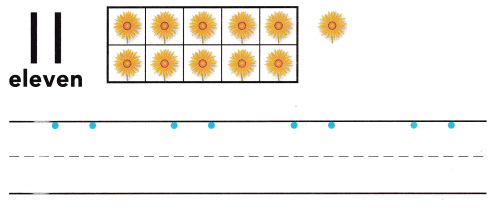
Question 1.
Texas Go Math Kindergarten Lesson 7.2 Answer Key 2
Answer:
Texas-Go-Math-Kindergarten-Lesson-7.2-Answer-Key-Count-and-Write-11-and-12-Share and Show-1

Explanation:
Number of flowers = 11 or Eleven.

Question 2.
Texas Go Math Kindergarten Lesson 7.2 Answer Key 3
Answer:
Texas-Go-Math-Kindergarten-Lesson-7.2-Answer-Key-Count-and-Write-11-and-12-Share and Show-2

Explanation:
Number of cubes = 10 + 1 = 11.

Question 3.
Texas Go Math Kindergarten Lesson 7.2 Answer Key 4
Answer:
Texas-Go-Math-Kindergarten-Lesson-7.2-Answer-Key-Count-and-Write-11-and-12-Share and Show-3

Explanation:
Number of blue cubes = 10.
Number of blue cubes = 1.
Total number of cubes = Number of blue cubes + Number of red cubes
= 10 + 1
= 11.

DIRECTIONS: 4. Count and tell how many. Practice writing the number. 5. Count and tell how many. Write the number. 6. Look at the squares in Exercise 5. Write how many green squares. Write how many orange squares. Write how many squares in oil.

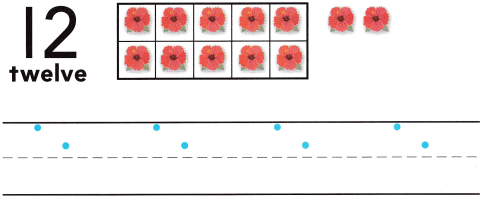
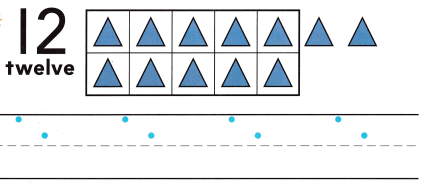
Question 4.
Texas Go Math Kindergarten Lesson 7.2 Answer Key 5
Answer:
Texas-Go-Math-Kindergarten-Lesson-7.2-Answer-Key-Count-and-Write-11-and-12-Share and Show-4

Explanation:
Number of flowers = 12 or Twelve.

Question 5.
Texas Go Math Kindergarten Lesson 7.2 Answer Key 6
Answer:
Texas-Go-Math-Kindergarten-Lesson-7.2-Answer-Key-Count-and-Write-11-and-12-Share and Show-5

Explanation:
Number of cubes = 12 or Twelve.

Question 6.
Texas Go Math Kindergarten Lesson 7.2 Answer Key 7
Answer:
Texas-Go-Math-Kindergarten-Lesson-7.2-Answer-Key-Count-and-Write-11-and-12-Share and Show-6

Explanation:
Number of green cubes = 10.
Number of yellow cubes = 10.
Total number of cubes = Number of green cubes + Number of yellow cubes
= 10 + 2
= 12 or Twelve.

HOME ACTIVITY • Ask your child to count and write the number for a set of 11 or 12 objects, such as macaroni pieces or buttons.
Answer:
Texas-Go-Math-Kindergarten-Lesson-7.2-Answer-Key-Count-and-Write-11-and-12-HOME ACTIVITY

Explanation:
My kid took buttons and counted them = 11 or Eleven.

DIRECTIONS: 7-8. Look at the number. Draw more flowers to show that number. 9. Count the counters. Write the number.

Problem Solving
Question 7.
Texas Go Math Kindergarten Lesson 7.2 Answer Key 8
Answer:
Texas-Go-Math-Kindergarten-Lesson-7.2-Answer-Key-Count-and-Write-11-and-12-Problem Solving-7

Explanation:
Number of flowers = 10 + 1 = 11.

Question 8.
Texas Go Math Kindergarten Lesson 7.2 Answer Key 9
Answer:
Texas-Go-Math-Kindergarten-Lesson-7.2-Answer-Key-Count-and-Write-11-and-12-Problem Solving-8

Explanation:
Number of flowers = 12 or Twelve.

Daily Assessment Task
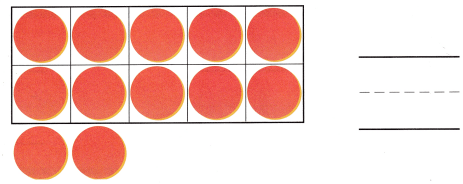
Question 9.
Texas Go Math Kindergarten Lesson 7.2 Answer Key 10
Answer:
Texas-Go-Math-Kindergarten-Lesson-7.2-Answer-Key-Count-and-Write-11-and-12-Daily Assessment Task-9

Explanation:
Number of counters = 10 + 2 = 12.

Texas Go Math Kindergarten Lesson 7.2 Homework and Practice Answer Key

DIRECTIONS: 1-2. Count and tell how many. Practice writing the number.

Question 1.
Texas Go Math Kindergarten Lesson 7.2 Answer Key 11
Answer:
Texas-Go-Math-Kindergarten-Lesson-7.2-Answer-Key-Count-and-Write-11-and-12-Texas Go Math Kindergarten Lesson 7.2 Homework and Practice Answer Key-1

Explanation:
Number of smileys = 11 or Eleven.

Question 2.
Texas Go Math Kindergarten Lesson 7.2 Answer Key 12
Answer:
Texas-Go-Math-Kindergarten-Lesson-7.2-Answer-Key-Count-and-Write-11-and-12-Texas Go Math Kindergarten Lesson 7.2 Homework and Practice Answer Key-2

Explanation:
Number of triangles = 12 or Twelve.

DIRECTIONS: Choose the correct answer. 3. Count the strawberries. How would you write the number? 4. Count the pears. How would you write the number? 5. Count the apples. How would you write the number?

Lesson Check
Question 3.
Texas Go Math Kindergarten Lesson 7.2 Answer Key 13
Answer:
Texas-Go-Math-Kindergarten-Lesson-7.2-Answer-Key-Count-and-Write-11-and-12-Texas Go Math Kindergarten Lesson 7.2 Homework and Practice Answer Key-Lesson Check-3

Explanation:
number of strawberries = 11 or Eleven.

Question 4.
Texas Go Math Kindergarten Lesson 7.2 Answer Key 14
Answer:
Texas-Go-Math-Kindergarten-Lesson-7.2-Answer-Key-Count-and-Write-11-and-12-Texas Go Math Kindergarten Lesson 7.2 Homework and Practice Answer Key-Lesson Check-4

Explanation:
Number of pears = 12 or Twelve.

Question 5.
Texas Go Math Kindergarten Lesson 7.2 Answer Key 15
Answer:
Texas-Go-Math-Kindergarten-Lesson-7.2-Answer-Key-Count-and-Write-11-and-12-Texas Go Math Kindergarten Lesson 7.2 Homework and Practice Answer Key-Lesson Check-5

Explanation:
Number of apples = 10 or Ten.

Texas Go Math Kindergarten Lesson 7.2 Answer Key Count and Write 11 and 12 Read More »

Texas Go Math Kindergarten Lesson 7.3 Answer Key Model and Count 13 and 14

Refer to our Texas Go Math Kindergarten Answer Key Pdf to score good marks in the exams. Test yourself by practicing the problems from Texas Go Math Kindergarten Lesson 7.3 Answer Key Model and Count 13 and 14.

Texas Go Math Kindergarten Lesson 7.3 Answer Key Model and Count 13 and 14

Explore

DIRECTIONS: Use counters to show the number 13. Add more to show the number 14. Draw the counters.
Texas Go Math Kindergarten Lesson 7.3 Answer Key 1
Answer:
Texas-Go-Math-Kindergarten-Lesson-7.3-Answer-Key-Model-and-Count-13-and-14-Explore

Explanation:
Number of counters = 10 + 3 = 13.
Number of counters = 10 + 4 = 14.

Share and Show

DIRECTIONS: 1. Count and tell how many. Circle the number and word. 2. Use counters to show the number 13. Draw the counters. 3. Look at the counters you drew. How many are in the ten frame? Write the number. How many more ore there? Write the number.

Question 1.
Texas Go Math Kindergarten Lesson 7.3 Answer Key 2
Answer:
Texas-Go-Math-Kindergarten-Lesson-7.3-Answer-Key-Model-and-Count-13-and-14-Share and Show-1

Explanation:
Number of lemons = 10 + 3 = 13 or Thirteen.

Question 2.
Texas Go Math Kindergarten Lesson 7.3 Answer Key 3
Answer:
Texas-Go-Math-Kindergarten-Lesson-7.3-Answer-Key-Model-and-Count-13-and-14-Share and Show-2

Explanation:
Number of counters = 10 + 3 = 13 or Thirteen.

Question 3.
Texas Go Math Kindergarten Lesson 7.3 Answer Key 4
Answer:
Texas-Go-Math-Kindergarten-Lesson-7.3-Answer-Key-Model-and-Count-13-and-14-Share and Show-3

Explanation:
Number of counters in the frame = 10.
Number of counters out the frame = 3.
Total number of counters = 10 + 3 = 13 or Thirteen.

DIRECTIONS: 4. Count and tell how many. Circle the number and word. 5. Use counters to show the number 14. Draw the counters. 6. Look at the counters you drew. How many are in the ten frame? Write the number. How many more are there? Write the number.

Question 4.
Texas Go Math Kindergarten Lesson 7.3 Answer Key 5
Answer:
Texas-Go-Math-Kindergarten-Lesson-7.3-Answer-Key-Model-and-Count-13-and-14-Share and Show-4

Explanation:
Number of apples = 10 + 4 = 14.

Question 5.
Texas Go Math Kindergarten Lesson 7.3 Answer Key 6
Answer:
Texas-Go-Math-Kindergarten-Lesson-7.3-Answer-Key-Model-and-Count-13-and-14-Share and Show-5

Explanation:
Number of counters in frame = 10.
Number of counters out the frame = 4.
Total number of counters = 10 + 4 = 14 or Fourteen.

Question 6.
Texas Go Math Kindergarten Lesson 7.3 Answer Key 7
Answer:
Texas-Go-Math-Kindergarten-Lesson-7.3-Answer-Key-Model-and-Count-13-and-14-Share and Show-6

Explanation:
Number of counters in frame = 10.
Number of counters out the frame = 4.
Total number of counters = 10 + 4 = 14 or Fourteen.

DIRECTIONS: 7. Start with the blue bead on the left. Circle to show 13 beads on the bead string. 8. Choose the correct answer. How many marbles are there?

Problem Solving
Question 7.
Texas Go Math Kindergarten Lesson 7.3 Answer Key 8
Answer:
Total number of beads = 13 or Thirteen.

Explanation:
Number of  blue beads = 8.
Number of yellow beads = 5.
Total number of beads = Number of  blue beads + Number of  yellow beads
= 8 + 5
= 13 or Thirteen.

Daily Assessment Task
Question 8.
Texas Go Math Kindergarten Lesson 7.3 Answer Key 9
Answer:
Texas-Go-Math-Kindergarten-Lesson-7.3-Answer-Key-Model-and-Count-13-and-14-Daily Assessment Task-8

Explanation:
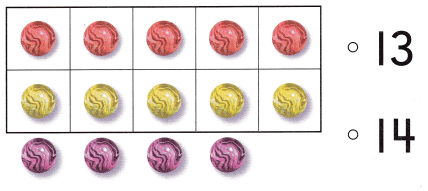
Number of marbles = 14 or Fourteen.

Texas Go Math Kindergarten Lesson 7.3 Homework and Practice Answer Key

DIRECTIONS: 1. Draw counters to show 13. Write the number. 2. Draw counters to show 14. Write the number.

Question 1.
Texas Go Math Kindergarten Lesson 7.3 Answer Key 10
Answer:
Texas-Go-Math-Kindergarten-Lesson-7.3-Answer-Key-Model-and-Count-13-and-14-Texas Go Math Kindergarten Lesson 7.3 Homework and Practice Answer Key-1

Explanation:
Number of counters = 13 or Thirteen.

Question 2.
Texas Go Math Kindergarten Lesson 7.3 Answer Key 10
Answer:
Texas-Go-Math-Kindergarten-Lesson-7.3-Answer-Key-Model-and-Count-13-and-14-Texas Go Math Kindergarten Lesson 7.3 Homework and Practice Answer Key-2

Explanation:
Number of counters = 14 or Fourteen.

DIRECTIONS: Choose the correct answer. 3. How many bananas are there? 4. How many pineapples are there? 5. How many oranges are there?

Lesson Check
Question 3.
Texas Go Math Kindergarten Lesson 7.3 Answer Key 11
Answer:
Texas-Go-Math-Kindergarten-Lesson-7.3-Answer-Key-Model-and-Count-13-and-14-Texas Go Math Kindergarten Lesson 7.3 Homework and Practice Answer Key-Lesson Check-3

Explanation:
Number of bananas = 13 or Thirteen.

Question 4.
Texas Go Math Kindergarten Lesson 7.3 Answer Key 12
Answer:
Texas-Go-Math-Kindergarten-Lesson-7.3-Answer-Key-Model-and-Count-13-and-14-Texas Go Math Kindergarten Lesson 7.3 Homework and Practice Answer Key-Lesson Check-4

Explanation:
Number of Pineapples = 14 or Fourteen.

Question 5.
Texas Go Math Kindergarten Lesson 7.3 Answer Key 13
Answer:
Texas-Go-Math-Kindergarten-Lesson-7.3-Answer-Key-Model-and-Count-13-and-14-Texas Go Math Kindergarten Lesson 7.3 Homework and Practice Answer Key-Lesson Check-5

Explanation:
Number of oranges = 12 or Twelve.

Texas Go Math Kindergarten Lesson 7.3 Answer Key Model and Count 13 and 14 Read More »

Texas Go Math Kindergarten Lesson 7.4 Answer Key Count and Write 13 and 14

Refer to our Texas Go Math Kindergarten Answer Key Pdf to score good marks in the exams. Test yourself by practicing the problems from Texas Go Math Kindergarten Lesson 7.4 Answer Key Count and Write 13 and 14.

Texas Go Math Kindergarten Lesson 7.4 Answer Key Count and Write 13 and 14

Explore

DIRECTIONS: Count and tell how many. Trace and write the numbers and the words.

Texas Go Math Kindergarten Lesson 7.4 Answer Key 1
Answer:
Texas-Go-Math-Kindergarten-Lesson-7.4-Answer-Key-Count-and-Write-13-and-14-Explore

Explanation:
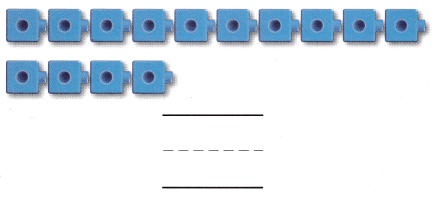
Number of yellow cubes = 13 or Thirteen.
Number of blue cubes = 14 or Fourteen.

Share and Show

DIRECTIONS: 1. Count and tell how many. Practice writing the number. 2. Count and tell how many. Write the number. 3. Look at the squares in Exercise 2. Write how many blue squares. Write how many red squares. Write how many squares in all.

Question 1.
Texas Go Math Kindergarten Lesson 7.4 Answer Key 2
Answer:
Texas-Go-Math-Kindergarten-Lesson-7.4-Answer-Key-Count-and-Write-13-and-14-Share and Show-1

Explanation:
Number of flowers = 13 or Thirteen.

Question 2.
Texas Go Math Kindergarten Lesson 7.4 Answer Key 3
Answer:
Texas-Go-Math-Kindergarten-Lesson-7.4-Answer-Key-Count-and-Write-13-and-14-Share and Show-2

Explanation:
Number of blue cubes = 10.
Number of red cubes = 3.
Total number of cubes = Number of blue cubes  + Number of red cubes
= 10 + 3
= 13.

Question 3.
Texas Go Math Kindergarten Lesson 7.4 Answer Key 4
Answer:
Texas-Go-Math-Kindergarten-Lesson-7.4-Answer-Key-Count-and-Write-13-and-14-Share and Show-3

Explanation:
Number of blue cubes = 10.
Number of red cubes = 3.
Total number of cubes = Number of blue cubes  + Number of red cubes
= 10 + 3
= 13.

DIRECTIONS: 4. Count and tell how many. Practice writing the number. 5. Count and tell how many. Write the number. 6. Look at the squares in Exercise 5. Write how many red squares. Write how many blue squares. Write how many squares in all.

Question 4.
Texas Go Math Kindergarten Lesson 7.4 Answer Key 5
Answer:
Texas-Go-Math-Kindergarten-Lesson-7.4-Answer-Key-Count-and-Write-13-and-14-Share and Show-4

Explanation:
Number of flowers = 14 or Fourteen.

Question 5.
Texas Go Math Kindergarten Lesson 7.4 Answer Key 6
Answer:
Texas-Go-Math-Kindergarten-Lesson-7.4-Answer-Key-Count-and-Write-13-and-14-Share and Show-5

Explanation:
Number of red cubes = 10.
Number of blue cubes = 4.
Total number of cubes = Number of red cubes  + Number of blue cubes
= 10 + 4
= 14 or Fourteen.

Question 6.
Texas Go Math Kindergarten Lesson 7.4 Answer Key 7
Answer:
Texas-Go-Math-Kindergarten-Lesson-7.4-Answer-Key-Count-and-Write-13-and-14-Share and Show-6

Explanation:
Number of red cubes = 10.
Number of blue cubes = 4.
Total number of cubes = Number of red cubes  + Number of blue cubes
= 10 + 4
= 14 or Fourteen.

DIRECTIONS: 7. Tb picked 13 purple flowers. Draw more purple flowers to show how many she picked. 8. Calvin picked 14 red flowers. Draw more red flowers to show how many he picked. 9. Count the cubes. Write the number.

Problem Solving
Question 7.
Texas Go Math Kindergarten Lesson 7.4 Answer Key 8
Answer:
Texas-Go-Math-Kindergarten-Lesson-7.4-Answer-Key-Count-and-Write-13-and-14-Problem Solving-7

Explanation:
Number of purple flowers given = 10.
Total number of purple flowers = 13 or Thirteen.
Number of purple flowers missing = Total number of purple flowers – Number of purple flowers given
= 13 – 10
= 3.

Question 8.
Texas Go Math Kindergarten Lesson 7.4 Answer Key 9
Answer:
Texas-Go-Math-Kindergarten-Lesson-7.4-Answer-Key-Count-and-Write-13-and-14-Problem Solving-8

Explanation:
Number of red flowers given = 10.
Total number of red flowers = 14 or Fourteen.
Number of red flowers missing = Total number of red flowers – Number of red flowers given
= 14 – 10
= 4.

Daily Assessment Task
Question 9.
Texas Go Math Kindergarten Lesson 7.4 Answer Key 10
Answer:
Texas-Go-Math-Kindergarten-Lesson-7.4-Answer-Key-Count-and-Write-13-and-14-Daily Assessment Task-9

Explanation:
Number of blue cubes = 14 or Fourteen.

Texas Go Math Kindergarten Lesson 7.4 Homework and Practice Answer Key

DIRECTIONS: 1-2. Count and tell how many. Practice writing the number.

Question 1.
Texas Go Math Kindergarten Lesson 7.4 Answer Key 11
Answer:
Texas-Go-Math-Kindergarten-Lesson-7.4-Answer-Key-Count-and-Write-13-and-14-Texas Go Math Kindergarten Lesson 7.4 Homework and Practice Answer Key-1

Explanation:
Number of lorries = 13 or Thirteen.

Question 2.
Texas Go Math Kindergarten Lesson 7.4 Answer Key 12
Answer:
Texas-Go-Math-Kindergarten-Lesson-7.4-Answer-Key-Count-and-Write-13-and-14-Texas Go Math Kindergarten Lesson 7.4 Homework and Practice Answer Key-2

Explanation:
Number of red cookies = 14 or Fourteen.

DIRECTIONS: Choose the correct answer 3-5. Count the cubes. How do you write that number?

Lesson Check
Question 3.
Texas Go Math Kindergarten Lesson 7.4 Answer Key 13
Answer:
Texas-Go-Math-Kindergarten-Lesson-7.4-Answer-Key-Count-and-Write-13-and-14-Texas Go Math Kindergarten Lesson 7.4 Homework and Practice Answer Key-Lesson Check-3

Explanation:
Number of red cubes = 13 or Thirteen.

Question 4.
Texas Go Math Kindergarten Lesson 7.4 Answer Key 14
Answer:
Texas-Go-Math-Kindergarten-Lesson-7.4-Answer-Key-Count-and-Write-13-and-14-Texas Go Math Kindergarten Lesson 7.4 Homework and Practice Answer Key-Lesson Check-4

Explanation:
Number of red cubes = 14 or Fourteen.

Question 5.
Texas Go Math Kindergarten Lesson 7.4 Answer Key 15
Answer:
Texas-Go-Math-Kindergarten-Lesson-7.4-Answer-Key-Count-and-Write-13-and-14-Texas Go Math Kindergarten Lesson 7.4 Homework and Practice Answer Key-Lesson Check-5

Explanation:
Number of red cubes = 12 or Twelve.

Texas Go Math Kindergarten Lesson 7.4 Answer Key Count and Write 13 and 14 Read More »

Texas Go Math Kindergarten Lesson 7.5 Answer Key Model, Count and Write 15

Refer to our Texas Go Math Kindergarten Answer Key Pdf to score good marks in the exams. Test yourself by practicing the problems from Texas Go Math Kindergarten Lesson 7.5 Answer Key Model, Count and Write 15.

Texas Go Math Kindergarten Lesson 7.5 Answer Key Model, Count and Write 15

Explore

DIRECTIONS: Use counters to show the number 15. Draw the counters. Trace and write the number. Trace the word.

Texas Go Math Kindergarten Lesson 7.5 Answer Key 1
Answer:
Texas-Go-Math-Kindergarten-Lesson-7.5-Answer-Key-Model-Count-and-Write-15-Explore

Explanation:
Number of counters = 15 or Fifteen.

Share and Show

DIRECTIONS: 1. Count and tell how many. Write the number. 2. Use counters to show the number 15. Draw the counters. 3. Look at the counters you drew. How many are in the ten frame? Write the number. How many more? Write the number.

Question 1.
Texas Go Math Kindergarten Lesson 7.5 Answer Key 2
Answer:
Texas-Go-Math-Kindergarten-Lesson-7.5-Answer-Key-Model-Count-and-Write-15-Share and Show-1

Explanation:
Number of kiwi fruits = 15 or Fifteen.

Question 2.
Texas Go Math Kindergarten Lesson 7.5 Answer Key 3
Answer:
Texas-Go-Math-Kindergarten-Lesson-7.5-Answer-Key-Model-Count-and-Write-15-Share and Show-2

Explanation:
Number of counters = 15 or Fifteen.

Question 3.
Texas Go Math Kindergarten Lesson 7.5 Answer Key 4
Answer:
Texas-Go-Math-Kindergarten-Lesson-7.5-Answer-Key-Model-Count-and-Write-15-Share and Show-3

Explanation:
Number of counters in frame = 10.
Number of counters out of frame = 5.
Total number of counters = Number of counters in frame + Number of counters out of frame
= 10 + 5
= 15.

DIRECTIONS: 4-5. Count and tell how many. Write the number. 6. Look at the ten circles and some more in Exercise 5. Write how many blue circles. Write how many red circles. Write how many in all.

Question 4.
Texas Go Math Kindergarten Lesson 7.5 Answer Key 5
Answer:
Texas-Go-Math-Kindergarten-Lesson-7.5-Answer-Key-Model-Count-and-Write-15-Share and Show-4

Explanation:
Number of purple flowers = 15 or Fifteen.

Question 5.
Texas Go Math Kindergarten Lesson 7.5 Answer Key 6
Answer:
Texas-Go-Math-Kindergarten-Lesson-7.5-Answer-Key-Model-Count-and-Write-15-Share and Show-5

Explanation:
Number of blue counters = 10.
Number of red counters = 5.
Total number of counters = Number of blue counters + Number of red counters
= 10 + 5
= 15 or Fifteen.

Question 6.
Texas Go Math Kindergarten Lesson 7.5 Answer Key 7
Answer:
Texas-Go-Math-Kindergarten-Lesson-7.5-Answer-Key-Model-Count-and-Write-15-Share and Show-6

Explanation:
Number of blue counters = 10.
Number of red counters = 5.
Total number of counters = Number of blue counters + Number of red counters
= 10 + 5
= 15 or Fifteen.

HOME ACTIVITY • Have your child use two different kinds of objects to show all the ways he or she can make 15, such as 8 pieces of macaroni and 7 pieces of bowtie pasta.
Answer:
Total number of objects = 15 or Fifteen.

Explanation:
Number of books = 8.
Number of pencils = 7.
Total number of objects = Number of books  + Number of pencils
= 8 + 7
= 15 or Fifteen.

DIRECTIONS: 7. Start with the blue bead on the left. Circle to show 15 beads on the bead string. 8. Choose the correct answer. Count the tickets. How many are there?

Problem Solving
Question 7.
Texas Go Math Kindergarten Lesson 7.5 Answer Key 8
Answer:
Texas-Go-Math-Kindergarten-Lesson-7.5-Answer-Key-Model-Count-and-Write-15-Problem Solving-7

Explanation:
Number of blue beads = 10.
Number of yellow beads = 5.
Total number of beads = Number of blue beads + Number of yellow beads
= 10 + 5
= 15 or Fifteen.

Daily Assessment Task
Question 8.
Texas Go Math Kindergarten Lesson 7.5 Answer Key 9
Answer:
Texas-Go-Math-Kindergarten-Lesson-7.5-Answer-Key-Model-Count-and-Write-15-Daily Assessment Task-8

Explanation:
Number of chocolates = 15 or Fifteen.

Texas Go Math Kindergarten Lesson 7.5 Homework and Practice Answer Key

DIRECTIONS: 1. Draw counters to show 15. Write the number. 2. Draw counters to show 14. Write the number.

Question 1.
Texas Go Math Kindergarten Lesson 7.5 Answer Key 10
Answer:
Texas-Go-Math-Kindergarten-Lesson-7.5-Answer-Key-Model-Count-and-Write-15-Texas Go Math Kindergarten Lesson 7.5 Homework and Practice Answer Key-1

Explanation:
Number of counters = 15 or Fifteen.

Question 2.
Texas Go Math Kindergarten Lesson 7.5 Answer Key 10
Answer:
Texas-Go-Math-Kindergarten-Lesson-7.5-Answer-Key-Model-Count-and-Write-15-Texas Go Math Kindergarten Lesson 7.5 Homework and Practice Answer Key-2

Explanation:
Number of counters = 14 or Fourteen.

DIRECTIONS: Choose the correct answer. 3. Count the ants. How many are there? 4. Count the butterflies. How many are there? 5. Count the turtles. How many are there?

Lesson Check
Question 3.
Texas Go Math Kindergarten Lesson 7.5 Answer Key 11
Answer:
Texas-Go-Math-Kindergarten-Lesson-7.5-Answer-Key-Model-Count-and-Write-15-Texas Go Math Kindergarten Lesson 7.5 Homework and Practice Answer Key-Lesson Check-3

Explanation:
Number of ants = 13 or Thirteen.

Question 4.
Texas Go Math Kindergarten Lesson 7.5 Answer Key 12
Answer:
Texas-Go-Math-Kindergarten-Lesson-7.5-Answer-Key-Model-Count-and-Write-15-Texas Go Math Kindergarten Lesson 7.5 Homework and Practice Answer Key-Lesson Check-4

Explanation:
Number of butterflies = 15 or Fifteen.

Question 5.
Texas Go Math Kindergarten Lesson 7.5 Answer Key 13
Answer:
Texas-Go-Math-Kindergarten-Lesson-7.5-Answer-Key-Model-Count-and-Write-15-Texas Go Math Kindergarten Lesson 7.5 Homework and Practice Answer Key-Lesson Check-5

Explanation:
Number of tortoises = 15 or Fifteen.

Texas Go Math Kindergarten Lesson 7.5 Answer Key Model, Count and Write 15 Read More »

McGraw Hill Math Grade 6 Lesson 9.1 Answer Key Ratios

Practice questions available in McGraw Hill Math Grade 6 Answer Key PDF Lesson 9.1 Ratios will engage students and is a great way of informal assessment.

McGraw-Hill Math Grade 6 Answer Key Lesson 9.1 Ratios

Exercises Solve

Question 1.
A group of 7 friends has 15 dollars to share What is each person’s share?
Answer:
Number of dollars each person shares = 2.14.

Explanation:
Number of friends = 7.
Number of dollars they have = 15.
Number of dollars each person shares = Number of dollars they have ÷ Number of friends
= 15 ÷ 7
= 2.14

Question 2.
Gail rode her bicycle 325 miles in 5 days. How many miles did she ride each day?
Answer:
Number of miles she rides each day = 65.

Explanation:
Number of miles Gail rode her bicycle = 325.
Number of days = 5.
Number of miles she rides each day = Number of miles Gail rode her bicycle ÷ Number of days
= 325 ÷ 5
= 65.

Question 3.
A diesel engine uses 100 quarts of oil for cooling. If the engine has 6 cylinders, how many quarts are there per cylinder?
Answer:
Number of quarts are there per cylinder = 16.67.

Explanation:
Number of quarts of oil for cooling a diesel engine uses = 100.
Number of cylinders the engine has = 6.
Number of quarts are there per cylinder = Number of quarts of oil for cooling a diesel engine uses ÷ Number of cylinders the engine has
= 100 ÷ 6
= 16.67.

Question 4.
Jack used 6 pounds of butter in a recipe for 30 loaves of bread. How much butter did he use for each loaf of bread?
Answer:
Number of pounds of butter he uses for each loaf of bread = 5.

Explanation:
Number of pounds of butter in a recipe Jack used = 6.
Number of loaves of bread Jack uses = 30.
Number of pounds of butter he uses for each loaf of bread = Number of loaves of bread Jack uses ÷ Number of pounds of butter in a recipe Jack used
= 30 ÷ 6
= 5.

Question 5.
It took 75 tons of gravel to cover 3 miles of road. How much gravel was used for each mile?
Answer:
Number of tons of gravel used for each mile = 25.

Explanation:
Number of tons of gravel used = 75.
Number of miles of road = 3.
Number of tons of gravel used for each mile = Number of tons of gravel used ÷ Number of miles of road
= 75 ÷ 3
= 25.

Question 6.
At a restaurant, 6 people want to share 3 pizzas. if there are 8 slices in every pizza, how many slices does each person get?
Answer:
Number of slices each person gets = 4.

Explanation:
Number of people = 6.
Number of pizzas to share = 3.
Number of slices in every pizza = 8.
Total number of slices of pizzas = Number of pizzas to share × Number of slices in every pizza
= 3 × 8
= 24.
Number of slices each person gets = Total number of slices of pizzas ÷ Number of people
= 24 ÷ 6
= 4.

Question 7.
If a house has 2,000 square feet of wall surface to be painted and Marcia has already painted 1,600 square feet, what portion of the wall still needs to be painted?
Answer:
Number of square feet of portion of the wall still needs to be painted = 400.

Explanation:
Number of square feet of wall surface to be painted in a house = 2,000.
Number of square feet of Marcia has already painted = 1,600.
Number of square feet of portion of the wall still needs to be painted = Number of square feet of wall surface to be painted in a house – Number of square feet of Marcia has already painted
= 2,000 – 1,600
= 400.

Question 8.
Tom put 8 gallons of gasoline into a 23-gallon tank. How much of the tank did he fill?
Answer:
Number of gallons of the tank he fills = 15.

Explanation:
Number of gallons of gasoline Tom puts = 8.
Number of gallons of gasoline tank = 23.
Number of gallons of the tank he fills = Number of gallons of gasoline tank – Number of gallons of gasoline Tom puts
= 23 – 8
= 15.

McGraw Hill Math Grade 6 Lesson 9.1 Answer Key Ratios Read More »

McGraw Hill Math Grade 8 Lesson 3.4 Answer Key Adding or Subtracting Fractions with Unlike Denominators

Practice the questions of McGraw Hill Math Grade 8 Answer Key PDF Lesson 3.4 Adding or Subtracting Fractions with Unlike Denominators to secure good marks & knowledge in the exams.

McGraw-Hill Math Grade 8 Answer Key Lesson 3.4 Adding or Subtracting Fractions with Unlike Denominators

Exercises Add or Subtract

Question 1.
\(\frac{3}{4}\) + \(\frac{2}{5}\)
Answer:
\(\frac{23}{20}\) or 1\(\frac{3}{20}\),

Explanation:
Given to add \(\frac{3}{4}\) + \(\frac{2}{5}\) as
both don’t have common denominators first we multiply \(\frac{3}{4}\) by 5 and \(\frac{2}{5}\) by 4 we get
\(\frac{3 X 5}{4 X 5}\) = \(\frac{15}{20}\) and
\(\frac{2 X 4}{5 X 4}\) = \(\frac{8}{20}\)
now we add numerators as \(\frac{15 + 8}{20}\) = \(\frac{23}{20}\) as numerator is greater than denominator we write in mixed fraction as \(\frac{1 X 20 + 3}{20}\) = 1\(\frac{3}{20}\).

Question 2.
\(\frac{5}{7}\) + \(\frac{1}{3}\)
Answer:
\(\frac{22}{21}\) or 1\(\frac{1}{21}\),

Explanation:
Given to add \(\frac{5}{7}\) + \(\frac{1}{3}\) as
both don’t have common denominators first we multiply \(\frac{5}{7}\) by 3 and \(\frac{1}{3}\) by 7 we get
\(\frac{5 X 3}{7 X 3}\) = \(\frac{15}{21}\) and
\(\frac{1 X 7}{3 X 7}\) = \(\frac{7}{21}\)
now we add numerators as \(\frac{15 + 7}{21}\) = \(\frac{22}{21}\) as numerator is greater than denominator we write in mixed fraction as \(\frac{1 X 21 + 1}{21}\) = 1\(\frac{1}{21}\).

Question 3.
\(\frac{11}{20}\) + \(\frac{2}{3}\)
Answer:
\(\frac{73}{60}\) or 1\(\frac{13}{60}\),

Explanation:
Given to add \(\frac{11}{20}\) + \(\frac{2}{3}\) as
both don’t have common denominators first we multiply \(\frac{11}{20}\) by 3 and \(\frac{2}{3}\) by 20 we get
\(\frac{11 X 3}{20 X 3}\) = \(\frac{33}{60}\) and
\(\frac{2 X 20}{3 X 20}\) = \(\frac{40}{60}\)
now we add numerators as \(\frac{33 + 40}{60}\) = \(\frac{73}{60}\) as numerator is greater than denominator we write in mixed fraction as \(\frac{1 X 60 + 13}{60}\) = 1\(\frac{13}{60}\).

Question 4.
\(\frac{1}{4}\) – \(\frac{1}{13}\)
Answer:
\(\frac{9}{52}\),

Explanation:
Given to subtract \(\frac{1}{4}\) – \(\frac{1}{13}\) as
both don’t have common denominators first we multiply \(\frac{1}{4}\) by 13 and \(\frac{1}{13}\) by 4 we get
\(\frac{1 X 13}{4 X 13}\) = \(\frac{13}{52}\) and
\(\frac{1 X 4}{13 X 4}\) = \(\frac{4}{52}\)
now we subtract numerators as \(\frac{13 – 4}{52}\) = \(\frac{9}{52}\).

Question 5.
\(\frac{1}{4}\) – \(\frac{1}{9}\)
Answer:
\(\frac{5}{36}\),

Explanation:
Given to subtract \(\frac{1}{4}\) – \(\frac{1}{9}\) as
both don’t have common denominators first we multiply \(\frac{1}{4}\) by 9 and \(\frac{1}{9}\) by 4 we get
\(\frac{1 X 9}{4 X 9}\) = \(\frac{9}{36}\) and
\(\frac{1 X 4}{9 X 4}\) = \(\frac{4}{36}\)
now we subtract numerators as \(\frac{9 – 4}{36}\) = \(\frac{5}{36}\).

Question 6.
\(\frac{2}{21}\) + \(\frac{1}{3}\)
Answer:
\(\frac{27}{63}\) or \(\frac{9}{21}\) or
\(\frac{3}{7}\),

Explanation:
Given to add \(\frac{2}{21}\) + \(\frac{1}{3}\) as
both don’t have common denominators first we multiply \(\frac{2}{21}\) by 3 and \(\frac{1}{3}\) by 21 we get
\(\frac{2 X 3}{21 X 3}\) = \(\frac{6}{63}\) and
\(\frac{1 X 21}{3 X 21}\) = \(\frac{21}{63}\)
now we add numerators as \(\frac{6 + 21}{63}\) = \(\frac{27}{63}\) further can be divided by 3 we get \(\frac{9}{21}\) again further can be divided by 3 we get \(\frac{3}{7}\).

Question 7.
\(\frac{34}{11}\) – \(\frac{1}{3}\)
Answer:
\(\frac{91}{33}\) or 2\(\frac{25}{33}\),

Explanation:
Given to subtract \(\frac{34}{11}\) – \(\frac{1}{3}\) as
both don’t have common denominators first we multiply \(\frac{34}{11}\) by 3 and \(\frac{1}{3}\) by 11 we get
\(\frac{34 X 3}{11 X 3}\) = \(\frac{102}{33}\) and
\(\frac{1 X 11}{3 X 11}\) = \(\frac{11}{33}\)
now we subtract numerators as \(\frac{102 – 11}{33}\) = \(\frac{91}{33}\) as numerator is greater than denominator we write in mixed fraction as \(\frac{2 X 33 + 25}{33}\) = 2\(\frac{25}{33}\).

Question 8.
\(\frac{11}{7}\) + \(\frac{1}{6}\)
Answer:
\(\frac{73}{42}\) or 1\(\frac{31}{42}\),

Explanation:
Given to add \(\frac{11}{7}\) + \(\frac{1}{6}\) as
both don’t have common denominators first we multiply \(\frac{11}{7}\) by 6 and \(\frac{1}{6}\) by 7 we get
\(\frac{11 X 6}{7 X 6}\) = \(\frac{66}{42}\) and
\(\frac{1 X 7}{6 X 7}\) = \(\frac{7}{42}\)
now we add numerators as \(\frac{66 + 7}{42}\) = \(\frac{73}{42}\) as numerator is greater than denominator we write in mixed fraction as \(\frac{1 X 42 + 31}{42}\) = 1\(\frac{31}{42}\).

Question 9.
\(\frac{11}{15}\) – \(\frac{2}{3}\)
Answer:
\(\frac{3}{45}\) or \(\frac{1}{15}\),

Explanation:
Given to subtract \(\frac{11}{15}\) – \(\frac{2}{3}\) as
both don’t have common denominators first we multiply \(\frac{11}{15}\) by 3 and \(\frac{2}{3}\) by 15 we get
\(\frac{11 X 3}{15 X 3}\) = \(\frac{33}{45}\) and
\(\frac{2 X 15}{3 X 15}\) = \(\frac{30}{45}\)
now we subtract numerators as \(\frac{33 – 30}{45}\) = \(\frac{3}{45}\) further can be divided by 3 we get \(\frac{1}{15}\).

Question 10.
\(\frac{5}{8}\) – \(\frac{2}{7}\)
Answer:
\(\frac{19}{56}\),

Explanation:
Given to subtract \(\frac{5}{8}\) – \(\frac{2}{7}\) as
both don’t have common denominators first we multiply \(\frac{5}{8}\) by 7 and \(\frac{2}{7}\) by 8 we get
\(\frac{5 X 7}{8 X 7}\) = \(\frac{35}{56}\) and
\(\frac{2 X 8}{7 X 8}\) = \(\frac{16}{56}\)
now we subtract numerators as \(\frac{35 – 16}{56}\) = \(\frac{19}{56}\).

Question 11.
\(\frac{14}{11}\) + \(\frac{3}{7}\)
Answer:
\(\frac{131}{77}\) or 1\(\frac{54}{77}\),

Explanation:
Given to add \(\frac{14}{11}\) + \(\frac{3}{7}\) as
both don’t have common denominators first we multiply \(\frac{14}{11}\) by 7 and \(\frac{3}{7}\) by 11 we get
\(\frac{14 X 7}{11 X 7}\) = \(\frac{98}{77}\) and
\(\frac{3 X 11}{7 X 11}\) = \(\frac{33}{77}\)
now we add numerators as \(\frac{98 + 33}{77}\) = \(\frac{131}{77}\) as numerator is greater than denominator we write in mixed fraction as \(\frac{1 X 77 + 54}{77}\) = 1\(\frac{54}{77}\).

Question 12.
\(\frac{11}{12}\) – \(\frac{3}{5}\)
Answer:
\(\frac{47}{60}\),

Explanation:
Given to subtract \(\frac{11}{12}\) – \(\frac{3}{15}\) as
both don’t have common denominators first we multiply \(\frac{11}{12}\) by 15 and \(\frac{3}{15}\) by 12 we get
\(\frac{11 X 15}{12 X 15}\) = \(\frac{165}{180}\) and
\(\frac{2 X 12}{15 X 12}\) = \(\frac{24}{180}\)
now we subtract numerators as \(\frac{165 – 24}{180}\) = \(\frac{141}{180}\) further can be divided by 3 we get \(\frac{47}{60}\).

McGraw Hill Math Grade 8 Lesson 3.4 Answer Key Adding or Subtracting Fractions with Unlike Denominators Read More »

McGraw Hill Math Grade 1 Chapter 3 Test Answer Key

All the solutions provided in McGraw Hill Math Grade 1 Answer Key PDF Chapter 3 Test as per the latest syllabus guidelines.

McGraw-Hill Math Grade 1 Chapter 3 Test Answer Key

Subtract. Write the difference. Use the number line to help.

McGraw Hill Math Grade 1 Chapter 3 Test Answer Key 3

Question 1.
McGraw Hill Math Grade 1 Chapter 3 Test Answer Key 5
4 — 3 = ___
Answer:
Subtract 3 squares from 4 squares then you get 1 square.
4 – 3 = 1
McGraw-Hill-Math-Grade-1-Chapter-3-Test-Answer-Key-4(1)

Question 2.
McGraw Hill Math Grade 1 Chapter 3 Test Answer Key 6
5 – 2 = ____
Answer:
Subtract 2 triangles from 5 triangles then you get 3 triangles.
5 – 2 = 3
McGraw-Hill-Math-Grade-1-Chapter-3-Test-Answer-Key-4(2)

Question 3.
McGraw Hill Math Grade 1 Chapter 3 Test Answer Key 7
6 – 4 = ___
Answer:
Subtract 4 triangles from 6 triangles then you get 2 triangles.
6 – 4 = 2
McGraw-Hill-Math-Grade-1-Chapter-3-Test-Answer-Key-4(3)

Question 4.
11 – 7 = ___
Answer:
Subtract 7 from 11 then you get 4.
11 – 7 = 4
McGraw-Hill-Math-Grade-1-Chapter-3-Test-Answer-Key-3(4)

Question 5.
9 – 6 = ___
Answer:
Subtract 6 from 9 then you get 3.
9 – 6 = 3
McGraw-Hill-Math-Grade-1-Chapter-3-Test-Answer-Key-3(5)

Question 6.
12 – 6 = ___
Answer:
Subtract 6 from 12 then you get 6.
12 – 6 = 6
McGraw-Hill-Math-Grade-1-Chapter-3-Test-Answer-Key-3 (6)

Question 7.
10 – 2 = ___
Answer:
Subtract 2 from 10 then you get 8.
10 – 2 = 8
McGraw-Hill-Math-Grade-1-Chapter-3-Test-Answer-Key-3 (7)

Question 8.
8 – 1 = ___
Answer:
Subtract 1 from 8 then you get 7.
8 – 1 = 7
McGraw-Hill-Math-Grade-1-Chapter-3-Test-Answer-Key-3 (8)

Question 9.
3 – 2 = ___
Answer:
Subtract 2 from 3 then you get 1.
3 – 2 = 1
McGraw-Hill-Math-Grade-1-Chapter-3-Test-Answer-Key-3 (9)

Question 10.
10 – 10 = ___
Answer:
Subtract 10 – 10 then you get 0.
10 – 10 = 0
McGraw-Hill-Math-Grade-1-Chapter-3-Test-Answer-Key-3 (10)

Question 11.
11 – 6 = ___
Answer:
Subtract 6 from 11 then you get 5.
11 – 6 = 5
McGraw-Hill-Math-Grade-1-Chapter-3-Test-Answer-Key-3 (11)

Subtract. Write the difference. Use small objects to help.

Question 12.
7 – 3 = ___
Answer:
Subtract 3 from 7 then you get 4.
7 – 3 = 4

Question 13.
16 – 5 = ___
Answer:
Subtract 5 from 16 then you get 11.
16 – 5 = 11

Question 14.
19 – 9 = ___
Answer:
Subtract 19 – 9 then you get 10.
19 – 9 = 10.

Question 15.
14 – 6 = ___
Answer:
Subtract 6 from 14 then you get 8.

Question 16.
20 – 17 = __
Answer:
Subtract 20 from 17 then you get 3.

Solve the problems. Write the difference. Use the number line to help.

McGraw Hill Math Grade 1 Chapter 3 Test Answer Key 4

Question 20.
Carlos has 19 McGraw Hill Math Grade 1 Chapter 3 Test Answer Key 8. Carlos gives 5 McGraw Hill Math Grade 1 Chapter 3 Test Answer Key 8 to Tom. How many McGraw Hill Math Grade 1 Chapter 3 Test Answer Key 8 does Carlos have now?
19 — 5 = _____ McGraw Hill Math Grade 1 Chapter 3 Test Answer Key 8
Answer:
Given that,
The total number of crayons near Carlos = 19
The Carlos gives crayons to Tom = 5.
Therefore the difference is 19 – 5 = 14.
McGraw-Hill-Math-Grade-1-Chapter-3-Test-Answer-Key-4(13)

Question 21.
Tina has 18 McGraw Hill Math Grade 1 Chapter 3 Test Answer Key 9. Tina gives 2 img 9 to Dad. How many McGraw Hill Math Grade 1 Chapter 3 Test Answer Key 9 does Tina have left?
18 — 2 _____ McGraw Hill Math Grade 1 Chapter 3 Test Answer Key 9
Answer:
Given that,
The total number of buttons near Tina = 18.
The Tina gives the the buttons to img = 9.
Therefore the difference is 18 – 9 = 9.
McGraw-Hill-Math-Grade-1-Chapter-3-Test-Answer-Key-4(21)

Question 22.
A pet store has 20 McGraw Hill Math Grade 1 Chapter 3 Test Answer Key 10. A man buys 7 McGraw Hill Math Grade 1 Chapter 3 Test Answer Key 10. How many McGraw Hill Math Grade 1 Chapter 3 Test Answer Key 10 are left?
20 — 7 = _____ McGraw Hill Math Grade 1 Chapter 3 Test Answer Key 10
Answer:
Given that,
The total number of fishes in the pet store = 20.
The total number of fishes the man buys = 7.
Therefore the total number of fishes left is 20 – 7 = 13.
McGraw-Hill-Math-Grade-1-Chapter-3-Test-Answer-Key-4(22)

Question 23.
A bag has 19 McGraw Hill Math Grade 1 Chapter 3 Test Answer Key 11. 11 McGraw Hill Math Grade 1 Chapter 3 Test Answer Key 11 fall out. How many McGraw Hill Math Grade 1 Chapter 3 Test Answer Key 11 are in the bag now?
19 — 11 = _____ McGraw Hill Math Grade 1 Chapter 3 Test Answer Key 11
Answer:
Given that,
The total number of bags in the bag = 19.
The total number of balls left out = 11.
Therefore the total number of balls at now = 19 – 11 = 8
McGraw-Hill-Math-Grade-1-Chapter-3-Test-Answer-Key-4(23)

Question 24.
Ms. Lee has 13 McGraw Hill Math Grade 1 Chapter 3 Test Answer Key 12. She gives away 8 McGraw Hill Math Grade 1 Chapter 3 Test Answer Key 12. How many McGraw Hill Math Grade 1 Chapter 3 Test Answer Key 12 does she have left?
13 – 8 = _____ McGraw Hill Math Grade 1 Chapter 3 Test Answer Key 12
Answer:
Given that,
The total number of stars near Ms. Lee = 13.
The total number of stars gives away = 8.
Therefore the total number of stars left = 13 – 8 = 5
McGraw-Hill-Math-Grade-1-Chapter-3-Test-Answer-Key-4(24)

Question 25.
7 dogs are in the park. 4 dogs go home. How many dogs are in the park now?
7 – 4 = _____ McGraw Hill Math Grade 1 Chapter 3 Test Answer Key 13
Answer:
Given that,
The total number of dogs in the park = 7.
The total number of dogs went home = 4.
Therefore the total number of dogs left = 7 – 4 = 3.
McGraw-Hill-Math-Grade-1-Chapter-3-Test-Answer-Key-4(25)

Question 26.
Kay sees 10 ants. 5 ants go away. How many ants are left?
10 – 5 = ___ ants
Answer:
Given that,
The total number of ants the Kay sees = 10.
The total number of ants left away = 5.
Therefore the total number of ants left = 10 – 5 = 5.
McGraw-Hill-Math-Grade-1-Chapter-3-Test-Answer-Key-4(26)

McGraw Hill Math Grade 1 Chapter 3 Test Answer Key Read More »

McGraw Hill Math Grade 1 Chapter 4 Lesson 1 Answer Key Counting Forward

All the solutions provided in McGraw Hill Math Grade 1 Answer Key PDF Chapter 4 Lesson 1 Counting Forward as per the latest syllabus guidelines.

McGraw-Hill Math Grade 1 Answer Key Chapter 4 Lesson 1 Counting Forward

Count

Write the numbers.

Question 1.
0 1 2 3 4

Question 2.
4 5 ____ ___ _____
Answer: 4 5 6 7 8

Explanation:
Forward counting is counting by adding one more, every time.
The numbers after 4 5 is 6, 7, 8

Question 3.
6 7 ___ ___ ____
Answer: 6 7 8 9 10

Explanation:
Forward counting is counting by adding one more, every time.
The numbers after 6 7 is 8, 9, 10.

Question 4.
14 15 ___ ___ ____
Answer: 14 15 16 17 18

Explanation:
Forward counting is counting by adding one more, every time.
The numbers after 14, 15 is 16, 17, 18.

Question 5.
11 12 ___ ___ ____
Answer: 13 14 15

Explanation:
Forward counting is counting by adding one more, every time.
The numbers after 11, 12 is 13, 14, 15

Question 6.
8 9 ____ ___ ____
Answer: 10 11 12

Explanation:
Forward counting is counting by adding one more, every time.
The numbers after 8, 9 is 10, 11, 12

Question 7.
16 17 ___ ___ ____
Answer: 18 19 20

Explanation:
Forward counting is counting by adding one more, every time.
The numbers after 16, 17 is 18, 19, 20.

Question 8.
9 10 ___ ___ ___
Answer: 11 12 13

Explanation:
Forward counting is counting by adding one more, every time.
The numbers after 9, 10 is 11, 12, 13.

McGraw Hill Math Grade 1 Chapter 4 Lesson 1 Answer Key Counting Forward Read More »

McGraw Hill Math Grade 5 Pretest Answer Key

All the solutions provided in McGraw Hill Math Grade 5 Answer Key PDF Pretest are as per the latest syllabus guidelines.

McGraw-Hill Math Grade 5 Pretest Answer Key

Write each number in standard form.

Question 1.
53 and 125 thousandths
__________
Answer:
53 and 0.125.

Explanation:
The standard form of 53 is 53 and 125 thousandths is 125 ×10-3 which is 0.125.

Question 2.
96 thousandths
__________
Answer:
0.096

Explanation:
The standard form of 96 thousandths is 96 ×10-3 which is 0.096.

Question 3.
2 billion, 109 million, 7
__________
Answer:
2,000,000,000, 109,000,000 and 7.

Explanation:
The standard form of 2 billion is 2 ×10⁹ which is 2,000,000,000.
109 million is 109 ×106 which is 109,000,000 and 7 is 7.

Write each number in word form.

Question 4.
19,103,578,143
Answer:
19 – Nineteen.
103 – One hundred and three.
578 – Five hundred and seventy-eight.
143 – One hundred and forty-three.

Question 5.
200,200,200
Answer:
200 – Two hundred.

Write >, <, or = to compare each pair of numbers.

Question 6.
5.7 ___ 5.71
Answer:
5.7 < 5.71.

Explanation:
Here, 5.7 is less than 5.71.

Question 7.
0.093 ____ 0.93
Answer:
0.093 < 0.93.

Explanation:
Here, 0.093 is less than 0.93.

Question 8.
1.046 ____ 1.046
Answer:
1.046 = 1.046.

Explanation:
Here, 1.046 is equal to 1.046.

Round each number to the place of the underlined digit.

Question 9.
4.369 ___
Answer:
4.370

Explanation:
The rounding of 4.369 is 4.370.

Question 10.
1.025 ____
Answer:
1.020

Explanation:
The rounding of 1.025 is 1.020.

Question 11.
17.457 ____
Answer:
18.

Explanation:
The rounding of 17.457 is 18

Add. Write the sum.

Question 12.
McGraw Hill Math Grade 5 Pretest Answer Key 1
Answer:
1.94 + 7.59 = 9.53.

Explanation:
The addition of 1.94 and 7.59 is 9.53.
McGraw Hill Math Grade 5 Pretest Answer Key-06

Question 13.
McGraw Hill Math Grade 5 Pretest Answer Key 2
Answer:
557 + 623 = 1,180.

Explanation:
The addition of 557 + 623 is 1,180.
McGraw Hill Math Grade 5 Pretest Answer Key-05

Question 14.
McGraw Hill Math Grade 5 Pretest Answer Key 3
Answer:
702 + 99 = 801.

Explanation:
The addition of 702 + 99 is 801.
McGraw Hill Math Grade 5 Pretest Answer Key-04

Question 15.
McGraw Hill Math Grade 5 Pretest Answer Key 4
Answer:
5.38 + 0.92 = 6.3.

Explanation:
The addition of 5.38 + 0.92 is 6.3.
McGraw Hill Math Grade 5 Pretest Answer Key-03

Question 16.
53.475 + 19.332 _________
Answer:
53.475 + 19.332 = 72.807.

Explanation:
The addition of 53.475 + 19.332 is 72.807.
McGraw Hill Math Grade 5 Pretest Answer Key-02

Question 17.
12.257 + 8.153 __________
Answer:
12.257 + 8.153 = 20.41.

Explanation:
The addition of 12.257 + 8.153 is 20.41.
McGraw Hill Math Grade 5 Pretest Answer Key-01

Question 18.
71.17 + 6.76 ______
Answer:
71.17 + 6.76 = 77.93.

Explanation:
The addition of 71.17 + 6.76 is 77.93.
McGraw Hill Math Grade 5 Pretest Answer Key

Subtract. Write the difference.

Question 19.
McGraw Hill Math Grade 5 Pretest Answer Key 5
Answer:
719 – 89 = 624.

Explanation:
The subtraction of 719 – 89 is 624.
McGraw Hill Math Grade 5 Pretest Answer Key 5-1

Question 20.
McGraw Hill Math Grade 5 Pretest Answer Key 6
Answer:
8.89 – 2.98 = 5.91.

Explanation:
The subtraction of 8.89 – 2.98 is 5.91.
McGraw Hill Math Grade 5 Pretest Answer Key 6-1

Question 21.
McGraw Hill Math Grade 5 Pretest Answer Key 7
Answer:
176 – 83 = 93.

Explanation:
The subtraction of 176 – 83 is 93.
McGraw-Hill-Math-Grade-5-Pretest-Answer-Key-7-1

Question 22.
McGraw Hill Math Grade 5 Pretest Answer Key 8
Answer:
343.81 – 66.10 = 277.71.

Explanation:
The subtraction of 343.81 – 66.10 is 277.71.
McGraw-Hill-Math-Grade-5-Pretest-Answer-Key-8-1

Question 23.
15,432 – 13,718 = _______
Answer:
15,432 – 13,718 = 1.704.

Explanation:
The subtraction of 15.432 – 13.718 is 1.704.

Question 24.
150.62 – 42.37 = ________
Answer:
150.62 – 42.37 = 108.25

Explanation:
The subtraction of 150.62 – 42.37 is 108.25.

Question 25.
83.01 – 78.81 = _________
Answer:
83.01 – 78.81 = 4.2.

Explanation:
The subtraction of 83.01 – 78.81 is 4.2.

Question 26.
A potato weighs 7.72 ounces. An apple weighs 5.03 ounces. How many ounces heavier is the
potato than the apple?
Answer:

Simplify and complete. Tell what property is represented.

Question 27.
20 × 8 = (______ × 8) + (10 × ______) = 80 + ___ = ____
_______ property
Answer:
20 × 8 = (10 × 8) + (10 × 8)
= 160.

Explanation:
By distributive property 20 × 8 is
20 × 8 = (10 × 8) + (10 × 8)
= 80 + 80
= 160.

Question 28.
(30 × 4) × 5 = ______ × (4 × ______) = 30 × ______ = ______
_______________________________________ Property
Answer:
(30 × 4) × 5 = 30 × (4 × 5)
= 600.

Explanation:
By associative property (30 × 4) × 5 is
(30 × 4) × 5 = 30 × (4 × 5)
= 30 × 20
= 600.

Multiply. Write the product.

Question 29.
McGraw Hill Math Grade 5 Pretest Answer Key 9
Answer:
46 × 3 = 138.

Explanation:
The product of 46 and 3 is 138.
McGraw-Hill-Math-Grade-5-Pretest-Answer-Key-9-1

Question 30.
McGraw Hill Math Grade 5 Pretest Answer Key 10
Answer:
28 × 14 = 392.

Explanation:
The product of 28 and 14 is 392.
McGraw-Hill-Math-Grade-5-Pretest-Answer-Key-10-1

Question 31.
McGraw Hill Math Grade 5 Pretest Answer Key 11
Answer:
511 × 4 = 2,044.

Explanation:
The product of 511 and 4 is 2,044.
McGraw-Hill-Math-Grade-5-Pretest-Answer-Key-11-1

Question 32.
McGraw Hill Math Grade 5 Pretest Answer Key 12
Answer:
123 × 75 = 9,225.

Explanation:
The product of 123 and 75 is 9,225.
McGraw-Hill-Math-Grade-5-Pretest-Answer-Key-12-1

Question 33.
A bakery bakes 5-dozen loaves of bread. Each loaf sells for 2 dollars. How much money will the bakery earn if it sells every loaf of bread?
Answer:
For 60 loaves the bakery earns $120.

Explanation:
Given that a bakery bakes 5-dozen loaves of bread each loaf sells for 2 dollars. As there are 5×12 which is 60 loaves, so for 60 loaves the bakery earns 60 × 2 = $120.

Question 34.
2,811 × 102 = ___________
Answer:
2,811 × 102 = 2,81,100.

Explanation:
The product of 2,811 × 102 is
2,811 × 102 = 2,811 × 10 × 10
= 2,81,100.

Question 35.
61 × 103 = _____________
Answer:
61 × 103 = 61,000.

Explanation:
The product of 61 × 103 is
61 × 103 = 61 × 10 × 10 × 10
= 61,000.

Question 36.
77.6 × 101 = ______
Answer:
77.6 × 101 = 776.

Explanation:
The product of 77.6 × 101 is
77.6 × 101 = 77.6 × 10
= 776.

Divide. Write the quotient.

Question 37.
81 ÷ 3 = ____
Answer:
81 ÷ 3 = 27.

Explanation:
By dividing 81 ÷ 3 we will get a quotient of 27.
McGraw Hill Math Grade 5 Pretest Answer Key-07

Question 38.
14 ÷ 4 = ______
Answer:
14 ÷ 4 = 3.5

Explanation:
By dividing 14 ÷ 4 we will get a quotient of 3.5.
McGraw Hill Math Grade 5 Pretest Answer Key-08

Question 39.
78 ÷ 6 = ____
Answer:
78 ÷ 6 = 13.

Explanation:
By dividing 78 ÷ 6 we will get a quotient of 13.
McGraw Hill Math Grade 5 Pretest Answer Key-09

Estimate. Then multiply or divide.

Question 40.
Estimate: 3.1 × 4 = ____
Multiply: 3.1 × 4 = _____
Answer:
Estimate: 3.1 × 4 = 12
Multiply: 3.1 × 4 = 12.4

Explanation:
By multiplying 3.1 × 4 we will get 12.4.

Question 41.
Estimate: 7.13 × 5 = ____
Multiply: 7.13 × 5 = _____
Answer:
Estimate: 7.13 × 5 = 36
Multiply: 7.13 × 5 = 35.65

Explanation:
By multiplying 7.13 × 5 we will get 35.65

Question 42.
Estimate: 11.09 × 6 = ____
Multiply: 11.09 × 6 = _____
Answer:
Estimate: 11.09 × 6 = 67
Multiply: 11.09 × 6 = 66.54

Explanation:
By multiplying 11.09 × 6 we will get 66.54.

Question 43.
19.2 ÷ 104
Estimate: _____
Quotient: _____
Answer:
Estimate: 0.02
Quotient: 0.00192

Explanation:
By dividing 19.2 ÷ 104 we will get
= 19.2 ÷ (10×10×10×10)
= 19.2 ÷ 10000
= 0.00192

Question 44.
872.3 ÷ 102
Estimate: _____
Quotient: _____
Answer:
Estimate: 9.
Quotient: 8.723

Explanation:
By dividing 872.3 ÷ 102 we will get
= 872.3 ÷ (10×10)
= 8.723.

Question 45.
16.6 ÷ 103
Estimate: _____
Quotient: _____
Answer:
Estimate: 0.02
Quotient: 0.0166

Explanation:
By dividing 16.6 ÷ 103 we will get
= 16.6 ÷ (10×10×10)
= 16.6 ÷ 1000
= 0.0166.

Question 46.
14.85 × 10²
Estimate: _____
Quotient: _____
Answer:
Estimate: 1490.
Quotient: 1,485

Explanation:
By multiplying 14.85 × 10² we will get
= 14.85 × 10 × 10
= 1,485.

Question 47.
1.256 × 10⁴
Estimate: _____
Quotient: _____
Answer:
Estimate: 12,600
Quotient: 12,560

Explanation:
By multiplying 1.256 × 10⁴ we will get
= 1.256 × 10 × 10 × 10 × 10
= 12,560.

Question 48.
6.798 × 10³
Estimate: _____
Quotient: _____
Answer:
Estimate: 6,800.
Quotient: 6,798

Explanation:
By multiplying 6.798 × 10³ we will get
= 6.798 × 10 × 10 × 10
= 6,798

Simplify and solve. Show your work.

Question 49.
(10 – 8)3 + (6 × 4) × (4 – 2) + 103 =
Simplify inside the parentheses: _____________
Simplify exponents: __________
Multiply: ____________
Add and subtract from left to right: _______
Final answer: __________
Answer:
(10 – 8)3 + (6 × 4) × (4 – 2) + 103 = 1,056.

Explanation:
Given the expression is (10 – 8)3 + (6 × 4) × (4 – 2) + 103 by simplifying inside the parentheses we will get
= (2)3 + (24) × (2) + 103
= 8 + 24 × 2 + 1000
= 8 + 48 + 1000
= 1,056.

Question 50.
4{[2(2 + 5) + 2] – 9}
Simplify inside the parentheses: ____________
Simplify inside the brackets: ____________
Simplify inside the braces: _________
4{[2(2 + 5) + 2] – 9} = _______
Answer:
4{[2(2 + 5) + 2] – 9} = 28.

Explanation:
Given the expression is 4{[2(2 + 5) + 2] – 9} by simplifying inside the parentheses we will get
= 4{[2(7) + 2] – 9}
= 4{[14 + 2] – 9}
= 4{[16] – 9}
= 4{16 – 9}
= 4{7}
= 28.

Question 51.
(4 × 7) ÷ 21 = _____
Answer:

Explanation:
Given the expression is (4 × 7) ÷ 21  by simplifying inside the parentheses we will get

Question 52.
4 + (10 × 4) – 42 = _____
Answer:
4 + (10 × 4) – 42 = 28.

Explanation:
Given the expression is 4 + (10 × 4) – 42 by simplifying inside the parentheses we will get
= 4 + (10 × 4) – 42
= 4 + (40) – 16
= 44 – 16
= 28.

Add or subtract. Give the answers in simplest terms. Change any improper fractions to mixed numbers.

Question 53.
\(\frac{1}{4}\) + \(\frac{2}{4}\) = _____
Answer:
\(\frac{1}{4}\) + \(\frac{2}{4}\) = \(\frac{3}{4}\).

Explanation:
The addition of \(\frac{1}{4}\) + \(\frac{2}{4}\) which is
= \(\frac{1+2}{4}\)
= \(\frac{3}{4}\).

Question 54.
\(\frac{3}{8}\) + \(\frac{4}{8}\) = _____
Answer:
\(\frac{3}{8}\) + \(\frac{4}{8}\) = \(\frac{7}{8}\).

Explanation:
The addition of \(\frac{3}{8}\) + \(\frac{4}{8}\) which is
= \(\frac{3+4}{8}\)
= \(\frac{7}{8}\).

Question 55.
\(\frac{5}{6}\) – \(\frac{1}{6}\) = _____
Answer:
\(\frac{5}{6}\) – \(\frac{1}{6}\) = \(\frac{2}{3}\).

Explanation:
The subtraction of \(\frac{5}{6}\) – \(\frac{1}{6}\) which is
= \(\frac{5-1}{6}\)
= \(\frac{4}{6}\)
= \(\frac{2}{3}\).

Question 56.
2\(\frac{1}{3}\) + \(\frac{3}{4}\) = _____
Answer:
2\(\frac{1}{3}\) + \(\frac{3}{4}\) = \(\frac{37}{12}\).

Explanation:
The addition of 2\(\frac{1}{3}\) + \(\frac{3}{4}\) which is
= \(\frac{7}{3}\) + \(\frac{3}{4}\)
= \(\frac{28+9}{12}\)
= \(\frac{37}{12}\).

Question 57.
\(\frac{5}{12}\) + \(\frac{1}{8}\) = _____
Answer:
\(\frac{5}{12}\) + \(\frac{1}{8}\) = \(\frac{13}{24}\).

Explanation:
The addition of \(\frac{5}{12}\) + \(\frac{1}{8}\) which is
= \(\frac{10+3}{24}\)
= \(\frac{13}{24}\).

Question 58.
\(\frac{7}{9}\) + \(\frac{11}{18}\) = _____
Answer:
\(\frac{7}{9}\) + \(\frac{11}{18}\) = \(\frac{25}{18}\).

Explanation:
The addition of \(\frac{7}{9}\) + \(\frac{11}{18}\) which is
= \(\frac{14+11}{18}\)
= \(\frac{25}{18}\).

Question 59.
McGraw Hill Math Grade 5 Pretest Answer Key 13
Answer:
1\(\frac{2}{7}\) – \(\frac{1}{5}\) = \(\frac{38}{35}\).

Explanation:
The subtraction of 1\(\frac{2}{7}\) – \(\frac{1}{5}\) which is
= \(\frac{9}{7}\) – \(\frac{1}{5}\)
= \(\frac{45-7}{35}\)
= \(\frac{38}{35}\).

Question 60.
McGraw Hill Math Grade 5 Pretest Answer Key 14
Answer:
6\(\frac{1}{3}\) + 3\(\frac{5}{6}\) = \(\frac{61}{6}\).

Explanation:
The addition of 6\(\frac{1}{3}\) + 3\(\frac{5}{6}\) which is
= \(\frac{19}{3}\) + \(\frac{23}{6}\)
= \(\frac{38+23}{6}\)
= \(\frac{61}{6}\).

Question 61.
McGraw Hill Math Grade 5 Pretest Answer Key 26
Answer:
7\(\frac{1}{5}\) + 8\(\frac{1}{2}\) = 15\(\frac{7}{10}\).

Explanation:
The addition of 7\(\frac{1}{5}\) + 8\(\frac{1}{2}\) which is
= \(\frac{36}{5}\) + \(\frac{17}{2}\)
= \(\frac{72+85}{10}\)
= \(\frac{157}{10}\)
= 15\(\frac{7}{10}\).

Question 62.
McGraw Hill Math Grade 5 Pretest Answer Key 15
Answer:
9\(\frac{1}{2}\) – 1\(\frac{2}{3}\) = 7\(\frac{5}{6}\).

Explanation:
The subtraction of 9\(\frac{1}{2}\) – 1\(\frac{2}{3}\) which is
= \(\frac{19}{2}\) – \(\frac{5}{3}\)
= \(\frac{57-10}{6}\)
= \(\frac{47}{6}\)
= 7\(\frac{5}{6}\).

Find the equivalent fraction.

Question 63.
equivalent to \(\frac{4}{6}\), denominator 24 ____
Answer:
\(\frac{16}{24}\).

Explanation:
The equivalent fraction to \(\frac{4}{6}\) as denominator 24 will be \(\frac{4}{6}\) × \(\frac{4}{4}\)
= \(\frac{16}{24}\).

Question 64.
equivalent to \(\frac{1}{2}\), denominator 42 _____
Answer:
\(\frac{21}{42}\).

Explanation:
The equivalent fraction to \(\frac{1}{2}\) as denominator 42 will be \(\frac{1}{2}\) × \(\frac{21}{21}\)
= \(\frac{21}{42}\).

Question 65.
equivalent to \(\frac{1}{3}\), denominator 36 ______
Answer:
\(\frac{12}{36}\).

Explanation:
The equivalent fraction to \(\frac{1}{3}\) as denominator 36 will be \(\frac{1}{3}\) × \(\frac{12}{12}\)
= \(\frac{12}{36}\).

Question 66.
equivalent to \(\frac{3}{8}\), denominator 32 ____
Answer:
\(\frac{12}{32}\).

Explanation:
The equivalent fraction to \(\frac{3}{8}\) as denominator 32 will be \(\frac{3}{8}\) × \(\frac{4}{4}\)
= \(\frac{12}{32}\).

Multiply.

Question 67.
16 × \(\frac{5}{8}\) =________
Answer:
16 × \(\frac{5}{8}\) = 40.

Explanation:
The multiplication of 16 × \(\frac{5}{8}\) is 2×5 = 40.

Question 68.
18 × \(\frac{2}{3}\) =________
Answer:
18 × \(\frac{2}{3}\) = 12.

Explanation:
The multiplication of 18 × \(\frac{2}{3}\) which is 6×2 = 12.

Question 69.
\(\frac{3}{10}\) × \(\frac{4}{5}\) =________
Answer:
\(\frac{6}{25}\).

Explanation:
The multiplication of \(\frac{3}{10}\) × \(\frac{4}{5}\) which is \(\frac{6}{25}\).

Solve.

Question 70.
Some ferrets are about 18 inches long. A hamster is about \(\frac{1}{3}\) as long. About how many inches long is a hamster?
Answer:
The number of inches will be 17\(\frac{2}{3}\) inches.

Explanation:
Given that ferrets are about 18 inches long and a hamster is about \(\frac{1}{3}\) as long. So the number of inches will be 18 – \(\frac{1}{3}\) which is
= \(\frac{54-1}{3}\)
= \(\frac{53}{3}\)
= 17\(\frac{2}{3}\) inches.

Question 71.
\(\frac{1}{2}\) of the photos on Delia’s digital camera are of friends and family members, \(\frac{1}{5}\) of those photos are of her best friend Aiesha. What fraction of the total number of photos on Delia’s camera is of Aiesha?
Answer:
The total number of photos on Delia’s camera is of Aiesha are \(\frac{7}{10}\) photos.

Explanation:
Given that \(\frac{1}{2}\) of the photos on Delia’s digital camera are of friends and family members and \(\frac{1}{5}\) of those photos are of her best friend Aiesha. So the number of photos on Delia’s camera is of Aiesha are \(\frac{1}{2}\) + \(\frac{1}{5}\)
= \(\frac{5+2}{10}\)
= \(\frac{7}{10}\) photos.

Question 72.
A mother blue whale is 87\(\frac{2}{3}\) feet long. Her baby is 22\(\frac{5}{8}\) feet long. About how much longer is the mother than the baby? Use front-end estimation to estimate the difference.
Answer:
The difference is 65\(\frac{1}{24}\).

Explanation:
Given that a mother blue whale is 87\(\frac{2}{3}\) feet long which is \(\frac{263}{3}\) and her baby is 22\(\frac{5}{8}\) feet long which is \(\frac{181}{8}\). So the difference will be \(\frac{263}{3}\) – \(\frac{181}{8}\) which is
= \(\frac{2104-543}{24}\)
= \(\frac{1561}{24}\)
= 65\(\frac{1}{24}\).

Multiply to find the area of each rectangle.

Question 73.
9 ft long × \(\frac{4}{5}\) ft wide
area = ____________
Answer:
Area = 7\(\frac{1}{5}\) sq ft.

Explanation:
The area of the rectangle is L×W which is 9 ft × \(\frac{4}{5}\) ft
= \(\frac{9×4}{5}\) ft
= \(\frac{36}{5}\) ft
= 7\(\frac{1}{5}\) sq ft.

Question 74.
8 m long × \(\frac{1}{2}\) m wide
area = ____________
Answer:
Area = 4 sq m.

Explanation:
The area of the rectangle is L×W which is 8m × \(\frac{1}{2}\)m
= 4 sq m.

Find each quotient. Draw models to help. Use multiplication to check your answers.

Question 75.
\(\frac{1}{4}\) ÷ 9 = _____
Answer:
\(\frac{1}{4}\) ÷ 9 = 0.027.

Explanation:
Given the expression is \(\frac{1}{4}\) ÷ 9 which is
= \(\frac{1}{36}\)
= 0.027.

Question 76.
\(\frac{1}{2}\) ÷ 5 = _____
Answer:
\(\frac{1}{2}\) ÷ 5 = 0.1.

Explanation:
Given the expression is \(\frac{1}{2}\) ÷ 5 which is
= \(\frac{1}{10}\)
= 0.1

Question 77.
12 ÷ \(\frac{1}{8}\) = _____
Answer:
12 ÷ \(\frac{1}{8}\) = 96.

Explanation:
Given the expression is 12 ÷ \(\frac{1}{8}\) which is
= 12 ÷ \(\frac{1}{8}\)
= 12 × 8
= 96.

Solve.

Question 78.
A giraffe’s tongue is about 45 centimeters long. What is the length of a giraffe’s tongue in millimeters?
Answer:
The length of a giraffe’s tongue in millimeters is 450 mm.

Explanation:
Given that the giraffe’s tongue is about 45 centimeters long, in millimeters, it will be 45 × 10 = 450mm.

Question 79.
Mrs. Jones is measuring the mass of 2 eggplants. One eggplant has a mass of 0.68 kilograms and the other has a mass of 0.45 kilograms. What is the difference of the masses of both eggplants in grams?
Answer:
The difference is 0.23 grams.

Explanation:
Given that Mrs. Jones is measuring the mass of 2 eggplants and one eggplant has a mass of 0.68 kilograms and the other has a mass of 0.45 kilograms. So the difference in the masses of both eggplants in grams is 0.68 – 0.45 which is 0.23 grams.

Question 80.
A server pours mineral water from a 1 -liter bottle into a glass. After pouring, there are 0.3 liters left in the bottle. In milliliters, how much water did the server pour?
Answer:
The server serves 700 ml of water.

Explanation:
Given that a server pours mineral water from a 1 -liter bottle into a glass and after pouring, there are 0.3 liters left in the bottle which is 1 – 0.3 which is 0.7 liters. As 1 liter is 1000 ml, so 0.7 liters will be 1000×0.7 = 700 ml.

Question 81.
Good hand washing involves using soap and clean, warm water for at least 20 seconds. If Sheng washes his hands 9 times each day, how many minutes does he spend washing his hands in 2 days?
Answer:
The number of minutes will be 6 minutes.

Explanation:
Given that hand washing involves using soap and clean, warm water for at least 20 seconds. So if Sheng washes his hands 9 times each day number of minutes he spends washing his hands in 2 days will be 18 × 20 = 360 seconds which is 6 minutes.

Question 82.
The Tyrannosaurus Rex had a skull up to 5 feet long. An adult human’s skull is about 7 inches long. How many inches longer is a Tyrannosaurus Rex skull than a human skull?
Answer:
The number of inches long will be 53 inches.

Explanation:
Given that the length of the Tyrannosaurus Rex skull is 5 feet long and an adult human’s skull is about 7 inches long. So 5 feet in inches will be 5×12 which is 60 inches long. So the number of inches long will be 60-7 which is 53 inches.

Count the cubes in each object. Write the total.

Question 83.
McGraw Hill Math Grade 5 Pretest Answer Key 16
_______
Answer:
5.

Explanation:
The number of cubes will be 5 for the given angle.

Question 84.
McGraw Hill Math Grade 5 Pretest Answer Key 17
_______
Answer:
24.

Explanation:
The number of cubes for a right angle is 24.

Question 85.
McGraw Hill Math Grade 5 Pretest Answer Key 18
______
Answer:
24.

Explanation:
The number of cubes for straight angles is 24.

Count the cubes in each object. Write the total.

Question 86.
McGraw Hill Math Grade 5 Pretest Answer Key 19
____ cubes
Answer:
8 cubes.

Explanation:
The number of cubes is 2 × 2 × 2 which is 8 cubes.

Question 87.
McGraw Hill Math Grade 5 Pretest Answer Key 20
___ cubes
Answer:
32 cubes.

Explanation:
The number of cubes is 4 × 4 × 2 which is 32 cubes.

Question 88.
McGraw Hill Math Grade 5 Pretest Answer Key 21
___ cubes
Answer:
12 cubes.

Explanation:
The number of cubes is 2 × 2 × 3 which is 12 cubes.

Classify each triangle as equilateral, scalene, or isosceles. Then classify each triangle as acute, obtuse, or right.

Question 89.
McGraw Hill Math Grade 5 Pretest Answer Key 22
Answer:
Equilateral triangle.

Explanation:
Given triangle is an equilateral triangle as each side is 60 degrees.

Question 90.
McGraw Hill Math Grade 5 Pretest Answer Key 23
Answer:
Isosceles triangle.

Explanation:
The given triangle is an isosceles triangle. As there are both two sides are equal and two angles are equal.

The heights of 6 ostriches are listed below. Complete the line plot to show this data set. Then use the line plot for Exercises 92 and 93.

Question 91.
Ostrich 1: 7\(\frac{1}{2}\) ft Ostrich 2: 7\(\frac{3}{4}\) ft Ostrich 3: 8 ft
Ostrich 4: 6 ft Ostrich 5: 7\(\frac{1}{2}\) ft Ostrich 6: 7\(\frac{1}{2}\) ft
McGraw Hill Math Grade 5 Pretest Answer Key 24
Answer:

Question 92.
How much taller is the tallest ostrich than the shortest ostrich?
_____________
Answer:
The tallest ostrich is 2 ft.

Explanation:
The taller ostrich size is 8 ft and the shortest size is 6 ft. So the difference will be 8-6 which is 2 ft.

Question 93.
What is the combined height of the ostriches with the most common height?
Answer:
The combined height of the ostriches with the most common height is 22 1/2 ft.

Explanation:
The combined height of the ostriches with the most common height is 7 1/2+7 1/2+7 1/2 which is 15/2 + 15/2 + 15/2
= (15+15+15)/2
= 45/2
= 22 1/2 ft.

Look at the grid. Write the ordered pair for each point.

Question 94.
A ____
Answer:
(4,4).

Explanation:
The ordered pair of A is (4,4).

Question 95.
B _____
Answer:
(1,1).

Explanation:
The ordered pair of B is (1,1).

McGraw Hill Math Grade 5 Pretest Answer Key 25

Question 96.
C _____
Answer:
(3,2)

Explanation:
The ordered pair of C is (3,2).

Question 97.
D _____
Answer:
D(2,3).

Explanation:
The ordered pair of D is (2,3).

McGraw Hill Math Grade 5 Pretest Answer Key Read More »

Texas Go Math Kindergarten Lesson 6.1 Answer Key Count and Order to 10

Refer to our Texas Go Math Kindergarten Answer Key Pdf to score good marks in the exams. Test yourself by practicing the problems from Texas Go Math Kindergarten Lesson 6.1 Answer Key Count and Order to 10.

Texas Go Math Kindergarten Lesson 6.1 Answer Key Count and Order to 10

Explore

DIRECTIONS: Point to the numbers in the top workspace as you count forward to 10. Trace and write the numbers in order in the bottom workspace as you count forward to 10.

Texas Go Math Kindergarten Lesson 6.1 Answer Key 1
Answer:
Texas-Go-Math-Kindergarten-Lesson-6.1-Answer-Key-Count-and-Order-to-10-Explore

Explanation:
Numbers in order from 1 to 10:
1, 2, 3, 4, 5, 6, 7, 8, 9, 10.

Share and Show
DIRECTIONS: 1-2. Count the dots of each color in the ten frames. Write the numbers. Look at the next line. Write the numbers in order as you count forward starting from the dashed number.

Question 1.
Texas Go Math Kindergarten Lesson 6.1 Answer Key 2
Answer:
Texas-Go-Math-Kindergarten-Lesson-6.1-Answer-Key-Count-and-Order-to-10-Share and Show-1

Explanation:
Number of dots in the frames:
4, 3, 6, 7, 5.
Numbers in order:
3, 4, 5, 6, 7.

Question 2.
Texas Go Math Kindergarten Lesson 6.1 Answer Key 3
Answer:
Texas-Go-Math-Kindergarten-Lesson-6.1-Answer-Key-Count-and-Order-to-10-Share and Show-2

Explanation:
Number of dots in the frames:
5, 8, 4, 6, 7.
Numbers in order:
4, 5, 6, 7, 8.

DIRECTIONS: 3-4. Count the dots of each color in the ten frames. Write the numbers. On the next line, write the numbers in order as you count forward starting from the dashed number.

Question 3.
Texas Go Math Kindergarten Lesson 6.1 Answer Key 4
Answer:
Texas-Go-Math-Kindergarten-Lesson-6.1-Answer-Key-Count-and-Order-to-10-Share and Show-3

Explanation:
Number of dots in the frames:
7, 6, 8, 9, 5.
Numbers in order:
5, 6, 7, 8, 9.

Question 4.
Texas Go Math Kindergarten Lesson 6.1 Answer Key 5
Answer:

Explanation:
Number of dots in the frames:
9, 7, 10, 6, 8.
Numbers in order:
6, 7, 8, 9, 10.

HOME ACTIVITY Write the numbers 1 to 10 in order on a piece of paper. Ask your child to point to each number as he or she counts to 10. Repeat beginning with a number other than 1 when counting.
Answer:
Texas-Go-Math-Kindergarten-Lesson-6.1-Answer-Key-Count-and-Order-to-10-HOME ACTIVITY

Explanation:
I wrote number from 1 to 10. My son read all number from 1 to 10. He read all from 2 to 10.

DIRECTIONS: 5. Kate listed the numbers 5 through 10 in order. Look at the numbers. Write the numbers that are missing from Kate’s list. 6. Choose the correct answer. How many footprints are there?

Problem Solving
Question 5.
Texas Go Math Kindergarten Lesson 6.1 Answer Key 6
Answer:
Texas-Go-Math-Kindergarten-Lesson-6.1-Answer-Key-Count-and-Order-to-10-Problem Solving-5

Explanation:
Numbers:
5, 6, 7, 8, 9, 10.

Daily Assessment Task
Question 6.
Texas Go Math Kindergarten Lesson 6.1 Answer Key 7
Answer:
Texas-Go-Math-Kindergarten-Lesson-6.1-Answer-Key-Count-and-Order-to-10-Daily Assessment Task-6

Explanation:
Number of foot prints:
9.

Texas Go Math Kindergarten Lesson 6.1 Homework and Practice Answer Key

DIRECTIONS: 1-2. Count the dots of each color in the ten frames. Write the numbers. On the next line, write the numbers in order as you count forward starling from the dashed number.

Question 1.
Texas Go Math Kindergarten Lesson 6.1 Answer Key 13
Answer:
Texas-Go-Math-Kindergarten-Lesson-6.1-Answer-Key-Count-and-Order-to-10-Texas Go Math Kindergarten Lesson 6.1 Homework and Practice Answer Key-1
Numbers of dots in the frames:
6, 5, 3, 4, 2.
Numbers in order:
2, 3, 4, 5, 6.

Explanation:

Question 2.
Texas Go Math Kindergarten Lesson 6.1 Answer Key 9
Answer:
Texas-Go-Math-Kindergarten-Lesson-6.1-Answer-Key-Count-and-Order-to-10-Texas Go Math Kindergarten Lesson 6.1 Homework and Practice Answer Key-2

Explanation:
Numbers of dots in the frames:
5, 1, 4, 2, 3.
Numbers in order:
1, 2, 3, 4, 5.

DIRECTIONS: Choose the correct answer. 3. How many balloons are there? 4. How many butterflies are there? 5. How many flowers are there?

Lesson Check
Question 3.
Texas Go Math Kindergarten Lesson 6.1 Answer Key 10
Answer:
Texas-Go-Math-Kindergarten-Lesson-6.1-Answer-Key-Count-and-Order-to-10-Texas Go Math Kindergarten Lesson 6.1 Homework and Practice Answer Key-Lesson Check-3

Explanation:
Number of balloons = 8.

Question 4.
Texas Go Math Kindergarten Lesson 6.1 Answer Key 11
Answer:
Texas-Go-Math-Kindergarten-Lesson-6.1-Answer-Key-Count-and-Order-to-10-Texas Go Math Kindergarten Lesson 6.1 Homework and Practice Answer Key-Lesson Check-4

Explanation:
Number of butterflies = 10.

Question 5.
Texas Go Math Kindergarten Lesson 6.1 Answer Key 12
Answer:
Texas-Go-Math-Kindergarten-Lesson-6.1-Answer-Key-Count-and-Order-to-10-Texas Go Math Kindergarten Lesson 6.1 Homework and Practice Answer Key-Lesson Check-5

Explanation:
Number of flowers = 7.

Texas Go Math Kindergarten Lesson 6.1 Answer Key Count and Order to 10 Read More »

Scroll to Top