Texas Go Math

Texas Go Math Grade 3 Module 8 Assessment Answer Key

Refer to our Texas Go Math Grade 3 Answer Key Pdf to score good marks in the exams. Test yourself by practicing the problems from Texas Go Math Grade 3 Module 8 Assessment Answer Key.

Texas Go Math Grade 3 Module 8 Assessment Answer Key

Choose the best term from the box to complete the sentence.

Question 1.
The ___ Property of Multiplication states that when the grouping of factors is changed, the product is the same. (p. 243)
Answer: commutative
Explanation:
The commutative property of multiplication states that when two numbers are being multiplied, their order can be changed without affecting the product.

Concepts and Skills

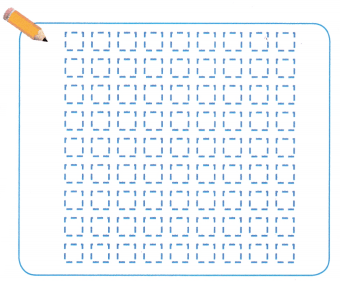
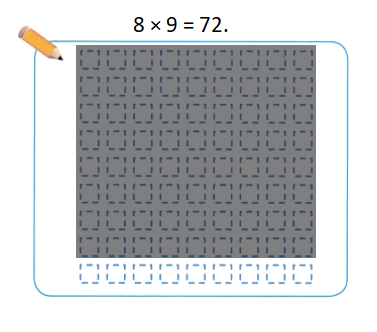
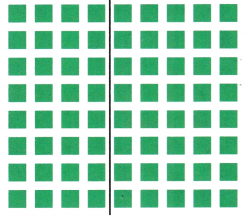
Use arrays to show each property. TEKS 3.4.F, 3.5.B

Question 2.
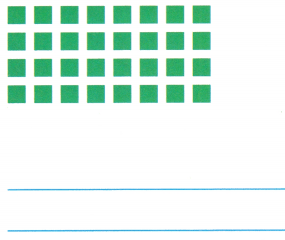
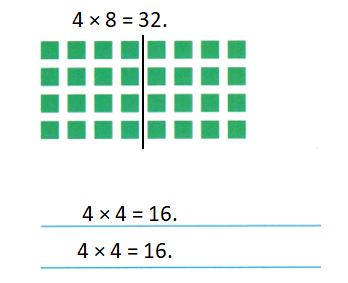
Distributive Property
8 × 6 = (4 × 6) + (4 × 6).
Texas Go Math Grade 3 Module 8 Assessment Answer Key 1
Answer: 48
Explanation:
The distributive property of multiplication is a property of real numbers that shows how we can break apart multiplication problems into separate terms.

Question 3.
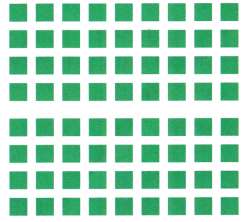
Associative Property of Multiplication
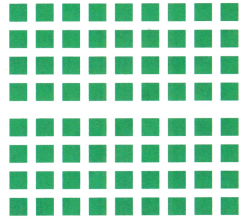
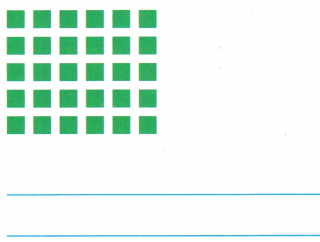
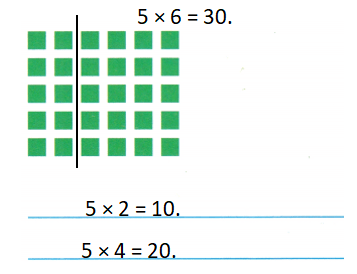
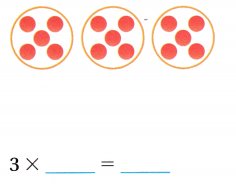
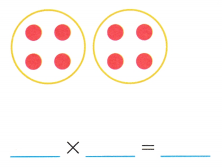
Break apart the array to show Circle groups to show 3 × (2 × 3).
Texas Go Math Grade 3 Module 8 Assessment Answer Key 2
Answer: 18

Find the product. TEKS 3.4.F, 3.5.B

Question 4.
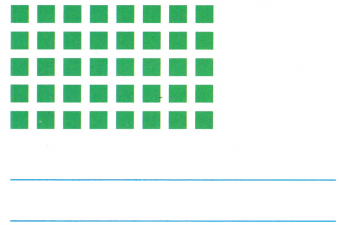
Texas Go Math Grade 3 Module 8 Assessment Answer Key 3
Answer:

Explanation:
Written the product of given two numbers
Question 5.
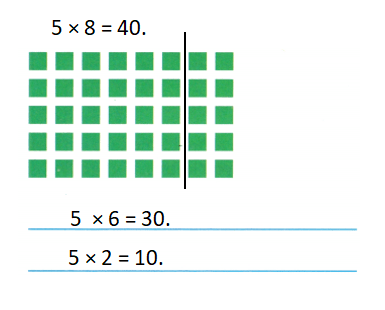
Texas Go Math Grade 3 Module 8 Assessment Answer Key 4
Answer:

Explanation:
Written the product of given two numbers

Question 6.
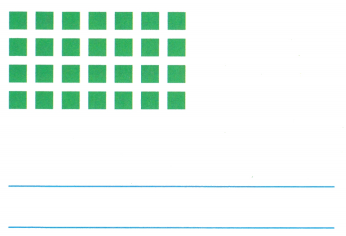
Texas Go Math Grade 3 Module 8 Assessment Answer Key 5
Answer:

Explanation:
Written the product of given two numbers

Texas Go Math Grade 3 Module 8 Answer Key Question 7.
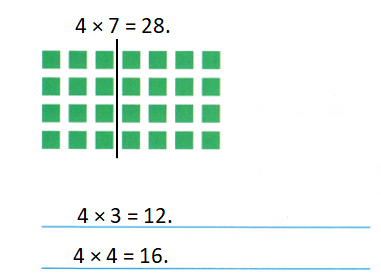
Texas Go Math Grade 3 Module 8 Assessment Answer Key 6
Answer:

Explanation:
Written the product of given two numbers
Question 8.
Texas Go Math Grade 3 Module 8 Assessment Answer Key 7
Answer:

Explanation:
Written the product of given two numbers

Question 9.
Texas Go Math Grade 3 Module 8 Assessment Answer Key 8
Answer:

Explanation:
Written the product of given two numbers

Question 10.
9 × 0 = ___
Answer:  0
Explanation:
Written the product of given two numbers

Question 11.
7 × 8 = ___
Answer: 56
Explanation:
Written the product of given two numbers

Question 12.
4 × 8 = ___
Answer: 32
Explanation:
Written the product of given two numbers

Question 13.
9 × 7 = ___
Answer: 63
Explanation:
Written the product of given two numbers

Question 14.
9 × 9 = ___
Answer: 81
Explanation:
Written the product of given two numbers

Question 15.
7 × 5 = ___
Answer: 35
Explanation:
Written the product of given two numbers

Question 16.
5 × 10 = ___
Answer: 50
Explanation:
Written the product of given two numbers

Question 17.
7 × 3 = ___
Answer: 21
Explanation:
Written the product of given two numbers

Texas Test Prep

Question 18.
Adele needs 5 pieces of ribbon, each 8 centimeters long. How many centimeters of ribbon does she need altogether? 4 TEKS 3.4.K
Record your answer and fill in the bubbles on the grid. Be sure to use the correct place value.
Texas Go Math Grade 3 Module 8 Assessment Answer Key 9
Answer: 40 Centimeters

Explanation:
She need 40 centimeter of ribbon altogether.
Place value of digit = (Face value) × (numerical value of place)

Fill in the bubble for the correct answer choice.

Question 19.
When Chloe finds the multiplication facts for 2, which digit will NOT be in the ones place of the products? TEKS 3.4.E
(A) 4
(B) 8
(C) 6
(D) 3
Answer: (D) 3
Explanation:
Digit 3 will NOT be in the ones place of the products

Question 20.
A honeybee is an insect. It has 6 legs. How many more legs do 9 honeybees have than 7 honeybees? TEKS 3.4.K
(A) 54
(B) 42
(C) 12
(D) 16
Answer:  (C) 12
Explanation:
A honeybee is an insect. It has 6 legs. So 9 honeybees have 54 legs.
A honeybee is an insect. It has 6 legs. So 7 honeybees have 42 legs.
So 12  more legs do 9 honeybees have than 7 honeybees. Since, 54 -42 =12

Question 21.
Jody has bags of shells. Each bag has 6 shells. She gives 3 bags each to 2 friends. How many shells did Jody give away? TEKS 3.4.F, 3.4.K, 3.5.B
(A) 36
(B) 18
(C) 6
(D) 12
Answer: A
Explanation:
Jody gave 36 shells to friends

Question 22.
Austin was on summer vacation for 7 weeks. He spent 3 weeks at band camp and the rest of the time at home. How many days did he spend at home? TEKS 3.4.K, 3.5.B
(A) 10 days
(B) 28 days
(C) 21 days
(D) 4 days
Answer: B
Explanation:
28 days she spend at home

Texas Go Math Grade 3 Module 8 Assessment Answer Key Read More »

Texas Go Math Grade 3 Module 7 Assessment Answer Key

Refer to our Texas Go Math Grade 3 Answer Key Pdf to score good marks in the exams. Test yourself by practicing the problems from Texas Go Math Grade 3 Module 7 Assessment Answer Key.

Texas Go Math Grade 3 Module 7 Assessment Answer Key

Choose the best term from the box to complete the sentence.

Question 1.
A ___ of 4 is any product that has 4 as one of its factors. (p. 217)
Answer: Multiple
Explanation:
A number that may be divided by another a certain number of times without a remainder.

Go Math Grade 3 Module 7 Answer Key Question 2.
This is an example of the ___ Property.
3 × 8 = (3 × 6) + (3 × 2)
This property states that multiplying a sum by a number is the same as multiplying each addend by the number and then adding the products. (p.229)
Answer:
Distributive property
Explanation:
The distributive property of multiplication can be used when you multiply a number by a sum.
For example,
suppose you want to multiply 3 by the sum of 10 + 2.

Concepts and Skills

Write one way to break apart the array. Then find the product. TEKS 3.4.E, 3.4.K

Question 3.
Texas Go Math Grade 3 Module 7 Assessment Answer Key 1
Answer:

Explanation:
The equations are written in three possible ways

Question 4.
Texas Go Math Grade 3 Module 7 Assessment Answer Key 2
Answer:

Explanation:
The equations are written in three possible ways

Find the product. TEK 3.4.E, 3.4.K.

Question 5.
3 × 1 = ___
Answer: 3
Explanation:
The product of two numbers
3 x 1 = 3

Question 6.
5 × 6 = ___
Answer:
Explanation:
The product of two numbers
5 x 6 = 30

Question 7.
4 × 7 = ____
Answer:
Explanation:
The product of two numbers
4 x 7 = 28

Grade 3 Module 7 Answer Key Go Math Question 8.
2 × 10 = ___
Answer:
Explanation:
The product of two numbers
2 x 10 = 20

Question 9.
Texas Go Math Grade 3 Module 7 Assessment Answer Key 3
Answer:

Explanation:
The multiplication is done in vertical form
the product of two numbers
2 x 1 = 2

Question 10.
Texas Go Math Grade 3 Module 7 Assessment Answer Key 4
Answer:

Explanation:
The multiplication is done in vertical form
the product of two numbers

Question 11.
Texas Go Math Grade 3 Module 7 Assessment Answer Key 5
Answer:

Explanation:
The multiplication is done in vertical form
the product of two numbers
6 x7 = 42

Question 12.
Texas Go Math Grade 3 Module 7 Assessment Answer Key 6
Answer:

Explanation:
The multiplication is done in vertical form
the product of two numbers
6 x 3 = 18

Question 13.
Texas Go Math Grade 3 Module 7 Assessment Answer Key 7
Answer:

Explanation:
The multiplication is done in vertical form
the product of two numbers
3 x 8 =24

Texas Test Prep

Fill in the bubble for the correct answer choice.
You may use models to solve.

Question 14.
Lori saw 6 lightning bugs. They each had 6 legs. How many legs did the lightning bugs have in all? TEKS 3.4.E, 3.4.K
(A) 36
(B) 6
(C) 12
(D) 24
Answer: (A) 36
Explanation:
Lori saw 6 lightning bugs.
They each had 6 legs.
36 legs did the lightning bugs have in all, Since 6 x 6 =36.

Go Math Answer Key Grade 3 Module 7 Question 15.
Zach gave his dog 1 dog biscuit each day, for 5 days. Then he gave his dog 2 dog biscuits a day for the next
5 days. How many biscuits did Zach give to his dog? TEKS 3.4.E, 3.4.K
(A) 5
(B) 30
(C) 15
(D) 7
Answer: (C) 15
Explanation:
Zach gave his dog 1 dog biscuit each day, for 5 days. So first 5days he given 5 biscuits, Since 5 x 1= 5.
he gave his dog 2 dog biscuits a day for the next 5 days. So next 5 days he given 10 biscuits, Since 5 x 2= 10.
So Total is 10 + 5 = 15.

Question 16.
Annette bought 4 boxes of pencils. If there are 8 pencils in each box, how many pencils did she buy? TEKS 3.4.E, 3.4.K
(A) 32
(B) 12
(C) 16
(D) 24
Answer: (A) 32
Explanation:
Annette bought 4 boxes of pencils. If there are 8 pencils in each box, 32 pencils did she buy? Since 4 x 8 =32.

Go Math Grade 3 Module 7 Assessment Answer Key Question 17.
Shelly can paint 4 pictures in a day. How many pictures can she paint in 7 days? TEKS 3.4.E, 3.4.K
Record your answer and fill in the bubbles on the grid. Be sure to use the correct place value.
Texas Go Math Grade 3 Module 7 Assessment Answer Key 8
Answer:

Explanation:
Shelly can paint 4 pictures in a day. 28  pictures can she paint in 7 days. Since 4 x 7 =28.
Place value of digit = (Face value) × (numerical value of place)

Texas Go Math Grade 3 Module 7 Assessment Answer Key Read More »

Texas Go Math Grade 3 Lesson 8.3 Answer Key Patterns on the Multiplication Table

Refer to our Texas Go Math Grade 3 Answer Key Pdf to score good marks in the exams. Test yourself by practicing the problems from Texas Go Math Grade 3 Lesson 8.3 Answer Key Patterns on the Multiplication Table.

Texas Go Math Grade 3 Lesson 8.3 Answer Key Patterns on the Multiplication Table

Essential Question
How can you use properties to explain patterns on the multiplication table?

Unlock the Problem
You can use a multiplication table to explore number patterns.

Activity 1
Materials Texas Go Math Grade 3 Lesson 8.3 Answer Key 1 Math Board
• Write the products for the green squares. What do you notice about the products?

Texas Go Math Grade 3 Lesson 8.3 Answer Key 2

Write the multiplication sentences for the products on your MathBoard. ‘ What do you notice about the factors?

• Will this be true in the yellow squares? Explain using a property you know.

Write the products for the yellow squares.

• Complete the columns for 1, 5, and 6. Look across each row and compare the products. What do you notice?

What property does this show?

Math Talk
Mathematical Processes
Explain how you can use these patterns to find other products.

Activity 2
Materials Texas Go Math Grade 3 Lesson 8.3 Answer Key 3 yellow and blue crayons

  • Shade the rows for 0, 2, 4, 6, 8, and 10 yellow.
    Texas Go Math Grade 3 Lesson 8.3 Answer Key 4
  • What pattern do you notice about each shaded row?
  • Shade the columns for 1, 3, 5, 7, and 9 blue.
  • What do you notice about the products for each shaded column?

Remember
Even numbers end in 0, 2, 4, 6, or 8. Odd numbers end in 1, 3, 5, 7, or 9.

Share and Show

Question 1.
Use the table to write the products for the row for 2.
__, __, __, __, ___, ___
__, __, __, __, ___, ___, ___
Describe a pattern you see.
Answer:
Product for row 2: 0, 2, 4, 6, 8, 10, 12, 14, 16, 18, 20. It is noticed that  all numbers of products of 2 are all even numbers.

Explanation:
Product for row 2:
2 × 0 = 0.
2 × 1 = 2.
2 × 2 = 4.
2 × 3 = 6.
2 × 4 = 8.
2 × 5 = 10.
2 × 6 = 12.
2 × 7 = 14.
2 × 8 = 16.
2 × 9 = 18.
2 × 10 = 20.

Math Talk
Mathematical Processes
What do you notice about the product of any number and 2?
Answer:
It is noticed that any number odd or even multiplied with 2 number, their product is even number not odd number.

Explanation:
It is noticed that any number odd or even multiplied with 2 number, their product is even number not odd number.

Is the product even or odd? Write even or odd.

Question 2.
5 × 8 ___
Answer:
5 × 8 = 40.(Even number)

Explanation:
Product:
5 × 8  = 40.(ends with 0 => Even number)

Go Math 3rd Grade Lesson 8.3 Answer Key Question 3.
6 × 3 __
Answer:
6 × 3 = 18.(Even number)

Explanation:
Product:
6 × 3 = 18(ends with 8 => Even number)

Question 4..

3 × 5 ___
Answer:
3 × 5 = 15. (Odd number)

Explanation:
Product:
3 × 5 = 15. (ends with 5 => Odd number)

Question 5.
4 × 4 ____
Answer:
4 × 4 = 16.(Even number)

Explanation:
Product:
4 × 4 = 16.(ends with 6 => Even number)

Use the multiplication table. Describe a pattern you see.
Question 6.
in the column for 10
Answer:
It is noticed that pattern in column for 10 is 0, 10, 20, 30, 40, 50, 60, 70, 80, 90, 100.

Explanation:
Pattern in column for 10:
0 × 10 = 0.
1 × 10 = 10.
2 × 10 = 20.
3 × 10 = 30.
4 × 10 = 40.
5 × 10 = 50.
6 × 10 = 60.
7 × 10 = 70.
8 × 10 = 80.
9× 10 = 90.
10 × 10 = 100.

Texas Go Math 8.3 Answer Key 3rd Grade Question 7.
in the column for 8
Answer:
It is noticed that the pattern in a column for 8 is 0, 8, 16, 24, 32, 48, 56, 64, 72, 80.

Explanation:
the pattern in a column 8:
0 × 1 = 0.
8 × 1 = 8.
8 × 2 = 16.
8 × 3 = 24.
8 × 4 = 32.
8 × 5 = 40.
8 × 6 = 48.
8 × 7 = 56.
8 × 8 = 64.
8× 9 = 72.
8 × 10 = 80.


Problem Solving
Complete the table. Then describe a pattern you see in the products.
Question 8.
Texas Go Math Grade 3 Lesson 8.3 Answer Key 5
Answer:
Texas-Go-Math-Grade-3-Lesson-8.3-Answer-Key-Patterns-on-the-Multiplication-Table-Problem Solving-8

Explanation:
Products:
5 × 2 = 10.
5 × 4 = 20.
5 × 6 = 30.
5 × 8 = 40.
5 × 10 = 50.
Noticed products are multiples of 10 and are even numbers.


Question 9.
Texas Go Math Grade 3 Lesson 8.3 Answer Key 6
Answer:
Texas-Go-Math-Grade-3-Lesson-8.3-Answer-Key-Patterns-on-the-Multiplication-Table-Problem Solving-9

Explanation:
Products:
5 × 1= 5.
5 × 3 = 15.
5 × 5 = 25.
5 × 7 = 35.
5 × 9 = 45.
Noticed products are multiples of 5 and are odd numbers.


Go Math Lesson 8.3 3rd Grade Patterns in the Multiplication Table Question 10.
H.O.T. Write Math Explain how patterns of the ones digits in the products relate to the factors in Exercises 8 and 9.
Answer:
It is noticed that patterns of the ones digits in the products relate to the factors in Exercises 8 and 9, they are odd numbers when 5 number is multiplied with , 3, 5, 7 ,9 products are 5, 15, 25, 35, 45 and even numbers when multiplied by 0, 2, 4, 6, 8 and 10 products are 0, 10, 20, 30, 40, 50.

Explanation:
Noticed that patterns of the ones digits in the products relate to the factors in Exercises 8 and 9, they are odd numbers when 5 number is multiplied with , 3, 5, 7 ,9 products are 5, 15, 25, 35, 45 and even numbers when multiplied by 0, 2, 4, 6, 8 and 10 products are 0, 10, 20, 30, 40, 50.


H.O.T. Multi-Step Sense or Nonsense?

Question 11.
Elijah says the product of an odd number and an even number is even. Chloe says the product of two even numbers is even. Whose statement makes sense? Whose statement is nonsense? Use Math Language to explain your reasoning.
Texas Go Math Grade 3 Lesson 8.3 Answer Key 7
Answer:
Both statements are true and correct because the product of an odd number and an even number is even and the product of two even numbers is even.

Explanation:
Elijah says the product of an odd number and an even number is even. Chloe says the product of two even numbers is even. Both statements are true and correct.


Daily Assessment Task
Fill in the bubble for the correct answer choice.
Question 12.
A spider has 8 legs. Josie is using the multiplication table to find the number of legs on 1, 2, 3, 4, 5, and 6 spiders.
Which pattern do the products show?
Texas Go Math Grade 3 Lesson 8.3 Answer Key 8
(A) odd, then even, then repeat
(B) even, then odd, then repeat
(C) all odd
(D) all even
Answer:
Products:  5, 16, 24, 32, 40, 48 are all even numbers.(ending with 0,2,4,6,8)
(D) all even.

Explanation:
Product:
8 × 1 = 8.
8 × 2 = 16.
8 × 3 = 24.
8 × 4 = 32.
8 × 5 = 40.
8 × 6 = 48.

Question 13.
Xavier is counting groups of students at tables in the lunchroom. Which describes Xavier’s pattern?
6, 12, 18, 24, 30, 36
(A) Multiply by 2.
(B) Multiply by 3.
(C) Add 6.
(D) Add 12.
Answer:
6, 12, 18, 24, 30, 36.
It is noticed they are multiples of 6 or add of 6.
(C) Add 6.

Explanation:
6 × 1 = 6.
6 × 2 = 12.(6 + 6)
6 × 3 = 18.(12 + 6)
6 × 4 = 24.(18 + 6)
6 × 5 = 30.(24 + 6)
6 × 6 = 36.(30 + 6)


Go Math Grade 3 Lesson 8.3 Answer Key Question 14.
Multi-Step What are the next 2 numbers in this pattern?
7, 14, 21, 28, 35, ?, ?
(A) 37, 39
(B) 42, 49
(C) 70, 80
(D) 49, 56
Answer:
7, 14, 21, 28, 35, ?, ?
Missing numbers are 42 and 49.
(B) 42, 49.

Explanation:
7, 14, 21, 28, 35, ?, ?
=> 7 + 7 = 14.
14 + 7 = 21.
21 + 7 = 28.
28 + 7 = 35.
35 + 7 = 42.
42 + 7 = 49.


Texas Test Prep
Question 15.
Which of the following describes this pattern?
12, 16, 20, 24, 28
(A) Multiply by 4.
(B) Add 4.
(C) Multiply by 5.
(D) subtract 4.
Answer:
12, 16, 20, 24, 28 are multiples of 4.
(A) Multiply by 4.
(B) Add 4.

Explanation:
12, 16, 20, 24, 28.
4 × 1 = 4.(0 + 4 = 4)
4 × 2 = 8.(4 + 4 = 8)
4 × 3 = 12.(8 + 4 = 12)
4 × 4 = 16.(12 + 4= 16)
4 × 5 = 20.(16 + 4 = 20)
4 × 6 = 24.(20 + 4 = 24)
4 × 7 = 28.(24 + 4 = 28)

Texas Go Math Grade 3 Lesson 8.3 Homework and Practice Answer Key

Use the multiplication table. Describe a pattern you see.
Question 1.
in the column for 4
Answer:

Texas Go Math Grade 3 Lesson 8.3 Answer Key 9
Answer:
Product in the column 4: 0, 4, 8, 12, 16, 20, 24, 28, 32, 36, 40
It is noticed they are multiples of 4 and all are even numbers.

Explanation:
Product in the column 4:
4 × 0 = 0.
4 × 1 = 4.
4 × 2 = 8.
4 × 3 = 12.
4 × 4 = 16.
4 × 5 = 20.
4× 6 = 24.
4 × 7 = 28.
4 × 8 = 32.
4 × 9 = 36.
4 × 10 = 40.


Go Math 3rd Grade Practice and Homework Lesson 8.3 Answer Key Question 2.
in the column for 5
Answer:
Product in the column 5: 0, 5, 10, 15, 20, 25, 30, 35, 40, 45, 50.
It is noticed they are multiples of 5 and numbers 5, 15, 25, 35, 45 are odd numbers and 0, 10, 20, 30, 40, 50 are even numbers(multiples of 10).

Explanation:
Product in the column 5:
5 × 0 = 0.
5 × 1 = 5.
5 × 2 = 10.
5 × 3 = 15.
5 × 4 = 20.
5 × 5 = 25.
5× 6 = 30.
5 × 7 = 35.
5 × 8 = 40.
5 × 9 = 45.
5 × 10 = 50.


Complete the table. Then describe a pattern you see in the products.
Question 3.
Texas Go Math Grade 3 Lesson 8.3 Answer Key 10
Answer:
Texas-Go-Math-Grade-3-Lesson-8.3-Answer-Key-Patterns-on-the-Multiplication-Table-Texas Go Math Grade 3 Lesson 8.3 Homework and Practice Answer Key-3

Explanation:
2 × 1 = 2.
2 × 2 = 4.
2 × 3 = 6.
2 × 4 = 8.
2 × 5 = 10.

Go Math Lesson 8.3 Homework Answer Key Grade 3 Question 4.
Texas Go Math Grade 3 Lesson 8.3 Answer Key 11
Answer:
Texas-Go-Math-Grade-3-Lesson-8.3-Answer-Key-Patterns-on-the-Multiplication-Table-Texas Go Math Grade 3 Lesson 8.3 Homework and Practice Answer Key-4

Explanation:
3 × 1 = 3.
3 × 2 = 6.
3 × 3 = 9.
3 × 4 = 12.
3 × 5 = 15.
3 × 6 = 18.


Problem Solving
Question 5.
Lani says that the product of an odd number and an odd number is an odd number. Draw a picture and write a number sentence that shows how Lani’s statement makes sense.
Answer:
Lani’s statement makes sense because the product of an odd number and an odd number is an odd number.
Total number of stars = 3 × 5 = 15.
Texas-Go-Math-Grade-3-Lesson-8.3-Answer-Key-Patterns-on-the-Multiplication-Table-Texas Go Math Grade 3 Lesson 8.3 Homework and Practice Answer Key-problem solving-5

Explanation:
The product of an odd number and an odd number is an odd number:
3 × 5 = 15.
Texas-Go-Math-Grade-3-Lesson-8.3-Answer-Key-Patterns-on-the-Multiplication-Table-Texas Go Math Grade 3 Lesson 8.3 Homework and Practice Answer Key-problem solving-5
Number of rows of stars = 3.
Number of columns of stars = 5.
Total number of stars = Number of rows of stars × Number of columns of stars
= 3 × 5
= 15.


Texas Test Prep
Lesson Check
Question 6.
A store sells tricycles. Each tricycle has 3 wheels. Jin uses a multiplication table to find the total number of wheels. Which pattern do the products show?
Texas Go Math Grade 3 Lesson 8.3 Answer Key 12
(A) all odd
(B) all even
(C) odd, then even, then repeat
(D) even, then odd, then repeat
Answer:
6, 12, 18, 24, 30 are all even numbers.
(B) all even.
Texas-Go-Math-Grade-3-Lesson-8.3-Answer-Key-Patterns-on-the-Multiplication-Table-Texas Go Math Grade 3 Lesson 8.3 Homework and Practice Answer Key-Texas Test Prep-6

Explanation:
3 × 1 = 3.
3 × 2 = 6.
3 × 4 = 12.
3 × 6 = 18.
3 × 8 = 24.
3 × 10 = 30.


3rd Grade Go Math Lesson 8.3 Homework Answer Key Question 7.
Jin also uses a multiplication table to find the total number of wheels on the bicycles in the store. Which pattern do the products show?
Texas Go Math Grade 3 Lesson 8.3 Answer Key 13
(A) all odd
(B) all even
(C) odd, then even, then repeat
(D) odd, even, odd, then repeat
Answer:
2,  6, 10, 14, 18 are even numbers and multiples of 2.
(B) all even.
Texas-Go-Math-Grade-3-Lesson-8.3-Answer-Key-Patterns-on-the-Multiplication-Table-Texas Go Math Grade 3 Lesson 8.3 Homework and Practice Answer Key-Texas Test Prep-7

Explanation:
2 × 1 = 2.
2 × 3 = 6.
2 × 5 = 10.
2 × 7 = 14.
2 × 9 = 18.


Question 8.
Matt is counting groups of squares on a quilt he is making. Which describes Matt’s pattern?
3, 6, 9, 12, 15, 18
(A) Skip count by 2.
(B) Multiply by 3.
(C) Add 3.
(D) Add 6.
Answer:
3, 6, 9, 12, 15, 18.
They are the multiples of 3 and add of 3.
(B) Multiply by 3.
(C) Add 3.

Explanation:
3, 6, 9, 12, 15, 18
3 × 1 = 3.(0 + 3 = 3)
3 × 2 = 6.(3 + 3 = 6)
3 × 3 = 9.(6 + 3 = 9)
3 × 4 = 12.(9 + 3 = 12)
3 × 5 = 15.(12 + 3 = 15)
3 × 6 = 18.(15 + 3 = 18)


Question 9.
Cassie is counting groups of beads on a necklace. Which describes Cassie’s pattern?
4, 9, 14, 19, 24, 29
(A) Add by 4
(B) Multiply by 4.
(C) Multiply by 5.
(D) Add 5.
Answer:
4, 9, 14, 19, 24, 29.
They are the add of 5.
(D) Add 5.

Explanation:
4, 9, 14, 19, 24, 29.
4 + 5 = 9.
9 + 5 = 14.
14 + 5 = 19.
19 + 5 = 24.
24 + 5 = 29.


Go Math Grade 3 Lesson 8.3 Homework Answer Key Question 10.
Multi-Step lacy makes a pattern with triangles. How many triangles does Jacy need to place in the next two parts of his pattern?
4, 10, 16, 22, 28, ?, ?
(A) 29, 30
(B) 34, 40
(C) 32, 36
(D) 30, 32
Answer:
4, 10, 16, 22, 28, ?, ?
34, 40 triangles Jacy needs to place in the next two parts of his pattern.
(B) 34, 40.

Explanation:
4, 10, 16, 22, 28, ?, ?
4 + 6 = 10
10 + 6 = 16.
16 + 6 = 22.
22 + 6 = 28.
28 + 6 = 34.
34 + 6 = 40.


Question 11.
Multi-Step Vito makes a pattern with puzzle pieces. How many puzzle pieces does Vito have in the first part of the pattern?
?, ?, 8, 11, 14, 17, 20
(A) 2, 4
(B) 1, 3
(C) 2, 5
(D) 3, 5
Answer:
?, ?, 8, 11, 14, 17, 20
2, 5 are puzzle pieces Vito have in the first part of the pattern.
(C) 2, 5.

Explanation:
?, ?, 8, 11, 14, 17, 20.
20 – 17 = 3.
17 – 3 = 14.
14 – 3 = 11.
11 – 3 = 8.
8 – 3 = 5.
5 – 3 = 2.

Texas Go Math Grade 3 Lesson 8.3 Answer Key Patterns on the Multiplication Table Read More »

Texas Go Math Grade 3 Lesson 8.2 Answer Key Associative Property of Multiplication

Refer to our Texas Go Math Grade 3 Answer Key Pdf to score good marks in the exams. Test yourself by practicing the problems from Texas Go Math Grade 3 Lesson 8.2 Answer Key Associative Property of Multiplication.

Texas Go Math Grade 3 Lesson 8.2 Answer Key Associative Property of Multiplication

Essential Question
How can you use the Associative Property of Multiplication to find products?

Connect You have learned the Associative Property of Addition. When the grouping of the addends is changed, the sum stays the same.
(2 + 3) + 4 = 2 + (3 + 4)

Math Idea
Always multiply the numbers inside the parentheses first.

The Associative Property of Multiplication states that when the grouping of the factors is changed, the product is the same. It is also called the Grouping Property of Multiplication.

Unlock the Problem

Each car on the roller coaster has 2 rows of seats. Each row has 2 seats. There are 3 cars in each train. How many seats are on each roller coaster train?

  • Underline what you need to find.
  • Describe the grouping of the seats.

Use an array

Texas Go Math Grade 3 Lesson 8.2 Answer Key 1
You can use an array to show 3 × (2 × 2).
3 × (2 × 2) = __
3 × ___ = ___
So, there are 3 cars with 4 seats in each car.
There are ___ seats on each roller coaster train.

You can change the grouping with parentheses and the product is the same.
3 × (2 × 2) = __
____ × 2 = ____

Math Talk
Mathematical Processes
Explain why the products 3 × (2 × 2) and (3 × 2) × 2 are the same.
Answer:
3 × (2 × 2) and (3 × 2) × 2 When the grouping of the addends is changed, the sum stays the same.

Explanation:
The Associative Property of Multiplication states that when the grouping of the factors is changed, the product is the same. It is also called the Grouping Property of Multiplication.
When the grouping of the addends is changed, the sum stays the same.
3 × (2 × 2) = 3 × 4 = 12.
(3 × 2) × 2 = 6 × 2 = 12.

Example
Use the Commutative and Associative Properties.

You can also change the order of the factors.
The product is the same.
Texas Go Math Grade 3 Lesson 8.2 Answer Key 2

Share and Show

Question 1.
Find the product of 5, 2, and 3. Write another way to group the factors. Is the product the same? Why?
Answer:
Product is same because numbers order has changed yet not the numbers.
5 × (3 × 2)  is commutative property.
=> 5 × 6 = 30.
(5 × 2) × 3 is associative property.
=> 10 × 3 = 30.

Explanation:
Product: (5 × 2) × 3
5 × (2 × 3) is associative property.
=> 5 × 6 = 30.
5 × (3 × 2)  is commutative property.
=> 5 × 6 = 30.
(5 × 2) × 3 is associative property.
=> 10 × 3 = 30.


Write another way to group the factors. Then find the product.
Question 2.
(2 × 1) × 7
Answer:
Product: 1 × (2 × 7) = 1 × 14 = 14.

Explanation:
Product:
(2 × 1) × 7 = 2 × 7 = 14.
Another way:
Change order: 1 × 2 × 7
=> 1 × (2 × 7) = 1 × 14 = 14.


Go Math Lesson 8.2 Grade 3 Associative Property Question 3.
3 × (3 × 4)
Answer:
Product:
(3 × 4) × 3= 12 × 3 = 36.

Explanation:
Product:
3 × (3 × 4) = 3 × 12 = 36.
Another way:
Change order: 3 × 4 × 3
=> (3 × 4) × 3= 12 × 3 = 36.


Question 4.
5 × (2 × 5)
Answer:
Product: (5 × 5) × 2 = 25 × 2 = 50.

Explanation:
Product:
5 × (2 × 5) = 5 × 10 = 50.
Another way:
Change order: 5 × 5 × 2
=> (5 × 5) × 2 = 25 × 2 = 50.


Question 5.
3 × (2 × 6)
Answer:
Product: (3 × 6) × 2 = 18 × 2 = 36.

Explanation:
Product:
3 × (2 × 6) = 3 × 12 = 36.
Another way:
Change order: 3 × 6 × 2
=> (3 × 6) × 2 = 18 × 2 = 36.

H.O.T. Algebra Find the unknown factor.

Question 6.
7 × (2 × ___) = 56
Answer:
7 × (2 × __4__) = 56.

Explanation:
7 × (2 × ___) = 56.
=> 7 × 2 × ?? = 56.
=> (7 × 2) × ?? = 56.
=> 14 × ?? = 56
=> ?? = 56 ÷ 14
=> ?? = 4.


Question 7.
60 = (2 × ___) × 6
Answer:
60 = (2 × _5__) × 6

Explanation:
60 = (2 × ___) × 6.
=> 60 = 2 × ?? × 6
=> 60 = ?? × (2 × 6)
=> 60 = ?? × 12
=> 60 ÷ 12 = ??
=> 5 = ??


Go Math Lesson 8.2 Answer Key 3rd Grade Question 8.
___ × (2 × 2) = 32
Answer:
_8__ × (2 × 2) = 32.

Explanation:
___ × (2 × 2) = 32.
=> ?? × 4 = 32.
=> ?? = 32 ÷ 4
=> ?? = 8.


Question 9.
42 = 7 × (2 × __)
Answer:
42 = 7 × (2 × _3_).

Explanation:
42 = 7 × (2 × __)
=> 42 = 7 × 2 × ??
=> 42 = (7 × 2) × ??
=> 42 = 14 × ??
=> 42 ÷ 14 = ??
=> 3 = ??.


Question 10.
8 × (5 × ___) = 4o
Answer:
8 × (5 × _1__) = 40.

Explanation:
8 × (5 × ___) = 40.
=> 8 × 5 × ?? = 40.
=> ( 8 × 5) × ?? = 40.
=> 40 × ?? = 40.
=> ?? = 40 ÷ 40
=> ?? = 1.


Question 11.
0 = ____ × (25 × 1)
Answer:
0 = __0__ × (25 × 1)

Explanation:
0 = ____ × (25 × 1)
=> 0 = ?? × (25 × 1)
=> 0 = ?? × 25
=> 0 ÷ 25 = ??
=> 0 = ??


Problem Solving
Use the graph for 12-13.
Question 12.
Multi-Step Each car on the Steel Force train has 3 rows with 2 seats in each row. How many seats are on the train? Draw a quick picture.
Texas Go Math Grade 3 Lesson 8.2 Answer Key 3
Answer:
Number of seats are on the train = 6.

Explanation:
Number of rows each car on the Steel Force train has = 3.
Number of seats in each row each car on the Steel Force train has = 2.
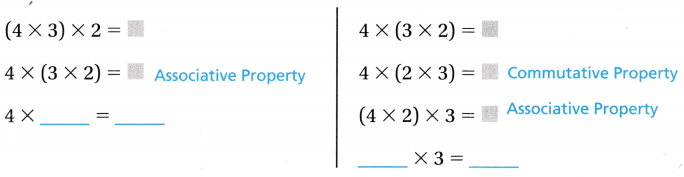
Number of seats are on the train = Number of rows each car on the Steel Force train has × Number of seats in each row each car on the Steel Force train has
= 3 × 2
= 6.
Texas-Go-Math-Grade-3-Lesson-8.2-Answer-Key-Associative-Property-of-Multiplication-Problem Solving-Multi-Step-12

Go Math 3rd Grade Lesson 8.2 Associative Property of Multiplication Question 13.
H.O.T. Multi-Step A Kingda Ka train has 4 seats per car, but the last car has only 2 seats. How many seats are on one Kingda Ka train?
Answer:
Number of seats are on one Kingda Ka train = 18.

Explanation:
Number of seats per car a Kingda Ka train has = 4.
Number of seats last car a Kingda Ka train has = 2.
Number of cars a Kingda Ka train has = 5.
Number of seats are on one Kingda Ka train = (Number of cars a Kingda Ka train has × Number of seats per car a Kingda Ka train has) – Number of seats last car a Kingda Ka train has
= (5 × 4) – 2
= 20 – 2
= 18.

Question 14.
Sense or Nonsense? Each week, Kelly works 2 days for 4 hours each day and earns $5 an hour. Len works 5 days for 2 hours each day and earns $4 an hour. Kelly says they both earn the same amount. Does this statement make sense? Explain.
Answer:
Yes, the statement makes sense because both earn same amount of $40.

Explanation:
Number of days Kelly works = 2.
Number of hours each day Kelly works = 4.
Cost of amount for an hour = $5.
Amount of money Kelly works a week = Number of days Kelly works × (Number of hours each day Kelly works × Cost of amount for an hour )
= 2 × (4 × $5)
= 2 × $20
= $40.
Number of days Len works = 5.
Number of hours each day Len works = 2.
Cost of amount for an hour = $4.
Amount of money Len works a week = Number of days Len works × (Number of hours each day Len works × Cost of amount for an hour )
= 5 × (2 × $4)
= 5 × $8
= $40.


Go Math 3rd Grade Lesson 8.2 Answer Key Question 15.
Representations What number sentence does this array represent? Write another way to group the factors.
Texas Go Math Grade 3 Lesson 8.2 Answer Key 4
Answer:
Another way:  Number of columns × Number of rows
= 8 × 3
= 24.

Explanation:
Number of rows = 3.
Number of columns = 8.
Array represent = Number of rows × Number of columns
= 3 × 8
= 24.
Another way:
Number of columns = 8.
Number of rows = 3.
Array represent = Number of columns × Number of rows
= 8 × 3
= 24.

Daily Assessment Task
Fill in the bubble for the correct answer choice. You can use an array, area model, or a strip diagram to represent and solve.
Question 16.
Michael plays a fishing game at the school carnival. He plays 4 times and catches 3 fish each time. For each fish Michael catches, he wins a set of 3 toy planes. How many toy planes does Michael win?
(A) 18
(B) 12
(C) 36
(D) 9
Answer:
Number of planes Michael wins = 36.
(C) 36.

Explanation:
Number of times he plays = 4.
Number of fishes he catches each time = 3.
Number of set of toy planes when he wins  = 3.
Number of planes Michael wins = Number of times he plays × ( Number of fishes he catches each time × Number of set of toy planes when he wins )
= 4 (3 × 3)
= 4 × 9
= 36.

Question 17.
Emma helps at a farm 2 days each week. She works 4 hours each day and earns $8 for each hour. How much money does Emma earn each week?
(A) $64
(B) $40
(C) $48
(D) $32
Answer:
Amount of money  Emma earns each week = $64.
(A) $64.

Explanation:
Number of days each week Emma helps at a farm = 2.
Number of hours each day she works = 4.
Cost of amount she earns each hour = $8.
Amount of money  Emma earns each week = Number of days each week Emma helps at a farm × (Number of hours each day she works × Cost of amount she earns each hour)
= 2 × (4 × $8)
= 2 × 32
= $64.


Question 18.
Multi-Step Mrs. Lee has 25 baskets of books. She wants to put them on the 2 bookcases in her classroom. Each bookcase has 4 shelves. Each shelf can hold 3 baskets. How many baskets will be left over?
(A) 7
(B) 1
(C) 10
(D) 5
Answer:
Number of baskets will be left over = 1.
(B) 1.

Explanation:
Number of baskets of books Mrs. Lee has = 25.
Number of bookcases in her classroom she wants to put them = 2.
Number of shelves each bookcase has = 4.
Number of baskets each shelf can hold = 3.
Number of baskets will be left over = Number of baskets of books Mrs. Lee has -[ Number of bookcases in her classroom she wants to put them × (Number of shelves each bookcase has × Number of baskets each shelf can hold)]
= 25 – [2 × (4 × 3)]
= 25 – (2 × 12)
= 25 – 24
= 1.

Texas Test Prep

Go Math Lesson 8.2 Associative Property Grade 3 Question 19.
Mark has 2 rows of 3 car models on each of his 3 shelves. How many car models does he have?
(A) 11
(B) 9
(C) 8
(D) 18
Answer:
Number of car models he have = 18.
(D) 18.

Explanation:
Number of rows Mark has = 2.
Number of car models Mark has = 3.
Number of cars on each shelves = 3.
Number of car models he have = Number of rows Mark has × (Number of car models Mark has × Number of cars on each shelves)
= 2 × (3 ×3)
= 2 × 9
= 18.


Texas Go Math Grade 3 Lesson 8.2 Homework and Practice Answer Key

Write another way to group the factors. Then find the product.

Question 1.
(3 × 2) × 5
Answer:
(3 × 2) × 5 = 3 × (2 × 5) = 30.

Explanation:
Another way:
(3 × 2) × 5 = 3 × (2 × 5)
= 3 × 10
= 30.


Question 2.
6 × (2 × 2)
Answer:
6 × (2 × 2) = (6 × 2) × 2 = 24.

Explanation:
Another way:
6 × (2 × 2) = (6 × 2) × 2
= 12 × 2
= 24.


Question 3.
5 × (2 × 4)
Answer:
5 × (2 × 4) = (5 × 2) × 4 = 40.

Explanation:
Another way:
5 × (2 × 4) = (5 × 2) × 4
= 10 × 4
= 40.


Question 4.
(2 × 3) × 6
Answer:
(2 × 3) × 6 = 2 × (3 × 6) = 36.

Explanation:
Another way:
(2 × 3) × 6 = 2 × (3 × 6)
= 2 × 18
= 36.


Problem Solving
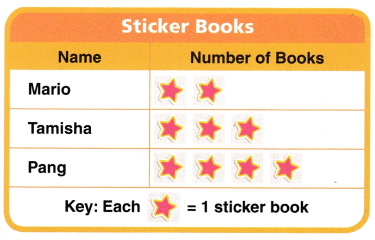
Use the pictograph for 5-7.
Question 5.
Mario’s sticker books have 4 rows of 3 stickers in each row. How many stickers are in Mario’s books? Draw a picture.
Texas Go Math Grade 3 Lesson 8.2 Answer Key 5
Answer:
Number of stickers are in Mario’s books = 12.

Explanation:
Number of rows Mario’s sticker books = 4.
Number of stickers in each row = 3.
Number of stickers are in Mario’s books = Number of rows Mario’s sticker books × Number of stickers in each row
= 4 × 3
= 12.


Question 6.
Pang’s sticker books have 3 rows of 3 stickers. He uses 5 stickers. How many stickers are still in the sticker books?
Answer:
Number of stickers are still in the sticker books = 4.

Explanation:
Number of rows Pang’s sticker books = 3.
Number of stickers in each row = 3.
Number of stickers used by Pang’s  = 5.
Number of stickers are still in the sticker books = (Number of rows Pang’s sticker books ×  Number of stickers in each row) – Number of stickers used by Pang’s
= (3 × 3) – 5
= 9 – 5
= 4.


Question 7.
Tamisha’s sticker books have 3 rows of 3 stickers in each row. If Mario’s sticker books have 4 rows of 3 stickers in each row, who has more stickers? Explain.
Answer:
Mario’s sticker books has 3 more stickers than Tamisha’s sticker books.

Explanation:
Number of rows Tamisha’s sticker books = 3.
Number of stickers in each row = 3.
Number of stickers are in Tamisha’s books = Number of rows Tamisha’s sticker books  × Number of stickers in each row
= 3 × 3
= 9.
Number of rows Mario’s sticker books = 4.
Number of stickers in each row = 3.
Number of stickers are in Mario’s books = Number of rows Mario’s sticker books × Number of stickers in each row
= 4 × 3
= 12.
Difference:
Number of stickers are in Mario’s books – Number of stickers are in Tamisha’s books
= 12 – 9
= 3.

Lesson Check

Question 8.
Malcolm put stamps on 5 pages of an album. He puts 3 rows of 2 stamps on each page. How many stamps does Malcolm have in his album?
(A) 10
(B) 30
(C) 20
(D) 25
Answer:
Number of stamps Malcolm have in his album = 30.
(B) 30.

Explanation:
Number of pages of an album Malcolm put stamps on = 5.
Number of rows he puts = 3.
Number of stamps on each page he puts = 2.
Number of stamps Malcolm has in his album = Number of pages of an album Malcolm put stamps on  × (Number of rows he puts × Number of stamps on each page he puts)
= 5 × (3 × 2)
= 5 × 6
= 30.

Go Math Grade 3 Lesson 8.2 Practice and Homework Answers Question 9.
Ana works at the library 3 days a week. She works for 2 hours each day and earns $7 each hour. How much money does Ana earn each week?
(A) $42
(B) $21
(C) $12
(D) $35
Answer:
Amount of money Ana earns each week = $42.
(A) $42.

Explanation:
Number of days in a week Ana works at the library = 3.
Number of hours each day she works = 2.
Money she earns each hour = $7.
Amount of money Ana earn each week = Number of days in a week Ana works at the library × (Number of hours each day she works × Money she earns each hour)
= 3 × (2 × $7)
= 3 × $14
= $42.

Question 10.
Zeff, Maggie, and Jani each make 2 kites. Each kite has 4 tails. How many tails are there on all of the kites?
(A) 8
(B) 24
(C) 12
(D) 18
Answer:
Number of tails are there on all of the kites = 24.
(B) 24.

Explanation:
Number of kites each make = 2.
Number of people making kites = 3.(Zeff, Maggie, and Jani)
Number of tails each kite has = 4.
Number of tails are there on all of the kites = (Number of kites each make × Number of people making kites) × Number of tails each kite has
= (2 × 3) × 4
= 6 × 4
= 24.


Question 11.
There are 6 boxes of paint. Each box has 3 rows of 2 paint cans. Which shows how many paint cans in all?
(A) 6 + (3 × 2) = 12
(B) (6 × 3) + 2 = 20
(C) (6 × 3) × 2 = 18
(D) 6 × (3 × 2) = 36
Answer:
Number of paint cans in all = 36.
(D) 6 × (3 × 2) = 36

Explanation:
Number of boxes of paints = 6.
Number of rows in each box has = 3.
Number of paints cans = 2.
Number of paint cans in all = Number of boxes of paints × (Number of rows in each box has × Number of paints cans)
= 6 × (3 × 2)
= 6 × 6
= 36.


Question 12.
Multi-Step Gwen has 30 action figures. She puts them in 2 boxes. Each box holds 3 rows of 4 action figures. How many action figures will be left over?
(A) 24
(B) 6
(C) 8
(D) 21
Answer:
Number of action figures will be left over = 6.
(B) 6.

Explanation:
Number of action figures Gwen has = 30.
Number of boxes she puts them = 2.
Number of rows each box holds = 3.
Number of action figures = 4.
Number of action figures will be left over = Number of action figures Gwen has – [Number of boxes she puts them × (Number of rows each box holds × Number of action figures)]
= 30 – [2 × (3 × 4)]
= 30 – [2 × 12]
= 30 – 24
= 6.

Question 13.
Multi-Step Reggie has 65 quilt patches. He makes 2 quilts with 5 rows of 6 patches in each quilt. How many quilt patches will be left over?
(A) 43
(B) 8
(C) 5
(D) 52
Answer:
Number of quilt patches will be left over = 5.
(C) 5.

Explanation:
Number of quilt patches Reggie has = 65.
Number of quilts he makes = 2.
Number of rows he makes = 5.
Number of patches in each quilt = 6.
Number of quilt patches will be left over = Number of quilt patches Reggie has – [ Number of quilts he makes × (Number of rows he makes × Number of patches in each quilt )]
= 65 – [2 × (5 × 6)]
= 65 – [2 × 30]
= 65 – 60
= 5.

Texas Go Math Grade 3 Lesson 8.2 Answer Key Associative Property of Multiplication Read More »

Texas Go Math Grade 3 Lesson 7.3 Answer Key Multiply with 3 and 6

Refer to our Texas Go Math Grade 3 Answer Key Pdf to score good marks in the exams. Test yourself by practicing the problems from Texas Go Math Grade 3 Lesson 7.3 Answer Key Multiply with 3 and 6.

Texas Go Math Grade 3 Lesson 7.3 Answer Key Multiply with 3 and 6

Essential Question
what are some ways to multiply with 3 and 6?

Unlock the Problem
Sabrina is making triangles with toothpicks. She uses 3 toothpicks for each triangle. She makes 4 triangles.
How many toothpicks does Sabrina use?
Answer:
She uses 3 toothpicks for each triangle.

Explanation:
Number of toothpicks she uses = 3.


• Why does Sabrina need 3 toothpicks for each triangle?
Answer:
Sabrina need 3 toothpicks for each triangle because to make 4 triangles.

Explanation:
To make 4 triangles Sabrina needs 3 toothpicks for each triangle.


Draw a picture.

Step 1
Complete the 4 triangles.
Texas Go Math Grade 3 Lesson 7.3 Answer Key 1

Step 2
Skip count by the number of sides. ___, ___, ___, ___,
How many craft sticks will she use in all? ____
How many toothpicks are there in all?
4 × __ = ___
4 triangles have ___ toothpicks.
So, Sabrina uses ___ toothpicks.

Math Talk
Mathematical Processes
How can you use what you know about the number of toothpicks needed for 4 triangles to find the number of toothpicks needed for 8 triangles? Explain.

Jessica is using craft sticks to make 6 octagons. How many craft sticks will she use in all?
Texas Go Math Grade 3 Lesson 7.3 Answer Key 2

Use doubles.
When at least one factor is an even number, you can use doubles.
First multiply with half of an even number.
After you multiply, double the product.
Texas Go Math Grade 3 Lesson 7.3 Answer Key 3

Another Way
Use a multiplication table.
Find the product 6 × 8 where row 6 and column 8 meet.
6 × 8 = ___
Texas Go Math Grade 3 Lesson 7.3 Answer Key 4

• Shade the row for 3 in the table. Then, compare the rows for 3 and 6. What do you notice about their products?
Answer:
6 × 8 = 48.
It is noticed that 3 products are half of 6. 6 products are double of 3 products.

Explanation:
Texas-Go-Math-Grade-3-Lesson-7.3-Answer-Key-Multiply-with-3-and-6-Math Talk-Another Way

Question 1.
Use 5s facts and addition to find 6 × 4 =___
6 × 4 = 5 × 4 + 4 = 24
6 × 4 = ___
Texas Go Math Grade 3 Lesson 7.3 Answer Key 5
Answer:
6 × 4 = 24.

Explanation:
6 × 4 = 5 × 4 + 4
=> 6 × 4 = 20 + 4
=> 6 × 4 = 24.
Texas Go Math Grade 3 Lesson 7.3 Answer Key 5


Math talk
Mathematical Processes
Explain how you would use 5s facts and addition to find 6 × 3.
Answer:
6 × 3 = 5 × 3 + 3 = 18.
= 15 + 3
= 18.

Explanation:
6 × 3 = 5 × 3 + 3
= 15 + 3
= 18.


Find the product.
Question 2.
6 × 1 = ___
Answer:
6 × 1 = 6.

Explanation:
6 × 1 =  5 × 1 + 1
= 5 + 1
= 6.


Go Math Lesson 7.3 Answer Key Grade 3 Question 3.
___ = 3 × 7
Answer:
21 = 3 × 7.

Explanation:
3 × 7 = 2 × 7 + 7
= 14 + 7
= 21.


Question 4.
___ = 6 × 5
Answer:
30 = 6 × 5.

Explanation:
6 × 5 = 5 × 5 + 5
= 25 + 5
= 30.


Question 5.
3 × 9 = ___
Answer:
3 × 9 = 27.

Explanation:
3 × 9 = 2 × 9 + 9
= 18 + 9
= 27.


H.O.T. Algebra Complete the table.

Texas Go Math Grade 3 Lesson 7.3 Answer Key 6

Texas Go Math Grade 3 Lesson 7.3 Answer Key 7

Answer:
Texas-Go-Math-Grade-3-Lesson-7.3-Answer-Key-Multiply-with-3-and-6-Math Talk-H.O.T. Algebra Complete the table-

Explanation:
6. 4 × 3 = 3 × 3 + 3
= 9 + 3 = 12.
7.  ?? × 3 = 18.
=> ?? = 18 ÷ 3
=> ?? = 6.
8. ?? × 6 = 30.
=> ?? = 30 ÷ 6
=> ?? = 5.
9. 7 × 6 = 6 × 6 + 6
=> 36 + 6 = 42.

Problem Solving
Use the table for 12-13.
Question 12.
Use Tools The table tells about quilt pieces Jenna has made. How many squares are there in 6 of Jenna’s quilt pieces?
Texas Go Math Grade 3 Lesson 7.3 Answer Key 9
Answer:
Number of squares in 6 of Jenna’s quilt pieces = 36.

Explanation:
Number of squares in one quilt pieces = 6.
Number of quilt pieces Jenna’s having = 6.
Number of squares in 6 of Jenna’s quilt pieces = Number of squares in one quilt pieces × Number of quilt pieces Jenna’s having
= 6 × 6
= 5 × 6 + 6
= 30 + 6
= 36.


Go Math Grade 3 Lesson 7.3 Answer Key Question 13.
Compare How many more squares than triangles are in 3 of Jenna’s quilt pieces?
Answer:
3 more squares than triangles are in 3 of Jenna’s quilt pieces.

Explanation:
Number of squares in one quilt pieces = 6.
Number of quilt pieces Jenna’s having = 3.
Number of squares in 3 of Jenna’s quilt pieces = Number of squares in one quilt pieces × Number of quilt pieces Jenna’s having
= 6 × 3
= 5 × 3 + 3
= 15 + 3
= 18.
Number of triangles in one quilt pieces = 4.
Number of quilt pieces Jenna’s having = 3.
Number of triangles in 3 of Jenna’s quilt pieces = Number of triangles in one quilt pieces × Number of quilt pieces Jenna’s having
= 4 × 3
= 3 × 3 + 3
= 9 + 3
= 12.
Difference:
Number of squares in 3 of Jenna’s quilt pieces – Number of triangles in 3 of Jenna’s quilt pieces
= 18 – 15
= 3.


Question 14.
H.O.T. Multi-Step Alii had some craft sticks. She decided to make shapes. If she used one craft stick for each side of the shape, would Alii use more craft sticks for 5 squares or 6 triangles? Explain.
Texas Go Math Grade 3 Lesson 7.3 Answer Key 10
Answer:
Alii use 2 more craft sticks for 5 squares than 6 triangles.

Explanation:
Number of craft stick for each side of the shape she used = 1.
Number of sides for a square = 4.
Number of craft sticks for making 5 squares = 5 × (Number of craft stick for each side of the shape she used × Number of sides for a square)
= 5 × (1 × 4)
= 5 × 4
= 4 × 4 + 4
= 16 + 4
= 20.
Number of sides for a triangle = 3.
Number of craft sticks for making 6 triangle = 6 × (Number of craft stick for each side of the shape she used × Number of sides for a triangle)
= 6 × (1 × 3)
= 6 × 3
= 18.
Difference:
Number of craft sticks for making 5 squares – Number of craft sticks for making 6 triangle
= 20 – 18
= 2.

Go Math 3rd Grade Lesson 7.3 Answer Key Question 15.
H.O.T. Multi-Step Draw a picture and use words to explain the Commutative Property of Multiplication with factors 3 and 4.
Answer:
Texas-Go-Math-Grade-3-Lesson-7.3-Answer-Key-Multiply-with-3-and-6-H.O.T. Multi-Step-15

Explanation:
The commutative property states that the change in the order of numbers in an addition or multiplication operation does not change the sum or the product. The commutative property of addition is written as A + B = B + A. The commutative property of multiplication is written as A × B = B × A.
Suppose: 3 × 4 = 12.
4 × 3 = 12.
=> 3 × 4 = 4 × 3.


Daily Assessment Task
Fill in the bubble for the correct answer choice.
Use multiplication strategies to solve.
Question 16.
Each day a hornworm eats 8 leaves. How many leaves will the hornworm eat in 3 days?
Texas Go Math Grade 3 Lesson 7.3 Answer Key 11
(A) 21
(B) 11
(C) 24
(D) 16
Answer:
Number of leaves will the hornworm eat in 3 days = 24.
(C) 24.

Explanation:
Number of leaves each day a hornworm eats = 8.
Number of leaves will the hornworm eat in 3 days = 3 × Number of leaves each day a hornworm eats
= 3 × 8
= 2 × 8 + 8
= 16 + 8
= 24.


Question 17.
Representation Which shows a way to use a 5s fact to find 6 × 9?
(A) 5 × 9 + 9
(B) 5 × 9 + 5
(C) 5 × 5 + 5
(D) 5 × 9 + 6
Answer:
5s fact to find 6 × 9: 6 × 9 = 5 × 9 + 9 = 54.
(A) 5 × 9 + 9

Explanation:
5s fact to find 6 × 9:
6 × 9 = 5 × 9 + 9
= 45 + 9
= 54.


Lesson 7.3 Answer Key Go Math 3rd Grade Question 18.
Multi-Step Bobbie has 4 packs of trading cards. Each pack holds 6 cards. Bobbie gives 6 of the cards to his sister. How many cards does Bobbie have left?
(A) 2
(B) 24
(C) 18
(D) 36
Answer:
Number of cards Bobbie have left = 18.
(C) 18.

Explanation:
Number of packs of trading cards Bobbie has = 4.
Number of cards each pack holds = 6.
Number of cards Bobbie gives to his sister = 6.
Number of cards Bobbie have left = (Number of packs of trading cards Bobbie has × Number of cards each pack holds) – Number of cards Bobbie gives to his sister
= (4 × 6) – 6
= 24 – 6
= 18.


Texas Test Prep
Question 19.
There are 8 crayons in each of 6 packages. How many crayons are there?
(A) 24
(B) 14
(C) 2
(D) 48
Answer:
Number of crayons are there = 48.
(D) 48.

Explanation:
Number of crayons in each pack = 8.
Number of packages of crayons = 6.
Number of crayons are = Number of crayons in each pack × Number of packages of crayons
= 8 × 6
= 7 × 6 + 6
= 42 + 6
= 48.


Texas Go Math Grade 3 Lesson 7.3 Homework and Practice Answer Key

Algebra Complete the table.

Texas Go Math Grade 3 Lesson 7.3 Answer Key 12

Texas Go Math Grade 3 Lesson 7.3 Answer Key 13
Answer:
Texas-Go-Math-Grade-3-Lesson-7.3-Answer-Key-Multiply-with-3-and-6-Texas Go Math Grade 3 Lesson 7.3 Homework and Practice Answer Key-Algebra Complete the table-1

Explanation:
Multiple by 3:
1. ?? × 3 = 15.
=> ?? = 15 ÷ 3
=> ?? = 5.
2. 7 × 3 = 21.
Multiple by 6:
3. 6 × 6 = 36.
4. ?? × 6 = 48.
=> ?? = 48 ÷ 6
=> ?? = 8.


Use the table for 5-8.
Craft Stick Animals
Question 5.
Joella makes 6 craft stick birds. How many craft sticks does Joella use?
Texas Go Math Grade 3 Lesson 7.3 Answer Key 14
Answer:
Number of craft sticks Joella uses = 36.

Explanation:
Number of craft stick birds Joella makes = 6.
Number of birds craft sticks = 6.
Number of craft sticks Joella uses = Number of craft stick birds Joella makes × Number of birds craft sticks
= 6 × 6
= 5 × 6 + 6
= 30 + 6
= 36.


Go Math Practice and Homework Lesson 7.3 Answer Key Question 6.
Lebraun makes 3 dogs and 2 birds. Does he use more craft sticks for the birds or for the dogs?
Answer:
He uses 3 more craft sticks for the birds than for the dogs.

Explanation:
Number of dogs Lebraun makes = 3.
Number of dog craft sticks = 5.
Number of craft stick dogs Lebraun makes = Number of dogs Lebraun makes × Number of dog craft sticks
= 3 × 5
= 2 × 5 + 5
= 10 + 5
= 15.
Number of birds Lebraun makes = 2.
Number of birds craft sticks = 6.
Number of craft stick birds Lebraun makes = Number of birds Lebraun makes × Number of birds craft sticks
= 2 × 6
= 1 × 6 + 6
= 6 + 6
= 12.
Difference:
Number of craft stick dogs Lebraun makes – Number of craft stick birds Lebraun makes
= 15 – 12
= 3.


Question 7.
Ariel makes 2 cats and 2 dogs. How many more craft sticks does she need to make the cats?
Answer:
6 more craft sticks she needs to make the cats.

Explanation:
Number of dogs Ariel makes = 2.
Number of dog craft sticks = 5.
Number of craft stick dogs Ariel makes = Number of dogs Ariel makes × Number of dog craft sticks
= 2 × 5
= 1 × 5 + 5
= 5 + 5
= 10.
Number of cats Ariel makes = 2.
Number of cats craft sticks = 8.
Number of craft stick cats Ariel makes = Number of cats Ariel makes × Number of cats craft sticks
= 2 × 8
= 1 × 8 + 8
= 8 + 8
= 16.
Difference:
Number of craft stick cats Ariel makes – Number of craft stick dogs Ariel makes
= 16 – 10
= 6.


Problem Solving
Question 8.
Sam makes 3 dogs and 2 cats. Does he need more craft sticks for the dogs or for the cats? Explain.
Answer:
He need 1 more craft sticks for the cats than for the dogs.

Explanation:
Number of dogs Sam makes = 3.
Number of dog craft sticks = 5.
Number of craft stick dogs Sam makes = Number of dogs Sam makes × Number of dog craft sticks
= 3 × 5
= 2 × 5 + 5
= 10 + 5
= 15.
Number of cats Sam makes = 2.
Number of cats craft sticks = 8.
Number of craft stick cats Sam makes = Number of cats Sam makes × Number of cats craft sticks
= 2 × 8
= 1 × 8 + 8
= 8 + 8
= 16.
Difference:
Number of craft stick cats Sam makes – Number of craft stick dogs Sam makes
= 16 – 15
= 1.


Lesson Check

Go Math Answer Key Grade 3 Lesson 7.3 Homework Answers Question 9.
Each day Mr. Mosell drives a total of 8 miles to work and back. How many miles does Mr. Mosell drive in 5 days?
(A) 45 miles
(B) 40 miles
(C) 13 miles
(D) 58 miles
Answer:
Number of miles Mr. Mosell drives in 5 days = 40.
(B) 40 miles.

Explanation:
Number of miles each day Mr. Mosell drives to work and back = 8.
Number of miles Mr. Mosell drives in 5 days = 5 × Number of miles each day Mr. Mosell drives to work and back
= 5 × 8
= 4 × 8 + 8
= 32 + 8
= 40.


Question 10.
Tanya walks 3 miles every day for one week. How many miles does Tanya walk in all?
(A) 7 miles
(B) 15 miles
(C) 3 miles
(D) 21 miles
Answer:
Number of miles Tanya walk in all = 21.
(D) 21 miles.

Explanation:
Number of miles every day for one week Tanya walks = 3.
Number of days in a week = 7.
Number of miles Tanya walk in all = Number of miles every day for one week Tanya walks × Number of days in a week
= 3 × 7
= 2 × 7 + 7
= 14 + 7
= 21.


Question 11.
Terrel wants to use a 5s fact to multiply 6 × 8. Which expression can Terrel use?
(A) 5 × 5 + 8
(B) 5 × 8 + 5
(C) 5 × 8 + 8
(D) 6 × 8 + 5
Answer:
Expression can Terrel use is 6 × 8 = 5 × 8 + 8 = 48.
(C) 5 × 8 + 8.

Explanation:
Terrel wants to use a 5s fact to multiply 6 × 8:
=> 6 × 8 = 5 × 8 + 8
=> 6 × 8 = 40 + 8
=> 6 × 8 = 48.


Question 12.
Anita wants to use a 5s fact to multiply 6 × 3. Which expression can Anita use?
(A) 5 × 3 + 3
(B) 5 × 3 + 5
(C) 5 × 8 + 5
(D) 5 × 3 + 6
Answer:
Expression can Anita use is 6 × 3 = 5 × 3 + 3 = 18.
(A) 5 × 3 + 3.

Explanation:
Anita wants to use a 5s fact to multiply 6 × 3:
=> 6 × 3 = 5 × 3 + 3
=> 6 × 3 = 15 + 3
=> 6 × 3 = 18.


Go Math Grade 3 Lesson 7.3 Homework Answer Key Question 13.
Multi-Step Milo collects 6 boxes of shells. Each box holds 7 shells. Milo gives 2 boxes of shells to his friend. How many shells does Milo have left?
(A) 30
(B) 42
(C) 14
(D) 28
Answer:
Number of shells Milo has left = 28.
(D) 28.

Explanation:
Number of boxes of shells Milo collects = 6.
Number of shells each box holds = 7.
Number of boxes of shells Milo gives to his friend = 2.
Number of shells Milo have left = (Number of boxes of shells Milo collects × Number of shells each box holds) – (Number of boxes of shells Milo gives to his friend × Number of shells each box holds)
= (6 × 7) – (2 × 7)
= 42 – 14
= 28.


3rd Grade Go Math Lesson 7.3 Answer Key Question 14.
Multi-Step Henley collects 3 eggs from each of the nests of 9 chickens. Henley uses 6 eggs to make breakfast. How many eggs does Henley have left?
(A) 21
(B) 27
(C) 18
(D) 54
Answer:
Number of eggs Henley have left = 21.
(A) 21.

Explanation:
Number of eggs of chicken Henley collects from each of the nests = 3.
Number of nests of chickens = 9.
Number of eggs e uses for breakfast = 6.
Number of eggs Henley have left = (3 × 9) – 6
= 27 – 6
= 21.

Texas Go Math Grade 3 Lesson 7.3 Answer Key Multiply with 3 and 6 Read More »

Texas Go Math Grade 3 Lesson 8.1 Answer Key Multiply with 7

Refer to our Texas Go Math Grade 3 Answer Key Pdf to score good marks in the exams. Test yourself by practicing the problems from Texas Go Math Grade 3 Lesson 8.1 Answer Key Multiply with 7.

Texas Go Math Grade 3 Lesson 8.1 Answer Key Multiply with 7

Essential Question
What strategies can you use to multiply with 7?

Unlock the Problem
Logan’s family has a new puppy. Logan takes a turn walking the puppy once a day. How many times will Logan walk the puppy in 4 weeks?
Find 4 × 7.

• How often does Logan walk the puppy?
Answer:
Logan takes a turn walking the puppy once a day.

Explanation:
Logan takes a turn walking the puppy once a day.

• How many days are in 1 week?
Answer:
There are 7 days a week.

Explanation:
Number of days in a week = 7.


One Way
Use the Commutative Property of Multiplication.
If you know 7 × 4, you can use that fact to find 4 × 7.
You can change the order of the factors and the product is the same.
7 × 4 = ___, so, 4 × 7 = ___.
so, Logan will walk the puppy __ times in 4 weeks.

Math Talk
Mathematical Processes
Explain two other ways you can break apart the 4 × 7 array.
Answer:
One way:
4 × 7 = (2 × 7) + ( 2× 7)  = 28.
Other way:
(4 × 3) + (4 × 4) = 28.

Explanation:
One way:
4 × 7 = (2 × 7) + ( 2× 7) = 14 + 14 = 28.
Other way:
(4 × 3) + (4 × 4) = 12 + 16 = 28.

Other Ways
A. Use the Distributive Property.
Step 1
Complete the array to show 4 rows of 7.
Texas Go Math Grade 3 Lesson 8.1 Answer Key 1

Step 2
Draw a line to break the array into two smaller arrays for facts you know.

Step 3
Multiply the facts for the smaller arrays. Add the products.
So, 4 × 7 = ___.
Texas Go Math Grade 3 Lesson 8.1 Answer Key 2

B. Use a fact you know.
Multiply. 4 × 7 = ___
Texas Go Math Grade 3 Lesson 8.1 Answer Key 3

Share and Show

Question 1.
Explain how you could break apart an array to find 6 × 7. Draw an array to show your work.
Answer:
6 × 7 = (3 × 7) + (2 × 7) + (1 × 7) = 42.

Explanation:
6 × 7 = (3 × 7) + (2 × 7) + (1 × 7)
= 21 + 14 + 7
= 35 + 7
= 42.
Texas-Go-Math-Grade-3-Lesson-8.1-Answer-Key-Multiply-with-7-Share and Show-1


Math Talk
Mathematical Processes
How can you use doubles to find 8 × 7 ?
Answer:
Doubles to find 8 × 7:
(2 × 7) + (2 × 7) + (2 × 7) + (2 × 7)
= 14 + 14 + 14 + 14
= 28 + 14 + 14
= 42 + 14
= 56.

Explanation:
Doubles to find 8 × 7:
2 × 7 = 14.

Find the product.

Question 2.
9 × 7 = ___
Answer:
9 × 7 = 63.

Explanation:
9 × 7 = 63.

Go Math Lesson 8.1 Answer Key 3rd Grade Question 3.
___ = 5 × 7
Answer:
35 = 5 × 7.

Explanation:

Question 4.
___ = 7 × 3
Answer:
21= 7 × 3.

Explanation:
7 × 3 = 21.

Question 5.
8 × 7 = ___
Answer:
8 × 7 = 56.

Explanation:
8 × 7 = 56.

Question 6.
___ = 7 × 7
Answer:
49 = 7 × 7

Explanation:
7 × 7 = 49.

Question 7.
6 × 7 = ___
Answer:
6 × 7 = 42.

Explanation:
6 × 7 = 42.

Question 8.
___ = 7 × 10
Answer:
70 = 7 × 10

Explanation:
7 × 10 = 70.

Question 9.
___ = 7 × 2
Answer:
14 = 7 × 2

Explanation:
7 × 2 = 14.

Question 10.
Texas Go Math Grade 3 Lesson 8.1 Answer Key 4
Answer:
Texas-Go-Math-Grade-3-Lesson-8.1-Answer-Key-Multiply-with-7-Share and Show-Find the product-10

Explanation:
7 × 3 = 21.

Go Math Grade 3 Lesson 8.1 Answer Key Question 11.
Texas Go Math Grade 3 Lesson 8.1 Answer Key 5
Answer:
Texas-Go-Math-Grade-3-Lesson-8.1-Answer-Key-Multiply-with-7-Share and Show-Find the product-11

Explanation:
6 × 7 = 42.

Question 12.
Texas Go Math Grade 3 Lesson 8.1 Answer Key 6
Answer:
Texas-Go-Math-Grade-3-Lesson-8.1-Answer-Key-Multiply-with-7-Share and Show-Find the product-12

Explanation:
9 × 7 = 63.

Question 13.
Texas Go Math Grade 3 Lesson 8.1 Answer Key 7
Answer:
Texas-Go-Math-Grade-3-Lesson-8.1-Answer-Key-Multiply-with-7-Share and Show-Find the product-13

Explanation:
8 × 7 = 56.

Question 14.
Texas Go Math Grade 3 Lesson 8.1 Answer Key 8
Answer:
Texas-Go-Math-Grade-3-Lesson-8.1-Answer-Key-Multiply-with-7-Share and Show-Find the product-14

Explanation:
1 × 7 = 7.

Question 15.
Texas Go Math Grade 3 Lesson 8.1 Answer Key 9
Answer:
Texas-Go-Math-Grade-3-Lesson-8.1-Answer-Key-Multiply-with-7-Share and Show-Find the product-15

Explanation:
4 × 7 = 28.

Question 16.
Texas Go Math Grade 3 Lesson 8.1 Answer Key 10
Answer:
Texas-Go-Math-Grade-3-Lesson-8.1-Answer-Key-Multiply-with-7-Share and Show-Find the product-16

Explanation:
10 × 4 = 40.

3rd Grade Go Math Lesson 8.1 Answer Key Question 17.
Texas Go Math Grade 3 Lesson 8.1 Answer Key 11
Answer:
Texas-Go-Math-Grade-3-Lesson-8.1-Answer-Key-Multiply-with-7-Share and Show-Find the product-17

Explanation:
0 × 7 = 0.

Question 18.
Texas Go Math Grade 3 Lesson 8.1 Answer Key 12
Answer:
Texas-Go-Math-Grade-3-Lesson-8.1-Answer-Key-Multiply-with-7-Share and Show-Find the product-18

Explanation:
2 × 7 = 14.

Question 19.
Texas Go Math Grade 3 Lesson 8.1 Answer Key 13
Answer:
Texas-Go-Math-Grade-3-Lesson-8.1-Answer-Key-Multiply-with-7-Share and Show-Find the product-19

Explanation:
5 × 7 = 35.

Question 20.
Texas Go Math Grade 3 Lesson 8.1 Answer Key 14
Answer:
Texas-Go-Math-Grade-3-Lesson-8.1-Answer-Key-Multiply-with-7-Share and Show-Find the product-20

Explanation:
6 × 9 = 54.

Question 21.
Texas Go Math Grade 3 Lesson 8.1 Answer Key 15
Answer:
Texas-Go-Math-Grade-3-Lesson-8.1-Answer-Key-Multiply-with-7-Share and Show-Find the product-21

Explanation:
7 × 8 = 56.

Problem Solving
Use the table for 22-24.
Question 22.
Olivia has a dog named Rusty. How many baths will Rusty have in 7 months?
Texas Go Math Grade 3 Lesson 8.1 Answer Key 16
Answer:
Number of times Rusty takes bath in a 7 months = 14.

Explanation:
Number of times Rusty takes bath in a month = 2.
Number of times Rusty takes bath in a 7 months = 7 × Number of times Rusty takes bath in a month
= 7 × 2
= 14 times.

Go Math Lesson 8.1 3rd Grade Answer Key Question 23.
H.O.T. Multi-Step How many more cups of water than food will Rusty get in 1 week?
Texas Go Math Grade 3 Lesson 8.1 Answer Key 17
Answer:
7 more cups of water than food will Rusty get in 1 week.

Explanation:
Number of cups of water Rusty takes in a day = 4.
Conversion: 1 Week = 7 days.
=> Number of cups of water Rusty takes in a week = 7 × Number of cups of water Rusty takes in a day
= 7 × 4
= 28.
Number of cups of food Rusty takes in a day = 3.
=> Number of cups of food Rusty takes in a week = 7 × Number of cups of food Rusty takes in a day
= 7 × 3
= 21.
Difference:
Number of cups of water Rusty takes in a week – Number of cups of food Rusty takes in a week
= 28 – 21
= 7.


Question 24.
H.O.T. Write Math Jacob’s dog Midnight eats 28 cups of food in a week. Midnight eats the same amount each day. In one day, how many more cups of food will Midnight eat than Rusty? Explain.
Answer:
25 more cups of food will Midnight eat than Rusty.

Explanation:
Number of cups of food Jacob’s dog Midnight eats = 28.
Number of cups of food Rusty takes in a day = 3.
Difference:
Number of cups of food Jacob’s dog Midnight eats – Number of cups of food Rusty takes in a day
= 28 – 3
= 25.


Question 25.
Jose walks his dog 10 miles every week. How many miles do they walk in 7 weeks?
Answer:
Number of miles Jose walks his dog in 7 weeks = 70.

Explanation:
Number of miles every week Jose walks his dog = 10.
Conversion:
1 Week = 7 days.
=> Number of miles Jose walks his dog in 7 weeks = 7 × Number of miles every week Jose walks his dog
= 7 × 10
= 70.


Question 26.
Multi-Step Apply Ethan takes his dog Zoey for a 3-mile walk twice a day. How many miles do they walk in one week?
Answer:
Number of miles they walk in one week = 42.

Explanation:
Number of miles Zoey walks a day = 3.
Number of times Zoey walks a day = 2.
Total number of miles Zoey walks a day = Number of miles Zoey walks a day × Number of times Zoey walks a day
= 3 × 2
= 6.
Conversion:
1 Week = 7 days.
Number of miles they walk in one week = 7 × Total number of miles Zoey walks a day
= 7 × 6
= 42.


Daily Assessment Task
Fill in the bubble for the correct answer choice.
Question 27.
Sebastian the Sailor sails the Seven Seas. He drops 5 gold coins into each sea for good luck. How many gold coins does Sebastian the Sailor drop into the seas?
(A) 45
(B) 35
(C) 25
(D) 75
Answer:
Number of gold coins Sebastian the Sailor drops into the seas = 35.
(B) 35.

Explanation:
Number of seas Sebastian the Sailor sails = 7.
Number of gold coins into each sea for good luck = 5.
Number of gold coins Sebastian the Sailor drops into the seas = Number of seas Sebastian the Sailor sails × Number of gold coins into each sea for good luck
= 7 × 5
= 35.


Question 28.
Emilia makes 7 huge sandwiches for the class picnic. She uses 3 slices of bread in each sandwich. How many slices of bread does Emilia use for the sandwiches?
(A) 10
(B) 18
(C) 21
(D) 14
Answer:
Number of slices of bread Emilia uses for the sandwiches = 21.
(C) 21.

Explanation:
Number of huge sandwiches for the class picnic Emilia makes = 7.
Number of slices of bread in each sandwich = 3.
Number of slices of bread Emilia uses for the sandwiches = Number of huge sandwiches for the class picnic Emilia makes × Number of slices of bread in each sandwich
= 7 × 3
= 21.


Question 29.
Multi-Step Anders makes 7 fruit cups. He puts 2 green grapes, 2 red grapes, and 2 black grapes in each fruit cup. How many grapes does Anders use for the fruit cups?
(A) 42
(B) 28
(C) 13
(D) 14
Answer:
Number of grapes Anders uses for the fruit cups = 42.
(A) 42

Explanation:
Number of fruit cups Anders makes = 7.
Number of green grapes he puts = 2.
Number of red grapes he puts = 2.
Number of black grapes he puts = 2.
Number of grapes Anders uses for the fruit cups = Number of fruit cups Anders makes(Number of green grapes he puts + Number of red grapes he puts + Number of black grapes he puts)
= 7(2 + 2 + 2)
= 7(4 + 2)
= 7 × 6
= 42.


Texas Test Prep

Question 30.
Madison walks her dog 4 miles a day. How many miles does she walk in one week?
(A) 5 miles
(B) 32 miles
(C) 28 miles
(D) 11 miles
Answer:
Number of miles does she walk in one week = 28.
(C) 28 miles.

Explanation:
Number of miles Madison walks her dog a day = 4.
Conversion:
1 week = 7 days.
Number of miles does she walk in one week = 7 × Number of miles Madison walks her dog a day
= 7 × 4
= 28.

Texas Go Math Grade 3 Lesson 8.1 Homework and Practice Answer Key

Find the product.

Question 1.
6 × 7 = ___
Answer:
6 × 7 = 42.

Explanation:
6 × 7 = 42.

Question 2.
10 × 7 = ___
Answer:
10 × 7 = 70.

Explanation:
10 × 7 = 70.

Question 3.
7 × 3 = ___
Answer:
7 × 3 = 21.

Explanation:
7 × 3 = 21.

Question 4.
7 × 9 = ___
Answer:
7 × 9 = 63.

Explanation:
7 × 9 = 63.

Practice and Homework Lesson 8.1 Answer Key 3rd Grade Question 5.
2 × 7 = ___
Answer:
2 × 7 = 14.

Explanation:-
2 × 7 = 14.

Question 6.
1 × 7 = ___
Answer:
1 × 7 = 7.

Explanation:
1 × 7 = 7.

Question 7.
Texas Go Math Grade 3 Lesson 8.1 Answer Key 18
Answer:
Texas-Go-Math-Grade-3-Lesson-8.1-Answer-Key-Multiply-with-7-Texas Go Math Grade 3 Lesson 8.1 Homework and Practice Answer Key-Find the product-7

Explanation:
5 × 7 = 35.

Question 8.
Texas Go Math Grade 3 Lesson 8.1 Answer Key 19
Answer:
Texas-Go-Math-Grade-3-Lesson-8.1-Answer-Key-Multiply-with-7-Texas Go Math Grade 3 Lesson 8.1 Homework and Practice Answer Key-Find the product-8

Explanation:
7 × 4 = 28.

Question 9.
Texas Go Math Grade 3 Lesson 8.1 Answer Key 20
Answer:
Texas-Go-Math-Grade-3-Lesson-8.1-Answer-Key-Multiply-with-7-Texas Go Math Grade 3 Lesson 8.1 Homework and Practice Answer Key-Find the product-9

Explanation:
0 × 7 = 0.

Question 10.
Texas Go Math Grade 3 Lesson 8.1 Answer Key 21
Answer:
Texas-Go-Math-Grade-3-Lesson-8.1-Answer-Key-Multiply-with-7-Texas Go Math Grade 3 Lesson 8.1 Homework and Practice Answer Key-Find the product-10

Explanation:
8 × 7 = 56.

Question 11.
Texas Go Math Grade 3 Lesson 8.1 Answer Key 22
Answer:
Texas-Go-Math-Grade-3-Lesson-8.1-Answer-Key-Multiply-with-7-Texas Go Math Grade 3 Lesson 8.1 Homework and Practice Answer Key-Find the product-11

Explanation:
7 × 7 = 49.

Go Math Lesson 8.1 3rd Grade Homework Answer Key Question 12.
Texas Go Math Grade 3 Lesson 8.1 Answer Key 23
Answer:
Texas-Go-Math-Grade-3-Lesson-8.1-Answer-Key-Multiply-with-7-Texas Go Math Grade 3 Lesson 8.1 Homework and Practice Answer Key-Find the product-12

Explanation:
7 × 6 = 42.

Use the table for 13-15.

Question 13.
How many pails of food do the elephants eat in one week?

Texas Go Math Grade 3 Lesson 8.1 Answer Key 24
Answer:
Number of pails of food elephant eats in a week = 63.

Explanation:
Number of pails of food elephant eats in a day = 9.
Number of days in a week = 7.
Number of pails of food elephant eats in a week = Number of days in a week  × Number of pails of food elephant eats in a day
= 7 × 9
= 63.

Question 14.
If the zoo keepers increased the lion’s feed by 2 pails, how many pails of food would the lions eat in one week?
Answer:
Number of pails of food would lion eats in a week = 56.

Explanation:
Number of pails of food lion eats in a day = 4.
Number of days in a week = 7.
Number of pails of food lion eats in a week = Number of days in a week  × Number of pails of food lion eats in a day
= 7 × 4
= 28.
If the zoo keepers increased the lion’s feed by 2 pails.
=> Number of pails of food would lion eats in a week = 2 × Number of pails of food lion eats in a week
= 2 × 28
= 56.

Question 15.
How many more pails of food do the zebras eat in one week than the lions?
Answer:
21 more pails of food do the zebras eat in one week than the lions.

Explanation:
Number of pails of food lion eats in a week = 28.
Number of pails of food zebra eats in a day = 7.
Number of days in a week = 7.
Number of pails of food zebra eats in a week = Number of days in a week  × Number of pails of food zebra eats in a day
= 7 × 7
= 49.
Difference:
Number of pails of food zebra eats in a week – Number of pails of food lion eats in a week
= 49 – 28
= 21.

Problem Solving
Question 16.
Mark works 3 hours each day feeding the animals and 4 hours in the zoo store. How many hours does Mark work in 5 days? Explain.
Answer:
Number of hours Mark work in 5 days = 35.

Explanation:
Number of hours each day feeding the animals Mark works = 3.
Number of hours each day in the zoo store Mark works = 4.
Number of days = 5.
Number of hours Mark work in 5 days = Number of days (Number of hours each day feeding the animals Mark works + Number of hours each day in the zoo store Mark works)
= 5 (3 + 4)
= 5 × 7
= 35.

Texas Test Prep
Lesson Check
Question 17.
Sudi serves pancakes at the town picnic. He puts 3 pancakes on each of 7 plates. How many pancakes does Sudi serve?
(A) 10
(B) 21
(C) 28
(D) 20
Answer:
Number of pancakes Sudi serve = 21.
(B) 21.

Explanation:
Number of pan cakes he puts on each plate = 3.
Number of plates = 7.
Number of pancakes Sudi serve = Number of pan cakes he puts on each plate × Number of plates
= 3 × 7
= 21.

Question 18.
Rosa buys 3 books and 4 magazines. Each one costs $4. How much does Rosa spend on books and magazines?
(A) $28
(B) $11
(C) $12
(D) $24
Answer:
Amount of money Rosa spend on books and magazines = $28.
(A) $28.

Explanation:
Number of books Rosa buys = 3.
Number of magazines Rosa buys = 4.
Cost of each = $4.
Amount of money Rosa spend on books and magazines = Cost of each  ( Number of books Rosa buys + Number of magazines Rosa buys)
= $4 (3 + 4)
= $4 × 7
= $28.

Question 19.
Non uses 9 yards of yarn to make a cat toy. 1f she makes 7 toys, how many yards of yarn does Non need?
(A) 72 yards
(B) 16 yards
(C) 63 yards
(D) 56 yards
Answer:
Number of yards of yarn Non need = 63.
(C) 63 yards.

Explanation:
The number of yards of yarn to make a cat toy Non uses = 9.
Number of toys she makes = 7.
Number of yards of yarn Nonneed = Number of yards of yarn to make a cat toy Nonuses × Number of toys she makes
= 9 × 7
= 63.

Go Math Practice and Homework Lesson 8.1 Answer Key Question 20.
One trip on a sky ride at the zoo takes 8 minutes. How many minutes does the ride take for 7 trips?
(A) 42 minutes
(B) 49 minutes
(C) 15 minutes
(D) 56 minutes
Answer:
Number of minutes the ride takes for 7 trips = 56.
(D) 56 minutes.

Explanation:
Number of minutes one trip on a sky ride at the zoo takes = 8.
Number of trips = 7.
Number of minutes the ride take for 7 trips = Number of trips  × Number of minutes one trip on a sky ride at the zoo takes
= 7 × 8
= 56.

Question 21.
Multi-Step An album holds 6 photos on one page. A second album holds 4 photos on a page. If Nick fills 7 pages in each album, how many photos does Nick have in all?
(A) 28
(B) 70
(C) 42
(D) 17
Answer:
Number of photos Nick have in all = 70.
(B) 70.

Explanation:
Number of photos on one page an album holds = 6.
Number of photos on one page an second album holds = 4.
If Nick fills 7 pages in each album.
=> Number of photos Nick have in all = 7 (Number of photos on one page an album holds + Number of photos on one page an second album holds)
= 7(6 + 4)
= 7 × 10
= 70.

Multi-Step Alexander makes a tile design with 3 red tiles, 1 yellow tile and 3 purple tiles. If he makes 5 designs, how many tiles does Alexander need in all?
(A) 30
(B) 18
(C) 35
(D) 12
Answer:
Number of tiles does Alexander need in all = 35.
(C) 35.

Explanation:
Number of red tiles Alexander makes a tile design with = 3.
Number of yellow tiles Alexander makes a tile design with = 1.
Number of purple tiles Alexander makes a tile design with = 3.
Number of designs he makes = 5.
Number of tiles does Alexander need in all = Number of designs he makes (Number of red tiles Alexander makes a tile design with + Number of yellow tiles Alexander makes a tile design with + Number of purple tiles Alexander makes a tile design with)
= 5 (3 + 1 + 3)
= 5 (4 + 3)
= 5 × 7
= 35.

Texas Go Math Grade 3 Lesson 8.1 Answer Key Multiply with 7 Read More »

Texas Go Math Grade 3 Lesson 7.4 Answer Key Distributive Property

Refer to our Texas Go Math Grade 3 Answer Key Pdf to score good marks in the exams. Test yourself by practicing the problems from Texas Go Math Grade 3 Lesson 7.4 Answer Key Distributive Property.

Texas Go Math Grade 3 Lesson 7.4 Answer Key Distributive Property

Essential Question
How can you use the Distributive Property to find products?

Unlock the Problem
Mark bought 6 new fish for his aquarium. He paid $7 for each fish. How much did he spend in all?

Find 6 × $7

  • Describe the groups in this problem.
  • Circle the numbers you will use to solve the problem.

You can use the Distributive Property to solve the problem.

The Distributive Property states that multiplying a sum by a number is the same as multiplying each addend by the number and then adding the products.

Remember

sum—the answer to an addition problem
addends—the numbers being added

Activity
Materials, Texas Go Math Grade 3 Lesson 7.4 Answer Key 4 square tiles

Make an array with tiles to show 6 rows of 7.
Texas Go Math Grade 3 Lesson 7.4 Answer Key 5
So, Mark spent $___ for his new fish.

Break apart the array to make two smaller arrays for facts you know.
Texas Go Math Grade 3 Lesson 7.4 Answer Key 6

Math talk
Mathematical Processes
What other ways could you break apart the 6 × 7 array?
Answer:
Other ways could you break apart the 6 × 7 array:
6 × 7 = (6 × 4) + (6 × 3)
6 × 7 = (6 × 5) + (6 × 2)
6 × 7 = (6 × 1) + (6 × 6)

Explanation:
Other ways could you break apart the 6 × 7 array
6 × 7 = (6 × 4) + (6 × 3)
= 24 + 16
= 42.
6 × 7 = (6 × 5) + (6 × 2)
= 30 + 12
= 42.
6 × 7 = (6 × 1) + (6 × 6)
= 6 + 36
= 42.


Share and Show
Question 1.
Draw a line to show how you could break apart this 6 × 8 array into two smaller arrays for facts you know.
Texas Go Math Grade 3 Lesson 7.4 Answer Key 7

  • What numbers do you multiply? ___ and ___
    ___ and ___
  • What numbers do you add? ___ + ___
    6 × 8 = 6 × (___ + ___)
    6 × 8 = (___ × ___) + (___ × ____)
    6 × 8 = ___ + ____
    6 × 8 = ___
    Answer:
    6 × 8 = 48.
    Texas-Go-Math-Grade-3-Lesson-7.4-Answer-Key-Distributive-Property-Share and Show-1Explanation:
    6 × 8 = 6 × ( 5+ 3 )
    6 × 8 = ( 6 × 5 ) + ( 6 × 3 )
    6 × 8 = 30 + 18
    6 × 8 = 48.

Math Talk
Mathematical Processes
Why do you have to add to find the total product when you use the Distributive Property?

Write one way to break apart the array.
Then find the product.
Answer:
6 × 8 = 48.
Texas-Go-Math-Grade-3-Lesson-7.4-Answer-Key-Distributive-Property-Math Talk-Mathematical Processes

Explanation:
6 × 8 = 6 × (4 + 4)
= (6 × 4) + (6 × 4)
= 24 + 24
= 48.

Go Math 3rd Grade Lesson 7.4 Answer Key Question 2.
Texas Go Math Grade 3 Lesson 7.4 Answer Key 8
Answer:
Texas-Go-Math-Grade-3-Lesson-7.4-Answer-Key-Distributive-Property-Math Talk-Mathematical Processes-2

Explanation:
5 × 8 = 5 × (6 + 2)
= (5 × 6) + (5 × 2)
= 30 + 10
= 40.


Question 3.
Texas Go Math Grade 3 Lesson 7.4 Answer Key 9
Answer:
Texas-Go-Math-Grade-3-Lesson-7.4-Answer-Key-Distributive-Property-Math Talk-Mathematical Processes-3

Explanation:
4 × 7 = 4 × (3 + 4)
= (4 × 3) + (4 × 4)
= 12 + 16
= 28.


Problem Solving
Question 4.
Shade tiles to make an array that shows a fact with 7, 8, or 9 as a factor. Write the fact. Explain how you found the product.
Texas Go Math Grade 3 Lesson 7.4 Answer Key 10
Answer:
Texas-Go-Math-Grade-3-Lesson-7.4-Answer-Key-Distributive-Property-Math Talk-Mathematical Processes-Problem Solving-4

Explanation:
Number of rows = 8.
Number of columns = 9.
Product = Number of rows ×  Number of columns
= 8 × 9 = 72.


Problem Solving
Question 5.
H.O.T. Sense or Nonsense? Robin says, “I can find 8 × 7 by multiplying 3 × 7 and doubling it.” Does her statement make sense? Justify your answer.
Answer:
Her statement makes sense because 8 × 7 = (3 × 7) + (3 × 7) + (2 × 7) = 56.

Explanation:
8 × 7  = (3 + 3 + 2) × 7
= (3 × 7) + (3 × 7) + (2 × 7)
= 21 + 21 + 14
= 42 + 14
= 56.


Go Math Lesson 7.4 Answer Key 3rd Grade Question 6.
H.O.T. Multi-Step Brandon needs 8 boxes of spinners for his fishing club. The cost of each box is $9. How much will Brandon pay?
Texas Go Math Grade 3 Lesson 7.4 Answer Key 11
8 × $9 = ___
Answer:
Amount of money Brandon needs to pay = $72.

Explanation:
Number of boxes of spinners for his fishing club Brandon needs = 8.
Cost of each box = $9.
Amount of money Brandon needs to pay = Number of boxes of spinners for his fishing club Brandon needs × Cost of each box
= 8 × $9
= $72.

Look at how Brandon solved the problem.
Find and describe his error.

8 × 9 = (4 × 9) + (5 × 9)
8 × 9 = 36 + 45
8 × 9 = 81

Texas Go Math Grade 3 Lesson 7.4 Answer Key 12

Use the array to help solve the problem and correct Brandon’s error.

8 × 9 = (4 + 4) × 9
8 × 9 =(___ × ___) + (__ × ___)
8 × 9 = ___ × ___
8 × 9 = ____

Texas Go Math Grade 3 Lesson 7.4 Answer Key 13
So, Brandon will pay $___ for the spinners.
Answer:
So, Brandon will pay $72 for the spinners.

Explanation:
8 × 9 = (4 × 9) + (5 × 9)
8 × 9 = 36 + 45
8 × 9 = 81.
Brandon mistake:
8 × 9 = (4 + 4) × 9 not (4 + 5) × 9.
Number of boxes of spinners for his fishing club Brandon needs = 8.
Cost of each box = $9.
Amount of money Brandon needs to pay = Number of boxes of spinners for his fishing club Brandon needs × Cost of each box
= 8 × $9
= (4 + 4) × 9
= (4 × $9) + (4 × $9)
= $36 + $36
= $72.
Texas Go Math Grade 3 Lesson 7.4 Answer Key 13


Daily Assessment Task
Fill in the bubble for the correct answer choice.
You may use models or strategies to solve.
Question 7.
Use Diagrams Maurice planted 8 rows of popcorn plants. There are 6 plants in each row. The array shows Maurice’s garden. How many popcorn plants does Maurice have?
(A) 36
(B) 42
(C) 48
(D) 64
Answer:
Number of popcorn plants Maurice have = 48.
(C) 48.

Explanation:
Number of rows of popcorn plants Maurice planted = 8.
Number of plants in each row = 6.
Number of popcorn plants Maurice have = Number of rows of popcorn plants Maurice planted × Number of plants in each row
= 8 × 6
= (4 + 4) × 6
= (4 × 6) + (4 × 6)
= 24 + 24
= 48.

Texas Go Math Grade 3 Lesson 7.4 Answer Key 14


Lesson 7.4 Distributive Property Answer Key Go Math Grade 3 Question 8.
At a grocery store, the cans of nuts are arranged in 9 rows. There are 6 cans in each row. Which shows one way to find the total number of cans of nuts?
(A) (5 + 4) × 6
(B) (3 + 3) × 6
(C) (5 + 5) × 6
(D) (5 + 3) × 6
Answer:
Total number of cans of nuts = 54.
(A) (5 + 4) × 6.

Explanation:
Number of rows of cans of nuts are arranged in = 9.
Number of cans in each row = 6.
Total number of cans of nuts = Number of rows of cans of nuts are arranged in × Number of cans in each row
= 9 × 6
= (5 + 4) × 6
= (5 × 6) + (4 × 6)
= 30 + 24
= 54.


Question 9.
Multi-Step Jillian bought 6 books for $7 each. She paid with $50. How much change should Jillian receive?
(A) $37
(B) $18
(C) $43
(D) $8
Answer:
Amount of change Jillian receives = $8.
(D) $8.

Explanation:
Number of books Jillian bought = 6.
Cost of each book = $7.
Amount of money she paid = $50.
Total amount of books Jillian bought = Number of books Jillian bought × Cost of each book
= 6 × $7
= (3 + 3) × $7
= (3 × $7) + (3 × $7)
= $21 + $21
= $42.
Amount of change Jillian receives = Amount of money she paid – Total amount of books Jillian bought
= $50 – $42
= $8.


Texas Lest Prep
Question 10.
Representation Which number sentence below is an example of the Distributive Property?
(A) 6 × 8 = 40 + 8
(B) (8 × 2) × 3 = 8 × (2 × 3)
(C) 6 × 8 = 8 × 6
(D) 6 × 8 = (6 × 2) + (6 × 6)
Answer:
(B) (8 × 2) × 3 = 8 × (2 × 3) number sentence is an example of the Distributive Property.

Explanation:
In mathematics,  the distributive property of  binary operations generalizes the distributive law, which asserts that the equality .


Texas Go Math Grade 3 Lesson 7.4 Homework and Practice Answer Key

Write one way to break apart the array. Then find the product.
Question 1.
Texas Go Math Grade 3 Lesson 7.4 Answer Key 1
Answer:
Texas-Go-Math-Grade-3-Lesson-7.4-Answer-Key-Distributive-Property-Texas Go Math Grade 3 Lesson 7.4 Homework and Practice Answer Key-1

Explanation:
4 × 8 = 4 × (4 + 4)
= (4 × 4) + (4 × 4)
= 16 + 16
= 32.


Question 2.
Texas Go Math Grade 3 Lesson 7.4 Answer Key 2
Answer:
Texas-Go-Math-Grade-3-Lesson-7.4-Answer-Key-Distributive-Property-Texas Go Math Grade 3 Lesson 7.4 Homework and Practice Answer Key-2

Explanation:
5 × 6 = 5 × (2 + 4)
=(5 × 2) + (5 × 4)
= 10 + 20
= 30.


Go Math Grade 3 Distributive Property Lesson 7.4 Answer Key Question 3.
Shade tiles to make an array that shows a fact with 5, 6, or 7 as a factor. Explain how you found the product.
Texas Go Math Grade 3 Lesson 7.4 Answer Key 3
Answer:
Texas-Go-Math-Grade-3-Lesson-7.4-Answer-Key-Distributive-Property-Texas Go Math Grade 3 Lesson 7.4 Homework and Practice Answer Key-3

Explanation:
Number of rows = 5.
Number of columns = 6.
Product = Number of rows × Number of columns
= 5 × 6
= 5 × (5 + 1)
= (5 × 5) + (5 × 1)
= 25 + 5
= 30.


Problem Solving
Question 4.
Shawn makes a tile design by using 7 rows of 8 tiles. Explain how Shawn can break apart his design to find how many tiles he used.
Answer:
Number of tiles he used = 7 × 8 = (4 + 3) × 8 = 56.

Explanation:
Number of rows  of tiles design Shawn makes = 7.
Number of tiles in each row = 8.
Number of tiles he used = Number of rows  of tiles design Shawn makes × Number of tiles in each row
= 7 × 8
= (4 + 3) × 8
= (4 × 8) + (3 × 8)
= 32 + 24
= 56.


Texas Test Prep
Lesson Check
Fill in the bubble completely to show your answers.
Question 5.
There are 8 tables in the art class. Five students sit at each table. How many students are in the art class?
(A) 13
(B) 40
(C) 45
(D) 85
Answer:
Number of students are in the art class = 40.
(B) 40.

Explanation:
Number of tables in the art class = 8.
Number of students sit at each table = 5.
Number of students are in the art class = Number of tables in the art class × Number of students sit at each table
= 8 × 5
= (5 + 3) × 5
= (5 × 5) + (3 × 5)
= 25 + 15
= 40.


Question 6.
Seven large trucks are in a parking lot. Each truck has 6 wheels. How many wheels are there in all?
(A) 67
(B) 40
(C) 42
(D) 13
Answer:
Number of wheels are there in all = 42.
(C) 42.

Explanation:
Number of large trucks are in a parking lot = 7.
Number of wheels each truck has = 6.
Number of wheels are there in all = Number of large trucks are in a parking lot × Number of wheels each truck has
= 7 × 6
= (3 + 4) × 6
= (3 × 6) + (4 × 6)
= 18 + 24
= 42.


Question 7.
Jonas buys 6 packages of corn. Each package has 8 ears of corn. Which way can Jonas use to show how many ears of corn he buys?
(A) (4 + 2) × 8
(B) (3 + 2) × 8
(C) (6 + 6) × 8
(D) (4 + 4) × 6
Answer:
Number of ears of corn he buys = 48.
(A) (4 + 2) × 8

Explanation:
Number of packages of corn Jonas buys = 6.
Number of ears of corns each package has = 8.
Number of ears of corn he buys = Number of packages of corn Jonas buys × Number of ears of corns each package has
= 6 × 8
= (4 + 2) × 8
= (4 × 8) + (2 × 8)
= 32 + 16
= 48.


Question 8.
A store sells bags of 9 apples. Mr. Hyon buys 5 bags of apples to make pies. Which way can Mr. Hyon use to show how many apples he buys?
(A) (4 × 9) + (5 × 9)
(B) (3 × 5) + (6 × 5)
(C) (4 × 5) + (5 × 9)
(D) (3 × 5) + (9 × 5)
Answer:
Number of apples he buys = 45.
(B) (3 × 5) + (6 × 5)

Explanation:
Number of apples a store sells bags has = 9.
Number of bags of apples to make pies Mr. Hyon buys = 5.
Number of apples he buys = Number of apples a store sells bags has × Number of bags of apples to make pies Mr. Hyon buys
= 9 × 5
= (3 + 6) × 5
= (3 × 5) + (6 × 5)
= 15 + 30
= 45.


Texas Go Math Grade 3 Pdf Distributive Property Question 9.
Multi-Step Minka buys 8 CDs for $6 each. She pays with three $20 bills. How much change should Minka receive?
(A) $48
(B) $12
(C) $34
(D) $68
Answer:
The amount of money change Minka receives = $12.
(B) $12.

Explanation:
Number of CDs Minka buys = 8.
Cost of each CDs Minka buys = $6.
Amount of 3 bills she pays = $20 × 3 = $60.
Amount of money change Minka receives = Amount of bills she pays – (Number of CDs Minka buys × Cost of each CDs Minka buys)
= $60 – (8 × $6)
= $60 – $48
= $12.


Question 10.
Multi-Step Kent buys 5 bags of potatoes that cost $7 each. He gives the clerk $40. How much change should Kent receive?
(A) $35
(B) $12
(C) $68
(D) $5
Answer:
Amount of change Kent receives = $5.
(D) $5.

Explanation:
Number of bags of potatoes Kent buys = 5.
Cost of each bags of potatoes = $7.
Amount of money he gives the clerk = $40.
Amount of change Kent receives = Amount of money he gives the clerk – (Number of bags of potatoes Kent buys × Cost of each bags of potatoes)
= $40 – (5 × $7)
= $40 – $35
= $5.

Texas Go Math Grade 3 Lesson 7.4 Answer Key Distributive Property Read More »

Texas Go Math Grade 3 Lesson 7.2 Answer Key Multiply with 5 and 10

Refer to our Texas Go Math Grade 3 Answer Key Pdf to score good marks in the exams. Test yourself by practicing the problems from Texas Go Math Grade 3 Lesson 7.2 Answer Key Multiply with 5 and 10.

Texas Go Math Grade 3 Lesson 7.2 Answer Key Multiply with 5 and 10

Essential Question
How can you multiply with 5 and 10?

Unlock the Problem
Marcel is making 6 doll-sized banjos. He needs 5 strings for each banjo. How many strings does he need?

• How many banjos is Marcel making?
Answer:
6 doll-sized banjos is Marcel making.
Explanation:
Number of banjos is Marcel making = 6.

• How many strings does each banjo need?
Answer:
5 strings for each banjo needs.

Explanation:
Number of 5 strings for each banjo needs = 5.


Use skip counting.
Skip count by 5s until you say 6 numbers.
5, __, ___, ___, ___, ____
6 × 5 = ___
So, Marcel needs ___ strings.
Answer:
So, Marcel needs 30 strings.

Explanation:
Skip count by 5s until you say 6 numbers.
5, 10, 15, 20, 25, 30.
6 × 5 = 30.

Example
Use a number line.
Each string is 10 inches long. How many inches of string will Marcel use for each banjo?
Texas Go Math Grade 3 Lesson 7.2 Answer Key 1

  • Draw 5 jumps for the 5 strings. Jump 10 spaces at a time for the length of each string.
  • You land on 10, __, ___, __, and ___. 5 × 10 = ___

The numbers 10, 20, 30, 40, and 50 are multiples of 10.
So, Marcel will use __ inches of string for each banjo.

A multiple of 10 is any product that has 10 as one of its factors.

Math Talk
Mathematical Processes
What do you notice about the multiples of 10?
Answer:
Its noticed that multiples of 10 are having zeros in ones place.

Explanation:
Noticed that multiples of 10 are having zeros in ones place.

Share and Show
Question 1.
How can you use this number line to find 8 × 5?
Texas Go Math Grade 3 Lesson 7.2 Answer Key 2
Answer:
Texas-Go-Math-Grade-3-Lesson-7.2-Answer-Key-Multiply-with-5-and-10-Share and Show-1

Explanation:
Number line is used as:
8 × 5  means multiplying 5 eight times.
=> 8 × 5 = 40.


Math Talk
Mathematical Processes
Explain how knowing 4 × 5 help you find 4 × 10.
Answer:
4 × 10 = (4 × 5) + (4 × 5) = 40.

Explanation:
4 × 10 = (4 × 5) + (4 × 5)
= 20 + 20
= 40.

Find the product.
Question 2.
2 × 5 = ___
Answer:
2 × 5 =10.

Explanation:
2 × 5 = (1 × 5) + (1 × 5)
= 5 + 5
= 10.


Go Math 3rd Grade Lesson 7.2 Answer Key Question 3.
__ = 6 × 10
Answer:
60 = 6 × 10.

Explanation:
6 × 10 = (6 × 5) + (6 × 5)
= 30 + 30
= 60.


Question 4.
___ = 5 × 5
Answer:
25 = 5 × 5.

Explanation:
5 × 5 = 25.


Question 5.
10 × 7 = ___
Answer:
10 × 7 = 70.

Explanation:
10 × 7 = (5 × 7) + (5 × 7)
= 35 + 35
= 70.


Question 6.
Texas Go Math Grade 3 Lesson 7.2 Answer Key 3
Answer:
10 × 4 = 40.

Explanation:
10 × 4 = (5 × 4) + (5 × 4)
= 20 + 20
= 40.


Question 7.
Texas Go Math Grade 3 Lesson 7.2 Answer Key 4
Answer:
5 × 6 = 30.

Explanation:
5 × 6 = 30.


Question 8.
Texas Go Math Grade 3 Lesson 7.2 Answer Key 5
Answer:
10 × 0 = 0.

Explanation:
10 × 0 = (5 × 0) + (5 × 0)
= 0 + 0
= 0.


Go Math Grade 3 Lesson 7.2 Answer Key Question 9.
Texas Go Math Grade 3 Lesson 7.2 Answer Key 6
Answer:
5 × 3 = 15.

Explanation:
5 × 3 = 15.


Problem Solving
Algebra Use the pictures to find the unknown numbers.
Question 10.
Texas Go Math Grade 3 Lesson 7.2 Answer Key 7
Answer:
3 × 5 = 15.

Explanation:
3 × 5 = 15.


Question 11.
Texas Go Math Grade 3 Lesson 7.2 Answer Key 8
Answer:
10 × 3 = 30.

Explanation:
10 × 3 = (5 × 3) + (5 × 3)
= 30.


Complete the strip diagram to solve.
Question 12.
Marcel played 5 songs on the banjo. If each song lasted 8 minutes, how long did he play?
Texas Go Math Grade 3 Lesson 7.2 Answer Key 9
Answer:
Number of minutes he played = 40.

Explanation:
Number of songs on the banjo Marcel played = 5.
Number of minutes each song lasted = 8.
Number of minutes he played = Number of songs on the banjo Marcel played × Number of minutes each song lasted
= 5 × 8
= 40.
Texas-Go-Math-Grade-3-Lesson-7.2-Answer-Key-Multiply-with-5-and-10-Complete the strip diagram to solve-12


Go Math Lesson 7.2 Answer Key 3rd Grade Question 13.
There are 6 banjo players. If each player needs 10 sheets of music, how many sheets of music are needed?
Texas Go Math Grade 3 Lesson 7.2 Answer Key 10
Answer:
Number of sheets of music are needed = 60.

Explanation:
Number of banjo players = 6.
Number of sheets of music each player needs = 10.
Number of sheets of music are needed = Number of banjo players 5 × Number of sheets of music each player needs
= 6 × 10
= (6 × 5) + (6 × 5)
= 30 + 30
= 60.
Texas-Go-Math-Grade-3-Lesson-7.2-Answer-Key-Multiply-with-5-and-10-Complete the strip diagram to solve-13


Problem Solving
Use the table for 14-16.
Question 14.
Apply John and his dad own 7 banjos. They want to replace the strings on all of them. How many strings should they buy? Write a multiplication sentence to solve.
Texas Go Math Grade 3 Lesson 7.2 Answer Key 11
Answer:
Number of strings should they buy = 35.

Explanation:
Number of banjos John and his dad own = 7.
Number of strings banjo has = 5.
Number of strings should they buy = Number of banjos John and his dad own × Number of strings banjo has
= 7 × 5
= 35.


Question 15.
H.O.T. Multi-Step The orchestra has 5 violins and 3 guitars that need new strings. What is the total number of strings that need to be replaced? Explain
Texas Go Math Grade 3 Lesson 7.2 Answer Key 12
Answer:
Total number of strings that need to be replaced = 38.

Explanation:
Number of violins the orchestra has = 5.
Number of strings violins has = 4.
Number of guitars the orchestra has = 3.
Number of strings guitars has = 6.
Total number of strings that need to be replaced = (Number of violins the orchestra has  × Number of strings violins has) + (Number of guitars the orchestra has × Number of strings guitars has)
= (5 × 4) + (3 × 6)
= 20 + 18
= 38.


Lesson 7.2 Go Math 3rd Grade Answer Key Question 16.
Multi-Step Mr. Lemke has 5 guitars, 4 banjos, and 2 mandolins. What is the total number of strings on Mr. Lemke’s instruments? Explain.
Answer:
Total number of strings on Mr. Lemke’s instruments = 66.

Explanation:
Number of guitars Mr. Lemke has = 5.
Number of strings guitars has = 6.
Number of banjos Mr. Lemke has = 4.
Number of strings banjo has = 5.
Number of mandolins Mr. Lemke has = 2.
Number of strings mandolins has = 8.
Total number of strings on Mr. Lemke’s instruments = (Number of guitars Mr. Lemke has × Number of strings guitars has) + (Number of banjos Mr. Lemke has × Number of strings banjo has) + (Number of mandolins Mr. Lemke has × Number of strings mandolins has)
= (5 × 6) + (4 × 5) + (2 × 8)
= 30 + 20 + 16
= 50 + 16
= 66.


Question 17.
Use Diagrams Mrs. Thompson has 4 shelves with 5 violins on each shelf. How many violins does Mrs. Thompson have? Complete the strip diagram to solve.
Texas Go Math Grade 3 Lesson 7.2 Answer Key 13
Answer:
Number of violins Mrs. Thompson have =20.

Explanation:
Number of shelves Mrs. Thompson has = 4.
Number of violins on each shelf = 5.
Number of violins Mrs. Thompson have = Number of shelves Mrs. Thompson has × Number of violins on each shelf
= 4 × 5
= 20.
Texas-Go-Math-Grade-3-Lesson-7.2-Answer-Key-Multiply-with-5-and-10-Complete the strip diagram to solve-Use Diagrams-17


Question 18.
H.O.T. Write Math What’s the Error? Mr. James has 3 banjos. Mr. Lewis has 5 times the number of banjos Mr. James has. Riley says Mr. Lewis has 12 banjos. Describe his error.
Answer:
Riley is not correct saying Mr. Lewis has 12 banjos because number of banjos Mr. Lewis has 15.

Explanation:
Number of banjos Mr. James has = 3.
Mr. Lewis has 5 times the number of banjos Mr. James has.
=> Number of banjos Mr. Lewis has = 5 × Number of banjos Mr. James has
= 5 × 3
= 15.


Daily Assessment Task
Fill in the bubble for the correct answer choice. Use multiplication strategies to help you solve.
Question 19.
Representations Sam put together 6 pentominoes to make a shape. Each pentomino has 5 squares. How many squares are in Sam’s shape?
Texas Go Math Grade 3 Lesson 7.2 Answer Key 14
(A) 65
(B) 11
(C) 35
(D) 30
Answer:
Number of squares are in Sam’s shape = 30.
(D) 30.

Explanation:
Number of pentominoes to make a shape Sam put together = 6.
Number of squares each pentomino has = 5.
Number of squares are in Sam’s shape = Number of pentominoes to make a shape Sam put together × Number of squares each pentomino has
= 6 × 5
= 30.


Question 20.
Ali reads for 10 minutes each night before bed. How many minutes does Ali read in 7 nights?
(A) 17 minutes
(B) 70 minutes
(D) 80 minutes
(D) 60 minutes
Answer:
Number of minutes Ali read in 7 nights = 70.
(B) 70 minutes.

Explanation:
Number of minutes each night before bed Ali reads for = 10.
Number of nights = 7.
Number of minutes Ali read in 7 nights = Number of nights × Number of minutes each night before bed Ali reads for
= 7 × 10
= 70.


Question 21.
Multi-Step Analyze Mark is making 10 kites. He uses 5 yards of ribbon for each kite. He has already made 2 of the kites. How many yards of ribbon will Mark need to make the rest of the kites?
(A) 10 yards
(B) 50 yards
(C) 40 yards
(D) 13 yards
Answer:
Number of yards of ribbon Mark needs to make the rest of the kites = 40.
(C) 40 yards.

Explanation:
Number of kites Mark is making = 10.
Number of yards of ribbon for each kite he uses = 5.
Number of kites Mark made = 2.
Number of yards of ribbon Mark needs to make the rest of the kites = (Number of kites Mark is making × Number of yards of ribbon for each kite he uses) – (Number of kites Mark made × Number of yards of ribbon for each kite he uses)
= (10 × 5) – (2 × 5)
= 50 – 10
= 40.


Texas Test Prep
Question 22.
There are 5 guitars on each of 5 shelves at a music store. How many guitars are there?
(A) 1o
(B) 20
(C) 15
(D) 25
Answer:
Number of guitars are there = 25.
(D) 25.

Explanation:
Number of guitars on each shelf at a music store = 5.
Number of shelves at a music store = 5.
Number of guitars are there = Number of guitars on each shelf at a music store × Number of shelves at a music store
= 5 × 5
= 25.


Texas Go Math Grade 3 Lesson 7.2 Homework and Practice Answer Key

Complete the strip diagram to solve.
Question 1.
A toy store has 6 shelves with 5 game boxes on each shelf. How many game boxes are there?
Texas Go Math Grade 3 Lesson 7.2 Answer Key 15
Answer:
Number of game boxes are there = 30.

Explanation:
Number of shelves a toy store has = 6.
Number of game boxes on each shelf = 5.
Number of game boxes are there = Number of shelves a toy store has × Number of game boxes on each shelf
= 6 × 5
= 30.
Texas-Go-Math-Grade-3-Lesson-7.2-Answer-Key-Multiply-with-5-and-10-Texas Go Math Grade 3 Lesson 7.2 Homework and Practice Answer Key-1

Go Math Lesson 7 Homework 3rd Grade Answer Key Question 2.
A clerk sells 5 boxes of cards. Each box has 10 cards. How many cards are there?
Texas Go Math Grade 3 Lesson 7.2 Answer Key 16
Answer:
Number of cards are there = 50.

Explanation:
Number of boxes of cards a clerk sells = 5.
Number of cards each box has = 10.
Number of cards are there = Number of boxes of cards a clerk sells × Number of cards each box has
= 5 × 10
= 50.
Texas-Go-Math-Grade-3-Lesson-7.2-Answer-Key-Multiply-with-5-and-10-Texas Go Math Grade 3 Lesson 7.2 Homework and Practice Answer Key-2


Use the table for 3-5.
Question 3.
Jordy buys 5 small ticket books. How many tickets does Jordy have? Write a multiplication sentence to solve.
Texas Go Math Grade 3 Lesson 7.2 Answer Key 17
Answer:
Number of tickets Jordy have = 20.

Explanation:
Number of small ticket books Jordy buys = 5.
Number of tickets of small size = 4.
Number of tickets Jordy have = Number of small ticket books Jordy buys × Number of tickets of small size
= 5 × 4
= 20.


Question 4.
The Dorsey family buys 5 medium books and 1 large book of tickets. What is the total number of tickets the Dorsey family has?
Answer:
Total number of tickets the Dorsey family has = 33.

Explanation:
Number of medium books of tickets the Dorsey family buys = 5.
Number of tickets of medium size = 5.
Number of large book of tickets the Dorsey family buys = 1.
Number of tickets of large size = 8.
Total number of tickets the Dorsey family has = (Number of medium books of tickets the Dorsey family buys × Number of tickets of medium size) + (Number of large book of tickets the Dorsey family buys × Number of tickets of large size)
= (5 × 5) + (1 × 8)
= 25 + 8
= 33.

Question 5.
Sharon needs 15 tickets to ride the Big Roller Coaster. How many medium books of tickets should she buy?
Answer:
Number of medium books of tickets should she buy = 3.

Explanation:
Number of tickets to ride the Big Roller Coaster Sharon needs = 15.
Number of tickets of medium size = 5.
Number of medium books of tickets should she buy = Number of tickets to ride the Big Roller Coaster Sharon needs ÷ Number of tickets of medium size
= 15 ÷ 5
= 3.


Problem Solving
Question 6.
Candles come in boxes of 4. Ms. Lee buys 10 boxes of candles for a party. How many candles does Ms. Lee buy?
Answer:
Number of candles Ms. Lee buys = 40.

Explanation:
Number of Candles in each box = 4.
Number of boxes of candles for a party Ms. Lee buys = 10.
Number of candles Ms. Lee buy = Number of Candles in each box × Number of boxes of candles for a party Ms. Lee buys
= 4 × 10
= 40.


Question 7.
Ms. Lee sets up 9 tables. Each table seats 5 people. How many people can sit at the tables?
Answer:
Number of people can sit at the tables = 45.

Explanation:
Number of tables Ms. Lee sets up = 9.
Number of people seats on each table = 5.
Number of people can sit at the tables = Number of tables Ms. Lee sets up × Number of people seats on each table
= 9 × 5
= 45.


Texas Test prep
Lesson Check
Fill in the bubble completely to show your answer.
Question 8.
Five students each borrow 4 books from the library. How many books do the students borrow?
(A) 8
(B) 9
(C) 20
(D) 10
Answer:
Number of books the students borrowed = 20.
(C) 20.

Explanation:
Number of books from the library each student borrowed = 4.
Number of students = 5.
Number of books the students borrowed = Number of books from the library each student borrowed × Number of students
= 4 × 5
= 20.

Go Math 3rd Grade Practice and Homework Lesson 7.2 Answer Key Question 9.
There are 10 relay teams on the playground. Each team has 3 students. How many students are on relay teams?
(A) 10
(B) 31
(C) 13
(D) 30
Answer:
Number of students are on relay teams = 30.
(D) 30.

Explanation:
Number of relay teams on the playground = 10.
Number of students each team has = 3.
Number of students are on relay teams = Number of relay teams on the playground × Number of students each team has
= 10 × 3
= 30.


Question 10.
A grocery store has 8 bags of snack packs on a shelf. Each bag has 5 snack packs. How many snack packs does the store have?
(A) 58
(B) 85
(C) 40
(D) 50
Answer:
Number of snack packs the store have = 40.
(C) 40.

Explanation:
Number of bags of snack packs on a shelf a grocery store has = 8.
Number of snack packs each bag has = 5.
Number of snack packs the store have = Number of bags of snack packs on a shelf a grocery store has × Number of snack packs each bag has
= 8 × 5
= 40.


Question 11.
Sunrise Goat Farm has 5 pens. Each pen has 9 goats. How many goats are on the farm?
(A) 59
(B) 45
(C) 14
(D) 95
Answer:
Number of goats are on the farm = 45.
(B) 45.

Explanation:
Number of pens Sunrise Goat Farm has = 5.
Number of goats each pen has = 9.
Number of goats are on the farm = Number of pens Sunrise Goat Farm has × Number of goats each pen has
= 5 × 9
= 45.


Question 12.
Multi-Step Karl is making 9 belts. He uses 5 beads for each belt. He has already made 4 belts. How many beads will Karl need to make the rest of the belts?
(A) 25
(B) 45
(C) 18
(D) 20
Answer:
Number of beads Karl needs to make the rest of the belts = 25.
(A) 25.

Explanation:
Number of belts Karl is making = 9.
Number of beads for each belt he uses = 5.
Number of belts he has already made = 4.
Number of beads Karl needs to make the rest of the belts = (Number of belts Karl is making × Number of beads for each belt he uses) – ( Number of belts he has already made  × Number of beads for each belt he uses)
= (9 × 5) – (4 × 5)
= 45 – 20
= 25.


Texas Go Math Grade 3 Lesson 7.2 Homework Answer Key Question 13.
Multi-Step Chris has 5 stacks of DVDs on a shelf. Each stack has 10 DVDs. If Chris adds 2 more identical stacks of DVDs to the shelves, how many DVDs will Chris have?
(A) 20
(B) 50
(C) 17
(D) 70
Answer:
Number of DVDs Chris have = 70.
(D) 70.

Explanation:
Number of stacks of DVDs on a shelf Chris has = 5.
Number of DVDs each stack has = 10.
Number of more identical stacks of DVDs added to the shelves = 2.
Number of DVDs Chris have = (Number of stacks of DVDs on a shelf Chris has × Number of DVDs each stack has) + (Number of more identical stacks of DVDs added to the shelves × Number of DVDs each stack has)
= (5 × 10) + (2 × 10)
= 50 + 20
= 70.

Texas Go Math Grade 3 Lesson 7.2 Answer Key Multiply with 5 and 10 Read More »

Texas Go Math Grade 3 Lesson 7.1 Answer Key Multiply with 2 and 4

Refer to our Texas Go Math Grade 3 Answer Key Pdf to score good marks in the exams. Test yourself by practicing the problems from Texas Go Math Grade 3 Lesson 7.1 Answer Key Multiply with 2 and 4.

Texas Go Math Grade 3 Lesson 7.1 Answer Key Multiply with 2 and 4

Essential Question
How can you multiply with 2 and 4?

Unlock the Problem

Two students are in a play. Both students have 3 costumes each. How many costumes do they have in all?

Multiplying when there are two equal groups is like adding doubles.

  • What does the word “each” tell you?
  • How can you find the number of costumes the 2 students have?

Find 2 × 3
Texas Go Math Grade 3 Lesson 7.1 Answer Key 1

Try This!
A. Use a number line.
Skip count by drawing the jumps on the number line to show 4 × 2.
Texas Go Math Grade 3 Lesson 7.1 Answer Key 2

B. Use doubles.
Texas Go Math Grade 3 Lesson 7.1 Answer Key 3

Example
Use doubles to find 4 × 5.
When you multiply with 4, you can multiply with 2 and then double the product.

Texas Go Math Grade 3 Lesson 7.1 Answer Key 4

Math Talk
Mathematical Processes
Explain how knowing the product for 2 × 8 helps you find the product for 4 × 8.
Answer:
Knowing the product for 2 × 8 helps in finding the product for 4 × 8 in an easy way to calculate the result.

Explanation:
2 × 8 = 16.
Double the Product:
=> (2 × 8) + (2 × 8) = 4 × 8
=> 16 + 16 = 4 × 8
=> 32 = 4 × 8.


Share and Show
Question 1.
Double 2 × 7 to find 4 × 7. N
Multiply with 2. 2 × 7 = ___
Double the product. 14 + 14 = ___
So, 4 × 7 = ___.
Texas Go Math Grade 3 Lesson 7.1 Answer Key 5
Answer:
4 × 7 = 28.

Explanation:
2 × 7 = 14.
4 × 7 = (2 × 7) + (2 × 7)
=> 4 × 7 = 14 + 14
=> 4 × 7 = 28.

Texas Go Math Grade 3 Lesson 7.1 Answer Key 5Texas Go Math Grade 3 Lesson 7.1 Answer Key 5 + Texas Go Math Grade 3 Lesson 7.1 Answer Key 5


Write a multiplication sentence for the model.
Question 2.
Texas Go Math Grade 3 Lesson 7.1 Answer Key 6
Answer:
2 × 2 = 4.

Explanation:
2 × 2 = (1 × 2) + (1 × 2)
=> 2 + 2
=> 4.


Go Math Grade 3 Answer Key Lesson 7.1 Question 3.
Texas Go Math Grade 3 Lesson 7.1 Answer Key 7
Answer:
3 × 4 = 12.

Explanation:
3 × 4 = (1 × 4) + (1 × 4) + (1 × 4)
= 4 + 4 + 4
= 8 + 4
= 12.


Find the product.
Question 4.
Texas Go Math Grade 3 Lesson 7.1 Answer Key 8
Answer:
6 × 2 = 12.

Explanation:
6 × 2 = (2 × 2) + (2 × 2) + (2 × 2)
= 4 + 4 + 4
= 8 + 4
= 12.


Question 5.
Texas Go Math Grade 3 Lesson 7.1 Answer Key 9
Answer:
9 × 4 = 36.

Explanation:
9 × 4 = (1 × 4) + (2 × 4) + (2 × 4) + (2 × 4) + (2 × 4)
= 4 + 8 + 8 + 8 + 8
= 12 + 8 + 8 + 8
= 20 + 8 + 8
= 28 + 8
= 36.


Question 6.
Texas Go Math Grade 3 Lesson 7.1 Answer Key 10
Answer:
2 × 7 = 14.

Explanation:
2 × 7 = (1 × 7) + (1 × 7)
= 7 + 7
= 14.


Go Math Lesson 7.1 Answer Key 3rd Grade Question 7.
Texas Go Math Grade 3 Lesson 7.1 Answer Key 11
Answer:
5 × 2 = 5

Explanation:
5 × 2 = (2 × 2) + (2 × 2) + (1 × 2)
= 4 + 4 + 2
= 8 + 2
= 10.


Unlock the Problem
Question 8.
H.O.T. Multi-Step Ms. Peterson’s class sold tickets for the class play. How many tickets in all did Brandon and Haylie sell?
Texas Go Math Grade 3 Lesson 7.1 Answer Key 12

a. What do you need to find?
Answer:
We need to find how many tickets in all did Brandon and Haylie sell?

Explanation:
We need to find how many tickets in all did Brandon and Haylie sell?


b. Why should you multiply to find the number of tickets shown? Explain.
Answer:
We need to multiply the number because there are different values used and its important to find the correct result.

Explanation:
Multiplication is a main tool for many forms of maths such as algebra, calculus, equations and more. We need to multiply the number because there are different values used and its important to find the correct result.


c. Show the steps you used to solve the problem.
Answer:
Total number of tickets Brandon and Haylie sold = 22.

Explanation:
Texas Go Math Grade 3 Lesson 7.1 Answer Key 12
Number of tickets Brandon sold = 4.
Total number of tickets Brandon sold = 4 × 2 = 8.
Number of tickets Haylie sold = 7.
Total number of tickets Haylie sold = 7 × 2 = 14.
Number of tickets Elizabath sold = 8.
Total number of tickets Elizabath sold = 8 × 2 = 16.
Total number of tickets Brandon and Haylie sold = Total number of tickets Brandon sold + Total number of tickets Haylie sold
= 8 + 14
= 22.


d. Complete the sentences. Brandon sold ___ tickets. Haylie sold ___ tickets. Together, Brandon and Haylie sold ___ tickets.
Answer:
Brandon sold 8 tickets.
Haylie sold 14 tickets.
Together, Brandon and Haylie sold 22 tickets.

Explanation:
Number of tickets Brandon sold = 4.
Total number of tickets Brandon sold = 4 × 2 = 8.
Number of tickets Haylie sold = 7.
Total number of tickets Haylie sold = 7 × 2 = 14.
Total number of tickets Brandon and Haylie sold = Total number of tickets Brandon sold + Total number of tickets Haylie sold
= 8 + 14
= 22.


3rd Grade Go Math Lesson 7.1 Answer Key Question 9.
H.O.T. Lindsey, Louis, Sally, and Matt each brought 5 guests to the school play. How many guests were at the school play? Explain.
Texas Go Math Grade 3 Lesson 7.1 Answer Key 13
Answer:
Number of guests at the school play = 20.

Explanation:
Number of guests to the school play each brought = 5.
Number of people = 4.
Number of guests at the school play = Number of guests to the school play each brought × Number of people
= 5 × 4
= 20.


Question 10.
H.O.T. Multi-Step Suppose Sam sold 18 tickets to the school play. How many tickets should be on the pictograph above to show the total number of tickets sold? Explain.
Answer:
2 tickets should be on the pictograph above to show the total number of tickets sold.

Explanation:
Number of tickets Sam sold = 18.
Number of guests at the school play = 20.
Difference:
Number of guests at the school play – Number of tickets Sam sold
= 20 – 18
= 2.


Daily Assessment Task
Fill in the bubble for the correct answer choice.
Use a multiplication strategy to help you solve.
Question 11.
A show has 5 dancers. Each dancer has 4 costumes. How many costumes does the show have?
(A) 25
(B )10
(C) 15
(D) 20
Answer:
Number of costumes the show have = 20.
(D) 20.

Explanation:
Number of dancers a show has = 5.
Number of costumes each dancer has = 4.
Number of costumes the show have = Number of dancers a show has × Number of costumes each dancer has
= 5 × 4
= 20.


Question 12.
A basketball team has 9 players. Each player has a white shirt and a blue shirt. How many shirts does the basketball team have?
(A) 11
(B) 18
(C) 16
(D) 14
Answer:
Number of shirts the basketball team have = 18.
(B) 18.

Explanation:
Number of players a basketball team has = 9.
Number of shirts each players have = 2.(white and blue)
Number of shirts the basketball team have = Number of players a basketball team has × Number of shirts each players have
= 9 × 2
= 18.


Grade 3 Lesson 7.1 Answer Key Go Math Question 13.
Multi-Step A race has 7 runners. The runners stop for water 2 times. At each stop, the runners each drink 2 cups of water. How many cups of water do the runners drink?
(A) 28 cups
(B) 14 cups
(C) 4 cups
(D) 11 cups
Answer:
Number of cups of water the runners drink = 28.
(A) 28 cups.

Explanation:
Number of runners a race has = 7.
Number of times the runners stop for water = 2.
Number of cups of water the runners each drink = 2.
Number of cups of water the runners drink = (Number of runners a race has × Number of times the runners stop for water)× Number of cups of water the runners each drink
= (7 × 2) × 2
= 14 × 2
= 28.


Texas Test Prep
Question 14.
Evaluate Which is another way to show the product of 4 × 8?
(A) 2 × 8 = 16 and 2 × 8 = 16 then 16 + 16 = 32
(B) 2 + 2 + 2 + 2 + 2 + 2 + 2 + 2
(C) 4 + 8
(D) 4 × 2 = 8 and 4 × 2 = 8 then 8 + 8 = 16
Answer:
4 × 8 = (2 × 8) + (2 × 8) = 32.
(A) 2 × 8 = 16 and 2 × 8 = 16 then 16 + 16 = 32

Explanation:
4 × 8 = (2 × 8) + (2 × 8)
= 16 + 16
= 32.


Texas Go Math Grade 3 Lesson 7.1 Homework and Practice Answer Key

Write a multiplication sentence for the model.
Question 1.
Texas Go Math Grade 3 Lesson 7.1 Answer Key 14
Answer:
2 × 4 = 8.

Explanation:
2 × 4 = (1 × 4) + (1 × 4)
= 4 + 4
= 8.


Go Math Grade 3 Lesson 7.1 Practice and Homework Answer Key Question 2.
Texas Go Math Grade 3 Lesson 7.1 Answer Key 15
Answer:
4 × 4 = 16.

Explanation:
4 × 4 = (2 × 4) + (2 × 4)
= 8 + 8
= 16.


Use the pictograph for 3-4.
Question 3.
How many shoes do Lizzie and Chantell have in all? Show the steps you used to solve the problem.
Texas Go Math Grade 3 Lesson 7.1 Answer Key 16
Answer:
Total number of pairs of shoes of  Lizzie and Chantell = 18.

Explanation:
Number of pairs of shoes of Lizzie = 5.
Total number of pairs of shoes of Lizzie = Number of pairs of shoes of Lizzie × Each shoe
= 5 × 2
= 10.
Number of pairs of shoes of Chantell = 4.
Each shoe = 1 pair of shoes = 2.
Total number of pairs of shoes of Chantell = Number of pairs of shoes of Chantell × Each shoe
= 4 × 2
= 8.
Total number of pairs of shoes of  Lizzie and Chantell = Total number of pairs of shoes of Lizzie + Total number of pairs of shoes of Chantell
= 10 + 8
= 18.


Question 4.
Tomas buys another pair of shoes. How many shoes does he have now? Write a number sentence to solve.
___ × ___ = ___
Answer:
Total number of pairs of shoes of Tomas now = 12.
6 × 2 = 12.

Explanation:
Number of pairs of shoes of Tomas = 5.
Each shoe = 1 pair of shoes = 2.
Tomas buys another pair of shoes.
Total number of pairs of shoes of Tomas now = (Number of pairs of shoes of Tomas + Another shoe bought) × Each shoe
= (5+ 1) × 2
= 6 × 2
= 12.

Problem Solving

Go Math Grade 3 Lesson 7.1 Homework Answer Key Question 5.
Terry and Raul each draw 4 pictures. Two more students draw the same number of pictures. How many pictures are there in all? Write a number sentence to solve. Explain.
Answer:
The number of pictures are there in all = 16.

Explanation:
The number of pictures each drew = 4.
Two more students draw the same number of pictures.
=> Number of total people drew the pictures in all = 4.(Terry and Raul and 2 students)
Number of pictures are there in all = Number of pictures each drew × Number of total people drew the pictures in all
= 4 × 4
= 16.


Texas Test prep
Lesson Check
Fill in the bubble completely to show your answer.
Question 6.
Rory has 7 pairs of gloves. How many gloves does he have in all?
(A) 7
(B) 14
(C) 2
(D) 17
Answer:
Number of gloves he have in all = 14.
(B) 14.

Explanation:
Number of pairs of gloves Rory has = 7.
Each pair of gloves = 2.
Number of gloves he have in all = Number of pairs of gloves Rory has × Each pair of gloves
= 7 × 2
= 14.


Question 7.
Melinda has 2 pairs of boots. She buys 2 more pairs. How many boots does she have?
(A) 6
(B) 4
(C) 8
(D) 12
Answer:
Number of boots she have = 8.
(C) 8.

Explanation:
Number of pairs of boots Melinda has = 2.
Number of more pairs she buys = 2.
Each pair of boots = 2 boots.
Number of boots she have = (Number of pairs of boots Melinda has + Number of more pairs she buys) × Each pair of boots
= (2 + 2) × 2
= 4 × 2
= 8.


Go Math Lesson 7.1 3rd Grade Answer Key Question 8.
Benji has 6 pencil boxes. Each box has a red, blue, yellow, and green pencil. How many pencils does Benji have?
(A) 18
(B) 24
(C) 12
(D) 6
Answer:
Number of pencils Benji have = 24.
(B) 24.

Explanation:
Number of pencil boxes Benji has = 6.
Number of pencils each box has = 4.(red, blue, yellow, and green)
Number of pencils Benji have = Number of pencil boxes Benji has × Number of pencils each box has
= 6 × 4
= 24.


Question 9.
Ty writes 4 × 10 to show that he has 4 bunches of 10 flowers. Which is another way for Ty to show the product of 4 × 10?
(A) 4 + 10
(B) 2 × 10 = 20 and 2 × 10 = 20 then 20 + 20 = 40
(C) 5 + 5 + 5 + 5
(D) 2 × 10 = 20
Answer:
Total number of flowers Ty has = 40.
(B) 2 × 10 = 20 and 2 × 10 = 20 then 20 + 20 = 40.

Explanation:
Number of bunches of flowers Ty has = 4.
Number of flowers each bunch Ty has = 10.
Total number of flowers Ty has = Number of bunches of flowers Ty has × Number of flowers each bunch Ty has
= 4 × 10
= (2 × 10) + (2 × 10)
= 20 + 20
= 40.


Question 10.
Multi-Step Adam has 5 boxes of paints. Each box has 6 cans of paint. Adam uses 2 boxes of paint. How many cans of paint does Adam have now?
(A) 3
(B) 13
(C) 18
(D) 12
Answer:
Number of cans of paint Adam have now = 18.
(C) 18.

Explanation:
Number of boxes of paints Adam has = 5.
Number of cans of paint each box has = 6.
Number of boxes he uses = 2.
Number of cans of paint Adam have now = (Number of boxes of paints Adam has × Number of cans of paint each box has) – (Number of boxes he uses × Number of cans of paint each box has)
= (5 × 6) – (2 × 6)
= 30 – 12
= 18.


Go Math Answer Key Grade 3 Lesson 7.1 Question 11.
Multi-Step A farmer has 6 bushels. He puts 2 bags of apples and 2 bags of pears in each bushel. How many bags of fruit are there altogether?
(A) 24
(B) 12
(C) 10
(D) 18
Answer:
Number of bags of fruit are there altogether = 24.
(A) 24.

Explanation:
Number of bushels a farmer has = 6.
Number of bags of apples he puts = 2.
Number of bags of pears he puts = 2.
Number of bags of fruit are there altogether = (Number of bags of apples he puts + Number of bags of pears he puts) × Number of bushels a farmer has
= (2 + 2) × 6
= 4 × 6
= 24.

Texas Go Math Grade 3 Lesson 7.1 Answer Key Multiply with 2 and 4 Read More »

Texas Go Math Grade 3 Lesson 6.6 Answer Key Multiply with 1 and 0

Refer to our Texas Go Math Grade 3 Answer Key Pdf to score good marks in the exams. Test yourself by practicing the problems from Texas Go Math Grade 3 Lesson 6.6 Answer Key Multiply with 1 and 0.

Texas Go Math Grade 3 Lesson 6.6 Answer Key Multiply with 1 and 0

Essential Question
What happens when we multiply 1 with 0?
Answer:
0 x 1 = 0
1 x 0 = 0
if we multiply 0 with any number the result will be zero “0”

Unlock the Problem
Luke sees 4 birdbaths. Each birdbath has 2 birds in it. What multiplication sentence tells how many birds there are?

Draw a quick picture to show the birds in the birdbaths.

Texas Go Math Grade 3 Lesson 6.6 Answer Key 2

  • How many birdbaths are there?
    Answer:
    2 x 4 = 8
  • How many birds are in each birdbath to start?
    2 x 4 = 8

One bird flies away from each birdbath. Cross out 1 bird in each birdbath above. What multiplication sentence
shows the total number of birds left?
Texas Go Math Grade 3 Lesson 6.6 Answer Key 3
Now cross out another bird in each birdbath. What multiplication sentence shows the total number of birds left in the birdbaths?

Texas Go Math Grade 3 Lesson 6.6 Answer Key 4

• How do the birdbaths look now?

Math Talk
Mathematical processes
What if there were 5 birdbaths with 0 birds in each of them? What would be the product? Explain.
Answer:
5 x 0 = 0
Explanation:
The Zero Property of Multiplication states that the product of zero and any number is zero.

Connect You have multiplied with 1 and 0. Now you will learn two properties that will help you find products when multiplying a number by 1 or by 0.

The Identity Property of Multiplication states that the product of any number and 1 is that number.
7 × 1 = 7 6 × 1 = 6
1 × 7 = 7 1 × 6 = 6
The Zero Property of Multiplication states that the product of zero and any number is zero.
0 × 5 = 0 0 × 8 = 0
5 × 0 = 0 8 × 0 = 0

Share and Show

Question 1.
Find the product. Write the multiplication property you used.
1 × 3 = ___ ___ Property of Multiplication
Answer: 3
Identity property
Explanation:
The Identity Property of Multiplication states that the product of any number and 1 is that number.

Find the product.

Question 2.
5 × 1 = ___
Answer: 5
Explanation:
The Identity Property of Multiplication states that the product of any number and 1 is that number.

Question 3.
0 × 2 = ___
Answer: 0
Explanation:
The Zero Property of Multiplication states that the product of zero and any number is zero.

Go Math Lesson 6.6 Answer Key 3rd Grade Question 4.
4 × 0 = ____
Answer: 0
Explanation:
The Zero Property of Multiplication states that the product of zero and any number is zero.

Question 5.
1 × 6 = ___
Answer: 6
Explanation:
The Identity Property of Multiplication states that the product of any number and 1 is that number.

Question 6.
3 × 0 = ___
Answer: 0
Explanation:
The Zero Property of Multiplication states that the product of zero and any number is zero.

Question 7.
1 × 7 = ___
Answer: 7
Explanation:
The Identity Property of Multiplication states that the product of any number and 1 is that number.

Question 8.
0 × 0 = ___
Answer: 0
Explanation:
The Zero Property of Multiplication states that the product of zero and any number is zero.

Question 9.
8 ×1 = ___
Answer: 8
Explanation:
The Identity Property of Multiplication states that the product of any number and 1 is that number.

Problem Solving

Math Talk
Mathematical Processes
Explain how 3 × 1 and 3 + 1 are different.
3 x 1 means
3 is multiplied by 1, that equal to 3
3 + 1 means
1 is added to 3, the result is 4
So, 3 x 2 is not equal to 3+1

Question 10.
What pattern do you see when you multiply numbers with 0 as a factor?
Answer:
The Zero Property of Multiplication states that the product of zero and any number is zero.
For example;
0 x x = 0
0 × 5 = 0
0 × 8 = 0
5 × 0 = 0
8 × 0 = 0

H.O.T. Algebra Complete the multiplication sentence.

Question 11.
___ × 1 = 15
Answer: 15
Explanation:
The Identity Property of Multiplication states that the product of any number and 1 is that number.

Question 12.
1 × 28 = ___
Answer: 28
Explanation:
The Identity Property of Multiplication states that the product of any number and 1 is that number.

Question 13.
0 × 46 = ___
Answer: 0
Explanation:
The Zero Property of Multiplication states that the product of zero and any number is zero.

Go Math Grade 3 Lesson 6.6 Answer Key Question 14.
36 × 0 = ___
Answer: 0
Explanation:
The Zero Property of Multiplication states that the product of zero and any number is zero.

Question 15.
__ × 5 = 5
Answer: 1
Explanation:
The Identity Property of Multiplication states that the product of any number and 1 is that number.

Question 16.
19 × __ = 0
Answer: 0
Explanation;
The Zero Property of Multiplication states that the product of zero and any number is zero.

Question 17.
__ × 0 = 0
Answer: 17
Explanation:
The Zero Property of Multiplication states that the product of zero and any number is zero.

Question 18.
7 × __ = 7
Answer: 1
Explanation:
The Identity Property of Multiplication states that the product of any number and 1 is that number.

Problem Solving

Use the table for 19-21.

Question 19.
Communicate At the circus Jon saw 5 unicycles. How many wheels were on the unicycles in all? Write a multiplication sentence.
___ × ___ = ____
Texas Go Math Grade 3 Lesson 6.6 Answer Key 5
Answer:
5 x 1 = 5
Explanation:
At the circus Jon saw 5 unicycles.
Number of wheels on the unicycles in all is 5
multiplication sentence 5 x 1= 5

Question 20.
H.O.T. Multi-Step Brian saw some circus vehicles. He saw 17 wheels in all. If 2 of the vehicles are cars, how many vehicles are bicycles and tricycles?
Texas Go Math Grade 3 Lesson 6.6 Answer Key 6
Answer:
3 tricycles and 2 bicycles.
Explanation:
Brian saw 17 wheels in all in a circus.
If 2 of the vehicles are cars,
He saw 3 tricycles and 2 bicycles.

Question 21.
What’s the Question? Julia used multiplication with 1 and the information in the table. The answer is 3.
Answer:
Julia saw clowns on circus vehicles. Each clown is riding 1 cycle. If 3 of the clowns are on cycles, how many cycles are there altogether?
Explanation:
Each clown is riding 1 cycle.
If 3 of the clowns are on cycles
Number of cycles used by clowns 3
3 x 1 = 3

Question 22.
Multi-Step Mason and Alexis each have 1 bag of marbles. There are 9 marbles in each bag. How many marbles do they have altogether?
Answer:
18 marbles.
Explanation:
Mason and Alexis each have 1 bag of marbles.
Total bags 2
There are 9 marbles in each bag.
Total marbles they have 2 x 9 = 18

Question 23.
Write Math Write a word problem that uses multiplying with 1 or 0. Show how to solve your problem.
Answer:
Each box holds 4 black markers and 6 red markers. Derek has 0 boxes of markers. Which number sentence shows how many markers Derek has?
Explanation:
Each box holds 4 black markers and 6 red markers.
Total markers = 4 + 6 = 10
Derek has 0 boxes of markers.
The number sentence for Derek markers
0 x 10 = 0

Daily Assessment Task

Fill in the bubble for the correct answer choice.

Question 24.
Use Symbols Maria sees 6 snakes at the zoo. Each snake has 1 tongue. Which multiplication sentence shows how many tongues the snakes have in all?
(A) 6 × 0 = 0
(B) 1 × 1 = 1
(C) 6 × 1 = 6
(D) 6 × 6 = 36
Answer:
Option (C)
Explanation:
Maria sees 6 snakes at the zoo.
Each snake has 1 tongue.
Multiplication sentence showing tongues the snakes have in all
6 x 1 = 6

Question 25.
Each box of crayons holds 8 crayons. Robbie has 1 box of crayons. How many crayons does Robbie have in all?
(A) 9
(B) 8
(C) 1
(D) 0
Answer:
Option (B)
Explanation:
Each box of crayons holds 8 crayons.
Robbie has 1 box of crayons.
Total crayons Robbie have in all
1 x 8 = 8

Question 26.
Multi-Step Each package of wildflower seeds holds 4 daisy seeds and 5 violet seeds. Haley has 0 packages of seeds. Which number sentence shows how many seeds Haley has?
(A) 0 × 9 = 0
(B) 9 – 1 = 0
(C) 9 + 1 = 10
(D) 1 × 9 = 9
Answer:
Option (A)
Explanation:
Each package of wildflower seeds holds 4 daisy seeds and 5 violet seeds.
Total seeds = 4 + 5 = 9
Haley has 0 packages of seeds.
Number sentence shows Haley seeds
0 x 9 = 0

Texas Test Prep

Question 27.
Use Symbols Eric has 1 pencil box at school. There are 6 pencils in the box. Which number sentence shows how many pencils there are in Eric’s pencil box?
(A) 6 + 1 = 7
(B) 0 × 6 = 0
(C) 6 – 1 = 5
(D) 1 × 6 = 6
Answer:
Option (D)
Explanation:
Eric has 1 pencil box at school.
There are 6 pencils in the box.
The number sentence shows number of pencils in Eric’s pencil box
1 x 6 = 6

Texas Go Math Grade 3 Lesson 6.6 Homework and Practice Answer Key

Find the product.

Question 1.
6 × 1 = ___
Answer: 6
Explanation:
Multiplying any number by 1 is that the number remains the same.
When multiplying a given number by one, the answer is simply the given number.

Question 2.
0 × 3 = ___
Answer: 0
Explanation:
Multiplying any number by zero the answer is always zero no matter how big a number is used.
 It is because zero is no quantity.

Question 3.
1 × 8 = ___
Answer: 8
Explanation:
Multiplying any number by 1 is that the number remains the same.
When multiplying a given number by one, the answer is simply the given number.

Texas Go Math Grade 3 Lesson 6.6 Homework Answers Question 4.
4 × 0 = ___
Answer: 0
Explanation:
Multiplying any number by zero the answer is always zero no matter how big a number is used.
 It is because zero is no quantity.

Question 5.
9 × 1 = ___
Answer: 9
Explanation:
Multiplying any number by 1 is that the number remains the same.
When multiplying a given number by one, the answer is simply the given number.

Question 6.
0 × 1 = ___
Answer: 0
Explanation:
Multiplying any number by zero the answer is always zero no matter how big a number is used.
 It is because zero is no quantity.

Use the table for 7-9.

Question 7.
Walt strings 1 pattern of yellow beads on his necklace. Write a multiplication sentence to show how many yellow beads he uses in all.
__ × __ = ____
Texas Go Math Grade 3 Lesson 6.6 Answer Key 1
Answer:
3 yellow beads
Explanation:
Walt strings 1 pattern of yellow beads on his necklace.
The multiplication sentence to show yellow beads
1 x 3 = 3

Question 8.
Shoshona uses 1 pattern of red beads. Write a multiplication sentence to show how many red beads she uses in all.
__ × __ = ____
Answer:
6 read beads
1 x 6 = 6
Explanation:
Shoshona uses 1 pattern of red beads.
The multiplication sentence to show number of red beads
1 x 6 = 6

Question 9.
Ella strings 1 pattern of green beads and 1 pattern of blue beads. How many beads does she use in all?
Answer:
6 beads
Explanation:
Ella strings 1 pattern of green beads
1 x 4 = 4
1 pattern of blue beads.
1 x 2 = 2
Total beads she use in all = 4 + 2 = 6

Problem Solving

Question 10.
There are 2 pancakes on each of 4 plates. The 4 people in the Matsui family eat all of their pancakes. Write a number sentence to show how many pancakes are left on the plates.
__ × __ = ____
Answer:
2 x 4 = 8
Explanation:
There are 2 pancakes on each of 4 plates.
The 4 people in the Matsui family eat all of their pancakes.
The number sentence to show the pancakes left on the plates.
2 x 4 = 8

Question 11.
There are 3 frogs on each of 5 lily pads. Two frogs jump off of each lily pad. Write a multiplication sentence to show how many frogs are still on the lily pads.
__ × __ = ____
Answer:
1 x 5 = 5
Explanation:
There are 3 frogs on each of 5 lily pads.
3 x 5 = 15
Two frogs jump off of each lily pad.
The multiplication sentence to show number of frogs still on the lily pads.
1 x 5 = 5

Lesson Check

Texas Test Prep

Question 12.
Frank puts 8 placemats on the table. Each placemat gets 1 plate. Which multiplication sentence shows how many plates there are?
(A) 8 × 1 = 8
(B) 8 × 8 = 64
(C) 8 × 0 = 0
(D) 8 × 1 = 1
Answer:
Option (D)
Explanation:
Frank puts 8 placemats on the table.
Each placemat gets 1 plate.
The multiplication sentence for plates are
8 x 1 = 8

Question 13.
Julia has 9 boxes. There is 1 model car in each box. Which multiplication sentence shows how many model cars Julia has?
(A) 0 × 9 = 9
(B) 1 × 9 = 1
(C) 9 × 9 = 18
(D) 9 × 1 = 9
Answer:
Option (D)
Explanation:
Julia has 9 boxes.
There is 1 model car in each box.
The multiplication sentence of Julia’s model cars has
9 x 1 = 9

Question 14.
Each basket hold 5 melons. Mr. Chavez buys 1 basket. How many melons does Mr. Chavez have?
(A) 1
(B) 5
(C) 10
(D) 6
Answer:
Option (B)
Explanation:
Each basket hold 5 melons.
Mr. Chavez buys 1 basket.
Number of melons does Mr. Chavez have
5 x 1 = 5

Question 15.
Noah sets out 7 baskets at the Farmers’ Market. Each basket holds 1 watermelon. How many watermelons does Noah set out?
(A) 14
(B) 7
(C) 8
(D) 1
Answer:
Option (B)
Explanation:
Noah sets out 7 baskets at the Farmers’ Market.
Each basket holds 1 watermelon.
Total watermelons does Noah set out
7 x 1 = 7

Question 16.
Multi-Step Jayne has 1 box with 4 red crayons and 3 blue crayons. Which number sentence shows how many crayons Jayne has?
(A) 1 × 4 = 4
(B) 1 × 3 = 3
(C) 1 × 7 = 7
(D) 3 × 4 = 12
Answer:
Option (C)
Explanation:
Jayne has 1 box with 4 red crayons and 3 blue crayons.
Total crayons 4 + 3 = 7
The number sentence shows Jayne’s crayons
1 x 7 = 7

Go Math Grade 3 Practice and Homework Lesson 6.6 Answer Key Question 17.
Multi-Step Each box holds 6 black markers and 4 red markers. Derek has 0 boxes of markers. Which number sentence shows how many markers Derek has?
(A) 10 × 0 = 10
(B) 0 × 10 = 0
(C) 10 × 1 = 10
(D) 10 × 1 = 1
Answer:
Option (B)
Explanation:
Each box holds 6 black markers and 4 red markers.
Total markers = 6 + 4 = 10
Derek has 0 boxes of markers.
The number sentence for Derek’s markers
0 x 10 = 0

Texas Go Math Grade 3 Lesson 6.6 Answer Key Multiply with 1 and 0 Read More »

Scroll to Top