Prasanna

go-math-grade-4-answer-key-chapter-3-multiply-2-digit-numbers-homework-practice-fl

Go Math Grade 4 Answer Key Homework Practice FL Chapter 3 Multiply 2-Digit Numbers

Go Math Grade 4 Answer Key Homework Practice FL Chapter 3 Multiply 2-Digit Numbers helps the parents to make their child understand the concepts of multiplication. It is very important for students to learn the fundamentals in primary schools. Or else you will face many issues in the secondary standards. We help the students to overcome the difficulties of basics of maths by providing the Answer Key for Go Math Grade 4 Homework Practice FL Chapter 3 Multiply 2-Digit Numbers.

Go Math Grade 4 Answer Key Homework Practice FL Chapter 3 Multiply 2-Digit Numbers

Refer Go Math Grade 4 Answer Key Homework Practice FL Chapter 3 Multiply 2-Digit Numbers by downloading the pdf for free. We have presented the step by steps explanation for all the questions here. All you have to do is to click on the below links and get the simple techniques to solve the solutions.

Lesson: 1 – Multiply by Tens

Lesson: 2 – Estimate Products

Lesson: 3 – Investigate • Area Models and Partial Products

Lesson: 4 – Multiply Using Partial Products

Lesson: 5 – Multiply with Regrouping

Lesson: 6 – Choose a Multiplication Method

Lesson: 7 – Problem Solving • Multiply 2-Digit Numbers

Lesson: 8

Common Core – Multiply 2-Digit Numbers – Page No. 51

Multiply by Tens

Choose a method. Then find the product.

Question 1.
16 × 60 = 960
Use the halving-and-doubling strategy.
Find half of 16: 16 ÷ 2 = 8.
Multiply this number by 60: 8 × 60 = 480
Double this result: 2 × 480 = 960

Question 2.
80 × 22 = _____

Answer: 1760

Explanation:
By using the place value method, Multiply 80 × 22
You can think of 80 as 8 tens
80 × 22 = (22 × 8) tens
= 176 tens
= 176 × 10 = 1760
80 × 22 = 1760

Question 3.
30 × 52 = _____

Answer: 1560

Explanation:
Use the Associative Property
You can think of 30 as 3 × 10
30 × 52 = (3 × 10) × 52
= 3 × (10 × 52)
= 3 × 520
= 1560
30 × 52 = 1560

Question 4.
60 × 20 = _____

Answer: 1200

Explanation:
60 × 20
Use the halving and doubling strategy
half of the 60 to make the problem simpler
60/ 2 = 30
Multiply 30 with 20
30 × 20 = 600
Double the 600
2 × 600= 1200
60 × 20 = 1200

Question 5.
40 × 35 = _____

Answer: 1400

Explanation:
By using the Associative Property 40 × 35
You can think of 40 as 4 × 10
40 × 35 = (4 × 10) × 35
= 4 × (10 × 35)
= 4 × 350
= 1400
40 × 35 = 1400

Question 6.
10 × 90 = _____

Answer: 900

Explanation:
By using the place value method, Multiply 10 x 90
You can think of 90 as 9 tens
10 × 90 = (10 × 9) tens
= 90 tens
= 10 × 90 = 900

Question 7.
31 × 50 = _____

Answer: 1,550

Explanation:
Use the place value method to multiply 31 × 50
You can think of 50 as 5 tens
31 × 50 = 31 × 5 tens
= 155 tens
= 1,550
31 × 50 = 1,550

Problem Solving

Question 8.
Kenny bought 20 packs of baseball cards. There are 12 cards in each pack. How many cards did Kenny buy?
_____ cards

Answer: 240 cards

Explanation:
From the given data,
Kenny bought 20 packs of basketball cards
There are 12 cards in each pack = 12 × 20 cards
Use the associative property
You can write 20 as 2 × 10
12 × 20 = 12 × (2 × 10)
= (12 × 2) × 10
= (24) × 10
= 240 cards
Kenny bought 240 cards

Question 9.
The Hart family drove 10 hours to their vacation spot. They drove an average of 48 miles each hour. How many miles did they drive in all?
_____ miles

Answer: 480 miles

Explanation:
As per the given data,
Hart family drove 10 hours to their vacation spot
The average speed per each hour is = 48 miles
Total miles = 48 × 10
Use the halving and doubling strategy
Half of the 48 to make the problem simpler
48/ 2 = 24
Multiply 24 with 10 = 24 × 10 = 240
Double the value = 2 × 240 = 480 miles
Total miles drove by hart family = 480 miles.

Common Core – Multiply 2-Digit Numbers – Page No. 52

Lesson Check

Question 1.
For the school play, 40 rows of chairs are set up. There are 22 chairs in each row. How many chairs are there in all?
Options:
a. 800
b. 840
c. 880
d. 8,800

Answer: 880

Explanation:
As per the given data
For the school play, 40 rows of chairs are available. 22 chairs are available in each row.
Then total chairs in school play are = 22 × 40
By using the place value method
You can think of 40 as 4 tens
22 × 40 = 22 × 4 tens
= 88 tens
= 880
Total chairs in school are = 880
Thus the answer is option c.

Question 2.
At West School, there are 20 classrooms. Each classroom has 20 students. How many students are at West School?
Options:
a. 40
b. 400
c. 440
d. 4,000

Answer: 400

Explanation:
From the given data,
Total classrooms in west school = 20
Number of students per each classroom = 20
Then, total students at West School = 20 × 20
By using the associative property
You can think of 20 as 2 × 10
20 × 20 = 20 × (2 × 10)
= (20 × 2) × 10
=(40) × 10
=400
Total number of students at West School = 400
Thus the answer is option b.

Spiral Review

Question 3.
Alex has 48 stickers. This is 6 times the number of stickers Max has. How many stickers does Max have?
Options:
a. 6
b. 7
c. 8
d. 9

Answer: 8

Explanation:
As per the give data,
Alex has 48 stickers
That means, X= 48
This is 6 times the number of stickers max has = Y = 6X = 48
Then, number of stickers with Max = Y = X = 48/6 = 8
Number of stickers with Max = Y = 8 Stickers.
Thus the answer is option c.

Question 4.
Ali’s dog weighs 8 times as much as her cat. Together, the two pets weigh 54 pounds. How much does Ali’s dog weigh?
Options:
a. 6 pounds
b. 42 pounds
c. 46 pounds
d. 48 pounds

Answer: 48 pounds

Explanation:
From the given data,
Ali’s cat weight = X
Ali’s dog weight = 8 times as much as Ali’s cat = 8X
Together, the two pets weight = (X + 8X) = 54 pounds
9X = 54 pounds
X = 54/9 pounds = 6 pounds
Then, Ali’s dog weight = 8X =8 x 6 = 48 pounds.
Thus the answer is option d.

Question 5.
Allison has 3 containers with 25 crayons in each. She also has 4 boxes of markers with 12 markers in each box. She gives 10 crayons to a friend. How many crayons and markers does Allison have now?
Options:
a. 34
b. 113
c. 123
d. 133

Answer: 113

Explanation:
As per the given data,
Allison has 3 containers with 25 crayons in each = X = 3 × 25 = 75
Allison has 4 boxes of markers with 12 markers in each box = Y = 4 × 12 = 48
Allison gives 10 crayons to a friend = Z = 75 – 10 = 65
Now, total number of crayons and markers with Allison = Y + Z = 48 + 65 = 113
Thus the answer is option b.

Question 6.
The state of Utah covers 82,144 square miles. The state of Montana covers 145,552 square miles. What is the total area of the two states?
Options:
a. 63,408 square miles
b. 223,408 square miles
c. 227,696 square miles
d. 966,992 square miles

Answer: 227,696 square miles

Explanation:
From the given data,
The state of Utah covers 82,144 square miles
The state of Montana covers 145,552 square miles
Then, Total area of the two states = 82,144 + 145,552
The total area of two states = 227,696 square miles.
Thus the answer is option c.

Common Core – Multiply 2-Digit Numbers – Page No. 53

Estimate Products

Estimate the product. Choose a method.

Question 1.
38 × 21
38 × 21
↓        ↓
40 × 20
800

Question 2.
63 × 19
Estimate: _______

Answer: 1200

Explanation:
63     19
↓        ↓
60     20
Use mental math
60 × 20 = 1200

Question 3.
27 × $42
Estimate: _______

Answer: 1200

Explanation:
27     42
↓        ↓
30      40
Use mental math
30 × $40 = $1200

Question 4.
73 × 67
Estimate: _______

Answer: 4900

Explanation:
73      67

Go Math Grade 4 Answer Key Chapter 3 Multiply 2-Digit Numbers      Go Math Grade 4 Answer Key Chapter 3 Multiply 2-Digit Numbers
70      70
Use mental math
70 × 70 = 4900

Question 5.
37 × $44
Estimate: _______

Answer: 1600

Explanation:
37     44
↓        ↓
40     40
Use mental math
40 × $40 = $1600

Question 6.
85 × 71
Estimate: _______

Answer: 6300

Explanation:
85     71
↓        ↓
90     70
Use mental math
90 × 70 = 6300

Question 7.
88 × 56
Estimate: _______

Answer: 5400

Explanation:
88     56
↓        ↓
90      60
Use mental math
90 × 60 = 5400

Question 8.
97 × 13
Estimate: _______

Answer: 1000

Explanation:
97     13
↓        ↓
100    10
Use mental math
100 × 10 = 1000

Question 9.
92 × 64
Estimate: _______

Answer: 5400

Explanation:
92     64
↓        ↓
90      60
Use mental math
90 × 60 = 5400

Problem Solving

Question 10.
A dime has a diameter of about 18 millimeters. About how many millimeters long would a row of 34 dimes be?
about ______ millimeters

Answer:

about 600 millimeters

Explanation:
From the given data,
A dime has a diameter of about 18 millimeters
Then, 34 dimes diameter = 18 × 34
18 x 34
↓        ↓
20 × 30 = 600
So, 34 dimes have a diameter of about 600 millimeters long

Question 11.
A half-dollar has a diameter of about 31 millimeters. About how many millimeters long would a row of 56 half-dollars be?
about ______ millimeters

Answer: 1800 millimeters

Explanation:
As per the given data,
A half – dollar has a diameter of about 31 millimeters
Then, 56 half-dollars diameter = 31 × 56
31     56
↓        ↓
30     60
So, 56 half-dollars have a diameter of about 1800 millimeters long.

Common Core – Multiply 2-Digit Numbers – Page No. 54

Lesson Check

Question 1.
Which is the best estimate for the product
43 × 68?
Options:
a. 3,500
b. 2,800
c. 2,400
d. 280

Answer: 2,800

Explanation:
Round to the nearest tens
43 × 68
↓        ↓
40 × 70
Use mental math
4 × 7 = 28
40 × 70 = 2800
Estimated product of 43 × 68 = 2800
The correct answer is option b.

Question 2.
Marissa burns 93 calories each time she plays fetch with her dog. She plays fetch with her dog once a day. About how many calories will Marissa burn playing fetch with her dog in 28 days?
Options:
a. 4,000
b. 2,700
c. 2,000
d. 270

Answer: 2,700

Explanation:
From the given data,
Marissa burned calories each time when she plays fetch with her dog= 93 calories
Then, Marissa burned calories in 28 days while playing fetch with her dog = 28 × 93
Round to the nearest tens
28 × 93
↓        ↓
30 × 90
Then, estimated burned calories in 28 days by Marissa = 2700 calories
The correct answer is option b.

Spiral Review

Question 3.
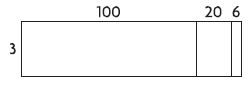
Use the model to find 3 × 126.
Go Math Grade 4 Answer Key Homework Practice FL Chapter 3 Multiply 2-Digit Numbers Common Core - Multiply 2-Digit Numbers img 1
Options:
a. 368
b. 378
c. 468
d. 478

Answer: 378

Explanation:
From the above Figure,
3 × 126 = 3 × 100 + 3 × 20 + 3 × 6
= 300 + 60 + 18
= 378
3 × 126 = 378
The correct answer is option b.

Question 4.
A store sells a certain brand of jeans for $38. One day, the store sold 6 pairs of jeans of that brand. How much money did the store make from selling the 6 pairs of jeans?
Options:
a. $188
b. $228
c. $248
d. $288

Answer: $228

Explanation:
As per the given data,
A store sells a certain brand of jeans for rupees = $38
One day, the store sold 6 pairs of jeans of that brand = 6 × $38
6 × $38 = $228
The total amount of 6 pairs of jeans = $228
The correct answer is option b.

Question 5.
The Gateway Arch in St. Louis, Missouri, weighs about 20,000 tons. Which amount could be the exact number of tons the Arch weighs?
Options:
a. 31,093 tons
b. 25,812 tons
c. 17,246 tons
d. 14,096 tons

Answer: 17,246 tons

Explanation:
From the given data,
The Gateway Arch in St.Louis, Missouri weight = about 20,000 tons
From the available options, 17,246 tons is closer to 20,000 tons
Then, the exact number of tons the Arch weighs = 17,246 tons
The correct answer is option c.

Question 6.
Which is another name for 23 ten thousands?
Options:
a. 23,000,000
b. 2,300,000
c. 230,000
d. 23,000

Answer: 230,000

Explanation:
As per the data,
Another name for 23 ten thousands = 23 × 10,000
= 230,000
Another name for 23 ten thousand = 230,000
The correct answer is option c.

Common Core – Multiply 2-Digit Numbers – Page No. 55

Area Models and Partial Products

Draw a model to represent the product.
Then record the product.

Question 1.
13 × 42
Go Math Grade 4 Answer Key Homework Practice FL Chapter 3 Multiply 2-Digit Numbers Common Core - Multiply 2-Digit Numbers img 2

Question 2.
18 × 34 = _____

Answer:
chapter 3 - Area models and partial products- image 1. jpg
300 + 40 + 240 + 32 = 612

Question 3.
22 × 26 = _____

Answer:
chapter 3 - Area models and partial products- image 2. jpg

400 + 120 + 40 + 12 = 572

Question 4.
15 × 33 = _____

Answer:
chapter 3 - Area models and partial products- image 3. jpg

300 + 30 + 150 + 15 = 495

Question 5.
23 × 29 = _____

Answer:
chapter 3 - Area models and partial products- image 4. jpg

400 + 180 + 60 + 27 = 667

Question 6.
19 × 36 = _____

Answer:
chapter 3 - Area models and partial products- image 5. jpg

300 + 60 + 270 + 54 = 684

Problem Solving

Question 7.
Sebastian made the following model to find the product 17 × 24.
Go Math Grade 4 Answer Key Homework Practice FL Chapter 3 Multiply 2-Digit Numbers Common Core - Multiply 2-Digit Numbers img 3
Is his model correct? Explain.
i. yes
ii. no

Answer: no
chapter 3 - Area models and partial products- image 6. jpg

200 + 40 + 140 + 28 = 408

Question 8.
Each student in Ms. Sike’s kindergarten class has a box of crayons. Each box has 36 crayons. If there are 18 students in Ms. Sike’s class, how many crayons are
there in all?
_____ crayons

Answer: 648 crayons

Explanation:
From the given information,
Each student in Ms.Sike’s kindergarten class has a box of crayons
Crayons in each box = 36 Crayons
Number of students in Mr.Sike’s class = 18 students
Total crayons = 18 × 36
chapter 3 - Area models and partial products- image 7. jpg

300 + 60 + 240 + 48 = 648

Common Core – Multiply 2-Digit Numbers – Page No. 56

Lesson Check

Question 1.
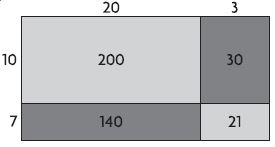
Which product does the model below represent?
Go Math Grade 4 Answer Key Homework Practice FL Chapter 3 Multiply 2-Digit Numbers Common Core - Multiply 2-Digit Numbers img 4
Options:
a. 161
b. 230
c. 340
d. 391

Answer: 391

Explanation:
200 + 30 + 140 + 21 = 391
17 × 23 = 391
The correct answer is option d.

Question 2.
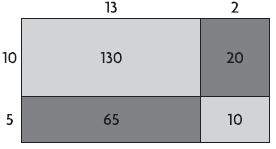
Which product does the model below represent?
Go Math Grade 4 Answer Key Homework Practice FL Chapter 3 Multiply 2-Digit Numbers Common Core - Multiply 2-Digit Numbers img 5
Options:
a. 219
b. 225
c. 244
d. 275

Answer: 225

Explanation:
130 + 20 + 65 + 10 = 225
15 × 15 = 225
The correct answer is option b.

Spiral Review

Question 3.
Mariah builds a tabletop using square tiles. There are 12 rows of tiles and 30 tiles in each row. How many tiles in all does Mariah use?
Options:
a. 100
b. 180
c. 360
d. 420

Answer: 360

Explanation:
From the given data,
Mariah builds a tabletop using square tiles
Square contains 12 rows of tiles and 30 tiles in each row = 12 × 30
12 × 30 = 360 tiles
Total tiles used by Mariah = 360 tiles
The correct answer is option c.

Question 4.
Trevor bakes 8 batches of biscuits, with 14 biscuits in each batch. He sets aside 4 biscuits from each batch for a bake sale and puts the rest in a jar. How many biscuits does Trevor put in the jar?
Options:
a. 112
b. 80
c. 50
d. 32

Answer: 80

Explanation:
As per the given data,
Number of biscuits baked by Trevor = 8 batches
Number of biscuits in each batch = 14 biscuits
So, total biscuits = 14 × 8 = 112
Trevor sets aside 4 biscuits from each batch for a bake = 8 × 4 = 32 biscuits are aside for a bake
Trevor kept rest of biscuits in a jar = 112 – 32 = 80
So, 80 biscuits are put in the jar by Trevor.
The correct answer is option b.

Question 5.
Li feeds her dog 3 cups of food each day. About how many cups of food does her dog eat in 28 days?
Options:
a. 60 cups
b. 70 cups
c. 80 cups
d. 90 cups

Answer: 80 cups

Explanation:
As per the given data,
Li feeds her dog per day = 3 cups of food
Then, Li feeds her dog for 28 days = 3 × 28 = 84 cups of food
So, Li feeds her dog with 84 cups of food in 28 days.
The correct answer is option c.

Question 6.
Which symbol makes the number sentence true?
4 ■ 0 = 0
Options:
a. +
b. –
c. ×
d. ÷

Answer: ×

Explanation:
4 x 0 = 0

Common Core – Multiply 2-Digit Numbers – Page No. 57

Multiply Using Partial Products

Record the product.

Question 1.
2 3
× 7 9
1, 4 0 0
———
2 1 0
1 8 0
+ 2 7
———
1, 8 17

Question 2.
5 6
× 3 2
———
________

Answer: 1,792

Explanation:
Chapter 3 - Common core - Image 7

Question 3.
8 7
× 6 4
———
________

Answer: 5,568

Explanation:
Chapter 3 - Common core - Image 8

Question 4.
3 3
× 2 5
———
________

Answer: 825

Explanation:
Chapter 3 - Common core - Image 9

Question 5.
9 4
× 1 2
———
________

Answer: 1,128

Explanation:
Chapter 3 - Common core - Image 10

Question 6.
5 1
× 7 7
———
________

Answer: 3,927

Explanation:
Chapter 3 - Common core - Image 11

Question 7.
6 9
× 4 9
———
________

Answer: 3,381

Explanation:
Chapter 3 - Common core - Image 12

Question 8.
8 6
× 8 4
———
________

Answer: 7,224

Explanation:
Chapter 3 - Common core - Image 13

Question 9.
9 8
× 4 2
———
________

Answer: 4,116

Explanation:
Chapter 3 - Common core - Image 14

Question 10.
7 3
× 3 7
———
________

Answer: 2,701

Explanation:
Chapter 3 - Common core - Image 15

Question 11.
8 5
× 5 1
———
________

Answer: 4,335

Explanation:
Chapter 3 - Common core - Image 16

Problem Solving

Question 12.
Evelyn drinks 8 glasses of water a day, which is 56 glasses of water a week. How many glasses of water does she drink in a year? (1 year = 52 weeks)
______ glasses

Answer: 2,912 glasses

Explanation:
As per the given data,
Evelyn drinks 8 glasses of water a day
Evelyn drinks water per week = 56 glasses
Then, the number of glasses per 52 weeks = 52 × 56
Chapter 3 - Common core - Image 17
Total number of glasses of water drink by Evelyn per year = 2912 glasses of water

Question 13.
Joe wants to use the Hiking Club’s funds to purchase new walking sticks for each of its 19 members. The sticks cost $26 each. The club has $480. Is this enough money to buy each member a new walking stick? If not, how much more money is needed?
Is the money enough? ________
How much more is needed? ________

Answer:
This amount is not enough to buy walking sticks
Still, $14 amount is needed to buy walking sticks

Explanation:
From the given data,
Joe wants to use the Hiking club funds to purchase new walking sticks for each of its 19 members
Cost per each stick = $26
Total walking sticks cost per 19 members = $26 × 19
Chapter 3 - Common core - Image 18

Total cost for walking sticks for 19 members = $494
The club has = $480
This amount is not enough to buy walking sticks.
Still, $14 amount is needed to buy walking sticks.

Common Core – Multiply 2-Digit Numbers – Page No. 58

Lesson Check

Question 1.
A carnival snack booth made $76 selling popcorn in one day. It made 22 times as much selling cotton candy. How much money did the snack booth make selling
cotton candy?
Options:
a. $284
b. $304
c. $1,562
d. $1,672

Answer: $1,672

Explanation:
As per the given data,
A carnival snack booth made popcorn in one day = $76
It made 22 times as much selling cotton candy
Then, total selling cotton candy made by snack booth = $76 × 22
Chapter 3 - Common core - Image 19

So, $1672 money snack booth will get for selling cotton candy.
Thus the correct answer is option d.

Question 2.
What are the partial products of
42 × 28?
Options:
a. 800, 80, 40, 16
b. 800, 16
c. 800, 40, 320, 16
d. 80, 16

Answer: 800, 40, 320, 16

Explanation:
Chapter 3 - Common core - Image 20

So, partial products of 42 x 28 are 800, 40, 320, 16
Thus the correct answer is option c.

Spiral Review

Question 3.
Last year, the city library collected 117 used books for its shelves. This year, it collected 3 times as many books. How many books did it collect this year?
Options:
a. 832
b. 428
c. 351
d. 72

Answer: 351

Explanation:
From the given data,
Last year, the number of used books collected by the city library by its shelves = 117 books
This year, it collected 3 times as many books = 3 × 117 =351 books
Total number of books collected by the city library for this year = 351 books
Thus the correct answer is option c.

Question 4.
Washington Elementary has 232 students. Washington High has 6 times as many students. How many students does Washington High have?
Options:
a. 1,392
b. 1,382
c. 1,292
d. 1,281

Answer: 1,392

Explanation:
As per the given data,
The number of students in Washington elementary = 232 students
Washington High has 6 times as many students = 6 x 232 = 1392
Total number of students in Washington High = 1392 students
Thus the correct answer is option a.

Question 5.
What are the partial products of 35 × 7?
Options:
a. 10, 12
b. 21, 35
c. 210, 35
d. 350, 21

Answer: 210, 35

Explanation:
Partial products of 35 x 7 are 210, 35
Thus the correct answer is option c.

Question 6.
Shelby has ten $5 bills and thirteen $10 bills. How much money does Shelby have in all?
Options:
a. $15
b. $60
c. $63
d. $180

Answer: $180

Explanation:
From the given data,
Shelby has ten $5 bills and thirteen $10 bills = (10 x $5) + (13 x $10)
= ($50) + ($130)
=$180
Total money with Shelby = $180
Thus the correct answer is option d.

Common Core – Multiply 2-Digit Numbers – Page No. 59

Multiply with Regrouping
Estimate. Then find the product.

Question 1.
Estimate: 2,700
Think: 87 is close to 90 and 32 is close to 30.
90 × 30 = 2,700
Go Math Grade 4 Answer Key Homework Practice FL Chapter 3 Multiply 2-Digit Numbers Common Core - Multiply 2-Digit Numbers img 6

Question 2.
7 3
× 2 8
———
Estimate: _______
Product: _______

Answer:
Estimate: 2,100
Product: 2,044

Explanation:
Estimate: 73 is close to 70; 28 is close to 30.
So, 70 × 30 = 2,100.
Product: Write 73 as 7 tens and 3 ones. Multiply 28 by 3 ones.
2
28
× 73
——–
84 <– 3 × 28
Multiply 28 by 7 tens
5
28
× 73
——–
1960 <– 70 × 28
Add the partial products.
84 + 1960 = 2,044.
So, 73 × 28 = 2,044.

Question 3.
4 8
× 3 8
———
Estimate: _______
Product: _______

Answer:
Estimate: 2,000
Product: 1,824

Explanation:
48 is close to 50 and 38 is close to 40.
Estimate: 50 × 40 = 2,000
40 × 38 = 1520
8 × 38 = 304
1520 + 304 = 1824.
Product: 1,824

Question 4.
5 9
× 5 2
———
Estimate: _______
Product: _______

Answer:
Estimate: 3,000
Product: 3,068

Explanation:
59 is close to 60 and 52 is close to 50.
Estimate: 60 × 50 = 3,000
50 × 52 = 2600
9 × 52 = 468
2600 + 468 = 3068.
Product: 3,068.

Question 5.
8 4
× 4 0
———
Estimate: _______
Product: _______

Answer:
Estimate: 3,200
Product: 3,360

Explanation:
84 is close to 80 and 40 is close to 40.
Estimate: 80 × 40 = 3,200
80 × 40 = 3,200
4 × 40 = 160
3200 + 160 = 3,360.
Product: 3,360.

Question 6.
8 3
× 7 7
———
Estimate: _______
Product: _______

Answer:
Estimate: 6,400
Product: 6,391

Explanation:
83 is close to 80 and 77 is close to 80.
Estimate: 80 × 80 = 6,400
80 × 77 = 6,160
3 × 77 = 231
6,160 + 231 = 6,391.
Product: 6,391.

Question 7.
9 1
× 1 9
———
Estimate: _______
Product: _______

Answer:

Estimate: 1,800
Product: 1,729

Explanation:
91 is close to 90 and 19 is close to 20.
Estimate: 90 × 20 = 1,800
90 × 19 = 1,710
1 × 19 = 19
1,710+ 19 = 1,729.
Product: 1,729.

Problem Solving

Question 8.
Baseballs come in cartons of 84 baseballs. A team orders 18 cartons of baseballs. How many baseballs does the team order?
______ baseballs

Answer: 1,512 baseballs

Explanation:
Given,
Baseballs come in cartons of 84 baseballs.
A team orders 18 cartons of baseballs.
To find total baseballs, 84 × 18
80 × 18 = 1,440
4 × 18 = 72
84 × 18 = 1,512
Thus the team order 1512 baseballs.

Question 9.
There are 16 tables in the school lunch room. Each table can seat 22 students. How many students can be seated at lunch at one time?
______ students

Answer: 352 students

Explanation:
Given,
There are 16 tables in the school lunch room.
Each table can seat 22 students.
Total Students = 16 × 22
10 × 22 = 220
6 × 22 = 132
220 + 132 = 352.
352 students can be seated at lunch at one time.

Common Core – Multiply 2-Digit Numbers – Page No. 60

Lesson Check

Question 1.
The art teacher has 48 boxes of crayons. There are 64 crayons in each box. Which is the best estimate of the number of crayons the art teacher has?
Options:
a. 2,400
b. 2,800
c. 3,000
d. 3,500

Answer: 3,000

Explanation:
Given,
The art teacher has 48 boxes of crayons. There are 64 crayons in each box.
Total number of crayons = 48 × 64
48 is close to 50; 64 is close to 60
50 × 60 = 3,000.
The art teacher has about 3, 000 crayons.
The correct answer is option c.

Question 2.
A basketball team scored an average of 52 points in each of 15 games. How many points did the team score in all?
Options:
a. 500
b. 312
c. 780
d. 1,000

Answer: 780

Explanation:
Given,
A basketball team scored an average of 52 points in each of 15 games.
Total Points = 52 × 15
50 × 15 = 750
2 × 15 = 30
750 + 30 = 780.
The basketball team scored 780 points in total.
The correct answer is option c.

Spiral Review

Question 3.
One Saturday, an orchard sold 83 bags of apples. There are 27 apples in each bag. Which expression represents the total number of apples sold?
Options:
a. 16 + 6 + 56 + 21
b. 160 + 60 + 56 + 21
c. 160 + 60 + 560 + 21
d. 1,600 + 60 + 560 + 21

Answer: 1,600 + 60 + 560 + 21

Explanation:
Total number of apples sold = 83 × 27
80 × 27 = 2,160
3 × 27 = 81
2,160 + 81 = 2,241.
The total number of apples sold = 2,241.
16 + 6 + 56 + 21 = 99 not equal to 2,241
160 + 60 + 56 + 21 = 297 not equal to 2,241
160 + 60 + 560 + 21 = 801 not equal to 2,241
1,600 + 60 + 560 + 21 = 2,241 equal to 2,241
1,600 + 60 + 560 + 21 = 2,241 is correct.
The correct answer is option d.

Question 4.
Hannah has a grid of squares that has 12 rows with 15 squares in each row. She colors 5 rows of 8 squares in the middle of the grid blue. She colors the rest of the squares red. How many squares does Hannah color red?
Options:
a. 40
b. 140
c. 180
d. 220

Answer: 140

Explanation:
Hannah has a grid of squares that has 12 rows with 15 squares in each row = 12 × 15 = 180.
She colors 5 rows of 8 squares in the middle of the grid blue.
The grid of squares in blue = 5 × 8 = 40.
The grid of squares in red = 180 – 40 = 140.
The correct answer is option b.

Question 5.
Gabriella has 4 times as many erasers a Leona. Leona has 8 erasers. How many erasers does Gabriella have?
Options:
a. 32
b. 24
c. 12
d. 2

Answer: 32

Explanation:
Given,
Gabriella has 4 times as many erasers a Leona.
Leona has 8 erasers.
Gabriella have 4 x 8 = 32 erasers.
The correct answer is option a.

Question 6.
Phil has 3 times as many rocks as Peter. Together, they have 48 rocks. How many more rocks does Phil have than Peter?
Options:
a. 36
b. 24
c. 16
d. 12

Answer: 24

Explanation:
Phil has 3 times as many rocks as Peter. Together, they have 48 rocks
If Peter has x rocks, Phil has 3x rocks
3x + x = 48.
4x = 48.
x = 48/4 = 12.
Peter has 12 rocks. Phil has 3 × 12 = 36 rocks.
Phil has 36 – 12 = 24 more rocks than Peter.
The correct answer is option b.

Common Core – Multiply 2-Digit Numbers – Page No. 61

Choose a Multiplication Method

Estimate. Then choose a method to find the product.

Question 1.
Estimate: 1,200
3 1
× 4 3
——-
9 3
+ 1, 2 4 0
———–
1, 3 3 3

Question 2.
6 7
× 8 5
———-
Estimate: _________
Product: _________

Answer:
Estimate: 6,300
Product: 5,695

Explanation:
Estimate: 67 is close to 70; 85 is close to 90.
70 × 90 = 6,300.
Product: 67 × 85
80 × 6 tens = 480 tens
80 × 7 ones = 560 ones
5 × 6 tens = 30 tens
5 × 7 ones = 35 ones.
Add partial products.
4800 + 560 + 300 + 35 = 5,695.

Question 3.
6 8
× 3 8
———-
Estimate: _________
Product: _________

Answer:
Estimate: 2,800
Product: 2,584

Explanation:
Estimate: 68 is close to 70; 38 is close to 40.
70 × 40 = 2,800.
Product: 68 × 38
30 × 6 tens = 180 tens
30 × 8 ones = 240 ones
8 × 6 tens = 48 tens
8 × 8 ones = 64 ones.
Add partial products.
1800 + 240 + 480 + 64 = 2,584.

Question 4.
9 5
× 1 7
———-
Estimate: _________
Product: _________

Answer:
Estimate: 1,700
Product: 1,615

Explanation:
Estimate: 95 is close to 100.
100 × 17 = 1,700.
Product: 95 × 17
10 × 9 tens = 90 tens
10 × 5 ones = 50 ones
7 × 9 tens = 63 tens
7 × 5 ones = 35 ones.
Add partial products.
900 + 50 + 630 + 35 = 1,615.

Question 5.
4 9
× 5 4
———-
Estimate: _________
Product: _________

Answer:
Estimate: 2,500
Product: 2,646

Explanation:
Estimate: 49 is close to 50; 54 is close to 50.
50 × 50 = 2,500.
Product: 49 × 54
50 × 4 tens = 200 tens
50 × 9 ones = 450 ones
4 × 4 tens = 16 tens
4 × 9 ones = 36 ones.
Add partial products.
2000 + 450 + 160 + 36 = 2,646.

Question 6.
9 1
× 2 6
———-
Estimate: _________
Product: _________

Answer:
Estimate: 2,700
Product: 2,366

Explanation:
Estimate: 91 is close to 90; 26 is close to 30.
90 × 30 = 2,700.
Product: 49 × 54
20 × 9 tens = 180 tens
20 × 1 ones = 20 ones
6 × 9 tens = 54 tens
6 × 1 ones = 6 ones.
Add partial products.
1800 + 20 + 540 + 6 = 2,366.

Question 7.
8 2
× 1 9
———-
Estimate: _________
Product: _________

Answer:
Estimate: 1,600
Product: 1,558

Explanation:
Estimate: 82 is close to 80; 19 is close to 20.
80 × 20 = 1,600.
Product: 82 × 19
10 × 8 tens = 80 tens
10 × 2 ones = 20 ones
9 × 8 tens = 72 tens
9 × 2 ones = 18 ones.
Add partial products.
800 + 20 + 720 + 18 = 1,558.

Question 8.
4 6
× 2 7
———-
Estimate: _________
Product: _________

Answer:
Estimate: 1,500
Product: 1,242

Explanation:
Estimate: 46 is close to 50; 27 is close to 30.
50 × 30 = 1,500.
Product: 46 × 27
20 × 4 tens = 80 tens
20 × 6 ones = 120 ones
7 × 4 tens = 28 tens
7 × 6 ones = 42 ones.
Add partial products.
800 + 120 + 280 + 42 = 1,242.

Question 9.
4 1
× 3 3
———-
Estimate: _________
Product: _________

Answer:
Estimate: 1,200
Product: 1,353

Explanation:
Estimate: 41 is close to 40; 33 is close to 30.
40 × 30 = 1,200.
Product: 41 × 33
30 × 4 tens = 120 tens
30 × 1 ones = 30 ones
3 × 4 tens = 12 tens
3 × 1 ones = 3 ones.
Add partial products.
1200 + 30 + 120 + 3 = 1,353.

Question 10.
9 7
× 1 3
———-
Estimate: _________
Product: _________

Answer:
Estimate: 1,300
Product: 1,261

Explanation:
Estimate: 97 is close to 100.
100 × 13 = 1,300.
Product: 97 × 13
10 × 9 tens = 90 tens
10 × 7 ones = 70 ones
3 × 9 tens = 27 tens
3 × 7 ones = 21 ones.
Add partial products.
900 + 70 + 270 + 21 = 1,261.

Question 11.
7 5
× 6 9
———-
Estimate: _________
Product: _________

Answer:
Estimate: 5,600
Product: 5,195

Explanation:
Estimate: 75 is close to 80; 69 is close to 70.
80 × 70 = 5,600.
Product: 75 × 69
60 × 7 tens = 420 tens
60 × 5 ones = 300 ones
9 × 7 tens = 63 tens
9 × 5 ones = 45 ones.
Add partial products.
4200 + 300 + 630 + 45 = 5,195.

Problem Solving

Question 12.
A movie theatre has 26 rows of seats. There are 18 seats in each row. How many seats are there in all?
_____ seats

Answer: 468 seats

Explanation:
Given,
A movie theatre has 26 rows of seats.
There are 18 seats in each row.
26 x 18 = 468 seats.
20 x 18 = 360
6 x 18 = 108
108+360 = 468.
Therefore there are 468 seats in all.

Question 13.
Each class at Briarwood Elementary collected at least 54 cans of food during the food drive. If there are 29 classes in the school, what was the least number of
cans collected?
_____ cans

Answer: 1,566 cans

Explanation:
Each class at Briarwood Elementary collected at least 54 cans of food.
If there are 29 classes in the school,
the least number of cans collected = 54 x 29 = 1,566 cans.

Common Core – Multiply 2-Digit Numbers – Page No. 62

Lesson Check

Question 1.
A choir needs new robes for each of its 46 singers. Each robe costs $32. What will be the total cost for all 46 robes?
Options:
a. $1,472
b. $1,372
c. $1,362
d. $230

Answer: $1,472

Explanation:
Given,
A choir needs new robes for each of its 46 singers. Each robe costs $32.
46 × $32
40 × $32 = $1,280
6 × $32 = $192
$1,280 + $192 = $1,472
The correct answer is option a.

Question 2.
A wall on the side of a building is made up of 52 rows of bricks with 44 bricks in each row. How many bricks make up the wall?
Options:
a. 3,080
b. 2,288
c. 488
d. 416

Answer: 2,288

Explanation:
Given,
A wall on the side of a building is made up of 52 rows of bricks with 44 bricks in each row.
52 × 44
50 × 44 = 2,200
2 × 44 = 88
2,200 + 88 = 2,288.
2,288 bricks make up the wall.
The correct answer is option b.

Spiral Review

Question 3.
Which expression shows how to multiply 4 × 362 by using place value and expanded form?
Options:
a. (4 × 3) + (4 × 6) + (4 × 2)
b. (4 × 300) + (4 × 600) +(4 × 200)
c. (4 × 300) + (4 × 60) + (4 × 20)
d. (4 × 300) + (4 × 60) + (4 × 2)

Answer: (4 × 300) + (4 × 60) + (4 × 2)

Explanation:
4 × 362 = 1,448
a. (4 × 3) + (4 × 6) + (4 × 2) = 12 + 24 + 8 = 44 not equal to 1,448.
b. (4 × 300) + (4 × 600) +(4 × 200) = 1200 + 2400 + 800 = 4,400 not equal to 1,448.
c. (4 × 300) + (4 × 60) + (4 × 20) = 1200 + 240 + 80 = 1,520 not equal to 1,448.
d. (4 × 300) + (4 × 60) + (4 × 2) = 1200 + 240 + 8 = 1,448 equal to 1,448.
The correct answer is option d.

Question 4.
Use the model below. What is the product 4 × 492?
Go Math Grade 4 Answer Key Homework Practice FL Chapter 3 Multiply 2-Digit Numbers Common Core - Multiply 2-Digit Numbers img 7
Options:
a. 16 + 36 + 8 = 60
b. 160 + 36 + 8 = 204
c. 160 + 360 + 8 = 528
d. 1,600 + 360 + 8 = 1,968

Answer: 1,600 + 360 + 8 = 1,968

Grade 4 Chapter 3 Common Core 182

1,600 + 360 + 8 = 1,968
The correct answer is option d.

Question 5.
What is the sum 13,094 + 259,728?
Options:
a. 272,832
b. 272,822
c. 262,722
d. 262,712

Answer: 262,722

Explanation:
13,094 + 259,728 = 262,722
The correct answer is option c.

Question 6.
During the 2008–2009 season, there were 801,372 people who attended the home hockey games in Philadelphia. There were 609,907 people who attended the home hockey games in Phoenix. How much greater was the home attendance in Philadelphia than in Phoenix that season?
Options:
a. 101,475
b. 191,465
c. 201,465
d. 202,465

Answer: 191,465

Explanation:
Given,
During the 2008–2009 season, there were 801,372 people who attended the home hockey games in Philadelphia.
There were 609,907 people who attended the home hockey games in Phoenix.
801,372 – 609,907 = 191,465
Philadelphia attendance is 191,465 greater than in Phoenix that season.
The correct answer is option b.

Common Core – Multiply 2-Digit Numbers – Page No. 63

Problem Solving Multiply 2 – Digit numbers

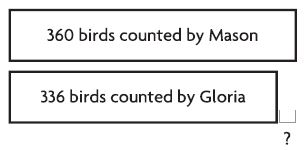
Solve each problem. Use a bar model to help.

Question 1.
Mason counted an average of 18 birds at his bird feeder each day for 20 days. Gloria counted an average of 21 birds at her bird feeder each day for 16 days. How many more birds did Mason count at his feeder than Gloria counted at hers?
Go Math Grade 4 Answer Key Homework Practice FL Chapter 3 Multiply 2-Digit Numbers Common Core - Multiply 2-Digit Numbers img 8
Birds counted by Mason: 18 × 20 = 360
Birds counted by Gloria: 21 × 16 = 336
Draw a bar model to compare.
Subtract. 360 – 336 = 24
So, Mason counted 24 more birds.

Question 2.
The 24 students in Ms. Lee’s class each collected an average of 18 cans for recycling. The 21 students in Mr. Galvez’s class each collected an average of 25 cans for recycling. How many more cans were collected by Mr. Galvez’s class than Ms. Lee’s class?
_____ more cans

Answer: 93 more cans

Explanation:
The number of cans collected by Ms. Lee’s class = 18 × 24 = 432.
The number of cans collected by Mr. Galvez’s class = 25 × 21 = 525.
Use Bar Model
Grade 4 Chapter 3 Common Core 187

Subtract. 525 – 432 = 93 more cans.
So, Mr. Galvez’s class collected 93 more cans than Ms. Lee’s class.

Question 3.
At East School, each of the 45 classrooms has an average of 22 students. At West School, each of the 42 classrooms has an average of 23 students. How many more students are at East School than at West School?
_____ more students

Answer: 24 more students

Explanation:
Students in East school = 45 × 22 = 990.
Students in West School = 42 × 23 = 966.
Use Bar Model
Grade 4 Chapter 3 Common Core image 2 187

Subtract. 990 – 966 = 24.
So, East School has 24 students more than West School.

Question 4.
A zoo gift shop orders 18 boxes of 75 key rings each and 15 boxes of 80 refrigerator magnets each. How many more key rings than refrigerator magnets does the gift shop order?
_____ more key rings

Answer: 150 more key rings

Explanation:
Number of Key Rings = 75 x 18 = 1,350.
Number of Refrigerator Magnets= 80 x 15 = 1,200.
Use Bar Model
Grade 4 Chapter 3 Common Core image 3 187
Subtract. 1,350 – 1,200 = 150.
So, key rings are 150 more than refrigerator magnets.

Common Core – Multiply 2-Digit Numbers – Page No. 64

Lesson Check

Question 1.
Ace Manufacturing ordered 17 boxes with 85 ball bearings each. They also ordered 15 boxes with 90 springs each. How many more ball bearings than springs did they order?
Options:
a. 5
b. 85
c. 90
d. 95

Answer: 95

Explanation:
Number of ball bearings = 85 × 17 = 1,445.
Number of springs = 90 × 15 = 1,350.
Use Bar Model
Grade 4 Chapter 3 Common Core image 1 188

Subtract. 1,445 – 1,350 = 95.
So, ball bearings are 95 more than springs.
The correct answer is option d.

Question 2.
Elton hiked 16 miles each day on a 12-day hiking trip. Lola hiked 14 miles each day on her 16-day hiking trip. In all, how many more miles did Lola hike than Elton hiked?
Options:
a. 2 miles
b. 18 miles
c. 32 miles
d. 118 miles

Answer: 32 miles

Explanation:
Hiking trip by Elton = 12 × 16 = 192.
Hiking trip by Lola = 16 × 14 = 224.
Use Bar Model
Grade 4 Chapter 3 Common Core image 2 188

Subtract. 224 – 192 = 32.
So, the Hiking trip by Lola is 32 times more than the Hiking trip by Elton.
The correct answer is option c.

Spiral Review

Question 3.
An orchard has 24 rows of apple trees. There are 35 apple trees in each row. How many apple trees are in the orchard?
Options:
a. 59
b. 192
c. 740
d. 840

Answer: 840

Explanation:
An orchard has 24 rows of apple trees. There are 35 apple trees in each row.
24 × 35 = 840 apple trees are in the orchard.
The correct answer is option d.

Question 4.
An amusement park reported 354,605 visitors last summer. What is this number rounded to the nearest thousand?
Options:
a. 354,600
b. 355,000
c. 360,000
d. 400,000

Answer: 355,000

Explanation:
An amusement park reported 354,605 visitors last summer. 4,605 is close to 5,000.
So, the answer is 355,000.
The correct answer is option b.

Question 5.
Attendance at the football game was 102,653. What is the value of the digit 6?
Options:
a. 6
b. 60
c. 600
d. 6,000

Answer: 600

Explanation:
Digit 6 is at hundreds of positions.
So, the answer is 6 x 100 = 600.
The correct answer is option c.

Question 6.
Jill’s fish weighs 8 times as much as her parakeet. Together, the pets weigh 63 ounces. How much does the fish weigh?
Options:
a. 7 ounces
b. 49 ounces
c. 55 ounces
d. 56 ounces

Answer: 56 ounces

Explanation:
Let Jill’s parakeet = X.
Jill’s fish weighs 8 times as much as her parakeet = 8X.
Together, the pets weigh 63 ounces.
X + 8X = 63.
9X = 63.
X = 63/9 = 7.
So, Jill’s parakeet =7.
Jill’s fish = 7 × 8 = 56 ounces.
The correct answer is option d.

Common Core – Multiply 2-Digit Numbers – Page No. 65

Lesson 3.1

Choose a method. Then find the product.

Question 1.
12 × 60 = _____

Answer: 720

Explanation:
By using the place value method
You can take 10 as 1 ten
12 × 60 = 12 × 6 ten
= 72 ten
12 × 60 = 720

Question 2.
56 × 40 = _____

Answer: 2240

Explanation:
56 × 40
By using the associative property
You can think of 40 as (4 × 10)
56 × 40 = 56 × (4 × 10)
= (56 × 4) × 10
= 224 × 10
56 × 40 = 2240

Question 3.
30 × 40 = _____

Answer: 1200

Explanation:
30 × 40
By using the place value method
You can take 30 as 3 tens
30 × 40 = 30 × 4 tens
= 120 tens
30 × 40 = 1200

Question 4.
50 × 67 = _____

Answer: 3350

Explanation:
By using the place value method
You can take 50 as 5 tens
50 x 67 = 67 x 5 tens
= 335 tens
50 × 67 = 3350

Lesson 3.2

Estimate the product. Choose a method.

Question 5.
33 × 76 = _____

Answer: 2400

Round to the nearest tens.
33 is close to 30; 76 is close to 80;
Use the mental math
30 × 80  = 2400
So, estimated product of 33 × 76 = 2400

Question 6.
43 × 90 = _____

Answer: 3600

Explanation:
Round to the nearest tens.
43 is close to 40; 90 is close to 90;
Use the mental math, then
9 × 4 = 36
90 × 40 = 3,600
So, estimated product of 43 × 90 = 3,600

Question 7.
47 × $ 66 = _____

Answer: $3500

Explanation:
Round to the nearest tens.
47 is close to 50; 66 is close to 70;
Use the mental math, then
50 × 70 = 3,500
So, estimated product of 50 × 70 = $3,500

Question 8.
12 × 81 = _____

Answer: 800

Explanation:
Round to the nearest tens.
12 is close to 10; 81 is close to 80;
Use mental math, then
10 × 80 = 800
So, the estimated product of 12 × 81 = 800

Question 9.
46 × 47 = _____

Answer: 2500

Explanation:
Round to the nearest tens.
46 is close to 50; 47 is close to 50;
Use mental math, then
50 × 50 = 2500
So, the estimated product of 46 × 47 = 2500

Question 10.
58 × 79 = _____

Answer: 4800

Explanation:
Round to the nearest tens.
58 is close to 60; 79 is close to 80;
Use mental math, then
60 × 80 = 4800
So, the estimated product of 58 × 79 = 4800

Question 11.
24 × 73 = _____

Answer: 1400

Explanation:
Round to the nearest tens.
24 is close to 20; 73 is close to 70;
Use mental math, then
20 × 70 = 1400
So, the estimated product of 24 × 73 = 1400

Question 12.
68 × 36 = _____

Answer: 2800

Explanation:
Round to the nearest tens.
68 is close to 70; 36 is close to 40;
Use mental math, then
70 × 40 = 2800
So, the estimated product of 68 × 36 = 2800

Lesson 3.3

Draw a model to represent the product.
Then record the product.

Question 13.
41 × 16 = _____

Answer: 656

Explanation:
Chapter-3-Common-core-image-2-1
400 + 240 + 10 + 6 = 656

Question 14.
39 × 52 = _____

Answer: 2028

Explanation:
Chapter-3-Common-core-image-2-2
1500 + 60 + 450 + 18 = 2028

Question 15.
94 × 36 = _____

Answer: 3384

Explanation:
Chapter-3-Common-core-image-2-3
2700 + 540 + 120 + 24 = 3384

Common Core – Multiply 2-Digit Numbers – Page No. 66

Lesson 3.4

Record the product.

Question 1.
5 3
× 3 7
———
________

Answer: 1961

Go Math Grade 4 Chapter 3 img 3-1

Question 2.
4 8
× 47
———
________

Answer: 2256

Go Math Grade 4 Chapter 3 img 3-2

Question 3.
6 5
× 2 8
———
________

Answer: 1820

Go Math Grade 4 Chapter 3 img 3-3

Question 4.
9 2
× 7 9
———
________

Answer: 7268

Go Math Grade 4 Chapter 3 img 3-4

Lessons 3.5–3.6

Estimate. Then choose a method to find the product.

Question 5.
4 8
× 2 1
———
Estimate: ________
Product: ________

Answer:

Explanation:
48 × 21
Estimate: Think 48 is close to 50; 21 is close to 20.
50 x 20 = 1000
Product:
10 x 5 tens = 50 tens
50 x 2 ones = 100 ones
2 x 2 tens = 40 tens
4 x 2 ones = 8 ones.
Add partial products.
500 + 100 + 400 + 8 = 1008.

Question 6.
$ 7 2
× 4 6
———
Estimate: ________
Product: ________

Answer: 3312

Estimate: Think 72 is close to 70; 46 is close to 50.
70 × 50 = 3500
Product:
70 x 4 tens = 280 tens
50 x 2 ones = 100 ones
4 x 10 tens = 40 tens
4 x 6 ones = 24 ones.
Add partial products.
2800 + 100 + 400 + 12 = 3312

Question 7.
$ 3 9
× 5 8
———
Estimate: ________
Product: ________

Answer: 2262

Estimate: Think 39 is close to 40; 58 is close to 60.
40 × 60 = 2400
Product:
30 x 5 tens = 150 tens
9 x 8 ones = 72 ones
8 x 3 tens = 24 tens
9 x 5 tens = 45 tens.
Add partial products.
1500 + 240 + 450 + 72 = 2262

Question 8.
27 × $ 19
Estimate: ________
Product: ________

Answer: 513

Estimate: Think 27 is close to 30; 19 is close to 20.
30 × 20 = 600
Product:
20 x 9 ones = 180 ones
9 x 7 ones = 63 ones
20 x 1 tens = 20 tens
7 x 10 ones = 70 ones.
Add partial products.
180 + 70 + 63 + 200 = 513

Question 9.
97 × 32
Estimate: ________
Product: ________

Answer: 3104

Estimate: Think 97 is close to 100; 32 is close to 30.
100 × 30 = 3000
Product:
30 x 9 tens = 270 tens
30 x 7 ones = 210 ones
2 x 9 tens = 18 tens
2 x 7 ones = 14 ones.
Add partial products.
2700 + 210 + 14 + 180 = 3104

Question 10.
44 × 69
Estimate: ________
Product: ________

Answer: 3036

Estimate: Think 44 is close to 40; 69 is close to 70.
100 × 30 = 3000
Product:
40 x 6 tens = 240 tens
40 x 9 ones = 360 ones
4 x 6 tens = 24 tens
4 x 9 ones = 36 ones.
Add partial products
2400 + 360 + 240 + 36 = 3036

Question 11.
Last week, Ms. Simpson worked 28 hours. She stocked shelves for 45 minutes each hour for 14 of those hours. The rest of the time she worked in customer service. How many minutes last week did Ms. Simpson work in customer service? (Hint: 1 hour = 60 minutes)
______ minutes

Answer: 1050 minutes

Explanation:
Given,
Last week, Ms. Simpson worked 28 hours.
She stocked shelves for 45 minutes each hour for 14 of those hours.
The rest of the time she worked in customer service.
45 × 14 = 630
She worked 630 minutes stocking shelves, which equals 10 hours and 30 minutes.
After that, she worked another 17 hours and 30 minutes in customer service.
17 × 60 = 1020
1020 + 30 = 1050
Ms. Simpson worked 1050 minutes in customer service.

Question 12.
The after-school craft center has 15 boxes of 64 crayons each. In 12 of the boxes, 28 of the crayons have not been used. All the rest have been used. How many of the crayons in the center have been used?
______ crayons

Answer: 624 crayon

Explanation:
In 12 of the boxes, 28 crayons have not been used; this leaves 64-28=36 crayons that have been used. 12(36) = 432 crayons have been used in these boxes.
3 full boxes have been used; this is 3(64) = 192 crayons.
Together this makes 432 + 192 = 624 crayons that have been used.

Conclusion:

I wish the explanation provided in our Go Math Grade Chapter 3 Homework Practice FL Multiply 2-Digit Numbers is beneficial for all the 4th standard students in scoring the marks in the exams. To solve more questions check out to Go Math Grade Chapter 3 Multiply 2-Digit Numbers pdf. All the Best Guys!!!!

Go Math Grade 4 Answer Key Homework Practice FL Chapter 3 Multiply 2-Digit Numbers Read More »

go-math-grade-4-answer-key-chapter-5-factors

Go Math Grade 4 Answer Key Homework Practice FL Chapter 5 Factors, Multiples, and Patterns

All the students can input their answers from Go Math Grade 4 Answer Key. Go Math Grade 4 Answer Key Homework Practice FL Chapter 5 Factors, Multiples, and Patterns helps the students to complete the homework and assignments. This chapter helps the students to learn the concepts of factors, multiples in an easy manner.

Go Math Grade 4 Answer Key Homework Practice FL Chapter 5 Factors, Multiples, and Patterns

The students who are lagging in the Factors, Multiples, and Patterns can learn through our Go Math Answer Key. Just tap the link and start preparing now. Refer Go Math Grade 4 Answer Key Homework Practice FL Chapter 5 Factors, Multiples, and Patterns to enhance your skills and score well in the exams.

Lesson: 1 – Model Factors

Lesson: 2

Lesson: 3 – Problem Solving Common Factors

Lesson: 4 – Factors and Multiples

Lesson: 5 – Prime and Composite Numbers

Lesson: 6 – Number Patterns

Lesson: 7

Common Core – Factors, Multiples, and Patterns – Page No. 97

Model Factors

Use tiles to find all the factors of the product.

Record the arrays on grid paper and write the factors shown.

Question 1.
Go Math Grade 4 Answer Key Homework Practice FL Chapter 5 Factors, Multiples, and Patterns Common Core - Factors, Multiples, and Patterns img 1

Question 2.
Write the factors of: 30
Type below:
_________

Answer: The Factors of 30 are: 1,2,3,5,6,10,15,30.

Explanation:
Factors are the numbers that divide the original number completely. Here, we can see the numbers which give the result as 30 when multiplied together.
1 × 30 =30
2 × 15 = 30
3 × 10 = 30
5 × 6 = 30
6 × 5 = 30
10 × 3 = 30
15 × 2 = 30
30 × 1 = 30
So the factors of 30 are 1,2,3.5,6,10,15,30.

Question 3.
Write the factors of: 45
Type below:
_________

Answer: The Factors of 45 are:1,3,5,9,15,45

Explanation:
Factors are the numbers that divide the original number completely. Here, we can see the numbers which give the result as 45 when multiplied together.
1×45=45
3×15=45
5×9=45
9×5=45
15×3=45
45×1=45
So the factors of 45 are: 1,3,5,9,15,45.

Question 4.
Write the factors of: 19
Type below:
_________

Answer: The Factors of 19 are: 1,19

Explanation:
Since 19 is a Prime number that means it is divisible by 1 and itself.
1 × 19 = 19
19 × 1 = 19
So the factors of 19 are 1,19.

Question 5.
Write the factors of: 40
Type below:
_________

Answer:

The Factors of 40 are:1,2,4,5,8,10,20,40.

Explanation:
Factors are the numbers that divide the original number completely.
1×40=40
2×20=40
4×10=40
5×8=40
8×5=40
10×4=40
20×2=40
40×1=40
The Factors of 40 are: 1,2,4,5,8,10,20,40.

Question 6.
Write the factors of: 36
Type below:
_________

Answer: The Factors Of 36 are:1,2,3,4,6,9,12,18,36.

Explanation:
Factors are the numbers which divides the original number completely.
1×36=36
2×18=36
3×12=36
4×9=36
6×6=36
9×4=36
12×3=36
18×3=36
36×1=36.
The factors of 36 are:1,2,3,4,6,9,12,18,36

Question 7.
Write the factors of: 22
Type below:
_________

Answer: The Factors Of 22 are:1,2,11,22.

Explanation:
Factors are the numbers that divide the original number completely.
1×22=22
2×11=22
11×2=22
22×1=22.
The factors of 22 are:1,2,11,22.

Question 8.
Write the factors of: 4
Type below:
_________

Answer: The Factors Of 4 are: 1,2,4.

Explanation:
Factors are the numbers that divide the original number completely.
1×4=4
2×2=4
4×1=4.
The Factors Of 4 are 1,2,4.

Question 9.
Write the factors of: 26
Type below:
_________

Answer: The Factors Of 26 are:1,2,13,26.

Explanation:
Factors are the numbers that divide the original number completely. Here, we can see the numbers which give the result as 26 when multiplied together.
1×26=26
2×13=26
13×2=26
26×1=26.
So the factors of 26 are:1,2,13,26.

Question 10.
Write the factors of: 49
Type below:
_________

Answer: The Factors Of 49 are: 1,7,49.

Explanation:
Factors are the numbers that divide the original number completely.
1×49=49
7×7=49
49×1=49.
The Factors Of 49 are 1,7,49.

Question 11.
Write the factors of: 32
Type below:
_________

Answer: The Factors Of 32 are:1,2,4,8,16,32.

Explanation:
Factors are the numbers that divide the original number completely. Here, we can see the numbers which give the result as 32 when multiplied together.
1×32=32
2×16=32
4×8=32
8×4=32
16×2=32
32×1=32.
So the factors of 32 are:1,2,4,8,16,32.

Question 12.
Write the factors of: 23
Type below:
_________

Answer: The Factors Of 23 are: 1,23.

Explanation:
Since 23 is a Prime number that means it is divisible by 1 and itself.
1×23=23
23×1=23.
So the factors of 23 are 1,23.

Question 13.
Brooke has to set up 70 chairs in equal rows for the class talent show. But, there is not room for more than 20 rows. What are the possible number of rows that Brooke could set up?
Type below:
_________

Answer: 2,5,7,10,14.

Explanation:
Let the possible no.of rows be X, As there is no room for more than 20 rows so there should not be more than 20 rows.X should be less than or equal to 20 (X<=20).
As Brooke has 70 chairs to set up in equal rows we will find the factors of 70 and in that, we must pick up the numbers which are less than equal to 20.
Therefore the factors of 70 are 2,5,7,10,14.

Question 14.
Eduardo thinks of a number between 1 and 20 that has exactly 5 factors. What number is he thinking of?
_________

Answer: 16

Explanation:
If find factors for 1 to 20 we don’t get exactly 5 factors for any number except 16.
So the answer is 16.
Thus Eduardo might be thinking of the number 16.

Common Core – Factors, Multiples, and Patterns – Page No. 98

Lesson Check

Question 1.
Which of the following lists all the factors of 24?
Options:
a. 1, 4, 6, 24
b. 1, 3, 8, 24
c. 3, 4, 6, 8
d. 1, 2, 3, 4, 6, 8, 12, 24

Answer: 1, 2, 3, 4, 6, 8, 12, 24

Explanation:
Factors are the numbers that divide the original number completely.
Here, we can see the numbers which give the result as 24 when multiplied together.
1×24=24
2×12=24
3×8=24
4×6=24
6×4=4
8×3=24
12×2=24
24×1=24
So the factors of 24 are:1, 2, 3, 4, 6, 8, 12, 24.
Thus the correct answer is option d.

Question 2.
Natalia has 48 tiles. Which of the following shows a factor pair for the number 48?
Options:
a. 4 and 8
b. 6 and 8
c. 2 and 12
d. 3 and 24

Answer: 6 and 8

Explanation:
Given that, Natalia has 48 tiles.
We have to find the factor pair of the number 48.
6 and 8 are factor pairs for 48 because 6×8=48.
Thus the correct answer is option b.

Spiral Review

Question 3.
The Pumpkin Patch is open every day. If it sells 2,750 pounds of pumpkins each day, about how many pounds does it sell in 7 days?
Options:
a. 210 pounds
b. 2,100 pounds
c. 14,000 pounds
d. 21,000 pounds

Answer: 21,000 pounds

Explanation:
Given that, The Pumpkin Patch is open every day.
Let’s round off 2750 pounds to 3000 pounds. In one day 3000 pounds pumpkins were sold out, and in
7 days?? —- 3000×7= 21,000 pounds.
It sold 21,000 pounds in 7 days.
Thus the correct answer is option d.

Question 4.
What is the remainder in the division problem modeled below?
Go Math Grade 4 Answer Key Homework Practice FL Chapter 5 Factors, Multiples, and Patterns Common Core - Factors, Multiples, and Patterns img 2
Options:
a. 2
b. 3
c. 5
d. 17

Answer: 2

Explanation:
We can see in the above figure 3 circles with 5 sub circles inside it and a pair of sub circles.
Here total sub circles are (3×5)+2=17.
If we divide 17 with 3 then we will get a reminder as 2.
So the answer is 2.
Thus the correct answer is option a.

Question 5.
Which number sentence is represented by the following array?
Go Math Grade 4 Answer Key Homework Practice FL Chapter 5 Factors, Multiples, and Patterns Common Core - Factors, Multiples, and Patterns img 3
Options:
a. 4 × 5 = 20
b. 4 × 4 = 16
c. 5 × 2 = 10
d. 5 × 5 = 25

Answer: 4 × 5 = 20

Explanation:
By seeing the above figure we can say that there are 4 rows and 5 columns.
As we can see 4 rows and 5 squares.
Multiply the number of rows with the number of columns.
So 4 × 5 = 20.
Thus the correct answer is option a.

Question 6.
Channing jogs 10 miles a week. How many miles will she jog in 52 weeks?
Options:
a. 30 miles
b. 120 miles
c. 200 miles
d. 520 miles

Answer: 520 miles

Explanation:
No.of weeks = 52. So 1 week = 10 miles,
then 52 weeks =?????
52 × 10 = 520 miles.
Thus the correct answer is option d.

Common Core – Factors, Multiples, and Patterns – Page No. 99

Is 6 a factor of the number? Write yes or no.

Question 1.
Go Math Grade 4 Answer Key Homework Practice FL Chapter 5 Factors, Multiples, and Patterns Common Core - Factors, Multiples, and Patterns img 4

Question 2.
56
_____

Answer: No

Explanation:
The factors of 56 are 1, 2, 4, 7, 8, 14, 28, and 56 .
56 is not divisible by 6.
So the answer is No.

Question 3.
42
_____

Answer: Yes

Explanation:
The factors of 42 are: 1, 2, 3, 6, 7, 14, 21, 42.
Since 42 is divisible by 6.
So the answer is yes.

Question 4.
66
_____

Answer: Yes

Explanation:
Factors of 66: 1, 2, 3, 6, 11, 22, 33, 66
66 is divisible by 6.
So the answer is yes.

Is 5 a factor of the number? Write yes or no.

Question 5.
38
_____

Answer: No

Explanation:
If the end is 0 or 5 then the number is divisible by 5.
The factors of 38 are 1, 2, 19, 38.
As the number is 38 the answer is No.

Question 6.
45
_____

Answer: Yes

Explanation:
45 is divisible by 5.
The factors of 45 are 1,3,5,9,15,45.
So the answer is Yes.

Question 7.
60
_____

Answer: Yes

Explanation:
The factors of 60 are 1, 2, 3, 4, 5, 6, 10, 12, 15, 20, 30, 60.
60 is a factor of 5 because 60 is divisible by 5.

Question 8.
39
_____

Answer: No

Explanation:
The factors of 39 are 1,3,13,39.
As 39 is not divisible by 5.
So the answer is No.

List all the factor pairs

Question 9.
Factors of 12
_____ × _____ = 12; ( _____ , _____ )
_____ × _____ = 12; ( _____ , _____ )
_____ × _____ = 12; ( _____ , _____ )

Answer:
1 × 12 = 12; ( 1 , 12 )
2 × 6 = 12; ( 2, 6 )
3 × 4 = 12; ( 3 , 4 )

Question 10.
Factors of 25
_____ × _____ = 25; ( _____ , _____ )
_____ × _____ = 25; ( _____ , _____ )

Answer:
1 ×25 = 25; ( 1 , 25 )
5 × 5 = 25; ( 5 , 5 )

Question 11.
List all the factor pairs for 48.
Type below:
_________

Answer:
Factor pairs of 48 are (1,48),(2,24),(3,16),(4,12),(6,8),(12,2),(6,3),(24,2),(48,1).

Explanation:
Factor pairs are the pairs when we multiplied both numbers will get the result. Here factor pairs for 48 are
1×48=48 (1,48)
2×24=48 (2,24)
3×16=48 (3,16)
4×12=48 (4,12)
6×8 =48 (6,8)

Problem Solving

Question 12.
Bryson buys a bag of 64 plastic miniature dinosaurs. Could he distribute them equally into six storage containers and not have any left over?
_____

Answer: No

Explanation:
Given that,
Bryson buys a bag of 64 plastic miniature dinosaurs.
64 is not divisible by 6, So he cannot distribute them equally into six storage containers.

Question 13.
Lori wants to distribute 35 peaches equally into baskets. She will use more than 1 but fewer than 10 baskets. How many baskets does Lori need?
Type below:
_________

Answer: 5 or 7.

Explanation:
First, we need to know the factors of 35.
The factors of 35 are 1,5,7,35. As Lori uses more than 1 but fewer than 10, the answer is 5 or 7. Lori can distribute 35 peaches equally in 5 or 7 baskets.

Common Core – Factors, Multiples, and Patterns – Page No. 100

Lesson Check

Question 1.
Which of the following numbers has 9 as a factor?
Options:
a. 28
b. 30
c. 39
d. 45

Answer: 45

Explanation:
45 is divisible 9.
So the answer is 45.
Thus the correct answer is option d.

Question 2.
Which of the following numbers does NOT have 5 as a factor?
Options:
a. 15
b. 28
c. 30
d. 45

Answer: 28

Explanation:
28 is not divisible by 5.
So 28 is not a factor of 5.
Thus the correct answer is option b.

Spiral Review

Question 3.
Which of the following shows a strategy to use to find 4 × 275?
Options:
a. (4 × 300) + (4 × 25)
b. (4 × 300) – (4 × 25)
c. (4 × 275) – 100
d. (4 × 200) + 75

Answer: (4 × 300) – (4 × 25)

Explanation:
First, we must replace 300-25 in the place of 275 then it becomes 4×(300-25), Now we must use the distributive property of multiplication then (4×300)-(4×25).
So the answer is b.

Question 4.
Jack broke apart 5 × 216 as (5 × 200) + (5 × 16) to multiply mentally. What strategy did Jack use?
Options:
a. the Commutative Property
b. the Associative Property
c. halving and doubling
d. the Distributive Property

Answer: the Distributive Property

Explanation:
Distributive property means if we multiply a sum by a number is the same as multiplying each addend by the number and adding the products. This is the strategy Jack used.
Thus the correct answer is option d.

Question 5.
Jordan has $55. She earns $67 by doing chores. How much money does Jordan have now?
Options:
a. $122
b. $130
c. $112
d. $12

Answer: $122

Explanation:
Jordan has $55, she earns by doing chores is $67.
So the total money is $55+$67=$122.
Thus the correct answer is option a.

Question 6.
Trina has 72 collector’s stamps. She puts 43 of the stamps into a stamp book. How many stamps are left?
Options:
a. 29
b. 31
c. 39
d. 115

Answer: 29

Explanation:
Given,
Trina has 72 collector’s stamps.
She puts 43 of the stamps into a stamp book.
Stamps left are 72-43=29.
Thus the correct answer is option a.

Common Core – Factors, Multiples, and Patterns – Page No. 101

Problem Solving Common Factors

Solve each problem.

Question 1.
Grace is preparing grab bags for her store’s open house. She has 24 candles, 16 pens, and 40 figurines. Each grab bag will have the same number of items, and all the items in a bag will be the same. How many items can Grace put in each bag?
Go Math Grade 4 Answer Key Homework Practice FL Chapter 5 Factors, Multiples, and Patterns Common Core - Factors, Multiples, and Patterns img 5

Question 2.
Simon is making wreaths to sell. He has 60 bows, 36 silk roses, and 48 silk carnations. He wants to put the same number of items on each wreath. All the items on a wreath will be the same type. How many items can Simon put on each wreath?
Type below:
_________

Answer: 1,2,3,4,6 or 12 items Simon puts on each wreath.

Explanation:
Given that,
Simon is making wreaths to sell.
He has 60 bows, 36 silk roses, and 48 silk carnations.
He wants to put the same number of items on each wreath.
First we will find the common factors of 36,48,60
factors of 36 are: 1,2,3,4,6,9,12,18,36.
factors of 48 are: 1,2,3,4,6,8,12,16,24,48
factors of 60 are: 1,2,3,4,5,6,10,12,15,20,30,60.
The common factors of 36,48,60 are 1,2,3,4,6,12.
So Simon can put 1,2,3,4,6 or 12 items on each wreath.

Question 3.
Justin has 20 pencils, 25 erasers, and 40 paper clips. He organizes them into groups with the same number of items in each group. All the items in a group will be the same type. How many items can he put in each group?
Type below:
_________

Answer: Justin can put 1 or 5 items in each group.

Explanation:
Given,
Justin has 20 pencils, 25 erasers, and 40 paper clips.
He organizes them into groups with the same number of items in each group.
We will find common factors of 20,25,40.
factors of 20 are: 1,2,4,5,10,20.
factors of 25 are: 1,5,25.
factors of 40 are: 1,2,4,5,8,10,20,40
So common factors are 1 and 5.
Therefore, Justin can put 1 or 5 items in each group.

Question 4.
A food bank has 50 cans of vegetables, 30 loaves of bread, and 100 bottles of water. The volunteers will put the items into boxes. Each box will have the same number of food items and all the items in the box will be the same type. How many items can they put in each box?
Type below:
_________

Answer: 1,2,5, or 10.

Explanation:
Given,
A food bank has 50 cans of vegetables, 30 loaves of bread, and 100 bottles of water.
The volunteers will put the items into boxes.
1,2,5 or 10 are the common factors of 30,50 and 100.
factors for 30 are: 1,2,3,5,6,10,15,30
factors for 50 are: 1,2,5,10,25,50
factors of 100 are: 1,2,4,5,10,20,25,50,100
So the answer is 1,2,5,10.

Question 5.
A debate competition has participants from three different schools: 15 from James Elementary, 18 from George Washington School, and 12 from the MLK Jr. Academy. All teams must have the same number of students. Each team can have only students from the same school. How many students can be on each team?
Type below:
_________

Answer: 3

Explanation:
Given,
A debate competition has participants from three different schools: 15 from James Elementary, 18 from George Washington School, and 12 from the MLK Jr. Academy.
Lets find the common factors of 12,15,18
factors of 12 are: 1,2,3,4,6,12
factors of 15 are: 1,3,5,15
factors of 18 are: 1,2,3,6,9,18
3 is the common factor for 12,15,18
Therefore 3 students can be on each team.

Common Core – Factors, Multiples, and Patterns – Page No. 102

Lesson Check

Question 1.
What are all the common factors of 24, 64, and 88?
Options:
a. 1 and 4
b. 1, 4, and 8
c. 1, 4, 8, and 12
d. 1, 4, 8, and 44

Answer: 1, 4, and 8

Explanation:
factors of 24 are: 1,2,3,4,8,12,24
factors of 64 are: 1,2,4,8,16,32,64
factors of 88 are: 1,2,4,8,11,22,44,88
Thus the correct answer is option b.

Question 2.
Which number is NOT a common factor of 15, 45, and 90?
Options:
a. 3
b. 5
c. 10
d. 15

Answer: 10

Explanation:
As 15 and 45 are not divisible by 10.
Thus the correct answer is option c.

Spiral Review

Question 3.
Dan puts $11 of his allowance in his savings account every week. How much money will he have after 15 weeks?
Options:
a. $165
b. $132
c. $110
d. $26

Answer: $165

Explanation:
Dan puts $11 in his savings account every week.
So after 15 weeks, it will be 15×11=165.
The total money he will have after 15 weeks is $165.
Thus the correct answer is option a.

Question 4.
James is reading a book that is 1,400 pages. He will read the same number of pages each day. If he reads the book in 7 days, how many pages will he read each day?
Options:
a. 20
b. 50
c. 140
d. 200

Answer: 200

Explanation:
Given,
James is reading a book that is 1,400 pages.
He will read the same number of pages each day.
Total no.of.pages is 1400, no.of pages James read each day is 1400÷7= 200
Thus the correct answer is option d.

Question 5.
Emma volunteered at an animal shelter for a total of 119 hours over 6 weeks. Which is the best estimate of the number of hours she volunteered each week?
Options:
a. 10 hours
b. 20 hours
c. 120 hours
d. 714 hours

Answer: 20 hours

Explanation:
Given,
Emma volunteered at an animal shelter for a total of 119 hours over 6 weeks.
Total hours Emma volunteered is 119 hours over 6 weeks.
To find:
how much she volunteered each week is
119÷6= 19.833 i.e 20 hours.
We must round off to the nearest one i.e 20 hours.
Thus the correct answer is option b.

Question 6.
Which strategy can be used to multiply 6 × 198 mentally?
Options:
a. 6 × 198 = (6 × 19) + (6 × 8)
b. 6 × 198 = (6 × 200) + (6 × 2)
c. 6 × 198 = (6 × 200) – (6 × 2)
d. 6 × 198 = (6 + 200) × (6 + 2)

Answer: 6 × 198 = (6 × 200) – (6 × 2)

Explanation:
By Distributive property of multiplication 6×198 can be written as (6 × 200) – (6 × 2).
Thus the correct answer is option c.

Common Core – Factors, Multiples, and Patterns – Page No. 103

Factors and Multiples

Is the number a multiple of 8? Write yes or no.

Question 1.
Go Math Grade 4 Answer Key Homework Practice FL Chapter 5 Factors, Multiples, and Patterns Common Core - Factors, Multiples, and Patterns img 6

Question 2.
8
_____

Answer: Yes

Explanation: Since 8×1=8, it is a multiple of 8

Question 3.
20
_____

Answer: No

Explanation: 20 is not a multiple of 8

Question 4.
40
_____

Answer: Yes

Explanation: 8×5=40, So 40 is multiple of 8

List the next nine multiples of each number. Find the common multiples.

Question 5.
Multiples of 4:
Multiples of 7:
Common multiples:
Type below:
__________

Answer:

Multiples of 4: 4,8,12,16,20,24,28,32,36,40.
Multiples of 7: 7,14,21,28,35,42,49,56,63,70.
Common Multiples: 28,

Question 6.
Multiples of 3:
Multiples of 9:
Common multiples:
Type below:
__________

Answer: 9,18,45,54,63, etc.

Explanation:
Multiples of 3: 3,6,9,12,15,18,21,24,27,30,33,36,39,42,45,48,51,54,57,60,63.
Multiples of 9: 9,18,27,36,45,54,63,72,81,90.
Common multiples: 9,18,45,54,63, etc.

Question 7.
Multiples of 6:
Multiples of 8:
Common multiples:
Type below:
__________

Answer: 24,48,72.

Explanation:
Multiples of 6: 6,12,18,24,30,36,42,48,54,60,66,72,78.
Multiples of 8: 8,16,24,32,40,48,56,64,72,80.
Common multiples: 24,48,72.

Tell whether 24 is a factor or multiple of the number. Write factor, multiple, or neither.

Question 8.
6
__________

Answer: Multiple

Explanation: 6×4=24

Question 9.
36
__________

Answer: Neither

Explanation: 36 is not a factor or multiple of 24.

Question 10.
48
__________

Answer: Factor

Explanation: 24×2= 48, So 48 is a factor of 24

Problem Solving

Question 11.
Ken paid $12 for two magazines. The cost of each magazine was a multiple of $3. What are the possible prices of the magazines?
Type below:
__________

Answer: $3+$9=$12.

Explanation:
As each magazine cost was multiple of $3.
The possible price for 2 magazines are $3+$9=$12, which is a multiple of 3

Question 12.
Jodie bought some shirts for $6 each. Marge bought some shirts for $8 each. The girls spent the same amount of money on shirts. What is the least amount they could have spent?
$ _____

Answer: $24

Explanation:
Given,
Jodie bought some shirts for $6 each.
Marge bought some shirts for $8 each.
The girls spent the same amount of money on shirts.
So multiples of 6 are: 6,12,18,24,30,36,42 and
multiples of 8 are: 8,16,24,32,40. The least amount they could spend is 24. As 24 is the least common multiple.

Common Core – Factors, Multiples, and Patterns – Page No. 104

Lesson Check

Question 1.
Which list shows numbers that are all multiples of 4?
Options:
a. 2, 4, 6, 8
b. 3, 7, 11, 15, 19
c. 4, 14, 24, 34
d. 4, 8, 12, 16

Answer: 4, 8, 12, 16

Explanation:
Multiples of 4 are 4,8,12,16.
Thus the correct answer is option d.

Question 2.
Which of the following numbers is a common multiple of 5 and 9?
Options:
a. 9
b. 14
c. 36
d. 45

Answer: 45

Explanation:
The common multiple of 5 and 9 is
5×9= 45
Thus the correct answer is option d.

Spiral Review

Question 3.
Jenny has 50 square tiles. She arranges the tiles into a rectangular array of 4 rows. How many tiles will be left over?
Options:
a. 0
b. 1
c. 2
d. 4

Answer: 2

Explanation:
As Jenny arranges in 4 rows, each row contains 12 tiles.
So 12×4= 48.
The tiles left are 50 – 48 = 2.
Thus the correct answer is option c.

Question 4.
Jerome added two numbers. The sum was 83. One of the numbers was 45. What was the other number?
Options:
a. 38
b. 48
c. 42
d. 128

Answer: 38

Explanation:
The sum of the two numbers is 83, in that one number is 45.
To find another number we will do subtraction,
i.e 83 – 45 = 38.
Thus the correct answer is option a.

Question 5.
There are 18 rows of seats in the auditorium. There are 24 seats in each row. How many seats are in the auditorium in all?
Options:
a. 42
b. 108
c. 412
d. 432

Answer: 432

Explanation:
Given,
There are 18 rows of seats in the auditorium.
There are 24 seats in each row.
No.of rows= 18, each row has 24 seats.
So total no.of seats are 18×24= 432.
Thus the correct answer is option d.

Question 6.
The population of Riverdale is 6,735. What is the value of the 7 in the number 6,735?
Options:
a. 7
b. 700
c. 735
d. 7,000

Answer: 700

Explanation:
Given,
The population of Riverdale is 6,735.
In 6,735 the 7 is in the Hundreds Place.
So the answer is 7.
Thus the correct answer is option b.

Common Core – Factors, Multiples, and Patterns – Page No. 105

Prime and Composite Numbers

Tell whether the number is prime or composite

Question 1.
Go Math Grade 4 Answer Key Homework Practice FL Chapter 5 Factors, Multiples, and Patterns Common Core - Factors, Multiples, and Patterns img 7

Question 2.
68
_________

Answer: Composite number.

Explanation:
The number which has more than two factors is called composite numbers.
The Factors of 68 are: 1,2,4,17,34,69.

Question 3.
52
_________

Answer: Composite number

Explanation:
The number which has more than two factors is called composite numbers.
The Factors of 52 are: 1,2,4,13,26,52.

Question 4.
63
_________

Answer: Composite number

Explanation:
The number which has more than two factors is called composite numbers.
The Factors of 63 are: 1,2,3,7,9,21,63.

Question 5.
75
_________

Answer: Composite number

Explanation:
The number which has more than two factors is called composite numbers.
The Factors of 75 are: 1,3,5,15,25,75

Question 6.
31
_________

Answer: Prime number

Explanation:
31 is a prime number that means it is divisible by 1 and itself.

Question 7.
77
_________

Answer: Composite number

Explanation:
The number which has more than two factors is called composite numbers.
Factors of 77 are 1,7,11,77.

Question 8.
59
_________

Answer: Prime number

Explanation:
59 is a prime number that means it is divisible by 1 and itself.

Question 9.
87
_________

Answer: Composite Number

Explanation:
The number which has more than two factors is called composite numbers.
Factors of 87 are: 1,3,29,87.

Question 10.
72
_________

Answer: Composite Number

Explanation:
The number which has more than two factors is called composite numbers.
Factors of 72 are 1, 2, 3, 4, 6, 8, 9, 12, 18, 24, 36, 72.

Question 11.
49
_________

Answer: Composite Number

Explanation:
The number which has more than two factors is called composite numbers.
Factors of 49 are 1,7,49.

Question 12.
73
_________

Answer: Prime number

Explanation:
A Prime number is a number that is divisible 1 and itself.

Problem Solving

Question 13.
Kai wrote the number 85 on the board. Is 85 prime or composite?
_________

Answer: Composite number

Explanation: The number which has more than two factors is called composite numbers.
Factors of 85 are 1,5,17,85

Question 14.
Lisa says that 43 is a 2-digit odd number that is composite. Is she correct?
_____

Answer: No

Explanation:
43 is a prime number.
A Prime number is a number that is divisible 1 and itself.

Common Core – Factors, Multiples, and Patterns – Page No. 106

Lesson Check

Question 1.
The number 5 is:
Options:
a. prime
b. composite
c. both prime and composite
d. neither prime nor composite

Answer: Prime number

Explanation:
A Prime number is a number that is divisible 1 and itself.
Thus the correct answer is option a.

Question 2.
The number 1 is:
Options:
a. prime
b. composite
c. both prime and composite
d. neither prime nor composite

Answer: neither prime nor composite

Explanation:
A Prime number is a number that is divisible 1 and itself. So prime number should have two divisors but 1 has only one divisor. The number which has more than two factors is called composite numbers. So 1 doesn’t have more than two factors. So 1 is neither Prime nor Composite.
Thus the correct answer is option d.

Spiral Review

Question 3.
A recipe for a vegetable dish contains a total of 924 calories. The dish serves 6 people. How many calories are in each serving?
Options:
a. 134 calories
b. 150 calories
c. 154 calories
d. 231 calories

Answer: 154 calories

Explanation:
Total no.of calories are 924, which serves 6 people.
To find each serving we will perform division
924 ÷ 6 = 154 calories.
Thus the correct answer is option c.

Question 4.
A store clerk has 45 shirts to pack in boxes. Each box holds 6 shirts. What is the fewest boxes the clerk will need to pack all the shirts?
Options:
a. 9
b. 8
c. 7
d. 6

Answer: 8

Explanation:
As the box holds only 6 shirts, 42 shirts are packed in 7 boxes, and the remaining 3 shirts will be packed in another box.
So the total number of boxes is 8.
Thus the correct answer is option b.

Question 5.
Which number rounds to 200,000?
Options:
a. 289,005
b. 251,659
c. 152,909
d. 149,889

Answer: 152,909

Explanation:
152,909 is nearest to 200,000.
Thus the correct answer is option c.

Question 6.
What is the word form of the number 602,107?
Options:
a. six hundred twenty thousand,seventeen
b. six hundred two thousand, one hundred seven
c. six hundred twenty-one thousand, seventeen
d. six hundred two thousand, one hundred seventy

Answer: six hundred two thousand, one hundred seven

Explanation:
Convert the number 602,107 into the word form.
The word form of 602,107 is six hundred two thousand, one hundred seven
Thus the correct answer is option b.

Common Core – Factors, Multiples, and Patterns – Page No. 107

Number Patterns

Use the rule to write the first twelve numbers in the pattern.

Describe another pattern in the numbers.

Question 1.
Rule: Add 8. First-term: 5
Go Math Grade 4 Answer Key Homework Practice FL Chapter 5 Factors, Multiples, and Patterns Common Core - Factors, Multiples, and Patterns img 8

Question 2.
Rule: Subtract 7. First-term: 95
Type below:
_________

Answer: 95,88,81,74,67,60,53,46,39,32,25,118,11.

Explanation: 95
95-7= 88
88-7= 81
81-7= 74
74-7= 67
67-7= 60
60-7= 53
53-7= 46
46-7= 39
39-7= 32
32-7= 25
25-7= 18
18-7= 11

Question 3.
Rule: Add 15, subtract 10. First-term: 4
Type below:
_________

Answer: 4,19,9,24,14,29,19,34,24,39,29,44,34.

Explanation: 4
4+15= 19
19-10= 9
9+15= 24
24-10= 14
14+15= 29
29-10= 19
19+15= 34
34-10= 24
24+15= 39
39-10=29
29+15=44
44-10=34

Question 4.
Rule: Add 1, multiply by 2. First-term: 2
Type below:
_________

Answer: 2,4,5,10,11,22,23,46,47,94,95,190.

Explanation: 2
2+1= 2
2×2= 4
4+1= 5
5×2= 10
10+1= 11
11×2= 22
22+1= 23
23×2= 46
46+1= 47
47×2= 94
94+1= 95
95×2= 190.

Problem Solving

Question 5.
Barb is making a bead necklace. She strings 1 white bead, then 3 blue beads, then 1 white bead, and so on. Write the numbers for the first eight beads that are white. What is the rule for the pattern?
Type below:
_________

Answer: The serial numbers of first 8 white beads are = 1, 5, 9, 13, 17, 21, 25, 29

Explanation:
Since there are 3 blue beads after each white beads.
Hence we can design the progression in the following way looking at the sequence:
W,B,B,B,W,B,B,B,W…….
Hence the required formula for white beads serial number is,
N = (X-1)(A+1) + L
Where, A = number of blue beads after each white beads = 3
L = initial position at which the first white bead is placed = 1
X = number of white bead
Putting the values in the above formula our equation becomes,
N = 4(X-1) + 1
Hence we can find out the serial numbers as follows:
N₁ = 4 x 0 + 1 = 1
N₂ = 4×1 + 1 = 5
N₃ = 4×2 + 1 = 9
and so on upto
N₈ = 4 x 7 + 1 = 29

Question 6.
An artist is arranging tiles in rows to decorate a wall. Each new row has 2 fewer tiles than the row below it. If the first row has 23 tiles, how many tiles will be in the seventh row?
_____ tiles

Answer: 11 tiles

Explanation:
Given that,
An artist is arranging tiles in rows to decorate a wall.
Each new row has 2 fewer tiles than the row below it.
23
23-2= 21
21-2= 19
19-2= 17
17-2= 15
15-2= 13
13-2= 11

Common Core – Factors, Multiples, and Patterns – Page No. 108

Lesson Check

Question 1.
The rule for a pattern is add 6. The first term is 5. Which of the following numbers is a term in the pattern?
Options:
a. 6
b. 12
c. 17
d. 22

Answer: 17

Explanation:
Given that,
The rule for a pattern is add 6. The first term is 5.
5+6= 11
11+6= 17
Thus the correct answer is option c.

Question 2.
What are the next two terms in the pattern 3, 6, 5, 10, 9, 18, 17, . . .?
Options:
a. 16, 15
b. 30, 31
c. 33, 34
d. 34, 33

Answer: 34, 33

Explanation: 3
3×2= 6
6-1= 5
5×2= 10
10-1= 9
9×2= 18
18-1= 17
17×2= 34
34-1= 33
Thus the correct answer is option d.

Spiral Review

Question 3.
To win a game, Roger needs to score 2,000 points. So far, he has scored 837 points. How many more points does Roger need to score?
Options:
a. 1,163 points
b. 1,173 points
c. 1,237 points
d. 2,837 points

Answer: 1,163 points

Explanation:
Roger has scored 837 points, He needs to score 2000 points to win, So to know how much more points do Roger needs we need to subtract i.e 2,000-837= 1,163.
Thus the correct answer is option a.

Question 4.
Sue wants to use mental math to find 7 × 53. Which expression could she use?
Options:
a. (7 × 5) + 3
b. (7 × 5) + (7 × 3)
c. (7× 50) + 3
d. (7 × 50) + (7 × 3)

Answer: (7 × 50) + (7 × 3)

Explanation:
Distributive property means if we multiply a sum by a number is the same as multiplying each addend by the number and adding the products.
Thus the correct answer is option d.

Question 5.
Pat listed numbers that all have 15 as a multiple. Which of the following could be Pat’s list?
Options:
a. 1, 3, 5, 15
b. 1, 5, 10, 15
c. 1, 15, 30, 45
d. 15, 115, 215

Answer: 1, 3, 5, 15

Explanation:
Given,
Pat listed numbers that all have 15 as a multiple.
1×15= 15
3×5= 15
5×3= 15
15×1= 15
Thus the correct answer is option a.

Question 6.
Which is a true statement about 7 and 14?
Options:
a. 7 is a multiple of 14.
b. 14 is a factor of 7.
c. 14 is a common multiple of 7 and 14.
d. 21 is a common multiple of 7 and 14.

Answer: 14 is a common multiple of 7 and 14.

Explanation:
7×2=14
14×1=14
Thus the correct answer is option c.

Common Core – Factors, Multiples, and Patterns – Page No. 109

Use tiles to find all the factors of the product. Record the arrays on grid paper and write the factors shown.

Question 1.
Write the factors of: 17
Type below:
_________

Answer: The factors of 17 are: 1, 17

Explanation:
Factors are the numbers that divide the original number completely. Here, we can see the numbers which give the result as 17 when multiplied together.
1 × 17 = 17
17 × 1 = 17
So the factors of 17 are: 1, 17.

Question 2.
Write the factors of: 42
Type below:
_________

Answer: The factors of 42 are: 1, 2, 3, 6, 7, 14, 21, 42.

Explanation:
Factors are the numbers that divide the original number completely. Here, we can see the numbers which give the result as 42 when multiplied together.
1 × 42 = 42
2 × 21= 42
3 × 14 = 42
6 × 7 = 42
7 × 6 = 42
14 × 3 = 42
21 × 2 = 42
42 × 1 = 42
So the factors of 42 are 1, 2, 3, 6, 7, 14, 21, 42.

Question 3.
Write the factors of: 28
Type below:
_________

Answer: The factors of 28 are: 1, 2, 4, 7, 14, 28.

Explanation:
Factors are the numbers that divide the original number completely. Here, we can see the numbers which give the result as 28 when multiplied together.
1 × 28 = 28
2 × 14 = 28
4 × 7 = 28
7 × 4 = 28
14 × 2 = 28
28 × 1 = 28
So the factors of 28 are:1, 2, 4, 7, 14, 28.

Question 4.
Write the factors of: 50
Type below:
_________

Answer: The factors of 50 are 1, 2, 5, 10, 25, and 50.

Explanation:
Factors are the numbers that divide the original number completely. Here, we can see the numbers which give the result as 50 when multiplied together.
1 × 50 = 50
2 × 25 = 50
5 × 10 = 50
10 × 5 = 50
25 × 2 = 50
50 × 1 = 50
The factors of 50 are 1, 2, 5, 10, 25, and 50.

Is 5 a factor of the number? Write yes or no.

Question 5.
35
_____

Answer: Yes

Explanation:
The factors of 35 are 1, 5, 7, 35. So, the answer is yes.

Question 6.
56
_____

Answer: No

Explanation:
The factors of 56 are 1, 2, 4, 7, 8, 14, 28, and 56. So, the answer is no.

Question 7.
51
_____

Answer: No

Explanation:
The factors of 51 are 1, 3, 17, 51. So, the answer is no.

Question 8.
40
_____

Answer: Yes

Explanation:
The factors of 40 are 1, 2, 4, 5, 8, 10, 20, 40. So, the answer is yes.

List all the factor pairs.

Question 9.
Factors of 16
_____ × _____ = 16; ( _____ , _____ )
_____ × _____ = 16; ( _____ , _____ )
_____ × _____ = 16; ( _____ , _____ )

Answer: The factor pairs of 16 are (1, 16), (2, 8), (4, 4)
1× 16 = 16; ( 1, 16)
2× 8 = 16; ( 2, 8)
4× 4 = 16; ( 4, 4)

Question 10.
Factors of 49
_____ × _____ = 49; ( _____ , _____ )
_____ × _____ = 49; ( _____ , _____ )

Answer: The factors in pairs of number 49 are (1, 49) and (7, 7).
1× 49= 49; ( 1, 49)
7× 7= 49; ( 7, 7)

Question 11.
Hana is putting the fruit she bought into bowls. She bought 8 melons, 12 pears, and 24 apples. She puts the same number of pieces of fruit in each bowl and puts only one type of fruit in each bowl. How many pieces can Hana put in each bowl?
Type below:
_________

Answer:
If she wants the same number of pieces of each kind of fruit in each bowl (same number of melons, the same number of pears, and the same number of apples in each bowl), then she can put 11 pieces in each of the 4 bowls.

Explanation:
To answer this, we find the greatest common factor (GCF) of all 3 numbers. To do this, we find the prime factorization of 8, 12 and 24:
8 = 4 × 2
4 = 2 × 2
8 = 2 × 2× 2
12 = 4 × 3
4 = 2 × 2
12 = 2 × 2 × 3
24 = 4 × 6
4 = 2 × 2
6 = 2 × 3
24 = 2 × 2 × 2 × 3
The GCF is made of all of the common factors. The factors common to all 3 numbers are 2 and 2; 2(2) = 4 for the GCF.
This means we can use 4 bowls.
She has a total of 8+12+24 = 44 pieces of fruit; 44/4 = 11. She would have 11 pieces of fruit in each bowl.

Question 12.
A store owner is arranging clothing on racks. She has 30 sweaters, 45 shirts, and 15 pairs of jeans. She wants to put the same number of items on each rack, with only one type of item on each. How many items can she put on a rack?
Type below:
_________

Answer:
I think what the teacher wants is 15 which is the greatest common factor of all three numbers and the factors of 15 are 1 x 15 and 3 x 5 so she can put one of each, or she can put 3 of each, or she can put 5 of each, or she can put 15 of each.

Common Core – Factors, Multiples, and Patterns – Page No. 110

Is the number a multiple of 9? Write yes or no.

Question 1.
24
_____

Answer: No

Explanation:
The factors of 24 are 1, 2, 3, 4, 6, 8, 12, 24. So the answer is no.

Question 2.
18
_____

Answer: Yes

Explanation:
The factors of 18 are 1, 2, 3, 6, 9, 18. So, the answer is yes.

Question 3.
27
_____

Answer: Yes

Explanation:
The factors of 27 are 1, 3, 9, 27. So, the answer is yes.

Question 4.
42
_____

Answer: No

Explanation:
The factors of 42 are 1, 2, 3, 6, 7, 14, 21, 42. So the answer is no.

List the next nine multiples of each number.

Find the common multiples.

Question 5.
Multiples of 4:
Multiples of 5:
Common multiples:
Type below:
_________

Answer: 20, 40.

Explanation:
Multiples of 4: 4, 8, 12, 16, 20, 24, 28, 32, 36, 40.
Multiples of 5: 5, 10, 15, 20, 25, 30, 35, 40, 45, 50.
Common multiples: 20, 40.

Question 6.
Multiples of 3:
Multiples of 6:
Common multiples:
Type below:
_________

Answer: 6, 12, 18, 24, 30.

Explanation:
Multiples of 3: 3, 6, 9, 12, 15, 18, 21, 24, 27, 30.
Multiples of 6: 6, 12, 18, 24, 30, 36, 42, 48, 54, 60.
Common multiples: 6, 12, 18, 24, 30.

Tell whether the number is prime or composite.

Question 7.
39
_____

Answer: Composite

Explanation: The number which has more than two factors is called composite numbers.
The factors of 39 are 1, 13, 39.
Thus 39 is the composite number.

Question 8.
29
_____

Answer: Prime

Explanation: A Prime number is a number that is divisible 1 and itself.
The factors of 29 are 1, 29.
So, 29 is the prime number.

Question 9.
51
_____

Answer: Composite

Explanation: The number which has more than two factors is called composite numbers.
The factors of 51 are 1, 3, 17, 51.
Therefore 51 is the composite number.

Use the rule to write the first twelve numbers in the pattern.

Describe another pattern in the numbers.

Question 10.
Rule: Add 6. First term: 10
Type below:
_________

Answer: 16, 22, 28, 34, 40, 46, 52, 58, 64, 70, 76, 82.

Explanation: 10
10 + 6 = 16
16 + 6 = 22
22 + 6 = 28
28 + 6 = 34
34 + 6 = 40
40 + 6 = 46
46 + 6 = 52
52 + 6 = 58
58 + 6 = 64
64 + 6 = 70
70 + 6 = 76
76 + 6 = 82

Question 11.
Rule: Add 3, subtract 2. First term: 7
Type below:
_________

Answer: 10, 8, 11, 9, 12, 10, 13, 11, 14, 12, 15, 13.

Explanation: 7
7 + 3 = 10
10 – 2 = 8
8 + 3 = 11
11 – 2 = 9
9 + 3 = 12
12 – 2 = 10
10 + 3 = 13
13 – 2 = 11
11 + 3 = 14
14 – 2 = 12
12 + 3 = 15
15 – 2 = 13

Conclusion:

It is very difficult for parents to teach maths to primary school children. Keeping this in mind we have prepared the answers with step-by-step explanation in Go Math Grade 4 Answer Key Chapter 5 Factors, Multiples, and Patterns. We suggest the students to Download Go Math Grade 4 Answer Key Homework Practice FL Chapter 5 Factors, Multiples, and Patterns pdf and start your preparation. All the Best!!

Go Math Grade 4 Answer Key Homework Practice FL Chapter 5 Factors, Multiples, and Patterns Read More »

go-math-grade-4-answer-key-chapter-4-divide-by-1-digit-numbers-homework-practice-fl

Go Math Grade 4 Answer Key Homework Practice FL Chapter 4 Divide by 1-Digit Numbers

Get the step by step explanation for all the questions in Go Math Grade 4 Answer Key Homework Practice FL Chapter 4 Divide by 1-Digit Numbers. To enhance your math skills it is necessary for the 4th standard students to learn the fundamentals. This online education helps the students to learn the concepts and to overcome the difficulties in math.

Go Math Grade 4 Answer Key Homework Practice FL Chapter 4 Divide by 1-Digit Numbers

Follow the below mentioned links and Download Go Math Grade 4 Answer Key Homework Practice FL Chapter 4 Divide by 1-Digit Numbers pdf. Go through our Go Math Answer Key Grade 4 Homework Practice FL Chapter 4 Divide by 1-Digit Numbers to secure good marks in the exam.

The topics covered in this chapter are Estimate Quotients Using Multiples, Remainders, Divide Tens, Hundreds, and Thousands, Interpret the Remainder, Division, and the Distributive Property, Model Division with Regrouping. Test your knowledge of this chapter by solving the questions given at the end of this page.

Lesson: 1 – Estimate Quotients Using Multiples

Lesson: 2 – Remainders

Lesson: 3 – Interpret the Remainder

Lesson: 4 – Divide Tens, Hundreds, and Thousands

Lesson: 5 – Estimate Quotients Using Compatible Numbers

Lesson: 6 – Division and the Distributive Property

Lesson: 7 – Divide Using Repeated Subtraction

Lesson: 8 – Divide Using Partial Quotients

Lesson: 9 – Model Division with Regrouping

Lesson: 10 – Place the First Digit

Lesson: 11 – Divide by 1-Digit Numbers

Lesson: 12 – Problem Solving Multistep Division Problems

Lesson: 13

Common Core – Divide by 1-Digit Numbers – Page No. 69

Estimate Quotients Using Multiples

Find two numbers the quotient is between. Then estimate the quotient.

Question 1.
175 ÷ 6
Think: 6 × 20 = 120 and 6 × 30 = 180. So, 175 ÷ 6 is between 20 and 30. Since 175 is closer to 180 than to 120, the quotient is about 30.
between 20 and 30
about 30

Question 2.
53 ÷ 3
between ____ and ____
about ____

Answer: About 18

Explanation:
17 × 3= 51 and 18 × 3 = 54. 53 is between 51 and 54. 53 ÷ 3 is closest to 17 and 18. So, 53 ÷ 3 is between 17 and 18. So, 53 ÷ 3 will be about 18.

Question 3.
75 ÷ 4
between ____ and ____
about ____

Answer: About 19

Explanation:
18 × 4= 72 and 19 × 4= 76. 75 is between 72 and 76. 75 ÷ 4 is closest to 18 and 19. So, 75÷ 4 is between 18 and 19. So, 75 ÷ 4 will be about 19.

Question 4.
215 ÷ 9
between ____ and ____
about ____

Answer: About 24

Explanation:
23 × 9= 207 and 24 × 9 = 216. 24 is between 207 and 216. 215 ÷ 9 is closest to 23 and 24. So, 215 ÷ 9 is between 23 and 24. So, 215 ÷ 9 will be about 24.

Question 5.
284 ÷ 5
between ____ and ____
about ____

Answer: About 57

Explanation:
56 × 5 = 280 and 57 × 5 = 285. 284 is between 280 and 285. 284 ÷ 5 is closest to 56 and 57. So, 284 ÷ 5 is between 56 and 57. So, 175 ÷ 6 will be about 57.

Question 6.
191 ÷ 3
between ____ and ____
about ____

Answer: About 64

Explanation:
63 × 3 = 189 and 64 × 3 = 192. 191 is between 189 and 192. 191 ÷ 3 is closest to 63 and 64. So, 191 ÷ 3 is between 63 and 64. So, 175 ÷ 6 will be about 64.

Question 7.
100 ÷ 7
between ____ and ____
about ____

Answer: About 14

Explanation:
14 × 7 = 98 and 15 × 7 = 105. 100 is between 98 and 105. 100 ÷ 7 is closest to 14 and 15.
So, 100 ÷ 7 is between 14 and 15. So, 100 ÷ 7 will be about 14.

Question 8.
438 ÷ 7
between ____ and ____
about ____

Answer: About 63

Explanation:
63 × 7 = 441 and 62 × 7 = 434. 438 is between 434 and 441. 438 ÷ 7 is closest to 62 and 63. So, 438 ÷ 7 is between 62 and 63. So, 438 ÷ 7 will be about 63.

Question 9.
103 ÷ 8
between ____ and ____
about ____

Answer: About 13

Explanation:
13 × 8 = 104 and 12 ×8 = 96. 103 is between 96 and 104. 103 ÷ 8 is closest to 12 and 13. So, 103 ÷ 8 is between 12 and 13. So, 103 ÷ 8 will be about 13.

Question 10.
255 ÷ 9
between ____ and ____
about ____

Answer: About 28

Explanation:
28 × 9 = 252 and 29 × 9 = 261. 255 is between 252 and 261. 255 ÷ 9 is closest to 28 and 29.
So, 255 ÷ 9 is between 28 and 29. So, 255 ÷ 9 will be about 28.

Problem Solving

Question 11
Joy collected 287 aluminum cans in 6 hours. About how many cans did she collect per hour?
about ____ cans

Answer: About 48 cans

Explanation:
47 × 6 = 282 and 48 × 6 = 288. 287 is between 282 and 288. 287 ÷ 6 is closest to 47 and 48. So, 287 ÷ 6 is between 47 and 48. So, 287 ÷6 will be about 48.

Question 12.
Paul sold 162 cups of lemonade in 5 hours. About how many cups of lemonade did he sell each hour?
about ____ cups

Answer: About 32 cups of lemonade he sold in each hour

Explanation:
32 × 5 = 160 and 33 × 5 = 165. 162 is between 160 and 165. 162 ÷ 5 is closest to 32 and 33. So, 162 ÷ 5 is between 32 and 33. So, 162 ÷ 5 will be about 32.

Common Core – Divide by 1-Digit Numbers – Page No. 70

Lesson Check

Question 1.
Abby did 121 sit-ups in 8 minutes. Which is the best estimate of the number of sit-ups she did in 1 minute?
Options:
a. about 12
b. about 15
c. about 16
d. about 20

Answer: About 15

Explanation:
15 × 8 = 120 and 16 × 8 = 128. 121 is between 120 and 128. 121 ÷ 8 is closest to 120 and 128. So, 121 ÷ 8 is between 15 and 16.
So, 121 ÷ 8 will be about 15.
Thus the correct answer is option b.

Question 2.
The Garibaldi family drove 400 miles in 7 hours. Which is the best estimate of the number of miles they drove in 1 hour?
Options:
a. about 40 miles
b. about 50 miles
c. about 60 miles
d. about 70 miles

Answer: about 60 miles

Explanation:
Given,
The Garibaldi family drove 400 miles in 7 hours.
57 × 7 = 399 and 58 × 7 = 406.
400 is between 399 and 406. 400 ÷ 7 is closest to 57 and 58.
So, 400 ÷ 7 is between 57 and 58.
So, 400 ÷ 7 will be about 57.
Thus the correct answer is option c.

Spiral Review

Question 3.
Twelve boys collected 16 aluminum cans each. Fifteen girls collected 14 aluminum cans each. How many more cans did the girls collect than the boys?
Options:
a. 8
b. 12
c. 14
d. 18

Answer: 18

Explanation:
Given that,
Twelve boys collected 16 aluminum cans each.
Fifteen girls collected 14 aluminum cans each.
Number of aluminium cans boys had= 12 × 16=192
Number of aluminium cans girls had = 15 × 14=210
Girls collected more cans compared to boys,
Number of more cans collected by girls= 210 – 192=18
Thus the correct answer is option d.

Question 4.
George bought 30 packs of football cards. There were 14 cards in each pack. How many cards did George buy?
Options:
a. 170
b. 320
c. 420
d. 520

Answer: 420

Explanation:
Given,
George bought 30 packs of football cards.
There were 14 cards in each pack.
Number of packs of football cards= 30
Number of cards in each pack= 14
Total number of cards George bought=30×14=420
Thus the correct answer is option c.

Question 5.
Sarah made a necklace using 5 times as many blue beads as white beads. She used a total of 30 beads. How many blue beads did Sarah use?
Options:
a. 5
b. 6
c. 24
d. 25

Answer: 25

Explanation:
Given,
Sarah made a necklace using 5 times as many blue beads as white beads.
She used a total of 30 beads.
Let the number of white beads be x while the number of blue beads are 5x.
Total number of beads in the necklace=30 beads
According to the problem,
5x+x=30
6x=30
x=30/6=5
Therefore the number of blue beads in the necklace are 5x= 5×5=25
Thus the correct answer is option d.

Question 6.
This year, Ms. Webster flew 145,000 miles on business. Last year, she flew 83,125 miles on business. How many more miles did Ms. Webster fly on business this year?
Options:
a. 61,125 miles
b. 61,875 miles
c. 61,985 miles
d. 62,125 miles

Answer: 61,875 miles

Explanation:
Given,
This year, Ms. Webster flew 145,000 miles on business.
Last year, she flew 83,125 miles on business.
Number of miles Ms Webster flew in this year = 145,000 miles
Number of miles Ms Webster flew in the last year = 83,125 miles
Number of more miles travelled by Ms Webster =145,000 – 83,125 = 61,875
Thus the correct answer is option b.

Common Core – Divide by 1-Digit Numbers – Page No. 71

Remainders

Use counters to find the quotient and remainder.

Question 1.
13 ÷ 4
3 r1

Explanation:
Quotient:
A. Use 13 counters to represent the 13 dominoes. Then draw 4 circles to represent the divisor.
B. Share the counters equally among the 4 groups by placing them in the circles.
C. Number of counters formed in each group = quotient of 13 ÷ 4
D. Number of circles are equally filled with 4 counters, therefore, the quotient is 3.
Remainder:
The number of counters left over is the remainder. The number of counters leftover= 1
For 13 ÷ 4, the quotient is 3 and the remainder is 1, or 3 r1.

Question 2.
24 ÷ 7
_____ R _____

Answer: 3 r3

Explanation:
Quotient:
A. Use 24 counters to represent the 24 dominoes. Then draw 7 circles to represent the divisor.
B. Share the counters equally among the 7 groups by placing them in the circles.
C. Number of counters formed in each group = quotient of 24 ÷ 7
D. Number of circles are equally filled with 3 counters, therefore, the quotient is 3
Remainder:
The number of counters left over is the remainder. The number of counters leftover= 3
For 24 ÷ 7, the quotient is 3 and the remainder is 3, or 3 r3.

Question 3.
39 ÷ 5
_____ R _____

Answer: 7 r4

Explanation:
Quotient:
A. Use 39 counters to represent the 39dominoes. Then draw 5 circles to represent the divisor.
B. Share the counters equally among the 5 groups by placing them in the circles.
C. Number of counters formed in each group = quotient 39 ÷ 5
D. Number of circles are equally filled with 7 counters, therefore, the quotient is 7
Remainder:
The number of counters left over is the remainder. The number of counters leftover= 4
For 39 ÷ 5, the quotient is 7 and the remainder is 4, or 7 r4.

Question 4.
36 ÷ 8
_____ R _____

Answer: 4 r4

Explanation:
Quotient:
A. Use 36 counters to represent the 36 dominoes. Then draw 8 circles to represent the divisor.
B. Share the counters equally among the 8 groups by placing them in the circles.
C. Number of counters formed in each group = quotient of 36 ÷ 8
D. Number of circles are equally filled with 4 counters, therefore, the quotient is 4
Remainder:
The number of counters left over is the remainder. The number of counters leftover= 4
For 36 ÷ 8, the quotient is 4 and the remainder is 4, or 4 r4.

Question 5.
6)\(\overline { 27 } \)
_____ R _____

Answer: 4 r3

Explanation:
Quotient:
A. Use 27 counters to represent the 27 dominoes. Then draw 6 circles to represent the divisor.
B. Share the counters equally among the 6 groups by placing them in the circles.
C. Number of counters formed in each group = quotient of 27 ÷6
D. Number of circles are equally filled with 4 counters, therefore, the quotient is 4
Remainder:
The number of counters left over is the remainder. The number of counters leftover= 3
For 27 ÷ 6, the quotient is 4 and the remainder is 3, or 4 r3.

Question 6.
25 ÷ 9
_____ R _____

Answer: 2 r7

Explanation:
Quotient:
A. Use 25 counters to represent the 25 dominoes. Then draw 9 circles to represent the divisor.
B. Share the counters equally among the 9 groups by placing them in the circles.
C. Number of counters formed in each group = quotient of 25 ÷ 9
D. Number of circles are equally filled with 2 counters, therefore, the quotient is 2
Remainder:
The number of counters left over is the remainder. The number of counters leftover= 7
For 25 ÷ 7, the quotient is 2 and the remainder is 7, or 2 r7.

Question 7.
3)\(\overline { 17 } \)
_____ R _____

Answer: 5 r2

Explanation:
Quotient:
A. Use 17 counters to represent the 17 dominoes. Then draw 3 circles to represent the divisor.
B. Share the counters equally among the 3 groups by placing them in the circles.
C. Number of counters formed in each group = quotient of 17 ÷ 3
D. Number of circles are equally filled with 5 counters, therefore, the quotient is 5
Remainder:
The number of counters left over is the remainder. The number of counters leftover= 2
For 17 ÷ 3, the quotient is 5 and the remainder is 2, or 5 r2.

Question 8.
26 ÷ 4
_____ R _____

Answer: 6 r2

Explanation:
Quotient:
A. Use 26 counters to represent the 26 dominoes. Then draw 4 circles to represent the divisor.
B. Share the counters equally among the 4 groups by placing them in the circles.
C. Number of counters formed in each group = quotient of 26 ÷ 4
D. Number of circles are equally filled with 6 counters, therefore, the quotient is 6
Remainder:
The number of counters left over is the remainder. The number of counters leftover= 2
For 26 ÷ 4, the quotient is 6 and the remainder is 2, or 6 r2.

Divide. Draw a quick picture to help.

Question 9.
14 ÷ 3
_____ R _____

Answer: Quotient: 4 Remainder: 2

Explanation:
Quotient:
A. Use 14 counters to represent the 14 dominoes. Then draw 3 circles to represent the divisor.
B. Share the counters equally among the 3 groups by placing them in the circles.
C. Number of circles filled= quotient of 14 ÷ 3 = 4
Remainder:
The number of counters left over is the remainder. The number of counters leftover= 2

Question 10.
5)\(\overline { 29 } \)
_____ R _____

Answer: Quotient: 5 Remainder: 4

Explanation:
Quotient:
A. Use 29 counters to represent the 29 dominoes. Then draw 5 circles to represent the divisor.
B. Share the counters equally among the 5 groups by placing them in the circles.
C. Number of circles filled= quotient of 29 ÷ 5 = 5
Remainder:
The number of counters left over is the remainder. The number of counters leftover= 4

Problem Solving

Question 11.
What is the quotient and remainder in the division problem modeled below?
Go Math Grade 4 Answer Key Homework Practice FL Chapter 4 Divide by 1-Digit Numbers Common Core - Divide by 1-Digit Numbers img 1
_____ R _____

Answer: quotient:6 remainder2

Explanation:
Quotient:
A. Use 20 counters to represent the 20 dominoes. Then draw 3 circles to represent the divisor.
B. Share the counters equally among the 3 groups by placing them in the circles.
C. Number of counters formed in each group = quotient of 20 ÷ 3
D. Number of circles are equally filled with 6 counters, therefore, the quotient is 6
Remainder:
The number of counters left over is the remainder. The number of counters leftover= 2
For 20 ÷ 3, the quotient is 6 and the remainder is 2, or 6 r2.

Question 12.
Mark drew the following model and said it represented the problem 21 ÷ 4. Is Mark’s model correct? If so, what is the quotient and remainder? If not, what is the correct quotient and remainder?
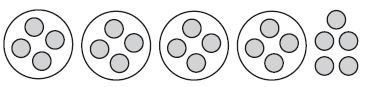
Go Math Grade 4 Answer Key Homework Practice FL Chapter 4 Divide by 1-Digit Numbers Common Core - Divide by 1-Digit Numbers img 2
_____ : _____ r _____

Answer: 4 r5

Explanation:
Quotient:
A. Use 21 counters to represent the 21 dominoes. Then draw 4 circles to represent the divisor.
B. Share the counters equally among the 4 groups by placing them in the circles.
C. Number of counters formed in each group = quotient of 21 ÷ 4
D. Number of circles are equally filled with 4 counters, therefore, the quotient is 4
Remainder:
The number of counters left over is the remainder. The number of counters leftover= 5
For 21 ÷ 4, the quotient is 4 and the remainder is 5, or 4 r5.

Common Core – Divide by 1-Digit Numbers – Page No. 72

Lesson Check

Question 1.
What is the quotient and remainder for 32 ÷ 6?
Options:
a. 4 r3
b. 5 r1
c. 5 r2
d. 6 r1

Answer: 5 r2

Explanation:
Quotient:
A. Use 32 counters to represent the 32 dominoes. Then draw 6 circles to represent the divisor.
B. Share the counters equally among the 5 groups by placing them in the circles.
C. Number of counters formed in each group = quotient of 32 ÷ 6
D. Number of circles are equally filled with 5 counters, therefore, the quotient is 5
Remainder:
The number of counters left over is the remainder. The number of counters leftover= 2
For 32 ÷ 6, the quotient is 5 and the remainder is 2, or 5 r2.
Thus the correct answer is option c.

Question 2.
What is the remainder in the division problem modeled below?
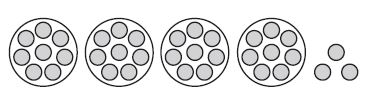
Go Math Grade 4 Answer Key Homework Practice FL Chapter 4 Divide by 1-Digit Numbers Common Core - Divide by 1-Digit Numbers img 3
Options:
a. 8
b. 4
c. 3
d. 1

Answer: 3

Explanation:
When a number cannot be divided evenly, the amount left over is called the remainder.
The number of counters that are left = remainder = 3
Thus the correct answer is option c.

Spiral Review

Question 3.
Each kit to build a castle contains 235 parts. How many parts are in 4 of the kits?
Options:
a. 1,020
b. 940
c. 920
d. 840

Answer: 940

Explanation:
Number of parts used to build a castle in each kit=235 parts
Number of kits= 4
Total number of parts in 4 of the kits= 235 x 4=940 parts

Thus the correct answer is option b.

Question 4.
In 2010, the population of Alaska was about 710,200. What is this number written in word form?
Options:
a. seven hundred ten thousand, two
b. seven hundred twelve thousand
c. seventy-one thousand, two
d. seven hundred ten thousand, two hundred

Answer: seven hundred ten thousand, two hundred

Explanation:
The ones and tens place of the number are zeroes, so the next place which is hundreds is considered and the value is 7 so, it can be written as seven hundred and in the thousands period, it can be written as seven hundred ten thousand.
Thus the correct answer is option d.

Question 5.
At the theater, one section of seats has 8 rows with 12 seats in each row. In the center of the first 3 rows are 4 broken seats that cannot be used. How many seats can be used in the section?
Options:
a. 84
b. 88
c. 92
d. 96

Answer: 92

Explanation:
Given,
Number of rows at the theatre = 8
Number of seats in each row= 12
Number of seats broken and that cannot be used to sit= 4
Total number of seats that can be used= 12 × 8 – 4 = 96 – 4 = 92
Thus the correct answer is option c.

Question 6.
What partial products are shown by the model below?
Go Math Grade 4 Answer Key Homework Practice FL Chapter 4 Divide by 1-Digit Numbers Common Core - Divide by 1-Digit Numbers img 4
Options:
a. 300, 24
b. 300, 600, 40, 60
c. 300, 60, 40, 24
d. 300, 180, 40, 24

Answer: 300, 180, 40, 24

Explanation:
The whole rectangle is divided into four small rectangles the areas of these rectangles are:

Area of yellow rectangle= 30 x 10=300
Area of green rectangle= 4 x 10 = 40
Area of pink rectangle= 6 x 30= 180
Area of blue rectangle= 4 x 6= 24
Thus the correct answer is option d.

Common Core – Divide by 1-Digit Numbers – Page No. 73

Interpret the Remainder

Interpret the remainder to solve.

Question 1.
Hakeem has 100 tomato plants. He wants to plant them in rows of 8. How many full rows will he have?
Think: 100 ÷ 8 is 12 with a remainder of 4. The question asks “how many full rows,” so use only the quotient.
12 full rows

Explanation:
Quotient:
A. Use 100 counters to represent the 100 dominoes. Then draw 8 circles to represent the divisor.
B. Share the counters equally among the 8 groups by placing them in the circles.
C. Number of counters formed in each group = quotient of 100 ÷ 8
D. Number of circles are equally filled with 12 counters, therefore, the quotient is 12
Therefore, the tomatoes placed in full rows are 12

Question 2.
A teacher has 27 students in her class. She asks the students to form as many groups of 4 as possible. How many students will not be in a group?
______ students

Answer: 3 students will not be in the group

Explanation:
Total number of students in the class= 27
Number of students who make a group=4
Number of groups that can be made =Quotient of 27÷ 4=6
Number of students who do not come under a group= Remainder of 27÷ 4=3

Question 3.
A sporting goods company can ship 6 footballs in each carton. How many cartons are needed to ship 75 footballs?
______ cartons

Answer: 12 full cartons and 0.5 or 1/2 carton to ship all the 75 footballs

Explanation:
Total number of footballs that should be shipped= 75
Number of footballs placed in each carton = 6
Number of cartons required=Quotient of 75÷ 6=12

Since each carton carries 6 balls, half carton contains 3 balls because 6÷3=2, therefore, each half of the carton contains 3 balls.

Question 4.
A carpenter has a board that is 10 feet long. He wants to make 6 table legs that are all the same length. What is the longest each leg can be?
______ foot

Answer: The length of the longest leg = 4 foot-long

Explanation:
According to the question,
Length of the board the carpenter has= 10 foot long
Number of table legs that are to be made = 6
Length of the 6 table legs are equal
then,
Length of each table leg = Quotient of 10 ÷ 6 =1 foot
Length of the longest table leg = Remainder of 10 ÷ 6 = 4 foot.

Question 5.
Allie wants to arrange her flower garden in 8 equal rows. She buys 60 plants. What is the greatest number of plants she can put in each row?
______ plants

Answer: 7

Explanation:
Total number of plants Allie bought = 60
Number of rows = 8
Number of plants in each row= Quotient of 60 ÷ 8 = 7
Thus the greatest number of plants she can put in a row is 7.

Problem Solving

Question 6.
Joanna has 70 beads. She uses 8 beads for each bracelet. She makes as many bracelets as possible. How many beads will Joanna have left over?
______ beads

Answer: 6 beads

Explanation:
Total number of beads Joanna has= 70 beads
Number beads used for each bracelet= 8 beads
Number of bracelets made with these beads= Quotient of 70÷8= 7 bracelets
then,
The number of beads leftover= Remainder of 70÷8= 6 beads

Question 7.
A teacher wants to give 3 markers to each of her 25 students. Markers come in packages of 8. How many packages of markers will the teacher need?
______ packages

Answer: 10 packages

Explanation:
Total number of students= 25
Number of markers each student got= 3
Total number of markers the teacher needs to distribute= 25 x 3= 75
Number of markers in each package= 8
Number of packages the teacher required= Quotient of 75÷8=9
While the remainder = 3
Therefore the total number of packages = 10

Common Core – Divide by 1-Digit Numbers – Page No. 74

Lesson Check

Question 1.
Marcus sorts his 85 baseball cards into stacks of 9 cards each. How many stacks of 9 cards can Marcus make?
Options:
a. 4
b. 8
c. 9
d. 10

Answer: 10

Explanation:
Total number of baseball cards=85
Number of cards in each stack=9
Number of stacks sorted= Quotient of 85÷9=9
While the remainder=4
So the total number of stacks required= 10
Thus the correct answer is option d.

Question 2.
A minivan can hold up to 7 people. How many minivans are needed to take 45 people to a basketball game?
Options:
a. 3
b. 5
c. 6
d. 7

Answer: 7

Explanation:
A minivan can hold up to 7 people.
Total number of people who want to hire the minivan= 45 people
Number of minivans required= Quotient of 45÷7= 6 vans
While the remainder is 3.
Total number of minivans required to take the people to the baseball game= 7 minivans
Thus the correct answer is option d.

Spiral Review

Question 3.
Mrs. Wilkerson cut some oranges into 20 equal pieces to be shared by 6 friends. How many pieces did each person get and how many pieces were left over?
Options:
a. 2 pieces with 4 pieces left over
b. 3 pieces with 2 pieces left over
c. 3 pieces with 4 pieces left over
d. 4 pieces with 2 pieces left over

Answer: 3 pieces with 2 pieces left over

Explanation:
Total number of orange pieces= 20
Number of friends= 6
Number of pieces each friend got= Quotient of 20÷6= 3 pieces
Number of pieces leftover= Remainder of 20÷6= 2 pieces
Thus the correct answer is option b.

Question 4.
A school bought 32 new desks. Each desk cost $24. Which is the best estimate of how much the school spent on the new desks?
Options:
a. $500
b. $750
c. $1,000
d. $1,200

Answer: $750

Explanation:
Total number of desks= 32
Cost of each desk= $24
Total cost spent on the desks= 32 x 24=$768

So the estimated value can be $768.
Thus the correct answer is option b.

Question 5.
Kris has a box of 8 crayons. Sylvia’s box has 6 times as many crayons as Kris’s box. How many crayons are in Sylvia’s box?
Options:
a. 48
b. 42
c. 36
d. 4

Answer: 48

Explanation:
Number of crayons in Kris box=8
Number of crayons in Sylvia’s box= 6 times as many crayons as Kris’s box= 6 x 8=48
Thus the correct answer is option a.

Question 6.
Yesterday, 1,743 people visited the fair. Today, there are 576 more people at the fair than yesterday. How many people are at the fair today?
Options:
a. 1,167
b. 2,219
c. 2,319
d. 2,367

Answer: 2,319

Explanation:
Number of people in the fair yesterday= 1,743
Number of more people at the fair than yesterday= 576
Total number of people in the fair today=2,319

Thus the correct answer is option c.

Common Core – Divide by 1-Digit Numbers – Page No. 75

Divide Tens, Hundreds, and Thousands

Use basic facts and place value to find the quotient.

Question 1.
3,600 ÷ 4 = 900
Think: 3,600 is 36 hundreds.
Use the basic fact 36 ÷ 4 = 9.
So, 36 hundreds ÷ 4 = 9 hundreds, or 900.

Question 2.
240 ÷ 6 = ______

Answer: 40

Explanation:
STEP 1 Identify the basic fact. 24 ÷ 6
STEP 2 Use place value. 240 = 24 tens
STEP 3 Divide. 24 tens ÷ 6 = 4 tens
240 ÷ 6 = 40

Question 3.
5,400 ÷ 9 = ______

Answer: 600

Explanation:
STEP 1 Identify the basic fact. 54 ÷ 9
STEP 2 Use place value. 5,400 = 54 hundreds
STEP 3 Divide. 54 hundreds ÷ 9 = 6 hundreds
5,400 ÷ 9 = 600

Question 4.
300 ÷ 5 = ______

Answer: 60

Explanation:
STEP 1 Identify the basic fact. 30 ÷ 5
STEP 2 Use place value. 300 = 30 tens
STEP 3 Divide. 30 tens ÷ 5 = 60 tens
300 ÷ 5 = 60

Question 5.
4,800 ÷ 6 = ______

Answer: 800

Explanation:
STEP 1 Identify the basic fact. 48 ÷ 6
STEP 2 Use place value. 4,800 = 48 hundreds
STEP 3 Divide. 48 hundreds ÷ 6 = 80 hundreds
4,800 ÷ 6 = 800

Question 6.
420 ÷ 7 = ______

Answer: 60

Explanation:
STEP 1 Identify the basic fact. 42 ÷ 7
STEP 2 Use place value. 420 = 42 tens
STEP 3 Divide. 42 tens ÷ 7 = 60 tens
420 ÷ 7 = 60

Question 7.
150 ÷ 3 = ______

Answer: 50

Explanation:
STEP 1 Identify the basic fact. 15 ÷ 3
STEP 2 Use place value. 150 = 15 tens
STEP 3 Divide. 15 tens ÷ 3 = 5 tens
150 ÷ 3 = 50

Question 8.
6,300 ÷ 7 = ______

Answer: 900

Explanation:
STEP 1 Identify the basic fact. 63 ÷ 7
STEP 2 Use place value. 6,300 = 63 hundreds
STEP 3 Divide. 63 hundreds ÷ 7 = 9 hundreds
6,300 ÷ 7 = 900

Question 9.
1,200 ÷ 4 = ______

Answer: 300

Explanation:
STEP 1 Identify the basic fact. 12 ÷ 4
STEP 2 Use place value. 1,200 = 12 hundreds
STEP 3 Divide. 12 hundreds ÷ 4 = 3 hundreds
1,200 ÷ 4 = 300

Question 10.
360 ÷ 6 = ______

Answer: 60

Explanation:
STEP 1 Identify the basic fact. 36 ÷ 6
STEP 2 Use place value. 360 = 36 tens
STEP 3 Divide. 36 tens ÷ 6 = 6 tens
360 ÷ 6 = 60

Find the quotient.

Question 11.
28 ÷ 4 = ______
280 ÷ 4 = ______
2,800 ÷ 4 = ______

Answer: 7, 70, 700

Explanation:
Quotient:
A. Use 28 counters to represent the 28 dominoes. Then draw 4 circles to represent the divisor.
B. Share the counters equally among the 4 groups by placing them in the circles.
C. Number of counters formed in each group = quotient of 28 ÷ 4
D. Number of circles are equally filled with 7 counters, therefore, the quotient is 7

STEP 1 Identify the basic fact. 28 ÷ 4
STEP 2 Use place value. 280 = 28 tens
STEP 3 Divide. 28 tens ÷ 4 = 7 tens
280 ÷ 4 = 70

STEP 1 Identify the basic fact. 28 ÷ 4
STEP 2 Use place value. 2,800 = 28 hundreds
STEP 3 Divide. 28 hundreds ÷ 4 = 7 hundreds
2,800 ÷ 4 = 700

Question 12.
18 ÷ 3 = ______
180 ÷ 3 = ______
1,800 ÷ 3 = ______

Answer: 6, 60, 600

Explanation:
Quotient:
A. Use 18 counters to represent the 18 dominoes. Then draw 3 circles to represent the divisor.
B. Share the counters equally among the 3 groups by placing them in the circles.
C. Number of counters formed in each group = quotient of 18 ÷ 3
D. Number of circles are equally filled with 6 counters, therefore, the quotient is 6

STEP 1 Identify the basic fact. 18 ÷ 3
STEP 2 Use place value. 180 = 18 tens
STEP 3 Divide. 18 tens ÷ 3 = 6 tens
180 ÷ 6 = 60

STEP 1 Identify the basic fact. 18 ÷ 3
STEP 2 Use place value. 1,800 = 18 hundreds
STEP 3 Divide. 18 hundreds ÷ 3 = 6 hundreds
1,800 ÷ 3 = 600

Question 13.
45 ÷ 9 = ______
450 ÷ 9 = ______
4,500 ÷ 9 = ______

Answer: 5, 50, 500

Explanation:
Quotient:
A. Use 45 counters to represent the 45 dominoes. Then draw 9 circles to represent the divisor.
B. Share the counters equally among the 9 groups by placing them in the circles.
C. Number of counters formed in each group = quotient of 45 ÷ 9
D. Number of circles are equally filled with 5 counters, therefore, the quotient is 5

STEP 1 Identify the basic fact. 45 ÷ 9
STEP 2 Use place value. 450 = 45 tens
STEP 3 Divide. 45 tens ÷ 9 = 5 tens
450 ÷ 9 = 50

STEP 1 Identify the basic fact. 45 ÷ 9
STEP 2 Use place value. 4,500 = 45 hundreds
STEP 3 Divide. 45 hundred ÷ 9 = 5 hundred
4,500 ÷ 9 = 500

Problem Solving

Question 14.
At an assembly, 180 students sit in 9 equal rows. How many students sit in each row?
______ students

Answer: 20

Explanation:
Total number of students= 180
Number of rows= 9
Number of students in each row= 180 ÷ 9 = 20

Question 15.
Hilary can read 560 words in 7 minutes. How many words can Hilary read in 1 minute?
______ words

Answer: 80

Explanation:
Total number of words Hilary can read in 7 minutes = 560
Number of words Hilary can read in 1 minute= 560 ÷ 7= 80
Therefore Hilary can read 80 words in 1 minute.

Question 16.
A company produces 7,200 gallons of bottled water each day. The company puts 8 one-gallon bottles in each carton. How many cartons are needed to hold all the one-gallon bottles produced in one day?
______ cartons

Answer: 900

Explanation:
Total number of gallons bottled in each day= 7,200
Number of gallons bottled in each carton= 8
Number of cartons used= 7,200 ÷ 8= 900

Question 17.
An airplane flew 2,400 miles in 4 hours. If the plane flew the same number of miles each hour, how many miles did it fly in 1 hour?
______ miles

Answer: 600

Explanation:
Total number of miles flew in 4 hours= 2,400
Number of miles flew in 1 hour= 2,400 ÷ 4 = 600

Common Core – Divide by 1-Digit Numbers – Page No. 76

Lesson Check

Question 1.
A baseball player hits a ball 360 feet to the outfield. It takes the ball 4 seconds to travel this distance. How many feet does the ball travel in 1 second?
Options:
a. 9 feet
b. 40 feet
c. 90 feet
d. 900 feet

Answer: 90 feet

Explanation:
The height to which the player hits a ball=360 feet
Height to which the ball travels in 1 second= 360÷4= 90 feet
The correct answer is option c.

Question 2.
Sebastian rides his bike 2,000 meters in 5 minutes. How many meters does he bike in 1 minute?
Options:
a. 4 meters
b. 40 meters
c. 50 meters
d. 400 meters

Answer: 400 meters

Explanation:
Total number of meters travelled in 5 minutes= 2,000
Number of meters travelled in 1 minute= 2,000÷5= 400
The correct answer is option d.

Spiral Review

Question 3.
A full container of juice holds 64 ounces. How many 7-ounce servings of juice are in a full container?
Options:
a. 1
b. 8
c. 9
d. 10

Answer: 9

Explanation:
A full container of juice holds= 63 ounces
Quantity of servings of juice in one glass=7 ounce
The number of servings of the juice are= 63÷7=9
The correct answer is option c.

Question 4.
Paolo pays $244 for 5 identical calculators. Which is the best estimate of how much Paolo pays for one calculator?
Options:
a. $40
b. $50
c. $60
d. $245

Answer: $50

Explanation:
Amount Paolo pays for the identical calculators = $244
Number of identical calculators=5
The best-estimated value of each identical calculator=$244 ÷ 5is approximately $50.
The correct answer is option b.

Question 5.
A football team paid $28 per jersey. They bought 16 jerseys. How much money did the team spend on jerseys?
Options:
a. $44
b. $196
c. $408
d. $448

Answer: $448

Explanation:
Cost of each jersey=$28
Number of jerseys= 16
Total cost of the jerseys= $28 x 16= $448
The correct answer is option d.

Question 6.
Suzanne bought 50 apples at the apple orchard. She bought 4 times as many red apples as green apples. How many more red apples than green apples did Suzanne buy?
Options:
a. 10
b. 25
c. 30
d. 40

Answer: 40

Explanation:
Let the number of green apples be x and the number of red apples be 4x
4x + x = 50
x = 50 ÷ 5= 10
Number of red balls = 4x = 4 x 10 = 40
The correct answer is option d.

Common Core – Divide by 1-Digit Numbers – Page No. 77

Estimate Quotients Using Compatible Numbers

Use compatible numbers to estimate the quotient.

Question 1.
389 ÷ 4
400 ÷ 4 = 100

Question 2.
358 ÷ 3
_____ ÷ 3 = _____

Answer: 120

Explanation:
What number close to358 is easy to divide by 3?
360 is close to 358. What basic fact can you use?
360 ÷ 3
Choose 360 because it is close to 358 and can easily be divided by 3.
36 ÷3 = 12
360 ÷ 3 =120
358 ÷ 3 is about 120

Question 3.
784 ÷ 8
_____ ÷ 8 = _____

Answer: 100

Explanation:
What number close to 784 is easy to divide by 8?
800 is close to 784. What basic fact can you use?
800 ÷ 8
Choose 800 because it is close to 784 and can easily be divided by 8.
80 ÷ 8 = 10
800 ÷ 8 = 100
784 ÷ 8 is about 100.

Question 4.
179 ÷ 9
_____ ÷ 9 = _____

Answer: 20

Explanation:
What number close to 179 is easy to divide by 9?
180 is close to 179. What basic fact can you use?
180 ÷ 9
Choose 180 because it is close to 179 and can easily be divided by 9.
18 ÷ 9 = 2
180 ÷ 9 = 20
179 ÷ 9 is about 20

Question 5.
315 ÷ 8
_____ ÷ 8 = _____

Answer: 40

Explanation:
What number close to 315 is easy to divide by 8?
320 is close to 315. What basic fact can you use?
320 ÷ 8
Choose 320 because it is close to 315 and can easily be divided by 8.
32 ÷ 8 = 4
320 ÷ 8 =40
315 ÷ 8 is about 40.

Question 6.
2,116 ÷ 7
_____ ÷ 7 = _____

Answer: 300

Explanation:
What number close to 2,116 is easy to divide by 7?
2,100 is close to 2,116. What basic fact can you use?
2,100 ÷ 7
Choose 2,100 because it is close to 2,116 and can easily be divided by 7.
21 ÷ 7= 3
2,100 ÷ 7 = 300
2,116 ÷ 7 is about 300

Question 7.
4,156 ÷ 7
_____ ÷ 7 = _____

Answer: 600

Explanation:
What number close to 4,156 is easy to divide by 7?
4,200 is close to 4,156. What basic fact can you use?
4,200 ÷7
Choose 4,200 because it is close to 4,156 and can easily be divided by 7.
42 ÷ 7 = 6
4,200 ÷ 7 = 600
4,156 ÷ 7 is about 600.

Question 8.
474 ÷ 9
_____ ÷ 9 = _____

Answer: 50

Explanation:
What number close to 474 is easy to divide by 9?
450 is close to 474. What basic fact can you use?
450 ÷ 9
Choose 450 because it is close to 474 and can easily be divided by 9.
45 ÷ 9 = 5
450 ÷ 9 = 50
474 ÷ 9 is about 50.

Use compatible numbers to find two estimates that the quotient is between.

Question 9.
1,624 ÷ 3
_____ ÷ 3 = _____
_____ ÷ 3 = _____

Answer: The quotient is between 500 and 600

Explanation:
What number close to 1,624 is easy to divide by 3?
1,500 is close to 1,624. What basic fact can you use?
1,500 ÷ 3
Choose 1,500 because it is close to 1,624 and can easily be divided by 3.
15 ÷ 3 = 5
1,500 ÷ 3 = 500
1,624 ÷ 3 is about 500

What number close to 1,624 is easy to divide by 3?
1,800 is close to 1,624. What basic fact can you use?
1,800 ÷ 3
Choose 1,800 because it is close to 1,624 and can easily be divided by 3.
18 ÷ 3 = 6
1,800 ÷ 3 = 600
1,624 ÷ 3 is about 600

Question 10.
2,593 ÷ 6
_____ ÷ 6 = _____
_____ ÷ 6 = _____

Answer: The quotient is between 400 and 500

Explanation:
What number close to 2,593 is easy to divide by 6?
2,400 is close to 2,593. What basic fact can you use?
2,400 ÷ 6
Choose 2,400 because it is close to 2,593 and can easily be divided by 6.
24 ÷ 6 = 4
2,400 ÷ 6 = 400
2,593 ÷ 6 is about 400

What number close to 2,593 is easy to divide by 6?
3,000 is close to 2,593. What basic fact can you use?
3000 ÷ 6
Choose 3,000 because it is close to 2,593 and can easily be divided by 6.
30 ÷ 6 = 5
3,000 ÷ 6 = 500
2,593 ÷ 6 is about 500

Question 11.
1,045 ÷ 2
_____ ÷ 2 = _____
_____ ÷ 2 = _____

Answer: The quotient is between 520 and 525

Explanation:
What number close to 1,045 is easy to divide by 2?
1,040 is close to 1,045. What basic fact can you use?
1,040 ÷ 2
Choose 1,040 because it is close to 1,045 and can easily be divided by 2.
1,04 ÷ 2 = 52
1,040 ÷ 2 = 520
1,045 ÷ 2 is about 520

What number close to 1,045 is easy to divide by 2?
1,050 is close to 1,045. What basic fact can you use?
1,050 ÷ 2
Choose 1,050 because it is close to 1,045 and can easily be divided by 2.
1,050 ÷ 2 = 525
1,045 ÷ 2 is about 525

Question 12.
1,754 ÷ 9
_____ ÷ 9 = _____
_____ ÷ 9 = _____

Answer: The quotient is between 195 and 200

Explanation:
What number close to 1,754 is easy to divide by 9?
1,755 is close to 1,754. What basic fact can you use?
1,755 ÷ 9
Choose 1,755 because it is close to 1,754 and can easily be divided by 9.
1,755 ÷ 9 = 195
1,754 ÷ 9 is about 195

What number close to 1,754 is easy to divide by 9?
1,800 is close to 1,754. What basic fact can you use?
1,800 ÷ 9
Choose 1,800 because it is close to 1,754 and can easily be divided by 9.
18 ÷ 9 = 2
1,800 ÷ 9 = 200
1,754 ÷ 9 is about 200

Question 13.
2,363 ÷ 8
_____ ÷ 8 = _____
_____ ÷ 8 = _____

Answer: The quotient is between 295 and 300

Explanation:
What number close to 2,363 is easy to divide by 8?
2,360 is close to 2,363. What basic fact can you use?
2,360 ÷ 8
Choose 2,360 because it is close to 2,363 and can easily be divided by 8.
2,360 ÷ 8 = 295
2,363 ÷ 8 is about 295

What number close to 2,363 is easy to divide by 8?
2,400 is close to 2,363. What basic fact can you use?
2,400 ÷ 8
Choose 2,400 because it is close to 2,363 and can easily be divided by 8.
24 ÷ 8 = 3
2,400 ÷ 8= 300
2,363 ÷ 8 is about 300.

Question 14.
1,649 ÷ 5
_____ ÷ 5 = _____
_____ ÷ 5 = _____

Answer: The quotient is between 329 and 330

Explanation:
What number close to 1,649 is easy to divide by 5?
1,645 is close to 1,649. What basic fact can you use?
1,645 ÷ 5
Choose 1,645 because it is close to 1,649 and can easily be divided by 5.
1,645 ÷ 5 = 329
1,649 ÷ 5 is about 329

What number close to 1,650 is easy to divide by 5?
1,650 is close to 1,649. What basic fact can you use?
1,650 ÷ 5
Choose 1,650 because it is close to 1,649 and can easily be divided by 5.
1,650 ÷ 5 = 330
1,649 ÷ 5 is about 330

Question 15.
5,535 ÷ 7
_____ ÷ 7 = _____
_____ ÷ 7 = _____

Answer: The quotient is between 790 and 791

Explanation:
What number close to 5,535 is easy to divide by 7?
5,530 is close to 5,535. What basic fact can you use?
5,530 ÷ 7
Choose 5,530 because it is close to 5,535 and can easily be divided by 7.
553 ÷ 7 = 79
5,530 ÷ 7 = 790
5,535 ÷ 7 is about 790

What number close to 5,535 is easy to divide by 7?
5,537 is close to 5,535. What basic fact can you use?
5,537 ÷ 7
Choose 5,537 because it is close to 5,535 and can easily be divided by 7.
553 ÷ 7 = 79
5,537 ÷ 7 = 791
5,535 ÷ 7 is about 791

Question 16.
3,640 ÷ 6
_____ ÷ 6 = _____
_____ ÷ 6 = _____

Answer: The quotient is between 606 and 607

Explanation:
What number close to 3,640 is easy to divide by 6?
3,636 is close to 3,640. What basic fact can you use?
3,636 ÷ 6
Choose 3,636 because it is close to 3,640 and can easily be divided by 6.
36 ÷ 6 = 6
3,636 ÷ 6 = 606
3,640 ÷ 6 is about 606

What number close to 3,640 is easy to divide by 6?
3,642 is close to 3,640. What basic fact can you use?
3,642 ÷ 6
Choose 3,642 because it is close to 3,640 and can easily be divided by 6.
3,642 ÷ 6 = 607
3,640 ÷ 6 is about 607

Problem Solving

Question 17.
A CD store sold 3,467 CDs in 7 days. About the same number of CDs were sold each day. About how many CDs did the store sell each day?
about _____ CDs

Answer: 495(approx)

Explanation:
Total number of CDs in the store= 3,467
Number of days= 7
Number of CDs sold on one day= 3,467 ÷ 7=495(approx)

Question 18.
Marcus has 731 books. He puts about the same number of books on each of 9 shelves in his a bookcase. About how many books are on each shelf?
about _____ books

Answer: 81 books(approx)

Explanation:
Total number of books Marcus has= 731
Number of shelves= 9
Number of books on each shelf= 731÷9= 81 (approx)

Common Core – Divide by 1-Digit Numbers – Page No. 78

Lesson Check

Question 1.
Jamal is planting seeds for a garden nursery. He plants 9 seeds in each container. If Jamal has 296 seeds to plant, about how many containers will he use?
Options:
a. about 20
b. about 30
c. about 200
d. about 300

Answer: about 30

Explanation:
Total number of seeds Jamal has= 296
Number of seeds placed in each container= 9
Number of containers Jamal used= 296÷9= 32.8=33 (approx)
Therefore, the number of containers used is about 30
The correct answer is option b.

Question 2.
Winona purchased a set of vintage beads. There are 2,140 beads in the set. If she uses the beads to make bracelets that have 7 beads each, about how many bracelets can she make?
Options:
a. about 30
b. about 140
c. about 300
d. about 14,000

Answer: about 300

Explanation:
Total number of beads Winona has= 2,140
Number of beads in each bracelet= 7
Number of bracelets made= 2,140÷7=305.7=306(approx)
Therefore, the number of bracelets made are about 30
The correct answer is option c.

Spiral Review

Question 3.
A train traveled 360 miles in 6 hours. How many miles per hour did the train travel?
Options:
a. 60 miles per hour
b. 66 miles per hour
c. 70 miles per hour
d. 600 miles per hour

Answer: 60 miles per hour

Explanation:
Total number of miles traveled by train= 360
Time taken by the train to cover 360 miles= 6 hours
Number of miles traveled in each hour= 360÷6=60 miles
The correct answer is option a.

Question 4.
An orchard has 12 rows of pear trees. Each row has 15 pear trees. How many pear trees are there in the orchard?
Options:
a. 170
b. 180
c. 185
d. 190

Answer: 180

Explanation:
Number of rows of pear trees in an orchard= 12
Number of pear trees in each row=15
Total number of pear trees in the orchard= 12 x 15=180
The correct answer is option b.

Question 5.
Megan rounded 366,458 to 370,000. To which place did Megan round the number?
Options:
a. hundred thousands
b. ten thousands
c. thousands
d. hundreds

Answer: ten thousands

Explanation:
The given number is 366,458, the ten thousand place digit has 6 which while rounding off should be changed to the next consecutive number and the digits in the other places should be written as zeroes.
The correct answer is option b.

Question 6.
Mr. Jessup, an airline pilot, flies 1,350 miles a day. How many miles will he fly in 8 days?
Options:
a. 1,358 miles
b. 8,400 miles
c. 10,800 miles
d. 13,508 miles

Answer: 10,800 miles

Explanation:
Number of miles flew by Mr.Jessup in one day= 1,350 miles
Number of days=8
Total number of miles flew by Mr.Jessup in 8 days= 1,350 x 8= 10,800 miles.
The correct answer is option c.

Common Core – Divide by 1-Digit Numbers – Page No. 79

Division and the Distributive Property

Find the quotient.

Question 1.
54 ÷ 3 = ( 30 ÷ 3) + ( 24 ÷ 3)
= 10 + 8
= 18
Go Math Grade 4 Answer Key Homework Practice FL Chapter 4 Divide by 1-Digit Numbers Common Core - Divide by 1-Digit Numbers img 5

Question 2.
81 ÷ 3 = ______

Answer: 27

Explanation:
81 ÷ 3
STEP1 Find the nearest estimates of the number 81
STEP2 We can break the number 81 into 21 + 60
STEP3 We must divide the two parts of the number (dividend) with the divisor.
STEP4 (60 ÷ 3) + (21 ÷ 3)
STEP5 Add quotients of the above 20 +7= 27

Question 3.
232 ÷ 4 = ______

Answer: 58

Explanation:
232 ÷ 4
STEP1 Find the nearest estimates of the number 232
STEP2 We can break the number 232 into 200 + 32
STEP3 We must divide the two parts of the number (dividend) with the divisor.
STEP4 (200 ÷ 4) + (32 ÷ 4)
STEP5 Add quotients of the above 50 +8= 58

Question 4.
305 ÷ 5 = ______

Answer: 61

Explanation:
305 ÷ 5
STEP1 Find the nearest estimates of the number 305
STEP2 We can break the number 305 into 300 + 5
STEP3 We must divide the two parts of the number (dividend) with the divisor.
STEP4 (300 ÷ 5) + (5 ÷ 5)
STEP5 Add quotients of the above 60 +1= 61

Question 5.
246 ÷ 6 = ______

Answer: 41

Explanation:
246 ÷ 6
STEP1 Find the nearest estimates of the number 246
STEP2 We can break the number 246 into 240 + 6
STEP3 We must divide the two parts of the number (dividend) with the divisor.
STEP4 (240 ÷ 6) + (6 ÷ 6)
STEP5 Add quotients of the above 40 +1= 41

Question 6.
69 ÷ 3 = ______

Answer: 23

Explanation:
69 ÷ 3
STEP1 Find the nearest estimates of the number 69
STEP2 We can break the number 69 into 60 + 9
STEP3 We must divide the two parts of the number (dividend) with the divisor.
STEP4 (60 ÷ 3) + (9 ÷ 3)
STEP5 Add quotients of the above 20 +3= 23

Question 7.
477 ÷ 9 = ______

Answer: 53

Explanation:
477 ÷ 9
STEP1 Find the nearest estimates of the number 477
STEP2 We can break the number 477 into 450 + 27
STEP3 We must divide the two parts of the number (dividend) with the divisor.
STEP4 (450 ÷ 9) + (27 ÷ 9)
STEP5 Add quotients of the above 50 +3= 53

Question 8.
224 ÷ 7 = ______

Answer: 32

Explanation:
224 ÷ 7
STEP1 Find the nearest estimates of the number 224
STEP2 We can break the number 224 into 210 + 14
STEP3 We must divide the two parts of the number (dividend) with the divisor.
STEP4 (210 ÷ 7) + (14 ÷ 7)
STEP5 Add quotients of the above 30 +2= 32

Question 9.
72 ÷ 4 = ______

Answer: 18

Explanation:
72 ÷ 4
STEP1 Find the nearest estimates of the number 72
STEP2 We can break the number 72 into 40 + 32
STEP3 We must divide the two parts of the number (dividend) with the divisor.
STEP4 (40 ÷ 4) + (32 ÷ 4)
STEP5 Add quotients of the above 10 +8= 18

Question 10.
315 ÷ 3 = ______

Answer: 105

Explanation:
315 ÷ 3
STEP1 Find the nearest estimates of the number 315
STEP2 We can break the number 315 into 300 + 15
STEP3 We must divide the two parts of the number (dividend) with the divisor.
STEP4 (300 ÷ 3) + (15 ÷3)
STEP5 Add quotients of the above 100 +5= 105

Problem Solving

Question 11.
Cecily picked 219 apples. She divided the apples equally into 3 baskets. How many apples are in each basket?
______ apples

Answer: 73 apples

Explanation:
The total number of apples Cecily picked= 219 apples
Number of parts into which she wanted to divide the apples= 3
Number of apples in each part = Quotient of 147 ÷ 7
STEP1 Find the nearest estimates of the number 219
STEP2 We can break the number 219 into 210 + 9
STEP3 We must divide the two parts of the number (dividend) with the divisor.
STEP4 (210 ÷ 3) + (9 ÷ 3)
STEP5 Add quotients of the above 70 +3= 73

Question 12.
Jordan has 260 basketball cards. He divides them into 4 equal groups. How many cards are in each group?
______ cards

Answer: 65 cards

Explanation:
The total number of basketball cards Jordan has= 260 basketball cards
Number of parts into which he wanted to divide the cards= 4
Number of apples in each part = Quotient of 260 ÷ 4
STEP1 Find the nearest estimates of the number 260
STEP2 We can break the number 260 into 240 + 20
STEP3 We must divide the two parts of the number (dividend) with the divisor.
STEP4 (240 ÷ 4) + (20 ÷ 4)
STEP5 Add quotients of the above 60 +5= 65

Question 13.
The Wilsons drove 324 miles in 6 hours. If they drove the same number of miles each hour, how many miles did they drive in 1 hour?
______ miles

Answer: 54 miles

Explanation:
The total number of miles drove by Wilson= 324 miles
Number of hours he drove = 6
Number of miles drove in each hour = Quotient of 324 ÷ 6
STEP1 Find the nearest estimates of the number 324
STEP2 We can break the number 324 into 300 + 24
STEP3 We must divide the two parts of the number (dividend) with the divisor.
STEP4 (300 ÷ 6) + (24 ÷ 6)
STEP5 Add quotients of the above 50 +4= 54

Question 14.
Phil has 189 stamps to put into his stamp album. He puts the same number of stamps on each of 9 pages. How many stamps does Phil put on each page?
______ stamps

Answer: 21 stamps

Explanation:
The total number of stamps Phil has= 189 stamps
Number of pages= 9
Number of stamps put on each page = Quotient of 189 ÷ 9
STEP1 Find the nearest estimates of the number 189
STEP2 We can break the number 189 into 180 + 9
STEP3 We must divide the two parts of the number (dividend) with the divisor.
STEP4 (180 ÷ 9) + (9 ÷ 9)
STEP5 Add quotients of the above 20 +1= 21

Common Core – Divide by 1-Digit Numbers – Page No. 80

Lesson Check

Question 1.
A landscaping company planted 176 trees in 8 equal rows in the new park. How many trees did the company plant in each row?
Options:
a. 18
b. 20
c. 22
d. 24

Answer: 22

Explanation:
The total number of trees in the landscaping= 176 trees
Number of rows= 8
Number of trees in each row = Quotient of 176 ÷ 8
STEP1 Find the nearest estimates of the number 176
STEP2 We can break the number 176 into 160 + 16
STEP3 We must divide the two parts of the number (dividend) with the divisor.
STEP4 (160 ÷ 8) + (16 ÷ 8)
STEP5 Add quotients of the above 20 +2= 22

Question 2.
Arnold can do 65 pushups in 5 minutes. How many pushups can he do in 1 minute?
Options:
a. 11
b. 13
c. 15
d. 17

Answer: 13

Explanation:
The total number of pushups done by Arnold = 65
Number of minutes spent on pushups= 5
Number of pushups done in each minute = Quotient of 65 ÷ 5
STEP1 Find the nearest estimates of the number 65
STEP2 We can break the number 65 into 60 + 5
STEP3 We must divide the two parts of the number (dividend) with the divisor.
STEP4 (60 ÷ 5) + (5 ÷ 5)
STEP5 Add quotients of the above 12 +1= 13

Spiral Review

Question 3.
Last Saturday, there were 1,486 people at the Cineplex. There were about the same number of people in each of the 6 theaters. Which is the best estimate of the number of people in each theater?
Options:
a. between 20 and 30
b. between 80 and 90
c. between 100 and 200
d. between 200 and 300

Answer: between 200 and 300

Explanation:
Total number of people at the Cineplex= 1,486 people
Number of theatres = 6
Number of people at each theatre= estimate of the number of people 1,486 ÷ 6

What number close to 1,486 is easy to divide by 6?
1,488 is close to 1,486. What basic fact can you use?
1,488 ÷ 6
Choose 1,488 because it is close to 1,486 and can easily be divided by 6.
1,488 ÷ 6 = 248
1,486 ÷ 6 is about 248

What number close to 1,486 is easy to divide by 6?
1,482 is close to 1,486 . What basic fact can you use?
1,482 ÷ 6
Choose 1,482 because it is close to 1,486 and can easily be divided by 6.
1,482 ÷ 6 = 247
1,486 ÷ 6 is about 247

Question 4.
Nancy walked 50 minutes each day for 4 days last week. Gillian walked 35 minutes each day for 6 days last week. Which statement is true?
Options:
a. Gillian walked 10 minutes more than Nancy.
b. Gillian walked 20 minutes more than Nancy.
c. Nancy walked 10 minutes more than Gillian.
d. Nancy walked 15 minutes more than Gillian.

Answer: Nancy walked 15 minutes more than Gillian.

Explanation:
Time walked by Nancy= 50 minutes
Time walked by Gillian= 35 minutes
Nancy walked more time compared to Gillian
50-35=15 minutes
Therefore, Nancy walked 15 minutes more than Gillian.

Question 5.
Three boys share 28 toy cars equally. Which best describes how the cars are shared?
Options:
a. Each gets 3 cars with 1 left over.
b. Each gets 8 cars with 2 left over.
c. Each gets 9 cars with 1 left over.
d. Each gets 10 cars with 2 left over.

Answer: Each gets 9 cars with 1 left over.

Explanation:
Total number of toys three boys have= 28
Number of toys each boy got= 28 ÷3=9.33
Therefore we can say that each gets 9 cars with 1 leftover.

Question 6.
An airplane flies at a speed of 474 miles per hour. How many miles does the plane fly in 5 hours?
Options:
a. 2,070 miles
b. 2,140 miles
c. 2,370 miles
d. 2,730 miles

Answer: 2,370 miles

Explanation:
Number of miles flew by airplane in one hour= 474
Number of hours the airplane flew= 5 hours
Total number of miles flew in 5 hours= 474 x 5= 2,370 miles

Common Core – Divide by 1-Digit Numbers – Page No. 81

Divide Using Repeated Subtraction

Use repeated subtraction to divide.

Question 1.
42 ÷ 3 = 14
3)\(\overline { 42 } \)
-30 ← 10 × 3 | 10
——-
12
-12 ← 4 × 3 | +4
——-             ———
0                     14

Question 2.
72 ÷ 4 = ______

Answer: 18

Explanation:
A. Begin with 72 counters. Subtract 4 counters.
B. Subtract 4 counters from 72 and repeat the processes until the remainder cannot be subtracted from the divisor.
C. Record the number of counters left and the number of times you subtracted.
D. The number of times you subtracted is the quotient is 18

Question 3.
93 ÷ 3 = ______

Answer: 31

Explanation:
A. Begin with 93 counters. Subtract 3 counters.
B. Subtract 3 counters from 93 and repeat the processes until the remainder cannot be subtracted from the divisor.
C. Record the number of counters left and the number of times you subtracted.
D. The number of times you subtracted is the quotient is 31

Question 4.
35 ÷ 4 = ______ r ______

Answer: 8r3

Explanation:
Quotient:
A. Use 35 counters to represent the 35 dominoes. Then draw 4 circles to represent the divisor.
B. Share the counters equally among the 4 groups by placing them in the circles.
C. Number of counters formed in each group = quotient of 35 ÷ 4
D. Number of circles are equally filled with 4 counters, therefore, the quotient is 8
Remainder:
The number of counters left over is the remainder. The number of counters leftover= 3
For 35 ÷ 4, the quotient is 8 and the remainder is 3, or 8 r3.

Question 5.
93 ÷ 10 = ______ r ______

Answer: 9r3

Explanation:
Quotient:
A. Use 93 counters to represent the 93 dominoes. Then draw 10 circles to represent the divisor.
B. Share the counters equally among the 10 groups by placing them in the circles.
C. Number of counters formed in each group = quotient of 93 ÷ 10
D. Number of circles are equally filled with 10 counters, therefore, the quotient is 9
Remainder:
The number of counters left over is the remainder. The number of counters leftover= 3
For 93 ÷ 10, the quotient is 9 and the remainder is 3, or 9 r3.

Question 6.
86 ÷ 9 = ______ r ______

Answer: 9r5

Explanation:
Quotient:
A. Use 86 counters to represent the 86 dominoes. Then draw 9 circles to represent the divisor.
B. Share the counters equally among the 9 groups by placing them in the circles.
C. Number of counters formed in each group = quotient of 86 ÷ 9
D. Number of circles are equally filled with 9 counters, therefore, the quotient is 9
Remainder:
The number of counters left over is the remainder. The number of counters leftover= 5
For 86 ÷ 9, the quotient is 9 and the remainder is 5, or 9 r5.

Draw a number line to divide.

Question 7.
70 ÷ 5 = ______

Answer: 14

Explanation:
A. Draw a number line with 5 as each interval.
B. Draw up to 70 and count the intervals, it gives the quotient.
C. The quotient is 14

Problem Solving

Question 8.
Gretchen has 48 small shells. She uses 2 shells to make one pair of earrings. How many pairs of earrings can she make?
______ pairs

Answer: 24 pairs

Explanation:
Total number of small shells= 48
Number of shells used to make one pair of earrings = 2
Number of pair of earrings made = 48 ÷ 2 =24

Question 9.
James wants to purchase a telescope for $54. If he saves $3 per week, in how many weeks will he have saved enough to purchase the telescope?
______ weeks

Answer: $18

Explanation:
Cost of the telescope=$54
Amount saved each week = $3
Number of weeks he has to save the money to purchase the telescope = $54 ÷ $3 = $18

Common Core – Divide by 1-Digit Numbers – Page No. 82

Lesson Check

Question 1.
Randall collects postcards that his friends send him when they travel. He can put 6 cards on one scrapbook page. How many pages does Randall need to fit 42 postcards?
Options:
a. 3
b. 4
c. 6
d. 7

Answer: 7

Explanation:
Total number of postcards Randall has = 42 postcards
Number of postcards on one scrapbook page = 6 cards
Number of pages needed to fit the postcards = 42 ÷ 6=7
The correct answer is option d.

Question 2.
Ari stocks shelves at a grocery store. He puts 35 cans of juice on each shelf. The shelf has 4 equal rows and another row with only 3 cans. How many cans are in each of the equal rows?
Options:
a. 6
b. 7
c. 8
d. 9

Answer: 8

Explanation:
Total number of cans of juice on each shelf = 35
Number of rows = 4
Number of cans on the other shelf = 3
Number of cans placed on the first shelf = 35 – 3 = 32
Number of juice cans in the first row = 32 ÷ 4 = 8 cans
The correct answer is option c.

Spiral Review

Question 3.
Fiona sorted her CDs into separate bins. She placed 4 CDs in each bin. If she has 160 CDs, how many bins did she fill?
Options:
a. 4
b. 16
c. 40
d. 156

Answer: 40

Explanation:
Total number of CD’s in Fiona has = 160 CD’s
Number of CD’s placed in each bin = 4
Number of bins required to place the CD’s = 160 ÷ 4 = 40
The correct answer is option c.

Question 4.
Eamon is arranging 39 books on 3 shelves. If he puts the same number of books on each shelf, how many books will there be on each shelf?
Options:
a. 11
b. 12
c. 13
d. 14

Answer: 13

Explanation:
Total number of books Eamon has = 39 books
Number of shelves = 3
Number of books in each shelf = 39 ÷ 3 = 13
The correct answer is option c.

Question 5.
A newborn boa constrictor measures 18 inches long. An adult boa constrictor measures 9 times the length of the newborn plus 2 inches. How long is the adult?
Options:
a. 142 inches
b. 162 inches
c. 164 inches
d. 172 inches

Answer: 164 inches

Explanation:
Length of newborn boa constrictor = 18 inches
Length of an adult boa constrictor = 9 x Length of newborn boa constrictor = 9 x 18 = 162
Total length of an adult boa constrictor = 162 + 2 = 164 inches
The correct answer is option c.

Question 6.
Madison has 6 rolls of coins. Each roll has 20 coins. How many coins does Madison have in all?
Options:
a. 110
b. 120
c. 125
d. 130

Answer: 120

Explanation:
Number of rolls of coins = 6
Number of coins in each roll = 20
Total number of coins Madison has = 20 x 6 = 120
The correct answer is option b.

Common Core – Divide by 1-Digit Numbers – Page No. 83

Divide Using Partial Quotients

Divide. Use partial quotients.

Question 1.
8)\(\overline { 184 } \)
-80 ← 10 × 8 10
——-
104
-80 ← 10 × 8 +10
-24
-24 ← 3 × 8  +3
——-              ———
0                      23

Question 2.
6)\(\overline { 258 } \)
______

Answer: 43

Explanation:
STEP 1
Start by subtracting a greater multiple, such as 40 times the divisor.
Continue subtracting until the remaining number is less than the multiple, 6.
STEP 2
Subtract smaller multiples, such as 3 times the divisor until the remaining number is less than the divisor. In other words, keep going until you no longer a remainder is left in the place of the remainder. Then add the partial quotients to find the quotient.
So, there are 40 x 6 = 240 : 258 – 240 = 18
3 x 6 = 18 : 18 – 18 = 0
Therefore the quotient is 43 ( 40 + 3)

Question 3.
5)\(\overline { 630 } \)
______

Answer: 126

Explanation:
STEP 1
Start by subtracting a greater multiple, such as 100 times the divisor.
Continue subtracting until the remaining number is less than the multiple, 5.
STEP 2
Subtract smaller multiples, such as 20 times the divisor until the remaining number is less than the divisor. In other words, keep going until you no longer a remainder is left in the place of the remainder. Then add the partial quotients to find the quotient.
So, there are 100 x 5 = 500 : 630 – 500 = 130
5 x 20 = 100 : 130 – 100 = 30 : 5 x 6 = 30 : 30 – 30 = 0
Therefore the quotient is 126 ( 100 + 20 + 6)

Divide. Use rectangular models to record the partial quotients.

Question 4.
246 ÷ 3 = ____

Answer: 82

Explanation:
STEP 1
Start by subtracting a greater multiple, such as 80 times the divisor.
Continue subtracting until the remaining number is less than the multiple, 3.
STEP 2
Subtract smaller multiples, such as 80 times the divisor until the remaining number is less than the divisor. In other words, keep going until you no longer a remainder is left in the place of the remainder. Then add the partial quotients to find the quotient.
So, there are 80 x 3 = 240 : 246 – 240 = 6
3 x 2 = 6 : 6 – 6 = 0
Therefore the quotient is 82 ( 80 + 2)
The rectangle models are given below :

Question 5.
126 ÷ 2 = ____

Answer: 63

Explanation:
STEP 1
Start by subtracting a greater multiple, such as 60 times the divisor.
Continue subtracting until the remaining number is less than the multiple,2.
STEP 2
Subtract smaller multiples, such as 60 times the divisor until the remaining number is less than the divisor. In other words, keep going until you no longer a remainder is left in the place of the remainder. Then add the partial quotients to find the quotient.
So, there are 60 x 2 = 120 : 126 – 120 = 6
2 x 3 = 6 : 6 – 6 = 0
Therefore the quotient is 63 ( 60 +3)
The rectangle models are given below :

Question 6.
605 ÷ 5 = ____

Answer: 121

Explanation:
STEP 1
Start by subtracting a greater multiple, such as 100 times the divisor.
Continue subtracting until the remaining number is less than the multiple, 5.
STEP 2
Subtract smaller multiples, such as 20 times the divisor until the remaining number is less than the divisor. In other words, keep going until you no longer a remainder is left in the place of the remainder. Then add the partial quotients to find the quotient.
So, there are 100 x 5 = 500 : 605 – 500 = 105
5 x 20 = 100 : 105 – 100 = 5 : 5 x 1 = 5 : 5 – 5 = 0
Therefore the quotient is 121 ( 100 + 20 + 1)
The rectangle models are given below :

Divide. Use either way to record the partial quotients.

Question 7.
492 ÷ 3 = ____

Answer: 164

Explanation:
STEP 1
Start by subtracting a greater multiple, such as 100 times the divisor.
Continue subtracting until the remaining number is less than the multiple, 3.
STEP 2
Subtract smaller multiples, such as 50 times the divisor until the remaining number is less than the divisor. In other words, keep going until you no longer a remainder is left in the place of the remainder. Then add the partial quotients to find the quotient.
So, there are 100 x 3 = 300 : 492 – 300 = 192
50 x 3 = 150 : 192 – 150 = 42 : 3 x 14 = 42 : 42 – 42 = 0
Therefore the quotient is 164 ( 100 + 50 + 14)

Question 8.
224 ÷ 7 = ____

Answer: 32

Explanation:
STEP 1
Start by subtracting a greater multiple, such as 30 times the divisor.
Continue subtracting until the remaining number is less than the multiple, 7.
STEP 2
Subtract smaller multiples, such as 30 times the divisor until the remaining number is less than the divisor. In other words, keep going until you no longer a remainder is left in the place of the remainder. Then add the partial quotients to find the quotient.
So, there are 30 x 7 = 210 : 224 – 210 = 14
7 x 2 = 14 : 14 – 14 = 0
Therefore the quotient is 32 ( 30 + 2)

Question 9.
692 ÷ 4 = ____

Answer: 173

Explanation:
STEP 1
Start by subtracting a greater multiple, such as 100 times the divisor.
Continue subtracting until the remaining number is less than the multiple, 4.
STEP 2
Subtract smaller multiples, such as 100 times the divisor until the remaining number is less than the divisor. In other words, keep going until you no longer a remainder is left in the place of the remainder. Then add the partial quotients to find the quotient.
So, there are 100 x 4 = 400 : 692 – 400 = 392
4 x 50 = 200 : 392 – 200 = 192 : 4 x 48 = 192 : 192 – 192 = 0
Therefore the quotient is 198 ( 100 + 50 + 48)

Problem Solving

Question 10.
Allison took 112 photos on vacation. She wants to put them in a photo album that holds 4 photos on each page. How many pages can she fill?
____ pages

Answer: 28 pages

Explanation:
STEP 1
Start by subtracting a greater multiple, such as 20 times the divisor.
Continue subtracting until the remaining number is less than the multiple, 4.
STEP 2
Subtract smaller multiples, such as 20 times the divisor until the remaining number is less than the divisor. In other words, keep going until you no longer a remainder is left in the place of the remainder. Then add the partial quotients to find the quotient.
So, there are 20 x 4 = 80 : 112 – 80 = 32
4 x 8 = 32 : 32 – 32 = 0
Therefore the quotient is 28 ( 20 + 8)

Question 11.
Hector saved $726 in 6 months. He saved the same amount each month. How much did Hector save each month?
$ ____

Answer: $121

Explanation:
STEP 1
Start by subtracting a greater multiple, such as 100 times the divisor.
Continue subtracting until the remaining number is less than the multiple, 6.
STEP 2
Subtract smaller multiples, such as 100 times the divisor until the remaining number is less than the divisor. In other words, keep going until you no longer a remainder is left in the place of the remainder. Then add the partial quotients to find the quotient.
So, there are 100 x 6 = 600 : 726 – 600 = 126
6 x 20 = 120 : 126 – 120 = 6 : 6 x 1 = 6 : 6 – 6 = 0
Therefore the quotient is 121 ( 100 + 20 +1)

Common Core – Divide by 1-Digit Numbers – Page No. 84

Lesson Check

Question 1.
Annaka used partial quotients to divide 145 ÷ 5. Which shows a possible sum of partial quotients?
Options:
a. 50 + 50 + 45
b. 100 + 40 + 5
c. 10 + 10 + 9
d. 10 + 4 + 5

Answer: 10 + 10 + 9

Explanation:
STEP 1
Start by subtracting a greater multiple, such as 100 times the divisor.
Continue subtracting until the remaining number is less than the multiple, 4.
STEP 2
Subtract smaller multiples, such as 10 times the divisor until the remaining number is less than the divisor. In other words, keep going until you no longer a remainder is left in the place of the remainder. Then add the partial quotients to find the quotient.
So, there are 10 x 5 = 50 : 145 – 50 = 95
5 x 10 = 50 : 95 – 50 = 45 : 5 x 9 = 45 : 45 – 45 = 0
Therefore the quotient is 29 ( 10 + 10 +9)

Question 2.
Mel used partial quotients to find the quotient 378 ÷ 3. Which might show the partial quotients that Mel found?
Options:
a. 100, 10, 10, 9
b. 100, 10, 10, 6
c. 100, 30, 30, 6
d. 300, 70, 8

Answer: 100, 10, 10, 6

Explanation:
STEP 1
Start by subtracting a greater multiple, such as 100 times the divisor.
Continue subtracting until the remaining number is less than the multiple, 3.
STEP 2
Subtract smaller multiples, such as 10 times the divisor until the remaining number is less than the divisor. In other words, keep going until you no longer a remainder is left in the place of the remainder. Then add the partial quotients to find the quotient.
So, there are 100 x 3 = 300 : 378 – 300 = 78
10 x 3 =30 : 78 – 30 = 48 : 3 x 16 = 48 : 48 – 48 = 0
Therefore the quotient is 126 ( 100 + 10 +10 + 6)

Spiral Review

Question 3.
What are the partial products of 42 × 5?
Options:
a. 9 and 7
b. 20 and 10
c. 200 and 7
d. 200 and 10

Answer: 200 and 10

Explanation:
STEP1
42 x 5
Start by multiplying the digit five with the units digit 2 = 5 x 2 =10
Multiply the digit 5 with 4 in the tens place = 4 x 5 = 20
Since 4 is in the tens place when we multiply 4 and 5 we must place it in the hundreds place by assuming the units digit to be zero.
Therefore, the partial product of 42 x 5 = 200

Question 4.
Mr. Watson buys 4 gallons of paint that cost $34 per gallon. How much does Mr. Watson spend on paint?
Options:
a. $38
b. $126
c. $136
d. $1,216

Answer: $136

Explanation:
Cost of each gallon of paint = $34
Number of gallons = 4
The total cost of the gallons = $ 34 x 4 = $136

Question 5.
Use the area model to find the product 28 × 32.
Go Math Grade 4 Answer Key Homework Practice FL Chapter 4 Divide by 1-Digit Numbers Common Core - Divide by 1-Digit Numbers img 6
Options:
a. 840
b. 856
c. 880
d. 896

Answer: 896

Explanation:
The whole rectangle is divided into four small rectangles the areas of these rectangles are:

Area of yellow rectangle= 30 x 20=600
Area of green rectangle= 2 x 20 = 40
Area of pink rectangle= 8 x 30= 240
Area of blue rectangle= 2 x 8= 16
Product of 32 and 28 = Area of yellow rectangle + Area of green rectangle + Area of pink rectangle + Area of the blue rectangle = 600+40+240+16 = 896

Question 6.
An adult male lion eats about 108 pounds of meat per week. About how much meat does an adult male lion eat in one day?
Options:
a. about 14 pounds
b. about 15 pounds
c. about 16 pounds
d. about 17 pounds

Answer: about 15 pounds

Explanation:
Mass of meat an adult lion eats in one week = 108
Number of days in a week = 7
Mass of meat ate by the lion in one day = 108 ÷ 7 = 15.4 pounds = about 15 pounds

Common Core – Divide by 1-Digit Numbers – Page No. 85

Model Division with Regrouping

Divide. Use base-ten blocks.

Question 1.
63 ÷ 4 = 15 r3
Go Math Grade 4 Answer Key Homework Practice FL Chapter 4 Divide by 1-Digit Numbers Common Core - Divide by 1-Digit Numbers img 7

Explanation:
A. draw 4 circles to represent the divisor. Then use base-ten blocks to model 63. Show 63 as 6 tens and 3 ones.
B. Share the tens equally among the 4 groups.
C. If there are any tens left, regroup them as ones. Share the ones equally among the 4 groups.
D. There are 1 ten(s) and 5 one(s) in each group. So, the quotient is 15.
E. After grouping, there are 3 blocks that weren’t grouped. So, the remainder is 3

Question 2.
83 ÷ 3
_____ R _____

Answer: 27 r 2

Explanation:
A. Draw 3 circles to represent the divisor. Then use base-ten blocks to model 83. Show 83 as 8 tens and 3 ones.
B. Share the tens equally among the 3 groups.
C. If there are any tens left, regroup them as ones. Share the ones equally among the 3 groups.
D. There are 2 ten(s) and 7 one(s) in each group. So, the quotient is 27.
E. After grouping, there are 2 blocks that weren’t grouped. So, the remainder is 2

Divide. Draw quick pictures. Record the steps.

Question 3.
85 ÷ 5
_____

Answer: 17

Explanation:
A. Draw 5 circles to represent the divisor. Then use base-ten blocks to model 85. Show 85 as 8 tens and 5 ones.
B. Share the tens equally among the 5 groups.
C. If there are any tens left, regroup them as ones. Share the ones equally among the 5 groups.
D. There are 1 ten(s) and 7 one(s) in each group. So, the quotient is 17.

Question 4.
97 ÷ 4
_____ R _____

Answer: 24 r 1

Explanation:
A. Draw 4 circles to represent the divisor. Then use base-ten blocks to model 97. Show 97 as 9 tens and 7 ones.
B. Share the tens equally among the 4 groups.
C. If there are any tens left, regroup them as ones. Share the ones equally among the 4 groups.
D. There are 2 ten(s) and 4 one(s) in each group. So, the quotient is 24.
E. After grouping, there is 1 block that wasn’t grouped. So, the remainder is 1.

Problem Solving

Question 5.
Tamara sold 92 cold drinks during her 2-hour shift at a festival food stand. If she sold the same number of drinks each hour, how many cold drinks did she sell each hour?
_____ cold drinks

Answer: 46 cold drinks

Explanation:
Total number of cold drinks Tamara sold = 92
The time in which she sold the drinks = 2 hours
Number of drinks she sold in each hour = 92 ÷ 2 = 46

Question 6.
In 3 days Donald earned $42 running errands. He earned the same amount each day. How much did Donald earn from running errands each day?
$ _____

Answer: $14

Explanation:
Total amount earned by Donald = $42
Number of days = 3
Amount earned on each day = $42 ÷ 3 = $14

Common Core – Divide by 1-Digit Numbers – Page No. 86

Lesson Check

Question 1.
Gail bought 80 buttons to put on the shirts she makes. She uses 5 buttons for each shirt. How many shirts can Gail make with the buttons she bought?
Options:
a. 14
b. 16
c. 17
d. 18

Answer: 16

Explanation:
Total number of buttons = 80
Number of buttons used for each shirt = 5
Number of shirts she can make = 80 ÷ 5 =16
The correct answer is option b.

Question 2.
Marty counted how many breaths he took in 3 minutes. In that time, he took 51 breaths. He took the same number of breaths each minute. How many breaths did Marty take in one minute?
Options:
a. 15
b. 16
c. 17
d. 19

Answer: 17

Explanation:
Total number of breaths Marty counted = 51
Time in which the breath was counted = 3 minutes
Number of breaths in one minute = 51 ÷ 3 = 17
The correct answer is option c.

Spiral Review

Question 3.
Kate is solving brain teasers. She solved 6 brain teasers in 72 minutes. How long did she spend on each brain teaser?
Options:
a. 12 minutes
b. 14 minutes
c. 18 minutes
d. 22 minutes

Answer: 12 minutes

Explanation:
Number of brain teasers solved = 6
Number of minutes spent on brain teasers = 72 minutes
Number of minutes spent on each problem = 72 ÷ 6 =12 minutes
The correct answer is option a.

Question 4.
Jenny works at a package delivery store. She puts mailing stickers on packages. Each package needs 5 stickers. How many stickers will Jenny use if she is mailing 105 packages?
Options:
a. 725
b. 625
c. 525
d. 21

Answer: 525

Explanation:
Number of packages = 105
Number of stickers on each package = 5
Total number of stickers on the packages = 105 x 5 = 525
The correct answer is option c.

Question 5.
The Puzzle Company packs standardized puzzles into boxes that hold 8 puzzles. How many boxes would it take to pack up 192 standard-sized puzzles?
Options:
a. 12
b. 16
c. 22
d. 24

Answer: 24

Explanation:
Total number of puzzles = 192
Number of puzzles in each box = 8
Number of boxes used = 192 ÷ 8 = 24 boxes
The correct answer is option d.

Question 6.
Mt. Whitney in California is 14,494 feet tall. Mt. McKinley in Alaska is 5,826 feet taller than Mt. Whitney. How tall is Mt. McKinley?
Options:
a. 21,310 feet
b. 20,320 feet
c. 20,230 feet
d. 19,310 feet

Answer: 20,320 feet

Explanation:
Height of Mt. Whitney in California = 14,494 feet
The height of Mt. McKinley in Alaska is 5,826 feet taller than Mt. Whitney.
Therefore the height of Mt. McKinley in Alaska = 14,494 feet + 5,826 feet = 20,320 feet
The correct answer is option b.

Common Core – Divide by 1-Digit Numbers – Page No. 87

Place the First Digit

Divide.

Question 1.
62
3)\(\overline { 186 } \)
-18
——–
06
-6
——–
0

Explanation:
STEP 1 Use place value to place the first digit. Look at the hundreds in 186. 180 hundred can be shared among 3 groups
without regrouping.
Now there is 18 tens and 6 ones to share among 3 groups.
The first digit of the quotient will be in the tens place.
STEP 2 Divide the tens.
Divide. 180 ÷ 3
Multiply. 3 × 60 = 180
Subtract. 186 − 180 = 6 ones
STEP 3 Divide the ones.
Now there are 6 ones to share among 3 groups.
Divide. 6 ones ÷ 3
Multiply. 2×3 ones
Subtract. 6 ones − 2 ones =0 one
So, the quotient is 62 (60 + 2) and the remainder is 0

Question 2.
4)\(\overline { 298 } \)
_____ R _____

Answer:
STEP 1 Use place value to place the first digit. Look at the hundreds in 298. 280 hundred can be shared among 4 groups
without regrouping.
Now there are 28 tens and 18 ones to share among 4 groups.
The first digit of the quotient will be in the hundreds place.
STEP 2 Divide the tens.
Divide. 280 ÷ 4
Multiply. 4 × 70 = 280
Subtract. 280 − 280 = 0 ones
STEP 3 Divide the ones.
Now there are 18 ones to share among 4 groups.
Divide. 18 ones ÷ 4
Multiply. 4×4 ones
Subtract. 18 ones − 16 ones = 2 ones
So, the quotient is 74 (70 + 4) and the remainder is 2.

Question 3.
3)\(\overline { 461 } \)
_____ R _____

Answer: 153

Explanation:
STEP 1 Use place value to place the first digit. Look at the hundreds in 461. 450 hundred can be shared among 3 groups
without regrouping.
Now there is 45 tens and 11 ones to share among 3 groups.
The first digit of the quotient will be in the hundreds place.
STEP 2 Divide the tens.
Divide. 450 ÷ 3
Multiply. 3 × 150 = 450
Subtract. 450 − 450 = 0 ones
STEP 3 Divide the ones.
Now there are 11 ones to share among 3 groups.
Divide. 11 ones ÷ 3
Multiply. 3×3 ones
Subtract. 11 ones − 9 ones = 2 ones
So, the quotient is 153 (150 + 3) and the remainder is 2

Question 4.
9)\(\overline { 315 } \)
_____ R _____

Answer: 35

Explanation:
STEP 1 Use place value to place the first digit. Look at the hundreds in 315. 310 hundred can be shared among 9 groups
without regrouping.
Now there is 31 tens and 5 ones to share among 9 groups.
The first digit of the quotient will be in the hundreds place.
STEP 2 Divide the tens.
Divide.310 ÷ 9
Multiply. 9 × 30 = 270
Subtract. 310 − 270 = 40 ones
STEP 3 Divide the ones.
Now there are 40 + 5 = 45 ones to share among 9 groups.
Divide. 45 ones ÷ 9
Multiply. 5×9 ones
Subtract. 45 ones − 45 ones = 0 ones
So, the quotient is 35 (30 + 5) and the remainder is 0

Question 5.
2)\(\overline { 766 } \)
_____ R _____

Answer: 383

Explanation:
STEP 1 Use place value to place the first digit. Look at the hundreds in 766. 760 hundred can be shared among 2 groups
without regrouping.
Now there is 76 tens and 6 ones to share among 2 groups.
The first digit of the quotient will be in the hundreds place.
STEP 2 Divide the tens.
Divide. 760 ÷ 2
Multiply. 2 × 380 = 760
Subtract. 760 − 760 = 0 ones
STEP 3 Divide the ones.
Now there are 6 ones to share among 2 groups.
Divide. 6 ones ÷ 2
Multiply. 2×3 ones
Subtract. 6 ones − 6 ones = 0 ones
So, the quotient is 383 (380 + 3) and the remainder is 0

Question 6.
4)\(\overline { 604 } \)
_____ R _____

Answer: 151

Explanation:
STEP 1 Use place value to place the first digit. Look at the hundreds in 604. 600 hundred can be shared among 4 groups
without regrouping.
Now there is 60 tens and 4 ones to share among 4 groups.
The first digit of the quotient will be in the hundreds place.
STEP 2 Divide the tens.
Divide. 600 ÷ 4
Multiply. 4 × 150 = 600
Subtract. 600 − 600 = 0 ones
STEP 3 Divide the ones.
Now there are 4 ones to share among 4 groups.
Divide. 4 ones ÷ 4
Multiply. 4×1 ones
Subtract. 4 ones − 4 ones = 0 ones
So, the quotient is 151 (150 + 1) and the remainder is 0

Question 7.
6)\(\overline { 796 } \)
_____ R _____

Answer: 132

Explanation:
STEP 1 Use place value to place the first digit. Look at the hundreds in 796. 790 hundred can be shared among 6 groups
without regrouping.
Now there is 79 tens and 6 ones to share among 6 groups.
The first digit of the quotient will be in the hundreds place.
STEP 2 Divide the tens.
Divide. 790 ÷ 6
Multiply. 6 × 131 = 786
Subtract. 790 − 786 = 4 ones
STEP 3 Divide the ones.
Now there are 4 + 6 = 10 ones to share among 6 groups.
Divide. 10 ones ÷ 6
Multiply. 6×1 ones
Subtract. 10 ones − 6 ones = 4 ones
So, the quotient is 132 (131 + 1) and the remainder is 4.

Question 8.
5)\(\overline { 449 } \)
_____ R _____

Answer: 89

Explanation:
STEP 1 Use place value to place the first digit. Look at the hundreds in 449. 440 hundred can be shared among 5 groups
without regrouping.
Now there is 44 tens and 9 ones to share among 5 groups.
The first digit of the quotient will be in the hundreds place.
STEP 2 Divide the tens.
Divide. 440 ÷ 5
Multiply. 5 × 88 = 440
Subtract. 440 − 440 = 0 ones
STEP 3 Divide the ones.
Now there are 9 ones to share among 5 groups.
Divide. 9 ones ÷ 5
Multiply. 5×1 ones
Subtract. 9 ones − 5 ones = 4 ones
So, the quotient is 89 (88 + 1) and the remainder is 4

Question 9.
6)\(\overline { 756 } \)
_____ R _____

Answer: 126

Explanation:
STEP 1 Use place value to place the first digit. Look at the hundreds in 756. 750 hundred can be shared among 6 groups
without regrouping.
Now there is 75 tens and 6 ones to share among 6 groups.
The first digit of the quotient will be in the hundreds place.
STEP 2 Divide the tens.
Divide. 750 ÷ 6
Multiply. 6 × 125 = 750
Subtract. 750 − 750 = 0 ones
STEP 3 Divide the ones.
Now there are 6 ones to share among 6 groups.
Divide. 6 ones ÷ 6
Multiply. 6×1 ones
Subtract. 6 ones − 6 ones = 0 ones
So, the quotient is 126 (125 + 1) and the remainder is 0

Question 10.
7)\(\overline { 521 } \)
_____ R _____

Answer: 74

Explanation:
STEP 1 Use place value to place the first digit. Look at the hundreds in 521. 520 hundred can be shared among 7 groups
without regrouping.
Now there is 52 tens and 1 one to share among 7 groups.
The first digit of the quotient will be in the hundreds place.
STEP 2 Divide the tens.
Divide. 520 ÷ 7
Multiply. 7 × 74 = 518
Subtract. 520 − 518 = 2 ones
STEP 3 Divide the ones.
Now there are 2 + 1 = 3 ones to share among 7 groups.
Divide. 3 ones ÷ 7 (not possible)
So, the quotient is 74 and the remainder is 3

Question 11.
5)\(\overline { 675 } \)
_____ R _____

Answer: 135

Explanation:
STEP 1 Use place value to place the first digit. Look at the hundreds in 675. 670 hundred can be shared among 5 groups
without regrouping.
Now there is 67 tens and 5 ones to share among 5 groups.
The first digit of the quotient will be in the hundreds place.
STEP 2 Divide the tens.
Divide. 670 ÷ 5
Multiply. 5 × 134 = 670
Subtract. 670 − 670 = 0 ones
STEP 3 Divide the ones.
Now there are 5 ones to share among 5 groups.
Divide. 5 ones ÷ 5
Multiply. 5×1 ones
Subtract. 5 ones − 5 ones = 0 ones
So, the quotient is 135 (134 + 1) and the remainder is 0.

Question 12.
8)\(\overline { 933 } \)
_____ R _____

Answer: 116

Explanation:
STEP 1 Use place value to place the first digit. Look at the hundreds in 933. 930 hundred can be shared among 8 groups
without regrouping.
Now there is 93 tens and 3 ones to share among 8 groups.
The first digit of the quotient will be in the hundreds place.
STEP 2 Divide the tens.
Divide. 930 ÷ 8
Multiply. 8 × 116 = 928
Subtract. 930 − 928 = 2 ones
STEP 3 Divide the ones.
Now there are 2 + 3 = 5 ones to share among 8 groups.
Divide. 5 ones ÷ 8 (not possible)
So, the quotient is 116 (100 + 3) and the remainder is 5.

Problem Solving

Question 13.
There are 132 projects in the science fair. If 8 projects can fit in a row, how many full rows of projects can be made? How many projects are in the row that is not full?
_____ full rows
_____ projects in the non-full row

Answer: 16 full rows and 4 projects in the non-full row

Explanation:
Total number of projects = 132
Number of projects placed in full row = 8
Number of rows having full projects =Quotient of 132 ÷ 8 = 16
Number of projects in the non-full row = Remainder of 132 ÷ 8 = 4

Question 14.
There are 798 calories in six 10-ounce bottles of apple juice. How many calories are there in one 10-ounce bottle of apple juice?
_____ R _____ calories in one 10-ounce bottles of juice

Answer: 133 calories

Explanation:
Number of calories in 6 bottles of apple juice = 798
Number of calories in each bottle = 798 ÷6 = 133 calories

Common Core – Divide by 1-Digit Numbers – Page No. 88

Lesson Check

Question 1.
To divide 572 ÷ 4, Stanley estimated to place the first digit of the quotient. In which place is the first digit of the quotient?
Options:
a. ones
b. tens
c. hundreds
d. thousands

Answer: hundreds

Explanation:
The quotient of 572÷ 4 is 143
STEP 1 Use place value to place the first digit. Look at the hundreds in 572. 560 hundred can be shared among 4 groups
without regrouping.
Now there is 1 ten to share among 4 groups.
The first digit of the quotient will be in the hundreds place.

Question 2.
Onetta biked 325 miles in 5 days. If she biked the same number of miles each day, how far did she bike each day?
Options:
a. 1,625 miles
b. 320 miles
c. 65 miles
d. 61 miles

Answer: 65 miles

Explanation:
Total number of miles biked = 325 miles
Number of days biked = 5
Number of miles biked on each day = Quotient of 325 ÷ 5 = 65

Spiral Review

Question 3.
Mort makes beaded necklaces that he sells for $32 each. About how much will Mort make if he sells 36 necklaces at the local art fair?
Options:
a. $120
b. $900
c. $1,200
d. $1,600

Answer: $1,200

Explanation:
Cost of each beaded necklace = $32
Number of necklaces = 36
The total cost of the necklaces = $32 x 36 = $1,200 (approx)

Question 4.
Which is the best estimate of 54 × 68?
Options:
a. 4,200
b. 3,500
c. 3,000
d. 350

Answer: 3,500

Explanation:

Taking the terms nearest to the 54 x 68 as 54 x 65 = 3510 = 3500 (approx)

Question 5.
Ms. Eisner pays $888 for 6 nights in a hotel. How much does Ms. Eisner pay per night?
Options:
a. $5,328
b. $882
c. $148
d. $114

Answer: $148

Explanation:
Total pays of Ms Eisner in a hotel = $888
Number of nights = 6
Amount Ms Eisner pay per night = $888 ÷ 6 = $148

Question 6.
Which division problem does the model show?
Go Math Grade 4 Answer Key Homework Practice FL Chapter 4 Divide by 1-Digit Numbers Common Core - Divide by 1-Digit Numbers img 8
Options:
a. 42 ÷ 3
b. 44 ÷3
c. 51 ÷ 3
d. 54 ÷ 3

Answer: 54 ÷ 3

Explanation:
Number of counters in each model = 18
Number of models = 3
Total number of counters = 18 x 3 = 54
Therefore the model displays = 54 ÷ 3

Common Core – Divide by 1-Digit Numbers – Page No. 89

Divide by 1-Digit Numbers

Divide and check.

Question 1.
318
\(\overline { 2)636 } \) 318
-6     × 2
———  ———
03 636
-2
———
16
-16
———
0

Question 2.
4)\(\overline { 631 } \)
_____ R _____

Answer:
STEP 1 Use place value to place the first digit. The first digit of the quotient will be in the hundreds place.
STEP 2 Divide the hundreds.
STEP 3 Divide the tens.
STEP 4 Divide the ones.

Question 3.
8)\(\overline { 906 } \)
_____ R _____

Answer:
STEP 1 Use place value to place the first digit. The first digit of the quotient will be in the hundreds place.
STEP 2 Divide the hundreds.
STEP 3 Divide the tens.
STEP 4 Divide the ones.

Question 4.
6)\(\overline { 6,739 } \)
_____ R _____

Answer:
STEP 1 Use place value to place the first digit. Look at the thousands in 6,739. 6 thousand can be shared among 6 groups without regrouping. The first digit of the quotient will be in the thousands place.
STEP 2 Divide the thousands.
STEP 3 Divide the hundreds.
STEP 4 Divide the tens.
STEP 5 Divide the ones.

Question 5.
4)\(\overline { 2,328 } \)
_____ R _____

Answer:
STEP 1 Use place value to place the first digit. Look at the thousands in 2,328. 2 thousand can be shared among 4 groups without regrouping. The first digit of the quotient will be in the thousands place.
STEP 2 Divide the thousands.
STEP 3 Divide the hundreds.
STEP 4 Divide the tens.
STEP 5 Divide the ones.

Question 6.
5)\(\overline { 7,549 } \)
_____ R _____

Answer:
STEP 1 Use place value to place the first digit. Look at the thousands in 7,549. 7 thousand can be shared among 5 groups without regrouping. The first digit of the quotient will be in the thousands place.
STEP 2 Divide the thousands.
STEP 3 Divide the hundreds.
STEP 4 Divide the tens.
STEP 5 Divide the ones.

Problem Solving

Use the table for 7 and 8.
Go Math Grade 4 Answer Key Homework Practice FL Chapter 4 Divide by 1-Digit Numbers Common Core - Divide by 1-Digit Numbers img 9

Question 7.
The Briggs rented a car for 5 weeks. What was the cost of their rental car per week?
$ _____

Answer: $197

Explanation:
Cost of the car of Briggs = $985
Number of weeks = 5
Cost of rent per week = $985 ÷ 5 =$ 197

Question 8.
The Lees rented a car for 4 weeks. The Santos rented a car for 2 weeks. Whose weekly rental cost was lower? Explain.
The rental cost of _________

Answer: Weekly rental cost was lower for Lees compared to Santos

Explanation:
Cost of the car of Lees = $632
Number of weeks = 4
Cost of rent per week = $632 ÷ 4 =$ 158

Cost of the car of Santos = $328
Number of weeks = 2
Cost of rent per week = $328 ÷ 2 =$ 164
Therefore weekly rental cost was lower for Lees compared to Santos.

Common Core – Divide by 1-Digit Numbers – Page No. 90

Lesson Check

Question 1.
Which expression can be used to check
the quotient 646 ÷ 3?
Options:
a. (251 × 3) + 1
b. (215 × 3) + 2
c. (215 × 3) + 1
d. 646 × 3

Answer: (215 × 3) + 1

Explanation:
Multiply 215 x 3 = 645
Then add 1 to 645
Then the dividend is 645 + 1 = 646
Thus the correct answer is option c.

Question 2.
There are 8 volunteers at the telethon. The goal for the evening is to raise $952. If each volunteer raises the same amount, what is the minimum amount each needs to raise to meet the goal?
Options:
a. $7,616
b. $944
c. $119
d. $106

Answer: $7,616

Explanation:
Number of volunteers = 8
Amount raised by each volunteer = $952
Total amount raised = $952 x 8 = $7,616

Thus the correct answer is option a.

Spiral Review

Question 3.
Which product is shown by the model?
Go Math Grade 4 Answer Key Homework Practice FL Chapter 4 Divide by 1-Digit Numbers Common Core - Divide by 1-Digit Numbers img 10
Options:
a. 5 × 15 = 75
b. 5 × 16 = 80
c. 5 × 17 = 75
d. 5 × 17 = 85

Answer: 5 × 17 = 85

Explanation:
By counting the number of counters we can give the expression.
Number of counters in one row = 17
Number of rows = 5
Therefore the expression = 5 × 17 = 85
Thus the correct answer is option d.

Question 4.
The computer lab at a high school ordered 26 packages of CDs. There were 50 CDs in each package. How many CDs did the computer lab order?
Options:
a. 1,330
b. 1,300
c. 1,030
d. 130

Answer: 1,300

Explanation:
Number of packages = 26
Number of CDs in each pack = 50
Total number of CDs the computer lab ordered = 26 x 50 = 1,300
Thus the correct answer is option b.

Question 5.
Which of the following division problems has a quotient with the first digit in the hundreds place?
Options:
a. 892 ÷ 9
b. 644 ÷ 8
c. 429 ÷ 5
d. 306 ÷ 2

Answer: 306 ÷ 2

Explanation:
Use place value to place the first digit. Look at the hundreds in 306. 300 hundred can be shared among 2 groups
without regrouping.
Now there is 30 tens and 6 ones to share among 2 groups.
The first digit of the quotient will be in the hundreds place.
Thus the correct answer is option d.

Question 6.
Sharon has 64 ounces of juice. She is going to use the juice to fill as many 6-ounce glasses as possible. She will drink the leftover juice. How much juice will Sharon drink?
Options:
a. 4 ounces
b. 6 ounces
c. 10 ounces
d. 12 ounces

Answer: 4 ounces

Explanation:
The total quantity of juice = 64 ounces
Quantity of juice she filled = 6 ounces
Quantity of juice she drank = Remainder of 64 ÷ 6 = 4

Thus the correct answer is option a.

Common Core – Divide by 1-Digit Numbers – Page No. 91

Problem Solving Multistep Division Problems

Solve. Draw a diagram to help you.

Question 1.
There are 3 trays of eggs. Each tray holds 30 eggs. How many people can be served if each person eats 2 eggs?
Go Math Grade 4 Answer Key Homework Practice FL Chapter 4 Divide by 1-Digit Numbers Common Core - Divide by 1-Digit Numbers img 11
Think: What do I need to find? How can I draw a diagram to help?
45 people can be served

Question 2.
There are 8 pencils in a package. How many packages will be needed for 28 children if each child gets 4 pencils?
______ packages

Answer: 14 packages

Explanation:
Number of pencils in each package = 8

Number of children = 28

Number of pencils each child needs = 4
Total number of pencils = 28 x 4 =112
Number of packages = 112 ÷ 8 = 14

Question 3.
There are 3 boxes of tangerines. Each box has 93 tangerines. The tangerines will be divided equally among 9 classrooms. How many tangerines will each classroom get?
______ tangerines

Answer: 31

Explanation:
Number of boxes = 3
Number of tangerines in each box = 93
Total number of tangerines = 93 x 3 = 279

Number of classrooms = 9
Number of tangerines in each classroom = 279 ÷ 9 = 31

Question 4.
Misty has 84 photos from her vacation and 48 photos from a class outing. She wants to put all the photos in an album with 4 photos on each page. How many pages does she need?
______ pages

Answer: 33 pages

Explanation:
Number of photos from her vacation = 84

Number of photos from her class outing = 48

Total number of photos = 84 + 48 = 132
Number of photos in each page = 4
Number of pages required = 132 ÷ 4 = 33

Common Core – Divide by 1-Digit Numbers – Page No. 93

Lessons 4.1, 4.5

Estimate the quotient.

Question 1.
67 ÷ 4
about ______

Answer: About 17

Explanation:
The number close to 67 is 70.
Divide 70 by 4 is 17.5
Thus the estimated quotient of 67 ÷ 4 is 17.

Question 2.
72 ÷ 5
about ______

Answer: About 14

Explanation:
The number close to 72 is 70.
Divide 70 by 5 is 14.
Thus the estimated quotient of 72 ÷ 5 is 14.

Question 3.

213 ÷ 3
about ______

Answer: About 70

Explanation:
The number close to 213 is 210.
Divide 210 by 3 is 70.
Thus the estimated quotient of 213 ÷ 3 is 70.

Question 4.
484 ÷ 6
about ______

Answer: About 80

Explanation:
The number close to 484 is 480.
Divide 480 by 6 is 80.
Thus the estimated quotient of 484 ÷ 6 is 80.

Question 5.
446 ÷ 7
about ______

Answer: About 60

Explanation:
The number close to 446 is 440.
Divide 440 by 7 is 60.
Thus the estimated quotient of 446 ÷ 7 is 60.

Question 6.
1,246 ÷ 4
about ______

Answer: About 300

Explanation:
The number close to 1246 is 1200.
Divide 1200 by 4 is 300.
Thus the estimated quotient of 1,246 ÷ 4 is 300.

Question 7.
708 ÷ 9
about ______

Answer: About 80

Explanation:
The number close to 708 is 700.
Divide 700 by 9 is 80 (approx).
Thus the estimated quotient of 708 ÷ 9 is 80.

Question 8.
2,657 ÷ 3
about ______

Answer: About 900

Explanation:
The number close to 2,657 is 2700.
Divide 2700 by 3 is 900.
Thus the estimated quotient of 2,657 ÷ 3 is 900.

Lesson 4.2

Use counters or quick pictures to find the quotient and remainder.

Question 9.
44 ÷ 5
______ R ______

Answer: 8R4

Explanation:
Quotient:
A. Use 44 counters to represent the 44 dominoes. Then draw 5 circles to represent the divisor.
B. Share the counters equally among the 5 groups by placing them in the circles.
C. Number of groups of counters formed = quotient of 44 ÷ 5
D. Number of circles equally filled is8, therefore, the quotient is 8.
Remainder:
The number of counters left over is the remainder. The number of counters leftover= 4
For 44 ÷ 5, the quotient is 8 and the remainder is 4, or 8R4.

Question 10.
8)\(\overline { 21 } \)
______ R ______

Answer: 2R5

Explanation:
Quotient:
A. Use 21 counters to represent the 21 dominoes. Then draw 8 circles to represent the divisor.
B. Share the counters equally among the 8 groups by placing them in the circles.
C. Number of groups of counters formed = quotient of 21 ÷ 8
D. Number of circles equally filled is 2, therefore, the quotient is 2.
Remainder:
The number of counters left over is the remainder. The number of counters leftover= 5
For 21 ÷ 8, the quotient is 2 and the remainder is 5, or 2R5.

Question 11.
4)\(\overline { 75 } \)
______ R ______

Answer: 18R3

Explanation:
Quotient:
A. Use 75 counters to represent the 75 dominoes. Then draw 4 circles to represent the divisor.
B. Share the counters equally among the 4 groups by placing them in the circles.
C. Number of groups of counters formed = quotient of 75 ÷ 4
D. Number of circles equally filled is 18, therefore, the quotient is 18.
Remainder:
The number of counters left over is the remainder. The number of counters leftover= 3
For 21 ÷ 8, the quotient is 18 and the remainder is 3, or 18R3.

Question 12.
76 ÷ 6
______ R ______

Answer: 12R4

Explanation:
Quotient:
A. Use 76 counters to represent the 76 dominoes. Then draw 6 circles to represent the divisor.
B. Share the counters equally among the 6 groups by placing them in the circles.
C. Number of groups of counters formed = quotient of 76 ÷ 6
D. Number of circles equally filled is 12, therefore, the quotient is 12.
Remainder:
The number of counters left over is the remainder. The number of counters leftover= 4
For 76 ÷ 6, the quotient is 12 and the remainder is 4, or 12R4.

Lesson 4.3

Interpret the remainder to solve.

Question 13.
Kelly divides 29 markers equally among 7 friends. If Kelly keeps the leftover markers, how many markers will she keep?
______ marker(s)

Answer: 1 marker

Explanation:
Given,
Kelly divides 29 markers equally among 7 friends.
1 because 4 markers for each friend (4 × 7) would be 28 and the last one would be leftover because it’s not enough for everyone.

Question 14.
Dave has a board that is 29 inches long. He cuts the board into 4 equal pieces. How long will each piece be?
______ inches

Answer: 7 inches

Explanation:
Dave has a board that is 29 inches long and want to cut it into 4 pieces.
You are asked the length of each piece.
To solve the question, you need to divide the total length of the board by the number of pieces Dave wants to make.
Then, the length of each piece would be: 29 inches/4= 7.25 inches

Question 15.
Eight students can ride in each van. How many vans are needed for 29 students?
______ vans

Answer: 4 vans

Explanation:
Given,
Eight students can ride in each van.
29/8 = 3.625 = 4(approx)
Therefore 4 vans are needed for 29 students.

Question 16.
Mac has 40 ounces of juice. He pours 6 ounces in each glass. How many glasses can he fill?
______ glasses

Answer: 6 glasses

Explanation:
Given,
Mac has 40 ounces of juice. He pours 6 ounces in each glass.
Divide 40 by 6
40/6 = 6.66 ≈ 6
Thus Mac can fill 6 glasses.

Lesson 4.4

Use basic facts and place value to find the quotient.

Question 17.
120 ÷ 4 = ______

Answer: 30

Explanation:
STEP 1 Identify the basic fact. 120 ÷ 4
STEP 2 Use place value. 120 = 12 tens
STEP 3 Divide. 12 tens ÷ 4 = 3 tens
120 ÷ 4 = 30

Question 18.
280 ÷ 7 = ______

Answer: 40

Explanation:
STEP 1 Identify the basic fact. 280 ÷ 7
STEP 2 Use place value. 280 = 28 tens
STEP 3 Divide. 28 tens ÷ 7 = 4 tens
280 ÷ 7 = 40

Question 19.
3,000 ÷ 5 = ______

Answer: 600

Explanation:
STEP 1 Identify the basic fact. 3000 ÷ 5
STEP 2 Use place value. 3000 = 300 tens
STEP 3 Divide. 300 tens ÷ 5 = 60 tens
3,000 ÷ 5 = 60 tens

Question 20.
4,800 ÷ 6 = ______

Answer: 800

Explanation:
STEP 1 Identify the basic fact. 4,800 ÷ 6
STEP 2 Use place value. 4800 = 480 tens
STEP 3 Divide. 480 tens ÷ 6 = 80 tens
4,800 ÷ 6 = 800

Question 21.
5,600 ÷ 8 = ______

Answer: 700

Explanation:
STEP 1 Identify the basic fact. 5,600 ÷ 8
STEP 2 Use place value. 5600 = 560 tens
STEP 3 Divide. 560 tens ÷ 8 = 70 tens
5,600 ÷ 8 = 700

Question 22.
6,300 ÷ 9 = ______

Answer: 700

Explanation:
STEP 1 Identify the basic fact. 6,300 ÷ 9
STEP 2 Use place value. 6300 = 630 tens
STEP 3 Divide. 630 tens ÷ 9 = 70 tens
6,300 ÷ 9 = 700

Common Core – Divide by 1-Digit Numbers – Page No. 94

Lessons 4.6–4.7

Choose a method and divide.

Question 1.
68 ÷ 4 = ______

Answer: 17

Explanation:
The number close to 68 is 70.
Divide 70 by 4 is 17 (approx).
Thus the estimated quotient of 68 ÷ 4 is 17.

Question 2.
48 ÷ 3 = ______

Answer: 16

Explanation:
The number close to 48 is 50.
Divide 50 by 3 is 16  (approx).
Thus the estimated quotient of 48 ÷ 3 is 16.

Question 3.
108 ÷ 9 = ______

Answer: 12

Explanation:
The number close to 108 is 100.
Divide 100 by 9 is 12 (approx).
Thus the estimated quotient of 108 ÷ 9 is 12.

Question 4.
74 ÷ 2 = ______

Answer: 37

Explanation:
The number close to 74 is 70.
Divide 70 by 2 is 37 (approx).
Thus the estimated quotient of 74 ÷ 2 is 37.

Question 5.
122 ÷ 5 = ______ R ______

Answer: 24R2

Explanation:
Quotient:
A. Use 122 counters to represent the 122 dominoes. Then draw 5 circles to represent the divisor.
B. Share the counters equally among the 5 groups by placing them in the circles.
C. Number of groups of counters formed = quotient of 122 ÷ 5
D. Number of circles equally filled are 24, therefore, the quotient is 24.
Remainder:
The number of counters left over is the remainder. The number of counters leftover= 2
For 122 ÷ 5, the quotient is 24 and the remainder is 2, or 24R2.

Question 6.
165 ÷ 6 = ______ R ______

Answer: 27R3

Explanation:
Quotient:
A. Use 165 counters to represent the 165 dominoes. Then draw 6 circles to represent the divisor.
B. Share the counters equally among the 6 groups by placing them in the circles.
C. Number of groups of counters formed = quotient of 165 ÷ 6.
D. Number of circles equally filled are 27, therefore, the quotient is 27.
Remainder:
The number of counters left over is the remainder. The number of counters leftover= 3
For 165 ÷ 6, the quotient is 27 and the remainder is 3, or 27R3.

Lessons 4.8–4.9

Divide.

Question 7.
4)\(\overline { 848 } \)
______

Answer: 212
Go Math Grade 4 Chapter 4 Answer Key

Question 8.
7)\(\overline { 287 } \)
______

Answer: 41

Go Math Grade 4 Answer Key Homework Practice FL Chapter 4 Divide by 1-Digit Numbers img-2

Question 9.
5)\(\overline { 405 } \)
______

Answer: 81
Go Math Grade 4 Answer Key Homework Practice FL Chapter 4 Divide by 1-Digit Numbers img-3

Question 10.
3)\(\overline { 696 } \)
______

Answer: 232
Go Math Grade 4 Answer Key Homework Practice FL Chapter 4 Divide by 1-Digit Numbers img-4

Question 11.
96 ÷ 6 = ______

Answer: 16
Go Math Grade 4 Answer Key Homework Practice FL Chapter 4 Divide by 1-Digit Numbers img-5

Question 12.
76 ÷ 5 = ______ R ______

Answer: 15R1
Go Math Grade 4 Answer Key Homework Practice FL Chapter 4 Divide by 1-Digit Numbers img-6

Question 13.
58 ÷ 4 = ______ R ______

Answer: 14R2
Go Math Grade 4 Answer Key Homework Practice FL Chapter 4 Divide by 1-Digit Numbers img-7

Question 14.
85 ÷ 2 = ______ R ______

Answer: 42R1
Go Math Grade 4 Answer Key Homework Practice FL Chapter 4 Divide by 1-Digit Numbers img-8

Lessons 4.10–4.11

Divide and check.

Question 15.
4)\(\overline { 896 } \)
______

Answer: 224

Explanation:
224
× 4
896

Question 16.
5)\(\overline { 833 } \)
______ R ______

Answer: 166r3

Explanation:
166
× 5
830
+ 3
833

Question 17.
6)\(\overline { 527 } \)
______ R ______

Answer: 87r5

Explanation:
87
×6
522
+ 5
527

Question 18.
3)\(\overline { 935 } \)
______ R ______

Answer: 311r2

Explanation:
311
× 3
933
+ 2
935

Question 19.
3)\(\overline { 1,976 } \)
______ R ______

Answer: 658R2

Explanation:
658
× 3
1974
+    2
1976

Question 20.
6)\(\overline { 1,042 } \)
______ R ______

Answer: 173r4

Explanation:
173
×   6
1038
+   4
1042

Lesson 4.12

Solve. Draw a diagram to help you.

Question 21.
Ellis has 2 dozen white baseballs and 4 dozen yellow baseballs. He needs to divide them into cartons that hold 6 each. How many cartons can he fill?
______ cartons

Answer: 6 cartons

Explanation:
Given,
Ellis has 2 dozen white baseballs and 4 dozen yellow baseballs.
He needs to divide them into cartons that hold 6 each.
6 2 Dozens and 4 Dozens are 12+24 = 36/6 = 6
Therefore he can fill 6 cartons.

Question 22.
A family of 2 adults and 3 children went out to dinner. The total bill was $42. Each child’s dinner cost $4. How much did each adult’s dinner cost?
$ ______

Answer: $15

Explanation:
Each child’s dinner – $4
3 child’s dinner – $4 x 3 = $12
$42 – 12 = $30
$30 divided by 2 = $15
Thus each adult’s dinner cost is $15.

Conclusion:

To practice, more questions go to Go Math Grade 4 Answer Key Chapter 4 Divide by 1-Digit Numbers and improve your knowledge. Feel free to clarify your doubts by posting the comments in the below section.

Go Math Grade 4 Answer Key Homework Practice FL Chapter 4 Divide by 1-Digit Numbers Read More »

go-math-grade-4-answer-key-chapter-2-multiply-by-1-digit-numbers-homework-practice-fl

Go Math Grade 4 Answer Key Homework Practice FL Chapter 2 Multiply by 1-Digit Numbers

Hello, students are you searching for the Answer key of Go Math Grade 4? Then what are you waiting for here we provide the Go Math Grade 4 Answer Key Homework Practice FL Chapter 2 Multiply by 1-Digit Numbers with a brief explanation. Refer to our Go Math 4th Grade Answer Chapter 2 Multiply by 1-Digit Numbers Homework Practice FL to enhance your math skills. These online solutions help the parents to explain the concepts of Multiply by 1-Digit Numbers.

Go Math Grade 4 Answer Key Homework Practice FL Chapter 2 Multiply by 1-Digit Numbers

The Multiply by 1-Digit Numbers Chapter contains the topics such as Multiplication Comparisons, Multiply Tens, Hundreds, and Thousands, Estimate Products, Multiply Using the Distributive Property, and so on. First, understand the concepts and then try to solve the problems. By this, you can use these methods in the real-life and also prepare the questions on your own.

Lesson: 1 – Multiplication Comparisons

Common Core – Multiply by 1-Digit Numbers – Page No. 23
Common Core – Multiply by 1-Digit Numbers – Page No. 24

Lesson: 2 – Comparison Problems

Common Core – Multiply by 1-Digit Numbers – Page No. 25
Common Core – Multiply by 1-Digit Numbers – Page No. 26

Lesson: 3 – Multiply Tens, Hundreds, and Thousands

Common Core – Multiply by 1-Digit Numbers – Page No. 27
Common Core – Multiply by 1-Digit Numbers – Page No. 28

Lesson: 4 – Estimate Products

Common Core – Multiply by 1-Digit Numbers – Page No. 29
Common Core – Multiply by 1-Digit Numbers – Page No. 30

Lesson: 5 – Multiply Using the Distributive Property

Common Core – Multiply by 1-Digit Numbers – Page No. 31
Common Core – Multiply by 1-Digit Numbers – Page No. 32

Lesson: 6 – Multiply Using Expanded Form

Common Core – Multiply by 1-Digit Numbers – Page No. 33
Common Core – Multiply by 1-Digit Numbers – Page No. 34

Lesson: 7 – Multiply Using Partial Products

Common Core – Multiply by 1-Digit Numbers – Page No. 35
Common Core – Multiply by 1-Digit Numbers – Page No. 36

Lesson: 8 – Multiply Using Mental Math

Common Core – Multiply by 1-Digit Numbers – Page No. 37
Common Core – Multiply by 1-Digit Numbers – Page No. 38

Lesson: 9 – Problem Solving Multistep Multiplication Problems

Common Core – Multiply by 1-Digit Numbers – Page No. 39
Common Core – Multiply by 1-Digit Numbers – Page No. 40

Lesson: 10 – Multiply 2-Digit Numbers with Regrouping

Common Core – Multiply by 1-Digit Numbers – Page No. 41
Common Core – Multiply by 1-Digit Numbers – Page No. 42

Lesson: 11 – Multiply 3-Digit and 4-Digit Numbers with Regrouping

Common Core – Multiply by 1-Digit Numbers – Page No. 43
Common Core – Multiply by 1-Digit Numbers – Page No. 44

Lesson: 12 – Solve Multistep Problems Using Equations

Common Core – Multiply by 1-Digit Numbers – Page No. 45
Common Core – Multiply by 1-Digit Numbers – Page No. 46

Lesson: 13 

Common Core – Multiply by 1-Digit Numbers – Page No. 47
Common Core – Multiply by 1-Digit Numbers – Page No. 48

Common Core – Multiply by 1-Digit Numbers – Page No. 23

Multiplication Comparisons

Write a comparison sentence.

Question 1.
6 × 3 = 18
6 times as many as 3 is 18.

Question 2.
63 = 7 × 9
_____ is _____ times as many as _____.

Answer: 63 is 7 times as many as 9.

Explanation:
Go Math Grade 4 Answer Key Chapter 2 Multiply by 1-Digit Numbers

Question 3.
5 × 4 = 20
_____ times as many as _____ is _____.

Answer: 5 times as many as 4 is 20.

Explanation:

Go Math Grade 4 Answer Key Chapter 2 Multiply by 1-Digit Numbers

Question 4.
48 = 8 × 6
_____ is _____ times as many as _____.

Answer: 48 is 6 times as many as 8.

Explanation:
Go Math Grade 4 Answer Key Chapter 2 Multiply by 1-Digit Numbers

Write an equation.

Question 5.
2 times as many as 8 is 16.
_____ × _____ = _____

Answer: 2 × 8 = 16

Explanation:
Go Math Grade 4 Answer Key Chapter 2 Multiply by 1-Digit Numbers

Question 6.
42 is 6 times as many as 7.
_____ = _____ × _____

Answer: 42 = 6 × 7

Explanation:
Go Math Grade 4 Answer Key Chapter 2 Multiply by 1-Digit Numbers

Question 7.
3 times as many as 5 is 15.
_____ × _____ = _____

Answer: 3 × 5 = 15

Explanation:
Go Math Grade 4 Answer Key Chapter 2 Multiply by 1-Digit Numbers

Question 8.
36 is 9 times as many as 4.
_____ = _____ × _____

Answer: 36 = 9 × 4

Explanation:
Go Math Grade 4 Answer Key Chapter 2 Multiply by 1-Digit Numbers

Question 9.
72 is 8 times as many as 9.
_____ = _____ × _____

Answer: 72 = 8 × 9

Explanation:
Go Math Grade 4 Answer Key Chapter 2 Multiply by 1-Digit Numbers

Question 10.
5 times as many as 6 is 30.
_____ × _____ = _____

Answer: 5 × 6 = 30

Explanation:
Go Math Grade 4 Answer Key Chapter 2 Multiply by 1-Digit Numbers

Problem Solving

Question 11.
Alan is 14 years old. This is twice as old as his brother James is. How old is James?
_____ years old

Answer: 7 years old.

Explanation:
Alan’s age is 14 years old and his brother is James is twice younger than Alan, So James’s age is 14÷2= 7.

Question 12.
There are 27 campers. This is nine times as many as the number of counselors. How many counselors are there?
_____ counselors

Answer: 3 counselors.

Explanation: 27 campers= 9× no.of counselors,
So no.of counselors are 27÷9= 3.

Common Core – Multiply by 1-Digit Numbers – Page No. 24

Lesson Check

Question 1.
Which equation best represents the comparison sentence?
24 is 4 times as many as 6.
Options:
a. 24 × 4 = 6
b. 24 = 4 × 6
c. 24 = 4 + 6
d. 4 + 6 = 24

Answer: 24 = 4 × 6

Explanation:
Go Math Grade 4 Answer Key Chapter 2 Multiply by 1-Digit Numbers
The correct answer is option b.

Question 2.
Which comparison sentence best represents the equation?
5 × 9 = 45
Options:
a. 5 more than 9 is 45.
b. 9 is 5 times as many as 45.
c. 5 is 9 times as many as 45.
d. 45 is 5 times as many as 9.

Answer: 45 is 5 times as many as 9.

Explanation:
Go Math Grade 4 Answer Key Chapter 2 Multiply by 1-Digit Numbers
The correct answer is option d.

Spiral Review

Question 3.
Which of the following statements correctly compares the numbers?
Options:
a. 273,915 > 274,951
b. 134,605 < 143,605
c. 529,058 > 530,037
d. 452,731 > 452,819

Answer: 134,605 < 143,605

Explanation:
134,605 is lesser compared to 143,605.
The correct answer is option b.

Question 4.
What is the standard form for
200,000 + 80,000 + 700 + 6?
Options:
a. 2,876
b. 28,706
c. 208,706
d. 280,706

Answer: 280,706

Explanation:
200,000+80,000+700+6= 280,706.
The correct answer is option d.

Question 5.
Sean and Leah are playing a computer game. Sean scored 72,491 points. Leah scored 19,326 points more than Sean. How many points did Leah score?
Options:
a. 53,615
b. 91,717
c. 91,815
d. 91,817

Answer: 91,817

Explanation:
Sean’s score is 72,491 and Leah’s score is 19,326 more than Sean’s score. So Sean score is 72,491+19,326 = 91,817.
The correct answer is option d.

Question 6.
A baseball stadium has 38,496 seats. Rounded to the nearest thousand, how many seats is this?
Options:
a. 38,000
b. 38,500
c. 39,000
d. 40,000

Answer: 38,000

Explanation:
Round off to the nearest thousand is 38,000.
The correct answer is option a.

Common Core – Multiply by 1-Digit Numbers – Page No. 25

Comparison Problems

Draw a model. Write an equation and solve.

Question 1.
Stacey made a necklace using 4 times as many blue beads as red beads. She used a total of 40 beads. How many blue beads did Stacey use?
Go Math Grade 4 Answer Key Homework Practice FL Chapter 2 Multiply by 1-Digit Numbers Common Core - Multiply by 1-Digit Numbers img 1

Question 2.
At the zoo, there were 3 times as many monkeys as lions. Tom counted a total of 24 monkeys and lions. How many monkeys were there?
______ monkeys

Answer: 18 monkeys

Explanation:
Go Math Grade 4 Answer Key Chapter 2 Multiply by 1-Digit Numbers
Therefore there are 18 monkeys.

Question 3.
Fred’s frog jumped 7 times as far as Al’s frog. The two frogs jumped a total of 56 inches. How far did Fred’s frog jump?
______ inches

Answer: 49 inches

Explanation:
Go Math Grade 4 Answer Key Chapter 2 Multiply by 1-Digit Numbers
Therefore Fred’s frog jumps 49 inches.

Question 4.
Sheila has 5 times as many markers as Dave. Together, they have 18 markers. How many markers does Sheila have?
______ markers

Answer: 15 markers

Explanation:
Go Math Grade 4 Answer Key Chapter 2 Multiply by 1-Digit Numbers
Therefore Sheila has 15 markers.

Problem Solving

Question 5.
Rafael counted a total of 40 white cars and yellow cars. There were 9 times as many white cars as yellow cars. How many white cars did Rafael count?
______ white cars

Answer: 36 white cars

Explanation:
Let yellow cars be X, As white cars are 9 times as many as yellow cars, So white cars be 9X. Therefore 9X+X=40, X=4. So no.of white cars are 9×4= 36.
Therefore Rafael count 36 white cars.

Question 6.
Sue scored a total of 35 points in two games. She scored 6 times as many points in the second game as in the first. How many more points did she score in the second game?
______ more points

Answer: 30 more points

Explanation:
Let the first game points are X and second game points be 6X. Sue’s total score is 35 points in two games so 6X+X= 35 then X is 5.
Therefore the second game score is 6 × 5= 30.

Common Core – Multiply by 1-Digit Numbers – Page No. 26

Lesson Check

Question 1.
Sari has 3 times as many pencil erasers as Sam. Together, they have 28 erasers. How many erasers does Sari have?
Options:
a. 7
b. 14
c. 18
d. 21

Answer: 21

Explanation:
Let the X be pencil erasers of Sam and Sari erasers be 3X. As Sari and Sam together have 28 erasers.
So 3X+X= 28. And X is 7. Then Sari has 3×7= 21.
The correct answer is option d.

Question 2.
In Sean’s fish tank, there are 6 times as many goldfish as guppies. There are a total of 21 fish in the tank. How many more goldfish are there than guppies?
Options:
a. 5
b. 12
c. 15
d. 18

Answer: 18

Explanation:

Let Guppies be X and Goldfishes be 6X.
And the total fishes are 21, So X+6X= 21 then X= 3.
So Goldfishes are 6×3= 18.
The correct answer is option d.

Spiral Review

Question 3.
Barbara has 9 stuffed animals. Trish has 3 times as many stuffed animals as Barbara. How many stuffed animals does Trish have?
Options:
a. 3
b. 12
c. 24
d. 27

Answer: 27

Explanation:
Barbara has 9 stuffed animals and Trish has 3 times as Barbara, So 9×3= 27.
The correct answer is option d.

Question 4.
There are 104 students in the fourth grade at Allison’s school. One day, 15 fourth-graders were absent. How many fourth-graders were at school that day?
Options:
a. 89
b. 91
c. 99
d. 119

Answer: 89

Explanation:
Total students in fourth grade are 104, as 15 students were absent 104-15= 89.
The correct answer is option a.

Question 5.
Joshua has 112 rocks. Jose has 98 rocks. Albert has 107 rocks. What is the correct order of the boys from the least to the greatest number of rocks owned?
Options:
a. Jose, Albert, Joshua
b. Jose, Joshua, Albert
c. Albert, Jose, Joshua
d. Joshua, Albert, Jose

Answer: Jose, Albert, Joshua

Explanation:

Given,
Joshua has 112 rocks. Jose has 98 rocks. Albert has 107 rocks.
As 98<107<112. So Jose, Albert, Joshua.
The correct answer is option a.

Question 6.
Alicia has 32 stickers. This is 4 times as many stickers as Benita has. How many stickers does Benita have?
Options:
a. 6
b. 8
c. 9
d. 28

Answer: 8

Explanation:
Given,
Alicia has 32 stickers. This is 4 times as many stickers as Benita has.
Let Benita stickers be S and Alicia has 32 stickers, So 4×S= 32. Therefore Benita stickers are 8.

Common Core – Multiply by 1-Digit Numbers – Page No. 27

Multiply Tens, Hundreds, and Thousands

Find the product.

Question 1.
4 × 7,000 = 28,000
Think: 4 × 7 = 28
So, 4 × 7,000 = 28,000

Question 2.
9 × 60 = ______

Answer: 540

Explanation: 9×6= 54.

Question 3.
8 × 200 = ______

Answer: 1600

Explanation: 8×2=16

Question 4.
5 × 6,000 = ______

Answer: 30,000

Explanation: 5×6=30.

Question 5.
7 × 800 = ______

Answer: 5600

Explanation: 7×8= 56.

Question 6.
8 × 90 = ______

Answer: 720

Explanation: 8×9=72.

Question 7.
6 × 3,000 = ______

Answer: 18,000

Explanation: 6×3= 18.

Question 8.
3 × 8,000 = ______

Answer: 24,000

Explanation: 3×8= 24.

Question 9.
5 × 500 = ______

Answer: 2500

Explanation: 5×5= 25.

Question 10.
9 × 4,000 = ______

Answer: 36,000

Explanation: 9×4= 36.

Question 11.
7 × 7,000 = ______

Answer: 49,000

Explanation: 7×7= 49.

Question 12.
3 × 40 = ______

Answer: 120

Explanation: 3×4= 12.

Question 13.
4 × 5,000 = ______

Answer: 20,000

Explanation: 4×5= 20.

Question 14.
2 × 9,000 = ______

Answer: 18,000

Explanation: 2×9= 18.

Problem Solving

Question 15.
A bank teller has 7 rolls of coins. Each roll has 40 coins. How many coins does the bank teller have?
______ coins

Answer: 280 coins

Explanation:
The bank teller has 7 rolls of coins.
As each roll has 40 coins, So total coins are 7×40= 280
Thus the bank teller has 280 coins.

Question 16.
Theo buys 5 packages of paper. There are 500 sheets of paper in each package. How many sheets of paper does Theo buy?
______ sheets.

Answer: 2,500

Explanation:
Total no.of sheets of papers in each package are 500, And Theo buys 5 packages of papers.
So total sheets of paper Theo bought are 500×5= 2,500.

Common Core – Multiply by 1-Digit Numbers – Page No. 28

Lesson Check

Question 1.
A plane is traveling at a speed of 400 miles per hour. How far will the plane travel in 5 hours?
Options:
a. 200 miles
b. 2,000 miles
c. 20,000 miles
d. 200,000 miles

Answer: 2,000 miles

Explanation:
The speed of the plane is 400 miles per hour.
In 5 hours plane can travel 400×5= 2,000 miles.
Thus the correct answer is option b.

Question 2.
One week, a clothing factory made 2,000 shirts in each of 6 different colors. How many shirts did the factory make in all?
Options:
a. 2,000
b. 12,000
c. 120,000
d. 200,000

Answer: 12,000

Explanation:
The shirts made in one week are 2000 in 6 different colors.
So total shirts made in all are 2000×6= 12,000.
Thus the correct answer is option b.

Spiral Review

Question 3.
Which comparison sentence best represents the equation?
6 × 7 = 42
Options:
a. 7 is 6 times as many as 42.
b. 6 is 7 times as many as 42.
c. 42 is 6 times as many as 7.
d. more than 7 is 42.

Answer: 42 is 6 times as many as 7.

Explanation:
By comparing 42= 6×7 represents the equation.
Thus the correct answer is option c.

Question 4.
The population of Middleton is six thousand, fifty-four people. Which of the following shows this number written in standard form?
Options:
a. 654
b. 6,054
c. 6,504
d. 6,540

Answer: 6,054

Explanation:
The standard form is Six thousand fifty-four is equal to 6,054.
Thus the correct answer is option b.

Question 5.
In an election for mayor, 85,034 people voted for Carl Green and 67,952 people voted for Maria Lewis. By how many votes did Carl Green win the election?
Options:
a. 17,082
b. 17,182
c. 22,922
d. 152,986

Answer: 17,082

Explanation:
Total votes Carl Green has got are 85,034and Maria Lewis got are 67,952. By 85,034-67,952= 17,082 votes Carl Green won the election.
Thus the correct answer is option a.

Question 6.
Meredith picked 4 times as many green peppers as red peppers. If she picked a total of 20 peppers, how many green peppers did she pick?
Options:
a. 4
b. 5
c. 16
d. 24

Answer: 16

Explanation:
Meredith picked 4 times as many green peppers as red peppers.
Let the red peppers be X and green peppers be 4X, And the total she picked is 20 peppers. So X+4X=20
Then X=4. Green peppers she picked are 4×4= 16.
Thus the correct answer is option c.

Common Core – Multiply by 1-Digit Numbers – Page No. 29

Estimate Products

Estimate the product by rounding.

Question 1.
4 × 472
4 × 472

4 × 500 = 2,000

Question 2.
2 × 6,254
Estimate: _______

Answer: 12,000

Explanation:
The nearest rounding off for 6,254 is 6,000.
So 2×6,000= 12,000.

Question 3.
9 × 54
Estimate: _______

Answer: 450

Explanation:
The nearest rounding off for 54 is 50. So 9×50= 450.

Question 4.
5 × 5,503
Estimate: _______

Answer: 30,000

Explanation:
The nearest rounding off for 5,503 is 6,000.
So 5×6,000= 30,000.

Question 5.
3 × 832
Estimate: _______

Answer: 2,400

Explanation:
The nearest rounding off for 832 is 800.
So 3×800= 2,400.

Question 6.
6 × 98
Estimate: _______

Answer: 600

Explanation:
The nearest rounding off for 98 is 100. So 6×100= 600.

Question 7.
8 × 3,250
Estimate: _______

Answer: 24,000

Explanation:
The nearest rounding off for 3,250 is 3,000.
So 8×3,000= 24,000.

Question 8.
7 × 777
Estimate: _______

Answer: 5,600

Explanation:
The nearest rounding off for 777 is 800.
So 7×800= 5,600.

Find two numbers the exact answer is between.

Question 9.
3 × 567
_____ and _____

Answer: 1500 and 1800

Explanation:
The rounding off for 567 is 500 and 600.
So 3×500= 1500 and 3×600= 1800.

Question 10.
6 × 7,381
_____ and _____

Answer: 42,000 and 48,000

Explanation:
The rounding off for 7,381 is 7,000 and 8,000.
So 6×7000= 42,000 and 6×8000= 48,000.

Question 11.
4 × 94
_____ and _____

Answer: 360 and 400

Explanation:
The rounding off for 94 is 90 and 100.
So 4×90= 360 and 4×100= 400.

Question 12.
8 × 684
_____ and _____

Answer: 3600 and 4200

Explanation:
The rounding off for 684 is 600 and 700.
So 6×600= 3600 and 6×700= 4200.

Problem Solving

Question 13.
Isaac drinks 8 glasses of water each day. He says he will drink 2,920 glasses of water in a year that has 365 days. Is the exact answer reasonable? Explain.
_____

Answer: Yes

Explanation:
As the round-off for 365 can be 300 or 400.
So 8×300= 2,400 and 8×400= 3,200.
The estimated answer can be between 2,400 to 3,200.
So the answer is Yes.

Question 14.
Most Americans throw away about 1,365 pounds of trash each year. Is it reasonable to estimate that Americans throw away over 10,000 pounds of trash in 5 years? Explain.
_____

Answer: No

Explanation:
As the round-off for 1,365 can be 1000 or 2000.
So 5×1000= 5,000 and 5×2000= 10,000.
The estimated answer can be between 5,000 to 10,000.

Common Core – Multiply by 1-Digit Numbers – Page No. 30

Lesson Check

Question 1.
A theater has 4,650 seats. If the theater sells all the tickets for each of its 5 shows, about how many tickets will the theater sell in all?
Options:
a. 2,500
b. 10,000
c. 25,000
d. 30,000

Answer: 25,000

Explanation:
A theater has 4,650 seats.
As the nearest round off for 4,650 is 5,000.
So 5,000×5= 25,000.
The correct answer is option c.

Question 2.
Washington Elementary has 4,358 students. Jefferson High School has 3 times as many students as Washington Elementary. About how many students does Jefferson High School have?
Options:
a. 16,000
b. 12,000
c. 10,000
d. 1,200

Answer: 12,000

Explanation:
Given,
Washington Elementary has 4,358 students.
Jefferson High School has 3 times as many students as Washington Elementary.
As the nearest round off for 4,358 is 4,000.
So 4,000×3= 12,000.
The correct answer is option b.

Spiral Review

Question 3.
Diego has 4 times as many autographed baseballs as Melanie has. Diego has 24 autographed baseballs. How many autographed baseballs does Melanie have?
Options:
a. 28
b. 20
c. 8
d. 6

Answer: 6

Explanation:
Let the Melanie baseballs be S.
As Diego has 4 times as many as Melanie and Diego has a total of 24 baseballs.
So 4×S= 24, Then S= 24÷4 which is 6.
The correct answer is option d.

Question 4.
Mr. Turkowski bought 4 boxes of envelopes at the office supply store. Each box has 500 envelopes. How many envelopes did Mr. Turkowski buy?
Options:
a. 200
b. 504
c. 2,000
d. 20,000

Answer: 2,000

Explanation:
Turkowski has 4 boxes of envelopes and each box contains 500 envelopes.
So total envelopes did Turkowski bought are 4×500= 2,000.
The correct answer is option c.

Question 5.
Pennsylvania has a land area of 44,816 square miles. Which of the following shows the land area of Pennsylvania rounded to the nearest hundred?
Options:
a. 44,000 square miles
b. 44,800 square miles
c. 44,900 square miles
d. 45,000 square miles

Answer: 44,800 square miles

Explanation:
As the nearest round off for 44,816 is 44,800.
The correct answer is option b.

Question 6.
The table shows the types of DVDs customers rented from Sunshine Movie Rentals last year.
Go Math Grade 4 Answer Key Homework Practice FL Chapter 2 Multiply by 1-Digit Numbers Common Core - Multiply by 1-Digit Numbers img 2
Options:
How many comedy and action movies were rented in all last year?
a. 13,620
b. 13,000
c. 12,260
d. 10,752

Answer: 12,260

Explanation:
Comedy and action movies that are rented in last year are 6,720+5,540= 12,260.
The correct answer is option c.

Common Core – Multiply by 1-Digit Numbers – Page No. 31

Multiply Using the Distributive Property

Model the product on the grid. Record the product.

Question 1.
4 × 19 = 76
Go Math Grade 4 Answer Key Homework Practice FL Chapter 2 Multiply by 1-Digit Numbers Common Core - Multiply by 1-Digit Numbers img 3
4 × 10 = 40 and 4 × 9 = 36
40 + 36 = 76

Question 2.
Go Math Grade 4 Answer Key Homework Practice FL Chapter 2 Multiply by 1-Digit Numbers Common Core - Multiply by 1-Digit Numbers img 4
5 × 13 = _____

Answer: 65

Explanation:
5×10= 50 and 5×3= 15
50+15= 65.

Find the product.

Question 3.
Go Math Grade 4 Answer Key Homework Practice FL Chapter 2 Multiply by 1-Digit Numbers Common Core - Multiply by 1-Digit Numbers img 5
4 × 14 = _____

Answer: 56

Explanation:
4×10= 40 and 4×4= 16
40+16= 56.

Question 4.
Go Math Grade 4 Answer Key Homework Practice FL Chapter 2 Multiply by 1-Digit Numbers Common Core - Multiply by 1-Digit Numbers img 6
3 × 17 = _____

Answer: 51

Explanation:
3×10=30 and 3×7= 21
30+21= 51

Question 5.
Go Math Grade 4 Answer Key Homework Practice FL Chapter 2 Multiply by 1-Digit Numbers Common Core - Multiply by 1-Digit Numbers img 7
6 × 15 = _____

Answer: 90

Explanation:
6×10= 60 and 6×5= 30
60+30= 90

Problem Solving

Question 6.
Michael arranged his pennies in the following display.
Go Math Grade 4 Answer Key Homework Practice FL Chapter 2 Multiply by 1-Digit Numbers Common Core - Multiply by 1-Digit Numbers img 8
How many pennies does Michael have in all?
_____ pennies

Answer: 91

Explanation: As there are 7 columns and 13 rows, So 13×7= 91.

Question 7.
A farmer has an apple orchard with the trees arranged as shown below.
Go Math Grade 4 Answer Key Homework Practice FL Chapter 2 Multiply by 1-Digit Numbers Common Core - Multiply by 1-Digit Numbers img 9
If the farmer wants to pick one apple from each tree, how many apples will he pick?
_____ apples

Answer: 70 apples

Explanation:
As there are 5 columns and 14 rows, So 5×14= 70.

Common Core – Multiply by 1-Digit Numbers – Page No. 32

Lesson Check

Question 1.
The model shows how Maya planted flowers in her garden.
Go Math Grade 4 Answer Key Homework Practice FL Chapter 2 Multiply by 1-Digit Numbers Common Core - Multiply by 1-Digit Numbers img 10
How many flowers did Maya plant?
Options:
a. 15
b. 18
c. 30
d. 45

Answer: 45

Explanation:
As 3×10= 30 and 3×5= 15
30+15= 45.
The correct answer is option d.

Question 2.
The model below represents the expression 5 × 18.
Go Math Grade 4 Answer Key Homework Practice FL Chapter 2 Multiply by 1-Digit Numbers Common Core - Multiply by 1-Digit Numbers img 11
How many tens will there be in the final product?
Options:
a. 5
b. 6
c. 8
d. 9

Answer: 9

Explanation:
As 5×18 is 90 and 90÷10= 9.
So the answer is 9.
The correct answer is option d.

Spiral Review

Question 3.
Center City has a population of twenty one thousand, seventy people. Which of the following shows the population written in standard form?
Options:
a. 21,007
b. 21,070
c. 21,077
d. 21,700

Answer: 21,070

Explanation:
Center City has a population of twenty one thousand, seventy people.
Twenty-one thousand seventy is equal to 21,070.
The correct answer is option b.

Question 4.
Central School collected 12,516 pounds of newspaper to recycle. Eastland School collected 12,615 pounds of newspapers. How many more pounds of newspaper
did Eastland School collect than Central School?
Options:
a. 99 pounds
b. 101 pounds
c. 199 pounds
d. 1,099 pounds

Answer: 99 pounds

Explanation:
Central school has collected 12,516 pounds and Eastland school collected 12,615 pounds. So 12,615-12,516= 99.
The correct answer is option a.

Question 5.
Allison has 5 times as many baseball cards as football cards. In all, she has 120 baseball and football cards. How many baseball cards does Allison have?
Options:
a. 20
b. 24
c. 96
d. 100

Answer: 100

Explanation:
Let Football cards be X and baseball cards be 5X. So 5X+X= 120 in which X= 20.
As Allison has 5 times as many baseball cards as football cards.
So 5×20= 100.
The correct answer is option d.

Question 6.
A ruby-throated hummingbird beats its wings about 53 times each second. About how many times does a ruby-throated hummingbird beat its wings in 5 seconds?
Options:
a. 25
b. 58
c. 250
d. 300

Answer: 250

Explanation:
As the nearest round-off for 53 is 50, So 50×5= 250.
The correct answer is option c.

Common Core – Multiply by 1-Digit Numbers – Page No. 33

Multiply Using Expanded Form

Record the product. Use expanded form to help.

Question 1.
7 × 14 = 98
7 × 14 = 7 × (10 + 4)
= (7 × 10) + (7 × 4)
= 70 + 28
= 98

Question 2.
8 × 43 = ______

Answer: 344

Explanation:
8×(40+3)
= (8×40)+(8×3)
= 320+24
= 344.

Question 3.
6 × 532 = ______

Answer: 3192

Explanation:
6×(500+30+2)
= (6×500)+(6×30)+(6×2)
= 3000+180+12
= 3,192.

Question 4.
5 × 923 = ______

Answer: 4,615

Explanation:
5×923= 5×(900+20+3)
=(5×900)+(5×20)+(5×3)
=4500+100+15
=4,615.

Question 5.
4 × 2,371 = ______

Answer: 9,484

Explanation:
4×2,371= 4×(2000+300+70+1)
= (4×2,000)+(4×300)+(4×70)+(4×1)
=8000+1200+280+4
=9,484

Question 6.
7 × 1,829 = ______

Answer: 12,803

Explanation:
7×1,829= 7×(1,000+800+20+9)
=(7×1,000)+( 7×800)+( 7×20)+( 7×9)
=7,000+5600+140+63
=12,803

Problem Solving

Question 7.
The fourth-grade students at Riverside School are going on a field trip. There are 68 students on each of the 4 buses. How many students are going on the field trip?
______ students

Answer: 272 students

Explanation:
No. of buses are 4 and on each bus, there are 68 students.
So 68 × 4= 272.
Therefore 272 students are going on the field trip.

Question 8.
There are 5,280 feet in one mile. Hannah likes to walk 5 miles each week for exercise. How many feet does Hannah walk each week?
______ feet

Answer: 26,400 feet

Explanation:
There are 5,280 feet in one mile and Hannah walks 5 miles each week.
So 5,280 5= 26,400.
Hannah walk 26,400 feet each week.

Common Core – Multiply by 1-Digit Numbers – Page No. 34

Lesson Check

Question 1.
Which expression shows how to multiply 7 × 256 by using expanded form and the Distributive Property?
Options:
a. (7 × 2) + (7 × 5) + (7 × 6)
b. (7 × 200) + (7 × 500) + (7 × 600)
c. (7 × 2) + (7 × 50) + (7 × 600)
d. (7 × 200) + (7 × 50) + (7 × 6)

Answer: (7 × 200) + (7 × 50) + (7 × 6)

Explanation:
By Distributive property of multiplication 7×256=(7×200)+(7×50)+(7×6)
The correct answer is option d.

Question 2.
Sue uses the expression (8 × 3,000) + (8 × 200) + (8 × 9) to help solve a multiplication problem. Which is Sue’s multiplication problem?
Options:
a. 8 × 329
b. 8 × 3,029
c. 8 × 3,209
d. 8 × 3,290

Answer: 8 × 3,029

Explanation:
The expression (8×3,000)+(8×200)+(8×9) is written in the Distributive property of multiplication. So 8×3,029.
The correct answer is option b.

Spiral Review

Question 3.
What is another way to write 9 x 200?
Options:
a. 18 ones
b. 18 tens
c. 18 hundreds
d. 18 thousands

Answer: 18 hundreds

Explanation: 9×200= 1800
The correct answer is option c.

Question 4.
What is the value of the digit 4 in 46,000?
Options:
a. 4 ten thousands
b. 4 thousands
c. 4 hundreds
d. 4 tens

Answer: 4 ten thousand

Explanation:
The place value of 4 in 46,000 is 40,000.
The correct answer is option a.

Question 5.
Chris bought 6 packages of napkins for his restaurant. There were 200 napkins in each package. How many napkins did Chris buy?
Options:
a. 120
b. 1,200
c. 12,000
d. 120,000

Answer: 1,200

Explanation:
Total packages are 6 and each package contains 200 napkins.
So 6 × 200=1,200.
The correct answer is option b.

Question 6.
Which of the following lists the numbers in order from least to greatest?
Options:
a. 8,512; 8,251; 8,125
b. 8,251; 8,125; 8,512
c. 8,125; 8,512; 8,251
d. 8,125; 8,251; 8,512

Answer: 8,125; 8,251; 8,512

Explanation:
8,125>8,251>8,512.
The correct answer is option d.

Common Core – Multiply by 1-Digit Numbers – Page No. 35

Multiply Using Partial Products

Estimate. Then record the product.

Question 1.
Estimate: 1,200
2 4 3
×    6
———
1,200
2 4 0
+ 1 8
———
1,458

Question 2.
6 4 0
×    3
———
Estimate: ________
Product: _______

Answer:

Question 3.
$ 1 4 9
×       5
———
Estimate: $ ________
Product: $ _______

Answer:

Question 4.
7 2 1
×   8
———
Estimate: ________
Product: _______

Answer:

Question 5.
2 9 3
×    4
———
Estimate: ________
Product: _______

Answer:

Question 6.
$ 4 1 6
×       6
———
Estimate: $ ________
Product: $ _______

Answer:

Question 7.
9 6 1
×    2
———
Estimate: ________
Product: _______

Answer:

Question 8.
8 3 7
×    9
———
Estimate: ________
Product: _______

Answer:

Question 9.
6 5 2
×    4
———
Estimate: ________
Product: _______

Answer:

Question 10.
3 0 7
×    3
———
Estimate: ________
Product: _______

Answer:

Question 11.
5 4 3
×     7
———
Estimate: ________
Product: _______

Answer:

Question 12.
$ 8 2 2
×       5
———
Estimate: $ ________
Product: $ _______

Answer:

Problem Solving

Question 13.
A maze at a county fair is made from 275 bales of hay. The maze at the state fair is made from 4 times as many bales of hay. How many bales of hay are used for the maze at the state fair?
______ bales

Answer: 1100 bales

Explanation:
No. of country fair bales are 275 and state fair bales are 4 times as many as country fair bales.
So 275 × 4= 1100 bales.

Question 14.
Pedro gets 8 hours of sleep each night. How many hours does Pedro sleep in a year with 365 days?
______ hours

Answer: 2,920 hours

Explanation:
Given,
Pedro sleeps 8 hours each night and 365 days Pedro sleeps 365 × 8= 2,920 hours.

Common Core – Multiply by 1-Digit Numbers – Page No. 36

Lesson Check

Question 1.
A passenger jet flies at an average speed of 548 miles per hour. At that speed, how many miles does the plane travel in 4 hours?
Options:
a. 2,092 miles
b. 2,112 miles
c. 2,192 miles
d. 2,480 miles

Answer: 2,192 miles

Explanation:
The average speed of a passenger jet is 548 miles per hour.
And the plane travels in 4 hours is 548 × 4= 2,192 miles.
The correct answer is option c.

Question 2.
Use the model to find 3 × 157.
Go Math Grade 4 Answer Key Homework Practice FL Chapter 2 Multiply by 1-Digit Numbers Common Core - Multiply by 1-Digit Numbers img 12
Options:
a. 300,171
b. 300,157
c. 471
d. 451

Answer: 471

Explanation:
By distributive property of multiplication 3 x 157= 3 x(100+50+7)
= (3 x100)+(3×50)+(3×7)
= 300+150+21
= 471
The correct answer is option c.

Spiral Review

Question 3.
The school fun fair made $1,768 on games and $978 on food sales. How much money did the fun fair make on games and food sales?
Options
a. $2,636
b. $2,646
c. $2,736
d. $2,746

Answer: $2746

Explanation:
Money made on games is $1,768 and on food, sale is $978.
So total money make on games and food sales are 1768+978= 2746.
The correct answer is option d.

Question 4.
Use the table below.
Go Math Grade 4 Answer Key Homework Practice FL Chapter 2 Multiply by 1-Digit Numbers Common Core - Multiply by 1-Digit Numbers img 13
Which of the following lists the states from least to greatest population?
Options:
a. Alaska, North Dakota, Vermont
b. Vermont, Alaska, North Dakota
c. North Dakota, Vermont, Alaska
d. Vermont, North Dakota, Alaska

Answer: Vermont, North Dakota, Alaska

Explanation:
Vermont has 621,760, North Dakota has 646,844 and Alaska has 698,473.
So Vermont, North Dakota, Alaska.
The correct answer is option d.

Question 5.
A National Park covers 218,375 acres. What is this number written in expanded form?
Options:
a. 200,000 + 10,000 + 8,000 + 300 + 70 + 5
b. 20,000 + 1,000 + 800 + 30 + 75
c. 218 + 375
d. 218 thousand, 375

Answer: 200,000 + 10,000 + 8,000 + 300 + 70 + 5

Explanation:
218,375 is expanded as 200,000 + 10,000 + 8,000 + 300 + 70 + 5
The correct answer is option a.

Question 6.
Last year a business had profits of $8,000. This year its profits are 5 times as great. What are this year’s profits?
Options:
a. $4,000
b. $40,000
c. $44,000
d. $400,000

Answer: $40,000

Explanation:
Last year’s profit of $8,000 and this year 5 times more.
So this year profit is 8000 × 5= 40,000.
The correct answer is option b.

Common Core – Multiply by 1-Digit Numbers – Page No. 37

Multiply Using Mental Math

Find the product. Tell which strategy you used.

Question 1.
6 × 297
Think: 297 = 300 – 3
6 × 297 = 6 × (300 – 3)
= (6 × 300) – (6 × 3)
= 1,800 – 18
= 1,782;
use subtraction

Question 2.
8 × 25 × 23 = _____

Answer: 4,600, Associative property.

Explanation:
8×25×23=(8×25)× 23
=(200) ×23
4,600

Question 3.
8 × 604 = _____

Answer: 4,832, Use Addition.

Explanation:
604= 600+4
8×604= 8×(600+4)
=(8×600)+(8×4)
=4800+32
=4832.

Question 4.
50 × 28 = _____

Answer: 1400, Halving and doubling.

Explanation:
50×28= (25×28)+(50×14)
=700+700
=1400

Question 5.
9 × 199 = _____

Answer: 1,791

Explanation:
By Distributive property 9 × 199= 9 ×(100+90+9)
=(9×100)+(9×90)+(9×9)
=900+810+81
= 1791

Question 6.
20 × 72 × 5 = _____

Answer: 7,200.

Explanation:
The associative property states that the terms in an addition or multiplication problem can be grouped in different ways, and the answer remains the same.
20 × 72 × 5= (20×72) ×5
=1440×5
=7,200.

Question 7.
32 × 25 = _____

Answer: 800

Explanation:
Multiplication.
32×25= 800.

Problem Solving

Question 8.
Section J in an arena has 20 rows. Each row has 15 seats. All tickets cost $18 each. If all the seats are sold, how much money will the arena collect for Section J?
$ _____

Answer: $5400

Explanation:
Total rows in the arena are 20 rows and each row has 15 seats.
So total seats are 20×15= 300 seats.
And each ticket cost is $18, So the total ticket price is 300×15= 5400.

Question 9.
At a high-school gym, the bleachers are divided into 6 equal sections. Each section can seat 395 people. How many people can be seated in the gym?
_____ people

Answer: 2,370 people.

Explanation:
Total sections are 6 and each section contains 395 people.
So the total members can be seated in the gym are 395 × 6= 2,370 people.

Common Core – Multiply by 1-Digit Numbers – Page No. 38

Lesson Check

Question 1.
Pencils come in cartons of 24 boxes. A school bought 50 cartons of pencils for the start of school. Each box of pencils cost $2. How much did the school spend
on pencils?
Options:
a. $240
b. $1,200
c. $2,400
d. $4,800

Answer: $2,400

Explanation:
Given,
Total boxes of pencils are 24 and a school bought 50 cartons of pencils.
So the total no. of boxes are 24×50=1200 and each box of pencils cost $2.
So 1200×2= 2400 school has spent.
Thus the correct answer is option c.

Question 2.
The school also bought 195 packages of markers. There are 6 markers in a package. How many markers did the school buy?
Options:
a. 1,170
b. 1,195
c. 1,200
d. 1,230

Answer: 1,170

Explanation:
The school also bought 195 packages of markers. There are 6 markers in a package.
Multiply the number of packages with the number of markers in the package.
So total markers are 195×6= 1170.
Thus the correct answer is option a.

Spiral Review

Question 3.
Alex has 175 baseball cards. Rodney has 3 times as many baseball cards as Alex. How many fewer cards does Alex have than Rodney?
Options:
a. 700
b. 525
c. 450
d. 350

Answer: 350

Explanation:
Alex has 175 baseball cards and Rodney has 3 times as many as Alex.
So the total no. of cards Rodney has is 175×3= 525. And Alex has 525-175= 350 fewer cards than Rodney.
Thus the correct answer is option d.

Question 4.
A theater seats 1,860 people. The last 6 shows have been sold out. Which is the best estimate of the total number of people attending the last 6 shows?
Options:
a. fewer than 6,000
b. about 6,000
c. fewer than 12,000
d. more than 20,000

Answer: fewer than 12,000

Explanation:
Given,
A theater seats 1,860 people.
The last 6 shows have been sold out.
No. of seats in a theater are 1,860 people and the last 6 shows have been sold out.
So 1,860×6= 11,160 which are fewer than 12,000.
Thus the correct answer is option c.

Question 5.
At one basketball game, there were 1,207 people watching. At the next game, there were 958 people. How many people in all were at the two games?
Options:
a. 2,155
b. 2,165
c. 2,265
d. 10,787

Answer: 2,165

Explanation:
There are 1207 people are watching a basketball game and in the next game, 958 people are there.
So the total no. of people is 1,207+958= 2165.
Thus the correct answer is option b.

Question 6.
Bill bought 4 jigsaw puzzles. Each puzzle has 500 pieces. How many pieces are in all the puzzles altogether?
Options:
a. 200
b. 900
c. 2,000
d. 20,000

Answer: 2,000

Explanation:
Given,
Bill bought 4 jigsaw puzzle and each puzzle has 500 pieces.
So altogether pieces are 500×4= 2000.
Thus the correct answer is option c.

Common Core – Multiply by 1-Digit Numbers – Page No. 39

Problem Solving Multistep Multiplication Problems

Solve each problem.

Question 1.
A community park has 6 tables with a chessboard painted on top. Each board has 8 rows of 8 squares. When a game is set up, 4 rows of 8 squares on each board are covered with chess pieces. If a game is set up on each table, how many total squares are NOT covered by chess pieces?
Go Math Grade 4 Answer Key Homework Practice FL Chapter 2 Multiply by 1-Digit Numbers Common Core - Multiply by 1-Digit Numbers img 14
4 × 8 = 32
32 × 6 = 192 squares

Question 2.
Jonah and his friends go apple picking. Jonah fills 5 baskets. Each basket holds 15 apples. If 4 of Jonah’s friends pick the same amount as Jonah, how many apples do Jonah and his friends pick in all? Draw a diagram to solve the problem.
_____ apples

Answer: 375 apples

Explanation:
As Jonah fills 5 baskets which hold 15 apples, So Jonah picked 15×5= 75 apples.
And 4 of his friends pick the same amount of apples, which means 75×4=300.
So total apples Jonah and his friends picked up are 300+75= 375 apples.

Question 3.
There are 6 rows of 16 chairs set up for the third-grade play. In the first 4 rows, 2 chairs on each end are reserved for teachers. The rest of the chairs are for students. How many chairs are there for students?
_____ chairs

Answer: 80 chairs

Explanation:
As there are 6 rows of 16 chairs which means 16×6= 96 total chairs.
And the first 4 rows 2 chairs on each end are reserved for teachers, which means 4×4= 16 chairs are reserved for teachers.
So 96-16= 80 chairs are left for the students.
Therefore there are 80 chairs for students.

Common Core – Multiply by 1-Digit Numbers – Page No. 40

Lesson Check

Question 1.
At a tree farm, there are 9 rows of 36 spruce trees. In each row, 14 of the spruce trees are blue spruce. How many spruce trees are NOT blue spruce?
Options:
a. 126
b. 198
c. 310
d. 324

Answer: 198

Explanation:
There are 9 rows of 36 spruce trees which means 9×36= 324 spruce trees.
And in that, each row has 14 blue spruce trees which mean 14×9= 126.
So 324-126= 198 spruce trees are not blue.
Thus the correct answer is option b.

Question 2.
Ron is tiling a countertop. He needs to place 54 square tiles in each of 8 rows to cover the counter. He wants to randomly place 8 groups of 4 blue tiles each and have the rest of the tiles be white. How many white tiles will Ron need?
Options:
a. 464
b. 432
c. 400
d. 32

Answer: 400

Explanation:
Ron places 54 square tiles in each of 8 rows which means 54×8=432 tiles.
And he randomly places 8 groups of 4 blue tiles which means 8×4= 32 blue tiles are placed.
So no. of white tiles are 432 – 32= 400.
Thus the correct answer is option c.

Question 3.
Juan reads a book with 368 pages. Savannah reads a book with 172 fewer pages than Juan’s book. How many pages are in the book Savannah reads?
Options:
a. 196
b. 216
c. 296
d. 540

Answer: 196

Explanation:
Given,
Juan reads a book with 368 pages and Savannah reads a book with 172 fewer pages than Juan’s which means 368-172= 196 pages are in Savannah’s read.
Thus the correct answer is option a.

Question 4.
Hailey has bottles that hold 678 pennies each. About how many pennies does she have if she has 6 bottles filled with pennies?
Options:
a. 3,600
b. 3,900
c. 4,200
d. 6,000

Answer: 4,200

Explanation:
Given,
Hailey has bottles that hold 678 pennies each.
Let’s round off 678 to 700 and Hailey has bottles that hold 700 pennies each and if she has 6 bottles filled with pennies which means 700×6= 4200.
Thus the correct answer is option c.

Question 5.
Terrence plants a garden that has 8 rows of flowers, with 28 flowers in each row. How many flowers did Terrence plant?
Options:
a. 1,664
b. 224
c. 164
d. 36

Answer: 224

Explanation:
As the garden has 8 rows of flowers with 28 flowers in each row.
So no. of flowers is 28×8= 224.
Thus the correct answer is option b.

Question 6.
Kevin has 5 fish in his fish tank. Jasmine has 4 times as many fish as Kevin has. How many fish does Jasmine have?
Options:
a. 15
b. 20
c. 25
d. 30

Answer: 20

Explanation:
Given that,
Kevin has 5 fishes and Jasmine has 4 times as many as Kevin which means 5×4= 20 fishes Jasmine has.
Thus the correct answer is option b.

Common Core – Multiply by 1-Digit Numbers – Page No. 41

Multiply 2-Digit Numbers with Regrouping

Estimate. Then record the product.

Question 1.
Estimate: 150
Go Math Grade 4 Answer Key Homework Practice FL Chapter 2 Multiply by 1-Digit Numbers Common Core - Multiply by 1-Digit Numbers img 15

Question 2.
3 2
× 8
———-
Estimate: _________
Product: __________

Answer:
Estimate: 240
Product: 256

Explanation:
The number close to 32 is 30 and 30×8=240.
3 2
× 8
256
Thus the product is 256.

Question 3.
$ 5 5
×   2
———-
Estimate: $ _________
Product: $ __________

Answer:
Estimate: $120
Product: $110

Explanation:
Round off 55 to 60 and 60×2= 120.
$ 5 5
×   2
$110
Thus the product is $110.

Question 4.
6 1
× 8
———-
Estimate: _________
Product: __________

Answer:
Estimate: 480
Product: 488

Explanation:
Round off 61 to 60 and 60×8= 480.
6 1
× 8
488
Thus the product is 488.

Question 5.
3 7
× 9
———-
Estimate: _________
Product: __________

Answer:
Estimate: 360
Product: 333

Explanation:
Round off 37 to 40 and 40×6= 360.
3 7
× 9
333
Thus the product is 333.

Question 6.
$ 1 8
×    7
———-
Estimate: $ _________
Product: $ __________

Answer:
Estimate: $140
Product: $126

Explanation:
Round off 18 to 20 and 20×7= 140.
$ 1 8
×    7
$126
Thus the product is $126.

Question 7.
8 3
× 5
———-
Estimate: _________
Product: __________

Answer:
Estimate: 400
Product: 415

Explanation:
Round off 83 to 80 and 80×5= 400.
8 3
× 5
415
Thus the product is 415.

Question 8.
9 5
× 8
———-
Estimate: _________
Product: __________

Answer:

Estimate: 800
Product: 760

Explanation:
Round off 95 to 100 and 100×8= 800.
9 5
× 8
760
Thus the product is 760.

Question 9.
9 4
× 9
———-
Estimate: _________
Product: __________

Answer:
Estimate: 810
Product: 846

Explanation:
Round off 94 to 90 and 90×9= 810.
9 4
× 9
846
Thus the product is 846.

Question 10.
5 7
× 6
———-
Estimate: _________
Product: __________

Answer:
Estimate: 360
Product: 342

Explanation:
Round off 57 to 60 and 60×6= 360.
5 7
× 6
342
Thus the product is 342.

Question 11.
7 2
× 3
———-
Estimate: _________
Product: __________

Answer:
Estimate: 210
Product: 216

Explanation: Round off 72 to 70 and 70×3= 210.
7 2
× 3
216
Thus the product is 216.

Question 12.
$ 7 9
× 8
———-
Estimate: $ _________
Product: $ __________

Answer:
Estimate: $640
Product: $632

Explanation: Round off 79 to 80 and 80×8= 640.
$ 7 9
× 8
$632
Thus the product is $632.

Problem Solving

Question 13.
Sharon is 54 inches tall. A tree in her backyard is 5 times as tall as she is. The floor of her treehouse is at a height that is twice as tall as she is. What is the difference, in inches, between the top of the tree and the floor of the treehouse?
_______ inches

Answer: 162 inches

Explanation:
Given,
Sharon is 54 inches tall and a tree in her backyard is 5 times as tall as she is which means 54×5= 270.
And her treehouse is twice as tall as she is which means 54×2= 108 inches.
So the difference between the top of the tree and the floor of the treehouse is 270-108= 162 inches.

Question 14.
Mr. Diaz’s class is taking a field trip to the science museum. There are 23 students in the class, and a student admission ticket is $8. How much will the student
tickets cost?
$ _______

Answer: $184

Explanation:
Given,
Mr. Diaz’s class is taking a field trip to the science museum.
There are 23 students in the class, and a student admission ticket is $8.
Total no. of students are 23 and tickets cost is $8, So 23×8= $184.

Common Core – Multiply by 1-Digit Numbers – Page No. 42

Lesson Check

Question 1.
A ferryboat makes four trips to an island each day. The ferry can hold 88 people. If the ferry is full on each trip, how many passengers are carried by the ferry
each day?
Options:
a. 176
b. 322
c. 332
d. 352

Answer: 352

Explanation:
Total trips made by the ferryboat each day are 4 and it can hold 88 people.
So 88×4= 352 passengers are carried by ferryboat each day.
Thus the correct answer is option d.

Question 2.
Julian counted the number of times he drove across the Seven Mile Bridge while vacationing in the Florida Keys. He crossed the bridge 34 times. How many miles in all did Julian drive crossing the bridge?
Options:
a. 328 miles
b. 248 miles
c. 238 miles
d. 218 miles

Answer: 238 miles

Explanation:
Given,
No. of times Julian drive across the bridge is 7 miles and he crossed the bridge 34 times.
So 34×7= 238 miles Julian drive crossing the bridge.
Thus the correct answer is option c.

Spiral Review

Question 3.
Sebastian wrote the population of his city as 300,000 + 40,000 + 60 + 7. Which of the following shows the population of Sebastian’s city written in standard form?
Options:
a. 346,700
b. 340,670
c. 340,607
d. 340,067

Answer: 340,067

Explanation:
300,000+40,000+60+7= 340,067.
Thus the correct answer is option d.

Question 4.
A plane flew 2,190 kilometers from Chicago to Flagstaff. Another plane flew 2,910 kilometers from Chicago to Oakland. How much farther did the plane that flew to Oakland fly than the plane that flew to Flagstaff?
Options:
a. 720 kilometers
b. 820 kilometers
c. 5,000 kilometers
d. 5,100 kilometers

Answer: 720 kilometers

Explanation:
Given,
A plane flew from Chicago to Flagstaff is 2,190 km and another plane flew from Chicago to Oakland is 2,910.
So 2910-2190= 720 km.
Thus the correct answer is option a.

Question 5.
Tori buys 27 packages of miniature racing cars. Each package contains 5 cars. About how many miniature racing cars does Tori buy?
Options:
a. 15
b. 32
c. 100
d. 150

Answer: 150

Explanation:
Given,
Tori buys 27 packages of miniature racing cars.
Each package contains 5 cars.
Let’s round off 27 packages to 30 and each package contains 5 cars, which means 30×5=150.
Thus the correct answer is option d.

Question 6.
Which of the following equations represents the Distributive Property?
Options:
a. 3 × 4 = 4 × 3
b. 9 × 0 = 0
c. 5 × (3 + 4) = (5 × 3) + (5 × 4)
d. 6 × (3 × 2) = (6 × 3) × 2

Answer: 5 × (3 + 4) = (5 × 3) + (5 × 4)

Explanation:
Distributive property means if we multiply a sum by a number is the same as multiplying each addend by the number and adding the products.

Common Core – Multiply by 1-Digit Numbers – Page No. 43

Multiply 3-Digit and 4-Digit Numbers with Regrouping

Estimate. Then find the product.

Question 1.
Estimate: 4,000
Go Math Grade 4 Answer Key Homework Practice FL Chapter 2 Multiply by 1-Digit Numbers Common Core - Multiply by 1-Digit Numbers img 16

Question 2.
5,339
×     6
———-
Estimate: ________
Product: _________

Answer:
Estimate: 30,000
Product: 32,034

Explanation:
Round off 5,339 to 5000 then 5000×6= 30,000.
5,339
×     6
32,034
Thus the product is 32,034.

Question 3.
$ 8 7 9
×       8
———-
Estimate: $ ________
Product: $ _________

Answer:
Estimate: $7,200.
Product: $7,032.

Explanation: Round off 879 to 900 then 900×8= 7,200.
$ 8 7 9
×       8
$7,032
Thus the product is $7,032

Question 4.
3,182
×    5
———-
Estimate: ________
Product: _________

Answer:
Estimate: 15,000
Product: 15,910

Explanation: Round off 3,182 to 3000 then 3000×5= 15,000.
3,182
×    5
15,910
Thus the product is 15,910.

Question 5.
4,616
×     3
———-
Estimate: ________
Product: _________

Answer:
Estimate: 15,000
Product: 13,848

Explanation: Round off 4,616 to 5,000 then 5000×3= 15,000.
4,616
×     3
13,848
Thus the product is 13,848.

Question 6.
2,854
× 9
———-
Estimate: $ ________
Product: $ _________

Answer:
Estimate: 27,000
Product: 25,686

Explanation: Round off 2,854 to 3000 then 3000×9= 27,000.
2,854
×      9
25,686
Thus the product is 25,686.

Question 7.
7,500
× 2
———-
Estimate: ________
Product: _________

Answer:
Estimate: 16,000
Product: 15,000

Explanation: Round off 7,500 to 8000 then 8000×2= 16,000.
7,500
×       2
15,000
Thus the product is 15,000.

Question 8.
9 4 2
×    7
———-
Estimate: ________
Product: _________

Answer:
Estimate: 6,300
Product: 6,594

Explanation: Round off 942 to 900 then 900×7= 6,300.
9 4 2
×    7
6,594
Thus the product is 6,594.

Question 9.
1,752
×     6
———-
Estimate: ________
Product: _________

Answer:
Estimate: 12,000.
Product: 10,512.

Explanation: Round off 1,752 to 2000 then 2000×6= 12,000.
1,752
×     6
10,512
Thus the product is 10,512.

Question 10.
5 5 0
×    9
———-
Estimate: ________
Product: _________

Answer:
Estimate: 5,400
Product: 4,950

Explanation: Round off 550 to 600 then 600×9= 5,400.
5 5 0
×    9
4,950
Thus the product is 4,950.

Question 11.
6,839
×     4
———-
Estimate: ________
Product: _________

Answer:
Estimate: 28,000
Product: 27,356

Explanation: Round off 6,839 to 7000 then 7000×4= 28,000.
6,839
×     4
27,356
Thus the product is 27,356.

Question 12.
$ 9,614
×        3
———-
Estimate: $ ________
Product: $ _________

Answer:
Estimate: 60,000.
Product: 57,684.

Explanation: Round off 9,614 to 10,000 then 10,000×6= 60,000.
$ 9,614
×      3
57,684
Thus the product is 57,684.

Problem Solving

Question 13.
Lafayette County has a population of 7,022 people. Columbia County’s population is 8 times as great as Lafayette County’s population. What is the population of Columbia County?
_____ people

Answer: 56,176 people

Explanation:
Lafayette County has a population of 7,022 people and Columbia County’s population is 8 times Lafayette County which means 7,022×8= 56,176.
Therefore the population of Columbia County is 56,176.

Question 14.
A seafood company sold 9,125 pounds of fish last month. If 6 seafood companies sold the same amount of fish, how much fish did the 6 companies sell last month in all?
_____ pounds

Answer: 54,750 pounds.

Explanation:
As the seafood company sold 9,125 pounds of fishes last month and 6 seafood companies also sold the same amount which means 9,125×6= 54,750 pounds.

Common Core – Multiply by 1-Digit Numbers – Page No. 44

Lesson Check

Question 1.
By recycling 1 ton of paper, 6,953 gallons of water are saved. How many gallons of water are saved by recycling 4 tons of paper?
Options:
a. 24,602 gallons
b. 27,612 gallons
c. 27,812 gallons
d. 28,000 gallons

Answer: 27,812 gallons

Explanation:
Given that,
By recycling 1 ton of paper, 6,953 gallons of water are saved.
So 4 tons of paper can save 6,953×4= 27,812.
The correct answer is option c.

Question 2.
Esteban counted the number of steps it took him to walk to school. He counted 1,138 steps. How many steps does he take walking to and from school each day?
Options:
a. 2,000
b. 2,266
c. 2,276
d. 22,616

Answer: 2,276

Explanation:
Given, Esteban counted the number of steps it took him to walk to school. He counted 1,138 steps.
As Esteban counted 1,138 steps to school and from school, it will be 1,138+1,138=2,276 steps
The correct answer is option c.

Spiral Review

Question 3.
A website has 13,406 people registered. What is the word form of this number?
Options:
a. thirty thousand, four hundred six
b. thirteen thousand, four hundred sixty
c. thirteen thousand, four hundred six
d. thirteen thousand, six hundred six

Answer: thirteen thousand, four hundred six

Explanation:
13,406 in words are thirteen thousand four hundred six.
The correct answer is option c.

Question 4.
In one year, the McAlister family drove their car 15,680 miles. To the nearest thousand, how many miles did they drive their car that year?
Options:
a. 15,000 miles
b. 15,700 miles
c. 16,000 miles
d. 20,000 miles

Answer: 16,000 miles

Explanation: 15,680 nearest thousand is 16,000.
The correct answer is option c.

Question 5.
Connor scored 14,370 points in a game. Amy scored 1,089 fewer points than Connor. How many points did Amy score?
Options:
a. 12,281
b. 13,281
c. 15,359
d. 15,459

Answer: 13,281

Explanation:
Connor scored 14,370 points and Amy scored 1,089 fewer points.
So Amy score is 14,370-1089= 13,281.
The correct answer is option b.

Question 6.
Lea buys 6 model cars that each cost $15. She also buys 4 bottles of paint that each cost $11. How much does Lea spend in all on model cars and paint?
Options:
a. $134
b. $90
c. $44
d. $36

Answer: $134

Explanation: Lea buys 6 model cars that each cost $15.
So the total cost for cars is $15×6= $90.
And 4 bottles of paint that each cost $11.
So the total cost of the paints is $11×4= $44. Then
$90+$44= $134.
The correct answer is option a.

Common Core – Multiply by 1-Digit Numbers – Page No. 45

Solve Multistep Problems Using Equations

Find the value of n.

Question 1.
4 × 27 + 5 × 34 – 94 = n
108 + 5 × 34 – 94 = n
108 + 170 – 94 = n
278 – 94 = n
184 = n

Question 2.
7 × 38 + 3 × 45 – 56 = n
_____ = n

Answer: 345

Explanation:
7 × 38 + 3 × 45 – 56 = n
n = 266 + 135 – 56
n = 401 – 56
n = 345

Question 3.
6 × 21 + 7 × 29 – 83 = n
_____ = n

Answer: 246

Explanation:
6 × 21 + 7 × 29 – 83 = n
n = 126 + 203 – 83
n = 329 – 83
n = 246

Question 4.
9 × 19 + 2 × 57 – 75 = n
_____ = n

Answer: 210

Explanation:
9 × 19 + 2 × 57 – 75 = n
n = 171 + 114 – 75
n = 285 – 75
n = 210.

Question 5.
5 × 62 + 6 × 33 – 68 = n
_____ = n

Answer: 440

Explanation:
5 × 62 + 6 × 33 – 68= n
n = 310 + 198 – 68
n = 508 – 68
n = 440

Question 6.
8 × 19 + 4 × 49 – 39 = n
_____ = n

Answer: 309

Explanation:
8 × 19 + 4 × 49 – 39 = n
n =152 + 196 – 39
n = 348 – 39
n = 309

Problem Solving

Question 7.
A bakery has 4 trays with 16 muffins on each tray. The bakery has 3 trays of cupcakes with 24 cupcakes on each tray. If 15 cupcakes are sold, how many muffins and cupcakes are left?
_____ muffins and cupcakes

Answer: 121 muffins and cupcakes.

Explanation:
Given,
A bakery has 4 trays with 16 muffins on each tray.
The bakery has 3 trays of cupcakes with 24 cupcakes on each tray.
4 × 16 + 3 × 24 – 15 = n
64 + 3 × 24 – 15 = n
64 + 72 – 15 = n
136 – 15 = n
121 = n
Thus 121 muffins and cupcakes are left.

Question 8.
Katy bought 5 packages of stickers with 25 stickers in each package. She also bought 3 boxes of markers with 12 markers in each box. If she receives 8 stickers from a friend, how many stickers and markers does Katy have now?
_____ stickers and markers

Answer: 69 stickers and markers

Explanation:
Given,
Katy bought 5 packages of stickers with 25 stickers in each package.
She also bought 3 boxes of markers with 12 markers in each box.
5 × 25 + 3 × 12 + 8 = n
125 + 3 × 12 + 8 = n
125 + 36 + 8 = n
169 = n
Thus Katy have 69 stickers and markers.

Common Core – Multiply by 1-Digit Numbers – Page No. 46

Lesson Check

Question 1.
What is the value of n?
9 × 23 + 3 × 39 – 28 = n
Options:
a. 240
b. 296
c. 2,310
d. 8,162

Answer: 296

Explanation:
Given the expression,
9 × 23 + 3 × 39 – 28 = n
n = 207 + 117 – 28
n = 324 – 28
n = 296
Thus the correct answer is option b.

Question 2.
Which expression has a value of 199?
Options:
a. 4 × 28 + 6 × 17 – 15
b. 4 × 17 + 6 × 28 – 38
c. 4 × 38 + 6 × 15 – 28
d. 4 × 15 + 6 × 38 – 88

Answer: 4 × 28 + 6 × 17 – 15

Explanation:
Given the expression,
4 × 28 + 6 × 17 – 15 = n
n = 112 + 102 – 15
n = 214 – 15
n = 199.
Thus the correct answer is option a.

Spiral Review

Question 3.
Which expression shows how you can multiply 9 × 475 using expanded form and the Distributive Property?
Options:
a. (9 × 4) + (9 × 7) + (9 × 5)
b. (9 × 4) + (9 × 70) + (9 × 700)
c. (9 × 400) + (9 × 70) + (9 × 5)
d. (9 × 400) + (9 × 700) + (9 × 500)

Answer: (9 × 400) + (9 × 70) + (9 × 5)

Explanation:
Distributive property means if we multiply a sum by a number is the same as multiplying each addend by the number and adding the products.
9 × 475= (9×400)+(9×70)+(9×5)
Thus the correct answer is option c.

Question 4.
Which equation best represents the comparison sentence?
32 is 8 times as many as 4
Options:
a. 32 = 8 × 4
b. 32 × 8 = 4
c. 32 = 8 + 4
d. 8 + 4 = 32

Answer: 32 = 8 × 4

Explanation:
The equation for the sentence 32 is 8 times as many as 4 is 32 = 8 × 4.
Thus the correct answer is option a.

Question 5.
Between which pair of numbers is the exact product of 379 and 8?
Options:
a. between 2,400 and 2,500
b. between 2,400 and 2,800
c. between 2,400 and 3,000
d. between 2,400 and 3,200

Answer: between 2,400 and 3,200

Explanation:
379 × 8 = 3,032
Thus the correct answer is option d.

Question 6.
Which of the following statements shows the halving and doubling strategy to find 28 × 50?
Options:
a. 28 × 50 = 14 × 100
b. 28 × 50 = (14 × 25) × (14 × 25)
c. 28 × 50 = (20 × 50) × (8 × 50)
d. 28 × 50 = 2 × (14 × 25)

Answer: 28 × 50 = 14 × 100

Explanation:
28×50 = 14×100
Thus the correct answer is option a.

Common Core – Multiply by 1-Digit Numbers – Page No. 47

Lesson 2.1

Write a comparison sentence.

Question 1.
27 = 3 × 9
____ is ____ times as many as ____

Answer: 27 is 3 times as many as 9.

Question 2.
7 × 8 = 56
____ times as many as ____ is ____

Answer: 7 times as many as 8 is 56.

Lessons 2.3, 2.5–2.6

Find the product.

Question 3.
2 × 700 = ____

Answer: 1400

Explanation:
2 × 7 = 14
2 × 700 = 1400

Question 4.
6 × 6,000 = ____

Answer: 36000

Explanation:
6 × 6 = 36
6 × 6,000 = 36,000

Question 5.
7 × 13 = ____

Answer: 91

Explanation:
The multiple of 7 and 13 is 91.
7 × 13 = 91

Question 6.
4 × 19 = ____

Answer: 76

Explanation:
The product of 4 and 19 is 76.

Question 7.
5 × 216 = ____

Answer: 1080

Explanation:
The product of 5 and 216 is 1080.

Question 8.
9 × 1,362 = ____

Answer: 12258

Explanation:
The product of 9 and 1,362 is 12,258.

Lessons 2.2, 2.9

Draw a diagram. Write an equation and solve.

Question 9.
Julia saw 5 times as many cars as trucks in a parking lot. If she saw 30 cars and trucks altogether in the parking lot, how many were trucks?
____ trucks

Answer: 5 trucks

Explanation:
Given,
Julia saw 5 times as many cars as trucks in a parking lot.
25 + 5 = 30
25/5 = 5
Thus there are 5 trucks altogether in the parking lot.

Question 10.
Ivan has 6 times as many blue beads as red beads. He has 49 red and blue beads in all. How many blue beads does Ivan have?
____ blue beads

Answer: 42 blue beads

Explanation:
Given that,
Ivan has 6 times as many blue beads as red beads.
He has 49 red and blue beads in all.
Let x be the number of blue beads
y be the number of red beads
We know that,
x + y = 49
x = 49 – y ——> eq. 1
x = 6y ———> eq. 2
Equate equation 1 and 2
49 – y = 6y
6y + y = 49
7y = 49
y = 49/7
y = 7
Now find the value of x
x = 6y
x = 6 × 7 = 42
Therefore the answer is 42 blue beads.

Question 11.
There are 6 rows with 18 chairs in each row. In the center of the chairs, 4 rows of 6 chairs are brown. The rest of the chairs are blue. How many chairs are blue?
____ blue chairs

Answer: 84 blue chairs

Explanation:
Given that,
There are 6 rows with 18 chairs in each row.
In the center of the chairs, 4 rows of 6 chairs are brown. The rest of the chairs are blue.
18 × 6 = 108
4 × 6 = 24
To find the number of chairs that are blue
We have to subtract 24 from 108.
108 – 24 = 84
Thus there are 84 blue chairs.

Common Core – Multiply by 1-Digit Numbers – Page No. 48

Lessons 2.7, 2.10–2.11

Estimate. Then record the product.

Question 1.
3 1 8
×   3
———-
Estimate: _______
Product: _________

Answer:
Estimate: 900
Product: 954

Explanation:
The number close to 318 is 300.
300 × 3 = 900.
The estimated product of 318 and 3 is 900.
3 1 8
×  3
954
The product of 318 and 3 is 954.

Question 2.
$ 5 2 2
×       9
———-
Estimate: _______
Product: _________

Answer:
Estimate: 4500
Product: 4698

Explanation:
The number close to 522 is 500.
500 × 9 = 4500
The estimated product of 522 and 9 is 4500.
$ 5 2 2
×      9
$4698

Question 3.
$ 3 6
×    6
———-
Estimate: _______
Product: _________

Answer:
Estimate: 240
Product: 216

Explanation:
The number close to 36 is 40.
40 × 6 = 240
The estimated product of 40 and 6 is 240.
$ 3 6
×  6
216

Question 4.
5 7
× 8
———-
Estimate: _______
Product: _________

Answer:
Estimate: 480
Product: 456

Explanation:
The number close to 57 is 60.
60 × 8 = 480.
The estimated product of 57 and 8 is 480.
5 7
× 8
456

Question 5.
3,600
×      8
———-
Estimate: _______
Product: _________

Answer:
Estimate: 32,000
Product: 28,800

Explanation:
The number close to 3600 is 4000.
4000 × 8 = 32,000
The estimated product of 3600 and 8 is 32,000.
3,600
×     8
28,800

Question 6.
$ 9,107
× 5
———-
Estimate: _______
Product: _________

Answer:
Estimate: 45,000
Product: 45,535

Explanation:
The number close to 9107 is 9000.
9000 × 5 = 45,000
The estimated product of 9107 and 5 is 45,000.
$ 9,107
×       5
45,535

Lesson 2.8

Find the product. Tell which strategy you used.

Question 7.
(4 × 10) × 10 = ______
Explain:
_________

Answer: 400, Associative property

Explanation:
(4 × 10) × 10 = 4 × 10 × 10
40 × 10 = 400

Question 8.
2 × 898 = ______
Explain:
_________

Answer: 1796, Distributive property

Explanation:
2 × 898 = (2 × 800) + (2 × 90) + (2 × 8)
1600 + 180 + 16 = 1796

Question 9.
______
Explain:
_________

Answer:

Lessons 2.4, 2.12

Question 10.
School pennants cost $18 each. Ms. Lee says she will pay $146 for 7 pennants. Is her answer reasonable? Explain.
______

Answer: No

Explanation:
Given,
School pennants cost $18 each. Ms. Lee says she will pay $146 for 7 pennants.
18 multiplied by 7 is equal to 126 when Ms. Lee is buying the pennants for 146.

Question 11.
Caleb draws 14 dogs on each of 4 posters. He draws 18 cats on each of 6 other posters. If he draws 5 more dogs on each poster with dogs, how many dogs and cats does he draw?
______ dogs and cats

Answer: 184 dogs and cats

Explanation:
Given,
Caleb draws 14 dogs on each of 4 posters. He draws 18 cats on each of 6 other posters.
14 × 4 = 56
18 × 6 = 108
5 × 4 =20
Total = 56 + 108 + 20 = 184
Thus he draw 184 dogs and cats.

Conclusion:

Hence we suggest the 4th grade students to Download Go Math Grade 4 Answer Key Chapter 2 Multiply by 1-Digit Numbers pdf. With the help of this, the students can score the highest marks in the exams.

Go Math Grade 4 Answer Key Homework Practice FL Chapter 2 Multiply by 1-Digit Numbers Read More »

go-math-grade-4-answer-key-chapter-10-two-dimensional-figures-review-test

Go Math Grade 4 Answer Key Homework FL Chapter 10 Two-Dimensional Figures Review/Test

Download Go Math Grade 4 Answer Key Homework FL Chapter 10 Two-Dimensional Figures Review/Test pdf for free. We provide the step by step explanation for all the questions in Go Math Grade 4 Answer Key Chapter 10 Two-Dimensional Figures Review/Test. Enhance your skills by practicing the sums in Go Math Grade 4 Answer Key Chapter 10 Two-Dimensional Figures.

Go Math Grade 4 Answer Key Homework FL Chapter 10 Two-Dimensional Figures Review/Test

Practice number of questions in Go Math Grade 4 Answer Key Homework FL Chapter 10 Two-Dimensional Figures Review/Test. You can test your knowledge with the help of the Review Test. Practice the questions and check the answers in Go Math Grade 4 Answer Key Homework FL Chapter 10 Two-Dimensional Figures Review/Test. Tap the below links and download the answers.

Review/Test – Page No. 411

Choose the best term from the box to complete the sentence. 
Go Math Grade 4 Answer Key Homework FL Chapter 10 Two-Dimensional Figures Review Test img 1

Question 1.
A ____________ is a quadrilateral with exactly one pair of parallel sides.
________

Answer: Trapezoid
A Trapezoid is a quadrilateral with exactly one pair of parallel sides.

Question 2.
A shape has _____________ if it can be folded about a line so that its two parts match exactly.
________

Answer: Line Symmetry
A shape has Line Symmetry if it can be folded about a line so that its two parts match exactly.

Question 3.
A ____________ has one endpoint and continues without end in one direction.
________

Answer: Ray
A Ray has one endpoint and continues without end in one direction.

Tell if the blue line appears to be a line of symmetry.
Write yes or no.

Question 4.
Go Math Grade 4 Answer Key Homework FL Chapter 10 Two-Dimensional Figures Review Test img 2
_____

Answer: Yes

Explanation:
The line of symmetry divides a shape into two parts that are the same size and shape.

Question 5.
Go Math Grade 4 Answer Key Homework FL Chapter 10 Two-Dimensional Figures Review Test img 3
_____

Answer: No

Explanation:
The line of symmetry divides a shape into two parts that are not of the same size and shape.

Question 6.
Go Math Grade 4 Answer Key Homework FL Chapter 10 Two-Dimensional Figures Review Test img 4
_____

Answer: Yes

Explanation:
The line of symmetry divides a shape into two parts that are the same size and shape.

Use Figure A for 7–9.
Go Math Grade 4 Answer Key Homework FL Chapter 10 Two-Dimensional Figures Review Test img 5

Question 7.
Name a pair of perpendicular lines.
Type below:
________

Answer: \(\overleftrightarrow { AB } \) and \(\overleftrightarrow { BF } \)

Explanation:
The pair of perpendicular lines in the above figure is \(\overleftrightarrow { AB } \) and \(\overleftrightarrow { BF } \)

Question 8.
Name a pair of intersecting lines that are not perpendicular.
Type below:
________

Answer: \(\overleftrightarrow { AG } \) and \(\overleftrightarrow { GD } \)

Explanation:
The pair of intersecting lines that are not perpendicular lines in the above figure is \(\overleftrightarrow { AG } \) and \(\overleftrightarrow { GD } \).

Question 9.
Classify ∠AGD. Write acute, right, or obtuse.
________

Answer: Acute

Explanation:
The angle ∠AGD is less than 90° thus the figure is an acute angle.

Review/Test – Page No. 412

Fill in the bubble completely to show your answer.

Question 10.
Which describes the shape?
Go Math Grade 4 Answer Key Homework FL Chapter 10 Two-Dimensional Figures Review Test img 6
Options:
a. zero lines of symmetry
b. 1 line of symmetry
c. 2 lines of symmetry
d. more than 2 lines of symmetry

Answer: 1 line of symmetry

Explanation:
The trapezoid has only a vertical line of symmetry.
Thus the above shape is a trapezoid and it has one line of symmetry.
Thus the correct answer is option b.

Question 11.

Which figure does not have two pairs of parallel sides?
Options:
a. parallelogram
b. trapezoid
c. rhombus
d. square

Answer: parallelogram

Explanation:
The parallelogram has no lines of symmetry.
Thus the correct answer is option a.

Question 12.
How many right angles can be in an obtuse triangle?
Options:
a. 0
b. 1
c. 2
d. 3

Answer: 1

Explanation:
An obtuse triangle is a triangle with one obtuse angle greater than 90°.
Thus the correct answer is option b.

Question 13.
Which is the correct label for a right angle in the figure?
Go Math Grade 4 Answer Key Homework FL Chapter 10 Two-Dimensional Figures Review Test img 7
Options:
a. ∠XYZ
b. ∠XYW
c. ∠ZXY
d. ∠ZYX

Answer: ∠ZXY

Explanation:
The right angle is at point X. So, the correct label for a right angle in the figure is ∠ZXY.
Thus the correct answer is option c.

Question 14.
Which of the following letters of the alphabet has line symmetry?
Options:
a. S
b. F
c. H
d. N

Answer: H

Explanation:
The line of symmetry divides a shape H into two parts that are the same size and shape.
Thus the correct answer is option c.

Review/Test – Page No. 413

Fill in the bubble completely to show your answer.

Question 15.
Which statement is true?
Options:
a. A trapezoid can never have a right angle.
b. A parallelogram can never have a right angle.
c. A rhombus is a type of trapezoid.
d. A square is a type of parallelogram.

Answer: A square is a type of parallelogram.
Square – A parallelogram with four sides of equal length and angles of equal size.
Thus the correct answer is option d.

Question 16.
Which lines appear parallel?
Options:
a. Go Math Grade 4 Answer Key Homework FL Chapter 10 Two-Dimensional Figures Review Test img 8
b. Go Math Grade 4 Answer Key Homework FL Chapter 10 Two-Dimensional Figures Review Test img 9
c. Go Math Grade 4 Answer Key Homework FL Chapter 10 Two-Dimensional Figures Review Test img 10
d. Go Math Grade 4 Answer Key Homework FL Chapter 10 Two-Dimensional Figures Review Test img 11

Answer: Go Math Grade 4 Answer Key Homework FL Chapter 10 Two-Dimensional Figures Review Test img 9

Explanation:
Go Math Grade 4 Answer Key Homework FL Chapter 10 Two-Dimensional Figures Review Test img 8
It has 2 intersecting lines so the lines are not parallel.
Go Math Grade 4 Answer Key Homework FL Chapter 10 Two-Dimensional Figures Review Test img 9
The lines are not intersecting. So the lines are parallel.
Thus the correct answer is option b.

Question 17.
Norris drew the pattern below.
Go Math Grade 4 Answer Key Homework FL Chapter 10 Two-Dimensional Figures Review Test img 12
Which is the missing figure in the pattern?
Options:
a. Go Math Grade 4 Answer Key Homework FL Chapter 10 Two-Dimensional Figures Review Test img 13
b. Go Math Grade 4 Answer Key Homework FL Chapter 10 Two-Dimensional Figures Review Test img 14
c. Go Math Grade 4 Answer Key Homework FL Chapter 10 Two-Dimensional Figures Review Test img 15
d. Go Math Grade 4 Answer Key Homework FL Chapter 10 Two-Dimensional Figures Review Test img 16

Answer:
Go Math Grade 4 Answer Key Homework FL Chapter 10 Two-Dimensional Figures Review Test img 13

Explanation:
By seeing the above pattern we can guess the missing figure.
Thus the correct answer is option a.

Review/Test – Page No. 414

Describe a pattern. Write a rule using numbers to find the number of squares in any figure in the pattern.

Question 18.
Go Math Grade 4 Answer Key Homework FL Chapter 10 Two-Dimensional Figures Review Test img 17
Type below:
________

Answer: 2, 4, 6, 8

Question 19.
Classify the figure as many ways as possible. Write quadrilateral, trapezoid, parallelogram, rhombus, rectangle, or square.
Go Math Grade 4 Answer Key Homework FL Chapter 10 Two-Dimensional Figures Review Test img 18
________

Answer: Parallelogram
The above figure is a parallelogram.

Question 20.
Evie’s birthday is the 18th day of May. Since May is the 5th month, Evie wrote the date like this:
Go Math Grade 4 Answer Key Homework FL Chapter 10 Two-Dimensional Figures Review Test img 19
A. Evie says all the numbers she wrote have line symmetry. Is she correct? Explain your thinking.
Type below:
________

Answer: No
All the numbers that Evie wrote are not symmetrical because 5 will not be divided into equal parts and shapes.

Question 20.
B. Choose one of the numbers Evie wrote. Using a straightedge, draw a line of symmetry.
Type below:
________

Answer: 8
Go math Grade 4 Key Chapter 10 Review Test Img_2

Question 20.
C. Using the same format as Evie, write a date for which all the numbers have line symmetry.
Type below:
________

Answer:
Go Math Grade 4 Answer Key Chapter 10 Review Test Img_1
The above figure has line symmetry for all the numbers.

Conclusion:

We wish the information provided here is beneficial for all the students of 4th grade. You can refer to more number of questions in Go Math Grade 4 Answer Key Chapter 10 Two-Dimensional Figures. Check out the homework practice FL Go Math Grade 4 Answer Key Chapter 10 Two-Dimensional Figures. Practice well and score the highest marks in the exams.

Go Math Grade 4 Answer Key Homework FL Chapter 10 Two-Dimensional Figures Review/Test Read More »

go-math-grade-4-answer-key-chapter-9-relate-fractions-and-decimals-review-test

Go Math Grade 4 Answer Key Homework FL Chapter 9 Relate Fractions and Decimals Review/Test

Self study is possible with Go Math Grade 4 Answer Key Homework FL Chapter 9 Relate Fractions and Decimals Review/Test. Start your practice now by referring to Go Math 4th Grade Answer Key Homework FL Chapter 9 Relate Fractions and Decimals Review/Test. Every problem is explained in a detailed way to help the 4th standard students to practice in the best way.

Go Math Grade 4 Answer Key Homework FL Chapter 9 Relate Fractions and Decimals Review/Test

Download Go Math Grade 4 Answer Key Homework FL Chapter 9 Relate Fractions and Decimals Review/Test pdf to enhance your math skills. This Go Math Grade 4 Answer Key helps the students to score the highest marks. Be the first to grab your HMH Go Math Grade 4 Answer Key Chapter 9 Relate Fractions and Decimals Review/test and read all the questions.

Review/Test – Page No. 373

Choose the best term from the box.
Go Math Grade 4 Answer Key Homework FL Chapter 9 Relate Fractions and Decimals Review Test img 1

Question 1.
One of ten equal parts is one __________.
_______

Answer: tenth
One of ten equal parts is one-tenth.

Question 2.
A __________ is a symbol used to separate dollars from cents in money amounts and to separate the ones and the tenths places in decimals.
_______

Answer: decimal point
A decimal point is a symbol used to separate dollars from cents in money amounts and to separate the ones and the tenths places in decimals.

Question 3.
A ________________ is a number with one or more digits to the right of the decimal point.
_______

Answer: decimal
A decimal  is a number with one or more digits to the right of the decimal point.

Write the fraction and the decimal shown by the model.

Question 4.
Go Math Grade 4 Answer Key Homework FL Chapter 9 Relate Fractions and Decimals Review Test img 2
\(\frac{□}{□}\)

Answer: \(\frac{7}{10}\)

Explanation:
We can see from the above figure that there are 10 blocks and among them, 7 are shaded. So, the fraction of the shaded part is \(\frac{7}{10}\)

Question 4.
Go Math Grade 4 Answer Key Homework FL Chapter 9 Relate Fractions and Decimals Review Test img 3
\(\frac{□}{□}\)

Answer: \(\frac{52}{100}\)

Explanation:
We can see from the above figure that there are 100 boxes, in which 52 are shaded. So, the fraction of the shaded part is \(\frac{52}{100}\)

Write the number as hundredths in fraction form and decimal form.

Question 6.
\(\frac{9}{10}\)
Type below:
________

Answer: 0.9

Explanation:
The hundredth of the fraction \(\frac{9}{10}\) is \(\frac{90}{100}\). And the decimal form of the given fraction is 0.9

Question 7.
\(\frac{3}{10}\)
Type below:
________

Answer: 0.3

Explanation:
The hundredth of the fraction \(\frac{3}{10}\) is \(\frac{30}{100}\). And the decimal form of the given fraction is 0.3.

Question 8.
0.2
Type below:
________

Answer: \(\frac{2}{10}\)

Explanation:
The hundredth of the fraction \(\frac{2}{10}\) is \(\frac{20}{100}\). And the decimal form of the given fraction is 0.2

Find the sum.

Question 9.
\(\frac{5}{10}+\frac{30}{100}\) = \(\frac{□}{□}\)

Answer: \(\frac{80}{100}\)

Explanation:
Given the fractions 5/10 and 30/100
The denominators of both the fractions are different. Make the denominators common.
\(\frac{5}{10}\) × \(\frac{10}{10}\) = \(\frac{50}{100}\)
\(\frac{50}{100}\) + \(\frac{30}{100}\) = \(\frac{80}{100}\)

Question 10.
\(\frac{6}{10}+\frac{4}{100}\) = \(\frac{□}{□}\)

Answer: \(\frac{64}{100}\)

Explanation:
Given the fractions 6/10 and 4/100
The denominators of both the fractions are different. Make the denominators common.
\(\frac{6}{10}\) × \(\frac{10}{10}\) = \(\frac{60}{100}\)
\(\frac{60}{100}\) + \(\frac{4}{100}\) = \(\frac{64}{100}\)
\(\frac{6}{10}+\frac{4}{100}\) = \(\frac{64}{100}\)

Question 11.
0.24 + 0.1 = _____

Answer: 0.34

Explanation:
0.1 = 0.10
0.24 + 0.10 = 0.34

Compare. Write <, >, or =.

Question 12.
3.45 _____ 3.54

Answer: <

Explanation:
The decimal 3.45 is less than 3.54

Question 13.
1.7 _____ 1.70

Answer: =

Explanation:
The decimal 1.7 and 1.70 are same. Thus 1.7 = 1.70

Question 14.
8.1 _____ 8.01

Answer: >

Explanation:
8.1 is greater than 8.01

Question 15.
$4.25 _____ $3.75

Answer: >

Explanation:
$4.25 is greater than $3.75

Review/Test – Page No. 374

Fill in the bubble completely to show your answer.

Question 16.
Which fraction or mixed number and decimal is shown by the model?
Go Math Grade 4 Answer Key Homework FL Chapter 9 Relate Fractions and Decimals Review Test img 4
Options:
a. \(\frac{24}{100}\), 0.24
b. 1 \(\frac{24}{100}\), 1.24
c. 1 \(\frac{76}{100}\), 1.76
d. 1 \(\frac{24}{10}\), 1.24

Answer: 1 \(\frac{24}{100}\), 1.24

Explanation:
There are 100 blocks in each box. In that 124 blocks are shaded. So, the mixed fraction of the shaded part is 1 \(\frac{24}{100}\), 1.24
Thus the correct answer is option b.

Question 17.
Bethany collected 0.7 inch of rain in her rain gauge. How many hundredths of an inch did she collect?
Go Math Grade 4 Answer Key Homework FL Chapter 9 Relate Fractions and Decimals Review Test img 5
Options:
a. \(\frac{7}{100}\)
b. \(\frac{7}{10}\)
c. \(\frac{70}{100}\)
d. \(\frac{7}{1}\)

Answer: \(\frac{7}{10}\)

Explanation:
The fraction of the decimal 0.7 is \(\frac{7}{10}\)
Thus the correct answer is option b.

Question 18.
Pam paid for her lunch with the amount of money shown below.
Go Math Grade 4 Answer Key Homework FL Chapter 9 Relate Fractions and Decimals Review Test img 6
How much money did she spend?
Options:
a. 2 \(\frac{62}{100}\) dollars
b. 2 \(\frac{77}{100}\) dollars
c. 2 \(\frac{87}{100}\) dollars
d. 3 \(\frac{2}{100}\) dollars

Answer: 2 \(\frac{62}{100}\) dollars

Review/Test – Page No. 375

Fill in the bubble completely to show your answer.

Question 19.
Carson shaded a model to represent the part of his book he read this weekend. Which decimal represents the part of the book he read?
Go Math Grade 4 Answer Key Homework FL Chapter 9 Relate Fractions and Decimals Review Test img 7
Options:
a. 4.0
b. 0.44
c. 0.4
d. 0.04

Answer: 0.4

Explanation:
There are 10 blocks and among them, 4 are shaded. Thus the decimal form of the shaded part is 0.4.
Thus the correct answer is option c.

Question 20.
Christelle is making a doll house. The doll house is \(\frac{6}{10}\) meter high without the roof. The roof is \(\frac{15}{100}\) meter high. What will the height of the doll house be, with the roof?
Options:
a. \(\frac{21}{100}\) meter
b. \(\frac{75}{100}\) meter
c. 1 \(\frac{6}{100}\) meter
d. \(\frac{60}{100}\) meter

Answer: \(\frac{75}{100}\) meter

Explanation:
Given,
Christelle is making a doll house. The doll house is \(\frac{6}{10}\) meter high without the roof.
The roof is \(\frac{15}{100}\) meter high.
\(\frac{6}{10}\) and \(\frac{15}{100}\) the denominators are different. So make the denominators equal first.
\(\frac{6}{10}\) × \(\frac{10}{10}\) = \(\frac{60}{100}\)
\(\frac{60}{100}\) + \(\frac{15}{100}\) = \(\frac{75}{100}\) meter
Thus the correct answer is option b.

Question 21.
Amie has three quarters and one nickel. If she and three girls share the money equally, what will each person get?
Options:
a. $0.10
b. $0.15
c. $0.20
d. $0.25

Answer: $0.25

Explanation:
1 quarter = $0.25
3 quarters = 3 × $0.25 = $0.75
1 nickel = $0.05
$0.75 + $0.05 = $0.80
If she and three girls share the money equally = $0.80/3 = $0.25
Thus the correct answer is option d.

Review/Test – Page No. 376

Question 22.
There is \(\frac{30}{100}\) of a liter of orange juice in one container and \(\frac{5}{10}\) of a liter of pineapple juice in another container. If Mrs. Morales combines the two juices, how much orange-pineapple juice will she have? Explain how you found your answer.
Type below:
________

Answer:
The total quantity was found by adding the quantities of individual kinds of juice. The addition was performed by expressing each fraction using the common denominator of 10, then reducing the final result.
\(\frac{30}{100}\) + \(\frac{5}{10}\)
= \(\frac{30}{100}\) + \(\frac{50}{100}\)
= \(\frac{80}{100}\)
= \(\frac{4}{5}\)

Question 23.
Write the amount of orange-pineapple juice as a decimal.
_____

Answer:
\(\frac{4}{5}\)
= 0.8
Thus the amount of orange-pineapple juice as a decimal is 0.8

Question 24.
Luke lives 0.4 kilometer from a skating rink. Mark lives 0.25 kilometer from the skating rink.
A. Who lives closer to the skating rink? Explain.
Type below:
________

Answer:
Let’s take a look at their decimal places.
For 0.4, the four is in the tenths place, therefore it’s 4/10
For 0.25, the number ends in the hundredths place, therefore it’s 25/100
To compare them, I can make the 4/10 out of 100 and we’ll see which has the larger denominator.
To do this, we multiply 4/10 by 10/10 to get 40/100.
40/100 is greater than 25/100, so Luke lives closer to the skating rink.

Question 24.
B. How can you write each distance as a fraction? Explain.
Type below:
________

Answer:
For 0.4, the four is in the tenths place, therefore it’s 4/10
For 0.25, the number ends in the hundredths place, therefore it’s 25/100

Question 24.
C. Luke is walking to the skating rink to pick up a practice schedule. Then he is walking to Mark’s house. Will he walk more than a kilometer or less than a kilometer? Explain.
Type below:
________

Answer: Less than a kilometer

Explanation:
4/10 < 5/10 or 1/2 and 25/100 < 50/100 or 1/2.
Therefore 4/10 + 25/100 < 1/2 + 1/2.
Since 1/2 + 1/2 = 1, you know that 4/10 + 25/100 < 1.

Conclusion:
In addition to the Review test go through the Go Math Grade 4 Answer Key Chapter 9 Relate Fractions and Decimals pdf so that you may understand the concept of fractions and decimals clearly. If you have any queries regarding the problems don’t hesitate to ask the questions. We the team of Go Math Answer Key will try to clarify your doubts as early as possible. All the Best!!!

Go Math Grade 4 Answer Key Homework FL Chapter 9 Relate Fractions and Decimals Review/Test Read More »

go-math-grade-4-answer-key-chapter-8-multiply-fractions-by-whole-numbers-review-test

Go Math Grade 4 Answer Key Homework FL Chapter 8 Multiply Fractions by Whole Numbers Review/Test

Go Math Grade 4 Answer Key Homework FL Chapter 8 Multiply Fractions by Whole Numbers Review/Test: Apply and extend previous understandings of multiplication to multiply by a fraction by a whole number. The main aim of the Go Math Answer Key is to make the students understand the concept of Multiply Fractions by Whole Numbers. Download Go Math Grade 4 Answer Key Chapter 8 Multiply Fractions by Whole Numbers Review/Test to test your math skills.

Go Math Grade 4 Answer Key Homework FL Chapter 8 Multiply Fractions by Whole Numbers Review/Test

We suggest you to check out the topics at Go Math Grade 4 Answer Key Chapter 8 Multiply Fractions by Whole Numbers before you start your preparations. After your preparation test yourself by solving the problems in Go Math Grade 4 Answer Key Homework FL Chapter 8 Multiply Fractions by Whole Numbers Review/Test. Tap the links and start solving the problems.

Review/Test – Page No. 337

Choose the best term from the box.
Go Math Grade 4 Answer Key Homework FL Chapter 8 Multiply Fractions by Whole Numbers Review Test img 1

Question 1.
A ________ can name part of a whole or part of a group.
________

Answer: Fraction
A fraction can name part of a whole or part of a group.

Question 2.
A ______________ of a number is the product of the number and a counting number.
________

Answer: Multiple
A mutiple of a number is the product of the number and a counting number.

List the next four multiples of the unit fraction.

Question 3.
\(\frac{1}{8}\),
Type below:
________

Answer: 1/8, 2/8, 3/8, 4/8, 5/8

Explanation:
The next four multiples of the unit fraction \(\frac{1}{8}\) are 1/8, 2/8, 3/8, 4/8, 5/8

Question 4.
\(\frac{1}{4}\),
Type below:
________

Answer: 2/4, 3/4, 4/4, 5/4

Explanation:
The next four multiples of the unit fraction \(\frac{1}{4}\) are 2/4, 3/4, 4/4, 5/4.

Write the fraction as a product of a whole number and a unit fraction.

Question 5.
\(\frac{7}{12}\)
Type below:
________

Answer: 7, 1/12

Explanation:
Given the fraction \(\frac{7}{12}\)
The whole number is 7 and the unit fraction is \(\frac{1}{12}\).

Question 6.
\(\frac{4}{12}\)
Type below:
________

Answer: 4, 1/12

Explanation:
Given the fraction \(\frac{4}{12}\)
The whole number is 4 and the unit fraction is \(\frac{1}{12}\).

Question 7.
\(\frac{5}{4}\)
Type below:
________

Answer: 5, 1/4

Explanation:
Given the fraction \(\frac{5}{4}\)
The whole number is 5 and the unit fraction is \(\frac{1}{4}\).

Question 8.
\(\frac{3}{10}\),
Type below:
________

Answer: 3, 1/10

Explanation:
Given the fraction \(\frac{3}{10}\)
The whole number is 3 and the unit fraction is \(\frac{1}{10}\).

Question 9.
\(\frac{2}{3}\),
Type below:
________

Answer: 2, 1/3

Explanation:
Given the fraction \(\frac{2}{3}\)
The whole number is 2 and the unit fraction is \(\frac{1}{3}\).

Write the product as the product of a whole number and a unit fraction.

Question 10.
3 × \(\frac{2}{4}\),
Type below:
________

Answer: 6, \(\frac{1}{4}\)

Explanation:
Given the fraction 3 × \(\frac{2}{4}\)
3 × \(\frac{2}{4}\) = \(\frac{6}{4}\)
The whole number is 6, and the unit fraction is \(\frac{1}{4}\)

Question 11.
2 × \(\frac{3}{5}\),
Type below:
________

Answer: 6, 1/5

Explanation:
Given the fraction 2 × \(\frac{3}{5}\),
\(\frac{6}{5}\)
The whole number is 6, and the unit fraction is \(\frac{1}{5}\)

Question 12.
4 × \(\frac{2}{3}\),
Type below:
________

Answer: 8, 1/3

Explanation:
Given the fraction 4 × \(\frac{2}{3}\),
= \(\frac{8}{3}\)
The whole number is 8, and the unit fraction is \(\frac{1}{3}\)

Multiply.

Question 13.
5 × \(\frac{7}{10}\) = \(\frac{□}{□}\)

Answer: 35/10

Explanation:
5 × \(\frac{7}{10}\)
Multiply the whole number with the numerator of the fraction.
= \(\frac{35}{10}\)
5 × \(\frac{7}{10}\) = \(\frac{35}{10}\)

Question 14.
4 × \(\frac{3}{4}\) = \(\frac{□}{□}\)

Answer: 3

Explanation:
4 × \(\frac{3}{4}\)
Multiply the whole number with the numerator of the fraction.
4 × \(\frac{3}{4}\) = \(\frac{12}{4}\) = 3

Question 15.
3 × \(\frac{8}{12}\) = \(\frac{□}{□}\)

Answer: 2

Explanation:
3 × \(\frac{8}{12}\)
Multiply the whole number with the numerator of the fraction.
\(\frac{24}{12}\) = 2

Multiply. Write the product as a mixed number.

Question 16.
3 × 1 \(\frac{1}{8}\) = ______ \(\frac{□}{□}\)

Answer: 3 \(\frac{3}{8}\)

Explanation:
3 × 1 \(\frac{1}{8}\)
Convert from mixed fraction to the improper fraction.
1 \(\frac{1}{8}\) = \(\frac{9}{8}\)
3 × \(\frac{9}{8}\) = \(\frac{27}{8}\)
= 3 \(\frac{3}{8}\)

Question 17.
2 × 2 \(\frac{1}{5}\) = ______ \(\frac{□}{□}\)

Answer: 4 \(\frac{2}{5}\)

Explanation:
2 × 2 \(\frac{1}{5}\)
Convert from mixed fraction to the improper fraction.
2 × \(\frac{11}{5}\)
= \(\frac{22}{5}\)
= 4 \(\frac{2}{5}\)
2 × 2 \(\frac{1}{5}\) = 4 \(\frac{2}{5}\)

Question 18.
8 × 1 \(\frac{3}{5}\) = _______ \(\frac{□}{□}\)

Answer: 64/5

Explanation:
8 × 1 \(\frac{3}{5}\)
Convert from mixed fraction to the improper fraction.
8 × 1 \(\frac{3}{5}\) = 8 × \(\frac{8}{5}\)
= \(\frac{64}{5}\)
Convert from improper fraction to the mixed fraction.
\(\frac{64}{5}\) = 12 \(\frac{4}{5}\)
8 × 1 \(\frac{3}{5}\) = 12 \(\frac{4}{5}\)

Review/Test – Page No. 338

Fill in the bubble completely to show your answer.

Question 19.
Bryson has soccer practice for 2 \(\frac{1}{4}\) hours 2 times a week. How much time does Bryson spend at soccer practice in 1 week?
Options:
a. 2 hours
b. 4 hours
c. 4 \(\frac{2}{4}\) hours
d. 8 \(\frac{2}{4}\) hours

Answer: 4 \(\frac{2}{4}\) hours

Explanation:
Given,
Bryson has soccer practice for 2 \(\frac{1}{4}\) hours 2 times a week.
2 \(\frac{1}{4}\) × 2
= 4 \(\frac{2}{4}\) hours
Bryson spend 4 \(\frac{2}{4}\) hours at soccer practice in 1 week.
Thus the correct answer is option c.

Question 20.
Nigel cut a loaf of bread into 12 equal slices. His family ate some of the bread and now \(\frac{5}{12}\) is left. Nigel wants to put each of the leftover slices in its own bag. How many bags does Nigel need?
Options:
a. 5
b. 7
c. 12
d. 17

Answer: 5

Explanation:
Given,
Nigel cut a loaf of bread into 12 equal slices.
His family ate some of the bread and now \(\frac{5}{12}\) is left.
Nigel wants to put each of the leftover slices in its own bag.
\(\frac{5}{12}\) × 12 = 5
Therefore Nigel needs 5 bags.
Thus the correct answer is option a.

Question 21.
Micala made a list of some multiples of \(\frac{3}{5}\). Which could be Micala’s list?
Options:
a. \(\frac{3}{5}, \frac{9}{5}, \frac{12}{5}, \frac{19}{5}\)
b. \(\frac{3}{5}, \frac{6}{10}, \frac{9}{15}, \frac{12}{20}\)
c. \(\frac{1}{5}, \frac{3}{5}, \frac{6}{5}, \frac{9}{5}\)
d. \(\frac{3}{5}, \frac{6}{5}, \frac{9}{5}, \frac{12}{5}\)

Answer: \(\frac{3}{5}, \frac{6}{10}, \frac{9}{15}, \frac{12}{20}\)

Explanation:
The next multiples of \(\frac{3}{5}\) is \(\frac{3}{5}, \frac{6}{10}, \frac{9}{15}, \frac{12}{20}\).
Thus the correct answer is option b.

Question 22.
Lincoln spent 1 \(\frac{1}{4}\) hours reading a book. Phoebe spent 3 times as much time as Lincoln reading a book. How much time did Phoebe spend reading?
Options:
a. 1 \(\frac{1}{16}\) hours
b. 3 \(\frac{1}{4}\) hours
c. 3 \(\frac{3}{4}\) hours
d. 4 \(\frac{1}{4}\) hours

Answer: 3 \(\frac{3}{4}\) hours

Explanation:
Given,
Lincoln spent 1 \(\frac{1}{4}\) hours reading a book.
Phoebe spent 3 times as much time as Lincoln reading a book.
1 \(\frac{1}{4}\) × 3
\(\frac{5}{4}\) × 3 = \(\frac{15}{4}\)
Convert from improper fraction to the mixed fraction.
\(\frac{15}{4}\) = 3 \(\frac{3}{4}\) hours
Phoebe spent 3 \(\frac{3}{4}\) hours for reading.
Thus the correct answer is option c.

Review/Test – Page No. 339

Fill in the bubble completely to show your answer.

Question 23.
Griffin used a number line to write the multiples of \(\frac{3}{8}\). Which multiple on the number line shows the product 2 × \(\frac{3}{8}\)?
Go Math Grade 4 Answer Key Homework FL Chapter 8 Multiply Fractions by Whole Numbers Review Test img 2
Options:
a. \(\frac{2}{8}\)
b. \(\frac{3}{8}\)
c. \(\frac{6}{8}\)
d. \(\frac{9}{8}\)

Answer: \(\frac{9}{8}\)

Explanation:
Given,
Griffin used a number line to write the multiples of \(\frac{3}{8}\).
The multiples of \(\frac{3}{8}\) is \(\frac{6}{8}\), \(\frac{9}{8}\)
3 × \(\frac{3}{8}\) = \(\frac{9}{8}\)
Thus the correct answer is option d.

Question 24.
Serena’s rabbit weighs 3 \(\frac{1}{2}\) pounds. Jarod’s rabbit weighs 3 times as much as Serena’s rabbit. How much does Jarod’s rabbit weigh?
Options:
a. 3 \(\frac{1}{6}\) pounds
b. 7 \(\frac{1}{6}\) pounds
c. 9 \(\frac{1}{2}\) pounds
d. 10 \(\frac{1}{2}\) pounds

Answer: 10 \(\frac{1}{2}\) pounds

Explanation:
Given,
Serena’s rabbit weighs 3 \(\frac{1}{2}\) pounds.
Jarod’s rabbit weighs 3 times as much as Serena’s rabbit.
3 \(\frac{1}{2}\) = \(\frac{7}{2}\)
\(\frac{7}{2}\) × 3 = \(\frac{21}{2}\)
Convert from improper fraction to the mixed fraction.
\(\frac{21}{2}\) = 10 \(\frac{1}{2}\) pounds
Thus the correct answer is option d.

Question 25.
Jacadi is setting up a tent. Each section of a tent pole is \(\frac{2}{3}\) yard long. She needs 4 sections to make 1 pole. How long is 1 tent pole?
Options:
a. \(\frac{12}{3}\) yards
b. \(\frac{8}{3}\) yards
c. 8 yards
d. \(\frac{4}{3}\) yards

Answer: \(\frac{12}{3}\) yards

Explanation:
Given,
Jacadi is setting up a tent. Each section of a tent pole is \(\frac{2}{3}\) yard long. She needs 4 sections to make 1 pole.
\(\frac{2}{3}\) × 4 = \(\frac{12}{3}\)
Thus the correct answer is option a.

Review/Test – Page No. 340

Question 26.
Oliver has music lessons Monday, Wednesday, and Friday. Each lesson is \(\frac{3}{4}\) hour. Oliver says he will have lessons for 2 \(\frac{1}{2}\) hours this week. Do you agree or disagree? Explain your reasoning.
________

Answer: Oliver is incorrect because if he were correct he would learn for 2 hours and \(\frac{1}{2}\) minutes because, \(\frac{3}{4}\) × 3 = 3 \(\frac{1}{2}\) hours.

Question 27.
The common snapping turtle is a freshwater turtle. It can grow to about 1 \(\frac{1}{6}\) feet long. The leatherback sea turtle is the largest of all sea turtles. The average length of a leatherback is about 5 times as long as a common snapping turtle.
Go Math Grade 4 Answer Key Homework FL Chapter 8 Multiply Fractions by Whole Numbers Review Test img 3
A. Draw a diagram to compare the lengths of the turtles. Then write an equation to find the length of a leatherback. Explain how the diagram helps you write the equation.
Type below:
________

Answer: 1 \(\frac{1}{6}\)x

Question 27.
B. About how long is the leatherback sea turtle?
______ \(\frac{□}{□}\) feet

Answer: 5 \(\frac{5}{6}\) feet

Explanation:
1 \(\frac{1}{6}\) × 5
Convert from mixed fraction to the improper fraction.
1 \(\frac{1}{6}\) = \(\frac{7}{6}\)
\(\frac{7}{6}\) × 5 = 5 \(\frac{5}{6}\) feet

Question 27.
A loggerhead sea turtle is about 3 times as long as the common snapping turtle. How long is the loggerhead? Explain your answer.
______ \(\frac{□}{□}\) feet

Answer: 3 \(\frac{3}{6}\) feet

Explanation:
Given,
A loggerhead sea turtle is about 3 times as long as the common snapping turtle.
1 \(\frac{1}{6}\) × 3
Convert from mixed fraction to the improper fraction.
1 \(\frac{1}{6}\) = \(\frac{7}{6}\)
\(\frac{7}{6}\) × 3 = 3 \(\frac{3}{6}\) feet

Conclusion: 

Refer Go Math Grade 4 Answer Key Homework FL Chapter 8 Multiply Fractions by Whole Numbers Review/Test to gain good marks in the examinations. Share this pdf with your friends to help them to overcome the difficulties in Multiply Fractions by Whole Numbers. Go through Go Math Grade 4 Answer Key Chapter 8 Multiply Fractions by Whole Numbers to learn the concept of fractions.

Go Math Grade 4 Answer Key Homework FL Chapter 8 Multiply Fractions by Whole Numbers Review/Test Read More »

go-math-grade-4-answer-key-chapter-11-angles-review-test

Go Math Grade 4 Answer Key Homework FL Chapter 11 Angles Review/Test

Go Math Grade 4 Answer Key Homework FL Chapter 11 Angles Review/Test helps to test your knowledge on this topic. Learn the methods to measure the angles on our Go Math Grade 4 Answer Key. Get step by step explanation with diagrams on Go Math Grade 4 Answer Key Homework FL Chapter 11 Angles Review/Test.

Go Math Grade 4 Answer Key Homework FL Chapter 11 Angles Review/Test

Hit the below links to Download Go Math Grade 4 Answer Key Homework FL Chapter 11 Angles Review/Test. If you are unsure about the answers you can go through our Go Math Grade 4 Answer Key Homework FL Chapter 11 Angles.

Review/Test – Page No. 439

Choose the best term from the box.
Go Math Grade 4 Answer Key Homework FL Chapter 11 Angles Review Test img 1

Question 1.
The size of an angle can be measured using a tool called a
______________ .
________

Answer: Protractor
The size of an angle can be measured using a tool called a Protractor

Question 2.
___________ is the direction in which the hands of a clock move.
________

Answer: Clockwise
Clockwise is the direction in which the hands of a clock move.

Tell what fraction of the circle the shaded angle represents.

Question 3.
Go Math Grade 4 Answer Key Homework FL Chapter 11 Angles Review Test img 2
\(\frac{□}{□}\)

Answer: \(\frac{1}{4}\)

Explanation:
The figure shows that the 1/4th part of the circle is shaded. So, the fraction of the shaded angle is 1/4.

Question 4.
Go Math Grade 4 Answer Key Homework FL Chapter 11 Angles Review Test img 3
\(\frac{□}{□}\)

Answer: \(\frac{3}{4}\)

Explanation:
It has completed a 3/4 turn. So, the fraction of the shaded part is 3/4.

Question 5.
Go Math Grade 4 Answer Key Homework FL Chapter 11 Angles Review Test img 4
\(\frac{□}{□}\)

Answer: \(\frac{1}{2}\)

Explanation:
From the figure, we can see that the circle is rotating in the anti-clockwise direction. And it has completed the half turn.
Thus the fraction is 12 turn counterclockwise

Use a protractor to draw the angle.

Question 6.
68°
Type below:
________

Answer:

Go Math Grade 4 Chapter 11 Angles Review Test img_2

Question 7.
145°
Type below:
________

Answer:

Go Math Grade 4 Chapter 8 Review Test Answer Key img_1

Question 8.
Use a protractor to find the measure of each angle. Label each angle with its measure. Write the sum of the angle measures as an equation.
Go Math Grade 4 Answer Key Homework FL Chapter 11 Angles Review Test img 5

Answer: 110°, 120°, 130°

Explanation:
By using the protractor we can measure each angle of the above circle.
∠NMO = 110°,
∠OMP = 120°,
∠NMP = 130°

Review/Test – Page No. 440

Fill in the bubble completely to show your answer.

Question 9.
Which describes the turn the angle on the circle shows?
Go Math Grade 4 Answer Key Homework FL Chapter 11 Angles Review Test img 6
Options:
a. 90° clockwise
b. 90° counterclockwise
c. 180° clockwise
d. 180° counterclockwise

Answer: 180° counterclockwise

Explanation:
By seeing the above circle we can say that it turns counterclockwise at 180°.
Thus the correct answer is option d.

Question 10.
Which best describes the m/RST? Use a protractor to help you.
Go Math Grade 4 Answer Key Homework FL Chapter 11 Angles Review Test img 7
Options:
a. acute; 48°
b. obtuse; 48°
c. obtuse; 132°
d. obtuse; 148°

Answer: obtuse; 148°

Explanation:
By using the protractor we can measure the angle of the above figure.
The above figure is greater than 90 degrees, so it is an obtuse angle. The measure of the angle is 148 degrees.
Thus the correct answer is option d.

Question 11.
The pocket watch was invented in 1524. The time is 6 P.M. After 1 hour, how many degrees does the minute hand turn?
Go Math Grade 4 Answer Key Homework FL Chapter 11 Angles Review Test img 8
Options:
a. 45°
b. 90°
c. 180°
d. 360°

Answer: 360°

Explanation:
Pocket watches consist of a circular face and three hands that complete a full revolution at different rates: the second hand takes 60 seconds, the minute hand takes 60 minutes, and the hour hand takes 12 hours.
There are 60 seconds in one hour, so in one hour the minute hand has completed a single revolution.
Circles contain 360 degrees so the minute hand, by completing one circle, has traveled 360 degrees after one hour.
Thus the correct answer is option d.

Review/Test – Page No. 441

Fill in the bubble completely to show your answer.

Question 12.
What is the unknown angle measure?
Go Math Grade 4 Answer Key Homework FL Chapter 11 Angles Review Test img 9
Options:
a. 25°
b. 115°
c. 125°
d. 180°

Answer: 125°

Explanation:
Sum of the angles = 180°
65° + x° = 180°
x° = 180° – 65°
x° = 125°
Thus the correct answer is option c.

Question 13.
Which equation can you use to find the ∠WRT?
Go Math Grade 4 Answer Key Homework FL Chapter 11 Angles Review Test img 10
Options:
a. 84° + 69° = ■
b. 84°− 69° = ■
c. 84° × 69° = ■
d. 84° − 153° = ■

Answer: 84° + 69° = ■

Explanation:
To find the unknown angle, we have to do the sum of two angles.
84° + 69° = ■
Thus the correct answer is option a.

Question 14.
If an angle measures 100º, through what fraction of a circle does the angle turn?
Options:
a. \(\frac{1}{100}\)
b. \(\frac{1}{4}\)
c. \(\frac{100}{360}\)
d. \(\frac{1}{2}\)

Answer: \(\frac{100}{360}\)

Explanation:
The complete angle is 360°
The angle measures 100º
= \(\frac{100}{360}\)
Thus the correct answer is option c.

Review/Test – Page No. 442

Question 15.
How many right angles are there in an angle that turns through 360º? Explain how you know.
______ right angles

Answer: 4

Explanation:
A circle has 4 right angles. So, an angle that turns through 360º has four right angles.

Question 16.
Soccer practice began at 2:30 P.M. and stopped at 3:00 P.M. because of rain. During this time, through what fraction of a circle did the minute hand turn? How many degrees did the minute hand turn? Explain.

Answer: 30 minutes

Explanation:
A minute watch covers 360 degrees every 60 minutes. In 30 minutes the watch, therefore, covers 180 degrees.

Question 17.
Charlotte divided a whole pizza into 4 pieces. One piece formed a straight angle. One piece formed a right angle. Two pieces formed acute angles with the same degree measure.
A. Draw angles to represent the 4 pieces.
Go Math Grade 4 Answer Key Homework FL Chapter 11 Angles Review Test img 11

Answer:
Go-Math-Grade-4-Answer-Key-Homework-FL-Chapter-11-Angles-Review-Test-img-11

Question 17.
B. Label each angle with its degree measure.

Answer:
Go-Math-Grade-4-Answer-Key-Homework-FL-Chapter-11-Angles-Review-Test-img-11

Question 17.
C. Label each angle as a fraction of a circle.

Answer:
Go-Math-Grade-4-Answer-Key-Homework-FL-Chapter-11-Angles-Review-Test-img-11

Question 17.
D. Write an equation that represents the degree measure of the whole pizza as the sum of the measures of its parts.

Answer:
x = 60/360x + 60/360x + 110/360x + 130/360x
x = 1/6x + 1/6x + 11/36x + 13/36x

Conclusion:

Stay tuned to our Go Math Answer Key to get the explanations for all the chapters of 4th grade. For any quiries regarding this article go through the Go Math Grade 4 Solution Key Chapter 11 Angles pdf. Best Of Luck!!!

Go Math Grade 4 Answer Key Homework FL Chapter 11 Angles Review/Test Read More »

Go Math Grade 3 Answer Key Two-Dimensional Shapes Extra Practice

Go Math Grade 3 Answer Key Chapter 12 Two-Dimensional Shapes Extra Practice

Add extra skills for your students with Go Math Grade 3 Answer Key Chapter 12 Two-Dimensional Shapes Extra Practice. Elaborate your children thinking by solving every practice question on Go Math Grade 3 Chapter 12 Two-Dimensional Shapes Extra Practice. The Go Math Grade 3 Chapter 12 Two-Dimensional Shapes Extra Practice Answer Key is given for the guidance. See the creative approach to solve the math problems. HMH Go Math Grade 3 introducing a new way of problem-solving and providing the new path for the students to solve problems.

Go Math Grade 3 Chapter 12 Two-Dimensional Shapes Extra Practice Answer Key

Download Go Math Grade 3 Answer Key Chapter 12 Two-Dimensional Shapes Extra Practice PDF and use it whenever you want. Solve all the problems with easy techniques and grab knowledge. Expert opinion is included to solve the problems of Grade 3 Chapter 12 Two-Dimensional Shapes Extra Practice. Follow the explanation and Go Math Grade 3 Chapter 12 Two-Dimensional Shapes Extra Practice Answer Key. The methodology implemented to solve problems is clear and easy.

Common Core – Page No. 257000

Chapter 12 Extra Practice

Lessons 12.1–12.3

Name the polygon.

Question 1.
Go Math Grade 3 Answer Key Chapter 12 Two-Dimensional Shapes Extra Practice Common Core img 1
_________

Answer:
quadrilateral

Explanation:
Chapter 12 Common Core image 1 257000
4 sides; 4 angles; quadrilateral

Question 2.
Go Math Grade 3 Answer Key Chapter 12 Two-Dimensional Shapes Extra Practice Common Core img 2
_________

Answer:
decagon

Explanation:
Chapter 12 Common Core image 2 257000
10 sides; 10 angles; decagon

Question 3.
Go Math Grade 3 Answer Key Chapter 12 Two-Dimensional Shapes Extra Practice Common Core img 3
_________

Answer:
hexagon

Explanation:
Chapter 12 Common Core image 3 257000
6 sides; 6 angles; hexagon

Question 4.
Go Math Grade 3 Answer Key Chapter 12 Two-Dimensional Shapes Extra Practice Common Core img 4
_________

Answer:
triangle

Explanation:
Chapter 12 Common Core image 4 257000
3 sides; 3 angles; triangle

Question 5.
Go Math Grade 3 Answer Key Chapter 12 Two-Dimensional Shapes Extra Practice Common Core img 5
_________

Answer:
octagon

Explanation:
Chapter 12 Common Core image 5 257000
8 sides; 8 angles; octagon

Question 6.
Go Math Grade 3 Answer Key Chapter 12 Two-Dimensional Shapes Extra Practice Common Core img 6
_________

Answer:
pentagon

Explanation:
Chapter 12 Common Core image 6 257000
5 sides; 5 angles; pentagon

Lesson 12.4

Look at the dashed sides of the polygon. Tell if they appear to be intersecting, perpendicular, or parallel. Write all the words that describe the sides.

Question 7.
Go Math Grade 3 Answer Key Chapter 12 Two-Dimensional Shapes Extra Practice Common Core img 7
_________
_________

Answer:
perpendicular lines

Explanation:
The dashed sides are meeting to form a right angle. So, they are perpendicular lines.

Question 8.
Go Math Grade 3 Answer Key Chapter 12 Two-Dimensional Shapes Extra Practice Common Core img 8
_________

Answer:
parallel lines

Explanation:
The dashed sides are not intersecting with each other. So, the given lines are parallel lines.

Question 9.
Go Math Grade 3 Answer Key Chapter 12 Two-Dimensional Shapes Extra Practice Common Core img 9
_________

Answer:
intersecting lines

Explanation:
The dashed line segments meet and form an angle. So, they are intersecting lines.

Lesson 12.5

Circle all the words that describe the quadrilateral.

Question 10.
Go Math Grade 3 Answer Key Chapter 12 Two-Dimensional Shapes Extra Practice Common Core img 10
Options:
a. rhombus
b. trapezoid
c. rectangle

Answer:
c. rectangle

Explanation:
The given shape has two pairs opposite with the same length. Also, all the angles are right angles. The given shape is a rectangle.

Question 11.
Go Math Grade 3 Answer Key Chapter 12 Two-Dimensional Shapes Extra Practice Common Core img 11
Options:
a. square
b. rhombus
c. trapezoid

Answer:
a. square
b. rhombus

Explanation:
The given shape has 4 sides with equal lengths. Also, all the angles are right angles. So, a possible answer is a square and rhombus.

Question 12.
Go Math Grade 3 Answer Key Chapter 12 Two-Dimensional Shapes Extra Practice Common Core img 12
Options:
a. trapezoid
b. rectangle
c. rhombus

Answer:
a. trapezoid

Explanation:
Even though the given shape has four sides, they are not equal. Also, it has only two right angles. The given shape is a trapezoid.

Common Core – Page No. 258000

Lesson 12.6

Draw a quadrilateral that does not belong. Then explain why.

Question 1.
Go Math Grade 3 Answer Key Chapter 12 Two-Dimensional Shapes Extra Practice Common Core img 13
Type below:
_________

Answer:
Chapter 12 Common Core image 1 258000

Explanation:
The shape is a trapezoid. Even though the given shape has four sides, they are not equal. Also, the angles are not right angles.

Lesson 12.7

Use the triangles for 1–2. Write A, B, or C.
Then complete the sentences.
Go Math Grade 3 Answer Key Chapter 12 Two-Dimensional Shapes Extra Practice Common Core img 14

Question 2.
Triangle ____ has 1 angle greater than a right angle and appears to have ____ sides of equal length.

Answer:
Triangle C has 1 angle greater than a right angle and appears to have 0 sides of equal length.

Question 3.
Triangle____ has 1 right angle and appears to have ____ sides of equal length.

Answer:
Triangle A has 1 right angle and appears to have 2 sides of equal length.

Lesson 12.8
Go Math Grade 3 Answer Key Chapter 12 Two-Dimensional Shapes Extra Practice Common Core img 15

Question 4.
What label could you use to describe Circle A?
Type below:
_________

Answer:
All sides of Equal Lengths

Question 5.
What label could you use to describe Circle B?
Type below:
_________

Answer:
Right Angle

Lesson 12.9

Draw lines to divide the shape into equal parts that show the fraction given.

Question 6.
Go Math Grade 3 Answer Key Chapter 12 Two-Dimensional Shapes Extra Practice Common Core img 16 \(\frac{1}{4}\)

Answer:
Chapter 12 Common Core image 2 258000

Question 7.
Go Math Grade 3 Answer Key Chapter 12 Two-Dimensional Shapes Extra Practice Common Core img 17 \(\frac{1}{3}\)

Answer:
Chapter 12 Relate Shapes, Fractions, and Area image 2 752

Conclusion

Go Math Grade 3 Answer Key Chapter 12 Two-Dimensional Shapes Extra Practice for better practice. Download Go Math Grade 3 Answer Key PDF for easy understanding. Every problem is clearly explained with images and graphs. Follow Go Math Grade 3 Chapter 12 Two-Dimensional Shapes Extra Practice Answer Key and achieve the valuable knowledge.

Go Math Grade 3 Answer Key Chapter 12 Two-Dimensional Shapes Extra Practice Read More »

Go Math Grade 4 Answer Key Homework FL Chapter 13 Algebra: Perimeter and Area Review/Test

Go Math Grade 4 Answer Key Homework FL Chapter 13 Algebra: Perimeter and Area Review/Test helps the students enhance their math skills and gain knowledge on the perimeter and area of the different shapes. The solutions given in this chapter are prepared by the math experts. By following the Go Math Grade 4 Answer key, students can easily find out the Perimeter and Area of the rectangle, square, and etc.

Go Math Grade 4 Answer Key Homework FL Chapter 13 Algebra: Perimeter and Area Review/Test

Go Math Answer Key will give you the perfect answers with a clear explanation of every question in an easy way. Go Math explained clearly about Perimeter and Area of different Shapes by using images, indicating images with arrows, and numbers.

Chapter: 13 – Review/Test 

Review/Test – Page No. 519

Choose the best term from the box.
Go Math Grade 4 Answer Key Homework FL Chapter 13 Algebra Perimeter and Area Review Test img 1

Question 1.
The number of square units needed to cover a flat surface is the ______________.
_________

Answer: Area
The number of square units needed to cover a flat surface is the area.

Question 2.
The distance around a shape is the ____________.
_________

Answer: Perimeter
The distance around a shape is the Perimeter.

Find the area of the rectangle or combined rectangles.

Question 3.
Go Math Grade 4 Answer Key Homework FL Chapter 13 Algebra Perimeter and Area Review Test img 2
A = _____ square feet

Answer: 112 square feet

Explanation:
Given,
length = 14 ft
Width = 8 ft
Area of the rectangle = l × w
A = 14 ft × 8 ft
A = 112 square feet
Thus the area of the rectangle for the above figure is 112 square feet.

Question 4.
Go Math Grade 4 Answer Key Homework FL Chapter 13 Algebra Perimeter and Area Review Test img 3
A = _____ square centimeters

Answer: 65 square cm.

Explanation:
Figure 1:
S = 3 cm
Area of the square = s × s
A = 3 cm × 3 cm
A = 9 square cm
Figure 2:
b = 11 cm
h = 4 cm
Area of the rectangle = b × h
A = 11 cm × 4 cm
A = 44 square cm
Figure 3:
b = 2 cm
h = 6 cm
Area of the rectangle = b × h
A = 2 cm × 6 cm
A = 12 square cm
Area of the composite figure is 9 sq. cm + 44 sq. cm + 12 sq. cm = 65 square cm.

Find the unknown measure of the rectangle.

Question 5.
Go Math Grade 4 Answer Key Homework FL Chapter 13 Algebra Perimeter and Area Review Test img 4
A = _____ square yards

Answer: 136 square yard

Explanation:
Figure 1:
b = 12 yd
h = 8 yd
Area of the rectangle = b × h
A = 12 yd × 8 yd
A = 96 square yard.
Figure 2:
b = 16 yd
h = 1 yd
Area of the rectangle = b × h
A = 16 yd × 1 yd
A = 16 square yard.
Figure 3:
b = 4 yd
h = 6 yd
Area of the rectangle = b × h
A = 4 yd × 6 yd
A = 24 square yard.
The area of the composite figure is 96 square yard + 16 square yard + 24 square yard = 136 square yard.

Question 6.
Go Math Grade 4 Answer Key Homework FL Chapter 13 Algebra Perimeter and Area Review Test img 5
Perimeter = 60 meters
width = _____ m

Answer: 12 m

Explanation:
Given,
Perimeter = 60 meters
length = 18 m
width = _____ m
The perimeter of the rectangle = l + w + l + w
P = 2l + 2w
60 m = 2 × 18 m + 2w
60 m – 36 m = 2w
2w = 24
w = 24/2
w = 12 meters
Thus the width of the above rectangle is 12 meters.

Question 7.
Go Math Grade 4 Answer Key Homework FL Chapter 13 Algebra Perimeter and Area Review Test img 6
Area = 91 square feet
height = _____ feet

Answer: 13 ft

Explanation:
Given,
Area = 91 square feet
base = 7 ft
height = _____ feet
Area of the rectangle = b × h
91 sq ft = 7 ft × h
h = 91/7
h = 13 ft
Thus the height of the above rectangle is 13 ft.

Question 8.
Go Math Grade 4 Answer Key Homework FL Chapter 13 Algebra Perimeter and Area Review Test img 7
Area = 60 square inches
base = _____ in.

Answer: 10 inches

Explanation:
Given,
Area = 60 square inches
height = 6 in
base = _____ in.
Area of the rectangle = b × h
60 square inches = b × 6 in
b = 60/6
b = 10 inches
Thus the base of the above rectangle is 10 inches.

Question 9.
What is the perimeter of a rectangle with a length of 13 feet and a width of 9 feet?
P = _____ ft

Answer: 44 ft

Explanation:
Given,
l = 13 ft
w = 9 ft
The perimeter of the rectangle = l + w + l + w
P = 13 ft + 9 ft + 13 ft + 9 ft
P = 44 ft
Thus the perimeter of the rectangle is 44 ft.

Review/Test – Page No. 520

Fill in the bubble completely to show your answer.

Question 10.
Which pair of shapes has the same area?
Options:
a.Go Math Grade 4 Answer Key Homework FL Chapter 13 Algebra Perimeter and Area Review Test img 8
b. Go Math Grade 4 Answer Key Homework FL Chapter 13 Algebra Perimeter and Area Review Test img 9
c. Go Math Grade 4 Answer Key Homework FL Chapter 13 Algebra Perimeter and Area Review Test img 10
d. Go Math Grade 4 Answer Key Homework FL Chapter 13 Algebra Perimeter and Area Review Test img 11

Answer: Go Math Grade 4 Answer Key Homework FL Chapter 13 Algebra Perimeter and Area Review Test img 10

Explanation:
a. Go Math Grade 4 Answer Key Homework FL Chapter 13 Algebra Perimeter and Area Review Test img 8
4 × 2 = 8
3 × 3 = 9
8 ≠ 9
b. Go Math Grade 4 Answer Key Homework FL Chapter 13 Algebra Perimeter and Area Review Test img 9
4 × 4 = 16
3 × 5 = 15
16 ≠ 15
c. Go Math Grade 4 Answer Key Homework FL Chapter 13 Algebra Perimeter and Area Review Test img 10
3 × 4 = 12
2 × 6 = 12
12 = 12
Thus the correct answer is option c.

Question 11.
Jamie’s mom wants to enlarge her rectangular garden by adding a new rectangular section. The garden is now 96 square yards. What will the total area of the garden be after she adds the new section?
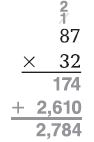
Options:
a. 84 square yards
b. 96 square yards
c. 180 square yards
d. 192 square yards

Answer: 192 square yards

Explanation:
Given that,
Jamie’s mom wants to enlarge her rectangular garden by adding a new rectangular section. The garden is now 96 square yards.
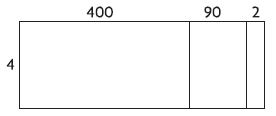
Add 96 square yards to the rectangular garden.
96 square yards + 96 square yards = 192 square yards
Thus the correct answer is option d.

Question 12.
A rectangular yoga studio has an area of 153 square feet. The width of the studio is 9 feet. What is the length of the studio?
lenght = _____ ft

Answer: 17 ft

Explanation:
Given,
A rectangular yoga studio has an area of 153 square feet.
The width of the studio is 9 feet.
Area of the rectangle = l × w
153 square feet = l × 9 ft
l = 153/9
l = 17 ft
Therefore the length of the studio is 17 feet.

Review/Test – Page No. 521

Fill in the bubble completely to show your answer.

Question 13.
Mr. Patterson had a rectangular deck with an area of 112 square feet built in his backyard. Which could be a diagram of Mr. Patterson’s deck?
Options:
a. Go Math Grade 4 Answer Key Homework FL Chapter 13 Algebra Perimeter and Area Review Test img 12
b. Go Math Grade 4 Answer Key Homework FL Chapter 13 Algebra Perimeter and Area Review Test img 13
c. Go Math Grade 4 Answer Key Homework FL Chapter 13 Algebra Perimeter and Area Review Test img 14
d. Go Math Grade 4 Answer Key Homework FL Chapter 13 Algebra Perimeter and Area Review Test img 15

Answer: c. Go Math Grade 4 Answer Key Homework FL Chapter 13 Algebra Perimeter and Area Review Test img 14

Explanation:
Given,
Mr. Patterson had a rectangular deck with an area of 112 square feet built in his backyard.
Area of the rectangle = l × w
A = 28 ft × 4 ft
A = 112 square feet
Thus the correct answer is option c.

Question 14.
The town indoor pool is in a rectangular building. Marco is laying tile around the rectangular pool. How many square meters of tile will Marco need?
Go Math Grade 4 Answer Key Homework FL Chapter 13 Algebra Perimeter and Area Review Test img 16
Options:
a. 96 square meters
b. 252 square meters
c. 572 square meters
d. 892 square meters

Answer: 252 square meters

Explanation:
The outer rectangle is
l = 26 m
w = 22 m
Area of the rectangle = l × w
A = 26 m × 22 m
A = 572 square meters
The inner rectangle is
l = 20 m
w = 16 m
Area of the rectangle = l × w
A = 20 m × 16 m
A = 320 square meters
Thus the square meters of tile will Marco need is 572 – 320 = 252 square meters.

Review/Test – Page No. 522

Question 15.
A drawing of a high school pool is shown below.
Go Math Grade 4 Answer Key Homework FL Chapter 13 Algebra Perimeter and Area Review Test img 17
What is the area of the pool? Explain how you know.
_______ square yards

Answer:

Explanation:
Figure 1:
l = 10 yd
w = 15 yd
Area of the rectangle = l × w
A = 10 yd × 15 yd
A = 150 square yard
Figure 2:
l = 15 yd
w = 10 yd
Area of the rectangle = l × w
A = 15 yd × 10 yd
A = 150 square yard
Figure 3:
l = 10 yd
w = 5 yd
Area of the rectangle = l × w
A = 10 yd × 5 yd
A = 50 square yard
Area of the pool = 150 square yard + 150 square yard + 50 square yard = 350 square yard

Question 16.
Mr. Brown has 24 meters of fencing. He wants to build a rectangular pen for his rabbits.
Go Math Grade 4 Answer Key Homework FL Chapter 13 Algebra Perimeter and Area Review Test img 18
A. Draw two different rectangles that Mr. Brown could build. Use only whole numbers for the lengths of the sides of each rectangle. Label the length of each side.
Type below:
_________

Answer:
Go Math Grade 4 Answer Key Chapter 13 Review Test img-2

Question 16.
B. Find the area in square meters of each rabbit pen you made in Part A. Show your work.
Type below:
_________

Answer: 20 square meters

Explanation:
l = 10m
w = 2m
Area of the rectangle = l × w
A = 10 m × 2 m
A = 20 square meters
Therefore the area in square meters of each rabbit pen is 20 square meters.

Question 16.
C. If you were Mr. Brown, which of the two pens above would you construct for your rabbits? Explain why.
Type below:
_________

Answer: I would construct the second figure for the two rabbit pens.

Conclusion:
By following the Go Math Grade 4 Review Test solutions, students can quickly find the perimeter and area of shapes within a few minutes. Keep in touch with us to get the Go Math Grade 4 Answer Key Chapter 13 Algebra: Perimeter and Area.

Go Math Grade 4 Answer Key Homework FL Chapter 13 Algebra: Perimeter and Area Review/Test Read More »

Scroll to Top