Texas Go Math

Texas Go Math Grade 7 Lesson 2.2 Answer Key Constant Rates of Change

Refer to our Texas Go Math Grade 7 Answer Key Pdf to score good marks in the exams. Test yourself by practicing the problems from Texas Go Math Grade 7 Lesson 2.2 Answer Key Constant Rates of Change.

Texas Go Math Grade 7 Lesson 2.2 Answer Key Constant Rates of Change

Texas Go Math Grade 7 Lesson 2.2 Explore Activity Answer Key

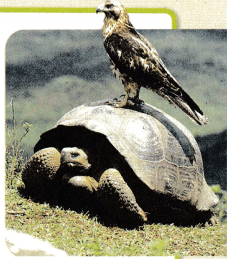
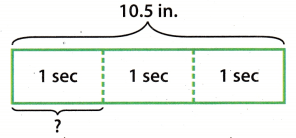
A giant tortoise moves at a slow but steady pace. It takes the giant tortoise 3 seconds to travel 10.5 inches.
Texas Go Math Grade 7 Lesson 2.2 Answer Key 1

A. Use the bar diagram to help you determine how many inches a tortoise travels in 1 second. What operation did you use to find the answer?
Texas Go Math Grade 7 Lesson 2.2 Answer Key 2

B. Complete the table.
Texas Go Math Grade 7 Lesson 2.2 Answer Key 3

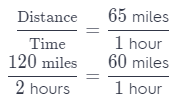
C. For each column of the table, find the distance and the time. Write each fraction as a decimal. Put distance in the numerator and time in the denominator.
Texas Go Math Grade 7 Lesson 2.2 Answer Key 4

D. What do you notice about the decimal forms of the fractions?

E. Conjecture How do you think the distance a tortoise travels is related to the time?

Reflect

Question 1.
Suppose the tortoise travels for 12 seconds. Explain how you could find the distance the tortoise travels.
Answer:
We could simply multiply the tortoise unit rate of inches per second by 12.

Go Math Grade 7 Pdf Lesson 2.2 Constant Rate of Change Answer Key Question 2.
How would you describe the rate of speed at which a tortoise travels?
Answer:
We would describe it with a rate of inches per second.

Your Turn

Question 3.
The table shows the distance Allison drove on one day of her vacation. Is the relationship between the distance and the time a proportional relationship? Did she drive at a constant speed? Explain.
Texas Go Math Grade 7 Lesson 2.2 Answer Key 5
Answer:
Write the rates.
Texas Go Math Grade 7 Lesson 2.2 Answer Key 12
We can stop here, and see that the rates are different. Thus, she did not drive at a constant speed.

Question 4.
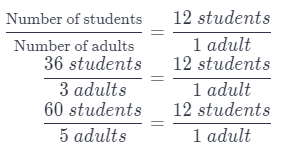
For a school field trip, there must be 1 adult to accompany 12 students, 3 adults to accompany 36 students, and 5 adults to accompany 60 students. Show that the relationship between the number of adults and the number of students is a proportional relationship. Then write an equation for the relationship.
Texas Go Math Grade 7 Lesson 2.2 Answer Key 6
Answer:
Write the rates.
Texas Go Math Grade 7 Lesson 2.2 Answer Key 13
The rates are equaL They are constant so the relationship is proportional
Let x represent the number of students.
Let y represent the number of adults.
The equation for the relationship is:
y = \(\frac{x}{12}\)

Texas Go Math Grade 7 Lesson 2.2 Guided Practice Answer Key

Question 1.
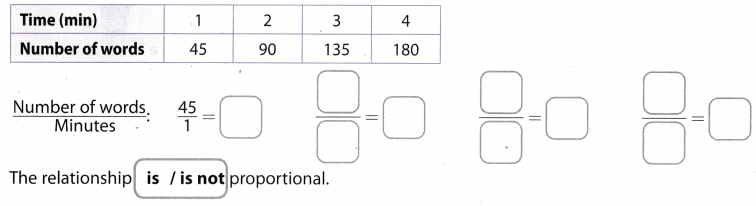
Based on the information in the table, is the relationship between time and the number of words typed a proportional relationship? (Explore Activity and Example 1)
Texas Go Math Grade 7 Lesson 2.2 Answer Key 7
Answer:
Texas Go Math Grade 7 Lesson 2.2 Answer Key 14
The relationship is proportional.

Constant Rates of Change 3

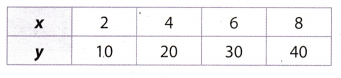
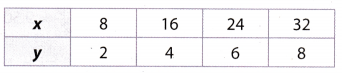
Find the constant of proportionality k. Then write an equation for the relationship between x and y. (Example 2)

Question 2.
Texas Go Math Grade 7 Lesson 2.2 Answer Key 8
Answer:
\(\frac{y}{x}\) : = \(\frac{10}{2}\) = 5 ; \(\frac{30}{6}\) = 5 ; \(\frac{40}{8}\) = 5
k = 5
Equation: y = 5x
k = 5, y = 5x

Go Math Answer Key Grade 7 Lesson 2.2 Question 3.
Texas Go Math Grade 7 Lesson 2.2 Answer Key 9
Answer:
\(\frac{x}{y}\) : = \(\frac{8}{2}\) = 4 ; \(\frac{16}{4}\) = 4 ; \(\frac{24}{6}\) = 4 ; \(\frac{32}{8}\) = 4
k = 4
Equation: x = 4y
k = 4, x = 4y

Constant Rates of Change 2

Essential Question Check-In

Question 4.
How can you represent a proportional relationship using an equation?
Answer:
We represent the proportional relationship using a constant that is a ratio of two variables.

Texas Go Math Grade 7 Lesson 2.2 Independent Practice Answer Key

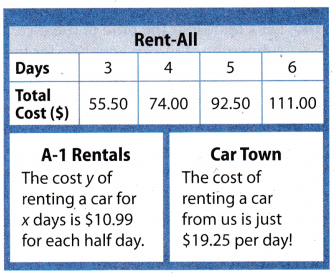
Information on three car-rental companies is given.
Texas Go Math Grade 7 Lesson 2.2 Answer Key 10
Question 5.
Write an equation that gives the cost y of renting a car for x days from Rent-All. _______________
Answer:
Texas Go Math Grade 7 Lesson 2.2 Answer Key 15
y = 18.5x

Question 6.
What is the cost per day of renting a car from A-1? ___________
Answer:
If the cost for half a day is equal to $10.99, then the cost per day is 2 times greater:
$10.99 × 2 = $21.98 per day

Constant Rate of Change Answer Key Go Math Grade 7 Lesson 2.2 Question 7.
Analyze Relationships Which company offers the best deal? Why?
Answer:
Rent-all offers the best deal, because it’s price of car rental per day is the lowest.

Question 8.
Critique Reasoning A skydiver jumps out of an airplane. After 0.8 seconds, she has fallen 100 feet. After 3.1 seconds, she had fallen 500 feet. Imtiaz says that the skydiver should fall about 187.5 feet in 1.5 seconds. Is his answer reasonable? Explain.
Answer:
\(\frac{\text { Distance(feet) }}{\text { Time(seconds) }}: \frac{100}{0.8}=125 \quad \frac{500}{3.1}=161.3 \quad \frac{187.5}{1.5}=125\)
Emtiaz’s answer is not reasonable because the longer the skydiver falls, the faster he should be. So, he should have taken into consideration a constant somewhere between first and second, not the first.

Steven earns extra money babysitting. He charges $31.25 for 5 hours and $50 for 8 hours.

Question 9.
Explain why the relationship between how much Steven charges and time is a proportional relationship.
Answer:
\(\frac{\text { Price }(\$)}{\text { Time(hours) }}: \quad \frac{31.25}{5}=6.25 \quad \frac{50}{8}=6.25\)
The relationship is proportional because the price per hour in both cases is equal.

Question 10.
Interpret the Answer Explain what the constant rate of change means in the context.
Answer:
The constant rate of change represents the price per hour.

Go Math Grade 5 Lesson 2.2 Answer Key Constant Rate of Change Question 11.
Write an equation to represent the relationship. Tell what the variables represent.
Answer:
x = Time (hours)
y = Price ($)
y = 6.25x

Question 12.
How much would Steven charge for 3 hours?
Answer:
Multiply unit rate of price per hour by 3:
3 × 6.25 = $18.75
Steven would charge $18.75 for 3 hours.

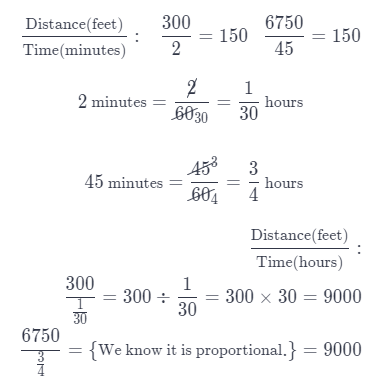
A submarine dives 300 feet every 2 minutes, and 6,750 feet every 45 minutes.

Question 13.
Find the constant rate at which the submarine dives, Give your answer in feet per minute and in feet per hour.
Answer:
Texas Go Math Grade 7 Lesson 2.2 Answer Key 16
Submarine dives 150 feet per minute or 9000 feet per hour.

Question 14.
Let x represent the time of the dive. Let y represent the depth of the submarine. Write an equation for the proportional relationship using the rate in feet per minute.
Answer:
y = 150x

Go Math Grade 7 Lesson 2.2 Answer Key Question 15.
Draw Conclusions If you wanted to find the depth of a submarine during a dive, would it be more reasonable to use an equation with the rate in feet per minute or feet per hour? Explain your reasoning.
Answer:
It all depends what is more comfortable to use.
E.g.
If we want to know where the submarine is after 3 hours, we would use feet per hour.
If we want to know where the submarine is after 38 minutes, we would use feet per minute.

H.O.T. Focus On Higher Order Thinking

Question 16.
Make a Conjecture There is a proportional relationship between your distance from a thunderstorm and the time from when you see lightning to when you hear thunder. If there are 9 seconds between lightning and thunder, the storm is about 3 kilometers away. If you double the amount of time between lightning and thunder, do you think the distance in kilometers also doubles? Justify your reasoning.
Answer:
Yes, the distance in kilometers doubles. The relationship is proportional. Thus, when you double the amount of time between lightning and thunder, the distance in kilometers double.

Go Math 7th Grade Lesson 2.2 Constant Rate of Change Question 17.
Communicate Mathematical Ideas A store sells 3 ears of corn for $1. They round prices to the nearest cent as shown in the table. Tell whether you would describe the relationship between cost and number of ears of corn as a proportional relationship. Justify your answer.
Texas Go Math Grade 7 Lesson 2.2 Answer Key 11
Answer:
I would not represent it as a proportional relationship, because the constant is not equal. There is a slight difference.
\(\frac{0.33}{1}\) = 0.33 \(\frac{0.67}{2}\) = 0.335
0.33 ≠ 0.335

Texas Go Math Grade 7 Lesson 2.2 Answer Key Constant Rates of Change Read More »

Texas Go Math Grade 5 Module 4 Assessment Answer Key

Refer to our Texas Go Math Grade 5 Answer Key Pdf to score good marks in the exams. Test yourself by practicing the problems from Texas Go Math Grade 5 Module 4 Assessment Answer Key.

Texas Go Math Grade 5 Module 4 Assessment Answer Key

Concepts and Skills

Question 1.
Explain how the position of the decimal point changes in a quotient as you divide a number by 10,100, and 1,000. (TEKS 5.3.G)
Answer:
Move the decimal point to the left for as many places (steps) as there are zeros in the factor 10, 100, or 1000.
Explanation:

28 ÷ 10=2.8  — Move the decimal point one step to the left.
28÷ 100 = 0.28 –Move the decimal point two steps to the left. You need to write zeros in front of the number.
28 ÷ 1000 = 0.028 — Move the decimal point three steps to the left. You need to write zeros in front of the number.

5th Grade Module 4 Assessment Answer Key Go Math Question 2.
Explain how you can use base-ten blocks to find 2.16 ÷ 3. (TEKS 5.3.F)
Answer:
Explanation:

Step 1:
Use base-ten blocks to show 2.16.
Remember that a flat represents one, a tong represents one tenth and a small cube represent one hundredth.
Therefore, 2 ones, 1 tenths, and 6 hundredths.
Step 2
Share the ones.
Share the ones equally 3 groups.
There will be 0 one share in each group and 2 ones Left over _
( Notice that 2 ones cannot be shared among 3 groups without regrouping.
Therefore, you have to regroup the ones by rep(acing them with tenths)
step 3
Share the tenths.
(Remember that 2 ones (left over and the one is equal’ to 10 tenths.)
So, now We have 21 tenths in total.
And there will be 7 tenths share in each group, 21÷ 3
Step 4:
Share the hundredths.
Share the 6 hundredths equally among the 3 groups.
There will be 2 hundredths share in each group, 6 ÷3
step 5
Therefore,
2.16 ÷3 = 0.72

Complete the pattern. (TEKS 5.3.G)

Grade 5 Module 4 Assessment Answer Key 2

Question 3.
223 ÷ 1 = __________
223 ÷ 10 = __________
223 ÷ 100 = __________
223 ÷ 1,000 = __________
Answer:
223 ÷ 1 = 223
223 ÷ 10 = 22.3
223 ÷ 100 = 2.23
223 ÷ 1,000 = 0.223
Explanation:
Move the decimal point to the left for as many places (steps) as there are zeros in the factor 10, 100, or 1000.

Go Math Module 4 Answer Key 5th Grade Question 4.
61 ÷ 1 = __________
61 ÷ 10 = __________
61 ÷ 100 = __________
61 ÷ 1,000 = __________
Answer:
61 ÷ 1 = 61
61 ÷ 10 =6.1
61 ÷ 100 = 0.61
61 ÷ 1,000 = 0.061
Explanation:
Move the decimal point to the left for as many places (steps) as there are zeros in the factor 10, 100, or 1000.

Question 5.
57.4 ÷ 1 = __________
57.4 ÷ 10 = __________
57.4 ÷ 100 = __________
Answer:
57.4 ÷ 1 = 57.4
57.4 ÷ 10 =5.74
57.4 ÷ 100 = 0.574
Explanation:
Move the decimal point to the left for as many places (steps) as there are zeros in the factor 10, 100, or 1000.

Estimate the quotient (TEKS 5.3.A)

Question 6.
31.9 ÷ 4
Answer:  7.975
Explanation:
4 goes into 31, 7 times with remainder of 3
4 goes into 39, 9 times with remainder of 3
4 goes into 30, 7 times with remainder of 2
4 goes into 20, 5 times with no remainder 0
So Answer is 7.975

Question 7.
6.1 ÷ 8
Answer: 0.7625
Explanation:
8 goes into 61, 7 times with remainder of 5
8 goes into 50, 6 times with remainder of 2
8 goes into 20, 2 times with remainder of 4
8 goes into 20, 5 times with no remainder 0
So Answer is 0.7625

Go Math Grade 5 Module 4 Answer Key Question 8.
492.6 ÷ 48
Answer: 10.2625
Explanation:
48 goes into 492, 10 times with remainder of 12
48 goes into 126, 2 times with remainder of 30
48 goes into 300, 6 times with remainder of 12
48 goes into 120, 2 times with no remainder 24
48 goes into 240, 5 times with no remainder 0
So Answer is 10.2625

Use models or strategies to divide. (TEKS 5.3.F, 5.3.G)

Question 9.
Texas Go Math Grade 5 Module 4 Assessment Answer Key 1
Answer: 0.87
Explanation:
STEP 1
Use base-ten blocks to show 4.35.
Remember that a flat represents one. A long represents
One tenth, and a small cube represents one hundredth.
There are 4 one(S), 3 tenth(s), and 5 hundredth(s).
STEP 2 Share the ones.
4 one(S) cannot be shared among 5 groups without regrouping. Regroup the one(s) by replacing them with tenths.
There is 0 one(s) shared in each group and 4 one(s) left over.
There are now 43 tenth(s). And 8 tenth(s) shared in each group and 3 tenth(s).left over.
STEP 3 share the tenths.
Two tenths cannot be shared among 3 groups without regrouping. Regroup the tenths by replacing them with hundredths.
There are 0 tenth(s) shared in each group and 3 tenth(s) left over.
STEP 4 Share the hundredths.
Share the hundredths equally among the 5 groups.
There are  35 hundredth(s) and 7 hundredth(s) shared in each group and 0 hundredth(s) left ove
Question 10.
Texas Go Math Grade 5 Module 4 Assessment Answer Key 2
Answer: 1.24
Explanation:
9.92÷8=1.24
Done by base ten blocks method

Question 11.
Texas Go Math Grade 5 Module 4 Assessment Answer Key 3
Answer: 3.4
Explanation:
207÷61 = 3.4
Done by base ten blocks method

Fill in the bubble completely to show your answer.

Grade 5 Module 4 Answer Key Go Math Question 12.
The Westside Bakery uses 440 pounds of sugar to make 1,000 cakes. Each cake contains the same amount of sugar. How many pounds of sugar does the bakery need if they bake only 100 cakes? (TEKS 5.3.G)
(A) 4.4 pounds
(B) 0.44 pound
(C) 0.044 pound
(D) 44 pounds
Answer:  D
Explanation:
The Westside Bakery uses 440 pounds of sugar to make 1,000 cakes
440 ÷ 1000= 0.44
Each bread contains 0 . 44  pounds of sugar
To make 100 cakes
0.44 x 100 = 44 pounds

Grade 5 Module 4 Assessment Answer Key 1

Question 13.
Fourteen boxes of candles were sold for $91.00. Each box contains 5 candles. What is the cost of 1 candle? (TEKS 5.3.G)
(A) $1.30
(B) $6.50
(C) $13.00
(D) $0.65
Answer: A
Explanation:
Fourteen boxes of candles were sold for $91.00
91 ÷ 14 = 6.5, so, each box cost is $6 . 5
Each box contains 5 candles
6.5 ÷ 5 = 1.30
so, each candle cost is $1. 30.

Question 14.
Jason has a piece of wire that is 62.4 inches long. He cuts the wire into 3 equal pieces. Which is the best estimate of the length of each piece of wire? (TEKS 5.3.A)
(A) 30 inches
(B) 3 inches
(C) 20 inches
(D) 2 inches
Answer: C
Explanation:
STEP 1 Use base-ten blocks to show 62.4.
Remember that a flat represents one. A long represents
One tenth, and a small cube represents one hundredth.
There are 6 one(S), 2 tenth(s), and 4 hundredth(s).
STEP 2 Share the ones.
Share an equal number of ones among 3 groups.
There is 2 one(s) shared in each group and 0 one(s) left over.
STEP 3 share the tenths. Two tenths cannot be shared among 3 groups without regrouping. Regroup the tenths by replacing them with hundredths.
There are 0 tenth(s) shared in each group and 2 tenth(s) left over.
There are now 24 hundredth(s).
STEP 4 Share the hundredths.
Share the 24 hundredths equally among the 3 groups.
There are 24 hundredth(s) and 8 hundredth(s) shared in each group and 0 hundredth(s) left over.
So, each piece of wire is 20.8 yards long.

Go Math Grade 5 Answer Key Module 4 Question 15.
Elizabeth uses 33.75 ounces of granola for 15 servings of trail mix. If each serving contains the same amount of granola, how much granola is in each serving? (TEKS 5.3.G)
(A) 18.75 ounces
(B) 2.25 ounces
(C) 0.225 ounce
(D) 33.9 ounces
Answer: B
Explanation:
Elizabeth uses 33.75 ounces of granola for 15 servings of trail mix.
each serving contains the same amount of granola
2.25 ounces of granola is in each serving.

Texas Go Math Grade 5 Module 4 Assessment Answer Key Read More »

Texas Go Math Grade 5 Lesson 13.6 Answer Key Metric Measures

Refer to our Texas Go Math Grade 5 Answer Key Pdf to score good marks in the exams. Test yourself by practicing the problems from Texas Go Math Grade 5 Lesson 13.6 Answer Key Metric Measures.

Texas Go Math Grade 5 Lesson 13.6 Answer Key Metric Measures

Essential Question
How can you compare and convert metric units?
Answer:
To convert from one unit to another within the metric system usually means moving a decimal point. If you can remember what the prefixes mean, you can convert within the metric system relatively easily by simply multiplying or dividing the number by the value of the prefix.

Unlock the Problem

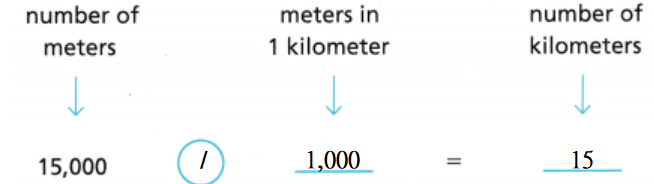
Using a map, Alex estimates the distance between his house and his grandparent’s house to be about 15,000 meters. About how many kilometers away from his grandparent’s house does Alex live?
The metric system is based on place value. Length, capacity, and mass each have a base unit (meter, liter, or gram) and use prefixes to show the relationship between larger and smaller units.

One Way Conversions Convert 15,000 meters to kilometers.
Texas Go Math Grade 5 Lesson 13.6 Answer Key 1
Step 1
Find the relationship between the units.
There are 1,000 meters in 1 kilometer.
Step 2
Determine the operation to be used.
I am converting from a meter unit to a Kilometer unit, so I will divide.
Step 3
Convert
So,
Alex’s house is 15 kilometers from his grand parent’s house.

Math Talk
Mathematical Processes
Choose two units in the chart. Explain how the two units are related.
Answer:
The given chart is:

Now,
From the given chart,
We can observe that
The two units are: Kilogram and Gram
Now,
We know that,
The relationship between 2 units are:
1 Kilogram = 1,000 Grams
Hence, from the above,
We can conclude that
The relationship between 2 units are:
1 Kilogram = 1,000 Grams

Metric Measures 4

Another Way
Use a diagram.
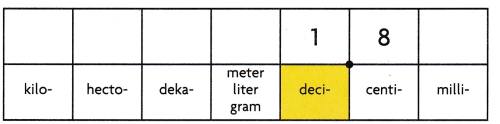
Jamie made a bracelet 1.8 decimeters long. How many millimeters long is Jamie’s bracelet?

Convert 1.8 decimeters to millimeters.
Texas Go Math Grade 5 Lesson 13.6 Answer Key 3

Step 1
Show 1.8 decimeters.
Since the unit is decimeters, place the decimal point so that decimeters are the whole number unit.
Texas Go Math Grade 5 Lesson 13.6 Answer Key 3

Step 2
Convert.
Cross out the decimal point and rewrite it so that millimeters will be the whole number unit. Write a zero to the left of the decimal point to complete the whole number.
So,
1 decimeter = 100 millimeters

Step 3
Record the value with the new unit.
1.8 dm = 180 mm
So,
Jamie’s bracelet is 180 millimeters long.

Try This! Complete the equation to show the conversion.

A.
Convert 247 milligrams to centigrams, decigrams, and grams.
Are the units being converted to a larger unit or a smaller unit?
Answer:
The units are being converted to a smaller unit

Should you multiply or divide to convert?
Answer:
You should divide to convert
Now,
247 mg ÷ 10 = 24.7 cg
247 mg ÷ 100 = 2.47 dg
247 mg ÷ 1,000 = 0.247 g

B. Convert 3.9 hectoliters to dekaliters, liters, and deciliters.
Are the units being converted to a larger unit or a smaller unit?
Answer:
The units are being converted to a larger unit

Should you multiply or divide to convert?
Answer:
You should multiply to convert
Now,
3.9 hL × 10 = 39 daL
3.9hL × 100 = 390 L
3.9 hL × 1,000 = _3,900 dL

Share and Show

Complete the equation to show the conversion.

Question 1.
8.47 L Texas Go Math Grade 5 Lesson 13.6 Answer Key 4 10 = ____ dL
8.47 LTexas Go Math Grade 5 Lesson 13.6 Answer Key 4 10 = ____ cL
8.47 L Texas Go Math Grade 5 Lesson 13.6 Answer Key 4 1,000 = ____ mL
Answer:
We know that,
1 Liter = 10 Deciliters
1 Liter = 100 Centiliters
1 Liter = 1,000 Milliliters
Hence, from the above,
We can conclude that
8.47 L × 10 = 84.7 dL
8.47 L × 100 = 847 cL
8.47 L × 1,000 = 8,470 mL

Think: Are the units being converted to a larger unit or a smaller unit?
Answer:
If the units are converted from a larger unit to a smaller unit, divide
If the units are converted from a smaller unit to a larger unit, multiply

Go Math Answer Key Grade 5 Lesson 13.6 Question 2.
9,824 dg Texas Go Math Grade 5 Lesson 13.6 Answer Key 4 10 = ___ g
9,824 dg Texas Go Math Grade 5 Lesson 13.6 Answer Key 4 100 = ___ dag
9,824 dg Texas Go Math Grade 5 Lesson 13.6 Answer Key 4 1,000 = __ hg
Answer:
We know that,
1 dg = 0.1 g
1 dg = 0.01 dag
1 dg = 0.001 hg
Hence, from the above,
We can conclude that
9,824 dg ÷ 10 = 982.4 g
9,824 dg ÷ 100 = 98.24 dag
9,824 dg ÷ 1,000 = _9.824 hg

Convert.
Question 3.
4,250 cm = ____ m
Answer:
We know that,
1 cm = 0.01 m
So,
4,250 cm = 4,250 × 0.01
= 42.5 m
Hence, from the above,
We can conclude that
4,250 cm = 42.5 m

Question 4.
6,000 mL = ____ L
Answer:
We know that,
1 mL = 0.001 L
So,
6,000 mL = 6,000 × 0.001 L
= 6 L
Hence, from the above,
We can conclude that
6,000 mL = 6 L

Question 5.
4 dg = ____ cg
Answer:
We know that,
1 dg = 10 CG
So,
4 dg = 4 × 10 CG
= 40 CG
Hence, from the above,
We can conclude that
4 dg = 40 CG

Problem Solving

Practices Copy and Solve Compare. Write <, >, or =.

Question 6.
32 hg Texas Go Math Grade 5 Lesson 13.6 Answer Key 4 3.2 kg
Answer:
We know that,
1 kg = 10 hg
So,
3.2 kg = 3.2 × 10 hg
= 32 hg
So,
32 hg = 32 hg
Hence, from the above,
We can conclude that
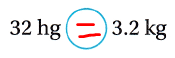
Lesson 13.6 Go Math Answer Key 5th Grade Question 7.
6 km Texas Go Math Grade 5 Lesson 13.6 Answer Key 4 660 m
Answer:
We know that,
1 km = 1,000 m
So,
6 km = 6 × 1,000 m
= 6,000 m
So,
6,000 m > 660 m
Hence, from the above,
We can conclude that

Question 8.
525 mL Texas Go Math Grade 5 Lesson 13.6 Answer Key 4 525 cL
Answer:
We know that,
1 mL = 0.1 cL
So,
525 mL = 525 × 0.1 cL
= 52.5 cL
So,
52.5 cL < 525 cL
Hence, from the above,
We can conclude that
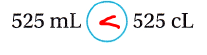
Question 9.
Analyze How can you compare 4.25 decimeters and 4.25 centimeters without converting?
Answer:
We know that,
1 dm = 10 cm
So,
4.25 decimeters = 4.25 × 10 centimeters
= 42.5 centimeters
So,
42.5 cm > 4.25 cm
Hence, from the above,
We can conclude that
4.25 decimeters are greater than 4.25 centimeters

Metric Measures 2

Problem Solving

For 10-11, use the table.

Question 10.
Multi-Step Kelly made one batch of peanut and pretzel snack mix. How many grams does she need to add to the snack mix to make 2 kilograms?
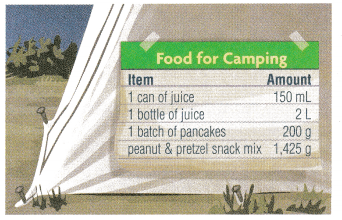
Texas Go Math Grade 5 Lesson 13.6 Answer Key 5
Answer:
It is given that
Kelly made one batch of peanut and pretzel snack mix
Now,
The given table is:
Texas Go Math Grade 5 Lesson 13.6 Answer Key 5
Now,
From the above table,
We can observe that
The weight of one batch of peanut and pretzel snack mix is: 1,425 g
Now,
We know that,
1 kg = 1,000 g
So,
2 kg = 2,000 g
Now,
According to the given information,
The number of grams does Kelly needed to add to the snack mix to make 2 kilograms = 2,000 – 1,425
= 575 grams
Hence, from the above,
We can conclude that
The number of grams does Kelly needed to add to the snack mix to make 2 kilograms is: 575 grams

5th Grade Go Math Answer Key Lesson 13.6 Question 11.
H.O.T. Multi-Step Kelly plans to take juice on her camping trip. Which will hold more juice, 8 cans or 2 bottles? How much more?
Texas Go Math Grade 5 Lesson 13.6 Answer Key 6
Answer:
It is given that
Kelly plans to take the juice on her camping trip
Now,
The given table is:
Texas Go Math Grade 5 Lesson 13.6 Answer Key 5
Now,
From the above,
We can observe that
The capacity of 1 can of juice is: 150 mL
The capacity of 1 bottle of juice is: 2 L
Now,
We know that,
1 L = 1,000 mL
So,
2 L = 2 × 1,000 mL
= 2,000 mL
So,
150 mL < 2,000 mL
Now,
The difference between the capacities of a can of juice and a bottle of the juice = 2,000 – 150
= 1,850 mL
Hence, from the above,
We can conclude that
1 bottle of juice will hold more juice
The bottle of juice holds 1,850 mL more than the can of the juice

Daily Assessment Task

Fill in the bubble completely to show your answer.

Question 12.
Apply A snowboard instructor has 4.2 liters of liquid wax for waxing snowboards. If she uses 1 milliliter for each snowboard, how many snowboards can she wax?
(A) 4
(B) 42
(C) 420
(D) 4,200
Answer:
It is given that
A snowboard instructor has 4.2 liters of liquid wax for waxing snowboards
Now,
We know that,
1 Liter = 1,000 mL
So,
The given amount of liquid wax for waxing snowboards = 4.2 ×1,000 mL
= 4,200 mL
So,
The number of snowboards can the snowboard instructor can wax = \(\frac{4,200}{1}\)
= 4,2000 snowboards
Hence, from the above,
We can conclude that
The number of snowboards can the snowboard instructor can wax is:
Lesson 13.6 Grade 5 Go Math Answer Key Question 13.
Daija wants to trim 3.5 centimeters from her hair. How should she move the decimal point to convert this number to millimeters?
(A) 1 place to the left
(B) 1 place to the right
(C) 2 places to the left
(D) 2 places to the right
Answer:
It is given that
Daija wants to trim 3.5 centimeters from her hair
Now,
We know that,
1 centimeter = 10 millimeter
So,
3.5 centimeters = 3.5 × 10
= 35 mm
Hence, from the above,
We can conclude that
The way Daija moves the decimal point to convert this number to millimeters is:

Question 14.
Multi-Step Vincent mixed 500 grams of raisins, 400 grams of dried cranberries, and 300 grams of almonds to make Trail Mix. How many grams of cashews must he add to make 2 kilograms of Trail Mix?
(A) 140 grams
(B) 200 grams
(C) 800 grams
(D) 1,200 grams
Answer:
It is given that
Vincent mixed 500 grams of raisins, 400 grams of dried cranberries, and 300 grams of almonds to Make Trail Mix
So,
The total amount of Trail Mix = 500 + 400 + 300
= 1,200 grams
Now,
We know that,
1 kilogram = 1,000 grams
So,
2 kilograms = 2,000 grams
Now,
The number of grams of cashews must be added to make 2 kilograms of Trail Mix = 2,000 – 1,200
= 800 grams
Hence, from the above,
We can conclude that
The number of grams of cashews that must be added to make 2 kilograms of Trail Mix is:

Texas Test Prep

Metric System Answer Key 5th Grade Go Math Question 15.
Monica has 426 millimeters of fabric. How many centimeters of fabric does Monica have?
(A) 4,260 centimeters
(B) 42.6 centimeters
(C) 4.26 centimeters
(D) 0.426 centimeters
Answer:
It is given that
Monica has 426 millimeters of fabric
Now,
We know that,
1 millimeter = 0.1 centimeter
So,
426 millimeters = 426 × 0.1 centimeter
= 42.6 centimeters
Hence, from the above,
We can conclude that
The number of centimeters of fabric does Monica have is:

Texas Go Math Grade 5 Lesson 13.6 Homework and Practice Answer Key

Convert.

Question 1.
350 cm = ___ m
Answer:
We know that,
1 cm = 0.01 m
So,
350 cm = 350× 0.01
= 3.5 m
Hence, from the above,
We can conclude that
350 cm = 3.5 m

Question 2.
4,000 mL = __ L
Answer:
We know that,
1 mL = 0.001 L
So,
4,000 mL = 4,000 × 0.001
= 4 L
Hence, from the above,
We can conclude that
4,000 mL = 4 L

Metric Measures 5

Question 3.
62 dg = ____ cg
Answer:
We know that,
1 dg = 10 cg
So,
62 dg = 62 × 10
= 620 cg
Hence, from the above,
We can conclude that
62 dg = 620 cg

Go Math Answer Key Grade 5 Lesson 13.6 Homework Question 4.
9 m = ___ mm
Answer:
We know that,
1 m = 1,000 mm
So,
9 m = 9 × 1,000
= 9,000 mm
Hence, from the above,
We can conclude that
9 m = 9,000 mm

Question 5.
150 g = ___ hg
Answer:
We know that,
1 g = 0.01 hg
So,
150 g = 150 × 0.01 hg
= 1.5 hg
Hence, from the above,
We can conclude that
150 g = 1.5 hg

Question 6.
16 L = __ hL
Answer:
We know that,
1 L = 0.01 hL
So,
16 L = 16 × 0.01 hL
= 0.16 hL
Hence, from the above,
We can conclude that
16 L = 0.16 hL

Compare. Write <, >, or .

Question 7.
6 km Texas Go Math Grade 5 Lesson 13.6 Answer Key 7 54,000 mm
Answer:
We know that,
1 km = 10,00,000 mm
So,
6 km= 6 × 10,00,000 mm
= 60,00,000 mm
So,
60,00,000 mm > 54,000 mm
Hence, from the above,
We can conclude that

Question 8.
3 KL Texas Go Math Grade 5 Lesson 13.6 Answer Key 7 30,000 L
Answer:
We know that,
1 kL = 1,000 L
So,
3 kL= 3 × 1,000 L
= 3,000 L
So,
3,000 L < 30,000 L
Hence, from the above,
We can conclude that

Question 9.
20g Texas Go Math Grade 5 Lesson 13.6 Answer Key 7 0.02 kg
Answer:
We know that,
1 g = 0.001 Kg
So,
20 g= 20 × 0.001 Kg
= 0.02 kg
So,
0.02 g = 0.02 g
Hence, from the above,
We can conclude that

5th Grade Go Math Answer Key Lesson 13.6 Question 10.
52L Texas Go Math Grade 5 Lesson 13.6 Answer Key 7 5,200 mL
Answer:
We know that,
1 L = 1,000 mL
So,
52 L= 52 × 1,000 mL
= 52,000 mL
So,
52,000 mL > 5,200 mL
Hence, from the above,
We can conclude that

Question 11.
14m Texas Go Math Grade 5 Lesson 13.6 Answer Key 7 140 cm
Answer:
We know that,
1 m = 100 cm
So,
14 m= 14 × 100 cm
= 1,400 cm
So,
1,400 cm > 140 cm
Hence, from the above,
We can conclude that

Question 12.
312 mg Texas Go Math Grade 5 Lesson 13.6 Answer Key 7 312 dg
Answer:
We know that,
1 mg = 0.01 dg
So,
312 mg= 312 × 0.01 dg
= 3.12 dg
So,
3.12 dg < 312 dg
Hence, from the above,
We can conclude that

Question 13.
Is 25 milligrams lighter or heavier than 25 centigrams? Explain how you know.
Answer:
We know that,
1 mg = 0.1 cg
So,
25 mg = 25 × 0.1 cg
= 2.5 cg
So,
2.5 cg < 25 cg
Hence, from the above,
We can conclude that
25 milligrams is lighter than 25 centigrams

Problem Solving

Question 14.
Lucy and Donavan measured the length of the school garden. Lucy’s measurement is 11.3 meters and Donavan’s measurement is 113 centimeters. Could both be correct? Explain.
Answer:
It is given that
Lucy and Donavan measured the length of the school garden. Lucy’s measurement is 11.3 meters and Donavan’s measurement is 113 centimeters
Now,
We know that,
1 meter = 100 centimeters
So,
11.3 meters = 11.3 × 100 centimeters
= 1,130 centimeters
So,
1,130 centimeters > 113 centimeters
Hence, from the above,
We can conclude that
Lucy and Donavan are not correct
Lucy’s measurement is greater than Donavan’s measurement

Question 15.
Shanika makes 2,800 milliliters of chicken soup for a dinner party. She needs 3.5 liters. How many more milliliters does Shanika need to make? How many liters is that?
Answer:
It is given that
Shanika makes 2,800 milliliters of chicken soup for a dinner party. She needs 3.5 liters
Now,
We know that,
1 L = 1,000 mL
So,
2,800 mL = 2,800 × \(\frac{1}{1,000}\)
= 280 L
3.5 L = 3.5 × 1,000
= 3,500 mL
So,
The number of more milliliters does Shanika need to make = 3,500 – 2,800
= 700 mL
= 700 × \(\frac{1}{1,000}\) L
= 70 L
Hence, from the above,
We can conclude that
The number of more milliliters does Shanika need to make is: 700 mL (or) 70 L

Texas Test Prep

Lesson Check

Fill in the bubble completely to show your answer.

Question 16.
Jordan has 3.2 liters of paint left after painting the scenery for the school play. How can she convert this number to find how many milliliters of paint she has left?
(A) Multiply by 100.
(B) Multiply by 1,000.
(C) Divide by 100.
(D) Divide by 1,000.
Answer:
It is given that
Jordan has 3.2 liters of paint left after painting the scenery for the school play
Now,
We know that,
1 L = 1,000 mL
So,
3.2 L = 3.2 × 1,000 mL
Hence, from the above,
We can conclude that
Jordan can convert this number to find the number of milliliters of paint she has left by:

5th Grade Metric Conversion Chart Go Math Lesson 13.6 Answer Key Question 17.
Martin needs to ship a box that weighs 12,000 grams. How should he move the decimal point to convert this number to kilograms?
(A) 2 places to the right
(B) 3 places to the right
(C) 2 places to the left
(D) 3 places to the left
Answer:
It is given that
Martin needs to ship a box that weighs 12,000 grams
Now,
We know that,
1 kg = 1,000 grams
So,
12,000 grams = 12,000 × \(\frac{1}{1,000}\)
= 12 kg
Hence, from the above,
We can conclude that
Martin has to move the decimal point to convert this number to kilograms by:

Question 18.
Akeem has 24 meters of rope. Which of the following lengths is equal to 24 meters?
(A) 0.024 kilometer
(B) 0.24 kilometer
(C) 2.4 kilometers
(D) 240 kilometers
Answer:
It is given that
Akeem has 24 meters of rope
Now,
We know that,
1 meter = 0.001 kilometers
So,
24 meters = 24 × 0.001 kilometers
= 0.024 kilometers
Hence, from the above,
We can conclude that
The following lengths that is equal to 24 meters is:

Question 19.
A pastry chef bought a 0.26-liter container of vanilla extract for baking. If she uses 1 milliliter of vanilla in each batch of pastries, how many batches can she make?
(A) 2,600
(B) 260
(C) 26
(D) 2.6
Answer:
It is given that
A pastry chef bought a 0.26-liter container of vanilla extract for baking and she uses 1 milliliter of vanilla in each batch of pastries
Now,
We know that,
1 Liter = 1,000 mL
So,
0.26 Liters = 0.26 × 1,000
= 260 mL
So,
The number of batches of vanilla that pastry chef can make = \(\frac{260}{1}\)
= 260 batches
Hence, from the above,
We can conclude that
The number of batches of vanilla that pastry chef can make is:

Question 20.
Multi-Step The weight limit for luggage at the airport is 22 kilograms per person. Rico packs two suitcases and finds their weights to be 8,500 grams and 9,200 grams. How many more grams can he pack without going over the weight limit?
(A) 4,300 grams
(B) 5,700 grams
(C) 13,500 grams
(D) 17,700 grams
Answer:
It is given that
The weight limit for luggage at the airport is 22 kilograms per person. Rico packs two suitcases and finds their weights to be 8,500 grams and 9,200 grams
Now,
We know that,
1 kilogram = 1,000 grams
So,
The weight limit for luggage at the airport per person in grams = 22 × 1,000
= 22,000 grams
So,
The number of more grams cRico can pack without going over the weight limit = 22,000 – (8,500 + 9,200)
= 22,000 – 17,700
= 4,300 grams
Hence, from the above,
We can conclude that
The number of more grams cRico can pack without going over the weight limit is:

Question 21.
Multi-Step The county repairs three sections of a road. The first section is 2.5 kilometers long, the second section is 12 hectometers long, and the third section is 800 meters long. What is the total length of the repaired sections of the road?
(A) 3.5 kilometers
(B) 4.0 kilometers
(C) 4.5 kilometers
(D) 0.5 kilometer
Answer:
It is given that
The county repairs three sections of a road. The first section is 2.5 kilometers long, the second section is 12 hectometers long, and the third section is 800 meters long
Now,
We know that,
1 hm = 0.1 km
1m = 0.001 km
So,
The total length of the repaired sections of the road = 2.5 + (12 × 0.1) + (800 × 0.001)
= 2.5 + 1.2 + 0.8
= 4.5 kilometers
Hence, from the above,
We can conclude that
The total length of the repaired sections of the road is:


Texas Go Math Grade 5 Lesson 13.6 Answer Key Metric Measures Read More »

Texas Go Math Grade 3 Lesson 3.4 Answer Key Model Equivalent Fractions

Refer to our Texas Go Math Grade 3 Answer Key Pdf to score good marks in the exams. Test yourself by practicing the problems from Texas Go Math Grade 3 Lesson 3.4 Answer Key Model Equivalent Fractions.

Texas Go Math Grade 3 Lesson 3.4 Answer Key Model Equivalent Fractions

Essential Question
How can you use models to find equivalent fractions?
Answer:
Two fractions are equivalent (equal) if they are of the same size or are at the same point on a number line.

Investigate
Materials Texas Go Math Grade 3 Lesson 3.4 Answer Key 1 sheet of paper Texas Go Math Grade 3 Lesson 3.4 Answer Key 1 crayon or color pencil

Two or more fractions that name the same amount are called equivalent fractions. You can use a sheet of paper
to model fractions equivalent to \(\frac{1}{2} \text {. }\)

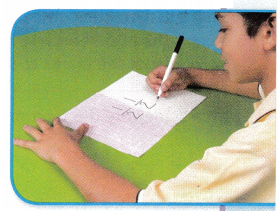
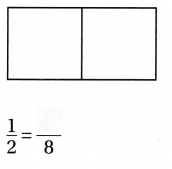
A. First, fold a sheet of paper into two equal parts. Open the paper and count the parts.
There are 2 equal parts. Each part is \(\frac{1}{2}\) of the paper.
Shade one of the halves. Write \(\frac{1}{2}\) on each of the halves.
Texas Go Math Grade 3 Lesson 3.4 Answer Key 2
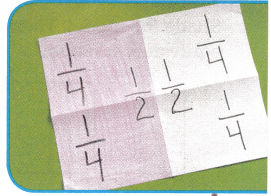
B. Next, fold the paper in half two times. Open the paper.
Now there are 4 equal parts. Each part is \(\frac{1}{4}\) of the paper.
Write \(\frac{1}{4}\) on each of the fourths.
Look at the shaded parts. \(\frac{1}{2}\) = \(\frac{2}{4}\)
Texas Go Math Grade 3 Lesson 3.4 Answer Key 4
C. Last, fold the paper in half three times.
Now there are 8 equal parts. Each part is \(\frac{1}{8}\) of the paper.
Write \(\frac{1}{8}\) on each of the eighths.
So,
\(\frac{1}{2}\) = \(\frac{4}{8}\)
Find the fractions equivalent to \(\frac{1}{2}\) on your paper.
So,
\(\frac{1}{2}\), \(\frac{2}{4}\), and \(\frac{4}{8}\) are equivalent.

Make Connections

You can use a number line to find equivalent fractions
Find a fraction equivalent to \(\frac{2}{3}\).

Materials Texas Go Math Grade 3 Lesson 3.4 Answer Key 5 fraction strips
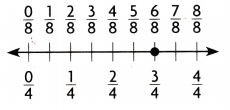
Texas Go Math Grade 3 Lesson 3.4 Answer Key 6

Math Talk
Mathematical Processes
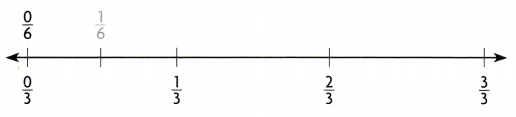
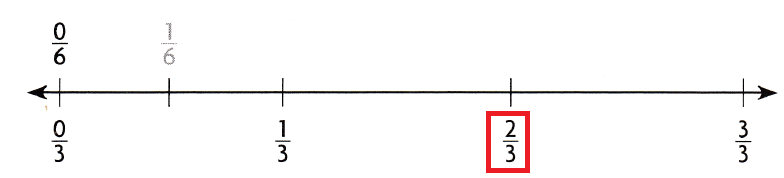
Explain how the number of sixths in a distance on the number line is related to the number of thirds in the same distance.
Answer:
The given number line is:
Texas Go Math Grade 3 Lesson 3.4 Answer Key 6
Now,
We know that,
\(\frac{1}{6}\) = \(\frac{1}{2}\) × \(\frac{1}{3}\)
So,
We will obtain the sixths by dividing \(\frac{1}{3}\) into 2 parts
Hence, from the above,
We can conclude that
The number of sixths in a distance on the number line is \(\frac{1}{2}\) times the number of thirds in the same distance

Step 1
Draw a point on the number line to represent the distance \(\frac{2}{3}\).
Answer:
The given number line is:
Texas Go Math Grade 3 Lesson 3.4 Answer Key 6
Hence,
The representation of \(\frac{2}{3}\) on the given number line is:

Step 2
Use fraction strips to divide the number line into sixths. At the end of each strip, draw a mark on the number line and label the marks to show sixths.
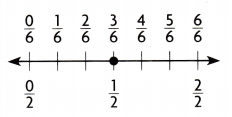
Answer:
The given number line is:
Texas Go Math Grade 3 Lesson 3.4 Answer Key 6
Hence,
The representation of the sixths on the given number line is:

Step 3
Identify the fraction that names the same point as \(\frac{2}{3}\).
So, \(\frac{2}{3}\) = \(\frac{4}{6}\)

Share and Show

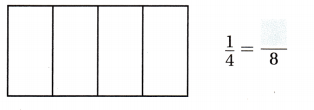
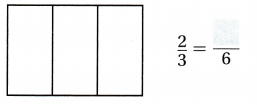
Shade the model. Then divide the pieces to find the equivalent fraction.

Question 1.
Texas Go Math Grade 3 Lesson 3.4 Answer Key 8
Answer:
The representation of the model with the original and equivalent fractions is:

Hence, from the above,
We can conclude that
\(\frac{1}{4}\) = \(\frac{2}{8}\)

Model Equivalent Fractions 1

Go Math Grade 3 Lesson 3.4 Model Equivalent Fractions Question 2.
Texas Go Math Grade 3 Lesson 3.4 Answer Key 9
Answer:
The representation of the model with the original and equivalent fractions is:

Hence, from the above,
We can conclude that
\(\frac{2}{3}\) = \(\frac{4}{6}\)

Use fraction strips or the number line to find the equivalent fraction.

Question 3.
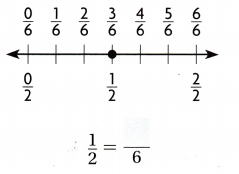
Texas Go Math Grade 3 Lesson 3.4 Answer Key 10
Answer:
The given number line is:

Now,
From the given number line,
We can observe that
\(\frac{1}{2}\) = \(\frac{3}{6}\)
Hence, from the above,
We can conclude that

Question 4.
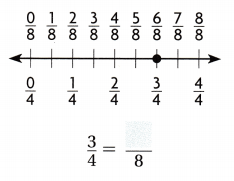
Texas Go Math Grade 3 Lesson 3.4 Answer Key 11
Answer:
The given number line is:

Now,
From the given number line,
We can observe that
\(\frac{3}{4}\) = \(\frac{6}{8}\)
Hence, from the above,
We can conclude that

Problem Solving

Use the pictures to solve 5-9.

Question 5.
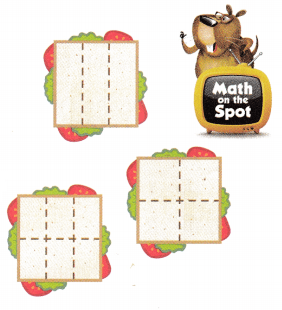
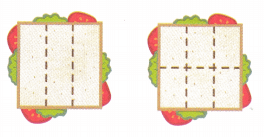
H.O.T. Multi-Step Mrs. Akers bought three sandwiches that were the same size. She cut the first one into thirds. She cut the second one into fourths and the third one into sixths. Marian ate 2 pieces of the first sandwich. Jason ate 2 pieces of the second sandwich. Marcos ate 3 pieces of the third sandwich. Which children ate the same amount of a sandwich?
Texas Go Math Grade 3 Lesson 3.4 Answer Key 12

The first sandwich was cut into 3 parts.
Manan ate 2 pieces of the sandwich. Shade the part Manan ate.

Manan ate \(\frac{2}{3}\) of the first sandwich.

The second sandwich was cut into 4 pieces
Jason ate 2 pieces of the sandwich. Shade the part Jason ate.

Jason ate\(\frac{2}{4}\) of the second sandwich.

The third sandwich was cut into 6 pieces.
Marcos ate 3 pieces of the sandwich. Shade the part Marcos ate.

Marcos ate \(\frac{3}{6}\) of the third sandwich.

Go Math Grade 3 Lesson 3.4 Answer Key Question 6.
Are all the fractions equivalent?
Answer:
From the above problem,
The fractions we obtained are:
\(\frac{2}{3}\), \(\frac{2}{4}\), and \(\frac{3}{6}\)
So,
From the above fractions,
We can observe that
\(\frac{2}{4}\) = \(\frac{3}{6}\) = \(\frac{1}{2}\)
Hence, from the above,
We can conclude that
All the fractions are not equivalent

Question 7.
Which fractions are equivalent? Texas Go Math Grade 3 Lesson 3.4 Answer Key 16
Answer:
From the above problem,
The fractions we obtained are:
\(\frac{2}{3}\), \(\frac{2}{4}\), and \(\frac{3}{6}\)
So,
From the above fractions,
We can observe that
\(\frac{2}{4}\) = \(\frac{3}{6}\) = \(\frac{1}{2}\)
Hence, from the above,
We can conclude that
The fractions that are equivalent is:
\(\frac{2}{4}\) = \(\frac{3}{6}\)

Question 8.
So, __ and ___ ate the same amount of a sandwich.
Answer:
So,
Jason and Marcos ate the same amount of a sandwich

Question 9.
Analyze What if Mrs. Akers cut a fourth sandwich into sixths? What fraction is equivalent to the amount Manan ate?
Answer:
It is given that
Mrs. Akers cut the fourth sandwich into sixths
So,
The amount of each sandwich Mrs. Akers will cut from the fourth sandwich = \(\frac{1}{6}\)
Now,
From the above problem,
We can observe that
The fraction of the sandwich that Marian ate is: \(\frac{2}{3}\)
Hence, from the above,
We can conclude that
The fraction of the sandwich that is equivalent to Marian ate is: \(\frac{4}{6}\) (or) \(\frac{6}{9}\)

Daily Assessment Task

Fill in the bubble for the correct answer choice.

Go Math Lesson 3.4 Answer Key 3rd Grade Question 10.
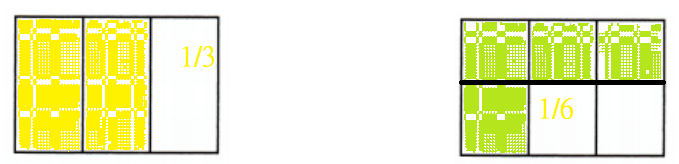
Three brothers want an equal share of an apple. Each will get \(\frac{1}{3}\) of the apple. They cut the apple into thirds and then into sixths. How many \(\frac{1}{6}\) parts are equal to \(\frac{1}{3}\) ?
(A) 1
(B) 3
(C) 2
(D) 6
Answer:
It is given that
Three brothers want an equal share of an apple. Each will get \(\frac{1}{3}\) of the apple. They cut the apple into thirds and then into sixths
Now,
We know that,
\(\frac{1}{6}\) = \(\frac{1}{2}\) × \(\frac{1}{3}\)
So,
\(\frac{1}{3}\) = 2 × \(\frac{1}{6}\)
Hence, from the above,
We can conclude that
The number of \(\frac{1}{6}\) parts that are equal to \(\frac{1}{3}\) is:

Question 11.
Use Tools Kenny ate \(\frac{3}{4}\) of an orange. Which fraction is equivalent to \(\frac{3}{4}\)?
Texas Go Math Grade 3 Lesson 3.4 Answer Key 17
(A) \(\frac{1}{8}\)
(B) \(\frac{2}{8}\)
(C) \(\frac{3}{8}\)
(D) \(\frac{6}{8}\)
Answer:
It is given that
Kenny ate \(\frac{3}{4}\) of an orange
Now,
The given number line is:
Texas Go Math Grade 3 Lesson 3.4 Answer Key 17
Now,
From the above number line,
We can observe that
\(\frac{3}{4}\) = \(\frac{6}{8}\)
Hence, from the above,
We can conclude that
The fraction that is equivalent to \(\frac{3}{4}\) is:

Question 12.
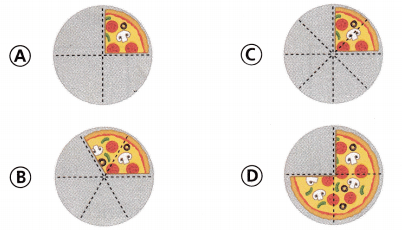
Use Diagrams Multi-Step Look at the pizza at the right Which shows an equivalent fraction of eaten pizza?
Texas Go Math Grade 3 Lesson 3.4 Answer Key 18
Texas Go Math Grade 3 Lesson 3.4 Answer Key 19
Answer:
The given figure that represents thee aten pizza is:
Texas Go Math Grade 3 Lesson 3.4 Answer Key 18
Now,
From the above figure,
We can observe that
The fraction of the eaten pizza = \(\frac{1}{3}\)
So,
The fractions that are equivalent to \(\frac{1}{3}\) are: latex]\frac{2}{6}[/latex] (or) \(\frac{3}{9}\)
Hence, from the above,
We can conclude that
The figure that shows an equivalent fraction of eaten pizza is:

Texas Test Prep

Question 13.
Maria has \(\frac{1}{2}\) of an obstacle course left to finish. What fraction is equivalent to \(\frac{1}{2}\)?
Texas Go Math Grade 3 Lesson 3.4 Answer Key 20
(A) \(\frac{2}{1}\)
(B) \(\frac{5}{6}\)
(C) \(\frac{3}{6}\)
(D) \(\frac{2}{6}\)
Answer:
It is given that
Maria has \(\frac{1}{2}\) of an obstacle course left to finish
Now,
The given number line is:
Texas Go Math Grade 3 Lesson 3.4 Answer Key 20
Now,
From the above number line,
We can observe that
\(\frac{1}{2}\) = \(\frac{3}{6}\)
Hence, from the above,
We can conclude that
The fraction that is equivalent to \(\frac{1}{2}\) is:

Texas Go Math Grade 3 Lesson 3.4 Homework and Practice Answer Key

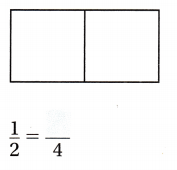
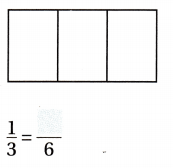
Shade the model. Then divide the pieces to find the equivalent fraction.

Question 1.
Texas Go Math Grade 3 Lesson 3.4 Answer Key 21
Answer:
The representation of the model with the original and equivalent fractions is:

Hence, from the above,
We can conclude that
\(\frac{3}{4}\) = \(\frac{6}{8}\)

Practice and Homework Lesson 3.4 Answer Key 3rd Grade Question 2.
Texas Go Math Grade 3 Lesson 3.4 Answer Key 22
Answer:
The representation of the model with the original and equivalent fractions is:

Hence, from the above,
We can conclude that
\(\frac{1}{2}\) = \(\frac{2}{4}\)

Model Equivalent Fractions 3

Question 3.
Texas Go Math Grade 3 Lesson 3.4 Answer Key 23
Answer:
The representation of the model with the original and equivalent fractions is:

Hence, from the above,
We can conclude that
\(\frac{1}{3}\) = \(\frac{2}{6}\)

Question 4.
Texas Go Math Grade 3 Lesson 3.4 Answer Key 24
Answer:
The representation of the model with the original and equivalent fractions is:

Hence, from the above,
We can conclude that
\(\frac{1}{2}\) = \(\frac{4}{8}\)

Problem Solving

Question 5.
Jason cut a sandwich into three equal pieces and ate two of the pieces. Carl cut a same-size sandwich into six pieces. Carl ate the same fraction of his sandwich as Jason did. What fraction of the sandwich did Carl eat?
Texas Go Math Grade 3 Lesson 3.4 Answer Key 25
Answer:
It is given that
Jason cut a sandwich into three equal pieces and ate two of the pieces. Carl cut a same-size sandwich into six pieces. Carl ate the same fraction of his sandwich as Jason did
Now,
According to the given information,
The number of pieces Jason ate the sandwich = \(\frac{2}{3}\)
Now,
Let the number of pieces Carl ate be: x pieces
So,
The number of pieces Carl ate the sandwich = \(\frac{x}{6}\)
So,
\(\frac{2}{3}\) = \(\frac{x}{6}\)
x = 4 pieces
Hence, from the above,
We can conclude that
The fraction of the sandwich did Carl eat is: \(\frac{4}{6}\)

Lesson Check

Fill in the bubble completely to show your answer. Use the number lines for 6-7.

Question 6.
After finishing \(\frac{1}{4}\) of the soccer practice, players take a water break. Which fraction is equivalent to \(\frac{1}{4}\)?
Texas Go Math Grade 3 Lesson 3.4 Answer Key 26
(A) \(\frac{0}{8}\)
(B) \(\frac{2}{8}\)
(C) \(\frac{6}{8}\)
(D) \(\frac{3}{8}\)
Answer:
It is given that
After finishing \(\frac{1}{4}\) of the soccer practice, players take a water break
Now,
The given number line is:
Texas Go Math Grade 3 Lesson 3.4 Answer Key 26
Now,
From the above number line,
We can observe that
\(\frac{1}{4}\) = \(\frac{2}{8}\)
Hence, from the above,
We can conclude that
The fraction that is equivalent to \(\frac{1}{4}\) is:

Go Math Practice and Homework Lesson 3.4 Answer Key 3rd Grade Question 7.
Carlos practiced the piano for \(\frac{2}{3}\) hour. Which fraction is equivalent to \(\frac{2}{3}\)?
Texas Go Math Grade 3 Lesson 3.4 Answer Key 27
(A) \(\frac{1}{6}\)
(B) \(\frac{3}{6}\)
(C) \(\frac{1}{6}\)
(D) \(\frac{4}{6}\)
Answer:
It is given that
Carlos practiced the piano for \(\frac{2}{3}\) hour
Now,
The given number line is:
Texas Go Math Grade 3 Lesson 3.4 Answer Key 27
Now,
From the above number line,
We can observe that
\(\frac{2}{3}\) = \(\frac{4}{6}\)
Hence, from the above,
We can conclude that
The fraction that is equivalent to \(\frac{2}{3}\) is:

Question 8.
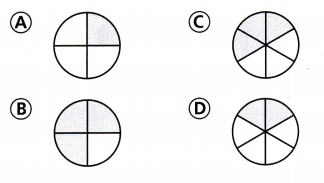
Multi-Step Look at the circle below. Which model shows an equivalent fraction?
Texas Go Math Grade 3 Lesson 3.4 Answer Key 28
Texas Go Math Grade 3 Lesson 3.4 Answer Key 29
Answer:
The given figure is:
Texas Go Math Grade 3 Lesson 3.4 Answer Key 28
Now,
From the above model,
We can observe that
The fraction of the shaded part in the given figure = \(\frac{1}{2}\)
So,
The fraction that is equivalent to \(\frac{1}{2}\) is: \(\frac{2}{4}\) (or) \(\frac{3}{6}\)
Hence, from the above,
We can conclude that
The model that shows the equivalent fraction for the given model is:

Lesson 3.4 Equivalent Fractions Homework Answer Key Question 9.
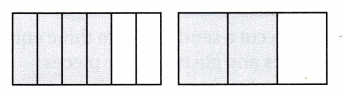
Multi-Step A banner is divided into six equal parts and four parts are blue. Which fraction is equivalent to the blue parts of the banner?
Texas Go Math Grade 3 Lesson 3.4 Answer Key 30
(A) \(\frac{1}{3}\)
(B) \(\frac{2}{4}\)
(C) \(\frac{3}{4}\)
(D) \(\frac{2}{3}\)
Answer:
It is given that
A banner is divided into six equal parts and four parts are blue
Now,
The given model is:
Texas Go Math Grade 3 Lesson 3.4 Answer Key 30
Now,
According to the given information,
The fraction that is equivalent to the blue parts of the banner = (The number of parts that are blue) ÷ (The total number of parts)
= \(\frac{4}{6}\)
= \(\frac{2}{3}\)
Hence, from the above,
We can conclude that
The fraction that is equivalent to the blue parts of the banner is:

Texas Go Math Grade 3 Lesson 3.4 Answer Key Model Equivalent Fractions Read More »

Texas Go Math Grade 5 Lesson 9.1 Answer Key Formulas for Area and Perimeter

Refer to our Texas Go Math Grade 5 Answer Key Pdf to score good marks in the exams.
Test yourself by practicing the problems from Texas Go Math Grade 5 Lesson 9.1
Answer Key Formulas for Area and Perimeter.

Texas Go Math Grade 5 Lesson 9.1 Answer Key Formulas for Area and Perimeter

Unlock the Problem

A formula is an equation that expresses a mathematical rule.
You can use formulas to find the perimeter and area of rectangles.

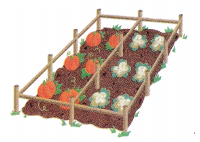
Lloyd is planting a rectangular garden that measures 40 feet by 24 feet.
He wants to put a fence around it to protect his vegetables from rabbits.
How many feet of fencing does he need?

Use a formula to find the perimeter.
P = l + w + l + w, P = perimeter; l = length; w = width
P = 40 + ___24____ + __40_____ + ___24____ Replace the
unknowns with the lengths and the widths.
P = ___128____ Add.
The perimeter is ___128____ feet. So, Lloyd needs ___128____ feet of fencing.

Remember
Area is measured in square units, such as square feet or sq ft.
Answer:
The perimeter is 128 feet, So Lloyd needs 128 feet of fencing,

Explanation:
Lloyd is planting a rectangular garden that measures 40 feet by 24 feet.
He wants to put a fence around it to protect his vegetables from rabbits.
So number of feet of fencing does he need is using a formula to
find the perimeter P = l + w + l + w, P = perimeter; l = length; w = width is
P= 40 + 24 + 40 + 24 = 128 feet, So Lloyd needs 128 feet of fencing.

Lloyd needs to find how large his garden is so he can order enough mulch for the garden.
What is the area of Lloyd’s garden?

Use a formula to find the area.
A = l × w, A = area; I = length; w = width
A = ____40____ × __24_____ Replace the unknowns with the length and the width.
A = ____960_______ Multiply.
So, the area of Lloyd’s garden is _____960___ square feet.
Answer:
The area of the garden is 960 square feet,

Explanation:
Given Lloyd is planting a rectangular garden that measures
length 40 feet by width 24 feet, therefore the area of
Lloyd’s garden is 40 X 24 = 960 square feet.

Try This!

You can also use the formula P = 2l + 2w to find the perimeter.
What is the perimeter of a rectangle that is 12 feet long and 16 feet wide?
P = 2 × ____12_____ + 2 × ___16_______
Replace the unknowns with the length and the width.
P = __24 + 32_______
The perimeter is ___56___ feet.
Answer:
The perimeter is 56 feet,

Explanation:
Given to find the perimeter of a rectangle that is 12 feet long and 16 feet wide,
by using the formula p = 2l + 2w,
so p = 2 X 12 + 2 X 16,
p = 24 + 32,
p = 56 feet. therefore the perimeter is 56 feet.

Math Talk
Mathematical Processes

Explain how you can use the properties of operations to write P = l + w + l + w as P = 2l + 2w.
Answer:
By using properties of operations addition we write
p = l + w + l + w as P = 2l + 2w,

Explanation:
Given to write p = l + w + l + w by using properties of operations addition
we add common terms l with l and w with w we get p = (l + l) + (w + w),
p = 2l + 2 w.

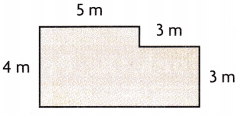
Example

Find the area.
Texas Go Math Grade 5 Lesson 9.1 Answer Key 1

STEP 1: Separate the figure into a rectangle and a square.

STEP 2: Find the area of the rectangle.
A = l × w
A = __3 X 3_________
A = ___9________
The area of the rectangle is _____9______ square meters.

STEP 3: Find the area of the square.
A = ___5 X 4________
A = ____20_______
A = ___________
The area of the square is _____20______ square meters.

STEP 4: Find the area of the complex figure by adding the areas.
A = ____9_______ + ___20________
A = ____29_______
So, the area of the complex figure is ____29_______ square meters.
Answer:
The area of the complex figure is 29 square meters,

Explanation:
STEP 1: Separate the figure into a rectangle and a square,
STEP 2: Finding the area of the rectangle as
A = l × w,
A = 3 X 3,
A = 9,
The area of the rectangle is 9 square meters,
STEP 3: Finding the area of the square
A = 5 X 4,
A = 20,
The area of the square is 20 square meters.

STEP 4: Find the area of the complex figure by adding the areas.
A = 9 + 20,
A = 29,
So, the area of the complex figure is 29 square meters.

Share and Show

Question 1.
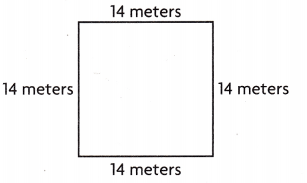
Find the perimeter of the square.
Texas Go Math Grade 5 Lesson 9.1 Answer Key 2
P = ____14_____ + ___14_____ + ___14______ + ___14______
P = _____56______
The perimeter is _____56______ meters
Answer:
The perimeter of the square is 56 meters,

Explanation:
Given the side of the square is 14 meters,
therefore the perimeter of a square is 14 + 14 + 14 + 14 = 56 meters.

Formulas for Area and Perimeter 1

5th Grade Area and Perimeter Answer Key Lesson 9.1 Question 2.
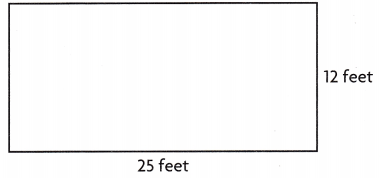
Find the area of the rectangle.
Texas Go Math Grade 5 Lesson 9.1 Answer Key 3
A = ____25___ × ____12_____
A = ____300_____
The area is ___300______ square feet.
Answer:
Given width 25 feet and 12 feet wide rectangle,
Therefore area of rectangle is 25 X 12 = 300 square feet.

Problem Solving

Question 3.
H.O.T. Explain how you can use s to write the formula for the
perimeter of a square with side length s.
Answer:
Perimeter= 4s,

Explanation:
Given s to write the formula for the perimeter of a square with side length s
is s + s + s + s =  4s.

Question 4.
H.O.T. A rectangle has an area of 96 square feet.
If the length of the rectangle is 12 feet,
what is the width of the rectangle?
Answer:
8 feet is the width of the rectangle,

Explanation:
Given a rectangle has an area of 96 square feet.
If the length l of the rectangle is 12 feet, let w be the
width of the rectangle as we know area of rectangle
is A = l X w substituting 96 square feet= 12 feet X w,
w = 96 square feet  ÷ 12 feet = 8 feet.

Problem Solving

Question 5.
Brent plans to stain a deck that is 14 feet by 8 feet. If one can of
stain covers an area of 100 square feet, how many cans of stain
will he need? Explain.
Answer:
2 cans of stain Brent need,

Explanation:
Brent plans to stain a deck that is 14 feet by 8 feet. If one can of
stain covers an area of 100 square feet, So a deck is of area
14 feet X 8 feet = 112 square feet  as one can of
stain covers an area of 100 square feet therefore  number of
cans of stain Brent will need is 2.

Texas Go Math Area and Perimeter Grade 5 Lesson 9.1 Question 6.
H.O.T. Multi-Step Latoya uses 50 feet of wood to make a rectangular garden bed.
If the length of the garden bed is 10 feet, what is the width?
Texas Go Math Grade 5 Lesson 9.1 Answer Key 4
Answer:
Width is 15 feet,

Explanation:
Latoya uses 50 feet of wood to make a rectangular garden bed,
So number of feet of fencing does he need is using a formula
for finding the perimeter P = l + w + l + w, P = perimeter; l = length; w = width is
50 = 10 + w + 10 + w upon solving we get 2w = 50 – 20 = 30,
2 w = 30 therefore w = 30 ÷ 2 = 15 feet.

Question 7.
H.O.T. What’s the Error? Maggie wants to fence off two side-by-side sections of her garden.
Each section is 14 feet long and 6 feet wide. She says she needs 80 feet of fencing.
Explain what is wrong with her thinking. How much fencing does she really need?
Texas Go Math Grade 5 Lesson 9.1 Answer Key 5
Answer:
Maggie really needs 160 feet of fencing not 80 feet,

Explanation:
Given Maggie wants to fence off two side-by-side sections of her garden
and each section is 14 feet long and 6 feet wide,
She says she needs 80 feet of fencing, but wrong with her thinking,
as if we see 80 feet(14 + 6 + 14 + 6) will cover only one section off the garden
fence for two side-by-side sections of her garden she needs 2 X 80 feet = 160 feet.

Daily Assessment Task

Fill in the bubble for the correct answer choice.

Question 8.
Apply Tina is fixing a rectangular sign. She plans to place metal trim around the sign edges.
The rectangle measures 32 inches by 9 inches. How much trim will Tina need?
(A) 36 inches
(B) 41 inches
(C) 72 inches
(D) 82 inches
Answer:
(D) 82 inches,

Explanation:
Given Tina is fixing a rectangular sign. She plans to place
metal trim around the sign edges.
The rectangle measures 32 inches by 9 inches. So trim will Tina need is
32 inches + 9 inches + 32 inches + 9 inches = 82 inches which matches
with (D).

Question 9.
A rectangle has a length of 5 meters and a width of 4 meters.
Which equation can you use to find the perimeter?
(A) P = 4 × 5
(B) P = 4 × 4
(C) P = 4 + 4 + 5 + 5
(D) P = 4 + 5
Answer:
(C) P = 4 + 4 + 5 + 5,

Explanation:
Given rectangle has a length of 5 meters and a width of 4 meters
we know perimeter P = l + w + l + w, where P = perimeter; l = length;
w = width so we get the equation to find the perimeter is
P = 4 + 4 + 5 + 5 which matches with (C).

5th Grade Math Formulas for Area and Perimeter Lesson 9.1 Answer Key Question 10.
Multi-Step Lana had an “L” shaped piece of felt. Her mom cut it into two rectangles.
One rectangle measured 4 inches by 9 inches, and the other measured 4 inches by 3 inches.
What is the total area of the two rectangles?
(A) 40 square inches
(B) 48 square inches
(C) 72 square inches
(D) 24 square inches
Answer:
(B) 48 square inches,

Explanation:
Given Lana had an “L” shaped piece of felt. Her mom cut it into two rectangles.
One rectangle measured 4 inches by 9 inches, and the other measured 4 inches by 3 inches.
So area of one rectangle is 4 inches X 9 inches = 36 square inches,
other area of rectangle is 4 inches X 3 inches = 12 square inches,
so the total area of the two rectangles is
36 square inches + 12 square inches = 48 square inches which matches
with (B).

TEXAS Test Prep

Question 11.
Mai wants to tile the floor of her kitchen.
Each tile has an area of 1 square foot. The floor of her kitchen is
11 feet by 16 feet. How many tiles does she need?
(A) 150
(B) 54
(C) 176
(D) 352
Answer:
(C) 176,

Explanation:
Given Mai wants to tile the floor of her kitchen.
Each tile has an area of 1 square foot. The floor of her kitchen is
11 feet by 16 feet. So total area of Mai kitchen is
11 feet X 16 feet = 176 square foot matches with (c).

Texas Go Math Grade 5 Lesson 9.1 Homework and Practice Answer Key

Question 1.
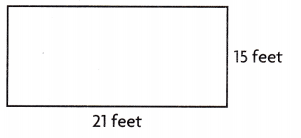
Find the perimeter of the rectangle.
Texas Go Math Grade 5 Lesson 9.1 Answer Key 6
P = ___21__ + ____15___ + ___21___ + ___15____
P = _____72_______
The perimeter is _____72_______ feet.
Answer:
The perimeter of a rectangle is 72 feet,

Explanation:
Given rectangle has a length of 21 feet and a width of 15 feet
we know perimeter P = l + w + l + w, where P = perimeter; l = length;
w = width so the perimeter of rectangle is P = 21 + 15 + 21 + 15 = 72 feet.

Formulas for Area and Perimeter 4

Go Math Grade 5 Lesson 9.1 Answer Key Homework Question 2.
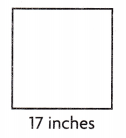
Find the area of the square.
Texas Go Math Grade 5 Lesson 9.1 Answer Key 7
A = ___17______ × ___17_______
A = ___289_____
The area is ____289___ square inches.
Answer:
The area of the given square is 289 square inches,

Explanation:
Given the side of the square is 17 inches,
the area of square is 17 inches X 17 inches = 289 square inches.

Question 3.
A rectangle has a perimeter of 68 inches. 1f the width of the rectangle is 10 inches,
what is the length of the rectangle? Explain how you know.
Answer:
The length of the rectangle is 24 inches,

Explanation:
Given a rectangle that has a perimeter of 68  inches.
If the width of the rectangle is 10 inches, let l be the
length of the rectangle as we know perimeter P = l + w + l + w,
where P = perimeter; l = length; w = width so the length of rectangle l is
68 = 10 + 10 + l + l, so 2l = 68 – 20 = 48, l = 48 ÷ 2 = 24 inches.

Question 4.
A square has an area of 81 square feet. What is the length of
each side of the square? Explain how you know.
Answer:
The length of side of the square is 9 feet,

Explanation:
Given a square has an area of 81 square feet. The length of
each side of the square will be as area of square is s X s ,
so 81 square feet = s X s,
s X s = 9 feet X 9 feet , therefore s = 9 feet.

Problem Solving

Question 5.
Lea wants to put a fence around her garden. Her garden measures 14 feet by 15 feet.
She has 50 feet of fencing. How many more feet of fencing does
Lea need to put a fence around her garden?
Answer:

Go Math Grade 5 Lesson 9.1 Formulas of Area and Perimeter Question 6.
Lea wants to put a new layer of soil on her 14 feet by 15 feet garden.
She finds the area of her garden so she knows how much soil to buy.
If one bag of soil covers 20 square feet, how many bags of soil will Lea need? Explain.
Answer:
11 bags of soil Lea needs,

Explanation:
Given Lea wants to put a new layer of soil on her 14 feet by 15 feet garden.
She finds the area of her garden as 14 feet X 15 feet = 210 square feet,
she knows how much soil to buy If one bag of soil covers 20 square feet,
210 square feet requires 210 ÷ 20 = 10 bags remainder 10 square feet,
therefore 11 bags of soil Lea needs.

Lesson Check

Fill in the bubble completely to show your answer.

Question 7.
A soccer field has a length of 100 yards and a width of 60 yards.
Which equation can you use to find the area of the soccer field?
(A) A = 100 × 60
(B) A = 100 + 60 + 100 + 60
(C) A = 100 + 60
(D) A = 160 × 4
Answer:
(A) A = 100 × 60,

Explanation:
Given a soccer field has a length of 100 yards and a width of 60 yards,
as we know area of square is Area is equal to length X width
so the equation for the area of the soccer field is A = 100 X 60 which
matches with (A).

Question 8.
A baseball diamond is a square with a perimeter of 360 feet.
What is the length of one side?
(A) 80 feet
(B) 180 feet
(C) 90 feet
(D) 60 feet
Answer:
(C) 90 feet,

Explanation:
Given a baseball diamond is a square with a perimeter of 360 feet.
So the length of one side will be as perimeter of square with side s is
p = 4s so 360 feet = 4 X s, therefore one side is 360 ÷ 4 = 90 feet matches
with (C).

Question 9.
Zoey wants to cover her bedroom floor with carpet squares.
Each square has an area of 1 square foot.
Her bedroom measures 12 feet by 14 feet.
How many carpet squares does Zoey need?
(A) 168
(B) 144
(C) 336
(D) 52
Answer:
(A) 168,

Explanation:
Given Zoey wants to cover her bedroom floor with carpet squares.
Each square has an area of 1 square foot.
Her bedroom measures 12 feet by 14 feet.
So number of squares does Zoey need is 12 X 14 = 168 square feet
matches with (A).

Go Math Homework Lesson 9.1 Area and Perimeter Answer Key Question 10.
Edward wants to put a string of lights around a rectangular window
that is 32 inches wide and 40 inches high. How long will the string of lights
need to be to go around the window?
(A) 72 inches
(B) 1,280 inches
(C) 144 inches
(D) 112 inches
Answer:
(B) 1,280 inches,

Explanation:
Given Edward wants to put a string of lights around a rectangular window
that is 32 inches wide and 40 inches high. The string of lights
need to be to go around the window is 32 X 40 = 1,280 inches matches
with (B) 1,280 inches.

Question 11.
Multi-Step Chantal buys two small rugs for her kitchen.
One rug measures 3 feet by 5 feet. The other rug measures 4 feet by 6 feet.
What is the area of the part of the kitchen the two rugs will cover?
(A) 39 square feet
(B) 30 square feet
(C) 24 square feet
(D) 36 square feet
Answer:
(A) 39 square feet,

Explanation:
Given Chantal buys two small rugs for her kitchen.
One rug measures 3 feet by 5 feet. The other rug measures 4 feet by 6 feet.
First rug covers 3 feet by 5feet is 5 X 3 = 15 square feet,
Other rug covers 4 feet by 6 feet is 4 X 6 = 24 square feet,
The area of the part of the kitchen the two rugs will cover is
15 square feet + 24 square feet = 39 square feet.

Area and Perimeter 5th Grade Lesson 9.1 Homework Answer Key Question 12.
Multi-Step Isaac is painting a wall that is 9 feet by 18 feet. So far,
he has painted a part of the wall that is a 4 feet by 7 feet rectangle.
What is the area of the part of the wall that Isaac has left to paint?
(A) 190 square feet
(B) 134 square feet
(C) 22 square feet
(D) 151 square feet
Answer:
(B) 134 square feet,

Explanation:
Given Isaac is painting a wall that is 9 feet by 18 feet. So far,
he has painted a part of the wall that is a 4 feet by 7 feet rectangle.
Total area of the wall is 9 feet X 18 feet = 162 square feet,
Part of the wall painted is 4 feet by 7 feet = 28 square feet,
The area of the part of the wall that Isaac has left to paint is
162 square feet – 28 square feet = 134 square feet matches with (B).

Texas Go Math Grade 5 Lesson 9.1 Answer Key Formulas for Area and Perimeter Read More »

Texas Go Math Grade 6 Lesson 10.1 Answer Key Exponents

Refer to our Texas Go Math Grade 6 Answer Key Pdf to score good marks in the exams. Test yourself by practicing the problems from Texas Go Math Grade 6 Lesson 10.1 Answer Key Exponents.

Texas Go Math Grade 6 Lesson 10.1 Answer Key Exponents

Texas Go Math Grade 6 Lesson 10.1 Explore Activity Answer Key

Identifying Repeated Multiplication

A real-world problem may involve repeatedly multiplying a factor by itself.

A scientist observed the hourly growth of bacteria and recorded his observations in a table.
Texas Go Math Grade 6 Lesson 10.1 Answer Key Exponents 1
Texas Go Math Grade 6 Lesson 10.1 Answer Key Exponents 2

(A) Complete the table. What pattern(s) do you see in the Total bacteria column?

(B) Complete each statement.
At 2 hours, the total is equal to the product of two 2s.
At 3 hours, the total is equal to the product of ___________________ 2s.
At 4 hours, the total is equal to the product of ___________________ 2s.

Reflect

Question 1.
Communicate Mathematical Ideas How is the time, in hours, related to the number of times 2 is used as a factor?
Answer:
The number of times 2 is used as a factor is equal to the time in hours. It can be seen that when t = 1, 2 is used only once, while when t = 2, 2 is used twice and so on.

Your Turn

Use exponents to write each expression.

Go Math Grade 6 Lesson 10.1 Answer Key Question 2.
4 × 4 × 4
Answer:
4 × 4 × 4

Find the base, or the numbers being multiplied. The base is 4.
Find the exponent by counting the number of 4s being multiplied.
The exponent is 3.

Final Solution:
Texas Go Math Grade 6 Lesson 10.1 Answer Key Exponents 23
= 43

Exponents 3

Question 3.
6 = ___________
Answer:
6

Find the base, or the numbers being multiplied. The base is 6.
Find the exponent by counting the number of 6s being multiplied.
The exponent is 1

Final Solution:
Texas Go Math Grade 6 Lesson 10.1 Answer Key Exponents 24

Question 4.
\(\frac{1}{8}\) × \(\frac{1}{8}\)
Answer:
\(\frac{1}{8}\) × \(\frac{1}{8}\)

Find the base, or the numbers being multiplied. The base is \(\frac{1}{8}\).
Find the exponent by counting the number of times \(\frac{1}{8}\) appears in the expression.
The exponent is 2

Final Solution:
Texas Go Math Grade 6 Lesson 10.1 Answer Key Exponents 25

Question 5.
5 × 5 × 5 × 5 × 5 × 5
Answer:
5 × 5 × 5 × 5 × 5 × 5

Find the base, or the numbers being multiplied. The base is 5.
Find the exponent by counting the number of 6s being multiplied.
The exponent is 6.

Final Solution:
Texas Go Math Grade 6 Lesson 10.1 Answer Key Exponents 26

Your Turn

Find the value of each power.

Question 6.
34 ____________
Answer:
Solution to this example is given below = 34
Identify the base and the exponent.
The base s 3, and the exponent is 4

Final Solution:
Evaluate: 34 = 3 × 3 × 3 × 3 = 81

Question 7.
(- 1)9 ___________
Answer:
Simplify the given expression by identifying the base and exponent
The base is – 1 and the exponent is 9
= (- 1) ∙ (- 1) ∙ (- 1) ∙ (- 1) ∙ (- 1) ∙ (- 1) ∙ (- 1) ∙ (- 1) ∙ (- 1) multiply the case by itself nine times
= – 1
The value of the expression is – 1.

Question 8.
\(\left(\frac{2}{5}\right)^{3}\) _____________
Answer:
Solution to this example is given below = \(\left(\frac{2}{5}\right)^{3}\)
Identify the base and the exponent.
The base is \(\frac{2}{5}\), and the exponent is 3

Final Solution:
Evaluate: \(\left(\frac{2}{5}\right)^{3}=\left(\frac{2}{5}\right) \times\left(\frac{2}{5}\right) \times\left(\frac{2}{5}\right)=\frac{8}{125}\)

Go Math Grade 6 Answers Pdf Exponents Answer Key Question 9.
– 122 ___________
Answer:
Simplify the given expression by identifying the base and exponent.
The base is 12 and the exponent is 2.
= – (12 × 12) multiply the base by itself twice
= – 144
The value of the expression is – 144

Texas Go Math Grade 6 Lesson 10.1 Guided Practice Answer Key

Question 1.
Complete the table.
Texas Go Math Grade 6 Lesson 10.1 Answer Key Exponents 3
Answer:

Exponential form Product Simplified Product
51 5 5
52 5 × 5 25
53 5 × 5 × 5 125
54 5 × 5 × 5 × 5 625
55 5 × 5 × 5 × 5 × 5 3125

Use an exponent to write each expression.

Question 2.
Texas Go Math Grade 6 Lesson 10.1 Answer Key Exponents 4
Answer:
6 × 6 × 6
Find the base, or the numbers being multiplied The base is 6
Find the exponent by counting the number of 6s being multiplied.
The exponent is 3.

Final Solution:
Texas Go Math Grade 6 Lesson 10.1 Answer Key Exponents 27

Question 3.
10 × 10 × 10 × 10 × 10 × 10 × 10
Answer:
10 × 10 × 10 × 10 × 10 × 10 × 10
Find the base, or the numbers being multiplied The base is 10
Find the exponent by counting the number of 6s being multiplied.
The exponent is 7.

Final Solution:
Texas Go Math Grade 6 Lesson 10.1 Answer Key Exponents 28

Question 4.
\(\frac{3}{4} \times \frac{3}{4} \times \frac{3}{4} \times \frac{3}{4} \times \frac{3}{4}\)
Answer:
Solution to this example is given below
\(\frac{3}{4} \times \frac{3}{4} \times \frac{3}{4} \times \frac{3}{4} \times \frac{3}{4}\)

Find the base, or the numbers being multiplied The base is \(\frac{3}{4}\)
Find the exponent by counting the number of \(\frac{3}{4}\) appears in.
the expression. The exponent is 5.

Final Solution:
Texas Go Math Grade 6 Lesson 10.1 Answer Key Exponents 29

Lesson 10.1 Answer Key 6th Grade Exponents Question 5.
\(\frac{7}{9} \times \frac{7}{9} \times \frac{7}{9} \times \frac{7}{9} \times \frac{7}{9} \times \frac{7}{9} \times \frac{7}{9} \times \frac{7}{9}\)
Answer:
The solution to this example is given below
\(\frac{7}{9} \times \frac{7}{9} \times \frac{7}{9} \times \frac{7}{9} \times \frac{7}{9} \times \frac{7}{9} \times \frac{7}{9} \times \frac{7}{9}\)

Find the base, or the numbers being multiplied The base is \(\frac{7}{9}\)
Find the exponent by counting the number of \(\frac{7}{9}\) appears in.
the expression. The exponent is 5.

Final Solution:
Texas Go Math Grade 6 Lesson 10.1 Answer Key Exponents 30

Find the value of each power.

Question 6.
83
Answer:
Solution to this example is given below 83
Identify the base and the exponent
The base is 8, and the exponent is 3

Final Solution:
Evaluate: 83 = 8 × 8 × 8 = 512

Question 7.
74
Answer:
Solution to this example is given below 74
Identify the base and the exponent
The base is 7, and the exponent is 4

Final Solution:
Evaluate: 74 = 7 × 7 × 7 × 7 = 2401

Question 8.
103
Answer:
Solution to this example is given below 103
Identify the base and the exponent
The base is 10, and the exponent is 3

Final Solution:
Evaluate: 103 = 10 × 10 × 10 = 1000

Question 9.
\(\left(\frac{1}{4}\right)^{2}\)
Answer:
Solution to this example is given below \(\left(\frac{1}{4}\right)^{2}\)
Identify the base and the exponent
The base is \(\frac{1}{4}\), and the exponent is 4

Final Solution:
Evaluate: \(\left(\frac{1}{4}\right)^{2}=\left(\frac{1}{4}\right) \times\left(\frac{1}{4}\right)=\frac{1}{16}\)

Question 10.
\(\left(\frac{1}{3}\right)^{3}\)
Answer:
Solution to this example is given below \(\left(\frac{1}{3}\right)^{3}\)
Identify the base and the exponent
The base is \(\frac{1}{3}\), and the exponent is 3

Final Solution:
Evaluate: \(\left(\frac{1}{3}\right)^{3}=\left(\frac{1}{3}\right) \times\left(\frac{1}{3}\right) \times\left(\frac{1}{3}\right)=\frac{1}{27}\)

Question 11.
\(\left(\frac{6}{7}\right)^{2}\)
Answer:
Solution to this example is given below \(\left(\frac{6}{7}\right)^{2}\)
Identify the base and the exponent
The base is \(\frac{6}{7}\), and the exponent is 2

Final Solution:
Evaluate: \(\left(\frac{6}{7}\right)^{2}=\left(\frac{6}{7}\right) \times\left(\frac{6}{7}\right)=\frac{36}{49}\)

Question 12.
0.82
Answer:
Solution to this example is given below 0.82
Identify the base and the exponent
The base is 0.8, and the exponent is 2

Final Solution:
Evaluate: 0.82 = 0.8 × 0.8 = 0.64

Exponents Grade 6 Lesson 10.1 Answer Key 6th Grade Question 13.
0.53
Answer:
Solution to this example is given below 0.53
Identify the base and the exponent
The base is 0.5, and the exponent is 3

Final Solution:
Evaluate: 0.53 = 0.5 × 0.5 × 0.5 = 0.125

Question 14.
1.12
Answer:
Solution to this example is given below 1.12
Identify the base and the exponent
The base is 1.1, and the exponent is 2

Final Solution:
Evaluate: 1.12 =1.1 × 1.1 = 1.21

Question 15
80
Answer:
Given expression 80
Any power raised to exponent 0 is always equal to 1, therefore:
80 = 1

Question 16.
121
Answer:
Given expression 121
Any power raised to exponent 1 is equal to the base of the given power, therefore
121 = 12

Question 17.
\(\left(\frac{1}{2}\right)^{0}\)
Answer:
Given expression \(\left(\frac{1}{2}\right)^{0}\)
Any power raised to exponent 0 is always equal to 1, therefore:
\(\left(\frac{1}{2}\right)^{0}\) = 1

Question 18.
(- 2)3
Answer:
Simplify the given expression by identifying the base and exponent
The base is – 2 and the exponent is 3.
= (- 2) × (- 2) × (- 2) multiply the base by itself three times
= – 8
The value of the expression is – 8

Question 19.
\(\left(-\frac{2}{5}\right)^{2}\)
Answer:
Simplify the given expression by identifying the base and exponent
The base is \(\left(-\frac{2}{5}\right)^{2}\) and the exponent is 2.
= \(\left(-\frac{2}{5}\right) \times\left(-\frac{2}{5}\right)\) multiply the base by itself three times
= \(\frac{4}{25}\)
The value of the expression is \(\frac{4}{25}\)

Question 20.
– 92
Answer:
Simplify the given expression by identifying the base and exponent
The base is 9 and the exponent is 2.
= – (9 × 9) multiply the base by itself three times
= – 81
The value of the expression is – 81

Essential Question Check-In

Question 21.
How do you use an exponent to represent a number such as 16?
Answer:
The number 16 is written as its factors: 16 = 2 × 2 × 2 × 2 which can be condensed to a power as 24.
The number 16 is written as it other factor: 16 = 4 × 4 which can be condensed to a power as 42,
16 = 24 = 42

Write the missing exponent.

Question 22.
Texas Go Math Grade 6 Lesson 10.1 Answer Key Exponents 5Answer:
Solution to this example is given below
100 = 10x
100 = 102 (Convert 100 to base 10)
102 = 10x (Divide both sides by 10)
2 = x
x = 2
100 = 102
The missing exponent is 2

Question 23.
Texas Go Math Grade 6 Lesson 10.1 Answer Key Exponents 6
Answer:
Solution to this example is given below
8 = 2x
8 = 23 (Convert 8 to base 2)
23 = 2x (Divide both sides by 2)
3 = x
x = 3
8 = 23
The missing exponent is 3

Exponential Form 6th Grade Lesson 10.1 Question 24.
Texas Go Math Grade 6 Lesson 10.1 Answer Key Exponents 7
Answer:
Solution to this example is given below
25 = 5x
25 = 52 (Convert 25 to base 5)
52 = 5x (Divide both sides by 5)
2 = x
x = 2
25 = 52
The missing exponent is 2

Question 25.
Texas Go Math Grade 6 Lesson 10.1 Answer Key Exponents 8
Answer:
Solution to this example is given below
27 = 3x
27 = 33 (Convert 27 to base 3)
33 = 3x (Divide both sides by 3)
3 = x
x = 3
27 = 33
The missing exponent is 3

Question 26.
Texas Go Math Grade 6 Lesson 10.1 Answer Key Exponents 9
Answer:
Given expression:
\(\left(\frac{1}{169}\right)=\left(\frac{1}{13}\right)^{x}\)
Rewrite the given expression by writing the left hand side of the equation as a power of base \(\left(\frac{1}{13}\right)\), therefore:
\(\left(\frac{1}{13}\right)^{2}=\left(\frac{1}{13}\right)^{x}\)
Now the bases are same, so compare the exponents to evaluate x, therefore:
x = 2
So the expression becomes:
\(\left(\frac{1}{169}\right)=\left(\frac{1}{13}\right)^{2}\)

Question 27.
Texas Go Math Grade 6 Lesson 10.1 Answer Key Exponents 10
Answer:
Given expression:
14 = 14x
Since the number on both sides of the equation is same, this implies that x = 1
So the expression becomes:
14 = 141

Question 28.
Texas Go Math Grade 6 Lesson 10.1 Answer Key Exponents 11
Answer:
Solution to this example is given below
32 = 2x
32 = 25 (Convert 32 to base 2)
25 = 2x (Divide both sides by 2)
5 = x
x = 5
32 = 25
The missing exponent is 5

Question 29.
Texas Go Math Grade 6 Lesson 10.1 Answer Key Exponents 12
Answer:
Solution to this example is given below
\(\frac{64}{81}=\left(\frac{8}{9}\right)^{x}\)
\(\frac{64}{81}=\left(\frac{8}{9}\right)^{2}\) (Convert \(\frac{64}{81}\) to base \(\frac{8}{9}\))
\(\left(\frac{8}{9}\right)^{2}=\left(\frac{8}{9}\right)^{x}\) (Divide both sides by \(\frac{8}{9}\))
2 = x
x = 2
\(\frac{64}{81}=\left(\frac{8}{9}\right)^{2}\)
The missing exponent is 2

Write the missing base.

Question 30.
Texas Go Math Grade 6 Lesson 10.1 Answer Key Exponents 13
Answer:
Solution to this example is given below
1000 = x3
1000 = 103 (Convert 1000 to base 10)
103 = x3
10 = x
x = 10
1000 = 103
The missing base is 10

Question 31.
Texas Go Math Grade 6 Lesson 10.1 Answer Key Exponents 14
Answer:
Solution to this example is given below
256 = x4
256 = 44 (Convert 256 to base 4)
44 = x4
4 = x
x = 4
256 = 44
The missing base is 4

Question 32.
Texas Go Math Grade 6 Lesson 10.1 Answer Key Exponents 15
Answer:
Solution to this example is given below
16 = x4
16 = 24 (Convert 16 to base 2)
24 = x4
2 = x
x = 2
16 = 24
The missing base is 2

Question 33.
Texas Go Math Grade 6 Lesson 10.1 Answer Key Exponents 16
Answer:
Solution to this example is given below
9 = x2
9 = 32 (Convert 9 to base 3)
32 = x2
3 = x
x = 3
9 = 32
The missing base is 3

Question 34.
Texas Go Math Grade 6 Lesson 10.1 Answer Key Exponents 16
Answer:
Solution to this example is given below
\(\frac{1}{9}\) = x2
\(\frac{1}{9}\) (Convert \(\frac{1}{9}\) to base \(\frac{1}{3}\))
\(\left(\frac{1}{3}\right)^{2}\) = x2
\(\frac{1}{3}\) = x
x = \(\left(\frac{1}{3}\right)^{2}\)
\(\frac{1}{9}=\left(\frac{1}{3}\right)^{2}\)
The missing base is \(\frac{1}{3}\).

Exponents 2

Question 35.
Texas Go Math Grade 6 Lesson 10.1 Answer Key Exponents 18
Answer:
Solution to this example is given below
729 = x2
729 = 82 (Convert 729 to base 9)
93 = x2
9 = x
x = 9
729 = 93
The missing base is 9

Go Math Grade 6 Answer Key Pdf Exponent Problems Question 36.
Texas Go Math Grade 6 Lesson 10.1 Answer Key Exponents 19
Answer:
The solution to this example is given below
\(\frac{9}{16}\) = x2
\(\frac{9}{16}=\left(\frac{3}{4}\right)^{2}\) (Convert \(\frac{9}{16}\) to base \(\frac{3}{4}\))
\(\left(\frac{3}{4}\right)^{2}\) = x2
\(\frac{3}{4}\) = x
x = \(\left(\frac{3}{4}\right)\)
\(\frac{9}{16}=\left(\frac{3}{4}\right)^{2}\)
The missing base is \(\frac{3}{4}\).

Question 37.
Texas Go Math Grade 6 Lesson 10.1 Answer Key Exponents 20
Answer:
Solution to this example is given below
729 = x3
729 = 93 (Convert 729 to base 9)
82 = x2
8 = x
x = 8
64 = 82
The missing base is 8

Question 38.
Hadley’s softball team has a phone tree in case a game is canceled. The coach calls 3 players. Then each of those players calls 3 players, and soon. How many players will be notified during the third round of calls?
Answer:
1st round = 3 = 31 = 3
2nd round = 3 × 3 = 32 = 9
3rd round = 3 × 3 × 3 = 33 = 27
On the third round of calls, 27 players were notified

Question 39.
Tim is reading a book. On Monday he reads 3 pages. On each day after that, he reads triple the number of pages as the previous day. How many pages does he read on Thursday?
Answer:
Monday – 3 = 31 = 3
Tuesday – 3 × 3 = 32 = 9
Wednesday – 3 × 3 × 3 = 33 = 27
Thursday – 3 × 3 × 3 × 3 = 34 = 81
Tim was able to read 81 pages on Thursday.

Question 40.
Which power can you write to represent the area of the square shown? Write the power as an expression with a base and an exponent, and then find the area of the square.
Texas Go Math Grade 6 Lesson 10.1 Answer Key Exponents 21
Answer:
Determine the area of the square.
A = s2 formula to get the area of a square
A = (8.5)2 substitute for the given values
Identify the base and the exponent
The base is 8.5 and the exponent is 2.
= 8.5 mm × 8.5 mm multiply the base by itself twice
= 72.25 mm2 area of the square
The area of the square is 72.25 mm2

Question 41.
Antonia is saving for a video game. On the first day, she saves two dollars in her piggy bank. Each day after that, she doubles the number of dollars she saved on the previous day. How many dollars does she save on the sixth day?
Answer:

  • 1st day – 2 = 21 = 82
  • 2nd clay – 2 × 2 = 22 = $1
  • 3rd day – 2 × 2 × 2 = 23 = $8
  • 4th day – 2 × 2 × 2 × 2 = 24 = $16
  • 5th day – 2 × 2 × 2 × 2 × 2 = 25 = $32
  • 6th day – 2 × 2 × 2 × 2 × 2 × 2 = 26 = $64

Antonia saved $64 on the sixth day.

Question 42.
A certain colony of bacteria triples in length every 10 minutes. Its length is now 1 millimeter. How long will it be in 40 minutes?
Answer:

  • 0 minutes = 1 mm
  • 10 minutes = 1 × 3 = 31= 3 mm
  • 20 minutes = 3 × 3 = 32 = 9 mm
  • 30 minutes = 3 × 3 × 3 = 33 = 27 mm
  • 40 minutes = 3 × 3 × 3 × 3 = 34 = 81 mm

After 40 minutes, the length of the bacteria will be 81 mm.

Question 43.
Write a power represented with a positive base and a positive exponent whose value is less than the base.
Answer:
The base is 4 and the exponent is \(\frac{1}{2}\).
Evaluate:
\(4^{\frac{1}{2}}\) = √4 = 2
The expression is \(4^{\frac{1}{2}}\) = 2.

Question 44.
Which power can you write to represent the volume of the cube shown?
Write the power as an expression with a base and an exponent, and then find the volume of the cube.
Texas Go Math Grade 6 Lesson 10.1 Answer Key Exponents 22
Answer:
Determine the volume of the cube.
V = s3 formula to get the volume of a cube
\(\left(\frac{1}{3}\right)^{3}\) = substitute for the given values

Identify the base and the exponent
The base is \(\frac{1}{3}\) and the exponent is 3
= \(\frac{1}{3}\) in × \(\frac{1}{3}\) in × \(\frac{1}{3}\) in multiply the base by itself thrice
= \(\frac{1}{27}\) in volume of the cube
The volume of the cube is \(\frac{1}{27}\) in3

H.O.T. Focus On Higher Order Thinking

Question 45.
Communicate Mathematical Ideas What is the value of 1 raised to the power of any exponent? What is the value of 0 raised to the power of any nonzero exponent? Explain.
Answer:
When 1 is raised to any number, the value of that expression is always equal to 1 because of its identity property. (1n = 1)
When 0 is raised to any nonzero exponent, the value of that expression is always zero because of its zero property. (0n = 0 where: n > 0)
The va1ue of 1n = 1 while the value of 0n = 0

Question 46.
Look for a Pattern Find the values of the powers in the following pattern: 101, 102, 103, 104 ……. 106 Describe the pattern, and use it to evaluate 106 without using multiplication.
Answer:
Given pattern: 101, 102, 103, when expanded according to rules of power expansion reveals the pattern: 10, 100, 1000. 10000…. and according to this 106 = 1000000

Question 47.
Critical Thinking Some numbers can be written as powers of different bases. For example, 81 = 92 and 81 = 34. Write the number 64 using three different bases.
Answer:
Write the given number as a product of it factor 2, therefore:
64 = 2 × 2 × 2 × 2 × 2 × 2 = 26
Write the given number as a product of it factor 4, therefore:
64 = 4 × 4 × 4 = 43
Write the given number as a product of it factor 8, therefore:
64 = 8 × 8 = 82
64 = 26 = 43 = 82

Question 48.
Justify Reasoning Oman said that it ¡s impossible to raise a number to the power of 2 and get a negative value. Do you agree with Oman? Why or why not?
Answer:
It is possible to have a negative value when a number is raised to the power of 2. It is when the base has a negative sign outside the parenthesis like – (2) When the given expression will be evaluated, it will be – (2 × 2) which will give a result of – 4

Texas Go Math Grade 6 Lesson 10.1 Answer Key Exponents Read More »

Texas Go Math Grade 8 Lesson 11.2 Answer Key Equations with Rational Numbers

Refer to our Texas Go Math Grade 8 Answer Key Pdf to score good marks in the exams. Test yourself by practicing the problems from Texas Go Math Grade 8 Lesson 11.2 Answer Key Equations with Rational Numbers.

Texas Go Math Grade 8 Lesson 11.2 Answer Key Equations with Rational Numbers

Example 1

Solve \(\frac{7}{10}\)n + \(\frac{3}{2}\) = \(\frac{3}{5}\)n + 2
Texas Go Math Grade 8 Lesson 11.2 Answer Key 1

Reflect

Question 1.
What is the advantage of multiplying both sides of the equation by the least common multiple of the denominators in the first step?
Answer:
By multiplying both sides by the common multiple of the denominators in the first step, the denominator is completely divided.

Question 2.
What If? What happens in the first step if you multiply both sides by a common multiple of the denominators that are not the LCM?
Answer:
If we multiply both sides by a common multiple of the denominators that is not the LCM. we eliminate the fractions from the equation, but the coefficients in front of the variable and the constants will be greater.

Your Turn

Solve.

Question 3.
\(\frac{1}{7}\)k – 6 = \(\frac{3}{7}\)k + 4 ___________
Answer:
Given
\(\frac{1}{7}\)k – 6 = \(\frac{3}{7}\)k + 4
Determine the least common multiple of the denominators
LCM : 7
Multiply both sides of the equation by the LCM
7(\(\frac{1}{7}\)k – 6) = 7(\(\frac{3}{7}\)k + 4)
Simplify
k – 42 = 3k + 28
Subtract k from both sides
k – 42 – k = 3k + 28 – k
-42 = 2k + 28
Subtract 28 from both sides
-42 – 28 = 2k + 28 – 28
2k = -70
Divide both sides by 2
k = \(\frac{-70}{2}\) = -35

Equations with Rational Numbers 3

Go Math Grade 8 Answer Key Lesson 11.2 Question 4.
\(\frac{5}{6}\)y + 1 = –\(\frac{1}{2}\)y + \(\frac{1}{4}\) ___________
Answer:
Given
\(\frac{5}{6}\)y + 1 = –\(\frac{1}{2}\)y + \(\frac{1}{4}\)
Determine the least common multiple of the denominators
LCM : 12
MultipLy both sides of the equation by the LCM
12(\(\frac{5}{6}\)y + 1) = 12(-\(\frac{1}{2}\)y + \(\frac{1}{4}\))
Simplify
10y + 12 = -6y + 3
Add 6y to both sides
10y + 12 + 6y = -6y + 3 + 6y
16y + 12 = 3
Subtract 12 from both sides
16y + 12 – 12 = 3 – 12
16y = -9
Divide both sides by 16
y = \(\frac{-9}{16}=-\frac{9}{16}\)

Question 5.
Logan has two aquariums. One aquarium contains 1.3 cubic feet of water and the other contains 1.9 cubic feet of water. The water in the larger aquarium weighs 37.44 pounds more than the water in the smaller aquarium. Write an equation with a variable on both sides to represent the situation. Then find the weight of 1 cubic foot of water.
Answer:
Given
Weight of the smaller aquarium = Weight of the larger aquarium
Write the equation where x is the weight of cubic feet of water
1.3x + 37.44 = 1.9x
Subtract 1.3x from both sides
1.3x + 37.44 – 1.3x = 1.9x – 1.3x
0.6x = 37.44
Divide both sides by 0.6
x = \(\frac{37.44}{0.6}\) = 62.4
The weight of $1$ cubic foot of water is $62.4$ pounds.

Question 6.
Write a real-world problem that can be modeled by the equation
\(\frac{1}{3}\)x + 10 = \(\frac{3}{5}\)x.
Answer:
\(\frac{1}{3}\)x + 10 = \(\frac{3}{5}\)x
There is 10 cubic meter of water in pool A and water is added at a rate of \(\frac{1}{3}\) per minute
There is 0 cubic meter of water in pool B and water is added at a rate of \(\frac{3}{5}\) per minute
The equation gives the number of minutes after which the quantity of the water in two pools will be the same.

Texas Go Math Grade 8 Lesson 11.2 Guided Practice Answer Key

Texas Go Math Grade 8 Pdf Lesson 11.2 Geometry Answers Question 1.
Sandy is upgrading her Internet service. Fast Internet charges $60 for installation and $50.45 per month. Quick Internet has free installation but charges $57.95 per month. (Example 2)
a. Write an equation that can be used to find the number of months after which the Internet service would cost the same.
Answer:
Write an equation for Fast Internet, where x is the number of months:
Charge per Month*Number of Month + Installation Fee
50.45x + 60
Write an equation for Quick Internet, where x is the number of months:
Charge per Month*Number of Month + Installation Fee
57.95x
Write an equation to find the number of months for which the total cost is the same
50.45x + 60 = 57.95x

b. Solve the equation.
Answer:
Solve for x
50.45x + 60 = 57.95x
Subtract 50.45x from both sides
50.45x + 60 – 50.45x = 57.95x – 50.45x
7.5x = 60
Divide both sides by 7.5
x = \(\frac{60}{7.5}\) = 8
The total cost will be the same for $8 months.

Solve. (Example 1 and 2)

Question 2.
\(\frac{3}{4}\)n – 18 = \(\frac{1}{4}\)n – 4
Answer:
Given
\(\frac{3}{4}\)n – 18 = \(\frac{1}{4}\)n – 4
Determine the least common multiple of the denominators
LCM : 4
Multiply both sides of the equation by the LCM
4(\(\frac{3}{4}\)n – 18) = 4(\(\frac{1}{4}\)n – 4)
Simplify
3n – 72 = n – 16
Subtract n from both sides
3n – 72 – n = n – 16 – n
2n – 72 = 16
Add 72 from both sides
2n – 72 + 72 = 16 + 72
2n = 56
Divide both sides by 2
n = \(\frac{56}{2}\) = 28

Go Math Answer Key 8th Grade Rational Numbers Question 3.
6 + \(\frac{4}{5}\)b = \(\frac{9}{10}\)b
Answer:
Determine the least common multiple of the denominators:
LCM(10, 5) = 10
Multiply both sides of the equation by the LCM
10(6 – \(\frac{4}{5}\)b) = 10(\(\frac{9}{10}\))
10(6) + 10(\(\frac{4}{5}\)b) = 10(\(\frac{9}{10}\)b)
60 + 8b = 9b
60 + 8b – 8b = 9b – 8b (Subtract 8b from both sides)
60 = b
or
b = 60

Question 4.
\(\frac{2}{11}\)m + 16 = 4 + \(\frac{6}{11}\)m
Answer:
Determine the least common multiple of the denominators:
LCM = 11
Multiply both sides of the equation by the LCM
11(\(\frac{2}{11}\)m + 16) = 11(4 + \(\frac{6}{11}\)m)
11(\(\frac{2}{11}\)m) + 11(16) = 11(4) + 11(\(\frac{6}{11}\)m)
2m + 176 = 44 + 6m
(Subtract 2m from both sides) 2m + 176 – 2m = 44 + 6m – 2m
176 = 44 + 4m
(Subtract 44 from both sides.) 176 – 44 = 44 + 4m – 44
132 = 4m
(Divide both sides by 4) \(\frac{132}{4}\) = \(\frac{4m}{4}\)
33 = m
or
m = 33

Question 5.
2.25t + 5 = 13.5t + 14
Answer:
2.25t + 5 = 13.5t + 14
(Multiply both sides of the equation by 100. Multiplying by 100 clears the equation of decimals.) 100 (2.25t + 5) = 100(13.5t + 14)
225t + 500 = 1350t + 1400
(Subtract 500 from each side)225t + 500 – 500 = 1350t + 1400 – 500
225t = 1350t + 900
(Subtract 1350f from each side.)225t – 1350t = 1350t + 900 – 1350t
-1125t = 900
(Divide by -1125.) \(\frac{-1125}{-1125}\) = \(\frac{900}{-1125}\)
t = -0.8

Question 6.
3.6w = 1.6w + 24
Answer:
Given
3.6w = 1.6w + 24
Subtract 1.6w from both sides
3.6w – 1.6w = 1.6w + 24 – 1.6w
2w = 24
Divide both sides by 2
w = \(\frac{24}{2}\) = 12

Question 7.
-0.75p – 2 = 0.25p
Answer:
Given
0.75p – 2 = 0.25p
Add 0.75p from both sides
-0.75p + 0.75p – 2 = 0.25p + 0.75p
p = -2

Question 8.
Write a real-world problem that can be modeled by the equation 1.25x = 0.75x + 50. (Example 3)
Answer:
Given
1.25x = 0.75x + 50
Left side of the equation has variable minute
Cell offers Plan A for no base fee and $1.25 per minute.
The right side of the equation has variable and constant
Cell offer Plan B for $50 base fee and $0.75 per minute
The equation shows when the total cost of the plan would be equal.

Essential Question Check-In

Question 9.
How does the method for solving equations with fractional or decimal coefficients and constants compare with the method for solving equations with integer coefficients and constants?
Answer:
In solving for equations with fractional coefficients, we need to equate all fractions with their least common denominator (LCD). By multiplying the LCD in all sides of the equation, we can eliminate all fractions then proceed to solve the whole equation as integers.

Texas Go Math Grade 8 Lesson 11.2 Independent Practice Answer Key

Question 10.
Members of the Wide Waters Club pay $105 per summer season, plus $9.50 each time they rent a boat. Nonmembers must pay $14.75 each time they rent a boat. How many times would a member and a non-member have to rent a boat in order to pay the same amount?
Answer:
Members of the Wide Waters Club pay 105 doLLars per summer season, plus 9.50 dollars each time they rent a boat.
Write an expression:
105 + 9.50x
Nonmembers must pay 14.75 dollars each time they rent a boat.
Write an expression:
14.75x
Write an equation for the number of visits for which the member and nonmember would pay the same amount
105 + 9.50x = 14.75x
Solve the equation for x.
(Write the equation.) 105 + 9.50x = 14.75x
(Subtract 9.50 from both sides.) 105 + 9.5x – 9.5x = 14.75x – 9.50x
(MultipLy by 100.) 105 = 5.25x
10500 = 525x
(Divide both sides by 525.) \(\frac{10500}{525}\) = \(\frac{525x}{525}\)
20 = x
or
x = 20
The members and nonmembers will pay the same amount for 20 visits.

Question 11.
Margo can purchase tile at a store for $0.79 per tile and rent a tile saw for $24. At another store she can borrow the tile saw for free if she buys tiles therefore $1.19 per tile. How many tiles must she buy for the cost to be the same at both stores?
Answer:
Margo can purchase tile at a store for 0.79 dollars per tile and rent a tile saw for 24 dollars.
Write an expression:
0.79x + 24
At another store, she can borrow the tile saw for free if she buys tiles there for 1.19 dollars per tile.
Write an expression.
1.19x
Write an equation for the number of tiles for which costs is the same at both stores.
0.79x + 24 = 1.19x
Solve the equation for x.
(Write the equation.) 0.79x + 24 = 1.19x
(Multiply by 100.) 79x + 2400 = 119x
(Subtract 79x from both sides.) 79x + 2400 – 79x = 119x – 79x
2400 = 40x
(Divide both sides by 40.) \(\frac{2400}{40}\) = \(\frac{40x}{40}\)
60 = x
or
x = 60
Margo must buy 60 tiles for the cost to be the same at both stores.

Math Grade 8 Answer Key Pdf Rational Numbers Equations Question 12.
The charges for two shuttle services are shown in the table. Find the number of miles for which the cost of both shuttles is the same.
Texas Go Math Grade 8 Lesson 11.2 Answer Key 2
Answer:
Write an expression of the costs for the shuttles by Easy Ride.
Pickup Charge + Charge per Mile
10 + 0.10x
Write an expression of the costs for the shuttles by Best Charge.
Pickup Charge + Charge per Mile
0 + 0.35x
Write an equation to find the number of miles for which the cost of both shuttles is the same.
Solve the equation for x.
(Write the equation.) 10 + 0.10x = 0.35x
(Multiply by 100) 1000 + 10x = 35x
(Subtract 10x from both sides.) 1000 + 10x – 10x = 35x – 10x
1000 = 25x
(Divide both sides by 25) \(\frac{1000}{25}\) = \(\frac{25x}{25}\)
40 = x
or
x = 40
The cost of shuttles would be the same for 40 miles.

Question 13.
Multistep Rapid Rental Car charges a $40 rental fee, $15 for gas, and $0.25 per mile driven. For the same car, Capital Cars charges $45 for rental and gas and $0.35 per mile.
a. For how many miles is the rental cost at both companies the same?
Answer:
Write the expression for cost of Rapid Rental Car for x mile
Charge per miLe*number of miles + rental fee + gas
0.25x + 40 + 15
0.25x + 55
Write the expression for cost of Capital Car for x mile
Charge per mile*number of miles + rental fee and gas
0.35x + 45
Write an equation for number of miles for which the cost of two rental cars would be same
0.25x + 55 = 0.35x + 45
Subtract 0.25x from both sides
0.25x + 55 – 0.25x = 0.35x + 45 – 0.25x
0.1x + 45 = 55
Subtract 45 from both sides
0.1x + 45 – 45 = 55 – 45
0.1x = 10
Divide both sides by 0.1
x = \(\frac{10}{0.1}\) = 100
The cost of car rentals would be the same for $100 miles

b. What is that cost?
Answer:
Let y be the total cost. Substitute 100 miles in any one of the two equations
y = 0.35x + 45
y= 0.35(100) + 45 = $80
Total cost would be $80.

Question 14.
Write an equation with the solution x = 20. The equation should have the variable on both sides, a fractional coefficient on the left side, and a fraction anywhere on the right side.
Answer:
To write the equation for the given solution, we will perform different operations going backwards from the solution to the equation.
x = 20
Multiply both sides by \(\frac{1}{3}\).
\(\frac{1}{3}\)x = \(\frac{1}{3}\) ∙ 20
Add x on both sides.
\(\frac{1}{3}\)x + x = \(\frac{20}{3}\) + x
Add 10 on both sides.
\(\frac{4}{3}\)x + 10 = \(\frac{20}{3}\) + x + 10
\(\frac{4}{3}\)x + 10 = \(\frac{50}{3}\) + x

Question 15.
Write an equation with the solution x = 25. The equation should have the variable on both sides, a decimal coefficient on the left side, and a decimal anywhere on the right side. One of the decimals should be written in tenths, the other in hundredths.
Answer:
x = 25
(Divide both sides by 50) \(\frac{x}{50}\) = \(\frac{25}{50}\)
0.02x = 0.5
(Add x to both sides.) 0.02x + x = 0.5 + x
1.02x = 0.5 + x
(Add 0.4 to both sides.) 1.02x + 0.4 = 0.5 + x + 0.4
1.02x + 0.4 = x + 0.9
Check for x = 25:
1.02(25) + 0.4 = 25 + 0.9
25.5 + 0.4 = 25.9
25.9 = 25.9
1.02x + 0.4 = x + 0.9

Equations with Rational Numbers 2

Question 16.
Geometry The perimeters of the rectangles shown are equal. What is the perimeter of each rectangle?
Texas Go Math Grade 8 Lesson 11.2 Answer Key 3
Answer:
Perimeter of the first rectangle
P = 2(n + n + 0.6) = 2(2n + 0.6) = 4 + 1.2
Perimeter of the second rectangle
P = 2(n + 0.1 + 2n) = 2(3n + 0.1) = 6n + 0.2
Since the perimeter is equal
4n + 1.2 = 6n + 0.2
Solve the equation
4n + 1.2 – 4n = 6n + 0.2 – 4n
1.2 = 2n + 0.2
2n + 0.2 – 0.2 = 1.2 – 0.2
2n = 1
n = 0.5
Since the perimeter is equal the perimeter for both rectangles would be same.
P = 4n + 1.2 = 4(0.5) + 1.2 = 3.2

Question 17.
Analyze Relationships The formula F = 1.8C + 32 gives the temperature in degrees Fahrenheit (F) for a given temperature in degrees Celsius (C). There is one temperature for which the number of degrees Fahrenheit is equal to the number of degrees Celsius. Write an equation you can solve to find that temperature and then use it to find the temperature.
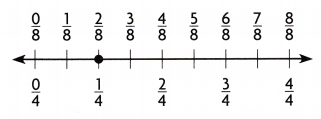
Answer:
F = 1.8C + 32
let x be the temperature such that it is same in both celsius and in Fahrenheit
Then the required equation is
x = 18x + 32
subtract 1.8x from both sides
-0.8x = 32
divide by -0.8 on both sides
x = -40
So -40 degree celsius

Question 18.
Explain the Error Agustin solved an equation as shown. What error did Agustin make? What is the correct answer?
Texas Go Math Grade 8 Lesson 11.2 Answer Key 4
Answer:
Agustin didn’t multiply by 12 on both sides in step 2.
The correct answer is:
\(\frac{1}{3}\)x – 4 = \(\frac{3}{4}\)x + 1
(Multiply by 12.) 12(\(\frac{1}{3}\)x – 4) = 12(\(\frac{3}{4}\)x + 1)
4x – 48 = 9x + 12
(Subtract 4x from both sides.) 4x – 48 – 4x = 9x + 12 – 4x
-48 = 5x + 12
(Subtract 12 from both sides) -48 – 12 = 5x + 12 -12
(Divide by 5.) – 60 = 5x
-12 = x
or
x = -12

H.O.T. Focus on Higher Order Thinking

Question 19.
Draw Conclusions Solve the equation \(\frac{1}{2}\)x – 5 + \(\frac{2}{3}\)x = \(\frac{7}{6}\)x + 4. Explain your results.
Answer:
We are given the equation
\(\frac{1}{2}\)x – 5 + \(\frac{2}{3}\)x = \(\frac{7}{6}\)x + 4
The least common multiple of the denominators: LCM(2, 3, 6) = 6
6 ∙ (\(\frac{1}{2}\)x – 5 + \(\frac{2}{3}\)x) = (\(\frac{7}{6}\)x + 4) ∙ 6
6 ∙ \(\frac{1}{2}\)x – 6 ∙ 5 + 6 ∙ \(\frac{2}{3}\)x = 6 ∙ \(\frac{7}{6}\)x + 6 ∙ 4
3x – 30 + 4x = 7x + 24
7x – 30 = 7x + 24
Subtract 7x from both sides
7x – 30 – 7x = 7x + 24 – 7x
-30 = 24
This is not true. As we can see, the equation has no solution.

Question 20.
Look for a Pattern Describe the pattern in the equation. Then solve the equation.
0.3x + 0.03x + 0.003x + 0.0003x + …. = 3
Answer:
Firstly, to solve given task we have to understand the pattern in the equation. Looking at the equation, we can conclude that every coefficient next to variable x is 10 times smaller then the previous one. Also, we can notice that all the terms containing x are on the left side.
Therefore, we can factorize as following:
x(0.3 + 0.03 + 0.003 + …….) = 3
Looking at the expression in the parentheses, we can notice that the sum is \(0 . \overline{3}\). As we are calculating further and further, threes will pile up, so we can write the sum as \(\frac{1}{3}\).
By inserting \(\frac{1}{3}\) in the equation obtained in step 2, we get:
x ∙ \(\frac{1}{3}\) = 3 (multiplying by 3)
x = 9

Question 21.
Critique Reasoning Jared wanted to find three consecutive even integers whose sum was 4 times the first of those integers. He let k represent the first integer, then wrote and solved this equation: k + (k + 1) + (k + 2) = 4k. Did he get the correct answer? Explain.
Answer:
Using Jared’s formulated equation, k + (k + 1) + (k + 2) = 4k, the three integers that can be solved are
k + (k + 1) + (k + 2) = 4k
3k + 3 = 4k
4k – 3k = 3
k = 3 → first integer
k + 1 = 3 + 1
= 4 → second integer
k + 2 = 3 + 2
= 5 → third integer
Jared did not get the correct answer because the problem is looking for the three consecutive even integers, the obtained integers from his equation are 3, 4, and 5 which are not consecutive even integers.
Since Jared’s representation of the three consecutive integers whose sum is 4 times the first of those integers is incorrect, he should represent the following integers needed in the problem, instead.
k as the first even integer,
k + 2 as the second even integer, and
k + 4 as the third even integer
From the representation, we can formuLate an equation that is
(k + 2) + (k + 4) = 4k

Texas Go Math Grade 8 Lesson 11.2 Answer Key Equations with Rational Numbers Read More »

Texas Go Math Grade 5 Lesson 4.4 Answer Key Division of Decimals by Whole Numbers

Refer to our Texas Go Math Grade 5 Answer Key Pdf to score good marks in the exams. Test yourself by practicing the problems from Texas Go Math Grade 5 Lesson 4.4 Answer Key Division of Decimals by Whole Numbers.

Texas Go Math Grade 5 Lesson 4.4 Answer Key Division of Decimals by Whole Numbers

Unlock the Problem

In a swimming relay, each swimmer swims an equal part of the total distance. Brianna and 3 other swimmers won a relay in 5.68 minutes. What is the average time each girl swam?

How many swimmers are part of the relay team?

Divide. 5.68 ÷ 4
Texas Go Math Grade 5 Lesson 4.4 Answer Key 1
So, each girl swam an average of __________ minutes.
Answer:1.42
Explanation:

So, each girl swam an average of 1.42 minutes.

Example

Divide. 45.8 ÷ 4

STEP 1:
Share the tens, ones, and tenths.
Texas Go Math Grade 5 Lesson 4.4 Answer Key 2
__________ tenth cannot be shared among 4 groups without regrouping.

STEP 2:
Write a zero in the dividend to show regrouping tenths as hundredths and continue dividing.
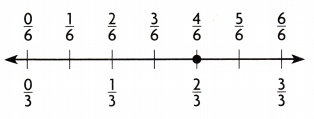
Texas Go Math Grade 5 Lesson 4.4 Answer Key 3
Explanation:
STEP 1:
Share the tens, ones, and tenths.

1 tenth cannot be shared among 4 groups without regrouping.
STEP 2:
Written a zero in the dividend to show regrouping tenths as hundredths and continue dividing.

Math Talk
Mathematical Processes

Explain how you would model 45.8 ÷ 4 using base-ten blocks.
Answer:

Explanation:
45.8 ÷ 4 is done in base ten blocks method
above figure shows how it was done
step 1:
4 is shared among 4 groups no ones left over
step 2:
5 tenths shared among 4 groups 1 tenths left over
1 tenths cannot be regrouped
so, converted to hundredths
18 hundredths shared among the 4 groups
4 shared among groups and  2 leftover

Share and Show

Write the quotient with the decimal point placed correctly.

Go Math Answer Key Grade 5 Lesson 4.4 Answer Key Question 1.
4.92 ÷ 2 = 246 ________
Answer: 2.46
Explanation:
The quotient is written appropriately with the
decimal point placed correctly

Division of Decimals by Whole Numbers 1

Question 2.
24.18 ÷ 3 = 806 ___________
Answer: 8.06
Explanation:
The quotient is written appropriately with the
decimal point placed correctly

Divide.

Question 3.
Texas Go Math Grade 5 Lesson 4.4 Answer Key 4
Answer: 1.73

Explanation:
The quotient is written appropriate with the
decimal point placed correctly
With the division method

Question 4.
Texas Go Math Grade 5 Lesson 4.4 Answer Key 5
Answer:

Explanation:
The quotient is written appropriate with the
decimal point placed correctly
With the division method

Question 5.
Texas Go Math Grade 5 Lesson 4.4 Answer Key 6
Answer:

Explanation:
The quotient is written appropriate with the
decimal point placed correctly
With the division method

Problem Solving

Practice: Copy end Solve Divide.

Question 6.
Texas Go Math Grade 5 Lesson 4.4 Answer Key 7
Answer:

Explanation:
The quotient is written appropriately with the
decimal point placed correctly
With the division method

Go Math Lesson 4.4 Answer Key 5th Grade Question 7.
Texas Go Math Grade 5 Lesson 4.4 Answer Key 8
Answer:

Explanation:
The quotient is written appropriate with the
decimal point placed correctly
With the division method

Question 8.
Texas Go Math Grade 5 Lesson 4.4 Answer Key 9
Answer:

Explanation:
The quotient is written appropriate with the
decimal point placed correctly
With the division method

Question 9.
Texas Go Math Grade 5 Lesson 4.4 Answer Key 10
Answer:
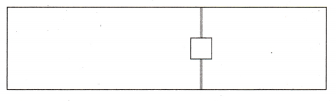
Explanation:
The quotient is written appropriate with the
decimal point placed correctly
With the division method

Question 10.
Texas Go Math Grade 5 Lesson 4.4 Answer Key 11
Answer:

Explanation:
The quotient is written appropriate with the
decimal point placed correctly
With the division method

Question 11.
Texas Go Math Grade 5 Lesson 4.4 Answer Key 12
Answer:
Explanation:
The quotient is written appropriately with the
decimal point placed correctly
With the division method

H.O.T. Algebra Write the unknown number for each ☐.

Go Math Lesson 4.4 5th Grade Answer Key Question 12.
☐ ÷ 5 = 1.21
☐ = __________
Answer: 6.05
Explanation:
The dividend of the expression is  6.05

Question 13.
46.8 ÷ 4 = ☐
☐ = ___________
Answer: 11.7
Explanation:
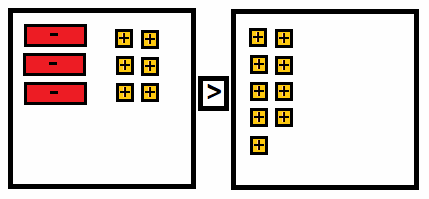
The quotient of the expression is 11.7

Question 14.
10.85 ÷ ☐ = 1.55
☐ = ___________
Answer: 7
Explanation:
The divisor of the equation is 7

Question 15.
Write Math Analyze How is 81.9 ÷ 9 similar to 819 ÷ 9? How is it different?
Answer: 81.9 ÷9 is not equal to 819 ÷ 9
Explanation:
When they are whole number or compatible number they both are same
When their is a decimal point they are change
the quotient varies.

Problem Solving

Question 16.
Multi-Step The standard width of 8 lanes in swimming pools used for competitions is 21.92 meters. The standard width of 9 lanes is 21.96 meters. How much wider is each lane when there are 8 lanes than when there are 9 lanes?
Answer: 0.04
Explanation:
The standard width of 8 lanes in swimming pools used for competitions is 21.92 meters.
The standard width of 9 lanes is 21.96 meters.
21.96 – 21.92 = 0.04
0.04 wider is each lane when there are 8 lanes than when there are 9 lanes.

Question 17.
H.O.T. Multi-Step Mei runs 80.85 miles in 3 weeks. If she runs 5 days each week, what is the average distance she runs each day?
Texas Go Math Grade 5 Lesson 4.4 Answer Key 13
Answer: 5.39
Explanation:
Mei runs 80.85 miles in 3 weeks.
If she runs 5 days each week, 5 x 3 = 15
80.85 ÷ 15 = 5.39
The average distance she runs each day is 5.39

Question 18.
Multi-Step Rob buys 6 tickets to the basketball game. He pays $8.50 for parking. His total cost is $40.54. What is the cost of each ticket?
Answer:  5.34
Explanation:
Rob buys 6 tickets to the basketball game.
He pays $8.50 for parking.
His total cost is $40.54.
40.54 – 8.50 = 32.04
32.04 ÷ 6 = 5.34
each ticket costs  5.34$

Daily Assessment Task

Fill in the bubble completely to show your answer.

Question 19.
In 1849, a gold miner had 4 ounces of gold to sell. The store owner offered him $67.68 for the gold. How much will the store owner pay for each ounce of gold?
(A) $11.28
(B) $15.76
(C) $16.92
(D) $23.64
Answer: C
Explanation:
In 1849, a gold miner had 4 ounces of gold to sell.
The store owner offered him $67.68 for the gold.
67.68 ÷4 = 16.92
the store owner pay for each ounce of gold is $16.92

Question 20.
Use Symbols A grocery store sells 6 ears of corn for $3.54. Which of the following shows how to find the amount of money that each ear of corn costs at the grocery store?
(A) $3.54 × 6
(B) 6 ÷ $3.54
(C) 6 – $3.54
(D) $3.54 ÷ 6
Answer: D
Explanation
The question is based on division so we have to divide
$3.54 ÷ 6 = $0.59

Go Math Grade 5 Lesson 4.4 Answer Key Question 21.
Multi-Step The school in town is building a track around its football stadium. The principal must decide whether to build a track with 6 lanes or 7 lanes. A 6-lane track will be 28.68 feet wide, and a 7-lane track will be 28.98 feet wide. If all lanes are of equal width in each track, how much wider will the lanes be in a 6-lane track than in a 7-lane track?
(A) 4.78 feet
(B) 0.64 foot
(C) 0.50 foot
(D) 4.14 feet
Answer: B
Explanation:
The school in town is building a track around its football stadium.
The principal must decide whether to build a track with 6 lanes or 7 lanes.
A 6-lane track will be 28.68 feet wide, 28.68 ÷  6 = 4.78
and a 7-lane track will be 28.98 feet wide. 28.98 ÷  7 = 4.14
If all lanes are of equal width in each track,
4.78 – 4.14 = 0.64
the lanes  in a 6-lane track than in a 7-lane track is 0.64

Texas Test Prep

Question 22.
A marathon is 26.2 miles long. Sue wants to run a marathon in 4 hours. What is the average number of miles she must run each hour?
(A) 6.5 miles
(B) 6.55 miles
(C) 0.65 mile
(D) 0.655 mile
Answer: B
Explanation:
A marathon is 26.2 miles long.
Sue wants to run a marathon in 4 hours.
26.2 ÷ 4 = 6.55
The average number of miles she must run each hour is 6.55 miles

Texas Go Math Grade 5 Lesson 4.4 Homework and Practice Answer Key

Divide.

Question 1.
Texas Go Math Grade 5 Lesson 4.4 Answer Key 14
Answer:

Explanation:
The quotient is written appropriate with the
decimal point placed correctly
With the division method

Go Math Grade 5 Lesson 4.4 Homework Answer Key Question 2.
Texas Go Math Grade 5 Lesson 4.4 Answer Key 15
Answer:

Explanation:
The quotient is written appropriate with the
decimal point placed correctly
With the division method

Division of Decimals by Whole Numbers 2

Question 3.
Texas Go Math Grade 5 Lesson 4.4 Answer Key 16
Answer:

Explanation:
The quotient is written appropriate with the
decimal point placed correctly
With the division method

Question 4.
Texas Go Math Grade 5 Lesson 4.4 Answer Key 17
Answer:

Explanation:
The quotient is written appropriate with the
decimal point placed correctly
With the division method

Question 5.
Texas Go Math Grade 5 Lesson 4.4 Answer Key 18
Answer:

Explanation:
The quotient is written appropriate with the
decimal point placed correctly
With the division method

Question 6.
Texas Go Math Grade 5 Lesson 4.4 Answer Key 19
Answer:

Explanation:
The quotient is written appropriate with the
decimal point placed correctly
With the division method

Go Math 5th Grade Lesson 4.4 Homework Answer Key Question 7.
Texas Go Math Grade 5 Lesson 4.4 Answer Key 20
Answer:

Explanation:
The quotient is written appropriate with the
decimal point placed correctly
With the division method

Question 8.
Texas Go Math Grade 5 Lesson 4.4 Answer Key 21
Answer:

Explanation:
The quotient is written appropriate with the
decimal point placed correctly
With the division method

Question 9.
Texas Go Math Grade 5 Lesson 4.4 Answer Key 22
Answer:

Explanation:
The quotient is written appropriate with the
decimal point placed correctly
With the division method

Write the unknown number for each ☐.

Question 10.
☐ ÷ 9 = 3.4
☐ = _____________
Answer: 30.6
Explanation:
The dividend of the equation is 30.6

Question 11.
84.8 ÷ ☐ = 10.6
☐ = ______________
Answer: 8
Explanation:
The divisor of the equation is 8

Question 12.
30.87 ÷ 7 = ☐
☐ = ______________
Answer: 4.41
Explanation:
The quotient of the equation is 4.41

Problem Solving

Question 13.
Abby and her 7 friends had lunch at the neighborhood burger barn. The bill was $47.60. If they shared the cost of the lunch equally, how much did each person pay?
Answer: $5.95
Explanation:
Abby and her 7 friends had lunch at the neighborhood burger barn.
The bill was $47.60.
$47.60 ÷ 8 = 5.95
The each person should pay $5.95

1Question 4.
Dion practiced the long jump. He jumped 3.05 meters, 2.74 meters, and 3.3 meters. What was the average length of Dion’s jumps?
Answer: 4.54 meters
Explanation:
Dion practiced the long jump.
He jumped 3.05 meters, 2.74 meters, and 3.3 meters.
3.05 + 2.74 + 3.3 = 9.09
To find the average we have to divide by 2
9.09 ÷ 2 = 4.54 meters

Lesson Check

Fill In the bubble completely to show your answer.

Question 15.
An artist uses 49.4 centimeters of decorative molding to make a square picture frame. How long is each side of the frame?
(A) 12.35 centimeters
(B) 24.7 centimeters
(C) 12.2 centimeters
(D) 11.1 centimeters
Answer: A
Explanation:
Square has 4 equal side of length.
So Answer is 12.35 centimeters of each side.
Since 49.4 ÷4 = 12.35
Question 16.
A box of 8 snack bars costs $24.72. A single snack bar costs $3.47. What is the savings on each snack bar if you buy a box of 8 snack bars?
(A) $0.56
(B) $0.38
(C) $0.43
(D) $0.25
Answer: B
Explanation:
A box of 8 snack bars costs $24.72.
if you buy a box of 8 snack bars then each bar costs $3.09.
if buy a single snack bar then costs $3.47. So savings on each snack bar, if buy a box is $0.38.
Since $3.47 -$3.09 = $0.38

Question 17.
Jeremy saves $2.75 each week. How many weeks will it take him to save enough money to buy a model kit that costs $13.75?
(A) 3 weeks
(B) 4 weeks
(C) 5 weeks
(D) 6 weeks
Answer: C
Explanation:
Jeremy saves $2.75 each week.
Model kit cost is $13.75.
So Jeremy needs 5 weeks to save enough money to buy a model kit.
Since 13.75÷ 2.75 =5

Go Math Grade 5 Practice and Homework Lesson 4.4 Answer Key Question 18.
Ari divides by 6 and gets a quotient of 9.3. What is the dividend in Ari’s division problem?
(A) 3.3
(B) 1.55
(C) 55.8
(D) 54.8
Answer:C
Explanation:
Dividend = Divider × quotient
So Answer is 6× 9.3 =55.8

Question 19.
Multi-Step Sam’s van travels 208.8 miles on 9 gallons of gasoline. Hasan’s small car travels 234.4 miles on 8 gallons of gasoline. What is the difference between the vehicles in the gallons of gasoline consumption per mile?
(A) 29.3 miles per gallon
(B) 23.2 miles per gallon
(C) 3.2 miles per gallon
(D) 6.1 miles per gallon
Answer: D
Explanation:
Sam’s van travels 208.8 miles on 9 gallons of gasoline. 208.8 ÷ 9 = 29.3
Hasan’s small car travels 234.4 miles on 8 gallons of gasoline. 23.4 ÷ 8 =23.2
29.3 – 23.2  = 6.1miles per gallon
the difference between the vehicles in the gallons of gasoline consumption per mile is 6.1

Question 20.
Multi-Step Seven students bought a ticket to the science museum. They paid a total of $40.25. Six students bought a ticket to the art museum. The total cost was $31.50. What is the difference in price between a ticket to the science museum and a ticket to the art museum?
(A) $0.50
(B) $1.00
(C) $8.75
(D) $1.25
Answer:
Explanation: A
Seven students bought a ticket to the science museum.
They paid a total of $40.25.
Six students bought a ticket to the art museum.
The total cost was $31.50.
40 .25 ÷ 7 = 5.75
31.50 ÷ 6 = 5.25
The difference in price between a ticket to the science museum and a ticket to the art museum is 0.50

Texas Go Math Grade 5 Lesson 4.4 Answer Key Division of Decimals by Whole Numbers Read More »

Texas Go Math Grade 4 Lesson 18.1 Answer Key Fixed and Variable Expenses

Refer to our Texas Go Math Grade 4 Answer Key Pdf to score good marks in the exams. Test yourself by practicing the problems from Texas Go Math Grade 4 Lesson 18.1 Answer Key Fixed and Variable Expenses.

Texas Go Math Grade 4 Lesson 18.1 Answer Key Fixed and Variable Expenses

Essential Question

What is the difference between fixed and variable expenses?
Answer:
FIXED EXPENSES:

Fixed expenses are referred to as the cost that does not register a change with an increase or decrease in the number of goods produced by a firm. Fixed costs are those costs that a company should bear irrespective of the levels of production.

Fixed costs are less controllable in nature than variable costs as they are not dependent on the production factors such as volume.

The different examples of fixed costs can be rent, salaries, and property taxes.
VARIABLE EXPENSES:

Variable expenses are referred to as the type of cost that will show variations as per the changes in the levels of production. Depending on the volume of the production in a company, the variable cost increases or decreases.

The various examples of variable costs are the cost of raw materials that are used for production, sales commissions, labor cost, and more.

The money that you need to pay for electricity or phone service is your expense. Expenses that occur regularly and the amount does not change are fixed expenses. Expenses in which the amount does change based on need or choice are variable expenses.

Fixed and Variable Expenses 3

Unlock the Problem

Erin has some fixed and variable expenses. She pays $23.75 every 12 weeks for the newspaper to be delivered to her home every day. She and her family like to eat out. On Monday night, Erin spent $45.78 to eat a meal at Restaurant A. Tuesday night, she spent $58.12 for a meal at Restaurant B. Wednesday night, she spent $37.64 for a meal at Restaurant C.

Example 1 Complete.
Erin’s family is a fixed expense because she pays the same amount and the cost does not change. The money

Erin spends on meals is a ____variable_______ expense because the amount _____varies______ depending on which restaurant she goes to or the type of meal she buys.

Example 2 Find the amount Erin spends on fixed expenses for 24 weeks.

Erin pays $23.75 every 12 weeks for the newspaper

In 24 weeks, she pays $23.75 + $ 23.75 = $ 47.5.

Erin Spends $____47.5________ in fixed expenses for 24 weeks.
Answer: 47.5$ Erin spends in fixed expenses.

Math Talk

Mathematical Processes
What other fixed expenses might a person have?
Answer: Here is a list of categories to include in your fixed expenses: Utility bills (cable, cell, electricity, water, etc.) Life / Disability / Extended health (or other) insurance.

Example 3 Solve.
How much does Erin spend on variable expenses?
Texas Go Math Grade 4 Lesson 18.1 Answer Key Fixed and Variable Expenses 1Texas Go Math Grade 4 Lesson 18.1 Answer Key Fixed and Variable Expenses 1
So Erin spent $ ___________ on variable expenses.
Answer:  Erin spent $141.54 on variable expenses.
Texas Go Math Grade 4 Lesson 18.1 Answer Key Fixed and Variable Expenses e3

Share and Show

Question 1.
Betsy pays a trash service to pick up the household trash once a week. The cost is $23 a month. Trash pick-up is a _____________ expense. In 6 months, the family pays 6 × _____________ = _____________ .
Answer: Here trash pick-up is a fixed expense because it is constant for every month that is $23 a month. Now, here the question asked was for one month she has to pay $23 a month. For 6 months how much amount of money she has to pay.
In 6 months, the family pays 6×$23=138$.
Therefore, the family pays $138 for 6 months.

Question 2.
Mrs. Beyer goes grocery shopping once a week. In one month she spent $99.65, $122.56, $130.45, and $145. What was the total monthly expense? Grocery bills are a variable expense. In a month, Mrs Beyer spent $497.66 on groceries.
Answer: Grocery bills are a variable expense. Because for every week amount is changing.
Beyer goes shopping weekly once. Here, the question asked about total monthly expenses. We need to add all the amount she spent every week.
The total monthly expenses are $99.65+$122.56+$130.45+$145=$497.66.
Therefore, Beyer’s total expenses are $497.66

Go Math Answer Key Grade 4 Variable Expenses Question 3.
Texas Go Math Grade 4 Lesson 18.1 Answer Key Fixed and Variable Expenses 2
Write Math Use the list at the right. Sort the topics into fixed expenses and variable expenses. Choose one and explain why you placed it there.
Texas Go Math Grade 4 Lesson 18.1 Answer Key Fixed and Variable Expenses 3
Answer:
Texas Go Math Grade 4 Lesson 18.1 Answer Key Fixed and Variable Expenses q3
Explanation:
Up to a certain time like years or monthly payments are always constant like car payments, house payments, loan, gas etc. It won’t change their rates. Coming to variable expenses we pay according to the volume we buy a product like clothes, groceries, cell phones etc. Vacations, entertainments, electric bills definitely vary according to the place, situation. so these all are variable expenses.

Math Talk

Mathematical Processes
Explain why some of the topics could be either fixed or variable expenses.
Answer:
FIXED EXPENSES: Costs that do not change with output means these are operating costs that a business may have that will remain the same, no matter how much they are used. For example, what would be all of the fixed costs of a shoe shop?.
Rent, salaries, insurance, broadband. Assume the costs.
Texas Go Math Grade 4 Lesson 18.1 Answer Key Fixed and Variable Expenses q4
These all things are fixed in a shoe shop. How much you use is not a matter, if we take broadband, there is no limit to use but every month we have to pay $50 it is the fixed cost. Likewise rent, insurance, and salaries.
VARIABLE EXPENSES: Costs that do change with output means these are operating costs that a business may have that will change with use, so the more they are used, the more they will cost. For example, what would be all of the variable costs of a shoe shop?.
Stock, utilities, wages, telephone.
Texas Go Math Grade 4 Lesson 18.1 Answer Key Fixed and Variable Expenses q4.1
Here every week rates change. How much volume do we use according to that we need to pay, for example, take telephone if it is a weekly payment then we pay weekly and how much we use on that week according to that we have to pay. likewise, wages, if he does extra hours the employer will pay the extra amount to the employee.

Problem Solving

Use the numbers in the picture for 4-5.

Texas Go Math Grade 4 Lesson 18.1 Answer Key Fixed and Variable Expenses 4

Question 4.
How much has the price of gas increased from the lowest to the highest price shown?
Answer: From the above diagram, we can say the lowest rate and highest rate. The lowest rate is 2.99 and the highest rate is 4.02.
The price of the gas increased was 4.02-2.99=1.03.
Therefore, the 1.03 price increased.

Question 5.
Multi-Step Maya filled her car with gas once at each price shown. Her gas tank holds 15 gallons. Estimate the amount that she spent to fill her tank these four times. Is this a fixed or variable expense?
Answer:
Given the question:  Maya filled her car with gas once at each price shown in the above diagram are 2.99, 3.99, 4.02, 3.87
The number of tanks she holds=15 gallons.
Now we have to find the amount she spent each time. And moreover, it’s a variable expense because it is changing every time when she fills the gas to her car.
The amount she spent on the first time=15×2.99=44.85$
The amount she spent on the second time=15×3.99=59.85$
The amount she spent on the third time=15×4.02=60.3$
The amount she spent on the fourth time=15×3.87=58.05$

Go Math Answer Key Variable Expenses 4th Grade Question 6.
Apply Mario paid off his car loan this year. His payments were $259 a month for each of the first 8 months. The last payment, in the ninth month, was $125. What was the total Mario paid in car payments this year? Are the payments Mario paid the first 8 months a fixed or variable expense?
Answer:
Given: Mario paid completely his car loan this year.
The total number of months he paid loan=9
For the first 8 months, he paid 259$ each month. So it was a fixed expense because he paid the same amount every month.
The total amount he paid in 8 months=259$×8=2072$
The amount he paid in 9th month=125$
The total payment Mario paid this year=2072$+125$=2197$
Therefore, he paid 2197$ this year.

Question 7.
Texas Go Math Grade 4 Lesson 18.1 Answer Key Fixed and Variable Expenses 5
H.O.T Multi-Step Mrs. Xavier buys 1 or 2 books a month for $13.99 each. A magazine subscription costs her $19.99 a year. She buys the Sunday paper for $2.05 each week. Estimate the most she could spend for her reading material in a year.
Answer:
The number of books Xavier buys each month=2 (given 1 or 2, but take 2).
The cost of each book is $13.99.
Xavier spent on books every month=13.99×2=$27.98
For a year she could spend only on books=27.98×12=335.76$
The cost of a subscription for a magazine per year is $19.99
The Sunday paper she buys each week is $2.05
Here the question asked was the amount she could spend on her reading material in a year.  So, we need to find the amount for the Sundays paper for the year.
Sundays paper for the year=2.05×48=98.4$(for a year there are 12 months, in a month there are 4 weeks so 12×4=48 weeks. For 12 months there will be 48 weeks so I multiplied with 48).
Now the total amount she could spend=335.76+19.99+98.4=454.15$
Therefore, she spends 454.15$ for the year.

Question 8.
H.O.T. Communicate Wendy’s bakery business has fixed and variable expenses. Her gas and electric bills cost $500 one month. The ingredients cost $700 that month. She pays each of 2 workers $10 an hour to work 40 hours a week. Explain how you can find her total business expenses for a month.
Answer:
The cost for gas and electric bills for one month=500$
The cost of ingredients for a month=700$
The number of workers she has=2
The amount she pays for an hour to each worker is $10. Here 2 workers are there so 10$×2=20$.
The total number of hours a week=40
The total amount she was spending every week for 2 workers=40×20=800$
The question asked for total expenses for a month so we need to calculate the salary for the month that could be 800×4=3200$. (In a month there are 4 weeks so I multiplied with 4).
Now we have to find, her total business expenses for a month.
500+700+3200=4400$.
Therefore, she spent 4400$ every month on her business.

Daily Assessment Task

Fill in the bubble completely to show your answer.

Question 9.
Lexi is taking 3 courses at Community College. She pays $835 for each college course. She spends about $45 a week for 20 weeks to drive to school. How much does she spend on fixed expenses?
(A) $ 2,505
(B) $ 2,400
(C) $ 900
(D) $ 2,700
Answer: Option C is correct.
Texas Go Math Grade 4 Lesson 18.1 Answer Key Fixed and Variable Expenses q9
Explanation:
The number of courses Lexi took at Community College=3
The amount she pays on each course=835$.
The total amount she pays for 3 courses=835×3=2505$.
The amount she spends each week=45$
The amount she spends for 20 weeks=45×20=900$
The amount she spend on fixed expenses=900$.
Because the charges cannot change but the course costs may change. Here the fixed expenses were only asked. So, the answer is 900$ which she is spending every week constantly.

4th Grade Go Math Answer Key Fixed and Variable Expenses Question 10.
Every month, Jack’s mother pays the following expenses: the house payment, the club membership, the car payment, and the cost of food. Which is a variable expense?
(A) the club membership
(B) the house payment
(C) the car payment
(D) the cost of food
Answer: Option D is correct.
Texas Go Math Grade 4 Lesson 18.1 Answer Key Fixed and Variable Expenses q10
Explanation:
The variable expense was asked in the given options. The above three options are coming under fixed expenses because they are constant at their rates. But the cost of food will vary because it depends upon the volume we eat that’s why it comes under variable expense.

Question 11.
Multi-Step Josh has a new cell phone plan. He gets unlimited voice calls and text messages to other devices in his area for $35 a month. Voice calls outside of his area cost $0.10 a minute and text messages cost $0.99 a message. What is Josh’s bill if he uses 10 minutes for calls and makes one text outside his area?
(A) $35.10
(B) $36.10
(C) $35.00
(D) $35.99
Answer: Option D is correct.
Texas Go Math Grade 4 Lesson 18.1 Answer Key Fixed and Variable Expenses q11
Explanation:
Given: For unlimited voice calls and text messages within his area is 35$ per month. If it’s an outside area then the cost will increase. For voice calls outside the area is 0.10$ and for text messages 0.99$. Now we need to find out Josh’s bill if he uses 10 minutes for calls and makes one text outside his area. That can be written as 35+0.99=35.99$.
josh uses 10 minutes for calls=35 { how much you use in a month that cost could be 35$ only it won’t change. It is a fixed expense}.
He texts outside the area so he has to pay an extra 0.99$.
Therefore, 35.99$ he has to pay.

TEXAS Test Prep

Question 12.
Dara makes bracelets and sells them in her shop. Which is a fixed expense for Dara’s business?
(A) the cost of the beads
(B) the cost of the string
(C) the cost of advertising
(D) rent for her shop
Answer: Option D is correct.
Texas Go Math Grade 4 Lesson 18.1 Answer Key Fixed and Variable Expenses q12
Explanation:
In Dara’s business, the cost of beads, string, advertising all are coming under variable expenses because they vary according to their volume, quality. But the rent could not change it fixed up to a certain time. So this rent comes under fixed expense.

Texas Go Math Grade 4 Lesson 18.1 Homework and Practice Answer Key

Question 1.
Bruce buys 7 cans of dog food a week and a hag of dog food every 4 weeks. Cans of dog food cost $1.29 each.

A bag of dog food costs $67.59. Dog food is a __________
expense. In 4 weeks, Bruce spends 28 × _______ + __________ = __________ for dog food.
Answer:
Dog food is a fixed expense. It is a constant rate.
The number of cans of food Bruce buys each week=7 [for 4 weeks 7×4=28].
The number of bags of dog food he buys=1
He buys dog food every 4 weeks. The cost of each can of dog food is 1.29$
The cost of each bag of dog food=67.59$
The amount he spends in a week=7×1.29=9.03$+67.59$×28=2145.36$.
Therefore, he spends 2145.36$ on dog food.

Go Math Answers 4th Grade Fixed Vs Variable Expenses Question 2.
Texas Go Math Grade 4 Lesson 18.1 Answer Key Fixed and Variable Expenses 9
Use the list of Expenses for Dog Owners. Sort the expenses into fixed expenses and variable expenses. Choose one expense and explain why you put it where you did.
Texas Go Math Grade 4 Lesson 18.1 Answer Key Fixed and Variable Expenses 7
Answer:
Texas Go Math Grade 4 Lesson 18.1 Answer Key Fixed and Variable Expenses h2.1
Explanation:
FIXED EXPENSES: Daily dog walking, training classes, boarding comes under fixed expenses because the cost does not change. we have to pay a fixed amount per month or a year.
VARIABLE EXPENSES: Food, we have to pay according to the volume the dog eats. Toys, treats, bed, collar and leash all those things also cost varies according to their size, quality. Veterinary care also the cost varies depending upon the treatment they gave to the dog.

Fixed and Variable Expenses 2

Problem Solving

Question 3.
Gretchen has a cat. She buys a bag of litter every month. Litter costs $38.59 a bag. How much will litter for a year cost? Is the expense fixed or variable?
Answer: 463.08$
Explanation:
Number of bags of litter she buys every month=1
The cost of a litter of 1 bag=38.59$
The amount she spends in a year on litter=38.59×12=463.08$.
Therefore, she spends 463.08$ a year.   { 1year=12 months}.

Question 4
In March, Gretchen bought a brush and a toy for her kitten. The brush cost $6.79. The toy cost $3.88. In April, she bought a cat carrier for $87.68. How much did she spend for these items? Are the expenses fixed or variable? Explain.
Answer: 98.35$
Explanation:
The cost of brush=$6.79
The cost of the toy is $3.88
The cost of a cat carrier is $87.68
The total amount she spends on these items=6.79+3.88+87.68=$98.35.
These items are variable expenses because they vary costs depending upon quality and size.
Lesson Check

Go Math Answer Key 4th Grade Fixed Expenses Question 5.
Mark pays a gardener $100 each week. He bought a fence for the garden and 2 flats of plants. He also bought a shovel and a hoe. Which expense is fixed?
(A) gardener
(B) plants
(C) fence
(D) shovel
Answer: Option A is correct.
Texas Go Math Grade 4 Lesson 18.1 Answer Key Fixed and Variable Expenses h5
Explanation:
Mark pays the constant(fixed) amount to the gardener. How much the gardener works does not matter, the gardener will be paid by Mark $100 every week. So it is a fixed expense.

Question 6.
Leslie rides the bus to work and back 5 days a week. The bus costs $1.25 each way. Sometimes she buys a newspaper to read on the bus. The newspaper costs $0.75 a day. How much does she spend for fixed expenses every week?
(A) $6.25
(B) $12.50
(C) $18.75
(D) $10.00
Answer: Option D is correct.
Texas Go Math Grade 4 Lesson 18.1 Answer Key Fixed and Variable Expenses h6
The number of days she will take to come back=5
The cost for each way=$1.25
For 5 days=1.25*5=6.25
The cost of a newspaper=$0.75
For 5 days=0.75*5=3.75
The amount she spends on fixed expenses every week=6.25+3.75=10.

Question 7.
Every month, Wesley writes checks to pay each of the bills listed below. Which is a variable expense?
(A) rent
(B) cable television
(C) electricity
(D) gym membership
Answer: Option C is correct.
Texas Go Math Grade 4 Lesson 18.1 Answer Key Fixed and Variable Expenses h7
Explanation:
Electricity comes under variable expense because it depends upon you much power we use every day or every month. If we consume more power then more amount we have to pay. If we consume less then we will pay less.

Question 8.
Which of Victoria’s monthly car expenses is fixed?
(A) car payment
(B) gas
(C) bridge tolls
(D) parking
Answer: Option A is correct.
Texas Go Math Grade 4 Lesson 18.1 Answer Key Fixed and Variable Expenses h8
Explanation:
Car payment is fixed because if we kept instalments to pay then we have to pay a certain amount monthly which is fixed. All other options are coming under variable expenses because their cost depends upon the places. So definitely they will vary.

Question 9.
Multi-Step A store owner pays $1,200 each month for rent. She pays. the clerk who works in the store $15 an hour. The clerk works 60 hours each month. What is the total of the monthly fixed expenses?
(A) $2,100
(B) $1,290
(C) $1,800
(D) $3,00
Answer: Option A is correct.
Texas Go Math Grade 4 Lesson 18.1 Answer Key Fixed and Variable Expenses h9
Explanation:
The rent she pays every month=$1200
She pays the clerk per hour=$15
The number of hours the clerk works=60
The total salary for clerk per month=60*15=900
The total amount she spends monthly on fixed expenses=1200+900=$2100

Go Math Grade 4 Answer Key Variable Vs Fixed Expenses Question 10.
Multi-Step Jenny spends $2.20 for a school lunch every day. She also buys a muffin at the bakery every day on her way home from school. The muffin costs $1.25. What are Jenny’s fixed expenses for a 5-day school week?
(A) $15.05
(B) $15.75
(C) $22.25
(D) $17.25
Answer: Option D is correct.
Texas Go Math Grade 4 Lesson 18.1 Answer Key Fixed and Variable Expenses h10
The cost Jenny spends on lunch every day=$2.20
For 5 days=2.20*5=11
The cost of a muffin she buys every day=$1.25
For 5 days=1.25*5=6.25
The total cost she spends for 5 days=11+6.25=$17.25.

Texas Go Math Grade 4 Lesson 18.1 Answer Key Fixed and Variable Expenses Read More »

Texas Go Math Grade 7 Lesson 8.3 Answer Key Writing Two-Step Inequalities

Refer to our Texas Go Math Grade 7 Answer Key Pdf to score good marks in the exams. Test yourself by practicing the problems from Texas Go Math Grade 7 Lesson 8.3 Answer Key Writing Two-Step Inequalities.

Texas Go Math Grade 7 Lesson 8.3 Answer Key Writing Two-Step Inequalities

Texas Go Math Grade 7 Lesson 8.3 Explore Activity Answer Key

Modeling Two-Step inequalities
You can use algebra tiles to model two-step inequalities.

Use algebra tiles to model 2k + 5 ≥ -3.

A. Using the line on the mat, draw in the inequality symbol shown in the inequality.
Texas Go Math Grade 7 Lesson 8.3 Answer Key 1
Answer:

B. How can you model the left side of the inequality?

C. How can you model the right side of the inequality?

D. Use algebra tiles or draw them to model the inequality on the mat.

Reflect

Question 1.
Multiple Representations How does your model differ from the one you would draw to model the equation 2k + 5 = -3?
Answer:
On each side, we put the same number of tiles as in the model of equation 2k + 5 = -3.
The only difference is that instead of an equality sign, we have an inequality sign.

Go Math Grade 7 Answer Key Pdf Lesson 8.3 Question 2.
Why might you need to change the inequality sign when you solve an inequality using algebra tiles?
Answer:
The reason you need to change the inequality sign when you solve an inequality using algebra tiles is when the variable is negative. When solving an inequality, wherein the variable has a negative coefficient, the inequality sign needs to be changed. When an inequality has a negative variable.

Your Turn

Question 3.
The 45 members of the glee club are trying to raise at least $6,000 so they can compete in the state championship. They already have $1240 What inequality can you write to find the amount each member must raise, on average, to meet the goal?
Answer:
Let x be the amount each member must raise.
$1240 + 45 ∙ x ≥ $6000

Question 4.
Ella has $40 to spend at the State Fair. Admission is $6 and each ride costs $3. Write an inequality to find the greatest number of rides she can go on.
Answer:
Let æ be the number of rides Ella can go on.
$6 + $3 ∙ x ≤ $40

Your Turn

Write a real-world problem for each inequality.

Question 5.
3x + 10 > 30
Answer:
In order to get a bonus this month, leon must sell more than 30 newspaper subscriptions
He sold 10 subscriptions in the first week of the month.
How many subscriptions must leon sell per week if there is three more weeks of the month?

Writing Two-Step Inequalities 2

Lesson 8.3 Answer Key Texas Go Math Grade 7 Solutions Question 6.
5x – 50 ≤ 100
Answer:
You have to pay $50 to rent a spot at the flea market to sell your stuff.
You make a $5 profit for each one you sell.
How many do you have to sell to make a $100 profit or less?

Texas Go Math Grade 7 Lesson 8.3 Guided Practice Answer Key

Draw algebra tiles to model each two-step inequality. (Explore Activity)

Question 1.
4x – 5 < 7
Texas Go Math Grade 7 Lesson 8.3 Answer Key 2
Answer:
Texas Go Math Grade 7 Lesson 8.3 Answer Key 5
On the left side of the mat we put 4 positive variable and 5 – 1 tiles. On the right side we put 7 + 1 tiles, and between is the sign of inequality.

Question 2.
-3x + 6 > 9
Texas Go Math Grade 7 Lesson 8.3 Answer Key 3
Answer:
Texas Go Math Grade 7 Lesson 8.3 Answer Key 6
On the left side of the mat, we put 3 negative variables and 6 + 1 times. On the right side, we put 7 +1 tiles, and between is the sign of inequality.

Go Math 7th Grade Answer Key Pdf Lesson 8.3 Question 3.
The booster club needs to raise at least $7,000 for new football uniforms. So far, they have raised $1,250. Write an inequality to find the average amounts each of the 92 members can raise to meet the club’s objective. (Example 1)
Let a represent the amount each member must raise.
Texas Go Math Grade 7 Lesson 8.3 Answer Key 4
The inequality that represents the situation is _____
Answer:
Texas Go Math Grade 7 Lesson 8.3 Answer Key 7
Amount to be raised: $7000
Amount already raised: $1250
Number of members: 92
1250 + 12 ∙ a ≥ 7000

Writing Two-Step Inequalities 1

Question 4.
Analyze what each part of 7x – 18 ≤ 32 means mathematically. (Example 2)
x is ____________________. 7x is ________
18 means that ________________________
≤ 32 means that ________________________
Answer:
-Solution.
-Solution multiplied by 7.
-Subtract from 7x.
-At most 32.

Question 5.
Write a real-world problem to represent 7x – 18 ≤ 32.
Answer:
Lenna has $32 and wants to buy the same Christmas sweaters for 7 friends.
Also she has a gift card of $18 that she plans to use.
How much at most can it cost one sweater?

Essential Question Check-In

Question 6.
Describe the steps you would follow to write a two-step inequality you can use to solve a real-world problem.
Answer:
The steps in writing a two-step inequality to solve a real-world problem:

  • 1. Read the problem carefully and identify what is needed. Assign a variable for the said needed information.
  • 2. Write down the important information that can be used to help to write an inequality.
  • 3. Use words in the problem to tie the information together. Translate these words into numbers and variables in order to make an inequality.

The steps in writing a two-step inequality to solve a real-world problem.

Texas Go Math Grade 7 Lesson 8.3  Independent Practice Answer Key

Question 7.
Three friends earned more than $200 washing cars. they paid their parents $28 for supplies and divided the rest of the money equally. Write an inequality to find possible amounts each friend earned. Identify what your variable represents.
Answer:
Three friends paid their parents $28 for supplies. and they earned more than $200 washing cars. Let x be the possible amount each friend earned.
3x – $28 > $200

Texas Go Math Grade 7 Answer Key Pdf Lesson 8.3 Practice Question 8.
Nick has $7.00. Bagels cost $0.75 each, and a small container of cream cheese costs $1.29. Write an inequality to find the number of bagels Nick can buy. Identify what your variable represents.
Answer:
The container of cream cheese costs $ 1.29. and each bagel cost $0.75. Let x be the number of bagels Nick can buy with his $7.
$075 ∙ x + $1.29 < $7

Question 9.
Chet needs to buy 4 work shirts, all costing the same amount. The total cost before Chet applies a $25 gift certificate can be no more than $75. Write an inequality to find the possible amounts that Chet pays per shirt. Identify what your variable represents.
Answer:
Assign a variable for the unknown value. Let x be the cost of each shirt. The inequality for the given problem is:
4x + 25 ≤ 75

Question 10.
Due to fire laws, no more than 720 people may attend a performance at Metro Auditorium. The balcony holds 120 people. There are 32 rows on the ground floor, each with the same number of seats. Write an inequality to find the number of people that can sit in a ground-floor row if the balcony is full. Identify what your variable represents.
Answer:
We have to sum the number of people on the balcony, and how many people can sit in 32 rows on the ground floor, and that sum can not be greater than 720. Let x be the number of people in the rows on the ground floor.
32 ∙ x + 120 < 720

Question 11.
Liz earns a salary of $2,100 per month, plus a commission of 5% of her sales. She wants to earn at least $2,400 this month. Write an inequality to find amounts of sales that will meet her goal. Identify what your variable represents.
Answer:
We have to sum Liz’s month salary and 5% commission of hers sales, to find the amount. of sales that will meet her goal. Let x be the amount of sales.
$2100 + 5% ∙ x < $2400 5% we can write as a fraction 1/20.
$2100 + \(\frac{1}{20}\) ∙ x < $2400
$2100 + \(\frac{x}{20}\) < $2400

Question 12.
Lincoln Middle School plans to collect more than 2,000 cans of food in a food drive. So far, 668 cans have been collected. Write an inequality to find number of cans the school can collect on each of the final 7 days of the drive to meet this goal. Identify what your variable represents.
Answer:
We have to sum 668 cans that had been collected, and how many cans should be collected in 7 days, so that the school achieves the plan. Let x be the number of cans the school should collect each day.
668 + 7 ∙ x > 2000

Go Math Grade 7 Lesson 8.3 Answer Key Question 13.
Joanna joins a CD club. She pays $7 per month plus $10 for each CD that she orders. Write an inequality to find how many CDs she can purchase in a month if she spends no more than $100. Identify what your variable represents.
Answer:
We have to sum $7 and the number of CDs. each costs $10, which Joanna can purchase in a month with no more than $100. Let x be the number of CDs.
$7 + $10 ∙ x < $100

Question 14.
Lionel wants to buy a belt that costs $22. He also wants to buy some shirts that are on sale for $17 each. He has $80. What inequality can you write to find the number of shirts he can buy? Identify what your variable represents.
Answer:
We have to sum the price of the belt $22 and how many shirts, that costs $17, Lionel can buy, and that sum can be at most $80. Let x be the number of shirts Lionel can buy.
$22 + $17 ∙ x ≤ $80

Question 15.
Write and solve a real-world problem that can be represented by 15x – 20 ≤ 130.
Answer:
Given inequality in problem: 15x – 20 ≤ 130
15x – 20 ≤ 130 (Given)
15x – 20 + 20≤ 130 + 20 (Adding 20 on both side)
15x ≤ 150 (Simplifying)
x ≤ \(\frac{150}{15}\) (Dividing both side by 15)
x ≤ 10 (SoLution)
x ∈ (-∞, 10]
Texas Go Math Grade 7 Lesson 8.3 Answer Key 9

Analyze Relationships Write >, <, ≥, or ≤ in the blank to express the given relationship.

Question 16.
m is at least 25 m __________ 25
Answer:
m 25

Lesson 8.3 Go Math 7th Grade Writing Two Step Inequalities Question 17.
k is no greater than 9 k __________ 9
Answer:
k 9

Question 18.
p is less than 48 p __________ 48
Answer:
p < 48

Question 19.
b is no more than -5 b __________ -5
Answer:
p -5

Question 20.
h is at most 56 h __________ 56
Answer:
h 56

Question 21.
w is no less than 0 w __________ 0
Answer:
w 0

Question 22.
Critical Thinking Marie scored 95, 86, and 89 on three science tests. She wants her average score for 6 tests to be at least 90. What inequality can you write to find the average scores that she can get on her next three tests to meet this goal? Use s to represent the lowest average score.
Answer:
Let s represent the lowest average score on the next three tests Marie has to take.
\(\frac{95+86+89+s}{6}\) ≥ 90

Question 23.
Communicate Mathematical Ideas Write an inequality that expresses the reason the lengths 5 feet, 10 feet, and 20 feet could not be used to make a triangle. Explain how the inequality demonstrates that fact.
Answer:
The triangle inequality states that the sum of the lengths of any two sides of a triangle must be greater than or equal to the length of the third side. Let a, b and c be the sides of the triangle. The inequalities that should be satisfied are:
a + b ≥ c
a + c ≥ b
b + c ≥ a
However in our case we have
10 + 20 > 5
20 + 5 > 10
the sum of the lengths of the two shorter sides is less than the length of the third side
5 – 10 < 20
Hence, these lengths could not be used to make a triangle.

Go Math Lesson 8.3 7th Grade Two-Step Inequalities Question 24.
Analyze Relationships The number m satisfies the relationship m < 0. Write an inequality expressing the relationship between -m and 0. Explain your reasoning.
Answer:
The number m is less than 0, so m could be 1, -2, -3 etc. If we take the negative value of the number m, we will have
-(-1) = 1, -(- 2) = 2, -(- 3) = 3 etc. Hence, -m will be greater than 0.
Also, we could just multiply inequality m < 0 by (- 1). Because we are multiplying by a negative number, we have to reverse the direction of the inequality.
m < 0
Multiply by -1 on both sides.
-m > 0

Question 25.
Analyze Relationships The number n satisfies the relationship n > 0. Write three inequalities to express the relationship between n and \(\frac{1}{n}\).
Answer:
If 0 < n < 1, then the relationship between n and \(\frac{1}{n}\) is
n < \(\frac{1}{n}\)

If n ≤ 1, then the relationship between n and \(\frac{1}{n}\) is
n ≤ \(\frac{1}{n}\)

If n > 1, then the relationship between n and \(\frac{1}{n}\) is
n > \(\frac{1}{n}\)

Texas Go Math Grade 7 Lesson 8.3 Answer Key Writing Two-Step Inequalities Read More »

Scroll to Top