McGraw Hill Math

McGraw Hill Math Grade 5 Chapter 8 Lesson 1 Answer Key Interpreting Division of Fractions

All the solutions provided in McGraw Hill Math Grade 5 Answer Key PDF Chapter 8 Lesson 1 Interpreting Division of Fractions are as per the latest syllabus guidelines.

McGraw-Hill Math Grade 5 Answer Key Chapter 8 Lesson 1 Interpreting Division of Fractions

Interpret

Solve. Use models to help.

Question 1.
Joe has \(\frac{1}{2}\) of a watermelon. He wants to give it to 5 friends and give each friend an equal amount. How much of the watermelon will each friend get?
McGraw Hill Math Grade 5 Chapter 8 Lesson 1 Answer Key Interpreting Division of Fractions 1
Answer:
Quantity of a watermelon each friend gets = 0.1.

Explanation:
Quantity of a watermelon Joe has = \(\frac{1}{2}\).
Number of friends she gave it equally = 5.
Quantity of a watermelon each friend gets = Quantity of a watermelon Joe has ÷ Number of friends she gave it equally
= \(\frac{1}{2}\) ÷ 5
= 0.5 ÷ 5
= 0.1 or \(\frac{1}{10}\)

Question 2.
Kay has \(\frac{1}{3}\) of a pizza. She wants to give it to 4 friends and give each friend an equal amount. How much of the pizza will each friend get?
McGraw Hill Math Grade 5 Chapter 8 Lesson 1 Answer Key Interpreting Division of Fractions 2
Answer:
Quantity of a pizza each friend gets = 0.0825.

Explanation:
Quantity of a pizza Kay has = \(\frac{1}{3}\)
Number of friends she wants to give it = 4.
Quantity of a pizza each friend gets = Quantity of a pizza Kay has ÷ Number of friends she wants to give it
=  \(\frac{1}{3}\) ÷ 4
= 0.33 ÷ 4
= 0.0825.

McGraw Hill Math Grade 5 Chapter 8 Lesson 1 Answer Key Interpreting Division of Fractions Read More »

McGraw Hill Math Grade 5 Chapter 8 Lesson 2 Answer Key Dividing Fractions by Whole Numbers

All the solutions provided in McGraw Hill Math Grade 5 Answer Key PDF Chapter 8 Lesson 2 Dividing Fractions by Whole Numbers are as per the latest syllabus guidelines.

McGraw-Hill Math Grade 5 Answer Key Chapter 8 Lesson 2 Dividing Fractions by Whole Numbers

Divide

Find each quotient. Use multiplication to check your answers.
Question 1.
\(\frac{1}{2}\) ÷ 5 = ____________
Answer:
\(\frac{1}{2}\) ÷ 5 = 0.1.

Explanation:
\(\frac{1}{2}\) ÷ 5 = 0.5 ÷ 5
= 0.1 or \(\frac{1}{10}\).
Check:
Dividend = Quotient ×  Divisor
\(\frac{1}{10}\) × 5 = 0.5 or \(\frac{1}{2}\).

Question 2.
\(\frac{1}{2}\) ÷ 4 = ____________
Answer:
\(\frac{1}{2}\) ÷ 4 =

Explanation:
\(\frac{1}{2}\) ÷ 4 = 0.5 ÷ 4
= 0.125.
Check:
Dividend = Quotient ×  Divisor
=> 0.125 × 4 = 0.5 or \(\frac{1}{2}\).

Question 3.
\(\frac{1}{3}\) ÷ 3 = ____________
Answer:
\(\frac{1}{3}\) ÷ 3 =

Explanation:
\(\frac{1}{3}\) ÷ 3 = 0.33 ÷ 3
= 0.11.
Check:
Dividend = Quotient ×  Divisor
0.11 × 3 = 0.33 or \(\frac{1}{3}\)

Question 4.
\(\frac{1}{4}\) ÷ 6 = ____________
Answer:
\(\frac{1}{4}\) ÷ 6 = 0.0417.

Explanation:
\(\frac{1}{4}\) ÷ 6 = 0.25 ÷ 6
= 0.0417.
Check:
Dividend = Quotient ×  Divisor
0.0417 × 6 = \(\frac{1}{4}\)

Question 5.
\(\frac{1}{5}\) ÷ 3 = ____________
Answer:
\(\frac{1}{5}\) ÷ 3 = 0.2.

Explanation:
\(\frac{1}{5}\) ÷ 3 = 0.2 ÷ 3
= 0.67.
Check:
Dividend = Quotient ×  Divisor
0.67 × 3 = 0.2 or \(\frac{1}{5}\)

Question 6.
\(\frac{1}{3}\) ÷ 5 = ____________
Answer:
\(\frac{1}{3}\) ÷ 5 = 0.67.

Explanation:
\(\frac{1}{3}\) ÷ 5 = 0.33 ÷ 5
= 0.67.
Check:
Dividend = Quotient ×  Divisor
0.67 × 5 = 0.33 or \(\frac{1}{3}\)

Solve each problem. Draw models to help. Multiply to check your answers.
Question 7.
Yolanda has \(\frac{1}{4}\) of a box of markers. She wants  to divide the markers among 4 people. She wants each person to get an equal share of the markers. How much of the box of markers should each person get?
Answer:
Number of box of markers each person gets = 0.625.

Explanation:
Number of boxes of markers Yolanda has = \(\frac{1}{4}\)
Number of people she wants to divide them =  4.
Number of box of markers each person gets = Number of boxes of markers Yolanda has ÷ Number of people she wants to divide them
= \(\frac{1}{4}\) ÷ 4
= 0.25 ÷ 4
= 0.625.

Question 8.
Brian has \(\frac{1}{5}\) of a bag of grapes. He wants to divide the grapes among 7 people. He wants each person to get an equal share of the grapes. How much of the bag of grapes should each person get?
Answer:
Number of bags of grapes each person gets = 0.029.

Explanation:
Number of bags of grapes Brian has = \(\frac{1}{5}\)
Number of people she wants to divide them = 7.
Number of bags of grapes each person gets = Number of bags of grapes Brian has ÷ Number of people she wants to divide them
= \(\frac{1}{5}\) ÷ 7
= 0.2 ÷ 7
= 0.029.

Question 9.
Sherri, Andy, and Grace are painting \(\frac{1}{6}\) of a fence. They want to paint an equal share of the fence. How much of the fence should each person paint?
Answer:
Length of of the fence each person paints = 0.056.

Explanation:
Length of painting of a fence Sherri, Andy, and Grace are painting = \(\frac{1}{6}\)
Number of people = 3.
Length of of the fence each person paints = Length of painting of a fence Sherri, Andy, and Grace are painting  ÷ Number of people
= \(\frac{1}{6}\) ÷ 3
= 0.17 ÷ 3
= 0.056.

Question 10.
Mona and Eli are washing \(\frac{1}{2}\) of the dishes after dinner. They want to wash an equal share of the dishes. How much should each person wash?
Answer:
Length of dishes for wash each person gets = 0.25.

Explanation:
Length of dishes are washing Mona and Eli after dinner = \(\frac{1}{2}\)
Number of people = 2.
Length of dishes for wash each person gets = Length of dishes are washing Mona and Eli after dinner ÷ Number of people
= \(\frac{1}{2}\)  ÷ 2
= 0.5 ÷ 2
= 0.25.

Question 11.
Jack and two friends are washing \(\frac{1}{3}\) of a car. They each want to wash an equal portion of the car. How much of the car should each person wash?
Answer:
Length of the car each person washes = 0.11.

Explanation:
Length of the car Jack and two friends are washing = \(\frac{1}{3}\)
Number of people = 3.
Length of the car each person washes = Length of the car Jack and two friends are washing ÷ Number of people
= \(\frac{1}{3}\)  ÷ 3
= 0.33 ÷ 3
= 0.11.

McGraw Hill Math Grade 5 Chapter 8 Lesson 2 Answer Key Dividing Fractions by Whole Numbers Read More »

McGraw Hill Math Grade 5 Chapter 8 Lesson 3 Answer Key Interpreting Division of Whole Numbers by Fractions

All the solutions provided in McGraw Hill Math Grade 5 Answer Key PDF Chapter 8 Lesson 3 Interpreting Division of Whole Numbers by Fractions are as per the latest syllabus guidelines.

McGraw-Hill Math Grade 5 Answer Key Chapter 8 Lesson 3 Interpreting Division of Whole Numbers by Fractions

Interpret

Solve. Use models to help.
Question 1.
Mandy has a bucket that can hold 7 gallons of liquid. If she uses a cup that can hold \(\frac{1}{5}\) of a gallon, how many cups of liquid will she need to fill the bucket?
McGraw Hill Math Grade 5 Chapter 8 Lesson 3 Answer Key Interpreting Division of Whole Numbers by Fractions 3
Answer:
35 cups of liquid will she need to fill the bucket.

Explanation:
Number of gallons of liquid Mandy has a bucket that can hold = 7.
Number of gallons of liquid of cup she uses = \(\frac{1}{5}\)
Conversion:
1cup = 0.0625 gallon.
Number of cups of liquid she will need to fill the bucket = Number of gallons of liquid Mandy has a bucket that can hold ÷ \(\frac{1}{5}\)
= 7 ÷  0.2
= 35.

Question 2.
Amy has a backpack that can hold up to 5 kilograms. She also has a stack of books. Each book has a mass of \(\frac{1}{3}\) of 1 kilogram. How many books will fill the backpack?
McGraw Hill Math Grade 5 Chapter 8 Lesson 3 Answer Key Interpreting Division of Whole Numbers by Fractions 4
Answer:
Number of books will fill the backpack = 15.15.

Explanation:
Number of kilograms Amy has a backpack that can hold up to = 5.
Number of kilograms each book has = \(\frac{1}{3}\)
Number of books will fill the backpack = Number of kilograms Amy has a backpack that can hold up to ÷ Number of kilograms each book has
= 5 ÷ \(\frac{1}{3}\)
= 5 ÷ 0.33
= 15.15.

Question 3.
Mr. Wagner has a bowl that can hold 3 quarts. If he uses a scoop that can hold \(\frac{1}{4}\) of a quart, how many scoops of liquid will he need to fill the bowl?
McGraw Hill Math Grade 5 Chapter 8 Lesson 3 Answer Key Interpreting Division of Whole Numbers by Fractions 5
Answer:
Number of scoops of liquid he needs to fill the bowl = 12.

Explanation:
Number of quarts Mr. Wagner has a bowl that can hold = 3.
Number of quarts he uses a scoop that can hold = \(\frac{1}{4}\)
Number of scoops of liquid he needs to fill the bowl = Number of quarts Mr. Wagner has a bowl that can hold ÷ Number of quarts he uses a scoop that can hold
= 3 ÷ \(\frac{1}{4}\)
= 3 ÷ 0.25
= 12.

McGraw Hill Math Grade 5 Chapter 8 Lesson 3 Answer Key Interpreting Division of Whole Numbers by Fractions Read More »

McGraw Hill Math Grade 5 Chapter 8 Lesson 4 Answer Key Dividing Whole Numbers by Fractions

All the solutions provided in McGraw Hill Math Grade 5 Answer Key PDF Chapter 8 Lesson 4 Dividing Whole Numbers by Fractions are as per the latest syllabus guidelines.

McGraw-Hill Math Grade 5 Answer Key Chapter 8 Lesson 4 Dividing Whole Numbers by Fractions

Solve

Find each quotient. Use multiplication to check your answers.
Question 1.
3 ÷ \(\frac{1}{3}\) = ______________
McGraw Hill Math Grade 5 Chapter 8 Lesson 4 Answer Key Dividing Whole Numbers by Fractions 6
Answer:
3 ÷ \(\frac{1}{3}\) = 9.

Explanation:
3 ÷ \(\frac{1}{3}\) = 3 × 3
= 9.
Check:
9 × \(\frac{1}{3}\) = \(\frac{9}{3}\) = 3.

Question 2.
5 ÷ \(\frac{1}{4}\) = ______________
Answer:
5 ÷ \(\frac{1}{4}\) = 20.

Explanation:
5 ÷ \(\frac{1}{4}\) = 5 × 4
= 20.
Check:
20 × \(\frac{1}{4}\) = 20 ÷ 4 = 5.

Question 3.
3 ÷ \(\frac{1}{3}\) = ______________
Answer:
3 ÷ \(\frac{1}{3}\) = 9.09.

Explanation:
3 ÷ \(\frac{1}{3}\) = 3 ÷ 3
= 9.
Check:
9. × \(\frac{1}{3}\) = 9 ÷ 3 = 3.

Question 4.
7 ÷ \(\frac{1}{2}\) = ______________
Answer:
7 ÷ \(\frac{1}{2}\) = 14.

Explanation:
7 ÷ \(\frac{1}{2}\) = 7 ÷ 2
= 14.
Check:
14 × \(\frac{1}{2}\) = 14 ÷ 2 = 7.

Solve each problem. Draw models to help. Multiply to check your answers.
Question 5.
Mr Peters has a small bag that can hold 5 pounds of mixed nuts. If he uses a cup that holds \(\frac{1}{3}\) of a pound of nuts, how many cups of nuts will he need to fill the bag?
Answer:
Number of cups of nuts he will need to fill the bag =15.

Explanation:
Number of pounds of mixed nuts Mr Peters has a small bag that can hold = 5.
Number of pounds of mixed nuts he uses a cup that holds = \(\frac{1}{3}\)
Number of cups of nuts he will need to fill the bag = Number of pounds of mixed nuts Mr Peters has a small bag that can hold ÷ Number of pounds of mixed nuts he uses a cup that holds
= 5 ÷ \(\frac{1}{3}\)
= 5 ÷ 3
= 15.

Question 6.
Harry has a bowl that can hold 4 gallons. If he uses a spoon that holds \(\frac{1}{9}\) of a gallon, how many spoonfull will it take to fill the bowl?
Answer:
Number of spoon full it takes to fill the bowl = 36.

Explanation:
Number of gallons Harry has a bowl that can hold = 4.
Number of gallons if he uses a spoon that holds = \(\frac{1}{9}\)
Number of spoon full it takes to fill the bowl = Number of gallons Harry has a bowl that can hold ÷ Number of gallons if he uses a spoon that holds
= 4 ÷ \(\frac{1}{9}\)
= 4 × 9
= 36.

Question 7.
Maria has a book. It will take 5 hours to read it. If she reads \(\frac{1}{4}\) of an hour every day, how many days will it take for her to finish the book?
Answer:
Number of days it takes for her to finish the book = 20.

Explanation:
Number of hours it takes to read a book = 5.
Number of hours she takes to read a book every day = \(\frac{1}{4}\)
Number of days it takes for her to finish the book = Number of hours it takes to read a book ÷ Number of hours she takes to read a book every day
= 5 ÷ \(\frac{1}{4}\)
= 5 × 4
= 20.

Question 8.
Sam has 7 cans of paint. If he uses \(\frac{1}{3}\) of a can every day, how many days will it be before he needs to buy more paint?
Answer:
Number of days it be before he needs to buy more paint = 21.

Explanation:
Number of cans of paint Sam has = 7.
Number of cans every day he uses = \(\frac{1}{3}\).
Number of days it be before he needs to buy more paint = Number of cans of paint Sam has ÷ Number of cans every day he uses
= 7 ÷ \(\frac{1}{3}\)
= 7 × 3
= 21.

Question 9.
A grocery store has 6 cases of grapes. If the store sells \(\frac{1}{4}\) of a case of grapes every day, how many days before the store will run out of grapes?
Answer:
Number of days before the store will run out of grapes = 24.

Explanation:
Number of cases of grapes a grocery store has = 6.
Number of cases of grapes every day the store sells = \(\frac{1}{4}\)
Number of days before the store will run out of grapes = Number of cases of grapes a grocery store has ÷ Number of cases of grapes every day the store sells
= 6 ÷ Number of cases of grapes every day the store sells
= 6 ÷ \(\frac{1}{4}\)
= 6 × 4
= 24.

McGraw Hill Math Grade 5 Chapter 8 Lesson 4 Answer Key Dividing Whole Numbers by Fractions Read More »

McGraw Hill Math Grade 5 Chapter 8 Lesson 5 Answer Key Problem Solving: Multistep Problems

All the solutions provided in McGraw Hill Math Grade 5 Answer Key PDF Chapter 8 Lesson 5 Problem Solving: Multistep Problems are as per the latest syllabus guidelines.

McGraw-Hill Math Grade 5 Answer Key Chapter 8 Lesson 5 Problem Solving: Multistep Problems

Solve

Solve. Draw models if you need to.

Question 1.
Luke walks \(\frac{1}{2}\) mile each day. Isaiah walks \(\frac{1}{3}\) mile each day. How many more miles will Luke walk than Isaiah in 18 days?
Answer:
3.06 more miles Luke walks than Isaiah in 18 days.

Explanation:
Number of miles Luke walks each day = \(\frac{1}{2}\)
Number of miles Isaiah walks each day = \(\frac{1}{3}\)
Difference:
Number of miles Luke walks each day – Number of miles Isaiah walks each day
= \(\frac{1}{2}\) – \(\frac{1}{3}\)
= 0.50 – 0.33
= 0.17.
Number of days = 18.
=> 0.17 × 18
=> 3.06.

Question 2.
Daisy drinks \(\frac{1}{5}\) quart of juice every day. Her mom buys 15 quarts of juice. If the rest of the family drinks 9 quarts, how many days will it take Daisy to drink the rest?
Answer:
Number of days it takes Daisy to drink the rest = 30.

Explanation:
Number of quarts of juice every day Daisy drinks = \(\frac{1}{5}\)
Number of quarts of juice her mom buys = 15.
Number of quarts of juice rest of the family drinks = 9.
Number of quarts of juice is left = Number of quarts of juice her mom buys – Number of quarts of juice rest of the family drinks
= 15 – 9
= 6.
Number of days it takes Daisy to drink the rest = Number of quarts of juice is left ÷ Number of quarts of juice every day Daisy drinks
= 6 ÷ \(\frac{1}{5}\)
= 6 × 5
= 30.

Question 3.
Mr. Nelson buys 7 yards of chain that costs $18.39 per yard. Ms. Kennedy buys 8 yards of chain that costs $20.58 per yard. How much more did Ms. Kennedy spend than Mr. Nelson?
Answer:
$35.91 more Ms. Kennedy spends than Mr. Nelson.

Explanation:
Number of yards of chain Mr. Nelson buys = 7.
Cost of each yard of chain Mr. Nelson buys = $18.39.
Total cost of yards of chain Mr. Nelson buys = Number of yards of chain Mr. Nelson buys × Cost of each yard of chain Mr. Nelson buys
= 7 × $18.39
= $128.73.
Number of yards of chain Ms. Kennedy buys = 8.
Cost of each yard of chain Ms. Kennedy buys = $20.58
Total cost of yards of chain Ms. Kennedy buys  = Number of yards of chain Ms. Kennedy buys × Cost of each yard of chain Ms. Kennedy buys
= 8 × $20.58
= $164.64.
Difference:
Total cost of yards of chain Ms. Kennedy buys – Total cost of yards of chain Mr. Nelson buys
= $164.64 – $128.73
= $35.91.

Question 4.
Isabella has 42 bracelets and she gave half to her friend Ashley. Then she took \(\frac{1}{3}\) of her remaining bracelets and gave them to her cousin Elena. How many bracelets does Isabella have left?
Answer:
Number of bracelets of remaining bracelets now with her = 14.

Explanation:
Number of bracelets Isabella has = 42.
she gave half to her friend Ashley.
=> Number of bracelets she gave to her friend Ashley = Number of bracelets Isabella has ÷ 2
= 42 ÷ 2
= 21.
Number of bracelets of remaining bracelets = Number of bracelets Isabella has –  Number of bracelets she gave to her friend Ashley
= 42 – 21
= 21.
Number of remaining bracelets \(\frac{1}{3}\) she took and gave them to her cousin Elena.
=> Number of bracelets she gave to her cousin Elena = Number of bracelets of remaining bracelets × \(\frac{1}{3}\)
= 21 × \(\frac{1}{3}\)
= 7.
Number of bracelets of remaining bracelets now with her = Number of bracelets of remaining bracelets – Number of bracelets she gave to her cousin Elena
= 21 – 7
= 14.

McGraw Hill Math Grade 5 Chapter 8 Lesson 5 Answer Key Problem Solving: Multistep Problems Read More »

McGraw Hill Math Grade 5 Chapter 8 Test Answer Key

All the solutions provided in McGraw Hill Math Grade 5 Answer Key PDF Chapter 8 Test are as per the latest syllabus guidelines.

McGraw-Hill Math Grade 5 Chapter 8 Test Answer Key

Solve.

Question 1.
Jack has \(\frac{1}{2}\) of a sandwich. He wants to give it to 4 friends and give each an equal amount. How much of the sandwich will each friend get?
McGraw Hill Math Grade 5 Chapter 8 Test Answer Key 1
Answer:
Quantity of sandwich each friend gets = \(\frac{1}{8}\)  or 0.125.

Explanation:
Quantity of a sandwich Jack has = \(\frac{1}{2}\)
Number of friends he gives it = 4.
Quantity of sandwich each friend gets = Quantity of a sandwich Jack has ÷ Number of friends he gives it
= \(\frac{1}{2}\)  ÷ 4
= \(\frac{1}{8}\)  or 0.125.

Question 2.
Tammy has \(\frac{1}{4}\) of a cucumber. She wants to give it to 3 friends and give each friend an equal amount. How much of the cucumber should each friend get?
McGraw Hill Math Grade 5 Chapter 8 Test Answer Key 2
Answer:
Quantity of the cucumber each friend gets = \(\frac{1}{12}\) or 0.83.

Explanation:
Quantity of a cucumber Tammy has = \(\frac{1}{4}\)
Number of friends she wants to give it = 3.
Quantity of the cucumber each friend gets = Quantity of a cucumber Tammy has ÷ Number of friends she wants to give it
= \(\frac{1}{4}\) ÷ 3
= \(\frac{1}{12}\) or 0.83.

Question 3.
Maggie has a pail that can hold 4 gallons of water. If she uses a cup that can hold \(\frac{1}{4}\) of a gallon, how many cups of water will she need to fill the pail?
McGraw Hill Math Grade 5 Chapter 8 Test Answer Key 3
Answer:
Number of cups of water she needs to fill the pail = 16.

Explanation:
umber of gallons of water Maggie has a pail that can hold = 4.
Number of gallons of water she uses a cup that can hold = \(\frac{1}{4}\)
Number of cups of water she needs to fill the pail = Number of gallons of water Maggie has a pail that can hold ÷ Number of gallons of water she uses a cup that can hold
= 4 ÷ \(\frac{1}{4}\)
= 4 × 4
= 16.

Question 4.
Amy has a box that can hold 6 kilograms of sand, If she uses a scoop that can hold \(\frac{1}{5}\) of a kilogram, how many scoops of sand will she need to fill the box?
McGraw Hill Math Grade 5 Chapter 8 Test Answer Key 4
Answer:
Number of scoops of sand she needs to fill the box = 30.

Explanation:
Number of kilograms of sand Amy has a box that can hold = 6.
Number of kilograms of  a scoop she uses that can hold = \(\frac{1}{5}\)
Number of scoops of sand she needs to fill the box = Number of kilograms of sand Amy has a box that can hold ÷ Number of kilograms of  a scoop she uses that can hold
= 6 ÷ \(\frac{1}{5}\)
= 6 × 5
= 30.

Question 5.
Julio solved \(\frac{1}{3}\) ÷ 5. The quotient is \(\frac{1}{15}\). Write the equation he can use to check his answer.
Answer:
Check: he can use:
=> \(\frac{1}{15}\) × 5 = \(\frac{1}{3}\).

Explanation:
Equation Julio solved = \(\frac{1}{3}\) ÷ 5.
The quotient is \(\frac{1}{15}\).
Check:
Quotient × Divisor = Dividend.
=> \(\frac{1}{15}\) × 5 = \(\frac{1}{3}\).

Find each quotient.  Use multiplication to check your answers.

Question 6.
\(\frac{1}{4}\) ÷ 5 = _____________
Answer:
\(\frac{1}{4}\) ÷ 5 = \(\frac{1}{20}\)

Explanation:
\(\frac{1}{4}\) ÷ 5 = \(\frac{1}{4}\) × \(\frac{1}{5}\)
= \(\frac{1}{20}\)

Question 7.
\(\frac{1}{3}\) ÷ 6 = _____________
Answer:
\(\frac{1}{3}\) ÷ 6 = \(\frac{1}{18}\)

Explanation:
\(\frac{1}{3}\) ÷ 6 = \(\frac{1}{3}\) × \(\frac{1}{6}\)
= \(\frac{1}{18}\)

Question 8.
\(\frac{1}{2}\) ÷ 7 = _____________
Answer:
\(\frac{1}{2}\) ÷ 7 = \(\frac{1}{14}\)

Explanation:
\(\frac{1}{2}\) ÷ 7 = \(\frac{1}{2}\) × \(\frac{1}{7}\)
= \(\frac{1}{14}\)

Question 9.
6 ÷ \(\frac{1}{4}\) = _____________
Answer:
6 ÷ \(\frac{1}{4}\) = 24.

Explanation:
6 ÷ \(\frac{1}{4}\) = 6 × 4
= 24.

Question 10.
4 ÷ \(\frac{1}{5}\) = _____________
Answer:
4 ÷ \(\frac{1}{5}\) = 20.

Explanation:
4 ÷ \(\frac{1}{5}\) = 4 × 5
= 20.

Question 11.
5 ÷ \(\frac{1}{2}\) = _____________
Answer:
5 ÷ \(\frac{1}{2}\) = 10.

Explanation:
5 ÷ \(\frac{1}{2}\) = 5 × 2
= 10.

Solve.

Question 12.
The Lane family eats \(\frac{1}{3}\) of a box of turkey burgers each week. Mrs. Lane goes to a store that has 72 boxes of turkey burgers for sale. The shop has 68 boxes left after Mrs. Lane buys some. How many weeks will it take the family to eat all the turkey burgers Mrs. Lane bought?
Answer:
Number of weeks it takes the family to eat all the turkey burgers Mrs. Lane bought = 12.

Explanation:
Quantity of a box of turkey burgers each week the Lane family eats = \(\frac{1}{3}\)
Number of boxes of turkey burgers for sale Mrs. Lane goes to a store that has = 72.
Number of boxes of turkey burgers left after Mrs. Lane buys some = 68.
Number of boxes of turkey burgers Mrs. Lane buys = Number of boxes of turkey burgers for sale Mrs. Lane goes to a store that has – Number of boxes of turkey burgers left after Mrs. Lane buys some
= 72 – 68
= 4.
Number of weeks it takes the family to eat all the turkey burgers Mrs. Lane bought = Number of boxes of turkey burgers Mrs. Lane buys ÷ Quantity of a box of turkey burgers each week the Lane family eats
= 4 ÷ \(\frac{1}{3}\)
= 4 × 3
= 12.

McGraw Hill Math Grade 5 Chapter 8 Test Answer Key Read More »

McGraw Hill Math Grade 5 Chapter 2 Lesson 11 Answer Key Problem Solving: Multistep Problems

All the solutions provided in McGraw Hill Math Grade 5 Answer Key PDF Chapter 2 Lesson 11 Problem Solving: Multistep Problems are as per the latest syllabus guidelines.

McGraw-Hill Math Grade 5 Answer Key Chapter 2 Lesson 11 Problem Solving: Multistep Problems

Solve.
Question 1.
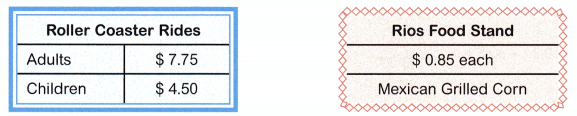
A family of 2 adults and 2 children has $30.00 to spend on roller coaster rides. Do they also have enough money for each person to buy a Mexican grilled corn? Explain.
McGraw Hill Math Grade 5 Chapter 2 Lesson 11 Answer Key Problem Solving Multistep Problems 1
Answer:
Yes, they have enough money because total cost of to spend on roller coaster rides = $27.90 which is less than the amount they have to spend $30.

Explanation:
Cost of adult coaster ride = $7.75.
Cost of children coaster ride = $4.50.
Cost of each Mexican grilled corn = $0.85.
Number of adults in a family = 2.
Number of children in a family = 2.
Amount of money they have to spend = $30.
Cost of all coaster rides = (Cost of adult coaster ride × Number of adults in a family) + (Cost of children coaster ride × Number of children in a family)
= ($7.75 × 2) + ($4.50 × 2)
= $15.50 + $9.00
= $24.50.
Cost of four Mexican grilled corn = 4 × Cost of each Mexican grilled corn
= 4 × $0.85
= $3.40.
Total cost of to spend on roller coaster rides = Cost of all coaster rides + Cost of four Mexican grilled corn
= $24.50 + $3.40
= $27.90.

Question 2.
Teri put four large bottles of water into a grocery bag. Each bottle weighs 2.19 pounds. In another bag, Teri put three cans of tomatoes. Each can weighs 1.75 pounds. Which bag weighs less?
______________________________________________
How much less? _________
Answer:
Total weight of cans of tomatoes is less by 3.51 pounds than total weight of bottles of water .

Explanation:
Weight of each bottle of water= 2.19 pounds.
Number of large bottles of water in bag = 4.
Total weight of bottles of water = Weight of each bottle of water × Number of large bottles of water in bag
= 2.19 × 4
= 8.76 pounds.
Weight of each can of tomatoes = 1.75 pounds.
Number of can of tomatoes = 3.
Total weight of cans of tomatoes = Weight of each can of tomatoes × Number of can of tomatoes
= 1.75 × 3
= 5.25 pounds.
Difference:
Total weight of bottles of water – Total weight of cans of tomatoes
= 8.76 – 5.25
= 3.51 pounds.

Question 3.
JT has a small computer on his bike that tracks the number of miles he travels. Last Saturday, he traveled 4.23 miles to band practice, 3.72 miles to meet his friends, and 5.42 miles home. How many miles did he travel in all?
Answer:
Total number of miles he travels = 13.37.

Explanation:
Number of miles he travels on Saturday to band practice = 4.23.
Number of miles he travels on Saturday to meet his friends = 3.72.
Number of miles he travels on Saturday to home = 5.42.
Total number of miles he travels = Number of miles he travels on Saturday to band practice +
Number of miles he travels on Saturday to meet his friends + Number of miles he travels on Saturday to home
= 4.23 + 3.72 + 5.42
= 7.95 + 5.42
= 13.37.

McGraw Hill Math Grade 5 Chapter 2 Lesson 11 Answer Key Problem Solving: Multistep Problems Read More »

McGraw Hill Math Grade 5 Chapter 2 Test Answer Key

All the solutions provided in McGraw Hill Math Grade 5 Answer Key PDF Chapter 2 Test are as per the latest syllabus guidelines.

McGraw-Hill Math Grade 5 Chapter 2 Test Answer Key

Add.

Question 1.
322 + 353 = ______________________
Answer:
322 + 353 = 675.

Explanation:
Sum of 322 and 353:
322 + 353 = 675.

Question 2.
75 + 176 + 25 = ______
Answer:
75 + 176 + 25 = 276.

Explanation:
Sum of 75, 176 and 25:
75 + 176 + 25 = 276.

Question 3.
42 + 34 = _______________________
34 + 42 = _______________________
Answer:
42 + 34 = 76.
34 + 42 = 76.

Explanation:
Sum of 42 and 34; 34 + 42:
42 + 34 = 76.
34 + 42 = 76.

Question 4.
18.54 + 38.35 = _______________________
Answer:
18.54 + 38.35 = 56.89.

Explanation:
Sum of 18.54 and 38.35:
18.54 + 38.35 = 56.89.

Question 5.
529 – 87 = 442
442 + 87 = _______________________
Answer:
529 – 87 = 442
442 + 87 = 529.

Explanation:
Sum of 442 and 87:
529 – 87 = 442
=> 442 + 87 = 529.

Question 6.
456 + 247 = ______
Answer:
456 + 247 = 703.

Explanation:
Sum of 456 and 247:
456 + 247 = 703.

Question 7.
396 + 700 + 70 = ____
Answer:
396 + 700 + 70 = 1,166.

Explanation:
Sum of 396, 700 and 70:
396 + 700 + 70 = 1,166.

Question 8.
564 + 374 = 938
374 + 564 = _____
Answer:
564 + 374 = 938
374 + 564 = 938.

Explanation:
Sum of 564 and 374:
374 + 564 = 938.

Question 9.
4.93 + 27.5 + 61.04 = ____
Answer:
4.93 + 27.5 + 61.04 = 93.47.

Explanation:
Sum of 4.93, 27.5 and 61.04:
4.93 + 27.5 + 61.04 = 93.47.

Question 10.
890 – 255 = 635
635 + 255 = ______
Answer:
635 + 255 = 890.

Explanation:
Sum of 635 and 255:
890 – 255 = 635
=> 635 + 255 = 890.

Add.
Question 11.
7.34 + 0.57 + 4.56 = _________
Answer:
7.34 + 0.57 + 4.56 = 12.47.

Explanation:
Sum of 7.34, 0.57 and 4.56:
7.34 + 0.57 + 4.56 = 12.47.

Question 12.
57.79 + 10.21 + 82.5 = _____
Answer:
57.79 + 10.21 + 82.5 = 150.50.

Explanation:
Sum of 57.79, 10.21 and 82.5:
57.79 + 10.21 + 82.5 =150.50.

Add. Tell which strategy you used. Explain why you used it.
Question 13.
74.24 + 14.06 = ________
Which strategy did you choose? _________________________________________
Why? ___________
Answer:
74.24 + 14.06 = 88.30.

Explanation:
Strategy used is addition because to find the sum of 74.24 and 14.06.
74.24 + 14.06 = 88.30.

Subtract.
Question 14.
584 – 273 ____
Answer:
584 – 273 = 311.

Explanation:
Difference  between 584 and 273:
584 – 273 = 311.

Question 15.
24.74 – 10.13 _____
Answer:
24.74 – 10.13 = 14.61.

Explanation:
Difference  between 24.74 and 10.13:
24.74 – 10.13 = 14.61.

Question 16.
375.07 – 88.12 ____
Answer:
375.07 – 88.12 = 286.95.

Explanation:
Difference  between 375.07 and 88.12:
375.07 – 88.12 = 286.95.

Question 17.
208 – 53 _____
Answer:
208 – 53 = 155.

Explanation:
Difference  between 208 and 53:
208 – 53 = 155.

Question 18.
67.21 – 25.9 ____
Answer:
67.21 – 25.9 = 41.31.

Explanation:
Difference  between 67.21 and  25.9:
67.21 – 25.9 = 41.31.

Question 19.
864.23 – 298.27 ____
Answer:
864.23 – 298.27 = 565.96.

Explanation:
Difference  between 864.23 and 298.27:
864.23 – 298.27 = 565.96.

Subtract.
Question 20.
16.3 – 6.2 = ____
Answer:
16.3 – 6.2 = 10.1.

Explanation:
Difference between 16.3 and 6.2:
16.3 – 6.2 = 10.1.

Question 21.
86.57 – 21.82 = ____
Answer:
86.57 – 21.82 = 64.75.

Explanation:
Difference between 86.57 and 21.82:
86.57 – 21.82 = 64.75.

Subtract. Tell which strategy you used. Explain why you used it.
Question 22.
65.90 – 30.50 = ____
Which strategy did you choose? ______
Why? ______
Answer:
65.90 – 30.50 = 35.40.

Explanation:
Strategy used is subtraction because to find the difference between 65.90 and 30.50.
65.90 – 30.50 = 35.40.

Solve.
Question 23.
The Ruiz family, 2 adults and 2 children, visit the science museum. The Brinker family, 1 adult and 3 children, visit the zoo. Each family has $60.00 to spend on admission. Which family will spend less on admission?

McGraw Hill Math Grade 5 Chapter 2 Test Answer Key 2
Answer:
The Brinker family will spend less on admission.

Explanation:
Cost of adult admission for visit the science museum = $15.00
Cost of children admission for visit the science museum = $10.00
Number of adults in Ruiz family for visit the science museum = 2.
Number of children in Ruiz family  for visit the science museum = 2.
Total cost for admission for visit the science museum of Ruiz family = (Cost of adult admission for visit the science museum × Cost of adult admission for visit the science museum) + (Number of children in Ruiz family  for visit the science museum × Cost of children admission for visit the science museum)
= (2 × $15) + (2 × $10)
= $30 + $20
= $50.
Cost of adult admission for visit the zoo = $13.50.
Cost of children admission for visit the zoo = $9.50.
Number of adults in Brinker family for visit the zoo = 1.
Number of children in Brinker family for visit the zoo = 3.
Total cost for admission for visit the zoo of Brinker family = (Cost of adult admission for visit the zoo × Number of adults in Brinker family for visit the zoo) + (Cost of children admission for visit the zoo × Number of children in Brinker family for visit the zoo)
= (1 × $13.50) + (2 × $9.50)
= $13.50 + $19.00
= $32.50.
Each family has $60.00 to spend on admission.
Comparison:
Total cost for admission for visit the science museum of Ruiz family = $50.
Total cost for admission for visit the zoo of Brinker family = $32.50.
Difference:
$60 – $50 = $10.
$60 – $32.50 = $27.50.

Question 24.
A bird-watcher measured the heart rate of a blue-throated hummingbird at 1,260 beats per minute. She read that an inactive hummingbird may have a heart rate as low as 50 beats per minute. What is the difference between these heart rates?
Answer:
1,210 is the difference between these heart rates.

Explanation:
Heart rate of a blue-throated hummingbird =  1,260 beats per minute.
Heart rate of an inactive hummingbird = 50 beats per minute.
Difference:
Heart rate of a blue-throated hummingbird – Heart rate of an inactive hummingbird
= 1,260 – 50
= 1,210.

McGraw Hill Math Grade 5 Chapter 2 Test Answer Key Read More »

McGraw Hill Math Grade 5 Chapter 2 Lesson 10 Answer Key Strategies for Subtracting Decimals

All the solutions provided in McGraw Hill Math Grade 5 Answer Key PDF Chapter 2 Lesson 10 Strategies for Subtracting Decimals are as per the latest syllabus guidelines.

McGraw-Hill Math Grade 5 Answer Key Chapter 2 Lesson 10 Strategies for Subtracting Decimals

Subtract
Tell which strategy you used to solve each problem. Explain why you used it.
Question 1.
3.59 – 2.06 1.53
Which strategy did you choose? ___________
Why? ______________________
Answer:
3.59 – 2.06 = 1.53.

Explanation:
3.59 – 2.06 = 1.53.
Strategy used is subtraction because to find the difference between 3.59 and  2.06.

Question 2.
2.21 – 1.23 ______
Which strategy did you choose? _____
Why? _____
Answer:
2.21 – 1.23 = 0.98.

Explanation:
2.21 – 1.23 = 0.98.
Strategy used is subtraction because to find the difference between 2.21 and 1.23.

Question 3.
6.59 – 3.49 _____
Which strategy did you choose? _____
Why? _____
Answer:
6.59 – 3.49 = 3.1.

Explanation:
6.59 – 3.49 = 3.1.
Strategy used is subtraction because to find the difference between 6.59 and 3.49.

Question 4.
10.01 – 9.99 _____
Which strategy did you choose? _____
Why? _____
Answer:
10.01 – 9.99 = 0.02.

Explanation:
10.01 – 9.99 = 0.02.
Strategy used is subtraction because to find the difference between 10.01 and 9.99.

Question 5.
72.04 – 12.40 _____
Which strategy did you choose? _____
Why? ______
Answer:
72.04 – 12.40 = 59.64.

Explanation:
Strategy used is subtraction because to find the difference between 72.04 and 12.40.
72.04 – 12.40 = 59.64.

McGraw Hill Math Grade 5 Chapter 2 Lesson 10 Answer Key Strategies for Subtracting Decimals Read More »

McGraw Hill Math Grade 5 Chapter 2 Lesson 9 Answer Key Subtracting Decimals

All the solutions provided in McGraw Hill Math Grade 5 Answer Key PDF Chapter 2 Lesson 9 Subtracting Decimals are as per the latest syllabus guidelines.

McGraw-Hill Math Grade 5 Answer Key Chapter 2 Lesson 9 Subtracting Decimals

Subtract
Use place values when you solve the following subtraction problems.
Question 1.
McGraw Hill Math Grade 5 Chapter 2 Lesson 9 Answer Key Subtracting Decimals 1
Answer:
McGraw Hill Math Grade 5 Chapter 2 Lesson 9 Answer Key Subtracting Decimals 1

Explanation:
4.13 – 3.02 = 1.11.

Question 2.
McGraw Hill Math Grade 5 Chapter 2 Lesson 9 Answer Key Subtracting Decimals 2
Answer:
McGraw-Hill-Math-Grade-5-Answer-Key-Chapter-2-Lesson-9-Subtracting-Decimals-subtract-2

Explanation:
5.55 – 2.25 = 3.30.

Question 3.
McGraw Hill Math Grade 5 Chapter 2 Lesson 9 Answer Key Subtracting Decimals 3
Answer:
McGraw-Hill-Math-Grade-5-Answer-Key-Chapter-2-Lesson-9-Subtracting-Decimals-subtract-3

Explanation:
9.53 – 3.44 = 6.09.

Question 4.
McGraw Hill Math Grade 5 Chapter 2 Lesson 9 Answer Key Subtracting Decimals 4
Answer:
McGraw-Hill-Math-Grade-5-Answer-Key-Chapter-2-Lesson-9-Subtracting-Decimals-subtract-4

Explanation:
19.34 – 0.57 = 18.77.

Question 5.
McGraw Hill Math Grade 5 Chapter 2 Lesson 9 Answer Key Subtracting Decimals 5
Answer:
McGraw-Hill-Math-Grade-5-Answer-Key-Chapter-2-Lesson-9-Subtracting-Decimals-subtract-5

Explanation:
10.12 – 8.33 = 1.79.

Question 6.
McGraw Hill Math Grade 5 Chapter 2 Lesson 9 Answer Key Subtracting Decimals 6
Answer:
McGraw-Hill-Math-Grade-5-Answer-Key-Chapter-2-Lesson-9-Subtracting-Decimals-subtract-6

Explanation:
15.99 – 7.21 = 8.78.

Question 7.
McGraw Hill Math Grade 5 Chapter 2 Lesson 9 Answer Key Subtracting Decimals 7
Answer:
McGraw-Hill-Math-Grade-5-Answer-Key-Chapter-2-Lesson-9-Subtracting-Decimals-subtract-7

Explanation:
24.55 – 22.78 = 1.77.

Question 8.
McGraw Hill Math Grade 5 Chapter 2 Lesson 9 Answer Key Subtracting Decimals 8
Answer:
McGraw-Hill-Math-Grade-5-Answer-Key-Chapter-2-Lesson-9-Subtracting-Decimals-subtract-8

Explanation:
17.19 – 9.93 = 7.26.

Question 9.
13.65 — 9.24 _________________________
Answer:
McGraw-Hill-Math-Grade-5-Answer-Key-Chapter-2-Lesson-9-Subtracting-Decimals-subtract-9

Explanation:
13.65 – 9.24 = 4.41.

Question 10.
16.09 — 8.17 _________________________
Answer:
McGraw-Hill-Math-Grade-5-Answer-Key-Chapter-2-Lesson-9-Subtracting-Decimals-subtract-10

Explanation:
16.09 – 8.17 = 7.92.

Question 11.
4.22 – 0.78 ______________________
Answer:
McGraw-Hill-Math-Grade-5-Answer-Key-Chapter-2-Lesson-9-Subtracting-Decimals-subtract-12

Explanation:
4.22 – 0.78 = 3.44.

Question 12.
22.14 — 10.07 ________
Answer:
McGraw-Hill-Math-Grade-5-Answer-Key-Chapter-2-Lesson-9-Subtracting-Decimals-subtract-13

Explanation:
22.14 – 10.07 =  12.07.

Question 13.
McGraw Hill Math Grade 5 Chapter 2 Lesson 9 Answer Key Subtracting Decimals 9
Answer:
McGraw-Hill-Math-Grade-5-Answer-Key-Chapter-2-Lesson-9-Subtracting-Decimals-subtract-14

Explanation:
4.99 – 3.33 = 1.66.

Question 14.
McGraw Hill Math Grade 5 Chapter 2 Lesson 9 Answer Key Subtracting Decimals 10
Answer:
McGraw-Hill-Math-Grade-5-Answer-Key-Chapter-2-Lesson-9-Subtracting-Decimals-subtract-15

Explanation:
8.25 – 3.75 = 4.50.

Question 15.
McGraw Hill Math Grade 5 Chapter 2 Lesson 9 Answer Key Subtracting Decimals 11
Answer:
McGraw-Hill-Math-Grade-5-Answer-Key-Chapter-2-Lesson-9-Subtracting-Decimals-subtract-15

Explanation:
112.54 – 21.45 = 91.09.

Question 16.
McGraw Hill Math Grade 5 Chapter 2 Lesson 9 Answer Key Subtracting Decimals 12
Answer:
McGraw-Hill-Math-Grade-5-Answer-Key-Chapter-2-Lesson-9-Subtracting-Decimals-subtract-16

Explanation:
18.55 – 7.35 = 11.20.

Question 17.
The chefs at Kim’s Cafe made a total of 149.5 pounds of Korean ribs over a weekend. A wedding party ordered 35.66 pounds of ribs. How many pounds of ribs were left to sell?
Answer:
Number of pounds of ribs were left to sell = 113.84.

Explanation:
Number of pounds the chefs at Kim’s Cafe made of Korean ribs over a weekend = 149.50.
Number of pounds of ribs a wedding party ordered = 35.66.
Number of pounds of ribs were left to sell = Number of pounds the chefs at Kim’s Cafe made of Korean ribs over a weekend – Number of pounds of ribs a wedding party ordered
= 149.50 – 35.66
= 113.84.

McGraw Hill Math Grade 5 Chapter 2 Lesson 9 Answer Key Subtracting Decimals Read More »

Scroll to Top