McGraw Hill Math

McGraw Hill Math Grade 6 Lesson 23.2 Answer Key Quadrilaterals

Practice questions available in McGraw Hill Math Grade 6 Answer Key PDF Lesson 23.2 Quadrilaterals will engage students and is a great way of informal assessment.

McGraw-Hill Math Grade 6 Answer Key Lesson 23.2 Quadrilaterals

Exercises

IDENTIFY

Determine what type of shape the figure is: square, rectangle, rhombus, trapezoid, or kite.

Question 1.
McGraw Hill Math Grade 6 Lesson 23.2 Answer Key Quadrilaterals 1
Answer: Square
The plane figure with four equal sides is called a square.

Question 2.
McGraw Hill Math Grade 6 Lesson 23.2 Answer Key Quadrilaterals 2
Answer: Kite
The name of the above shape is kite

Question 3.
McGraw Hill Math Grade 6 Lesson 23.2 Answer Key Quadrilaterals 3
Answer:
18 + 14 = 32
18 + 15 = 33
14 + 10 + 9 = 33
15 + 8 + 9 = 32
The name of the above figure is rectangle.

Question 4.
McGraw Hill Math Grade 6 Lesson 23.2 Answer Key Quadrilaterals 4
Answer: Rectangle
A Rectangle is a four sided-polygon, having all the internal angles equal to 90 degrees.

Question 5.
McGraw Hill Math Grade 6 Lesson 23.2 Answer Key Quadrilaterals 5
Answer: Trapezium
The trapezium is a flat shape or two-dimensional shape with 4 straight sides.

Question 6.
McGraw Hill Math Grade 6 Lesson 23.2 Answer Key Quadrilaterals 6
Answer: Rhombus
The name of the shape is a rhombus with equal sides.

Question 7.
McGraw Hill Math Grade 6 Lesson 23.2 Answer Key Quadrilaterals 7
Answer: Trapezium
The trapezium is a flat shape or two-dimensional shape with 4 straight sides.

Question 8.
McGraw Hill Math Grade 6 Lesson 23.2 Answer Key Quadrilaterals 8
Answer: Kite
The name of the above shape is kite

Question 9.
McGraw Hill Math Grade 6 Lesson 23.2 Answer Key Quadrilaterals 9
Answer: Parallelogram
The name of the above figure is a parallelogram with equal sides.

McGraw Hill Math Grade 6 Lesson 23.2 Answer Key Quadrilaterals Read More »

McGraw Hill Math Grade 6 Unit Test Lessons 6–9 Answer Key

Practice questions available in McGraw Hill Math Grade 6 Answer Key PDF Unit Test Lessons 6–9 will engage students and is a great way of informal assessment.

McGraw-Hill Math Grade 6 Unit Test Lessons 6–9 Answer Key

Change to mixed numbers.

Question 1.
\(\frac{15}{7}\)
_____________
Answer:
Given improper fraction is \(\frac{15}{7}\).
The improper fraction \(\frac{15}{7}\) in mixed number as 2\(\frac{1}{7}\).

Question 2.
\(\frac{23}{5}\)
_____________
Answer:
Given improper fraction is \(\frac{23}{5}\).
The improper fraction \(\frac{23}{5}\) in mixed number as 4\(\frac{3}{5}\).

Question 3.
\(\frac{85}{17}\)
_____________
Answer:
Given improper fraction is \(\frac{85}{17}\).
The improper fraction \(\frac{85}{17}\) in mixed number as 5.

Question 4.
\(\frac{311}{34}\)
_____________
Answer:
Given improper fraction is \(\frac{311}{34}\).
The improper fraction \(\frac{311}{34}\) in mixed number as 9\(\frac{5}{34}\).

Change to improper fractions.

Question 5.
8\(\frac{6}{7}\)
_____________
Answer:
Given mixed number is 8\(\frac{6}{7}\).
8\(\frac{6}{7}\) = (56 + 6)/7 = 62/7
The mixed number 8\(\frac{6}{7}\) in improper fraction as \(\frac{62}{7}\).

Question 6.
14\(\frac{4}{9}\)
_____________
Answer:
Given mixed number is 14\(\frac{4}{9}\).
14\(\frac{4}{9}\) = (126 + 4)/9 = 130/9
The mixed number 14\(\frac{4}{9}\) in improper fraction as \(\frac{130}{9}\).

Question 7.
3\(\frac{17}{23}\)
_____________
Answer:
Given mixed number is 3\(\frac{17}{23}\).
3\(\frac{17}{23}\) = (69 + 17)/23 = 86/23
The mixed number 3\(\frac{17}{23}\) in improper fraction as \(\frac{86}{23}\).

Question 8.
4\(\frac{7}{31}\)
_____________
Answer:
Given mixed number is 4\(\frac{7}{31}\).
4\(\frac{7}{31}\) = (124 + 7)/31 = 131/31
The mixed number 4\(\frac{7}{31}\) in improper fraction as \(\frac{131}{31}\).

Add or subtract and reduce to simplest form.

Question 9.
\(\frac{3}{4}\) + \(\frac{1}{4}\)
_____________
Answer:
\(\frac{3}{4}\) + \(\frac{1}{4}\) = (3 + 1)/4 = 4/4 = 1
Explanation:
Perform addition operation on above two given improper fractions. Add \(\frac{3}{4}\) with \(\frac{1}{4}\) the sum is equal to 1.

Question 10.
\(\frac{10}{43}\) – \(\frac{5}{43}\)
_____________
Answer:
\(\frac{10}{43}\) – \(\frac{5}{43}\) = (10 – 5)/43 = 5/43
Explanation:
Perform subtraction operation on above two given improper fractions. Subtract \(\frac{5}{43}\) from \(\frac{10}{43}\) the difference is equal to \(\frac{5}{43}\).

Question 11.
\(\frac{5}{7}\) + \(\frac{3}{7}\)
_____________
Answer:
\(\frac{5}{7}\) + \(\frac{3}{7}\) = (5 + 3)/7 = 8/7 or 1\(\frac{1}{7}\)
Explanation:
Perform addition operation on above two given improper fractions. Add \(\frac{5}{7}\) with \(\frac{3}{7}\) the sum is equal to \(\frac{8}{7}\) or 1\(\frac{1}{7}\).

Question 12.
\(\frac{23}{59}\) + \(\frac{24}{59}\)
_____________
Answer:
\(\frac{23}{59}\) + \(\frac{24}{59}\) = (23 + 24)/59 = 47/59
Explanation:
Perform addition operation on above two given improper fractions. Add \(\frac{23}{59}\) with \(\frac{24}{59}\) the sum is equal to \(\frac{47}{59}\).

Question 13.
\(\frac{45}{47}\) – \(\frac{34}{47}\)
_____________
Answer:
\(\frac{45}{47}\) – \(\frac{34}{47}\) = (45 – 34)/47 = 11/47
Explanation:
Perform subtraction operation on above two given improper fractions. Subtract \(\frac{34}{47}\) from \(\frac{45}{47}\) the difference is equal to \(\frac{11}{47}\).

Question 14.
\(\frac{12}{35}\) + \(\frac{18}{35}\)
_____________
Answer:
\(\frac{12}{35}\) + \(\frac{18}{35}\)= (12 + 18)/35 = 30/35 or \(\frac{6}{7}\)
Explanation:
Perform addition operation on above two given improper fractions. Add \(\frac{12}{35}\) with \(\frac{18}{35}\) the sum is equal to \(\frac{30}{35}\).

Question 15.
\(\frac{65}{94}\) – \(\frac{18}{94}\)
_____________
Answer:
\(\frac{65}{94}\) – \(\frac{18}{94}\) = (65 – 18)/94 = 47/94 or \(\frac{1}{2}\)
Explanation:
Perform subtraction operation on above two given improper fractions. Subtract \(\frac{18}{94}\) from \(\frac{65}{94}\) the difference is equal to \(\frac{47}{94}\).

Question 16.
\(\frac{33}{73}\) + \(\frac{23}{73}\)
_____________
Answer:
\(\frac{33}{73}\) + \(\frac{23}{73}\) = (33 + 23)/73 = 56/73
Explanation:
Perform addition operation on above two given improper fractions. Add \(\frac{33}{73}\) with \(\frac{23}{73}\) the sum is equal to \(\frac{56}{73}\).

Question 17.
3\(\frac{3}{7}\) – 2\(\frac{2}{7}\)
_____________
Answer:
First we have to convert the mixed numbers into improper fractions.
The mixed number 3\(\frac{3}{7}\) in improper fraction as \(\frac{24}{7}\).
The mixed number 2\(\frac{2}{7}\) in improper fraction as \(\frac{16}{7}\).
Second we have to perform subtraction operation. Subtract \(\frac{16}{7}\) from \(\frac{24}{7}\) the difference is equal to \(\frac{8}{7}\).
\(\frac{24}{7}\) – \(\frac{16}{7}\) = \(\frac{8}{7}\) or 1\(\frac{1}{7}\)

Question 18.
\(\frac{23}{33}\) + \(\frac{17}{21}\)
_____________
Answer:
\(\frac{23}{33}\) + \(\frac{17}{21}\) = (483 + 561)/693 = 1,044/693 = 116/77 or 1\(\frac{39}{77}\) 
Explanation:
Perform addition operation on above two given improper fractions. Add \(\frac{23}{33}\) with \(\frac{17}{21}\) the sum is equal to \(\frac{116}{77}\).

Question 19.
\(\frac{3}{7}\) + \(\frac{4}{5}\)
_____________
Answer:
\(\frac{3}{7}\) + \(\frac{4}{5}\) = (15 + 28)/35 = 43/35 or 1\(\frac{8}{35}\) 
Explanation:
Perform addition operation on above two given improper fractions. Add\(\frac{3}{7}\) with \(\frac{4}{5}\) the sum is equal to \(\frac{43}{35}\).

Question 20.
\(\frac{14}{25}\) – \(\frac{12}{29}\)
_____________
Answer:
\(\frac{14}{25}\) – \(\frac{12}{29}\) = (406 – 300)/725 = \(\frac{106}{725}\)
Explanation:
Perform subtraction operation on above two given improper fractions. Subtract \(\frac{12}{29}\) from \(\frac{14}{25}\) the difference is equal to \(\frac{106}{725}\).

Multiply.

Question 21.
\(\frac{1}{2}\) × 45
_____________
Answer:
\(\frac{1}{2}\) × 45 = \(\frac{45}{2}\) or 22\(\frac{1}{2}\) 
Explanation:
Perform multiplication operation on above two given numbers. Multiply \(\frac{1}{2}\) with 45 the product is equal to \(\frac{45}{2}\).

Question 22.
\(\frac{3}{4}\) × 44
_____________
Answer:
\(\frac{3}{4}\) × 44 = \(\frac{132}{4}\) = 33
Explanation:
Perform multiplication operation on above two given numbers. Multiply \(\frac{3}{4}\) with 44 the product is equal to 33.

Question 23.
\(\frac{9}{4}\) × 60
_____________
Answer:
\(\frac{9}{4}\) × 60 = \(\frac{540}{4}\) = 135
Explanation:
Perform multiplication operation on above two given numbers. Multiply \(\frac{9}{4}\) with 60 the product is equal to 135.

Question 24.
12 × \(\frac{12}{23}\)
_____________
Answer:
12 × \(\frac{12}{23}\) = \(\frac{144}{23}\) or 6\(\frac{6}{23}\)
Explanation:
Perform multiplication operation on above two given numbers. Multiply 12 with \(\frac{12}{23}\) the product is equal to \(\frac{144}{23}\).

Divide.

Question 25.
\(\frac{2}{3}\) × 4\(\frac{4}{9}\)
_____________
Answer:
4\(\frac{4}{9}\) = (36 + 4)/9 = 40/9
The mixed number 4\(\frac{4}{9}\) in fraction form as \(\frac{40}{9}\).
= \(\frac{2}{3}\) × 4\(\frac{4}{9}\)
= \(\frac{2}{3}\) × \(\frac{40}{9}\)
= \(\frac{80}{27}\) or 2\(\frac{26}{27}\)
Explanation:
Perform multiplication operation on above two given numbers. Multiply \(\frac{2}{3}\) with 4\(\frac{4}{9}\) the product is equal to 2\(\frac{26}{27}\).

Question 26.
6 × \(\frac{3}{7}\)
_____________
Answer:
6 × \(\frac{3}{7}\) = \(\frac{18}{7}\) or 2\(\frac{4}{7}\)
Explanation:
Perform multiplication operation on above two given numbers. Multiply 6 with \(\frac{3}{7}\) the product is equal to \(\frac{18}{7}\).

Question 27.
\(\frac{26}{29}\) × 13
_____________
Answer:
\(\frac{26}{29}\) × 13 = \(\frac{338}{29}\) or 11\(\frac{19}{29}\)
Explanation:
Perform multiplication operation on above two given numbers. Multiply \(\frac{26}{29}\) with 13 the product is equal to 11\(\frac{19}{29}\).

Question 28.
\(\frac{34}{47}\) × 17
_____________
Answer:
\(\frac{34}{47}\) × 17 = \(\frac{578}{47}\) or 12\(\frac{14}{47}\)
Explanation:
Perform multiplication operation on above two given numbers. Multiply\(\frac{34}{47}\) with 17 the product is equal to 12\(\frac{14}{47}\).

Divide

Question 29.
\(\frac{2}{3}\) ÷ 36
_____________
Answer:
= \(\frac{2}{3}\) ÷ 36
= \(\frac{2}{3}\) x \(\frac{1}{36}\)
= \(\frac{1}{54}\)
Explanation:
Perform division operation on above two given numbers. Divide \(\frac{2}{3}\) by 36 the result is equal to \(\frac{1}{54}\).

Question 30.
\(\frac{4}{9}\) ÷ 3
_____________
Answer:
= \(\frac{4}{9}\) ÷ 3
= \(\frac{4}{9}\) x \(\frac{1}{3}\)
= \(\frac{4}{27}\)
Explanation:
Perform division operation on above two given numbers. Divide \(\frac{4}{9}\) by 3 the result is equal to \(\frac{4}{27}\).

Question 31.
\(\frac{45}{63}\) ÷ 15
_____________
Answer:
= \(\frac{45}{63}\) ÷ 15
= \(\frac{45}{63}\) x \(\frac{1}{15}\)
= \(\frac{3}{63}\)
= \(\frac{1}{21}\)
Explanation:
Perform division operation on above two given numbers. Divide \(\frac{45}{63}\) by 15 the result is equal to \(\frac{1}{21}\).

Question 32.
9 ÷ \(\frac{6}{7}\)
_____________
Answer:
= 9 ÷ \(\frac{6}{7}\)
= 9 x \(\frac{7}{6}\)
= \(\frac{21}{2}\)
= 10\(\frac{1}{2}\)
Explanation:
Perform division operation on above two given numbers. Divide 9 by \(\frac{6}{7}\) the result is equal to 10\(\frac{1}{2}\).

Question 33.
25 ÷ \(\frac{15}{24}\)
Answer:
= 25 ÷ \(\frac{15}{24}\)
= 25 x \(\frac{24}{15}\)
= \(\frac{120}{3}\)
= 40
Explanation:
Perform division operation on above two given numbers. Divide 25 by \(\frac{15}{24}\) the result is equal to 40.

Question 34.
45 ÷ \(\frac{5}{9}\)
Answer:
= 45 ÷ \(\frac{5}{9}\)
= 45 x \(\frac{9}{5}\)
= 9 x 9
= 81
Explanation:
Perform division operation on above two given numbers. Divide 45 by \(\frac{5}{9}\) the result is equal to 81.

Question 35.
\(\frac{3}{4}\) ÷ \(\frac{14}{25}\)
Answer:
= \(\frac{3}{4}\) ÷ \(\frac{14}{25}\)
= \(\frac{3}{4}\) x \(\frac{25}{14}\)
= \(\frac{75}{56}\)
= 1\(\frac{19}{56}\)
Explanation:
Perform division operation on above two given numbers. Divide \(\frac{3}{4}\) by \(\frac{14}{25}\) the result is equal to 1\(\frac{19}{56}\).

Question 36.
\(\frac{4}{7}\) ÷ \(\frac{7}{4}\)
Answer:
= \(\frac{4}{7}\) ÷ \(\frac{7}{4}\)
= \(\frac{4}{7}\) x \(\frac{4}{7}\)
= \(\frac{16}{49}\)
Explanation:
Perform division operation on above two given numbers. Divide \(\frac{4}{7}\) by \(\frac{7}{4}\) the result is equal to \(\frac{16}{49}\).

Question 37.
\(\frac{13}{57}\) ÷ \(\frac{26}{19}\)
Answer:
=\(\frac{13}{57}\) ÷ \(\frac{26}{19}\)
= \(\frac{13}{57}\) x \(\frac{19}{26}\)
= \(\frac{247}{1482}\)
= \(\frac{1}{6}\)
Explanation:
Perform division operation on above two given numbers. Divide \(\frac{13}{57}\) by \(\frac{26}{19}\)the result is equal to \(\frac{1}{6}\).

Question 38.
2\(\frac{2}{3}\) ÷ 8\(\frac{3}{4}\)
Answer:
= 2\(\frac{2}{3}\) ÷ 8\(\frac{3}{4}\)
Convert the mixed number into improper fraction.
= \(\frac{8}{3}\) ÷ \(\frac{35}{4}\)
= \(\frac{8}{3}\) x \(\frac{4}{35}\)
= \(\frac{32}{105}\)
Explanation:
Perform division operation on above two given numbers. Divide 2\(\frac{2}{3}\) by 8\(\frac{3}{4}\) the result is equal to \(\frac{32}{105}\).

Question 39.
12\(\frac{3}{4}\) ÷ 4\(\frac{3}{4}\)
Answer:
= 12\(\frac{3}{4}\) ÷ 4\(\frac{3}{4}\)
Convert the mixed number into improper fraction.
= \(\frac{51}{4}\) ÷ \(\frac{19}{4}\)
= \(\frac{51}{4}\) x \(\frac{4}{19}\)
= \(\frac{204}{76}\)
= \(\frac{51}{19}\) or 2\(\frac{13}{19}\)
Explanation:
Perform division operation on above two given numbers. Divide 12\(\frac{3}{4}\) by 4\(\frac{3}{4}\) the result is equal to 2\(\frac{13}{19}\).

Question 40.
15\(\frac{3}{5}\) ÷ 2\(\frac{1}{5}\)
Answer:
= 15\(\frac{3}{5}\) ÷ 2\(\frac{1}{5}\)
Convert the mixed number into improper fraction.
= \(\frac{78}{5}\) ÷ \(\frac{11}{5}\)
= \(\frac{78}{5}\) x \(\frac{5}{11}\)
= \(\frac{78}{11}\) or 7\(\frac{1}{11}\)
Explanation:
Perform division operation on above two given numbers. Divide 15\(\frac{3}{5}\) by 2\(\frac{1}{5}\) the result is equal to 7\(\frac{1}{11}\).

Create a ratio and reduce to simplest form.

Question 41.
8 people want to share a large pizza. Use a ratio to express how much of the pizza each person will receive if the pizza is divided equally. _____________
Answer:
8 people want to share a large pizza. If the pizza is divided equally then each person will receive 1/8 of a pizza.

Question 42.
In the school parking lot, there are 5 red cars and 25 black cars. Express this as a ratio. __________
What percent of the cars are red? __________
Answer:
The ratio of red cars and black cars is 5 : 25 which is equal to 1 : 5.
There are 5 red cars and 25 black cars.
5 + 25 = 30 cars
Total number of cars are 30.
(5/30) x 100 = 16.67%
16.67 percent of the cars are red.

Determine if the following proportions are equal. (Write Yes or No.)

Question 43.
\(\frac{4}{5}\) = \(\frac{25}{20}\) __________
Answer:
No, The given proportion is not equal.
Explanation:
The fraction \(\frac{25}{20}\) can be simplified as \(\frac{5}{4}\). So, it is not equal to the fraction on left hand side \(\frac{4}{5}\). So, the answer is ‘No‘.

Question 44.
\(\frac{7}{12}\) = \(\frac{28}{36}\) __________
Answer:
No, The given proportion is not equal.
Explanation:
The fraction \(\frac{28}{36}\) can be simplified as \(\frac{7}{9}\). So, it is not equal to the fraction on left hand side \(\frac{7}{12}\) . So, the answer is ‘No‘.

Question 45.
\(\frac{2}{19}\) = \(\frac{38}{4}\) __________
Answer:
No, The given proportion is not equal.
Explanation:
The fraction \(\frac{38}{4}\) can be simplified as \(\frac{19}{2}\). So, it is not equal to the fraction on left hand side \(\frac{2}{19}\). So, the answer is ‘No‘.

Question 46.
\(\frac{3}{4}\) = \(\frac{18}{24}\) __________
Answer:
Yes, The given proportion is equal.
Explanation:
The fraction \(\frac{18}{24}\)can be simplified as \(\frac{3}{4}\). So, it is equal to the fraction on left hand side \(\frac{3}{4}\). So, the answer is ‘Yes‘.

Question 47.
Wally rides his bicycle at an average speed of 13 miles per hour. How many miles will he travel in 4\(\frac{1}{2}\) hours? __________
Answer:
Wally rides his bicycle at an average speed of 13 miles per hour.
4\(\frac{1}{2}\) hours = \(\frac{9}{2}\) hours
1 hour = 13 miles
\(\frac{9}{2}\) hours = ? miles
13 x \(\frac{9}{2}\) = \(\frac{117}{2}\) miles or 58\(\frac{1}{2}\) miles
He will travel 58\(\frac{1}{2}\) miles in 4\(\frac{1}{2}\) hours.

Question 48.
Jasmine can make 49 cupcakes in a batch. How many batches of cupcakes does she need to make 323 cupcakes?
Answer:
Jasmine can make 49 cupcakes in a batch.
1 batch = 49 cupcakes
? batches = 323 cupcakes
323/49 = 6.59 = 7 batches
7 batches of cupcakes does she need to make 323 cupcakes.

Question 49.
Phillip drinks \(\frac{2}{3}\) pint of water for each mile he runs. How many pints of water will he drink if he runs 4\(\frac{1}{2}\) miles? ______
Answer:
Phillip drinks \(\frac{2}{3}\) pint of water for each mile he runs.
4\(\frac{1}{2}\) miles = \(\frac{9}{2}\) miles
1 mile = \(\frac{2}{3}\) pint
\(\frac{9}{2}\) miles = ? pints
\(\frac{2}{3}\) x \(\frac{9}{2}\) = \(\frac{18}{6}\) pints = 3 pints
3 pints of water will he drink if he runs 4\(\frac{1}{2}\) miles.

Question 50.
Perry texts his friends 2,337 times in 21 days. Will he go over his limit of 3,000 texts in the 30-day billing period?
Answer:
Perry texts his friends 2,337 times in 21 days.
21 days = 2,337 times
1 day = ? times
2,337/21 = 111.28 = 111 times
Perry texts his friend 111 times in one day.
Multiply 30 with 111 the product is equal to 3,330 times.
30 x 11 = 3,330 times
Perry texts his friend 3,330 times in 30 days.
Yes, he will go over his limit of 3,000 texts in the 30-day billing period.

Question 51.
Glenn’s car burns 2 quarts of oil every 1,750 miles. How many quarts of oil should he buy if he plans to take a trip of 3,275 miles?
Answer:
Glenn’s car burns 2 quarts of oil every 1,750 miles.
1,750 miles = 2 quarts
3,275 miles = ? quarts
6,550/1750 = 3.74 quarts = 4 quarts
4 quarts of oil should he buy if he plans to take a trip of 3,275 miles

Fill out the ratio table and plot the values on the graph.

Question 52.
McGraw Hill Math Grade 6 Unit Test Lessons 6–9 Answer Key 1
Answer:
McGraw-Hill-Math-Grade-6-Unit-Test-Lessons-6–9-Answer-Key-1
Explanation:
From the given table Y is getting increased by 1 to X. So, as X is given as 6, Y should be 7. The values are plotted on the graph.

McGraw Hill Math Grade 6 Unit Test Lessons 6–9 Answer Key Read More »

McGraw Hill Math Grade 6 Lesson 3.2 Answer Key Estimating Quotients

Practice questions available in McGraw Hill Math Grade 6 Answer Key PDF Lesson 3.2 Estimating Quotients will engage students and is a great way of informal assessment.

McGraw-Hill Math Grade 6 Answer Key Lesson 3.2 Estimating Quotients

Exercises
Estimate

Question 1.
146 ÷ 12
Answer:
146 divided by 12, we get the quotient 12.16.
McGraw-Hill-Math-Grade-6-Answer-Key-Lesson-3.2-Estimating-Quotients-Exercises-Estimate-1

Explanation:
Quotient of 146 ÷ 12, we get 12.16.

Question 2.
244 ÷ 8
Answer:
244 divided by 8, we get the quotient 30.5.
McGraw-Hill-Math-Grade-6-Answer-Key-Lesson-3.2-Estimating-Quotients-Exercises-Estimate-2

Explanation:
Quotient of 244 ÷ 8, we get 30.5.

Question 3.
91 ÷ 9
Answer:
91 divided by 9, we get the quotient 10.11.
McGraw-Hill-Math-Grade-6-Answer-Key-Lesson-3.2-Estimating-Quotients-Exercises-Estimate-3

Explanation:
Quotient of 91 ÷ 9, we get 10.11.

Question 4.
399 ÷ 13
Answer:
399 divided by 13, we get the quotient 30.69.
McGraw-Hill-Math-Grade-6-Answer-Key-Lesson-3.2-Estimating-Quotients-Exercises-Estimate-4

Explanation:
Quotient of 399 ÷ 13, we get 30.69.

Question 5.
412 ÷ 25
Answer:
412 divided by 25, we get the quotient 16.48.
McGraw-Hill-Math-Grade-6-Answer-Key-Lesson-3.2-Estimating-Quotients-Exercises-Estimate-5

Explanation:
Quotient of 412 ÷ 25, we get 16.48.

Question 6.
1321 ÷ 13
Answer:
1321 divided by 13, we get the quotient 101.61.
McGraw-Hill-Math-Grade-6-Answer-Key-Lesson-3.2-Estimating-Quotients-Exercises-Estimate-6

Explanation:
Quotient of 1321 ÷ 13, we get 101.61.

Question 7.
447 ÷ 9
Answer:
477 divided by 9, we get the quotient 53.
McGraw-Hill-Math-Grade-6-Answer-Key-Lesson-3.2-Estimating-Quotients-Exercises-Estimate-7

Explanation:
Quotient of 447 ÷ 9, we get 53.

Question 8.
672 ÷ 33
Answer:
672 divided by 33, we get the quotient 20.36.
McGraw-Hill-Math-Grade-6-Answer-Key-Lesson-3.2-Estimating-Quotients-Exercises-Estimate-8

Explanation:
Quotient of 672 ÷ 33, we get 20.36.

Question 9.
441 ÷ 91
Answer:
441 divided by 91, we get the quotient 4.84.
McGraw-Hill-Math-Grade-6-Answer-Key-Lesson-3.2-Estimating-Quotients-Exercises-Estimate-9

Explanation:
Quotient of 441 ÷ 91, we get 4.84.

Question 10.
252 ÷ 23
Answer:
252 divided by 23, we get the quotient 10.95.
McGraw-Hill-Math-Grade-6-Answer-Key-Lesson-3.2-Estimating-Quotients-Exercises-Estimate-10

Explanation:
Quotient of 252 ÷ 23, we get 10.95.

Question 11.
49 ÷ 4
Answer:
49 divided by 4, we get the quotient 12.25.
McGraw-Hill-Math-Grade-6-Answer-Key-Lesson-3.2-Estimating-Quotients-Exercises-Estimate-11

Explanation:
Quotient of 49 ÷ 4, we get 12.25.

Question 12.
3211 ÷ 80
Answer:
3211 divided by 80, we get the quotient 40.13.
McGraw-Hill-Math-Grade-6-Answer-Key-Lesson-3.2-Estimating-Quotients-Exercises-Estimate-12

Explanation:
Quotient of 3211 ÷ 80, we get 40.13.

Question 13.
1247 ÷ 50
Answer:
1247 divided by 50, we get the quotient 24.94.
McGraw-Hill-Math-Grade-6-Answer-Key-Lesson-3.2-Estimating-Quotients-Exercises-Estimate-13

Explanation:
Quotient of 1247 ÷ 50, we get 24.94.

Question 14.
333 ÷ 16
Answer:
333 divided by 16, we get the quotient 20.81.
McGraw-Hill-Math-Grade-6-Answer-Key-Lesson-3.2-Estimating-Quotients-Exercises-Estimate-14

Explanation:
Quotient of 333 ÷ 16, we get 20.81.

Question 15.
564 ÷ 11
Answer:
564 divided by 11, we get the quotient 51.27.
McGraw-Hill-Math-Grade-6-Answer-Key-Lesson-3.2-Estimating-Quotients-Exercises-Estimate-15

Explanation:
Quotient of 564 ÷ 11, we get 51.27.

Question 16.
233 ÷ 20
Answer:
233 divided by 20, we get the quotient 11.65.
McGraw-Hill-Math-Grade-6-Answer-Key-Lesson-3.2-Estimating-Quotients-Exercises-Estimate-16

Explanation:
Quotient of 233 ÷ 20, we get 11.65.

Question 17.
889 ÷ 45
Answer:
889 divided by 45, we get the quotient 19.75.
McGraw-Hill-Math-Grade-6-Answer-Key-Lesson-3.2-Estimating-Quotients-Exercises-Estimate-17

Explanation:
Quotient of 889 ÷ 45, we get 19.75.

Question 18.
489 ÷ 45
Answer:
489 divided by 45, we get the quotient 10.86.
McGraw-Hill-Math-Grade-6-Answer-Key-Lesson-3.2-Estimating-Quotients-Exercises-Estimate-18

Explanation:
Quotient of 489 ÷ 45, we get 10.86.

Question 19.
77 ÷ 5
Answer:
77 divided by 5, we get the quotient 15.4.
McGraw-Hill-Math-Grade-6-Answer-Key-Lesson-3.2-Estimating-Quotients-Exercises-Estimate-19

Explanation:
Quotient of 77 ÷ 5, we get 15.4.

Question 20.
732 ÷ 9
Answer:
732 divided by 9, we get the quotient 81.33.
McGraw-Hill-Math-Grade-6-Answer-Key-Lesson-3.2-Estimating-Quotients-Exercises-Estimate-20

Explanation:
Quotient of 732 ÷ 9, we get 81.33.

McGraw Hill Math Grade 6 Lesson 3.2 Answer Key Estimating Quotients Read More »

McGraw Hill Math Grade 6 Lesson 3.1 Answer Key Dividing Whole Numbers

Practice questions available in McGraw Hill Math Grade 6 Answer Key PDF Lesson 3.1 Dividing Whole Numbers will engage students and is a great way of informal assessment.

McGraw-Hill Math Grade 6 Answer Key Lesson 3.1 Dividing Whole Numbers

Exercises
Divide

Question 1.
McGraw Hill Math Grade 6 Chapter 3 Lesson 3.1 Answer Key Dividing Whole Numbers 1
Answer:
Dividing 627 by 89, we get the quotient 7.04.
McGraw-Hill-Math-Grade-6-Answer-Key-Lesson-3.1-Dividing-Whole-Numbers-Exercises-Divide-1

Explanation:
627 ÷ 89 = 7.04.

Question 2.
McGraw Hill Math Grade 6 Chapter 3 Lesson 3.1 Answer Key Dividing Whole Numbers 2
Answer:
Dividing 341 by 14, we get the quotient 24.35.
McGraw-Hill-Math-Grade-6-Answer-Key-Lesson-3.1-Dividing-Whole-Numbers-Exercises-Divide-2

Explanation:
Division of 341 ÷ 14 = 24.35.

Question 3.
McGraw Hill Math Grade 6 Chapter 3 Lesson 3.1 Answer Key Dividing Whole Numbers 3
Answer:
Dividing 346 by 15,we get the quotient 23.06.
McGraw-Hill-Math-Grade-6-Answer-Key-Lesson-3.1-Dividing-Whole-Numbers-Exercises-Divide-3

Explanation:
Division of 346 ÷ 15 = 23.06.

Question 4.
McGraw Hill Math Grade 6 Chapter 3 Lesson 3.1 Answer Key Dividing Whole Numbers 4
Answer:
Dividing 2814 by 36, we get the quotient 78.16.
McGraw-Hill-Math-Grade-6-Answer-Key-Lesson-3.1-Dividing-Whole-Numbers-Exercises-Divide-4

Explanation:
Division of 2814 ÷ 36 = 78.16.

Question 5.
McGraw Hill Math Grade 6 Chapter 3 Lesson 3.1 Answer Key Dividing Whole Numbers 5
Answer:
Dividing 182 by 12, we get  the quotient 15.16.
McGraw-Hill-Math-Grade-6-Answer-Key-Lesson-3.1-Dividing-Whole-Numbers-Exercises-Divide-5

Explanation:
Division of 182 ÷ 12 = 15.16.

Question 6.
McGraw Hill Math Grade 6 Chapter 3 Lesson 3.1 Answer Key Dividing Whole Numbers 6
Answer:
Dividing 84 by 9, we get the quotient 9.33.
McGraw-Hill-Math-Grade-6-Answer-Key-Lesson-3.1-Dividing-Whole-Numbers-Exercises-Divide-6

Explanation:
Division of 84 ÷ 9 = 9.33.

Question 7.
McGraw Hill Math Grade 6 Chapter 3 Lesson 3.1 Answer Key Dividing Whole Numbers 7
Answer:
Dividing 7499 by 96, we get the quotient 78.11.
McGraw-Hill-Math-Grade-6-Answer-Key-Lesson-3.1-Dividing-Whole-Numbers-Exercises-Divide-7

Explanation:
Division of 7499 ÷ 96 = 78.11.

Question 8.
McGraw Hill Math Grade 6 Chapter 3 Lesson 3.1 Answer Key Dividing Whole Numbers 8
Answer:
Dividing 22220 by 18, we get the quotient 1234.44.
McGraw-Hill-Math-Grade-6-Answer-Key-Lesson-3.1-Dividing-Whole-Numbers-Exercises-Divide-8

Explanation:
Division of 22220 ÷ 18 = 1234.44.

Question 9.
McGraw Hill Math Grade 6 Chapter 3 Lesson 3.1 Answer Key Dividing Whole Numbers 9
Answer:
Dividing 17330 by 38, we get the quotient 456.05.
McGraw-Hill-Math-Grade-6-Answer-Key-Lesson-3.1-Dividing-Whole-Numbers-Exercises-Divide-9

Explanation:
Division of 17330 ÷ 38 = 456.05.

Question 10.
McGraw Hill Math Grade 6 Chapter 3 Lesson 3.1 Answer Key Dividing Whole Numbers 10.
Answer:
Dividing 23270 by 55, we get the quotient 423.09.
McGraw-Hill-Math-Grade-6-Answer-Key-Lesson-3.1-Dividing-Whole-Numbers-Exercises-Divide-10

Explanation:
Division of 23270 ÷ 55 = 423.09.

Question 11.
McGraw Hill Math Grade 6 Chapter 3 Lesson 3.1 Answer Key Dividing Whole Numbers 11
Answer:
Dividing 3647 by 5, we get the quotient 729.4.
McGraw-Hill-Math-Grade-6-Answer-Key-Lesson-3.1-Dividing-Whole-Numbers-Exercises-Divide-11

Explanation:
Division of 3647 ÷ 5 = 729.4.

Question 12.
McGraw Hill Math Grade 6 Chapter 3 Lesson 3.1 Answer Key Dividing Whole Numbers 12
Answer:
Dividing 1399 by 82, we get the quotient 17.06.
McGraw-Hill-Math-Grade-6-Answer-Key-Lesson-3.1-Dividing-Whole-Numbers-Exercises-Divide-12

Explanation:
Division of 1399 ÷ 82 = 17.06.

Question 13.
McGraw Hill Math Grade 6 Chapter 3 Lesson 3.1 Answer Key Dividing Whole Numbers 13
Answer:
Dividing 6621 by 45, we get the quotient 147.13.
McGraw-Hill-Math-Grade-6-Answer-Key-Lesson-3.1-Dividing-Whole-Numbers-Exercises-Divide-13

Explanation:
Division of 6621 ÷ 45 = 147.13.

Question 14.
McGraw Hill Math Grade 6 Chapter 3 Lesson 3.1 Answer Key Dividing Whole Numbers 14
Answer:
Dividing 1111 by 13, we get the quotient 85.46.
McGraw-Hill-Math-Grade-6-Answer-Key-Lesson-3.1-Dividing-Whole-Numbers-Exercises-Divide-14

Explanation:
Division of 1111 ÷ 13 = 85.46.

Question 15.
McGraw Hill Math Grade 6 Chapter 3 Lesson 3.1 Answer Key Dividing Whole Numbers 15
Answer:
Dividing 257 by 14, we get the quotient 18.35.
McGraw-Hill-Math-Grade-6-Answer-Key-Lesson-3.1-Dividing-Whole-Numbers-Exercises-Divide-15

Explanation:
Division of 257 ÷ 14 = 18.35.

Question 16.
McGraw Hill Math Grade 6 Chapter 3 Lesson 3.1 Answer Key Dividing Whole Numbers 16
Answer:
Dividing 456 by 7, we get  the quotient 65.14.
McGraw-Hill-Math-Grade-6-Answer-Key-Lesson-3.1-Dividing-Whole-Numbers-Exercises-Divide-16

Explanation:
Division of 456 ÷ 7 = 65.14.

Question 17.
McGraw Hill Math Grade 6 Chapter 3 Lesson 3.1 Answer Key Dividing Whole Numbers 17
Answer:
Dividing 803 by 9, we get the quotient 89.22.
McGraw-Hill-Math-Grade-6-Answer-Key-Lesson-3.1-Dividing-Whole-Numbers-Exercises-Divide-17

Explanation:
Division of 803 ÷ 9 = 89.22.

Question 18.
McGraw Hill Math Grade 6 Chapter 3 Lesson 3.1 Answer Key Dividing Whole Numbers 18
Answer:
Dividing 499 by 11, we get the quotient 45.36.
McGraw-Hill-Math-Grade-6-Answer-Key-Lesson-3.1-Dividing-Whole-Numbers-Exercises-Divide-18

Explanation:
Division of 499 ÷ 11 = 45.36.

Question 19.
McGraw Hill Math Grade 6 Chapter 3 Lesson 3.1 Answer Key Dividing Whole Numbers 19
Answer:
Dividing 3332 by 6, we get the quotient 555.33.
McGraw-Hill-Math-Grade-6-Answer-Key-Lesson-3.1-Dividing-Whole-Numbers-Exercises-Divide-19

Explanation:
Division of 3332 ÷ 6 = 555.33.

Question 20.
McGraw Hill Math Grade 6 Chapter 3 Lesson 3.1 Answer Key Dividing Whole Numbers 20
Answer:
Dividing 85 by 7, we get the quotient 12.14.
McGraw-Hill-Math-Grade-6-Answer-Key-Lesson-3.1-Dividing-Whole-Numbers-Exercises-Divide-20

Explanation:
Division of 85 ÷ 7 = 12.14.

Question 21.
McGraw Hill Math Grade 6 Chapter 3 Lesson 3.1 Answer Key Dividing Whole Numbers 21
Answer:
Dividing 157 by 12, we get the quotient 13.08.
McGraw-Hill-Math-Grade-6-Answer-Key-Lesson-3.1-Dividing-Whole-Numbers-Exercises-Divide-21

Explanation:
Division of 157 ÷ 12 = 13.08.

Question 22.
McGraw Hill Math Grade 6 Chapter 3 Lesson 3.1 Answer Key Dividing Whole Numbers 22
Answer:
Dividing 3944 by 7, we get the quotient 563.42.
McGraw-Hill-Math-Grade-6-Answer-Key-Lesson-3.1-Dividing-Whole-Numbers-Exercises-Divide-22

Explanation:
Division of 3944 ÷ 7 = 563.42.

Question 23.
McGraw Hill Math Grade 6 Chapter 3 Lesson 3.1 Answer Key Dividing Whole Numbers 23
Answer:
Dividing 1115 by 4, we get the quotient 278.75.
McGraw-Hill-Math-Grade-6-Answer-Key-Lesson-3.1-Dividing-Whole-Numbers-Exercises-Divide-23

Explanation:
Division of 1,115 ÷ 4 = 278.75.

Question 24.
McGraw Hill Math Grade 6 Chapter 3 Lesson 3.1 Answer Key Dividing Whole Numbers 24
Answer:
Dividing 1517 by 17, we get the quotient 89.23.
McGraw-Hill-Math-Grade-6-Answer-Key-Lesson-3.1-Dividing-Whole-Numbers-Exercises-Divide-24

Explanation:
Division of 1,517 ÷ 7 = 89.23.

Question 25.
McGraw Hill Math Grade 6 Chapter 3 Lesson 3.1 Answer Key Dividing Whole Numbers 25
Answer:
Dividing 777 by 9, we get the quotient 86.33.
McGraw-Hill-Math-Grade-6-Answer-Key-Lesson-3.1-Dividing-Whole-Numbers-Exercises-Divide-25

Explanation:
Division of 777 ÷ 9 = 86.33.

Question 26.
McGraw Hill Math Grade 6 Chapter 3 Lesson 3.1 Answer Key Dividing Whole Numbers 26
Answer:
Dividing 38460 by 54, we get  the quotient 712.22.
McGraw-Hill-Math-Grade-6-Answer-Key-Lesson-3.1-Dividing-Whole-Numbers-Exercises-Divide-26

Explanation:
Division of 38460 ÷ 54 = 712.22.

Question 27.
McGraw Hill Math Grade 6 Chapter 3 Lesson 3.1 Answer Key Dividing Whole Numbers 27
Answer:
Dividing 3830 by 45, we get the quotient 85.11.
McGraw-Hill-Math-Grade-6-Answer-Key-Lesson-3.1-Dividing-Whole-Numbers-Exercises-Divide-27

Explanation:
Division of 3,830 ÷ 45 = 85.11.

Question 28.
McGraw Hill Math Grade 6 Chapter 3 Lesson 3.1 Answer Key Dividing Whole Numbers 28
Answer:
Dividing 452 by 8, we get the quotient 56.5.
McGraw-Hill-Math-Grade-6-Answer-Key-Lesson-3.1-Dividing-Whole-Numbers-Exercises-Divide-28

Explanation:
Division of 452 ÷ 8 = 56.5.

Question 29.
Post office workers are placing envelopes in boxes. Each worker can place 625 envelopes per day. How many days will it take one worker to place 2,500 envelopes?
Answer:
Number of days it takes one worker to place all envelopes = 4.

Explanation:
Number of envelopes each worker can place per day = 625.
Number of envelopes = 2,500.
Number of days it takes one worker to place all envelopes = Number of envelopes ÷ Number of envelopes each worker can place per day
= 2,500 ÷ 625
= 4.

Question 30.
Mr. Romanski is making information packets for all his new students. Each packet is 19 pages long. If he uses 342 sheets of paper, how many new students are in his class?
Answer:
Number of students in the class = 18.

Explanation:
Number of pages each packet has = 19.
Number of sheets of paper he uses = 342.
Number of students in the class = Number of sheets of paper he uses ÷ Number of pages each packet has
= 342 ÷ 19
= 18.

McGraw Hill Math Grade 6 Lesson 3.1 Answer Key Dividing Whole Numbers Read More »

McGraw Hill Math Grade 5 Chapter 3 Lesson 7 Answer Key Multiplying and Dividing by Powers of Ten

All the solutions provided in McGraw Hill Math Grade 5 Answer Key PDF Chapter 3 Lesson 7 Multiplying and Dividing by Powers of Ten are as per the latest syllabus guidelines.

McGraw-Hill Math Grade 5 Answer Key Chapter 3 Lesson 7 Multiplying and Dividing by Powers of Ten

Multiply or divide by a power of ten.

Question 1.
49 × 103 = 49 × (10 × 10 × 10)
49 × 1000 = 49000

Question 2.
49 × 102 = 49 × (_____)
49 × 100 = 4900
Answer:
49 × 102 = 4900.

Explanation:
Given the expression is 49 × 102 which is
= 49 × 10 × 10
= 4900.

Question 3.
525 ÷ 101 = 525 ÷ ____
\(\frac{525}{10}\) = ____
Answer:
525 ÷ 101 = 52.5.

Explanation:
Given the expression is 525 ÷ 101 which is
= 525 ÷ 10
= 52.5.

Question 4.
525 ÷ 103 = 525 ÷ (_____)
\(\frac{525}{1000}\) = ____
Answer:
525 ÷ 103 = 0.525.

Explanation:
Given the expression is 525 ÷ 103 which is
= 525 ÷ 10 × 10 × 10
= 525 ÷ 1000
= 0.525.

Question 5.
1024 ÷ 103 = _____
Answer:
1024 ÷ 103 = 1.024.

Explanation:
Given the expression is 1024 ÷ 103 which is
= 1024 ÷ 10 × 10 × 10
= 1024 ÷ 1000
= 1.024.

Question 6.
1776 ÷ 102 = _____
Answer:
1776 ÷ 102 = 17.76.

Explanation:
Given the expression is 1776 ÷ 102 which is
= 1776 ÷ 10 × 10
= 1776 ÷ 100
= 17.76

Question 7.
225 ÷ 101 = _____
Answer:
225 ÷ 101 = 22.5.

Explanation:
Given the expression is 225 ÷ 101 which is
= 225 ÷ 10
= 22.5.

Write the missing word or phrase.

Question 8.
When you multiply by a power of ten, the ____________________ to the right of the 10 tells you how many times to multiply by 10. As the number becomes 10 times greater, the decimal point ___________

Answer:
When we multiply by a power of ten, the power to the right of the 10 tells you how many times to multiply by 10. As the number becomes 10 times greater, the decimal point right side.

Question 9.
When you divide by a _____________________ of ten, the exponent to the right of the 10 tells how many times you divide ______. As the number becomes 10 times ____, the decimal point ____.

Answer:
When you divide by a power of ten, the exponent to the right of the 10 tells how many times you divide by ten. As the number becomes 10 times lesser, the decimal point left side.

McGraw Hill Math Grade 5 Chapter 3 Lesson 7 Answer Key Multiplying and Dividing by Powers of Ten Read More »

McGraw Hill Math Grade 5 Chapter 3 Lesson 5 Answer Key Multiplying by 2-Digit Whole Numbers

All the solutions provided in McGraw Hill Math Grade 5 Answer Key PDF Chapter 3 Lesson 5 Multiplying by 2-Digit Whole Numbers are as per the latest syllabus guidelines.

McGraw-Hill Math Grade 5 Answer Key Chapter 3 Lesson 5 Multiplying by 2-Digit Whole Numbers

Multiply and then describe the strategy you used to solve each problem.

Question 1.
49 × 50 = 2450
I added 1 to 49 and multiplied 50 × 50 = 2500. Then I subtracted 50 to find the answer.

Question 2.
43 × 52 = ____
Answer:
43 × 52 = 2,236.

Explanation:
Here, we have subtracted 3 from 43 and subtracted 2 from 52 multiplied by 40 × 50 = 2,000. Then added 236.
Math Grade 5 Answer Key Chapter 3 Lesson 5-09

Solve.

Question 3.
McGraw Hill Math Grade 5 Chapter 3 Lesson 5 Answer Key Multiplying by 2-Digit Whole Numbers 1
Answer:
31 × 23 = 713.

Explanation:
Here, we have subtracted 1 from 31 and 3 from 23 then multiplied 30 × 20 which is 600. Then added 113.
Math Grade 5 Answer Key Chapter 3 Lesson 5-08

Question 4.
McGraw Hill Math Grade 5 Chapter 3 Lesson 5 Answer Key Multiplying by 2-Digit Whole Numbers 2
Answer:
62 × 17 = 1054.

Explanation:
Here, we have subtracted 2 from 62 and added 3 to 17 then multiplied 60 × 20 which is 1200. Then subtracted 146.
Math Grade 5 Answer Key Chapter 3 Lesson 5-07

Question 5.
McGraw Hill Math Grade 5 Chapter 3 Lesson 5 Answer Key Multiplying by 2-Digit Whole Numbers 3
Answer:
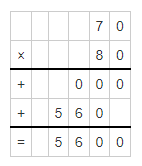
70 × 80 = 5,600.

Explanation:
By multiplying 70 × 80 we will get 5,600.
Math Grade 5 Answer Key Chapter 3 Lesson 5-06

Question 6.
McGraw Hill Math Grade 5 Chapter 3 Lesson 5 Answer Key Multiplying by 2-Digit Whole Numbers 4
Answer:
38 × 19 = 78.

Explanation:
Here, we have added 2 to 38 and added 1 to 19 then multiplied 40 × 20 which is 800. Then subtracted 78.
Math Grade 5 Answer Key Chapter 3 Lesson 5-05

Question 7.
McGraw Hill Math Grade 5 Chapter 3 Lesson 5 Answer Key Multiplying by 2-Digit Whole Numbers 5
Answer:
60 × 11 = 660.

Explanation:
Here, we have subtracted 1 from 11 and then multiplied 60 × 10 which is 600. Then added 60.
Math Grade 5 Answer Key Chapter 3 Lesson 5-04

Question 8.
McGraw Hill Math Grade 5 Chapter 3 Lesson 5 Answer Key Multiplying by 2-Digit Whole Numbers 6
Answer:
85 × 70 = 350.

Explanation:
Here, we have subtracted 5 from 85 and then multiplied 80 × 70 which is 5,600. Then subtracted 350.
Math Grade 5 Answer Key Chapter 3 Lesson 5-02

Question 9.
McGraw Hill Math Grade 5 Chapter 3 Lesson 5 Answer Key Multiplying by 2-Digit Whole Numbers 7
Answer:
173 × 19 = 3,287.

Explanation:
Here, we have added 1 to 19 and then multiplied 173 × 20 which is 3,460. Then subtracted 173.
Math Grade 5 Answer Key Chapter 3 Lesson 5-03

Question 10.
McGraw Hill Math Grade 5 Chapter 3 Lesson 5 Answer Key Multiplying by 2-Digit Whole Numbers 8
Answer:
123 × 15 = 1,845.

Explanation:
Here, we have added 5 to 15 and then multiplied 123 × 20 which is 2,460. Then subtracted 615.
Math Grade 5 Answer Key Chapter 3 Lesson 5-01

Question 11.
Toni is buying peaches at the farmers’ market. She buys 12 baskets of peaches. Each basket holds 12 peaches. How many peaches does she buy?
Answer:
The number of peaches she bought is 144 peaches.

Explanation:
Given that Toni bought 12 baskets of peaches and each basket holds 12 peaches. So the number of peaches she bought is 12×12 = 144 peaches.
Math Grade 5 Answer Key Chapter 3 Lesson 5-10

McGraw Hill Math Grade 5 Chapter 3 Lesson 5 Answer Key Multiplying by 2-Digit Whole Numbers Read More »

McGraw Hill Math Grade 5 Chapter 3 Lesson 12 Answer Key Problem Solving

All the solutions provided in McGraw Hill Math Grade 5 Answer Key PDF Chapter 3 Lesson 12 Problem Solving are as per the latest syllabus guidelines.

McGraw-Hill Math Grade 5 Answer Key Chapter 3 Lesson 12 Problem Solving

Solve.

Question 1.
Paula collects postage stamps of animals. She has 4 times as many stamps that show tigers as stamps that show leopards. The number of stamps with elephant pictures is divisible by 7. Paula has 48 stamps in all. How many elephant stamps does she have? Create a chart to help find the answer.
Answer:
Paula has 6 elephant stamps.

Explanation:
Given that Paula has 4 times as many stamps that show tigers as stamps that show leopards and the number of stamps with elephant pictures is divisible by 7 and Paula has 48 stamps in all. So the number of elephant stamps does she have is,
X+4+ X/7 = 48,
(7X+28+X)/7 = 48,
(8X+28)/7 = 48,
8X+28 = 48×7,
8X+28 = 336,
8X = 308,
X = 38.
Paula has 6 elephant stamps.

Question 2.
Scotty saw a pattern when he divided by 5: Any dividend with a 0 or 5 in the ones place can be divided by 5 with no remainder. What can you say about the quotient if the divisor in a problem is 5 and the dividend has a 1 or a 6 in the ones place?
Answer:
If the dividend has a 1 or a 6 in the ones place and the divisor 5 then the remainder will not be 0. As the multiples of 5 have 0 and 5 in ones place.

McGraw Hill Math Grade 5 Chapter 3 Lesson 12 Answer Key Problem Solving Read More »

McGraw Hill Math Grade 1 Chapter 5 Test Answer Key

All the solutions provided in McGraw Hill Math Grade 1 Answer Key PDF Chapter 5 Test as per the latest syllabus guidelines.

McGraw-Hill Math Grade 1 Chapter 5 Test Answer Key

Question 1.
Complete the chart Write the missing numbers.

McGraw Hill Math Grade 1 Chapter 5 Test Answer Key 1
Answer:
McGraw-Hill Math Grade 1 Chapter 5 img 1
Explanation:
The given numbers are from 1 to 100
some numbers are missing in the given series.

Count on. Write the missing numbers.

Question 2.
53 54 ___ ___ ___
Answer:
53 54 55 56 57
Explanation:
Some numbers are missing in the given series,
To find the after number we have to add one number
54 + 1 = 55
55 + 1 = 56

Question 3.
60 61 ___ ___ ___
Answer:
60 61 62 63 64
Explanation:
Some numbers are missing in the given series,
To find the after number we have to add one number
62 + 1 = 63
63 + 1 = 64

Question 4.
56 57 ___ ___ ___
Answer:
56 57 58 59 60
Explanation:
Some numbers are missing in the given series,
To find the after number we have to add one number

Question 5.
67 70 ___ ___ ___
Answer:
67 70 73 76 79
Explanation:
Some numbers are missing in the given series,
To find the after number we have to add 3 number
67 + 3 = 70
70 + 3 = 73
73 + 6 = 76

Question 6.
71 72 ___ ___ ___
Answer:
71 72 73 74 75
Explanation:
Some numbers are missing in the given series,
To find the after number we have to add one number

Question 7.
79 80 ___ ___ ___
Answer:
79 80 81 82 83 
Explanation:
Some numbers are missing in the given series,
To find the after number we have to add one number

Question 8.
96 97 ___ ___ ___
Answer:
96 97 98 99 100
Explanation:
Some numbers are missing in the given series,
To find the after number we have to add one number

Question 9.
77 78 ___ ___ ___
Answer:
77 78 79 80 81
Explanation:
Some numbers are missing in the given series,
To find the after number we have to add one number

Question 10.
87 88 ___ ___ ___
Answer:
87 88 89 90 91 
Explanation:
Some numbers are missing in the given series,
To find the after number we have to add one number

Question 11.
89 90 ___ ___ ___
Answer:
89 90 91 92 93
Explanation:
Some numbers are missing in the given series,
To find the after number we have to add one number

Count by 10s. Write the missing numbers.

Question 12.
10 20 ___ ___ ___
Answer:
10 20 30 40 50
Explanation:
The given series is skip by tens
Some numbers are missing in the given series,
To find the after number we have to add tens

Question 13.
50 60 ___ ___ ___
Answer:
50 60 70 80 90 
The given series is skip by tens
Explanation:
Some numbers are missing in the given series,
To find the after number we have to add tens

Question 14.
30 40 ___ ___ ___
Answer:
30 40 50 60 70
Explanation:
The given series is skip by tens
Some numbers are missing in the given series,
To find the after number we have to add tens

Question 15.
60 70 ___ ___ ___
Answer:
60 70 80 90 100
Explanation:
The given series is skip by tens
Some numbers are missing in the given series,
To find the after number we have to add tens

Count. Write the missing numbers.

Question 16.
50 __ ___ 53
Answer:
50 51 52 53
Explanation:
Some numbers are missing in the given series,
To find the after number we have to add one number

Question 17.
85 ___ ___ ___
Answer:
85 86 87 88
Explanation:
Some numbers are missing in the given series,
To find the after number we have to add one number

Question 18.
41 ___ 43 ___
Answer:
41 42 43 44
Explanation:
Some numbers are missing in the given series,
To find the after number we have to add one number

Question 19.
39 40 ___ ___
Answer:
39 40 41 42
Explanation:
Some numbers are missing in the given series,
To find the after number we have to add one number

Question 20.
96 97 ___ ___
Answer:
96 97 98 99
Explanation:
Some numbers are missing in the given series,
To find the after number we have to add one number

Question 21.
33 34 ___ 36 ___
Answer:
33 34 35 36 37
Explanation:
Some numbers are missing in the given series,
To find the after number we have to add one number

Question 22.
67 68 ___ ____
Answer:
67 68 69 70 71
Explanation:
Some numbers are missing in the given series,
To find the after number we have to add one number

Question 23.
80 ___ 82 ___
Answer:
80 81 82 83
Explanation:
Some numbers are missing in the given series,
To find the after number we have to add one number

Question 24.
91 ___ ___ ___
Answer:
91 92 93 94 
Explanation:
Some numbers are missing in the given series,
To find the after number we have to add one number

Question 25.
17 ___ ___ 20
Answer:
17 18 19 20
Explanation:
Some numbers are missing in the given series,
To find the after number we have to add one number

McGraw Hill Math Grade 1 Chapter 5 Test Answer Key Read More »

McGraw Hill Math Grade 1 Chapter 4 Test Answer Key

All the solutions provided in McGraw Hill Math Grade 1 Answer Key PDF Chapter 4 Test as per the latest syllabus guidelines.

McGraw-Hill Math Grade 1 Chapter 4 Test Answer Key

Tell what number comes next. Write the number.

Question 1.
0 ____
Answer: 1
The number next to 0 is 1

Question 2.
5 ____
Answer: 6
The number next to 5 is 6.

Question 3.
9 ____
Answer: 10
The number next to 10 is 11.

Question 4.
3 ___
Answer: 4
The number next to 3 is 4.

Question 5.
15 ___
Answer: 16
The number next to 15 is 16.

Question 6.
18 ___
Answer: 19
The number next to 18 is 19.

Question 7.
7 ____
Answer: 8
The number next to 7 is 8.

Question 8.
11 ___
Answer: 12
The number next to 11 is 12.

Question 9.
Write the missing numbers.
McGraw Hill Math Grade 1 Chapter 4 Test Answer Key 1
Answer:
The list of the missing numbers are shown in the below table,
McGraw-Hill-Math-Grade-1-Chapter-4-Test-Answer-Key-1

Count. Write the numbers.

Question 10.
0 1 ___ __ ___ ___
Answer: 2 3 4 5
Forward counting is counting by adding one more, every time.
The numbers next to 0 1 is 2 3 4 5

Question 11.
13 14 ___ ___ ___ ___
Answer:
Forward counting is counting by adding one more, every time.
The numbers next to 13 14 is 15 16 17 18

Question 12.
34 35 ___ ___ ___ ___
Answer:
Forward counting is counting by adding one more, every time.
The numbers next to 34 35 is 36 37 38 39

Question 13.
27 28 ___ ___ ___ ___
Answer:
Forward counting is counting by adding one more, every time.
The numbers next to 27 28 is 29 30 31 32

Question 14.
39 40 ___ ___ ___ ___
Answer:
Forward counting is counting by adding one more, every time.
The numbers next to 39 40 is 41 42 43 44.

Question 15.
18 19 ___ ___ ___ ___
Answer:
Forward counting is counting by adding one more, every time.
The numbers next to 18 19 is 20 21 22 23

Question 16.
6 7 ___ ___ ___ ___
Answer:
Forward counting is counting by adding one more, every time.
The numbers next to 6 7 is 8 9 10 11

Question 17.
45 46 ___ ___ ___ ___
Answer:
Forward counting is counting by adding one more, every time.
The numbers next to 45 46 is 47 48 49 50.

Question 18.
Start with 7.
___ ___ ___ ____
Answer:
Forward counting is counting by adding one more, every time.
The number starting with 7 is 7 8 9 10

Question 19.
Start with 19.
___ ___ ___ ____
Answer:
Forward counting is counting by adding one more, every time.
The number starting with 19 is 19 20 21 22

Question 20.
Start with 30.
___ ___ ___ ____
Answer:
Forward counting is counting by adding one more, every time.
The number starting with 30 31 32 33

Question 21.
Start with 21.
___ ___ ___ ____
Answer:
Forward counting is counting by adding one more, every time.
The number starting with 21 is 21 22 23 24

Question 22.
Start with 42.
___ ___ ___ ____
Answer:
Forward counting is counting by adding one more, every time.
The number starting with 42 is 42 43 44 45

Question 23.
Start with 16.
___ ___ ___ ____
Answer:
Forward counting is counting by adding one more, every time.
The number starting with 16 is 16 17 18 19

Question 24.
Start with 47.
___ ___ ___ ____
Answer:
Forward counting is counting by adding one more, every time.
The number starting with 47 is 47 48 49 50

Question 25.
Start with 3.
___ ___ ___ ____
Answer:
Forward counting is counting by adding one more, every time.
The number starting with 3 is 3 4 5 6.

McGraw Hill Math Grade 1 Chapter 4 Test Answer Key Read More »

McGraw Hill Math Grade 6 Lesson 25.6 Answer Key Calculating Probabilities

Practice questions available in McGraw Hill Math Grade 6 Answer Key PDF Lesson 25.6 Calculating Probabilities will engage students and is a great way of informal assessment.

McGraw-Hill Math Grade 6 Answer Key Lesson 25.6 Calculating Probabilities

Exercises

CALCULATE

Question 1.
If there are 20 boys in your class of 35 students, what is the probability that your teacher will call on a girl student?
Answer:
Total number of students = 35
Number of boys = 20
Number of girls = 35 – 20 = 15
P(G) = 15/35 = 3/7
Thus the probability that your teacher will call on a girl student is 3/7

Question 2.
There are 12 green apples in the bag of 40 apples. What is the probability that you will get a green apple when you reach into the bag?
Answer:
Total number of apples = 40
Number of green apples = 12
P(G) = 12/40 = 3/10
Thus the probability that you will get a green apple when you reach into the bag is 3/10.

Question 3.
You decide to watch a movie. There are 3 scary movies in a stack of 12 DVDs. What is the probability that you will pick a scary movie?
Answer:
Given,
You decide to watch a movie. There are 3 scary movies in a stack of 12 DVDs.
Total number of DVDs = 12
Number of scary movies = 3
P(S) = 3/12 = 1/4
Thus the probability that you will pick a scary movie is 1/4

Question 4.
John knows that once a week his mother makes steamed spinach. What is the probability that when John has dinner tonight that he will not have spinach?
Answer:
John knows that once a week his mother makes steamed spinach.
Number of days in a week = 7
John knows that once a week his mother makes steamed spinach.
Number of days that will not have spinach = 6
The probability that when John has dinner tonight that he will not have spinach = 6/7

Question 5.
The department of motor vehicles noted that among passenger vehicles, there are 6 SUVs registered for every 12 cars registered in the state. What is the probability that the first vehicle you see on the street will be an SUV?
Answer:
Given,
The department of motor vehicles noted that among passenger vehicles, there are 6 SUVs registered for every 12 cars registered in the state.
The probability that the first vehicle you see on the street will be an SUV = 6/12 = 1/2

Question 6.
In any given crowd of 20 people, 17 will be carrying cell phones, and 3 of those cell phones will have low batteries. What is the probability that when you ask a random person to borrow a cell phone, you will get one with a low battery?
Answer:
Total number of people = 20
Number of people carrying cell phones = 17
Number of people who have low battery cell phones = 3
The probability that when you ask a random person to borrow a cell phone, you will get one with a low battery = 3/20

McGraw Hill Math Grade 6 Lesson 25.6 Answer Key Calculating Probabilities Read More »

Scroll to Top