Texas Go Math

Texas Go Math Kindergarten Lesson 10.6 Answer Key Decompose 8 and 9

Refer to our Texas Go Math Kindergarten Answer Key Pdf to score good marks in the exams. Test yourself by practicing the problems from Texas Go Math Kindergarten Lesson 10.6 Answer Key Decompose 8 and 9.

Texas Go Math Kindergarten Lesson 10.6 Answer Key Decompose 8 and 9

Essential Question
How do you take away numbers from 8 and 9?

Explore

Texas Go Math Kindergarten Lesson 10.6 Answer Key 1
Answer:
Texas Go Math Kindergarten Lesson 10.5 Answer Key Decompose 6 and 7 img 12
Explanation:
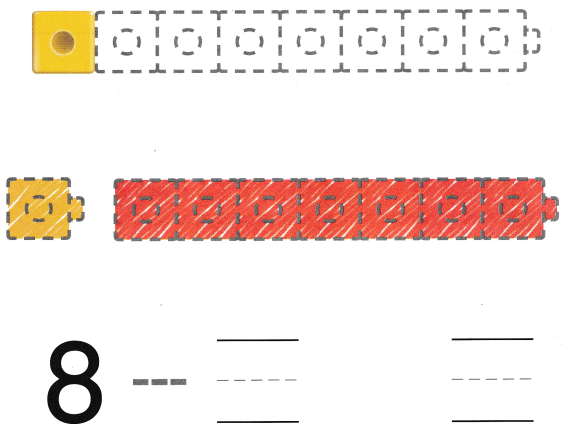
One cube is yellow and the rest are red.
total there are 8 cubes
8 – 1 = 7
so, 7 are red.

Directions
Model an eight-cube train. One cube is yellow and the rest are red. Take apart the train to model the set taken apart. Draw and color the cube trains. Trace the symbol and write the numbers to show 8 taken apart.

Share and Show

Question 1.
Texas Go Math Kindergarten Lesson 10.6 Answer Key 2
Answer:
Texas Go Math Kindergarten Lesson 10.5 Answer Key Decompose 6 and 7 img 13
Explanation:
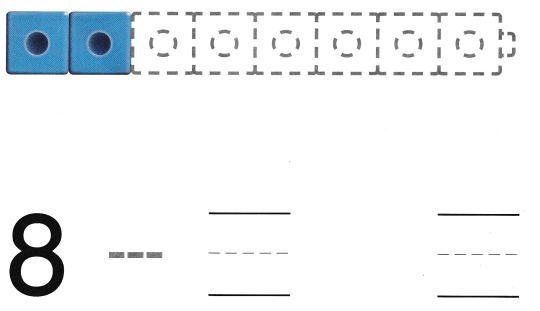
Two cubes are blue and the rest are green.
There are 8 cubes in total.
8 – 2 = 6
so, there are 6 green cubes.

Question 2.
Texas Go Math Kindergarten Lesson 10.6 Answer Key 3
Answer:
Texas Go Math Kindergarten Lesson 10.5 Answer Key Decompose 6 and 7 img 14
Explanation:
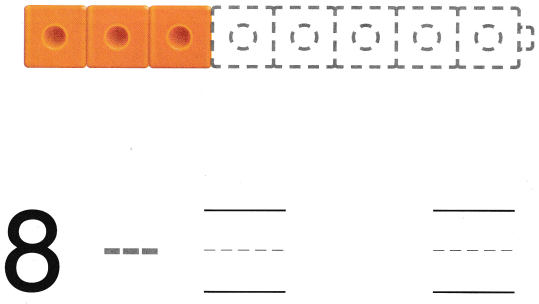
Three cubes are orange and the rest are blue.
total there are 8 cubes
8 – 3 = 5
so, there are 5 cubes in all.

Directions
1.
Model an eight-cube train. Two cubes are blue and the rest are green. Take apart the train to model the set taken apart. Draw and color the cube trains. Trace the symbol and write the numbers to show 8 taken apart. 2. Model an eight-cube train. Three cubes are orange and the rest are blue. Take apart the train to model the set taken apart. Draw and color the cube trains. Trace the symbol and write the numbers to show 8 taken apart.

Question 3.
Texas Go Math Kindergarten Lesson 10.6 Answer Key 4
Answer:
Texas Go Math Kindergarten Lesson 10.5 Answer Key Decompose 6 and 7 img 15
Explanation:
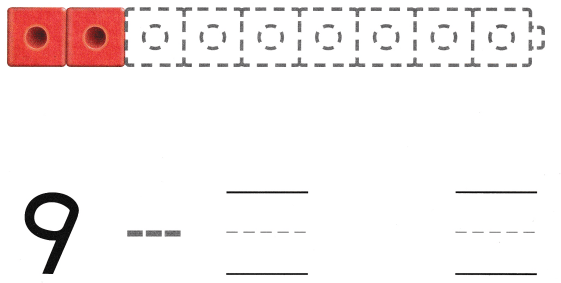
Two cubes are red and the rest are blue.
total there are 9 cubes
9 – 2 = 7
so, 7 cubes are blue

Question 4.
Texas Go Math Kindergarten Lesson 10.6 Answer Key 5
Answer:
Texas Go Math Kindergarten Lesson 10.5 Answer Key Decompose 6 and 7 img 16
Explanation:
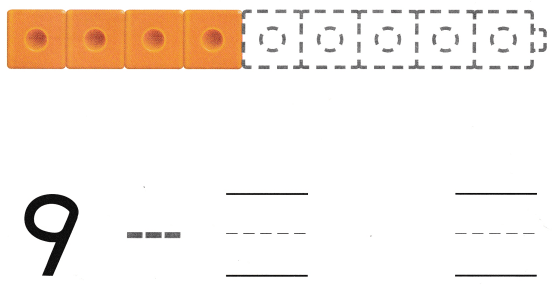
Four cubes are orange and the rest are green.
Total there are 9 cubes
9 – 4 = 5
so, 5 cubes are green.

Directions
3. Model a nine-cube train. Two cubes are red and the rest are blue. Take apart the train to model the set taken apart. Draw and color the cube trains. Trace the symbol and write the numbers to show 9 taken apart. 4. Model a nine-cube train. Four cubes are orange and the rest are green. Take apart the train to model the set taken apart. Draw and color the cube trains. Trace the symbol and write the numbers to show 9 taken apart.

Home Activity

  • Find 8 or 9 small household objects. Line them up and have your child take apart two sets. Have your child tell you how many objects are in each set.

Problem Solving

Question 5.
Texas Go Math Kindergarten Lesson 10.6 Answer Key 6
Answer:
Texas Go Math Kindergarten Lesson 10.5 Answer Key Decompose 6 and 7 img 17
Explanation:
Michelle has 9 cubes. 8 cubes are red.
The rest of the cubes are blue.
9 – 8 = 1
so, 1 cube is blue.

Daily Assessment Task

Question 6.
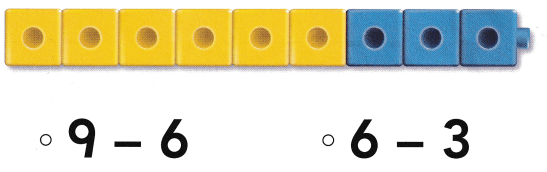
Texas Go Math Kindergarten Lesson 10.6 Answer Key 7
Answer:
Texas Go Math Kindergarten Lesson 10.5 Answer Key Decompose 6 and 7 img 18
Explanation:
There is a nine cube train
6 cubes are yellow
so, 9 – 6 = 3
the rest three are blue

Directions
5. Michelle has 9 cubes. 8 cubes are red. The rest of the cubes are blue. How many cubes are blue? Draw the cubes. Trace the symbol and write the numbers. 6. Choose the correct answer. Which does the cube train show?

Texas Go Math Kindergarten Lesson 10.6 Homework and Practice

Question 1.
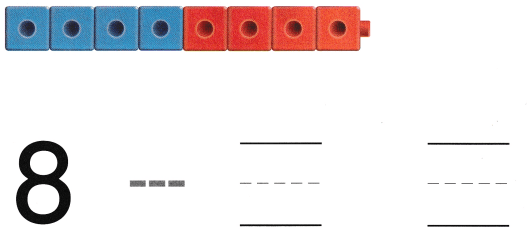
Texas Go Math Kindergarten Lesson 10.6 Answer Key 8
Answer:
Texas Go Math Kindergarten Lesson 10.5 Answer Key Decompose 6 and 7 img 19
Explanation:
Four cubes are blue and the rest are red.
Total number of cubes are 8
8 – 4 = 4
so, there are 4 red cubes.

Question 2.
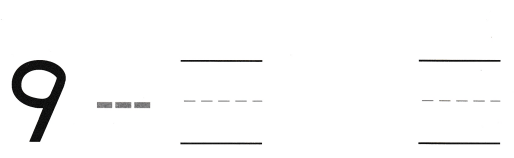
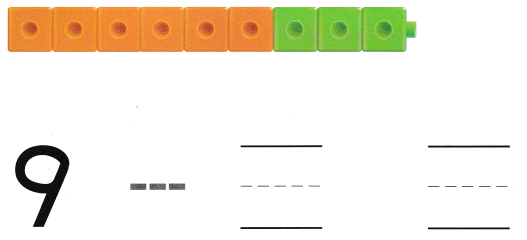
Texas Go Math Kindergarten Lesson 10.6 Answer Key 9
Answer:
Texas Go Math Kindergarten Lesson 10.5 Answer Key Decompose 6 and 7 img 20
Explanation:
Six cubes are orange and the rest are green.
Total number of cubes are 9
9 – 6 = 3
so, there are 3 green cubes.

Directions
1. Look at the eight-cube train. Four cubes are blue and the rest are red. Take apart the train by drawing to model the set taken apart. Color the trains. Trace and write to show 8 taken apart. 2. Look at the nine-cube train. Six cubes are orange and the rest are green. Take apart the train by drawing to model the set taken apart. Color the trains, Trace and write to show 9 taken apart.

Texas Test Prep

Lesson Check

Question 3.
Texas Go Math Kindergarten Lesson 10.6 Answer Key 10
Answer:
Texas Go Math Kindergarten Lesson 10.5 Answer Key Decompose 6 and 7 img 21
Explanation:
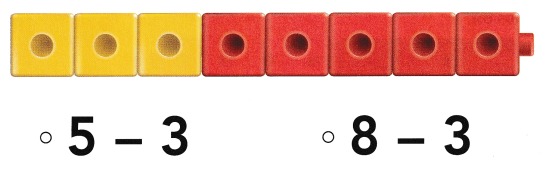
The given cube train has 8 cubes
3 are yellow and the rest are red
so, 8 – 3 = 5
5 are red cubes.

Question 4.
Texas Go Math Kindergarten Lesson 10.6 Answer Key 11
Answer:
Texas Go Math Kindergarten Lesson 10.5 Answer Key Decompose 6 and 7 img 22
Explanation:
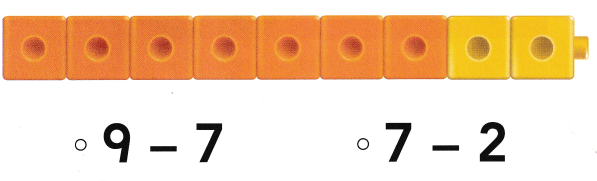
The given cube train has 9  cubes
7 cubes are orange and the rest are yellow
so, 9 – 7 = 2
two cubes are yellow.

Directions
3-4. Choose the correct answer. Which does the cube train show?

Texas Go Math Kindergarten Lesson 10.6 Answer Key Decompose 8 and 9 Read More »

Texas Go Math Kindergarten Lesson 10.7 Answer Key Decompose 10

Refer to our Texas Go Math Kindergarten Answer Key Pdf to score good marks in the exams. Test yourself by practicing the problems from Texas Go Math Kindergarten Lesson 10.7 Answer Key Decompose 10.

Texas Go Math Kindergarten Lesson 10.7 Answer Key Decompose 10

Essential Question
How do you take away numbers from 10?

Explore

Texas Go Math Kindergarten Lesson 10.7 Answer Key 1
Answer:
Texas Go Math Kindergarten Lesson 10.5 Answer Key Decompose 6 and 7 img 27
Explanation:
a ten-cube train.
One cube is blue and the rest are red.
10 – 1 = 9
so, 9 red cubes.

Directions
Model a ten-cube train. One cube is blue and the rest are red. Take apart the train to model the set taken apart. Draw and color the cube trains. Trace the symbol and write the numbers to show 10 taken apart.

Share and Show

Question 1.
Texas Go Math Kindergarten Lesson 10.7 Answer Key 2
Answer:
Texas Go Math Kindergarten Lesson 10.5 Answer Key Decompose 6 and 7 img 28
Explanation:
a ten-cube train. Three cubes are yellow and the rest are green.
10 – 3 = 7
so, 7 are green cubes.

Question 2.
Texas Go Math Kindergarten Lesson 10.7 Answer Key 3
Answer:
Texas Go Math Kindergarten Lesson 10.5 Answer Key Decompose 6 and 7 img 29
Explanation:
Six cubes are orange and the rest are blue.
10 – 6 = 4
so, 4 are blue.

Directions
1. Model a ten-cube train. Three cubes are yellow and the rest are green. Take apart the train to model the set taken apart. Draw and color the cube trains. Trace the symbol and write the numbers to show 10 taken apart. 2. Model a ten-cube train. Six cubes are orange and the rest are blue. Take apart the train to model the set taken apart. Draw and color the cube trains. Trace the symbol and write the numbers to show 10 taken apart.

Question 3.
Texas Go Math Kindergarten Lesson 10.7 Answer Key 4
Answer:
Texas Go Math Kindergarten Lesson 10.5 Answer Key Decompose 6 and 7 img 30
Explanation:
a ten-cube train. Two cubes are red and the rest are blue.
10 – 2 = 8
so, 8 cubes are blue

Question 4.
Texas Go Math Kindergarten Lesson 10.7 Answer Key 5
Answer:
Texas Go Math Kindergarten Lesson 10.5 Answer Key Decompose 6 and 7 img 31
Explanation:
In a given ten cube train
Five cubes are orange and the rest are green
10 – 5 = 5
so, 5 are green

Directions
3. Model a ten-cube train. Two cubes are red and the rest are blue. Take apart the train to model the set taken apart. Draw and color the cube trains. Trace the symbol and write the numbers to show 10 taken apart. 4. Model a ten-cube train. Five cubes are orange and the rest are green. Take apart the train to model the set taken apart. Draw and color the cube trains. Trace the symbol and write the numbers to show 10 taken apart.

Home Activity

  • Ask your child to show a set of 10 objects, using objects of the some kind that are different in one way, for example, large and small paper clips. Then have him or her write the numbers that show how many of each kind are in the set.

Problem Solving

Question 5.
Texas Go Math Kindergarten Lesson 10.7 Answer Key 6
Answer:
Texas Go Math Kindergarten Lesson 10.5 Answer Key Decompose 6 and 7 img 26
Explanation:
There are 10 paper clips
In ten five are large and rest are small
so, 10 – 5 = 5
so, 5 are small paper clips.

Daily Assessment Task

Question 6.
Texas Go Math Kindergarten Lesson 10.7 Answer Key 7
Answer:
Texas Go Math Kindergarten Lesson 10.5 Answer Key Decompose 6 and 7 img 25
Explanation:
10 cube train is given
5 are blue
10 – 5 = 5
so, 5 are red cubes.

Directions
5. Sydney has 10 square tiles. 8 of the tiles are red. The rest are yellow. How many tiles are yellow? Draw the tiles. Write the numbers and trace the symbol. 6. Choose the correct answer. Which does the cube train show?

Texas Go Math Kindergarten Lesson 10.7 Homework and Practice

Question 1.
Texas Go Math Kindergarten Lesson 10.7 Answer Key 8
Answer:
Texas Go Math Kindergarten Lesson 10.5 Answer Key Decompose 6 and 7 img 23
Explanation:
the given  ten-cube train.
Eight cubes are orange and the rest are yellow.
10 – 8 = 2
so, 2 are yellow cubes

Question 2.
Texas Go Math Kindergarten Lesson 10.7 Answer Key 9
Answer:
Texas Go Math Kindergarten Lesson 10.5 Answer Key Decompose 6 and 7 img 24
Explanation:
10 cube train is given
7 are blue
10 – 7 = 3
so, 3 are red cubes.

Directions
1. Look at the ten-cube train. Eight cubes are orange and the rest are yellow. Take apart the train by drawing to model the set taken apart. Color the cube trains. Trace and write to show 10 taken apart. 2. Look at the ten-cube train. Seven cubes are blue and the rest are red. Take apart the train by drawing to model the set taken apart. Trace and write to show 10 taken apart.

Texas Test Prep

Lesson Check

Question 3.
Texas Go Math Kindergarten Lesson 10.7 Answer Key 10
Answer:
Texas Go Math Kindergarten Lesson 10.5 Answer Key Decompose 6 and 7 img 22
Explanation:
Given train is 10  cube train
4 are red
10 – 4 = 6
so, 6 are blue cubes.

Question 4.
Texas Go Math Kindergarten Lesson 10.7 Answer Key 11
Answer:
Texas Go Math Kindergarten Lesson 10.5 Answer Key Decompose 6 and 7 img 21
Explanation:
Given train is 10  cube train
9 are yellow cubes
10 – 9 = 1
so, 1 cube is orange.

Directions
Choose the correct answer. 3-4. Which does the cube train show?

Texas Go Math Kindergarten Lesson 10.7 Answer Key Decompose 10 Read More »

Texas Go Math Kindergarten Lesson 10.8 Answer Key Compose and Decompose Numbers Up to 10

Refer to our Texas Go Math Kindergarten Answer Key Pdf to score good marks in the exams. Test yourself by practicing the problems from Texas Go Math Kindergarten Lesson 10.8 Answer Key Compose and Decompose Numbers Up to 10.

Texas Go Math Kindergarten Lesson 10.8 Answer Key Compose and Decompose Numbers Up to 10

Essential Question
How can you solve problems using a picture?

Unlock the Problem

Texas Go Math Kindergarten Lesson 10.8 Answer Key 1
Answer:
Texas Go Math Kindergarten Lesson 10.4 Answer Key Compose 10 img 25
Explanation:
There are some juice boxes for snack. Two of the juice boxes are orange juice.
Six of the juice boxes are grape juice
2 + 6 = 8
8 juices are altogether

Directions
There are some juice boxes for snack. Two of the juice boxes are orange juice. Six of the juice boxes are grape juice. How many juice boxes are there altogether? Use the picture to solve the problem. Write the numbers and trace the symbol.

Try Another Problem

Question 1.
Texas Go Math Kindergarten Lesson 10.8 Answer Key 2
Answer:
Texas Go Math Kindergarten Lesson 10.4 Answer Key Compose 10 img 26
Explanation:
Monica has some carrots. She ate 4 carrots for snack.
She ate 5 carrots for lunch.
4 + 5 = 9
so, Monica eat 9 carrots in all

Question 2.
Texas Go Math Kindergarten Lesson 10.8 Answer Key 3
Answer:
Texas Go Math Kindergarten Lesson 10.4 Answer Key Compose 10 img 27
Explanation:
Seven apples are red. Three apples are green
7 + 3 = 10
10 apples are there in all.

Directions
1. Monica has some carrots. She ate 4 carrots for snack. She ate 5 carrots for lunch. How many carrots did Monica eat? Use the picture to solve the problem. Write the numbers and trace the symbol. 2. Some children brought in apples for snack. Seven apples are red. Three apples are green. How many apples are there? Use the picture to solve the problem. Write the numbers and trace the symbol.

Share and Show

Question 3.
Texas Go Math Kindergarten Lesson 10.8 Answer Key 4
Answer:
Texas Go Math Kindergarten Lesson 10.4 Answer Key Compose 10 img 28
Explanation:
There are six bananas on the snack table.
Two bananas are green
6 – 2 = 4
4 bananas are yellow

Question 4.
Texas Go Math Kindergarten Lesson 10.8 Answer Key 5
Answer:
Texas Go Math Kindergarten Lesson 10.4 Answer Key Compose 10 img 29
Explanation:
Seven muffins are on the snack table.
One is a blueberry muffin and the rest are cherry muffins.
7 – 1 = 6
6 are cherry muffins.

Directions
3. There are six bananas on the snack table. Two bananas are green. How many bananas are yellow? Use the picture to solve the problem. Write the numbers and trace the symbol. 4. Seven muffins are on the snack table. One is a blueberry muffin and the rest are cherry muffins. How many are cherry muffins? Use the picture to solve the problem. Write the numbers and trace the symbol.

Home Activity

  • Have your child draw a set of ten or fewer balloons. Have him or her circle and mark on X on some balloons to show that they have popped. Then have your child tell a word problem to match.

Daily Assessment Task

Question 5.
Texas Go Math Kindergarten Lesson 10.8 Answer Key 6
Answer:
Texas Go Math Kindergarten Lesson 10.4 Answer Key Compose 10 img 30
Explanation:
There are 10 counters,
if you take apart 3
then 10 – 3 = 7
7 red counters are remaining.

Question 6.
Texas Go Math Kindergarten Lesson 10.8 Answer Key 7
Answer:
Texas Go Math Kindergarten Lesson 10.4 Answer Key Compose 10 img 31
Explanation:
There are 7 blocks out of which 5 are blue
so, 7 – 5 = 2
2 are red blocks.

Question 7.
Texas Go Math Kindergarten Lesson 10.8 Answer Key 8
Answer:
Texas Go Math Kindergarten Lesson 10.4 Answer Key Compose 10 img 32
Explanation:
5 green blocks and 4 red blocks
so, 5 + 4 = 9
There are 9 blocks.

Directions
5. There are 10 counters, How many counters will be left if you take apart 3? 6-7. Which does the model show?

Texas Go Math Kindergarten Lesson 10.8 Homework and Practice

Question 1.
Texas Go Math Kindergarten Lesson 10.8 Answer Key 9
Answer:
Texas Go Math Kindergarten Lesson 10.4 Answer Key Compose 10 img 33
Explanation:
Carolyn had some pencils. She gave 3 pencils to her brother.
She gave 6 pencils to her sister.
so, 3 + 6 = 9
there are 9 pencils.

Question 2.
Texas Go Math Kindergarten Lesson 10.8 Answer Key 10
Answer:
Texas Go Math Kindergarten Lesson 10.4 Answer Key Compose 10 img 34
Explanation:
There are 10 crayons in the classroom.
Six crayons are used for art class.
so, 10 – 6 = 4
4 crayons are left.

Directions
1. Carolyn had some pencils. She gave 3 pencils to her brother. She gave 6 pencils to her sister. How many pencils did Carolyn have? Use the picture to solve the problem. Write the numbers and trace the symbol. 2. There are 10 crayons in the classroom. Six crayons are used for art class. How many crayons are left? Use the picture to solve the problem. Write the numbers and trace the symbol.

Texas Test Prep

Question 3.
Texas Go Math Kindergarten Lesson 10.8 Answer Key 11
Answer:
Texas Go Math Kindergarten Lesson 10.4 Answer Key Compose 10 img 38
Explanation:
There are 10 counters.
you have to take away 4
10 – 4 = 6
6 red counters.

Question 4.
Texas Go Math Kindergarten Lesson 10.8 Answer Key 12
Answer:
Texas Go Math Kindergarten Lesson 10.4 Answer Key Compose 10 img 36
Explanation:
There are 9 blocks
5 are blue blocks
so, 9 – 5 = 4
4 are green blocks

Question 5.
Texas Go Math Kindergarten Lesson 10.8 Answer Key 13
Answer:
Texas Go Math Kindergarten Lesson 10.4 Answer Key Compose 10 img 37
Explanation:
2 yellow cubes and 5 orange blocks
so, 2 + 5 = 7
7 blocks in all.

Directions
Choose the correct answer. 3. There are 10 counters. How many counters will be left if you take away 4 ? 4-5. Which does the model show?

Texas Go Math Kindergarten Lesson 10.8 Answer Key Compose and Decompose Numbers Up to 10 Read More »

Texas Go Math Kindergarten Module 10 Assessment Answer Key

Refer to our Texas Go Math Kindergarten Answer Key Pdf to score good marks in the exams. Test yourself by practicing the problems from Texas Go Math Kindergarten Module 10 Assessment Answer Key.

Texas Go Math Kindergarten Module 10 Assessment Answer Key

Concepts and Skills

Question 1.
Texas Go Math Kindergarten Module 10 Assessment Answer Key 1
Answer:
Texas Go Math Kindergarten Lesson 10.4 Answer Key Compose 10 img 21
Explanation:
Number of yellow counters are 6
Number of red counters are 2
total number of counters are 8
6 + 2 = 8

Question 2.
Texas Go Math Kindergarten Module 10 Assessment Answer Key 2
Answer:
Texas Go Math Kindergarten Lesson 10.4 Answer Key Compose 10 img 22
Explanation:
There are 3 red apples
and there are 7 green apples
3 + 7 = 10
so, 10 apples in all.

Directions
1. Count the counters in the ten frame. Write the number pair that makes 8. 2. Look at the picture. Write the number pair that makes 10. TEKS K.2.I

Question 3.
Texas Go Math Kindergarten Module 10 Assessment Answer Key 3
Answer:
Texas Go Math Kindergarten Lesson 10.4 Answer Key Compose 10 img 23
Explanation:
Number of red cubes are 1
total number of cubes are 7
7 – 1 = 6
number of blue cubes are 6

Question 4.
Texas Go Math Kindergarten Module 10 Assessment Answer Key 4
Answer:
Texas Go Math Kindergarten Lesson 10.4 Answer Key Compose 10 img 23
Explanation:
Number of red cubes are 7
total number of cubes are 9
9 – 7 = 2
number of blue cubes are 2

Question 5.
Texas Test Prep
Texas Go Math Kindergarten Module 10 Assessment Answer Key 5
Answer:
Texas Go Math Kindergarten Lesson 10.4 Answer Key Compose 10 img 24
Explanation:
Kylee has some toy trucks. Four of the trucks are yellow.
9 – 4 = 5
5  trucks are red.

Directions
3-4. Use red and blue cubes to model the cube trains. Take apart the cube trains to model the set taken apart. Draw and color the cube trains. Trace the symbol and write the numbers. 5. Kylee has some toy trucks. Four of the trucks are yellow. How many trucks are red? Write the numbers and trace the symbol. TEKS K.2.I

Texas Go Math Kindergarten Module 10 Assessment Answer Key Read More »

Texas Go Math Grade 3 Lesson 9.5 Answer Key Multiply 2-Digit by 1-Digit Numbers

Refer to our Texas Go Math Grade 3 Answer Key Pdf to score good marks in the exams. Test yourself by practicing the problems from Texas Go Math Grade 3 Lesson 9.5 Answer Key Multiply 2-Digit by 1-Digit Numbers.

Texas Go Math Grade 3 Lesson 9.5 Answer Key Multiply 2-Digit by 1-Digit Numbers

Essential Question
How can you use strategies to multiply a 2-digit number by a 1-digit number?
Answer:
Multiply the 1 digits together first. Cross-multiply by multiplying diagonal digits, then add the two sums together. Multiply the 2-digit numbers.

Explanation:
Here is one way that you can speed up the process of 2-digit by 1-digit multiplication:
Multiply the 1 digits together first. Cross-multiply by multiplying diagonal digits, then add the two sums together. Multiply the 2-digit numbers.


Unlock the Problem
A Thoroughbred racehorse can run at speeds of up to 60 feet per second. During practice, Celia’s horse runs at a speed of 36 feet per second. How far does her horse run in 3 seconds?

  • Underline important information.
  • Is there information you will not use? If so, cross out the information.

Example 1.
Multiply. 3 × 36
Texas Go Math Grade 3 Lesson 9.5 Answer Key 1
Texas Go Math Grade 3 Lesson 9.5 Answer Key 2
So, Celia’s racehorse runs ___ feet in 3 seconds.
Answer:
So, Celia’s racehorse runs 108 feet in 3 seconds.

Explanation:
Number of feet Celia’s horse runs per second = 36.
Distance her horse runs in 3 seconds = 3 × Number of feet Celia’s horse runs per second
= 3 × 36
= (3 × 10) + (3 × 10) + (3 × 10) + (3 × 6)
= 30 + 30 + 30 + 18
= 60 + 30 + 18
= 90 + 18
= 108 feet.

Math Talk
Mathematical Processes
Look at Step 1. Explain how the blocks show the regrouping of the 18 ones.

Example 2.
Multiply. 8 × 22
Texas Go Math Grade 3 Lesson 9.5 Answer Key 3
So, 8 × 22 = ____.

Math talk
Mathematical Processes
Why is 8 × 2 tens recorded as 160 and not as 16?
Answer:
8 × 2 tens is recorded as 160 and not as 16 because 8 × 2 tens = 8 × 20 = 160 not 16.

Explanation:
8 × 2 tens = 8 × (2 × 10)
= 8 × 20
Multiply tens and ones place.
= 160.


Share and Show
Question 1.
Use the model to find the product.
Texas Go Math Grade 3 Lesson 9.5 Answer Key 4
Answer:
Texas-Go-Math-Grade-3-Lesson-9.5-Answer-Key-Multiply-2-Digit-by-1-Digit-Numbers-Share and Show-1

Explanation:
2 × 36 = (2 × 3 tens) + (2 × 6 ones)
= [2 ×(3 × 10)]+ [2 × (6 × 1)]
= (2 × 30) + (2 × 6)
= 60 + 12
= 72.

Multiply 2-Digit by 1-Digit Numbers 2

Find the product. Tell which strategy you used.
Question 2.
Texas Go Math Grade 3 Lesson 9.5 Answer Key 5
Answer:
Strategy used is multiplication and addition to find the product.
Texas-Go-Math-Grade-3-Lesson-9.5-Answer-Key-Multiply-2-Digit-by-1-Digit-Numbers-Find the product-Tell which strategy you used-2

Explanation:
42 × 4 = (40 × 4) + (2 × 4)
= 160 + 8
= 168.

Go Math Lesson 9.5 3rd Grade Answer Key Question 3.
Texas Go Math Grade 3 Lesson 9.5 Answer Key 6
Answer:
Strategy used is multiplication and addition to find the product.
Texas-Go-Math-Grade-3-Lesson-9.5-Answer-Key-Multiply-2-Digit-by-1-Digit-Numbers-Find the product-Tell which strategy you used-3

Explanation:
32 × 6 = (30 × 6) + (2 × 6)
= 180 + 12
= 192.


Question 4.
Texas Go Math Grade 3 Lesson 9.5 Answer Key 7
Answer:
Strategy used is multiplication and addition to find the product.
Texas-Go-Math-Grade-3-Lesson-9.5-Answer-Key-Multiply-2-Digit-by-1-Digit-Numbers-Find the product-Tell which strategy you used-4

Explanation:
85 × 3 = (80 × 3) + (5 × 3)
= 240 + 15
= 255.


Question 5.
Texas Go Math Grade 3 Lesson 9.5 Answer Key 8
Answer:
Strategy used is multiplication and addition to find the product.
Texas-Go-Math-Grade-3-Lesson-9.5-Answer-Key-Multiply-2-Digit-by-1-Digit-Numbers-Find the product-Tell which strategy you used-5

Explanation:
$63 × 7 = ($60 × 7) + ($3 × 7)
= $420 + $21
= $441.


Math Talk
Mathematical Processes
Describe the steps for using place value and regrouping to find 3 × 78.
Answer:
Steps for using place value and regrouping to find 3 × 78:
1. Multiply the tens place and record the value.
2. Multiply the ones place and record the value.
3. Do add the both vales.
3 × 78 = 234.

Explanation:
Steps for using place value and regrouping to find 3 × 78:
1. Multiply the tens place and record the value:
3 × 70 = 210.
2. Multiply the ones place and record the value:
3 × 8 = 24.
3. Do add the both vales:
=> (3 × 70) + (3 × 8)
= 210 + 24
= 234.

Texas Go Math Grade 3 Lesson 9.5 Answer Key 3

Problem Solving
Use the table for 6-8.
Question 6.
How far can a desert cottontail run in 9 seconds?
Texas Go Math Grade 3 Lesson 9.5 Answer Key 9
Answer:
Distance desert cottontail runs 9 seconds = 198 feet.

Explanation:
Distance desert cottontail runs per second = 22 feet.
Distance desert cottontail runs 9 seconds = 9 × Distance desert cottontail runs per second
= 9 × 22
= (9 × 10) + (9 × 10) + (9 × 2)
= 90 + 90 + 18
= 180 + 18
= 198 feet.


Go Math Grade 3 Lesson 9.5 Answer Key Question 7.
Analyze A black-tailed jackrabbit hops about 7 feet in a single hop. How far can it hop in 5 seconds?
Texas Go Math Grade 3 Lesson 9.5 Answer Key 10
Answer:
Distance black-tailed jackrabbit hops in a 5 seconds = 35 feet.

Explanation:
Distance black-tailed jackrabbit hops in a single hop  per second = 7 feet.
Distance black-tailed jackrabbit hops in a 5 seconds = 5 × Distance black-tailed jackrabbit hops in a single hop  per second
= 5 × 7
= 35 feet.


Question 8.
H.O.T. Multi-Step At the speeds shown, how much farther could a black-tailed jackrabbit run than a desert cottontail in 7 seconds?
Answer:
203 feet farther a black-tailed jackrabbit run than a desert cottontail in 7 seconds.

Explanation:
Distance a black-tailed jackrabbit run in a second = 51.
Distance a black-tailed jackrabbit run in 7 seconds = 7 × Distance a black-tailed jackrabbit run in a second
= 7 × 51
= (7 × 10) + (7 × 10) + (7 × 10) + (7 × 10) + (7 × 10) + (7 × 1)
= 70 + 70 + 70 + 70  + 70 + 7
= 140 + 70 + 70  + 70 + 7
= 210 + 70  + 70 + 7
= 280 + 70 + 7
= 350 + 7
= 357 feet.
Distance a desert cottontail run in a second = 22.
Distance a desert cottontail run in 7 seconds = 7 × Distance a desert cottontail run in a second
= 7 × 22
=(7 × 10) + (7 × 10) +(7 × 2)
= 70 + 70 + 14
= 140 + 14
= 154 feet.
Difference:
Distance a black-tailed jackrabbit run in 7 seconds – Distance a desert cottontail run in 7 seconds
= 357 – 154
= 203 feet.


Question 9.
Multi-Step Mr. Wright bought a 3-pound bag of cat food and a 5 pound bag of dog food, There are 16 ounces in each pound. How many ounces of pet food did Mr. Wright buy?
Answer:
Number of ounces of pet food Mr. Wright buy = 128.

Explanation:
Number of pounds bag of cat food Mr. Wright bought = 3.
Number of pounds bag of dog food Mr. Wright bought = 5.
Number of ounces in each pound = 16.
Number of ounces are in bag of cat food Mr. Wright bought = Number of pounds bag of cat food Mr. Wright bought ×Number of ounces in each pound
= 3 × 16
=(3 × 10 + (3 × 6)
= 30 + 18
= 48.
Number of ounces are in bag of dog food Mr. Wright bought = Number of pounds bag of dog food Mr. Wright bought × Number of ounces in each pound
= 5 × 16
=(5 × 10) + (5 × 6)
= 50 + 30
= 80.
Number of ounces of pet food Mr. Wright buy = Number of ounces are in bag of cat food Mr. Wright bought + Number of ounces are in bag of dog food Mr. Wright bought
= 48 + 80
= 128.


Question 10.
H.O.T. Reasoning The sum of two numbers is 31. The product of the two numbers is 150. What are the numbers?
Answer:
The numbers are 6 and 25.

Explanation:
The sum of two numbers is 31.
The product of the two numbers is 150.
Let the numbers be X and Y.
Multiples of 150:
3 × 50 = 150. => 3 + 50 = 53.
5 × 30 = 150. => 5 + 30 = 35.
6 × 25 = 150. => 6 + 25 = 31.
10 × 15 = 150. => 10 + 15 = 25.


Question 11.
Write Math 6 × 87 is greater than 5 × 87. How much greater? Explain how you know without multiplying.
Answer:
Difference = 87.
Without multiply:
(6 × 87) – (5 × 87) = difference of multiple (6 – 5) × 87 = 1 × 87 = 87.

Explanation:
Product of 6 × 87 = (6 × 10) + ( 6 × 10) + (6 × 10) + ( 6 × 10) + (6 × 10) + ( 6 × 10) + (6 × 10) + ( 6 × 10) + (6 × 7)
= 60 + 60 + 60 + 60 + 60 + 60 + 60 + 60 + 42
= 120 + 60 + 60 + 60 + 60 + 60 + 60 + 42
= 180 + 60 + 60 + 60 + 60 + 60 + 42
= 240 + 60 + 60 + 60 + 60 + 42
= 300 + 60 + 60 + 60 + 42
= 360 + 60 + 60 + 42
= 420 + 60 + 42
= 480 + 42
= 522.
Product of 5 × 87 = (5 × 10) + (5 × 10) + (5 × 10) + (5 × 10) + (5 × 10) + (5 × 10) + (5 × 10) + (5 × 10) + (5 × 7)
= 50 + 50 + 50 + 50 + 50 + 50 + 50 + 50 + 35
= 100 + 50 + 50 + 50 + 50 + 50 + 50 + 35
= 150 + 50 + 50 + 50 + 50 + 50 + 35
= 200 + 50 + 50 + 50 + 50 + 35
= 250 + 50 + 50 + 50 + 35
= 300 + 50 + 50 + 35
= 350 + 50 + 35
= 400 + 35
= 435.
Difference:
Product of 6 × 87 – Product of 5 × 87
= 522 – 435
= 87.

Without multiply:
(6 × 87) – (5 × 87) = difference of multiple (6 – 5) × 87 = 1 × 87 = 87.


Daily Assessment Task
Fill in the bubble for the correct answer. Use a strategy to solve.
Question 12.
Clayton bought 7 boxes of markers for an art project. There are 12 markers in each box. How many markers did he buy?
(A) 84
(B) 14
(C) 19
(D) 74
Answer:
Number of markers he buy = 84.
(A) 84.

Explanation:
Number of boxes of markers for an art project Clayton bought = 7.
Number of markers in each box = 12.
Number of markers he buy = Number of boxes of markers for an art project Clayton bought  × Number of markers in each box
= 7 × 12
= (7 × 10) + ( 7 × 2)
= 70 + 14
= 84.

Question 13.
Apply Alana has been on the swim team for 3 years. She practices 26 weeks a year. How many weeks has she practiced?
(A) 68
(B) 618
(C) 78
(D) 6,018
Answer:
Number of weeks she practiced = 78.
(C) 78.

Explanation:
Number of years Alana has been on the swim team = 3.
Number of weeks a year she practices = 26.
Number of weeks she practiced = Number of years Alana has been on the swim team × Number of weeks a year she practices
= 3 × 26
= (3 × 10) + (3 × 10) +(3 × 6)
= 30 + 30 + 18
= 60 + 18
= 78.

Question 14.
Multi-Step At Huff and Puff Day Care, the art teachers have 5 sets of 16 paints for morning classes and 4 sets of 12 paints for afternoon classes. How many paints do the art teachers have?
(A) 80
(B) 128
(C) 48
(D) 20
Answer:
Total number of paints the art teachers have = 128.
(B) 128.

Explanation:
Number of sets of paints the art teachers have for morning classes= 5.
Number of paints for morning classes = 16.
Total Number of paints the art teachers have for morning classes = Number of sets of paints the art teachers have for morning classes × Number of paints for morning classes
= 5 × 16
= (5 × 10) + (5 × 6)
= 50 + 30
= 80.
Number of sets of paints the art teachers have for afternoon classes = 4.
Number of paints for afternoon classes = 12.
Total Number of paints the art teachers have for afternoon classes = Number of sets of paints the art teachers have for afternoon classes × Number of paints for afternoon classes
= 4 × 12
= (4 × 10) + (4 × 2)
= 40 + 8
= 48.
Total number of paints the art teachers have = Total Number of paints the art teachers have for morning classes + Total Number of paints the art teachers have for afternoon classes
= 80 + 48
= 128.


Texas Test Prep
Question 15.
Mrs. Sawyer bought a book for $25 and 3 toys for $13 each. How much change should she get back from a $100 bill?
(A) $46
(B) $36
(C) $26
(D) $64
Answer:
Amount of change Mrs. Sawyer gets back = $36.
(B) $36.

Explanation:
Cost of a book Mrs. Sawyer bought = $25.
Cost of  a toy Mrs. Sawyer bought each = $13.
Number of toys Mrs. Sawyer bought = 3.
Amount of bill = $100.
Total cost of toys Mrs. Sawyer bought = Cost of  a toy Mrs. Sawyer bought each × Number of toys Mrs. Sawyer bought
= $13 × 3
= ($10 × 3) + ($3 × 3)
= $30 + $9
= $39.
Total amount of a book and 3 toys Mrs. Sawyer bought = Cost of a book Mrs. Sawyer bought  + Total cost of toys Mrs. Sawyer bought
= $25 + $39
= $64.
Amount of change Mrs. Sawyer gets back = Amount of bill – Total amount of a book and 3 toys Mrs. Sawyer bought
= $100 – $64
= $36.


Texas Go Math Grade 3 Lesson 9.5 Homework and Practice Answer Key

Find the product. Tell which strategy you used.

Question 1.
Texas Go Math Grade 3 Lesson 9.5 Answer Key 11
Answer:
Texas-Go-Math-Grade-3-Lesson-9.5-Answer-Key-Multiply-2-Digit-by-1-Digit-Numbers-Texas Go Math Grade 3 Lesson 9.5 Homework and Practice Answer Key-Find the product-Tell which strategy you used-1

Explanation:
Strategy used is multiplication and addition to find the product.
53 × 4 = (50 × 4) + (3 × 4)
= 200 + 12
= 212.


Go Math Grade 3 Practice and Homework Lesson 9.5 Answer Key Question 2.
Texas Go Math Grade 3 Lesson 9.5 Answer Key 12
Answer:
Strategy used is multiplication and addition to find the product.
Texas-Go-Math-Grade-3-Lesson-9.5-Answer-Key-Multiply-2-Digit-by-1-Digit-Numbers-Texas Go Math Grade 3 Lesson 9.5 Homework and Practice Answer Key-Find the product-Tell which strategy you used-2

Explanation:
64 × 6 = (60 × 6) + (4 × 6)
= 360 + 24
= 384.


Question 13.
Texas Go Math Grade 3 Lesson 9.5 Answer Key 14
Answer:
Strategy used is multiplication and addition to find the product.
Texas-Go-Math-Grade-3-Lesson-9.5-Answer-Key-Multiply-2-Digit-by-1-Digit-Numbers-Texas Go Math Grade 3 Lesson 9.5 Homework and Practice Answer Key-Find the product-Tell which strategy you used-13

Explanation:
47 × 9 = (40 × 9) + (7 × 9)
= 360 + 63
= 423.

Multiply 2-Digit by 1-Digit Numbers 3

Question 14.
Texas Go Math Grade 3 Lesson 9.5 Answer Key 15
Answer:
Strategy used is multiplication and addition to find the product.
Texas-Go-Math-Grade-3-Lesson-9.5-Answer-Key-Multiply-2-Digit-by-1-Digit-Numbers-Texas Go Math Grade 3 Lesson 9.5 Homework and Practice Answer Key-Find the product-Tell which strategy you used-14

Explanation:
82 × 3 = (80 × 3) + (2 × 3)
= 240 + 6
= 246.


Problem Solving
Use the table for 5-7.
Question 5.
The mayor of a town buys 4 packages of balloons for a street festival. How many balloons did the mayor buy?
Texas Go Math Grade 3 Lesson 9.5 Answer Key 13
Answer:
Total number of balloons the mayor buy = 232.

Explanation:
Number of packages of balloons for a street festival the mayor of a town buys = 4.
Number of balloons in each package = 58.
Total number of balloons the mayor buy = Number of packages of balloons for a street festival the mayor of a town buys × Number of balloons in each package
= 4 × 58
= (4 × 50) + ( 4 × 8)
= 200 + 32
= 232.


Question 6.
Roberto buys 4 packages of noisemakers and 3 packages of hats. Does he have more hats or more noisemakers? Explain.
Answer:
He has 7 more hats than noisemakers.

Explanation:
Number of packages of noisemakers Roberto buys = 4.
Number of noisemakers  in each package = 17.
Total number of noisemakers Roberto buys = Number of packages of noisemakers Roberto buys  × Number of noisemakers  in each package
= 4 × 17
= (4 × 10) + (4 × 7)
= 40 + 28
= 68.
Number of packages of hats Roberto buys = 3.
Number of hats in each package =  25.
Total number of hats Roberto buys = Number of packages of hats Roberto buys × Number of hats in each package
= 3 × 25
= (3 × 20) + (3 × 5)
= 60 + 15
= 75.
Difference:
Total number of hats Roberto buys – Total number of noisemakers Roberto buys
= 75 – 68
= 7.

Practice and Homework Lesson 9.5 Answer Key 3rd Grade Question 7.
Nan buys 3 packages of party favors, If she has 100 people coming to a party, does she have enough favors? Explain.
Answer:
No, she will not have enough favors to give to the people coming to a party.

Explanation:
Number of packages of party favors Nan buys = 3.
Number of favors in each package = 32.
Total number of favors Nan buys  = Number of packages of party favors Nan buys × Number of favors in each package
= 3 × 32
= (3 × 30) + (3 × 2)
= 90 + 6
= 96.
Number of people coming to a party = 100.
Difference:
Number of people coming to a party – Total number of favors Nan buys
= 100 – 96
= 4.

Question 8.
Erika has 6 boxes of buttons. Each box holds 28 buttons. Explain how Erika can use place value and regrouping to find how many buttons there are.
Answer:
Total number of buttons Erika has = 168.

Explanation:
Number of boxes of buttons Erika has = 6.
Number of buttons each box holds = 28.
Total number of buttons Erika has =  Number of boxes of buttons Erika has × Number of buttons each box holds
= 6 × 28
Multiply 6 with the place value of 2 = 2 tens (2 ×10 = 20) and add to place value of 8 = ones (8 ×1 = 8)
= (6 × 20) + (6 × 8)
= 120 + 48
= 168.


Lesson Check
Texas Test Prep
Fill in the bubble completely to show your answer.
Question 9.
It takes a train 42 minutes to ride ‘from Coltsville to Newburgh. If the train makes 8 trips in one day, how many minutes does it travel?
(A) 336 minutes
(B) 236 minutes
(C) 322 minutes
(D) 412 minutes
Answer:
Number of minutes it travels = 336.
(A) 336 minutes.

Explanation:
Number of minutes a train takes to ride ‘from Coltsville to Newburgh = 42.
Number of trips a train takes in one day = 8.
Number of minutes it travels = Number of minutes a train takes to ride ‘from Coltsville to Newburgh  × Number of trips a train takes in one day
= 42 × 8
= (40 × 8) + (2 × 8)
= 320 + 16
= 336.


Question 10.
Charlie puts together boxes of model cars at a factory. If he packs 18 boxes in one hour, how many boxes does he pack in 7 hours?
(A) 187
(B) 156
(C) 76
(D) 126
Answer:
Number of boxes he pack in 7 hours = 126.
(D) 126.

Explanation:
Number of boxes he packs in one hour = 18.
Number of boxes he pack in 7 hours = 7 × Number of boxes he packs in one hour
= 7 × 18
= (7 × 10) + (7 × 8)
= 70 + 56
= 126.


Question 11.
A bookstore has 6 shelves of art books. There are 27 books on each shelf. how many art hooks are in the bookstore?
(A) 33
(B) 44
(C) 112
(D) 162
Answer:
Number of art books are in the bookstore = 162.
(D) 162.

Explanation:
Number of shelves of art books a bookstore has = 6.
Number of books on each shelf = 27.
Number of art books are in the bookstore = Number of shelves of art books a bookstore has × Number of books on each shelf
= 6 × 27
= (6 × 20) + (6 × 7)
= 120 + 42
= 162.

Question 12.
A deli has 6 boxes of soup cans. Each box holds 14 cans. How many soup cans does the deli have?
(A) 64
(B) 20
(C) 84
(D) 24
Answer:
Number of soup cans the deli have = 84.
(C) 84.

Explanation:
Number of boxes of soup cans a deli has = 6.
Number of cans each box holds = 14.
Number of soup cans the deli have = Number of boxes of soup cans a deli has × Number of cans each box holds
= 6 × 14
= (6 × 10) + (6 × 4)
= 60 + 24
= 84.

3rd Grade Go Math Lesson 9.5 Homework Answer Key Question 13.
Multi-Step Ashley has 4 bags each of red marbles and yellow marbles. Each bag holds 14 marbles. How many marbles does Ashley have?
(A) 56
(B) 112
(C) 39
(D) 92
Answer:
Number of marbles Ashley have = 112.
(B) 112.

Explanation:
Number of bags of each red marbles and yellow marbles Ashley has = 4.
Number of marbles each bag holds = 14.
Number of marbles Ashley have = (2 × Number of bags of each red marbles and yellow marbles Ashley has ) × Number of marbles each bag holds
= (2 × 4) × 14
= 8 × 14
= (8 × 10) + (8 × 4)
= 80 + 32
= 112.

Question 14.
Multi-Step Devon collects 23 bottles and 4 boxes of 16 cans on recycling day. His goal is to collect 100 items. How many more items does Devon need to reach his goal?
(A) 43
(B) 39
(C) 87
(D) 13
Answer:
Number of more items Devon needs to reach his goal = 13.
(D) 13.

Explanation:
Number of bottles Devon collects  = 23.
Number of boxes Devon collects  = 4.
Number of cans he collects = 16.
Number of items to collect his goal = 100.
Number of items he collected on recycling day = Number of bottles Devon collects + (Number of boxes Devon collects × Number of cans he collects)
= 23 + (4 × 16)
= 23 + 64
= 87.
Number of more items Devon needs to reach his goal = Number of items to collect his goal – Number of items he collected on recycling day
= 100 – 87
= 13.

Texas Go Math Grade 3 Lesson 9.5 Answer Key Multiply 2-Digit by 1-Digit Numbers Read More »

Texas Go Math Grade 3 Lesson 11.2 Answer Key Division Rules for 1 and 0

Refer to our Texas Go Math Grade 3 Answer Key Pdf to score good marks in the exams. Test yourself by practicing the problems from Texas Go Math Grade 3 Lesson 11.2 Answer Key Division Rules for 1 and 0.

Texas Go Math Grade 3 Lesson 11.2 Answer Key Division Rules for 1 and 0

Essential Question
What are the rules for dividing with 1 and 0?
Answer:
A Number Divided by 1 a1=a Just like multiplying by 1,
dividing any number by 1 doesn’t change the number at all.
0 Divided by a Number 0a=0 Dividing 0 by any number gives us a zero.
Zero will never change when multiplying or dividing any number by it.

Unlock the Problem

What rules for division can help you divide with 1 and 0?
Answer:
Any number divided by 0 is not defined.
Any number (except 0) divided by itself equals 1.
Any number divided by 1 equals that number.
Explanation:
For Example:
35 ÷ 1 = 35
35 ÷ 0 = 0

If there is only 1 fishbowl, then all the fish must go in that fishbowl.
Texas Go Math Grade 3 Lesson 11.2 Answer Key 1
Try This! There are 3 fish and 1 fishbowl. Draw a quick picture to show the fish in the fishbowl.

Write the equation your picture shows.

3 ÷ 1 = 3

Rule A: Any number divided by 1 equals that number.

Math Talk
Mathematical processes
Explain how Rule A is related to the Identity Property of Multiplication.

If there is the same number of fish and fishbowls, then 1 fish goes in each fishbowl.
Texas Go Math Grade 3 Lesson 11.2 Answer Key 2

Try This There are 3 fish and 3 fishbowls. Draw a quick picture to show the fish divided equally among the fishbowls.

Write the equation your picture shows.
3 ÷3 = 1

Rule B: Any number (except 0) divided by itself equals 1.

If there are 0 fish and 4 fishbowls, there will not be any fish in the fishbowls.
Texas Go Math Grade 3 Lesson 11.2 Answer Key 3

Try This! There are 0 fish and 3 fishbowls. Draw a quick picture to show the fishbowls.

Write the equation your picture shows.
___ ÷ ___ = ____
0 ÷ 4 = 0
Rule C: Zero divided by any number (except 0) equals 0.

If there are 0 fish bowls, then you cannot separate the fish equally into fishbowls Dividing by 0 is not possible.
Texas Go Math Grade 3 Lesson 11.2 Answer Key 4
Texas Go Math Grade 3 Lesson 11.2 Answer Key 5
Rule D: You cannot divide by 0.

Share and Show

Math Talk
Mathematical Processes
Explain what happens when you divide a number (except 0) by itself.

Question 1.
Use the picture to find 2 ÷ 2. ___
Texas Go Math Grade 3 Lesson 11.2 Answer Key 6
Answer: 1
Explanation:
Rule B: Any number (except 0) divided by itself equals 1.
2 ÷ 2 = 1

Find the quotient.

Texas Go Math Grade 3 Answer Key Pdf Lesson 11.2 Question 2.
7 ÷ 1 = ___
Answer: 7

Rule A: Any number divided by 1 equals that number.
7 ÷ 1 = 7

Question 3.
8 ÷ 8 = ___
Answer: 1

8 ÷ 8 = 1
Explanation:
Rule A: Any number divided by 1 equals that number.

Question 4.
0 ÷ 5 = ___
Answer:

0 ÷ 5 = 0
Explanation:
Rule C: Zero divided by any number (except 0) equals 0.

Division Rules for 1 and 0 1

Question 5.
6 ÷ 6 = ___
Answer: 1

Explanation:
Rule A: Any number divided by 1 equals that number.

Division Rules for 1 and 0 2

Question 6.
Texas Go Math Grade 3 Lesson 11.2 Answer Key 7
Answer:
0 ÷ 5 = 0
Explanation:
Rule C: Zero divided by any number (except 0) equals 0.

Question 7.
Texas Go Math Grade 3 Lesson 11.2 Answer Key 8
Answer: 9
9 ÷ 1 = 9
Explanation:
Rule A: Any number divided by 1 equals that number

Question 8.
Texas Go Math Grade 3 Lesson 11.2 Answer Key 9
Answer: 1
7 ÷ 7 = 1
Explanation:
Rule A: Any number divided by 1 equals that number.

Division Rules for 1 and 0 1

Question 9.
Texas Go Math Grade 3 Lesson 11.2 Answer Key 10
Answer: 10
10 ÷ 1 =10
Explanation:
Rule A: Any number divided by 1 equals that number

Problem Solving

Question 10.
Multi-Step Claire has 7 parakeets. She puts 4 of them in a cage. She divides the other parakeets equally among 3 friends to hold. How many parakeets does each friend get to hold?
Texas Go Math Grade 3 Lesson 11.2 Answer Key 11
Answer:
Explanation:
Claire has 7 parakeets.
She puts 4 of them in a cage.
7 – 4 = 3
She divides the other parakeets equally among 3 friends to hold.
Number of parakeets each friend get to hold
3 ÷ 3 = 1

Texas Go Math Grade 3 Lesson 11.2 Answer Key Question 11.
Write Math Pose a Problem Look back at Problem 10. Change the number of parakeets and friends so you can use the equation 6 ÷ 6 = 1. Then solve your problem.
Answer:
Claire has 10 parakeets. She puts 4 of them in a cage. She divides the other parakeets equally among 6 friends to hold. How many parakeets does each friend get to hold?
Explanation:
Claire has 10 parakeets.
She puts 4 of them in a cage.
10 – 4 = 6
She divides the other parakeets equally among 6 friends to hold.
Number of parakeets each friend get to hold
6 ÷ 6 = 1

Question 12.
Lily has some parrots. She gives each parrot 1 grape. If Lily gives out 5 grapes, how many parrots does she have?
Answer:
Explanation:
Lily has some parrots.
She gives each parrot 1 grape.
If Lily gives out 5 grapes,
Total parrots she have
5 ÷ 5 = 1

Question 13.
H.O.T. Use Math Language Suppose a pet store has 21 birds that are in 21 cages. Use what you know about division rules to find the number of birds in each cage. Explain your answer.
Answer:
21 ÷ 21 = 1
Any number divides by itself equals to 1
Explanation:
A pet store has 21 birds that are in 21 cages.
Division equation to find the number of birds in each cage.
21 ÷ 21 = 1
Daily Assessment Task

Fill in the bubble for the correct answer choice.

Question 14.
There are 18 people waiting in line to ride the Texas Giant roller coaster. There are 0 seats available and 6 roller coaster cars. Which division equation describes how many people can move from the line to a car?
(A) 0 × 6 = 0
(B) 6 ÷ 6 = 1
(C) 0 ÷ 6 = 0
(D) 6 ÷ 1 = 6
Answer:
Option(C)
Explanation:
There are 18 people waiting in line to ride the Texas Giant roller coaster.
There are 0 seats available and 6 roller coaster cars.
Division equation 0 ÷ 6 = 0 describes number of people can move from the line to a car

Question 15.
Kai has some cats. Each cat has its own food bowl. There are 4 food bowls. How many cats does Kai have?
(A) 1
(B) 4
(C) 8
(D) 0
Answer:
Option(B)
Explanation:
There are 4 food bowls.
Each cat has its own food bowl.
Number of cats Kai has 4 ÷ 1 = 4

Go Math Lesson 11.2 Answer Key Grade 3 Question 16.
Analyze Multi-Step Taylor has 6 juice boxes in her refrigerator. She leaves 2 juice boxes in the refrigerator and divides the rest equally among 3 friends and herself. How many juice boxes is each person given?
(A) 4
(B) 2
(C) 1
(D) 3
Answer:
Option(C)
Explanation:
Taylor has 6 juice boxes in her refrigerator.
She leaves 2 juice boxes in the refrigerator
6 – 2 = 4
and divides the rest equally among 3 friends and herself.
Number of juice boxes each person get
4 ÷ 4 = 1

Texas Test Prep

Question 17.
Jude has 6 horses. Two horses are in the pasture, and he puts each of the rest of the horses in its own stall. How many stalls does Jude use?
(A) 2
(B) 1
(C) 0
(D) 4
Answer:
Option(D)
Explanation:
Jude has 6 horses.
Two horses are in the pasture,
6 – 2 = 4
and he puts each of the rest of the horses in its own stall.
Number of stalls Jude use
4 ÷ 1 = 4

Texas Go Math Grade 3 Lesson 11.2 Homework and Practice Answer Key

Question 1.
Use the picture to find 3 ÷ 1. ___
Texas Go Math Grade 3 Lesson 11.2 Answer Key 12
Answer:
3 ÷ 1 = 3
Explanation:
Rule A: Any number divided by 1 equals that number.

Question 2.
Use the picture to find 3 ÷ 3.
Texas Go Math Grade 3 Lesson 11.2 Answer Key 13
Answer:1
3 ÷ 3 = 1
Explanation;
Rule B: Any number (except 0) divided by itself equals 1.

Find the quotient.

Question 3.
8 ÷ 1 = ___
Answer: 8
8  ÷ 1 = 8
Explanation:
Rule A: Any number divided by 1 equals that number.

Question 4.
5 ÷ 5 = ___
Answer: 1
5 ÷ 5 = 1
Explanation:
Rule B: Any number (except 0) divided by itself equals 1.

Question 5.
0 ÷ 9 = ___
Answer: 0
0 ÷ 9 = 0
Explanation:
Rule C: Zero divided by any number (except 0) equals 0.

Go Math Grade 3 Practice and Homework Lesson 11.2 Answer Key Question 6.
2 ÷ 2 = ___
Answer: 1
Explanation:
Rule B: Any number (except 0) divided by itself equals 1.

Question 7.
0 ÷ 6 = ___
Answer: 0
Explanation:
Rule C: Zero divided by any number (except 0) equals 0.

Question 8.
4 ÷ 1 = ___
Answer: 4
Explanation:
Rule A: Any number divided by 1 equals that number.

Problem Solving

Question 9.
Angie has 8 muffins. She wraps up 4 muffins. She divides the other muffins among 3 friends and herself. How many muffins does each person get?
Answer:
Each person get 1 muffin.
Explanation:
Angie has 8 muffins.
She wraps up 4 muffins.
8 – 4 = 4
She divides the other muffins among 3 friends and herself.
Number of muffins each person get
Rule B: Any number (except 0) divided by itself equals 1.
4 ÷ 4 = 1

Question 10.
Walt has 5 vases. He has no flowers to put in the vases. Write a division sentence to show how many flowers he can put in each vase.
Answer:
0 ÷ 5 = 0
Explanation:
Walt has 5 vases.
He has no flowers to put in the vases.
Division equation 0 ÷ 5 = 0 show number of flowers he can put in each vase.

Question 11.
Look back at Problem 10. Change the number of flowers and vases so you can use the equation 7 ÷ 7 = 1.
Answer:
Walt has 7 vases. He has 7 flowers to put in the vases. Write a division sentence to show how many flowers he can put in each vase.
Explanation:
Walt has 7 vases.
He has 7 flowers to put in the vases.
Division equation 7 ÷ 7 = 1 number of flowers he can put in each vase.

Texas Test Prep

Lesson Checks

Fill in the bubble completely to show your answer.

Question 12.
There are 10 people waiting for the bus. There are no seats left on the bus. Which division equation describes how many people can get on the bus?
(A) 10 ÷ 10 = 1
(B) 10 × o = o
(C) 10 ÷ 1 = 10
(D) o ÷ 10 = o
Answer:
Option(D)
Explanation:
There are 10 people waiting for the bus.
There are no seats left on the bus.
Division equation 0 ÷ 10 = 0 describes number of people that can get on the bus.
As, we know any that divided by 0 is 0.

Question 13.
A group of 9 people are going on a trip. The van can seat 6 people. Which division equation shows how many people can get on the van?
(A) 9 × 1 = 9
(B) 6 × 1 = 6
(C) 9 + 9 = 1
(D) 6 ÷ 1 = 6
Answer:
Option(D)
Explanation:
A group of 9 people are going on a trip.
The van can seat 6 people.
Division equation 6 ÷ 1 = 6 shows number of people that can get on the van.
As, the seating capacity of the van is 6.

Question 14.
There are some students on the playground. Each student has a seat on the swings. There are 6 swing seats. How many students are on the swings?
(A) 0
(B) 6
(C) 1
(D) 12
Answer:
Option(B)
Explanation:
There are 6 swing seats.
Each student has a seat on the swing.
Number of students on the swings
6 ÷ 1 = 6

Go Math Grade 3 Lesson 11.2 Homework Answers Question 15.
A daycare center has some babies. Each baby has a bottle. There are 8 bottles. How many babies are in the daycare center?
(A) 16
(B) 0
(C) 1
(D) 8
Answer:
Option(D)
Explanation:
A daycare center has some babies.
Each baby has a bottle.
There are 8 bottles.
Total babies in the daycare center
8 ÷ 1 = 8

Question 16.
Multi-Step Len has a box of 8 granola bars. He leaves 5 bars in the box and divides the rest among 2 friends and himself. How many granola bars does each person get?
(A) 1
(B) 5
(C) 2
(D) 8
Answer:
Option(A)
Explanation:
Len has a box of 8 granola bars.
He leaves 5 bars in the box
8 – 5 = 3
and divides the rest among 2 friends and himself.
Number of granola bars each person gets
3 ÷ 3 = 1

Question 17.
Multi-Step Sonya has a pack of 12 crayons. She leaves 0 crayons in the box and divides the rest equally among 11 students and herself. How many crayons is each student given?
(A) 0
(B) 1
(C) 12
(D) 11
Answer:
Option(B)
Explanation:
Sonya has a pack of 12 crayons.
She leaves 0 crayons in the box and divides the rest equally among 11 students and herself.
Number of crayons each student given
12 ÷ 12 = 1

Texas Go Math Grade 3 Lesson 11.2 Answer Key Division Rules for 1 and 0 Read More »

Texas Go Math Grade 1 Lesson 13.1 Answer Key Record Related Facts

Refer to our Texas Go Math Grade 1 Answer Key Pdf to score good marks in the exams. Test yourself by practicing the problems from Texas Go Math Grade 1 Lesson 13.1 Answer Key Record Related Facts.

Texas Go Math Grade 1 Lesson 13.1 Answer Key Record Related Facts

Explore

Listen to the problem. Model with Texas Go Math Grade 1 Lesson 13.1 Answer Key 1. Draw Texas Go Math Grade 1 Lesson 13.1 Answer Key 1. Write the number sentence.
________ + _________ = __________
________ – _________ = __________
Answer:

FOR THE TEACHER • Read the following problem for the left box. Colin has 7 crackers. He sets 1 more cracker. How many crackers does Colin have now? Then read the following for the right box. Colin has 8 crackers. He gives one to Jacob. How many crackers does Colin have now?
Answer:

Math Talk
Mathematical Processes

Explain how your model helps you write your number sentence.
Answer:

Model and Draw

How can one model help you write four related facts?
Texas Go Math Grade 1 Lesson 13.1 Answer Key 2
Answer:

Share and Show

Use Texas Go Math Grade 1 Lesson 13.1 Answer Key 1. Add or subtract. Complete the related facts.

Question 1.
8 + _________ = 15
7 + 8 = _________

15 – 7 = __________
_________ – _________ = __________
Answer:
8 + 7 = 15
7 + 8 = 15
15 – 7 = 8
15 – 8 = 7

Question 2.
________ + 9 = 14
9 + 5 = ___________

14 – __________ = 5
_________ – _________ = __________
Answer:
5 + 9 = 14
9 + 5 = 14
14 – 9 = 5
14 – 5 = 9

Record Related Facts 1

Question 3.
7 + _________ = 13
6 + 7 = ____________

13 – 6 = __________
_________ – _________ = __________
Answer:
7 + 6 = 13
6 + 7 = 13
13 – 6 = 7
13 – 7 = 6

Problem Solving

Use Texas Go Math Grade 1 Lesson 13.1 Answer Key 1. Add or subtract. Complete the related facts.

Question 4.
________ + 8 = 13
8 + 5 = ____________

13 – __________ = 5
_________ – _________ = __________
Answer:
5 + 8 = 13
8 + 5 = 13
13 – 8 = 5
13 – 5 = 8

Question 5.
H.O.T. Circle the number sentence that has a mistake. Correct it to complete the related facts.
Texas Go Math Grade 1 Lesson 13.1 Answer Key 3
7 + 9 = 16
16 + 9 = 7

9 + 7 = 16
16 – 7 = 9
Texas Go Math Grade 1 Lesson 13.1 Answer Key 4
Answer:

Question 6.
H.O.T. Multi-Step Choose three numbers to make related facts. Choose numbers between 0 and 18. Write your numbers. Write the related facts.
Texas Go Math Grade 1 Lesson 13.1 Answer Key 5
Answer:

Daily Assessment Task

Choose the correct answer.

Question 7.
Use Texas Go Math Grade 1 Lesson 13.1 Answer Key 6 to count.
Aunt Kay makes 6 instruments. Matt and Karen give her 3 more. Which completes the related facts?
6 + 3 = 9
3 + 6 = 9

9 – 6 = 3
___________
(A) 9 + 3 = 12
(B) 9 – 3 = 6
(C) 6 + 6 = 12
Answer:: The correct answer is option – B
9 – 3 = 6

Question 8.
Analyze Pete has 13 pencils. One day he uses 8 pencils. Another day he uses the rest. Which completes the related facts?
13 – __________ = 8
________ + 8 = 13

13 – 8 = __________
8 + __________ = 13
(A) 6
(B) 8
(C) 5
Answer:
Given that
The total number of pencils near pete = 13
one day he use pencils = 8
pencils used in another day =13 – 8 = 5
The correct answer is option – C
13 – 5 = 8
5 + 8 = 13
13 – 8 = 5

Question 9.
Texas Test Prep Which completes the related facts?
9 + 8 = 17
8 + 9 = 17

17 – 8 = 9
__________
(A) 9 + 9 = 18
(B) 9 – 6 = 3
(C) 17 – 9 = 8
Answer:
The correct answer is option – C
9 + 8 = 17
8 + 9 = 17
17 – 8 = 9
17 – 9 = 8

TAKE HOME ACTIVITY • Write an addition fact. Ask your child to write three other related facts.
Answer:

Texas Go Math Grade 1 Lesson 13.1 Homework and Practice Answer Key

Add or subtract. Color Texas Go Math Grade 1 Lesson 13.1 Answer Key 7 to help you. Complete the related facts.
Texas Go Math Grade 1 Lesson 13.1 Answer Key 8

Question 1.
_______ + 5 = 11
5 + 6 = ________

11 – _________ = 6
__________ – __________ = __________
Answer:
6 + 5 = 11
5 + 6 = 11
11 – 5 = 6
11 – 6 = 5

Problem Solving

Circle the number sentence that has a mistake. Correct it to complete the related facts.

Question 2.
6 + 8 = 14
14 – 6 = 8

8 – 6 = 14
14 – 8 = 6
Texas Go Math Grade 1 Lesson 13.1 Answer Key 9
Answer:

Lesson Check

Choose the correct answer.

Question 3.
Which completes the related facts?
8 + 4 = 12
4 + 8 = 12

12 – 8 = 4
__________
(A) 12 + 4 = 14
(B) 12 – 4 = 8
(C) 4 + 4 = 8
Answer:
12 – 4 = 8 is the related fact.
Option B is the correct answer.

Record Related Facts 2

Question 4.
Which completes the related facts?
15 – 7 = __________
7 + __________ = 15

15 – ________ = 7
________ + 7 = 15
(A) 8
(B) 9
(C) 7
Answer:
Number 8 is related to the fact.
Option A is the correct answer.

Question 5.
Multi-Step Write the related facts you can make with these 3 numbers: 5, 14, and 9.
Texas Go Math Grade 1 Lesson 13.1 Answer Key 10
Answer:

Texas Go Math Grade 1 Lesson 13.1 Answer Key Record Related Facts Read More »

Texas Go Math Kindergarten Lesson 3.4 Answer Key Compare by Matching and Counting Sets to 5

Refer to our Texas Go Math Kindergarten Answer Key Pdf to score good marks in the exams. Test yourself by practicing the problems from Texas Go Math Kindergarten Lesson 3.4 Answer Key Compare by Matching and Counting Sets to 5.

Texas Go Math Kindergarten Lesson 3.4 Answer Key Compare by Matching and Counting Sets to 5

Unlock the Problem

DIRECTIONS: These are Brandon’s toy cars. How many toy cars does Brandon have? Jay has a number of toy cars that is less than the number of toy cars Brandon has. Use cubes to show how many toy cars Jay might have. Draw the cubes. Write the number. Use matching or counting to compare the sets.

Texas Go Math Kindergarten Lesson 3.4 Answer Key 1
Answer:

Explanation:
Jay has 3 cars now
Drawn the counters as cubes

Try Another Problem

DIRECTIONS: 1. Count how many objects in each set. Write the numbers. Compare the numbers. Circle the number that is greater. 2-3. Count how many objects in each set. Write the numbers. Compare the numbers. Circle the number that is less.

Question 1.
Texas Go Math Kindergarten Lesson 3.4 Answer Key 2
Answer:

Explanation:
Compared the object
circled the number which is more

Compare by Matching and Counting Sets to 5 1

Question 2.
Texas Go Math Kindergarten Lesson 3.4 Answer Key 3
Answer:

Explanation:
Compared the object
circled the number which is less

Question 3.
Texas Go Math Kindergarten Lesson 3.4 Answer Key 4
Answer:

Explanation:
Compared the object
circled the number which is less

Share and Show

DIRECTIONS: 4. Kendall has a set of three pencils. Her friend has o set with the same number of pencils. Draw to show the sets of pencils. Compare the sets by matching. Write how many in each set. 5. Draw two sets with different numbers of dots. Show what you know about matching to compare the two sets of dots. Write how many in each set. Circle the greater number.

Question 4.

Texas Go Math Kindergarten Lesson 3.4 Answer Key 5
Answer:

Explanation:
Each set has 3 pencils
they are equal.

Question 5.

Texas Go Math Kindergarten Lesson 3.4 Answer Key 5
Answer:

Explanation:
Drawn 2 sets with different number of dots
and matched
and circled the greater number.

HOME ACTIVITY • Show your child two sets with a different number of objects in each set. Have him or her use matching to compare the sets.
Answer:

Explanation:
Two sets with a different number of objects in each set.
Matched and compared the 2 sets

DIRECTIONS: Choose the correct answer. 6. Which set has a greater number? 7. Which set has the same number as the cube train? 8. Which is less than the number of cubes?

Daily Assessment Task

Question 6.
Texas Go Math Kindergarten Lesson 3.4 Answer Key 6
Answer:

Explanation:
Bubbled the option which is greater

Question 7.
Texas Go Math Kindergarten Lesson 3.4 Answer Key 7
Answer:

Explanation:
Bubbled the option which is equal to the cubes

Question 8.
Texas Go Math Kindergarten Lesson 3.4 Answer Key 8
Answer:

Explanation:
Bubbled the option which is less than the cubes

Texas Go Math Kindergarten Lesson 3.4 Homework and Practice Answer Key

DIRECTIONS: 1. Tori has a set of 4 heart stickers. Her friend has a set with the same number of stickers. Draw to show the sets of stickers. Compare the sets by matching. Write how many in each set. 2. Draw two sets of circles with the same number. Show what you know about matching to compare two sets of objects. Write how many in each set.

Question 1.
Texas Go Math Kindergarten Lesson 3.4 Answer Key 9
Answer:

Explanation:
Tori has a set of 4 heart stickers.
Her friend has a set with the same number of stickers.
Each has 4 stickers
drawn and compared both

Question 2.
Texas Go Math Kindergarten Lesson 3.4 Answer Key 9
Answer:

Explanation:
Drawn 2 sets of circles
compared and matched
written the number 2

DIRECTIONS: Choose the correct answer. 3. Which is greater than the number of cubes? 4. Which is less than the number of cubes? 5. Which set has a greater number?

Lesson Check

Question 3.
Texas Go Math Kindergarten Lesson 3.4 Answer Key 10
Answer:

Explanation:
Bubbled the number which is greater than the cubes

Compare by Matching and Counting Sets to 5 2

Question 4.
Texas Go Math Kindergarten Lesson 3.4 Answer Key 11
Answer:

Explanation:
Bubbled the number which is lesser than the cubes

Question 5.
Texas Go Math Kindergarten Lesson 3.4 Answer Key 12
Answer:

Explanation:
Bubbled the number which is greater in number

Texas Go Math Kindergarten Lesson 3.4 Answer Key Compare by Matching and Counting Sets to 5 Read More »

Texas Go Math Grade 4 Lesson 17.1 Answer Key Frequency Tables

Refer to our Texas Go Math Grade 4 Answer Key Pdf to score good marks in the exams. Test yourself by practising the problems from Texas Go Math Grade 4 Lesson 17.1 Answer Key Frequency Tables.

Texas Go Math Grade 4 Lesson 17.1 Answer Key Frequency Tables

Essential Question

How do you make a frequency table from data that is given to you?
Answer: Frequency tables are used to collect a wide range of numbers in a data set. The frequency of a particular data value is the number of times the data value occurs.
For example, if four students have a score of 80 in mathematics, and then the score of 80 is said to have a frequency of 4.  The frequency of a data value is often represented by f.
A frequency table is constructed by arranging collected data values in ascending order of magnitude with their corresponding frequencies.
Example:
The marks awarded for an assignment set for a Year 8 class of 20 students were as follows:
6     7     5     7     7     8     7     6     9     7
4     10   6     8     8     9     5     6     4     8
Present this information in a frequency table:
Solution:
To construct a frequency table, we proceed as follows:
Step 1:
Construct a table with three columns.  The first column shows what is being arranged in ascending order (i.e. the marks).  The lowest mark is 4.  So, start from 4 in the first column as shown below.
Texas Go Math Grade 4 Lesson 17.1 Answer Key Frequency Tables e1
Step 2:
Go through the list of marks.  The first mark in the list is 6, so put a tally mark against 6 in the second column.  The second mark in the list is 7, so put a tally mark against 7 in the second column.  The third mark in the list is 5, so put a tally mark against 5 in the third column as shown below.

We continue this process until all marks in the list are tallied.
Step 3:
Count the number of tally marks for each mark and write it in the third column.  The finished frequency table is as follows:

Unlock the Problem

A frequency table is a table that uses numbers to record data about how often something happens. The frequency is the number of times the data occurs.

Frequency Tables 2

Example 1

Texas Go Math Grade 4 Lesson 17.1 Answer Key Frequency Tables 1

Tony kept a table of the number of minutes he read during a 15 day period. He wants to represent this data in a frequency table. Make a frequency table using the data from the table.

Make a frequency table.

Texas Go Math Grade 4 Lesson 17.1 Answer Key Frequency Tables 2

STEP 1
List the number of minutes from Tony’s Reading Times table in the Minutes column of the frequency table.
Answer:
Construct a table with three columns.  The first column shows what is being arranged in ascending order (i.e. the minutes).  The lowest minute is 30.  So, start from 30 in the first column as shown below.
Texas Go Math Grade 4 Lesson 17.1 Answer Key Frequency Tables e2.1

STEP 2
Go through the minutes. The first minute in the list is 30, so put a tally mark against 30 in the first column.  The second minute in the list is 60, so put a tally mark against 7 in the second column.  The third minute in the list is 90, so put a tally mark against 90 in the third column as shown below. Record the frequency of the number of minutes from Tony’s Reading Table in the Frequency column.
Texas Go Math Grade 4 Lesson 17.1 Answer Key Frequency Tables e2.2

Complete the frequency table.

How would the data in Tony’s table change if he recorded the number of minutes he read during a 20 day period instead of a 15 day period?
Answer:
Texas Go Math Grade 4 Lesson 17.1 Answer Key Frequency Tables e2

Explain how the frequency table would change to show the new data Tony recorded during the 20 day period.
Answer: The minute’s column will stay the same but the frequency column will change. This will be shown below:
Here asked 20 day period.
Texas Go Math Grade 4 Lesson 17.1 Answer Key Frequency Tables e3

Math Talk

Mathematical Processes
Explain how you used the data in Tony’s table to record the numbers in the frequency Column.
Answer:
To complete the frequency column, go through the list of data values and place one tally mark at the appropriate place in the second column for every data value. Count the number of tally marks for each data value and write it in the third column.

Frequency Tables 1

Example 2

Texas Go Math Grade 4 Lesson 17.1 Answer Key Frequency Tables 3
Jasmine went for a walk each day. She recorded the distance she walked in a table. Use the data in the table to make a frequency table.

Make a frequency table to represent the data.

Texas Go Math Grade 4 Lesson 17.1 Answer Key Frequency Tables 4

STEP 1
List the distances that Jasmine walked in the Distance column of the frequency table.
Answer:
Construct a table with three columns.  The first column shows what is being arranged in ascending order (i.e. the distance).  The lowest distance is 1/4.  So, start from 1/4 in the first column as shown below.
Texas Go Math Grade 4 Lesson 17.1 Answer Key Frequency Tables e4.2

STEP 2
Record the frequency of each distance from the Distance Walked table in the Frequency column.
Complete the frequency table.
Texas Go Math Grade 4 Lesson 17.1 Answer Key Frequency Tables e4.1

Explain how creating a frequency table whose data is infractions is similar to creating a frequency table where the data is in whole numbers.
Answer:
Using fractions does not change anything. because fractions are a way of expressing a division of a quantity into parts.
First, we need to know the definition of whole numbers.
Whole numbers are part of real numbers including all the positive integers and zero, but not the fractions, decimals, or negative numbers.
To convert a fraction into a whole number: Divide the numerator by the denominator, only if the numerator is a multiple of the denominator.
A fraction can be written as a whole number only if the numerator is a multiple of the denominator.
For example, convert 4/2 into a whole number.
Since 4 is a multiple of 2, we can write 4/2 = 2

Share and Show

Go Math Grade 4 Answer Key Lesson 17.1 Question 1.
Use the data on the table to complete the frequency table.
Texas Go Math Grade 4 Lesson 17.1 Answer Key Frequency Tables 5

STEP 1: The title of the frequency
table is __________________
The two column titles are ___________ and ____________ .
Answer:
The title of the frequency table is Time Spent Doing Homework(minutes)
The two column titles are minutes and frequency.

STEP 2: List the number of minutes in the Minutes column:
________, ________, ________, ________, ________
Texas Go Math Grade 4 Lesson 17.1 Answer Key Frequency Tables 6
Answer:
The number of minutes in the minute column is:
15, 30, 45, 60, 90.
Construct a table with two columns.  The first column shows what is being arranged in ascending order (i.e. the minutes).  The lowest minute is 15.  So, start from 15 in the first column as shown below.
Texas Go Math Grade 4 Lesson 17.1 Answer Key Frequency Tables q1

STEP 3: List the frequency of the amount of time in the Frequency table:
________, ________, ________, ________, ________
Texas Go Math Grade 4 Lesson 17.1 Answer Key Frequency Tables 6
Answer:
The frequency of the amount of time in the Frequency table:
4, 4, 3, 2, 1
Count the number for each minute and write it in the frequency column.  The finished frequency table is as follows:
Texas Go Math Grade 4 Lesson 17.1 Answer Key Frequency Tables q1.1

Question 2.
Make a frequency table using the data in the table.
Texas Go Math Grade 4 Lesson 17.1 Answer Key Frequency Tables 7
Answer:
Step 1:
The title of the frequency table is Time Spent Studying(hour)
The two-column titles are hour and frequency.
Step 2:
The number of hours in the hour’s column is:
1/4, 1/2, 3/4, 1.
Construct a table with two columns.  The first column shows what is being arranged in ascending order (i.e. the minutes).  The lowest hour is 1/4.  So, start from 1/4 in the first column as shown below.

Step 3:
The frequency of the amount of time in the Frequency table: 3, 4, 2, 1
Count the number for each hour and write it in the frequency column.  The finished frequency table is as follows:
Texas Go Math Grade 4 Lesson 17.1 Answer Key Frequency Tables q2.1

4th Grade Go Math Answer Key Frequency Table Question 3.
Make a frequency table using the data in the table.
Texas Go Math Grade 4 Lesson 17.1 Answer Key Frequency Tables 8
Answer:
Step 1:
The title of the frequency table is Distance Traveled On Bike(km)
The two-column titles are Kilometre and frequency.
Step 2:
The number of hours in the hour’s column is:
3, 4, 7, 9, 11
Construct a table with two columns. The first column shows what is being arranged in ascending order (i.e. the minutes). The lowest km is 3. So, start from 3 in the first column as shown below.
Texas Go Math Grade 4 Lesson 17.1 Answer Key Frequency Tables q3
Step 3:
The frequency of the amount of time in the Frequency table: 3, 4, 4, 2, 2.
Count the number for each hour and write it in the frequency column.  The finished frequency table is as follows:
Texas Go Math Grade 4 Lesson 17.1 Answer Key Frequency Tables q3.1

Problem Solving

Question 4.
Texas Go Math Grade 4 Lesson 17.1 Answer Key Frequency Tables 9
H.O.T. Multi-Step Gloria likes to hike every Saturday. She records the number of miles she hikes each day. Use the data in the Distance Hiked table to make a frequency table.
Texas Go Math Grade 4 Lesson 17.1 Answer Key Frequency Tables 10
Answer:
Step 1:
The title of the frequency table is Distance Hiked (miles).
The two-column titles are miles and frequency.
Step 2:
Write the miles in the miles column is:
7, 8, 12, 15.
Construct a table with two columns. The first column shows what is being arranged in ascending order (i.e. the miles). The lowest mile is 7. So, start from 7 in the first column as shown below.
Texas Go Math Grade 4 Lesson 17.1 Answer Key Frequency Tables q4
Step 3:
The frequency of the amount of time in the Frequency table: 3, 6, 3, 4
Count the number for each mile and write it in the frequency column.  The finished frequency table is as follows:
Texas Go Math Grade 4 Lesson 17.1 Answer Key Frequency Tables q4.1

Question 5.
H.O.T. Explain how you would use the data in the table to make a frequency table. Then represent the data in a frequency table.
Texas Go Math Grade 4 Lesson 17.1 Answer Key Frequency Tables 11
Answer:
Step 1:
The title of the frequency table is Amount Of Pizza Left.
The two-column titles are amount and frequency.
Step 2:
Write the amount in the Amount column is:
1/8, 1/4, 1/2, 3/8.
Construct a table with two columns. The first column shows what is being arranged in ascending order (i.e. the miles). The lowest amount is 1/8. So, start from 1/8 in the first column as shown below.
Texas Go Math Grade 4 Lesson 17.1 Answer Key Frequency Tables q5
Step 3:
The frequency of the amount of time in the Frequency table: 3, 4, 3, 2
Count the number for each mile and write it in the frequency column.  The finished frequency table is as follows:
Texas Go Math Grade 4 Lesson 17.1 Answer Key Frequency Tables q5.1

Daily Assessment Task

Fill in the bubble completely to show your answer.

Question 6.
Joe made a table to show the length of time he walked.
If Joe were to create a frequency table from this data, what number would he use to show the number of times he walked 45 minutes?
Texas Go Math Grade 4 Lesson 17.1 Answer Key Frequency Tables 12
(A) 2
(B) 4
(C) 3
(D) 5
Answer: Option D is correct.
Texas Go Math Grade 4 Lesson 17.1 Answer Key Frequency Tables q6
Explanation:
In the table given the time Joe walked. The question asked was the number of times Joe walked 45 minutes. Count the number 45 in the table and write the frequency. In the table there are five 45’s. So the frequency is 5.
Texas Go Math Grade 4 Lesson 17.1 Answer Key Frequency Tables q6.1

Use the table at the right for 7-8.

Jennie has 4 different routes that she goes on when she walks her dog. She made a table to show when she took each of the 4 routes.

Go Math Grade 4 Lesson 17.1 Frequency Table Question 7.
If Jennie was going to make a frequency table from this data, what number would she put to show the number of times she took the 1\(\frac{3}{4}\) route?
Texas Go Math Grade 4 Lesson 17.1 Answer Key Frequency Tables 22
(A) 3
(B) 5
(C) 2
(D) 4
Answer: Option A is correct.
Texas Go Math Grade 4 Lesson 17.1 Answer Key Frequency Tables q7
Explanation:
At the table given, Jennie walked with the dog in miles. The question asked was the number would she put to show the number of times she took the 1\(\frac{3}{4}\) route. Count the number 1\(\frac{3}{4}\) in the table and write the frequency. In the table, there are three 1\(\frac{3}{4}\). So the frequency is 3.
Texas Go Math Grade 4 Lesson 17.1 Answer Key Frequency Tables q7.1

Question 8.
What number would Jennie put for the frequency of \(\frac{1}{2}\)?
(A) 2
(B) 3
(C) 4
(D) 5
Answer: Option B is correct.
Texas Go Math Grade 4 Lesson 17.1 Answer Key Frequency Tables q8
Explanation:
Now asked the number would Jennie put for the frequency of \(\frac{1}{2}\). Count the number would Jennie put for the frequency of \(\frac{1}{2}\) (1/2). The frequency is 3.
Formula: \[\frac{1} {a}\] = 1/a

Texas Go Math Grade 4 Lesson 17.1 Answer Key Frequency Tables q8.1

TEXAS Test Prep

Question 9.
During a fund-raiser, several students were asked to sell soda during a baseball game; Danny made a table to keep track of the number of sodas students sold.

If Danny were to create a frequency table from this data, what number would he use to show the number of students who sold 10 sodas?
Texas Go Math Grade 4 Lesson 17.1 Answer Key Frequency Tables 14
(A) 3
(B) 5
(C) 10
(D) 7
Answer: Option D is correct.
Texas Go Math Grade 4 Lesson 17.1 Answer Key Frequency Tables q9
Explanation:
In the table given the number of sodas Danny sold. The question asked was the number would he use to show the number of students who sold 10 sodas. Count the number 10’s in the table and write the frequency. In the table there are seven 10’s. So the frequency is 7.
Texas Go Math Grade 4 Lesson 17.1 Answer Key Frequency Tables q10

Texas Go Math Grade 4 Lesson 17.1 Homework and Practice Answer Key

Question 1.
Make a frequency table using the data in the table.
Texas Go Math Grade 4 Lesson 17.1 Answer Key Frequency Tables 15
Answer:
Step 1:
The title of the frequency table is Books Checked Out
The two-column titles are the Number of books and frequency.
Step 2:
The number of books in the books column is:
2, 3, 5, 6, 7.
Construct a table with two columns.  The first column shows what is being arranged in ascending order (i.e. the books).  The lowest hour is 2.  So, start from 2 in the first column as shown below.
Texas Go Math Grade 4 Lesson 17.1 Answer Key Frequency Tables h1
Step 3:
The frequency of the number of books in the Frequency table: 4, 5, 2, 3, 1
Count the number for each book and write it in the frequency column.  The finished frequency table is as follows:
Texas Go Math Grade 4 Lesson 17.1 Answer Key Frequency Tables h1.1

Question 2.
Make a frequency table using the data in the table.
Texas Go Math Grade 4 Lesson 17.1 Answer Key Frequency Tables 16
Answer:
Step 1:
The title of the frequency table is Number Of Laps Run.
The two-column titles are the Number and frequency.
Step 2:
The number of books in the books column is:
1, 2, 3, 4, 5.
Construct a table with two columns.  The first column shows what is being arranged in ascending order (i.e. the number).  The lowest number is 1.  So, start from 1 in the first column as shown below.
Texas Go Math Grade 4 Lesson 17.1 Answer Key Frequency Tables h2
Step 3:
The frequency of the number of laps run in the Frequency table: 1, 2, 5, 4, 3.
Count the number for each lap run and write it in the frequency column.  The finished frequency table is as follows:
Texas Go Math Grade 4 Lesson 17.1 Answer Key Frequency Tables h2.1

Problem-Solving

Question 3.
Paul made a table to show how many hits each baseball player got in 2 games. Use the data from the table to make a frequency table.
Texas Go Math Grade 4 Lesson 17.1 Answer Key Frequency Tables 17
Answer:
Step 1:
The title of the frequency table is Number Of Hits.
The two-column titles are the Number and frequency.
Step 2:
The number of hits in the number column is:
0,1, 2, 3, 4.
Construct a table with two columns.  The first column shows what is being arranged in ascending order (i.e. the number).  The lowest number is 0.  So, start from 0 in the first column as shown below.
Texas Go Math Grade 4 Lesson 17.1 Answer Key Frequency Tables h3
Step 3:
The frequency of the number of hits in the Frequency table: 3, 6, 4, 3, 2.
Count the number for each hit and write it in the frequency column.  The finished frequency table is as follows:
Texas Go Math Grade 4 Lesson 17.1 Answer Key Frequency Tables h3.1

4th Grade Frequency Table Lesson 17.1 Homework Answer Key Question 4.
Sahara made a table to show how many cans were left in the recycle bin each day. Use the data from the table to make a frequency table.
Texas Go Math Grade 4 Lesson 17.1 Answer Key Frequency Tables 18
Answer:
Step 1:
The title of the frequency table is Cans Left in Recycling Bin.
The two-column titles are the number and frequency.
Step 2:
The number of cans in the number column is:
10, 12, 13, 14, 18.
Construct a table with two columns.  The first column shows what is being arranged in ascending order (i.e. the number).  The lowest number is 10.  So, start from 10 in the first column as shown below.
Texas Go Math Grade 4 Lesson 17.1 Answer Key Frequency Tables h4
Step 3:
The frequency of the number of cans left in the Frequency table: 4, 2, 1, 3, 5.
Count the number for each can and write it in the frequency column.  The finished frequency table is as follows:
Texas Go Math Grade 4 Lesson 17.1 Answer Key Frequency Tables h4.1

Lesson Check

Fill in the bubble completely to show your answer.

Question 5.
Greg made a table showing the number of baskets he made during 15 basketball practices.
Texas Go Math Grade 4 Lesson 17.1 Answer Key Frequency Tables 19
If Greg were to make a frequency table from this data, what number would he use to show the number of times he made 14 baskets?
(A) 5
(B) 0
(C) 3
(D) 4
Answer: Option C is correct.
Texas Go Math Grade 4 Lesson 17.1 Answer Key Frequency Tables h5
Explanation:
In the table given the number of baskets made. The question asked was the number would he use to show the number of times he made 14 baskets. Count the number 14’s in the table and write the frequency. In the table there are three 14’s. So the frequency is 3.
Texas Go Math Grade 4 Lesson 17.1 Answer Key Frequency Tables h5.1

Question 6.
Lacy made a table to show the number of miles she walked.
Texas Go Math Grade 4 Lesson 17.1 Answer Key Frequency Tables 20
If Lacy were to make a frequency table from this data, what number would she use to show the number of times she walked \(\frac{1}{2}\) mile?
(A) 4
(B) 2
(C) 1
(D) 3
Answer: Option D is correct.
Texas Go Math Grade 4 Lesson 17.1 Answer Key Frequency Tables h6
Explanation:
Now asked the number would Lacy put for the frequency of \(\frac{1}{2}\). Count the number would Jennie put for the frequency of \(\frac{1}{2}\) (1/2). The frequency is 3.
Formula: \[\frac{1} {a}\] = 1/a
Texas Go Math Grade 4 Lesson 17.1 Answer Key Frequency Tables h6.1

Use the table at right for 7 – 8.

Ellen is training to run a marathon. She made a table to show how many miles she runs each day she trains.
Texas Go Math Grade 4 Lesson 17.1 Answer Key Frequency Tables 21

Question 7.
Multi-Step Ellen made a frequency table from this data. Which mileage will have the greatest frequency?
(A) 12
(B) 13
(C) 9
(D) 10
Answer: Option A is correct.
Texas Go Math Grade 4 Lesson 17.1 Answer Key Frequency Tables h7
Explanation:
Ellen already made a frequency table. Here asked which mileage has a higher frequency. We need to count each mileage and circle the mileage which has the highest.
Texas Go Math Grade 4 Lesson 17.1 Answer Key Frequency Tables h7.1

Question 8.
Multi-Step Which statement about the frequency table Ellen made is NOT true?
(A) Ellen ran the same number of 9 and 10 mile days.
(B) Ellen ran more 12 mile days than 10 mile days.
(C) Ellen ran four 9, 10, and 13 mile days.
(D) Ellen ran fewer 9 mile days than 8 mile days.
Answer: Option D is correct.
Texas Go Math Grade 4 Lesson 17.1 Answer Key Frequency Tables h8
Explanation:
Ellen ran 4 nine miles and 3 eight miles. In option D fewer 9 miles than 8 miles are given.

Texas Go Math Grade 4 Lesson 17.1 Answer Key Frequency Tables Read More »

Texas Go Math Kindergarten Lesson 10.1 Answer Key Compose 6 and 7

Refer to our Texas Go Math Kindergarten Answer Key Pdf to score good marks in the exams. Test yourself by practicing the problems from Texas Go Math Kindergarten Lesson 10.1 Answer Key Compose 6 and 7.

Texas Go Math Kindergarten Lesson 10.1 Answer Key Compose 6 and 7

Essential Question
How do you put together numbers to make 6 and 7?

Explore

Texas Go Math Kindergarten Lesson 10.1 Answer Key 1
Answer:
HMH Into Math Grade 5 Module 13 Lesson 3 img 4
Explanation:
There are 6 yellow dots and 1 red dot
6 + 1 = 7

Directions
Place yellow and red counters in the ten frame as shown. Write the numbers and te the symbol to show the sets that are put together.

Share and Show

Texas Go Math Kindergarten Lesson 10.1 Answer Key 2

Question 1.
Texas Go Math Kindergarten Lesson 10.1 Answer Key 3
Answer:
HMH Into Math Grade 5 Module 13 Lesson 3 img 5
Explanation:
The number of red counters are 3
the number of yellow counters are 3
the total number of counters are 6
3 + 3 = 6

Compose 6 and 7 1

Question 2.
Texas Go Math Kindergarten Lesson 10.1 Answer Key 4
Answer:
HMH Into Math Grade 5 Module 13 Lesson 3 img 5
Explanation:
The number of red counters are 2
the number of yellow counters are 4
the total number of counters are 6
4 + 2 = 6

Question 3.
Texas Go Math Kindergarten Lesson 10.1 Answer Key 5
Answer:
HMH Into Math Grade 5 Module 13 Lesson 3 img 5
Explanation:
The number of red counters are 1
the number of yellow counters are 5
the total number of counters are 6
5 + 1 = 6

Directions
1-2. Place counters in the ten frame to model numbers put together to make 6. How many are there of each color counter? Write the numbers and trace the symbol. 3. Place counters in the ten frame to model numbers put together to make 6. Write the numbers for each color and trace the symbol. Draw and color the counters to match the numbers.

Texas Go Math Kindergarten Lesson 10.1 Answer Key 6

Question 4.
Texas Go Math Kindergarten Lesson 10.1 Answer Key 7
Answer:
HMH Into Math Grade 5 Module 13 Lesson 3 img 6
Explanation:
The number of red counters are 1
the number of yellow counters are 6
the total number of counters are 7
6 + 1 = 7

Question 5.
Texas Go Math Kindergarten Lesson 10.1 Answer Key 8
Answer:
HMH Into Math Grade 5 Module 13 Lesson 3 img 6
Explanation:
The number of red counters are 2
the number of yellow counters are 5
the total number of counters are 7
5 + 2 = 7

Compose 6 and 7 3

Question 6.
Texas Go Math Kindergarten Lesson 10.1 Answer Key 9
Answer:
HMH Into Math Grade 5 Module 13 Lesson 3 img 6
Explanation:
The number of red counters are 3
the number of yellow counters are 4
the total number of counters are 7
4 + 3 = 7

Directions
1-5. Place counters in the ten frame to model numbers put together to make 7. Write the numbers and trace the symbol. 6. Draw and color counters to model numbers put together to make 7. Write the numbers and trace the symbol.

Problem Solving

Question 7.
Texas Go Math Kindergarten Lesson 10.1 Answer Key 10
Answer:
HMH Into Math Grade 5 Module 13 Lesson 3 img 7
Explanation:
2 red trucks and 4 blue trucks
so, in all there are 6 trucks.

Daily Assessment Task

Question 8.
Texas Go Math Kindergarten Lesson 10.1 Answer Key 11
Answer:
HMH Into Math Grade 5 Module 13 Lesson 3 img 8
Explanation:
6 red counters and 1 yellow counter
so, in all there are 7 counters
6 + 1 = 7

Directions
7. Tray has some toy trucks. Two of the trucks are red, Write the number and trace the symbol. Four of the trucks are blue. Write the number, How many trucks does he have? Draw to solve the problem. Write the number. 8. Choose the correct answer. Count the counters. Which numbers are put together?

Texas Go Math Kindergarten Lesson 10.1 Homework and Practice

Question 1.
Texas Go Math Kindergarten Lesson 10.1 Answer Key 12
Answer:
HMH Into Math Grade 5 Module 13 Lesson 3 img 9
Explanation:
The number of red counters are 5
the number of yellow counters are 1
the total number of counters are 6
1 + 5 = 6

Question 2.
Texas Go Math Kindergarten Lesson 10.1 Answer Key 13
Answer:
HMH Into Math Grade 5 Module 13 Lesson 3 img 10
Explanation:
The number of red counters are 5
the number of yellow counters are 2
the total number of counters are 7
5 + 2 = 7

Directions
1-2. Count the counters in the ten frame that model numbers put together. How many are there of each color counter? Write the numbers and trace the symbol.

Texas Test Prep

Lesson Check

Question 3.
Texas Go Math Kindergarten Lesson 10.1 Answer Key 14
Answer:
HMH Into Math Grade 5 Module 13 Lesson 3 img 11
Explanation:
There are 2 red counters
There are 4 yellow counters
2 + 4 = 6

Question 4.
Texas Go Math Kindergarten Lesson 10.1 Answer Key 15
Answer:
HMH Into Math Grade 5 Module 13 Lesson 3 img 12
Explanation:
There are 3 red counters and
4 yellow counters
3 + 4 = 7
so, 7 counters in all.

Directions
Choose the correct answer. 3 – 4. Count the counters. Which numbers are put together?

Texas Go Math Kindergarten Lesson 10.1 Answer Key Compose 6 and 7 Read More »

Scroll to Top