Texas Go Math

Texas Go Math Grade 4 Lesson 11.2 Answer Key Multi-Step Subtraction Problems

Refer to our Texas Go Math Grade 4 Answer Key Pdf to score good marks in the exams. Test yourself by practicing the problems from Texas Go Math Grade 4 Lesson 11.2 Answer Key Multi-Step Subtraction Problems.

Texas Go Math Grade 4 Lesson 11.2 Answer Key Multi-Step Subtraction Problems

Multi-Step Subtraction Problems 2

Essential Question

How can you represent and solve multi-step subtraction problems using strip diagrams?
Answer:
Multi-step problems involves four operations with whole numbers using strip diagrams and equations with a letter standing for the unknown quantity.
Explanation:
For example;
Unlock the Problem

During the harvest, 13485 apples were picked. Week one, 4,589 apples were sold. Week two, 2,113 apples were sold. How many apples are left after two weeks?
Answer:
6,783 apples are left.
Explanation:
During the harvest, 13485 apples were picked.
Week one, 4,589 apples were sold.
Week two, 2,113 apples were sold.
Total apples sold in two weeks 4,589 + 2,113 = 6,702
Number of apples left after two weeks
13,485 – 6,702 = 6,783

Example 1
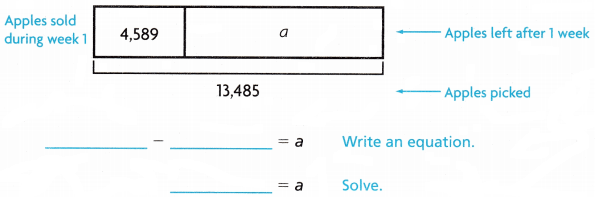
STEP 1 Find how many apples were left after week 1.
Texas Go Math Grade 4 Lesson 11.2 Answer Key Multi-Step Subtraction Problems 1
Answer:
8,896 apples.

Explanation:
During the harvest, 13485 apples were picked.
Week one, 4,589 apples were sold.
Number of apples left
13,485 – 4,589 = 8,896

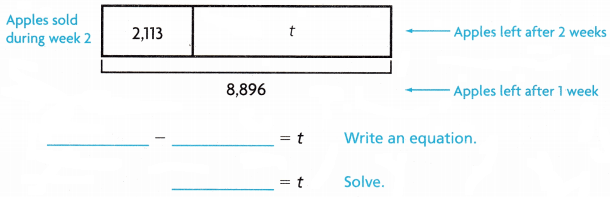
STEP 2 Find how many apples were left after week 2.
Texas Go Math Grade 4 Lesson 11.2 Answer Key Multi-Step Subtraction Problems 2
So, the Yummy Apple Orchard had ___________ apples left after two weeks.
Answer: 6,783

Explanation:
Apples sold during week two = 2,113
Apples left after week one = 8,896
Apples left after week two = 8,896 – 2,113 = 6,783

How does Step I differ from Step 2?
Answer:
In step two we find the apples left in week one.
In step two we find apples left in week two.

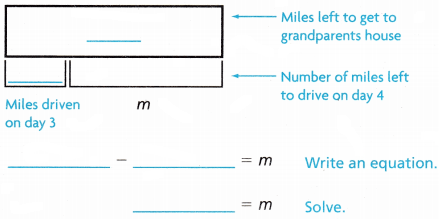
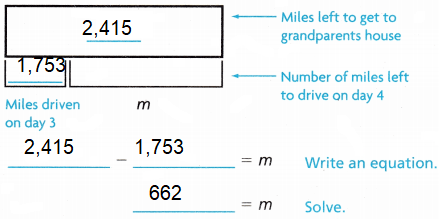
Greg and his family are driving 4 days to visit his grandparents. They live 2,415 miles from Greg. The first 2 days they drove 1,141 miles. The third day they drove 612 miles. How many more miles do they have to drive on the fourth day?
Answer:
662 miles.
Explanation:
Greg and his family are driving 4 days to visit his grandparents.
They live 2,415 miles from Greg.
The first 2 days they drove 1,141 miles.
The third day they drove 612 miles.
Total miles they drove for 3 days 612+ 1,141 = 1,753
Number of miles they have to drive on the fourth day 2,415 – 1,753 = 662 miles.

Example 2

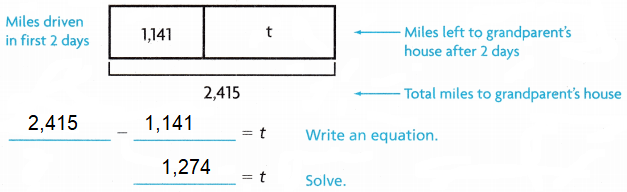
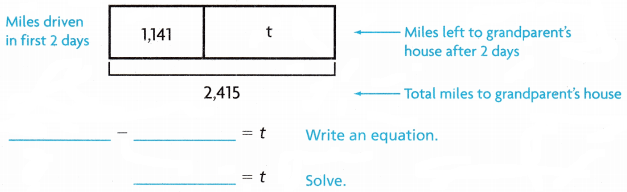
STEP 1 Find how many miles are left after 2 days of driving.
Texas Go Math Grade 4 Lesson 11.2 Answer Key Multi-Step Subtraction Problems 3
Answer: 1,274
Explanation:

STEP 2 Find how many more miles they have to drive on the fourth day.
Texas Go Math Grade 4 Lesson 11.2 Answer Key Multi-Step Subtraction Problems 4
So, Greg’s family drove _____________ more miles on the fourth day.
Answer:
662 miles on fourth day.
Explanation:
Math Talk

Mathematical Processes
Explain why it takes more than one step to solve the problem in Example 2.
Answer:
As we have to find the total distance he travelled on the third day also.

Share and Show

Go Math Lesson 11.2 Answer Key 4th Grade Question 1.
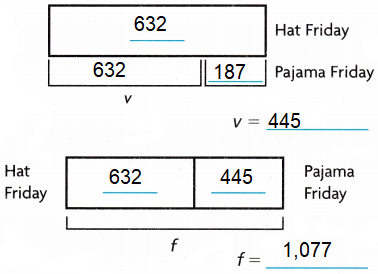
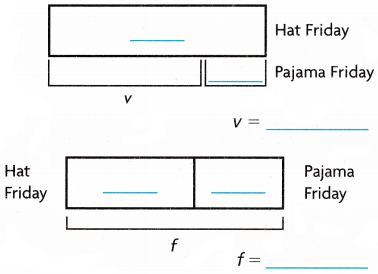
During a school-wide vote, 632 students voted for Hat Friday. Pajama Friday received 187 fewer votes than Hat Friday. How many students voted?
Texas Go Math Grade 4 Lesson 11.2 Answer Key Multi-Step Subtraction Problems 5
Answer: 1,077

Explanation:
During a school wide vote, 632 students voted for Hat Friday.
Pajama Friday received 187 fewer votes than Hat Friday.
632 – 187 = 445
Total students voted 632 + 445 = 1,077

a. First, find how many students voted for Pajama Friday.
So, ____________ students voted for Pajama Friday.
Answer:
445 students
Explanation:
During a school wide vote, 632 students voted for Hat Friday.
Pajama Friday received 187 fewer votes than Hat Friday.
632 – 187 = 445

b. Next, find the total number of students Friday who voted.
Think: 632 + 445 = f
So, ________ students voted.
Answer:
1,077 students voted.
Explanation:
During a school wide vote, 632 students voted for Hat Friday.
Pajama Friday received 187 fewer votes than Hat Friday.
632 – 187 = 445
Total students voted 632 + 445 = 1,077

Problem Solving

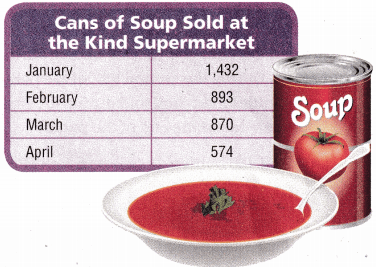
For Problems 2-3, use the chart.
Texas Go Math Grade 4 Lesson 11.2 Answer Key Multi-Step Subtraction Problems 6

Go Math 4th Grade Lesson 11.2 Answer Key Question 2.
The Kind Supermarket had 5,213 cans of soup at the beginning of January. How many cans of soup did the Kind Supermarket have after February?
Answer:
2,888 soup cans.
Explanation:
The Kind Supermarket had 5,213 cans of soup at the beginning of January.
Number of soup cans sold in the month of January 1,432
Leftover soup cans at the end of the January month 5,213 – 1,432 = 3,781
Number of soup cans sold in the month of February 893
Number of soup cans at the Kind Supermarket after February
3,781 – 893 = 2,888 cans

Question 3.
If the Kind Supermarket sold 189 less cans of soup in May than in April, how many cans of soup did they sell during April and May?
Answer:
959 can o soup in the month of April and May.
Explanation:
If the Kind Supermarket sold 189 less cans of soup in May than in April,
Number of soup cans in April = 574
Number of soup cans in May = 574 – 189 = 385
Total cans of soup they sell during April and May
574 + 385 = 959 cans

Question 4.
Texas Go Math Grade 4 Lesson 11.2 Answer Key Multi-Step Subtraction Problems 7
H.O.T. Apply Multi-Step During the first week of a game’s launch, an electronic store sold 275 copies of the game. During the second week, they sold 295 copies of the game. They sold some copies of the game during the third week. After the first three weeks, the electronic store sold 984 copies of the game. How many copies of the game did they sell during week 3?
Answer:
414 copies of game.
Explanation:
During the first week of a game’s launch, an electronic store sold 275 copies of the game.
During the second week, they sold 295 copies of the game.
Total copies of game sold in 2 weeks = 275 + 295 = 570
They sold some copies of the game during the third week.
After the first three weeks, the electronic store sold 984 copies of the game.
Total copies of the game they sell during week 3
984 – 570 = 414 copies of game.

Question 5.
H.O.T. What’s the Error? Ken vent to the Planters Nursery to buy some trees for his backyard. He wanted to spend more than $300 for the trees. The first tree he bought was $175. The second tree he bought was $25 less than the first tree. Those were the only two item s that Ken bought. Ken said that he spent less than he wanted to. Is he correct? Explain his error.
Answer:
Yes, ken is correct.
He spent less than he wanted to spend.
Explanation:
Ken wanted to spend more than $300 for the trees.
The first tree he bought was $175.
The second tree he bought was $25 less than the first tree.
Cost of second tree 175 – 25 = $150

Daily Assessment Task

Fill in the bubble completely to show your answer.

Question 6.
The snack vendors have 500,000 bottles of water to sell during the parade. They sell 128,520 bottles during the first half of the parade. During the second half of the parade, they sell 205,000 more bottles than they sold during the fIrst half. How many unsold bottles are left at the end of the parade?
(A) 166,480 bottles
(B) 37,960 bottles
(C) 371,480 bottles
(D) 379,600 bottles
Answer:
Option(A)
Explanation:
The snack vendors have 500,000 bottles of water to sell during the parade.
They sell 128,520 bottles during the first half of the parade.
During the second half of the parade, they sell 205,000 more bottles than they sold during the fIrst half.
Total bottles sold on second half of the parade
205,000 + 128,520 = 333,520
Total unsold bottles left at the end of the parade
500,000 – 333,520 = 166,480 bottles.

Go Math 4th Grade Lesson 11.2 Answer Key Question 7.
The flag company makes 750,000 flags. They sell 405,200 flags for Memorial Day and 125,475 flags for Flag Day. How many flags do they have left to sell for the Fourth of July?
(A) 470,275 flags
(B) 230,475 flags
(C) 219,325 flags
(D) 220,435 flags
Answer:
Option(A)
Explanation:
The flag company makes 750,000 flags.
They sell 405,200 flags for Memorial Day and
125,475 flags for Flag Day.
Total flags sold on both days
405,200 + 125,475 = 279,725
Total flags they have left to sell for the Fourth of July
750,000 – 279,725 = 470,275 flags.

Question 8.
Multi-Step Katie buys 125,000 beads. She uses 108246 to make bracelets. She goes back to the store and buys 100,000 more beads than she bought the first time. How many beads does Katie have now to make bracelets?
(A) 241,754 beads
(B) 208,246 beads
(C) 116,754 beads
(D) 6,754 beads
Answer:
Option(B)
Explanation:
Katie buys 125,000 beads.
She uses 108246 to make bracelets.
Left over beads 125,000 – 108,246 = 16,754
She goes back to the store and buys 100,000 more beads than she bought the first time.
100,000 + 125,000 = 225,000
Total beads Katie have now to make bracelets
225,000 – 16,754 = 208,246 beads.

TEXAS Test Prep.

4th Grade Answer Key Go Math Lesson 11.2 Question 9.
Melinda saved 456 pennies one week, 374 pennies the second week, and some more pennies during the third week. Together Melinda saved 1,245 pennies during those three weeks. How many pennies did Melinda save during the third week?
(A) 615
(B) 415
(C) 2,075
(D) 525
Answer:
Option(B)
Explanation:
Melinda saved 456 pennies one week,
374 pennies the second week, and some more pennies during the third week.
Together Melinda saved 1,245 pennies during those three weeks.
Total pennies Melinda save during the third week
1,245 – 830 = 415 pennies.

Texas Go Math Grade 4 Lesson 11.2 Homework and Practice Answer Key

Multi-Step Subtraction Problems 1

Question 1.
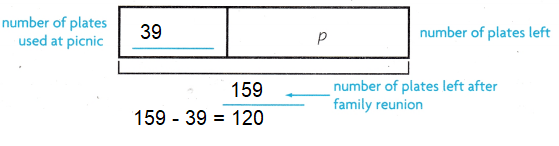
Louis bought a package of 500 paper plates. He used 341 of them at a family reunion. He used 39 for a picnic. How many paper plates does he have left?
Answer:
120 paper plates.
Explanation:
Louis bought a package of 500 paper plates.
He used 341 of them at a family reunion.
He used 39 for a picnic.
Total paper plates left 500 – (341 + 39) = 500 – 380 = 120

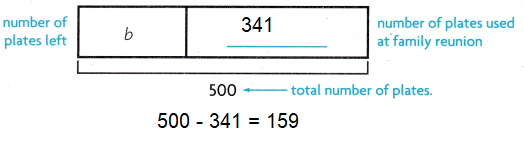
a. Find the number of paper plates that were left after the reunion.

Texas Go Math Grade 4 Lesson 11.2 Answer Key Multi-Step Subtraction Problems 8
500 – ____________ = b
b = ______________ plates left after reunion
Answer:
159 plates
Explanation:
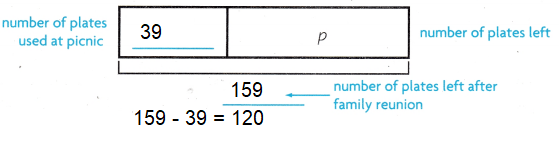
b. Find the number of plates that were left after the picnic
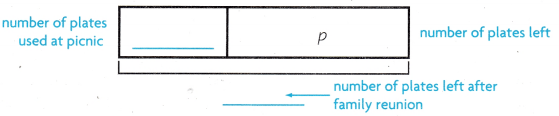
Texas Go Math Grade 4 Lesson 11.2 Answer Key Multi-Step Subtraction Problems 9
159 – ___________ = p
p = _____________ plates left after the picnic
Answer:
120plates
Explanation:
Problem Solving

Use the chart for problems 2-4.
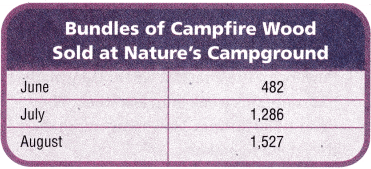
Texas Go Math Grade 4 Lesson 11.2 Answer Key Multi-Step Subtraction Problems 10

Go Math Practice and Homework Lesson 11.2 Answer Key Question 2.
At the beginning of June, Nature’s Campground had 3,450 bundles of campfire wood. How many bundles were left at the end of July?
Answer:
2,164 bundles
Explanation:
At the beginning of June, Nature’s Campground had 3,450 bundles of campfire wood.
The number of bundles of campfirewood in July is 1,286
Total bundles left at the end of July
3450 – 1286 = 2,164

Question 3.
How many bundles of firewood were left at the end of August?
Answer:
1,923 bundles.
Explanation:
Total bundles of firewood in the month of August 1,527
Total bundles of firewood left at the end of August
3450 – 1527 = 1,923

Question 4.
For next year, the campground director wants to make 4,000 new bundles of wood. The crew made 1,238 bundles in September and 1,141 bundles in October. How many more bundles do they need to make?
Answer:
1,621 bundles.
Explanation:
The campground director wants to make 4,000 new bundles of wood.
The crew made 1,238 bundles in September and
1,141 bundles in October.
Total bundles in both the months 1,238 + 1,141 = 2,379
Total bundles they need to make 4,000 – 2,379 = 1,621

Lesson Check

Fill in the bubble completely to show your answer.

Question 5.
Multi-Step It is 1,262 miles from Webster’s house to his aunt’s house. He drove 416 miles yesterday. The hotel he will stay in tonight is 380 miles from his aunt’s house. How far will he drive today?
(A) 846 miles
(B) 466 miles
(C) 380 miles
(D) 576 miles
Answer:
Option(B)
Explanation:
1,262 miles from Webster’s house to his aunt’s house.
He drove 416 miles yesterday.
The hotel he will stay in tonight is 380 miles from his aunt’s house.
416 + 380 = 796
Total miles he drive today 1,262 – 796 = 466

Question 6.
Multi-Step Eric bought 600 flower bulbs. He bought 280 iris bulbs, 75 tulip bulbs, and the rest are lilies, How many lily bulbs did Eric buy?
(A) 320
(B) 355
(C) 205
(D) 245
Answer:
Option(D)
Explanation:
Eric bought 600 flower bulbs.
He bought 280 iris bulbs,
75 tulip bulbs,
Number of lily bulbs Eric buy
600 – (280 + 75) = 600 – 355 = 245

Question 7.
Multi-Step There were 10,647 tickets sold for a football game. Of those tickets, 872 were box seats and 4,366 were end zone tickets. The rest were sideline tickets. How many sideline tickets were sold?
(A) 5,506
(B) 6,281
(C) 5,409
(D) 6,509
Answer:
Option(C)
Explanation:
There were 10,647 tickets sold for a football game.
Of those tickets, 872 were box seats and 4,366 were end zone tickets.
Number of sideline tickets sold
10,647 – (872+4,366) = 10,647 – 5,238 = 5,409

Go Math Grade 4 Lesson 11.2 Homework Answers Question 8.
Multi-Step Mindy needs to score 500,000 points or more in three games to move to the next level in her computer game. She scored 173,211 points in the first game and 155,963 points in the second game. What is the fewest points she can score in the third game to go on to the next level?
(A) 170,826
(B) 326,789
(C) 171,826
(D) 271,826
Answer:
Option(A)
Explanation:
Mindy needs to score 500,000 points or more in three games to move to the next level in her computer game.
She scored 173,211 points the first game and
155,963 points the second game.
Total points scored in both the games 173,211 + 155,963 = 329,174
The fewest points she can score in the third game to go on to the next level
500,000 – 329,174 = 170,826

Question 9.
Multi-Step The glee club is going to have a float in the parade. They made 437 paper flowers for the float last week. They made 322 more this week than last week. They need 1,250 flowers. how many more do they need to make?
(A) 759
(B) 169
(C) 54
(D) 491
Answer:
Option(D)
Explanation:
The glee club made 437 paper flowers for the float last week.
They made 322 more this week than last week.
Total flowers made in both weeks 437 + 322 = 759
They need 1,250 flowers.
Number of more paper flowers they need to make
1,250 – 759 = 491

Go Math 4th Grade 11.2 Homework Answers Question 10.
Multi-Step Last week Sandra spent $247 of her savings on a new DVD player. Today, she put $562 into her savings account. Now she has $951 in the account. How much money did she have in the account before she bought the DVD player?
(A) $636
(B) $142
(C) $1,266
(D) $746
Answer:
Option(A)
Explanation:
Last week Sandra spent $247 of her savings on a new DVD player.
Today, she put $562 into her savings account.
Now she has $951 in the account.
Total money she had in the account before she bought the DVD player
$247 + ($951 – $562) = $247 + $389 = $636

Texas Go Math Grade 4 Lesson 11.2 Answer Key Multi-Step Subtraction Problems Read More »

Texas Go Math Grade 7 Lesson 5.1 Answer Key Probability

Refer to our Texas Go Math Grade 7 Answer Key Pdf to score good marks in the exams. Test yourself by practicing the problems from Texas Go Math Grade 7 Lesson 5.1 Answer Key Probability.

Texas Go Math Grade 7 Lesson 5.1 Answer Key Probability

Texas Go Math Grade 7 Lesson 5.1 Explore Activity Answer Key

Finding the Likelihood of an Event

Each time you roll a number cube, a number from 1 to 6 lands face up. This is called an event.

Work with a partner to decide how many of the six possible results of rolling a number cube match the described event.

Then order the events from least likely (1) to most likely (9) by writing a number in each box to the right.

Rolling a number less than 7 ______________ Texas Go Math Grade 7 Lesson 5.1 Answer Key 1
Rolling an 8 ______________ Texas Go Math Grade 7 Lesson 5.1 Answer Key 1
Rolling a number greater than 4 ______________ Texas Go Math Grade 7 Lesson 5.1 Answer Key 1
Rolling a 5 ______________ Texas Go Math Grade 7 Lesson 5.1 Answer Key 1
Rolling a number other than 6. ______________ Texas Go Math Grade 7 Lesson 5.1 Answer Key 1
Rolling an even number ______________ Texas Go Math Grade 7 Lesson 5.1 Answer Key 1
Rolling a number less than 5 ______________ Texas Go Math Grade 7 Lesson 5.1 Answer Key 1
Rolling an odd number ______________ Texas Go Math Grade 7 Lesson 5.1 Answer Key 1
Rolling a number divisible by 3. ______________ Texas Go Math Grade 7 Lesson 5.1 Answer Key 1

Reflect

Question 1.
Are any of the events impossible?.
Answer:
Rolling an 8 is impossible because the number cube has numbers from 1 to 6.

Probability 1

Go Math Grade 7 Lesson 5.1 Answer Key Question 2.
The probability of event A is \(\frac{1}{3}\). The probability of event B is \(\frac{1}{4}\). What can you conclude about the two events?
Answer:
The probability od event A is lower than \(\frac{1}{2}\), so this event is unlikely to happen.
Because od the same reason, event B is also unlikely to happen.
But, \(\frac{1}{3}\) is greater than \(\frac{1}{4}\), se event A is more likely to happen than event B.

Your Turn

Question 3.
A hat contains pieces of paper marked with the numbers 1 through 16. Tell whether picking an even number is impossible, unlikely, as likely as not, likely, or certain. Tell whether the probability is 0, close to 0, \(\frac{1}{2}\), close to 1, or 1.
Answer:
This event is as likely as not
The probability is \(\frac{1}{2}\).

Find each probability. Write your answer in simplest form.

Question 4.
Picking a purple marble from a jar with 10 green and 10 purple marbles. ____________________
Answer:
Jar has 20 marbles, ten green, and ten purple.
Texas Go Math Grade 7 Lesson 5.1 Answer Key 3
The probability of picking a purple marble is \(\frac{1}{2}\).

Question 5.
Rolling a number greater than 4 on a standard number cube.
Answer:
Samp[e space for a standard number cube is {1, 2, 3, 4, 5, 6}.
Texas Go Math Grade 7 Lesson 5.1 Answer Key 4
The probability of rolling a number greater than 4 is \(\frac{1}{3}\).

Reflect

Question 6.
Why do the probability of an event and the probability of its complement add up to 1 ?
Answer:
The probability of an event and the probability of its complement add up to 1 because the total events are the even itself and its compliment, so its probability equal to 1 because these are all the possible events that will. occur.

Your Turn

Probability Answer Key Texas Go Math Grade 7 Question 7.
A jar contains 8 marbles marked with the numbers 1 through 8. You pick a marble at random. What is the probability of not picking the marble marked with the number 5? __________
Answer:
Sum of probability from some event and his complement is equal 1.
P(Event) + P(Complement) = 1
Event in this problem is picking the marble with number five.
Complement is not to pick marble with number five.
P(Picking marble with number five) + P(Complement) = 1
We have 8 marbles.Probability to pick marble with number 5 is \(\frac{1}{8}\).
\(\frac{1}{8}\) + P(Complement) = 1
Write one as \(\frac{8}{8}\).
Subtract \(\frac{1}{8}\) from both sides in equality.
\(\frac{1}{8}\) + P(Complement) – \(\frac{1}{8}\) = \(\frac{8}{8}\) – \(\frac{1}{8}\)
P(Not to pick marble with number five) = \(\frac{7}{8}\)

Question 8.
You roll a standard number cube. Use the probability of rolling an even number to find the probability of rolling an odd number. __________
Answer:
The sum of the probabiLities of an event and its complement equals 1.
First, find the probability of rolling an even number
Sample space for a standard number cube is {1, 2. 3, 4, 5, 6} and number of ways to roll an even number is 3.
Texas Go Math Grade 7 Lesson 5.1 Answer Key 5
The probability of rolling an even number is \(\frac{1}{2}\).
The probability of not rolling an even number is the same as the probability of rolling an odd number.
Hence,
P(even number) + P(odd number) = 1 Substitute \(\frac{1}{2}\) for P(even number)
\(\frac{1}{2}\) + P(odd number) = 1 Subtract \(\frac{1}{2}\) from both sides
P(odd number) = 1 – \(\frac{1}{2}\)
P(odd number) = \(\frac{1}{2}\)
The probability of rolling an odd number is \(\frac{1}{2}\).

Texas Go Math Grade 7 Lesson 5.1 Guided Practice Answer Key

Question 1.
In a hat, you have index cards with the numbers 1 through 10 written on them. Order the events from least likely to happen (1) to most likely to happen (8) when you pick one card at random. In the boxes, write a number from 1 to 8 to order the eight different events. (Explore Activity)
You pick a number greater than 0. Texas Go Math Grade 7 Lesson 5.1 Answer Key 1
You pick an even number. Texas Go Math Grade 7 Lesson 5.1 Answer Key 1
You pick a number that is at least 2. Texas Go Math Grade 7 Lesson 5.1 Answer Key 1
You pick a number that ¡s at most 0. Texas Go Math Grade 7 Lesson 5.1 Answer Key 1
You pick a number divisible by 3. Texas Go Math Grade 7 Lesson 5.1 Answer Key 1
You pick a number divisible by 5. Texas Go Math Grade 7 Lesson 5.1 Answer Key 1
You pick a prime number. Texas Go Math Grade 7 Lesson 5.1 Answer Key 1
You pick a number less than the greatest prime number. Texas Go Math Grade 7 Lesson 5.1 Answer Key 1
Answer:
Write events from Least likeLy to happen to the most likely to happen.

The least likely to happen event is that you pick a number that is the most 0, because all of the numbers from 1 to 10 are greater than 0.

Next is event that you pick a number divisible by 5, because there is only 2 numbers (10, 5) from 1 to 10 that is divisible by 5

Next is event that you pick a number divisible by 3, because there is 3 numbers (3, 6, 9) from 1 to 10 that is divisible by 3
Next is event that you pick a prime number, because there is 4 prime numbers (2, 3, 5, 7) from 1 to 10.

Next is event that you pick a even number, because there is 5 prime numbers (2, 4, 6. 8. 10) from 1 to 10.

Next is event that you pick a number less than the greatest prime number, because the greatest prime number from 1 to 10 is 7 and there is 6 numbers (1, 2, 3, 4, 5, 6) from 1 to 10 Less than 7.

Next is event that you pick a number that is the least 2, because except number 1 all of the numbers from 1 to 10, are at least 2.

The most likely to happen event is that you pick a number greater than 0, because all the numbers from 1 to 10, are greater than 0.
8, 5, 7, 1, 3, 2, 4, 6

Determine whether each event is impossible, unlikely, as likely as not, likely, or certain. Then, tell whether the probability is 0, close to 0, \(\frac{1}{2}\), close to 1, or 1. (Example 1)

Probability Test Answer Key Go Math 7 Grade Question 2.
randomly picking a green card from a standard deck of playing cards.
Answer:
Event is impossible, because there is no green cards in standard deck of playing cards.
The probability is 0.

Probability 2

Question 3.
randomly picking a red card from a standard deck of playing cards
Answer:
There is 26 red cards in standard deck of playing cards.
Find the probability of picking red card from the standard deck of playing cards.
Texas Go Math Grade 7 Lesson 5.1 Answer Key 6
= \(\frac{26}{52}\)
= \(\frac{1 \cdot 26}{2 \cdot 26}\)
= \(\frac{1}{2}\)
The probabiLity of picking red card from the standard deck of playing cards is \(\frac{1}{2}\).
Event is as likely as not.

Question 4.
picking a number less than 15 from a jar with papers labeled from 1 to 12
Answer:
Event is certain because all the numbers from 1 to 12 are less than 15.
Hence, the probability is 1.

Question 5.
picking a number that is divisible by 5 from a jar with papers labeled from 1 to 12
Answer:
There is 2 numbers from 1 to 12 that are divisible by 5, and that numbers are 5 and lo.
Find the probability of picking a number that is divisible by 5.
Texas Go Math Grade 7 Lesson 5.1 Answer Key 7
= \(\frac{2}{12}\)
= \(\frac{1 \cdot 2}{6 \cdot 2}\)
= \(\frac{1}{6}\)
The probability of picking a number that is divisible by 5 is \(\frac{1}{6}\).
This event is unlikely to occur.

Find each probability. Write your answer in the simplest form. (Example 2)

Algebra 1 with Probability Answer Key Go Math Grade 7 Question 6.
Spinning a spinner that has 5 equal sections marked 1 through 5 and landing on an even number. Use a tree diagram to find the sample space.
Answer:
Texas Go Math Grade 7 Lesson 5.1 Answer Key 8
Texas Go Math Grade 7 Lesson 5.1 Answer Key 9
P(land on even number) = \(\frac{2}{5}\)

Question 7.
Picking a diamond from a standard deck of playing cards which has 13 cards in each of four suits: spades, hearts, diamonds and clubs.
Answer:
A standard deck of playing cards has 13 cards in diamonds.
Find the probability of picking a diamond.
Texas Go Math Grade 7 Lesson 5.1 Answer Key 10
= \(\frac{13}{52}\)
= \(\frac{1 \cdot 13}{4 \cdot 13}\)
= \(\frac{1}{4}\)
The probability of picking a diamond from a standard deck of playing cards is \(\frac{1}{4}\).

Use the complement to find each probability. (Example 3)

Question 8.
What is the probability of not rolling a 5 on a standard number cube?
Answer:
The sum of the probabilities of an event and ¡ts complement equals 1.
First, find the probability of rolling a number 5 on a standard number cube.
Sample space for a standard number cube is {1, 2, 3, 4, 5, 6}.
Texas Go Math Grade 7 Lesson 5.1 Answer Key 11
= \(\frac{1}{6}\)
The probability of rolling a number 5 is \(\frac{1}{6}\).
P(number 5) + P(not number 5) = 1 Substitute \(\frac{1}{6}\) for P(number 5)
\(\frac{1}{6}\) + P(not number 5) = 1 Subtract \(\frac{1}{6}\) from both sides.
P(not number 5) = 1 – \(\frac{1}{6}\)
P(not number 5) = \(\frac{5}{6}\)
The probability of not rolling number 5 is \(\frac{5}{6}\).
This event is likely to occur.

Question 9.
A spinner has 3 equal sections that are red, white, and blue. What is the probability of not landing on blue?
Answer:
The sum of the probabilities of an event and its compLement equals 1.
First, find the probability of landing on red or white section. The sum of the red and white section is 2.
P(red or white section) = Texas Go Math Grade 7 Lesson 5.1 Answer Key 12
= \(\frac{2}{3}\)
The probability of landing on red or white section is \(\frac{2}{3}\).
The probability of not landing on red or white section is the same as probability or landing on blue section
P(not red or white section) = P(blue section)

P(red or white) + P(not red or white) = 1 Substitute P(blue) for P(not red or white)
P(red or white section) + P(blue section) = 1 Substitute \(\frac{2}{3}\) for P(red or white section).
\(\frac{2}{3}\) + P(blue section) = 1 Subtract \(\frac{2}{3}\) from both sides.
P(blue section) = 1 – \(\frac{2}{3}\)
P(blue section) = \(\frac{1}{3}\)
The probability of landing on blue section is \(\frac{1}{3}\).
This event is unlikely to occur.

Question 10.
A spinner has 5 equal sections marked 1 through 5. What is the probability of not landing on 4?
Answer:
The sum of the probabilities of an event and its complement equals 1.
P(event) + P(complement) = 1
First, find the probabiLity of Landing on section 4.
The spinner has 5 sections with numbers 1, 2, 3, 4 and 5, hence
P(section 4) = \(\frac{1}{5}\)
P(section 4) + P(not section 4) = 1 Substitute \(\frac{1}{5}\) for P(section 4).
\(\frac{1}{5}\) + P(not section 4) = 1 Subtract \(\frac{1}{5}\) from both sides.
P(not section 4) = 1 – \(\frac{1}{5}\)
P(not section 4) = \(\frac{4}{5}\)
The probability of not landing on section 4 is \(\frac{4}{5}\).
This event is likely to occur.

Go Math Grade 7 Lesson 5.1 Answer Key Question 11.
There are 4 queens in a standard deck of 52 cards. You pick one card at random. What is the probability of not picking a queen?
Answer:
The stint of the probabilities of an event and its complement equals 1.
P(event) + P(complement) = 1
A standard deck of playing cards has 1 queen.
Find the Probability of picking a queen.
P(queen) = Texas Go Math Grade 7 Lesson 5.1 Answer Key 13
= \(\frac{4}{52}\)
= \(\frac{1 \cdot 4}{13 \cdot 4}\)
= \(\frac{1}{13}\)
The probability of picking a queen from a standard deck of playing cards is \(\frac{1}{13}\)
P(queen) + P(not queen) = 1 Substitute \(\frac{1}{13}\) for P(queen).
\(\frac{1}{13}\) + P(not queen) = 1 Subtract \(\frac{1}{13}\) from both sides.
P(not queen) = 1 – \(\frac{1}{13}\)
P(not queen) = \(\frac{12}{13}\)
The probability of not picking a queen from a standard deck of playing cards is \(\frac{12}{13}\).
This event is likely to occur.

Essential Question Check-In

Question 12.
Describe an event that has a probability of 0% and an event that has a probability of 100%.
Answer:
Example for 0% probability: What is probability to extract cherry in a basket in which there are only strawberries.
Example for 100 % probability: Numbers on the cube are: 2, 4, 2, 4, 6, 6. What is probability to roll a an even number?

Texas Go Math Grade 7 Lesson 5.1 Independent Practice Answer Key

Question 13.
There are 4 aces and 4 kings in a standard deck of 52 cards. You pick one card at random. What is the probability of selecting an ace or a king? Explain your reasoning.
Answer:
Find the probability of seLecting a king from a standard deck of playing cards.
P(king) = Texas Go Math Grade 7 Lesson 5.1 Answer Key 14
= \(\frac{4}{52}\)
= \(\frac{1 \cdot 4}{13 \cdot 4}\)
= \(\frac{1}{13}\)
The probability of selecting a king from a standard deck is \(\frac{1}{13}\)
Find the probability of selecting an ace from a standard deck of playing cards.
P(ace) = Texas Go Math Grade 7 Lesson 5.1 Answer Key 15
= \(\frac{4}{52}\)
= \(\frac{1 \cdot 4}{13 \cdot 4}\)
= \(\frac{1}{13}\)
The probability of selecting an ace from a standard deck of playing cards.\(\frac{1}{13}\).

The probability of selecting a king or an ace is the sum of the probability of selecting a king, and the probability of selecting an ace from a standard deck
P(king or ace) = P(king) + P(ace) Substitute \(\frac{1}{13}\) for P(king) and \(\frac{1}{13}\) for P(ace)
P(king or ace) = \(\frac{1}{13}\) + \(\frac{1}{13}\)
P(king or ace) = \(\frac{2}{13}\)
The probability of selecting a king or an ace is \(\frac{2}{13}\).

Lesson 5.1 Answer Key 7th Grade Go Math Question 14.
There are 12 pieces of fruit in a bowl. Seven of the pieces are apples and two are peaches. What is the probability that a randomly selected piece of fruit will not be an apple or a peach? Justify your answer.
Answer:
There is 7 pieces of apple and 2 pieces of peach in a bowl
Find the probability of selecting a piece of apple from a bowl
P(apple) = Texas Go Math Grade 7 Lesson 5.1 Answer Key 16
= \(\frac{7}{12}\)
The probability of selecting a piece of apple from a bowl is \(\frac{7}{12}\)
Find the probability of selecting a piece of peach from a bowl.
P(peach) = Texas Go Math Grade 7 Lesson 5.1 Answer Key 17
= \(\frac{2}{12}\)
The probability of selecting a piece of peach from a bowl is \(\frac{2}{12}\).

The probability of selecting a piece of apple or peach from the bowl is the sum of the probability of selecting an apple, and the probability of selecting a peach from a bowl.
P(apple or peach) = P(apple) + P(peach) Substitute \(\frac{7}{12}\) for P(apple) and \(\frac{2}{12}\) for P(peach)
P(apple or peach) = \(\frac{7}{12}\) + \(\frac{2}{12}\)
P(apple or peach) = \(\frac{9}{12}\)
P(apple or peach) = \(\frac{3 \cdot 3}{4 \cdot 3}\)
P(apple or peach) = \(\frac{3}{4}\)
The probability of selecting apple or peach from a bowl is \(\frac{3}{4}\).

The sum of the probability of an event and its complement equals 1.
P(event) + P(complement) = 1
P(apple or peach) + P(not appLe or peach) = 1 Substitute \(\frac{3}{4}\) for P(apple or peach).
\(\frac{3}{4}\) + P(not apple or peach) = 1 Subtract \(\frac{3}{4}\) from both sides
P(not apple or peach) = 1 – \(\frac{3}{4}\)
P(not apple or peach) = \(\frac{1}{4}\)
The probabiLity of not selecting piece of apple or peach is \(\frac{1}{4}\).

Question 15.
Critique Reasoning For breakfast, Clarissa can choose from oatmeal, cereal, French toast, or scrambled eggs. She thinks that if she selects a breakfast at random, it is likely that it will be oatmeal. Is she correct? Explain your reasoning. Use a tree diagram to determine your sample space.
Answer:
They are equally Likely to choose every dish.
Texas Go Math Grade 7 Lesson 5.1 Answer Key 18

Question 16.
Draw Conclusions A researcher’s garden contains 90 sweet pea plants, which have either white or purple flowers. About 70 of the plants have purple flowers, and about 20 have white flowers. Would you expect that one plant randomly selected from the garden will have purple or white flowers? Explain.
Texas Go Math Grade 7 Lesson 5.1 Answer Key 2
Answer:
Garden contains 90 plants of which about 70 are with purple flowers, and about 20 with white flowers.
Find the probability of selecting the plant with purple flowers.
Texas Go Math Grade 7 Lesson 5.1 Answer Key 19
The probability of selecting the plant with purple flowers is \(\frac{7}{9}\).
Find the probability of selecting the plant with white flowers.
Texas Go Math Grade 7 Lesson 5.1 Answer Key 20
The probability of selecting the plant with white flowers is \(\frac{2}{9}\).

The probability of selecting the plant with purple flowers is greater than the probability of selecting the plant with white flowers, hence, when randomly select plant we expect that the plant will have purple flowers.

Question 17.
The power goes out as Sandra is trying to get dressed. If she has 4 white T-shirts and 10 colored T-shirts in her drawer, is it likely that she will pick a colored T-shirt in the dark? What is the probability she will pick a colored T-shirt? Explain your answers.
Answer:
Sandra has 10 color T-shirts, and 4 white T-shirts.
Total number of T-shirts is 4 + 10 = 14
Find the probability of picking a white T-shirts.
Texas Go Math Grade 7 Lesson 5.1 Answer Key 21
The probability of picking a white T-shirts is \(\frac{2}{7}\).
Find the probability of picking a color T-shirts
Texas Go Math Grade 7 Lesson 5.1 Answer Key 22
The probability of picking a color T-shirts is \(\frac{5}{7}\).

The probability of picking a color T-shirts is greater than the probability of picking a white T-shirts, hence, it is likely that she will pick a color T-shirt in the dark.

Question 18.
James counts the hair colors of the 22 people in his class, including himself. He finds that there are 4 people with brown hair, 8 people with brown hair, and 10 people with black hair. What is the probability that a randomly chosen student in the class does not have red hair? Explain.
Answer:
None of the students have red hair, so the probability of choosing a student with red hair is 0. The complement of this event is the probability of choosing a student who does not have red hair.
The sum of the probability of an event and its complement equals 1.
P(red hair) + P(not red hair) = 1 Substitute 0 for P(red hair)
0 + P(not red hair) = 1
P(not red hair) = 1
The probability of choosing a student who does not have red hair is 1.
Hence, this event is certain.

Probability 4

Question 19.
Persevere in Problem Solving A bag contains 8 blue coins and 6 red coins. A coin is removed at random and replaced by three of the other color.
a. What is the probability that the removed coin is blue?
Answer:
Total number of coins in a bag is 8 + 6 = 14
Find the probability of removing blue coin from a bag.
Texas Go Math Grade 7 Lesson 5.1 Answer Key 23
The probability of removing blue coin from a bag is \(\frac{4}{7}\).

b. If the coin removed is blue, what is the probability of drawing a red coin after three red coins are put in the bag to replace the blue one?
Answer:
If a blue coin is removed, the number of blue coins is now 8 – 1 = 7, and the total number of coins in a bag is 7 + 6 = 13.

Instead of that one blue coin that ¡s removed, we put three red coins.

Now, the total number of red coins in a bag is 6 + 3 = 9, and total number of coins in a bag is 16, 7 of blue ones, and 9 red ones coins.
Texas Go Math Grade 7 Lesson 5.1 Answer Key 24
The probability of drawing a red coin from the bag after three red coins are put in the bag to replace the blue one is \(\frac{9}{16}\).

c. If the coin removed is red, what is the probability of drawing a red coin after three blue coins are put in the bag to replace the red one?
Answer:
c) If a red coin is removed, the number of red coins is now 6 – 1 = 5, and the total number of coins in a bag is 8 + 5 = 13.
Instead of that one red coin that is removed, we put three blue coins.
Now, the total number of bLue coins in a bag is 8 + 3 = 11, and total number of coins in a bag is 16, 11 of blue ones, and 5 red ones coins.
Texas Go Math Grade 7 Lesson 5.1 Answer Key 25
The probability of drawing a red coin from the bag after three bLue coins are put in the bag to replace the red one \(\frac{5}{16}\).

H.O.T. Focus on Higher Order Thinking

Question 20.
Draw Conclusions Give an example of an event in which all of the outcomes are not equally likely. Explain.
Answer:
In the basket are 4 red, 2 white and 7 green balls. Find the probability for each color of a ball to be selected.
Texas Go Math Grade 7 Lesson 5.1 Answer Key 26

Question 21.
Critique Reasoning A box contains 150 black pens and 50 red pens. Jose said the sum of the probability that a randomly selected pen will not be black and the probability that the pen will not be red is 1. Explain whether you agree.
Answer:
Total number of pens in a box is 150 + 50 200.
First, find the probability of selecting black pen, and the probabality of selecting red pen.
Second, find the compliments of these two events, and check whether if their sum is 1 or not
Texas Go Math Grade 7 Lesson 5.1 Answer Key 27
The probability of selecting black pen is \(\frac{3}{4}\).

Texas Go Math Grade 7 Lesson 5.1 Answer Key 28
The probability of selecting red pen is \(\frac{1}{4}\).

The sum of the probabilities of an event and its complement equals 1.
P(event) + P(complement) = 1
P(black pen) + P(not black pen) = 1 Substitute \(\frac{3}{4}\) for P(black pen).
\(\frac{3}{4}\) + P(not black pen) = 1 Subtract \(\frac{3}{4}\) from both sides.
P(not black pen) = 1 – \(\frac{3}{4}\)
P(not black pen) = \(\frac{1}{4}\)
The probability of not selecting black pen is \(\frac{1}{4}\).

P(red pen) + P(not red pen) = 1 Substitute \(\frac{1}{4}\) for P(red pen).
\(\frac{1}{4}\) + P(not red pen) = 1 Subtract \(\frac{1}{4}\) from both sides.
P(not red pen) = 1 – \(\frac{1}{4}\)
P(not red pen) = \(\frac{3}{4}\)
The probability of not selecting red pen is \(\frac{3}{4}\).

P(not black) + P(not red) \(\stackrel{?}{=}\) 1 Substitute \(\frac{1}{4}\) for P(not black) and \(\frac{3}{4}\) for P(not \(\frac{1}{4}+\frac{3}{4} \stackrel{?}{=} 1\)
1 \(\stackrel{?}{=}\) 1
True
The sum of the probability that a randomly selected pen will not be black color and the probability that the pen will not be red is 1.

Question 22.
Communicate Mathematical Ideas A spinner has 7 identical sections. Two sections are blue, 1 is red, and 4 of the sections are green. Suppose the probability of an event happening is \(\frac{2}{7}\). What does each number in the ratio represent? What outcome matches this probability?
Answer:
The numerator in a fraction represents the number of times event occurs, and the denominator represents total number of equaLity likely possible outcomes.

The number 2 shows that the spinner has 2 section with the same color, in this case, blue color, and the number 7 represents the number of sections spinner has.

The outcome that corresponds to this probability is that the spinner lands on a blue section.

Texas Go Math Grade 7 Lesson 5.1 Answer Key Probability Read More »

Texas Go Math Grade 8 Lesson 10.1 Answer Key Surface Area of Prisms

Refer to our Texas Go Math Grade 8 Answer Key Pdf to score good marks in the exams. Test yourself by practicing the problems from Texas Go Math Grade 8 Lesson 10.1 Answer Key Surface Area of Prisms.

Texas Go Math Grade 8 Lesson 10.1 Answer Key Surface Area of Prisms

Your Turn

Question 1.
Sara is lining the bottom and lateral faces of a drawer with liner paper. The dimensions of the inside of the drawer are 1 yard, 20 inches, and 9 inches. What is the total area in square inches being covered?
Answer:
Given,
The dimensions of the inside of the drawer are 1 yard, 20 inches, and 9 inches.
1 yard = 36 inches
We know that,
Total surface area of the prism = 2B + PH
TSA = 2 (36 × 12) + 112 (1)
TSA = 2(720) + 112
TSA = 1552 sq. in
Thus the total surface area is 1552 sq. in

Find the lateral area and total surface area of each prism.

Lesson 10.1 Surface Area of Triangular Prism Answer Key Question 2.
Texas Go Math Grade 8 Lesson 10.1 Answer Key 1
Answer:
Height = 10 cm
Lateral Surface Area of the prism = Perimeter × height
Perimeter = 8 + 6 + 10 = 24 cm
LSA = 24 × 10 = 240 sq. cm
Total surface area of the prism = 2B + PH
B = area of base
A = 1/2 × b × h
A = 1/2 × 8 × 6
A = 24 sq. cm
TSA = 2 (24) + 24 (10)
TSA = 48 + 240
TSA = 288 sq. cm
Thus the Lateral Surface Area of the prism is 240 sq. cm and the Total surface area of the prism is 288 sq. cm

Question 3.
Texas Go Math Grade 8 Lesson 10.1 Answer Key 2
Answer:
Given,
height = 6 in.
Lateral Surface Area of the prism = Perimeter × height
Perimeter = 5 + 6.5 + 6 = 17.5
LSA = 17.5 × 6 = 105 sq. in.
The total surface area of the prism = 2B + PH
B = area of base
A = 1/2 × b × h
A = 1/2 × 5 × 6
A = 15
The total surface area of the prism = 2B + PH
TSA = 2 × 15 + 17.5 × 6
TSA = 30 + 105
TSA = 135 sq. in
Thus the Lateral Surface Area of the prism is 105 sq. in. and the Total surface area of the prism is 135 sq. in

Texas Go Math Grade 8 Lesson 10.1 Guided Practice Answer Key

Find the lateral area and total surface area of each prism. (Example 1)

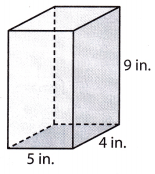
Question 1.
Texas Go Math Grade 8 Lesson 10.1 Answer Key 3
Answer:
Given,
length = 5 in.
width = 4 in.
height = 9 in.
Lateral Surface Area of the prism = Perimeter × height
Perimeter of the base = 2l + 2w
P = 2 × 5 + 2 × 4
P = 10 + 8
P = 18 in
LSA = PH
LSA = 18 × 9
LSA = 162 sq. in
Total surface area of the prism = 2B + PH
B = area of base
Area of base = l . w
A = 5 × 4
A = 20 sq. in
The total surface area of the prism = 2B + PH
TSA = 2 × 20 + 162
TSA = 40 + 162
TSA = 202 sq. in
Thus the Lateral Surface Area of the prism is 162 sq. in. and the Total surface area of the prism is 202 sq. in

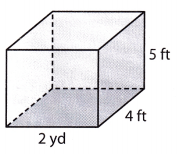
Texas Go Math Grade 8 Surface Area Answer Key Question 2.
Texas Go Math Grade 8 Lesson 10.1 Answer Key 4
Answer:
Given,
length = 2 yd or 6 ft
width = 4 ft.
height = 5 ft.
Lateral Surface Area of the prism = Perimeter × height
Perimeter of the base = 2l + 2w
P = 2 × 6 + 2 × 4
P = 12 + 8
P = 20 ft.
LSA = 20 × 5
LSA = 100 sq. ft
Total surface area of the prism = 2B + PH
B = area of base
Area of base = l . w
A = 6 × 4
A = 24 sq. ft
Total surface area of the prism = 2B + PH
TSA = 2 × 24 + 100
TSA = 48 + 100
TSA = 148 sq. ft
Thus the Lateral Surface Area of the prism is 100 sq. ft. and the Total surface area of the prism is 148 sq. ft

Surface Area of Prisms 0.1

Question 3.
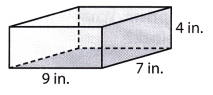
Akira plans to cover the box shown in contact paper. Find the amount of contact paper that Akira needs, not counting overlap. (Example 1)
Texas Go Math Grade 8 Lesson 10.1 Answer Key 5
Answer:
Given,
length = 9 in.
width = 7 in.
height = 4 in.
We know that,
Lateral Surface Area of the prism = Perimeter × height
Perimeter of the base = 2l + 2w
P = 2 × 9 + 2 × 7
P = 18 + 14
P = 32 in.
LSA = 32 × 4
LSA = 128 sq. in.
Total surface area of the prism = 2B + PH
B = area of base
Area of base = l . w
A = 9 × 7
A = 63 sq. in.
Total surface area of the prism = 2B + PH
TSA = 2 × 63 + 128
TSA = 126 + 128
TSA = 254 sq. in
Thus the Lateral Surface Area of the prism is 128 sq. in. and the Total surface area of the prism is 254 sq. in.

Question 4.
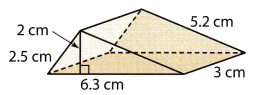
A gift box is in the shape of a triangular prism. How much cardboard is needed to construct the box, not counting overlap? (Example 2)
Texas Go Math Grade 8 Lesson 10.1 Answer Key 6
Answer:
Area of the base = 1/2 × b × h
A = 1/2 × 6.3 × 2
A = 6.3 sq. cm
The perimeter of the base = 6.3 + 5.2 + 2.5 = 14 cm
Lateral Surface Area of the prism = Perimeter × height
LSA = 14 × 2
LSA = 28 sq. cm
Total surface area of the prism = 2B + PH
TSA = 2 × 6.3 + 28
TSA = 12.6 + 28
TSA = 40.6 sq. cm
Thus the Lateral Surface Area of the prism is 28 sq. cm. and the Total surface area of the prism is 40.6 sq. cm.

Essential Question Check-In

Question 5.
What are two ways that you can find the surface area of a prism?
Answer:
The surface area can be calculated in one of two ways.
One way involves using an equation for the lateral area.
Another way involves taking the area of all the sides and summing the areas.

Texas Go Math Grade 8 Lesson 10.1 Independent Practice Answer Key

Find the lateral and total surface area of each prism. Round to the nearest tenth if necessary.

Question 6.
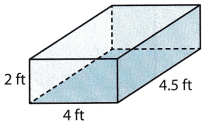
Texas Go Math Grade 8 Lesson 10.1 Answer Key 7
Answer:
Given,
length = 4 ft.
width = 4.5 ft.
height = 2 ft.
We know that,
Lateral Surface Area of the prism = Perimeter × height
Perimeter of the base = 2l + 2w
P = 2 × 4 + 2 × 4.5
P = 8 + 9
P = 17 ft.
Lateral Surface Area of the prism = Perimeter × height
LSA = 17 × 2
LSA = 34 sq. ft
Total surface area of the prism = 2B + PH
B = area of base
Area of base = l . w
A = 4 × 4.5
A = 18 sq. ft.
Total surface area of the prism = 2B + PH
TSA = 2 × 18 + 34
TSA = 36 + 34
TSA = 70 sq. ft
Thus the Lateral Surface Area of the prism is 34 sq. ft. and the Total surface area of the prism is 70 sq. ft.

Surface Area of Prisms Answer Key Lesson 10.1 Question 7.
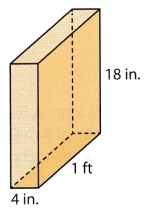
Texas Go Math Grade 8 Lesson 10.1 Answer Key 8
Answer:
Given,
length = 4 in.
width = 1 ft = 12 in.
height = 18 in.
We know that,
Lateral Surface Area of the prism = Perimeter × height
Perimeter of the base = 2l + 2w
P = 2 × 4 + 2 × 12
P = 8 + 24
P = 32 in.
Lateral Surface Area of the prism = Perimeter × height
LSA = 32 × 18
LSA = 576 sq. in
Total surface area of the prism = 2B + PH
B = area of base
Area of base = l . w
A = 4 × 12
A = 48 sq. in.
Total surface area of the prism = 2B + PH
TSA = 2 × 48 + 576
TSA = 96 + 576
TSA = 672 sq. in.
Thus the Lateral Surface Area of the prism is 576 sq. in. and the Total surface area of the prism is 672 sq. in.

Question 8.
Texas Go Math Grade 8 Lesson 10.1 Answer Key 9
Answer:
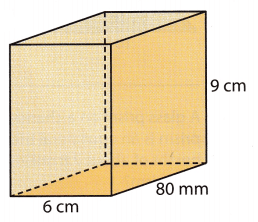
Given,
length = 6 cm
width = 80 mm = 8 cm
height = 9 cm
We know that,
Lateral Surface Area of the prism = Perimeter × height
Perimeter of the base = 2l + 2w
P = 2 × 6 + 2 × 8
P = 12 + 16
P = 28 cm
Lateral Surface Area of the prism = Perimeter × height
LSA = 28 × 9
LSA = 252 sq. cm
Total surface area of the prism = 2B + PH
B = area of base
Area of base = l . w
A = 6 × 8
A = 48 sq. cm.
Total surface area of the prism = 2B + PH
TSA = 2 × 48 + 252
TSA = 96 + 252
TSA = 348 sq. cm.
Thus the Lateral Surface Area of the prism is 252 sq. cm. and the Total surface area of the prism is 348 sq. cm.

Question 9.
Texas Go Math Grade 8 Lesson 10.1 Answer Key 10
Answer:
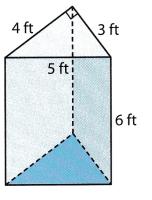
The surface area of the triangular prism = bh + (b1 + b2 + b3)l
h = 4 ft
b =5 ft
b1 = 5 ft
b2 = 4 ft
b3 = 3 ft
l = 6 ft
= 5(4) + (5 + 4 + 3)6
= 20 + 72
= 92 sq.ft.
The surface area of the triangular prism = 92 sq.ft.
Lateral surface area of the triangular prism = (a + b + c)h
a = 5 ft
b = 4 ft
c = 3 ft
h = 6 ft
= (5 + 4 + 3)6 = 72 sq. meter.
The lateral surface area of the triangular prism = 72 sq. meter.

Go Math Grade 8 Lesson 10.1 Lateral Surface Area of a Prism Question 10.
Texas Go Math Grade 8 Lesson 10.1 Answer Key 11
Answer:
The shape is in the form of triangular prism
First find the area of the triangle for 1 base = ½ x bh
Breath = b = 8 cm
Height = h = 7.5 cm
Area of the rectangle for 1 base = ½ × 8 × 7.5 = 30 sq. meter.
Area of the rectangle for 2 bases = 30 × 2 = 60 sq. meter.
Second, find the area of the rectangle for 1 side = b × h
Breath = b = 5 cm.
Height = h = 8.5 cm.
= 5 × 8.5 = 42.5 sq. meter.
For second side = 2 × 42.5 = 85 sq.meter.
For bottom = b × h = 8 × 8.5 = 68 sq.meter.
The total surface area = 60 + 85 + 68 = 213 sq. meter
Lateral surface area of the triangular prism = (a + b + c)h
a = 8 cm
b = 8.5 cm
c = 5 cm
h = 7.5
= (8 + 8.5 + 5)7.5 = 161.25 sq. meter.

Question 11.
Texas Go Math Grade 8 Lesson 10.1 Answer Key 12
Answer:
Formula for the surface area of a triangle = SA = ph + 2B
P = 15 + 14 + 13 = 42
H = 1 ft = 12 inches
B = ½ bh
B = ½ x 42 x 12 = 252 sq. inches.
SA = ph + 2B
SA = 42 x 12 + 2(252)
SA for triangle = 1008 sq. inches.
Surface area of the rectangle
SA = 2(h + b) = 2(12 + 14) = 52 sq. inches.
Surface area of the triangular prism = surface area of a triangle + surface area of the rectangle
= 1008 + 52 = 1060 square inches.
Lateral surface area of the triangular prism = (a + b + c)h.
a = 15 inches.
b = 14 inches.
c = 13 inches.
h = 12 inches.
= (15 + 14 + 13)12 = 504 sq. meter.

Question 12.
The bases of a prism are right triangles with side lengths 6 meters, 8 meters, and 10 meters. The height of the prism is 3 meters. What is the lateral area of the prism? What is the total surface area?
Answer:
Given,
The bases of a prism are right triangles with side lengths of 6 meters, 8 meters, and 10 meters.
The height of the prism is 3 meters.
S1 = 6 m
S2 = 8 m
S3 = 10 m
h = 3 m
Lateral Surface Area of the prism = Perimeter × height
Perimeter = 6 + 8 + 10 = 24 m
LSA = 3 × 24
LSA = 72 sq. meters
Total surface area of the prism = 2B + PH
B = area of base
B = (6m × 8m)/2 = 48/2 = 24 m²
SA = 2(24m²) + 72m²
SA = 48 m² + 72 m²
SA = 120 m²

Question 13.
A rectangular prism has a length of 8 inches and a width of 7 inches. The lateral area is 150 square inches. What is the height of the prism?
Answer:
Given,
A rectangular prism has a length of 8 inches and a width of 7 inches.
The lateral area is 150 square inches
Lateral Surface Area of the prism = Perimeter × height
Perimeter of the base = 2l + 2w
P = 2 (7 + 8)
P = 2 × 15
P = 30
Lateral Surface Area of the prism = Perimeter × height
150 = 30 × h
h = 150/30
h = 5
Thus the height of the prism is 5 in.

Surface Area of Prisms 0.2

Question 14.
Multiple Representations Write a formula for the total surface area of a cube in terms of its edge length x. Explain your reasoning.
Answer:
the surface area of a cube
cube=6 squares
square=2 equal sides
area of square=side²
the surface area of cube=6(area of square)=6side²
side=x
SA=6x²

Question 15.
Multistep Malt bought a tent without a floor. Estimate the surface area of the tent in square feet.
Texas Go Math Grade 8 Lesson 10.1 Answer Key 13
Answer:
The tent is in the shape of triangular prism
First find the area of the triangle for 1 base = ½ x bh
Breath = b = 10ft = 120 inches
Height = h = 63 inches
Area of the rectangle for 1 base = ½ × 120 × 63 = 3780 sq. inches.
Area of the rectangle for 2 bases = 3780 × 2 = 7560 sq. inches
Second find the area of the rectangle for 1 side = b × h
Breath = b = 87 inches
Height = h = 4 yard = 144 inches
= 87 × 144 = 12528 sq. inches.
For second side = 2 × 12528 = 25056 sq. inches.
For bottom = b × h = 120 × 63 = 7560 sq.inches.
The total surface area = 3780 + 25056 + 7560 = 36396 sq. inches
36396 sq. inches = 252.75 sq. feet.
The total surface area of the tent = 252.75 sq. feet.

Surface Area of Prism Answer Key Grade 8 Question 16.
Multistep Keeshawn is building a box with a lid out of plywood with the dimensions shown. Plywood costs $0.50 per square foot. Find the cost of the plywood Keeshawn needs for the box.
Texas Go Math Grade 8 Lesson 10.1 Answer Key 14
Answer:
Area of a box = l × b × h
Length = 24 inches = 2ft
Breadth = 1 yd = 3ft
Height = 4ft
= 2 × 3 × 4
= Area of the box = 24 square ft
The cost of plywood = $0.50 per square foot
= 24 × $0.50 = $12.
The cost of plywood for the total box = $12.

Question 17.
A glass prism on a chandelier is 75 millimeters long. The base of the prism is an equilateral triangle with side lengths of 9 millimeters and a height of about 7.8 millimeters. What is the approximate surface area of the prism?
Answer:
Given,
A glass prism on a chandelier is 75 millimeters long.
The base of the prism is an equilateral triangle with side lengths of 9 millimeters and a height of about 7.8 millimeters
Area of the equilateral triangle:
1/2 × 7.8 × 9
There are two triangles – one on each end. So we multiply our previous expression by 2.
1/2 × 7.8 × 9 × 2
= 7.8 × 9
Each rectangle is 75 millimeters long and 9 millimeters wide: 75×9 sq. mm
We have 3 rectangles each the same size so we multiply 75×9 by 3.
75×9×3 = 2025
2025 + 70.2 = 2095.2 sq. mm

H.O.T. Focus on Higher Order Thinking

Question 18.
Problem Solving A cube with an edge length of 4 inches is painted on all of its sides. Then the cube is cut into 64 cubes with an edge length of 1 inch. What percent of the total surface area is painted? Explain.
Answer:
Given,
A cube with an edge length of 4 inches is painted on all of its sides.
Then the cube is cut into 64 cubes with an edge length of 1 inch.
Find the surface area of the painted cube.
6(42) = 96 in².
Find the surface area of each of the smaller cubes.
6(12) = 6 in².
Find the total surface area of the smaller cubes.
64(6) = 384 in².
Find the percent of the total surface area painted.
96
384
= 0.25, or 25%.
The total surface area painted is 25%.

Question 19.
Problem Solving The base of a triangular prism is a right triangle whose legs are 7 cm and 24 cm. The height of the prism is 30 cm. What is the lateral area of the prism? Explain how you found your answer.
Answer:
Given,
The base of a triangular prism is a right triangle whose legs are 7 cm and 24 cm.
The height of the prism is 30 cm.
The formula of a lateral area of a triangular prism is 1/2 × PH
The perimeter of a triangle is the total of all sides.
base² = 7² + 24²
base² = 625
b = 25 cm
Therefore base = 25 cm
Perimeter = 7 + 24 + 25 = 56 cm
LSA = 1/2 × 56 × 30 = 840 cm²
Therefore the lateral area of the prism is 840 cm²

Question 20.
Communicate Mathematical Ideas Explain how to find the surface area of the composite figure. Then find its surface area.
Texas Go Math Grade 8 Lesson 10.1 Answer Key 15
Answer:
Formula for the surface area for triangle = SA = ph + 2B
P = 1.8 + 1.8 + 3 = 6.6
H = 3 inches
B = ½ bh
B = ½ x 1 x 3 = 1.5
SA = ph + 2B
SA = 6.6 x 3 + 2(1.5)
SA for triangle = 22.8 sq. inches.
For square
P = 3 + 3 + 3 + 3 = 12
H = 4
B = 3 x 4 = 12
Square = SA = 12(4) + 2(12)
SA = 48 + 24
SA = 72 sq. inches.
Surface area of composite figure = surface area of a triangle + surface area of square
= 22.8 + 72 = 94.8 square inches.

Texas Go Math Grade 8 Lesson 10.1 Answer Key Surface Area of Prisms Read More »

Texas Go Math Grade 6 Lesson 8.4 Answer Key Converting Measurements

Refer to our Texas Go Math Grade 6 Answer Key Pdf to score good marks in the exams. Test yourself by practicing the problems from Texas Go Math Grade 6 Lesson 8.4 Answer Key Solving Converting Measurements.

Texas Go Math Grade 6 Lesson 8.4 Answer Key Converting Measurements

Reflect

Question 1.
Communicate Mathematical Ideas How could you draw a model to show the relationship between feet and inches?
Answer:
1 feet = 12 inches
Texas Go Math Grade 6 Lesson 8.4 Answer Key Converting Measurements 5

Your Turn

Lesson 8.4 Answer Key Go Math 6th Grade Question 2.
The height of a doorway is 2 yards. What is the height of the doorway in inches?
Answer:
Texas Go Math Grade 6 Lesson 8.4 Answer Key Converting Measurements 6

Question 3.
An oak tree is planted when it is 250 centimeters tall. What ¡s this height in meters?
Answer:
1 gallon = 16 cups
\(\frac{\text { gallon }}{\text { cups }}=\frac{1}{16}=\frac{2}{x}\)
2 is a common numerator:
\(\frac{1}{16} \cdot \frac{2}{2}=\frac{2}{x}\)
\(\frac{2}{32}=\frac{2}{x}\)
⇒ x = 32
32 cups of punch

Texas Go Math Grade 6 Lesson 8.4 Guided Practice Answer Key

Use the model below to complete each statement.

Texas Go Math Grade 6 Lesson 8.4 Answer Key Converting Measurements 1

Question 1.
\(\frac{4}{1}=\frac{12}{3}\), so 12 cups = __________ quarts
Answer:
4 cups make up 1 quart, therefore 12 cups will make \(\frac{12}{4}\) = 3 quarts.
12 cups= 3 quarts.

Go Math Lesson 8.4 6th Grade Converting Measurements Question 2.
\(\frac{4}{1}=\frac{48}{12}\), so __________ cups = 12 quarts
Answer:
4 cups make up 1 quart, therefore 12 quart will contain 12 × 4 = 48 cups.
12 quarts = 48 cups.

Use unit rates to solve.

Question 3.
Mary Catherine makes 2 gallons of punch for her party. How many cups of punch did she make?
Answer:
1 gallon is equal to 16 cups so 2 gallons will be equal to 2 × 16 = 32 cups. Therefore, Mary Catherine made 32 cups of punch for her party.

Mary Catherine made 32 cups of punch for her party.

Question 4.
An African elephant weighs 6 tons. What is the weight of the elephant in pounds?
Answer:
1 ton is equal to 2000 pounds so 6 tons will be equal to 6 × 2000 = 12000 pounds. Therefore, the weight of the elephant is 12000 pounds.

The weight of the elephant is 12000 pounds.

Converting Measurements 2

Question 5.
The distance from Jason’s house to school is 0.5 kilometer. What is this distance in meters?
Answer:
Texas Go Math Grade 6 Lesson 8.4 Answer Key Converting Measurements 7

Go Math Practice and Homework Lesson 8.4 Answer Key Question 6.
The mass of a moon rock is 3.5 kilograms. What is the mass of the moon rock in grams?
Answer:
Texas Go Math Grade 6 Lesson 8.4 Answer Key Converting Measurements 8

Use a conversion factor to solve.

Question 7.
1.75 grams ∙ \(\frac{1,000 \mathrm{mg}}{1 \mathrm{~g}}\) = _____________
Answer:
Find the conversion factor.
Write 1000 miligrams = 1 grams as a ratio: \(\frac{1000 \text { miligrams }}{1 \text { grams }}\)
Multiply the given measurement by the conversion factor
1.75 grams ∙ \(\frac{1000 \mathrm{mg}}{1 \mathrm{~g}}\) = ? mg
1.75 grams ∙ \(\frac{1000 \mathrm{mg}}{1 \mathrm{~g}}\) = 1750 mg [Cancel the common unit]
1750 = Final solution

Question 8.
27 millimeters ∙ \(\frac{1 \mathrm{~cm}}{10 \mathrm{~mm}}\) = _____________
Answer:
Find the conversion factor
Write 1 cm t o mm: \(\frac{1 \mathrm{~cm}}{10 \mathrm{~mm}}\)
Multiply the given measurement by the conversion factor
27 mm \(\frac{1 \mathrm{~cm}}{10 \mathrm{~mm}}\) = ? cm
27 mm \(\frac{1 \mathrm{~cm}}{10 \mathrm{~mm}}\) = 2.7 cm [Cancel the common unit]
2.7 = Final solution

Question 9.
A package weighs 96 ounces. What is the weight of the package in pounds?
Answer:
Find the conversion factor
Write 1 pound = 16 ounces as a ratio: \(\frac{1 \text { pound }}{16 \text { ounces }}\)
Multiply the given measurement by the conversion factor
96 ounces \(\frac{1 \text { pound }}{16 \text { ounces }}\) = ? pounds
96 ounces \(\frac{1 \text { pound }}{16 \text { ounces }}\) = 16 pounds [Cancel the common unit]
The weight of the package is 6 pounds
6 = Final, solution

Go Math Converting Measurements

Lesson 8.4 6th Grade Go Math Converting Measurements Question 10.
A jet flies at an altitude of 52,800 feet. What is the height of the jet in miles?
Answer:
Find the conversion factor
Write 1 mile 5280 feet as a ratio: \(\frac{1 \text { mile }}{5280 \text { feet }}\)
Multiply the given measurement by the conversion factor
52800 feet \(\frac{1 \text { mile }}{5280 \text { feet }}\) = ? miles
52800 feet \(\frac{1 \text { mile }}{5280 \text { feet }}\) = 10 miles [Cancel the common unit]
The height of the jet is 10 miles
10 = Final solution

Essential Question Check-In

Question 11.
How do you convert units within a measurement system?
Answer:
Units are interchangeable with each other by the constant of conversion. For example, 1 meter is equal to 100 centimeters, so here 100 is the constant of conversion. Any length in meters is converted to an equivalent length in centimeters by multiplying it by 100. Similarly, any length in centimeters is converted to an equivalent length in meters by dividing it by 100.

Question 12.
What is a conversion factor that you can use to convert gallons to pints? How did you find it?
Answer:
We know that 1 quart is equal to 2 pints and 1 gallon is equal to 4 quarts, so it can be calculated that 1 gallon is equal to 2 × 4 = 8 pints.

1 gallon is equal to 8 pints.

Converting Measurements 4

Question 13.
Three friends each have some ribbon. Carol has 42 inches of ribbon, Tino has 2.5 feet of ribbon, and Baxter has 1.5 yards of ribbon. Express the total length of ribbon the three friends have in inches, feet and yards. ____ inches = ____ feet = ____ yards
Answer:
Carol has 42 inches of ribbon, Tino has 25 feet of ribbon, and Baxter has 15 yards of ribbon. First convert all Lengths to inches, therefore Tino has 2.5 × 12 = 30 inches of ribbon and Baxter has 1.5 × 3 × 12 = 54 inches of ribbon. Total Length in inches is 42 + 30 + 54 = 126.

Divide this length by 12 to convert it to an equivalent length in feet, therefore 126 inches = \(\frac{126}{12}\) = 10.5 feet.

Divide this length by 3 to convert it to an equivalent length in yards, therefore 10.5 inches = \(\frac{10.5}{3}\) = 3.5 feet.

126 inches = 10.5 feet = 3.5 yards.

Go Math Lesson 8.4 6th Grade Converting Measurements

Question 14.
Suzanna wants to measure a board, but she doesn’t have a ruler to measure with. However, she does have several copies of a book that she knows is 17 centimeters tall.

a. Suzanna lays the books end to end and finds that the board is the same length as 21 books. How many centimeters long is the board?
Answer:
The board is the same length as 21 books and the length of the book is 17 centimeters, therefore, the board is 21 × 17 = 357 centimeters long.

b. Suzanna needs a board that is at least 3.5 meters long, Is the board long enough? Explain.
Answer:
357 centimeters can be converted to an equivalent length in meters by dividing by 100, therefore 357 centimeters is equal to \(\frac{357}{100}\) = 3.57 meters. This is greater than the minimum length of board required, so this board is long enough for her use.

Sheldon needs to buy 8 gallons of ice cream for a family reunion. The table shows the prices for different sizes of two brands of ice cream.

Texas Go Math Grade 6 Lesson 8.4 Answer Key Converting Measurements 2

Practice and Homework Lesson 8.4 Answer Key 6th Grade Question 15.
Which size container of Cold Farm ice cream ¡s the better deal for Sheldon? Explain.
Answer:
2 of the 1 options shown display the die rate in dollars per quart, so convert the remaining 2 rates in dollars per quart. There are 2 pints in 1 quart, so 1 pint is equal to \(\frac{1}{2}\) = 0.5 pints. This implies that the rate of ice cream at $2.5 per pint is actually \(\frac{\$ 2.5}{0.5}\) = $5 per quart. Therefore. $4.50 for 1 quart is a better option here.

Question 16.
Multistep Which size and brand of ice cream is the best deal?
Answer:
2 of the 4 options shown display the rate in dollars per quart, so convert the remaining 2 rates in dollars per quart. There are 2 pints in 1 quart, so 1 pint is equal to \(\frac{1}{2}\) = 0.5 pints. This implies that the rate of ice cream at $ 2.5 per pint is actually \(\frac{\$ 2.5}{0.5}\) = $5 per quart.

Step 2
Also, There are i quarts in 1 gallon. This implies that the rate of ice cream at $9.5 per gallon is actually \(\frac{\$ 9.5}{4}\) = $2.375 per quart.

Step 3
The $$$9.50 for 1 gallon from Cone Dreams is the most economicaL option here and so the best deal.

Question 17.
In Beijing in 2008, the Women’s 3,000 meter Steeplechase became an Olympic event. What is this distance in kilometers? ________________
Texas Go Math Grade 6 Lesson 8.4 Answer Key Converting Measurements 3
Answer:
Find the conversion factor
Write 1 km = 1000 meters as a ratio: \(\frac{1 \mathrm{~km}}{1000 \text { meters }}\)
Multiply the given measurement by the conversion factor
3000 meters ∙ \(\frac{1 \mathrm{~km}}{1000 \text { meters }}\) = ? km
3000 meters ∙ \(\frac{1 \mathrm{~km}}{1000 \text { meters }}\) = 3 km [Cancel the common unit]
This distance is 3 kilometers
3 = Final solution

Texas Go Math Grade 6 Answer Key Pdf Lesson 8.4 Question 18.
How would you convert 5 feet 6 inches to inches? _______
Answer:
Find the conversion factor
Write 12 in = 1 feet as a ratio: \(\frac{12 \mathrm{in}}{1 \mathrm{ft}}\)
Multiply the given measurement by the conversion factor
5ft \(\frac{12 \mathrm{in}}{1 \mathrm{ft}}\) = ? in
5ft \(\frac{12 \mathrm{in}}{1 \mathrm{ft}}\) = 60 in [Cancel the common unit]
60 in + 6 in = 66 in [Add the inches]
66 = Final solution

H.O.T. Focus On Higher Order Thinking

Question 19.
Analyze Relationships A Class 4 truck weighs between 14,000 and 16,000 pounds.

a. What is the weight range in tons? _________________
Answer:
There are 2000 pounds in 1 ton. Therefore, 14000 pounds is equal to \(\frac{14000}{2000}\) = 7 tons and 16000 pounds is equal to \(\frac{16000}{2000}\) = 8 tons. Weight range in tons is 7 to 8 tons.

b. If the weight of a Class 4 truck is increased by 2 tons, will it still be classified as a Class 4 truck? Explain.
Answer:
An increase by 2 tons imply an increase by 2000 pounds which will no longer leave it to be a Class 4 truck

Question 20.
Persevere in Problem Solving A football field is shown at right.
Texas Go Math Grade 6 Lesson 8.4 Answer Key Converting Measurements 4

a. What are the dimensions of a football field in feet?
Answer:
There are 3 feet in 1 yard so 53\(\frac{1}{3}\) = 53.\(\overline{3}\) × 3 = 160 feet and 120 × 3 = 360 feet. The dimensions of the field are 120 by 360 feet.

b. A chalk line is placed around the perimeter of the football field. What is the length of this line in feet?
Answer:
The length of this line in feet is 120 + 360 + 120 + 360 = 960 feet

c. About how many laps around the perimeter of the field would equal 1 mile? Explain.
Answer:
There are 5280 feet in 1 mile so \(\frac{5280}{960}\) = 5.5 laps around the field will be equal to 1 mile.

Grade 6 Answer Key Go Math Lesson 8.4 Question 21.
Look for a Pattern What is the result if you multiply the number of cups by \(\frac{8 \text { ounces }}{1 \text { cup }}\) and then multiply the result by \(\frac{1 \text { cup }}{8 \text { ounces }}\)? Give an example.
Answer:
For example, the number of cups is 8.
Texas Go Math Grade 6 Lesson 8.4 Answer Key Converting Measurements 9
The result is equal to the given number of cups.

For example, the number of cups is 16.
Texas Go Math Grade 6 Lesson 8.4 Answer Key Converting Measurements 10
The result is equal to the given number of cups.

Question 22.
Make a Conjecture 1 hour = 3,600 seconds and 1 mile = 5,280 feet. Make a conjecture about how you could convert a speed of 15 miles per hour to feet per second. Then convert.
Answer:
The given rate is \(\frac{15}{1}\), convert each dimension to required units, therefore: \(\frac{15}{1}=\frac{15 \times 5280}{1 \times 3600}\) = 22 feet per second.

15 miles per hour is equal to 22 feet per second.

Texas Go Math Grade 6 Lesson 8.4 Answer Key Converting Measurements Read More »

Texas Go Math Grade 4 Lesson 11.3 Answer Key Solve Multi-Step Problems Using Equations

Refer to our Texas Go Math Grade 4 Answer Key Pdf to score good marks in the exams. Test yourself by practicing the problems from Texas Go Math Grade 4 Lesson 11.3 Answer Key Solve Multi-Step Problems Using Equations.

Texas Go Math Grade 4 Lesson 11.3 Answer Key Solve Multi-Step Problems Using Equations

Essential Question

How can you represent and solve multi-step problems using equations?
Answer:
Algebraic equations can be used in solving problems. unknown number or the number to be find out.
equation is written x = , x is to be find out

Unlock the Problem

Chris’s computer has 3 hard drives with 64 gigabytes of space each, and 2 hard drives with 16 gigabytes of space each. The files on her computer use 78 gigabytes of space. How much hard drive space does her computer have left?

  • Underline the important information.

Answer:
146 gigabytes
Explanation:
Chris’s computer has 3 hard drives with 64 gigabytes of space each,
64 x 3 = 192
2 hard drives with 16 gigabytes of space each.
16 x 2= 32
Total gigabytes he have 192 + 32 = 224
The files on her computer use 78 gigabytes of space.
Total hard drive space does her computer have left
224 – 78 = 146 gigabytes.

One Way Use multiple single-step equations.

STEP 1 Find how much hard drive space is on 3 hard drives with 64 gigabytes of space each.
Texas Go Math Grade 4 Lesson 11.3 Answer Key Multi-Step Subtraction Problems 1
Answer: 192
Explanation:
3 x 64 = n
64+64+64 = 192

STEP 2 Find how much hard drive space is on 2 hard drives with 16 gigabytes of space.
Texas Go Math Grade 4 Lesson 11.3 Answer Key Multi-Step Subtraction Problems 2
Answer: 32
Explanation:
2 x 16 = n
16 + 16 = 32

STEP 3 Find the total hard drive space on the computer
Texas Go Math Grade 4 Lesson 11.3 Answer Key Multi-Step Subtraction Problems 3
Answer: 224
192 + 32 = a
224 = a

STEP 4 The files use 78 gigabytes of space. Find how much hard drive space the computer has left.
Texas Go Math Grade 4 Lesson 11.3 Answer Key Multi-Step Subtraction Problems 4
Answer: 146
Explanation:
224 – 78 = y
146 = y

Share and Show

Go Math Lesson 11.3 4th Grade Answer Key Question 1.
Carnie and Doug have cookies to sell at a bake sale. Carnie makes 3 batches of 17 cookies each and Doug makes 3 hatches of 20 cookies each, After ten minutes at the bake sale, they sold 32 cookies. How many cookies do Carnie and Doug have left to sell?
Texas Go Math Grade 4 Lesson 11.3 Answer Key Multi-Step Subtraction Problems 5
Answer:
79 cookies.
Explanation:
Carnie makes 3 batches of 17 cookies each
3 x 17 = p = 51
Doug makes 3 hatches of 20 cookies each,
3 x 20 = a = 60
51 + 60 = y =111
After ten minutes at the bake sale, they sold 32 cookies.
Total cookies do Carnie and Doug have left to sell
111 – 32 = n = 79

Question 2.
Tammy buys 3 bags of lollipops, with 12 lollipops in each hag. She also buys 4 bags of gum, with 11 pieces in each hag. How many lollipops and pieces of gum does Tammy have?
Answer:
80 lollipops and pieces of gum.
Explanation:
Tammy buys 3 bags of lollipops, with 12 lollipops in each hag.
12 x 3= 36 lollipops
She also buys 4 bags of gum, with 11 pieces in each hag.
11 x 4 = 44 pieces
Total lollipops and pieces of gum does Tammy have
36 + 44 = 80

Question 3.
Maddox has 4 boxes with 32 marbles in each box. He has 7 boxes with 18 shells in each box. If he gets 20 marbles from a friend, how many marbles and shells does he have?
Answer:
Maddox has 274 marbles and shells.
Explanation:
Maddox has 4 boxes with 32 marbles in each box.
32 x 4 = 128 marbles
He has 7 boxes with 18 shells in each box.
18 x 7 = 126 shells
If he gets 20 marbles from a friend,
128 + 20 = 148
Total marbles and shells he have
126 + 148 = 274

Problem Solving

Go Math Grade 4 Lesson 11.3 Answer Key Question 4.
Mario drove 60 miles to work each day for 5 days. Then he drove 54 miles on both Saturday and Sunday. How many miles did Mario drive during those seven days?
Answer:
Mario drove 408 miles.
Explanation:
Mario drove 60 miles to work each day for 5 days.
60 x 5 = 300 miles.
Then he drove 54 miles on both Saturday and Sunday.
54 x 2 = 108 miles.
Total miles Mario drive during those seven days
300 + 108 =408 miles.

Question 5.
H.O.T. Apply Maggie has 3 binders with 25 stamps in each binder. She has 5 binders with 24 baseball cards in each binder. If she gives 35 stamps to a friend, how many stamps and cards does she have left?
Answer:
Maggie has 160 stamps and cards.
Explanation:
Maggie has 3 binders with 25 stamps in each binder.
25 x 3 = 75 stamps
She has 5 binders with 24 baseball cards in each binder.
24 x 5 = 120 baseball cards
If she gives 35 stamps to a friend,
Number of stamps left with her 75 – 35 = 40
Total stamps and cards she have left 120 + 40 = 160

Math Talk

Mathematical Processes
Explain why in Problem 1 you added during step 3 instead of multiplied.
Answer:
Here in problem 1 “y” represents the number of cookies of Carine and Doug have left to sell.
So, both of the cookies are added.

H.O.T. What’s the Error?

Texas Go Math Grade 4 Lesson 11.3 Answer Key Multi-Step Subtraction Problems 6

Question 6.
Texas Go Math Grade 4 Lesson 11.3 Answer Key Multi-Step Subtraction Problems 7
Multi-Step Dominic has 5 books with 12 postcards in each book. He has 4 boxes with 20 coins in each box. If he gives 15 postcards to a friend, how many postcards and coins does he have?
Answer:
Dominic has 125 postcards and coins.
Explanation:
Dominic has 5 books with 12 postcards in each book.
12 x 5 = 60 post cards
He has 4 boxes with 20 coins in each box.
20 x 4 = 80 coins
If he gives 15 postcards to a friend,
Number of postcards left with him 60 -15 = 45
Total postcards and coins he have 45 + 80 = 125

Texas Go Math Grade 4 Lesson 11.3 Answer Key Multi-Step Subtraction Problems 8
Texas Go Math Grade 4 Lesson 11.3 Answer Key Multi-Step Subtraction Problems 9
Answer:
125 post cards and coins left
Explanation:

Daily Assessment Task

Fill in the bubble completely to show your answer.

Go Math Answer Key Grade 4 Lesson 11.3 Question 7.
Eric is getting his mountain climbing certificate. There are 63 days that Eric climbs for 2 hours, there are 97 days that he climbs for 1 hour, and there are 22 days that he climbs for 3 hours. How many more hours does Eric need to climb until he earns a certificate for climbing 500 hours?
(A) 289 hours
(B) 318 hours
(C) 321 hours
(D) 211 hours
Answer:
Option(D)
Explanation:
There are 63 days that Eric climbs for 2 hours,
63 x 2 = 126 hours
There are 97 days that he climbs for 1 hour,
There are 22 days that he climbs for 3 hours.
22 x 3 = 66 hours
Number of more hours Eric need to climb until he earns a certificate for climbing 500 hours
500 – (126 + 97 + 66) = 500 – 289 = 211

Question 8.
Teresa has 315 photos that she wants to put into albums. She buys 4 albums that hold 24 photos each. There are 3 albums that hold 72 photos each. Teresa plans to put any leftover photos into frames. How many frames will Teresa need to buy?
(A) 3 frames
(B) 13 frames
(C) 0 frames
(D) 5 frames
Answer:
Option(A)
Explanation:
Teresa has 315 photos that she wants to put into albums.
She buys 4 albums that hold 24 photos each.
24 x 4 = 96 photos
There are 3 albums that hold 72 photos each.
72 x 3 = 216
Total frames Teresa need to buy
315 – (96 + 216) = 315 – 312 = 3

Solve Multi-Step Problems Using Equations 0.1

Question 9.
Multi-Step The soccer team sells 54 bagels with cream cheese for $2 each and 36 muffins for $1 each during a bake sale. The coach uses the bake sale money to buy socks for the 14 players at $6 a pair. How much money does the coach have left to buy soccer balls?
(A) $138
(B) $60
(C) $0
(D) $27
Answer:
Option(B)
Explanation:
The soccer team sells 54 bagels with cream cheese for $2 each
54 x 2 = $108
36 muffins for $1 each during a bake sale.
The coach uses the bake sale money to buy socks for the 14 players at $6 a pair.
14 x 6 = $84
Total money does the coach have left to buy soccer balls
(108 + 36) – 84 = 144 – 84 = $60

TEXAS Test Prep

Question 10.
Trina has 2 bags with 14 pinecones in each bag. She has 7 boxes with 15 acorns in each box. If she trades 5 pinecones for 10 acorns, how many pinecones and acorns does she have?
(A) 28
(B) 105
(C) 133
(D) 118
Answer:
Option(D)
Explanation:
Trina has 2 bags with 14 pinecones in each bag.
14 x 2 = 28 pinecones
She has 7 boxes with 15 acorns in each box.
15 x 7 = 105 acorns
If she trades 5 pinecones for 10 acorns,
(28 – 5) + (105 – 10) = 23 + 95 = 118

Texas Go Math Grade 4 Lesson 11.3 Homework and Practice Answer Key

Problem Solving

Question 1.
Rebecca bought a flat of 144 pansies. She planted 3 rows of 16 pansies each. She planted 4 rows of 14 pansies each. How many pansies does she have left to plant?
Texas Go Math Grade 4 Lesson 11.3 Answer Key Multi-Step Subtraction Problems 10
Answer:
p = 40
Explanation:

Practice and Homework Lesson 11.3 Answers 4th Grade Question 2.
Julie packed 18 DVDs in each of 4 boxes. She packed 15 DVDs in each of 5 boxes. She has 8 DVDs left over. How many DVDs does Julie have?
Answer:
Julie have 155 DVDs.
Explanation:
Julie packed 18 DVDs in each of 4 boxes.
18 x 4 = 72
She packed 15 DVDs in each of 5 boxes.
15 x 5 = 75
She has 8 DVDs left over.
Total DVDs she packed 72 + 75 = 147
Number of DVDs does Julie have 147 + 8 = 155

Question 3.
Monty buys 2 adult dinner tickets for $22 each, 2 Senior tickets for $18 each and 3 child tickets for $12 each. How much change will he get from $120?
Answer:
Monty get $4 as change.
Explanation:
Monty buys 2 adult dinner tickets for $22 each,
22 x 2 = $44
2 Senior tickets for $18 each
18 x 2 = $36
3 child tickets for $12 each.
12 x 3 = $36
Total change he get from $120
$120 – ($36 + $36 + $44) = 120 – 116 = $4

Question 4.
John has 4 shelves with 22 dinosaur models on each shelf. He has 3 shelves with 20 dragon models on each shelf. How many more dinosaur models than dragon models does John have?
Answer:
John have 28 more dinosaur models than dragon models .
Explanation:
John has 4 shelves with 22 dinosaur models on each shelf.
22 x 4 = 88
He has 3 shelves with 20 dragon models on each shelf.
20 x 3 = 60
Number of more dinosaur models than dragon models does John have
88 – 60 = 28

Practice and Homework Lesson 11.3 Answer Key Question 5.
Alexis needs 280 screws to finish her deck. She bought 3 boxes of screws with 40 screws in a box. She had 168 screws. How many screws will she have left over when she finishes the deck?
Answer:
8 screws.
Explanation:
Alexis needs 280 screws to finish her deck.
She bought 3 boxes of screws with 40 screws in a box.
40 x 3 = 120
She had 168 screws.
Total screws left when she finishes the deck
(120 + 168) – 280 = 288 – 280 = 8

Lesson Check

Fill in the bubble completely to show your answer.

Question 6.
Multi-Step Erika baked 7 trays of 12 muffins each. Simon baked 5 trays of 18 muffins each. They agreed to make 200 muffins for the school bake sale. How many more muffins do they need to make?
(A) 26
(B) 38
(C) 36
(D) 52
Answer:
Option(A)
Explanation:
Erika baked 7 trays of 12 muffins each.
12 x 7 = 84
Simon baked 5 trays of 18 muffins each.
18 x 5 = 90
They agreed to make 200 muffins for the school bake sale.
Total muffins baked together 84 + 90 = 174
Number of more muffins do they need to make
200 – 174 = 26

Question 7.
Multi-Step Victoria is buying stickers. She bought 3 packages of stars with 24 in each package. She bought 2 packages of rainbows with 16 in each package. She bought 4 packages of hearts with 10 in each package. She used 82 of the stickers to make cards. How many stickers does Victoria have left?
(A) 72
(B) 62
(C) 144
(D) 96
Answer:
Option(B)
Explanation:
Victoria bought 3 packages of stars with 24 in each package.
24 x 3 = 72
She bought 2 packages of rainbows with 16 in each package.
16 x 2 = 32
She bought 4 packages of hearts with 10 in each package.
10 x 4 = 40
Total stickers in packages 72 + 32 + 40 = 144
She used 82 of the stickers to make cards.
Total stickers does Victoria have left
144 -82 = 62

Go Math 4th Grade Lesson 11.3 Homework Answers Question 8.
Multi-Step Willie bagged his potatoes in 18 ten-pound bags, 6 five-pound bags, and 4 twenty-five-pound bags. He has 2 pounds of potatoes left over. How many pounds of potatoes does Willie have?
(A) 358 pounds
(B) 262 pounds
(C) 352 pounds
(D) 362 pounds
Answer:
Explanation:
Willie bagged his potatoes in 18 ten-pound bags = 180
6 five-pound bags = 30
4 twenty-five pound bags = 100
He has 2 pounds of potatoes left over.
Total pounds of potatoes does Willie have
180 + 30 + 100 + 2 = 312 pounds

Solve Multi-Step Problems Using Equations 0.3

Question 9.
Multi-Step Man bought 6 hats for $14 each and 3 belts for $33 each. How much change did he get from $200?
(A) $7
(B) $ 17
(C) $58
(D) $27
Answer:
Option(B)
Explanation:
Man bought 6 hats for $14 each = 14 x 6 =84
3 belts for $33 each = 33 x 3 = 99
Total change did he get from $200
200 – (84 + 99) = 200 – 183 = 17

Question 10.
Multi-Step Carla bought four 64-ounce bottles of juice and three 32-ounce bottles of juice. She used 320 ounces of juice to make punch. How many ounces of juice does Carla have left?
(A) 42 ounces
(B) 52 ounces
(C) 32 ounces
(D) 22 ounces
Answer:
Option(C)
Explanation:
Carla bought four 64-ounce bottles of juice
64 x 4 = 256 ounce
three 32-ounce bottles of juice.
32 x 3 = 96 ounce
Total ounces of juice 256+96 = 352
She used 320 ounces of juice to make a punch.
Total ounces of juice Carla have left
352 – 320 = 32ounces

Go Math Grade 4 Lesson 11.3 Homework Answer Key Question 11.
Multi-Step Alden has 6 bags of balloons with 10 in each bag. 2 bags of 25m each bag 1 bag of 50 balloons, and 14 balloons that are already blown up. How many balloons does Alden have in all?
(A) 160
(B) 146
(C) 174
(D) 107
Answer:
Option(B)
Explanation:
Alden has 6 bags of balloons with 10 in each hag.
10 x 6 = 60 balloons.
2 bags with 25m each bag 1 bag of 50 balloons,
2 x 50 = 100
14 balloons that are already blown up.
Total balloons Alden has in all
(100 + 60 ) – 14 = 160 – 14 = 146

Texas Go Math Grade 4 Lesson 11.3 Answer Key Solve Multi-Step Problems Using Equations Read More »

Texas Go Math Grade 5 Unit 2 Assessment Answer Key

Refer to our Texas Go Math Grade 5 Answer Key Pdf to score good marks in the exams. Test yourself by practicing the problems from Texas Go Math Grade 5 Unit 2 Assessment Answer Key.

Texas Go Math Grade 5 Unit 2 Assessment Answer Key

Vocabulary

Choose the best term from the box.

Vocabulary
common denominator
common multiple

Question 1.
A ___________ is a number that is a multiple of two or more numbers. (p.213)
Answer: A common multiple is a number that is a multiple of two or more numbers.

Concepts and Skills

Use a common denominator to write an equivalent fraction for each fraction. (TEKS 5.3)

Question 2.
\(\frac{2}{5}\), \(\frac{1}{8}\) common
denominator: ______________
Answer:
Given fractions, \(\frac{2}{5}\), \(\frac{1}{8}\)
The denominators and numerators are different here.
\(\frac{2}{5}\) × \(\frac{8}{8}\) = \(\frac{16}{40}\)
\(\frac{1}{8}\) × \(\frac{5}{5}\) = \(\frac{5}{40}\)
Thus the equivalent fractions are \(\frac{16}{40}\), \(\frac{5}{40}\)
Texas Go Math Grade 5 Unit 2 Assessment Answer Key 0.2

Go Math Answer Key Grade 5 Unit 2 Assessment Question 3.
\(\frac{3}{4}\), \(\frac{1}{2}\) Common
denominator: _______________
Answer:
Given fractions, \(\frac{3}{4}\), \(\frac{1}{2}\)
The denominators and numerators are different here.
\(\frac{3}{4}\) × \(\frac{2}{2}\) = \(\frac{6}{8}\)
\(\frac{1}{4}\) × \(\frac{2}{2}\) = \(\frac{2}{8}\)
Thus the equivalent fractions are \(\frac{6}{8}\) and \(\frac{2}{8}\)

Question 4.
\(\frac{2}{3}\), \(\frac{1}{6}\) common
denominator: _____________
Answer:
Given fractions, \(\frac{2}{3}\), \(\frac{1}{6}\)
The denominators and numerators are different here.
\(\frac{2}{3}\) × \(\frac{2}{2}\) = \(\frac{4}{6}\)
\(\frac{1}{6}\) × \(\frac{1}{1}\) = \(\frac{1}{6}\)
Thus the equivalent fractions are \(\frac{4}{6}\) and \(\frac{1}{6}\)

Find the sum or difference. Write your answer in simplest form. (TEKS 5.3.K)

Question 5.
\(\frac{5}{8}\) + \(\frac{5}{8}\)
Answer:
Given,
\(\frac{5}{8}\) + \(\frac{5}{8}\)
The denominators of both the fractions are same.
\(\frac{5}{8}\) + \(\frac{5}{8}\) = (5 + 5)/8 = \(\frac{10}{8}\) = \(\frac{5}{4}\) = 1 \(\frac{1}{4}\)
Texas Go Math Grade 5 Unit 2 Assessment Answer Key 0.3

Question 6.
3\(\frac{2}{3}\) – 1\(\frac{2}{5}\)
Answer:
3 + \(\frac{2}{3}\) – 1 – \(\frac{2}{5}\)
3 – 1 = 2
\(\frac{2}{3}\) – \(\frac{2}{5}\)
\(\frac{2}{3}\) × \(\frac{5}{5}\) – \(\frac{2}{5}\) × \(\frac{3}{3}\)
= \(\frac{10}{15}\) – \(\frac{6}{15}\) = \(\frac{4}{15}\)
Thus, 3\(\frac{2}{3}\) – 1\(\frac{2}{5}\) = 2\(\frac{4}{15}\)

Go Math Answer Key 5th Grade Unit 2 End of Unit Assessment Question 7.
7\(\frac{3}{5}\) + 3\(\frac{9}{20}\)
Answer:
Given,
7\(\frac{3}{5}\) + 3\(\frac{9}{20}\)
7+ \(\frac{3}{5}\) + 3 + \(\frac{9}{20}\)
7 + 3 = 10
\(\frac{3}{5}\) + \(\frac{9}{20}\)
\(\frac{12}{20}\) + \(\frac{9}{20}\) = \(\frac{21}{20}\) = 1 \(\frac{1}{20}\)
10 + 1 + \(\frac{1}{20}\) = 11\(\frac{1}{20}\)

Find the product. Write the product in simplest form. Use a model. (TEKS 5.3.I)

Question 8.
\(\frac{3}{5}\) × 8 = ____________
Answer:
\(\frac{3}{5}\) × 8 = \(\frac{24}{5}\) = 4 \(\frac{4}{5}\)

Question 9.
\(\frac{1}{4}\) × 10 = ____________
Answer:
\(\frac{1}{4}\) × 10 = \(\frac{10}{4}\) = \(\frac{5}{2}\) = 1 \(\frac{1}{2}\)

Question 10.
\(\frac{5}{7}\) × 15 = ____________
Answer:
\(\frac{5}{7}\) × 15 = \(\frac{75}{7}\) = 10 \(\frac{5}{7}\)

Question 11.
\(\frac{5}{6}\) × 2 = ____________
Answer:
\(\frac{5}{6}\) × 2 = \(\frac{10}{6}\) = \(\frac{5}{3}\) = 1 \(\frac{2}{3}\)

Go Math Unit 2 Assessment Answers 5th Grade Question 12.
\(\frac{1}{5}\) × 10 = ____________
Answer:
\(\frac{1}{5}\) × 10 = \(\frac{10}{5}\) = 2

Question 13.
7 × \(\frac{1}{6}\) = ____________
Answer:
7 × \(\frac{1}{6}\) = \(\frac{7}{6}\) = 1 \(\frac{1}{6}\)

Divide. Use a model or strategy. (TEKS 5.3.J, 5.3.L)

Question 14.
2 ÷ \(\frac{1}{3}\) = ____________
Answer:
2 ÷ \(\frac{1}{3}\) = (2 × 3)/1 = 6

Question 15.
1 ÷ \(\frac{1}{5}\) = ___________
Answer:
1 ÷ \(\frac{1}{5}\) = 5

Question 16.
\(\frac{1}{4}\) ÷ 3 = _____________
Answer:
\(\frac{1}{4}\) ÷ 3 = \(\frac{1}{12}\)

Fill in the bubble completely to show your answer.

Question 17.
Natasha bought \(\frac{1}{4}\) pound of green grapes and \(\frac{2}{3}\) pound of red grapes. She ate \(\frac{1}{2}\) pound of the grapes. What is the total amount of grapes Natasha has left? (TEKS 5.3.K)
(A) 1 pound
(B) \(\frac{5}{12}\) pound
(C) \(\frac{3}{7}\) pound
(D) \(\frac{6}{12}\) pound
Answer:
Given,
Natasha bought \(\frac{1}{4}\) pound of green grapes and \(\frac{2}{3}\) pound of red grapes.
She ate \(\frac{1}{2}\) pound of the grapes.
\(\frac{1}{4}\) + \(\frac{2}{3}\) = \(\frac{11}{12}\)
\(\frac{11}{12}\) – \(\frac{1}{2}\) = \(\frac{5}{12}\) pound
Thus the correct answer is option B.

Question 18.
Ashton picked 6 pounds of pecans. He used \(\frac{1}{3}\) of the pecans in a soup recipe. Ashton puts the pecans that are left in \(\frac{1}{4}\)-pound bags. How many bags of pecans does he have? (TEKS 5.3.I, 5.3.L)
(A) 16
(B) 2
(C) 8
(D) 1
Answer:
Given,
Ashton picked 6 pounds of pecans.
He used \(\frac{1}{3}\) of the pecans in a soup recipe. Ashton puts the pecans that are left in \(\frac{1}{4}\)-pound bags.
\(\frac{2}{3}\) × 4 = 4 pounds of pecans left.
4 × 4 = 16 bags
Thus the correct answer is option A.

Texas Go Math Grade 5 End of Unit 2 Assessment Answer Key Question 19.
Isabella has 2\(\frac{1}{4}\) cups of granola and adds 1\(\frac{1}{2}\) cups of raisins. She then adds 1\(\frac{1}{4}\) cups of almonds to the mix. She divides the mix into \(\frac{1}{4}\)-cup servings. How many \(\frac{1}{4}\)-cup servings does she have? (TEKS 5.3.K, 5.3.L)
(A) 1\(\frac{1}{4}\)
(B) 16
(C) 5
(D) 20
Answer:
Isabella has 2\(\frac{1}{4}\) cups of granola and adds 1\(\frac{1}{2}\) cups of raisins.
She then adds 1\(\frac{1}{4}\) cups of almonds to the mix.
She divides the mix into \(\frac{1}{4}\)-cup servings.
2\(\frac{1}{4}\) + 1\(\frac{1}{4}\) + 1 1\(\frac{1}{2}\) = 20 servings
Thus the correct answer is option D.

Question 20.
Melvin walked \(\frac{5}{8}\) mile to the library. He then walked \(\frac{3}{10}\) mile from the library to the store. About how far did Melvin walk? (TEKS 5.3.A)
(A) about 1\(\frac{1}{2}\) miles
(B) about 1 mile
(C) about \(\frac{1}{2}\) mile
(D) about 2 miles
Answer:
Given,
Melvin walked \(\frac{5}{8}\) mile to the library.
He then walked \(\frac{3}{10}\) mile from the library to the store.
= about \(\frac{1}{2}\) mile
Thus the answer is option C.

Fill in the bubble completely to show your answer.

Question 21.
Mrs. Friedmon baked a walnut cake for her class. The models below show how much cake she brought to school and how much she had left at the end of the day.
Texas Go Math Grade 5 Unit 2 Assessment Answer Key 1
Which fraction represents the difference between the amounts of cake Mrs. Friedmon had before school and after school? (TEKS 5.3.H, 5.3.K)
(A) \(\frac{5}{8}\)
(B) 1\(\frac{1}{2}\)
(C) 1\(\frac{5}{8}\)
(D) 2\(\frac{1}{2}\)
Answer:
Given,
Mrs. Friedmon baked a walnut cake for her class
\(\frac{3}{4}\) – \(\frac{1}{8}\) = \(\frac{5}{8}\)
Thus the correct answer is option A.

5th Grade Go Math Unit 2 Post Assessment Answer Key Question 22.
Julie spends \(\frac{3}{4}\) hour studying on Monday and \(\frac{1}{6}\) hour studying on Tuesday. Flow many hours does Julie study on those two days? (TEKS 5.3.H, 5.3.K)
Texas Go Math Grade 5 Unit 2 Assessment Answer Key 2
Answer:
Given,
Julie spends \(\frac{3}{4}\) hour studying on Monday and \(\frac{1}{6}\) hour studying on Tuesday.
\(\frac{3}{4}\) + \(\frac{1}{6}\) = \(\frac{11}{12}\)
Thus the correct answer is option D.

Question 23.
A chef makes 4 different quiches as the special of the day. At the end of day, each dish had \(\frac{3}{8}\) of the quiche left. Flow much quiche was bought in all? (TEKS 5.3.I)
(A) \(\frac{3}{2}\)
(B) \(\frac{3}{32}\)
(C) \(\frac{5}{2}\)
(D) \(\frac{5}{8}\)
Answer:
Given,
A chef makes 4 different quiches as the special of the day.
At the end of day, each dish had \(\frac{3}{8}\) of the quiche left.
\(\frac{5}{8}\) × 4 = 20/8 =  \(\frac{5}{2}\)
Correct answer is option C.

Question 24.
Paulo had 2\(\frac{1}{4}\) feet of red twine. He had 1\(\frac{5}{12}\) feet of blue twine. He used some twine to make a craft. He has 1\(\frac{11}{12}\) feet of twine left. How much twine did Paulo use for his craft? (TEKS 5.3.K )
(A) 2\(\frac{3}{12}\) feet
(B) 1\(\frac{3}{4}\) feet
(C) 5\(\frac{7}{12}\) feet
(D) 2\(\frac{9}{12}\) feet
Answer:
Given,
Paulo had 2\(\frac{1}{4}\) feet of red twine.
He had 1\(\frac{5}{12}\) feet of blue twine.
He used some twine to make a craft. He has 1\(\frac{11}{12}\) feet of twine left.
2\(\frac{1}{4}\) + 1\(\frac{5}{12}\) = 3 \(\frac{8}{12}\)
3 \(\frac{8}{12}\) – 1 \(\frac{11}{12}\) = 1\(\frac{3}{4}\) feet
Thus the correct answer is option B.

Question 25.
Which property or properties does the problem below use? (TEKS 5.3.H)
(\(\frac{2}{3}\) + \(\frac{3}{5}\)) + \(\frac{1}{3}\) = \(\frac{3}{5}\) + (\(\frac{2}{3}\) + \(\frac{1}{3}\))
(A) Commutative Property and Identity Property
(B) Associative Property and Distributive Property
(C) Commutative Property and Associative Property
(D) Distributive Property
Answer: (B) Associative Property and Distributive Property

5th Grade Go Math Answer Key Unit 2 Assessment Question 26.
Li cuts \(\frac{1}{4}\) foot of ribbon into 3 equal parts. What is the length of each part? (TEKS 5.3.J, 5.3.L)
Texas Go Math Grade 5 Unit 2 Assessment Answer Key 3
(A) 2\(\frac{1}{4}\) feet
(B) \(\frac{3}{12}\) foot
(C) \(\frac{4}{9}\) foot
(D) Not Here
Answer: Not Here

Question 27.
Draw a diagram and write a story problem to represent 6 ÷ \(\frac{1}{5}\). (TEKS5.3.J)
Answer:
6 ÷ \(\frac{1}{5}\) = 30

Texas Go Math Grade 5 Unit 2 Assessment Answer Key Read More »

Texas Go Math Grade 7 Module 4 Quiz Answer Key

Refer to our Texas Go Math Grade 7 Answer Key Pdf to score good marks in the exams. Test yourself by practicing the problems from Texas Go Math Grade 7 Module 4 Quiz Answer Key.

Texas Go Math Grade 7 Module 4 Quiz Answer Key

Texas Go Math Grade 7 Module 4 Ready to Go On? Answer Key

4.1 Similar Shapes and Proportions

Question 1.
Explain whether the shapes are similar.
Texas Go Math Grade 7 Module 4 Quiz Answer Key 1
Answer:
Yes, both the given shape (triangle) are similar.
Because all the angles of both triangles are equal and also the ratio of corresponding sides of the triangle are equal.
\(\frac{9}{6}\) = \(\frac{15}{10}\) = \(\frac{12}{8}\) = \(\frac{3}{2}\)
Hence, both shapes are similar.
Texas Go Math Grade 7 Module 4 Quiz Answer Key 0.4

4.2 Using Similar Shapes

Find the missing measure in each pair of similar shapes.

Go Math Grade 7 Module 4 Answer Key Question 2.
Texas Go Math Grade 7 Module 4 Quiz Answer Key 2
Answer:
These two shapes are similar, so the corresponding sides are proportional.
Texas Go Math Grade 7 Module 4 Quiz Answer Key 11
The missing measure is 20.

Question 3.
Texas Go Math Grade 7 Module 4 Quiz Answer Key 3
Answer:
\centering To find the missing measure, use a proportion.
\(\frac{30}{9}\) = \(\frac{x}{12}\)
\(\frac{30}{9} \cdot \frac{1.33}{=1.33} \frac{x}{12}\)
\(\frac{39.9}{12}\) = \(\frac{x}{12}\)
39.9 = x
The missing measure is x = 39.9.

Texas Go Math Grade 7 Module 4 Quiz Answer Key 0.5

4.3 Similar Shapes and Scale Drawings

Question 4.
What is the area of the room represented in the scale drawing?
Texas Go Math Grade 7 Module 4 Quiz Answer Key 4
Answer:
3cm : 6ft4 ⇔ 1 cm : 2 ft
l = 10cm
w = 6 cm
Convert length and width from cm to ft
l = 10 ∙ 2 = 20 ft
w = 6 ∙ 2 = 12 ft
Use the formula for the area of the rectangle.
A = 1 w Substitute 20 for 1 and 12 for w.
A = 20 ∙ 12
A = 240
The area of the room is 240 ft2.

4.4 Ratios and Pi

Module 4 Test Answers Math Grade 7 Question 5.
Find the missing measure.
Texas Go Math Grade 7 Module 4 Quiz Answer Key 5
Answer:
C = 37.68 The circumference of big circle
d = 12 Diameter of big circle
C1 = ? The circumference of similar circle
d1 = 6 Diameter of similar circle
\centering To find the missing measure, use a proportion.
Texas Go Math Grade 7 Module 4 Quiz Answer Key 12
The circumference of similar circle is 18.84.

Essential Question

Question 6.
How can you use similarity and proportionality to find missing measures?
Answer:
For every similar shape, the corresponding measures are proportional so from proportion we can find the missing measures.

Texas Go Math Grade 7 Module 4 Mixed Review Texas Test Prep Answer Key

Selected Response

Module 4 Go Math Quiz for Grade 7 with Answers Pdf Question 1.
Which shows a pair of shapes that are not similar? All corresponding angles have equal measure.
Texas Go Math Grade 7 Module 4 Quiz Answer Key 6
Answer:
Example under (C) shows a pair of shapes that are not similar.

Explanation:
For value of side from the picture, when we write a proportion using corresponding sides, we get;
(A) \(\frac{8}{6}=\frac{8}{6}=\frac{8}{6}\)
which is correct

(B) \(\frac{20}{12}=\frac{20}{12}\)
which is correct

(C) \(\frac{4}{6}=\frac{6}{10}\)
0.66 = 0.6
which isn’t correct

(D) \(\frac{9}{12}=\frac{9}{12}=\frac{6}{8}\)
0.75 = 0.75 = 0.75
which is correct

Question 2.
A scale drawing of a rectangular deck is shown below.
Texas Go Math Grade 7 Module 4 Quiz Answer Key 7
What is the perimeter of the actual deck?
(A) 187.5 ft
(B) 375 ft
(C) 550 ft
(D) 750 ft
Answer:
(B) 375 ft

Explanation:
2 in : 25 ft ⇔ 1 in : 12.5 ft
Convert Length and width from in. to ft.
l = 11 ∙ 12.5 = 137.5 ft
w = 4 ∙ 12.5 = 50 ft
Use the formula for the perimeter of a rectangle.
P = 2(l + w) Substitute 137.5 for l and 50 for w.
P = 2(137.5 + 50)
P = 375
The perimeter of the actual deck is 375 ft

Module 4 Go Math Grade 7 Answer Key Question 3.
The two triangles below are similar. Find the area of the larger triangle.
Texas Go Math Grade 7 Module 4 Quiz Answer Key 8
(A) 8 square units
(B) 36 square units
(C) 64 square units
(D) 128 square units
Answer:
The area of the larger triangle is (C) 64 square units.

Explanation:
x1 = 6
y1 = 12
x = ?
y = 16
\centering To find the missing measure, use a proportion.
Texas Go Math Grade 7 Module 4 Quiz Answer Key 13
The area of the larger triangle is:
\(\frac{7,98 \cdot 16}{8}\) = 63.84 ≈ 64

Question 4.
Find the circumference of the smaller circle.
Texas Go Math Grade 7 Module 4 Quiz Answer Key 9
(A) 15.7
(B) 22.5
(C) 23.55
(D) 31.4
Answer:
(C) 23.55

Explanation:
C1 = the circumference of the larger circle
C2 = the circumference of the smaller circle
d1 = the diameter of the larger circle
d2 = the diameter of the smaller circle
The two circles are similar, so the corresponding measures are proportional.
Write the proportion
Texas Go Math Grade 7 Module 4 Quiz Answer Key 14
The circumference of the smaller circle is 23.55.

Gridded Response

Module 4 Test Answer Key Grade 7 Go Math Question 5.
An advertising company is creating a large wall banner and a smaller flyer that are similar figures. What percent of the area of the banner is the area of the flyer?
Texas Go Math Grade 7 Module 4 Quiz Answer Key 10
Answer:
x1 = 15
y1 = 40
x = ?
y = 24
\centering To find the missing measure, use a proportion.
Texas Go Math Grade 7 Module 4 Quiz Answer Key 16
Use the formula for the area of rectangLe P = x ∙ y where x represents the length of the rectangle and y represents the width of the rectangle.
The area of a large wall banner is:
P1 = 15 ∙ 40 = 600
The area of smaller flyers is:
P = 9 ∙ 24 = 216
When we divide the area of a smaller flyer by the area of a large wall banner, we get which percent of the area of the banner is the area of a smaller flyer.
\(\frac{216}{600}\) = 0.36 = 36%

Texas Go Math Grade 7 Module 4 Quiz Answer Key Read More »

Texas Go Math Grade 5 Lesson 6.1 Answer Key Find Part of a Group

Refer to our Texas Go Math Grade 5 Answer Key Pdf to score good marks in the exams. Test yourself by practicing the problems from Texas Go Math Grade 5 Lesson 6.1 Answer Key Find Part of a Group.

Texas Go Math Grade 5 Lesson 6.1 Answer Key Find Part of a Group

Unlock the Problem

Maya collects stamps. She has 20 stamps in her collection. Four-fifths of her stamps have been canceled. How many of the stamps in Maya’s collection have been canceled?

Find \(\frac{4}{5}\) of 20.

  • Put 20 counters on your Math Board.
    Since you want to find \(\frac{4}{5}\) of the stamps, you should arrange the 20 counters in ________ equal groups.
  • Draw the counters in equal groups below. How many counters are in each group? _________
    Texas Go Math Grade 5 Lesson 6.1 Answer Key 1

Each group represents __________ of the stamps. Circle \(\frac{4}{5}\) of the counters.
How many groups did you circle? ___________
How many counters did you circle? ___________
\(\frac{4}{5}\) of 20 = __________ , or \(\frac{4}{5}\) × 20 = ______
So, _________ of the stamps have been canceled.
Answer:
Texas-Go-Math-Grade-5-Lesson-6.1-Answer-Key-1

Put 20 counters on above Math Board.
Since I want to find 4/5 of the stamps, I should arrange the 20 counters in 5 equal groups.
Draw the counters in equal groups above. There are 4 counters are in each group.
Each group represents 1/5 of the stamps. Draw a circle 4/5 of the counters.
I circled 4 groups.
I circled 16 counters.
4/5 of 20 =16, or 4/5 × 20 = 16.
So, 16 of the stamps have been canceled.

Find Part of a Group 1

Example

Max’s stamp collection has stamps from different countries. He has 12 stamps from Canada. Of those twelve, \(\frac{2}{3}\) of them have pictures of Queen Elizabeth II. How many stamps have the queen on them?

Draw an array to represent the 12 stamps by drawing an ✗ for each stamp. Since you want to find \(\frac{2}{3}\) of the stamps, your array should show __________ rows of equal size.

Circle _________ of the 3 rows to show \(\frac{2}{3}\) of 12. Then count the number of ✗s in the circle.
There are _________ ✗s circled.

Complete the number sentences.
\(\frac{2}{3}\) of 12 = ______, or \(\frac{2}{3}\) × 12 = _________
So, there are __________ stamps with a picture of Queen Elizabeth II.
Answer:
Draw an array to represent the 12 stamps by drawing an ✗ for each stamp. Since we want to find 2/3 of the stamps, our array should show 3 rows of equal size.
Texas-Go-Math-Grade-5-Lesson-6.1-Answer-Key-1(1)

Circle 2 of the 3 rows to show 2/3 of 12. Then count the number of ✗s in the circle.
There are 8 ✗s circled.
The number sentences.
2/3 of 12 = 8, or 2/3× 12 = 8
So, there are 8 stamps with a picture of Queen Elizabeth II.

Share and Show

Question 1.
Complete the model to solve.
\(\frac{7}{8}\) of 16, or \(\frac{7}{8}\) × 16
Texas Go Math Grade 5 Lesson 6.1 Answer Key 2

a. How many rows of counters are there?
Answer:
There are 8 rows of counters.

b. How many counters are in each row?
Answer:
There are 2 counters are in each row.

c. Circle rows to solve the problem.
Answer:
Texas-Go-Math-Grade-5-Lesson-6.1-Answer-Key-2
Circle 7 rows to solve the problem.

d. How many counters are circled?
\(\frac{7}{8}\) of 16 = _________, or \(\frac{7}{8}\) × 16 = __________
Answer:
14 counters are circled.
7/8 of 16 = 14 or (7/8) x 16 = 14

Use a model to solve.

Question 2.
\(\frac{2}{3}\) × 18 = __________
Answer:
Texas-Go-Math-Grade-5-Lesson-6.1-Answer-Key-2(1)
(2/3) x 18 = 12
Explanation:
In the above image, we can observe an array to represent the 18 counters by drawing an ✗ for each counter. Since we want to find 2/3 of the counters, our array should show 3 rows of equal size. Circle 2 of the 3 rows to show 2/3 x 18. Then count the number of ✗s in the circle. There are 12 ✗s circled. The number sentence is (2/3) x 18 = 12.

Go Math 5th Grade Lesson 6.1 Answer Key Question 3.
\(\frac{2}{5}\) × 15 = __________
Answer:
Texas-Go-Math-Grade-5-Lesson-6.1-Answer-Key-2(2)
(2/5) x 15 = 6
Explanation:
In the above image we can observe an array to represent the 15 counters by drawing an ✗ for each counter. Since we want to find 2/5 of the counters, our array should show 5 rows of equal size. Circle 2 of the 5 rows to show 2/5 x 15. Then count the number of ✗s in the circle. There are 6 ✗s circled. The number sentence is (2/5) x 15 = 6.

Question 4.
\(\frac{2}{3}\) × 6 = __________
Answer:
Texas-Go-Math-Grade-5-Lesson-6.1-Answer-Key-2(3)
(2/3) x 6 = 4
Explanation:
In the above image we can observe an array to represent the 6 counters by drawing an ✗ for each counter. Since we want to find 2/3 of the counters, our array should show 3 rows of equal size. Circle 2 of the 3 rows to show 2/3 x 6. Then count the number of ✗s in the circle. There are 4 ✗s circled. The number sentence is (2/3) x 6 = 4.

Problem Solving

Use a model to solve.

Question 5.
\(\frac{5}{8}\) × 24 = __________
Answer:
Texas-Go-Math-Grade-5-Lesson-6.1-Answer-Key-2(4)
(5/8) x 24 = 15
Explanation:
In the above image we can observe an array to represent the 24 counters by drawing an ✗ for each counter. Since we want to find 5/8 of the counters, our array should show 8 rows of equal size. Circle 5 of the 8 rows to show
5/8 x 24. Then count the number of ✗s in the circle. There are 15 ✗s circled. The number sentence is (5/8) x 24 = 15.

Question 6.
\(\frac{3}{4}\) × 24 = __________
Answer:
Texas-Go-Math-Grade-5-Lesson-6.1-Answer-Key-2(5)
(3/4) x 24 = 18
Explanation:
In the above image we can observe an array to represent the 24 counters by drawing an ✗ for each counter. Since we want to find 3/4 of the counters, our array should show 4 rows of equal size. Circle 3 of the 4 rows to show
3/4 x 24. Then count the number of ✗s in the circle. There are 18 ✗s circled. The number sentence is (3/4) x 24 = 18.

Lesson 6.1 Answer Key Go Math 5th Grade Question 7.
\(\frac{4}{7}\) × 21 = __________
Answer:
Texas-Go-Math-Grade-5-Lesson-6.1-Answer-Key-2(6)
(4/7) x 21 = 12
Explanation:
In the above image we can observe an array to represent the 21 counters by drawing an ✗ for each counter. Since we want to find 4/7 of the counters, our array should show 7 rows of equal size. Circle 4 of the 7 rows to show
4/7 x 21. Then count the number of ✗s in the circle. There are 12 ✗s circled. The number sentence is (4/7) x 21 = 12.

Question 8.
On your Math Board, use counters to find \(\frac{4}{6}\) of 12. Explain why the answer is the same as when you found \(\frac{2}{3}\) of 12.
Answer:
Texas-Go-Math-Grade-5-Lesson-6.1-Answer-Key-1(2)
They are the same because (4/6) = (2/3).
Explanation:
On the above Math Board 12 counters in 6 rows. In each row there are 2 counters. Draw a circle for 8 counters. The number sentences for (4/6) of 12 is 8 and (2/3) of 12 is 8. So both are because (4/6) is equal to (2/3).

Problem Solving

Use the table for 9 – 10.
Texas Go Math Grade 5 Lesson 6.1 Answer Key 3

Question 9.
Representations Four-fifths of Zack’s stamps have pictures of animals. How many stamps with pictures of animals does Zack have? Use a model to solve.
Answer:
Texas-Go-Math-Grade-5-Lesson-6.1-Answer-Key-3(1)
(4/5) of 30 = 24
Zack has 24 stamps with pictures of animals.
Explanation:
In the above table, we can observe that Zack collected 30 stamps. Draw an array to represent the 30 stamps by drawing an ✗ for each stamp. Four-fifths of Zack’s stamps have pictures of animals. Since we want to find 4/5 of the stamps, our array should show 5 rows of equal size. Circle 4 of the 5 rows to show 4/5 x 30. Then count the number of ✗s in the circle. There are 24 ✗s circled. The number sentence is (4/5) of 30 = 24. Zack have 24 stamps with pictures of animals.

Go Math Lesson 6.1 Answer Key 5th Grade Question 10.
H.O.T. Write Math Zack, Teri, and Paco combined the foreign stamps from their collections for a stamp show. Out of their collections, \(\frac{3}{10}\) of Zack’s stamps, \(\frac{5}{6}\) of Teri’s stamps, and \(\frac{3}{8}\) of Paco’s stamps were from foreign countries. How many stamps were in their display? Explain how you solved the problem.
Texas Go Math Grade 5 Lesson 6.1 Answer Key 4
Answer:
Texas-Go-Math-Grade-5-Lesson-6.1-Answer-Key-4(1)
9 + 15 + 9 = 33
In the display there are 33 stamps.
Explanation:
Zack, Teri, and Paco combined the foreign stamps from their collections for a stamp show. Out of their collections, 3/10 of Zack’s stamps, 5/6 of Teri’s stamps, and 3/8 of Paco’s stamps were from foreign countries. Multiply 3/10 with 30 the product is 9. Zack’s stamps are 9. Multiply 5/6 with 18 the product is 15. Teri’s stamps are 15. Multiply 3/8 with 24 the product is 9. Paco’s stamps are 9. I found the fractional part of each persons collection. I added the amounts together. So, 9 + 15 + 9 = 33.

Question 11.
Multi-Step Paula has 24 stamps in her collection. Among her stamps, \(\frac{1}{3}\) have pictures of animals. Out of her stamps with pictures of animals, \(\frac{3}{4}\) of those stamps have pictures of birds. How many stamps have pictures of birds on them?
Answer:
Texas-Go-Math-Grade-5-Lesson-6.1-Answer-Key-4(2)
6 stamps have pictures of birds on them.
Explanation:
Paula has 24 stamps in her collection. Among her stamps, 1/3 have pictures of animals. Multiply 1/3 with 24 the product is 8. 8 stamps have pictures of animals. Out of her stamps with pictures of animals,3/4 of those stamps have pictures of birds. Multiply 3/4 with 8 the product is 6. 6 stamps have pictures of birds on them.

Daily Assessment Task

Fill in the bubble completely to show your answer.

Question 12.
Apply Eduardo has 30 pairs of socks in a drawer. Of those, 6 pairs are matched and the rest are mismatched. He is packing 1/2 of his mismatched pairs in his suitcase for a trip. How many pairs is Eduardo packing for his trip?
(A) 6
(B) 4
(C) 12
(D) 18
Answer:
Texas-Go-Math-Grade-5-Lesson-6.1-Answer-Key-3(2)
30 – 6 = 24
There are 24 mismatched pairs of socks in a drawer.
1/2 x 24 = 12
Eduardo packing 12 mismatched pairs of socks for his trip.
So, option C is correct.
Explanation:
Eduardo has 30 pairs of socks in a drawer. Of those, 6 pairs are matched and the rest are mismatched. Subtract 6 from 30 the difference is 24. There are 24 mismatched pairs of socks in a drawer. He is packing 1/2 of his mismatched pairs in his suitcase for a trip. Multiply 1/2 with 24 the product is 12. Eduardo packing 12 mismatched pairs of socks for his trip. So, draw a circle to option C.

Go Math Lesson 6.1 5th Grade Answer Key Question 13.
Use Diagrams Which problem does the model represent?
Texas Go Math Grade 5 Lesson 6.1 Answer Key 5
Answer:
Texas-Go-Math-Grade-5-Lesson-6.1-Answer-Key-5
(2/3) x 15 = 10
So, option A is correct.
Explanation:
In the above we can observe 15 counters. Drawn a rectangle to 2 columns. So, the problem (2/3) x 15 represents the above model diagram. So, draw a circle for option A.

Question 14.
Multi-Step Amy has 25 different hair ribbons. She bought 4 of them in a store, but she made the rest herself. Of the hair ribbons she made, \(\frac{1}{3}\) have sparkles on them. How many hair ribbons with sparkles did Amy make?
(A) 9
(B) 7
(C) 3
(D) 14
Answer:

Texas Test Prep

Question 15.
Barry bought 21 stamps from a hobby shop. He gave \(\frac{3}{7}\) of them to his sister. How many stamps did he have left?
(A) 9 stamps
(B) 6 stamps
(C) 3 stamps
(D) 12 stamps
Answer:
Texas-Go-Math-Grade-5-Lesson-6.1-Answer-Key-5(2)
(3/7) x 21 = 9
He gave 9 stamps to his sister.
21 – 9 = 12 
Barry left with 12 stamps.
So, option A is correct.
Explanation:
Barry bought 21 stamps from a hobby shop. He gave 3/7 of them to his sister. Multiply 3/7 with 21 the product is 9. He gave 9 stamps to his sister. Subtract 9 from 21 the difference is 12. Barry left with 12 stamps. So, draw a circle to option A.

Texas Go Math Grade 5 Lesson 6.1 Homework and Practice Answer Key

Use a model to solve.

Question 1.
\(\frac{3}{5}\) × 10 = __________
Answer:
Texas-Go-Math-Grade-5-Lesson-6.1-Answer-Key-5(3)
(3/5) x 10 = 6
Explanation:
In the above image we can observe an array to represent the 10 counters by drawing an ✗ for each counter. Since we want to find 3/5 of the counters, our array should show 5 rows of equal size. Circle 3 of the 5 rows to show
3/5 x 10. Then count the number of ✗s in the circle. There are 6 ✗s circled. The number sentence is (3/5) x 10 = 6.

Go Math Grade 5 Lesson 6.1 Answer Key Question 2.
\(\frac{2}{3}\) × 15 = __________
Answer:
Texas-Go-Math-Grade-5-Lesson-6.1-Answer-Key-5(4)
(2/3) x 15 = 10
Explanation:
In the above image we can observe an array to represent the 15 counters by drawing an ✗ for each counter. Since we want to find 2/3 of the counters, our array should show 3 rows of equal size. Circle 2 of the 3 rows to show
2/3 x 15. Then count the number of ✗s in the circle. There are 10 ✗s circled. The number sentence is (2/3) x 15 = 10.

Question 3.
\(\frac{3}{8}\) × 16 = __________
Answer:
Texas-Go-Math-Grade-5-Lesson-6.1-Answer-Key-5(5)
(3/8) x 16 = 6
Explanation:
In the above image we can observe an array to represent the16 counters by drawing an ✗ for each counter. Since we want to find 3/8 of the counters, our array should show 8 rows of equal size. Circle 3 of the 8 rows to show
3/8 x 16. Then count the number of ✗s in the circle. There are 6 ✗s circled. The number sentence is (3/8) x 16 = 6.

Question 4.
\(\frac{5}{6}\) × 30 = __________
Answer:
Texas-Go-Math-Grade-5-Lesson-6.1-Answer-Key-5(6)
(5/6) x 30 = 25
Explanation:
In the above image we can observe an array to represent the 30 counters by drawing an ✗ for each counter. Since we want to find 5/6 of the counters, our array should show 6 rows of equal size. Circle 5 of the 6 rows to show
5/6 x 30. Then count the number of ✗s in the circle. There are 25 ✗s circled. The number sentence is (5/6) x 30 = 25.

Question 5.
\(\frac{5}{7}\) × 14 = __________
Answer:
Texas-Go-Math-Grade-5-Lesson-6.1-Answer-Key-5(7)
(5/7) x 14 = 10
Explanation:
In the above image we can observe an array to represent the 14 counters by drawing an ✗ for each counter. Since we want to find 5/7 of the counters, our array should show 7 rows of equal size. Circle 5 of the 7 rows to show
5/7 x 14. Then count the number of ✗s in the circle. There are 10 ✗s circled. The number sentence is (5/7) x 14 = 10.

Question 6.
\(\frac{3}{5}\) × 25 = __________
Answer:
Texas-Go-Math-Grade-5-Lesson-6.1-Answer-Key-5(8)
(3/5) x 25 = 15
Explanation:
In the above image we can observe an array to represent the 25 counters by drawing an ✗ for each counter. Since we want to find 3/5 of the counters, our array should show 5 rows of equal size. Circle 3 of the 5 rows to show
3/5 x 25. Then count the number of ✗s in the circle. There are 15 ✗s circled. The number sentence is (3/5) x 25 = 15.

Question 7.
\(\frac{3}{4}\) × 16 = __________
Answer:
Texas-Go-Math-Grade-5-Lesson-6.1-Answer-Key-5(9)
(3/4) x 16 = 12
Explanation:
In the above image we can observe an array to represent the 16 counters by drawing an ✗ for each counter. Since we want to find 3/4 of the counters, our array should show 4 rows of equal size. Circle 3 of the 4 rows to show
3/4 x 16. Then count the number of ✗s in the circle. There are 12 ✗s circled. The number sentence is (3/4) x 16 = 12.

Question 8.
\(\frac{2}{5}\) × 20 = __________
Answer:
Texas-Go-Math-Grade-5-Lesson-6.1-Answer-Key-5(10)
(2/5) x 20 = 8
Explanation:
In the above image, we can observe an array to represent the 20 counters by drawing an ✗ for each counter. Since we want to find 2/5 of the counters, our array should show 4 rows of equal size. Circle 2 of the 5 rows to show
2/5 x 20. Then count the number of ✗s in the circle. There are 8 ✗s circled. The number sentence is (2/5) x 20 = 8.

Lesson 6.1 Answer Key 5th Grade Go Math Question 9.
\(\frac{4}{7}\) × 35 = __________
Answer:
Texas-Go-Math-Grade-5-Lesson-6.1-Answer-Key-5(11)
(4/7) x 35 = 20
Explanation:
In the above image we can observe an array to represent the 35 counters by drawing an ✗ for each counter. Since we want to find 4/7 of the counters, our array should show 7 rows of equal size. Circle 4 of the 7 rows to show
4/7 x 35. Then count the number of ✗s in the circle. There are 20 ✗s circled. The number sentence is (4/7) x 35 = 20.

Question 10.
\(\frac{2}{3}\) × 21 = __________
Answer:
Texas-Go-Math-Grade-5-Lesson-6.1-Answer-Key-5(12)
(2/3) x 21 = 14
Explanation:
In the above image we can observe an array to represent the 21 counters by drawing an ✗ for each counter. Since we want to find 2/3 of the counters, our array should show 3 rows of equal size. Circle 2 of the 3 rows to show
2/3 x 21. Then count the number of ✗s in the circle. There are 14 ✗s circled. The number sentence is (2/3) x 21 = 14.

Question 11.
\(\frac{3}{4}\) × 28 = __________
Answer:
Texas-Go-Math-Grade-5-Lesson-6.1-Answer-Key-5(13)
(3/4) x 28 = 21
Explanation:
In the above image we can observe an array to represent the 28 counters by drawing an ✗ for each counter. Since we want to find 3/4 of the counters, our array should show 4 rows of equal size. Circle 3 of the 4 rows to show
3/4 x 28. Then count the number of ✗s in the circle. There are 21 ✗s circled. The number sentence is (3/4) x 28 = 21.

Question 12.
\(\frac{8}{9}\) × 27 = __________
Answer:
Texas-Go-Math-Grade-5-Lesson-6.1-Answer-Key-5(14)
(8/9) x 27 = 24
Explanation:
In the above image we can observe an array to represent the 27 counters by drawing an ✗ for each counter. Since we want to find 8/9 of the counters, our array should show 9 rows of equal size. Circle 8 of the 9 rows to show
8/9 x 27. Then count the number of ✗s in the circle. There are 24 ✗s circled. The number sentence is (8/9) x 27 = 24.

Question 13.
Will the product of a fraction less than one and a whole number be less than or greater than the whole number? Explain.
Answer:
It can be either.
1/2 * 4 = 2, so the answer is less.
-1/2 * 4 = -2, so the answer is less.
1/2 * -4 = -2, so the answer is greater.
-1/2 * -4 = 2, so the answer is greater.

Problem Solving

Question 14.
Lauren spent 24 hours on the computer last week. She spent \(\frac{2}{3}\) of the time doing homework. How much time did Lauren spend doing homework?
Answer:
(2/3) x 24 = 16
Lauren spend 16 hours doing homework.
Explanation:
Lauren spent 24 hours on the computer last week. She spent (2/3) of the time doing homework. Multiply (2/3) with 24 the result is 16. Lauren spend 16 hours doing homework.

Question 15.
A display at the natural science museum contains 21 plant and animal fossils. \(\frac{4}{7}\) of the fossils in the display are animal fossils. How many fossils in the display are animal fossils?
Answer:
(4/7) x 21 = 12
12 fossils in the display are animal fossils.
Explanation:
A display at the natural science museum contains 21 plant and animal fossils. (4/7) of the fossils in the display are animal fossils. Multiply 4/7 with 21 the product is 12. So,12 fossils in the display are animal fossils.

Lesson Check

Fill in the bubble completely to show your answer.

Question 16.
Today, the fifth-grade class will explore all 36 fossil displays at the museum. They explore \(\frac{4}{9}\) of the displays in the morning. How many displays are left for the class to explore in the afternoon?
(A) 20
(B) 16
(C) 18
(D) 32
Answer:
Texas-Go-Math-Grade-5-Lesson-6.1-Answer-Key-5(15)
(4/9) x 36 = 16
36 – 16 = 20
20 displays are left for the class to explore in the afternoon.
So, option A is correct.
Explanation:
Today, the fifth-grade class will explore all 36 fossil displays at the museum. They explore(4/9) of the displays in the morning. Multiply 4/9 with 36 the product is 16. They explore 16 displays in the morning. Subtract 16 from 36 the difference is 20. So, 20 displays are left for the class to explore in the afternoon. Draw a circle to option A.

Question 17.
There are 32 students in Mr. Samuelson’s class. \(\frac{5}{8}\) of the students are boys. How many of the students in the class are girls?
(A) 27
(B) 3
(C) 20
(D) 12
Answer:
Texas-Go-Math-Grade-5-Lesson-6.1-Answer-Key-5(16)
(5/8) x 32 = 20
32 – 20 = 12
There are 12 students in the class are girls.
So, option D is correct.
Explanation:
There are 32 students in Mr. Samuelson’s class. 5/8 of the students are boys. Multiply 5/8 with 32 the product is 20. So, 20 students in the class are boys. Subtract 20 from 32 the difference is 12. There are 12 students in the class are girls. So draw a circle for option D.

Go Math 5th Grade Lesson 6.1 Answer Key Question 18.
Miguel uses counters to solve \(\frac{5}{8}\) × 16.
Texas Go Math Grade 5 Lesson 6.1 Answer Key 6
How many counters will Miguel circle for the product?
(A) 10
(B) 6
(C) 5
(D) 12
Answer:
Texas-Go-Math-Grade-5-Lesson-6.1-Answer-Key-6
(5/8) x 16 = 10
Miguel will circle 10 counters for the product.
So, option A is correct.
Explanation:
Miguel uses above counters to solve (5/8) × 16. In the above image we can observe 2 rows with 16 counters. Multiply 5/8 with 16 the product is 10. Miguel will circle 10 counters for the product. So, option A is correct.

Question 19.
Which problem does the model represent?
Texas Go Math Grade 5 Lesson 6.1 Answer Key 7
Answer:
Texas-Go-Math-Grade-5-Lesson-6.1-Answer-Key-7
(2/7) x 28 = 8
So, option D is correct.
Explanation:
In the image we can observe 28 counters with 4 rows. Multiply 2/7 with 28 the product is 8. So, option D (2/7) x 28 represents the above problem.

Question 20.
Multi-Step The members of the parents’ association are making 6 batches of brownies and 12 batches of fruit bars for the bake sale. They need \(\frac{1}{2}\) cup of sugar for each batch. How much sugar do they need?
(A) 9 cups
(B) 36 cups
(C) 3 cups
(D) 6 cups
Answer:
Texas-Go-Math-Grade-5-Lesson-6.1-Answer-Key-7(1)
1/2 x (6 + 12)
1/2 x 18
9
They need 9 cups of sugar.
So, option A is correct.
Explanation:
The members of the parents’ association are making 6 batches of brownies and 12 batches of fruit bars for the bake sale. They need 1/2 cup of sugar for each batch. Multiply 1/2 with 6 and 12 the product is 9. They need 9 cups of sugar. So, draw a circle to option A.

Question 21.
Multi-Step Natalie had 64 beads. She used 24 beads to make a bracelet. She used \(\frac{7}{8}\) of the remaining beads to make a necklace. How many beads does Natalie have left?
(A) 40
(B) 21
(C) 5
(D) 35
Answer:
Texas-Go-Math-Grade-5-Lesson-6.1-Answer-Key-7(2)
64 – 24 = 40
(7/8) x 40 = 35
40 – 35 = 5
Natalie have left 5 beads.
So, option C is correct.
Explanation:
Natalie had 64 beads. She used 24 beads to make a bracelet. Subtract 24 beads from 64 beads the difference is 40 beads. She used 7/8 of the remaining beads to make a necklace. Multiply 7/8 with 40 the product is 35. Natalie used 35 beads to make necklace. Subtract 35 from 40 the difference is 5. Natalie have left 5 beads. So, draw a circle to option C.

Texas Go Math Grade 5 Lesson 6.1 Answer Key Find Part of a Group Read More »

Texas Go Math Kindergarten Module 8 Assessment Answer Key

Refer to our Texas Go Math Kindergarten Answer Key Pdf to score good marks in the exams. Test yourself by practicing the problems from Texas Go Math Kindergarten Module 8 Assessment Answer Key.

Texas Go Math Kindergarten Module 8 Assessment Answer Key

Concepts and Skills

DIRECTIONS: 1. Draw counters to show 16. Write the number of counters you drew. Write the number of counters in all. (TEKS K.2.B)

Question 1.
Texas Go Math Kindergarten Module 8 Assessment Answer Key 1
Answer:
Texas-Go-Math-Kindergarten-Module-8-Assessment-Answer-Key-Concepts and Skills

Explanation:
Number of counters = 10 + 6 = 16 or Sixteen.

DIRECTIONS: 2-3. Write the number. (TEKS K.2.B) 4. Begin with 20. Write the number as you count backward from 20. (TEKS K.2.C) 5. Choose the correct answer. Which number is one less than 15? (TEKS K.2.F)

Question 2.
Texas Go Math Kindergarten Module 8 Assessment Answer Key 2
Answer:
Texas-Go-Math-Kindergarten-Module-8-Assessment-Answer-Key-Concepts and Skills-2

Explanation:
Number of counters = 10 + 8 = 18 or Eighteen.

Question 3.
Texas Go Math Kindergarten Module 8 Assessment Answer Key 3
Answer:
Texas-Go-Math-Kindergarten-Module-8-Assessment-Answer-Key-Concepts and Skills-3

Explanation:
Number of counters = 10 + 6 = Sixteen.

Question 4.
Texas Go Math Kindergarten Module 8 Assessment Answer Key 4
Answer:
Texas-Go-Math-Kindergarten-Module-8-Assessment-Answer-Key-Concepts and Skills-4

Explanation:
Numbers backward from 20 : 20, 19, 18, 17, 16,15, 14,13, 12, 11.

Question 5.
Texas Test Prep
Texas Go Math Kindergarten Module 8 Assessment Answer Key 5
Answer:
Texas-Go-Math-Kindergarten-Module-8-Assessment-Answer-Key-Concepts and Skills-Texas Test Prep-5

Explanation:
Number one less than 15 = 15 – 1 = 14 or Fourteen.

Texas Go Math Kindergarten Module 8 Assessment Answer Key Read More »
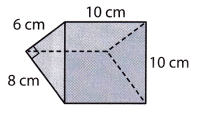
Texas Go Math Kindergarten Lesson 9.1 Answer Key Compose Numbers Up to 3

Refer to our Texas Go Math Kindergarten Answer Key Pdf to score good marks in the exams. Test yourself by practicing the problems from Texas Go Math Kindergarten Lesson 9.1 Answer Key Compose Numbers Up to 3.

Texas Go Math Kindergarten Lesson 9.1 Answer Key Compose Numbers Up to 3

Explore

DIRECTIONS: Place red and yellow counters in the five frames as shown. There are 3 counters. Write the number of yellow counters. Write the number of red counters.

Texas Go Math Kindergarten Lesson 9.1 Answer Key 1
Answer:
Texas Go Math Kindergarten Lesson 9.1 img 1
Explanation:
The number of red counters are 3
the number of yellow counters are 0
Total number of counters 3

Share and Show

DIRECTIONS: Place counters in the five frames as shown. 1. There are 2 counters. Write the number of yellow counters. Write the number of red counters. 2. There are 3 counters. Write the number of yellow counters. Write the number of red counters.

Question 1.
Texas Go Math Kindergarten Lesson 9.1 Answer Key 2
Answer:
Texas Go Math Kindergarten Lesson 9.1 img 2
Explanation:
The number of red counters are 1
the number of yellow counters are 1
Total number of counters 2

Question 2.
Texas Go Math Kindergarten Lesson 9.1 Answer Key 3
Answer:
Texas Go Math Kindergarten Lesson 9.1 img 3
Explanation:
The number of red counters are 2
the number of yellow counters are 1
Total number of counters 3

DIRECTIONS: 3-4. Place counters in the five frames as shown. Look at the number. Write the number of yellow counters. Write the number of red counters.

Question 3.
Texas Go Math Kindergarten Lesson 9.1 Answer Key 4
Answer:
Texas Go Math Kindergarten Lesson 9.1 img 4
Explanation:
The number of red counters are 0
the number of yellow counters are 2
Total number of counters 2

Question 4.
Texas Go Math Kindergarten Lesson 9.1 Answer Key 5
Answer:
Texas Go Math Kindergarten Lesson 9.1 img 5
Explanation:
The number of red counters are 2
the number of yellow counters are 0
Total number of counters 2

HOME ACTIVITY • Show your child a set of two objects. Have him or her add one more object to the set and tell how many there are now.
Answer:
Texas Go Math Kindergarten Lesson 9.1 img 6
Explanation:
Given set of balloons and then given one more balloon
2 + 1 = 3
so, total there are 3 balloons.

DIRECTIONS: 5. Sasha wants to have 3 counters. She has 2 yellow counters in the five frame. How many red counters does she need to have 3? Write the number of yellow counters. Draw and color the red counters. Write the number of red counters. 6. Choose the correct answer. How many dots in all?

Problem Solving

Question 5.
Texas Go Math Kindergarten Lesson 9.1 Answer Key 6
Answer:
Texas Go Math Kindergarten Lesson 9.1 img 7
Explanation:
Sasha wants to have 3 counters.
She has 2 yellow counters in the five frame.
1 red counters that she need to have 3
The number of red counters are 1
the number of yellow counters are 2
Total number of counters 3

Daily Assessment Task

Question 6.
Texas Go Math Kindergarten Lesson 9.1 Answer Key 7
Answer:
Texas Go Math Kindergarten Lesson 9.1 img 8
Explanation:
There are 3 dots
2 dots are in blue color and 1 dot is in pink color.

Texas Go Math Kindergarten Lesson 9.1 Homework and Practice Answer Key

DIRECTIONS: 1. There are 3 counters. Write the number of red counters. Write the number of yellow counters. 2. Look at the number. Write the number of yellow counters. Write the number of red counters.

Question 1.
Texas Go Math Kindergarten Lesson 9.1 Answer Key 8
Answer:
Texas Go Math Kindergarten Lesson 9.1 img 9
Explanation:
The number of red counters are 2
the number of yellow counters are 1
Total number of counters 3

Question 2.
Texas Go Math Kindergarten Lesson 9.1 Answer Key 13
Answer:
Texas Go Math Kindergarten Lesson 9.1 img 10
Explanation:
The number of red counters are 1
the number of yellow counters are 1
Total number of counters 2

DIRECTIONS: Choose the correct answer. 3-5. How many dots in all?

Question 3.
Texas Go Math Kindergarten Lesson 9.1 Answer Key 10
Answer:
Texas Go Math Kindergarten Lesson 9.1 img 11
Explanation:
There are 2 dots
one yellow dot and one green dot

Question 4.
Texas Go Math Kindergarten Lesson 9.1 Answer Key 11
Answer:
Texas Go Math Kindergarten Lesson 9.1 img 12
Explanation:
There are 3 dots
2 red dots and 1 blue dot.

Question 5.
Texas Go Math Kindergarten Lesson 9.1 Answer Key 12
Answer:
Texas Go Math Kindergarten Lesson 9.1 img 13
Explanation:
There are 2 dots
The given 2 dots are yellow

Texas Go Math Kindergarten Lesson 9.1 Answer Key Compose Numbers Up to 3 Read More »
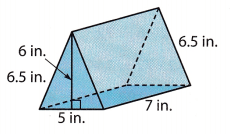
Scroll to Top