HMH Go Math

go-math-grade-4-answer-key-chapter-8-multiply-fractions-by-whole-numbers-review-test

Go Math Grade 4 Answer Key Homework FL Chapter 8 Multiply Fractions by Whole Numbers Review/Test

Go Math Grade 4 Answer Key Homework FL Chapter 8 Multiply Fractions by Whole Numbers Review/Test: Apply and extend previous understandings of multiplication to multiply by a fraction by a whole number. The main aim of the Go Math Answer Key is to make the students understand the concept of Multiply Fractions by Whole Numbers. Download Go Math Grade 4 Answer Key Chapter 8 Multiply Fractions by Whole Numbers Review/Test to test your math skills.

Go Math Grade 4 Answer Key Homework FL Chapter 8 Multiply Fractions by Whole Numbers Review/Test

We suggest you to check out the topics at Go Math Grade 4 Answer Key Chapter 8 Multiply Fractions by Whole Numbers before you start your preparations. After your preparation test yourself by solving the problems in Go Math Grade 4 Answer Key Homework FL Chapter 8 Multiply Fractions by Whole Numbers Review/Test. Tap the links and start solving the problems.

Review/Test – Page No. 337

Choose the best term from the box.
Go Math Grade 4 Answer Key Homework FL Chapter 8 Multiply Fractions by Whole Numbers Review Test img 1

Question 1.
A ________ can name part of a whole or part of a group.
________

Answer: Fraction
A fraction can name part of a whole or part of a group.

Question 2.
A ______________ of a number is the product of the number and a counting number.
________

Answer: Multiple
A mutiple of a number is the product of the number and a counting number.

List the next four multiples of the unit fraction.

Question 3.
\(\frac{1}{8}\),
Type below:
________

Answer: 1/8, 2/8, 3/8, 4/8, 5/8

Explanation:
The next four multiples of the unit fraction \(\frac{1}{8}\) are 1/8, 2/8, 3/8, 4/8, 5/8

Question 4.
\(\frac{1}{4}\),
Type below:
________

Answer: 2/4, 3/4, 4/4, 5/4

Explanation:
The next four multiples of the unit fraction \(\frac{1}{4}\) are 2/4, 3/4, 4/4, 5/4.

Write the fraction as a product of a whole number and a unit fraction.

Question 5.
\(\frac{7}{12}\)
Type below:
________

Answer: 7, 1/12

Explanation:
Given the fraction \(\frac{7}{12}\)
The whole number is 7 and the unit fraction is \(\frac{1}{12}\).

Question 6.
\(\frac{4}{12}\)
Type below:
________

Answer: 4, 1/12

Explanation:
Given the fraction \(\frac{4}{12}\)
The whole number is 4 and the unit fraction is \(\frac{1}{12}\).

Question 7.
\(\frac{5}{4}\)
Type below:
________

Answer: 5, 1/4

Explanation:
Given the fraction \(\frac{5}{4}\)
The whole number is 5 and the unit fraction is \(\frac{1}{4}\).

Question 8.
\(\frac{3}{10}\),
Type below:
________

Answer: 3, 1/10

Explanation:
Given the fraction \(\frac{3}{10}\)
The whole number is 3 and the unit fraction is \(\frac{1}{10}\).

Question 9.
\(\frac{2}{3}\),
Type below:
________

Answer: 2, 1/3

Explanation:
Given the fraction \(\frac{2}{3}\)
The whole number is 2 and the unit fraction is \(\frac{1}{3}\).

Write the product as the product of a whole number and a unit fraction.

Question 10.
3 × \(\frac{2}{4}\),
Type below:
________

Answer: 6, \(\frac{1}{4}\)

Explanation:
Given the fraction 3 × \(\frac{2}{4}\)
3 × \(\frac{2}{4}\) = \(\frac{6}{4}\)
The whole number is 6, and the unit fraction is \(\frac{1}{4}\)

Question 11.
2 × \(\frac{3}{5}\),
Type below:
________

Answer: 6, 1/5

Explanation:
Given the fraction 2 × \(\frac{3}{5}\),
\(\frac{6}{5}\)
The whole number is 6, and the unit fraction is \(\frac{1}{5}\)

Question 12.
4 × \(\frac{2}{3}\),
Type below:
________

Answer: 8, 1/3

Explanation:
Given the fraction 4 × \(\frac{2}{3}\),
= \(\frac{8}{3}\)
The whole number is 8, and the unit fraction is \(\frac{1}{3}\)

Multiply.

Question 13.
5 × \(\frac{7}{10}\) = \(\frac{□}{□}\)

Answer: 35/10

Explanation:
5 × \(\frac{7}{10}\)
Multiply the whole number with the numerator of the fraction.
= \(\frac{35}{10}\)
5 × \(\frac{7}{10}\) = \(\frac{35}{10}\)

Question 14.
4 × \(\frac{3}{4}\) = \(\frac{□}{□}\)

Answer: 3

Explanation:
4 × \(\frac{3}{4}\)
Multiply the whole number with the numerator of the fraction.
4 × \(\frac{3}{4}\) = \(\frac{12}{4}\) = 3

Question 15.
3 × \(\frac{8}{12}\) = \(\frac{□}{□}\)

Answer: 2

Explanation:
3 × \(\frac{8}{12}\)
Multiply the whole number with the numerator of the fraction.
\(\frac{24}{12}\) = 2

Multiply. Write the product as a mixed number.

Question 16.
3 × 1 \(\frac{1}{8}\) = ______ \(\frac{□}{□}\)

Answer: 3 \(\frac{3}{8}\)

Explanation:
3 × 1 \(\frac{1}{8}\)
Convert from mixed fraction to the improper fraction.
1 \(\frac{1}{8}\) = \(\frac{9}{8}\)
3 × \(\frac{9}{8}\) = \(\frac{27}{8}\)
= 3 \(\frac{3}{8}\)

Question 17.
2 × 2 \(\frac{1}{5}\) = ______ \(\frac{□}{□}\)

Answer: 4 \(\frac{2}{5}\)

Explanation:
2 × 2 \(\frac{1}{5}\)
Convert from mixed fraction to the improper fraction.
2 × \(\frac{11}{5}\)
= \(\frac{22}{5}\)
= 4 \(\frac{2}{5}\)
2 × 2 \(\frac{1}{5}\) = 4 \(\frac{2}{5}\)

Question 18.
8 × 1 \(\frac{3}{5}\) = _______ \(\frac{□}{□}\)

Answer: 64/5

Explanation:
8 × 1 \(\frac{3}{5}\)
Convert from mixed fraction to the improper fraction.
8 × 1 \(\frac{3}{5}\) = 8 × \(\frac{8}{5}\)
= \(\frac{64}{5}\)
Convert from improper fraction to the mixed fraction.
\(\frac{64}{5}\) = 12 \(\frac{4}{5}\)
8 × 1 \(\frac{3}{5}\) = 12 \(\frac{4}{5}\)

Review/Test – Page No. 338

Fill in the bubble completely to show your answer.

Question 19.
Bryson has soccer practice for 2 \(\frac{1}{4}\) hours 2 times a week. How much time does Bryson spend at soccer practice in 1 week?
Options:
a. 2 hours
b. 4 hours
c. 4 \(\frac{2}{4}\) hours
d. 8 \(\frac{2}{4}\) hours

Answer: 4 \(\frac{2}{4}\) hours

Explanation:
Given,
Bryson has soccer practice for 2 \(\frac{1}{4}\) hours 2 times a week.
2 \(\frac{1}{4}\) × 2
= 4 \(\frac{2}{4}\) hours
Bryson spend 4 \(\frac{2}{4}\) hours at soccer practice in 1 week.
Thus the correct answer is option c.

Question 20.
Nigel cut a loaf of bread into 12 equal slices. His family ate some of the bread and now \(\frac{5}{12}\) is left. Nigel wants to put each of the leftover slices in its own bag. How many bags does Nigel need?
Options:
a. 5
b. 7
c. 12
d. 17

Answer: 5

Explanation:
Given,
Nigel cut a loaf of bread into 12 equal slices.
His family ate some of the bread and now \(\frac{5}{12}\) is left.
Nigel wants to put each of the leftover slices in its own bag.
\(\frac{5}{12}\) × 12 = 5
Therefore Nigel needs 5 bags.
Thus the correct answer is option a.

Question 21.
Micala made a list of some multiples of \(\frac{3}{5}\). Which could be Micala’s list?
Options:
a. \(\frac{3}{5}, \frac{9}{5}, \frac{12}{5}, \frac{19}{5}\)
b. \(\frac{3}{5}, \frac{6}{10}, \frac{9}{15}, \frac{12}{20}\)
c. \(\frac{1}{5}, \frac{3}{5}, \frac{6}{5}, \frac{9}{5}\)
d. \(\frac{3}{5}, \frac{6}{5}, \frac{9}{5}, \frac{12}{5}\)

Answer: \(\frac{3}{5}, \frac{6}{10}, \frac{9}{15}, \frac{12}{20}\)

Explanation:
The next multiples of \(\frac{3}{5}\) is \(\frac{3}{5}, \frac{6}{10}, \frac{9}{15}, \frac{12}{20}\).
Thus the correct answer is option b.

Question 22.
Lincoln spent 1 \(\frac{1}{4}\) hours reading a book. Phoebe spent 3 times as much time as Lincoln reading a book. How much time did Phoebe spend reading?
Options:
a. 1 \(\frac{1}{16}\) hours
b. 3 \(\frac{1}{4}\) hours
c. 3 \(\frac{3}{4}\) hours
d. 4 \(\frac{1}{4}\) hours

Answer: 3 \(\frac{3}{4}\) hours

Explanation:
Given,
Lincoln spent 1 \(\frac{1}{4}\) hours reading a book.
Phoebe spent 3 times as much time as Lincoln reading a book.
1 \(\frac{1}{4}\) × 3
\(\frac{5}{4}\) × 3 = \(\frac{15}{4}\)
Convert from improper fraction to the mixed fraction.
\(\frac{15}{4}\) = 3 \(\frac{3}{4}\) hours
Phoebe spent 3 \(\frac{3}{4}\) hours for reading.
Thus the correct answer is option c.

Review/Test – Page No. 339

Fill in the bubble completely to show your answer.

Question 23.
Griffin used a number line to write the multiples of \(\frac{3}{8}\). Which multiple on the number line shows the product 2 × \(\frac{3}{8}\)?
Go Math Grade 4 Answer Key Homework FL Chapter 8 Multiply Fractions by Whole Numbers Review Test img 2
Options:
a. \(\frac{2}{8}\)
b. \(\frac{3}{8}\)
c. \(\frac{6}{8}\)
d. \(\frac{9}{8}\)

Answer: \(\frac{9}{8}\)

Explanation:
Given,
Griffin used a number line to write the multiples of \(\frac{3}{8}\).
The multiples of \(\frac{3}{8}\) is \(\frac{6}{8}\), \(\frac{9}{8}\)
3 × \(\frac{3}{8}\) = \(\frac{9}{8}\)
Thus the correct answer is option d.

Question 24.
Serena’s rabbit weighs 3 \(\frac{1}{2}\) pounds. Jarod’s rabbit weighs 3 times as much as Serena’s rabbit. How much does Jarod’s rabbit weigh?
Options:
a. 3 \(\frac{1}{6}\) pounds
b. 7 \(\frac{1}{6}\) pounds
c. 9 \(\frac{1}{2}\) pounds
d. 10 \(\frac{1}{2}\) pounds

Answer: 10 \(\frac{1}{2}\) pounds

Explanation:
Given,
Serena’s rabbit weighs 3 \(\frac{1}{2}\) pounds.
Jarod’s rabbit weighs 3 times as much as Serena’s rabbit.
3 \(\frac{1}{2}\) = \(\frac{7}{2}\)
\(\frac{7}{2}\) × 3 = \(\frac{21}{2}\)
Convert from improper fraction to the mixed fraction.
\(\frac{21}{2}\) = 10 \(\frac{1}{2}\) pounds
Thus the correct answer is option d.

Question 25.
Jacadi is setting up a tent. Each section of a tent pole is \(\frac{2}{3}\) yard long. She needs 4 sections to make 1 pole. How long is 1 tent pole?
Options:
a. \(\frac{12}{3}\) yards
b. \(\frac{8}{3}\) yards
c. 8 yards
d. \(\frac{4}{3}\) yards

Answer: \(\frac{12}{3}\) yards

Explanation:
Given,
Jacadi is setting up a tent. Each section of a tent pole is \(\frac{2}{3}\) yard long. She needs 4 sections to make 1 pole.
\(\frac{2}{3}\) × 4 = \(\frac{12}{3}\)
Thus the correct answer is option a.

Review/Test – Page No. 340

Question 26.
Oliver has music lessons Monday, Wednesday, and Friday. Each lesson is \(\frac{3}{4}\) hour. Oliver says he will have lessons for 2 \(\frac{1}{2}\) hours this week. Do you agree or disagree? Explain your reasoning.
________

Answer: Oliver is incorrect because if he were correct he would learn for 2 hours and \(\frac{1}{2}\) minutes because, \(\frac{3}{4}\) × 3 = 3 \(\frac{1}{2}\) hours.

Question 27.
The common snapping turtle is a freshwater turtle. It can grow to about 1 \(\frac{1}{6}\) feet long. The leatherback sea turtle is the largest of all sea turtles. The average length of a leatherback is about 5 times as long as a common snapping turtle.
Go Math Grade 4 Answer Key Homework FL Chapter 8 Multiply Fractions by Whole Numbers Review Test img 3
A. Draw a diagram to compare the lengths of the turtles. Then write an equation to find the length of a leatherback. Explain how the diagram helps you write the equation.
Type below:
________

Answer: 1 \(\frac{1}{6}\)x

Question 27.
B. About how long is the leatherback sea turtle?
______ \(\frac{â–¡}{â–¡}\) feet

Answer: 5 \(\frac{5}{6}\) feet

Explanation:
1 \(\frac{1}{6}\) × 5
Convert from mixed fraction to the improper fraction.
1 \(\frac{1}{6}\) = \(\frac{7}{6}\)
\(\frac{7}{6}\) × 5 = 5 \(\frac{5}{6}\) feet

Question 27.
A loggerhead sea turtle is about 3 times as long as the common snapping turtle. How long is the loggerhead? Explain your answer.
______ \(\frac{â–¡}{â–¡}\) feet

Answer: 3 \(\frac{3}{6}\) feet

Explanation:
Given,
A loggerhead sea turtle is about 3 times as long as the common snapping turtle.
1 \(\frac{1}{6}\) × 3
Convert from mixed fraction to the improper fraction.
1 \(\frac{1}{6}\) = \(\frac{7}{6}\)
\(\frac{7}{6}\) × 3 = 3 \(\frac{3}{6}\) feet

Conclusion: 

Refer Go Math Grade 4 Answer Key Homework FL Chapter 8 Multiply Fractions by Whole Numbers Review/Test to gain good marks in the examinations. Share this pdf with your friends to help them to overcome the difficulties in Multiply Fractions by Whole Numbers. Go through Go Math Grade 4 Answer Key Chapter 8 Multiply Fractions by Whole Numbers to learn the concept of fractions.

Go Math Grade 4 Answer Key Homework FL Chapter 8 Multiply Fractions by Whole Numbers Review/Test Read More »

go-math-grade-4-answer-key-chapter-11-angles-review-test

Go Math Grade 4 Answer Key Homework FL Chapter 11 Angles Review/Test

Go Math Grade 4 Answer Key Homework FL Chapter 11 Angles Review/Test helps to test your knowledge on this topic. Learn the methods to measure the angles on our Go Math Grade 4 Answer Key. Get step by step explanation with diagrams on Go Math Grade 4 Answer Key Homework FL Chapter 11 Angles Review/Test.

Go Math Grade 4 Answer Key Homework FL Chapter 11 Angles Review/Test

Hit the below links to Download Go Math Grade 4 Answer Key Homework FL Chapter 11 Angles Review/Test. If you are unsure about the answers you can go through our Go Math Grade 4 Answer Key Homework FL Chapter 11 Angles.

Review/Test – Page No. 439

Choose the best term from the box.
Go Math Grade 4 Answer Key Homework FL Chapter 11 Angles Review Test img 1

Question 1.
The size of an angle can be measured using a tool called a
______________ .
________

Answer: Protractor
The size of an angle can be measured using a tool called a Protractor

Question 2.
___________ is the direction in which the hands of a clock move.
________

Answer: Clockwise
Clockwise is the direction in which the hands of a clock move.

Tell what fraction of the circle the shaded angle represents.

Question 3.
Go Math Grade 4 Answer Key Homework FL Chapter 11 Angles Review Test img 2
\(\frac{â–¡}{â–¡}\)

Answer: \(\frac{1}{4}\)

Explanation:
The figure shows that the 1/4th part of the circle is shaded. So, the fraction of the shaded angle is 1/4.

Question 4.
Go Math Grade 4 Answer Key Homework FL Chapter 11 Angles Review Test img 3
\(\frac{â–¡}{â–¡}\)

Answer: \(\frac{3}{4}\)

Explanation:
It has completed a 3/4 turn. So, the fraction of the shaded part is 3/4.

Question 5.
Go Math Grade 4 Answer Key Homework FL Chapter 11 Angles Review Test img 4
\(\frac{â–¡}{â–¡}\)

Answer: \(\frac{1}{2}\)

Explanation:
From the figure, we can see that the circle is rotating in the anti-clockwise direction. And it has completed the half turn.
Thus the fraction is 12 turn counterclockwise

Use a protractor to draw the angle.

Question 6.
68°
Type below:
________

Answer:

Go Math Grade 4 Chapter 11 Angles Review Test img_2

Question 7.
145°
Type below:
________

Answer:

Go Math Grade 4 Chapter 8 Review Test Answer Key img_1

Question 8.
Use a protractor to find the measure of each angle. Label each angle with its measure. Write the sum of the angle measures as an equation.
Go Math Grade 4 Answer Key Homework FL Chapter 11 Angles Review Test img 5

Answer: 110°, 120°, 130°

Explanation:
By using the protractor we can measure each angle of the above circle.
∠NMO = 110°,
∠OMP = 120°,
∠NMP = 130°

Review/Test – Page No. 440

Fill in the bubble completely to show your answer.

Question 9.
Which describes the turn the angle on the circle shows?
Go Math Grade 4 Answer Key Homework FL Chapter 11 Angles Review Test img 6
Options:
a. 90° clockwise
b. 90° counterclockwise
c. 180° clockwise
d. 180° counterclockwise

Answer: 180° counterclockwise

Explanation:
By seeing the above circle we can say that it turns counterclockwise at 180°.
Thus the correct answer is option d.

Question 10.
Which best describes the m/RST? Use a protractor to help you.
Go Math Grade 4 Answer Key Homework FL Chapter 11 Angles Review Test img 7
Options:
a. acute; 48°
b. obtuse; 48°
c. obtuse; 132°
d. obtuse; 148°

Answer: obtuse; 148°

Explanation:
By using the protractor we can measure the angle of the above figure.
The above figure is greater than 90 degrees, so it is an obtuse angle. The measure of the angle is 148 degrees.
Thus the correct answer is option d.

Question 11.
The pocket watch was invented in 1524. The time is 6 P.M. After 1 hour, how many degrees does the minute hand turn?
Go Math Grade 4 Answer Key Homework FL Chapter 11 Angles Review Test img 8
Options:
a. 45°
b. 90°
c. 180°
d. 360°

Answer: 360°

Explanation:
Pocket watches consist of a circular face and three hands that complete a full revolution at different rates: the second hand takes 60 seconds, the minute hand takes 60 minutes, and the hour hand takes 12 hours.
There are 60 seconds in one hour, so in one hour the minute hand has completed a single revolution.
Circles contain 360 degrees so the minute hand, by completing one circle, has traveled 360 degrees after one hour.
Thus the correct answer is option d.

Review/Test – Page No. 441

Fill in the bubble completely to show your answer.

Question 12.
What is the unknown angle measure?
Go Math Grade 4 Answer Key Homework FL Chapter 11 Angles Review Test img 9
Options:
a. 25°
b. 115°
c. 125°
d. 180°

Answer: 125°

Explanation:
Sum of the angles = 180°
65° + x° = 180°
x° = 180° – 65°
x° = 125°
Thus the correct answer is option c.

Question 13.
Which equation can you use to find the ∠WRT?
Go Math Grade 4 Answer Key Homework FL Chapter 11 Angles Review Test img 10
Options:
a. 84° + 69° = ■
b. 84°− 69° = ■
c. 84° × 69° = ■
d. 84° − 153° = ■

Answer: 84° + 69° = ■

Explanation:
To find the unknown angle, we have to do the sum of two angles.
84° + 69° = ■
Thus the correct answer is option a.

Question 14.
If an angle measures 100º, through what fraction of a circle does the angle turn?
Options:
a. \(\frac{1}{100}\)
b. \(\frac{1}{4}\)
c. \(\frac{100}{360}\)
d. \(\frac{1}{2}\)

Answer: \(\frac{100}{360}\)

Explanation:
The complete angle is 360°
The angle measures 100º
= \(\frac{100}{360}\)
Thus the correct answer is option c.

Review/Test – Page No. 442

Question 15.
How many right angles are there in an angle that turns through 360º? Explain how you know.
______ right angles

Answer: 4

Explanation:
A circle has 4 right angles. So, an angle that turns through 360º has four right angles.

Question 16.
Soccer practice began at 2:30 P.M. and stopped at 3:00 P.M. because of rain. During this time, through what fraction of a circle did the minute hand turn? How many degrees did the minute hand turn? Explain.

Answer: 30 minutes

Explanation:
A minute watch covers 360 degrees every 60 minutes. In 30 minutes the watch, therefore, covers 180 degrees.

Question 17.
Charlotte divided a whole pizza into 4 pieces. One piece formed a straight angle. One piece formed a right angle. Two pieces formed acute angles with the same degree measure.
A. Draw angles to represent the 4 pieces.
Go Math Grade 4 Answer Key Homework FL Chapter 11 Angles Review Test img 11

Answer:
Go-Math-Grade-4-Answer-Key-Homework-FL-Chapter-11-Angles-Review-Test-img-11

Question 17.
B. Label each angle with its degree measure.

Answer:
Go-Math-Grade-4-Answer-Key-Homework-FL-Chapter-11-Angles-Review-Test-img-11

Question 17.
C. Label each angle as a fraction of a circle.

Answer:
Go-Math-Grade-4-Answer-Key-Homework-FL-Chapter-11-Angles-Review-Test-img-11

Question 17.
D. Write an equation that represents the degree measure of the whole pizza as the sum of the measures of its parts.

Answer:
x = 60/360x + 60/360x + 110/360x + 130/360x
x = 1/6x + 1/6x + 11/36x + 13/36x

Conclusion:

Stay tuned to our Go Math Answer Key to get the explanations for all the chapters of 4th grade. For any quiries regarding this article go through the Go Math Grade 4 Solution Key Chapter 11 Angles pdf. Best Of Luck!!!

Go Math Grade 4 Answer Key Homework FL Chapter 11 Angles Review/Test Read More »

Go Math Grade 3 Answer Key Two-Dimensional Shapes Extra Practice

Go Math Grade 3 Answer Key Chapter 12 Two-Dimensional Shapes Extra Practice

Add extra skills for your students with Go Math Grade 3 Answer Key Chapter 12 Two-Dimensional Shapes Extra Practice. Elaborate your children thinking by solving every practice question on Go Math Grade 3 Chapter 12 Two-Dimensional Shapes Extra Practice. The Go Math Grade 3 Chapter 12 Two-Dimensional Shapes Extra Practice Answer Key is given for the guidance. See the creative approach to solve the math problems. HMH Go Math Grade 3 introducing a new way of problem-solving and providing the new path for the students to solve problems.

Go Math Grade 3 Chapter 12 Two-Dimensional Shapes Extra Practice Answer Key

Download Go Math Grade 3 Answer Key Chapter 12 Two-Dimensional Shapes Extra Practice PDF and use it whenever you want. Solve all the problems with easy techniques and grab knowledge. Expert opinion is included to solve the problems of Grade 3 Chapter 12 Two-Dimensional Shapes Extra Practice. Follow the explanation and Go Math Grade 3 Chapter 12 Two-Dimensional Shapes Extra Practice Answer Key. The methodology implemented to solve problems is clear and easy.

Common Core – Page No. 257000

Chapter 12 Extra Practice

Lessons 12.1–12.3

Name the polygon.

Question 1.
Go Math Grade 3 Answer Key Chapter 12 Two-Dimensional Shapes Extra Practice Common Core img 1
_________

Answer:
quadrilateral

Explanation:
Chapter 12 Common Core image 1 257000
4 sides; 4 angles; quadrilateral

Question 2.
Go Math Grade 3 Answer Key Chapter 12 Two-Dimensional Shapes Extra Practice Common Core img 2
_________

Answer:
decagon

Explanation:
Chapter 12 Common Core image 2 257000
10 sides; 10 angles; decagon

Question 3.
Go Math Grade 3 Answer Key Chapter 12 Two-Dimensional Shapes Extra Practice Common Core img 3
_________

Answer:
hexagon

Explanation:
Chapter 12 Common Core image 3 257000
6 sides; 6 angles; hexagon

Question 4.
Go Math Grade 3 Answer Key Chapter 12 Two-Dimensional Shapes Extra Practice Common Core img 4
_________

Answer:
triangle

Explanation:
Chapter 12 Common Core image 4 257000
3 sides; 3 angles; triangle

Question 5.
Go Math Grade 3 Answer Key Chapter 12 Two-Dimensional Shapes Extra Practice Common Core img 5
_________

Answer:
octagon

Explanation:
Chapter 12 Common Core image 5 257000
8 sides; 8 angles; octagon

Question 6.
Go Math Grade 3 Answer Key Chapter 12 Two-Dimensional Shapes Extra Practice Common Core img 6
_________

Answer:
pentagon

Explanation:
Chapter 12 Common Core image 6 257000
5 sides; 5 angles; pentagon

Lesson 12.4

Look at the dashed sides of the polygon. Tell if they appear to be intersecting, perpendicular, or parallel. Write all the words that describe the sides.

Question 7.
Go Math Grade 3 Answer Key Chapter 12 Two-Dimensional Shapes Extra Practice Common Core img 7
_________
_________

Answer:
perpendicular lines

Explanation:
The dashed sides are meeting to form a right angle. So, they are perpendicular lines.

Question 8.
Go Math Grade 3 Answer Key Chapter 12 Two-Dimensional Shapes Extra Practice Common Core img 8
_________

Answer:
parallel lines

Explanation:
The dashed sides are not intersecting with each other. So, the given lines are parallel lines.

Question 9.
Go Math Grade 3 Answer Key Chapter 12 Two-Dimensional Shapes Extra Practice Common Core img 9
_________

Answer:
intersecting lines

Explanation:
The dashed line segments meet and form an angle. So, they are intersecting lines.

Lesson 12.5

Circle all the words that describe the quadrilateral.

Question 10.
Go Math Grade 3 Answer Key Chapter 12 Two-Dimensional Shapes Extra Practice Common Core img 10
Options:
a. rhombus
b. trapezoid
c. rectangle

Answer:
c. rectangle

Explanation:
The given shape has two pairs opposite with the same length. Also, all the angles are right angles. The given shape is a rectangle.

Question 11.
Go Math Grade 3 Answer Key Chapter 12 Two-Dimensional Shapes Extra Practice Common Core img 11
Options:
a. square
b. rhombus
c. trapezoid

Answer:
a. square
b. rhombus

Explanation:
The given shape has 4 sides with equal lengths. Also, all the angles are right angles. So, a possible answer is a square and rhombus.

Question 12.
Go Math Grade 3 Answer Key Chapter 12 Two-Dimensional Shapes Extra Practice Common Core img 12
Options:
a. trapezoid
b. rectangle
c. rhombus

Answer:
a. trapezoid

Explanation:
Even though the given shape has four sides, they are not equal. Also, it has only two right angles. The given shape is a trapezoid.

Common Core – Page No. 258000

Lesson 12.6

Draw a quadrilateral that does not belong. Then explain why.

Question 1.
Go Math Grade 3 Answer Key Chapter 12 Two-Dimensional Shapes Extra Practice Common Core img 13
Type below:
_________

Answer:
Chapter 12 Common Core image 1 258000

Explanation:
The shape is a trapezoid. Even though the given shape has four sides, they are not equal. Also, the angles are not right angles.

Lesson 12.7

Use the triangles for 1–2. Write A, B, or C.
Then complete the sentences.
Go Math Grade 3 Answer Key Chapter 12 Two-Dimensional Shapes Extra Practice Common Core img 14

Question 2.
Triangle ____ has 1 angle greater than a right angle and appears to have ____ sides of equal length.

Answer:
Triangle C has 1 angle greater than a right angle and appears to have 0 sides of equal length.

Question 3.
Triangle____ has 1 right angle and appears to have ____ sides of equal length.

Answer:
Triangle A has 1 right angle and appears to have 2 sides of equal length.

Lesson 12.8
Go Math Grade 3 Answer Key Chapter 12 Two-Dimensional Shapes Extra Practice Common Core img 15

Question 4.
What label could you use to describe Circle A?
Type below:
_________

Answer:
All sides of Equal Lengths

Question 5.
What label could you use to describe Circle B?
Type below:
_________

Answer:
Right Angle

Lesson 12.9

Draw lines to divide the shape into equal parts that show the fraction given.

Question 6.
Go Math Grade 3 Answer Key Chapter 12 Two-Dimensional Shapes Extra Practice Common Core img 16 \(\frac{1}{4}\)

Answer:
Chapter 12 Common Core image 2 258000

Question 7.
Go Math Grade 3 Answer Key Chapter 12 Two-Dimensional Shapes Extra Practice Common Core img 17 \(\frac{1}{3}\)

Answer:
Chapter 12 Relate Shapes, Fractions, and Area image 2 752

Conclusion

Go Math Grade 3 Answer Key Chapter 12 Two-Dimensional Shapes Extra Practice for better practice. Download Go Math Grade 3 Answer Key PDF for easy understanding. Every problem is clearly explained with images and graphs. Follow Go Math Grade 3 Chapter 12 Two-Dimensional Shapes Extra Practice Answer Key and achieve the valuable knowledge.

Go Math Grade 3 Answer Key Chapter 12 Two-Dimensional Shapes Extra Practice Read More »

Go Math Grade 4 Answer Key Homework FL Chapter 13 Algebra: Perimeter and Area Review/Test

Go Math Grade 4 Answer Key Homework FL Chapter 13 Algebra: Perimeter and Area Review/Test helps the students enhance their math skills and gain knowledge on the perimeter and area of the different shapes. The solutions given in this chapter are prepared by the math experts. By following the Go Math Grade 4 Answer key, students can easily find out the Perimeter and Area of the rectangle, square, and etc.

Go Math Grade 4 Answer Key Homework FL Chapter 13 Algebra: Perimeter and Area Review/Test

Go Math Answer Key will give you the perfect answers with a clear explanation of every question in an easy way. Go Math explained clearly about Perimeter and Area of different Shapes by using images, indicating images with arrows, and numbers.

Chapter: 13 – Review/Test 

Review/Test – Page No. 519

Choose the best term from the box.
Go Math Grade 4 Answer Key Homework FL Chapter 13 Algebra Perimeter and Area Review Test img 1

Question 1.
The number of square units needed to cover a flat surface is the ______________.
_________

Answer: Area
The number of square units needed to cover a flat surface is the area.

Question 2.
The distance around a shape is the ____________.
_________

Answer: Perimeter
The distance around a shape is the Perimeter.

Find the area of the rectangle or combined rectangles.

Question 3.
Go Math Grade 4 Answer Key Homework FL Chapter 13 Algebra Perimeter and Area Review Test img 2
A = _____ square feet

Answer: 112 square feet

Explanation:
Given,
length = 14 ft
Width = 8 ft
Area of the rectangle = l × w
A = 14 ft × 8 ft
A = 112 square feet
Thus the area of the rectangle for the above figure is 112 square feet.

Question 4.
Go Math Grade 4 Answer Key Homework FL Chapter 13 Algebra Perimeter and Area Review Test img 3
A = _____ square centimeters

Answer: 65 square cm.

Explanation:
Figure 1:
S = 3 cm
Area of the square = s × s
A = 3 cm × 3 cm
A = 9 square cm
Figure 2:
b = 11 cm
h = 4 cm
Area of the rectangle = b × h
A = 11 cm × 4 cm
A = 44 square cm
Figure 3:
b = 2 cm
h = 6 cm
Area of the rectangle = b × h
A = 2 cm × 6 cm
A = 12 square cm
Area of the composite figure is 9 sq. cm + 44 sq. cm + 12 sq. cm = 65 square cm.

Find the unknown measure of the rectangle.

Question 5.
Go Math Grade 4 Answer Key Homework FL Chapter 13 Algebra Perimeter and Area Review Test img 4
A = _____ square yards

Answer: 136 square yard

Explanation:
Figure 1:
b = 12 yd
h = 8 yd
Area of the rectangle = b × h
A = 12 yd × 8 yd
A = 96 square yard.
Figure 2:
b = 16 yd
h = 1 yd
Area of the rectangle = b × h
A = 16 yd × 1 yd
A = 16 square yard.
Figure 3:
b = 4 yd
h = 6 yd
Area of the rectangle = b × h
A = 4 yd × 6 yd
A = 24 square yard.
The area of the composite figure is 96 square yard + 16 square yard + 24 square yard = 136 square yard.

Question 6.
Go Math Grade 4 Answer Key Homework FL Chapter 13 Algebra Perimeter and Area Review Test img 5
Perimeter = 60 meters
width = _____ m

Answer: 12 m

Explanation:
Given,
Perimeter = 60 meters
length = 18 m
width = _____ m
The perimeter of the rectangle = l + w + l + w
P = 2l + 2w
60 m = 2 × 18 m + 2w
60 m – 36 m = 2w
2w = 24
w = 24/2
w = 12 meters
Thus the width of the above rectangle is 12 meters.

Question 7.
Go Math Grade 4 Answer Key Homework FL Chapter 13 Algebra Perimeter and Area Review Test img 6
Area = 91 square feet
height = _____ feet

Answer: 13 ft

Explanation:
Given,
Area = 91 square feet
base = 7 ft
height = _____ feet
Area of the rectangle = b × h
91 sq ft = 7 ft × h
h = 91/7
h = 13 ft
Thus the height of the above rectangle is 13 ft.

Question 8.
Go Math Grade 4 Answer Key Homework FL Chapter 13 Algebra Perimeter and Area Review Test img 7
Area = 60 square inches
base = _____ in.

Answer: 10 inches

Explanation:
Given,
Area = 60 square inches
height = 6 in
base = _____ in.
Area of the rectangle = b × h
60 square inches = b × 6 in
b = 60/6
b = 10 inches
Thus the base of the above rectangle is 10 inches.

Question 9.
What is the perimeter of a rectangle with a length of 13 feet and a width of 9 feet?
P = _____ ft

Answer: 44 ft

Explanation:
Given,
l = 13 ft
w = 9 ft
The perimeter of the rectangle = l + w + l + w
P = 13 ft + 9 ft + 13 ft + 9 ft
P = 44 ft
Thus the perimeter of the rectangle is 44 ft.

Review/Test – Page No. 520

Fill in the bubble completely to show your answer.

Question 10.
Which pair of shapes has the same area?
Options:
a.Go Math Grade 4 Answer Key Homework FL Chapter 13 Algebra Perimeter and Area Review Test img 8
b. Go Math Grade 4 Answer Key Homework FL Chapter 13 Algebra Perimeter and Area Review Test img 9
c. Go Math Grade 4 Answer Key Homework FL Chapter 13 Algebra Perimeter and Area Review Test img 10
d. Go Math Grade 4 Answer Key Homework FL Chapter 13 Algebra Perimeter and Area Review Test img 11

Answer: Go Math Grade 4 Answer Key Homework FL Chapter 13 Algebra Perimeter and Area Review Test img 10

Explanation:
a. Go Math Grade 4 Answer Key Homework FL Chapter 13 Algebra Perimeter and Area Review Test img 8
4 × 2 = 8
3 × 3 = 9
8 ≠ 9
b. Go Math Grade 4 Answer Key Homework FL Chapter 13 Algebra Perimeter and Area Review Test img 9
4 × 4 = 16
3 × 5 = 15
16 ≠ 15
c. Go Math Grade 4 Answer Key Homework FL Chapter 13 Algebra Perimeter and Area Review Test img 10
3 × 4 = 12
2 × 6 = 12
12 = 12
Thus the correct answer is option c.

Question 11.
Jamie’s mom wants to enlarge her rectangular garden by adding a new rectangular section. The garden is now 96 square yards. What will the total area of the garden be after she adds the new section?
Options:
a. 84 square yards
b. 96 square yards
c. 180 square yards
d. 192 square yards

Answer: 192 square yards

Explanation:
Given that,
Jamie’s mom wants to enlarge her rectangular garden by adding a new rectangular section. The garden is now 96 square yards.
Add 96 square yards to the rectangular garden.
96 square yards + 96 square yards = 192 square yards
Thus the correct answer is option d.

Question 12.
A rectangular yoga studio has an area of 153 square feet. The width of the studio is 9 feet. What is the length of the studio?
lenght = _____ ft

Answer: 17 ft

Explanation:
Given,
A rectangular yoga studio has an area of 153 square feet.
The width of the studio is 9 feet.
Area of the rectangle = l × w
153 square feet = l × 9 ft
l = 153/9
l = 17 ft
Therefore the length of the studio is 17 feet.

Review/Test – Page No. 521

Fill in the bubble completely to show your answer.

Question 13.
Mr. Patterson had a rectangular deck with an area of 112 square feet built in his backyard. Which could be a diagram of Mr. Patterson’s deck?
Options:
a. Go Math Grade 4 Answer Key Homework FL Chapter 13 Algebra Perimeter and Area Review Test img 12
b. Go Math Grade 4 Answer Key Homework FL Chapter 13 Algebra Perimeter and Area Review Test img 13
c. Go Math Grade 4 Answer Key Homework FL Chapter 13 Algebra Perimeter and Area Review Test img 14
d. Go Math Grade 4 Answer Key Homework FL Chapter 13 Algebra Perimeter and Area Review Test img 15

Answer: c. Go Math Grade 4 Answer Key Homework FL Chapter 13 Algebra Perimeter and Area Review Test img 14

Explanation:
Given,
Mr. Patterson had a rectangular deck with an area of 112 square feet built in his backyard.
Area of the rectangle = l × w
A = 28 ft × 4 ft
A = 112 square feet
Thus the correct answer is option c.

Question 14.
The town indoor pool is in a rectangular building. Marco is laying tile around the rectangular pool. How many square meters of tile will Marco need?
Go Math Grade 4 Answer Key Homework FL Chapter 13 Algebra Perimeter and Area Review Test img 16
Options:
a. 96 square meters
b. 252 square meters
c. 572 square meters
d. 892 square meters

Answer: 252 square meters

Explanation:
The outer rectangle is
l = 26 m
w = 22 m
Area of the rectangle = l × w
A = 26 m × 22 m
A = 572 square meters
The inner rectangle is
l = 20 m
w = 16 m
Area of the rectangle = l × w
A = 20 m × 16 m
A = 320 square meters
Thus the square meters of tile will Marco need is 572 – 320 = 252 square meters.

Review/Test – Page No. 522

Question 15.
A drawing of a high school pool is shown below.
Go Math Grade 4 Answer Key Homework FL Chapter 13 Algebra Perimeter and Area Review Test img 17
What is the area of the pool? Explain how you know.
_______ square yards

Answer:

Explanation:
Figure 1:
l = 10 yd
w = 15 yd
Area of the rectangle = l × w
A = 10 yd × 15 yd
A = 150 square yard
Figure 2:
l = 15 yd
w = 10 yd
Area of the rectangle = l × w
A = 15 yd × 10 yd
A = 150 square yard
Figure 3:
l = 10 yd
w = 5 yd
Area of the rectangle = l × w
A = 10 yd × 5 yd
A = 50 square yard
Area of the pool = 150 square yard + 150 square yard + 50 square yard = 350 square yard

Question 16.
Mr. Brown has 24 meters of fencing. He wants to build a rectangular pen for his rabbits.
Go Math Grade 4 Answer Key Homework FL Chapter 13 Algebra Perimeter and Area Review Test img 18
A. Draw two different rectangles that Mr. Brown could build. Use only whole numbers for the lengths of the sides of each rectangle. Label the length of each side.
Type below:
_________

Answer:
Go Math Grade 4 Answer Key Chapter 13 Review Test img-2

Question 16.
B. Find the area in square meters of each rabbit pen you made in Part A. Show your work.
Type below:
_________

Answer: 20 square meters

Explanation:
l = 10m
w = 2m
Area of the rectangle = l × w
A = 10 m × 2 m
A = 20 square meters
Therefore the area in square meters of each rabbit pen is 20 square meters.

Question 16.
C. If you were Mr. Brown, which of the two pens above would you construct for your rabbits? Explain why.
Type below:
_________

Answer: I would construct the second figure for the two rabbit pens.

Conclusion:
By following the Go Math Grade 4 Review Test solutions, students can quickly find the perimeter and area of shapes within a few minutes. Keep in touch with us to get the Go Math Grade 4 Answer Key Chapter 13 Algebra: Perimeter and Area.

Go Math Grade 4 Answer Key Homework FL Chapter 13 Algebra: Perimeter and Area Review/Test Read More »

Go Math Grade 3 Answer Key Compare Fractions Extra Practice

Go Math Grade 3 Answer Key Chapter 9 Compare Fractions Extra Practice

Get the Answer Key for Go Math Grade 3 Chapter 9 Compare Fractions Extra Practice here. The students who have completed exercise and homework problems can check the Go Math Grade 3 Answer Key Chapter 9 Compare Fractions Extra Practice. We provide the Question and answers along with the detailed explanation in 3rd Grade Go Math Chapter 9 Compare Fractions Extra Practice Solution Key.

Go Math Grade 3 Answer Key Chapter 9 Compare Fractions Extra Practice

All you have to do is to check out the topics covered in this chapter before you start the preparation. There are many methods to solve the problems in compare fractions. So, Make use of links provided to understand the concepts of fractions. Solve the Questions given in the extra practice and check the solutions in the Go Math Answer Key Grade 3 Chapter 9 Compare Fractions.

Common Core – Page No. 189000

Lesson 9.1

Solve. Show your work.

Question 1.
Nick finished \(\frac{4}{8}\) of his homework before dinner. Ed finished \(\frac{7}{8}\) of his homework before dinner. Who finished the greater part of his homework?
Go Math Grade 3 Answer Key Chapter 9 Compare Fractions Extra Practice Common Core img 1
_____

Answer: Ed

Explanation:

Compare the fractions \(\frac{4}{8}\) and \(\frac{7}{8}\)
The denominator of both the fractions is the same. So, compare the numerators.
The numerator with the greatest number will be the greatest fraction.
7 is greater than 4.
\(\frac{7}{8}\) > \(\frac{4}{8}\)
Therefore Ed finished the greater part of his homework.

Question 2.
Rafael walked \(\frac{2}{3}\) mile and then rode his scooter \(\frac{2}{6}\) mile. Which distance is farther?
Go Math Grade 3 Answer Key Chapter 9 Compare Fractions Extra Practice Common Core img 2
\(\frac{â–¡} {â–¡}\) mile is farther

Answer: \(\frac{2}{3}\)

Explanation:

Rafael walked \(\frac{2}{3}\) mile and then rode his scooter \(\frac{2}{6}\) mile.
The numerator of both the fractions is the same but the denominators are different.
The fraction is smaller if the denominator is greater.
Thus \(\frac{2}{3}\) > \(\frac{2}{6}\)
\(\frac{2}{3}\) mile is farther.

Lessons 9.2–9.3

Compare. Write <, >, or =.

Question 3.
\(\frac{2}{6}\) _____ \(\frac{3}{6}\)

Answer: \(\frac{2}{6}\) < \(\frac{3}{6}\)

Explanation:

Compare the fractions \(\frac{2}{6}\) and \(\frac{3}{6}\)
The denominators are the same and the numerators are different.
So compare the numerators of two fractions.
2 is less than 3.
So, \(\frac{2}{6}\) < \(\frac{3}{6}\)

Question 4.
\(\frac{6}{8}\) _____ \(\frac{1}{8}\)

Answer: \(\frac{6}{8}\) > \(\frac{1}{8}\)

Explanation:

Compare \(\frac{6}{8}\) and \(\frac{1}{8}\)
The denominators are the same and the numerators are different.
6 is greater than 1.
\(\frac{6}{8}\) > \(\frac{1}{8}\)

Question 5.
\(\frac{3}{8}\) _____ \(\frac{3}{4}\)

Answer: \(\frac{3}{8}\) < \(\frac{3}{4}\)

Explanation:

Compare the fractions \(\frac{3}{8}\) and \(\frac{3}{4}\)
The numerators are the same and denominators are different.
Compare the denominators of two fractions.
The fraction with lesser number will be the greatest.
\(\frac{3}{8}\) < \(\frac{3}{4}\)

Question 6.
\(\frac{1}{6}\) _____ \(\frac{1}{8}\)

Answer: \(\frac{1}{6}\) > \(\frac{1}{8}\)

Explanation:

The numerator of both the fractions is the same.
The denominator with the greatest number will be the smallest fraction.
So, \(\frac{1}{6}\) > \(\frac{1}{8}\)

Question 7.
\(\frac{2}{3}\) _____ \(\frac{2}{6}\)

Answer: \(\frac{2}{3}\) > \(\frac{2}{6}\)

Explanation:

The numerator of both the fractions is the same.
The denominator with the greatest number will be the smallest fraction.
\(\frac{2}{3}\) > \(\frac{2}{6}\)

Question 8.
\(\frac{1}{8}\) _____ \(\frac{3}{8}\)

Answer: \(\frac{1}{8}\) < \(\frac{3}{8}\)

Explanation:

The denominator of both the fractions is the same.
So, compare the numerators. The fraction with the small number will be the smallest fraction.
\(\frac{1}{8}\) < \(\frac{3}{8}\)

Lesson 9.4

Compare. Write <, >, or = . Write the strategy you used.

Question 9.
\(\frac{2}{8}\) _____ \(\frac{2}{3}\)

Answer: \(\frac{2}{8}\) < \(\frac{2}{3}\)

Explanation:

The numerator of both the fractions is the same.
Compare the denominators.
The denominator with the greatest number will be the smallest fraction.
\(\frac{2}{8}\) < \(\frac{2}{3}\)

Question 10.
\(\frac{5}{6}\) _____ \(\frac{1}{6}\)

Answer: \(\frac{5}{6}\) > \(\frac{1}{6}\)

Explanation:

The denominator of both the fractions is the same.
The fraction with the small number will be the smallest fraction.
5 is greater than 1.
\(\frac{5}{6}\) > \(\frac{1}{6}\)

Question 11.
\(\frac{7}{8}\) _____ \(\frac{3}{4}\)

Answer: \(\frac{7}{8}\) > \(\frac{3}{4}\)

Explanation:

Compare \(\frac{7}{8}\) and \(\frac{3}{4}\)
Make the denominators equal to compare the fractions.
\(\frac{3}{4}\) × \(\frac{8}{8}\) = \(\frac{24}{32}\)
\(\frac{7}{8}\) × \(\frac{4}{4}\) = \(\frac{28}{32}\)
\(\frac{28}{32}\) > \(\frac{24}{32}\)
\(\frac{7}{8}\) > \(\frac{3}{4}\)

Common Core – Page No. 190000

Lesson 9.5

Write the fractions in order from greatest to least.

Question 1.
\(\frac{1}{2}, \frac{1}{4}, \frac{1}{3}\)
Type below:
__________

Answer: \(\frac{1}{2}, \frac{1}{3}, \frac{1}{4}\)

Explanation:

The numerator of the three fractions is the same.
So, the order from greatest to least is \(\frac{1}{2}, \frac{1}{3}, \frac{1}{4}\)

Question 2.
\(\frac{4}{6}, \frac{1}{6}, \frac{2}{6}\)
Type below:
__________

Answer: \(\frac{4}{6}, \frac{2}{6}, \frac{1}{6}\)

Explanation:

The denominator of the three fractions is the same.
Compare the numerator of the fraction.
4 > 2 > 1
\(\frac{4}{6}, \frac{2}{6}, \frac{1}{6}\)

Question 3.
\(\frac{3}{6}, \frac{3}{4}, \frac{3}{8}\)
Type below:
__________

Answer: \(\frac{3}{4}, \frac{3}{6}, \frac{3}{8}\)

Explanation:

The numerator of the three fractions is the same.
So, the order is \(\frac{3}{4}, \frac{3}{6}, \frac{3}{8}\)

Question 4.
\(\frac{6}{8}, \frac{3}{8}, \frac{5}{8}\)
Type below:
__________

Answer: \(\frac{6}{8}, \frac{5}{8}, \frac{3}{8}\)

Explanation:

The denominator of the three fractions is the same.
Compare the numerator and write the order from greatest to least fraction.
\(\frac{6}{8}, \frac{5}{8}, \frac{3}{8}\)

Lessons 9.6–9.7

Shade the model. Then divide the pieces to find the equivalent fraction.

Question 5.
Go Math Grade 3 Answer Key Chapter 9 Compare Fractions Extra Practice Common Core img 3
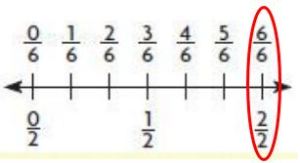
\(\frac{1}{4}=\frac{â– }{8}\)
\(\frac{1}{4}\) = \(\frac{â–¡} {â–¡}\)

Answer: \(\frac{1}{4}\) = \(\frac{2} {8}\)

Explanation:

Go Math Chapter 9 Key Grade 3 Extra Practice Solution image_1

\(\frac{1}{4}\) = \(\frac{2} {8}\)

Question 6.
Go Math Grade 3 Answer Key Chapter 9 Compare Fractions Extra Practice Common Core img 4
\(\frac{2}{3}=\frac{â– }{6}\)
\(\frac{2}{3}\) = \(\frac{â–¡} {â–¡}\)

Answer: \(\frac{2}{3}\) = \(\frac{4} {6}\)

Explanation:

Chapter 9 Go Math Grade 3 Answer Key Extra Practice solution image_2

\(\frac{2}{3}\) = \(\frac{4} {6}\)

Use the number line to find the equivalent fraction.

Question 7.
Go Math Grade 3 Answer Key Chapter 9 Compare Fractions Extra Practice Common Core img 5
\(\frac{1}{2}=\frac{â– }{8}\)
\(\frac{1}{2}\) = \(\frac{â–¡} {â–¡}\)

Answer: \(\frac{1}{2}\) = \(\frac{4} {8}\)

Explanation:

Go math answer key grade 3 compare fractions extra practice solution image_5

Question 8.
Go Math Grade 3 Answer Key Chapter 9 Compare Fractions Extra Practice Common Core img 6
\(\frac{2}{2}=\frac{â– }{6}\)
\(\frac{2}{2}\) = \(\frac{â–¡} {â–¡}\)

Answer: \(\frac{2}{2}\) = \(\frac{6} {6}\)

Explanation:

Go Math Chapter 9 Grade 3 Answer Key Extra Practice solution image_5

Each shape is 1 whole. Shade the model to find the equivalent fraction.

Question 9.
Go Math Grade 3 Answer Key Chapter 9 Compare Fractions Extra Practice Common Core img 7
\(\frac{3}{4}=\frac{â– }{8}\)
\(\frac{3}{4}\) = \(\frac{â–¡} {â–¡}\)

Answer: \(\frac{3}{4}\) = \(\frac{6} {8}\)

Explanation:

Go Math Answer Key Grade 3 Compare Fractions Extra Practice solution image_4

\(\frac{3}{4}\) = \(\frac{6} {8}\)

Question 10.
Go Math Grade 3 Answer Key Chapter 9 Compare Fractions Extra Practice Common Core img 8
\(\frac{1}{2}=\frac{â– }{6}\)
\(\frac{1}{2}\) = \(\frac{â–¡} {â–¡}\)

Answer: \(\frac{1}{2}\) = \(\frac{3} {6}\)

Explanation:

HMH Go Math key Grade 3 Compare Fractions Extra Practice solution image_3

\(\frac{1}{2}\) = \(\frac{3} {6}\)

Conclusion

Early childhood mathematics is vitally important for young children’s present and future educational success. So start learning the basics from now to become master in Math. For your better understanding we have provided the answers in the form of pictures. Refer Go Math Grade 3 Answer Key Chapter 9 Extra Practice and score well in the exams. For any qrieries in extra practice go through the Go Math Grade 3 Answer Key Chapter 9 Compare Fractions pdf.

Go Math Grade 3 Answer Key Chapter 9 Compare Fractions Extra Practice Read More »

Go Math Grade 3 Answer Key Addition and Subtraction within 1,000 Extra Practice

Go Math Grade 3 Answer Key Chapter 1 Addition and Subtraction within 1,000 Extra Practice

Go Math Grade 3 Answer Key Chapter 1 Addition and Subtraction within 1,000 Extra Practice helps the students to practice more problems. HMH Go Math Grade 3 Solution Key Chapter 1 Addition and Subtraction within 1,000 is designed to learn the basic concepts like addition and subtraction in an easy manner.

Go Math Grade 3 Answer Key Chapter 1 Addition and Subtraction within 1,000 Extra Practice

There are different methods to solve additions and subtractions. So, go through the topics before you start preparing for your exams. With the help of Extra Practice Go Math Grade 3 Answer Key Chapter 1 Addition and Subtraction within 1,000 you can secure good marks in the exams.

Lesson 1.1 – Page No. 27000

Find the sum. Then use the Commutative Property of Addition to write the related addition sentence.
Question 1:
5 + 7 = __
__ + __ = __

Answer: 5 + 7 = 12

According to the commutative property of addition, changing the order of the numbers we are adding, does not change the sum.
If you are adding 5 and 7 together the commutative property of addition says that you will get the same answer whether you are adding 5 + 7 or 7 + 5.
7 + 5 = 12

Question 2:
4 + 9 = __

__ + __ = __

Answer: 4 + 9 = 13

According to the commutative property of addition, changing the order of the numbers we are adding, does not change the sum.
That means you will get the same answer is you add 4 + 9 or 9 + 4.
9 + 4 = 13

Question 3:
0 + 5 = __

__ + __ = __

Answer: 0 + 5 = 5

According to the commutative property of addition, changing the order of the numbers we are adding, does not change the sum.
You will get the same answer if you add 0 + 5  or 5 + 0.
5 + 0 = 5

Lesson 1.2 – Page No. 27000

Round to the nearest ten and hundred.
Question 4:
622
The nearest ten: __
The nearest hundred: __

Answer:
The nearest ten is 620
The nearest hundred is 600

Question 5:
307
The nearest ten: __
The nearest hundred: __

Answer:
The nearest ten is 310
The nearest hundred is 300

Question 6:
867
The nearest ten: __
The nearest hundred: __

Answer:

The nearest ten is 870
The nearest hundred is 900

Lesson 1.3 – Page No. 27000

Use rounding or compatible numbers to estimate the sum.
Question 7:
24
+ 82
Estimate:
__ + __ = __

Answer:

The round figure of 24 is 25.
And the round figure of 82 is 80.
25 + 80 = 105

Question 8:
112
+ 279
Estimate:
__ + __ = __

Answer:

Rounding Numbers to the nearest 10 means finding which 10 they are nearest to. 112 nearest to 10 is 110 and the number rounded to 79 is 80.
110 + 280 = 390

Question 9:
583
+ 169
Estimate:
__ + __ = __

Answer:

The number rounded 583 is 600 and the number rounded to 169 is 170.
600 + 170 = 770

Lesson 1.4 – Page No. 27000

Use mental math to find the sum.
Question 10:
71 + 99 = __

Answer:
First, add one’s place and then add tens place
1 + 9 = 10 and
70 + 90 = 160
160 + 10 = 170

Question 11:
38 + 58 = __

Answer:
First add ones place i.e., 8 + 8 = 16
Now add tens place 30 + 50 = 80
80 + 16 = 96
38 + 58 = 96

Question 12:
307 + 418 = __

Answer:
Add ones place 7 + 8 = 15. 1 will be carried to tens place
Now Add tens place 10 + 10 = 20
Now add hundereds place = 400 + 300 = 700
700 + 20 + 5 = 725

Lesson 1.5 – Page No. 27000

Use addition properties and strategies to find the sum.
Question 13:
13 + 47 + 21 + 79 = __

Answer: 160
Step 1:
First line up the numbers

13
47
21
+ 79

Step 2:
Now add all ones place
3 + 7 + 1 + 9 = 20
2 will be carries to tens place

Step 3:
Now add tens place
10 + 40 + 20 + 70 = 140
140 + 20 = 160

Question 14:
55 + 18 + 15 + 43 = __

Answer: 131

Step 1:
First line up the numbers

Step 2:
Now add all ones place
5 + 5 + 3 + 8 = 21
2 will be carried to tens place

Step 3:
Now add tens place
50 + 10 + 10 + 40 = 110
110 + 21 = 131

Lessons 1.6–1.7 – Page No. 28000

Estimate. Then find the sum.
Question 1:
Estimate: __
325 + 389 = __

Answer:  714
The sum of 325 + 389 = 714
The nearest hundred of 714 is 700. So, The estimated sum is 700.

Question 2:
Estimate: __
219 + 445 = __

Answer: 664
The sum of 219 + 445 is 664
The nearest hundred of 664 is 650. So, the estimated sum is 650.

Question 3:
Estimate: __
437 + 146 = __

Answer: 583
The addition of 437 + 146 is 583.
And the number nearest to the hundred is 600.
Therefore the estimated sum of 437 and 146 is 600.

Question 4:
Estimate: __
308 + 593 = __

Answer: 901
The sum of 308 + 593 is 901.
The number rounded to 901 is 900.
Thus the estimated sum is 900.

Lesson 1.8 – Page No. 28000

Use rounding or compatible numbers to estimate the difference.
Question 5:
82
– 44
Estimate: __

Answer: 35

Compatible numbers are the numbers that are easy to compute mentally and are close to the real numbers.
The number nearer to 82 is 80. And the number nearer to 44 is 45.
The difference of 80 and 45 is 35.
Therefore the estimated difference is 35.

Question 6:
192
– 78
Estimate: __

Answer: 120

Compatible numbers are the numbers that are easy to compute mentally and are close to the real numbers.
The number close to 192 is 190 and the number close to 78 is 80.
So, the difference of 190 and 80 is 120.
Thus the estimated difference is 120.

Question 7:
618
– 369
Estimate: __

Answer:

Compatible numbers are the numbers that are easy to compute mentally and are close to the real numbers.
The number closer to 618 is 620 and 369 is 370
The difference of 620 and 370 is 250.
Therefore the estimated difference of 618 and 369 is 250.

Lesson 1.9

Use mental math to find the difference.
Question 8:
92 – 41 = __

Answer: 51
First subtract ones place 2 – 1 = 1
Now subtract tens place = 90 – 40 = 50
So, the answer is 51.

Question 9:
451 – 125 = __

Answer: 326
Step 1:

Make the number you subtract a friendly number
Add +6 to 125 = 131

Step 2:

Since you add 6 to 125 you have to add 6 to 451
That means 451 + 6 = 457
Now subtract 457 – 131 = 326

Question 10:
703 – 359 = __

Answer: 344

Step 1:

Make the number you subtract a friendly number.
Add 1 to 359 = 360

Step 2:

Since you add 1 to 359 you have to add 1 to 703 = 704
Now subtract 704 – 360 = 344

Lessons 1.10–1.11 – Page No. 28000

Estimate. Then find the difference.
Question 11:
622
– 354
Estimate: __
Difference: __

Answer: 300
The round figure of 622 is 700 and 354 is 400.
The difference of 700 and 400 is 300.
Thus the estimated difference is 300.
And the actual difference is 268.

Question 12:
506
– 189
Estimate: __
Difference: __

Answer: 300
The number rounded to 506 is 500 and the number rounded to 189 is 200.
The estimated difference between 500 and 200 is 300. And the actual difference of 506 and 189 is 317.

Question 13:
763
– 295
Estimate: __
Difference: __

Answer: 500

The actual difference of 763 and 295 is 468
The round figure of 763 is 800 and the rounded number of 295 is 300.
The estimated difference between 800 and 300 is 500.

Question 14:
848
– 209
Estimate: __
Difference: __

Answer: 600

The number rounded to 848 is 800 and the number rounded to 209 is 200.
The estimated difference is 800 and 200 is 600.
And the actual difference is 848 and 209 is 639

Lesson 1.12 – Page No. 28000

Question 15:
Sara read 81 pages in her book. Colin read 64 pages in his book. How many more pages did Sara read than Colin?
____ Pages

Answer: 17 pages

Explanation:

Sara read 81 pages in her book.
Colin read 64 pages in his book.
To know how many more pages did Sara read than Colin.
Subtract 64 from 81 you get 17
So, the answer is 17 pages.

Question 16:

Herb planted 28 pea plants. He planted 15 fewer tomato plants. How many pea and tomato plants did Herb plant in all?
_____ Plants

Answer: 41 plants

Explanation:

Herb planted 28 pea plants.
He planted 15 fewer tomato plants.
Subtract the number of tomato plants from a number of pea plants
28 – 15 = 13 plants
Now add total number of pea and tomato plants = 28 + 13 = 41 plants
Therefore the total number of plants = 41

Without learning the basics like additions and subtractions you cannot solve the problems at the secondary level. So, it is important for your children to learn the fundamentals of math. After practicing the homework and assessment test we suggest you test your knowledge by solving the problems in the Go Math Grade 3 Answer Key Chapter 1 Addition and Subtraction within 1,000 Extra Practice.

Go Math Grade 3 Answer Key Chapter 1 Addition and Subtraction within 1,000 Extra Practice Read More »

go-math-grade-4-answer-key-chapter-6-fraction-equivalence-and-comparison-review-test

Go Math Grade 4 Answer Key Homework FL Chapter 6 Fraction Equivalence and Comparison Review/Test

Boost your math skills by referring to the Go Math Grade 4 Answer Key Homework FL Chapter 6 Fraction Equivalence and Comparison Review/Test. With the support of this HMH Go Math Grade 4 Review/Test Answer Key you score good marks in the exam.

Go Math Grade 4 Answer Key Homework FL Chapter 6 Fraction Equivalence and Comparison Review/Test

Go Math Grade 4 Answer Key Homework FL Review/Test covers all the topics in Chapter 6 Fraction Equivalence and Comparison. Explore the knowledge of your child by giving the question from Review/Test. Just hit on the link and download it. Go Math Grade 4 Answer Key Homework FL Chapter 6 Fraction Equivalence and Comparison Review/Test.

Chapter 6: Review/Test

Review/Test – Page No. 261

Choose the best term from the box.
Go Math Grade 4 Answer Key Homework FL Chapter 6 Fraction Equivalence and Comparison Review Test img 1

Question 1.
A ________________ is a common multiple of two or more denominators.
________

Answer:
A common denominator is a common multiple of two or more denominators..

Question 2.
A fraction is in _________________ when the numerator and denominator have only 1 as a common factor
________

Answer:
A fraction is in simplest form when the numerator and denominator have only 1 as a common factor.

Question 3.
A ________________ is a known size or amount that helps you understand another size or amount.
________

Answer:
A benchmark is a known size or amount that helps you understand another size or amount.

Write two equivalent fractions.

Question 4.
\(\frac{4}{6}\)

Answer: \(\frac{6}{9}\) and \(\frac{8}{12}\).

Explanation:
To find equivalent fractions we will multiply its numerator and denominator by the same number. Firstly we will calculate GCF for the given fraction i.e \(\frac{4}{6}\), the GCF for (4,6) is 2. As GCF is not equal to 1, we will divide the numerator and denominator by 2. By dividing with 2 we will get the fraction as \(\frac{2}{3}\). Now we will multiply the numerator and denominator with 3,
So the fraction will be 3(\(\frac{2}{3}\))
= \(\frac{6}{9}\). For the second equivalent fraction, we will multiply numerator and denominator with 4,
So the fraction will be 4(\(\frac{2}{3}\))
= \(\frac{8}{12}\).
So, the two equivalent fractions of \(\frac{4}{6}\) are \(\frac{6}{9}\) and \(\frac{8}{12}\).

Question 5.
\(\frac{6}{10}\)

Answer: \(\frac{9}{15}\) and \(\frac{12}{20}\).

Explanation:
To find equivalent fractions we will multiply its numerator and denominator by the same number. Firstly we will calculate GCF for the given fraction i.e \(\frac{6}{10}\), the GCF for (6,10) is 2. As GCF is not equal to 1, we will divide the numerator and denominator by 2. By dividing with 2 we will get the fraction as \(\frac{3}{5}\). Now we will multiply the numerator and denominator with 3,
So the fraction will be 3(\(\frac{3}{5}\))
= \(\frac{9}{15}\). For the second equivalent fraction, we will multiply numerator and denominator with 4,
So the fraction will be 4(\(\frac{3}{5}\))
= \(\frac{12}{20}\).
So, the two equivalent fractions of \(\frac{3}{5}\) are \(\frac{9}{15}\) and \(\frac{12}{20}\).

Question 6.
\(\frac{2}{8}\)

Answer: \(\frac{3}{12}\) and \(\frac{4}{16}\).

Explanation:
To find equivalent fractions we will multiply its numerator and denominator by the same number. Firstly we will calculate GCF for the given fraction i.e \(\frac{2}{8}\), the GCF for (2,8) is 2. As GCF is not equal to 1, we will divide the numerator and denominator by 2. By dividing with 2 we will get the fraction as \(\frac{1}{4}\). Now we will multiply the numerator and denominator with 3,
So the fraction will be 3(\(\frac{1}{4}\))
= \(\frac{3}{12}\). For the second equivalent fraction, we will multiply numerator and denominator with 4,
So the fraction will be 4(\(\frac{1}{4}\))
= \(\frac{4}{16}\).
So, the two equivalent fractions of \(\frac{2}{8}\) are \(\frac{3}{12}\) and \(\frac{4}{16}\).

Write each pair of fractions as a pair of fractions with a common denominator.

Question 7.
\(\frac{3}{4} \text { and } \frac{7}{8}\)

Answer: \(\frac{6}{8}\) , \(\frac{7}{8}\).

Explanation:
To get the common denominators we will multiply \(\frac{3}{4}\) with 2, so that the fraction will be \(\frac{6}{8}\). As the other fraction is \(\frac{7}{8}\). So the denominators are the same.

Question 8.
\(\frac{2}{3} \text { and } \frac{1}{4}\)

Answer: \(\frac{8}{12}\) and \(\frac{3}{12}\).

Explanation:
To get the common denominators we will multiply \(\frac{2}{3}\) with 4 and \(\frac{1}{4}\) with 3, so that the fractions will be \(\frac{8}{12}\) and \(\frac{3}{12}\). So the denominators are same.

Question 9.
\(\frac{7}{10} \text { and } \frac{4}{5}\)

Answer: \(\frac{7}{10}\) and \(\frac{8}{10}\).

Explanation:
To get the common denominators we will multiply \(\frac{4}{5}\) with 2, so that the fraction will be \(\frac{8}{10}\). As the other fraction is \(\frac{7}{10}\). And the denominators are same.

Compare. Write <, >, or 5.

Question 10.
\(\frac{5}{8}\) _____ \(\frac{5}{12}\)

Answer: \(\frac{5}{8}\) > \(\frac{5}{12}\).

Explanation:
To compare \(\frac{5}{8}\) and \(\frac{5}{12}\) first we will find LCM of 8 and 12.
And the LCM of (8,12) is 24. Now we will multiply \(\frac{5}{8}\) with 3 and \(\frac{5}{12}\) with 2, so the fraction will be \(\frac{15}{24}\) and the other fraction is \(\frac{10}{24}\).
So \(\frac{15}{24}\) is greater than \(\frac{10}{24}\).

Question 11.
\(\frac{10}{12}\) _____ \(\frac{5}{6}\)

Answer: \(\frac{10}{12}\) = \(\frac{5}{6}\).

Explanation:
To compare \(\frac{10}{12}\) and \(\frac{5}{6}\),first we will find LCM of 12 and 6.
And the LCM of (12,6) is 12. Now we will multiply \(\frac{5}{6}\) with 2, so the fraction will be \(\frac{10}{12}\) and the other fraction is \(\frac{10}{12}\).
So \(\frac{10}{12}\) is equal to \(\frac{10}{12}\).

Question 12.
\(\frac{1}{2}\) _____ \(\frac{3}{10}\)

Answer: \(\frac{1}{2}\) > \(\frac{3}{10}\).

Explanation:
To compare \(\frac{1}{2}\) and \(\frac{3}{10}\) first we will find LCM of 2 and 10.
And the LCM of (2,10) is 10. Now we will multiply \(\frac{1}{2}\) with 5, so the fraction will be \(\frac{5}{10}\) and the other fraction is \(\frac{3}{10}\).
So \(\frac{5}{10}\) is greater than \(\frac{3}{10}\).

Question 13.
\(\frac{1}{4}\) _____ \(\frac{1}{3}\)

Answer: \(\frac{1}{4}\) < \(\frac{1}{3}\).

Explanation:
To compare \(\frac{1}{4}\) and \(\frac{1}{3}\) first we will find LCM of 4 and 3.
And the LCM of (4,3) is 12. Now we will multiply \(\frac{1}{4}\) with 3 and \(\frac{1}{3}\) with 4, so the fraction will be \(\frac{3}{12}\) and the other fraction is \(\frac{4}{12}\).
So \(\frac{3}{12}\) is less than \(\frac{4}{12}\).

Write the fractions in order from least to greatest.

Question 14.
\(\frac{2}{3}, \frac{3}{4}, \frac{1}{6}\)

Answer: \(\frac{1}{6}\) < \(\frac{2}{3}\)< \(\frac{3}{4}\).

Explanation:
To write the fraction from least to greatest we will find LCM of 3,4,6. And the LCM of (3,4,6) is 12. Now we will multiply
\(\frac{2}{3}\) with 4 and \(\frac{3}{4}\) with 3 and \(\frac{1}{6}\) with 2, so the fraction will be
\(\frac{8}{12}\) and \(\frac{9}{12}\), \(\frac{2}{12}\)
So \(\frac{2}{12}\) is less than \(\frac{8}{12}\) is less than \(\frac{9}{12}\).

Question 15.
\(\frac{7}{10}, \frac{4}{5}, \frac{1}{2}, \frac{4}{12}\)

Answer: \(\frac{4}{12}\) < \(\frac{1}{2}\)< \(\frac{7}{10}\)< \(\frac{4}{5}\).

Explanation:
To write the fraction from least to greatest we will find LCM of 10,5,2,12. And the LCM of (10,5,2,12) is 60. Now we will multiply
\(\frac{7}{10}\) with 6 and \(\frac{4}{5}\) with 12 and \(\frac{1}{2}\) with 30 and \(\frac{4}{12}\) with 5 , so the fraction will be
\(\frac{42}{60}\) and \(\frac{48}{60}\), \(\frac{30}{60}\), \(\frac{20}{60}\)
So \(\frac{20}{60}\) is less than \(\frac{30}{60}\) is less than \(\frac{42}{60}\) is less than
\(\frac{48}{60}\).

Review/Test – Page No. 262

Fill in the bubble completely to show your answer.

Question 16.
Paco needs at least \(\frac{3}{8}\) yard of twine to build a model ship. How much twine could he buy?
Options:
a. \(\frac{3}{10}\) yard
b. \(\frac{1}{4}\) yard
c. \(\frac{3}{5}\) yard
d. \(\frac{1}{8}\) yard

Answer: c.

Explanation:

a) 3/10 yard. As we know that for two rational numbers with the same numerator but with different denominators the number whose denominator is smaller is a greater quantity.
Hence 3/10 < 3/8. And option a is incorrect.

b) 1/4 yard. As to compare to rational numbers we have to either make the numerator equal or their denominator equal. Hence here we multiply and divide 1/4 by 2 to get 8 in the denominator. As 2/8 < 3/8
since the denominator is the same and the number with the same denominator but with different numerators are compared as whose numerator is greater is a greater quantity. And the option b is incorrect.

c) 3/4 yard. As both the numbers have the same numerator but different denominator and we know that for two rational numbers with the same numerator but with different denominators the number whose denominator is smaller is a greater quantity. As 3/8 < 3/4, so option c is correct.

d) 1/8 yard. As both the numbers have the same denominator and we know that for two rational numbers with the same denominator but with the different numerators, the number whose numerator is smaller is a smaller quantity. So 1/8 < 3/8 and the option d is incorrect.

Question 17.
Rachel, Nancy, and Diego were in a fishing competition. Rachel’s fish was \(\frac{7}{8}\) foot long, Nancy’s fish was \(\frac{1}{4}\) foot long, and Diego’s fish was \(\frac{1}{2}\) foot long. What are the lengths of the fish in order from least to greatest?
Options:
a. \(\frac{7}{8}\) foot, \(\frac{1}{2}\) foot, \(\frac{1}{4}\) foot
b. \(\frac{1}{2}\) foot, \(\frac{7}{8}\) foot, \(\frac{1}{4}\) foot
c. \(\frac{7}{8}\) foot, \(\frac{1}{4}\) foot, \(\frac{1}{2}\) foot
d. \(\frac{1}{4}\) foot, \(\frac{1}{2}\) foot, \(\frac{7}{8}\) foot

Answer: d

Explanation:
As Rachel’s fish was \(\frac{7}{8}\) foot long, Nancy’s fish was \(\frac{1}{4}\) foot long, Diego’s fish was \(\frac{1}{2}\) foot long, so to find the lengths of the fish in order from least to greatest we will find the LCM of (8,4,2), so the LCM of (8,4,2) is 8 and we will multiply \(\frac{1}{4}\) with 2 and \(\frac{1}{2}\) with 4, so the fraction will be \(\frac{2}{8}\) and \(\frac{4}{8}\). The lengths of the fish in order from least to greatest are  \(\frac{2}{8}\), latex]\frac{4}{8}[/latex], latex]\frac{7}{8}[/latex]

Question 18.
Amy needs \(\frac{6}{8}\) gallon of fruit juice to make punch. She needs an equal amount of sparkling water. How much sparkling water does she need?
Options:
a. \(\frac{2}{8}\) gallon
b. \(\frac{1}{2}\) gallon
c. \(\frac{2}{3}\) gallon
d. \(\frac{3}{4}\) gallon

Answer: d

Explanation:
Amy needs \(\frac{6}{8}\) gallon of fruit juice to make punch and she needs an equal amount of sparkling water, so Amy needs \(\frac{6}{8}\) or \(\frac{3}{4}\) gallon.

Question 19.
Gavin is building a model of a kitchen. In the model, \(\frac{2}{5}\) of the floor tiles are white, \(\frac{1}{2}\) of the floor tiles are yellow, and \(\frac{1}{10}\) of the floor tiles are brown. How many floor tiles could be in the model?
Options:
a. 2
b. 5
c. 10
d. 17

Answer: c

Explanation:
As Gavin is building a model of a kitchen and \(\frac{2}{5}\) of the floor tiles are white, \(\frac{1}{2}\) of the floor tiles are yellow, and \(\frac{1}{10}\) of the floor tiles are brown. To find the total number of tiles we will add up all color tiles. For that, we will multiply \(\frac{1}{2}\) with 5 and \(\frac{2}{5}\) with 2 to set the denominators equal. Then the fractions will be \(\frac{5}{10}\) and \(\frac{4}{10}\). Now add all three
\(\frac{5}{10}\)+\(\frac{4}{10}\)+\(\frac{1}{10}\)
= 10.
So the number of floor tiles modeled is 10

Review/Test – Page No. 263

Fill in the bubble completely to show your answer.

Question 20.
Bill has enough money to buy no more than \(\frac{1}{2}\) pound of cheese. How much cheese could he buy?
Options:
a. \(\frac{1}{3}\) pound
b. \(\frac{4}{6}\) pound
c. \(\frac{5}{8}\) pound
d. \(\frac{3}{4}\) pound

Answer: a

Explanation:
As Bill has enough money to buy no more than \(\frac{1}{2}\) pound of cheese, so he needs to buy \(\frac{1}{3}\) pounds.

Question 21.
Students planted 6 equal-size gardens on Earth Day. They divided each garden into 3 equal sections and planted herbs in 2 of the 3 sections. What fraction of the gardens did the students plant with herbs?
Options:
a. \(\frac{3}{6}\)
b. \(\frac{2}{6}\)
c. \(\frac{6}{18}\)
d. \(\frac{12}{18}\)

Answer: d

Explanation:
As students planted 6 equal-size gardens on Earth Day, and they divided each garden into 3 equal sections and planted herbs in 2 of the 3 sections, so the fraction of the gardens did the students plant with herbs are we need to multiply 6×3 and will get 18 sections in all gardens, then we need to multiply 2×6 and get 12 sections are herbs. So, 12 out of 18 are herbs i.e \(\frac{12}{18}\).

Question 22.
Noah and Leslie live the same distance from school. Which could be the distances they live from school?
Options:
a. \(\frac{7}{100}\) kilometer and \(\frac{7}{10}\) kilometer
b. \(\frac{5}{10}\) kilometer and \(\frac{1}{5}\) kilometer
c. \(\frac{80}{100}\) kilometer and \(\frac{8}{10}\) kilometer
d. \(\frac{6}{10}\) kilometer and \(\frac{2}{5}\) kilometer

Answer: c.

Explanation:
The option c is correct, as \(\frac{80}{100}\) km is equal to \(\frac{8}{10}\) when it is reduced.

Question 23.
Keiko needs \(\frac{8}{12}\) yard of fabric to finish her quilt. What is \(\frac{8}{12}\) written in simplest form?
Options:
a. \(\frac{4}{6}\)
b. \(\frac{2}{3}\)
c. \(\frac{3}{4}\)
d. \(\frac{1}{2}\)

Answer: b

Explanation:
As Keiko needs \(\frac{8}{12}\) yard of fabric to finish her quilt and the simplest form of \(\frac{8}{12}\) is \(\frac{2}{3}\).

Review/Test – Page No. 264

Question 24.
Sam needs \(\frac{4}{6}\) cup of laundry detergent for his laundry. The cap on top of the laundry detergent holds \(\frac{1}{3}\) cup. He has 1 capful of detergent. Does he have enough? Explain.

Answer: Sam does not have enough.

Explanation:
As Sam needs \(\frac{4}{6}\) cup of laundry detergent for his laundry and the cap holds only \(\frac{1}{3}\) and Sam has 1 capful of detergent, and Sam needs 2 cups instead of 1 cup because \(\frac{4}{6}\) is equivalent to \(\frac{2}{3}\) and Sam only has \(\frac{1}{3}\) cup, so he needs 2 cups.

Question 25.
The table shows the distances of some places in town from the school.
Go Math Grade 4 Answer Key Homework FL Chapter 6 Fraction Equivalence and Comparison Review Test img 2
A. Are any of the places shown in the table closer than \(\frac{1}{2}\) mile to school? Explain how you know.

Answer: Library \(\frac{3}{5}\) mile.

Explanation:
To find which place is closer, we will find the LCM of the denominators i.e (5,2,4,10). And the LCM of (5,2,4,10) is 20, so we will divide \(\frac{3}{5}\) with 4, \(\frac{1}{2}\) with 10, \(\frac{3}{4}\) with 5 and \(\frac{8}{10}\) with 2. So that the fractions will have same denominators and we can find easily which place is closer. And the fractions after multiplying are \(\frac{12}{20}\), \(\frac{10}{20}\), \(\frac{15}{20}\) and \(\frac{16}{20}\). So the places closer than \(\frac{1}{2}\) mile to school are post office which is \(\frac{10}{20}\) mile and next place is library which is \(\frac{12}{20}\) mile.

Question 25.
B. Are any of the places shown in the table the same distance from school? Explain how you know.

Answer: Yes.

Question 25.
C. Which place is farthest from school? Explain.

Answer: Townhall.

Explanation:
Townhall is the farthest from the school as it’s distance is \(\frac{8}{10}\) mile.

Conclusion:

The students of 4th grade can check all chapters in Go Math Grade Answer Key in pdf format so that your learning will kick start in an effective manner. We have given a brief explanation of each and every question on our Go Math Grade 4 Answer Key Homework FL Chapter 6 Fraction Equivalence and Comparison Review/Test. We suggest the students understand the concepts and apply them in the real world.

Go Math Grade 4 Answer Key Homework FL Chapter 6 Fraction Equivalence and Comparison Review/Test Read More »

go-math-grade-4-answer-key-chapter-5-factors

Go Math Grade 4 Answer Key Homework FL Chapter 5 Factors, Multiples, and Patterns Review/Test

Imporve your math skills by referring to the Go Math Grade 4 Answer Key Homework FL Chapter 5 Factors, Multiples, and Patterns Review/Test. With the support of this HMH Go Math Grade 4 Review/Test Answer Key you score good marks in the exam.

Go Math Grade 4 Answer Key Homework FL Chapter 5 Factors, Multiples, and Patterns Review/Test

Go Math Grade 4 Answer Key Homework FL Review/Test covers all the topics in Chapter 5 Factors, Multiples, and Patterns. Explore the knowledge of your child by giving the question from Review/Test. Just hit on the link and download it. Go Math Grade 4 Answer Key Homework FL Chapter 5 Factors, Multiples, and Patterns Review/Test.

Chapter 5: Review/Test

Review/Test – Page No. 219

Choose the best term from the box.
Go Math Grade 4 Answer Key Homework FL Chapter 5 Factors, Multiples, and Patterns Review Test img 1

Question 1.
The product of two numbers is a _______________ of both numbers.

Answer:
The product of two numbers is a multiple of both numbers.

Question 2.
A _______________ has exactly two factors.

Answer:
A prime has exactly two factors.

Question 3.
A number is always a multiple of its ____________ .

Answer:
A number is always a multiple of its multiple.

List all the factor pairs in the table.

Question 4.
Go Math Grade 4 Answer Key Homework FL Chapter 5 Factors, Multiples, and Patterns Review Test img 2

Answer:
Factors of 48 are 1,2,3,4,6.

Explanation:
1×48= 48    1,48.
2×24= 48    2,24.
3×16= 48     3,16.
4×12= 48     4,12.
6×8= 48       6,8

Question 5.
Go Math Grade 4 Answer Key Homework FL Chapter 5 Factors, Multiples, and Patterns Review Test img 3

Answer:
Factors of 81 are 1,3,9.

Explanation:
1×81= 81     1,81
3×27= 81     3,27
9×9= 81       9,9

Is the number a multiple of 9? Write yes or no.

Question 6.
3 _____

Answer: No

Explanation:
The number 3 is a factor of 9 but not a multiple of 9.

Question 7.
39 _____

Answer: No

Explanation:
The number 39 is not a multiple of 39.

Question 8.
45 _____

Answer: Yes

Explanation:
9×5= 45, so the number 45 is a multiple of 9.

Question 9.
93 _____

Answer: No.

Explanation:
The number 93 is not a multiple of 9.

Tell whether the number is prime or composite.

Question 10.
65 _________

Answer: Composite number.

Explanation:
As the number 65 factors are 1,5,13,65. So the number 65 is a composite number as it has more than two factors.

Question 11.
37 _________

Answer: Prime number.

Explanation:
The number 37 has only two factors 1 and 37, so the number is a prime number.

Question 12.
77 _________

Answer: Composite number.

Explanation:
The factors of 77 are 1,7,11 and 77, so the number 77 is a composite number.

Use the rule to write the first twelve terms in the pattern.
Describe another pattern in the numbers.

Question 13.
Rule: Add 10, subtract 5.

Answer:
1,6,11,16,21,26,31,36,41,46,51,56.

Explanation:
1
(1+10)-5= 11-5= 6
(6+10)-5= 16-5= 11
(11+10)-5= 21-5= 16
(16+10)-5= 26-5= 21
(21+10)-5= 31-5= 26
(26+10)-5= 36-5= 31
(31+10)-5= 41-5= 36
(36+10)-5= 46-5= 41
(41+10)-5= 51-5= 46
(46+10)-5= 56-5= 51
(51+10)-5= 61-5= 56.

Review/Test – Page No. 220

Question 14.
Erica knits 18 squares on Monday. She knits 7 more squares each day for the rest of the week. How many squares does Erica have on Friday?
Options:
a. 36
b. 46
c. 54
d. 90

Answer: b

Explanation:
As Erica knits 18 squares on Monday and she knits 7 more squares each day for the rest of the week, so on Friday Erica have 18+7+7+7+7= 46.

Question 15.
James works in a flower shop. He will put 36 tulips in vases for a wedding. He must use the same number of tulips in each vase. How many tulips could be in each vase?
Options:
a. 1, 2, 8
b. 2, 4, 8
c. 2, 4, 9
d. 6, 12, 16

Answer: c

Explanation:
As James put 36 tulips in vases for a wedding and he must use the same number of tulips in each vase, so we must find the factors of 36 to find how many tulips could be in each vase. So the factors of 36 are 1,2,3,4,6,9,12,18,36. So
2 tulips in 18 vases each
4 tulips in 9 vases each
9 tulips in 4 vases each.

Question 16.
What multiple of 7 is a factor of 7?
Options:
a. 0
b. 1
c. 7
d. 14

Answer: c

Explanation:
The number 7 is multiple and a factor of 7.

Question 17.
Hot dogs come in packages of 6. Hot dog buns come in packages of 8. Antonio will buy the same number of hot dogs as hot dog buns. How many hot dogs could he buy?
Options:
a. 6
b. 8
c. 18
d. 24

Answer: 24.

Explanation:
As hot dogs come in packages of 6, and hot dog buns come in packages of 8. So to find how many hot dogs could Antonio bought we must find the multiples of 6 and 8. So multiples of 6 and 8 are
Multiples of 6 are 6, 12, 18, 24, 30
Multiples of 8 are 8, 16, 24, 32, 40.
So Antonio bought 24 hot dogs.

Question 18.
Sean has 54 flower bulbs. He planted all the bulbs in rows. Each row has the same number of bulbs. How many bulbs could be in each row?
Options:
a. 6
b. 8
c. 12
d. 26

Answer: a

Explanation:
As Sean has 54 flower bulbs and planted all the bulbs in rows and each row has the same number of bulbs, so we will find the factors of 54. And the factors of 54 are 1,2,3,6,9,18,27, and 54. So Sean will plant 6 bulbs in each row.

Review/Test – Page No. 221

Question 19.
An ice-cream truck visits Julio’s street every 3 days and Lara’s street every 4 days. The truck visits both streets on April 12. When will the truck visit both streets next?
Options:
a. April 15
b. April 16
c. April 19
d. April 24

Answer: d

Explanation:
As an ice-cream truck visits Julio’s street every 3 days and Lara’s street every 4 days, and the truck visits both streets on April 12, so the next visit will be on April 24. By finding the multiples of 3 and 4 we will get the answer.
Multiples of 3 are 3,6,9,12,15,18,21,24
Multiples of 6 are 6,12,18,24.

Question 20.
The factors of a number include 2, 3, 4, 6, 8, 12, 16, 32, and 48. Which could be the number?
Options:
a. 32
b. 64
c. 96
d. 98

Answer: 96

Explanation:
As the number 96 is divisible by all the given numbers.

Question 21.
Ms. Booth has 16 red buttons and 24 blue buttons. She is making finger puppets. Each puppet has the same number of blue buttons and red buttons. How many puppets can she make if she uses all of the buttons?
Options:
a. 1, 2, 4, or 8
b. 1, 2, 4, 8, or 16
c. 1, 2, 4, 8, or 24
d. 1, 2, 4, 8, 16, or 24

Answer: a

Explanation:
As Ms. Booth has 16 red buttons and 24 blue buttons and she is making finger puppets and each puppet has the same number of blue buttons and red buttons, so to find how many puppets can she make if she uses all of the buttons we will find the factors of 16 and 24
so the factors of 16 are 1,2,4,8,16
Factors of 24 are 1,2,3,4,6,8,12,24.
So the common factors in both 16 and 24 are 1,2,4,8,16.

Review/Test – Page No. 222

Question 22.
I am a number between 60 and 100. My ones digit is two less than my tens digit. I am a prime number. What number am I?
Explain.
_____

Answer: 97.

Explanation:
Let’s name the digit:
X be one’s digit and y be tens digit
we know that X=Y-2. Now, Y can be 6,7,8,9 the number is between 60 and 100
As the possibilities with x=y-2, the numbers would be 64,75,86,97.
And 64 and 86 are even, so they can’t be prime. 75 is a composite number as there are more than two factors. So the remaining number is 97.

Question 23.
The number of pieces on display at an art museum is shown in the table.
Go Math Grade 4 Answer Key Homework FL Chapter 5 Factors, Multiples, and Patterns Review Test img 4
A. The museum’s show for July features 30 oil paintings by different artists. All artists show the same number of paintings and each artist shows more than 1 painting. How many artists could be featured in the show?

Answer:
15 artists with 2 paintings per artist.
10 artists with 3 paintings per artist.
6 artists with 5 paintings per artist.
5 artists with 6 paintings per artist.
3 artists with 10 paintings per artist.
2 artists with 15 paintings per artist.

Explanation:
As the museum’s show for July features 30 oil paintings by different artists and all artists show the same number of paintings and each artist shows more than 1 painting, so the number of artists are
15 artists with 2 paintings per artist.
10 artists with 3 paintings per artist.
6 artists with 5 paintings per artist.
5 artists with 6 paintings per artist.
3 artists with 10 paintings per artist.
2 artists with 15 paintings per artist.

Question 23.
B. The museum wants to display all the art pieces in rows. Each row has the same number of pieces and the same type of pieces. How many pieces could be in each row?

Answer: 3

Explanation:
Given that 30 oil paintings, 24 photographs, and 21 sketches that a museum wants a display. The arrangement of all these art pieces must be in rows such that each row has the same number and same type of art piece displayed. And the greatest common factor of 30,24,21 is 3. So 3 pieces could be in each row.

Question 23.
C. The museum alternates between adding 3 new pieces one month and retiring one piece the following month. If the museum starts with 75 pieces and the pattern continues, write the numbers in the pattern for the next 8 months. Describe other patterns in the numbers.

Answer: 78, 77, 80, 79, 82, 81, 84, 83.

Explanation:
As the museum alternates between adding 3 new pieces one month and retiring one piece the following month and if the museum starts with 75 pieces and the pattern continues, so the numbers are 78, 77, 80, 79, 82, 81, 84, 83. Here the pattern is every other number differs by 2 and the numbers alternate between even and odd.

Conclusion:

The scholars of 4th grade can check all chapters in Go Math Grade Answer Key in pdf format so that your learning will kick start in an effective manner. We have given a brief explanation of each and every question on our Go Math Grade 4 Answer Key Homework FL Chapter 5 Factors, Multiples, and Patterns Review/Test. We recommend the students to understand the concepts and apply them in the real world.

Go Math Grade 4 Answer Key Homework FL Chapter 5 Factors, Multiples, and Patterns Review/Test Read More »

go-math-grade-4-answer-key-chapter-4-divide-by-1-digit-numbers-review-test

Go Math Grade 4 Answer Key Homework FL Chapter 4 Divide by 1-Digit Numbers Review/Test

Develop your math skills by referring to the Go Math Grade 4 Answer Key Homework FL Chapter 4 Divide by 1-Digit Numbers Review/Test. With the support of this HMH Go Math Grade 4 Review/Test Answer Key scholars can score good marks in their exam.

Go Math Grade 4 Answer Key Homework FL Chapter 4 Divide by 1-Digit Numbers Review/Test

Go Math Grade 4 Answer Key Homework FL Review/Test covers all the topics in Chapter 4 Divide by 1-Digit Numbers. Explore the knowledge of your child by giving the question from Review/Test. Just hit on the link and download it. Go Math Grade 4 Answer Key Homework FL Chapter 4 Divide by 1-Digit Numbers Review/Test.

Chapter 4: Review/Test

Review/Test – Page No. 187

Choose the best term from the box.
Go Math Grade 4 Answer Key Homework FL Chapter 4 Divide by 1-Digit Numbers Review Test img 1

Question 1.
1. When a number cannot be divided evenly, the amount left over is called the:

Answer:
When a number cannot be divided evenly, the amount left over is called the remainder.

Question 2.
You use the _______________ method of dividing when multiples of the divisor are subtracted from the dividend and then the quotients are added together.

Answer:
You use the compatible numbers method of dividing when multiples of the divisor are subtracted from the dividend and then the quotients are added together.

Use grid paper or base-ten blocks to model the quotient.

Then record the quotient.

Question 3.
96 ÷ 6 = ____

Answer: 16

Explanation:

Question 4.
86 ÷ 2 = ____

Answer: 43

Explanation:

Question 5.
155 ÷ 5 = ____

Answer: 31

Explanation:

Find two numbers the quotient is between.
Then estimate the quotient.

Question 6.
787 ÷ 2
Estimate: ____

Answer: 400.

Explanation:
787 ÷ 2= 393.5
Estimate: 800 ÷ 2= 400.

Question 7.
391 ÷ 6
Estimate: ____

Answer: 65.

Explanation:
391 ÷ 6= 65.157
Estimate: 390 ÷ 6= 65

Question 8.
789 ÷ 8
Estimate: ____

Answer: 100.

Explanation:
789 ÷ 8= 98.62
Explanation: 800 ÷ 8= 100.

Divide.

Question 9.
3)\(\overline { 987 } \)
____

Answer: 329.

Explanation:
3)\(\overline { 987 } \)
= 987÷3
= 329.

Question 10.
7)\(\overline { 501 } \)
____ R ____

Answer: 71 R 4.

Explanation:
7)\(\overline { 501 } \)
= 501÷7
= 71 R 4.

Question 11.
5)\(\overline { 153 } \)
____ R ____

Answer: 30 R 3.

Explanation:
5)\(\overline { 153 } \)
= 153÷5
= 30 R 3.

Question 12.
4)\(\overline { 808 } \)
____ R ____

Answer: 202 R 0.

Explanation:
4)\(\overline { 808 } \)
= 808÷4
= 202 R 0.

Question 13.
6)\(\overline { 8,348 } \)
____ R ____

Answer: 1391 R 2.

Explanation:
6)\(\overline { 8,348 } \)
= 8348÷6
= 1391 R 2.

Question 14.
8)\(\overline { 4,897 } \)
____ R ____

Answer: 612 R 1.

Explanation:
8)\(\overline { 4,897 } \)
= 4897÷8
= 612 R 1.

Review/Test – Page No. 188

Fill in the bubble completely to show your answer.

Question 15.
There are 96 tourists who have signed up to tour the island. The tourists are assigned to 6 equal-size groups. How many tourists are in each group?
Options:
a. 1 r3
b. 1 r6
c. 11
d. 16

Answer: 16.

Explanation:
As there are 96 tourists who have signed up to tour the island and the tourists are assigned to 6 equal-size groups. So the number of tourists are in each group is 96÷6= 16.

Question 16.
Maria needs to share the base-ten blocks equally among 4 equal groups.
Go Math Grade 4 Answer Key Homework FL Chapter 4 Divide by 1-Digit Numbers Review Test img 2
Which model shows how many are in each equal group?
Options:
a. Go Math Grade 4 Answer Key Homework FL Chapter 4 Divide by 1-Digit Numbers Review Test img 3
b. Go Math Grade 4 Answer Key Homework FL Chapter 4 Divide by 1-Digit Numbers Review Test img 4
c. Go Math Grade 4 Answer Key Homework FL Chapter 4 Divide by 1-Digit Numbers Review Test img 5
d. Go Math Grade 4 Answer Key Homework FL Chapter 4 Divide by 1-Digit Numbers Review Test img 6


Question 17.
Manny has 39 rocks. He wants to put the same number of rocks in each of 7 boxes. Which sentence shows how many rocks will be in each box?
Options:
a. He will need 6 boxes.
b. There will be 6 rocks in each box.
c. There will be 5 rocks in each box.
d. There will be 5 rocks left over.

Answer: c

Explanation:
As Manny has 39 rocks. He wants to put the same number of rocks in each of the 7 boxes, so there will be 5 rocks in each box.

Review/Test – Page No. 189

Fill in the bubble completely to show your answer.

Question 18.
There are 176 students in the marching band. They are arranged in equal rows of 8 students for a parade. How many rows of students are there?
Options:
a. 220 rows
b. 120 rows
c. 22 rows
d. 21 rows

Answer: c

Explanation:
As there are 176 students in the marching band and they arranged in equal rows of 8 students for a parade, so 176÷8= 22 rows of students are there.

Question 19.
Naomi wants to plant 387 tulip bulbs in 9 equal rows. She uses division to find the number of tulips in each row. In which place is the first digit of the quotient?
Options:
a. ones
b. tens
c. hundreds
d. thousands

Answer: b

Explanation:
Naomi wants to plant 387 tulip bulbs in 9 equal rows and she uses division to find the number of tulips in each row, so 387÷9= 43. And the first digit of the quotient is tens place.

Question 20.
Kevin and 2 friends are playing a game of cards. There are 52 cards in the deck to be shared equally. Kevin wants each player to receive the same number of cards. How many cards will each player receive? How many cards will be left over?
Options:
a. 16 cards and 4 cards left over
b. 17 cards and 1 card left over
c. 25 cards and 2 cards left over
d. 26 cards and no cards left over

Answer: d.

Explanation:
Kevin and 2 friends are playing a game of cards and there are 52 cards in the deck to be shared equally, as Kevin wants each player to receive the same number of cards, each player will receive 52÷2= 26. So 26 cards each player receives and no cards left over.

Question 21.
Which number is the quotient?
1,125 ÷ 5 = ■
Options:
a. 25
b. 105
c. 125
d. 225

Answer: d

Explanation:
1,125 ÷ 5 =225.

Review/Test – Page No. 190

Constructed Response

Question 22.
Mrs. Valdez bought 6 boxes of roses. Each box had 24 roses. She divided all the roses into 9 equal bunches. How many roses were in each bunch? Explain how to use a diagram to help solve the problem. Show your diagrams.
______ roses

Answer: 16 roses.

Explanation:
As Mrs. Valdez bought 6 boxes of roses and each box had 24 roses, so the total number of roses are 6×24= 144 then she divided all the roses into 9 equal bunches. So each bunch will have 144÷9= 16 roses.

Performance Task

Question 23.
Mr. Owens plans to rent tables for a spaghetti fundraiser. He needs to seat 184 people.
Go Math Grade 4 Answer Key Homework FL Chapter 4 Divide by 1-Digit Numbers Review Test img 7
A. If Mr. Owens wants all rectangular tables, how many tables should he rent? Explain.
______ tables

Answer: 31 tables.

Explanation:
The number of rectangular tables Mr. Owens should rent is 184÷6= 30.67. We will round off 30.67 to 31, so 31 tables he should rent.

Question 23.
B. Square tables rent for $12 each. Circular tables rent for $23 each. Mr. Owens says it would cost him less to rent square tables instead of circular tables. Is he right? Explain.

Answer: Yes, Mr. Owens is wrong.

Explanation:
As square tables rent for $12 each and circular tables rent for $23 each, so if Mr. Owens chooses square tables to rent and it has only 4 chairs, so 184÷4= 46 square tables should he rent which costs 46×$12= $552. And if Mr. Owens chooses circular tables he should rent 184÷8= 23 circular tables and which costs 23×$23= $529. So if he chooses circular tables he can pay less rent.

Conclusion:

The students of 4th grade can check all chapters in Go Math Grade Answer Key in pdf format so that your learning will kick start in a useful manner. We have given a brief explanation of each and every question on our Go Math Grade 4 Answer Key Homework FL Chapter 4 Divide by 1-Digit Numbers Review/Test. We suggest students to understand the concepts and apply them in the real world.

Go Math Grade 4 Answer Key Homework FL Chapter 4 Divide by 1-Digit Numbers Review/Test Read More »

go-math-grade-4-answer-key-chapter-6-fraction-equivalence-and-comparison-homework-practice-fl

Go Math Grade 4 Answer Key Homework Practice FL Chapter 6 Fraction Equivalence and Comparison

Download Go Math Grade 4 Answer Key Homework Practice FL Chapter 6 Fraction Equivalence and Comparison for free. Just check out here for the Go Math Grade 4 Chapter 6 Fraction Equivalence and Comparison Answer Key Homework Practice FL for all the questions, answers, and also explanations for every question. Join the list of the toppers by referring to the HMH Go Math Grade 4 Solution Key for Chapter 6 Fraction Equivalence and Comparison.

Go Math Grade 4 Answer Key Homework Practice FL Chapter 6 Fraction Equivalence and Comparison

Our aim is to help the students to understand the concepts and score good marks in the exams. Help your child to learn the basics of fractions and comparison of fractions with the help of Go Math Grade 4 Answer Key Homework Practice FL Chapter 6 Fraction Equivalence and Comparison. The topics covered in this chapter are Equivalent Fractions, Comparing fractions, pair of fractions as a pair of fractions with a common denominator, and so on.

Lesson: 1 – Equivalent Fractions

Lesson: 2

Lesson: 3

Lesson: 4

Lesson: 5

Lesson: 6

Lesson: 7

Lesson: 8

Lesson: 9

Common Core – Fraction Equivalence and Comparison – Page No. 113

Equivalent Fractions

Use the model to write an equivalent fraction.

Question 1.
Go Math Grade 4 Answer Key Homework Practice FL Chapter 6 Fraction Equivalence and Comparison Common Core - Fraction Equivalence and Comparison img 1
\(\frac{4}{6}=\frac{2}{3}\)

Explanation:
The first image has 4 parts shaded out of 6 parts. Divide 8/10 with 2. You will get 2/3. That means 2 parts are shaded out of 3 parts.

Question 2.
Go Math Grade 4 Answer Key Homework Practice FL Chapter 6 Fraction Equivalence and Comparison Common Core - Fraction Equivalence and Comparison img 2
\(\frac{3}{4}\) = \(\frac{â–¡}{â–¡}\)

Answer: \(\frac{3}{4}\) = \(\frac{6}{8}\)

Explanation:
The first image has 3 parts shaded out of 4 parts. Multiply 8/10 with 2. You will get 6/8. That means 6 parts are shaded out of 8 parts.

Tell whether the fractions are equivalent. Write = or ≠.

Question 3.
\(\frac{8}{10}\) _____ \(\frac{4}{5}\)

Answer: \(\frac{8}{10}\) = \(\frac{4}{5}\)

Explanation:
Multiply the numerator and denominator of 4/5 with 2.
8/10 = (2/2) × (4/5)
= 8/10
So, 8/10 = 4/5.

Question 4.
\(\frac{1}{2}\) _____ \(\frac{7}{12}\)

Answer: \(\frac{1}{2}\) ≠ \(\frac{7}{12}\)

Explanation:
Multiply the numerator and denominator of 1/2 with 6
1/2 = (6/6) x (1/2)
= (6/12)
So, 1/2 ≠ 7/12

Question 5.
\(\frac{3}{4}\) _____ \(\frac{8}{12}\)

Answer: \(\frac{3}{4}\) ≠ \(\frac{8}{12}\)

Explanation:
Multiply the numerator and denominator of 3/4 with 3.
3/4 = (3/3) × (3/4)
= (9/12)
So, 3/4 ≠ 8/12

Question 6.
\(\frac{2}{3}\) _____ \(\frac{4}{6}\)

Answer: \(\frac{2}{3}\) = \(\frac{4}{6}\)

Explanation:
Multiply the numerator and denominator of 2/3 with 2.
2/3 = (2/2) × (2/3)
= 4/6
So, 2/3 = 4/6.

Question 7.
\(\frac{5}{8}\) _____ \(\frac{4}{10}\)

Answer: \(\frac{5}{8}\) ≠ \(\frac{4}{10}\)

Explanation:
Multiply the numerator and denominator of 5/8 with 2
5 / 8 =(2/2) x (5/ 8)
= (10/16)
So, 5/8 ≠ 4/10

Question 8.
\(\frac{2}{6}\) _____ \(\frac{4}{12}\)

Answer:

Question 9.
\(\frac{20}{100}\) _____ \(\frac{1}{5}\)

Answer: \(\frac{20}{100}\) = \(\frac{1}{5}\)

Explanation:
Cross Multiply the 20/100 with 20/20
20/100 = (20/20) x (20/100)
= (1/5)
So, 20/100 = 1/5.

Question 10.
\(\frac{5}{8}\) _____ \(\frac{9}{10}\)

Answer: \(\frac{5}{8}\) ≠ \(\frac{9}{10}\)

Explanation:
Multiply the numerator and denominator of 5/8 with 2
5/8 = (2/2) x (5/8)
= 10/16
So, 5/8 ≠ 9/10

Question 11.
Jamal finished \(\frac{5}{6}\) of his homework. Margaret finished \(\frac{3}{4}\) of her homework, and Steve finished \(\frac{10}{12}\) of his homework. Which two students finished the same amount of homework?
_________

Answer: Jamal and Steve

Explanation:
As per the given data,
Jamal finished work = 5 /6 of his homework
Margaret finished work = 3 /4th of her homework
Steve finished work = 10/12 of his homework
Multiply the numerator and denominator of 5/6 with 2
Then, (2/2) x (5/6) = 10/12
Then, Jamal and Steve finished the same amount of homework.

Question 12.
Sophia’s vegetable garden is divided into 12 equal sections. She plants carrots in 8 of the sections. Write two fractions that are equivalent to the part of Sophia’s garden that is planted with carrots.
Type below:
_________

Answer: 2/3 and 4/6

Explanation:
As per the given data,
Sophia’s vegetable garden is divided into 12 equal sections
She plants carrots in 8 of the sections out of 12 sections = 8/12
By simplifying the 8/12, we will get 4/6
Again simplify the 4 /6 by dividing method, you will get 2 /3
2/3 = (2/2) x (2/3)
= 4/6
Then, the equivalent fractions are 2/3, 4 /6

Common Core – Fraction Equivalence and Comparison – Page No. 114

Question 1.
A rectangle is divided into 8 equal parts. Two parts are shaded. Which fraction is equivalent to the shaded area of the rectangle?
Options:
a. \(\frac{1}{4}\)
b. \(\frac{1}{3}\)
c. \(\frac{2}{6}\)
d. \(\frac{3}{4}\)

Answer: \(\frac{1}{4}\)

Explanation:
As per the given data,
A rectangle is divided into 8 equal parts
Two parts are shaded
Then, the shaded area of rectangle = 2/8
By simplifying the 2/8, you will get 1/4
So, the shaded area of rectangle = 1/4
Thus the correct answer is option a.

Question 2.
Jeff uses 3 fifth-size strips to model \(\frac{3}{5}\). He wants to use tenth-size strips to model an equivalent fraction. How many tenth-size strips will he need?
Options:
a. 10
b. 6
c. 5
d. 3

Answer: 6

Explanation:
From the given data,
Jeff uses 3 fifth –size strips to model = 3 / 5 size strips
If he wants to use tenth – size strips to an equivalent fraction = 1 / 10 size strips
The number of strips = x
(1/10) x = 3/5
x = 30/5
then, the required number of tenth size trips = 6
Thus the correct answer is option b.

Question 3.
Cassidy places 40 stamps on each of 8 album pages. How many stamps does she place in all?
Options:
a. 300
b. 320
c. 360
d. 380

Answer: 320

Explanation:
As per the given data,
Cassidy places 40 stamps on each of 8 album pages = 8 x 40 = 320
So, totally placed stamps on album pages by Cassidy = 320 stamps
Thus the correct answer is option b.

Question 4.
Maria and 3 friends have 1,200 soccer cards. If they share the soccer cards equally, how many will each person receive?
Options:
a. 30
b. 40
c. 300
d. 400

Answer: 300

Explanation:
As per the given data,
Maria and 3 friends have 1200 soccer cards
If soccer cards shared equally by four members = 1200/4 = 300
Then, each person received soccer cards = 300
Thus the correct answer is option c.

Question 5.
Six groups of students sell 162 balloons at the school carnival. There are 3 students in each group. If each student sells the same number of balloons, how many balloons does each student sell?
Options:
a. 9
b. 18
c. 27
d. 54

Answer: 9

Explanation:
As per the given, data,
Six groups of students sell 162 balloons at the school carnival
There are 3 students in each group
Then, total number of students in 6 groups = 6 x 3 = 18
If each student sells the same number of balloons = 162 / 18 = 9
Number of balloons sells by each student = 9
Thus the correct answer is option a.

Question 6.
Four students each made a list of prime numbers.
Eric: 5, 7, 17, 23
Maya: 3, 5, 13, 17
Bella: 2, 3, 17, 19
Jordan: 7, 11, 13, 21
Who made an error and included a composite number?
Options:
a. Eric
b. Maya
c. Bella
d. Jordan

Answer: Jordan

Explanation:
As per the given data,
Four students each made a list of prime numbers.
Eric: 5, 7, 17, 23
Maya: 3, 5, 13, 17
Bella: 2, 3, 17, 19
Jordan: 7, 11, 13, 21
21 is not a prime number.
So, An error made by Jordan.
Thus the correct answer is option d.

Common Core – Fraction Equivalence and Comparison – Page No. 115

Write two equivalent fractions for each.

Question 1.
Go Math Grade 4 Answer Key Homework Practice FL Chapter 6 Fraction Equivalence and Comparison Common Core - Fraction Equivalence and Comparison img 3

Question 2.
\(\frac{2}{3}\)
Type below:
_________

Answer: 4/6 and 8/12

Explanation:
2/3
(2/3) x (2/2) = 4/6
(2/3) x (4/4) = 8/12
Then, the equivalent fractions of 2/3 = 4/6 and 8/12

Question 3.
\(\frac{1}{2}\)
Type below:
_________

Answer: 2/4 and 4/8

Explanation:
1/2
(1/2) x (2/2) = 2/4
(1/2) x (4/4) = 4/8
Then, the equivalent fractions of 1/2 = 2/4, 4/8

Question 4.
\(\frac{4}{5}\)
Type below:
_________

Answer: 8/10 and 80/100

Explanation:
4/5
(4/5) x (2/2) = 8/10
(4/5) x (20/20) = 80/100
Then, the equivalent fractions of 4/5 = 8/10 and 80/100

Tell whether the fractions are equivalent. Write # or ≠.

Question 5.
\(\frac{1}{4}\) _____ \(\frac{3}{12}\)

Answer: \(\frac{1}{4}\) = \(\frac{3}{12}\)

Explanation:
1/4
Multiply the numerator and denominator of 1/4 with 3
Then, (1/4) x (3/3) = 3/12
So, 1/4 = 3/12

Question 6.
\(\frac{4}{5}\) _____ \(\frac{5}{10}\)

Answer: \(\frac{4}{5}\) ≠ \(\frac{5}{10}\)

Explanation:
4/5
Multiply numerator and denominator of 4/5 with 2
(4/5) x (2/2) = 8/10
Then 4/5 ≠ 5/10

Question 7.
\(\frac{3}{8}\) _____ \(\frac{2}{6}\)

Answer: \(\frac{3}{8}\) ≠ \(\frac{2}{6}\)

Explanation:
3/8 ≠ 2/6

Question 8.
\(\frac{3}{4}\) _____ \(\frac{6}{8}\)

Answer: \(\frac{3}{4}\) = \(\frac{6}{8}\)

Explanation:
3/4
Multiply the numerator and denominator of 3/4 with 2
Then, (3/4) x (2/2) = 6/8
So, 3/4 = 6/8

Question 9.
\(\frac{5}{6}\) _____ \(\frac{10}{12}\)

Answer: \(\frac{5}{6}\) = \(\frac{10}{12}\)

Explanation:
5/6
Multiply the numerator and denominator with 2
(5/6) x (2/2) = 10/12
So, 5/6 = 10/12

Question 10.
\(\frac{6}{12}\) _____ \(\frac{5}{8}\)

Answer: \(\frac{6}{12}\) ≠ \(\frac{5}{8}\)

Explanation:
6/12 ≠ 5/8

Question 11.
\(\frac{2}{5}\) _____ \(\frac{4}{10}\)

Answer: \(\frac{2}{5}\) = \(\frac{4}{10}\)

Explanation:
2/5
Multiply the numerator and denominator of 2/5 with 2
(2/5) x (2/2) = 4/10
So, 2/5 = 4/10

Question 12.
\(\frac{2}{4}\) _____ \(\frac{3}{12}\)

Answer: \(\frac{2}{4}\) ≠ \(\frac{3}{12}\)

Explanation:
2/4
Multiply the numerator and denominator of 2/4 with 3
(2/4) x (3/3) = 6/12
So, 2/4 ≠ 3/ 12

Question 13.
Jan has a 12-ounce milkshake. Four ounces in the milkshake are vanilla, and the rest is chocolate. What are two equivalent fractions that represent the fraction of the milkshake that is vanilla?
Type below:
_________

Answer: 1/3 and 2/6

Explanation:
As per the given data,
Jan has a 12-ounce milkshake
Four ounces in the milkshake are vanilla = 4/12 = 1/3
Then, 8-ounces in milkshake are chocolate = 8/12 = 2/3
4/12 = 1/3
By multiplying 1/3 with 2
(1/3) x (2/2) = 2/6
So, the equivalent fractions of vanilla milkshake are 1/3 and 2/6.

Question 14.
Kareem lives \(\frac{4}{10}\) of a mile from the mall. Write two equivalent fractions that show what fraction of a mile Kareem lives from the mall.
Type below:
_________

Answer: 2/5 and 8/20

Explanation:
As per the given data,
Kareem lives 4/10 of a mile from the mall
To find the equivalent fractions of 4/10
Simplify the 4/10 = 2/5
Multiply the numerator and denominator of 2/5 with 4
(2/5) x (4/4) = 8/20
Then, the equivalent fraction of a mile Kareem lives from the mall = 2/5 and 8/20

Common Core – Fraction Equivalence and Comparison – Page No. 116

Question 1.
Jessie colored a poster. She colored \(\frac{2}{5}\) of the poster red. Which fraction is equivalent to \(\frac{2}{5}\) ?
Options:
a. \(\frac{4}{10}\)
b. \(\frac{7}{10}\)
c. \(\frac{4}{5}\)
d. \(\frac{2}{2}\)

Answer: \(\frac{4}{10}\)

Explanation:
As per the given data,
Jessie colored a poster
She colored 2/5th of the poster red
Multiply the numerator and denominator of 2/5 with 2
Then, (2/5) x (2/2) = 4 /10
So, the equivalent fraction of 2/5 is 4/10.
Thus the correct answer is option a.

Question 2.
Jessie colored a poster. She colored \(\frac{1}{4}\) of the poster red. Which fraction is equivalent to \(\frac{1}{4}\) ?
Options:
a. \(\frac{2}{5}, \frac{3}{12}\)
b. \(\frac{2}{8}, \frac{4}{12}\)
c. \(\frac{3}{4}, \frac{6}{8}\)
d. \(\frac{2}{8}, \frac{3}{12}\)

Answer: \(\frac{2}{8}, \frac{3}{12}\)

Explanation:
As per the given data,
Marcus makes a punch that is 1/4th of cranberry juice
Multiply the numerator and denominator of 1/4 with 2
Then, (1/4) x (2/2) = 2/8
Multiply the numerator and denominator of 1/4 with 3
Then, (1/4) x (3/3) = 3/12
Equivalent fractions of 1/4 are 2/8 and 3/12.
Thus the correct answer is option d.

Question 3.
An electronics store sells a large flat screen television for $1,699. Last month, the store sold 8 of these television sets. About how much money did the store make on the television sets?
Options:
a. $160,000
b. $16,000
c. $8,000
d. $1,600

Answer: $16,000

Explanation:
As per the given data,
An electronics store sells a large flat-screen television for $1,699
Last month, the store sold 8 of these television sets = 8 x $1,699 = $13,952. The money is about to $16,000.
Thus the correct answer is option b.

Question 4.
Matthew has 18 sets of baseball cards. Each set has 12 cards. About how many baseball cards does Matthew have in all?
Options:
a. 300
b. 200
c. 150
d. 100

Answer: 200

Explanation:
From the given data,
Matthew has 18 sets of basketball cards
Each set has 12 cards = 12 x 18 = 216
Total number of basketball cards with Matthew = 216.
So, it is near to 200.
Thus the correct answer is option b.

Question 5.
Diana had 41 stickers. She put them in 7 equal groups. She put as many as possible in each group. She gave the leftover stickers to her sister. How many stickers did Diana give to her sister?
Options:
a. 3
b. 4
c. 5
d. 6

Answer: 6

Explanation:
As per the given data,
Diana has 41 stickers
She put them in 7 equal groups = 41/7
= 5 (remaining 6)
She gave the leftover stickers to her sister
The number of stickers Diana give to her sister = 6
Thus the correct answer is option d.

Question 6.
Christopher wrote the number pattern below. The first term is 8.
8, 6, 9, 7, 10, …
Which is a rule for the pattern?
Options:
a. Add 2, add 3.
b. Add 6, subtract 3.
c. Subtract 6, add 3.
d. Subtract 2, add 3

Answer: Subtract 2, add 3

Explanation:
From the given data,
Christopher wrote the number pattern = 8, 6, 9, 7, 10, …..
The first number in the pattern = 8
8 – 2 = 6 + 3 = 9 – 2 = 7 +3 = 10 ….
So, the rule for the above pattern is to subtract 2, add 3.
Thus the correct answer is option d.

Common Core – Fraction Equivalence and Comparison – Page No. 117

Write the fraction in simplest form.

Question 1.
Go Math Grade 4 Answer Key Homework Practice FL Chapter 6 Fraction Equivalence and Comparison Common Core - Fraction Equivalence and Comparison img 4

Explanation:
To write the 6/10 in a simplest form
Divide the numerator and denominator of 6/10 with 2
(6 ÷2)/(10 ÷2) = 3/5
So, the simplest form of 6/10 = 3/5

Question 2.
\(\frac{6}{8}\) = \(\frac{â–¡}{â–¡}\)

Answer: \(\frac{3}{4}\)

Explanation:
To write the 6/8in a simplest form
Divide the numerator and denominator of 6/8 with 2
(6 ÷2)/(8 ÷2) = 3/4
So, the simplest form of 6/8 = 3/4

Question 3.
\(\frac{5}{5}\) = \(\frac{â–¡}{â–¡}\)

Answer: \(\frac{1}{1}\)

Explanation:
To write the 5/5in a simplest form
Divide the numerator and denominator of 5/5 with 5
(5 ÷5)/(5 ÷5) = 1/1
So, the simplest form of 5/5 = 1

Question 4.
\(\frac{8}{12}\) = \(\frac{â–¡}{â–¡}\)

Answer: \(\frac{2}{3}\)

Explanation:
To write the 8/12in a simplest form
Divide the numerator and denominator of 8/12 with 4
(8 ÷4)/(12 ÷4) = 2/3
So, the simplest form of 8/12 = 2/3

Question 5.
\(\frac{100}{100}\) = \(\frac{â–¡}{â–¡}\)

Answer: 1

Explanation:
Any number divided by the same number will be always equal to 1.
The simplest form of 100/100 = 1

Question 6.
\(\frac{2}{6}\) = \(\frac{â–¡}{â–¡}\)

Answer: \(\frac{1}{3}\)

Explanation:
To write the 2/6in a simplest form
Divide the numerator and denominator of 2/6 with 2
(2 ÷2)/(6 ÷2) = 1/3
So, the simplest form of 2/6 = 1/3

Question 7.
\(\frac{2}{8}\) = \(\frac{â–¡}{â–¡}\)

Answer: \(\frac{1}{4}\)

Explanation:
To write the 2/8in a simplest form
Divide the numerator and denominator of 2/8 with 2
(2 ÷2)/(8 ÷2) = 1/4
So, the simplest form of 2/8 = 1/4

Question 8.
\(\frac{4}{10}\) = \(\frac{â–¡}{â–¡}\)

Answer: \(\frac{2}{5}\)

Explanation:
To write the 4/10 in a simplest form
Divide the numerator and denominator of 4 /10 with 2
(4 ÷2)/(10 ÷2) = 2/5
So, the simplest form of 4/10 = 2/5

Tell whether the fractions are equivalent. Write = or ≠. (if you dont have ≠on your keyboard, copy and paste this one: ≠ )

Question 9.
\(\frac{6}{12}\) ______ \(\frac{1}{12}\)

Answer: \(\frac{6}{12}\) ≠ \(\frac{1}{12}\)

Explanation:
6/12 ≠ 1/12

Question 10.
\(\frac{3}{4}\) ______ \(\frac{5}{6}\)

Answer: \(\frac{3}{4}\) ≠ \(\frac{5}{6}\)

Explanation:
3/4 ≠ 5/6

Question 11.
\(\frac{6}{10}\) ______ \(\frac{3}{5}\)

Answer: \(\frac{6}{10}\) = \(\frac{3}{5}\)

Explanation:
6/10
Divide the numerator and denominator of 6/10 with 2
(6 ÷ 2)/( 10 ÷ 2) = 3/5
So, 6/10 = 3/5

Question 12.
\(\frac{3}{12}\) ______ \(\frac{1}{3}\)

Answer: \(\frac{3}{12}\) ≠ \(\frac{1}{3}\)

Explanation:
3/12 ≠ 1/3

Question 13.
\(\frac{6}{10}\) ______ \(\frac{60}{100}\)

Answer: \(\frac{6}{10}\) = \(\frac{60}{100}\)

Explanation:
6/10
Multiply the numerator and denominator of 6/10 with 10
(6 x 10)/(10 x 10) = 60/100
So, 6/10 = 60/100

Question 14.
\(\frac{11}{12}\) ______ \(\frac{9}{10}\)

Answer: \(\frac{11}{12}\) ≠ \(\frac{9}{10}\)

Explanation:
11/12 ≠ 9/10

Question 15.
\(\frac{2}{5}\) ______ \(\frac{8}{20}\)

Answer: \(\frac{2}{5}\) = \(\frac{8}{20}\)

Explanation:
2/5
Multiply the numerator and denominator of 2/5 with 4
(2 x 4)/(5 x 4) = 8/20
So, 2/5 = 8/20

Question 16.
\(\frac{4}{8}\) ______ \(\frac{1}{2}\)

Answer: \(\frac{4}{8}\) = \(\frac{1}{2}\)

Explanation:
4/8
Divide the numerator and denominator of 4/8 with 4
(4 x 4)/(8 x 4) = 1/2
So, 4/8 = 1/2

Question 17.
At Memorial Hospital, 9 of the 12 babies born on Tuesday were boys. In simplest form, what fraction of the babies born on Tuesday were boys?
\(\frac{â–¡}{â–¡}\)

Answer: \(\frac{3}{4}\)

Explanation:
As per the given data,
At the memorial hospital, 9 of the 12 babies born on Tuesday were boys = 9/12
Divide the numerator and denominator of 9/12 with 3
(9 ÷ 3)/(12 ÷ 3) = 3/4
So, in the simplest form
3/4 of the babies born on Tuesday were boys.

Question 18.
Cristina uses a ruler to measure the length of her math textbook. She says that the book is \(\frac{4}{10}\) meter long. Is her measurement in simplest form? If not, what is the length of the book in simplest form?
\(\frac{â–¡}{â–¡}\)

Answer: \(\frac{2}{5}\)

Explanation:
As per the given data,
Cristiana uses a ruler to measure the length of her math textbook
She says that the book is 4/10meter long
It is not in the simplest form
Divide the numerator and denominator of 4/10 with 2
(4÷ 2)/( 10 ÷ 2) = 2/5
The length of the book in the simplest form = 2/5.

Common Core – Fraction Equivalence and Comparison – Page No. 118

Question 1.
Six out of the 12 members of the school choir are boys. In simplest form, what fraction of the choir is boys?
Options:
a. \(\frac{1}{6}\)
b. \(\frac{6}{12}\)
c. \(\frac{1}{2}\)
d. \(\frac{12}{6}\)

Answer: \(\frac{1}{2}\)

Explanation:
As per the given data,
Six out of the 12 members of the school choir are boys = 6/12
To write the simplest form of 6/12, divide the numerator and denominator with 6
Then, (6 ÷ 6)/(12 ÷ 6) = 1/2
In the simplest form, 1/2 of the choir is boys.
Thus the correct answer is option c.

Question 2.
Six out of the 12 members of the school choir are boys. In simplest form, what fraction of the choir is boys?
Options:
a. \(\frac{5}{6}\)
b. \(\frac{6}{8}\)
c. \(\frac{8}{10}\)
d. \(\frac{2}{12}\)

Answer: \(\frac{5}{6}\)

Explanation:
5/6 is in the simplest form
6/8 simplest form = 3/4
8/10 simplest form = 4/5
2/12 simplest form = 1/6
Thus the correct answer is option a.

Question 3.
Each of the 23 students in Ms. Evans’ class raised $45 for the school by selling coupon books. How much money did the class raise in all?
Options:
a. $207
b. $225
c. $1,025
d. $1,035

Answer: $1,035

Explanation:
As per the given data,
Each of the 23 students in Ms. Evan’s class raised $45 for the school by selling coupon books
= 23 x $45
= $1,035
Thus the correct answer is option d.

Question 4.
Which pair of numbers below have 4 and 6 as common factors?
Options:
a. 12, 18
b. 20, 24
c. 28, 30
d. 36, 48

Answer: 36, 48

Explanation:
36, 48
Here, 36 = 4 x 9
= 2 x 2 x 3 x 3
48 = 6 x 8
= 2 x 3 x 4 x 2
Thus the correct answer is option d.

Question 5.
Bart uses \(\frac{3}{12}\) cup milk to make muffins. Which fraction is equivalent to \(\frac{3}{12}\) ?
Options:
a. \(\frac{1}{4}\)
b. \(\frac{1}{3}\)
c. \(\frac{1}{2}\)
d. \(\frac{2}{3}\)

Answer: \(\frac{1}{4}\)

Explanation:
As per the given data,
Bart uses 3/12 cup milk to make muffins
Divide the fraction with 3
(3 ÷ 3)/(12 ÷ 3) = 1/4
So, the equivalent fraction for 3/12 = 1/4
Thus the correct answer is option a.

Question 6.
Ashley bought 4 packages of juice boxes. There are 6 juice boxes in each package. She gave 2 juice boxes to each of 3 friends. How many juice boxes does Ashley have left?
Options:
a. 24
b. 22
c. 18
d. 12

Answer: 18

Explanation:
As per the given data,
Ashley bought 4 packages of juice boxes
There are 6 juice boxes in each package = 6 x 4 = 24
She gave 2 juice boxes to each of 3 friends = 2 x 3 = 6 juice boxes
So, 24 – 6 = 18
Total number of juice boxes left with Ashley = 18
Thus the correct answer is option c.

Common Core – Fraction Equivalence and Comparison – Page No. 119

Write the pair of fractions as a pair of fractions with a common denominator.

Question 1.
\(\frac{2}{3} \text { and } \frac{3}{4}\)
Go Math Grade 4 Answer Key Homework Practice FL Chapter 6 Fraction Equivalence and Comparison Common Core - Fraction Equivalence and Comparison img 5

Explanation:
2/3 and 3/4
List the multiples of 3 = 3, 6, 9, 12, 15, 18, 21, 24, …
List the multiples of 4 = 4, 8, 12, 16, 20, …
Common multiple of 3 and 4 is 12
For the Common pair of fractions, multiply the common denominator with fractions
That is, (2 x 12) ÷( 3 x 12) and ( 3 x 12 ) ÷ ( 4 x 12)
So, common pair of fractions = 8/12 and 9/12

Question 2.
\(\frac{1}{4} \text { and } \frac{2}{3}\)
Type below:
_________

Answer: 3/4 and 8/12

Explanation:
1/4 and 2/3
List the multiples of 4 = 4, 8, 12, 16, 20, …
List the multiples of 3 = 3, 6, 9, 12, 15, 18, …
Common multiple of 4 and 3 is 12
For the Common pair of fractions, multiply the common denominator with fractions
That is, (1 x 12) ÷( 4 x 12) and ( 2 x 12 ) ÷ ( 3 x 12)
So, common pair of fractions = 3/12 and 8/12

Question 3.
\(\frac{3}{10} \text { and } \frac{1}{2}\)
Type below:
_________

Answer: 3/10 and 5/10

Explanation:
3/10 and 1/2
List the multiples of 10 = 10, 20, 30, 40, 50, ….
List the multiples of 2 = 2, 4, 6, 8, 10, 12, 14, ….
Common multiple of 10 and 2 is 10
For the Common pair of fractions, multiply the common denominator with fractions
That is, (3 x 10) ÷( 10 x 10) and ( 1 x 10 ) ÷ ( 2 x 10)
So, common pair of fractions = 3/10 and 5/10

Question 4.
\(\frac{3}{5} \text { and } \frac{3}{4}\)
Type below:
_________

Answer: 12/20 and 15/20

Explanation:
3/5 and 3/4
List the multiples of 5 = 5, 10, 15, 20, 25, 30, ….
List the multiples of 4 = 4, 8, 12, 16, 20, 24, …
Common multiple of 5 and 4 is 20
For the Common pair of fractions, multiply the common denominator with fractions
That is, (3 x 20) ÷( 5 x 20) and ( 3 x 20 ) ÷ ( 4 x 20)
So, common pair of fractions = 12/20 and 15/20

Question 5.
\(\frac{2}{4} \text { and } \frac{7}{8}\)
Type below:
_________

Answer: 4/8 and 7/8

Explanation:
2/4 and 7/8
List the multiples of 4 = 4, 8, 12, 16, 20, 24, …
List the multiples of 8 = 8, 16, 24, 32, 40, ….
Common multiple of 4 and 8 is 8
For the Common pair of fractions, multiply the common denominator with fractions
That is, (2 x 8) ÷( 4 x 8) and ( 7 x 8 ) ÷ ( 8 x 8)
So, common pair of fractions = 4/8 and 7/8

Question 6.
\(\frac{2}{3} \text { and } \frac{5}{12}\)
Type below:
_________

Answer: 8/12 and 5/12

Explanation:
2/3 and 5/12
List the multiples of 3 = 3, 6, 9, 12, 15, 18, …
List the multiples of 12 = 12, 24, 36, 48, 60, …
Common multiple of 3 and 12 is 12
For the Common pair of fractions, multiply the common denominator with fractions
That is, (2 x 12) ÷( 3 x 12) and ( 5 x 12 ) ÷ ( 12 x 12)
So, common pair of fractions = 8/12 and 5/12

Question 7.
\(\frac{1}{4} \text { and } \frac{1}{6}\)
Type below:
_________

Answer: 3/12 and 2/12

Explanation:
1/4 and 1/6
List the multiples of 4 = 4, 8, 12, 16, 20, 24, …
List the multiples of 6 = 6, 12, 18, 24, 30, …
Common multiple of 4 and 6 is 12
For the Common pair of fractions, multiply the common denominator with fractions
That is, (1 x 12) ÷( 4 x 12) and ( 1 x 12 ) ÷ ( 6 x 12)
So, common pair of fractions = 3/12 and 2/12.

Tell whether the fractions are equivalent. Write = or ≠.

Question 8.
\(\frac{1}{2}\) ______ \(\frac{2}{5}\)

Answer: \(\frac{1}{2}\) ≠ \(\frac{2}{5}\)

Explanation:
Multiply the numerator and denominator of 1/2 with 2
(1 x 2) ÷ (2 x 2) = 2/4
So, 1/2 ≠ 2/5

Question 9.
\(\frac{1}{2}\) ______ \(\frac{3}{6}\)

Answer: \(\frac{1}{2}\) = \(\frac{3}{6}\)

Explanation:
1/2
Multiply the numerator and denominator of 1/2 with 3
(1 x 3) ÷ (2 x 3) = 3/6
So, 1/2 = 3/6

Question 10.
\(\frac{3}{4}\) ______ \(\frac{5}{6}\)

Answer: \(\frac{3}{4}\) ≠ \(\frac{5}{6}\)

Explanation:
3/4 ≠ 5/6

Question 11.
\(\frac{6}{10}\) ______ \(\frac{3}{5}\)

Answer: \(\frac{6}{10}\) = \(\frac{3}{5}\)

Explanation:
6/10
Divide the numerator and denominator of 6/10 with 2
(6 ÷ 2)/(10 ÷2) = 3/5
So, 6/10 = 3/5

Question 12.
\(\frac{6}{8}\) ______ \(\frac{3}{4}\)

Answer: \(\frac{6}{8}\) = \(\frac{3}{4}\)

Explanation:
6/8
Divide the numerator and denominator of 6/8 with 2
(6 ÷2)/(8 ÷2) = 3/4
So, 6/8 = 3/4

Question 13.
\(\frac{3}{4}\) ______ \(\frac{2}{3}\)

Answer: \(\frac{3}{4}\) ≠ \(\frac{2}{3}\)

Explanation:
3/4 ≠ 2/3

Question 14.
\(\frac{2}{10}\) ______ \(\frac{4}{5}\)

Answer: \(\frac{2}{10}\) ≠ \(\frac{4}{5}\)

Explanation:
2/10
Divide the numerator and denominator of 2/10 with 8
(8 ÷ 2)/(10 ÷ 2) = 4/5
So, 2/10 ≠ 4/5

Question 15.
\(\frac{1}{4}\) ______ \(\frac{3}{12}\)

Answer: \(\frac{1}{4}\) = \(\frac{3}{12}\)

Explanation:
1/4
Multiply the numerator and denominator of 1/4 with 3
(1 x 3)/(4 x 3) = 3/12
So, 1/4 = 3/12

Question 16.
Adam drew two same size rectangles and divided them into the same number of equal parts. He shaded \(\frac{1}{3}\) of one rectangle and \(\frac{1}{4}\) of other rectangle. What is the least number of parts into which both rectangles could be divided?
_________

Answer: 12 parts

Explanation:
As per the given data,
Adam drew two same size rectangles and divided them into the same number of equal parts
He shaded 1/3 of one rectangle
1/4 of another rectangle
List the multiples of 3 = 3, 6, 9, 12, 15, 18, …
List the multiples of 4 = 4, 8, 12, 16, 20, …
A common multiple of 3 and 4 is 12
So, the least number of parts which rectangles could be divided = 12 parts

Question 17.
Mera painted equal sections of her bedroom wall to make a pattern. She painted \(\frac{2}{5}\) of the wall white and \(\frac{1}{2}\) of the wall lavender. Write an equivalent fraction for each using a common denominator.
Type below:
_________

Answer: 1/2 are 4/10 and 5/10

Explanation:
As per the given data,
Mera painted equal sections of her bedroom wall to make a pattern
She painted 2/5 of the wall white and 1/2 of the wall lavender
List the multiples of 5 = 5, 10, 15, 20, 25, 30, …
List the multiples of 2 = 2 ,4, 6, 8, 10, 12, 14, …
The common denominator of 2/5 and 1/2 = 10
Multiply the 2/5 and 1/2 with 10
(2 x 10)/(5 x 10) and (1 x 10)/(2 x 10)
4/10 and 5/10
So, common fractions of 2/5 and 1/2 are 4/10 and 5/10.

Common Core – Fraction Equivalence and Comparison – Page No. 120

Question 1.
Which of the following is a common denominator of \(\frac{1}{4}\) and \(\frac{5}{6}\) ?
Options:
a. 8
b. 9
c. 12
d. 15

Answer: 12

Explanation:
The common denominator of 1/4 and 5/6
List the multiples of 4 = 4, 8, 12, 16, 20, 24, …
List the multiples of 6 = 6, 12, 18, 24, 30, ….
So, the common denominator of 1/4 and 5/6 is 12
The correct answer is option c.

Question 2.
Two fractions have a common denominator of 8. Which of the following could be the two fractions?
Options:
a. \(\frac{1}{2} \text { and } \frac{2}{3}\)
b. \(\frac{1}{4} \text { and } \frac{1}{2}\)
c. \(\frac{3}{4} \text { and } \frac{1}{6}\)
d. \(\frac{1}{2} \text { and } \frac{4}{5}\)

Answer: \(\frac{1}{4} \text { and } \frac{1}{2}\)

Explanation:
As per the given data,
Two fractions have a common denominator of 8
a. 1/2 and 2/3
List the multiples of 2 = 2, 4, 6, 8,10, ….
List the multiples of 3 = 3, 6, 9, 12, …
There is no common denominator of 8 for 1/2 and 2/3
b. 1/4 and 1 /2
List the multiples of 2 = 2, 4, 6, 8,10, ….
List the multiples of 4 = 4, 8, 12, 16, …
Here, the common denominator of 1 /4 and 1 /2 is 8
So, the answer is 1/4 and 1/2
The correct answer is option b.

Question 3.
Which number is 100,000 more than seven hundred two thousand, eighty-three?
Options:
a. 703,083
b. 712,083
c. 730,083
d. 802,083

Answer: 802,083

Explanation:
100,000 + 702,083 = 802,083
The correct answer is option d.

Question 4.
Aiden baked 8 dozen muffins. How many total muffins did he bake?
Options:
a. 64
b. 80
c. 96
d. 104

Answer: 96

Explanation:
As per the given data,
Aiden baked 8 dozen muffins
1 dozen = 12
then, 8 dozens = 12 x 8 = 96
So, Aiden baked total 96 muffins.
The correct answer is option c.

Question 5.
On a bulletin board, the principal, Ms. Gomez, put 115 photos of the fourthgrade students in her school. She put the photos in 5 equal rows. How many photos did she put in each row?
Options:
a. 21
b. 23
c. 25
d. 32

Answer: 23

Explanation:
As per the given data,
On a bulletin board, the principal, Ms. Gomez, put 115 photos of the fourth-grade students in her school
She put the photos in 5 equal rows
Then, number of photos in each row = 115/5 = 23
So, Ms. Gomez put photos in each row = 23
The correct answer is option b.

Question 6.
Judy uses 12 tiles to make a mosaic. Eight of the tiles are blue. What fraction, in simplest form, represents the tiles that are blue?
Options:
a. \(\frac{2}{3}\)
b. \(\frac{2}{5}\)
c. \(\frac{3}{4}\)
d. \(\frac{12}{18}\)

Answer: \(\frac{2}{3}\)

Explanation:
As per the given data,
Judy uses 12 tiles to make a mosaic
Eight of the tiles are blue = 8/12
Divide the numerator and denominator of 8/12 with 4
(8 ÷ 4)/(12 ÷ 4) = 2/3
The simplest form of 8/12 is 2/3
The correct answer is option a.

Common Core – Fraction Equivalence and Comparison – Page No. 121

Question 1.
Miranda is braiding her hair. Then she will attach beads to the braid. She wants \(\frac{1}{3}\) of the beads to be red. If the greatest number of beads that will fit on the braid is 12, what other fractions could represent the part of the beads that are red?
Go Math Grade 4 Answer Key Homework Practice FL Chapter 6 Fraction Equivalence and Comparison Common Core - Fraction Equivalence and Comparison img 6

Explanation:
Miranda is braiding her hair. Then she will attach beads to the braid. She wants 1/3 of the beads to be red. If the greatest number of beads that will fit on the braid is 12.
1/3 × 2/2 = 2/6
1/3 × 3/3 = 3/9
1/3 × 4/4 = 4/12

Question 2.
Ms. Groves has trays of paints for students in her art class. Each tray has 5 colors. One of the colors is purple. What fraction of the colors in 20 trays is purple?
\(\frac{â–¡}{â–¡}\)

Answer: \(\frac{1}{5}\)

Explanation:
Given,
Ms. Groves has trays of paints for students in her art class.
Each tray has 5 colors.
If you have 20 trays that are 100 colors with 20 being purple. 20/ 100 is 1/5.

Question 3.
Miguel is making an obstacle course for field day. At the end of every sixth of the course, there is a tire. At the end of every third of the course, there is a cone. At the end of every half of the course, there is a hurdle. At which locations of the course will people need to go through more than one obstacle?
Type below:
_________

Answer: 1/3, 1/2, 2/3 and final locations

Explanation:
We have three fractions with different denominators: sixths, thirds, and halves.
The first step is to make all the denominators equal for 1/6, 1/3, 1/2.
In this case, we want sixths since LCM(2, 3, 6) = 6
since 1/3 = 2/6, and 1/2 = 3/6. Now we can start solving.
1. There are six tires at the following: 1/6, 2/6, 3/6, 4/6, 5/6, and 6/6.
2. There are three cones at the following (G.C.F.): 2/6 (or 1/3), 4/6 (or 2/3), and 6/6 (or 3/3).
3. There are two hurdles at the following (G.C.F.): 3/6 (or 1/2) and 6/6 (or 2/2).
We look for common numbers.
1. On 2/6, there are two obstacles: a tire and a cone.
2. On 3/6, there are two obstacles: a tire and a hurdle.
3. On 4/6, there are two obstacles: a tire and a cone.
4. At 6/6, there are three obstacles: a tire, cone, and a hurdle.
2/6 = 1/3
3/6 = 1/2
4/6 = 2/3
6/6 = 1
The answers are 1/3, 1/2, 2/3, and 1.

Question 4.
Preston works in a bakery where he puts muffins in boxes. He makes the following table to remind himself how many blueberry muffins should go in each box.
Go Math Grade 4 Answer Key Homework Practice FL Chapter 6 Fraction Equivalence and Comparison Common Core - Fraction Equivalence and Comparison img 7
How many blueberry muffins should Preston put in a box with 36 muffins?
_________

Answer: 12 blueberry muffins

Explanation:
Preston works in a bakery where he puts muffins in boxes. He makes the following table to remind himself how many blueberry muffins should go in each box.
So, he had 2 blueberry muffins out of 6 muffins.
2/6 × 2/2 = 4/12. 4 blueberry muffins out of 12 muffins.
2/6 × 4/4 = 8/24. 8 blueberry muffins out of 24 muffins.
2/6 × 6/6 = 12/36. 12 blueberry muffins out of 36 muffins.

Common Core – Fraction Equivalence and Comparison – Page No. 122

Question 1.
A used bookstore will trade 2 of its books for 3 of yours. If Val brings in 18 books to trade, how many books can she get from the store?
Options:
a. 9
b. 12
c. 18
d. 27

Answer: 12

Explanation:
A used bookstore will trade 2 of its books for 3 of yours.
If Val brings in 18 books to trade 2/3 × 6/6 = 12/18, she gets 12 books.
Thus the correct answer is option b.

Question 2.
Every \(\frac{1}{2}\) hour Naomi stretches her neck; every \(\frac{1}{3}\) hour she stretches her legs; and every \(\frac{1}{6}\) hour she stretches her arms. Which parts of her body will Naomi stretch when \(\frac{2}{3}\) of an hour has passed?
Options:
a. neck and legs
b. neck and arms
c. legs and arms
d. none

Answer: legs and arms

Explanation:
Summing \(\frac{1}{2}\)‘s only gives integer values giving 1, 2, 3, 4…or
integer values +\(\frac{1}{2}\) and 0 + \(\frac{1}{2}\) = \(\frac{1}{2}\), 1 \(\frac{1}{2}\), 2 \(\frac{1}{2}\)…
So neck is excluded
Every \(\frac{1}{3}\): \(\frac{1}{3}\) + \(\frac{1}{2}\) = \(\frac{2}{3}\)
Legs will be stretched at \(\frac{2}{3}\) hour
Every \(\frac{1}{6}\): \(\frac{1}{6}\) + \(\frac{1}{6}\) + \(\frac{1}{6}\) + \(\frac{1}{6}\) = \(\frac{4}{6}\)
Divide top and bottom by 2 giving:
(4 ÷ 2)/(6 ÷ 2) = \(\frac{2}{3}\)
Arms will be stretched at \(\frac{2}{3}\) hour.
Thus the correct answer is option c.

Question 3.
At the beginning of the year, the Wong family car had been driven 14,539 miles. At the end of the year, their car had been driven 21,844 miles. How many miles did the Wong family drive their car during that year?
Options:
a. 6,315 miles
b. 7,295 miles
c. 7,305 miles
d. 36,383 miles

Answer: 7,305 miles

Explanation:
If at the beginning of the year, the Wong family’s car had driven 14539 miles and at the end of the year, it had driven 21844 miles, then subtract 14539 from 21844 to determine the difference between the two values, which will tell you how many miles the Wong family drove their car for during the year.
21844 – 14539 = 7305 miles
Thus the correct answer is option c.

Question 4.
Widget Company made 3,600 widgets in 4 hours. They made the same number of widgets each hour. How many widgets did the company make in one hour?
Options:
a. 80
b. 90
c. 800
d. 900

Answer: 900

Explanation:
3,600 widgets in 4 hours therefore 3,600 / 4 for one hour = 900 widgets 900 widgets in one hour.
Thus the correct answer is option d.

Question 5.
Tyler is thinking of a number that is divisible by 2 and by 3. By which of the following numbers must Tyler’s number also be divisible?
Options:
a. 6
b. 8
c. 9
d. 12

Answer: 6

Explanation:
The number 6 is divisible by 2 and by 3.
Thus the correct answer is option a.

Question 6.
Jessica drew a circle divided into 8 equal parts. She shaded 6 of the parts. Which fraction is equivalent to the part of the circle that is shaded?
Options:
a. \(\frac{2}{3}\)
b. \(\frac{3}{4}\)
c. \(\frac{10}{16}\)
d. \(\frac{12}{18}\)

Answer: \(\frac{3}{4}\)

Explanation:
Jessica drew a circle divided into 8 equal parts. She shaded 6 of the parts.
6/8 = 3/4
Thus the correct answer is option b.

Common Core – Fraction Equivalence and Comparison – Page No. 123

Compare. Write < or > .

Question 1.
Go Math Grade 4 Answer Key Homework Practice FL Chapter 6 Fraction Equivalence and Comparison Common Core - Fraction Equivalence and Comparison img 8

Answer:
18 < 610
Explanation:
Go Math Grade 4 Answer Key Chapter 6 Fraction Equivalence and Comparison Common Core Compare Fractions Using Benchmarks img 20

Question 2.
\(\frac{4}{12}\) ______ \(\frac{4}{6}\)

Answer:
4/12 < 4/6

Explanation:
4/12 and 4/6
4/12 is less than 1/2
4/6 is greater than 1/2
So, 4/12 < 4/6

Question 3.
\(\frac{2}{8}\) ______ \(\frac{1}{2}\)

Answer:
2/8 < 1/2

Explanation:
2/8 and 1/2
2/8 is less than 1/2
1/2 is equal to 1/2
So, 2/8 < 1/2

Question 4.
\(\frac{3}{5}\) ______ \(\frac{3}{3}\)

Answer:
3/5 < 3/3

Explanation:
3/5 and 3/3
3/5 is greater than 1/2
3/3 is equal to 1
So, 3/5 < 3/3

Question 5.
\(\frac{7}{8}\) ______ \(\frac{5}{10}\)

Answer:
7/8 > 5/10

Explanation:
7/8 and 5/10
7/8 is greater than 1/2
5/10 is equal to 1/2
So, 5/10 < 7/8

Question 6.
\(\frac{9}{12}\) ______ \(\frac{1}{3}\)

Answer:
9/12 > 1/3

Explanation:
9/12 and 1/3
9/ 12 is greater than 1/2
1/3 is less than 1/2
1/3 < 9/12

Question 7.
\(\frac{4}{6}\) ______ \(\frac{7}{8}\)

Answer:
4/6 < 7/8

Explanation:
4/6 and 7/8
4/6 is greater than 1/2
7/8 is closer to 1
So, 4/6 < 7/8

Question 8.
\(\frac{2}{4}\) ______ \(\frac{2}{3}\)

Answer:
2/4 < 2/3

Explanation:
2/4 and 2/3
2/4 is equal to 1/2
2/3 is greater than 1/2
So, 2/4 < 2/3

Question 9.
\(\frac{3}{5}\) ______ \(\frac{1}{4}\)

Answer: 35 > 14

Explanation:
3/5 and 1/4
3/5 is greater than 1/2
1/4 is less than 1/2
So, 1/4 < 3/5

Question 10.
\(\frac{6}{10}\) ______ \(\frac{2}{5}\)

Answer:
6/10 > 2/5

Explanation:
6/10 and 2/5
6/10 is greater than 1/2
2/5 is less than 1/2
So, 2/5 < 6/10

Question 11.
\(\frac{1}{8}\) ______ \(\frac{2}{10}\)

Answer:
1/8 < 2/10

Explanation:
1/8 and 2/10
1/8 is less than 1/2
2/10 is less than 1/2 but greater than 1/8
So, 1/8 < 2/10

Question 12.
\(\frac{2}{3}\) ______ \(\frac{5}{12}\)

Answer:
2/3 > 5/12

Explanation:
2/3 and 5/12
2/3 is greater than 1/2
5/12 is less than 1/2
So, 5/12 < 2/3

Question 13.
\(\frac{4}{5}\) ______ \(\frac{5}{6}\)

Answer:
4/5< 5/6

Explanation:
4/5 and 5/6
4/5 is greater than 1/2
5/6 is greater than 1/2
Common denominator is 30
(4×6)/(5×6) and (5×5)/(6×5)
24/30 and 25/30
24/30 < 25/30
So, 4/5 < 5/6

Question 14.
\(\frac{3}{5}\) ______ \(\frac{5}{8}\)

Answer:
3/5 < 5/8

Explanation:
3/5 and 5/8
3/5 is greater than 1/2
5/8 is greater than 1/2
Common denominator is 40
(3×8)/(5×8) and (5×5)/(8×5)
24/40 and 25/ 40
24/40 < 25/40
3/5 < 5/8

Question 15.
\(\frac{8}{8}\) ______ \(\frac{3}{4}\)

Answer:
8/8 > 3/4

Explanation:
8/8 and 3/4
8/8 is equal to 1
3/4 is less than 1
3/4 < 8/8

Question 16.
Erika ran \(\frac{3}{8}\) mile. Maria ran \(\frac{3}{4}\) mile. Who ran farther?
__________

Answer: Maria

Explanation:
As per the data,
Erika ran 3/8 mile
Maria ran 3/4 mile
Multiply the numerator and denominator of 3/4 with 2
(3×2)/(4×2) = 6/8
3/8 < 6/8
So, 3/8 < 3/4
So, Maria ran faster than Erika

Question 17.
Carlos finished \(\frac{1}{3}\) of his art project on Monday. Tyler finished \(\frac{1}{2}\) of his art project on Monday. Who finished more of his art project on Monday?
__________

Answer:
Tyler

Explanation:
From the given data,
Carlos finished 1/3 of his art project on Monday
Tyler finished ½ of his art project on Monday
1/3 is less than 1/2
1/2 is equal to 1/2
So, 1/3 < 1/2
Then, Tyler finished more of his work on Monday

Common Core – Fraction Equivalence and Comparison – Page No. 124

Question 1.
Which symbol makes the statement true?
Go Math Grade 4 Answer Key Homework Practice FL Chapter 6 Fraction Equivalence and Comparison Common Core - Fraction Equivalence and Comparison img 9
Options:
a. >
b. <
c. =
d. none

Answer:
a. >

Explanation:
4/6 ? 3/8
By comparing 4/6 with 1/2, 4/6 > 1/2
By comparing 3/8 with 1/2, 3/8 < 1/2
So, 4/6 > 3/8
Thus the correct answer is option a.

Question 2.
Which of the following fractions is greater than \(\frac{3}{4}\)?
Options:
a. \(\frac{1}{4}\)
b. \(\frac{5}{6}\)
c. \(\frac{3}{8}\)
d. \(\frac{2}{3}\)

Answer: b. 5/6

Explanation:
From the given data,
By comparing the 3/4 with 1/2, 3/4 > 1/2
Same as above, compare the options with ½
a. 1/4 < 1/2
b. 5/6 > 1/2
c. 3/8 < 1/2
d. 2/3 > 1/2
5/6 and 2/3 are greater than the 1/2
So, compare the 5/6 with 2/3
Then, 5/6 > 2/3
So, 5/6 > 3/4
Thus the correct answer is option b.

Question 3.
Abigail is putting tiles on a table top. She needs 48 tiles for each of 8 rows. Each row will have 6 white tiles. The rest of the tiles will be purple. How many purple tiles will she need?
Options:
a. 432
b. 384
c. 336
d. 48

Answer:
c. 336

Explanation:
As per the given data
Abigail is putting tiles on a table top
Number of rows = 8
She needs 48 tiles for each of row = 48×8 = 384
Number of white tiles per row = 6×8 = 48
The rest of the tiles will be purple = 384 – 48 =336
So, the total number of purple color tiles = 336
Thus the correct answer is option c.

Question 4.
Each school bus going on the field trip holds 36 students and 4 adults. There are 6 filled buses on the field trip. How many people are going on the field trip?
Options:
a. 216
b. 240
c. 256
d. 360

Answer:
b. 240

Explanation:
From the given data,
Each school bus going on the field trip holds 36 students and 4 adults
There are 6 filled buses on the field trip
6 x (36 + 4) = 6 x 40 = 240
So, the total number of people on the field trip = 240
Thus the correct answer is option b.

Question 5.
Noah wants to display his 72 collector’s flags. He is going to put 6 flags in each row. How many rows of flags will he have in his display?
Options:
a. 12
b. 15
c. 18
d. 21

Answer:
a. 12

Explanation:
As mentioned in the data,
Noah wants to display his 72 collector’s flag
He is going to put 6 flags in each row = 6x = 72
X = 12
So, a total 12 number of rows of flags will have in his display.
Thus the correct answer is option a.

Question 6.
Julian wrote this number pattern on the board:
3, 10, 17, 24, 31, 38.
Which of the numbers in Julian’s pattern are composite numbers?
Options:
a. 3, 17, 31
b. 10, 24, 38
c. 10, 17, 38
d. 17, 24, 38

Answer:
b. 10, 24, 38

Explanation:
As per the given information
Julian wrote his number pattern on the board =3, 10, 17, 24, 31, 38
Factors of 3 = 1,3
Factors of 10 = 1,2,5,10
Factors of 17 = 1, 17
Factors of 24 = 1, 2, 3, 4, 6
Factors of 31 = 1, 31
Factors of 38 = 1, 2, 19, 38
So, the composite number is 10, 24, and 38, which numbers have more than 2 factors.
Thus the correct answer is option b.

Common Core – Fraction Equivalence and Comparison – Page No. 125

Compare. Write <, >, or =

Question 1.
Go Math Grade 4 Answer Key Homework Practice FL Chapter 6 Fraction Equivalence and Comparison Common Core - Fraction Equivalence and Comparison img 10
Answer:
1/5 < 2/10

Explanation:
Go Math Grade 4 Answer Key Chapter 6 Fraction Equivalence and Comparison Common Core Compare Fractions img 26

Question 2.
\(\frac{1}{5}\) ______ \(\frac{2}{10}\)

Answer:
1/5 = 2/10

Explanation:
1/5 and 2/10
Think: 10 is a common denominator
1/5 = (1×2) / (5×2) = 2/10
2/10 = 2/10
So, 1/5 = 2/10

Question 3.
\(\frac{2}{4}\) ______ \(\frac{2}{5}\)

Answer:
2/4 > 2/5

Explanation:
2/4 and 2/5
20 is a common denominator
2/4 = (2×5)/(4×5) = 10/20
2/5 = (2×4)/(5×4) = 8/20
10/20 > 8/20
So, 2/4 > 2/5

Question 4.
\(\frac{3}{5}\) ______ \(\frac{7}{10}\)

Answer:
3/5 < 7/10

Explanation:
3/5 and 7/10
10 is a common denominator
3/5 = (3×2)/(5×2) = 6/10
7/10
6/10 < 7/10
So, 3/5 < 7/10

Question 5.
\(\frac{4}{12}\) ______ \(\frac{1}{6}\)

Answer:
4/12 > 1/6

Explanation:
4/12 and 1/6
12 is a common denominator
4/12
1/6 = (1×2)/(6×2) = 2/12
4/12 > 2/12
So, 4/12 > 1/6

Question 6.
\(\frac{2}{6}\) ______ \(\frac{1}{3}\)

Answer:
2/6 = 1/3

Explanation:
2/6 and 1/3
6 is a common denominator
2/6
1/3 = (1×2)/(3×2) = 2/6
So, 2/6 =2/6
So, 2/6 = 1/3

Question 7.
\(\frac{1}{3}\) ______ \(\frac{2}{4}\)

Answer:
1/3 < 2/4

Explanation:
1/3 and 2/4
12 is a common denominator
1/3 = (1×4)/(3×4) = 4/12
2/4 = (2×3)/(4×3) = 6/12
4/12 < 6/12
So, 1/3 < 2/4

Question 8.
\(\frac{2}{5}\) ______ \(\frac{1}{2}\).

Answer:
2/5 < 1/2

Explanation:
2/5 and 1/2
10 is a common denominator
2/5 = (2×2)/(5×2) = 4/10
1/2 = (1×5)/(2×5) = 5/10
4/10 < 5/10
So, 2/5 < 1/2

Question 9.
\(\frac{4}{8}\) ______ \(\frac{2}{4}\)

Answer:
4/8 = 2/4

Explanation:
4/8 and 2/4
8 is a common denominator
4/8
2/4 = (2×2)/(4×2) = 4/8
2/4 = 4/8
So, 4/8 = 2/4

Question 10.
\(\frac{7}{12}\) ______ \(\frac{2}{4}\)

Answer:
7/12 < 2/4

Explanation:
7/12 and 2/4
12 is a common denominator
7/12
2/4 = (2×3)/(4×3) = 6/12
7/12 < 6/12
So, 7/12 < 2/4

Question 11.
\(\frac{1}{8}\) ______ \(\frac{3}{4}\)

Answer:
1/8 < 3/4

Explanation:
1/8 and 3/4
8 is a common denominator
1/8
3/4 = (3×2)/(4×2) = 6/8
1/8 < 6/8
So, 1/8 < 3/4

Question 12.
A recipe uses \(\frac{2}{3}\) of flour and \(\frac{5}{8}\) cup of blueberries. Is there more flour or more blueberries in the recipe?
more _________

Answer: flour

Explanation:
From the given data,
A recipe uses 2/3 of flour and 5/8 cup of blueberries
The common denominator is 24
2/3 = (2×8)/(3×8) = 16/24
5/8 = (5×3)/(8×3) = 15/24
16/24 > 15/24
So, 2/3 > 5/8
So, flour is more in the recipe

Question 13.
Peggy completed \(\frac{5}{6}\) of the math homework and Al completed \(\frac{4}{5}\) of the math homework. Did Peggy or Al complete more of the math homework?
_________

Answer:
Peggy completed more work than Al

Explanation:
As per the given data,
Peggy completed 5/6 of the math homework
A1 completed 4/5 of the math homework
30 is a common denominator
5/6 = (5×5)/(6×5) = 25/30
4/5 = (4×6)/(5×6) =24/30
25/30 > 24/30
So, 5/6 > 4/5
So, Peggy completed more work than Al

Common Core – Fraction Equivalence and Comparison – Page No. 126

Question 1.
Pedro fills a glass \(\frac{2}{4}\) full with orange juice. Which of the following fractions is greater than \(\frac{2}{4}\)?
Options:
a. \(\frac{3}{8}\)
b. \(\frac{4}{6}\)
c. \(\frac{5}{12}\)
d. \(\frac{1}{3}\)

Answer:
b. 46

Explanation:
46 > 24
Thus the correct answer is option b.

Question 2.
Today Ian wants to run less than \(\frac{7}{12}\) mile. Which of the following distances is less than \(\frac{7}{12}\) mile?
Options:
a. \(\frac{3}{4}\) mile
b. \(\frac{2}{3}\) mile
c. \(\frac{5}{6}\) mile
d. \(\frac{2}{4}\) mile

Answer:
d. 2/4 mile

Explanation:
2/4 is less than 7/12
Thus the correct answer is option d.

Question 3.
Ms. Davis traveled 372,645 miles last year on business. What is the value of 6 in 372,645?
Options:
a. 6
b. 60
c. 600
d. 6,000

Answer:
c. 600

Explanation:
Ms. Davis traveled 372, 645 miles last year on business
The value of 6 in 372,645 is 600.
Thus the correct answer is option c.

Question 4.
One section of an auditorium has 12 rows of seats. Each row has 13 seats. What is the total number of seats in that section?
Options:
a. 25
b. 144
c. 156
d. 169

Answer:
c. 156

Explanation:
From the given information
One section of an auditorium has 12 rows of seats
Each row has 13 seats = 13×12 = 156 seats
So, the total number of seats in the auditorium = 156 seats
Thus the correct answer is option c.

Question 5.
Sam has 12 black-and-white photos and 18 color photos. He wants to put the photos in equal rows so each row has either black-and-white photos only or color photos only. In how many rows can Sam arrange the photos?
Options:
a. 1, 2, 3, or 6 rows
b. 1, 3, 6, or 9 rows
c. 1, 2, or 4 rows
d. 1, 2, 3, 4, 6, or 9 rows

Answer:
a. 1, 2, 3, or 6 rows

Explanation:
As per the given information
Sam has 12 black and white photos 18 color photos
He wants to put the photos in equal rows
So each row has either black and white photos only or color photos only
H.C.F of 12 and 18 is 6
Rows of 6.
2 rows of black equal 12.
3 rows of white equals 18.
Thus the correct answer is option a.

Question 6.
The teacher writes \(\frac{10}{12}\) on the board. He asks students to write the fraction in the simplest form. Who writes the correct answer?
Options:
a. JoAnn writes \(\frac{10}{12}\)
b. Karen writes \(\frac{5}{12}\)
c. Lynn writes \(\frac{6}{5}\)
d. Mark writes \(\frac{5}{6}\)

Answer:
d. Mark writes 56

Explanation:
As per the given data,
The teacher writes 10/12 on the board
He asks students to write the fraction in simplest form
For the simplest form of 10/12, divide the 10/12 with 2
(10÷2)/(12÷2) = 5/6
5/6 is the simplest form of 10/12
So, Mark writes the correct answer.
Thus the correct answer is option d.

Common Core – Fraction Equivalence and Comparison – Page No. 127

Write the fractions in order from least to greatest.

Question 1.
\(\frac{5}{8}, \frac{2}{12}, \frac{8}{10}\)
Go Math Grade 4 Answer Key Homework Practice FL Chapter 6 Fraction Equivalence and Comparison Common Core - Fraction Equivalence and Comparison img 11

Answer:
2/12, 5/8, 8/10

Explanation:
Go Math Grade 4 Answer Key Chapter 6 Fraction Equivalence and Comparison Common Core Compare and Order Fractions img 29

Question 2.
\(\frac{1}{5}, \frac{2}{3}, \frac{5}{8}\)
Type below:
_________

Answer:
1/5, 5/8, 2/3

Explanation:
chapter 6 - compare fractions and order fractions- image4
1/5, 2/3, 5/8
1/5 is closer to 0
2/3 is greater than 1/2
5/8 greater than 1/2
1/5 < 5/8 < 2/3

Question 3.
\(\frac{1}{2}, \frac{2}{5}, \frac{6}{10}\)
Type below:
_________

Answer:
2/5, 1/2, 6/10

Explanation:
chapter 6 - compare fractions and order fractions- image5
1/2, 2/5, 6/10
1/2 is equal to 1/2
2/5 is less than 1/2
6/10 is greater than 1/2

Question 4.
\(\frac{4}{6}, \frac{7}{12}, \frac{5}{10}\)
Type below:
_________

Answer:
5/10 < 7/12 < 4/6

Explanation:
chapter 6 - compare fractions and order fractions- image6
4/6, 7/12, 5/10
4/6 is closer to 1
7/12 is greater than 1/2
5/10 is equal to 1/2

Question 5.
\(\frac{1}{4}, \frac{3}{6}, \frac{1}{8}\)
Type below:
_________

Answer:
18 < 14 < 36

Explanation:
chapter 6 - compare fractions and order fractions- image7
1/4, 3/6, 1/8
1/4 is less than 1/2
3/6 is equal to 1/2
1/8 is closer to 0

Question 6.
\(\frac{1}{8}, \frac{3}{6}, \frac{7}{12}\)
Type below:
_________

Answer:
1/8 < 7/12 < 3/6

Explanation:
chapter 6 - compare fractions and order fractions- image8
1/8, 3/6, 7/12
1/8 is closer to 0
3/6 is equal to 1/2
7/12 is greater than 1/2

Question 7.
\(\frac{8}{100}, \frac{3}{5}, \frac{7}{10}\)
Type below:
_________

Answer:
8/100 < 3/5 < 7/10

Explanation:

chapter 6 - compare fractions and order fractions- image9
8/100, 3/5, 7/10
8/100 is closer to 0
3/5 is greater than 1/2
7/10 is closer to 1

Question 8.
\(\frac{3}{4}, \frac{7}{8}, \frac{1}{5}\)
Type below:
_________

Answer:
15 < 34 < 78
Explanation:
chapter 6 - compare fractions and order fractions- image10
3/4, 7/8, 1/5
3/4 is greater than 1/2
7/8 is closer to 1
1/5 is closer to 0

Question 9.
Amy’s math notebook weighs \(\frac{1}{2}\) pound, her science notebook weighs \(\frac{7}{8}\) pound, and her history notebook weighs \(\frac{3}{4}\) pound. What are the weights in order from lightest to heaviest?
Type below:
__________

Answer:
12 pound, 34 pound, 78 pound

Explanation:
From the given data,
Amy’s math notebook weighs 1/2 pound
Science notebook weighs 7/8 pound
History notebook weighs 3/4 pound
7/8 is closer to 1
3/4 is greater than 1/2
1/2 < 3/4 < 7/8
So, Amy’s math notebook weight < history notebook weight < science notebook

Question 10.
Carl has three picture frames. The thicknesses of the frames are \(\frac{4}{5}\) inch, \(\frac{3}{12}\) inch, and \(\frac{5}{6}\) inch. What are the thicknesses in order from least to greatest?
Type below:
__________

Answer:
3/12 inch, 4/5 inch, 5/6 inch

Explanation:
As per the given data,
Carl has three picture frames
The thickness of the frames are 4/5 inch, 3/12 inch, 5/6 inch
4/5 is greater than 1/2
3/12 is less than 1/2
5/6 is closer to 1
3/12 < 4/5 < 5/6

Common Core – Fraction Equivalence and Comparison – Page No. 128

Question 1.
Juan’s three math quizzes this week took him \(\frac{1}{3}\) hour, \(\frac{4}{6}\) hour, and \(\frac{1}{5}\) hour to complete. Which list shows the lengths of time in order from least to greatest?
Options:
a. \(\frac{1}{3} hour, \frac{4}{6} hour, \frac{1}{5} hour\)
b. \(\frac{1}{5} hour, \frac{1}{3} hour, \frac{4}{6} hour\)
c. \(\frac{1}{3} hour, \frac{1}{5} hour, \frac{4}{6} hour\)
d. \(\frac{4}{6} hour, \frac{1}{3} hour, \frac{1}{5} hour\)

Answer:
b. 1/5 hour, 1/3 hour, 4/6 hour

Explanation:
From the given information
Juan’s three math quizzes this week took him 1/3 hour, 4/6 hour, and 1/5 hour
Compare 1/3 and 1/2
1/3 is less than 1/2
4/6 is greater than 1/2
1/5 is closer to 0
1/5 < 1/3 < 4/6
So, Juan’s math quizzes times from least to greatest is 1/5, 1/3, 4/6
Thus the correct answer is option b.

Question 2.
On three days last week, Maria ran \(\frac{3}{4}\) mile, \(\frac{7}{8}\) mile, and \(\frac{3}{5}\) mile. What are the distances in order from least to greatest?
Options:
a. \(\frac{3}{4} mile, \frac{7}{8} mile, \frac{3}{5} mile\)
b. \(\frac{3}{5} mile, \frac{3}{4} mile, \frac{7}{8} mile\)
c. \(\frac{7}{8} mile, \frac{3}{4} mile, \frac{3}{5} mile\)
d. \(\frac{7}{8} mile, \frac{3}{5} mile, \frac{3}{4} mile\)

Answer:
b. 3/5 mile, 3/4 mile, 7/8 mile

Explanation:
As per the information
On three days last week, Maria ran 3/4 mile, 7/8 mile, and 3/5 mile
3/4 is greater than 1/2
7/8 is closer to 1
3/5 is greater than 1/2
Compare 3/5 and 3/4
3/4 is greater than 3/5
So, 3/5 < 3/4 < 7/8
Distance from least to greatest is 3/5, 3/4 , 7/8
Thus the correct answer is option b.

Question 3.
Santiago collects 435 cents in nickels. How many nickels does he collect?
Options:
a. 58
b. 78
c. 85
d. 87

Answer:
d. 87

Explanation:
As per the given data,
Santiago collects 435 cents in nickels
1 nickel worth is 5 cents
Then, nickels per 435 cents = 435/5 = 87
So, Santiago collects 87 nickels.
Thus the correct answer is option d.

Question 4.
Lisa has three classes that each last 50 minutes. What is the total number of minutes the three classes last?
Options:
a. 15 minutes
b. 150 minutes
c. 153 minutes
d. 156 minutes

Answer:
b. 150 minutes

Explanation:
From the given data,
Lisa has three classes that each last 50 minutes
The total number of minutes the three classes last = 3×50 =150 minutes.
Thus the correct answer is option b.

Question 5.
Some students were asked to write a composite number. Which student did NOT write a composite number?
Options:
a. Alicia wrote 2.
b. Bob wrote 9.
c. Arianna wrote 15.
d. Daniel wrote 21.

Answer:
a. Alicia wrote 2.

Explanation:
As per the information
Some students were asked to write a composite number
a. Alicia wrote 2
Factors of 2 is 1 and 2
b. Bob wrote 9
Factors of 9 is 1, 3, 9
c. Arianna wrote 15
Factors of 15 is 1, 3, 5, 15
d. Daniel wrote 21
Factors of 21 is 1,3,7,21
So, Alicia did not write a composite number.
Thus the correct answer is option a.

Question 6.
Mrs. Carmel serves \(\frac{6}{8}\) of a loaf of bread with dinner. Which fraction is equivalent to \(\frac{6}{8}\) ?
Options:
a. \(\frac{2}{4}\)
b. \(\frac{9}{16}\)
c. \(\frac{2}{3}\)
d. \(\frac{3}{4}\)

Answer: d. 3/4

Explanation:
As per the given information
Mrs. Carmel serves 6/8 of a loaf of bread with dinner
To find the equivalent fraction of 6/8, simplify the 6/8 by dividing with the 2
(6÷2)/(8÷2) = 3/4
So, the equivalent fraction of 6/8 is 3/4
Thus the correct answer is option d.

Common Core – Fraction Equivalence and Comparison – Page No. 129

Lesson 6.1

Tell whether the fractions are equivalent. Write = or ≠.

Question 1.
\(\frac{5}{10}\) ______ \(\frac{1}{2}\)

Answer: \(\frac{5}{10}\) = \(\frac{1}{2}\)

Explanation:
Divide \(\frac{5}{10}\) by 2
\(\frac{5}{10}\) ÷ 5 = \(\frac{1}{2}\)
So, \(\frac{5}{10}\) = \(\frac{1}{2}\)

Question 2.
\(\frac{2}{3}\) ______ \(\frac{3}{6}\)

Answer: \(\frac{2}{3}\) ≠ \(\frac{3}{6}\)

Explanation:
The fraction \(\frac{2}{3}\) is not equal to \(\frac{3}{6}\)

Question 3.
\(\frac{6}{8}\) ______ \(\frac{3}{4}\)

Answer: \(\frac{6}{8}\) = \(\frac{3}{4}\)

Explanation:
Divide \(\frac{6}{8}\) by 2.
\(\frac{6}{8}\) ÷ 2 = \(\frac{3}{4}\)
So, \(\frac{6}{8}\) = \(\frac{3}{4}\)

Question 4.
\(\frac{7}{12}\) ______ \(\frac{4}{6}\)

Answer: \(\frac{7}{12}\) ≠ \(\frac{4}{6}\)

Explanation:
The fraction \(\frac{7}{12}\) is not equal to \(\frac{4}{6}\).

Lesson 6.2

Write two equivalent fractions for each.

Question 5.
\(\frac{2}{3}\)
Type below:
_________

Answer: 4/6 and 8/12

Explanation:
2/3
(2/3) x (2/2) = 4/6
(2/3) x (4/4) = 8/12
Then, the equivalent fractions of 2/3 = 4/6 and 8/12

Question 6.
\(\frac{5}{10}\)
Type below:
_________

Answer: 1/2

Explanation:
\(\frac{5}{10}\) × 2/2 = 10/20
\(\frac{5}{10}\) ÷ 5 = 1/2

Question 7.
\(\frac{4}{12}\)
Type below:
_________

Answer: 1/3

Explanation:
\(\frac{4}{12}\) ÷ 3 = 1/3
\(\frac{4}{12}\) × 3/3 = 4/12

Question 8.
\(\frac{4}{5}\)
Type below:
_________

Answer:
8/10 and 80/100

Explanation:
4/5
(4/5) x (2/2) = 8/10
(4/5) x (20/20) = 80/100
Then, the equivalent fractions of 4/5 = 8/10 and 80/100

Lesson 6.3

Write the fraction in simplest form.

Question 9.
\(\frac{6}{12}\)
\(\frac{â–¡}{â–¡}\)

Answer:
1/2

Explanation:
6/12 in simplest form
Divide the 6/12 with 6
(6/6)/(12/6) = 1/2
So, the simplest form of 6/12 is 1/2

Question 10.
\(\frac{2}{10}\)
\(\frac{â–¡}{â–¡}\)

Answer:
1/5

Explanation:
2/10 in simplest form
Divide the 2/10 with 2
(2/2)/(10/2) = 1/5
So, the simplest form of 2/10 is 1/5

Question 11.
\(\frac{4}{6}\)
\(\frac{â–¡}{â–¡}\)

Answer:
2/3

Explanation:
4/6 in simplest form
Divide the 4/6 with 2
(4/2)/(6/2) = 2/3
So, the simplest form of 4/6 is 2/3

Question 12.
\(\frac{3}{12}\)
\(\frac{â–¡}{â–¡}\)

Answer: 1/4

Explanation:
3/12 in the simplest form
Divide 3/12 with 3.
3/12 ÷ 3 = 1/4
So the simplest form of \(\frac{3}{12}\) is \(\frac{1}{4}\)

Question 13.
\(\frac{6}{10}\)
\(\frac{â–¡}{â–¡}\)

Answer: 3/5

Explanation:
\(\frac{6}{10}\) in the simplest form.
Divide the \(\frac{6}{10}\) with 2
\(\frac{6}{10}\) ÷ 2 = \(\frac{3}{5}\)

Lesson 6.4

Write the pair of fractions as a pair of fractions with a common denominator.

Question 14.
\(\frac{2}{3} \text { and } \frac{5}{6}\)
Type below:
_________

Answer: 8/12 and 10/12

Explanation:
The common denominator of \(\frac{2}{3} \text { and } \frac{5}{6}\)
List the multiples of 3 = 3, 6, 9, 12, 15, 18, 21,….
List the multiples of 6 = 6, 12, 18, 24, 30, 36, ….
Then, the common denominator of \(\frac{2}{3} \text { and } \frac{5}{6}\) is 12
For the Common pair of fractions, multiply the common denominator with fractions
So, common pair of fractions = 8/12 and 10/12

Question 15.
\(\frac{3}{5} \text { and } \frac{1}{2}\)
Type below:
_________

Answer: 6/10 and 5/10

Explanation:
Common denominator of \(\frac{3}{5} \text { and } \frac{1}{2}\)
List the multiples of 5 = 5, 10, 15, 20, 25, 30, …..
List the multiples of 2 = 2, 4, 6, 8, 10, 12, 14, 16, 18, 20….
Then, the common denominator of \(\frac{3}{5} \text { and } \frac{1}{2}\) is 10.
For the Common pair of fractions, multiply the common denominator with fractions
So, the common pair of fractions = 6/10 and 5/10.

Question 16.
\(\frac{1}{4} \text { and } \frac{5}{12}\)
Type below:
_________

Answer: 3/12 and 5/12

Explanation:
The common denominator of \(\frac{1}{4} \text { and } \frac{5}{12}\)
List the multiples of 4 = 4, 8, 12, 16, 20, 24, . . .
List the multiples of 12 = 12, 24, 36, 48…
Then, the common denominator of \(\frac{1}{4} \text { and } \frac{5}{12}\) is 12
For the Common pair of fractions, multiply the common denominator with fractions
So, common pair of fractions = 3/12 and 5/12.

Question 17.
\(\frac{7}{8} \text { and } \frac{3}{4}\)
Type below:
_________

Answer: 7/8 and 6/8

Explanation:
Common denominator of \(\frac{7}{8} \text { and } \frac{3}{4}\)
List the multiples of 8 = 8, 16, 24, 32, . . . .
List the multiples of 4 = 4, 8, 12, 16,….
Then, the common denominator of \(\frac{7}{8} \text { and } \frac{3}{4}\) is 8
For the Common pair of fractions, multiply the common denominator with fractions
So, the common pair of fractions = 7/8 and 6/8

Question 18.
\(\frac{3}{10} \text { and } \frac{1}{5}\)
Type below:
_________

Answer: \(\frac{3}{10} \text { and } \frac{2}{10}\)

Explanation:
Common denominator of \(\frac{3}{10} \text { and } \frac{1}{5}\)
List the multiples of 5 = 5, 10, 15, 20, 25, 30, …..
List the multiples of 10 = 10, 20, 30, 40, 50 ….
Then, the common denominator of \(\frac{3}{10} \text { and } \frac{1}{5}\) is 10
For the Common pair of fractions, multiply the common denominator with fractions
So, the common pair of fractions = \(\frac{3}{10} \text { and } \frac{2}{10}\)

Question 19.
\(\frac{3}{4} \text { and } \frac{1}{3}\)
Type below:
_________

Answer: 9/12 and 4/12

Explanation:
The common denominator of \(\frac{3}{4} \text { and } \frac{1}{3}\)
List the multiples of 3 = 3, 6, 9, 12, 15, 18, 21, 24, ….
List the multiples of 4 = 4, 8, 12, 16, 20, 24, . . .
Then, the common denominator of \(\frac{3}{4} \text { and } \frac{1}{3}\) is 12
For the Common pair of fractions, multiply the common denominator with fractions
So, the common pair of fractions = 9/12 and 4/12

Common Core – Fraction Equivalence and Comparison – Page No. 130

Lesson 6.5

Question 1.
Mr. Renner is decorating a bulletin board with groups of shapes. Each group has 3 shapes, and \(\frac{2}{3}\) of the shapes are snowflakes. If Mr. Renner is using 4 groups of shapes, how many snowflakes will he need? Complete the table to find the fraction of the shapes for each number of group that are
Go Math Grade 4 Answer Key Homework Practice FL Chapter 6 Fraction Equivalence and Comparison Common Core - Fraction Equivalence and Comparison img 12
How many snowflake shapes will Mr. Renner use?
_______ snowflakes shapes

Answer: 8 snowflakes shapes

Explanation:
Given,
Mr. Renner is decorating a bulletin board with groups of shapes.
Each group has 3 shapes, and \(\frac{2}{3}\) of the shapes are snowflakes.
There are 4 groups and in every group, there are 2 snowflakes so in total there are 8. because 4 × 2=8
Mr. Renner uses 8 snowflakes shapes.

Question 2.
Nell made a pizza. She cut the pizza into fourths. Then she cut each fourth into four pieces. Nell and her friends ate 6 of the smaller pieces of the pizza.
What fraction of the pizza did Nell and her friends eat?
What fraction of the pizza did Nell and her friends NOT eat?

Answer:
okay so four is slice, and then do it again. the answer is at the bottom,

pizza: 16 pieces
Nell and her friends ate 6 smaller pizza
3/8 is the answer.

Lesson 6.6 – 6.7

Compare. Write <,>, or =.

Question 3.
\(\frac{2}{6}\) ______ \(\frac{3}{4}\)

Answer: \(\frac{2}{6}\) < \(\frac{3}{4}\)

Explanation:
\(\frac{2}{6}\) = \(\frac{1}{3}\)
\(\frac{1}{3}\) is less than \(\frac{3}{4}\)
So, \(\frac{2}{6}\) < \(\frac{3}{4}\)

Question 4.
\(\frac{6}{8}\) ______ \(\frac{1}{4}\)

Answer: \(\frac{6}{8}\) > \(\frac{1}{4}\)

Explanation:
\(\frac{6}{8}\) = \(\frac{3}{4}\)
\(\frac{3}{4}\) is greater than \(\frac{1}{4}\)
So, \(\frac{6}{8}\) > \(\frac{1}{4}\)

Question 5.
\(\frac{5}{6}\) ______ \(\frac{2}{4}\)

Answer: \(\frac{5}{6}\) > \(\frac{2}{4}\)

Explanation:
\(\frac{2}{4}\) = \(\frac{1}{2}\)
\(\frac{5}{6}\) is greater than \(\frac{1}{2}\)
So, \(\frac{5}{6}\) > \(\frac{2}{4}\)

Question 6.
\(\frac{1}{3}\) ______ \(\frac{4}{12}\)

Answer: \(\frac{1}{3}\) = \(\frac{4}{12}\)

Explanation:
\(\frac{4}{12}\) = \(\frac{1}{3}\)
\(\frac{1}{3}\) = \(\frac{4}{12}\)

Question 7.
\(\frac{1}{6}\) ______ \(\frac{1}{8}\)

Answer: \(\frac{1}{6}\) > \(\frac{1}{8}\)

Explanation:
Given the fractions \(\frac{1}{6}\) and \(\frac{1}{8}\)
Here the numerators are same so we have to compare the denominators.
The denominator with the smallest number will be the greatest fraction.
\(\frac{1}{6}\) is greater than \(\frac{1}{8}\)
So, \(\frac{1}{6}\) > \(\frac{1}{8}\)

Question 8.
\(\frac{2}{3}\) ______ \(\frac{4}{6}\)

Answer: \(\frac{2}{3}\) = \(\frac{4}{6}\)

Explanation:
\(\frac{4}{6}\) ÷ 2 = \(\frac{2}{3}\)
\(\frac{2}{3}\) = \(\frac{2}{3}\)
So, \(\frac{2}{3}\) = \(\frac{4}{6}\)

Question 9.
\(\frac{3}{10}\) ______ \(\frac{3}{12}\)

Answer: \(\frac{3}{10}\) > \(\frac{3}{12}\)

Explanation:
Given the fractions \(\frac{3}{10}\) and \(\frac{3}{12}\)
Here the numerators are same so we have to compare the denominators.
The denominator with the smallest number will be the greatest fraction.
Thus \(\frac{3}{10}\) > \(\frac{3}{12}\)

Question 10.
\(\frac{7}{8}\) ______ \(\frac{4}{4}\)

Answer: \(\frac{7}{8}\) < \(\frac{4}{4}\)

Explanation:
\(\frac{4}{4}\) = 1
1 is greater than \(\frac{7}{8}\)
Thus \(\frac{7}{8}\) < \(\frac{4}{4}\)

Lesson 6.8

Write the fractions in order from least to greatest.

Question 12.
\(\frac{1}{2}, \frac{1}{4}, \frac{5}{8}\)
Type below:
__________

Answer: 1/4, 5/8 and 1/2

Explanation:
1/4 × 2/2 = 2/8
5/8 × 1/1 = 5/8
1/2 × 4/4 = 4/8
Compare the numerators of the above fractions.
The numerator with the largest number will be the greatest fraction.
The fraction from least to greatest is 1/4, 5/8 and 1/2

Question 13.
\(\frac{2}{3}, \frac{1}{6}, \frac{9}{10}\)
Type below:
__________

Answer: 1/6, 2/3 and 9/10

Explanation:
Given the fractions \(\frac{2}{3}, \frac{1}{6}, \frac{9}{10}\)
2/3 × 10/10 = 20/30
1/6 × 5/5 = 5/30
9/10 × 3/3 = 27/30
Compare the numerators of the above fractions.
The numerator with the largest number will be the greatest fraction.
The fraction from least to greatest is 1/6, 2/3 and 9/10.

Question 14.
\(\frac{3}{5}, \frac{3}{4}, \frac{3}{8}\)
Type below:
__________

Answer: \(\frac{3}{8}, \frac{3}{5}, \frac{3}{4}\)

Explanation:
Given the fractions \(\frac{3}{5}, \frac{3}{4}, \frac{3}{8}\)
Here the numerators are the same so we have to compare the denominators.
The denominator with the smallest number will be the greatest fraction.
Thus the fractions from least to greatest are \(\frac{3}{8}, \frac{3}{5}, \frac{3}{4}\).

Conclusion:

I wish the solutions given in this chapter are helpful for all the 4th-grade students. Share this pdf link with your dear ones and help them to gain a good score in the exams. If you have any doubts about this Homework Practice you can check out Go Math Grade 4 Answer Key Chapter 6 Fraction Equivalence and Comparison. Solve the problems and improve your math skills. Keep in touch with our Go Math Answer Key to enhance your knowledge.

Go Math Grade 4 Answer Key Homework Practice FL Chapter 6 Fraction Equivalence and Comparison Read More »

Scroll to Top