Prasanna

Texas Go Math Grade 4 Lesson 4.3 Answer Key Compare and Order Fractions

Refer to our Texas Go Math Grade 4 Answer Key Pdf to score good marks in the exams. Test yourself by practicing the problems from Texas Go Math Grade 4 Lesson 4.3 Answer Key Compare and Order Fractions.

Texas Go Math Grade 4 Lesson 4.3 Answer Key Compare and Order Fractions

Essential Question

How can you order fractions?
Answer:

  1. Step 1: Find the least common denominators. Given a set of fractions with unlike denominators, find the least common denominator (LCD) shared by the fractions. …
  2. Step 2: Determine the equivalent fractions sharing the LCD. …
  3. Step 3: Arrange the numerators. …
  4. Step 4: Rewrite the fractions.

Unlock the Problem

  • Underline what you need to find.
  • Circle the fractions you will compare.

Jody has equal-size bins for the recycling center. She tilled \(\frac{3}{5}\) of a bin with plastics, \(\frac{1}{12}\) of a bin with paper, and \(\frac{9}{10}\) of a bin with glass. Which bin is the most full?
Answer: \(\frac{9}{10}\)
Explanation:
Make common denominator for all
\(\frac{3}{5}\) = \(\frac{36}{60}\)
\(\frac{1}{12}\) = \(\frac{5}{60}\)
\(\frac{9}{10}\) = \(\frac{54}{60}\)

Math Idea
Sometimes it is not reasonable to find the exact location of a point on a number line. Benchmarks can help you find approximate locations.

Example 1

Locate and label \(\frac{3}{5}\), \(\frac{1}{12}\), and \(\frac{9}{10}\) on the number line.
Texas Go Math Grade 4 Lesson 4.3 Compare and Order Fractions 1

STEP 1 Compare each fraction to \(\frac{1}{2}\).
Texas Go Math Grade 4 Lesson 4.3 Compare and Order Fractions 2
___________ and __________ are both greater than 3.
___________ is less than \(\frac{1}{2}\).
Label \(\frac{1}{12}\) on the number line above.
Answer:

latex]\frac{3}{5}[/latex] and latex]\frac{9}{10}[/latex] are both greater than 3.
latex]\frac{1}{12}[/latex] is less than \(\frac{1}{2}\).
Label \(\frac{1}{12}\) on the number line above.

STEP 2 Compare \(\frac{3}{5}\) and \(\frac{9}{10}\).
Think: Use 10 as a denominator.
Texas Go Math Grade 4 Lesson 4.3 Compare and Order Fractions 3
Since \(\frac{6}{10}\) ___________ \(\frac{9}{10}\), you know that \(\frac{3}{5}\) ___________ \(\frac{9}{10}\).
Label \(\frac{3}{5}\) and \(\frac{9}{10}\) on the number line above.
Answer:
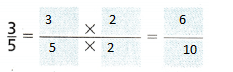
Since \(\frac{6}{10}\) < \(\frac{9}{10}\), you know that \(\frac{3}{5}\) <\(\frac{9}{10}\).
Label \(\frac{3}{5}\) and \(\frac{9}{10}\) on the number line above.

The fraction the greatest distance from 0 has the greatest value.
The fraction with the greatest value is ____________ .
So, the bin with ____________ is the most full.
Answer:

Math Talk

Mathematical Processes
Explain how to write \(\frac{3}{5}\) and \(\frac{9}{10}\) as decimals in hundredths and compare their distances from 0.
Answer:
\(\frac{3}{5}\) = \(\frac{60}{100}\)
\(\frac{9}{10}\) = \(\frac{90}{100}\)

Explain how to write \(\frac{3}{5}\) and \(\frac{9}{10}\) as decimals in tenths and compare their distances from 0.
Texas Go Math Grade 4 Lesson 4.3 Compare and Order Fractions 4
Answer:

Example 2

Write \(\frac{7}{10}\), \(\frac{1}{3}\), \(\frac{7}{12}\), and \(\frac{8}{10}\) in order from least to greatest.
Texas Go Math Grade 4 Lesson 4.3 Compare and Order Fractions 5

Step 1 Compare each fraction to \(\frac{1}{2}\).
List fractions that are less than \(\frac{1}{2}\): ________________
List fractions that are greater than \(\frac{1}{2}\): ________________
The fraction with the least value is ________________.
Locate and label \(\frac{1}{3}\) on the number tine above.
Answer:

Step 2 Compare \(\frac{7}{10}\) to \(\frac{7}{12}\) and \(\frac{8}{10}\).

Think: \(\frac{7}{10}\) and \(\frac{7}{12}\) have equal numerators.
\(\frac{7}{10}\) ___________ \(\frac{7}{12}\)
Answer:

Think: \(\frac{7}{10}\) and \(\frac{8}{10}\) have equal denominators.
\(\frac{7}{10}\) ___________ \(\frac{8}{10}\)
Answer:

Locate and label \(\frac{7}{10}\), \(\frac{7}{12}\), and \(\frac{8}{10}\) on the number line above.
The fractions in order from least to greatest are ___________ .
So, _____ < _____ < _____ < ______ .
Answer:

Math Talk

Mathematical Processes
Explain how benchmarks can help you order
Answer:

Share and Show

Question 1.
Locate and label points on the number line to help you write \(\frac{3}{10}\), \(\frac{11}{12}\), and \(\frac{5}{8}\) in order from least to greatest.
Texas Go Math Grade 4 Lesson 4.3 Compare and Order Fractions 6
Answer:

Explanation:
Make the common denominator for all
\(\frac{3}{10}\)= \(\frac{36}{120}\)
\(\frac{11}{12}\)= \(\frac{110}{120}\)
\(\frac{5}{8}\) = \(\frac{75}{120}\)

Write the fractions in order from least to greatest.

Lesson 4.3 Problem Set Answer Key Go Math Grade 4 Question 2.
\(\frac{1}{4}, \frac{5}{8}, \frac{1}{2}\)
Answer: \(\frac{1}{4}, \frac{1}{2}, \frac{5}{8}\)
Explanation:
Make the common denominator for all
\(\frac{1}{4}\) = \(\frac{2}{8}\)
\(\frac{5}{8}\) = \(\frac{5}{8}\)
\(\frac{1}{2}\) = \(\frac{4}{8}\)

Question 3.
\(\frac{3}{5}, \frac{2}{3}, \frac{3}{10}, \frac{4}{5}\)
Answer: \(\frac{3}{10},\frac{3}{5}, \frac{2}{3}, \frac{4}{5}\)
Explanation:
Make the common denominator for all
\(\frac{3}{5}\) = \(\frac{18}{30}\)
\(\frac{2}{3}\) = \(\frac{20}{30}\)
\(\frac{3}{10}\) = \(\frac{9}30}\)
\(\frac{4}{5}\) = \(\frac{24}{30}\)

Question 4.
\(\frac{3}{4}, \frac{7}{12}, \frac{5}{12}\)
Answer: \( \frac{5}{12},\frac{7}{12}, \frac{3}{4}\)
Explanation:
Make the common denominator for all
\(\frac{3}{4}\) = \(\frac{9}{12}\)
\(\frac{7}{12}\) = \(\frac{7}{12}\)
\(\frac{5}{12}\) = \(\frac{5}{12}\)

H.O.T. Algebra Write a numerator that makes the statement true.

Question 5.
\(\frac{1}{2}\) < \(\frac{}{10}\) < \(\frac{4}{5}\)
Answer: \(\frac{1}{2}\) < \(\frac{6}{10}\) < \(\frac{4}{5}\)
Explanation:
Make the common denominator for all
\(\frac{1}{2}\) = \(\frac{5}{10}\)
\(\frac{5}{10}\) = \(\frac{}{10}\)
\(\frac{4}{5}\) = \(\frac{8}{10}\)

Question 6.
\(\frac{1}{4}\) < \(\frac{5}{12}\) < \(\frac{}{6}\)
Answer: \(\frac{1}{4}\) < \(\frac{5}{12}\) < \(\frac{1}{6}\)
Explanation:
Make the common denominator for all
\(\frac{1}{4}\) = \(\frac{3}{12}\)
\(\frac{5}{12}\) = \(\frac{5}{12}\)
\(\frac{}{6}\) = \(\frac{6}{12}\) = \(\frac{1}{6}\)

Go Math Lesson 4.3 4th Grade Homework Answer Key Question 7.
\(\frac{}{8}\) < \(\frac{3}{4}\) < \(\frac{7}{8}\)
Answer: \(\frac{5}{8}\) < \(\frac{3}{4}\) < \(\frac{7}{8}\)
Explanation:
Make the common denominator for all
\(\frac{}{8}\) = \(\frac{5}{8}\)
\(\frac{3}{4}\) = \(\frac{6}{8}\)
\(\frac{7}{8}\) = \(\frac{7}{8}\)

Problem Solving

Question 8.
H.O.T. Multi-Step Nancy, Lionel, and Mavis ran in a 5-kilometer race. The table shows their finish times. In what order did Nancy, Lionel, and Mavis finish the race?
Texas Go Math Grade 4 Lesson 4.3 Compare and Order Fractions 7
Answer:

a. What do you need to find?
Answer:

b. What information do you need to solve the problem?
Answer:

c. What information is not necessary?
Answer:

d. How will you solve the problem?
Answer:

e. Show the steps to solve the problem.
Answer:

f. Complete the sentences.
The runner who finished first is _________ .
The runner who finished second is _________ .
The runner who finished third is __________ .
Answer:

Question 9.
Multi-Step Alma used 3 beads to make a necklace. The lengths of the beads are \(\frac{5}{6}\) inch, \(\frac{5}{12}\) inch, and \(\frac{1}{3}\) inch. What are the lengths in order from shortest to longest?
Answer: \(\frac{1}{3}\) , \(\frac{5}{12}\), \(\frac{5}{6}\)
Explanation:
Make the common denominator for all
\(\frac{5}{6}\) = \(\frac{10}{12}\)
\(\frac{5}{12}\) = \(\frac{5}{12}\)
\(\frac{1}{3}\) = \(\frac{4}{12}\)

Question 10.
H.O.T. Apply Portia lias done \(\frac{3}{7}\) of her English homework, \(\frac{6}{7}\) of her math homework, and \(\frac{6}{11}\) of her geography homework. Which subject is most complete? Which subject does she have the most left to do?
Answer: Math subject is most completed. English subject most left .
Explanation:
Make the common denominator for all
\(\frac{3}{7}\) = \(\frac{33}{77}\)
\(\frac{6}{7}\) = \(\frac{66}{77}\)
\(\frac{6}{11}\) = \(\frac{42}{77}\)

Daily Assessment Task

Fill in the bubble completely to show your answer.

Question 11.
Use Diagrams Students voted for their favorite hat on Crazy Hat Day. An alien baseball cap got \(\frac{1}{4}\) of the votes, a flower power hat got \(\frac{5}{8}\) of the votes, and an animal look-alike hat got \(\frac{1}{12}\) of the votes. Which shows the fractions written in order from least to greatest?
Texas Go Math Grade 4 Lesson 4.3 Compare and Order Fractions 8
(A) \(\frac{1}{12}\) < \(\frac{5}{8}\) < \(\frac{1}{4}\)
(B) \(\frac{1}{12}\) < \(\frac{1}{4}\) < \(\frac{5}{8}\)
(C) \(\frac{5}{8}\) < \(\frac{1}{4}\) < \(\frac{1}{12}\)
(D) \(\frac{1}{4}\) < \(\frac{1}{12}\) < \(\frac{5}{8}\)
Answer: B
Explanation:
Make the common denominator for all
\(\frac{1}{4}\) = \(\frac{6}{24}\)
\(\frac{5}{8}\) = \(\frac{15}{24}\)
\(\frac{1}{12}\) = \(\frac{2}{24}\)

Lesson 4.3 4th Grade Practice and Homework Answer Key Question 12.
Multi-Step The fourth grade gym class ran a relay. The first runner ran \(\frac{4}{5}\) mile, the second runner ran \(\frac{3}{10}\) mile, the third runner ran \(\frac{1}{5}\) mile and the fourth runner ran \(\frac{7}{10}\) mile Compare \(\frac{4}{5}, \frac{3}{10}, \frac{1}{5}\), and \(\frac{7}{10}\). Which fraction represents the greatest distance?
Texas Go Math Grade 4 Lesson 4.3 Compare and Order Fractions 9
(A) \(\frac{4}{5}\)
(B) \(\frac{3}{10}\)
(C) \(\frac{1}{5}\)
(D) \(\frac{7}{10}\)
Answer: \(\frac{4}{5}\)
Explanation:
Make the common denominator for all
\(\frac{4}{5}\) = \(\frac{8}{10}\)
\(\frac{3}{10}\) = \(\frac{3}{10}\)
\(\frac{1}{5}\) = \(\frac{2}10}\)
\(\frac{7}{10}\) = \(\frac{7}{10}\)

Question 13.
Multi-Step The three puppies at the animal shelter weighed \(\frac{2}{3}\) pound, \(\frac{5}{6}\) pound, and \(\frac{7}{12}\) pound. Compare \(\frac{2}{3}\), \(\frac{5}{6}\), and \(\frac{7}{12}\). Which shows the fractions written in order from least to greatest?
(A) \(\frac{2}{3}\) < \(\frac{7}{12}\) < \(\frac{5}{6}\)
(B) \(\frac{2}{3}\) < \(\frac{5}{6}\) < \(\frac{7}{12}\)
(C) \(\frac{7}{12}\) < \(\frac{5}{6}\) < \(\frac{2}{3}\)
(D) \(\frac{7}{12}\) < \(\frac{2}{3}\) < \(\frac{5}{6}\)
Answer: \(\frac{7}{12}\) < \(\frac{2}{3}\) < \(\frac{5}{6}\)
Make the common denominator for all
\(\frac{2}{3}\) = \(\frac{8}{12}\)
\(\frac{5}{6}\) = \(\frac{10}{12}\)
\(\frac{7}{12}\) = \(\frac{7}{12}\)

TEXAS Test Prep

Question 14.
A recipe for Trail Mix includes \(\frac{3}{10}\) cup of sunflower seeds, \(\frac{1}{2}\) cup of raisins, and \(\frac{3}{8}\) cup of granola. Which list shows the amounts from least to greatest?
(A) \(\frac{1}{2}\)cup, \(\frac{3}{8}\)cup, \(\frac{3}{10}\)cup
(B) \(\frac{3}{8}\)cup, \(\frac{3}{10}\)cup, \(\frac{1}{2}\)cup
(C) \(\frac{3}{10}\)cup, \(\frac{3}{8}\)cup, \(\frac{1}{2}\)cup
(D) \(\frac{3}{10}\)cup, \(\frac{1}{2}\)cup, \(\frac{3}{8}\)cup
Answer: \(\frac{2}{8},\frac{2}{6}, \frac{2}{4} \)
Explanation: (C)   \(\frac{3}{10}\)cup, \(\frac{3}{8}\)cup, \(\frac{1}{2}\)cup
Make the common denominator for all
\(\frac{3}{10}\) = \(\frac{12}{40}\)
\(\frac{1}{2}\) = \(\frac{20}{40}\)
\(\frac{3}{8}\) = \(\frac{15}{40}\)

Texas Go Math Grade 4 Lesson 4.3 Homework and Practice Answer Key

Write the fractions in order from least to greatest.

Question 1.
\(\frac{2}{8}, \frac{2}{4}, \frac{2}{6}\)
Answer: \(\frac{2}{8},\frac{2}{6}, \frac{2}{4} \)
Explanation:
Make the common denominator for all
\(\frac{2}{8}\) = \(\frac{6}{24}\)
\(\frac{2}{4}\) = \(\frac{12}{24}\)
\(\frac{2}{6}\) = \(\frac{8}{24}\)

Question 2.
\(\frac{2}{5}, \frac{1}{3}, \frac{5}{6}\)
Answer: \(\frac{1}{3},\frac{2}{5}, \frac{5}{6}\)
Explanation:
Make the common denominator for all
\(\frac{2}{5}\) = \(\frac{12}{30}\)
\(\frac{1}{3}\) = \(\frac{10}{30}\)
\(\frac{5}{6}\) = \(\frac{25}{30}\)

Write a numerator that makes the statement true.

Question 3.
\(\frac{7}{12}\) < \(\frac{}{3}\) < \(\frac{3}{4}\)
Answer: \(\frac{7}{12}\) < \(\frac{2}{3}\) < \(\frac{3}{4}\)
Explanation:
Make the common denominator for all
\(\frac{7}{12}\) = \(\frac{7}{12}\)
\(\frac{}{3}\) = \(\frac{8}{12}\)  = latex]\frac{2}{3}[/latex]
\(\frac{3}{4}\) = \(\frac{9}{12}\)

Go Math Grade 4 Lesson 4.3 Practice and Homework Answer Key Question 4.
\(\frac{}{10}\) < \(\frac{9}{15}\) < \(\frac{4}{5}\)
Answer: \(\frac{5}{10}\) < \(\frac{9}{15}\) < \(\frac{4}{5}\)
Explanation:
Make the common denominator for all
\(\frac{}{10}\) = \(\frac{15}{30}\) =\(\frac{5}{10}\)
\(\frac{9}{15}\) = \(\frac{18}{30}\)
\(\frac{4}{5}\) = \(\frac{24}{30}\)

Problem Solving

Question 5.
Walt, Dalia, and Kyra ran a race. The table shows their finish times. In what order did Walt, Dalia, and Kyra finish the race?
Texas Go Math Grade 4 Lesson 4.3 Compare and Order Fractions 10
Answer: Paul, Dalia , Walt , Kyra
Explanation:
Walt – \(\frac{4}{5}\) = 0.8 hour = 48 min
Dalia –\(\frac{2}{3}\) = 0.66 hour =39.6 min
Kyra – \(\frac{5}{6}\) = 0.83 hour = 49.8 min
Paul- \(\frac{3}{10}\) = 0.3 hour = 18 min

Question 6.
Walt’s friend Paul also ran in the race. Who finished first, Walt or Paul?
Answer: Paul Finished first.
Explanation:
Walt – \(\frac{4}{5}\) = 0.8 hour = 48 min
Dalia –\(\frac{2}{3}\) = 0.66 hour =39.6 min
Kyra – \(\frac{5}{6}\) = 0.83 hour = 49.8 min
Paul- \(\frac{3}{10}\) = 0.3 hour = 18 min

Lesson Check

Fill in the bubble completely to show your answer.

Question 7.
A recipe for ice cream includes \(\frac{3}{4}\) cup milk, \(\frac{1}{3}\) cup cream, and \(\frac{1}{8}\) cup sugar. Which shows the amounts from least to greatest?
(A) \(\frac{1}{3}\)cup, \(\frac{3}{4}\)cup, \(\frac{1}{8}\)cup
(B) \(\frac{1}{8}\)cup, \(\frac{3}{4}\)cup, \(\frac{1}{8}\)cup
(C) \(\frac{1}{3}\)cup, \(\frac{3}{4}\)cup, \(\frac{1}{8}\)cup
(D) \(\frac{1}{8}\)cup, \(\frac{1}{3}\)cup,\(\frac{3}{4}\)cup
Answer: D
Explanation:
\(\frac{1}{3}\) = 0.33
\(\frac{3}{4}\) = 0.75
\(\frac{1}{8}\) =  0.12

Question 8.
Order the fractions from least to greatest.
\(\frac{4}{5}, \frac{1}{3}, \frac{7}{10}, \frac{3}{5}\)
(A) \(\frac{1}{3}\) < \(\frac{3}{5}\) < \(\frac{7}{10}\) < \(\frac{4}{5}\)
(B) \(\frac{3}{5}\) < \(\frac{1}{3}\) < \(\frac{4}{5}\) < \(\frac{7}{10}\)
(C) \(\frac{7}{10}\) < \(\frac{3}{5}\) < \(\frac{1}{3}\) < \(\frac{4}{5}\)
(D) \(\frac{4}{5}\) < \(\frac{7}{10}\) < \(\frac{1}{3}\) < \(\frac{3}{5}\)
Answer:
Explanation:
\(\frac{4}{5}\) =0.8
\(\frac{7}{10}\) =0.7
\(\frac{1}{3}\) = 0.33
\(\frac{3}{5}\) = 0.6
Based on above decimal value , below is the order from least to greatest
\(\frac{1}{3}\) < \(\frac{3}{5}\) < \(\frac{7}{10}\) < \(\frac{4}{5}\)

Question 9.
Order the fractions from least to greatest.
\(\frac{2}{3}, \frac{1}{4}, \frac{5}{12}, \frac{3}{4}\)
(A) \(\frac{1}{4}, \frac{2}{3}, \frac{5}{12}, \frac{3}{4}\)
(B) \(\frac{3}{4}, \frac{5}{12}, \frac{2}{3}, \frac{1}{4}\)
(C) \(\frac{1}{4}, \frac{5}{12}, \frac{2}{3}, \frac{3}{4}\)
(D) \(\frac{1}{4}, \frac{5}{12}, \frac{3}{4}, \frac{2}{3}\)
Answer: (D) \(\frac{1}{4}, \frac{5}{12}, \frac{3}{4}, \frac{2}{3}\)
Explanation:
\(\frac{2}{3}\) =0.66
\(\frac{1}{4}\) =0.25
\(\frac{5}{12}\) = 0.41
\(\frac{3}{4}\) = 0.75
below is the Order the fractions from least to greatest.
\(\frac{1}{4}, \frac{5}{12}, \frac{3}{4}, \frac{2}{3}\)

Question 10.
Three potatoes weigh \(\frac{1}{4}\) pound, \(\frac{5}{8}\) pound, and \(\frac{1}{2}\) pound. Which shows the weights from least to greatest?
(A) \(\frac{1}{4}\)pound, \(\frac{5}{8}\)pound, \(\frac{1}{2}\)pound
(B) \(\frac{1}{2}\)pound, \(\frac{1}{4}\)pound, \(\frac{5}{8}\)pound
(C) \(\frac{5}{8}\)pound, \(\frac{1}{2}\)pound, \(\frac{1}{4}\)pound
(D) \(\frac{1}{4}\)pound, \(\frac{1}{2}\)pound, \(\frac{5}{8}\)pound
Answer: (D) \(\frac{1}{4}\)pound, \(\frac{1}{2}\)pound, \(\frac{5}{8}\)pound
Explanation:
\(\frac{1}{4}\) = 0.25
\(\frac{5}{8}\) = 0.625
\(\frac{1}{2}\) = 0.5
Based on the above decimal values of weights, below is the order from least to greatest
\(\frac{1}{4}\)pound, \(\frac{1}{2}\)pound, \(\frac{5}{8}\)pound

My Homework Lesson 4.3 Compare and Order Fractions Answer Key Question 11.
Multi-Step Selma used stones to outline her garden. The lengths of the stones are \(\frac{1}{3}\)foot, \(\frac{7}{12}\) foot, and \(\frac{3}{4}\) foot. What are the lengths in order from shortest to longest?
(A) \(\frac{7}{12}\)foot, \(\frac{3}{4}\)foot, \(\frac{1}{3}\)foot
(B) \(\frac{1}{3}\)foot, \(\frac{7}{12}\)foot, \(\frac{3}{4}\)foot
(C) \(\frac{3}{4}\)foot, \(\frac{7}{12}\)foot, \(\frac{1}{3}\)foot
(D) \(\frac{7}{12}\)foot, \(\frac{1}{3}\)foot, \(\frac{3}{4}\)foot
Answer: (B) \(\frac{1}{3}\)foot, \(\frac{7}{12}\)foot, \(\frac{3}{4}\)foot
Explanation:
\(\frac{7}{12}\) =0.58
\(\frac{3}{4}\) = 0.75
\(\frac{1}{3}\) = 0.33
Based on above decimal values of lengths, below is the order from shortest to longest
\(\frac{1}{3}\)foot, \(\frac{7}{12}\)foot, \(\frac{3}{4}\)foot

Question 12.
Multi-Step Ms. Mohan bought cheese for a recipe. She bought \(\frac{5}{6}\) pound of cheddar cheese, \(\frac{1}{4}\) pound of Swiss cheese, and \(\frac{3}{8}\) pound of American cheese. What are the amounts in order from least to greatest?
(A) \(\frac{5}{6}\)pound, \(\frac{1}{4}\)pound, \(\frac{3}{8}\)pound
(B) \(\frac{3}{8}\)pound, \(\frac{5}{6}\)pound, \(\frac{1}{4}\)pound
(C) \(\frac{1}{4}\)pound, \(\frac{3}{8}\)pound, \(\frac{5}{6}\)pound
(D) \(\frac{3}{8}\)pound, \(\frac{1}{4}\)pound, \(\frac{5}{6}\)pound
Answer: (C) \(\frac{1}{4}\)pound, \(\frac{3}{8}\)pound, \(\frac{5}{6}\)pound
Explanation:
\(\frac{5}{6}\)= 0.83
\(\frac{1}{4}\) = 0.25
\(\frac{3}{8}\) = 0.37
Based on above decimal values, below is the order from least to greatest
\(\frac{1}{4}\)pound, \(\frac{3}{8}\)pound, \(\frac{5}{6}\)pound

Texas Go Math Grade 4 Lesson 4.3 Answer Key Compare and Order Fractions Read More »

Texas Go Math Grade 4 Module 3 Assessment Answer Key

Refer to our Texas Go Math Grade 4 Answer Key Pdf to score good marks in the exams. Test yourself by practicing the problems from Texas Go Math Grade 4 Module 3 Assessment Answer Key.

Texas Go Math Grade 4 Module 3 Assessment Answer Key

Vocabulary

  • unit fraction
  • equivalent fractions
  • factor

Choose the best term from the box.

Question 1.
________________ name the same amount.
Answer:

Question 2.
A ______________ always has a numerator of 1.
Answer:

Concepts and Skills

Write two equivalent fractions.

Question 3.
\(\frac{2}{5}\) = _____________ = ____________
Answer:

Go Math Grade 4 Module 3 Answer Key Question 4.
\(\frac{1}{3}\) = _____________ = ____________
Answer:

Question 5.
\(\frac{3}{4}\) = _____________ = ____________
Answer:

Tell whether the fractions are equivalent. Write = or ≠.

Question 6.
\(\frac{2}{3}\) ____________ \(\frac{4}{12}\)
Answer:

Question 7.
\(\frac{5}{6}\) ____________ \(\frac{10}{12}\)
Answer:

Question 8.
\(\frac{1}{4}\) ____________ \(\frac{4}{8}\)
Answer:

Write the fraction in simplest form.

Question 9.
\(\frac{6}{8}\)
Answer:

Question 10.
\(\frac{25}{100}\)
Answer:

Grade 4 Module 3 Answer Key Go Math Question 11.
\(\frac{8}{10}\)
Answer:

Write the fraction as a sum of unit fractions.

Question 12.
Texas Go Math Grade 4 Module 3 Assessment Answer Key 1
\(\frac{3}{5}\) = ____________
Answer:

Question 13.
Texas Go Math Grade 4 Module 3 Assessment Answer Key 2
\(\frac{5}{6}\) = ____________
Answer:

Question 14.
Texas Go Math Grade 4 Module 3 Assessment Answer Key 3
\(\frac{5}{3}\) = ____________
Answer:

Question 15.
Texas Go Math Grade 4 Module 3 Assessment Answer Key 4
\(\frac{9}{2}\) = ____________
Answer:

Fill in the bubble completely to show your answer.

Question 16.
Sam needs \(\frac{5}{6}\) cup mashed bananas and \(\frac{3}{4}\) cup mashed strawberries for a recipe. Which shows a pair of fractions that are equivalent to \(\frac{5}{6}\) and \(\frac{3}{4}\)?
(A) \(\frac{5}{12}\) and \(\frac{3}{12}\)
(B) \(\frac{10}{12}\) and \(\frac{2}{12}\)
(C) \(\frac{10}{12}\) and \(\frac{9}{12}\)
(D) \(\frac{2}{3}\) and \(\frac{18}{24}\)
Answer:

Go Math Grade 4 Module 3 Assessment Answers Question 17.
Karen will divide her garden into equal parts. She will plant corn in \(\frac{1}{5}\) of the garden. Which fraction is equivalent to \(\frac{1}{5}\)?
(A) \(\frac{2}{15}\)
(B) \(\frac{3}{12}\)
(C) \(\frac{2}{10}\)
(D) \(\frac{4}{5}\)
Answer:

Question 18.
Olivia cut a board into 8 equal pieces. She used \(\frac{5}{8}\) of the pieces.
Which shows \(\frac{5}{8}\) written as a sum of unit fractions?
Texas Go Math Grade 4 Module 3 Assessment Answer Key 5
(A) \(\frac{1}{8}+\frac{1}{8}+\frac{1}{8}\)
(B) \(\frac{1}{8}+\frac{1}{8}+\frac{1}{8}+\frac{1}{8}+\frac{1}{8}\)
(C) \(\frac{1}{8}+\frac{1}{8}\)
(D) \(\frac{1}{8}+\frac{1}{8}+\frac{1}{8}+\frac{1}{8}\)
Answer:

Go Math Module 3 Answer Key Grade 4  Question 19.
Robert grew 1\(\frac{3}{4}\) inches last year. Which shows 1\(\frac{3}{4}\) written as a sum of fractions?
(A) \(\frac{1}{4}+\frac{1}{4}+\frac{1}{4}\)
(B) \(\frac{1}{4}+\frac{1}{4}\)
(C) \(\frac{1}{4}+\frac{1}{4}+\frac{1}{4}+\frac{1}{4}+\frac{3}{4}\)
(D) 1 + \(\frac{1}{4}+\frac{1}{4}\)
Answer:

Texas Go Math Grade 4 Module 3 Assessment Answer Key Read More »

Texas Go Math Grade 4 Lesson 2.4 Answer Key Relate Hundredths and Decimals

Refer to our Texas Go Math Grade 4 Answer Key Pdf to score good marks in the exams. Test yourself by practicing the problems from Texas Go Math Grade 4 Lesson 2.4 Answer Key Relate Hundredths and Decimals.

Texas Go Math Grade 4 Lesson 2.4 Answer Key Relate Hundredths and Decimals

Essential Question

How can you record hundredths as fractions and decimals?
Answer:
We know that,
The representation of the hundredths in the place-value chart is: 0.01
So,
The representation of the hundredths in the form of a fraction is: \(\frac{1}{100}\)
Hence, from the above,
We can conclude that
The representation of the hundredths in the form of a fraction is: \(\frac{1}{100}\)
The representation of the hundredths in the form of a decimal number is 0.01

Unlock the problem

In the 2008 Summer Olympic Games, the winning time in the men’s 100-meter butterfly race was only \(\frac{1}{100}\) second faster than the second-place time. What decimal represents this fraction of a second?
• Circle the numbers you need to use.
Answer:
It is given that
In the 2008 Summer Olympic Games, the winning time in the men’s 100-meter butterfly race was only \(\frac{1}{100}\) second faster than the second-place time
Hence, from the above,
We can conclude that
The numbers we need to use are: 1 and 100

You can write hundredths as fractions or decimals.

One Way, Use a model and a place-value chart.
Fraction
Shade \(\frac{1}{100}\) of the model.

Write: 0.01
Read: one hundredth

Decimal
Complete the place-value chart. \(\frac{1}{100}\) is 1 hundredth.
Texas Go Math Grade 4 Lesson 2.4 Relate Hundredths and Decimals 2
Write: 0.01
Read: one hundredth

Another Way Use a number line.
Label the number line with equivalent decimals. Locate the point \(\frac{1}{100}\).
Texas Go Math Grade 4 Lesson 2.4 Relate Hundredths and Decimals 3
Now,
From the above Number line,
We can observe that
0.01 names the same amount as \(\frac{1}{100}\).
So,
The winning time was 0.01 seconds faster.

Math Talk

Mathematical Processes
Explain how the size of one-tenth is related to the size one hundredth.
Answer:
We know that,
One-hundredth is the tenth of the one-tenth
Hence, from the above,
We can conclude that
One-hundredth = \(\frac{1}{10}\) × One-tenth

Alicia Won her 400-meter freestyle race by 4\(\frac{25}{100}\) seconds. How can you write this mixed number as a decimal?

Example Use a number line.
Label the number line with equivalent mixed numbers and decimals Locate the point 4\(\frac{25}{100}\).

Now,
From the above Number line,
We can observe that
4.25 names the same amount as 4\(\frac{25}{100}\).
So,
Alicia won her race by 4.25 seconds.

Share and Show

Question 1.
Shade the model to show \(\frac{31}{100}\)
Write the amount as a decimal. ______________
Texas Go Math Grade 4 Lesson 2.4 Relate Hundredths and Decimals 5
Answer:
The given models are:
Texas Go Math Grade 4 Lesson 2.4 Relate Hundredths and Decimals 5
Now,
To represent \(\frac{31}{100}\) in a rectangle,
We will shade 31 boxes in a rectangle out of 100 boxes
Now,
To represent \(\frac{31}{100}\) in the form of a decimal,
Write 31 after the decimal point
So,
The representation of \(\frac{31}{100}\) in the given models is:

Hence, from the above,
We can conclude that
The representation of \(\frac{31}{100}\) in the form of a decimal is: 0.31

Write the fraction or mixed number and the decimal shown by the model.

Question 2.
Texas Go Math Grade 4 Lesson 2.4 Relate Hundredths and Decimals 6
Answer:
The given model is:

Now,
From the above model,
We can observe that
The representation of the given model in the form of a fraction = (The number of shaded parts) ÷ (The total number of parts)
= \(\frac{68}{100}\)
Now,
The representation of the given model in the form of a decimal number is: 0.68
Hence, from the above,
We can conclude that
The representation of the given model in the form of a fraction is: \(\frac{68}{100}\)
The representation of the given model in the form of a decimal number is: 0.68

Go Math Lesson 2.4 4th Grade Answer Key Question 3.
Texas Go Math Grade 4 Lesson 2.4 Relate Hundredths and Decimals 7
Answer:
The given model is:

Now,
From the above model,
We can observe that
The representation of the given model in the form of a fraction = (The number of shaded parts) ÷ (The total number of parts)
= \(\frac{8}{100}\)
Now,
The representation of the given model in the form of a decimal number is: 0.08
Hence, from the above,
We can conclude that
The representation of the given model in the form of a fraction is: \(\frac{8}{100}\)
The representation of the given model in the form of a decimal number is: 0.08

Question 4.
Texas Go Math Grade 4 Lesson 2.4 Relate Hundredths and Decimals 8
Answer:
The given model is:

Now,
The representation of the complete model is:

Now,
From the above model,
We can observe that
The representation of the marked point in the form of a mixed number is: 6\(\frac{19}{100}\)
The representation of the marked point in the form of a decimal number is: 6.19
Hence, from the above,
We can conclude that
The representation of the marked point in the form of a mixed number is: 6\(\frac{19}{100}\)
The representation of the marked point in the form of a decimal number is: 6.19

Math Talk

Mathematical Processes
Are 0.5 and 0.50 equivalent? Explain.
Answer:
The given decimal numbers are: 0.5 and 0.50
Now,
We know that,
If zero is placed on the right side as the last digit in the decimal number, then that zero don’t have any value
So,
0.5 = 0.50
Hence, from the above,
We can conclude that
0.5 and 0.50 are equivalent

Problem Solving

Question 5.
H.O.T Representations Shade the grids to show three different ways to represent \(\frac{16}{100}\) using models.
Texas Go Math Grade 4 Lesson 2.4 Relate Hundredths and Decimals 9
Answer:
The given fraction is: \(\frac{16}{100}\)
Now,
To represent the given fraction in 3 different ways,
We have to write the equivalent fractions of \(\frac{16}{100}\)
So,
The equivalent fractions of the given fraction are:
\(\frac{16}{100}\) = \(\frac{4}{25}\) = \(\frac{8}{50}\)
So,
The representation of the above equivalent fractions in the models is:

Hence, from the above,
We can conclude that
The three ways to represent \(\frac{16}{100}\) are:

Question 6.
Write Math Explain how one whole, one-tenth, and one hundredth are related.
Answer:
We know that,
“One-whole” is represented as 1
“One-tenth” is \(\frac{1}{10}\) of 1
“One-hundredth” is \(\frac{1}{10}\) of “One-tenth” and \(\frac{1}{100}\) of 1
Hence, from the above,
We can conclude that
One-hundredth = \(\frac{1}{10}\) of “One-tenth” = \(\frac{1}{100}\) of 1

Sense or Nonsense?

Question 7.
H.O.T. Multi-Step The Memorial Library is 0.3 miles from the school. Whose statement makes sense? Whose statement is nonsense?
Explain your reasoning.
Texas Go Math Grade 4 Lesson 2.4 Relate Hundredths and Decimals 10
Answer:
It is given that
The Memorial Library is 0.3 miles from the school
Now,
The representation of 0.3 in the form of a fraction is: \(\frac{3}{10}\)
The representation of 0.3 in the word form is: Three tenths
Now,
According to the given information,
Gabe said he was going to walk three tenths miles
Tara said she was going to walk three miles
Hence, from the above,
We can conclude that
Tanya’s statement is nonsense

Daily Assessment Task

Fill in the bubble completely to show your answer.

Question 8.
A house shaped like a ball has curved windows. The largest window is 2\(\frac{75}{100}\) meters tall. What is 2\(\frac{75}{100}\) written as a decimal?
(A) 0.275
(B) 2.175
(C)2.75
(D) 27.5
Answer:
It is given that
A house shaped like a ball has curved windows. The largest window is 2\(\frac{75}{100}\) meters tall
Now,
The given mixed number is: 2\(\frac{75}{100}\)
So,
2[llatex]\frac{75}{100}[/latex] = 2 + \(\frac{75}{100}\)
= 2 + 0.75
= 2.75
Hence, from the above,
We can conclude that
The representation of 2\(\frac{75}{100}\) as a decimal is:

Question 9.
Barry made the model below to show the distance he and his sister hiked while on vacation. Which decimal does the model show?
Texas Go Math Grade 4 Lesson 2.4 Relate Hundredths and Decimals 11
(A) 4.80
(B) 3.80
(C) 4.08
(D) 3.08
Answer:
It is given that
Barry made the model below to show the distance he and his sister hiked while on vacation
Now,
The given model is:
Texas Go Math Grade 4 Lesson 2.4 Relate Hundredths and Decimals 11
Now,
From the above model,
We can observe that
The representation of the model in the form of a fraction = (The number of shaded parts) ÷ (The total number of parts)
= \(\frac{380}{100}[latex]
= 3.80
Hence, from the above,
We can conclude that
The representation of the model in the form of a decimal number is:

Question 10.
A quilt is made up of 100 equal squares. There is a star on 35 of the squares. Which decimal represents the part of the quilt with stars?
(A) 35
(B) 3.5
(C) 1.35
(D) 0.35
Answer:
It is given that
A quilt is made up of 100 equal squares. There is a star on 35 of the squares
Now,
The part of the quilt with stars = (The number of stars present) ÷ (The total number of squares)
= [latex]\frac{35}{100}\)
= 0.35
Hence, from the above,
We can conclude that
The representation of the part of the quilt with the stars in the form of a decimal is:

TEXAS Test Prep

Question 11.
Which are the fraction and decimal shown by the model?
Texas Go Math Grade 4 Lesson 2.4 Relate Hundredths and Decimals 12
(A) 12\(\frac{9}{10}\); 12.9
(B) 1\(\frac{29}{100}\); 1.29
(C) 1\(\frac{09}{100}\); 1.09
(D) 2\(\frac{90}{100}\); 2.90
Answer:
The given model is:
Texas Go Math Grade 4 Lesson 2.4 Relate Hundredths and Decimals 12
Now,
From the above model,
We can observe that
The representation of the above model in the form of a fraction = (The number of shaded parts) ÷ (The total number of parts)
= \(\frac{129}{100}\)
= 1\(\frac{29}{100}\)
= 1 + \(\frac{29}{100}\)
= 1 + 0.29
= 1.29
Hence, from the above,
We can conclude that
The representation of the fraction and decimal for the given model is:

Texas Go Math Grade 4 Lesson 2.4 Homework and Practice Answer Key

Relate Hundredths and Decimals

Question 1.
The fully shaded grid shows 1. Explain how these three models are related.
Problem Solving
Texas Go Math Grade 4 Lesson 2.4 Relate Hundredths and Decimals 13
Answer:
It is given that
The fully shaded grid shows 1
Now,
The given model is:
Texas Go Math Grade 4 Lesson 2.4 Relate Hundredths and Decimals 13
Now,
From the above model,
We can observe that
The first model is shaded only one-tenth of the second model
The second model is shaded only one-tenth of the third model
So,
The relationship between the models is:
1st model = \(\frac{1}{10}\) of 2nd model = \(\frac{1}{100}\) of 3rd model
Hence, from the above,
We can conclude that
The relationship between the models is:
1st model = \(\frac{1}{10}\) of 2nd model = \(\frac{1}{100}\) of 3rd model

Go Math Lesson 2.4 Homework Answer Key Grade 4 Question 2.
Emma and Charles saw this sign along the highway.
Emma said, “It is seventy-five hundredths of a mile to Waterslide Park.”
Charles said, “It is seven and five-tenths miles to Waterslide Park.”
Texas Go Math Grade 4 Lesson 2.4 Relate Hundredths and Decimals 14

Whose statement makes sense? whose statement is nonsense? Explain your reasoning.
Answer:
It is given that
Emma said, “It is seventy-five hundredths of a mile to Waterslide Park.”
Charles said, “It is seven and five-tenths miles to Waterslide Park.”
Now,
The representation of seventy-five hundredths in the Standard form is: 0.75
The representation of seven and five-tenths in the Standard form is: 7.5
It is given that
The Waterslide park is: 0.75 miles
Hence, from the above,
We can conclude that
Emma’s statement makes sense
Charles’s statement makes not sense

Question 3.
Jake said he has \(\frac{8}{100}\) of a dollar in his pocket. Margie said that the decimal for \(\frac{8}{100}\) is 0.8. What error did she make? What is the decimal form for \(\frac{8}{100}\)?
Answer:
It is given that
Jake said he has \(\frac{8}{100}\) of a dollar in his pocket. Margie said that the decimal for \(\frac{8}{100}\) is 0.8
Now,
The representation of \(\frac{8}{100}\) in the decimal form is: 0.08
Now,
0.8 represents only one digit after the decimal point
But,
From the given fraction,
The digits after the decimal point must have 2
So,
The error made by Margie is:
The misinterprettion of digits after the decimal point
Hence, from the above,
We can conclude that
The error made by Margie is:
The misinterprettion of digits after the decimal point
The representation of \(\frac{8}{100}\) in the decimal form is: 0.08

Lesson Check

Fill in the bubble completely to show your answer.

Question 4.
What is the decimal for \(\frac{73}{100}\)?
(A) 7.3
(B) 0.73
(C) 73
(D) 100.73
Answer:
The given fraction is: \(\frac{73}{100}\)
Now,
The representation of \(\frac{73}{100}\) in the decimal form is: 0.73
Hence, from the above,
We can conclude that
The representation of \(\frac{73}{100}\) in the decimal form is:

Question 5.
A fully shaded grid shows 1. Which is the correct fraction or decimal for this model?
Texas Go Math Grade 4 Lesson 2.4 Relate Hundredths and Decimals 15
(A) 231
(B) 2.31
(C) 2\(\frac{3}{100}\)
(D) \(\frac{231}{100}\)
Answer:
It is given that
A fully shaded grid shows 1
Now,
The given model is:
Texas Go Math Grade 4 Lesson 2.4 Relate Hundredths and Decimals 15
Now,
From the above model,
We can observe that
The representation of the given model in the form of a decimal number = 1 + 1 + \(\frac{31]{100}\)
= 2 + 0.31
= 2.31
= \(\frac{231}{100}\)
= 2\(\frac{31}{100}\)
Hence, from the above,
We can conclude that
The correct representation of the fraction and decimal for the given model is:

Question 6.
Which fraction is marked with a dot on this number line?
Texas Go Math Grade 4 Lesson 2.4 Relate Hundredths and Decimals 16
(A) 4\(\frac{7}{10}\)
(B) 4\(\frac{7}{100}\)
(C) 4\(\frac{17}{100}\)
(D) 4\(\frac{17}{10}\)
Answer:
The given model is:
Texas Go Math Grade 4 Lesson 2.4 Relate Hundredths and Decimals 16
Now,
The representation of the complete model is:

Now,
From the above model,
We can observe that
The dotted marked point is represented as: 4.17
So,
The representation of 4.17 in the form of a mixed number is: 4\(\frac{17}{100}\)
Hence, from the above,
We can conclude that
The representation of the dotted line on the number line in the form of a fraction is:

Go Math Grade 4 Lesson 2.4 Homework Answer Key Question 7.
Multi-Step A dollar is 100 cents. A quarter is 25 cents. What fraction of a dollar is a quarter?
(A) \(\frac{4}{100}\)
(B) \(\frac{100}{25}\)
(C) \(\frac{25}{10}\)
(D) \(\frac{25}{100}\)
Answer:
It is given that
A dollar is 100 cents. A quarter is 25 cents
So,
The fraction of a dollar is a quarter = \(\frac{25]{100}\)
Hence, from the above,
We can conclude that
The fraction of a dollar is a quarter is:

Texas Go Math Grade 4 Lesson 2.4 Answer Key Relate Hundredths and Decimals Read More »

Texas Go Math Grade 4 Lesson 2.2 Answer Key Explore Decimal Place Value

Refer to our Texas Go Math Grade 4 Answer Key Pdf to score good marks in the exams. Test yourself by practicing the problems from Texas Go Math Grade 4 Lesson 2.2 Answer Key Explore Decimal Place Value.

Texas Go Math Grade 4 Lesson 2.2 Answer Key Explore Decimal Place Value

Essential Question

How can you find the value of a digit using its place-value position?
Answer:
Place value is the value of a digit according to its position in the number such as ones, tens, hundreds, and so on.
Example: 5 in 3,458 represents 5 tens, or 50

Unlock the Problem

Connect Decimals, like whole numbers, can be written in standard form, word form, and expanded form.
How can you write the value of each digit in 5.76 using decimal expander strips?

Activity Explore expanded form.

Materials: decimal expander strips

STEP 1. Place the decimal expander strip in front of you, with the largest rectangle on the left-hand side.
Texas Go Math Grade 4 Lesson 2.2 Explore Decimal Place Value 1

STEP 2. Fold along the first two dashed lines as shown, keeping the largest rectangle toward the back.
Texas Go Math Grade 4 Lesson 2.2 Explore Decimal Place Value 2

STEP 3. Continue folding along the dashed lines. Then turn the paper around so that the largest rectangle is on the right-hand side.
Texas Go Math Grade 4 Lesson 2.2 Explore Decimal Place Value 3

STEP 4. Write 5, 7, 6, placing one digit in each section, as shown. Insert a decimal point before the 7.
Texas Go Math Grade 4 Lesson 2.2 Explore Decimal Place Value 4

STEP 5. Unfold the decimal expander, and use numbers and symbols to write 5 + 0.7 + 0.06.
Texas Go Math Grade 4 Lesson 2.2 Explore Decimal Place Value 5

STEP 6. Use the second strip of paper to make another decimal expander for 5.76. This time, write the word that names the value of each digit. The strip should read 5 ones 7 tenths 6 hundredths.
Texas Go Math Grade 4 Lesson 2.2 Explore Decimal Place Value 6

Math Talk

Mathematical Processes:
Explain how you can write 3.5 as 35 tenths.
Answer:
The given number is: 3.5
Now,
3.5 = 35 × 0.1
= 35 × \(\frac{1}{10}\)
= 35 tenths
Hence, from the above,
We can conclude that
We can write 3.5 as 35 tenths using the fractions and place-value positions

Example Use a place-value chart.

Texas Go Math Grade 4 Lesson 2.2 Explore Decimal Place Value 7

Shortfin mako shark teeth range in length from 0.64 centimeters to 5.08 centimeters. Eli found a Shortfin mako shark tooth measuring 2.54 centimeters on the beach.
you can use a place-value chart to help you understand decimal place values.

Write the decimal above in the place-value chart.
Texas Go Math Grade 4 Lesson 2.2 Explore Decimal Place Value 8
Answer:

What is the value of digit 4 in 2.54?
Answer:
The value of the digit 4 is 4  hundredths, or 0.04.

Math Talk

Mathematical Processes:
In the whole number 277, the value of each digit is 10 times as great as the place-value position to its right. Explain why, in the decimal 2.77, the value of the digit 7 in the tenth place is 10 times as great as the value of the digit 7 in the hundredth place.
Answer:
It is given that
In the whole number 277, the value of each digit is 10 times as great as the place-value position to its right
Now,
We know that,
The place-value positions for the given number is:

Hence, from the above,
We can conclude that
In the decimal 2.77, the value of the digit 7 in the tenth place is 10 times as great as the value of the digit 7 in the hundredth place due to the rules present in the decimal number system

Share and Show

Question 1.
What is the place-value position of the digit 8 in 0.98? ____________
Texas Go Math Grade 4 Lesson 2.2 Explore Decimal Place Value 9
Answer:
The given number is: 0.98
Now,
The given place-value chart for 0.98 is:
Texas Go Math Grade 4 Lesson 2.2 Explore Decimal Place Value 9
Now,
From the above place-value chart,
We can observe that
The digit 8 in 0.98 present in “Hundredths” place-value
Hence, from the above,
We can conclude that
The place-value position of the digit 8 in 0.98 is: 0.08

Write the value of the underlined digit.

Go Math 4th Grade Lesson 2.2 Explore Decimal Place Value Question 2.
2.1
Answer:
The given number is: 2.1
Now,
The representation of the place-value chart for the given number is:

Hence, from the above,
We can conclude that
The value of the underlined digit in the given number is: 0.1

Question 3.
0.09
Answer:
The given number is: 0.09
Now,
The representation of the place-value chart for the given number is:

Hence, from the above,
We can conclude that
The value of the underlined digit in the given number is: 0.09

Question 4.
6.54
Answer:
The given number is: 6.54
Now,
The representation of the place-value chart for the given number is:

Hence, from the above,
We can conclude that
The value of the underlined digit in the given number is: 0.04

Question 5.
0.3
Answer:
The given number is: 0.3
Now,
The representation of the place-value chart for the given number is:

Hence, from the above,
We can conclude that
The value of the underlined digit in the given number is: 0.3

Write the number in two other forms.

Question 6.
3.0 + 0.9 + 0.02
Answer:
The given Expanded form is:
3.0 + 0.9 + 0.02
Now,
We know that,
The “Word Form” is a form that contains only words but not numbers
The “Expanded form” is a way to write a number by showing the value of each digit
The “Standard Form” is a form that contains only numbers but not any words
So,
The representation of the Standard form for the given expanded form is: 3.92
The representation of the Word form for the given expanded form is:
Three and Ninety-two hundredths
Hence, from the above,
We can conclude that
The representation of the Standard form for the given expanded form is: 3.92
The representation of the Word form for the given expanded form is:
Three and Ninety-two hundredths

Tenth Decimal Place Go Math 4th Grade Lesson 2.2 Question 7.
seventeen hundredths
Answer:
The given Word form is: Seventeen hundredths
Now,
We know that,
The “Word Form” is a form that contains only words but not numbers
The “Expanded form” is a way to write a number by showing the value of each digit
The “Standard Form” is a form that contains only numbers but not any words
So,
The representation of the Standard form for the given Word form is: 0.17
The representation of the Expanded form for the given Word form is:
0 + 0.1 + 0.07
Hence, from the above,
We can conclude that
The representation of the Standard form for the given Word form is: 0.17
The representation of the Expanded form for the given Word form is:
0 + 0.1 + 0.07

Problem Solving

Practice: Copy and Solve
Write the number in two other forms.

Question 8.
8.26
Answer:
The given Standard form is: 8.26
Now,
We know that,
The “Word Form” is a form that contains only words but not numbers
The “Expanded form” is a way to write a number by showing the value of each digit
The “Standard Form” is a form that contains only numbers but not any words
So,
The representation of the Expanded form for the given Standard form is:
8 + 0.2 + 0.06
The representation of the Word form for the given Standard form is:
Eight and Twenty-six hundredths
Hence, from the above,
We can conclude that
The representation of the Expanded form for the given Standard form is:
8 + 0.2 + 0.06
The representation of the Word form for the given Standard form is:
Eight and Twenty-six hundredths

Question 9.
one and two tenths
Answer:
The given Word form is:
One and two tenths
Now,
We know that,
The “Word Form” is a form that contains only words but not numbers
The “Expanded form” is a way to write a number by showing the value of each digit
The “Standard Form” is a form that contains only numbers but not any words
So,
The representation of the Expanded form for the given Word form is:
1 + 0.2
The representation of the Standard form for the given Word form is: 1.2
Hence, from the above,
We can conclude that
The representation of the Expanded form for the given Word form is:
1 + 0.2
The representation of the Standard form for the given Word form is: 1.2

Question 10.
10 + 6 + 0.7 + 0.02
Answer:
The given Expanded form is:
10 + 6 + 0.7 + 0.02
Now,
We know that,
The “Word Form” is a form that contains only words but not numbers
The “Expanded form” is a way to write a number by showing the value of each digit
The “Standard Form” is a form that contains only numbers but not any words
So,
The representation of the Word form for the given Expanded form is:
Sixteen and Seventy-two hundredths
The representation of the Standard form for the given Expanded form is: 16.72
Hence, from the above,
We can conclude that
The representation of the Word form for the given Expanded form is:
Sixteen and Seventy-two hundredths
The representation of the Standard form for the given Expanded form is: 16.72

Lesson 2.2 4th Grade Go Math Decimal Place Value Question 12.
Explain how you write the number 7.04 in expanded form.
Answer:
The given number is: 7.04
Now,
We know that,
The “Word Form” is a form that contains only words but not numbers
The “Expanded form” is a way to write a number by showing the value of each digit
The “Standard Form” is a form that contains only numbers but not any words
Now,
From the given number,
We can observe that
The given number is in Standard form
So,
The representation of the Expanded form for the given Standard form is:
7 + 0 + 0.04
Hence, from the above,
We can conclude that
The representation of the Expanded form for 7.04 is:
7 + 0 + 0.04

Use the chart for 13-14.

Texas Go Math Grade 4 Lesson 2.2 Explore Decimal Place Value 10

Question 13.
A marine researcher recorded the lengths of some sharks he observed offshore. The length of which shark has the digit 7 in the tenths place?
Answer:
It is given that
A marine researcher recorded the lengths of some sharks he observed offshore
Now,
The given chart is:
Texas Go Math Grade 4 Lesson 2.2 Explore Decimal Place Value 10
Now,
The representation of the place-value table is:

Now,
From the above chart,
According to the positions of the above place-value table,
We can observe that
The length of “Blackfin” has the digit 7 in the tenth place
Hence, from the above,
We can conclude that
The length of “Blackfin shark” has the digit 7 in the tenth place

Question 14.
Multi-Step What’s the Error?
Randy said that the black nose shark is one and twenty-seven tenths meters in length. Describe Randy’s error and write the decimal in word form.
Answer:
It is given that
Randy said that the black nose shark is one and twenty-seven tenths meters in length
Now,
The given chart is:
Texas Go Math Grade 4 Lesson 2.2 Explore Decimal Place Value 10
Now,
The representation of the place-value table is:

Now,
From the above chart,
We can observe that
The length of a Blacknose Shark is: 1.27 meters
Now,
We know that,
The “Word Form” is a form that contains only words but not numbers
The “Expanded form” is a way to write a number by showing the value of each digit
The “Standard Form” is a form that contains only numbers but not any words
So,
1.27 is in the Standard form
Now,
The representation of the Word form for the given Standard form is:
One and Twenty-seven hundredths
But,
According to Randy,
The representation of the Word form for the given Standard form is:
One and Twenty-seven-tenths
So,
The error is:
Since after the decimal point there are 2 numbers, the last digit must have the place-value of hundredths and after the decimal point, if there is only 1 number, then the last digit must have the place-value of a tenth
Hence, from the above,
We can conclude that
The error of Randy is:
Since after the decimal point there are 2 numbers, the last digit must have the place-value of hundredths and after the decimal point, if there is only 1 number, then the last digit must have the place-value of a tenth
The representation of the Word form for 1.27 is:
One and Twenty-seven tenths

Go Math Lesson 2.2 4th Grade Place Value Question 15.
H.O.T.
What’s the Question? The answer is 275 hundredths.
Answer:

Daily Assessment Task

Fill in the bubble completely to show your answer.

Question 16.
An adult kangaroo jumps 7.6 meters in a single leap. What is 7.6 written in word form?
(A) seven and one-sixth
(B) seven and six tenths
(C) seven and six hundredths
(D) seventy-six hundredths
Answer:
It is given that
An adult kangaroo jumps 7.6 meters in a single leap
Now,
We know that,
The “Word Form” is a form that contains only words but not numbers
The “Expanded form” is a way to write a number by showing the value of each digit
The “Standard Form” is a form that contains only numbers but not any words
So,
The representation of 7.6 in the word form is:
Seven and Six tenths
Hence, from the above,
We can conclude that
The representation of 7.6 in the Word form is:

Question 17.
During a blizzard, a city received 13.6 inches of snow. What is 13.6 written in expanded form?
(A) 10 + 0.3 + 0.06
(B) 10 + 3 + 0.06
(C) 10 + 3 + 0.6
(D) 10 + 3 + 6
Answer:
It is given that
During a blizzard, a city received 13.6 inches of snow
Now,
We know that,
The “Word Form” is a form that contains only words but not numbers
The “Expanded form” is a way to write a number by showing the value of each digit
The “Standard Form” is a form that contains only numbers but not any words
So,
The representation of 13.6 in the Expanded form is:
10 + 3 + 0.6
Hence, from the above,
We can conclude that
The representation of 13.6 in the Expanded form is:

Question 18.
A runner finished a race in 9.84 seconds. What is the value of digit 4 in 9.84?
(A) 4 hundredths
(B) 4 ones
(C) 4 tenths
(D) 4 tens
Answer:
It is given that
A runner finished a race in 9.84 seconds
Now,
The representation of the place-value chart for the given number is:

Hence, from the above,
We can conclude that
The value of digit 4 in 9.84 is:

TEXAS Test Prep

Question 19.
The average annual precipitation in Philadelphia, Pennsylvania, is 42.05 inches. What is the value of the digit 5 in 42.05?
(A) five tens
(B) five ones
(C) five-tenths
(D) five-hundredths
Answer:
It is given that
The average annual precipitation in Philadelphia, Pennsylvania, is 42.05 inches
Now,
The representation of 42.05 in the place-value chart is:

Hence, from the above,
We can conclude that
The value of digit 5 in 42.05 is:

Texas Go Math Grade 4 Lesson 2.1 Homework and Practice Answer Key

Write the number in two other forms.

Question 1.
6.7
Answer:
The given Standard form is: 6.7
Now,
We know that,
The “Word Form” is a form that contains only words but not numbers
The “Expanded form” is a way to write a number by showing the value of each digit
The “Standard Form” is a form that contains only numbers but not any words
So,
The representation of the Word form for the given standard form is:
Six and Seven tenths
The representation of the Expanded form for the given Standard form is:
6 + 0.7
Hence, from the above,
We can conclude that
The representation of the Word form for the given standard form is:
Six and Seven tenths
The representation of the Expanded form for the given Standard form is:
6 + 0.7

Question 2.
one and twelve hundredths
Answer:
The given Word form is:
One and twelve hundredths
Now,
We know that,
The “Word Form” is a form that contains only words but not numbers
The “Expanded form” is a way to write a number by showing the value of each digit
The “Standard Form” is a form that contains only numbers but not any words
So,
The representation of the Standard form for the given Word form is: 1.12
The representation of the Expanded form for the given Word form is:
1 + 0.1 + 0.02
Hence, from the above,
We can conclude that
The representation of the Standard form for the given Word form is: 1.12
The representation of the Expanded form for the given Word form is:
1 + 0.1 + 0.02

Question 3.
80 + 7 + 0.9 + 0.03
Answer:
The given Expanded form is:
80 + 7 + 0.9 + 0.03
Now,
We know that,
The “Word Form” is a form that contains only words but not numbers
The “Expanded form” is a way to write a number by showing the value of each digit
The “Standard Form” is a form that contains only numbers but not any words
So,
The representation of the Standard form for the given Expanded form is: 87.93
The representation of the Word form for the given Expanded form is:
Eighty-seven and Ninety-three hundredths
Hence, from the above,
We can conclude that
The representation of the Standard form for the given Expanded form is: 87.93
The representation of the Word form for the given Expanded form is:
Eighty-seven and Ninety-three hundredths

Question 4.
53.02
Answer:
The given Standard form is: 53.02
Now,
We know that,
The “Word Form” is a form that contains only words but not numbers
The “Expanded form” is a way to write a number by showing the value of each digit
The “Standard Form” is a form that contains only numbers but not any words
So,
The representation of the Expanded form for the given Standard form is:
50 + 3 + 0 + 0.02
The representation of the Word form for the given Standard form is:
Fifty-three and Two hundredths
Hence, from the above,
We can conclude that
The representation of the Expanded form for the given Standard form is:
50 + 3 + 0 + 0.02
The representation of the Word form for the given Standard form is:
Fifty-three and Two hundredths

Write the value of the underlined digit.

Question 5.
3.6
Answer:
The given number is: 3.6
Now,
The representation of the place-value chart for the given number is:

Hence, from the above,
We can conclude that
The value of digit 6 in the given number is: 0.6

Question 6.
0.04
Answer:
The given number is: 0.04
Now,
The representation of the place-value chart for the given number is:

Hence, from the above,
We can conclude that
The value of digit 4 in the given number is: 0.04

4th Grade Decimal Place Value Lesson 2.2 Question 7.
9.05
Answer:
The given number is: 9.05
Now,
The representation of the place-value chart for the given number is:

Hence, from the above,
We can conclude that
The value of digit 0 in the given number is: 0

Question 8.
2.81
Answer:
The given number is: 2.81
Now,
The representation of the place-value chart for the given number is:

Hence, from the above,
We can conclude that
The value of digit 1 in the given number is: 0.01

Problem Solving

Use the chart for 9-10.

Question 9.
Jordan recorded the distances he walked this week. On which day did he walk two and twenty-five hundredths kilometers?
Answer:
It is given that
Jordan recorded the distances he walked this week
Now,
The given chart is:

Now,
The representation of the place-value table is:

Now,
The representation of the given Word form in the standard form is: 2.25
Now,
From the above chart,
According to the place-value table,
We can observe that
On Friday,
Jordan walked 2.25 kilometers
Hence, from the above,
We can conclude that
On Friday, Jordan walked two and twenty-five hundredth kilometers

Question 10.
Leah said Jordan walked 3 and 5 tenths kilometers on Wednesday. What error did she make?
Answer:
It is given that
Leah said Jordan walked 3 and 5 tenths kilometers on Wednesday
Now,
The given chart is:

Now,
From the given chart,
We can observe that
Jordan walked 3.05 kilometers on Wednesday
But,
According to Leah,
Jordan walked 3 and 5 tenths kilometers on Wednesday
So,
The representation of three and five-tenths in the standard form is: 3.5
So,
The error is:
Since after the decimal point there are 2 numbers, the last digit must have the place-value of hundredths and after the decimal point, if there is only 1 number, then the last digit must have the place-value of a tenth
Hence, from the above,
We can conclude that
The error made by Leah is:
Since after the decimal point there are 2 numbers, the last digit must have the place-value of hundredths and after the decimal point, if there is only 1 number, then the last digit must have the place-value of a tenth

Lesson Check

Fill in the bubble completely to show your answer.

Question 11.
What is 8.07 written in word form?
(A) eight and seven-tenths
(B) eighty-seven tenths
(C) eight and seven hundredths
(D) eighty-seven hundredths
Answer:
The given Standard form is: 8.07
Now,
We know that,
The “Word Form” is a form that contains only words but not numbers
The “Expanded form” is a way to write a number by showing the value of each digit
The “Standard Form” is a form that contains only numbers but not any words
So,
The representation of 8.07 in the Word form is:
Eight and Seven hundredths
Hence, from the above,
We can conclude that
The representation of 8.07 in the Word form is:

Question 12.
What is the value of the underlined digit in 37.08?
(A) 8 tenths
(B) 8 ones
(C) 8 tens
(D) 8 hundredths.
Answer:
The given number is: 37.08
Now,
The representation of the given number in the place-value chart is:

Hence, from the above,
We can conclude that
The value of digit 8 in 37.08 is:

Question 13.
What is the expanded form for 70.26?
(A) 7 + 2 + 0.6
(B) 70 + 2 + 0.6
(C) 7 + 0.2 + 0.06
(D) 70 + 0.2 + 0.06
Answer:
The given Standard form is: 70.26
Now,
We know that,
The “Word Form” is a form that contains only words but not numbers
The “Expanded form” is a way to write a number by showing the value of each digit
The “Standard Form” is a form that contains only numbers but not any words
So,
The representation of 70.26 in the Expanded form is:
70 + 0 + 0.2 + 0.06
Hence, from the above,
We can conclude that
The Expanded form for 70.26 is:

Question 14.
What is thirty-seven and nine-tenths written in expanded form?
(A) 30 + 7 + 0.9
(B) 3 + 0.7 + 0.09
(C) 30 + 7 + 0.09
(D) 37 + 0.9
Answer:
The given Word form is:
Thirty-seven and nine-tenths
Now,
We know that,
The “Word Form” is a form that contains only words but not numbers
The “Expanded form” is a way to write a number by showing the value of each digit
The “Standard Form” is a form that contains only numbers but not any words
So,
The representation of the given Word form in the Expanded form is:
30 + 7 + 0.9
Hence, from the above,
We can conclude that
The representation of Thirty-seven and nine-tenths in the Expanded form is:

Question 15.
What is the place value of 9 in 42.96?
(A) tenths
(B) ones
(C) tens
(D) hundredths
Answer:
The given number is: 42.96
Now,
The representation of 42.96 in the place-value chart is:

Hence, from the above,
We can conclude that
The place-value of 9 in 42.96 is:

Question 16.
Matthias walked around the track for 9.28 minutes. What is the value of digit 2 in 9.28?
(A) 2 ones
(B) 2 tenths
(C) 2 hundred
(D) 2 hundredths
Answer:
It is given that
Matthias walked around the track for 9.28 minutes
Now,
The representation of 9.28 in the place-value chart is:

Hence, from the above,
We can conclude that
The value of digit 2 in 9.28 is:

Question 17.
Multi-Step During a rainstorm, Dallas received 1.25 inches of rain and Arlington received 3.25 inches. which statement is true about 1.25 and 3.25?
(A) The value of 2 is 2 tenths.
(B) The value of 1 is 1 hundred.
(C) The value of 5 is 5 tenths.
(D) The value of 2 is 2 tens.
Answer:
It is given that
During a rainstorm, Dallas received 1.25 inches of rain and Arlington received 3.25 inches.
Now,
The representation of 1.25 in the place-value chart is:

Now,
The representation of 3.25 in the place-value chart is:

Hence, from the above,
We can conclude that
The statement that is true about 1.25 and 3.25 is:

Question 18.
Multi-Step What is the value of the digit to the right of the underlined digit in 76.56?
(A) 6 hundred
(B) 5 tenths
(C) 6 hundredths
(D) 6 ones
Answer:
The given number is: 76.56
Now,
The representation of 76.56 in the place-value chart is:

Hence, from the above,
We can conclude that
The value of the digit to the right of the underlined digit in 76.56 is:

Texas Go Math Grade 4 Lesson 2.2 Answer Key Explore Decimal Place Value Read More »

Texas Go Math Grade 4 Lesson 2.6 Answer Key Compare Decimals

Refer to our Texas Go Math Grade 4 Answer Key Pdf to score good marks in the exams. Test yourself by practicing the problems from Texas Go Math Grade 4 Lesson 2.6 Answer Key Compare Decimals.

Texas Go Math Grade 4 Lesson 2.6 Answer Key Compare Decimals

Essential Question

How can you compare decimals?
Answer:
The rules for comparing decimal numbers are as follows:
a. Compare the whole number part first (i.e., compare the digits in front of the decimal). If they are different, then compare the numbers as you would for any whole number.
b. Compare the tenth place.
c. Compare the hundredth place.
Example:

Unlock the Problem:

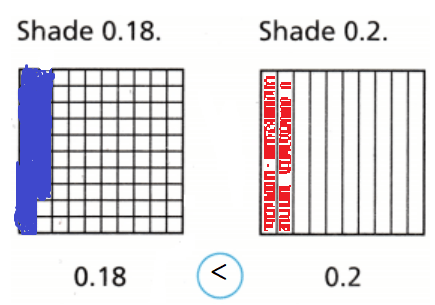
The city park covers 0.64 square miles. About 0.18 of the park is covered by water, and about 0.2 of the park is covered by paved walkways. Is more of the park covered by water or paved walkways?

• Cross out unnecessary information.
• Circle numbers you will use.
• What do you need to find?

One Way Use a model.

Texas Go Math Grade 4 Lesson 2.6 Compare Decimals 1
Answer:
We know that,
The equivalent of 0.2 is: 0.20
Now,
Compare 0.18 and 0.20
So,
From the rules of comparing decimals,
18 < 20
Hence, from the above,
We can conclude that
The representation of the model with the comparison of the given decimal numbers is:

Other Ways

A. Use a number line.

Locate 0.18 and 0.2 on a number line.
Think: 2 tenths is equivalent to 20 hundredths.

Now,
From the above Number line,
We can observe that
0.18 is closer to 0
So,
0.18 < 0.2.

B. Compare equal-size parts.

  • 0.18 is hundredths.
  • 0.2 is 2 tenths, which is equivalent to 20 hundredths.

We know that,
18 hundredths < 20 hundredths
So 0.18 < 0.2.
Hence, from the above,
We can conclude that
More of the park is covered by “Paved Walkways”

Math Talk

Mathematical Processes
How does the number of tenths in 0.18 compare to the number of tenths in 0.2? Explain.
Answer:
The given decimal numbers are: 0.18 and 0.2
Now,
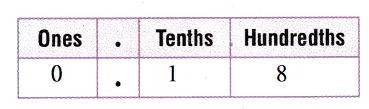
The representation of 0.18 in the place-value chart is:

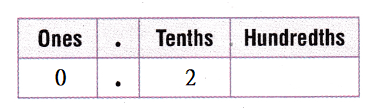
The representation of 0.2 in the place-value chart is:

Now,
From the above place-value charts,
The comparison of the tenth place of 0.18 and 0.2 is:
1 < 2
Hence, from the above,
We can conclude that
The number of tenths in 0.18 < The number of tenths in 0.2

Example Use Place value.

Tim has 0.5 dollars and Sienna has 0.05 dollars. Who has more money?

Texas Go Math Grade 4 Lesson 2.6 Compare Decimals 3
Answer:
It is given that
Tim has 0.5 dollars and Sienna has 0.05 dollars.
Hence, from the above,
We can conclude that
The representation of the models of the given decimal numbers is:

Texas Go Math Grade 4 Lesson 2.6 Compare Decimals 4
Answer:
It is given that
Tim has 0.5 dollars and Sienna has 0.05 dollars.
Hence, from the above,
We can conclude that
The representation of the record of the given decimal numbers is:

Share and Show

Texas Go Math Lesson 2.6 Compare Decimals Grade 4 Question 1.
Compare 0.39 and 0.42. Write <, >, or = Shade the model to help.
Texas Go Math Grade 4 Lesson 2.6 Compare Decimals 5
0.39 __________ 0.42
Answer:
The given decimal numbers are: 0.39 and 0.42
Now,
The representation of the models represented by 0.39 and 0.42 is:

So,
From the above models,
We can observe that
0.39 < 0.42
Hence, from the above,
We can conclude that

Compare. Write <, >, or =.

Question 2.
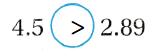
4.5 ____________ 2.89
Texas Go Math Grade 4 Lesson 2.6 Compare Decimals 6
Answer:
The given decimal numbers are: 4.5 and 2.89
Now,
The representation of the given decimal numbers in the place-value chart is:

Now,
From the above place-value charts,
We can observe that
According to the rules of comparing decimals,
4 > 2
Hence, from the above,
We can conclude that

Question 3.
0.7 _____________ 0.54
Texas Go Math Grade 4 Lesson 2.6 Compare Decimals 7
Answer:
The given decimal numbers are: 0.7 and 0.54
Now,
The representation of the given decimal numbers in the place-value chart is:

Now,
From the above place-value charts,
We can observe that
According to the rules of comparing decimals,
0.7 > 0.2
Hence, from the above,
We can conclude that

Math Talk

Mathematical Processes

Can you compare 0.39 and 0.42 by comparing only the tenths? Explain.
Answer:
The given decimal numbers are: 0.39 and 0.42
Now,
We know that,
In the comparison of decimals,
If the whole numbers before the decimal point are the same, then compare the tenths of the decimal numbers
Now,
The representation of 0.39 and 0.42 in the place-value chart is:

Now,
From the above place-value charts,
We can observe that
3 tenths < 4 tenths
Hence, from the above,
We can conclude that
3 tenths in 0.39 < 4 tenths in 0.42

Unlock the problem

Comparing Decimals Grade 4 Lesson 2.6 Answer Key Question 4.
H.O.T. Multi-Step Ricardo and Brandon ran a 1500-meter race. Ricardo finished in 4.89 minutes. Brandon finished in 4.83 minutes. What was the time of the runner who finished first?
(A) 15.00 minutes
(B) 4.83 minutes
(C) 4.89 minutes
(D) Ricardo and Brandon tied for first.

a. What are you asked to find?
Answer:
It is given that
Ricardo and Brandon ran a 1500-meter race. Ricardo finished in 4.89 minutes. Brandon finished in 4.83 minutes
Hence, from the above,
We can conclude that
You are asked to find the time of the runner who finished first

b. What do you need to do to find the answer?
Answer:
We need to compare the place values of the given decimal numbers. If a place value is equal then compare the next place-vale and so on

C. Solve the problem.
Answer:
The representation of 4.89 and 4.83 in the place-value chart is:

Now,
From the above place-value chart,
We can observe that
9 hundredths in 4.89 > 3 hundredths in 4.83
Hence, from the above,
We can conclude that
The time of the runner who finished first is: 4.89 minutes

d. Fill in the bubble for the correct answer choice above.
Answer:

e. Look back. Does your answer make sense? Explain.
Answer:
Yes, the answer makes sense because we followed the rules of the comparison of decimal numbers

Question 5.
Multi-Step Jack had $4.53 in his pocket. Sam had $14.25 in his pocket. Jill had $14.40 in her pocket. Who had more money, Jack or Jill? Did Sam have more money than either Jack or Jill?
Answer:
It is given that
Jack had $4.53 in his pocket. Sam had $14.25 in his pocket. Jill had $14.40 in her pocket.
Now,
The representation of $4.53 in the place-value chart is:

The representation of $14.25 in the place-value chart is:

The representation of $14.40 in the place-value chart is:

Now,
From the above place-value charts,
We can observe that
Jack has more money
Sam did not have more money than either Jack or Jill
Hence, from the above,
We can conclude that
Jack has more money
Sam did not have more money than either Jack or Jill

Daily Assessment Task

Fill in the bubble completely to show your answer.

Question 6.
Multi-Step The Venus flytrap closes in 0.3 seconds and the waterwheel plant closes in 0.2 seconds. Which decimal is less than 0.3 but greater than 0.2?
(A) 0.01
(B) 0.32
(C) 0.21
(D) 0.4
Answer:
It is given that
The Venus flytrap closes in 0.3 seconds and the waterwheel plant closes in 0.2 seconds
Now,
The given decimal numbers are: 0.3 and 0.2
Now,
The decimal numbers that are greater than 0.2 but less than 0.3 are:
0.21, 0.22, 0.23, 0.24, 0.25, 0.26, 0.27, 0.28, 0.29
Hence, from the above,
We can conclude that
The decimal that is less than 0.3 but greater than 0.2 is:

4th Grade Comparing Decimals Answer Key Lesson 2.6 Question 7.
Representations Which model represents a number greater than 0.65?
(A)
Texas Go Math Grade 4 Lesson 2.6 Compare Decimals 8
(B)
Texas Go Math Grade 4 Lesson 2.6 Compare Decimals 9
(C)
Texas Go Math Grade 4 Lesson 2.6 Compare Decimals 10
(D)
Texas Go Math Grade 4 Lesson 2.6 Compare Decimals 11
Answer:
The given decimal number is: 0.65
So,
The representation of 0.65 in the fraction form is: \(\frac{65}{100}\)
So,
In the model,
The total number of parts are: 100
The number of shaded parts is: 65
So,
To represent a model that represents a number greater than 0.65,
The number of shaded parts will be greater than 65
Hence, from the above,
We can conclude that
The model that represents a model that is greater than 0.65 is:

Question 8.
Use Symbols Compare 0.24 and 0.3. Which statement is true?
Texas Go Math Grade 4 Lesson 2.6 Compare Decimals 12
(A) 0.24 > 0.3
(B) 0.24 0.3
(C) 0.3 <0.24
(D) 0.24 < 0.3
Answer:
The given decimal numbers are: 0.24 and 0.3
Now,
The given number line is:
Texas Go Math Grade 4 Lesson 2.6 Compare Decimals 12
Now,
The representation of the given decimal numbers in the number line is:

Now,
From the above number line,
We can observe that
0.24 is close to 0
So,
0.24 < 0.30
Hence, from the above,
We can conclude that
The statement that is true is:

TEXAS Test Prep

Question 9.
Maria has $3.68 in her pocket. Dennis has less money in his pocket than Maria does. Which could be an amount that Dennis has in his pocket?
(A) $3.60
(B) $3.78
(C) $7.38
(D) $13.24
Answer:
It is given that
Maria has $3.68 in her pocket. Dennis has less money in his pocket than Maria does
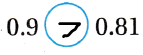
Now,
According to the given information,
The money that Dennis has should be less than $3.68
Hence, from the above,
We can conclude that
The amount that Dennis has in his pocket is:

Texas Go Math Grade 4 Lesson 2.6 Homework and Practice Answer Key

Compare Decimals

Compare. Write <, >, or =. For 1-2, complete the table.

Question 1.
0.26 _______ 0.23
Texas Go Math Grade 4 Lesson 2.6 Compare Decimals 13
Answer:
The given decimal numbers are: 0.26 and 0.23
Now,
The representation of the given decimal numbers in the place-value chart is:

Now,
From the above place-value charts,
We can observe that
According to the rules of comparing decimals,
6 > 3
Hence, from the above,
We can conclude that

Question 2.
1.15 _______ 1.3
Texas Go Math Grade 4 Lesson 2.6 Compare Decimals 13
Answer:
The given decimal numbers are: 1.15 and 1.3
Now,
The representation of the given decimal numbers in the place-value chart is:

Now,
From the above place-value charts,
We can observe that
According to the rules of comparing decimals,
1 tenth < 3 tenth
Hence, from the above,
We can conclude that

Question 3.
0.9 _______ 0.81
Answer:
The given decimal numbers are: 0.9 and 0.81
Now,
The representation of the given decimal numbers in the place-value chart is:

Now,
From the above place-value charts,
We can observe that
According to the rules of comparing decimals,
9 tenths > 8 tenths
Hence, from the above,
We can conclude that

Question 4.
1.06 _______ 0.6
Answer:
The given decimal numbers are: 1.06 and 0.6
Now,
The representation of the given decimal numbers in the place-value chart is:

Now,
From the above place-value charts,
We can observe that
According to the rules of comparing decimals,
1 > 0
Hence, from the above,
We can conclude that

Question 5.
0.25 _______ 0.3
Answer:
The given decimal numbers are: 0.25 and 0.3
Now,
The representation of the given decimal numbers in the place-value chart is:

Now,
From the above place-value charts,
We can observe that
According to the rules of comparing decimals,
2 tenths < 3 tenths
Hence, from the above,
We can conclude that

Question 6.
2.61 _______ 3.29
Answer:
The given decimal numbers are: 2.61 and 3.29
Now,
The representation of the given decimal numbers in the place-value chart is:

Now,
From the above place-value charts,
We can observe that
According to the rules of comparing decimals,
2 < 3
Hence, from the above,
We can conclude that

Question 7.
0.38 _______ 0.83
Answer:
The given decimal numbers are: 0.38 and 0.83
Now,
The representation of the given decimal numbers in the place-value chart is:

Now,
From the above place-value charts,
We can observe that
According to the rules of comparing decimals,
3 tenths < 8 tenths
Hence, from the above,
We can conclude that

Question 8.
1.9 _______ 0.99
Answer:
The given decimal numbers are: 1.9 and 0.99
Now,
The representation of the given decimal numbers in the place-value chart is:

Now,
From the above place-value charts,
We can observe that
According to the rules of comparing decimals,
1 > 0
Hence, from the above,
We can conclude that

Question 9.
1.11 _______ 1.41
Answer:
The given decimal numbers are: 1.11 and 1.41
Now,
The representation of the given decimal numbers in the place-value chart is:

Now,
From the above place-value charts,
We can observe that
According to the rules of comparing decimals,
1 tenth < 4 tenths
Hence, from the above,
We can conclude that

Question 10.
0.8 _______ 0.80
Answer:
The given decimal numbers are: 0.8 and 0.80
Now,
The representation of the given decimal numbers in the place-value chart is:

Now,
From the above place-value charts,
We can observe that
According to the rules of comparing decimals,
8 tenths = 8 tenths
Hence, from the above,
We can conclude that

Problem Solving

Question 11.
Neil and Anne each bought a book at a used book store. Neil paid $5.37 for his book. Anne paid $5.32 for her book. Who spent more money?
Answer:
It is given that
Neil and Anne each bought a book at a used book store. Neil paid $5.37 for his book. Anne paid $5.32 for her book.
Now,
The given decimal numbers are: 5.37 and 5.32
Now,
The representation of the given decimal numbers in the place-value chart is:

Now,
From the above place-value chart,
7 hundredths > 2 hundredths
So,
5.37 > 5.32
Hence, from the above,
We can conclude that
Neil spent more money

Question 12.
Lynn drove 4.06 miles to the store. Patrick drove 4.6 miles to the library. Who drove farther?
Answer:
It is given that
Lynn drove 4.06 miles to the store. Patrick drove 4.6 miles to the library
Now,
The given decimal numbers are: 4.06 and 4.6
Now,
The representation of the given decimal numbers in the place-value chart is:

Now,
From the above place-value chart,
6 tenths > 0 tenths
So,
4.60 > 4.06
Hence, from the above,
We can conclude that
Patrick drove farther

Question 13.
Barbara has $3.43 in her pocket. Kendra has $3.34 in her bank. Who has the greater amount of money?
Answer:
It is given that
Barbara has $3.43 in her pocket. Kendra has $3.34 in her bank
Now,
The given decimal numbers are: 3.43 and 3.34
Now,
The representation of the given decimal numbers in the place-value chart is:

Now,
From the above place-value chart,
4 tenths > 3 tenths
So,
3.43 > 3.34
Hence, from the above,
We can conclude that
Barbara has the greater amount of money

Compare Decimals Lesson 2.6 Homework Answer Key Question 14.
Jordan and Shelly were raising money by walking around a track. Jordan raised $47.50 and Shelly raised $45.50. Who raised more money?
Answer:
It is given that
Jordan and Shelly were raising money by walking around a track. Jordan raised $47.50 and Shelly raised $45.50
Now,
The given decimal numbers are: 47.50 and 45.50
Now,
The representation of the given decimal numbers in the place-value chart is:

Now,
From the above place-value chart,
7 > 5
So,
47.50 > 45.50
Hence, from the above,
We can conclude that
Jordan raised more money

Lesson Check

Fill in the bubble completely to show your answer.

Question 15.
Which model represents a number less than 0.27?
(A)
Texas Go Math Grade 4 Lesson 2.6 Compare Decimals 14
(B)
Texas Go Math Grade 4 Lesson 2.6 Compare Decimals 15
(C)
Texas Go Math Grade 4 Lesson 2.6 Compare Decimals 16
(D)
Texas Go Math Grade 4 Lesson 2.6 Compare Decimals 17
Answer:
The given decimal number is: 0.27
Now,
The representation of 0.27 in the form of a fraction is: \(\frac{27}{100}\)
So,
To represent the model that is less than 0.27,
The shaded parts must be 27
Hence, from the above,
We can conclude that
The model represents a number less than 0.27 is:

My Homework Lesson 2.6 Compare Decimals Answer Key Question 16.
Compare 0.3 and 0.28. Which statement is true?
Texas Go Math Grade 4 Lesson 2.6 Compare Decimals 18
(A) 0.3 > 0.28
(B) 0.28 = 0.3
(C) 0.28 > 0.3
(D) 0.3 < 0.28
Answer:
The given decimal numbers are: 0.3 and 0.28
Now,
The given number line is:
Texas Go Math Grade 4 Lesson 2.6 Compare Decimals 18
Now,
The representation of the given decimal numbers in the number line is:

Now,
From the above number line,
We can observe that
0.28 is closer to 0
So,
0.28 < 0.3
Hence, from the above,
We can conclude that
The statement that is true is:

Question 17.
Jake’s time for the 100-meter race was 11.46 seconds. Dan’s time was faster. Which could he Dan’s time?
(A) 11.55 seconds
(B) 11.73 seconds
(C) 11.38 seconds
(D) 11.49 seconds
Answer:
It is given that
Jake’s time for the 100-meter race was 11.46 seconds. Dan’s time was faster
Now,
According to the given information,
Dan’s time must be lesser than 11.46 seconds
Hence, from the above,
We can conclude that
Dan’s time could be:

Question 18.
Which of the following is less than 19.45?
(A) 19.54
(B) 19.44
(C) 20.64
(D) 20.53
Answer:
The given decimal number is: 19.45
Hence, from the above,
We can conclude that
The number is less than 19.45 is:

Go Math 4th Grade Lesson 2.6 Homework Answer Key Question 19.
Multi-Step Which of the following is more than $4.72 and less than $4.93?
(A) $4.81
(B) $3.99
(C) $4.68
(D) $3.89
Answer:
The given decimal numbers are: 4.72 and 4.93
Now,
According to the given information,
The numbers that are more than 4.72 and less than 4.93 are: 4.73 to 4.92
Hence, from the above,
We can conclude that
The number is more than $4.72 and less than $4.93 is:

Question 20.
Multi-Step Wayne has $6.83. Christie has $6.55. Kareem has $6.79. Which statement is true?
(A) Kareem has the least money.
(B) Christie has more money than Kareem.
(C) Wayne has less money than Christie.
(D) Wayne has the most money.
Answer:
It is given that
Wayne has $6.83. Christie has $6.55. Kareem has $6.79
Now,
The given decimal numbers are: 6.83, 6.55, and 6.79
Now,
Compare the tenth place value of the given decimal numbers
8 tenths > 7 tenths > 5 tenths
Hence, from the above,
We can conclude that
The statement that is true is:

Texas Go Math Grade 4 Lesson 2.6 Answer Key Compare Decimals Read More »

Texas Go Math Grade 4 Lesson 2.7 Answer Key Order Decimals

Refer to our Texas Go Math Grade 4 Answer Key Pdf to score good marks in the exams. Test yourself by practicing the problems from Texas Go Math Grade 4 Lesson 2.7 Answer Key Order Decimals.

Texas Go Math Grade 4 Lesson 2.7 Answer Key Order Decimals

Essential Question

How can you order decimals?
Answer:
The steps for ordering decimals are:
a. Set up a table with the decimal point in the same place for each number.
b. Put in each number.
c. Fill in the empty squares with zeros.
d. Compare using the first column on the left.
e. If the digits are equal move to the next column to the right until one number wins.

Investigate

Materials

  • string
  • clothespins
  • marker
  • index cards

A. Use your marker to mark the location of benchmark decimals 1.0, 1.5, and 2.0 on your string.
Texas Go Math Grade 4 Lesson 2.7 Order Decimals 1

B. Use clothespins and index cards to label the points you marked.
Texas Go Math Grade 4 Lesson 2.7 Order Decimals 2

C. Now locate the points 1 .2, 1.9, and 1.6 on your string by using clothespins and labeled index cards.
Texas Go Math Grade 4 Lesson 2.7 Order Decimals 3

D. Draw a picture of the number line you modeled.
Answer:

E. Compare your model with another student’s model. Do either of you want to change any of the positions of your clothespins? Explain.
Answer:
Your model is:

Your friend’s model is:
Texas Go Math Grade 4 Lesson 2.7 Order Decimals 3
Now,
When we compare the both models,
We can observe that both the models are the same
Hence, from the above,
We can conclude that
Neither you nor your friend has to change any of the positions of your clothespins

Make Connections

You can also use place value to order decimals.

Order $1.52, $0.87, and $1.56 from least to greatest.


Hence, from the above,
We can conclude that
The order from least to greatest is:
0.87, 1.52, and 1.56

Math Talk

MathematicaI Processes
How is ordering decimals similar to comparing decimals?
Answer:
Decimal numbers are compared in the same way as other numbers: by comparing the different place values from left to right. We use the symbols <, > and = to compare decimals as shown below. When comparing two decimals, it is helpful to write one below the other.

Share and Grow

Use the number line to order the decimals from least to greatest.

Texas Go Math Grade 4 Lesson 2.7 Order Decimals 5

Question 1.
1.9, 1.09, 1.5, 1.55
Answer:
The given decimal numbers are: 1.9, 1.09, 1.5, and 1.55
Now,
The given number line is:
Texas Go Math Grade 4 Lesson 2.7 Order Decimals 5
Now,
The representation of the decimal numbers in the number line is:

Now,
We know that,
The numbers that are close to zero (or) to the starting point will be the least numbers
The numbers that are farther to zero (or) to the starting point will be the least numbers
Now,
From the above number line,
We can observe that
1.09 is the closest to the starting line of the number line
So,
1.09 is the least number
After 1.09.
The least number will be: 1.50
After 1.50,
The lowest number will be: 1.55
Hence. from the above,
We can conclude that
The order of the numbers from the least to the greatest is:
1.09, 1.50, 1.55, and 1.90

Texas Go Math Grade 4 Lesson 2.7 Answer Key Question 2.
1.65, 1.56, 1.6, 2.0
Answer:
The given decimal numbers are: 1.65, 1.56, 1.6, and 2.0
Now,
The given number line is:
Texas Go Math Grade 4 Lesson 2.7 Order Decimals 5
Now,
The representation of the decimal numbers in the number line is:

Now,
We know that,
The numbers that are close to zero (or) to the starting point will be the least numbers
The numbers that are farther to zero (or) to the starting point will be the least numbers
Now,
From the above number line,
We can observe that
1.56 is the closest to the starting line of the number line
So,
1.56 is the least number
After 1.56.
The least number will be: 1.60
After 1.60,
The least number will be: 1.65
Hence. from the above,
We can conclude that
The order of the numbers from the least to the greatest is:
1.56, 1.60, 1.65, and 2.0

Order the decimals from greatest to least. You can use place value or a number line on your Math Board.

Question 3.
$1.41, $0.14, $1.14, $1.40
Answer:
The given decimal numbers are: $1.41, $0.14, $1.14, and $1.40
Now,
We know that,
The numbers that are close to zero (or) to the starting point will be the least numbers
The numbers that are farther to zero (or) to the starting point will be the least numbers
Now,
From the given decimal numbers,
We can observe that
0.14 is the closest to 0
So,
0.14 is the least number
After 0.14.
The least number will be: 1.14
After 1.14,
The least number will be: 1.40
Hence. from the above,
We can conclude that
The order of the numbers from the greatest to the least is:
$1.41, $1.40, $1.14, and $0.14

Question 4.
7.03, 7.3, 6.98, 6.89
Answer:
The given decimal numbers are: 7.03, 7.3, 6.98, and 6.89
Now,
We know that,
The numbers that are close to zero (or) to the starting point will be the least numbers
The numbers that are farther to zero (or) to the starting point will be the least numbers
Now,
From the given decimal numbers,
We can observe that
6.89 is the closest to 0
So,
6.89 is the least number
After 6.89.
The least number will be: 6.98
After 6.98,
The least number will be: 7.03
Hence. from the above,
We can conclude that
The order of the numbers from the greatest to the least is:
7.3, 7.03, 6.98, and 6.89

Order the decimals from least to greatest. You can use place value or a number line on your MathBoard.

Question 5.
$1.35,$3.15,$1.53,$3.51
Answer:
The given decimal numbers are: $1.35, $3.15, $1.53, and $3.51
Now,
We know that,
The numbers that are close to zero (or) to the starting point will be the least numbers
The numbers that are farther to zero (or) to the starting point will be the least numbers
Now,
From the given decimal numbers,
We can observe that
1.35 is the closest to 0
So,
1.35 is the least number
After 1.35.
The least number will be: 1.53
After 1.53,
The least number will be: 3.15
Hence. from the above,
We can conclude that
The order of the numbers from the least to the greatest is:
$1.35, $1.53, $3.15, and $3.51

Go Math Grade 4 Lesson 2.7 Answer Key Question 6.
6.25,7.2,6.93,7.11
Answer:
The given decimal numbers are: 6.25, 7.2, 6.93, and 7.11
Now,
We know that,
The numbers that are close to zero (or) to the starting point will be the least numbers
The numbers that are farther to zero (or) to the starting point will be the least numbers
Now,
From the given decimal numbers,
We can observe that
6.25 is the closest to 0
So,
6.25 is the least number
After 6.25.
The least number will be: 6.93
After 6.93,
The least number will be: 7.11
Hence. from the above,
We can conclude that
The order of the numbers from the least to the greatest is:
6.25, 6.93, 7.11, and 7.2

Unlock the Problem

Texas Go Math Grade 4 Lesson 2.7 Order Decimals 6

Question 7.
H.O.T. Multi-Step Martin’s class drew a design using 10 by 10 grid paper. The table shows how much of each color was used in the design. Which color was the third-greatest part of the design?

a. What do you need to know?
Answer:
It is given that
Martin’s class drew a design using 10 by 10 grid paper. The table shows how much of each color was used in the design
Now,
The given table is:
Texas Go Math Grade 4 Lesson 2.7 Order Decimals 6
Hence, from the above,
We can conclude that
You need to know the order of the part of the color from the greatest to the least

b. Describe a strategy you could use to order the values in the table.
Answer:
The given table is:
Texas Go Math Grade 4 Lesson 2.7 Order Decimals 6
So,
The strategy you could use to order the values in the table is:
Convert the fractions into decimals and order the numbers from the greatest to the least

c. How might you use models to help you?
Answer:
If we use a Number line,
Place the numbers on the number line
If we use a Rectangular model,
Shade the numerator part of the part of the color and order the shaded parts from the greatest to the least

d. Show your work.
Answer:
It is given that
Martin’s class drew a design using 10 by 10 grid paper. The table shows how much of each color was used in the design
Now,
The given table is:
Texas Go Math Grade 4 Lesson 2.7 Order Decimals 6
Now,
From the above table,
We can observe that
The representation of the decimal numbers present in the given table is:
0.28, 0.4, 0.1, 0.15, and 0.07
Now,
From the above decimal numbers,
We can observe that
0.1 is the closest to 0
So,
0.1 is the least number
0.4 is the farthest to 0
So,
0.4 is the greatest number
Hence, from the above,
We can conclude that
The order of the part of the color from the greatest to the least is:
0.4, 0.28, 0.15, 0.1, and 0.07

e. Complete the sentences.
The greatest part of the design was the color ______________ .
The least part of the design was the color ______________ .
The third-greatest part of the design was the color ______________ .
Answer:
From part (d),
The order of the part of the color from the greatest to the least is:
0.4, 0.28, 0.15, 0.1, and 0.07
Hence, from the above,
We can conclude that
The greatest part of the design was the color “Green” .
The least part of the design was the color “Yellow” .
The third-greatest part of the design was the color ‘Orange” .

Go Math Grade 4 Lesson 2.7 Order Decimals Question 8.
H.O.T. Use Symbols Howard studied math for 0.75 hours. Carol studied math for 0.80 hours. Who studied math for a greater amount of time? Explain.
Answer:
It is given that
Howard studied math for 0.75 hours. Carol studied math for 0.80 hours
Now,
The given decimal numbers are: 0.75 and 0.80
Now,
The representation of 0.75 and 0.80 in the place-value chart is:

Now,
From the above place-value chart,
We can observe that
7 tenths < 8 tenths
So,
0.75 < 0.80
Hence, from the above,
We can conclude that
Carol studied math for the greater amount of time

Question 9.
Mark has $3.23, Jen has $3.23, and Sally has $3.32. Who has the most money?
Answer:
It is given that
Mark has $3.23, Jen has $3.23, and Sally has $3.32
Now,
The given decimal numbersa re: 3.23 and 3.32
Now,
The representation of 3.23 and 3.32 in the place-value chart is:

Now,
From the above place-value chart,
We can observe that
2 tenths < 3 tenths
So,
3.23 < 3.32
Hence, from the above,
We can conclude that
Sally has the most money

Daily Assessment Task

Fill in the bubble completely to show your answer.

Question 10.
Four cockroaches finished a race. Their winning times are 9.42 seconds, 8.3 seconds, 9.2 seconds, and 8.17 seconds. Which shows the winning times written in order from least to greatest?
(A) 8.17 seconds, 8.3 seconds, 9.42 seconds, 9.2 seconds
(B) 9.42 seconds, 9.2 seconds, 8.3 seconds, 8.17 seconds
(C) 8.17 seconds, 8.3 seconds, 9.2 seconds, 9.42 seconds
(D) 9.42 seconds, 8.3 seconds, 9.2 seconds, 8.17 seconds
Answer:
It is given that
Four cockroaches finished a race. Their winning times are 9.42 seconds, 8.3 seconds, 9.2 seconds, and 8.17 seconds
Now,
The given decimal numbers are: 9.42, 8.3, 9.2, and 8.17
Now,
From the given numbers,
We can observe that
8.17 is the closest to 0 when compared to the other given numbers
So,
8.17 is the least number
9.42 is the farthest to 0 when compared to the other given numbers
So,
9.42 is the greatest number
Hence, from the above,
We can conclude that
The winning times written in order from the least to the greatest is:

Go Math 4th Grade Lesson 2.7 Order Decimals Question 11.
Use place value to order 5.87, 6.14, 5.78, and 6.04. Which shows, the decimals written in order from least to greatest?
(A) 6.04, 6.14, 5.87, 5.78
(B) 5.78, 5.87, 6.04, 6.14
(C) 5.78, 5.87, 6.14, 6.04
(D) 5.87, 6.04, 6.14, 5.78
Answer:
The given decimal numbers are: 5.87, 6.14, 5.78, and 6.04
Now,
The representation of the given decimal numbers in the place-value chart is:

Hence, from the above,
We can conclude that
The order of the decimals written in the order from the least to the greatest is:

Question 12.
Representations Use the number line to order the decimals.
Texas Go Math Grade 4 Lesson 2.7 Order Decimals 7
Which shows the decimals 5.16, 5.28, 5.11, and 5.21 written in order from greatest to least?
(A) 5.11,5.16,5.21,5.28
(B) 5.16,5.28,5.11,5.21
(C) 5.21,5.16,5.11,5.28
(D) 5.28,5.21,5.16,5.11
Answer:
The given decimal numbers are: 5.16, 5.28, 5.11, and 5.21
Now,
The given number line is:
Texas Go Math Grade 4 Lesson 2.7 Order Decimals 7
Now,
The representation of the given decimal numbers on the given number line is:

Hence, from the above,
We can conclude that
The order of the given decimal numbers from the greatest to the least is:

TEXAS Test Prep

Question 13.
Which of the following is less than 14.70?
(A) 15.03
(B) 14.09
(C) 14.73
(D) 14.7
Answer:
The given decimal number is: 14.70
Now,
We know that,
14.70 = 14.7
Now,
To represent the decimal number less than 14.70, the tenths place must be less than 7
Hence, from the above,
We can conclude that
The decimal number that is less than 14.70 is:

Texas Go Math Grade 4 Lesson 2.7 Homework and Practice Answer Key

Use the number line to order the decimals from least to greatest.

Texas Go Math Grade 4 Lesson 2.7 Order Decimals 8

Question 1.
1.11, 1.2, 1.01, 1.1
Answer:
The given decimal numbers are: 1.11, 1.2, 1.01, and 1.1
Now,
The given number line is:
Texas Go Math Grade 4 Lesson 2.7 Order Decimals 8
Now,
The representation of the given decimal numbers on the number line is:

Hence, from the above,
We can conclude that
The order of the given decimal numbers from the least to the greatest is:
1.01, 1.10, 1.11, and 1.20

Go Math Lesson 2.7 4th Grade Practice and Homework Question 2.
1.32,1.23, 1.3, 1.2
Answer:
The given decimal numbers are: 1.32, 1.23, 1.3, and 1.2
Now,
The given number line is:
Texas Go Math Grade 4 Lesson 2.7 Order Decimals 8
Now,
The representation of the given decimal numbers on the number line is:

Hence, from the above,
We can conclude that
The order of the given decimal numbers from the least to the greatest is:
1.20, 1.23, 1.30, and 1.32

Order the decimals from greatest to least. You can use place value or a number line on your MathBoard.

Question 3.
$2.15, $1.89, $1.09, $1.90
Answer:
The given decimal numbers are: $2.15, $1.89, $1.09, and $1.90
Now,
We know that,
The numbers that are the closest to 0 are the “Least numbers”
The numbers that are the farthest to 0 are the “Greatest numbers”
So,
From the above,
The order of the given numbers from the greatest to the least is:
$1.09, $1.89, $1.90. and $2.15
Hence, from the above,
We can conclude that
The order of the given numbers from the greatest to the least is:
$1.09, $1.89, $1.90. and $2.15

Question 4.
0.66, 0.06, 0.60, 0.96
Answer:
The given decimal numbers are: 0.66, 0.06, 0.60, and 0.96
Now,
We know that,
The numbers that are the closest to 0 are the “Least numbers”
The numbers that are the farthest to 0 are the “Greatest numbers”
So,
From the above,
The order of the given numbers from the greatest to the least is:
0.96, 0.66, 0.60, and 0.06
Hence, from the above,
We can conclude that
The order of the given numbers from the greatest to the least is:
0.96, 0.66, 0.60, and 0.06

Problem Solving

Question 5.
Jamal wrote the following decimals on the board.
4.24, 4.04, 4.18, 4.42
Order these decimals from least to greatest.
Answer:
It is given that
Jamal wrote the following decimals on the board.:
4.24, 4.04, 4.18, 4.42
Now,
The given decimal numbers are: 4.24, 4.04, 4.18, and 4.42
Now,
We know that,
The numbers that are the closest to 0 are the “Least numbers”
The numbers that are the farthest to 0 are the “Greatest numbers”
So,
From the above,
The order of the given decimal numbers from the least to the greatest is:
4.04, 4.18, 4.24, and 4.42
Hence, from the above,
We can conclude that
The order of the given decimal numbers from the least to the greatest is:
4.04, 4.18, 4.24, and 4.42

Lesson 2.7 Answer Key Go Math Grade 4 Question 6.
Anna paid $13.32 for a teddy bear. Karl paid $13.02 for a teddy bear. Cindy paid $12.45 for her teddy bear and Mark paid $14.50 for his teddy bear. Order the names from who spent the least to who spent the greatest for their teddy bear.
Answer:
It is given that
Anna paid $13.32 for a teddy bear. Karl paid $13.02 for a teddy bear. Cindy paid $12.45 for her teddy bear and Mark paid $14.50 for his teddy bear
Now,
The given decimal numbers are: $13.32, $13.02, $12.45, and $14.50
Now,
We know that,
The numbers that are the closest to 0 are the “Least numbers”
The numbers that are the farthest to 0 are the “Greatest numbers”
So,
From the above,
The order of the given decimal numbers from the least to the greatest is:
$12.45, $13.02, $13.32, and $14.50
So,
The order of the names who spend the least to those who spend the greatest is:
Cindy, Karl, Anna, and Mark
Hence, from the above,
We can conclude that
The names of who spent the least to who spent the greatest for their teddy bear is:
Cindy, Karl, Anna, and Mark

Question 7.
During recess, some students ran the 40-yard dash. Tim ran it in 5.64 seconds, Sarah in 5.46 seconds, Hannah in 5.60 seconds, and Jason in 5.49 seconds. Order the times from least to greatest.
Answer:
It is given that
During recess, some students ran the 40-yard dash. Tim ran it in 5.64 seconds, Sarah in 5.46 seconds, Hannah in 5.60 seconds, and Jason in 5.49 seconds
Now,
The given decimal numbers are: 5.64, 5.46, 5.60, and 5.49
Now,
We know that,
The numbers that are the closest to 0 are the “Least numbers”
The numbers that are the farthest to 0 are the “Greatest numbers”
So,
From the above,
The order of the given decimal numbers from the least to the greatest is:
5.46, 5.49, 5.60, and 5.64
Hence, from the above,
We can conclude that
The order of the times from the least to the greatest is:
5.46 seconds, 5.49 seconds, 5.60 seconds, and 5.64 seconds

Question 8.
Karen made four different hats. She used some blue ribbon for each hat. For one hat, she used 0.8 feet of ribbon. For another hat, she used 1.2 feet of ribbon. For the last two hats, she used 1.02 and 1.21 feet of ribbon. Order these amounts from greatest to least.
Answer:
It is given that
Karen made four different hats. She used some blue ribbon for each hat. For one hat, she used 0.8 feet of ribbon. For another hat, she used 1.2 feet of ribbon. For the last two hats, she used 1.02 and 1.21 feet of ribbon
Now,
The given decimal numbers are: 0.8, 1.2, 1.02, and 1.21
Now,
We know that,
The numbers that are the closest to 0 are the “Least numbers”
The numbers that are the farthest to 0 are the “Greatest numbers”
So,
From the above,
The order of the given decimal numbers from the greatest to the least is:
1.21, 1.2, 1.08, and 0.8
Hence, from the above,
We can conclude that
The order of the amounts of ribbon from the greatest to the least is:
1.21 feet, 1.2 feet, 1.08 feet, and 0.8 feet

Lesson Check

Fill in the bubble completely to show your answer.

Question 9.
Use the number line to order the decimals.
Texas Go Math Grade 4 Lesson 2.7 Order Decimals 9
Which answer shows 1.31,1.13, 1.3, and 1.1 in order from least to greatest?
(A) 1.1,1.3,1.13,1.31
(B) 1.1, 1.13, 1.3, 1.31
(C) 1.13, 1.1, 1.31, 1.3
(D) 1.13,1.31,1.1,1.3
Answer:
The given decimal numbers are: 1.31, 1.13,  1.3, and 1.1
Now,
The given number line is:
Texas Go Math Grade 4 Lesson 2.7 Order Decimals 9
Now,
The representation of the given decimal numbers on the given number line is:

Hence, from the above,
We can conclude that
The order of the given decimal numbers from the least to the greatest is:

Go Math Lesson 2.7 Answer Key 4th Grade Question 10.
Order these amounts of money from least to greatest.
$4.88, $5.19, $4.83, $5.02
(A) $4.88, $4.83, $5.02, $5.19
(B) $5.19, $5.02, $4.88, $4.83
(C) $4.83, $4.88, $5.02, $5.19
(D) $5.02, $5.19, $4.83, $4.88
Answer:
The given amounts of money are:
$4.88, $5.19, $4.83, $5.02
Now,
The given decimal numbers are: 4.88, 5.19, 4.83, and 5.02
Now,
We know that,
The numbers that are the closest to 0 are the “Least numbers”
The numbers that are the farthest to 0 are the “Greatest numbers”
So,
From the above,
The order of the given decimal numbers from the least to the greatest is:
4.83, 4.88, 5.02, and 5.19
Hence, from the above,
We can conclude that
The order of the given amounts of money from the least to the greatest is:

Question 11.
Multi-Step Which number is greater than 7.23 and less than 7.55?
(A) 7.59
(B) 7.17
(C) 7.6
(D) 7.3
Answer:
The given decimal numbers are: 7.23 and 7.55
Now,
To represent the numbers that are greater than 7.23 and less than 7.55,
The numbers should be: 7.24 to 7.54
Hence, from the above,
We can conclude that
The number that is greater than 7.23 and less than 7.55 is:

Question 12.
Multi-Step Cory, Margo, and Alyssa get the same allowance. Cory saved \(\frac{2}{5}\) of his allowance. Margo saved 0.35 of hers. Alyssa saved 0.3 of hers. Which statement is true?
(A) Cory saved the most.
(B) Alyssa saved more than Margo.
(C) Cory and Alyssa saved the same amount.
(D) Margo saved more than Cory.
Answer:
It is given that
Cory, Margo, and Alyssa get the same allowance. Cory saved \(\frac{2}{5}\) of his allowance. Margo saved 0.35 of hers. Alyssa saved 0.3 of hers
Now,
The representation of \(\frac{2}{5}\) in the form of a fraction is: 0.4
Now,
The given decimal numbers are: 0.4, 0.35, and 0.3
Now,
We know that,
The numbers that are the closest to 0 are the “Least numbers”
The numbers that are the farthest to 0 are the “Greatest numbers”
So,
From the above,
The order of the given decimal numbers from the least to the greatest is:
0.3, 0.35, and 0.4
Hence, from the above,
We can conclude that
The statement that is true is:

Texas Go Math Grade 4 Lesson 2.7 Answer Key Order Decimals Read More »

Texas Go Math Grade 4 Lesson 3.6 Answer Key Rename Fractions and Mixed Numbers

Refer to our Texas Go Math Grade 4 Answer Key Pdf to score good marks in the exams. Test yourself by practicing the problems from Texas Go Math Grade 4 Lesson 3.6 Answer Key Rename Fractions and Mixed Numbers.

Texas Go Math Grade 4 Lesson 3.6 Answer Key Rename Fractions and Mixed Numbers

Essential Question

How can you rename mixed numbers as fractions greater than I and rename fractions greater than I as mixed numbers?

Unlock the Problem

Mr. Fox has 2\(\frac{3}{6}\) loaves of corn bread. Each loaf was cut into \(\frac{1}{6}\)-size pieces. If he has 14 people over for dinner, is there enough bread for each person to have 1 piece?
Answer:

• What is the size of 1 piece of bread relative to the whole?
Answer:

A mixed number is a number represented by a whole number and a fraction. You can write a mixed number as a fraction. To find how many \(\frac{1}{6}\)-size pieces are in 2\(\frac{3}{6}\) write 2\(\frac{3}{6}\) as a fraction.
Answer:

• How much bread does Mr. Fox need for 14 people?
Answer:

Example: Write a mixed number as a fraction.

Texas Go Math Grade 4 Lesson 3.6 Rename Fractions and Mixed Numbers 1
Answer:

Texas Go Math Grade 4 Lesson 3.6 Rename Fractions and Mixed Numbers 2
Answer:

Texas Go Math Grade 4 Lesson 3.6 Rename Fractions and Mixed Numbers 3
Answer:

There are __________ sixth-size pieces in 2\(\frac{3}{6}\).
So, there is enough bread for 14 people to each have 1 piece.
Answer:

Example Write a fraction greater than 1 as a mixed number.

To weave a bracelet, Charlene needs 7 pieces of brown thread. Each piece of thread must be \(\frac{1}{3}\) yard long. How much thread should she buy to weave the bracelet?
Answer:

Write \(\frac{7}{3}\) as a mixed number.
Texas Go Math Grade 4 Lesson 3.6 Rename Fractions and Mixed Numbers 4
Answer:

So, Charlene should buy ___________ yards of thread.
Answer:

Share and Show

Write the unknown numbers. Write mixed numbers above the number line and fractions greater than one below the number line.

Question 1.
Texas Go Math Grade 4 Lesson 3.6 Rename Fractions and Mixed Numbers 5
Answer:

Write the mixed number as a fraction or the fraction as a mixed number.

Question 2.
1\(\frac{1}{8}\) ______________
Answer:

Rename Fractions and Mixed Numbers 4th Grade Question 3.
\(\frac{13}{10}\) ______________
Answer:

Question 4.
1\(\frac{2}{3}\) ______________
Answer:

Math Talk

Mathematical Processes
Describe how you can compare 1\(\frac{3}{5}\) and \(\frac{7}{5}\).
Answer:

H.O.T. Algebra Find the unknown numbers.

Question 5.
Texas Go Math Grade 4 Lesson 3.6 Rename Fractions and Mixed Numbers 6
Answer:

Question 6.
Texas Go Math Grade 4 Lesson 3.6 Rename Fractions and Mixed Numbers 7
Answer:

Question 7.
Texas Go Math Grade 4 Lesson 3.6 Rename Fractions and Mixed Numbers 8
Answer:

Problem Solving

Use the recipe to solve 8-10.

Texas Go Math Grade 4 Lesson 3.6 Rename Fractions and Mixed Numbers 9

Question 8.
Cal is making energy squares. How many \(\) cups of peanut butter are used in the recipe?
Answer:

Question 9.
What is the amount of bran cereal, written as a fraction greater than 1, that is used in the recipe?
Answer:

Question 10.
H.O.T. Apply Suppose Cal wants to make 2 times as many energy squares as the recipe makes. How many cups of bran cereal should he use? Write your answer as a mixed number and as a fraction greater than 1 in simplest form.
Answer:

Question 11.
Cal added 2\(\frac{3}{8}\) cups of raisins. Write this mixed number as a fraction greater than 1 in simplest form.
Answer:

Question 12.
H.O.T. Multi-Step Jenn is preparing brown rice. She needs 1\(\frac{1}{2}\) cups of brown rice and 2 cups of water. Jenn has only a \(\frac{1}{8}\)-cup measuring cup. How many \(\frac{1}{8}\) cups each of rice and water will Jenn use to prepare the rice?
Answer:

Lesson 3.6 Rename Fractions and Mixed Numbers Question 13.
Multi-Step Pen has \(\frac{1}{2}\)-cup and \(\frac{1}{8}\)-cup measuring cups. What are two ways he could measure out 1\(\frac{3}{4}\) cups of flour?
Answer:

Daily Assessment Task

Fill in the bubble completely to show your answer.

Question 14.
Use Tools The weekly grocery list for a zoo includes 2\(\frac{3}{5}\) pounds of crickets. What is 2\(\frac{3}{5}\) written as a fraction?
Texas Go Math Grade 4 Lesson 3.6 Rename Fractions and Mixed Numbers 10
(A) \(\frac{10}{5}\)
(B) \(\frac{3}{5}\)
(C) \(\frac{13}{5}\)
(D) \(\frac{1}{5}\)
Answer:

Question 15.
Derrick needs 4 strips of wood to make a frame. Each strip must be \(\frac{1}{3}\) yard long. How much wood should Derrick buy to make the frame?
(A) 1 yard
(B) 1\(\frac{4}{3}\) yards
(C) \(\frac{1}{3}\) yard
(D) 1\(\frac{1}{3}\) yards
Answer:

Question 16.
A box of cereal contains 4\(\frac{3}{4}\) cups of cereal. Each serving is \(\frac{1}{4}\) cup. How many servings of cereal are in the box?
(A) 16
(B) 19
(C) 4
(D) 3
Answer:

TEXAS Test Prep

Question 17.
Which fraction greater than 1 can you write for 4\(\frac{5}{9}\)?
(A) \(\frac{9}{9}\)
(B) \(\frac{18}{9}\)
(C) \(\frac{41}{9}\)
(D) \(\frac{45}{9}\)
Answer:

Texas Go Math Grade 4 Lesson 3.6 Homework and Practice Answer Key

Write the unknown numbers. Write mixed numbers above the number line and fractions greater than one below the number line.

Question 1.
Texas Go Math Grade 4 Lesson 3.6 Rename Fractions and Mixed Numbers 11
Answer:

Write the mixed number as a fraction.

Question 2.
2\(\frac{1}{4}\) ____________
Answer:

Question 3.
3\(\frac{2}{3}\) ____________
Answer:

Question 4.
4\(\frac{1}{6}\) ____________
Answer:

Write the fraction as a mixed number.

Question 5.
\(\frac{7}{6}\) ____________
Answer:

Rename Fractions and Mixed Numbers Lesson 3.6 Question 6.
\(\frac{14}{2}\) ____________
Answer:

Question 7.
\(\frac{8}{3}\) ____________
Answer:

Problem Solving

Use the recipe to solve 8-9.

Texas Go Math Grade 4 Lesson 3.6 Rename Fractions and Mixed Numbers 12

Question 8.
Celia is making smoothies. How many \(\frac{1}{4}\) cups of peaches are used in the recipe?
Answer:

Question 9.
What is the amount of orange juice, written as a fraction greater than 1, that is used in the recipe?
Answer:

Lesson Check

Fill in the bubble completely to show your answer.

Question 10.
Calvin is making birdhouses to sell at the tail. So far he has finished 5\(\frac{1}{2}\) bird houses. Which fraction greater than one represents this mixed number?
(A) \(\frac{10}{3}\)
(B) \(\frac{6}{2}\)
(C) \(\frac{5}{3}\)
(D) \(\frac{11}{3}\)
Answer:

Question 11.
Which mixed number can you write for \(\frac{24}{7}\)?
(A) 24\(\frac{1}{7}\)
(B) 4\(\frac{3}{7}\)
(C) 3\(\frac{3}{7}\)
(D) 3\(\frac{1}{7}\)
Answer:

Question 12.
Paolo uses 3\(\frac{1}{4}\) cups of oatmeal to make breakfast bars. What fraction greater than one represents this mixed number?
(A) \(\frac{13}{4}\)
(B) \(\frac{12}{5}\)
(C) \(\frac{4}{4}\)
(D) \(\frac{31}{4}\)
Answer:

Question 13.
Which mixed number can you write for \(\frac{13}{5}\)
(A) 1\(\frac{3}{5}\)
(B) 13\(\frac{1}{5}\)
(C) 3\(\frac{2}{5}\)
(D) 2\(\frac{3}{5}\)
Answer:

Question 14.
Multi-Step Juanita is making bread. She needs 3\(\frac{1}{2}\) cups of flour. Juanita only has a \(\frac{1}{4}\) cup measuring cup. How many \(\frac{1}{4}\) cups of flour will Juanita use to prepare the bread?
(A) 14
(B) 7
(C) 9
(D) 12
Answer:

Question 15.
Multi-Step Each day for 7 days, Mr. Cole used \(\frac{1}{2}\) can of paint. Which mixed number represents how much paint Mr. Cole used after 7 days?
(A) 7\(\frac{1}{2}\)
(B) 2\(\frac{1}{2}\)
(C) 3\(\frac{1}{2}\)
(D) 8\(\frac{1}{2}\)
Answer:

Texas Go Math Grade 4 Lesson 3.6 Answer Key Rename Fractions and Mixed Numbers Read More »

Texas Go Math Grade 4 Lesson 3.2 Answer Key Generate Equivalent Fractions

Refer to our Texas Go Math Grade 4 Answer Key Pdf to score good marks in the exams. Test yourself by practicing the problems from Texas Go Math Grade 4 Lesson 3.2 Answer Key Generate Equivalent Fractions.

Texas Go Math Grade 4 Lesson 3.2 Answer Key Generate Equivalent Fractions

Essential Question

How con you use multiplication to find equivalent fractions?
Answer:

Unlock the Problem

Patty needs \(\frac{3}{4}\) cup of dish soap to make homemade bubble solution. Her measuring cup is divided into eighths. What fraction of the measuring cup should Patty fill with dish soap?
Answer:

• Is an eighth-size part of a measuring cup bigger or smaller than a fourth-size part?
Answer:

Find how many eighths are in \(\frac{3}{4}\)

STEP 1 Compare fourths and eighths.
Texas Go Math Grade 4 Lesson 3.2 Generate Equivalent Fractions 1
You need _________ eighth-size parts to make 1 fourth-size part.
Answer:

STEP 2. Find how many eighths you need to make 3 fourths.
Texas Go Math Grade 4 Lesson 3.2 Generate Equivalent Fractions 2
You needed 2 eighth-size parts to make 1 fourth-size part.
So, you need __________ eighth-size parts to make 3 fourth-size parts.
So, Patty should fill \(\frac{}{8}\) of the measuring cup with dish soap.
Answer:

Math Talk

Mathematical Processes
How did you know how many eighth-size parts you needed to make 1 fourth-size part? Explain.
Answer:

Go Math Grade 4 Chapter 3 Lesson 3.2 Answer Key Question 1.
Explain why 6 eighth-size parts is the same amount as 3 fourth-size parts.
Answer:

Example Write two fractions that are equivalent to \(\frac{1}{2}\)

Texas Go Math Grade 4 Lesson 3.2 Generate Equivalent Fractions 3
So, \(\frac{1}{2}\) = ________ = ________
Answer:

Question 2.
Look at the model that shows \(\frac{1}{2}\) = \(\frac{3}{6}\) How does the number of parts in the whole affect the number of parts that are shaded? Explain.
Answer:

Math Talk

Mathematical Processes
Explain how you can use multiplication to write a fraction that is equivalent to \(\frac{3}{5}\)
Answer:

Share and Show

Question 1.
write a fraction that is equivalent to \(\frac{1}{3}\).
Texas Go Math Grade 4 Lesson 3.2 Generate Equivalent Fractions 4
Answer:

Write two equivalent fractions.

Question 2.
Texas Go Math Grade 4 Lesson 3.2 Generate Equivalent Fractions 5
Answer:

Question 3.
Texas Go Math Grade 4 Lesson 3.2 Generate Equivalent Fractions 6
Answer:

Problem Solving

Use the recipe for 4-6.

Texas Go Math Grade 4 Lesson 3.2 Generate Equivalent Fractions 7

Generate Equivalent Fractions Lesson 3.2 Answer Key Question 4.
Apply How could you use a \(\frac{1}{8}\)-cup measuring cup to measure the cornstarch?
Answer:

Question 5.
How could you use a \(\frac{1}{8}\)-cup measuring cup to measure the water?
Answer:

Question 6.
H.O.T. Kim says the amount of flour in the recipe can be expressed as a fraction. Is she correct? Explain.
Answer:

Question 7.
Write Math Explain using words how you know a fraction is equivalent to another fraction.
Answer:

Question 8.
Multi-Step Marcus needs \(\frac{3}{4}\) cup of sugar. Marcus said he could not measure out the sugar using a \(\frac{1}{6}\)-cup measuring cup. Explain why not and suggest what size measuring cup will work.
Answer:

Daily Assessment Task

Pill In the bubble completely to show your answer.

Question 9.
Ten trees are growing in Cindy’s yard. Of those, \(\frac{3}{5}\) are pine trees. Which fraction is equivalent to \(\frac{3}{5}\)?
(A) \(\frac{10}{10}\)
(B) \(\frac{5}{10}\)
(C) \(\frac{6}{10}\)
(D) \(\frac{1}{10}\)
Answer:

Question 10.
Clara read \(\frac{2}{3}\) of a book. Which fraction is equivalent to what Clara read?
(A) \(\frac{5}{6}\)
(B) \(\frac{4}{9}\)
(C) \(\frac{6}{9}\)
(D) \(\frac{2}{6}\)
Answer:

Question 11.
Multi-Step Ana uses equivalent amounts of seeds and corn to fill her bird feeder. Which could be the amount of seeds and corn that Ana uses?
(A) \(\frac{1}{4}\) cup seeds, \(\frac{1}{8}\) cup corn
(B) \(\frac{1}{4}\) cup seeds, \(\frac{2}{8}\) cup corn
(C) \(\frac{3}{4}\) cup seeds, \(\frac{3}{8}\) cup corn
(D) \(\frac{3}{4}\) cup seeds, \(\frac{7}{8}\) cup corn
Answer:

TEXAS Test Prep

Generate Equivalent Fractions 4th Grade Lesson 3.2 Question 12.
Raul needs a piece of rope \(\frac{2}{3}\)yard long. Which fraction is equivalent to \(\frac{2}{3}\)?
(A) \(\frac{8}{15}\)
(B) \(\frac{6}{12}\)
(C) \(\frac{8}{12}\)
(D) \(\frac{4}{5}\)
Answer:

Texas Go Math Grade 4 Lesson 3.2 Homework and Practice Answer Key

Write two equivalent fractions.

Question 1.
Texas Go Math Grade 4 Lesson 3.2 Generate Equivalent Fractions 8
Answer:

Question 2.
Texas Go Math Grade 4 Lesson 3.2 Generate Equivalent Fractions 9
Answer:

Problem Solving

Use the recipe for 3-4.

Texas Go Math Grade 4 Lesson 3.2 Generate Equivalent Fractions 10

Question 3.
How could you use a \(\frac{1}{4}\)-cup measuring cup to measure the water?
Answer:

Question 4.
How could you use a \(\frac{1}{4}\)-cup measuring cup to measure the cornstarch?
Answer:

Lesson Check

Fill in the bubble completely to show your answer.

Go Math Grade 4 Practice and Homework Lesson 3.2 Answer Key Question 5.
Which two fractions are equivalent to \(\frac{3}{10}\)?
(A) \(\frac{6}{30}, \frac{9}{10}\)
(B) \(\frac{1}{5}, \frac{3}{15}\)
(C) \(\frac{6}{20}, \frac{9}{30}\)
(D) \(\frac{12}{14}, \frac{6}{7}\)
Answer:

Question 6.
Sophie needs a piece of rope that is \(\frac{3}{4}\) yard long. Which fraction is equivalent to \(\frac{3}{4}\)?
(A) \(\frac{9}{10}\)
(B) \(\frac{4}{3}\)
(C) \(\frac{4}{5}\)
(D) \(\frac{6}{12}\)
Answer:

Question 7.
Theo needs to measure \(\frac{3}{4}\) cup of water He has a \(\frac{1}{8}\)-cup measuring cup. How many \(\frac{1}{8}\) cups are in \(\frac{3}{4}\) cup?
(A) 4
(B) 8
(C) 6
(D) 3
Answer:

Question 8.
Sandra finished \(\frac{1}{3}\) of her homework problems. Which fraction is equivalent to what Sandra finished?
(A) \(\frac{4}{6}\)
(B) \(\frac{2}{6}\)
(C) \(\frac{3}{8}\)
(D) \(\frac{1}{6}\)
Answer:

Question 9.
Multi-Step Paul needs to measure \(\frac{1}{4}\) cup lemon juice to make lemonade. how many times should he fill his \(\frac{1}{8}\)-cup measuring cup?
(A) four times
(B) three times
(C) two times
(D) eight times
Answer:

Generate Equivalent Fractions Lesson 3.2 Go Math 4th Grade Question 10.
Multi-Step Carrie needs \(\frac{1}{3}\) cup of peanuts and \(\frac{1}{3}\) cup of walnuts for her trail mix. Which fraction is equivalent to the total amount of nuts Carrie needs for her mix?
(A) \(\frac{2}{6}\)
(B) \(\frac{3}{9}\)
(C) \(\frac{3}{6}\)
(D) \(\frac{6}{9}\)
Answer:

Texas Go Math Grade 4 Lesson 3.2 Answer Key Generate Equivalent Fractions Read More »

Texas Go Math Grade 4 Module 1 Assessment Answer Key

Refer to our Texas Go Math Grade 4 Answer Key Pdf to score good marks in the exams. Test yourself by practicing the problems from Texas Go Math Grade 4 Module 1 Assessment Answer Key.

Texas Go Math Grade 4 Module 1 Assessment Answer Key

Vocabulary

Concept and Skills

expanded form
period
round
standard form

Choose the best term from the box.

Question 1.
The ________________ of 1,723,850 is 1,000,000 + 700,000 + 20,000 + 3,000 + 800 + 50.
Answer:
We know that,
The “Expanded Form” of 1,723,850 is 1,000,000 + 700,000 + 20,000 + 3,000 + 800 + 50.
Hence, from the above,
We can conclude that
The best term that suits the given statement is: Expanded Form

Question 2.
You can _______________ to find out how much or how many,
Answer:
We know that,
You can “Round” to find out how much or how many
Hence, from the above,
We can conclude that
The best term that suits the given statement is: Round

Texas Go Math Grade 4 Answer Key Module 1 Question 3.
In 192,860 the digits 1, 9, and 2 are in the same ______________
Answer:
We know that,
In 192,860 the digits 1, 9, and 2 are in the same “Period”
Hence, from the above,
We can conclude that
The best term that suits the given statement is: Period

Concepts and Skills

Question 4.
7 is \(\frac{1}{10}\) of ______________
Answer:
Let the result be: x
So,
According to the given information,
\(\frac{1}{10}\) × x = 7
x = 7 × 10
x = 70
Hence, from the above,
We can conclude that
7 is \(\frac{1}{10}\) of 70

Question 5.
800 is 10 times as much as ____________
Answer:
Let the result be x
So,
According to the given information,
10 × x = 800
x = \(\frac{800}{10}\)
x = 80
Hence, from the above,
We can conclude that
800 is 10 times as much as 80

Write the number in two other forms.

Question 6.
293,805
Answer:
The given standard form is: 293,805
So,
The representation of the given number in the Word form is:
Two hundred and ninety-three thousand, Eight hundred and five
The representation of the given number in the Expanded form is:
200,000 + 90,000 + 3,000 + 800 + 0 + 5
Hence, from the above,
We can conclude that
The representation of the given number in the Word form is:
Two hundred and ninety-three thousand, Eight hundred and five
The representation of the given number in the Expanded form is:
200,000 + 90,000 + 3,000 + 800 + 0 + 5

Grade 4 Module 1 Answer Key Texas Go Math Question 7.
2,000,000 + 6,00,000 + 30,000 + 5,000 + 20 + 6
Answer:
The given Expanded form is:
2,000,000 + 6,00,000 + 30,000 + 5,000 + 20 + 6
So,
The representation of the given form in the Word form is:
Two Million, Six hundred and thirty-five thousand, and twenty-six
The representation of the given form in the Standard form is: 2,635,026
Hence, from the above,
We can conclude that
The representation of the given form in the Word form is:
Two Million, Six hundred and thirty-five thousand, and twenty-six
The representation of the given form in the Standard form is: 2,635,026

Compare. Write <, >, or =.

Question 8.
457,380 ________ 458,590
Answer:
The given numbers are: 457,380 and 458,590
Now,
Compare Thousand’s place-value in the given numbers
So,
7 < 8
Hence, from the above,
We can conclude that
457,380 < 458,590

Question 9.
390,040 ________ 9,040
Answer:
The given numbers are: 390,040 and 9,040
Now,
Compare Hundred Thousand’s place-value in the given numbers
So,
3 > 0
Hence, from the above,
We can conclude that
390,040 > 9,040

Question 10.
11,809 __________ 11,980
Answer:
The given numbers are: 11,809 and 11,980
Now,
Compare Hundred’s place-value in the given numbers
So,
8 < 9
Hence, from the above,
We can conclude that
11,809 < 11,980

Order from least to greatest

Question 11.
801,652; 801,114; 84,318
Answer:
The given numbers are: 801,652, 801,114, and 84,318
Now,
Compare Hundred’s place-value in the first two numbers
So,
801,652 > 801,114
Hence, from the above,
We can conclude that
The order of the numbers from the least to the greatest is:
84,318 < 801,114 < 801,652

Texas Go Math Grade 4 Pdf Module 1 Assessment Answers Question 12.
6,551,111; 6,540,164; 6,547,894
Answer:
The given numbers are: 6,551,111, 6,540,164, and 6,547,894
Now,
Compare  Thousand’s place in second and third numbers
So,
6,540,164 < 6,547,894
Hence, from the above,
We can conclude that
The order of the numbers from the least to the greatest is:
6,540,164 < 6,547,894 < 6,551,111

Round to the place of the underlined digit.

Question 13.
140,250
Answer:
The given number is: 140,250
Now,
We know that,
a. If the number you are rounding is followed by 5, 6, 7, 8, or 9, round the number up.
b. If the number you are rounding is followed by 0, 1, 2, 3, or 4, round the number down.
Hence, from the above,
We can conclude that
The number that rounded to the nearest digit is: 140,000

Question 14.
10,450
Answer:
The given number is: 10,450
Now,
We know that,
a. If the number you are rounding is followed by 5, 6, 7, 8, or 9, round the number up.
b. If the number you are rounding is followed by 0, 1, 2, 3, or 4, round the number down.
Hence, from the above,
We can conclude that
The number that rounded to the nearest digit is: 10,000

Question 15.
126,234
Answer:
The given number is: 126,234
Now,
We know that,
a. If the number you are rounding is followed by 5, 6, 7, 8, or 9, round the number up.
b. If the number you are rounding is followed by 0, 1, 2, 3, or 4, round the number down.
Hence, from the above,
We can conclude that
The number that is rounded to the nearest digit is: 126,000

Fill the bubble in completely to show your answer.

Go Math Grade 4 Module 1 Answer Key Pdf Question 16.
Matt did research on the heights of volcanoes. He found that Lassen Peak is 10,457 feet, Mt. Rainier is 14,410 feet, Mt. Shasta is 14,161 feet, and Mt. St. Helens is 8,364 feet. Which height is the greatest?
A. 8,364
B. 14,410
C. 10,457
D. 14,161
Answer:
It is given that
Matt did research on the heights of volcanoes. He found that Lassen Peak is 10,457 feet, Mt. Rainier is 14,410 feet, Mt. Shasta is 14,161 feet, and Mt. St. Helens is 8,364 feet
Now,
The given numbers are: 10,457, 14,410, 14,161, and 8,364
So,
From the given numbers,
We can observe that
The greatest number is: 14,410
Hence, from the above,
We can conclude that
The height that is the greatest is:

Question 17.
Which number, rounded to the nearest ten thousand, is 60,000?
A. 26,912
B. 53,024
C. 261,395
D. 62, 093
Answer:
The given number is: 60,000
Now,
We know that,
a. If the number you are rounding is followed by 5, 6, 7, 8, or 9, round the number up.
b. If the number you are rounding is followed by 0, 1, 2, 3, or 4, round the number down.
Hence, from the above,
We can conclude that
The number, which is rounded to the nearest ten-thousand, is 60,000:

Question 18.
Gail wrote the number seven million, six hundred forty-eight thousand, three hundred ninety-seven on the board. Which shows how Gail would write this number in standard and expanded form?
A. 768,397; 700,000 + 60,000 + 8,000 + 300 + 977
B. 70,648,397; 70,000,000 + 600,000 + 40,000 + 8,000 + 300 + 90 + 7
C. 7,648,397; 7,000,000 + 400,000 + 60,000 + 8,000 + 300 + 97
D. 7,648,397; 7,000,000 + 600,000 + 40,000 + 8,000 + 300 + 90 + 7
Answer:
It is given that
Gail wrote the number seven million, six hundred forty-eight thousand, three hundred ninety-seven on the board
Now,
The given Word form is:
Seven million, six hundred forty-eight thousand, three hundred ninety-seven
So,
The representation of the Standard form for the given form is 7,648.397
The representation of the Expanded form for the given form is:
7,000,000 + 600,000 + 40,000 + 8,000 + 300 + 90 + 7
Hence, from the above,
We can conclude that
The representations that show how Gail would write this number in standard and expanded form is:

Go Math Grade 4 Module 1 Assessment Answer Key Question 19.
Company A sold 6,028,468 cans of corn during the last three months. What is the value of digit 4 in the number 6,028,468?

Record your answer and fill in the bubbles on the grid. Be sure to use the correct place value.
Texas Go Math Grade 4 Module 1 Assessment Answer Key 1
Answer:
It is given that
Company A sold 6,028,468 cans of corn during the last three months
Now,
The given number is: 6,028,468
Now,
From the above number,
We can observe that
The place value of 4 in the given number is: 400
Hence, from the above,
We can conclude that
The value of digit 4 in the number 6,028,468 is:

Texas Go Math Grade 4 Module 1 Assessment Answer Key Read More »

Texas Go Math Grade 4 Lesson 1.4 Answer Key Round Numbers

Refer to our Texas Go Math Grade 4 Answer Key Pdf to score good marks in the exams. Test yourself by practicing the problems from Texas Go Math Grade 4 Lesson 1.4 Answer Key Round Numbers.

Texas Go Math Grade 4 Lesson 1.4 Answer Key Round Numbers

Essential Question

How can you round numbers?
Answer:
The general rules for the rounding of numbers are:
a. If the number you are rounding is followed by 5, 6, 7, 8, or 9, round the number up.
Example:
38 rounded to the nearest ten is 40.
b. If the number you are rounding is followed by 0, 1, 2, 3, or 4, round the number down.
Example:
33 rounded to the nearest ten is 30.

In May 2008, the Mount Rushmore National Monument in South Dakota welcomed 138,202 visitors. A website reported that about 1 hundred thousand people visited the park during that month. Was the estimate reasonable?

  • Underline what you are asked to find.
  • Circle the information you will use.

An estimate tells you about how many or about how much. It is close to an exact amount. You can round a number to find an estimate.

One Way Use a number

To round a number to the nearest hundred thousand, find the hundred thousand it is between.
Texas Go Math Grade 4 Lesson 1.4 Round Numbers 3
Answer:

Use a number line to see which hundred thousand 138,202 is closest to
Texas Go Math Grade 4 Lesson 1.4 Round Numbers 1
138,202 is closer to 150,000 than 100,000
Hence,
1 hundred thousand is not a reasonable estimate for 138,202.

Math Talk

Mathematical Process:
Is 155,000 closer to 100,000 or 200,000? Explain
Answer:
The given number is: 155,000
Now,
We know that,
If the number you are rounding is followed by 5, 6, 7, 8, or 9, round the number up.
So,
155,000 should be close to 200,000 since 155 is closer to 200 than 100
Hence, from the above,
We can conclude that
155,000 is closer to 200,000

Go Math Lesson 1.4 Answer Key 4th Grade Question 1.
What number is halfway between 100,000 and 200,000?
Answer:
The given numbers are: 100,000 and 200,000
Now,
We know that,
The half of the 2 numbers = \(\frac{a + b}{2}\)
Where,
a and b are 2 numbers
So,
The half of 100,000 and 200,000 = \(\frac{100,000 + 200,000}{2}\)
= \(\frac{300,000}{2}\)
= 150,000
Hence, from the above,
We can conclude that
150,000 is halfway between 100,000 and 200,000

Question 2.
How does knowing where the halfway point helps you find which hundred thousand 138,202 is closest to? Explain.
Answer:
The given number line is:
Texas Go Math Grade 4 Lesson 1.4 Round Numbers 1
Now,
From the above number line,
We can observe that
138,202 is closer to 150,000
Now,
We know that
150,000 is halfway of 100,000 and 200,000
Hence, from the above,
We can conclude that
138,202 is closer to the halfway point by using the number line

Another Way Use place value.

Texas Go Math Grade 4 Lesson 1.4 Round Numbers 2

Mount Rushmore is located 5,725 feet above sea level. About how high is Mount Rushmore above sea level, to the nearest thousand feet?

To round a number to the nearest thousand, find the thousands it is between.
Texas Go Math Grade 4 Lesson 1.4 Round Numbers 4
Answer:

Look at the digit in the place-value position to the right.
Texas Go Math Grade 4 Lesson 1.4 Round Numbers 5
Hence, from the above,
We can conclude that
Mount Rushmore is about 6,000 feet above sea level.

Math Talk

Mathematical Process
Explain how you know 5,700 is closer to 6,000 than to 5,000.
Answer:
We know that,
The half of the given numbers = \(\frac{a + b}{2}\)
So,
The halfway of 5,000 and 6,000 = \(\frac{5,000 + 6,000}{2}\)
= \(\frac{11,000}{2}\)
= 5,500
So,
5,700 > 5,500
So,
5,700 is closer to 6,000
Hence, from the above,
We can conclude that
5,700 is closer to 6,000 than 5,000 since the halfway of 5,000 and 6,000 is less than 5,700

Question 3.
What is 250,000 rounded to the nearest hundred thousand? Explain.
Answer:
The given number is: 250,000
Now,
We know that,
If the number is greater than or equal to the halfway of the neasrest hundred thousand of the given number, then the given number is rounded to the latter number
Now,
The numbers that are closer to hundred thousand for 250,000 are: 200,000 and 300,000
So,
The halfway of 200,000 and 300,000 = \(\frac{200,000 + 300,000}{2}\)
= \(\frac{500,000}{2}\)
= 250,000
Hence, from the above,
We can conclude that
300,000 is the number that 250,000 is rounded to the nearest hundred thousand

Share and Show

Go Math Grade 4 Lesson 1.4 Answer Key Question 1.
Suppose 255,113 people live in a city. Rounded to the nearest hundred thousand, about how many people live in the city? Explain.
_____________ > 255,113 > _____________
Answer:
The given number is: 255,113
Now,
We know that,
If the number is greater than or equal to halfway of the nearest hundred thousand of the given number, then the given number is rounded to the latter number
Now,
The numbers that are closer to a hundred thousand for 255,113 are: 200,000 and 300,000
So,
The halfway of 200,000 and 300,000 = \(\frac{200,000 + 300,000}{2}\)
= \(\frac{500,000}{2}\)
= 250,000
Hence, from the above,
We can conclude that
The number of people live in the city is about 300,000 people

Round to the place value of the underlined digit.

Question 2.
934,567
Answer:
The given number is: 934,567
Now,
We know that,
If the number you are rounding is followed by 5, 6, 7, 8, or 9, round the number up.
If the number you are rounding is followed by 0, 1, 2, 3, or 4, round the number down.
Hence, from the above,
We can conclude that
934,567 is rounded to 930,000

Question 3.
641,267
Answer:
The given number is: 641,267
Now,
We know that,
If the number you are rounding is followed by 5, 6, 7, 8, or 9, round the number up.
If the number you are rounding is followed by 0, 1, 2, 3, or 4, round the number down.
Hence, from the above,
We can conclude that
641,267 is rounded to 640,000

Question 4.
1,234,890
Answer:
The given number is: 1,234,890
Now,
We know that,
If the number you are rounding is followed by 5, 6, 7, 8, or 9, round the number up.
If the number you are rounding is followed by 0, 1, 2, 3, or 4, round the number down.
Hence, from the above,
We can conclude that
1,234,890 is rounded to 1,230,000

Go Math 4th Grade Lesson 1.4 Answer Key Question 5.
347,456
Answer:
The given number is: 347,456
Now,
We know that,
If the number you are rounding is followed by 5, 6, 7, 8, or 9, round the number up.
If the number you are rounding is followed by 0, 1, 2, 3, or 4, round the number down.
Hence, from the above,
We can conclude that
347,456 is rounded to 350,000

Problem Solving

Question 6.
H.O.T.
Multi-Step Apply The number 2,Texas Go Math Grade 4 Lesson 1.4 Round Numbers 600 is missing a digit. The number rounded to the nearest thousand is 3,000. List all of the possibilities for the missing digit. Explain your answer.
Answer:
It is given that
The number 2,Texas Go Math Grade 4 Lesson 1.4 Round Numbers 600 is missing a digit. The number rounded to the nearest thousand is 3,000
Now,
We know that,
If the number you are rounding is followed by 5, 6, 7, 8, or 9, round the number up.
If the number you are rounding is followed by 0, 1, 2, 3, or 4, round the number down.
So,
The missing digit should be: 5,6,7,8, and 9 since the given number rounded to 3,000
Hence, from the above,
We can conclude that
The list of all the possibilities for the missing digit is: 5, 6, 7, 8, and 9

Question 7.
H.O.T.
Multi-Step Evaluate Reasonableness The 2008 population of Wyoming was counted as 532,668 people. What is a reasonable estimate of the 2008 population of Wyoming? Explain.
Answer:
It is given that
The 2008 population of Wyoming was counted as 532,668 people
Now,
We know that,
If the number you are rounding is followed by 5, 6, 7, 8, or 9, round the number up.
If the number you are rounding is followed by 0, 1, 2, 3, or 4, round the number down.
So,
The reasonable estimate of 532,668 is: 530,000
Hence, from the above,
We can conclude that
The reasonable estimate of the 2008 population of Wyoming is: 530,000

Question 8.
What is the greatest whole number that rounds to the number 277,300? What is the least whole number?
Answer:
The given whole number is: 277,300
Now,
We know that,
If the number you are rounding is followed by 5, 6, 7, 8, or 9, round the number up.
If the number you are rounding is followed by 0, 1, 2, 3, or 4, round the number down.
So,
The reasonable estimate of 277,300 is:
200,000 < 277,300 < 300,000
Hence, from the above,
We can conclude that
The greatest whole number that rounds to the number 277,300 is: 300,000
The least whole number that rounds to the number 277,300 is: 200,000

Texas Go Math Grade 4 Round Numbers Lesson 1.4 Answer Key Question 9.
Sarah rounded the number 4,583,583 to 4,500,000 when her teacher asked her to round to the nearest hundred thousand. Jamal rounded the same number to 4,600,000 when asked to round to the nearest hundred thousand. Who is correct? Explain the error that was made.
Answer:
It is given that
Sarah rounded the number 4,583,583 to 4,500,000 when her teacher asked her to round to the nearest hundred thousand. Jamal rounded the same number to 4,600,000 when asked to round to the nearest hundred thousand
Now,
We know that,
If the number you are rounding is followed by 5, 6, 7, 8, or 9, round the number up.
If the number you are rounding is followed by 0, 1, 2, 3, or 4, round the number down.
So,
4,583,583 is closer to 4,600,000 than 4,500,000
Hence, from the above,
We can conclude that
Jamal is correct
The error made is that 4,583,383 is greater than halfway of 4,000,000 and 5,000,000 and so, the number should be the latter number i.e., greater than 4,583,583

Question 10.
What number is halfway between 34,000 and 35,000?
Answer:
The given numbersa re: 34,000 and 35,000
Now,
We know that,
The halfway of the given numbers = \(\frac{a + b}{2}\)
So,
The halfway of 34,000 and 35,000 = \(\frac{34,000 + 35,000}{2}\)
= \(\frac{69,000}{2}\)
= 34,500
Hence, from the above,
We can conclude that
34,500 is halfway between 34,000 and 35,000

Daily Assessment Task

Fill in the bubble completely to show your answer.

Question 11.
The number of dogs at The Great North Dog Walk in 2011, rounded to the nearest thousand, is 23,000. Which could be the exact number of dogs?
(A) 22,742
(B) 23,500
(C) 23,603
(D) 22,455
Answer:
It is given that
The number of dogs at The Great North Dog Walk in 2011, rounded to the nearest thousand, is 23,000
Now,
We know that,
If the number you are rounding is followed by 5, 6, 7, 8, or 9, round the number up.
If the number you are rounding is followed by 0, 1, 2, 3, or 4, round the number down.
So,
The exact number should be greater than or equal to 22,500
Hence, from the above,
We can conclude that
The exact number of dogs is:

Question 12.
A sports website had 2,684,735 visitors last year. Jerry rounded the number of visitors to the nearest hundred thousand for a newspaper article. Which number shows how he rounded 2,684,735?
(A) 2,684,400
(B) 2,680,000
(C) 2,690,000
(D) 2,700,000
Answer:
It is given that
A sports website had 2,684,735 visitors last year. Jerry rounded the number of visitors to the nearest hundred thousand for a newspaper article
Now,
We know that,
If the number you are rounding is followed by 5, 6, 7, 8, or 9, round the number up.
If the number you are rounding is followed by 0, 1, 2, 3, or 4, round the number down.
So,
The number that is closer to 2,684,735 is: 2,684,000
Hence, from the above,
We can conclude that
The number that shows the rounded number of 2,684,735 is:

Go Math Lesson 1.4 Rounding Numbers 4th Grade Question 13.
Multi-Step Rachael rounded 16,473 to the nearest hundred. Then she rounded her answer to the nearest thousand. What is the final number?
(A) 16,500
(B) 17,000
(C) 20,000
(D) 16,000
Answer:
It is given that
Rachael rounded 16,473 to the nearest hundred. Then she rounded her answer to the nearest thousand
Now,
We know that,
If the number you are rounding is followed by 5, 6, 7, 8, or 9, round the number up.
If the number you are rounding is followed by 0, 1, 2, 3, or 4, round the number down.
So,
The number that is to the nearest hundred for 16,473 is: 16,500
The number that is to the nearest thousand for 16,473 is: 17,000
Hence, from the above,
We can conclude that
The final number is:

TEXAS Test prep

Question 14.
About 300,000 people attended a festival. Which number could be the exact number of people that attended the festival?
(A) 389,001
(B) 249,899
(C) 252,348
(D) 351,213
Answer:
It is given that
About 300,000 people attended a festival
Now,
We know that,
If the number you are rounding is followed by 5, 6, 7, 8, or 9, round the number up.
If the number you are rounding is followed by 0, 1, 2, 3, or 4, round the number down.
So,
The exact number should be greater than or equal to 250,000
Hence, from the above,
We can conclude that
The exact number of people that attended the festival is:

Texas Go Math Grade 4 Lesson 1.4 Homework and Practice Answer Key

Question 1.
The number 5,Texas Go Math Grade 4 Lesson 1.4 Round Numbers 600 is missing a digit. The number rounded to the nearest thousand is 5,000. List all of the possibilities for the missing digit. Explain your answer.
Answer:
It is given that
The number 5,Texas Go Math Grade 4 Lesson 1.4 Round Numbers 600 is missing a digit. The number rounded to the nearest thousand is 5,000
Now,
We know that,
If the number you are rounding is followed by 5, 6, 7, 8, or 9, round the number up.
If the number you are rounding is followed by 0, 1, 2, 3, or 4, round the number down.
So,
The missing digit for 5,000 is: 0, 1, 2, 3, and 4
Hence, from the above,
We can conclude that
The list of all of the possibilities for the missing digit is: 0, 1, 2, 3, and 4

Question 2.
Andy and Elizabeth each rounded 2,639,456 to the nearest ten-thousand. Andy got 2,640,000. Elizabeth got 2,630,000. Who is correct? Explain the error that was made.
Answer:
It is given that
Andy and Elizabeth each rounded 2,639,456 to the nearest ten-thousand. Andy got 2,640,000. Elizabeth got 2,630,000
Now,
The given number is: 2,639,456
Now,
We know that,
If the number you are rounding is followed by 5, 6, 7, 8, or 9, round the number up.
If the number you are rounding is followed by 0, 1, 2, 3, or 4, round the number down.
So,
2,639,456 is closest to 2,640,000 since 639 is greater than 635
Hence, from the above,
We can conclude that
Andy is correct
The error made is that since 2,639,456 is greater than halfway between 2,600,000 and 2,700,000, the given number must not be close to 2,630,000

Lesson 1.4 Rounding Numbers Go Math 4th Grade Question 3.
What is the greatest whole number that rounds to 67400? What is the least whole number?
Answer:
The given number is: 67,400
Now,
We know that,
If the number you are rounding is followed by 5, 6, 7, 8, or 9, round the number up.
If the number you are rounding is followed by 0, 1, 2, 3, or 4, round the number down.
So,
The range of the numbers 67,400 is in between:
67,000 < 67,400 < 68,000
Hence, from the above,
We can conclude that
The greatest whole number is: 68,000
The lowest whole number is: 67,000

Question 4.
What number is halfway between 170,000 and 180,000?
Answer:
The given numbers are: 170,000 and 180,000
Now,
We know that,
The halfway of the given numbers = \(\frac{a + b}{2}\)
So,
The halfway of 170,000 and 180,000 = \(\frac{170,000 + 180,000}{2}\)
= \(\frac{350,000}{2}\)
= 175,000
Hence, from the above,
We can conclude that
175,000 is halfway between 170,000 and 180,000

Problem Solving

Question 5.
A shopping channel shipped 467,023 packages last year. What is a reasonable estimate of the number of packages shipped? Explain.
Answer:
It is given that
A shopping channel shipped 467,023 packages last year
Now,
We know that,
If the number you are rounding is followed by 5, 6, 7, 8, or 9, round the number up.
If the number you are rounding is followed by 0, 1, 2, 3, or 4, round the number down.
So,
467,023 is closer to 470,000
Hence, from the above,
We can conclude that
The reasonable estimate of the number of packages shipped is: 470,000 packages

Question 6.
A parking lot covers 32,420 square feet. What is its area to the nearest thousand feet? Explain how you round the number.
Answer:
It is given that
A parking lot covers 32,420 square feet
Now,
We know that,
If the number you are rounding is followed by 5, 6, 7, 8, or 9, round the number up.
If the number you are rounding is followed by 0, 1, 2, 3, or 4, round the number down.
So,
32,420 is closest to 32,000
Hence, from the above,
We can conclude that
The area of the parking lot to the nearest thousand feet is: 32,000 square feet

Lesson Check:

Fill in the bubble completely to show your answer.

Question 7.
The population of Forestville is 83,277. What is the population rounded to the nearest thousand?
(A) 83,000
(B) 80,000
(C) 84,000
(D) 90,000
Answer:
It is given that
The population of Forestville is 83,277
Now,
We know that,
If the number you are rounding is followed by 5, 6, 7, 8, or 9, round the number up.
If the number you are rounding is followed by 0, 1, 2, 3, or 4, round the number down.
So,
The number that is closest to 83,277 is: 83,000
Hence, from the above,
We can conclude that
The population of Forestville that is rounded to the nearest thousand is:

Lesson 1.4 Answer Key 4th Grade Go Math Question 8.
To the nearest hundred thousand, there were 700,000 visitors to an amusement park last year. What could be the exact number of visitors?
(A) 784,312
(B) 756,107
(C) 685,280
(D) 641,888
Answer:
It is given that
To the nearest hundred thousand, there were 700,000 visitors to an amusement park last year
Now,
We know that,
If the number you are rounding is followed by 5, 6, 7, 8, or 9, round the number up.
If the number you are rounding is followed by 0, 1, 2, 3, or 4, round the number down.
So,
The number that should be closest to 700,000 should be greater than or equal to 650,000
Hence, from the above,
We can conclude that
The exact number of visitors is:

Question 9.
What is the greatest whole number that rounds to 54,300?
(A) 53,399
(B) 54,349
(C) 53,999
(D) 54,299
Answer:
The given number is: 54,300
Now,
We know that,
If the number you are rounding is followed by 5, 6, 7, 8, or 9, round the number up.
If the number you are rounding is followed by 0, 1, 2, 3, or 4, round the number down.
So,
The whole number that is closest to 54,300 should have the digits 0, 1, 2, 3, and 4
Hence, from the above,
We can conclude that
The greatest whole number that rounds to 54,300 is:

Practice and Homework Lesson 1.4 Answer Key 4th Grade Question 10.
The number 15,Texas Go Math Grade 4 Lesson 1.4 Round Numbers 656 rounded to the nearest thousand is 15,000. Which numbers could be the missing digit?
(A) 1, 2, 3, 4, 5
(B) 1, 2, 3, 4, 5, 6
(C) 0, 1, 2, 3, 4, 5
(D) 0, 1, 2, 3, 4
Answer:
It is given that
The number 15,Texas Go Math Grade 4 Lesson 1.4 Round Numbers 656 rounded to the nearest thousand is 15,000
Now,
We know that,
If the number you are rounding is followed by 5, 6, 7, 8, or 9, round the number up.
If the number you are rounding is followed by 0, 1, 2, 3, or 4, round the number down.
So,
The digits for the given number should be: 0, 1, 2, 3, and 4
Hence, from the above,
We can conclude that
The numbers that could be the missing digit is:

Question 11.
Multi-Step A male elephant weighs 6,708 pounds. A female elephant weighs 5,823 pounds. To the nearest hundred, what is the total weight of the two elephants?
(A) 7,000 pounds
(B) 12,500 pounds
(C) 6,000 pounds
(D) 13,000 pounds
Answer:
It is given that
A male elephant weighs 6,708 pounds. A female elephant weighs 5,823 pounds
So,
The total weight of the elephants = 6,708 + 5,823
= 12,531 Pounds
Now,
We know that,
If the number you are rounding is followed by 5, 6, 7, 8, or 9, round the number up.
If the number you are rounding is followed by 0, 1, 2, 3, or 4, round the number down.
So,
12,531 is close to 12,500
Hence, from the above,
We can conclude that
The total weight of the elephants to the nearest hundred is:

Go Math 4th Grade Practice and Homework Lesson 1.4 Answer Key Question 12.
Multi-Step To the nearest hundred, a factory produced 3,600 jars of applesauce on Thursday and 4,200 jars of applesauce on Friday. To the nearest thousand, how many jars of applesauce did they produce in the two days?
(A) 7,800
(B) 7,000
(C) 8,400
(D) 8,000
Answer:
It is given that
To the nearest hundred, a factory produced 3,600 jars of applesauce on Thursday and 4,200 jars of applesauce on Friday
So,
The total number of jars of applesauce did they produce in two days = 3,600 + 4,200
= 7,800 jars
Now,
We know that,
If the number you are rounding is followed by 5, 6, 7, 8, or 9, round the number up.
If the number you are rounding is followed by 0, 1, 2, 3, or 4, round the number down.
So,
7,800 is close to 8,000
Hence, from the above,
We can conclude that
To the nearest thousand, the number of jars of applesauce did they produce on the two days is:

Texas Go Math Grade 4 Lesson 1.4 Answer Key Round Numbers Read More »

Scroll to Top