Prasanna

Texas Go Math Grade 2 Lesson 12.1 Answer Key Add Equal Groups

Refer to our Texas Go Math Grade 2 Answer Key Pdf to score good marks in the exams. Test yourself by practicing the problems from Texas Go Math Grade 2 Lesson 12.1 Answer Key Add Equal Groups.

Texas Go Math Grade 2 Lesson 12.1 Answer Key Add Equal Groups

Explore

Draw to model the problem. Write the skip counting to find the total.
Jim’s shoes
Texas Go Math Grade 2 Lesson 12.1 Answer Key 1
__________ shoes
Ella’s flower petals
Texas Go Math Grade 2 Lesson 12.1 Answer Key 2
__________ flower petals

FOR THE TEACHER • Read this problem to children. Then have them draw a model and skip count to find the answer. Jim has 4 pairs of shoes. How many shoes does he have? Repeat for the following problem. Ella has 5 flowers. Each flower has 5 petals. How many petals are there?
Answer:
Jim has 4 pairs of shoes.
each pair has 2 shoes
4 x 2 = 8
Ella has 5 flowers.
Each flower has 5 petals.
5 x 5 = 25
25 petals are there
Explanation:
8  shoes
25 petals

Math Talk
Mathematical Processes

Explain how skip counting helped you solve the second problem.
Answer:
In 2 cases skip counting is used
in the way of multiplication.

Add Equal Groups 1

Model and Draw

Chen has 4 pages of postcards. Each page has 5 postcards. How many postcards does Chen have?
Texas Go Math Grade 2 Lesson 12.1 Answer Key 3
Chen has ___________ postcards.
Answer:

Explanation:
5 x 4 = 20
total there are 20 postcards

Share and Show

Add equal groups to find the total number of objects.

Question 1.
3 bowls of 3 apples
Texas Go Math Grade 2 Lesson 12.1 Answer Key 4
________ apples
Answer:

Explanation:
The sum is found with the help of images

Question 2.
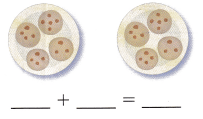
2 plates of 4 cookies
Texas Go Math Grade 2 Lesson 12.1 Answer Key 5
____________ cookies
Answer:

2 x 4 = 8
Explanation:
The sum is found with the help of images

Question 3.
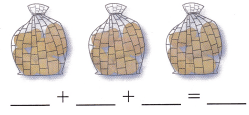
3 bags of 5 potatoes
Texas Go Math Grade 2 Lesson 12.1 Answer Key 6
__________ potatoes
Answer:

15 potatoes
3 x 5 = 15
Explanation:
The sum is found with the help of images

Question 4.
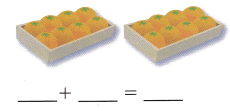
2 boxes of 8 oranges
Texas Go Math Grade 2 Lesson 12.1 Answer Key 7
__________ oranges
Answer:

16 oranges
2 x 8 = 16
Explanation:
The sum is found with the help of images

Problem Solving

Use counters. Draw and then add equal groups. Find the total.

Question 5.
5 groups of 4 counters
Texas Go Math Grade 2 Lesson 12.1 Answer Key 8
___________ counters
Answer:

Explanation:
4 Balloons are shared among 5 friends
4 x 5 = 20

Add Equal Groups 2

Question 6.
4 groups of 3 counters
Texas Go Math Grade 2 Lesson 12.1 Answer Key 9
___________ counters
Answer:

Explanation:
3 x 4 = 12
12 balls shared among 4 groups
each group has 3 balls

Question 7.
H.O.T. Multi-Step Jeff has 5 toy cars. Then his sister gives him 3 more toy cars. Each toy car has 4 wheels. How many wheels are on Jeff’s toy cars?
Texas Go Math Grade 2 Lesson 12.1 Answer Key 10
_________ wheels
Answer:
2 wheels
Explanation:
Jeff has 5 toy cars.
Then his sister gives him 3 more toy cars.
Each toy car has 4 wheels.
5 + 3 = 8
8 ÷ 4 = 2
2 wheels are on Jeff’s toy cars

Question 8.
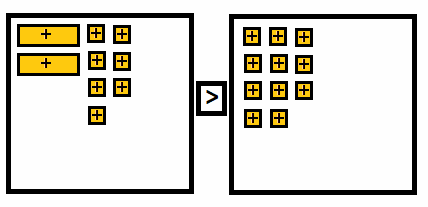
H.O.T. Angela used these counters to act out a problem.
Texas Go Math Grade 2 Lesson 12.1 Answer Key 11
Write a problem that Angela could have solved with these counters.
Answer:
Angela went picnic with her friends
they were 8 friends
And 4 tents
How many friends should she accommodate for each tent
Explanation:
8 ÷ 4 = 2

Daily Assessment Task

Choose the correct answer.

Question 9.
Analyze There are 2 juice boxes for each person at a picnic. There are 10 people at the picnic. How many juice boxes are there?
(A) 12
(B) 8
(C) 20
Answer: C
Explanation:
There are 2 juice boxes for each person at a picnic.
There are 10 people at the picnic.
10 x 2 = 20
20 juice boxes are there

Question 10.
Use counters to model 3 equal groups of 5 objects. Draw a picture of the groups below. Then write an addition sentence for your model.
_________ + _________ + _________ = _________
________ objects
Answer:
5 + 5 + 5 = 15
15 objects
Explanation:

Question 11.
TEXAS Test Prep Brett has 3 bags of shells. He has 4 shells in each bag. How many shells does he have?
Texas Go Math Grade 2 Lesson 12.1 Answer Key 12
(A) 12
(B) 7
(C) 16
Answer: A
Explanation:
Brett has 3 bags of shells.
He has 4 shells in each bag.
3 x 4 = 12
12 shells that he have

TAKE HOME ACTIVITY • Ask your child to show how he or she solved on exercise in the lesson.
Answer:
2 boxes of 3 toy tops
Texas Go Math Grade 2 Lesson 12.1 Answer Key 13
_________ + _________
_________ toy tops
Answer:
3 + 3
6 toy tops
Explanation:
The sum is found with the help of images
Explanation:
Addition is done in the above problem

Texas Go Math Grade 2 Lesson 12.1 Homework and Practice Answer Key

Add equal groups to find the total number of objects.

Question 1.
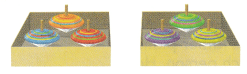
2 boxes of 3 toy tops
Texas Go Math Grade 2 Lesson 12.1 Answer Key 13
_________ + _________
_________ toy tops
Answer:
3 + 3
6 toy tops
Explanation:
The sum is found with the help of images

Question 2.
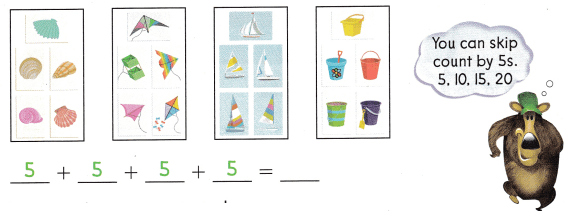
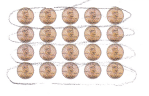
4 groups of 5 pennies
Texas Go Math Grade 2 Lesson 12.1 Answer Key 14
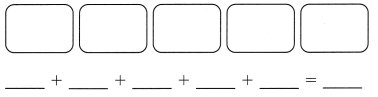
_________ + _________ + _________ + _________ = _________
_________ pennies
Answer:
5 + 5 + 5 + 5 = 20
20 pennies
Explanation:
The sum is found with the help of images

Question 3.
3 groups of 4 counters
Texas Go Math Grade 2 Lesson 12.1 Answer Key 15
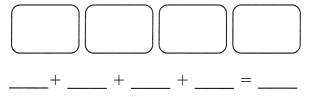
_________ + _________ + _________ = _________
_________ counters
Answer:
4 + 4 + 4 = 12
12 counters
Explanation:
The sum is found with the help of images

Problem Solving

Solve. Write or draw to explain.

Question 4.
Multi-Step Jonathan has 2 toy cars. Then he buys 2 more toy cars. Each toy car has 4 wheels. How many wheels are on Jonathan’s toy cars?
___________ wheels
Answer:
16 wheels
Explanation:
Jonathan has 2 toy cars.
Then he buys 2 more toy cars.
Each toy car has 4 wheels.
2 + 2 = 4
4 x 4 = 16
16 wheels are on Jonathan’s toy cars

Lesson Check

Choose the correct answer.

Question 5.
Linda has 6 bags of ribbons. She has 5 ribbons in each bag. How many ribbons does she have?
(A) 25
(B) 30
(C) 11
Answer: B
Explanation:
Linda has 6 bags of ribbons.
She has 5 ribbons in each bag.
6 x 5 = 30
30 ribbons that she have

Question 6.
Jason’s family is having a cookout. His father plans to cook 3 small pieces of chicken for each person. How many pieces of chicken will he cook for 7 people?
(A) 21
(B) 10
(C) 24
Answer: A
Explanation:
Jason’s family is having a cookout.
His father plans to cook 3 small pieces of chicken for each person.
3 x 7 = 21
21 pieces of chicken that  he cook for 7 people

Question 7.
Julie is having a dinner party. She wants to have 2 bottles of water for each person. There will be a total of 9 people at dinner. How many bottles of water does she need?
(A) 20
(B) 16
(C) 18
Answer: C
Explanation:
Julie is having a dinner party. She wants to have 2 bottles of water for each person.
There will be a total of 9 people at dinner.
9 x 2 = 18
18 bottles of water that she need

Question 8.
Mark, his sister, and his 4 friends are sharing a box of mini pizzas. Each person will get 5 mini pizzas. What is the total number of mini pizzas in the box?
(A) 20
(B) 30
(C) 25
Answer: A
Explanation:
Mark, his sister, and his 4 friends are sharing a box of mini pizzas.
Each person will get 5 mini pizzas.
4 x 5 = 20
20 is the total number of mini pizzas in the box

Texas Go Math Grade 2 Lesson 12.1 Answer Key Add Equal Groups Read More »

Texas Go Math Grade 3 Lesson 10.2 Answer Key Number of Equal Groups

Refer to our Texas Go Math Grade 3 Answer Key Pdf to score good marks in the exams. Test yourself by practicing the problems from Texas Go Math Grade 3 Lesson 10.2 Answer Key Number of Equal Groups.

Texas Go Math Grade 3 Lesson 10.2 Answer Key Number of Equal Groups

Essential Question
How can you model a division problem to find how many equal groups?
Answer:
By using counters, and putting the same amount into each group then we count each group. The equal groups model used in multiplication can be used to solve division problems as well.
Understand division as an unknown-factor problem.
For example,
find 32 ÷ 8  = 4 by finding the number that makes 32 when multiplied by 8.

When you multiply, you put equal groups together. When you divide, you separate into equal groups.

Unlock the Problem
William has 12 shells and some boxes. He wants to put his shells in groups of 3. How many boxes does he need for his shells?

  • Underline what you need to find.
  • How many shells does William want in each group? ____
    Answer:
    He need to find boxes for his shells.
    He need 4 shells in each group
    Explanation:
    William has 12 shells and some boxes.
    He wants to put his shells in groups of 3
    Total boxes he need for his shells
    12 ÷ 3 = 4

Make equal groups.

  • Look at the 12 counters.
  • Circle a group of 3 counters.
  • Continue circling groups of 3 until all 12 counters are in groups.
    Texas Go Math Grade 3 Lesson 10.2 Answer Key 6

There are ___ groups of counters.
So, William needs ___ boxes for his shells.

There are 4 groups of 3 counters.
So, William needs 4 boxes for his shells.

Number of Equal Groups 2

Math Talk
Mathematical Processes
Explain how the drawing would change if William wanted to put his shells in groups of 4.

Share and Show

Question 1.
Emily has 12 counters. She puts them in groups of 2. Draw a picture to show the number of groups.
Answer: 12

Explanation:
Emily has 12 counters.
She puts them in groups of 2.
Total number of groups to show the counters
12 ÷ 2 = 6

Explain how the drawing would change if William wanted to put his shells in groups of 4.

Math Talk
Mathematical Processes
Explain how you find the number of equal groups when you divide.

Draw counters on your Math Board. Then circle equal groups. Complete the table.

Texas Go Math Grade 3 Lesson 10.2 Answer Key 2
Answer:

Problem-Solving

Go Math Grade 3 Lesson 10.2 Answer Key Question 5.
H.O.T. Explain two ways you could divide 18 counters into equal groups. Draw a picture to show each way.
Answer:
Two ways as follows:

Unlock the Problem

Question 6.
A store has 24 beach towels in stacks of 6 towels each. How many stacks of beach towels are at the store?
Texas Go Math Grade 3 Lesson 10.2 Answer Key 7

a. What do you need to find?
Answer:
How many stacks of beach towels are at the store?
4 stacks
24 ÷ 6 = 4

b. How will you use what you know about making equal groups to solve the problem?
Answer:
By using counters, and putting the same amount into each group then we count each group.

Explanation:
each red counter is one beach towel
6 beach towels in one group
4 stacks for 24 beach towel

c. Draw equal groups at the right to find how many stacks of beach towels there are at the store.
Answer:

d. Complete the sentences.

The store has ___ beach towels.
There are ___ towels in each stack.
So, there are ___ stacks of beach towels at the store.
Answer:
The store has 24 beach towels.
There are 6 towels in each stack.
So, there are 4 stacks of beach towels at the store.

Question 7.
H.O.T. Multi-Step A store has 18 red beach balls and 17 green beach balls in boxes of 5 beach balls each. How many boxes of beach balls are at the store?
Texas Go Math Grade 3 Lesson 10.2 Answer Key 8
Answer:
7 boxes of beach balls.
Explanation:
A store has 18 red beach balls and 17 green beach balls in boxes of 5 beach balls each.
Total beach balls 18 + 17 = 35
Total boxes of beach balls at the store
35 ÷ 5 = 7

Go Math Grade 3 Chapter 10 Lesson 10.2 Answer Key Question 8.
H.O.T. Pose a Problem Write a problem about dividing beach toys into equal groups. Solve the problem.
Answer:
A store has total18 beach toys into equal groups .Each box contains 6 beach toys. How many boxes of beach toys at the store?
Explanation:
A store has total18 beach toys into equal groups
Each box contains 6 beach toys.
Total boxes of beach toys at the store are
18 ÷ 6 = 3

Number of Equal Groups 3

Daily Assessment Task

Fill in the bubble for the correct answer choice. You may use models or strategies to solve.

Question 9.
Analyze Jake’s family spends 16 days visiting national parks. They spend 4 days at each national park. How many national parks do they visit?
(A) 4
(B) 12
(C) 64
(D) 20
Answer:
Option (A)
Explanation:
Analyze Jake’s family spends 16 days visiting national parks.
They spend 4 days at each national park.
Number of national parks they visit?
16 ÷ 4 = 4

Question 10.
Hitomi picks 28 peaches to make pies. She uses 7 peaches in each pie. How many pies does she make?
(A) 21
(B) 3
(C) 35
(D) 4
Answer:
Option (D)
Explanation:
Hitomi picks 28 peaches to make pies.
She uses 7 peaches in each pie.
Number of pies she make
28 ÷ 7 = 4

Question 11.
Multi-Step Molly is making string bracelets for her friends. She has 25 pieces of blue string and 17 pieces of red string. She uses 7 strings for each bracelet. How many string bracelets can Molly make?
Texas Go Math Grade 3 Lesson 10.2 Answer Key 9
(A) 10
(B) 6
(C) 35
(D) 7
Answer:
Option (B)
Explanation:
Molly has 25 pieces of blue string and 17 pieces of red string.
Total strings she has 25 + 17 = 42
She uses 7 strings for each bracelet.
Total string bracelets Molly make
42 ÷ 7 = 6

Texas Test Prep

3rd Grade Go Math Lesson 10.2 Answer Key Question 12.
Apply Dan’s train is 27 inches long. If each train car is 3 inches long, how many train cars are there?
(A) 9
(B) 6
(C) 7
(D) 8
Answer:
Option(A)
Explanation:
Apply Dan’s train is 27 inches long.
If each train car is 3 inches long,
Number of train cars
27 ÷ 3 = 9

Texas Go Math Grade 3 Lesson 10.2 Homework and Practice Answer Key

Draw equal groups to solve. Complete the sentences.

Question 1.
A classroom has 21 desks in rows of 3 desks each. How many rows are there?
The classroom has ___ desks.
There are ___ in each row.
So, there are ___ rows.
Answer:
The classroom has 21 desks.
There are 3 in each row.
So, there are 7 rows.
Explanation:
A classroom has 21 desks in rows of 3 desks each.
Total rows of desks
21 ÷ 3 =7

Question 2.
The lunchroom has 28 plates in 7 equal stacks. How many plates are in each stack?
The lunchroom has ___ plates.
There are ___ equal stacks.
So, there are ___ plates in each stack.
Answer:
The lunchroom has 28 plates.
There are 7 equal stacks.
So, there are 4 plates in each stack.
Explanation:
The lunchroom has 28 plates in 7 equal stacks.
Number of plates in each stack
28 ÷ 7 = 4

Problem Solving

Question 3.
There are 35 students in gym class. There are 7 students on each team. How many teams are there?
Answer:
5 Teams
Explanation:
There are 35 students in gym class.
There are 7 students on each team.
Total teams in gym class
35 ÷ 7 = 5

Go Math Lesson 10.2 Homework Answers 3rd Grade Question 4.
On a class trip there are 24 students in mini vans. There are 8 students in each van. How many vans are there?
Answer:
3 vans
Explanation:
On a class trip there are 24 students in mini vans.
There are 8 students in each van.
Total vans required for class trip
24 ÷ 8 = 3

Texas Test Prep

Lesson Check

Fill in the bubble completely to show your answer.

Question 5.
Lisa has 40 beads to make a ñecklace. She puts the beads in 8 equal groups. How many beads are in each group?
(A) 32
(B) 8
(C) 48
(D) 5
Answer:
Option (D)
Explanation:
Lisa has 40 beads to make a ñecklace.
She puts the beads in 8 equal groups.
Number of beads in each group
40 ÷ 8 = 5

Question 6.
A store clerk has 18 video games. She puts them in 3 equal groups on some shelves. How many video games are on each shelf?
(A) 15
(B) 6
(C) 21
(D) 5
Answer:
Option(B)
Explanation:
A store clerk has 18 video games.
She puts them in 3 equal groups on some shelves.
Number of video games on each shelf
18 ÷ 3 = 6

Question 7.
A grocer has 32 bunches of bananas. He puts them in baskets of 8 each. How many baskets does the grocer use?
(A) 40
(B) 24
(C) 6
(D) 4
Answer:
Option (A)
Explanation:
A grocer has 32 bunches of bananas.
He puts them in baskets of 8 each.
Total baskets the grocer use
32 ÷ 8 = 4

Practice and Homework Lesson 10.2 Answer Key Grade 3 Question 8.
Jake’s workout includes 25 push-ups. He does them in sets of 5 each. How many sets of push-ups does Jake’s workout include?
(A) 5
(B) 4
(C) 20
(D) 6
Answer:
Option (A)
Explanation:
Jake’s workout includes 25 push-ups.
He does them in sets of 5 each.
Total sets of push-ups Jake’s workout include
25 ÷ 5 = 5

Question 9.
Multi-Step Holly has 24 roses and 24 tulips. She wants to put 8 flowers each into a vase. How many vases will Holly need for all of the flowers?
(A) 48
(B) 3
(C) 6
(D) 40
Answer:
Option (C)
Explanation:
Holly has 24 roses and 24 tulips.
Total flowers 24 + 24 = 48
She wants to put 8 flowers each into a vase.
Number of vases Holly need for all of the flowers
48 ÷ 8 = 6

Go Math 3rd Grade Lesson 10.2 Answer Key Question 10.
Multi-Step Roscoe makes a tile design with 18 red tiles and 27 blue tiles. He arranges them in 9 rows. How many tiles are in each row?
(A) 3
(B) 5
(C) 2
(D) 9
Answer:
Option(B)
Explanation:
Roscoe makes a tile design with 18 red tiles and 27 blue tiles.
Total tiles 18 + 27 = 45
He arranges them in 9 rows.
Number of tiles in each row?
45 ÷ 9 = 5

Texas Go Math Grade 3 Lesson 10.2 Answer Key Number of Equal Groups Read More »

Texas Go Math Grade 3 Lesson 9.3 Answer Key Multiply Multiples of 10 by 1-Digit Numbers

Refer to our Texas Go Math Grade 3 Answer Key Pdf to score good marks in the exams. Test yourself by practicing the problems from Texas Go Math Grade 3 Lesson 9.3 Answer Key Multiply Multiples of 10 by 1-Digit Numbers.

Texas Go Math Grade 3 Lesson 9.3 Answer Key Multiply Multiples of 10 by 1-Digit Numbers

Essential Question
How can you model and record multiplying multiples of 10 by I-digit whole numbers?

Unlock the Problem
The community center offers 4 dance classes. If 30 students sign up for each class, how many students sign up for dance class altogether?

  • How many equal groups are there? ___
  • How many are in each group? ___

Activity
Use base-ten blocks to model 4 × 30.

Materials Texas Go Math Grade 3 Lesson 9.3 Answer Key 1 base-ten blocks

Step 1
Model 4 groups of 30.
Texas Go Math Grade 3 Lesson 9.3 Answer Key 2

Step 2
Combine the tens. Regroup 12 tens as 1 hundred 2 tens.
Texas Go Math Grade 3 Lesson 9.3 Answer Key 3
So, __ students sign up for dance class together.

Math Idea
If one factor is a multiple of 10, then the product will also be a multiple of 10.

Example
Use place value and regrouping. Find 7 × 40.
Texas Go Math Grade 3 Lesson 9.3 Answer Key 4

Example
Use Mental Math and the Properties of Multiplication.

You can change the order or the grouping of the factors. The product is the same.

Math Idea
You can use mental math to multiply multiples of 10.
Texas Go Math Grade 3 Lesson 9.3 Answer Key 5

Share and Show

Question 1.
Use the quick picture to find 5 × 40. ____
5 × 40 = __
Texas Go Math Grade 3 Lesson 9.3 Answer Key 6
Answer:
Texas-Go-Math-Grade-3-Lesson-9.3-Answer-Key-Multiply-Multiples-of-10-by-1-Digit Numbers-Share and Show-1

Explanation:
Multiply the Ones.
5 × 0 = 0 ones.
Multiply the Tens.
5 × 4 = 20.
Re-grouping the ones and tens as hundreds and tens:
5 × 40 = 200.


Find the product.
Question 3.
Texas Go Math Grade 3 Lesson 9.3 Answer Key 7
Answer:
Texas-Go-Math-Grade-3-Lesson-9.3-Answer-Key-Multiply-Multiples-of-10-by-1-Digit Numbers-Share and Show-Find the product-3

Explanation:
Multiply the Ones.
9 × 0 = 0 ones.
Multiply the Tens.
9 × 8 = 72.
Re-grouping the ones and tens as hundreds and tens:
9 × 80 = 720.


Go Math Grade 3 Lesson 9.3 Answer Key Question 4.
Texas Go Math Grade 3 Lesson 9.3 Answer Key 8
Answer:
Texas-Go-Math-Grade-3-Lesson-9.3-Answer-Key-Multiply-Multiples-of-10-by-1-Digit Numbers-Share and Show-Find the product-4

Explanation:
Multiply the Ones.
7 × 0 = 0 ones.
Multiply the Tens.
7 × 7 = 49.
Re-grouping the ones and tens as hundreds and tens:
7 × 70 = 490.

Multiply Multiples of 10 by 1-Digit Numbers 4

Question 5.
Texas Go Math Grade 3 Lesson 9.3 Answer Key 9
Answer:
Texas-Go-Math-Grade-3-Lesson-9.3-Answer-Key-Multiply-Multiples-of-10-by-1-Digit Numbers-Share and Show-Find the product-5

Explanation:
Multiply the Ones.
4 × 0 = 0 ones.
Multiply the Tens.
4 × 9 = 36.
Re-grouping the ones and tens as hundreds and tens:
4 × 90 = 360.


Question 6.
Texas Go Math Grade 3 Lesson 9.3 Answer Key 10
Answer:
Texas-Go-Math-Grade-3-Lesson-9.3-Answer-Key-Multiply-Multiples-of-10-by-1-Digit Numbers-Share and Show-Find the product-6

Explanation:
Multiply the Ones.
8 × 0 = 0 ones.
Multiply the Tens.
8 × 6 = 48.
Re-grouping the ones and tens as hundreds and tens:
8 × 60 = 480.


Use mental math or properties to group the factors another way.
Then find the product.

Question 6.
4 × (2 × 30)
Answer:
4 × (2 × 30) = 240.

Explanation:
4 × (2 × 30)
= (4 × 2 × 3) 10
= (8 × 3) 10
= 24 × 10
= 240.


Go Math Lesson 9.3 Answer Key Grade 3 Question 7.
(50 × 2) × 2
Answer:
(50 × 2) × 2 = 200.

Explanation:
(50 × 2) × 2 = (10 × 5) × 2 × 2
= 10 (5 × 2 × 2)
= 10 (10 × 2)
= 10 × 20
= 200.


Question 8.
3 × (3 × 40)
Answer:
3 × (3 × 40) = 360.

Explanation:
3 × (3 × 40) = 3 × 3 × (4 × 10)
= (3 × 3 × 4) × 10
= (9 × 4) 10
= 36 × 10
= 360.


Math Talk
Mathematical Processes
Explain how you can use place value to solve Exercise 5.

Algebra Find the unknown factor.

Question 9.
a × 80 = 480
a =___
Answer:
a × 80 = 480
a = 8.

Explanation:
a × 80 = 480
=> a = 480 ÷ 80
=> a = 48 ÷ 8
=> a = 8.

Multiply Multiples of 10 by 1-Digit Numbers 5

Question 10.
b × 30 = 30
b = ___
Answer:
b × 30 = 30
b = 1.

Explanation:
b × 30 = 30
=> b = 30 ÷ 30
=> b = 1.


Lesson 9.3 Answer Key Go Math Grade 3 Question 11.
Texas Go Math Grade 3 Lesson 9.3 Answer Key 11
Answer:
7 × ?? = 420.
?? = 60.

Explanation:
7 × ?? = 420
=> ?? = 420 ÷ 7
=> ?? = 60.


Question 12.
Texas Go Math Grade 3 Lesson 9.3 Answer Key 12
Answer:
50 × ?? = 0
?? = 0.

Explanation:
50 × ?? = 0
=> ?? = 0 ÷ 50
=> ?? = 0.


Problem Solving
Question 13.
Reasoning Multi-Step Ben writes the product of 7 and 50. Then he subtracts the least 3-digit multiple of 10 from the product. What is the difference?
Answer:
Difference = 250.

Explanation:
Product of 7 and 50:
=> 7 × 50 = (7 × 10) + (7 × 10) + (7 × 10) + (7 × 10) + (7 × 10)
= 70 + 70 + 70 + 70 + 70
= 140 + 70 + 70 + 70
= 210 + 70 + 70
= 280 + 70
= 350.
Least 3-digit multiple of 10 = 100.
Difference:
Product of 7 and 50 – Least 3-digit multiple of 10
= 350 – 100
= 250.

Question 14.
H.O.T. Sense or Nonsense? Lori says that 8 is not a factor of 80 because 8 does not end in zero. Does Lori’s statement make sense? Explain.
Answer:
Lori says that 8 is not a factor of 80 because 8 does not end in zero. Lori’s statement does make sense because 80 is a multiple of 8.

Explanation:
8 × ?? = 80.
=> ?? = 80 ÷ 8
=> ?? = 10.


Question 15.
Multi-Step Ava’s class bought 6 packages of balloons for a school celebration. Each package had 30 balloons. If 17 balloons were left over, how many balloons were used for the party?
Texas Go Math Grade 3 Lesson 9.3 Answer Key 13
Answer:
Number of balloons were used for the party = 163.

Explanation:
Number of packages of balloons for a school celebration Ava’s class bought = 6.
Number of balloons each package had = 30.
Number of balloons left over = 17.
Total number of balloons = Number of packages of balloons for a school celebration Ava’s class bought  × Number of balloons each package had
= 6 × 30
= (6 × 10) + (6 × 10) + (6 × 10)
= 60 + 60 + 60
= 120 + 60
= 180.
Number of balloons were used for the party = Total number of balloons – Number of balloons left over
= 180 – 17
= 163.


Question 16.
Analyze Frank has a 2-digit number on his baseball uniform. The number is a multiple of 10 and has 3 as one of its factors. What three numbers could Frank have on his uniform?
Answer:
Three numbers could Frank have on his uniform:
=> 3 × 10 = 30.
=> 6 × 10 = 60.
=> 9 × 10 = 90.

Explanation:
Frank has a 2-digit number on his baseball uniform.
The number is a multiple of 10 and has 3 as one of its factors.
=> 3 × 10 = 30.
=> 6 × 10 = 60.
=> 9 × 10 = 90.

Question 17.
Write Math A landscaper planted 1 group of 30 trees in 9 different city parks. How many trees did he plant? Explain how you grouped your factors to solve the problem.
Answer:
Number of trees he planted = 270.

Explanation:
Number of trees he planted = 30.
Number of different city parks he planted = 9.
Number of trees he planted = Number of trees he planted × Number of different city parks he planted
= 30 × 9
= (10 × 9) + (10 × 9) + (10 × 9)
= 90 + 90 + 90
= 180 + 90
= 270.


Daily Assessment Practice
Fill in the bubble for the correct answer choice.
Question 18.
A food carnival visited Morris Elementary School. During the show, 30 students each juggle 6 carrots. How many carrots do the Morris Elementary School students juggle?
(A) 180
(B) 36
(C) 60
(D) 6
Answer:
Number of carrots the Morris Elementary School students juggle = 180.
(A) 180.

Explanation:
Number of students = 30.
Number of carrots each juggle = 6.
Number of carrots the Morris Elementary School students juggle = Number of students × Number of carrots each juggle
= 30 × 6
= 180.

Question 19.
Apply Asha bike jumps for 90 minutes every time she practices. She practices 4 days each week. How many minutes does Asha practice each week?
(A) 94
(B) 3,600
(C) 360
(D) 36
Answer:
Number of minutes Asha practice each week = 360.
(C) 360.

Explanation:
Number of days she practiced each week = 4.
Time apply Asha bike jumps for every time she practices = 90 minutes.
Number of minutes Asha practices each week = Time applied Asha bike jumps for every time she practices × Number of days she practiced each week
= 90 × 4
= 10 (9 × 4)
= 10 × 36
= 360.


Go Math Grade 3 Lesson 9.3 Multiply by Multiples of 10 Answer Key Question 20.
Multi-Step Vic makes ice pops in batches. He makes 2 batches of 20 cherry ice pops and 3 batches of 30 lime ice pops. How many ice pops does Vic make?
(A) 90
(B) 40
(C) 50
(D) 130
Answer:
Number of ice pops Vic make = 130.
(D) 130.

Explanation:
Number of batches of cherry ice pops = 2.
Number of cherry ice pops = 20.
Total number of cherry ice pops = Number of batches of cherry ice pops × Number of cherry ice pops
= 2 × 20
= (2 × 10) + (2 × 10)
= 20 + 20
= 40.
Number of batches of lime ice pops = 3.
Number of lime ice pops = 30.
Total number of lime ice pops = Number of batches of lime ice pops × Number of lime ice pops
= 3 × 30
= (3 × 10) + (3 × 10) + (3 × 10)
= 30 + 30 + 30
= 60 + 30
= 90.
Number of ice pops Vic make = Total number of cherry ice pops + Total number of lime ice pops
= 40 + 90
= 10(4 + 9)
= 10 × 13
= 130.


Texas Test Prep

Question 21.
Wesley runs 10 miles each week for 2 weeks. Then he runs 20 miles each week for 3 weeks. How many miles does Wesley run in 5 weeks?
(A) 20 miles
(B) 80 miles
(C) 60 miles
(D) 30 miles
Answer:
Number of miles Wesley run in 5 weeks = 80.
(B) 80 miles.

Explanation:
Number of miles Wesley runs each week = 10.
Number of weeks Wesley runs = 2.
Total number of weeks Wesley runs for 2 weeks = Number of miles Wesley runs each week × Number of weeks Wesley runs
= 10 × 2
= 20.
Number of miles Wesley runs each week = 20.
Number of weeks Wesley runs = 3.
Total number of weeks Wesley runs for 3 weeks = Number of miles Wesley runs each week × Number of weeks Wesley runs
= 20 × 3
= 60.
Number of miles Wesley run in 5 weeks = Total number of weeks Wesley runs for 2 weeks + Total number of weeks Wesley runs for 3 weeks
= 20 + 60
= 10(2 + 6)
= 10 × 8
= 80.

Texas Go Math Grade 3 Lesson 9.3 Homework and Practice Answer Key

Find the product.

Question 1.
Texas Go Math Grade 3 Lesson 9.3 Answer Key 14
Answer:
Texas-Go-Math-Grade-3-Lesson-9.3-Answer-Key-Multiply-Multiples-of-10-by-1-Digit Numbers-Texas Go Math Grade 3 Lesson 9.3 Homework and Practice Answer Key-1

Explanation:
Multiply the Ones.
9 × 0 = 0 ones.
Multiply the Tens.
9 × 5 = 45.
Re-grouping the ones and tens as hundreds and tens:
9 × 50 = 450.


Question 2.
Texas Go Math Grade 3 Lesson 9.3 Answer Key 15
Answer:
Texas-Go-Math-Grade-3-Lesson-9.3-Answer-Key-Multiply-Multiples-of-10-by-1-Digit Numbers-Texas Go Math Grade 3 Lesson 9.3 Homework and Practice Answer Key-2

Explanation:
Multiply the Ones.
6 × 0 = 0 ones.
Multiply the Tens.
6 × 7 = 42.
Re-grouping the ones and tens as hundreds and tens:
6 × 70 = 420.


Question 3.
Texas Go Math Grade 3 Lesson 9.3 Answer Key 16
Answer:
Texas-Go-Math-Grade-3-Lesson-9.3-Answer-Key-Multiply-Multiples-of-10-by-1-Digit Numbers-Texas Go Math Grade 3 Lesson 9.3 Homework and Practice Answer Key-3

Explanation:
Multiply the Ones.
7 × 0 = 0 ones.
Multiply the Tens.
7 × 9 = 63.
Re-grouping the ones and tens as hundreds and tens:
7 × 90 = 630.


Question 4.
Texas Go Math Grade 3 Lesson 9.3 Answer Key 17
Answer:
Texas-Go-Math-Grade-3-Lesson-9.3-Answer-Key-Multiply-Multiples-of-10-by-1-Digit Numbers-Texas Go Math Grade 3 Lesson 9.3 Homework and Practice Answer Key-4

Explanation:
Multiply the Ones.
8 × 0 = 0 ones.
Multiply the Tens.
8 × 4 = 32.
Re-grouping the ones and tens as hundreds and tens:
8 × 40 = 320.


Use mental math or properties to group the factors another way. Then find the product.

Question 5.
3 × (3 × 20)
Answer:
3 × (3 × 20) = 180.

Explanation:
3 × (3 × 20)
= 3 × 3 × 2 × 10
= (3 × 3 × 2) 10
= (9 × 2) 10
= 18 × 10
= 180.


Question 6.
4 × (2 × 50)
Answer:
4 × (2 × 50) = 400.

Explanation:
4 × (2 × 50)
= 4 × 2 × 5 × 10
= (4 × 2 × 5) 10
= (8 × 5) 10
= 40 × 10
= 400.


Go Math Practice and Homework Lesson 9.3 Answer Key Question 7.
(60 × 2) × 4
Answer:
(60 × 2) × 4 = 480.

Explanation:
(60 × 2) × 4
= 6 × 10 × 2 × 4
= (6 × 2 × 4) 10
= (12 × 4) 10
= 48 × 10
= 480.


Problem Solving

Question 8.
Rikki’s locker number is a two-digit number. The number is less than 70 and is an even multiple of 10. What three numbers could be Rikki’s locker number?
Answer:
Three numbers could be Rikki’s locker numbers are
20, 40, 60.

Explanation:
Rikki’s locker number is a two-digit number.
The number is less than 70 and is an even multiple of 10.
=> The number is less than 70 = 10, 20, 30, 40, 50, 60.
=> Even multiple of 10 = 20, 40, 60.

Question 9.
Jerry brings 8 packages of paper plates to a picnic. Each package contains 20 plates. If 23 plates were left over, how many plates were used at the picnic?
Answer:
The number of plates were used at the picnic = 137.

Explanation:
Number of packages of paper plates to a picnic Jerry brings = 8.
Number of plates each package contains = 20.
Number of plates were left over = 23.
Total number of plates = Number of packages of paper plates to a picnic Jerry brings × Number of plates each package contains
= 8 × 20
= (8 × 10) + (8 × 10)
= 80 + 80
= 160.
Number of plates were used at the picnic = Total number of plates – Number of plates were left over
= 160 – 23
= 137.

Question 10.
At the school play, there are 2 groups of seats. Each group of seats has 5 rows that hold 30 people. How many people can be seated at the play? Explain how you grouped your factors to solve the problem.
Answer:
Number of people can be seated at the play = 300.

Explanation:
Number of groups of seats are at the school play = 2.
Number of seats of rows in each group = 5.
Number of people can seat in each row = 30.
Number of people can be seated at the play = Number of groups of seats are at the school play × Number of seats of rows in each group × Number of people can seat in each row
= 2 × 5 × 30
= (2 × 5 × 3) × 10
= (10 × 3) 10
= 30 × 10
= 300.

Texas test Prep

Lesson Check

Question 11.
Evelyn reads 40 pages of a book each night for 5 nights. How many pages does Evelyn read in all?
(A) 45
(B) 200
(C) 160
(D) 405
Answer:
Number of pages Evelyn reads in all = 200.
(B) 200.

Explanation:
Number of pages of a book each night Evelyn reads = 40.
Number of nights Evelyn reads = 5.
Number of pages Evelyn reads in all = Number of pages of a book each night Evelyn reads × Number of nights Evelyn reads
= 40 × 5
= 10 × 4 × 5
= 10 × 20
= 200.


Question 12.
Lamar walks for 40 minutes every day. How many minutes does Lamar walk in one week?
(A) 280 minutes
(B) 210 minutes
(C) 200 minutes
(D) 320 minutes
Answer:
Number of minutes Lamar walks in one week = 280.
(A) 280 minutes.

Explanation:
Time Lamar walks for every day = 40 minutes.
Number of days a week = 7.
Number of minutes Lamar walks in one week = Time Lamar walks for every day × Number of days a week
= 40 × 7
= 10 × 4 × 7
= 10 × 28
= 280.


Question 13.
Mr. Carmello drives 30 miles each way back and forth to work. If he works 4 days each week, how many miles does he drive in all?
(A) 120 miles
(B) 304 miles
(C) 240 miles
(D) 210 miles
Answer:
Number of miles he drive in all = 120.
(A) 120 miles.

Explanation:
Number of miles each way back and forth to work Mr. Carmello drives = 30.
Number of days he works in a week = 4.
Number of miles he drive in all = Number of miles each way back and forth to work Mr. Carmello drives × Number of days he works in a week
= 30 × 4
= 10 × 3 × 4
= 10 × 12
= 120.


Question 14.
At the parade, there are 7 floats. Each float has 30 people riding on it. How many people ride on the floats at the parade?
(A) 308
(B) 420
(C) 210
(D) 320
Answer:
Number of people ride on the floats at the parade = 210.
(C) 210.

Explanation:
Number of floats at the parade there are = 7.
Number of people riding on each float = 30.
Number of people ride on the floats at the parade = Number of floats at the parade there are × Number of people riding on each float
= 7 × 30
= 7 × 3 × 10
= 21 × 10
= 210.

Question 15.
Multi-Step Luisa has 2 rows of cabbage plants and 4 rows of lettuce plants. There are 30 plants in each row. How many plants does Luisa have?
(A) 200
(B) 180
(C) 120
(D) 240
Answer:
Number of plants Luisa have = 120.
(C) 120.

Explanation:
Number of rows of cabbage plants Luisa has = 2.
Number of rows of lettuce plants Luisa has = 2.
Number of plants in each row = 30.
Number of plants Luisa have = Number of rows of cabbage plants Luisa has × Number of rows of lettuce plants Luisa has  × Number of plants in each row
= 2 × 2 × 30
= 2 × 2 × 3 × 10
= 4 × 3 × 10
= 12 × 10
= 120.

Question 16.
Multi-Step A store has 3 crates of sweet potatoes that each weigh 40 pounds. There are 4 crates of white potatoes that each weigh 50 pounds. How many pounds of potatoes are there?
(A) 280 pounds
(B) 360 pounds
(C) 420 pounds
(D) 320 pounds
Answer:
Number of pounds of potatoes are there = 320.
(D) 320 pounds.

Explanation:
Number of crates of sweet potatoes a store has = 3.
Weight of each crates of sweet potatoes = 40 pounds.
Number of crates of white potatoes a store has = 4.
Weight of each crates of white potatoes = 50 pounds.
Number of pounds of potatoes are there = (Number of crates of sweet potatoes a store has × Weight of each crates of sweet potatoes) + (Number of crates of white potatoes a store has × Weight of each crates of white potatoes)
= (3 × 40) + (4 × 50)
= (3 × 4 × 10) + (4 × 5 × 10)
= (12 × 10) + ( 20 × 10)
= 120 + 200
= 320.

Texas Go Math Grade 3 Lesson 9.3 Answer Key Multiply Multiples of 10 by 1-Digit Numbers Read More »

Texas Go Math Grade 6 Module 5 Quiz Answer Key

Refer to our Texas Go Math Grade 6 Answer Key Pdf to score good marks in the exams. Test yourself by practicing the problems from Texas Go Math Grade 6 Module 5 Quiz Answer Key.

Texas Go Math Grade 6 Module 5 Quiz Answer Key

Texas Go Math Grade 6 Module 5 Ready to Go On? Answer Key

5.1 Adding Integers with the Same Sign

Add.

Question 1.
– 8 + (- 6) __________
Answer:
First, find absolute values of given integers:
|- 8| = 8 and |- 6|= 6
Then, sum that absolute values
8 + 6 = 14
Final result would be 14 or – 14, depending on sign of given integers (both positive then +, both negative then -).
Given integers are negative so final result is – 14.

Result is – 14.
Find absolute values, sum them and add minus if both integers were negative.

Go Math Grade 6 Module 5 Answer Key Pdf Question 2.
– 4 + (- 7) __________
Answer:
First, find absolute values of given integers:
|- 4| = 4 and |- 7|= 7
Then, sum that absolute values
4 + 7 = 11
Final result would be 11 or – 11, depending on sign of given integers (both positive then +, both negative then -).
Given integers are negative so final result is – 11.

Result is – 11.
Find absolute values, sum them and add minus if both integers were negative.

Question 3.
– 9 + (- 12) __________
Answer:
First, find absolute values of given integers:
|- 9| = 9 and |- 12|= 12
Then, sum that absolute values
9 + 12 = 21
Final result would be 21 or – 21, depending on sign of given integers (both positive then +, both negative then -).
Given integers are negative so final result is – 21.

Result is – 21.
Find absolute values, sum them and add minus if both integers were negative.

5.2 Adding Integers with Different Signs

Add.

Question 4.
5 + (- 2) __________
Answer:
Find absolute values and subtract lesser absolute value from greater:
| 5 | – |- 2| = 3
Final result would be 3 or -3, depending on signs of given integers.
Use the sign of number with greater absolute value to find the final result:
5 + (- 2) = 3

The sum is 3.
Find absolute values, subtract them and add minus if integer with greater absolute value was negative.

Texas Go Math Grade 6 Module 5 Quiz Answer Key 3

Question 5.
– 8 + 4 __________
Answer:
Find absolute values and subtract lesser absolute value from greater:
| – 8 | – |4| = 4
Final result would be 4 or – 4, depending on signs of given integers.
Use the sign of number with greater absolute value to find the final result:
– 8 + 4 = – 4

The sum is – 4.
Find absolute values, subtract them and add minus if integer with greater absolute value was negative.

Grade 6 Module 5 Quiz Answer Key Go Math Question 6.
15 + (- 8) __________
Answer:
Find absolute values and subtract lesser absolute value from greater:
| 15 | – |- 8| = 7
Final result would be 7 or – 7, depending on signs of given integers.
Use the sign of number with greater absolute value to find the final result:
15 + (- 8) = 7

The sum is 7.
Find absolute values, subtract them and add minus if integer with greater absolute value was negative.

5.3 Subtracting integers

Subtract.

Question 7.
2 – 9 __________
Answer:
Subtracting 9 is equal to adding its additive inverse – 9 so you can find sum:
2 + (- 9)
To calculate sum, subtract lesser absolute value from greater:
|- 9| – |2| = 7
Result would be 7 or – 7, depending on signs of given integers.
Use the sign of integer with greater absolute value to find the sum:
2 + (- 9) = – 7
Since finding difference
2 – 9
is the same as finding sum
2 + (- 9)
the difference is – 7.

The difference is – 7
To subtract 9, add its additive inverse – 9 and find the sum using rules for adding integers.

Texas Go Math Grade 6 Module 5 Quiz Answer Key 1

Question 8.
– 3 – (- 4) __________
Answer:
Subtracting – 4 is equal to adding its additive inverse 4 so you can find sum:
– 3 + 4
To calculate sum, subtract lesser absolute value from greater:
|4| – |- 3| = 1
Result would be 1 or – 1, depending on signs of given integers.
Use the sign of integer with greater absolute value to find the sum:
– 3 + 4 = 1
Since finding difference
– 3 – (- 4)
is the same as finding sum
– 3 + 4
the difference is 1.

The difference is 1.
To subtract – 4, add its additive inverse 4 and find the sum using rules for adding integers.

Module 5 Quiz Answers 6th Grade Go Math Question 9.
11 – (- 12) __________
Answer:
Subtracting – 12 is equal to adding its additive inverse 12 so you can find sum:
11 + 12
The sum is:
11 + 12 = 23
Since finding difference
11 – (- 12)
is the same as finding sum
11 + 12
the difference is 23.
To subtract – 12, add its additive inverse 12 and find the sum using rules for adding integers.

5.4 Applying Addition and Subtraction of Integers

Question 10.
A bus makes a stop at 2:30, letting off 15 people and letting on 9. The bus makes another stop ten minutes later to let off 4 more people. How does the number of people on the bus after the second stop compare to the number of people on the bus before the 2:30 stop?
Answer:
The expression that represents number of people on the bus after second stop is:
– 15 + 9 – 4
Subtracting 4 is equal to adding its additive inverse -4 so you can find sum:
– 15 + 9 + (- 4)
Use Commutative Property to simplify addition:
– 15 + (- 4) + 9
Use Associative Property and rules for adding integers to find the result:
– 19 + 9 = – 10
The number of people on the bus after second stop is Lesser than the number of people on the bus before first stop. There are 10 people less than before two stops.

Question 11.
Cate and Elena were playing a card game. The stack of cards in the middle had 24 cards in it to begin with. Cate added 8 cards to the stack. Elena then took 12 cards from the stack. Finally, Cate took 9 cards from the stack. How many cards were left in the stack?
Answer:
Start with 24. Use positive integer to represent cards that are added to the stack and negative integer to represent cards that are taken from stack. The expression you get 15:
24 + 8 – 12 – 9
Subtracting 12 and 9 is equal to adding additive inverses – 12 and – 9 so you can find sum:
24 + 8 + (- 12) + (- 9)
Use Associative Property and rules for adding integers to find the result:
(24 + 8) + (- 12 + (- 9))
32 + (- 21) = 11
There were 11 cards left in the stack.
Use Associative Property and rules for adding integers to find the result

Essential Question

Grade 6 Module 5 Topic Quiz Answer Key Question 12.
Write and solve a word problem that can be modeled by the addition of two negative integers.
Answer:
Sally withdrew $50 from her account on Tuesday and she withdrew $75 from her account on Friday. Find the total amount Sally withdrew on Tuesday and on Friday.
Since she withdrew money, write the sum of negative integers to calculate the amount.
The sum ¡s:
– 50 + (- 75)
First, find absolute values of given integers:
|- 50| = 50 and |- 75| = 75
Then, sum that absolute values
50 + 75 = 125
Final result would be 125 or -125, depending on sign of given integers (both positive then +, both negative then -).
Given integers are negative so final result is – 125.
Sally withdrew $125 from her account.

Sally withdrew $50 from her account on Tuesday and she withdrew $75 from her account on Friday. Find the total amount Sally withdrew on Tuesday and on Friday.
She withdrew $125 from her account.

Texas Go Math Grade 6 Module 5 Mixed Review Texas Test Prep Answer Key

Selected Response

Question 1.
Which expression has the same value as – 3 + (- 5)?
(A) – 3 – (- 5)
(B) – 3 + 5
(C) – 5 + (- 3)
(D) – 5 – (- 3)
Answer:
(C) – 5 + (- 3)

Explaination:
The expression is:
– 3 + (- 5)
Apply Commutative Property to that expression.
The expression you get is:
– 5 + (- 3)
so the answer is: C).
To check, find both sums using rules for adding integers with the same sign:
– 3 + (- 5) = – 8
– 5 + (- 3) = – 8
Apply Commutative Property to the expression – 3 + (- 5) to get the expression with the same value.

Question 2.
A diver’s elevation is – 30 feet relative to sea level. She dives down 12 feet. What is her elevation after the dive?
(A) 12 feet
(B) 18 feet
(C) – 30 feet
(D) – 42 feet
Answer:
(D) – 42 feet

Explaination:
Start with – 30 and add negative integer because she dives down. The expression you get iS:
– 30 + (- 12)
Find absolute values of given integers:
|- 30| = 30 and |- 12| = 12
Then, sum that absolute values
30 + 12 = 42
Final result would be 42 or – 42, depending on sign of given integers (both positive then +, both negative then -).
Given integers are negative so final result is – 42.
The answer is:
– 42 feet.
Find absolute values, sum them and add minus if both integers were negative.

Go Math 6th Grade Module 5 Quiz Answer Key Question 3.
Which number line models the expression – 3 + 5?
(A) Texas Go Math Grade 6 Module 5 Quiz Answer Key 1
(B) Texas Go Math Grade 6 Module 5 Quiz Answer Key 2
(C) Texas Go Math Grade 6 Module 5 Quiz Answer Key 3
(D) Texas Go Math Grade 6 Module 5 Quiz Answer Key 4
Answer:
(B) Texas Go Math Grade 6 Module 5 Quiz Answer Key 2

Use number line to model that expression.
Start at – 3 and move 5 units to the right to represent adding 5.
Therefore, the answer is:
Texas Go Math Grade 6 Module 5 Quiz Answer Key 2

Question 4.
Which number can you add to 5 to get a sum of 0?
(A) – 10
(B) – 5
(C) 0
(D) 5
Answer:
(B) – 5

Explaination:
The answer is: – 5
To get a sum of 0, you need to add additive inverse of 5, which is – 5.
You get the expression:
5 + (- 5)
Its value is:
5 + (- 5) = 0

Question 5.
The temperature in the morning was – 3°F. The temperature dropped 11 degrees by night. What was the temperature at night?
(A) – 14°F
(B) – 8°T
(C) 8°F
(D) 14°F
Answer:
(C) 8°F

Explaination:
Start with – 3 and add 11 to find the temperature before it dropped.
The expression you get is:
– 3 + 11
To calculate sum, subtract lesser absolute value from greater:
|11| – |- 3| = 8
Result would be 8 or – 8, depending on signs of given integers.
Use the sign of integer with greater absolute value to find the sum:
– 3 + 11 = 8
The answer ¡s:
8°F

Question 6.
Which of the following expressions has the greatest value?
(A) 3 – 7 + (- 10)
(B) 3 + 7 – (- 10)
(C) 3 – 7 – (- 10)
(D) 3 – 7 + (- 10)
Answer:
(B) 3 + 7 – (- 10)

Explaination:
Use Commutative Property, Associative Property and rules for adding integers to calculate each sum and then compare results to find the greatest value.

(A) 3 – 7 + (- 10)
Subtracting 7 is equal to adding its additive inverse – 7 so you can find sum:
3 + (- 7) + (- 10)
Associative Property:
3 + ((- 7) + (- 10))
3 + (- 17) = – 14

(B) 3 + 7 – (- 10)
Subtracting – 10 is equal to adding its additive inverse 10 so you can find sum:
3 + 7 + 10
3 + 7 + 10 = 20

(C) 3 – 7 – (- 10)
Subtracting 7 and – 10 is equal to adding additive inverses – 7 and 10 so you can find sum:
3 + (- 7) + 10
Commutative Property:
3 + 10 + (- 7)
Associative Property:
13 + (- 7) = 6

(D) 3 + 7 + (- 10)
Associative Property:
10 + (- 10) = 0
The expression that has the greatest value is:
(B) 3 + 7 – (- 10)
Calculate each sum using rules for adding integers and compare results to find the greatest value.

Gridded Response

Module 5 Grade 6 Answer Key Integers Quiz with Answers Question 7.
Mr. Renato had $150 in his bank account. He deposited $50. A couple of days later, he withdrew $20. A week later, he deposited $75. The next week he withdrew $ 100. What is Mr. Ranato’s balance after all the transactions?
Texas Go Math Grade 6 Module 5 Quiz Answer Key 5
Answer:
Add the integer if he deposited money and subtract integer if he withdrew ii
The expression you get is:
150 + 50 – 20 + 75 – 100
Subtracting 20 and 100 is equal to adding additive inverses – 20 and – 100 so you can find sum:
150 + 50 + (- 20) + 75 + (- 100)
Use Commutative Property and Associative Property to simplify addition:
(150 + 50) + 75 + (- 20) + (- 100)
Use Associative Property and rules for adding integers to find the result:
200 + 75 + ((- 20) + (- 100))
275 + (- 120) = 155
His balance after alt the transactions ¡s $155.
Find the value of the expression 150 + 50 – 20 + 75 – 100 to calculate his balance.

Texas Go Math Grade 6 Module 5 Quiz Answer Key Read More »

Texas Go Math Grade 7 Lesson 8.1 Answer Key Writing Two-Step Equations

Refer to our Texas Go Math Grade 7 Answer Key Pdf to score good marks in the exams. Test yourself by practicing the problems from Texas Go Math Grade 7 Lesson 8.1 Answer Key Writing Two-Step Equations.

Texas Go Math Grade 7 Lesson 8.1 Answer Key Writing Two-Step Equations

Texas Go Math Grade 7 Lesson 8.1 Explore Activity Answer Key

Modeling Two-Step Equations

You can use algebra tiles to model two-step equations.
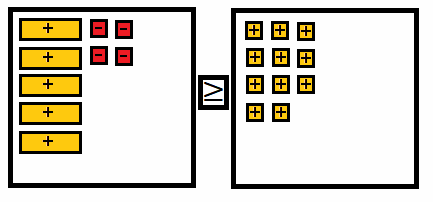
Texas Go Math Grade 7 Lesson 8.1 Answer Key 1
Use algebra tiles to model 3x – 4 = 5.
A. How can you model the left side of the equation?
B. How can you model the right side of the equation?
C. Use algebra tiles or draw them to model the equation on the mat.
Texas Go Math Grade 7 Lesson 8.1 Answer Key 2

Reflect

Question 1.
What If? How would you change the equation in the Explore Activity to model -3x + 4 = 5?
Answer:
In order to change the model for the given equation and model the equation -3x + 4 = 5 use the following:
• • Instead of using 3 yellow tiles for the positive variable, use 3 red tiles for the negative variabLe to show – 3x
• • Instead of using 4 red tiles for -1, use 4 yelLow tiles for 1.
The model for the equation 3x + 4 = 5 is:
Texas Go Math Grade 7 Lesson 8.1 Answer Key 4
Change the yellow tiles for the positive variable to red tiles for negative variable.
Change red tiles for -1 to yellow tiles for 1.

Question 2.
Multiple Representations Why would this equation for finding the monthly fee be difficult to model with algebra tiles?
Answer:
It will be difficult because we will need so many tiles.

Texas Go Math Grade 7 Solutions Lesson 8.1 Question 3.
Can you rewrite the equation in the form 52m = 460? Explain.
Answer:
No, we can not. On the left side of the equation we have number and variable m, and we can not sum the number and variable m.

YOUR TURN

Question 4.
Billy has a gift card with a $150 balance. He buys several video games that cost $35 each. After the purchases, his gift card balance is $45. Write an equation to help find out how many video games Billy bought.
Answer:
Let x be the number of video games Billy bought.
$150 – $35 ∙ x = $45

Question 5.
Write a real-world problem that can be represented by 10x + 40 = 100.
Answer:
Bart go to store to buy a tennis balls and a racket. He buys one racket that cost $10 and $10 tennis balls. The bill was $100. how much does one tennis ball cost?

Texas Go Math Grade 7 Lesson 8.1 Guided Practice Answer Key

Draw algebra tiles to model the given two-step equation. (Explore Activity)

Question 1.
2x + 5 = 7
Texas Go Math Grade 7 Lesson 8.1 Answer Key 3
Answer:
Texas Go Math Grade 7 Lesson 8.1 Answer Key 5
On the left side of the mat, we put 2 positive variables and 5 + 1 tiles. On the right side, we put 7 + 1 tiles.

Writing Two-Step Equations Algebra 2 Practice Lesson 8.1 Question 2.
-3 = 5 – 4x
Texas Go Math Grade 7 Lesson 8.1 Answer Key 3
Answer:
Texas Go Math Grade 7 Lesson 8.1 Answer Key 6
On the left side of the mat we put 3 – 1 tiles. On the right side we put 4 negative variable and 5 + 1 tiles.

Question 3.
A group of adults plus one child attend a movie at Cineplex 15. Tickets cost $9 for adults and $6 for children. The total cost for the movie is $78. Write an equation to find the number of adults in the group. (Example 1)
Answer:
Let x be the number of adults.
$9 ∙ x – $6 = $78

Question 4.
Break down the equation 2x + 10 = 16 to analyze each part. (Example 2)
x is ________ of the problem.
2x is the quantity you are looking for _________.
+ 10 means 10 is ________. = 16 means the __________ is 16.
Answer:
– Solution.
– Is multiplied by 2.
– Added to 2x.
– The result

Question 5.
Write a corresponding real-world problem to represent 2x – 125 = 400. (Example 2)
Answer:
John bought two bicycles and got a discount of $124. The total cost after the discount is $100. How much is the cost of one bicycle?

Essential Question Check-In

Writing Two-Step Equations 1

Lesson 8.1 Answer Key 7th Grade Two Step Equations Question 6.
Describe the steps you would follow to write a two-step equation you can use to solve a real-world problem.
Answer:
The steps in writing a two-step equation to solve a real-world problem:

  1. Read the problem carefully and identify what is needed. Assign a variable for the said needed information.
  2. Write down the important information that can be used to help to write an equation.
  3. Use words ¡n the problem to tie the information together. Translate these words into numbers and variables in order to make an equation.

Texas Go Math Grade 7 Lesson 8.1 Independent Practice Answer Key

Question 7.
Describe how to model -3x + 7 = 28 with algebra tiles.
Answer:
On the left side we put 3 negative variable and 7 + 1 tiles.
On the right side we put 28 + 1 tiles.
To solve the equation, remove 7 + 1 tiles from each side.
Then, divide each side into 3 equal groups.
The solution will be x = -7.

Question 8.
Val rented a bicycle while she was on vacation. She paid a flat rental fee of $55.00, plus $8.50 each day. The total cost was $123. Write an equation you can use to find the number of days she rented the bicycle.
Answer:
At first, Val paid $55. and then plus $8.5 per day for a bicycle. Let x be the number of days Val rented the bicycle.
$55 + $8.5 ∙ x = $123

Question 9.
A restaurant sells a coffee refill mug for $6.75. Each refill costs $1.25. Last month Keith spent $31.75 on a mug and refills. Write an equation you can use to find the number of refills that Keith bought.
Answer:
Coffee refill mug costs $6.75, and each refill costs $1.25. Let x be the number of refills that Keith bought.
$6.75 + $1.25 ∙ x = $31.75

Question 10.
A gym holds one 60-minute exercise class on Saturdays and several 45-minute classes during the week. Last week all of the classes lasted a total of 285 minutes. Write an equation you can use to find the number of weekday classes.
Answer:
During the week exercise class Lasts 4 – minutes, and on Saturday 60 – minutes. Let x be the number of weekday classes.
60 + 45 ∙ x = 285

Texas Go Math Grade 7 Two-Step Equation Answer Key Question 11.
Multiple Representations There are 172 South American animals ¡n the Springdale Zoo. That is 45 more than half the number of African animals in the zoo. Write an equation you could use to find n, the number of African animals in the zoo.
Answer:
Springdale Zoo has 45 more animals than half the number of African animals in the zoo. Let n be the number of African animals in the zoo.
\(\frac{n}{2}\) + 45 = 172

Question 12.
A school bought $548 in basketball equipment and uniforms costing $29.50 each. The total cost was $2,023. Write an equation you can use to find the number of uniforms the school purchased.
Answer:
Basketball equipment costs $548 and each uniform $29.5. Let x be the number of uniforms the school purchased.
$548 + $29.5 ∙ x = $2023

Question 13.
Financial literacy Heather has $500 in her savings account. She withdraws $20 per week for gas. Write an equation Heather can use to see how many weeks it will take her to have a balance of $220.
Answer:
Heather spends. per week, $20 for gas, from hers saving account. Let x be the number of weeks.
$500 – $20 ∙ x = $220

Question 14.
Critique Reasoning For 9x + 25 = 88, Deena wrote the situation “I bought some shirts at the store for $9 each and received a $25 discount. My total bill was $88. How many shirts did I buy?”
a. What mistake did Deena make?
Answer:
She received discount, hence. she paved $25 less, so she have to subtract $25, not to add.

b. Rewrite the equation to match Deena’s situation.
Answer:
Deena bought some shirts that costs $9, and got the $25 discount. Let x be the number of shirts Deena bought.

c. How could you rewrite the situation to make it fit the equation?
Answer:
$9 ∙ x – $25 = $88

Writing Two-Step Equations 2

Two Step Equations 7th Grade Texas Go Math Question 15.
Multistep Sandy charges each family that she babysits a flat fee of $10 for the night and an extra $5 per child. Kimmi charges $25 per night, no Work Area matter how many children a family has.
a. Write a two-step equation that would compare what the two girls charge and find when their fees are the same.
Answer:
Let x be the number of children.
Let’s write the equation. Left side of equation represents how much Sandy charges for babysitting per night, and the right side represents who much Kimmi charges per night.
$10 + $5 ∙ x = $25
Subtract from both sides $10.
-$10 + $10 + $5 ∙ x = -$10 + $25
$5 ∙ x = $15
Divide both sides by $5.
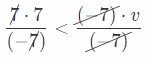
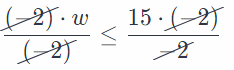
\(\frac{x \cdot \$ 5}{\$ 5}=\frac{3 \cdot \$ 5}{\$ 5}\)
Their fees are the same when they babysit 3 children.

b. How many children must a family have for Sandy and Kimmi to charge the same amount?
Answer:
3 children

c. The Sanderson family has five children. Which babysitter should they choose if they wish to save some money on babysitting, and why?
Answer:
They should choose Kimmi because she charges $25 per night. no matter how many children she babysits, and Sandy charges flat fee of $10 pills extra $5 per child, which would be
$10 + 5 ∙ $5 = $35.

H.O.T. Focus on Higher Order Thinking

Question 16.
Analyze Relationships Each student wrote a two-step equation. Peter wrote the equation 4x – 2 = 10, and Andres wrote the equation 16x – 8 = 40. The teacher looked at their equations and asked them to compare them. Describe one way in which the equations are similar.
Answer:
The equations are similar because any equation can be multiplied or divided by any number and still be the same.
In this case, if we multiply Peter’s equation by 4, we get the Andres’s equation.
Hence, these two equations are equal.

Go Math Lesson 8.1 7th Grade Two-Step Equation Answer Key Question 17.
What’s the Error? Damon has 5 dimes and some nickels in his pocket, worth a total of $1.20. To find the number of nickels Damon has, a student wrote the equation 5n + 50 = 1.20. Find the error in the student’s equation.
Answer:
On the left side of the equation, Damon put the cents, but on the right side, he left the dollars. He needs to convert dollars on the left side of the equation to cents, and then the equation will be correct.
5 ∙ n + 50 = 120 This is the correct equation.

Question 18.
Represent Real-World Problems Write a real-world problem you could answer by solving the equation -8x + 60 = 28.
Answer:
Sarah has $60. She bought 8 T-shirts, and after the purchase, she had left 20 dollars. How much does it cost, one t-shirt?

Texas Go Math Grade 7 Lesson 8.1 Answer Key Writing Two-Step Equations Read More »

Texas Go Math Grade 5 Lesson 3.2 Answer Key Multiply Decimals and Whole Numbers

Refer to our Texas Go Math Grade 5 Answer Key Pdf to score good marks in the exams. Test yourself by practicing the problems from Texas Go Math Grade 5 Lesson 3.1 Answer Key Multiplication Patterns with Decimals.

Texas Go Math Grade 5 Lesson 3.2 Answer Key Multiply Decimals and Whole Numbers

Investigate

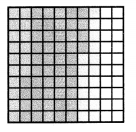
Materials Texas Go Math Grade 5 Lesson 3.2 Answer Key 1 decimal models Texas Go Math Grade 5 Lesson 3.2 Answer Key 1 color pencils

Giant tortoises move very slowly. They can travel a distance of about 0.17 mile in 1 hour,
If a giant tortoise travels at the same speed, how far could it move in 4 hours?
A. Complete the statement to describe the problem.
I need to find how many total miles are in _0.17__ groups of _4__
• Write an expression to represent the problem. _0.17 X 4___

B. Use the decimal model to find the answer.
• What does each small square in the decimal model represent?

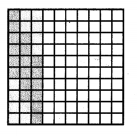
C. Shade a group of ___ squares to represent the distance a giant tortoise can move in 1 hour.

D. Use a different color to shade each additional
group of ___ squares until you have __ group of __ squares.

E. Record the total number of squares shaded. ___ squares
So, the giant tortoise can move ___ mile in 4 hours.

Answer:
A. Total number of miles are in 0.17 groups of 4,
Wrote an expression to represent the problem 0.17 X 4,
B. Used the decimal model to find the answer,
Used small square in the decimal model represents,
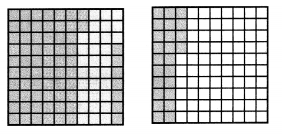
Texas Go Math Grade 5 Lesson 3.2 Answer Key Multiply Decimals and Whole Numbers-1
C. Shaded a group of 4 squares to represent the distance a
giant tortoise can move in 1 hour.
D. Used a different color to shade each additional
group of __0.17_ squares until you have _4_ group of _0.17_ squares.

E. Record the total number of squares shaded. __0.68_ squares
So, the giant tortoise can move _0.68__ mile in 4 hours.

Explanation:
A. Total number of miles are in 0.17 groups of 4,
Wrote an expression to represent the problem 0.17 X 4,
B. Used the decimal model to find the answer,
Used small square in the decimal model represents,
C. Shaded a group of 4 squares to represent the distance a
giant tortoise can move in 1 hour.
D. Used a different color to shade each additional
group of  0.17 squares until you have 4 group of 0.17 squares.

E. Record the total number of squares shaded 0.68 squares
So, the giant tortoise can move 0.68 mile in 4 hours.

Math talk
Mathematical Process

Explain how the model helps you determine if your answer is reasonable.
Answer:
Model helped easy way to represent decimal values with the whole,

Explanation:
The model helped to determine the answer is reasonable as
4 blocks of 17 we get
17
X 4
68
hundredths places so 0.68.

Make connection

You can use base-ten blocks to solve decimal multiplication problems.
A quick picture is a way to record your work.
Find the product. 3 × 0.46
Texas Go Math Grade 5 Lesson 3.2 Answer Key 2

Step 1
Make 3 groups of 4 tenths and 6 hundredths.
Remembering that a square or a flat is equal to 1.
Drawn a quick picture to record your work.

Step 2
Combined the hundredths and renamed.
There are _6__ hundredths. I will rename _6_ hundredths as _0.60__.
In our quick picture, cross out the hundredths you renamed.

Step 3
Combined the tenths and renamed.
There are _4_ tenths. I will rename _4_ tenths as _0.40__.
In quick picture, cross out the tenths you renamed.

Step 4
Record the value shown by your completed quick picture.
So, 3 × 0.46 = _1.38_

Share and Show

Math Talk
Mathematical Processes
Explain how renaming decimals is like renaming Whole numbers.
Answer:
Place values change,

Explanation:
When whole numbers are renamed the decimal’s place values change
from units to tenths, tens to hundredths.

Share and Show

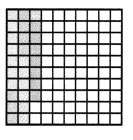
Use the decimal model to find the product.

Question 1.
5 × 0.06 = __0.30_
Texas Go Math Grade 5 Lesson 3.2 Answer Key 3
Answer:
Texas Go Math Grade 5 Lesson 3.2 Answer Key Multiply Decimals and Whole Numbers-2
Explanation:
Step 1
Making  5 groups of 6 hundredths.
Remember that a square or a flat is equal to 1.
Drawn a quick picture to record your work.

Step 2
Combined the hundredths and rename.
There are 6 hundredths. I will rename _6__ hundredths as _0.60__.
In our quick picture, cross out the hundredths you renamed.

Step 3
Recorded the value shown by your completed quick picture
So, 5 × 0.06 = _0.30_

Multiply Decimals and Whole Numbers 5

Go Math Grade 5 Lesson 3.2 Answer Key Question 2.
5 × 0.38 = _1.90__
Texas Go Math Grade 5 Lesson 3.2 Answer Key 4
Answer:
Texas Go Math Grade 5 Lesson 3.2 Answer Key Multiply Decimals and Whole Numbers-3

Explanation:
Step 1
Making  5 groups of 3 tenths and 8  hundredths,
Remembering that a square or a flat is equal to 1.
Drawn a quick picture to record your work.

Step 2
Combined the tenths,hundredths and rename.
There are 3 tenths and 8 hundredths,
I will rename _3__ tenths and __8 __hundredths as _0.38__.
In your quick picture, cross out the hundredths you renamed.

Step 3
Recorded the value shown by your completed quick picture
So, 5 × 0.38 = _1.90_

Question 3.
4 × 0.24 = ___
Texas Go Math Grade 5 Lesson 3.2 Answer Key 5
Answer:
4 X 0.24 = 0.96,
Texas Go Math Grade 5 Lesson 3.2 Answer Key Multiply Decimals and Whole Numbers-5

Explanation:
Step 1
Making  4 groups of 2 tenths and 4 hundredths,
Remembering that a square or a flat is equal to 1.
Drawn a quick picture to record your work.

Step 2
Combined the tenths and hundredths and rename.
There are 2 tenths, 4 hundredths. I will rename 2 tenths,
4 hundredths as _0.24__.
In your quick picture, cross out the hundredths you renamed.

Step 3
Recorded the value shown by your completed quick picture
So, 4 × 0.24 = _0.96_

Lesson 3.2 Answer Key 5th Grade Multiply Decimals Question 4.
3 × 0.62 = __1.86__
Answer:
Texas Go Math Grade 5 Lesson 3.2 Answer Key Multiply Decimals and Whole Numbers-6Explanation:
Step 1
Making  3 groups of 6 tenths and 2 hundredths,
Remembering that a square or a flat is equal to 1.
Drawn a quick picture to record your work.

Step 2
Combined the tenths and hundredths and rename.
There are 6 tenths, 2 hundredths. I will rename 6 tenths,
2 hundredths as _0.62__.
In your quick picture, cross out the hundredths you renamed.

Step 3
Recorded the value shown by your completed quick picture
So, 3 × 0.62 = _1.86_

Question 5.
4 × 0.32 = _1.28__
Answer:
Texas Go Math Grade 5 Lesson 3.2 Answer Key Multiply Decimals and Whole Numbers-8

Explanation:
Step 1
Making 4 groups of 3 tenths and 2 hundredths,
Remembering that a square or a flat is equal to 1.
Drawn a quick picture to record your work.

Step 2
Combined the tenths and hundredths and rename.
There are 3 tenths, 2 hundredths. I will rename 3 tenths,
2 hundredths as _1.28__.
In your quick picture, cross out the hundredths you renamed.

Step 3
Recorded the value shown by your completed quick picture
So, 4 × 0.32 = _1.28_

Problem Solving

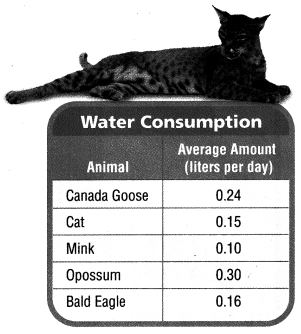
Use the table for 6-8. Use quick pictures or base-ten blocks to help.

Question 6.
Each day a bobcat drinks about 3 times as much water as a Canada goose drinks.
How much water does a bobcat drink in one day?
Texas Go Math Grade 5 Lesson 3.2 Answer Key 6
Answer:
3 X 0.24 = 0.72 liters,

Explanation:
Given each day a bobcat drinks about 3 times as much water as a Canada Goose drinks.
Average amount each day Canada Goose drinks is 0.24 liters,
Water does a bobcat drink in one day is
0.24
X  3
0.72

Go Math Grade 5 Chapter 3 Lesson 3.2 Answer Key Question 7.
Multi-Step River otters drink about 5 times as much water as a bald eagle drinks in a day.
How much water does a river otter drink in three days?
Texas Go Math Grade 5 Lesson 3.2 Answer Key 7
Answer:
Water does a River otter drink in three days is 2.40 liters,

Explanation:
Given Multi-Step River otters drink about 5 times as much
water as a bald eagle drinks in a day.
Average amount each day Bald Eagle drinks is 0.16 liters
5 X 0.16 = 0.80,
Water does a River otter drink in three days is
3 X 0.80
0.80
X   3
2.40

Question 8
Write Math Explain how you could use a quick picture to
find the amount of water that a cat drinks in 5 days.
Answer:
Texas Go Math Grade 5 Lesson 3.2 Answer Key Multiply Decimals and Whole Numbers-9
The amount of water that a cat drinks in 5 days is 0.75 liters,

Explanation:
Given Math explained the amount of water that a cat drinks in
5 days is 5 X 0.15 = 0.75  liters.

Question 9.
Compare the product of 0.46 and 3 with each of the factors.
Which number has the greatest value? Explain how this is different than
multiplying two whole numbers.
Answer:
The greatest values will be multiplying two whole numbers rather than
multiplying decimal values,

Explanation:
The product of 0.46 and 3 is
1
0.46
X   3
1.38
Factors of 0.4 is (0.1,0.4) or (0.2,0.2),
Factors of 0.06 is (0.01,0.06) or (0.02, 0.03),
Factors of 3 are (1,3), there are no common factors as we have whole numbers compared with tenths and hundredths, therefore, the greatest values will be multiplying two whole numbers rather than multiplying decimal values.

Daily Assessment Task

Fill in the bubble completely to show your answer.

Go Math 5th Grade Lesson 3.2 Answer Key Question 10.
Representations What multiplication expression does the model show?
Texas Go Math Grade 5 Lesson 3.2 Answer Key 8
(A) 5 × 0.4
(B) 5 × 0.6
(C) 16 × 0.05
(D) 5 × 0.16
Answer:
(A) 5 × 0.4,

Explanation:
Given model represents 5 multiplied by 4 tenths,
So matches with (A) 5 X 0.4.

Question 11.
Display Which equation matches the model?
Texas Go Math Grade 5 Lesson 3.2 Answer Key 9
(A) 4 × 0.31 = 1.24
(B) 4 × 0.31 = 1.51
(C) 4 × 0.39 = 1.24
(D) 4 × 0.39 = 1.56
Answer:
(A) 4 × 0.31 = 1.24

Explanation:
Given model represents 4 multiplied by 3 tenths and 1 hundredths
giving the results as 4 X 0.31 =
0.31
X 4
1.24, So matches with (A) 4 X 0.31 = 1.24.

Multiply Decimals and Whole Numbers 3

Question 12.
Multi-Step Use Diagrams Use a quick picture to multiply 3 × 0.16.
Then multiply the result by 3 again. What is the final product?
(A) 0.32
(B) 0.48
(C) 1.44
(D) 1.24
Answer:
Texas Go Math Grade 5 Lesson 3.2 Answer Key Multiply Decimals and Whole Numbers-10
(C) 1.44,

Explanation:
Using Diagrams a quick picture to multiply
0.16
X  3
0.48
Now multiplying the result by 3 again,
0.48
X  3
0.24
1.20
1.44, 
matches with (C).

Texas Test Prep

Lesson 3.2 Multiply Decimals by Whole Numbers Question 13.
Jared has a parakeet that weighs 1.44 ounces. Susie has a Senegal parrot that
weighs 3 times as much as Jared’s parakeet. How many ounces does Susie’s parrot weigh?
(A) 0.32 ounce
(B) 43.2 ounces
(C) 4.32 ounces
(D) 0.43 ounce
Answer:
(C) 4.32 ounces,

Explanation:
Given Jared has a parakeet that weighs 1.44 ounces.
Susie has a Senegal parrot that weighs 3 times as much as Jared’s parakeet.
Number of ounces does Susie’s parrot weigh is
11
1.44
X  3
4.32 matches with (C) 4.32 ounces.

Texas Go Math Grade 5 Lesson 3.2 Homework and Practice Answer Key

Use the decimal model to find the product.

Question 1.
4 × 0.07 = _0.28__
Texas Go Math Grade 5 Lesson 3.2 Answer Key 10
Answer:
4 X 0.07 = 0.28,

Explanation:
Given model represents 4 multiplied by 7 hundredths
giving the results as 4 X 0.07 =
0.07
X  4
0.28, So 4 X 0.07 = 0.28.

Go Math Practice and Homework Lesson 3.2 Answer Key Question 2.
3 × 0.21 = __0.63_
Texas Go Math Grade 5 Lesson 3.2 Answer Key 11
Answer:
Texas Go Math Grade 5 Lesson 3.2 Answer Key Multiply Decimals and Whole Numbers-11

Explanation:
Given model represents 3 multiplied by 2 tenths and 1 hundredths
giving the results as 3 X 0.21 =
0.21
X  3
0.63, So 3 X 0.63 = 0.63.

Question 3.
4 × 0.13 = _0.52__
Texas Go Math Grade 5 Lesson 3.2 Answer Key 12
Answer:
Texas Go Math Grade 5 Lesson 3.2 Answer Key Multiply Decimals and Whole Numbers-12
Explanation:
Given model represents 4 multiplied by 1 tenths and 3 hundredths
giving the results as 4 X 0.13 =
0.13
X  4
0.52, So 4 X 0.13 = 0.52.

Find the product. Draw a quick picture.

Question 4.
3 × 0.38 = _1.14___
Answer:
Texas Go Math Grade 5 Lesson 3.2 Answer Key Multiply Decimals and Whole Numbers-13
Explanation:
Given model represents 3 multiplied by 3 tenths and 8 hundredths
giving the results as 3 X 0.38 =
2
0.38
X  3
1.14, So 3 X 0.38 = 1.14.

Go Math 5th Grade Practice and Homework Lesson 3.2 Question 5.
2 × 0.41 = __0.82__
Answer:
2 X 0.41 =
Texas Go Math Grade 5 Lesson 3.2 Answer Key Multiply Decimals and Whole Numbers-14
Explanation:
Given model represents 2 multiplied by 4 tenths and 1 hundredths
giving the results as 2 X 0.41 =
0.41
X  2
0.82, So 2 X 0.41 = 0.82.

Problem Solving

Question 6.
Lars walks his dog 4 times farther than Michelle walks her dog.
Michelle walks her dog 0.23 mile. How far does Lars walk his dog?
Answer:
0.92 Lars walk his dog,

Explanation:
Lars walks his dog 4 times farther than Michelle walks her dog.
Michelle walks her dog 0.23 mile. Far does Lars walk his dog is
0.23
X  4
0.92

Question 7.
One day, Nat’s dog drank 3 times as much water as his cat.
If his cat drank 0.83 liter of water, how many liters did his dog drink?
Answer:
24.9 liter Nat’s dog drank water,

Explanation:
One day, Nat’s dog drank 3 times as much water as his cat.
If his cat drank 0.83 liter of water, Liters does his dog drank is
0.83
X  3
24.9
therefore, 24.9 liter Nat’s dog drank water.

Lesson Check

Texas Test Prep

Fill in the bubble completely to show your answer.

Question 8.
Which equation matches the model?
Texas Go Math Grade 5 Lesson 3.2 Answer Key 13
(A) 5 × 0.18 = 0.9
(B) 5 × 0.18 = 90
(C) 5 × 0.18 = 9.0
(D) 5 × 0.18 = 0.09
Answer:
(A) 5 × 0.18 = 0.9,

Explanation:
Given model represents 5 multiplied by 1 tenth and 8 hundredths
giving the results as 5 X 0.18 =
4
0.18
X  5
0.90, So 5 X 0.18 = 0.90.

Go Math Lesson 3.2 5th Grade Multiply Decimals Question 9.
Sidney’s bag of popcorn weighs 1.89 ounces. Sam’s bag of popcorn weighs 4 times as much as Sidney’s. What is the weight of Sam’s bag of popcorn?
(A) 0.756 ounce
(B) 7.56 ounces
(C) 75.6 ounces
(D) 756 ounces
Answer:
(B) 7.56 ounces,

Explanation:
Given Sidney’s bag of popcorn weighs 1.89 ounces. Sam’s bag of popcorn weighs 4 times as much as Sidney’s. So the weight of Sam’s bag of popcorn is
33
1.89
X  4
7.56 
ounces which matches with (B).

Question 10.
A beaker is filled with 0.23 liter of water. Leon fills another beaker with
3 times as much water. How much water is in Leon’s beaker?
(A) 0.96 liter
(B) 0.84 liter
(C) 0.69 liter
(D) 0.47 liter
Answer:
(C) 0.69 liter,

Explanation:
Given a beaker is filled with 0.23 liter of water. Leon fills another beaker with
3 times as much water. So water is in Leon’s beaker is
0.23
X  3
0.69 liter
which matches with (C).

Question 11.
In a swimming race, Yvonne swam 0.18 mile. David swam
4 times as far as Yvonne. How far did David swim?
(A) 2.2 miles
(B) 0.22 mile
(C) 7.2 miles
(D) 0.72 mile
Answer:
(D) 0.72 mile,

Explanation:
Given in a swimming race, Yvonne swam 0.18 mile. David swam
4 times as far as Yvonne. So far did David swim is
3
0.18
X  4
 0.72 mile matches with (D).

Lesson 3.2 Answer Key 5th Grade Multiply Decimals Question 12.
Multi-Step Carrie has 0.73 liters of juice in her pitcher.
Sanji’s pitcher has 2 times as much juice as Carrie’s pitcher.
Lee’s pitcher has 4 times as much juice as Carrie’s pitcher.
Sanji and Lee pour all their juice into a large bowl. How much juice is in the bowl?
(A) 1.46 liters
(B) 4.38 liters
(C) 2.92 liters
(D) 5.11 liters
Answer:
(B) 4.38 liters,

Explanation:
Given Multi-Step Carrie has 0.73 liters of juice in her pitcher.
Sanji’s pitcher has 2 times as much juice as Carrie’s pitcher.
So Sanji’s pitcher has 2 X 0.73 = 1.46 liters,
Lee’s pitcher has 4 times as much juice as Carrie’s pitcher.
So Lee’s pitcher has 4 X 0.73 = 2.92 liters,
As Sanji and Lee pour all their juice into a large bowl.
Juice is in the bowl is 1.46 + 2.92 = 4.38 liters matches with (B).

Question 13.
Multi-Step Justin and Hayden are playing a number game.
Justin’s number is the product of 4 × 0.06. Hayden’s number 0.04
less than the product of Justin’s number and 4. What is Hayden’s number?
(A) 0.92
(B) 0.96
(C) 0.60
(D) 1.0
Answer:
(A) 0.92,

Explanation:
Given Justin and Hayden are playing a number game.
Justin’s number is the product of 4 × 0.06. Hayden’s number 0.04
less than the product of Justin’s number and 4,
Justin’s number is 4 X 0.06 = 0.24,
Hayden’s number is (4 X 0.24) – 0.04 = 0.96 – 0.04 = 0.92 matches with (A).

Texas Go Math Grade 5 Lesson 3.2 Answer Key Multiply Decimals and Whole Numbers Read More »

Texas Go Math Grade 7 Lesson 8.4 Answer Key Solving Two-Step Inequalities

Refer to our Texas Go Math Grade 7 Answer Key Pdf to score good marks in the exams. Test yourself by practicing the problems from Texas Go Math Grade 7 Lesson 8.4 Answer Key Solving Two-Step Inequalities.

Texas Go Math Grade 7 Lesson 8.4 Answer Key Solving Two-Step Inequalities

Your Turn

Use algebra tiles to model and solve each inequality.

Question 1.
2x + 7 > 11 ____
Answer:
Texas Go Math Grade 7 Lesson 8.4 Answer Key 19
Subtract 7 from both sides.
2x + 7 – 7 > 11 – 7
2x > 4 Divide both sides by 2.
Texas Go Math Grade 7 Lesson 8.4 Answer Key 20

Texas Go Math Grade 7 Solutions Lesson 8.4 Answer Key Question 2.
5h – 4 ≥ 11
Answer:
Texas Go Math Grade 7 Lesson 8.4 Answer Key 21
Add 4 to both sides.
5h – 4 + 4 ≥ 11 + 4
5h ≥ 15 Divide both sides by 5.
Texas Go Math Grade 7 Lesson 8.4 Answer Key 22

Your Turn

Solving Two-Step Inequalities 1

Question 3.
Joshua wants to complete the first mile of a 5-mile run in 10 minutes or less running at a steady pace. The inequality 5 – \(\frac{p}{6}\) ≤ 4 can be used to find p, the pace, in miles per hour, he can run to reach his goal. Solve the inequality. Then graph and interpret the solution.
Texas Go Math Grade 7 Lesson 8.4 Answer Key 2
Answer:
Multiply both sides by 6. Because we are multiplying by a negative number, we have to reverse the direction of the
inequality.
Texas Go Math Grade 7 Lesson 8.4 Answer Key 23
-30 + 9 ≥ -24 Add 30 to both sides
30 – 30 + p ≥ 30 – 24
p ≥ 6
Texas Go Math Grade 7 Lesson 8.4 Answer Key 24
p ≥ 6

Your Turn

Circle any given values that make the inequality true.

Question 4.
3v – 8 > 22
v = 9; v = 10; v = 11
Answer:
Substitute 9 for v in the given equation.
v = 9
Texas Go Math Grade 7 Lesson 8.4 Answer Key 25
Substitute 10 for v in the given equation.
Texas Go Math Grade 7 Lesson 8.4 Answer Key 26
Substitute 11 for v in the given equation.
Texas Go Math Grade 7 Lesson 8.4 Answer Key 27
v = 11

Practice and Homework Lesson 8.4 Texas Go Math Grade 7 Question 5.
5h + 12 ≤ -3
h = -3; h = -4; h = -5
Answer:
Substitute -3 for h in the given equation.
Texas Go Math Grade 7 Lesson 8.4 Answer Key 28
Substitute -4 for h in the given equation.
Texas Go Math Grade 7 Lesson 8.4 Answer Key 29
Substitute -5 for h in the given equation.
Texas Go Math Grade 7 Lesson 8.4 Answer Key 30
h = -3,
h = -4,
h = -5

Texas Go Math Grade 7 Lesson 8.4 Guided Practice Answer Key

Question 1.
Describe how to solve the inequality 3x + 4 < 13 using algebra tiles. (Example 1)
Texas Go Math Grade 7 Lesson 8.4 Answer Key 3
Answer:
Remove 4 + 1 tiles from each side on the mat.
Then, divide each side into 3 equal groups.
3x < 13 – 4
3x < 9 Divide both sides by 3.
\(\frac{3 x}{3}\) < \(\frac{9}{3}\)
x < 3
The solution is x < 3.

Solve each inequality. Graph and check the solution. (Example 2)

Question 2.
5d – 13 < 32 ____
Texas Go Math Grade 7 Lesson 8.4 Answer Key 4
Answer:
Add 13 to the both sides.
Texas Go Math Grade 7 Lesson 8.4 Answer Key 31
Check the solution for d < 9. For example, d = 5.
Texas Go Math Grade 7 Lesson 8.4 Answer Key 32
Texas Go Math Grade 7 Lesson 8.4 Answer Key 33
d < 9

Lesson 8.4 Answer Key 7th Grade Two-Step Inequalities Question 3.
-4b + 9 < -7 _____
Texas Go Math Grade 7 Lesson 8.4 Answer Key 5
Answer:
Subtract 9 to the both sides.
Texas Go Math Grade 7 Lesson 8.4 Answer Key 34
Check the solution for b ≥ 4. For example, b = 5.
Texas Go Math Grade 7 Lesson 8.4 Answer Key 35
Texas Go Math Grade 7 Lesson 8.4 Answer Key 36
b ≥ 4

Circle any given values that make the inequality true. (Example 3)

Solving Two-Step Inequalities 2

Question 4.
2m + 18 > -4
m = -12;m = -11; m = -10
Answer:
Substitute -12 for m in the given equation.
Texas Go Math Grade 7 Lesson 8.4 Answer Key 37
Substitute -11 for m in the given equation.
Texas Go Math Grade 7 Lesson 8.4 Answer Key 38
Substitute -10 for m in the qiven equation.
Texas Go Math Grade 7 Lesson 8.4 Answer Key 39
m = -10

Question 5.
-6y + 3 ≥ 0
y = 1; y = \(\frac{1}{2}\); y = 0
Answer:
Substitute 1 for y in the given equation.
Texas Go Math Grade 7 Lesson 8.4 Answer Key 40
Substitute 1/2 for y in the given equation.
Texas Go Math Grade 7 Lesson 8.4 Answer Key 41
Substitute 0 for y in the given equation.
Texas Go Math Grade 7 Lesson 8.4 Answer Key 42
y = 0

Texas Go Math Grade 7 Lesson 8.4 Answer Key 6

Go Math Lesson 8.4 7th Grade Two Step Inequalities Answer Key Question 6.
Lizzy has 6.5 hours to tutor 4 students and spend 1.5 hours in a lab. She plans to tutor each student the same amount of time. The inequality 6.5 – 4t ≥ 1.5 can be used to find t, the amount of time in hours Lizzy could
spend with each student. Solve the inequality. Graph and interpret the solution. Can Lizzy tutor each student for
1.5 hours? Explain. (Example 2 and 3)
Answer:
Subtract 6.5 from the both sides.
-6.5 + 6.5 – 4t ≤ -6.5 + 1.5
-4f ≤ 4 Divide both sides by -4.
Texas Go Math Grade 7 Lesson 8.4 Answer Key 43
Substitute 1.5 for t in the given equation.
t = 1.5
Texas Go Math Grade 7 Lesson 8.4 Answer Key 44
t ≥ 1

Essential Question Check-In

Question 7.
How do you solve a two-step inequality?
Answer:
First, isolate the variable. On one side of the inequality we put the variable, and on other side we put what’s left.
If the variable is multiplied by some number, we have to divide inequality by that number.
If we divide or multiply by a negative number, we have to reverse the direction of inequality.

Texas Go Math Grade 7 Lesson 8.4 Independent Practice Answer Key

Solve each inequality. Graph and check the solution.

Question 8.
2s + 5 ≥ 49
Texas Go Math Grade 7 Lesson 8.4 Answer Key 7
Answer:
Divide both side by 2.
Texas Go Math Grade 7 Lesson 8.4 Answer Key 45
Check the solution for s ≥ 22. For example, s = 23.
Texas Go Math Grade 7 Lesson 8.4 Answer Key 46
The solution is shown in graph
Texas Go Math Grade 7 Lesson 8.4 Answer Key 47
s ≥ 22

Question 9.
-3f + 9 ≥ -21
Texas Go Math Grade 7 Lesson 8.4 Answer Key 8
Answer:
Subtract 9 from the both sides.
-3t + 9 – 9 ≥ -21 – 9
– 3t > -30 Divide both sides by (-3).
Texas Go Math Grade 7 Lesson 8.4 Answer Key 48
Check the solution for t ≤ 10. For example, t = 9.
Texas Go Math Grade 7 Lesson 8.4 Answer Key 49
This inequality is shown in the picture.
Texas Go Math Grade 7 Lesson 8.4 Answer Key 50
t ≤ 10

Solving Two-Step Inequalities Answer Key Grade 7 Question 10.
55 > -7v + 6 ____
Texas Go Math Grade 7 Lesson 8.4 Answer Key 9
Answer:
Subtract 6 from the both sides.
55 – 6 > -7v + 6 – 6
49 > -7v Divide both sides by (- 7).
Texas Go Math Grade 7 Lesson 8.4 Answer Key 51 Reverse the direction of inequality, due to the division with a negative number
-7 < v Check the solution for v > – 7. For example, v = 6.
55 ⩼ -7 ∙ (-6) + 6
55 ⩼ 42 + 6
55 ⩼ 48
True
This inequality is shown in the picture.
Texas Go Math Grade 7 Lesson 8.4 Answer Key 52
v > -7

Question 11.
41 > 6m – 7 ____
Texas Go Math Grade 7 Lesson 8.4 Answer Key 10
Answer:
Add 7 from the both sides.
41 + 7 > 6m – 7 + 7
48 > 6m Divide both sides by 6.
Texas Go Math Grade 7 Lesson 8.4 Answer Key 53
8 > m
Check the solution for in < 8. For example, m = 7.
41 ⩼ 6 . (7) – 7
41 ⩼ 42 – 7
41 ⩼ 35
True
This inequality is shown in the picture.
Texas Go Math Grade 7 Lesson 8.4 Answer Key 54
m < 8 Question 12. \(\frac{a}{-8}\) + 15 > 23
Texas Go Math Grade 7 Lesson 8.4 Answer Key 11
Answer:
Subtract 15 from the both sides.
\(\frac{a}{-8}\) + 15 – 15 > 23 – 15
\(\frac{a}{-8}\) > 8 Multiply both sides by (-8).
Texas Go Math Grade 7 Lesson 8.4 Answer Key 55 Reverse the direction of inequality, due to the division with a negative number
a < -61
Check the solution for a < -64. For example, a = -72.
– \(\frac{-72}{-8}\) + 15 ⩼ 23
9 + 15 ⩼ 23
24 ⩼ 23
True
This inequality is shown in the picture.
Texas Go Math Grade 7 Lesson 8.4 Answer Key 56
a < -64

Texas Go Math Grade 7 Answer Key Lesson 8.4 Question 13.
\(\frac{f}{2}\) – 22 < 48
Texas Go Math Grade 7 Lesson 8.4 Answer Key 12
Answer:
Add 22 from both sides.
\(\frac{f}{2}\) – 22 + 22 < 48 + 22
\(\frac{f}{2}\) < 70 Multiply both sides by 2.
Texas Go Math Grade 7 Lesson 8.4 Answer Key 57
Check the solution for f < 140. For example, f = 130
\(\frac{130}{2}\) – 22 ⩻ 48
65 – 22 ⩻ 48
43 ⩻ 48
True
This inequality is shown in the picture.
Texas Go Math Grade 7 Lesson 8.4 Answer Key 58
f < 140

Question 14.
-25 + \(\frac{t}{2}\) ≥ 50
Texas Go Math Grade 7 Lesson 8.4 Answer Key 13
Answer:
Add 25 from both sides.
-25 + 25 + \(\frac{t}{2}\) ≥ 50 + 25
\(\frac{t}{2}\) ≥ 75 Multiply both sides by 2.
Texas Go Math Grade 7 Lesson 8.4 Answer Key 59
Check the solution for t ≥ 150. For example, t = 160.
-25 + \(\frac{160}{2}\) ⩼ 50
-25 + 80 ⩼ 50
55 ⩼ 50
True
This inequality is shown in the picture.
Texas Go Math Grade 7 Lesson 8.4 Answer Key 71
t ≥ 150

Question 15.
10 + \(\frac{g}{-9}\) > 12
Texas Go Math Grade 7 Lesson 8.4 Answer Key 14
Answer:
Subtract -10 from
10 – 10 + \(\frac{g}{-9}\) > 12 – 10
\(\frac{g}{-9}\) > 2 Multiply both sides by (-9).
Texas Go Math Grade 7 Lesson 8.4 Answer Key 61 Reverse the direction of inequality, due to the multiplication with a negative number
g < -18
Check the solution for g < -18. For example, g = -27
10 + \(\frac{-27}{-9}\) ⩼ 12
10 + 3 ⩼ 12
13 ⩼ 12
True
This inequality is shown in the picture.
Texas Go Math Grade 7 Lesson 8.4 Answer Key 62
g < -18

7th Grade Go Math Answer Key Lesson 8.4 Question 16.
25.2 ≤ -1.5y + 1.2.
Texas Go Math Grade 7 Lesson 8.4 Answer Key 15
Answer:
Subtract 1.2 from the both sides.
25.2 – 1.2 ≤ -1.5y + 1.2 – 1.2
24 ≤ —1.5y Divide both sides by (-1.5).
Texas Go Math Grade 7 Lesson 8.4 Answer Key 63 Reverse the direction of inequality, due to the division with a negative number
-16 ≥ y
y ≤ -16
Check the solution for y ≤ -16. For example, y = -18.
25.2 ⩻ (-1.5) . (-18) + 1.2
25.2 ⩻ 27 + 1.2
25.2 ⩻ 28.2
True
This inequality is shown in the picture.
Texas Go Math Grade 7 Lesson 8.4 Answer Key 64
y ≤ -16

Question 17.
-3.6 ≥ -0.3a + 1.2
Texas Go Math Grade 7 Lesson 8.4 Answer Key 16
Answer:
Subtract 1.2 from boths sides.
-3.6 – 1.2 ≥ -0.3a + 1.2 – 1.2
-4.8 ≥ -0.3a Divide both sides by (-0.3).
Texas Go Math Grade 7 Lesson 8.4 Answer Key 65 Reverse the direction of inequality, due to the division by a negative number.
16 ≤ a
a ≥ 16
Check the solution for a ≥ 16. For example, a = 18.
-3.6 ⩼ (-0.3) . (18) + 1.2
-3.6 ⩼ -5.4 + 1.2
-3.6 ⩼ -4.2
True
This inequality is shown in the picture.
Texas Go Math Grade 7 Lesson 8.4 Answer Key 66
a ≥ 16

Question 18.
What If? The perimeter of a rectangle is at most 80 inches. The length of the rectangle is 25 inches. The inequality 80 – 2w ≥ 50 can be used to find w, the width of the rectangle in inches. Solve the inequality and interpret the solution. How will the solution change if the width must be at least 10 inches and a whole number?
Answer:
Subtract 80 from both sides.
-80 + 80 – 2 . w ≥ -80 + 50 Multiply both sides by (-2).
Texas Go Math Grade 7 Lesson 8.4 Answer Key 67 Reverse the direction of inequality, due to the multiplication by a negative number.
The width is not greater than 15 inches.
If the width must be at least 10 inches and the whole number, the solution set is {10, 11, 12, 13, 14, 15}.
w ≤ 15 inches

Question 19.
Interpret the Answer Grace earns $7 for each car she washes. She always saves $25 of her weekly earnings. This week, she wants to have at least $65 in spending money. How many cars must she wash? Write and solve an inequality to represent this situation. Interpret the solution in context.
Answer:
Sum $25 Grace saves every week, and $7 . x. where x represents the number of cars she must wash, and that sum should be at least $65.
$25 + $7 . x ≥ $65 Subtract $25 from both sides.
-$25 + $25 + $7 . x ≥ -$25 + $65
$7 . x ≥ $40 Divide b0th sides by $7.
Texas Go Math Grade 7 Lesson 8.4 Answer Key 68
She can not wash 5.71 cars. so we have to take the next whole number.
Because of that, she must wash at least 6 cars to meet her goal. Proof:
$25 + $7 . 6 ⩼ $65
$25 + $42 ⩼ $65
$66 ⩼ $65
True
x ≥ 6

Texas Go Math Grade 7 Lesson 8.4 H.O.T. Focus On Higher Order Thinking Answer Key

Question 20.
Critical Thinking Is there any value of x with the property that x < x – 1? Explain your reasoning. Answer: No, there is not. If we decrease any number by 1, the obtained number can not be greater than himself. For example, let x be 5. 5 ⩻ 5 – 1 5 ⩻ 4 Not true. Not, there is not. Question 21. Analyze Relationships A compound inequality consists of two simple inequalities joined by the word “and” or “or.” Graph the solution sets of each of these compound inequalities. a. x > 2 and x < 7
Texas Go Math Grade 7 Lesson 8.4 Answer Key 17
Answer:
x > 2 and x < 7
Texas Go Math Grade 7 Lesson 8.4 Answer Key 69

b. x < 2 or x > 7
Texas Go Math Grade 7 Lesson 8.4 Answer Key 18
Answer:
x < 2 or x > 7
Texas Go Math Grade 7 Lesson 8.4 Answer Key 70

c. Describe the solution set of the compound inequality x < 2 and x > 7.
Answer:
The solution set is the intersection of sets where x is greater than 2 and less than 7, x ε (2, 7).

d. Describe the solution set of the compound inequality x > 2 or x < 7.
Answer:
The solution set is the union of sets where x is less than 2 and greater than 7, x ε (-∞, 2) ∪ (7, ∞).

Go Math Lesson 8.4 7th Grade Solving Two-Step Inequalities Question 22.
Communicate Mathematical Ideas Joseph used the problem-solving strategy Work Backward to solve the inequality 2n+ 5 < 13. Shawnee solved the inequality using the algebraic method you used in this lesson. Compare the two methods.
Answer:
Working backward consists of mentally performing the following operations: Subtract 5 from 13 to obtain 8 and
dividing by 2 gives us that n must be less than 4.
Let’s perform the algebraic operations:
2n + 5 < 13 Write the inequality
2n + 5 – 5 < 13 – 5 Subtract 5 from both sides
2n < 8 Simplify
\(\frac{2 n}{2}\) < \(\frac{8}{2}\) Divide both sides by 2
n < 4 Simplify
The two methods are basically the same. Working backward consists of mostly working mentally, while the algebraic method is mostly written, but the operations performed are the same.
The two methods are basically the same. The backward method works mentally while the algebraic method is a written solution.

Texas Go Math Grade 7 Lesson 8.4 Answer Key Solving Two-Step Inequalities Read More »

Texas Go Math Grade 4 Lesson 11.2 Answer Key Multi-Step Subtraction Problems

Refer to our Texas Go Math Grade 4 Answer Key Pdf to score good marks in the exams. Test yourself by practicing the problems from Texas Go Math Grade 4 Lesson 11.2 Answer Key Multi-Step Subtraction Problems.

Texas Go Math Grade 4 Lesson 11.2 Answer Key Multi-Step Subtraction Problems

Multi-Step Subtraction Problems 2

Essential Question

How can you represent and solve multi-step subtraction problems using strip diagrams?
Answer:
Multi-step problems involves four operations with whole numbers using strip diagrams and equations with a letter standing for the unknown quantity.
Explanation:
For example;

Unlock the Problem

During the harvest, 13485 apples were picked. Week one, 4,589 apples were sold. Week two, 2,113 apples were sold. How many apples are left after two weeks?
Answer:
6,783 apples are left.
Explanation:
During the harvest, 13485 apples were picked.
Week one, 4,589 apples were sold.
Week two, 2,113 apples were sold.
Total apples sold in two weeks 4,589 + 2,113 = 6,702
Number of apples left after two weeks
13,485 – 6,702 = 6,783

Example 1
STEP 1 Find how many apples were left after week 1.
Texas Go Math Grade 4 Lesson 11.2 Answer Key Multi-Step Subtraction Problems 1
Answer:
8,896 apples.

Explanation:
During the harvest, 13485 apples were picked.
Week one, 4,589 apples were sold.
Number of apples left
13,485 – 4,589 = 8,896

STEP 2 Find how many apples were left after week 2.
Texas Go Math Grade 4 Lesson 11.2 Answer Key Multi-Step Subtraction Problems 2
So, the Yummy Apple Orchard had ___________ apples left after two weeks.
Answer: 6,783

Explanation:
Apples sold during week two = 2,113
Apples left after week one = 8,896
Apples left after week two = 8,896 – 2,113 = 6,783

How does Step I differ from Step 2?
Answer:
In step two we find the apples left in week one.
In step two we find apples left in week two.

Greg and his family are driving 4 days to visit his grandparents. They live 2,415 miles from Greg. The first 2 days they drove 1,141 miles. The third day they drove 612 miles. How many more miles do they have to drive on the fourth day?
Answer:
662 miles.
Explanation:
Greg and his family are driving 4 days to visit his grandparents.
They live 2,415 miles from Greg.
The first 2 days they drove 1,141 miles.
The third day they drove 612 miles.
Total miles they drove for 3 days 612+ 1,141 = 1,753
Number of miles they have to drive on the fourth day 2,415 – 1,753 = 662 miles.

Example 2

STEP 1 Find how many miles are left after 2 days of driving.
Texas Go Math Grade 4 Lesson 11.2 Answer Key Multi-Step Subtraction Problems 3
Answer: 1,274
Explanation:

STEP 2 Find how many more miles they have to drive on the fourth day.
Texas Go Math Grade 4 Lesson 11.2 Answer Key Multi-Step Subtraction Problems 4
So, Greg’s family drove _____________ more miles on the fourth day.
Answer:
662 miles on fourth day.
Explanation:

Math Talk

Mathematical Processes
Explain why it takes more than one step to solve the problem in Example 2.
Answer:
As we have to find the total distance he travelled on the third day also.

Share and Show

Go Math Lesson 11.2 Answer Key 4th Grade Question 1.
During a school-wide vote, 632 students voted for Hat Friday. Pajama Friday received 187 fewer votes than Hat Friday. How many students voted?
Texas Go Math Grade 4 Lesson 11.2 Answer Key Multi-Step Subtraction Problems 5
Answer: 1,077

Explanation:
During a school wide vote, 632 students voted for Hat Friday.
Pajama Friday received 187 fewer votes than Hat Friday.
632 – 187 = 445
Total students voted 632 + 445 = 1,077

a. First, find how many students voted for Pajama Friday.
So, ____________ students voted for Pajama Friday.
Answer:
445 students
Explanation:
During a school wide vote, 632 students voted for Hat Friday.
Pajama Friday received 187 fewer votes than Hat Friday.
632 – 187 = 445

b. Next, find the total number of students Friday who voted.
Think: 632 + 445 = f
So, ________ students voted.
Answer:
1,077 students voted.
Explanation:
During a school wide vote, 632 students voted for Hat Friday.
Pajama Friday received 187 fewer votes than Hat Friday.
632 – 187 = 445
Total students voted 632 + 445 = 1,077

Problem Solving

For Problems 2-3, use the chart.

Texas Go Math Grade 4 Lesson 11.2 Answer Key Multi-Step Subtraction Problems 6

Go Math 4th Grade Lesson 11.2 Answer Key Question 2.
The Kind Supermarket had 5,213 cans of soup at the beginning of January. How many cans of soup did the Kind Supermarket have after February?
Answer:
2,888 soup cans.
Explanation:
The Kind Supermarket had 5,213 cans of soup at the beginning of January.
Number of soup cans sold in the month of January 1,432
Leftover soup cans at the end of the January month 5,213 – 1,432 = 3,781
Number of soup cans sold in the month of February 893
Number of soup cans at the Kind Supermarket after February
3,781 – 893 = 2,888 cans

Question 3.
If the Kind Supermarket sold 189 less cans of soup in May than in April, how many cans of soup did they sell during April and May?
Answer:
959 can o soup in the month of April and May.
Explanation:
If the Kind Supermarket sold 189 less cans of soup in May than in April,
Number of soup cans in April = 574
Number of soup cans in May = 574 – 189 = 385
Total cans of soup they sell during April and May
574 + 385 = 959 cans

Question 4.
Texas Go Math Grade 4 Lesson 11.2 Answer Key Multi-Step Subtraction Problems 7
H.O.T. Apply Multi-Step During the first week of a game’s launch, an electronic store sold 275 copies of the game. During the second week, they sold 295 copies of the game. They sold some copies of the game during the third week. After the first three weeks, the electronic store sold 984 copies of the game. How many copies of the game did they sell during week 3?
Answer:
414 copies of game.
Explanation:
During the first week of a game’s launch, an electronic store sold 275 copies of the game.
During the second week, they sold 295 copies of the game.
Total copies of game sold in 2 weeks = 275 + 295 = 570
They sold some copies of the game during the third week.
After the first three weeks, the electronic store sold 984 copies of the game.
Total copies of the game they sell during week 3
984 – 570 = 414 copies of game.

Question 5.
H.O.T. What’s the Error? Ken vent to the Planters Nursery to buy some trees for his backyard. He wanted to spend more than $300 for the trees. The first tree he bought was $175. The second tree he bought was $25 less than the first tree. Those were the only two item s that Ken bought. Ken said that he spent less than he wanted to. Is he correct? Explain his error.
Answer:
Yes, ken is correct.
He spent less than he wanted to spend.
Explanation:
Ken wanted to spend more than $300 for the trees.
The first tree he bought was $175.
The second tree he bought was $25 less than the first tree.
Cost of second tree 175 – 25 = $150

Daily Assessment Task

Fill in the bubble completely to show your answer.

Question 6.
The snack vendors have 500,000 bottles of water to sell during the parade. They sell 128,520 bottles during the first half of the parade. During the second half of the parade, they sell 205,000 more bottles than they sold during the fIrst half. How many unsold bottles are left at the end of the parade?
(A) 166,480 bottles
(B) 37,960 bottles
(C) 371,480 bottles
(D) 379,600 bottles
Answer:
Option(A)
Explanation:
The snack vendors have 500,000 bottles of water to sell during the parade.
They sell 128,520 bottles during the first half of the parade.
During the second half of the parade, they sell 205,000 more bottles than they sold during the fIrst half.
Total bottles sold on second half of the parade
205,000 + 128,520 = 333,520
Total unsold bottles left at the end of the parade
500,000 – 333,520 = 166,480 bottles.

Go Math 4th Grade Lesson 11.2 Answer Key Question 7.
The flag company makes 750,000 flags. They sell 405,200 flags for Memorial Day and 125,475 flags for Flag Day. How many flags do they have left to sell for the Fourth of July?
(A) 470,275 flags
(B) 230,475 flags
(C) 219,325 flags
(D) 220,435 flags
Answer:
Option(A)
Explanation:
The flag company makes 750,000 flags.
They sell 405,200 flags for Memorial Day and
125,475 flags for Flag Day.
Total flags sold on both days
405,200 + 125,475 = 279,725
Total flags they have left to sell for the Fourth of July
750,000 – 279,725 = 470,275 flags.

Question 8.
Multi-Step Katie buys 125,000 beads. She uses 108246 to make bracelets. She goes back to the store and buys 100,000 more beads than she bought the first time. How many beads does Katie have now to make bracelets?
(A) 241,754 beads
(B) 208,246 beads
(C) 116,754 beads
(D) 6,754 beads
Answer:
Option(B)
Explanation:
Katie buys 125,000 beads.
She uses 108246 to make bracelets.
Left over beads 125,000 – 108,246 = 16,754
She goes back to the store and buys 100,000 more beads than she bought the first time.
100,000 + 125,000 = 225,000
Total beads Katie have now to make bracelets
225,000 – 16,754 = 208,246 beads.

TEXAS Test Prep.

4th Grade Answer Key Go Math Lesson 11.2 Question 9.
Melinda saved 456 pennies one week, 374 pennies the second week, and some more pennies during the third week. Together Melinda saved 1,245 pennies during those three weeks. How many pennies did Melinda save during the third week?
(A) 615
(B) 415
(C) 2,075
(D) 525
Answer:
Option(B)
Explanation:
Melinda saved 456 pennies one week,
374 pennies the second week, and some more pennies during the third week.
Together Melinda saved 1,245 pennies during those three weeks.
Total pennies Melinda save during the third week
1,245 – 830 = 415 pennies.

Texas Go Math Grade 4 Lesson 11.2 Homework and Practice Answer Key

Multi-Step Subtraction Problems 1

Question 1.
Louis bought a package of 500 paper plates. He used 341 of them at a family reunion. He used 39 for a picnic. How many paper plates does he have left?
Answer:
120 paper plates.
Explanation:
Louis bought a package of 500 paper plates.
He used 341 of them at a family reunion.
He used 39 for a picnic.
Total paper plates left 500 – (341 + 39) = 500 – 380 = 120

a. Find the number of paper plates that were left after the reunion.
Texas Go Math Grade 4 Lesson 11.2 Answer Key Multi-Step Subtraction Problems 8
500 – ____________ = b
b = ______________ plates left after reunion
Answer:
159 plates
Explanation:

b. Find the number of plates that were left after the picnic
Texas Go Math Grade 4 Lesson 11.2 Answer Key Multi-Step Subtraction Problems 9
159 – ___________ = p
p = _____________ plates left after the picnic
Answer:
120plates
Explanation:

Problem Solving

Use the chart for problems 2-4.

Texas Go Math Grade 4 Lesson 11.2 Answer Key Multi-Step Subtraction Problems 10

Go Math Practice and Homework Lesson 11.2 Answer Key Question 2.
At the beginning of June, Nature’s Campground had 3,450 bundles of campfire wood. How many bundles were left at the end of July?
Answer:
2,164 bundles
Explanation:
At the beginning of June, Nature’s Campground had 3,450 bundles of campfire wood.
The number of bundles of campfirewood in July is 1,286
Total bundles left at the end of July
3450 – 1286 = 2,164

Question 3.
How many bundles of firewood were left at the end of August?
Answer:
1,923 bundles.
Explanation:
Total bundles of firewood in the month of August 1,527
Total bundles of firewood left at the end of August
3450 – 1527 = 1,923

Question 4.
For next year, the campground director wants to make 4,000 new bundles of wood. The crew made 1,238 bundles in September and 1,141 bundles in October. How many more bundles do they need to make?
Answer:
1,621 bundles.
Explanation:
The campground director wants to make 4,000 new bundles of wood.
The crew made 1,238 bundles in September and
1,141 bundles in October.
Total bundles in both the months 1,238 + 1,141 = 2,379
Total bundles they need to make 4,000 – 2,379 = 1,621

Lesson Check

Fill in the bubble completely to show your answer.

Question 5.
Multi-Step It is 1,262 miles from Webster’s house to his aunt’s house. He drove 416 miles yesterday. The hotel he will stay in tonight is 380 miles from his aunt’s house. How far will he drive today?
(A) 846 miles
(B) 466 miles
(C) 380 miles
(D) 576 miles
Answer:
Option(B)
Explanation:
1,262 miles from Webster’s house to his aunt’s house.
He drove 416 miles yesterday.
The hotel he will stay in tonight is 380 miles from his aunt’s house.
416 + 380 = 796
Total miles he drive today 1,262 – 796 = 466

Question 6.
Multi-Step Eric bought 600 flower bulbs. He bought 280 iris bulbs, 75 tulip bulbs, and the rest are lilies, How many lily bulbs did Eric buy?
(A) 320
(B) 355
(C) 205
(D) 245
Answer:
Option(D)
Explanation:
Eric bought 600 flower bulbs.
He bought 280 iris bulbs,
75 tulip bulbs,
Number of lily bulbs Eric buy
600 – (280 + 75) = 600 – 355 = 245

Question 7.
Multi-Step There were 10,647 tickets sold for a football game. Of those tickets, 872 were box seats and 4,366 were end zone tickets. The rest were sideline tickets. How many sideline tickets were sold?
(A) 5,506
(B) 6,281
(C) 5,409
(D) 6,509
Answer:
Option(C)
Explanation:
There were 10,647 tickets sold for a football game.
Of those tickets, 872 were box seats and 4,366 were end zone tickets.
Number of sideline tickets sold
10,647 – (872+4,366) = 10,647 – 5,238 = 5,409

Go Math Grade 4 Lesson 11.2 Homework Answers Question 8.
Multi-Step Mindy needs to score 500,000 points or more in three games to move to the next level in her computer game. She scored 173,211 points in the first game and 155,963 points in the second game. What is the fewest points she can score in the third game to go on to the next level?
(A) 170,826
(B) 326,789
(C) 171,826
(D) 271,826
Answer:
Option(A)
Explanation:
Mindy needs to score 500,000 points or more in three games to move to the next level in her computer game.
She scored 173,211 points the first game and
155,963 points the second game.
Total points scored in both the games 173,211 + 155,963 = 329,174
The fewest points she can score in the third game to go on to the next level
500,000 – 329,174 = 170,826

Question 9.
Multi-Step The glee club is going to have a float in the parade. They made 437 paper flowers for the float last week. They made 322 more this week than last week. They need 1,250 flowers. how many more do they need to make?
(A) 759
(B) 169
(C) 54
(D) 491
Answer:
Option(D)
Explanation:
The glee club made 437 paper flowers for the float last week.
They made 322 more this week than last week.
Total flowers made in both weeks 437 + 322 = 759
They need 1,250 flowers.
Number of more paper flowers they need to make
1,250 – 759 = 491

Go Math 4th Grade 11.2 Homework Answers Question 10.
Multi-Step Last week Sandra spent $247 of her savings on a new DVD player. Today, she put $562 into her savings account. Now she has $951 in the account. How much money did she have in the account before she bought the DVD player?
(A) $636
(B) $142
(C) $1,266
(D) $746
Answer:
Option(A)
Explanation:
Last week Sandra spent $247 of her savings on a new DVD player.
Today, she put $562 into her savings account.
Now she has $951 in the account.
Total money she had in the account before she bought the DVD player
$247 + ($951 – $562) = $247 + $389 = $636

Texas Go Math Grade 4 Lesson 11.2 Answer Key Multi-Step Subtraction Problems Read More »

Go Math Grade 2 Answer Key Chapter 7

Go Math Grade 2 Chapter 7 Answer Key Pdf Money and Time

Go Math Grade 2 Chapter 7 Answer Key Pdf: Students who are in search of Elementary School Go Math Grade 2 Chapter 7 Concepts can get them here. All the Solutions in HMH Go Math Grade 2 Answer Key Ch 7 Money and Time are created by subject experts as per the Common Core State Standards. Download the Second Grade Go Math Chapter 7 Money and Time Answer Key PDF for free and prepare offline too. Solve the Problems in Go Math Grade 2 Ch 7 Solution Key on a frequent basis and attempt the exam with confidence.

Money and Time Go Math Grade 2 Chapter 7 Answer Key Pdf

Go Math Grade 2 Ch 7 Money and Time Answer Key is designed to build knowledge when they are not in class. Our experts have developed a comprehensive suite of Go Math Resources in a simple and easy-to-understand language. We believe in building deep, lasting understanding rather than simply mugging up the concepts, and that every child has unlimited potential and is capable of greatness. Just tap on the quick links available to access the Topicwise HMH Go Math Grade 2 Ch 7 Answer Key.

Money and Time Concepts

Lesson: 1 Dimes, Nickels, and Pennies

Lesson: 2 Quarters

Lesson: 3 Count Collections

Lesson: 4 Show Amounts in Two Ways

Lesson: 5 One Dollar

Mid-Chapter Checkpoint

Lesson: 6 Amounts Greater Than $1

Lesson 7.7 Problem Solving • Money

Lesson: 8 Time to the Hour and Half Hour

Lesson: 9 Time to 5 Minutes

Lesson: 10 Practice Telling Time

Lesson: 11 A.M. and P.M.

Money and Time Show What You Know

Order Numbers to 100 on a Number Line
Write the number that is just before, between, or just after.
Question 1.
2nd Grade Go Math Answer Key Chapter 7 Money and Time 1.1
Answer:

57

Question 2.
2nd Grade Go Math Answer Key Chapter 7 Money and Time 1.2
Answer:

25

Skip Count by Fives and Tens
Question 3.
Count by fives. Write how many in all.
2nd Grade Go Math Answer Key Chapter 7 Money and Time 1.3
_________ _____ paints in all
Answer:
5,10,15,20,25
5+5+5+5+5= 25
So, there are 25 paints in all

Question 4.
Count by tens. Write how many in all.
2nd Grade Go Math Answer Key Chapter 7 Money and Time 1.4
________ ____ paints in all
Answer:
10, 20, 30, 40, 50
10+10+10+10+10=50
So, there are 50 paints in all

Time to the Hour
Write the time shown on the clock.
Question 5.
2nd Grade Go Math Answer Key Chapter 7 Money and Time 1.5
Answer: 11’o clock

Explanation:
The hours hand is on 11 and the minutes hand is on  12.
So, the time is 11:00

Money and Time 0.1

Question 6.
2nd Grade Go Math Answer Key Chapter 7 Money and Time 1.6
Answer: 5’o clock

Explanation :
The hours hand is on the 5 and the minutes hand is on 12.
So, the time is 5:00

Money and Time Vocabulary Builder

2nd Grade Go Math Answer Key Chapter 7 Money and Time 1.7
Visualize It
Fill in the graphic organizer.
Show ways to count on.
2nd Grade Go Math Answer Key Chapter 7 Money and Time 1.8

Answer:

Understand Vocabulary
Write the missing numbers in each counting pattern.
Question 1.
Count by ones. 40, ____, ____, ____, 44, ___, 46, ____
Answer:
40, 41, 42, 43, 44, 45, 46, 47

Question 2.
Count by fives. 10, 15, ___, ___, ___, 35, ___, ____
Answer:
10, 15, 20, 25, 30, 35, 40, 45.

Question 3.
Count by tens. 20, ___, ___, 50, ___, ____, 80, ___
Answer:
20, 30, 40, 50, 60, 70, 80, 90.

Money and Time Game 5 and 10 Count

Materials
2nd Grade Go Math Answer Key Chapter 7 Money and Time 2.1
Play with a partner.

  1. Spin the pointer on 2nd Grade Go Math Answer Key Chapter 7 Money and Time 2.2 for your starting number. Put your cube on that number.
  2. Spin the pointer. Count on by that number two times.
  3. Take turns. The first player to get to 100 wins. Play again.
    2nd Grade Go Math Answer Key Chapter 7 Money and Time 2.3

Money and Time Vocabulary Cards

2nd Grade Go Math Answer Key Chapter 7 Money and Time 2.4
2nd Grade Go Math Answer Key Chapter 7 Money and Time 2.5

Money and Time Vocabulary Game

2nd Grade Go Math Answer Key Chapter 7 Money and Time 2.6

DIRECTIONS 2 to 4 players. Take turns to play.

  • To take a turn, toss the numbered cube. Move that many spaces
  • Follow the directions for the space you land.
  • First player to reach FINISH wins.

MATERIALS 1 connecting cube per player

  • 1 number cube
  • 1 set of clue cards
    2nd Grade Go Math Answer Key Chapter 7 Money and Time 2.7
    2nd Grade Go Math Answer Key Chapter 7 Money and Time 2.8

The Write Way
Reflect
Choose one idea. Write about it in the space below.

  • Write and draw to explain the following amount as if you were talking to a young child. Use another sheet of paper for your drawing.
    $1.36
  • What time is it now? Use at least three of these terms in your answer.
    A.M. midnight minute noon P.M. quarter past
    Write at least three things you know about money.
    _________________________
    _________________________

Lesson 7.1 Dimes, Nickels, and Pennies

Essential Question How do you find the total value of a group of dimes, nickels, and pennies?

Listen and Draw

Sort the coins. Then draw the coins.
2nd Grade Go Math Answer Key Chapter 7 Money and Time 7.1 1

Answer:

– Dime = 10 cents

– Nickle = 5 cents

– penny = 1 cent

MATHEMATICAL PRACTICES
2nd Grade Go Math Answer Key Chapter 7 Money and Time 7.1 2
A nickel has the same value as how many pennies? Explain.
Answer:5
1 nickel = 5 cents
1 penny = 1 cents
Which means
1+1+1+1+1 = 5
5 cents = 5 pennies
So, A nickel has the same value a 5 pennies.

Share and Show

Count on to find the total value.
Question 1.
2nd Grade Go Math Answer Key Chapter 7 Money and Time 7.1 3
Answer: 26¢

Explanation:
1 nickel = 5 cents
Which means, 4 nickels = 5+5+5+5= 20 cents
5 cents and 1 cent
Total value of coins = 20+5+1=26 ¢

Money and Time 0.3

Chapter 7 Answer Key Go Math 2nd Grade Question 2.
2nd Grade Go Math Answer Key Chapter 7 Money and Time 7.1 4
Answer:35¢

Explanation:
1 dime = 10 cents
Which means , 2 dimes = 20 cents
1 nickel = 5 cents
Which means, 2 nickels = 10cents
and 5 cents
Therefore, Total value of coins = 20+10+5=35¢

On Your Own

2nd Grade Go Math Answer Key Chapter 7 Money and Time 7.1 5
Count on to find the total value.
Question 3.
2nd Grade Go Math Answer Key Chapter 7 Money and Time 7.1 6
Answer:60¢

Explanation:
1 dime = 10 cents
Which means , 6 dimes = 10+10+10+10+10+10=60¢
Therefore, the total value is 60¢.

Question 4.
2nd Grade Go Math Answer Key Chapter 7 Money and Time 7.1 7
Answer: 30¢

Explanation:
1 nickel = 5 cents
Which means 5 nickels = 5+5+5+5+5= 25¢
and 5 cents
Total = 25¢+5¢
Therefore, the total value is 30¢

Question 5.
2nd Grade Go Math Answer Key Chapter 7 Money and Time 7.1 8
Answer:45¢

Explanation:
1dime = 10 cents
This means, 3 dimes = 30 cents
1 nickels = 5 cents
Which means, 2 nickels = 10 cents
and 5 cents
Total : 30+10+5 = 45
Therefore, the total value = 45¢

Question 6.
2nd Grade Go Math Answer Key Chapter 7 Money and Time 7.1 9
Answer: 18¢

Explanation:
1 nickel = 5 cents
Which means , 2 nickels = 10cents
3 pennies = 3 cents and 5 cents
Total : 10+3+5 = 18
Therefore, the total value is 18¢

Question 7.
THINK SMARTER
Maggie had 5 nickels. She gave 2 nickels to her sister. What is the total value of the nickels that Maggie has now?
2nd Grade Go Math Answer Key Chapter 7 Money and Time 7.1 10
Answer: 3 nickels

Explanation:
Given , Maggie had 5 nickels
The number of nickels she gave to her sister =2
Leftover nickel coins = 5-2 = 3
1 nickel = 5 cents
Which means , 3 nickels = 5+5+5= 15
The total value of the nickels that Maggie has now =15¢

Problem Solving • Applications

Solve. Write or draw to explain.
Question 8.
MATHEMATICAL PRACTICE Analyze
Jackson has 4 pennies and 3 dimes. How much money does Jackson have?
Answer: 34¢

Explanation :
4 pennies = 4 cents
1 dime = 10 cents
Which means , 3 dimes = 30 cents
Total : 4 +30 = 34
The total money Jackson have = 34¢

Question 9.
MATHEMATICAL PRACTICE
Use Models Draw two ways to show 25¢. You can use dimes, nickels, and pennies.
Answer:
25cents can be shown as
2 dimes , 1 nickel
1 dime = 10 cents
Which means , 2 dimes = 10+10= 20
and 1 nickel = 5 cents
Total : 20+5 = 25 ¢

Another way :
25 cents can be shown as 1 dime 2 nickel and 5 pennies
1 dime = 10 cents
1 nickel = 5 cents
Which means , 2 nickels= 5+5= 10
5 pennies = 5 cents
Total value : 10+10+5 = 25

Question 10.
THINK SMARTER
Sue has 40¢. Circle coins to show this amount.
2nd Grade Go Math Answer Key Chapter 7 Money and Time 7.1 11
Answer:

TAKE HOME ACTIVITY • Draw pictures of five coins, using dimes, nickels, and pennies. Ask your child to find the total value.

Dimes, Nickels, and Pennies Homework & Practice 7.1

Count on to find the total value.
Question 1.
2nd Grade Go Math Answer Key Chapter 7 Money and Time 7.1 12
Answer: 24 cents

Explanation :
1 dime = 10 cents
Which means , 2 dimes = 20 cents
and 4 cents
Total : 20+4 = 24
Therefore, the total value = 24cents

Question 2.
2nd Grade Go Math Answer Key Chapter 7 Money and Time 7.1 13
Answer: 13 cents

Explanation :
2 five cents and 3 cents
5+5+3 = 13 cents
Therefore, the total value of coins = 13 cents

Go Math Grade 2 Chapter 7 Answer Key Pdf Question 3.
2nd Grade Go Math Answer Key Chapter 7 Money and Time 7.1 14
Answer:28 cents

Explanation:
1 dime = 10 cents
Which means, 2 dimes = 20 cents
1 nickel = 5 cents
and 3 cents
Total : 20+5+3 = 28
Therefore, the total value of coins is 28 cents

Problem Solving
Solve. Write or draw to explain.
Question 4.
Aaron has 5 dimes and 2 nickels. How much money does Aaron have?
________
Answer:60 cents

Explanation :
1 dime = 10 cents
Which means, 5 dimes = 50 cents
1 nickel = 5 cents
Which means , 2 nickels = 10 cents
Total : 50+10 = 60 cents
Therefore, the total value of coins = 60 cents

Question 5.
WRITE
Draw three dimes, 1 nickel, and 2 pennies. Describe how to count on to find the total value of this group of coins.
_____________
Answer:37 cents

Explanation:
1 dime = 10 cents
Which means , 3 dimes = 10+10+10= 30 cents
1 nickel = 5 cents
and 2 pennies = 2 cents
Total value of coins = 30+5+2 = 37 cents

Lesson Check
Question 1.
What is the total value of this group of coins?
2nd Grade Go Math Answer Key Chapter 7 Money and Time 7.1 15 ______
Answer:21 cents

Explanation :
1 dime = 10 cents
2 five cents = 5+5= 10
and 1 cent
Total value of coins = 10+10+1 = 21 ¢

Spiral Review
Question 2.
Hayden is building toy cars. Each car needs 4 wheels. How many wheels will Hayden use to build 3 toy cars?
______ wheels
Answer:
Total number of toy cars = 3
Given that, each car needs 4 wheels
Now, The number of wheels Hayden use to 3 toy cars =
4+4+4 = 12
Therefore , Hayden will use 12 wheels to build 3 toy cars.

Question 3.
What is the value of the underlined digit?
429 _____
Answer:
Four hundred twenty nine
The underlined digit is 4
The value of 4 is hundred

Question 4.
Lillian is counting by fives. What numbers did she say next?
40, ___, ____, ___, ____
Answer:
40, 45, 50, 55, 60.

Question 5.
Sophie has 12 grapes in her lunch bag. She shared 7 grapes with her sister. How many grapes does she have?
12 – 7 = ______
Answer:
Given , the number of grapes in her lunch bag = 12
The number grapes she shared =7
12 – 7 = 5
Therefore, the number of games she have = 5

Lesson 7.2 Quarters

Essential Question How do you find the total value of a group of coins?

Listen and Draw

Sort the coins. Then draw the coins.

MATHEMATICAL PRACTICES
Describe how the value of a quarter is greater than the value of a dime.
Answer:
1 quarter = 25 cents
1 dime = 10 cents
The value of a quarter is 15 cents greater than the value of a dime

Share and Show

Count on to find the total value.
Question 1.
Go Math 2nd Grade Answer Key Chapter 7 Money and Time 7.2 1
Answer: 50 cents

Explanation:
1 quarter = 25 cents
This means, 2 quarters = 25+25= 50
Therefore, the total value of coins = 50 ¢

Go Math Second Grade Pdf Chapter 7 Lesson 7.2 Answer Key Question 2.
Go Math 2nd Grade Answer Key Chapter 7 Money and Time 7.2 2
Answer:86 cents

Explanation:
1 quarter = 25 cents
Which means, 3 quarters = 25+25+25 = 75
1 dime = 10 cents and
1 penny = 1 cent
Total : 75+10+1 = 86
Therefore, the total value of the coins = 86 ¢

Question 3.
Go Math 2nd Grade Answer Key Chapter 7 Money and Time 7.2 3
Answer: 57¢

Explanation:
1 quarter =  25 cents
Which means , 2 quarters = 25 +25 = 50
1 nickel = 5 cents and
2 pennies = 2 cents
Total : 50+5+2 = 57
Therefore, the total value of the coins = 57¢

On Your Own

Count on to find the total value.
Question 4.
Go Math 2nd Grade Answer Key Chapter 7 Money and Time 7.2 4

Answer: 100 ¢

Explanation:
1 quarter = 25 cents
4 quarters = 25+25+25+25= 100
Therefore, the total value of coins = 100¢

Question 5.
Go Math 2nd Grade Answer Key Chapter 7 Money and Time 7.2 5
Answer: 65¢

Explanation :
1 quarter = 25 cents
1 dime = 10 cents
Which mean, 4 dimes = 10+10+10+10= 40
Total : 25+40= 65
Therefore, the total value of the coins = 65¢

Question 6.
Go Math 2nd Grade Answer Key Chapter 7 Money and Time 7.2 6
Answer: 70¢

Explanation :
1 quarter = 25 cents
Which means , 2 quarters = 25+25 = 50
1 nickel = 5 cents
Which means , 4 nickels = 5+5+5+5+ = 20
Total : 50+20= 70
Therefore, the total value of the coins = 70¢

Question 7.
Go Math 2nd Grade Answer Key Chapter 7 Money and Time 7.2 7
Answer: 38¢

Explanation :
1 quarter = 25 cents
1 nickel = 5 cents
Which means , 2 nickels= 5+5+ = 10
3 pennies = 3 cents
Total : 25+10+3 = 38
Therefore, the value of coins = 38¢

Draw and label a coin to solve.
Question 8.
THINK SMARTER
Ed’s coin has the same value as a group of 5 pennies and 4 nickels. What is his coin?
Go Math 2nd Grade Answer Key Chapter 7 Money and Time 7.2 8
Answer: Quarter coin

Explanation :
1 penny = 1 cent
Which means , 5 pennies = 5 cents
1 nickel = 5 cents
Which means, 4 nickels = 5+5+5+5= 20
Total : 5 +20
We know that , 1 quarter = 25 cents
Therefore, His coin is a quarter coin .

Problem Solving • Applications

MATHEMATICAL PRACTICE Make Connections
Read the clue. Choose the name of a coin from the box to answer the question.
Go Math 2nd Grade Answer Key Chapter 7 Money and Time 7.2 9
Question 9.
I have the same value as 5 pennies.
What coin am I?
________
Answer:
5 pennies =5 cents
We know that , 1 nickel = 5 cents
So, I am a nickel coin.

Question 10.
I have the same value as 25 pennies.
What coin am I?
_________
Answer:
1 penny = 1 cent
25 pennies = 2 cents
We know that , 1 quarter = 25 cents
Therefore , I am a quarter coin .

Question 11.
I have the same value as 2 nickels.
What coin am I?
_________
Answer:
1 nickel = 5 cents
Which means 2 nickels = 5+5 = 10
We know that 1 dime = 10 cents
Therefore, I am a dime coin.

Question 12.
I have the same value as a group of 5 nickels.
What coin am I?
_________
Answer: Quarter
1 nickel = 5 cents
Which means, 5 nickels = 5+5+5+5+5 =25 cents
1 quarter = 25 cents
So , I am a quarter coin .

Question 13.
THINK SMARTER
Tom gives these coins to his brother.
Go Math 2nd Grade Answer Key Chapter 7 Money and Time 7.2 10
Answer: 65 cents

Explanation:
1 quarter = 25 cents
Which means , 2 quarters = 25+25 = 50
3 dimes = 5+5+5= 15
Total: 50+15 = 65 cents
Therefore, tom gives his brother 65 cents

TAKE HOME ACTIVITY • Have your child draw two quarters, two dimes, and two nickels, and then find the total value.

Quarters Homework & Practice 7.2

Count on to find the total value.
Question 1.
Go Math 2nd Grade Answer Key Chapter 7 Money and Time 7.2 11
Answer:55¢

Explanation:
1 quarter = 25 cents
1 dime = 10 cents
Which means, 2 dimes = 10+10 = 20
1 nickel = 5 cents
Which means, 2 nickels = 5+5 =10
Total :
25+20+10 = 55
Therefore, the value of coins = 55¢

Question 2.
Go Math 2nd Grade Answer Key Chapter 7 Money and Time 7.2 12
Answer: 66¢

Explanation :
1 quarter = 25 cents
Which means, 2 quarters = 25+25 = 50
1 nickel = 5 cents
Which means, 3 nickels = 5+5+5=15
1 penny = 1 cent
Total: 50+15+1=66
Therefore, the total value of coins = 66¢

Problem Solving
Read the clue. Choose the name of a coin from the box to answer the question.
Go Math 2nd Grade Answer Key Chapter 7 Money and Time 7.2 13
Question 3.
I have the same value as a group of 2 dimes and 1 nickel. What coin am I?
_________
Answer: Quarter

Explanation:
1 dime = 10 cents
Which means , 2 dimes = 20 cents
1 nickel = 5 cents
Total value of coins = 20 +5 = 25 cents
We know that, 1 quarter = 25 cents
So, I am a quarter coin.

Grade 2 Go Math Topic 7 Lesson 7.2 Answer Key Question 4.
WRITE
Draw 1 quarter, 1 dime, and 4 pennies. Describe how to count to find the total value of this group of coins.
Answer: 39 cents

Explanation :

1 quarter = 25 cents
1 dime = 10 cents
4 pennies = 4 cents
Total value of coins = 25+10+4 = 39

Lesson Check
Question 1.
What is the total value of this group of coins?
Go Math 2nd Grade Answer Key Chapter 7 Money and Time 7.2 14
_________
Answer: 61¢

Explanation:
1 quarter = 25 cents
Which means, 2 quarters = 25+25 =50
1 nickel = 5 cents
Which means, 2 nickels = 5+5= 10
1 penny = 1 cent
Total : 50+10+1
Therefore, the total value of coins = 61¢

Spiral Review
Question 2.
Circle the odd number.
8 14 17 22
Answer:
8 , 14 are the odd numbers

Question 3.
Kai scored 4 points and Gail scored 7 points. How many points did they score altogether?
4 + 7 = ______ points
Answer:
Given,
The points scored by kai = 4
The points scored by Gail = 7
The points that they score altogether = 4+7 = 11 points.

Question 4.
There were 382 chairs in the music hall. Write a number greater than 382.
_______
Answer: 383
383 is greater than 382.

Question 5.
Write the number 61 using words.
________
Answer: sixty one

Lesson 7.3 Count Collections

Essential Question How do you order coins to help find the total value of a group of coins?

Listen and Draw

Line up the coins from greatest value to least value. Then draw the coins in that order.
Go Math Answer Key Grade 2 Chapter 7 Money and Time 7.3 1

>>>

Quarter> dime> nickel > penny

MATHEMATICAL PRACTICES
Describe how the values of the different kinds of coins compare.
Answer:
The values of the coins are compared with cents
1 quarter = 25 cents
1 dime = 10 cents
1 nickel= 5 cents and
1 penny = 1 cent

Model and Draw

Order the coins from greatest value to least value.
Then find the total value.
Go Math Answer Key Grade 2 Chapter 7 Money and Time 7.3 2
Answer:

1 quarter = 25 cents
Which means, 2 quarters = 25 +25 = 50
1 dime = 10 cents
and 2 pennies = 2 cents
Total: 50 + 10 +2 = 32
Therefore, the total value of coins 62¢

Share and Show

Go Math Answer Key Grade 2 Chapter 7 Money and Time 7.3 3
Draw and label the coins from greatest to least value. Find the total value.
Question 1.
Go Math Answer Key Grade 2 Chapter 7 Money and Time 7.3 4
_______
Answer:

1 quarter = 25 cents
1 nickel = 5 cents
Which means , 2 nickels = 5+5 = 10
2 pennies = 2 cents
Total : 25 +10+2 = 37
Therefore, the total value of the coins = 37 ¢

Question 2.
Go Math Answer Key Grade 2 Chapter 7 Money and Time 7.3 5
_______
Answer:

1 quarter = 25 cents
1 dime = 10 cents
Which means , 2 dimes = 20 cents
1 nickel = 5 cents
and 1 penny = 1 cent
Total : 25+20+5+1 = 51
Therefore ,  the total value of coins = 51¢

Question 3.
Go Math Answer Key Grade 2 Chapter 7 Money and Time 7.3 6
_______
Answer:

1quarter = 25 cents
Which means ,2 quarters = 25+25 = 50
1 dime = 10 cents and
1 nickel = 5 cents
Total: 50+10+5 =65
Therefore the total value of coins = 65¢

On Your Own

Draw and label the coins from greatest to least value. Find the total value.
Question 4.
Go Math Answer Key Grade 2 Chapter 7 Money and Time 7.3 7
______
Answer:

1 quarter = 25 cents
1 dime = 10 cents
Which means , 3 dimes = 10+10+10= 30
Total :25+30 = 55
Therefore, the total value of coins  55¢

Question 5.
Go Math Answer Key Grade 2 Chapter 7 Money and Time 7.3 8
_______
Answer:

1 quarter = 25 cents
Which means ,2 quarters = 25+25 = 50 cents
1 dime = 10 cents
and 2 pennies
Total : 50+10+2 = 62
Therefore, the total value of coins = 62¢

Question 6.
Go Math Answer Key Grade 2 Chapter 7 Money and Time 7.3 9
_______
Answer:

1 quarter = 25 cents
1 dime = 10 cents
1 nickel = 5 cents
Which means, 2 nickels = 5+5 = 10
Total : 25+10+10 =45 cents
Therefore, the total value of coins =45¢

Question 7.
Go Math Answer Key Grade 2 Chapter 7 Money and Time 7.3 10
_______
Answer:

1 quarter = 25 cents
Which means, 2 quarters = 25+25= 50
1 dime = 10 cents
1 nickel = 5 cents
Which means, 2 nickels = 5+5 = 10
Total : 50+10+10 = 70
Therefore, the total value of the coins = 70¢

Question 8.
GO DEEPER
Andy has only quarters and nickels. The total value of his coins is 75¢. What coins could Andy have?
______ quarters _____ nickels
Answer: 75¢ can be shown by using only quarters and nickels as 2 quarters 5 nickels

Explanation :
1 quarter = 25 cents
Which means, 2 quarters = 25+25 = 50 cents
1 nickel = 5 cents
Which means, 5 nickels = 5+5+5+5+5= 25
Total: 50+25 = 75 ¢
Therefore, Andy has 2 quarters and 5 nickels.

Problem Solving • Applications

Solve. Write or draw to explain.
Question 9.
THINK SMARTER
Paulo had these coins.
Go Math Answer Key Grade 2 Chapter 7 Money and Time 7.3 11
He spent 1 quarter. How much money does he have now?
______
Answer: 21¢

Explanation :
Total value of coins = 46¢
After spending a quarter
1 quarter = 25 cents
1 nickel = 5 cents
Which means, 4 nickels = 5+5+5+5= 20 cents
and 1 penny = 1 cent
46 – 25 = 21¢
Therefore, the leftover money = 21¢

Question 10.
Rachel has 2 quarters, 3 dimes, and 1 nickel in her bank. How much money is in Rachel’s bank?
_______
Answer: 85¢

Explanation:
1 quarter = 25 cents
Which means 2 quarters =25+25 =50
1 dime = 10 cents
Which means, 3 dimes = 10+10+10 = 30
1 nickel = 5 cents
Total : 50+30+5 = 85¢
Therefore, the amount Rachels has in his bank = 85¢

Question 11.
GO DEEPER
Blake has only nickels and dimes. He has double the number of nickels as dimes. The total value of his coins is 60¢. What coins does Blake have?
______ nickels _____ dimes
Answer: 6 nickels and 3 dimes

Explanation :
Given,
Rachel has double the number of nickels and dimes
1 nickel = 5 cents
Which means, 6 nickels = 5+5+5+5+5+5= 30 cents
1 dime = 10 cents
Which means , 3 dimes = 10+10+10 = 30 cents
Total : 30+30= 60¢
Therefore, Rachel has 3 dimes and 6 nickels.

Question 12.
THINK SMARTER
Malik has these coins in his pocket. What is the total value of the coins?
Go Math Answer Key Grade 2 Chapter 7 Money and Time 7.3 12
Answer: 50¢

Explanation :
1 dime = 10 cents
Which means, 4 dimes = 10+10+10+10 = 40 cents
1 nickel = 5 cents
Which means , 2 nickels = 5+5 = 10 cents
Total : 40+10 = 50
Therefore, the total value of coins Malik had = 50¢

TAKE HOME ACTIVITY • Have your child draw and label coins with a total value of 32¢.

Count Collections Homework & Practice 7.3

Draw and label the coins from greatest to least value. Find the total value.
Question 1.
Go Math Answer Key Grade 2 Chapter 7 Money and Time 7.3 13
________
Answer: 22¢

1 dime = 10 cents
1 nickel = 5 cents Which means, 2 nickels = 5+5 = 10 cents and
2 pennies = 2 cents
Total : 10+10+2 = 22
Therefore, the total value f the coins = 22¢

Question 2.
Go Math Answer Key Grade 2 Chapter 7 Money and Time 7.3 14
_________
Answer: 75¢

1 quarter = 25 cents
Which means, 2 quarters = 25+25 = 50
1 dime = 10 cents
Which means, 2 dimes = 10+10 = 20
and 1 nickel = 5 cents
Total : 50+20+5 = 75
Therefore, total value of the coins = 75¢

Problem Solving
Solve. Write or draw to explain.
Question 3.
Rebecca has these coins. She spends 1 quarter. How much money does she have left?
Go Math Answer Key Grade 2 Chapter 7 Money and Time 7.3 15
Answer:
Firstly, Rebecca has 2 quarters , 1 dime, 1 nickel and 1 penny
1 quarter = 25 cents
Which means, 2 quarters = 25+25 = 50
1 dime = 10 cents
1 nickel = 5 cents and
1 penny = 1 cent
Total : 50+10+5+1 = 66¢
Given that,
she spends 1 quarter which means, 25 cents
Now, 66¢ – 25¢ = 41¢
Therefore, the leftover money is 41¢

Go Math Grade 2 Chapter 7 Review/Test Answer Key Question 4.
WRITE
Draw 2 dimes, 1 nickel, and 2 quarters. Describe how to order and then count to find the total value of the coins.
_______
Answer:

Explanation:

We have to order coins on the basis of cent values
1 quarter = 25 cents
Which means, 2 quarters = 25+25 = 50 cents
1 dime = 10 cents
Which means, 2 dimes = 10+10 = 20 cents
and 1 nickel = 5 cents
Total : 50+20+5 = 75¢
Therefore, the total value of the coins = 75¢

Lesson Check
Question 1.
What is the total value of this group of coins?
Go Math Answer Key Grade 2 Chapter 7 Money and Time 7.3 16
_______
Answer:

Explanation:

1 quarter = 25 cents
1 dime = 10 cents
Which means, 2 dimes = 10+10 = 20 cents
and 2 pennies = 2 cents
Total : 25 + 20 +2 = 47
Therefore, the total value of the coins is 47¢

Spiral Review
Question 2.
What number is 100 more than 562?
_____
Answer: The number 100 more than 562 is 662

Question 3.
Describe 58 as a sum of tens and ones.
______
Answer: 58 can be shown in sum of tens and once as
50 + 8  = 58

Question 4.
Pete helps his grandmother gather pecans. He finds 6 pecans on his left and 3 on his right. How many pecans did Pete find altogether?
6 + 3 = _____ pecans
Answer:
The number of pecans Pete finds on his left side = 6
The number of Pecans Pete finds on his right side = 3
Total number of Pecans Pete find altogether =
6 + 3 = 9
Therefore, total number of pecans = 9

Question 5.
What number do the blocks show?
Go Math Answer Key Grade 2 Chapter 7 Money and Time 7.3 17
______
Answer:
The first and second figures have 100 blocks
The 3 single line contains 10+10+10 = 30 blocks
and 4 blocks
Total number of blocks = 100+100+10+10+10+1+1+1+1 = 234
Therefore, Total number of blocks = 234

Lesson 7.4 Show Amounts in Two Ways

Essential Question How do you choose coins to show a money amount in different ways?

Listen and Draw

Show the amount with coins. Draw the coins.
Write the amount.
Answer: 26¢

1 quarter = 25 cents and 1 penny = 1 cent
Total value = 26¢
Another way:
26¢ can also be shown as 2 dimes 1 nickel and 1 penny

1 dime = 10 cents
Which means , 2 dimes = 10+10 = 20
1 nickel = 5 cents
and 1 penny = 1 cent
Total : 20+1 = 26 ¢

MATHEMATICAL PRACTICES
Can you show 10¢ with 3 coins? Explain how you know.
Answer: No, it is not possible to show 10¢ with 3 coins because

Share and Show

Use coins. Show the amount in two ways.
Draw and label the coins.
Question 1.
61¢
Answer:
61 ¢ can be shown as 2 quarters 1 dime and 1 penny
1 quarter = 25 cents
Which means, 2 quarters = 25+25= 50
1  dime = 10 cents
and 1 penny = 1 cent
Total : 50+10+1= 61¢

Another way:
61¢ can also be shown as 6 dimes and 1 penny
1 dime = 10 cents
and 6 dimes = 10+10+10+10+10+10 = 60
and 1 penny = 1 cent
Total : 60+1 = 61¢

Question 2.
36¢
Answer:
36 cents be shown as 3 dimes 1 nickel and 1 penny
1 dime = 10 cents
Which means, 3 dimes = 10+10+10
1 nickel = 5 cents
and 1 penny = 1 cent
Total : 30+5+1 = 36¢

Another way :
36¢ can also be shown as 1 quarter 1 dime and 1 penny
1 quarter = 25 cents
1 dime = 10 cents and 1 penny = 1 cent
Total : 25+10+1 = 36¢


On Your Own

Use coins. Show the amount in two ways.
Draw and label the coins.
Question 3.
55¢
Answer:
55 cents can be shown as 2 quarters and 1 nickel
1 quarter = 25 cents
Which means, 25+25 = 50 cents
and 1 nickel = 5 cents
Total : 50+5 = 55 cents

Another way:
55 cents can also be shown as 5 dimes and 1 nickel
1 dime = 10 cents
Which means, 5 dimes = 10+10+10+10+10 = 50
and 1 nickel = 5 cents
Total : 50+5 = 55

Go Math 2nd Grade Chapter 7 Answer Key Question 4.
90¢
Answer:
90 cents can be shown as 3 quarters 1 dime and 1 nickel
1 quarter = 25 cents
Which means, 3 quarters = 25+25+25 = 75
1 dime = 10 cents
and 1 nickel = 5 cents
Total : 75+10+5 = 90

Another way:
90 can also be shown as 2 quarters and 4 dimes
1 quarter = 25 cents
Which means, 2 quarters = 25+25 = 50
1 dime = 10 cents
and 4 dimes = 10+10+10+10 = 40
Total: 50+40 = 90 cents

Question 5.
75¢
Answer:
75¢ can be shown as 3 quarters
1 quarter = 25 cents
Which means, 3 quarters = 25+25+25 = 75 cents

Another way :
75 cents can also be shown as 2 quarters 2 dimes and 1 nickel
1 quarter = 25 cents
Which means, 2 quarters = 25+25 = 50 cents
1 dime = 10 cents
Which means, 2 dimes = 10+10 = 20
and 1 nickel = 5 cents
Total: 50+20+5 = 75 cents

Question 6.
THINK SMARTER
Teresa has 42¢. She has no dimes. Draw to show what coins she might have.
Go Math Grade 2 Answer Key Chapter 7 Money and Time 7.4 1
Answer:
42¢ can be shown as 1 quarter 3 nickels and 2 pennies
1 quarter = 25 cents
1 nickel = 5 cents
Which means , 3 nickels = 15 cents
2 pennies = 2 cents
Total value of coins = 25 +15+ 2 = 42

Problem Solving • Applications

MATHEMATICAL PRACTICE Model with Mathematics
Use coins to solve.
Question 7.
Lee buys a pen for 50¢. Draw coins to show two different ways to pay 50¢.
Answer:
50 cents can be shown as:
2 quarters
1 quarter = 25cents
Which means , 2 quarters = 25 +25 = 50 ¢

Another way :
50 cents can be shown as 5 dimes
1 dime = 10 cents
Which means ,
5 dimes = 10+10+10+10+10 = 50

Question 8.
MATHEMATICAL PRACTICE Make Sense of Problems
Delia used 4 coins to buy a book for 40¢. Draw coins to show two ways to pay 40¢ with 4 coins.
Answer:
40¢ can be shown as 4 dimes
1 dime = 10 cents
Which means ,
4 dimes = 10+10+10+10 = 40

Another way :
40 cents can also be shown in 4 coins as 1 quarter 3 nickel
1 quarter = 25 cents
1 nickel = 5 cents
Which means ,
3 nickels = 15 cents
Total value = 25 +15 = 40 cents

Question 9.
THINK SMARTER
Fill in the bubble next to all the groups of coins with a total value of 30¢.
Go Math Grade 2 Answer Key Chapter 7 Money and Time 7.4 2
Answer:
2 nickels and 2 dimes
1 nickel = 5 cents
Which means , 2 nickels = 5+5 = 10cents
1 dime =10 cents
Which means , 2 dimes = 10+10 = 20 cents
Total value = 10 +20 = 30 ¢.

TAKE HOME ACTIVITY • With your child, take turns drawing different collections of coins to show 57¢.

Show Amounts in Two Ways Homework & Practice 7.4

Use coins. Show the amounts in two ways.
Draw and label the coins.
Question 1.
39¢
Answer:
39 cents be shown as 1 quarter 1 dime 4 pennies.
1 quarter = 25 cents
1 dime = 10 cents
4 pennies = 4 cents
Total value = 25+10+4 = 39 cents


Another way :
39 cents can be shown as 3 dimes , 1nickel and 4 pennies
1 dime = 10 cents
Which means ,
3 dimes = 10 +10+10= 30
1 nickel = 5 cents
4 pennies = 4 cents
Total value = 30+5+4 = 39 cents

Question 2.
70¢
Answer:
70 cents can be shown as 2 quarters and 2 dimes
1 quarter = 25 cents
Which means, 2 quarters = 25+25 = 50
1 dime = 10 cents
Which means, 2 dimes = 10+10 = 20
Total : 50+20= 70 cents

Another way:
70 cents can also be shown as 1 quarter 4 dimes and 1 nickel
1 quarter = 25 cents
1 dime = 10 cents
Which means, 4 dimes = 10+10+10+10 = 40 cents
and 1 nickel = 5 cents
Total : 25 + 40 + 5 = 70 cents

Problem Solving
Question 3.
Madeline uses fewer than 5 coins to pay 60¢. Draw coins to show one way she could pay 60¢.
Answer:
60¢ can be shown in fewer than 5 coins 2 quarters and 1 dime
1 quarter = 25 cents
Which means, 2 quarters = 25+25  50
and 1 dime = 10 cents
Total : 50 + 10 = 60¢

Go Math 2nd Grade Chapter 7 Review Test Question 4.
WRITE
Draw coins in two ways to show 57¢. Describe how to choose the coins for each way.
Answer:
57 ¢ can be shown as 2 quarters 1 nickel and  2 pennies
1 quarter = 25 cents
Which means, 2 quarters = 25+25 = 50
1 nickel = 5 cents
and 2 pennies = 2 cents
Total : 50+5+2 = 57 ¢

Another way :
57 cents can also be shown as 5 dimes, 1 nickel and 2 pennies
1 dime = 10 cents
Which means, 5 dimes = 10+10+10+10+10 = 50
1 nickel = 5 cents and
2 pennies = 2 cents

Lesson Check
Question 1.
Circle the group of coins that has the same total value.
Go Math Grade 2 Answer Key Chapter 7 Money and Time 7.4 3


Answer:

Spiral Review
Question 2.
Write the number 31 as a sum of tens and ones.
2 tens ____ ones
Answer:
The number 31 can be shown as a sum of tens and once as
3 tens and 1 once or 30+1 = 31

Question 3.
Write 13 tens as a sum of hundreds and tens.
_____ hundreds ______ tens

Answer: 13 x 10 = 130
can be written as 100+30
1 hundreds and 3 tens

Question 4.
What is the value of the underlined digit?
28 _____
Answer:
The value of the underlined digit is once
The underlined digit in one place is 8

Question 5.
Baylie’s softball team scored 5 runs in the first inning and 6 runs in the second inning. How many runs did her team score?
5 + 6 = ______ runs
Answer:
5+6 = 11
Therefore, the total number of runs her team scored = 11

Lesson 7.5 One Dollar

Essential Question How can you show the value of one dollar with coins?

Listen and Draw

Draw the coins. Write the total value.
________
Answer:
$1 is equal to 100 cents
100¢ can be shown as 3 quarters 2 dimes and 1 nickel

1 quarter = 25 cents
Which means, 3 quarters = 25+25+25 = 75 ¢
1 dime = 10 cents
Which means, 2 dimes = 10+10 = 20¢
and 1 nickel = 5 cents
Total : 75+20+5 = 100¢
Therefore, 3 quarters, 2 dimes and 1 nickel have a value of $1.00

MATHEMATICAL PRACTICES
How many pennies have the same value as 80¢? Explain.
Answer: 80

Explanation:
1 penny = 1 cent
So, 80 pennies = 80¢
Therefore, 80 pennies have the same value as 80¢

Share and Show

Go Math Grade 2 Chapter 7 Answer Key Pdf Money and Time Concepts 7.5 1
Draw the coins to show $1.00. Write the total value.
Question 1.
nickels
Go Math Grade 2 Chapter 7 Answer Key Pdf Money and Time Concepts 7.5 2
Answer: 20

Explanation :
$1 = 100 cents
1 nickel = 5 cents
20 nickels = 100 cents

Question 2.
quarters
________
Answer: 4

Explanation :
$1 = 100 cents
1 quarter = 25 cents
Which means ,
4 quarters = 25+25+25+25 = 100

Question 3.
dimes
________
Answer: 10

Explanation:
$1 = 100 cents
1 dime = 10 cents
Which means , 10 dimes = 100 cents

On Your Own

Circle coins to make $1.00.
Cross out the coins you do not use.
Question 4.
Go Math Grade 2 Chapter 7 Answer Key Pdf Money and Time Concepts 7.5 3
Answer:

Question 5.
Go Math Grade 2 Chapter 7 Answer Key Pdf Money and Time Concepts 7.5 4
Answer:

Question 6.
GO DEEPER
Warren shows $1.00 using only two kinds of coins. Draw and label coins he could use.
Answer:
$1 = 100 cents
100 cents can be shown in two kinds of coins as 3 quarters and 5 nickels
1 quarter =25 cents
Which means , 3 quarters = 25+25+25 = 75
1 nickel = 5 cents
Which means ,5 nickels = 5+5+5+5+5= 25
Total value = 75+25 = 100

Question 7.
THINK SMARTER
Sara has these coins.
Draw more coins to show $1.00.
Go Math Grade 2 Chapter 7 Answer Key Pdf Money and Time Concepts 7.5 5
Answer:
The given coins are 1 quarter , 1 dime and 1 nickel
1 quarter = 25 cents
1 dime = 10 cents
and 1 nickel = 5 cents
Total : 25+10+5 = 35
$1 is equals to 100 cents
100 cents – 35 cents = 65 cents
We need 65 cents more to make $1
65 cents can be shown as 2 quarters  1 dime and 1 nickel
1 quarter = 25 cents
Which means, 2 quarters = 25+25 = 50
1 dime = 10 cents
and 1 nickel = 5 cents
Total : 50+10+5 = 65
Therefore, we need 2 quarters  1 dime and 1 nickel more to make $1

TAKE HOME ACTIVITY • Have your child draw a group of coins to show $1.00.

One Dollar Homework & Practice 7.5

Circle coins to make $1.00.
Cross out the coins you do not use.
Question 1.
Go Math Grade 2 Chapter 7 Answer Key Pdf Money and Time Concepts 7.5 6
Answer:


Question 2.
Go Math Grade 2 Chapter 7 Answer Key Pdf Money and Time Concepts 7.5 7
Answer:

Problem Solving
Question 3.
Draw more coins to show $1.00 in all.

Go Math Grade 2 Chapter 7 Answer Key Pdf Money and Time Concepts 7.5 8
Answer:
$ 1 = 100 cents
2 quarters = 25+25= 50 cents
We need 50¢ more to make $1.00
50¢ can be shown as  5 dimes

Go Math Book Grade 2 Chapter 7 Review/Test Answer Key Question 4.
WRITE
Draw coins to show one way to make $1.00 using only nickels and quarters.
Answer:
$1 = 100 cents
$1 can be shown by using only nickels and quarters =3 quarters and 5 nickels
1 quarter is equal to 25 cents
Which means , 3 quarters = 25+25+25+= 75
1 nickel= 5 cents
Which means ,  5 nickels = 5+5+5+5+5= 25
Total value = 75+25= 100


Lesson Check
Question 1.
Which group of coins has a value of $1.00?
Go Math Grade 2 Chapter 7 Answer Key Pdf Money and Time Concepts 7.5 9
Answer:
$1 = 100 cents
1 quarter = 25 cents
Which means , 4 quarters = 25+25+25+25= 100 cents

Spiral Review
Question 2.
Write 692 using words.
________
Answer: 692= Six hundred ninety two

Question 3.
Keith ate 7 almonds, then ate 7 more. Is the total number of almonds even or odd?
7 + 7 = ______ almonds
_______
Answer:
7+7 = 14
Therefore , the total number of almonds is even

Question 4.
What is the total value of 1 quarter and 3 nickels?
_________
Answer: 40 cents

Explanation:
1 quarter = 25 cents
1 nickel = 5 cents
Which means , 3 nickels = 5+5+5= 15
Total value = 25+ 15= 40 cents
Therefore, the value of 1 quarter and 3 nickels = 40 cents.

Question 5.
Kristin is counting by tens. What numbers does she say next?
230, _____, _____, ______
Answer:
230, 240, 250, 260.

Money and Time Mid-Chapter Checkpoint

Concepts and Skills

Count on to find the total value.
Question 1.
Go Math Grade 2 Chapter 7 Answer Key Pdf Money and Time Concepts 7.5 10
Answer: 28¢

Explanation:
1 dime= 10 cents
Which means, 2 dimes = 10+10= 20
1 nickel = 5 cents and
3 pennies = 3 cents
Total :20+5+3
Therefore, the total value of the coins = 28¢

Question 2.
Go Math Grade 2 Chapter 7 Answer Key Pdf Money and Time Concepts 7.5 11
Answer: 76¢

Explanation:
1 quarter = 25 cents
Which means , 2 quarters = 25+25= 50
1 dime = 10 cents
Which means, 2 dimes = 10+10 = 20
1 nickel = 5 cents and
1 penny = 1 cent
Total : 50+20+5+1 = 76
Therefore, the total value of the coins = 76¢

Use coins. Show the amount in two ways.
Draw and label the coins.
Question 3.
31¢
Answer:
31cents can be shown as 1 quarter, 1 nickel and 1 penny
1 quarter = 25 cents
1 nickel = 5 cents and
1 penny =1 cent
Total value = 25+5+1=31

Another way :
31 cents can be shown as 3 dimes , 1 penny
1 dime = 10 cents
Which means, 3 dimes = 10+10+10=30
and 1 penny = 1 cent
Total : 30 =1 = 31 cents

Question 4.
THINK SMARTER
Mary used these coins to buy a folder. What is the total value of these coins?
Go Math Grade 2 Chapter 7 Answer Key Pdf Money and Time Concepts 7.5 12
Answer: 60¢

Explanation:
1 quarter = 25 cents
Which means , 2 quarters = 25+25=50
1 nickel= 5 cents
Which means, 2 nickels= 5+5 = 10
Total : 50+10 =60
Therefore, the total value of the money = 60¢

Lesson 7.6 Amounts Greater Than $1

Essential Question How do you show money amounts greater than one dollar?

Listen and Draw

Draw and label the coins.
Write the total value.
_______
total value
Answer:

MATHEMATICAL PRACTICES
Use Repeated Reasoning
Explain how you found the total value of the coins in the coin bank.
Answer:

Share and Show

Circle the money that makes $1.00. Then
write the total value of the money shown.
Question 1.
2nd Grade Go Math Answer Key Chapter 7 Money and Time 7.6 1
__________
Answer:


1 quarter = 25 cents
Which means, 2 quarters = 25+25 = 50
1 nickel = 5 cents,
1 penny = 1 cent
and one $1 bill
Total value : $1+50+5+1 = $1.56

Go Math Grade 2 Lesson 7.6 Answer Key Question 2.
2nd Grade Go Math Answer Key Chapter 7 Money and Time 7.6 2
________
Answer:

1 quarter = 25 cents
Total value : 4 quarters = 25+25+25+25 = 100
1 dime = 10 cents
Which means, 3 dimes = 10+10+10 = 30
Total : 100+30 = 130
Therefore, total value of money = 130

On Your Own

Circle the money that makes $1.00. Then write the total value of the money shown.
Question 3.
2nd Grade Go Math Answer Key Chapter 7 Money and Time 7.6 3
_______
Answer:

The given coins are 4 quarters 1 dime and 1 nickel
1 quarter = 25 cents
Which means, 4 quarters = 25+25+25+25 = 100
1 dime = 10 dime
and 1 nickel = 5 cents
Total : 100+10+5 = $1.15
Therefore, the total value of coins = $1.15

Question 4.
2nd Grade Go Math Answer Key Chapter 7 Money and Time 7.6 4
Answer:

$1 bill= 100 cents
1 quarter = 25 cents
Which means, 2 quarters = 25+25 = 50 cents
1 dime = 10 cents
Which means, 3 dimes = 10+10+10 = 30
1 nickel = 5 cents and
1 penny = 1 cents
Total value : 100+ 50+30+5+1 = $1.86

Question 5.

2nd Grade Go Math Answer Key Chapter 7 Money and Time 7.6 5
_______
Answer:

1 quarter = 25 cents
Which means, 3 quarters = 25+25+25 = 75
1 dime = 10 cents
Which means, 3 dimes = 10+10+10 = 30
and 1 nickel = 5 cents
Total : 75 + 30 + 5 = $1.10
Therefore, the total amount of money = $1.10

Go Math 2nd Grade Lesson 7.6 Answer Key Question 6.
THINK SMARTER
Martin used 3 quarters and 7 dimes to pay for a kite. How much money did he use?
2nd Grade Go Math Answer Key Chapter 7 Money and Time 7.6 6
_______
Answer:
1 quarter = 25 cents
Which means, 3 quarters = 25+25+25 = 75
1 dime = 10 cents
Which means, 7 dimes= 10+10+10+10+10+10+10 = 70
Total value = 75+70 = 145 cent
Therefore, the total value of money = $1.45

Problem Solving • Applications

Question 7.
GO DEEPER
Pam has fewer than 9 coins. The coins have a total value of $1.15. What coins could she have? Draw the coins. Then write a list of her coins.
Answer:

2nd Grade Go Math Answer Key Chapter 7 Money and Time 7.6 3

$1.15 can be shown in fewer than 9 coins as
4 quarters , 1 dime and 1 nickel
1 quarter = 25 cents
Which means, 4 quarters = 25+25+25+25 = 100
1 dime = 10 dime
and 1 nickel = 5 cents
Total : 100+10+5 = $1.15
Therefore, the total value of coins = $1.15

Question 8.
THINK SMARTER+
Jason put this money in his bank.
2nd Grade Go Math Answer Key Chapter 7 Money and Time 7.6 7
Answer: Jason put a total of $1.35 in his bank

TAKE HOME ACTIVITY • With your child, take turns drawing coins or a $1 bill and coins with a total value of $1.23.

Amounts Greater Than $1 Homework & Practice 7.6

Circle the money that makes $1.00. Then write the total value of the money shown.
Question 1.
2nd Grade Go Math Answer Key Chapter 7 Money and Time 7.6 8
_________
Answer:

The total value of the money shown is
1 quarter = 25 cents
1 $1 bill , 1 dime = 10 cents
and 1 nickel = 5 cents
Total value : $1 +25+10+5 = $1.40

Question 2.
2nd Grade Go Math Answer Key Chapter 7 Money and Time 7.6 9
__________
Answer:

The total value of money shown :
1 quarter = 25 cents
Which means, 25+25+25 = 75
1 dime = 10 cents
Which means, 2 dimes = 10+10 = 20
1 nickel = 5 cents
Which means, 2 nickels = 5+5 = 10
and 1 cent
Total : 75+20+10+1 = 166  cents or $1.16

Problem Solving
Solve. Write or draw to explain.
Question 3.
Grace found 3 quarters, 3 dimes, and 1 nickel in her pocket. How much money did she find?
________
Answer: $1.10

Explanation:
1 quarter= 25 cents
Which means, 3 quarters = 75 cents
1 dime = 10 cents
Which means, 3 dimes = 30 cents
and 1 nickel = 5 cents
Total :75+30+5=110
So the total value of the money = $1.10

Go Math Grade 2 Chapter 7 Answer Key Question 4.
WRITE
Write about how to use the dollar sign and decimal point to show the total value of 5 quarters.
Answer:
1 quarter = 25 cents
Which means, 5 quarters = 25+25+25+25+25 = 125 cents
125 cents can be written as $1.25

Lesson Check
Question 1.
Julie has this money in her bank. What is the total value of this money?
2nd Grade Go Math Answer Key Chapter 7 Money and Time 7.6 10
________
Answer:
1 quarter = 25 cents
1 dime = 10 cents and
one $1 bill
Total value : $1 +25+10 = $1.35
Therefore, total value in Julie bank = $1.35

Spiral Review
Question 2.
There are 79 squash plants and 42 pepper plants in Julia’s garden. How many vegetable plants are in Julia’s garden altogether?
2nd Grade Go Math Answer Key Chapter 7 Money and Time 7.6 11
Answer:
7 9
+  4 2
__________
1 2 1

Therefore, the total number of plants in Julia’s garden are 121

Question 3.
What is the difference?
2nd Grade Go Math Answer Key Chapter 7 Money and Time 7.6 12
Answer:
6 1
–  2 7
______
3 4

Question 4.
What number is 100 less than 694?
_________
Answer: 594

Question 5.
Write an addition fact that has the same sum as 6 + 5.
10 + ______
Answer: 10+1 =11

Lesson 7.7 Problem Solving • Money

Essential Question How does acting it out help when solving problems about money?

Kendra gave 2 dimes, 2 nickels, 1 quarter, and two $1 bills to her sister. How much money did Kendra give her sister?

Unlock the Problem
Go Math 2nd Grade Answer Key Chapter 7 Money and Time 7.7 1

Show how to solve the problem.
Draw to show the money that Kendra used.
Kendra gave her sister _________
Answer:
1 dime = 10 cents
Which means , 2 dimes = 10+10 = 20
1 nickel = 5 cents
Which means, 2 nickels = 5+5 = 10
1 quarter = 25 cents
and two $1 bills
Total value of money = $1+$1 +20+10+25 = $2.55
Therefore, Kendra gave her sister = $2.25

HOME CONNECTION • Your child used play money to act out the problem. Representing problems with materials can be a useful strategy for children to use to solve problems.

Try Another Problem

Go Math 2nd Grade Answer Key Chapter 7 Money and Time 7.7 2
Use play coins and bills to solve.
Draw to show what you did.
Question 1.
Jacob has two $1 bills, 2 dimes, and 3 pennies in his pocket. How much money does Jacob have in his pocket?
_________
Answer:
two $1 bills = $1+$1 = $2
1 dime = 10 cents
Which means, 2 dimes = 10+10 = 20
and 3 pennies = 3 cents
Total value : $2+20+3 = $2.23

Question 2.
Amber used 2 quarters, 1 nickel, 1 dime, and three $1 bills to buy a toy. How much money did Amber use to buy the toy?
__________
Answer:
1 quarter = 25 cents
Which means, 2 quarters = 25+25 = 50
1 nickel = 5 cents
1 dime = 10 cents and
three $1 bills = $1+$1+$1 = $3
Total value : 50+5+10+$3 = $3.65

MATHEMATICAL PRACTICES
Explain how you found the amount of money in Jacob’s pocket.
Answer: The total value of the money is find in his pockets

Share and Show

Use play coins and bills to solve.
Draw to show what you did.
Question 3.
Val used 3 quarters, 2 nickels, 2 pennies, and one $1 bill to buy a book. How much money did Val use to buy the book?
__________
Answer:
1 quarter = 25 cents
Which means, 3 quarters = 25+25+25 = 75 cents
1 nickel = 5 cents
Which means, 2 nickels = 5+5 = 10
2 pennies = 2 cents
and $1 bill
Total value of money = 75+10+2 +$1= $1.87
Therefore, the amount Val used to buy the book = $1.87

Go Math Grade 2 Chapter 7 Test Question 4.
Derek has two $1 bills, 2 quarters, and 6 dimes. How much money does he have?
___________
Answer:
Two $1 bills = $1 +$1 = $2
1 quarter = 25 cents
Which means, 2 quarters = 25+25 = 50
1 dime = 10 cents
Which means, 6 dimes = 10+10+10+10+10+10 = 60 cents
Total value = $2 +50+60 = $3.10

Question 5.
THINK SMARTER
Katy has 3 quarters, 2 nickels, 2 dimes, and 3 pennies. How many more pennies does she need to have $1.10?
Go Math 2nd Grade Answer Key Chapter 7 Money and Time 7.7 3
________ more pennies
Answer:
1 quarter = 25 cents
Which means, 3 quarters = 25+25+25 = 75
1 nickel = 5 cents
Which means, 2 nickels = 5+5 = 10
1 dime = 10 cents
Which means, 2 dimes = 10+10 = 20
and 3 pennies = 3 cents
Total value = 75+10+20+3 = $1.08
To make $1.10 we need two more pennies

Problem Solving • Applications

Question 6.
MATHEMATICAL PRACTICE Make Sense of Problems
Victor has some dollar bills, some quarters, and some nickels. Draw and label dollar bills, quarters, and nickels to show $2.25.
Answer:

one $1 bill ,
1 quarter = 25 cents
Which means , 4 quarters = 25+25+25+25 = 100
1 nickel = 5 cents
Which means, 5 nickels = 5+5+5+5+5= 25
Total value : $1+100+20 = $2.25

Question 7.
THINK SMARTER
Ross used 3 quarters, 4 dimes, 3 nickels, and 5 pennies to buy a card. How much money did Ross use to buy the card? Draw to show how you solve the problem.
Answer:

1 quarter = 25 cents
Which means, 3 quarters = 25+25+25 =75 cents
1 dime = 10 cents
Which means, 4 dimes = 10+10+10+10 = 40
1 nickel = 5 cents
Which means, 3 nickels = 5+5+5 =15
and 5 pennies = 5 cents
Total : 75+40+15+5 = 135 cents
Therefore, the total value of money Ross used to buy the card = $1.35

TAKE HOME ACTIVITY • Ask your child to explain how he or she solved one problem in this lesson.

Problem Solving • Money Homework & Practice 7.7

Use play coins and bills to solve.
Draw to show what you did.
Question 1.
Sara has 2 quarters, 1 nickel, and two $1 bills.
How much money does Sara have?
_________
Answer:
1 quarter = 25 cents
Which means, 2 quarters = 25+25 = 50
1 nickel = 5 cents
and two $1 bills = $1+$1 = $2
Total value : $1+$1 +50+5 = $2.55

Question 2.
Brad has one $1 bill, 4 dimes, and 2 nickels in his bank. How much money does Brad have in his bank?
__________
Answer:
$1 bill,
1 dime = 10 cents
Which means, 4 dimes = 10+10+10+10 = 40
and 1 nickel = 5 cents
Which means, 2 nickels = 5+5 = 10
Total : $1+40+10 = $1.50

Go Math Grade 2 Chapter 7 Test Pdf Question 3.
Mr. Morgan gives 1 quarter, 3 nickels, 4 pennies, and one $1 bill to the clerk. How much money does Mr. Morgan give the clerk?
__________
Answer:
1 quarter = 25 cents
1 nickel = 5 cents
Which means, 3 nickels = 5+5+5 = 15
4 pennies = 4 cents
and $1 bill
Total : $1 + 25+15+4 = $1.44

Question 4.
WRITE
Write or draw to explain how you would find the total value of two $1 bills and 3 quarters.
Answer:

Two $1 bills = $1+$1 = $2
1 quarter = 25 cents
Which means, 3 quarters = 25+25+25 = 75
Total = $2 +75 = $2.75
Therefore, the total value of money =$2.75

Lesson Check
Question 1.
Lee has two $1 bills and 4 dimes. How much money does Lee have?
________
Answer:

4 dimes = 40 cents and $1 bill
The total value of money = $1.40

Question 2.
Dawn has 2 quarters, 1 nickel, and one $1 bill. How much money does Dawn have?
__________
Answer:

1 quarter = 25 cents
Which means, 2 quarters = 50 cents
1 nickel = 5 cents
and $1 bill
Total value of money is $1.55

Spiral Review
Question 3.
What is the value of the underlined digit?
56 ______
Answer: The value of underlined digit 6 is once

Question 4.
Cecilia collected 342 pennies for her class’s penny drive. Marked collected 243 pennies. Use <, >, or = to compare. Who collected more?
342 ____ 243
________ collected more.
Answer:
342 > 243
Cecilia have collected more.

Question 5.
Brooke’s dog has 15 treats. Then he ate 8 of them. How many treats does he have left?
15 – 8 = _______
Answer:
15 – 8 = 7
Therefore, the number of treats he left = 7

Question 6.
What is the next number in this pattern?
225, 325, 425, 525, ______
Answer: 625

Lesson 7.8 Time to the Hour and Half Hour

Essential Question How do you tell time to the hour and half hour on a clock?

Listen and Draw

Draw the hour hand to show each time.
Go Math Answer Key Grade 2 Chapter 7 Money and Time 7.8 1


2 hours 30 minutes                        2 hours 50 minutes


5 hours 5 minutes                                    7 hours 25 minutes

MATHEMATICAL PRACTICES
Communicate Describe where the hour hand points to show half past 4:00.
Answer:


The time half past 4:00 is 4: 30
The hours hand is between 4 and 5 nd the minutes hand is on 6 , Which means 30 minutes.
The time is 4:30

Share and Show

Look at the clock hands. Write the time.
Question 1.
Go Math Answer Key Grade 2 Chapter 7 Money and Time 7.8 2
Answer:
The time is 1:00
As the hours hand on 1 and the minutes hand is on 12 .
So, the time is 1 :00

Question 2.
Go Math Answer Key Grade 2 Chapter 7 Money and Time 7.8 3
Answer:
8 hours 30 minutes
As the hours hand is between 8 and 9 and the minutes hand is on 6 .Which means, 30 minutes
So, the time is 8 hours 30 minutes

Go Math Grade 2 Chapter 7 Pdf Question 3.
Go Math Answer Key Grade 2 Chapter 7 Money and Time 7.8 4
Answer:
3 hours 30 minutes
As the hours hand is between 3 and 4 and the minutes hand is on 6 .Which means, 30 minutes
So, the time is 3 hours 30 minutes

On Your Own

Look at the clock hands. Write the time.
Question 4.
Go Math Answer Key Grade 2 Chapter 7 Money and Time 7.8 5
Answer: 9 hours 30 minutes
As the hours hand is between 9 and 10 and the minutes hand is on 6 .Which means, 30 minutes
So, the time is 9 hours 30 minutes

Question 5.
Go Math Answer Key Grade 2 Chapter 7 Money and Time 7.8 6
Answer: 12 hours 30 minutes

Explanation:
The  hours hand is between 12 and 1 and the minutes hand is on 6 , which means, 30 minutes
So, the time is 12 hours 30 minutes

Question 6.
Go Math Answer Key Grade 2 Chapter 7 Money and Time 7.8 7
Answer: 6’o clock

Explanation:
The  hours hand is on 6 and the minutes hand is on 12
So, the time is 6 hours or 6:00

Question 7.
Go Math Answer Key Grade 2 Chapter 7 Money and Time 7.8 8
Answer: 4’o clock

Explanation:
The  hours hand is on 4 and the minutes hand is on 12
So, the time is 4 hours or 4:00

Question 8.
Go Math Answer Key Grade 2 Chapter 7 Money and Time 7.8 9

Answer: 11 hours 30 minutes

Explanation:
The  hours hand is between 11 and 12 and the minutes hand is on 6 , which means, 30 minutes
So, the time is 11 hours 30 minutes

Question 9.
Go Math Answer Key Grade 2 Chapter 7 Money and Time 7.8 10

Answer: 5 hours 30 minutes

Explanation:
The  hours hand is between 5 and 6 and the minutes hand is on 6 , which means, 30 minutes
So, the time is 5 hours 30 minutes

Question 10.
THINK SMARTER
Look at the time. Draw the hour hand and the minute hand to show the same time.
Go Math Answer Key Grade 2 Chapter 7 Money and Time 7.8 11
Answer:

7:30                         2:00                           11:00

Problem Solving • Applications

Question 11.
MATHEMATICAL PRACTICE Make Connections
Allie eats lunch when the hour hand points halfway between the 11 and the 12, and the minute hand points to the 6. When does Allie eat lunch? Show the time on both clocks.
Go Math Answer Key Grade 2 Chapter 7 Money and Time 7.8 12
How do you know what time to write in the digital clock? Explain.
_______________________
_________________________
Answer:

The hour hand points halfway between the 11 and the 12, and the minute hand points to the 6.
The time Allie eats lunch is 11:30

Question 12.
THINK SMARTER
Match the clocks that show the same time.
Go Math Answer Key Grade 2 Chapter 7 Money and Time 7.8 13
Answer:

TAKE HOME ACTIVITY • Have your child describe what he or she knows about a clock face.

Time to the Hour and Half-Hour Homework & Practice 7.8

Look at the clock hands. Write the time.
Question 1.
Go Math Answer Key Grade 2 Chapter 7 Money and Time 7.8 14
Answer:  3’o clock

Explanation:
The  hours hand is on 3 and the minutes hand is on 12
So, the time is 3 hours or 3:00

Question 2.
Go Math Answer Key Grade 2 Chapter 7 Money and Time 7.8 15
Answer: 10 hours 30 minutes

Explanation:
The  hours hand is between 10 and 11 and the minutes hand is on 6 , which means, 30 minutes
So, the time is 10 hours 30 minutes

Question 3.
Go Math Answer Key Grade 2 Chapter 7 Money and Time 7.8 16
Answer: 4’o clock

Explanation:
The  hours hand is on 4 and the minutes hand is on 12
So, the time is 4 hours or 4:00

Problem Solving
Question 4.
Amy’s music lesson begins at 4:00. Draw hands on the clock to show this time.
Go Math Answer Key Grade 2 Chapter 7 Money and Time 7.8 17
Answer:

The hours hand is on 4 and the minutes hand is on 12
So, the time is 4:00

Question 5.
WRITE
Draw a clock to show the time as 2:30. Describe how you decided where the clock hands should point.
______________________
______________________
Answer:

The hours hand is between 2 and 3 and the minutes hand is on 6 .Which means, 30 minutes
So, the time is 2 hours 30 minutes .

Lesson Check
Question 1.
What is the time on this clock?
Go Math Answer Key Grade 2 Chapter 7 Money and Time 7.8 18
_____
Answer: 3 hours 30 minutes

Explanation:
The  hours hand is between 3 and 4 and the minutes hand is on 6 , which means, 30 minutes
So, the time is 3 hours 30 minutes

Question 2.
What is the time on this clock?
Go Math Answer Key Grade 2 Chapter 7 Money and Time 7.8 19
______

Answer: 6’o clock

Explanation:
The  hours hand is on 6 and the minutes hand is on 12
So, the time is 6 hours or 6:00

Spiral Review
Question 3.
Rachel has one $1 bill, 3 quarters, and 2 pennies. How much money does Rachel have?
________
Answer: $1.77

Explanation:
1 $1 bill
1 quarter = 25 cents
Which means, 3 quarters = 25+25+25=75
and 2 pennies = 2 cents
Total $1 +75+2 = $1.77
Therefore, the total value of the money = $1.77

Question 4.
Write <, >, or = to compare 260 and 362.
260 _____ 362
Answer:
260 < 362

Question 5.
What number is shown with these blocks?
Go Math Answer Key Grade 2 Chapter 7 Money and Time 7.8 20
______
Answer: 215
There are 2 hundred blocks and 1 ten block and 5 one block

Question 6.
Circle any even numbers.
1 3 4 5
Answer:
4 – Even number

Lesson 7.9 Time to 5 Minutes

Essential Question How do you tell and show time to five minutes?

Listen and Draw

Draw the hour hand and the minute hand to show the time.
Go Math Grade 2 Answer Key Chapter 7 Money and Time 7.9 1
Answer:

MATHEMATICAL PRACTICES
Describe where the minute hand points to show half past the hour.
Answer: The minute’s hand points to 6 Which means, 30 minutes or half past

Share and Show

Look at the clock hands. Write the time.
Question 1.
Go Math Grade 2 Answer Key Chapter 7 Money and Time 7.9 2

Answer: 3 hours 25 minutes

Explanation:
The  hours hand is between 3 and 4 and the minutes hand is on 5, which means 25 minutes
So, the time is 3 hours 25 minutes

Question 2.
Go Math Grade 2 Answer Key Chapter 7 Money and Time 7.9 3

Answer: 9 hours 5 minutes

Explanation:
The hour’s hand is between 9 and 10 and the minutes hand is on 1, which means 5 minutes
So, the time is 9 hours 5 minutes

Question 3.
Go Math Grade 2 Answer Key Chapter 7 Money and Time 7.9 4

Answer: 11 hours 40 minutes

Explanation:
The  hours hand is between 11 and 40 and the minutes hand is on 8 , which means, 40 minutes
So, the time is 11 hours 40 minutes

Question 4.
Go Math Grade 2 Answer Key Chapter 7 Money and Time 7.9 5

Answer: 12 hours 50 minutes

Explanation:
The  hours hand is between 12 and 1 and the minutes hand is on 10 , which means, 50 minutes
So, the time is 12 hours 50 minutes

Question 5.
Go Math Grade 2 Answer Key Chapter 7 Money and Time 7.9 6

Answer: 7 hours 15 minutes

Explanation:
The  hours hand is between 7 and 8 and the minutes hand is on 3 , which means, 15 minutes
So, the time is 7 hours 15 minutes

Question 6.
Go Math Grade 2 Answer Key Chapter 7 Money and Time 7.9 7

Answer: 5 hours 55 minutes

Explanation:
The  hours hand is between 5 and 6 and the minutes hand is on 11 , which means, 55 minutes
So, the time is 5 hours 55 minutes

On Your Own

Look at the clock hands. Write the time.
Question 7.
Go Math Grade 2 Answer Key Chapter 7 Money and Time 7.9 8

Answer: 6 hours 40 minutes or 6:40

Explanation:
The  hours hand is between 6 and 7 and the minutes hand is on 8 , which means, 40 minutes
So, the time is 6 hours 40 minutes

Question 8.
Go Math Grade 2 Answer Key Chapter 7 Money and Time 7.9 9
Answer: 9 hours 20 minutes or 9: 20

Explanation:
The  hours hand is between 9 and 10 and the minutes hand is on 4 , which means, 20 minutes
So, the time is 9 hours 20 minutes

Question 9.
Go Math Grade 2 Answer Key Chapter 7 Money and Time 7.9 10
Answer: 4 hours 30 minutes or 4:30

Explanation:
The  hours hand is between 4 and 5 and the minutes hand is on 6 , which means, 30 minutes
So, the time is 4 hours 30 minutes

Question 10.
Go Math Grade 2 Answer Key Chapter 7 Money and Time 7.9 11
Answer:
2 hours 45 minutes or 2: 45

Explanation:
The  hours hand is between 2 and 3 and the minutes hand is on 9 , which means, 45 minutes
So, the time is 2 hours 45 minutes

Question 11.
Go Math Grade 2 Answer Key Chapter 7 Money and Time 7.9 12
Answer:
10 hours 10 minutes or 10 :10

Explanation:
The  hours hand is between 10 and 11 and the minutes hand is on 2 , which means, 10 minutes
So, the time is 10 hours 10 minutes

Question 12.
Go Math Grade 2 Answer Key Chapter 7 Money and Time 7.9 13
Answer: 8 hours 35 minutes or 8:35

Explanation:
The  hours hand is between 8 and 9 and the minutes hand is on 7 , which means, 35 minutes
So, the time is 8 hours 35 minutes

MATHEMATICAL PRACTICE Use Models
Look at the time. Draw the minute hand to show the same time.
Question 13.
Go Math Grade 2 Answer Key Chapter 7 Money and Time 7.9 14
Answer:

Question 14.
Go Math Grade 2 Answer Key Chapter 7 Money and Time 7.9 15
Answer:

Question 15.
Go Math Grade 2 Answer Key Chapter 7 Money and Time 7.9 16
Answer:

Problem Solving • Applications

Draw the clock hands to show the time.
Then write the time.
Question 16.
THINK SMARTER
My hour hand points between the 8 and the 9. In 35 minutes it will be the next hour. What time is it?
Go Math Grade 2 Answer Key Chapter 7 Money and Time 7.9 17
Answer:

The hours hand is between 8 and 9 and the minutes hand is on 5. Which means, 25 minutes
Also in 35 minutes , it will be 1 hour
So, the time is 8 hours 25 minutes

Question 17.
GO DEEPER
Mr. Brady fixes broken computers. Look at the start and finish times for his work on one computer. How many minutes did he work on the computer?
Go Math Grade 2 Answer Key Chapter 7 Money and Time 7.9 18
_______ minutes
Answer: 60 minutes

Explanation:
Given that , Mr. Brady fixes broken computers.
The time he starts  the work = 4:00
The time he finishes the work = 5: 00
The time difference between 1 hour is 60 minutes
Therefore, the time he took to fix the computer = 60 minutes

Question 18.

THINK SMARTER
Angel eats lunch at 12:45. Angel spent 10 minutes eating lunch. Draw the minute hand on the clock to show when Angel finished eating. Write the time.
Go Math Grade 2 Answer Key Chapter 7 Money and Time 7.9 19
___ : ____
Answer:

Given that, Angel eats lunch at 12 :45
She spend 10 minutes to eat
10 minutes after 12 :45 means 12:55
Therefore, Angel completes her lunch at 12:55

TAKE HOME ACTIVITY • Have your child draw a large blank clock face and use two pencils as clock hands to show some different times.

Time to 5 Minutes Homework & Practice 7.9

Look at the clock hands. Write the time.
Question 1.
Go Math Grade 2 Answer Key Chapter 7 Money and Time 7.9 20
Answer: 8 hours 15 minutes or 8: 15

Explanation:
The  hours hand is between 8 and 9 and the minutes hand is on 3 , which means, 15 minutes
So, the time is 8 hours 15 minutes

Question 2.
Go Math Grade 2 Answer Key Chapter 7 Money and Time 7.9 21
Answer: 2 hours 40 minutes or 2:40

Explanation:
The  hours hand is between 2 and 3 and the minutes hand is on 8 , which means, 40 minutes
So, the time is 2 hours 40 minutes

Question 3.
Go Math Grade 2 Answer Key Chapter 7 Money and Time 7.9 22
Answer: 5 hours 55 minutes or 5: 55

Explanation:
The  hours hand is between 5 and 6 and the minutes hand is on 11 , which means, 55 minutes
So, the time is 5 hours 55 minutes

Problem Solving
Draw the minute hand to show the time.
Then write the time.
Question 4.
My hour hand points between the 4 and the 5. My minute hand points to the 9. What time do I show?
Go Math Grade 2 Answer Key Chapter 7 Money and Time 7.9 23
Answer:

The time is 4: 45
The hours hand is between 4 and 5 and the minutes hand is on 9 . Which means, 45 minutes
So, the time is 4 hours 45 minutes.

Question 5.
WRITE
Draw a clock showing 2:50. Explain how you know where the clock hands point.
Answer:

The clock shows the time 2 : 50
The hours hand is between 2 and 3 and the minutes hand is on 10 .Which means, 50 minutes
The time is 2 hours 50 minutes .

Lesson Check
Question 1.
What is the time on this clock?
Go Math Grade 2 Answer Key Chapter 7 Money and Time 7.9 24
Answer: 8 hours 5 minutes or 8: 05

Explanation:
The  hours hand is between 8 and 9 and the minutes hand is on 1 , which means, 5 minutes
So, the time is 8 hours 5 minutes

Question 2.
What is the time on this clock?
Go Math Grade 2 Answer Key Chapter 7 Money and Time 7.9 25
Answer:
7 hours 20 minutes or 7:20

Explanation:
The  hours hand is between 7 and 8 and the minutes hand is on 4, which means, 20 minutes
So, the time is 7 hours 20 minutes

Spiral Review
Question 3.
What is the sum?
1 + 6 + 8 = _____
Answer: 15

Question 4.
Which number has the same value as 30 tens?
______
Answer: 300

Go Math Lesson 7.9 2nd Grade Answer KeyQuestion 5.
Steven has 3 rows of toys. There are 4 toys in each row. How many toys are there?
_____ toys
Answer:
Given that , Steven has 3 rows of toys
There are 4 toys in each row
Total number of toys 4+4+4 = 12
Therefore, the total number of toys = 12

Question 6.
Jill has 14 buttons. She buys 8 more buttons. How many buttons does Jill have?
Go Math Grade 2 Answer Key Chapter 7 Money and Time 7.9 26
Answer:
Given,
The total number of buttons Jill have =  14
Also, she has 8 more buttons
Now, total buttons = 14 + 8 = 22
Therefore, the total number of buttons = 120

Lesson 7.10 Practice Telling Time

Essential Question What are the different ways you can read the time on a clock?

Listen and Draw

Write the times on the digital clocks.
Then label the clocks with the children’s names.
Go Math Grade 2 Chapter 7 Answer Key Pdf Money and Time Concepts 7.10 1

  1. 11 hours 45 minutes – 11: 45
  2. 3 hours 25 minutes – 3 :25
  3. 7 hours 15 minutes – 7:15
  4. 6 hours 10 minutes – 6:10

MATHEMATICAL PRACTICES
Where would the minute hand point to show 15 minutes after the hour? Explain.
Answer:

The minutes hand should point on 3 to show 15 minutes after the hour.

Share and Show

Draw the minute hand to show the time. Write the time.
Question 1.
15 minutes after 1
Go Math Grade 2 Chapter 7 Answer Key Pdf Money and Time Concepts 7.10 2

Answer:

15 minutes after 1
The time is 1 hours 15 minutes
The hours hand is between 1 and 2 and the minutes hand is on 3. Which means, 15 minutes
So, the time is 1 hours 15 minutes

Question 2.
half past 9
Go Math Grade 2 Chapter 7 Answer Key Pdf Money and Time Concepts 7.10 3
Answer:

Half past 9 means 30 minutes after 9
The time is 9 hours 30 minutes
The hours hand is between 9 and 10 and the minutes hand is on 6. Which means, 30 minutes
So, the time is 9 hours 30 minutes

Question 3.
quarter past 5
Go Math Grade 2 Chapter 7 Answer Key Pdf Money and Time Concepts 7.10 4
Answer:

Quarter past 5 means 15 minutes after 5
The time is 5 hours 15 minutes
The hours hand is between 5 and 6 and the minutes hand is on 3. Which means, 15 minutes
So, the time is 5 hours 15 minutes

Question 4.
quarter past 10
Go Math Grade 2 Chapter 7 Answer Key Pdf Money and Time Concepts 7.10 5
Answer:

Quarter past 10 means 15 minutes after 10
The time is 10 hours 15 minutes
The hours hand is between 10 and 11 and the minutes hand is on 3. Which means, 15 minutes
So, the time is 10 hours 15 minutes

Question 5.
40 minutes after 3
Go Math Grade 2 Chapter 7 Answer Key Pdf Money and Time Concepts 7.10 6
Answer:

40 minutes after 3 means, 3:40
The time is 3 hours 40 minutes
The hours hand is between 3 and 4 and the minutes hand is on 8. Which means, 40 minutes
So, the time is 3 hours 40 minutes

Question 6.
half past 7
Go Math Grade 2 Chapter 7 Answer Key Pdf Money and Time Concepts 7.10 7
Answer:

Half past 7 means 30 minutes after 7
The time is 7 hours 30 minutes
The hours hand is between 7 and 8 and the minutes hand is on 6. Which means, 30 minutes
So, the time is 7 hours 30 minutes

On Your Own

Draw the minute hand to show the time.
Write the time.
Question 7.
15 minutes after 11
Go Math Grade 2 Chapter 7 Answer Key Pdf Money and Time Concepts 7.10 8
Answer:

15 minutes after 11 means, 11:15
The time is 11 hours 15 minutes
The hours hand is between 11 and 12 and the minutes hand is on 3. Which means, 15 minutes
So, the time is 11 hours 15 minutes

Question 8.
quarter past 4
Go Math Grade 2 Chapter 7 Answer Key Pdf Money and Time Concepts 7.10 9
Answer:

Quarter past 4 means 15 minutes after 4
The time is 4 hours 15 minutes
The hours hand is between 4 and 5 and the minutes hand is on 3. Which means, 15 minutes
So, the time is 4 hours 15 minutes

Question 9.
25 minutes after 8
Go Math Grade 2 Chapter 7 Answer Key Pdf Money and Time Concepts 7.10 10
Answer:

25 minutes after 8
The time is 8 hours 25 minutes
The hours hand is between 8 and 9 and the minutes hand is on 5. Which means, 25 minutes
So, the time is 8 hours 25 minutes

Question 10.
10 minutes after 6
Go Math Grade 2 Chapter 7 Answer Key Pdf Money and Time Concepts 7.10 11
Answer:

10 minutes after 6 means 6: 10
The time is 6 hours 10 minutes
The hours hand is between 6 and 7 and the minutes hand is on 2. Which means, 10 minutes
So, the time is 6 hours 10 minutes

Question 11.
half past 2
Go Math Grade 2 Chapter 7 Answer Key Pdf Money and Time Concepts 7.10 12
Answer:

Half past 2 means 30 minutes after 2
The time is 2 hours 30 minutes
The hours hand is between 2 and 3 and the minutes hand is on 6. Which means, 30 minutes
So, the time is 2 hours 30 minutes

Question 12.
45 minutes after 3
Go Math Grade 2 Chapter 7 Answer Key Pdf Money and Time Concepts 7.10 13
Answer:

45 minutes after 4 means,  4: 45
The time is 4 hours 45 minutes
The hours hand is between 4 and 5 and the minutes hand is on 9. Which means, 45 minutes
So, the time is 4 hours 45 minutes

Question 13.
5 minutes after 7
Go Math Grade 2 Chapter 7 Answer Key Pdf Money and Time Concepts 7.10 14
Answer:

5 minutes after 7 means 7:05
The time is 7 hours 5 minutes
The hours hand is between7 and 8 and the minutes hand is on 1. Which means, 5 minutes
So, the time is 7 hours 5 minutes

Question 14.
30 minutes after 12
Go Math Grade 2 Chapter 7 Answer Key Pdf Money and Time Concepts 7.10 15
Answer:

30 minutes after 12
The time is 12 hours 30 minutes
The hours hand is between 12 and 1 and the minutes hand is on 6. Which means, 30 minutes
So, the time is 12 hours 30 minutes

Question 15.
quarter past 10
Go Math Grade 2 Chapter 7 Answer Key Pdf Money and Time Concepts 7.10 16
Answer:

Quarter past 10 means 15 minutes after 10
The time is 10 hours 15 minutes
The hours hand is between 10 and 11 and the minutes hand is on 3. Which means, 15 minutes
So, the time is 10 hours 15 minutes

Problem Solving • Applications

Question 16.
THINK SMARTER
Lily eats lunch at quarter past 12. Meg eats lunch at 12:30. Katie eats lunch at 12:15. Which girls eat lunch at the same time?
_______ and _______
Go Math Grade 2 Chapter 7 Answer Key Pdf Money and Time Concepts 7.10 17
Answer:
Given that, Lily eats lunch at quarter past 12 which also means 30 minutes after 12, 12: 30
Meg eats lunch at 12: 30
and Katie eats lunch at 12: 15
Therefore, Lily and Meg eat lunch at the same time .

Question 17.
MATHEMATICAL PRACTICE
Explain Soccer practice starts at 4:30. Gabe arrives at soccer practice at 4:15. Does he arrive before or after practice starts? Explain.
____________________
____________________
Answer:
Given that, Soccer practice starts at 4: 30
and Gabi arrives practice at 4: 15
So, Gabi arrives 15 minutes before the soccer practice starts.

Question 18.
THINK SMARTER
What time is shown on the clock? Fill in the bubble next to all the ways to write or say the time.
Go Math Grade 2 Chapter 7 Answer Key Pdf Money and Time Concepts 7.10 18
Answer:
The hours hand is between 3 and 4 and the minutes hand is on 5 . Which means, 25 minutes
So the time is 3 : 25 or 25 minutes after 3

  1. 3: 25
  2. 25 minutes after 3

TAKE HOME ACTIVITY • Name a time to 5 minutes. Ask your child to describe where the clock hands point at this time.

Practice Telling Time Homework & Practice 7.10

Draw the minute hand to show the time. Write the time.
Question 1.
quarter past 7
Go Math Grade 2 Chapter 7 Answer Key Pdf Money and Time Concepts 7.10 19
Answer:

Quarter past 7 means 15 minutes after 7
The time is 7 hours 15 minutes
The hours hand is between 7 and 8 and the minutes hand is on 3. Which means, 15 minutes
So, the time is 7 hours 15 minutes

Question 2.
half past 3
Go Math Grade 2 Chapter 7 Answer Key Pdf Money and Time Concepts 7.10 20
Answer:

Half past 3 means 30 minutes after 3
The time is 3 hours 30minutes
The hours hand is between 3 and 4 and the minutes hand is on 6. Which means, 30 minutes
So, the time is 3 hours 30 minutes

Question 3.
50 minutes after 1
Go Math Grade 2 Chapter 7 Answer Key Pdf Money and Time Concepts 7.10 21
Answer:

50 minutes after 1 means  1 hour 50 minutes
The time is 1 hours 50minutes
The hours hand is between 1 and 2 and the minutes hand is on 10. Which means, 50 minutes
So, the time is 1 hours 50 minutes

Question 4.
quarter past 11
Go Math Grade 2 Chapter 7 Answer Key Pdf Money and Time Concepts 7.10 22

Answer:

Quarter past 11 means 15 minutes after 11
The time is 11 hours 15 minutes
The hours hand is between 11 and 12 and the minutes hand is on 3. Which means, 15 minutes
So, the time is 11 hours 15 minutes

Problem Solving
Draw hands on the clock to solve.
Question 5.
Josh got to school at half past 8. Show this time on the clock.
Go Math Grade 2 Chapter 7 Answer Key Pdf Money and Time Concepts 7.10 23
Answer:

Half past 8 means, 30 minutes after 8
The time Josh got to school is 8 hours 30 minutes
As the hours hand is between 8 and 9 and the minutes hand is on 6. Which means, 30 minutes
So, the time is 8 hours 30 minutes

Question 6.
WRITE
Write the time 8:30. Then write this time in two other ways, using words.
______________
________________
Answer:
The time is
8:30 = Half past 8
8 :30 – 8 hours 30 minutes

Lesson Check
Question 1.
Write the time on this clock using words.
Go Math Grade 2 Chapter 7 Answer Key Pdf Money and Time Concepts 7.10 24
Answer: The time is six hours fifteen minutes or quarter past 6

Spiral Review
Question 2.
What is the value of this group of coins?
Go Math Grade 2 Chapter 7 Answer Key Pdf Money and Time Concepts 7.10 25
Answer: 46 cents

Explanation:
1 quarter = 25 cents
1 dime = 10 cents
Which means , 2 dimes = 10+10=20
1 penny = 1 cents
Total : 25+20+1 = 46 cents
Therefore, the total value of the coins = 46 cents

Question 3.
What time is shown on this clock?
Go Math Grade 2 Chapter 7 Answer Key Pdf Money and Time Concepts 7.10 26
________
Answer: 7:15

Explanation :
The hours hand is between 7 and the minutes hand is on 3 ,Which means 15 minutes
So ,the time is 7 hours 15 hours.

Question 4.
Write six hundred forty-seven using numbers.
______________
Answer: 647 – Six hundred forty-seven

Lesson 7.11 A.M. and P.M.

Essential Question How do you use A.M. and P.M. to describe times?

Listen and Draw

Draw the clock hands to show each time.
Then write each time.
2nd Grade Go Math Answer Key Chapter 7 Money and Time 7.11 1
Answer:

The time is 7 hours 15 minutes a.m.
As the hours hand is between 7 and 8 and the minutes hand is on 3 Which means, 15 minutes
So, the time is 7 hours 15 minutes a.m.

The time is 3 hours 45 minutes p.m.
As the hours hand is between 3 and 4 and the minutes hand is on 9 .Which means, 45 minutes
So, the time is 3 hours 45 minutes .

MATHEMATICAL PRACTICES
Describe some activities that you do in both the morning and in the evening.
Answer:

The activities that we do in both the morning and in the evening are

  1. Reading
  2. Exercise/meditation
  3. Brushing teeth
  4. Taking bath

Share and Show

Write the time. Then circle a.m. or p.m.
Question 1.
eat breakfast
2nd Grade Go Math Answer Key Chapter 7 Money and Time 7.11 2
Answer:
7:15 a.m.
7 hours 15 minutes

Explanation:
The  hours hand is between 7 and 8 and the minutes hand is on 3 , which means, 15 minutes
So, the time is 7 hours 15 minutes

Question 2.
go to art class
2nd Grade Go Math Answer Key Chapter 7 Money and Time 7.11 3
Answer:
1:40 p.m.
1 hours 40 minutes

Explanation:
The  hours hand is between 1 and 2 and the minutes hand is on 8 , which means, 40 minutes
So, the time is 1 hours 40 minutes

Question 3.
do homework
2nd Grade Go Math Answer Key Chapter 7 Money and Time 7.11 4
Answer:
4:30 p.m.
4 hours 30 minutes

Explanation:
The  hours hand is between 4 and 5 and the minutes hand is on 6 , which means, 30 minutes
So, the time is 4 hours 30 minutes

Question 4.
arrive at school
2nd Grade Go Math Answer Key Chapter 7 Money and Time 7.11 5
Answer:
8: 25 a.m.
8 hours 25 minutes

Explanation:
The  hours hand is between 8 and 9 and the minutes hand is on 5 , which means, 25 minutes
So, the time is 8 hours 25 minutes

On Your Own

Write the time. Then circle a.m. or p.m.
Question 5.
go to the library
2nd Grade Go Math Answer Key Chapter 7 Money and Time 7.11 6
Answer:
2:50 p.m.
2 hours 50 minutes

Explanation:
The  hours hand is between 2 and 3 and the minutes hand is on 10 , which means, 50 minutes
So, the time is 2 hours 50 minutes

Question 6.
go to science class
2nd Grade Go Math Answer Key Chapter 7 Money and Time 7.11 7
Answer:
10:30 a.m.
10 hours 30 minutes

Explanation:
The  hours hand is between 10 and 11 and the minutes hand is on 6 , which means, 30 minutes
So, the time is 10 hours 30 minutes

Question 7.
eat lunch
2nd Grade Go Math Answer Key Chapter 7 Money and Time 7.11 8
Answer:
11:45 a.m.
11 hours 45 minutes

Explanation:
The  hours hand is between 11 and 12 and the minutes hand is on 9 , which means, 45 minutes
So, the time is 11 hours 45 minutes

Question 8.
look at the moon
2nd Grade Go Math Answer Key Chapter 7 Money and Time 7.11 9
Answer:
8: 15 p.m.
8 hours 15 minutes

Explanation:
The  hours hand is between 8 and 9 and the minutes hand is on 3 , which means, 15 minutes
So, the time is 8 hours 15 minutes

Question 9.
THINK SMARTER
Use the times in the list to complete the story.
2nd Grade Go Math Answer Key Chapter 7 Money and Time 7.11 10
Don got to school at _______. His class went to the library at _____. After school, Don read a book at _____.
Answer:
Don got to school at 8 : 30 a.m. His class went to the library at 10:15a.m.  After school, Don read a book at 3:20p.m.

Problem Solving • Applications

Question 10.
GO DEEPER
Some times are shown on this time line. Write a label for each dot that names something you do at school during that part of the day.
2nd Grade Go Math Answer Key Chapter 7 Money and Time 7.11 11
At what times would you say the dots are placed on the time line?
_____ and _____
Answer:
8:00 a.m. – Yoga class
10:00 a.m. – Project work
Noon – Eat lunch
2:00 p.m. – Music class
4: 00 – Games

  1. 9: 00 a.m.
  2. 1:00 p.m.

Question 11.
THINK SMARTER+
The clock shows the time Jane goes to recess. Write the time. Then circle a.m. or p.m.
2nd Grade Go Math Answer Key Chapter 7 Money and Time 7.11 12
Recess lasted one hour. Write the time recess was over. Write a.m. or p.m.
_______________
Answer:
The clock sows the time is 11: 30 a.m.
As the hours hand is between 11 and 12 and the minutes hand is on 6 Which means, 30 minutes
So , the time is 11 hours 30 minutes a.m.
Given that, Recess lasted one hour .
So, the time recess was over is 12 : 30 p.m.

TAKE HOME ACTIVITY • Name some activities and times. Have your child say a.m. or p.m. for the times.

A.M. and P.M. Homework & Practice 7.11

Write the time. Then circle A.M. or P.M.
Question 1.
walk the dog
2nd Grade Go Math Answer Key Chapter 7 Money and Time 7.11 13
Answer: 4 hours 40 minutes p.m.

Explanation:
The hours hand is between 4 and 5 and the minutes hand is on 8 .Which means 40 minutes
So the time is 4:40 p.m.

Question 2.
finish breakfast
2nd Grade Go Math Answer Key Chapter 7 Money and Time 7.11 14
Answer: 7 hours 30 minutes A.m.

Explanation :
The hours hand is between 7 and 8 and the minutes hand is on 6 . Which means , 30 minutes
So, the time is 7 : 30 a.m.

Problem Solving
Use the list of times. Complete the story.
2nd Grade Go Math Answer Key Chapter 7 Money and Time 7.11 15
Question 3.
Jess woke up at _____. She got on the bus at _____ and went to school. She left school at _______.
Answer: Jess woke up at 7:00 A.m. She got on the bus at 8:30 A.m. and went to school . She left the school at 3:15 p.m.

Question 4.
WRITE
List two school activities that you do in the morning and two school activities that you do in the afternoon. Write times for these activities using A.M. and P.M.
___________________
__________________
Answer:
Morning activities:
a. Yoga class – 8:30 a.m.
b. Art class – 11:45 a.m.
Evening activities
a. Drawing time : 3:30 p.m.
b. Music class : 5:00 p.m.

Lesson Check
Question 1.
The clock shows when the soccer game ended. What time was it?
2nd Grade Go Math Answer Key Chapter 7 Money and Time 7.11 16
_______
Answer: 4 hours 50 minutes

Explanation:
The hours hand is between 4 and 5 and the minutes hand is on 10 ,Which means 50 minutes
So, the time is 4 hours 50 minutes

Question 2.
The clock shows when Dad gets up for work. What time is it?
2nd Grade Go Math Answer Key Chapter 7 Money and Time 7.11 17
_______
Answer: 6 hours 10 minutes

Explanation :
The hours hand is on 6 and the minutes hand is on 2 .Which means, 10 minutes
So, the time is 6 hours 10 minutes .

Spiral Review
Question 3.
What coin has the same value as 25 pennies? Draw your answer.
Answer:
Quarter

Explanation:
1 penny = 1 cent
Which means , 25 pennies = 25 cents
We know that 1 quarter = 25 cents
So, the coin is a quarter coin.

Question 4.
Describe 72 as a sum of tens and ones.
____ + ____
Answer:
72 can be shown in tens as 70 and once as 2
Total : 70 + 2 = 72

Question 5.
At the beginning of the school year there were 437 2nd graders at Woods Elementary. Over the course of the year,24 students joined. How many 2nd graders are there at the end of the year?
2nd Grade Go Math Answer Key Chapter 7 Money and Time 7.11 18
Answer:
4 3 7
+ 2 4
_______
4 6 1
Therefore, the number of  2nd graders are there at the end of the year = 461

Question 6.
What time is quarter past 3?
_______
Answer:
3 : 15
quarter past means 15 minutes after 3
So the time is 3 hours 15 minutes.

Money and Time Review/Test

Question 1.
Andrea pays $2.15 for a jump rope. Fill in the bubble next to all the ways that show $2.15.
Go Math 2nd Grade Answer Key Chapter 7 Money and Time rt 1
Answer:

  1. two $1 bills , 1 dime and 1 nickel = $2.15
  2. one $1 bill, 3 quarters and 4 dimes = $2.15

Question 2.
The clock shows the time Michael eats breakfast.
Write the time. Circle a.m. or p.m.
Go Math 2nd Grade Answer Key Chapter 7 Money and Time rt 2
Tell how you knew whether to select a.m. or p.m.
Answer: 7:10 a.m.
The time is 7 hours 10 minutes as the hours hand is on 7 and the minutes hand is on 2, Which means 10 minutes
And also breakfast is consumed in morning time
So, the time is 7: 10 a.m.

Question 3.
Fill in the bubble next to all the groups of coins with a total of 60¢.
Go Math 2nd Grade Answer Key Chapter 7 Money and Time rt 3
Answer:

  1. Yes, because 2 quarters = 50¢ , 1 dime= 10¢ ; Total = 60¢
  2. Yes, because 1 quarter = 25 ¢,2 dimes = 20¢ and 3 nickels = 15¢ ;Total = 60¢
  3. No, because 5 dimes = 50¢, 1 nickel = 5¢ 6 pennies = 6 cents ;Total = 61¢
  4. No, because 4 nickels = 20¢ , 20 pennies = 20 cents ;Total = 40¢

Question 4.
GO DEEPER
Tess gave Raul these coins. Tess says she gave Raul $1.00. Is Tess correct? Explain.
Go Math 2nd Grade Answer Key Chapter 7 Money and Time rt 4
_______________________
______________________
Answer:  No, she is wrong

Explanation:
$1 = 100 cents
The value of the coins she gave =
1 quarter = 25 cents
Which means, 2 quarters= 25+25 = 50
and 1 dime = 10 cents
Total :
50 + 10 = 60
So, the value of coins she gave to Raul = 60¢
Therefore, Tess is wrong .

Question 5.
Write the time that is shown on this clock.
Go Math 2nd Grade Answer Key Chapter 7 Money and Time rt 5
Answer: 8 hours 5 minutes

Explanation :
The hours hand is on 8 and the minutes hand is on 1 which means, 5 minutes
So, the time is 68 hours 5 minutes

Question 6.
What time is shown on the clock? Fill in the bubble next to all the ways to write or say the time.
Go Math 2nd Grade Answer Key Chapter 7 Money and Time rt 6
Answer:
The time in the given clock is 4 hours 35 minutes
It can be shown as 4 : 35
It can also be written as 35 minutes past 4

Question 7.
THINK SMARTER+
Alicia has this money in her pocket.
Go Math 2nd Grade Answer Key Chapter 7 Money and Time rt 7
Answer: $1.70

Explanation:
1 dollar = 100 cents
1 quarter = 25 cents
Which means, 2 quarters = 25+25 = 50
1 dime = 10 cents
Which means , 2 dimes = 10+10 = 20
Total value of money = 100+50+20 = 170 cents
Is can be shown as $1 .70
Therefore, Alicia has a total of $1.70 in her pocket.

Question 8.
Kate’s father gave her these coins. Write the value of the coins. Explain how you found the the total value.
Go Math 2nd Grade Answer Key Chapter 7 Money and Time rt 8
_________________________
_________________________
Answer:31 ¢

Explanation:
1 quarter = 25 cents
Which means, 2 quarters = 25+25 = 50
1 nickel = 5 cents
Which means, 2 nickels = 5+5 = 10
and 1 penny = 1 cent
Total value of coins = 50+10+1 = 61¢

Question 9.
Write the times the clocks show.
Go Math 2nd Grade Answer Key Chapter 7 Money and Time rt 9
Answer:

  1. 4 hours 30 minutes
  2. 7 hours 30 minutes
  3. 5 ‘o clock

Question 10.
Ben has 30¢. Circle coins to show this amount.
Go Math 2nd Grade Answer Key Chapter 7 Money and Time rt 10
Answer:

Question 11.
Mia buys apples that costs 76¢.
Draw and label coins to show a total value of 76¢
Answer:
76¢ can be shown as 3 quarters and 1 penny
1 quarter = 25 cents
Which means , 3 quarters = 25+25+25 = 75
And 1 penny = 1 cents
Total : 75+1 = 76¢

Conclusion:

Get step by step explanation for all the questions in a simple manner from Go Math Grade 2 Answer Key Chapter 7 Money and Time. All the answers seen in HMH Go Math Grade 2 Chapter 7 are prepared by the math experts. Make use of the links and score good marks in the exams.

Go Math Grade 2 Chapter 7 Answer Key Pdf Money and Time Read More »

Texas Go Math Grade 7 Lesson 5.1 Answer Key Probability

Refer to our Texas Go Math Grade 7 Answer Key Pdf to score good marks in the exams. Test yourself by practicing the problems from Texas Go Math Grade 7 Lesson 5.1 Answer Key Probability.
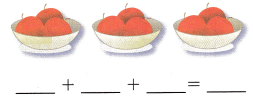
Texas Go Math Grade 7 Lesson 5.1 Answer Key Probability

Texas Go Math Grade 7 Lesson 5.1 Explore Activity Answer Key

Finding the Likelihood of an Event

Each time you roll a number cube, a number from 1 to 6 lands face up. This is called an event.

Work with a partner to decide how many of the six possible results of rolling a number cube match the described event.

Then order the events from least likely (1) to most likely (9) by writing a number in each box to the right.

Rolling a number less than 7 ______________ Texas Go Math Grade 7 Lesson 5.1 Answer Key 1
Rolling an 8 ______________ Texas Go Math Grade 7 Lesson 5.1 Answer Key 1
Rolling a number greater than 4 ______________ Texas Go Math Grade 7 Lesson 5.1 Answer Key 1
Rolling a 5 ______________ Texas Go Math Grade 7 Lesson 5.1 Answer Key 1
Rolling a number other than 6. ______________ Texas Go Math Grade 7 Lesson 5.1 Answer Key 1
Rolling an even number ______________ Texas Go Math Grade 7 Lesson 5.1 Answer Key 1
Rolling a number less than 5 ______________ Texas Go Math Grade 7 Lesson 5.1 Answer Key 1
Rolling an odd number ______________ Texas Go Math Grade 7 Lesson 5.1 Answer Key 1
Rolling a number divisible by 3. ______________ Texas Go Math Grade 7 Lesson 5.1 Answer Key 1

Reflect

Question 1.
Are any of the events impossible?.
Answer:
Rolling an 8 is impossible because the number cube has numbers from 1 to 6.

Probability 1

Go Math Grade 7 Lesson 5.1 Answer Key Question 2.
The probability of event A is \(\frac{1}{3}\). The probability of event B is \(\frac{1}{4}\). What can you conclude about the two events?
Answer:
The probability od event A is lower than \(\frac{1}{2}\), so this event is unlikely to happen.
Because od the same reason, event B is also unlikely to happen.
But, \(\frac{1}{3}\) is greater than \(\frac{1}{4}\), se event A is more likely to happen than event B.

Your Turn

Question 3.
A hat contains pieces of paper marked with the numbers 1 through 16. Tell whether picking an even number is impossible, unlikely, as likely as not, likely, or certain. Tell whether the probability is 0, close to 0, \(\frac{1}{2}\), close to 1, or 1.
Answer:
This event is as likely as not
The probability is \(\frac{1}{2}\).

Find each probability. Write your answer in simplest form.

Question 4.
Picking a purple marble from a jar with 10 green and 10 purple marbles. ____________________
Answer:
Jar has 20 marbles, ten green, and ten purple.
Texas Go Math Grade 7 Lesson 5.1 Answer Key 3
The probability of picking a purple marble is \(\frac{1}{2}\).

Question 5.
Rolling a number greater than 4 on a standard number cube.
Answer:
Samp[e space for a standard number cube is {1, 2, 3, 4, 5, 6}.
Texas Go Math Grade 7 Lesson 5.1 Answer Key 4
The probability of rolling a number greater than 4 is \(\frac{1}{3}\).

Reflect

Question 6.
Why do the probability of an event and the probability of its complement add up to 1 ?
Answer:
The probability of an event and the probability of its complement add up to 1 because the total events are the even itself and its compliment, so its probability equal to 1 because these are all the possible events that will. occur.

Your Turn

Probability Answer Key Texas Go Math Grade 7 Question 7.
A jar contains 8 marbles marked with the numbers 1 through 8. You pick a marble at random. What is the probability of not picking the marble marked with the number 5? __________
Answer:
Sum of probability from some event and his complement is equal 1.
P(Event) + P(Complement) = 1
Event in this problem is picking the marble with number five.
Complement is not to pick marble with number five.
P(Picking marble with number five) + P(Complement) = 1
We have 8 marbles.Probability to pick marble with number 5 is \(\frac{1}{8}\).
\(\frac{1}{8}\) + P(Complement) = 1
Write one as \(\frac{8}{8}\).
Subtract \(\frac{1}{8}\) from both sides in equality.
\(\frac{1}{8}\) + P(Complement) – \(\frac{1}{8}\) = \(\frac{8}{8}\) – \(\frac{1}{8}\)
P(Not to pick marble with number five) = \(\frac{7}{8}\)

Question 8.
You roll a standard number cube. Use the probability of rolling an even number to find the probability of rolling an odd number. __________
Answer:
The sum of the probabiLities of an event and its complement equals 1.
First, find the probability of rolling an even number
Sample space for a standard number cube is {1, 2. 3, 4, 5, 6} and number of ways to roll an even number is 3.
Texas Go Math Grade 7 Lesson 5.1 Answer Key 5
The probability of rolling an even number is \(\frac{1}{2}\).
The probability of not rolling an even number is the same as the probability of rolling an odd number.
Hence,
P(even number) + P(odd number) = 1 Substitute \(\frac{1}{2}\) for P(even number)
\(\frac{1}{2}\) + P(odd number) = 1 Subtract \(\frac{1}{2}\) from both sides
P(odd number) = 1 – \(\frac{1}{2}\)
P(odd number) = \(\frac{1}{2}\)
The probability of rolling an odd number is \(\frac{1}{2}\).

Texas Go Math Grade 7 Lesson 5.1 Guided Practice Answer Key

Question 1.
In a hat, you have index cards with the numbers 1 through 10 written on them. Order the events from least likely to happen (1) to most likely to happen (8) when you pick one card at random. In the boxes, write a number from 1 to 8 to order the eight different events. (Explore Activity)
You pick a number greater than 0. Texas Go Math Grade 7 Lesson 5.1 Answer Key 1
You pick an even number. Texas Go Math Grade 7 Lesson 5.1 Answer Key 1
You pick a number that is at least 2. Texas Go Math Grade 7 Lesson 5.1 Answer Key 1
You pick a number that ¡s at most 0. Texas Go Math Grade 7 Lesson 5.1 Answer Key 1
You pick a number divisible by 3. Texas Go Math Grade 7 Lesson 5.1 Answer Key 1
You pick a number divisible by 5. Texas Go Math Grade 7 Lesson 5.1 Answer Key 1
You pick a prime number. Texas Go Math Grade 7 Lesson 5.1 Answer Key 1
You pick a number less than the greatest prime number. Texas Go Math Grade 7 Lesson 5.1 Answer Key 1
Answer:
Write events from Least likeLy to happen to the most likely to happen.

The least likely to happen event is that you pick a number that is the most 0, because all of the numbers from 1 to 10 are greater than 0.

Next is event that you pick a number divisible by 5, because there is only 2 numbers (10, 5) from 1 to 10 that is divisible by 5

Next is event that you pick a number divisible by 3, because there is 3 numbers (3, 6, 9) from 1 to 10 that is divisible by 3
Next is event that you pick a prime number, because there is 4 prime numbers (2, 3, 5, 7) from 1 to 10.

Next is event that you pick a even number, because there is 5 prime numbers (2, 4, 6. 8. 10) from 1 to 10.

Next is event that you pick a number less than the greatest prime number, because the greatest prime number from 1 to 10 is 7 and there is 6 numbers (1, 2, 3, 4, 5, 6) from 1 to 10 Less than 7.

Next is event that you pick a number that is the least 2, because except number 1 all of the numbers from 1 to 10, are at least 2.

The most likely to happen event is that you pick a number greater than 0, because all the numbers from 1 to 10, are greater than 0.
8, 5, 7, 1, 3, 2, 4, 6

Determine whether each event is impossible, unlikely, as likely as not, likely, or certain. Then, tell whether the probability is 0, close to 0, \(\frac{1}{2}\), close to 1, or 1. (Example 1)

Probability Test Answer Key Go Math 7 Grade Question 2.
randomly picking a green card from a standard deck of playing cards.
Answer:
Event is impossible, because there is no green cards in standard deck of playing cards.
The probability is 0.

Probability 2

Question 3.
randomly picking a red card from a standard deck of playing cards
Answer:
There is 26 red cards in standard deck of playing cards.
Find the probability of picking red card from the standard deck of playing cards.
Texas Go Math Grade 7 Lesson 5.1 Answer Key 6
= \(\frac{26}{52}\)
= \(\frac{1 \cdot 26}{2 \cdot 26}\)
= \(\frac{1}{2}\)
The probabiLity of picking red card from the standard deck of playing cards is \(\frac{1}{2}\).
Event is as likely as not.

Question 4.
picking a number less than 15 from a jar with papers labeled from 1 to 12
Answer:
Event is certain because all the numbers from 1 to 12 are less than 15.
Hence, the probability is 1.

Question 5.
picking a number that is divisible by 5 from a jar with papers labeled from 1 to 12
Answer:
There is 2 numbers from 1 to 12 that are divisible by 5, and that numbers are 5 and lo.
Find the probability of picking a number that is divisible by 5.
Texas Go Math Grade 7 Lesson 5.1 Answer Key 7
= \(\frac{2}{12}\)
= \(\frac{1 \cdot 2}{6 \cdot 2}\)
= \(\frac{1}{6}\)
The probability of picking a number that is divisible by 5 is \(\frac{1}{6}\).
This event is unlikely to occur.

Find each probability. Write your answer in the simplest form. (Example 2)

Algebra 1 with Probability Answer Key Go Math Grade 7 Question 6.
Spinning a spinner that has 5 equal sections marked 1 through 5 and landing on an even number. Use a tree diagram to find the sample space.
Answer:
Texas Go Math Grade 7 Lesson 5.1 Answer Key 8
Texas Go Math Grade 7 Lesson 5.1 Answer Key 9
P(land on even number) = \(\frac{2}{5}\)

Question 7.
Picking a diamond from a standard deck of playing cards which has 13 cards in each of four suits: spades, hearts, diamonds and clubs.
Answer:
A standard deck of playing cards has 13 cards in diamonds.
Find the probability of picking a diamond.
Texas Go Math Grade 7 Lesson 5.1 Answer Key 10
= \(\frac{13}{52}\)
= \(\frac{1 \cdot 13}{4 \cdot 13}\)
= \(\frac{1}{4}\)
The probability of picking a diamond from a standard deck of playing cards is \(\frac{1}{4}\).

Use the complement to find each probability. (Example 3)

Question 8.
What is the probability of not rolling a 5 on a standard number cube?
Answer:
The sum of the probabilities of an event and ¡ts complement equals 1.
First, find the probability of rolling a number 5 on a standard number cube.
Sample space for a standard number cube is {1, 2, 3, 4, 5, 6}.
Texas Go Math Grade 7 Lesson 5.1 Answer Key 11
= \(\frac{1}{6}\)
The probability of rolling a number 5 is \(\frac{1}{6}\).
P(number 5) + P(not number 5) = 1 Substitute \(\frac{1}{6}\) for P(number 5)
\(\frac{1}{6}\) + P(not number 5) = 1 Subtract \(\frac{1}{6}\) from both sides.
P(not number 5) = 1 – \(\frac{1}{6}\)
P(not number 5) = \(\frac{5}{6}\)
The probability of not rolling number 5 is \(\frac{5}{6}\).
This event is likely to occur.

Question 9.
A spinner has 3 equal sections that are red, white, and blue. What is the probability of not landing on blue?
Answer:
The sum of the probabilities of an event and its compLement equals 1.
First, find the probability of landing on red or white section. The sum of the red and white section is 2.
P(red or white section) = Texas Go Math Grade 7 Lesson 5.1 Answer Key 12
= \(\frac{2}{3}\)
The probability of landing on red or white section is \(\frac{2}{3}\).
The probability of not landing on red or white section is the same as probability or landing on blue section
P(not red or white section) = P(blue section)

P(red or white) + P(not red or white) = 1 Substitute P(blue) for P(not red or white)
P(red or white section) + P(blue section) = 1 Substitute \(\frac{2}{3}\) for P(red or white section).
\(\frac{2}{3}\) + P(blue section) = 1 Subtract \(\frac{2}{3}\) from both sides.
P(blue section) = 1 – \(\frac{2}{3}\)
P(blue section) = \(\frac{1}{3}\)
The probability of landing on blue section is \(\frac{1}{3}\).
This event is unlikely to occur.

Question 10.
A spinner has 5 equal sections marked 1 through 5. What is the probability of not landing on 4?
Answer:
The sum of the probabilities of an event and its complement equals 1.
P(event) + P(complement) = 1
First, find the probabiLity of Landing on section 4.
The spinner has 5 sections with numbers 1, 2, 3, 4 and 5, hence
P(section 4) = \(\frac{1}{5}\)
P(section 4) + P(not section 4) = 1 Substitute \(\frac{1}{5}\) for P(section 4).
\(\frac{1}{5}\) + P(not section 4) = 1 Subtract \(\frac{1}{5}\) from both sides.
P(not section 4) = 1 – \(\frac{1}{5}\)
P(not section 4) = \(\frac{4}{5}\)
The probability of not landing on section 4 is \(\frac{4}{5}\).
This event is likely to occur.

Go Math Grade 7 Lesson 5.1 Answer Key Question 11.
There are 4 queens in a standard deck of 52 cards. You pick one card at random. What is the probability of not picking a queen?
Answer:
The stint of the probabilities of an event and its complement equals 1.
P(event) + P(complement) = 1
A standard deck of playing cards has 1 queen.
Find the Probability of picking a queen.
P(queen) = Texas Go Math Grade 7 Lesson 5.1 Answer Key 13
= \(\frac{4}{52}\)
= \(\frac{1 \cdot 4}{13 \cdot 4}\)
= \(\frac{1}{13}\)
The probability of picking a queen from a standard deck of playing cards is \(\frac{1}{13}\)
P(queen) + P(not queen) = 1 Substitute \(\frac{1}{13}\) for P(queen).
\(\frac{1}{13}\) + P(not queen) = 1 Subtract \(\frac{1}{13}\) from both sides.
P(not queen) = 1 – \(\frac{1}{13}\)
P(not queen) = \(\frac{12}{13}\)
The probability of not picking a queen from a standard deck of playing cards is \(\frac{12}{13}\).
This event is likely to occur.

Essential Question Check-In

Question 12.
Describe an event that has a probability of 0% and an event that has a probability of 100%.
Answer:
Example for 0% probability: What is probability to extract cherry in a basket in which there are only strawberries.
Example for 100 % probability: Numbers on the cube are: 2, 4, 2, 4, 6, 6. What is probability to roll a an even number?

Texas Go Math Grade 7 Lesson 5.1 Independent Practice Answer Key

Question 13.
There are 4 aces and 4 kings in a standard deck of 52 cards. You pick one card at random. What is the probability of selecting an ace or a king? Explain your reasoning.
Answer:
Find the probability of seLecting a king from a standard deck of playing cards.
P(king) = Texas Go Math Grade 7 Lesson 5.1 Answer Key 14
= \(\frac{4}{52}\)
= \(\frac{1 \cdot 4}{13 \cdot 4}\)
= \(\frac{1}{13}\)
The probability of selecting a king from a standard deck is \(\frac{1}{13}\)
Find the probability of selecting an ace from a standard deck of playing cards.
P(ace) = Texas Go Math Grade 7 Lesson 5.1 Answer Key 15
= \(\frac{4}{52}\)
= \(\frac{1 \cdot 4}{13 \cdot 4}\)
= \(\frac{1}{13}\)
The probability of selecting an ace from a standard deck of playing cards.\(\frac{1}{13}\).

The probability of selecting a king or an ace is the sum of the probability of selecting a king, and the probability of selecting an ace from a standard deck
P(king or ace) = P(king) + P(ace) Substitute \(\frac{1}{13}\) for P(king) and \(\frac{1}{13}\) for P(ace)
P(king or ace) = \(\frac{1}{13}\) + \(\frac{1}{13}\)
P(king or ace) = \(\frac{2}{13}\)
The probability of selecting a king or an ace is \(\frac{2}{13}\).

Lesson 5.1 Answer Key 7th Grade Go Math Question 14.
There are 12 pieces of fruit in a bowl. Seven of the pieces are apples and two are peaches. What is the probability that a randomly selected piece of fruit will not be an apple or a peach? Justify your answer.
Answer:
There is 7 pieces of apple and 2 pieces of peach in a bowl
Find the probability of selecting a piece of apple from a bowl
P(apple) = Texas Go Math Grade 7 Lesson 5.1 Answer Key 16
= \(\frac{7}{12}\)
The probability of selecting a piece of apple from a bowl is \(\frac{7}{12}\)
Find the probability of selecting a piece of peach from a bowl.
P(peach) = Texas Go Math Grade 7 Lesson 5.1 Answer Key 17
= \(\frac{2}{12}\)
The probability of selecting a piece of peach from a bowl is \(\frac{2}{12}\).

The probability of selecting a piece of apple or peach from the bowl is the sum of the probability of selecting an apple, and the probability of selecting a peach from a bowl.
P(apple or peach) = P(apple) + P(peach) Substitute \(\frac{7}{12}\) for P(apple) and \(\frac{2}{12}\) for P(peach)
P(apple or peach) = \(\frac{7}{12}\) + \(\frac{2}{12}\)
P(apple or peach) = \(\frac{9}{12}\)
P(apple or peach) = \(\frac{3 \cdot 3}{4 \cdot 3}\)
P(apple or peach) = \(\frac{3}{4}\)
The probability of selecting apple or peach from a bowl is \(\frac{3}{4}\).

The sum of the probability of an event and its complement equals 1.
P(event) + P(complement) = 1
P(apple or peach) + P(not appLe or peach) = 1 Substitute \(\frac{3}{4}\) for P(apple or peach).
\(\frac{3}{4}\) + P(not apple or peach) = 1 Subtract \(\frac{3}{4}\) from both sides
P(not apple or peach) = 1 – \(\frac{3}{4}\)
P(not apple or peach) = \(\frac{1}{4}\)
The probabiLity of not selecting piece of apple or peach is \(\frac{1}{4}\).

Question 15.
Critique Reasoning For breakfast, Clarissa can choose from oatmeal, cereal, French toast, or scrambled eggs. She thinks that if she selects a breakfast at random, it is likely that it will be oatmeal. Is she correct? Explain your reasoning. Use a tree diagram to determine your sample space.
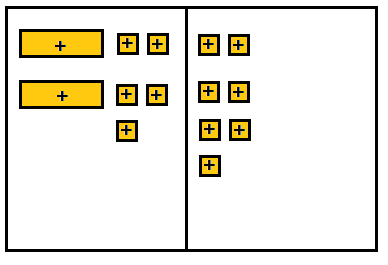
Answer:
They are equally Likely to choose every dish.
Texas Go Math Grade 7 Lesson 5.1 Answer Key 18

Question 16.
Draw Conclusions A researcher’s garden contains 90 sweet pea plants, which have either white or purple flowers. About 70 of the plants have purple flowers, and about 20 have white flowers. Would you expect that one plant randomly selected from the garden will have purple or white flowers? Explain.
Texas Go Math Grade 7 Lesson 5.1 Answer Key 2
Answer:
Garden contains 90 plants of which about 70 are with purple flowers, and about 20 with white flowers.
Find the probability of selecting the plant with purple flowers.
Texas Go Math Grade 7 Lesson 5.1 Answer Key 19
The probability of selecting the plant with purple flowers is \(\frac{7}{9}\).
Find the probability of selecting the plant with white flowers.
Texas Go Math Grade 7 Lesson 5.1 Answer Key 20
The probability of selecting the plant with white flowers is \(\frac{2}{9}\).

The probability of selecting the plant with purple flowers is greater than the probability of selecting the plant with white flowers, hence, when randomly select plant we expect that the plant will have purple flowers.

Question 17.
The power goes out as Sandra is trying to get dressed. If she has 4 white T-shirts and 10 colored T-shirts in her drawer, is it likely that she will pick a colored T-shirt in the dark? What is the probability she will pick a colored T-shirt? Explain your answers.
Answer:
Sandra has 10 color T-shirts, and 4 white T-shirts.
Total number of T-shirts is 4 + 10 = 14
Find the probability of picking a white T-shirts.
Texas Go Math Grade 7 Lesson 5.1 Answer Key 21
The probability of picking a white T-shirts is \(\frac{2}{7}\).
Find the probability of picking a color T-shirts
Texas Go Math Grade 7 Lesson 5.1 Answer Key 22
The probability of picking a color T-shirts is \(\frac{5}{7}\).

The probability of picking a color T-shirts is greater than the probability of picking a white T-shirts, hence, it is likely that she will pick a color T-shirt in the dark.

Question 18.
James counts the hair colors of the 22 people in his class, including himself. He finds that there are 4 people with brown hair, 8 people with brown hair, and 10 people with black hair. What is the probability that a randomly chosen student in the class does not have red hair? Explain.
Answer:
None of the students have red hair, so the probability of choosing a student with red hair is 0. The complement of this event is the probability of choosing a student who does not have red hair.
The sum of the probability of an event and its complement equals 1.
P(red hair) + P(not red hair) = 1 Substitute 0 for P(red hair)
0 + P(not red hair) = 1
P(not red hair) = 1
The probability of choosing a student who does not have red hair is 1.
Hence, this event is certain.

Probability 4

Question 19.
Persevere in Problem Solving A bag contains 8 blue coins and 6 red coins. A coin is removed at random and replaced by three of the other color.
a. What is the probability that the removed coin is blue?
Answer:
Total number of coins in a bag is 8 + 6 = 14
Find the probability of removing blue coin from a bag.
Texas Go Math Grade 7 Lesson 5.1 Answer Key 23
The probability of removing blue coin from a bag is \(\frac{4}{7}\).

b. If the coin removed is blue, what is the probability of drawing a red coin after three red coins are put in the bag to replace the blue one?
Answer:
If a blue coin is removed, the number of blue coins is now 8 – 1 = 7, and the total number of coins in a bag is 7 + 6 = 13.

Instead of that one blue coin that ¡s removed, we put three red coins.

Now, the total number of red coins in a bag is 6 + 3 = 9, and total number of coins in a bag is 16, 7 of blue ones, and 9 red ones coins.
Texas Go Math Grade 7 Lesson 5.1 Answer Key 24
The probability of drawing a red coin from the bag after three red coins are put in the bag to replace the blue one is \(\frac{9}{16}\).

c. If the coin removed is red, what is the probability of drawing a red coin after three blue coins are put in the bag to replace the red one?
Answer:
c) If a red coin is removed, the number of red coins is now 6 – 1 = 5, and the total number of coins in a bag is 8 + 5 = 13.
Instead of that one red coin that is removed, we put three blue coins.
Now, the total number of bLue coins in a bag is 8 + 3 = 11, and total number of coins in a bag is 16, 11 of blue ones, and 5 red ones coins.
Texas Go Math Grade 7 Lesson 5.1 Answer Key 25
The probability of drawing a red coin from the bag after three bLue coins are put in the bag to replace the red one \(\frac{5}{16}\).

H.O.T. Focus on Higher Order Thinking

Question 20.
Draw Conclusions Give an example of an event in which all of the outcomes are not equally likely. Explain.
Answer:
In the basket are 4 red, 2 white and 7 green balls. Find the probability for each color of a ball to be selected.
Texas Go Math Grade 7 Lesson 5.1 Answer Key 26

Question 21.
Critique Reasoning A box contains 150 black pens and 50 red pens. Jose said the sum of the probability that a randomly selected pen will not be black and the probability that the pen will not be red is 1. Explain whether you agree.
Answer:
Total number of pens in a box is 150 + 50 200.
First, find the probability of selecting black pen, and the probabality of selecting red pen.
Second, find the compliments of these two events, and check whether if their sum is 1 or not
Texas Go Math Grade 7 Lesson 5.1 Answer Key 27
The probability of selecting black pen is \(\frac{3}{4}\).

Texas Go Math Grade 7 Lesson 5.1 Answer Key 28
The probability of selecting red pen is \(\frac{1}{4}\).

The sum of the probabilities of an event and its complement equals 1.
P(event) + P(complement) = 1
P(black pen) + P(not black pen) = 1 Substitute \(\frac{3}{4}\) for P(black pen).
\(\frac{3}{4}\) + P(not black pen) = 1 Subtract \(\frac{3}{4}\) from both sides.
P(not black pen) = 1 – \(\frac{3}{4}\)
P(not black pen) = \(\frac{1}{4}\)
The probability of not selecting black pen is \(\frac{1}{4}\).

P(red pen) + P(not red pen) = 1 Substitute \(\frac{1}{4}\) for P(red pen).
\(\frac{1}{4}\) + P(not red pen) = 1 Subtract \(\frac{1}{4}\) from both sides.
P(not red pen) = 1 – \(\frac{1}{4}\)
P(not red pen) = \(\frac{3}{4}\)
The probability of not selecting red pen is \(\frac{3}{4}\).

P(not black) + P(not red) \(\stackrel{?}{=}\) 1 Substitute \(\frac{1}{4}\) for P(not black) and \(\frac{3}{4}\) for P(not \(\frac{1}{4}+\frac{3}{4} \stackrel{?}{=} 1\)
1 \(\stackrel{?}{=}\) 1
True
The sum of the probability that a randomly selected pen will not be black color and the probability that the pen will not be red is 1.

Question 22.
Communicate Mathematical Ideas A spinner has 7 identical sections. Two sections are blue, 1 is red, and 4 of the sections are green. Suppose the probability of an event happening is \(\frac{2}{7}\). What does each number in the ratio represent? What outcome matches this probability?
Answer:
The numerator in a fraction represents the number of times event occurs, and the denominator represents total number of equaLity likely possible outcomes.

The number 2 shows that the spinner has 2 section with the same color, in this case, blue color, and the number 7 represents the number of sections spinner has.

The outcome that corresponds to this probability is that the spinner lands on a blue section.

Texas Go Math Grade 7 Lesson 5.1 Answer Key Probability Read More »

Scroll to Top