Prasanna

Texas Go Math Grade 8 Lesson 1.1 Answer Key Rational and Irrational Numbers

Refer to our Texas Go Math Grade 8 Answer Key Pdf to score good marks in the exams. Test yourself by practicing the problems from Texas Go Math Grade 8 Lesson 1.1 Answer Key Rational and Irrational Numbers.

Texas Go Math Grade 8 Lesson 1.1 Answer Key Rational and Irrational Numbers

Your Turn

Write each fraction as a decimal.

Question 1.
\(\frac{5}{11}\)__________
Answer:
To write \(\frac{5}{11}\) as a decimal, we divide the numerator by the denominator until the remainder is zero or until the digits in the quotient begin to repeat.
We add as many zeros after the decimal point in the dividend as needed
Texas Go Math Grade 8 Lesson 1.1 Answer Key 27
When a decimal has one or more digits that repeat indefinitely, we write the decimal with a bar over the repeating digit(s). In our case, 45 repeats indefinitely.
\(\frac{5}{11}\) = \(0 . \overline{45}\)

Rational and Irrational Numbers Answer Key Question 2.
\(\frac{1}{8}\) __________
Answer:
To write \(\frac{1}{8}\) as a decimal, we divide the numerator by the denominator until the remainder is zero or until the digits in the quotient begin to repeat.
We add as many zeros after the decimal point in the dividend as needed
Texas Go Math Grade 8 Lesson 1.1 Answer Key 26
\(\frac{1}{8}\) = 0.125

Question 3.
2\(\frac{1}{3}\) _______
Answer:
First, we convert the mixed number to an improper fraction:
2\(\frac{1}{3}\) = 2 + \(\frac{1}{3}\)
= \(\frac{6}{3}\) + \(\frac{1}{3}\)
= \(\frac{7}{3}\)
To write \(\frac{7}{3}\) as a decimal, we divide the numerator by the denominator until the remainder is zero or until the digits in the quotient begin to repeat.
We add as many zeros after the decimal point in the dividend as needed.
Texas Go Math Grade 8 Lesson 1.1 Answer Key 18
When a decimal has one or more digits that repeat indefinitely, we write the decimal with a bar over the repeating digit(s). In our case, 3 represents indefinitely.
2\(\frac{1}{3}\) = \(2 . \overline{3}\)

Reflect

Question 4.
Analyze Relationships How are the two square roots of a positive number related? Which is the principal square root?
Answer:
A square root of a number b is the solution of the equation x²=b. It is a number that when multiplied by itself gives you b. Every positive number b has two square roots, denoted √b and −√b. The principal square root of b is the positive square root, denoted √b

Rational and Irrational Numbers 1

Question 5.
Is the principal square root of 2 a whole number? What types of numbers have whole number square roots?
Answer:
Because √2 is not an integer (2 is not a perfect square), √2 must therefore be irrational. Numbers whose square roots are whole numbers, (or more accurately positive integers) are called perfect square numbers. Numbers with decimals aren’t perfect square roots.

Your Turn

Find the two square roots of each number.

Question 6.
64 ____
Answer:
The given number is: 64
Now,
We know that,
A square root of a number b is the solution of the equation x²=b. It is a number that when multiplied by itself gives you b. Every positive number b has two square roots, denoted √b and −√b
So,
√x = ±b
So,
\(\sqrt{64}\) = ±8
Hence, from the above,
We can conclude that
\(\sqrt{64}\) = 8
\(\sqrt{64}\) = -8

Question 7.
100 _________
Answer:
The given number is: 100
Now,
We know that,
A square root of a number b is the solution of the equation x²=b. It is a number that when multiplied by itself gives you b. Every positive number b has two square roots, denoted √b and −√b
So,
√x = ±b
So,
\(\sqrt{100}\) = ±10
Hence, from the above,
We can conclude that
\(\sqrt{100}\) = 10
\(\sqrt{100}\) = -10

Lesson 1.1 Define Rational Numbers Answer Key Question 8.
\(\frac{1}{9}\) _________
Answer:
The given number is: \(\frac{1}{9}\)
Now,
We know that,
A square root of a number b is the solution of the equation x²=b. It is a number that when multiplied by itself gives you b. Every positive number b has two square roots, denoted √b and −√b
So,
√x = ±b
Now,
We know that,
\(\sqrt{\frac{a}{b}}\) = \(\frac{\sqrt{a}}{\sqrt{b}}\)
So,
\(\sqrt{\frac{1}{9}}\) = \(\frac{\sqrt{1}}{\sqrt{9}}\)
= ±\(\frac{1}{3}\)
Hence, from the above,
We can conclude that
\(\sqrt{\frac{1}{9}}\) = \(\frac{1}{3}\)
\(\sqrt{\frac{1}{9}}\) = –\(\frac{1}{3}\)

Question 9.
A square garden has an area of 144 square feet. How long is each side?
Answer:
It is given that
A square garden has an area of 144 square feet
Now,
We know that,
A square root of a number b is the solution of the equation x²=b. It is a number that when multiplied by itself gives you b. Every positive number b has two square roots, denoted √b and −√b
So,
√x = ±b
Now,
We know that,
The area of a square = Side²
So,
Side² = 144
\(\sqrt{Side²}\) = \(\sqrt{144}\)
Side = ± 12
But,
We know that,
The side of a square will not be negative
So,
The side of a square field is: 12 feet
Hence, from the above,
We can conclude that
The side of a square field is: 12 feet

Texas Go Math Grade 8 Lesson 1.1 Explore Activity Answer Key 

Explore Activity 1
Estimating Irrational Numbers
Irrational numbers are numbers that are not rational. in other words, they cannot be written in the form \(\frac{a}{b}\) where a and b are integers and b is not 0.

Estimate the value of \(\sqrt{2}\).

A. Since 2 is not a perfect square, \(\sqrt{2}\) is irrational.
B. To estimate \(\sqrt{2}\), first find two consecutive perfect squares that 2 is between. Complete the inequality by writing these perfect squares in the boxes.
1 < 2 < 9
C. Now take the square root of each number.
\(\sqrt{1}\) < \(\sqrt{2}\) < \(\sqrt{9}\)
D. Simplify the square roots of perfect squares.
\(\sqrt{2}\) is between _____ and ___.
1 < \(\sqrt{2}\) < 3
E. Estimate that \(\sqrt{2}\) ≈ 1.5. Texas Go Math Grade 8 Lesson 1.1 Answer Key 4
F. To find a better estimate, first, choose some numbers between 1 and 2 and square them. For example, choose 1.3, 1.4, and 1.5.
1.32 = 1.69
1.42 = 1.96
1.52 = 2.25
Is \(\sqrt{2}\) between 1.3 and 1.4? How do you know?
Answer:
From the above,
We can observe that
The estimation of \(\sqrt{2}\) is: 1.5
Now,
From part (f),
We can observe that
The squares of the numbers 1.3, 1.4, and 1.5
Hence, from the above,
We can observe that
\(\sqrt{2}\) is not between 1.3 and 1.4

Is \(\sqrt{2}\) between 1.4 and 1.5? How do you know?
Answer:
From the above,
We can observe that
The estimation of \(\sqrt{2}\) is: 1.5
Now,
From part (f),
We can observe that
The squares of the numbers 1.3, 1.4, and 1.5
Hence, from the above,
We can observe that
\(\sqrt{2}\) is not between 1.4 and 1.5
So,
\(\sqrt{2}\) is between 1.4 and 1.5.
So,
\(\sqrt{2}\) ≈ 1.5
G. Locate and label this value on the number line.

Reflect

Question 10.
How could you find an even better estimate of \(\sqrt{2}\)?
Answer:
The given number is: \(\sqrt{2}\)
Now,
Find the perfect squares that is between \(\sqrt{2}\)
So,
1 < \(\sqrt{2}\) < 3
We know that,
\(\sqrt{2}\) ≈ 1.414
So,
The value of \(\sqrt{2}\) lies closer to: 1.4
Hence, from the above,
We can conclude that
The better estimate of \(\sqrt{2}\) is: 1.4

Rational and Irrational Numbers 2

Question 11.
Find a better estimate of \(\sqrt{2}\). Draw a number line and locate and label your estimate.
Texas Go Math Grade 8 Lesson 1.1 Answer Key 6
\(\sqrt{2}\) is between _____ and _____, so \(\sqrt{2}\) ≈ ___
Answer:
The given number is: \(\sqrt{2}\)
Now,
Find the perfect squares that is between \(\sqrt{2}\)
So,
1 < \(\sqrt{2}\) < 3
So,
The value of \(\sqrt{2}\) lies between 1.4 and 1.5
Now,
We know that,
\(\sqrt{2}\) ≈ 1.414
So,
The value of \(\sqrt{2}\) lies closer to: 1.4
Now,
The representation of the value of \(\sqrt{2}\) on a number line is:

Hence, from the above,
We can conclude that
\(\sqrt{2}\) is between 1.4 and 1.5,
So,
\(\sqrt{2}\) ≈ 1.5

Question 12.
Estimate the value of \(\sqrt{7}\) to the nearest 0.05. Draw a number line and locate and label your estimate.
Texas Go Math Grade 8 Lesson 1.1 Answer Key 7
\(\sqrt{7}\) is between and _____, so \(\sqrt{7}\) ≈ ___.
Answer:
The given number is: \(\sqrt{7}\)
Now,
Find the perfect squares that lies between 7
So,
4 < 7 < 9
\(\sqrt{4}\) < \(\sqrt{7}\) < \(\sqrt{9}\)
2 < \(\sqrt{7}\) < 3
Now,
2.1² = 4.41
2.5²= 6.25
2.6² = 6.76
Now,
From the above,
We can observe that
The Estimate of \(\sqrt{7}\) is approximately equal to: 6.76
Now,
The representation of \(\sqrt{7}\) on a number line is:

Hence, from the above,
We can conclude that
\(\sqrt{7}\) is between 2.5 and 2.6
So,
\(\sqrt{7}\) ≈ 2.6

Explore Activity 2
Approximating π
The number π, the ratio of the circumference of a circle to its diameter, is an irrational number. It cannot be written as the ratio of two integers.

Texas Go Math Grade 8 Lesson 1.1 Answer Key 8

In this activity, you will explore the relationship between the diameter and circumference of a circle.
A. Use a tape measure to measure the circumference and the diameter of four circular objects using metric measurements. To measure the circumference, wrap the tape measure tightly around the object and determine the mark where the tape starts to overlap the beginning of the tape. When measuring the diameter, be sure to measure the distance across the object at its widest point.
Answer:
The examples of the four circular objects are:
a. CD
b. Bottle lid
c. Frisbee
d. Bowl

B. Record the circumference and diameter of each object in the table.

C. Divide the circumference by the diameter for each object. Round each answer to the nearest hundredth and record it in the table.
Answer:

D. Describe what you notice about the ratio of circumference to diameter.
Answer:
From part (b),
The complete table is:

Now,
From the above table,
We can observe that
The ratio of the circumference to diameter is approximately equal to 3
Hence, from the above,
We can conclude that
The point we noticed is that
The ratio of the circumference to diameter is approximately equal to 3

Reflect

Lesson 1.1 Rational Numbers as Decimals Answer Key Question 13.
What does the fact that π is irrational indicate about its decimal equivalent?
Answer:
Ï€ is an irrational number because its decimal expansion is a “Non-Terminating Non-Recurring decimal”

Question 14.
Plot π on the number line.
Texas Go Math Grade 8 Lesson 1.1 Answer Key 10
Answer:
We know that,
The value of π is: 3.14
Hence, from the above,
We can conclude that
The representation of π on the number line is:

Question 15.
Explain Why A CD and a DVD have the same diameter. Explain why they have the same circumference.
Answer:
It is given that
A CD and a DVD have the same diameter
Now,
We know that,
The shapes of CD and DVDs are in circular shape
Now,
We know that,
The circumference of a circle (C) = πd
Where,
d is the diameter
It is given that
The diameter is the same for both CD and DVD
So,
The circumference will also be the same since the value of π is constant
Hence, from the above,
We can conclude that
The CD and DVD have the same circumference since the values of diameter and π are constant

Texas Go Math Grade 8 Lesson 1.1 Guided Practice Answer Key 

Question 1.
Vocabulary Square roots of numbers that are not perfect squares are ____________
Answer:
We know that,
The square roots of numbers that are not perfect squares are called “Irrational Numbers”
Hence, from the above,
We can conclude that
The term that best suits the given statement is: irrational Numbers

Write each fraction as a decimal. (Example 1)

Go Math Grade 8 Lesson 1.1 Answer KeyQuestion 2.
\(\frac{7}{8}\) ____
Answer:
The given fraction is: \(\frac{7}{8}\)
Now,
By using the Long Division,

Hence, from the above,
We can conclude that
The representation of \(\frac{7}{8}\) as a decimal is: 0.87

Question 3.
\(\frac{17}{20}\) ________
Answer:
The given fraction is: \(\frac{17}{20}\)
Now,
By using the Long Division,

Hence, from the above,
We can conclude that
The representation of \(\frac{17}{20}\) as a decimal is: 0.85

Question 4.
\(\frac{18}{25}\) ________
Answer:
The given fraction is: \(\frac{18}{25}\)
Now,
By using the Long Division,

Hence, from the above,
We can conclude that
The representation of \(\frac{18}{25}\) as a decimal is: 0.72

Go Math Grade 8 Lesson 1.1 Question 5.
2\(\frac{3}{8}\) ________
Answer:
The given mixed number is: 2\(\frac{3}{8}\)
Now,
The representation of the given mixed number in the form of a fraction is: \(\frac{19}{8}\)
Now,
By using the Long Division,

Hence, from the above,
We can conclude that
The representation of \(\frac{19}{8}\) as a decimal is: 0.42

Question 6.
5\(\frac{2}{3}\) ________
Answer:
The given mixed number is: 5\(\frac{2}{3}\)
Now,
The representation of the given mixed number in the form of a fraction is: \(\frac{17}{3}\)
Now,
By using the Long Division,

Hence, from the above,
We can conclude that
The representation of \(\frac{17}{3}\) as a decimal is: 0.17

Question 7.
2\(\frac{4}{5}\) ________
Answer:
The given mixed number is: 2\(\frac{4}{5}\)
Now,
The representation of the given mixed number in the form of a fraction is: \(\frac{14}{5}\)
Now,
By using the Long Division,

Hence, from the above,
We can conclude that
The representation of \(\frac{14}{5}\) as a decimal is: 0.35

Find the two square roots of each number. (Example 2)

Question 8.
49 ______________
Answer:
The given number is: 49
Now,
We know that,
A square root of a number b is the solution of the equation x²=b. It is a number that when multiplied by itself gives you b. Every positive number b has two square roots, denoted √b and −√b
So,
√x = ±b
So,
\(\sqrt{49}\) = ±7
Hence, from the above,
We can conclude that
\(\sqrt{49}\) = 7
\(\sqrt{49}\) = -7

Go Math Grade 8 Chapter 1 Lesson 1.1 Question 9.
144 _____________
Answer:
The given number is: 144
Now,
We know that,
A square root of a number b is the solution of the equation x²=b.
It is a number that when multiplied by itself gives you b.
Every positive number b has two square roots, denoted √b and −√b
So,
√x = ±b
So,
\(\sqrt{144}\) = ±12
Hence, from the above,
We can conclude that
\(\sqrt{144}\) = 12
\(\sqrt{144}\) = -12

Question 10.
400 _________
Answer:
The given number is: 400
Now,
We know that,
A square root of a number b is the solution of the equation x²=b. It is a number that when multiplied by itself gives you b. Every positive number b has two square roots, denoted √b and −√b
So,
√x = ±b
So,
\(\sqrt{400}\) = ±20
Hence, from the above,
We can conclude that
\(\sqrt{400}\) = 20
\(\sqrt{400}\) = -20

Question 11.
\(\frac{1}{16}\) ________
Answer:
The given number is: \(\frac{1}{16}\)
Now,
We know that,
A square root of a number b is the solution of the equation x²=b. It is a number that when multiplied by itself gives you b. Every positive number b has two square roots, denoted √b and −√b
So,
√x = ±b
Now,
We know that,
\(\sqrt{\frac{a}{b}}\) = \(\frac{\sqrt{a}}{\sqrt{b}}\)
So,
\(\sqrt{\frac{1}{16}}\) = \(\frac{\sqrt{1}}{\sqrt{16}}\)
= ±\(\frac{1}{4}\)
Hence, from the above,
We can conclude that
\(\sqrt{\frac{1}{16}}\) = \(\frac{1}{4}\)
\(\sqrt{\frac{1}{16}}\) = –\(\frac{1}{4}\)

Rational and Irrational Numbers Worksheet 8th Grade Answer Key Question 12.
\(\frac{4}{9}\) ________
Answer:
The given number is: \(\frac{4}{9}\)
Now,
We know that,
A square root of a number b is the solution of the equation x²=b. It is a number that when multiplied by itself gives you b. Every positive number b has two square roots, denoted √b and −√b
So,
√x = ±b
Now,
We know that,
\(\sqrt{\frac{a}{b}}\) = \(\frac{\sqrt{a}}{\sqrt{b}}\)
So,
\(\sqrt{\frac{4}{9}}\) = \(\frac{\sqrt{4}}{\sqrt{9}}\)
= ±\(\frac{2}{3}\)
Hence, from the above,
We can conclude that
\(\sqrt{\frac{4}{9}}\) = \(\frac{2}{3}\)
\(\sqrt{\frac{4}{9}}\) = –\(\frac{2}{3}\)

Question 13.
\(\frac{9}{4}\) ________
Answer:
The given number is: \(\frac{9}{4}\)
Now,
We know that,
A square root of a number b is the solution of the equation x²=b. It is a number that when multiplied by itself gives you b. Every positive number b has two square roots, denoted √b and −√b
So,
√x = ±b
Now,
We know that,
\(\sqrt{\frac{a}{b}}\) = \(\frac{\sqrt{a}}{\sqrt{b}}\)
So,
\(\sqrt{\frac{9}{4}}\) = \(\frac{\sqrt{9}}{\sqrt{4}}\)
= ±\(\frac{3}{2}\)
Hence, from the above,
We can conclude that
\(\sqrt{\frac{9}{4}}\) = \(\frac{3}{2}\)
\(\sqrt{\frac{9}{4}}\) = –\(\frac{3}{2}\)

Approximate each irrational number to the nearest 0.05 without using a calculator. (Explore Activity 1)

Question 14.
\(\sqrt{34}\) ________
Answer:
The given number is: \(\sqrt{34}\)
Now,
Find the perfect squares that lie between 34
So,
25 < 34 < 36
\(\sqrt{25}\) < \(\sqrt{34}\) < \(\sqrt{36}\)
5 < \(\sqrt{34}\) < 6
Now,
5.5² = 30.25
5.9²= 34.81
Now,
From the above,
We can observe that
The Estimate of \(\sqrt{34}\) is approximately equal to: 5.9
Hence, from the above,
We can conclude that
\(\sqrt{34}\) is between 5.8 and 5.9
So,
\(\sqrt{34}\) ≈ 5.9

Question 15.
\(\sqrt{82}\) ________
Answer:
The given number is: \(\sqrt{82}\)
Now,
Find the perfect squares that lie between 82
So,
81 < 82 < 100
\(\sqrt{81}\) < \(\sqrt{82}\) < \(\sqrt{100}\)
9 < \(\sqrt{82}\) < 10
Now,
9.1² = 82.81
8.9²= 79.21
Now,
From the above,
We can observe that
The Estimate of \(\sqrt{81}\) is approximately equal to: 9.1
Hence, from the above,
We can conclude that
\(\sqrt{82}\) is between 8.9 and 9.1
So,
\(\sqrt{82}\) ≈ 9.1

Question 16.
\(\sqrt{45}\) ________
Answer:
The given number is: \(\sqrt{45}\)
Now,
Find the perfect squares that lie between 45
So,
36 < 45 < 49
\(\sqrt{36}\) < \(\sqrt{45}\) < \(\sqrt{49}\)
6 < \(\sqrt{45}\) < 7
Now,
6.5² = 42.25
6.7²= 44.89
Now,
From the above,
We can observe that
The Estimate of \(\sqrt{45}\) is approximately equal to: 6.7
Hence, from the above,
We can conclude that
\(\sqrt{45}\) is between 6.7 and 6.8
So, \(\sqrt{45}\) ≈ 6.7

Go Math Grade 8 Lesson 1.1 Answer Key Question 17.
\(\sqrt{104}\) ________
Answer:
The given number is: \(\sqrt{104}\)
Now,
Find the perfect squares that lie between 104
So,
100 < 104 < 121
\(\sqrt{100}\) < \(\sqrt{104}\) < \(\sqrt{121}\)
10 < \(\sqrt{104}\) < 11
Now,
10.5² = 110.25
10.1²= 102.01
10.2² = 104.04
Now,
From the above,
We can observe that
The Estimate of \(\sqrt{104}\) is approximately equal to: 10.2
Hence, from the above,
We can conclude that
\(\sqrt{104}\) is between 10.1 and 10.2
So,
\(\sqrt{104}\) ≈ 10.2

Question 18.
–\(\sqrt{71}\) ________
Answer:
The given number is: –\(\sqrt{71}\)
Now,
Find the perfect squares that lie between 71
So,
64 < 71 < 81
\(\sqrt{64}\) < \(\sqrt{71}\) < \(\sqrt{81}\)
8 < \(\sqrt{71}\) < 9
Now,
8.5² = 56.25
8.4²= 70.56
Now,
From the above,
We can observe that
The Estimate of \(\sqrt{71}\) is approximately equal to: 8.4
Hence, from the above,
We can conclude that
\(\sqrt{71}\) is between 8.4 and 8.5
So,
–\(\sqrt{71}\) ≈ -8.4

Question 19.
–\(\sqrt{19}\) ________
Answer:
The given number is: \(\sqrt{19}\)
Now,
Find the perfect squares that lies between 19
So,
16 < 19 < 25
\(\sqrt{16}\) < \(\sqrt{19}\) < \(\sqrt{25}\)
4 < \(\sqrt{19}\) < 5
Now,
4.5² = 20.25
4.3²= 18.49
Now,
From the above,
We can observe that
The Estimate of \(\sqrt{19}\) is approximately equal to: 4.3
Hence, from the above,
We can conclude that
\(\sqrt{19}\) is between 4.3 and 4.4
So,
–\(\sqrt{19}\) ≈ -4.3

Divide Multi-Digit Numbers Lesson 1.1 Question 20.
Measurement Complete the table for the measurements to estimate the value of π. Round to the nearest tenth. (Explore Activity 2)
Texas Go Math Grade 8 Lesson 1.1 Answer Key 11
Describe what you notice about the ratio of circumference to diameter.
Answer:
The given table is:
Texas Go Math Grade 8 Lesson 1.1 Answer Key 11
Now,
We know that,
Circumference (C) = πd
Where,
d is the diameter
So,
Ï€ = \(\frac{C}{d}\)
Now,
We know that,
The value of π is 3.141
Now,
The complete table is:

Now,
From the above table,
We can observe that
The values of π are approximately equal to 3
Hence, from the above,
We can conclude that
The approximate value of the ratio of the circumference to diameter is: 3

Essential Question Check-In

Question 21.
Describe how to approximate the value of an irrational number.
Answer:
“Irrational numbers” cannot be written in the form \(\frac{a}{b}\) as it is a non-terminating, non-repeating decimal. Students should know the perfect squares(1 to 15) in order to approximate the value of irrational numbers. Irrational numbers would include Ï€, as well as square roots of numbers that are no larger than 225.

Texas Go Math Grade 8 Lesson 1.1 Independent Practice Answer Key 

Question 22.
A \(\frac{7}{16}\)-inchlong bolt is used in a machine. What is the length of the bolt written as a decimal?
Answer:
It is given that
A \(\frac{7}{16}\)-inchlong bolt is used in a machine
Now,
The given fraction is: \(\frac{7}{16}\)
Now,
By using the Long Division,

Hence, from the above,
We can conclude that
The length of the bolt in the form of a decimal is: 0.43

Question 23.
Astronomy The weight of an object on the moon is \(\frac{1}{6}\) of its weight on Earth. Write \(\frac{1}{6}\) as a decimal.
Answer:
It is given that
The weight of an object on the moon is \(\frac{1}{6}\) of its weight on Earth
Now,
The given fraction is: \(\frac{1}{6}\)
Now,
By using the Long Division,

Hence, from the above,
We can conclude that
The representation of \(\frac{1}{6}\) in the form of a decimal is: 0.16

Lesson 1.1 Rational Numbers as Decimals Answer Key Question 24.
The distance to the nearest gas station is 2\(\frac{3}{4}\) miles. What is this distance written as a decimal?
Answer:
It is given that
The distance to the nearest gas station is 2\(\frac{3}{4}\) miles
Now,
The given mixed number is: 2\(\frac{3}{4}\)
Now,
The representation of the given mixed number in the form of a fraction is: \(\frac{11}{4}\)
Now,
By using the Long Division,

Hence, from the above,
We can conclude that
The representation of the distance in the form of a decimal is: 2.75

Question 25.
A pitcher on a baseball team has pitched 98\(\frac{2}{3}\) innings. What is the number of innings written as a decimal?
Answer:
It is given that
A pitcher on a baseball team has pitched 98\(\frac{2}{3}\) innings
Now,
The given mixed number is: 98\(\frac{2}{3}\)
Now,
The representation of the given mixed number in the form of a fraction is: \(\frac{296}{3}\)
Now,
By using the Long Division,

Hence, from the above,
We can conclude that
The representation of the number of innings in the form of a decimal number is: 98.66

Question 26.
A Coast Guard ship patrols an area of 125 square miles. The area the ship patrols is a square. About how long is each side of the square? Round your answer to the nearest mile.
Answer:
It is given that
A Coast Guard ship patrols an area of 125 square miles. The area the ship patrols is a square
Now,
We know that,
The area of a square = Side²
So,
Side² = 125
Side = \(\sqrt{125}\)
Now,
We know that,
125 is not a perfect square
Now,
Find the perfect squares that lie between 125
So,
121 < 125 < 144
\(\sqrt{121}\) < \(\sqrt{125}\) < \(\sqrt{144}\)
11 < \(\sqrt{125}\) < 12
Now,
11² = 121
12²= 144
Now,
From the above,
We can observe that
The Estimate of \(\sqrt{125}\) is approximately equal to: 11
Hence, from the above,
We can conclude that
The length of each side of the square is about 11 miles

Question 27.
Each square on Olivia’s chessboard Is 11 square centimeters. A chessboard has 8 squares on each side. To the nearest tenth, what is the width of Olivia’s chessboard?
Answer:
It is given that
Each square on Olivia’s chessboard Is 11 square centimeters. A chessboard has 8 squares on each side
Now,
The total area of the chessboard = 8 × 11
= 88 square centimeters
Now,
We know that,
The area of a square = Side²
So,
Side² = 88
Side = ±\(\sqrt{88}\)
Now,
Find the squares that lie between 88
So,
81 < 88 < 100
So,
9 < \(\sqrt{88}\) < 10
So,
The approximate value of \(\sqrt{88}\) is: 9
Hence, from the above,
We can conclude that
The width of Olivia’s chessboard is about 9 centimeters

Go Math 8th Grade Lesson 1.1 Question 28.
The thickness of a surfboard relates to the weight of the surfer. A surfboard is 21\(\frac{3}{16}\) inches wide and 2\(\frac{3}{8}\) inches thick. Write each dimension as a decimal.
Answer:
It is given that
The thickness of a surfboard relates to the weight of the surfer. A surfboard is 21\(\frac{3}{16}\) inches wide and 2\(\frac{3}{8}\) inches thick.
Now,
The given mixed numbers are: 21\(\frac{3}{16}\) and 2\(\frac{3}{8}\)
Now,
The representation of the given mixed numbers in the form of fractions are: \(\frac{339}{16}\) and \(\frac{19}{8}\)
Now,
The representation of the width of the surfboard in the form of a fraction is: \(\frac{339}{16}\) inches
The representation of the thickness of the surfboard in the form of a fraction is: \(\frac{19}{8}\) inches
Now,
By using the Long Division,

Hence, from the above,
We can conclude that
The representation of the width of the surfboard in the form of a decimal is: 21.18
The representation of the thickness of the surfboard in the form of a decimal is: 2.37

Question 29.
A gallon of stain can cover a square deck with an area of 300 square feet. About how long is each side of the deck? Round your answer to the nearest foot.
Texas Go Math Grade 8 Lesson 1.1 Answer Key 12
Answer:
It is given that
A gallon of stain can cover a square deck with an area of 300 square feet
Now,
We know that,
The area of a square = Side²
So,
Side² = 300
Side = ±\(\sqrt{300}\)
Now,
Find the squares that lie between 300
So,
289 < 300 < 324
So,
17 < \(\sqrt{300}\) < 18
So,
The approximate value of \(\sqrt{300}\) is: 18
Hence, from the above,
We can conclude that
The length of each side of the deck is: 18 feet

Lesson 1.1 Rational Numbers as Decimals Question 30.
The area of a square field is 200 square feet. What is the approximate length of each side of the field? Round your answer to the nearest foot.
Answer:
It is given that
The area of a square field is 200 square feet.
Now,
We know that,
The area of a square = Side²
So,
Side² = 200
Side = \(\sqrt{200}\)
Now,
Find the squares that lie between 200
So,
196 < 200 < 225
So,
14 < \(\sqrt{200}\) < 15
So,
The approximate value of \(\sqrt{200}\) is: 14
Hence, from the above,
We can conclude that
The length of each side of the field is: 14 feet

Question 31.
Measurement A ruler is marked at every \(\frac{3}{16}\) inches. Do the labeled measurements convert to terminating or repeating decimals?
Answer:
It is given that
A ruler is marked at every \(\frac{3}{16}\) inches.
Now,
By using the Long Division,

Now,
From the above Long Division,
We can observe that
The given fraction is a non-terminating decimal
Hence, from the above,
We can conclude that
\(\frac{3}{16}\) is a non-terminating decimal

Question 32.
Multistep A couple wants to install a square mirror that has an area of 500 square inches. To the nearest tenth of an inch, what length of wood trim is needed to go around the mirror?
Answer:
It is given that
A couple wants to install a square mirror that has an area of 500 square inches
Now,
We know that,
The area of a square = Side²
So,
Side² = 500
Side = \(\sqrt{500}\)
Now,
Find the squares that lie between 500
So,
484 < 500 < 625
So,
24 < \(\sqrt{500}\) < 25
So,
The approximate value of \(\sqrt{500}\) is: 24
Hence, from the above,
We can conclude that
The length of wood trim that is needed to go around the mirror is: 24 inches

Rational and Irrational Numbers Grade 8 Question 33.
Multistep A square photo-display board is made up of 60 rows of 60 photos each. The area of each square photo is 4 square inches. How long is each side of the display board?
Texas Go Math Grade 8 Lesson 1.1 Answer Key 13
Answer:
It is given that
A square photo-display board is made up of 60 rows of 60 photos each. The area of each square photo is 4 square inches
Now,
The number of photos in each row = (The number of rows) ÷ (The number of photos)
= \(\frac{60}{60}\)
= 1 photo per row
Now,
We know that,
The area of a square = Side²
So,
Side² = 60 × 4
Side² = 240
Side = \(\sqrt{240}\)
Now,
Find the squares that lie between 240
So,
225 < 240 < 256
So,
15 < \(\sqrt{240}\) < 16
So,
The approximate value of \(\sqrt{500}\) is: 16
Hence, from the above,
We can conclude that
The length of each side of the display board is: 16 inches

Approximate each irrational number to the nearest 0.05 without using a calculator. Then plot each number on a number line.

Question 34.
Texas Go Math Grade 8 Lesson 1.1 Answer Key 14
Answer:
The given number is: \(\sqrt{24}\)
Now,
Find the perfect squares that is between \(\sqrt{24}\)
So,
4 < \(\sqrt{24}\) < 5
So,
The value of \(\sqrt{24}\) lies between 4 and 5
Now,
We know that,
\(\sqrt{24}\) ≈ 5
So,
The value of \(\sqrt{24}\) lies closer to: 5
Now,
The representation of the value of \(\sqrt{24}\) on a number line is:

Hence, from the above,
We can conclude that
\(\sqrt{24}\) is between 4 and 5
So,
\(\sqrt{24}\) ≈ 5

Lesson 1.1 Go Math Grade 8 Answer Key Question 35.
Texas Go Math Grade 8 Lesson 1.1 Answer Key 25
Answer:
The given number is: \(\sqrt{41}\)
Now,
Find the perfect squares that is between \(\sqrt{41}\)
So,
6 < \(\sqrt{41}\) < 7
So,
The value of \(\sqrt{41}\) lies between 6 and 7
Now,
We know that,
\(\sqrt{41}\) ≈ 6
So,
The value of \(\sqrt{41}\) lies closer to: 6
Now,
The representation of the value of \(\sqrt{41}\) on a number line is:

Hence, from the above,
We can conclude that
\(\sqrt{41}\) is between 6 and 7
So,
\(\sqrt{41}\) ≈ 6

Question 36.
Represent Real-World Problems If every positive number has two square roots and you can find the length of the side of a square window by finding a square root of the area, why is there only one answer for the length of a side?
Answer:
We know that,
The two square roots of a positive number are:
a) one positive square root
b) one negative square root.
Now,
As long as you’re doing math, on paper, you can work with both of them. But as soon as you start talking about windows or other physical things, it’s pretty silly to talk about a negative length.  When you’re working with real physical things, you usually just ignore the negative square root.
Hence,
There is only one answer for the length of the side

Question 37.
Make a Prediction To find \(\sqrt{5}\), Beau found 22 = 4 and 32 = 9. He said that since 5 is between 4 and 9, \(\sqrt{5}\) is between 2 and 3. Beau thinks a good estimate for is \(\sqrt{5}\) is \(\frac{2+3}{2}\) = 2.5. Is his estimate high or low? How do you know?
Answer:
It is given that
To find \(\sqrt{5}\), Beau found 22 = 4 and 32 = 9. He said that since 5 is between 4 and 9, \(\sqrt{5}\) is between 2 and 3. Beau thinks a good estimate for is \(\sqrt{5}\) is \(\frac{2+3}{2}\) = 2.5
Now,
From the above,
We can observe that
5 is very close to 4
So,
The estimate of \(\sqrt{5}\) is also close to 2 but not to 3
So,
The estimate of \(\sqrt{5}\) should be less than 2.5 and greater than 2. i.e.,
2 < Estimate < 2.5
Hence, from the above,
We can conclude that
The Estimate of Beau is high

Texas Go Math Grade 8 Lesson 1.1 H.O.T. Focus On Higher Order Thinking Answer Key 

Question 38.
Multistep On a baseball field, the infield area created by the baselines is a square. In a youth baseball league, this area is 3600 square feet. A pony league of younger children uses a smaller baseball field with a distance between each base that is 20 feet less than the youth league. What is the distance between each base for the pony league?
Answer:
It is given that
On a baseball field, the infield area created by the baselines is a square. In a youth baseball league, this area is 3600 square feet. A pony league of younger children uses a smaller baseball field with a distance between each base that is 20 feet less than the youth league
Now,
We know that,
The area of a square = Side²
So,
The length of each side in a youth baseball league’s field is:
Side² = 3600
Side = \(\sqrt{3600}\)
Side = 60 feet
Now,
The length of each side in a smaller baseball field = 60 – 20
= 40 feet
Hence, from the above,
We can conclude that
The distance between each base for the pony league is: 40 feet

Question 39.
Problem Solving The difference between the square roots of a number is 30. What is the number? Show that your answer is correct.
Answer:
It is given that
The difference between the square roots of a number is 30
Now,
Let the square root of a number be: x
Now,
We know that,
The square root of a number has 2 numbers. i.e., 1 positive number and 1 negative number
So,
According to the above information,
x – (-x) = 30
x + x = 30
2x = 30
x = \(\frac{30}{2}\)
x = 15
So,
The required number = x²
= 15²
= 225
Hence, from the above,
We can conclude that
The required number is: 225

Lesson 1.1 Write Rational Numbers in Equivalent Forms Answer Key Question 40.
Analyze Relationships If the ratio of the circumference of a circle to its diameter is π, what is the relationship of the circumference to the radius of the circle? Explain.
Answer:
It is given that
The ratio of the circumference of a circle to its diameter is π
Now,
According to the given information,
\(\frac{Circumference}{Diameter}\) = π
Now,
We know that,
Diameter = 2 ×radius(r)
So,
\(\frac{Circumference}{2 × Radius}\) = π
\(\frac{Circumference}{Radius}\) = 2Ï€
Hence, from the above,
We can conclude that
The relationship of the circumference to the radius of the circle is: 2Ï€

Texas Go Math Grade 8 Lesson 1.1 Answer Key Rational and Irrational Numbers Read More »

Texas Go Math Grade 5 Lesson 8.2 Answer Key Addition and Subtraction Equations

Refer to our Texas Go Math Grade 5 Answer Key Pdf to score good marks in the exams. Test yourself by practicing the problems from Texas Go Math Grade 5 Lesson 8.2 Answer Key Addition and Subtraction Equations.

Texas Go Math Grade 5 Lesson 8.2 Answer Key Addition and Subtraction Equations

Unlock the Problem

Yara is going camping in the Everglades National Park. Her backpack with camping gear weighs 17 pounds. When she adds her camera gear, the total weight of her backpack is 25 pounds. How much does Yara’s camera gear weigh?
• What does the backpack weigh without the camera gear?
________________
• What do you need to find?
_________________
Answer:
The backpack weigh without the camera gear is 17 pounds.
We need to find out the camera gear weigh.

Write a related equation.
The problem describes a part-part-whole relationship. A strip diagram can help you understand this relationship and write an equation. Let c represent the weight (in pounds) of the camera gear.
Texas Go Math Grade 5 Lesson 8.2 Answer Key 1
STEP 1: Use the strip diagram to write an equation
Texas Go Math Grade 5 Lesson 8.2 Answer Key 2

STEP 2: Write a subtraction equation that is related to the addition equation.
Equation: _______________
Subtract: c = _______________
So, Yara’s camera gear weighs _______________ pounds.
Answer:
Equation: 17 + c = 25
Subtract: c = 25 – 17 = 8
So, Yara’s camera gear weighs 8 pounds.

What if Yara’s backpack with camping gear weighs 15 pounds and the camera gear weighs 6 pounds? How much does her backpack with camping gear and camera gear weigh? How would the strip diagram above change?
Answer:
Texas-Go-Math-Grade-5-Lesson-8.2-Answer-Key-1(1)
15 pounds + 6 pounds = 21 pounds
Yara’s backpack with camping gear and camera gear weigh is 21 pounds.
Explanation:
Yara’s backpack with camping gear weighs 15 pounds and the camera gear weighs 6 pounds. Add 15 pounds with 6 pounds the sum is 21 pounds. Yara’s backpack with camping gear and camera gear weigh is 21 pounds.

Math Talk
Mathematical Processes

Explain how you can tell that your solution to an equation is true.
Answer:

Example

Use a related equation.
Kent has a collection of CDs. He gives 5 CDs to his brother. He then has 8 CDs left in his collection. How many CDs did Kent have before he gave some to his brother?
• How many CDs did Kent give away?
_________________
• What operation will you use to show the CDs that Kent gave away?
___________________
Answer:
Kent gave 5 CDs to his brother.
I will use subtraction operation to show the CDs that Kent gave away.

STEP 1: Draw a strip diagram.
• Write the missing labels in the strip diagram, where c is the number of CDs in Kent’s collection before he gave some away.
• Use the model to write the equation.
Texas Go Math Grade 5 Lesson 8.2 Answer Key 3

STEP 2: Use the strip diagram to write a related addition equation. Then add to solve.
Equation: _______________
Add: c = _______________
So, Kent had _______________ CDs before he gave some away.
Answer:
Texas-Go-Math-Grade-5-Lesson-8.2-Answer-Key-3
Equation: c – 5 = 8
Add: c = 8 + 5 = 13
So, Kent had 13 CDs before he gave some away.
Explanation:
Kent has a collection of CDs. He gives 5 CDs to his brother. He then has 8 CDs left in his collection. First write the equation c – 5 = 8. Where c is the number of CDs in Kent’s collection before he gave some away. By using above strip diagram we can write the related addition equation. The addition equation is c = 8 + 5. Add 8 with 5 the sum is 13. So, Kent had 13 CDs before he gave some away.

Share and Show

Use the strip diagram to write an equation. Then solve.

Question 1.
Janine went to the beach 22 times during July and August. Six of those times were in August. how many times did she go in July?
Texas Go Math Grade 5 Lesson 8.2 Answer Key 4
Equation: ____________ ________ = d
Answer:
Texas-Go-Math-Grade-5-Lesson-8.2-Answer-Key-4
Equation:
6 + d = 22
d = 22 – 6
d = 16
Janine went to the beach 16 times in July.
Explanation:
Janine went to the beach 22 times during July and August. Six of those times were in August. The equation is
6 + d = 22. Perform a subtraction operation to find the d value. Subtract 6 from 22 the difference is 16. Janine went to the beach 16 times in July.

Addition and Subtraction Equations 1

Go Math Lesson 8.2 5th Grade Question 2.
Ariana has some crayons and her friend has 7 fewer crayons. If her friend has 15 crayons, how many crayons, c, does Ariana have?
Texas Go Math Grade 5 Lesson 8.2 Answer Key 5
Equation: _____________ c = _________
Answer:
Texas-Go-Math-Grade-5-Lesson-8.2-Answer-Key-5
Equation:
c – 7 = 15
c = 15 + 7
c = 22
Ariana have 22 crayons.
Explanation:
Ariana has some crayons and her friend has 7 fewer crayons. Which means Ariana have more crayons than her friend. If her friend has 15 crayons then we have to calculate the Ariana crayons. The equation is c – 7 = 15. Perform addition operation to calculate the c value. Add 15 with 7 the sum is 22. So, Ariana have 22 crayons.

Question 3.
Explain how a strip diagram helps you understand the problem and write an equation.
Answer:
In the above problem strip diagram is used to understand the problem and helped to writ the equation. First Ariana friend have 15 crayons. Ariana has some crayons and her friend has 7 fewer crayons. Which means 7 crayons are less than Ariana. So the equation is c – 7 = 15. Where c is Ariana’s crayons. Add 15 with 7 the sum is 22. So, Ariana have 22 crayons.

Problem Solving.

Use the bar graph to solve 4-6. Draw a strip diagram to write each equation. Then solve.
Texas Go Math Grade 5 Lesson 8.2 Answer Key 6
Question 4.
H.O.T. Multi-Step Taking a shower uses about 13 fewer gallons of water than taking a bath. About how many gallons of water are used for taking a bath?
In your equation, let b represent the number of gallons of water needed for a bath.
Answer:

Lesson 8.2 Answer Key Go Math Expressions Grade 5 Question 5.
H.O.T. Multi-Step Stephan did some chores before heading to practice. He washed the dishes and washed a load of laundry. He used about 44 gallons of water in all. How many gallons of water did he use to wash a load of laundry?
Texas Go Math Grade 5 Lesson 8.2 Answer Key 7
Answer:

Question 6.
H.O.T. Multi-Step You use 2 fewer gallons of water to brush your teeth than to wash your hands. How much water do you use to wash your hands?
In your equation, let h represent the number of gallons of water used to wash your hands.
Answer:

Question 7.
Apply Wes had some money in his wallet and $39 in his pocket. He had $76 in all. He could represent his money by using the equation 39 + m = 76. How much did Wes have in his wallet?
Answer:
$39 + m = $76
m = $76 – $39
m = $37
Wes have $37 in his wallet.
Explanation:
Wes had some money in his wallet and $39 in his pocket. He had $76 in all. He represented his money by using the equation 39 + m = 76. Perform subtraction operation. Subtract 39 from 76 the difference is $37. Wes have $37 in his wallet.

Daily Assessment Task

Fill in the bubble completely to show your answer.

Question 8.
Stan spent $18 on giant carrots at the Giant Vegetable Store. He also bought a bag of giant peas, but the bag had no price tag. Stan was charged a total of $23. Which equation can help you find the cost of the peas?
(A) 18 + 23 = p
(B) 18 – 23 = p
(C) 18 + p = 23
(D) 23 + p = 18
Answer:
Texas-Go-Math-Grade-5-Lesson-8.2-Answer-Key-5(1)
The equation 18 + p = 23 is used to find the cost of the peas.
So, option C is correct.
Explanation:
Stan spent $18 on giant carrots at the Giant Vegetable Store. He also bought a bag of giant peas, but the bag had no price tag. Stan was charged a total of $23. So, the equation 18 + p = 23 is used to find the cost of the peas.
So, option C is correct.

Question 9.
Representations Morgan has 28 pieces of jewelry, 10 of which are necklaces. The rest of the jewelry pieces are bracelets. Which equation can you use to find the number of bracelets, b, she has?
(A) b = 10 – 28
(B) b = 28 – 10
(C) 28 = b – 10
(D) 10 = b + 28
Answer:
Texas-Go-Math-Grade-5-Lesson-8.2-Answer-Key-5(2)
The equation is 10 + b = 28
The equation b = 28 – 10 is used to find the number of bracelets.
Morgan has 18 bracelets. So, option B is correct.
Explanation:
Morgan has 28 pieces of jewelry, 10 of which are necklaces. The rest of the jewelry pieces are bracelets. The equation b = 28 – 10 is used to find the number of bracelets. Morgan has 18 bracelets. So, option B is correct.

Addition and Subtraction Equations 4

Go Math Grade 5 Lesson 8.2 Answer Key Question 10.
Multi-Step Joseph bought 5 folders for school that cost $3 each. He also bought a new backpack. If the total cost was $35, how much did the backpack cost?
(A) $5
(B) $15
(C) $20
(D) $50
Answer:
Texas-Go-Math-Grade-5-Lesson-8.2-Answer-Key-5(3)
5 x $3 = $15
The folders cost is $15.
$15 + b = $35
b = $35 – $15
b = $20
The backpack cost is $20.
So, option C is correct.
Explanation:
Joseph bought 5 folders for school that cost $3 each. He also bought a new backpack. The total cost was $35. First we have to calculate the folders cost. Multiply 5 folders with $3 the product is $15. The equation to calculate the new backpack cost is $15 + b = $35. Subtract $15 from $35 the difference is $20. The backpack cost is $20. So, option C is correct.

Texas Test Prep

Question 11.
A football team scored 16 points, which was 12 fewer points than their opponents scored. How many points, y, did their opponents score?
(A) y = 24
(B) y = 28
(C) y = 4
(D) y = 18
Answer:
Texas-Go-Math-Grade-5-Lesson-8.2-Answer-Key-5(4)
y – 16 = 12
y = 12 + 16
y = 28
Their opponents scored 28 points.
SO, option B is correct.
Explanation:
A football team scored 16 points, which was 12 fewer points than their opponents scored. The equation
y – 16 = 12 is used to calculate the opponents score. Perform addition operation. Add 12 with 16 the sum is 28. Their opponents scored 28 points. SO, option B is correct.

Texas Go Math Grade 5 Lesson 8.2 Homework and Practice Answer Key

Use the strip diagram to write an equation. Then solve.

Question 1.
Kiki had 17 mystery books. She got some more mystery books as a gift. Now she has a total of 21 mystery books. How many books did Kiki receive as a gift?
Texas Go Math Grade 5 Lesson 8.2 Answer Key 8
Equation: _____________ _______ = p
Answer:
Texas-Go-Math-Grade-5-Lesson-8.2-Answer-Key-8
Equation:
17 + p = 21
p = 21 – 17
p = 4
Kiki receive 4 books as a gift.
Explanation:
Kiki had 17 mystery books. She got some more mystery books as a gift. Now she has a total of 21 mystery books. The equation is 17 + p = 21. Perform subtraction operation to calculate the p value. Subtract 17 books from 21 books the difference is 4 books. Kiki receive 4 books as a gift.

Go Math 5th Grade Lesson 8.2 Write Equations Answer Key Question 2.
Joe scored 45 points. He scored 12 fewer points than Randy. How points did Randy score?
Texas Go Math Grade 5 Lesson 8.2 Answer Key 9
Equation: _____________ s = _____________
Answer:
Texas-Go-Math-Grade-5-Lesson-8.2-Answer-Key-9
Equation:
s – 12 = 45
s = 45 + 12
s = 57
Randy scored 57 points.
Explanation:
Joe scored 45 points. He scored 12 fewer points than Randy. The equation is s – 12 = 45. To calculate the s value we need to perform addition operation. Add 45with 12 the sum is 57. So, Randy scored 57 points.

Addition and Subtraction Equations 3

Question 3.
The pet store had some goldfish. Eight goldfish were sold. There are 28 goldfish left. How many goldfish did the pet store have before some were sold?
Texas Go Math Grade 5 Lesson 8.2 Answer Key 10
Equation: ______________ f = ___________
Answer:
Texas-Go-Math-Grade-5-Lesson-8.2-Answer-Key-10
8 + 28 = f
36 = f
The pet store have 36 goldfish before some were sold.
Explanation:
The pet store had some goldfish. Eight goldfish were sold. There are 28 goldfish left. The equation is 8 + 28 = f. To calculate the f value we need to perform addition operation. Add 8 gold fish with 28 goldfish the sum is 36 goldfish. The pet store have 36 goldfish before some were sold.

Question 4.
Joaquin and Erik worked together on a project. Erik worked 13 hours. Together, they worked 22 hours. How many hours did Joaquin work?
Texas Go Math Grade 5 Lesson 8.2 Answer Key 11
Equation: ____________ _______ = h
Answer:
Texas-Go-Math-Grade-5-Lesson-8.2-Answer-Key-11
Equation:
13 + h = 22
h = 22 – 13
h = 9
Joaquin worked 9 hours.
Explanation:
Joaquin and Erik worked together on a project. Erik worked 13 hours. Together, they worked 22 hours. The equation is 13 + h = 22. Perform subtraction operation to calculate the h value. Subtract 13 hours from 22 hours the difference is 9 hours. Joaquin worked 9 hours.

Problem Solving

Question 5.
Nina arranges a bouquet of flowers for herself and for her mother. She uses 9 more daisies in her bouquet than in her mother’s bouquet. Her mother’s bouquet has 15 daisies. She represents the number of daisies in her bouquet by using the equation d – 9 = 15. How many daisies does Nina’s bouquet have?
Answer:
Equation:
d – 9 = 15
d = 15 + 9
d = 24
Nina’s bouquet have 24 daisies.
Explanation:
Nina arranges a bouquet of flowers for herself and for her mother. She uses 9 more daisies in her bouquet than in her mother’s bouquet. Her mother’s bouquet has 15 daisies. She represents the number of daisies in her bouquet by using the equation d – 9 = 15. To calculate the d value we have to perform addition operation. Add 15 with 9 the sum is 24. Nina’s bouquet have 24 daisies.

Question 6.
Kierra has 49 pennies in a drawer and some pennies in a jar. She has 81 pennies in all. She represents the number of pennies by using the equation 49 + j = 81. How many pennies does Kierra have in the jar?
Answer:
Equation:
49 + j = 81
j = 81 – 49
j = 32
Kierra have 32 pennies in the jar.
Explanation:
Kierra has 49 pennies in a drawer and some pennies in a jar. She has 81 pennies in all. She represents the number of pennies by using the equation 49 + j = 81. Perform subtraction operation to calculate the j value. Subtract 49 from 81 the difference is 32. Kierra have 32 pennies in the jar.

Lesson Check

Fill in the bubble completely to show your answer.

Question 7.
Last weekend, Ryan earned $27 babysitting. He earned $19 on Friday and the rest of the money on Saturday. Which equation can you use to find the amount, m, Ryan earned on Saturday?
(A) m = $27 + $19
(B) $19 = m + $27
(C) $27 = m – $19
(D) m = $27 – $19
Answer:
Texas-Go-Math-Grade-5-Lesson-8.2-Answer-Key-11(1)
Equation:
$19 + m = $27
m = $27 – $19
m = $8
Ryan earned $8 on Saturday.
So, option D is correct.
Explanation:
Last weekend, Ryan earned $27 babysitting. He earned $19 on Friday and the rest of the money on Saturday. The equation is m = $27 – $19. To calculate the m value we need to perform subtraction operation. Subtract $19 from $27 the difference is $8. Ryan earned $8 on Saturday. So, option D is correct.

Question 8.
Fatima used a coupon to pay for a pair of jeans. The original price of the jeans was $25. The coupon reduced the price to $16. Which equation can you use to help you find the value of the coupon?
(A) $16 + c = $25
(B) $25 + $16 = c
(C) $25 + c = $16
(D) $16 – c = $25
Answer:
Texas-Go-Math-Grade-5-Lesson-8.2-Answer-Key-11(2)
The equation $25 + $16 = c is used to find the value of the coupon.
So, option B is correct.
Explanation:
Fatima used a coupon to pay for a pair of jeans. The original price of the jeans was $25. The coupon reduced the price to $16. The equation $25 + $16 = c is used to find the value of the coupon. So, option B is correct.

Question 9.
Hailey received 33 text messages on Saturday, which were 18 fewer messages than she received on Sunday. How many text messages, t, did Hailey receive on Sunday?
(A) t = 15
(B) t = 25
(C) t = 51
(D) t = 41
Answer:
Texas-Go-Math-Grade-5-Lesson-8.2-Answer-Key-11(3)
t – 18 = 33
t = 33 + 18
t = 51
Hailey received 51 text messages on Sunday.
So, option C is correct.
Explanation:
Hailey received 33 text messages on Saturday, which was 18 fewer messages than she received on Sunday. The equation is t – 18 = 23. To calculate the t value we have to perform an addition operation. Add 33 with 18 the sum is 51. Hailey received 51 text messages on Sunday. So, option C is correct.

Go Math Lesson 8.2 5th Grade Answer Key Question 10.
At the second bus stop, 26 people got off the bus, which was 9 more than the number of people that got off at the first bus stop. How many people, p, got off the bus at the first stop?
(A) P = 17
(B) p = 35
(C) P = 23
(D) p = 15
Answer:
Texas-Go-Math-Grade-5-Lesson-8.2-Answer-Key-11(4)
p + 9 = 26
p = 26 – 9
p = 17
At the first bus stop 17 people got off the bus.
So, option A is correct.
Explanation:
At the second bus stop, 26 people got off the bus, which was 9 more than the number of people that got off at the first bus stop. The equation is p + 9 = 26. To calculate the p value we have to perform a subtraction operation. Subtract 9 people from 26 people the difference is 17 people. At the first bus stop, 17 people got off the bus. So, option A is correct.

Question 11.
Multi-Step There were 14 dogs adopted from the animal shelter last week. This week, 8 dogs were adopted. There are 5 dogs left. How many dogs, d, did the shelter have for adoption?
(A) d = 27
(B) d = 22
(C) d = 13
(D) d = 17
Answer:
Texas-Go-Math-Grade-5-Lesson-8.2-Answer-Key-11(5)
14 + 8 = 22
22 – 5 = 17
17 dogs have the shelter for adoption.
So, option D is correct.
Explanation:
There were 14 dogs adopted from the animal shelter last week. This week, 8 dogs were adopted. Add 14 dogs with 8 dogs the sum is 22 dogs. There are 5 dogs left. Subtract 5 dogs from 22 dogs the difference is 17 dogs. 17 dogs have the shelter for adoption. So, option D is correct.

Question 12.
Multi-Step Lorenzo spent $47 at the shoe store. He bought 3 pairs of socks that cost $6 per pair. He also bought a pair of shoes. He paid $4 in sales tax. How much did Lorenzo’s
shoes, s, cost?
(A) s = $25
(B) s = $22
(C) s = $34
(D) s = $29
Answer:
Texas-Go-Math-Grade-5-Lesson-8.2-Answer-Key-11(6)
He bought 3 pairs of socks that cost $6 per pair.
3 x $6 = $18
He paid $4 in sales tax.
$18 + $4 = $22
Lorenzo spent $47 at the shoe store.
$47 – $22 = $25
Lorenzo’s shoes cost is $25.
So, option A is correct.
Explanation:
Lorenzo spent $47 at the shoe store. He bought 3 pairs of socks that cost $6 per pair. Multiply 3 with $6the product is $18. The 3 pairs of socks cost is $18. He also bought a pair of shoes. He paid $4 in sales tax. Add $18 with $4 the sum is $22. Subtract $22 from $47 the difference is $25. Lorenzo’s shoes cost is $25. So, option A is correct.

Texas Go Math Grade 5 Lesson 8.2 Answer Key Addition and Subtraction Equations Read More »

Texas Go Math Grade 3 Module 9 Assessment Answer Key

Refer to our Texas Go Math Grade 3 Answer Key Pdf to score good marks in the exams. Test yourself by practicing the problems from Texas Go Math Grade 3 Module 9 Assessment Answer Key.

Texas Go Math Grade 3 Module 9 Assessment Answer Key

Vocabulary

Choose the best term from the box.

Question 1.
When you multiply the tens and the ones separately and then add the products, you are finding ___. (p. 293)
Answer:
Partial products
Explanation:
The partial product method involves multiplying each digit of a number in turn with each digit of another where each digit maintains its place.

Concepts and Skills

Use place value to find the product. TEKS 3.4.G

Question 2.
4 × 80 = 4 × __ tens
= __ tens = ____
Answer:
8 tens = 32 tens = 320
Explanation:
4 × 80 = 4 × 8 tens
= 32 tens = 320

Question 3.
7 × 70 = 7 × __ tens
= ___ tens = ___
Answer:
7 tens = 49 tens = 490
Explanation:
7 × 70 = 7 × 7 tens
= 49 tens = 490

Grade 3 Module 9 Assessment Answer Key 2

Find the product. Use models or strategies to help. TEKS 3.4.F, 3.4.G

Fill in the bubble for the correct answer choice.

Question 4.
6 × 40 = ___
Answer: 240
Explanation:
6 x 4 tens = 24 tens = 240

Question 5.
7 × 60 = ___
Answer: 420
Explanation:
7 x 6 tens = 42 tens = 420

Question 6.
3 × 54 = ___
Answer: 162
Explanation:
The product of 3 x 54 = 162

Question 7.
__ = 8 × 37
Answer:  296
Explanation:
The product of
8 x 37 = 296

Question 8.
Texas Go Math Grade 3 Module 9 Assessment Answer Key 1
Answer: 180

Explanation:
The product of
30 and 6  is 180

Question 9.
4 × 20 × 2
Answer: 160
Explanation:
The product of
4 x 20 x 2 = 160

Question 10.
Texas Go Math Grade 3 Module 9 Assessment Answer Key 2
Answer:

Explanation:
The product of
18 and 5 is 90

Texas Go Math Grade 3 Module 9 Test Answers Question 11.
Texas Go Math Grade 3 Module 9 Assessment Answer Key 3
Answer:

Explanation:
The product of
28 and 9 is 252

Question 12.
Texas Go Math Grade 3 Module 9 Assessment Answer Key 4
Answer:

Explanation:
The product of
47 and 4 is188

Question 13.
Texas Go Math Grade 3 Module 9 Assessment Answer Key 5
Answer:

Explanation:
The product of
79 and  0 is 0

Question 14.
Texas Go Math Grade 3 Module 9 Assessment Answer Key 6
Answer:

Explanation:
The product of
83 and 9 are 747

Question 15.
Texas Go Math Grade 3 Module 9 Assessment Answer Key 7
Answer:

Explanation:
The product of
66 and 3 is 198

Texas Test Prep

Fill in the bubble for the correct answer choice.

Question 16.
In Blake’s school, there are 6 third-grade classrooms with 23 students and 1 teacher in each class. How many
third-grade students and teachers are there? TEKS 3.4.G
(A) 138
(B) 144
(C) 30
(D) 124
Answer: B
Explanation:
In Blake’s school, there are 6 third-grade classrooms with 23 students
6 x 23 = 138
and 1 teacher in each class.
138 + 6 = 144

Question 17.
Which equation is an example of the Distributive Property of Multiplication? TEKS 3.4.G
(A) 8 × 20 = 8 × (10 + 10)
(B) 8 × 20 = 20 × 8
(C) 20 × 0 = 0
(D) (8 × 3) × 2 = 8 × (3 × 2)
Answer: A
Explanation:
8 × 20 = 8 × (10 + 10)  is an example of the Distributive Property of Multiplication

Question 18.
Alli put 10 pages of 2 CDs in each of 4 albums. How many CDs did she put in the albums? TEKS 3.4.G
(A) 16
(B) 80
(C) 40
(D) 20
Answer: B
Explanation:
Alli put 10 pages of 2 CDs
2 x 10 = 20
in each of 4 albums.
20 x 4 = 80 CD’s  she put in the albums.

Grade 3 Module 9 Assessment Answer Key 1

Question 19.
Use the number line to find 4 × 20. What is the product? TEKS 3.4.G
Record your answer and fill in the bubbles on the grid. Be sure to use the correct place value.
Texas Go Math Grade 3 Module 9 Assessment Answer Key 8
Texas Go Math Grade 3 Module 9 Assessment Answer Key 9
Answer:


Explanation:
The place value of 80 is 8
8 is in tens place
Place value of digit = (Face value) × (numerical value of place)

Texas Go Math Grade 3 Module 9 Assessment Answer Key Read More »

Texas Go Math Grade 4 Module 10 Assessment Answer Key

Refer to our Texas Go Math Grade 4 Answer Key Pdf to score good marks in the exams. Test yourself by practicing the problems from Texas Go Math Grade 4 Module 10 Assessment Answer Key.

Texas Go Math Grade 4 Module 10 Assessment Answer Key

Vocabulary

compatible numbers
partial quotient

Vocabulary

Choose the best term from the box to complete the sentence.

Question 1.
You use the _____________ method of dividing when multiples of the divisor are subtracted from the dividend and then the quotients are added together.
Answer:

You use the partial quotient  method of dividing when multiples of the divisor are subtracted from the dividend and then the quotients are added together.

Concepts and Skills

Use repeated subtraction to divide.

Question 2.
78 ÷ 6 = ____________
Answer:

Quotient : 13

Remainder: 0

Grade 4 Module 10 Assessment Answer Key 1

Go Math Module 10 Assessment Guide Grade 4 Pdf Question 3.
57 ÷ 3 = ___________
Answer:

Quotient : 19

Remainder : 0

Grade 4 Module 10 Assessment Answer Key 1

Question 4.
98 ÷ 7 = __________
Answer:

Quotient :14

Remainder : 0

Divide. Use partial quotients.

Question 5.
184 ÷ 8 = __________
Answer:

Quotients : 20+3 = 23

Remainder : 0

Question 6.
276 ÷ 6 = __________
Answer:

Quotient : 40+6

Remainder : 0

Question 7.
742 ÷ 7 = __________
Answer:

On adding partial quotients : 100+6 = 106

Remainder: 0

Go Math Assessment Guide Grade 4 Module 10 Question 8.
552 ÷ 4 = ____________
Answer:

On adding partial quotients : 100+30+8

Remainder : 0

Divide.

Question 9.
Texas Go Math Grade 4 Module 10 Assessment Answer Key 1
Answer:

Quotient : 329

Remainder : 0

Question 10.
Texas Go Math Grade 4 Module 10 Assessment Answer Key 2
Answer:

Quotient : 071

Remainder : 4

Question 11.
Texas Go Math Grade 4 Module 10 Assessment Answer Key 3
Answer:

Quotient : 030

Remainder : 3

Grade 4 Module 10 Assessment Answer Key 2

Question 12.
Texas Go Math Grade 4 Module 10 Assessment Answer Key 4
Answer:

Quotient : 202

Remainder : 0

Grade 4 Module 10 Assessment Answer Key 2

Question 13.
Texas Go Math Grade 4 Module 10 Assessment Answer Key 5
Answer:

Quotient: 1087

Remainder :4

Grade 4 Module 10 Answer Key Go Math Assessment Question 14.
Texas Go Math Grade 4 Module 10 Assessment Answer Key 6
Answer:

Quotient : 2056

Remainder : 1

Fill in the bubble completely to show your answer.

Question 15.
Mrs. Valdez bought 6 boxes of roses. Each box had 24 roses. She divided all the roses into 9 equal-sized bunches. How many roses were in each bunch?
(A) 54
(B) 16
(C) 26
(D) 18
Answer:

Number of boxes = 6

Number of roses in each box = 24

Total number of roses in 6 boxes = 144

Also, She divided all the roses into 9 equal-sized bunches.

So, 144/9 = 16

There are 16 roses in each bunch.

Question 16.
There are 152 students playing instruments in the marching band and 24 students carry flags. All of the students are arranged in equal rows of 8 students for a parade. How many rows of students are there?
(A)22 rows
(B) 220 rows
(C) 21 rows
(D) 120 rows
Answer:

Number of students playing instruments = 152

Number of students carrying flag = 24

The number of rows students were arranged = 8

So, Total number of students = 152 + 24 = 176

Now, The number of students of rows =

The number of rows of students = 22

Go Math Grade 4 Module 10 Test Answer Key Question 17.
A trucking company used 8 trucks to ship an order of 820 boxes and another order of 428 boxes. The 8 trucks were each loaded with an equal number of boxes. How many boxes were loaded onto each truck?

Record your answer and fill in the bubbles on the grid. Be sure to use the correct place value.
Texas Go Math Grade 4 Module 10 Assessment Answer Key 7
Answer:

Number of trucks = 8

Number of boxes company shipped = 820

Number of boxes another order shipped = 428

Total number of boxes = 1,248

Now, The number of boxes were loaded in each truck =

Therefore, the number of boxes loaded in to each truck = 156.

Texas Go Math Grade 4 Module 10 Assessment Answer Key Read More »

Texas Go Math Grade 5 Lesson 3.3 Answer Key Multiplication with Decimals and Whole Numbers

Refer to our Texas Go Math Grade 5 Answer Key Pdf to score good marks in the exams. Test yourself by practicing the problems from Texas Go Math Grade 5 Lesson 3.3 Answer Key Multiplication with Decimals and Whole Numbers.

Texas Go Math Grade 5 Lesson 3.3 Answer Key Multiplication with Decimals and Whole Numbers

Essential Question
How can you use properties and place value to multiply a decimal and a whole number?

Unlock the problem

In 2010, the United States Mint released a newly designed Lincoln penny.
A Lincoln penny has a mass of 2.5 grams. If there are 5 Lincoln pennies on a tray,
what is the total mass of the pennies?

• How much mass does one penny have?
Answer:
2.5 grams,

Explanation:
Given a Lincoln penny has a mass of 2.5 grams.

• Use grouping language to describe what you are asked to find.
Answer:
Total mass of the pennies,

Explanation:
Given In 2010, the United States Mint released a newly designed Lincoln penny.
A Lincoln penny has a mass of 2.5 grams. If there are 5 Lincoln pennies on a tray,
what is the total mass of the pennies?

Multiply. 5 × 2.5
Estimate the product. Round to the nearest whole number.
5 × _25__ = _12.5__

One Way
Use the Distributive Property.
Texas Go Math Grade 5 Lesson 3.3 Answer Key 14
Texas Go Math Grade 5 Lesson 3.3 Answer Key Multiplication with Decimals and Whole Numbers-1
Another Way

Show partial products.

Step 1
Multiply the tenths by 5.
Texas Go Math Grade 5 Lesson 3.3 Answer Key 15

Step 2
Multiply the ones by 5.
Texas Go Math Grade 5 Lesson 3.3 Answer Key 16

Step 3
Add the partial products.
Texas Go Math Grade 5 Lesson 3.3 Answer Key 17
     12.5     

Example
Use place value patterns.
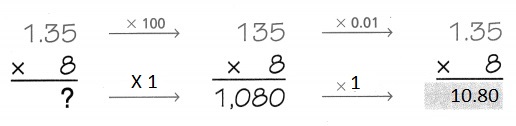
Having a thickness of 1.35 millimeters, the dime is the thinnest coin produced by
the United States Mint. If you stacked 8 dimes,
what would be the total thickness of the stack?
Multiply. 8 × 1.35
Step 1
Write the decimal factor as a whole number.
Think: 1.35 × 100 = 135

Step 2
Multiply as with whole numbers.

Step 3
Place the decimal point.
Think: 0.01 of 135 is 1.35. Find 0.01 of 1,080 and record the product.
Texas Go Math Grade 5 Lesson 3.3 Answer Key 18
A stack of 15 dimes would have a thickness of _10.80_ millimeters.
Answer:
8 X 1.35 = 10.80,
A stack of 15 dimes would have a thickness of 10.80 millimeters,

Explanation:
Given having a thickness of 1.35 millimeters, the dime is the thinnest coin produced by
the United States Mint. If you stacked 8 dimes,
The total thickness of the stack,
Step 1:
Writing the decimal factor as a whole number.
Think: 1.35 × 100 = 135

Step 2:
Multiply as with whole numbers.

Step 3:
Placing the decimal point.
Think: 0.01 of 135 is 1.35. Finding 0.01 of 1,080 and record the product.
Texas Go Math Grade 5 Lesson 3.3 Answer Key Multiplication with Decimals and Whole Numbers-2
Therefore a stack of 15 dimes would have a thickness of 10.80 millimeters.

Share and Show

Place the decimal point in the product.

Question 1.
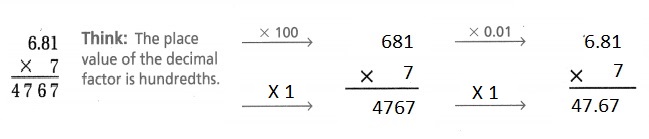
Texas Go Math Grade 5 Lesson 3.3 Answer Key 19
Answer:
6.81 X 7 = 47.67,

Explanation:
Texas Go Math Grade 5 Lesson 3.3 Answer Key Multiplication with Decimals and Whole Numbers-3

Go Math Grade 5 Lesson 3.3 Answer Key Question 2.
Texas Go Math Grade 5 Lesson 3.3 Answer Key 20
Answer:
3.7 X 2 =

Explanation:
Texas Go Math Grade 5 Lesson 3.3 Answer Key Multiplication with Decimals and Whole Numbers-4

Question 3.
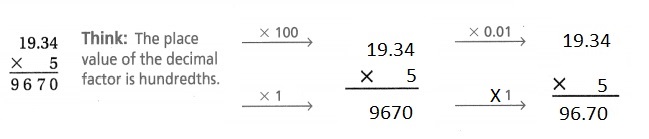
Texas Go Math Grade 5 Lesson 3.3 Answer Key 21
Answer:
19.34 X 5 = 96.70,

Explanation:
Texas Go Math Grade 5 Lesson 3.3 Answer Key Multiplication with Decimals and Whole Numbers-5

Find the product.

Question 4.
Texas Go Math Grade 5 Lesson 3.3 Answer Key 22
Answer:
6.32 X 3 =18.96,

Explanation:
Texas Go Math Grade 5 Lesson 3.3 Answer Key Multiplication with Decimals and Whole Numbers-7

Question 5.
Texas Go Math Grade 5 Lesson 3.3 Answer Key 23
Answer:
4.5 X 8 = 36.0,

Explanation:
Texas Go Math Grade 5 Lesson 3.3 Answer Key Multiplication with Decimals and Whole Numbers-9

Lesson 3.3 Answer Key Go Math Grade 5 Question 6.
Texas Go Math Grade 5 Lesson 3.3 Answer Key 24
Answer:
40.7 X 5 = 203.5

Explanation:
Texas Go Math Grade 5 Lesson 3.3 Answer Key Multiplication with Decimals and Whole Numbers-10
Math Talk
Mathematical Processes

Explain how you can determine if your answer to Exercise 6 is reasonable.
Answer:
40.7 X 5 = 203.5,
Texas Go Math Grade 5 Lesson 3.3 Answer Key 24
203.5

Explanation:
Step 1
Multiply the tenths by 5.
407
X 5
    5—->5 X 7 =35,

Step 2
Multiply the zero by 5.
407
X 5
3  —->5 X 0 = 0 + 3,

Step 3
Multiply the ten by 5
407
X 5
200 —->5 X 40 =200 ,

Step 4
Add the partial products.
407
X 5
000.50
003.00
200.00
203.50

Problem Solving

Practices Copy arid Solve Find the product.

Lesson 3.3 Answer Key 5th Grade Go Math  Question 7.
8 × 7.2
Answer:
8 X 7.2 = 57.6,

Explanation:
7.2
X 8
57.6
Step 1
Multiply the tenths by 8.
72
X 8
   6   —-> 8 X 2 = 16,

Step 2
Multiply the one by 8.
72
X 8
57 —->8 X 7 = 56 + 1,

Step 3
Add the partial products.
72
X 8
   .60
57.00
57.60

Multiplication with Decimals and Whole Numbers 2

Question 8.
3 × 1.45
Answer:
3 X 1.45 = 4.35,

Explanation:
1.45
X  3
4.35
Step 1
Multiply the hundredths by 3.
145
X 3
 15  —-> 3 X 5 = 15,

Step 2
Multiply the tenths by 3.
145
X 3
13—->3 X 4 = 12 + 1,

Step 3
Multiply the one by 3,
145
X 3
3 —->3 X 1 = 3,
Add the partial products.
145
X 3
0.05
1.30
3.00
4.35

Question 9.
9 × 8.6
Answer:
9 x 8.6 = 77.4,

Explanation:
8.6
X 9
77.4

Step 1
Multiply the tenths by 9.
86
X 9
 54  —-> 9 X 6 = 5.4,

Step 2
Multiply the one by 9.
86
X 9
72—->9 X 8 = 72,

Step 3:
Add the partial products.
86
X 9
05.4
72.0
77.4

Go Math Lesson 3.3 5th Grade Multiply Decimals Answer Key Question 10.
6 × 0.79
Answer:
6 X 0.79 = 4.74,

Explanation:
0.79
X  6
4.74
Step 1
Multiply the hundredths by 6.
0.79
X  6
  54  —-> 6 X 9 = 54,

Step 2
Multiply the tenths by 6.
0.79
X   6
42—-> 6 X 7 = 42,

Step 3
Multiply the one by 6,
0.79
X 6
0 —-> 6 X 0 = 0,
Add the partial products.
0.79
X  6
0.54
4.20
0.00
4.74

Question 11.
4 × 9.3
Answer:
4 X 9.3 = 37.2,

Explanation:
9.3
X  4
37.2
Step 1
Multiply the tenths by 4.
9.3
X 4
1.2—->4 X 3 = 1.2,

Step 2
Multiply the one by 4,
9.3
X 4
36 —->4 X 9 = 36,
Add the partial products.
145
X
01.20
36.00
37.20

Question 15.
H.O.T. Write Math Julie multiplies 6.27 by 7 and claims the product is 438.9.
Explain without multiplying how you know Julie’s answer is not correct.
Find the correct answer.
Answer:
Decimal point place value is incorrect,

Explanation:
Given Julie multiplies 6.27 by 7 and claims the product is 438.9,
without multiplying Julie’s answer is not correct because in 6.27
we have decimal point before hundredths,
So in 438.9 we have decimal point before tenths,
therefore Julie is incorrect.

Problem Solving

Use the table for 16-18.

Question 16.
Sari has a bag containing 6 half dollars. What is the mass of the half dollars in Sari’s bag?
Texas Go Math Grade 5 Lesson 3.3 Answer Key 25
Answer:

Go Math Lesson 3.3 5th Grade Answer Key Question 17.
Felicia is running a game booth at a carnival. One of the games requires
participants to guess the mass, in grams, of a bag of 9 dimes.
What Is the actual mass of the dimes in the bag?
Answer:
20.43 is the actual mass of the dimes in the bag,

Explanation:
Stated Felicia is running a game booth at a carnival. One of the games requires
participants to guess the mass, in grams, of a bag of 9 dimes.
So the actual mass of the dimes in the bag is 9 X 2.27 =
 2 6
2.27
X   9
20.43

Question 18.
Multi-Step Chance has $2 in quarters. Blake has $5 in dollar coins.
Whose coins have the greatest mass? Explain.
Texas Go Math Grade 5 Lesson 3.3 Answer Key 26
Answer:
Blake coins have the greatest mass,

Explanation:
Given Chance has $2 in quarters mass, Chance coins mass is
$2 X 5.67 grams = 11.34 grams,
Blake has $5 in dollar mass, So Blake has coins mass is
$5 X  8.1 grams= 40.5 grams, on comparing between Chance and Blake,
Blake coins have the greatest mass.

Daily Assessment Task

Fill in the bubble completely to show your answer.

Question 19.
Apply A hummingbird weighs 5.8 grams. If the hummingbird eats
8 times its body weight each day, how much does the bird eat in four days?
(A) 23.2 grams
(B) 46.4 grams
(C) 185 .6 grams
(D) 464 grams
Answer:
(C) 185 .6 grams,

Explanation:
Applying a hummingbird weighs 5.8 grams,
If the hummingbird eats 8 times its body weight each day,
the bird eat in each day is  5.8 grams X 8 = 46.4 grams,
In four days the bird will eat 4 X 46.4 grams = 185.6 grams,
which matches with (C).

Question 20.
Use Symbols Which expression shows how to use the
Distributive Property to find 5.17 X 9?
(A) 5.17 + 9
(B) 9 × (5.1) + 7
(C) 9 × (5.1 + 7)
(D) 9 × (5 + 0.17)
Answer:
(D) 9 × (5 + 0.17),

Explanation:
Using Symbols the expression that shows how to use the
Distributive Property to find 5.17 X 9 is first we write 5.17 as
(5 + 0.17) and applying distributive law we get 9  X (5 + 0.17)
matches with (D).

Lesson 3.3 Multiply Decimals by Whole Numbers Question 21.
Multi-Step The cost to park a car in a parking lot is $1.10 per hour.
Maleek parked his car for 4 hours on Monday 4 hours on Tuesday and
4 hours on Wednesday.
How much did he spend on parking in all?
(A) $4.10
(B) $4.40
(C) $13.10
(D) $13.20

Answer:
(D) $13.20,

Explanation:
The cost to park a car in a parking lot is $1.10 per hour.
Maleek parked his car for 4 hours on Monday, 4 hours on Tuesday and
4 hours on Wednesday, Number of hours from Monday, Tuesday and
Wednesday = 4 + 4 + 4 = 12 hours, Maleek spends on parking in all
is $1.10 X 12 = $13.20 matches with (D).

Texas Test Prep

Question 22.
Every day on his way to and from school, Milo walks a total of 3.65 miles.
If he walks to school 5 days, how many miles will Milo have walked?
(A) 1,825 miles
(B) 18.25 miles
(C) 182.5 miles
(D) 1.825 miles
Answer:
(B) 18.25 miles,

Explanation:
Given Every day on his way to and from school, Milo walks a total of 3.65 miles.
If he walks to school 5 days number of  miles Milo will have to walk is
5 X 3.65 miles =
3.65
X   5
0.025
03.00
15.00
18.25
(B) 18.25 miles.

Texas Go Math Grade 5 Lesson 3.3 Homework and Practice Answer Key

Find the product.

Question 1.
4 × 7.12
Answer:
4 X 7.12 = 28.48,

Explanation:
Given to find 4 X 7.12
7.12
X  4
00.08
00.40
28.00
28.48

Question 2.
3 × 0.29
Answer:
3 x 0.29 = 0.87,

Explanation:
0.29
X   3
0.27
0.60
0.87

Practice and Homework Lesson 3.3 Answer Key 5th Grade Question 3.
8 × 2.9
Answer:
8 X 2.9 = 23.20,

Explanation:
2.9
X 8
07.20
16.00
23.20

Question 4.
7 × 18.3
Answer:
7 X 18.3 = 128.1,

Explanation:
18.3
X   7
02.10
56.00
70.00
128.10

Multiplication with Decimals and Whole Numbers 4

Question 5.
5 × 9.26
Answer:
5 X 9.26 = 46.30,

Explanation:
9.26
X  5
00.30
01.00
45.00
46.30

Question 6.
2 × 42.1
Answer:
2 X 42.1 = 84.2,

Explanation:
42.1
X   2
00.20
04.00
80.00
84.20

Question 7.
7 × 0.34
Answer:
7 X 0.34 = 2.38,

Explanation:
0.34
X  7
0.28
2.10
0.00
2.38

Question 8.
9 × 7.21
Answer:
9 X 7.21 = 64.89,

Explanation:
7.21
X  9
00.09
01.80
63.00
64.89

Question 9.
4 × 5.2
Answer:
4 X 5.2 = 20.8,

Explanation:
5.2
X 4
00.8
20.0
20.8

Question 10.
7 × 17.2
Answer:
7 X 17.2 = 120.40,

Explanation:
17.2
X  7 
01.40
49.00
70.00
120.40

Question 11.
4 × 3.92
Answer:
4 X 3.92 = 15.68,

Explanation:
3.92
X  4
00.08
03.60
12.00
15.68

Question 12.
8 × 0.21
Answer:
8 X 0.21 = 1.68,

Explanation:
0.21
X  8
0.08
1.60
0.00
1.68

Go Math Grade 5 Lesson 3.3 Homework Answer Key Question 13.
Logan multiplies 5.31 by 3 and says the product is 159.3.
Explain why Logan’s answer is not correct.
Answer:
After the decimal point value we have hundredths but the product is tenth’s,
Logan is  incorrect,

Explanation:
As per Logan multiplies 5.31 by 3, we should get hundredths but
the product says it is tenths, therefore Logan is incorrect.

Problem-Solving

Question 14.
Minnie rides her bike 2.76 miles each day. How many miles will she bike in 7 days?
Answer:
19.32 rides her bike in 7 days,

Explanation:
Given Minnie rides her bike 2.76 miles each day,
The number of miles she biked in 7 days is
2.76
X  7 
00.42
04.90
14.00
19.32

Question 15.
Dominick buys a package of soup mix that is 1.38 ounces.
How many ounces are 6 packages of soup mix?
Answer:
Ounces in 6 packages of soup mix are 8.28 ounces,

Explanation:
We have Dominick buy a package of soup mix that is 1.38 ounces.
The number of ounces is 6 packages of soup mix is
1.38
X  6
0.48
1.80
6.00
8.28

Texas Test Prep

Lesson Check

Fill in the bubble completely to show your answer.

Question 16.
Sandra uses 6.39 ounces of beans in a recipe. If she triples the recipe,
how many ounces of beans will Sandra need?
(A) 17.29 ounces
(B) 18.83 ounces
(C) 19.17 ounces
(D) 20.19 ounces

Answer:
(C) 19.17 ounces,

Explanation:
Given Sandra uses 6.39 ounces of beans in a recipe.
If she triples the recipe the number of beans will Sandra need is
6.39
X  3
00.27
00.90
18.00
19.17 
matches with (C).

Question 17.
Kip uses the Distributive Property to rewrite an expression.
(4 × 3) + (4 × 0.7)
What is the value of the expression?
(A) 3.07
(B) 11.7
(C) 14.8
(D) 29.6
Answer:
(C) 14.8,

Explanation:
Given Kip uses the Distributive Property to rewrite an expression
(4 X 3) + (4 X 0.7) so the value of the expression is
(12) + (2.8) = 14.8 matches with (C).

Question 18.
Manny charges $1.25 for a cup of lemonade at the lemonade stand.
He sells 9 cups. How much money does Manny collect?
(A) $10.75
(B) $11.00
(C) $11.25
(D) $11.75
Answer:
(C) $11.25,

Explanation:
Given Manny charges $1.25 for a cup of lemonade at the lemonade stand,
He sells 9 cups. Manny collected
$1.25
X    9
0.45
1.80
9.00
11.25
which matches with (C).

Question 19.
Fabric costs $11.99 a yard. Leo buys 4 yards of red fabric and 3 yards of blue fabric.
How much does Leo spend on fabric?
(A) $47.96
(B) $35.97
(C) $77.33
(D) $83.93
Answer:
(D) $83.93,

Explanation:
Given Fabric costs $11.99 a yard,
Leo buys 4 yards of red fabric and 3 yards of blue fabric.
Leo spent on fabric costs
$11.99
X    7
000.63
006.30
007.00
070.00
$83.93,
matches with (D).

Question 20.
Multi-Step On the first day of summer, a rainstorm brought 2.29 Inches of rain to the area.
During the rest of the summer, there was 3 times as much rain as on the first day.
What was the total number of inches of rainfall for the summer?
(A) 6.29 inches
(B) 5.67 inches
(C) 6.87 Inches
(D) 9.16 inches
Answer:
(C) 6.87 Inches,

Explanation:
On the first day of summer a rainstorm brought 2.29 Inches of rain to the area.
During the rest of the summer, there was 3 times as much rain as on the first day.
The total number of Inches of rainfall for the summer is
2.29
X  3
0.27
0.60
6.00
6.87 inches matches with (C).

Question 21.
Multi-Step Nicky bought 14.2 pounds of coffee for the coffee shop. The shop usually uses 5 times that amount of coffee in one week. How much more coffee will Nicky need to purchase to get the right amount of coffee for the week?
(A) 71 pounds
(B) 56.8 pounds
(C) 85.2 pounds
(D) 50 pounds
Answer:
(A) 71 pounds,

Explanation:
Nicky bought 14.2 pounds of coffee from the coffee shop.
The shop usually uses 5 times that amount of coffee in one week.
More coffee will Nicky need to purchase to get the right amount of coffee for the week
is 14.2
X     5
01.0
20.0
50.0
71.0 pounds matches with (A).

Texas Go Math Grade 5 Lesson 3.3 Answer Key Multiplication with Decimals and Whole Numbers Read More »

Texas Go Math Grade 1 Lesson 4.4 Answer Key Add Zero

Refer to our Texas Go Math Grade 1 Answer Key Pdf to score good marks in the exams. Test yourself by practicing the problems from Texas Go Math Grade 1 Lesson 4.4 Answer Key Add Zero.

Texas Go Math Grade 1 Lesson 4.4 Answer Key Add Zero

Essential Question
What happens when you add 0 to a number?
Explanation:
Identity Law of Addition states that any number added to 0 is equal to itself.
Therefore, you can add any number and get the same sum

Explore
Use Texas Go Math Grade 1 Lesson 4.4 Answer Key 1 to model the problem. Draw the Texas Go Math Grade 1 Lesson 4.4 Answer Key 1 you use.
Answer:

Explanation:
Scott has 4 marbles.
Jennifer has no marbles.
4 + 0 = 4
4  marbles that they have

For The Teacher

  • Read the following problem. Scott has 4 marbles. Jennifer has no marbles. How many marbles do they have?
    Answer:

    Explanation:
    Scott has 4 marbles.
    Jennifer has no marbles.
    4 + 0 = 4
    4  marbles that they have

Math Talk
Mathematical Processes
Explain your drawing.
Explanation:
Identity Law of Addition states that any number added to 0 is equal to itself.
Therefore, you can add any number and get the same sum

Add Zero 1

Model and Draw

What happens when zero is added to a number?
Texas Go Math Grade 1 Lesson 4.4 Answer Key 2
Answer:

Explanation:
When a 0 is added to a number the answer will be itself

Share and Show

Use the picture to write each part. Write the sum

Question 1.
Texas Go Math Grade 1 Lesson 4.4 Answer Key 3
Answer:

1 + 0 = 0
Explanation:
When a 0 is added to a number the answer will be itself

Question 2.
Texas Go Math Grade 1 Lesson 4.4 Answer Key 4
Answer:

Explanation:
When a 0 is added to a number the answer will be itself

Question 3.
Texas Go Math Grade 1 Lesson 4.4 Answer Key 5
Answer:

Explanation:
When a 0 is added to a number the answer will be itself

Question 4.
Texas Go Math Grade 1 Lesson 4.4 Answer Key 6
Answer:

Explanation:
When a 0 is added to a number the answer will be itself

Problem Solving

Draw circles to show the numbers. Write the sum.

Question 5.

3 + 0 = ___
Answer:
3 + 0 = 3
Explanation:
When a 0 is added to a number the answer will be itself

Question 6.

1 + 4 = ___
Answer:
1 + 4 = 4
Explanation:
The sum of 1 and 4 is 5

Add Zero 2

Question 7.

4 + 0 = ___
Answer:
4 + 0 = 4
Explanation:
When a 0 is added to a number the answer will be itself

Write or draw to solve.

Question 8.
There are 3 dogs on the path. No more dogs join them. How many dogs are on the path?
Texas Go Math Grade 1 Lesson 4.4 Answer Key 7
Answer:

Explanation:
When a 0 is added to a number the answer will be itself

Question 9.
H.O.T. Multi-Step Maya has 7 books. Eli has no books. Then Maya gives 7 books to Eli. How many books does Maya have?
Texas Go Math Grade 1 Lesson 4.4 Answer Key 8
Answer:

Explanation:
0 books that Maya have
7 + 0 = 7

Question 10.
There are 5 red birds. There are 3 green birds. How many birds are blue?
Texas Go Math Grade 1 Lesson 4.4 Answer Key 9
Answer:

Explanation:
3 + 5 = 8
8 + 0 = 8
0 birds are blue.

Question 11.
One chicken has 0 eggs in her nest. Another chicken has 7 eggs in her nest. How many eggs do the chickens have?
(A) 7
(B) 6
(C) 9
Answer: A
Explanation:
0 + 7 = 7
7 eggs that the chickens have

Question 2.
Molly has 4 seahorses in her fish tank. She has 0 fish. Which number sentence shows the number of fish and seahorses she has?
Texas Go Math Grade 1 Lesson 4.4 Answer Key 10
(A) 4 + 1 = 5
(B) 4 + 0 = 4
(C) 4 + 2 = 6
Answer: A
Explanation:
4 + 0 = 4
Is the number sentence that shows the number of fish and seahorses she has

Question 13.
Analyze Jody has 6 rocks in her fish tank. 6 rocks are red. How many blue rocks does Jody have in her fish tank?
(A) 0
(B) 6
(C) 8
Answer: A
Explanation:
0 + 6 = 6
0 blue rocks that Jody have in her fish tank

Question 14.
Texas Test Prep What is the sum of 0 + 6?
(A) 0
(B) 7
(C) 6
Answer: C
Explanation:
the sum of 0 and 7 is 7

Take Home Activity

  • Write the numbers 0 to 9 on small squares of paper. Shuffle and place the cards facedown. Have your child turn the top card, and add zero to that number. Say the sum. Repeat the activity for each card.
    Explanation:
    1 + 0 = 1
    2 + 0 = 2
    3 + 0 = 3
    4 + 0 = 4
    5 + 0 = 5 as on

Texas Go Math Grade 1 Lesson 4.4 Homework and Practice Answer Key

Add Zero

Write or draw to solve.

Question 1.

6 + 0 = ___
Answer:
6 + 0 = 6
Explanation:
When a 0 is added to a number the answer will be itself

Question 2.

1 + 5 = ___
Answer:
1 + 5 = 6
Explanation:
The sum of 1 and 5 is 6

Question 3.

3 + 0 = ___
Answer:
3 + 0 = 3
Explanation:
When a 0 is added to a number the answer will be itself

Problem Solving

Question 4.
There are 5 children playing a game. No more children join them. How many children are playing the game?
___ children
Answer:
5 children
Explanation:
5 + 0 = 5
5 children are playing the game

Question 5.
Multi-Step Taylor draws 8 pictures. Dylan draws no pictures. How many pictures do they draw?
____ pictures
Then Taylor gives 8 pictures to Dylan. How many pictures does Taylor have?
____ pictures
Answer:
8 + 0 = 8
Taylor has 8
0 + 8 = 8
Dylan has 8
Explanation:
Taylor draws 8 pictures. Dylan draws no pictures.
In this case Taylor has 8
Then Taylor gives 8 pictures to Dylan.
In this case Dylan has 8

Texas Test Prep

Lesson Check

Choose the correct answer.

Question 6.
One bike rack has 0 bikes. Another bike rack has 9 bikes. How many bikes are in bike racks?
(A) 9
(B) 0
(C) 10
Answer: A
Explanation:
0 + 9 = 9
9 bikes are in bike racks

Question 7.
Leah has 3 red hats. She has 0 blue hats. Which number sentence shows the number of hats she has?
(A) 3 + 2 = 5
(B) 3 + 0 = 3
(C) 3 + 1 = 4
Answer: B
Explanation:
3 + 0 = 3
Is the number sentence that  shows the number of hats she has

Question 8.
What is the sum of 0 + 7?
(A) 0
(B) 9
(C) 7
Answer: 7
Explanation:
0 + 7 = 7
When a 0 is added to a number the answer will be itself

Question 9.
Multi-Step Cooper has 5 soccer balls and 0 basketballs. Liam has 2 soccer balls and basketballs. How many balls do they have?
Texas Go Math Grade 1 Lesson 4.4 Answer Key 11
(A) 7
(B) 11
(C) 9
Answer: A
Explanation:
5 + 2 = 7
7 balls that  they have

Texas Go Math Grade 1 Lesson 4.4 Answer Key Add Zero Read More »

Texas Go Math Grade 3 Lesson 8.4 Answer Key Multiply with 8

Refer to our Texas Go Math Grade 3 Answer Key Pdf to score good marks in the exams. Test yourself by practicing the problems from Texas Go Math Grade 3 Lesson 8.4 Answer Key Multiply with 8.

Texas Go Math Grade 3 Lesson 8.4 Answer Key Multiply with 8

Essential Question
What strategies can you use to multiply with 8?

Unlock the Problem
A scorpion has 8 legs. How many legs do 5 scorpions have?

• How many legs does one scorpion have?
Answer:
8 legs one scorpion have.

Explanation:
Number of legs one scorpion have = 8.


• What are you asked to find?
Answer:
How many legs do 5 scorpions have?

Explanation:
A scorpion has 8 legs. How many legs do 5 scorpions have?

Find 5 × 8.
One Way
Use doubles.
Texas Go Math Grade 3 Lesson 8.4 Answer Key 1
Think: The factor 8 is an even number. 4 + 4 = 8
5 × 4 = ___
20 doubled is __.
5 × 8 = __
So, 5 scorpions have ___ legs.
Texas Go Math Grade 3 Lesson 8.4 Answer Key 2

Another Way
Use a number line.

Multiply with 8 2

Use the number line to show 5 jumps of 8.
Texas Go Math Grade 3 Lesson 8.4 Answer Key 3

• Describe two different ways you can use doubles to find 6 × 8.

Error Alert
Be sure to count the spaces between the tick marks, not the tick marks.

Example
Use the Associative Property of Multiplication.
Scorpions have two eyes on the top of the head, and usually two to five pairs along the front corners of the head. If each scorpion has 6 eyes, how many eyes would 8 scorpions have?
Texas Go Math Grade 3 Lesson 8.4 Answer Key 4

Math Talk
Mathematical Processes
When you multiply with 8, will the product always be even? Explain.

Share and Show
Question 1.
Explain one way you can find 4 × 8.
Answer:
4 × 8 = (4 × 4) × 2 = 32.

Explanation:
4 × 8 = 4 × (4 × 2)
= (4 × 4) × 2
= 16 × 2
= 16 + 16
= 32.

Multiply with 8 1

Find the product.

Question 2.
3 × 8 = __
Answer:
3 × 8 = 24.

Explanation:
3 × 8 = 3 × (4 × 2)
= (3 × 4) × 2
= 12 × 2
= 12 + 12
= 24.


Go Math Grade 3 Lesson 8.4 Answer Key Question 3.
__ = 8 × 2
Answer:
8 × 2 = 16.

Explanation:
8 × 2 = (4 × 2) × 2
= 4 × (2 × 2)
= 4 × 4
= 16.


Question 4.
__ = 7 × 8
Answer:
7 × 8 = 56.

Explanation:
7 × 8 = 7 × (4 × 2)
= (7 × 4) × 2
= 28 × 2
= 28 + 28
= 56.


Question 5.
9 × 8 = __
Answer:
9 × 8 = 72.

Explanation:
9 × 8 = 9 × (4 × 2)
= (9 × 4) × 2
= 36 × 2
= 36 + 36
= 72.


Question 6.
__ = 6 × 8
Answer:
6 × 8 = 48.

Explanation:
6 × 8 = 6 × (4 × 2)
= (6 × 4) × 2
= 24 × 2
= 24 + 24
= 48.


Question 7.
10 × 8 = __
Answer:
10 × 8 = 80.

Explanation:
10 × 8 = 10 × (4 × 2)
= (10 × 4) × 2
= 40 × 2
= 40 + 40
= 80.


Question 8.
___ = 8 × 3
Answer:
8 × 3 = 24.

Explanation:
8 × 3 = (2 × 4) × 3
= (3 × 4) × 2
= 12 × 2
= 12 + 12
= 24.


Go Math Lesson 8.4 Answer Key Grade 3 Question 9.
0 × 8 = ___
Answer:
0 × 8 = 0.

Explanation:
0 × 8 = 0 × (4 × 2)
= (0 × 4) × 2
= 0 × 2
= 0 + 0
= 0.


Problem Solving
H.O.T. Algebra Complete the table.

Texas Go Math Grade 3 Lesson 8.4 Answer Key 5

Texas Go Math Grade 3 Lesson 8.4 Answer Key 6

Texas Go Math Grade 3 Lesson 8.4 Answer Key 7
Answer:
Texas-Go-Math-Grade-3-Lesson-8.4-Answer-Key-Multiply-with-8-Problem Solving-H.O.T.- Algebra Complete the table

Explanation:
Multiply by 4:
10. 8 × 4 = 32.
11. 5 × 4 = 20.
12. 10 × 4 = 40.
Multiply by 8:
13. 4 × 8 = 4 × (4 × 2)
= (4 × 4) × 2
= 16 × 2
= 16 + 16
= 32.
14. 2 × 8 = 2 × (4 × 2)
= 2 × 8
= 8 + 8
= 16.
15. 7 × 8 = 7 × (4 × 2)
= (7 × 4) × 2
= 28 × 2
= 28 + 28
= 56.
16. Multiply by ??:
3 × ?? = 9
=> ?? = 9 ÷ 3
=> ?? = 3.
6 × 3 = 18.
17. 10 × 3 = 30.


Problem Solving
Use the table for 18-21.
Question 18.
About how much rain falls in the Chihuahuan Desert in 6 years? Explain how you can use doubles to find the answer.
Texas-Go-Math-Grade-3-Lesson-8.4-Answer-Key-Multiply-with-8-Problem Solving-H.O.T.- Algebra Complete the table..
Answer:
Number of inches of rainfall in Chihuahuan Desert in a 6 years = 48.

Explanation:
Number of inches of rainfall in Chihuahuan Desert in a year = 8.
Number of inches of rainfall in Chihuahuan Desert in a 6 years = 6 × Number of inches of rainfall in Chihuahuan Desert in a year
= 6 × 8
= 6 × (4 × 2)
= (6 × 4) × 2
= 24 × 2
= 24 + 24
= 48.

3rd Grade Go Math Lesson 8.4 Answer Key Question 19.
Multi-Step Predict In 2 years, about how many more inches of rain will fall in the Sonoran Desert than in the Chihuahuan Desert? Explain.
Answer:
2 more inches of rain will fall in the Sonoran Desert than in the Chihuahuan Desert.

Explanation:
Number of inches of rainfall in the Sonoran Desert in a year = 9.
Number of inches of rainfall in Sonoran Desert in 2 years = 2 × Number of inches of rainfall in Sonoran Desert in a year
= 2 × 9
= 9 + 9
= 18.
Number of inches of rainfall in the Chihuahuan Desert in a year = 8.
Number of inches of rainfall in Chihuahuan Desert in 2 years = 2 × Number of inches of rainfall in Chihuahuan Desert in a year
= 2 × 8
= 2 × (4 × 2)
= (2× 4) × 2
= 8 × 2
= 8 + 8
= 16.
Difference:
Number of inches of rainfall in Sonoran Desert in a 2 years – Number of inches of rainfall in Chihuahuan Desert in a 2 years
= 18 – 16
= 2.

Texas-Go-Math-Grade-3-Lesson-8.4-Answer-Key-Multiply-with-8-Problem Solving-H.O.T.- Algebra Complete the table..

Question 20.
Write Math Pose a Problem Look back at Problem 19. Write and show how to solve a similar problem by comparing two different deserts.
Answer:
Question:
Predict In 2 years, about how many more inches of rain will fall in the great basin Desert than in the Mojave Desert? Explain.
Solution:
10 more inches of rain will fall in the great basin Desert than in the Mojave Desert.

Explanation:
Number of inches of rainfall in great basin Desert in a year = 9.
Number of inches of rainfall in great basin Desert in a 2 years = 2 × Number of inches of rainfall in great basin Desert in a year
= 2 × 9
= 9 + 9
= 18.
Number of inches of rainfall in Mojave Desert in a year = 4.
Number of inches of rainfall in Mojave Desert in a 2 years = 2 × Number of inches of rainfall in Mojave Desert in a year
= 2 × 4
= 4 + 4
= 8.
Difference:
Number of inches of rainfall in great basin Desert in a 2 years – Number of inches of rainfall in Mojave Desert in a 2 years
= 18 – 8
= 10.

Question 21.
H.O.T. What strategy can you use to find about how many inches of rain will fall in the Mohave Desert in 20 years?
Texas Go Math Grade 3 Lesson 8.4 Answer Key 8
Answer:
The Associative Property of Multiplication strategy can be used to find about how many inches of rain will fall in the Mohave Desert in 20 years.
Number of inches of rainfall in Mojave Desert in a 20 years = 80.

Explanation:
Number of inches of rainfall in Mojave Desert in a year = 4.
Number of inches of rainfall in Mojave Desert in a 20 years = 20 × Number of inches of rainfall in Mojave Desert in a year
= 20 × 4
= (2 × 10) × 4
= 2 × (10 × 4)
= 2 × 40
= 40 + 40
= 80.


Go Math Lesson 8.4 3rd Grade Answer Key Question 22.
Scorpions have 8 legs for walking and 2 long, claw-like pincers used to hold their food. What multiplication sentences can help you find how many pincers and legs 8 scorpions have?
Answer:
Total number of pincers and legs 8 scorpions have = 10.

Explanation:
Number of legs for walking Scorpions have = 8.
Number of long claw-like pincers Scorpions have = 2.
Total number of pincers and legs 8 scorpions have = Number of legs for walking Scorpions have + Number of long claw-like pincers Scorpions have
= 8 + 2
= 10.


Daily Assessment Task
Fill in the bubble for the correct answer choice.
Question 23.
Maddy is inventing a new kind of soap. Her soaps come in 7 different shapes. She makes 8 bars in each shape. How many bars of soap does Maddy make?
(A) 49
(B) 15
(C) 56
(D) 64
Answer:
Number of bars of soap Maddy makes = 56.
(C) 56.

Explanation:
The number of different shapes Her soaps came = 7.
Number of bars she makes in each shape = 8.
Number of bars of soap Maddy makes = Number of different shapes Her soaps came × Number of bars she makes in each shape
= 7 × 8
= 7 × (4 × 2)
= (7 × 4) × 2
= 28 × 2
= 28 + 28
= 56.


Question 24.
There are 3 spiders in a glass case. Each spider has 8 legs. How many legs do the 3 spiders have?
(A) 24
(B) 18
(C) 38
(D) 9
Answer:
Number of legs the 3 spiders have = 24.
(A) 24.

Explanation:
Number of spiders in a glass case = 3.
Number of legs each spider has = 8.
Number of legs the 3 spiders have = Number of spiders in a glass case × Number of legs each spider has
= 3 × 8
= 3 × (4 × 2)
= (3 × 4) × 2
= 12 × 2
= 12 + 12
= 24.


Question 25.
Multi-Step The table shows the number of markers in each pack. Ms. Wilson buys 5 packs of bright markers and 5 packs of glitter markers. How many more bright markers does she buy than glitter markers?
Texas Go Math Grade 3 Lesson 8.4 Answer Key 9
(A) 50
(B) 30
(C) 40
(D) 10
Answer:
30 more bright markers she buys than glitter markers.
(B) 30.

Explanation:
Number of packs of bright markers Ms. Wilson buys = 5.
Number of bright markers in a pack = 8.
Total number of bright markers in all packs Ms. Wilson buys = Number of packs of bright markers Ms. Wilson buys × Number of bright markers in a pack
= 5 × 8
= 5 × (4 × 2)
= (5 × 4) × 2
= 20 × 2
= 20 + 20
= 40.
Number of packs of glitter markers Ms. Wilson buys = 5.
Number of glitter markers  in a pack = 2.
Total number of glitter markers in all packs Ms. Wilson buys = Number of packs of glitter markers Ms. Wilson buys × Number of glitter markers in a pack
= 5 × 2
= 5 + 5
= 10.
Difference:
Total number of bright markers in all packs Ms. Wilson buys – Total number of glitter markers in all packs Ms. Wilson buys
= 40 – 10
= 30.


Texas Test Prep
Question 26.
A black widow spider has 8 legs. How many legs do 4 black widow spiders have?
(A) 12
(B) 24
(C) 4
(D) 32
Answer:
Number of legs 4 black widow spiders have = 32.
(D) 32.

Explanation:
Number of legs a black widow spider has = 8.
Number of  black widow spider = 4.
Number of legs 4 black widow spiders have = Number of legs a black widow spider has × Number of  black widow spider
= 8 × 4
= (2 × 4) × 4
= 2 × (4 × 4)
= 2 × 16
= 16 + 16
= 32.


Texas Go Math Grade 3 Lesson 8.4 Homework and Practice Answer Key

Complete the table.

Texas Go Math Grade 3 Lesson 8.4 Answer Key 10

Texas Go Math Grade 3 Lesson 8.4 Answer Key 11

Texas Go Math Grade 3 Lesson 8.4 Answer Key 12
Answer:
Texas-Go-Math-Grade-3-Lesson-8.4-Answer-Key-Multiply-with-8-Texas Go Math Grade 3 Lesson 8.4 Homework and Practice Answer Key-Complete the table

Explanation:
Multiply by 4:
1. 6 × 4 = 6 × (2 × 2)
= (6 × 2) × 2
= 12 × 2
= 12 + 12
= 24.
2. 9 × 4 = 9 × (2 × 2)
= (9 × 2) × 2
= 18 × 2
= 18 + 18
= 36.
3. 7 × 4 = 7 × (2 × 2)
= (7 × 2) × 2
= 14 × 2
= 14 + 14
= 28.
Multiply by 8:
5. 5 × 8 = 5 × (4 × 2)
= (5 × 4) × 2
= 20 × 2
= 20 + 20
= 40.
6. 7 × 8 = 7 × (4 × 2)
= (7 × 4) × 2
= 28 × 2
= 28 + 28
= 56.
7. 8 × 8 = 8 × (4 × 2)
= (8 × 4) × 2
= 32 × 2
= 32 + 32
= 64.
Multiply by 5:
8. 6 × 5 = (2 × 3) × 5
= 2 × (3 × 5)
= 2 × 15
= 15 + 15
= 30.
9. 3 × 5 = 15.
10. 10 × 5 = (2 × 5) × 5
= 2 × (5 × 5)
= 2 × 25
= 25 + 25
= 50.


Problem Solving
Use the table for 10-12.
Question 10.
Jill is making 4 batches of punch. Write multiplication sentences to show how many total cups of strawberries and crushed ice Jill needs.
Texas Go Math Grade 3 Lesson 8.4 Answer Key 13
Answer:
Total number of cups of strawberries and crushed ice Jill needs = 36.

Explanation:
Number of batches of punch Jill is making = 4.
Number of cups of strawberries = 3.
Number of cups of crushed ice = 6.
Total number of cups of strawberries and crushed ice Jill needs = Number of batches of punch Jill is making (Number of cups of strawberries + Number of cups of crushed ice)
= 4 × (3 + 6)
= 4 × 9
= 36.


Go Math Practice and Homework Lesson 8.4 Answer Key Question 11.
How many cups of apple juice will Jill need to make 8 batches of punch? Explain how you can use doubles to find the answer.
Answer:
Number of cups of apple juice Jill needs to make 8 batches of punch = 64.

Explanation:
Number of cups of apple juice = 8.
Number of batches of punch Jill is making = 8.
Number of cups of apple juice Jill needs to make 8 batches of punch = Number of cups of apple juice × Number of batches of punch Jill is making
= 8 × 8
= 8 × (4 × 2)
= (8 × 4) × 2
= 32 × 2
= 32 + 32
= 64.


Question 12.
Webb wants to make 7 batches of punch. What strategy can you use to find how many cups of crushed ice he will need?
Answer:
The Associative Property of Multiplication strategy can be used to find how many cups of crushed ice he needs.
Number of cups of crushed ice Jill needs to make 7 batches of punch = 42.

Explanation:
Number of cups of crushed ice = 6.
Number of batches of punch Jill is making = 7.
Number of cups of crushed ice Jill needs to make 7 batches of punch = Number of cups of crushed ice × Number of batches of punch Jill is making
= 6 × 7
= (2 × 3) × 7
= 2 × (3 × 7)
= 2 × 21
= 21 + 21
= 42.


Texas Test Prep
Lesson Check
Question 13.
A florist is making 8 bouquets of flowers. She needs 7 roses for each bouquet. How many roses does the florist need?
(A) 64
(B) 48
(C) 56
(D) 28
Answer:
Number of roses the florist needs = 56.
(C) 56.

Explanation:
Number of roses for each bouquet she needs = 7.
Number of bouquets of flowers a florist is making = 8.
Number of roses the florist needs = Number of roses for each bouquet she needs × Number of bouquets of flowers a florist is making
= 7 × 8
= 7 × (4 × 2)
= (7 × 4) × 2
= 28 × 2
= 28 + 28
= 56.


Question 14.
Elena has a bookshelf with 4 shelves. There are 8 books on each shelf. How many books does Elena have?
(A) 48
(B) 32
(C) 40
(D) 36
Answer:
Number of books Elena have = 32.
(B) 32.

Explanation:
Number of shelves Elena has a bookshelf = 4.
Number of books on each shelf = 8.
Number of books Elena have = Number of shelves Elena has a bookshelf × Number of books on each shelf
= 4 × 8
= 4 × (4 × 2)
= (4 × 4) × 2
= 16 × 2
= 16 + 16
= 32.


Question 15.
A toy store sells train sets. Each set has 9 railroad cars in it. If the store sells 8 train sets in one day, how many railroad cars are sold?
(A) 64
(B) 89
(C) 72
(D) 81
Answer:
Number of railroad cars are sold = 72.
(C) 72.

Explanation:
Number of railroad cars each set has = 9.
Number of train sets in one day the store sells = 8.
Number of railroad cars are sold = Number of railroad cars each set has × Number of train sets in one day the store sells
= 9 × 8
= 9 × (4 × 2)
= (9 × 4) × 2
= 36 × 2
= 36 + 36
= 72.


Question 16.
A chef is making 5 batches of potato salad. He needs 8 cups of dressing for each salad. How many cups of dressing does he need?
(A) 58 cups
(B) 45 cups
(C) 40 cups
(D) 13 cups
Answer:
Number of cups of dressing does he needs = 40.
(C) 40 cups.

Explanation:
Number of batches of potato salad a chef is making = 5.
Number of cups of dressing for each salad he needs = 8.
Number of cups of dressing does he needs = Number of batches of potato salad a chef is making × Number of cups of dressing for each salad he needs
= 5 × 8
= 5 × (4 × 2)
= (5 × 4) × 2
= 20 × 2
= 20 + 20
= 40.


Go Math 3rd Grade Lesson 8.4 Homework Answer Key Question 17.
Multi-Step Giselle buys 3 packs of baseball cards and 6 packs of soccer cards. Each pack has 8 cards in it. How many cards does Giselle buy?
(A) 18
(B) 48
(C) 24
(D) 72
Answer:
Number of cards Giselle buys = 72.
(D) 72.

Explanation:
Number of packs of baseball cards Giselle buys = 3.
Number of packs of soccer cards Giselle buys = 6.
Number of cards each pack has = 8.
Number of cards Giselle buys = (Number of packs of baseball cards Giselle buys + Number of packs of soccer cards Giselle buys) × Number of cards each pack has
= (3 + 6) × 8
= 9 × (4 × 2)
= (9 × 4) × 2
= 36 × 2
= 36 + 36
= 72.


Question 18.
Multi-Step Jamal buys 4 sets of animal postcards and 5 sets of nature postcards. Each set has 6 cards. How many postcards does Jamal buy?
(A) 30
(B) 56
(C) 54
(D) 64
Answer:
Number of postcards Jamal buys = 54.
(C) 54.

Explanation:
Number of sets of animal postcards Jamal buys = 4.
Number of sets of nature postcards Jamal buys = 5.
Number of cards in each set = 6.
Number of postcards Jamal buys = (Number of sets of animal postcards Jamal buys + Number of sets of nature postcards Jamal buys) × Number of cards in each set
= (4 + 5) × 6
= 9 × (3 × 2)
= (9 × 3) × 2
= 27 × 2
= 27 + 27
= 54.

Texas Go Math Grade 3 Lesson 8.4 Answer Key Multiply with 8 Read More »

Texas Go Math Grade 7 Lesson 2.2 Answer Key Constant Rates of Change

Refer to our Texas Go Math Grade 7 Answer Key Pdf to score good marks in the exams. Test yourself by practicing the problems from Texas Go Math Grade 7 Lesson 2.2 Answer Key Constant Rates of Change.

Texas Go Math Grade 7 Lesson 2.2 Answer Key Constant Rates of Change

Texas Go Math Grade 7 Lesson 2.2 Explore Activity Answer Key

A giant tortoise moves at a slow but steady pace. It takes the giant tortoise 3 seconds to travel 10.5 inches.
Texas Go Math Grade 7 Lesson 2.2 Answer Key 1

A. Use the bar diagram to help you determine how many inches a tortoise travels in 1 second. What operation did you use to find the answer?
Texas Go Math Grade 7 Lesson 2.2 Answer Key 2

B. Complete the table.
Texas Go Math Grade 7 Lesson 2.2 Answer Key 3

C. For each column of the table, find the distance and the time. Write each fraction as a decimal. Put distance in the numerator and time in the denominator.
Texas Go Math Grade 7 Lesson 2.2 Answer Key 4

D. What do you notice about the decimal forms of the fractions?

E. Conjecture How do you think the distance a tortoise travels is related to the time?

Reflect

Question 1.
Suppose the tortoise travels for 12 seconds. Explain how you could find the distance the tortoise travels.
Answer:
We could simply multiply the tortoise unit rate of inches per second by 12.

Go Math Grade 7 Pdf Lesson 2.2 Constant Rate of Change Answer Key Question 2.
How would you describe the rate of speed at which a tortoise travels?
Answer:
We would describe it with a rate of inches per second.

Your Turn

Question 3.
The table shows the distance Allison drove on one day of her vacation. Is the relationship between the distance and the time a proportional relationship? Did she drive at a constant speed? Explain.
Texas Go Math Grade 7 Lesson 2.2 Answer Key 5
Answer:
Write the rates.
Texas Go Math Grade 7 Lesson 2.2 Answer Key 12
We can stop here, and see that the rates are different. Thus, she did not drive at a constant speed.

Question 4.
For a school field trip, there must be 1 adult to accompany 12 students, 3 adults to accompany 36 students, and 5 adults to accompany 60 students. Show that the relationship between the number of adults and the number of students is a proportional relationship. Then write an equation for the relationship.
Texas Go Math Grade 7 Lesson 2.2 Answer Key 6
Answer:
Write the rates.
Texas Go Math Grade 7 Lesson 2.2 Answer Key 13
The rates are equaL They are constant so the relationship is proportional
Let x represent the number of students.
Let y represent the number of adults.
The equation for the relationship is:
y = \(\frac{x}{12}\)

Texas Go Math Grade 7 Lesson 2.2 Guided Practice Answer Key

Question 1.
Based on the information in the table, is the relationship between time and the number of words typed a proportional relationship? (Explore Activity and Example 1)
Texas Go Math Grade 7 Lesson 2.2 Answer Key 7
Answer:
Texas Go Math Grade 7 Lesson 2.2 Answer Key 14
The relationship is proportional.

Constant Rates of Change 3

Find the constant of proportionality k. Then write an equation for the relationship between x and y. (Example 2)

Question 2.
Texas Go Math Grade 7 Lesson 2.2 Answer Key 8
Answer:
\(\frac{y}{x}\) : = \(\frac{10}{2}\) = 5 ; \(\frac{30}{6}\) = 5 ; \(\frac{40}{8}\) = 5
k = 5
Equation: y = 5x
k = 5, y = 5x

Go Math Answer Key Grade 7 Lesson 2.2 Question 3.
Texas Go Math Grade 7 Lesson 2.2 Answer Key 9
Answer:
\(\frac{x}{y}\) : = \(\frac{8}{2}\) = 4 ; \(\frac{16}{4}\) = 4 ; \(\frac{24}{6}\) = 4 ; \(\frac{32}{8}\) = 4
k = 4
Equation: x = 4y
k = 4, x = 4y

Constant Rates of Change 2

Essential Question Check-In

Question 4.
How can you represent a proportional relationship using an equation?
Answer:
We represent the proportional relationship using a constant that is a ratio of two variables.

Texas Go Math Grade 7 Lesson 2.2 Independent Practice Answer Key

Information on three car-rental companies is given.
Texas Go Math Grade 7 Lesson 2.2 Answer Key 10
Question 5.
Write an equation that gives the cost y of renting a car for x days from Rent-All. _______________
Answer:
Texas Go Math Grade 7 Lesson 2.2 Answer Key 15
y = 18.5x

Question 6.
What is the cost per day of renting a car from A-1? ___________
Answer:
If the cost for half a day is equal to $10.99, then the cost per day is 2 times greater:
$10.99 × 2 = $21.98 per day

Constant Rate of Change Answer Key Go Math Grade 7 Lesson 2.2 Question 7.
Analyze Relationships Which company offers the best deal? Why?
Answer:
Rent-all offers the best deal, because it’s price of car rental per day is the lowest.

Question 8.
Critique Reasoning A skydiver jumps out of an airplane. After 0.8 seconds, she has fallen 100 feet. After 3.1 seconds, she had fallen 500 feet. Imtiaz says that the skydiver should fall about 187.5 feet in 1.5 seconds. Is his answer reasonable? Explain.
Answer:
\(\frac{\text { Distance(feet) }}{\text { Time(seconds) }}: \frac{100}{0.8}=125 \quad \frac{500}{3.1}=161.3 \quad \frac{187.5}{1.5}=125\)
Emtiaz’s answer is not reasonable because the longer the skydiver falls, the faster he should be. So, he should have taken into consideration a constant somewhere between first and second, not the first.

Steven earns extra money babysitting. He charges $31.25 for 5 hours and $50 for 8 hours.

Question 9.
Explain why the relationship between how much Steven charges and time is a proportional relationship.
Answer:
\(\frac{\text { Price }(\$)}{\text { Time(hours) }}: \quad \frac{31.25}{5}=6.25 \quad \frac{50}{8}=6.25\)
The relationship is proportional because the price per hour in both cases is equal.

Question 10.
Interpret the Answer Explain what the constant rate of change means in the context.
Answer:
The constant rate of change represents the price per hour.

Go Math Grade 5 Lesson 2.2 Answer Key Constant Rate of Change Question 11.
Write an equation to represent the relationship. Tell what the variables represent.
Answer:
x = Time (hours)
y = Price ($)
y = 6.25x

Question 12.
How much would Steven charge for 3 hours?
Answer:
Multiply unit rate of price per hour by 3:
3 × 6.25 = $18.75
Steven would charge $18.75 for 3 hours.

A submarine dives 300 feet every 2 minutes, and 6,750 feet every 45 minutes.

Question 13.
Find the constant rate at which the submarine dives, Give your answer in feet per minute and in feet per hour.
Answer:
Texas Go Math Grade 7 Lesson 2.2 Answer Key 16
Submarine dives 150 feet per minute or 9000 feet per hour.

Question 14.
Let x represent the time of the dive. Let y represent the depth of the submarine. Write an equation for the proportional relationship using the rate in feet per minute.
Answer:
y = 150x

Go Math Grade 7 Lesson 2.2 Answer Key Question 15.
Draw Conclusions If you wanted to find the depth of a submarine during a dive, would it be more reasonable to use an equation with the rate in feet per minute or feet per hour? Explain your reasoning.
Answer:
It all depends what is more comfortable to use.
E.g.
If we want to know where the submarine is after 3 hours, we would use feet per hour.
If we want to know where the submarine is after 38 minutes, we would use feet per minute.

H.O.T. Focus On Higher Order Thinking

Question 16.
Make a Conjecture There is a proportional relationship between your distance from a thunderstorm and the time from when you see lightning to when you hear thunder. If there are 9 seconds between lightning and thunder, the storm is about 3 kilometers away. If you double the amount of time between lightning and thunder, do you think the distance in kilometers also doubles? Justify your reasoning.
Answer:
Yes, the distance in kilometers doubles. The relationship is proportional. Thus, when you double the amount of time between lightning and thunder, the distance in kilometers double.

Go Math 7th Grade Lesson 2.2 Constant Rate of Change Question 17.
Communicate Mathematical Ideas A store sells 3 ears of corn for $1. They round prices to the nearest cent as shown in the table. Tell whether you would describe the relationship between cost and number of ears of corn as a proportional relationship. Justify your answer.
Texas Go Math Grade 7 Lesson 2.2 Answer Key 11
Answer:
I would not represent it as a proportional relationship, because the constant is not equal. There is a slight difference.
\(\frac{0.33}{1}\) = 0.33 \(\frac{0.67}{2}\) = 0.335
0.33 ≠ 0.335

Texas Go Math Grade 7 Lesson 2.2 Answer Key Constant Rates of Change Read More »

Texas Go Math Grade 5 Module 4 Assessment Answer Key

Refer to our Texas Go Math Grade 5 Answer Key Pdf to score good marks in the exams. Test yourself by practicing the problems from Texas Go Math Grade 5 Module 4 Assessment Answer Key.

Texas Go Math Grade 5 Module 4 Assessment Answer Key

Concepts and Skills

Question 1.
Explain how the position of the decimal point changes in a quotient as you divide a number by 10,100, and 1,000. (TEKS 5.3.G)
Answer:
Move the decimal point to the left for as many places (steps) as there are zeros in the factor 10, 100, or 1000.
Explanation:

28 ÷ 10=2.8  — Move the decimal point one step to the left.
28÷ 100 = 0.28 –Move the decimal point two steps to the left. You need to write zeros in front of the number.
28 ÷ 1000 = 0.028 — Move the decimal point three steps to the left. You need to write zeros in front of the number.

5th Grade Module 4 Assessment Answer Key Go Math Question 2.
Explain how you can use base-ten blocks to find 2.16 ÷ 3. (TEKS 5.3.F)
Answer:
Explanation:

Step 1:
Use base-ten blocks to show 2.16.
Remember that a flat represents one, a tong represents one tenth and a small cube represent one hundredth.
Therefore, 2 ones, 1 tenths, and 6 hundredths.
Step 2
Share the ones.
Share the ones equally 3 groups.
There will be 0 one share in each group and 2 ones Left over _
( Notice that 2 ones cannot be shared among 3 groups without regrouping.
Therefore, you have to regroup the ones by rep(acing them with tenths)
step 3
Share the tenths.
(Remember that 2 ones (left over and the one is equal’ to 10 tenths.)
So, now We have 21 tenths in total.
And there will be 7 tenths share in each group, 21÷ 3
Step 4:
Share the hundredths.
Share the 6 hundredths equally among the 3 groups.
There will be 2 hundredths share in each group, 6 ÷3
step 5
Therefore,
2.16 ÷3 = 0.72

Complete the pattern. (TEKS 5.3.G)

Grade 5 Module 4 Assessment Answer Key 2

Question 3.
223 ÷ 1 = __________
223 ÷ 10 = __________
223 ÷ 100 = __________
223 ÷ 1,000 = __________
Answer:
223 ÷ 1 = 223
223 ÷ 10 = 22.3
223 ÷ 100 = 2.23
223 ÷ 1,000 = 0.223
Explanation:
Move the decimal point to the left for as many places (steps) as there are zeros in the factor 10, 100, or 1000.

Go Math Module 4 Answer Key 5th Grade Question 4.
61 ÷ 1 = __________
61 ÷ 10 = __________
61 ÷ 100 = __________
61 ÷ 1,000 = __________
Answer:
61 ÷ 1 = 61
61 ÷ 10 =6.1
61 ÷ 100 = 0.61
61 ÷ 1,000 = 0.061
Explanation:
Move the decimal point to the left for as many places (steps) as there are zeros in the factor 10, 100, or 1000.

Question 5.
57.4 ÷ 1 = __________
57.4 ÷ 10 = __________
57.4 ÷ 100 = __________
Answer:
57.4 ÷ 1 = 57.4
57.4 ÷ 10 =5.74
57.4 ÷ 100 = 0.574
Explanation:
Move the decimal point to the left for as many places (steps) as there are zeros in the factor 10, 100, or 1000.

Estimate the quotient (TEKS 5.3.A)

Question 6.
31.9 ÷ 4
Answer:  7.975
Explanation:
4 goes into 31, 7 times with remainder of 3
4 goes into 39, 9 times with remainder of 3
4 goes into 30, 7 times with remainder of 2
4 goes into 20, 5 times with no remainder 0
So Answer is 7.975

Question 7.
6.1 ÷ 8
Answer: 0.7625
Explanation:
8 goes into 61, 7 times with remainder of 5
8 goes into 50, 6 times with remainder of 2
8 goes into 20, 2 times with remainder of 4
8 goes into 20, 5 times with no remainder 0
So Answer is 0.7625

Go Math Grade 5 Module 4 Answer Key Question 8.
492.6 ÷ 48
Answer: 10.2625
Explanation:
48 goes into 492, 10 times with remainder of 12
48 goes into 126, 2 times with remainder of 30
48 goes into 300, 6 times with remainder of 12
48 goes into 120, 2 times with no remainder 24
48 goes into 240, 5 times with no remainder 0
So Answer is 10.2625

Use models or strategies to divide. (TEKS 5.3.F, 5.3.G)

Question 9.
Texas Go Math Grade 5 Module 4 Assessment Answer Key 1
Answer: 0.87
Explanation:
STEP 1
Use base-ten blocks to show 4.35.
Remember that a flat represents one. A long represents
One tenth, and a small cube represents one hundredth.
There are 4 one(S), 3 tenth(s), and 5 hundredth(s).
STEP 2 Share the ones.
4 one(S) cannot be shared among 5 groups without regrouping. Regroup the one(s) by replacing them with tenths.
There is 0 one(s) shared in each group and 4 one(s) left over.
There are now 43 tenth(s). And 8 tenth(s) shared in each group and 3 tenth(s).left over.
STEP 3 share the tenths.
Two tenths cannot be shared among 3 groups without regrouping. Regroup the tenths by replacing them with hundredths.
There are 0 tenth(s) shared in each group and 3 tenth(s) left over.
STEP 4 Share the hundredths.
Share the hundredths equally among the 5 groups.
There are  35 hundredth(s) and 7 hundredth(s) shared in each group and 0 hundredth(s) left ove
Question 10.
Texas Go Math Grade 5 Module 4 Assessment Answer Key 2
Answer: 1.24
Explanation:
9.92÷8=1.24
Done by base ten blocks method

Question 11.
Texas Go Math Grade 5 Module 4 Assessment Answer Key 3
Answer: 3.4
Explanation:
207÷61 = 3.4
Done by base ten blocks method

Fill in the bubble completely to show your answer.

Grade 5 Module 4 Answer Key Go Math Question 12.
The Westside Bakery uses 440 pounds of sugar to make 1,000 cakes. Each cake contains the same amount of sugar. How many pounds of sugar does the bakery need if they bake only 100 cakes? (TEKS 5.3.G)
(A) 4.4 pounds
(B) 0.44 pound
(C) 0.044 pound
(D) 44 pounds
Answer:  D
Explanation:
The Westside Bakery uses 440 pounds of sugar to make 1,000 cakes
440 ÷ 1000= 0.44
Each bread contains 0 . 44  pounds of sugar
To make 100 cakes
0.44 x 100 = 44 pounds

Grade 5 Module 4 Assessment Answer Key 1

Question 13.
Fourteen boxes of candles were sold for $91.00. Each box contains 5 candles. What is the cost of 1 candle? (TEKS 5.3.G)
(A) $1.30
(B) $6.50
(C) $13.00
(D) $0.65
Answer: A
Explanation:
Fourteen boxes of candles were sold for $91.00
91 ÷ 14 = 6.5, so, each box cost is $6 . 5
Each box contains 5 candles
6.5 ÷ 5 = 1.30
so, each candle cost is $1. 30.

Question 14.
Jason has a piece of wire that is 62.4 inches long. He cuts the wire into 3 equal pieces. Which is the best estimate of the length of each piece of wire? (TEKS 5.3.A)
(A) 30 inches
(B) 3 inches
(C) 20 inches
(D) 2 inches
Answer: C
Explanation:
STEP 1 Use base-ten blocks to show 62.4.
Remember that a flat represents one. A long represents
One tenth, and a small cube represents one hundredth.
There are 6 one(S), 2 tenth(s), and 4 hundredth(s).
STEP 2 Share the ones.
Share an equal number of ones among 3 groups.
There is 2 one(s) shared in each group and 0 one(s) left over.
STEP 3 share the tenths. Two tenths cannot be shared among 3 groups without regrouping. Regroup the tenths by replacing them with hundredths.
There are 0 tenth(s) shared in each group and 2 tenth(s) left over.
There are now 24 hundredth(s).
STEP 4 Share the hundredths.
Share the 24 hundredths equally among the 3 groups.
There are 24 hundredth(s) and 8 hundredth(s) shared in each group and 0 hundredth(s) left over.
So, each piece of wire is 20.8 yards long.

Go Math Grade 5 Answer Key Module 4 Question 15.
Elizabeth uses 33.75 ounces of granola for 15 servings of trail mix. If each serving contains the same amount of granola, how much granola is in each serving? (TEKS 5.3.G)
(A) 18.75 ounces
(B) 2.25 ounces
(C) 0.225 ounce
(D) 33.9 ounces
Answer: B
Explanation:
Elizabeth uses 33.75 ounces of granola for 15 servings of trail mix.
each serving contains the same amount of granola
2.25 ounces of granola is in each serving.

Texas Go Math Grade 5 Module 4 Assessment Answer Key Read More »

Texas Go Math Grade 5 Lesson 13.6 Answer Key Metric Measures

Refer to our Texas Go Math Grade 5 Answer Key Pdf to score good marks in the exams. Test yourself by practicing the problems from Texas Go Math Grade 5 Lesson 13.6 Answer Key Metric Measures.

Texas Go Math Grade 5 Lesson 13.6 Answer Key Metric Measures

Essential Question
How can you compare and convert metric units?
Answer:
To convert from one unit to another within the metric system usually means moving a decimal point. If you can remember what the prefixes mean, you can convert within the metric system relatively easily by simply multiplying or dividing the number by the value of the prefix.

Unlock the Problem

Using a map, Alex estimates the distance between his house and his grandparent’s house to be about 15,000 meters. About how many kilometers away from his grandparent’s house does Alex live?
The metric system is based on place value. Length, capacity, and mass each have a base unit (meter, liter, or gram) and use prefixes to show the relationship between larger and smaller units.

One Way Conversions Convert 15,000 meters to kilometers.
Texas Go Math Grade 5 Lesson 13.6 Answer Key 1
Step 1
Find the relationship between the units.
There are 1,000 meters in 1 kilometer.
Step 2
Determine the operation to be used.
I am converting from a meter unit to a Kilometer unit, so I will divide.
Step 3
Convert

So,
Alex’s house is 15 kilometers from his grand parent’s house.

Math Talk
Mathematical Processes
Choose two units in the chart. Explain how the two units are related.
Answer:
The given chart is:

Now,
From the given chart,
We can observe that
The two units are: Kilogram and Gram
Now,
We know that,
The relationship between 2 units are:
1 Kilogram = 1,000 Grams
Hence, from the above,
We can conclude that
The relationship between 2 units are:
1 Kilogram = 1,000 Grams

Metric Measures 4

Another Way
Use a diagram.
Jamie made a bracelet 1.8 decimeters long. How many millimeters long is Jamie’s bracelet?

Convert 1.8 decimeters to millimeters.
Texas Go Math Grade 5 Lesson 13.6 Answer Key 3

Step 1
Show 1.8 decimeters.
Since the unit is decimeters, place the decimal point so that decimeters are the whole number unit.
Texas Go Math Grade 5 Lesson 13.6 Answer Key 3

Step 2
Convert.
Cross out the decimal point and rewrite it so that millimeters will be the whole number unit. Write a zero to the left of the decimal point to complete the whole number.
So,
1 decimeter = 100 millimeters

Step 3
Record the value with the new unit.
1.8 dm = 180 mm
So,
Jamie’s bracelet is 180 millimeters long.

Try This! Complete the equation to show the conversion.

A.
Convert 247 milligrams to centigrams, decigrams, and grams.
Are the units being converted to a larger unit or a smaller unit?
Answer:
The units are being converted to a smaller unit

Should you multiply or divide to convert?
Answer:
You should divide to convert
Now,
247 mg ÷ 10 = 24.7 cg
247 mg ÷ 100 = 2.47 dg
247 mg ÷ 1,000 = 0.247 g

B. Convert 3.9 hectoliters to dekaliters, liters, and deciliters.
Are the units being converted to a larger unit or a smaller unit?
Answer:
The units are being converted to a larger unit

Should you multiply or divide to convert?
Answer:
You should multiply to convert
Now,
3.9 hL × 10 = 39 daL
3.9hL × 100 = 390 L
3.9 hL × 1,000 = _3,900 dL

Share and Show

Complete the equation to show the conversion.

Question 1.
8.47 L Texas Go Math Grade 5 Lesson 13.6 Answer Key 4 10 = ____ dL
8.47 LTexas Go Math Grade 5 Lesson 13.6 Answer Key 4 10 = ____ cL
8.47 L Texas Go Math Grade 5 Lesson 13.6 Answer Key 4 1,000 = ____ mL
Answer:
We know that,
1 Liter = 10 Deciliters
1 Liter = 100 Centiliters
1 Liter = 1,000 Milliliters
Hence, from the above,
We can conclude that
8.47 L × 10 = 84.7 dL
8.47 L × 100 = 847 cL
8.47 L × 1,000 = 8,470 mL

Think: Are the units being converted to a larger unit or a smaller unit?
Answer:
If the units are converted from a larger unit to a smaller unit, divide
If the units are converted from a smaller unit to a larger unit, multiply

Go Math Answer Key Grade 5 Lesson 13.6 Question 2.
9,824 dg Texas Go Math Grade 5 Lesson 13.6 Answer Key 4 10 = ___ g
9,824 dg Texas Go Math Grade 5 Lesson 13.6 Answer Key 4 100 = ___ dag
9,824 dg Texas Go Math Grade 5 Lesson 13.6 Answer Key 4 1,000 = __ hg
Answer:
We know that,
1 dg = 0.1 g
1 dg = 0.01 dag
1 dg = 0.001 hg
Hence, from the above,
We can conclude that
9,824 dg ÷ 10 = 982.4 g
9,824 dg ÷ 100 = 98.24 dag
9,824 dg ÷ 1,000 = _9.824 hg

Convert.
Question 3.
4,250 cm = ____ m
Answer:
We know that,
1 cm = 0.01 m
So,
4,250 cm = 4,250 × 0.01
= 42.5 m
Hence, from the above,
We can conclude that
4,250 cm = 42.5 m

Question 4.
6,000 mL = ____ L
Answer:
We know that,
1 mL = 0.001 L
So,
6,000 mL = 6,000 × 0.001 L
= 6 L
Hence, from the above,
We can conclude that
6,000 mL = 6 L

Question 5.
4 dg = ____ cg
Answer:
We know that,
1 dg = 10 CG
So,
4 dg = 4 × 10 CG
= 40 CG
Hence, from the above,
We can conclude that
4 dg = 40 CG

Problem Solving

Practices Copy and Solve Compare. Write <, >, or =.

Question 6.
32 hg Texas Go Math Grade 5 Lesson 13.6 Answer Key 4 3.2 kg
Answer:
We know that,
1 kg = 10 hg
So,
3.2 kg = 3.2 × 10 hg
= 32 hg
So,
32 hg = 32 hg
Hence, from the above,
We can conclude that

Lesson 13.6 Go Math Answer Key 5th Grade Question 7.
6 km Texas Go Math Grade 5 Lesson 13.6 Answer Key 4 660 m
Answer:
We know that,
1 km = 1,000 m
So,
6 km = 6 × 1,000 m
= 6,000 m
So,
6,000 m > 660 m
Hence, from the above,
We can conclude that

Question 8.
525 mL Texas Go Math Grade 5 Lesson 13.6 Answer Key 4 525 cL
Answer:
We know that,
1 mL = 0.1 cL
So,
525 mL = 525 × 0.1 cL
= 52.5 cL
So,
52.5 cL < 525 cL
Hence, from the above,
We can conclude that

Question 9.
Analyze How can you compare 4.25 decimeters and 4.25 centimeters without converting?
Answer:
We know that,
1 dm = 10 cm
So,
4.25 decimeters = 4.25 × 10 centimeters
= 42.5 centimeters
So,
42.5 cm > 4.25 cm
Hence, from the above,
We can conclude that
4.25 decimeters are greater than 4.25 centimeters

Metric Measures 2

Problem Solving

For 10-11, use the table.

Question 10.
Multi-Step Kelly made one batch of peanut and pretzel snack mix. How many grams does she need to add to the snack mix to make 2 kilograms?
Texas Go Math Grade 5 Lesson 13.6 Answer Key 5
Answer:
It is given that
Kelly made one batch of peanut and pretzel snack mix
Now,
The given table is:
Texas Go Math Grade 5 Lesson 13.6 Answer Key 5
Now,
From the above table,
We can observe that
The weight of one batch of peanut and pretzel snack mix is: 1,425 g
Now,
We know that,
1 kg = 1,000 g
So,
2 kg = 2,000 g
Now,
According to the given information,
The number of grams does Kelly needed to add to the snack mix to make 2 kilograms = 2,000 – 1,425
= 575 grams
Hence, from the above,
We can conclude that
The number of grams does Kelly needed to add to the snack mix to make 2 kilograms is: 575 grams

5th Grade Go Math Answer Key Lesson 13.6 Question 11.
H.O.T. Multi-Step Kelly plans to take juice on her camping trip. Which will hold more juice, 8 cans or 2 bottles? How much more?
Texas Go Math Grade 5 Lesson 13.6 Answer Key 6
Answer:
It is given that
Kelly plans to take the juice on her camping trip
Now,
The given table is:
Texas Go Math Grade 5 Lesson 13.6 Answer Key 5
Now,
From the above,
We can observe that
The capacity of 1 can of juice is: 150 mL
The capacity of 1 bottle of juice is: 2 L
Now,
We know that,
1 L = 1,000 mL
So,
2 L = 2 × 1,000 mL
= 2,000 mL
So,
150 mL < 2,000 mL
Now,
The difference between the capacities of a can of juice and a bottle of the juice = 2,000 – 150
= 1,850 mL
Hence, from the above,
We can conclude that
1 bottle of juice will hold more juice
The bottle of juice holds 1,850 mL more than the can of the juice

Daily Assessment Task

Fill in the bubble completely to show your answer.

Question 12.
Apply A snowboard instructor has 4.2 liters of liquid wax for waxing snowboards. If she uses 1 milliliter for each snowboard, how many snowboards can she wax?
(A) 4
(B) 42
(C) 420
(D) 4,200
Answer:
It is given that
A snowboard instructor has 4.2 liters of liquid wax for waxing snowboards
Now,
We know that,
1 Liter = 1,000 mL
So,
The given amount of liquid wax for waxing snowboards = 4.2 ×1,000 mL
= 4,200 mL
So,
The number of snowboards can the snowboard instructor can wax = \(\frac{4,200}{1}\)
= 4,2000 snowboards
Hence, from the above,
We can conclude that
The number of snowboards can the snowboard instructor can wax is:

Lesson 13.6 Grade 5 Go Math Answer Key Question 13.
Daija wants to trim 3.5 centimeters from her hair. How should she move the decimal point to convert this number to millimeters?
(A) 1 place to the left
(B) 1 place to the right
(C) 2 places to the left
(D) 2 places to the right
Answer:
It is given that
Daija wants to trim 3.5 centimeters from her hair
Now,
We know that,
1 centimeter = 10 millimeter
So,
3.5 centimeters = 3.5 × 10
= 35 mm
Hence, from the above,
We can conclude that
The way Daija moves the decimal point to convert this number to millimeters is:

Question 14.
Multi-Step Vincent mixed 500 grams of raisins, 400 grams of dried cranberries, and 300 grams of almonds to make Trail Mix. How many grams of cashews must he add to make 2 kilograms of Trail Mix?
(A) 140 grams
(B) 200 grams
(C) 800 grams
(D) 1,200 grams
Answer:
It is given that
Vincent mixed 500 grams of raisins, 400 grams of dried cranberries, and 300 grams of almonds to Make Trail Mix
So,
The total amount of Trail Mix = 500 + 400 + 300
= 1,200 grams
Now,
We know that,
1 kilogram = 1,000 grams
So,
2 kilograms = 2,000 grams
Now,
The number of grams of cashews must be added to make 2 kilograms of Trail Mix = 2,000 – 1,200
= 800 grams
Hence, from the above,
We can conclude that
The number of grams of cashews that must be added to make 2 kilograms of Trail Mix is:

Texas Test Prep

Metric System Answer Key 5th Grade Go Math Question 15.
Monica has 426 millimeters of fabric. How many centimeters of fabric does Monica have?
(A) 4,260 centimeters
(B) 42.6 centimeters
(C) 4.26 centimeters
(D) 0.426 centimeters
Answer:
It is given that
Monica has 426 millimeters of fabric
Now,
We know that,
1 millimeter = 0.1 centimeter
So,
426 millimeters = 426 × 0.1 centimeter
= 42.6 centimeters
Hence, from the above,
We can conclude that
The number of centimeters of fabric does Monica have is:

Texas Go Math Grade 5 Lesson 13.6 Homework and Practice Answer Key

Convert.

Question 1.
350 cm = ___ m
Answer:
We know that,
1 cm = 0.01 m
So,
350 cm = 350× 0.01
= 3.5 m
Hence, from the above,
We can conclude that
350 cm = 3.5 m

Question 2.
4,000 mL = __ L
Answer:
We know that,
1 mL = 0.001 L
So,
4,000 mL = 4,000 × 0.001
= 4 L
Hence, from the above,
We can conclude that
4,000 mL = 4 L

Metric Measures 5

Question 3.
62 dg = ____ cg
Answer:
We know that,
1 dg = 10 cg
So,
62 dg = 62 × 10
= 620 cg
Hence, from the above,
We can conclude that
62 dg = 620 cg

Go Math Answer Key Grade 5 Lesson 13.6 Homework Question 4.
9 m = ___ mm
Answer:
We know that,
1 m = 1,000 mm
So,
9 m = 9 × 1,000
= 9,000 mm
Hence, from the above,
We can conclude that
9 m = 9,000 mm

Question 5.
150 g = ___ hg
Answer:
We know that,
1 g = 0.01 hg
So,
150 g = 150 × 0.01 hg
= 1.5 hg
Hence, from the above,
We can conclude that
150 g = 1.5 hg

Question 6.
16 L = __ hL
Answer:
We know that,
1 L = 0.01 hL
So,
16 L = 16 × 0.01 hL
= 0.16 hL
Hence, from the above,
We can conclude that
16 L = 0.16 hL

Compare. Write <, >, or .

Question 7.
6 km Texas Go Math Grade 5 Lesson 13.6 Answer Key 7 54,000 mm
Answer:
We know that,
1 km = 10,00,000 mm
So,
6 km= 6 × 10,00,000 mm
= 60,00,000 mm
So,
60,00,000 mm > 54,000 mm
Hence, from the above,
We can conclude that

Question 8.
3 KL Texas Go Math Grade 5 Lesson 13.6 Answer Key 7 30,000 L
Answer:
We know that,
1 kL = 1,000 L
So,
3 kL= 3 × 1,000 L
= 3,000 L
So,
3,000 L < 30,000 L
Hence, from the above,
We can conclude that

Question 9.
20g Texas Go Math Grade 5 Lesson 13.6 Answer Key 7 0.02 kg
Answer:
We know that,
1 g = 0.001 Kg
So,
20 g= 20 × 0.001 Kg
= 0.02 kg
So,
0.02 g = 0.02 g
Hence, from the above,
We can conclude that

5th Grade Go Math Answer Key Lesson 13.6 Question 10.
52L Texas Go Math Grade 5 Lesson 13.6 Answer Key 7 5,200 mL
Answer:
We know that,
1 L = 1,000 mL
So,
52 L= 52 × 1,000 mL
= 52,000 mL
So,
52,000 mL > 5,200 mL
Hence, from the above,
We can conclude that

Question 11.
14m Texas Go Math Grade 5 Lesson 13.6 Answer Key 7 140 cm
Answer:
We know that,
1 m = 100 cm
So,
14 m= 14 × 100 cm
= 1,400 cm
So,
1,400 cm > 140 cm
Hence, from the above,
We can conclude that

Question 12.
312 mg Texas Go Math Grade 5 Lesson 13.6 Answer Key 7 312 dg
Answer:
We know that,
1 mg = 0.01 dg
So,
312 mg= 312 × 0.01 dg
= 3.12 dg
So,
3.12 dg < 312 dg
Hence, from the above,
We can conclude that

Question 13.
Is 25 milligrams lighter or heavier than 25 centigrams? Explain how you know.
Answer:
We know that,
1 mg = 0.1 cg
So,
25 mg = 25 × 0.1 cg
= 2.5 cg
So,
2.5 cg < 25 cg
Hence, from the above,
We can conclude that
25 milligrams is lighter than 25 centigrams

Problem Solving

Question 14.
Lucy and Donavan measured the length of the school garden. Lucy’s measurement is 11.3 meters and Donavan’s measurement is 113 centimeters. Could both be correct? Explain.
Answer:
It is given that
Lucy and Donavan measured the length of the school garden. Lucy’s measurement is 11.3 meters and Donavan’s measurement is 113 centimeters
Now,
We know that,
1 meter = 100 centimeters
So,
11.3 meters = 11.3 × 100 centimeters
= 1,130 centimeters
So,
1,130 centimeters > 113 centimeters
Hence, from the above,
We can conclude that
Lucy and Donavan are not correct
Lucy’s measurement is greater than Donavan’s measurement

Question 15.
Shanika makes 2,800 milliliters of chicken soup for a dinner party. She needs 3.5 liters. How many more milliliters does Shanika need to make? How many liters is that?
Answer:
It is given that
Shanika makes 2,800 milliliters of chicken soup for a dinner party. She needs 3.5 liters
Now,
We know that,
1 L = 1,000 mL
So,
2,800 mL = 2,800 × \(\frac{1}{1,000}\)
= 280 L
3.5 L = 3.5 × 1,000
= 3,500 mL
So,
The number of more milliliters does Shanika need to make = 3,500 – 2,800
= 700 mL
= 700 × \(\frac{1}{1,000}\) L
= 70 L
Hence, from the above,
We can conclude that
The number of more milliliters does Shanika need to make is: 700 mL (or) 70 L

Texas Test Prep

Lesson Check

Fill in the bubble completely to show your answer.

Question 16.
Jordan has 3.2 liters of paint left after painting the scenery for the school play. How can she convert this number to find how many milliliters of paint she has left?
(A) Multiply by 100.
(B) Multiply by 1,000.
(C) Divide by 100.
(D) Divide by 1,000.
Answer:
It is given that
Jordan has 3.2 liters of paint left after painting the scenery for the school play
Now,
We know that,
1 L = 1,000 mL
So,
3.2 L = 3.2 × 1,000 mL
Hence, from the above,
We can conclude that
Jordan can convert this number to find the number of milliliters of paint she has left by:

5th Grade Metric Conversion Chart Go Math Lesson 13.6 Answer Key Question 17.
Martin needs to ship a box that weighs 12,000 grams. How should he move the decimal point to convert this number to kilograms?
(A) 2 places to the right
(B) 3 places to the right
(C) 2 places to the left
(D) 3 places to the left
Answer:
It is given that
Martin needs to ship a box that weighs 12,000 grams
Now,
We know that,
1 kg = 1,000 grams
So,
12,000 grams = 12,000 × \(\frac{1}{1,000}\)
= 12 kg
Hence, from the above,
We can conclude that
Martin has to move the decimal point to convert this number to kilograms by:

Question 18.
Akeem has 24 meters of rope. Which of the following lengths is equal to 24 meters?
(A) 0.024 kilometer
(B) 0.24 kilometer
(C) 2.4 kilometers
(D) 240 kilometers
Answer:
It is given that
Akeem has 24 meters of rope
Now,
We know that,
1 meter = 0.001 kilometers
So,
24 meters = 24 × 0.001 kilometers
= 0.024 kilometers
Hence, from the above,
We can conclude that
The following lengths that is equal to 24 meters is:

Question 19.
A pastry chef bought a 0.26-liter container of vanilla extract for baking. If she uses 1 milliliter of vanilla in each batch of pastries, how many batches can she make?
(A) 2,600
(B) 260
(C) 26
(D) 2.6
Answer:
It is given that
A pastry chef bought a 0.26-liter container of vanilla extract for baking and she uses 1 milliliter of vanilla in each batch of pastries
Now,
We know that,
1 Liter = 1,000 mL
So,
0.26 Liters = 0.26 × 1,000
= 260 mL
So,
The number of batches of vanilla that pastry chef can make = \(\frac{260}{1}\)
= 260 batches
Hence, from the above,
We can conclude that
The number of batches of vanilla that pastry chef can make is:

Question 20.
Multi-Step The weight limit for luggage at the airport is 22 kilograms per person. Rico packs two suitcases and finds their weights to be 8,500 grams and 9,200 grams. How many more grams can he pack without going over the weight limit?
(A) 4,300 grams
(B) 5,700 grams
(C) 13,500 grams
(D) 17,700 grams
Answer:
It is given that
The weight limit for luggage at the airport is 22 kilograms per person. Rico packs two suitcases and finds their weights to be 8,500 grams and 9,200 grams
Now,
We know that,
1 kilogram = 1,000 grams
So,
The weight limit for luggage at the airport per person in grams = 22 × 1,000
= 22,000 grams
So,
The number of more grams cRico can pack without going over the weight limit = 22,000 – (8,500 + 9,200)
= 22,000 – 17,700
= 4,300 grams
Hence, from the above,
We can conclude that
The number of more grams cRico can pack without going over the weight limit is:

Question 21.
Multi-Step The county repairs three sections of a road. The first section is 2.5 kilometers long, the second section is 12 hectometers long, and the third section is 800 meters long. What is the total length of the repaired sections of the road?
(A) 3.5 kilometers
(B) 4.0 kilometers
(C) 4.5 kilometers
(D) 0.5 kilometer
Answer:
It is given that
The county repairs three sections of a road. The first section is 2.5 kilometers long, the second section is 12 hectometers long, and the third section is 800 meters long
Now,
We know that,
1 hm = 0.1 km
1m = 0.001 km
So,
The total length of the repaired sections of the road = 2.5 + (12 × 0.1) + (800 × 0.001)
= 2.5 + 1.2 + 0.8
= 4.5 kilometers
Hence, from the above,
We can conclude that
The total length of the repaired sections of the road is:

Texas Go Math Grade 5 Lesson 13.6 Answer Key Metric Measures Read More »

Scroll to Top