Prasanna

Texas Go Math Grade 1 Lesson 16.1 Answer Key 11

Refer to our Texas Go Math Grade 1 Answer Key Pdf to score good marks in the exams. Test yourself by practicing the problems from Texas Go Math Grade 1 Lesson 16.1 Answer Key Equal or Unequal Parts.

Texas Go Math Grade 1 Lesson 16.1 Answer Key Equal or Unequal Parts

Explore

Draw to show the parts.
Show 2 Texas Go Math Grade 1 Lesson 16.1 Answer Key 1
Texas Go Math Grade 1 Lesson 16.1 Answer Key 2

Show 3 Texas Go Math Grade 1 Lesson 16.1 Answer Key 1
Texas Go Math Grade 1 Lesson 16.1 Answer Key 2
Answer:

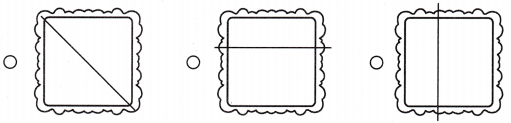
FOR THE TEACHER • Have children draw lines to show two triangles in one square and three triangles in the other square.
Answer:
Texas-Go-Math-Grade-1-Lesson-16.1-Answer-Key-2 (1)
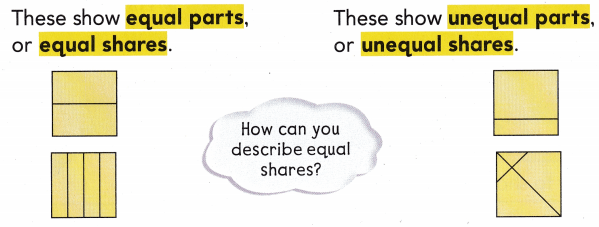
The square is divided into two equal parts
Answer:
Texas-Go-Math-Grade-1-Lesson-16.1-Answer-Key-2
Answer:
The square is divided into two unequal parts

Math Talk
Mathematical Processes

Are all of the triangles the same? Explain.
Answer: No,all the triangles are not same some may be having equal sides and some might have unequal sides

Model and Draw

Texas Go Math Grade 1 Lesson 16.1 Answer Key 3
Answer:

Share and Show

Describe the parts. Write equal parts or unequal parts.
Texas Go Math Grade 1 Lesson 16.1 Answer Key 4

Question 1.
Texas Go Math Grade 1 Lesson 16.1 Answer Key 5
Answer: Equal
Explanation:
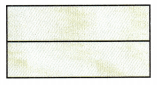
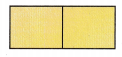
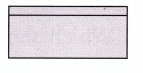
The rectangle is divided at the center and is divided into equal halves

Question 2.
Texas Go Math Grade 1 Lesson 16.1 Answer Key 6
Answer: Equal
Explanation:
The square is divided at the center and is divided into equal halves

Question 3.
Texas Go Math Grade 1 Lesson 16.1 Answer Key 7
Answer: Unequal
Explanation:
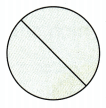
The circle is divided into two unequal halves

Question 4.
Texas Go Math Grade 1 Lesson 16.1 Answer Key 8
Answer: Equal
Explanation:
The circle is divided into Four equal halves

Question 5.
Texas Go Math Grade 1 Lesson 16.1 Answer Key 9
Answer: Unequal
Explanation:
The square is divided into two unequal halves

Question 6.
Texas Go Math Grade 1 Lesson 16.1 Answer Key 10
Answer: Unequal
Explanation:
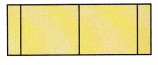
The rectangle is divided into four unequal halves

Problem Solving

Color the shapes that show unequal shares.
Texas Go Math Grade 1 Lesson 16.1 Answer Key 11

Question 7.
Texas Go Math Grade 1 Lesson 16.1 Answer Key 12
Answer:
Texas-Go-Math-Grade-1-Lesson-16.1-Answer-Key-12

Color the shapes that show equal shares.

Question 8.
Texas Go Math Grade 1 Lesson 16.1 Answer Key 13
Answer:
Texas-Go-Math-Grade-1-Lesson-16.1-Answer-Key-13

H.O.T. Write the number of equal shares.

Question 9.
Texas Go Math Grade 1 Lesson 16.1 Answer Key 14
__________ equal shares
Answer: Two equal shares

Question 10.
Texas Go Math Grade 1 Lesson 16.1 Answer Key 15
__________ equal shares
Answer: Four equal shares

H.O.T. Multi-Step Draw lines to show the parts.

Question 11.
2 equal shares
Texas Go Math Grade 1 Lesson 16.1 Answer Key 16

2 unequal shares
Texas Go Math Grade 1 Lesson 16.1 Answer Key 16
Answer:
Texas-Go-Math-Grade-1-Lesson-16.1-Answer-Key-16 (1)

Texas-Go-Math-Grade-1-Lesson-16.1-Answer-Key-16

Question 12.
4 equal shares
Texas Go Math Grade 1 Lesson 16.1 Answer Key 17

4 unequal shares
Texas Go Math Grade 1 Lesson 16.1 Answer Key 17
Answer:
Texas-Go-Math-Grade-1-Lesson-16.1-Answer-Key-17 (1)

Texas-Go-Math-Grade-1-Lesson-16.1-Answer-Key-17

Daily Assessment Task

Choose the correct answer.

Question 13.
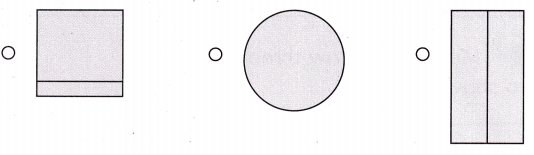
Gordon has a wheel of cheese. He will share this cheese with Denny. Which wheel shows 2 equal parts?
Texas Go Math Grade 1 Lesson 16.1 Answer Key 18
Answer:
Texas-Go-Math-Grade-1-Lesson-16.1-Answer-Key-18

Question 14.
Analyze Lena is cutting a square cake to have equal shares with 3 friends. Which square shows 4 equal parts?
Texas Go Math Grade 1 Lesson 16.1 Answer Key 19
Answer:
Texas-Go-Math-Grade-1-Lesson-16.1-Answer-Key-19

Question 15.
Multi-Step Henry has a loaf of bread shaped like a rectangle. He wants to cut it into two equal parts. Then he wants to cut each part into two more equal parts. How many parts will Henry have?
Texas Go Math Grade 1 Lesson 16.1 Answer Key 20
(A) 2
(B) 6
(C) 4
Answer: (C) 4
Explanation:
henry first cuts the bread into 2 equal parts the he will have two parts
Later he cuts the both parts into 2 equal parts the the will have 2 breads with 2 equal halves that is 4 parts

Question 16.
Texas Test Prep Which shows equal shares?
Texas Go Math Grade 1 Lesson 16.1 Answer Key 21
Answer:
Texas-Go-Math-Grade-1-Lesson-16.1-Answer-Key-21

TAKE HOME ACTIVITY • Draw a circle on a piece of paper. Ask your child to draw a line so the circle shows 2 equal shares.
Answer:
Texas-Go-Math-Grade-1-Lesson-16.1-Answer-Key-32

Texas Go Math Grade 1 Lesson 16.1 Homework and Practice Answer Key

Circle the shape that shows unequal parts.

Question 1.
Texas Go Math Grade 1 Lesson 16.1 Answer Key 22
Answer:
Texas-Go-Math-Grade-1-Lesson-16.1-Answer-Key-22

Question 2.
Texas Go Math Grade 1 Lesson 16.1 Answer Key 23
Answer:
Texas-Go-Math-Grade-1-Lesson-16.1-Answer-Key-23

Question 3.
Texas Go Math Grade 1 Lesson 16.1 Answer Key 24
Answer:
Texas-Go-Math-Grade-1-Lesson-16.1-Answer-Key-24

Circle the shape that shows equal parts.

Question 4.
Texas Go Math Grade 1 Lesson 16.1 Answer Key 25
Answer:
Texas-Go-Math-Grade-1-Lesson-16.1-Answer-Key-25

Problem Solving

Write equal or unequal to describe the parts.

Question 5.
4 ___________ shares
Texas Go Math Grade 1 Lesson 16.1 Answer Key 26
Answer: Four equal shares

Question 6.
4 ___________ shares
Texas Go Math Grade 1 Lesson 16.1 Answer Key 27
Answer: four unequal shares

Question 7.
2 ____________ shares
Texas Go Math Grade 1 Lesson 16.1 Answer Key 28
Answer: two equal shares

Lesson Check

Choose the correct answer.

Question 8.
Ginger has a cheese sandwich. She will share the sandwich with her sister. Which sandwich shows 2 equal parts?
Texas Go Math Grade 1 Lesson 16.1 Answer Key 29
Answer:
Texas-Go-Math-Grade-1-Lesson-16.1-Answer-Key-29

Question 9.
Lucy has a pizza to share with 3 friends. She wants everyone to get an equal share. Which pizza shows 4 equal parts?
Texas Go Math Grade 1 Lesson 16.1 Answer Key 30
Answer:
Texas-Go-Math-Grade-1-Lesson-16.1-Answer-Key-30

Question 10.
Multi-Step Hank has a ball of dough. He wants to cut it into 2 equal parts. Then he wants to cut each part into 2 more equal parts. How many parts will Hank have?
(A) 2
(B) 4
(C) 8
Answer: (B) 4

Question 11.
Which shows equal shares?
Texas Go Math Grade 1 Lesson 16.1 Answer Key 31
Answer:
Texas-Go-Math-Grade-1-Lesson-16.1-Answer-Key-31

Texas Go Math Grade 1 Lesson 16.1 Answer Key 11 Read More »

Texas Go Math Grade 3 Lesson 13.3 Answer Key Divide by 8

Refer to our Texas Go Math Grade 3 Answer Key Pdf to score good marks in the exams. Test yourself by practicing the problems from Texas Go Math Grade 3 Lesson 13.3 Answer Key Divide by 8.

Texas Go Math Grade 3 Lesson 13.3 Answer Key Divide by 8

Essential Question
What strategies can you use to divide by 8?

Unlock the Problem
At Stephen’s camping store, firewood is sold in bundles of 8 logs. He has 32 logs to put in bundles. How many bundles of firewood can he make?

• What will Stephen do with the 32 logs?

One Way

Make a model.

You can write a division equation to show how many rows of 8 are in 32.
Look at the array.
Texas Go Math Grade 3 Lesson 13.3 Answer Key 1
Count the number of tiles in each row.
How many tiles are there in each row? ___
Show the above array on a grid by shading the squares to record the tiles.
How many rows of squares will you shade? ___
How many in each row will you shade? ___
Texas Go Math Grade 3 Lesson 13.3 Answer Key 2
So, Stephen can make ___ bundles of firewood.
Write the equation:
___ ÷ ___ = ____

Math Talk
Mathematical Processes
How does knowing 4 × 8 = 32 help you find 32 ÷ 8?

Another Way Use a related multiplication fact.
Texas Go Math Grade 3 Lesson 13.3 Answer Key 3

Share and Show

Question 1.
Shade the grid to find 16 ÷ 8.
Think: How many rows are shaded?
Texas Go Math Grade 3 Lesson 13.3 Answer Key 4
Write the equation:
___ ÷ ___ = ___
Answer:

Find the unknown factor and quotient.

Question 2.
8 × __ = 56 56 ÷ 8 = ___
Answer:

Question 3.
___ × 8 = 40 40 ÷ 8 = ___
Answer:

Find the quotient.

Question 4.
18 ÷ 3 = ___
Answer:

Question 5.
___ = 48 ÷ 8
Answer:

Question 6.
56 ÷ 7 = ___
Answer:

Question 7.
__ = 32 ÷ 8
Answer:

Problem Solving

Question 8.
Use tools Stephen has a log that is 8 feet long. If he cuts the log into pieces that are 2 feet long, how many pieces will Stephen have?
Texas Go Math Grade 3 Lesson 13.3 Answer Key 5
Shade the grid to solve 8 ÷ 2.
Stephen will have ___ pieces.
Write the equation:
__ ÷ __ = ____
Answer:

Question 9.
H.O.T. Write a word problem that can be solved by using the division equation 18 ÷ 6 = 3.
Answer:

Algebra Write +, —, ×, or ÷.

Question 10.
6 × 6 = 32 Texas Go Math Grade 3 Lesson 13.3 Answer Key 6 4
Answer:

Question 11.
12 Texas Go Math Grade 3 Lesson 13.3 Answer Key 6 3 = 19 – 15
Answer:

Question 12.
40 ÷ 8 = 35 Texas Go Math Grade 3 Lesson 13.3 Answer Key 6 7
Answer:

Problem Solving

Use the table for 13-14.

Question 13.
H.O.T. Multi-Step There are 36 people camping at Max’s family reunion. They have cabin tents and vista tents. How many of each type of tent do they need to sleep exactly 36 people if each tent is filled? Explain
Texas Go Math Grade 3 Lesson 13.3 Answer Key 7
Answer:

Question 14.
There are 32 people who plan to camp over the weekend. What is the least number of trail tents they need? Explain.
Answer:

Question 15.
Josh is dividing 64 marshmallows equally among 8 campers. How many marshmallows will each camper get?
Answer:

Question 16.
H.O.T. Representations Grace set 8 plates at each picnic table so 24 campers could eat dinner. How many picnic tables did Grace have to set? Circle the equal groups and write the equation.
___ ÷ __ = ____
Texas Go Math Grade 3 Lesson 13.3 Answer Key 8
Write the related multiplication fact.
___ ÷ __ = ____
Answer:

Daily Assessment Task

Fill in the bubble for the correct answer choice.
You may use a division strategy to help you solve.

Question 17.
A scientist at Sea Dive Aquarium is studying squids in a tank. She counts 56 arms in all. Squids have 8 arms. How many squids are in the tank?
Texas Go Math Grade 3 Lesson 13.3 Answer Key 9
(A) 8
(B) 6
(C) 7
(D) 9
Answer:

Question 18.
The Swansons purchase 48 hotdogs for the family picnic. The hot dogs come in packages of 8. Which equation shows how many packages of hot dogs the Swansons buy?
(A) 48 ÷ 8 = 6
(B) 5 × 8 = 40
(C) 40 ÷ 4 = 10
(D) 7 × 6 = 42
Answer:

Question 19.
Multi-Step Kyle has 4 packs of baseball cards. Each pack has 12 cards. If Kyle wants to equally divide the cards among him and his 7 friends, how many baseball cards will each person get?
(A) 2
(B) 9
(C) 6
(D) 20
Answer:

Texas Test Prep

Question 20.
Derek had 64 stickers for his album. He placed 8 stickers on each page. How many pages did he use?
(A) 8
(B) 2
(C) 7
(D) 5
Answer:

Texas Go Math Grade 3 Lesson 13.3 Homework and Practice Answer Key

Find the unknown factor and quotient.

Question 1.
8 × __ = 48
Answer:

Question 2.
__ × 4 = 32
Answer:

Question 3.
64 ÷ 8 = ___
Answer:

Question 4.
56 ÷ 8 = __
Answer:

Find the unknown number.

Question 5.
16 ÷ 8 = ___
Answer:

Question 6.
40 ÷ __ = 5
Answer:

Question 7.
9 = __ ÷ 8
Answer:

Question 8.
__ = 80 ÷ 8
Answer:

Problem Solving

Question 9.
Ted has a strip of cloth that is 16 feet long. If he cuts the cloth in pieces that are 2 feet long to make kite tails, how many pieces will he have?
Texas Go Math Grade 3 Lesson 13.3 Answer Key 10
Shade the grid to solve 16 ÷ 2.
Ted will have ___ pieces.
Write the equation:
Answer:

Question 10.
There are 40 people going to a baseball game. There are only three vans available that seat 8 people each. The other people will ride in cars that seat 4. How many cars are needed so all 40 people have a ride to the baseball game? Explain.
Answer:

Question 11.
At the baseball game, the 40 people sit in rows of 8. How many rows are the people seated in?
Answer:

Texas Test Prep

Lesson Check

Fill in the bubble completely to show your answer.

Question 12.
Bethany makes 48 party favors. If she puts the favors into 8 baskets, how many favors are in each basket?
(A) 56
(B) 40
(C) 6
(D) 5
Answer:

Question 13.
Wes has 56 balloons. He uses 8 balloons to make an animal shape. How many animals can Wes make?
(A) 8
(B) 7
(C) 9
(D) 5
Answer:

Question 14.
Louis has 24 pencils. He has an equal number of red, blue, and yellow pencils. How many pencils of each color does Louis have?
(A) 3
(B) 8
(C) 4
(D) 6
Answer:

Question 15.
A teacher puts 64 boxes of school supplies on 8 shelves. If she puts an equal number of boxes on each shelf, how many shelves does she need?
(A) 7
(B) 6
(C) 9
(D) 8
Answer:

Question 16.
Multi-Step Jackie has 15 green tiles and 25 yellow tiles. She divided them equally to decorate 5 plates. How many tiles does she put on each plate?
(A) 3
(B) 7
(C) 8
(D) 5
Answer:

Question 17.
Multi-Step Paco has 40 tulips and 32 daisies. He divides the flowers equally among 8 vases. How many flowers will be put in each vase?
(A) 9
(B) 7
(C) 6
(D) 8
Answer:

Texas Go Math Grade 3 Lesson 13.3 Answer Key Divide by 8 Read More »

Texas Go Math Grade 5 Lesson 2.3 Answer Key Division with 2-Digit Divisors

Refer to our Texas Go Math Grade 5 Answer Key Pdf to score good marks in the exams. Test yourself by practicing the problems from Texas Go Math Grade 5 Lesson 2.3 Answer Key Division with 2-Digit Divisors.

Texas Go Math Grade 5 Lesson 2.3 Answer Key Division with 2-Digit Divisors

Investigate

Materials: base-ten blocks

There are 156 students in the Carville Middle School chorus. The music director wants the students to stand with 12 students in each row for the next concert. How many rows will there be?

A. Use base-ten blocks to model the dividend, 156.

B. Place 2 tens below the hundred to form a rectangle. How many groups of 12 does the rectangle show? How much of the dividend is not shown in this rectangle?
Answer:
When we divide 120 into blocks of ten, there will be 10 blocks of 12.
The dividend that is not shown in the rectangle will be: 36

C. Combine the remaining tens and ones into as many groups of 12 as possible. How many groups of 12 are there?
Answer:
From part (B),
We can observe that
There are remaining 36 blocks after we placed 120 blocks
Now,
We can arrange 36 blocks into 3 groups of 12
Hence, from the above,
We can conclude that
There are 3 groups of 12

D. Place these groups of 12 on the right side of the rectangle to make a larger rectangle.
Answer:
From part A,
There are 10 groups of 12
From part B,
There are 3 groups of 12
So,
The total number of groups of 12 = 10 + 3
= 13 groups of 12

E. The final rectangle shows groups of 12.

So,
There will be 13 rows of 12 students.

Draw Conclusions

Question 1.
Explain why you still need to make groups of 12 after Step B.
Answer:
In Step B,
We made 10 groups of 12.
But,
There are 36 remaining blocks
So,
We have to find whether we can make groups of 12 with 36 or not
Hence,
We will still need to make groups of 12 after Step B

Question 2.
Describe how you can use base-ten blocks to find the quotient 176 ÷ 16.
Answer:
The given division expression is: 176 ÷ 16
Now,
Step A:
Divide 176 into 16 base-ten blocks
So,
The 16 ten-base blocks will be equal to 160 and the remainder will be 16
Step B:
Find out whether 16 will be divided into groups of 16
Step C:
We can make 1 group of 16 blocks
Hence, from the above,
We can conclude that
The quotient of 176 ÷ 16 by using the base-ten blocks is: 11

The two sets of groups of 12 that you found in the Investigate are partial quotients. First, you found 10 groups of 12, and then you found 3 more groups of 12. Sometimes you may need to regroup before you can show a partial quotient.
Texas Go Math Grade 5 Lesson 2.3 Answer Key 1

You can use a quick picture to record the partial products.

Divide. 180 ÷ 15

MODEL Use base-ten blocks.

STEP 1: Model the dividend, 180, as 1 hundred 8 tens.
Model the first partial quotient by making a rectangle with the hundred and 5 tens. In the Record, cross out the hundred and tens you use.
So,
The rectangle shows 10 groups of 15.

STEP 2: Additional groups of 15 cannot be made without regrouping.

Regroup 1 ten as 10 ones. In the Record, cross out the regrouped ten.

There are now 25 tens and 5 ones.

STEP 3: Decide how many additional groups of 15 can be made with the remaining tens and ones. The number of groups is the second partial quotient.

Make your rectangle larger by including these groups of 15. In the Record, cross out the tens and ones you use.
So,
There are now 12 groups of 15.

RECORD Use quick pictures.

Texas Go Math Grade 5 Lesson 2.3 Answer Key 2
Draw the first partial quotient.

Draw the first and second partial quotients.

So,
180 ÷ 15 is 12

Math Talk
Mathematical Processes

Explain how your model shows the quotient.
Answer:
When we draw a model for the given division expression,
We will draw in the form of partial products
So,
When we add the Partial numbers that are divided, the result will be given the value of the quotient for the given division expression

Share and Show

Use the quick picture to divide.

Question 1.
143 ÷ 13
Texas Go Math Grade 5 Lesson 2.3 Answer Key 3
Answer:
The given division expression is: 143 ÷ 13
Now,
By using the model,

Now,
From the above model,
We can observe that
The quotient for the given division expression = 10 + 1
= 11
Hence, from the above,
We can conclude that
The quotient for the given division expression is: 11

Use base-ten blocks or a quick picture to divide.

Question 2.
168 ÷ 12
Answer:
The given division expression is: 168 ÷ 12
Now,
By using the model,

Now,
From the above model,
We can observe that
The quotient for the given division expression = 10 + 4
= 14
Hence, from the above,
We can conclude that
The quotient for the given division expression is: 14

Question 3.
187 ÷ 11
Answer:
The given division expression is: 187 ÷ 11
Now,
By using the model,

Now,
From the above model,
We can observe that
The quotient for the given division expression = 10 + 7
= 17
Hence, from the above,
We can conclude that
The quotient for the given division expression is: 17

Question 4.
182 ÷ 13
Answer:
The given division expression is: 182 ÷ 13
Now,
By using the model,

Now,
From the above model,
We can observe that
The quotient for the given division expression = 10 + 4
= 14
Hence, from the above,
We can conclude that
The quotient for the given division expression is: 14

Question 5.
228 ÷ 12
Answer:
The given division expression is: 228 ÷ 12
Now,
By using the model,

Now,
From the above model,
We can observe that
The quotient for the given division expression = 10 + 9
= 19
Hence, from the above,
We can conclude that
The quotient for the given division expression is: 19

Problem Solving

The Pony Express used men riding horses to deliver mail between St. Joseph, Missouri, and Sacramento, California, from April 1860 to October 1861. The trail between the cities was approximately 2,000 miles long.

Question 6.
H.O.T. Multi-Step Two Pony Express riders each rode part of a 176-mile trip. Each rider rode the same number of miles. They changed horses every 11 miles. How many horses did each rider use?
Texas Go Math Grade 5 Lesson 2.3 Answer Key 4
Answer:
It is given that
The Pony Express used men riding horses to deliver mail between St. Joseph, Missouri, and Sacramento, California, from April 1860 to October 1861. The trail between the cities was approximately 2,000 miles long.
It is also given that
Two Pony Express riders each rode part of a 176-mile trip. Each rider rode the same number of miles. They changed horses every 11 miles.
So,
According to the given information,
The number of horses did each rider used = (The distance traveled by the two Pony Expresses) ÷ (The number of miles the Pony Expresses changed the horses)
= 176 ÷ 11
Now,
By using the Long Division,

Hence, from the above,
We can conclude that
The number of horses did each rider used throughout the total distance is: 16 horses

Question 7.
Suppose a Pony Express rider was paid $192 for 12 weeks of work. If he was paid the same amount each week, how much was he paid for each week of work?
Answer:
It is given that
A Pony Express rider was paid $192 for 12 weeks of work and he was paid the same amount each week
So,
According to the given information,
The amount he paid for each week = (The total amount a rider paid for some weeks) ÷ (The number of weeks)
= $192 ÷ 12
Now,
By using the Long Division,

Hence, from the above,
We can conclude that
The amount a Pony Express Rider paid for each week of work is: $16

Question 8.
H.O.T. Multi-Step It took 19 Pony Express riders a total of 11 days 21 hours to ride from St. Joseph to Sacramento. If they all rode the same number of hours, how many hours did each rider ride?
Answer:
It is given that
It took 19 Pony Express riders a total of 11 days 21 hours to ride from St. Joseph to Sacramento and they all rode the same number of hours
Now,
We know that,
1 day = 24 hours
So,
The total number of hours in 11 days = 24 × 11
= 264 hours
So,
The total number of hours did 19 riders took to travel from St. Joseph to Sacramento = 264 + 21
= 285 hours
Now,
The number of hours did each rider took to travel from St. Joseph to sacramento = 285 ÷ 19
Now,
By using the Long Division,

Hence, from the above,
We can conclude that
The number of hours did each rider took to travel from St. Joseph to sacramento is: 15 hours

Daily Assessment Task

Fill in the bubble completely to show your answer.

Question 9.
Use Diagrams A rover brings 144 rock samples back from Mars. The samples will be divided among 12 teams of scientists for analysis. Which quick picture shows the correct division of the samples between the 12 teams?
Texas Go Math Grade 5 Lesson 2.3 Answer Key 5
Answer:
It is given that
A rover brings 144 rock samples back from Mars. The samples will be divided among 12 teams of scientists for analysis
So,
The correct division of the samples between 12 teams = 144 ÷ 12
Hence, from the above,
We can conclude that
The picture that shws the correct division of the samples between 12 teams is:

Question 10.
Analyze The Mars rover is going to travel across a crater that is 360 cm (about 12 ft) in diameter. The rover must stop every 15 cm to recharge its batteries. How many times will the rover recharge while it crosses the crater?
(A) 24
(B) 15
(C) 30
(D) 25
Answer:
It is given that
The Mars rover is going to travel across a crater that is 360 cm (about 12 ft) in diameter. The rover must stop every 15 cm to recharge its batteries
Now,
According to the given information,
The number of times will the rover recharge while it crosses the crater = (The distance Mars rover is going to travel) ÷ (The time took by rover torecharge its batteries)
= 360 ÷ 15
Now,
By using the long Division,

Hence, from the above,
We can conclude that
The number of times will the rover recharge while it crosses the crater is:

Question 11.
Multi-Step On Monday, the rover traveled 330 cm. On Tuesday, it traveled 180 cm. If the rover stopped every 15 cm to recharge, how many more times did it need to recharge on Monday than on Tuesday?
(A) 24
(B) 22
(C) 12
(D) 10
Answer:
It is given that
On Monday, the rover traveled 330 cm. On Tuesday, it traveled 180 cm. If the rover stopped every 15 cm to recharge
Now,
According to the given information,
The difference between the number of times the rover recharge on Monday and Tuesday = (330 ÷ 15) – (180 ÷ 15)
= 22 – 12
= 10 times
Hence, from the above,
We can conclude that
The difference between the number of times the rover recharge on Monday and Tuesday is:

Texas Test Prep

Question 12.
Analyze Three Pony Express riders each rode part of a 252-mile trip. If they used a total of 18 horses and rode each horse the same number of miles, how many miles did they ride before replacing each horse?
(A) 54 miles
(B) 14 miles
(C) 84 miles
(D) 42 miles
Answer:
It is given that
Three Pony Express riders each rode part of a 252-mile trip. If they used a total of 18 horses and rode each horse the same number of miles
Now,
According to the given information,
The number of miles the three Pony Express riders rode before replacing each horse = 252 ÷ 18
Now,
By using the Long Division,

Hence, from the above,
We can conclude that
The number of miles the three Pony Express riders rode before replacing each horse is:

Texas Go Math Grade 5 Lesson 2.3 Homework and Practice Answer Key

Use base-ten blocks or a quick picture to divide.

Question 1.
180 ÷ 12
Answer:
The given division expression is: 180 ÷ 12
Now,
By using the model,

Now,
From the above model,
We can observe that
The quotient for the given division expression = 10 + 5
= 15
Hence, from the above,
We can conclude that
The quotient for the given division expression is: 15

Question 2.
216 ÷ 18
Answer:
The given division expression is: 216 ÷ 18
Now,
By using the Model,

Now,
From the above model,
We can observe that
The quotient for the given division expression = 10 + 2
= 12
Hence, from the above,
We can conclude that
The quotient for the given division expression is: 12

Question 3.
224 ÷ 16
Answer:
The given division expression is: 224 ÷ 16
Now,
By using the Model,

Now,
From the above model,
We can observe that
The quotient for the given division expression = 10 + 4
= 14
Hence, from the above,
We can conclude that
The quotient for the given division expression is: 14

Question 4.
176 ÷ 16
Answer:
The given division expression is: 176 ÷ 16
Now,
By using the Model,

Now,
From the above model,
We can observe that
The quotient for the given division expression = 10 + 1
= 11
Hence, from the above,
We can conclude that
The quotient for the given division expression is: 11

Problem Solving

Question 5.
Ryan read 145 pages of his book. If he read 29 pages every night, how many nights did it take him to complete the book?
Answer:
It is given that
Ryan read 145 pages of his book and he read 29 pages every night
Now,
According to the given information,
The number of nights did it take Ryan to complete the book = 145 ÷ 29
Now,
By using the Long Division,

Hence, from the above,
We can conclude that
The number of nights did it take Ryan to complete the book is: 5 nights

Question 6.
Mrs. McDonald passed out 189 photos that she had taken during the school year. If each of her 21 students received the same number of photos, how many did each receive?
Answer:
It is given that
Mrs. McDonald passed out 189 photos that she had taken during the school year and each of her 21 students received the same number of photos
Now,
According to the given information,
The number of photos did Mrs.McDonald received = 189 ÷ 21
Now,
By using the Long Division,

Hence, from the above,
We can conclude that
The number of photos did Mrs.McDonald received is: 9 photos

Lesson Check

Fill in the bubble completely to show your answer.

Question 7.
Susanna made a total of $132 for the school fundraiser. She sold pizza combo meals for $12 each. How many combo meals did Susanna sell?
(A) 10
(B) 11
(C) 13
(D) 12
Answer:
It is given that
Susanna made a total of $132 for the school fundraiser. She sold pizza combo meals for $12 each.
Now,
According to the given information,
The number of combo meals did Susanna sold = $132 ÷ $12
Now,
By using the Long Division,

Hence, from the above,
We can conclude that
The number of combo meals did Susanna sold is:

Question 8.
Carlos’ horse ran around the track a total of 336 times. If the horse ran 21 laps each day, how many days did it take the horse to complete all of the laps?
(A) 20
(B) 16
(C) 18
(D) 12
Answer:
It is given that
Carlos’ horse ran around the track a total of 336 times. If the horse ran 21 laps each day
Now,
According to the given information,
The number of days did it took for the horse to complete all of the laps = 336 ÷ 21
Now,
By using the Long Division,

Hence, from the above,
We can conclude that
The number of days did it took for the horse to complete all of the laps is:

Question 9.
Milos rode his bicycle in a marathon for 154 miles. He took a rest stop every 22 miles. How many rest stops did Milos take during the marathon?
(A) 8
(B) 7
(C) 10
(D) 9
Answer:
It is given that
Milos rode his bicycle in a marathon for 154 miles. He took a rest stop every 22 miles
Now,
According to the given information,
The number of rest stops did Milos took during the marathon = 154 ÷ 22
Now,
By using the Long Division,

Hence, from the above,
We can conclude that
The number of rest stops did Milos took during the marathon is:

Question 10.
There are 325 books on the library wall. There are 13 rows of books, each with an equal number of books. How many books are in each row?
(A) 28
(B) 21
(C) 25
(D) 19
Answer:
It is given that
There are 325 books on the library wall. There are 13 rows of books, each with an equal number of books
Now,
According to the given information,
The number of books in each row = 325 ÷ 13
Now,
By using the Long Division,

Hence, from the above,
We can conclude that
The number of books in each row is:

Question 11.
Multi-Step Lilly was paid $308 for 14 weeks of work. If she was paid the same amount each week, how much did she earn after 2 weeks?
(A) $38
(B) $28
(C) $22
(D) $44
Answer:
It is given that
Lilly was paid $308 for 14 weeks of work and she was paid the same amount each week
Now,
According to the given information,
The amount of money earned by Lilly each week = $308 ÷ 14
Now,
By using the Long Division,

So,
The amount of money earned by Lilly in 2 weeks = 2 × $22
= $44
Hence, from the above,
We can conclude that
The amount of money earned by Lilly in 2 weeks is:

Question 12.
Multi-Step Manny drove 910 miles during a two-week period. If he drove the same number of miles each day, how many miles had he driven after 5 days?
(A) 182 miles
(B) 250 miles
(C) 650 miles
(D) 325 miles
Answer:
It is given that
Manny drove 910 miles during a two-week period and he drove the same number of miles each day
Now,
We know that,
1 week = 7 days
Now,
According to the given information,
The number of miles did Manny rode each day = 910 ÷ 14
Now,
By using the Long Division,

So,
The number of miles did Manny rode in 5 days = 5 × 65
= 325 miles
Hence, from the above,
We can conclude that
The number of miles did Manny rode in 5 days is:

Texas Go Math Grade 5 Lesson 2.3 Answer Key Division with 2-Digit Divisors Read More »

go-math-grade-5-answer-key-chapter-2-divide-whole-numbers

Go Math Grade 5 Chapter 2 Answer Key Pdf Divide Whole Numbers

Go Math Grade 5 Chapter 2 Answer Key Pdf: Do you want to get the best results in math tests? Refer to Go Math Grade 5 Answer Key Chapter 2 Divide Whole Numbers. Get the free pdf of Go Math Grade 5 Answer Key now to begin your practice. HMH Go Math Grade 5 Practice Books along with questions and answers are included here. Just follow and grab more knowledge by referring to Go Math Grade 5 Chapter 2 Divide Whole Numbers Solution key.

Divide Whole Numbers Go Math Grade 5 Chapter 2 Answer Key Pdf

Apply the math to real-time examples by learning the tricks using HMH Go Math Grade 5 Answer Key. The quick way of solving math problems will help the students to save time. So, students can practice more questions utilizing the time properly. If you want the best way of learning then you must use Go Math Grade 5 Chapter 2 Divide Whole Numbers Answer Key.

Lesson 1: Place the First Digit

Lesson 2: Divide by 1-Digit Divisors

Lesson 3: Investigate • Division with 2-Digit Divisors

Lesson 4: Partial Quotients

Mid-Chapter Checkpoint

Lesson 5: Estimate with 2-Digit Divisors

Lesson 6: Divide by 2-Digit Divisors

Lesson 7: Interpret the Remainder

Lesson 8: Adjust Quotients

Lesson 9: Problem Solving • Division

Review/Test

Place the First Digit – Share and Show – Page No. 63

Divide.

Question 1.
3)\(\overline { 579 } \)
_____

Answer:
193

Explanation:
Divide integers 57/3 = 19
Multiply 19 x 3 = 57; Subtract 57 – 57 = 0
Write down 9 and divide integers 9/3 = 3.
Multiply 3 x 3 = 9. Subtract 9 – 9 = 0.
The remainder is 0.
So, 193 is the answer.

Question 2.
5)\(\overline { 1,035 } \)
_____

Answer:
207

Explanation:
Divide integers 10/5 = 2
Multiply 2 x 5 = 10; Subtract 10 – 10 = 0
Write down 35 and divide integers 35/5 = 7.
Multiply 7 x 5 = 35. Subtract 35 – 35 = 0.
The remainder is 0.
So, 207 is the answer.

Go Math Book 5th Grade Place The First Digit Lesson 2.1 Question 3.
8)\(\overline { 1,766 } \)
_____ R _____

Answer:
220 R 6

Explanation:
Divide integers 17/8 = 2
Multiply 2 x 8 = 16; Subtract 17 – 16 = 1
Write down 16 and divide integers 16/8 = 2.
Multiply 2 x 8 = 16. Subtract 16 – 16 = 0.
Write down 6; 6 < 8. There are not enough tens
So, the remainder is 6
So, 220 is the answer.

On Your Own

Divide.

Question 4.
8)\(\overline { 275 } \)
_____ R _____

Answer:
43 R 3

Explanation:
Divide integers 27/8 = 3
Multiply 8 x 3 = 24; Subtract 27 – 24= 3
Write down 3 and divide integers 35/8 = 4.
Multiply 8 x 4 = 32. Subtract 35 – 32 = 3.
The remainder is 3.
So, 43 is the answer.

Question 5.
3)\(\overline { 468 } \)
_____

Answer:
155 R 3

Explanation:
Divide integers 46/3 = 15
Multiply 3 x 15 = 45; Subtract 46 – 45= 1
Write down 18 and divide integers 18/3 = 5.
Multiply 3 x 5 = 15. Subtract 18 – 15 = 3.
The remainder is 3.
So, 155 is the answer.

Question 6.
4)\(\overline { 3,220 } \)
_____

Answer:
805

Explanation:
Divide integers 32/4 = 8
Multiply 4 x 8 = 32; Subtract 32 – 32 = 0
Write down 20 and divide integers 20/4 = 5.
Multiply 4 x 5 = 20. Subtract 20 – 20= 0.
The remainder is 0.
So, 805 is the answer.

Question 7.
6)\(\overline { 618 } \)
_____

Answer:
103

Explanation:
Divide integers 61/6 = 10
Multiply 6 x 10 = 60; Subtract 61 – 60 = 1
Write down 18 and divide integers 18/6 = 3.
Multiply 6 x 3 = 18. Subtract 18 – 18 = 0.
The remainder is 0.
So, 103 is the answer.

Question 8.
4)\(\overline { 716 } \)
_____

Answer:
179

Explanation:
Divide integers 71/4 = 17
Multiply 4 x 17 = 68; Subtract 71 – 68 = 3
Write down 36 and divide integers 36/4 = 9.
Multiply 4 x 9 = 36. Subtract 36 – 36 = 0.
The remainder is 0.
So, 179 is the answer.

Question 9.
9)\(\overline { 1,157 } \)
_____ R _____

Answer:
128 R 5

Explanation:
Divide integers 11/9 = 1
Multiply 9 x 1 = 9; Subtract 11 – 9 = 2
Write down 25 and divide integers 25/9 = 2.
Multiply 9 x 2 = 18. Subtract 25 – 18 = 7.
Write down 77 and divide integers 77/9 = 8.
Multiply 9 x 8 = 72. Subtract 77 – 72= 5.
The remainder is 5.
So, 128 is the answer.

Question 10.
6)\(\overline { 6,827 } \)
_____ R _____

Answer:
1,137 R 5

Explanation:
Divide integers 6/6 = 1
Multiply 6 x 1 = 6; Subtract 6 – 6 = 0
Write down 82 and divide integers 82/6 = 13.
Multiply 6 x 13 = 78. Subtract 82 – 78 = 4.
Write down 47 and divide integers 47/6 = 7.
Multiply 6 x 7 = 42. Subtract 47 – 42= 5.
The remainder is 5.
So, 1,137 is the answer.

Go Math Grade 5 Chapter 2 Answer Key Pdf Question 11.
7)\(\overline { 8,523 } \)
_____ R _____

Answer:
1,217 R 4

Explanation:
Divide integers 8/7 = 1
Multiply 7 x 1 = 7; Subtract 8 – 7 = 1
Write down 15 and divide integers 15/7 = 2.
Multiply 7 x 2 = 14. Subtract 15 – 14 = 1.
Write down 12 and divide integers 12/7 = 1.
Multiply 7 x 1 = 7. Subtract 12 – 7= 5.
Write down 53 and divide integers 53/7 = 7.
Multiply 7 x 7 = 49. Subtract 53 – 49= 4.
The remainder is 4.
So, 1,217 is the answer.

Practice: Copy and Solve Divide.

Question 12.
645 ÷ 8 = _____ R _____

Answer:
645 ÷ 8 = 80 R 5

Explanation:
Divide integers 64/8 = 8
Multiply 8 x 8 = 64; Subtract 64 – 64 = 0
Write down 05; 5 < 8; There are not enough tens
The remainder is 5.
So, 80 is the answer.

Question 13.
942 ÷ 6 = _____

Answer:
157

Explanation:
Divide integers 9/6 = 1
Multiply 6 x 1 = 6; Subtract 9 – 6 = 3
Write down 34 and divide integers 34/6 = 5.
Multiply 6 x 5 = 30. Subtract 34 – 30 = 4.
Write down 42 and divide integers 42/6 = 7.
Multiply 6 x 7 = 42. Subtract 42 – 42 = 0.
The remainder is 0.
So, 157 is the answer.

Question 14.
723 ÷ 7 = _____ R _____

Answer:
103 R 2

Explanation:
Divide integers 7/7 = 1
Multiply 7 x 1 = 7; Subtract 7 – 7 = 0
Write down 23 and divide integers 23/7 = 3.
Multiply 7 x 3 = 21. Subtract 23 – 21 = 2.
The remainder is 2.
So, 103 is the answer.

Question 15.
3,478 ÷ 9 = _____ R _____

Answer:
386 R 4

Explanation:
Divide integers 34/9 = 3
Multiply 9 x 3 = 27; Subtract 34 – 27 = 7
Write down 77 and divide integers 77/9 = 8.
Multiply 9 x 8 = 72. Subtract 77 – 72 = 5.
Write down 58 and divide integers 58/9 = 6.
Multiply 9 x 6 = 54. Subtract 58 – 54= 4.
The remainder is 4.
So, 386 is the answer.

Question 16.
3,214 ÷ 5 = _____ R _____

Answer:
642 R 4

Explanation:
Divide integers 32/5 = 6
Multiply 5 x 6 = 30; Subtract 32 – 30 = 2
Write down 21 and divide integers 21/5 = 4.
Multiply 5 x 4 = 20. Subtract 21 – 20 = 1.
Write down 14 and divide integers 14/5 = 2.
Multiply 5 x 2 = 10. Subtract 14 – 10 = 4.
The remainder is 4.
So, 642 is the answer.

Question 17.
492 ÷ 4 = _____

Answer:
123

Explanation:
Divide integers 4/4 = 1
Multiply 4 x 1 = 4; Subtract 4 – 4 = 0
Write down 9 and divide integers 9/4 = 2.
Multiply 4 x 2 = 8. Subtract 9 – 8 = 1.
Write down 12 and divide integers 12/4 = 3.
Multiply 4 x 3 = 12. Subtract 12 – 12 = 0.
The remainder is 0.
So, 123 is the answer.

Question 18.
2,403 ÷ 9 = _____

Answer:
267

Explanation:
Divide integers 24/9 = 2
Multiply 9 x 2 = 18; Subtract 24 – 18 = 6
Write down 60 and divide integers 60/9 = 6.
Multiply 9 x 6 = 54. Subtract 60 – 54 = 6.
Write down 63 and divide integers 63/9 = 7.
Multiply 9 x 7 = 63. Subtract 63 – 63 = 0.
The remainder is 0.
So, 267 is the answer.

Question 19.
2,205 ÷ 6 = _____ R _____

Answer:
367 R 3

Explanation:
Divide integers 22/6 = 3
Multiply 6 x 3 = 18; Subtract 22 – 18 = 4
Write down 40 and divide integers 40/6 = 6.
Multiply 6 x 6 = 36; Subtract 40 – 36 = 4
Write down 45 and divide integers 45/6 = 7.
Multiply 6 x 7 = 42; Subtract 45 – 42 = 3
The remainder is 3.
So, 367 is the answer.

Question 20.
2,426 ÷ 3 = _____ R _____

Answer:
808 R 2

Explanation:
Divide integers 24/3 = 8
Multiply 3 x 8 = 24; Subtract 24 – 24 = 0
Write down 26 and divide integers 26/3 = 8.
Multiply 3 x 8 = 24. Subtract 26 – 24 = 2.
The remainder is 2.
So, 808 is the answer.

Question 21.
1,592 ÷ 8 = _____ R _____

Answer:
199

Explanation:
Divide integers 15/8 = 1
Multiply 8 x 1 = 8; Subtract 15 – 8 = 7
Write down 79 and divide integers 79/8 = 9.
Multiply 8 x 9 = 72; Subtract 79 – 72 = 7
Write down 72 and divide integers 72/8 = 9.
Multiply 8 x 9 = 72; Subtract 72 – 72 = 0
The remainder is 0.
So, 199 is the answer.

Question 22.
926 ÷ 4 = _____ R _____

Answer:
231 R 2

Explanation:
Divide integers 9/4 = 2
Multiply 4 x 2 = 8; Subtract 9 – 8 = 1
Write down 12 and divide integers 12/4 = 3.
Multiply 4 x 3 = 12; Subtract 12 – 12 = 0
Write down 6 and divide integers 6/4 = 1.
Multiply 4 x 1 = 4; Subtract 6 – 4 = 2
The remainder is 2.
So, 231 is the answer.

Question 23.
6,033 ÷ 5 = _____ R _____

Answer:
1,206 R 3

Explanation:
Divide integers 6/5 = 1
Multiply 5 x 1 = 5; Subtract 6 – 5 = 1
Write down 10 and divide integers 10/5 = 2.
Multiply 5 x 2 = 10; Subtract 10 – 10 = 0
Write down 33 and divide integers 33/5 = 6.
Multiply 5 x 6 = 30; Subtract 33 – 30 = 3
The remainder is 3.
So, 1206 is the answer.

Place the First Digit – UNLOCK the Problem – Page No. 64

Question 24.
Rosa has a garden divided into sections. She has 125 daisy plants. If she plants an equal number of daisy plants in each section of daisies, will she have any left over? If so, how many daisy plants will be left over?
Go Math Grade 5 Answer Key Chapter 2 Divide Whole Numbers Divide Whole Numbers; Place the First Digit img 1
a. What information will you use to solve the problem?
Type below:
__________

Answer:
We can use the fact that she has 125 daisy plants and she plants an equal number of the daisy plants in each of 3 sections.

Question 24.
b. How will you use division to find the number of daisy plants left over?
Type below:
__________

Answer:
We have to do 125/3
Divide integers 12/3 = 4
Multiply 3 x 4 = 12; Subtract 12 – 12 = 0
Write down 5 and divide integers 5/3 = 1.
Multiply 3 x 1 = 3; Subtract 5 – 3 = 2
The remainder is 2.
41 daisy plants in each section.
2 daisy plants left over

Question 24.
c. Show the steps you use to solve the problem. Estimate: 120 ÷ 3 = _____
Type below:
__________

Answer:
Divide integers 12/3 = 4
Multiply 3 x 4 = 12; Subtract 12 – 12 = 0
The remainder is 0.
So, 40 is the answer.

Question 24.
d. Complete the sentences:
Rosa has _____ daisy plants.
She puts an equal number in each of _____ sections.
Each section has _____ plants.
Rosa has _____ daisy plants left over.
Type below:
__________

Answer:
Rose has 125 daisy planes.
She puts an equal number in each of 3 sections.
Each section has 41 plants.
Rosa has 2 daisy plants left over.

Question 25.
One case can hold 3 boxes. Each box can hold 3 binders. How many cases are needed to hold 126 binders?
_____ cases

Answer:
14 cases

Explanation:
One case can hold 3 boxes. Each box can hold 3 binders. 3 x 3 = 9.
For 12 binders,
126/ (3 x 3) = 126/9 = 14

Question 26.
Test Prep In which place is the first digit in the quotient 1,497 ÷ 5?
Options:
a. thousands
b. hundreds
c. tens
d. ones

Answer:
b. hundreds

Explanation:
1,497 ÷ 5 = 499. The first digit 4 is in hundreds place.

Divide by 1-Digit Divisors – Share and Show – Page No. 67

Divide. Check your answer.

Question 1.
8)\(\overline { 624 } \)
Check
_____

Answer:
78

Explanation:
Divide integers 62/8 = 7
Multiply 8 x 7 = 56; Subtract 62 – 56 = 6
Write down 64 and divide integers 64/8 = 8.
Multiply 8 x 8 = 64. Subtract 64 – 64 = 0.
The remainder is 0.
So, 78 is the answer.
Check:
78 x 8 = 624;
624 = 624

Question 2.
4)\(\overline { 3,220 } \)
Check
_____

Answer:
805

Explanation:
Divide integers 32/4 = 8
Multiply 4 x 8 = 32; Subtract 32 – 32 = 0
Write down 20 and divide integers 20/4 = 5.
Multiply 4 x 5 = 20. Subtract 20 – 20 = 0.
The remainder is 0.
So, 805 is the answer.
Check:
805 x 4 = 3,220;
3,220 = 3,220.

Question 3.
4)\(\overline { 1,027 } \)
Check
_____ R _____

Answer:
256 R 3

Explanation:
Divide integers 10/4 = 2
Multiply 4 x 2 = 8; Subtract 10 – 8 = 2
Write down 22 and divide integers 22/4 = 5.
Multiply 4 x 5 = 20. Subtract 22 – 20= 2.
Write down 27 and divide integers 27/4 = 6.
Multiply 4 x 6 = 24. Subtract 27 – 24 = 3.
The remainder is 3.
So, 256 R 3.
Check:
256 x 4 = 1,024;
1,024 + 3 = 1,027.
1,027 = 1,027

On Your Own

Divide.

Question 4.
6)\(\overline { 938 } \)
_____ R _____

Answer:
156 R 2

Explanation:
Divide integers 9/6 = 1
Multiply 6 x 1 = 6; Subtract 9 – 6 = 3
Write down 33 and divide integers 33/6 = 5.
Multiply 6 x 5 = 30. Subtract 33 – 30 = 3.
Write down 38 and divide integers 38/6 = 6.
Multiply 6 x 6 = 36. Subtract 38 – 36 = 2.
The remainder is 2.
So, 156 R 2.

Question 5.
4)\(\overline { 762 } \)
_____ R _____

Answer:
190 R 2

Explanation:
Divide integers 7/4 = 1
Multiply 4 x 1 = 4; Subtract 7 – 4 = 3
Write down 36 and divide integers 36/4 = 9.
Multiply 4 x 9 = 36. Subtract 36 – 36 = 0.
Write down 2. 2 < 4; There are not enough tens
The remainder is 2.
So, 190 R 2.

Question 6.
3)\(\overline { 5,654 } \)
_____ R _____

Answer:
1884 R 2

Explanation:
Divide integers 5/3 = 1
Multiply 3 x 1 = 3; Subtract 5 – 3 = 2
Write down 26 and divide integers 26/3 = 8.
Multiply 3 x 8 = 24. Subtract 26 – 24 = 2.
Write down 25 and divide integers 25/3 = 8.
Multiply 3 x 8 = 24. Subtract 25 – 24 = 1.
Write down 14 and divide integers 14/3 = 4.
Multiply 3 x 4 = 12. Subtract 14 – 12 = 2.
The remainder is 2.
So, 1884 R 2.

Question 7.
8)\(\overline { 475 } \)
_____ R _____

Answer:
59 R 3

Explanation:
Divide integers 47/8 = 5
Multiply 8 x 5 = 40; Subtract 47 – 40 = 7
Write down 75 and divide integers 75/8 = 9.
Multiply 9 x 8 = 72. Subtract 75 – 72 = 3.
The remainder is 3.
So, 59 R 3.

Practice: Copy and Solve Divide.

Question 8.
4)\(\overline { 671 } \)
_____ R _____

Answer:
167 R 3

Explanation:
Divide integers 6/4 = 1
Multiply 4 x 1 = 4; Subtract 6 – 4 = 2
Write down 27 and divide integers 27/4 = 6.
Multiply 4 x 6 = 24. Subtract 27 – 24 = 3.
Write down 31 and divide integers 31/4 = 7.
Multiply 4 x 7 = 28. Subtract 31 – 28 = 3.
The remainder is 3.
So, 167 R 3.

Question 9.
9)\(\overline { 2,023 } \)
_____ R _____

Answer:
224 R 7

Explanation:
Divide integers 20/9 = 2
Multiply 9 x 2 = 18; Subtract 20 – 18 = 2
Write down 22 and divide integers 22/9 = 2.
Multiply 9 x 2 = 18. Subtract 22 – 18 = 4.
Write down 43 and divide integers 43/9 = 4.
Multiply 9 x 4 = 36. Subtract 43 – 36 = 7.
The remainder is 7.
So, 224 R 7.

Question 10.
3)\(\overline { 4,685 } \)
_____ R _____

Answer:
1,561 R 2

Explanation:
Divide integers 4/3 = 1
Multiply 3 x 1 = 3; Subtract 4 – 3 = 1
Write down 16 and divide integers 16/3 = 5.
Multiply 3 x 5 = 15. Subtract 16 – 15 = 1.
Write down 18 and divide integers 18/3 = 6.
Multiply 3 x 6 = 18. Subtract 18 – 18 = 0.
Write down 5 and divide integers 5/3 = 1.
Multiply 3 x 1 = 3. Subtract 5 – 3 = 2.
The remainder is 2.
So, 1,561 R 2.

Question 11.
8)\(\overline { 948 } \)
_____ R _____

Answer:
118 R 4

Explanation:
Divide integers 9/8 = 1
Multiply 8 x 1 = 8; Subtract 9 – 8 = 1
Write down 14 and divide integers 14/8 = 1.
Multiply 8 x 1 = 8. Subtract 14 – 8 = 6.
Write down 68 and divide integers 68/8 = 8.
Multiply 8 x 8 = 64. Subtract 68 – 64 = 4.
The remainder is 4.
So, 118 R 4.

Question 12.
1,326 ÷ 4 = _____ R _____

Answer:
331 R 2

Explanation:
Divide integers 13/4 = 3
Multiply 4 x 3 = 12; Subtract 13 – 12 = 1
Write down 12 and divide integers 12/4 = 3.
Multiply 4 x 3 = 12. Subtract 12 – 12 = 0.
Write down 6 and divide integers 6/4 = 1.
Multiply 4 x 1 = 4. Subtract 6 – 4 = 2.
The remainder is 2.
So, 331 R 2.

Question 13.
5,868 ÷ 6 = _____

Answer:
978

Explanation:
Divide integers 58/6 = 9
Multiply 6 x 9 = 54; Subtract 58 – 54 = 4
Write down 46 and divide integers 46/6 = 7.
Multiply 6 x 7 = 42. Subtract 46 – 42 = 4.
Write down 48 and divide integers 48/6 = 8.
Multiply 6 x 8 = 48. Subtract 48 – 48 = 0.
The remainder is 0.
So, 978.

Question 14.
566 ÷ 3 = _____ R _____

Answer:
188 R 2

Explanation:
Divide integers 5/3 = 1
Multiply 3 x 1 = 3; Subtract 5 – 3 = 2
Write down 26 and divide integers 26/3 = 8.
Multiply 3 x 8 = 24. Subtract 26 – 24 = 2.
Write down 26 and divide integers 26/3 = 8.
Multiply 3 x 8 = 24. Subtract 26 – 24 = 2.
The remainder is 2.
So, 188 R 2.

Question 15.
3,283 ÷ 9 = _____ R _____

Answer:
364 R 7

Explanation:
Divide integers 32/9 = 3
Multiply 9 x 3 = 27; Subtract 32 – 27 = 5
Write down 58 and divide integers 58/9 = 6.
Multiply 9 x 6 = 54. Subtract 58 – 54 = 4.
Write down 43 and divide integers 43/9 = 4.
Multiply 9 x 4 = 36. Subtract 43 – 36 = 7.
The remainder is 7.
So, 364 R 7.

Algebra Find the value of n in each equation. Write what n represents in the related division problem.

Question 16.
n = 4 × 58
Value of n = _______
Represents: _______

Answer:
Value of n = 232
Represents: dividend

Explanation:
n = 4 × 58;
232 = 4 x 58;
n is the dividend

Question 17.
589 = 7 × 84 + n
Value of n = _______
Represents: _______

Answer:
Value of n = 1
Represents: remainder

Explanation:
589 = 7 × 84 + n
589 = 588 + n;
589 – 588 = n;
1 = n
n is the remainder

Go Math Grade 5 Chapter 2 Assessment Question 18.
n = 5 × 67 + 3
Value of n = _______
Represents: _______

Answer:
Value of n = 338
Represents: dividend

Explanation:
n = 5 × 67 + 3
n = 335 + 3
n = 338
n is the dividend

Divide by 1-Digit Divisors – Problem Solving – Page No. 68

Use the table to solve 19–20.
Go Math Grade 5 Answer Key Chapter 2 Divide Whole Numbers Divide Whole Numbers; Divide by 1-Digit Divisors img 2

Question 19.
If the Welcome gold nugget were turned into 3 equal-sized gold bricks, how many troy ounces would each brick weigh?
_____ troy ounces

Answer:
739 troy ounces

Explanation:
Welcome gold nugget = 2,217 troy ounces.
If it turned into 3 equal-sized gold bricks, 2,217/3 = 739.
739 troy ounces

Question 20.
Pose a Problem Look back at Problem 19. Write a similar problem by changing the nugget and the number of bricks. Then solve the problem.
Type below:
__________

Answer:
571 troy ounces

Explanation:
If Welcome Stranger nugget were turned into 4 equal-sized gold bricks, how many troy ounces would each brick weigh?
Welcome Stranger nugget = 2,284.
If it turned into 4 equal-sized gold bricks, 2,217/3 = 571.
571 troy ounces

Question 21.
There are 246 students going on a field trip to pan for gold. If they are going in vans that hold 9 students each, how many vans are needed? How many students will ride in the van that isn’t full?
The number of vans: _________
_________ students in the van that isn’t full

Answer:
The number of vans: 27
3 students will ride in the van that isn’t full

Explanation:
There are 246 students going on a field trip to pan for gold. If they are going in vans that hold 9 students each, 246/9 = 27 R 3
The number of vans: 27
3 students will ride in the van that isn’t full
Question 22.
One crate can hold 8 cases of trading cards. How many crates are needed to hold 128 cases of trading cards?
_____ crates

Answer:
16 crates

Explanation:
One crate can hold 8 cases of trading cards. To hold 128 cases of trading cards, 128/8 = 16 crates needed.

Question 23.
Test Prep At a bake sale, a fifth-grade class sold 324 cupcakes in packages of 6. How many packages of cupcakes did the class sell?
Options:
a. 1,944
b. 108
c. 64
d. 54

Answer:
d. 54

Explanation:
At a bake sale, a fifth-grade class sold 324 cupcakes in packages of 6. 324/6 = 54

Division with 2-Digit Divisors – Share and Show – Page No. 71

Use the quick picture to divide.

Question 1.
Go Math Grade 5 Answer Key Chapter 2 Divide Whole Numbers Divide Whole Numbers; Division with 2-Digit Divisors img 3
143 ÷ 13 = _____

Answer:
grade 5 chapter 2 Division with 2-Digit Divisors image 1
143 ÷ 13 = 11

Explanation:
143 = 100 + 40 + 3
Model the first partial quotient by making a rectangle with the hundred and 3 tens. In the Record section, cross out the hundred and tens you use.
(10 x 10) + (10 + 10 + 10) = 100 + 30 = 130.
The rectangle shows 10 groups of 13.
Model the second partial quotient by making a line with the ten and 3 ones. In the Record section, cross out the ten and ones you use.
10 + (1 + 1 + 1) = 10 + 3 = 13
130 + 13 = 143;
So, the answer is 10 + 1 = 11

Divide. Use base-ten blocks.

Question 2.
168 ÷ 12 = _____

Answer:
grade 5 chapter 2 Division with 2-Digit Divisors image 2
168 ÷ 12 = 14

Explanation:
168 ÷ 12
Model the first partial quotient by making a rectangle with the hundred and 2 tens. In the Record section, cross out the hundred and tens you use.
(10 x 10) + (10 + 10) = 100 + 20 = 120.
The rectangle shows 10 groups of 12.
Model the second partial quotient by making a line with the ten and 2 ones. In the Record section, cross out the ten and ones you use.
10 + (1 + 1) = 10 + 2 = 12.
Repeat the above step more three times to get
120 + 12 + 12 + 12 + 12 = 168;
So, the answer is 10 + 1 + 1 + 1 + 1 = 14

Question 3.
154 ÷ 14 = _____

Answer:
grade 5 chapter 2 Division with 2-Digit Divisors image 3
154 ÷ 14 = 11

Explanation:
154 ÷ 14
Model the first partial quotient by making a rectangle with the hundred and 4 tens. In the Record section, cross out the hundred and tens you use.
(10 x 10) + (10 + 10 + 10 + 10) = 100 + 40 = 140.
The rectangle shows 10 groups of 14.
Model the second partial quotient by making a line with the ten and 4 ones. In the Record section, cross out the ten and ones you use.
10 + (1 + 1 + 1 + 1) = 10 + 4 = 14.
Repeat the above step more three times to get
140 + 14 = 154;
So, the answer is 10 + 1 = 11

Question 4.
187 ÷ 11 = _____

Answer:
grade 5 chapter 2 Division with 2-Digit Divisors image 4
187 ÷ 11 = 17

Explanation:
187 ÷ 11 =
Model the first partial quotient by making a rectangle with the hundred and 1 tens. In the Record section, cross out the hundred and tens you use.
(10 x 10) + (10) = 100 + 10 = 110.
The rectangle shows 10 groups of 11.
Model the second partial quotient by making a line with the ten and 1 ones. In the Record section, cross out the ten and ones you use.
10 + (1) = 10 + 1 = 11.
Repeat the above step more six times to get
110 + 11 + 11 + 11 + 11 + 11 + 11 + 11 = 187;
So, the answer is 10 + 1 + 1 + 1 + 1 + 1 + 1 + 1 = 17

Divide. Draw a quick picture.

Question 5.
165 ÷ 11 = _____

Answer:
grade 5 chapter 2 Division with 2-Digit Divisors image 5
165 ÷ 11 = 15

Explanation:
165 ÷ 11
Model the first partial quotient by making a rectangle with the hundred and 1 tens. In the Record section, cross out the hundred and tens you use.
(10 x 10) + (10) = 100 + 10 = 110.
The rectangle shows 10 groups of 11.
Model the second partial quotient by making a line with the ten and 1 ones. In the Record section, cross out the ten and ones you use.
10 + (1) = 10 + 1 = 11.
Repeat the above step more four times to get
110 + 11 + 11 + 11 + 11 + 11 = 165;
So, the answer is 10 + 1 + 1 + 1 + 1 + 1 = 15

Question 6.
216 ÷ 18 = _____

Answer:
grade 5 chapter 2 Division with 2-Digit Divisors image 6
216 ÷ 18 = 12

Explanation:
216 ÷ 18
Model the first partial quotient by making a rectangle with the hundred and 8 tens. In the Record section, cross out the hundred and tens you use.
(10 x 10) + (10 + 10 + 10 + 10 + 10 + 10 + 10 + 10) = 100 + 80 = 180.
The rectangle shows 10 groups of 18.
Model the second partial quotient by making a line with the ten and 8 ones. In the Record section, cross out the ten and ones you use.
10 + (1 + 1 + 1 + 1 + 1 + 1 + 1 + 1) = 10 + 8 = 18.
Repeat the above step to get
180 + 18 + 18  = 216;
So, the answer is 10 + 1 + 1 = 12

Go Math Grade 5 Lesson 2.2 Answer Key Question 7.
196 ÷ 14 = _____

Answer:
grade 5 chapter 2 Division with 2-Digit Divisors image 7
196 ÷ 14 = 14

Explanation:
196 ÷ 14
Model the first partial quotient by making a rectangle with the hundred and 4 tens. In the Record section, cross out the hundred and tens you use.
(10 x 10) + (10 + 10 + 10 + 10) = 100 + 40 = 140.
The rectangle shows 10 groups of 14.
Model the second partial quotient by making a line with the ten and 4 ones. In the Record section, cross out the ten and ones you use.
10 + (1 + 1 + 1 + 1) = 10 + 4 = 14.
Repeat the above step more three times to get
140 + 14 + 14 + 14 + 14  = 196;
So, the answer is 10 + 1 + 1 + 1 + 1 = 14

Question 8.
195 ÷ 15 = _____

Answer:
grade 5 chapter 2 Division with 2-Digit Divisors image 8
195 ÷ 15 = 13

Explanation:
195 ÷ 15
Model the first partial quotient by making a rectangle with the hundred and 5 tens. In the Record section, cross out the hundred and tens you use.
(10 x 10) + (10 + 10 + 10 + 10 + 10) = 100 + 50 = 150.
The rectangle shows 10 groups of 15.
Model the second partial quotient by making a line with the ten and 5 ones. In the Record section, cross out the ten and ones you use.
10 + (1 + 1 + 1 + 1 + 1) = 10 + 5 = 15.
Repeat the above step more three times to get
150 + 15 + 15 + 15  = 195;
So, the answer is 10 + 1 + 1 + 1 = 13

Question 9.
182 ÷ 13 = _____

Answer:
grade 5 chapter 2 Division with 2-Digit Divisors image 9
182 ÷ 13 = 14

Explanation:
182 ÷ 13
Model the first partial quotient by making a rectangle with the hundred and 3 tens. In the Record section, cross out the hundred and tens you use.
(10 x 10) + (10 + 10 + 10 ) = 100 + 30 = 130.
The rectangle shows 10 groups of 13.
Model the second partial quotient by making a line with the ten and 3 ones. In the Record section, cross out the ten and ones you use.
10 + (1 + 1 + 1) = 10 + 3 = 13.
Repeat the above step more four times to get
130 + 13 + 13 + 13 + 13 = 182;
So, the answer is 10 + 1 + 1 + 1 + 1 = 14

Question 10.
228 ÷ 12 = _____

Answer:
grade 5 chapter 2 Division with 2-Digit Divisors image 10
228 ÷ 12 = 19

Explanation:
228 ÷ 12
Model the first partial quotient by making a rectangle with the hundred and 2 tens. In the Record section, cross out the hundred and tens you use.
(10 x 10) + (10 + 10) = 100 + 20 = 120.
The rectangle shows 10 groups of 12.
Model the second partial quotient by making a line with the ten and 2 ones. In the Record section, cross out the ten and ones you use.
10 + (1 + 1) = 10 + 2 = 12.
Repeat the above step more eight times to get
120 + 12 + 12 + 12 + 12 + 12 + 12 + 12 + 12 + 12 = 228;
So, the answer is 10 + 1 + 1 + 1 + 1 + 1 + 1 + 1 + 1 + 1 = 19

Division with 2-Digit Divisors – Connect to Social Studies – Page No. 72

Pony Express

The Pony Express used men riding horses to deliver mail between St. Joseph, Missouri, and Sacramento, California, from April, 1860 to October, 1861. The trail between the cities was approximately 2,000 miles long. The first trip from St. Joseph to Sacramento took 9 days 23 hours. The first trip from Sacramento to St. Joseph took 11 days 12 hours.
Go Math Grade 5 Answer Key Chapter 2 Divide Whole Numbers Divide Whole Numbers; Division with 2-Digit Divisors img 4

Solve.

Question 11.
Suppose two Pony Express riders rode a total of 165 miles. If they replaced each horse with a fresh horse every 11 miles, how many horses would they have used?
_____ horses

Answer:
16 horses

Explanation:
Suppose two Pony Express riders rode a total of 165 miles. If they replaced each horse with a fresh horse every 11 miles. Then, 16 horses used.

Question 12.
Suppose a Pony Express rider was paid $192 for 12 weeks of work. If he was paid the same amount each week, how much was he paid for each week of work?
$ _____

Answer:
$16

Explanation:
Suppose a Pony Express rider was paid $192 for 12 weeks of work.
For each week. $192/12 = $16.

Question 13.
Suppose three riders rode a total of 240 miles. If they used a total of 16 horses, and rode each horse the same number of miles, how many miles did they ride before replacing each horse?
_____ miles

Answer:
15 miles

Explanation:
Assuming each horse was only ridden once then a total of 16 horses were ridden for a total of 240 miles
240 miles/16 horses = 15 miles/horse
if each horse was ridden more than once before being replaced the distance between replacements could be reduced.
The fact that there were 3 riders is irrelevant.

Question 14.
Suppose it took 19 riders a total of 11 days 21 hours to ride from St. Joseph to Sacramento. If they all rode the same number of hours, how many hours did each rider ride?
_____ hours

Answer:
15 hours

Explanation:
Suppose it took 19 riders a total of 11 days 21 hours to ride from St. Joseph to Sacramento.
(11 x 24 + 21)/19 = (264 + 21)/19 = 285/19 = 15 hours.

Partial Quotients – Share and Show – Page No. 75

Divide. Use partial quotients.

Question 1.
18)\(\overline { 648 } \)
_____

Answer:
36

Explanation:
Multiply 18 x 10 = 180; Subtract: 648 – 180 = 468.
partial quotient = 10
Multiply 18 x 10 = 180; Subtract: 468 – 180= 288.
partial quotient = 10
Multiply 18 x 10 = 180; Subtract: 288- 180= 108.
partial quotient = 10
Multiply 18 x 6 = 108; Subtract: 108 – 108 = 0.
partial quotient = 6;
The remainder is 0;
Add the partial quotient to find the whole number quotient;
10 + 10 + 10 + 6 = 36 R 0

Question 2.
62)\(\overline { 3,186 } \)
_____ R _____

Answer:

Explanation:
Multiply 62 x 10 = 620; Subtract: 3,186 – 620 = 2,566.
partial quotient = 10
Multiply 62 x 10 = 620; Subtract: 2,566 – 620 = 1,946.
partial quotient = 10
Multiply 62 x 10 = 620; Subtract: 1,946 – 620 = 1,326.
partial quotient = 10
Multiply 62 x 10 = 620; Subtract: 1,326 – 620 = 706.
partial quotient = 10
Multiply 62 x 10 = 620; Subtract: 706 – 620 = 86.
partial quotient = 10
Multiply 62 x 1 = 62; Subtract: 86 – 62 = 24.
partial quotient = 1
The remainder is 24;
Add the partial quotient to find the whole number quotient;
10 + 10 + 10  + 10 + 1 = 51 R 24

Question 3.
858 ÷ 57
_____ R _____

Answer:

Explanation:
Multiply 57 x 10 = 570; Subtract: 858 – 570 = 288.
partial quotient = 10
Multiply 57 x 5 = 285; Subtract: 288 – 285 = 3.
partial quotient = 5
The remainder is 3;
Add partial quotient to find the wholenumber quotient;
10 + 5 = 15 R 3

On Your Own

Divide. Use partial quotients.

Question 4.
73)\(\overline { 584 } \)
_____

Answer:
8

Explanation:
Multiply 73 x 8 = 584; Subtract: 584 – 584 = 0.
partial quotient = 8
The remainder is 0;

Question 5.
51)\(\overline { 1,831 } \)
_____ R _____

Answer:
35 R 46

Explanation:
Multiply 51 x 10 = 510; Subtract: 1,831 – 510 = 1,321.
partial quotient = 10
Multiply 51 x 10 = 510; Subtract: 1,321 – 510 = 811.
partial quotient = 10
Multiply 51 x 10 = 510; Subtract: 811 – 510 = 301.
partial quotient = 10
Multiply 51 x 5 = 255; Subtract: 301 – 255 = 46.
partial quotient = 5
The remainder is 46;
Add partial quotient to find the wholenumber quotient;
10 + 10 + 10 + 5 = 35 R 46

Question 6.
82)\(\overline { 2,964 } \)
_____ R _____

Answer:
36 R 12

Explanation:
Multiply 82 x 10 = 820; Subtract: 2,964 – 820 = 2,144.
partial quotient = 10
Multiply 82 x 10 = 820; Subtract: 2,144 – 820 = 1,324.
partial quotient = 10
Multiply 82 x 10 = 820; Subtract: 1,324 – 820 = 504.
partial quotient = 10
Multiply 82 x 6 = 492; Subtract: 504 – 492= 12.
partial quotient = 6
The remainder is 12;
Add partial quotient to find the whole number quotient;
10 + 10 + 10 + 6 = 36 R 12

Question 7.
892 ÷ 26
_____ R _____

Answer:
34 R 8

Explanation:
Multiply 26 x 10 = 260; Subtract: 892 – 260 = 632.
partial quotient = 10
Multiply 26 x 10 = 260; Subtract: 632 – 260 = 372.
partial quotient = 10
Multiply 26 x 10 = 260; Subtract: 372 – 260 = 112.
partial quotient = 10
Multiply 26 x 4 = 104; Subtract: 112 – 104 = 8.
partial quotient = 4
The remainder is 8;
Add partial quotient to find the wholenumber quotient;
10 + 10 + 10 + 4 = 34 R 8

Question 8.
1,056 ÷ 48
_____

Answer:
22

Explanation:
Multiply 48 x 10 = 480; Subtract: 1,056 – 480 = 576.
partial quotient = 10
Multiply 48 x 10 = 480; Subtract: 576 – 480 = 96.
partial quotient = 10
Multiply 48 x 2 = 96; Subtract: 96 – 96 = 0.
partial quotient = 2
The remainder is 0;
Add partial quotient to find the wholenumber quotient;
10 + 10 + 2 = 22

Question 9.
2,950 ÷ 67
_____ R _____

Answer:
44 R 2

Explanation:
Multiply 67 x 10 = 670; Subtract: 2,950 – 670 = 2,280.
partial quotient = 10
Multiply 67 x 10 = 670; Subtract: 2,280 – 670 = 1,610.
partial quotient = 10
Multiply 67 x 10 = 670; Subtract: 1,610 – 670 = 940.
partial quotient = 10
Multiply 67 x 10 = 670; Subtract: 940 – 670 = 270.
partial quotient = 10
Multiply 67 x 4= 268; Subtract: 270 – 268 = 2.
partial quotient = 4
The remainder is 2;
Add partial quotient to find the wholenumber quotient;
10 + 10 + 10 + 10 + 4 = 44 R 2

Practice: Copy and Solve Divide. Use partial quotients.

Question 10.
653 ÷ 42
_____ R _____

Answer:
15 R 23

Explanation:
Multiply 42 x 10 = 420; Subtract: 653 – 420 = 233.
partial quotient = 10
Multiply 42 x 5 = 210; Subtract: 233 – 210 = 23.
partial quotient = 5
The remainder is 23;
Add partial quotient to find the wholenumber quotient;
10 + 5 = 15 R 23

Question 11.
946 ÷ 78
_____ R _____

Answer:
12 R 10

Explanation:
Multiply 78 x 10 = 780; Subtract: 946 – 780 = 166.
partial quotient = 10
Multiply 78 x 2 = 156; Subtract: 166 – 156 = 10.
partial quotient = 2
The remainder is 10;
Add partial quotient to find the wholenumber quotient;
10 + 2 = 12 R 10

Go Math Grade 5 Lesson 2.3 Answer Key Question 12.
412 ÷ 18
_____ R _____

Answer:
22 R 16

Explanation:
Multiply 18 x 10 = 180; Subtract: 412 – 180 = 232.
partial quotient = 10
Multiply 18 x 10 = 180; Subtract: 232 – 180 = 52.
partial quotient = 10
Multiply 18 x 2 = 36; Subtract: 52 – 36 = 16.
partial quotient = 2
The remainder is 16;
Add partial quotient to find the wholenumber quotient;
10 + 10 + 2 = 22 R 16

Question 13.
871 ÷ 87
_____ R _____

Answer:
10 R 1

Explanation:
Multiply 87 x 10 = 870; Subtract: 871 – 870 = 1.
partial quotient = 10
The remainder is 1;
10 R 1

Question 14.
1,544 ÷ 34
_____ R _____

Answer:
45 R 14

Explanation:
Multiply 34 x 10 = 340; Subtract: 1,544 – 340 = 1,204.
partial quotient = 10
Multiply 34 x 10 = 340; Subtract: 1,204 – 340 = 864.
partial quotient = 10
Multiply 34 x 10 = 340; Subtract: 864 – 340 = 524.
partial quotient = 10
Multiply 34 x 10 = 340; Subtract: 524 – 340 = 184.
partial quotient = 10
Multiply 34 x 5 = 170; Subtract: 184 – 170 = 14.
partial quotient = 5
The remainder is 14;
Add partial quotient to find the wholenumber quotient;
10 + 10 + 10 + 10 + 5 = 45 R 14

Question 15.
2,548 ÷ 52
_____ R _____

Answer:
47 R 14

Explanation:
Multiply 52 x 10 = 520; Subtract: 2,548 – 520 = 2028.
partial quotient = 10
Multiply 52 x 10 = 520; Subtract: 2028- 520 = 1508.
partial quotient = 10
Multiply 52 x 10 = 520; Subtract: 1508- 520 = 988.
partial quotient = 10
Multiply 52 x 10 = 520; Subtract: 988 – 520 = 468.
partial quotient = 10
Multiply 52 x 9 = 468; Subtract: 468 – 468= 0.
partial quotient = 9
The remainder is 0;
Add partial quotient to find the wholenumber quotient;
10 + 10 + 10 + 10 + 9 = 49 R 0

Question 16.
2,740 ÷ 83
_____ R _____

Answer:
33 R 1

Explanation:
Multiply 83 x 10 = 830; Subtract: 2,740 – 830= 1910.
partial quotient = 10
Multiply 83 x 10 = 830; Subtract: 1910 – 830= 1080.
partial quotient = 10
Multiply 83 x 10 = 830; Subtract: 1080 – 830= 250.
partial quotient = 10
Multiply 83 x 3 = 249; Subtract: 250 – 249 = 1.
partial quotient = 3
The remainder is 1;
Add partial quotient to find the wholenumber quotient;
10 + 10 + 10 + 3 = 33 R 1

Question 17.
4,135 ÷ 66
_____ R _____

Answer:
62 R 43

Explanation:
Multiply 66 x 10 = 660; Subtract: 4,135 – 660 = 3475.
partial quotient = 10
Multiply 66 x 10 = 660; Subtract: 3475 – 660 = 2815.
partial quotient = 10
Multiply 66 x 10 = 660; Subtract: 2815 – 660 = 2155.
partial quotient = 10
Multiply 66 x 10 = 660; Subtract: 2155 – 660 = 1495.
partial quotient = 10
Multiply 66 x 10 = 660; Subtract: 1495 – 660 = 835.
partial quotient = 10
Multiply 66 x 10 = 660; Subtract: 835 – 660 = 175.
partial quotient = 10
Multiply 66 x 2 = 132; Subtract: 175 – 132 = 43.
partial quotient = 2
The remainder is 43;
Add partial quotient to find the wholenumber quotient;
10 + 10 + 10 + 10 + 10 + 10 + 2 = 62 R 43

Partial Quotients – Problem Solving – Page No. 76

Use the table to solve 18–20 and 22.
Go Math Grade 5 Answer Key Chapter 2 Divide Whole Numbers Divide Whole Numbers; Partial Quotients img 5

Question 18.
How many years would it take for a person in the United States to eat 855 pounds of apples?
_____ years

Answer:
45 years

Explanation:
Each year a person eats 19 pounds of apples. So, to eat 855 pounds of apples, it takes 855/19 = 45 years.

Question 19.
How many years would it take for a person in the United States to eat 1,120 pounds of turkey?
_____ years

Answer:
80 years

Explanation:
Each year a person eats 14 pounds of turkey. So, to eat 1,120 pounds of turkey, it takes 1,120/14 = 80 years.

Question 20.
If 6 people in the United States each eat the average amount of popcorn for 5 years, how many quarts of popcorn will they eat?
_____ quarts

Answer:
2,040 quarts

Explanation:
1 person eats 68 quarts of popcorn each year. 6 people = 6 x 68 quarts of popcorn = 408 quarts of popcorn for each year.
For 5 years, they will eat popcorn = 5 x 408 = 2,040 quarts

Question 21.
In a study, 9 people ate a total of 1,566 pounds of potatoes in 2 years. If each person ate the same amount each year, how many pounds of potatoes did each person eat in 1 year?
_____ pounds

Answer:
87 pounds

Explanation:
9 people ate a total of 1,566 pounds of potatoes in 2 years. If each person ate the same amount each year, 1,566/2 = 783.
To calculate how many pounds of potatoes did each person eat in 1 year, 783/9 = 87 pounds.

Question 22.
Sense or Nonsense? In the United States, a person eats more than 40,000 pounds of bread in a lifetime if he or she lives to be 80 years old. Does this statement make sense, or is it nonsense? Explain.
__________

Answer:
nonsense; 40,000 pounds / 80 years = 4,000 pounds / 8 years = 2,000 pounds (1 ton) / 4 years = 1,000 pounds / 2 years = 1,000 pounds / 2 years = 500 pounds per year = almost 1 and 1/2 pounds of bread every day of your life.

Question 23.
Test Prep The school auditorium has 448 seats arranged in 32 equal rows. How many seats are in each row?
Options:
a. 14,336
b. 480
c. 416
d. 14

Answer:
d. 14

Explanation:
The school auditorium has 448 seats arranged in 32 equal rows.
Each row = 448/32 = 14

Mid-Chapter Checkpoint – Page No. 77

Concepts and Skills

Question 1.
Explain how estimating the quotient helps you place the first digit in the quotient of a division problem.
Type below:
__________

Answer:
Let’s do 5980 divided by 347
Estimate: 6000/300 = 20
So, I now know my first digit will go into the 10’s place
or 57890 divided by 34
that is 60,000 divided by 30 = 2000
my first digit goes into the thousands place.

Question 2.
Explain how to use multiplication to check the answer to a division problem.
Type below:
__________

Answer:
Take 739/9 = 82 R 1.
Check: 9 x 82 + 1 = 739.
divisor x quotient + remainder = dividend.

Divide.

Question 3.
633 ÷ 3 = _____

Answer:
211

Explanation:
Divide integers 6/3 = 2
Multiply 3 x 2 = 6; Subtract 6 – 6 = 0
Write down 3 and divide integers 3/3 = 1.
Multiply 3 x 1 = 3. Subtract 3 – 3 = 0.
Write down 3 and divide integers 3/3 = 1.
Multiply 3 x 1 = 3. Subtract 3 – 3 = 0.
The remainder is 0.
So, 211 is the answer.

Question 4.
487 ÷ 8 = _____ R _____

Answer:
60 R 7

Explanation:
Divide integers 48/8 = 6
Multiply 8 x 6 = 48; Subtract 48 – 48 = 0
Write down 7;7 < 8.
The remainder is 7.
So, 60 R 7.

Question 5.
1,641 ÷ 4 = _____ R _____

Answer:
410 R 1

Explanation:
Divide integers 16/4 = 4
Multiply 4 x 4 = 16; Subtract 16 – 16 = 0
Write down 4 and divide integers 4/4 = 1.
Multiply 4 x 1 = 4; Subtract 4 – 4 = 0
Write down 1; 1<4
The remainder is 1.
So, 410 R 1.

Question 6.
2,765 ÷ 9 = _____ R _____

Answer:
307 R 2

Explanation:
Divide integers 27/9 = 3
Multiply 9 x 3 = 27; Subtract 27 – 27 = 0
Write down 65 and divide integers 65/9 = 7.
Multiply 9 x 7 = 63. Subtract 65 – 63 = 2.
The remainder is 2.
So, 307 R 2.

Divide. Use partial quotients.

Question 7.
156 ÷ 13 = _____

Answer:
12

Explanation:
Multiply 13 x 10 = 130; Subtract: 156 – 130 = 26.
partial quotient = 10
Multiply 13 x 2 = 26; Subtract: 26 – 26 = 0.
partial quotient = 2
The remainder is 0;
Add the partial quotient to find the whole number quotient;
10 +2 = 12 R 0

Question 8.
318 ÷ 53 = _____

Answer:
6

Explanation:
Multiply 53 x 6 = 318; Subtract: 318 – 318= 0.
partial quotient = 6
The remainder is 0;
quotient = 6

Question 9.
1,562 ÷ 34 =
_____ r _____

Answer:
45 R 32

Explanation:
Multiply 34  x 10 = 340; Subtract: 1,562 – 340 = 1,222.
partial quotient = 10
Multiply 34  x 10 = 340; Subtract: 1,222 – 340 = 882.
partial quotient = 10
Multiply 34  x 10 = 340; Subtract: 882 – 340 = 542.
partial quotient = 10
Multiply 34  x 10 = 340; Subtract: 542 – 340 = 202.
partial quotient = 10
Multiply 34  x 5 = 170; Subtract: 202 – 170 = 32.
partial quotient = 5
The remainder is 32;
Add partial quotient to find the whole number quotient;
10 + 10 + 10 + 10 + 5 = 45 R 32

Question 10.
4,024 ÷ 68 =
_____ r _____

Answer:
59 R 12

Explanation:
Multiply 68 x 10 = 680; Subtract: 4,024 – 680 = 3,344.
partial quotient = 10
Multiply 68 x 10 = 680; Subtract: 3,344 – 680= 2664.
partial quotient = 10
Multiply 68 x 10 = 680; Subtract: 2664 – 680 = 1984.
partial quotient = 10
Multiply 68 x 10 = 680; Subtract: 1984 – 680= 1304.
partial quotient = 10
Multiply 68 x 10 = 680; Subtract: 1304 – 680 = 624.
partial quotient = 10
Multiply 68 x 9 = 612; Subtract: 624 – 612 = 12.
partial quotient = 9
The remainder is 12;
Add partial quotient to find the wholenumber quotient;
10 + 10 + 10 + 10 + 10 + 9 = 59 R 12

Mid-Chapter Checkpoint – Page No. 78

Question 11.
Emma is planning a party for 128 guests. If 8 guests can be seated at each table, how many tables will be needed for seating at the party?
_____ tables

Answer:
16 tables

Explanation:
Emma is planning a party for 128 guests. If 8 guests can be seated at each table 128/8 = 16.

Question 12.
Tickets for the basketball game cost $14 each. If the sale of the tickets brought in $2,212, how many tickets were sold?
_____ tickets

Answer:
158 tickets

Explanation:
Tickets for the basketball game cost $14 each. If the sale of the tickets brought in $2,212, $2,212/$14 = 158

Question 13.
Margo used 864 beads to make necklaces for the art club. She made 24 necklaces with the beads. If each necklace has the same number of beads, how many beads did Margo use for each necklace?
_____

Answer:
36 beads

Explanation:
Margo used 864 beads to make necklaces for the art club. She made 24 necklaces with the beads. If each necklace has the same number of beads, 864/24 = 36 beads

Go Math Grade 5 Chapter 2 Test Pdf Question 14.
Angie needs to buy 156 candles for a party. Each package has 8 candles. How many packages should Angie buy?
_____ packages

Answer:
20 packages

Explanation:
Angie needs to buy 156 candles for a party. Each package has 8 candles.
156/8 = 20

Question 15.
Max delivers 8,520 pieces of mail in one year. About how many pieces of mail does he deliver in 2 months? Explain your steps.
_____ pieces

Answer:
1,420 pieces

Explanation:
Max delivers 8,520 pieces of mail in one year.
So, for 12 months, 8,520/12 = 710.
To deliver in 2 months, 710 x 2 = 1,420

Share and Show – Page No. 81

Use compatible numbers to find two estimates.

Question 1.
22)\(\overline { 154 } \)
140 ÷ 20 = _____
160 ÷ 20 = _____
Estimate: _____ ; _____

Answer:
140 ÷ 20 = 7
160 ÷ 20 = 8
Estimate: 7 ; 8

Explanation:
Two sets of compatible numbers to find two different estimates are
140 ÷ 20
14 ÷ 2 = 7
140 ÷ 20 = 7
160 ÷ 20
16 ÷ 2 = 8
160 ÷ 20  = 8

Question 2.
68)\(\overline { 503 } \)
Estimate: _____ ; _____

Answer:
476 ÷ 68= 7
544 ÷ 68 = 8
Estimate: 7 ; 8

Explanation:
Multiples of 68:
68 136 204 272 340 408 476 544
Find multiples that are close to the dividend. Use either or both numbers to estimate the quotient.
476/68 = 7
544/68 = 8
The quotient is between 7 and 8.

Question 3.
81)\(\overline { 7,052 } \)
Estimate: _____ ; _____

Answer:
6400 ÷ 80 = 80
7200 ÷ 80 = 90
Estimate: 80 ; 90

Explanation:
6400/80
64/8 = 8
640 / 80 = 8
6400/80 = 800
7200/80
72/8 = 9
720/80 =9
7200/80 = 90
Estimate: 80, 90

Question 4.
33)\(\overline { 291 } \)
Estimate: _____ ; _____

Answer:
240 ÷ 30= 8
270 ÷ 30 = 9
Estimate: 8 ; 9

Explanation:
240/30
24/3 = 8
240/30 = 8
270/30
27/3 = 9
270/30 = 9
Estimate: 8, 9

Question 5.
58)\(\overline { 2,365 } \)
Estimate: _____ ;

Answer:
2400 ÷ 60= 40
3000 ÷ 60 = 50
Estimate: 40 ; 50

Explanation:
2400/60
24/6 = 4
240/60 = 4
2400/60 = 40
3000/60
30/6 = 5
300/60 = 5
3000/60 = 50
Estimate: 40, 50

Question 6.
19)\(\overline { 5,312 } \)
Estimate: _____ ; _____

Answer:
5300 ÷ 20= 7
5320 ÷ 20 = 8
Estimate: 265 ; 266

Explanation:
5300/20
5300/20 = 265
5320/20
5320/20 = 266

On Your Own

Use compatible numbers to find two estimates.

Question 7.
42)\(\overline { 396 } \)
Estimate: _____ ; _____

Answer:
360 ÷ 40 = 9
400 ÷ 40 = 10
Estimate: 9 ; 10

Explanation:
360/40 = 9
400/40 = 10
Estimate: 9,10

Question 8.
59)\(\overline { 413 } \)
Estimate: _____ ; _____

Answer:
420 ÷ 60= 7
480 ÷ 60 = 8
Estimate: 7 ; 8

Explanation:
420/60 = 7
480/60 = 8

Question 9.
28)\(\overline { 232 } \)
Estimate: _____ ; _____

Answer:
240 ÷ 30 = 8
270÷ 30 = 9
Estimate: 8 ; 9

Explanation:
240/30 = 8
270/30 = 9
Estimate: 8 ; 9

How To Divide 5th Grade Lesson 2.3 Question 10.
22)\(\overline { 368 } \)
Estimate: _____ ; _____

Answer:
320 ÷ 20= 16
340 ÷ 20 = 17
Estimate: 16 ; 17

Explanation:
320/20 = 16
340/20 = 17
Estimate: 16 ; 17

Question 11.
78)\(\overline { 375 } \)
Estimate: _____ ; _____

Answer:
320 ÷ 80 = 4
400 ÷ 80 = 5
Estimate: 4 ; 5

Explanation:
320/80 = 4
400/80 = 5
Estimate: 16 ; 17

Question 12.
88)\(\overline { 6,080 } \)
Estimate: _____ ; _____

Answer:
6210÷ 90= 69
6300 ÷ 90 = 70
Estimate: 69 ; 70

Explanation:
6210/90 = 69
6300/90 = 70

Question 13.
5,821 ÷ 71
Estimate: _____ ; _____

Answer:
5180 ÷ 70 = 74
5250÷ 70 = 75
Estimate: 74 ; 75

Explanation:
5180/70 = 74
5250/70 = 75
Estimate: 74 ; 75

Question 14.
1,565 ÷ 67
Estimate: _____ ; _____

Answer:
1610 ÷ 70 = 23
1680 ÷ 70 = 24
Estimate: 23 ; 24

Explanation:
1610/70 = 23
1680/70 = 24
Estimate: 23 ; 24

Question 15.
7,973 ÷ 91
Estimate: _____ ; _____

Answer:
476 ÷ 90 = 87
544 ÷ 90 = 88
Estimate: 87 ; 88

Explanation:
6960/90 = 87
7920/90 = 88
Estimate: 87 ; 88

Use compatible numbers to estimate the quotient.

Question 16.
19)\(\overline { 228 } \)
Estimate: _____

Answer:
240 ÷ 20 = 12
260 ÷ 20 = 13
Estimate: 12 ; 13

Explanation:
240/20 = 12
260/20 = 13
Estimate: 12 ; 13

Question 17.
25)\(\overline { $595 } \)
Estimate: $ _____

Answer:
575 ÷ 25 = 23
600 ÷ 25 = 24
Estimate: 23 ; 24

Explanation:
575/25 = 23
600/25 = 24
Estimate: 23 ; 24

Question 18.
86)\(\overline { 7,130 } \)
Estimate: _____

Answer:
7380 ÷ 90 = 82
7470 ÷ 90 = 83
Estimate: 82 ; 83

Explanation:
7380/90 = 82
7470/90 = 83
Estimate: 82 ; 83

Question 19.
83)\(\overline { 462 } \)
Estimate: _____

Answer:
400 ÷ 80 = 5
480 ÷ 80 = 6
Estimate: 5 ; 6

Explanation:
400/80 = 5
480/80 = 6
Estimate: 5 ; 6

Question 20.
27)\(\overline { 9,144 } \)
Estimate: _____

Answer:
10,140 ÷ 30 = 338
10,170 ÷ 30 = 339
Estimate: 338 ; 339

Explanation:
10,140/30 = 338
10,170/30 = 339
Estimate: 338 ; 339

Question 21.
68)\(\overline { 710 } \)
Estimate: _____

Answer:
700 ÷ 70 = 10
770 ÷ 70 = 11
Estimate: 10 ; 11

Explanation:
700/70 = 10
770/70 = 11
Estimate: 10 ; 11

Question 22.
707 ÷ 36
Estimate: _____

Answer:
760 ÷ 40 = 19
800 ÷ 40 = 20
Estimate: 19 ; 20

Explanation:
760/40 = 19
800/40 = 20
Estimate: 19 ; 20

Question 23.
1,198 ÷ 41
Estimate: _____

Answer:
1160 ÷ 40 = 29
1200 ÷ 40 = 30
Estimate: 29 ; 30

Explanation:
1160/40 = 29
1200/40 = 30
Estimate: 29 ; 30

Question 24.
5,581 ÷ 72
Estimate: _____

Answer:
5390 ÷ 70 = 77
5460 ÷ 70 = 78
Estimate: 77 ; 78

Explanation:
5390/70 = 77
5460/70 = 78
Estimate: 77 ; 78

Problem Solving – Page No. 82

Use the picture to solve 25–26.
Go Math Grade 5 Answer Key Chapter 2 Divide Whole Numbers img 6

Question 25.
About how many meters tall is each floor of the Williams Tower?
_____ m

Answer:
4.29 meters

Explanation:
Williams Tower has 275 meters and 64 floors.
275/64 = 4.29 meters

Question 26.
About how many meters tall is each floor of the Chrysler Building?
_____ m

Answer:
4.142 m

Explanation:
Chrysler Building has 319 meters and 77 floors
319/77 = 4.142

Question 27.
Eli needs to save $235. To earn money, he plans to mow lawns and charge $21 for each. Write two estimates Eli could use to determine the number of lawns he needs to mow. Decide which estimate you think is the better one for Eli to use. Explain your reasoning.
Type below:
__________

Answer:
220/20 = 11

Explanation:
Calculate $235/$21
210/21 = 10
220/20 = 11
number 220 is closer to 235. So, the better estimate is 220/20 = 11.

Question 28.
Explain how you know whether the quotient of 298 ÷ 31 is closer to 9 or to 10.
Type below:
__________

Answer:
270/30 = 9
310/31 = 10
298 is closer to 270. So, the quotient is closer to 9 than 10.

Question 29.
Test Prep Anik built a tower of cubes. It was 594 millimeters tall. The height of each cube was 17 millimeters. About how many cubes did Anik use?
Options:
a. 10
b. 16
c. 30
d. 300

Answer:
c. 30

Explanation:
594/17
540/18 = 30
600/15 = 40
So, Anik use 30 cubes

Share and Show – Page No. 85

Divide. Check your answer.

Question 1.
28)\(\overline { 620 } \)
_____ R _____

Answer:
22 R 4

Explanation:
Divide integers 62/28 = 2
Multiply 28 x 2 = 56; Subtract 62 – 56 = 6
Write down 60 and divide integers 60/28 = 2.
Multiply 28 x 2 = 56. Subtract 60 – 56 = 4.
The remainder is 4.
So, 22 R 4.
Check:
22 x 28 = 616;
616 + 4 = 620
620 = 620

Question 2.
64)\(\overline { 842 } \)
_____ R _____

Answer:
13 R 10

Explanation:
Divide integers 84/64 = 1
Multiply 64 x 1 = 64; Subtract 84 – 64 = 20
Write down 202 and divide integers 202/64 = 3.
Multiply 64 x 3 = 192. Subtract 202 – 192  = 10.
The remainder is 10.
So, 13 R 10.
Check:
64 x 13 = 832;
832 + 10 = 842
842 = 842

Go Math Grade 5 Lesson 2.4 Answer Key Question 3.
53)\(\overline { 2,340 } \)
_____ R _____

Answer:
44 R 8

Explanation:
Divide integers 234/53 = 4
Multiply 53 x 4 = 212; Subtract 234 – 212 = 22
Write down 220 and divide integers 220/53 = 4.
Multiply 53 x 4 = 212. Subtract 220 – 212 = 8.
The remainder is 8.
So, 44 R 8.
Check:
53 x 44 = 2332;
2332 + 8 = 2340
2340 = 2340

Question 4.
723 ÷ 31
_____ R _____

Answer:
23 R 10

Explanation:
Divide integers 72/31 = 2
Multiply 31 x 2 = 62; Subtract 72 – 62 = 10
Write down 103 and divide integers 103/31 = 3.
Multiply 31 x 3 = 93. Subtract 103 – 93 = 10.
The remainder is 10.
So, 23 R 10.
Check:
31 x 23 = 713;
713 + 10 = 723
723 = 723

Question 5.
1,359 ÷ 45
_____ R _____

Answer:
30 R 9

Explanation:
Divide integers 135/45 = 3
Multiply 45 x 3 = 62; Subtract 135 – 135 = 0
Write down 9; 9<45
The remainder is 9.
So, 30 R 9.
Check:
45 x 30 = 1350;
1350 + 9 = 1359
1359 = 1359

Question 6.
7,925 ÷ 72
_____ R _____

Answer:
110 R 5

Explanation:
Divide integers 79/72 = 1
Multiply 72 x 1 = 72; Subtract 79 – 72 = 7
Write down 72 and divide integers 72/72= 1.
Multiply 72 x 1 = 72; Subtract 72 – 72 = 0
Write down 5; 5<72
The remainder is 5.
So, 110 R 5.
Check:
72 x 110 = 7920;
7920 + 5 = 7925
7925 = 7925

On Your Own

Divide. Check your answer.

Question 7.
16)\(\overline { 346 } \)
_____ R _____

Answer:

Explanation:
Divide integers 34/16 = 2
Multiply 16 x 2 = 32; Subtract 34 – 32 = 2
Write down 26 and divide integers 26/16= 1.
Multiply 16 x 1 = 16; Subtract 26 – 16 = 10
The remainder is 10.
So, 21 R 10.
Check:
16 x 21 = 336;
336 + 10 = 346
346 = 346

Question 8.
34)\(\overline { 241 } \)
_____ R _____

Answer:
7 R 3

Explanation:
Divide integers 241/34 = 7
Multiply 34 x 7 = 238; Subtract 241 – 238= 3
The remainder is 3.
So, 7 R 3
Check:
34  x 7 = 238;
238 + 3 = 241
241 = 241

Question 9.
77)\(\overline { 851 } \)
_____ R _____

Answer:
11 R 4

Explanation:
Divide integers 85/77 = 1
Multiply 77 x 1 = 77; Subtract 85  – 77 = 8
Write down 81 and divide integers 81/77= 1.
Multiply 77 x 1 = 77; Subtract 81 – 77 = 4
The remainder is 4.
So, 11 R 4.
Check:
77 x 11 = 847;
847 + 4 = 851
851 = 851

Question 10.
21)\(\overline { 1,098 } \)
_____ R _____

Answer:
52 R 6

Explanation:
Divide integers 109/21 = 5
Multiply 21 x 5 = 105; Subtract 109 – 105= 4
Write down 48 and divide integers 48/21 = 2.
Multiply 21 x 2 = 42; Subtract 48 – 42 = 6
The remainder is 6.
So, 52 R 6.
Check:
21 x 52 = 1092;
1092 + 6 = 1098
1098 = 1098

Question 11.
32)\(\overline { 6,466 } \)
_____ R _____

Answer:
202 R 2

Explanation:
Divide integers 64/32= 2
Multiply 32 x 2 = 64; Subtract 64 – 64 = 0
Write down 66 and divide integers 66/32 = 2.
Multiply 32 x 2 = 64; Subtract 66 – 64 = 2
The remainder is 2.
So, 202 R 2.
Check:
32 x 202 = 6464;
6464 + 2 = 6466
6466 = 6466

Question 12.
45)\(\overline { 9,500 } \)
_____ R _____

Answer:
211 R 5

Explanation:
Divide integers 95/45 = 2
Multiply 45 x 2 = 90; Subtract 95 – 90 = 5
Write down 50 and divide integers 50/45 = 1.
Multiply 45 x 1 = 45; Subtract 50 – 45 = 5
Write down 50 and divide integers 50/45 = 1.
Multiply 45 x 1 = 45; Subtract 50 – 45 = 5
The remainder is 5.
So, 211 R 5.
Check:
45 x 211 = 9495;
9495 + 5 = 9500
9500 = 9500

Question 13.
483 ÷ 21
_____

Answer:
23

Explanation:
Divide integers 48/21 = 2
Multiply 21 x 2 = 42; Subtract 48 – 42 = 6
Write down 63 and divide integers 63/21 = 3.
Multiply 21 x 3 = 63; Subtract 63 – 63 = 0
The remainder is 0.
So, 23 R 0.
Check:
23 x 21 = 483;
483 = 483

Question 14.
2,292 ÷ 19
_____ R _____

Answer:
120 R 12

Explanation:
Divide integers 22/19 = 1
Multiply 19 x 1 = 19; Subtract 22  – 19 = 3
Write down 39 and divide integers 39/19 = 2.
Multiply 19 x 2 = 38; Subtract 39 – 38 = 1
Write down 12; 12<19
The remainder is 12.
So, 120 R 12.
Check:
19 x 120 = 2280;
2280 + 12 = 2,292
2,292 = 2,292

Question 15.
4,255 ÷ 30
_____ R _____

Answer:
141 R 25

Explanation:
Divide integers 42/30 = 1
Multiply 30 x 1 = 30; Subtract 42 – 30 = 12
Write down 125 and divide integers 125/30 = 4.
Multiply 30 x 4 = 120; Subtract 125 – 120 = 5
Write down 55 and divide integers 55/30 = 1.
Multiply 30 x 1 = 30; Subtract 55 – 30 = 25
The remainder is 25.
So, 141 R 25.
Check:
30 x 141 = 4230;
4230 + 25 = 4,255
4,255 = 4,255

Practice: Copy and Solve Divide. Check your answer.

Question 16.
775 ÷ 35
_____ R _____

Answer:
22 R 5

Explanation:
Divide integers 77/35 = 2
Multiply 35 x 2 = 70; Subtract 77 – 70 = 7
Write down 75 and divide integers 75/35 = 2.
Multiply 35 x 2 = 70; Subtract 75 – 70 = 5
The remainder is 5.
So, 22 R 5.
Check:
22 x 35 = 770;
770 + 5 = 775
775 = 775

Go Math Grade 5 Student Edition Question 17.
820 ÷ 41
_____

Answer:
20

Explanation:
Divide integers 82/41 = 2
Multiply 41 x 2 = 82; Subtract 82 – 82= 0
The remainder is 0.
So, 20 R 0.
Check:
41 x 20 = 820;
820 = 820

Question 18.
805 ÷ 24
_____ R _____

Answer:
33 R 13

Explanation:
Divide integers 80/24 = 3
Multiply 24 x 3 = 72; Subtract 80 – 72 = 8
Write down 85 and divide integers 85/24 = 3.
Multiply 24 x 3 = 72; Subtract 85 – 72 = 13
The remainder is 13.
So, 33 R 13.
Check:
24 x 33 = 792;
792 + 13 = 805
805 = 805

Question 19.
1,166 ÷ 53
_____ R _____

Answer:
22 R 0

Explanation:
Divide integers 116/53 = 2
Multiply 53 x 2 = 106; Subtract 116 – 106= 10
Write down 106 and divide integers 106/53 = 2.
Multiply 53 x 2 = 106; Subtract 106 – 106= 0
The remainder is 0.
So, 22 R 0.
Check:
53 x 22 = 1166;
1166 = 1166

Question 20.
1,989 ÷ 15
_____ R _____

Answer:
132 R 9

Explanation:
Divide integers 19/15 = 1
Multiply 15 x 1 = 15; Subtract 19 – 15 = 4
Write down 48 and divide integers 48/15 = 3.
Multiply 15 x 3 = 45; Subtract 48 – 45 = 3
Write down 39 and divide integers 39/15 = 2.
Multiply 15 x 2 = 30; Subtract 39 – 30= 9
The remainder is 9.
So, 132 R 9.
Check:
15 x 132 = 1980;
1980 + 9 = 1989
1989 = 1989

Question 21.
3,927 ÷ 35
_____ R _____

Answer:
112 R 7

Explanation:
Divide integers 39/35 = 1
Multiply 35 x 1 = 35; Subtract 39 – 35 = 4
Write down 42 and divide integers 42/35 = 1.
Multiply 35 x 1 = 35; Subtract 42 – 35 = 7
Write down 77 and divide integers 77/35 = 2.
Multiply 35 x 2 = 70; Subtract 77 – 70 = 7
The remainder is 7.
So, 112 R 7.
Check:
35 x 112 = 3920;
3920 + 7 = 3927
3927 = 3927

Problem Solving – Page No. 86

Use the list at the right to solve 22–24.
Go Math Grade 5 Answer Key Chapter 2 Divide Whole Numbers img 7

Question 22.
A smoothie shop receives a delivery of 980 ounces of grape juice. How many Royal Purple smoothies can be made with the grape juice?
_____ smoothies

Answer:
45 smoothies

Explanation:
A smoothie shop receives a delivery of 980 ounces of grape juice.
980 ounces of grape juice/22 ounces of grape juice = 45

Question 23.
The shop has 1,260 ounces of cranberry juice and 650 ounces of passion fruit juice. If the juices are used to make Crazy Cranberry smoothies, which juice will run out first? How much of the other juice will be left over?
Type below:
_________

Answer:
The shop has 1,260 ounces of cranberry juice and 650 ounces of passion fruit juice. If the juices are used to make Crazy Cranberry smoothies, passion fruit juice will run out first.
Because 650<1,260. So, passion fruit juice will run out first.
1,260 – 650 =610 Crazy Cranberry juice will be left over.

Question 24.
In the refrigerator, there are 680 ounces of orange juice and 410 ounces of mango juice. How many Orange Tango smoothies can be made? Explain your reasoning.
_____ smoothies

Answer:
In the refrigerator, there are 680 ounces of orange juice and 410 ounces of mango juice.
So, 410 Orange Tango smoothies can be made. Because there are 410 ounces of mango juices available.

Question 25.
Test Prep James has 870 action figures. He decides to divide them equally among 23 boxes. How many action figures will James have left over?
Options:
a. 19
b. 23
c. 31
d. 37

Answer:
d. 37

Explanation:
James has 870 action figures. He decides to divide them equally among 23 boxes.
870/23 = 37

Share and Show – Page No. 89

Interpret the remainder to solve.

Question 1.
Erika and Bradley want to hike the Big Cypress Trail. They will hike a total of 75 miles. If Erika and Bradley plan to hike for 12 days, how many miles will they hike each day?
Go Math Grade 5 Answer Key Chapter 2 Divide Whole Numbers img 8
a. Divide to find the quotient and remainder.
_____ R _____

Answer:
6 R 3

Explanation:
75/12 = 6
The remainder is 3
6 R 3

Question 1.
b. Decide how to use the quotient and remainder to answer the question.
Type below:
_________

Answer:
75/12 = 6  1/4
So, Each day they will hike 6\(\frac{1}{4}\) miles.

Question 2.
What if Erika and Bradley want to hike 14 miles each day? How many days will they hike exactly 14 miles?
_____ days

Answer:
196 days

Explanation:
If Erika and Bradley want to hike 14 miles each day, 14 x 14 = 196 days

Question 3.
Dylan’s hiking club is planning to stay overnight at a camping lodge. Each large room can hold 15 hikers. There are 154 hikers. How many rooms will they need?
_____ rooms

Answer:
11 rooms

Explanation:
Dylan’s hiking club is planning to stay overnight at a camping lodge. Each large room can hold 15 hikers. There are 154 hikers.
So, 154/15 = 10 and the remainder is 4.
Dylan’s hiking club require 10 rooms for 150 hikers and other room for 4 hikers. So, in total they need 10 + 1 = 11 rooms.

On Your Own

Interpret the remainder to solve.

Question 4.
The students in a class of 24 share 84 cookies equally among them. How many cookies did each student eat?
_____ \(\frac{â–¡}{â–¡}\) cookies

Answer:
3\(\frac{1}{2}\) cookies

Explanation:
The students in a class of 24 share 84 cookies equally among them.
So, 84/24 = 3\(\frac{12}{24}\) = 3\(\frac{1}{2}\)

Question 5.
A campground has cabins that can each hold 28 campers. There are 148 campers visiting the campground. How many cabins are full if 28 campers are in each cabin?
_____ cabins

Answer:
5\(\frac{1}{7}\) cabins

Explanation:
A campground has cabins that can each hold 28 campers. There are 148 campers visiting the campground.
184/28 = 5\(\frac{1}{7}\)

Question 6.
A total of 123 fifth-grade students are going to Fort Verde State Historic Park. Each bus holds 38 students. All of the buses are full except one. How many students will be in the bus that is not full?
_____ students

Answer:
9 students

Explanation:
A total of 123 fifth-grade students are going to Fort Verde State Historic Park. Each bus holds 38 students.
123/38 = 3 and the remainder is 9.
3 x 38 = 114 students. 1 bus is not full.
So, 9 students will be in the bus that is not full

Question 7.
What’s the Error? Sheila is going to divide a 36-inch piece of ribbon into 5 equal pieces. She says each piece will be 7 inches long.
Type below:
_________

Answer:
Sheila is going to divide a 36-inch piece of ribbon into 5 equal pieces.
36/5 = 7\(\frac{1}{5}\). She said each piece will be 7 inches long and forgot about \(\frac{1}{5}\) part.

UNLOCK the Problem – Page No. 90

Question 8.
Maureen has 243 ounces of trail mix. She puts an equal number of ounces in each of 15 bags. How many ounces of trail mix does Maureen have left over?
a. What do you need to find?

Answer:
We need to find how many ounces of trail mix does Maureen have left over?

Question 8.
b. How will you use division to find how many ounces of trail mix are left over?
Type below:
_________

Answer:
The division is 243/15

Question 8.
c. Show the steps you use to solve the problem.
Type below:
_________

Answer:
243/15
Divide integers 24/15 = 1
Multiply 15 x 1 = 15; Subtract 24 – 15 = 9
Write down 93 and divide integers 93/3 = 6.
Multiply 15 x 6 = 90. Subtract 93 – 90 = 3.
The remainder is 3.
So, 16 R 3.

Question 8.
d. Complete the sentences.
Maureen has _______ ounces of trail mix.
She puts an equal number in each of _______ bags.
Each bag has _______ ounces.
Maureen has _______ ounces of trail mix left over.
Type below:
_________

Answer:
Maureen has 243 ounces of trail mix.
She puts an equal number in each of 15 bags.
Each bag has 16 ounces.
Maureen has 3 ounces of trail mix left over.

Question 8.
e. Fill in the bubble completely to show your answer.
Options:
a. 3 ounces
b. 15 ounces
c. 16 ounces
d. 17 ounces

Answer:
c. 16 ounces

Question 9.
Mr. Field wants to give each of his 72 campers a certificate for completing an obstacle course. If there are 16 certificates in one package, how many packages will Mr. Field need?
Options:
a. 4
b. 5
c. 16
d. 17

Answer:
b. 5

Explanation:
Mr. Field wants to give each of his 72 campers a certificate for completing an obstacle course. If there are 16 certificates in one package, 72/16 = 4.5

Question 10.
James has 884 feet of rope. There are 12 teams of hikers. If James gives an equal amount of rope to each team, how much rope will each team receive?
Options:
a. 12
b. 73
c. 73 \(\frac{2}{3}\)
d. 74

Answer:
b. 73

Explanation:
James has 884 feet of rope. There are 12 teams of hikers. If James gives an equal amount of rope to each team, 884/12 = 73

Share and Show – Page No. 92

Adjust the estimated digit in the quotient, if needed. Then divide.

Question 1.
4
41)\(\overline { 1,546 }\)
_____ R _____

Answer:
37 R 29

Explanation:
41 x 4 = 164; Subtract: 154 – 164
the estimate too high.
Change the quotient to 3
41 x 3 = 123; Subtract: 154 – 123 = 31
Write down 316 and divide integers 316/41
41 x 7 = 287; Subtract: 316 – 287 = 29
37 R 29

Question 2.
2
16)\(\overline { 416 }\)
_____

Answer:
26

Explanation:
16 x 2 = 32; Subtract: 41 – 32 = 9
Write down 96 and divide integers 96/16
16 x 6 = 96; Subtract: 96 – 96 = 0
26

Question 3.
9
34)\(\overline { 2,831 }\)
_____ R _____

Answer:
83 R 9

Explanation:
34 x 9 = 306; Subtract: 283 – 306
the estimate too high.
Change the quotient to 8
34 x 8 = 272; Subtract: 283 – 272 = 11
Write down 111 and divide integers 111/34
34 x 3 = 102; Subtract: 111 – 102 = 9
83 R 9

Divide.

Question 4.
19)\(\overline { 915 }\)
_____ R _____

Answer:
48 R 3

Explanation:
900/18 = 50
19 x  5 = 95; Subtract: 91 – 95
the estimate too high.
Change the quotient to 4
19 x  4 = 76; Subtract: 91 – 76 = 15
Write down 155 and divide integers 155/19
19 x 7 = 133; Subtract: 155 – 133 = 22
22 > 19;
So Change the quotient to 8
19 x 8 = 152; Subtract: 155 – 152 = 3
48 R 3

Question 5.
28)\(\overline { 1,825 }\)
_____ R _____

Answer:

Explanation:
1800/30 = 60
28 x 6 = 168; Subtract: 182 – 168 = 14
Write down 145 and divide integers 145/28
28 x 5 = 140; Subtract: 145 – 140 = 5
65 R 5

Question 6.
45)\(\overline { 3,518 }\)
_____ R _____

Answer:

Explanation:
3600/40 = 90
45 x 9 = 405; Subtract: 351 – 405
the estimate too high.
Change the quotient to 7
45 x 7 = 315; Subtract: 351 – 315 = 36
Write down 368 and divide integers 368/45
45 x 8 = 360; Subtract: 368 – 315 = 8
78 R 8

On Your Own – Page No. 93

Adjust the estimated digit in the quotient, if needed. Then divide.

Question 7.
2
26)\(\overline { 541 }\)
_____ R _____

Answer:
20 R 21

Explanation:
500/25 = 2
26 x 2 = 52; Subtract: 54 – 52 = 2
Write down 21 and divide integers 21/26
20 R 21

Question 8.
1
43)\(\overline { 688 }\)
_____

Answer:
16

Explanation:
800/40 = 20
43 x 2 = 86; Subtract: 68 – 86
the estimate is too high.
Change the quotient to 1
43 x 1 = 43; Subtract: 68 – 43 = 25
Write down 258 and divide integers 258/43
43 x 6 = 258; Subtract: 258 – 258 = 0
So, 16

Question 9.
6
67)\(\overline { 4,873 }\)
_____ R _____

Answer:
72 R 49

Explanation:
4800/70 = 60
67 x 6 = 402; Subtract: 487 – 402 = 85
the estimate is too low.
Change the quotient to 7
67 x 7 = 469; Subtract: 487 – 469 = 18
Write down 183 and divide integers 183/67
67 x 2 = 134; Subtract: 183 – 134 = 49
72 R 49

Question 10.
15)\(\overline { 975 }\)
_____

Answer:
65

Explanation:
15 x 6 = 90; Subtract 97 – 90 = 7
Write down 75 and divide integers 75/15
15 x 5 = 75; Subtract: 75 – 75 = 0
So, 65

Question 11.
37)\(\overline { 264 }\)
_____ R _____

Answer:
7 R 5

Explanation:
240/40 = 6
37 x 6 = 222; Subtract: 264 – 222 = 42
The estimate is too low.
Change the quotient to 7
37 x 7 = 259; Subtract: 264 – 259 = 5
7 R 5

Question 12.
22)\(\overline { 6,837 }\)
_____ R _____

Answer:
310 R 17

Explanation:
6300/20 = 325
22 x 3 = 66; Subtract: 68 – 66 = 2
Write down 23 and divide integers 23/22
22 x 1 = 22; Subtract: 23 – 22 = 1
Write down 17; 17 < 22
310 R 17

Practice: Copy and Solve Divide.

Question 13.
452 ÷ 31
_____ \(\frac{â–¡}{â–¡}\)

Answer:
14\(\frac{18}{31}\)

Explanation:
Divide integers 45/31 = 1
Multiply 31 x 1 = 31; Subtract 45 – 31 = 14
Write down 142 and divide integers 142/31 = 4.
Multiply 31 x 4 = 124. Subtract 142 – 124 = 18.
The remainder is 18.
So, 14 R 18.
14\(\frac{18}{31}\)

Question 14.
592 ÷ 74
_____

Answer:
8

Explanation:
Divide integers 592/74 = 8
So, 8.

Question 15.
785 ÷ 14
_____ R _____

Answer:
56\(\frac{1}{14}\)

Explanation:
Divide integers 78/14 = 5
Multiply 14 x 5 = 70; Subtract 78 – 70 = 8
Write down 85 and divide integers 85/14 = 6.
Multiply 14 x 6 = 84. Subtract 85 – 84 = 1.
The remainder is 1.
So, 56 R 1.
56\(\frac{1}{14}\)

Question 16.
601 ÷ 66
_____ R _____

Answer:
9 R 7

Explanation:
Divide integers 601/66 = 9
Multiply 66 x 9 = 594 ; Subtract 601 – 594= 7
The remainder is 7.
So, 9 R 7.
9\(\frac{7}{66}\)

Question 17.
1,067 ÷ 97
_____

Answer:
11

Explanation:
Divide integers 106/97 = 1
Multiply 97 x 1 = 97; Subtract 106 – 97 = 9
Write down 97 and divide integers 97/97 = 1
Multiply 97 x 1 = 97; Subtract 97 – 97 = 0
The remainder is 0.
So, 11 is the answer.

Question 18.
2,693 ÷ 56
_____ R _____

Answer:
48 R 5

Explanation:
Divide integers 269/56 = 4
Multiply 56 x 4 = 224; Subtract 269 – 224 = 45
Write down 453 and divide integers 453/56 = 8
Multiply 56 x 8 = 448. Subtract 453 – 448 = 5.
The remainder is 5.
So, 48 R 5.

Question 19.
1,488 ÷ 78
_____ R _____

Answer:
19 R 6

Explanation:
Divide integers 148/78 = 1
Multiply 78 x 1 = 78; Subtract 148 – 78 = 70
Write down 708 and divide integers 708/78 = 9.
Multiply 78 x 9 = 702. Subtract 708 – 702 = 6.
The remainder is 6.
So, 19 R 6.

Question 20.
2,230 ÷ 42
_____ R _____

Answer:
53 R 4

Explanation:
Divide integers 223/42 = 5
Multiply 42 x 5 = 210; Subtract 223 – 210 = 13
Write down 130 and divide integers 130/42 = 3.
Multiply 42 x 3 = 126. Subtract 130 – 126 = 4.
The remainder is 4.
So, 53 R 4.

Question 21.
4,295 ÷ 66
_____ R _____

Answer:
65 R 5

Explanation:
Divide integers 429/66 = 6
Multiply 66 x 6 = 396; Subtract 429 – 396 = 33
Write down 335 and divide integers 335/66 = 5.
Multiply 66 x 5 = 330. Subtract 335 – 330 = 5.
The remainder is 5
So, 65 R 5

Algebra Write the unknown number for each â– .

Question 22.
■ ÷ 33 = 11
â–  = _____

Answer:
363

Explanation:
n ÷ 33 = 11
n = 11 x 33 = 363

Question 23.
1,092 ÷ 52 = ■
â–  = _____

Answer:
21

Explanation:
1,092 ÷ 52 = 21

Question 24.
429 ÷ ■ = 33
â–  = _____

Answer:
13

Explanation:
429 ÷ n = 33
n = 429 ÷ 33
n = 13

UNLOCK the Problem – Page No. 94

Question 25.
A banquet hall serves 2,394 pounds of turkey during a 3-week period. If the same amount is served each day, how many pounds of turkey does the banquet hall serve each day?
Go Math Grade 5 Answer Key Chapter 2 Divide Whole Numbers img 9
a. What do you need to find?
Type below:
_________

Answer:
How many Lbs at turkey do they serve each day?

Question 25.
b. What information are you given?
Type below:
_________

Answer:
Every 3 weeks, serves 2,394 lbs.

Question 25.
c. What other information will you use?
Type below:
_________

Answer:
Same each day, 3 weeks = 21 days

Question 25.
d. Find how many days there are in 3 weeks. There are ______ days in 3 weeks.
Type below:
_________

Answer:
There are ______ days in 3 weeks

Explanation:
1 week = 7 days.
3 x 7 = 21 days

Question 25.
e. Divide to solve the problem.
Type below:
_________

Answer:
2394/3 = t
t = 798
798/7 = 114 pounds

Question 25.
f. Fill in the bubble for the correct answer choice.
Options:
a. 50,274 pounds
b. 798 pounds
c. 342 pounds
d. 114 pounds

Answer:
d. 114 pounds

Adjust Quotients Lesson 2.8 Go Math Grade 5 Partial Quotients Question 26.
Marcos mixes 624 ounces of lemonade. He wants to fill the 52 cups he has with equal amounts of lemonade. How much lemonade should he put in each cup?
Options:
a. 8 ounces
b. 12 ounces
c. 18 ounces
d. 20 ounces

Answer:
b. 12 ounces

Explanation:
Marcos mixes 624 ounces of lemonade. He wants to fill the 52 cups he has with equal amounts of lemonade. 624/52 = 12 ounces.
12 ounces should he put in each cup

Question 27.
The Box of Sox company packs 18 pairs of socks in a box. How many boxes will the company need to pack 810 pairs of socks?
Options:
a. 40
b. 45
c. 55
d. 56

Answer:
b. 45

Explanation:
The Box of Sox company packs 18 pairs of socks in a box. So, for 810 pairs of socks, 810/18 = 45

Share and Show – Page No. 97

Question 1.
Paula caught a tarpon with a weight that was 10 times as great as the weight of a permit fish she caught. The total weight of the two fish was 132 pounds. How much did each fish weigh?
First, draw one box to represent the weight of the permit fish and ten boxes to represent the weight of the tarpon.
Next, divide the total weight of the two fish by the total number of boxes you drew. Place the quotient in each box.
Last, find the weight of each fish.
The permit fish weighed _____ pounds.
The tarpon weighed _____ pounds.
Type below:
_________

Answer:
The permit fish weighed 12 pounds.
The tarpon weighed 120 pounds.

Explanation:
Let S be the weight of a permit fish Paula caught.
The weight of the tarpon is 10 times as great as the weight of a permit fish she caught = 10 S
The total weight of the two fish was 132 pounds.
S + 10S = 132
11S = 132
S = 132/11 = 12
So, Paula caught a fish with the weight of 12 pounds.
The tarpon weighted 120 pounds.

Question 2.
What if the weight of the tarpon was 11 times the weight of the permit fish, and the total weight of the two fish was 132 pounds? How much would each fish weigh?
permit fish: _________ pounds
tarpon: _________ pounds

Answer:
permit fish: 11 pounds
tarpon: 11 x 11 = 121 pounds

Explanation:
Let S be the weight of a permit fish Paula caught.
The weight of the tarpon is 11 times as great as the weight of a permit fish she caught = 11S
Total weight is 132
11S + S = 132
12S = 132
S = 132/12 = 11.
permit fish: 11 pounds
tarpon: 11 x 11 = 121 pounds

Question 3.
Jon caught four fish that weighed a total of 252 pounds. The kingfish weighed twice as much as the amberjack and the white marlin weighed twice as much as the kingfish.
The weight of the tarpon was 5 times the weight of the amberjack. How much did each fish weigh?
amberjack: _________ pounds
kingfish: _________ pounds
marlin: _________ pounds
tarpon: _________ pounds

Answer:
amberjack: 21 pounds
kingfish: 42 pounds
marlin: 84 pounds
tarpon: 105 pounds

Explanation:
Let S be the weight of the amberjack.
The kingfish weighed twice as much as the amberjack = 2S
The white marlin weighed twice as much as the kingfish = 2 X 2S = 4S
The weight of the tarpon was 5 times the weight of the amberjack = 5S
Total weight = 252 pounds.
2S + 4S + 5S + S = 252
12S = 252
S = 252/12
S = 21.
The kingfish weighed twice as much as the amberjack = 2S = 2 x 21 = 42 pounds.
The white marlin weighed twice as much as the kingfish = 2 X 2S = 4S = 4 x 21 = 84 pounds.
The weight of the tarpon was 5 times the weight of the amberjack = 5S = 5 x 21 = 105 pounds.

On Your Own – Page No. 98

Use the table to solve 4–7.
Go Math Grade 5 Answer Key Chapter 2 Divide Whole Numbers img 10

Question 4.
Kevin is starting a saltwater aquarium with 36 fish. He wants to start with 11 times as many damselfish as clown fish. How many of each fish will Kevin buy? How much will he pay for the fish?
Type below:
_________

Answer:
Kevin is starting a saltwater aquarium with 36 fish. He uses 1 damselfish and 11 clown fish. So, three groups form for 36 fishes.
1 damselfish and 11 clown fish = $7 + (11 x $20) = 7 + 220 = 227
He buys 3 damselfish and 33 clown fish.
3 x 7 = 21$ for damselfish and 33 x 20 = 660 for clown fish.
Each fish = 681/36 = 19

Adjust Quotients Lesson 2.8 Answers Homework Question 5.
Kevin used a store coupon to buy a 40-gallon tank, an aquarium light, and a filtration system. He paid a total of $240. How much money did Kevin save by using the coupon?
$ _____

Answer:
$25

Explanation:
40-gallon tank = $170
aquarium light = $30
filtration system = $65
170 + 30 + 65 = 265
He paid a total of $240; 265 -240 = $25
Kevin save by using the coupon $25.

Question 6.
Kevin bought 3 bags of gravel to cover the bottom of his fish tank. He has 8 pounds of gravel left over. How much gravel did Kevin use to cover the bottom of the tank?
_____ pounds

Answer:
37 pounds.

Explanation:
15lb bag of gravel = $13.
3 bags of gravel = 45lb.
He has 8 pounds of gravel left over = 45 – 8 = 37
Kevin use 37 pounds of gravel to cover the bottom of the tank

Question 7.
Pose a Problem Look back at Problem 6. Write a similar problem by changing the number of bags of gravel and the amount of gravel left.
Type below:
_________

Answer:
If he bought 5 bags of gravel to cover the bottom of his fish tank. He has 10 pounds of gravel left over.
5 bags of gravel = 15 x 5 = 75lbs
He has 10 pounds of gravel left over = 75 – 10 lbs = 65 lbs
65lbs

Explanation:

Question 8.
Test Prep Captain James offers a deep-sea fishing tour. He charges $2,940 for a 14-hour trip. How much does each hour of the tour cost?
Options:
a. $138
b. $201
c. $210
d. $294

Answer:
c. $210

Explanation:
Captain James offers a deep-sea fishing tour. He charges $2,940 for a 14-hour trip.
Each hour = $2940/14 = 210

Chapter Review/Test – Vocabulary – Page No. 99

Choose the best term from the box.
Go Math Grade 5 Answer Key Chapter 2 Divide Whole Numbers Chapter Review/Test img 11

Question 1.
You can to estimate quotients because they are easy
use _________ to compute with mentally

Answer:
Compatible Numbers

Question 2.
To decide where to place the first digit in the
quotient, you can estimate or use _________

Answer:
Place Value

Concepts and Skills

Use compatible numbers to estimate the quotient.

Question 3.
522 ÷ 6 = _____

Answer:
90

Explanation:
522 is close to 540. 540 ÷ 6 = 90
The quotient is about 90

Question 4.
1,285 ÷ 32 = _____

Answer:
40

Explanation:
1,280 ÷ 32 = 40
The quotient is about 40

Question 5.
6,285 ÷ 89 = _____

Answer:
70

Explanation:
6,300 ÷ 90 = 70
The quotient is about 70

Divide. Check your answer.

Question 6.
2)\(\overline { 554 } \) = _____

Answer:
277

Explanation:
Divide integers 5/2 = 2
Multiply 2 x 2 = 4; Subtract 5 – 4 = 1
Write down 15 and divide integers 15/2 = 7.
Multiply 2 x 7 = 14. Subtract 15 – 14 = 1
Write down 14 and divide integers 14/2 = 7.
Multiply 2 x 7 = 14. Subtract 14 – 14 = 0
The remainder is 0.
So, 277 is the answer.

Question 7.
8)\(\overline { 680 } \) = _____

Answer:
85

Explanation:
Divide integers 68/8 = 8
Multiply 8 x 8 = 64; Subtract 68 – 64 = 4
Write down 40 and divide integers 40/8 = 5.
Multiply 8 x 5 = 40. Subtract 40 – 40 = 0
The remainder is 0.
So, 85 is the answer.

Question 8.
5)\(\overline { 462 } \) = _____ R _____

Answer:
92 R 2

Explanation:
Divide integers 46/5 = 9
Multiply 5 x 9 = 45; Subtract 46 – 45 = 1
Write down 12 and divide integers 12/5 = 2.
Multiply 5 x 2 = 10. Subtract 12 – 10 = 2
The remainder is 2.
So, 92 R 2
Check:
(92 x 5) + 2 = 460 + 2 = 462

Question 9.
522 ÷ 18 = _____

Answer:
29

Explanation:
Divide integers 52/18 = 2
Multiply 18 x 2 = 36; Subtract 52 – 36 = 16
Write down 162 and divide integers 162/8 = 9.
Multiply 8 x 9 = 162. Subtract 162 – 162 = 0
The remainder is 0
So, 29 is the answer.

Question 10.
529 ÷ 37 = _____ R _____

Answer:
14 R 11

Explanation:
Divide integers 52/37 = 1
Multiply 37 x 1 = 37; Subtract 52 – 37 = 15
Write down 159 and divide integers 159/37 = 4.
Multiply 37 x 4 = 148. Subtract 159 – 148 = 11
The remainder is 11.
So, 14 R 11
Check:
(14 x 37) + 11 = 518 + 11 = 529

Question 11.
987 ÷ 15 = _____ R _____

Answer:
65 R 12

Explanation:
Divide integers 98/15 = 6
Multiply 15 x 6 = 90; Subtract 98 – 90 = 8
Write down 87 and divide integers 87/15 = 5.
Multiply 15 x 5 = 75. Subtract 87 – 75 = 12
The remainder is 12.
So, 65 R 12
Check:
(15 x 65) + 12 = 975 + 12 = 987

Question 12.
1,248 ÷ 24 = _____

Answer:
52

Explanation:
Divide integers 124/24 = 5
Multiply 24 x 5 = 120; Subtract 124 – 120 = 4
Write down 48 and divide integers 48/24 = 2.
Multiply 24 x 2 = 48. Subtract 48 – 48 = 0
The remainder is 0
So, 52 is the answer.

Question 13.
5,210 ÷ 17 = _____ R _____

Answer:
306 R 8

Explanation:
Divide integers 52/17 = 3
Multiply 17 x 3 = 51; Subtract 52 – 51 = 1
Write down 110 and divide integers 110/17 = 6.
Multiply 17 x 6 = 102. Subtract 110 – 102 = 8
The remainder is 8.
So, 306 R 8
Check:
(306 x 17) + 8 = 5202 + 8 = 5210

Question 14.
8,808 ÷ 42 = _____ R _____

Answer:
209 R 30

Explanation:
Divide integers 88/42 = 2
Multiply 42 x 2 = 84; Subtract 88 – 84 = 4
Write down 408 and divide integers 408/42 = 9.
Multiply 42 x 9 = 378. Subtract 408 – 378 = 30
The remainder is 30.
So, 209 R 30
Check:
(209 x 42) + 30 = 8778 + 30 = 8808

Chapter Review/Test – Page No. 100

Fill in the bubble completely to show your answer.

Question 15.
Samira bought 156 ounces of trail mix. She wants to divide the amount equally into 24 portions. How many ounces of trail mix will be in each portion?
Options:
A. 6 ounces
B. 6 \(\frac{1}{2}\) ounces
C. 7 ounces
D. 12 ounces

Answer:
B. 6 \(\frac{1}{2}\) ounces

Explanation:
Samira bought 156 ounces of trail mix. She wants to divide the amount equally into 24 portions.156/24 = 6.5 = 6 \(\frac{1}{2}\) ounces

Question 16.
A school band performed 6 concerts. Every seat for each performance was sold. If a total of 1,248 seats were sold for all 6 concerts, how many seats were sold for each performance?
Options:
A. 28
B. 200
C. 206
D. 208

Answer:
D. 208

Explanation:
A school band performed 6 concerts. Every seat for each performance was sold. If a total of 1,248 seats were sold for all 6 concerts, then 1,248/6 = 208.

Question 17.
Dylan’s dog weighs 12 times as much as his pet rabbit. The dog and rabbit weigh 104 pounds altogether. How much does Dylan’s dog weigh?
Options:
A. 104 pounds
B. 96 pounds
C. 88 pounds
D. 8 pounds

Answer:
D. 8 pounds

Explanation:
Dylan’s dog weighs 12 times as much as his pet rabbit. The dog and rabbit weigh 104 pounds altogether.
rabbit weight = S
dog weighs = 12S
S + 12S = 104; 13S = 104; S = 104/13 =8.

Question 18.
Jamie is sewing 14 identical costumes for the school play. She needs 210 buttons to complete all of the costumes. How many buttons will she sew onto each costume?
Options:
A. 15
B. 14
C. 11
D. 9

Answer:
A. 15

Explanation:
Jamie is sewing 14 identical costumes for the school play. She needs 210 buttons to complete all of the costumes. 210/14 = 15

Chapter Review/Test – Page No. 101

Fill in the bubble completely to show your answer.

Question 19.
A book publishing company is shipping an order of 300 books. The books are packaged in boxes that each can hold 24 books. How many boxes are needed to ship the order of books?
Options:
A. 10
B. 11
C. 12
D. 13

Answer:
D. 13

Explanation:
A book publishing company is shipping an order of 300 books. The books are packaged in boxes that each can hold 24 books.
300/24 = 12.5. That is 12 and above boxes. So, the answer is 13

Question 20.
Richard is planning a trip to Italy. He thinks he will need $2,750 for the trip. If the trip is 40 weeks away, which is the best estimate of how much money Richard needs to save each week?
Options:
A. $60
B. $70
C. $600
D. $700

Answer:
B. $70

Explanation:
Richard is planning a trip to Italy. He thinks he will need $2,750 for the trip. If the trip is 40 weeks away, $2,750/40 = $68.75. That is equal to $70

Question 21.
A school club raises $506 to spend on a field trip. There are 23 people going on the trip. How much money did the club raise for each person going?
Options:
A. $27
B. $22
C. $18
D. $12

Answer:
B. $22

Explanation:
A school club raises $506 to spend on a field trip. There are 23 people going on the trip. $506/23 = $22.

Question 22.
A local orange grower processes 2,330 oranges from his grove this year. The oranges are packaged in crates that each hold 96 oranges. All but one crate is full. How many oranges are in this last crate?
Options:
A. 24
B. 25
C. 26
D. 27

Answer:
C. 26

Explanation:
2330 oranges / 96 orange/crate = 24.2708333 crates the decimal portion is the fraction of 96 in the last crate= 96 x .2708333 = 26 oranges in the last crate.

Chapter Review/Test – Page No. 102

Constructed Response

Question 23.
On Monday, 1,900 bottles of perfume are delivered to a warehouse. The bottles are packed in boxes. Each box can hold 32 bottles. How many boxes were delivered? Explain how you found your answer.
_____ boxes

Answer:
I need to divide 1,900 by 32, which is 59 r12. That means the bottles will completely fill 59 boxes. But there will be 12 bottles left over. These would be packed in another box, which makes a total of 60 boxes.

Performance Task

Question 24.
Quincy needs 322 yards of ribbon to decorate quilts for a craft fair.The ribbon comes in rolls of 15 yards.
A. How many rolls of ribbon should Quincy buy? Explain your answer.
_____ rolls

Answer:
I need to divide 322 by 15. The answer is 21  R 7. Since he can’t buy a part of a roll, I need to add 1 to the quotient. So, the final answer is 22.

Question 24.
B. Alice needs twice as many yards of ribbon as Quincy. How many rolls of ribbon does Alice need? Explain your answer.
_____ rolls

Answer:
Twice the length of 322 yards is 644 yards. If I divide 644 by 15, the answer is 42 R 14. Alice needs to buy 43 rolls of ribbon. The remainder doubled is still less than the amount In 1 roll.

Question 24.
C Elena needs yellow, red, and blue ribbon. She needs 285 yards of the three colors combined. Suggest numbers of rolls of each color that would give her enough ribbon. (HINT: Break apart the 285 yards into any combination of 3 groups that total this amount.)
Type below:
_________

Answer:
Sample 1: If Elena wants the same amounts, she will need 95 yards of each color. 95 divided by 15 is 6 R 5, so she will need 7 rolls of each color.
Sample 2: If she wants 109 yards of yellow, 100 yards of red, and 85 yards of blue, she will need 7 rolls of yellow, 7 rolls of red, and 6 rolls of blue.

Conclusion:

Go Math Grade 5 Answer Key Chapter 2 Divide Whole Numbers PDF for download. Get the explanation for every problem along with practice questions. Students can easily solve any math questions in minutes with the help of Go Math Grade 5 Chapter 2 Divide Whole Numbers Solution Key.

Go Math Grade 5 Chapter 2 Answer Key Pdf Divide Whole Numbers Read More »

Texas Go Math Grade 6 Benchmark Test Answer Key Part 1

Refer to our Texas Go Math Grade 6 Answer Key Pdf to score good marks in the exams. Test yourself by practicing the problems from Texas Go Math Grade 6 Benchmark Test Answer Key Part 1.

Texas Go Math Grade 6 Benchmark Test Answer Key Part 1

Selected Response

Question 1.
Which temperature is coldest?
(A) – 13° F
(B) 20° F
(C) -20° F
(D) 13° F
Answer:
(C) -20°F

Explanation:
The smallest number of all, of those is -20, so, we can conclude that the coldest temperature is -20° F.

Question 2.
Which group of numbers is in order from least to greatest?
(A) 2.58, 2\(\frac{5}{8}\), 2.6, 2\(\frac{2}{3}\)
(B) 2\(\frac{2}{3}\), 2\(\frac{5}{8}\), 2.6, 2.58
(C) 2\(\frac{5}{8}\), 2\(\frac{2}{3}\), 2.6, 2.58
(D) 2.58, 2.6, 2\(\frac{5}{8}\), 2\(\frac{2}{3}\)
Answer:
(D) 2.58, 2.6, 2\(\frac{5}{8}\), 2\(\frac{2}{3}\)

Explanation:
The group D is in required order because:
2\(\frac{5}{8}\) = 2.625
2\(\frac{5}{8}\) = 2.667
2.58 < 2.6 < 2.625 < 2.667

Question 3.
Evaluate a + b for a = -46 and b = 34.
(A) -12
(B) 80
(C) -80
(D) 12
Answer:
(A) -12

Explanation:
We will, substitute 46 for a and 34 for b in expression a + b in order to evaluate it, so, we have the following:
46 + 34= 12
So, correct answer is A.

Question 4.
One winter day, the temperature ranged from a high of 40°F to a low of -5°F. By how many degrees did the temperature change?
(A) 45° F
(B) 35° F
(C) 25° F
(D) 55° F
Answer:
(A) 45° F

Explanation:
In order to find how many degrees the temperature changed, we need to subtract those two values, and get:
40 – (-5) = 40 + 5
= 45
So, the temperature changed for 45° F

Question 5.
Find the quotient. 9\(\frac{3}{5}\) ÷ \(\frac{8}{15}\)
(A) 2
(B) 18
(C) 16\(\frac{7}{8}\)
(D) 18\(\frac{3}{4}\)
Answer:
(B) 18

Explanation:
In order to find the final quotient we need to simplify given expression:
\(\frac{48}{5}\) ∙ \(\frac{15}{8}\) = \(\frac{6}{1}\) ∙ \(\frac{3}{1}\)
= 18
So, the answer is that result is (B) 18.

Question 6.
Juan purchased 3.4 pounds of nails at a cost of $4.51 per pound. What was the cost of the nails?
(A) $153.34
(B) $1.53
(C) $7.91
(D) $15.33
Answer:
(D) $15.33

Explanation:
To find what was the cost of the nails, we need to multiply those values. So, we have the following:
3.4 ∙ 4.51 = 15.33
So, the cost of the nails was $15.33.

Question 7.
You are working as an assistant to a chef. The chef has 6 cups of berries and will use \(\frac{2}{3}\) cup of berries for each dessert he makes. How many desserts can he make?
(A) 4 desserts
(B) 6\(\frac{2}{3}\) desserts
(C) 9 desserts
(D) 12 desserts
Answer:
(C) 9 desserts

Explanation:
If we want to find how many deserts the chef can make, we need to divide 6 by \(\frac{2}{3}\). So, we have the following:
6 : \(\frac{2}{3}\) = 6 ∙ \(\frac{3}{2}\)
= \(\frac{18}{2}\)
= 9
So, correct answer is C, he can make 9 desserts.

Question 8.
Jorge is building a table out of boards that are 3.75 inches wide. He wants the table to be at least 36 inches wide. How many boards does he need?
(A) 9
(B) 9.6
(C) 10
(D) 135
Answer:
(B) 9.6

Explanation:
In order to find how many boards Jorge needs for table to be at least 36 inches, we need to divide 36 by 3.75 and get:
36 ÷ 3.75 = 9.6
So, he needs 9.6 boards.

Question 9.
The fuel for a chainsaw is a mix of oil and gasoline. The label says to mix 6 ounces of oil with 16 gallons of gasoline. How much oil would you use if you had 24 gallons of gasoline?
(A) 3 ounces
(B) 9 ounces
(C) 12 ounces
(D) 85.3 ounces
Answer:
(B) 9 ounces

Explanation:
Because, according to label, it is mixed 6 ounces of oil with 16 gallons of gasoline, we need to calculate x, which is oil in ounces needed for mix with 24 gallons of gasoline So, we have the following:
6 → 16
x → 24
x = \(\frac{6 \cdot 24}{16}\) = 9
So, conclusion is that it is 9 ounces of oil needed for 24 gallons of gasoline.

Question 10.
A grocery store sells the brands of yogurt shown in the table.
Texas Go Math Grade 6 Benchmark Test Answer Key Part 1 1
Which brand of yogurt has the lowest unit price?
(A) Sunny
(B) Fruity
(C) Smooth
(D) Yummy
Answer:
(B) Fruity

Explanation:
In order to find the lowest unit price, we need to find quotient between size and price for each brand of yogurt
Sunny: \(\frac{12}{2}\) = 6
Fruity: \(\frac{14}{2.34}\) = 5.98
Smooth: \(\frac{18}{2.6}\) = 6.92
Yummy: \(\frac{16}{2.24}\) = 7.14
We can conclude that the lowest unit price has fruity yogurt. So, correct answer is B.

Question 11.
Find the unit rate. Patricia paid $385 for 5 nights at a hotel.
(A) \(\frac{\$ 77}{1 \text { night }}\)
(B) \(\frac{\$ 154}{1 \text { night }}\)
(C) \(\frac{\$ 385}{1 \text { night }}\)
(D) \(\frac{\$ 39}{1 \text { night }}\)
Answer:
(A) \(\frac{\$ 77}{1 \text { night }}\)

Explanation:
In order to find the unit rate we have to divide $ 35 which is the sum of money Patricia paid for 5 nights by 5. On that way we will find how much costs one day:
\(\frac{385}{5}\) = 77
So, Patricia paid $ 77 for one night and required unit rate is \(\frac{\$ 77}{1 \text { night }}\).

Question 12.
Which of the following does NOT show a pair of equivalent ratios?
(A) \(\frac{3}{7}\), \(\frac{9}{21}\)
(B) \(\frac{24}{56}\), \(\frac{3}{7}\)
(C) \(\frac{3}{7}\), \(\frac{9}{28}\)
(D) \(\frac{3}{7}\), \(\frac{12}{28}\)
Answer:
(C) \(\frac{3}{7}\), \(\frac{9}{28}\)

Explanation:
We can see that only at C we do not have pair of equivalent ratios.
Texas Go Math Grade 6 Benchmark Test Answer Key Part 1 5
So, answer is C.

Question 13.
Gina paid $129 for a bicycle that was on sale for 75% of its original price. What was the original price of the bicycle?
(A) $54.00
(B) $96.75
(C) $172
(D) $204
Answer:
(C) $172

Explanation:
First we need to form next proportion in order to find the originaL price of the bicycle:
x = \(\frac{129 \cdot 100}{75}\) = $172
So, conclusion is $172 was the original price of the bicycle.

Question 14.
Write the fraction \(\frac{9}{50}\) as a percent. If necessary, round your answer to the nearest hundredth.
(A) 0.18%
(B) 0.45%
(C) 18%
(D) 45%
Answer:
(C) 18%

Explanation:
If we want to write given fraction as a percent, we need multiply it by 100 and get:
\(\frac{9}{50}\) ∙ 100 = \(\frac{900}{50}\) = 18
So, \(\frac{9}{50}\) is 18%. Correct answer is C.

Question 15.
Write an equation you can use to find the missing value in the table.
Texas Go Math Grade 6 Benchmark Test Answer Key Part 1 2
(A) t = a+1
(B) t = a + 15
(C) t = a + 3
(D) t = a + 10
Answer:
(C) t = a + 3

Explanation:
From the table we can conclude that we can use equation C, that is t = a + 3, in order to find missing value it the table.
So, correct answer is C.

Question 16.
Which expression is NOT equivalent to the expression 38 – 14?
(A) 2(19 – 7)
(B) 2(19) – 2(7)
(C) (19 – 7)2
(D) 2(36 – 12)
Answer:
(D) 2(36 – 12)

Explanation:
We can notice the following:
2(19 – 7) = (19 – 7)2
= 2(19) – 2(7)
= 38 – 14
Also, we can see that only D is not equivalent to the expression 38 – 14.

Question 17.
Suppose you have developed a scale that indicates the brightness of sunlight. Each category in the table is 9 times brighter than the next category. For example, a day that is dazzling is 9 times brighter than a day that is radiant. How many times brighter is a dazzling day than an illuminated day?
Texas Go Math Grade 6 Benchmark Test Answer Key Part 1 3
(A) 2 times brighter
(B) 9 times brighter
(C) 81 times brighter
(D) 729 times brighter
Answer:
(C) 81 times brighter

Explanation:
Because each category in the table is 9 times brighter than the next category and we already have that dazzling day is 9 times brighter than radiant day, and we can conclude that radiant day is 9 times brighter than a day that is illuminated, the conclusion is that dazzling day is 9 ∙ 9 = 81 times brighter than an illuminated day.

Question 18.
Evaluate the expression. (28 ÷ 4) ∙ 5 – 6 + 42
(A) 9
(B) 13
(C) 37
(D) 45
Answer:
(D) 45

Explanation:
In this expression first we caLcuLate part of it which is in brackets and squating, then muLtipLy, add or subtract at the end.
So, we have the following:
7.5 – 6 + 42 = 35 – 6 + 16
= 29 + 16
= 45
Conclusion is that result is 45, so, correct answer is D.

Gridded Response

Question 19.
Shari bought 2\(\frac{1}{2}\) yards of fabric for $7.99 per yard. She used \(\frac{3}{4}\) of the fabric to make decorative pillows. How much money could Shari have saved by only buying the amount of fabric that she used? Write your answer in dollars and round to the nearest tenth.
Texas Go Math Grade 6 Benchmark Test Answer Key Part 1 4
Answer:
For 2 ∙ \(\frac{1}{2}\) yards of fabric, Shari paried:
2\(\frac{1}{2}\) ∙ 7.99 = \(\frac{5}{2}\) ∙ 7.99
= 19.975
But , she used only \(\frac{3}{4}\), and for \(\frac{3}{4}\) yards of fabric, she would pay:
\(\frac{3}{4}\) ∙ 7.99 = 5.9923
So. she could save 19.975 – 5.9923 ≈ $14.

Texas Go Math Grade 6 Benchmark Test Answer Key Part 1 Read More »

Texas Go Math Grade 6 Benchmark Test Answer Key Part 2

Refer to our Texas Go Math Grade 6 Answer Key Pdf to score good marks in the exams. Test yourself by practicing the problems from Texas Go Math Grade 6 Benchmark Test Answer Key Part 2.

Texas Go Math Grade 6 Benchmark Test Answer Key Part 2

Selected Response

Question 1.
What is the prime factorization of 300?
(A) 2 × 3 × 5
(B) 3 × 4 × 52
(C) 3 × 10
(D) 22 × 3 × 52
Answer:
(D) 22 × 3 × 52

Explanation:
We will, write prime factorization of 300 in order to pick right answer;
300 = 2 ∙ 150
= 2 ∙ 2 ∙ 75
= 22 ∙ 3 ∙ 25
= 22 ∙ 3 ∙ 5 ∙ 5
= 22 ∙ 3 ∙ 52
So, correct answer is D.

Question 2.
Wilson bought gift cards for some lawyers and their assistants. Each lawyer got a gift card worth $l. Each assistant got a gift card worth $o. There are 12 lawyers. Each lawyer has two assistants. The expression for the total cost of the gift cards is 12l + 24a. Write an expression that is equivalent to the given expression.
(A) 12(l + 2 a)
(B) 12(l + 3a)
(C) 12(l + 24a)
(D) 24(l + 2a)
Answer:
(A) 12(l + 2 a)

Explanation:
We can notice that answer A is correct:
12(l + 2a) = 12(l) + 12(2a)
= 12l + 24a

Question 3.
A triangle has sides with lengths of 2x – 7, 5x – 3, and 2x – 2. What is the perimeter of the triangle?
(A) 9x – 12
(B) 5x -12
(C) -x – 6
(D) -3x
Answer:
(A) 9x – 12

Explanation:
The perimeter of the triangle is sum of Lengths of all three sides. In this case it is:
2x – 7+ (5x – 3) + (2x – 2) = 2x – 7 + 5x – 3 + 2x – 2
= 9x – 12
Conclusion is the perimeter of given triangle is 9x – 12.
So, correct answer is A.

Question 4.
Brian is ordering tickets online for a concert. The price of each ticket for the concert is $f. For online orders, there is an additional charge of $11 per ticket and a service charge of $14 for the entire order. The cost for 7 tickets purchased online can be represented by the expression 7(t + 11) + 14. Which expression is equivalent to the cost expression?
(A) 18t + 14
(B) 7t + 91
(C) 32t
(D) 7t + 25
Answer:
(B) 7t + 91

Explanation:
We wiLl simplify given expression:
7(t) + 7(11) + 14 = 7t + 77 + 14
= 7t + 91
Conclusion is that 7t + 91 is expression which is equivalent to 7(t + 11) + 14.

Question 5.
A driveway is 81 feet long, 12 feet wide, and 6 inches deep. How many cubic feet of concrete will be required for the driveway?
(A) 423 cubic feet
(B) 458 cubic feet
(C) 486 cubic feet
(D) 5,832 cubic feet
Answer:
(D) 5,832 cubic feet

Explanation:
We will calculate how many cubic feet of concrete will, be required for the driveway by multiplying length, width and deepth of a driveway and get:
81 ∙ 12 ∙ 6 = 5832
So, it will be required 5832 cubic feet of concrete for the driveway.

Question 6.
What is the area of the polygon?
Texas Go Math Grade 6 Benchmark Test Answer Key Part 2 1
(A) 3.15 cm2
(B) 10.8 cm2
(C) 13.95 cm2
(D) 1,395 cm2
Answer:
(C) 13.95 cm2

Explanation:
We will, separate this polygon on two rectangular.
First has one side 1.5 cm long and the other side is 2.1 cm.
The second has one side of 3.6 cm and the other is 3 cm.
We will calculate areas of both rectangular and their sum will be the area of polygon.
So, we have the following:
1st rectangular:
area = 1.5 ∙ 2.1 = 3.15 cm2

2nd rectangular:
area= 3.6 ∙ 3 = 10.8cm2
So, area of polygon is 3.15 + 10.8 = 13.95 cm2.
Conclusion is that correct answer is C.

Question 7.
What is the area of the polygon?
Texas Go Math Grade 6 Benchmark Test Answer Key Part 2 2
(A) 861.075 m2
(B) 1,317.95 m2
(C) 1,722.15 m2
(D) 2,635.9 m2
Answer:
(B) 1,317.95 m2

Explanation:
This polygon we can split on one rectangular whose sides are 21.5 m and 42.5 m and on one right triangle whose legs are 21.5 m and 37.6 m We will calculate their areas and their sum will be area of the given polygon.
First we wilt calculate area of rectangular:
area= 21.5 ∙ 42.5 = 913.75m2
And now we will calculate area of right triangle:
area = \(\frac{21.5 \cdot 37.6}{2}\) = 404.2m2
And now, we wilt find area of polygon as the sum of those two areas:
area of the polygon 913.75 + 404.2 = 1317.95m2
So, correct answer is B

Question 8.
Kahlil is recording a rhythm track for a new song that he is working on. He wants the track to be more than 10 seconds long. His friend tells him the track needs to be at least 5 seconds longer than that to match the lyrics he has written. Write an inequality to represent the track’s length in seconds.
(A) t > 5
(B) t > 15
(C) t < 5
(D) t < 10 Answer: (B) t > 15

Explanation:
Because the track needs to be at least 5 seconds longer than 10 seconds to match the lyrics he has written, conclusion is the following:
t > 10 + 5 = 15
So, it must be longer than 15 seconds at least, correct answer is B.

Question 9.
In a fish tank, \(\frac{8}{11}\) of the fish have a red stripe on them. If 16 of the fish have red stripes, how many total fish are in the tank?
(A) 21 fish
(B) 22 fish
(C) 20 fish
(D) 26 fish
Answer:
(B) 22 fish

Explanation:
We know that \(\frac{8}{11}\) of the total fish which are in the tank, x, have a red stripe on them and that number is 16. So, we have the following equation, and solving it for x, we will find number of total fish in the tank.
\(\frac{8}{11}\)x = 16
8x = 176
x = \(\frac{176}{8}\)
x = 22
So, there are 22 fish in the tank. Correct answer is B.

Question 10.
Solve the equation u × 5.6 = 6.16.
(A) u = 34.5
(B) u = 1
(C) u = 1.1
(D) u = 0.77
Answer:
(C) u = 1.1

Explanation:
In order to solve this equation for u, we will divide result by 5.6 and get:
u = \(\frac{6.16}{5.6}\) = 1.1
So, the right answer is C.

Question 11.
It will be Lindsay’s birthday soon, and her friends Chris, Mikhail, Wolfgang, and Adrian have contributed equal amounts of money to buy her a present. They have a total of $27.00 to spend. Write an equation that models the situation and find the amount each friend contributed.
(A) 4x = $27.00; x = $7.75
(B) 5x = $27.00; x = $5.40
(C) 4x = $27.00; x = $108.00
(D) 4x = $27.00; x = $6.75
Answer:
(D) 4x = $27.00; x = $6.75

Explanation:
Because there are 4 friends and they gave equal amount of money and have in total $27, the equation which describes this situation is:
4x = $27
We wiLl solve this equation for x dividing 27 by 4 and get:
x = 6.75
So, correct answer is D.

Question 12.
Write an equation for the function. Tell what each variable you use represents. A plant’s height is 1.4 times its age.
(A) x = plant’s height; y = plant’s age; x = 1.4y
(B) x = plant’s age; y = plant’s height; x = 1.4y
(C) x = plant’s height; y = plant’s age; y = 1.4x
(D) x = plant’s height; y = plant’s age; 1.4 = xy
Answer:
(A) x = plant’s height; y = plant’s age; x = 1.4y

Explanation:
If we Let x represents height and y represents plant’s age required equation would be:
x = 1.4y
So, correct answer is A.

Question 13.
Jared is redoing his bathroom floor with tiles measuring 6 in. by 14 in. The floor has an area of 8,900 in2. What is the least number of tiles he will need?
(A) 105 tiles
(B) 105.95 tiles
(C) 106 tiles
(D) 445 tiles
Answer:
(B) 105.95 tiles

Explanation:
First we will calculate an area of one tile.
area of tile= 6 14 = 84 in2
Now, we will divide area of the floor by area of one tile in order to get required number of tiles which are needed for redoing bathroom.
\(\frac{8900}{84}\) = 105.95
So, Jared will need 105.95 tiles for redoing bathroom.

Question 14.
Mrs. Rissoto filled her daughter’s plastic swimming pool with water. The water level in the pool changed by 8 gallons each hour due to a small hole in the bottom of the pool. After 6 hours, the pool contained 132 gallons of water. How much water was in the pool originally?
(A) 180 gallons
(B) 140 gallons
(C) 124 gallons
(D) 84 gallons
Answer:
(A) 180 gallons

Explanation:
On 132 gallons of water we have to add quantity of water which went throw a small holl.
That quantity is:
6 ∙ 8 = 48
So, there was 132 + 48 = 180 gallons of water originally in the pool.

Question 15.
What is the range of the data represented by the box-and-whisker plot?
Texas Go Math Grade 6 Benchmark Test Answer Key Part 2 3
(A) 25
(B) 30
(C) 35
(D) 60
Answer:

Question 16.
In a box-and-whisker plot, the interquartile range is a measure of the spread of the middle half of the data. Find the interquartile range for the data set 10, 3, 7, 5, 9, 12, 15.
(A) 12
(B) 8
(C) 7
(D) 6
Answer:

Question 17.
What is the area of the base of a rectangular prism with a height of 10 centimeters and a volume of 400 cubic centimeters?
(A) 4 square centimeters
(B) 40 square centimeters
(C) 400 square centimeters
(D) 4,000 square centimeters
Answer:
(B) 40 square centimeters

Explanation:
Formula for calculating volume of prism is V = BH. where B is area of the base and H is height
In this task we have volume and height. Area of the base we will find dividing volume by height.
So, we have following:
B = \(\frac{400}{10}\) = 40 cm2
So, correct answer is B.

Gridded Response

Question 18.
To find the mileage, or how many miles a car can travel per gallon of gasoline, you can use the expression \(\frac{m}{g}\), where m is the distance in miles and g is the number of gallons of gas used. Find the gas mileage in miles per gallon for a car that travels 212 miles on 8 gallons of gas.
Texas Go Math Grade 6 Benchmark Test Answer Key Part 2 4
Answer:
Because \(\frac{m}{g}\) is formula for finding the mileage where m is the distance in miles and g is the number of gallons of gas used, and in this task we are given the distance in miles and number of gallons.
So, we can calculate mileage applying previous formula and get:
mileage = \(\frac{212}{8}\) = 26.5
So, car can travel 26.5 miles per gallon of gasoline.

Texas Go Math Grade 6 Benchmark Test Answer Key Part 2 Read More »

Texas Go Math Grade 5 Review Test Answer Key Part 1

Refer to our Texas Go Math Grade 6 Answer Key Pdf to score good marks in the exams. Test yourself by practicing the problems from Texas Go Math Grade 5 Review Test Answer Key Part 1.

Texas Go Math Grade 5 Review Test Answer Key Part 1

Selected Response

Question 1.
Amanda used the expression 8 + 25 × 2 – 45 to find how many beads she has. How many beads does she have?
(A) 3
(B) 13
(C) 21
(D) 103
Answer:
(B) 13

Explanation:
Because multiplying has a priority in this situation, we first multiply, than adding and subtracting, so, vaLue of given expression is:
8 + 25 ∙ 2 – 45 = 8 + 50 – 45
= 58 – 45
= 13
Conclusion is that Amanda has 13 beads, so, correct answer is (B).

Question 2.
In which decimal place is the digit 8 In the number 325.1786?
(A) thousandths
(B) hundredths
(C) tenths
(D) hundreds
Answer:
(A) thousandths

Explanation:
When we have decimal number with, for example, 3 decimals, first place is tenths, second decimal place is hunderdths and the third is thousandths.
Here, 8 is on the third place, so, it is thousandths, which is first answer, A.

Question 3.
Jamie baked 24 cupcakes. Her sister Mia ate 3 cupcakes, and her brother David ate 2 cupcakes. Which expression can Jamie use to find how many cupcakes are left?
(A) 24 + (3 + 2)
(B) 24 – (3 + 2)
(C) (24 – 3) + 2
(D) 24 – (3 – 2)
Answer:
(B) 24 – (3 + 2)

Explanation:
Here we have subtracting, we need to subtract 3 cupcakes which Mia ate and 2 cupcakes which her brother David ate from 24 cupcakes which Jamie baked.
So, expression which Jamie can use to find how many cupcakes are left is following:
24 – (3 + 2)
So, it is answer B

Question 4.
What is the unknown number in sequence 2 in the chart?
Texas Go Math Grade 5 Review Test Answer Key Part 1 1
(A) 63
(B) 90
(C) 105
(D) 150
Answer:
(C) 105

Explanation:
We can notice that each column of sequence 1 is column of sequence number multiplied by 3 and each column in sequence 2 is corresponding column of sequence 1 multiplied by 5 So, unknown number is 21 multiplied by 5.
So, unknown number is 21 multiplied by 5, it is 21 5 = 105, it is answer C.

Question 5.
The Davis family pays $200,000 for a new house. They make a down payment that is \(\frac{1}{10}\) of the price of the house. How much is the down payment?
(A) $20
(B) $200
(C) $2,000
(D) $20,000
Answer:
(D) $20,000

Explanation:
Conclusion is that the down payment is:
200000 ∙ \(\frac{1}{10}\) = \(\frac{200000}{10}\)
= 200000
Which is answer D.

Question 6.
What is the quotient of 43.8 and 12?
(A) 3.65
(B) 3.92
(C) 27.39
(D) 36.5
Answer:
(A) 3.65

Explanation:
We can see that quotient of 43.8 and 12 is:
\(\frac{43.8}{12}\) = 3.65
So, correct answer is A.

Question 7.
Jackie found a rock that has a mass of 78.852 grams. What is the mass of the rock rounded to the nearest tenth?
(A) 78.85 grams
(B) 78.9 grams
(C) 79 grams
(D) 80 grams
Answer:
(B) 78.9 grams

Explanation:
We already said that tenth is the first decimal place, so, the mass of the rock rounded to the nearest tenth is 78.9 grams.
Correct answer is B.

Question 8.
A company manufactures 295 toy cars each day. How many toy cars do they manufacture in 34 days?
(A) 3,065
(B) 7,610
(C) 10,030
(D) 10,065
Answer:
(C) 10,030

Explanation:
If company manufactures 295 toy cars each day, in 34 days they will manufacture following number:
295 ∙ 34 = 10030
So, correct answer is C.

Question 9.
There are 6 buses transporting students to a baseball game with 32 students on each bus. Each row at the baseball stadium seats 8 students. If the students fill rows completely, how many rows of seats will the students need altogether?
(A) 22
(B) 23
(C) 24
(D) 1,536
Answer:
(C) 24

Explanation:
First we will calculate how many students are there:
6 ∙ 32 = 192
So, there are 192 students.
Now, we will calculate how many rows are needed for all students:
192 ÷ 8 = 24
So, answer is C, there will be need 24 rows.

Question 10.
Marci mailed 9 letters at the post office. Each letter weighed 3.5 ounces. What was the total weight of the letters that Marci mailed?
(A) 33.5 ounces
(B) 32.5 ounces
(C) 31.5 ounces
(D) 27.5 ounces
Answer:
(C) 31.5 ounces

Explanation:
In order to calculate the total weight of the letters that Marci mailed, we have to multiply number of mailed letters by weight of each letter. So, we have the following:
9 ∙ 3.5 = 31.5
Conclusion is the total weight of the mailed letters is 31.5 ounces.

Question 11.
Denise, Keith, and Tim live in the same neighborhood. Denise lives 0.3 mile from Keith. The distance that Tim and Keith live from each other is 0.2 times longer than the distance between Denise and Keith. How far from each other do Tim and Keith live?
(A) 0.6 mile
(B) 0.5 mile
(C) 0.1 mile
(D) 0.06 mile
Answer:
(D) 0.06 mile

Explanation:
In order to find how far from each other Tim and Keith live, we need to multiply 0.2 by 0.3 and get:
0.2 ∙ 0.3 = 0.06
So, correct answer is D, they live from each other 0.06 miles.

Question 12.
Madison needs to buy enough meat to make 1,000 hamburgers for the company picnic. Each hamburger will weigh 0.25 pound. How many pounds of hamburger meat should Madison buy?
(A) 2.5 pounds
(B) 25 pounds
(C) 250 pounds
(D) 2,500 pounds
Answer:
(C) 250 pounds

Explanation:
Because he needs 1000 hamburgers whose weight is 0.25 pound each, we get:
1000 ∙ 25 = 250
250 pound of hamburger meat Madison should buy.

Question 13.
There are 12 apartments on each floor of a building. All but 3 apartments on each floor have only one bedroom. The building has 4 floors. Which expression does not represent the number of one-bedroom apartments in the building?
(A) 4(12 – 3)
(B) 4(12) – 3
(C) 48 – 12
(D) 4(12) – 4(3)
Answer:
(B) 4(12) – 3

Explanation:
On each floor we have 12 – 3 one-bedroom apartments. Because the building has 4 floors, following equations can represent the number of one-bedroom apartments in the whole building:
4(12 – 3) = 4(12) – 4(3)
= 48 – 12
Conclusion is that expression which does not represent the number of one-bedroom apartments is 4(12) – 3, or B.

Question 14.
Rayna correctly wrote the population of her city as (9 × 100) + (6 × 10,000) + (2 × 100,000) + (8 × 10). What is the population written as a whole number?
(A) 2,698 people
(B) 9,628 people
(C) 260,980 people
(D) 900,602,008 people
Answer:
(C) 260,980 people

Explanation:
Because here we first multiply then add value of expression will be:
4,900 + 60,000 + 200,000 + 80 = 260,980
So, there are 260980 people in the city, correct answer is C.

Question 15.
The four highest scores on the floor exercise at a gymnastics meet were 9.675, 9.25, 9.325, and 9.5. Which comparison is a true statement?
(A) 9.5 > 9.675
(B) 9.325 < 9.25
(C) 9.675 < 9.325
(D) 9.25 < 9.325
Answer:
(D) 9.25 < 9.325

Explanation:
We can conclude that 4th comparison is a true statement, or 9.25 < 9.325. That is answer D.

Question 16.
Allison and Justin’s father donated $3 for every lap they swam in a swim-a-thon. Allison swam 21 laps and Justin swam 15 laps. How much money did their father donate?
(A) $108
(B) $78
(C) $39
(D) $18
Answer:
(A) $108

Explanation:
Allison and Justin have 21 + 15 = 36 laps together.
Their father donated $3 for each lap, so, he donated in total:
36 ∙ 3 = 108
Conclusion is that correct answer is A, he donated $108.

Gridded Response

Question 17.
Jennifer has $12 to spend on lunch and the roller rink. Admission to the roller rink is $5.75. Jennifer wants to buy a large drink and a turkey sandwich. How much more money does Jennifer need in dollars?
Texas Go Math Grade 5 Review Test Answer Key Part 1 2
Answer:
We will first calculate the sum which left Jennifer after paying admission to the roller rink, it is:
12 – 5.75 = 6.25
So, she has $6.25.
Large drink and turkey sandwich cost together following sum:
1.79 + 4.85 = 6.61
She need 6.61 – 6.25 = 0.36 dollars more.
So, conclusion is that Jennifer needs $0.36 more. on order to buy all she wants.

Texas Go Math Grade 5 Review Test Answer Key Part 1 Read More »

Texas Go Math Grade 5 Review Test Answer Key Part 2

Refer to our Texas Go Math Grade 6 Answer Key Pdf to score good marks in the exams. Test yourself by practicing the problems from Texas Go Math Grade 5 Review Test Answer Key Part 2.

Texas Go Math Grade 5 Review Test Answer Key Part 2

Selected Response

Question 1.
Charles bought \(\frac{7}{8}\) foot of electrical wire and \(\frac{5}{6}\) foot of copper wire for his science project. What is the least common denominator of the fractions?
(A) 14
(B) 18
(C) 24
(D) 48
Answer:
(C) 24

Explanation:
In fraction \(\frac{7}{8}\) denominator is 8 and in fraction \(\frac{5}{6}\) denominator is 6.
The least common denominator of those fractions is the least common multiple of denominators in those two fractions.
So, in this case it would be 24

Question 2.
Tom jogged \(\frac{3}{5}\) mile on Monday and \(\frac{2}{6}\) mile on Tuesday. How much farther did Tom jog on Monday than on Tuesday?
(A) \(\frac{1}{30}\) mile
(B) \(\frac{3}{15}\) mile
(C) \(\frac{8}{30}\) mile
(D) \(\frac{14}{15}\) mile
Answer:
(C) \(\frac{8}{30}\) mile

Explanation:
In order to find how much farther Tom jogged on Monday than to Tuesday, we need to subtract \(\frac{2}{6}\) from \(\frac{3}{5}\). The least common denominator of those two fractions is 30, so, we get:
\(\frac{3}{5}\) – \(\frac{2}{6}\) = \(\frac{3 \cdot 6-2 \cdot 5}{30}\) = \(\frac{8}{30}\)
Conclusion is that correct answer is C.

Question 3.
Three fences on a ranch measure \(\frac{15}{16}\) mile, \(\frac{7}{8}\) mile, and \(\frac{7}{16}\) mile. Which is the best estimate of the total length of all three fences?
(A) 1\(\frac{1}{2}\) miles
(B) 1\(\frac{3}{4}\) miles
(C) 2\(\frac{1}{2}\) miles
(D) 3 miles
Answer:
(C) 2\(\frac{1}{2}\) miles

Explanation:
We need to sum those three fractions. The Least common denominator for those fractions is 16, so, we get:
Texas Go Math Grade 5 Review Test Answer Key Part 2 7
So, we can see that the best estimate of the total length of all three fences is 2\(\frac{1}{2}\) miles, or C.

Question 4.
Lawrence bought \(\frac{3}{4}\) pound of roast beef. He used \(\frac{1}{4}\) pound to make a sandwich. How much roast beef remained after Lawrence made his sandwich?
(A) \(\frac{1}{4}\)pound
(B) \(\frac{1}{3}\) pound
(C) \(\frac{1}{2}\) pound
(D) 3 pounds
Answer:
(C) \(\frac{1}{2}\) pound

Explanation:
In order to find how much roast beef remained after Lowrence made his sandwich we need to subtract those two fractions. So, we get:
\(\frac{3}{4}\) – \(\frac{1}{4}\) = \(\frac{2}{4}\)
= \(\frac{1}{2}\)
Conclusion is that correct answer is C, \(\frac{1}{2}\) pound roast beef remained.

Question 5.
A pizza box measures 16 inches by 16 inches by 2 inches. What is the volume of the box?
(A) 128 cubic inches
(B) 256 cubic inches
(C) 512 cubic inches
(D) 640 cubic inches
Answer:
(C) 512 cubic inches

Explanation:
The volume of those kind of box we calculate multiplying all three measures of sides. So, the volume of this box:
16 ∙ 16 ∙ 2 = 512 cubic inches.
Conclusion is that correct answer is C.

Question 6.
Vanessa made 6 sandwiches for a party and cut them all into fourths. How many \(\frac{1}{4}\) -sandwich pieces did she have?
(A) 1\(\frac{1}{2}\)
(B) 2\(\frac{1}{4}\)
(C) 4
(D) 24
Answer:
(A) 1\(\frac{1}{2}\)

Explanation:
In order to find how many \(\frac{1}{4}\) -sandwich pieces she have to multiply 6 by \(\frac{1}{4}\). so, we get the folowing:
6 ∙ \(\frac{1}{4}\) = \(\frac{6}{4}\)
= \(\frac{3}{2}\)
= 1\(\frac{1}{2}\)
So, correct answer is A.

Question 7.
Dr. Watson combines 400 mL of detergent, 800 mL of alcohol, and 1,500 mL of water. How many liters of solution does he have?
(A) 2.7 liters
(B) 27 liters
(C) 270 liters
(D) 2,700 liters
Answer:
(A) 2.7 liters

Explanation:
In order to find how many liters of solution he has we need to sum following:
400 + 800 + 1500 = 2700 ml
Because 1 L = 1000 mL, conclusion is that 2700 mL = 2.7L, so, Dr. Watson has 2.7 L of solution.
Correct answer is A.

Question 8.
Give the most descriptive name for the figure.
Texas Go Math Grade 5 Review Test Answer Key Part 2 1
(A) square
(B) rectangle
(C) parallelogram
(D) rhombus
Answer:
(A) square

Explanation:
From picture, as much as we can see, the most descriptive name for the figure would be square.
It is square, because it has all four sides with the same measures.

Question 9.
Find the volume of the rectangular prism. 5 cm,
Texas Go Math Grade 5 Review Test Answer Key Part 2 2
(A) 23 cm3
(B) 184 cm3
(C) 310 cm3
(D) 325 cm3
Answer:
(D) 325 cm3

Explanation:
Volume of this rectangular prism is product of measures of all three sides, so, we have following:
V = 13 ∙ 5 ∙ 5 = 325 cm3
So, correct answer is D.

Question 10.
Which ordered pair describes the location of Point A?
Texas Go Math Grade 5 Review Test Answer Key Part 2 3
(A) (0, 2)
(B) (2, 4)
(C) (4, 0)
(D) (4, 2)
Answer:
(D) (4, 2)

Explanation:
From picture we can see that for point A corresponding on the x-axis is 4 and corresponding value on the y-axis is 2, so, it would be point (4, 2),

Question 11.
Which ordered pair describes the location of Point B?
Texas Go Math Grade 5 Review Test Answer Key Part 2 4
(A) (0, 5)
(B) (5, 0)
(C) (5, 5)
(D) (1, 5)
Answer:
(A) (0, 5)

Explanation:
From picture we can see that for point B corresponding value on the x-axis is 0 and corresponding value on y axis is 5, so, it would be pair (0, 5).

Question 12.
Which set of ordered pairs was generated by the equation y = x + 5?
(A) (1, 5), (2, 10), (3, 15), (4, 20)
(B) (3, 8), (4, 9), (6, 11), (8, 13)
(C) (2, 11), (4, 16), (5, 21)
(D) (1, 5), (3, 5), (4, 5), (7, 5)
Answer:
(B) (3, 8), (4, 9), (6, 11), (8, 13)

Explanation:
Form given equation we can see that y value is for 5 greater than the value of x. The only one set of ordered pairs which is generated by given equation is B. Really:
8 = 3 + 5,
9 = 4 + 5,
11 = 6 + 5,
13 = 8 + 5

Question 13.
Gina wants to ship three books that weigh 2\(\frac{7}{16}\) pounds, 1\(\frac{7}{8}\) pounds and \(\frac{1}{2}\) pound. Which is the best estimate for the total weight of the three books?
(A) 3\(\frac{1}{2}\) pounds
(B) 4 pounds
(C) 5 pounds
(D) 6 pounds
Answer:
(C) 5 pounds

Explanation:
First, those weights in pounds we need to be fractions, so, we have the following:
Texas Go Math Grade 5 Review Test Answer Key Part 2 8
Because now we have fractions \(\frac{39}{16}\), \(\frac{15}{8}\) and \(\frac{1}{2}\), we have to add them in order to find their sum and the best estimate for the total weight of those three books.
Texas Go Math Grade 5 Review Test Answer Key Part 2 9
Conclusion is the best estimate is 5 pounds.

Question 14.
How much trail mix will each person get if 5 people share \(\frac{1}{2}\) pound of trail mix?
(A) \(\frac{1}{10}\) pound
(B) \(\frac{1}{5}\) pounds
(C) 2\(\frac{1}{2}\) pound
(D) 10 pounds
Answer:
(A) \(\frac{1}{10}\) pound

Explanation:
If 5 people share \(\frac{1}{2}\) pound of trait mix, each person will get \(\frac{1}{10}\) pound, because:
\(\frac{1}{2}\) ÷ 5 = \(\frac{1}{2}\) ∙ \(\frac{1}{5}\)
= \(\frac{1}{10}\)

Question 15.
Each cube in the solid figure represents one cubic centimeter. What is the volume in cubic centimeters of the solid?
Texas Go Math Grade 5 Review Test Answer Key Part 2 5
(A) 24 cubic centimeters
(B) 48 cubic centimeters
(C) 72 cubic centimeters
(D) 96 cubic centimeters
Answer:
(A) 24 cubic centimeters

Explanation:
One side of the solid has three cubes, so, measure of that side is 3 centimeters. Other side of the solid has two cubes, so, its measure is 2 centimeters And the third side has four cubes, so, its measure is 4 centimeters.
Volume of this solid is product of measures of all three sides, so, we have following:
y = 3 ∙ 2 ∙ 4 = 24
So, its volume is 24 cubic centimeters.

Gridded Response

Question 16.
It took Ray 0.45 hour to rake the leaves and \(\frac{3}{4}\) hour to mow the lawn. How many minutes did it take him to do both tasks?
Texas Go Math Grade 5 Review Test Answer Key Part 2 6
Answer:
0.45 hours is 0.45 ∙ 60 = 27 minutes.
\(\frac{3}{4}\) hours is \(\frac{3}{4}\) ∙ 60 = 45 minutes.
So, Ray took 27 + 45 = 72 minutes to take the leaves.

Texas Go Math Grade 5 Review Test Answer Key Part 2 Read More »

Texas Go Math Grade 1 Lesson 16.2 Answer Key Halves

Refer to our Texas Go Math Grade 1 Answer Key Pdf to score good marks in the exams. Test yourself by practicing the problems from Texas Go Math Grade 1 Lesson 16.2 Answer Key Halves.

Texas Go Math Grade 1 Lesson 16.2 Answer Key Halves

Explore

Draw to solve.
Texas Go Math Grade 1 Lesson 16.2 Answer Key 1
Answer:

FOR THE TEACHER • Have children draw to solve this problem: Two friends share the sandwich on the left. How can they cut the sandwich so each gets an equal share? Then have children solve this problem: Two other friends share the sandwich on the right. How could this sandwich be cut a different way so each friend gets an equal share?
Answer:
Texas-Go-Math-Grade-1-Lesson-16.2-Answer-Key-1
Explanation:
Two friends share the sandwich on the left, so the left side sandwich has to be cut into two equal parts
And, Two other friends share the sandwich on the right so the right side sandwich has also to be cut into two equal parts

Math Talk
Mathematical Processes

Will all four friends get the same amount of sandwich?
Answer: Yes all four friends will get the same amount of sandwich as first two friends share the sandwich on the left, so the left side sandwich has to be cut into two equal parts
And, Two other friends share the sandwich on the right so the right side sandwich has also to be cut into two equal parts

Model and Draw

The 2 equal shares make 1 whole.
Texas Go Math Grade 1 Lesson 16.2 Answer Key 2
Answer:

Share and Show

Draw a line to show halves.

Question 1.
Texas Go Math Grade 1 Lesson 16.2 Answer Key 3
Answer:
Texas-Go-Math-Grade-1-Lesson-16.2-Answer-Key-3

Question 2.
Texas Go Math Grade 1 Lesson 16.2 Answer Key 4
Answer:
Texas-Go-Math-Grade-1-Lesson-16.2-Answer-Key-4

Question 3.
Texas Go Math Grade 1 Lesson 16.2 Answer Key 5
Answer:
Texas-Go-Math-Grade-1-Lesson-16.2-Answer-Key-5

Question 4.
Texas Go Math Grade 1 Lesson 16.2 Answer Key 6
Answer:
Texas-Go-Math-Grade-1-Lesson-16.2-Answer-Key-6

Problem Solving

Name the parts. Write halves or not halves.
Texas Go Math Grade 1 Lesson 16.2 Answer Key 7

Question 5.
Texas Go Math Grade 1 Lesson 16.2 Answer Key 8
Answer: halves

Question 6.
Texas Go Math Grade 1 Lesson 16.2 Answer Key 9
Answer: Not halves

Question 7.
Texas Go Math Grade 1 Lesson 16.2 Answer Key 29
Answer: Halves

Question 8.
Texas Go Math Grade 1 Lesson 16.2 Answer Key 11
Answer: Halves

Question 9.
Texas Go Math Grade 1 Lesson 16.2 Answer Key 12
Answer: Halves

Question 10.
Texas Go Math Grade 1 Lesson 16.2 Answer Key 13
Answer: Not halves

Question 11.
H.O.T. Use the picture. Write numbers to solve.
Texas Go Math Grade 1 Lesson 16.2 Answer Key 14
The picture shows ______ halves.
The ______ equal shares make whole.
Answer:
Texas-Go-Math-Grade-1-Lesson-16.2-Answer-Key-14
The picture shows two halves.
The two equal shares make  a whole.

Question 12.
H.O.T. Multi-Step Draw three different ways to show halves.
Texas Go Math Grade 1 Lesson 16.2 Answer Key 15
Answer:
Texas-Go-Math-Grade-1-Lesson-16.2-Answer-Key-15

Daily Assessment Task

Choose the correct answer.

Question 13.
Sandy has a whole sandwich. She shares an equal part with her friend. Which shows halves?
Texas Go Math Grade 1 Lesson 16.2 Answer Key 16
Answer:
Texas-Go-Math-Grade-1-Lesson-16.2-Answer-Key-16

Question 14.
Which shape does not show halves?
Texas Go Math Grade 1 Lesson 16.2 Answer Key 17
Answer:
Texas-Go-Math-Grade-1-Lesson-16.2-Answer-Key-17

Question 15.
Reasoning Use Texas Go Math Grade 1 Lesson 16.2 Answer Key 18 to help you. Kevin has three halves of a circle. How many whole circles does Kevin have?
(A) 1
(B) 3
(C) 2
Answer:  (A) 1
Texas Go Math Grade 1 Lesson 16.2 Answer Key 18 Texas Go Math Grade 1 Lesson 16.2 Answer Key 18 Texas Go Math Grade 1 Lesson 16.2 Answer Key 18
Texas-Go-Math-Grade-1-Lesson-16.2-Answer-Key-28
Explanation:
There are three halves of a circle
Two halves makes one whole
so, Kevin will have one whole circle and a half

Question 16.
Texas Test Prep Which shows halves?
Texas Go Math Grade 1 Lesson 16.2 Answer Key 19
Answer:
Texas-Go-Math-Grade-1-Lesson-16.2-Answer-Key-19

TAKE HOME ACTIVITY • Draw a rectangle on a piece of paper. Ask your child to draw o line to show halves.
Answer:
Texas-Go-Math-Grade-1-Lesson-16.2-Answer-Key-30

Texas Go Math Grade 1 Lesson 16.2 Homework and Practice Answer Key

Draw a line to show halves.

Question 1.
Texas Go Math Grade 1 Lesson 16.2 Answer Key 20
Answer:
Texas-Go-Math-Grade-1-Lesson-16.2-Answer-Key-20

Question 2.
Texas Go Math Grade 1 Lesson 16.2 Answer Key 21
Answer:
Texas-Go-Math-Grade-1-Lesson-16.2-Answer-Key-21

Question 3.
Texas Go Math Grade 1 Lesson 16.2 Answer Key 22
Answer:
Texas-Go-Math-Grade-1-Lesson-16.2-Answer-Key-22

Question 4.
Texas Go Math Grade 1 Lesson 16.2 Answer Key 23
Answer:
Texas-Go-Math-Grade-1-Lesson-16.2-Answer-Key-23

Problem Solving

Multi-Step Draw three different ways to show halves.

Question 5.
Texas Go Math Grade 1 Lesson 16.2 Answer Key 24
Answer:
Texas-Go-Math-Grade-1-Lesson-16.2-Answer-Key-24

Question 6.
Texas Go Math Grade 1 Lesson 16.2 Answer Key 25
Answer:
Texas-Go-Math-Grade-1-Lesson-16.2-Answer-Key-25

Lesson Check

Choose the correct answer.

Question 7.
Becca has a dog cookie for her dogs Daisy and Champ. Which shows halves?
Texas Go Math Grade 1 Lesson 16.2 Answer Key 26
Answer:
Texas-Go-Math-Grade-1-Lesson-16.2-Answer-Key-26

Question 8.
Jose cuts paper hearts into two equal parts. Which shows halves?
Texas Go Math Grade 1 Lesson 16.2 Answer Key 27
Answer:
Texas-Go-Math-Grade-1-Lesson-16.2-Answer-Key-27

Question 9.
Use Texas Go Math Grade 1 Lesson 16.2 Answer Key 28 to help you. Nia has five halves of a circle. How many whole circles does Nia have?
(A) 2
(B) 1
(C) 3
Answer: (A) 2
Texas Go Math Grade 1 Lesson 16.2 Answer Key 28 Texas Go Math Grade 1 Lesson 16.2 Answer Key 28 Texas Go Math Grade 1 Lesson 16.2 Answer Key 28 Texas Go Math Grade 1 Lesson 16.2 Answer Key 28 Texas Go Math Grade 1 Lesson 16.2 Answer Key 28
Texas-Go-Math-Grade-1-Lesson-16.2-Answer-Key-29
Explanation:
There are five halves of a circle
Two halves makes one whole
so, Kevin will have two whole circle and a half circle

Texas Go Math Grade 1 Lesson 16.2 Answer Key Halves Read More »

go-math-grade-4-answer-key-chapter-13-algebra-perimeter-and-area-homework-practice-fl

Go Math Grade 4 Answer Key Homework Practice FL Chapter 13: Algebra: Perimeter and Area

Get Go Math Grade 4 Answer Key Homework Practice FL Chapter 13: Algebra: Perimeter and Area here. The students of 4th grade can score good marks with the help of Go Math Grade 4 Answer Key Homework Practice FL Chapter 13 Algebra: Perimeter and Area. You can learn how to find the area and perimeter of the rectangle and square with the help of HMH Go Math 4th Grade Chapter 13 Perimeter and Area Answer key.

Go Math Grade 4 Answer Key Homework Practice FL Chapter 13: Algebra: Perimeter and Area

Download Go Math Grade 4 Answer Key Homework Practice FL Chapter 13: Algebra: Perimeter and Area pdf for free. Get the list of the topics covered in Algebra: Perimeter and Area from the below section. Hit the below link and get step by step explanation for each and every question here.

Lesson: 1 – Perimeter

Lesson: 2 – Area

Lesson: 3 – Area of Combined Rectangles

Lesson: 4 – Find Unknown Measures

Lesson: 5 – Problem Solving Find the Area

Lesson: 6 

Common Core – Algebra: Perimeter and Area – Page No. 247

Perimeter

Find the perimeter of the rectangle or square.

Question 1.
Go Math Grade 4 Answer Key Homework Practice FL Chapter 13 Algebra Perimeter and Area Common Core - Algebra: Perimeter and Area img 1
9 + 3 + 9 + 3 = 24
24 inches

Question 2.
Go Math Grade 4 Answer Key Homework Practice FL Chapter 13 Algebra Perimeter and Area Common Core - Algebra: Perimeter and Area img 2
_____ meters

Answer: 32

Explanation:
Given,
sides = 8 m
we know that the perimeter of a square is 4×s
P = 4 × s
P = 4 × 8m
P = 32m
Therefore the perimeter of the above square is 32m

Question 3.
Go Math Grade 4 Answer Key Homework Practice FL Chapter 13 Algebra Perimeter and Area Common Core - Algebra: Perimeter and Area img 3
_____ feet

Answer: 44

Explanation:
Given,
Length (L) = 10 ft
Width (W) = 12 ft
we know that the perimeter of a Rectangle is L + L+ W + W
P = L + L+ W + W
P = 10 ft + 10 ft + 12 ft + 12 ft
P = 44 ft
Therefore the perimeter of the above Rectangle is 44 ft

Remember: The perimeter is the total distance around the outside, which can be found by adding together the length of each side. In the case of a rectangle, opposite sides are equal in length, so the perimeter is twice its width plus twice its height.

Question 4.
Go Math Grade 4 Answer Key Homework Practice FL Chapter 13 Algebra Perimeter and Area Common Core - Algebra: Perimeter and Area img 4
____ centimeters

Answer: 108

Explanation:
Given,
Length (L) = 30 cm
Width (W) = 24 cm
we know that the perimeter of a Rectangle is L + L+ W + W
P = L + L+ W + W
P = 30 cm + 30 cm + 24 cm + 24 cm
P = 108 cm
Therefore the perimeter of the above Rectangle is 108 cm

Question 5.
Go Math Grade 4 Answer Key Homework Practice FL Chapter 13 Algebra Perimeter and Area Common Core - Algebra: Perimeter and Area img 5
____ inches

Answer: 216

Explanation:
Given,
Length (L) = 25 in.
Width (W) = 83 in.
we know that the perimeter of a Rectangle is L + L+ W + W
P = L + L+ W + W
P = 25 in. + 25 in. + 83 in. + 83 in.
P = 216 in.
Therefore the perimeter of the above Rectangle is 216 in.

Question 6.
Go Math Grade 4 Answer Key Homework Practice FL Chapter 13 Algebra Perimeter and Area Common Core - Algebra: Perimeter and Area img 6
_____ meters

Answer: 240

Explanation:
Given,
sides = 60 m
we know that the perimeter of a square is 4×s
P = 4×s
P = 4×60 m
P = 240 m
Therefore the perimeter of the above square is 240 m

Problem Solving

Question 7.
Troy is making a flag shaped like a square. Each side measures 12 inches. He wants to add ribbon along the edges. He has 36 inches of ribbon. Does he have enough ribbon? Explain.
_____

Answer: no. He needs 48 inches of ribbon.

Explanation:
Since each side is 12 inches, then multiply 12 by 4 since it’s a square and has 4 sides which make 48.
48 is bigger than 36.
Therefore, Troy does not have enough ribbon.

Question 8.
The width of the Ochoa Community Pool is 20 feet. The length is twice as long as its width. What is the perimeter of the pool?
_____ feet

Answer: 120

Explanation:

Width of the Ochoa community pool = 20 feet
Length is twice as long as its width = 2(20) = 40 feet
Use this formula to get perimeter = 2(w) + 2(L)
then the perimeter equals to = 2(20)+ 2(40)
P = 40 feet + 80 feet  = 120 feet
Therefore The perimeter of the pool is 120 feet.

Common Core – Algebra: Perimeter and Area – Page No. 248

Lesson Check

Question 1.
What is the perimeter of a square window with sides 36 inches long?
Options:
a. 40 inches
b. 72 inches
c. 144 inches
d. 1,296 inches

Answer: 144 inches

Explanation:
Perimeter of a square = L + L + L + L = 4L
From the question given L=36 inches
substitute the value of L into the formula
Perimeter of a square (P)= L + L + L + L
P = 36 in. + 36 in.. +36 in.+ 36 in.
P =144 inches
Therefore the perimeter of a square window with sides 36 inches long is 144 inches.

Question 2.
What is the perimeter of the rectangle below?
Go Math Grade 4 Answer Key Homework Practice FL Chapter 13 Algebra Perimeter and Area Common Core - Algebra: Perimeter and Area img 7
Options:
a. 11 meters
b. 14 meters
c. 18 meters
d. 400 meters

Answer: 18 meters

Explanation:
Given,
Length (L) = 5 m
Width (W) = 4 m
we know that the perimeter of a Rectangle is L + L+ W + W
P = L + L+ W + W
P = 5 m + 5 m + 4 m + 4 m
P = 18 m
Therefore the perimeter of the above Rectangle is 18 m
Thus the correct answer is option c.

Spiral Review

Question 3.
Which is the most reasonable estimate for the measure of the angle Natalie drew?
Go Math Grade 4 Answer Key Homework Practice FL Chapter 13 Algebra Perimeter and Area Common Core - Algebra: Perimeter and Area img 8
Options:
a. 30°
b. 90°
c. 180°
d. 210°

Answer: 90°

Explanation:
Right angle: An angle of 90°, as in a corner of a square or at the intersection of two perpendicular straight lines.
As we can see in the figure, that an angle is made at the intersection of the two perpendicular straight lines, thus the figure will be definitely a right-angled figure.
Therefore, the measure of the angle Natalie draw is 90°.
Thus the correct answer is option b.

Question 4.
Ethan has 3 pounds of mixed nuts. How many ounces of mixed nuts does Ethan have?
Options:
a. 30 ounces
b. 36 ounces
c. 48 ounces
d. 54 ounces

Answer: 48 ounces

Explanation:
Since we have given that
Number of pounds of mixed nuts = 3
As we know that
1 pound = 16 ounces
So, we need to find the number of ounces of mixed nuts Ethan has.
So, the number of ounces of mixed nuts Ethan have is given by
= 3 × 16
= 48 ounces
Thus the correct answer is option c.

Question 5.
How many lines of symmetry does the shape below appear to have?
Go Math Grade 4 Answer Key Homework Practice FL Chapter 13 Algebra Perimeter and Area Common Core - Algebra: Perimeter and Area img 9
Options:
a. 0
b. 1
c. 2
d. more than 2

Answer: 1

Explanation:
It has only one line of symmetry on the horizontal axis because it is an arrow.
Thus the correct answer is option b.

Question 6.
Which of the following comparisons is correct?
Options:
a. 0.70 > 7.0
b. 0.7 = 0.70
c. 0.7 < 0.70
d. 0.70 = 0.07

Answer: 0.7 = 0.70
The decimal 0.7 and 0.70 are the same so the correct answer is option b.

Common Core – Algebra: Perimeter and Area – Page No. 249

Area

Find the area of the rectangle or square.

Question 1.
Go Math Grade 4 Answer Key Homework Practice FL Chapter 13 Algebra Perimeter and Area Common Core - Algebra: Perimeter and Area img 10

Answer: 108 Square feet

Explanation:
Given,
Height (h) = 9 ft.
Breath (b) = 12 ft.
Area of the rectangle  A = b×h
A = 12 ft × 9 ft
A = 108 Square feet.
Therefore the Area of the rectangle is 108 Square feet.

Question 2.
Go Math Grade 4 Answer Key Homework Practice FL Chapter 13 Algebra Perimeter and Area Common Core - Algebra: Perimeter and Area img 11
_____ square yards

Answer: 64

Explanation:
Given,
Sides (s) = 8 yd
Area of the square. A = s×s
A = 8 yd × 8 yd
A = 64 Square yards
Therefore the Area of the square is 64 Square yards.

Question 3.
Go Math Grade 4 Answer Key Homework Practice FL Chapter 13 Algebra Perimeter and Area Common Core - Algebra: Perimeter and Area img 12
______ square meters

Answer: 45

Explanation:
Given,
Height (h) = 3 m
Breath (b) = 15 m
Area of the rectangle or square. A = b×h
A = 3 m× 15 m
A = 45 Square meters
Therefore the Area of the rectangle is 45 Square meters

Question 4.
Go Math Grade 4 Answer Key Homework Practice FL Chapter 13 Algebra Perimeter and Area Common Core - Algebra: Perimeter and Area img 13
______ square inches

Answer: 78

Explanation:
Given,
Height (h) = 6 in.
Breath (b) = 13 in.
Area of the rectangle =  A = b×h
A = 6 in. × 13 in.
A = 78 square inches
Therefore the Area of the rectangle is 78 square inches.

Question 5.
Go Math Grade 4 Answer Key Homework Practice FL Chapter 13 Algebra Perimeter and Area Common Core - Algebra: Perimeter and Area img 14
______ square centimeters

Answer: 150 square cm

Explanation:
Given,
Height (h) = 5 cm
Breath (b) = 30 cm
Area of the rectangle or square. A = b×h
A =  5 cm × 30 cm
A = 150 square centimeters
Therefore the Area of the rectangle is 150 square centimeters.

Question 6.
Go Math Grade 4 Answer Key Homework Practice FL Chapter 13 Algebra Perimeter and Area Common Core - Algebra: Perimeter and Area img 15
______ square feet

Answer: 56 square ft

Explanation:
Given,
Height (h) = 4 ft
Breath (b) = 14 ft
Area of the rectangle or square. A = b×h
A = 4 ft × 14 ft
A = 56 square feet
Therefore the Area of the rectangle is 56 square feet.

Problem Solving

Question 7.
Meghan is putting wallpaper on a wall that measures 8 feet by 12 feet. How much wallpaper does Meghan need to cover the wall?
_____ square feet wallpaper

Answer: 96 square feet wallpaper

Explanation:
Given,
Length = 8 feet.
Width = 12 feet.
the area (area=length × width)
area=8 × 12
area=96 square feets.
Therefore the area is always expressed in units squared it would be 96 square feet of wallpaper.

Question 8.
Bryson is laying down sod in his yard to grow a new lawn. Each piece of sod is a 1-foot by 1-foot square. How many pieces of sod will Bryson need to cover his yard if his yard measures 30 feet by 14 feet?
_____ pieces

Answer: 420 pieces

Explanation:
Given,
length (l) = 30 ft
Breath (b) = 14 ft
Area of the rectangle or square. A = l×b
A = 30 ft × 14 ft
A = 420
Therefore 420 pieces of sod will Bryson need to cover his yard if his yard measures 30 feet by 14 feet.

Common Core – Algebra: Perimeter and Area – Page No. 250

Lesson Check

Question 1.
Ellie and Heather drew floor models of their living rooms. Ellie’s model represented 20 feet by 15 feet. Heather’s model represented 18 feet by 18 feet. Whose floor model represents the greater area? How much greater?
Options:
a. Ellie; 138 square feet
b. Heather; 24 square feet
c. Ellie; 300 square feet
d. Heather; 324 square feet

Answer: Heather; 24 square feet

Explanation:

Given,
Ellie’s model represented 20 feet by 15 feet.
Heather’s model represented 18 feet by 18 feet.
Length of Ellie’s model = 20 feet
Width of Ellie’s model = 15 feet
Area = Length × Breadth
A = 20 × 15
A = 300 ft²
Length of Heather’s model = 18 feet
Width of Heather’s model = 18 feet
Area = Length × Breadth
A= 18 × 18
A= 324 ft²
Therefore Heather’s model has a greater area by (324-300)= 24 sq.ft.
Thus the correct answer is option b.

Question 2.
Tyra is laying down square carpet pieces in her photography studio. Each square carpet piece is 1 yard by 1 yard. If Tyra’s photography studio is 7 yards long and 4 yards wide, how many pieces of square carpet will Tyra need?
Options:
a. 10
b. 11
c. 22
d. 28

Answer: 28

Explanation:
Given,
Tyra’s photography studio  length is 7 yards
Tyra’s photography studio width is  4 yards
Area = Length × Breadth
Area = 7 yards × 4 yards
Area = 28 square yards
Therefore as Each square carpet piece is 1 yard by 1 yard. No.of pieces of square carpet Tyra needed is 28.
Thus the correct answer is option d.

Spiral Review

Question 3.
Typically, blood fully circulates through the human body 8 times each minute. How many times does blood circulate through the body in 1 hour?
Options:
a. 48
b. 240
c. 480
d. 4,800

Answer: 480

Explanation:
Given,
blood fully circulates through the human body 8 times each minute
one hour = 60 minutes
blood circulates through the body in 1 hour = 8 times × 60 minutes.
= 480 Times.
Therefore blood circulates through the body in 1 hour is 480 times.
Thus the correct answer is option c.

Question 4.
Each of the 28 students in Romi’s class raised at least $25 during the jump-a-thon. What is the least amount of money the class raised?
Options:
a. $5,200
b. $700
c. $660
d. $196

Answer: $700

explanation:
If each of the 28 students made at least $25,
you would multiply 28 and 25 together to obtain the least amount of money the class raised.
That gets,
28×25 = 700.
Therefore The class made at least $700.
Thus the correct answer is option b.

Question 5.
What is the perimeter of the shape below if 1 square is equal to 1 square foot?
Go Math Grade 4 Answer Key Homework Practice FL Chapter 13 Algebra Perimeter and Area Common Core - Algebra: Perimeter and Area img 16
Options:
a. 12 feet
b. 14 feet
c. 24 feet
d. 28 feet

Answer: 28 feet

Explanation:
From the above figure we can observe that there area 2 rows and 12 columns.
L = 12 feet
W = 2 feet
We know that perimeter of the rectangle is 2l + 2w
P = 2l + 2w
P = 2(12) + 2(2)
P = 24 feet + 4 feet
P = 28 feet
Thus the correct answer is option d.

Question 6.
Ryan is making small meat loaves. Each small meat loaf uses \(\frac{3}{4 }\) pound of meat. How much meat does Ryan need to make 8 small meat loaves?
Options:
a. 4 pounds
b. 6 pounds
c. 8 pounds
d. 10 \(\frac{2}{3}\) pounds

Answer: 6 pounds

Explanation:
Given,
3/4 pound=1 small meatloaf
So Multiply 3/4 pound by 8
because he wants to make 8 small meatloaves.
= 3/4 × 8
= 24/4 (24 divided by 4)
= 6 pounds
Therefore Ryan need 6 pounds to make 8 small meat loaves.
Thus the correct answer is option b.

Common Core – Algebra: Perimeter and Area – Page No. 251

Area of Combined Rectangles

Find the area of the combined rectangles.

Question 1.
Go Math Grade 4 Answer Key Homework Practice FL Chapter 13 Algebra Perimeter and Area Common Core - Algebra: Perimeter and Area img 17

Question 2.
Go Math Grade 4 Answer Key Homework Practice FL Chapter 13 Algebra Perimeter and Area Common Core - Algebra: Perimeter and Area img 18
_____ square feet

Answer: 143

Explanation:
Divide the figure into two parts
Figure 1:
L = 9 ft
W = 5 ft
Area of the rectangle = l × w
A = 9 ft × 5 ft = 45 sq. ft
Figure 2:
L = 14 ft
W = 7 ft
Area of the rectangle = l × w
A = 14 ft × 7 ft = 98 sq. ft
Area of the combined rectangles = 98 sq. ft + 45 sq. ft = 143 sq. ft.

Question 3.
Go Math Grade 4 Answer Key Homework Practice FL Chapter 13 Algebra Perimeter and Area Common Core - Algebra: Perimeter and Area img 19
_____ square inches

Answer: 63

Explanation:
Divide the figure into two parts
Figure 1:
L = 9 in.
W = 5 in.
Area of the rectangle = l × w
A = 9 in. × 5 in. = 45 sq. in.
Figure 2:
L = 3 in.
W = 6 in.
Area of the rectangle = l × w
A = 3 in. × 6 in. = 18 sq. in.
Area of the combined rectangles = 45 sq. in + 18 sq. in = 63 square inches.

Question 4.
Go Math Grade 4 Answer Key Homework Practice FL Chapter 13 Algebra Perimeter and Area Common Core - Algebra: Perimeter and Area img 20
_____ square feet

Answer: 50 square feet

Explanation:
Divide the figure into two parts
Figure 1:
L = 4 ft
W = 2 ft
Area of the rectangle = l × w
A = 4 ft × 2 ft = 8 sq. ft
Figure 2:
L = 6 ft
W = 7 ft
Area of the rectangle = l × w
A = 6 ft × 7 ft = 42 sq. ft
Area of the combined rectangles = 8 sq. ft + 42 sq. ft = 50 sq. ft.

Question 5.
Go Math Grade 4 Answer Key Homework Practice FL Chapter 13 Algebra Perimeter and Area Common Core - Algebra: Perimeter and Area img 21
_____ square centimeters

Answer: 180 square centimeters

Explanation:
Divide the figure into two parts
Figure 1:
L = 12 cm
W = 7 cm
Area of the rectangle = l × w
A = 12 cm × 7 cm = 84 sq. cm.
Figure 2:
L = 16 cm
W = 6 cm
Area of the rectangle = l × w
A = 16 cm × 6 cm = 96 sq. cm
Area of the combined rectangles = 84 sq. cm + 96 sq. cm = 180 square centimeters

Question 6.
Go Math Grade 4 Answer Key Homework Practice FL Chapter 13 Algebra Perimeter and Area Common Core - Algebra: Perimeter and Area img 22
______ square yards

Answer: 68

Explanation:
Divide the figure into two parts
Figure 1:
L = 20 yd
W = 1 yd
Area of the rectangle = l × w
A = 20 yd × 1 yd = 20 sq. yd.
Figure 2:
L = 6 yard
W = 8 yard
Area of the rectangle = l × w
A = 6 yard × 8 yard = 48 sq. yard
Area of the combined rectangles = 20 sq. yd + 48 sq. yd = 68 square yards

Problem Solving

Use the diagram for 7–8.

Nadia makes the diagram below to represent the counter space she wants to build in her craft room.
Go Math Grade 4 Answer Key Homework Practice FL Chapter 13 Algebra Perimeter and Area Common Core - Algebra: Perimeter and Area img 23

Question 7.
What is the area of the space that Nadia has shown for scrapbooking?
_____ square feet

Answer: 52

Explanation:
The length of the Scrapbooking is 13 ft
Width of the Scrapbooking is 4 ft
Area of the rectangle = l × w
A = 13 ft × 4 ft = 52 square feet
Thus the area of the space that Nadia has shown for scrapbooking is 52 square feet.

Question 8.
What is the area of the space she has shown for painting?
_____ square feet

Answer: 25

Explanation:
The area of the space shown for painting is square.
side = 5 ft
The area of the square is 5 ft × 5 ft = 25 sq. ft
Thus the area of the space she has shown for painting is 25 square feet.

Common Core – Algebra: Perimeter and Area – Page No. 252

Lesson Check

Question 1.
What is the area of the combined rectangles below?
Go Math Grade 4 Answer Key Homework Practice FL Chapter 13 Algebra Perimeter and Area Common Core - Algebra: Perimeter and Area img 24
Options:
a. 136 square yards
b. 100 square yards
c. 76 square yards
d. 64 square yards

Answer: 76 square yards

Explanation:
Divide the figure into two parts
Figure 1:
L = 8 yd
W = 5 yd
Area of the rectangle = l × w
A = 8 yd × 5 yd = 40 sq. yd.
Figure 2:
L = 12 yard
W = 3 yard
Area of the rectangle = l × w
A = 12 yard × 3 yard = 36 sq. yard
Area of the combined rectangles = 40 sq. yd + 36 sq. yd = 76 square yards
Therefore the correct option is c.

Question 2.
Marquis is redecorating his bedroom. What could Marquis use the area formula to find?
Options:
a. how much space should be in a storage box
b. what length of wood is needed for a shelf
c. the amount of paint needed to cover a wall
d. how much water will fill up his new aquarium

Answer: the amount of paint needed to cover a wall
The correct answer is option c.

Spiral Review

Question 3.
Giraffes are the tallest land animals. A male giraffe can grow as tall as 6 yards. How tall would the giraffe be in feet?
Options:
a. 2 feet
b. 6 feet
c. 12 feet
d. 18 feet

Answer: 18 feet

Explanation:
Given,
Giraffes are the tallest land animals. A male giraffe can grow as tall as 6 yards.
we have to find How tall would the giraffe be in feet
Converting from Yards to feet.
one Yard = 3 Feet.
So 6 yards = 6 × 3 feet
= 18 feet
Therefore the correct option is d.

Question 4.
Drew purchased 3 books for $24. The cost of each book was a multiple of 4. Which of the following could be the prices of the 3 books?
Options:
a. $4, $10, $10
b. $4, $8, $12
c. $5, $8, $11
d. $3, $7, $14

Answer: $4, $8, $12

Explanation:
Given,
Drew purchased 3 books for $24. The cost of each book was a multiple of 4.
To find the prices of the 3 books
The cost of one book is $4
the cost of two books is $4 × 2 = $8
The cost of three books is $4 × 3 = $12
Therefore the correct option is b.

Question 5.
Esmeralda has a magnet in the shape of a square. Each side of the magnet is 3 inches long. What is the perimeter of her magnet?
Options:
a. 3 inches
b. 7 inches
c. 9 inches
d. 12 inches

Answer: 12 inches

Explanation:
Given,
Esmeralda has a magnet in the shape of a square.
Each side of the magnet is 3 inches long.
To find the perimeter of her magnet
P = 4 × s
P = 4 × 3 in.
P = 12 in.
Therefore the correct option is d.

Question 6.
What is the area of the rectangle below?
Go Math Grade 4 Answer Key Homework Practice FL Chapter 13 Algebra Perimeter and Area Common Core - Algebra: Perimeter and Area img 25
Options:
a. 63 square feet
b. 32 square feet
c. 18 square feet
d. 16 square feet

Answer: 63 square feet

Explanation:
Given,
Height (h) = 7 ft.
Breath (b) = 9 ft.
Area of the rectangle  A = b×h
A = 7 ft × 9 ft
A = 63 Square feet.
The Area of the rectangle is 63 Square feet.
Therefore the correct option is a.

Common Core – Algebra: Perimeter and Area – Page No. 253

Find Unknown Measures

Find the unknown measure of the rectangle.

Question 1.
Go Math Grade 4 Answer Key Homework Practice FL Chapter 13 Algebra Perimeter and Area Common Core - Algebra: Perimeter and Area img 26
Perimeter = 54 feet
width = 7 feet
Think: P = (2 × l) + (2 × w)
54 = (2 × 20) + (2 × w)
54 = 40 + (2 × w)
Since 54 = 40 + 14, 2 × w = 14, and w = 7.

Question 2.
Go Math Grade 4 Answer Key Homework Practice FL Chapter 13 Algebra Perimeter and Area Common Core - Algebra: Perimeter and Area img 27
Perimeter = 42 meters
length = _____ meters

Answer: 12 meters

Explanation:
Given
Perimeter = 42 meters
width = 9 m
To find Length (l) of the rectangle
P = (2 × l) + (2 × w)
42 = (2 × l ) + (2 × 9)
42 = 2l + 18
2l = 42 – 18
2l = 24
l = 24/2
l = 12 m
Thus the length of the above rectangle is 12 m

Question 3.
Go Math Grade 4 Answer Key Homework Practice FL Chapter 13 Algebra Perimeter and Area Common Core - Algebra: Perimeter and Area img 28
Area = 28 square centimeters
height = _____ centimeters

Answer: 7 centimeters

Explanation:
Given
Area = 28 square centimeters
length  = 4 cm
To find Height (w) of the rectangle
A = l × w
28 = 4 cm × w
w = 28/4
w = 7 cm
Thus the height of the above rectangle is 7 cm

Question 4.
Go Math Grade 4 Answer Key Homework Practice FL Chapter 13 Algebra Perimeter and Area Common Core - Algebra: Perimeter and Area img 29
Area = 200 square inches
base = _____ inches

Answer: 8 inches

Explanation:
Given
Area = 200 square inches
width  = 25 in.
To find Base (b) of the rectangle
A = w × b
200 = 25 in. × b
b = 200/25
b = 8 inches
Thus the base of the above rectangle is 8 inches

Problem Solving

Question 5.
Susie is an organic vegetable grower. The perimeter of her rectangular vegetable garden is 72 yards. The width of the vegetable garden is 9 yards. How long is the vegetable garden?
length = _____ yards

Answer: 27 yards

Explanation:
Given,
The perimeter (P) of her rectangular vegetable garden is 72 yards.
The width (w) of the vegetable garden is 9 yards.
to find length (l)
P = (2 × l) + (2 × w)
72 yards  = (2 × l ) + (2 × 9 yards)
72 = 2l + 18
2l = 72 – 18
2l = 54
l = 54/2
l = 27 yards
Therefore length = 27 yards

Question 6.
An artist is creating a rectangular mural for the Northfield Community Center. The mural is 7 feet tall and has an area of 84 square feet. What is the length of
the mural?
length = _____ feet

Answer: 12 feet

Explanation:
Given,
The mural is 7 feet (w) tall and has an area of 84 square feet(A).
To find the length (l)
A = l × w
84 = l × 7
l = 84 /7
l= 12 feets
Therefore the length is 12 feets

Common Core – Algebra: Perimeter and Area – Page No. 254

Lesson Check

Question 1.
The area of a rectangular photograph is 35 square inches. If the width of the photo is 5 inches, how tall is the photo?
Options:
a. 5 inches
b. 7 inches
c. 25 inches
d. 30 inches

Answer: 7 inches

Explanation:
Given,
The area of a rectangular photograph is 35 square inches (A)
The width of the photo is 5 inches (w)
To find how tall is the photo (l)
A= l × b
35 square in. = l × 5 in.
l = 35/5
l = 7 inches
Therefore the photo height is 7 inches.
Thus the correct answer is option b.

Question 2.
Natalie used 112 inches of blue yarn as a border around her rectangular bulletin board. If the bulletin board is 36 inches wide, how long is it?
Options:
a. 20 inches
b. 38 inches
c. 40 inches
d. 76 inches

Answer: 20 inches

Explanation:
Given width is 36 in and the total inches used was 112.
To find length
Perimeter of Rectangle = 2(L + W)
Your equation is, 2(L + 36) = 112
Solving for L:
2(L + 36) = 112
L + 36 = 112 / 2
L + 36 = 56
L = 56 – 36
L = 20
Therefore the correct option is a.

Spiral Review

Question 3.
A professional basketball court is in the shape of a rectangle. It is 50 feet wide and 94 feet long. A player ran one time around the edge of the court. How far did the player run?
Options:
a. 144 feet
b. 194 feet
c. 238 feet
d. 288 feet

Answer: 288 feet

Explanation:
Given, the basketball court is 50 feet wide and 94 feet long
The perimeter of the rectangle(P) is given by:
P = 2(length + width)
50 + 94 = 144
144 x 2 = 288
The player ran 288 feet
Therefore the correct option is d.

Question 4.
On a compass, due east is a \(\frac{1}{4}\) turn clockwise from due north. How many degrees are in a \(\frac{1}{4}\) turn?
Options:
a. 45°
b. 60°
c. 90°
d. 180°

Answer: 90°

Explanation:
We have been given that on a compass, due east is a 1/4 turn clockwise from due north.
Since we know that a compass is in form of a circle and the measure of degrees in a circle is 360 degrees.
To find the number of degrees in a one-fourth turn, we will divide 360° by 4.
Number of degrees in a 1/4 turn of compass = 360°/4
Number of degrees in a 1/4 turn of compass = 90°
Therefore, there are 90 degrees in a 1/4 turn of the compass.
The correct option is c.

Question 5.
Hakeem’s frog made three quick jumps. The first was 1 meter. The second jump was 85 centimeters. The third jump was 400 millimeters. What was the total length of the frog’s three jumps?
Options:
a. 189 centimeters
b. 225 centimeters
c. 486 centimeters
d. 585 millimeters

Answer: 225 centimeters

Explanation:
Given:
distance of first jump = d1= 1 meter
distance of second jump = d2 = 85 centimeters
distance of third jump = d3 = 400 millimeters
This problem is about the conversion unit of length.
We have to recall that :
1 m = 100 cm
1 m = 1000 mm
Total distance = d = d1 + d2 + d3
d = 1 m + 85 m + 400 mm
d = 1 m + 85/100 m + 400/1000 m
d = 2.25  × 100 cm
d = 225 centimeters
Therefore the correct option is b.

Question 6.
Karen colors in squares on a grid. She colored \(\frac{1}{8}\) of the squares blue and \(\frac{5}{8}\) of the squares red. What fraction of the squares are not colored in?
Options:
a. \(\frac{1}{8}\)
b. \(\frac{1}{4}\)
c. \(\frac{1}{2}\)
d. \(\frac{3}{4}\)

Answer: \(\frac{1}{4}\)

Explanation:
since karen colored in 1/8 and 5/8 you add the numerators to get 6/8 you subtract the 8/8 the whole grid from 6/8 to get 2/8
⇒ 1/8 + 5/8 = 6/8
⇒ 8/8 – 6/8 = 2/8
= 1/4
There fore the correct option is b.

Common Core – Algebra: Perimeter and Area – Page No. 255

Problem Solving Find the Area

Solve each problem.

Question 1.
A room has a wooden floor. There is a rug in the center of the floor. The diagram shows the room and the rug. How many square feet of the wood floor still shows?
Go Math Grade 4 Answer Key Homework Practice FL Chapter 13 Algebra Perimeter and Area Common Core - Algebra: Perimeter and Area img 30
82 square feet
Area of the floor: 13 × 10 = 130 square feet
Area of the rug: 8 × 6 = 48 square feet
Subtract to find the area of the floor still showing: 130 – 48 = 82 square feet

Question 2.
A rectangular wall has a square window, as shown in the diagram.
Go Math Grade 4 Answer Key Homework Practice FL Chapter 13 Algebra Perimeter and Area Common Core - Algebra: Perimeter and Area img 31
What is the area of the wall NOT including the window?
The area of the wall NOT including the window = _____ square feet

Answer: 96 square feet

Explanation:
The area of the square window is 4 ft × 4 ft = 16 square feet.
Area of the rectangle = 14 ft × 8 ft = 112 square feet
Now we have to find the area of the wall NOT including the window
112 square feet – 16 square feet = 96 square feet
Thus the area of the wall NOT including the window is 96 square feet.

Question 3.
Bob wants to put down new sod in his backyard, except for the part set aside for his flower garden. The diagram shows Bob’s backyard and the flower garden.
Go Math Grade 4 Answer Key Homework Practice FL Chapter 13 Algebra Perimeter and Area Common Core - Algebra: Perimeter and Area img 32
How much sod will Bob need?
The area covered with new sod = _____ square yards

Answer: 235 square yards

Explanation:
The area of the non-shaded rectangle is 5 yd × 9 yd = 45 square yards.
The area of the rectangle is 20 yd × 14 yd = 280 square yard
The area covered with new sod is 280 square yard – 45 square yard = 235 square yards.

Question 4.
A rectangular painting is 24 inches wide and 20 inches tall without the frame. With the frame, it is 28 inches wide and 24 inches tall. What is the area of the frame not covered by the painting?
The area of the frame = _____ square inches

Answer: 192 square inches

Explanation:
area of painting without frame
A1 = l × b
= 24 x 20
= 480 square inches
area of painting with frame
A2 = l × b
=28×24
=672 square inches
area of the frame not covered by paint
=area with frame(A1) – area without frame(A2)
=672 – 480
=192
Therefore the area of the frame is 192 square inches

Question 5.
One wall in Jeanne’s bedroom is 13 feet long and 8 feet tall. There is a door 3 feet wide and 6 feet tall. She has a poster on the wall that is 2 feet wide and 3 feet tall. How much of the wall is visible?
The area of the wall visible = _____ square feet

Answer: 80

Explanation:
One wall in Jeanne’s bedroom is 13 feet long and 8 feet tall.
There is a door 3 feet wide and 6 feet tall.
She has a poster on the wall that is 2 feet wide and 3 feet tall.
13 × 8 is 104. 104 – (3×6) and -(2 × 3) is 80
Thus the area of the wall visible is 80 square feet.

Common Core – Algebra: Perimeter and Area – Page No. 256

Lesson Check

Question 1.
One wall in Zoe’s bedroom is 5 feet wide and 8 feet tall. Zoe puts up a poster of her favorite athlete. The poster is 2 feet wide and 3 feet tall. How much of the wall is not covered by the poster?
Options:
a. 16 square feet
b. 34 square feet
c. 35 square feet
d. 46 square feet

Answer: 34 square feet

Explanation:
One wall in Zoe’s bedroom is 5 feet wide and 8 feet tall.
Area of the rectangle = l × w
A = 5 feet × 8 feet
A = 40 square feet
Zoe puts up a poster of her favorite athlete. The poster is 2 feet wide and 3 feet tall.
Area of the rectangle = l × w
A = 2 feet × 3 feet
S = 6 square feet
To find:
How much of the wall is not covered by the poster, we need to subtract 6 square feet from 40 square feet
40 square feet – 6 square feet = 34 square feet
Thus the are of the wall is not covered by the poster is 34 square feet.
The correct answer is option b.

Question 2.
A garage door is 15 feet wide and 6 feet high. It is painted white, except for a rectangular panel 1 foot high and 9 feet wide that is brown. How much of the garage door is white?
Options:
a. 22 square feet
b. 70 square feet
c. 80 square feet
d. 81 square feet

Answer: 81 square feet

Explanation:
Given that the garage door is 15 feet wide and 6 feet high.
W = 15 feet
H = 6 feet
Area of the rectangle = l × w
A = 6 feet × 15 feet
A = 90 square feet
It is painted white, except for a rectangular panel 1 foot high and 9 feet wide that is brown.
H = 1 foot
W = 9 feet
Area of the rectangle = l × w
A = 1 feet × 9 feet
A = 9 feet
To find:
How much of the garage door is white, we need to subtract 9 feet from 90 feet.
90 feet – 9 feet = 81 feet.
Thus the area of the garage door is white is 81 square feet.
The correct answer is option d.

Spiral Review

Question 3.
Kate baked a rectangular cake for a party. She used 42 inches of frosting around the edges of the cake. If the cake was 9 inches wide, how long was the cake?
Options:
a. 5 inches
b. 12 inches
c. 24 inches
d. 33 inches

Answer: 12 inches

Explanation:
Given,
Kate baked a rectangular cake for a party. She used 42 inches of frosting around the edges of the cake.
The width of the cake is 9 inches.
9 + 9 = 18
42 – 18 = 24
24 / 2 = 12
the length is 12 inches
Thus the correct answer is option b.

Question 4.
Larry, Mary, and Terry each had a full glass of juice. Larry drank \(\frac{3}{4}\) of his. Mary drank \(\frac{3}{8}\) of hers. Terry drank \(\frac{7}{10}\) of his. Who drank less than \(\frac{1}{2}\) of their juice?
Options:
a. Larry
b. Mary
c. Mary and Terry
d. Larry and Terry

Answer: Mary
Mary drank the least because when half of 8 is \(\frac{4}{8}\).
The correct answer is option b.

Question 5.
Which of the following statements is NOT true about the numbers 7 and 9?
Options:
a. 7 is a prime number.
b. 9 is a composite number.
c. 7 and 9 have no common factors other than 1.
d. 27 is a common multiple of 7 and 9.

Answer: 27 is a common multiple of 7 and 9.

Explanation:
Statement 27 is a common multiple of 7 and 9 is false because 27 is not the multiple of 7.
Thus the correct answer is option d.

Question 6.
Tom and some friends went to a movie. The show started at 2:30 P.M. and ended at 4:15 P.M. How long did the movie last?
Options:
a. 1 hour 35 minutes
b. 1 hour 45 minutes
c. 1 hour 55 minutes
d. 2 hours 15 minutes

Answer: 1 hour 45 minutes

Explanation:
Given,
Tom and some friends went to a movie. The show started at 2:30 P.M. and ended at 4:15 P.M.
Subtract ending time and starting time.
4 hr 15 min
-2 hr 30 min
1 hr 45 min
Thus the correct answer is option B.

Common Core – Algebra: Perimeter and Area – Page No. 257

Lesson 13.1

Find the perimeter of the rectangle or square.

Question 1.
Go Math Grade 4 Answer Key Homework Practice FL Chapter 13 Algebra Perimeter and Area Common Core - Algebra: Perimeter and Area img 33
P =____ ft

Answer: 50

Explanation:
Given,
Length (L) = 16 ft
Width (W) = 9 ft
we know that the perimeter of a Rectangle is L + L+ W + W
P = L + L+ W + W
P = 16 ft + 16 ft + 9 ft + 9 ft
P = 50 ft
Therefore the perimeter of the above Rectangle is 50 ft

Question 2.
Go Math Grade 4 Answer Key Homework Practice FL Chapter 13 Algebra Perimeter and Area Common Core - Algebra: Perimeter and Area img 34
P =____ in.

Answer: 52

Explanation:
Given,
sides = 13 in.
we know that the perimeter of a square is 4×s
P = 4 × 13 in.
P = 4 × 13 in.
P = 52 in.
Therefore the perimeter of the above square is 52 in.

Question 3.
Go Math Grade 4 Answer Key Homework Practice FL Chapter 13 Algebra Perimeter and Area Common Core - Algebra: Perimeter and Area img 35
P =____ cm

Answer: 130

Explanation:
Given,
Length (L) = 40 cm
Width (W) = 25 cm
we know that the perimeter of a Rectangle is L + L+ W + W
P = L + L+ W + W
P = 40 cm + 40 cm + 25 cm + 25 cm
P = 130 cm
Therefore the perimeter of the above Rectangle is 130 cm.

Question 4.
Go Math Grade 4 Answer Key Homework Practice FL Chapter 13 Algebra Perimeter and Area Common Core - Algebra: Perimeter and Area img 36
P =____ m

Answer: 68

Explanation:
Given,
Length (L) = 16 m
Width (W) = 18 m
we know that the perimeter of a Rectangle is L + L+ W + W
P = L + L+ W + W
P = 16 m+ 16 m+ 18 m+ 18 m
P = 68 m
Therefore the perimeter of the above Rectangle is 68 m.

Lesson 13.2

Find the area of the rectangle or square.

Question 5.
Go Math Grade 4 Answer Key Homework Practice FL Chapter 13 Algebra Perimeter and Area Common Core - Algebra: Perimeter and Area img 37
A = ____ square inches

Answer: 180

Explanation:
Given,
Height (h) = 15 in.
Breath (b) = 12 in.
Area of the rectangle =  A = b×h
A = 12 in. × 15 in.
A = 180 square inches
Therefore the Area of the rectangle is 180 square inches.

Question 6.
Go Math Grade 4 Answer Key Homework Practice FL Chapter 13 Algebra Perimeter and Area Common Core - Algebra: Perimeter and Area img 38
A = ____ square yards

Answer: 300

Explanation:
Given,
Height (h) = 15 yd
Breath (b) = 20 yd
Area of the rectangle =  A = b×h
A = 15 yd. × 20 yd
A = 300 square yard
Therefore the Area of the rectangle is 300 square yards.

Question 7.
Go Math Grade 4 Answer Key Homework Practice FL Chapter 13 Algebra Perimeter and Area Common Core - Algebra: Perimeter and Area img 39
A = ____ square km

Answer: 25

Explanation:
Given,
Sides (s) = 5 km
Area of the square. A = s×s
A = 5 km × 5 km
A = 25 Square km
Therefore the Area of the square is 25 square km.

Question 8.
Go Math Grade 4 Answer Key Homework Practice FL Chapter 13 Algebra Perimeter and Area Common Core - Algebra: Perimeter and Area img 40
A = ____ square ft

Answer: 98

Explanation:
Given,
Height (h) = 14 ft
Breath (b) = 7 ft
Area of the rectangle =  A = b×h
A = 14 ft. × 7 ft
A = 98 square ft
Therefore the Area of the rectangle is 98 square ft.

Page No: 258

Lesson 13.3

Find the area of the combined rectangles.

Question 1.
Go Math Grade 4 Answer Key Homework Practice FL Chapter 13 Algebra Perimeter and Area Common Core - Algebra: Perimeter and Area img 41
A = ____ square cm

Answer: 116 square cm

Explanation:
Divide the figure into two parts
Figure 1:
L = 6 cm
Area of the square = s × s
A = 6 cm × 6 cm = 36 sq. cm.
Figure 2:
L = 10 cm
W = 8 cm
Area of the rectangle = l × w
A = 10 cm × 8 cm = 80 sq. cm
Area of the combined rectangles = 36 sq. cm + 80 sq. cm = 116 square centimeters

Question 2.
Go Math Grade 4 Answer Key Homework Practice FL Chapter 13 Algebra Perimeter and Area Common Core - Algebra: Perimeter and Area img 42
A = ____ square in.

Answer: 112 square in.

Explanation:
Divide the figure into two parts
Figure 1:
L = 8 in.
W = 4 in.
Area of the rectangle = l × w
A = 8 in. × 4 in. = 32 sq. in.
Figure 2:
L = 4 in.
W = 12 in.
Area of the rectangle = l × w
A = 4 in. × 12 in. = 48 sq. in.
Figure 3:
L = 8 in.
W = 4 in.
Area of the rectangle = l × w
A = 8 in. × 4 in. = 32 sq. in.
Area of the combined rectangles = 32 sq. in + 48 sq. in + 32 sq. in. = 112 square inches.

Lesson 13.4

Find the unknown measure of the rectangle.

Question 3.
Go Math Grade 4 Answer Key Homework Practice FL Chapter 13 Algebra Perimeter and Area Common Core - Algebra: Perimeter and Area img 43
base = ____ feet

Answer: 25 feet

Explanation:
A = 375 sq. ft
h = 15 ft
Area of the rectangle =  A = b×h
375 sq. ft = b × 15 ft
b = 375/15 = 25 ft
Thus the base of the figure is 25 ft.

Question 4.
Go Math Grade 4 Answer Key Homework Practice FL Chapter 13 Algebra Perimeter and Area Common Core - Algebra: Perimeter and Area img 44
height = ____ mi

Answer: 8 mi

Explanation:
A = 56 sq. mi
b = 7 mi
Area of the rectangle =  A = b×h
56 sq. mi = 7 mi × h
h = 56/7= 8 mi
Thus the height of the figure is 8 mi.

Lesson 13.5

Solve.

Question 5.
Jeanette is painting a rectangular wall that is 10 feet long and 8 feet tall. There is a window that is 5 feet wide and 3 feet tall on the wall. What is the area of the wall that Jeannette will paint?
____ square feet

Answer: 65 square feet

Explanation:
Given,
Jeanette is painting a rectangular wall that is 10 feet long and 8 feet tall.
There is a window that is 5 feet wide and 3 feet tall on the wall.
8 times 10 is eighty, then you need to subtract 3 times 5 (which is 15), and that makes it 65 feet squared.
80 sq. ft – 15 sq. ft = 65 square feet

Question 6.
Rob has a combined flower and vegetable garden that is 9 meters long and 11 meters wide. The flower garden is in the center and is a square with sides of 3 meters. How many square meters of the garden is used for vegetables?
____ square meters

Answer: 90 square meters

Explanation:
First, you would need to find the area of both the FULL veggie garden and flower garden.
Veggie Garden = 9×11 = 99
Flower Garden = 3×3 = 9
Then you would subtract the area of the veggie garden by the area of the flower garden.
99 – 9 = 90 meters squared

Conclusion:

In this chapter, you can learn the concepts of Chapter 13 Algebra Perimeter and Area here. Get the simple tricks to solve the problems with the help of our Go Math Answer Key. In addition to the Homework Practice FL you can get the explanation for Go Math Grade 4 Answer Key Chapter 13: Algebra: Perimeter and Area from here.

Go Math Grade 4 Answer Key Homework Practice FL Chapter 13: Algebra: Perimeter and Area Read More »

Scroll to Top