
Refer to our Texas Go Math Grade 1 Answer Key Pdf to score good marks in the exams. Test yourself by practicing the problems from Texas Go Math Grade 1 Lesson 19.1 Answer Key Read Picture Graphs.
Texas Go Math Grade 1 Lesson 19.1 Answer Key Read Picture Graphs
Explore
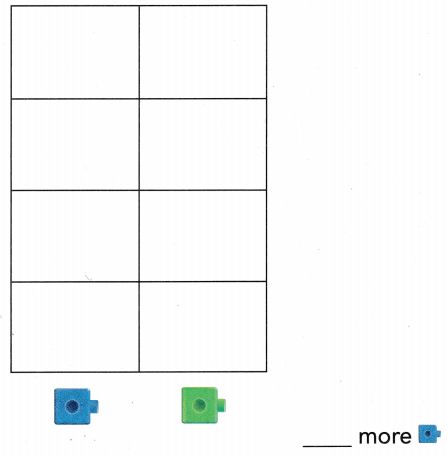
Use  . Draw to show the cubes. 1 Write how many more
  .
.
Answer:

Explanation:
I drew cubes 4 blue cubes and 2 green cubes. So, there are 2 blue cubes more than green cubes.
FOR THE TEACHER • Read the following problem. There are 2 green cubes and 4 blue cubes. How many more blue cubes are there than green cubes?
Answer:
Math Talk
Mathematical Processes
Describe how you can use your picture to compare the cubes.
Answer: I counted the number of cubes by comparing the cubes in the picture.
Model and Draw

Each  stands for 1 child.
A picture graph uses pictures to show information.
There are _________ children on the  .
.
There are _________ children on the  .
.
There are more children on the __________.
Answer:
There are 4 children on the .
There are 2 children on the .
There are more children on the swing.
Share and Show

Each 5 stands for 1 child.
Use the picture graph to answer the questions.
Question 1.
Which activity did more children choose? Circle your answer.

Answer:

Explanation:
Each 5 stands for 1 child
So, 7 x = 35
35 children choosed the rides as their favourite activity at the fair. So,i circled rides.
Question 2.
How many children chose  ?
?
__________ children
Answer:
25 children
Explanation:
Each 5 stands for 1 child
So, 5 x 5 = 25
25 children choosed animals as their favourite activity at the fair.
Question 3.
How many children chose  ?
?
__________ children
Answer:
35 children
Explanation:
Each 5 stands for 1 child
7 x 5 = 35
35 children choosed rides as their favourite activity at the fair.
Question 4.
How many fewer children chose than ?
_________ fewer children
Answer:
10 fewer children
Explanation:
Each 5 stands for 1 child
So, 2 x 5 = 10
Therefore, 10 fewer children chose than .
Problem Solving
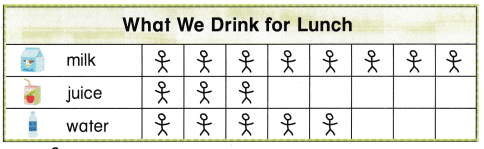
Each stands for 1 child.
Use the picture graph to answer the questions.
Question 5.
How many children drink  ?
?
__________ children
Answer:
8 children
Explanation:
Each stands for 1 child
So, 8 x 1 = 8
Therefore, 8 children drank .
Question 6.
How many children in all drink  and
and  ?
?
__________ children
Answer:
8 children
Explanation:
3 children choosed
5 children choosed
3+5=8
Each stands for 1 child
So, 8 children choosed drinks and in all.
Question 7.
How many fewer children drink than ?
__________ fewer children
Answer:
3 fewer children
Explanation:
5 children choosed
8 children choosed
8-5=3
Each stands for 1 child
So, 3 fewer children drink than .
Question 8.
How many more children drink than ?
_____ more children
Answer:
5 more children
Explanation:
8 children choosed
3 children choosed
8-3=5
Each stands for 1 child
So, 5 more children drink than .
Question 9.
H.O.T. How many children in all drink , and ?
_________ children
Answer:
16 children
Explanation:
Explanation:
8 children choosed
3 children choosed
5 children choosed
8+3+5=16
Each stands for 1 child
So, 16 children in all drink , and .
Question 10.
H.O.T. Multi-Step 4 new children join the class. They drink at lunch. Now, how many more children drink 4 than ?
__________ more children
Answer:
2 more children
Explanation:
3 children choosed and 4 more children choosed
so, 7 childrem choosed
5 children choosed
7-5=2
Each stands for 1 child
So, 2 more children drink 4 than .
Daily Assessment Task
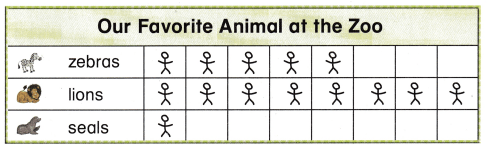
Each stands for 1 child.
Choose the correct answer.
Question 11.
How many children chose  and
and  altogether?
(A) 5 children
(B) 1 child
(C) 6 children
Answer:
(C) 6 children
Explanation:
5 children choosed and 1 child choosed
So, 5+1=6
Each stands for 1 child
Therefore, 6 children choose and altogether
Question 12.
Apply How many more children chose  than ?
(A) 7 children
(B) 8 children
(C) 1 child
Answer:
(A) 7 children
Explanation:
8 children chose
1 child chose
8-1=7
Each stands for 1 child
Therefore, 7 more children chose than .
Question 13.
Multi-Step How many more children chose than and altogether?
(A) 8 children
(B) 2 children
(C) 6 children
Answer:
(B) 2 children
Explanation:
8 children chose
5 children chose
1 child chose
8-(5+1) = 8-6=2
Each stands for 1 child
Therefore, 2 more children chose than and altogether.
Question 14.
TEXAS Test Prep Use the graph at the top. How many children chose ?
(A) 8 children
(B) 9 children
(C) 1 child
Answer:
(A) 8 children
Explanation:
Each stands for 1 child
Therefore, 8 children chose .
TAKE HOME ACTIVITY • Keep track of the weather for one week by drawing a picture each day to show if it is sunny, cloudy, or rainy. At the end of the week, ask your child what the weather was like for most of the week.
Answer:
Texas Go Math Grade 1 Lesson 19.1 Homework and Practice Answer Key
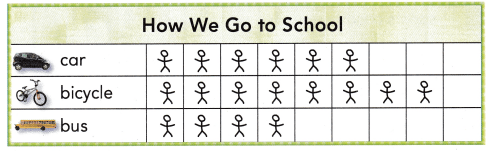
Each stands for 1 child.
Use the picture graph to answer the questions.
Question 1.
How many children go by  ?
?
__________ children
Answer:
4 children
Explanation:
Each stands for 1 child
Therefore, 4 children go by .
Question 2.
How many children go by  ?
?
_________ children
Answer:
6 children
Explanation:
Each stands for 1 child
Therefore, 6 children go by .
Question 3.
Which way do most children go to school? ____________
Answer:
Most of the children went to school by Bicycle.
Explanation:
8 children go by bicycle
6 children go by car
4 children go by bus
As 8 is more than 6 and 4 So, most children go to school by bicycle.
Problem Solving
Question 4.
How many more children go by car than bus?
___________ more children
Answer:
6 children go by car
4 children go by bus
6-4=2
Each stands for 1 child
Therefore, 2 more children go by car than bus.
Question 5.
How many children go by  , and , altogether?
_________ children
Answer:
8 children go by bicycle
6 children go by car
4 children go by bus
8+6+4=17
Therefore, 17 children go by , and , altogether.
Lesson Check
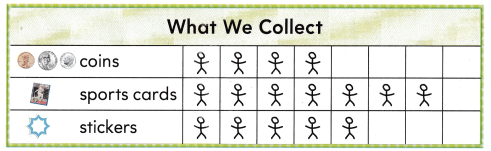
Each stands for 1 child.
Choose the correct answer.
Question 6.
How many children collect  and
and  altogether?
(A) 5
(B) 2
(C) 9
Answer:
(C) 9
Explanation:
4 children collected and
5 children collected
4+5=9
Each stands for 1 child
Therefore, 9 children collected and altogether.
Question 7.
How many fewer children collect  than ?
(A) 2
(B) 5
(C) 7
Answer:
(A) 2
Explanation:
7 children collected
5 children collected
7-5=2
Each stands for 1 child
Therefore, 2 more children collected than .
Question 8.
How many more children collect than ?
(A) 7
(B) 1
(C) 4
Answer:
(B) 1
Explanation:
5 children collected
4 children collected
5-4=1
Each stands for 1 child
Therefore, 1 more child collected than .
Question 9.
Multi-Step How many more children collect and altogether than ?
(A) 2
(B) 5
(C) 6
Answer:
(C) 6
Explanation:
4 children collected and 7 children collected
So, 11 children collect and
5 children collected
11-5=6
Each stands for 1 child
Therefore, 6 more children collect and altogether than .