Texas Go Math

Texas Go Math Grade 6 Module 10 Quiz Answer Key

Refer to our Texas Go Math Grade 6 Answer Key Pdf to score good marks in the exams. Test yourself by practicing the problems from Texas Go Math Grade 8 Module 10 Quiz Answer Key.

Texas Go Math Grade 6 Module 10 Quiz Answer Key

10.1 Exponents

Find the value of each power.

Question 1.
73
Answer:
Solution to this example is given below 73

Identify the base and the exponent.
The base is 7 and the exponent is 3.

Final Solution:
Evaluate: 73 = 7 × 7 × 7 = 343

Question 2.
92
Answer:
Solution to this example is given below 92

Identify the base and the exponent.
The base is 9 and the exponent is 2.

Final Solution:
Evaluate: 92 = 9 × 9 = 81

Geometry Module 10 Test Answer Key Go Math Question 3.
\(\left(\frac{7}{9}\right)^{2}\)
Answer:
Solution to this example is given below \(\left(\frac{7}{9}\right)^{2}\)

Identify the base and the exponent.
The base is \(\frac{7}{9}\) and the exponent is 2.

Final Solution:
Evaluate: \(\left(\frac{7}{9}\right)^{2}\) = \(\frac{7}{9} \times \frac{7}{9}\) = \(\frac{79}{81}\)

Question 4.
\(\left(\frac{1}{2}\right)^{6}\)
Answer:
Solution to this example is given below \(\left(\frac{1}{2}\right)^{6}\)

Identify the base and the exponent.
The base is \(\frac{1}{2}\) and the exponent is 6.

Final Solution:
Evaluate: \(\left(\frac{1}{2}\right)^{6}\) = \(\frac{1}{2} \times \frac{1}{2} \times \frac{1}{2} \times \frac{1}{2} \times \frac{1}{2} \times \frac{1}{2}\) = \(\frac{1}{64}\)

Question 5.
\(\left(\frac{2}{3}\right)^{3}\)
Answer:
Solution to this example is given below \(\left(\frac{2}{3}\right)^{3}\)

Identify the base and the exponent.
The base is \(\frac{2}{3}\) and the exponent is 3.

Final Solution:
Evaluate: \(\left(\frac{2}{3}\right)^{3}\) = \(\frac{2}{3} \times \frac{2}{3} \times \frac{2}{3}\) = \(\frac{8}{27}\)

Question 6.
(- 3)5
Answer:
Simplify the given expression by identifying the base and exponent
The base is – 3 and the exponent is 5.
= (- 3) × (- 3) × (- 3) × (- 3) × (- 3) multiply the base by itself five times
= – 243
The simplified expression is – 243.

Question 7.
(- 2)4
Answer:
Simplify the given expression by identifying the base and exponent.
The base is – 2 and the exponent is 4.
= (- 2) × (- 2) × (- 2) × (- 2) multiply the base by itself four times
= 16
The simplified expression is 16.

Texas Go Math Grade 6 Module 10 Test Answers Question 8.
1.42
Answer:
The solution to this example is given below 1.42

Identify the base and the exponent.
The base is 1.4 and the exponent is 2.

Final Solution:
Evaluate: 1.42 = 1.4 × 1.4 = 1.96

10.2 Prime Factorization

Find the factors of each number.

Question 9.
96 _________________
Answer:
List the factors of 96

  • 96 = 1 × 96
  • 96 = 2 × 48
  • 96 = 3 × 32
  • 96 = 4 × 24
  • 96 = 6 × 16
  • 96 = 8 × 12

The factors of 96 are 1, 2, 3, 4, 6, 8, 12, 16, 24, 32, 48 and 96.

Question 10.
120 ________________
Answer:
List the factors of 120

  • 120 = 1 × 120
  • 120 = 2 × 60
  • 120 = 3 × 40
  • 120 = 5 × 24
  • 120 = 6 × 20
  • 120 = 8 × 15
  • 120 = 10 × 12

The factors of 120 are 1, 2, 3, 4, 5, 6, 8, 10, 12, 15, 20, 24, 30, 60 and 120.

Find the prime factorization of each number.

Question 11.
58 ________________
Answer:
The prime factorization of a number is the number written as the product of its prime factors. For example, the prime factors of 58 are 2, and 29.

The prime factorization of 58 is 2 × 29

Question 12.
212 _______________
Answer:
The prime factorization of a number is the number written as the product of its prime factors. For example, the prime factors of 212 are 2, 2 and 53.

The prime factorization of 212 is 2 × 2 × 53 or 22 × 53

Question 13.
2,800 ______________
Answer:
The prime factorization of a number is the number written as the product of its prime factors. For example, the prime factors of 2800 are 2, 2, 2, 2, 5, 5 and 7.

The prime factorization of 2800 is 2 × 2 × 2 × 2 × 5 × 5 × 7 or 24 × 52 × 7

Question 14.
900 ______________
Answer:
The prime factorization of a number is the number written as the product of its prime factors. For example, the prime factors of 900 are 2, 2, 3, 3, 5 and 5.

The prime factorization of 2800 is 2 × 2 × 3 × 3 × 5 × 5 or 22 × 32 × 52

10.3 Order of Operations

Simplify each expression using the order of operations.

Question 15.
(21 – 3) ÷ 32
Answer:
Solution to this example is given below
(21 – 3) ÷ 32

(21 – 3) ÷ 32 = (21 – 3) ÷ 9 Evaluate 32
= 18 ÷ 9 Perform operations inside parentheses.
= 2 Divide.
= 2

Question 16.
72 × (6 ÷ 3)
Answer:
Solution to this example is given below
72 × (6 ÷ 3)

72 × (6 ÷ 3)> = 49 × (6 ÷ 3) Evaluate 72
= 49 × 2 Perform operations inside parentheses.
= 98 Multiply.
= 98

Question 17.
17 + 15 ÷ 3 – 24
Answer:
Solution to this example is given below
17 + 15 ÷ 3 – 24

17 + 15 ÷ 3 – 24 = 17 + 15 ÷ 3 – 16 Evaluate 24.
= 17 + 5 – 16 Divide.
= 22 – 16 Add.
= 6 Subtract.
= 6

Question 18.
(8 + 56) ÷ 4 – 32
Answer:
The solution to this example is given below
(8 + 56) ÷ 4 – 32

(8 + 56) ÷ 4 – 32 = (8 + 56) ÷ 4 – 9 Evaluate 32.
= 64 ÷ 4 – 9 Perform operations inside parentheses.
= 16 – 9 Divide.
= 7 Subtract.
= 7

Module 10 Answer Key Texas Go Math Grade 6 Question 19.
The nature park has a pride of 7 adult lions and 4 cubs. The adults eat 6 pounds of meat each day and the cubs eat 3 pounds. Simplify 7 × 6 + 4 × 3 to find the amount of meat consumed each day by the lions.
Answer:
Solution to this example ¡s given below 7 × 6 + 4 × 3

7 × 6 + 4 × 3 = 7 × 6 + 12 Multiply.
= 42 + 12 Multiply.
= 54 Add.
= 1
Each day by the lions is equal to 54 pounds.

Essential Question

Question 20.
How do you use numerical expressions to solve real-world problems?
Answer:
Most real world problems can be converted to algebraic expressions and equations to solve them. For example if a person earns a fixed monthly salary of $x and has expenses a, b and c, then the expenses can be added to evaluate the total expenses of the month and this sum can be subtracted front the amount of monthly salary to evaluate monthly savings and so on.

Texas Go Math Grade 6 Module 10 Mixed Review Texas Test Prep Answer Key

Selected Response

Question 1.
Which expression has a value that is less than the base of that expression?
(A) 23
(B) \(\left(\frac{5}{6}\right)^{2}\)
(C) 32
(D) 44
Answer:
(B) \(\left(\frac{5}{6}\right)^{2}\)

Explaination:
Identify the expression which has a value of less than the basa

(A) The base is 2 and the exponent is 3.
= 2 × 2 × 2 multiply the base three times
= 8
8 is not less than 2

(B) The base is 2 and the exponent is 3.
= \(\frac{5}{6} \times \frac{5}{6}\) multiply the base twice
= \(\frac{25}{36}\)
\(\frac{25}{36}\) is less than \(\frac{5}{6}\)

(C) The base is 3 and the exponent is 2.
= 3 × 3 multiply the base twice
= 9
9 is not less than 3

(D) The base is 2 and the exponent is 3.
= 4 × 4 × 4 × 4 multiply the base tour times
= 256
256 is not less than 4

The expression with a value less than the base is B. \(\left(\frac{5}{6}\right)^{2}\) because the base is a fraction.

Question 2.
After the game the coach bought 9 chicken meals for $5 each and 15 burger meals for $6 each. What percent of the total amount the coach spent was used for the chicken meals?
(A) 33\(\frac{1}{3}\)%
(B) 45%
(C) 66\(\frac{2}{3}\)%
(D) 90%
Answer:
(A) 33\(\frac{1}{3}\)%

Explaination:
Solution to this example is given below
9 × 5 + 15 × 6
9 × 5 + 15 × 6 = 9 × 5 + 90 Multiply.
= 45 + 90 Multiply.
= 135 Add.

We now calculate the percentage
Percent = \(\frac{45}{135}\) × 100%
= \(\frac{4500}{135}\)
= 33\(\frac{1}{3}\)%

Question 3.
Which operation should you perform first when you simplify 75 – (8 + 45 ÷ 3) × 7?
(A) addition
(B) division
(C) multiplication
(D) subtraction
Answer:
(B) division

Explaination:
Solution to this example is given below
175 – (8 + 45 ÷ 3) × 7
175 – (8 + 45 ÷ 3) × 7 = 175 – (8 + 15) × 7 [Divide.]
= 175 – 23 × 7 [Perform operations inside parentheses.]
= 175 – 161 [Multiply.]
= 14 [Subtract.]

B is the correct option
Division is first operation

Question 4.
At Tanika’s school, three people are chosen in the first round. Each of those people chooses 3 people in the second round, and so on. How many people are chosen in the sixth round?
(A) 18
(B) 216
(C) 243
(D) 729
Answer:
(D) 729

Explaination:
First round = 31 = 3
Second round = 32 = 9
Third round = 33 = 27
Fourth round = 34 = 81
Fifth round = 35 = 243
Sixth round = 36 = 729
There are 729 people chosen in the sixth round.

Question 5.
Which expression shows the prime factorization of 100?
(A) 22 × 52
(B) 10 × 10
(C) 1010
(D) 2 × 5 × 10
Answer:
(A) 22 × 52

Explaination:
The prime factorization of a number is the number written as the product of its prime factors. For example, the prime factors of 100 are 2, 2, 5 and 5

The prime factorization of 100 is 2 × 2 × 5 × 5 or 22 × 52

Question 6.
Which number has only two factors?
(A) 21
(B) 23
(C) 25
(D) 27
Answer:
(B) 23

Explaination:
Let’s check which number has two factors

(A) List the factors of 21
21 = 1 × 21
21 = 3 × 7
Option A is not the correct answer

(B) List the factor of 23
23 = 1 × 23
Option B is the correct answer

(C) List the factors of 25
25 = 1 × 25
25 = 5 × 5
Option C is not the correct answer

(D) List the factors of 27
27 = 1 × 27
27 = 3 × 9
Option D is not the correct answer

Grade 6 Go Math Module 10 Answer Key Pdf Question 7.
Which expression is equivalent to 3.6 × 3.6 × 3.6 × 3.6?
(A) 3.6 × 4
(B) 363
(C) 34 × 64
(D) 3.64
Answer:
(D) 3.64

Explaination:
Solution to this example is given below
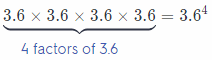
3.6 × 3.6 × 3.6 × 3.6
Find the base, or the numbers being multiplied. The base is 3.6

Find the exponent by counting the number of the 3.6s being multiplied.
The exponent is 4
Texas Go Math Grade 6 Module 10 Quiz Answer Key 2

Question 8.
Which expression gives the prime factorization of 80?
(A) 24 × 10
(B) 2 × 5 × 8
(C) 23 × 5
(D) 24 × 5
Answer:
(D) 24 × 5

Explaination:
The prime factorization of a number is the number written as the product of its prime factors. For example, the prime factors of 80 are 2, 2, 2, 2 and 5.

The prime factorization of 80 is 2 × 2 × 2 × 2 × 5 or 24 × 5

Gridded Response

Question 9.
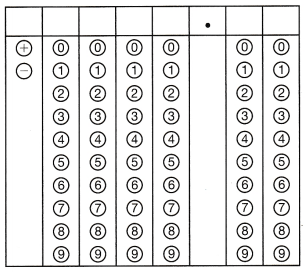
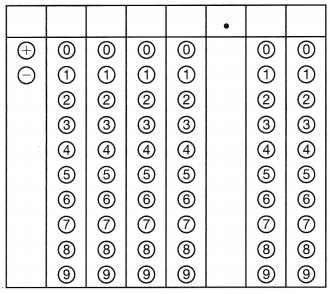
Alison raised 10 to the 5th power. Then she divided this value by 100. What was the quotient?
Texas Go Math Grade 6 Module 10 Quiz Answer Key 1
Answer:
Evaluate the expression.
= 105 ÷ 100 [evaluate the exponent]
= 100,000 ÷ 100 [divide the numbers]
= 1,000
The answer on the grid must be 1,000.

Texas Go Math Grade 6 Module 10 Quiz Answer Key Read More »

Texas Go Math Grade 6 Lesson 10.3 Answer Key Order of Operations

Refer to our Texas Go Math Grade 6 Answer Key Pdf to score good marks in the exams. Test yourself by practicing the problems from Texas Go Math Grade 6 Lesson 10.3 Answer Key Order of Operations.

Texas Go Math Grade 6 Lesson 10.3 Answer Key Order of Operations

Reflect

Question 1.
In C, why does it makes sense to write the values as powers? What is the pattern for the number of e-mails in each wave for Amy?
Answer:
It is easier to write the values as powers to identify the pattern that can be observed in the given situation.
Pattern for the diagram of Amy:
1st wave = 31 = 3
2nd wave = 32 = 9
The pattern is 31 and 32.

Your Turn

Simplify each expression using the order of operations.

Question 2.
(3 – 1)4 + 3 _______________
Answer:
Evaluate the expression.
= 24 + 3 subtract the numbers inside the parenthesis and evaluate the exponent
= 16 + 3 add the numbers
= 19
The simplified expression is 19.

Go Math 6th Grade Lesson 10.3 Answer Key Question 3.
24 ÷ (3 × 22) _______________
Answer:
Evaluate the expression.
= 24 ÷ (3 × 4) evaluate the exponent inside the parenthesis and multiply
= 24 ÷ 12 divide the numbers
= 2
The simplified expression is 2.

Simplify each expression using the order of operations.

Question 4.
– 7 × (- 4) ÷ 14 – 22
Answer:
Evaluate the expression.
= – 7 × (- 4) ÷ 14 – 4 evaluate the exponent
= 28 ÷ 14 – 4 multiply – 7 and – 4 then divide the answer by 14
= 2 – 4 subtract the numbers
= – 2
The simplified expression is – 2.

Question 5.
– 5(- 3 + 1)3 – 3
Answer:
Evaluate the expression.
= – 5 (- 2)3 – 3 subtract the numbers inside the parenthesis and evaluate the exponent
= – 5(- 8) – 3 multiply – 5 and – 8
= 40 – 3 subtract the numbers
= 37

Texas Go Math Grade 6 Lesson 10.3 Guided Practice Answer Key

Question 1.
In a video game, a guppy that escapes a net turns into three goldfish. Each goldfish can turn into two betta fish. Each betta fish can turn into two angelfish. Complete the diagram and write the number of fish at each stage. Write and evaluate an expression for the number of angelfish that can be formed from one guppy.
Texas Go Math Grade 6 Lesson 10.3 Answer Key Order of Operations 1
Answer:
1 guppy fish
3 goldfish
3 × 2 betta fish
3 × 22 = 12 angel fish

Complete to simplify each expression.

Question 2.
4 + (10 – 7)2 ÷ 3 = 4 + ( ____________ )2 ÷ 3
= 4 + ____________ ÷ 3
= 4 + ____________
= ____________
Answer:
Evaluate the expression.
= 4 + 32 ÷ 3 subtract the numbers inside the parenthesis and evaluate the exponent
= 4 + 9 ÷ 3 divide 9 by 3
= 4 + 3 add the number
= 7
The simplified expression is 7.

Go Math Lesson 10.3 6th Grade Answer Key Question 3.
36 ÷ 22 – 4 × 2 = 36 ÷ ____________ – 4 × 2
= ____________ – 4 × 2
= ____________ – 8
= ____________
Answer:
Evaluate the expression.
= 36 ÷ 4 – 4 × 2 evaluate the exponent
= 9 – 4 × 2 divide 36 by 4 then multiply 4 by 2
= 9 – 8 subtract the numbers
= 1
The simplified expression is 1.

Question 4.
2 + (- 24 ÷ 23) – 9 = – 2 + (- 24 ÷ _________ ) – 9
= 2 + ____________ – 9
=____________ – 9
= ____________
Answer:
Evaluate the expression
= 2 + (- 24 ÷ 8) – 9 evaluate the exponent and divide the numbers inside the parenthesis
= 2 + (- 3) – 9 subtract the numbers
= – 1 – 9 add the numbers
= – 10
The simplified expression is – 10

Question 5.
– 42 × (- 3 × 2 + 8) = – 42 × (_______ + 8)
= – 42 × _________
= _________ × _________
= _________
Answer:
Evaluate the expression
= – 42 × (-6 + 8) multiply – 3 by 2 inside the parenthesis and subtract
= – 42 × 2 evaluate the exponent
= 16 × 2 multiply the numbers
= 32
The simplified expression is 32.

Essential Question Check – In

Question 6.
How do you use the order of operations to simplify expressions with exponents?
Answer:
The order of operations to simplify expressions with exponents starts with simplifying the bracket (if any), solving the numerical value of power first, followed by division, multiplication, addition, and then subtraction.

Simplify each expression using the order of operations.

Go Math Grade 6 Lesson 10.3 Answer Key Question 7.
5 × 2 + 32 __________
Answer:
Solution to this example is given below = 5 × 2 + 32

5 × 2 + 32 = 5 × 2 + 9 Evaluate 32.
= 10 + 9 Multiply.
= 19 Add.
= 19

Question 8.
15 – 7 × 2 + 23 _____________
Answer:
Solution to this example is given below
15 – 7 × 2 + 23
15 – 7 × 2 + 23 = 15 – 7 × 2 + 8 Evaluate 2.
= 15 – 14 – 8 Multiply.
= 1 + 8 Subtract.
= 9 Add.
= 9

Question 9.
(11 – 8)2 – 2 × 6 _____________
Answer:
Evaluate the expression.
= 32 – 2 × 6 subtract the numbers inside the parenthesis and evaluate the exponent
= 9 – 2 × 6 multiply – 2 by 6
= 9 – 12 subtract the numbers
= – 3
The simplified expression is – 3.

Question 10.
6 + 3(13 – 2) – 52 _____________
Answer:
Solution to this example is given below
6 + 3(13 – 2) – 52

6 + 3(13 – 2) – 52 = 6 + 3(13 – 2) – 25 Evaluate 52.
= 6 + 3 × 11 – 25 Perform operations inside parentheses.
= 6 + 33 – 25 Multiply.
= 6 + 8 Subtract.
= 14 Add.
= 14

Question 11.
12 + \(\frac{9^{2}}{3}\) _____________
Answer:
Solution to this example is given below
12 + \(\frac{9^{2}}{3}\)

12 + \(\frac{9^{2}}{3}\) = 12 + \(\frac{81}{3}\) Evaluate 92.
= 12 + 27 Divide.
= 39 Add.
= 39

Lesson 10.3 Answer Key Go Math Grade 6 Question 12.
\(\frac{8+6^{2}}{11}\) + 7 × 2 _____________
Answer:
The solution to this example is given below
\(\frac{8+6^{2}}{11}\) + 7 × 2

\(\frac{8+6^{2}}{11}\) + 7 × 2 = \(\frac{8+6^{2}}{11}\) + 7 × 2 Evaluate 62.
= \(\frac{44}{11}\) + 7 × 2 Add.
= 4 + 7 × 2 Divide.
= 4 + 14 Multiply.
= 18 Add.

Question 13.
Explain the Error Jay simplified the expression – 3 × (3 + 12 ÷ 3) 4. For his first step, he added 3 + 12 to get 15. What was Jay’s error? Find the correct answer.
Answer:
Evaluate the expression
= – 3 × (3 + 4) – 4 divide 12 by 3 then add to 3
= – 3 × 7 – 4 multiply – 3 by 7
= – 21 – 4 add the numbers
= – 25
Jay made an error on his first step. In the order of operations, inside a parenthesis, division must be done first than addition, Therefore, the simplified expression is – 25.

Question 14.
Multistep A clothing store has the sign shown in the shop window. Pani sees the sign and wants to buy 3 shirts and 2 pairs of jeans. The S cost of each shirt before the discount is $12, and the cost of each pair of jeans is $19 before the discount.
Texas Go Math Grade 6 Lesson 10.3 Answer Key Order of Operations 2

a. Write and simplify an expression to find the amount Pani pays if a $3 discount is applied to her total.
Answer:
Evaluate the total cost when only 1 $3 off coupon is applied. Therefore, Cost = 3(12) + 2(19) – 3 = $71.

b. Pani says she should get a $3 discount on the price of each shirt and a $3 discount on the price of each pair of jeans. Write and simplify an expression to find the amount she would pay if this is true.
Answer:
Evaluate the total cost when only 1 $3 off coupon is applied. on every piece of clothing. Therefore, Cost = 3(12 – 3) + 2(19 – 3) = $59.

c. Analyze Relationships Why are the amounts Pani pays in a and b different?
Answer:
In a, the coupon is applied only once, while in b the coupon is applied for each piece of clothing, so here 5 times. This is why the result of b is $12 less than that of a.

d. If you were the shop owner, how would you change the sign? Explain.
Answer:
It would be better to write that $3 off the total purchase.

Go Math Grade 6 Lesson 10.3 Practice Answer Key Question 15.
Ellen is playing a video game in which she captures butterflies. There are 3 butterflies on screen, but the number of butterflies doubles every minute. After 4 minutes, she was able to capture 7 of the butterflies.
Texas Go Math Grade 6 Lesson 10.3 Answer Key Order of Operations 3

a. Look for a Pattern Write an expression for the number of butterflies after 4 minutes. Use a power of 2 in your answer.
Answer:
In the 1st minute there are 3 butterfLies on the screen and they double every minute, so here the repeating number is 2, so the expression for butterflies on the screen after n minutes is given by 3 × 2n.

b. Write an expression for the number of butterflies remaining after Ellen captured the 7 butterflies. Simplify the expression.
Answer:
Use the expression obtained to soLve for n = 4 and subtract 7 from it, therefore: 3 × 24 – 7 = 41. There were 41 butterflies on the screen after 4 minutes and after Ellen had caught 7.

Question 16.
Show how to write, evaluate and simplify an expression to represent and solve this problem: Jeff and his friend each text four classmates about a concert. Each classmate then texts four students from another school about the concert. If no one receives the message more than once, how many students from the other school receive a text about the concert?
Answer:
Jeff and his friend, so 2 people are texting 4 people each, so 2 × 4 = 8 people are being notified about the concert. Then each 8 of them texts to 4 more, so the total number of people of the other school to get notified about the concert are 8 × 4 = 32.

H.O.T. Focus on Higher Order Thinking

Question 17.
Geometry The figure shown is a rectangle. The green shape in the figure is a square. The blue and white shapes are rectangles, and the area of the blue rectangle is 24 square inches.
Texas Go Math Grade 6 Lesson 10.3 Answer Key Order of Operations 4

a. Write an expression for the area of the entire figure that includes an exponent. Then find the area.
Answer:
Area of the blue rectangle is 24 square inches, area of the white rectangle is 2 × 6 = 12 square inches, and area of the square is 62 = 36 square inches. Therefore the total area of the figure is 24 + 12 + 36 = 72 square inches.

b. Find the dimensions of the entire figure.
Answer:
The side length of the square is 6 inches and then there is an additional 2 units below it so it can be said that the left and right side length of the given figure is 6 + 2 = 8 inches. The area is 72 square inches so this can be divided by the obtained side length to evaluate the width of the rectangle, therefore: \(\frac{72}{8}\) = 9 inches. The figure is a rectangle with a length of 8 inches and a width of 9 inches.

Lesson 10.3 Answer Key 6th Grade Go Math Question 18.
Analyze Relationships Roberto’s teacher writes the following statement on the board: The cube of a number plus one more than the square of the number is equal to the opposite of the number. Show that the number is – 1.
Answer:
Evaluate the expression.
(- 1)3 + 1 + (- 1)2 = 1 translating the problem
– 1 + 1 + 1 = 1 evaluate the exponents
– 1 + 2 = 1 subtract the numbers
1 = 1
The expression is (- 1)3 + 1 + (- 1)2 = 1.

Question 19.
Persevere in Problem Solving Use parentheses to make this statement true: 8 × 4 – 2 × 3 + 8 ÷ 2 = 25
Answer:
Solution to this example is given below
8 × 4 – (2 × 3 + 8) ÷ 2 (we use parentheses like this)

8 × 4 – (2 × 3 + 8) ÷ 2 = 8 × 4 – (6 + 8) ÷ 2 Perform operations inside parentheses.
= 8 × 4 – 14 ÷ 2 Perform operations inside parentheses
= 8 × 4 – 7 Divide.
= 32 – 7 Multiply.
= 25 Subtract.
= 25

Texas Go Math Grade 6 Lesson 10.3 Answer Key Order of Operations Read More »

Texas Go Math Grade 6 Lesson 10.2 Answer Key Prime Factorization

Refer to our Texas Go Math Grade 6 Answer Key Pdf to score good marks in the exams. Test yourself by practicing the problems from Texas Go Math Grade 6 Lesson 10.2 Answer Key Prime Factorization.

Texas Go Math Grade 6 Lesson 10.2 Answer Key Prime Factorization

Your Turn

List all the factors of each number.

Question 1.
21 ______________
Answer:
List the factors of 21
21 = 1 × 21
21 = 3 × 7
The factors of 21 are 1, 3, 7, 21.

Question 2.
37 ______________
Answer:
List the factors of 37
37 = 1 × 37
The factors of 37 are 1, 37,

Lesson 1.2 Prime Factorization Answers 6th Grade Question 3.
42 ______________
Answer:
List the factors of 42

  • 42 = 1 × 42
  • 42 = 2 × 21
  • 42 = 3 × 14
  • 42 = 6 × 7

The factors of 42 are 1, 2, 3, 6, 7, 14, 21, 42.

Question 4.
30 ______________
Answer:
List the factors of 30

  • 30 = 1 × 30
  • 30 = 2 × 15
  • 30 = 3 × 10
  • 30 = 5 × 6

The factors of 30 are 1, 2, 3, 5, 6, 10, 15, 30

Reflect

Question 5.
What If? What will the factor tree for 240 look like if you start the tree with a different factor pair? Check your prediction by creating another factor tree for 240 that starts with a different factor pair.
Texas Go Math Grade 6 Lesson 10.2 Answer Key Prime Factorization 1
Answer:
Prime factorization of 240 using factor tree.
Texas Go Math Grade 6 Lesson 10.2 Answer Key Prime Factorization 6

Prime factorization of 240 using factor tree.
Texas Go Math Grade 6 Lesson 10.2 Answer Key Prime Factorization 7

The prime factors of 240 are 5 ∙ 3 ∙ 2 ∙ 2 ∙ 2 ∙ 2 or 5 ∙ 3 ∙ 24

Reflect

Grade 6 Go Math Lesson 10.2 Practice Answer Key Question 6.
Complete a factor tree and a ladder diagram to find the prime factorization of 54.
Texas Go Math Grade 6 Lesson 10.2 Answer Key Prime Factorization 2
Answer:
Prime factorization of 54 using factor tree.
Texas Go Math Grade 6 Lesson 10.2 Answer Key Prime Factorization 8

Prime factorization of 54 using a ladder diagram.
Texas Go Math Grade 6 Lesson 10.2 Answer Key Prime Factorization 9

The prime factors of 54 are 2 ∙ 3 ∙ 3 ∙ 3 or 2 ∙ 33

Question 7.
Communicate Mathematical Ideas If one person uses a ladder diagram and another uses a factor tree to write a prime factorization, will they get the same result? Explain.
Answer:
If one person uses a ladder diagram and another uses a factor tree to write a prime factorization, they will get the same result because the prime factors of a number are identical an independent of the method used to evaluate them.

Texas Go Math Grade 6 Lesson 10.2 Guided Practice Answer Key

Use a diagram to list the factor pairs of each number.

Question 1.
18
Answer:
Given number: 18

Write the given number as a product of its factors, therefore:

  • 18 = 2 × 9
  • 18 = 3 × 6

The factors of 18 are 1, 2, 3, 6, 9 and 18.

Question 2.
52
Answer:
Given number: 52

Write the given number as a product of its factors, therefore:
52 = 2 × 26
52 = 4 × 13
The factors are of 52 are 1, 2, 4, 13, 26 and 52.

Question 3.
Karl needs to build a stage that has an area of 72 square feet. The length of the stage should be longer than the width. What are the possible whole number measurements for the length and width of the stage?
Complete the table with possible measurements of the stage.
Texas Go Math Grade 6 Lesson 10.2 Answer Key Prime Factorization 3
Answer:
Possible measurements of the stage.
Texas Go Math Grade 6 Lesson 10.2 Answer Key Prime Factorization 10

List the possible measurements of the stage based on the factors of 72.

Use a factor tree to find the prime factorization of each number.

Question 4.
402
Texas Go Math Grade 6 Lesson 10.2 Answer Key Prime Factorization 4
Answer:
Prime factorization of 402 using a factor tree.
First line of factor tree 6 × 67 = 402
Factor out 6 and you will have 3 × 2.
The complete prime factors of 402 is 3 ∙ 2 ∙ 67
Texas Go Math Grade 6 Lesson 10.2 Answer Key Prime Factorization 11

Another way to show the prime factorization of 402 using a factor tree.
First line of factor tree 2 × 201 = 402
Factor out 201 and you will have 3 × 67.
The complete prime factors of 402 is 2 ∙ 3 ∙ 67
Texas Go Math Grade 6 Lesson 10.2 Answer Key Prime Factorization 12

Prime factors of 402 are 3 ∙ 2 67.

Grade 6 Go Math Lesson 10.2 Prime Factorization Answer Key Question 5.
36
Answer:
Prime factorization of 36 using a factor tree.
Texas Go Math Grade 6 Lesson 10.2 Answer Key Prime Factorization 13

Prime factors of 36 are 3 ∙ 2 ∙ 3 ∙ 2 or 32 ∙ 22

Use a ladder diagram to find the prime factorization of each number.

Question 6.
32
Answer:
Determine the prime factors of 32 using continuous division.
Texas Go Math Grade 6 Lesson 10.2 Answer Key Prime Factorization 14

Prime factors of 32 are 2 ∙ 2 ∙ 2 ∙ 2 ∙ 2 or 25

Question 7.
27
Answer:
Determine the prime factors of 27 using continuous division.
Texas Go Math Grade 6 Lesson 10.2 Answer Key Prime Factorization 15
The prime factors of 27 are 3 ∙ 3 ∙ 3 or 33

Essential Question Check-In

Question 8.
Tell how you know when you have found the prime factorization of a number.
Answer:
The prime factorization of a number is verified by studying its factors. They must all be prime numbers.

Question 9.
Multiple Representations Use the grid to draw three different rectangles so that each has an area of 12 square units and they all have different widths. What are the dimensions of the rectangles?
Texas Go Math Grade 6 Lesson 10.2 Answer Key Prime Factorization 5
Answer:
The dimensions of the rectangle are:
a. 1 by 12
b. 2 by 6
c. 3 by 4

Diagram of the rectangle
Texas Go Math Grade 6 Lesson 10.2 Answer Key Prime Factorization 16
Dimensions are: 1 by 12, 2 by 6, 3 by 4.

Question 10.
Brandon has 32 stamps. He wants to display the stamps in rows, with the same number of stamps in each row. How many different ways can he display the stamps? Explain.
Answer:
Given Number = 32

Write the given number as a product of its factors, therefore:
32 = 2 × 16
32 = 4 × 8
This implies that he can arrange the stamps in 4 different ways. He can make 2 columns each containing 16 stamps or 2 rows each containing 16 stamps Or he can make 4 columns each containing 8 stamps or 4 rows each containing 8 stamps.

He can arrange the stamps in 4 different ways. He can make 2 columns each containing 16 stamps or 2 rows each containing 16 stamps. Or he can make 4 columns each containing 8 stamps or 4 rows each containing 8 stamps.

Question 11.
Communicate Mathematical Ideas How is finding the factors of a number different from finding the prime factorization of a number?
Answer:
Finding the factors of a number indicates all the factors that may be used for the number which can be a combination of prime numbers and composite numbers. Finding the prime factorization of a number breaks a composite number into product of its prime factors.

Example:
12 – factors are 1 and 12, 2 and 6, 3 and 4
12 – prime factors are 2 ∙ 2 ∙ 3 or 22 ∙ 3

Factors are the numbers to be multiplied.
Prime factorization results to product of prime factors of the number.

Find the prime factorization of each number.

Question 12.
891 ______________
Answer:
The prime factorization of a number is the number written as the product of its prime factors. For example, the prime factors of 891 are 3, 3, 3, 3 and 11.

The prime factorization of 891 is:
891 = 3 × 3 × 3 × 3 × 11 or 34 × 11
= 34 × 11

Question 13.
5.4 ______________
Answer:
The prime factorization of a number is the number written as the product of its prime factors. For example, the prime factors of 504 are 2, 2, 2, 3, 3 and 7.

The prime factorization of 504 is:
504 = 2 × 2 × 2 × 3 × 3 × 7 or 23 × 32 × 7
= 23 × 32 × 7

Question 14.
23 ______________
Answer:
The prime factorization of a number is the number written as the product of its prime factors. For example, the prime factors of 23 are 1 and 23.

The prime factorization of 23 is:
23 = 1 × 23

Question 15.
230 ______________
Answer:
The prime factorization of a number is the number written as the product of its prime factors. For example, the prime factors of 230 are 2, 5 and 23.

The prime factorization of 230 is:
230 = 2 × 5 × 23

Question 16.
The number 2 is chosen to begin a ladder diagram to find the prime factorization of 66. What other numbers could have been used to start the ladder diagram for 66? How does starting with a different number change the diagram?
Answer:
Prime factorization of 66 using ladder diagram.
Texas Go Math Grade 6 Lesson 10.2 Answer Key Prime Factorization 17
It will only change the order or arrangement of the prime factors but the prime factors are still the same.
The number 3 can be used to start the diagram however the prime factors will still be the same.

Question 17.
Critical Thinking List five numbers that have 3, 5, and 7 as prime factors.
Answer:

  • 105 = 3 ∙ 5 ∙ 7
  • 315 = 3 ∙ 3 ∙ 5 ∙ 7
  • 525 = 3 ∙ 5 ∙ 5 ∙ 7
  • 735 = 3 ∙ 5 ∙ 7 ∙ 7
  • 1,575 = 3 ∙ 3 ∙ 5 ∙ 5 ∙ 7

The numbers are 105, 315, 525, 735, and 1,575.

Question 18.
In a game, you draw a card with three consecutive numbers on it. You can choose one of the numbers and find the sum of its prime factors. Then you can move that many spaces. You draw a card with the numbers 25, 26, 27. Which number should you choose if you want to move as many spaces as possible? Explain.
Answer:
Given number:
25, 26, 27

Write the given numbers as a product of their prime factors, therefore:

  • 25 = 5 × 5
  • 26 = 2 × 13
  • 27 = 3 × 3 × 3

Evaluate the sum of the prime factors, therefore:

  • 5 + 5 = 10
  • 2 + 13 = 15
  • 3 × 3 × 3 = 9

It can be seen that 15 > 10 > 9 therefore the choice of the number 26 will result in the maximum number of moves.

Prime Factorization Grade 6 Pdf Lesson 10.2 Question 19.
Explain the Error When asked to write the prime factorization of the number 27, a student wrote 9 3. Explain the error and write the correct answer.
Answer:
Given number = 27
Write the given number as a product of its prime factors, therefore:
27 = 3 × 3 × 3
Prime factors of the given number is 3 . The student’s solution is incorrect because the factor 9 ¡s not a prime factor.
The student’s solution is incorrect because the factor 9 is not a prime factor.

H.O.T. Focus On Higher Order Thinking

Question 20.
Communicate Mathematical Ideas Explain why it is possible to draw more than two different rectangles with an area of 36 square units, but it is not possible to draw more than two different rectangles with an area of 15 square units. The sides of the rectangles are whole numbers.
Answer:
Given number = 36
Write the given number as a product of its factors, therefore:

  • 36 = 2 × 18 = Rectang1e 1
  • 36 = 3 × 12 = Rectangle 2
  • 36 = 4 × 9 = Rectangle 3
  • 36 = 36 × 1 = Rectangle 4
  • 36 = 6 × 6 = Square

It can be seen that 4 rectangles with different dimensions can be made each having an area of 36 square units

Given number = 15
Write the given number as a product of its factors, therefore:

  • 15 = 3 × 5 = Rectangle 1
  • 15 = 15 × 1 = Rectangle 2

It can be seen that only 2 rectangles can be made here because the given area is a product of prime factors or the number itself.

Question 21.
Critique Reasoning Alice wants to find all the prime factors of the number you get when you multiply 17 ∙ 11 ∙ 13 ∙ 7. She thinks she has to use a calculator to perform all the multiplications and then find the prime factorization of the resulting number. Do you agree? Why or why not?
Answer:
It can be seen that the number itself has factors that are prime numbers, so no calculator is required and the prime factors: 17, 11, 13 and 7 can directly be deduced.

The prime factors are 7, 11, 13 and 17.

Question 22.
Look for a Pattern Ryan wrote the prime factorizations shown below, If he continues this pattern, what prime factorization will he show for the number one million? What prime factorization will he show for one billion?
10 = 5 ∙ 2
100 = 52 ∙ 22
1,000 = 53 ∙ 23
Answer:
If the pattern continues, the number of zeros will determine the exponent of the base 10.
1 million = 1,000,000 = 56 . 26
1 billion = 1,000,000,000 = 59 . 29

The prime factorization for 1 million is 56 . 26
The prime factorization for 1 billion is 59 . 29

Texas Go Math Grade 6 Lesson 10.2 Answer Key Prime Factorization Read More »

Texas Go Math Grade 6 Module 10 Answer Key Generating Equivalent Numerical Expressions

Refer to our Texas Go Math Grade 6 Answer Key Pdf to score good marks in the exams. Test yourself by practicing the problems from Texas Go Math Grade 6 Module 10 Answer Key Generating Equivalent Numerical Expressions.

Texas Go Math Grade 6 Module 10 Answer Key Generating Equivalent Numerical Expressions

Texas Go Math Grade 6 Module 10 Are You Ready? Answer Key

Find the product.

Question 1.
992 × 16
Answer:
Given expression = 992 × 16
Rewrite the given expression as a product of a number and a difference, therefore = 16(1000 – 8)
Apply distributive property to expand the parenthesis = 16000 – 128

Evaluate = 15872
9920 × 16 = 15872

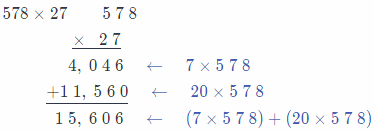
Go Math Grade 6 Module 10 Answer Key Question 2.
578 × 27
Answer:
Solution to this example is given below
Texas Go Math Grade 6 Module 10 Answer Key Generating Equivalent Numerical Expressions 2
Final Solution = 15,606

Question 3.
839 × 65
Answer:
Given expression = 839 × 65
Rewrite the given expression as a product of a number and a difference, therefore = 65(800 + 39)
Apply distributive property to expand the parenthesis = 52000 + 2535

Evaluate = 54535
839 × 65 = 54535

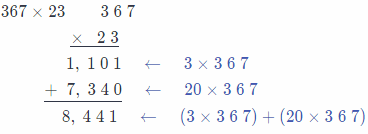
Question 4.
367 × 23
Answer:
Solution to this example is given below
Texas Go Math Grade 6 Module 10 Answer Key Generating Equivalent Numerical Expressions 3
Final Solution = 8,441

Find the product.

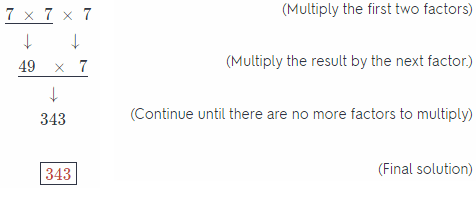
Question 5.
7 × 7 × 7
Answer:
Solution to this example is given below
Texas Go Math Grade 6 Module 10 Answer Key Generating Equivalent Numerical Expressions 4

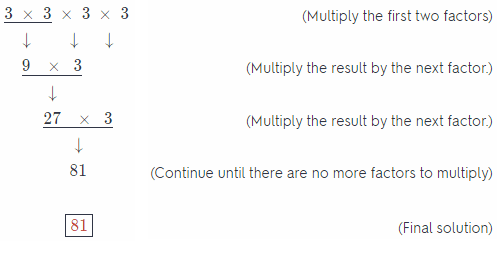
Go Math Expressions Grade 6 Answer Key Module 10 Test Answers Question 6.
3 × 3 × 3 × 3
Answer:
Solution to this example is given below
Texas Go Math Grade 6 Module 10 Answer Key Generating Equivalent Numerical Expressions 5

Question 7.
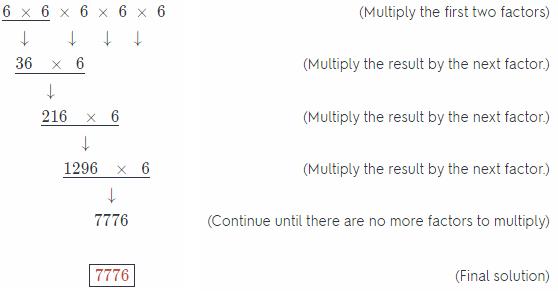
6 × 6 × 6 × 6 × 6
Answer:
Solution to this example is given below
Texas Go Math Grade 6 Module 10 Answer Key Generating Equivalent Numerical Expressions 6

Question 8.
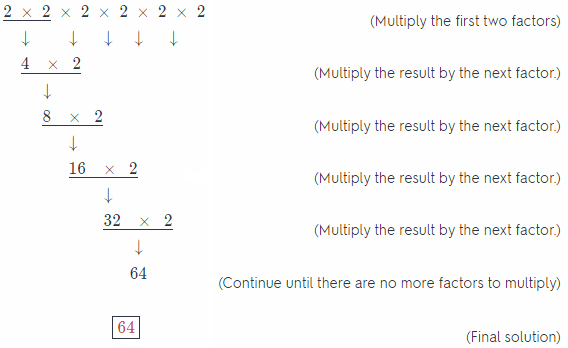
2 × 2 × 2 × 2 × 2 × 2 × 2
Answer:
Solution to this example is given below
Texas Go Math Grade 6 Module 10 Answer Key Generating Equivalent Numerical Expressions 7

Divide.

Question 9.
20 ÷ 4
Answer:
Solution to this example is given below
20 ÷ 4 = ?
Think: 4 times what number equals 20?
⇒ 4 × 5 = 20
⇒ 20 ÷ 4 = 5
So, 20 ÷ 4 = 5.

Grade 6 Go Math Module 10 Answer Key Question 10.
21 ÷ 7
Answer:
Solution to this example is given below
21 ÷ 7 = ?
Think: 7 times what number equals 20?
⇒ 7 × 3 = 21
⇒ 21 ÷ 7 = 3
So, 21 ÷ 7 = 3.

Question 11.
42 ÷ 7
Answer:
Solution to this example is given below
42 ÷ 7 = ?
Think: 7 times what number equals 20?
⇒ 7 × 6 = 42
⇒ 42 ÷ 7 = 6
So, 42 ÷ 7 = 6.

Question 12.
56 ÷ 8
Answer:
Solution to this example is given below
56 ÷ 8 = ?
Think: 8 times what number equals 20?
⇒ 8 × 7 = 56
⇒ 56 ÷ 8 = 7
So, 56 ÷ 8 = 7.

Texas Go Math Grade 6 Module 9 Reading Start-Up Answer Key

Visualize Vocabulary
Use the words to complete the graphic. You may put more than one word in each box.

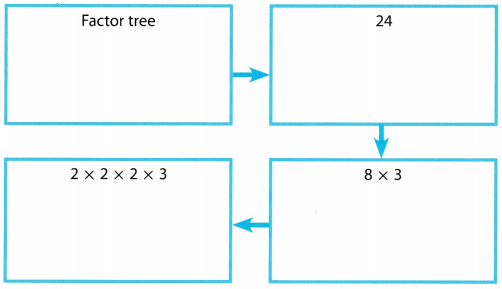
Texas Go Math Grade 6 Module 10 Answer Key Generating Equivalent Numerical Expressions 1

Understand Vocabulary

Complete the sentences using the preview words.

Question 1.
A number that is formed by repeated multiplication by the same factor is a _________________.
Answer:
Power

Go Math Answer Key Grade 6 Generating Equivalent Expressions Question 2.
A rule for simplifying expressions is _____________________
Answer:
Order of Operations.
It can consist of multiple operations but follow a certain order.

Question 3.
The _________________ is a number that is multiplied. The number that indicates how many times this number is used as a factor is the ____________ .
Answer:
base and exponent.

Texas Go Math Grade 6 Module 10 Answer Key Generating Equivalent Numerical Expressions Read More »

Texas Go Math Grade 6 Lesson 13.3 Answer Key Multiplication and Division Inequalities with Positive Numbers

Refer to our Texas Go Math Grade 6 Answer Key Pdf to score good marks in the exams. Test yourself by practicing the problems from Texas Go Math Grade 6 Lesson 13.3 Answer Key Multiplication and Division Inequalities with Positive Numbers.

Texas Go Math Grade 6 Lesson 13.3 Answer Key Multiplication and Division Inequalities with Positive Numbers

Texas Go Math Grade 6 Lesson 13.3 Explore Activity Answer Key

Modeling One-Step Inequalities

You can use algebra tiles to solve inequalities that involve multiplying positive numbers.
Texas Go Math Grade 6 Lesson 13.3 Answer Key 1
Dominic is buying school supplies. He buys 3 binders and spends more than $9. How much did he spend on each binder?
A. Let x represent the cost of one binder. Write an inequality.
Texas Go Math Grade 6 Lesson 13.3 Answer Key 2
B. The model shows the inequality from A
There are _________ x-tiles, so draw circles to separate the tiles into ________ equal groups. _____________
How many units are in each group? _________
Texas Go Math Grade 6 Lesson 13.3 Answer Key 3
C. What values make the inequality you wrote in A true? Graph the solution of the inequality. _________
Texas Go Math Grade 6 Lesson 13.3 Answer Key 4

Reflect

Question 1.
Analyze Relationships Is 3.25 a solution of the inequality you wrote in A ? If so, does that solution make sense for the situation?
Answer:
Inequality for A is the following:
3 ∙ x > 9
We can substitute 3.2 for x and check if inequality is true, so we have the following:
3 ∙ 3.25 > 9
9 ∙ 75 > 9
We got that inequality is true, so, 3.25 can be the solution. And yes, this solution makes sense for the situation.

Go Math Lesson 13.3 Answer Key Grade 6 Multiplication Question 2.
Represent Real-World Problems Rewrite the situation in A to represent the inequality 3x < 9.
Answer:
The modified situation that represents the given inequality could be:
Dominic is buying school supplies. He buys 3 binders and spends less than 9$. How much did he spend on each binder?

Your Turn

Solve each inequality. Graph and check the solution.

Question 3.
5x ≥ 100
Texas Go Math Grade 6 Lesson 13.3 Answer Key 5
Answer:
The first step in solving a given inequality is dividing both sides by 5 and getting:
\(\frac{5 x}{5} \geq \frac{100}{5}\)
x ≥ 20
Now, we will graph the solution:
Texas Go Math Grade 6 Lesson 13.3 Answer Key 14
We will check the solution by substituting a solution from the shaded part of the graph into the original inequality.
We will substitute 30 for x into the original inequality and get:
5 ∙ 30 ≥ 100
150 ≥ 100
So, the inequality is true
x ≥ 20

Question 4.
\(\frac{z}{4}\) < 11
Texas Go Math Grade 6 Lesson 13.3 Answer Key 6
Answer:
First step in solving given inequality is multiplying both sides by 4 and get:
4(\(\frac{z}{4}\)) < 11(4)
x < 44
Now, we will graph the solution:
Texas Go Math Grade 6 Lesson 13.3 Answer Key 15
We will check the solution by substituting a solution from the shaded part of the graph into the original inequality.
We will substitute 40 for x into the original inequality and get:
\(\frac{40}{4}\) < 11
10 < 11
So, the inequality is true.
z < 44

Reflect

Question 5.
Represent Real-World Problems Write and solve a real-world problem for the inequality 4x ≤ 60.
Answer:
Justin buys snacks. He bought 4 packs and spent $60 or less than $60. How much costs one pack of snacks?
Let x represent a price of one pack of snacks. According to given information.
we have the following inequality:
4x ≤ 60
In order to solve it. We will divide it by 4 and get:
\(\frac{4 x}{4} \leq \frac{60}{4}\)
x ≤ 15
So, one pack of snacks costs $15 or less than $15.

Your Turn

Question 6.
A paperweight must weigh less than 4 ounces. Brittany wants to make 6 paperweights using sand. Write and solve an inequality to find the possible weight of the sand she needs.
Answer:
Let x represent the possible weight of the sand Brittany needs. According to all informations, we have the following inequality:
6x < 4
We will, divide by 6 given inequality in order to solve previous inequality and get:
\(\frac{6x}{6}\) < \(\frac{4}{6}\)
x < \(\frac{2}{3}\)
So, the weight of the sand must be less than \(\frac{2}{3}\) ounce.
We will check solution substituting \(\frac{1}{3}\) for x in original inequality and get:
6 ∙ \(\frac{1}{3}\) < 4
2 < 4
So, the inequality is true.
x < \(\frac{2}{3}\)

Texas Go Math Grade 6 Lesson 13.3 Guided Practice Answer Key

Question 1.
Write the inequality shown on the model. Circle groups of tiles to show the solution. Then write the solution. (Explore Activity)
Texas Go Math Grade 6 Lesson 13.3 Answer Key 7
Inequality: ___________
Solution: ___________
Answer:

Solve each inequality. Graph and check the solution.  (Example 1)

Question 2.
8y < 320 _________
Texas Go Math Grade 6 Lesson 13.3 Answer Key 8
Answer:
First step ¡s multiplying both sides by 8 and get:
\(\frac{8y}{8}\) < \(\frac{320}{80}\)
y < 40
Now, we will graph the solution:
Texas Go Math Grade 6 Lesson 13.3 Answer Key 16
We will now check the solution by substituting a solution from the shaded part of the graph into the original inequality.
We will substitute 30 for y into the original inequality and get:
8 ∙ 30 < 320
240 < 320
So, the inequality is true.
y < 40

Go Math Grade 6 Lesson 13.3 Answer Key Question 3.
\(\frac{r}{3}\) ≥ 11 __________
Texas Go Math Grade 6 Lesson 13.3 Answer Key 9
Answer:
First we will multiply both sides by 3 and get:
3(\(\frac{r}{3}\)) ≥ 11 ∙ 3
r ≥ 33
Now, we will graph the solution:
Texas Go Math Grade 6 Lesson 13.3 Answer Key 17
We will now check the solution by substituting a solution from the shaded part of graph into the original inequality.
We will substitute 39 for r into original inequality and get:
\(\frac{39}{3}\) ≥ 11
13 ≥ 11
So, the inequality is true.
r ≥ 33

Question 4.
Karen divided her books and put them on 6 shelves. There were at least 14 books on each shelf. How many books did she have? Write and solve an inequality to represent this situation. (Example 2)
Answer:
Let x represent number of books Karen had. According to previous informations, we need to solve following inequality:
\(\frac{x}{6}\) > 14
First, we will multiply by 6 both sides and get:
6(\(\frac{x}{6}\)) > 14.6
x > 84
Next thing we will do is to check the solution by substituting a value in the solution set in the original inequality.
We will substitute 90 for x and get:
\(\frac{90}{6}\) > 14
15 > 14
So, the inequality is true.
Conclusion is that Karen had at least 84 book.
x > 84

Essential Question Check-In

Question 5.
Explain how to solve and check the solution to 5x < 40 using properties of inequalities.
Answer:
In order to solve this inequality, we need to divide both sides by 5 and get:
\(\frac{5x}{5}\) < \(\frac{40}{5}\)
x < 8
So, we got that set of solutions is x < 8. Now we will check the solution by substituting a value in the solution set in the original inequality. We will substitute 5 for x and get:
5 ∙ 5 < 40
25 < 40
So, the inequality is true.

Texas Go Math Grade 6 Lesson 13.3 Independent Practice Answer Key

Write and solve an inequality for each problem.

Question 6.
Geometry The perimeter of a regular hexagon is at most 42 inches. Find the possible side lengths of the hexagon.
Texas Go Math Grade 6 Lesson 13.3 Answer Key 10
Answer:
We can notice that hexagon has 6 sides, so, let x be length of one side of hexagon. Because this is a regular hexagon, all sides have equal lengths. The perimeter is calculated by multiplying side length by 6, so, according to given informations in this task, we get the following inequality:
6x ≤ 42
In order to solve this inequality, we will divide both sides by 6 and get:
\(\frac{6x}{6}\) ≤ \(\frac{42}{6}\)
x ≤ 7
So, the possible length of side of the hexagon ¡s at most 7.

Question 7.
Tamar needs to make at least $84 at work on Tuesday to afford dinner and a movie on Wednesday night. She makes $14 an hour at her job. How many hours does she need to work on Tuesday?
Answer:
Let x represent a number of hours Tamara needs to work on Tuesday.
According to all the information in the task, we have the following inequality:
14x ≥ 84
In order to solve this inequality, we need to divide both sides by 14 and get:
\(\frac{14x}{14}\) ≥ \(\frac{84}{14}\)
x ≥ 6
So, Tamara needs to work at least 6 hours on Tuesday

Lesson 13.3 Answer Key Multiplication and Division Inequalities Question 8.
In a litter of 7 kittens, each kitten weighs more than 3.5 ounces. Find the possible total weight of the litter.
Answer:
Let x represent the possible total. weight of the litter.
According to all information in the task, we have the following inequality:
\(\frac{x}{7}\) > 3.5
We will multiply both sides by 7 and get:
7(\(\frac{x}{7}\)) > 3.5 ∙ 7
x > 24.5
So, the possible total weight of the litter is more than 24.5 ounces.

Question 9.
To cover his rectangular backyard, Will needs at least 1 70.5 square feet of sod. The length of Will’s yard is 15.5 feet. What are the possible widths of Will’s yard?
Answer:
Let x represent width of Will’s yard. In order to calculate it, we need to solve the following inequality:
15.5x ≥ 170.5
We wiLl divide both sides by 15.5 and get:
\(\frac{15.5x}{15.5}\) ≥ \(\frac{170.5}{15.5}\)
x ≥ 11
So, the width of Will’s yard need to be at least 11 feet.

Solve each inequality. Graph and check the solution.

Question 10.
10x ≤ 60
Texas Go Math Grade 6 Lesson 13.3 Answer Key 11
Answer:
First step is to divide both sides by 10, so, we get:
\(\frac{10x}{10}\) ≤ \(\frac{60}{10}\)
x ≤ 6
Now, we wilt graph the solution:
Texas Go Math Grade 6 Lesson 13.3 Answer Key 25
We will, now check the solution by substituting a solution from the shaded part of graph into the original inequality.
We will, substitute 3 for z into original inequality and get:
10 ∙ 3 ≤ 60
30 ≤ 60
So, the inequality is true.
x ≤ 6

Question 11.
\(\frac{t}{2}\) > 0
Texas Go Math Grade 6 Lesson 13.3 Answer Key 12
Answer:
First step is to multiply both sides by 2, so, we get:
2(\(\frac{t}{2}\)) > 0 ∙ 2
t > 0
Now, we will graph the solution:
Texas Go Math Grade 6 Lesson 13.3 Answer Key 19
We will now check the solution by substituting a solution from the shaded part of graph into the original inequality.
We will substitute 2 for t into original inequality and get:
\(\frac{2}{2}\) > 0
1 < 0 So, the inequality is true t > o

Question 12.
Steve pays less than $32 per day to rent his apartment. August has 31 days. What are the possible amounts Steve could pay for rent in August?
Answer:
Let x represent the possible amount Steve could pay for rent in August According to all informations, we have the following inequality we need to solve:
\(\frac{x}{31}\) < 32
We will multiply both sides by 31 and get:
31(\(\frac{x}{31}\)) < 32 ∙ 31
x < 992
So, Steve could pay for amount in August less than 992$.

Question 13.
If you were to graph the solution for exercise 12, would all points on the graph make sense for the situation? Explain.
Answer:
No, points which make sense for the situation will be between 992 and 0. Points with negative values do not make sense for this a real-world situation.

Question 14.
Multistep Lina bought 4 smoothies at a health food store. The bill was less than $16.
a. Write and solve an inequality to represent the cost of each smoothie.
Answer:
Let x represent the cost of each smoothie. We need to soLve the following inequaLity in order to caLculate x.
4x < 16
We need to divide both sides by 4 and get:
\(\frac{4x}{4}\) < \(\frac{16}{4}\)
x < 4
So, the price of each smoothie in less than 4$.

b. What values make sense for this situation? Explain.
Answer:
Values that makes sense for this situation are between 4 and 0.
Because, no one sells nothing for price 0.
So only previous values make sense for this situation.

c. Graph the values that make sense for this situation on the number line.
Answer:
According to part (b), we will graph the values that make sense for this situation, it would be:
Texas Go Math Grade 6 Lesson 13.3 Answer Key 20

Solve each inequality.

Question 15.
\(\frac{p}{13}\) ≤ 30
Answer:
First step is to multiply both sides by 13:
13 (\(\frac{p}{13}\)) ≤ 30 ∙ 13
p ≤ 390
Now, we will graph the solution:
Texas Go Math Grade 6 Lesson 13.3 Answer Key 21
Next step is to check the solution by substituting a solution from the shaded part of the graph into the original inequality.
We will substitute 360 for p and get:
\(\frac{360}{13}\) ≤ 30
27.69 ≤ 30
So, the inequality is true
p ≤ 390

Question 16.
2t > 324
Answer:
First step is to divide both sides by 2, so, we have the following:
\(\frac{2t}{2}\) > \(\frac{324}{2}\)
t > 162
Now, we will graph the solution:
Texas Go Math Grade 6 Lesson 13.3 Answer Key 22
Next step is to check the solution by substituting a soLution from the shaded part of the graph into the original inequality.
We will substitute 170 for t and get:
2 ∙ 170 > 324
340 > 324
So, the inequality is true.
t > 162

Multiplication Questions for Grade 6 Go Math Question 17.
12y ≥ 1
Answer:
Texas Go Math Grade 6 Lesson 13.3 Answer Key 23
The next step is to check the solution by substituting a solution from the shaded part of the graph into the original inequality.
We will substitute 10 for y and get:
12 ∙ 10 ≥ 1
120 ≥ 1
So, the inequality is true.
y ≥ \(\frac{1}{12}\)

Question 18.
\(\frac{x}{9.5}\) < 11
Answer:
We will multiply both sides by 9.5 and get:
9.5 (\(\frac{x}{9.5}\)) < 11.9.5
x < 104.5
Now, we will graph the solution:
Texas Go Math Grade 6 Lesson 13.3 Answer Key 24
Next step is to check the solution by substituting a solution from the shaded part of the graph into the original inequality.
We will substitute 90 for x and get:
\(\frac{90}{9.5}\) < 11
9.47 < 11
So, the inequality is true.
x < 104.5

The sign shows some prices at a produce stand.
Texas Go Math Grade 6 Lesson 13.3 Answer Key 13
Question 19.
Tom has $10. What is the greatest amount of spinach he can buy?
Answer:
Let x represent the amount of spinach Tom can buy. According to all informations in the task, we have the following inequality:
3x ≤ 10
In order to solve this inequaLity, we need to divide both sides by 3 and get:
\(\frac{3x}{3}\) ≤ \(\frac{10}{3}\)
x ≤ 3.33
So, conclusion is that Tom can buy at most 3.33 pounds of spinach.

Question 20.
Gary has enough money to buy at most 5.5 pounds of potatoes. How much money does Gary have?
Answer:
Let x represent sum of money Gary have. According to data from the table and informations from task, we have the following inequality:
\(\frac{x}{0.50}\) ≤ 0.50
In order to solve this inequality, we need to multiply both sides by 0.50 and get:
0.50(\(\frac{x}{0.50}\)) ≤ 5.5 ∙ 0.50
x ≤ 2.75
So, conclusion is that Gary has at most 2.75.

Question 21.
Florence wants to spend no more than $3 on onions. Will she be able to buy 2.5 pounds of onions? Explain.
Answer:
Let x represent the amount of onions Florence can buy.
According to the table and informations, we get following inequality:
1.25x ≤ 3
In order to soLve this inequality, we need to divide both sides by 1.25 and get:
\(\frac{1.25 x}{1.25} \leq \frac{3}{1.25}\)
x ≤ 2.4
So, she can buy at most 2.4 pounds of onions. Conclusion is she can not buy 2.5 pounds of onions.

Question 22.
The produce buyer for a local restaurant wants to buy more than 30 lb of onions. The produce buyer at a local hotel buys exactly 12 pounds of spinach. Who spends more at the produce stand? Explain.
Answer:
Let x represent the sum of money the produce buyer for a local restaurant will spend for buying onions. So, we have the following inequality :
\(\frac{x}{1.25}\) > 30
In order to solve this inequality, we need to multiply both sides by 1.25 and get:
1.25(\(\frac{x}{1.25}\)) > 30 ∙ 1.25
x > 37.5
So, the produce buyer will spend more that $ 37.5 to by more than 30 lb of onions.
Now, let y represent sum of money the produce buyer for a local hotel will spend for buying exactly 12 pounds of spinach. We have the following equation we need to solve:
y ÷ 3 = 12
y = 12.3
y = 36
So, we can notice that the produce buyer will spend exactly $36 to buy 12 pounds of spinach.
Conclusion is that the produce buyer for a local restaurant will spend more money than the produce buyer for a local hotel.

H.O.T. Focus on Higher Order Thinking

Question 23.
Critique Reasoning A student solves \(\frac{r}{5}\) ≤ \(\frac{2}{5}\) and gets r ≤ \(\frac{2}{25}\) What is the correct solution? What mistake might the student have made?
Answer:
The mistake which student might made is that he divided by 5, not multiplied by 5
So, the right way to solve this inequality is to multiply by 5 and get:
5(\(\frac{r}{5}\)) ≤ \(\frac{2}{5}\) ∙ 5
r ≤ 2
So, the solution is r ≤ 2.

Question 24.
Represent Real-World Problems Write and solve a word problem that can be represented with 240 ≤ 2x.
Answer:
Mary want’s to spend $240 or more on buying chocolate as presents for guests at lier party. One pack costs $2, so, how many packs of chocolate she can buy?
Let x represent the number of packs of chocolate Mary can buy. According to all informations. we get the following inequality:
2x ≥ 240
We need to divide both sides by 2 and get:
\(\frac{2 x}{2} \geq \frac{240}{2}\)
x ≥ 120
So, she can at least buy 120 packs of chocolate or more.

Question 25.
Persevere in Problem Solving A rectangular prism has a length of 13 inches and a width of \(\frac{1}{2}\) inch. The volume of the prism is at most 65 cubic inches. Find all possible heights of the prism. Show your work.
Answer:
First, we will calculate the area of basis of this rectangular prism multiplying the length by the width and get:
B = 13 ∙ \(\frac{1}{2}\) = \(\frac{13}{2}\)
So, the area of bassis of rectangular prism is \(\frac{13}{2}\) square inches. Formula for calculating the volume is:
V = B ∙ H
Where V is the volume, B is the area of basis and H is its height.
According to all informations in the task, we have the following inequality we need to solve to find all possible heights of prism, where x represent height:
\(\frac{13}{2}\)x ≤ 65
We need to multiply both sides by \(\frac{2}{13}\) and get:
\(\frac{2}{13} \cdot \frac{13}{2} x \leq \frac{65}{1} \cdot \frac{2}{13}\)
x ≤ 10
So, the height of the prism can be at most 10 inches.

Texas Go Math Grade 6 Lesson 13.3 Answer Key Multiplication and Division Inequalities with Positive Numbers Read More »

Texas Go Math Grade 6 Lesson 12.2 Answer Key Addition and Subtraction Equations

Refer to our Texas Go Math Grade 6 Answer Key Pdf to score good marks in the exams. Test yourself by practicing the problems from Texas Go Math Grade 6 Lesson 12.2 Answer Key Addition and Subtraction Equations.

Texas Go Math Grade 6 Lesson 12.2 Answer Key Addition and Subtraction Equations

Texas Go Math Grade 6 Lesson 12.2 Explore Activity Answer Key

Modeling Equations

A puppy weighed 6 ounces at birth. After two weeks, the puppy weighed 14 ounces. How much weight did the puppy gain?
Let x represent the number of ounces gained.
Texas Go Math Grade 6 Lesson 12.2 Answer Key 1
To answer this question, you can solve the equation 6 + x = 14.
Algebra tiles can model some equations. An equation mat represents the two sides of an equation. To solve the equation, remove the same number of tiles from both sides of the mat until the x tile is by itself on one side.
A. Model 6 + x = 14.
Texas Go Math Grade 6 Lesson 12.2 Answer Key 2
B. How many 1 tiles must you remove on the left side so that the x tile is by itself? ___________ Cross out these tiles on the equation mat.
C. Whenever you remove tiles from one side of the mat, you must remove the same number of tiles from the other side of the mat. Cross out the tiles that should be removed on the right side of the mat.
D. How many tiles remain on the right side of the mat? ____________ This is the solution of the equation.
The puppy gained ____________ ounces.

Reflect

Question 1.
Communicate Mathematical Ideas How do you know when the model shows the final solution? How do you read the solution?
Answer:
The model shows final solution when only the variable is left in one side of the mat and the the same number of tiles have been removed. Thus, the remaining tiles on the right side of the mat are 12 which indicates that the puppy gained 12 ounces.

Example 1

Solve the equation a + 15 = 26. Graph the solution on a number line.
Texas Go Math Grade 6 Lesson 12.2 Answer Key 3

Reflect

Go Math Grade 6 Answer Key Lesson 12.2 Question 2.
Communicate Mathematical Ideas How do you decide which number to subtract from both sides?
Answer:
The reason for solving an equation is to determine the value of the variable on which the equation holds true. For this purpose, the variable is isolated on 1 side of the equation. Therefore, the number associated with the variable on the variable side of the equation is subtracted (or added as required) from both sides of the equation.

Your Turn

Question 3.
Solve the equation 5 = w + 1.5.
Texas Go Math Grade 6 Lesson 12.2 Answer Key 4
Graph the solution on a number line.
w = ____________
Answer:
Solution to this example is given below
5 = w + 1.5
5 = w + 1.5 Notice that 15 is added tow
5 – 1.5 = w + 1.5 – 1.5 Subtract both sides of the equation by 15
w = 3.5 Simplify
Check; 5 = w + 1.5
5 = 3.5 + 1.5 Substitute 3.5 for w
5 = 5 Add on the right side.
w = 3.5 Final solution
Graph the solution on a number line.
Texas Go Math Grade 6 Lesson 12.2 Answer Key 16

Example 2

Solve the equation y – 21 = 18. Graph the solution on a number line.
Texas Go Math Grade 6 Lesson 12.2 Answer Key 5

Reflect

Question 4.
Communicate Mathematical Ideas How do you know whether to add on both sides or subtract on both sides when solving an equation?
Answer:
The reason for solving an equation is to determine the value of the variable on which the equation holds true. For this purpose, the variable is isolated on 1 side of the equation. Therefore, the number associated with the variable on the variable side of the equation is subtracted if its sign is positive or added if its sign is negative from both sides of the equation.

Your Turn

Go Math Grade 6 Answers Pdf Lesson 12.2 Question 5.
Solve the equation h – \(\frac{1}{2}\) = \(\frac{3}{4}\).
Graph the solution on a number line.
Texas Go Math Grade 6 Lesson 12.2 Answer Key 6
h = ___________
Answer:
Solution to this example is given below.
Texas Go Math Grade 6 Lesson 12.2 Answer Key 17
Graph the solution on a number line.
Texas Go Math Grade 6 Lesson 12.2 Answer Key 18

Example 3

Find the measure of the unknown angle.
Texas Go Math Grade 6 Lesson 12.2 Answer Key 7

Your Turn

Question 6.
Write and solve an equation to find the measure of the unknown angle.
Texas Go Math Grade 6 Lesson 12.2 Answer Key 8
Answer:
It can be seen that the 2 angles are complementary angles so the equation becomes:
x + 65° = 90°
Add 65° on both sides of the equation to isolate the variable on 1 side of the equation:
x + 65° – 65° = 90° – 65°
Evaluate the variable:
x = 25°

Go Math Answer Key Grade 6 Lesson 12.2 Practice Geometry Question 7.
Write and solve an equation to find the measure of a complement of an angle that measures 42°.
Answer:
The sum of an unknown angle and a 42° angle is 90°. What is the measure of the unknown angle?
Write an equation
x + 42° = 90°
x + 42° – 42° = 90° – 42° Subtract 42 from both sides
x = 48° Simplify
x = 48° Final solution
The unknown angle measures 48°

Example 4

Write a real-world problem for the equation 21.79 + x = 25. Then solve the equation.
21.79 + x = 25
Texas Go Math Grade 6 Lesson 12.2 Answer Key 9

Reflect

Question 8.
What If? How might the real-world problem change if the equation were x – 21.79 = 25 and Joshua still spent $21.79 on roses?
Answer:
In the context of the example, r w the amount to be spent on the card. Here it represents tile total budget. as when this equation is solved: r = 25 + 21.79 = $46.79 and the situation can be to evaluate the total amount such that there should be $25 left to spend on a gift after spending $21.79 on roses.

Your Turn

Question 9.
Write a real-world problem for the equation x – 100 = 40. Then solve the equation.
Answer:
A real world situation to model the given equation can be the total amount required to he saved, if 100 are in savings and still $40 more are required.
Solve the equation: x = 100 + 40 = 140.
x = 140

Texas Go Math Grade 6 Lesson 12.2 Guided Practice Answer Key

Question 1.
A total of 14 guests attended a birthday party. Three guests stayed after the party to help clean up. How many guests left when the party ended? (Explore Activity)
a. Let x represent the _____________
Answer:
The variable x represents the number of guests who left the party when it ended.

b.
Texas Go Math Grade 6 Lesson 12.2 Answer Key 10
Answer:
Texas Go Math Grade 6 Lesson 12.2 Answer Key 19

c. Draw algebra tiles to model the equation. _________ friends left when the party ended.
Texas Go Math Grade 6 Lesson 12.2 Answer Key 11
Answer:
There are 11 friends left when the party ended.
Texas Go Math Grade 6 Lesson 12.2 Answer Key 20

Solve each equation. Graph the solution on a number line. (Examples 1 and 2)

Go Math Grade 6 Pdf Solving Addition and Subtraction Equations Answers Question 2.
2 = x – 3 x = ____________
Texas Go Math Grade 6 Lesson 12.2 Answer Key 12
Answer:
Solution to this example is given below
2 = x – 3
2 = x – 3 Notice that 3 is subtracted from x
2 + 3 = x – 3 + 3 Add both sides of the equation by 3
x = 5 Switch sides
Check; 2 = x – 3
2 = 5 – 3 Substitute 5 for x
2 = 2 Subtract on the right side.
x = 5 Final solution
Graph the solution on a number line.
Texas Go Math Grade 6 Lesson 12.2 Answer Key 21

Question 3.
s + 12.5 = 14 s = ___________
Texas Go Math Grade 6 Lesson 12.2 Answer Key 12
Answer:
Solution to this example is given below
s + 12.5 = 14
s + 12.5 = 14 Notice that 12.5 is added to s
s + 12.5 – 12.5 = 14 – 12.5 Subtract both sides of the equation by 125
s = 1.5 Simplify
Check; s + 12.5 = 14
1.5 + 12.5 = 14 Substitute 1.5 for s
14 = 14 Add on the left side.
s = 1.5 Final solution
Graph the solution on a number line.
Texas Go Math Grade 6 Lesson 12.2 Answer Key 22

Question 4.
h + 6.9 = 11.4
h = _________
Answer:
Solution to this example is given below
h + 6.9 = 11.4
h + 6.9 = 11.4 Notice that 6.9 is added to h
h + 6.9 6.9 = 11.4 – 6.9 Subtract both sides of the equation by 6.9
h = 4.5 Simplify
Check; h + 6.9 = 11.4
4.5 + 6.9 = 11.4 Substitute 4.5 for h
11.4 = 11.4 Add on the Left side.
h = 4.5 Final solution
h = 4.5

Question 5.
82 + p = 122
p = ____________
Answer:
Given equation:
82 + p = 122
Add 82 on both sides of the equation to isolate the variable on 1 side of the equation:
82 + p – 82 = 122 – 82
Evaluate the variable:
p = 40

Go Math Grade 6 Answer Key Pdf Lesson 12.2 Question 6.
n + \(\frac{1}{2}\) = \(\frac{7}{4}\)
n = ___________
Answer:
Given equation:
n + \(\frac{1}{2}\) = \(\frac{7}{4}\)
Add –\(\frac{1}{2}\) on both sides of the equation to isolate the variable on 1 side of the equation:
n + \(\frac{1}{2}\) – \(\frac{1}{2}\) = \(\frac{7}{4}\) – \(\frac{1}{2}\)
Evaluate the variable using Least common denominator technique:
n = \(\frac{7-1 \times 2}{4}\)
Simplify:
n = \(\frac{7-2}{4}=\frac{5}{4}\)
n = \(\frac{5}{4}\)

Question 7.
Write and solve an equation to find the measure of the unknown angle. (Example 3)
Texas Go Math Grade 6 Lesson 12.2 Answer Key 13
Answer:
It can be seen that the 2 angles are supplementary angles so the equation becomes:
x + 45° = 180°
Add -45° on both sides of the equation to isolate the variable on 1 side of the equation:
x + 45° – 45° = 180° – 45°
Evaluate the variable:
x = 135°

Question 8.
Write a real-world problem for the equation x – 75 = 200. Then solve the equation. (Example 4)
Answer:
John needs to save a certain amount of money for a new bike. He has already saved $75. If he requires $200 more. how much does he need to save?
Equation: x – 75 = 200, therefore x = 200 + 75 = 275

Essential Question Check-In

Question 9.
How do you solve equations that contain addition or subtraction?
Answer:
Case 1. If the sign of the constant associated with the variable on the variable side of the equation is positive, then the constant is subtracted from both sides of the equation, to isolate the variable on 1 side of the equation. For example: x + 5 = 12 is soLved by subtracting 5 from both sides of the equation, therefore the intermediate step becomes: x + 5 – 5 = 12 – 5 and the solution is x = 7.

Case 2. If the sign of the constant associated with the variable on the variable side of the equation is negative, then the constant is added to both sides of the equation, to isolate the variable on 1 side of the equation. For example: x – 5 = 12 is soLved by adding 5 to both sides of the equation, therefore the intermediate step becomes: x – 5 + 5 = 12 + 5 and the solution is x = 17.

Texas Go Math Grade 6 Lesson 12.2 Independent Practice Answer Key

Write and solve an equation to answer each question.

Question 10.
A wildlife reserve had 8 elephant calves born during the summer and now has 31 total elephants. How many elephants were in the reserve before summer began?
Answer:
Solution to this example is given below
x + 8 = 31
x + 8 = 31 Notice that 8 ¡s added to x
x + 8 – 8 = 31 – 8 Subtract both sides of the equation by 8
x = 23 Simplify
Check; x + 8 = 31
23 + 8 = 31 Substitute 23 for x
31 = 31 Add on the left side.
x = 23 Final solution
There were 23 elephants in the reserve before summer began.

Question 11.
My sister is 14 years old. My brother says that his age minus twelve is equal to my sister’s age. How old is my brother?
Answer:
Let the brother’s age be x, then the equation of this age is:
x – 12 = 14
Add 12 on both sides of the equation to isolate the variable on 1 side of the equation:
x – 12 + 12 = 14 + 12
Evaluate the variable:
x = 26
The brother is 26 years old.

Question 12.
Kim bought a poster that cost $8.95 and some colored pencils. The total cost was $21.35. How much did the colored pencils cost?
Answer:
Solution to this example is given below
x + 8.95 = 21.35
x + 8.95 = 21.35 Notice that 895 is added to x
x + 8.95 8.95 = 21.35 – 8.95 Subtract both sides of the equation by 8.95
x = 12.4 Simplify
Check; x + 8.95 = 21.35
12.4 + 8.95 = 21.35 Substitute 12.4 for x
21.35 = 21.35 Add on the left side.
x = 12.4 Final solution
The colored pencils cost 12.4 dollars.

Go Math Sixth Grade Answer Key Practice and Homework Lesson 12.2 Question 13.
The Acme Car Company sold 37 vehicles in June. How many compact cars were sold in June?
Texas Go Math Grade 6 Lesson 12.2 Answer Key 14
Answer:
Let the number of compact cars sold in Junes be x, then the equation of total cars sold is:
x + 8 = 37
Add -8 on both sides of the equation to isolate the variable on 1 side of the equation:
x + 8 – 8 = 37 – 8
Evaluate the variable:
x = 29
29 compact cars were sold in June.

Question 14.
Sandra wants to buy a new MP3 player that is on sale for $95. She has saved $73. How much more money does she need?
Answer:
Solution to this example is given below
x + 73 = 95
x + 73 = 95 Notice that 73 is added to x
X + 73 – 73 = 95 – 73 Subtract both sides of the equation by 73
x = 22 Simplify
Check; x + 73 = 95
22 + 73 = 95 Substitute 22 for x
95 = 95 Add on the left side
x = 22 Final solution
22 more are required.

Question 15.
Ronald spent $123.45 on school clothes. He counted his money and discovered that he had $36.55 left. How much money did he originally have?
Answer:
Let the total amount of money be x, then the equation of total cost is:
x = 123.45 + 36.55
Evaluate the variable:
x = 160
He originally had $160.

Question 16.
Brita withdrew $225 from her bank account. After her withdrawal, there was $548 left in Brita’s account. How much money did Brita have in her account before the withdrawal?
Answer:
Let the total amount of money be x, then the equation of money after withdrawal is:
x – 225 = 548
Add 225 on both side of the equation to isolate the variable on 1 side of the equation:
x – 225 + 225 = 548 + 225
Evaluate the variable:
x = 773
There were $773 in the account before the withdrawal.

Question 17.
Represent Real-World Problems Write a real-world situation that can be represented by 15 + c = 17.50. Then solve the equation and describe what your answer represents for the problem situation.
Answer:
Solution to this example is given below
15 + c = 17.50
15 + c = 17.50   Notice that 15 is added to c
15 + c – 15 = 17.50 – 15 Subtract both sides of the equation by 15
c = 2.5 Simplify
Check; 15 + c = 17.50
15 + 2.5 = 17.50  Substitute 25 for c
17.50 = 17.50   Add on the left side
c = 2.5 Final solution
Here c = 2.5 is the amount in dollars that can be spent on the card.

Question 18.
Critique Reasoning Paula solved the equation 7 + x = 10 and got 17, but she is not certain if she got the correct answer. How could you explain Paula’s mistake to her?
Answer:
Given equation:
7 + x = 10
Add -7 on both sides of the equation to isolate the variable on 1 side of the equation:
7 + x – 7 = 10 – 7
Evaluate the variable:
x = 3
Paula added 7 to both sides of the equation instead of adding -7.

H.O.T. Focus on Higher Order Thinking

Question 19.
Multistep Handy Dandy Grocery is having a sale this week. If you buy a 5-pound bag of apples for the regular price, you can get another bag for $1.49. If you buy a 5-pound bag of oranges at the regular price, you can get another bag for $2.49.
Texas Go Math Grade 6 Lesson 12.2 Answer Key 15
a. Write an equation to find the discount for each situation using a for apples and r for oranges.
Answer:
The equation to find the discount for each situation using a for the amount of the discount for apples is a + 1.49 = 2.99 and r for the amount of the discount for oranges is r + 2.49 = 3.99
Solve equation 1: a = 2.99 – 1.49 = 1.5
Solve equation 2: r = 3.99 – 2.49 = 1.5

b. Which fruit has a greater discount? Explain.
Answer:
It can be seen that the discount in both cases is the same and equal to $1.50.

Lesson 12.2 Practice Problems Answer Key Grade 6 Question 20.
Critical Thinking An orchestra has twice as many woodwind instruments as brass instruments. There are a total of 150 brass and woodwind instruments.
a. Write two different addition equations that describe this situation. Use w for woodwinds and b for brass.
Answer:
Let w be the number of woodwind instruments and b for brass instruments, then according to the first situation given: w = 2b. The second equation is w + b = 150
Substitute the value of w = 2b:
2b + b = 150
Simplify:
3b = 150
Divide both sides of the equation with 3 to evaluate the variable:
b = \(\frac{150}{3}\) = 50

b. How many woodwinds and how many brass instruments satisfy the given information?
Answer:
There are 50 brass instruments and 2(50) = 100 woodwinds instruments.

Question 21.
Look for a Pattern Assume the following: a + 1 = 2, b + 10 = 20, c + 100 = 200, d + 1,000 = 2,000,…
a. Solve each equation for each variable.
Answer:
a + 1 – 1 = 2 – 1 subtraction property of equality
a = 1 value of a
b + 10 – 10 = 20 – 10 subtraction property of equality
b = 10 value of b
c + 100 – 100 = 200 – 100 subtraction property of equality
c = 100 value of c
d + 1,000 – 1, 000 = 2,000 – 1,000 subtraction property of equality
d = 1,000 value of d

b. What pattern do you notice between the variables?
Answer:
The pattern between variables is increasing by multiples of 10.

c. What would be the value of g if the pattern continues?
Answer:
Following the same pattern of the variables:
a = 1
b = 10
c = 100
d = 1,000
e = 10,000
f = 100,000
g = 1,000,000

Texas Go Math Grade 6 Lesson 12.2 Answer Key Addition and Subtraction Equations Read More »

Texas Go Math Grade 6 Module 12 Quiz Answer Key

Refer to our Texas Go Math Grade 6 Answer Key Pdf to score good marks in the exams. Test yourself by practicing the problems from Texas Go Math Grade 6 Module 12 Quiz Answer Key.

Texas Go Math Grade 6 Module 12 Quiz Answer Key

Texas Go Math Grade 6 Module 12 Ready to Go On? Answer Key

12.1 Writing Equations to Represent Situations

Determine whether the given value is a solution of the equation.

Question 1.
p – 6 = 19; p = 13
Answer:
Solution or not
13 – 6 = 19 substitute for the value of p
7 ≠ 19    13 is not a solution
The given value of 13 is not a solution to the equation.

Grade 6 Go Math Module 12 Answer Key with Solution Question 2.
62 + j = 74; j = 12.
Answer:
Solution or not
62 – 12 = 74 substitute for the value of j
74 = 74     12 is a solution
The given value of 12 is a solution for the equation.

Question 3.
\(\frac{b}{12}\) = 5; b = 60.
Answer:
Solution to this example is given below
\(\frac{b}{12}\) = 5; b = 60
\(\frac{60}{12}\) = 5 Substitute 60 for b
5 = 5 Divide.
60 is a solution of \(\frac{b}{12}\)
b = 60

Question 4.
7w = 87; w = 12
Answer:
Solution to this example is given below
7w = 87; w = 12
17(12) = 87 Substitute 12 for w
84 = 87 Multiply.
12 is a not of solution of the equation 7w = 87
w ≠ 12

Question 5.
18 – h = 13; h = -5.
Answer:
Solution or not
18 – (-5) = 13 substitute for the value of h
18 + 5 = 13 add the numbers
23 ≠ 13 -5 is not a solution
The given value of -5 is not a solution for the equation.

6th Grade Math Equations Module 12 Review Quiz Question 6.
6g = -86; g = -16
Answer:
Solution or not
6 (-16) = -86 substitute for the value of g
-96 ≠ 86 -16 is not a solution
The given value of 16 is not a solution for the equation.

Write an equation to represent the situation.

Question 7.
The number of eggs in the refrigerator e decreased by 5 equals 18.
Answer:
The total eggs were e and they decreased by 5 to reduced to 18, so the equation of the situation becomes: e – 5 = 18

Question 8.
The number of new photos p added to the 17 old photos equals 29.
Answer:
Equation:
p + 17 = 29
where:
p is the number of new photos
17 is the number of old photos
29 is the total number of photos

12.2 Addition and Subtraction Equations

Solve each equation.

Question 9.
r – 38 = 9
Answer:
SoLution to this example is given below
r – 38 = 9
r – 38 + 38 = 9 + 38 Add 38 to both sides
r = 47 Simplify
r = 47

Question 10.
h + 17 = 40
Answer:
Solution to this example is given below
h + 17 = 40
h + 17 – 17 = 40 – 17 Subtract 17 to both sides
h = 23 Simplify
h = 23

Question 11.
n + 75 = 155
Answer:
Given equation:
n + 75 = 155
Add -75 on both sides of the given equation to isolate the variable on 1 side of the equation:
n + 75 – 75 = 155 – 75
Simplify to evaluate the variable:
n = 80

Module 12 Quiz Answer Key Go Math 6th Grade Question 12.
q – 17 = 18
Answer:
Solution to this example is given below
q – 17 = 18
q – 17 + 17 = 18 + 17 Add 17 to both sides
q = 35 Simplify
q = 35

12.3 Multiplication and Division Equations

Solve each equation.

Question 13.
8z = 112
Answer:
Given equation:
8z = 112
Divide both sides of the given equation with 8 to isoLate the variable on 1 side of the equation:
\(\frac{8z}{8}\) = \(\frac{112}{8}\)
Simplify to evaluate the variable:
z = 14

Question 14.
\(\frac{d}{14}\) = 7
Answer:
Solution to this example is given below
Texas Go Math Grade 6 Module 12 Quiz Answer Key 3

Go Math Quiz for Grade 6 Module 12 Test Answers Question 15.
\(\frac{f}{28}\) = 24
Answer:
Solution to this example is given below
Texas Go Math Grade 6 Module 12 Quiz Answer Key 4

Question 16.
3a = 57
Answer:
Solution to this example is given below
Texas Go Math Grade 6 Module 12 Quiz Answer Key 5

Essential Question

Question 17.
How can you solve problems involving equations that contain addition, subtraction, multiplication, or division?
Answer:
For explaining this question, lets consider an equation: 2x + 9 = 15 The first step to solve this equation will be to shift all the contents to the non variable side of the equation. This is done by adding 9 to both sides of the equation so the equation transforms to 2x = 15 – 9 = 6. The next step to change the coefficient of x to 1. This is done by dividing both sides of the equation with 2, so the equation transforms to x = \(\frac{6}{2}\) = 3. This is the solution of the equation.

Texas Go Math Grade 6 Module 12 Mixed Review Texas Test Prep Answer Key

Selected Response

Question 1.
Kate has gone up to the chalkboard to do math problems 5 more times than Andre. Kate has gone up 11 times. Which equation represents this situation?
(A) a – 11 = 5
(B) 5a = 11
(C) a – 5 = 11
(D) a + 5 = 11
Answer:
(D) a + 5 = 11

Explanation:
Let Andre’s turns be a and Kate has had 5 more turns so the equation to represent the number of Kates’s turns becomes a + 5 = 11.

6th Grade Math Quiz with Answers Module 12 Question 2.
For which equation is y = 7 a solution?
(A) 7y = 1
(B) y – 26 = -19
(C) y + 7 = 0
(D) \(\frac{y}{2}\) = 14
Answer:
(B) y – 26 = -19

Explanation:
(A) 7 – (7) = 1 substitute for the value of y
49 ≠ 17 is not a solution

(B) 7 – 26 = – 9 substitute for the value of y
-19 = -19 7 is a solution

(C) 7 + 7 = 0 substitute for the value of y
14 ≠ 0 7 is not a solution

(D) \(\frac{7}{2}\) = 14 substitute for the value of y
3.5 ≠ 14 7 is not a solution

The equation (B) y – 26 = -19 shows that the value of 7 is a solution.

Question 3.
Which is an equation?
(A) 17 + x
(B) 45 ÷ x
(C) 20x = 200
(D) 90 – x
Answer:
(C) 20x = 200

Explanation:
An equation is presented by 2 different expressions equated with each other by an equal to sign, therefore option C shows an equation.

Grade 6 Math Quiz Module 12 Answer Key Question 4.
The number line below represents which equation?
Texas Go Math Grade 6 Module 12 Quiz Answer Key 1
(A) -4 + 7 = 3
(B) -4 – 7 = 3
(C) 3 + 7 = -4
(D) 3 – 7 = -4
Answer:
(D) 3 – 7 = -4

Explanation:
The arrow started at 3 and moved to the left 7 gaps and ended at -4. Therefore the equation for the number line is 3 – 7 = -4.

Question 5.
Becca hit 7 more home runs than Beverly. Becca hit 21 home runs. How many home runs did Beverly hit?
(A) 3
(B) 14
(C) 21
(D) 28
Answer:
(B) 14

Explanation:
Let Beverly’s runs be a and Becca has hit 7 more runs so the equation to represent Becca’s runs is: x + 7 = 21. Solve this equation for x, therefore: x = 21 – 7 = 14.

Grade 6 Go Math Answer Key Module 12 Quiz Question 6.
Jeordie spreads out a rectangular picnic blanket with an area of 42 square feet. Its width is 6 feet. Which equation could you use to find its length?
(A) 6x = 42
(B) 42 – x = 6
(C) \(\frac{6}{x}\) = 42
(D) 6 + x = 42
Answer:
(A) 6x = 42

Explanation:
The area of a rectangular is the product of its length and width Therefore, 6x = 42 is the equation to be used to evaluate x, the length of the rectangular blanket.

Question 7.
What is a solution to the equation 6t = 114?
(A) t = 19
(B) t = 108
(C) t = 120
(D) t = 684
Answer:
(A) t = 19

Explanation:
Examine each part of the equation.
t is the unknown value you want to find.
6 is multiplied by t.
= 114 means that after multiplying 6 and t, the result is 114.
Use the equation to solve the problem.
6t = 114
\(\frac{6 t}{6}=\frac{114}{6}\) Divide both sides by 6
t = 19 Simplify
A is the option is correct answer.

Question 8.
The area of a rectangular deck is 680 square feet. The deck’s width is 17 feet. What is its length?
(A) 17 feet
(B) 20 feet
(C) 40 feet
(D) 51 feet
Answer:
(C) 40 feet

Explanation:
A = l ∙ w formula for the area of a rectangle
680 square feet = l ∙ 17 feet substitute for the given values
\(\frac{680}{17}=\frac{l \cdot 17}{17}\) divide both sides of the equation by 17
40 feet = l length of the rectangle
The length of the rectangular deck is 40 feet.

Gridded Response

Module 12 Answer Key Go Math Quiz 6th Grade Question 9.
Sylvia earns $7 per hour at her after-school job. One week she worked several hours and received a paycheck for $91. Write and solve an equation to find the number of hours in which Sylvia would earn $91.
Texas Go Math Grade 6 Module 12 Quiz Answer Key 2
Answer:
Equation:
7x = 91
where:
7 is the amount she earns per hour
x is the number of hours she worked
91 is the total. amount she earned
\(\frac{7 x}{7}=\frac{91}{7}\) divide both sides of the equation by 7
x = 13 number of hours she worked in a week
The answer in the grid is 13.00.

Texas Go Math Grade 6 Module 12 Quiz Answer Key Read More »

Texas Go Math Grade 6 Lesson 9.1 Answer Key Understanding Percent

Refer to our Texas Go Math Grade 6 Answer Key Pdf to score good marks in the exams. Test yourself by practicing the problems from Texas Go Math Grade 6 Lesson 9.1 Answer Key Understanding Percent.

Texas Go Math Grade 6 Lesson 9.1 Answer Key Understanding Percent

Texas Go Math Grade 6 Lesson 9.1 Explore Activity Answer Key

Using a Grid to Model Percents

A percent is a ratio that compares a number to 100. The symbol % is used to show a percent.
17% is equivalent to

Texas Go Math Grade 6 Lesson 9.1 Answer Key Understanding Percent 1

• \(\frac{17}{100}\) • 17 to 100 • 17:100

The free-throw ratios for three basketball players are shown.

Player 1: \(\frac{17}{25}\)
Player 2: \(\frac{33}{50}\)
Player 3: \(\frac{15}{20}\)

(A) Rewrite each ratio as a number compared to 100. Then shade the grid to represent the free-throw ratio.
Texas Go Math Grade 6 Lesson 9.1 Answer Key Understanding Percent 2

(B) Which player has the greatest free-throw ratio? ____________________
How is this shown on the grids? ____________________

(C) Use a percent to describe each player’s free-throw ratio. Write the percents in order from least to greatest.

(D) How did you determine how many squares t0 shade on each grid?

Connecting Fractions and Percents

You can use a percent bar model to model a ratio expressed as a fraction and to find an equivalent percent.

(A) Use a percent bar model to find an equivalent percent for \(\frac{1}{4}\).
Draw a model to represent 100 and divide it into fourths. Shade \(\frac{1}{4}\).
Texas Go Math Grade 6 Lesson 9.1 Answer Key Understanding Percent 3
\(\frac{1}{4}\) of 100 = 25, so \(\frac{1}{4}\) of 100% = _________________
Tell which operation you can use to find \(\frac{1}{4}\) of 100.
Then find \(\frac{1}{4}\) of 100%. _________________

(B) Use a percent bar model to find an equivalent percent for \(\frac{1}{3}\).
Draw a model and divide it into thirds. Shade \(\frac{1}{3}\).
Texas Go Math Grade 6 Lesson 9.1 Answer Key Understanding Percent 4
\(\frac{1}{3}\) of 100 = 33\(\frac{1}{3}\), so \(\frac{1}{3}\) of 100% = _________________
Tell which operation you can use to find \(\frac{1}{3}\) of 100.
Then find \(\frac{1}{3}\) of 100%. _________________

Reflect

Go Math Grade 6 Lesson 9.1 Answer Key Question 1.
Critique Reasoning Jo says she can find the percent equivalent of \(\frac{3}{4}\) by multiplying the percent equivalent of \(\frac{1}{4}\) by 3. How can you use a percent bar model to support this claim?
Answer:
The fraction \(\frac{3}{4}\) can be written as 3 × \(\frac{1}{4}\). This implies that the fraction is a product of a unit fraction and 3. In percentage expression; \(\frac{3}{4}\) = 25% and \(\frac{3}{4}\) = 3(25%) = 75%.

Your Turn

Use a benchmark to find an equivalent percent for each fraction.

Question 2.
\(\frac{9}{10}\) _______________
Answer:
Write \(\frac{9}{10}\) as a multiple of a benchmark fraction.
\(\frac{9}{10}\) = 9 × \(\frac{1}{10}\)
Think: \(\frac{9}{10}\) = \(\frac{1}{10}+\frac{1}{10}+\frac{1}{10}+\frac{1}{10}+\frac{1}{10}+\frac{1}{10}+\frac{1}{10}+\frac{1}{10}+\frac{1}{10}\)
Find an equivalent percent for \(\frac{1}{10}\)
\(\frac{1}{10}\) = 10%
Multiply
\(\frac{9}{10}\) = 9 × \(\frac{1}{10}\) = 9 × 10% = 90%

Question 3.
\(\frac{2}{5}\) _______________
Answer:
Solution to this example is given below
\(\frac{2}{5}\) = 2 ÷ 5 = 0.4 (Divide the numerator by the denominator)
0.4 = 40% (Move the decimal point 2 places to the right)
Final solution = 40%

Go Math Grade 6 Lesson 9.1 Understand Percent Answer Key Question 4.
64% of the animals at an animal shelter are dogs. About what fraction of the animals at the shelter are dogs?
Answer:
Find a fraction equivalent for 64%
64% = \(\frac{64}{100}\)
64 % = \(\frac{64 \div 4}{100 \div 4}\) (Divide numerator and denominator by 4)
64% = \(\frac{16}{25}\)
Final solution = \(\frac{16}{25}\)
\(\frac{16}{25}\) of the animals in the shelter are dogs.

Texas Go Math Grade 6 Lesson 9.1 Guided Practice Answer Key

Question 1.
Shade the grid to represent the ratio \(\frac{9}{25}\). Then find a percent equivalent to the given ratio.
Texas Go Math Grade 6 Lesson 9.1 Answer Key Understanding Percent 5
Texas Go Math Grade 6 Lesson 9.1 Answer Key Understanding Percent 6
Answer:
Given fraction:
\(\frac{9}{25}\)

Multiply the given fraction with 100% to convert it to an equivalent percentage, therefore:
= \(\frac{9}{25}\) × 100%
Evaluate:
= 36%

Here this implies that 36 of the 100 boxes must be shaded, therefore:
Texas Go Math Grade 6 Lesson 9.1 Answer Key Understanding Percent 16
Shade 36 boxes in the 100 boxes diagram shown.

Go Math Lesson 9.1 Answer Key Understanding Percent 6th Grade Question 2.
Use the percent bar model to find the missing percent.
Texas Go Math Grade 6 Lesson 9.1 Answer Key Understanding Percent 7
Answer:
Given fraction: \(\frac{1}{5}\)

Multiply the given fraction with 100% to convert it to an equivalent percentage, therefore:
= \(\frac{1}{5}\) × 100%
Evaluate: = 20%

\(\frac{1}{5}\) = 20%

Identify a benchmark you can use to find an equivalent percent for each ratio. Then find the equivalent percent.

Question 3.
Texas Go Math Grade 6 Lesson 9.1 Answer Key Understanding Percent 8
Answer:
Write \(\frac{6}{10}\) as a multiple of a benchmark fraction.
\(\frac{6}{10}\) = 6 × \(\frac{1}{10}\)
Think: \(\frac{6}{10}\) = \(\frac{1}{10}+\frac{1}{10}+\frac{1}{10}+\frac{1}{10}+\frac{1}{10}+\frac{1}{10}\)
Find an equivalent percent for \(\frac{1}{10}\)
\(\frac{1}{10}\) = 10%
Multiply
\(\frac{6}{10}\) = 6 × \(\frac{1}{10}\) = 6 × 10% = 60%

Question 4.
Texas Go Math Grade 6 Lesson 9.1 Answer Key Understanding Percent 9
Answer:
Solution to this example is given below
\(\frac{2}{4}\) = 2 ÷ 4 = 0.50 (Divide the numerator by the denominator.)
0.50 = 50% (Move the decimal point 2 places to the right)
Final solution = 50%

Question 5.
Texas Go Math Grade 6 Lesson 9.1 Answer Key Understanding Percent 10
Answer:
Solution to this example is given below
\(\frac{4}{5}\) = 4 ÷ 5 = 0.80 (Divide the numerator by the denominator.)
0.80 = 80% (Move the decimal point 2 places to the right)
Final solution = 80%

Question 6.
41% of the students at an art college want to be graphic designers. About what fraction of the students want to be graphic designers?
Answer:
Note that 41% is close to the benchmark 40% .
Find a fraction equivalent for40%
40% = \(\frac{2}{5}\)
Final solution = \(\frac{2}{5}\)
Approximately \(\frac{2}{5}\) of the students want to be graphic designers.

Essential Question Check-In

Go Math Lesson 9.1 Answer Key 6th Grade Question 7.
How do you write a ratio as a percent?
Answer:
First we can write the given ratio as a fraction, and then expand or reduce that fraction so that it has the denominator of 100. Then the number in the numerator is the percent equivalent to the starting ratio.

For example, let our ratio be 3 : 10
3 : 10 = \(\frac{3}{10}=\frac{3 \cdot 10}{10 \cdot 10}=\frac{30}{100}\)
so 30% is equivalent to 3 : 10

Generally, if the given ratio is a : b, we do the same thing:
a : b = \(\frac{a}{b}\) = \(\frac{a \cdot \frac{100}{b}}{b \cdot \frac{100}{b}}\) = \(\frac{\frac{100 \cdot a}{b}}{100}\)
So \(\left(\frac{100 \cdot a}{b}\right)\) % is equivalent to a : b

We divide the first term of the ratio with the second, and multiply that number by 100(%)

Shade the grid to represent the ratio. Then find the missing number.

Question 8.
Texas Go Math Grade 6 Lesson 9.1 Answer Key Understanding Percent 11
Answer:
Given fraction:
\(\frac{23}{50}\)

Multiply the given fraction with 100% to convert ¡t to an equivalent percentage, therefore:
= \(\frac{23}{50}\) × 100%
Evaluate:
= 46%

Here this implies that 46 of the 100 boxes must be shaded, therefore:
Texas Go Math Grade 6 Lesson 9.1 Answer Key Understanding Percent 17
Shade 46 of the 100 boxes shown.

Question 9.
Texas Go Math Grade 6 Lesson 9.1 Answer Key Understanding Percent 12
Answer:
Given fraction:
\(\frac{11}{20}\)

Multiply the given fraction with 100% to convert ¡t to an equivalent percentage, therefore:
= \(\frac{11}{20}\) × 100%
Evaluate:
= 55%

Here this implies that 55 of the 100 boxes must be shaded, therefore:
Texas Go Math Grade 6 Lesson 9.1 Answer Key Understanding Percent 18
Shade 55 of the 100 boxes shown.

Question 10.
Mark wants to use a grid like the ones in Exercises 8 and 9 to model the percent equivalent of the fraction \(\frac{2}{3}\). How many grid squares should he shade? What percent would his model show?
Answer:
There are 100 squares on the grid.
To find how many squares should he shade, multiply 100 by \(\frac{2}{3}\):
\(\frac{2}{3}\) · 100 = 66.67 ≈ 67 = 67%
He should shade 67 squares.

Lesson 9.1 Answer Key 6th Grade Go Math Question 11.
The ratios of saves to the number of save opportunities are given for three relief pitchers: \(\frac{9}{10}, \frac{4}{5}, \frac{17}{20}\). Write each ratio as a percent. Order the percents from least to greatest.
Answer:
\(\frac{9}{10} \cdot \frac{10}{10}\) = \(\frac{90}{100}\) = 90%
\(\frac{4}{5} \cdot \frac{20}{20}\) = \(\frac{80}{100}\) = 80%
\(\frac{17}{20} \cdot \frac{5}{5}\) = \(\frac{85}{100}\) = 85%
80% < 85% < 90%

Circle the greater quantity.

Question 12.
\(\frac{1}{3}\) of a box of Corn Krinkles
50% of a box of Corn Krinkles
Answer:
50% of a box is the same as \(\frac{1}{2}\) box, and we know that
\(\frac{1}{2}=\frac{3}{6}\) > \(\frac{2}{6}=\frac{1}{3}\)
So 50% of a box is the greater quantity.

Question 13.
30% of your minutes are used up
\(\frac{1}{4}\) of your minutes are used up
Answer:
Solution to this example is given below
\(\frac{1}{4}\) = 1 ÷ 4 = 0.25 (Divide the numerator by the denominator.)
0.25 = 25% (Move the decimal point 2 places to the right.)
Since 25% < 30% , therefore: \(\frac{1}{4}\) < 30%
30% = Final solution
30% of minutes is a greater quantity.

Question 14.
Multiple Representations Explain how you could write 35% as the sum of two benchmark percents or as a multiple of a percent.
Answer:
Given percentage: = 35%

Divide the given percentage with 100% to convert it to an equivalent fraction, therefore:
= \(\frac{35 \%}{100 \%}\)
Evaluate:
= \(\frac{7}{20}=\frac{3}{10}+\frac{1}{20}\)
35% is equal to \(\frac{7}{20}\) which is a sum of \(\frac{3}{10}+\frac{1}{20}\). The benchmarks here are \(\frac{1}{10}\) and \(\frac{1}{20}\).

35% as a multiple of a percent is 7(5%).

Question 15.
Use the percent bar model to find the missing percent.
Texas Go Math Grade 6 Lesson 9.1 Answer Key Understanding Percent 13
Answer:
Texas Go Math Grade 6 Lesson 9.1 Answer Key Understanding Percent 19

The percent bar is divided into 8 blocks of the same size.
So, just as we calculate that one block is 1 ÷ 8 = \(\frac{1}{8}\) of the whole bar, we can do the same thing with percentages.
One block of the percent bar equals 100% ÷ 8 = 12.5% of the whole bar.

Question 16.
Multistep Carl buys songs and downloads them to his computer. The bar graph shows the numbers of each type of song he downloaded last year.
Texas Go Math Grade 6 Lesson 9.1 Answer Key Understanding Percent 14
a. What is the total number of songs Carl downloaded last year?
Answer:
Evaluate the total number of songs by taking the sum of the songs downloaded in each category. Therefore: 15 + 20 + 5 + 10 = 50.

b. What fraction of the songs were country? Find the fraction for each type of song. Write each fraction in simplest form and give its percent equivalent.
Answer:
Find the fraction for each type of song downloaded by dividing its share in the collection by the total number of songs downloaded. Divide out the common factor to write as a fraction is simplest form? therefore:
Fraction of Country songs = \(\frac{15}{50}\) = \(\frac{3}{10}\)
Fraction of Rock songs = \(\frac{20}{50}\) = \(\frac{2}{5}\)
Fraction of Classical songs = \(\frac{5}{50}\) = \(\frac{1}{10}\)
Fraction of World songs = \(\frac{10}{50}\) = \(\frac{1}{5}\)

Multiply each of the given fraction with 100% to convert it to an equivalent percentage, therefore:
Fraction of Country songs = \(\frac{3}{10}\) × 100% = 30%
Fraction of Rock songs = \(\frac{2}{5}\) × 100% = 40%
Fraction of Classical songs = \(\frac{1}{10}\) × 100% = 10%
Fraction of World songs = \(\frac{1}{5}\) × 100% = 20%

H.O.T. Focus On Order Thinking

Question 17.
Critique Reasoning Marcus bought a booklet of tickets to use at the amusement park. He used 50% of the tickets on rides, \(\frac{1}{3}\) of the tickets on video games, and the rest of the tickets in the batting cage. Marcus says he used 10% of the tickets in the batting cage. Do you agree? Explain.
Answer:
The fraction \(\frac{1}{3}\) is equal to 33.\(\overline{3}\)%. This means that the percentage of tickets used in batting cage are equal to 100% – 50% – 33.\(\overline{3}\)% 16.\(\overline{6}\)% ≠ 10%. Therefore, Marcus is incorrect in his reasoning.

Question 18.
Look for a pattern Complete the table.
Texas Go Math Grade 6 Lesson 9.1 Answer Key Understanding Percent 15
Answer:
Texas Go Math Grade 6 Lesson 9.1 Answer Key Understanding Percent 20

a. Analyze Relationships What is true when the numerator and denominator of the fraction are equal? What is true when the numerator is greater than the denominator?
Answer:
\(\frac{x}{x}\) = 1, for any number x
In the context of this table, i.e. it we assume that we are dealing with positive percentages, then
a > b => \(\frac{a}{b}\) > 1 = 100%
However, if we are dealing with negative numbers as well, this is not true.
If the numerator is greater than the denominator, then we can write the numerator as “denominator + some positive number”
Then we have
Texas Go Math Grade 6 Lesson 9.1 Answer Key Understanding Percent 21
which is less/greater than 1 = 100% if the denominator is negative/positive number.
See strict proof at the bottom.

(a) let our fraction be \(\frac{a}{b}\), where a > b
That is equivalent to a – b > 0
Now, let’s write c = a – b > 0
Now we have

Texas Go Math Grade 6 Lesson 9.1 Answer Key Understanding Percent 23

Finally, since c > 0, the answer to the question depends on a
1) It a is positive, then \(\frac{c}{a}\) > 0 ⇒ 1 + \(\frac{c}{a}\) > 1 = 100%
2) If a is negative, then \(\frac{c}{a}\) < 0 ⇒ 1 + \(\frac{c}{a}\) < 1 = 100%
For example, 1 > – 4 and
\(\frac{1}{-4}\) = – 0.25 = – 25% < 100% = 1
also, – 3 > – 8, but
\(\frac{-3}{-8}=\frac{3}{8}\) = 0.375 = 37.5% < 100% = 1

b. Justify Reasoning What is the percent equivalent of \(\frac{3}{2}\)? Use a pattern like the one in the table to support your answer.
Answer:
Texas Go Math Grade 6 Lesson 9.1 Answer Key Understanding Percent 22

Texas Go Math Grade 6 Lesson 9.1 Answer Key Understanding Percent Read More »

Texas Go Math Grade 6 Lesson 8.3 Answer Key Solving Problems with Proportions

Refer to our Texas Go Math Grade 6 Answer Key Pdf to score good marks in the exams. Test yourself by practicing the problems from Texas Go Math Grade 6 Lesson 8.3 Answer Key Solving Problems with Proportions.

Texas Go Math Grade 6 Lesson 8.3 Answer Key Solving Problems with Proportions

Your Turn

Question 1.
The PTA is ordering pizza for their next meeting. They plan to order 2 cheese pizzas for every 3 pepperoni pizzas they order. How many cheese pizzas will they order if they order 15 pepperoni pizzas?
Answer:
\(\frac{\text { cheese }}{\text { pepperoni }}=\frac{2}{3}=\frac{x}{15}\)
15 is a common denominator:
\(\frac{2}{3} \cdot \frac{5}{5}=\frac{x}{15}\)
\(\frac{10}{15}=\frac{x}{15}\)
⇒ x = 10
10 cheese pizzas.

Go Math Grade 6 Answers Pdf Lesson 8.3 Question 2.
Ms. Reynold’s sprinkler system has 9 stations that water all the parts of her front and back lawn. Each station runs for an equal amount of time. If it takes 48 minutes for the first 4 stations to water, how long does it take to water all parts of her lawn? _______________
Answer:
It takes 48 minutes for the first l stations to water. This implies that each station takes \(\frac{48}{4}\) = 12 minutes. Therefore the total of 9 stations will require a total time of 9 × 12 = 108 minutes.

9 stations will require 108 minutes.

Question 3.
The distance between Sandville and Lewiston is shown on the map. What is the actual distance between the towns? ___________
Texas Go Math Grade 6 Lesson 8.3 Answer Key Solving Problems with Proportions 1
Answer:
Write a proportion.
\(\frac{20 \text { miles }}{1 \text { inch }}=\frac{? \text { miles }}{2.5 \text { inches }}\) write the scale as a unit rate
Write an equivalent rate to find the missing number
\(\frac{20 \text { miles } \times 2.5}{1 \text { inch } \times 2.5}=\frac{50 \text { miles }}{2.5 \text { inches }}\)
So, the missing number is 50.
The actual distance between the two towns is 50 miles
Final Solution = 50

Texas Go Math Grade 6 Lesson 8.3 Guided Practice Answer Key

Find the unknown value in each proportion.

Question 1.
Texas Go Math Grade 6 Lesson 8.3 Answer Key Solving Problems with Proportions 2
Answer:
Write a proportion
\(\frac{3}{5}=\frac{x}{30}\)
Use common denominators to write equivalent ratio&
\(\frac{3 \times 6}{5 \times 6}=\frac{x}{30}\)
30 is a common denominator

\(\frac{18}{30}=\frac{x}{30}\)
Equivalent ratios with the same denominators have the same numerators
x = 18
The unknown value is 18
Final solution = 18

Lesson 8.3 Go Math Grade 6 Answer Key Pdf Question 2.
Texas Go Math Grade 6 Lesson 8.3 Answer Key Solving Problems with Proportions 3
Answer:
Write a proportion.
\(\frac{4}{10}=\frac{x}{5}\)
Use common denominators to write equivalent ratios.
\(\frac{4 \div 2}{10 \div 2}=\frac{x}{5}\) 10 is a common denominator

\(\frac{2}{5}=\frac{x}{5}\)
Equivalent ratios with the same denominators have the same numerators
x = 2
The unknown value is 2
Final solution = 2

Solve using equivalent ratios.

Question 3.
Leila and Jo are two of the partners in a business. Leila makes $3 in profits for every $4 that Jo makes. If Jo makes $60 profit on the first item they sell, how much profit does Leila make?
Answer:
Write a proportion.
\(\frac{\text { Leila’s profit }}{\text { Jo’s profit }}=\frac{3}{4}=\frac{?}{60}=\frac{\text { Leila’s profit }}{\text { Jo’s profit }}\)
Use common denominators to write equivalent ratios.
\(\frac{3 \times 15}{4 \times 15}=\frac{?}{60}\) 60 is a common denominator

\(\frac{45}{60}=\frac{?}{60}\)
Equivalent ratios with the same denominators have the same numerators

? = 45
If Jo makes 60 dollars profit Leila makes 45 dollars profit
Final solution = 45

Question 4.
Hendrick wants to enlarge a photo that is 4 inches wide and 6 inches tall. The enlarged photo keeps the same ratio. How tall is the enlarged photo if it is 12 inches wide?
Answer:
Write a proportion.
\(\frac{6}{4}=\frac{x}{12}\)
Use common denominators to write equivalent ratios.
\(\frac{6 \times 3}{4 \times 3}=\frac{x}{12}\) 12 is a common denominator

\(\frac{18}{12}=\frac{x}{12}\)
Equivalent ratios with the same denominators have the same numerators

x = 18
The unknown value is 18
The enlarged photo is 18 inches tall
Final Solution = 18

Solve using unit rates.

Question 5.
A person on a moving sidewalk travels 21 feet in 7 seconds. The moving sidewalk has a length of 180 feet. How long will it take to move from one end to the other?
Answer:
Evaluate the unit rate of the distance traveled. Here it is \(\frac{21}{7}\) = 3 feet per second. This implies that the time required to cover the moving walkway 180 feet long is \(\frac{180}{3}\) = 60 seconds.

It takes 60 seconds to move from one end of the sidewalk to the other.

Go Math 6th Grade Pdf Lesson 8.3 Proportions Question 6.
In a repeating musical pattern, there are 56 beats in 7 measures. How many measures are there after 104 beats?
Answer:
To find the unit rate, divide the numerator and denominator by 7:
Texas Go Math Grade 6 Lesson 8.3 Answer Key Solving Problems with Proportions 8

Texas Go Math Grade 6 Lesson 8.3 Answer Key Solving Problems with Proportions 9
x = 13
There are 13 measures.

Question 7.
Contestants in a dance-a-thon rest for the same amount of time every hour. A couple rests for 25 minutes in 5 hours. How long did they rest in 8 hours?
Answer:
To find the unit rate, divide the numerator and denominator by 5:
Texas Go Math Grade 6 Lesson 8.3 Answer Key Solving Problems with Proportions 10

Texas Go Math Grade 6 Lesson 8.3 Answer Key Solving Problems with Proportions 11
⇒ x = 40
They rested for 40 minutes.

Question 8.
Francis gets 6 paychecks in 12 weeks. How many paychecks does she get in 52 weeks?
Answer:
To find the unit rate, divide the numerator and denominator by 12:
Texas Go Math Grade 6 Lesson 8.3 Answer Key Solving Problems with Proportions 12

Texas Go Math Grade 6 Lesson 8.3 Answer Key Solving Problems with Proportions 13
⇒ x = 26
He received 26 paychecks.

Go Math Grade 6 Lesson 8.3 Answer Key Question 9.
What is the actual distance between Gendet and Montrose? ________________
Texas Go Math Grade 6 Lesson 8.3 Answer Key Solving Problems with Proportions 4
Answer:
Write a proportion.
\(\frac{16 \mathrm{~km}}{1 \mathrm{~cm}}=\frac{? \mathrm{~km}}{1.5 \mathrm{~cm}}\) Write the scale as a unit rate

Write an equivalent rate to find the missing number
\(\frac{16 \mathrm{~km} \times 1.5}{1 \mathrm{~cm} \times 1.5}=\frac{24 \mathrm{~km}}{1.5 \mathrm{~cm}}\)
So, the missing number is 24

The actual distance between the two towns is 24 kilometers
Final solution = 24

Essential Question Check-In

Question 10.
How do you solve problems with proportions?
Answer:
Problems with proportions are converted to an equation using the given situation and then basic laws of algebra are used to evaluate the unknown quantity ¡n the given proportion.

Question 11.
On an airplane, there are two seats on the left side in each row and three seats on the right side. There are 90 seats on the right side of the plane.
a. How many seats are on the left side of the plane? _______________
Answer:
There are 3 seats on the right side and there are 90 seats on the right side of the plane This implies that there are \(\frac{90}{3}\) = 30 rows in the plane. There are 2 seats on the left side plane, so in total there are 30 × 2 = 60 seats on the left hand side of the plane.

b. How many seats are there altogether? _______________
Answer:
There are a total of 90 + 60 = 150 seats on the plane.

Question 12.
The scale of the map is missing. The actual distance from Liberty to West Quail is 72 miles, and it is 6 inches on the map.
Texas Go Math Grade 6 Lesson 8.3 Answer Key Solving Problems with Proportions 5
a. What is the scale of the map?
Answer:
The actual distance from liberty to West Quail is 72 miles, and it ¡s 6 inches on the map. This means that each represents an actual distance of \(\frac{72}{6}\) = 12 miles, so the scale is 1 inch = 12 miles.

b. Foston is directly between Liberty and West Quail and is 4 inches from Liberty on the map. How far is Foston from West Quail? Explain.
Answer:
Foston s between Liberty and West Quail and is 4 inches from Liberty on the map This impLies that Foston is 6 – 4 = 2 inches away from West Quall on the map. Therefore the actual distance between Foston and West Quall is 2 × 12 = 24 miles.

Texas Go Math Grade 6 Practice and Homework Lesson 8.3 Question 13.
Wendell is making punch for a party. The recipe he is using says to mix 4 cups pineapple juice, 8 cups orange juice, and 12 cups lemon-lime soda in order to make 18 servings of punch.

a. How many cups of punch does the recipe make? _______________
Answer:
It makes: 4 pineapple – 8 orange + 12 Lemon-Lime = 24 cups

b. If Wendell makes 108 cups of punch, how many cups of each ingredient will he use?
__________ cups pineapple juice
__________ cups orange juice
__________ cups lemon-lime soda
Answer:
To find the unit rate, divide the numerator and denominator by 6:
Texas Go Math Grade 6 Lesson 8.3 Answer Key Solving Problems with Proportions 14

108 is a common numerator:
\(\frac{4}{1} \cdot \frac{27}{27}=\frac{108}{x}\)
\(\frac{108}{27}=\frac{108}{x}\)
⇒ x = 27
27 cups pineapple juice

To find the unit rate, divide the numerator and denominator by 8:
Texas Go Math Grade 6 Lesson 8.3 Answer Key Solving Problems with Proportions 15

108 is a common numerator:
\(\frac{3}{1} \cdot \frac{36}{36}=\frac{108}{x}\)
\(\frac{108}{36}=\frac{108}{x}\)
⇒ x = 36
36 cups orange juice

To find the unit rate, divide the numerator and denominator by 12:
Texas Go Math Grade 6 Lesson 8.3 Answer Key Solving Problems with Proportions 16
108 is a common numerator:
\(\frac{2}{1} \cdot \frac{54}{54}=\frac{108}{x}\)
\(\frac{108}{54}=\frac{108}{x}\)
⇒ x = 54
54 cups lemon-lime juice

c. How many servings can be made from 108 cups of punch? __________
Answer:
a. 24 cups

b. 27 cups pineapple juice
36 cups orange juice
54 cups Lemon-Lime juice

Question 14.
Carlos and Krystal are taking a road trip from Greenville to North Valley. Each has their own map, and the scales on their maps are different.

a. On Carlos’s map, Greenville and North Valley are 4.5 inches apart. The scale on his map is 1 inch = 20 mîles. How far is Greenville from North Valley?
Answer:
The scale on is 1 inch = 20 miles, so a scale distance of 4.5 inches imply an actual distance of 4.5 × 20 = 90 miles. Therefore, it can be said that Greenville and North Valley are 90 miles apart.

b. The scale on Krystal’s map is 1 inch = 18 miles. How far apart are Greenville and North Valley on Krystal’s map?
Answer:
The scale on is 1 inch = 18 miles, so a total distance of 90 miles imply an scale distance of \(\frac{90}{18}\) = 5 inches on the map Therefore, it can be said that Greenville and North Valley are 5 inches apart on Krystal’s map

Lesson 8.3 Answer Key 6th Grade Texas Go Math Question 15.
Multistep A machine can produce 27 inches of ribbon every 3 minutes. How many feet of ribbon can the machine make in one hour? Explain.
Answer:
A machine can produce 27 inches of ribbon every 3 minutes. This implies that the rate of ribbon production is \(\frac{27}{3}\) = 9 inches per minute. Therefore, in 1 hour which consists of 60 minutes, 60 × 9 = 540 inches of ribbon will be made.

540 inches of ribbon will be made in 1 hour.

Marta, Loribeth, and Ira all have bicycles. The table shows the number of miles of each rider’s last bike ride, as well as the time it took each rider to complete the ride.

Texas Go Math Grade 6 Lesson 8.3 Answer Key Solving Problems with Proportions 6

Question 16.
What is Marta’s unit rate, in minutes per mile? __________
Answer:
Martas unit rate, in minutes per mile is equal to \(\frac{80}{8}\) = 10.

Martas unit rate is equal to 10 minutes per mile

Question 17.
Whose speed was the fastest on their last bike ride? ______________
Answer:
Evaluate the speed of each rider by dividing the distance traveled by the time taken. Therefore, Marta’s speed is equal to \(\frac{8}{80}\) = 0.1 miles per minute. Loribeth’s speed is equal to \(\frac{6}{42}\) = 0.143 miles per minute and Ira’s speed is equal to \(\frac{15}{75}\) = 0.2 miles per minute. Since 0.2 > 0.143 > 0.1, Ira’s speed was the fastest

Question 18.
If all three riders travel for 3.5 hours at the same speed as their last ride, how many total miles will all 3 riders have traveled? Explain.
Answer:
Evaluate the speed of each rider by dividing the distance traveled by the time taken. Therefore, Marta’s speed is equal to \(\frac{8}{80}\) = 0.1 miles per minute. Loribeth’s speed is equal to \(\frac{6}{42}\) = 0.143 miles per minute and Ira’s speed is equal to \(\frac{15}{75}\) = 0.2 miles per minute. Since 0.2 > 0.143 > 0.1, Ira’s speed was the fastest.

3.5 hours is equal to 3.5 × 60 = 210 minutes. Therefore in 210 minutes, Marta would have covered a distance of 0.1 × 210 = 21 miLes, Loribeth would have covered a distance of 0.143 × 210 = 30 miles and Ira would have covered a distance of 0.2 × 210 = 42 miles. Altogether they would have covered a distance of 21 + 30 + 42 = 93 miles.

Altogether they would have covered a distance of 93 miles in 35 hours.

Question 19.
Critique Reasoning Jason watched a caterpillar move 10 feet in 2 minutes. Jason says that the caterpillar’s unit rate is 0.2 feet per minute. Is Jason correct? Explain.
Answer:
Jason watched a caterpillar move 10 feet in 2 minutes, so its unit rate is \(\frac{10}{2}\) = 5 feet per minute and not 0.2 feet per minute.

H.O.T. Focus On Higher Order Thinking

Go Math Practice and Homework Lesson 8.3 Answer Key Question 20.
Analyze Relationships If the number in the numerator of a unit rate is 1, what does this indicate about the equivalent unit rates? Give an example.
Answer:
The word unit rate implies that the denominator is equal to 1. If the numerator is also equal to 1, then this implies that the 2 quantities are equal and so their equivalent rates will always be equal to 1 An example of this is a speed of a bicycle rider who covers a distance of 5 meters in 5 seconds, so his unit rate or speed will be = 1 meter per second.

Question 21.
Multiple Representations A boat travels at a constant speed. After 20 minutes, the boat has traveled 2.5 miles. The boat travels a total of 10 miles to a bridge.
 Texas Go Math Grade 6 Lesson 8.3 Answer Key Solving Problems with Proportions 7

a. Graph the relationship between the distance the boat travels and the time it takes.
Answer:
At time 0, the distance traveled is 0 miles and after 20 minutes, the distance traveled is 2.5 miles, so the 2 ordered pairs are (0, 0) and (20, 2.5). Plot these on a graph and join them using a straight line, therefore:
Texas Go Math Grade 6 Lesson 8.3 Answer Key Solving Problems with Proportions 18

b. How long does it take the boat to reach the bridge? Explain how you found it.
Answer:
Use the graph to locate the value of y = 10 and then its corresponding value of x. It is 80. This means that the ship takes 80 minutes to cover a distance of 10 miles.

Texas Go Math Grade 6 Lesson 8.3 Answer Key Solving Problems with Proportions Read More »

Texas Go Math Grade 6 Module 9 Quiz Answer Key

Refer to our Texas Go Math Grade 6 Answer Key Pdf to score good marks in the exams. Test yourself by practicing the problems from Texas Go Math Grade 8 Module 9 Quiz Answer Key.

Texas Go Math Grade 6 Module 9 Quiz Answer Key

Texas Go Math Grade 6 Module 9 Ready to Go On? Answer Key

9.1 Understanding Percent

Shade the grid and write the equivalent percent for each fraction.

Question 1.
\(\frac{19}{50}\) ________________
Texas Go Math Grade 6 Module 9 Quiz Answer Key 1
Answer:
Given fraction = \(\frac{19}{50}\)

Multiply the given fraction with 100% to convert it to an equivalent percentage, therefore:
= \(\frac{19}{50}\) × 100%
Evaluate:
= 38%

Shade 38 of the 100 square shown, therefore:
Texas Go Math Grade 6 Module 9 Quiz Answer Key 5

\(\frac{19}{50}\) = 38%

Module 9 Quiz Ready To Go On Answers 6th Grade Question 2.
\(\frac{13}{20}\) ________________
Texas Go Math Grade 6 Module 9 Quiz Answer Key 2
Answer:
Given fraction = \(\frac{13}{20}\)

Multiply the given fraction with 100% to convert it to an equivalent percentage, therefore:
= \(\frac{13}{20}\) × 100%
Evaluate:
= 65%

Shade 65 of the 100 square shown, therefore:
Texas Go Math Grade 6 Module 9 Quiz Answer Key 6

\(\frac{13}{20}\) = 65%

9.2 Percents, Fractions, and Decimals

Write each number in two equivalent forms.

Question 3.
\(\frac{3}{5}\) _____________
Answer:
Write an equivalent fraction with a denominator of 100
\(\frac{3}{5}=\frac{3 \times 20}{5 \times 20}=\frac{60}{100}\) (Multiply both the numerator and denominator by 20)

Write the decimal equivalent
\(\frac{60}{100}\) = 0.60

Write the percent equivalent
\(\frac{60}{100}\) = 0.60 = 60% (Move the decimal point 2 places to the right)

Final solution ⇒ \(\frac{3}{5}\) = 0.6 = 60%

Go Math Grade 6 Answer Key Module 9 Final Quiz Question 4.
62.5% ______________
Answer:
Texas Go Math Grade 6 Module 9 Quiz Answer Key 7

Question 5.
0.24 ____________
Answer:
Given number = 0.24

Convert the given number to an equivalent percentage by multiplying it with 100%. The percentage is evaluated by moving the decimal 2 places to the right from its current position, therefore:
= 0.24 × 100% = 24%

To convert it to an equivalent fraction replace the % sign with × \(\frac{1}{100}\) and simplify:
= 24 × \(\frac{1}{100}\)
Divide out the common factor to simplify:
= \(\frac{6}{25}\)

⇒ 0.24 = 24% = \(\frac{6}{25}\)

Question 6.
\(\frac{31}{50}\) ______________
Answer:
Write an equivalent fraction with a denominator of 100
\(\frac{31}{50}=\frac{31 \times 2}{50 \times 2}=\frac{62}{100}\) (Multiply both the numerator and denominator by 2)

Write the decimal equivalent
\(\frac{62}{100}\) = 0.62

Write the percent equivalent.
\(\frac{62}{100}\) = 0.62 = 62% (Move the decimal point 2 places to the right)

Final Solution ⇒ \(\frac{31}{50}\) = 0.62 = 62%

Module 9 Quiz Go Math Grade 6 Answers Pdf Question 7.
Selma spent \(\frac{7}{10}\) of her allowance on a new backpack. What percent of her allowance did she spend?
Answer:
Given Fraction = \(\frac{7}{10}\)

Multiply the given fraction with 100% to convert it to an equivalent percentage, therefore:
= \(\frac{7}{10}\) × 100%
Evaluate:
= 70%

Selma spent 70% of her allowance on a new backpack.

9.3 Solving Percent Problems

Complete each sentence.

Question 8.
12 is 30% of
Answer:
Multiply by a fraction to find 12 is 30% of?

Multiply
Percent = \(\frac{12}{30}\) × 100%
= \(\frac{1200}{30}\)
= 40

Final Solution = 40
12 is 30% of 40

Question 9.
45% of 20 is
Answer:
Multiply by a fraction to find 45 % of 20

Write the percent as a fraction.
45% of 20 = \(\frac{45}{100}\) of 20

Multiply
\(\frac{45}{100}\) of 20 = \(\frac{45}{100}\) × 20
= \(\frac{900}{100}\)
= 9

Final solution = 9
45% of 20 is 9 tiles

Question 10.
18 is _________ % of 30.
Answer:
Multiply by a fraction to find 18 is ?% of 30

Multiply
Percent = \(\frac{18}{30}\) × 100%
= \(\frac{1800}{30}\)
= 60%

Final Solution = 60%
18 is 60% of 30

Go Math Grade 6 Module 9 Answer Key Question 11.
56 is 80% of
Answer:
Multiply by a fraction to find 56 is 80% of?

Multiply
Percent = \(\frac{56}{80}\) × 100%
= \(\frac{5600}{80}\)
= 70%

Final Solution = 70
56 is 80% of 70

Question 12.
A pack of cinnamon-scented pencils sells for $4.00. What is the sales tax rate if the total cost of the pencils is $4.32?
Answer:
Data:
Portion = 4.32 – 4 = 0.32
Total = 4
Percent = x

Write equation of percentage: Portion
Percent = \(\frac{\text { Portion }}{\text { Total }}\) × 100%

Substitute values:
x = \(\frac{0.32}{4}\) × 100%

Evaluate:
x = 8
The sales tax rate was 8%

Essential Question

Question 13.
How can you solve problems involving percents?
Answer:
Percents represent a portion of any total on a scale of 100. The equation of percentage is Percent = \(\frac{\text { Portion }}{\text { Total }}\) × 100%. If 2 of the 3 variables shown are given, the 3rd can be evaluated using this equation, for any problem.

Texas Go Math Grade 6 Module 9 Mixed Review Texas Test Prep Answer Key

Selected Response

Question 1.
What percent does this shaded grid represent?
Texas Go Math Grade 6 Module 9 Quiz Answer Key 3
(A) 42%
(B) 48%
(C) 52%
(D) 58%
Answer:
(A) 42%

Explaination:
Since 42 of the 100 boxes are shaded, the percentage represented here is 42%.

Question 2.
Which expression is not equal to one fourth of 52?
(A) 0.25∙52
(B) 4% of 52
(C) 52 ÷ 4
(D) \(\frac{52}{4}\)
Answer:
(B) 4% of 52

Explaination:
Texas Go Math Grade 6 Module 9 Quiz Answer Key 8
option B = This option is not equal

Question 3.
Approximately \(\frac{4}{5}\) of U.S. homeowners have a cell phone. What percent of homeowners do not have a cell phone?
(A) 20%
(B) 45%
(C) 55%
(D) 80%
Answer:
(A) 20%

Explaination:
Write an equivalent fraction with a denominator of 100
\(\frac{4}{5}=\frac{4 \times 20}{5 \times 20}=\frac{80}{100}\) (Multiply both the numerator and denominator by 20)

Write the decimal equivalent
\(\frac{80}{100}\) = 0.8

Write the percent equivalent
\(\frac{80}{100}\) = 0.8 = 80% (Move the decimal point 2 places to the right)

Therefore 100 – 80 = 20 % do not have a cell phone.

Go Math Module 9 Test Answers Grade 6 Answer Key Question 4.
The ratio of rock music to total CDs that Ella owns is \(\frac{25}{40}\). Paolo has 50 rock music CDs. The ratio of rock music to total CDs in his collection is equivalent to the ratio of rock music to total CDs in Ella’s collection. How many CDs do they own?
(A) 65
(B) 80
(C) 120
(D) 130
Answer:
(C) 120

Explaination:
Note: This task is sloppily written. The sentence:
the ratio of rock music to total CDs that Ella owns is \(\frac{25}{40}\)

does not tell us how many CDs in total Ella has, and neither can we find out that (necessary) information from any other part of the task.
The ratio 25 : 40 is equivalent to, for example, 50 : 80, so the sentence the ratio of rock music to total CDs that Ella owns is \(\frac{50}{80}\)
would be equivalent to the one above, telling us that we can not determine the total number of Ella’s CDs from that information.

However, since the fraction \(\frac{25}{40}\) is not reduced all the way, it makes some sense to assume that Ella has 40 CDs in total.

Paul has x CDs in total 50 of which are rock, but also has the same ratio of rock music CDs to total CDs as Ella, so
Texas Go Math Grade 6 Module 9 Quiz Answer Key 9
Altogether, they own 40 + 80 = 120 CDs, so the correct answer is C)

Question 5.
Gabriel saves 40% of his monthly paycheck for college. He earned $270 last month. How much money did Gabriel save for college?
(A) $96
(B) $108
(C) $162
(D) $180
Answer:
(B) $108

Explaination:
Multiply by a fraction to find 40 % of 270
Write the percent as a fraction

Multiply
\(\frac{40}{100}\) of 270 = \(\frac{40}{100}\) × 270
= \(\frac{10800}{100}\) (this option is correct answer)
= 108
Gabriel saves 108 dollars.

Question 6.
Forty children from an after-school club went to the matinee. This is 25% of the children in the club. How many children are in the club?
(A) 10
(B) 160
(C) 200
(D) 900
Answer:
(B) 160

Explaination:
Multiply by a fraction to find 40 is 25% of x
Write the percent as a fraction

Multiply
x = \(\frac{40}{25}\) of 100 = \(\frac{40}{25}\) × 100
= \(\frac{4000}{25}\) (this option is correct answer)
x = 160
In the club are 160 children.

Question 7.
Dominic answered 43 of the 50 questions on his spelling test correctly. Which decimal represents the fraction of problems he answered incorrectly?
(A) 0.07
(B) 0.14
(C) 0.86
(D) 0.93
Answer:
(B) 0.14

Explaination:
The number of questions answered incorrectly are 50 – 43 = 7 Therefore, the fraction of incorrect answers is \(\frac{7}{50}\) = 0.14

Gridded Response

Question 8.
Jen bought some bagels. The ratio of the number of sesame bagels to the number of plain bagels that she bought is 1:3. Find the decimal equivalent of the percent of the bagels that are plain.
Texas Go Math Grade 6 Module 9 Quiz Answer Key 4
Answer:
The \(\frac{1}{3}\) of the bagels are with sesame, so
1 – \(\frac{1}{3}\) = \(\frac{3}{3}-\frac{1}{3}=\frac{2}{3}\)
are plain bagels.
\(\frac{2}{3}\) = 0.67 ≈ 67%

Texas Go Math Grade 6 Module 9 Quiz Answer Key Read More »

Scroll to Top