Texas Go Math

Texas Go Math Grade 8 Lesson 4.5 Answer Key Solving Systems of Linear Equations by Graphing

Refer to our Texas Go Math Grade 8 Answer Key Pdf to score good marks in the exams. Test yourself by practicing the problems from Texas Go Math Grade 8 Lesson 4.5 Answer Key Solving Systems of Linear Equations by Graphing.

Texas Go Math Grade 8 Lesson 4.5 Answer Key Solving Systems of Linear Equations by Graphing

Explore Activity
Investigating Systems of Equations

You have learned several ways to graph a linear equation in slope-intercept form. For example, you can use the slope and y-intercept or you can find two points that satisfy the equation and connect them with a line.

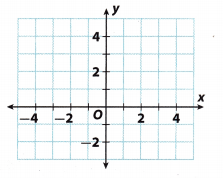
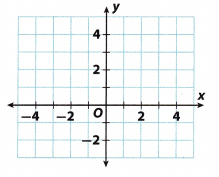
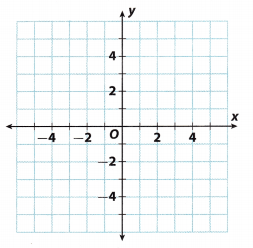
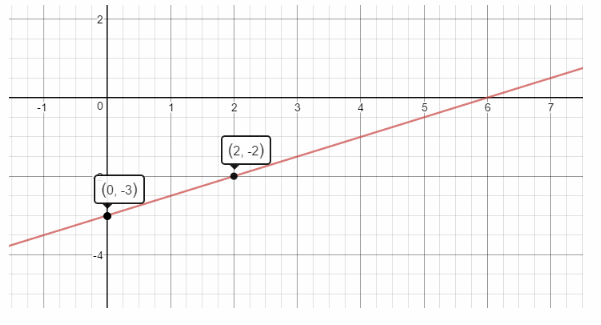
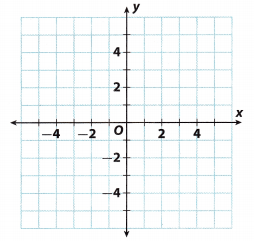
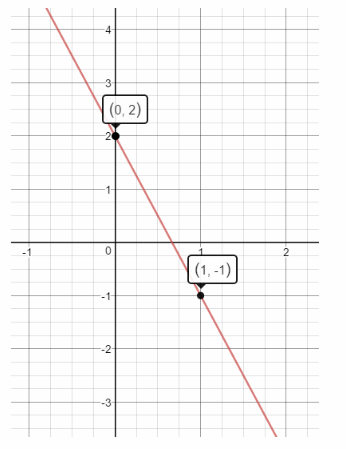
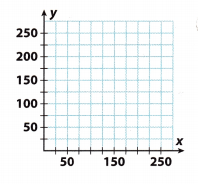
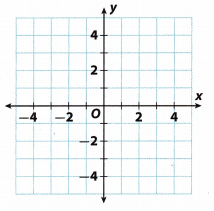
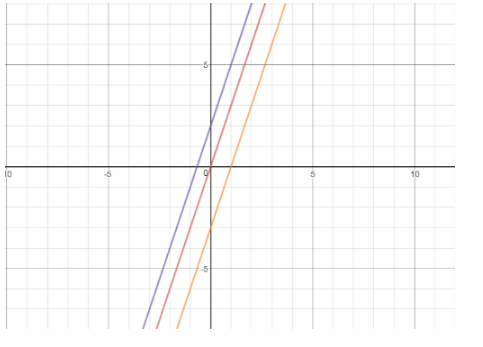
A. Graph the pair of equations together:
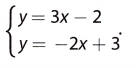
Texas Go Math Grade 8 Lesson 4.5 Answer Key 1
Texas Go Math Grade 8 Lesson 4.5 Answer Key 2

B. Explain how to tell whether (2, -1) is a solution of the equation y = 3x – 2 without using the graph.
Answer:

C. Explain how to tell whether (2, -1) is a solution of the equation y = -2x + 3 without using the graph.
Answer:

D. Explain how to use the graph to tell whether the ordered pair (2, -1) is a solution of either equation.
Answer:

E. Find the point of intersection of the two lines. Check by substitution to determine if it is a solution to both equations.
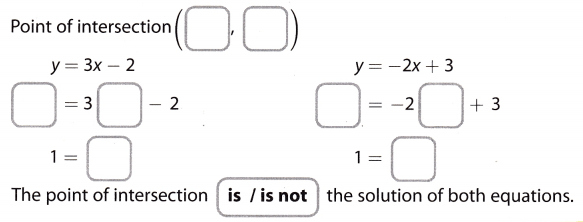
Texas Go Math Grade 8 Lesson 4.5 Answer Key 3

Reflect

Question 1.
A system of linear equations has infinitely many solutions. Does that mean any ordered pair in the coordinate plane is a solution?
Answer:
When a system of linear equations has infinitely many solutions, it means that graphing those equations will give us the same line. Therefore, the solutions of this system would be all the ordered pairs that lie on this line. Having infinitely many solutions does not mean that any ordered pair ¡n the coordinate plane is a solution.

Go Math Grade 8 Answer Key Pdf Lesson 4.5 Question 2.
Can you show algebraically that both equations in part B represent the same line? If so, explain how.
Answer:
y = 3x – 3
Distribute 3 to the terms within the parentheses.
y = 3(x – 1) = 3x – 3
Both equations in part B represent the same line.

y = 3(x – 1) = 3x – 3

Your Turn

Solve each system by graphing. Check by substitution.

Question 3.
Texas Go Math Grade 8 Lesson 4.5 Answer Key 4
Answer:
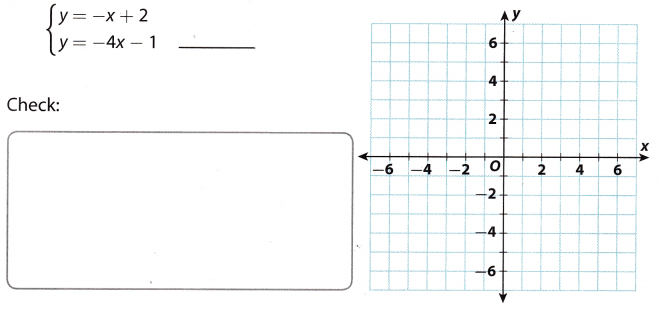
y = -x + 2
y = -4x – 1
Texas Go Math Grade 8 Lesson 4.5 Answer Key 15
Graph each of the equations.
Solution: (-1, 3) The solution of the linear systems is the intersection of the two equations

3 = -(-1) + 2 Check by substituting in the original equations
3 = 1 + 2
3 = 3
y = -4x – 1
3 = -4(-1) – 1
3 = 4 – 1
3 = 3

Question 4.
Texas Go Math Grade 8 Lesson 4.5 Answer Key 5
Answer:
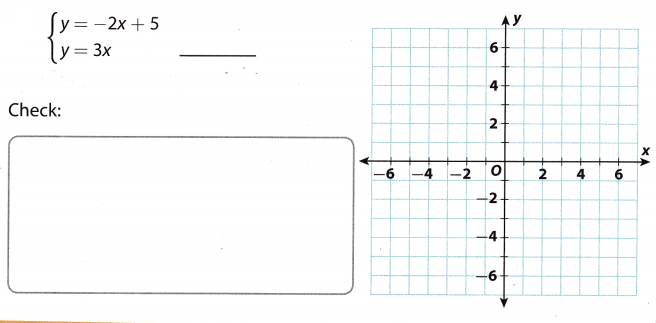
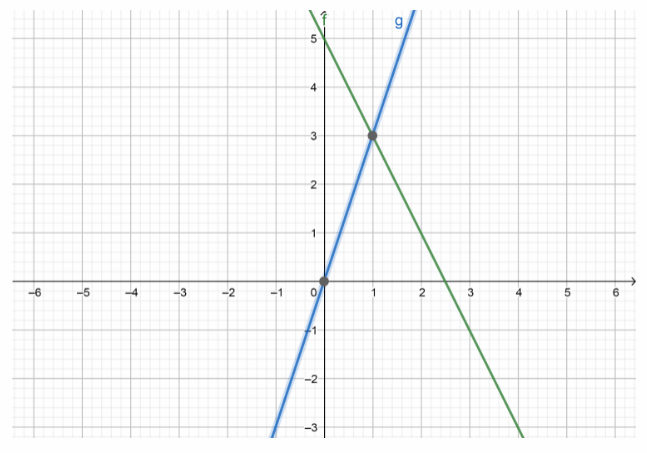
Start by graphing each equation.
Find the point of intersection of the two lines.
It appears to be (1, 3). Check by substitution to determine if it is a solution to both equations.
y = -2x + 5
3 = -2(1) + 5
3 = -2 + 5
3 = 3
y = 3x
3 = 3(1)
3 = 3
The solution of the system is (1, 3).
Texas Go Math Grade 8 Lesson 4.5 Answer Key 16
The solution of the system (1, 3)

Reflect

Question 5.
Conjecture Why do you think the graph is limited to the first quadrant?
Answer:
The solution is restricted to the first quadrant as the number of hot dogs and the number of drinks cannot be negative.

Your Turn

Texas Go Math Grade 8 Lesson 4.5 Answer Key Question 6.
During school vacation, Marquis wants to go bowling and play laser tag. He wants to play 6 total games but needs to figure out how many of each he can play if he spends exactly $20. Each game of bowling is $2 and each game of laser tag is $4.

a. Let x represent the number of games Marquis bowls and let y represent the number of games of laser tag Marquis plays. Write a system of equations that describes the situation. Then write the equations in slope-intercept form.
Answer:
x + y = 6 Let x be the number of bowling games and y be the number of laser tag games
2x + 4y = 20
x + y – x = -x + 6 Rewrite in slope-intercept form
y = -x + 6
2x + 4y – 2x = -2x + 20
4y = -2x + 20
y = –\(\frac{2}{4}\)x + \(\frac{20}{4}\)
y = –\(\frac{1}{2}\)x + 5

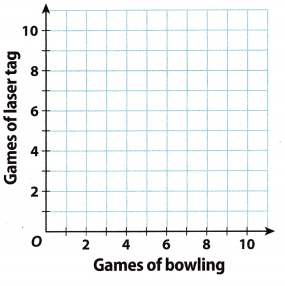
b. Graph the solutions of both equations.
Answer:
Texas Go Math Grade 8 Lesson 4.5 Answer Key 17
Graph the equations on the same coordinate plane
y = -x + 6
y = –\(\frac{1}{2}\)x + 5
Texas Go Math Grade 8 Lesson 4.5 Answer Key 6

c. How many games of bowling and how many games of laser tag will Marquis play?
Answer:
Marquis should play 2 games of bowling and 4 games of laser tag
Solution

Texas Go Math Grade 8 Lesson 4.5 Guided Practice Answer Key

Question 1.
Texas Go Math Grade 8 Lesson 4.5 Answer Key 7
Answer:
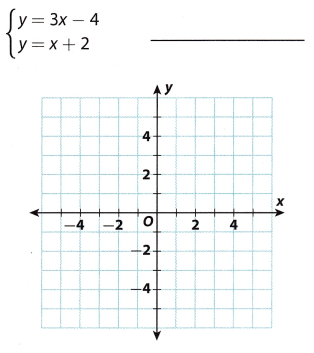
y = 3x – 4
y = x + 2
We are given a system of equations
Texas Go Math Grade 8 Lesson 4.5 Answer Key 18
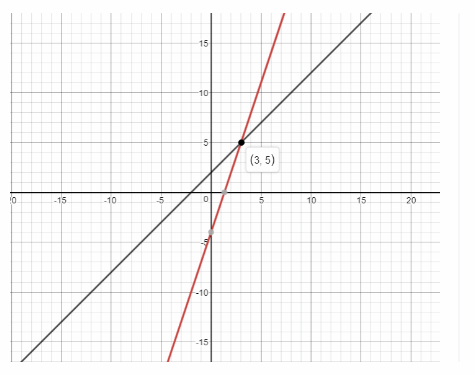
Graph the equations on the same coordinate plane
(3, 5) is the solution of the system of equations.
The solution of the linear system of equations is the intersection point of the two equations.
y = 3x – 4 Check by substitution to determine if it is a solution to both equations.
5 = 3.3 – 4
5 = 9 – 4
5 = 5
True
y = 3 + 2
5 = 5
True
(3, 5) is the solution of the system of linear equations.

Go Math 8th Grade Answer Key Lesson 4.5 Question 2.
Texas Go Math Grade 8 Lesson 4.5 Answer Key 8
Answer:
x – 3y = 2 Given
-3x + 9y = -6

x – 3y – x = -x + 2 Rewrite in slope-intercept form
-3y = -x + 2
y = \(\frac{1}{3}\)x – \(\frac{2}{3}\)
-3x + 9y + 3x = 3x – 6
9y = 3x – 6
y = \(\frac{3}{9}\)x – \(\frac{6}{9}\)
y = \(\frac{1}{3}\)x – \(\frac{2}{3}\)
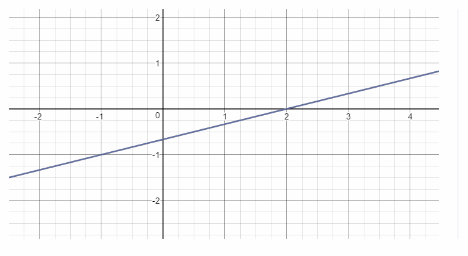
Texas Go Math Grade 8 Lesson 4.5 Answer Key 19
Graph the equations on the same coordinate plane

Solution: Infinitely many solutions
The solution of the linear system of equations is the intersection of the two equations

Question 3.
Mrs. Morales wrote a test with 15 questions covering spelling and vocabulary. Spelling questions (x) are worth 5 points and vocabulary questions (y) are worth 10 points. The maximum number of points possible on the test is 100. (Example 2)
a. Write an equation in slope-intercept form to represent the number of questions on the test.
Answer:
x + y = 15
The sum of two types of questions is 15
x + y – x = -x + 15
Rewrite in slope-intercept form
y = -x + 15

Texas Go Math Grade 8 Lesson 4.5 Answer Key 9

b. Write an equation in slope-intercept form to represent the total number of points on the test.
Answer:
5x + 10y = 100
The total number of points on the test is 100
5x + 10y – 5x = -5x + 100 Rewrite in slope-intercept form
10y = -5x + 100
y = –\(\frac{5}{10}\)x + \(\frac{100}{10}\)
y = –\(\frac{1}{2}\)x + 10

c. Graph the solutions of both equations.
Answer:
Texas Go Math Grade 8 Lesson 4.5 Answer Key 20
Graph the equations on the same coordinate plane

d. Use your graph to tell how many of each question type are on the test.
Answer:
Solution: (10, 5)
There should be 10 spelling questions and 5 intersections of the two equations.
The solution of the linear system of equations is the vocabulary questions.

Essential Question Check-In

Question 4.
When you graph a system of linear equations, why does the intersection of the two lines represent the solution of the system?
Answer:
To solve a system of linear equations means to find the solutions that satisfy all the equations of that system. When we graph a system of linear equations, the intersection point lies on the line of each equation, which means that satisfies all, the equations. Therefore, it is considered to be the solution for that system.

Texas Go Math Grade 8 Lesson 4.5 Independent Practice Answer Key

Question 5.
Vocabulary A _________ is a set of equations that have the same variables.
Answer:
A “system of equations” is a set of equations that have the same variables.

Go Math Answer Key Grade 8 System of Linear Equations Question 6.
Eight friends started a business. They will wear either a baseball cap or a shirt imprinted with their logo while working. They want to spend exactly $36 on the shirts and caps. The shirts cost $6 each and the caps cost $3 each.
a. Write a system of equations to describe the situation. Let x represent the number of shirts and let y represent the number of caps.
_________
Answer:
x – the number of shirts;
y – the number of caps;
(The sum of all shirts and caps.)x + y = 8
(The total cost of all shirts and caps is 36 dollars.)6x + 3y = 36

b. Graph the system to find the solution. Verify the solution. What does it represent?
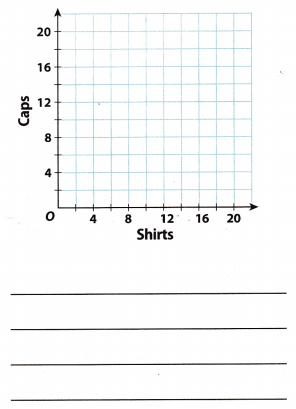
Texas Go Math Grade 8 Lesson 4.5 Answer Key 10
Answer:
Write the equations in slope-intercept form. Then graph.
x + y = 8
y = 8 – x
y = -x + 8 and (Divide both sides by 3.)
6x + 3y = 36
2x + y = 12
y = -2x + 12
Graph the equations y = -x + 8 and y = -2x + 12.
Use the graph to identify the solution of the system of equations.
Check your answer by substituting the ordered pair into both equations.
Apparent solution: (4, 4)
x + y = 8
4 + 4 = 8
8 = 8
and
6(4) + 3(4) = 36
24 + 12 = 36
36 = 36
The point (4, 4) is a solution of both equations.
Eight friends should order 4 shirts and 4 caps.
Texas Go Math Grade 8 Lesson 4.5 Answer Key 21
The point (4, 4) is a solution of both equations
Eight friends should order 4 shirts and 4 caps

Question 7.
Multistep The table shows the cost for bowling at two bowling alleys.
Texas Go Math Grade 8 Lesson 4.5 Answer Key 11
a. Write a system of equations, with one equation describing the cost to bowl at Bowl-o-Rama and the other
describing the cost to bowl at Bowling Pinz. For each equation, let x represent the number of games played and let y represent the total cost.
Answer:
x – the number of games played;
y – the total cost;
(The total cost to bowl at Bowl-o-Rama)y = 2 + 2.5x
(The total cost to bowl at Bowling Pinz)y = 4 + 2x

b. Graph the system to find the solution. Verify the solution. What does it represent?
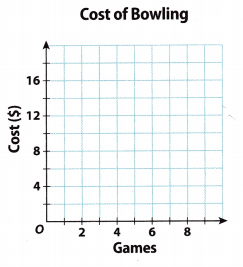
Texas Go Math Grade 8 Lesson 4.5 Answer Key 12
Answer:
Graph the equations y = 2 + 2.5x and y = 4 + 2x.
Use the graph to identify the solution of the system of equations.
Check your answer by substituting the ordered pair into both equations.
Apparent solution: (4, 12)
y = 2 + 2.5x
12 = 2 + 2.5(4)
12 = 2 + 10
12 = 12 and
y = 4 + 2x
12 = 4 + 2(4)
12 = 4 + 8
12 = 12
Point (4, 12) is a solution or both equations.
The total cost for four games is 12 dollars.
Texas Go Math Grade 8 Lesson 4.5 Answer Key 22
The point (4, 12) is a solution of both equations.
The total cost for four games is 12 dollars.

Graphing Linear Equations Vocabulary Answer Key Question 8.
Multi-Step Jeremy runs 7 miles per week and increases his distance by 1 mile each week. Tony runs 3 miles per week and increases his distance by 2 miles each week. In how many weeks will Jeremy and Tony be running the same distance? What will that distance be?
Answer:
Jeremy’s distance after x weeks:
y = x + 7
Tony’s distance after x weeks:
y = 2x + 3
To find after how many weeks will Jeremy and Tony be running the same distance and what will the distance be, we can solve the system of those two linear equations:
y = x + 7
y = 2x + 3
We graph each equation on the same coordinate plane and we find the intersection point of those two lines, which is the solution of the system.
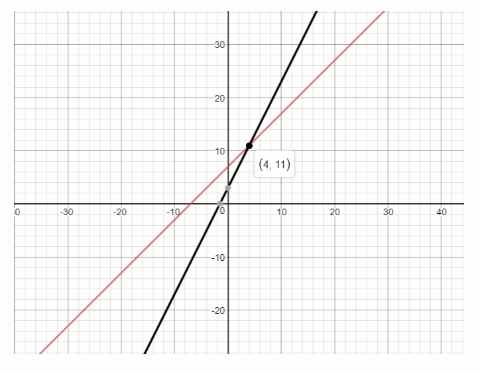
Texas Go Math Grade 8 Lesson 4.5 Answer Key 23
The solution of the system of linear equation is (4, 11), which means that after 4 weeks Jeremy and Tony will be running the same distance and that distance would be 11 miles.

After 4 weeks Jeremy and Tony will be running the same distance and that distance would be 11 miles.

Question 9.
Critical Thinking Write a real-world situation that could be represented by the system of equations shown below.
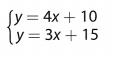
Texas Go Math Grade 8 Lesson 4.5 Answer Key 13
Answer:
Explanation A:
The entry fee for the first gym is $10 and for every hour that you spend there, you pay an extra $. If we denote with x the number of hours that somebody spends at the gym and with y the total cost, we have:
y = 4x + 10
On the other hand, the entry fee of the second gym is $15 and for every hour that you spend there, you pay an extra $3. If we denote with x the number of hours that somebody spends at the gym and with y the total cost, we
have:
y = 3x + 15
To find after how many hours the costs of the gyms will be the same and what will that cost be, we can solve the system of linear equations:
y = 4x + 10
y = 3x + 15

Let y be the total cost of skating and x be the rental cost of the stakes per hour. The constant represents the entry fee to the skating arena. In the first equation, $4 per hour is the rental cost of stakes and $10 is the entry fee. In the second equation, $3 per hr is the rental cost of stakes and $15 is the entry fee.

Texas Go Math Grade 8 Lesson 4.5 H.O.T. Focus On Higher Order Thinking Answer Key

Texas Go Math Grade 8 Answer Key Lesson 4.5 Question 10.
Multistep The table shows two options provided by a high-speed Internet provider.
Texas Go Math Grade 8 Lesson 4.5 Answer Key 14

a. In how many months will the total cost of both options be the same? What will that cost be?
Answer:
x – the number of months;
y – the total cost of one option after x months;
(The total cost for Option 1) after x months y = 50 – 30x
(The total cost for Option 2) after x months y = 40x
Check-in how many months the total cost of both options will be the same.
(Subtract 30x from both sides.)40x = 50 + 30x
(Divide both sides by 10.)10x = 50
(The total cost of both options will be the same in 5 months.)x = 5
(For x = 5)y = 40x
y = 40(5)
(The total cost will be 200 dollars.)y = 200

b. If you plan to cancel your Internet service after 9 months, which is the cheaper option? Explain.
Answer:
y = 50 + 30(9)
y = 50 + 270
(The total cost for Option 1) after 9 months y = 320 dollars
y = 40x
y = 40(9)
(The total cost for Option 2) after 9 months y = 360 dollars
After 9 months Option 1 is cheaper than Option 2

Texas Go Math Grade 8 Pdf Linear Equations Vocabulary Question 11.
Draw Conclusions How many solutions does the system formed by x – y = 3 and ay – ax + 3a = 0 have for a nonzero number a? Explain.
Answer:
x – y = Given
ay – ax + 3a = 0
ay – ax + 3a – 3a = 0 Rearranging the left side of the 2nd equation by subtracting 3a from both sides.
ay – ax = -3a
a(y – x) = 3a Divide both sides by -a
y – x = 3
x – y = 3
Since both equations are the same, the system of linear equations has infinitely many solutions.

Texas Go Math Grade 8 Lesson 4.5 Answer Key Solving Systems of Linear Equations by Graphing Read More »

Texas Go Math Grade 8 Module 1 Quiz Answer Key

Refer to our Texas Go Math Grade 8 Answer Key Pdf to score good marks in the exams. Test yourself by practicing the problems from Texas Go Math Grade 8 Module 1 Quiz Answer Key.

Texas Go Math Grade 8 Module 1 Quiz Answer Key

Texas Go Math Grade 8 Module 1 Ready to Go On? Answer Key

1.1 Rational and Irrational Numbers

Write each fraction as a decimal.

Question 1.
\(\frac{7}{20}\) ____
Answer:
To write \(\frac{7}{20}\) as a decimal. we divide the numerator by the denominator until the remainder is zero or until the digits in the quotient to repeat. We add as many zeros after the decimal point in the dividend as needed.
Texas Go Math Grade 8 Module 1 Quiz Answer Key 8
\(\frac{7}{20}\) = 0.35

Texas Go Math Squared Grade 8 Module 1 Question 2.
\(\frac{14}{11}\) ____
Answer:
Let x = \(1 . \overline{27} .\) Since \(1 . \overline{27}\) has two repeating digits multiplied on both sides of the equation with 100;
x = \(1 . \overline{27} .\)
100x = 100 × \(1 . \overline{27} .\)
100x = \(127 . \overline{27}\) Subtract x = \(1 . \overline{27}\) from both sides
99x = 126
x = \(\frac{14}{11}\) = 1\(\frac{3}{11}\)
x = 1\(\frac{3}{11}\)

Question 3.
1\(\frac{7}{8}\) ____
Answer:
First, we convert the mixed number to an improper fraction:
1\(\frac{7}{8}\) = 1 + \(\frac{7}{8}\)
= \(\frac{8}{8}\) + \(\frac{7}{8}\)
= \(\frac{15}{8}\)
To write \(\frac{15}{8}\) as a decimal, we divide the numerator by the denominator until the remainder is zero or until the digits in the quotient begin to repeat.
We add as many zeros after the decimal point in the dividend as needed.
Texas Go Math Grade 8 Module 1 Quiz Answer Key 9
1\(\frac{7}{8}\) = 1.875

Find the two square roots of each number.

Question 4.
81 ____
Answer:
x2 = 81
\(\sqrt{x^{2}}\) = \(\sqrt{81}\) Take square root from both sides of the equation
x = ± 9

Question 5.
1600 ____
Answer:
x3 = 343
\(\sqrt[3]{x^{3}}\) = \(\sqrt[3]{343}\) Take square root from both sides of the equation
x = 7

Grade 8 Mathematics Session 1 Answer Key Question 6.
\(\frac{1}{100}\) ____
Answer:
x2 = \(\frac{1}{100}\) Take square root from both sides of the equation
\(\sqrt{x^{2}}\) = \(\sqrt{\frac{1}{100}}\) Solve for x
x = ±\(\frac{1}{10}\)

Question 7.
A square patio has an area of 200 square feet. How long is each side of the patio to the nearest 0.05? ____
Answer:
The area of a square is found by multiplying the side of the square by itself
Therefore, to find the side of the square, we have to take the square root of the area
Let’s denote with A the area of the patio and with s each side of the square. We have:
A = 200
A = s . s
s = \(\sqrt{A}\) = \(\sqrt{200}\)
Following the steps as in “Explore Activity 1”on page 9, we can make an estimation for the irrationaL number:
196 < 200 < 225
\(\sqrt{196}\) < \(\sqrt{200}\) < \(\sqrt{225}\)
14 < \(\sqrt{200}\) < 15
We see that 200 is much closer to 196 than to 225, therefore the square root of it should be between 14 and 14.5 To make a better estimation, we pick some numbers between 14 and 14.5 and calculate their squares:
14.12 = 198.81
14.22 = 201.64
14.1 < \(\sqrt{200}\) < 14.2
\(\sqrt{200}\) ≈ 14.15
We see that 200 is much closer to 14.1 than to 14.2, therefore the square root of it should be between 14.1 and 14.15.
If we round to the nearest 0.05, we have:
s = 14.15

Each side of the patio is 14.15 feet long.

1.2 Sets of Real Numbers

Write all names that apply to each number.

Question 8.
\(\frac{121}{\sqrt{121}}\) _____
Answer:
Using \(\sqrt{121}\) = 11 we can see that \(\frac{121}{\sqrt{121}}\) = \(\frac{121}{11}\) = 11
Therefore it is whole, integer, rational, real

Whole, integer, rational, real

Module 1 Test Answers Texas Go Math Grade 8 Question 9.
\(\frac{\pi}{2}\) _____
Answer:
π is an irrational. number. When multiplying any rational number (in this case \(\frac{1}{2}\)) with an irrational number we get an irrational number.
Therefore it is an irrational, real number.

Irrational, real.

Question 10.
Tell whether the statement “All integers are rational numbers” is true or false. Explain your choice.
Answer:
All integers are rational numbers” is true, because every integer can be expressed as a fraction with a denominator equal to 1. The set of integers is a subset of rational numbers.

True

1.3 Ordering Real Numbers

Compare. Write <>, or =.

Question 11.
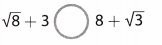
Texas Go Math Grade 8 Module 1 Quiz Answer Key 1
Answer:
Given
\(\sqrt{8}\) + 3 ? 8 + \(\sqrt{8}\) Given

4 < 8 < 9 Approximate \(\sqrt{8}\) Approximate \(\sqrt{8}\)
\(\sqrt{4}\) < \(\sqrt{8}\) < \(\sqrt{9}\)
2 < \(\sqrt{8}\) < 3

1 < 3 < 4
\(\sqrt{1}\) < \(\sqrt{3}\) < \(\sqrt{4}\)
1 < \(\sqrt{3}\) < 2

\(\sqrt{8}\) + 3 is between 5 and 6. Use the estimations to simplify the expressions
8 + \(\sqrt{3}\) is between 9 and 10.

\(\sqrt{8}\) + 3 < 8 + \(\sqrt{3}\) Compare

\(\sqrt{8}\) + 3 < 8 + \(\sqrt{3}\)

Grade 8 Math Module 1 Answer Key Question 12.
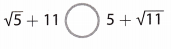
Texas Go Math Grade 8 Module 1 Quiz Answer Key 2
Answer:
Approximate the value of \(\sqrt{5}\) by comparing the number 5 to the closest perfect squares:
4 < 5 < 9
\(\sqrt{4}\) < \(\sqrt{5}\) < \(\sqrt{9}\)
2 < \(\sqrt{5}\) < 3
So, \(\sqrt{5}\) lies between 2 and 3.

In the same way, approximate the value of \(\sqrt{11}\) by comparing the number 11 to the closest perfect squares:
9 < 11 < 16
\(\sqrt{9}\) < \(\sqrt{11}\) < \(\sqrt{16}\)
3 < \(\sqrt{11}\) < 4 So, \(\sqrt{11}\) lies between 3 and 4. \(\sqrt{5}\) + 11 lies between 13 and 14, while \(\sqrt{11}\) + 5 lies between 8 and 9. Therefore: \(\sqrt{5}\) + 11 > \(\sqrt{11}\) + 5

Order the numbers from least to greatest.

Question 13.
Texas Go Math Grade 8 Module 1 Quiz Answer Key 3
Answer:
Comparing 99 to the closest perfect squares gives us a estimation of \(\sqrt{99}\):
81 < 99 < 100
\(\sqrt{81}\) < \(\sqrt{99}\) < \(\sqrt{10}\)
9 < \(\sqrt{99}\) < 10
A good approximation for \(\sqrt{99}\) is 9.95 because 9.952 ≈ 99
Second, π ≈ 3.14 ⇒ π2 ≈ (3.14)2 ≈ 9.86
Also, \(9 . \overline{8}\) ≈ 9.88
So because of: 9.86 < 9.88 < 9.95 the order is π2, \(9 . \overline{8}\), \(\sqrt{99}\)

Question 14.
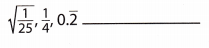
Texas Go Math Grade 8 Module 1 Quiz Answer Key 4
Answer:
\(\sqrt{\frac{1}{25}}\), \(\frac{1}{4}\), \(0 . \overline{2}\) Given
\(\sqrt{\frac{1}{25}}\) = \(\frac{1}{5}\) = 0.2 Evaluate
\(\frac{1}{4}\) = 0.25 Evaluate
\(0 . \overline{2}\) = 0.222 ≈ 0.22 Underlined number is the repeating number after decimal
Texas Go Math Grade 8 Module 1 Quiz Answer Key 10
Graph on the number line.
\(\sqrt{\frac{1}{25}}\), \(0 . \overline{2}\), \(\frac{1}{4}\) From least to greatest.

Essential Question

Question 15.
How are real numbers used to describe real-world situations?
Answer:
In real-world situations, we use real numbers to count or make measurements. They can be seen as a convention for us to quantify things around us, for example, the distance, the temperature, the height, etc.

Texas Go Math Grade 8 Module 1 Mixed Review Texas Test Prep Answer Key

Texas Test Prep

Selected Response

Question 1.
The square root of a number is 9. What is the other square root?
(A) -9
(B) -3
(C) 3
(D) 81
Answer:
(A) -9

Explanation:
We know that every positive number has two square roots, one positive and one negative. We are given the
principal square root (9), so the other square root would be its negative (-9).
To prove that, we square both numbers and compare the results:
9 . 9 = 81
(-9) . (-9) = 81

Question 2.
A square acre of land is 4840 square yards. Between which two integers is the length of one side?
(A) between 24 and 25 yards
(B) between 69 and 70 yards
(C) between 242 and 243 yards
(D) between 695 and 696 yards
Answer:
(B) between 69 and 70 yards

Explanation:
The area of a square is found by multiplying the side of the square by itself.
Therefore, to find the side of the square, we have to take the square root of the area.
Let’s denote with À the area of the Land and with s each side of the square. We have:
À = 4840
A = s . s
s = \(\sqrt{A}\) = \(\sqrt{4840}\)
Following the steps as in “Explore Activity 1” on page 9, we can make an estimation for the irrational number:
Texas Go Math Grade 8 Module 1 Quiz Answer Key 11
Each side of the land is between 69 and 70 yards.

Real Numbers Module Quiz Answer Key Question 3.
Which of the following is an integer but not a whole number?
(A) -9.6
(B) -4
(C) 0
(D) 3.7
Answer:
(B) -4

Explanation:
-4 is an integer but not a whole number Whole numbers are not negative

Question 4.
Which statement is false?
(A) No integers are irrational numbers.
(B) All whole numbers are integers.
(C) No real numbers are irrational numbers.
(D) All integers greater than 0 are whole numbers.
Answer:
(C) No real numbers are irrational numbers.

Explanation:
Option C is false Rational and irrational numbers are real numbers.

Question 5.
Which set of numbers best describes the displayed weights on a digital scale that shows each weight to the nearest half pound?
(A) whole numbers
(B) rational numbers
(C) real numbers
(D) integers
Answer:
(B) rational numbers

Explanation:
Rational number The scale weigh nearest \(\frac{1}{2}\) to pound

Question 6.
Which of the following is not true?
Texas Go Math Grade 8 Module 1 Quiz Answer Key 5
Answer:
(C)

Explanation:

A.
π ≈ 3.14 ⇒ π2 ≈ (3.14)2 ≈ 9.86
2π + 4 ≈ 10.28
It follows that π2 < 2π + 4 so the given statement is true B. π ≈ 3.14 ⇒ 3π ≈ 3 × 3.14 = 9.42 Number 9 is given It follows that 3π > 9 so the given statement is true

C.
\(\sqrt{27}\) ≈ 5.2 because 5.22 = 27.04 ⇒ \(\sqrt{27}\) + 3 ≈ 8.2
\(\frac{17}{2}\) = 8\(\frac{1}{2}\) = 8.5
It follows that \(\sqrt{27}\) + 3 < \(\frac{17}{2}\), so the given statement is not true

D.
\(\sqrt{24}\) ≈ 4.9 because 4.92 = 24.01 ⇒ 5 – \(\sqrt{24}\) ≈ 0.101
Number 1 is given.
It follows that 5 – \(\sqrt{24}\) < 1 so the given statement is true

Option (C) is True

Question 7.
Which number is between \(\sqrt{21}\) and \(\frac{3 \pi}{2}\)?
(A) \(\frac{14}{3}\)
(B) 2\(\sqrt{6}\)
(C) 5
(D) π + 1
Answer:
(A) \(\frac{14}{3}\)

Explanation:
\(\sqrt{21}\) and \(\frac{3 \pi}{2}\) Given
\(\sqrt{21}\) = 4.58 Evaluate
\(\frac{3 \pi}{2}\) = \(\frac{3 * 3.14}{2}\) = 4.71

\(\frac{14}{3}\) = 4.67 Option A

2\(\sqrt{6}\) = 4.90 Option B

5 Option C

π + 1 = 3.14 + 1 = 4.14 Option D

Question 8.
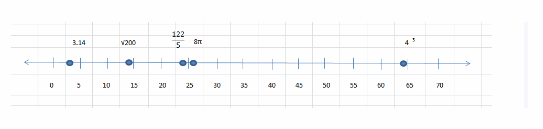
What number is shown on the graph?
Texas Go Math Grade 8 Module 1 Quiz Answer Key 6
(A) π + 3
(B) \(\sqrt{20}\) + 2
(C) \(\sqrt{14}\) + 2.5
(D) \(6 . \overline{14}\)
Answer:
(B) \(\sqrt{20}\) + 2

Explanation:
Approximate every option and see which fits the point showed on the graph.
We can see that the given point on the graph lies between 6.4 and 6.5 but closer to 6.5.
π + 3 ≈ 3.14 + 3 = 6.14 This option obviously isn’t our answer because it isn’t between 6.4 and 6.5.
Next
\(\sqrt{4}\) + 2.5 = 2 + 2.5 = 4.5 This option also obviously isn’t our answer because it isn’t between 6.4 and 6.5
Next
\(\sqrt{20}\) + 2 ≈ 4.47 + 2 = 6.47 We can see that this fits out graph since it is between 6.4 and 6.5
Finally,
\(6 . \overline{14}\) ≈ 6.14 This option also obviously isn’t our answer because it isn’t between 6.4 and 6.5
So the final answer is that only the option C is shown on the graph.

Texas Go Math Grade 8 Module 1 Test Answers Question 9.
Which list of numbers is in order from least to greatest?
(A) 3.34, \(\frac{10}{3}\), π, \(\frac{11}{4}\)
(B) \(\frac{10}{3}\), 3.3, \(\frac{11}{4}\), π
(C) π, \(\frac{10}{3}\), \(\frac{11}{4}\), 3.3
(D) \(\frac{11}{4}\), π, 3.3, \(\frac{10}{3}\)
Answer:
(D) \(\frac{11}{4}\), π, 3.3, \(\frac{10}{3}\)

Explanation:
• To write \(\frac{10}{3}\) as a decimal, we divide the numerator by the denominator until the remainder is zero or until the digits in the quotient begin to repeat.
We add as nìanv zeros after the decimal point in the dividend as needed.
Texas Go Math Grade 8 Module 1 Quiz Answer Key 12
when a decimal lias one or more digits that repeat indefinitely, we write the decimal with a bar over the repeating digit(s). In our case, 3 repeats indefinitely.
Texas Go Math Grade 8 Module 1 Quiz Answer Key 13

• To write \(\frac{11}{4}\) as a decimal, we divide the numerator by the denominator until the remainder is zero or until the digits in the quotient begin to repeat.
We add as many zeros after the decimal point in the dividend as
Texas Go Math Grade 8 Module 1 Quiz Answer Key 14
Plot numbers on number line:
Texas Go Math Grade 8 Module 1 Quiz Answer Key 15

Gridded Response

Question 10.
What is the decimal equivalent of the fraction \(\frac{28}{25}\)?
Texas Go Math Grade 8 Module 1 Quiz Answer Key 7
Answer:
a. To find the length of an edge (x) substitute V = 1728 and solve for X by taking cube roots from both sides of
the equation:
1728 = x3
x = 12
So the length of the edge is 12 inches.

b. Since cubes are made of squares, what we really need to calculate is the area of a square that has a length of
the side x = 12
Use formula for area of a square A = x2:
A = x2 = 122 = 144 inches.
So, the area of one side of the cube is 144 square inches.

c. Like we said in b., a cube is made out of squares, precisely, it is made out of 6 squares.
To find the surface area of the cube we need to add all the areas from the squares that make the cube, so:
S = 6 × r = 6 × 114 = 864 inches squared
So, the surface area of the cube is 864 square inches.

d. To get the desired surface area in square feet divide the surface area in square inches by 144 (since 1 ft = 12 in
⇒ 1 ft2 = 144 in2)
S = \(\frac{864}{144}\) = 6 square feet.

a. x = 12 inches
b. A = 144 square inches
c. S = 864 square inches
d. S = 6 square feet

Texas Go Math Grade 8 Module 1 Quiz Answer Key Read More »

Texas Go Math Grade 8 Module 4 Answer Key Nonproportional Relationships

Refer to our Texas Go Math Grade 8 Answer Key Pdf to score good marks in the exams. Test yourself by practicing the problems from Texas Go Math Grade 8 Module 4 Answer Key Nonproportional Relationships.

Texas Go Math Grade 8 Module 4 Answer Key Nonproportional Relationships

Essential Question
How can you use non proportional relationships to solve real-world problems?
Texas Go Math Grade 8 Module 4 Answer Key 1

Texas Go Math Grade 8 Module 4 Are You Ready? Answer Key

Complete these exercises to review the skills you will need for this chapter.

Find each difference.

Question 1.
3 – (-5) _______
Answer:
3 – (-5) Given
3 + 5 To subtract an integer, add its opposite.
|3| + |-5| Since the signs are the same, so find the sum of the absolute values
3 + 5 = 8
8 Use the sign of the number with the greater absolute value.

Grade 8 Module 4 Answer Key Question 2.
-4 – 5 _______
Answer:
-4 – 5 Given
-4 + (-5) The signs are the same, so find the sum of the absolute values.
|-4| + |-5|
4 + 5 = 9
-9 Use the sign of the number with the greater absolute value

Question 3.
6 – 10 _____
Answer:
6 – 10 Given
6 + (-10) The signs are different so find the difference of the absolute values.
(-10) + (6)
|-10| – |6|
10 – 6 = 4
-4 Use the sign of the number with the greater absolute value.

Question 4.
-5 – (-3) ________
Answer:
-5 – (-3) Given
-5 + 3 To subtract an integer, add its opposite.
|-5| – |3| Since the signs are different, so find the difference of the absolute values
5 – 3 = 2
-2 Use the sign of the number with the greater absolute value

Question 5.
8 – (-8) ________
Answer:
8 – (-8) Given
8 + 8 To subtract an integer, add its opposite.
|8| + |8| Since the signs are different, so find the difference of the absolute values
8 + 8 = 16
16 Use the sign of the number with the greater absolute value

Module 4 Non-Proportional Relationships Answer Key Question 6.
9 – 5 = _____
Answer:
9 – 5 Given
9 + (-5) To subtract an integer, add its opposite.
|9| – |5| Since the signs are different, so find the difference of the absolute values
9 – 5 = 4
4 Use the sign of the number with the greater absolute value

Question 7.
-3 – 9 ______
Answer:
-3 – 9 Given
-3 + (-9) The signs are the same, so find the sum of the absolute values.
|-3| + |-9|
3 + 9 = 12
-12 Use the sign of the number with the greater absolute value
-12

Question 8.
0 – (-6) _____
Answer:
0 – (-6) Given
0 + 6 To subtract an integer, add its opposite.
|0| + |6| Since the signs are different, so find the difference in the absolute values
0 + 6 = 6
6 Use the sign of the number with the greater absolute value
6

Module 4 Grade 8 Math Answer Key Question 9.
12 – (-9) _____
Answer:
12 – (-9) Given
12 + 9 To subtract an integer, add its opposite.
|12| + |9| Since the signs are same, so find the difference of the absolute values
12 + 9 = 21
21 Use the sign of the number with the greater absolute value
21

Question 10.
-6 – (-4) _______
Answer:
-6 – (-4) Given
-6 + 4 To subtract an integer, add its opposite.
|-6| – |4| Since the signs are different, so find the difference of the absolute values
6 – 4 = 2
-2 Use the sign of the number with the greater absolute value

Question 11.
-7 – 10 _______
Answer:
-7 – 10 Given
-7 + (-10) To subtract an integer, add its opposite.
|-7| + |-10| Since the signs are the same, so find the difference between the absolute values
7 + 10 = 17
-17 Use the sign of the number with the greater absolute value
-17

Module 4 Non-Proportional Relationships Grade 8 Answer Key Question 12.
5 – 14 = ___
Answer:
5 – 14 Given
5 + (-14) The signs are different, so find the difference of the absolute values
(-14) + (5)
|-14| – |5|
14 – 5 = 11
-11 Use the sign of the number with the greater absolute value
-11

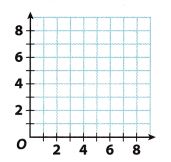
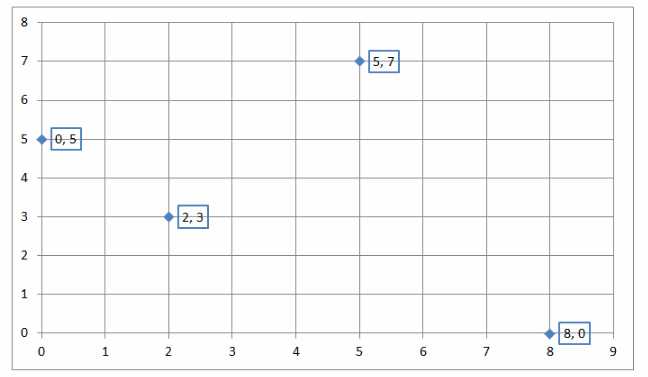
Graph each point on the coordinate grid.

Texas Go Math Grade 8 Module 4 Answer Key 2

Question 13.
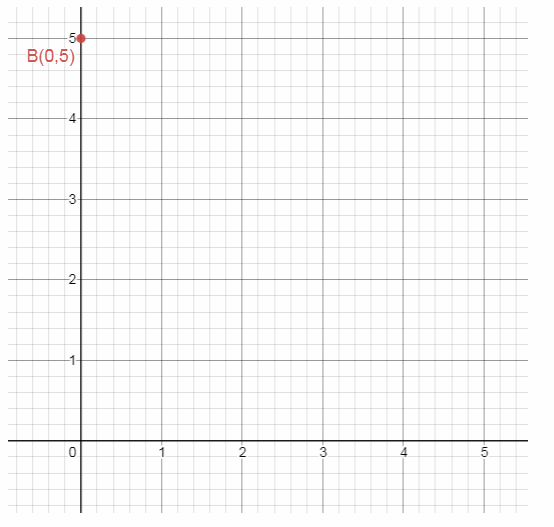
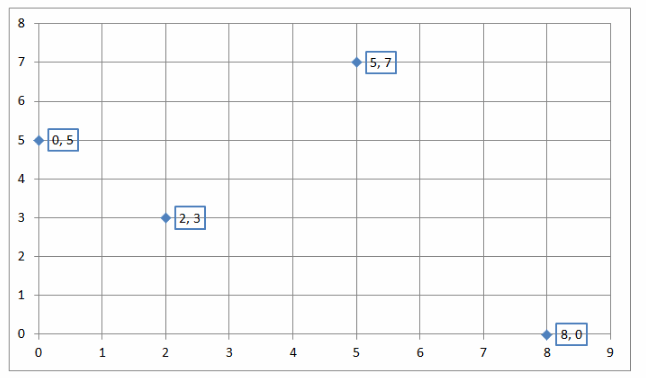
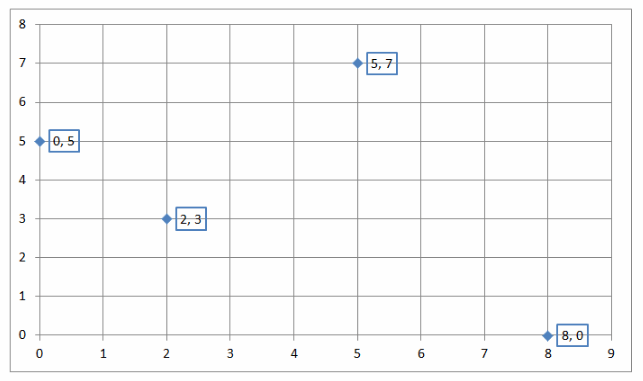
B (0, 5)
Answer:
To graph a point at (0, 5) start at the origin.
Then move 5 points up.
Graph point B(0, 5).
Texas Go Math Grade 8 Module 4 Answer Key 4
To graph a point at (0, 5) start at the origin.
Then move 5 points up.

Grade 8 Math Module 4 Answer Key Question 14.
C (8, 0)
Answer:
Texas Go Math Grade 8 Module 4 Answer Key 5

Question 15.
D (5, 7)
Answer:
Texas Go Math Grade 8 Module 4 Answer Key 6

Question 16.
E(2, 3)
Answer:
Texas Go Math Grade 8 Module 4 Answer Key 7

Texas Go Math Grade 8 Module 4 Reading Start-Up Answer Key
Visualize Vocabulary
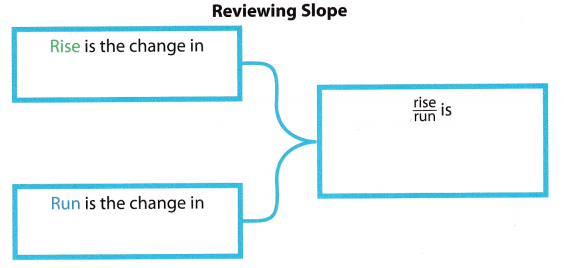
Use the ✓ words to complete the diagram. You can put more than one word in each box.

Texas Go Math Grade 8 Module 4 Answer Key 3

Understand Vocabulary

Complete the sentences using the preview words.

Question 1.
Any ordered pair that satisfies all the equations in a system is a _____
Answer:
Any ordered pair that satisfies all the equations in a system is a Solution

Texas Go Math Grade 8 Module 4 Answer Key Question 2.
A _________________________ is an equation whose solutions form a straight line on a coordinate plane.
Answer:
A ‘linear equation” is an equation whose solutions form a straight line on a coordinate plane

Question 3.
A ________________________ is a set of two or more equations that contain two or more variables.
Answer:
A System of Equations is a set of two or more equations that contain two or more variables.

Texas Go Math Grade 8 Module 4 Answer Key Nonproportional Relationships Read More »

Texas Go Math Grade 8 Lesson 4.4 Answer Key Proportional and Nonproportional Situations

Refer to our Texas Go Math Grade 8 Answer Key Pdf to score good marks in the exams. Test yourself by practicing the problems from Texas Go Math Grade 8 Lesson 4.4 Answer Key Proportional and Nonproportional Situations.

Texas Go Math Grade 8 Lesson 4.4 Answer Key Proportional and Nonproportional Situations

Essential Question
How can you distinguish between proportional and nonproportional situations?

Your Turn

Determine if each of the following graphs represent a proportional or nonproportional relationship.

Question 1.
Texas Go Math Grade 8 Lesson 4.4 Answer Key 1
Answer:
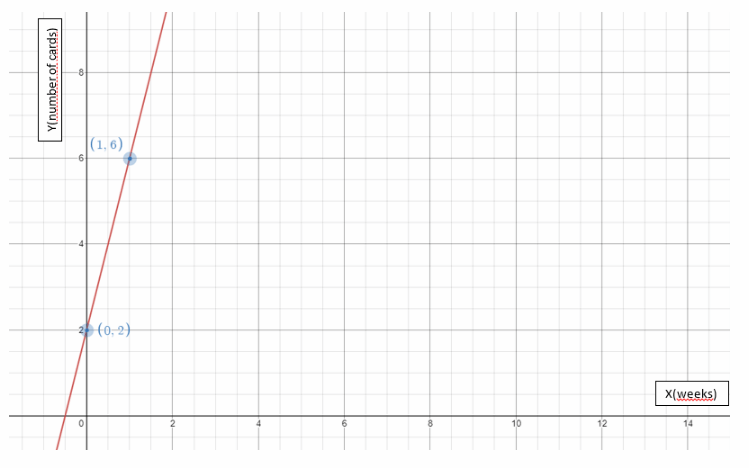
The starting point of the graph is (0, 2) which means that it does not pass through the origin. Some functions will have a proportional relationship if the line passes through the origin, but it does not. So, this graph represents the nonproportional relationship.

8th Grade Independent Practice Answer Key Lesson 4.4 Question 2.
Texas Go Math Grade 8 Lesson 4.4 Answer Key 2
Answer:
Proportional relationship It does pass through the origin

Reflect

Question 3.
Communicate Mathematical Ideas In a proportional relationship the ratio \(\frac{y}{x}\) is constant. Show that this ratio is not constant for the equation y = a – 14.
Answer:
y = a – 14 Given
y = 16 – 14 = 2 Find a few values of y by substituting different values of a
y = 17 – 14 = 3
y = 18 – 14 = 4
\(\frac{2}{16}\) = 0.125 Find the ratio \(\frac{y}{x}\), where x represents a
\(\frac{3}{17}\) = 0.176
\(\frac{4}{18}\) = 0.222
The ratio is not constant.

Go Math 8th Grade Lesson 4.4 Proportional or Non-Proportional Question 4.
What If? Suppose another equation represents Keith’s age in months y given his age in years a. Is this relationship proportional? Explain.
Answer:
y = 12a Since there are 12 months in a year

y = 12(1) = 12 Find a few values of y by substituting different values of a
y = 12(2) = 24
y = 12(3) = 36
\(\frac{12}{1}\) = 12 Find the ratio \(\frac{y}{x}\), where x represents a
\(\frac{24}{2}\) = 12
\(\frac{36}{3}\) = 12
Since the ratio is constant, the relationship is proportional.

Your Turn

Determine if each of the following equations represents a proportional or nonproportional relationship.

Question 5.
d = 65t
Answer:
d = 65t Comparing with the linear equation
y = mx + b
Proportional relationship Since y-intercept b = 0

Question 6.
p = 0.1s + 2000
Answer:
P = 0.1s + 2000 Comparing with linear relationship y = mx + b
This is a Non-Proportional relationship Since y-intercept b is not equal to 0
This is a Non-Proportional Relationship

Go Math Grade 8 Lesson 4.4 Answer Key Question 7.
n = 450 – 3p
Answer:
n = 450 – 3p Comparing with the linear equation y = mx + b
Non-proportional relationship Since y-intercept b = 450

Question 8.
36 = 12d
Answer:
36 = 12d Comparing with the linear equation y = mx + b
Non-proportional relationship The graph will not pass through the origin. It is a horizontal line.

Your Turn

Determine if the linear relationship represented by each table is a proportional or nonproportional relationship.

Question 9.
Texas Go Math Grade 8 Lesson 4.4 Answer Key 3
Answer:
To know if some linear relationship is proportional or nonproportional, we need to use ratio \(\frac{y}{x}\), which needs to be constant for proportionality.
From the given table, we have values for x and y, so just put them into the calculation.
\(\frac{y}{x}\) = \(\frac{30}{2}\) = 15
= \(\frac{90}{8}\) = 11.25
= \(\frac{150}{14}\) = 10.71
Thus, the obtained values are not constant so this Linear relationship is not proportional.

Lesson 4.4 Proportional and Non-Proportional Relationships Question 10.
Texas Go Math Grade 8 Lesson 4.4 Answer Key 4
Answer:
\(\frac{1}{5}\) = 0.2 Find the ratio \(\frac{y}{x}\)
\(\frac{8}{40}\) = 0.2
\(\frac{13}{65}\) = 0.2
The ratio is constant, hence the relationship is proportional.

Your Turn

Question 11.
Compare and contrast the following two situations.
Texas Go Math Grade 8 Lesson 4.4 Answer Key 5
Answer:
c = 20h Test-Prep Center A

The cost of attending Test-Prep Center A is proportional. The hourly rate is $20 which is less than Test-Prep Center B. Comparing with the linear equation y = mx + b where b = O
C = 25h – 100 Test-Prep Center B where h is the number of hours and 1oo is a coupon

The cost of attending Test-Prep Center B is non-proportional. The hourly rate is $25. It offers a coupon for an initial credit but its hourly rate is higher. Center B will cost more in the long run. Comparing with the Linear equation y = mx + b

Texas Go Math Grade 8 Lesson 4.4 Guided Practice Answer Key

Determine if each relationship is a proportional or nonproportional situation. Explain your reasoning. (Example 1, Example 2, Example 4)

Question 1.
Texas Go Math Grade 8 Lesson 4.4 Answer Key 6
Look at the origin.
Answer:
From the graph, we can see that the line is passing through the origin. When some linear function is passing
through the origin its relationship is proportional, and the y-intercept (‘b”) is equal to 0.

Question 2.
Texas Go Math Grade 8 Lesson 4.4 Answer Key 7
Answer:
From the graph, we can see that the line is not passing through the origin. When some linear function is not passing through the origin its relationship is nonproportional, and the y-intercept (“b”) is b ≠ 0.

Lesson 4 Skills Practice Proportional and Non-Proportional Relationships Answer Key Question 3.
q = 2p + \(\frac{1}{2}\)
Compare the equation with y = mx + b
Answer:
q = 2p + \(\frac{1}{2}\)
The equation is in the form y = mx + b, with p being used as the variable instead of x and q instead of y. The value of in is 2, and the value of b is \(\frac{1}{2}\). Since b is not 0, the relationship presented through the above equation is non-proportional.

Non-proportional

Question 4.
v = \(\frac{1}{10}\)u
Answer:
To determine if the relationship of function is proportional or nonproportional, let us compare the equation in
slope-intercept form. After comparing the equations, determine the y-intercept b, if b = 0, then the relationship is
proportional, if b ≠ 0, then it is a non-proportional relationship.

Given the equation v = \(\frac{1}{10}\)u, it is a pattern of y = mx + b, where variable y is being used as y and u as r. The value of m is \(\frac{1}{10}\), and the value of b = 0.
Texas Go Math Grade 8 Lesson 4.4 Answer Key 15
Since the value of b is equal to 0, then the relationship between u and v is proportional.
See the explanation.

The tables represent linear relationships. Determine if each relationship is a proportional or nonproportional situation. (Example 3, Example 4)

Question 5.
Texas Go Math Grade 8 Lesson 4.4 Answer Key 17
Find the quotient of y and x.
Answer:
To know if some linear relationship is proportional or nonproportional, we need to use ratio \(\frac{y}{x}\), which needs to be constant for proportionality.

From the given table, we have values for x and y, so just put them into my calculation
\begin(aligned}
\dfrac{y}(x}&=\dfrac{12}{3)=4\
&=\dfrac{36}{91}=4\
&=\dfrac{84}{21}=4
\end{atigned}
Thus, the obtained values are constant so this linear relationship is proportional.

Go Math 8th Grade Lesson 4.4 Answer Key Question 6.
Texas Go Math Grade 8 Lesson 4.4 Answer Key 9
Answer:
\(\frac{4}{22}\) = \(\frac{2}{11}\) Find the ratio \(\frac{y}{x}\)
\(\frac{8}{46}\) = \(\frac{4}{23}\)
\(\frac{10}{58}\) = \(\frac{5}{29}\)
Since the ratio is not constant, the relationship is non-proportional.

Question 7.
The values in the table represent the number of households that watched three TV shows and the ratings of the shows. The relationship is linear. Describe the relationship in another way. (Example 4)
Texas Go Math Grade 8 Lesson 4.4 Answer Key 10
Answer:
The number of households that watched TV shows represents the æ and the TV show rating represents y. We know that the relationship is Linear, but we need to find out if the linear relationship is proportional or nonproportional.
To know if some linear relationship is proportional or nonproportional, we need to use ratio \(\frac{y}{x}\), which needs to be constant for proportionality.
Given values of x and y, put into the calculation
Texas Go Math Grade 8 Lesson 4.4 Answer Key 16
Thus, the obtained values are constant, so this linear relationship is proportional.

Essential Question Check-In

Question 8.
How are using graphs, equations, and tables similar when distinguishing between proportional and nonproportional linear relationships?
Answer:
The ratio between y to x is constant when the relationship is proportional. Graphs, tables, and equations all can be used to find the ratio. The ratio is not constant when the relationship is non-proportional.

Texas Go Math Grade 8 Lesson 4.4 Independent Practice Answer Key

Proportional and Non-Proportional Lesson 4.4 Answer Key Question 9.
The graph shows the weight of a cross-country team’s beverage cooler based on how much sports drink it contains.

Texas Go Math Grade 8 Lesson 4.4 Answer Key 11

a. Is the relationship proportional or nonproportional? Explain.
Answer:
Non-proportional
The graph does not pass through the origin. The graph of a proportional relationship must pass through the origin

b. Identify and interpret the slope and the y-intercept.
Answer:
Slope = \(\frac{12-10}{4-0}\) = 0.5 Finding the slope using any two given points by Slope(m) = (y2 – y1) ÷ (x2 – x1) where (x2, y2) = (4, 12)
(x1, y1) = (0, 10)
The slope shows that each cup of sports drink weighs $ 0.5 lb.
y-intercept = 10 From the graph when x = 0
the y-intercept is the weight of the empty cooler, which is 10 lbs

For 10-11, tell if the relationship between a rider’s height above the first floor and the time since the rider stepped on the elevator or escalator is proportional or nonproportional. Explain.

Texas Go Math Grade 8 Lesson 4.4 Answer Key 12

Question 10.
The elevator paused for 10 seconds after you stepped on before beginning to rise at a constant rate of 8 feet per second.
Answer:
The rider’s height above the first floor represents the y-axis and the time since the rider stepped on the elevator or escalator represents the x-axis.
From the moment the rider steps on the elevator, the distance traveled at a certain time is counted. Only after 10 seconds, the elevator did start moving. For the first 10 seconds, the elevator did not move at all there wasn’t any shift in that time.
If we tried to show this with a graph, the first point would be (10, 0), which means that the graph would start to rise constantly only with the starting point 10 on the x-axis. If this is the starting point and not (0, 0), i.e. the origin, this linear relationship is not proportional.

Go Math Lesson 4.4 8th Grade Practice Answer Key Question 11.
Your height, h, in feet above the first floor on the escalator is given by h = 0.75t, where t is the time in seconds.
Answer:
The given equation h = 0.75t is the form of the equation y = mx + b, where h is the value instead of y, and t is the value instead of x. In the given equation there is no y-intercept (b), thus our b is equal to 0, b = 0. Some linear relationships are proportional if the y-intercept is equal to 0, so the given linear relationship is proportional.

Question 12.
Analyze Relationships Compare and contrast the two graphs.
Texas Go Math Grade 8 Lesson 4.4 Answer Key 13
Answer:
Graph A represents a linear relationship while Graph B represents a exponential relationship. They both pass through the origin and the value of y increases with an increase in x.

Question 13.
Represent Real-World Problems Describe a real-world situation where the relationship is linear and nonproportional.
Answer:
The dentist receives a monthly fee of 20 for each patient and an additional 5 for each patient’s arrival. The
equation is y = 5x + 20, where y represents total monthly income and x represents the number of patients admitted. The 20 fee represents the y – intercept(b). This relationship is linear but it is not proportional because the value of y-intercept is bigger than 0. i.e.b\not=0$.

Texas Go Math Grade 8 Lesson 4.4 H.O.T. Focus On Higher Order Thinking Answer Key

Question 14.
Mathematical Reasoning Suppose you know the slope of a linear relationship and one of the points that its graph passes through. How can you determine if the relationship is proportional or nonproportional?
Answer:
Use the graph and the given point to determine the second point. Connect the two points by a straight line. If the
graph passes through the origin, the relationship is proportional and if the graph does not pass through the origin, the relationship is non-proportional.

Texas Go Math Grade 8 Pdf Practice and Homework Lesson 4.4 Question 15.
Multiple Representations An entrant at a science fair has included information about temperature conversion in various forms, as shown. The variables F, C, and K represent temperatures in degrees Fahrenheit, degrees Celsius, and Kelvin, respectively.
Texas Go Math Grade 8 Lesson 4.4 Answer Key 14

a. Is the relationship between kelvins and degrees Celsius proportional? Justify your answer in two different ways.
Answer:
1st – Equation B, K = C + 273.15, includes the values of temperatures in kelvins and degrees Celsius. This
equation is the form of the equation y = mx + b. The value of y-intercept (b) in equation B is bigger than 0, and
when b ≠ 0 the linear relationship is not proportional.

2nd – To know if some linear relationship is proportional or nonproportional, we need to use ratio \(\frac{y}{x}\), which needs to be constant for proportionality. From the given table plot the values of x (degrees Celsius) and y (kelvin) into the calculation.
y = \(\frac{281.15}{8}\) = 35.14
= \(\frac{288.15}{15}\) = 19.21
= \(\frac{309.15}{36}\) = 8.59
From the obtained values we see that they are not constant which means that the given equation is not proportional

b. Is the relationship between degrees Celsius and degrees Fahrenheit proportional? Why or why not?
Answer:
Equation A can also be compared to equation y = mx + b. So when the value of y-intercept (b) in the equation is bigger than 0, when b ≠ 0, the linear relationship is not proportional. To conclude, the relationship between degrees Celsius and degrees Fahrenheit is not proportional.

Texas Go Math Grade 8 Lesson 4.4 Answer Key Proportional and Nonproportional Situations Read More »

Texas Go Math Grade 8 Lesson 2.2 Answer Key Scientific Notation with Negative Powers of 10

Refer to our Texas Go Math Grade 8 Answer Key Pdf to score good marks in the exams. Test yourself by practicing the problems from Texas Go Math Grade 8 Lesson 2.2 Answer Key Scientific Notation with Negative Powers of 10.

Texas Go Math Grade 8 Lesson 2.2 Answer Key Scientific Notation with Negative Powers of 10

Essential Question
How can you use scientific notation to express very small quantities?

Texas Go Math Grade 8 Lesson 2.2 Explore Activity Answer Key 

You can use what you know about writing very large numbers in scientific notation to write very small numbers in scientific notation.

A typical human hair has a diameter of 0.000025 meter. Write this number in scientific notation.

A. Notice how the decimal point moves in the list below. Complete the list.
Texas Go Math Grade 8 Lesson 2.2 Answer Key 1
B. Move the decimal point in 0.000025 to the right as many places as necessary to find a number that is greater than or equal to 1 and less than 10. What number did you find? ____
C. Divide 0.000025 by your answer to B. _____
Write your answer as a power of 10. ____
D. Combine your answers to B and c to represent 0.000025 in scientific notation. ____

Reflect

Question 1.
When you move the decimal point, how can you know whether you are increasing or decreasing the number?
Answer:
When the decimal point moves to the right, the number is increasing and if it moves to the left, the is decreasing.

Question 2.
Explain how the two steps of moving the decimal and multiplying by a power of 10 leave the value of the original number unchanged.
Answer:
The power of 10 represents the number of times the decimal is moved, hence multiplying will leave the value of the original number unchanged.

Reflect

Question 3.
Critical Thinking When you write a number that is less than 1 in scientific notation, how does the power of 10 differ from when you write a number greater than 1 in scientific notation?
Answer:
When we write a number that is less than 1 in scientific notation, the power of 10 is negative, whereas when we write a number that is greater than 1 in scientific notation, the power of 10 is positive

Your Turn
Write each number in scientific notation.

Question 4.
0.0000829
Answer:
0.0000829 Given
8.29 Place the decimal point
5 Count the number of places the decimal point is moved.
8.29 × 10⁻⁵ Multiply 8.29 times a power of 10.
Since 0.0000829 is less than 1, the decimal point moves to the right and the exponent on 10 is negative.
8.29 × 10⁻⁵

Scientific Notation with Positive Powers of 10 Practice and Problem Solving Question 5.
0.000000302
Answer:
0.000000302 Given
3.02 Place the decimal point
7 Count the number of places the decimal point is moved.
3.02 × 10⁻⁷ Multiply 3.02 times a power of 10. Since the original number is less than 1, the decimal point moves to the right and the exponent on 10 is negative.
3.02 × 10⁻⁷

Question 6.
A typical red blood cell in human blood has a diameter of approximately 0.000007 meters. Write this diameter in scientific notation. ________________________
Answer:
0.000007 Given
7.0 Place the decimal point
6 Count the number of places the decimal point is moved.
7.0 × 10⁻⁶ Multiply 7.0 times a power of 10. Since the original number is less than 1, the decimal point moves to the right and the exponent on 10 is negative.
7.0 × 10⁻⁶

Reflect

Question 7.
Justify Reasoning Explain whether 0.9 × 10⁻⁵ is written in scientific notation. If not, write the number correctly in scientific notation.
Answer:
In order for a number to be written in scientific notation they must be of the format:
c × 10n (1)
where c is a decimal number greater or equal to 1 and less than 10 and n is an integer
Since in the given number, 0.9 < 1 this number is not written in scientific notation.
A correct way to write that number in scientific notation would be to move the decimal point one place to the
right because of that the exponent would also decrease by one:
9× 10⁻⁶ (2)

Question 8.
Which number is larger, 2 × 10⁻³ or 3 × 10⁻²? Explain.
Answer:
2 × 10⁻³ Given
and
3 × 10⁻²
3 × 10⁻² is larger when comparing exponents, -2 > -3

Your Turn

Write each number in standard notation.

Question 9.
1.045 × 10⁻⁶
Answer:
1.045 × 10⁻⁶ Given
6 Use the exponent of the power of 10 to see how many places to move the decimal point.
places
0.000001045 Place the decimal point Since you are going to write a number less than 1.045, move the decimal to the left. Add placeholder zeros if necessary.
The number
1.045 × 10⁻⁶ in standard notation is 0.000001045

Go Math Grade 8 Lesson 2.2 Answer Key Question 10.
9.9 × 10⁻⁵
Answer:
9.9 × 10⁻⁵ Given
5 Use the exponent of the power of 10 to see how many places to move the decimal point.
places
0.000099 Place the decimal point Since you are going to write a number less than 9.9, move the decimal to the left. Add placeholder zeros if necessary.
The number
9.9 × 10⁻⁵ in standard notation is 0.000099

Question 11.
Jeremy measured the length of an ant as 1 × 10⁻² meters. Write this length in standard notation.
Answer:
1 × 10⁻² Given
2 Use the exponent of the power of 10 to see how many places to move the decimal point.
places
0.01 Place the decimal point Since you are going to write a number less than 1, move the decimal to the left. Add placeholder zeros if necessary.
The number
1 × 10⁻² in standard notation is 0.01 meter
0.01

Texas Go Math Grade 8 Lesson 2.2 Guided Practice Answer Key 

Write each number in scientific notation. (Explore Activity and Example 1)

Question 1.
0.000487
Hint: Move the decimal right 4 places.
Answer:
0.000487 Given
4.87 Place the decimal point
4 Count the number of places the decimal point is moved.
4.87 × 10⁻⁴ Multiply 4.87 times a power of 10.
Since 0.000487 is less than 1, the decimal point moves to the right and the exponent on 10 is negative.
4.87 × 10⁻⁴

Question 2.
0.000028
Hint: Move the decimal right 5 places.
Answer:
Move the decimal point as many places as necessary to find a number that is greater that or equal to 1 and less
than 10:
2.8 Place the decimal point (1)
5 places Count the number of places you moved the decimal point (2)
2.8 × 10⁻⁵ Multiply the number from step (1) with 10-5 (3)
Note: in step (3) you multiplied 2.8 with 10-5 because you moved the decimal point 5 places to the right
2.8 × 10⁻⁵

Go Math Grade 8 Lesson 2.2 Question 3.
0.000059
Answer:
0.000059 Given
5.9 Place the decimal point
5 Count the number of places the decimal point is moved.
5.9 × 10⁻⁵ Multiply 5.9 times a power of 10. Since 0.000059 is less than 1, the decimal point moves to the right and the exponent on 10 is negative
5.9 × 10⁻⁵

Question 4.
0.0417
Answer:
0.0417 Given
4.17 Place the decimal point
2 Count the number of places the decimal point is moved.
4.17 × 10⁻² Multiply 4.17 times a power of 10. Since 0.0417 is less than 1, the decimal point moves to the right and the exponent on 10 is negative
4.17 × 10⁻²

Question 5.
Picoplankton can be as small as 0.00002 centimeter.
Answer:
0.00002 Given
2.0 Place the decimal point
5 Count the number of places the decimal point is moved.
2 × 10⁻⁵ Multiply 2 times a power of 10. Since 0.00002 is less than 1, the decimal point moves to the right and the exponent on 10 is negative
2 × 10⁻⁵ centimeter

Question 6.
The average mass of a grain of sand on a beach is about 0.000015 gram.
Answer:
0.000015 gram Given
1.5 Place the decimal point
5 Count the number of places the decimal point is moved.
1.5 × 10⁻⁵ Multiply 1.5 times a power of 10. Since 0.000015 is less than 1, the decimal point moves to the right and the exponent on 10 is negative
1.5 × 10⁻⁵ gram

Write each number in standard notation. (Example 2)

Question 7.
2 × 10⁻⁵
Hint: Move the decimal left 5 places.
Answer:
2 × 10⁻⁵ Given
5 Use the exponent of the power of 10 to see how many places to move the decimal point.
places
0.00002 Place the decimal point. Since you are going to write a number less than 2, move the decimal to the left. Add placeholder zeros if necessary.
The number
2 × 10⁻⁵ in standard notation is 0.00002

Question 8.
3.582 × 10⁻⁶
Hint: Move the decimal left 6 places.
Answer:
3.582 × 10⁻⁶ Given
6 Use the exponent of the power of 10 to see how many places to move the decimal point.
places
0.000003582 Place the decimal point. Since you are going to write a number less than 3.582, move the decimal to the left. Add placeholder zeros if necessary.
The number
3.582 × 10⁻⁶ in standard notation is 0.000003582

Question 9.
8.3 × 10⁻⁴
Answer:
8.3 × 10⁻⁴ Given
4 Use the exponent of the power of 10 to see how many places to move the decimal point.
places
0.00083 Place the decimal point. Since you are going to write a number less than 8.3, move the decimal to the left. Add placeholder zeros if necessary.
The number
8.3 × 10⁻⁴ in standard notation is 0.00083

Go Math Grade 8 Lesson 2.2 Answer Key Question 10.
2.97 × 10⁻²
Answer:
2.97 × 10⁻² Given
2 Use the exponent of the power of 10 to see how many places to move the decimal point.
places
0.0279 Place the decimal point. Since you are going to write a number less than 2.97, move the decimal to the left. Add placeholder zeros if necessary.
The number
2.7 × 10⁻² in standard notation is 0.0297

Question 11.
9.06 × 10⁻⁵
Answer:
9.06 × 10⁻⁵ Given
5 Use the exponent of the power of 10 to see how many places to move the decimal point.
places
0.0000906 Place the decimal point. Since you are going to write a number less than 9.06, move the decimal to the left. Add placeholder zeros if necessary.
The number
9.06 × 10⁻⁵ in standard notation is 0.0000906

Question 12.
4 × 10⁻⁵
Answer:
(1) First, use the exponent of the power of 10 to see how many places to move the decimal point. Since we have 10-5 we have to move the decimal point 5 places.
(2) Place the decimal point, since you are going to write a number less than 4, move the decimal point to the left Add placeholder zeros if necessary:
4 × 10-5 = 0.00004.
0.00004

Question 13.
The average length of a dust mite is approximately 0.0001 meter. Write this number in scientific notation. (Example 1)
Answer:
Move the decimal point as many places as necessary to find a number that is greater than or equal to 1 and less
than 10:
1 Place the decimal point (1)
4 places Count the number of places you moved the decimal point (2)
1 × 10⁻⁴ Multiply the number from step (1) with 10-4 (3)
Note: in step (3) you multiplied 1 with 10-4 because you moved the decimal point 5 places to the right because 0.0001 is smaller than 1.
1 × 10⁻⁴ meter.

Question 14.
The mass of a proton is about 1.7 × 10⁻²⁴ gram. Write this number in standard notation. (Example 2)
Answer:
1.7 × 10⁻²⁴ gram Given
24 Use the exponent of the power of 10 to see how many places to move the decimal point
places

0.0000000000000000000000017 Place the decimal point Since you are going to write a number less than 1.7, move the decimal to the left Add placeholder zeros if necessary.
The number
1.7 × 10⁻²⁴ in
standard notation is
0.0000000000000000000000017 gram

Essential Question Check-In

Question 15.
Describe how to write 0.0000672 in scientific notation.
Answer:
(1) Place the decimal point such that the new number is larger or equal to 1 but less than 10.
0.0000672 ⇒ 6.72
(2) Count the number of places you moved the decimal. point: 5 places.
(3) Multiply 6.72 by 10-5 (because you moved the decimal 5 places to the right the exponent is negative)
6.72 × 10⁻⁵

Texas Go Math Grade 8 Lesson 2.2 Independent Practice Answer Key 

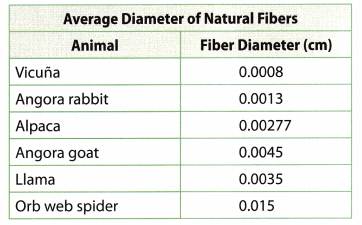
Use the table for problems 16-21. Write the diameter of the fibers in scientific notation.
Texas Go Math Grade 8 Lesson 2.2 Answer Key 2

Question 16.
Alpaca
__________
Answer:
0.00277 Fiber diameter of Alpaca
2.77 Place the decimal point
3 Count me number 0f places the decimal point is moved.
2.77 × 10⁻³ Multiply 2.77 times a power of 10. Since 0.00277 is less than 1, the decimal point moves to the right and the exponent on 10 is negative.
2.77 × 10⁻³

Question 17.
Angora rabbit
_________
Answer:
0.0013 Fiber diameter of Angora rabbit
1.3 Place the decimal point
3 Count me number 0f places the decimal point is moved.
1.3 × 10⁻³ Multiply 1.3 times a power of 10. Since 0.0013 is less than 1, the decimal point moves to the right and the exponent on 10 is negative.
1.3 × 10⁻³

Go Math Grade 8 Lesson 2.2 Homework Answers Question 18.
Llama
_____
Answer:
0.0035 Fiber diameter of Llama
3.5 Place the decimal point
3 Count me number 0f places the decimal point is moved.
3.5 × 10⁻³ Multiply 3.5 times a power of 10. Since 0.0035 is less than 1, the decimal point moves to the right and the exponent on 10 is negative.
3.5 × 10⁻³

Question 19.
Angora goat
______
Answer:
0.0045 Fiber diameter of Angora goat
4.5 Place the decimal point
3 Count me number 0f places the decimal point is moved.
4.5 × 10⁻³ Multiply 4.5 times a power of 10. Since 0.0045 is less than 1, the decimal point moves to the right and the exponent on 10 is negative.
4.5 × 10⁻³

Question 20.
Orb web spider
Answer:
0.015 Fiber diameter of Orb web spider
1.5 Place the decimal point
2 Count me number 0f places the decimal point is moved.
1.5 × 10⁻² Multiply 1.5 times a power of 10. Since 0.0045 is less than 1, the decimal point moves to the right and the exponent on 10 is negative.
1.5 × 10⁻²

Question 21.
Vicuna
Answer:
0.0008 Fiber diameter of Vicuna
8.0 Place the decimal point
4 Count me number 0f places the decimal point is moved.
8.0 × 10⁻⁴ Multiply 8.0 times a power of 10. Since 0.0008 is less than 1, the decimal point moves to the right and the exponent on 10 is negative.
8.0 × 10⁻⁴

Question 22.
Make a Conjecture Which measurement would be least likely to be written in scientific notation: the thickness of a dog hair, the radius of a period on this page, the ounces in a cup of milk? Explain your reasoning.
Answer:
Both the thickness of a dog hair and the radius of a period on a page are very small, numbers (Lengths), something that we tend to write in scientific notation (because it is easier to work with when written in scientific notation). On the other hand, it is likely that the number of ounces in a cup of milk is a number that we can easily write and work with, so we don’t need to write it in scientific notation, so it is reasonable to suspect that it is the least likely to be written in scientific notation.
The number of ounces in a cup of milk

Question 23.
Multiple Representations Convert the length 7 centimeters to meters. Compare the numerical values when both numbers are written in scientific notation.
Answer:
There are 100 centimeters in 1 meter, or 1 centimeter = 0.01 meters
Because of this 7 centimeters = 0.07 meters
Write 0.07 in scientific notation by moving the decimal point two places to the right:
0.07 = 7 × 10⁻² meter
Since 7 centimeters is a number already greater or equal to 1 and less than 10 to get a scientific notation we just
multiply it with 100 = 1
7 = 7 × 100 centimeters
Finally we can see that when in scientific notation the first factor is the same but the exponents of the second factor differ by 2.

In scientific notation the first factor is the same but the exponents of the second factor differ by 2.

Question 24.
Draw Conclusions A graphing calculator displays 1.89 × 10⁻¹² as 1.89E12. How do you think it would display 1.89 × 10⁻¹²? What does the E stand for?
Answer:
We are told that 1.89. 1012 will be displayed as 1.89e12 in a scientific calculator.
We can conclude that here e stands for exponent of 10 and 1.89 . 10-12 will be displayed as 1.89e -12

Question 25.
Communicate Mathematical Ideas When a number is written in scientific notation, how can you tell right away whether or not it is greater than or equal to 1 ?
Answer:
In a scientific notation, if the exponent of 10 is negative, the number is smaller than 1. Otherwise, it is greater or equal to 1.

Lesson 2.2 Independent Practice Go Math Grade 8 Question 26.
The volume of a drop of a certain liquid is 0.000047 liter. Write the volume of the drop of liquid in scientific notation.
Answer:
0.000047 liter Given
4.7 Place the decimal point
5 Count the number of places the decimal point is moved.
4.7 × 10⁻⁵ Multiply 4.7 times a power of 10. Since 0.000047 is less than 1, the decimal point moves to the right and the exponent on 10 is negative.
4.7 × 10⁻⁵

Question 27.
Justify Reasoning If you were asked to express the weight in ounces of a ladybug in scientific notation, would the exponent of the 10 be positive or negative? Justify your response.
Answer:
Since the weight of a ladybug in ounces ¡s a number smaller than 1 we would need to move the decimal point to the right. Therefore the exponent of the 10 would be a negative number.

Negative, since the weight of a ladybug is smaller than 1.

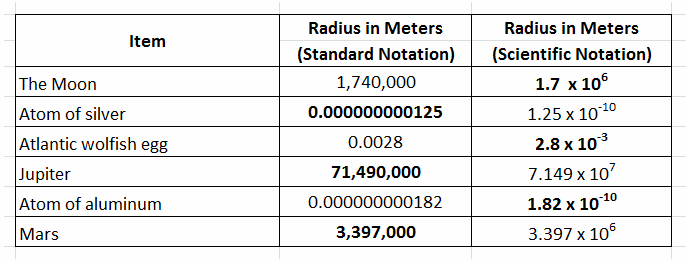
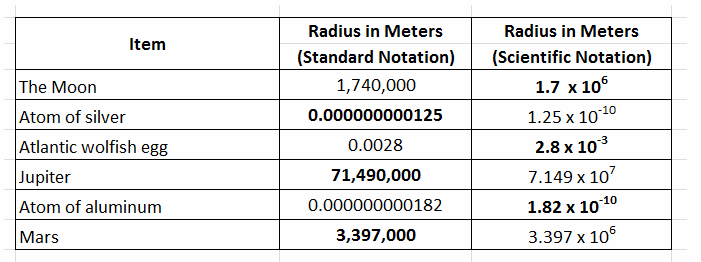
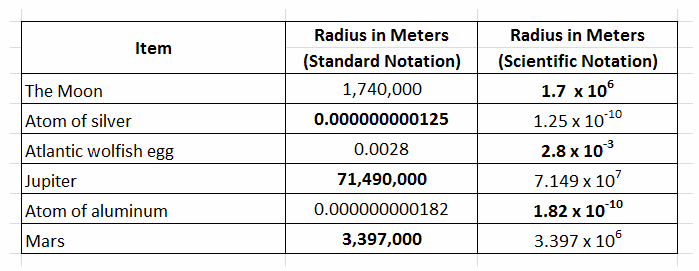
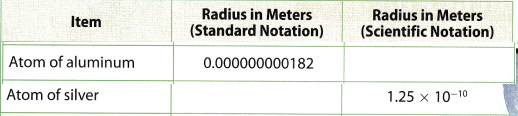
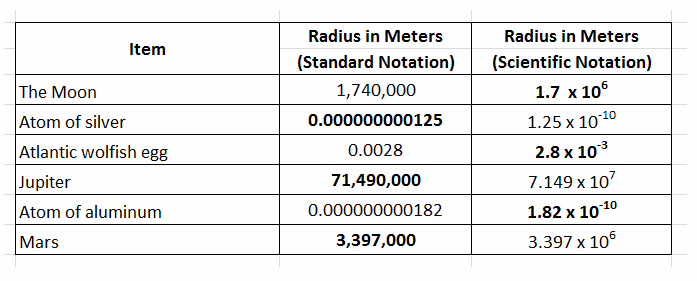
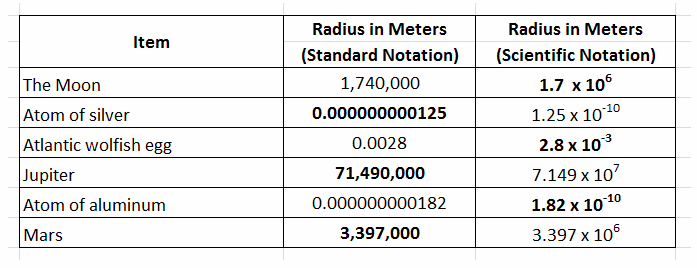
Physical Science The table shows the length of the radii of several very small or very large items. Complete the table.

Question 28.
Texas Go Math Grade 8 Lesson 2.2 Answer Key 3
Answer:
(1) Move the decimal point to the left and remove extra zeros:
1,740,000 ⇒ 1.74
(2) Count the number of places you moved the decimal. point: 6 places
(3) Multiply 1.74 by 106 (because we moved the decimal point 6 places to the left 1.74 × 10⁶
1.74 × 10⁶ meters

Question 29.
Texas Go Math Grade 8 Lesson 2.2 Answer Key 4
Answer:
Texas Go Math Grade 8 Lesson 2.2 Answer Key 9

Question 30.
Texas Go Math Grade 8 Lesson 2.2 Answer Key 5
Answer:
Texas Go Math Grade 8 Lesson 2.2 Answer Key 10

Question 31.
Texas Go Math Grade 8 Lesson 2.2 Answer Key 6
Answer:
Texas Go Math Grade 8 Lesson 2.2 Answer Key 11

Question 32.
Texas Go Math Grade 8 Lesson 2.2 Answer Key 7
Answer:
Texas Go Math Grade 8 Lesson 2.2 Answer Key 12

Question 33.
Texas Go Math Grade 8 Lesson 2.2 Answer Key 8
Answer:
Texas Go Math Grade 8 Lesson 2.2 Answer Key 13

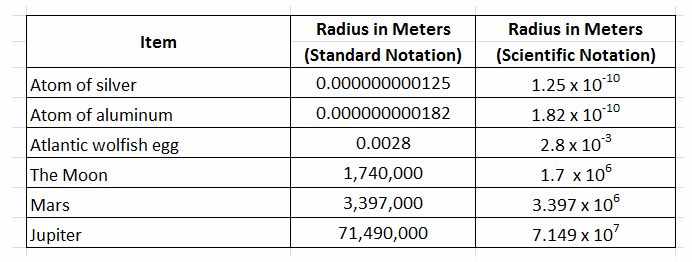
Question 34.
List the items in the table in order from the smallest to largest.
Answer:
Texas Go Math Grade 8 Lesson 2.2 Answer Key 14
Compare the powers of 10 and when they are same, compare the first factor. Based on this rule, the items are arranged from smallest to largest.

Texas Go Math Grade 8 Lesson 2.2 H.O.T. Focus On Higher Order Thinking Answer Key

Question 35.
Analyze Relationships Write the following diameters from least to greatest. 1.5 × 10⁻²m 1.2 × 10²m 5.85 × 10⁻³ m 2.3 × 10⁻² m 9.6 × 10⁻¹ m
Answer:
Compare the powers of 10 (the smaller the exponent the smaller the number), if some are the same then compare the first factors:
5.85 × 10⁻³ < 1.5 × 10⁻² < 2.3 × 10⁻² < 9.6 × 10⁻¹ < 1.2 × 10²

5.85 × 10⁻³, 1.5 × 10⁻², 2.3 × 10⁻², 9.6 × 10⁻¹, 1.2 × 10²

Question 36.
Critique Reasoning Jerod’s friend Al had the following homework problem:
Express 5.6 × 10⁻⁷ in standard form.
Al wrote 56,000,000. How can Jerod explain Al’s error and how to correct it?
Answer:
5.6 × 10⁻⁷ Given
Error is that the decimal is moved in the moved in the right direction and not the left direction.
Since the exponent of 10 is -7, the decimal should be moved to the left.

7 Use the exponent of the power of 10 to see how many places to move the decimal point
places
0.00000056 Place the decimal point Since you are going to write a number less than 5.6, move the decimal to the left. Add placeholder zeros if necessary.

Question 37.
Make a Conjecture Two numbers are written in scientific notation. The number with a positive exponent is divided by the number with a negative exponent. Describe the result. Explain your answer.
Answer:
Since numbers in scientific notation always have a factor that is a power of 10, dividing two numbers in scientific
notation will again be a power of 10. Using the rule:
\(\frac{a^{m}}{a^{n}}\) = am-n
we know that if n is a negative number, the final result will be a positive number since subtracting a negative
number gives a positive number.
So finally, the result will be like this:
Let n be a positive number so the exponent in the denominator is -n, a negative number.
\(\frac{a \times 10^{m}}{b \times 10^{-n}}\) = \(\frac{a}{b}\) × 10m+n

Texas Go Math Grade 8 Lesson 2.2 Answer Key Scientific Notation with Negative Powers of 10 Read More »

Texas Go Math Grade 8 Unit 1 Study Guide Review Answer Key

Refer to our Texas Go Math Grade 8 Answer Key Pdf to score good marks in the exams. Test yourself by practicing the problems from Texas Go Math Grade 8 Unit 1 Study Guide Review Answer Key.

Texas Go Math Grade 8 Unit 1 Study Guide Review Answer Key

Texas Go Math Grade 8 Unit 1 Exercises Answer Key

Find the two square roots of each number. If the number is not a perfect square, approximate the values to the nearest 0.05. (Lesson 1.1)

Module 1 Real Numbers

Question 1.
16 ___________
Answer:
\(\sqrt{16}\) = 4, since 4 . 4 = 16
–\(\sqrt{16}\) = -4, since (-4) . (-4) = 16
Two square roots of 16 are +4 and -4.

Grade 8 Mathematics Unit 1 Answer Key Question 2.
\(\frac{4}{25}\) _______________
Answer:
Texas Go Math Grade 8 Unit 1 Study Guide Review Answer Key 6
Two square roots of \(\frac{4}{25}\) are +\(\frac{2}{5}\) and –\(\frac{2}{5}\)

Question 3.
225 _________
Answer:
\(\sqrt{225}\) = 15, since 15 . 15 = 225
–\(\sqrt{225}\) = -15, since (-15) . (-15) = 225
Two square roots of 225 are +15 and -15.

Question 4.
\(\frac{1}{49}\) _______________
Answer:
Texas Go Math Grade 8 Unit 1 Study Guide Review Answer Key 7
Two square roots of \(\frac{1}{49}\) are +\(\frac{1}{7}\) and –\(\frac{1}{7}\)

Question 5.
\(\sqrt{10}\) _______
Answer:
Since 10 is not a perfect square, approximate 10 with two closest perfect squares:
9 < 10 < 1.6
Take square root to find in between what numbers lies \(\sqrt{10}\):
\(\sqrt{9}\) < \(\sqrt{10}\) < \(\sqrt{16}\)
Solve:
3 < \(\sqrt{10}\) < 4
We now know that \(\sqrt{10}\) lies between 3 and 4 but since 10 is closer to 9, \(\sqrt{10}\) is closer to 3. To find a better approximation pick a few number between 3 and 4 but closer to 3 and square them to see where they lie relating to 10:
3.102 = 9.61 < 10
3.152 ≈ 9.92 < 10
3.22 = 10.24 > 10
We see that 3.152 is closer to 10 than 3.22 so we can conclude that the best approximation to the nearest 0.05 is 3.15

Unit 1 Study Guide Answer Key Texas Go Math Grade 8 Question 6.
\(\sqrt{18}\) _______
Answer:
Since 18 is not a perfect square, approximate 18 with the two closest perfect squares:
16 < 18 < 25
Take square root to find in between what numbers lie \(\sqrt{18}\):
\(\sqrt{16}\) < \(\sqrt{18}\) < \(\sqrt{25}\)
Solve:
4 < \(\sqrt{18}\) < 5
We now know that \(\sqrt{18}\) lies between 4 and 5 but since 18 is closer to 16, \(\sqrt{18}\) is closer to 4.
To find a better approximation pick a few numbers between 4 and 5 but closer to 4 and square them to see where they lie relating to 18:
4.152 ≈ 17.22 < 18
4.22 = 17.64 < 18 4.25 ≈ 18.06 > 18
We see that 4.252 is closer to 18 than 4.22 so we can conclude that the best approximation to the nearest 0.05 is 4.25

Write all names that apply to each number. (Lesson 1.2)

Question 7.
\(\frac{2}{3}\) _______________
Answer:
Since \(\frac{2}{3}\) isn’t an integer or a whole number but is expressed as a ratio of two integers we can conclude that it is a rational, real number.

Rational, real.

Question 8.
–\(\sqrt{100}\) _______
Answer:
–\(\sqrt{100}\)
-10
Rational, integer, real

Grade 8 Math Unit 1 Assessment Answer Key Question 9.
\(\frac{15}{5}\) _______________
Answer:
Since \(\frac{15}{5}\) is a ratio of two integers it is a rational real number. But, since
\(\frac{15}{5}\) = 3
it is also an integer and a whole number.

Whole, integer, rational, real

Question 10.
\(\sqrt{21}\) _______
Answer:
\(\sqrt{21}\)
Irrational, real

Compare. Write <, >, or . (Lesson 1.3)

Question 11.
Texas Go Math Grade 8 Unit 1 Study Guide Review Answer Key 9
Answer:
\(\sqrt{7}\) + 5 ? 7 + \(\sqrt{5}\) Given
\(\sqrt{7}\) is between 2 and 3 Estimate the value of \(\sqrt{7}\)
\(\sqrt{5}\) is between 2 and 3 Estimate the value of \(\sqrt{5}\)
\(\sqrt{7}\) + 5 is between 7 and 8 Use approximations to simply the expressions
7 + \(\sqrt{5}\) is between 9 and 10
\(\sqrt{7}\) + 5 < 7+ \(\sqrt{5}\) Compare

Question 12.
Texas Go Math Grade 8 Unit 1 Study Guide Review Answer Key 10
Answer:
6 + \(\sqrt{8}\) ? \(\sqrt{6}\) + 8 Given
\(\sqrt{8}\) is between 2 and 3 Estimate the value of \(\sqrt{8}\)
\(\sqrt{6}\) is between 2 and 3 Estimate the value of \(\sqrt{6}\)
6 + \(\sqrt{8}\) is between 8 and 9 Use approximations to simply the expressions
\(\sqrt{6}\) + 8 is between 10 and 11
6 + \(\sqrt{8}\) < \(\sqrt{6}\) + 8 Compare

Question 13.
Texas Go Math Grade 8 Unit 1 Study Guide Review Answer Key 11
Answer:
\(\sqrt{4}\) – 2 ? 4 – \(\sqrt{2}\) Given
\(\sqrt{4}\) = 2 Estimate the value of \(\sqrt{4}\)
\(\sqrt{2}\) is between 1 and 2 Estimate the value of \(\sqrt{2}\)
\(\sqrt{4}\) – 2 = 2 – 2 = 0 Use approximations to simply the expressions
4 – \(\sqrt{2}\) is between 3 and 2
\(\sqrt{4}\) – 2 < 4 – \(\sqrt{2}\) Compare

Order the numbers from least to greatest. (Lesson 1.3)

Question 14.
\(\sqrt{81}\), \(\frac{72}{7}\), 8.9
Answer:
First, express au. numbers in (simplified) decimal form so we could easily compare them.
\(\sqrt{81}\) = 9 Simplify (81 is a perfect square)
\(\frac{72}{7}\) = 10.29 Using long division divide 72 by 7
8.9 Already in the simplest form
Now we can compare:
8.9 < 9 < 10.26 (1)
From (1) it now follows that:
From least to greatest: 8.9 < \(\sqrt{81}\) < \(\frac{72}{7}\)

Algebra 1 Unit 1 Study Guide Answer Key Question 15.
\(\sqrt{7}\), 2.55, \(\frac{7}{3}\)
Answer:
\(\sqrt{7}\) lies between 2 and 3 Estimate the value of \(\sqrt{7}\)
Since $7$ is approximately midway
between $4$ and $9$, hence
2.652 = 6.50
2.62 = 6.76
2.652 = 7.02
Since $2.65^{2} = 7.02$ $\sqrt{7}
\approx 2.65$

2.55 Given

\(\frac{7}{3}\) = 2.33 Divide 7 by 3

Texas Go Math Grade 8 Unit 1 Study Guide Review Answer Key 8 Graph on the number line

\(\frac{7}{3}\), 2.55, \(\sqrt{7}\)

Module 2 Scientific Notation

Essential Question
How can you use scientific notation to solve real-world problems?
Answer:
Scientific notation is used to write very large or very small numbers using fewer digits. See how scientists use this notation to describe astronomical distances, such as the distance between planets, or microscopic distances, such as the length of a blood cell

Exercises
Write each number in scientific notation. (Lessons 2.1, 2.2)

Question 1.
3000 _________
Answer:
3000 in the scientific notation is 3 × 10³
Here move the decimal 3 times to the left then it is 3. But the three are less than 10.
Moved the decimal to the left is the exponent and the exponent is positive.

Question 2.
0.000015 _____
Answer:
0.000015 in the scientific notation is 1.5 × 10⁻⁵.
Here move the decimal 5 times to the left then it is 1.5. But the three are less than 10.
Moved the decimal to the left is the exponent and the exponent is negative.

Question 3.
25,500,000 _____
Answer:
25,500,000 Given
2.55 Move the decimal point 7 places to the left. Remove the extra zeros.
10, 000, 000 Divide the original number by the result from above.
107 Write the answer as power of 10.
2.55 × 10⁷ Write the product of the resuLts from step 1 and 2
2.55 × 10⁷

Question 4.
0.00734 _________
Answer:
0.00734 Given
7.34 Place the decimal point
3 Count the number of places the decimal point is moved.
7.34 × 10⁻³ Multiply 7.34 times a power of 10. Since 0.00734 is less than 1, the decimal point moves to the right and the exponent on 10 is negative.
7.34 × 10⁻³

Write each number in standard notation. (Lessons 2.1, 2.2)

Question 5.
5.23 × 10⁴ __________________________
Answer:
5.23 × 10⁴ Given
4 Use the exponent of the power of 10 to determine the number paces to move the decimal point
places
52,300 Place the decimal point Since you are going to write a number greater than 5.23, move the decimal point to the right. Add placeholder zeros if necessary.
52,300

Review and Preview Answer Key Grade 8 Question 6.
1.05 × 10⁶ __________________________
Answer:
Given that 1.05 × 10⁶
10⁶ = 1000000
1.05 × 1000000 = 1050000.

Question 7.
4.7 × 10⁻¹ __________________________
Answer:
Given that 4.7 × 10⁻¹.
10-1 = 0.1
4.7 × 0.1 = 0.47.

Question 8.
1.33 × 10⁻⁵ __________________________
Answer:
1.33 × 10⁻⁵ Given
5 Use the exponent of the power of 10 to determine the number paces to move the decimal point
places
0.0000133 Place the decimal point Since you are going to write a number greater than 1.33, move the decimal point to the right. Add placeholder zeros if necessary.
0.0000133

Use the information in the table to write each weight in scientific notation. (Lessons 2.1, 2.2)

Texas Go Math Grade 8 Unit 1 Study Guide Review Answer Key 12
Question 9.
Ant _________
Answer:
Given that the weight of the ant = 0.000000661.
0.000000661 in the scientific notation is 6.61 × 10⁻⁷.
Here move the decimal 7 times to the left then it is 6.61. But the three are less than 10.
Moved the decimal to the left is the exponent and the exponent is negative.

Question 10.
butterfly _________
Answer:
Given that the weight of the butterfly = 0.00000625.
0.00000625 in the scientific notation is 6.25 × 10⁻⁶.
Here move the decimal 6 times to the left then it is 6.25. But the three are less than 10.
Moved the decimal to the left is the exponent and the exponent is negative.

Question 11.
elephant _________
Answer:
Given that the weight of the elephant = 9900
9900 in the scientific notation is 9.9 × 10³
Here move the decimal 3 times to the left then it is 9.9.But the three are less than 10.
Moved the decimal to the left is the exponent and the exponent is positive.

Texas Go Math Grade 8 Unit 1 Performance Tasks Answer Key

Question 1.
Careers In Math Astronomer An astronomer is studying Proxima Centauri, which is the closest star to our Sun. Proxima Centauri is 39,900,000,000,000,000 meters away.
a. Write this distance in scientific notation.
Answer:
39,900,000,000,000,000 Distance in meters
3.99 Move the decimal point 16 places to the left. Remove the extra zeros
10, 000, 000, 000, 000, 000 Divide the original number by the result from Step 1. Write the answer as the power of 10.
1016
3.99 × 10¹⁶ Write the product of the results from the above

b. Light travels at a speed of 3.0 × 10⁸ m/s (meters per second). How can you use this information to calculate the time in seconds it takes for light from Proxima Centauri to reach Earth? How many seconds does it take? Write your answer in scientific notation.
Answer:
speed = 3.0 × 10⁸ speed in meters per second
Texas Go Math Grade 8 Unit 1 Study Guide Review Answer Key 18
\(\frac{3.99}{3}\) = 1.33 Find the quotient by dividing the decimals and using the laws of exponents
\(\frac{10^{16}}{10^{8}}\) = 1016-8 = 108
1.33 × 10⁸ Combine the answers to write the distance in scientific notation
It takes $1.33 \times 10^{8}$ seconds
for the light to reach Earth

c. Knowing that 1 year = 3.1536 × 10⁷ seconds, how many years does it take for light to travel from Proxima Centauri to Earth? Write your answer in standard notation. Round your answer to two decimal places.
Answer:
1.33 × 10⁸ seconds From part b
Texas Go Math Grade 8 Unit 1 Study Guide Review Answer Key 19 1 yr = 3.1536 × 10⁷
Texas Go Math Grade 8 Unit 1 Study Guide Review Answer Key 20
Find the quotient by dividing the decimals and using the Laws of exponents
0.4217 × 101 combine the answers to write the distance in scientific notation
4.22 Write in standard notation
It takes $4.22$ years for the light to reach Earth

Unit 1 Review Answer Key Math Grade 8 Question 2.
Cory is making a poster of common geometric shapes. He draws a square with a side length of 43 cm, an equilateral triangle with a height of \(\sqrt{200}\) cm, a circle with a circumference of 8π cm, a rectangle with length \(\frac{122}{5}\) cm, and a parallelogram with base 3.14 cm.

a. Which of these numbers are irrational?
Answer:
\(\sqrt{200}\) cm and 8π cm are irrational Irrational numbers are real numbers that cannot be expressed in the form \(\frac{a}{b}\)

b. Write the numbers in this problem in order from least to greatest. Approximate π as 3.14.
Answer:
43 = 64 Evaluate the power
\(\sqrt{200}\) Estimate the value of \(\sqrt{200}\)
lies between $14$ and $15$ Since
$200$ is closer to $196 = 14^{2}$,
hence
14.12 = 198.81
14.152 = 200.22
14.22 = 201.64
Since $14.15”{2} = 200.22$
$\sqrt{200} \approx 14.15$
8π = 8 * 3.14 = 25.12 π = 3.14
\(\frac{122}{5}\) = 24.4 Divide 122 by 5
3.14 Given
Texas Go Math Grade 8 Unit 1 Study Guide Review Answer Key 21 Graph on the number line
3.14, \(\sqrt{200}\), \(\frac{122}{5}\), 8π, 43 From least to greatest

c. Explain why 3.14 is rational, but π is not.
Answer:
3.14 can be expressed in the form \(\frac{a}{b}\) but π cannot be expressed in fraction form. It gives a value which is neither a terminating or repeating decimal.

3.14 is rational but π is not

Texas Go Math Grade 8 Unit 1 Mixed Review Texas Test Prep Answer Key

Selected Response

Question 1.
A square on a large calendar has an area of 4220 square millimeters. Between which two integers is the length of one side of the square?
(A) between 20 and 21 millimeters
(B) between 64 and 65 millimeters
(C) between 204 and 205 millimeters
(D) between 649 and 650 millimeters
Answer:
(B) between 64 and 65 millimeters

Explanation:
The area of a square is found by multiplying the side of the square by itself. Therefore, to find the side of the
square, we have to take the square root of the area.
Let’s denote with A the area of a square of the calendar and with s each side of the square. We have:
A = 4220
A = s • s
s = \(\sqrt{A}\) = \(\sqrt{4220}\)
Following the steps as in “Explore activity 1” on page 9, we can make an estimation for the irrational number:
Texas Go Math Grade 8 Unit 1 Study Guide Review Answer Key 22
Therefore, the side of the square is between 64 and 65 millimeters.

8th Grade Math Unit 1 Study Guide Answer Key Question 2.
Which of the following numbers is rational but not an integer?
(A) -9
(B) -4.3
(C) 0
(D) 3
Answer:
(B) -4.3

Explanation:
-4.3 is not an integer
Integers are whole numbers that can be positive, negative or zero.

Question 3.
Which statement is false?
(A) No integers are irrational numbers.
(B) All whole numbers are integers.
(C) All rational numbers are real numbers.
(D) All integers are whole numbers.
Answer:
(D) All integers are whole numbers.

Explanation:
All integers are whole numbers is false
Whole numbers are non-negative while integers are negative, positive or zeros.

Question 4.
Which set best describes the numbers displayed on a telephone keypad?
(A) whole numbers
(B) rational numbers
(C) real numbers
(D) integers
Answer:
The rational numbers are displayed on the telephone keypad.
Option B is the correct answer.

Question 5.
In 2011, the population of Laos was about 6.586 × 10⁶ people. What is this number written in standard notation?
(A) 6,586 people
(B) 658,600 people
(C) 6,586,000 people
(D) 65,860,000 people
Answer:
(C) 6,586,000 people

Explanation:
6.586 × 10⁶ Population in 2011

6 Use exponent of the power of 10 to determine the number places to move the decimal point
places

6, 586, 000
Place the decimal point Since you are going to write a number greater than 6.586, move decimal point to the right Add placeholder zeros if necessary.
There are 6, 586, 000 people in $2011$

Question 6.
Which of the following is not true?
Texas Go Math Grade 8 Unit 1 Study Guide Review Answer Key 13
Answer:
(D) 6 – \(\sqrt{35}\) < 0 Explanation: a. Since both 16 and 4 are perfect squares we can evaluate them easily: Texas Go Math Grade 8 Unit 1 Study Guide Review Answer Key 23
and the statement is TRUE.

b. We know that π ≈ 3.14 which means that 4π ≈ 4 × 3.14 = 12.56 Obviously, 12.56 > 12
so,
4π > 12
and the statement is TRUE

c. Lets first evaluate \(\sqrt{18}\) and \(\frac{15}{2}\)
Since 18 is not a perfect square find two closest squares that 1 lies in between:
16 < 18 < 25
\(\sqrt{16}\) < \(\sqrt{18}\) < \(\sqrt{25}\)
4 < \(\sqrt{18}\) < 5
Since 18 is closer to 16 a good approximation for \(\sqrt{18}\) is 4 but we are certain that \(\sqrt{18}\) is not larger or equal to 5
To express \(\frac{15}{2}\) as a fraction use long division to divide 15 by 2
\(\frac{15}{2}\) = 7.5
Now we can see that
\(\sqrt{18}\) + 2 < 5 + 2 = 7
\(\frac{15}{2}\) = 7.5
We can conclude that \(\sqrt{18}\) + 2 < \(\frac{15}{2}\)
and the statement is TRUE.

d. Since
62 = 36
36 > 35
by taking square roots from both sides we can see that
\(\sqrt{35}\) < \(\sqrt{36}\) = 6 but now 6 – \(\sqrt{35}\) > 0
It now follows that the statement is NOT TRUE.

Question 7.
Which number is between \(\sqrt{50}\) and \(\frac{5 \pi}{2}\)?
(A) \(\frac{22}{3}\)
(B) 2\(\sqrt{8}\)
(C) 6
(D) π + 3
Answer:
(A) \(\frac{22}{3}\)

Explanation:
\(\sqrt{50}\) Given
and \(\frac{5 \pi}{2}\)
\(\sqrt{50}\) lies between 7 and 8 Evaluate the value of \(\sqrt{50}\)
7.02 = 49.00
7.052 = 49.70
7.152 = 51.12
Since $7.05^{2} = 49.7$, $\sqrt{50}
\approx 7.05$

\(\frac{5 * 3.14}{2}\) = 7.85 Evaluate \(\frac{5 \pi}{2}\)
The number should be between 7.05 and 7.85
\(\frac{22}{3}\) = 7.33

8th Grade Math Unit 1 Study Guide Answer Key Question 8.
What number is indicated on the number line?
Texas Go Math Grade 8 Unit 1 Study Guide Review Answer Key 14
(A) π + 4
(B) \(\frac{152}{20}\)
(C) \(\sqrt{14}\) + 4
(D) \(7 . \overline{8}\)
Answer:
Given that the number \(\sqrt{14}\) + 4 is indicated on the number line.
\(\sqrt{14}\) + 4 = 7.7416.
Option C is the correct answer.

Question 9.
Which of the following is the number 5.03 × 10⁻⁵ written in standard form?
(A) 503,000
(B) 50,300,000
(C) 0.00503
(D) 0.0000503
Answer:
The standard form of the number 5.03 × 10⁻⁵
5.03 × 0.00001 = 0.0000503
Here move the decimal 5 times to the left then it is 5.03. But the three are less than 10.
Moved the decimal to the left is the exponent and the exponent is negative.
Option D is the correct answer.

Question 10.
In a recent year, about 20,700,000 passengers traveled by train in the United States. What is this number written in scientific notation?
(A) 2.07 × 101 passengers
(B) 2.07 × 10⁴ passengers
(C) 2.07 × 10⁷ passengers
(D) 2.07 × 10⁸ passengers
Answer:
(C) 2.07 × 10⁷ passengers

Explanation:
20,700,000 Given
2.07 Move the decimal point 7 places to the left Remove the extra zeros
10,000,000 Divide the original number by the result from above.
107 Write the answer as the power of 10.
Write the product of the results above
2.07 × 10⁷
There are $2.07 \times 10^{7}$ passengers that travel by train

Unit 1 End of Unit Assessment Answer Key Grade 8 Question 11.
A quarter weighs about 0.025 pounds. What is this weight written in scientific notation?
(A) 2.5 × 10⁻² pound
(B) 2.5 × 101 pound
(C) 2.5 × 10⁻¹ pound
(D) 2.5 × 10² pound
Answer:
(A) 2.5 × 10⁻² pound

Explanation:
We need to express the number 0.025 in scientific notation (a × 10n, where a is a number greater or equal to 1 but less than 10.
In that spirit, we see we need to move the decimal point 2 places (to the right) so the power of 10 needs to be 2
(or -2). Since the given number is a number smaller than 1 the exponent in the power of 10 is going to be negative (-2).
0.025 = 2.5 × 10⁻²

Question 12.
Which of the following is the number 3.0205 × 10⁻³ written in standard notation?
(A) 0.00030205
(B) 0.0030205
(C) 3.0205
(D) 3020.5
Answer:
The standard form of the number 3.0205 × 10 power of -3 = 0.00030205.
Option A is the correct answer.

Question 13.
A human fingernail has a thickness of about 4.2 × 10⁻⁴ meters. What is this width written in standard notation?
(A) 0.0000042 meter
(B) 0.000042 meter
(C) 0.00042 meter
(D) 0.0042 meter
Answer:
(C) 0.00042 meter

Explanation:
a We are given: 4.2 × 10⁻⁴ meter Since the power of 10 is a negative 4 we need to move the decimal place 4
places to the left to get a number written in scientific notation.
4.2 × 10⁻⁴ meter = 0.00042 meter Move decimal point and add placeholder zeros

b. Since 1 meter = 0.001 millimeter or 1 millimeter = 103 meter we can calculate how many millimeters is 4.2 × 10⁻⁴ meter
4.2 × 10⁻⁴ meter = (4.2 × 10-4) × 103 millimeter = 0.42 millimeter
We can conclude that their measurements agree.

c. Since the thickness of a human fingernail is a very small number it is more appropriate to express it in millimeters than in meters (because a millimeter is 1000 times smaller than a meter).

Gridded Response

Question 14.
The square root of a number is -18. What is the other square root?
Texas Go Math Grade 8 Unit 1 Study Guide Review Answer Key 15
Answer:
A square root always has 2 numbers, one is positive and other is negative.
So, one number is -18 and the other number is 18

Hot Tip!
Underline keywords given in the test question so you know for certain what the question is asking.

Question 15.
Jerome is writing a number in scientific notation. The number is greater than one million and less than ten million. What will be the exponent in the number Jerome writes?
Texas Go Math Grade 8 Unit 1 Study Guide Review Answer Key 16
Answer:
Given that Jerome is writing the number in the scientific notation.
The number is greater than one million and less than ten million.
The exponent in the number is
1 million = 10⁶
10 million = 10⁷
The number is > 10⁶ < 10⁷
The exponent number is 6.

Grade 8 Math Unit 1 Performance Assessment Task 1 Answer Key Question 16.
Write the number 3.3855 × 10² in standard notation.
Texas Go Math Grade 8 Unit 1 Study Guide Review Answer Key 17
Answer:
3.3855 × 10² in the standard form is 3.3855 × 100 = 338.55

Texas Go Math Grade 8 Unit 1 Vocabulary Preview Answer Key

Use the puzzle to preview key vocabulary from this unit. Unscramble the circled letters to answer the riddle at the bottom of the page.

Question 1.
TCREEFP
SEAQUR
Texas Go Math Grade 8 Unit 1 Study Guide Review Answer Key 1
Answer:
PERFECT
SQUARE
Texas-Go-Math-Grade-8-Unit-1-Study-Guide-Review-Answer-Key-1

Question 2.
NOLRATAI
RUNMEB
Texas Go Math Grade 8 Unit 1 Study Guide Review Answer Key 2
Answer:
RATIONAL
NUMBER
Texas-Go-Math-Grade-8-Unit-1-Study-Guide-Review-Answer-Key-2

Question 3.
PERTIANEG
MALCEDI
Texas Go Math Grade 8 Unit 1 Study Guide Review Answer Key 3
Answer:
PERTAINGE
DECIMAL
Texas-Go-Math-Grade-8-Unit-1-Study-Guide-Review-Answer-Key-3

Question 4.
LAER
SEBMNUR
Texas Go Math Grade 8 Unit 1 Study Guide Review Answer Key 4
Answer:
REAL
NUMBERS
Texas-Go-Math-Grade-8-Unit-1-Study-Guide-Review-Answer-Key-4

Question 5.
NIISICFTCE
OITANTON
Texas Go Math Grade 8 Unit 1 Study Guide Review Answer Key 5
Answer:
SCIENTIFIC
NOTATION
Texas-Go-Math-Grade-8-Unit-1-Study-Guide-Review-Answer-Key-5

  1. Has integers as its square roots. (Lesson 1-1)
  2. Any number that can be written as a ratio of two integers. (Lesson 1-1)
  3. A decimal in which one or more digits repeat infinitely. (Lesson 1-1)
  4. The set of rational and irrational numbers. (Lesson 1-2)
  5. A method of writing very large or very small numbers by using powers of 10. (Lesson 2-1)

Q: What keeps a square from moving?
A: ___ ___ ___ ___ ___ ___ ___ ___ ___ ___ ___!
Answer:
SQUARE ROOTS

Texas Go Math Grade 8 Unit 1 Study Guide Review Answer Key Read More »

Texas Go Math Grade 8 Lesson 3.3 Answer Key Interpreting the Unit Rate as Slope

Refer to our Texas Go Math Grade 8 Answer Key Pdf to score good marks in the exams. Test yourself by practicing the problems from Texas Go Math Grade 8 Lesson 3.3 Answer Key Interpreting the Unit Rate as Slope.

Texas Go Math Grade 8 Lesson 3.3 Answer Key Interpreting the Unit Rate as Slope

How do you interpret the unit rate as slope?

Texas Go Math Grade 8 Lesson 3.3 Explore Activity Answer Key 

Relating the Unit Rate to Slope
A rate is a comparison of two quantities that have different units, such as miles and hours. A unit rate is a rate in which the second quantity in the comparison is one unit.

A storm is raging on Misty Mountain. The graph shows the constant rate of change of the snow level on the mountain.
Texas Go Math Grade 8 Lesson 3.3 Answer Key 1

A. Find the slope of the graph using the points (1, 2) and (5, 10). Remember that the slope is the constant rate of change.

B. Find the unit rate of snowfall in inches per hour. Explain your method.

C. Compare the slope of the graph and the unit rate of change in the snow level. What do you notice?

D. Which point on the graph tells you the slope of the graph and the unit rate of change in the snow level? Explain how you found the point.

Reflect

Question 1.
What If? Without referring to the graph, how do you know that the point (1, \(\frac{4}{3}\)) is on the graph?
Answer:
Lets find the slope:
Slope = \(\frac{8-4}{6-3}\) = \(\frac{4}{3}\)
This holds for every two points on the graph, so it has to hold for some of the given points and the point we want to check. Substitute the point (6, 8) for (1, \(\frac{4}{3}\)) and see if it still holds.
\(\frac{\frac{4}{3}-4}{1-3}\) = \(\frac{4}{3}\) = Slope
for x = Time and y = Amount
Therefore, the point (1, \(\frac{4}{3}\)) is on the line.
By checking if the equation for the slope (which we calculated) holds for the given point we see that it does, so it is on the line.

Your Turn

Interpreting the Unit Rate as Slope Go Math 8th Grade Pdf Question 2.
Tomas rides his bike at a steady rate of 2 miles every 10 minutes. Graph the situation. Find the unit rate of this proportional relationship.
Texas Go Math Grade 8 Lesson 3.3 Answer Key 2
Answer:
Texas Go Math Grade 8 Lesson 3.3 Answer Key 15 Make a table
Texas Go Math Grade 8 Lesson 3.3 Answer Key 16 Graph the solution
slope = \(\frac{\text { Rise }}{\text { Run }}\) = \(\frac{4-2}{20-10}\) = \(\frac{2}{10}\) = \(\frac{1}{5}\) Find the slope
The unit rate and slope of a graph of the ride is \(\frac{1}{5}\) mi per min

Reflect

Question 3.
Describe the relationships among the slope of the graph of Well A’s rate, the equation representing Well A’s rate, and the constant of proportionality.
Answer:
The slope of the graph of Well, A’s rate, the equation representing Well A’s rate, and the constant of proportionality are the same. They all represent the amount of oil pumped from Well A in an hour.

Your Turn

Question 4.
The equation y = 375x represents the relationship between x, the time that a plane flies in hours, and y, the distance the plane flies in miles for Plane A. The table represents the relationship for Plane B. Find the slope of the graph for each plane and the plane’s rate of speed. Determine which plane is flying at a faster rate of speed.
Texas Go Math Grade 8 Lesson 3.3 Answer Key 3
Answer:
Notice that for every value of x and y for Plane A the given equation has to hold. So
y = 375x
therefore
k = \(\frac{y}{x}\) = 375 is the slope of the graph for Plane A.
Using the table we can find the slope of the graph for Plane B:
\(\frac{y_{2}-y_{1}}{x_{2}-x_{1}}\) = \(\frac{850-425}{2-1}\) = 425
Therefore, the slope of the graph of Plane B is greater than the slope of the graph of Plane A. We can conclude that Plane B is faster because it flies more miles per hour (faster rate of speed).
Plane B is flying at a faster rate of speed.

Texas Go Math Grade 8 Lesson 3.3 Guided Practice Answer Key 

Give the slope of the graph and the unit rate. (Explore Activity and Example 1)

Question 1.
Jorge: 5 miles every 6 hours
Texas Go Math Grade 8 Lesson 3.3 Answer Key 4
Answer:
we are given that Jorge travels 5 miles every 6 hours. ‘Therefore, we construct the table and draw a graph:
Texas Go Math Grade 8 Lesson 3.3 Answer Key 17
slope = \(\frac{\text { rise }}{\text { run }}\) = \(\frac{5}{6}\)
The unit of the distance travelled and the slope of the graph of the relationship is equal, \(\frac{5}{6}\) miles per hour.
\(\frac{5}{6}\) miles per hour.

Unit Rate as Slope Grade 8 Math Answer Key Pdf Question 2.
Akiko
Texas Go Math Grade 8 Lesson 3.3 Answer Key 5
Answer:
slope = \(\frac{\text { Rise }}{\text { Run }}\) = \(\frac{10-5}{8-4}\) = \(\frac{5}{4}\)
The unit rate is \(\frac{5}{4}\) miles per hour.
Slope: \(\frac{5}{4}\), unit rate: \(\frac{5}{4}\) miles per hour

Question 3.
The equation y = 0.5x represents the distance Henry hikes in miles over time in hours. The graph represents the rate that Clark hikes. Determine which hiker is faster. Explain. (Example 2)
Texas Go Math Grade 8 Lesson 3.3 Answer Key 6
Answer:
y = 0.5x Equation representing Henry’s rate
Texas Go Math Grade 8 Lesson 3.3 Answer Key 18 Use the equation to make a table
Slope = Unit rate = \(\frac{2-1}{4-2}\) = \(\frac{1}{2}\) miles per hour
Use the table to find the slope of the graph of Plane A
Slope = Unit rate = \(\frac{18-6}{12-4}\) = \(\frac{12}{8}\) miles per hour
Use the graph to find the slope of the graph of Clark
Clark is faster Compare the units
\(\frac{3}{2}\) > \(\frac{1}{2}\)

Write an equation relating the variables in each table. (Example 2)

Question 4.
Texas Go Math Grade 8 Lesson 3.3 Answer Key 7
Answer:
Find the slope and with it the unit rate:
Slope = \(\frac{30-15}{2-1}\) = 15 = Unit rate
Now we know that for every x and y the following equation holds:
\(\frac{y}{x}\) = 15
therefore
y = 15x

Practice and Homework Lesson 3.3 Answer Key 8th Grade Question 5.
Texas Go Math Grade 8 Lesson 3.3 Answer Key 8
Answer:
Slope = Unit rate = \(\frac{12-6}{32-16}\) = \(\frac{6}{16}\) = \(\frac{3}{8}\) Find the slope using the table
y = \(\frac{3}{8}\)x Writing the equation

Essential Question Check-In

Question 6.
Describe methods you can use to show a proportional relationship between two variables, x and y. For each method, explain how you can find the unit rate and the slope.
Answer:
Explanation A:
We can represent a proportional relationship between two variables x and y using a table. For each point we find
the ratio of y over x. If this ratio is constant over each point, then the relationship is proportional. To find the unit rate and slope, we have:
Slope = Unit Rate = \(\frac{y_{2}-y_{1}}{x_{2}-x_{1}}\)

We can represent a proportional relationship between two variables x and y using an equation of the form y = kx, where k is a number called the constant of proportionality. The slope and unit rate are equal to the constant of proportionality, however we can construct a table from the given equation and proceed as described above.

We can represent a proportional relationship between two variables x and y using a graph. The graph will be a line that passes through the origin (0, 0). To find the unit rate and slope, we have:
Slope = Unit Rate = \(\frac{\text { rise }}{\text { run }}\)

Explanation B:
You can use a table to find the ratio of each point. If the ratio is constant, the relationship is proportional. You
can find the unit rate and slope by:
Slope(m) = UnitRate = \(\frac{y_{2}-y_{1}}{x_{2}-x_{1}}\)

You can use a graph to find the ratio of the rise for equal intervals of run. You can find the unit rate and slope by:
Slope(m) = UnitRate = \(\frac{\text { rise }}{\text { run }}\)

Texas Go Math Grade 8 Lesson 3.3 Independent Practice Answer Key 

Interpreting Unit Rate as Slope 8th Grade Go Math Answer Key Question 7.
A Canadian goose migrated at a steady rate of 3 miles every 4 minutes.
a. Fill in the table to describe the relationship.
Texas Go Math Grade 8 Lesson 3.3 Answer Key 9
Answer:
Texas Go Math Grade 8 Lesson 3.3 Answer Key 19
Top row: 12, 16; Bottom row: 3, 6, 15

b. Graph the relationship.
Texas Go Math Grade 8 Lesson 3.3 Answer Key 10
Answer:
Texas Go Math Grade 8 Lesson 3.3 Answer Key 20
Click for the graph.

c. Find the slope of the graph and describe what it means in the context of this problem.
Answer:
The slope of the graph is
\(\frac{6-3}{8-4}\) = \(\frac{3}{4}\)
in this case, this means that a Canadian goose migrates 3 miles every 4 minutes or \(\frac{3}{4}\) miles every minute.
The goose migrates \(\frac{3}{4}\) miles every minute.

Question 8.
Vocabulary A unit rate is a rate in which the Texas Go Math Grade 8 Lesson 3.3 Answer Key 11 in the comparison is one unit.
Answer:
A unit is a rate in which the second quantity in the comparison is one unit.

Question 9.
The table and the graph represent the rate at which two machines are bottling milk in gallons per second.
Texas Go Math Grade 8 Lesson 3.3 Answer Key 12

a. Determine the slope and unit rate of each machine
Answer:
(1) Using the given table, calculate the slope and unit rate of the first machine.
Slope = Unit rate = \(\frac{1.2-0.6}{2-1}\) = \(\frac{0.6}{1}\) = 0.6
The unit rate for the first machine is therefore 0.6 gallons per second.

(2) Using the given graph, find points to substitute into the formula for the slope.
Two points on the line for the second machine are: (8, 6) and (16, 12).
Now calculate the slope and unit rate of the second machine using the points you just found.
Slope = Unit rate = \(\frac{12-6}{16-8}\) = \(\frac{6}{8}\) = 0.75
The unit rate for the second machine is therefore 0.75 gallons per second
The slope and unit rate of the first machine is 0.6 (gallons per second), and of the second 0.75 (gallons per
second).

b. Determine which machine is working at a faster rate.
Answer:
Comparing the unit rates of both machines we can see that the second machine bottles more milk per second than the first machine. Therefore it is working at a faster rate.
The second machine is faster.

Texas Go Math Grade 8 Lesson 3.3 Answer Key Question 10.
Cycling The equation y = \(\frac{1}{9}\)x represents the distance y, in kilometers, that Patrick traveled in x minutes while training for the cycling portion of a triathlon. The table shows the distance y Jennifer traveled in x minutes in her training. Who has the faster training rate?
Texas Go Math Grade 8 Lesson 3.3 Answer Key 13
Answer:
From y = \(\frac{1}{9}\)x we can make a table for Patrick’s unit rate in kilometers per minute.
Texas Go Math Grade 8 Lesson 3.3 Answer Key 21
Now,
\(\frac{2-1}{18-9}\) = \(\frac{1}{9}\)
Therefore, Patrick’s unit rate is \(\frac{1}{9}\) kilometers per minute.

Lets find the slope and the unit rate of jennifer
Slope = \(\frac{8-5}{64-40}\) = \(\frac{3}{24}\) = \(\frac{1}{8}\)
Therefore, Jennifer’s unit rate is \(\frac{1}{8}\) kilometers per minute.
We can conclude that Patrick has a faster training rate.

Question 11.
Analyze Relationships There is a proportional relationship between minutes and cost in dollars. The graph passes through the point (1, 4.75). What is the slope of the graph? What is the unit rate? Explain.
Answer:
If we know that there is a proportional relationship between minutes and dollars per minute, then the graph is a
straight line. Also since that line passes through (1, 4.75) we know that for 1 minute it costs 4.75 dollars to print.
Therefore the slope is 4.75 and the unit rate is 4.75 dollars per minute.

The slope is 4.75 and the unit rate is 4.75 dollars per minute.

Question 12.
Draw Conclusions Two cars start at the same time and travel at different constant rates. The graph of the distance in miles given the time in hours for Car A passes through the point (0.5, 27.5), and the graph for Car B passes through the point (4, 240). Which car is traveling faster? Explain.
Answer:
Unit Rate = \(\frac{27.5}{0.5}\) = 55 Find the unit rate for Car A.
Car $A$ travels $55$ miles in $1$ hr

Unit Rate = \(\frac{240}{4}\) = 60 Find the unit rate for Car B.
Car $B$ travels $60$ miles in $1$ hr
Car B is faster Compare the unit rates
60 > 55

Lesson 3.3 Interpreting the Unit Rate as Slope Reteach Answer Key Question 13.
Critical Thinking The table shows the rate at which water is being pumped into a swimming pool.
Texas Go Math Grade 8 Lesson 3.3 Answer Key 14
Use the unit rate and the amount of water pumped after 12 minutes to find how much water will have been pumped into the pool after 13\(\frac{1}{2}\) minutes. Explain your reasoning.
Answer:
Unit rate = \(\frac{216-36}{12-2}\) = \(\frac{180}{10}\) = 18 Find the unit rate
18 gal of water is pumped into the swimming pool every minute.

Additional water = 18 * 1\(\frac{1}{2}\) = 27 After 1\(\frac{1}{2}\) min after 12 min

Total = 216 + 27 = 243gal The total water after 13\(\frac{1}{2}\) min

Texas Go Math Grade 8 Lesson 3.3 Answer Key Interpreting the Unit Rate as Slope Read More »

Texas Go Math Grade 8 Module 2 Quiz Answer Key

Refer to our Texas Go Math Grade 8 Answer Key Pdf to score good marks in the exams. Test yourself by practicing the problems from Texas Go Math Grade 8 Module 2 Quiz Answer Key.

Texas Go Math Grade 8 Module 2 Quiz Answer Key

Texas Go Math Grade 8 Module 2 Ready to Go On? Answer Key

2.1 Scientific Notation with Positive Powers of 10

Write each number in scientific notation.

Question 1.
2,000 ______________
Answer:
2,000 Given
2.0 Move the decimal point 3 places to the left. Remove the extra zeros.
1000 Divide the original number by the result from above.
103 Write the answer as the power of 10.
2.0 × 10³ Write the product of the results from the above.
2.0 × 10³

Module 2 Form A Module Test Answer Key Question 2.
91,007,500 ____________
Answer:
91,007,500 Given
91,007,500 Move the decimal point 7 places to the left. Remove the extra zeros.
10000000 Divide the original number by the result from above.
107 Write the answer as the power of 10.
9.10075 × 10⁷ Write the product of the results from the above.
9.10075 × 10⁷

Question 3.
On average, the Moon’s distance from Earth is about 384,400 km. What is this distance in scientific notation? __________________
Answer:
Given that,
The average distance of the moon from the earth is 384,400 km.
The scientific notation of the distance 384400 is 3.844 x 10⁵.
Here move the decimal 5 times to the left then it is 3.844. But it is less than 10.
Moved the decimal to the left is the exponent and the exponent is positive.

Write each number in standard notation.

Question 4.
1.0395 × 10⁹ _______________
Answer:
1.0395 x 10⁹ in the standard form is
109 = 1,000,000,000
1.0395 x 1,000,000,000 = 1,039,500,000.

Question 5.
4 × 10² _______________
Answer:
4 x 10² in the standard form is
10² = 100
4 x 100 = 400

Go Math Grade 8 Module 2 Answer Key Pdf Question 6.
The population of Indonesia was about 2.48216 × 10⁸ people in 2011. What is this number in standard notation? _______________
Answer:
Given that the population of Indonesia is 2.48216 x 10⁸
2.48216 x 10⁸ in the standard form is
10⁸ = 100000000
2.48216 x 100000000 = 248,216,000

2.2 Scientific Notation with Negative Powers of 10

Write each number in scientific notation.

Question 7.
0.02 _______________
Answer:
0.02 in the scientific notation is 2 x 10⁻²
Here move the decimal 2 times to the left then it is 2. But two is less than 10.
Moved the decimal to the left is the exponent and the exponent is negative.

Question 8.
0.000701 ____
Answer:
0.000701 Given
7.01 Place the decimal point
4 Count the number of places the decimal point is moved
7.01 × 10⁴ Multiply 7.01 times a power of 10. Since 0.000701 is less than 1, the decimal point moves to the right and the exponent on 10 is negative.

Write each number in standard notation.

Question 9.
8.9 × 10⁻⁵ ______________
Answer:
8.9 × 10⁻⁵ Given
5 Use the exponent of the power of 10 to see how many places to move the decimal point.
places
0.000089 Place the decimal point Since you are going to write a number less than 8.9, move the decimal to the left. Add placeholder zeros if necessary.
0.000089

Module 2 Exponents and Scientific Notation Module Quiz Question 10.
4.41 × 10⁻² ______________
Answer:
4.41 × 10⁻² Given
2 Use the exponent of the power of 10 to see how many places to move the decimal point.
places
0.0441 Place the decimal point Since you are going to write a number less than 4.41, move the decimal to the left. Add placeholder zeros if necessary.
0.0441

Complete the table.

Question 11.
Texas Go Math Grade 8 Module 2 Answer Key 1
Answer:
Given that,
The distance structure of the standard notation = 0.000009m.
0.000009m in the scientific notation is
The distance of the structure in the scientific notation is 9 x 10⁻⁶
Here move the decimal 6 times to the left then it is 9. But nine is less than 10.
Moved the decimal to the left is the exponent and the exponent is negative.

Question 12.
Texas Go Math Grade 8 Module 2 Answer Key 2
Answer:
Given that,
The distance of the structure in the scientific notation is 9.5 x 10⁻⁹
9.5 x 10⁻⁹
10-9 = 0.000000009
9.5 x 0.000000009 = 0.0000000855
The distance structure of the standard notation = 0.0000000855

Question 13.
Texas Go Math Grade 8 Module 2 Answer Key 3
Answer:
Given that,
The distance structure of the standard notation = 0.000009m.
0.000009m in the scientific notation is
The distance of the structure in the scientific notation is 9 x 10⁻⁶
Here move the decimal 6 times to the left then it is 9. But the nine is less than 10.
Moved the decimal to the left is the exponent and the exponent is negative.

Essential Question

Question 14.
How is scientific notation used in the real world?
Answer:
Scientific notation is used to write very small and very large numbers using fewer digits.
It is used to describe astronomical distances such as the distance between the cities and used in the microscopic distance means the length of blood cells.

Texas Go Math Grade 8 Module 2 Mixed Review Texas Test Prep Answer Key

Selected Response

Question 1.
Which of the following is the number 90 written in scientific notation?
(A) 90 × 102
(B) 9 × 10²
(C) 90 × 101
(D) 9 × 101
Answer:
The number 90 in the scientific notation is 9 × 101
Here move the decimal 1 times to the left then it is 9. But the nine is less than 10.
Moved the decimal to the left is the exponent and the exponent is positive.
Option D is the correct answer.

Grade 8 Math Module 2 Answer Key Question 2.
About 786,700,000 passengers traveled by plane in the United States in 2010. What is this number written in scientific notation?
(A) 7,867 × 105 passengers
(B) 7.867 × 10² passengers
(C) 7.867 × 10⁸ passengers
(D) 7.867 × 10⁹ passengers
Answer:
(C) 7.867 × 10⁸ passengers

Explanation:
786,700,000 Given
7.867 Move the decimal point 8 places to the left. Remove the extra zeros.
100000000 Divide the original number by the result from Step 1.
108 Write the answer as power of 10.
7.867 × 10⁸ Write the product of the results from above
There are 7.867 × 10⁸ passengers

Question 3.
In 2011, the population of Mali was about 1.584 × 10⁷ people. What is this number written in standard notation?
(A) 1.584 people
(B) 1,584 people
(C) 15,840,000 people
(D) 158,400,000 people
Answer:
(C) 15,840,000 people

Explanation:
1.584 × 10⁷ Given
7 Use the exponent of the power of 10 to determine the number of places to move the decimal point places

15,840,000 Place the decimal point. Since you are going to write a number greater than 1.584, move the decimal to the right. Add placeholder zeros if necessary.
There are
15,840,000 people

Question 4.
The square root of a number is between 7 and 8. Which could be the number?
(A) 72
(B) 83
(C) 51
(D) 66
Answer:
(C) 51

Explanation:
7 and 8 Given

49 and Find the squares of the number
64
Since the square root lies between
$7$ and $8$, the square of the number
lies between $49$ and $64$, hence it
could be $51$

Module 2 Exponents and Scientific Notation Answer Key Question 5.
Pilar is writing a number in scientific notation. The number is greater than ten million and less than one hundred million. Which exponent will Pilar use?
(A) 10
(B) 7
(C) 6
(D) 2
Answer:
The pilar is writing a number that number is in the scientific notation.
The number is greater than 1 million and less than 100 million.
1 million = 1000000 = 10⁶
100 million = 100000000 = 10⁸
Greater than 10⁶ and less than 10⁸
The exponent is 7,
Option B is the correct answer.

Question 6.
Place the numbers in order from least to greatest.
0.24, 4 × 10⁻², 0.042, 2 × 10⁻⁴, 0.004
(A) 2 × 10⁻⁴, 4 × 10⁻², 0.004, 0.042, 0.24
(B) 0.004, 2 × 10⁻⁴, 0.042, 4 × 10⁻², 0.24
(C) 0.004, 2 × 10⁻⁴, 4 × 10⁻², 0.042, 0.24
(D) 2 × 10⁻⁴, 0.004, 4 × 10⁻², 0.042, 0.24
Answer:
(D) 2 × 10⁻⁴, 0.004, 4 × 10⁻², 0.042, 0.24

Explanation:
0.24, 4 × 10⁻², 0.042, 2 × 10⁻⁴, 0.004
2.4 × 10⁻¹ Express the numbers in scientific notation
4 × 10⁻²
4.2 × 10⁻²
2 × 10⁻⁴
4 × 10⁻³

2 × 10⁻⁴ Compare the power of 10 and if they are same
4 × 10⁻³ compare the first factor
4 × 10⁻² Placed in the order from least to greatest
4.2 × 10⁻²
2.4 × 10⁻¹
2 × 10⁻⁴, 0.004, 4 × 10⁻², 0.042, 0.24 placed in the order from least to greatest

Question 7.
Which of the following is the number 1.0085 × 10⁻⁴ written in standard notation?
(A) 10,085
(B) 1.0085
(C) 0.00010085
(D) 0.000010085
Answer:
1.0085 x 10⁻⁴ in the standard notation is
10-4 = 0.0001
1.0085 x 0.0001 = 0.00010085
Multiplying 1.0085 with 0.0001 then you get 0.00010085.
Option C is the correct answer.

Module 2 Exponents and Scientific Notation Answer Key Question 8.
A human hair has a width of about 6.5 × 10⁻⁵ meters. What is this width written in standard notation?
(A) 0.00000065 meter
(B) 0.0000065 meter
(C) 0.000065 meter
(D) 0.00065 meter
Answer:
(C) 0.000065 meter

Explanation:
6.5 × 10⁻⁵ Given
5 Use the exponent of the power of 10 to see how many places to move the decimal point.
places
0.000065 Place the decimal point Since you are going to write a number less than 6.5, move the decimal to the left. Add placeholder zeros if necessary.
The width in standard notation is $0.000065$ meter

Gridded Response

Question 9.
Write 2.38 × 10⁻¹ in standard form.
Texas Go Math Grade 8 Module 2 Answer Key 4
Answer:
2.38 x 10⁻¹ in the standard form is
10-1 = 0.1
2.38 x 0.1 = 0.238
Multiplying the 2.38 with 0.1 you get 0.238.

Texas Go Math Grade 8 Module 2 Quiz Answer Key Read More »

Texas Go Math Grade 8 Lesson 4.3 Answer Key Graphing Linear Nonproportional Relationships using Slope and y-Intercept

Refer to our Texas Go Math Grade 8 Answer Key Pdf to score good marks in the exams. Test yourself by practicing the problems from Texas Go Math Grade 8 Lesson 4.3 Answer Key Graphing Linear Nonproportional Relationships using Slope and y-Intercept.

Texas Go Math Grade 8 Lesson 4.3 Answer Key Graphing Linear Nonproportional Relationships using Slope and y-Intercept

Essential Question
How can you graph a line using the slope and y-intercept?

Reflect

Question 1.
Draw Conclusions How can you use the slope of a line to predict the way the line will be slanted? Explain.
Answer:
If the slope is positive, the graph will be slanted upwards and if the slope is negative, the graph will be slanted downwards.

Your Turn

Graph each equation.

Question 2.
y = \(\frac{1}{2}\)x + 1
Texas Go Math Grade 8 Lesson 4.3 Answer Key 1
Answer:
From the given equation y = \(\frac{1}{2}\)x + 1, we can see that y-intercept (‘b”) is 1. The first point is (0, b) → (0, 1).

To find the second point we can use the slope (“m”), thus m = \(\frac{1}{2}\). Since the slope is positive, we are counting 1 unit up, and 2 units to the right, and our next point is (2, 2). Plot it in the graph:
Texas Go Math Grade 8 Lesson 4.3 Answer Key 13

Texas Go Math Grade 8 Representing Linear Non-Proportional Relationships Answer Key Question 3.
y = -3x + 4
Texas Go Math Grade 8 Lesson 4.3 Answer Key 2
Answer:
y = -3x + 4
The y-intercept is b = 4
Plot the point that contains the y-intercept:
(0, 4)
The slope is m = \(\frac{-3}{1}\)
Use the slope to find a second point.
From
(0, 4)
count $-3$ unit down and $1$ unit right. The new point is
(1, 1)
Draw a line through the points.
Texas Go Math Grade 8 Lesson 4.3 Answer Key 14

Example 2.
Ken has a weekly goal for the number of calories he will burn by taking brisk walks.
The equation y = -300x + 2400 represents the number of calories y Ken has left to burn after x hours of walking.
A. Graph the equation y = -300x + 2400.
Step 1
Write the slope as a fraction.
m = \(\frac{-300}{1}\) = \(\frac{-600}{2}\) = \(\frac{-900}{3}\)
Step 2
Plot the point for the y-intercept:
(0, 2400).
Step 3
Use the slope to locate a second point.
Texas Go Math Grade 8 Lesson 4.3 Answer Key 4
From (0, 2400), count down 900 and right 3.
The new point is (3, 1500).
Step 4
Draw a line through the two points.

B. After how many hours of walking will Ken have 600 calories left to burn? After how many hours will he reach his weekly goal?
Step 1
Locate 600 calories on the y-axis. Read across and down to the x-axis.
Ken will have 600 calories left to burn after 6 hours.
Texas Go Math Grade 8 Lesson 4.3 Answer Key 5
Step 2
Ken will reach his weekly goal when the number of calories left to burn is 0. Because every point on the x-axis has a y-value of 0, find the point where the line crosses the x-axis.
Ken will reach his goal after 8 hours of brisk walking.

Your Turn

What If? Ken decides to modify his exercise plans from Example 2 by slowing the speed at which he walks. The equation for the modified plan is y = -200x + 2400.

Question 4.
Graph the equation.
Answer:
y = -200x + 2400.
Write the slope as a fraction
\(\frac{-200}{1}\) = \(\frac{-400}{2}\)
The y-intercept is b = 2400
Plot the point that contains the y-intercept:
(0, 2400)
The slope is m = \(\frac{-400}{2}\)
Use the slope to find a second point
From
(0, 2400)
count $400$ unit down and $2$ unit right. The new point is
(2, 2000)
Draw a line through the points
Texas Go Math Grade 8 Lesson 4.3 Answer Key 15

Texas Go Math Grade 8 Lesson 4.3 Answer Key 6

Grade 8 Math Answer Key Proportional Relationships Answer Key Question 5.
How does the graph of the new equation compare with the graph in Example 2?
Answer:
The y-intercept of the second graph ¡s the same as the y-intercept of the first graph: (0, 2400).
The slope (m) of the second graph (-200) is greater than the slope of the first graph (-300), therefore we can see
that Ken will reach his weekly goal earlier in the first graph compared with the second one.
The x-intercept of the first graph is (8, 0), while the x-intercept of the second graph is (12, 0).

Question 6.
Will Ken have to exercise more or less to meet his goal? Explain.
Answer:
He will have to exercise more to meet his goal. He burns fewer calories per hour or the calories left to burn will decrease more slowly per hour.

Question 7.
Suppose Ken decides that instead of walking, he will jog, and jogging burns 600 calories per hour. How do you think this would change the graph?
Answer:
The slope of the new graph will become -600, but the y-intercept remains the same. The graph would be steeper and the line would intersect the x-axis when x = 4 hrs

Math Talk
Mathematical processes
What do the slope and the y-intercept of the line represent in this situation?

Texas Go Math Grade 8 Lesson 4.3 Guided Practice Answer Key

Graph each equation using the slope and the y-intercept. (Example 1)

Question 1.
y = \(\frac{1}{2}\)x – 3
slope = ____ y-intercept = ___
Texas Go Math Grade 8 Lesson 4.3 Answer Key 7
Answer:
y = \(\frac{1}{2}\)x – 3
The y-intercept is b = – 3
Plot the point that contains the y-intercept:
(0, -3)
The slope is m = \(\frac{1}{2}\)
Use the slope to find a second point
From
(0, -3)
count $1$ unit up and $2$ unit right. The new point is
(2, -2)

Draw a line through the points
Texas Go Math Grade 8 Lesson 4.3 Answer Key 16

Go Math 8th Grade Lesson 4.3 Writing Linear Equations Answer Key Question 2.
y = -3x + 2
slope = ____ y-intercept = ___
Texas Go Math Grade 8 Lesson 4.3 Answer Key 8
Answer:
y = -3x + 2
The y intercept is b = 2
Plot the point that contains the y-intercept:
(0, 2)
The slope is m = \(\frac{-3}{1}\)
Use the slope to find a second point
From
(0, 2)
count $3$ unit down and $1$ unit right. The new point is
(1, -1)
Draw a line through the points
Texas Go Math Grade 8 Lesson 4.3 Answer Key 17

Question 3.
A friend gives you two baseball cards for your birthday. Afterward, you begin collecting them. You buy the same number of cards once each week. The equation y = 4x + 2 describes the number of cards, y, you have after x weeks. (Example 2)
a. Find and interpret the slope and the intercept of the line that represents this situation. Graph the equation y = 4x + 2.
Answer:
The standard form of the given equation y = 4x + 2 is y = mx + b, so we already have values for the slope and
y-intercept (“b”). Thus, m = 4 and b = 2. The first point to plot in the graph is (0, b) → (0, 2).
Texas Go Math Grade 8 Lesson 4.3 Answer Key 18

Using the slope we can find the second point but we have to know that m = 4 is the same as m = \(\frac{4}{1}\) because we need to move the first point up/down for x units (number in the numerator) and several units right (number in the denominator). So, from the first point, we are counting 4 units up and 1 unit right and get the second point (16). Plot it in the graph.
Texas Go Math Grade 8 Lesson 4.3 Answer Key 19

Texas Go Math Grade 8 Lesson 4.3 Answer Key 9

b. Discuss which points on the line do not make sense in this situation. Then plot three more points on the line that do make sense.
Answer:
To draw the points that will, be in the parameters of the function, I will include certain values for x in the given equation (x indicates the number of weeks that have passed). The numbers I choose must be integers because the values obtained for x y must also be integers. The y-axis indicates the number of cards collected and in reality, can not be counted as fractions.

So, for the x will take 2 (two weeks…), 3, and 5.
Thus:
y = 4x + 2
y = 4 . 2 + 2
y = 8 + 2
y = 10
(2, 10)
y = 4 . 3 + 2
y = 12 + 2
y = 14
(3, 14)
y = 4 . 5 + 2
y = 20 + 2
y = 22
(5, 22)
Texas Go Math Grade 8 Lesson 4.3 Answer Key 20
Any point chosen in fractions between integers on the x-axis makes no sense because, in reality, it does not correspond to the parameters.

Essential Question Check-In

Question 4.
Why might someone choose to use the y-intercept and the slope to graph a line?
Answer:
When the relationship is given ¡n the form y = mx b, the y-intercept (b) and the slope (m) are easily accessible and easily calculable. Therefore, it is a good practice to use them to graph the line.

Texas Go Math Grade 8 Lesson 4.3 Independent Practice Answer Key

Question 5.
Science A spring stretches in relation to the weight hanging from it according to the equation y = 0.75x + 0.25 where x is the weight in pounds and y is the length of the spring in inches.
a. Graph the equation.
Answer:
y = 0.75x + 0.25
Slope (m) = 0.75
and
y-intercept = 0.25

Plot the point that contains the y-intercept:
(0, 0.25)
The slope is m = \(\frac{0.75}{1}\)
Use the slope to find a second point.
From
(0, 0.25)
count $0.75$ unit up and $1$ unit right. The new point is
(1, 1)
Draw a line through the points
Texas Go Math Grade 8 Lesson 4.3 Answer Key 21

Texas Go Math Grade 8 Lesson 4.3 Answer Key 10

b. Interpret the slope and the y-intercept of the line.
Answer:
The slope represents the increase in the length of spring in inches for each increase of pounds of weight. y-intercept represents the un-stretched length of the spring when there is no weight attached.

c. How long will the spring be if a 2-pound weight is hung on it? Will the length double if you double the weight? Explain
Answer:
When there is a 2-pound weight hung, the length of the spring would be 1.75 inches.
No, when there is a 4-pound weight hung, the length of the spring would be 3.25 inches and not 3.5 inches.

Look for a Pattern Identify the coordinates of four points on the line with each given slope and y-intercept.

Go Math 8th Grade Lesson 4.3 Homework Answers Question 6.
slope = 5, y-intercept = -1
Answer:
Slope = 5
y-intercept = -1

Plot the point that contains the y-intercept:
(0, -1)

The slope is m = \(\frac{5}{1}\)
Use the slope to find a second point
From
(0, -1)
count $5$ unit up and $1$ unit right. The new point is
(1, 4)
Follow the same procedure to find the remaining three points.
(2, 9)
(3, 14)

Question 7.
slope = -1, y-intercept = 8
Answer:
To determine the coordinates of four points on the line given the slope and y-intercept, Let us use the slope-
intercept form y = mx + b, where n is the slope and b is the y-intercept that gives a point of (0, b)

Given the yinterceptt8, b = 8, we can have the first point (0, 8)

Using the given slope = -1, m = -1 which is the same as m = \(\frac{-1}{1}\) from point (0, 8), move 1 unit down since the numerator of the slope is -1, and then move 1 unit to the right since the denominator is 1, it gives us the second point (1, 7).
Using the same slope, from point (1, 7), move 1 unit down, and then 1 unit right, it gives us the third point (2, 6)
Getting the next point from the point (2, 6), moving 1 unit down and 1 unit right it gives us the point (3, 5).
(0, 8), (1, 7), (2, 6), (3, 5)

Question 8.
slope = 0.2, y-intercept = 0.3
Answer:
Slope = 0.2
y-intercept = 0.3
Plot the point that contains the y-intercept:
(0, 0.3)
The slope is m = \(\frac{0.2}{1}\)
Use the slope to find a second point
From
(0, 0.3)
count $0.2$ unit up and $1$ unit right. The new point is
(1, 0.5)
Follow the same procedure to find the remaining three points.
(2, 0.07)
(3, 0.9)

Question 9.
slope = 1.5, y-intercept = -3
Answer:
To determine the coordinates of four points on the Line given the slope and y-intercept, let us use the slope-
intercept form y = mx + b, where m is the slope and b is the y-intercept that gives a point of (0, b)
Given the y-intercept = -3, b = -3, we can have the first point (0, -3).
Using the given slope = 1.5,m = 1.5 which is the same as m = \(\frac{1.5}{1}\) from point (0, -3), move 1.5 unit up since the numerator of the slope is 1.5, and then move 1 unit to the right since the denominator is 1, it gives us the second point (1, -1.5).
Using the same slope, from the point (1, -1.5), move 1.5 unit up, and then 1 unit right it gives the third point (2, 0)
Getting the next point, from the point (2, 0), moving 1.5 units up and 1 unit right it gives the point (3, 1.5).
(0, -3), (1, -1.5), (2, 0), (3, 1.5)

Go Math 8th Grade Pdf Lesson 4.3 Practice Answer Key Question 10.
slope = –\(\frac{1}{2}\) y-intercept = 4
Answer:
To determine the coordinates of four points on the line given the slope and y-intercept, let us use the slope-intercept form y = mx + b, where m is the slope and b is the y-intercept that gives a point of (0, b)
Given the y-intercept = 4, b = 4, we can have the first point (0. 4).
Using the given slope = –\(\frac{1}{2}\), m = –\(\frac{1}{2}\) which is the same as m = –\(\frac{1}{2}\), from point (0, 4), move 1 unit down since the numerator of the slope is -1, and then move 2 units to the right since the denominator is 2, it gives us the second point (2, 3).
Using the same slope, from the point (2, 3), move 1 unit down, and then 2 units right, it gives the third point (4, 2)
Getting the next point from the point (4, 2), move 1 unit down and 2 units right, it gives the point (6, 1)
(0, 4), (2, 3), (4, 2), (6, 1)

Question 11.
slope = \(\frac{2}{3}\), y-intercept = -5
Answer:
To determine the coordinates of four points on the line given the slope and y-intercept, let us use the slope-intercept form y = mx + b, where m is the slope and b is the y-intercept that gives a point of (0, b)
Given the y-intercept = -5, b = -5, we can have the first point (0, -5)
Using the given slope = \(\frac{2}{3}\)m = \(\frac{2}{3}\), from point (0, -5), move 2 units up since the numerator of the slope is 2, and then move 3 units to the right since the denominator is 3, it gives us the second point (3, -3)
Using the same slope, from the point (3, -3), move 2 units up, and then 3 units right, it gives the third point (6, -1)
Getting the next point from the point (6, -1), moving 2 units down and 3 units right it gives the point (9, 1).
(0, -5), (3, -3), (6, -1), (9, 1)

Question 12.
A music school charges a registration fee in addition to a fee per lesson. Music lessons last 0.5 hour. The equation y = 40x + 30 represents the total cost y of x lessons. Find and interpret the slope and y-intercept of the line that represents this situation. Then find four points on the line.
Answer:
y = 40x + 30
Slope = 40
y – intercept = 30
Slope represents the fee of the classes per lesson and y intercept represents the registration fee.
Plot the point that contains the y-intercept:
(0, 30)
The slope is m = \(\frac{40}{1}\)
Use the slope to find a second point
From
(0, 30)
count $40$ unit up and $1$ unit right. The new point is (1, 70)
Follow the same procedure to find the remaining three points
(2, 110)
(3, 150)

Math Grade 8 Answer Key Pdf Slope Intercept Form Answer Key Question 13.
A public pool charges a membership fee and a fee for each visit. The equation y = 3x + 50 represents the cost y for x visits.
a. After locating the y-intercept on the coordinate plane shown, can you move up three gridlines and right one gridline to find a second point? Explain.
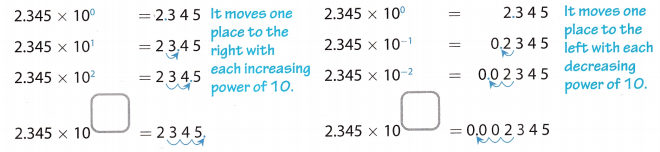
Answer:
y = 3x + 50
Yes
Since the horizontal and vertical gridlines each represent 25 units, hence moving up 3 gridlines and right 1 gridline represent a slope of \(\frac{75}{25}\) or
3

Texas Go Math Grade 8 Lesson 4.3 Answer Key 11

b. Graph the equation y = 3x + 50. Then interpret the slope and y-intercept.
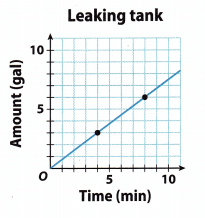
Answer:
Slope = 3
y-intercept = 50
Plot the point that contains the y-intercept:
(0, 50)

The slope is m = \(\frac{3}{1}\)
Use the slope to find a second point.
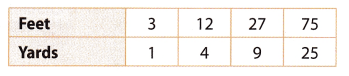
From
(0, 50)
count $3$ unit up and $1$ unit right. The new point is
(1, 53)
Draw a line through the points
Texas Go Math Grade 8 Lesson 4.3 Answer Key 22
The slope represents the fee per visit and y-intercept represents the membership fee.

c. How many visits to the pool can a member get for $200?
Answer:
You would get 50 visits for $200.
Texas Go Math Grade 8 Lesson 4.3 Answer Key 23

Texas Go Math Grade 8 Lesson 4.3 H.O.T. Higher Order Thinking Answer Key

Question 14.
Explain the Error A student says that the slope of the line for the equation y = 20 – 15x is 20 and the y-intercept is 15. Find and correct the error.
Answer:
y = 20 – 15x
The slope is -15 as it represents the change in y per unit change in x. The y-intercept is 20 when x = 0

Question 15.
Critical Thinking Suppose you know the slope of a linear relationship and a point that its graph passes through. Can you graph the line even if the point provided does not represent the y-intercept? Explain.
Answer:
Yes. You can plot the given point and use the slope to find a second point. Connect the points by drawing a line.

Go Math Grade 8 Answer Key Pdf Lesson 4.3 Practice Algebra Answers Question 16.
Make a Conjecture Graph the lines y = 3x, y = 3x – 3, and y = 3x + 3. What do you notice about the lines? Make a conjecture based on your observation.
Texas Go Math Grade 8 Lesson 4.3 Answer Key 12
Answer:
Following the steps of “Example 1” on page 101, we graph the lines:
y = 3x
y = 3x – 3
y = 3x + 3
Texas Go Math Grade 8 Lesson 4.3 Answer Key 24
We notice that the lines are parallel to each other: the slopes of the lines are equal but the y-intersection point differs.

Texas Go Math Grade 8 Lesson 4.3 Answer Key Graphing Linear Nonproportional Relationships using Slope and y-Intercept Read More »

Texas Go Math Grade 8 Lesson 3.2 Answer Key Rate of Change and Slope

Refer to our Texas Go Math Grade 8 Answer Key Pdf to score good marks in the exams. Test yourself by practicing the problems from Texas Go Math Grade 8 Lesson 3.2 Answer Key Rate of Change and Slope.

Texas Go Math Grade 8 Lesson 3.2 Answer Key Rate of Change and Slope

Essential Question
How do you find a rate of change or a slope?

Your Turn

Question 1.
The table shows the approximate height of a football after it is kicked. Tell whether the rates of change are constant or variable. Find the rates of change:
The rates of change are Texas Go Math Grade 8 Lesson 3.2 Answer Key 1
Texas Go Math Grade 8 Lesson 3.2 Answer Key 2
Answer:
Input variable: Time (s) Identify the input and output variables
Output variable: Height (ft)
Texas Go Math Grade 8 Lesson 3.2 Answer Key 18

Texas Go Math Grade 8 Lesson 3.2 Explore Activity Answer Key 

Using Graphs to Find Rates of Change
You can also use a graph to find rates of change.

The graph shows the distance Nathan bicycled over time. What is Nathan’s rate of change?
Texas Go Math Grade 8 Lesson 3.2 Answer Key 3
A. Find the rate of change from 1 hour to 2 hours.
Texas Go Math Grade 8 Lesson 3.2 Answer Key 4
B. Find the rate of change from 1 hour to 4 hours.
Texas Go Math Grade 8 Lesson 3.2 Answer Key 5
C. Find the rate of change from 2 hour to 4 hours.
Texas Go Math Grade 8 Lesson 3.2 Answer Key 6
D. Recall that the graph of a proportional relationship is a line through the origin. Explain whether the relationship between Nathan’s time and distance is a proportional relationship.

Reflect

Rate of Change and Slope Answer Key Go Math Grade 8 Question 2.
Make a Conjecture Does a proportional relationship have a constant rate of change?
Answer:
Yes. The following equation holds:
\(\frac{y}{x}\) = k
Where k is the constant rate of change
Yes

Question 3.
Does it matter what interval you use when you find the rate of change of a proportional relationship? Explain.
Answer:
No. It does not matter what interval you use as long the order of points remains the same. When y is subtracted from y2, then x1 should be subtracted from x2.

Your Turn

Question 4.
The graph shows the rate at which water is leaking from a tank. The slope of the line gives the leaking rate in gallons per minute.
Texas Go Math Grade 8 Lesson 3.2 Answer Key 7
Rise = ___________________________
Run = _________________________
Rate of leaking ___ gallon(s) per minute
Answer:
The two given points are
(4, 3) and (8, 6)
Let x1 = 4, x2 = 8 and y1 = 3, Y2 = 6 We can now calculate the rise, run and slope:
rise = y2 – y1 = 6 – 3 =3
run = x2 – x1 = 8 – 4 = 4
slope = \(\frac{y_{2}-y_{1}}{x_{2}-x_{1}}\) = \(\frac{3}{4}\)
Rise = 3, Run = 4 and slope = \(\frac{3}{4}\)

Texas Go Math Grade 8 Lesson 3.2 Guided Practice Answer Key 

Tell whether the rates of change are constant or variable. (example 1)

Question 1.
building measurements ____
Texas Go Math Grade 8 Lesson 3.2 Answer Key 8
Answer:
(1) First identify the input and output variables
Input variable: Feet, output variable: Yards.
(2) Now find the rates of change.
Texas Go Math Grade 8 Lesson 3.2 Answer Key 19
The rates of change are constant: 3 feet per yard.
Constant rate of change

Question 2.
computers sold ____
Texas Go Math Grade 8 Lesson 3.2 Answer Key 9
Answer:
Input variable: Week Identify the input and output variables
Output variable: Number sold
Texas Go Math Grade 8 Lesson 3.2 Answer Key 22
The rates of change are variable.

Question 3.
distance an object falls ____
Texas Go Math Grade 8 Lesson 3.2 Answer Key 10
Answer:
Input variable: Week Identify the input and output variables
Output variable: Number sold
Texas Go Math Grade 8 Lesson 3.2 Answer Key 20
The rates of change are variable.
Input variable: Time Identify the input and output variables
Output variable: Distance
Texas Go Math Grade 8 Lesson 3.2 Answer Key 21
The rates of change are variable.

Go Math Answer Key Grade 8 Lesson 3.2 Answer Key Question 4.
cost of sweaters ____
Texas Go Math Grade 8 Lesson 3.2 Answer Key 11
Answer:
(1) First identify the input and output variables.
Input variable: Number, output variable: Cost.

(2) Now find the rates of change.
Texas Go Math Grade 8 Lesson 3.2 Answer Key 23
The rates of change are constant: 19 dollars per sweater.
The rates of change are constant.

Erica walks to her friend Philip’s house. The graph shows Erica’s distance from home over time. (Explore Activity)

Question 5.
Find the rate of change from 1 minute to 2 minutes.

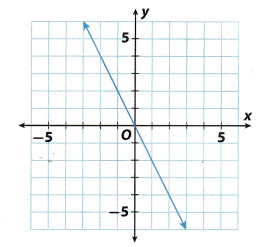
Texas Go Math Grade 8 Lesson 3.2 Answer Key 12
Texas Go Math Grade 8 Lesson 3.2 Answer Key 13
Answer:
Texas Go Math Grade 8 Lesson 3.2 Answer Key 24 Find the rate of change from 1 minute to 2 minutes.
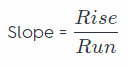
= 200 ft per min

Question 6.
Find the rate of change from 1 minute to 4 minutes. ________
Answer:
Texas Go Math Grade 8 Lesson 3.2 Answer Key 25
Therefore the rate of change from 1 minute to 4 minutes is 200 feet per minute.
200 feet per minute.

Find the slope of each line. (Example 2)

Question 7.
Texas Go Math Grade 8 Lesson 3.2 Answer Key 14
Slope = ____
Answer:
Rise is the difference in values represented by the axis
Rise = 4 – 0 = 4

Run = -2 – 0 = -2 Run is the difference in values represented by the x-axis

Slope = \(\frac{4}{-2}\) = -2 Texas Go Math Grade 8 Lesson 3.2 Answer Key 26

Go Math 8th Grade Slope and Rate of Change Answer Key Question 8.
Texas Go Math Grade 8 Lesson 3.2 Answer Key 15
Slope = ____
Answer:
Rise = 3 – 0 = 3 Rise is the difference in values represented by y axis
Run = 2 – 0 = 2 Run is the difference in values represented by x axis
Slope = \(\frac{3}{2}\) Texas Go Math Grade 8 Lesson 3.2 Answer Key 27

Essential Question Check-In

Question 9.
If you know two points on a line, how can you find the rate of change of the variables being graphed?
Answer:
If the two given points are (x1, y1) and (x2, y2) we can find the slope
slope = \(\frac{y_{2}-y_{1}}{x_{2}-x_{1}}\)
since the slope of a line is the ratio of the change in y-values for a segment of the graph to the corresponding change in x-values.

You can calculate the slope (See inside for more)

Texas Go Math Grade 8 Lesson 3.2 Independent Practice Answer Key 

Question 10.
Rectangle EFGH is graphed on a coordinate plane with vertices at E(-3, 5), F(6, 2), G(4, -4), and H(-5, -1).

a. Find the slopes of each side.
Answer:
We are given the vertices of the rectangle EFGH:
E(-3, 5) F(6, 2) G(4, -4) H(-5, -1)

a) In general, the slope of a line is the ratio of the change in y-values for a segment of the graph to the corresponding change in x-values.
Slope = \(\frac{y_{2}-y_{1}}{x_{2}-x_{1}}\)
Slope of EF:
Texas Go Math Grade 8 Lesson 3.2 Answer Key 28

b. What do you notice about the slopes of opposite sides?
Answer:
The slopes of opposite sides are equal
slopeEF = slopeGH = – \(\frac{1}{3}\)
SlopeFG = slopeHE = 3

c. What do you notice about the slopes of adjacent sides?
Answer:
The slopes of adjacent sides are negative reciprocals of each other (3 and –\(\frac{1}{3}\))
Texas Go Math Grade 8 Lesson 3.2 Answer Key 29

Go Math Book Grade 8 Answer Key Lesson 3.2 Answer Key Question 11.
A bicyclist started riding at 8:00 a.m The diagram below shows the distance the bicyclist had traveled at different times. What was the bicyclist’s average rate of speed in miles per hour?
Texas Go Math Grade 8 Lesson 3.2 Answer Key 16
Answer:
We are given that the bicyclist rides the first 4.5 miles for 18 minutes and the other 7.5 miles for 30 minutes. To find the rate of speed in miles/hour. First, we need to convert minutes into hours (divide by 60 since 1 hour has 60 minutes).
• Convert 18 minutes into hours:
Texas Go Math Grade 8 Lesson 3.2 Answer Key 30
• Convert 30 minutes into hours:
Texas Go Math Grade 8 Lesson 3.2 Answer Key 31
The rate of change for the first 0.3 hours:
\(\frac{4.5}{0.3}\) = \(\frac{45}{3}\) = 15
The rate of change for the next 0.5 hours:
\(\frac{7.5}{0.5}\) = \(\frac{75}{5}\) = 15
In conclusion, the bicyclist’s average rate of speed is 15 miles per hour.

Question 12.
Multistep A line passes through (6, 3), (8,4), and (n, -2). Find the value of n.
Answer:
Using the first two points:
(x1, y1) = (6, 3) and (x2, y2) = (8, 4) find the slope of the line.
Slope = \(\frac{y_{2}-y_{1}}{x_{2}-x_{1}}\) = \(\frac{4-3}{8-6}\) = \(\frac{1}{2}\)
Now use any of the first two points ant the last point to find the value of n
by using the definition of a slope of the line:
Slope = \(\frac{1}{2}\) = \(\frac{4-(-2)}{8-n}\) = \(\frac{6}{8-n}\)
\(\frac{6}{12}\) = \(\frac{6}{8-n}\)
Multiply the numerator and denominator of the left side by 6
12 = 8 – n
n = -4

Go Math Grade 8 Answers 3.2 Rate of Change and Slope Question 13.
A large container holds 5 gallons of water. It begins leaking at a constant rate. After 10 minutes, the container has 3 gallons of water left.
a. At what rate is the water leaking?
Answer:
At 0 minutes, there are 5 gallons of water. At 10 minutes, there are 3 gallons of water. Given
Texas Go Math Grade 8 Lesson 3.2 Answer Key 32
Rate of = \(\frac{5-3}{0-10}\) = \(\frac{2}{-10}\) = –\(\frac{1}{5}\) = -0.2
The rate of water leakage is $1$ gallon every $5$ minute or $0.2$ gallon per min

b. After how many minutes will the container be empty?
Answer:
No of minutes = = 25
\(\frac{5}{0.2}\) = 25 The number of minutes is determined by dividing the total volume of container by rate of water leakage.
It will take $25$ minutes for the container to be empty.

Question 14.
Critique Reasoning Billy found the slope of the line through the points (2, 5) and (-2, -5) using the equation \(\frac{2-(-2)}{5-(-5)}\) = \(\frac{2}{5}\). What mistake did he make?
Answer:
By definition, the slope is the change in y-values (rise) for a segment of the graph to the corresponding change in
Slope = \(\frac{y_{2}-y_{1}}{x_{2}-x_{1}}\)
Meanwhile, Billy wrote it as \(\frac{x_{-} 2-x_{-} 1}{y_{2}-y_{1}}\)
So the real slope is \(\frac{5}{2}\)
Billy got the reciprocal of the slope.

Lesson 3.2 Rate of Change and Slope Reteach Answer Key Question 15.
Multiple Representations Graph parallelogram ABCD on a coordinate plane with vertices at A(3, 4), 8(6, 1), C(0, -2), and D(-3, 1).
Texas Go Math Grade 8 Lesson 3.2 Answer Key 17
Answer:
We are given the vertices of the parallelogram ABCD:
Ä(3, 4)
B(6, 1)
C(0, -2)
D(-3, 1)
Texas Go Math Grade 8 Lesson 3.2 Answer Key 33

a. Find the slope of each side.
Answer:
In general, the slope of a line is the ratio of the change in y-values for a segment of the graph to the corresponding change in x-values.
slope = \(\frac{y_{2}-y_{1}}{x_{2}-x_{1}}\)
Texas Go Math Grade 8 Lesson 3.2 Answer Key 34

b. What do you notice about the slopes?
Answer:
The slopes of opposite sides are equal.
slopeAB = slopeCD = – 1
slopeBC = SlopeDA = \(\frac{1}{2}\)

c. Draw another parallelogram on the coordinate plane. Do the slopes have the same characteristics?
Answer:
If we calculate the slopes of the sides of the parallelogram shown below in the same way as calculated above,
we will see that they have the same characteristics.
Texas Go Math Grade 8 Lesson 3.2 Answer Key 35

Texas Go Math Grade 8 Lesson 3.2 H.O.T. Focus On Higher Order Thinking Answer Key 

Question 16.
Communicate Mathematical Ideas Ben and Phoebe are finding the slope of a line. Ben chose two points on the line and used them to find the slope. Phoebe used two different points to find the slope. Did they get the same answer? Explain.
Answer:
Yes, they did. The slope of a line can be calculated using every two points on the line, since it is the same lane it has a unique (singular) slope

Yes, the slope is the same for every two points.

Lesson 3.2 Rate of Change and Slope Answer Key Question 17.
Analyze Relationships Two lines pass through the origin. The lines have slopes that are opposites. Compare and contrast the lines.
Answer:
Since the slopes of the lines are opposites (if one line has a slope k the other has -k) it means they are equally
steep, but since one has a positive slope it is slanted upwards from left to right and the other with the negative slope is slanted downwards.

One line is upward facing and the other is downward, but both are equally steep.

Question 18.
Reason Abstractly What is the slope of the x-axis? Explain.
Answer:
The slope of a line is the ratio of the change in y-values for a segment of the graph to the corresponding change in x-values x-axis is a horizontal line that never changes its y-position, so the numerator of the ratio is zero
Therefore, the slope of the x-axis is 0.

Texas Go Math Grade 8 Lesson 3.2 Answer Key Rate of Change and Slope Read More »

Scroll to Top