
HMH Go Math

go-math-grade-4-answer-key-chapter-3-multiply-2-digit-numbers-review-test

Go Math Grade 4 Answer Key Homework FL Chapter 3 Multiply 2-Digit Numbers Review/Test

Imporve your math skills by referring to the Go Math Grade 4 Answer Key Homework FL Chapter 3 Multiply 2-Digit Numbers Review/Test. With the support of this HMH Go Math Grade 4 Review/Test Answer Key students can score good marks in the exam.

Go Math Grade 4 Answer Key Homework FL Chapter 3 Multiply 2-Digit Numbers Review/Test

Go Math Grade 4 Answer Key Homework FL Review/Test covers all the topics in Chapter 3 Multiply 2-Digit Numbers. Explore the knowledge of your child by giving the question from Review/Test. Just hit on the link and download it. Go Math Grade 4 Answer Key Homework FL Chapter 3 Multiply 2-Digit Numbers Review/Test.

Chapter 3: Review/Test

Review/Test – Page No. 131

Concepts and Skills

Question 1.
Explain how to find 14 × 19 by breaking apart the factors into tens and ones and finding the sum of the four partial products.

Answer: 266.

Explanation:
We can break 14 and 19 as 10+4 and 10+9 and to get the answer we will multiply both of the first two numbers by the other two. So we will multiply 10(10+9) and 4(10+9), then the values will be (100+90) and (40+36). By adding both we will get 100+90+40+36= 266

Question 2.
Explain how to find 40 × 80 using mental math.

Answer: 3600.

Explanation:
By using mental math we will multiply 4×8= 36 and then we will add zeros, so the answer will be 3600.

Estimate the product. Choose a method.

Question 3.
80 × 26

Answer: 2,080.

Explanation:
80
×26
———
480
+160
———–
2,080

Question 4.
19 × $67
$ ____

Answer: $1,273.

Explanation:
By breaking apart the factors into tens and ones and we can find the sum of the four partial products.
19×67= (10+9)×(60+7)
= (10×60)+(10×7)+(9×60)+(9×7)
= 600+70+540+63
= $1,273.

Question 5.
43 × 25

Answer: 1,075.

Explanation:
By breaking apart the factors into tens and ones and we can find the sum of the four partial products.
43 × 25= (40+3)×(20+5)
= (40×20)+(40×5)+(3×20)+(3×5)
= 800+200+60+15
= 1,075.

Question 6.
54 × 83

Answer: 4,482.

Explanation:
By breaking apart the factors into tens and ones and we can find the sum of the four partial products.
54 × 83= (50+4)×(80+3)
= (50×80)+(50×3)+(4×80)+(4×3)
= 4000+150+320+12
= 4,482.

Estimate. Then find the product.

Question 7.
$ 2 4
× 9 6
———–
Estimate: $ ________
Product: $ _________

Answer:
Estimate: $ 2,300
Product: $ 2,304

Explanation:
$ 2 4
× 9 6
———–
14 4
+ 216
———–
2,304

Question 8.
4 4
× 6 0
————
Estimate: _________
Product: _________

Answer:
Estimate: 2,600.
Product: 2,640.

Explanation:
4 4
× 6 0
————
00
+264
———–
2640

Question 9.
9 9
× 1 4
————
Estimate: _________
Product: _________

Answer:
Estimate: 1,400
Product: 1,386

Explanation:
9 9
× 1 4
————
396
+99
———–
1,386.

Question 10.
6 7
× 2 5
————
Estimate: _________
Product: _________

Answer:
Estimate: 1,700
Product: 1,675

Explanation:
6 7
× 2 5
————
335
+134
————
1,675

Question 11.
3 6
× 5 7
————
Estimate: _________
Product: _________

Answer:
Estimate: 2,000.
Product: 2,052.

Explanation:
3 6
× 5 7
————
252
+180
———–
2,052

Question 12.
$ 5 4
× 2 9
————
Estimate: $ _________
Product: $ _________

Answer:
Estimate: 1,600.
Product: 1,566.

Explanation:
$ 5 4
× 2 9
————
486
+108
———–
1,566

Question 13.
7 6
× 3 8
————
Estimate: _________
Product: _________

Answer:
Estimate: 2,900.
Product: 2,888.

Explanation:
7 6
× 3 8
————
608
+228
———–
2,888.

Question 14.
8 5
× 4 6
————
Estimate: _________
Product: _________

Answer:
Estimate: 3,900.
Product: 3,910

Explanation:
8 5
× 4 6
————
510
+340
———-
3,910.

Review/Test – Page No. 132

Fill in the bubble completely to show your answer.

Question 15.
Each month Sid’s parents put $75 into his college fund. How much do his parents put in the fund during 2 years?
Options:
a. $150
b. $450
c. $1,800
d. $15,300

Answer: c.

Explanation:
As Sid’s parents put $75 into his college fund, during two years Sid’s parent’s fund $75×24= $1800.

Question 16.
Mrs. Jenks wrote the correct answer to a homework problem on the board below. Which of the following could have been the homework problem?
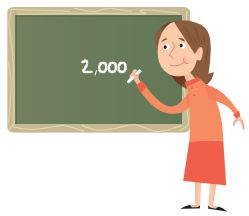
Go Math Grade 4 Answer Key Homework FL Chapter 3 Multiply 2-Digit Numbers Review Test img 1
Options:
a. 5 × 4,000
b. 50 × 400
c. 50 × 40
d. 50 × 4,000

Answer: c.

Explanation:
Mrs. Jenks’s homework problem is 50 × 40 because 50 × 40= 2,000.

Question 17.
George buys 30 cartons of 18 eggs for the Community Pancake Breakfast. How many eggs does he buy?
Options:
a. 340
b. 354
c. 460
d. 540

Answer: d

Explanation:
As George bought 30 cartons of 18 eggs for the Community Pancake Breakfast, the number of eggs George bought is 30×18= 540.

Review/Test – Page No. 133

Fill in the bubble completely to show your answer.

Question 18.
Mrs. Sampson donated a carton of pencils for each of the 35 classes at Lancet Elementary School. Each carton holds 64 pencils. Which is the best estimate for the number of pencils Mrs. Sampson donated?
Options:
a. A 99
b. B 1,800
c. C 2,400
d. D 2,800

Answer:  c.

Explanation:
As Mrs. Sampson donated a carton of pencils for each of the 35 classes at Lancet Elementary School, and each carton holds 64 pencils, so Mrs. Sampson donates 35×64= 2,240. And the estimated value is 2,400.

Question 19.
The school’s athletic department ordered 95 dozen badminton feather shuttles. How many feather shuttles were ordered?
Options:
a. A 2,280
b. B 1,140
c. C 1,030
d. D 114

Answer: b

Explanation:
One dozen is equal to 12. As school’s athletic department ordered 95 dozen badminton feather shuttles, so 95 dozens means
95×12= 1,140 badminton feather shuttles.

Question 20.
Jill sold 35 adult tickets and 48 child tickets for a fund-raising dinner. An adult ticket costs $18 and a child ticket costs $14. How much did Jill collect for the tickets?
Options:
a. A $1,354
b. B $1,302
c. C $1,232
d. D $1,102

Answer: b

Explanation:
As Jill sold 35 adult tickets and 48 child tickets for a fund-raising dinner and each adult ticket costs $18 and a child ticket costs $14, so total amount Jill collected is 35×$18= 630 and 48×$18= 672 by adding 630+672= $1,302.

Question 21.
Which shows a way to find 35 × 74?
Options:
a. A (30 × 7) + (30 × 4) + (70 × 3) + (70 × 5)
b. B (30 × 70) + (30 × 4) + (50 × 70) + (50 × 4)
c. C (30 + 70) + (30 + 4) + (70 + 30) + (70 + 5)
d. D (30 × 70) + (30 × 4) + (5 × 70) + (5 × 4)

Answer: d

Explanation:
By breaking apart the factors into tens and ones and finding the sum of the four partial products,
35 × 74= (30 × 70) + (30 × 4) + (5 × 70) + (5 × 4)

Question 22.
New seats are being delivered to the theater. There are 45 new seats for each row in a 15-row section. How many seats are being delivered?
Options:
a. A 60
b. B 400
c. C 675
d. D 1,000

Answer: c

Explanation:
As new seats are being delivered to the theater and there are 45 new seats for each row in a 15-row section, so the total number of new seats is 45×15= 675.

Review/Test – Page No. 134

Constructed Response

Question 23.
Gulfside Gifts has 48 boxes of postcards to sell. There are 24 postcards in each box. If the shop sells 3 boxes of postcards, how many postcards does the shop have left to sell? Explain how you found the answer.
______ remaining cards

Answer: 1,080 remaining cards.

Explanation:
As Gulfside Gifts has 48 boxes of postcards to sell and there are 24 postcards in each box. So total number of post cards are
48×24= 1,152. And the shop sold 3 boxes of postcards i.e 3×24= 72, so shop has left 1,152-72= 1,080 cards are remaining to sell.

Question 24.
Several steps in finding the product of 68 and 34 are shown below. Describe the remaining steps. Use pictures, words, or numbers. Then complete the multiplication.
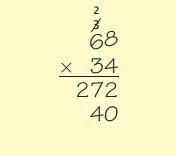
Go Math Grade 4 Answer Key Homework FL Chapter 3 Multiply 2-Digit Numbers Review Test img 2
_____

Answer:  2,312.

Explanation:
68
× 34
———-
272
+ 204
———
2,312

Performance Task

Question 25.
A city is having a festival in a local park. Alison’s Bakery has agreed to donate $1,200 worth of baked goods for the event. The city wants to order 12 loaves of holiday bread, 18 dozen biscuits, 12 dozen bagels, and 14 dozen multigrain rolls.
A. Is the cost of the baked goods under the $1,200 donation limit? Use pictures, numbers, or words to explain how you found your answer.
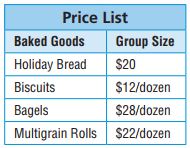
Go Math Grade 4 Answer Key Homework FL Chapter 3 Multiply 2-Digit Numbers Review Test img 3

Answer: Yes, the donation is under $1,200.

Explanation:
As the city ordered 12 loaves of holiday bread, 18 dozen biscuits, 12 dozen bagels, and 14 dozen multigrain rolls. And holiday bread costs $20, one dozen busicuits costs $12, and one dozen bagels costs $28, 1 dozen multigrain rolls costs $22. So by adding them
(12×20)+(12×18)+(12×28)+(14×22) we will get $1,100 which is less than $1,200

Question 25.
B. If yes, what could the city add to the order? If no, what could the city remove from the order?

Answer: The city can add whatever they want with remaining $100. As $1,200-$1,100= $100.

Conclusion:

The scholars of 4th grade can check all chapters in Go Math Grade Answer Key in pdf format so that your learning will kick start in an effective manner. We have given a brief explanation of each and every question on our Go Math Grade 4 Answer Key Homework FL Chapter 3 Multiply 2-Digit Numbers Review/Test. We suggest students to understand the concepts and apply them in the real world.

Go Math Grade 4 Answer Key Homework FL Chapter 3 Multiply 2-Digit Numbers Review/Test Read More »

go-math-grade-4-answer-key-chapter-2-multiply-by-1-digit-numbers-review-test

Go Math Grade 4 Answer Key Homework FL Chapter 2 Multiply by 1-Digit Numbers Review/Test

Improve your math skills by referring to the Go Math Grade 4 Answer Key Homework FL Chapter 2 Multiply by 1-Digit Numbers Review/Test. With the support of this HMH Go Math Grade 4 Review/Test Answer Key you score good marks in the exam.

Go Math Grade 4 Answer Key Homework FL Chapter 2 Multiply by 1-Digit Numbers Review/Test

Go Math Grade 4 Answer Key Homework FL Review/Test covers all the topics in Chapter 2 Multiply by 1-Digit Numbers. Explore the knowledge of your child by giving the question from Review/Test. Just hit on the link and download it. Go Math Grade 4 Answer Key Homework FL Chapter2 Multiply by 1-Digit Numbers Review/Test.

Chapter 2: Review/Test

Review/Test – Page No. 95

Vocabulary

Choose the best term from the box.

Question 1.
To find the product of a 3-digit number and a 1-digit number, you can multiply the ones, multiply the tens, multiply the hundreds, and find the sum of each.
_________

Question 1.
Go Math Grade 4 Answer Key Homework FL Chapter 2 Multiply by 1-Digit Numbers Review Test img 1

Question 2.
The _______________________ states that multiplying a sum by a number is the same as multiplying each addend by the number and then adding the products.

Answer:
The distributive property states that multiplying a sum by a number is the same as multiplying each addend by the number and then adding the products.

Concepts and Skills

Estimate. Then find the product.

Question 3.
5 5
× 2
———-
Estimate: _________
Product: _________

Answer:
Estimate: 150
Product: 110

Explanation:
5 5
× 2
———-
110

Question 4.
$2 5
×   3
———-
Estimate: $ _________
Product: $ _________

Answer:
Estimate: $ 100
Product: $ 75

Explanation:
$2 5
×   3
———-
$ 75

Question 5.
3 0 6
×    8
———-
Estimate: _________
Product: _________

Answer:
Estimate: 2,500.
Product: 2,448.

Explanation:
3 0 6
×    8
———-
2,448

Question 6.
$9 2 4
×      5
———-
Estimate: $ _________
Product: $ _________

Answer:
Estimate: $ 5,000
Product: $ 4,620.

Explanation:
$9 2 4
×      5
———-
4,620

Question 7.
3, 563
×      9
———-
Estimate: _________
Product: _________

Answer:
Estimate: 30,000.
Product: 32,067

Explanation:
3, 563
×      9
———-
32,067

Question 8.
7, 048
×      7
———-
Estimate: _________
Product: _________

Answer:
Estimate: 50,000
Product: 49,336

Explanation:
7, 048
×      7
———-
49,336

Question 9.
6, 203
×      3
————
Estimate: _________
Product: _________

Answer:
Estimate: 19,000
Product: 18,609

Explanation:
6, 203
×      3
————
18,609

Question 10.
8, 798
×      6
————
Estimate: _________
Product: _________

Answer:
Estimate: 53,000
Product: 52,788

Explanation:
8, 798
×      6
————
52,788

Review/Test – Page No. 96

Fill in the bubble completely to show your answer.

Question 11.
Which number sentence shows the Distributive Property?
Options:
a. 2 × 3 = 3 × 2
b. 5 × 0 = 0
c. 3 × (5 + 2) = (3 × 5) + (3 × 2)
d. (3 × 7) × 4 = 3 × (7 × 4)

Answer: c

Explanation:
The distributive property means solving the expression in the form of a×(b+c). So the correct option is 3 × (5 + 2) = (3 × 5) + (3 × 2).

Question 12.
Look at the pattern below. What is the missing number?
Go Math Grade 4 Answer Key Homework FL Chapter 2 Multiply by 1-Digit Numbers Review Test img 2
Options:
a. 8,000
b. 6,000
c. 600
d. 60

Answer: b

Explanation:
5×6,000= 30,000.

Question 13.
Which comparison sentence represents the equation?
45 = 5 × 9
a. 9 more than 5 is 45
b. 9 is 5 times as many as 45
c. 5 is 4 times as many as 45
d. 45 is 5 times as many as 9

Answer: d

Explanation:
45 is 5 times as many as 9.

Question 14.
There are 4 times as many alligators as crocodiles. If the total number of alligators and crocodiles is 40, how many alligators are there?
Options:
a. 40
b. 32
c. 24
d. 8

Answer: b

Explanation:
As there are 4 times as many alligators as crocodiles and if the total number of alligators and crocodiles is 40. To find how many alligators are there, we will put them in a group of 5 as there are 4 alligators and 1 crocodile, so 40÷5= 8 groups, in which 32 are alligators and 8 are crocodiles.

Review/Test – Page No. 97

Fill in the bubble completely to show your answer.

Question 15.
Gardeners at Seed Stop are planting seeds in 12-row seed trays. They plant 8 seeds in each row. How many plants will there be in each tray if all of the seeds germinate, or grow?
Options:
a. 84
b. 86
c. 96
d. 104

Answer: c

Explanation:
As gardeners at Seed Stop are planting seeds in 12-row seed trays, and they plant 8 seeds in each row. So the number of plants will there be in each tray are 12×8= 96.

Question 16.
Which shows the product of 4 × 15 × 25?
Options:
a. 150
b. 1,200
c. 1,500
d. 1,600

Answer: c

Explanation:
The product of 4×15×25= 1,500.

Question 17.
A Broadway musical group will have 9 performances. The theater can seat 2,518 people. If all of the seats at each performance are taken, how many people will see the show?
Options:
a. 18,592
b. 22,652
c. 22,662
d. 31,622

Answer: c

Explanation:
As a broadway musical group will have 9 performances and the theater can seat 2,518 people, so number of people will see the show are 9×2,518= 22,662.

Question 18.
The table below shows the type of film sold and the number of rolls in one pack at a local gift shop.
Go Math Grade 4 Answer Key Homework FL Chapter 2 Multiply by 1-Digit Numbers Review Test img 3
Hannah buys 3 packs of 36 exposure film and 2 packs of 24 exposure film. She uses 8 rolls of film. How many rolls does she have left?
Options:
a. 8
b. 12
c. 20
d. 24

Answer: b

Explanation:
Hannah buys 3 packs of 36 exposure film and 2 packs of 24 exposure film, so total number of films are 3×4= 12, 2×4= 8 which is 12+8= 20. And she uses 8 rolls, then number of rolls left are 20-8= 12.

Review/Test – Page No. 98

Constructed Response

Question 19.
John’s grade has 3 classrooms. Each classroom has 14 tables. Two students sit at each table. About how many students are there in all? Use pictures, words, or numbers to show how you know.
About ______ students

Answer: 84 students.

Explanation:
As John’s grade has 3 classrooms, and each classroom has 14 tables and two students sit at each other, so total number of students are 14×2= 28 as John has 3 classrooms, so 28×3= 84 students.

Performance Task

Justin has $450 to buy supplies for the school computer lab. He buys 8 boxes of printer paper that cost $49 each.
Go Math Grade 4 Answer Key Homework FL Chapter 2 Multiply by 1-Digit Numbers Review Test img 4

Question 20.
A. About how much money does Justin spend on the printer paper? Describe how you made your estimate.
About $ ______

Answer: $400.

Explanation:
As each printer paper costs $49 and Justin buys 8 boxes, so total costs $49×8= $392. And the estimated cost is $400.

Question 20.
B. Find the actual amount of money Justin spends on the printer paper. Explain whether your estimate is close to the actual price.
Actual price $ ______

Answer: $392.

Explanation:
The actual amount of money Justin spends on the printer paper is $49×8= $392. Yes theestimation is close to the actual price.

Question 20.
C. Will Justin have enough money left over to buy 3 packages of blank DVDs that cost $17 each? Explain your answer.

Answer: Yes, Justin will have enough money left.

Explanation:
As Justin left some money which is $450-$392= $51, after he bought printer paper for $392, so he can can buy 3 packages of blank DVD’s that cost $17 each which costs $17×3= $51.

Conclusion:

The students of 4th grade can check all chapters in Go Math Grade Answer Key in pdf format so that your learning will kick start in an effective manner. We have given a brief explanation of each and every question on our Go Math Grade 4 Answer Key Homework FL Chapter 2 Multiply by 1-Digit Numbers Review/Test. We suggest the students understand the concepts and apply them in the real world.

Go Math Grade 4 Answer Key Homework FL Chapter 2 Multiply by 1-Digit Numbers Review/Test Read More »

Go Math Grade 3 Answer Key Understand Fractions Extra Practice

Go Math Grade 3 Answer Key Chapter 8 Understand Fractions Extra Practice

Free step by step solutions to Go Math Grade 3 Answer Key Chapter 8 Understand Fractions Extra Practice. Build fluency with the math standards by solving the 3rd Grade Go Math Answer Key Chapter 8. Students who want to score good marks in the exams can start your preparation now. You can solve the Extra Practice Questions here and check the answers provided in the Go Math Grade 3 Answer Key Chapter 8 Understand Fractions.

Go Math Grade 3 Answer Key Chapter 8 Understand Fractions Extra Practice

Practice more and more to improve knowledge in this subject. If you understand the concept you can make a question on your own and solve them. Resources are available to support your child’s learning in our Go Math Answer Key.

Common Core – Page No. 171000

Lesson 8.1

Write the number of equal parts. Then write the name for the parts.

Question 1.
Go Math Grade 3 Answer Key Chapter 8 Understand Fractions Extra Practice Common Core img 1
Equal parts: _________
Name: _________

Answer:

i. 4
ii. Fourths

Explanation:

The figure shows that the square is divided into 4 equal parts. So, the name for the parts is fourths.

Question 2.
Go Math Grade 3 Answer Key Chapter 8 Understand Fractions Extra Practice Common Core img 2
Equal parts: _________
Name: _________

Answer:

i. 2
ii. Halves

Explanation:

The circle is divided into two equal parts. Thus the name for the parts is halves.

Question 3.
Go Math Grade 3 Answer Key Chapter 8 Understand Fractions Extra Practice Common Core img 3
Equal parts: _________
Name: _________

Answer:

i. 6
ii. Sixths

Explanation:

The hexagon is divided into six equal parts. Thus the name for the parts is sixths.

Lesson 8.2

Draw lines to show how much each person gets. Write the answer.

Question 4.
4 friends share 3 oranges equally.
Go Math Grade 3 Answer Key Chapter 8 Understand Fractions Extra Practice Common Core img 4
Type below:
___________

Answer: 3 fourths of an orange

Explanation:

There are 3 oranges and
The total number of friends = 4
We need to divide the 3 oranges for 4 friends equally
= 3/4
So, each friend gets 3 fourth of the orange.

Question 5.
6 sisters share 4 sandwiches equally.
Go Math Grade 3 Answer Key Chapter 8 Understand Fractions Extra Practice Common Core img 5
Type below:
___________

Answer: 4 sixths of a sandwich

Explanation:

Total number of sandwiches = 4
Number of friends = 6
To share the sandwiches equally we need to divide the number of sandwiches by a number of friends.
4/6
So, each friend gets 4 sixths of the sandwich.

Lessons 8.3–8.4

Write the number of equal parts in the whole. Write a fraction in words and in numbers to name the shaded part.

Question 6.
Go Math Grade 3 Answer Key Chapter 8 Understand Fractions Extra Practice Common Core img 6
_________ equal parts
_________ eighths

Question 6.
\(\frac{□} {□}\)

Answer:

i. 8
ii. Five
iii. \(\frac{5} {8}\)

Explanation:

The square is divided into 8 eight equal parts.
Among them, five parts are shaded.
So, the fraction name for the shaded part is \(\frac{5} {8}\).

Question 7.
Go Math Grade 3 Answer Key Chapter 8 Understand Fractions Extra Practice Common Core img 7
_________ equal parts
_________ thirds

Question 7.
\(\frac{□} {□}\)

Answer:

i. 3
ii. Two
iii. \(\frac{2} {3}\)

Explanation:

The aboved figure shows that the rectangle is divided into 3 equal parts. And 2 parts are shaded among them.
The fraction name for the shaded part is 2 thirds i.e, \(\frac{2} {3}\)

Common Core – Page No. 172000

Lesson 8.5

Write the fraction that names the point.
Go Math Grade 3 Answer Key Chapter 8 Understand Fractions Extra Practice Common Core img 8

Question 1.
point A: \(\frac{□} {□}\)

Answer: \(\frac{1} {6}\)

Explanation:

The number lies between 0 and 1. Each point is 1 sixth of the number line. So, it starts with 0/6 and ends on 6/6.
Now we have to locate the point A.
The point A lies between 0/6 and 2/6. The number between 0 and 2 is 1.
Thus the point A is \(\frac{1} {6}\)

Question 2.
point B: \(\frac{□} {□}\)

Answer: \(\frac{3} {6}\)

Explanation:

The point B lies between \(\frac{2} {6}\) and \(\frac{4} {6}\). The number between 2 and 4 is 3. Thus the location of point B is \(\frac{3} {6}\).

Question 3.
point C: \(\frac{□} {□}\)

Answer: \(\frac{5} {6}\)

Explanation:

The point C is located between \(\frac{4} {6}\) and \(\frac{6} {6}\).
The number between 4 and 6 is 5. Thus the location of Point C is \(\frac{5} {6}\)

Lesson 8.6

Each shape is 1 whole. Write a fraction greater than 1 for the parts that are shaded.

Question 4.
Go Math Grade 3 Answer Key Chapter 8 Understand Fractions Extra Practice Common Core img 9
2 = \(\frac{□} {□}\)

Answer: \(\frac{8} {4}\)

Explanation:

There are 2 circles and each circle is equally divided into 4 groups.
Number in each group = 4
Number of equal parts = 8
The shaded part of the circle = \(\frac{8} {4}\)

Question 5.
Go Math Grade 3 Answer Key Chapter 8 Understand Fractions Extra Practice Common Core img 10
3 = \(\frac{□} {□}\)

Answer: \(\frac{18} {6}\)

Explanation:

Number of circles = 3
Number of equal parts = 18
Number of shaded part in each circle = 6
So, the fraction of the shaded part is \(\frac{18} {6}\)

Lesson 8.7

Write a fraction to name the shaded part of each group.

Question 6.
Go Math Grade 3 Answer Key Chapter 8 Understand Fractions Extra Practice Common Core img 11
\(\frac{□} {□}\)

Answer: \(\frac{3} {6}\) or \(\frac{1} {2}\)

Explanation:

There are 6 circles, in which 3 circles are shaded and 3 circles are not shaded.
So, the fraction name for the shaded part is \(\frac{3} {6}\) or \(\frac{1} {2}\)

Question 7.
Go Math Grade 3 Answer Key Chapter 8 Understand Fractions Extra Practice Common Core img 12
\(\frac{□} {□}\)

Answer: \(\frac{1} {4}\) or \(\frac{2} {8}\)

Explanation:

The figure shows that there are 8 circles and in that 2 circles are shaded.
So, the fraction name for the shaded part is \(\frac{2} {8}\) or \(\frac{1} {4}\)

Lessons 8.8–8.9

Draw a quick picture to solve.

Question 8.
Charlotte has 12 T-shirts. One-fourth of her T-shirts is green. How many of Charlotte’s T-shirts are green?
_________ green T-shirts

Answer: 3 T-shirts

Explanation:

Given,
Charlotte has 12 T-shirts.
One-fourth of her T-shirts is green.
To know how many of Charlotte’s T-shirts are green we need to multiply 12 with 1/4
12 × \(\frac{1} {4}\)
12/4 = 3
Therefore there are 3 green T-shirts.

Question 9.
Josh walks 18 dogs each week. Today, he is walking \(\frac{1}{3}\) of the dogs. How many dogs is he walking today?
_________ dogs

Answer: 6 dogs

Explanation:

Given that Josh walks 18 dogs each week.
Today, he is walking \(\frac{1}{3}\) of the dogs.
To find how many dogs he walked today
We need to multiply 18 and \(\frac{1}{3}\)
18 × \(\frac{1}{3}\)
= 18/3 = 6
Thus he walked 6 dogs today.

The Go Math Grade 3 Answer Key Chapter 8 Understand Fractions Extra Practice helps to test skills in this chapter. The understanding fractions chapter includes various topics like Equal parts of a whole, unit fractions, relate fractions and whole numbers. We have provided the images for the questions for understanding. Quick and easy learning of maths is possible on our Go Math Answer Key.

Go Math Grade 3 Answer Key Chapter 8 Understand Fractions Extra Practice Read More »

Go Math Grade 3 Answer Key Division Facts and Strategies Extra Practice

Go Math Grade 3 Answer Key Chapter 7 Division Facts and Strategies Extra Practice

Students who have completed the exercise problems, homework can go through the Go Math Grade 3 Answer Key Chapter 7 Division Facts and Strategies Extra Practice pdf. You can test your knowledge on this chapter by solving the Go Math Grade 3 Answer Key Chapter 7 Division Facts and Strategies Extra Practice sums.

Go Math Grade 3 Answer Key Chapter 7 Division Facts and Strategies Extra Practice

You can solve the sums easily by following the techniques given in the Solution key of HMH Go Math Grade 3 Chapter 7 Division Facts and Strategies Extra Practice. Go through the topics covered in this chapter before you start practicing the sums in the Extra Practice.

Common Core – Page No. 149000

Lessons 7.1–7.2

Find the quotient. You may want to draw a quick picture to help.

Question 1.
8 ÷ 2 = ______

Answer: 4

Question 2.
______ = 14 ÷ 2

Answer: 7

Question 3.
18 ÷ 2 = ______

Answer: 9

Question 4.
______ = 12 ÷ 2

Answer: 6

Question 5.
70 ÷ 10 = ______

Answer: 7

Question 6.
50 ÷ 10 = ______

Answer: 5

Question 7.
40 ÷ 10 = ______

Answer: 4

Question 8.
90 ÷ 10 = ______

Answer: 9

Lessons 7.3–7.4

Find the quotient.

Question 9.
15 ÷ 5 = ______

Answer: 3

Explanation:

5 divides 15 into 3 equal groups. So the quotient of 15 and 5 is 3.

Question 10.
______ = 45 ÷ 5

Answer: 9

Explanation:

5 divides 45 into nine equal groups. Thus the quotient is 9.

Question 11.
______ = 10 ÷ 5

Answer: 2

Explanation:

5 divides 10 two times. So the quotient of 10 and 5 is 2.

Question 12.
40 ÷ 5 = ______

Answer: 8

Explanation:

5 divides 40 into eight equal groups. So the quotient is 8.

Question 13.
6 ÷ 3 = ______

Answer: 2

Explanation:

3 divides 6 into two equal groups. Thus the quotient is 2.

Question 14.
______ = 21 ÷ 3

Answer: 7

Explanation:

3 divides 21 into seven equal groups. So the quotient is 7.

Question 15.
______ = 24 ÷ 3

Answer: 8

Explanation:

3 divides 24 eight times. Thus the quotient is 8.

Question 16.
______ = 18 ÷ 3

Answer: 6

Explanation:

3 divides 18 into six equal parts. Therefore the quotient is 6.

Question 17.
There are 30 balloons arranged in 6 equal groups. How many balloons are in each group?
______ balloons

Answer: 5 balloons

Explanation:

Total number of balloons = 30
Number of balloons arranged in equals groups = 6
Number of balloons in each group = x
Divide the number of balloons by a number of equal groups.
= 30 ÷ 6 = 5 balloons
Therefore number of balloons in each group = 5

Question 18.
Mr. Song spends $27 on sports drinks. Each bottle costs $3. How many bottles does Mr. Song buy?
______ bottles

Answer: 9

Explanation:

Given,
Mr. Song spends $27 on sports drinks. Each bottle costs $3.
Number of bottles he bought = x
x × 3 = 27
x = 27 ÷ 3 = 9
Thus Mr. Song bought 9 bottles.

Lesson 7.5

Find the quotient.

Question 19.
28 ÷ 4 = ______

Answer: 7

Explanation:

4 divides 28 seven times. So the quotient is 7.

Question 20.
______ = 16 ÷ 4

Answer: 4

Explanation:

4 divides 16 four times. The quotient of 16 and 4 is 4.

Question 21.
______ = 20 ÷ 4

Answer: 5

Explanation:

4 divides 20 five times. Thus the quotient is 5.

Question 22.
______ = 32 ÷ 4

Answer: 8

Explanation:

4 divides 32 eight times. So the quotient of 32 and 4 is 8.

Question 23.
4)\(\bar { 3 6 }\)
______

Answer: 9

Explanation:

4 divides 36 nine times. Thus the quotient is 9.

Question 24.
4)\(\bar { 1 2 }\)
______

Answer: 3

12 ÷ 4

4 divides 12 three times. So the quotient of 12 and 4 is 3.

Question 25.
4)\(\bar { 2 4 }\)
______

Answer: 6

Explanation:

4 divides 24 six times. Thus the quotient is 6.
24 ÷ 4 = 6

Question 26.
4)\(\bar { 4 }\)
______

Answer: 1

Explanation:

Any number divides by the same number will be always 1. Thus the quotient is 1.

Find the unknown number.

Question 27.
a = 40 ÷ 4
a = _____

Answer: 10

Explanation:

Let the unknown number be a
4 divides 40 ten times.
a = 40 ÷ 4
a = 40/4 = 10
Therefore a = 10

Question 28.
0 ÷ 4 = b
b = _____

Answer: 0

Explanation:

0 divides by any number are always 0. So the value of b is 0.

Question 29.
c = 36 ÷ 4
c = ______

Answer: 9

Explanation:

Let c be the unknown number
36 ÷ 4 = C
4 divides 36 nine times.
Thus the value of c is 9.

Question 30.
8 ÷ 4 = d
d = ______

Answer: 2

Explanation:

d is the unknown number
d = 8 ÷ 4
4 divides 8 two times.
Thus the value of d is 2.

Common Core – Page No. 150000

Lessons 7.6–7.7

Find the unknown factor and quotient.

Question 1.
7 × ______ = 35 35 ÷ 7 = ______

Answer: 5, 5

Explanation:

Let the unknown factor be x
7 × x = 35
x = 35 ÷ 7
x = 5
Now check whether the related multiplication and division facts are the same.
35 ÷ 7 = 5
Thus the unknown factor and quotient are the same. So the answer is 5.

Question 2.
6 × ______ = 54 54 ÷ 6 = ______

Answer: 9, 9

Explanation:

Let the unknown factor be y
6 × y = 54
y = 54 ÷ 6
6 divides 54 nine times. Thus the unknown factor is 9.
Now check if the related multiplication and division facts are the same.
54 ÷ 6 = 9
Therefore the unknown factor and the quotient are the same I.e., 9

Question 3.
6 × ______ = 18 18 ÷ 6 = ______

Answer: 3, 3

Explanation:

Let the unknown factor be t
6 × t = 18
t = 18/6 = 3
Now check the related multiplication and division facts of the equation
18 ÷ 6 = 3
The related multiplication and division facts are the same.
Thus the unknown factor and quotient are 3.

Question 4.
7 × ______ = 49 49 ÷ 7 = ______

Answer: 7, 7

Explanation:

Let the unknown factor be x
7 × x = 49
x = 49/7 = 7
Check whether the related multiplication and division facts of the equation are the same or not.
49 ÷ 7 = 7
By thus we can say that the related facts are the same. So the unknown factor and quotient are 7.

Find the quotient.

Question 5.
36 ÷ 6 = ______

Answer: 6

Explanation:

First take the factors of 6
Factors of 6 are 3, 2
First divide 36 by 3
36 ÷ 3 = 12
Now divide 12 by 2
12 ÷ 2 = 6
So the quotient is 6.

Question 6.
48 ÷ 6 = ______

Answer: 8

Explanation:

The factors of 6 are 3 and 2
First divide by 3
48 ÷ 3 = 16
Now divide 16 by 2
16 ÷ 2 = 8
So the quotient is 8.

Question 7.
7)\(\bar { 6 3 }\)
______

Answer: 9

Explanation:

The factors of 7 are 1, 7
Divide 63 by 7
7 divides 63 nine times. So the quotient is 9.

Question 8.
7)\(\bar { 5 6 }\)
______

Answer: 8

Explanation:

The factors of 7 are 1, 7
7 divides 56 eight times. So the quotient is 8.

Lessons 7.8–7.9

Find the quotient.

Question 9.
40 ÷ 8 = ______

Answer: 5

Explanation:

Factors of 8 is 4, 2
First divide by 4
40 ÷ 4 = 10
Next divide 10 by 2
10 ÷ 2 = 5
So the quotient is 5.

Question 10.
______ = 24 ÷ 8

Answer: 3

Explanation:

The factors of 8 is 4 and 2
Divide 24 by 4
24 ÷ 4 = 6
Now divide 6 by 2
6 ÷ 2 = 3
So the quotient of 24 ÷ 8 = 3

Question 11.
72 ÷ 9 = ______

Answer: 8

Explanation:

The factors of 9 are 3, 3
First divide 72 by 3
72 ÷ 3 = 24
Next divide 24 by 3
24 ÷ 3 = 8
The quotient of 72 ÷ 9 = 8

Question 12.
______ = 81 ÷ 9

Answer: 9

Explanation:

The factors of 9 are 3, 3
Divide 81 by 3
81 ÷ 3 = 27
Now divide 27 by 3
27 ÷ 3 = 9
The quotient of 81 ÷ 9 = 9

Find the unknown number.

Question 13.
36 ÷ 9 = m
m = ______

Answer: 4

Explanation:

Let m be the unknown number
The factors of 9 are 3, 3
First, divide by 3
36 ÷ 3 = 12
Next divide 12 by 3
12 ÷ 3 = 4
So the value of m is 4.

Question 14.
18 ÷ 9 = ■
■ ______

Answer: 2

Explanation:

Take the factors of 9
Divide 18 by 3
18 ÷ 3 = 6
Now divide 6 by 3
6 ÷ 3 = 2
■ = 2

Question 15.
48 ÷ 8 = b
b = ______

Answer: 6

Let b be the unknown number
The factors of 8 is 4, 2
Divide 48 by 4
48 ÷ 4 = 12
Next divide 12 by 2
12 ÷ 2 = 6
Therefore the value of b = 6

Question 16.
56 ÷ 8 = p
p = ______

Answer: 7

Explanation:

Let p be the unknown number
The factors of 8 are 4, 2
First, divide 56 by 4
56 ÷ 4 = 14
Next divide 14 by 2
14 ÷ 2 = 6
The value of p is 6.

Lesson 7.10

Question 17.
At a store, there are 5 vases. Each vase has the same number of flowers. Sixteen flowers are sold. Now there are 24 flowers left. How many flowers were in each vase?
______ flowers

Answer: 8 flowers

Explanation:

Given that,
Number of vases = 4
Number of flowers sold = 16
Number of flowers left = 24
Total number of flowers = 16 + 24 = 40
To find the number of flowers in each vase you need to divide the total number of flowers by number of vases
= 40 ÷ 5 = 8 flowers
Thus the number of flowers in each vase = 8

Question 18.
Lizzy bought 4 bags of apples. Each bag had the same number of apples. Her mom gave her 8 more apples. Now Lizzy has 36 apples. How many apples were in each bag?
______ bags

Answer: 7 apples

Explanation:

Given,
Lizzy bought 4 bags of apples.
Number of apples her mother gave = 8
Number of apples now Lizzy have = 36
To find the actual number of apples before her mother gave, we need to subtract 8 from 36
36 – 8 = 28
Now divide the number of apples by number of bags
28 ÷ 4 = 7 apples
Therefore the number of apples in each bag = 7 apples

Lesson 7.11

Follow the order of operations to find the unknown number.

Question 19.
10 − 3 + 4 = t
t = ______

Answer: 11

Explanation:

First subtract from left to right and then add
10 – 3 + 4 = 7 + 4 = 11
Therefore t = 11

Question 20.
8 − 3 × 2 = p
p = ______

Answer: 2

Explanation:

First multiple 3 and 2
3 × 2 = 6
And then subtract 6 from 8, you get 2
Thus p = 2

Question 21.
24 ÷ 6 + 2 = w
w = ______

Answer: 6

Explanation:

First, divide 24 and 6
24 ÷ 6 = 4
Now add from left to right
4 + 2 = 6
Therefore the unknown number w = 6

Conclusion

Keep practicing the problems given in Go Math Grade 3 Chapter 7 Division Facts and Strategies Extra Practice to score the highest score in the exams. If you want to practice exercise and homework sums then go through Go Math Grade 3 Answer Key Chapter 7 Division Facts and Strategies. Check the step by step procedure to solve the divisions in an easy manner. Students can clarify their doubts in the subject by posting the comments in the below comment section.

Go Math Grade 3 Answer Key Chapter 7 Division Facts and Strategies Extra Practice Read More »

Go Math Grade 3 Answer Key Understand Division Extra Practice

Go Math Grade 3 Answer Key Chapter 6 Understand Division Extra Practice

Students who are willing to practice more questions can Download Go Math Grade 3 Answer Key Chapter 6 Understand Division Extra Practice. It is very important to learn the basics or fundamentals to become master in maths. Students of Grade 3 can easily understand the basics of division provided in the Go Math Grade 3 Answer Key Chapter 6 Understand Division Extra Practice.

Go Math Grade 3 Answer Key Chapter 6 Understand Division Extra Practice

The topics covered in this chapter are Repeated subtraction, Equal groups, Number line, related multiplication, and division facts. Check the topics and start your preparation for the exam. Get the step by step procedure to understand Division.

Common Core – Page No. 123000

Lessons 6.1–6.3 Make equal groups.

Complete the table.

Counters Number of Equal Groups Number in Each Group
1. 18 9 ________
2. 24 ________ 8
3. 12 6 ________
4. 35 7 ________
5. 32 ________ 4
6. 25 ________ 5

Answer:

Counters Number of Equal Groups Number in Each Group
1. 18 9 2
2. 24 3 8
3. 12 6 2
4. 35 7 5
5. 32 8 4
6. 25 5 5

Explanation:

1. Number of counters = 18
Number of equal groups = 9
Number in each group = x
x × 9 = 18
x= 18/9 = 2
Therefore number in each group = 2

2. Number of counters = 24
Number in each group = 8
Number of equal groups = x
x × 8 = 24
x = 24/8 = 3
Thus the number of equal groups = 3

3. Number of counters = 12
Number of equal groups = 6
Number in each group = x
x × 6 = 12
x = 12/6 = 2
So, the number in each group = 2

4. Number of counters = 35
Number of equal groups = 7
Number in each group = x
x × 7 = 35
x = 35/7 = 5
x = 5
Therefore number in each group = 5

5. Number of counters = 32
Number of equal groups = x
Number in each group = 8
x × 8 = 32
x = 32/8 = 4
Thus the number of equal groups = 4

6. Number of counters = 25
Number of equal groups = x
Number in each group = 5
x × 5 = 25
x = 25/5 = 5
So, the number of equal groups = 5

Lesson 6.4

Write a division equation for the picture.

Question 1.
Go Math Grade 3 Answer Key Chapter 6 Understand Division Extra Practice Common Core img 1
Type below:
__________

Answer: 27 ÷ 3 = 9 or 27 ÷ 9 = 3

Explanation:

Total number of counters = 27
Number of equal groups = 3
Number in each group = 9
The division equation is
Number of counters by number of groups = 27 ÷ 3 = 9
or
Number of counters by number in each group = 27 ÷ 9 = 3

Question 2.
Go Math Grade 3 Answer Key Chapter 6 Understand Division Extra Practice Common Core img 2
Type below:
__________

Answer: 24 ÷ 4 = 6 or 24 ÷ 6 = 4

Explanation:

Total number of counters = 24
Number of equal groups = 4
Number in each group = 6
The division equation is
Number of counters by number of groups = 24 ÷ 4 = 6
or
Number of counters by number in each group = 24 ÷ 6 = 4

Lesson 6.5

Write a division equation.

Question 3.
Go Math Grade 3 Answer Key Chapter 6 Understand Division Extra Practice Common Core img 3
Type below:
__________

Answer: 3 groups, 15 ÷ 5 = 3

Explanation:

Step 1:

Starts at 15

Step 2:

Count back by 5s as many times as you can.

Step 3:

Count the number of times you jumped back 5.
You jumped back by 15 three times
There are 3 jumps of 5 in 15.

Question 4.
Go Math Grade 3 Answer Key Chapter 6 Understand Division Extra Practice Common Core img 4
Type below:
__________

Answer: 24 ÷ 6 = 4

Explanation:

Step 1:

Begins at 24

Step 2:

Subtract with 6 until you get 0.

Step 3:

Count the number of times you subtract with 6.

You subtract 4 times
There are 4 groups of 6 with 24
So, 24 ÷ 6 = 4

Common Core – Page No. 124000

Lesson 6.6

Make an array. Then write a division equation.

Question 1.
12 tiles in 4 rows
______ ÷ ______ = ______

Answer: 12 ÷ 4 = 3

Explanation:

■ ■ ■
■ ■ ■
■ ■ ■
■ ■ ■
Total number of tiles = 12
Number of rows = 4
Number of tiles in each row = x
Divide the number of tiles by number of rows = 12 ÷ 4 = 3

Question 2.
18 tiles in 3 rows
______ ÷ ______ = ______

Answer: 18 ÷ 3 = 6

Explanation:

■ ■ ■ ■ ■ ■
■ ■ ■ ■ ■ ■
■ ■ ■ ■ ■ ■
Total number of tiles = 18
Number of rows = 3
Number of tiles in each row = y
Divide the number of tiles by no. of rows = 18 ÷ 3 = 6

Question 3.
35 tiles in 5 rows
______ ÷ ______ = ______

Answer: 35 ÷ 5 = 7

Explanation:

■ ■ ■ ■ ■ ■ ■
■ ■ ■ ■ ■ ■ ■
■ ■ ■ ■ ■ ■ ■
■ ■ ■ ■ ■ ■ ■
■ ■ ■ ■ ■ ■ ■

Total number of tiles = 35
Number of rows = 5
Number of tiles in each row = p
Divide the number of tiles by number of rows = 35 ÷ 5 = 7

Question 4.
28 tiles in 7 rows
______ ÷ ______ = ______

Answer: 28 ÷ 7 = 4

Explanation:

■ ■ ■ ■
■ ■ ■ ■
■ ■ ■ ■
■ ■ ■ ■
■ ■ ■ ■
■ ■ ■ ■
■ ■ ■ ■

Total number of tiles = 28
Number of rows = 7
Number of tiles in each row = x
Divide the number of tiles by number of rows = 28 ÷ 7 = 4

Lesson 6.7

Complete the equations.

Question 5.
8 × ______ = 40 40 ÷ 8 = ______

Answer: 5, 5

Explanation:

Let x be the unknown factor
8 × x = 40
x = 40/8
x = 5
Check whether the related multiplication and division facts are the same or not.
40 ÷ 8 = 5
The related facts of 40 and 8 are 5.

Question 6.
6 × ______ = 36 36 ÷ 6 = ______

Answer: 6, 6

Explanation:

Let y be the unknown factor
6 × y = 36
y = 36/6 = 6
Check if the related multiplication and division facts are the same or not.
36 ÷ 6 = 6
The related facts of 36 and 6 are 6.

Question 7.
3 × ______ = 21 21 ÷ 3 = ______

Answer: 7, 7

Explanation:

Let x be the unknown factor
3 × x = 21
x = 21
Check whether the related facts are the same or not.
21 ÷ 3 = 7
The quotient is 7.

Question 8.
2 × ______ = 18 18 ÷ 2 = ______

Answer: 9, 9

Explanation:

Let b be the unknown factor
2 × b = 18
b = 18/2 = 9
Check the related multiplication and division facts
18 ÷ 2 = 9
The related facts of 18 and 2 are 9.

Lesson 6.8 (pp. 239–243)

Write the related facts for the array.

Question 9.
■ ■ ■ ■ ■
■ ■ ■ ■ ■
■ ■ ■ ■ ■
______ × ______ = ______
______ × ______ = ______
______ ÷ ______ = ______
______ ÷ ______ = ______

Answer:

3 × 5 = 15
5 × 3 = 15
15 ÷ 3 = 5
15 ÷ 5 = 3

Explanation:

Total number of tiles = 15
Number of equal rows = 3
Number of rows in each group = 5
So, the related 5, 3 and 15 is 5× 3 = 15, 3×5 = 15, 15 ÷ 3 = 5 and 15÷ 5 = 3

Question 10.
■ ■ ■ ■ ■ ■
■ ■ ■ ■ ■ ■
■ ■ ■ ■ ■ ■
______ × ______ = ______
______ × ______ = ______
______ ÷ ______ = ______
______ ÷ ______ = ______

Answer:

3 × 6 = 18
6 × 3 = 18
18 ÷ 3 = 6
18 ÷ 6 = 3

Explanation:

Total number of tiles = 18
Number of equal rows = 3
Number of rows in each group = 6
So, the related 18, 3 and 6 is 3 × 6 = 18, 6 × 3 = 18, 18 ÷ 3 = 6 and 18 ÷ 6 = 3

Question 11.
■ ■ ■ ■ ■
■ ■ ■ ■ ■
______ × ______ = ______
______ × ______ = ______
______ ÷ ______ = ______
______ ÷ ______ = ______

Answer:

2 × 5 = 10
5 × 2 = 10
10 ÷ 2 = 5
10 ÷ 5 = 2

Explanation:

Total number of tiles = 10
Number of equal rows = 2
Number of rows in each group = 5
So, the related 2, 5 and 10 is 2 × 5 = 10, 5 × 2 = 10, 10 ÷ 2 = 5 and 10 ÷ 5 = 2

Lesson 6.9

Find the quotient.

Question 12.
7 ÷ 1 = ______

Answer: 7

Explanation:

Any number divided by 1 will be the same number. Thus the quotient is 7.

Question 13.
4 ÷ 4 = ______

Answer: 1

Explanation:

The number divided by the same number will be always 1. Thus the quotient is 1.

Question 14.
9 ÷ 1 = ______

Answer: 9

Explanation:

Any number divided by 1 will be always the same number. So, the quotient is 9.

Question 15.
0 ÷ 1 = ______

Answer: 0

Explanation:

0 divided by any number is always 0. So, the quotient is 0.

Question 16.
Anton has 8 flower pots. He plants 1 seed in each pot. How many seeds does Anton use?
______ seeds

Answer: 8 seeds

Explanation:

Anton has 8 flower pots.
He plants 1 seed in each pot.
Number of seeds Anton used = x
x × 1 = 8
x = 8/1
x = 8
Therefore there are 8 seeds in 8 flower pots.

The problems in the Go Math Grade 3 Answer Key Chapter 6 Understand Division Extra Practice helps the students to learn the concepts and for exam preparation. If you have any doubts in this chapter you can refer Go Math Grade 3 Answer Key Chapter 6 Understand Division. The students of Grade 3 can get all chapters solution in our Go Math Answer Key.

Go Math Grade 3 Answer Key Chapter 6 Understand Division Extra Practice Read More »

Go Math Grade 3 Answer Key Represent and Interpret Data Extra Practice

Go Math Grade 3 Answer Key Chapter 2 Represent and Interpret Data Extra Practice

Go Math Grade 3 Answer Key Chapter 2 Represent and Interpret Data Extra Practice helps the students to secure the highest marks in the exam. Learn the simple tricks to solve the problems from Go Math Grade 3 Answer Key. Refer the solution given in the Go Math Grade 3 Chapter 2 Answer Key Extra Practice to know whether the answer is correct or not.

Go Math Grade 3 Answer Key Chapter 2 Represent and Interpret Data Extra Practice

Before solving the problems first learn the methods. There are several methods to solve the problems in maths. So, check out the methods provided in the Go Math Solution Key Chapter 2 Represent and Interpret Data Extra Practice for better understanding.

Common Core – Page No. 45000

Lesson 2.1

Use the Pets tables for 1–2.

Question 1.
Manny collected data about pets owned by students in his class. Complete Manny’s tally table and frequency table.

Pets
Pets Tally
Cat ________
Dog ________
Bird ________
Fish ________

Answer:

Pets
Pets Tally
Cat ||||
Dog ||
Bird |
Fish |

Question 1.

Pets
Pets Frequency
______ 4
______ 2
______ 1
______ 1

Answer:

Pets
Pets Frequency
Cat 4
Dog 2
Bird 1
Fish 1

Question 2.
How many more students have cats than have dogs and birds combined?
______ students

Answer: 1

Explanation:

Number of students who have cats = 4
Number of students who have Dogs = 2
Number of students who have Birds = 1
Total students who have Dogs and birds combined = 2 + 1 = 3
To know how many more students have cats than have dogs and birds combined, we need to subtract students who have Dogs and birds combined from the Number of students who have cats.
4 – 3 = 1
Therefore the answer is 1.

Lessons 2.2–2.3

Use the Seashells picture graph for 3–5.
Go Math Grade 3 Answer Key Chapter 2 Represent and Interpret Data Extra Practice Common Core img 1

Question 3.
Maggie has a picture graph that shows the seashells she collected. How many seashells did Maggie collect in all?
______ seashells

Answer: 85

Explanation:

Number of Cockle shells =4  Go Math Grade 3 Answer Key Chapter 2 Represent and Interpret Data Extra Practice Common Core img 2
Each Go Math Grade 3 Answer Key Chapter 2 Represent and Interpret Data Extra Practice Common Core img 2 = 10 shells
So, Number of Cockle shells = 10 + 10 + 10 + 10 = 40 shells
Number of Conch Shells = 2 Go Math Grade 3 Answer Key Chapter 2 Represent and Interpret Data Extra Practice Common Core img 2
Each Go Math Grade 3 Answer Key Chapter 2 Represent and Interpret Data Extra Practice Common Core img 2 = 10 shells
= 10 + 10 = 20 shells
Number of Lightning Whelk = 2 and a half Go Math Grade 3 Answer Key Chapter 2 Represent and Interpret Data Extra Practice Common Core img 2
Each Go Math Grade 3 Answer Key Chapter 2 Represent and Interpret Data Extra Practice Common Core img 2 = 10 shells
= 10 + 10 + 5 = 25 shells

Total number of shells that Maggie collected = 40 + 20 + 25 = 85 shells

Question 4.
How many more cockle shells did she collect than lightning whelks?
______ shells.

Answer: 15

Explanation:

Number of Cockle shells =4  Go Math Grade 3 Answer Key Chapter 2 Represent and Interpret Data Extra Practice Common Core img 2
Each Go Math Grade 3 Answer Key Chapter 2 Represent and Interpret Data Extra Practice Common Core img 2 = 10 shells
So, Number of Cockle shells = 10 + 10 + 10 + 10 = 40 shells
Number of Lightning Whelk = 2 and a half Go Math Grade 3 Answer Key Chapter 2 Represent and Interpret Data Extra Practice Common Core img 2
= 10 + 10 + 5 = 25 shells
Subtract Number of Lightning Whelk shells from Number of Cockle shells
= 40 – 25 = 15 shells

Question 5.
What if the key were “Each Go Math Grade 3 Answer Key Chapter 2 Represent and Interpret Data Extra Practice Common Core img 2 = 5 shells?” How many pictures would there be for conch?
______ pictures

Answer: 4 pictures

Explanation:

Number of Conch Shells = 2 Go Math Grade 3 Answer Key Chapter 2 Represent and Interpret Data Extra Practice Common Core img 2
If each Go Math Grade 3 Answer Key Chapter 2 Represent and Interpret Data Extra Practice Common Core img 2 = 5 shells
Then the number of Conch shells will be 4 Go Math Grade 3 Answer Key Chapter 2 Represent and Interpret Data Extra Practice Common Core img 2
= 5 + 5 + 5 + 5 = 20 shells

Page No. 46000

Common Core

Lessons 2.4–2.6

Use the Bicycle Rides frequency table for 1–3.
Go Math Grade 3 Answer Key Chapter 2 Represent and Interpret Data Extra Practice Common Core img 3

Question 1.
The frequency table shows the number of miles Sean rode on his bicycle. Use the data in the frequency table to complete the bar graph.
Type below:
_________

Answer:

Question 2.
How many more miles did Sean ride on Saturday than on Monday?
______ miles

Answer: 8 miles

Explanation:

Number of miles that Sean ride on Saturday = 12
Number of miles that Sean ride on Monday = 4
To find how many more miles did Sean ride on Saturday than on Monday
Subtract the number of miles that Sean ride on Monday from Number of miles that Sean ride on Saturday
12 – 4 = 8 miles

Question 3.
Write a number sentence to show how many miles in all Sean rode on his bicycle.
______ miles

Answer: 25 miles

Explanation:

Number of miles that Sean ride on Saturday = 12
Number of miles that Sean ride on Monday = 4
Number of miles that Sean ride on Wednesday = 9
Total number of miles that Sean ride = 12 + 9 + 4 = 25 miles

Lesson 2.7

Use the Number of Beads line plot for 4–6.
Go Math Grade 3 Answer Key Chapter 2 Represent and Interpret Data Extra Practice Common Core img 4

Question 4.
Kim is making bead necklaces. She records the number of beads on the different necklaces on a line plot. How many necklaces have exactly 50 beads?
______ necklaces

Answer: 5 necklaces

Explanation:

The line plot shows that there are 5 necklaces that have exactly 50 beads.

Question 5.
How many necklaces have fewer than 40 beads?
______ necklaces

Answer: 3 necklaces

Explanation:

The above figure shows that the number of necklaces that have less than 40 beads = 3

Question 6.
How many necklaces have 50 or more beads?
______ necklaces

Answer: 7 necklaces

Explanation:

Number of necklaces that have 50 beads = 5
Number of necklaces that have 60 beads = 2
Total necklaces that have more than 50 beads = 5 + 2 = 7 necklaces.

Conclusion:

Represent and Interpret Data chapter includes bar graphs, line plots tally marks, etc. So, view the topics before you start the preparation. Here we have given the clear cut explanation for all the questions with images. Students who want to practice more number of questions can Download Go Math Answer Key Grade 3 Chapter 2 Represent and Interpret Data pdf to improve your knowledge.

Go Math Grade 3 Answer Key Chapter 2 Represent and Interpret Data Extra Practice Read More »

Go Math Grade 3 Answer Key Chapter 8 Understand Fractions Assessment Test

Go Math Grade 3 Answer Key Chapter 8 contains all the topics of chapter 8 which helps to test the student’s knowledge. By this assessment test students can check their knowledge. This assessment test are also helpful for the teachers to know how much a student understood the topics.

Go Math Grade 3 Answer Key Chapter 8 Understand Fractions Assessment Test

With this chapter, students can improve their math skills by referring to the Go Math Grade 3 Answer Key Chapter 8 Understand Fractions Assessment Test. With the help of this Go Math Grade 3 Assessment Test Answer Key, you can score good marks in the examination.

Chapter 8: Understand Fractions Assessment Test

Test – Page 1 – Page No. 81

Question 1.
Each shape is divided into equal parts. Select the shapes that show fourths. Mark all that apply.
Options:
a. Go Math Grade 3 Answer Key Chapter 8 Understand Fractions Assessment Test Test - Page 1 img 1
b. Go Math Grade 3 Answer Key Chapter 8 Understand Fractions Assessment Test Test - Page 1 img 2
c. Go Math Grade 3 Answer Key Chapter 8 Understand Fractions Assessment Test Test - Page 1 img 3
d. Go Math Grade 3 Answer Key Chapter 8 Understand Fractions Assessment Test Test - Page 1 img 4

Answers: a,c,d 

Explanation: a,c,d shapes that show fourths. As a,c,d shapes are divided into four parts.

Question 2.
What fraction names the shaded part of the shape?
Go Math Grade 3 Answer Key Chapter 8 Understand Fractions Assessment Test Test - Page 1 img 5
Options:
a. 3 eighths
b. 5 eighths
c. 6 eighths
d. 8 eighths

Answer: b

Explanation: The given shape is divided into 8 equal parts in which 5 parts are shaded, so fraction name of the shaded part is 5 eights. i.e. 5/8.

Question 3.
The shaded part of the model shows what part of a garden is planted with peas. What fraction names the shaded part? Explain how you know how to write the fraction.
Go Math Grade 3 Answer Key Chapter 8 Understand Fractions Assessment Test Test - Page 1 img 6
\(\frac{□}{□}\)

Answer: \(\frac{1}{6}\).

Explanation: Given a model of the garden shows 6 equal parts in it. Out of which, 1 part is where peas are planted is shaded. Therefore, fraction names of the shaded part is \(\frac{1}{6}\).

Test – Page 2 – Page No. 82

Question 4.
What fraction names point A on the number line?
Go Math Grade 3 Answer Key Chapter 8 Understand Fractions Assessment Test Test - Page 2 img 7
\(\frac{□}{□}\)

Answer: \(\frac{7}{8}\)

Explanation: Given the number line is divided into 8 parts, A is at 7th position. Therefore, the fraction name of point A on the number line is \(\frac{7}{8}\).

Question 5.
Kwan divided this circle into equal parts. Circle the word that makes the sentence true.
Go Math Grade 3 Answer Key Chapter 8 Understand Fractions Assessment Test Test - Page 2 img 8
The circle is divided into Go Math Grade 3 Answer Key Chapter 8 Understand Fractions Assessment Test Test - Page 2 img 9
_________

Answer: Sixths.

Explanation: Kwan divided the circle into six parts. Therefore the answer is Sixths.

Question 6.
Sophie uses 16 beads to make a necklace. One fourth of the beads are purple. How many of the beads are purple?
_____ beads

Answer: 4

Explanation:
Total no of beads used by Sophie is = 16
a portion of purple beads used = ¼
Therefore total no of purple beads = 16× ¼ = 4 beads.

Question 7.
Four brothers work together to mow 3 equal-sized fields. Each brother mows the same amount.
Go Math Grade 3 Answer Key Chapter 8 Understand Fractions Assessment Test Test - Page 2 img 10
How much does each brother mow? Mark all that apply.
Options:
a. 4 thirds of a field
b. 1 whole and 1 third of a field
c. 3 fourths of a field
d. 2 thirds of a field
e. 1 fourth of a field

Answer: c

Explanation:
No of persons to work = 4
total no of fields = 3
So dividing 3 equal-sized fields 4 equal parts = ¾
Therefore each person gets ¾ of the field as their share to mow.

Test – Page 3 – Page No. 83

Question 8.
Bailey shaded this model.
Go Math Grade 3 Answer Key Chapter 8 Understand Fractions Assessment Test Test - Page 3 img 11
Select one number from each column to show the part of the model Bailey shaded.
Go Math Grade 3 Answer Key Chapter 8 Understand Fractions Assessment Test Test - Page 3 img 12

Answer: Numerator – 4, Denominator – 6.

Explanation: Given the model shows 6 equal parts in which Bailey shaded 4 parts. Therefore, the fractional part Bailey shaded is 4/6. From the fraction Numerator is 4, Denominator is 6.

Question 9.
Jayson baked a pan of cornbread for a family dinner. He cut the cornbread into equal size pieces. At the end of the dinner, there were 2 pieces left. Explain how you find the number of pieces in the whole pan of cornbread if Jayson told you that 16 of the pan was left. Use a drawing to show your work.
_____ pieces

Answer: 12 pieces

Explanation:

Go Math Grade 3 Answer Key Chapter 8 Understand Fractions Assessment Test
No of bread pieces left after dinner = 2
Considering 1/6 of the pan was left, we draw 6 ovals since the denominator is 6. Since 2 pieces are 1/6 of the pan, we represent them two circles in each oval. Therefore total no of pieces in the whole pan of cornbread are = 6 × 2 = 12.

Test – Page 4 – Page No. 84

Question 10.
The model shows one whole. What fraction of the model is NOT shaded?
Go Math Grade 3 Answer Key Chapter 8 Understand Fractions Assessment Test Test - Page 4 img 13
\(\frac{□}{□}\)

Answer: \(\frac{3}{4}\) of the model is not shaded.

Explanation: Given model is a circle that is divided into 4 parts. Out of which 1 part is shaded. Thus \(\frac{3}{4}\) of the model is not shaded.

Question 11.
Michael replaced \(\frac{1}{3}\) of the buttons on his coat. If he replaced a total of 3 buttons, how many buttons are on his coat? Show your work.
______ buttons

Answer: 9 buttons.

Explanation:
Let’s consider the total no of buttons be X
Given that Michael replaced 1/3 of his coat buttons which are 3 in number
which means 1/3 × X = 3
therefore X = 3×3 = 9
So the total no of buttons on his coat are 9.

Question 12.
Four teachers share 3 gallons of paint equally. How much paint does each teacher get?
Go Math Grade 3 Answer Key Chapter 8 Understand Fractions Assessment Test Test - Page 4 img 14
_____ fourths

Answer: ¾

Explanation:
No of teachers to share paint = 4
the total amount of paint = 3 gallons
So dividing 3 gallons of paint into 4 equal parts = ¾
Therefore each teacher gets ¾ of paint as their share.

Question 13.
Each shape is 1 whole.
Go Math Grade 3 Answer Key Chapter 8 Understand Fractions Assessment Test Test - Page 4 img 15
For numbers 13a–13e, choose Yes or No to show whether the number names the parts that are shaded.
a. 3
i. yes
ii. no

Answer: No

Explanation: The total 4 models are shaded.

Question 13.
b. 4
i. yes
ii. no

Answer: Yes

Explanation: The 4 models are shaded.

Question 13.
c. \(\frac{12}{3}\)
i. yes
ii. no

Answer: Yes

Explanation: \(\frac{12}{3}\) means 4 parts, which represents 4 shaded parts/model.

Question 13.
d. \(\frac{12}{4}\)
i. yes
ii. no

Answer: No

Explanation: \(\frac{12}{4}\) means 3 parts, which represents 3 shaded parts/model. So answer is no.

Question 13.
e. \(\frac{3}{12}\)
i. yes
ii. no

Answer: No.

Explanation: \(\frac{3}{12}\) means \(\frac{1}{4}\) part is shaded. So answer is no.

Test – Page 5 – Page No. 85

Question 14.
A store sold 6 fruit trees. Five of the trees were apple trees. What fraction of the trees were apple trees?
\(\frac{□}{□}\)

Answer: \(\frac{5}{6}\)

Explanation:
Given that total of 6 trees were sold
no of apple trees are 5
Therefore fraction of apple trees out of total sold trees are = No of apple trees / Total no of trees
= \(\frac{5}{6}\).

Question 15.
Christina and Erin made vegetable trays for a neighborhood picnic.
Part A
Christina put 15 vegetables on her tray. If \(\frac{1}{5}\) of the vegetables were carrots, how many carrots were on the tray? Make a drawing to show your work.
_____ carrots

Answer: 3 carrots.

Explanation:

Go Math Grade 3 Answer Key Chapter 8 Understand Fractions Assessment Test

Total vegetables on Christina tray = 15
part of carrots on the tray  = 1/5
Total of carrots = (Total no of vegetables × part of the carrots)
= 15 × 1/5 = 3 carrots.

Question 15.
Part B
Erin put 20 vegetables on her tray. If \(\frac{1}{4}\) of them were carrots, how many carrots were on Christina’s and Erin’s trays? Explain how you found your answer.
_____ carrots

Answer: Total 8 carrots.

Explanation:
No of carrots in Christina’s tray = 3
Total vegetables on Erin’s tray = 20
part of carrots on the tray  = 1/4
Total of carrots = (Total no of vegetables × part of the carrots)
= 20 × 1/4
= 5 carrots.
Therefore total no of carrots on both of their trays = 5 + 3 = 8 carrots

Question 16.
Maria has 8 tulip bulbs. She gives 5 of the tulip bulbs to her neighbor. What fraction of her tulip bulbs does she give to her neighbor?
\(\frac{□}{□}\) tulip bulbs

Answer: \(\frac{5}{8}\)

Explanation:
Total no of tulip bulbs Maria has = 8
No of tuple bulbs she gave to neighbor = 5
Therefore fraction of tuple bulbs she gave =\(\frac{5}{8}\).

Test – Page 6 – Page No. 86

Question 17.
Lucy rode her bike around the block 4 times for a total of 1 mile yesterday. Today she wants to ride her bike \(\frac{3}{4}\) of a mile. How many times will she need to ride her bike around the block?
Go Math Grade 3 Answer Key Chapter 8 Understand Fractions Assessment Test Test - Page 6 img 16
______ times

Answer: 3 times

Explanation:
No of times Lucy rode to complete 1 mile = 4
So in one time, she completes ¼ mile
Therefore to complete ¾ mile, she has to complete = ¼ + ¼ + ¼, which is 3 times

Question 18.
Jackson colored some shapes.
Go Math Grade 3 Answer Key Chapter 8 Understand Fractions Assessment Test Test - Page 6 img 17
Select one number from each column to show a fraction greater than 1 that names the parts Jackson colored.
Go Math Grade 3 Answer Key Chapter 8 Understand Fractions Assessment Test Test - Page 6 img 18

Answer: Numerator – 6, Denominator – 2

Explanation: As there are 6 halves that are shaded and the fraction greater than 1 is \(\frac{6}{2}\).

Question 19.
Samira ran around a park loop that was \(\frac{1}{3}\) mile long. She ran around the loop 9 times. Samira says she ran \(\frac{9}{3}\) miles. Her brother Amal says she ran 3 miles. Who is correct? Use words and drawings to explain how you know.
_________

Answer: Both are correct.

Explanation:
The distance of the loop is = \(\frac{1}{3}\) mile
Samira ran around nine times = 9 × \(\frac{1}{3}\)
=\(\frac{9}{3}\)
= 3miles

So both are correct.

Go Math Grade 3 Answer Key Chapter 8 Understand Fractions Assessment Test

Each circle represents a park where each shaded part we considered as 1/3 mile. Each circle can be completed in 3 rounds, therefore running nine times covers all the three circles = 9 ×\(\frac{1}{3}\)
= \(\frac{9}{3}\).
= 3miles.

Conclusion:

In this Grade 3 Chapter 8 assessment test students can test their knowledge and can know their performing skills. Every question was explained in a brief way that students can catch the logic easily.

Go Math Grade 3 Answer Key Chapter 8 Understand Fractions Assessment Test Read More »

Go Math Grade 3 Answer Key Chapter 5 Use Multiplication Facts Assessment Test

Go Math Grade 3 Answer Key Chapter 5 contains all the topics of chapter 5 which helps to test the student’s knowledge. Through this assessment test, students can check their knowledge. This assessment test is also helpful for the teachers to know how much a student understood the topics.

This chapter can improve student’s math skills, by referring to the Go Math Grade 3 Answer Key Chapter 5 Use Multiplication Facts Assessment Test, and with the help of this Go Math Grade 3 Assessment Test Answer Key, students can score good marks in the examination.

Chapter 5: Use Multiplication Facts Assessment Test

Test – Page 1 – Page No. 51

Question 1.
The dance company wants to rent trunks to hold their costumes when they travel. Each trunk can hold costumes for 6 dancers. Which equation could be used to find how many trunks are needed for 48 dancers?
Options:
a. 6 × 48 = ■
b. 48 × ■ = 6
c. 48 × 6 = ■
d. ■ × 6 = 48

Answer: option d, 8 × 6 = 48

Explanation:
Given that trunk can hold costumes for 6 dancers
No of trunks needed to hold costumes of 48 dancers = 48 / 6 = 8
Therefore  8 × 6 = 48.

Question 2.
Select the equations that show the Distributive Property. Mark all that apply.
Options:
a. 3 × 60 = 3 × (20 + 20 + 20)
b. 5 × 20 = (5 × 2) × (5 × 10)
c. 50 × 7 = 7 × 50
d. 8 × (10 + 30) = 8 × 40

Answer: option a and d

Explanation:
Both option a and d shows the Distributive Property,
3 × 60 = 3 × (20 + 20 + 20)
90 = 3 × (60) => 90, LHS = RHS. Same applies for option d as well.

Question 3.
Choose the number from the box that makes the sentence true.
Study hall has 63 desks. There are 9 desks in each row.
There are Go Math Grade 3 Answer Key Chapter 5 Use Multiplication Facts Assessment Test Test - Page 1 img 1 rows of desks in study hall.
_____

Answer: 7 × 9 = 63

Explanation:
Given that a study hall has 63 desks and each row consist of 9 desks
Therefore no of rows in study hall = 63/9 = 7.

Test – Page 2 – Page No. 52

Question 4.
For numbers 4a-4d, choose True or False for each equation.
a. 9 × (3 + 3) = 9 × 6
i. True
ii. False

Answer: True

Explanation: 9 × (3 + 3) = 9 × 6 => 9 × 6 = 54, both L.H.S and R.H.S gives 54.

Question 4.
b. 9 × (4 + 4) = 9 × 6
i. True
ii. False

Answer: False.

Explanation: 9 × (4 + 4) = 9 × 6 => 9 × 8 = 9 × 6 => 72 ≠ 54.

Question 4.
c. (3 × 9) + (2 × 9) = 9 × 6
i. True
ii. False

Answer: False.

Explanation: (3 × 9) + (2 × 9) = 9 × 6 => 27 + 18 = 9 × 6 => 45 ≠ 54.

Question 4.
d. (9 × 4) + (9 × 2) = 9 × 6
i. True
ii. False

Answer: True

Explanation: (9 × 4) + (9 × 2) = 9 × 6 => 36 + 18 = 54 => 54 = 54, both L.H.S = R.H.S.

Question 5.
Carmen keeps her card collection in a folder with 20 pages. Each page has 8 cards. Willie has 150 cards in his collection. Does Carmen have more, fewer, or the same number of cards as Willie?
Options:
a. She has more cards than Willie.
b. She has the same number of cards as Willie.
c. She has fewer cards than Willie.

Answer: a.

Explanation: Carmen has 20 pages folder each having 8 cards, therefore total cards = 20 × 8 = 160
Given that Willie has 150 cards, Therefore Carmen has 10 more cards compared to Willie.

Question 6.
For items 6a–6d, choose Yes or No to show whether the unknown factor is 9.
a. 6 × ■ = 56
i. yes
ii. no

Answer: No.

Explanation: 6 × 9 = 54 not 56.

Question 6.
b. ■ × 4 = 42
i. yes
ii. no

Answer: No.

Explanation: 9 × 4 = 36 not 42.

Question 6.
c. 8 × ■ = 72
i. yes
ii. no

Answer: Yes

Explanation: 8 × 9 = 72.

Question 6.
d. ■ × 50 = 450
i. yes
ii. no

Answer: Yes

Explanation: 9 × 50 = 450.

Question 7.
Each bus can carry 40 people. Use the number line to find how many people 3 buses can carry.
Go Math Grade 3 Answer Key Chapter 5 Use Multiplication Facts Assessment Test Test - Page 2 img 2
_____ people

Answer: 120 people.

Explanation: From below number line 3 buses carry = (40 + 40 +40) = 120 people

Go Math Grade 3 Answer Key Chapter 2 Represent and Interpret Data Assessment Test

Test – Page 3 – Page No. 53

Question 8.
Neil made this multiplication model. Complete the equation that represents the model.
_____ × _____ = _____
Go Math Grade 3 Answer Key Chapter 5 Use Multiplication Facts Assessment Test Test - Page 3 img 3

Answer: 20 × 4 = 80

Explanation:
In the given model every column contains 10 boxes in each row.
Every part has 2 rows, so each part contains 20 boxes
Since we have 4 parts of it total boxes would be = 20 × 4 = 80
Therefore equation that represents the multiplication model is 20 × 4 = 80.

Question 9.
A flower shop delivers fresh flower bouquets to hotels each week. Which hotel buys the least number of flowers?
Go Math Grade 3 Answer Key Chapter 5 Use Multiplication Facts Assessment Test Test - Page 3 img 4
__________

Answer: The Welcome Inn Hotel buys the least number of flowers.

Explanation:
No of flowers in 1 Bouquet of Welcome Inn Hotel = 7
No of Bouquets = 50, total no of flowers = 7 × 50 = 350
No of flowers in 1 Bouquet of Wild Rose Hotel = 8
No of Bouquets = 60, total no of flowers = 8 × 60 = 480
No of flowers in 1 Bouquet of Bayside Hotel = 6
No of Bouquets = 70, total no of flowers = 6 × 70 = 420
No of flowers in 1 Bouquet of Bayside Hotel = 5
No of Bouquets = 80, total no of flowers = 6 × 80 = 480
Therefore comparing all the hotels, Welcome Inn Hotel buys the least number of flowers.

Question 10.
A store has 3 crates of oranges. Each crate holds 2 boxes. Each box holds 20 oranges. What is the total number of oranges in the store?
_____ oranges

Answer: Total no of oranges in the store is 120.

Explanation:
Given that store has 3 crates of oranges having 2 boxes each
Each box holds 20 oranges, total no of oranges = 3 × 2 × 20 = 120.

Question 11.
The new lion cub at the zoo weighs 41 pounds. He has been gaining 5 pounds every month as he grows. If this pattern continues, how much will the cub weigh 4 months from now?
_____ pounds

Answer: 61 pounds.

Explanation:
Weight of lion cub = 41 pounds
Number of pounds increases every month = 5
Current weight of cub from past 4 months = 41 + (4 × 5) = 61.

Test – Page 4 – Page No. 54

Question 12.
Shelly describes a pattern. She says the pattern shown in the table is “Add 5.” Is Shelly correct? Explain how you know.
Go Math Grade 3 Answer Key Chapter 5 Use Multiplication Facts Assessment Test Test - Page 4 img 5
_____

Answer: No, she is not correct

Explanation: The pattern works for the first pair of (packages and markers) numbers, not for the remaining. The pattern is “Multiply the number of packages by 6.”

Question 13.
This shows a part of a multiplication table. Find the missing numbers. Explain how you found the numbers.
Go Math Grade 3 Answer Key Chapter 5 Use Multiplication Facts Assessment Test Test - Page 4 Test - Page 4 img 6

Answer:

Go Math Grade 3 Answer Key Chapter 2 Represent and Interpret Data Assessment Test


Explanation:
The only numbers that have a product of 28 are 4 and 7.
The only numbers that have a product of 32 are 4 and 8.
This tells us that 4 is the number for the top row. That means 5 is the next row down and 6 is the row after that.
The factors of the columns are 7 and 8, so we can multiply to find the missing numbers.

Question 14.
Describe a pattern for this table.
Go Math Grade 3 Answer Key Chapter 5 Use Multiplication Facts Assessment Test Test - Page 4 img 7
Pattern: _________________

 Answer: Multiply the number of CDs by 50.

How would the table change if the pattern was “Multiply the number of CDs by 5”? Explain.

Answer: The table would change by taking a zero off each number of minutes in the second row because you would be multiplying by ones, not tens.

Test – Page 5 – Page No. 55

Question 15.
Aroon has 180 cat toys to pack in boxes. He packs 30 toys in each box. How many boxes does he need?
Write an equation using the letter n to stand for the unknown factor. Explain how to find the unknown factor.

Answer: Aroon needs 6 boxes.

Explanation:
Aroon has 180 cat toys, he packs 30 toys in each box
Let no of boxes needed be n
therefore n × 30 = 180 => n = 180/30 = 6.

Question 16.
A store has 5 shelves of soup. There are 20 cans of soup on each shelf. How many cans of soup does the store have?
Shade squares to make a diagram to show how you can use the Distributive Property to find the number of cans of soup in the store.
Go Math Grade 3 Answer Key Chapter 5 Use Multiplication Facts Assessment Test Test - Page 5 img 8
_____ cans of soup

Answer: 5 × (10 + 10) = (5 × 10) + (5 × 10) = 50 + 50 = 100

Explanation:
Given that store has 5 shelves of Soup, each shelf has 20 cans of soup.
Therefore the number of can of soup store have = 5 × 20 = 100 cans
From the given model we can write 5 × (10 + 10) = (5 × 10) + (5 × 10) = 100.                                                                                                 Go Math Grade 3 Answer Key Chapter 2 Represent and Interpret Data Assessment Test

Test – Page 6 – Page No. 56

Question 17.
Beth saves all her dimes. Today she is getting them out of her coin jar and wrapping them to take to the bank. She finds she has 400 dimes. It takes 50 dimes to fill each paper wrapper and make a roll. How many wrappers does she need?
Part A
Write an equation using n for the unknown factor. Find the number of wrappers needed.
_____ × _____ = _____
_____ × _____ = _____

Answer:
n × 50 = 400
n = 400/50 = 20 wrappers

Explanation:
Given that Beth has 400 dimes and in each paper wrapper she fills 50 dimes
No of paper wrappers needed = n
therefore n = 400/50 = 20.

Question 17.
Part B
Explain how you solved this problem and how you know your answer is correct.

Explanation:
We used place value, and we know 8×5= 40, so 8×5 tens= 40 tens. As 40 tens = 400.

Question 18.
Two friends have jobs at the mall. Juan works 40 hours each week and earns $9 per hour. Thomas works 50 hours per week and earns $7 per hour.
Part A
Who earns more each week?

Answer: Juan earns for each week compared to Thomas.

Explanation:
Juan works for 40 hrs each week earning $9 per hr
Total earnings of Juan per week = 40 × 9 = $ 360
Thomas works for 50 hrs each week earning $7 per hr
Total earnings of Thomas per week = 50 × 7 = $ 350.

Question 18.
Part B
Explain how you found your answer.

Answer:
Juan works for 40 hrs each week earning $9 per hr
Total earnings of Juan per week = 40 × 9 = $ 360
Thomas works for 50 hrs each week earning $7 per hr
Total earnings of Thomas per week = 50 × 7 = $ 350.

Conclusion:

This assessment test helps students to check their math skills. Go Math Grade 3 Chapter 10 questions are explained in detail that students can understand easily.

Go Math Grade 3 Answer Key Chapter 5 Use Multiplication Facts Assessment Test Read More »

Go Math Grade 3 Answer Key Time, Length, Liquid Volume, and Mass Extra Practice

Go Math Grade 3 Answer Key Chapter 10 Time, Length, Liquid Volume, and Mass Extra Practice

Common Core – Page No. 211000

Write the time. Write one way you can read the time.

Question 1.
Go Math Grade 3 Answer Key Chapter 10 Time, Length, Liquid Volume, and Mass Extra Practice Common Core img 1
_______ : _______

Question 2.
Go Math Grade 3 Answer Key Chapter 10 Time, Length, Liquid Volume, and Mass Extra Practice Common Core img 2
_______ : _______

Question 3.
Go Math Grade 3 Answer Key Chapter 10 Time, Length, Liquid Volume, and Mass Extra Practice Common Core img 3
_______ : _______

Write the time. Use A.M. or P.M.

Question 4.
30 minutes past noon
_______ : _______ _______ (A.M. or P.M.)

Question 5.
14 minutes before 7:00 in the morning
_______ : _______ _______ (A.M. or P.M.)

Find the elapsed time.

Question 6.
Start: 10:10 P.M. End: 10:45 P.M.
________ minutes

Question 7.
Start: 7:05 A.M. End: 7:33 A.M.
________ minutes

Question 8.
Delia spent 45 minutes working on her book report. She finished the report at 6:10 P.M. At what time did Delia start working on her report?
_______ : _______ _______ (A.M. or P.M.)

Question 9.
Lucas leaves school at 3:05 P.M. The bus ride home takes 25 minutes. Then it takes Lucas 15 minutes to ride his bike to soccer practice. At what time does Lucas get to soccer practice?
_______ : _______ _______ (A.M. or P.M.)

Common Core – Page No. 212000

Measure the length to the nearest half inch.

Question 1.
Go Math Grade 3 Answer Key Chapter 10 Time, Length, Liquid Volume, and Mass Extra Practice Common Core img 4
_____ inches

Question 2.
Go Math Grade 3 Answer Key Chapter 10 Time, Length, Liquid Volume, and Mass Extra Practice Common Core img 5
_____ inches

Question 3.
Measure the length to the nearest fourth inch.
Go Math Grade 3 Answer Key Chapter 10 Time, Length, Liquid Volume, and Mass Extra Practice Common Core img 6
_____ inches

Estimate how much liquid volume there will be when the container is filled. Write more than 1 liter, about 1 liter, or less than 1 liter.

Question 4.
Go Math Grade 3 Answer Key Chapter 10 Time, Length, Liquid Volume, and Mass Extra Practice Common Core img 7
________

Question 5.
Go Math Grade 3 Answer Key Chapter 10 Time, Length, Liquid Volume, and Mass Extra Practice Common Core img 8
________

Question 6.
Go Math Grade 3 Answer Key Chapter 10 Time, Length, Liquid Volume, and Mass Extra Practice Common Core img 9
________

Choose the unit you would use to measure the mass.

Write gram or kilogram.

Question 7.
Go Math Grade 3 Answer Key Chapter 10 Time, Length, Liquid Volume, and Mass Extra Practice Common Core img 10
________

Question 8.
Go Math Grade 3 Answer Key Chapter 10 Time, Length, Liquid Volume, and Mass Extra Practice Common Core img 11
________

Question 9.
Go Math Grade 3 Answer Key Chapter 10 Time, Length, Liquid Volume, and Mass Extra Practice Common Core img 12
________

Write an equation and solve the problem.

Question 10.
Miles ate two hot dogs with buns. Each hot dog has a mass of 45 grams, and each hot dog bun has a mass of 33 grams. How many grams of hot dogs and buns id Miles eat in all?
________ grams

Question 11.
Celia’s famous raspberry limeade comes in 3-liter containers. Celia gets an order for 8 containers of raspberry limeade. How many liters of raspberry limeade were ordered?
________ liters

Go Math Grade 3 Answer Key Chapter 10 Time, Length, Liquid Volume, and Mass Extra Practice Read More »

Go Math Grade 3 Answer Key Perimeter and Area Extra Practice

Go Math Grade 3 Answer Key Chapter 11 Perimeter and Area Extra Practice

Go Math Grade 3 Answer Key Chapter 11Perimeter and Area Extra Practice will help to more number of students to get more knowledge on the perimeter and area of the different shapes. By following the Go Math Answer key, students can easily find out the Perimeter and Area of the different shapes like rectangle, square, and etc.. Go Math answer key will give you the perfect answers with a clear explanation to every question in an easy way.

Go Math Grade 3 Chapter 11 Perimeter and Area Answer Key

Follow the Go Math Grade 3 Chapter 11 Perimeter and Area Answer Key, get the step by step explanation to every question. Each and every student will easily gain the knowledge on Perimeter and Area topic by using the Go Math Grade 3 Chapter 11 Perimeter and Area Answer Key.

Common Core – Page No. 235000

Chapter 11 Extra Practice

Lessons 11.1, 11.3

Question 1.
Find the perimeter of the shape. Each unit is 1 centimeter.
Go Math Grade 3 Answer Key Chapter 11 Perimeter and Area Extra Practice Common Core img 1
______ centimeters

Answer:
18 centimeters

Explanation:
chapter 11 - common core - image 1 - 235000
Each square in the grid is a 1 by 1-centimeter square. So, we have to do is add up the
lengths of the dark segments right over the figure. Start the count from the box where 1
is placed. This parameter is 1, 2, 3, 4, 5, 6, 7, 8, 9, 10, 11, 12, 13, 14, 15, 16, 17, 18 centimeters long. So, it is 18 centimeters.

Question 2.
The square has a perimeter of 28 inches. What is the length of each side of the square?
Go Math Grade 3 Answer Key Chapter 11 Perimeter and Area Extra Practice Common Core img 2
______ inches

Answer:
7 inches

Explanation:
From the given data
Perimeter of a square is = 28 inch
Length of each side of the square is = a inch
Perimeter of a square = a + a + a + a = 4a = 28 inch
4a= 28
Then, a = 28/4= 7
Therefore, length of each side of the square is = a = 7 inch

Lesson 11.2

Use a centimeter ruler to find the perimeter.

Question 3.
Go Math Grade 3 Answer Key Chapter 11 Perimeter and Area Extra Practice Common Core img 3
______ cm

Answer:
11 cm

Explanation:
chapter 11 - common core - image 7 - 235000
1 + 4 + 1 + 2 + 3 = 11 cm

Question 4.
Go Math Grade 3 Answer Key Chapter 11 Perimeter and Area Extra Practice Common Core img 4
______ cm

Answer:
15 cm

Explanation:
chapter 11 - common core - image 8 - 235000
5 + 4 + 3 + 3 = 15 cm

Lessons 11.4–11.6

Find the area of the shape.
Each unit square is 1 square inch.

Question 5.
Go Math Grade 3 Answer Key Chapter 11 Perimeter and Area Extra Practice Common Core img 5
Area = ______ square inches

Answer:
Area = 15 square inches

Explanation:
chapter 11 - common core - image 2 - 235000
As per the given data,
Each unit square is 1 square inch
Then, the area of the shape is = 15 square inches

Question 6.
Go Math Grade 3 Answer Key Chapter 11 Perimeter and Area Extra Practice Common Core img 6
Area = ______ square inches

Answer:
Area = 20 Square inches

Explanation:
chapter 11 - common core - image 3 - 235000
From the given data,
Each unit square is 1 square inch
Then, the area of the shape = 5 x 4 = 20 Square inches

Common Core – Page No. 236000

Lesson 11.7

Use the rectangles for 1–2.
Go Math Grade 3 Answer Key Chapter 11 Perimeter and Area Extra Practice Common Core img 7

Question 1.
How do the length and width change from Rectangle A to Rectangle B?
Type below:
__________

Answer:
22 centimeters

Explanation:
Rectangle A: Length = 2 ft; Width = 2 ft.
Rectangle B: Length = 3 ft; Width = 2 ft.
The Width from Rectangle A to Rectangle B is the same.
The Length is increased 1 ft from Rectangle A to Rectangle B.

Question 2.
How do the areas change from Rectangle A to Rectangle B to Rectangle C?
Rectangle A: ______ sq. ft.
Rectangle B: ______ sq. ft.
Rectangle C: ______ sq. ft.

Answer:
22 centimeters

Explanation:
Area of Rectangle A: 2 x 2 = 4 sq. ft
Area of Rectangle B: 2 x 3 = 6 sq. ft
Area of Rectangle C: 2 x 4 = 8 sq. ft
Then, areas change from Rectangle A to Rectangle B to Rectangle C is 2 sq. ft

Lesson 11.8

Draw a line to break apart the shape into rectangles.
Find the area of the shape.

Question 3.
Go Math Grade 3 Answer Key Chapter 11 Perimeter and Area Extra Practice Common Core img 8
______ square units

Answer:
23 square units

Explanation:
chapter 11 - common core - image 4 - 236000
2 x 7= 14 Sq. units; 3 x 3= 9 Sq. units
14 + 9 = 23 Sq. units
Area of the shape is = 23 Sq. units

Question 4.
Go Math Grade 3 Answer Key Chapter 11 Perimeter and Area Extra Practice Common Core img 9
______ square units

Answer:
26 square units

Explanation:
chapter 11 - common core - image 5 - 236000
4 x 5 = 20 Sq. units; 2 x 3 = 6 Sq. units
20 + 6 = 26 Sq. units
Then, the area of the shape is = 26 Sq. units

Lessons 11.9–11.10

Find the perimeter and area of each rectangle.
Use your results to answer questions 5–6.
Go Math Grade 3 Answer Key Chapter 11 Perimeter and Area Extra Practice Common Core img 10

chapter 11 - common core - image 6 - 236000

Question 5.
Which two rectangles have the same perimeter?
Rectangles ______ and ______

Answer:
Rectangles A and C

Explanation:
Rectangle A: Permiter = 4 + 4 + 4 + 4 = 16 Units.
Rectangle B: Permiter = 3 + 4 + 3 + 4 = 14 Units.
Rectangle C: Permiter = 6 + 2 + 6 + 2 = 16 Units.
Rectangle A and Rectangle C have the same perimeter

Question 6.
Which two rectangles have the same area?
Rectangles ______ and ______

Answer:
Rectangles B and C

Explanation:
Rectangle A: Area = 4 x 4 = 16 Sq. Units
Rectangle B: Area = 4 x 3 = 12 Sq. Units
Rectangle C: Area = 6 x 2 = 12 Sq. Units
Rectangle B and Rectangle C have the same area.

Conclusion

In this Chapter, Go Math explained clearly about Perimeter and Area of different Shapes by using images, indicating images with arrows, and numbers. Every student has a chance to know how to find out the perimeter of shapes and how to find out the area of shapes with the Go Math Grade 3 Perimeter and Area answer key. Get quick knowledge with the Go Math solutions and find out the Perimeter and Area of shapes very quickly.

By following the Go Math Grade 3 solutions, students can quickly find the perimeter and area of shapes within a few minutes. Do not move to anywhere, stay on Go Math, and follow them each and every question of Perimeter and Area with explanation and strengthen your knowledge.

Go Math Grade 3 Answer Key Chapter 11 Perimeter and Area Extra Practice Read More »

Scroll to Top