Prasanna

Texas Go Math Grade 7 Module 8 Answer Key Equations and Inequalities

Refer to our Texas Go Math Grade 7 Answer Key Pdf to score good marks in the exams. Test yourself by practicing the problems from Texas Go Math Grade 7 Module 8 Answer Key Equations and Inequalities.

Texas Go Math Grade 7 Module 8 Answer Key Equations and Inequalities

Essential Question
How can you use equations and Inequalities to solve real-world problems?
Texas Go Math Grade 7 Module 8 Answer Key 1

Texas Go Math Grade 7 Module 8 Are You Ready? Answer Key

Complete these exercises to review skills you will need for this chapter.
Texas Go Math Grade 7 Module 8 Answer Key 2

Solve each equation, using inverse operations.

Module 8 Answer Key 7th Grade Question 1.
9w = -54 _______
Answer:
Divide both sides by 9.
Texas Go Math Grade 7 Module 8 Answer Key 5

Question 2.
b – 12 = 3 _______
Answer:
Add 12 to both sides b – 12 + 12 = 3 + 12
b = 15

Question 3.
\(\frac{n}{4}\) = -11 ____
Answer:
Multiply both sides by 4.
Texas Go Math Grade 7 Module 8 Answer Key 6

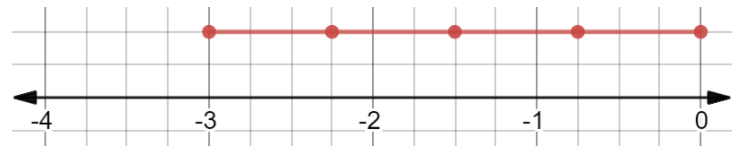
Graph each number on the number line.

Texas Go Math Grade 7 Module 8 Answer Key 3

Question 4.
3
Answer:
Texas Go Math Grade 7 Module 8 Answer Key 7
3

7th Grade Equations and Inequalities Answer Key Question 5.
-9
Answer:
Texas Go Math Grade 7 Module 8 Answer Key 8
-9

Question 6.
7
Answer:
Texas Go Math Grade 7 Module 8 Answer Key 9
7

Question 7.
-3
Answer:
Texas Go Math Grade 7 Module 8 Answer Key 10
-3

Question 8.
4p > 20 ______
Answer:
Divide both sides by 4.
Texas Go Math Grade 7 Module 8 Answer Key 11

Math Equations 7th Grade Module 8 Review Answer Key Question 9.
m – 7 ≤ 3 ______
Answer:
Add 7 to both sides.
m + 7 + 7 ≤ 3 + 7
m ≤ 3 + 7
m ≤ 10

Question 10.
\(\frac{S}{-2}\) < 9
Answer:
Multiply both sides by -2. We are multiplying by a negative number, so we have to reverse the direction of the inequality
Texas Go Math Grade 7 Module 8 Answer Key 12

Question 11.
r + 6 ≤ -7 ____
Answer:
subtract 6 from both sides.
r + 6 – 6 ≤ -7 – 6
r ≤ -13

Question 12.
\(\frac{h}{4}\) > -5 _____
Answer:
Multiply both sides by 4.
Texas Go Math Grade 7 Module 8 Answer Key 13
Answer:

Equations and Inequalities for 7th Graders Question 13.
-y ≤ 2 ________
Answer:
Multiply both sides by -1 We are multiplying by a negative number, so we have to reverse the direction of the inequality.
-y . (-1) ≤ 2 . (-1)
y ≤ -2

Texas Go Math Grade 7 Module 8 Reading Start-Up Answer Key

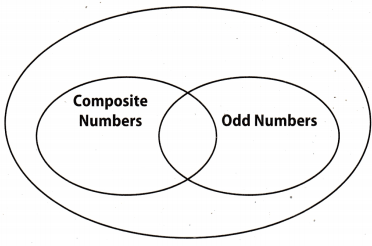
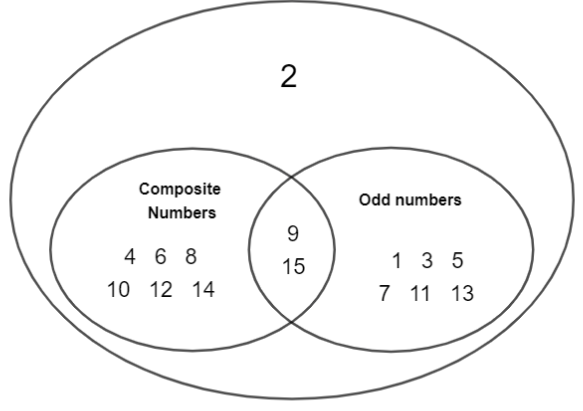
Visualize Vocabulary

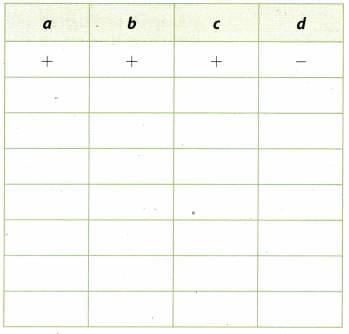
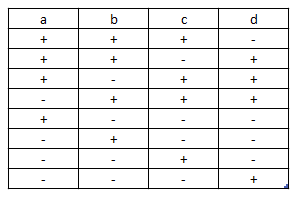
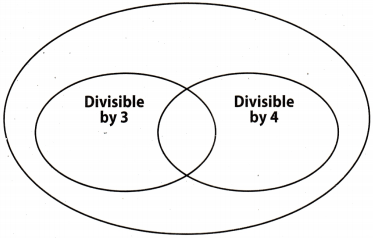
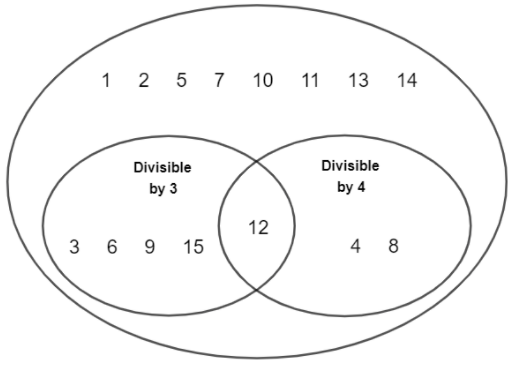
Use the ✓ words to complete the graphic. You may put more than one word in each box.

Texas Go Math Grade 7 Module 8 Answer Key 4

Understand Vocabulary

Complete each sentence, using the review words.

Question 1.
A value of the variable that makes the equation true is a ____
Answer:
Solution.

Module 8 Test Answers Math 7th Grade Question 2.
The set of all whole numbers and their opposites are ______
Answer:
Integers.

Question 3.
An ___________________________ is an expression that contains at least one variable.
Answer:
Equation.

Texas Go Math Grade 7 Module 8 Answer Key Equations and Inequalities Read More »

Texas Go Math Grade 7 Lesson 3.2 Answer Key Percent Increase and Decrease

Refer to our Texas Go Math Grade 7 Answer Key Pdf to score good marks in the exams. Test yourself by practicing the problems from Texas Go Math Grade 7 Lesson 3.2 Answer Key Percent Increase and Decrease.

Texas Go Math Grade 7 Lesson 3.2 Answer Key Percent Increase and Decrease

Example 1
Amber got a raise, and her hourly wage increased from $8 to $9.50. What is the percent increase?
Step 1: Find the amount of change.
Amount of Change = Greater Value – Lesser Value
= 9.50 – 8.00 Substitute values
= 1.50 Subtract

Step 2: Find the percent increase. Round to the nearest percent.
Percent Change = \(\frac{\text { Amount of Change }}{\text { Original Amount }}\)
= \(\frac{1.50}{8.00}\) Substitute values
= 0.1875 Divide.
≈ 19% Write as a percent and round.

Reflect

Question 1.
What does a 100% increase mean?
Answer:
A 100% increase means that a value has doubled.

Your Turn

Go Math Answer Key Grade 7 Lesson 3.2 Answer Key Question 2.
The price of a pair of shoes increases from $52 to $64. What is the percent increase to the nearest percent?
Answer:
Find the amount of change.
Amount of Change = Greater Value – Lesser value
= 64 – 52
= 12
Find the percent increase. Round to the nearest percent
Percent Change = \(\frac{\text { Amount of Change }}{\text { Original Amount }}\)
= \(\frac{12}{52}\)
= 0.2308
= 23%

Example 2

David moved from a house that is 89 miles away from his workplace to a house that is 51 miles away from his workplace. What is the percent decrease in the distance from his home to his workplace?
Step 1: Find the amount of change.
Amount of Change = Greater Value – Lesser Value
= 89 – 51 Substitute values.
= 38 Subtract.

Step 2: Find the percent decrease. Round to the nearest percent.
Percent Change = \(\frac{\text { Amount of Change }}{\text { Original Amount }}\)
= \(\frac{38}{89}\) Substitute values
≈ 0.427 Divide.
≈ 19% Write as a percent and round.

Reflect

Question 3.
Critique Reasoning David considered moving even closer to his workplace. He claims that if he had done so, the percent of decrease would have been more than 100%. Is David correct? Explain your reasoning.
Answer:
David is not correct. Distance of workplace is an absolute value If the percent of decrease would be more than 100%, that would mean the distance would be negative. That does not make any sense since the distance is an absolute value which is always positive.

Your Turn

Question 4.
The number of students in a chess club decreased from 18 to 12. What is the percent decrease? Round to the nearest percent. ___________
Answer:
Find the amount of change.
Amount of Change = Greater Value – Lesser value
= 18 – 12
= 6
Find the percent decrease. Round to the nearest percent
Percent Change = \(\frac{\text { Amount of Change }}{\text { Original Amount }}\)
= \(\frac{6}{18}\)
= 0.3
= 33%

Texas Go Math Grade 7 Answer Key Pdf Percent Error Question 5.
Officer Brimberry wrote 16 tickets for traffic violations last week, but only 10 tickets this week. What is the percent decrease? ______________
Answer:
Find the amount of change.
Amount of Change = Greater Value – Lesser value
= 16 – 10
= 6
Find the percent decrease. Round to the nearest percent
Percent Change = \(\frac{\text { Amount of Change }}{\text { Original Amount }}\)
= \(\frac{6}{16}\)
= 0.375
= 38%

Reflect

Question 6.
Why will the percent of change always be represented by a positive number?
Answer:
Because it is just the measure of change. If there is a positive change, you say there is an increase of a certain percentage and if there is a negative change, you say there is fall by a certain percentage. For example: If your weight increases by 10 kilos and if you are 40 kilos now, then you say your weight has increased by 25% which is positive obviously. If your weight decreases by 10 kilos, then you say your weight has decreased or reduced by 25% rather than saying your weight has been changed by -10%. So it is just a matter of using the words and numbers in an appropriate manner.

Question 7.
Draw Conclusions If an amount of $100 in a savings account increases by 10%, and then increases by 10% again, is that the same as increasing by 20%? Explain.
Answer:
It is not the same value. The first increase was by 10% of 100. that is $10.
The second increase was 10% of $100+$10 = $110. that is $11. $110 + $11 = $121
A straight increase of 20% is $20. $100 + $20 = $120
$121 ≠ $120

Your Turn

A TV has an original price of $499. Find the new price after the given percent of change.

Question 8.
10% increase ___________
Answer:
First. multiply TV’s price with the percentage expressed in decimals.
499 × 10% = 499 × 0.1
= $19.9
Now. since it was an increase, add the obtained value to the TV’s price.
$499 + $49.9 = $548.9
New price of the TV is $548.9.

Question 9.
30% decrease _____________
Answer:
First, multiply TV’s price with the percentage expressed in decimals.
499 × 30% = 199 × 0.3
= $149.7
Now, since it was an decrease, subtract the obtained value from the TV’s price.
$499 – $149.7 = $319.3
New price of the TV is $349.3.

Texas Go Math Grade 7 Lesson 3.2 Guided Practice Answer Key

Find each percent increase. Round to the nearest percent. (Example 1)

Question 1.
From $5 to $8 _______________________
Answer:
Find the amount of change.
Amount of Change = Greater Value – Lesser value
= 8 – 5
= 3
Find the percent increase. Round to the nearest percent
Percent Change = \(\frac{\text { Amount of Change }}{\text { Original Amount }}\)
= \(\frac{3}{5}\)
= 0.6
= 60%

Lesson 3.2 Percentage Error Answer Key Question 2.
From 20 students to 30 students _____________
Answer:
Find the amount of change.
Amount of Change = Greater Value – Lesser value
= 30 – 20
= 10
Find the percent increase. Round to the nearest percent
Percent Change = \(\frac{\text { Amount of Change }}{\text { Original Amount }}\)
= \(\frac{10}{20}\)
= 0.5
= 50%

Question 3.
From 86 books to 150 books ______________.
Answer:
Find the amount of change.
Amount of Change = Greater Value – Lesser value
= 150 – 86
= 64
Find the percent increase. Round to the nearest percent
Percent Change = \(\frac{\text { Amount of Change }}{\text { Original Amount }}\)
= \(\frac{64}{86}\)
= 0.7441
= 74%

Question 4.
From $3.49 to $3.89 _______________
Answer:
Find the amount of change.
Amount of Change = Greater Value – Lesser value
= 3.89 – 3.49
= 0.4
Find the percent increase. Round to the nearest percent
Percent Change = \(\frac{\text { Amount of Change }}{\text { Original Amount }}\)
= \(\frac{0.4}{3.49}\)
= 0.1146
= 11%

Question 5.
From 13 friends to 14 friends _______________
Answer:
Find the amount of change.
Amount of Change = Greater Value – Lesser value
= 14 – 13
= 1
Find the percent increase. Round to the nearest percent
Percent Change = \(\frac{\text { Amount of Change }}{\text { Original Amount }}\)
= \(\frac{1}{13}\)
= 0.0769
= 8%

Question 6.
From 5 miles to 16 miles ________________
Answer:
Find the amount of change.
Amount of Change = Greater Value – Lesser value
= 16 – 5
= 11
Find the percent increase. Round to the nearest percent
Percent Change = \(\frac{\text { Amount of Change }}{\text { Original Amount }}\)
= \(\frac{11}{5}\)
= 2.2
= 220%

Question 7.
Nathan usually drinks 36 ounces of water per day. He read that he should drink 64 ounces of water per day. If he starts drinking 64 ounces, what is the percent increase? Round to the nearest percent. (Example 1)
Answer:
Find the amount of change.
Amount of Change = Greater Value – Lesser value
= 64 – 36
= 28
Find the percent increase. Round to the nearest percent
Percent Change = \(\frac{\text { Amount of Change }}{\text { Original Amount }}\)
= \(\frac{28}{36}\)
= 0.7
= 78%

Find each percent decrease. Round to the nearest percent. (Example 2)

Question 8.
From $80 to $64 ______________
Answer:
Find the amount of change.
Amount of Change = Greater Value – Lesser value
= 80 – 64
= 16
Find the percent decrease. Round to the nearest percent
Percent Change = \(\frac{\text { Amount of Change }}{\text { Original Amount }}\)
= \(\frac{16}{80}\)
= 0.2
= 20%

Go Math 7th Grade Pdf Percent Increase and Decrease Question 9.
From 95 °F to 68 °F ________________
Answer:
Find the amount of change.
Amount of Change = Greater Value – Lesser value
= 95 – 68
= 27
Find the percent decrease. Round to the nearest percent
Percent Change = \(\frac{\text { Amount of Change }}{\text { Original Amount }}\)
= \(\frac{27}{95}\)
= 0.2842
= 28%

Question 10.
From 90 points to 45 points ____________
Answer:
Find the amount of change.
Amount of Change = Greater Value – Lesser value
= 90 – 45
= 45
Find the percent decrease. Round to the nearest percent
Percent Change = \(\frac{\text { Amount of Change }}{\text { Original Amount }}\)
= \(\frac{45}{90}\)
= 0.5
= 50%

Question 11.
From 145 pounds to 132 pounds ______________
Answer:
Find the amount of change.
Amount of Change = Greater Value – Lesser value
= 145 – 132
= 13
Find the percent decrease. Round to the nearest percent
Percent Change = \(\frac{\text { Amount of Change }}{\text { Original Amount }}\)
= \(\frac{13}{145}\)
= 0.0897
= 9%

Question 12.
From 64 photos to 21 photos _____________
Answer:
Find the amount of change.
Amount of Change = Greater Value – Lesser value
= 64 – 21
= 43
Find the percent decrease. Round to the nearest percent
Percent Change = \(\frac{\text { Amount of Change }}{\text { Original Amount }}\)
= \(\frac{43}{64}\)
= 0.6719
= 67%

Question 13.
From 16 bagels to 0 bagels _______________
Answer:
Find the amount of change.
Amount of Change = Greater Value – Lesser value
= 16 – 0
= 16
Find the percent decrease. Round to the nearest percent
Percent Change = \(\frac{\text { Amount of Change }}{\text { Original Amount }}\)
= \(\frac{16}{16}\)
= 1
= 100%

Question 14.
Over the summer, Jackie played video games 3 hours per day. When school began in the fall, she was only allowed to play video games for half an hour per day. What is the percent decrease? Round to the nearest percent. (Example 2)
Answer:
Find the amount of change.
Amount of Change = Greater Value – Lesser value
= 3 – 0.5
= 2.5
Find the percent decrease. Round to the nearest percent
Percent Change = \(\frac{\text { Amount of Change }}{\text { Original Amount }}\)
= \(\frac{2.5}{3}\)
= 0.83
= 83%

Find the new amount given the original amount and the percent of change. (Example 3)

Question 15.
$9; 10% increase ____________________
Answer:
Find the amount of change.
$9 × 10% = $9 × 0.1
= $0.9
Now, since it was an increase, add the obtained value to the starting value.
$9 + $0.9 = $9.9

Go Math Grade 7 Lesson 3.2 Answer Key Question 16.
48 cookies; 25% decrease _______________
Answer:
Find the amount of change.
48 × 25% = 48 × 0.25
=12
Now, since it was a decrease, subtract the obtained value from the starting value.
48 – 12 = 36 cookies

Question 17.
340 pages; 20% decrease _____________
Answer:
Find the amount of change.
340 × 20% = 340 × 0.2
= 68
Now, since it was a decrease, subtract the obtained value from the starting value.
340 – 68 = 272 pages

Question 18.
28 members; 50% increase ________________
Answer:
Find the amount of change.
28 × 50% = 28 × 0.5
= 14
Now, since it was an increase, add the obtained value to the starting value
28 + 14 = 42 members

Question 19.
$29,000; 4% decrease ________________
Answer:
Find the amount of change.
$29000 × 4% = $29000 × 0.04
= $1160
Now, since it was a decrease, subtract the obtained value from the starting value
$29000 – $1160 = $27840

Question 20.
810 songs; 130% increase _________________
Answer:
Find the amount of change.
810 × 130% = 810 × 1.3
= 1053
Now, since it was an increase, add the obtained value to the starting value.
810 + 1053 = 1863 songs

Question 21.
Adam currently runs about 20 miles per week, and he wants to increase his weekly mileage by 30%. How many miles will Adam run per week? (Example 3)
Answer:
Find the amount of change.
20 × 30% = 20 × 0.3
= 6
Now, since it was an increase, add the obtained value to the starting value.
20 + 6 = 26 miles
Adam will have to run 26 miles per week.

Essential Question Check-In

Question 22.
What process do you use to find the percent change of a quantity?
Answer:
First, we find the amount of change by subtracting the lesser value from the greater value.
Amount of Change = Greater Value – Lesser Value
Then, we divide the amount of change by the original amount
Percent Change = \(\frac{\text { Amount of Change }}{\text { Original Amount }}\)

Texas Go Math Grade 7 Lesson 3.2 Independent Practice Answer Key

Question 23.
Complete the table.
Texas Go Math Grade 7 Lesson 3.2 Answer Key 1
Answer:
Texas Go Math Grade 7 Lesson 3.2 Answer Key 3
Bike:
Find the amount of change.
Amount of Change = Greater Value – Lesser value
= 110 – 96
= 14
Find the percent decrease (Original Price greater than New Price) Round to the nearest percent.
Percent Change = \(\frac{\text { Amount of Change }}{\text { Original Amount }}\)
= \(\frac{14}{110}\)
≈ 0.1273
≈ 13%

Scooter:
Find the amount of change.
Amount of Change = Greater Value – Lesser value
= 56 – 45
= 11
Find the percent increase (Original Price lesser than New Price). Round to the nearest percent.
Percent Change = \(\frac{\text { Amount of Change }}{\text { Original Amount }}\)
= \(\frac{11}{45}\)
= 0.24
= 24%

Tennis Racket:
Find the amount of change
79 × 5% = 75 × 0.05
= 3.95
Now, since it was an increase, add the obtained value to the starting value
$79 + $3.95 = $82.95

Skis:
Find the amount of change.
580 × 25% = 580 × 0.25
= 145
Now, since it was a decrease, subtract the obtained value from the starting value.
$580 – $145 = $435

Go Math Lesson 3.2 Answer Key 7th Grade Question 24.
Multiple Representations The bar graph shows the number of hurricanes in the Atlantic Basin from 2006-2011.
Texas Go Math Grade 7 Lesson 3.2 Answer Key 2
a. Find the amount of change and the percent of decrease in the number of hurricanes from 2008 to 2009 and from 2010 to 2011. Compare the amounts of change and percents of decrease.
Answer:
2008.- 2009.
2008. – 8 hurricanes
2009. – 3 hurricanes
It is an obvious decrease.
Find the amount of change.
Amount of Change = Greater Value – Lesser value
= 8 – 3
= 5
Find the percent decrease. Round to the nearest percent.
Percent Change = \(\frac{\text { Amount of Change }}{\text { Original Amount }}\)
= \(\frac{5}{8}\)
= 0.625
≈ 63%

2010.- 2011.
2010. – 12 hurricanes
2011. – 7 hurricanes
It is, again, an obvious decrease.
Find the amount of change.
Amount of Change = Greater Value – Lesser value
= 12 – 7
= 5
Find the percent decrease. Round to the nearest percent.
Percent Change = \(\frac{\text { Amount of Change }}{\text { Original Amount }}\)
= \(\frac{5}{12}\)
= 0.416
≈ 42%
Amounts of change are the same, but the first percent change is greater because the original amount is lesser.

b. Between which two years was the percent of change the greatest? What was the percent of change during that period?
Answer:
We conclude that the greatest percentage change is between 2008. – 2009. The percent of change during that period was 63%

Question 25.
Represent Real-World Problems Cheese sticks that were previously priced at “5 for $1” are now “4 for $1”.
a. Find the percent decrease in the number of cheese sticks you can buy for $1.
Answer:
Find the amount of change.
Amount of Change = Greater Value – Lesser value
= 5 – 4
= 1
Find the percent decrease. Round to the nearest percent.
Percent Change = \(\frac{\text { Amount of Change }}{\text { Original Amount }}\)
= \(\frac{1}{5}\)
= 0.2
20%
You can now buy 20% less cheese sticks for $1 than before.

b. Find the percent increase in the price per cheese stick.
Answer:
Price before = $1 ÷ 5 = $0.2
Price now = $1 ÷ 4 = $0.25
Find the amount of change.
Amount of Change = Greater Value — Lesser value
= 2.5 – 2
= 0.5
Find the percent increase. Round to the nearest percent.
Percent Change = \(\frac{\text { Amount of Change }}{\text { Original Amount }}\)
= \(\frac{0.5}{2}\)
= 0.25
25%

Lesson 3.2 Percent of Change Answer Key 7th Grade Question 26.
Percent error calculations are used to determine how close to the true values, or how accurate, experimental values really are. The formula is similar to finding percent of change.
Percent Error = \(\frac{\mid \text { Experimental Value }-\text { Actual Value| }}{\text { Actual Value }}\) × 100%
In chemistry class, Charlie records the volume of a liquid as 13.3 milliliters. The actual volume is 1 3.6 milliliters. What is his percent error? Round to the nearest percent. __________________________________
Answer:
Experimental Value = 13.3 millimeters
Actual Value = 13.6 millimeters
Use the given formula to calculate the Percent Error
Texas Go Math Grade 7 Lesson 3.2 Answer Key 4

H.O.T. Focus On Higher Order Thinking

Question 27.
Look for a Pattern Leroi and Sylvia both put $100 in a savings account. Leroi decides he will put in an additional $10 each week. Sylvia decides to put in an additional 10% of the amount in the account each week.
a. Who has more money after the first additional deposit? Explain.
Answer:
Lerol put $10. now she has $100 + $10 = $100.
Sylvia put 10% × $100 = $10, now she has $100 + $10 = $110.
Conclusion: They both have the same amount of money after the first additional deposit.

b. Who has more money after the second additional deposit? Explain.
Answer:
Since Lerol adds again $10. and Sylvia 10%. it is obvious that Sylvia now has more money. because she adds 10% × $100 = $11.
$11 > $10

c. How do you think the amounts in the two accounts will compare after a month? A year?
Answer:
Obviously, Sylvia will have more money as the time progresses, because she keeps adding a greater amount with each month. while Lerol always adds the same amount of money.

Question 28.
Critical Thinking Suppose an amount increases by 100%, then decreases by 100%. Find the final amount would the situation change if the original increase was 150%? Explain your reasoning.
Answer:
Let x be the amount of money.
First, increase its value by 100%.
x + 100% × x = x + x = 2x
Now, decrease the obtained value by 100%.
2x – 100% × 2x = 2x – 2x = 0
The final, amount is 0.
Now, calculate if the original increase would be 150% followed by the same decrease.
x + 150% × x = x + 1.5x = 2.5x
2.5x – 100% × 2.5x = 2.5x – 2.5x = 0
We can conclude that no matter how many percent the amount increases, if it decreases by 100% after, it will equal 0.

Question 29.
Look for a Pattern Ariel deposited $100 into a bank account. Each Friday she will withdraw 10% of the money in the account to spend. Ariel thinks her account will be empty after 10 withdrawals. Do you agree? Explain.
Answer:
That is not correct. Actually, that way she would never empty her bank account.
The first month she would withdraw 10% × $100 = $10
She now has $100 – $10 = $90 on her account.
Next month she would withdraw 10% × $90 = $9
She now has $90 – $9 = $81 on her account.
The amount on her account would decrease more slowly with each withdrawal but would reach $0.

Texas Go Math Grade 7 Lesson 3.2 Answer Key Percent Increase and Decrease Read More »

Texas Go Math Grade 7 Lesson 3.1 Answer Key Converting Between Measurement Systems

Refer to our Texas Go Math Grade 7 Answer Key Pdf to score good marks in the exams. Test yourself by practicing the problems from Texas Go Math Grade 7 Lesson 3.1 Answer Key Converting Between Measurement Systems.

Texas Go Math Grade 7 Lesson 3.1 Answer Key Converting Between Measurement Systems

Texas Go Math Grade 7 Lesson 3.1 Explore Activity Answer Key

The table shows equivalencies between the customary and metric systems. You can use these equivalencies to convert a measurement ¡n one system to a measurement in the other system.

Texas Go Math Grade 7 Lesson 3.1 Answer Key 1

Most conversions are approximate, as indicated by the symbol ≈.

The length of a sheet of paper is 11 inches. What is this length in centimeters?

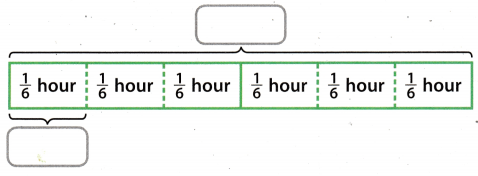
A. You can use a bar diagram to solve this problem. Each part represents 1 inch.
1 inch ________ centimeter(s)
Texas Go Math Grade 7 Lesson 3.1 Answer Key 2

B. How does the diagram help you solve the problem?

C. 11 inches = ________ centimeters

Reflect

Question 1.
Communicate Mathematical Ideas Suppose you wanted to use a diagram to convert ounces to grams. Which unit would the parts in your diagram represent?
Answer:
The parts in my diagram would represent ounces.

Your Turn

Lesson 3.1 Converting Between Measurement Systems Answer Key Question 2.
6 quarts ≈ ___________ liters
Answer:
1 quart ≈ 0.946 liter.
Write the conversion factor as ratio: \(\frac{0.946 \text { liter }}{1 \text { quart }}\)
6 quarts × \(\frac{0.946 \text { liter }}{1 \text { quart }}\) = 5.736 liters

Question 3.
14 feet ≈ ____________ meters
Answer:
1 foot ≈ 0.305 meter.
Write the conversion factor as ratio: \(\frac{0.305 \text { meter }}{1 \text { foot }}\)
14 feet × \(\frac{0.305 \text { meter }}{1 \text { foot }}\) ≈ 4.27 meters

Question 4.
255.6 grams ≈ ___________ ounces
Answer:
1 ounce ≈ 28.4 grams
Write the conversion factor as ratio: \(\frac{1 \text { ounce }}{28.4 \text { grams }}\)
255.6 grams × \(\frac{1 \text { ounce }}{28.4 \text { grams }}\) ≈ 9 ounce

Question 5.
7 liters ≈ __________ quarts
Answer:
1 quart ≈ 0.946 liter.
Write the conversion factor as ratio: \(\frac{1 \text { quart }}{0.946 \text { liter }}\)
7 liters × \(\frac{1 \text { quart }}{0.946 \text { liter }}\) ≈ 7.4 quarts

Reflect

Question 6.
Error Analysis Yolanda found the area of Bob’s driveway in square meters as shown. Explain why Yolanda’s answer is incorrect.
Texas Go Math Grade 7 Lesson 3.1 Answer Key 3
Answer:
Yolanda’s answer is incorrect because she multiplied square feet by a regular meter-to-foot ratio.

Your Turn

Converting within Measurement Systems Lesson 7.3 Answer Key Question 7.
A flower bed is 2 meters wide and 3 meters long. What is the area of the flower bed in square feet? Round intermediate steps and your answer to the nearest hundredth.
__________ square feet
Answer:
First, convert flower bed measurements to feet
1 foot ≈ 0.305 meter
Texas Go Math Grade 7 Lesson 3.1 Answer Key 7
Length ≈ 9.84 feet
Width ≈ 6.56 feet

Find the area.
Area = Length × Width
= 9.84 × 6.56
= 65.55 square feet

Texas Go Math Grade 7 Lesson 3.1 Guided Practice Answer Key

Complete each diagram to solve the problem. (Explore Activity)

Question 1.
Kate ran 5 miles. How far did she run in kilometers?
5 miles = __________________ kilometers
Texas Go Math Grade 7 Lesson 3.1 Answer Key 4
Answer:
First, complete the diagram. Then, with the help of a diagram convert units
5 × 1.61 = 8.05
5 miles ≈ 8.05 kilometres
Texas Go Math Grade 7 Lesson 3.1 Answer Key 8

Question 2.
Alex filled a 5-gallon jug with water. How many liters of water are in the container?
5 gallons ≈ _________________ liters
Texas Go Math Grade 7 Lesson 3.1 Answer Key 4
Answer:
First, complete the diagram. Then, with the help of a diagram convert units
5 × 3.79 = 18.95
5 gallons ≈ 18.95 liters
Texas Go Math Grade 7 Lesson 3.1 Answer Key 9

Use a conversion factor to convert each measurement. (Example 1 and 2)

Question 3.
A ruler is 12 inches long. What is the length of this ruler in centimeters?
_________________ centimeters
Answer:
1 in ≈ 2.54 centimeter.
Texas Go Math Grade 7 Lesson 3.1 Answer Key 10
The ruler is 30.48 centimeters long.

Lesson 3.1 Worksheet Go Math Answer Key Grade 7 Question 4.
A kitten weighs 4 pounds. What is the approximate mass of the kitten?
_________________ kilograms
Answer:
1 pound ≈ 0.454 kilograms
Write the conversion factor as a ratio: \(\frac{0.454 \text { kilograms }}{1 \text { pound }}\)
4 pounds × \(\frac{0.454 \text { kilograms }}{1 \text { pound }}\) ≈ 1.816 kilogram
A kitten weighs 1.816 kilograms.

Use a proportion to convert each measurement. (Example 2)

Question 5.
20 yards ≈ ____________ meters
Answer:
1 yard ≈ 0.914 meter.
Write the conversion factor as a ratio: \(\frac{0.914 \text { meter }}{1 \text { yard }}\)
20 yard × \(\frac{0.914 \text { meter }}{1 \text { yard }}\) ≈ 18.28 meters

Question 6.
12 ounces ≈ ____________ grams
Answer:
1 ounce ≈ 28.4 grams.
Write the conversion factor as a ratio: \(\frac{28.4 \text { grams }}{1 \text { ounce }}\)
12 ounces × \(\frac{28.4 \text { grams }}{1 \text { ounce }}\) ≈ 340.8 meters

Question 7.
5 quarts ≈ ____________ liters
Answer:
1 quart ≈ 0.946 grams.
Write the conversion factor as a ratio: \(\frac{0.946 \text { liter }}{1 \text { quart }}\)
5 quarts × \(\frac{0.946 \text { liter }}{1 \text { quart }}\) ≈ 4.73 liters

Question 8.
400 meters ≈ ____________ yards
Answer:
1 yard ≈ 0.914 meter.
Write the conversion factor as a ratio: \(\frac{1 \text { yard }}{0.914 \text { meter }}\)
400 meters × \(\frac{1 \text { yard }}{0.914 \text { meter }}\) ≈ 437.64 yards

Question 9.
10 liters ≈ ____________ gallons
Answer:
1 gallon ≈ 3.79 liters.
Write the conversion factor as a ratio: \(\frac{1 \text { gallon }}{3.79 \text { liters }}\)
10 liters × \(\frac{1 \text { gallon }}{3.79 \text { liters }}\) ≈ 2.64 gallons

Go Math 7th Grade Answers Lesson 3.1 Answer Key Question 10.
137.25 meters ≈ ____________ feet
Answer:
1 foot ≈ 0.305 meters.
Write the conversion factor as a ratio: \(\frac{1 \text { foot }}{0.305 \text { meter }}\)
137.25 meters × \(\frac{1 \text { foot }}{0.305 \text { meter }}\) ≈ 450 feet

Question 11.
165 centimeters ≈ ___________ inches
Answer:
1 in = 2.54 centimeters.
Write the conversion factor as a ratio: \(\frac{1 \text { in }}{2.54 \text { centimeters }}\)
165 centimeters × \(\frac{1 \text { in }}{2.54 \text { centimeters }}\) = 64.96 inches

Question 12.
10,000 kilometers ≈ ___________ miles
Answer:
1 mile ≈ 1.61 kilometer.
Write the conversion factor as a ratio: \(\frac{1 \text { mile }}{1.61 \text { kilometer }}\)
10,000 kilometers × \(\frac{1 \text { mile }}{1.61 \text { kilometer }}\) ≈ 6211.18 miles

Essential Question Check-In

Question 13.
Write and solve a proportion that can be used to convert 60 inches to centimeters.
Answer:
1 in = 2.54 centimeters.
Texas Go Math Grade 7 Lesson 3.1 Answer Key 11

Texas Go Math Grade 7 Lesson 3.1 Independent Practice Answer Key

Tell which measure is greater.

Question 14.
Six feet or two meters ________________
Answer:
1 foot ≈ 0.305 meter.
Write the conversion factor as a ratio: \(\frac{1 \text { foot }}{0.305 \text { meter }}\)
2 meters × \(\frac{1 \text { foot }}{0.305 \text { meter }}\) ≈ 6.56 feet

6.56 feet > 6 feet
2 meters > 6 feet

Question 15.
One inch or one centimeter ____________
Answer:
1 in = 254 centimeters.
Notice it is obvious that one inch > one centimeter. There is no need for conversion.

Texas Go Math Grade 7 Answer Key Lesson 3.1 Answer Key Question 16.
One yard or one meter ____________
Answer:
1 yard ≈ 0.9 14 meters.
Notice it is obvious that one meter > one yard. There is no need for conversion.

Question 17.
One mile or one kilometer ______________
Answer:
1 mile ≈ 1.61 kilometer.
Notice it is obvious that one mile > one kilometer. There is no need for conversion.

Question 18.
One ounce or one gram ______________
Answer:
1 ounce ≈ 28.4 grams.
Notice it is obvious that one ounce > one gram. There is no need for conversion.

Question 19.
One quart or one liter _________________
Answer:
1 quart ≈ 0.946 liter.
Notice it is obvious that one liter > one quart. There is no need for conversion.

Question 20.
10 pounds or 10 kilograms ____________
Answer:
1 pound ≈ 0.454 kiLograms.
Notice that it is the same problem as comparing 1 pound to 1 kilogram, it is obvious that one kilogram > one pound There is no need for conversion.

Question 21.
Four liters or one gallon ______________
Answer:
1 gallon ≈ 3.79 liters.
4 liters > 3.79 liters
4 liters > 1 gallon

Question 22.
Two miles or three kilometers ___________
Answer:
1 mile ≈ 1.61 kilometer
Write the conversion factor as a ratio: \(\frac{1 \text { mile }}{1.61 \text { kilometer }}\)
3 kilometer × \(\frac{1 \text { mile }}{1.61 \text { kilometer }}\) ≈ 1.86 miles
2 miles > 1.86 miles
2 miles > 3 kilometers

Question 23.
What is the limit in kilograms?
Texas Go Math Grade 7 Lesson 3.1 Answer Key 5
Answer:
1 pound ≈ 0.454 kilogram
Write the conversion factor as a ratio: \(\frac{0.454 \text { kilogram }}{1 \text { pound }}\)
50 pounds × \(\frac{0.454 \text { kilogram }}{1 \text { pound }}\) ≈ 22.7 kilogram
The limit is 22.7 kilograms.

Question 24.
What is the limit in miles per hour?
Texas Go Math Grade 7 Lesson 3.1 Answer Key 6
Answer:
1 mile per hour ≈ 1.61 kilometers per hour.
Write the conversion factor as a ratio: \(\frac{1 \text { mile per hour }}{1.61 \text { kilometer per hour }}\)
55 kilometers per hour × \(\frac{1 \text { mile per hour }}{1.61 \text { kilometer per hour }}\) ≈ 34.16 miles per hour

7th Grade Metric Conversion Worksheet Answer Key Question 25.
Which container holds more, a half-gallon milk jug or a 2-liter juice bottle?
Answer:
1 gallon ≈ 3.79 liters
Write the conversion factor as a ratio: \(\frac{1 \text { gallon }}{3.79 \text { liters }}\)
2 liters × \(\frac{1 \text { gallon }}{3.79 \text { liters }}\) ≈ 0.53 gallon
0.53 gallon > 0.5 gallon
2 liters > 0.5 gallon
A 2-liter juice bottle contains more.

Question 26.
The label on a can of lemonade gives the volume as 12 fl oz,, or 355 mL. Verify that these two measurements are nearly equivalent.
Answer:
1 fl oz ≈ 29.6 mL.
Write the conversion factor as a ratio: \(\frac{1 \mathrm{fl} \mathrm{oz}}{29.6 \mathrm{~mL}}\)
355 mL × \(\frac{1 \mathrm{fl} \mathrm{oz}}{29.6 \mathrm{~mL}}\) ≈ 11.99 fl oz
12 fl oz ≈ 11.99 fl oz

Question 27.
The mass of a textbook is about 1.25 kilograms. About how many pounds is this?
Answer:
1 pound ≈ 0.054 kilogram.
Write the conversion factor as a ratio: \(\frac{1 \text { pound }}{0.454 \text { kilogram }}\)
1.25 kilograms × \(\frac{1 \text { pound }}{0.454 \text { kilogram }}\) ≈ 2.75 pounds
The mass of a textbook is about 2.75 pounds.

Question 28.
Critique Reasoning Michael estimated his mass as 8 kilograms. Is his estimate reasonable? Justify your answer.
Answer:
No, his estimate is not reasonable. If he is at the age where he is capable of estimating his own weight in kilograms, then he must be at least 12 years old. Thus, he surely weighs ≥ 35 kilograms.

Question 29.
Your mother bought a three-liter bottle of water. When she got home, she discovered a small leak in the bottom and asked you to find a container to transfer the water into, All you could find were two half-gallon jugs.
a. Will your containers hold all of the water?
Answer:
1 gallon ≈ 3.79 Liters.
Two half gallon = 1 gallon.
3.79 liters> 3 liters
1 gallon > 3 liters
The containers will hold all the water.

b. What If? Suppose an entire liter of water leaked out in the car. In that case, would you be able to fit all of the remaining water into one of the half-gallon jugs? Explain.
Answer:
\(\frac{1}{2}\) gallon = \(\frac{3.79}{2}\) liters
= 1.895 liters
If one liter leaked out that means there is two liters left
2 Liters > 1.895 liters
We would not be able to fit the remaining water into half-gallon jug

Question 30.
The track team ran a mile and a quarter during their practice.
How many kilometers did the team run? ____________________________
Answer:
1 mile ≈ 1.61 kilometer.
Write the conversion factor as a ratio: \(\frac{1.61 \text { kilometer }}{1 \mathrm{mile}}\)
1\(\frac{1}{4}\) mile × \(\frac{1.61 \text { kilometer }}{1 \mathrm{mile}}\) ≈ 2.0125 kilometers
The team ran 2.0125 kilometers.

Question 31.
A countertop is 16 feet long and 3 feet wide.
a. What is the area of the counter top in square meters? ______________ square meters
Answer:
1 foot ≈ 0.305 meter.
Convert both length and width to meters.
Texas Go Math Grade 7 Lesson 3.1 Answer Key 12
Now, calculate the area.
A = length × width
= 4.88 × 0.915
= 4.47 m2

b. Tile costs $28 per square meter. How much will it cost to cover the countertop with new tile? $ ___________________________________
Answer:
Multiply the cost per square meter by the area of the countertop in square meter.
28 × 4.47 = $125.16

Question 32.
At a school picnic, your teacher asks you to mark a field every ten yards so students can play football. The teacher accidentally gave you a meter stick instead of a yardstick. How far apart in meters should you mark the lines if you still want them to be in the right places?
Answer:
1 yard ≈ 0.914 meters.
We have to convert 10 yards to meters.
Write the conversion factor as a ratio: \(\frac{0.914 \text { meter }}{1 \text { yard }}\)
10 yards × \(\frac{0.914 \text { meter }}{1 \text { yard }}\) ≈ 9.14 meters
We should mark the line every 9.14 meters.

Question 33.
You weigh a gallon of 2% milk in science class and learn that it is approximately 8.4 pounds. You pass the milk to the next group, and then realize that your teacher wanted an answer in kilograms, not pounds. Explain how you can adjust your answer without weighing the milk again. Then give the weight in kilograms.
Answer:
1 pound ≈ 0.454 kiLograms.
We have to convert 10 yards to meters.
Write the conversion factor as a ratio: \(\frac{0.454 \text { kilograms }}{1 \text { pound }}\)
8.4 pounds × \(\frac{0.454 \text { kilograms }}{1 \text { pound }}\) ≈ 3.81 kilogram
A gallon of 2% milk weighs 3.81 kilograms.

H.O.T. Focus On Higher Order Thinking

Question 34.
Analyze Relationships Annalisa, Keiko, and Stefan want to compare their heights. Annalisa is 64 inches tall. Stefan tells her, “I’m about 7.5 centimeters taller than you.” Keiko knows she is 1.5 inches shorter than Stefan. Give the heights of all three people in both inches and centimeters to the nearest half-unit.
Answer:
First, convert Aniia1in’s height to centimeters to find out how tail Stefan is. Then, convert Stefan’s height to inches to find out how tall Keiko is.
All rounded to the nearest half.
1 in = 2.54 centimeters.
Texas Go Math Grade 7 Lesson 3.1 Answer Key 13

Question 35.
Communicate Mathematical Ideas Mikhael wanted to rewrite the conversion factor” 1 yard 0.914 meters” to create a conversion factor to convert meters to yards. He wrote “1 meter ≈ ___________.” Tell how Mikhael should finish his conversion, and explain how you know.
Answer:
1 yard ≈ 0.914 meters.
Write the conversion factor as a ratio: \(\frac{0.914 \text { meter }}{1 \text { yard }}\)
1 meter × \(\frac{1 \text { yard }}{0.914 \text { meter }}\) ≈ 1.09 yards
We used the conversion factor to convert meters to yards, and that is how we know how much 1 meter is in yards.

Texas Go Math Grade 7 Lesson 3.1 Answer Key Converting Between Measurement Systems Read More »

Texas Go Math Grade 7 Module 2 Answer Key Rates and Proportionality

Refer to our Texas Go Math Grade 7 Answer Key Pdf to score good marks in the exams. Test yourself by practicing the problems from Texas Go Math Grade 7 Module 2 Answer Key Rates and Proportionality.

Texas Go Math Grade 7 Module 2 Answer Key Rates and Proportionality

Texas Go Math Grade 7 Module 2 Are You Ready? Answer Key

Divide.

Question 1.
\(\frac{3}{4}\) ÷ \(\frac{4}{5}\) _____________
Answer:
Multiply by the reciprocal of the divisor:
= \(\frac{3}{4}\) × \(\frac{5}{4}\)
= \(\frac{15}{16}\)

Grade 7 Module 2 Answer Key Texas Go Math Question 2.
\(\frac{5}{9}\) ÷ \(\frac{10}{11}\) _____________
Answer:
Multiply by the reciprocal of the divisor:
= \(\frac{5}{9}\) × \(\frac{11}{10}\)
= \(\frac{11}{18}\)

Question 3.
\(\frac{3}{8}\) ÷ \(\frac{1}{2}\) _____________
Answer:
Multiply by the reciprocal of the divisor:
= \(\frac{3}{8}\) × \(\frac{2}{1}\)
= \(\frac{3}{4}\)

Question 4.
\(\frac{16}{21}\) ÷ \(\frac{8}{9}\) _____________
Answer:
Multiply by the reciprocal of the divisor:
= \(\frac{16}{21}\) × \(\frac{9}{8}\)
= \(\frac{6}{7}\)

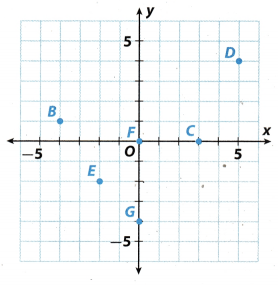
Write the ordered pair for each point.

Texas Go Math Grade 7 Module 2 Answer Key 1
Question 5.
B ____________
Answer:
B(-4, 1)

Question 6.
C ____________
Answer:
C(3, 0)

Question 7.
D _____________
Answer:
D(5, 4)

Question 8.
E _____________
Answer:
E(-2, -2)

Question 9.
F _____________
Answer:
F(0, 0)

Texas Go Math Module 2 Grade 7 Answer Key Question 10.
G _____________
Answer:
G(-4, 0)

Texas Go Math Grade 7 Module 2 Reading Start-Up Answer Key

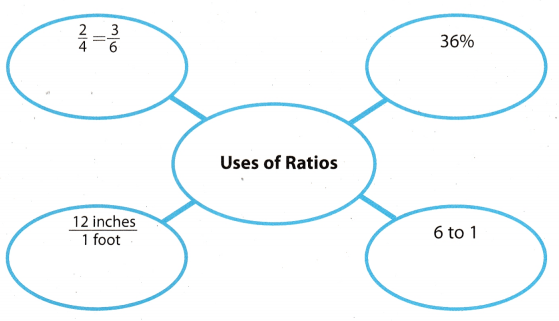
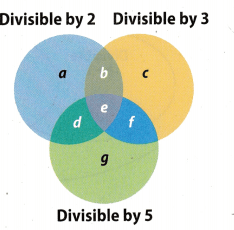
Visualize Vocabulary

Use the ✓ words to complete the graphic. You can put more than one word in each bubble.

Texas Go Math Grade 7 Module 2 Answer Key 2

Understand Vocabulary

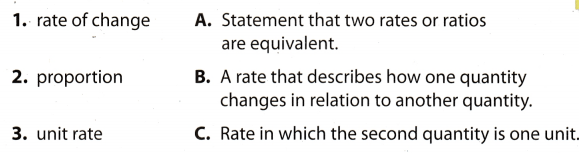
Match the term on the left to the definition on the right.

Texas Go Math Grade 7 Module 2 Answer Key 3
Answer:
1. rate of change ………. B. A rate that describes how one quantity changes in relation to another quantity.
2. proportion ………… A. Statement that two rates or ratios are equivalent
3. proportion ……….. C. Rate in which the second quantity is one unit

Texas Go Math Grade 7 Module 2 Answer Key Rates and Proportionality Read More »

Texas Go Math Grade 7 Lesson 1.4 Answer Key Subtracting Rational Numbers

Refer to our Texas Go Math Grade 7 Answer Key Pdf to score good marks in the exams. Test yourself by practicing the problems from Texas Go Math Grade 7 Lesson 1.4 Answer Key Subtracting Rational Numbers.

Texas Go Math Grade 7 Lesson 1.4 Answer Key Subtracting Rational Numbers

Example 1
The temperature on an outdoor thermometer on Monday was 5.5 °C. The temperature on Thursday was 7.25 degrees less than the temperature on Monday. What was the temperature on Thursday?
Answer:
Subtract to find the temperature on Thursday.
Step 1: Find 5.5 – 7.25
Step 2: Start at 5.5

Texas Go Math Grade 7 Lesson 1.4 Answer Key 4
Step 3: Move |7.25| = 7.25 units to the left because you are subtracting a positive number.
The result is -1.75
The temperature on Thursday was -1.75 °C.

Your Turn

Use a number line to find each difference.

Question 1.
-6.5 – 2 = __________

Texas Go Math Grade 7 Lesson 1.4 Answer Key 1
Answer:
Start at -6.5.
Move |2| = 2 units to the left because you are subtracting a positive number
The result is -8.5.

Texas Go Math Grade 7 Lesson 1.4 Answer Key 16

Go Math Lesson 1.4 7th Grade Answer Key Question 2.
1\(\frac{1}{2}\) – 2 = __________

Texas Go Math Grade 7 Lesson 1.4 Answer Key 2
Answer:
Start at 1\(\frac{1}{2}\).
Move |2| = 2 units to the left because you are subtracting a positive number
The result is -0.5.

Texas Go Math Grade 7 Lesson 1.4 Answer Key 17

Question 3.
-2.25 – 5.5 = __________
Texas Go Math Grade 7 Lesson 1.4 Answer Key 3
Answer:
Start at -2.25.
Move |5.5| = 5.5 units to the left because you are subtracting a positive number
The result is -7.75.

Texas Go Math Grade 7 Lesson 1.4 Answer Key 18

Example 2
During the hottest week of the summer, the water level of the Muskrat River was \(\frac{5}{6}\) foot below normal. The following week, the level was foot below normal. What is the overall change in the water level?
Answer:
Subtract to find the difference in water levels.
Step 1: Find –\(\frac{1}{3}\) – (-\(\frac{5}{6}\)).
Step 2: Start at –\(\frac{1}{3}\).

Texas Go Math Grade 7 Lesson 1.4 Answer Key 5
Step 3: Move |-\(\frac{5}{6}\)| = \(\frac{5}{6}\) to the right because you are subtracting a negative number.
The result is \(\frac{1}{2}\).
So, the water level increased \(\frac{1}{2}\) foot.

Reflect

Question 4.
Work with other students to compare addition of negative numbers on a number line to subtraction of negative numbers on a number line.
Answer:
We conclude that when it comes to addition of negative numbers we move to the left, while we move to the right in subtraction of negative numbers.

Question 5.
Compare the methods used to solve Example 1 and Example 2.
Answer:
Methods are the same, in both we use subtraction, the difference is in moving left (example 1) or right (example 2) on the number tine, and that depends on the subtrahend, whether it is positive or negative.

Your Turn

Use a number line to find each difference.

Question 6.
0.25 – (-1.50) = ___________

Texas Go Math Grade 7 Lesson 1.4 Answer Key 6
Answer:
Start at 0.25.
Move |-1.50| = 1.50 units to the right because you are subtracting a positive number
The result is 1.75.

Texas Go Math Grade 7 Lesson 1.4 Answer Key 19

Go Math Grade 7 Lesson 1.4 Answer Key Question 7.
– \(\frac{1}{2}\) – (-\(\frac{3}{4}\)) = ____________

Texas Go Math Grade 7 Lesson 1.4 Answer Key 7
Answer:
Step 1
Start at –\(\frac{1}{2}\)
Move |-\(\frac{3}{4}\)| = \(\frac{3}{4}\) units to the right because you are subtracting a negative number
The result is \(\frac{1}{4}\)

Texas Go Math Grade 7 Lesson 1.4 Answer Key 20

Explore Activity 1

Adding the Opposite
Joe is diving 2\(\frac{1}{2}\) feet below sea level. He decides to descend 7\(\frac{1}{2}\) more feet. How many feet below sea level is he?
Answer:
Step 1: Use negative numbers to represent the number of feet below sea level.
Step 2: Find -2\(\frac{1}{2}\) – 7\(\frac{1}{2}\).
Step 3: Start at -2\(\frac{1}{2}\).

Texas Go Math Grade 7 Lesson 1.4 Answer Key 9
Step 4: Move |7\(\frac{1}{2}\)| = 7\(\frac{1}{2}\) units to the _____________________
because you are subtracting a ____________________ number.
The result is -10.
Joe is ______________________ sea level.

Reflect

Question 8.
Use a number line to find each difference or sum.
a. -3 – 3 = __________

Texas Go Math Grade 7 Lesson 1.4 Answer Key 8
Answer:
Start at -3.
Move |3| = 3 units to the left because you are subtracting a positive number.
The result is -6.

b. -3 + (-3) = __________
Texas Go Math Grade 7 Lesson 1.4 Answer Key 8
Answer:
Start at -3.
Move |-3| = 3 units to the left because you are subtracting a positive number.
The result is -6.

Texas Go Math Grade 7 Lesson 1.4 Answer Key 21

Go Math Answer Key Grade 7 Subtracting Rational Numbers Question 9.
Make a Conjecture Work with other students to make a conjecture about how to change a subtraction problem into an addition problem.
Answer:
We conclude that we can substitute a subtraction problem with an addition problem. Minuend becomes the
first addend, while the second addend is a negative subtrahend
E.g.
5 – 3 = 5 + (-3)

Explore Activity 2

A cave explorer climbed from an elevation of -11 meters to an elevation of -5 meters. What vertical distance did the explorer climb?
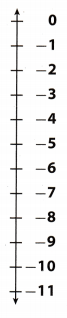
Texas Go Math Grade 7 Lesson 1.4 Answer Key 10
There are two ways to find the vertical distance.
A.
Start at ________.
Count the number of units on the vertical number line up to -5.
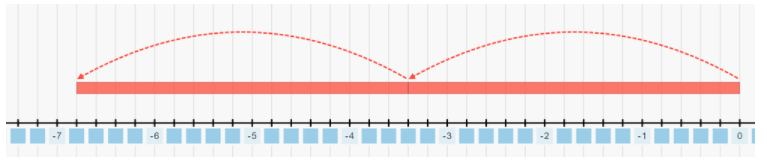
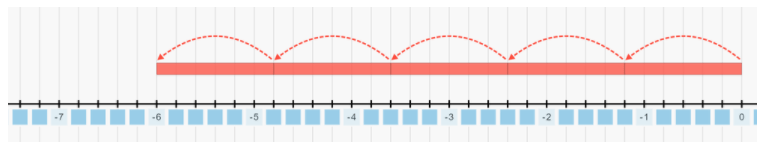
The explorer climbed __________ meters.
This means that the vertical distance between
-11 meters and -5 meters is ________ meters.

B.
Find the difference between the two elevations and use the absolute value to find the distance.
11 – (-5) = __________
Take the absolute value of the difference because the distance traveled is always a non-negative number.
|-11 -(-5)| = __________
The vertical distance is _________meters.

Reflect

Question 10.
Does it matter which way you subtract the values when finding distance? Explain.
Answer:
It does not matter, because the difference in two ways is in the sign (+/-) Thus when we take the absolute values
of the results, it’s the same.
E.g.
5 – 3 = 2
|5 – 3| = 2
3 – 5 = -2
|3 – 5| = 2

7th Grade Go Math Lesson 1.4 Answer Key Question 11.
Would the same methods work if both the numbers were positive? What if one of the numbers were positive and the other negative?
Answer:
Yes, it would still work if both the numbers were positive.
It would not make a difference if one of the numbers were positive and the other negative. We would still use the same method.

Texas Go Math Grade 7 Lesson 1.4 Guided Practice Answer Key 

Use a number line to find each difference. (Example 1, Example 2 and Explore Activity 1)

Question 1.
5 – (-8) = ___________

Texas Go Math Grade 7 Lesson 1.4 Answer Key 11
Answer:
Start at 5.
Move |-8| = 8 units to the right because you are subtracting a negative number.
The result is 13.

Texas Go Math Grade 7 Lesson 1.4 Answer Key 22

Question 2.
-3\(\frac{1}{2}\) -4\(\frac{1}{2}\) = __________

Texas Go Math Grade 7 Lesson 1.4 Answer Key 12
Answer:
Start at -3\(\frac{1}{2}\).
Move |-4\(\frac{1}{2}\)| = 4\(\frac{1}{2}\) units to the left because you are subtracting a positive number
The result is -8

Texas Go Math Grade 7 Lesson 1.4 Answer Key 23

Question 3.
-7 – 4 = __________
Texas Go Math Grade 7 Lesson 1.4 Answer Key 13
Answer:
Start at -7.
Move |4| = 4 units to the left because you are subtracting a positive number
The result is -11.

Texas Go Math Grade 7 Lesson 1.4 Answer Key 24

Question 4.
-0.5 – 3.5 = __________
Texas Go Math Grade 7 Lesson 1.4 Answer Key 14
Answer:
Start at -0.5.
Move |3.5| = 3.5 units to the left because you are subtracting a positive number
The result is -4.
Texas Go Math Grade 7 Lesson 1.4 Answer Key 15

Find each difference. (Explore Activity 1)

Question 5.
-14 – 22 = ___________
Answer:
– 36

Question 6.
-12.5 – (-4.5) = ________
Answer:
Start by changing subtraction problem to addition problem.
= -12.5 + 4.8
= -7.7

Question 7.
\(\frac{1}{3}\) – (-\(\frac{2}{3}\)) = ___________
Answer:
Start by changing subtraction problem to addition problem.
= \(\frac{1}{3}\) + \(\frac{2}{3}\)
= \(\frac{3}{3}\)
= 1

Go Math Lesson 1.4 7th Grade Subtracting Rational Numbers Question 8.
65 – (-14) = ___________
Answer:
Start by changing subtraction problem to addition problem.
= 65 + 14
= 79

Question 9.
–\(\frac{2}{9}\) – (-3) = _________
Answer:
Start by changing subtraction problem to addition problem.
= –\(\frac{2}{9}\) + 3
= 2\(\frac{7}{9}\)

Question 10.
24\(\frac{3}{8}\) – (-54\(\frac{1}{8}\)) = ___________
Answer:
Start by changing subtraction problem to addition problem.
= 24\(\frac{3}{8}\) + 54\(\frac{1}{8}\)
= 78\(\frac{4}{8}\)
(1) = 78\(\frac{1}{2}\)
(1) Cancel fraction.

Question 11.
A girl is snorkeling 1 meter below sea level and then dives down another 0.5 meter. How far below sea level is the girl? (Explore Activity 1)
Answer:
Use negative numbers to represent the number of feet below sea level
Find -1 – 0.5.
Start at -1.
Move |0.5| = 0.5 units to the left because you are subtracting a positive number
The result is -1.5. The girl is now 1.5 meters below sea level.

Texas Go Math Grade 7 Lesson 1.4 Answer Key 26

Question 12.
The first play of a football game resulted in a loss of 1 yards. Then a penalty resulted in another loss of 5 yards. What is the total loss or gain? (Explore Activity 1)
Answer:
Use negative numbers to represent the number of yards lost
Find -12\(\frac{1}{2}\) – 5.
Start at -12\(\frac{1}{2}\).
Move |5| = 5 units to the left because you are subtracting apositive number
The result is-17\(\frac{1}{2}\). Total loss is -17\(\frac{1}{2}\) yards.

Texas Go Math Grade 7 Lesson 1.4 Answer Key 27

Question 13.
A climber starts descending from 533 feet above sea level and keeps going until she reaches 10 feet below sea level. How many feet did she descend? (Explore Activity 2)
Answer:
Find the difference between the two heights and use the absolute value to find the distance.
533 – (-10) = 533 + 10
= 543
Take the absolute value of the difference, because distance descended is always a positive number
|543| = 543
The climber descended 543 feet

Texas Go Math Grade 7 Answers Subtracting Rational Numbers Question 14.
Eleni withdrew $45.00 from her savings account. She then used her debit card to buy groceries for $30.15. What was the total amount Eleni took out of her account? (Explore Activity 1)
Answer:
Use negative numbers to represent the number of money withdrawn or spent.
Find -45 – 30,15.
Start at -45.
Move |30.15| = 30.15 units to the left because you are subtracting a positive number.
The result is -75.15. Eleni took total of $75.15 of her account.

Texas Go Math Grade 7 Lesson 1.4 Answer Key 28

Essential Question Check-In

Question 15.
Mandy is trying to subtract 4-12, and she has asked you for help. How would you explain the process of solving the problem to Mandy, using a number line?
Answer:
Start at 4
Move |12| = 12 units to the left because you are subtracting a positive number.
The resuLt is -8.

Texas Go Math Grade 7 Lesson 1.4 Answer Key 29

Texas Go Math Grade 7 Lesson 1.4 Independent Practice Answer Key 

Question 16.
Science At the beginning of a laboratory experiment, the temperature of a substance is -12.6°C. During the experiment, the temperature of the substance decreases 7.5 °C. What is the final temperature of the substance?
Answer:
Subtract temperatures to find the final temperature of the substance.
Find -12.6 – 7.5.
Start at -12.6.
Move |7.5| = 7.5 units to the left because you are subtracting a positive number
The result is -20.1. Final temperature of the substance is -20.1°C

Texas Go Math Grade 7 Lesson 1.4 Answer Key 30

Question 17.
A diver went 25.65 feet below the surface of the ocean, and then 16.5 feet further down, he then rose 12.45 feet. Write and solve an expression to find the diver’s new depth.
Answer:
Find -25.65 – 16.5 – 12.45.
First find -25.65 – 16.5.
Start at – 25.65.
Move |16.5| = 16.5 units to the left because you are subtracting a positive number.
The result is -42.15.
Now find -42.15 + 12.45.
Start at -42.15.
Move |12.45| = 12.45 units to the right because you are adding a positive number.
The result is -29.7. Diver’s new depth is -29.7 feet.

Texas Go Math Grade 7 Lesson 1.4 Answer Key 31

Go Math Grade 7 Answer Key Pdf Lesson 1.4 Question 18.
A city known for its temperature extremes started the day at -5 degrees Fahrenheit. The temperature increased by 78 degrees Fahrenheit by midday and then dropped 32 degrees by nightfall.
a. What expression can you write to find the temperature at nightfall?
Answer:
The temperature started the day at -5 degrees Fahrenheit, then it increased by 78 degrees That means we add 78 to -5. Lastly, the temperature dropped 32 degrees & Which means we subtract 32 from the result.
-5 + 78 – 32

b. What expression can you write to describe the overall change in temperature? Hint: Do not include the temperature at the beginning of the day since you only want to know about how much the temperature changed.
Answer:
Using the hint we see that we only need to use changes in temperatures. The first change is -r78 degrees, and the next is -32 degrees.
78 – 32

c. What is the final temperature at nightfall? What is the overall change in temperature?
Answer:
To get the final temperature we calculate expression from a).
-5 + 78 – 32 = 73 – 32
= 41
To get the overall change in temperature we calculate expression from b).
78 – 32 = 46

Question 19.
Financial Literacy On Monday, your bank account balance was -$12.58. Because you didn’t realize this, you wrote a check for $30.72 for groceries.
a. What is the new balance in your checking account?
Answer:
The balance was -$12.38. and a check was written on $30.72. That means we to subtract the amount written on the check from the balance.
– 12.58 – 30.72 = -43.3
The new balance is – $43.3.

b. The bank charges a $25 fee for paying a check on a negative balance. What is the balance in your checking account after this fee?
Answer:
We have to subtract the fee from the new balance.
-43.3 – 25 = -68.3
The balance after the fee is $68.3.

c. How much money do you need to deposit to bring your account balance back up to $0 after the fee?
Answer:
We have to deposit the opposite of the debt we have. That is $68.3.

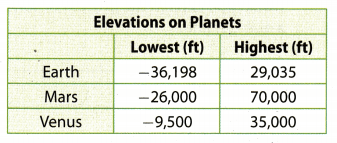
Astronomy Use the table for problems 20-21.
Texas Go Math Grade 7 Lesson 1.4 Answer Key 15

Question 20.
How much deeper is the deepest canyon on Mars than the deepest canyon on Venus?
Answer:
Deepest canyon on Mars is at -26000 feet
Deepest canyon on Venus is at -9500 feet
To calculate the difference we have to subtract these 2 numbers, and then take the absolute value of the result.
-26000 – (-9500) = -26000 + 9500
= -16500
|-16500| = 16500
The deepest canyon on Mars is 16500 feet deeper that the deepest canyon on Venus.

Question 21.
Persevere in Problem Solving What is the difference between Earth’s highest mountain and its deepest ocean canyon? What is the difference between Mars’s highest mountain and its deepest canyon? Which difference is greater? How much greater is it?
Answer:
To find the difference between the highest mountain and the deepest ocean canyon, we have to subtract the mountain height from the ocean depth, and then take the absolute value of the result
Earth:
29035 – (-36198) = 29035 + 36198
= 65233
|65233| = 65233

Mars:
70000 – (-26000) = 70000 + 26000
= 96000
|96000| = 96000

We can see that 96000 > 65233. To calculate how much, subtract 65233 from 96000.
96000 – 65223 = 30777

Question 22.
Pamela wants to make some friendship bracelets for her friends. Each friendship bracelet needs 5.2 inches of string.
a. If Pamela has 20 inches of string, does she have enough to make bracelets for 4 of her friends?
Answer:
First we need to ca[cu[ate how much are 4 bracelets long. We need to add 5.2 inches 4 times.
5.2 + 5.2 + 5.2 + 5.2 = 10.4 + 5.2 + 5.2
= 15.6 + 5.2
= 20.8
Since, 20.8 is greater than 20, she will not have enough to make for all of her 4 friends.

b. If so, how much string would she have left over? If not, how much more string would she need?
Answer:
To calculate how much more string she would need, we need to substract the length of string she has from the
length of string she needs.
20.8 – 20 = 0.8
She needs 0.8 inches more.

Question 23.
Jeremy is practicing some tricks on his skateboard. One trick takes him forward 5 feet, then he flips around and moves backwards 7.2 feet, then he moves forward again for 2.2 feet.
a. What expression could be used to find how far Jeremy is from his starting position when he finishes the trick?
Answer:
If the first trick takes him forward 5 feet, that means he goes +5 feet forward. Second trick takes him 7.2 feet back, that means we subtract -7.2 from 5. Third trick moves him +2 feet forwards, that means we add 2 feet to
previous position.
5 – 7.2 + 2

b. How far from his starting point is he when he finishes the trick? Explain
Answer:
We have to calculate the expression from a), and then take its absolute value to find how far is he from his starting position after the trick.
5 – 7.2 + 2 = -2.2 + 2
= -0.2
|-0.2| = 0.2
He is 0.2 feet away from the starting position.

Question 24.
Esteban has $20 from his allowance. There is a comic book he wishes to buy that costs $4.25, a cereal bar that costs $0.89, and a small remote control car that costs $ 10.99.
a. Does Esteban have enough to buy everything?
Answer:
We have to add all of the expenses, and then check if they are greater than Esteban’s allowance to cheek if he has enough.
4.25 + 0.89 + 10.99 = 5.14 + 10.99
= 16.13
20 > 16.13
The allowance is greater than the expenses. Thus. Esteban has enough money to buy everything.

b. if so, how much will he have left over? If not, how much does he still need?
Answer:
To find out how much will he have leftover, we need to subtract the expenses from the allowance.
20 – 16.13 = 3.87
Esteban will have $3.87 leftover.

H.O.T. Focus on Higher Order Thinking

Question 25.
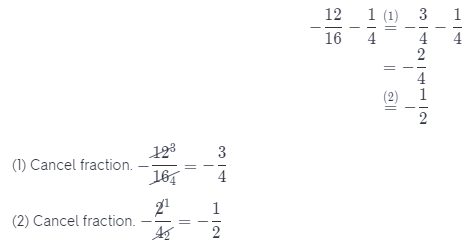
Look for a Pattern Show how you could use the Commutative Property to simplify the evaluation of the expression \(-\frac{7}{16}-\frac{1}{4}-\frac{5}{16}\)
Answer:
We can see that the first and the last member of the expression have the same denominator. Use the Commutative Property to switch second and third member. Now we have:
–\(\frac{7}{16}\) – \(\frac{5}{16}\) – \(\frac{1}{4}\)
Calculate the expression:
Texas Go Math Grade 7 Lesson 1.4 Answer Key 32

Go Math 7th Grade Answer Key Pdf Subtracting Rational Numbers Question 26.
Problem Solving The temperatures for five days in Kaktovik, Alaska, are given below.
-19.6 °F, -22.5 °F, -20.9 °F, -19.5 °F, -22.4 °F
Temperatures over the same 5-day period last year were 12 degrees lower. What were the highest and lowest temperatures over this period last year?
Answer:
If all temperatures were 12 degrees lower last year, then the highest/lowest temperature last year will be on the same day as the highest/Lowest temperature this year.
We can see that the lowest temperature this year is on the second day: -22.5° F, and that the highest temperature is on the fourth day: -19.5° F.
Since last year all temperatures were 12 degrees lower, we subtract 12 from the highest/lowest temperature this year.
-22.5 – 12 = -34.5
-19.5 – 12 = -31.5
The lowest temperature last year was -34.5° F.
The highest temperature last year was -31.5° F.

Question 27.
Make a Conjecture Must the difference between two rational numbers be a rational number? Explain.
Answer:
Yes, it must be a rational number.
We know that when we need to subtract one rational number from another, we need to find a common denominator, and then subtract numerators
Thus, our result will be a fraction.
Thus, a rational number

Question 28.
Look for a Pattern Evan said that the difference between two negative numbers must be negative. Was he right? Use examples to illustrate your answer.
Answer:
No, he was not right.
E.g.
–\(\frac{1}{4}\) – (-\(\frac{2}{4}\)) = –\(\frac{1}{4}\) + \(\frac{2}{4}\)
= \(\frac{1}{4}\)
If both numbers are negative, but minuend is greater than the subtracted, we will get a positive number as a result.

Texas Go Math Grade 7 Lesson 1.4 Answer Key Subtracting Rational Numbers Read More »

Texas Go Math Grade 7 Unit 1 Study Guide Review Answer Key

Refer to our Texas Go Math Grade 7 Answer Key Pdf to score good marks in the exams. Test yourself by practicing the problems from Texas Go Math Grade 7 Unit 1 Study Guide Review Answer Key.

Texas Go Math Grade 7 Unit 1 Study Guide Review Answer Key

Texas Go Math Grade 7 Unit 1 Exercise Answer Key

Write each mixed number as a whole number or decimal. Classify each number by naming the set or sets to which it belongs: rational numbers, integers, or whole numbers. (Lessons 1.1, 1.2)

Question 1.
\(\frac{3}{4}\) _____________
Answer:
Texas Go Math Grade 7 Unit 1 Study Guide Review Answer Key 8
0.75 belongs to the set of rational numbers.

Question 2.
\(\frac{8}{2}\) ______________
Answer:
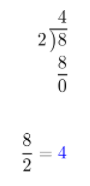
Texas Go Math Grade 7 Unit 1 Study Guide Review Answer Key 9
4 belongs to the set of integers. the set of whole numbers and the set of rational numbers.

Texas Go Math Grade 7 Unit 1 Answer Key Question 3.
\(\frac{11}{3}\) _______________
Answer:
Texas Go Math Grade 7 Unit 1 Study Guide Review Answer Key 10
\(3 . \overline{6}\) belongs to the set of rational numbers.

Question 4.
\(\frac{5}{2}\) _______________
Answer:
Texas Go Math Grade 7 Unit 1 Study Guide Review Answer Key 11
2.5 belongs to the set of rational numbers.

Find each sum or difference. (Lessons 1.3, 1.4)

Question 5.
-5 + 9.5 ____________
Answer:
= 9.5 – 5
= 4.5

Question 6.
\(\frac{1}{6}\) + (-\(\frac{5}{6}\)) ____________
Answer:
= \(\frac{1}{6}\) – \(\frac{5}{6}\)
= –\(\frac{4}{6}\)
= –\(\frac{2}{3}\)

Question 7.
-0.5 + (-8.5) _______________
Answer:
= -0.5 – 8.5
= -9

Question 8.
-3 – (-8) ___________
Answer:
= -3 + 8
= 5

Question 9.
5.6 – (-3.1) _________
Answer:
= 5.6 + 3.1
= 8.7

Unit 1 End of Unit Assessment Grade 7 Answer Key Question 10.
3\(\frac{1}{2}\) – 2\(\frac{1}{4}\) _____________
Answer:
Write mixed fractions as proper, then find a common denominator.
= \(\frac{7}{2}\) – \(\frac{9}{4}\)
= \(\frac{14-9}{4}\)
= \(\frac{5}{4}\)

Find each product or quotient. (Lessons 1.5, 1.6)

Question 11.
-9 × (-5) __________
Answer:
Product will be positive because signs are the same.
= 9 × 5
= 45

Question 12.
0 × (-7) ____________
Answer:
Any number multiplied by 0 is equal to 0.
= 0 × (-7)
= 0

Question 13.
-8 × 8 _____________
Answer:
The product will be negative because signs are different
= -(8 × 8)
= -64

Question 14.
– \(\frac{56}{8}\) _______________
Answer:
The quotient will be negative, because signs are different
= –\(\frac{56}{8}\)
= -7

Question 15.
\(\frac{-130}{-5}\) _____________
Answer:
The quotient will be positive, because signs are same.
= \(\frac{130}{5}\)
= 26

Unit 1 The Number System Answer Key 7th Grade Question 16.
\(\frac{34.5}{1.5}\) ______________
Answer:
Write decimal numbers as fractions:
\(\frac{\frac{345}{10}}{\frac{15}{10}}\)
Write complex fractions using division:
\(\frac{345}{10}\) ÷ \(\frac{15}{10}\)
Write using multiplication:
\(\frac{345}{10}\) × \(\frac{10}{15}\) = 23

Question 17.
–\(\frac{2}{5}\) (-\(\frac{1}{2}\)) (-\(\frac{5}{6}\)) ______________
Answer:
Find the product of first 2 factors. Both are negative, so the product is positive.
\(\frac{2}{5}\) (\(\frac{1}{2}\)) = \(\frac{1}{5}\)
Multiply the result by the third factor. One is negative, one is positive, so the product is negative.
–\(\frac{1}{5}\)(\(\frac{5}{6}\)) = –\(\frac{1}{6}\)

Question 18.
(\(\frac{1}{5}\)) (-\(\frac{5}{7}\)) (\(\frac{3}{4}\)) _____________
Answer:
Find the product of first 2 factors. One is negative, the other positive, so the product is negative.
–\(\frac{1}{5}\) (\(\frac{5}{7}\)) = –\(\frac{1}{7}\)
Multiply the result by the third factor. One is negative, one is positive, so the product is negative.
–\(\frac{1}{7}\) (\(\frac{3}{4}\)) = –\(\frac{3}{28}\)

Question 19.
Lei withdrew $50 from her bank account every day for a week. What was the change in her account in that week?
Answer:
Use negative number to represent withdrawal.
Find 7 × (-50):
7 × (-50) = -350
The change on Lei’s account that week was -$350.

Question 20.
In 5 minutes, a seal descended 24 feet. What was the average rate of change in the seal’s elevation per minute?
Answer:
Use negative number to represent descent in feet.
Find \(\frac{-24}{5}\):
\(\frac{-24}{5}\) = -4.8
Sears change in elevation is -4.8 feet per minute.

Texas Go Math Grade 7 Unit 1 Performance Task Answer Key

Question 1.
CAREERS IN MATH Urban Planner Armand is an urban planner, and he has proposed a site for a new town library. The site is between City Hall and the post office on Main Street.
Texas Go Math Grade 7 Unit 1 Study Guide Review Answer Key 1
The distance between City Hall and the post office is 6\(\frac{1}{2}\) miles. The library site is 1\(\frac{1}{4}\) miles closer to City Hall than it is to the post office.

a. Write 6\(\frac{1}{2}\) miles and 1\(\frac{1}{4}\) miles as decimals.
Answer:
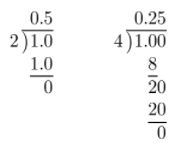
First, write \(\frac{1}{2}\) and \(\frac{1}{4}\) as decimals.
Texas Go Math Grade 7 Unit 1 Study Guide Review Answer Key 12
Then, add 6 and 1 to the result respectively.
6\(\frac{1}{2}\) = 6 + 0.5 = 6.5 miles
1\(\frac{1}{4}\) = 1 + 0.25 = 1.25 miles

b. Let d represent the distance from City Hall to the library site. Write an expression for the distance from the library site to the post office.
Answer:
d* = distance from Library site to the Post Office
d* = d + 1.25

c. Write an equation that represents the following statement: The distance from City Hall to the library site plus the distance from the library site to the post office is equal to the distance from City Hall to the post office.
Answer:
d + d* = 6.5

d. Solve your equation from part c to determine the distance from City Hall to the library site, and the distance from the post office to the library site.
Answer:
d + d* = 6.5
d + d + 1.25 = 6.5
2d = 5.25
d = 2.625

d* = d + 1.25
d* = 2.625 + 1.25
d* = 3.875

Unit 1 End of Unit Assessment Grade 7 Answer Key Math Question 2.
Sumaya is reading a book with 240 pages. She has already read 90 pages. She plans to read 20 more pages each day until she finishes the book.
a. Sumaya writes the equation 330 = -20d to find the number of days she will need to finish the book. Identify the errors that Sumaya made.
Answer:
First, Sumaya added 90 to 240 instead of subtracting 90 from 240. This is a mistake because if she read 90 pages, that means she has 90 pages Less to read, not more.
Second mistake is the negative sign. If the equation results in how many days more she has to read, it can not be negative.

b. Write and solve an equation to determine how many days Sumaya will need to finish the book. In your answer, count part of a day as a full day.
Answer:
First, find out how many more pages she has to read:
240 – 90 = 150
Correct equation:
20d = 150
d = \(\frac{150}{20}\)
d = \(\frac{15}{2}\)
d = 7\(\frac{1}{2}\)
Sumaya will need 8 days to finish the book.

c. Estimate how many days you would need to read a book about the same length as Sumaya’s book. What information did you use to find the estimate?
Answer:
Let the book have the same number of pages. I would, for example, read 10 pages a day.
10d = 330
d = 33
It would take me 33 days to read the book.

Question 3.
Jackson works as a veterinary technician and earns $12.20 per hour.
a. Jackson normally works 40 hours a week. In a normal week, what is his total pay before taxes and other deductions?
Answer:
Find 40 × 12.20:
40 × 12.20 = 488
His total pay is $488.

b. Last week, Jackson was ill and missed some work. His total pay before deductions was $372.10. Write and solve an equation to find the number of hours Jackson worked.
Answer:
Find 372.10 ÷ 12.20
372.10 ÷ 12.20 = 30.5
Jackson worked 30.5 hours last week.

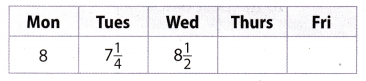
c. Jackson records his hours each day on a time sheet. Last week when he was ill, his time sheet was incomplete. How many hours are missing? Show your work.
Texas Go Math Grade 7 Unit 1 Study Guide Review Answer Key 2
Answer:
Find 40 – 30.5
40 – 30.5 = 9.5
Jackson missed 9.5 hours last week.

d. When Jackson works more than 40 hours in a week, he earns 1.5 times his normal hourly rate for each of the extra hours. Jackson worked 43 hours one week. What was his total pay before deductions? Justify your answer.
Answer:
His 40 hours pay is 488, as calculated iii a. He worked 43 – 40 = 3 hours overtime.
Find 3 × 12.20 × 1.5:
3 × 12.20 × 1.5 = 36.6 × 1.5
= 54.9
Now add 54.9 to his 10 hours pay.
Find 488 + 54.9:
488 + 54.9 = 5-12.9
Jackson’s pay that week was $542.9.

e. What is a reasonable range for Jackson’s expected yearly pay before deductions? Describe any assumptions you made in finding your answer.
Answer:
Let’s say that Jackson will be sick couple of days in a year, and he will work overtime couple of days in a year. When it all adds up, assumption is he will work 40 hours a week on average. There are 52 weeks in a year.
Find 488 × 52:
488 × 52 = 25376
Jackson will probably earn somewhere in between $25000 – $26000.

Texas Go Math Grade 7 Unit 1 Mixed Review Texas Test Prep Answer Key

Selected Response

Question 1.
What is -6\(\frac{9}{16}\) written as a decimal?
A. -6.625
B. -6.5625
C. -6.4375
D. -6.125
Answer:
B. -6.5625

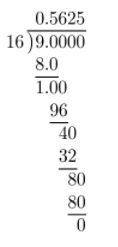
First, write \(\frac{9}{16}\) as a decimal.
Texas Go Math Grade 7 Unit 1 Study Guide Review Answer Key 13
Then, add 6 to the result.
6 + 0.5625 = 6.5625
Now, since the starting number was negative, this one has to be negative too.
-6\(\frac{9}{16}\) = -6.5625

7th Grade Unit 1 Performance Task Answer Key Question 2.
Working together, 6 friends pick 14\(\frac{2}{5}\) pounds of pecans at a pecan farm. They divide the pecans equally among themselves. How many pounds does each friend get?
A. 20\(\frac{2}{5}\) pounds
B. 8\(\frac{2}{5}\) pounds
C. 4\(\frac{3}{5}\) pounds
D. 2\(\frac{2}{5}\) pounds
Answer:
D. 2\(\frac{2}{5}\) pounds

Start with dividing 14\(\frac{2}{5}\) by 6:
14\(\frac{2}{5}\) ÷ 6
Write mixed fraction as proper fraction:
\(\frac{72}{5}\) ÷ 6
Write using multiplication:
\(\frac{72}{5}\) × \(\frac{1}{6}\) = \(\frac{12}{5}\)
= 2\(\frac{2}{5}\)
Each friend gets 2\(\frac{2}{5}\) pounds.

Question 3.
What is the value of (-3.25)(-1.56)?
A. -5.85
B. -5.07
C. 5.07
D. 5.85
Answer:
C. 5.07

The product will, be positive, because both factors are negative:
= 3.25(1.56)
= 5.07

Question 4.
Ruby ate \(\frac{1}{3}\) of a pizza, and Angie ate \(\frac{1}{5}\) of the pizza. How much of the pizza did they eat in all?
A. \(\frac{1}{15}\) of the pizza
B. \(\frac{1}{8}\) of the pizza
C. \(\frac{3}{8}\) of the pizza
D. \(\frac{8}{15}\) of the pizza
Answer:
D. \(\frac{8}{15}\) of the pizza

We have to add how much Ruby ate, and how much Angie ate
\(\frac{1}{3}\) + \(\frac{1}{5}\) = \(\frac{5+3}{15}\)
= \(\frac{8}{15}\)
Ruby and Angie ate \(\frac{8}{15}\) of the pizza.

Question 5.
Jaime had $37 in his bank account on Sunday. The table shows his account activity for the next four days. What was the balance in Jaime’s account after his deposit on Thursday?
Texas Go Math Grade 7 Unit 1 Study Guide Review Answer Key 3
A. $57.49
B. $59.65
C. $94.49
D. $138.93
Answer:
C. $94.49

Use positive numbers to represent the deposit. and negative numbers to represent withdrawal. Then, add it up to account balance before any deposits or withdrawals. 37.
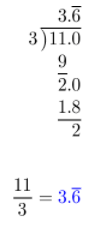
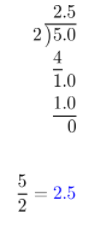
37 + 17.42 – 12.60 – 9.62 + 62.29 = 54.42 – 12.60 – 9.62 + 62.29
= 41.82 – 9.62 + 62.29
= 32.2 + 62.29
= 94.49
The balance in Jaimes’s account on Friday was $94.49.

7th Grade Math Study Guide Answers Unit 1 Question 6.
A used motorcycle is on sale for $3,600. Erik makes an offer equal to of this price. How much does Erik offer for the motorcycle?
A. $4,800
B. $2,700
C. $2,400
D. $900
Answer:
B. $2,700

Start by multiplying 3600 and \(\frac{3}{4}\):
3600 × \(\frac{3}{4}\) = 2700
Erik offers $2700.

Question 7.
To which set or sets does the number -18 belong?
A. integers only
B. rational numbers only
C. integers and rational numbers only
D. whole numbers, integers, and rational numbers
Answer:
C. integers and rational numbers only

We can see that -18 does not belong in the set of whole numbers
Next, notice that -18 belongs to the set of integers. That implies it belongs in the set of rational numbers, since the set of integers is the subset of the set of rational numbers.

Question 8.
Mrs. Rodriguez is going to use 6\(\frac{1}{3}\) yards of material to make two dresses. The larger dress requires 3\(\frac{2}{3}\) yards of material. How much material will Mrs. Rodriguez have left to use on the smaller dress?
A. 1\(\frac{2}{3}\) yards
B. 2\(\frac{1}{3}\) yards
C. 2\(\frac{2}{3}\) yards
D. 3\(\frac{1}{3}\) yards
Answer:
C. 2\(\frac{2}{3}\) yards

Start by subtracting 3\(\frac{2}{3}\) = \(\frac{11}{3}\) from 6\(\frac{1}{3}\) = \(\frac{19}{3}\)
\(\frac{19}{3}\) – \(\frac{11}{3}\) = \(\frac{8}{3}\)
= 2\(\frac{2}{3}\)
Mrs. Rodriguez will have 2\(\frac{2}{3}\) yards of material to use on the smaller dress.

Grade 7 Unit 1 Practice Problems Answer Key Question 9.
Winslow buys 1.2 pounds of bananas. The bananas cost $1.29 per pound. To the nearest cent, how much does Winslow pay for the bananas?
A. $1.08
B. $1.20
C. $1.55
D. $2.49
Answer:
C. $1.55

Start by multiplying 1.2 by 1.29:
1.2 × 1.29 = 1.548
≈ 1.55
Vins1ow pays $1.55 for the bananas.

Gridded Response

Question 10.
Roberta earns $7.65 per hour. How many hours does Roberta need to work to earn $24.48?
Texas Go Math Grade 7 Unit 1 Study Guide Review Answer Key 4
Answer:
Given earning per hour = $7.65
Given total earning of Robert = $24.48
Texas Go Math Grade 7 Unit 1 Study Guide Review Answer Key 14
Hence, for the earning of $24.48, he needs to work for 3.2 hours
The table will be made as per the below instructions:
1st coLumn: mark * sign
2nd coLumn: mark 0
3rd coLumn: mark 0
4th column: mark 0
5th coLumn: mark 3
6th coLumn: mark 2
7th column: mark 0

7th Grade Math Unit 1 Test Study Guide Question 11.
What is the product of the following expression?
(-2.2)(1 .5)(-4.2)
Texas Go Math Grade 7 Unit 1 Study Guide Review Answer Key 5
Answer:
Given expression in problem: (-2.2)(1.5)(-4.2)
(-2.2)(1.5)(-4.2) = (-3.3)( 4.2)
= 13.86
The table will be made as per below instructions:
1st column: mark * sign
2nd column : mark 0
3rd column: mark 0
4th column : mark 1
5th column : mark 3
6th column: mark 8
7th column: mark 6

Hot Tip! Correct answers in gridded problems can be positive or negative. Enter the negative skin in the first column when it is appropriate. Check your work!

Question 12.
Victor is ordering pizzas for a party. He would like to have \(\frac{1}{4}\) of a pizza for each guest. He can only order whole pizzas, not part of a pizza. If he expects 27 guests, how many pizzas should he order?


Texas Go Math Grade 7 Unit 1 Study Guide Review Answer Key 6
Answer:
Portion of pizza for each guest = \(\frac{1}{4}\)
Total number of guest in party = 27
Number of guest in 1 pizza = \(\frac{1}{\frac{1}{4}}\) = 4
Required pizza for party = \(\frac{27}{4}\) = 6.75
But it is mentioned in question that we can onLy order whole pizza.The required amount of pizza for 27 guest is 6.75, So Victor will order 7 pizzas.
The table will be made as per below instructions:
1st coLumn: mark – sign
2nd column : mark 0
3rd column: mark 0
4th column : mark 0
5th column : mark 7
6th column: mark 0
7th column: mark 0

Texas Go Math Grade 7 Unit 1 Vocabulary Preview Answer Key

Use the puzzle to preview key vocabulary from this unit. Unscramble the circled letters within found words to answer the riddle at the bottom of the page.
Texas Go Math Grade 7 Unit 1 Study Guide Review Answer Key 7

1. Any number that can be written as a ratio of two integers. (Lesson 1-1)
2. A group of items. (Lesson 1-2)
3. A set that is contained within another set. (Lesson 1-2)
4. Decimals in which one or more digits repeat infinitely. (Lesson 1-1)
5. The opposite of any number. (Lesson 13)
6. Decimals that have a finite number of digits. (Lesson 1-1)

Question 1.
Why were the two fractions able to settle their differences peacefully?
Answer:
They were both ___ ___ ___ ___ ___ ___ ___ !

Texas Go Math Grade 7 Unit 1 Study Guide Review Answer Key Read More »

Texas Go Math Grade 7 Lesson 2.1 Answer Key Unit Rates

Refer to our Texas Go Math Grade 7 Answer Key Pdf to score good marks in the exams. Test yourself by practicing the problems from Texas Go Math Grade 7 Lesson 2.1 Answer Key Unit Rates.

Texas Go Math Grade 7 Lesson 2.1 Answer Key Unit Rates

Texas Go Math Grade 7 Lesson 2.1 Explore Activity 1 Answer Key

Jeff hikes \(\frac{1}{2}\) mile every 15 minutes, or \(\frac{1}{4}\) hour. Lisa hikes \(\frac{1}{3}\) mile every 10 minutes, or \(\frac{1}{6}\) hour. How far do they each hike in 1 hour? 2 hours?

A. Use the bar diagram to help you determine how many miles Jeff hikes. How many \(\frac{1}{4}\)hours are in 1 hour? How far does Jeff hike in 1 hour?
Texas Go Math Grade 7 Lesson 2.1 Answer Key 1

B. Complete the table for Jeff’s hike.
Texas Go Math Grade 7 Lesson 2.1 Answer Key 2

C. Complete the bar diagram to help you determine how far Lisa hikes. How many miles does she hike in 1 hour?
Texas Go Math Grade 7 Lesson 2.1 Answer Key 3

D. Complete the table for Lisa’s hike.
Texas Go Math Grade 7 Lesson 2.1 Answer Key 4

Reflect

Question 1.
How did you find Jeff’s distance for \(\frac{3}{4}\) hour?
Answer:
I multiplied how many miles he walks in \(\frac{1}{4}\) by 3.

Unit Rates with Fractions 7th Grade Answer Key Question 2.
Which hiker walks farther in one hour? Which is faster?
Answer:
Both walkers walk 2 miles in 1 hour. Neither of them is faster than the other.

Your Turn

Question 3.
Paige mows \(\frac{1}{6}\) acre in \(\frac{1}{4}\) hour. How many acres does Paige mow per hour?
Answer:
Texas Go Math Grade 7 Lesson 2.1 Answer Key 8
Paige mows \(\frac{2}{3}\) acre per hour.

Question 4.
Greta uses 3 ounces of pasta to make \(\frac{3}{4}\) of a serving of pasta. How many ounces of pasta are there per serving?
Answer:
Texas Go Math Grade 7 Lesson 2.1 Answer Key 9
Greta uses 4 ounces of pasta per serving.

Question 5.
One tank is filling at a rate of \(\frac{3}{4}\) gallon per \(\frac{2}{3}\) minute. A second tank is filling at a rate of \(\frac{5}{8}\) gallon per \(\frac{1}{2}\) minute. Which tank is filling faster?
Answer:
First find rate in gallons per minute at which each tank is filling.
Texas Go Math Grade 7 Lesson 2.1 Answer Key 10
To find the unit rates, first rewrite the fractions.
Texas Go Math Grade 7 Lesson 2.1 Answer Key 11
To divide, multiply with the reciprocal.
Texas Go Math Grade 7 Lesson 2.1 Answer Key 12
Thus, Tank 2 is filling faster.

Texas Go Math Grade 7 Lesson 2.1 Guided Practice Answer Key

Question 1.
Brandon enters bike races. He bikes 8\(\frac{1}{2}\) miles every \(\frac{1}{2}\) hour. Complete the table to find how far Brandon bikes for each time interval. (Explore Activity)
Texas Go Math Grade 7 Lesson 2.1 Answer Key 5
Answer:
Texas Go Math Grade 7 Lesson 2.1 Answer Key 13
First, notice that every step of time is half an hour longer.
Thus. simply add the distance lie cross in half an hour to every successive distance box.
8\(\frac{1}{2}\) + 8\(\frac{1}{2}\) = 17
17 + 8\(\frac{1}{2}\) = 25\(\frac{1}{2}\)
25\(\frac{1}{2}\) + 8\(\frac{1}{2}\) = 34
34 + 8\(\frac{1}{2}\) = 42\(\frac{1}{2}\)

Find each unit rate. (Example 1)

Go Math Grade 7 Lesson 2.1 Answer Key Question 2.
Julio walks 3\(\frac{1}{2}\) miles in 1\(\frac{1}{4}\) hours.
Answer:
Determine the units of the rate.
The rate is the distance in mites per time in hours.
Find Julio’s rate of walking in distance walked per time.
Texas Go Math Grade 7 Lesson 2.1 Answer Key 14
Julio walks 2\(\frac{4}{5}\) miles per hour.

Question 3.
Kenny reads \(\frac{5}{8}\) page in \(\frac{2}{3}\) minute.
Answer:
Determine the units of the rate.
The rate is pages read per time in minutes.
Find Kenny’s rate of reading in pages read per time.
Texas Go Math Grade 7 Lesson 2.1 Answer Key 15
Kenny reads \(\frac{15}{16}\) pages per minute.

Question 4.
A garden snail moves \(\frac{1}{6}\) foot in \(\frac{1}{3}\) hour.
Answer:
Determine the units of the rate.
The rate is distance in feet per time in hours.
Find snails rate of moving in distance moved per time
Texas Go Math Grade 7 Lesson 2.1 Answer Key 16
Snail moves \(\frac{1}{2}\) foot per hour.

Question 5.
A fertilizer covers \(\frac{5}{8}\) square foot in \(\frac{1}{4}\) hour.
Answer:
Determine the units of the rate.
The rate is area covered in square feet per time in hours.
Find fertilizer’s rate of covering in area covered per time.
Texas Go Math Grade 7 Lesson 2.1 Answer Key 17
Fertilizer covers 2\(\frac{1}{2}\) square feet per hour.

Find each unit rate. Determine which is lower. (Example 2)

Lesson 2.1 Understand Unit Rate Answer Key Question 6.
Brand A: 240 mg sodium for \(\frac{1}{3}\) pickle or Brand B: 325 mg sodium for \(\frac{1}{2}\) pickle
Answer:
First find the rate in sodium per pickle at which each brand’s pickle contains sodium
Texas Go Math Grade 7 Lesson 2.1 Answer Key 18
To find the unit rates, first rewrite the fractions
Texas Go Math Grade 7 Lesson 2.1 Answer Key 19
To divide, multiply with the reciprocal
Texas Go Math Grade 7 Lesson 2.1 Answer Key 20
Thus, Brand 2’s pickles contain less sodium.

Question 7.
Ingredient C: \(\frac{1}{4}\) cup for \(\frac{2}{3}\) serving or Ingredient D: \(\frac{1}{3}\) cup for \(\frac{3}{4}\) serving
Answer:
First find rate in cup per serving at which each ingredient goes into the serving
Texas Go Math Grade 7 Lesson 2.1 Answer Key 21
To find the unit rates, first rewrite the fractions.
Texas Go Math Grade 7 Lesson 2.1 Answer Key 22
To divide, multiply with the reciprocal.
Texas Go Math Grade 7 Lesson 2.1 Answer Key 23
Thus, Ingredient C has a lower cup per serving rate.

Essential Question Check-In

Question 8.
How can you find a unit rate when given a rate?
Answer:
When we are given a rate, we need to divide one measurement with the other to get a unit rate.

Texas Go Math Grade 7 Lesson 2.1 Independent Practice Answer Key

Unit Rates with Fractions 7th Grade Answer Key Question 9.
The information for two pay-as-you-go cell phone companies is given.
Texas Go Math Grade 7 Lesson 2.1 Answer Key 6

a. What is the unit rate in dollars per hour for each company?
Answer:
First, find rate in dollars per hour at which each company bills phone calls
Texas Go Math Grade 7 Lesson 2.1 Answer Key 24
To find the unit rates, first rewrite the fractions
Texas Go Math Grade 7 Lesson 2.1 Answer Key 25
To divide, multiply with the reciprocal.
Texas Go Math Grade 7 Lesson 2.1 Answer Key 26

b. Analyze Relationships Which company offers the best deal? Explain your answer.
Answer:
Compare the unit rates.
On Cati \\\\Talk Time
2.84 \\\\\\\\> 2.5
Talk Time ¡s more affordable, because they charge Less for call.

c. What If? Another company offers a rate of $0.05 per minute. How would you find the unit rate per hour?
Answer:
We have to multiply the price by to 60 get dollars per hour.
0.05 × 60 = $3 per hour

d. Draw Conclusions Is the rate in part c a better deal than On Call or Talk Time? Explain.
Answer:
It is not, because they charge the most for a call, per hour.

Question 10.
Represent Real-World Problems Your teacher asks you to find a recipe that includes two ingredients with a rate of \(\frac{2 \text { units }}{3 \text { units }}\).
a. Give an example of two ingredients in a recipe that would meet this requirement.
Answer:
Corn flour and regular flour in unit of gram in a recipe for bread

b. If you needed to triple the recipe, would the rate change? Explain.
Answer:
The rate would not change. We would multiply both numerator and denominator by 3, that means the fraction would still have the same quotient.

Question 11.
A radio station requires DJs to play 2 commercials for every 10 songs they play. What is the unit rate of songs to commercials?
Answer:
First, divide number of songs by number of commercials.
10 ÷ 2 = 5
The unit rate of song to commercial is 5 songs for a commercial.

Go Math Book Grade 7 Answers How to find Unit Rate Question 12.
Multistep Terrance and Jesse are training for a long-distance race. Terrance trains at a rate of 6 miles every half hour, and Jesse trains at a rate of 2 miles every 15 minutes.
a. What is the unit rate in miles per hour for each runner?
Answer:
Find rate in miles per hour at which each runner trains.
Texas Go Math Grade 7 Lesson 2.1 Answer Key 27
To find the unit rates, first rewrite the fractions.
Texas Go Math Grade 7 Lesson 2.1 Answer Key 28
To divide, multiply with the reciprocal.
Texas Go Math Grade 7 Lesson 2.1 Answer Key 29

b. How long will each person take to run a total of 50 miles at the given rates?
Answer:
Divide each rate by 50.
Terrance:
\(\frac{50}{12}\) = \(\frac{25}{6}\)
= 4\(\frac{1}{6}\)
Jesse:
\(\frac{50}{8}\) = \(\frac{25}{4}\)
= 6\(\frac{1}{4}\)
Terrance would take 4\(\frac{1}{6}\) hours. Jesse would take 6\(\frac{1}{4}\) hours.

c. Sandra runs at a rate of 8 miles in 45 minutes. How does her unit rate compare to Terrance’s and to Jesse’s?
Answer:
Repeat as in a.
Texas Go Math Grade 7 Lesson 2.1 Answer Key 30
Sandra runs 10\(\frac{2}{3}\) miles per hour, which is faster than both Terrance and Jesse.

Go Math 7th Grade Lesson 2.1 Answer Key Pdf Question 13.
Analyze Relationships Eli takes a typing test and types all 300 words in an hour. He takes the test a second time and types the words in an hour. Was he faster or slower on the second attempt? Explain.
Answer:
He was faster the second time because he read the same number of words in less time.

H.O.T.S Focus On Higher Order Thinking

Question 14.
Justify Reasoning An online retailer sells two packages of protein bars.
Texas Go Math Grade 7 Lesson 2.1 Answer Key 7
a. Which package has the better price per bar?
Answer:
Divide the cost by the number of bars:
10-pack:
15.37 ÷ 10 = 1.537
≈ 1.54
12-pack:
15.35 ÷ 12 ≈ 1.28
12-pack has a better price per bar.

b. Which package has the better price per ounce?
Answer:
10-pack has 10 × 2.1 = 21 ounces
12-pack has 12 × 1.4 = 16.8 ounces
Without calculating we can see that the 10-pack has a better price per ounce, because the difference in cost is negligible, but the 10-pack has significantly more ounces.

c. Which package do you think is a better buy? Justify your reasoning.
Answer:
10-pack is a better buy. It does not matter which pack has a better price per bar, but the better price per ounce.

Question 15.
Check for Reasonableness A painter painted about half a room in half a day. Coley estimated the painter would paint 7 rooms in 7 days. Is Coley’s estimate reasonable? Explain.
Answer:
Coley’s estimate is reasonable. If the painter paints half a room in half a day, that means he paints a room in a day. Thus, he paints 7 rooms in 7 days.

Unit Rate Worksheet 7th Grade Answer Key Question 16.
Communicate Mathematical Ideas If you know the rate of a water leak in gallons per hour, how can you find the number of hours it takes for 1 gallon to leak out? Justify your answer.
Answer:
Divide 1 hour by the rate of a water leak.
E.g.
The rate of a water leak is 4 gallons per hour.
That means it will take \(\frac{1}{4}\) hour for 1 gallon to leak out.

Texas Go Math Grade 7 Lesson 2.1 Answer Key Unit Rates Read More »

Texas Go Math Grade 7 Lesson 1.5 Answer Key Multiplying Rational Numbers

Refer to our Texas Go Math Grade 7 Answer Key Pdf to score good marks in the exams. Test yourself by practicing the problems from Texas Go Math Grade 7 Lesson 1.5 Answer Key Multiplying Rational Numbers.

Texas Go Math Grade 7 Lesson 1.5 Answer Key Multiplying Rational Numbers

Your Turn

Question 1.
Use a number line to find 2(-35). __________
Texas Go Math Grade 7 Lesson 1.5 Answer Key 1
Answer:
Start at 0 Move 3.5 units to the left 2 times.
The result is -7.
Texas Go Math Grade 7 Lesson 1.5 Answer Key 2

Go Math Grade 7 Lesson 1.5 Answer Key Question 2.
Find -3(-1.25). __________
Texas Go Math Grade 7 Lesson 1.5 Answer Key 3
Answer:
First, find the product 3(-1.25).
Start at 0. Move 1.25 units to the left two times.
The result is -3.75.
This shows that 3 groups of -1.25 equals -3.75.
So, -3 groups of -1.25 must equal the opposite of -3.75.
-3(-1.25) = 3.75
Texas Go Math Grade 7 Lesson 1.5 Answer Key 10

Reflect

Question 3.
Look for a Pattern You know that the product of two negative numbers is positive, and the product of three negative numbers is negative. Write a rule for finding the sign of the product of n negative numbers.
Answer:
The product of n negative numbers will be positive if n is even, or negative if n is odd.

Your Turn

Find each product.

Question 4.
(-\(\frac{3}{4}\)) (-\(\frac{4}{7}\)) (-\(\frac{2}{3}\))
Answer:
First, find the product of the first two factors. Both factors are negative, so their product will be positive.
(-\(\frac{3}{4}\)) (-\(\frac{4}{7}\)) = +(\(\frac{3}{4}\) . \(\frac{4}{7}\))
= \(\frac{3}{7}\)
Now, multiply the result, which is positive, by the third factor, which is negative. The product will be negative
\(\frac{3}{7}\) (-\(\frac{2}{3}\)) = \(\frac{3}{7}\) (-\(\frac{2}{3}\))
= –\(\frac{2}{7}\)

Question 5.
(-\(\frac{2}{3}\)) (-\(\frac{3}{4}\)) (\(\frac{4}{5}\))
Answer:
First, find the product of the first two factors Both factors are negative, so their product will be positive.
(-\(\frac{2}{3}\)) (-\(\frac{3}{4}\)) = + (\(\frac{2}{3}\) . \(\frac{3}{4}\))
= \(\frac{2}{4}\)
Now, multiply the result, which is positive, by the third factor, which is positive. The product will be positive.
\(\frac{2}{4}\) (\(\frac{4}{5}\)) = \(\frac{2}{4}\) (\(\frac{4}{5}\)) = \(\frac{2}{5}\)

Question 6.
(\(\frac{2}{3}\)) (-\(\frac{9}{10}\)) (\(\frac{5}{6}\))
Answer:
First, find the product of the first two factors. The first factor is positive, second is negative, so their product will be negative.
(\(\frac{2}{3}\)) (-\(\frac{9}{10}\)) = – (\(\frac{2}{3}\) . \(\frac{9}{10}\))
= –\(\frac{1}{2}\)
Now, multiply the result, which is negative, by the third factor, which is positive. The product will be negative.
–\(\frac{2}{5}\) (\(\frac{5}{6}\)) = –\(\frac{2}{5}\) (\(\frac{5}{6}\)) = –\(\frac{1}{3}\)

Texas Go Math Grade 7 Lesson 1.5 Guided Practice Answer Key 

Use a number line to find each product. (Example 1 and Example 2)

Question 1.
5(-\(\frac{2}{3}\)) = _____________
Texas Go Math Grade 7 Lesson 1.5 Answer Key 4
Answer:
Start at 0. Move \(\frac{2}{3}\) to the left 5 times.
The result is –\(\frac{10}{3}\).
Texas Go Math Grade 7 Lesson 1.5 Answer Key 11

Question 2.
3(-\(\frac{1}{4}\)) = ____________
Texas Go Math Grade 7 Lesson 1.5 Answer Key 5
Answer:
Start at 0. Move \(\frac{1}{4}\) to the left 5 times.
The result is –\(\frac{3}{4}\).
Texas Go Math Grade 7 Lesson 1.5 Answer Key 12

Go Math 7th Grade Lesson 1.5 Answer Key Question 3.
-3(-\(\frac{4}{7}\)) = ____________
Texas Go Math Grade 7 Lesson 1.5 Answer Key 6
Answer:
First find the product 3(-4\(\frac{4}{7}\)).
Start at 0. Move \(\frac{4}{7}\) units to the left 3 times.
The result is –\(\frac{12}{7}\).
This shows that 3 groups of –\(\frac{4}{7}\) equals –\(\frac{12}{7}\).
So, -3 groups of –\(\frac{4}{7}\) must equal to the opposite of –\(\frac{12}{7}\).
-3(-\(\frac{4}{7}\)) = \(\frac{12}{7}\)
Texas Go Math Grade 7 Lesson 1.5 Answer Key 13

Question 4.
–\(\frac{3}{4}\) (-4) = ______________
Texas Go Math Grade 7 Lesson 1.5 Answer Key 7
Answer:
Use the commutative property to swap multiplier and multiplicand.
-4(-\(\frac{3}{4}\))
First, find the product 4(-\(\frac{3}{4}\)).
Start at 0. Move \(\frac{3}{4}\) units to the left 4 times.
The result is -3.
This shows that 4 groups of –\(\frac{3}{4}\) equals -3.
So, -4 groups of –\(\frac{3}{4}\) must equal to the opposite of -3.
-4(-\(\frac{3}{4}\)) = 3
Texas Go Math Grade 7 Lesson 1.5 Answer Key 14

Question 5.
4 (-3) = ___________
Answer:
Start at 0. Move 3 to the left 4 times
The result is -12.
Texas Go Math Grade 7 Lesson 1.5 Answer Key 15

Question 6.
-1.8 (5) = __________
Answer:
Use commutative property to swap multiplier and multiplicand.
5(-1.8)
Start at 0. Move 1.8 to the left 5 times.
The result is -9.
Texas Go Math Grade 7 Lesson 1.5 Answer Key 16

Go Math Grade 7 Lesson 1.5 Multiplying Rational Numbers Question 7.
-2 (-3.4) = ____________
Answer:
First find the product 2(-3.4)
Start at 0. Move 3.4 units to the left 2 time&
The result is -6.8.
This shows that 2 groups of -3.4 equals -6.8.
So, -2 groups of -3.1 must equal to the opposite of -6.8.
-2(-3.4) = 6.8
Texas Go Math Grade 7 Lesson 1.5 Answer Key 17

Question 8.
0.54 (8) = ___________
Answer:
Given in problem : 0.54 (8) =
To find the product of 0.54 (8) on number line we will move 0.54 8 times on right of the number line because the product of 0.54 × 8 is positive.
The vaLue of: 0.54 × 8 = 4.32
Texas Go Math Grade 7 Lesson 1.5 Answer Key 18

Question 9.
-5 (- 1.2) = __________
Answer:
First, find the product 5(-1.2).
Start at 0. Move 1.2 units to the left 5 times.
The result is -6.
This shows that 5 groups of -1.2 equals -6.
So, -5 groups of -1.2 must equal to the opposite of -6.
-5(-1.2) = 6
Texas Go Math Grade 7 Lesson 1.5 Answer Key 19

Question 10.
-2.4 (3) = ____________
Answer:
Use commutative property to swap multiplier and multiplicand.
3(-2.4)
Start at 0. Move 2.4 to the left 3 times.
The result is -7.2.
Texas Go Math Grade 7 Lesson 1.5 Answer Key 20

Multiply. (Example 3)

Question 11.
\(\frac{1}{2}\) × \(\frac{2}{3}\) × \(\frac{3}{4}\) = _________ × \(\frac{3}{4}\) = __________
Answer:
First, find the product of the first two factors. Both factors are positive, so their product will be positive.
\(\frac{1}{2}\) × \(\frac{2}{3}\) = \(\frac{1}{3}\)
Now, muLtiply the result, which is positive, by the third factor, which is positive. The product will be positive.
\(\frac{1}{3}\) × \(\frac{3}{4}\) = \(\frac{1}{4}\)

Question 12.
–\(\frac{4}{7}\) (-\(\frac{3}{5}\)) (-\(\frac{7}{3}\)) = (__________) × (-\(\frac{7}{3}\)) = __________
Answer:
First, find the product of the first two factors. Both factors are negative, so their product wiLl be positive
-(\(\frac{4}{7}\)) (-\(\frac{3}{5}\)) = \(\frac{12}{35}\)
Now, muLtiply the resuLt, which is positive, by the third factor, which is negative. The product wilL be negative.
(\(\frac{12}{35}\)) (-\(\frac{7}{3}\)) = (\(\frac{12}{35}\)) × (-\(\frac{7}{3}\)) = –\(\frac{4}{5}\)

Question 13.
–\(\frac{1}{8}\) × 5 × \(\frac{2}{3}\) = __________
Answer:
First find the product of the first two factor & First factor is negative, second is positive, so their product will be negative.
–\(\frac{1}{8}\) × 5 × \(\frac{2}{3}\) = –\(\frac{5}{8}\)
Now, multiply the result, which is negative, by the third factor, which is positive. The product will be negative.
– \(\frac{5}{8}\) × \(\frac{2}{3}\) = –\(\frac{5}{12}\)

Go Math Grade 7 Lesson 1.5 Answer Key Rational Numbers Question 14.
–\(\frac{2}{3}\) (\(\frac{1}{2}\)) (-\(\frac{6}{7}\)) = ___________
Answer:
First, find the product of the first two factors. The first factor is negative, second is positive, so their product will be negative.
(-\(\frac{2}{3}\)) (\(\frac{1}{2}\)) = –\(\frac{1}{3}\)
Now, multiply the result, which is negative, by the third factor, which is negative. The product will be positive.
(-\(\frac{1}{3}\)) (-\(\frac{6}{7}\)) = \(\frac{2}{7}\)

Question 15.
The price of one share of Acme Company declined $3.50 per day for 4 days in a row. What is the overall change in the price of one share? (Example 1)
Answer:
Use negative number to represent the drop in price.
Find 4(-3.50).
Start at 0. Move 3.50 units to the left 4 times
The result is -14.
The overall change in the price of one share is -$14.
Texas Go Math Grade 7 Lesson 1.5 Answer Key 21

Question 16.
In one day, 18 people each withdrew $100 from an ATM machine. What is the overall change in the amount of money in the ATM machine? (Example 1)
Answer:
Use a negative number to represent money withdrawn from an ATM machine.
Find 18(-100).
Start at 0. Move 100 units to the left 18 times
The result is -1800
The overall change in the amount of money in the ATM machine is -$1800
Texas Go Math Grade 7 Lesson 1.5 Answer Key 22

Essential Question Check-In

Go Math Lesson 1.5 Worksheet Answer Key 7th Grade Question 17.
Explain how you can find the sign of the product of two or more rational numbers.
Answer:
If we have an even number of factors with a negative sign, the product will be positive.
If we have an odd number of factors with a negative sign, the product will be negative.

Texas Go Math Grade 7 Lesson 1.5 Independent Practice Answer Key 

Question 18.
Financial Literacy Sandy has $200 in her bank account.
a. If she writes 6 checks for exactly $19.98, what expression describes the change in her bank account?
Answer:
Use a negative number to represent money lost with checks.
6(- 19.98)

b. What is her account balance after the checks are cashed?
Answer:
We need to calculate the expression from a. and then subtract it from 200.
6(-19.98) = -119.88
200 – 119.88 = 80.12
Her account balance after the checks are cashed is $80.12

Question 19.
Communicating Mathematical Ideas Explain, in words, how to find the product of -4(-1.5) using a number line. Where do you end up?
Answer:
First, find the product 4(-1.5).
Start at 0. Move 1.5 units to the left 4 times.
The result is -6.
This shows that 4 groups of -1.5 equal -6.
So, -4 groups of -1.5 must equal to the opposite of -6.
-4(-1.5) = 6
Texas Go Math Grade 7 Lesson 1.5 Answer Key 23

Question 20.
Greg sets his watch for the correct time on Wednesday. Exactly one week later, he finds that his watch has lost 3~ minutes. What is the overall change in time after 8 weeks?
Answer:
Time Lost by Greg’s watch in 1 week = 3\(\frac{1}{4}\) min
Time Lost by watch in 8 weeks = 8 × Time lest in 1 week
= 8 × 3\(\frac{1}{4}\)
= 8 × \(\frac{13}{4}\)
= 26 min
Hence, the time lost in 8 weeks will be 26 minutes.

Go Math 7th Grade Lesson 1.5 Multiplying Rational Numbers Answers Key Question 21.
A submarine dives below the surface, heading downward in three moves. If each move downward was 325 feet, where is the submarine after it is finished diving?
Answer:
Use a negative number to represent the drop ¡n depth.
Find 3(-325).
Start at 0. Move 325 units to the left 3 times.
The result is -975.
The submarine after finishing diving is at -975 feet.
Texas Go Math Grade 7 Lesson 1.5 Answer Key 24

Question 22.
Multistep For Home Economics class, Sandra has 5 cups of flour. She made 3 batches of cookies that each used 1.5 cups of flour. Write and solve an expression to find the amount of flour Sandra has left after making the 3 batches of cookies.
Answer:
We need to calculate how many cups of flour she used on 3 batches of cookies, and then subtract it from how many cups of flour she has, which is 5.
5 – 3(1.5)
First find 3(1.5).
Start at 0. Move 1.5 units to the right 3 times.
The result is 4.5.
Sandra used 4.5 cups of flour for 3 batches of cookies.
5 – 3(1.5) = 5 – 4.5
= 0.5
Sandra has 0.5 batches of flour left.
Texas Go Math Grade 7 Lesson 1.5 Answer Key 25

Question 23.
Critique Reasoning In class, Matthew stated, “I think that a negative is like an opposite. That is why multiplying a negative times a negative equals a positive. The opposite of negative is positive, so it is just like multiplying the opposite of a negative twice, which is two positives.” Do you agree or disagree with this statement? What would you say in response to him?
Answer:
I agree with his statement
Let p. q be rational Opposite of p is q if p = -q. So negative q is the opposite of p

Question 24.
Kaitlin is on a long car trip. Every time she stops to buy gas, she loses 15 minutes of travel time. If she has to stop 5 times, how late will she be getting to her destination?
Answer:
Use negative number to represent loss of minutes.
Find 5(-15).
Start at 0. Move 15 units to the left 5 times.
The result is -75.
Kaitlin lost 75 minutes, that means she will be 75 minutes late.
Texas Go Math Grade 7 Lesson 1.5 Answer Key 26

Question 25.
The table shows the scoring system for quarterbacks in Jeremy’s fantasy football league. In one game, Jeremy’s quarterback had 2 touchdown passes, 16 complete passes, 7 incomplete passes, and 2 interceptions. How many total points did Jeremy’s quarterback score?
Texas Go Math Grade 7 Lesson 1.5 Answer Key 8
Answer:
Start by writing the expression of Jeremy’s quarterback using the table.
2(6) + 16(0.5) + 7(-0.5) + 2(-1.5) = 12 + 8 – 3.5 – 3
= 20 – 3.5 – 3
= 16.5 – 3
= 13.5
Jeremy’s quarterback scored 13.5 points.

H.O.T. Focus on Higher Order Thinking.

Question 26.
Represent Real-World Problems The ground temperature at Brigham Airport is 12 °C. The temperature decreases by 6.8 °C for every increase of 1 kilometer above the ground. What is the temperature outside a plane flying at an altitude of 5 kilometers?
Answer:
Ground temperature of Brigham Airport = 12°
Height of the plane flying above ground = 5 Km
It is given in the problem that for every increase in 1 km above the ground the temperature decreases by 68°
So, the decrease in temperature will be 5 × 6.8 = 340
Temperature outside the plane = 12 – 34 = 220
Hence, the temperature outside the plane which is flying at an altitude of 5 kilometers will be -22°.

Multiplication Patterns Lesson 1.5 Go Math Answer Key Grade 7 Question 27.
Identify Patterns The product of four numbers, a, b, c, and d, is a negative number. The table shows one combination of positive and negative signs of the four numbers that could produce a negative product. Complete the table to show the seven other possible combinations.
Texas Go Math Grade 7 Lesson 1.5 Answer Key 9
Answer:
We need to have an odd number of negative signs in a row.
Put +/— accordingly.
Texas Go Math Grade 7 Lesson 1.5 Answer Key 27

Question 28.
Reason Abstractly Find two integers whose sum is -7 and whose product is 12. Explain how you found the numbers.
Answer:
Those numbers are 3 and 4.
3 +( – 4) = 7
3 (4) = 12
So, both integers need to be negative, because their sum needs to be negative, but their product needs to be positive.
Now, we cannot look at numbers less than, for example, 12, because their product needs to be equal to 12.
After some time, we find that our wanted numbers are -3 and -4.

Texas Go Math Grade 7 Lesson 1.5 Answer Key Multiplying Rational Numbers Read More »

Texas Go Math Grade 7 Lesson 1.2 Answer Key Relationships Between Sets of Rational Numbers

Refer to our Texas Go Math Grade 7 Answer Key Pdf to score good marks in the exams. Test yourself by practicing the problems from Texas Go Math Grade 7 Lesson 1.2 Answer Key Relationships Between Sets of Rational Numbers.

Texas Go Math Grade 7 Lesson 1.2 Answer Key Relationships Between Sets of Rational Numbers

Your Turn

Classify each number by naming the set or sets to which it belongs.

Question 1.
-8
Answer:
Integer, rational

Question 2.
-102.55 ……….
Answer:
Rational

Go Math Grade 7 Pdf Practice and Homework Lesson 1.2 Answer Key Question 3.
\(\frac{9}{2}\)
Answer:
Rational

Question 4.
3
Answer:
Whole, integer, rational.

Reflect

Question 5.
Make a Conjecture Jared said that every prime number is an integer. Do you agree or disagree? Explain.
Answer:
True. Every prime number is a whole number and every whole number is an integer. We can conclude that prime numbers are a subset of the set of integers.

Your Turn

Question 6.
Tell whether the statement “Some rational numbers are integers” is true or false. Explain your choice.
Answer:
True Integers are a subset of the set of rational numbers. Thus, some rational numbers are integers.

Question 7.
Describe a real-world situation that is best described by the set of rational numbers.
Answer:
A group of 5 friends go out and stop for a pizza. Pizza has 8 slices and there are 5 of you. Thus, every member of the crew gets \(\frac{8}{5}\) slices which is equal to 1\(\frac{3}{5}\) slices.
∴ Sharing a pizza with friends.

Texas Go Math Grade 7 Lesson 1.2 Guided Practice Answer Key 

Classify each number by naming the set or sets to which it belongs. (Example 1)

Question 1.
5
whole number, __________
Answer:
whole number, integer, rational number

Question 2.
– \(\frac{3}{14}\)
Answer:
rational number

Question 3.
-23
integer __________
Answer:
integer, rational number

Question 4.
4.5
Answer:
rational number

Tell whether the given statement is true or false. Explain your choice. (Example 2)

Question 5.
All rational numbers are integers. True / False
Answer:
False.
All, integers are rational numbers, but not all rational numbers are integers.
For E.g. 1.3 is a rational number, but not an integer.

Go Math Grade 7 Lesson 1.2 Answer Key Question 6.
Some integers are whole numbers. True / False
Answer:
True.
A Set of whole numbers is a subset of the set of integers, which implies that some integers are whole numbers.

Identify the set of numbers that best describes each situation. Explain your choice. (Example 3)

Question 7.
the number of students in a school
The set of best _____________ describes the situation because
Answer:
The set of whole numbers best describes the situation because the school contains a counting number of students. The possible outcomes are 0, 1, 2, 3, 4,… Since it’s impossible to have a negative number of students or a fraction of a student, the set of whole numbers is the most precise description.

Question 8.
possible points in a certain board game (…-3, -2, -1,0, 1, 2, 3,…….)
The set of ________________________ best describes the situation because
Answer:
The set of integers best describes the situation because all. possible points in a certain board game are integers.

Points are rational numbers also, but since points cannot be a fraction, the set of integers is the most precise description.

integers, alt possible points in a certain board game are integers Points are rational numbers aLso, but since any point cannot be a fraction, the set of integers is the most precise description.

Essential Question Check-In

Question 9.
How can you represent how the sets of whole numbers, integers, and rational numbers are related to each other?
Answer:
We can represent the relation using Venn’s diagram.

Texas Go Math Grade 7 Lesson 1.2 Independent Practice Answer Key 

Classify each number by naming the set or sets to which it belongs.

Question 10.
-9
Answer:
integer, rational number

Question 11.
7.5
Answer:
rational number

Go Math Grade 7 Answer Key Sets of Rational Number Question 12.
789
Answer:
whole number, integer, rational number

Question 13.
5\(\frac{3}{4}\)
Answer:
rational number

Fill in each Venn diagram with the whole numbers from 1 to 15. Remember that a composite number is a whole number greater than 1 that is not a prime number.

Question 14.
Whole Numbers from 1 to 15
Texas Go Math Grade 7 Lesson 1.2 Answer Key 1
Answer:
Texas Go Math Grade 7 Lesson 1.2 Answer Key 4
Venn’s diagram is solved.

Go Math Lesson 1.2 Relationships Between Sets of Rational Numbers Question 15.
Whole Numbers from 1 to 15
Texas Go Math Grade 7 Lesson 1.2 Answer Key 2
Answer:
Texas Go Math Grade 7 Lesson 1.2 Answer Key 5
Venn’s diagram is solved.

Tell whether the given statement is true or false. Explain your choice.

Question 16.
All rational numbers are whole numbers.
Answer:
False.
A set of whole numbers is a subset of a set of rational numbers, but not vice versa.
E.g. 3 is a rational number, but not a whole number.

Question 17.
All whole numbers are integers.
Answer:
True.
Every whole number is included in the set of integers.
A set of whole numbers is a subset of the set of integers.

Question 18.
Some whole numbers are negative.
Answer:
False
Whole numbers are greater or equal to zero, which means they are not negative.

Go Math 7th Grade Pdf Lesson 1.2 Understand Rational Numbers Answer Key Question 19.
No positive numbers are integers.
Answer:
False.
A set of whole numbers is a subset of integers. Thus, some integers are positive.

Identify the set of numbers that best describes each situation. Explain your choice.

Question 20.
possible number of miles you can walk in 1 hour
Answer:
The set of rational numbers best describes the situation.
You can walk any whole number of miles per hour, but you can also walk a fraction of a miLe per hour.

Question 21.
possible number of marbles in a jar
Answer:
The set of whole numbers best describes the situation.

The jar may contain no marbles or any counting number of marbLes.

The possible numbers of marbLes O, 1, 2, 3,… are whole numbers.

Whole numbers are also integers and rational numbers.

But since there cannot be a negative or a fractional number of bills, the set of whole numbers is the most precise description.

Question 22.
Represent Real-World Problems Using what you know of rational numbers, describe a real-world situation where a doctor might use the set of rational numbers on a daily basis.
Answer:
A doctor may prescribe 1\(\frac{1}{2}\) of some kind of pill to a patient

Daily intake of pills.

H.O.T.S Focus on Higher Order Thinking

Question 23.
Communicate Mathematical Ideas The letters in the Venn Divisible by 2 Divisible by 3 diagram represent whole numbers. Describe the numbers you would find in Section c, Section d, and Section e.
Texas Go Math Grade 7 Lesson 1.2 Answer Key 3
Answer:
Section c – Whole numbers divisible by 3, and not divisibLe by 2 or 5
Section d – WhoLe numbers divisible by 2 and 5, and not divisible by 3. Thus, divisible by 10.
Section e – Whole numbers divisible by 2, 3 and 5 Thus, divisible by 30

Go Math Answer Key 7th Grade Rational Numbers Answer Key Question 24.
Analyze Relationships Explain how the set of integers differs from the set of whole numbers.
Answer:
Set of whole numbers is a subset of the set of integers. Thus, set of integers contains set of whole numbers, but also contains negative numbers {…, 3, 2, 1, 0, 1, 2, 3, …}

Question 25.
Justify Reasoning Explain why a mixed number is not in the set of integers or whole numbers.
Answer:
Mixed number is not in the set of integers or whole numbers, because it contains a proper fraction. Thus, mixed fraction is in the set of rational numbers.

Texas Go Math Grade 7 Lesson 1.2 Answer Key Relationships Between Sets of Rational Numbers Read More »

Texas Go Math Grade 7 Lesson 1.3 Answer Key Adding Rational Numbers

Refer to our Texas Go Math Grade 7 Answer Key Pdf to score good marks in the exams. Test yourself by practicing the problems from Texas Go Math Grade 7 Lesson 1.3 Answer Key Adding Rational Numbers.

Texas Go Math Grade 7 Lesson 1.3 Answer Key Adding Rational Numbers

Reflect

Question 1.
Explain how to determine whether to move right or left on the number line when adding rational numbers.
Answer:
If the second addend is positive, we move to the right If not, we move to the left.

Your Turn

Use a number line to find each sum.

Question 2.
3 + 1\(\frac{1}{2}\) = ___________
Texas Go Math Grade 7 Lesson 1.3 Answer Key 1
Answer:
Start at 3
Move 1\(\frac{1}{2}\) units to the right because the second addend is positive
The result is 4.5
Texas Go Math Grade 7 Lesson 1.3 Answer Key 9

Go Math Lesson 1.3 Answer Key 7th Grade Question 3.
-2.5 + (-4.5) = ____________
Texas Go Math Grade 7 Lesson 1.3 Answer Key 2
Answer:
Start at 2.5.
Move |-4.5| = |4.5| units to the left because the second addend is negative.
The result is -7.
Texas Go Math Grade 7 Lesson 1.3 Answer Key 10

Reflect

Question 4.
Do -3 + 2 and 2 + (-3) have the same sum? Does it matter if the negative number is the first addend or the second addend?
Answer:
Yes, they have the same sum equal to 6. It doesn’t matter since adding is commutative.
(a + b = b + a)

Question 5.
Make a Conjecture Do you think the sum of a negative number and a positive number will always be negative? Explain your reasoning.
Answer:
No, it will not always be negative.
If the absolute value of a negative number is greater than the absolute value of a positive number, then the sum will be negative.
The sum will be positive ¡n other cases, expect when the absolute values are the same, then the sum will be equal to zero.

Your Turn

Use a number line to find each sum.

Question 6.
-8 + 5 = __________
Texas Go Math Grade 7 Lesson 1.3 Answer Key 3
Answer:
Start at -8.
Move 5 units to the right because the second addend is positive
The result is -3.
Texas Go Math Grade 7 Lesson 1.3 Answer Key 11

Question 7.
\(\frac{1}{2}\) + (-\(\frac{3}{4}\)) __________
Texas Go Math Grade 7 Lesson 1.3 Answer Key 4
Answer:
Start at \(\frac{1}{2}\).
Move |-\(\frac{3}{4}\)| = \(\frac{3}{4}\) units to the left because the second addend ¡s negative.
The result is –\(\frac{1}{4}\).
Texas Go Math Grade 7 Lesson 1.3 Answer Key 12

Go Math Grade 7 Lesson 1.3 Answer Key Question 8.
-1 + 7 = ____________
Texas Go Math Grade 7 Lesson 1.3 Answer Key 5
Answer:
Start at -1.
Move 7 units to the right because the second added is positive
The result is 6.
Texas Go Math Grade 7 Lesson 1.3 Answer Key 13

Your Turn

Use a number line to find each sum.

Question 9.
2\(\frac{1}{2}\) + (-2\(\frac{1}{2}\)) = ___________
Texas Go Math Grade 7 Lesson 1.3 Answer Key 6
Answer:
Start at 2\(\frac{1}{2}\).
Move |-2\(\frac{1}{2}\)| = 2\(\frac{1}{2}\) units to the left because the second addend is negative.
The result is 0.
Texas Go Math Grade 7 Lesson 1.3 Answer Key 14

Question 10.
-4.5 + 4.5 = _________
Texas Go Math Grade 7 Lesson 1.3 Answer Key 6
Answer:
Start at -4.5.
Move 4.5 units to the right because the second addend is positive.
The result is 0.
Texas Go Math Grade 7 Lesson 1.3 Answer Key 15

Your Turn

Find each sum.

Question 11.
-1.5 + 3.5 + 2 = ____________
Answer:
Start by grouping numbers with the same sign.
= -1.5 – (3.5 + 2) ………… (1)
= -1.5 – 5.5 …………. (2)
= 4 …………. (3)
(1) Associative property
(2) Add the numbers inside the parentheses.

Question 12.
3\(\frac{1}{4}\) + (-2) + (-2\(\frac{1}{4}\)) = __________
Answer:
Start by grouping numbers with the same sign.
= 3\(\frac{1}{4}\) + ((-2) + (-2\(\frac{1}{4}\))) …………. (1)
= 3\(\frac{1}{4}\) + (-4\(\frac{1}{4}\)) ………….. (2)
= -1 …………. (3)
(1) Associative property
(2) Add the numbers inside the parentheses.

Go Math Grade 7 Pdf Algebra Lesson 1.3 Properties Answer Key Question 13.
-2.75 + (-3.25) + 5 = _________
Answer:
Start by grouping numbers with the same sign.
= (-2.75 + (-3.25)) + 5 …………….. (1)
= -6 + 5 ………… (2)
= -1 ………… (3)
(1) Associative property
(2) Add the numbers inside the parentheses.

Question 14.
15 + 8 + (-3) = ___________
Answer:
Start by grouping numbers with the same sign.
= (15 + 8) + (-3) ……………. (1)
= 23 + (-3) ………… (2)
= 20 …………… (3)
(1) Associative property
(2) Add the numbers inside the parentheses.

Texas Go Math Grade 7 Lesson 1.3 Guided Practice Answer Key

Use a number line to find each sum. (Example 1 and Example 2)

Question 1.
-3 + (-1.5) = ___________
Texas Go Math Grade 7 Lesson 1.3 Answer Key 6
Answer:
Start at -3.
Move |-1.5| = 1.5 units to the left because the second addend is negative.
The result is -4.5.
Texas Go Math Grade 7 Lesson 1.3 Answer Key 16

Question 2.
1.5 + 3.5 = ___________
Texas Go Math Grade 7 Lesson 1.3 Answer Key 6
Answer:
Start at 1.5.
Move 3.5 units to the right because the second addend is positive.
The result is 5.
Texas Go Math Grade 7 Lesson 1.3 Answer Key 17

Question 3.
\(\frac{1}{4}\) + \(\frac{1}{2}\) = ___________
Texas Go Math Grade 7 Lesson 1.3 Answer Key 7
Answer:
Start at \(\frac{1}{4}\)
Move \(\frac{1}{2}\) units to the right because the second addend is positive.
The result is \(\frac{3}{4}\).
Texas Go Math Grade 7 Lesson 1.3 Answer Key 18

Question 4.
-1\(\frac{1}{2}\) + (-1\(\frac{1}{2}\)) = ____________
Texas Go Math Grade 7 Lesson 1.3 Answer Key 6
Answer:
Start at -1\(\frac{1}{2}\).
Move |-1\(\frac{1}{2}\)| = 1\(\frac{1}{2}\) units to the left because the second addend is negative.
The result is -3.
Texas Go Math Grade 7 Lesson 1.3 Answer Key 19

Go Math 7th Grade Lesson 1.3 Add Fractions Question 5.
3 + (-5) = __________
Texas Go Math Grade 7 Lesson 1.3 Answer Key 6
Answer:
Start at 3.
Move |-5 | = 5 units to the left because the second addend is negative.
The resuLt is -2.
Texas Go Math Grade 7 Lesson 1.3 Answer Key 20

Question 6.
-1.5 + 4 = ___________
Texas Go Math Grade 7 Lesson 1.3 Answer Key 6
Answer:
Start at -1.5
Move 4 units to the right because the second addend ¡s posit ive
The result is 2.5.
Texas Go Math Grade 7 Lesson 1.3 Answer Key 21

Question 7.
Victor borrowed $21.50 from his mother to go to the theater. A week later, he paid her $21.50 back. How much does he still owe her? (Example 3)
Answer:
Use a positive number to represent money Victor borrowed from his mother and a negative number to represent money Victor paid back.
Find 21.5 + (-21.5).
Start at 21.5.
Move |-21.5| = 21.5 units to the left because the second addend is negative.
The result is 0. That means he no longer owes her money.
Texas Go Math Grade 7 Lesson 1.3 Answer Key 22
Victor owes his mother $0.

Question 8.
Sandra used her debit card to buy lunch for $8.74 on Monday. On Tuesday, she deposited $8.74 back into her account. What is the overall increase or decrease in her bank account? (Example 3)
Answer:
We use a positive number to represent the money she deposited into her account, and a negative number to represent the money she spent to buy Lunch.
Find -8.74 + 8.74.
Start at – 8.74.
Move 8.74 units to the right because the second addend is positive.
The result is 0. That means there is no increase or decrease.
Texas Go Math Grade 7 Lesson 1.3 Answer Key 23
There is no increase or decrease.

Find each sum without using a number line. (Example 4)

Question 9.
2.75 + (-2) + (-5.25) = __________
Answer:
Start by grouping numbers with the same sign.
= 2.75 + ((-2) + (-5.25)) …………. (1)
= 2.75 + (-7.25) …………. (2)
= -4.5 ………… (3)
(1) Associative property
(2) Add the numbers inside the parentheses.

Question 10.
-3 + (1\(\frac{1}{2}\)) + (2\(\frac{1}{2}\)) = ____________
Answer:
Start by grouping numbers with the same sign.
= -3+ ((1\(\frac{1}{2}\)) + (2\(\frac{1}{2}\)) ………… (1)
= -3 + (4) ………….(2)
= 1 …………. (3)
(1) Associative property
(2) Add the numbers inside the parentheses.

Go Math Grade 7 Lesson 1.3 Rational Numbers Question 11.
-12.4 + 9.2 + 1 = ___________
Answer:
Start by grouping numbers with the same sign.
= -12.4 + (9.2 + 1) ………… (1)
= -12.4 + (10.2) ………….(2)
= -2.2 …………. (3)
(1) Associative property
(2) Add the numbers inside the parentheses.

Question 12.
-12 + 8 + 13 = ____________
Answer:
Start by grouping numbers with the same sign.
= -12 + (8 + 13) ………… (1)
= -12 + (21) ………….(2)
= 9 …………. (3)
(1) Associative property
(2) Add the numbers inside the parentheses.

Question 13.
4.5 + (-12) + (-4.5) = ____________
Answer:
Start by grouping numbers with the same sign.
= 4.5 + ((-12) + (-4.5)) ………… (1)
= 4.5 + (-16.5) ………….(2)
= -12 …………. (3)
(1) Associative property
(2) Add the numbers inside the parentheses.

Question 14.
\(\frac{1}{4}\) + (-\(\frac{3}{4}\)) = __________
Answer:
= – \(\frac{2}{4}\) …………… (1)
= – \(\frac{1}{2}\) …………… (2)
(1) Cancel fraction.

Question 15.
-4\(\frac{1}{2}\) + 2 = _____________
Answer:
= -2\(\frac{1}{2}\)

Question 16.
-8 + (-1\(\frac{1}{8}\)) = ___________
Answer:
= -9\(\frac{1}{8}\)

Essential Question Check-In

Question 17.
How can you use a number line to find the sum of -4 and 6?
Answer:
Start at the -4.
Move |6| = 6 units to the right because the second added is positive.
The result is 2.

Texas Go Math Grade 7 Lesson 1.3 Independent Practice Answer Key

Question 18.
Samuel walks forward 19 steps. He represents this movement with a positive 19. How would he represent the opposite of this number?
Answer:
He would represent the opposite of positive 19 with negative 19: -19

Go Math Lesson 1.3 7th Grade Add Fractions Question 19.
Julia spends $2.25 on gas for her lawn mower. She earns $15.00 mowing her neighbor’s yard. What is Julia’s profit?
Answer:
Julia earns $15.00 and spends/Loses $2.25. That means we have to add $15 to her gas expenses of $2.25.
-2.25 + 15 = 12.75
Julia’s profit is $12.75

Question 20.
A submarine submerged at a depth of -35.25 meters dives an additional 8.5 meters. What is the new depth of the submarine?
Answer:
If a submarine is at a depth of -35.25 meters, and dives an additional 8.5 meters, that means we have to add another -8.5 meters to original depth.
-35.25 + (-8.5) = -43.75
New depth of the submarine is -43.75 meters.

Question 21.
Renee hiked for 4\(\frac{3}{4}\) miles. After resting, Renee hiked back along the same route for 3\(\frac{1}{4}\) miles. How many more miles does Renee need to hike to return to the place where she started?
Answer:
We conclude that Renee has to hike 4\(\frac{3}{4}\) miles back. She already hiked 3\(\frac{1}{4}\) in opposite direction. To find out how many miles more Renee has to hike, we have to add negative 3\(\frac{1}{4}\) to 4\(\frac{3}{4}\).
4\(\frac{3}{4}\) + (-3\(\frac{1}{4}\)) = 1\(\frac{2}{4}\)
= 1\(\frac{1}{2}\) miles
(1) Cancel fraction.

Question 22.
Geography The average elevation of the city of New Orleans, Louisiana, is 0.5 m below sea level. The highest point in Louisiana is Driskill Mountain at about 163.5 m higher than New Orleans. How high is Driskill Mountain?
Answer:
The elevation of New Orleans is -0.5 meters. Driskill Mountain is at 163.5 m higher than New OrLeans To find out how high is Driskitl Mountain, we have to add -0.5 to 163.5.
163.5 + (-0.5) = 163
Driskill mountain is 163 m high.

Question 23.
Problem Solving A contestant on a game show has 30 points. She answers a question correctly to win 15 points. Then she answers a question incorrectly and loses 25 points. What is the contestant’s final score?
Answer:
If the contestant starts with 30 points, then wins 15 points and Lastly loses 25 points, or wins -25 points, we add 30, 15 and -25 together
30 + 15 + (-25) = 45 + (-25)
= 20
Contestant’s final score is 20 points.

Financial Literacy Use the table for 24-26. Kameh owns a bakery. He recorded the bakery income and expenses in a table.
Texas Go Math Grade 7 Lesson 1.3 Answer Key 8

Question 24.
In which months were the expenses greater than the income? Name the month and find how much money was lost.
Answer:
We can easily Look at the table and find where the expenses are greater than the income.
These months are January and February.
Calculate each month separately by adding expenses and negative income.
January:
1290.60 + (-1205) = 85.60
February:
1345.44 + (-1183) = 162.44

January: $85.60, February: $162.44

Question 25.
In which months was the income greater than the expenses? Name the months and find how much money was gained each of those months.
Answer:
We can easily Look at the table and find where the income is greater than the expenses.
These months are: June, July, August
Calculate each month separately by adding income and negative expenses.
June: 2413 + (-2106.23) = 309.77
July: 2260 + (-1958.50) = 301.50
August: 2183 + (-1845.12) = 337.88

June: $309.77, July: $301.50, August: $337.88

Question 26.
Communicate Mathematical Ideas If the bakery started with an extra $250 from the profits in December, describe how to use the information in the table to figure out the profit or loss of money at the bakery by the end of August. Then calculate the profit or loss.
Answer:
To determine the profit of these 6 months. we add how much has bakery gained/lost money per month.
-85.60 + (- 162.44) + 0+ 309.77 + 301.50 + 337.88 = 218.01 + 0 + 309.7 + 301.50 – 337.88
= -248.04 + 309.77 + 301.50 + 337.88
= 61.73 + 301.50 + 337.88
= 363.23 + 337.88
= 710.11
Finally, we add the profit from December ($250) and the profit/loss of these 6 months.
250 + 710.11 = 951.11
The bakery has a profit of $951.11.

Question 27.
Vocabulary -2 is the ______________ of 2.
Answer:
-2 is the opposite of 2.

Question 28.
The basketball coach made up a game to play where each player takes 10 shots at the basket. For every basket made, the player gains 10 points. For every basket missed, the player loses 15 points.
a. The player with the highest score sank 7 baskets and missed 3. What was the highest score?
Answer:
First, we have to add 10 points 7 times, then add -15 points 3 times.
10 + 10 + 10 + 10 + 10 + 10 + 10 + (-15) + (-15) + (-15) = ………. = 70 + (-35)
= 35

b. The player with the lowest score sank 2 baskets and missed 8. What was the lowest score?
Answer:
10 + 10 + (-15) + (-15) + (-15) + (-15) + (-15) + (-15) + (-15) + (-15) = ……. = 20 + (-120)
= -100

c. Write an expression using addition to find out what the score would be if a player sank 5 baskets and missed 5 baskets.
Answer:
First, we have to add 10 points 5 times, then add -15 points 5 times.
10 + 10 + 10 + 10 + 10 + (-15) + (-15) + (-15) + (-15) + (-15) = ….. = 50 + (-105)
= -65

H.O.T.S Focus on Higher Order Thinking

Question 29.
Communicate Mathematical Ideas Explain the different ways it is possible to add two rational numbers and get a negative number.
Answer:
We can get a negative number if both addends are negative. Also, if only one addend is negative, then its absolute value must be greater than the second addend’s absolute value.

Question 30.
Explain the Error A student evaluated -4 + x for x = -9\(\frac{1}{2}\) and got the answer of 5\(\frac{1}{2}\). What might the student have done wrong?
Answer:
The student might have overseen that the x is negative and calculated as the x was equal to 9\(\frac{1}{2}\).

Lesson 1.3 Add Fractions Go Math Grade 7 Question 31.
Draw Conclusions Can you find the sum [5.5 + (-2.3)] + (-5.5 + 2.3) without performing any additions?
Answer:
Yes, we can find the sum without performing any addition.
We can see that the square brackets don’t have any use in the expression.
Then, we can move -5.5 to its own bracket and separate it from 2.3, nothing will change.
Now we have:
5.5 + (-2.3) + (-5.5) + 2.3
Now, reorganize the expression by changing places of the 2 inner addends.
5.5 + (-5.5) + (-2.3) + 2.3
It’s easy to see that we are adding 2 pairs of opposite numbers. Since the sum of opposite numbers is equal to zero, the sum of our expression is equal to zero.

Texas Go Math Grade 7 Lesson 1.3 Answer Key Adding Rational Numbers Read More »

Scroll to Top