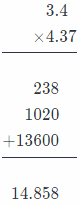
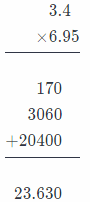
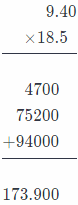
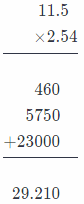
Prasanna

Texas Go Math Grade 6 Module 3 Quiz Answer Key

Refer to our Texas Go Math Grade 6 Answer Key Pdf to score good marks in the exams. Test yourself by practicing the problems from Texas Go Math Grade 6 Module 3 Quiz Answer Key.

Texas Go Math Grade 6 Module 3 Quiz Answer Key

Texas Go Math Grade 6 Module 3 Ready to Go On? Answer Key

3.1 Multiplying Fractions

Multiply.

Question 1.
\(\frac{4}{5} \times \frac{3}{4}\)
Answer:
First we need to write the problem as a single fraction.
After that, we need to multiply numerators and denominators and then simplify by dividing by the GCF. Here, the GCF of 12 and 20 is 4.
Finally, we will write the answer in the simplest form. So, we have the following:
Texas Go Math Grade 6 Module 3 Quiz Answer Key 2
So, the product is \(\frac{3}{5}\)

Go Math Grade 6 Module 3 Answer Key Question 2.
\(\frac{5}{7} \times \frac{9}{10}\)
Answer:
First, we need to write the problem as a single fraction.
After that, we need to multiply numerators and denominators and then simplify by dividing by the GCF. Here, the GCF of 45 and 70 is 5.
Finally, we will write the answer in the simplest form. So, we have the following:
Texas Go Math Grade 6 Module 3 Quiz Answer Key 3
So, the product is \(\frac{9}{14}\).

Question 3.
Fred had 264 books in his personal library. He donated \(\frac{2}{11}\) of these books to the public library. How many books did he donate?
Answer:
In order to find how many books Fred donated, we have to multiply 264 by \(\frac{2}{11}\) so, we have the following:
Texas Go Math Grade 6 Module 3 Quiz Answer Key 4
The conclusion is that Fred donated 48 books to the public library.

3.2 Multiplying Mixed Numbers

Multiply.

Question 4.
\(\frac{3}{8} \times 2 \frac{1}{2}\)
Answer:
First we need to rewrite the mixed number as a fraction greater than 1. After that we have to simplify before multiplying using the GCF and rewrite the fraction. Finally, multiply numerators and denominators and write the result in the simplest form.
So, we have the following:
Texas Go Math Grade 6 Module 3 Quiz Answer Key 5
The result is \(\frac{15}{16}\).

Grade 6 Module 3 Quiz Answer Key Question 5.
\(3 \frac{3}{5} \times \frac{5}{6}\)
Answer:
First, we need to rewrite the mixed number as a fraction greater than 1. After that, we have to simplify before multiplying using the GCF and rewrite the fraction. Finally, multiply numerators and denominators and write the result in the simplest form.
So, we have the following:
Texas Go Math Grade 6 Module 3 Quiz Answer Key 6
The result is 3.

Question 6.
Jamal and Dorothy were hiking and had a choice between two trails. One was 5\(\frac{1}{3}\) miles long, and the other was 1\(\frac{3}{4}\) times as long. How long was the longer trail?
Answer:
In order to calculate how long was the longer trail, we have to multiply 5\(\frac{1}{3}\) and 1\(\frac{3}{4}\).
We have to rewrite each mixed number as a fraction greater than 1.
Then multiply numerators and denominators, but before that we need to simplify using the GCF and rewrite the fraction.
At the end, we will write the result in the simplest form.
We have the following:
Texas Go Math Grade 6 Module 3 Quiz Answer Key 7
So, the longer trail was 9\(\frac{1}{3}\) miles long.

3.3 Dividing Fractions

Divide.

Question 7.
\(\frac{7}{8} \div \frac{3}{4}\)
Answer:
First, we will rewrite division as multiplication, using the reciprocal of the division. After that we will multiply the numerators and denominators and finally write the answer in the simplest form. So, we have the following:
Texas Go Math Grade 6 Module 3 Quiz Answer Key 8
The result is \(\frac{4}{3}\).

Module 3 Test Answers Go Math Grade 6 Question 8.
\(\frac{4}{5} \div \frac{6}{7}\)
Answer:
First, we will rewrite division as multiplication, using the reciprocal of the division. After that, we will multiply the numerators and denominators and finally write the answer in the simplest form. So, we have the following:
Texas Go Math Grade 6 Module 3 Quiz Answer Key 9
The result is \(\frac{14}{15}\).

Question 9.
\(\frac{1}{3} \div \frac{7}{9}\)
Answer:
First, we will rewrite division as multiplication, using the reciprocal of the division. After that we will multiply the numerators and denominators and finally write the answer in the simplest form. So, we have the following:
Texas Go Math Grade 6 Module 3 Quiz Answer Key 10
The result is \(\frac{3}{7}\).

Question 10.
\(\frac{1}{3} \div \frac{5}{8}\)
Answer:
First, we will rewrite division as multiplication, using the reciprocal of the division. After that we will multiply the numerators and denominators and finally write the answer in the simplest form. So, we have the following:
Texas Go Math Grade 6 Module 3 Quiz Answer Key 11
The result is \(\frac{8}{15}\).

3.4 Dividing Mixed Numbers

Divide.

Question 11.
\(3 \frac{1}{3} \div \frac{2}{3}\)
Answer:
First we need to rewrite the mixed numbers as a fractions grater than 1.
Then rewrite the problem as multiplication using the reciprocal of the second fraction. After that, we will simplify using the GCF and multiply the numerators and denominators. Finally, we will write the result as a mixed number if it is possible. So, we have the following:
Texas Go Math Grade 6 Module 3 Quiz Answer Key 12
The result is 5.

Module 3 Quiz Answers Go Math Grade 6 Question 12.
\(1 \frac{7}{8} \div 2 \frac{2}{5}\)
Answer:
First, we need to rewrite the mixed numbers as fractions grater than 1.
Then rewrite the problem as multiplication using the reciprocal of the second fraction. After that, we will simplify using the GCF and multiply the numerators and denominators. Finally, we will write the result as a mixed number if it is possible. So, we have the following:
Texas Go Math Grade 6 Module 3 Quiz Answer Key 13
The result is \(\frac{25}{32}\)

Question 13.
\(4 \frac{1}{4} \div 4 \frac{1}{2}\)
Answer:
First we need to rewrite the mixed numbers as fractions grater than 1.
Then rewrite the problem as multiplication using the reciprocal of the second fraction. After that, we will simplify using the GCF and multiply the numerators and denominators. Finally, we will write the result as a mixed number if it is possible. So, we have the following:
Texas Go Math Grade 6 Module 3 Quiz Answer Key 14
The result is \(\frac{17}{18}\)

Question 14.
\(8 \frac{1}{3} \div 4 \frac{2}{7}\)
Answer:
First we need to rewrite the mixed numbers as a fractions grater than 1.
Then rewrite the problem as multiplication using the reciprocal of the second fraction. After that, we will simplify using the GCF and multiply the numerators and denominators. Finally, we will write the result as a mixed number if it is possible. So, we have the following:
Texas Go Math Grade 6 Module 3 Quiz Answer Key 15
The result is \(\frac{35}{18}\) = 1\(\frac{17}{18}\).

Essential Question

Go Math Grade 6 Module 3 Answer Key Pdf Question 15.
Describe a real-world situation that is modeled by multiplying two fractions or mixed numbers.
Answer:
For, example, a real-world situation that would be appropriate to be modeled by multiplying two fractions or mixed numbers is the following.
Jane has 150\(\frac{1}{2}\) grams of chocolate and she wants to split it into three friends.
How much chocolate will each friend get?

Jane has 150\(\frac{1}{2}\) grams of chocolate and she wants to split it into three friends.
How much chocolate will each friend get?

Texas Go Math Grade 6 Module 3 Mixed Review Texas Test Prep Answer Key

Texas Test Prep

Question 1.
Which of the following statements is correct?
(A) The product of \(\frac{3}{4}\) and \(\frac{7}{8}\) is less than \(\frac{7}{8}\).
(B) The product of 1\(\frac{1}{3}\) and \(\frac{9}{10}\) is less than \(\frac{9}{10}\).
(C) The product of \(\frac{3}{4}\) and \(\frac{7}{8}\) is greater than \(\frac{7}{8}\).
(D) The product of \(\frac{7}{8}\) and \(\frac{9}{10}\) is greater than \(\frac{9}{10}\).
Answer:
(A) The product of \(\frac{3}{4}\) and \(\frac{7}{8}\) is less than \(\frac{7}{8}\).

Explaination:
The correct answer is A. Really:
\(\frac{3}{4} \times \frac{7}{8}\) = \(\frac{3 \times 7}{4 \times 8}\)
= \(\frac{21}{32}\)

And
\(\frac{7}{8}\) = \(\frac{7 \times 4}{8 \times 4}\)
= \(\frac{28}{32}\)

We can notice that:
\(\frac{3}{4} \times \frac{7}{8}=\frac{21}{32}<\frac{28}{32}=\frac{7}{8}\)

Question 2.
Which shows the GCF of 18 and 24 with \(\frac{18}{24}\) in simplest form?
(A) GCF: 3; \(\frac{3}{4}\)
(B) GCF: 3; \(\frac{6}{8}\)
(C) GCF: 6; \(\frac{3}{4}\)
(D) GCF: 6; \(\frac{6}{8}\)
Answer:
(C) GCF: 6; \(\frac{3}{4}\)

Explaination:
GCF for 48 and 24 is 6, so, we have the following form of this fraction:
\(\frac{18}{24}=\frac{18 \div 6}{24 \div 6}=\frac{3}{4}\)
Conclusion is that correct answer is C.

Grade 6 Module 3 Test Form A Answer Key Question 3.
A jar contains 133 pennies. A bigger jar contains 1\(\frac{2}{7}\) times as many pennies. What is the value of the pennies in the bigger jar?
(A) $ 1.49
(B) $ 1.52
(C) $ 1.68
(D) $ 1.71
Answer:
(D) $ 1.71

Explaination:
The value of pennies in the bigger jar is product of 133 and 1\(\frac{2}{7}\), so we have the following:
Texas Go Math Grade 6 Module 3 Quiz Answer Key 16
So, the value of pennies in the bigger jar is 171.
Conclusion is that correct answer is D.

Question 4.
Which of these is the same as \(\frac{3}{5}\) ÷ \(\frac{4}{7}\)?
(A) \(\frac{3}{5} \div \frac{7}{4}\)
(B) \(\frac{4}{7} \div \frac{3}{5}\)
(C) \(\frac{3}{5} \times \frac{4}{7}\)
(D) \(\frac{3}{5} \times \frac{7}{4}\)
Answer:
(D) \(\frac{3}{5} \times \frac{7}{4}\)

Explaination:
The first step at dividing two factors is to rewrite the problem as multiplication
Using the reciprocal of the second fraction.
Here, reciprocal of \(\frac{4}{7}\) is \(\frac{7}{4}\) and equivalent is expression \(\frac{3}{5} \times \frac{7}{4}\)
Conclusion is that correct answer is D.

Question 5.
What is the reciprocal of 3\(\frac{3}{7}\)?
(A) \(\frac{7}{24}\)
(B) \(\frac{3}{7}\)
(C) \(\frac{7}{3}\)
(D) \(\frac{24}{7}\)
Answer:
(A) \(\frac{7}{24}\)

Explaination:
First we will find mixed number as a fraction greater than 1:
3\(\frac{3}{7}\) = \(\frac{24}{7}\)
The reciprocal of \(\frac{24}{7}\) is \(\frac{7}{24}\). So, conclusion is that correct answer is A.

Question 6.
A rectangular patio has a length of 12\(\frac{1}{2}\) feet and an area of 103\(\frac{1}{8}\) square feet. What is the width of the patio?
(A) 4\(\frac{1}{8}\) feet
(B) 8\(\frac{1}{4}\) feet
(C) 16\(\frac{1}{2}\) feet
(D) 33 feet
Answer:
(B) 8\(\frac{1}{4}\) feet

Explaination:
The width of the patio we will dividing the area of patio, 103\(\frac{1}{8}\), by its length, 12\(\frac{1}{2}\)
So, we have the following:
Texas Go Math Grade 6 Module 3 Quiz Answer Key 17
So, the width of the patio is 8\(\frac{1}{4}\) feet. The correct answer is B.

Gridded Response

Module 3 Test Answers Go Math Grade 6 Question 7.
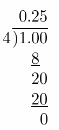
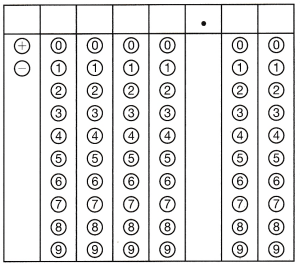
Jodi is cutting out pieces of paper that measure 8\(\frac{1}{2}\) inches by 11 inches from a large sheet that has an area of 1,000 square inches. What is the area of each piece of paper that Jodi is cutting out written as a decimal?
Texas Go Math Grade 6 Module 3 Quiz Answer Key 1
Answer:
The area of each piece of paper is product of 8\(\frac{1}{2}\) and 11:
8\(\frac{1}{2}\) × 11 = \(\frac{17}{2} \times \frac{11}{1}\)
= \(\frac{17 \times 11}{2}\)
= \(\frac{187}{2}\)
= 93.5
So, the area of each piece of paper that Jodi is cutting out is 93.5 square inches.

Texas Go Math Grade 6 Module 3 Quiz Answer Key Read More »

Texas Go Math Grade 6 Lesson 3.2 Answer Key Multiplying Mixed Numbers

Refer to our Texas Go Math Grade 6 Answer Key Pdf to score good marks in the exams. Test yourself by practicing the problems from Texas Go Math Grade 6 Lesson 3.2 Answer Key Multiplying Mixed Numbers.

Texas Go Math Grade 6 Lesson 3.2 Answer Key Multiplying Mixed Numbers

Reflect

Question 1.
Make a Conjecture Will the product 1\(\frac{1}{2}\) × \(\frac{1}{2}\) be greater than or less than \(\frac{1}{2}\)? Explain.
Answer:
We can solve this task using logic, or simply by doing the multiplication and seeing the result!

(1) Let’s think logically:
As we said before, when we multiply some number by a number that is greater than 1, our output will be greater than our original value.
Now, when we know which way to think, let’s check if 1\(\frac{1}{2}\) is greater than 1.
1\(\frac{1}{2}\) = 1 + \(\frac{1}{2}\)
Now it is clear, given mixed number is surely greater than 1.
Therefore, we can make our conclusion:
Product 1\(\frac{1}{2}\) × \(\frac{1}{2}\) will be greater than \(\frac{1}{2}\).

(2) Using exact calculation to prove facts:
Let’s calculate the product of given expressions!
\(\frac{3}{2} \times \frac{1}{2}=\frac{3 \times 1}{2 \times 2}\)
= \(\frac{3}{4}\)
All that is left to do, is to compare our result with the original value!
Number 3 is greater than 2.
So we can conclude that:
Number \(\frac{3}{4}\) is greater than \(\frac{1}{2}\).

Exam stuff:
1\(\frac{1}{2}\) = 1 + \(\frac{1}{2}\)
= \(\frac{2}{2}+\frac{1}{2}\)
= \(\frac{3}{2}\)

\(\frac{1}{2}\) = \(\frac{1 \times 2}{2 \times 2}\)
= \(\frac{2}{4}\)

Your Turn

Multiply. Write each product in simplest form.

Question 2.
3\(\frac{1}{3}\) × \(\frac{3}{4}\) ________________
Answer:
Process of multiplying fractions with mixed numbers
(1) Step:
Estimate the product Round the mixed number to the nearest whole number Find the nearest benchmark for the fraction.
3\(\frac{1}{3}\) is close to 3, so multiply \(\frac{3}{4}\) times 3.
3 × \(\frac{3}{4}\) = \(\frac{3 \times 3}{4}\)
= \(\frac{9}{4}\)

(2) Step:
We transform mixed number into traction, and then multiply those tractions as in previous examples.
Texas Go Math Grade 6 Lesson 3.2 Answer Key Multiplying Mixed Numbers 3

Note that we will not do a transformation from mixed numbers into fractions as we can do it automatically now.
One more thing to add, the First step may not make sense at first, but it is crucial to find out whether our precise solution is correct!

Multiplying Two Mixed Numbers Lesson 3.2 Answer Key Question 3.
1\(\frac{4}{5}\) × \(\frac{1}{2}\) ________________
Answer:
Process of multiplying fractions with mixed numbers
(1) Step:
Estimate the product Round the mixed number to the nearest whole number Find the nearest benchmark for the fraction.
1\(\frac{4}{5}\) is close to 2, so multiply \(\frac{1}{2}\) times 2.
\(\frac{1}{2}\) × 2 = \(\frac{1 \times 2}{2}\)
= \(\frac{2}{2}\) = 1

(2) Step:
We transform mixed numbers into traction and then multiply those tractions as in previous examples.
Texas Go Math Grade 6 Lesson 3.2 Answer Key Multiplying Mixed Numbers 4

Note that we will not do transformation from mixed number into fraction as we can do it automatically now.
One more thing to add, First step may not make sense at first, but it is crucial to find out whether our precise solution is correct!

Question 4.
\(\frac{5}{6}\) × 2\(\frac{3}{4}\) ________________
Answer:
Process of multiplying fractions with mixed numbers
(1) Step:
Estimate the product Round the mixed number to the nearest whole number Find the nearest benchmark for the fraction.
Texas Go Math Grade 6 Lesson 3.2 Answer Key Multiplying Mixed Numbers 5

(2) Step:
We transform mixed number into traction, and then multiply those tractions as in previous examples.
Texas Go Math Grade 6 Lesson 3.2 Answer Key Multiplying Mixed Numbers 6

Note that we will not do transformation from mixed number into fraction as we can do it automatically now.
One more thing to add, First step may not make sense at first, but it is crucial to find out whether our precise solution is correct!

Question 5.
\(\frac{3}{5}\) × 2\(\frac{1}{5}\) ________________
Answer:
Process of multiplying fractions with mixed numbers
(1) Step:
Estimate the product Round the mixed number to the nearest whole number Find the nearest benchmark for the fraction.
2\(\frac{1}{5}\) is close to 2, so multiply \(\frac{3}{5}\) times 2.
\(\frac{3}{5}\) × 2 = \(\frac{3 \times 2}{5}\)
= \(\frac{6}{5}\)

(2) Step:
We transform mixed number into traction, and then multiply those tractions as in previous examples.
Texas Go Math Grade 6 Lesson 3.2 Answer Key Multiplying Mixed Numbers 7

Note that we will not do a transformation from mixed numbers into fractions as we can do it automatically now.
One more thing to add, the First step may not make sense at first, but it is crucial to find out whether our precise solution is correct!

Lesson 3.2 Go Math 6th Grade Go Math Question 6.
\(\frac{9}{10}\) × 4\(\frac{1}{3}\) ________________
Answer:
Process of multiplying fractions with mixed numbers
(1) Step:
Estimate the product Round the mixed number to the nearest whole number Find the nearest benchmark for the fraction.
4\(\frac{1}{3}\) is close to 4, so multiply \(\frac{9}{10}\) times 4.
Texas Go Math Grade 6 Lesson 3.2 Answer Key Multiplying Mixed Numbers 8

(2) Step:
We transform mixed number into fraction, and then multiply those tractions as in previous examples.
Texas Go Math Grade 6 Lesson 3.2 Answer Key Multiplying Mixed Numbers 9

Note that we will not do transformation from mixed number into fraction as we can do it automatically now.
One more thing to add, First step may not make sense at first, but it is crucial to find out whether our precise solution is correct!

Question 7.
5\(\frac{1}{6}\) × \(\frac{1}{8}\) ________________
Answer:
Process of multiplying fractions with mixed numbers
(1) Step:
Estimate the product Round the mixed number to the nearest whole number Find the nearest benchmark for the fraction.
5\(\frac{1}{6}\) is close to 5, so multiply \(\frac{1}{8}\) times 5.
\(\frac{1}{8}\) × 5 = \(\frac{1 \times 5}{8}\)
= \(\frac{5}{8}\)

(2) Step:
We transform mixed number into traction, and then multiply those tractions as in previous examples.
Texas Go Math Grade 6 Lesson 3.2 Answer Key Multiplying Mixed Numbers 10

Note that we will not do transformation from mixed number into fraction as we can do it automatically now.
One more thing to add, First step may not make sense at first, but it is crucial to find out whether our precise solution is correct!

Reflect

Question 8.
Analyze Relationships When you multiply two mixed numbers, will the product be less than or greater than the factors? Use an example to explain.
Answer:
When we say that some number is mixed, it automatically gives us a clue.
Every mixed number is greater than 1, or at least its absolute value(we want to pay attention onLy on positive mixed numbers here).
So product of mixed numbers will be Greater than the factors.

Let’s show this on example:
Texas Go Math Grade 6 Lesson 3.2 Answer Key Multiplying Mixed Numbers 11
From here, we can see that 4 is greater than both factors!

We would like to add one more side note here.
In previous tasks, we were rounding our mixed numbers to the nearest whole number
We skipped that part in our solutions, but we will write the explanation here.
So, how can we know whether we should round some mixed number to greater whole number or to less whole number?
Take a look at fraction, check if it is greater than or equal to a half, if it is, then round it to the greater whole number.
Otherwise, round it to the same whole number as it is given in mixed number.

Your Turn

Multiply. Write each product in simplest form.

Question 9.
2\(\frac{2}{3}\) × 1\(\frac{1}{7}\)
Answer:
First, we need to rewrite each mixed number as a fraction greater than 1. Then, we will multiply numerators and denominators. Final result we can write as a mixed number if it is greater than 1. So, applying all this, we have the following:
Texas Go Math Grade 6 Lesson 3.2 Answer Key Multiplying Mixed Numbers 12
the result is \(\frac{64}{21}\) or 3\(\frac{1}{21}\).

Lesson 3.2 Answer Key 6th Grade Go Math Question 10.
2\(\frac{3}{8}\) × 1\(\frac{3}{5}\)
Answer:
First, we need to rewrite each mixed number as a fraction greater than 1 and simplify before multiplying using the GCF and then rewrite fraction. Then, we will multiply numerators and denominators. Final result we can write as a mixed number if it is greater than 1. So, applying all this, we have the following:
Texas Go Math Grade 6 Lesson 3.2 Answer Key Multiplying Mixed Numbers 13
So, the result is \(\frac{19}{5}\) or 3\(\frac{4}{5}\).

Question 11.
4\(\frac{1}{2}\) × 3\(\frac{3}{7}\)
Answer:
First, we need to rewrite each mixed number as a fraction greater than 1 and simplify before multiplying using the GCF and then rewrite fraction. Then, we will multiply numerators and denominators. Final result we can write as a mixed number if it is greater than 1. So, applying all this, we have the following:
Texas Go Math Grade 6 Lesson 3.2 Answer Key Multiplying Mixed Numbers 14
So, the result is \(\frac{108}{7}\) or 15\(\frac{3}{7}\).

Question 12.
5\(\frac{1}{4}\) × 4\(\frac{2}{3}\)
Answer:
First, we need to rewrite each mixed number as a fraction greater than 1 and simplify before multiplying using the GCF and then rewrite fraction. Then, we will multiply numerators and denominators. Final result we can write as a mixed number if it is greater than 1. So, applying all this, we have the following:
Texas Go Math Grade 6 Lesson 3.2 Answer Key Multiplying Mixed Numbers 15
So, the result is \(\frac{49}{2}\) or 24\(\frac{1}{2}\).

Texas Go Math Grade 6 Lesson 3.2 Guided Practice Answer Key

Question 1.
Mr. Martin’s yard is 1\(\frac{1}{3}\) acres. He wants to plant grass on \(\frac{1}{6}\) of his yard.

a. Draw a model to show how many acres will be covered by grass.
Texas Go Math Grade 6 Lesson 3.2 Answer Key Multiplying Mixed Numbers 1
Answer:
On the following picture there is shown how many acres will be covered by grass.

b. How many acres will be covered by grass?
Answer:
It will be covered \(\frac{2}{9}\) acres by grass.

c. Write the multiplication shown by the model.
Answer:
First, we need to rewrite each mixed number as a fraction greater than 1 and simplify before multiplying using the GCF and then rewrite fraction. Then, we will multiply numerators and denominators. Final result we can write as a mixed number if it is greater than 1. So, applying all this, we have the following:
Texas Go Math Grade 6 Lesson 3.2 Answer Key Multiplying Mixed Numbers 16

d. Will the mixed number that represents the original size of Mr. Martin’s yard increase or decrease when multiplied by \(\frac{1}{6}\)? Explain.
Answer:
We can notice that Mr. Martin’s yard will decrease when multiply by \(\frac{1}{6}\) because 0 < \(\frac{1}{6}\) < 1 and when multiplying some number greater than 1 by number which is from interval (0, 1), product will decrease.

Multiply. Write each product in simplest form.

Question 2.
1\(\frac{1}{5}\) × \(\frac{3}{5}\)
Answer:
First, we need to rewrite each mixed number as a fraction greater than 1 and simplify before multiplying using the GCF and then rewrite the fraction. Then, we will multiply numerators and denominators. Final result we can write as a mixed number if it is greater than 1. So, applying all this, we have the following:
\(\frac{6}{5} \times \frac{3}{5}\) = \(\frac{6 \times 3}{5 \times 5}\)
= \(\frac{18}{25}\)
So, the result is \(\frac{18}{25}\)

Lesson 3.2 Answer Key 6th Grade Multiplying Mixed Numbers Question 3.
1\(\frac{3}{4}\) × \(\frac{4}{7}\)
Answer:
First, we need to rewrite each mixed number as a fraction greater than 1 and simplify before multiplying using the GCF and then rewrite the fraction. Then, we will multiply numerators and denominators. Final result we can write as a mixed number if it is greater than 1. So, applying all this, we have the following:
Texas Go Math Grade 6 Lesson 3.2 Answer Key Multiplying Mixed Numbers 17
So, the result is 1

Question 4.
1\(\frac{5}{6}\) × \(\frac{2}{5}\)
Answer:
First, we need to rewrite each mixed number as a fraction greater than 1 and simplify before multiplying using the GCF and then rewrite fraction. Then, we will multiply numerators and denominators. Final result we can write as a mixed number if it is greater than 1. So, applying all this, we have the following:
Texas Go Math Grade 6 Lesson 3.2 Answer Key Multiplying Mixed Numbers 18
So, the result is \(\frac{11}{15}\)

Question 5.
1\(\frac{7}{10}\) × \(\frac{4}{5}\)
Answer:
First, we need to rewrite each mixed number as a fraction greater than 1 and simplify before multiplying using the GCF and then rewrite fraction. Then, we will multiply numerators and denominators. Final result we can write as a mixed number if it is greater than 1. So, applying all this, we have the following:
Texas Go Math Grade 6 Lesson 3.2 Answer Key Multiplying Mixed Numbers 19
So, the result is \(\frac{34}{25}\) = 1\(\frac{9}{25}\)

Question 6.
\(\frac{5}{9}\) × 3\(\frac{9}{10}\)
Answer:
First, we need to rewrite each mixed number as a fraction greater than 1 and simplify before multiplying using the GCF and then rewrite fraction. Then, we will multiply numerators and denominators. Final result we can write as a mixed number if it is greater than 1. So, applying all this, we have the following:
Texas Go Math Grade 6 Lesson 3.2 Answer Key Multiplying Mixed Numbers 20
So, the result is \(\frac{13}{6}\) = 2\(\frac{1}{6}\)

Question 7.
\(\frac{7}{8}\) × 3\(\frac{1}{3}\)
Answer:
First, we need to rewrite each mixed number as a fraction greater than 1 and simplify before multiplying using the GCF and then rewrite fraction. Then, we will multiply numerators and denominators. Final result we can write as a mixed number if it is greater than 1. So, applying all this, we have the following:
Texas Go Math Grade 6 Lesson 3.2 Answer Key Multiplying Mixed Numbers 21
So, the result is \(\frac{35}{12}\) = 2\(\frac{11}{12}\)

Question 8.
2\(\frac{1}{5}\) × 2\(\frac{3}{5}\)
Answer:
First, we need to rewrite each mixed number as a fraction greater than 1 and simplify before multiplying using the GCF and then rewrite fraction. Then, we will multiply numerators and denominators. Final result we can write as a mixed number if it is greater than 1. So, applying all this, we have the following:
Texas Go Math Grade 6 Lesson 3.2 Answer Key Multiplying Mixed Numbers 22
So, the result is \(\frac{143}{25}\) = 5\(\frac{18}{25}\)

Question 9.
4\(\frac{3}{4}\) × 3\(\frac{4}{5}\)
Answer:
First, we need to rewrite each mixed number as a fraction greater than 1 and simplify before multiplying using the GCF and then rewrite fraction. Then, we will multiply numerators and denominators. Final result we can write as a mixed number if it is greater than 1. So, applying all this, we have the following:
Texas Go Math Grade 6 Lesson 3.2 Answer Key Multiplying Mixed Numbers 23
So, the result is \(\frac{361}{20}\) = 18\(\frac{1}{20}\)

Essential Question Check-In

Question 10.
How can you multiply two mixed numbers?
Answer:
We can first rewrite the mixed number as a fraction grater than 1, if we are given mixed number Then simplify before multiplying using the GCF, if there are possibilities for this, after that rewrite fraction.

Finally, we multiply numerators and denominators and get the result which we can rewrite as a mixed number if it is grater than 1 and of course, if it is a fraction.

Rewrite mixed number as a fraction, simplify, multiply numerators and denominators.

Estimate. Then Solve.

Question 11.
Carly is making 3\(\frac{1}{2}\) batches of biscuits. If one batch calls for 2\(\frac{1}{3}\) cups of flour, how much flour will she need?
Answer:
In order to find how much flour Carly will need, we have to multiply those mixed numbers.

First, we need to rewrite each mixed number as a fraction greater than 1 and simplify before multiplying using the GCF and then rewrite fraction. Then, we will multiply numerators and denominators. Final result we can write as a mixed number if it is greater than 1. So, applying all this, we have the following:
Texas Go Math Grade 6 Lesson 3.2 Answer Key Multiplying Mixed Numbers 24
So, conclusion is that Carly will need 12\(\frac{1}{4}\) cups of flour.

Go Math Grade 6 Lesson 3.2 Multiplying Mixed Numbers Question 12.
Bashir collected 4\(\frac{1}{3}\) baskets of peaches at an orchard. If each basket holds 21 peaches, how many peaches did he collect in all?
Answer:
In order to find how much flour Carly will need, we have to multiply those mixed numbers.

First, we need to rewrite each mixed number as a fraction greater than 1 and simplify before multiplying using the GCF and then rewrite fraction. Then, we will multiply numerators and denominators. Final result we can write as a mixed number if it is greater than 1. So, applying all this, we have the following:
Texas Go Math Grade 6 Lesson 3.2 Answer Key Multiplying Mixed Numbers 25
Conclusion is that

Bashir collected 91 peach.

Question 13.
Jared used 1\(\frac{2}{5}\) bags of soil for his garden. He is digging another garden that will need \(\frac{1}{5}\) as much soil as the original. How much will he use total?
Answer:
In order to calculate how much bags of soil Jared used total we have to multiply 1\(\frac{2}{5}\) and \(\frac{1}{5}\).
First we need to rewrite each mixed number as a fraction greater than 1 and simplify before multiplying using the GCF and then rewrite fraction. Then, we will multiply numerators and denominators. Final result we can write as a mixed number if it is greater than 1.

So, applying all this, we have the following:
Texas Go Math Grade 6 Lesson 3.2 Answer Key Multiplying Mixed Numbers 26
So, he used total \(\frac{7}{25}\) bags of soil.

Question 14.
Critical Thinking is the product of two mixed numbers less than, between, or greater than the two factors? Explain.
Answer:
If both fractions are greater than 1, or, if they are mixed numbers, then their product is greater than both fractions.
For example, 1\(\frac{1}{4}\) = \(\frac{5}{4}\) auch 1\(\frac{1}{5}\) = \(\frac{6}{5}\) are both greater than 1 and their product is following:
Texas Go Math Grade 6 Lesson 3.2 Answer Key Multiplying Mixed Numbers 27
And \(\frac{5}{4}\) < \(\frac{6}{4}\) = \(\frac{3}{2}\), \(\frac{6}{5}\) = \(\frac{12}{10}\) < \(\frac{15}{10}\) = \(\frac{3}{2}\)
Really, their product, \(\frac{3}{2}\), is greater than both fractions.
If both fractions are less than 1, their product is less than both fractions.
For example, \(\frac{1}{4}\) and \(\frac{3}{5}\) are both less than 1 and their product is following:
Texas Go Math Grade 6 Lesson 3.2 Answer Key Multiplying Mixed Numbers 28
And \(\frac{1}{4}=\frac{5}{20}>\frac{3}{20}, \frac{3}{5}=\frac{12}{20}>\frac{3}{20}\)

Really, their product, \(\frac{3}{20}\), is less than both tractions.
And it one traction is greater than 1 or if it is mixed number and the other is less than 1, their product will be between those two tractions.
For example, \(\frac{1}{5}\) is less than 1 and 1\(\frac{2}{5}\) = \(\frac{7}{5}\) is greater than 1, their product is following:
\(\frac{1}{5} \times \frac{7}{5}\) = \(\frac{1}{5} \times \frac{7}{5}\)
= \(\frac{7}{25}\)
And \(\frac{5}{25}=\frac{1}{5}<\frac{7}{25}, \frac{30}{25}=\frac{6}{5}>\frac{7}{25}\)
Really, their product, \(\frac{7}{25}\), is between those two fractions.

If both fractions are mixed numbers, fractions greater than 1, their product will be mixed number greater than both mixed numbers.
If both fractions are less than 1, their product will be less than both fractions.
If one fraction is less than 1 and the other is mixed number, greater than 1, their product wilL be between those two fractions.

Question 15.
There are approximately 402\(\frac{1}{4}\) meters around a typical running track. Sandra has challenged herself to run 10 laps a day for 5 days. How many meters will Sandra run if she meets her challenge?
Answer:
First we will calculate how many meters Sandra will run for a day.
Texas Go Math Grade 6 Lesson 3.2 Answer Key Multiplying Mixed Numbers 29
Now, we will calculate how many meters Sandra wilt run for 5 days muLtiplying previous result by 5
Texas Go Math Grade 6 Lesson 3.2 Answer Key Multiplying Mixed Numbers 30
So, Sandra will run 20112\(\frac{1}{2}\) meters if she meets her challenge.

Question 16.
Ron wants to make a rectangular basketball court. What is the area of Ron’s court?
Texas Go Math Grade 6 Lesson 3.2 Answer Key Multiplying Mixed Numbers 2
Answer:
The area of rectangular is product of length of its sides
Here, at this rectangular basketball court, one side is 4\(\frac{3}{4}\) yd long and the other is 3\(\frac{2}{5}\) yd long.
The area of this basketball court is the following:
Texas Go Math Grade 6 Lesson 3.2 Answer Key Multiplying Mixed Numbers 31
So, the area of Rou’s Court is 16\(\frac{3}{20}\)yd<sup>2</sup>

Question 17.
Each of 15 students will give a 1\(\frac{1}{2}\)-minute speech in English class.
a. How long will it take to give the speeches?
Answer:
In order to calculate how long it will take to give the speeches, we have to multiply those two mixed numbers and get:
Texas Go Math Grade 6 Lesson 3.2 Answer Key Multiplying Mixed Numbers 32
So, it will take 22\(\frac{1}{2}\) minutes to give the speeches.

b. If the teacher begins recording on a digital camera with an hour available, is there enough time to record everyone if she gives a 15-minute introduction at the beginning of class and every student takes a minute to get ready? Explain.
Answer:
Because we have 15 students and every student takes a minute to get ready, on result from (a) we have to add this 15 × 1 = 15 minutes.
Also, we have to add 15 minutes more because that time is needed for introduction at the begining of class.
So, the whole ceremony with speeches wilL take:
Texas Go Math Grade 6 Lesson 3.2 Answer Key Multiplying Mixed Numbers 33
Because 1 hour has 60 minutes and whole ceremony with speaches wiLl take 52\(\frac{1}{2}\) minutes, which is less than 60 minutes, conclusion is that there will be enough time to record everyone on a digital camera.

c. How much time is left on the digital camera?
Answer:
Now we will calculate how much time is left on the digital camera subtracting 52\(\frac{1}{2}\), which is time needed for recording everyone, from 60 minutes, which is time for recording on digital camera.
So, we have the following:
Texas Go Math Grade 6 Lesson 3.2 Answer Key Multiplying Mixed Numbers 34
So, there is 7\(\frac{1}{2}\) minutes left on digital camera.

Question 18.
Communicate Mathematical Ideas How is multiplying a whole number by a mixed number the same as multiplying two mixed numbers?
Answer:

H.O.T. Focus on Higher Order Thinking

Question 19.
Critique Reasoning To find the product 3\(\frac{3}{8}\) x 4\(\frac{1}{9}\), Tara rewrote 3\(\frac{3}{8}\) as \(\frac{17}{8}\) and 4\(\frac{1}{9}\) as \(\frac{13}{2}\). Then she multiplied the fractions to find the product \(\frac{221}{72}\). What were her errors?
Answer:
It is the same because whole number we need to rewrite as a fraction as welt as mixed numbers in order to multiply them.
We need to rewrite whole number as a fraction as well as mixed number.

Go Math Lesson 3.2 Grade 6 Multiply Mixed Fractions Question 20.
Represent Real-World Problems Ian is making his special barbecue sauce for a party. His recipe makes 3\(\frac{1}{2}\) cups of barbecue sauce and uses 2\(\frac{1}{4}\) tablespoons of soy sauce. He wants to increase his recipe to make five times as much barbecue sauce. He checks his refrigerator and finds that he has 8 tablespoons of soy sauce. Will he have enough soy sauce? Explain.
Answer:
She did not rewrite mixed numbers properly as fractions, that was Tara’s mistake
The right way is the following:
Texas Go Math Grade 6 Lesson 3.2 Answer Key Multiplying Mixed Numbers 35
So, there product is actually \(\frac{111}{8}\), or, 13\(\frac{7}{8}\).

Question 21.
Analyze Relationships Is it possible to find the product of two mixed numbers by multiplying the whole number parts together, then multiplying the two fractional parts together, and finally adding the two products? Use an example to support your answer.
Answer:
If he wants to make five times as much barbecue sauce, we need all ingredients five times as much, so, and soy sauce.
So, now we will calculate how much soy sauce he needs if he wants to make five times as much barbecue sauce. We have the following:
5 × 2\(\frac{1}{4}\) = 5 × \(\frac{9}{4}\)
= \(\frac{5 \times 9}{1 \times 4}\)
= \(\frac{45}{4}\)
= 9
So, he needs 9 tablespoons of soy sauce to make five times as much barbecue sauce, but he has only 8 tablespoons of soy sauce in his refrigerator.
The conclusion is that he does not have enough soy sauce to make five times as much barbecue sauce.

Texas Go Math Grade 6 Lesson 3.2 Answer Key Multiplying Mixed Numbers Read More »

Texas Go Math Grade 6 Lesson 3.4 Answer Key Dividing Mixed Numbers

Refer to our Texas Go Math Grade 6 Answer Key Pdf to score good marks in the exams. Test yourself by practicing the problems from Texas Go Math Grade 6 Lesson 3.4 Answer Key Dividing Mixed Numbers.

Texas Go Math Grade 6 Lesson 3.4 Answer Key Dividing Mixed Numbers

Reflect

Question 1.
Communicate Mathematical Ideas Which mathematical operation could you use to find the number of sushi rolls that Antoine can make? Explain.
Answer:
We can use dividing to find the number of sushi rolls that Antonie can make Actually, to find that number, we need to divide 2\(\frac{1}{2}\) by \(\frac{1}{4}\).

Question 2.
Multiple Representations Write the division shown by the model.
Answer:
The division shown by the previous model is the following:
2\(\frac{1}{2}\) ÷ \(\frac{1}{4}\)

Question 3.
What If? Suppose Antoine instead uses \(\frac{1}{8}\) cup of rice for each sushi roll. How would his model change? How many rolls can he make? Explain.
Answer:
Instead dividing 2\(\frac{1}{2}\) by \(\frac{1}{8}\), he will divide 2\(\frac{1}{2}\) by \(\frac{1}{8}\) and in that case he will make more sushi rolls.

Go Math Lesson 3.4 Answer Key Dividing Mixed Numbers Question 4.
Analyze Relationships Explain how you can check the answer.
Answer:
We can check the answer by dividing the result by the first of the fractions we were dividing or multiplying the result by the second of the fractions we were dividing.

Question 5.
What If? Harold serves himself 1\(\frac{1}{2}\)-ounce servings of cereal each morning. How many servings does he get from a box of his favorite cereal? Show your work.
Answer:
We need to divide 1 by 1\(\frac{1}{2}\) in order to get how many servings Harold gets from a box. But first, we need to rewrite 1\(\frac{1}{2}\) as a fraction and find its reciprocal.
So, we have the following:
1\(\frac{1}{2}\) = \(\frac{3}{2}\)
Reciprocal of \(\frac{3}{2}\) is \(\frac{2}{3}\)
Now, we have to multiply 1 by \(\frac{2}{3}\) and get:
1 × \(\frac{2}{3}=\frac{1 \times 2}{1 \times 3}=\frac{2}{3}\)
So, Harold gets \(\frac{2}{3}\) servings of cereal from a box.

Your Turn

Question 6.
Sheila has 10\(\frac{1}{2}\) pounds of potato salad. She wants to divide the potato salad into containers, each of which holds 1\(\frac{1}{4}\) pounds. How many containers does she need? Explain.
Answer:
In order to find how many containers Sheila wilt need, we need to divide 10\(\frac{1}{2}\) by 1\(\frac{1}{4}\). But first we need to rewrite those mixed numbers as a fraction, than find reciprocal of the second one and then multiply them.
So, we get:
Texas Go Math Grade 6 Lesson 3.4 Answer Key Dividing Mixed Numbers 5
She will need 8\(\frac{2}{5}\) containers.

Reflect

Question 7.
Check for Reasonableness How can you determine if your answer is reasonable?
Answer:
If we have to divide two fractions, we can check our result on two ways:
First is to multiply result by the second fraction and if product is the first fraction, then our original solution is correct.
The second way is to divide the first fraction by result and if we get as a result of this dividing the second fraction, then our original solution is correct.
Multiply result by the second fraction; Divide the fraction by the result.

Your Turn

Question 8
The area of a rectangular patio is 12\(\frac{3}{8}\) square meters.
The width of the patio is 2\(\frac{3}{4}\) meters. What is the length? ___________
Answer:
First we will write given situation as a division problem, it is the following:
12\(\frac{3}{8}\) ÷ 2\(\frac{3}{4}\)
Now, we will rewrite the mixed numbers as fractions greater than 1.
12\(\frac{3}{8}\) ÷ 2\(\frac{3}{4}\) = \(\frac{99}{8}\) ÷ \(\frac{11}{4}\)
In the next step we will rewrite the problem as multiplication using the reciprocal of the second fraction:
\(\frac{99}{8} \div \frac{11}{4}=\frac{99}{8} \times \frac{4}{11}\)
Now, we will multiply previous fractions:
Texas Go Math Grade 6 Lesson 3.4 Answer Key Dividing Mixed Numbers 6
So, the length of a rectangular patio 4\(\frac{1}{2}\) meters.

Go Math Grade 6 Answers Dividing With Mixed Numbers Question 9.
The area of a rectangular rug is 14\(\frac{1}{2}\) square yards.
The length of the rug is 4\(\frac{1}{3}\) yards. What is the width? ___________
Answer:
First we wilt write given situation as a division problem, it is the following:
14\(\frac{1}{12}\) ÷ 4\(\frac{1}{3}\)
Now, we will rewrite the mixed numbers as fractions greater than 1.
14\(\frac{1}{12}\) ÷ 4\(\frac{1}{3}\) = \(\frac{169}{12} \div \frac{13}{3}\)
In the next step we will rewrite the problem as multiplication using the reciprocal of the second fraction:
\(\frac{169}{12} \div \frac{13}{3}=\frac{169}{12} \times \frac{3}{13}\)
Now, we will multiply previous fractions:
Texas Go Math Grade 6 Lesson 3.4 Answer Key Dividing Mixed Numbers 7
So, the width of a rectangular rug is 3\(\frac{1}{4}\) yards.

Texas Go Math Grade 6 Lesson 3.4 Guided Practice Answer Key

Divide. Write each answer in simplest form.

Question 1.
4\(\frac{1}{4}\) ÷ \(\frac{3}{4}\)
Texas Go Math Grade 6 Lesson 3.4 Answer Key Dividing Mixed Numbers 1
Answer:
First we will rewrite the mixed numbers as fractions greater than 1, then again rewrite the problem as multiplication
using the reciprocal ot the second fractions.
We will simplify using the GCF in order to get the solution in simplest form and multiply numerators and denominators. At the end, we will rewrite the solution as a mixed number if it is greater than 1.

So, we have the following:
Texas Go Math Grade 6 Lesson 3.4 Answer Key Dividing Mixed Numbers 8
Conclusion is that the solution is 3.

Question 2.
1\(\frac{1}{2}\) ÷ 2\(\frac{1}{4}\)
Texas Go Math Grade 6 Lesson 3.4 Answer Key Dividing Mixed Numbers 2
Answer:
First we will rewrite the mixed numbers as fractions greater than 1, then again rewrite the problem as multiplication
using the reciprocal ot the second fractions.
We will simplify using the GCF in order to get the solution in simplest form and multiply numerators and denominators. At the end, we will rewrite the solution as a mixed number if it is greater than 1.

So, we have the following:
Texas Go Math Grade 6 Lesson 3.4 Answer Key Dividing Mixed Numbers 9
Conclusion is that the solution is \(\frac{2}{3}\).

Question 3.
4 ÷ 1\(\frac{1}{8}\) ____________
Answer:
First we will rewrite the mixed numbers as fractions greater than 1, then again rewrite the problem as multiplication
using the reciprocal ot the second fractions.
We will simplify using the GCF in order to get the solution in simplest form and multiply numerators and denominators. At the end, we will rewrite the solution as a mixed number if it is greater than 1.

So, we have the following:
Texas Go Math Grade 6 Lesson 3.4 Answer Key Dividing Mixed Numbers 10
Conclusion is that the solution is \(\frac{32}{9}\), or 3\(\frac{5}{9}\).

Question 4.
3\(\frac{1}{5}\) ÷ 1\(\frac{1}{7}\) ____________
Answer:
First we will rewrite the mixed numbers as fractions greater than 1, then again rewrite the problem as multiplication
using the reciprocal ot the second fractions.
We will simplify using the GCF in order to get the solution in simplest form and multiply numerators and denominators. At the end, we will rewrite the solution as a mixed number if it is greater than 1.

So, we have the following:
Texas Go Math Grade 6 Lesson 3.4 Answer Key Dividing Mixed Numbers 11
Conclusion is that the solution is \(\frac{63}{40}\), or 1\(\frac{23}{40}\).

Question 5.
8\(\frac{1}{3}\) ÷ 2\(\frac{1}{2}\) ____________
Answer:
First we will rewrite the mixed numbers as fractions greater than 1, then again rewrite the problem as multiplication
using the reciprocal ot the second fractions.
We will simplify using the GCF in order to get the solution in simplest form and multiply numerators and denominators. At the end, we will rewrite the solution as a mixed number if it is greater than 1.

So, we have the following:
Texas Go Math Grade 6 Lesson 3.4 Answer Key Dividing Mixed Numbers 12
Conclusion is that the solution is \(\frac{10}{3}\), or 3\(\frac{1}{3}\).

Question 6.
15\(\frac{1}{3}\) ÷ 3\(\frac{5}{6}\) ____________
Answer:
Solution to this example is given below
First we will rewrite the mixed numbers as fractions greater than 1, then again rewrite the problem as multiplication
using the reciprocal ot the second fractions.
We will simplify using the GCF in order to get the solution in simplest form and multiply numerators and denominators. At the end, we will rewrite the solution as a mixed number if it is greater than 1.

So, we have the following:
Texas Go Math Grade 6 Lesson 3.4 Answer Key Dividing Mixed Numbers 13
Conclusion is that the solution is 4.

Write each situation as a division problem. Then solve.

Question 7.
A sandbox has an area of 26 square feet, and the length is 5\(\frac{1}{2}\) feet. What is the width of the sandbox?
Answer:
First we will write given situation as a division problem, it is the following:
26 ÷ 5\(\frac{1}{2}\)
Now, we will rewrite the mixed numbers as fractions greater than 1.
26 ÷ 5\(\frac{1}{2}\) = \(\frac{26}{1}\) ÷ \(\frac{11}{2}\)
In the next step we will rewrite the problem as multiplication using the reciprocal of the second fraction:
\(\frac{26}{1} \div \frac{11}{2}=\frac{26}{1} \times \frac{2}{11}\)
Now, we will multiply previous fractions:
Texas Go Math Grade 6 Lesson 3.4 Answer Key Dividing Mixed Numbers 14
So, the width of the sandbox is 4\(\frac{8}{11}\) feet

Lesson 3.4 Divide Mixed Numbers Go Math Grade 6 Question 8.
Mr. Webster is buying carpet for an exercise room in his basement. The room will have an area of 230 square feet. The width of the room is 12\(\frac{1}{2}\) feet. What is the length?
Answer:
First we will write given situation as a division problem, it is the following:
230 ÷ 12\(\frac{1}{2}\)
Now, we will rewrite the mixed numbers as fractions greater than 1.
230 ÷ 12\(\frac{1}{2}\) = \(\frac{230}{1}\) ÷ \(\frac{25}{2}\)
In the next step we will rewrite the problem as multiplication using the reciprocal of the second fraction:
\(\frac{230}{1} \div \frac{25}{2}=\frac{230}{1} \times \frac{2}{25}\)
Now, we will multiply previous fractions:
Texas Go Math Grade 6 Lesson 3.4 Answer Key Dividing Mixed Numbers 15
So, the length of the room is 18\(\frac{2}{5}\) feet.

Essential Question Check-In

Question 9.
How does dividing mixed numbers compare with dividing fractions?
Answer:
We have to rewrite mixed numbers as a fractions greater than 1 and then the steps of dividing are the same as dividing two fractions because we actually get two fractions.
It is equivalent with dividing fractions, but first rewrite mixed numbers as mixed numbers.

Question 10.
Jeremy has 4\(\frac{1}{2}\) CUPS of iced tea. He wants to divide the tea into \(\frac{3}{4}\)-cup servings. Use the model to find the number of servings he can make.
Texas Go Math Grade 6 Lesson 3.4 Answer Key Dividing Mixed Numbers 3
Answer:
We will use the following model in order to find the number of servings Jeremy can make:
4\(\frac{1}{2}\) ÷ \(\frac{3}{4}\)
We will rewrite mixed number as a fraction and rewrite the model as multiplication using the reciprocal of the
second fractions.
And then multiply fractions:
Texas Go Math Grade 6 Lesson 3.4 Answer Key Dividing Mixed Numbers 16
So, Jeremy can make 6 servings

Question 11.
A ribbon is 3\(\frac{2}{3}\) yards long. Mae needs to cut the ribbon into pieces that are \(\frac{2}{3}\) yard long. Use the model to find the number of pieces she can cut.
Texas Go Math Grade 6 Lesson 3.4 Answer Key Dividing Mixed Numbers 4
Answer:
We will use the following model in order to find the number of servings Jeremy can make:
3\(\frac{2}{3}\) ÷ \(\frac{2}{3}\)
We will rewrite mixed number as a fraction and rewrite the model as multiplication using the reciprocal of the
second fractions.
And then multiply fractions:
Texas Go Math Grade 6 Lesson 3.4 Answer Key Dividing Mixed Numbers 17
So, Mae can cut 11 pieces of a ribbon.

Question 12.
Dao has 2\(\frac{3}{8}\)pounds of hamburger meat. He is making \(\frac{1}{4}\)-pound hamburgers. Does Dao have enough meat to make 10 hamburgers? Explain.
Answer:
In order to find the number of hamburgers Dao can make of 2\(\frac{3}{8}\) pounds of hamburger meat, we have to divide 2\(\frac{3}{8}\) by \(\frac{1}{4}\).
Texas Go Math Grade 6 Lesson 3.4 Answer Key Dividing Mixed Numbers 18
Dao can make 9\(\frac{1}{4}\) hamburgers. Conclusion is that Dao has not enough meat for making 10 hamburgers.

Question 13.
Multistep Zoey made 5\(\frac{1}{2}\) cups of trail mix fora camping trip. She wants to divide the trail mix into \(\frac{3}{4}\)-cup servings.
a. Ten people are going on the camping trip. Can Zoey make enough \(\frac{3}{4}\)-cup servings so that each person on the trip has one serving?
Answer:
We will find number of serving Zoey can made dividing 5\(\frac{1}{2}\) by \(\frac{3}{4}\).
Texas Go Math Grade 6 Lesson 3.4 Answer Key Dividing Mixed Numbers 19
So, we can notice that there are 7\(\frac{1}{3}\) sevings.
Conclusion is that there is not enough servings for 10 persons.

b. What size would the servings need to be for everyone to have a serving? Explain.
Answer:
If we want to share 2\(\frac{3}{8}\) cups of trail mix to 10 persons, we need to divide 2\(\frac{3}{8}\) by 10 in order to get size of each serving:
Texas Go Math Grade 6 Lesson 3.4 Answer Key Dividing Mixed Numbers 20
So, size of each serving would be \(\frac{19}{80}\)-cup.

c. If Zoey decides to use the \(\frac{3}{4}\)-cup servings, how much more trail mix will she need? Explain.
Answer:
To calculate how much more trail mix Zoey will need for 10 persons, we need to subtract 7\(\frac{1}{3}\), result we get at (a), from 10:
Texas Go Math Grade 6 Lesson 3.4 Answer Key Dividing Mixed Numbers 21
So, Zoey will need \(\frac{8}{3}\)-cup of trail mix moreS

Question 14.
The area of a rectangular picture frame is 3o\(\frac{1}{3}\) square inches. The length of the frame is 6\(\frac{1}{2}\) inches. Find the width of the frame.
Answer:
First we will write given situation as a division problem, it is the following:
30\(\frac{1}{3}\) ÷ 6\(\frac{1}{2}\)
Now, we will rewrite the mixed numbers as fractions greater than 1.
20\(\frac{1}{3}\) ÷ 6\(\frac{1}{2}\) = \(\frac{91}{3}\) ÷ \(\frac{13}{2}\)
In the next step we will rewrite the problem as multiplication using the reciprocal of the second fraction:
\(\frac{91}{3} \div \frac{13}{2}=\frac{91}{3} \times \frac{2}{13}\)
Now, we will multiply previous fractions:
Texas Go Math Grade 6 Lesson 3.4 Answer Key Dividing Mixed Numbers 23
So, the width of the frame is 4\(\frac{2}{3}\) inches.

Question 15.
The area of a rectangular mirror is 11\(\frac{11}{16}\) square feet. The width of the mirror is 2\(\frac{3}{4}\)feet. If there is a 5 foot tall space on the wall to hang the mirror, will it fit? Explain.
Answer:
We need to find the length of the mirror dividing 11\(\frac{11}{16}\) by 2\(\frac{3}{4}\). So, we have the following:
Texas Go Math Grade 6 Lesson 3.4 Answer Key Dividing Mixed Numbers 24
We got that the Length of mirror is 4\(\frac{1}{4}\) feet and there is a 5 feet total space on the wall for hanging the mirror, so, 4\(\frac{1}{4}\) < 5, there is enough space on the wall for hanging mirror, it will fit.

Question 16.
Ramon has a rope that is 25\(\frac{1}{2}\) feet long. He wants to cut it into 6 pieces that are equal in length. How long will each piece be?
Answer:
In order to find length of each peace, we have to divide 25\(\frac{1}{2}\) by 6, so we have following:
Texas Go Math Grade 6 Lesson 3.4 Answer Key Dividing Mixed Numbers 25
So, each piece will be long 4\(\frac{1}{4}\) feet.

Question 17.
Eleanor and Max used two rectangular wooden boards to make a set for the school play. One board was 6 feet long, and the other was 5\(\frac{1}{2}\) feet long. The two boards had equal widths. The total area of the set was 60\(\frac{3}{8}\) square feet. What was the width?
Answer:
We can conclude that total length of the set is:
Texas Go Math Grade 6 Lesson 3.4 Answer Key Dividing Mixed Numbers 26
In order to total width of the set, we have to divide 60\(\frac{3}{8}\) by \(\frac{23}{3}\) and get:
Texas Go Math Grade 6 Lesson 3.4 Answer Key Dividing Mixed Numbers 27
So, the total width of the set 7\(\frac{7}{8}\) feet.

H.O.T. Focus On Higher Order Thinking

Question 18.
Draw Conclusions Micah divided 11\(\frac{2}{3}\) by 2\(\frac{5}{6}\) and got 4\(\frac{2}{17}\) for an answer.
Does his answer seem reasonable? Explain your thinking. Then check Micah’s answer.
Answer:
Yes, Micah’s answer seems reasonabLe because 4\(\frac{2}{17}\) is smaller than 11\(\frac{2}{3}\), now we will also check it:
Texas Go Math Grade 6 Lesson 3.4 Answer Key Dividing Mixed Numbers 28
We can see that Micah’s answer is correct.

Question 19.
Explain the Error To divide 14\(\frac{2}{3}\) ÷ 2\(\frac{3}{4}\), Erik multiplied 14\(\frac{2}{3}\) × \(\frac{4}{3}\). Explain Erik’s error.
Answer:
Erik’s error was that he did not first rewrite mixed numbers as a fractions and then multiply them using the reciprocal of the second fraction.
So, the right way is:
Texas Go Math Grade 6 Lesson 3.4 Answer Key Dividing Mixed Numbers 29
He did not first rewrite mixed numbers as a fractions.

Question 20.
Analyze Relationships Explain how you can find the missing number in 3\(\frac{4}{5}\) ÷ = 2\(\frac{5}{7}\). Then find the missing number.
Answer:
We will find the missing number dividing 3\(\frac{4}{5}\) by 2\(\frac{5}{7}\)
First, we will rewrite those mixed numbers as a fractions greater than 1.
Then rewrite the problem. First we need to rewrite the mixed numbers as a fractions grater than 1.
Texas Go Math Grade 6 Lesson 3.4 Answer Key Dividing Mixed Numbers 30
So, the missing number is \(\frac{7}{5}\), or 1\(\frac{2}{5}\).

Texas Go Math Grade 6 Lesson 3.4 Answer Key Dividing Mixed Numbers Read More »

Texas Go Math Grade 6 Lesson 3.3 Answer Key Multiplying Dividing Fractions

Refer to our Texas Go Math Grade 6 Answer Key Pdf to score good marks in the exams. Test yourself by practicing the problems from Texas Go Math Grade 6 Lesson 3.3 Answer Key Multiplying Dividing Fractions.

Texas Go Math Grade 6 Lesson 3.3 Answer Key Dividing Fractions

Reflect

Question 1.
Write the division shown by each model.
Answer:
In A, the total amount is given by the fraction \(\frac{3}{4}\) and the divisor is \(\frac{1}{8}\), therefore the division expression is \(\frac{3}{4} \div \frac{1}{8}\)

In B, the total amount is given by the fraction \(\frac{1}{2}\) and the divisor is 5, therefore the division expression is \(\frac{1}{2}\) ÷ 5.

Go Math Grade 6 Lesson 3.3 Answer Key Question 2.
Is any number its own reciprocal? If so, what number(s)? Justify your answer.
Answer:
OnLy 1 and – 1 are number which are its own reciprocal.
We can write 1 as a fraction on following way;
1 = \(\frac{1}{1}\)
The reciprocal we can find switching numerator and denominator and get:
\(\frac{1}{1}\) = 1
So, conclusion is that 1 is its own reciprocal.
Also, – 1 we can write as a fraction on the following way:
– 1 = \(\frac{-1}{1}\)
We can find the reciprocal switching numerator and denominator and get:
\(\frac{1}{-1}\) = – 1
So, Conclusion is that – 1 is its own reciprocal.

Question 3.
Communicate Mathematical Ideas Does every number have a reciprocal? Explain.
Answer:
Any number except 0 has a reciprocal. 0 has no reciprocal because of the following:
0 = \(\frac{0}{1}\)
But if switch the numerator and denominator, we will get \(\frac{1}{0}\) but fraction is not defined when denominator is 0.
Because of previous, 0 is the only number which has no reciprocal.

Question 4.
The reciprocal of a whole number is a fraction with ___________ in the numerator.
Answer:
Missing word is 1. For example:
6 = \(\frac{6}{1}\)
Its reciprocal is \(\frac{1}{6}\).
So, always, the reciprocal of the whole number is a fraction with 1 in the numerator.
Missing word (number) is 1.

Your Turn

Find the reciprocal of each number.

Question 5.
\(\frac{7}{8}\)
Answer:
We have to switch the numerator and the denominator in order to find the reciprocal. After switching, we get that the reciprocal is \(\frac{8}{7}\).

Question 6.
9
Answer:
First, we will rewrite 6 as a fraction:
6 = \(\frac{6}{1}\)
Now, we will switch the numerator and the denominator and get that reciprocal of 6 is:
\(\frac{1}{6}\)

Question 7.
\(\frac{1}{11}\)
Answer:
We have to switch the numerator and the denominator in order to find the reciprocal. After switching, we get that the reciprocal is \(\frac{11}{1}\) = 11.

Reflect

Question 8.
Make a Conjecture Use the pattern in the table to make a conjecture about how you can use multiplication to divide one fraction by another.
Answer:
From the table we can see that division is actually multiplying the one fraction by reciprocal of the other fraction
So, first we have to find reciprocal of the other fraction and by it multiplying the first one.

Division is multiplying one fraction by reciprocal of the other fraction.

Go Math Lesson 3.3 6th Grade Answer Key Question 9.
Write a division problem and a corresponding multiplication problem like those in the table. Assuming your conjecture in 8 is correct, what is the answer to your division problem?
Answer:
For example, we would divide the following fractions:
\(\frac{6}{7} \div \frac{3}{4}=\frac{8}{7}\)
Now, we will divide those two fractions as we explained at previous task. Reciprocal of \(\frac{3}{4}\) is \(\frac{4}{3}\)
Next thing we will do will be to multiply \(\frac{6}{7}\) by \(\frac{4}{3}\).
Texas Go Math Grade 6 Lesson 3.3 Answer Key Dividing Fractions 2
We can see that those two results are equals, so, this explained way for dividing to fractions is correct.
\(\frac{6}{7} \div \frac{3}{4}=\frac{6}{7} \times \frac{4}{3}=\frac{8}{7}\)

Divide.

Question 10.
\(\frac{9}{10} \div \frac{2}{5}\)
Answer:
First, we have to find reciprocal of \(\frac{3}{5}\), it is \(\frac{5}{3}\). Then multiply \(\frac{9}{10}\) by \(\frac{5}{2}\) multiplying their numerators and denominators and then write result in the simplest form:
Texas Go Math Grade 6 Lesson 3.3 Answer Key Dividing Fractions 3
So, \(\frac{9}{10} \div \frac{2}{5}=\frac{9}{4}\)

Question 11.
\(\frac{9}{10} \div \frac{3}{5}\)
Answer:
First, we have to find reciprocal of \(\frac{3}{5}\), it is \(\frac{5}{3}\). Then multiply \(\frac{9}{10}\) by \(\frac{5}{3}\) multiplying their numerators and denominators and then write result in the simplest form:
Texas Go Math Grade 6 Lesson 3.3 Answer Key Dividing Fractions 4
So, \(\frac{9}{10} \div \frac{3}{5}\) = \(\frac{3}{2}\)

Texas Go Math Grade 6 Lesson 3.3 Guided Practice Answer Key

Find the reciprocal of each fraction.

Question 1.
\(\frac{2}{5}\)
Answer:
In order to find the reciprocal of \(\frac{2}{5}\), we have to switch the numerator and denominator. So, applying this we get that reciprocal of \(\frac{2}{5}\) is \(\frac{5}{2}\).

Question 2.
\(\frac{1}{9}\)
Answer:
In order to find the reciprocal of \(\frac{1}{9}\), we have to switch the numerator and denominator. So, applying this we get that reciprocal of \(\frac{1}{9}\) is \(\frac{9}{1}\) = 9.

Lesson 3.3 Dividing Fractions Answer Key Question 3.
\(\frac{10}{3}\)
Answer:
In order to find the reciprocal of \(\frac{10}{3}\), we have to switch the numerator and denominator. So, applying this we get that reciprocal of \(\frac{10}{3}\) is \(\frac{3}{10}\)

Divide.

Question 4.
\(\frac{4}{3} \div \frac{5}{3}\)
Answer:
First, we have to find the reciprocal of \(\frac{5}{3}\), it is \(\frac{3}{5}\). Then multiply \(\frac{4}{3}\) by \(\frac{3}{5}\), multiplying their nominators and denominators and then write the result in the simplest form:
Texas Go Math Grade 6 Lesson 3.3 Answer Key Dividing Fractions 5
So, \(\frac{4}{3} \div \frac{5}{3}\) = \(\frac{4}{5}\)

Question 5.
\(\frac{3}{10} \div \frac{4}{5}\)
Answer:
First, we have to find the reciprocal of \(\frac{4}{5}\), it is \(\frac{5}{4}\). Then multiply \(\frac{3}{10}\) by \(\frac{5}{4}\), multiplying their nominators and denominators and then write the result in the simplest form:
Texas Go Math Grade 6 Lesson 3.3 Answer Key Dividing Fractions 6
So, \(\frac{3}{10} \div \frac{4}{5}\) = \(\frac{3}{8}\)

Question 6.
\(\frac{1}{2} \div \frac{2}{5}\)
Answer:
First, we have to find the reciprocal of \(\frac{2}{5}\), it is \(\frac{5}{2}\). Then multiply \(\frac{1}{2}\) by \(\frac{5}{2}\), multiplying their nominators and denominators and then write the result in the simplest form:
Texas Go Math Grade 6 Lesson 3.3 Answer Key Dividing Fractions 7
So, \(\frac{1}{2} \div \frac{2}{5}\) = \(\frac{5}{4}\)

Essential Question Check-In

Question 7.
How do you divide fractions?
Answer:
We divide two fractions on that way we actually multiply the first one by reciprocal of the second fraction.

Question 8.
Alison has \(\frac{1}{2}\) cup of yogurt for making fruit parfaits. Each parfait requires \(\frac{1}{8}\) cup of yogurt. How many parfaits can she make?
Answer:
In order to find how many parfaits Alison can make, we have to divide \(\frac{1}{2}\) by \(\frac{1}{8}\) and get:
Texas Go Math Grade 6 Lesson 3.3 Answer Key Dividing Fractions 8
So, she can make 4 par falts with \(\frac{1}{2}\) cup of yogurt.

Question 9.
A team of runners is needed to run a \(\frac{1}{4}\)-mile relay race. If each runner must run \(\frac{1}{16}\) mile, how many runners will be needed?
Answer:
In order to find how many parfaits Alison can make, we have to divide \(\frac{1}{4}\) by \(\frac{1}{16}\) and get:
Texas Go Math Grade 6 Lesson 3.3 Answer Key Dividing Fractions 9
So, there will be needed 4 runners.

Dividing Fractions Grade 6 Answer Key Question 10.
Trevor paints \(\frac{1}{6}\) of the fence surrounding his farm each day. How many days will it take him to paint \(\frac{3}{4}\) of the fence?
Answer:
If we want to find how many days will take Trevor to point \(\frac{3}{4}\) of the fence, we need to divide \(\frac{3}{4}\) by \(\frac{1}{6}\) and get:
Texas Go Math Grade 6 Lesson 3.3 Answer Key Dividing Fractions 10
So, Trevor will take 4 and a half days to paint \(\frac{3}{4}\) of the fence.

Question 11.
Six people share \(\frac{3}{5}\) pound of peanuts equally. What fraction of a pound of peanuts does each person receive?
Answer:
In order to calculate what fraction of a pound of peanuts each person receives, we have to divide \(\frac{3}{5}\) by 6 and get:
Texas Go Math Grade 6 Lesson 3.3 Answer Key Dividing Fractions 11
So, each person receives \(\frac{1}{10}\) of pound of peanuts.

Question 12.
Biology If one honeybee makes \(\frac{1}{12}\) teaspoon of honey during its lifetime, how many honeybees are needed to make \(\frac{1}{2}\) teaspoon of honey?
Texas Go Math Grade 6 Lesson 3.3 Answer Key Dividing Fractions 1
Answer:
In order to calculate how many noneybees are needed to make \(\frac{1}{2}\) teaspoon of honey, we have to divide \(\frac{1}{2}\) by \(\frac{1}{12}\) and get:
Texas Go Math Grade 6 Lesson 3.3 Answer Key Dividing Fractions 12
So, 6 honeybees are needed to make \(\frac{1}{2}\) teaspoon of honey

Question 13.
Jackson wants to divide a \(\frac{3}{4}\) -pound box of trail mix into small bags. Each of the bags will hold \(\frac{1}{12}\) pound of trail mix. How many bags of trail mix can Jackson fill?
Answer:
If we want to find how many bags of trail mix Jackson can fill, we have to divide \(\frac{3}{4}\) by \(\frac{1}{12}\) and get:
Texas Go Math Grade 6 Lesson 3.3 Answer Key Dividing Fractions 13
So, Jackson can fill 9 bags of trail mix.

Question 14.
A pitcher contains \(\frac{2}{3}\) quart of lemonade. If an equal amount of lemonade is poured into each of 6 glasses, how much lemonade will each glass contain?
Answer:
In order to find how much Lemonade each glass will contain, we have to divide \(\frac{2}{3}\) by 6 and get:
Texas Go Math Grade 6 Lesson 3.3 Answer Key Dividing Fractions 14
So, each glass will contain \(\frac{1}{9}\) of lemonade.

Question 15.
How many tenths are there in \(\frac{4}{5}\)?
Answer:
To calculate how many tenths are in \(\frac{4}{5}\), we need to divide \(\frac{4}{5}\) by 10 and get:
Texas Go Math Grade 6 Lesson 3.3 Answer Key Dividing Fractions 15
So, there are \(\frac{2}{25}\) tenths in \(\frac{4}{5}\).

Lesson 3.3 Multiplying and Dividing Fractions Question 16.
You make a large bowl of salad to share with your friends. Your brother eats \(\frac{1}{3}\) of it before they come over.

a. You want to divide the leftover salad evenly among six friends. What expression describes the situation? Explain.
Answer:
If there was \(\frac{3}{3}\) = 1 salad and brother eats \(\frac{1}{3}\) of it, we suppose to subtract \(\frac{1}{3}\) from \(\frac{3}{3}\) and the result will be the leftover.
Then, that leftover we need to divide among six friends, so \(\frac{3}{5}\) – \(\frac{1}{3}\) we need to divide by 6.
The following expression describes the situation in the task:
\(\left(\frac{3}{3}-\frac{1}{3}\right)\) ÷ \(\frac{1}{6}\)

b. What fractional portion of the original bowl of salad does each friend receive?
Answer:
Required fractional portion of the original bowl of salad each friends receives is result of following expression:
Texas Go Math Grade 6 Lesson 3.3 Answer Key Dividing Fractions 16
So, each friend receive \(\frac{1}{6}\) of the original salad.

H.O.T. Focus On Higher Order Thinking

Question 17.
Interpret the Answer The length of a ribbon is \(\frac{3}{4}\) meter. Sun Yi needs pieces measuring \(\frac{1}{3}\) meter for an art project. What is the greatest number of pieces measuring \(\frac{1}{3}\) meter that can be cut from the ribbon? How much ribbon will be left after Sun Yi cuts the ribbon? Explain your reasoning.
Answer:
The greatest number of pieces measuring \(\frac{1}{3}\) meter that can be cut from the ribbon is:
Texas Go Math Grade 6 Lesson 3.3 Answer Key Dividing Fractions 17
So, there are 3 pieces whose length is \(\frac{1}{3}\) meter and can be cut from the ribbon whose length \(\frac{1}{3}\) meter
So, if Sun Yi cuts one piece of length \(\frac{1}{3}\) meter, there will be Left 2 more pieces whose length is \(\frac{1}{3}\) or
\(2 \times \frac{1}{3}=\frac{2 \times 1}{1 \times 3}=\frac{2}{3}\) = meter
So, there will be left \(\frac{2}{3}\) meter of ribbon.

Question 18.
Represent Real-World Problems Liam has \(\frac{9}{10}\) gallon of paint for painting the birdhouses he sells at the craft fair. Each birdhouse requires \(\frac{1}{20}\) gallon of paint. How many birdhouses can Liam paint? Show your work.
Answer:
In order to find how many birdhouses Liam can paint, we need to divide \(\frac{9}{10}\) by \(\frac{1}{20}\) and get:
Texas Go Math Grade 6 Lesson 3.3 Answer Key Dividing Fractions 18
Liam can paint 18 birdhouses.

Question 19.
Justify Reasoning When Kaitlin divided a fraction by \(\frac{1}{2}\), the result was a mixed number. Was the original fraction less than or greater than \(\frac{1}{2}\)? Explain your reasoning.
Answer:
Conclusion is that the original fraction was greater than \(\frac{1}{2}\).
Realty, for example let the original fraction be \(\frac{4}{3}\), it is greater than \(\frac{1}{2}\), and we will divide it by \(\frac{1}{2}\) and get:
Texas Go Math Grade 6 Lesson 3.3 Answer Key Dividing Fractions 19
We can see that result is mixed number.
The original fraction was greater than \(\frac{1}{2}\)

Question 20.
Communicate Mathematical Ideas The reciprocal of a fraction less than 1 is always a fraction greater than 1. Why is this?
Answer:
For example, fraction \(\frac{1}{3}\) is less than 1. Reciprocal of this fraction is \(\frac{3}{1}\) = 3 and it is greater than 1.
In general, reciprocal of a fraction which is less than 1 will always be greater than 1 because nominator and the denominator switches and we get fraction which is greater than 1, always.
\(\frac{1}{3}\) < 1 ⇒ \(\frac{3}{1}\) = 3 > 1

Question 21.
Make a Prediction Susan divides the fraction \(\frac{5}{8}\) by \(\frac{1}{16}\). Her friend Robyn divides \(\frac{5}{8}\) by \(\frac{1}{32}\). Predict which person will get the greater quotient. Explain and check your prediction.
Answer:
Robyn will get the greater quotient because he will actually multiply the same fraction as Susan, \(\frac{5}{8}\), by greater fraction, it is reciprocal of \(\frac{1}{32}\) and reciprocal of \(\frac{1}{32}\) is 32, while Susan will multiply the same fraction but smaller number, by reciprocal of \(\frac{1}{16}\) it is 16, and 16 is less than 32

Really:
Susan:
Texas Go Math Grade 6 Lesson 3.3 Answer Key Dividing Fractions 20

Robyn:
Texas Go Math Grade 6 Lesson 3.3 Answer Key Dividing Fractions 21
Robyn will get the greater quotient.

Texas Go Math Grade 6 Lesson 3.3 Answer Key Multiplying Dividing Fractions Read More »

Texas Go Math Grade 6 Lesson 4.1 Answer Key Multiplying Decimals

Refer to our Texas Go Math Grade 6 Answer Key Pdf to score good marks in the exams. Test yourself by practicing the problems from Texas Go Math Grade 6 Lesson 4.1 Answer Key Multiplying Decimals.

Texas Go Math Grade 6 Lesson 4.1 Answer Key Multiplying Decimals

Texas Go Math Grade 6 Lesson 1.1 Explore Activity Answer Key

Use decimal grids or area models to find each product.

(A) 0.3 × 0.5
0.3 × 0.5 represents 0.3 of 0.5.
Use a decimal grid. Shade 5 rows of the grid to represent 0.5.
Shade 0.3 of each 0.1 that is already shaded to represent 0.3 of _____________ .
_____________ square(s) are double-shaded.
This represents ________ hundredth(s), or 0.15.
0.3 × 0.5 = _____________
Texas Go Math Grade 6 Lesson 4.1 Answer Key Multiplying Decimals 1

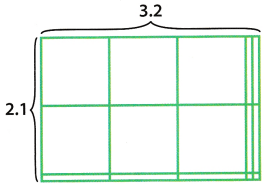
(B) 3.2 × 2.1 ______
Use an area model. Each row contains 3 wholes + 2 tenths.
Each column contains _________ whole(s) + ________ tenth(s).
The entire area model represents
________ whole(s) + ________ tenth(s) + ________ hundredth(s).
3.2 × 2.1 = ________
Texas Go Math Grade 6 Lesson 4.1 Answer Key Multiplying Decimals 2

Reflect

Question 1.
Analyze Relationships How are the products 2.1 × 3.2 and 21 × 32 alike? How are they different?
Answer:
The products of 2.1 × 3.2 and 21 × 32 will be the number with the same digits, but at 2.1 × 3.2 the result will have two decimal places and at 21 × 32 the result will be the whole number, that is the difference.
Products

Products with the same digits, but the product of 2.1 × 3.2 will have two decimal places while the product of 21 × 32 will be a whole number

Go Math Lesson 4.1 6th Grade Answer Key Question 2.
Communicate Mathematical Ideas How can you use estimation to check that you have placed the decimal point correctly in your product?
Answer:
We can check it by multiplying whole numbers which are the nearest to the given decimals. The result is supposed to be close to the right result.
We can check it by multiplying whole numbers which are the nearest to the given decimals.

Your Turn

Multiply.

Question 3.
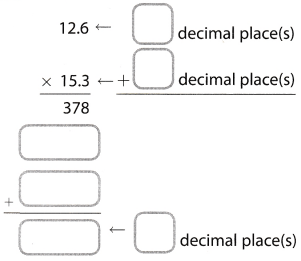
Texas Go Math Grade 6 Lesson 4.1 Answer Key Multiplying Decimals 3
Answer:
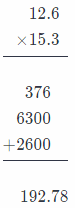
Here, in the first factor we have one decimal place as well as in the second factor. So, product will have two decimal places. We have the following:
Texas Go Math Grade 6 Lesson 4.1 Answer Key Multiplying Decimals 11
So, the result is 192.78

Question 4.
Texas Go Math Grade 6 Lesson 4.1 Answer Key Multiplying Decimals 4
Answer:
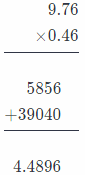
In both factors there are two decimal places, so, the product will have four decimal places We have the following:
Texas Go Math Grade 6 Lesson 4.1 Answer Key Multiplying Decimals 12
So, the product is 4.4896

Multiply

Question 5.
Texas Go Math Grade 6 Lesson 4.1 Answer Key Multiplying Decimals 5
Answer:
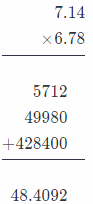
In both factors there are two decimal places, so, the product will have four decimal places We have the following:
Texas Go Math Grade 6 Lesson 4.1 Answer Key Multiplying Decimals 13
So, the product is 48.4092

Go Math Grade 6 Lesson 4.1 Answer Key Question 6.
Texas Go Math Grade 6 Lesson 4.1 Answer Key Multiplying Decimals 6
Answer:
In both factors there are two decimal places, so, the product will have four decimal places We have the following:
Texas Go Math Grade 6 Lesson 4.1 Answer Key Multiplying Decimals 14
So, the product is 95.0223

Question 7.
Rico bicycles at an average speed of 15.5 miles per hour.
What distance will Rico bicycle in 2.5 hours? ___________ miles
Answer:
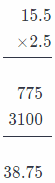
In order to find what distance Roco will bicycle in 2.5 hours multiplying 15.5 by 2.5. First factor has one decimal place, the second has one decimal place, so, the product will has two decimal places.

both factors there are two decimal places, so, the product will have four decimal places. We have the following:
Texas Go Math Grade 6 Lesson 4.1 Answer Key Multiplying Decimals 15
Conclusion is that Roco will bicycle 38.75 miles in 2.5 hours

Question 8.
Use estimation to show that your answer to 7 is reasonable.
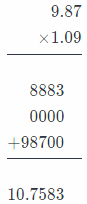
Answer:
We can multiply 15 by 2 and get 30. After that, we can multiply 16 by 3 and get 48 We can add 30 and 48 and we get 78. After this, we can divide 78 by 2 and get 39.
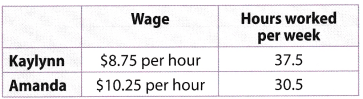
So, the answer is reasonable because 39 is close to 38.75.
Multiply 15 by 2.16 by 3 and sum the product. Divide that sum by 2.

Texas Go Math Grade 6 Lesson 4.1 Guided Practice Answer Key

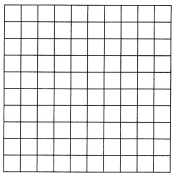
Question 1.
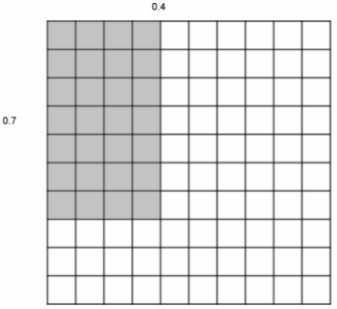
Use the grid to multiply 0.4 × 0.7
Texas Go Math Grade 6 Lesson 4.1 Answer Key Multiplying Decimals 7
0.4 × 0.7 = _______________
Answer:
0.4 × 0.7 represents 0.4 of 0.7. We will use a decimal grid and shade 7 rows of the grid to represent 0.7. Now, we will shade 0.4 of each 0.1 that is already shaded to represent 0.4 of 1. So, now we have 28 squares which are double-shaded. This actually represents 28 hundredths, or 28. So, we have the following:
0.4 × 0.7 = 0.28
Texas Go Math Grade 6 Lesson 4.1 Answer Key Multiplying Decimals 16

Multiplying Decimals Grade 6 Lesson 4.1 Question 2.
Draw an area model to multiply 1.1 × 2.4

1.1 × 2.4 _______________
Answer:
We will use an area model. Here, each row contains 1 whole + 1 tenth. Also, each column contains 2 wholes + 4 tenths. So, the entire area model represents:
2 wholes + 6 tenths + 4 hundreths.

Conclusion is that:
1.1 × 2.4 = 2.64
Texas Go Math Grade 6 Lesson 4.1 Answer Key Multiplying Decimals 17

Multiply.

Question 3.
0.18 × 0.06 = _______________
Answer:
In both factors there are two decimal places, so, the product will have four decimal places We have the following:
Texas Go Math Grade 6 Lesson 4.1 Answer Key Multiplying Decimals 18
So, the product is 0.0108

Question 4.
35.15 × 3.7 = _______________
Answer:
Here, in the first factor we have two decimal. places, but in the second we have one decimal. place, so, the product will have three decimal places.
Texas Go Math Grade 6 Lesson 4.1 Answer Key Multiplying Decimals 19
So, the result is 130.055

Question 5.
0.96 × 0.12 = _______________
Answer:
In both factors there are two decimal places, so, the product will have four decimal places. We have the following:
Texas Go Math Grade 6 Lesson 4.1 Answer Key Multiplying Decimals 20
So, the product is 0.1152

Go Math Lesson 4.1 Answer Key Multiplying Decimals 6th Grade Question 6.
62.19 × 32.5 = _______________
Answer:
In both factors there are two decimal places, so, the product will have four decimal places. We have the following:
Texas Go Math Grade 6 Lesson 4.1 Answer Key Multiplying Decimals 21
So, the product is 2.021.75

Question 7.
3.4 × 4.37 = _______________
Answer:
Here, in the first factor there is one decimal place, but in the second there are two decimal places, so, the product will has three decimal places.
In both factors there are two decimal places, so, the product will have four decimal places. We have the following:
Texas Go Math Grade 6 Lesson 4.1 Answer Key Multiplying Decimals 22
So, the product is 14.858

Question 8.
3.762 × 0.66 = _______________
Answer:
Here, in the first factor there are three decimal places, but in the second there are two, so, the product will has five decimal places.
Texas Go Math Grade 6 Lesson 4.1 Answer Key Multiplying Decimals 23
So, the product is 2.48292.

Question 9.
Chan Hee bought 3.4 pounds of coffee that cost $6.95 per pound.
How much did he spend on coffee? $ ___________________
Answer:
In order to calculate how much money Chan Hee spent on cotte, we need to multiply 3.4 by 6.95. First factor has one decimal place, but the second factor has two decimal places.
So, the product will has three decimal places.
Texas Go Math Grade 6 Lesson 4.1 Answer Key Multiplying Decimals 24
So, chan Hee spent 23.630 $ on coffee.

Question 10.
Adita earns $9.40 per hour working at an animal shelter.
How much money will she earn for 18.5 hours of work? $_______________
Answer:
In order to calculate how much money Adita will earn for 18.5 hours, we need to multiply 9.40 by 18.5. In the first factor there are two decimal places but in the second there is one decimal place.
So, the product will have three decimal places:
Texas Go Math Grade 6 Lesson 4.1 Answer Key Multiplying Decimals 25
So, Adita will earn 173.900$ for 18.5$ hours of work.

Catherin tracked her gas purchases for one month.

Texas Go Math Grade 6 Lesson 4.1 Answer Key Multiplying Decimals 8

Go Math Lesson 4.1 6th Grade Multiplying Decimals Question 11.
How much did Catherin spend on gas in week 2?
$ ___________________________
Answer:
In order to calculate how much Catherine spent on gas in week 2, we have to multiply 11.5 by 2.54 We can notice that the result will have three decimal places:
Texas Go Math Grade 6 Lesson 4.1 Answer Key Multiplying Decimals 26
Catherine spent 29.210 on gas in week 2$

Question 12.
How much more did she spend in week 4 than in week 1?
$ ____________________________
Answer:
First, we have to calculate how much Catherine spent on gas in week 1. we have to multiply 10.4 by 2.65. Here, the first factor has one decimal place hut the second one has two. the product will has three decimal places.
Texas Go Math Grade 6 Lesson 4.1 Answer Key Multiplying Decimals 27
Conclusion is that Catherine spent $ 27.560 on gas in week 1.
Now. we will calculate how much Catherine spent on gas in week 4.
We actually need to multiply 10.6 by 2.70.
We can notice that time result will hase three decimal places:
Texas Go Math Grade 6 Lesson 4.1 Answer Key Multiplying Decimals 28
We can see that Catherine spent $ 28.620 on gas in week 4.
Finally, we will subtract 27.560 from 28.620 in order to find how much more
Catherine spent on gas in week 4 than in week 1.
28.620 – 27.560 = 1.06
Catherine spent $ 1.06 more on gas in week 4 than in week 1.

Essential Question Check-In

Question 13.
How can you check the answer to a decimal multiplication problem?
Answer:
We can check our answer to a decimal multiplication problem using the grid or draw an area model.

Make a reasonable estimate for each situation.

Question 14.
A gallon of water weighs 8.354 pounds. Simon uses 11.81 gallons of water while taking a shower. About how many pounds of water did Simon use?
Answer:
In order to find how many pounds of water Simon used, we need to multiply 8.354 by 11.81.
First factor has three decimals but the second one has two decimals, so, the result will has five decimals
Texas Go Math Grade 6 Lesson 4.1 Answer Key Multiplying Decimals 29
Simon used 98.66074 pounds of water.

Question 15.
A snail moves at a speed of 2.394 inches per minute. If the snail keeps moving at this rate, about how many inches will it travel in 7.489 minutes?
Answer:
In order to calculate how many inches snail wilL travel in 7.489 minutes, we need to multiply 2.394 by 7.489. Both factors have three decimal places, so, the product will has six decimals
Texas Go Math Grade 6 Lesson 4.1 Answer Key Multiplying Decimals 30
The snail will travel 17.928666 inches if he keeps moving at this rate.

6th Grade Go Math Multiplying Decimals Lesson 4.1 Question 16.
Tricia’s garden is 9.87 meters long and 1.09 meters wide. What is the area of her garden?
Answer:
In order to calculate the area of Tricia’s garden, we need to multiply 9.87 by 1.09. Both factors have two decimals,
so, the product will have four decimal places.
Texas Go Math Grade 6 Lesson 4.1 Answer Key Multiplying Decimals 31
So, the area of Tricia’s garden is 10.7583 square meters.

Kaylynn and Amanda both work at the same store. The table shows how much each person earns, and the number of hours each person works in a week.

Texas Go Math Grade 6 Lesson 4.1 Answer Key Multiplying Decimals 9

Question 17.
Estimate how much Kaylynn earns in a week.
Answer:
We will multiply 9, because 9 is closest to 8.75 by 37. So, we have the following:
9 × 37 = 333
So, kaylyum earns about 333$ per week

Question 18.
Estimate how much Amanda earns in a week.
Answer:
We will multiply 10, because 10 is closest to 10.25 by 31. So, we have the following:
10 × 31 = 310
So, Amanda earns about 310$ per week

Question 19.
Calculate the exact difference between Kaylynn and Amandas weekly salaries.
Answer:
We will multiply 8.75 by 37.5 in order to calculate Kaylyun’s weekly salanes.
First factor has two decimals but the second one has decimal place, so, the product will has three decimals.
Texas Go Math Grade 6 Lesson 4.1 Answer Key Multiplying Decimals 32
So, Amanda earns $ 328.125 per week.
Now. we will calculate how much Amanda earns per week. So. we will multiply 10.25 by 30.5. Here, the first factor has two decimals but the second one has one decimal. so, the product will has three decimal places.
Texas Go Math Grade 6 Lesson 4.1 Answer Key Multiplying Decimals 33
So, Amanda earns $ 812.625 per week.
Now, we will calculate the exact difference between Kaylyun and Amanda’s weekly salanes subtracting 312.625 from 328.125 and get:
328.125 – 312.625 = 15.5
So the exact difference between their salaries is $ 15.5.

Question 20.
Victoria’s printer can print 8.804 pages in one minute. If Victoria prints pages for 0.903 minutes, about how many pages will she have?
Answer:
In order to calculate how many pages Victoria will have, we need to multiply 8.804 by 0.903. Both factors have three decimals, so, their product will have six decimals.
Texas Go Math Grade 6 Lesson 4.1 Answer Key Multiplying Decimals 34
So, Victoria will have 7.950012 pages.

A taxi charges a flat fee of $4.00 plus $2.25 per mile.

Question 21.
How much will it cost to travel 8.7 miles? ___________________
Answer:
In order to calculate how much it will cost to travel 8.7 miles, we need to multiply 8.7 by 2.25 and on that product add 4 flat fee. First factor has one decimal but these can done has two decimals.
So, the product will have three decimals.
Texas Go Math Grade 6 Lesson 4.1 Answer Key Multiplying Decimals 35
19.575 we will add 4.00 and get:
19.574 + 4.00 = 23.575$

So. it will cost $ 23.575 to travel 8.7 miles.

Question 22.
Multistep How much will the taxi driver earn if he takes one passenger 4.8 miles and another passenger 7.3 miles? Explain your process.
Answer:
If taxi driver takes one passenger 4.8 miles, we will calculate how much he will earn in this case. We will first multiply 4.8 by 2.25 and on that product will add 4.00 flat fee.
The first factor has one decimal but the second has two decimals, so, the product will have three decimals.
Texas Go Math Grade 6 Lesson 4.1 Answer Key Multiplying Decimals 36
Now, on 10.800 we will add 4.00 and get
10.800 + 4.00 = 14.800

So, it will cost 14.800 if taxi driver takes this passenger 4.8 miles. Now, we will calculate how much he will earn if he takes another passenger 73 miles. We will first multiply 73 by 2.25 and on that product we will add 4.00 flat fee. The first factor has on decimal but the second has two decimals, so, the product will have three decimals.
Texas Go Math Grade 6 Lesson 4.1 Answer Key Multiplying Decimals 37
16.425 we will add 4.00 and get:
16.425 + 4.00 = 20.425$
So, it will cost $ 20.425 if taxi driver takes this passenger 7.3 mites.
If he takes both passengers, he will earn:
14.800 + 20.425 = 35.225
So, the taxi driver will earn 35.225$.

Kay goes for several bike rides one week. The table shows her speed and the number of hours spent per ride.

Texas Go Math Grade 6 Lesson 4.1 Answer Key Multiplying Decimals 10

Question 23.
How many miles did Kay bike on Thursday?
Answer:
In order to calculate how many mites Kay biked on Thursday, we need to multiply 10.75 by 1.9.
First factor has two decimals but the second has one, so, the product will have three decimals.
Texas Go Math Grade 6 Lesson 4.1 Answer Key Multiplying Decimals 38
The conclusion is that Kay biked 20.425 miles on Thursday.

Multiplying Decimals for 6th Grade Go Math Lesson 4.1 Question 24.
On which day did Kay bike a whole number of miles?
Answer:
We can notice that on Friday Kay biked a whole number of mites. Really, to calculate it, we need to multiply 8.8 by 3.75.
The product will have three decimal places, so, we have the following:
Texas Go Math Grade 6 Lesson 4.1 Answer Key Multiplying Decimals 39
We can see that kay biked 33 miles on Friday.

Question 25.
What is the difference in miles between Kay’s longest bike ride and her shortest bike ride?
Answer:
Kay’s Longest bike ride was on Monday. Really, we need to multiply 8.2 by 4.25 in order to calculate length of this bike ride.
We can notice that the product will have three decimals.
Texas Go Math Grade 6 Lesson 4.1 Answer Key Multiplying Decimals 40
So, Kay biked 34.850 miles on Monday.
Her shortest bike ride was on Thursday, we already calculated it in the task 23. According to it, Kay biked 20.425 miles on Thursday.
Now we will calculate the difference in miles between Kay’s longest and her shortest bike ride subtracting miles on
Monday and miles on Thursday and get the following:
34.850 – 20.425 = 14.425
So, required difference was 14.425 mites.

Question 26.
Check for Reasonableness Kay estimates that Wednesday’s ride was about 3 miles longer than Tuesday’s ride. Is her estimate reasonable? Explain.
Answer:
Yes, her estimate is reasonable. We will estimate first Kay’s bike ride on Tuesday. In order to estimate it, we will multiply 10 by 3 and get:
10 × 3 = 30
Now, we will estimate Kay’s bike side on Wednesday. In order to estimate it, we will multiply 11 by 3 and get:
11 × 3 = 33.
So, according to it, Kay’s reasonable was correct

H.O.T. Higher Order Thinking

Question 27.
Explain the Error To estimate the product 3.48 × 7.33, Marisa multiplied 4 × 8 to get 32. Explain how she can make a closer estimate.
Answer:
She can make a closer estimate by multiplying 3 by 7 because 3 is the closest whole number to 3.48 and 7 is the closest whole number to 7.33
Multiply 3 by 7

Question 28.
Represent Real-World Problems A jeweler buys gold jewelry and resells the gold to a refinery. The jeweler buys gold for $1,235.55 per ounce and then resells it for $1,376.44 per ounce. How much profit does the jeweler make from buying and reselling 73.5 ounces of gold?
Answer:
We will first calculate how much the jeweler pays for 73.5 ounces of gold multiplying 1.235.55 by 73.5. The first factor has two decimals but the second one has one decimal, so, the product will have three decimals.
Texas Go Math Grade 6 Lesson 4.1 Answer Key Multiplying Decimals 41
So, the jeweler will pay $90,812.925.

Now, we will calculate how much he will get if he resells 73.5 ounces multiplying 1,376.44 by 73.5. The first factor has two decimals but the second one has one decimal, so, the product will have three decimals.
Texas Go Math Grade 6 Lesson 4.1 Answer Key Multiplying Decimals 41
So, he will get $101, 168.340 if he resells gold.

Now, we wilt calculate how much profit the jeweler will make from bying and reselling subtracting 101, 168.340 and 90, 812.925 and get:
101, 168.340 – 90,812.925 = 10, 355.415
So, his profit will be $10, 355.415.

Question 29.
Problem Solving To find the weight of the gold in a 22 karat gold object, multiply the object’s weight by 0.916. To find the weight of gold in a 14 karat gold object, multiply the object’s weight by 0.585. Which contains more gold, a 22 karat gold object or a 14 karat gold object that each weigh 73.5 ounces? How much more gold does it contain?
Answer:
First we will calculate contain of gold of 22 karat object multiplying the object’s weight, which is 73.5 ounces, by 0.916. The product will have four decimals:
Texas Go Math Grade 6 Lesson 4.1 Answer Key Multiplying Decimals 43
So, a 22 karat gold object contains 67.326 ounces of gold.
Now we will calculate contain of gold of 14 karat gold object multiplying the object’s weight, which is 73.5 ounces, by 0.585. The product will have four decimals:
Texas Go Math Grade 6 Lesson 4.1 Answer Key Multiplying Decimals 44
So, a 14karat gold object contains 42.9975 ounces of gold.
We can see that more gold contains a 22 karat gold object.

Now we will calculate how much more gold it contains subtracting 42.9975 from 67.3260 and get:
67.3260 – 42.9975 = 24.3285
So, a 22 karat gold object contains 24.3285 ounces of gold more than a 14 karat gold object with equal weights.
a 22 karat object; 24.3285

Texas Go Math Grade 6 Lesson 4.1 Answer Key Multiplying Decimals Read More »

Texas Go Math Grade 6 Module 2 Quiz Answer Key

Refer to our Texas Go Math Grade 6 Answer Key Pdf to score good marks in the exams. Test yourself by practicing the problems from Texas Go Math Grade 6 Module 2 Quiz Answer Key.

Texas Go Math Grade 6 Module 2 Quiz Answer Key

Texas Go Math Grade 6 Module 2 Ready to Go On? Answer Key

2.1 Classifying Rational Numbers

Question 1.
Five friends divide three bags of apples equally between them.
Write the division represented in this situation as a fraction.
Answer:
As 5 friends divide 3 bags of apples equally between them, we can write it as fraction as:
\(\frac{3}{5}\)

Write each rational number as \(\frac{a}{b}\)

Question 2.
5\(\frac{1}{6}\) __________________
Answer:
Firstly, we will write the whole number as a sum of ones
Secondly, we will use the denominator to find corresponding fractions for ones.
Thirdly, we will calculate sum of numerators!
To reach our final solution: improper fraction.
5\(\frac{1}{6}\) = 1 + 1 + 1 + 1 + 1 + \(\frac{1}{6}\)
= \(\frac{6}{6}+\frac{6}{6}+\frac{6}{6}+\frac{6}{6}+\frac{6}{6}+\frac{1}{6}\)
= \(\frac{31}{6}\)

Grade 6 Module 2 Form A Module Test Answer Key Question 3.
– 12 __________________
Answer:
Number – 12 can be written as a fraction:
– 12 = – \(\frac{12}{1}\)

Determine if each number is a whole number, integer, or rational number. Include all sets to which each number belongs.

Question 4.
– 12 __________________
Answer:
Number – 12 belongs to set of Integers
Therefore, it also belongs to set of Rational numbers

Question 5.
\(\frac{7}{8}\) __________________
Answer:
Number \(\frac{7}{8}\) belongs to set of Rational Numbers

2.2 Identifying Opposites and Absolute Value of Rational Numbers

Question 6.
Graph – 3, 1\(\frac{3}{4}\), – 0.5, and 3 on the number line.
Texas Go Math Grade 6 Module 2 Quiz Answer Key 1
Answer:
Firstly, we transform fractions into decimals!
1\(\frac{3}{4}\) = 1 + \(\frac{3}{4}\) = 1 + 0.75 = 1.75
Texas Go Math Grade 6 Module 2 Quiz Answer Key 7

Division:
Texas Go Math Grade 6 Module 2 Quiz Answer Key 8

Question 7.
Find the opposite of \(\frac{1}{3}\) and – \(\frac{7}{12}\) __________
Answer:
As i mentioned before, opposite of any number is number with added – sign on left side!
Opposite of \(\frac{1}{3}\) is –\(\frac{1}{3}\)
Opposite of – \(\frac{7}{12}\) is \(\frac{7}{12}\)
– \(\frac{1}{3}\) and \(\frac{7}{12}\)

Go Math Grade 6 Module 2 Answer Key Pdf Question 8.
Find the absolute value of 9.8 and –\(\frac{7}{8}\) __________
Answer:
Absolute value of some number is its distance from 0 on the number line!
|9.8| = 9.8
|- \(\frac{10}{3}\)| = \(\frac{10}{3}\)
9.8 and \(\frac{10}{3}\)

2.3 Comparing and Ordering Rational Numbers

Question 9.
Over the last week, the daily low temperatures in degrees Fahrenheit have been – 4, 6.2, 18\(\frac{1}{2}\), – 5.9, 21, – \(\frac{1}{4}\), and 1.75. List these numbers in order from greatest to least.
Answer:
First thing will be writing fractions as equivalent decimals!
18\(\frac{1}{2}\) = 18 + \(\frac{1}{2}\) = 18 + 0.5 = 18.5
– \(\frac{1}{4}\) = – 0.25

Now we know that number 21 is greater than 18.5 which is greater than 6.2 which is greater than 1.75 which is
greater than – 0.25 which ¡s greater than – 4 which is greater than – 5.9.
One last thing to do is to return decimals to given expressions and write it in order from greatest to least!
21, 18\(\frac{1}{2}\), 6.2, 1.75, –\(\frac{1}{2}\), – 4, – 5.9

Division:
\(\frac{1}{2}\) is very easy, so we won’t show it!
Texas Go Math Grade 6 Module 2 Quiz Answer Key 9

Essential Question

Question 10.
How can you solve problems by ordering rational numbers from least to greatest?
Answer:
Firstly, we have to convert all expressions into same, as shown in examples above, we can work with fractions or
decimals, depending on given terms!
Secondly, we compare our decimals/fractions and order them from least to greatest!
Note that we compare numerators when dealing with fractions. That works because we get them to have same denominator!
One last thing to do is to return them in given format and write a final solution!

Texas Go Math Grade 6 Module 2 Mixed Review Texas Test Prep Answer Key

Selected Response

Question 1.
Suki split five dog treats equally among her six dogs. Which fraction represents this division?
(A) \(\frac{6}{5}\) of a treat
(B) \(\frac{5}{6}\) of a treat
(C) \(\frac{1}{5}\) of a treat
(D) \(\frac{1}{6}\) of a treat
Answer:
As Suki splits 5 dog treats among 6 dogs.
Each dog will get
\(\frac{5}{6}\) treats

(B) \(\frac{5}{6}\) of a treat

Question 2.
Which set or sets does the number 15 belong to?
(A) whole numbers only
(B) rational numbers only
(C) integers and rational numbers only
(D) whole numbers, integers, and rational
Answer:
The number 15 belongs to a set of Whole numbers and therefore to a set of Integers and Rational numbers.
We can say that because we know that a set of Whole numbers is included in the set of Integers, and a set of Integers is included in the set of Rational numbers.

Integers Quiz Grade 6 Module 2 Test Answers Math Question 3.
Which of the following statements about rational numbers is correct?
(A) All rational numbers are also whole numbers.
(B) All rational numbers are also integers.
(C) All rational numbers can be written in the form \(\frac{a}{b}\).
(D) Rational numbers cannot be negative.
Answer:
Statement that all rational numbers are also whole numbers is surely incorrect!
For example, 0.5 is a decimal, which is not whole number!

Statement that all rational numbers are also integers is also incorrect!
We can use same example from last statement to prove it.

Statement that all rational numbers can be written in form of \(\frac{a}{b}\) is correct!
Really, it is…take a look at some examples that prove our theory:
0.5 = \(\frac{1}{2}\)
– 5 = \(\frac{-5}{1}\)
5 = \(\frac{5}{1}\)

Statement that rational numbers cannot be negative is incorrect!
We can simply take a look on Venn’s diagram(which we worked in previous lecture) to convince ourselves that this is false statement!

(C) All rational numbers can be written in the form \(\frac{a}{b}\).

Question 4.
Which of the following shows the numbers in order from least to greatest?
(A) –\(\frac{1}{5}\), – \(\frac{2}{3}\), 2, 0.4
(B) 2, –\(\frac{2}{3}\), 0.4, – \(\frac{1}{5}\)
(C) – \(\frac{2}{3}\), 0.4, – \(\frac{1}{5}\), 2
(D) – \(\frac{2}{3}\), – \(\frac{1}{5}\), 0.4, 2
Answer:
Let’s transform all the given numbers into fractions first and make them have 15 as common denominator
Texas Go Math Grade 6 Module 2 Quiz Answer Key 10

Now, we compare their numerators to find out their order
30, 6, – 3, – 10
Number – 10 is less than – 3 which is less than 6 which is Less than 30.
So, now we know order of numerators, and therefore we know order of whole fractions

So, numbers in order from least to greatest are:
\(-\frac{10}{15},-\frac{3}{15}, \frac{6}{15}, \frac{30}{15}\)
Now, we can return them in given form and get:
– \(\frac{2}{3}\), – \(\frac{1}{5}\), 0.4, 2

(D) – \(\frac{2}{3}\), – \(\frac{1}{5}\), 0.4, 2

Question 5.
What is the absolute value of – 12.5?
(A) 12.5
(B) 1
(C) – 1
(D) – 12.5
Answer:
Absolute value of some number is its distance from 0 on the number line!
|- 12.5| = 12.5

(D) – 12.5

Grade 6 Module 2 Rational Numbers Quiz Answer Key Question 6.
Which number line shows –\(\frac{1}{4}\) and its opposite?
(A) Texas Go Math Grade 6 Module 2 Quiz Answer Key 2
(B) Texas Go Math Grade 6 Module 2 Quiz Answer Key 3
(C) Texas Go Math Grade 6 Module 2 Quiz Answer Key 4
(D) Texas Go Math Grade 6 Module 2 Quiz Answer Key 5
Answer:
Let’s draw our number line to find out the solution:
Texas Go Math Grade 6 Module 2 Quiz Answer Key 11
Note that we used 0.25 instead of \(\frac{1}{4}\) since these expressions are equivalent!

(B) Texas Go Math Grade 6 Module 2 Quiz Answer Key 3

Question 7.
Horatio climbed to the top of a ladder that was 10 feet high. What is the opposite of Horatio’s height on the ladder?
(A) – 10 feet
(B) 10 feet
(C) 0 feet
(D) \(\frac{1}{10}\) foot
Answer:
Opposite of some number is that same number with an added – sign on the left side.
So, in our case, the opposite of 10 is -10 feet.

(A) – 10 feet

Gridded Response

Go Math Grade 6 Module 2 Quiz Answers Question 8.
The heights of four students in Mrs. Patel’s class are 5\(\frac{1}{2}\)feet, 5.35 feet, 5\(\frac{4}{10}\) feet, and 5.5 feet. What is the height in feet of the shortest student written as a decimal?
Texas Go Math Grade 6 Module 2 Quiz Answer Key 6
Answer:
Here, we will transform given expressions into decimals and then compare them to reach our solution!
5\(\frac{1}{2}\) = 5 + \(\frac{1}{2}\) = 5 + 0.5 = 5.5
5\(\frac{4}{10}\) = 5 + \(\frac{4}{10}\) = 5 + \(\frac{4 / 2}{10 / 2}\) = 5 + \(\frac{2}{5}\) = 5 + 0.4 = 5.4

Now, when we have them all in the wanted form, we can compare them!
Number 5.5 is greater than 5.4 which is greater than 5.35.
Now we know that the shortest student is 5.35 feet high.

Division:
Texas Go Math Grade 6 Module 2 Quiz Answer Key 12

Texas Go Math Grade 6 Module 2 Quiz Answer Key Read More »

Texas Go Math Grade 6 Unit 1 Study Guide Review Answer Key

Refer to our Texas Go Math Grade 6 Answer Key Pdf to score good marks in the exams. Test yourself by practicing the problems from Texas Go Math Grade 6 Unit 1 Study Guide Review Answer Key.

Texas Go Math Grade 6 Unit 1 Study Guide Review Answer Key

Texas Go Math Grade 7 Unit 1 Exercises Answer Key

Question 1.
Graph each number on the number line.
7, – 2, 5, 1, – 1
Texas Go Math Grade 6 Unit 1 Study Guide Review Answer Key 1
Answer:
Texas Go Math Grade 6 Unit 1 Study Guide Review Answer Key 16

Write the opposite of each number.

Question 2.
8 ___________
Answer:
The opposite of a number is the number on the other side of the 0 number line, and the same distance from 0.
Opposite of 8 is – 8

Go Math 6th Grade Math Unit 1 Study Guide Answer Key Question 3.
– 3 ___________
Answer:
The opposite of a number is the number on the other side of 0 on the number tine and the same distance from 0.
Opposite of – 3 is 3.

List the numbers from the greatest of each number.

Question 4.
4, 0, – 2, 3 ___________
Answer:
Number – 2 is less than 0 which is less than 3 which is less than 4.
Therefore, we list them as: – 2, 0, 3, 4

Question 5.
– 3, – 5, 2, – 2 ___________
Answer:
Number – 5 is less than – 3 which is less than – 2 which is less than 2
Therefore, we list them as: – 5, – 3, – 2, 2

Use a number line to help you compare the numbers. Use < or >.

Question 6.
4 _________ 1
Answer:
Texas Go Math Grade 6 Unit 1 Study Guide Review Answer Key 17

It is clear that 1 is less than 4.
So, we can write: 1 < 4

Question 7.
– 2 _________ 2
Answer:
Texas Go Math Grade 6 Unit 1 Study Guide Review Answer Key 18

It is clear that – 2 is less than 2.
So, we can write: – 2 < 2

Question 8.
– 3 _________ – 5
Answer:
Texas Go Math Grade 6 Unit 1 Study Guide Review Answer Key 19

It is clear that – 3 is less than – 5.
So, we can write: – 3 > – 5

Unit 1 Study Guide Answer Key Go Math Grade 6 Question 9.
– 7 _________ 2
Answer:
Texas Go Math Grade 6 Unit 1 Study Guide Review Answer Key 20

It is clear that – 7 is less than 2.
So, we can write: – 7 < 2

Find each absolute value.

Question 10.
|6| _________
Answer:
Absolute value of some number is its distance from 0 on the number line!
Therefore, we know:
|6| = 6

Question 11.
|- 2| _________
Answer:
Absolute value of some number is its distance from 0 on the number line!
Therefore, we know
|- 2| = 2

Texas Go Math Grade 7 Unit 2 Exercises Answer Key

Classify each number by indicating in which set or sets it belongs.

Question 1.
8
Answer:
Number 8 is positive Whole number.
Therefore, it belongs to set of Whole numbers, Integers and Rational numbers!

Question 2.
0.25
Answer:
Number 0.25 is Rational number.
Therefore, it belongs to set of Rational numbers!

Find the absolute value of each rational number.

Question 3.
|3.7| _______________
Answer:
Absolute value of some number is its distance from 0 on the number line!
Therefore, we know
|3.7| = 3.7

Question 4.
|- \(\frac{2}{3}\)|
Answer:
Absolute value of some number is its distance from 0 on the number line!
Therefore, we know
|- \(\frac{2}{3}\)| = \(\frac{2}{3}\)

Graph each set of numbers on the number line and order the numbers from greatest to least.

Question 5.
– 0.5, – 1, –\(\frac{1}{4}\), 0
Texas Go Math Grade 6 Unit 1 Study Guide Review Answer Key 2
Answer:
Firstly, we transform fractions into decimals!
–\(\frac{1}{4}\) = – 0.25

Texas Go Math Grade 6 Unit 1 Study Guide Review Answer Key 21

Now we can say that:
Number 0 is greater than – 0.25 which is greater than – 0.5 which is greater than – 1.

Division:
Texas Go Math Grade 6 Unit 1 Study Guide Review Answer Key 22

Texas Go Math Grade 6 Unit 1 Performance Task Answer Key

Question 1.
CAPEEPS IN MATH Climatologist Each year a tree is alive, it adds a layer of growth, called a tree ring, between its core and its bark. A climatologist measures the width of tree rings of a particular tree for different years:
Texas Go Math Grade 6 Unit 1 Study Guide Review Answer Key 3
The average temperature during the growing season is directly related to the width of the ring, with a greater width corresponding to a higher average temperature.

a. List the years in order of increasing ring width.
Answer:
Here. we want to order years based on va1ue given below, from least increase to greatest increase!
Firstly, we get all fractions to have common denominator which, in this case, will be 100.
Texas Go Math Grade 6 Unit 1 Study Guide Review Answer Key 23
Now, we compare numerators 53, 58, 56, 60, 65
Number 53 is less than 56 which is less than 58 which is less than 60 which is less than 65.
So, we can write them us:
35 < 56 < 58 < 60 < 65
Final thing to do ¡s to return numbers into given formats and write solution
\(\frac{53}{100}<\frac{14}{25}<\frac{29}{50}<\frac{3}{5}<\frac{13}{20}\)
Now, we want to write years corresponding to width of ring in increasing order:
1920, 1900, 1910, 1940, 1930

b. Which year was hottest? How do you know?
Answer:
Hottest year, by previous calculations was 1930
we can say that because we know that 1930, the width of ring was greatest!

c. Which year was coldest? How do you know?
Answer:
Coldest year, by previous calculations, was 1920
We can say that because we know that in 1920, the width of the ring was the least

Multiplication: You can do it by yourselves as an exercise!

Unit 1 Review Answer Key Go Math Grade 6 Question 2.
A parking garage has floors above and below ground level. For a scavenger hunt, Gaia’s friends are given a list of objects they need to find on the third and fourth level below ground, the first and fourth levels above ground, and ground level.

a. If ground level is 0 and the first level above ground is 1, which integers can you use to represent the other levels where objects are hidden? Explain your reasoning.
Answer:
As we know that the ground level is labeled as 0 and that the first level above ground is labeled as 1, we can conclude that the third level below ground is labeled as – 3,
fourth level below ground is Labeled as – 4 and the fourth level above ground is labeled as 4.
Our reasoning is quite simple here, we present levels below ground as negative integers, and levels above ground as positive integers

b. Graph the set of numbers on the number line.
Texas Go Math Grade 6 Unit 1 Study Guide Review Answer Key 4
Answer:
Texas Go Math Grade 6 Unit 1 Study Guide Review Answer Key 24

c. Gala wants to start at the lowest level and work her way up. List the levels in the order that Gala will search them.
Answer:
As we can see on the number line above, Gaia will have to search levels in order.
– 4, – 3, 0, 1, 4
Note that reading our number line from left to right allows us to order numbers from least to greatest.

d. If she takes the stairs, how many flights of stairs will she have to climb? How do you know?
Answer:
As we can see on the number line above, lowest level is 4
If she take the stairs, she will have to pass some levels that she won’t search.
If she starts at lowest level – 4, then she will have to climb 4 flights of stairs in order to get to ground Level 0.
Also, after she reaches 0 level she still has 4 flights of stairs to climb till fourth level above ground!
ALtogether, she has to climb:
4 + 4 = 8 flights of stairs!
We can also observe this using absolute value, as we are speaking about distance, 4 levels means 4 flights of stairs, so it doesn’t matter whether we are above/below ground, we are crossing same distance.

Texas Go Math Grade 6 Unit 1 Mixed Review Answer Key

Selected Response

Question 1.
What is the opposite of – 9?
(A) 9
(B) –\(\frac{1}{9}\)
(C) 0
(D) \(\frac{1}{9}\)
Answer:
(A) 9

Explaination:
The opposite of a number ¡s the number on the other side of 0 number line, and the same distance from 0.
Opposite of – 9 is 9.

Question 2.
Kyle is currently 60 feet above sea level. Which correctly describes the opposite of Kyle’s elevation?
(A) 60 feet below sea level
(B) 60 feet above sea level
(C) 6 feet below sea level
(D) At sea level
Answer:
(A) 60 feet below sea level

Explaination:
The opposite of a number is the number on the other side of 0 number tine, and the same distance from 0. We can use this statement in our case!
As kyle is 60 feet above sea level, opposite of his elevation would be: 60 feet below sea level!

6th Grade Math Unit 1 Review Test Answer Key Question 3.
What is the absolute value of 27?
(A) – 27
(B) 0
(C) 3
(D) 27
Answer:
(D) 27

Explaination:
Absolute value of some number is its distance from 0 in the number line.
|27| = 27

Question 4.
In Albany it is – 4°F, in Chicago it is – 14°F, in Minneapolis it is – 11°F, and in Toronto it is – 13°F. In which city is it the coldest?
(A) Albany
(B) Chicago
(C) Minneapolis
(D) Toronto
Answer:
(B) Chicago

Explaination:
Here, we will compare given temperature to find out, which is lowest.
When we find lowest temperature, we will know which city is the oldest!

Temperature of – 4°F is greater than – 1°F which is greater than – 13°F which is greater than – 14°F.
Now, we can concLude that the lowest temperature is -14°F.
That temperature is measured in Chicago.
So, coldest is in Chicago.

Question 5.
Which shows the integers in order from greatest to least?
(A) 18, 4, 3, – 2, – 15
(B) – 2, 3, 4, – 15, 18
(C) – 15, – 2, 3, 4, 18
(D) 18, – 15, 4, 3, 2
Answer:
(A) 18, 4, 3, – 2, – 15

Explaination:
We have integers 18, 4, 3, – 2, – 15 given!
We want to order them from greatest to least.

Number 18 is greater than 4 which is greater than 3 which is greater than – 2 which is greater than – 15.
Therefore, we can write:
18 > 4 > 3 > – 2 > – 15
Order from greatest to least is: 18, 4, 3, – 2, – 15.

Question 6.
Joanna split three pitchers of water equally among her eight plants. What fraction of a pitcher did each plant get?
(A) \(\frac{1}{8}\) of a pitcher
(B) \(\frac{1}{3}\) of a pitcher
(C) \(\frac{3}{8}\) of a pitcher
(D) \(\frac{8}{3}\) of a pitcher
Answer:
(C) \(\frac{3}{8}\) of a pitcher

Explaination:
It is obvious that we want to write a fraction including 3 as a numerator and 8 as a denominator.
This is how it looks: \(\frac{3}{8}\)

Question 7.
Which set or sets does the number – 22 belong to?
(A) Whole numbers only
(B) Rational numbers only
(C) Integers and rational numbers only
(D) Whole numbers, integers, and rational numbers
Answer:
(C) Integers and rational numbers only

Explaination:
Number – 22 is opposite of Whole number 22, therefore is belongs to set of Integers.
As Rational numbers include set of Integers, therefore it also belongs to set of Rational numbers.

Question 8.
Carlos swam to the bottom of a pool that is 12 feet deep. What is the opposite of Carlos’s elevation relative to the surface?
(A) – 12feet
(B) 0 feet
(C) 12 feet
(D) \(\frac{1}{12}\) foot
Answer:
(C) 12 feet

Explaination:
The opposite of a number is the number on the other side of the 0 number line, and the same distance from 0.
As elevation is a negative number, in this case, that means the opposite of Carlos’s elevation is 12 feet.

Unit 1 Mid Unit Assessment Grade 6 Answer Key Question 9.
Which number line shows \(\frac{1}{3}\) and its opposite?
(A) Texas Go Math Grade 6 Unit 1 Study Guide Review Answer Key 5
(B) Texas Go Math Grade 6 Unit 1 Study Guide Review Answer Key 6
(C) Texas Go Math Grade 6 Unit 1 Study Guide Review Answer Key 7
(D) Texas Go Math Grade 6 Unit 1 Study Guide Review Answer Key 8
Answer:
(D) Texas Go Math Grade 6 Unit 1 Study Guide Review Answer Key 8

Explaination:
The opposite of a number is the number on the other side of the number line, and the same distance from 0.
Let’s draw our number line which will include \(\frac{1}{3}\) and its opposite, –\(\frac{1}{3}\)
Texas Go Math Grade 6 Unit 1 Study Guide Review Answer Key 25
Note that we used 1/3 instead of \(\frac{1}{3}\).

Question 10.
Which of the following shows the numbers in order from least to greatest?
(A) – \(\frac{2}{3}\), –\(\frac{3}{4}\), 0.7, 0
(B) 0.7, 0, – \(\frac{2}{3}\), – \(\frac{3}{4}\),
(C) – \(\frac{2}{3}\), – \(\frac{3}{4}\), 0, 0.7
(D) – \(\frac{3}{4}\), – \(\frac{2}{3}\), 0, 0.7
Answer:
(D) – \(\frac{3}{4}\), – \(\frac{2}{3}\), 0, 0.7

Explaination:
Given numbers are: – \(\frac{2}{3}\), –\(\frac{3}{4}\), 0.7, 0
Let’s order them from least to greatest!
The first thing is to transform them into equal form(decimals)!
– \(\frac{2}{3}\) = – 0.\(\dot{6}\)
– \(\frac{3}{4}\) = – 0.75
Now we can say that:
Number – 0.75 in less than – 0.\(\dot{6}\) which in less than 0 which is less than 0.7
Therefore, we can write the an:
– 0.75 < – 0.\(\dot{6}\) < 0 < 0.7
Now, we can return them into given forms and write them in the right order!
– \(\frac{3}{4}\), – \(\frac{2}{3}\), 0, 0.7

Division:
Texas Go Math Grade 6 Unit 1 Study Guide Review Answer Key 26

Texas Go Math Grade 6 Unit 1 Study Guide Review Answer Key 27

Question 11.
Which number line shows an integer and its opposite?
(A) Texas Go Math Grade 6 Unit 1 Study Guide Review Answer Key 9
(B) Texas Go Math Grade 6 Unit 1 Study Guide Review Answer Key 10
(C) Texas Go Math Grade 6 Unit 1 Study Guide Review Answer Key 11
(D) Texas Go Math Grade 6 Unit 1 Study Guide Review Answer Key 12
Answer:
(B) Texas Go Math Grade 6 Unit 1 Study Guide Review Answer Key 10

Explaination:
Here, we could draw all 4 of given number tines, and conclude which one is correct!
However, there is no purpose to do so.
Let’s see what are we actually looking for, when finding our answer.
We want to find the one, which shows an integer and its opposite.
As by definition, the opposite of a number is the number on the other side of 0 number line, and the same distance from 0
So, we should have same distance from 0 on both sides!
There is only 1 graph that satisfies our terms.
It is: Texas Go Math Grade 6 Unit 1 Study Guide Review Answer Key 10

Gridded Response

Question 12.
Which is the greatest out of \(\frac{1}{3}\), – 1.2, 0.45, and – \(\frac{4}{5}\)?
Texas Go Math Grade 6 Unit 1 Study Guide Review Answer Key 13
Answer:
Given numbers are: \(\frac{1}{3}\), – \(\frac{4}{5}\), – 1.2. 0.45
Let’s order them from least to greatest, and then we will know our final solution!
First thing is to transform them into equal form(decimals)!
\(\frac{1}{3}\) = 0.3
– \(\frac{4}{5}\) = – 0.8
Now, we can say that:
Number – 1.2 is less than – 0.8 which is less than 0.\(\dot{3}\) which is less than 0.45.
Therefore, we can write them as:
– 1.2 < – 0.8 < 0.\(\dot{3}\) < 0.45
Now, if we take a look on previous expression, we can see that 0.45 is the greatest number among given ones!

Division:
Texas Go Math Grade 6 Unit 1 Study Guide Review Answer Key 28

Texas Go Math Grade 6 Unit 1 Study Guide Review Answer Key 2

Question 13.
As part of a research team, Ryanne climbed into a cavern to an elevation of – 117.6 feet. What is the absolute value of Ryanne’s elevation, in feet?
Texas Go Math Grade 6 Unit 1 Study Guide Review Answer Key 14
Answer:
In this task, we want to find the absolute value of given elevation!
Absolute value describes the distance of a number on the number line from 0 without considering which direction from zero the number lies.
The absolute value of a number is never negative.
|- 117.6| = 117.6 feet
= 117.6

Hot Tip: Correct answers in gridded problems can be positive or negative. Enter the negative sign in the first column when it is appropriate. Check your work!

Question 14.
Melvin has a certain number of files on his computer. The opposite of this number is – 653. How many files are on Melvin’s computer?
Texas Go Math Grade 6 Unit 1 Study Guide Review Answer Key 15
Answer:
Here, we have to understand that opposite of opposite is given number
The opposite of a number is the number on the other side of 0 number line, and the same distance from 0.
If opposite of some number is – 653, that means that the number is: 653

Texas Go Math Grade 6 Unit 1 Study Guide Review Answer Key Read More »

Texas Go Math Grade 6 Lesson 3.1 Answer Key Multiplying Fractions

Refer to our Texas Go Math Grade 6 Answer Key Pdf to score good marks in the exams. Test yourself by practicing the problems from Texas Go Math Grade 6 Lesson 3.1 Answer Key Multiplying Fractions.

Texas Go Math Grade 6 Lesson 3.1 Answer Key Multiplying Fractions

Texas Go Math Grade 6 Lesson 3.1 Explore Activity Answer Key

Modeling Fraction Multiplication
Sam and Pete had a party. After the party, they discovered that \(\frac{3}{4}\) of a casserole was left over. Sam and Pete ate \(\frac{1}{2}\) of the leftover casserole. What fraction of the original casserole did Sam and Pete eat?

Shade the model to show Texas Go Math Grade 6 Lesson 3.1 Answer Key Multiplying Fractions 1.

(A) Shade the rectangle to represent the \(\frac{3}{4}\) of the casserole that was left over after the party.

(B) Double shade \(\frac{1}{2}\) of \(\frac{3}{4}\). Divide the remaining fourth into two parts so that all of the parts are equal.
Texas Go Math Grade 6 Lesson 3.1 Answer Key Multiplying Fractions 2

(C) Sam and Pete ate ____ of the original casserole.

(D) Did the amount of casserole increase or decrease when multiplied by \(\frac{1}{2}\)? How does the model show this? Explain.

(E) Write the multiplication shown by the model. Texas Go Math Grade 6 Lesson 3.1 Answer Key Multiplying Fractions 3

Reflect

Go Math Grade 6 Lesson 3.1 Answer Key Question 1.
Communicate Mathematical Ideas Will the product of \(\frac{1}{2}\) and \(\frac{2}{3}\) be greater or less than \(\frac{2}{3}\)? Explain.
Answer:
We can calculate the product of \(\frac{1}{2}\) and \(\frac{2}{3}\) and then compare the result with \(\frac{2}{3}\).
Texas Go Math Grade 6 Lesson 3.1 Answer Key Multiplying Fractions 6
Now, we can compare \(\frac{1}{2}\) and \(\frac{2}{3}\)
Easiest way is to compare their numerators.
Number 1 is less than 2.
Therefore. we can write: 1 < 2
That implies that \(\frac{1}{3}\) is less than \(\frac{2}{3}\).

Question 2.
Communicate Mathematical Ideas Is the product less than or greater than the factors? Explain.
Answer:
This question depends on whether we multiply numbers whose value is greater than 1 or less than 1.
If both factors are greater than 1, then we get number which is greater than factors.
If any of factors is less than 1, then we get number which is less than at least one factor.

Question 3.
Analyze Relationships How can you determine when to simplify using the GCF before multiplying?
Answer:
We simplify our fractions using GCF when we see some common factor in numerator and denominator.

Your Turn

Multiply. Write each product in simplest form.

Question 4.
\(\frac{1}{6} \times \frac{3}{5}\) ____________
Answer:
Process of fractions multiplication:
Firstly, we write the problem as a single fraction.
Secondly, we multiply numerators and denominators!
Thirdly, we simplify expression by dividing by the Greatest Common Factor
And finally, we write our answer in simplest form!
Texas Go Math Grade 6 Lesson 3.1 Answer Key Multiplying Fractions 7

Go Math Grade 6 Answer Key Lesson 3.1 Multiplying Fractions Question 5.
\(\frac{3}{4} \times \frac{7}{9}\) ____________
Answer:
Process of fractions multiplication:
Firstly, we write the problem as a single fraction.
Secondly, we multiply numerators and denominators!
Thirdly, we simplify the expression by dividing by the Greatest Common Factor
And finally, we write our answer in simplest form!
Texas Go Math Grade 6 Lesson 3.1 Answer Key Multiplying Fractions 8

Question 6.
\(\frac{3}{7} \times \frac{2}{3}\) ____________
Answer:
Process of fractions multiplication:
Firstly, we write the problem as a single fraction.
Secondly, we multiply numerators and denominators!
Thirdly, we simplify expression by dividing by the Greatest Common Factor
And finally, we write our answer in simplest form!
Texas Go Math Grade 6 Lesson 3.1 Answer Key Multiplying Fractions 9

Question 7.
\(\frac{4}{5} \times \frac{2}{7}\) ____________
Answer:
Process of fractions multiplication:
Firstly, we write the problem as a single fraction.
Secondly, we multiply numerators and denominators!
Thirdly, we simplify expression by dividing by the Greatest Common Factor
And finally, we write our answer in simplest form!
\(\frac{4}{5} \times \frac{2}{7}=\frac{4 \times 2}{5 \times 7}\)
= \(\frac{8}{35}\)

Reflect

Question 8.
Analyze Relationships Is the product of a fraction and a whole number greater than or less than the whole number? Explain.
Answer:
Product of a fraction and a whole number is greater than the whole number
if fraction numerator is greater than its denominator.

If fraction numerator is less than its denominator then the product is less than the whole number
There is also special case when fraction numerator and denominator are same, then the product is same as whole number.

Your Turn

Multiply. Write each product in simplest form.

Question 9.
\(\frac{5}{8}\) × 24 _______________
Answer:
Here, before we start the process of multiplication, we must write whole number as an equivalent fraction.
Process of fractions multiplication:
Firstly, we write the problem as a single fraction.
Secondly, we simplify before multiplying using the Greatest Common Factor.
Thirdly, we multiply numerators and denominators.
And finally, we write our solution in simplest form, as whole number if possible!
Texas Go Math Grade 6 Lesson 3.1 Answer Key Multiplying Fractions 10

Multiplying Fractions with Answers Go Math Lesson 6th Grade Question 10.
\(\frac{3}{5}\) × 20 _______________
Answer:
Here, before we start the process of multiplication, we must write the whole number as an equivalent fraction.
Process of fractions multiplication:
Firstly, we write the problem as a single fraction.
Secondly, we simplify before multiplying using the Greatest Common Factor.
Thirdly, we multiply numerators and denominators.
And finally, we write our solution in simplest form, as a whole number if possible!
Texas Go Math Grade 6 Lesson 3.1 Answer Key Multiplying Fractions 11

Question 11.
\(\frac{1}{3}\) × 8 _______________
Answer:
Here, before we start the process of multiplication, we must write the whole number as an equivalent fraction.
Process of fractions multiplication:
Firstly, we write the problem as a single fraction.
Secondly, we simplify before multiplying using the Greatest Common Factor.
Thirdly, we multiply numerators and denominators.
And finally, we write our solution in simplest form, as a whole number if possible!
Texas Go Math Grade 6 Lesson 3.1 Answer Key Multiplying Fractions 12

Question 12.
\(\frac{1}{4}\) × 14 _______________
Answer:
Here, before we start the process of multiplication, we must write the whole number as an equivalent fraction.
Process of fractions multiplication:
Firstly, we write the problem as a single fraction.
Secondly, we simplify before multiplying using the Greatest Common Factor.
Thirdly, we multiply numerators and denominators.
And finally, we write our solution in simplest form, as a whole number if possible!
Texas Go Math Grade 6 Lesson 3.1 Answer Key Multiplying Fractions 13

Question 13.
\(\frac{7}{10}\) × 7 _______________
Answer:
Here, before we start the process of multiplication, we must write whole number as an equivalent fraction.
Process of fractions multiplication:
Firstly, we write the problem as a single fraction.
Secondly, we simplify before multiplying using the Greatest Common Factor.
Thirdly, we multiply numerators and denominators.
And finally, we write our solution in simplest form, as whole number if possible!
\(\frac{7}{10}\) × 7 = \(\frac{7}{10} \times \frac{7}{1}\)
= \(\frac{7 \times 7}{10 \times 1}\)
= \(\frac{49}{10}\) = 4.9

Question 14.
\(\frac{7}{10}\) × 10 _______________
Answer:
Here, before we start the process of multiplication, we must write whole number as an equivalent fraction.
Process of fractions multiplication:
Firstly, we write the problem as a single fraction.
Secondly, we simplify before multiplying using the Greatest Common Factor.
Thirdly, we multiply numerators and denominators.
And finally, we write our solution in simplest form, as whole number if possible!
Texas Go Math Grade 6 Lesson 3.1 Answer Key Multiplying Fractions 14

Texas Go Math Grade 6 Lesson 3.1 Guided Practice Answer Key

Question 1.
Lisa, Taryn, and Catherine go to a store to buy party supplies. The store has a sale on the supplies they want for the original price. The girls agree to each pay \(\frac{1}{3}\) of the cost. (Explore Activity)

Texas Go Math Grade 6 Lesson 3.1 Answer Key Multiplying Fractions 4

a. Draw a model to show what fraction of the original price they will each pay.
Answer:
Discount:
Lisa
Taryn
Catherine

b. What fraction of the original price did each girl pay?
Answer:
As original, price was discounted to \(\frac{3}{4}\), and the girls agree to each pay \(\frac{1}{3}\) of the cost
So, each of them pays a third of a discounted price. We can write it as:
Texas Go Math Grade 6 Lesson 3.1 Answer Key Multiplying Fractions 15
Now we know that each girl will pay \(\frac{1}{4}\) of the cost.

c. Write the multiplication shown by the model.
Answer:
As original, price was discounted to \(\frac{3}{4}\), and the girls agree to each pay \(\frac{1}{3}\) of the cost
So, each of them pays a third of a discounted price. We can write it as:
Texas Go Math Grade 6 Lesson 3.1 Answer Key Multiplying Fractions 15
Now we know that each girl will pay \(\frac{1}{4}\) of the cost.
Done in task.

d. Did the fraction representing the sale price increase or decrease when multiplied by \(\frac{1}{3}\)? Explain.
Answer:
As we multiplied by a fraction whose numerator is less than the denominator, we got a number that is less than the original one!

Multiply. Write each product in the simplest form.

Question 2.
\(\frac{1}{2} \times \frac{5}{8}\) _______________
Answer:
Process of fractions multiplication:
Firstly, we write the problem as a single fraction.
Secondly, we multiply numerators and denominators!
Thirdly, we simplify the expression by dividing by the Greatest Common Factor.
And finally, we write our answer in simplest form!
\(\frac{1}{2} \times \frac{5}{8}=\frac{1 \times 5}{2 \times 8}\)
= \(\frac{5}{16}\)

Lesson 3.1 Answer Key 6th Grade Multiplying Fractions Question 3.
\(\frac{3}{5} \times \frac{5}{9}\) _______________
Answer:
Process of fractions multiplication:
Firstly, we write the problem as a single fraction.
Secondly, we multiply numerators and denominators!
Thirdly, we simplify the expression by dividing by the Greatest Common Factor.
And finally, we write our answer in simplest form!
Texas Go Math Grade 6 Lesson 3.1 Answer Key Multiplying Fractions 16

Question 4.
\(\frac{3}{8} \times \frac{2}{5}\) _______________
Answer:
Process of fractions multiplication:
Firstly, we write the problem as a single fraction.
Secondly, we multiply numerators and denominators!
Thirdly, we simplify expression by dividing by the Greatest Common Factor.
And finally, we write our answer in simplest form!
Texas Go Math Grade 6 Lesson 3.1 Answer Key Multiplying Fractions 17

Find each amount.

Question 5.
\(\frac{1}{4}\) of 12 bottles of water = ______ bottles
Answer:
Here, if we want to get some ‘piece of stuff, we have to multiply the original value with given fractions!

Here, before we start the process of multiplication, we must write whole number as an equivalent fraction.
Process of fractions multiplication:
Firstly, we write the problem as a single fraction.
Secondly, we simplify before multiplying using the Greatest Common Factor.
Thirdly, we multiply numerators and denominators.
And finally, we write our solution in simplest form, as whole number if possible!
Texas Go Math Grade 6 Lesson 3.1 Answer Key Multiplying Fractions 18
Therefore, \(\frac{1}{4}\) of 12 bottles of water equals 3 bottles of water!

Question 6.
\(\frac{2}{3}\) of 24 bananas = ______ bananas
Answer:
If we want to get some ‘piece of stuff, we have to multiply the original value with given fractions!

Here, before we start the process of multiplication, we must write whole number as an equivalent fraction.
Process of fractions multiplication:
Firstly, we write the problem as a single fraction.
Secondly, we simplify before multiplying using the Greatest Common Factor.
Thirdly, we multiply numerators and denominators.
And finally, we write our solution in simplest form, as whole number if possible!
Texas Go Math Grade 6 Lesson 3.1 Answer Key Multiplying Fractions 19
Therefore, \(\frac{2}{3}\) of 24 bananas equals 16 bananas

Question 7.
\(\frac{3}{5}\) of $40 restaurant bill = $ ______
Answer:
If we want to get some ‘piece of stuff, we have to multiply the original value with given fractions!

Here, before we start the process of multiplication, we must write whole number as an equivalent fraction.
Process of fractions multiplication:
Firstly, we write the problem as a single fraction.
Secondly, we simplify before multiplying using the Greatest Common Factor.
Thirdly, we multiply numerators and denominators.
And finally, we write our solution in simplest form, as whole number if possible!
Texas Go Math Grade 6 Lesson 3.1 Answer Key Multiplying Fractions 20
Therefore, \(\frac{3}{5}\) of $40 bill equals $24!

Lesson 3.1 Answer Key Multiplying Fractions Grade 6 Question 8.
\(\frac{5}{6}\) of 18 pencils = ______ pencils
Answer:
If we want to get some ‘piece of stuff, we have to multiply the original value with given fractions!

Here, before we start the process of multiplication, we must write the whole number as an equivalent fraction.
Process of fractions multiplication:
Firstly, we write the problem as a single fraction.
Secondly, we simplify before multiplying using the Greatest Common Factor.
Thirdly, we multiply numerators and denominators.
And finally, we write our solution in simplest form, as a whole number if possible!
Texas Go Math Grade 6 Lesson 3.1 Answer Key Multiplying Fractions 21
Thferefore, \(\frac{5}{8}\) of 18 pencils equals 15 pencils!

Essential Question Check-In

Question 9.
How can you multiply two fractions?
Answer:
Process of fractions multiplication:
Firstly, we write the problem as a single fraction.
Secondly, we multiply numerators and denominators!
Thirdly, we simplify expression by dividing by the Greatest Common Factor.
And finally, we write our answer in simplest form!

Solve. Write each answer in the simplest form.

Question 10.
Erin buys a bag of peanuts that weighs \(\frac{3}{4}\) of a pound. Later that week, the bag is \(\frac{2}{3}\) full. How much does the bag of peanuts weigh now? Show your work.
Answer:
In this task, we have a full, bag of peanuts that weights \(\frac{3}{4}\) pounds.
Later that week, there is only \(\frac{2}{3}\) of peanuts bag left
Now, we can conclude that the only way to find our solution is to multiply full bag weight with “new” weight
Note that we won’t write process of multiplication here since it can be found in previous tasks explained briefly!
Texas Go Math Grade 6 Lesson 3.1 Answer Key Multiplying Fractions 22

Question 11.
Multistep Marianne buys 16 bags of potting soil that comes in \(\frac{5}{8}\)-pound bags.

a. How many pounds of potting does Marianne buy?
Answer:
If we want to find weight of 16 bags of potting soil, we have to multiply the quantity with weight of single bag, which is \(\frac{5}{8}\) pounds.
Texas Go Math Grade 6 Lesson 3.1 Answer Key Multiplying Fractions 23
Now we know that Marianne buys 10 pounds of potting!

b. If Marianne’s father calls and says he needs 13 pounds of potting soil, will 4 more bags be enough to cover the extra soil needed?
Answer:
Texas Go Math Grade 6 Lesson 3.1 Answer Key Multiplying Fractions 24
Now, final thing to do is to compare the weight of 18 bags with needed 13 pounds of potting
10 + \(\frac{5}{2}\) = 10 + 2.5 = 12.5
Now, we know that: 12.5 < 13 pounds.
So, conclusion is that 4 extra soil bags won’t be enough to cover her father’s needs!

Division:
Texas Go Math Grade 6 Lesson 3.1 Answer Key Multiplying Fractions 25

Question 12.
Analyze Relationships Name three different pairs of fractions that have the same product when multiplied. Explain how you found them.
Answer:
First
\(\frac{5}{4} \times \frac{5}{2}\) = \(\frac{25}{8}\)

Secondly
Texas Go Math Grade 6 Lesson 3.1 Answer Key Multiplying Fractions 26

Third
Texas Go Math Grade 6 Lesson 3.1 Answer Key Multiplying Fractions 27

As we can see, all the pairs were obtained by multiplying numerator/denominator of one fractions and denominator/numerator of second fraction by same number!

Question 13.
Marcial found a recipe for fruit salad that he wanted to try to make for his birthday party. He decided to triple the recipe.

a. What is the new amount for the oranges, apples, blueberries, and peaches?
Answer:
As she tripled the recipe, now we have to triple the original amount of each fruit.

Blueberries:
\(\frac{1}{4}\) × 3 = \(\frac{1}{4}\) × \(\frac{3}{1}\)
= \(\frac{1 \times 3}{4 \times 1}\)
= \(\frac{3}{4}\)
New amount of Blueberries is \(\frac{3}{4}\) cup.

Oranges:
\(\frac{1}{2}\) × 3= \(\frac{1}{2}\) × \(\frac{3}{1}\)
= \(\frac{1 \times 2}{3 \times 1}\)
= \(\frac{3}{2}\)
New amount of Orange is \(\frac{3}{2}\) pieces.

Apples:
\(\frac{3}{5}\) × 3 = \(\frac{3}{5}\) × \(\frac{3}{1}\)
= \(\frac{3 \times 5}{3 \times 1}\)
= \(\frac{9}{5}\)
New amount of Apples is \(\frac{9}{5}\) pieces.

Peaches.
Texas Go Math Grade 6 Lesson 3.1 Answer Key Multiplying Fractions 28
New amount of peaches is 2 pieces.

b. Communicate Mathematical Ideas The amount of rhubarb in the original recipe is 3 cups. Using what you know of whole numbers and what you know of fractions, explain how you could triple that mixed number.
Answer:
Let’s write the process of tripling the amount of rhubarb.

(1) Transforming mixed number into fraction
3\(\frac{1}{2}\) = 1 + 1 + 1 + \(\frac{1}{2}\)
= \(\frac{2}{2}+\frac{2}{2}+\frac{2}{2}+\frac{1}{2}\)
= \(\frac{7}{2}\)

(2) Multiplying fraction by 3:
Texas Go Math Grade 6 Lesson 3.1 Answer Key Multiplying Fractions 29
As Calculations says, new amount of rhubarb is \(\frac{21}{2}\) cups.

Question 14.
Music Two-fifths of the instruments in the marching band are brass. One-eighth of the brass instruments are tubas.
a. What fraction of the band is tubas?
Answer:
If there are \(\frac{2}{5}\) of instruments brass, and \(\frac{1}{8}\) of the brass instruments are tubas,
Amount of tubas is equal to product of those 2 fractions!
Texas Go Math Grade 6 Lesson 3.1 Answer Key Multiplying Fractions 30
Now we know that \(\frac{1}{20}\) of all instruments in band are tubas.

b. If there are 240 band instruments total, how many are tubas?
Answer:
If there are 240 instruments in band, then there are:
Texas Go Math Grade 6 Lesson 3.1 Answer Key Multiplying Fractions 31

Division:
Texas Go Math Grade 6 Lesson 3.1 Answer Key Multiplying Fractions 32

Multiplying Fractions Lesson 3.1 Grade 6 Question 15.
Compare simplifying before multiplying fractions with simplifying after multiplying the fractions.
Answer:
Simplifying before multiplying fractions will give us the same result as simplifying after multiplying the fractions!

However, simplifying before multiplying fractions has some benefits.
For example, when we have some larger number in the numerator and denominator with a common factor greater than I, we can simply reduce them to lower the amount of work after multiplication.

Question 16.
Sports Kevin is a quarterback on the football team. He completed 36 passes during the season. His second-string replacement, Mark, completed \(\frac{2}{9}\) as many passes as Kevin. How many passes did Mark complete?
Answer:
Kevin completed 36 passes during the season and Mark completed \(\frac{2}{9}\) of Kevin’s amount.
So, Mark completed:
Texas Go Math Grade 6 Lesson 3.1 Answer Key Multiplying Fractions 33

H.O.T. Focus On Higher Order Thinking

Question 17.
Represent Real-World Problems Kate wants to buy a new bicycle from a sporting goods store. The bicycle she wants normally sells for $360. The store has a sale where all bicycles cost \(\frac{5}{6}\) of the regular price. What is the sale price of the bicycle?
Texas Go Math Grade 6 Lesson 3.1 Answer Key Multiplying Fractions 5
Answer:
As the original price of the bicycle is $360, \(\frac{5}{6}\) of the price would be:
Texas Go Math Grade 6 Lesson 3.1 Answer Key Multiplying Fractions 34
Discounted price would be $ 300

Division:
Texas Go Math Grade 6 Lesson 3.1 Answer Key Multiplying Fractions 35

Question 18.
Error Analysis To find the product \(\frac{3}{7}\) × \(\frac{4}{9}\) Cameron simplified to \(\frac{3}{7}\) to \(\frac{1}{7}\) and then multiplied the fractions \(\frac{1}{7}\) and \(\frac{4}{9}\) to find the product \(\frac{4}{63}\). What is Cameron’s error?
Answer:
Cameron made a mistake in the simplification process.
He simplified \(\frac{3}{7}\) into \(\frac{1}{7}\) which makes no sense.
When we simplify fractions, we divide both the numerator and denominator by the same number and get an equivalent fraction to an original one!
For example, in this task, he reached from \(\frac{3}{7}\) to \(\frac{1}{7}\), since we have the same denominators in both cases we can simply compare their numerators to see that they are not actually equal.
Let’s do it:
Number 3 is greater than 1, therefore, these fractions aren’t equivalent.

Question 19.
Justify Reasoning When multiplying a whole number by a fraction, the whole number is written as a fraction by placing the value of the whole number in the numerator and 1 in the denominator. Does this change the final answer? Explain why or why not.
Answer:
As we multiply a whole number by a fraction, we transform that whole number into a fraction with 1 in the denominator, which surely can not change our final answer. Why?
The answer is pretty simple actually. Remember what they have taught you in lower grades
Dividing some number by 1 does not change it, the same is true with multiplying!
Since fractions represent the “division” of the numerator by the denominator, we got our answer.

Texas Go Math Grade 6 Lesson 3.1 Answer Key Multiplying Fractions Read More »

Texas Go Math Grade 6 Module 1 Quiz Answer Key

Refer to our Texas Go Math Grade 6 Answer Key Pdf to score good marks in the exams. Test yourself by practicing the problems from Texas Go Math Grade 6 Module 1 Quiz Answer Key.

Texas Go Math Grade 6 Module 1 Quiz Answer Key

Texas Go Math Grade 6 Module 1 Ready to Go On? Answer Key

1.1 Identifying Integers and Their Opposites

Question 1.
The table shows the elevations in feet of several locations around a coastal town. Graph and label the locations on the number line according to their elevations.
Texas Go Math Grade 6 Lesson 1.3 Answer Key Absolute Value 1
Texas Go Math Grade 6 Lesson 1.3 Answer Key Absolute Value 2
Answer:
Texas Go Math Grade 6 Module 1 Quiz Answer Key 11

Write the opposite of each number.

Question 2.
– 22 ______________
Answer:
Opposite of – 22 is clearly 22

Go Math Grade 6 Module 1 Quiz Answer Key Question 3.
0 ______________
Answer:
The Opposite of 0 is clearly 0

1.2 Comparing and Ordering Integers

List the numbers in order from least to greatest.

Question 4.
– 2, 8, – 15, – 5, 3, 1 ________________
Answer:
Number – 15 is smaller than – 5 which is smaller than – 2 which is smaller than 1 which is smaller than 3 which is smaller than 8
Therefore list from least to greatest goes:
– 15, – 5, – 2, 1, 3, 8

Compare. Write < or >.

Question 5.
– 3 _______ – 15
Answer:
Number – 3 is greater than – 15 so we can write:
– 3 > – 15

Question 6.
9 _________ – 10
Answer:
Number 9 is greater than – 10 so we can write:
9 > – 10

1.3 Absolute Value

Graph each number on the number line. Then use your number line to find the absolute value of each number.

Texas Go Math Grade 6 Lesson 1.3 Answer Key Absolute Value 3

Question 7.
2 ________
Answer:
Texas Go Math Grade 6 Module 1 Quiz Answer Key 12
By Looking at the graph we can see that distance from 2 to 0 is 2 units.
Therefore, an absolute value of 2 is 2

Module 1 Test Answers Go Math Grade 6 Question 8.
– 8 __________
Answer:
Texas Go Math Grade 6 Module 1 Quiz Answer Key 13
By Looking at the graph we can see that distance from – 8 to 0 is 8 units
Therefore, an absolute value of – 8 is 8

Question 9.
– 5__________
Answer:
Texas Go Math Grade 6 Module 1 Quiz Answer Key 14
By Looking at the graph we can see that distance from – 5 to 0 is 5 units.
Therefore, absolute value of – 5 is 5

Essential Question

Question 10.
How can you use absolute value to represent a negative number in a real-world situation?
Answer:
Absolute value in real world can be used to represent:
Amount of money we owe on a bank account or to represent depth of some place based on sea level…

Texas Go Math Grade 6 Module 1 Mixed Review Texas Test Prep Answer Key

Question 1.
Which number line shows 2, 3 and – 3?
(A) Texas Go Math Grade 6 Lesson 1.3 Answer Key Absolute Value 4
(B) Texas Go Math Grade 6 Lesson 1.3 Answer Key Absolute Value 5
(C) Texas Go Math Grade 6 Lesson 1.3 Answer Key Absolute Value 6
(D) Texas Go Math Grade 6 Lesson 1.3 Answer Key Absolute Value 7
Answer:
Let’s draw our number line and represent numbers 2, 3, – 3 on it!
Texas Go Math Grade 6 Module 1 Quiz Answer Key 15
(C) Texas Go Math Grade 6 Lesson 1.3 Answer Key Absolute Value 7

Question 2.
What is the opposite of – 3?
(A) 3
(B) 0
(C) –\(\frac{1}{3}\)
(D) \(\frac{1}{3}\)
Answer:
Opposite of – 3 is 3
(A) 3

Go Math Grade 6 Module 1 Answer Key Pdf Question 3.
Darrel is currently 20 feet below sea level. Which correctly describes the opposite of Darrel’s elevation?
(A) 20 feet below sea level
(B) 20 feet above sea level
(C) 2 feet below sea level
(D) At sea level
Answer:
Opposite of 20 feet below sea level is 20 feet above sea level!
(B) 20 feet above sea level

Question 4.
Which has the same absolute value as – 55?
(A) 0
(B) 1
(C) 1
(D) 55
Answer:
Number 55 has same absolute value as – 55
(D) 55

Module 1 Quiz Answer Key Go Math Grade 6 Question 5.
In Bangor it is – 3°F, in Fairbanks it is – 12°F, in Fargo it is – 8°F, and in Calgary it is – 15°F. In which city is it the coldest?
(A) Bangor
(B) Fairbanks
(C) Fargo
(D) Calgary
Answer:
Temperature – 3°F is higher than – 8°F which is higher than – 12°F which is higher than – 15°F.
We add Bangor, Fargo, Fairbanks, Calgary to these values respectively!
Now, we can conclude that Calgary is coldest!
(D) Calgary

Question 6.
Which shows the integers in order from least to greatest?
(A) 20, 6, – 2, – 13
(B) – 2, 6, – 13, 20
(C) – 13, – 2, 6, 20
(D) 20, – 13, 6, – 2
Answer:
We have numbers – 2, – 13, 20, 6 and we want to find our order from least to greatest
Number – 13 is smaller than – 2 which is smaller than 6 which is smaller than 20
Therefore, the order from least to highest would be: – 13, – 2, 6, 20
(C) – 13, – 2, 6, 20

Grade 6 Module 1 Quiz Ready To Go On Answer Key Question 7.
How would you use a number line to put integers in order from greatest to least?
(A) Graph the integers, then read them from left to right.
(B) Graph the integers, then read them from right to left.
(C) Graph the absolute values of the integers, then read them from left to right.
(D) Graph the absolute values of the integers, then read them from right to left.
Answer:
I would graph the number line and then simply read numbers from right to Left side.
(B) Graph the integers, then read them from right to left.

Gridded Response

Question 8.
The table shows the change in several savings accounts over the past month. Which value represents the least change?
Texas Go Math Grade 6 Module 1 Quiz Answer Key 8
Texas Go Math Grade 6 Module 1 Quiz Answer Key 9
Answer:
Change of – $302 is higher than change of $108 which is higher than change 0 – $45 which is higher than change of $25.
Therefore, lowest change is $25.

Texas Go Math Grade 6 Module 1 Quiz Answer Key Read More »

Texas Go Math Grade 6 Module 3 Answer Key Multiplying and Dividing Fractions

Refer to our Texas Go Math Grade 6 Answer Key Pdf to score good marks in the exams. Test yourself by practicing the problems from Texas Go Math Grade 6 Module 3 Answer Key Multiplying and Dividing Fractions.

Texas Go Math Grade 6 Module 3 Answer Key Multiplying and Dividing Fractions

Texas Go Math Grade 6 Module 3 Are You Ready? Answer Key

Write each improper fraction as a mixed number.

Question 1.
\(\frac{9}{4}\) ____________
Answer:
Texas Go Math Grade 6 Module 3 Answer Key Multiplying and Dividing Fractions 2

Question 2.
\(\frac{8}{3}\) ____________
Answer:
Texas Go Math Grade 6 Module 3 Answer Key Multiplying and Dividing Fractions 3

Question 3.
\(\frac{23}{6}\) ____________
Answer:
Texas Go Math Grade 6 Module 3 Answer Key Multiplying and Dividing Fractions 4

Go Math Grade 6 Module 3 Answer Key Question 4.
\(\frac{11}{2}\) ____________
Answer:
Texas Go Math Grade 6 Module 3 Answer Key Multiplying and Dividing Fractions 5

Question 5.
\(\frac{17}{5}\) ____________
Answer:
Texas Go Math Grade 6 Module 3 Answer Key Multiplying and Dividing Fractions 6

Question 6.
\(\frac{15}{8}\) ____________
Answer:
Texas Go Math Grade 6 Module 3 Answer Key Multiplying and Dividing Fractions 7

Question 7.
\(\frac{33}{10}\) ____________
Answer:
Texas Go Math Grade 6 Module 3 Answer Key Multiplying and Dividing Fractions 8

Question 8.
\(\frac{29}{12}\) ____________
Answer:
Texas Go Math Grade 6 Module 3 Answer Key Multiplying and Dividing Fractions 9

Multiply

Question 9.
6 × 5 ____________
Answer:
Use related fact you know
5 × 5 = 25

Think: 6 × 5 = (5 × 5) + 5
= 25 + 5
= 30

Question 10.
8 × 9 ____________
Answer:
Use related fact you know
8 × 8 = 64

Think: 8 × 9 = (8 × 8) + 8
= 64 + 8
= 72

Question 11.
10 × 11 ____________
Answer:
Use related fact you know
10 × 10 = 100

Think: 10 × 11 = (10 × 10) + 10
= 100 + 10
= 110

Question 12.
7 × 8 ____________
Answer:
Use related fact you know
7 × 7 = 49

Think: 7 × 8 = (7 × 7) = 7
= 49 + 7
= 56

Question 13.
9 × 7 ____________
Answer:
Use related fact you know
7 × 7 = 49

Think: 9 × 7 = (7 × 7) + 7 + 7
= 49 + 14
= 63

Question 14.
8 × 6 ____________
Answer:
Use related fact you know
6 × 6 = 36

Think: 8 × 6 = (6 × 6) + 6 + 6
= 36 + 12
= 48

Question 15.
9 × 11 ____________
Answer:
Use related fact you know
9 × 9 = 81

Think 9 × 11 = (9 × 9) + 9 + 9
= 81 + 18
= 99

Question 16.
11 × 12 ____________
Answer:
Use related fact you know
11 × 11 = 121

Think 11 × 12 = (11 × 11) + 11
= 121 + 11
= 132

Divide.

Question 17.
35 ÷ 7 ____________
Answer:
Solution to this example is given below

Think: 7 times what number equal 35?
7 × 5 = 35
so, 35 ÷ 7 = 5

Question 18.
56 ÷ 8 ____________
Answer:
Solution to this example is given below

Think: 8 times what number equal 56?
8 × 7 = 56
so, 56 ÷ 8 = 7

Question 19.
28 ÷ 7 ____________
Answer:
Solution to this example is given below

Think: 7 times what number equal 28?
7 × 4 = 28
so, 28 ÷ 7 = 4

Question 20.
48 ÷ 8 ____________
Answer:
Solution to this example is given below

Think: 8 times what number equal 48?
8 × 6 = 48
so, 48 ÷ 8 = 6

Question 21.
36 ÷ 4 ____________
Answer:
Solution to this example is given below

Think: 4 times what number equal 36?
4 × 9 = 36
so, 36 ÷ 4 = 9

Question 22.
45 ÷ 9 ____________
Answer:
Solution to this example is given below

Think: 9 times what number equal 45?
9 × 5 = 45
so, 45 ÷ 9 = 5

Question 23.
72 ÷ 8 ____________
Answer:
Solution to this example is given below

Think: 8 times what number equal 72?
8 × 9 = 72
so, 72 ÷ 8 = 9

Question 24.
40 ÷ 5 ____________
Answer:
Solution to this example is given below

Think: 5 times what number equal 40?
5 × 8 = 40
so, 40 ÷ 5 = 8

Texas Go Math Grade 6 Module 3 Reading Start-Up Answer Key

Visualize Vocabulary
Use the ✓ words to complete the triangle. Write the review word that fits the description in each section of the triangle.

Texas Go Math Grade 6 Module 3 Answer Key Multiplying and Dividing Fractions 1

Understand Vocabulary

In each grouping, select the choice that is described by the given vocabulary word.

Question 1.
reciprocals
(A) 1:15
(B) \(\frac{3}{4} \div \frac{1}{6}\)
(C) \(\frac{3}{5}\) and \(\frac{5}{3}\)
Answer:
If the product of two numbers is 1, then the two numbers are said to be reciprocals of each other.

Only viable Solution is C, so let’s check it!
\(\frac{3}{5} \times \frac{5}{3}=\frac{15}{15}\) = 1
Therefore, this solution is valid1

Question 2.
Mixed Number
(A) \(\frac{1}{3}-\frac{1}{5}\)
(B) 3\(\frac{1}{2}\)
(C) – 5
Answer:
Mixed number is a number that is a combination of a whole number and a fraction.

Only B answer is Combination of whole number and a fraction!

Question 3.
Whole Number
(A) – 1
(B) 7
(C) \(\frac{2}{5}\)
Answer:
Whole number is a positive integer!

Only B answer
Only 7 is integer, and integer at the same time!

Texas Go Math Grade 6 Module 3 Answer Key Multiplying and Dividing Fractions Read More »

Scroll to Top