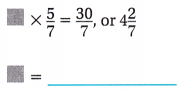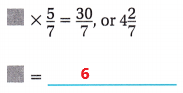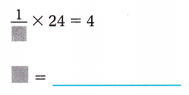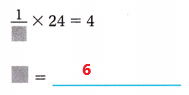
Prasanna

Texas Go Math Grade 5 Lesson 6.5 Answer Key Use Multiplication

Refer to our Texas Go Math Grade 5 Answer Key Pdf to score good marks in the exams. Test yourself by practicing the problems from Texas Go Math Grade 5 Lesson 6.5 Answer Key Use Multiplication.

Texas Go Math Grade 5 Lesson 6.5 Answer Key Use Multiplication

Unlock the Problem

Erica makes 6 submarine sandwiches and cuts each sandwich into thirds. How many \(\frac{1}{3}\)-size sandwich pieces does she have?
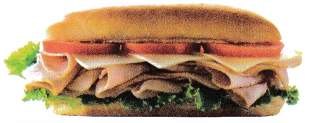
Texas Go Math Grade 5 Lesson 6.5 Answer Key 1
Read
What do I need to find?
I need to find __________________

What information am I given?
I need to use the size of each __________ of sandwich and the number of ___________ she cuts.

Plan
What s my plan or strategy?
I can _______________ to organize the information from the problem.
Then I can use the organized information to find ___________________

Solve
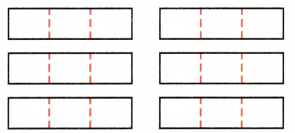
Since Erica cuts 6 submarine sandwiches, my diagram needs to show 6 rectangles to represent the sandwiches. I can divide each of the 6 rectangles into thirds.
Texas Go Math Grade 5 Lesson 6.5 Answer Key 2
To find the total number of thirds in the 6 rectangles, I can multiply the number of thirds in each rectangle by the number of rectangles.
6 ÷ \(\frac{1}{3}\) = 6 × _________ = ___________

So, Erica has __________ one-third-size sandwich pieces.
Answer:
Read
I need to find the number of 1/3 size sandwich pieces does Eric has after she cuts 6 sandwiches into thirds.
I need to use the size of each piece of sandwich and the number of sandwiches she cuts.
Plan
I can draw a diagram to organize the information from the problem.
Then I can use the organized information to find the number of 1/3 size sandwich pieces does Eric has after she cuts 6 sandwiches into thirds.

Solve
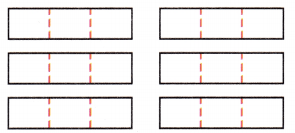
Since Erica cuts 6 submarine sandwiches, my diagram needs to show 6 rectangles to represent the sandwiches. I can divide each of the 6 rectangles into thirds.
Texas-Go-Math-Grade-5-Lesson-6.5-Answer-Key-2
To find the total number of thirds in the 6 rectangles, I can multiply the number of thirds in each rectangle by the number of rectangles.
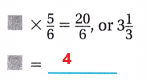
6 ÷ 1/3 = 6 × 3 = 18
So, Erica has 18 one-third-size sandwich pieces.

Math Talk
Mathematical Processes

Explain how you can use multiplication to check your answer.
Answer:
I can multiply the quotient and the divisor to see if the product is equal to the dividend.

Try Another Problem

Roberto is cutting 3 blueberry pies into halves to give to his neighbors. How many neighbors will get a \(\frac{1}{2}\)-size pie piece?
Read
What do I need to find?

What information am I given?

Plan
What is my plan or strategy?

Solve

So, _________ neighbors will get a \(\frac{1}{2}\)-size pie piece.
Answer:
Read
I need to find how many neighbors will get 1/2 of a pie.
The information given is that Roberto is cutting 3 blueberry pies into halves to give to his neighbors. Some neighbors will get a 1/2 size pie piece.
Plan
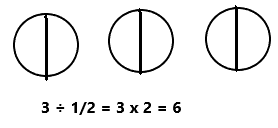
I can draw a diagram to organize the information from the problem. Then i can use the diagram to find the number of neighbors that will get 1/2 of a pie.
Solve
Texas-Go-Math-Grade-5-Lesson-6.5-Answer-Key-2(1)

So, 6 neighbors will get a 1/2 -size pie piece.

Explain how the diagram you drew for the division problem helps you write a multiplication sentence.
Answer:
Since Roberto is cutting 3 pies, my diagram needs to show 3 circles to represent the pies. I can divide each of the circles into halves.
To find the total number of halves in the 3 circles, I can multiply the number of halves in each circle by the number of circles.

Share and Show

Question 1.
A chef has 5 blocks of butter. Each block weighs 1 pound. She cuts each block into fourths. How many \(\frac{1}{4}\)pound pieces of butter does the chef have?
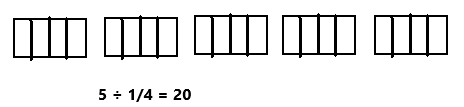
First, draw rectangles to represent the blocks of butter.
Then, divide each rectangle into fourths.
Finally, multiply the number of fourths in each block by the number of blocks.
So, the chef has _________ one-fourth-pound pieces of butter.
Answer:
Texas-Go-Math-Grade-5-Lesson-6.5-Answer-Key-2(2)
So, the chef has 20 one-fourth-pound pieces of butter.
Explanation:
A chef has 5 blocks of butter. Each block weighs 1 pound. She cuts each block into fourths. First we have to draw rectangles to represent the blocks of butter as we can observe in the above image. Then, we have to divide each rectangle into fourths. Multiply the number of fourths in each block by the number of blocks. Divide 5 by 1/4 the result is 20. So, the chef has 20 one-fourth-pound pieces of butter.

Go Math Grade 5 Lesson 6.5 Answer Key Question 2.
What if the chef had 3 blocks of butter and cut the blocks into thirds? How many \(\frac{1}{3}\)-pound pieces of butter would the chef have?
Answer:
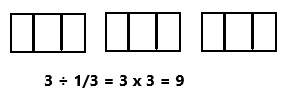
Texas-Go-Math-Grade-5-Lesson-6.5-Answer-Key-2(3)
So, the chef has 9 one-third-pound pieces of butter.
Explanation:
A chef has 3 blocks of butter. Each block weighs 1 pound. She cuts each block into thirds. First, we have to draw rectangles to represent the blocks of butter as we can observe in the above image. Then, we have to divide each rectangle into thirds. Multiply the number of thirds in each block by the number of blocks. Divide 3 by 1/3 the result is 9. So, the chef has 9 one-third-pound pieces of butter.

Problem Solving

Question 3.
H.O.T. Multi-Step Julie makes a drawing that is \(\frac{1}{4}\) the size of the original drawing. Sahil makes a drawing that is \(\frac{1}{3}\) the size of the original. A tree in the original drawing is 12 inches tall. What will be the difference between the height of the tree in Julie and Sahil’s drawings?
Texas Go Math Grade 5 Lesson 6.5 Answer Key 3
Answer:
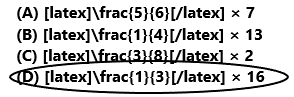
1/4 x 12 = 3 inches
The height of the tree in Julie’s drawing is 3 inches.
1/3 x 12 = 4 inches
The height of the tree in Sahil’s drawing is 4 inches.
4 inches – 3 inches = 1 inch
The difference between the height of the tree in Julie and Sahil’s drawings is 1 inch.
Explanation:
A tree in the original drawing is 12 inches tall. Julie makes a drawing that is 1/4 the size of the original drawing. Multiply 1/4 with 12 the product is 3. The height of the tree in Julie’s drawing is 3 inches. Sahil makes a drawing that is1/3 the size of the original. Multiply 1/3 with 12 the product is 4. The height of the tree in Sahil’s drawing is 4 inches. Subtract 3 inches from 4 inches the difference is 1 inch. The difference between the height of the tree in Julie and Sahil’s drawings is 1 inch.

Question 4.
H.O.T. Use Tools Brianna has a sheet of paper that is 6 feet long. She cuts the length of paper into sixths and then cuts the length of each of these \(\frac{1}{6}\)-pieces into thirds. How many pieces does she have? How many inches long is each piece?
Answer:

Daily Assessment Task

Fill in the bubble completely to show your answer.

Question 5.
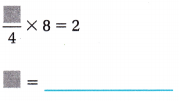
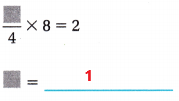
A structure is made out of foam cubes that are each 1/4 foot tall. The height of the structure is 8 feet. How many cubes were used to build the structure?
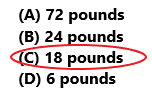
(A) 2 cubes
(B) 16 cubes
(C) 8 cubes
(D) 32 cubes
Answer:
Texas-Go-Math-Grade-5-Lesson-6.5-Answer-Key-2(5)
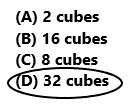
8 ÷ 1/4 = 32
To build the structure 32 cubes are used.
So, option D is correct.
Explanation:
A structure is made out of foam cubes that are each 1/4 foot tall. The height of the structure is 8 feet. Divide 8 by 1/4 the product is 32. So, 32 cubes are used to build the structure. Draw a circle for option D.

Lesson 6.5 Answer Key 5th Grade Go Math Question 6.
Use Diagrams Terrance needs to divide 9 by \(\frac{1}{2}\). How can he find the quotient?
(A) Draw 9 rectangles and divide each into halves. Count the halves.
(B) Draw 9 rectangles and shade \(\frac{1}{2}\) of each. Count the shaded parts.
(C) Shade a rectangle to show \(\frac{1}{2}\), and then divide the shaded part into 9 parts. Find the amount shaded.
(D) Draw a rectangle with a length of 9 and a width of \(\frac{1}{2}\), Find the area.
Answer:
Texas-Go-Math-Grade-5-Lesson-6.5-Answer-Key-2(6)
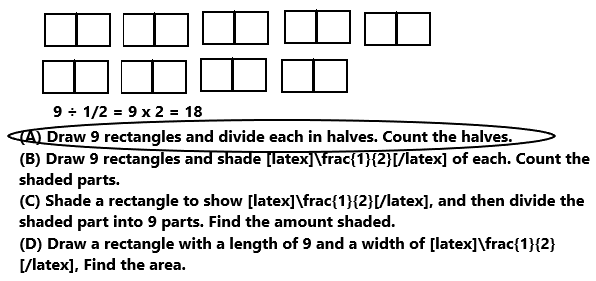
Option A is correct.
Explanation:
Terrance needs to divide 9 by 1/2. First, draw 9 rectangles and divide each rectangle into two halves. Then count the halves. There are 18 halves. So, draw a circle to option A.

Question 7.
Multi-Step Dorothy has a ribbon that is 3 feet long, and a ribbon that is 8 feet long. She needs to cut the ribbon into pieces that are \(\frac{1}{4}\) foot long. How many pieces will she have in all?
(A) 12 pieces
(B) 32 pieces
(C) 11 pieces
(D) 44 pieces
Answer:
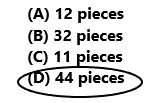
Texas-Go-Math-Grade-5-Lesson-6.5-Answer-Key-2(7)
3 ÷ 1/4 = 3 x 4 = 12
She have 12 pieces.
8 ÷ 1/4 = 8 x 4 = 32
12 + 32 = 44 pieces.
So, option D is correct.
Explanation:
Dorothy has a ribbon that is 3 feet long, and a ribbon that is 8 feet long. She needs to cut the ribbon into pieces that are 1/4 foot long. First divide 3 by 1/4 the result is 12 pieces. Next divide 8 by 1/4 the result is 32 pieces. Add 12 pieces with 32 pieces the sum is 44 pieces. She have 44 pieces in all. So, draw a circle for option D.

Texas Test Prep

Question 8.
Adrian made 3 carrot cakes. He cut each cake into fourths. How many \(\frac{1}{4}\)-size cake pieces does he have?
(A) 16
(B) 12
(C) 1
(D) 1\(\frac{1}{3}\)
Answer:
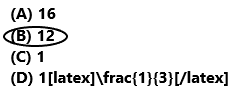
Texas-Go-Math-Grade-5-Lesson-6.5-Answer-Key-2(8)
3 ÷ 1/4 = 3 x 4 = 12
He have 12 one-fourth size cake pieces.
So, option B is correct.
Explanation:
Adrian made 3 carrot cakes. He cut each cake into fourths. Divide 3 by 1/4 the result is 12. He has 12 one-fourth size cake pieces. So, draw a circle for option B.

Texas Go Math Grade 5 Lesson 6.5 Homework and Practice Answer Key

Question 1.
Julian wants to put a border around two sides of his rectangular-shaped garden. He has a 12-foot piece of lumber that will be cut into \(\frac{1}{3}\)-foot pieces. How many \(\frac{1}{3}\)-foot pieces can Julian cut from the lumber?
Answer:
12 ÷ 1/3 = 12 x 3 = 36
Julian can cut 36-foot pieces from the lumber.
Explanation:
Julian wants to put a border around two sides of his rectangular-shaped garden. He has a 12-foot piece of lumber that will be cut into 1/3-foot pieces. Divide 12 by 1/3 the result is 36. So, Julian can cut 36-foot pieces from the lumber.

Go Math Lesson 6.5 Answer Key Homework 5th Grade Question 2.
The camp counselors bought a 6-pound bag of raisins for an afternoon snack for the campers. If the counselors package the raisins into \(\frac{1}{8}\)-pound individual servings, how many individual servings can they make?
Answer:
6 ÷ 1/8 = 6 x 8 = 48
They can make 48 individual servings.
Explanation:
The camp counselors bought a 6-pound bag of raisins for an afternoon snack for the campers. The counselors package the raisins into 1/8-pound individual servings. Divide 6 by 1/8 the result is 48. So, they can make 48 individual servings.

Question 3.
Kim has 5 yards of denim. She cuts each yard of denim into thirds. How many \(\frac{1}{3}\)-yard pieces of denim does she have?
Answer:
5 ÷ 1/3 = 5 x 3 = 15
She have 15 pieces with 1/3-yard pieces of denim.
Explanation:
Kim has 5 yards of denim. She cuts each yard of denim into thirds. Divide 5 by 1/3 the result is 15. She have 15 pieces with 1/3-yard pieces of denim.

Question 4.
If it takes Fran \(\frac{1}{5}\) of an hour to paint one section of the fence, how many sections can she paint in 2 hours?
Answer:
1/5 x 2 = 2/5
She can paint 2/5 sections in 2 hours.
Explanation:
Fran takes 1/5 of an hour to paint one section of the fence. Multiply 1/5 with 2 the product is 2/5. So, she can paint 2/5 sections in 2 hours.

Problem Solving

Question 5.
You plan to sell pumpkin pie slices at the fall festival. If you cut 4 pies into \(\frac{1}{8}\)-size pieces, how many slices will you have to sell? Describe your strategy for solving the problem.
Answer:
4 ÷ 1/8 = 4 x 8 = 32
I have to sell 32 slices.
Explanation:
I plan to sell pumpkin pie slices at the fall festival. If I cut 4 pies into 1/8-size pieces. Divide 4 by 1/8 the result is 32. So, I have to sell 32 slices.

Go Math 5th Grade Lesson 6.5 Homework Answer Key Question 6.
Marcel has 6 strips of paper. Each strip is 1 foot long. He folds each strip into \(\frac{1}{4}\)-foot sections. Describe how you can draw a diagram to find the number of sections Marcel made when he folded the paper strips.
Answer:

Lesson Check

Fill in the bubble completely to show your answer.

Question 7.
The students in Mrs. Lester’s fifth-grade class are planting seeds in individual pots. Mrs. Lester supplied 8 pounds of potting soil. If each pot holds \(\frac{1}{4}\) pound of soil, how many pots can the students fill?
(A) 12
(B) 32
(C) 16
(D) 36
Answer:
Texas-Go-Math-Grade-5-Lesson-6.5-Answer-Key-2(9)
8 ÷ 1/4 = 8 x 4 = 32
The student can fill 32 pots.
So, option B is correct.
Explanation:
The students in Mrs. Lester’s fifth-grade class are planting seeds in individual pots. Mrs. Lester supplied 8 pounds of potting soil. Each pot holds 1/4 pound of soil. Divide 8 by 1/4 the result is 32. The student can fill 32 pots. So draw a circle for option B.

Question 8.
Jake’s Cafe receives a 10-pound delivery of ground beef each day. How many \(\frac{1}{4}\)-pound hamburgers can Jake make each day?
(A) 40
(B) 14
(C) 44
(D) 20
Answer:
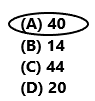
Texas-Go-Math-Grade-5-Lesson-6.5-Answer-Key-2(10)
10 ÷ 1/4 = 10 x 4 = 40
Jake makes 40 hamburgers each day.
So, option A is correct.
Explanation:
Jake’s Cafe receives a 10-pound delivery of ground beef each day. Divide 10 by 1/4 the result is 40. Jake makes 40 hamburgers each day. So draw a circle for option A.

Question 9.
Mrs. Miller is cutting 2 pizzas into eighths for students. How many students will get a \(\frac{1}{8}\)-size slice of pizza?
(A) 7
(B) 8
(C) 16
(D) 6
Answer:
Texas-Go-Math-Grade-5-Lesson-6.5-Answer-Key-2(11)
2 ÷ 1/8 = 2 x 8 = 16
16 students got 1/8 size slice of pizza.
So, option C is correct.
Explanation:
Mrs. Miller is cutting 2 pizzas into eighths for students. Divide 2 by 1/8 the result is 16. So, 16 students got 1/8 size slice of pizza. Draw a circle for option C.

Go Math Lesson 6.5 5th Grade Homework Answers Question 10.
A home building company purchases 24 acres of land and divides it into \(\frac{1}{2}\)-acre plots for sale. How many \(\frac{1}{2}\)-acre plots will be for sale?
(A) 6
(B) 24
(C) 12
(D) 48
Answer:
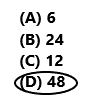
Texas-Go-Math-Grade-5-Lesson-6.5-Answer-Key-2(12)
24 ÷ 1/2 = 24 x 2 = 48
48 plots with 1/2 acre are sale.
So, option D is correct.
Explanation:
A home building company purchases 24 acres of land and divides it into 1/2-acre plots for sale. Divide 24 by 1/2 the result is 48. So, 48 plots with 1/2 acre are sale. Draw a circle for option D.

Question 11.
Multi-Step Cleo bought 10 feet of ribbon for costumes. He used 2 feet of ribbon last week. He cut the remaining ribbon into \(\frac{1}{6}\)-foot pieces. How many pieces of ribbon does Cleo have?
(A) 48
(B) 60
(C) 72
(D) 12
Answer:
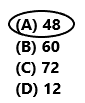
Texas-Go-Math-Grade-5-Lesson-6.5-Answer-Key-2(13)
10 – 2 = 8
8 ÷ 1/6 = 8 x 6 = 48
Cleo have 48 pieces of ribbon.
So, option A is correct.
Explanation:
Cleo bought 10 feet of ribbon for costumes. He used 2 feet of ribbon last week. Subtract  2 feet from 10 feet the difference is 8 feet. He cut the remaining 8-foot ribbon into 1/6-foot pieces. Divide 8 by 1/6 the result is 48. So draw a circle for option A.

Go Math Grade 5 Chapter 6 Lesson 6.5 Answer Key Question 12.
Multi-Step Reese brought 2 sandwiches for her school lunch. Each sandwich was cut into fourths. After she ate lunch, Reese had 3 pieces of sandwich left. How many pieces did Reese eat?
(A) 5
(B) 3
(C) 2
(D) 1
Answer:
Texas-Go-Math-Grade-5-Lesson-6.5-Answer-Key-2(14)
2 ÷ 1/4 = 2 x 4 = 8
8 – 3 = 5
Reese ate 5 pieces.
So, option A is correct.
Explanation:
Reese brought 2 sandwiches for her school lunch. Each sandwich was cut into fourths. Divide 2 by 1/4 the result is 8. After she ate lunch, Reese has 3 pieces of sandwich left. Subtract 3 from 8 the difference is 5. Reese ate 5 pieces.
So, draw a circle for option A.

Texas Go Math Grade 5 Lesson 6.5 Answer Key Use Multiplication Read More »

Texas Go Math Grade 5 Lesson 6.4 Answer Key Divide Fractions and Whole Numbers

Refer to our Texas Go Math Grade 5 Answer Key Pdf to score good marks in the exams. Test yourself by practicing the problems from Texas Go Math Grade 5 Lesson 6.4 Answer Key Divide Fractions and Whole Numbers.

Texas Go Math Grade 5 Lesson 6.4 Answer Key Divide Fractions and Whole Numbers

Investigate

Materials; fraction strips

A. Mia walks a 2-mile fitness trail. She stops to exercise every \(\frac{1}{5}\) mile. How many times does Mia stop to exercise?
Draw a number line from 0 to 2. Divide the number line into fifths. Label each fifth on your number line.
Texas Go Math Grade 5 Lesson 6.4 Answer Key 1
Skip count by fifths from 0 to 2 to find 2 ÷ \(\frac{1}{5}\).
There are ________ one-fifths in 2 wholes.

You can use the relationship between multiplication and division to explain and check your solution.

Record and check the quotient.
2 ÷ \(\frac{1}{5}\) = ________ because ________ × \(\frac{1}{5}\) = 2.
So, Mia stops to exercise ________ times.
Answer:
We have to draw a number line from 0 to 2. Divide the number line into fifths. We have to label each fifth on our number line.
Texas-Go-Math-Grade-5-Lesson-6.4-Answer-Key-1

Skip count by fifths from 0 to 2 to find 2 ÷ (1/5).
There are 10 one-fifths in 2 wholes.
We can use the relationship between multiplication and division to explain and check our solution.
Record and check the quotient.
2 ÷ (1/5) =10 because 10 × \(\frac{1}{5}\) = 2.
So, Mia stops to exercise 10 times.

B. Roger has 2 yards of string. He cuts the string into pieces that are \(\frac{1}{3}\) yard long. How many pieces of string does Roger have?
Texas Go Math Grade 5 Lesson 6.4 Answer Key 2
Model 2 using 2 whole fraction strips.
Then place enough \(\frac{1}{3}\) strips to fit exactly under the 2 wholes. There are _________ one-third-size pieces in 2 wholes.
Record and check the quotient.
2 ÷ \(\frac{1}{3}\) = _________ because _________ × \(\frac{1}{3}\) = 2.
So, Roger has ________ pieces of string.
Answer:
Roger has 2 yards of string. He cuts the string into pieces that are 1/3 yard long.
Model 2 using 2 whole fraction strips.
Then place enough 1/3 strips to fit exactly under the 2 wholes. There are 6 one-third-size pieces in 2 wholes.
Record and check the quotient.
2 ÷(1/3) = 6 because 6 × 1/3 = 2.
So, Roger has 6 pieces of string.

Make Connections

You can use fraction strips to divide a fraction by a whole number.

Calla shares half of a package of clay equally among herself and each of 2 friends. What fraction of the whole package of clay will each friend get?
Texas Go Math Grade 5 Lesson 6.4 Answer Key 13
STEP 1: Place a strip under a \(\frac{1}{2}\)-whole strip to show the \(\frac{1}{2}\) package of clay.

STEP 2: Find 3 fraction strips, all with the same denominator, that fit exactly under the \(\frac{1}{2}\) strip.
Each piece is __________ of the whole.

STEP 3: Record and check the quotient.
\(\frac{1}{2}\) ÷ 3 = __________ because _________ × 3 = \(\frac{1}{2}\).
So, each friend will get __________ of the whole package of clay.
Answer:
STEP 1:
Place a strip under a 1/2 whole strip to show the 1/2 package of clay.
STEP 2:
We have to find 3 fraction strips, all with the same denominator, that fit exactly under the 1/2 strip.
Each piece is 1/6 of the whole.
STEP 3:
Record and check the quotient.
1/2 ÷ 3 = 1/6 because 1/6 × 3 = \(\frac{1}{2}\).
So, each friend will get 1/6 of the whole package of clay.

Math Talk
Mathematical Processes

When you divide a fraction by a whole number how does the quotient compare to the dividend? Explain.
Answer:

Share and Show

Divide and check the quotient.

Question 1.
Texas Go Math Grade 5 Lesson 6.4 Answer Key 14
Answer:
Texas-Go-Math-Grade-5-Lesson-6.4-Answer-Key-14
Explanation:
In the above image, we can observe 3 units with 3 fraction strips in each unit. Divide the whole number by a fraction. If we divide 3 by 1/3 then the result is 9 because when we multiply 9 with 1/3 the result is 3.

Go Math 5th Grade Lesson 6.4 Answer Key Question 2.
Texas Go Math Grade 5 Lesson 6.4 Answer Key 15
Think: What label should I write for each tick mark?
3 ÷ \(\frac{1}{6}\) = ____________ because ________ × \(\frac{1}{6}\) = 3.
Answer:
3 ÷ 1/6 = 18 because 18 × 1/6 = 3.
Explanation:
In the above image, we can observe that the whole number is divided by a fraction. If we divide 3 by 1/6 then the result is 18. Because when we multiply 18 with 1/6 the product is 3. So, the quotient is correct.

Question 3.
Texas Go Math Grade 5 Lesson 6.4 Answer Key 16
\(\frac{1}{4}\) ÷ 2= ____________ because ________ × 2 = \(\frac{1}{4}\).
Answer:
1/4 ÷ 2= 1/8 because 1/8 × 2 =1/4.
Explanation:
In the above image we can observe that 1/4 is divided into 2 equal fraction strips. If we divide 1/4 by 2 then the result is 1/8. Because when we multiply 1/8 with 2 the product is 1/4. So, the quotient is correct.

Problem Solving

H.O.T. Sense or Nonsense?

Question 4.
Emilio and Julia used different ways to find \(\frac{1}{2}\) ÷ 4. Emilio used a model to find the quotient. Julia used a related multiplication equation to find the quotient. Whose answer makes sense? Whose answer is nonsense? Explain your reasoning.
Texas Go Math Grade 5 Lesson 6.4 Answer Key 3
Emilio’s Work
Texas Go Math Grade 5 Lesson 6.4 Answer Key 4

Julia’s Work
If \(\frac{1}{2}\) ÷ 4 = ☐, then ☐ × \(\frac{1}{2}\)
I know that \(\frac{1}{8}\) × 4 = \(\frac{1}{2}\)
So, \(\frac{1}{2}\) ÷ 4 = \(\frac{1}{8}\) because \(\frac{1}{8}\) × 4 = \(\frac{1}{2}\)
Answer:
Emilio’s Work
Texas-Go-Math-Grade-5-Lesson-6.4-Answer-Key-4
Emilio’s answer is nonsense.
Julia’s Work
If 1/2 ÷ 4 = 1/8, then 1/8 × 4 = 1/2.
I know that 1/8 × 4 = 1/2
So,1/2 ÷ 4 = 1/8 because 1/8 × 4 =1/2.
Julia’s answer have sense.
Explanation:
Emilio and Julia used different ways to find 1/2 ÷ 4. Emilio used a model to find the quotient. Emilio answer is nonsense because when we divide 1/2 by 4 the result is 1/8. But Emilio’s answer is 1/4. Julia used a related multiplication equation to find the quotient. If we divided 1/2 by 4 the result is 1/8 then multiply 1/8 with 4 the result is 1/2. So, Julia’s answer have sense.

Lesson 6.4 Answer Key Go Math Grade 5 Question 5.
For the answer that is nonsense, describe how to find the correct answer.
Answer:
1/2 ÷ 4 = 1/2 x 1/4 = 1/8
Explanation:
The answer that is nonsense we can find the correct answer by using a related multiplication equation. Divide 1/2 by 4 then the result is 1/8.

Question 6.
Multi-Step If you were going to find \(\frac{1}{2}\) ÷ 5, explain how you would find the quotient using fraction strips. Write an equation to show the quotient.
Answer:
Place a strip under a 1/2. We have to find 5 fraction strips, all with the same denominator, that fit exactly under the 1/2 strip.
Each piece is 1/10 of the whole.
Record and check the quotient.
1/2 ÷ 5 = 1/10 because 1/10 × 5 = 1/2.
Explanation:
We can find the quotient using fraction strips. Divide 1/2 by 5 the result is 1/10. The equation is 1/2 ÷ 5 = 1/10.

Daily Assessment Task

Fill in the bubble completely to show your answer.

Question 7.
Ants are lined up along the edges of your sandwich at a picnic. If the sandwich is 9 inches around and each ant is \(\frac{1}{6}\) of an inch, how many ants are lined up around the sandwich?
(A) 15 ants
(B) 16 ants
(C) 27 ants
(D) 54 ants
Answer:
Texas-Go-Math-Grade-5-Lesson-6.4-Answer-Key-4(1)
9 ÷ 1/6 = 9 x 6/1 = 54
54 ants are lined up around the sandwich.
So, option D is correct.
Explanation:
Ants are lined up along the edges of our sandwich at a picnic. If the sandwich is 9 inches around and each ant is 1/6 of an inch. Divide 9 by 1/6 the result is 54. The ants that are lined up around the sandwich are 54. So, draw a circle to option D.

Question 8.
Use Tools Which is the division problem modeled by the picture?
Texas Go Math Grade 5 Lesson 6.4 Answer Key 5
(A) 4 ÷ \(\frac{1}{12}\)
(B) 3 ÷ \(\frac{1}{4}\)
(C) 3 ÷ \(\frac{1}{3}\)
(D) 12 ÷ \(\frac{1}{3}\)
Answer:
Texas-Go-Math-Grade-5-Lesson-6.4-Answer-Key-5(1)
3 ÷ 1/3 = 9
So, option C is correct.
Explanation:
The division problem that modeled by the above picture is 3 ÷ 1/3. Divide 3 by 1/3 the result is 9. So, draw a circle for option C.

Question 9.
Multi-Step Maddie divided 6 by \(\frac{1}{2}\), and then divided that answer by \(\frac{1}{3}\). What was her final answer?
(A) 9
(B) 1
(C) 12
(D) 36
Answer:
Texas-Go-Math-Grade-5-Lesson-6.4-Answer-Key-5(2)
6 ÷ 1/2 = 12
12 ÷ 1/3 = 36
The final answer is 36.
So, option D is correct.
Explanation:
Maddie divided 6 by 1/2, and then divided that answer by 1/3. First divide 6 by 1/2 the result is 12. Divide 12 by 1/3 the result is 36. The final answer is 36. So, draw a circle for option D.

Texas Test Prep

Lesson 6.4 Answer Key 5th Grade Go Math Question 10.
Reid has 4 bags of soil. He uses \(\frac{1}{3}\) of a bag to fill each planter. How many planters can Reid fill with the bags of soil?
(A) 1\(\frac{1}{3}\)
(B) 12
(C) 3\(\frac{2}{3}\)
(D) 4\(\frac{1}{3}\)
Answer:
Texas-Go-Math-Grade-5-Lesson-6.4-Answer-Key-5(3)
Reid can fill 13/3 planters with the bag of soil.
So, option D is correct.
Explanation:
Reid has 4 bags of soil. He uses 1/3 of a bag to fill each planter. 4(1/3) planters can Reid fill with the bag of soil.
So, draw a circle for option D.

Texas Go Math Grade 5 Lesson 6.4 Homework and Practice Answer Key

Divide and check the quotient.

Question 1.
Texas Go Math Grade 5 Lesson 6.4 Answer Key 6
Answer:
Texas-Go-Math-Grade-5-Lesson-6.4-Answer-Key-6
Explanation:
In the above image we can observe 4 units with 4 fraction strips in each unit. Divide the whole number by fraction. If we divide 4 by 1/4 then the result is 16 because when we multiply 16 with 1/4 the result is 4.

Question 2.
Texas Go Math Grade 5 Lesson 6.4 Answer Key 7
Answer:
Texas-Go-Math-Grade-5-Lesson-6.4-Answer-Key-7
Explanation:
In the above image, we can observe that the whole number is divided by a fraction. If we divide 2 by 1/6 then the result is 12. Because when we multiply 12 with 1/6 the product is 2. So, the quotient is correct.

Go Math Lesson 6.4 Answer Key Homework 5th Grade Question 3.
Texas Go Math Grade 5 Lesson 6.4 Answer Key 8
Answer:
Texas-Go-Math-Grade-5-Lesson-6.4-Answer-Key-8
Explanation:
In the above image we can observe that 1/3 is divided into 2 equal fraction strips. If we divide 1/3 by 2 then the result is 1/6. Because when we multiply 1/6 with 2 the product is 1/3. So, the quotient is correct.

Question 4.
Texas Go Math Grade 5 Lesson 6.4 Answer Key 9
Answer:
Texas-Go-Math-Grade-5-Lesson-6.4-Answer-Key-9
Explanation:
In the above image we can observe that whole number is divided by a fraction. If we divide 3 by 1/5 then the result is 15. Because when we multiply 15 with 1/5 the product is 3. So, the quotient is correct.

Question 5.
Texas Go Math Grade 5 Lesson 6.4 Answer Key 10
Answer:
Texas-Go-Math-Grade-5-Lesson-6.4-Answer-Key-10
Explanation:
In the above image we can observe that 1/5 is divided into 2 equal fraction strips. If we divide 1/5 by 2 then the result is 1/10. Because when we multiply 1/10 with 2 the product is 1/5. So, the quotient is correct.

Problem Solving

Question 6.
Julie buys a board that is 6 feet long. She wants to cut it into pieces that are \(\frac{1}{2}\) foot each. How many pieces will Julie have after she cuts the board?
Answer:
6 ÷ 1/2 = 6 x 2/1 = 12
Julie have 12 pieces after she cuts the board.
Explanation:
Julie buys a board that is 6 feet long. She wants to cut it into pieces that are 1/2 foot each. Divide 6 by 1/2 the product is 12. Julie have 12 pieces after she cuts the board.

Go Math Lesson 6.4 Homework Answer Key 5th Grade Question 7.
Mr. Morales makes four batches of cookies for family math night. He divides half of a pound of butter equally into 4 mixing bowls. How much butter is in each bowl?
Answer:
1/4 x 1/2 = 1/8
In each bowl 1/8 butter.
Explanation:
Mr. Morales makes four batches of cookies for family math night. He divides half of a pound of butter equally into 4 mixing bowls. Divide 1/2 pound of butter into four equal parts. Each part contains 1/4 of butter. Multiply 1/4 with 1/2 the product is 1/8. In each bowl 1/8 butter.

Lesson Check

Fill in the bubble completely to show your answer.

Question 8.
Which is the division problem modeled by the picture?
Texas Go Math Grade 5 Lesson 6.4 Answer Key 11
(A) \(\frac{1}{2}\) ÷ 6
(B) \(\frac{1}{6}\) ÷ 12
(C) \(\frac{1}{6}\) ÷ 2
(D) \(\frac{1}{12}\) ÷ 2
Answer:
Texas-Go-Math-Grade-5-Lesson-6.4-Answer-Key-11(1)
Option C is correct.
Explanation:
In the above image we can observe that 1/6 is divided into 2 equal fraction strips. If we divide 1/6 by 2 then the result is 1/12. Because when we multiply 1/12 with 2 the product is 1/6. The division problem modeled by the above picture is 1/6 ÷ 2. So, draw a circle for option C.

Question 9.
Which is the division problem modeled by the picture?
Texas Go Math Grade 5 Lesson 6.4 Answer Key 12

(A) 3 ÷ \(\frac{1}{8}\)
(B) 24 ÷ \(\frac{1}{4}\)
(C) 3 ÷ \(\frac{1}{24}\)
(D) 8 ÷ \(\frac{1}{3}\)
Answer:
Texas-Go-Math-Grade-5-Lesson-6.4-Answer-Key-12(1)
Option A is correct.
Explanation:
In the above image we get the information by observing the number line. The whole number is divided by a fraction. If we divide 3 by 1/8 then the result is 24. Because when we multiply 24 with 1/8 the product is 3. The division problem modeled by the above picture is 3 ÷ 1/8. So, draw a circle for option A.

Go Math 5th Grade Lesson 6.4 Homework Answers Question 10.
Evan brings 8 liters of juice to be served at family math night. He pours 1/5 liter into each glass. How many glasses of juice can be served?
(A) 8
(B) 40
(C) 13
(D) 10
Answer:
Texas-Go-Math-Grade-5-Lesson-6.4-Answer-Key-12(2)
8 ÷ 1/5 = 8 x 5/1 = 40
40 glasses of juice can be served at family math night.
So, option B is correct.
Explanation:
Evan brings 8 liters of juice to be served at family math night. He pours 1/5 liter into each glass. Divide 8 by 1/5 the result is 40. At family math night 40 glasses of juice can be served. So, draw a circle for option B.

Question 11.
Marissa is painting one of her bedroom walls. She marks off \(\frac{1}{4}\) of the wall. Then she divides the marked section into 3 equal parts and paints one part blue. What fraction of the whole wall is blue?
(A) \(\frac{1}{3}\)
(B) \(\frac{1}{4}\)
(C) \(\frac{1}{7}\)
(D) \(\frac{1}{12}\)
Answer:
Texas-Go-Math-Grade-5-Lesson-6.4-Answer-Key-12(3)
1/4 ÷ 3 = 1/4 x 1/3 = 1/12
1/12 fraction of the whole wall is blue.
So, option D is correct.
Explanation:
Marissa is painting one of her bedroom walls. She marks off 1/4 of the wall. Then she divides the marked section into 3 equal parts and paints one part blue. Divide 1/4 by 3 the result is 1/12. 1/12 fraction of the whole wall is blue. So, option D is correct.

Question 12.
Multi-Step Rex combines \(\frac{1}{4}\) cup sugar and 1/4 cup flour Into a small bowl. Then he divides the amount in the small bowl into 4 empty mixing bowls. What amount of dry Ingredients is in each mixing bowl?
(A) \(\frac{1}{16}\) cup
(B) \(\frac{1}{2}\) cup
(C) \(\frac{1}{8}\) cup
(D) 2 cups
Answer:
Texas-Go-Math-Grade-5-Lesson-6.4-Answer-Key-12(4)
1/4 + 1/4 = 1/2
1/2 ÷ 4 = 1/8
In each mixing bowl 1/8 amount of dry ingredients.
So, option C is correct.
Explanation:
Rex combines 1/4 cup sugar and 1/4 cup flour Into a small bowl. Add 1/4 with 1/4 the sum is 1/2. Then he divides the amount in the small bowl into 4 empty mixing bowls. Divide 1/2 by 4 the result is 1/8. In each mixing bowl 1/8 amount of dry ingredients. So, draw a circle for option C.

Go Math Grade 5 Lesson 6.4 Answer Key Question 13.
Multi-Step Jamie divided 8 by \(\frac{1}{2}\), and then multiplied that answer by \(\frac{1}{4}\). What was her final answer?
(A) 4
(B) 1
(C) 64
(D) 32
Answer:
Texas-Go-Math-Grade-5-Lesson-6.4-Answer-Key-12(5)
8 ÷ 1/2 = 16
16 x 1/4 = 4
The final answer is 4.
So, option A is correct.
Explanation:
Jamie divided 8 by 1/2 and then multiplied that answer by 1/4. First, divide 8 by 1/2 the result is 16. Multiply 16 with 1/4 the product is 4. The final answer is 4. So, draw a circle for option A.

Texas Go Math Grade 5 Lesson 6.4 Answer Key Divide Fractions and Whole Numbers Read More »

Texas Go Math Grade 5 Module 7 Assessment Answer Key

Refer to our Texas Go Math Grade 5 Answer Key Pdf to score good marks in the exams. Test yourself by practicing the problems from Texas Go Math Grade 5 Module 7 Assessment Answer Key.

Texas Go Math Grade 5 Module 7 Assessment Answer Key

Vocabulary

Choose the best term from the box.

Vocabulary
composite number
numerical expression
prime number

Question 1.
A ___________ is a whole number greater than 1 that has exactly two factors, 1 and itself. (p. 297)
Answer:
A Prime number is a whole number greater than 1 that has exactly two factors, 1 and itself.

Question 2.
A ____________ is a mathematical phrase that has numbers and operation signs but does not have an equal sign. (p. 303)
Answer:
A numerical expression is a mathematical phrase that has numbers and operation signs but does not have an equal sign.

Concepts and Skills

Decide if the number Is prime or composite. If it is composite, list the factor pairs. (TEKS 5.4.A)

Question 3.
54
Answer:
The number 54 is a composite number.
The factor pairs are as below.
1 × 54 = 54
2 × 27 = 54
3 × 18 = 54
6 × 9 = 54
9 × 6 = 54
Explanation:
In Mathematics, composite numbers are numbers that have more than two factors. The number 54 is a composite number. The factors of 54 are 1, 2, 3, 6, 9, 18, 27, 54. The factor pairs of 54 are (1, 54), (2, 27), (3, 18), (6, 9), (9,6).

Go Math Answer Key Grade 5 Module 7 Question 4.
28
Answer:
The number 28 is a composite number.
The factor pairs areas below.
1 x 28 = 28
2 x 14 = 28
4 x 7 = 28
7 x 4 = 28
Explanation:
In Mathematics, composite numbers are numbers that have more than two factors. The number 28 is a composite number. The factors of 28 are 1, 2, 4, 7, 14, 28. The factor pairs of 28 are (1, 28), (2, 14), (4, 7), (7,4).

Tell whether the number Is prime or composite. (TEKS 5.4.A)

Question 5.
33
Answer:
The factors of 33 are 1, 3, 11, 33.
So, the number 33 is a composite number.
Explanation:
A composite number is a number that can be divided evenly by more numbers than 1 and itself. The number 33 can be evenly divided by 1, 3, 11 and 33, with no remainder. Since 33 cannot be divided by just 1 and 33. So, 33 is a composite number.

Question 6.
47
Answer:
The factors of 47 are 1, 47. So, 47 is a prime number.
Explanation:
47 is a prime number. The number 47 is divisible only by 1 and the number itself. The number 47 is classified as a prime number, because it have exactly two factors.

Question 7.
91
Answer:
The factors of 91 are 1, 7, 13, 91. So, 91 is a composite number.
Explanation:
A composite number is a number that can be divided evenly by more numbers than 1 and itself. It is the opposite of a prime number. The number 91 can be evenly divided by 1, 7, 13, 91 with no remainder. Since 91 cannot be divided by just 1 and 91. So, it is a composite number.

Grade 5 Module 7 Test Answer Key Texas Go Math Question 8.
81
Answer:
The factors of 81 are 1, 3, 9, 27, 81
So, the number 81 is a composite number.
Explanation:
A composite number is a number that can be divided evenly by more numbers than 1 and itself. It is the opposite of a prime number. The number 81 can be evenly divided by 1, 3, 9, 27, and 81, with no remainder. Since 81 cannot be divided by just 1 and 81. So, it is a composite number.

Simplify the numerical expression. (TEKS 5.4.F)

Question 9.
18 – (8 × 3) ÷ 4
Answer:
18 – (8 × 3) ÷ 4
18 – 24 ÷ 4
18 – 6
12
Explanation:
The numerical expression is 18 – (8 × 3) ÷ 4. Perform the operations in the parentheses first 18 – 24 ÷ 4. Next perform the division operation 18 – 6. Then perform subtraction operation the difference is 12. The simplified form of given numerical expression is 12.

Question 10.
35 – [(4 × 5) + (2 × 5)]
Answer:
35 – [(4 × 5) + (2 × 5)]
35 – [20 + 10]
35 – 30
5
Explanation:
The numerical expression using parentheses and brackets is 35 – [(4 × 5) + (2 × 5)]. Perform the operations in the parentheses first 35 – [20 + 10]. Next perform the operations in the brackets 35 – 30. Then perform subtraction operation the difference is 5. The simplified form of given numerical expression is 5.

Fill in the bubble completely to show your answer.

Question 11.
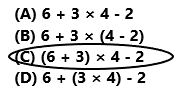
Students in a math contest are asked to simplify a numerical expression. The correct answer is 34. Which could be the expression? (TEKS 5.4.F)
(A) 6 + 3 × 4 – 2
(B) 6 + 3 × (4 – 2)
(C) (6 + 3) × 4 – 2
(D) 6 + (3 × 4) – 2
Answer:
Texas-Go-Math-Grade-5-Module-7-Assessment-Answer-Key-1(1)
(6 + 3) × 4 – 2
9 x 4 – 2
36 – 2
34
So, option C is correct.
Explanation:
Students in a math contest are asked to simplify a numerical expression. The correct answer is 34. The numerical expression is (6 + 3) × 4 – 2. The simplified form of numerical expression is 34.

Texas Go Math Grade 5 Module 7 Assessment Question 12.
Ana writes the expression (8 × 4) + (6 × 3) to represent the number of cards in her sports card collection. Which could be Ana’s sports card collection? (TEKS 5.4.E)
(A) 8 soccer cards and 4 baseball cards in one box, 6 soccer cards and 3 baseball cards in another box
(B) 8 soccer cards were separated into 4 boxes, and 6 baseball cards were separated into 3 boxes
(C) 8 boxes with 4 soccer cards in each box, 6 boxes with 3 baseball cards in each box
(D) 12 soccer cards, 9 baseball cards
Answer:
Texas-Go-Math-Grade-5-Module-7-Assessment-Answer-Key-1(2)
Option C is correct.
Explanation:
Ana writes the expression (8 × 4) + (6 × 3) to represent the number of cards in her sports card collection. Ana’s sports card collection is 8 boxes with 4 soccer cards in each box, 6 boxes with 3 baseball cards in each box.

Question 13.
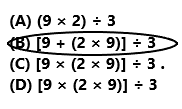
A florist has 9 daffodils and twice as many tulips. He donates the flowers equally to 3 parks. Which expression represents the number of flowers each park receives? (TEKS 5.4.E)
(A) (9 × 2) ÷ 3
(B) [9 + (2 × 9)] ÷ 3
(C) [9 × (2 × 9)] ÷ 3 .
(D) [9 × (2 × 9)] ÷ 3
Answer:
Texas-Go-Math-Grade-5-Module-7-Assessment-Answer-Key-1(3)
Option B is correct.
Explanation:
A florist has 9 daffodils and twice as many tulips. He donates the flowers equally to 3 parks. The expression represents the number of flowers each park receives is [9 + (2 × 9)] ÷ 3.

Texas Go Math Grade 5 Module 7 Answer Key Question 14.
David washes 10 cars and waxes 4 cars every Saturday. He earns $5 for each car he washes and $12 for each car he waxes. How much money does he earn on 3 Saturdays in dollars? Simplify the expression 3 × [(10 × 5) + (4 × 12)] to find the answer. (TEKS 5.4.F)
Texas Go Math Grade 5 Module 7 Assessment Answer Key 1
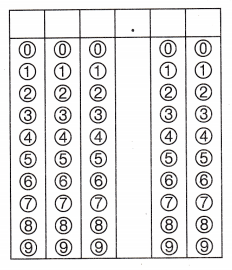
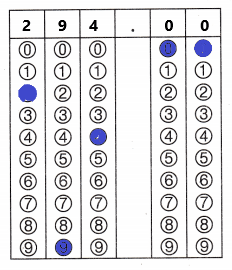
Record your answer and fill in the bubbles on the grid. Be sure to use the correct place value.
Answer:
Texas-Go-Math-Grade-5-Module-7-Assessment-Answer-Key-1
3 × [(10 × 5) + (4 × 12)]
3 x [50 + 48]
3 x 98
$294.00
On 3 Saturdays he earns $294.00.
Explanation:
David washes 10 cars and waxes 4 cars every Saturday. He earns $5 for each car he washes and $12 for each car he waxes. The expression is 3 × [(10 × 5) + (4 × 12)]. The simplified form of the expression is $294.00. On 3 Saturdays he earns $294.00.

Texas Go Math Grade 5 Module 7 Assessment Answer Key Read More »

Texas Go Math Grade 5 Lesson 7.5 Answer Key Grouping Symbols

Refer to our Texas Go Math Grade 5 Answer Key Pdf to score good marks in the exams. Test yourself by practicing the problems from Texas Go Math Grade 5 Lesson 7.5 Answer Key Grouping Symbols.

Texas Go Math Grade 5 Lesson 7.5 Answer Key Grouping Symbols

Unlock the Problem

Mary’s weekly allowance is $8 and David’s weekly allowance is $5. Every week they each spend $2 on lunch. Write a numerical expression to show how many weeks it will take them together to save enough money to buy a video game for $45.

  • Underline Mary’s weekly allowance and how much she spends.
  • Circle David’s weekly allowance and how much he spends.

Use parentheses and brackets to write an expression.

You can use parentheses and brackets to group operations that go together. Operations in parentheses and brackets are performed first.
STEP 1: Write an expression to represent how much Mary and David save each week.

  • How much money does Mary save each week?
    Think: Each week Mary gets $8 and spends $2.
    (__________)
  • How much money does David save each week?
    Think: Each week David gets $5 and spends $2.
    (__________)
  • How much money do Mary and David save together each week? ___________

STEP 2: Write an expression to represent how many weeks it will take Mary and David to save enough money for the video game.

  • How many weeks will it take Mary and David to save enough for a video game?
    Think: I can use brackets to group operations a second time. $45 is divided by the total amount of money saved each week.
    _____________ ÷ [_______________]

Answer:
STEP 1: Each week Mary gets $8 and spends $2.
$8 – $2
$6

Each week Mary saves $6.
Each week David gets $5 and spends $2.
$5 – $2 
$3
Each week David saves $3.
The expression to represent the how much Mary and David save each week is $6 + $3.
Mary and David saves together each week is $9.
STEP 2:
In this step we are calculating how many weeks will it take Mary and David to save enough money for the video game.
Here we are using brackets to group operations a second time. $45 is divided by the total amount of money saved each week.
The expression is $45 ÷ [$6 + $3]
$45 ÷ $9
5
They took 5 weeks to save enough money to buy a video game.

Math Talk
Mathematical Processes

Explain why brackets are placed around the part of the expression that represents the amount of money Mary and David save each week.
Answer:

Example

John gets $6 for his weekly allowance and spends $4 of it. His sister Tina gets $7 for her weekly allowance and spends $3 of it. Their mother’s birthday is in 4 weeks. If they save the same amount each week, how much money can they save together in that time to buy her a present?

  • Write the expression using parentheses and brackets. 4 × [($6 – $4) + ($7 – $3)]
  • Perform the operations in the parentheses first. 4 × [_______ + _______]
  • Next perform the operations in the brackets. 4 × _______
  • Then multiply. _______

So, John and Tina will be able to save _______ for their mother’s birthday present.
Answer:
John gets $6 for his weekly allowance and spends $4 of it.
$6 – $4
His sister Tina gets $7 for her weekly allowance and spends $3 of it.
$7 – $3
Their mother’s birthday is in 4 weeks.
The expression using parentheses and brackets.
4 × [($6 – $4) + ($7 – $3)]
Perform the operations in the parentheses first.
4 × [$2 + $4]
Next perform the operations in the brackets.
4 × $6
Then multiply.
$24
So, John and Tina will be able to save $24 for their mother’s birthday present.
H.O.T. What if only Tina saves money? Will this change the numerical expression? Explain.
Answer:
If Tina only saves money then the numerical expression changes to 4 × ($7 – $3).
Explanation:
Tina gets $7 for her weekly allowance and spends $3 of it.
$7 – $3
Their mother’s birthday is in 4 weeks.
The expression using parentheses.
4 × ($7 – $3)
Perform the operations in the parentheses first.
4 × ($4)
Then multiply.
$16
So, Tina will be able to save $16 for her mother’s birthday present.

Share and Show

Simplify the numerical expression.

Question 1.
12 + [(15 – 5) + (9 – 3)]
12 + [10 + ________]
12 + _______
Answer:
12 + [(15 – 5) + (9 – 3)]
12 + [10 + 6]
12 + 16
28
Explanation:
The numerical expression using parentheses and brackets is 12 + [(15 – 5) + (9 – 3)]. Perform the operations in the parentheses first 12 + [10 + 6]. Next, perform the operations in the brackets 12 + 16. Then perform the addition operation the sum is 28. The simplified form of the given numerical expression is 28.

Grouping Symbols Lesson 7.5 Answer Key 5th Grade Question 2.
5 × [(26 – 4) – (4 + 6)]
Answer:
5 × [(26 – 4) – (4 + 6)]
5 x [22 – 10]
5 x 12
60
Explanation:
The numerical expression using parentheses and brackets is 5 × [(26 – 4) – (4 + 6)]. Perform the operations in the parentheses first 5 x [22 -10]. Next perform the operations in brackets 5 x 12. Then perform multiplication operation the product is 60. The simplified form of the given numerical expression is 60.

Question 3.
36 ÷ [(18 – 10) – (8 – 6)]
Answer:
36 ÷ [(18 – 10) – (8 – 6)]
36 ÷ [8 – 2]
36 ÷ 6
6
Explanation:
The numerical expression using parentheses and brackets is 36 ÷ [(18 – 10) – (8 – 6)]. Perform the operations in the parentheses first 36 ÷ [8 – 2]. Next, perform the operations in the brackets 36 ÷ 6. Then perform the division operation the result is 6. The simplified form of the given numerical expression is 6.

Problem Solving

Question 4.
H.O.T. Use Symbols Write the expression 2 × 8 + 20 – 12 + 6 with parentheses and brackets two different ways so its value is less than 10 and greater than 50.
Answer:

Unlock the Problem

Question 5.
Reasoning Dan has a flower shop. Each day he displays 24 roses. He gives away 10 and sells the rest. Each day he displays 36 carnations. He gives away 12 and sells the rest. What expression can you use to find out how many roses and carnations Dan sells in a week?
a. What information are you given?
Answer:
Dan has a flower shop. Each day he displays 24 roses. He gives away 10 and sells the rest. Each day he displays 36 carnations. He gives away 12 and sells the rest.

b. What are you being asked to do?
Answer:
I was asked to find out how many roses and carnations Dan sells in a week.

c. What expression shows how many roses Dan sells in one day?
Answer:
The expression is 24 – 10.
24 – 10
14
Dan sells 14 roses in one day.
d. What expression shows how many carnations Dan sells in one day?
Answer:
The expression is 36 – 12.
36 – 12
24
Dan sells 24 carnations in one day.

e. Write an expression to represent the total number of roses and carnations Dan sells in one day.
Answer:
(24 – 10) + (36 – 12)
14 + 24
38
Explanation:
The expression (24 – 10) + (36 – 12) represents the total number of roses and carnations Dan sells in one day is 38.

f. Write the expression that shows how many roses and carnations Dan sells in a week.
Answer:
7 x [(24 – 10) + (36 – 12)]
Explanation:
The expression 7 x [(24 – 10) + (36 – 12)] represents the roses and carnations Dan sells in a week.

Go Math Expressions Grade 5 Answer Key Lesson 7.5 Question 6.
Multi-Step Simplify the expression to find out how many roses and carnations Dan sells in a week.
Answer:
7 x [(24 – 10) + (36 – 12)]
7 x [14 + 24]
7 x 38
266
Dan sells 266 roses and carnations in a week.

Question 7.
H.O.T. How could you change the story in Problem 5 so there is only one expression inside parentheses?
Texas Go Math Grade 5 Lesson 7.5 Answer Key 1
Answer:

Daily Assessment Task

Fill in the bubble completely to show your answer.

Question 8.
A gift shop had 500 colored pencils. The shop sold 3 sets of 20 colored pencils, 6 sets of 12 colored pencils, and 10 sets of 18 colored pencils. Which expression shows how many colored pencils are left?
(A) 3 × 20 + 6 × 12 + 10 × 18 – 500
(B) 500 – [3 × (20 + 6) × (12 + 10) × 18)]
(C) 500 + [(3 × 20) + (6 × 12) + (10 × 18)]
(D) 500 – [(3 × 20) + (6 × 12) + (10 × 18)]
Answer:
Texas-Go-Math-Grade-5-Lesson-7.5-Answer-Key-1(1)
The expression is 500 – [(3 × 20) + (6 × 12) + (10 × 18)].
So, option D is correct.
Explanation:
A gift shop had 500 colored pencils. The shop sold 3 sets of 20 colored pencils, 6 sets of 12 colored pencils, and 10 sets of 18 colored pencils. The expression that shows the colored pencils left is 500 – [(3 × 20) + (6 × 12) + (10 × 18)]. So, option D is correct.

Question 9.
Anya buys 8 oranges every Monday morning at the farmer’s market. She gives 6 away and eats the rest. Every Friday she buys 6 oranges, gives 5 away, and eats the rest. Simplify the expression 52 × [(8 – 6) + (6 – 5)] to find the number of oranges Anya eats in a year.
(A) 104
(B) 208
(C) 156
(D) 260
Answer:
Texas-Go-Math-Grade-5-Lesson-7.5-Answer-Key-1(2)
52 × [(8 – 6) + (6 – 5)]
52 x [2 + 1]
52 x 3
156
Anya eats 156 oranges in a year.
So, option C is correct.
Explanation:
Anya buys 8 oranges every Monday morning at the farmer’s market. She gives 6 away and eats the rest. Every Friday she buys 6 oranges, gives 5 away, and eats the rest. The expression is 52 × [(8 – 6) + (6 – 5)]. The simplified form of the expression value is 156. Anya eats 156 oranges in a year. So, option C is correct.

Question 10.
Multi-Step A company can produce 300 ballpoint pens or 550 gel pens each hour. Each weekday, the company produces ballpoint pens for 5 hours and gel pens for 8 hours. How many pens does the company produce in 5 weekdays?
(A) 7,500
(B) 24,500
(C) 29,500
(D) 5,900
Answer:
Texas-Go-Math-Grade-5-Lesson-7.5-Answer-Key-1(3)
The expression is 5 x [(5 x 300) + (8 x 550)].
5 x [1,500 + 4,400]
5 x 5,900
29,500
The company produce 29,500 pens in 5 weekdays.
So, option C is correct.
Explanation:
A company can produce 300 ballpoint pens or 550 gel pens each hour. Each weekday, the company produces ballpoint pens for 5 hours and gel pens for 8 hours. The expression is 5 x [(5 x 300) + (8 x 550)]. The simplified form of the expression value is 29,500. The company produces 29,500 pens in 5 weekdays.
So, option C is correct.
Texas Test Prep

Grouping Symbols 5th Grade Lesson 7.5 Answer Key Question 11.
Which expression has a value of 4?
(A) [(4 × 5) + (9 + 7)] + 9
(B) [(4 × 5) + (9 + 7)] ÷ 9
(C) [(4 × 5) – (9 + 7)] × 9
(D) [(4 + 5) + (9 + 7)] – 9
Answer:
Texas-Go-Math-Grade-5-Lesson-7.5-Answer-Key-1(4)
[(4 × 5) + (9 + 7)] ÷ 9
[20 + 16] ÷ 9
36 ÷ 9
4
Explanation:
The numerical expression using parentheses and brackets is [(4 × 5) + (9 + 7)] ÷ 9. Perform the operations in the parentheses first [20 + 16] ÷ 9. Next perform the operations in the brackets 36 ÷ 9. Then perform division operation the result is 4. The expression that has a value of 4 is [(4 × 5) + (9 + 7)] ÷ 9.

Texas Go Math Grade 5 Lesson 7.5 Homework and Practice Answer Key

Simplify the numerical expression.

Question 1.
14 + [(2 × 5) + (3 × 8)]
Answer:
14 + [(2 × 5) + (3 × 8)]
14 + [10 + 24]
14 + 34
48
Explanation:
The numerical expression using parentheses and brackets is 14 + [(2 × 5) + (3 × 8)]. Perform the operations in the parentheses first 14 + [10 + 24]. Next perform the operations in the brackets 14 + 34. Then perform addition operation the result is 48. The simplified form of given numerical expression is 48.

Question 2.
5 × [(8 + 2) – (16 – 9)]
Answer:
5 × [(8 + 2) – (16 – 9)]
5 x [10 – 7]
5 x 3
15
Explanation:
The numerical expression using parentheses and brackets is 5 × [(8 + 2) – (16 – 9)]. Perform the operations in the parentheses first 5 × [10 – 7]. Next perform the operations in the brackets 5 x 3. Then perform multiplication operation the result is 15. The simplified form of given numerical expression is 15.

Question 3.
40 ÷ [(18 – 9) – (13 – 12)]
Answer:
40 ÷ [(18 – 9) – (13 – 12)]
40 ÷ [9 – 1]
40 ÷ 8
5
Explanation:
The numerical expression using parentheses and brackets is 40 ÷ [(18 – 9) – (13 – 12)]. Perform the operations in the parentheses first 40 ÷ [9 – 1]. Next, perform the operations in the brackets 40 ÷ 8. Then perform the division operation the result is 5. The simplified form of the given numerical expression is 5.

Go Math Practice and Homework Lesson 7.5 Answer Key Question 4.
[(15 + 5) + (5 × 2)] ÷ 3
Answer:
[(15 + 5) + (5 × 2)] ÷ 3
[20 + 10] ÷ 3
30 ÷ 3
10
Explanation:
The numerical expression using parentheses and brackets is [(15 + 5) + (5 × 2)] ÷ 3. Perform the operations in the parentheses first [20 + 10] ÷ 3. Next perform the operations in the brackets 30 ÷ 3. Then perform division operation the result is 10. The simplified form of given numerical expression is 10.

Question 5.
[(21 – 13) + (32 – 24)] × 4
Answer:
[(21 – 13) + (32 – 24)] × 4
[8 + 8] × 4
16 x 4
64
Explanation:
The numerical expression using parentheses and brackets is [(21 – 13) + (32 – 24)] × 4. Perform the operations in the parentheses first [8 + 8] x 4. Next perform the operations in the brackets 16 x 4. Then perform multiplication operation the result is 64. The simplified form of given numerical expression is 64.

Question 6.
49 – [(3 × 4) + (9 × 2)]
Answer:
49 – [(3 × 4) + (9 × 2)]
49 – [12 + 18]
49 – 30
19
Explanation:
The numerical expression using parentheses and brackets is 49 – [(3 × 4) + (9 × 2)]. Perform the operations in the parentheses first 49 – [12 + 18]. Next perform the operations in the brackets 49 – 30. Then perform subtraction operation the result is 19. The simplified form of given numerical expression is 19.

Question 7.
32 + [(11 – 7) + (5 × 3)]
Answer:
32 + [(11 – 7) + (5 × 3)]
32 + [4 + 15]
32 + 19
51
Explanation:
The numerical expression using parentheses and brackets is 32 + [(11 – 7) + (5 × 3)]. Perform the operations in the parentheses first 32 + [4 + 15]. Next perform the operations in the brackets 32+ 19. Then perform addition operation the result is 51. The simplified form of given numerical expression is 51.

Question 8.
[(6 × 9) – (7 × 4)] – 17
Answer:
[(6 × 9) – (7 × 4)] – 17
[54 – 28] – 17
26 – 17
9
Explanation:
The numerical expression using parentheses and brackets is [(6 × 9) – (7 × 4)] – 17. Perform the operations in the parentheses first [54 – 28] – 17. Next perform the operations in the brackets 26 – 17. Then perform subtraction operation the result is 9. The simplified form of given numerical expression is 9.

Question 9.
[(13 – 9) × 3] + [(14 – 8) × 2]
Answer:
[(13 – 9) × 3] + [(14 – 8) × 2]
[4 × 3] + [6 × 2]
12 + 12
24
Explanation:
The numerical expression using parentheses and brackets is [(13 – 9) × 3] + [(14 – 8) × 2]. Perform the operations in the parentheses first [4 × 3] + [6 × 2]. Next perform the operations in the brackets 12 + 12. Then perform addition operation the result is 24. The simplified form of given numerical expression is 24.

Question 10.
[(2 × 6) + 3] + [35 – (7 × 3)]
Answer:
[(2 × 6) + 3] + [35 – (7 × 3)]
[12 + 3] + [35 – 21]
15 + 14
29
Explanation:
The numerical expression using parentheses and brackets is [(2 × 6) + 3] + [35 – (7 × 3)]. Perform the operations in the parentheses first [12 + 3] + [35 – 21]. Next perform the operations in the brackets 15 + 14. Then perform addition operation the result is 29. The simplified form of given numerical expression is 29.

Problem Solving

Question 11.
Fred’s Car Dealership has a three-floor parking garage with cars for sale. Each floor has 3 rows of 5 compact cars and 4 rows of 8 sedans. Write an expression you can use to find the number of cars in Fred’s garage. Simplify the expression.
Answer:
3 x [(3 x 5) + (4 x 8)]
3 x [15 + 32]
3 x 47
141
The number of cars in Fred’s garage is 141.
Explanation:
Fred’s Car Dealership has a three-floor parking garage with cars for sale. Each floor has 3 rows of 5 compact cars and 4 rows of 8 sedans. The expression is 3 x [(3 x 5) + (4 x 8)]. The number of cars in Fred’s garage is 141.

Question 12.
A carpenter has a supply of 84 large and small boards for the cabinets he builds. One week, he uses 3 sets of 8 small boards. Then he buys 3 more sets of 6 large boards. Write an expression you can use to find the number of boards the carpenter has now. Simplify the expression.
Answer:

Lesson Check

Fill in the bubble completely to show your answer.

Question 13.
Which expression has a value of 1?
(A) 30 + [(9 × 2) + (4 × 3)]
(B) 30 ÷ [(9 × 2) + (4 × 3)]
(C) 30 – [(9 × 2) + (4 × 3)]
(D) 30 × [(9 + 2) – (4 + 3)]
Answer:
Texas-Go-Math-Grade-5-Lesson-7.5-Answer-Key-1(5)
30 ÷ [(9 × 2) + (4 × 3)]
30 ÷ [18 + 12]
30 ÷ 30
1
So, option B is correct.
Explanation:
The expression that has the value of 1 is 30 ÷ [(9 × 2) + (4 × 3)]. Perform the operations in the parentheses first 30 ÷ [18 + 12]. Next, perform the operations in the brackets 30 ÷ 30. Then perform the division operation the value is 1.

Go Math Expressions 5th Grade Answer Key Grouping Symbols Question 14.
Which expression has a value equal to the value of the expression 4 × [(12 + 4) – (12 ÷ 3)]?
(A) (4 × 12) + 4
(B) 4 × (16 – 4)
(C) 4 + (12 × 4)
(D) 4 × 12 + 4
Answer:
Texas-Go-Math-Grade-5-Lesson-7.5-Answer-Key-1(6)
4 × [(12 + 4) – (12 ÷ 3)]
4 x [16 – 4]
4 x 12
48
So, option B is correct.
Explanation:
The value of this expression 4 x (16 – 4) is 48. The value of this expression 4 × [(12 + 4) – (12 ÷ 3)] is 48. So, the expression 4 x (16 – 4) has a value  is equal to the value of the expression 4 × [(12 + 4) – (12 ÷ 3)]. So, option B is correct.

Question 15.
The school math coach takes an inventory of math materials. He counts the materials for 5 different classes. Each class has 7 boxes of 10 pattern blocks, 6 boxes of 9 rulers, and 3 boxes of 2 calculators. Which expression shows the number of math materials?
(A) 5 × [(7 × 10) + (6 × 9) + (3 × 2)]
(B) 5 + [(7 × 10) + (6 × 9) + (3 × 2)]
(C) 5 × 7 × 10 + 6 × 9 + 3 × 2
(D) [(7 × 10) + (6 × 9) + (3 × 2)] – 5
Answer:
Texas-Go-Math-Grade-5-Lesson-7.5-Answer-Key-1(7)
option A is correct.
Explanation:
The school math coach takes an inventory of math materials. He counts the materials for 5 different classes. Each class has 7 boxes of 10 pattern blocks, 6 boxes of 9 rulers, and 3 boxes of 2 calculators. The expression that shows the number of math materials is 5 × [(7 × 10) + (6 × 9) + (3 × 2)]. So, option A is correct.

Question 16.
At the beginning of the year, the teacher’s supply closet contained 250 markers. In September, 5 sets of 6 black markers, 4 sets of 5 red markers, and 6 sets of 3 yellow markers are used. Which expression shows the number of markers left?
(A) 250 + [(5 × 6) + (4 × 5) + (6 × 3)]
(B) (250 – 5) × 6 + [(4 × 5) + (6 × 3)]
(C) 250 + [(5 + 6) × (4 + 5) × (6 + 3)]
(D) 250 – [(5 × 6) + (4 × 5) + (6 × 3)]
Answer:
Texas-Go-Math-Grade-5-Lesson-7.5-Answer-Key-1(8)
Option D is correct.
Explanation:
At the beginning of the year, the teacher’s supply closet contained 250 markers. In September, 5 sets of 6 black markers, 4 sets of 5 red markers, and 6 sets of 3 yellow markers are used. The expression that shows the number of markers left is 250 – [(5 × 6) + (4 × 5) + (6 × 3)].

Question 17.
Multi-Step The principal conducted a school assembly every school day for a week. On Monday, 78 students attended. Then 6 classes with 25 students in each class attended each day for the next three days. On Friday, 8 classes with 32 students in each class attended the assembly. How many students attended the assembly?
(A) 606
(B) 484
(C) 706
(D) 784
Answer:
Texas-Go-Math-Grade-5-Lesson-7.5-Answer-Key-1(9)
78 + 3 x (6 x 25) + (8 x 32)
78 + 3 x 150 + 256
78 + 450 + 256
784
So, option D is correct.
Explanation:
The principal conducted a school assembly every school day for a week. On Monday, 78 students attended. Then 6 classes with 25 students in each class attended each day for the next three days. On Friday, 8 classes with 32 students in each class attended the assembly. 784 students attended the assembly. So, option D is correct.

Question 18.
Multi-Step Employees from a local store donated picnic supplies for the end-of-the-school-year picnic. They donated 20 packs of 12 forks, 10 packs of 12 spoons, 5 packs of 10 knives, and 175 paper plates. How many picnic items were donated?
(A) 244
(B) 410
(C) 585
(D) 695
Answer:
Texas-Go-Math-Grade-5-Lesson-7.5-Answer-Key-1(10)
(20 x 12) + (10 x 12) + (5 x 10) + 175
240 + 120 + 50 + 175
585
So, option C is correct.
Explanation:
Employees from a local store donated picnic supplies for the end-of-the-school-year picnic. They donated 20 packs of 12 forks, 10 packs of 12 spoons, 5 packs of 10 knives, and 175 paper plates. The expression is (20 x 12) + (10 x 12) + (5 x 10) + 175. Employees donated 585 picnic items.

Texas Go Math Grade 5 Lesson 7.5 Answer Key Grouping Symbols Read More »

Texas Go Math Grade 5 Module 5 Assessment Answer Key

Refer to our Texas Go Math Grade 5 Answer Key Pdf to score good marks in the exams. Test yourself by practicing the problems from Texas Go Math Grade 5 Module 5 Assessment Answer Key.

Texas Go Math Grade 5 Module 5 Assessment Answer Key

Vocabulary

Choose the best term from the box.

Vocabulary
common denominator
common multiple
equivalent fraction

Question 1.
A ________________ is a common multiple of two or more denominators. (p. 213)
Answer:
A common denominator is a common multiple of two or more denominators.

Concepts and Skills

Estimate the sum or difference. (TEKS 5.3.A)

Question 2.
\(\frac{8}{9}\) + \(\frac{4}{7}\)
Answer:

a. Round \(\frac{8}{9}\) to its closest benchmark.
Answer:  \(\frac{9}{9}\)

b. Round \(\frac{4}{7}\) to its closest benchmark.
Answer: \(\frac{4}{7}\)

c. Add to find the estimate.   \(\frac{9}{9}\) +\(\frac{4}{7}\)  = \(\frac1{1}{2}\)
Answer: \(\frac1{1}{2}\)
Explanation:
used benchmarks to find reasonable estimates
by rounding fractions to 0, \(\frac{1}{2}\), or 1.

Go Math Answer Key Grade 5 Module 5 Assessment Question 3.
3\(\frac{2}{5}\) – \(\frac{5}{8}\)
Answer:

a. Round \(\frac{17}{5}\) to its closest benchmark.
Answer:  \(\frac{20}{5}\)

b. Round \(\frac{5}{8}\) to its closest benchmark.
Answer: \(\frac{4}{8}\)

c. Add to find the estimate.   \(\frac{20}{4}\) – \(\frac{4}{8}\)  = 3\(\frac{1}{2}\)
Answer: 3\(\frac{1}{2}\)
Explanation:
used benchmarks to find reasonable estimates
by rounding fractions to 0, \(\frac{1}{2}\), or 1.

Question 4.
1\(\frac{5}{6}\) + 2\(\frac{2}{11}\)
Answer:

a. Round \(\frac{11}{6}\) to its closest benchmark.
Answer:  \(\frac{12}{6}\)

b. Round \(\frac{24}{11}\) to its closest benchmark.
Answer: \(\frac{22}{11}\)

c. Add to find the estimate.   \(\frac{22}{11}\) – \(\frac{12}{6}\)  = 4
Answer: 4
Explanation:
used benchmarks to find reasonable estimates
by rounding fractions to 0, \(\frac{1}{2}\), or 1.

Use the least common denominator to write ah equivalent fraction for each fraction. (TEKS 5.3)

Question 5.
\(\frac{2}{5}\), \(\frac{1}{10}\)
least common denominator: ___________
Answer: 10
Explanation:
least common denominator: 5 and 10 is 10

Question 6.
\(\frac{5}{6}\), \(\frac{3}{8}\)
least common denominator: ____________
Answer: 48
Explanation:
least common denominator: 6 and 8 is 48

Go Math Grade 5 Module 5 Answer Key Pdf Question 7.
\(\frac{1}{3}\), \(\frac{2}{7}\)
least common denominator: _____________
Answer: 21
Explanation:
least common denominator: 3 and 7 is 21

Use models or strategies to find the sum or difference. Write your answer in simplest form. (TEKS 5.3.H, 5.3.K)

Question 8.
\(\frac{11}{8}\) – \(\frac{1}{6}\)
Answer:
\(\frac{11}{8}\) – \(\frac{1}{6}\)
\(\frac{13-4}{24}\)
\(\frac{29}{24}\)
Explanation:
Step 1: The least common denominator is found
Step 2: written equivalent fractions with equal denominators
Step 3: write the answer in simplest form.

Question 9.
\(\frac{2}{7}\) + \(\frac{2}{5}\)
Answer:
\(\frac{2}{7}\) + \(\frac{2}{5}\)
\(\frac{10}{35}\) + \(\frac{14}{35}\)
\(\frac{24}{35}\)
Explanation:
Step 1: The least common denominator is found
Step 2: written equivalent fractions with equal denominators
Step 3: write the answer in simplest form.

Question 10.
\(\frac{3}{4}\) – \(\frac{3}{10}\)
Answer:
\(\frac{3}{4}\) – \(\frac{3}{10}\)
\(\frac{15-6}{20}\)
\(\frac{9}{20}\)
Explanation:
Step 1: The least common denominator is found
Step 2: written equivalent fractions with equal denominators
Step 3: write the answer in simplest form.

Use the properties and mental math to solve. Write your answer in simplest form. (TEKS 5.3.H)

Question 11.
(\(\frac{3}{8}\) + \(\frac{2}{3}\)) + \(\frac{1}{3}\)
Answer:
Answer:
(\(\frac{3}{8}\) + \(\frac{2}{3}\)) + \(\frac{1}{3}\)
(\(\frac{9}{24}\) + \(\frac{16}{24}\)) + \(\frac{8}{24}\)
\(\frac{9+16+28}{24}\) =
\(\frac{33}{24}\)
Explanation:
Written the number sentence to represent the problem.
Used the Associative Property to group fractions with equal denominators together.
Used mental math to add the fractions with
equal denominators.
Written equivalent fractions with equal denominators and then added

Go Math Grade 5 Module 5 Answer Key Question 12.
1\(\frac{4}{5}\) + (2\(\frac{3}{20}\) + \(\frac{3}{5}\))
Answer:
1\(\frac{4}{5}\) + (2\(\frac{3}{20}\) + \(\frac{3}{5}\))
\(\frac{36+43+12}{20}\)
\(\frac{91}{20}\)
Explanation:
Written the number sentence to represent the problem.
Used the Associative Property to group fractions with equal denominators together.
Used mental math to add the fractions with
equal denominators.
Written equivalent fractions with equal denominators and then added

Question 13.
3\(\frac{5}{9}\) + (1\(\frac{7}{9}\) + 2\(\frac{5}{12}\))
Answer:
3\(\frac{5}{9}\) + (1\(\frac{7}{9}\) + 2\(\frac{5}{12}\))
\(\frac{32}{9}\) + \(\frac{16}{9}\) + \(\frac{29}{12}\)
\(\frac{128+64+87}{36}\)
Explanation:
Written the number sentence to represent the problem.
Used the Associative Property to group fractions with equal denominators together.
Used mental math to add the fractions with
equal denominators.
Written equivalent fractions with equal denominators and then added

Fill in the bubble completely to show your answer.

Question 14.
Samuel walks in the Labor Day parade. He walks 3\(\frac{1}{4}\) miles along the parade route and 2\(\frac{5}{6}\) miles home. How many miles does Samuel walk? (TEKS 5.3.K)
(A) \(\frac{5}{10}\) mile
(B) 6\(\frac{1}{12}\) miles
(C) 5\(\frac{1}{2}\) miles
(D) 5\(\frac{11}{12}\) miles
Answer: B
Explanation:
Samuel walks in the Labor Day parade.
He walks 3\(\frac{1}{4}\) miles along the parade route and 2\(\frac{5}{6}\) miles home.
3\(\frac{1}{4}\) + 2\(\frac{5}{6}\)
6\(\frac{1}{12}\) miles

Go Math Answer Key 5th Grade Module 5 Test Answers Question 15.
Mrs. Michaels bakes a pie for her book club meeting. The shaded part of the diagram shows the amount of pie left after the meeting. That evening, Mr. Michaels eats \(\frac{1}{4}\) of the whole pie. Which fraction represents the amount of pie remaining? (TEKS 5.3.H, 5.3.K)
Texas Go Math Grade 5 Module 5 Assessment Answer Key 1
(A) \(\frac{1}{4}\)
(B) \(\frac{3}{8}\)
(C) \(\frac{5}{8}\)
(D) \(\frac{3}{4}\)
Answer: A
Explanation:
Mrs. Michaels bakes a pie for her book club meeting.
The shaded part of the diagram shows the amount of pie left after the meeting.
That evening, Mr. Michaels eats \(\frac{1}{4}\) of the whole pie.
\(\frac{1}{4}\) fraction represents the amount of pie remaining

Question 16.
Aaron is practicing for a triathlon. On Sunday, he bikes 12\(\frac{5}{8}\) miles and swims 5\(\frac{2}{3}\) miles. On Monday, he runs 6\(\frac{3}{8}\) miles. How many total miles does Aaron cover on the two days? (TEKS 5.3.K)
(A) 23\(\frac{1}{6}\) miles
(B) 25\(\frac{7}{12}\) miles
(C) 24\(\frac{7}{12}\) miles
(D) 24\(\frac{2}{3}\) miles
Answer: D
Explanation:
Aaron is practicing for a triathlon. On Sunday,
he bikes 12\(\frac{5}{8}\) miles and swims 5\(\frac{2}{3}\) miles.
On Monday, he runs 6\(\frac{3}{8}\) miles.
24\(\frac{2}{3}\) miles total miles does Aaron cover on the two days
12\(\frac{5}{8}\) + 6\(\frac{3}{8}\) + 6\(\frac{3}{8}\)
\(\frac{303+136+153}{24}\) = \(\frac{592}{24}\)
24\(\frac{2}{3}\) miles

Grade 5 Go Math Module 5 Assessment Answer Key Question 17.
Mario is painting his walls. He needs a total of 5\(\frac{2}{3}\) gallons of paint for the job. He has 3\(\frac{3}{4}\) gallons of paint. How much more paint does he need? (TEKS 5.3.K)
(A) 2\(\frac{5}{6}\) gallons
(B) 9\(\frac{1}{12}\) gallons
(C) 2\(\frac{1}{12}\) gallons
(D) 1\(\frac{11}{12}\) gallons
Answer: D
Explanation:
Mario is painting his walls.
He needs a total of 5\(\frac{2}{3}\) gallons of paint for the job.
He has 3\(\frac{3}{4}\) gallons of paint.
5\(\frac{2}{3}\) – 3\(\frac{3}{4}\)
1\(\frac{11}{12}\) gallons

Texas Go Math Grade 5 Module 5 Assessment Answer Key Read More »

Texas Go Math Grade 5 Lesson 5.5 Answer Key Add and Subtract Fractions

Refer to our Texas Go Math Grade 5 Answer Key Pdf to score good marks in the exams. Test yourself by practicing the problems from Texas Go Math Grade 5 Lesson 5.5 Answer Key Add and Subtract Fractions.

Texas Go Math Grade 5 Lesson 5.5 Answer Key Add and Subtract Fractions

Unlock the Problem

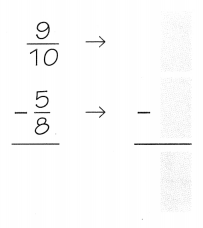
Malia bought shell beads and glass beads to weave into designs in her baskets. She bought \(\frac{1}{4}\) pound of shell beads and \(\frac{3}{8}\) pound of glass beads. How many pounds of beads did she buy?

  • Underline the question you need to answer.
  • Draw a circle around the information you will use.

Add. \(\frac{1}{4}\) + \(\frac{3}{8}\). Write your answer in simplest form.

One Way
Find a common denominator by multiplying the denominators.
4 × 8 = ________ ← common denominator
Use the common denominator to write equivalent fractions with equal denominators. Then add, and write your answer in simplest form.
Texas Go Math Grade 5 Lesson 5.5 Answer Key 1

Another Way

Find the least common denominator.
The least common denominator of \(\frac{1}{4}\) and \(\frac{3}{8}\) is ___________.
Texas Go Math Grade 5 Lesson 5.5 Answer Key 2

So, Malia bought _________ pound of beads.
Answer:

One Way
Find a common denominator by multiplying the denominators.
4 × 8 = 24 ← common denominator
Use the common denominator to write equivalent fractions with equal denominators. Then add, and write your answer in simplest form.

Another Way
The least common denominator of 14 and 38 is 8

So, Malia bought \(\frac{5}{8}\)  pound of beads.

Lesson 5.5 Go Math Grade 5 Answer Key Question 1.
Explain how you know whether your answer is reasonable.
Answer: Both methods are the same
they both give the same answer
The least common denominator is the simplest method

Example

When subtracting two fractions with unequal denominators, follow the same steps you follow when adding two fractions. However, instead of adding the fractions, subtract.

Subtract. \(\frac{9}{10}\) – \(\frac{2}{5}\) Write your answer in simplest form.
Texas Go Math Grade 5 Lesson 5.5 Answer Key 3
Describe the steps you took to solve the problem.
Answer:

Explanation:
Step 1: The least common denominator is found
Step 2: written equivalent fractions with equal denominators
Step 3: write the answer in simplest form.

Question 2.
Explain how you know whether your answer is reasonable.
Answer:
The fraction solved into simplest form is reasonable
which found by least common denominator

Share and Show

Find the sum or difference. Write your answer in simplest form.

Question 1.
\(\frac{5}{12}\) + \(\frac{1}{3}\)
Answer:
\(\frac{5}{12}\) + \(\frac{1}{3}\) = \(\frac{5}{12}\) + \(\frac{4}{12}\) = \(\frac{9}{12}\)
Explanation:
Step 1: The least common denominator is found
Step 2: written equivalent fractions with equal denominators
Step 3: write the answer in simplest form.

Question 2.
\(\frac{2}{5}\) + \(\frac{3}{7}\)
Answer:
\(\frac{2}{5}\) + \(\frac{3}{7}\) = \(\frac{14}{35}\) + \(\frac{15}{35}\) =\(\frac{29}{35}\)
Explanation:
Step 1: The least common denominator is found
Step 2: written equivalent fractions with equal denominators
Step 3: write the answer in simplest form.

Question 3.
\(\frac{1}{6}\) + \(\frac{3}{4}\)
Answer:
\(\frac{1}{6}\) + \(\frac{3}{4}\) = \(\frac{2}{12}\) + \(\frac{9}{12}\) = \(\frac{11}{12}\)
Explanation:
Step 1: The least common denominator is found
Step 2: write equivalent fractions with equal denominators
Step 3: write the answer in simplest form.

Lesson 5.5 Answer Key Go Math Grade 5 Question 4.
\(\frac{3}{4}\) – \(\frac{1}{8}\)
Answer:
\(\frac{3}{4}\) – \(\frac{1}{8}\) = \(\frac{6}{8}\) – \(\frac{1}{8}\) = \(\frac{5}{8}\)
Explanation:
Step 1: The least common denominator is found
Step 2: write equivalent fractions with equal denominators
Step 3: write the answer in simplest form.

Question 5.
\(\frac{1}{4}\) – \(\frac{1}{7}\)
Answer:
\(\frac{1}{4}\) – \(\frac{1}{7}\) = \(\frac{7}{28}\) – \(\frac{4}{28}\)= \(\frac{3}{28}\)
Explanation:
Step 1: The least common denominator is found
Step 2: written equivalent fractions with equal denominators
Step 3: write the answer in simplest form.

Question 6.
\(\frac{9}{10}\) – \(\frac{1}{4}\)
Answer:
\(\frac{9}{10}\) – \(\frac{1}{4}\) = \(\frac{18}{20}\) – \(\frac{5}{20}\)= \(\frac{13}{20}\)
Explanation:
Step 1: The least common denominator is found
Step 2: written equivalent fractions with equal denominators
Step 3: write the answer in simplest form.

Math Talk
Mathematical Processes

Explain why it is important to check your answer for reasonableness.
Answer:

Problem Solving

Practice: Copy and Solve Find the sum or difference. Write your answer in simplest form.

Question 7.
\(\frac{1}{3}\) + \(\frac{4}{18}\)
Answer:
\(\frac{1}{3}\) + \(\frac{4}{18}\) = \(\frac{6}{18}\) + \(\frac{4}{18}\) =\(\frac{10}{18}\)
Explanation:
Step 1: The least common denominator is found
Step 2: written equivalent fractions with equal denominators
Step 3: write the answer in simplest form.

Question 8.
\(\frac{3}{5}\) + \(\frac{1}{3}\)
Answer:
\(\frac{3}{5}\) + \(\frac{1}{3}\) = \(\frac{9}{15}\) + \(\frac{5}{15}\) = \(\frac{14}{15}\)
Explanation:
Step 1: The least common denominator is found
Step 2: written equivalent fractions with equal denominators
Step 3: write the answer in simplest form.

Question 9.
\(\frac{3}{10}\) + \(\frac{1}{6}\)
Answer:
\(\frac{3}{10}\) + \(\frac{1}{6}\) = \(\frac{9}{30}\) + \(\frac{5}{30}\) = \(\frac{14}{30}\)
Explanation:
Step 1: The least common denominator is found
Step 2: written equivalent fractions with equal denominators
Step 3: write the answer in simplest form.

Question 10.
\(\frac{1}{2}\) + \(\frac{4}{9}\)
Answer:
\(\frac{1}{2}\) + \(\frac{4}{9}\) = \(\frac{9}{18}\) + \(\frac{8}{18}\) = \(\frac{17}{18}\)
Explanation:
Step 1: The least common denominator is found
Step 2: written equivalent fractions with equal denominators
Step 3: write the answer in simplest form.

Go Math Grade 5 Lesson 5.5 Answer Key Question 11.
\(\frac{1}{2}\) – \(\frac{3}{8}\)
Answer:
\(\frac{1}{2}\) – \(\frac{3}{8}\) = \(\frac{4}{8}\) – \(\frac{3}{8}\) = \(\frac{1}{8}\)
Explanation:
Step 1: The least common denominator is found
Step 2: written equivalent fractions with equal denominators
Step 3: write the answer in simplest form.

Question 12.
\(\frac{5}{7}\) – \(\frac{2}{3}\)
Answer:
\(\frac{5}{7}\) – \(\frac{2}{3}\) = \(\frac{15}{21}\) – \(\frac{14}{21}\) = \(\frac{1}{21}\)
Explanation:
Step 1: The least common denominator is found
Step 2: written equivalent fractions with equal denominators
Step 3: write the answer in simplest form.

Question 13.
\(\frac{4}{9}\) – \(\frac{1}{6}\)
Answer:
\(\frac{4}{9}\) – \(\frac{1}{6}\) = \(\frac{8}{18}\) – \(\frac{3}{18}\) = \(\frac{5}{18}\)
Explanation:
Step 1: The least common denominator is found
Step 2: written equivalent fractions with equal denominators
Step 3: write the answer in simplest form.

Question 14.
\(\frac{11}{12}\) – \(\frac{7}{15}\)
Answer:
\(\frac{11}{12}\) – \(\frac{7}{15}\) = \(\frac{55}{60}\) – \(\frac{28}{60}\) = \(\frac{27}{60}\)
Explanation:
Step 1: The least common denominator is found
Step 2: written equivalent fractions with equal denominators
Step 3: write the answer in simplest form.

H.O.T. Algebra Find the unknown number.

Question 15.
\(\frac{9}{10}\) – ☐ = \(\frac{1}{5\)
☐ = ___________
Answer:
\(\frac{9}{10}\) – \(\frac{7}{10}\)= \(\frac{1}{5\)
Explanation:
Step 1: The least common denominator is found
Step 2: written equivalent fractions with equal denominators
Step 3: write the answer in simplest form.

Question 16.
\(\frac{5}{12}\) + ☐ = \(\frac{1}{2}\)
☐ = ____________
Answer:
\(\frac{5}{12}\) + \(\frac{1}{12}\) =\(\frac{6}{12}\) =\(\frac{1}{2}\)
Explanation:
Step 1: The least common denominator is found
Step 2: written equivalent fractions with equal denominators
Step 3: write the answer in simplest form.

Problem Solving

Use the picture for 17-18
Texas Go Math Grade 5 Lesson 5.5 Answer Key 4

Go Math Grade 5 Lesson 5.5 Practice Answer Key Question 17.
Sara is making a key chain using the bead design shown. What fraction of the beads in her design are either blue or red?
Answer:
Explanation:
Let us consider dark black as red
and light black-as-blue
The number of beads is 15
Number of red beads are \(\frac{5}{15}\)
Number of black beads are \(\frac{6}{15}\)

Question 18.
H.O.T. Multi-Step In making the key chain, Sara uses the pattern of beads 3 times. After the key chain is complete, what fraction of the beads in the key chain are either white or blue?
Texas Go Math Grade 5 Lesson 5.5 Answer Key 5
Answer:

Question 19.
Write Math Jamie had \(\frac{4}{5}\) of a spool of twine. He then used \(\frac{1}{2}\) of a spool of twine to make friendship knots. He claims to have \(\frac{3}{10}\) of the original spool of twine leftover. How you know whether Jamie’s claim is reasonable.
Answer: Yes. Jamie’s claim is reasonable.
Explanation:
Jamie had \(\frac{4}{5}\) of a spool of twine. He then used \(\frac{1}{2}\) of a spool of twine to make friendship knots.  So \(\frac{3}{10}\) of the original spool of twine leftover. Since
\(\frac{4}{5}\) –\(\frac{1}{2}\) = \(\frac{8}{10}\) – \(\frac{5}{10}\) = \(\frac{3}{10}\)
He claims to have \(\frac{3}{10}\) of the original spool of twine leftover. So it is equla to what he leftover. So his claim is reasonabale.

Daily Assessment Task

Fill in the bubble completely to show your answer.

Question 20.
Apply Students are voting for a new school mascot. So far, the results show that \(\frac{3}{10}\) of the students voted for “Fightin’ Titan,” \(\frac{1}{2}\) of the students voted for “Nifty Knight,” and the rest of the students have not voted yet. What fraction of the student population has not voted yet?
(A) \(\frac{3}{10}\)
(B) \(\frac{2}{5}\)
(C) \(\frac{1}{5}\)
(D) \(\frac{4}{5}\)
Answer: (C) \(\frac{1}{5}\)
Explanation:
So far, the results show that \(\frac{3}{10}\) of the students voted for “Fightin’ Titan,” \(\frac{1}{2}\) of the students voted for “Nifty Knight,” Then \(\frac{8}{10}\) voted. Since
\(\frac{3}{10}\) +\(\frac{1}{2}\) = \(\frac{8}{10}\)
So \(\frac{1}{5}\) of the students have not voted yet. Since
1- \(\frac{8}{10}\) = \(\frac{1}{5}\)

Question 21.
Tina spent \(\frac{3}{5}\) of her paycheck on a trip to the beach. She spent \(\frac{3}{8}\) of her paycheck on new clothes for the trip. What fraction of her paycheck did Tina spend on the trip and clothes together?
(A) \(\frac{9}{40}\)
(B) \(\frac{3}{4}\)
(C) \(\frac{7}{8}\)
(D) \(\frac{39}{40}\)
Answer: (D) \(\frac{39}{40}\)
Explanation:
Tina spent \(\frac{3}{5}\) of her paycheck on a trip to the beach. She spent \(\frac{3}{8}\) of her paycheck on new clothes for the trip. So Tortal Spent is \(\frac{39}{40}\)
\(\frac{3}{5}\) + \(\frac{3}{8}\)  = \(\frac{39}{40}\)

Question 22.
Multi-Step On Friday, \(\frac{1}{6}\) of band practice was spent trying on uniforms. The band spent \(\frac{1}{4}\) of practice on marching. What fraction of practice time was left for playing music?
(A) \(\frac{5}{12}\)
(B) \(\frac{1}{2}\)
(C) \(\frac{7}{12}\)
(D) \(\frac{1}{4}\)
Answer: (C) \(\frac{7}{12}\)
Explanation:
\(\frac{1}{6}\) of band practice was spent trying on uniforms. The band spent \(\frac{1}{4}\) of practice on marching. So Total time spent is \(\frac{5}{12}\). So Time left is \(\frac{7}{12}\)
\(\frac{1}{6}\) + \(\frac{1}{4}\) = \(\frac{5}{12}\)
1-\(\frac{5}{12}\) =\(\frac{7}{12}\)

Texas Test Prep

Question 23.
Which equation represents the fraction of beads that are green or yellow?
Texas Go Math Grade 5 Lesson 5.5 Answer Key 6
Answer:

Texas Go Math Grade 5 Lesson 5.5 Homework and Practice Answer Key

Find the sum or difference. Write your answer in simplest form.

Question 1.
\(\frac{1}{5}\) + \(\frac{1}{2}\) ____________
Answer:
\(\frac{1}{5}\) + \(\frac{1}{2}\) = \(\frac{2}{10}\) + \(\frac{5}{10}\) = \(\frac{7}{10}\)
Explanation:
Step 1: The least common denominator is found
Step 2: write equivalent fractions with equal denominators
Step 3: write the answer in simplest form.

Go Math Grade 5 Lesson 5.5 Answer Key Question 2.
\(\frac{2}{3}\) + \(\frac{1}{6}\) ____________
Answer:
\(\frac{2}{3}\) + \(\frac{1}{6}\) = \(\frac{4}{6}\) + \(\frac{1}{6}\) = \(\frac{5}{6}\)
Explanation:
Step 1: The least common denominator is found
Step 2: written equivalent fractions with equal denominators
Step 3: write the answer in simplest form.

Question 3.
\(\frac{1}{4}\) + \(\frac{2}{3}\) ____________
Answer:
\(\frac{1}{4}\) + \(\frac{2}{3}\) = \(\frac{3}{12}\) + \(\frac{8}{12}\) = \(\frac{11}{12}\)
Explanation:
Step 1: The least common denominator is found
Step 2: written equivalent fractions with equal denominators
Step 3: write the answer in simplest form.

Question 4.
\(\frac{3}{4}\) + \(\frac{1}{8}\) ____________
Answer:
\(\frac{3}{4}\) + \(\frac{1}{8}\) = \(\frac{6}{8}\) + \(\frac{1}{8}\) = \(\frac{7}{8}\)
Explanation:
Step 1: The least common denominator is found
Step 2: written equivalent fractions with equal denominators
Step 3: write the answer in simplest form.

Question 5.
\(\frac{2}{9}\) + \(\frac{1}{3}\) ____________
Answer:
\(\frac{2}{9}\) + \(\frac{1}{3}\) = \(\frac{2}{9}\) + \(\frac{3}{9}\) = \(\frac{5}{9}\)
Explanation:
Step 1: The least common denominator is found
Step 2: written equivalent fractions with equal denominators
Step 3: write the answer in simplest form.

Question 6.
\(\frac{1}{2}\) + \(\frac{2}{6}\) ____________
Answer:
\(\frac{1}{2}\) + \(\frac{2}{6}\) = \(\frac{3}{6}\) + \(\frac{2}{6}\) = \(\frac{5}{6}\)
Explanation:
Step 1: The least common denominator is found
Step 2: written equivalent fractions with equal denominators
Step 3: write the answer in simplest form.

Question 7.
\(\frac{3}{10}\) + \(\frac{1}{3}\) ____________
Answer:
\(\frac{3}{10}\) + \(\frac{1}{3}\) = \(\frac{9}{30}\) + \(\frac{10}{30}\) = \(\frac{19}{30}\)
Explanation:
Step 1: The least common denominator is found
Step 2: written equivalent fractions with equal denominators
Step 3: write the answer in simplest form.

Question 8.
\(\frac{4}{18}\) + \(\frac{2}{6}\) ____________
Answer:
\(\frac{4}{18}\) + \(\frac{2}{6}\) = \(\frac{4}{18}\) + \(\frac{6}{18}\) = \(\frac{10}{18}\)
Explanation:
Step 1: The least common denominator is found
Step 2: written equivalent fractions with equal denominators
Step 3: write the answer in simplest form.

Question 9.
\(\frac{6}{12}\) – \(\frac{1}{3}\) ____________
Answer:
\(\frac{6}{12}\) – \(\frac{1}{3}\) = \(\frac{6}{12}\) – \(\frac{4}{12}\) = \(\frac{2}{12}\)
Explanation:
Step 1: The least common denominator is found
Step 2: written equivalent fractions with equal denominators
Step 3: write the answer in simplest form.

Question 10.
\(\frac{3}{4}\) – \(\frac{1}{6}\) ____________
Answer:
\(\frac{3}{4}\) – \(\frac{1}{6}\) = \(\frac{9}{12}\) – \(\frac{2}{12}\) = \(\frac{7}{12}\)
Explanation:
Step 1: The least common denominator is found
Step 2: written equivalent fractions with equal denominators
Step 3: write the answer in simplest form.

Question 11.
\(\frac{5}{7}\) – \(\frac{1}{2}\) ____________
Answer:
\(\frac{5}{7}\) – \(\frac{1}{2}\) = \(\frac{10}{14}\) – \(\frac{7}{14}\) = \(\frac{3}{14}\)
Explanation:
Step 1: The least common denominator is found
Step 2: written equivalent fractions with equal denominators
Step 3: write the answer in simplest form.

Question 12.
\(\frac{8}{9}\) – \(\frac{2}{3}\) ____________
Answer:
\(\frac{8}{9}\) – \(\frac{2}{3}\) = \(\frac{8}{9}\) – \(\frac{6}{9}\) = \(\frac{2}{9}\)
Explanation:
Step 1: The least common denominator is found
Step 2: written equivalent fractions with equal denominators
Step 3: write the answer in simplest form.

Question 13.
\(\frac{5}{9}\) – \(\frac{1}{6}\) ____________
Answer:
\(\frac{5}{9}\) – \(\frac{1}{6}\) = \(\frac{10}{18}\) – \(\frac{3}{18}\) = \(\frac{7}{18}\)
Explanation:
Step 1: The least common denominator is found
Step 2: written equivalent fractions with equal denominators
Step 3: write the answer in simplest form.

Question 14.
\(\frac{2}{3}\) – \(\frac{1}{4}\) ____________
Answer:
\(\frac{2}{3}\) – \(\frac{1}{4}\) = \(\frac{8}{12}\) – \(\frac{3}{12}\) = \(\frac{5}{12}\)
Explanation:
Step 1: The least common denominator is found
Step 2: written equivalent fractions with equal denominators
Step 3: write the answer in simplest form.

Question 15.
\(\frac{7}{14}\) – \(\frac{2}{7}\) ____________
Answer:
\(\frac{7}{14}\) – \(\frac{2}{7}\) = \(\frac{7}{14}\) – \(\frac{4}{14}\) = \(\frac{3}{14}\)
Explanation:
Step 1: The least common denominator is found
Step 2: written equivalent fractions with equal denominators
Step 3: write the answer in simplest form.

Question 16.
\(\frac{5}{6}\) – \(\frac{3}{4}\) ____________
Answer:
\(\frac{5}{6}\) – \(\frac{3}{4}\) = \(\frac{10}{12}\) – \(\frac{9}{12}\) = \(\frac{1}{12}\)
Explanation:
Step 1: The least common denominator is found
Step 2: written equivalent fractions with equal denominators
Step 3: write the answer in simplest form.

Find the unknown number.

Question 17.
\(\frac{7}{12}\) – ☐ = \(\frac{1}{6}\)
☐ = _____________
Answer:
\(\frac{7}{12}\) – \(\frac{5}{12}\) = \(\frac{1}{6}\)
Explanation:
Step 1: The least common denominator is found
Step 2: written equivalent fractions with equal denominators
Step 3: write the answer in simplest form.

Question 18.
\(\frac{5}{18}\) + ☐ = \(\frac{1}{2}\)
☐ = _____________
Answer:
\(\frac{5}{18}\) + \(\frac{4}{18}\) = \(\frac{1}{2}\)
Explanation:
Step 1: The least common denominator is found
Step 2: written equivalent fractions with equal denominators
Step 3: write the answer in simplest form.

Question 19.
\(\frac{7}{10}\) – ☐ = \(\frac{2}{5}\)
☐ = ______________
Answer:
\(\frac{7}{10}\) – \(\frac{3}{10}\) = \(\frac{2}{5}\)
Explanation:
Step 1: The least common denominator is found
Step 2: written equivalent fractions with equal denominators
Step 3: write the answer in simplest form.

Question 20.
☐ + \(\frac{1}{9}\) = \(\frac{1}{3}\)
☐ = _______________
Answer:
\(\frac{2}{9}\) + \(\frac{1}{9}\) = \(\frac{1}{3}\)
Explanation:
Step 1: The least common denominator is found
Step 2: written equivalent fractions with equal denominators
Step 3: write the answer in simplest form.

Problem Solving

Question 21.
There are 12 students in the pep squad. Three students are wearing white shirts. Six students are wearing blue shirts. What fraction of the students in the pep squad are wearing either white or blue shirts?
Answer: \(\frac{1}{4}\)  wearing the white shirts and \(\frac{1}{2}\) wearing the blue shirts.
Explanation:
There are 12 students in the pep squad. Three students are wearing white shirts.
\(\frac{3}{12}\)  = \(\frac{1}{4}\)
Six students are wearing blue shirts.
\(\frac{6}{12}\)  = \(\frac{1}{2}\)


Question 22.
Tiffany ran \(\frac{5}{6}\) mile. Shayne ran \(\frac{3}{4}\) mile. Who ran farther? How much farther?
Answer:

Lesson Check

Fill in the bubble completely to show your answer.

Question 23.
Mr. Benson spent \(\frac{2}{5}\) of the monthly budget on rent and \(\frac{3}{10}\) of the budget on food. What fraction of Mr. Benson’s budget was spent on rent and food?
(A) \(\frac{1}{3}\)
(B) \(\frac{3}{10}\)
(C) \(\frac{7}{10}\)
(D) \(\frac{1}{2}\)
Answer: (C) \(\frac{7}{10}\)
Explanation:
Mr. Benson spent \(\frac{2}{5}\) of the monthly budget on rent and \(\frac{3}{10}\) of the budget on food.
Sum of \(\frac{2}{5}\) and \(\frac{3}{10}\)  is \(\frac{7}{10}\) .
Since
\(\frac{3}{10}\)+ \(\frac{2}{5}\)= \(\frac{7}{10}\) .

Question 24.
The Ortega family made \(\frac{15}{16}\) pound of confetti for the annual Fiesta celebration in San Antonio. They used \(\frac{1}{4}\) pound to make confetti filled eggs. How much confetti is left to use next year?
(A) \(\frac{11}{16}\) pound
(B) \(\frac{9}{16}\) pound
(C) \(\frac{4}{5}\) pound
(D) \(\frac{3}{4}\) pound
Answer: (A) \(\frac{11}{16}\) pound
Explanation:
The Ortega family made \(\frac{15}{16}\) pound of confetti for the annual Fiesta celebration in San Antonio. They used \(\frac{1}{4}\) pound to make confetti filled eggs. confetti is left to use next year is \(\frac{11}{16}\) pound. Since

\(\frac{15}{16}\) – \(\frac{1}{4}\) = \(\frac{11}{16}\) pound

Use the recipe for 25-26.
Texas Go Math Grade 5 Lesson 5.5 Answer Key 7

Question 25.
If Rory measures the lemon juice and the vanilla extract into one spoon before adding them to the blender, how much liquid will be in the spoon?
(A) \(\frac{5}{8}\) teaspoon
(B) \(\frac{1}{5}\) teaspoon
(C) \(\frac{1}{4}\) teaspoon
(D) \(\frac{3}{8}\) teaspoon
Answer: (A) \(\frac{5}{8}\) teaspoon
Explanation:
Sum of lemon juice and the vanilla extract is
\(\frac{1}{2}\) teaspoon + \(\frac{1}{8}\) teaspoon = \(\frac{5}{8}\) teaspoon

Question 26.
Multi-Step Rory has \(\frac{5}{8}\) cup of milk. How much milk does she have left after she doubles the recipe for the smoothie?
(A) \(\frac{3}{8}\) cup
(B) \(\frac{1}{8}\) cup
(C) \(\frac{3}{4}\) cup
(D) \(\frac{1}{2}\) cup
Answer: (B) \(\frac{1}{8}\) cup
Explanation:
she doubles the recipe for the smoothie. So it is \(\frac{1}{2}\) cup. Since
\(\frac{1}{4}\) cup + \(\frac{1}{4}\) cup  = \(\frac{1}{2}\) cup.
Rory has \(\frac{5}{8}\) cup of milk. She left \(\frac{1}{8}\) cup of milk.
Since
\(\frac{5}{8}\)  –\(\frac{1}{2}\) cup. = \(\frac{1}{8}\)

Question 27.
Multi-Step Torn has \(\frac{7}{8}\) cup of olive oil. He uses \(\frac{1}{2}\) cup to make salad dressing and \(\frac{1}{4}\) cup to make tomato sauce. How much olive oil does Torn have left?
(A) \(\frac{5}{4}\) cups
(B) \(\frac{5}{8}\) cup
(C) \(\frac{3}{8}\) cup
(D) \(\frac{1}{8}\) cup
Answer: (D) \(\frac{1}{8}\) cup
Explanation:
\(\frac{1}{2}\) + \(\frac{1}{4}\)  = \(\frac{3}{4}\)
and
\(\frac{7}{8}\) cup – \(\frac{3}{4}\) cup = \(\frac{1}{8}\) cup

Texas Go Math Grade 5 Lesson 5.5 Answer Key Add and Subtract Fractions Read More »

Texas Go Math Grade 5 Lesson 5.3 Answer Key Estimate Fraction Sums and Differences

Refer to our Texas Go Math Grade 5 Answer Key Pdf to score good marks in the exams. Test yourself by practicing the problems from Texas Go Math Grade 5 Lesson 5.3 Answer Key Estimate Fraction Sums and Differences.

Texas Go Math Grade 5 Lesson 5.3 Answer Key Estimate Fraction Sums and Differences

Unlock the Problem

Kimberly will be riding her bike to school this year. The distance from her house to the end of the Street is \(\frac{1}{62}\)mile. The distance from the end of the Street to the school is \(\frac{3}{8}\) mile. About how far is Kimberly’s house from school?

You can use benchmarks to find reasonable estimates by rounding fractions to 0, \(\frac{1}{2}\), or 1.

One Way:

Use a number line.
Estimate. \(\frac{1}{6}\) + \(\frac{3}{8}\)
STEP 1:
Place a point at \(\frac{1}{6}\) on the number line.
The fraction is between ________ and __________.
The fraction \(\frac{1}{6}\) is closer to the benchmark _________.
Round to ________.
Texas Go Math Grade 5 Lesson 5.3 Answer Key 1

STEP 2:
Place a point at \(\frac{3}{8}\) on the number line.
The fraction is between __________ and _________.
The fraction \(\frac{3}{8}\) is closer to the benchmark ___________.
Round to _________.
Texas Go Math Grade 5 Lesson 5.3 Answer Key 2

STEP 3:
Add the rounded fractions.
Texas Go Math Grade 5 Lesson 5.3 Answer Key 3

So, Kimberly’s house is about ________ mile from the school.
Answer:\(\frac{1}{6}\)
Use a number line.
Estimate. \(\frac{1}{6}\) + \(\frac{3}{8}\)
STEP 1:
Place a point at \(\frac{1}{6}\) on the number line.
The fraction is between \(\frac{0}{6}\) and \(\frac{6}{6}\)
The fraction \(\frac{1}{6}\) is closer to the benchmark \(\frac{0}{6}\)
Round to \(\frac{0}{6}\)

STEP 2:
Place a point at \(\frac{3}{8}\) on the number line.
The fraction is between \(\frac{0}{8}\) and \(\frac{3}{8}\)
The fraction \(\frac{3}{8}\) is closer to the benchmark \(\frac{4}{8}\)
Round to \(\frac{4}{8}\)

STEP 3:
Add the rounded fractions.


So, Kimberly’s house is about \(\frac{1}{2}\)mile from the school.

Another Way

Use mental math.
You can compare the numerator and the denominator to round a fraction and find a reasonable estimate.

Estimate. \(\frac{9}{10}\) – \(\frac{5}{8}\)
STEP 1:
Round \(\frac{9}{10}\).
Think: The numerator is about the same as the denominator.
Round the fraction \(\frac{9}{10}\) to __________.

Remember
A fraction with the same numerator and denominator, such as \(\frac{2}{2}, \frac{5}{5}, \frac{12}{12}\) or \(\frac{96}{96}\), is equal to 1.

STEP 2:
Round \(\frac{5}{8}\)
Think: The numerator is about half the denominator.
Round the fraction \(\frac{5}{8}\) to ___________.

STEP 3:
Subtract
Texas Go Math Grade 5 Lesson 5.3 Answer Key 4
So, \(\frac{9}{10}\) – \(\frac{5}{8}\) is about __________.
Answer:

STEP 1:
Round \(\frac{9}{10}\).
Think: The numerator is about the same as the denominator.
Round the fraction \(\frac{9}{10}\) to \(\frac{10}{10}\)

Remember
A fraction with the same numerator and denominator, such as \(\frac{2}{2}, \frac{5}{5}, \frac{12}{12}\) or \(\frac{96}{96}\), is equal to 1.

STEP 2:
Round \(\frac{5}{8}\)
Think: The numerator is about half the denominator.
Round the fraction \(\frac{5}{8}\) to \(\frac{4}{8}\)

STEP 3:
Subtract

So, \(\frac{9}{10}\) – \(\frac{5}{8}\) is about \(\frac{1}{2}\)

Math Talk
Mathematical Processes

Explain another way you could use benchmarks to estimate \(\frac{9}{10}\) – \(\frac{5}{8}\).
Answer:
\(\frac{9}{10}\) – \(\frac{5}{8}\) = \(\frac{1}{6}\)
\(\frac{1}{6}\) is very near to \(\frac{1}{5}\)
Explanation:
Used bench marks to find the sum

Share and Show

Estimate the sum or difference.

Question 1.
\(\frac{5}{6}\) + \(\frac{3}{8}\)
a. Round \(\frac{5}{6}\) to its closest benchmark.
Answer:  \(\frac{6}{6}\)

b. Round \(\frac{3}{8}\) to its closest benchmark.
Answer: \(\frac{4}{8}\)

c. Add to find the estimate.   \(\frac{6}{6}\) +\(\frac{4}{8}\)  = 1\(\frac{1}{2}\)
Answer: 1\(\frac{1}{2}\)
Explanation:
used benchmarks to find reasonable estimates
by rounding fractions to 0, \(\frac{1}{2}\), or 1.

Go Math Lesson 5.3 5th Grade Answer Key Question 2.
\(\frac{5}{9}\) – \(\frac{3}{8}\)
Answer:
a. Round \(\frac{5}{9}\) to its closest benchmark.
Answer:  \(\frac{5}{9}\)

b. Round \(\frac{3}{8}\) to its closest benchmark.
Answer: \(\frac{4}{8}\)

c. Add to find the estimate.   \(\frac{5}{9}\) – \(\frac{4}{8}\)  = 1\(\frac{1}{18}\)
Answer: 1\(\frac{1}{18}\)
Explanation:
used benchmarks to find reasonable estimates
by rounding fractions to 0, \(\frac{1}{2}\), or 1.

Question 3.
\(\frac{5}{6}\) + \(\frac{2}{5}\)
Answer:
a. Round \(\frac{5}{6}\) to its closest benchmark.
Answer:  \(\frac{6}{6}\)

b. Round \(\frac{2}{5}\) to its closest benchmark.
Answer: \(\frac{2}{5}\)

c. Add to find the estimate.   \(\frac{6}{6}\) +\(\frac{2}{5}\)  = 1\(\frac{1}{2}\)
Answer: 1\(\frac{1}{2}\)
Explanation:
used benchmarks to find reasonable estimates
by rounding fractions to 0, \(\frac{1}{2}\), or 1.

Question 4.
\(\frac{9}{10}\) – \(\frac{1}{9}\)
Answer:
a. Round \(\frac{9}{10}\) to its closest benchmark.
Answer:  \(\frac{10}{10}\)

b. Round \(\frac{1}{9}\) to its closest benchmark.
Answer: \(\frac{0}{9}\)

c. Add to find the estimate.   \(\frac{10}{10}\) – \(\frac{0}{9}\)  = 1
Answer: 1
Explanation:
used benchmarks to find reasonable estimates
by rounding fractions to 0, \(\frac{1}{2}\), or 1.

Problem Solving

Lesson 5.3 Answer Key 5th Grade Go Math Question 5.
How do you know whether your estimate for \(\frac{9}{10}\) + 3\(\frac{6}{7}\) would be greater than or less than the actual sum? Explain.
Answer: Greater than the actual sum
\(\frac{9}{10}\) + 3\(\frac{6}{7}\) =
close to bench marks \(\frac{10}{10}\) + 3\(\frac{7}{7}\) =  4
Explanation:
Is greater than the actual sum
used benchmarks to find reasonable estimates
by rounding fractions to 0, \(\frac{1}{2}\), or 1.

Question 6.
Write Math Nick estimated that \(\frac{5}{8}\) + \(\frac{4}{7}\) is about 2. Explain how you know his estimate is not reasonable.
Answer: \(\frac{5}{8}\) + \(\frac{4}{7}\)
close to benchmarks \(\frac{4}{8}\) + \(\frac{4}{7}\) = 1
Explanation:
Nick estimated that \(\frac{5}{8}\) + \(\frac{4}{7}\) is about 2.
used benchmarks to find reasonable estimates
by rounding fractions to 0, \(\frac{1}{2}\), or 1.
so, his estimation is wrong

Problem Solving

Question 7.
Lisa and Valerie are picnicking in Trough Creek State Park in Pennsylvania. Lisa has brought a salad that she made with \(\frac{3}{4}\) cup of strawberries, \(\frac{7}{8}\) cup of peaches, and \(\frac{1}{6}\) cup of blueberries. About how many total cups of fruit are in the salad?
Answer:
\(\frac{3}{4}\) + \(\frac{7}{8}\) + \(\frac{1}{6}\) very close to bench marks
\(\frac{4}{4}\) + \(\frac{8}{8}\) + \(\frac{0}{6}\) =2 \(\frac{1}{2}\)
Explanation:
Lisa and Valerie are picnicking in Trough Creek State Park in Pennsylvania.
Lisa has brought a salad that she made with \(\frac{3}{4}\) cup of strawberries,
\(\frac{7}{8}\) cup of peaches, and \(\frac{1}{6}\) cup of blueberries.
2\(\frac{1}{2}\)   total cups of fruit are in the salad

Question 8.
Multi-Step At Trace State Park in Mississippi, there is a 40-mile mountain bike trail. Tommy rode A of the trail on Saturday and \(\frac{1}{5}\) of the trail on Sunday. He estimates that he rode more than 22 miles over the two days. Is Tommy’s estimate reasonable?
Texas Go Math Grade 5 Lesson 5.3 Answer Key 5
Answer: yes
Explanation:
\(\frac{1}{5}\) + \(\frac{1}{5}\) = 1
20 + 20 = 40
one represents the whole
so, his estimation is reasonable

Go Math 5th Grade Lesson 5.3 How to Estimate Fractions Question 9.
H.O.T Explain how you know that \(\frac{5}{8}\) + \(\frac{6}{10}\) is greater than 1.
Answer: No
Explanation:
Close to the bench marks
\(\frac{8}{8}\) + \(\frac{5}{10}\) = 1
actual sum is greater than 1

Daily Assessment Task

Fill in the bubble completely to show your answer.

Question 10.
Mia uses \(\frac{1}{5}\) of a bag of gravel in the morning and \(\frac{11}{12}\) of a bag in the afternoon. About how much gravel does she use in one day?
(A) 0 bags
(B) \(\frac{1}{2}\) bag
(C) 1 bag
(D) 2\(\frac{1}{2}\) bags
Answer:  C
\(\frac{1}{5}\) + \(\frac{11}{12}\)
nearest benchmarks are
\(\frac{0}{5}\) + \(\frac{12}{12}\)  = 1
Explanation:
Mia uses \(\frac{1}{5}\) of a bag of gravel in the morning and \(\frac{11}{12}\) of a bag in the afternoon.
she use 1 bag of gravel

Question 11.
Evaluate Reasonableness Hector and Veronica are going hiking. They made a trail mix that has \(\frac{2}{3}\) cup of almonds, \(\frac{7}{8}\) cup of peanuts, and \(\frac{4}{5}\) cup of raisins in it. Hector estimates that they made about 3 cups of trail mix. Is the estimate greater than or less than the actual sum? How do you know?
(A) The estimate is greater because each fraction is rounded up to a benchmark.
(B) The estimate is less because each fraction is rounded down to a benchmark.
(C) The estimate is greater because they really made more than 3 cups.
(D) The estimate is less because each fraction is rounded up to a benchmark.
Answer: A
Explanation:
\(\frac{2}{3}\) + \(\frac{7}{8}\) + \(\frac{4}{5}\)
rounded to the nearest benchmarks
\(\frac{3}{3}\) + \(\frac{8}{8}\) + \(\frac{5}{5}\) = 3
Evaluated Reasonableness Hector and Veronica are going hiking.
They made a trail mix that has \(\frac{2}{3}\) cup of almonds, ”
\(\frac{7}{8}\) cup of peanuts,
and \(\frac{4}{5}\) cup of raisins in it.
Hector estimates that they made about 3 cups of trail mix.

Lesson 5.3 Go Math 5th Grade Answer Key Question 12.
Multi-Step Amanda picked \(\frac{3}{5}\) pound of blueberries at her local farm yesterday. She used \(\frac{3}{8}\) pound of blueberries. Today she picked \(\frac{4}{5}\) pound of blueberries. About how many pounds of blueberries does Amanda have now?
(A) \(\frac{1}{5}\)lb
(B) 1 lb
(C) \(\frac{1}{2}\)lb
(D) 1\(\frac{1}{2}\)lbs
Answer: B
Explanation:
what she bought is that she used yesterday
in today marked to nearest benchmarks \(\frac{4}{5}\)  is \(\frac{5}{5}\)
that is 1

Texas Test Prep

Question 13.
Jake added \(\frac{1}{8}\) cup of sunflower seeds and \(\frac{4}{5}\) cup of banana chips to his sundae. Which is the best estimate of the total amount of toppings Jake added to his sundae?
(A) about 2 cups
(B) about 1 cup
(C) about 1\(\frac{1}{2}\) cups
(D) about \(\frac{1}{2}\) cup
Answer: B
Explanation:
Jake added \(\frac{1}{8}\) cup of sunflower seeds and
\(\frac{4}{5}\) cup of banana chips to his sundae.
The best estimate of the total amount of toppings Jake added to his sundae is 1 cup

Texas Go Math Grade 5 Lesson 5.3 Homework and Practice Answer Key

Estimate the sum or difference.

Question 1.
\(\frac{3}{8}\) + \(\frac{4}{5}\) = ___________
Answer:
\(\frac{3}{8}\) + \(\frac{4}{5}\) rounded to the nearest benchmarks
\(\frac{4}{8}\) + \(\frac{5}{5}\) = 1 \(\frac{1}{2}\)
Explanation:
used benchmarks to find reasonable estimates
by rounding fractions to 0, \(\frac{1}{2}\), or 1.

5th Grade Go Math Lesson 5.3 Answer Key Question 2.
\(\frac{9}{10}\) – \(\frac{3}{8}\) = ___________
Answer:
\(\frac{9}{10}\) – \(\frac{3}{8}\) rounded to the nearest benchmarks
\(\frac{10}{10}\) – \(\frac{4}{8}\) = \(\frac{1}{2}\)
Explanation:
used benchmarks to find reasonable estimates
by rounding fractions to 0, \(\frac{1}{2}\), or 1.

Question 3.
\(\frac{5}{8}\) + \(\frac{2}{5}\) = ___________
Answer:
\(\frac{5}{8}\) + \(\frac{2}{5}\) rounded to the nearest benchmarks
\(\frac{4}{8}\) + \(\frac{2}{5}\) = 1
Explanation:
used benchmarks to find reasonable estimates
by rounding fractions to 0, \(\frac{1}{2}\), or 1.

Question 4.
\(\frac{6}{7}\) + \(\frac{3}{5}\) = ___________
Answer:
\(\frac{6}{7}\) + \(\frac{3}{5}\) rounded to the nearest benchmarks
\(\frac{7}{7}\) + \(\frac{2}{5}\) = 1\(\frac{1}{2}\)
Explanation:
used benchmarks to find reasonable estimates
by rounding fractions to 0, \(\frac{1}{2}\), or 1.

Question 5.
\(\frac{3}{8}\) – \(\frac{1}{6}\) = ___________
Answer:
\(\frac{3}{8}\) – \(\frac{1}{6}\) rounded to the nearest benchmarks
\(\frac{4}{8}\) – \(\frac{0}{6}\) = \(\frac{1}{2}\)
Explanation:
used benchmarks to find reasonable estimates
by rounding fractions to 0, \(\frac{1}{2}\), or 1.

Question 6.
\(\frac{7}{12}\) + \(\frac{1}{7}\) = ___________
Answer:
\(\frac{7}{12}\) + \(\frac{1}{7}\) rounded to the nearest benchmarks
\(\frac{6}{12}\) + \(\frac{0}{7}\) = \(\frac{1}{2}\)
Explanation:
used benchmarks to find reasonable estimates
by rounding fractions to 0, \(\frac{1}{2}\), or 1.

Go Math Lesson 5.3 5th Grade Homework Answer Key Question 7.
\(\frac{4}{9}\) – \(\frac{5}{8}\) = ___________
Answer:
\(\frac{4}{9}\) – \(\frac{5}{8}\) rounded to the nearest benchmarks
\(\frac{5}{9}\) – \(\frac{4}{8}\) = 0
Explanation:
used benchmarks to find reasonable estimates
by rounding fractions to 0, \(\frac{1}{2}\), or 1.

Question 8.
\(\frac{1}{9}\) + \(\frac{5}{6}\) = ___________
Answer:
\(\frac{1}{9}\) + \(\frac{5}{6}\) rounded to the nearest benchmark
\(\frac{0}{9}\) + \(\frac{6}{6}\) = 1
Explanation:
used benchmarks to find reasonable estimates
by rounding fractions to 0, \(\frac{1}{2}\), or 1.

Question 9.
\(\frac{7}{8}\) + \(\frac{4}{7}\) = ___________
Answer:
\(\frac{7}{8}\) + \(\frac{4}{7}\) rounded to the nearest bench mark
\(\frac{8}{8}\) + \(\frac{4}{7}\) =1\(\frac{1}{2}\)
Explanation:
used benchmarks to find reasonable estimates
by rounding fractions to 0, \(\frac{1}{2}\), or 1.

Question 10.
\(\frac{1}{5}\) + \(\frac{3}{8}\) = ___________
Answer:
\(\frac{1}{5}\) + \(\frac{3}{8}\) rounded to the nearest benchmark
\(\frac{0}{5}\) + \(\frac{4}{8}\) = \(\frac{1}{2}\)
Explanation:
used benchmarks to find reasonable estimates
by rounding fractions to 0, \(\frac{1}{2}\), or 1.

Question 11.
\(\frac{7}{9}\) – \(\frac{2}{6}\) = ___________
Answer:
\(\frac{7}{9}\) – \(\frac{2}{6}\) rounded to the nearest benchmark
\(\frac{9}{9}\) – \(\frac{3}{6}\) = \(\frac{1}{2}\)
Explanation:
used benchmarks to find reasonable estimates
by rounding fractions to 0, \(\frac{1}{2}\), or 1.

Go Math Grade 5 Lesson 5.3 Homework Answer Key Question 12.
\(\frac{9}{10}\) – \(\frac{7}{8}\) = ___________
Answer:
\(\frac{9}{10}\) – \(\frac{7}{8}\) rounded to the benchmarks
\(\frac{10}{10}\) – \(\frac{8}{8}\) = 0
Explanation:
used benchmarks to find reasonable estimates
by rounding fractions to 0, \(\frac{1}{2}\), or 1.

Question 13.
Explain how you can estimate the sum of \(\frac{4}{5}\) and \(\frac{1}{6}\).
Answer:
\(\frac{4}{5}\) + \(\frac{1}{6}\) rounded to the nearest bench marks
\(\frac{5}{5}\) + \(\frac{0}{6}\) = 1
Explanation:
used benchmarks to find reasonable estimates
by rounding fractions to 0, \(\frac{1}{2}\), or 1.

Problem Solving

Question 14.
Jena uses \(\frac{7}{8}\) cup of raisins for muffins and \(\frac{5}{8}\) cup of raisins for a bowl of oatmeal. Does lena need more than or less than 1 cup of raisins to make muffins and oatmeal? Explain.
Answer: more than 1 cup of raisins
Explanation:
Jena uses \(\frac{7}{8}\) cup of raisins for muffins and
\(\frac{5}{8}\) cup of raisins for a bowl of oatmeal.
\(\frac{7}{8}\) + \(\frac{5}{8}\) rounded the benhmark
\(\frac{8}{8}\) + \(\frac{4}{8}\) = 1\(\frac{1}{2}\)

Question 15.
A group of students ate \(\frac{5}{12}\) of a cheese pizza, \(\frac{7}{8}\) of a pepperoni pizza, and \(\frac{5}{8}\) of a veggie pizza. About how many pizzas were eaten?
Answer:
\(\frac{5}{12}\) + \(\frac{7}{8}\) + \(\frac{5}{8}\) rounded to the nearest benchmark
\(\frac{6}{12}\) + \(\frac{8}{8}\) + \(\frac{4}{8}\) = 2
Explanation:
A group of students ate \(\frac{5}{12}\) of a cheese pizza,
\(\frac{7}{8}\) of a pepperoni pizza,
and \(\frac{5}{8}\) of a veggie pizza.
2 pizzas were eaten in whole.

Lesson Check

Fill in the bubble completely to show your answer.

Question 16.
On Saturday, the scouts hiked \(\frac{4}{5}\) mile up the mountain. On Sunday, they hiked \(\frac{1}{4}\) mile up the mountain. About how far did the scouts hike up the mountain in all?
(A) \(\frac{1}{2}\) mile
(B) 1 mile
(C) 1\(\frac{1}{2}\) miles
(D) 2 miles
Answer:
\(\frac{4}{5}\) + \(\frac{1}{4}\) rounded to nearest benchmark
\(\frac{5}{5}\) + \(\frac{0}{4}\)  is 1 mile
Explanation:
On Saturday, the scouts hiked \(\frac{4}{5}\) mile up the mountain.
On Sunday, they hiked \(\frac{1}{4}\) mile up the mountain.
1 mile far the scouts hike up the mountain in all

Question 17.
Which of the following best describes the difference for \(\frac{11}{12}\) – \(\frac{7}{10}\) ?
(A) less than \(\frac{1}{2}\)
(B) greater than \(\frac{1}{2}\)
(C) greater than 1
(D) greater than 1\(\frac{1}{2}\)
Answer: A
Explanation:
\(\frac{11}{12}\) – \(\frac{7}{10}\) is 0
that is less than \(\frac{1}{2}\)

Practice and Homework Lesson 5.3 Answer Key 5th Grade Question 18.
Which sum is greatest? Use estimation to decide.
(A) \(\frac{2}{7}\) + \(\frac{3}{8}\)
(B) \(\frac{1}{10}\) + \(\frac{3}{8}\)
(C) \(\frac{1}{6}\) + \(\frac{1}{8}\)
(D) \(\frac{2}{9}\) + \(\frac{1}{8}\)
Answer: A
Explanation:
\(\frac{2}{7}\) + \(\frac{3}{8}\) = 1

Question 19.
Which statement is not correct? Use estimation to decide.
Texas Go Math Grade 5 Lesson 5.3 Answer Key 6
Answer: B
Explanation:
used benchmarks to find reasonable estimates
by rounding fractions to 0, \(\frac{1}{2}\), or 1.

Question 20.
Multi-Step Michaela has \(\frac{11}{12}\) yard of orange fabric and \(\frac{7}{8}\) yard of green fabric. She uses \(\frac{1}{2}\) yard of each color for her sewing project. About how much fabric does Michaela have left if she combines the two colors?
(A) 1 yard
(B) \(\frac{1}{2}\) yard
(C) 1 \(\frac{1}{2}\) yards
(D) 2 yards
Answer:  D
\(\frac{11}{12}\) + \(\frac{7}{8}\) rounded to nearest bench marks
\(\frac{12}{12}\) + \(\frac{8}{8}\) = 2
Explanation:
2 yards fabric uses Michaela have left if she combines the two colors.

Question 21.
Multi-Step Dustin buys \(\frac{9}{10}\) yard of striped fabric. He uses \(\frac{3}{8}\) yard. He buys \(\frac{7}{8}\) yard more. About how much fabric does Dustin have now?
(A) 1 yard
(B) \(\frac{1}{2}\) yard
(C) 1\(\frac{1}{2}\) yards
(D) 2 yards
Answer: C
Explanation:
Dustin buys \(\frac{9}{10}\) yard of striped fabric.
He uses \(\frac{3}{8}\) yard.
He buys \(\frac{7}{8}\) yard more.
\(\frac{9}{10}\) + \(\frac{3}{8}\)  + \(\frac{7}{8}\)  rounded to nearest benchmarks
\(\frac{10}{10}\) – \(\frac{4}{8}\)  + \(\frac{8}{8}\)  = 1\(\frac{1}{2}\) yards

Texas Go Math Grade 5 Lesson 5.3 Answer Key Estimate Fraction Sums and Differences Read More »

Texas Go Math Grade 5 Unit 2 Answer Key Number and Operations: Fractions

Refer to our Texas Go Math Grade 5 Answer Key Pdf to score good marks in the exams. Test yourself by practicing the problems from Texas Go Math Grade 5 Unit 2 Answer Key Number and Operations: Fractions.

Texas Go Math Grade 5 Unit 2 Answer Key Number and Operations: Fractions

Show What You Know

Check your understanding of important skills.

Part of a Whole: Write a fraction to name the shaded part.

Question 1.
Texas Go Math Grade 5 Unit 2 Answer Key 1
number of shaded parts ___________
number of total parts ___________
fraction ___________
Answer:
The above figure is a hexagon. It is divided into six parts.
number of shaded parts are 5.
number of total parts is 6
fraction 5/6

Texas Go Math Grade 5 Pdf Unit 2 Answer Key Question 2.
Texas Go Math Grade 5 Unit 2 Answer Key 2
number of shaded parts ___________
number of total parts ___________
fraction ___________
Answer:
The shape of the above figure is a circle.
number of shaded parts are 1
number of total parts is 4
fraction 1/4

Add and Subtract Fractions
Write the sum or difference In simplest form.

Question 3.
\(\frac{3}{6}\) + \(\frac{1}{6}\) = ___________
Answer:
\(\frac{3}{6}\) + \(\frac{1}{6}\)
The denominator of both the fraction is same.
We can add the numerator directly.
\(\frac{3}{6}\) + \(\frac{1}{6}\) = \(\frac{4}{6}\)

Question 4.
\(\frac{4}{10}\) + \(\frac{1}{10}\) = ____________
Answer:
\(\frac{4}{10}\) + \(\frac{1}{10}\)
The denominator of both the fraction is same.
We can add the numerator directly.
\(\frac{4}{10}\) + \(\frac{1}{10}\) = (4 + 1)/10 = \(\frac{5}{10}\)

Question 5.
\(\frac{7}{8}\) – \(\frac{3}{8}\) = _____________
Answer:
\(\frac{7}{8}\) – \(\frac{3}{8}\)
The denominator of both the fraction is same.
We can subtract the numerator directly.
\(\frac{7}{8}\) – \(\frac{3}{8}\) = (7 – 3)/8 = \(\frac{4}{8}\)

Question 6.
\(\frac{9}{12}\) – \(\frac{2}{12}\) = _____________
Answer:
Given the fractions,
\(\frac{9}{12}\) – \(\frac{2}{12}\)
The denominator of both the fraction is same.
We can subtract the numerator directly.
\(\frac{9}{12}\) – \(\frac{2}{12}\) = (9-2)/12 = \(\frac{7}{12}\)

Equivalent Fractions
Write an equivalent fractions.

Question 7.
\(\frac{3}{4}\) _________
Answer:
Equivalent fractions are fractions with different numbers representing the same part of a whole.
\(\frac{3}{4}\) × \(\frac{2}{2}\) = \(\frac{6}{8}\)

Grade 5 Unit 2 Answer Key Go Math Question 8.
\(\frac{9}{15}\) __________
Answer:
Equivalent fractions are fractions with different numbers representing the same part of a whole.
\(\frac{9}{15}\) × \(\frac{2}{2}\) = \(\frac{18}{30}\)

Question 9.
\(\frac{24}{40}\) ____________
Answer:
Equivalent fractions are fractions with different numbers representing the same part of a whole.
\(\frac{24}{40}\) × \(\frac{2}{2}\) = \(\frac{48}{80}\)

Unit 2 Math Test Grade 5 Go Math Question 10.
\(\frac{5}{7}\) ____________
Answer:
Equivalent fractions are fractions with different numbers representing the same part of a whole.
\(\frac{5}{7}\) × \(\frac{2}{2}\) = \(\frac{10}{14}\)

Vocabulary Builder

Visualize It

Use the ✓ words to complete the H-diagram.
Texas Go Math Grade 5 Unit 2 Answer Key 3

Understand Vocabulary

Draw a line to match the word with its definition.

Texas Go Math Grade 5 Unit 2 Answer Key 4

Reading & Writing Math

Reading To get the right answer to a mathematics problem, you need to make sure you understand the question.

Problem 1.
Three friends ordered a pizza with 8 slices. Jeanette ate of the pizza. Marissa ate of the pizza. Ariel ate the rest. How many slices of Pizza did Ariel eat?
A. 1 slice
B. 2 slices
C. 4 slices
D. 6 slices

Thinking Through the Problem

Understand the question You want to know how many slices Ariel ate. Will your answer be a fraction or whole number?

Plan Find out what fraction of the pizza Ariel ate. Look at the numerator to tell how many pizza slices Ariel ate.

Solve Follow your plan. Write the answer to the problem.

Look Back Use fraction strips to check your answer.

The correct answer is B.

Writing Now it’s your turn. Answer Problem 2. Then write about how you solved the problem, step by step.:

Go Math Unit 2 5th Grade Answer Key Problem 2.
The Perez family ordered a large pizza for dinner, A large pizza is divided into 8 slices. Marco ate \(\frac{3}{8}\) of the pizza. Ramon ate 1 slice more than Marco. Emilio ate the rest. How much of the pizza did Emilio eat?
Texas Go Math Grade 5 Unit 2 Answer Key 5
A. \(\frac{1}{8}\) of the pizza
B. \(\frac{2}{8}\) of the pizza
C. \(\frac{4}{8}\) of the pizza
D. \(\frac{5}{8}\) of the pizza
Answer:
Given,
The Perez family ordered a large pizza for dinner, A large pizza is divided into 8 slices.
Marco ate \(\frac{3}{8}\) of the pizza.
Ramon ate 1 slice more than Marco. Emilio ate the rest.
\(\frac{3}{8}\) + \(\frac{1}{8}\) = \(\frac{4}{8}\)
\(\frac{4}{8}\) + \(\frac{4}{8}\) = 1
Thus the correct answer is option C.

Get Ready Game

Action Fractions
Object of the Game Practice comparing fractions

Materials
Number/Symbol Cards: 2 sets labeled 1, 2, 3, 4, 6, 8
Number of Players 2

Set Up
Give each player 2 sets of number cards. Players shuffle their cards and place them face down in a stack.

How to Play

(1) One player shuffles arid deals all cards facedown. Players stack their cards.

(2) Players take 3 cards from the top of their stacks. Using 2 of the 3 cards, each player makes a fraction whose numerator is less than or equal to its denominator. The unused card is returned to the bottom of the player’s stack.
Texas Go Math Grade 5 Unit 2 Answer Key 6
(3) Players compare the fractions. The player with the greater fraction earns 1 point. If the fractions are equivalent, each player earns 1 point.

(4) Repeat Steps 2 and 3. The player with more points after all the cards have been used is the winner.
Texas Go Math Grade 5 Unit 2 Answer Key 7
Answer:

Texas Go Math Grade 5 Unit 2 Answer Key Number and Operations: Fractions Read More »

Texas Go Math Grade 5 Lesson 6.3 Answer Key Fraction and Whole-Number Multiplication

Refer to our Texas Go Math Grade 5 Answer Key Pdf to score good marks in the exams. Test yourself by practicing the problems from Texas Go Math Grade 5 Lesson 6.3 Answer Key Fraction and Whole-Number Multiplication.

Texas Go Math Grade 5 Lesson 6.3 Answer Key Fraction and Whole-Number Multiplication

Unlock the Problem

Charlene has five 1-pound bags of different color sands. For an art project, she will use \(\frac{3}{8}\) pound of each bag of sand to create a colorful sand-art jar. How much sand will be in Charlene’s sand-art jar?

  • How much sand is in each bag?
    ____________________
  • Will Charlene use all of the sand in each bag? Explain.
    ____________________

Multiply a fraction by a whole number.

Texas Go Math Grade 5 Lesson 6.3 Answer Key 1
So, there are _________ pounds of sand in Charlene’s sand -art jar.
Answer:

  • How much sand is in each bag?
    1 pound
  • Will Charlene use all of the sand in each bag? Explain.
    No, she will use 3/8 pound of the sand in each bag.

Texas-Go-Math-Grade-5-Lesson-6.3-Answer-Key-1
So, there are 1(7/8) pounds of sand in Charlene’s sand -art jar.
Math Talk

Mathematical Processes

Explain how you can find how much sand Charlene has left.
Answer:

Example

Multiply a whole number by a fraction.
Kirsten brought in 4 loaves of bread to make sandwiches for the class picnic. Her classmates used \(\frac{2}{3}\) of the bread. How many loaves of bread were used?
Texas Go Math Grade 5 Lesson 6.3 Answer Key 2
So, ________ loaves of bread were used.
Answer:
Texas-Go-Math-Grade-5-Lesson-6.3-Answer-Key-2
So, 2(2/3) loaves of bread were used.

Share and Show

Find the product. Write the product in simplest form.

Question 1.
3 × \(\frac{2}{5}\) = ___________
Texas Go Math Grade 5 Lesson 6.3 Answer Key 3

  • Multiply the numerator by the whole number. Write the product over the denominator.
  • Write the answer as a mixed number in simplest form.

Answer:
Texas-Go-Math-Grade-5-Lesson-6.3-Answer-Key-3
Explanation:
In the above image we can observe the expression 3 x (2/5). First multiply the two whole numbers in the numerator. Multiply 3 with 2 the product is 6. Write the product 6 over the denominator 5. Write the fraction 6/5 in simplest form as a mixed number. The mixed number is 1(1/5).

Go Math Grade 5 Lesson 6.3 Answer Key Question 2.
\(\frac{2}{3}\) × 5 = ___________
Answer:
Texas-Go-Math-Grade-5-Lesson-6.3-Answer-Key-3(1)
Explanation:
In the above image we can observe the expression (2/3) x 5. First multiply the two whole numbers in the numerator. Multiply 2 with 5 the product is 10. Write the product 10 over the denominator 3. Write the fraction 10/3 in simplest form as a mixed number. The mixed number is 3(1/3).

Question 3.
6 × \(\frac{2}{3}\) = ___________
Answer:
Texas-Go-Math-Grade-5-Lesson-6.3-Answer-Key-3(2)
Explanation:
In the above image we can observe the expression 6 x (2/3). First multiply the two whole numbers in the numerator. Multiply 6 with 2 the product is 12. Write the product 12 over the denominator 3. Write the fraction 12/3 in simplest form as 4.

Question 4.
\(\frac{5}{7}\) × 4 = ___________
Answer:
Texas-Go-Math-Grade-5-Lesson-6.3-Answer-Key-3(3)
Explanation:
In the above image we can observe the expression (5/7) x 4. First multiply the two whole numbers in the numerator. Multiply 5 with 4 the product is 20. Write the product 20 over the denominator 7. Write the fraction 20/7 in simplest form as a mixed number. The mixed number is 2(6/7).

Unlock the Problem

Question 5.
The caterer wants to have enough turkey to feed 24 people. If he wants to provide \(\frac{3}{4}\) of a pound of turkey for each person, how much turkey does he need?
(A) 72 pounds
(B) 24 pounds
(C) 18 pounds
(D) 6 pounds

a. What do you need to find?
Answer:
He need to find that how much turkey he needs.

b. What operation will you use?
Answer:
He uses Multiplication operation.

c. What information are you given?
Answer:
The information given is 24 people. 3/4 of a pound person.

d. Solve the problem.
Answer:
24 x (3/4) = 72/4 = 18

e. Complete the sentences.
The caterer wants to serve 24 people __________ of a pound of turkey each.
He will need ________ × ________, or ________ pounds of turkey.
Answer:
The caterer wants to serve 24 people 3/4 of a pound of turkey each.
He will need 24 ×3/4, or 72/4 or 18 pounds of turkey.

f. Fill in the bubble for the correct answer choice.
Answer:
Texas-Go-Math-Grade-5-Lesson-6.3-Answer-Key-3(4)
The correct option is C.
Explanation:
The caterer wants to have enough turkey to feed 24 people. He wants to provide 3/4 of a pound of turkey for each person. Multiply 3/4 with 24 the product is 18 pounds. He need 18 pounds of turkey. So draw a circle to option C.

H.O.T. Algebra Find the unknown digit.

Lesson 6.3 Answer Key 5th Grade Go Math Question 6.
Texas Go Math Grade 5 Lesson 6.3 Answer Key 4
Answer:
Texas-Go-Math-Grade-5-Lesson-6.3-Answer-Key-4
The unknown digit is 1.
Explanation:
In the above image we can observe that numerator digit is missing. If we place 1 in the numerator then the product is 4. Multiply 1/2 with 8 the product is 4. So, the unknown digit is 1.

Question 7.
Texas Go Math Grade 5 Lesson 6.3 Answer Key 5
Answer:
Texas-Go-Math-Grade-5-Lesson-6.3-Answer-Key-5
The unknown digit is 4.
Explanation:
In the above image we can observe that one digit is missing. If we place 4 then the product is 20/6. Multiply 4 with 5/6 the product is 20/6 or 3(1/3). So, the unknown digit is 4.

Question 8.
Texas Go Math Grade 5 Lesson 6.3 Answer Key 6
Answer:
Texas-Go-Math-Grade-5-Lesson-6.3-Answer-Key-6
The unknown digit is 6.
Explanation:
In the above image we can observe that denominator digit is missing. If we place 6 in the denominator then the product is 3. Multiply 1/6 with 18 the product is 3. So, the unknown digit is 6.

Question 9.
H.O.T. Multi-Step Patty wants to run \(\frac{5}{6}\) of a mile every day for 5 days. Keisha wants to run \(\frac{3}{4}\) of a mile every day for 6 days. Who will run the greater distance?
Texas Go Math Grade 5 Lesson 6.3 Answer Key 7
Answer:
Patty:
5 x (5/6) = 25/6 = 4(1/6)
Patty runs 4(1/6).
Keisha:
6 x (3/4) = 18/4 = 4(1/2)
Keisha runs 4(1/2).
Keisha runs the greater distance.
Explanation:
Patty wants to run 5/6 of a mile every day for 5 days. Multiply 5 with 5/6 the product is 25/6. The mixed fraction of 25/6 is 4(1/6). Patty runs 4(1/6). Keisha wants to run 3/4 a mile every day for 6 days. Multiply 6 with 3/4 the product is 18/4. The mixed fraction of 18/4 is 4(1/2). Keisha runs 4(1/2). Keisha runs the greater distance.

Daily Assessment Task

Fill in the bubble completely to show your answer.

Question 10.
A heavy-duty snowmaking machine makes \(\frac{3}{4}\) inch of snow each minute. How many inches of snow can the machine make in 8 minutes?
(A) 8 inches
(B) 6 inches
(C) 7\(\frac{1}{4}\) inches
(D) 4\(\frac{1}{2}\) inches
Answer:
Texas-Go-Math-Grade-5-Lesson-6.3-Answer-Key-7(1)
(3/4) x 8 = 6 inches
The machine can make 6 inches of snow in 8 minutes.
So, option B is correct.
Explanation:
A heavy-duty snowmaking machine makes 3/4 inch of snow each minute. Multiply 8 minutes with 3/4 inch of snow the product is 6 inches. The machine can make 6 inches of snow in 8 minutes. So, option B is correct.

Lesson 6.3 Answer Key Go Math Grade 5 Question 11.
Connect Which has the same product as \(\frac{2}{3}\) × 8?
(A) \(\frac{5}{6}\) × 7
(B) \(\frac{1}{4}\) × 13
(C) \(\frac{3}{8}\) × 2
(D) \(\frac{1}{3}\) × 16
Answer:
Texas-Go-Math-Grade-5-Lesson-6.3-Answer-Key-7(2)
(2/3) x 8 = 16/3
So, option D is correct.
Explanation:
The given expression (2/3) x 8. Multiply 2 with 8 the product is 16. The fraction is 16/3. So, option D is correct.

Question 12.
Multi-Step A baker made 5 pounds of icing. He used \(\frac{4}{9}\) of the icing to decorate cakes. How much of the icing is left over?
(A) 1 pound
(B) 1\(\frac{5}{9}\) pounds
(C) 1\(\frac{2}{3}\) pounds
(D) 2\(\frac{7}{9}\) pounds
Answer:
Texas-Go-Math-Grade-5-Lesson-6.3-Answer-Key-7(3)
(4/9) x 5 = 20/9
He used 20/9 of the icing to decorate cakes.
5 – (20/9) = (45 – 20)/9 = 25/9 = 2(7/9)
2(7/9) of the icing is left over.
So, option D is correct.
Explanation:
A baker made 5 pounds of icing. He used 4/9 of the icing to decorate cakes. Multiply 4/9 with 5 the product is 20/9. He used 20/9 of the icing to decorate cakes. Subtract 20/9 from 5 the difference is 25/9. The mixed fraction of 25/9 is 2(7/9). The icing left over is 2(7/9). So, draw a circle for option D.

Texas Test Prep

Question 13.
Doug has 33 feet of rope. He wants to use \(\frac{2}{3}\) of it for his canoe. How many feet of rope will he use for his canoe?
(A) 66 feet
(B) 22 feet
(C) 33 feet
(D) 11 feet
Answer:
Texas-Go-Math-Grade-5-Lesson-6.3-Answer-Key-7(4)
(2/3) x 33 = 22 feet
He used 22 feet of rope for his canoe.
So, option B is correct.
Explanation:
Doug has 33 feet of rope. He wants to use 2/3 of it for his canoe. Multiply (2/3) with 33 the product is 22 feet. He used 22 feet of rope for his canoe. So, option B is correct.

Texas Go Math Grade 5 Lesson 6.3 Homework and Practice Answer Key

Find the product. Write the product in the simplest form.

Question 1.
\(\frac{3}{7}\) × 4 = ____________
Answer:
(3/7) x 4 = (3 x 4)/7 = 12/7
The product is 12/7.
The simplest form of 12/7 is 1(5/7).
Explanation:
In the above image we can observe the expression (3/7) x 4. First multiply the two whole numbers in the numerator. Multiply 3 with 4 the product is 12. Write the product 12 over the denominator 7. Write the fraction 12/7 in simplest form as a mixed number. The mixed number is 1(5/7).

Go Math Lesson 6.3 5th Grade Answer Key Question 2.
\(\frac{3}{5}\) × 5 = ____________
Answer:
(3/5) x 5 = (3 x 5)/5 = 15/5
The product is 15/5.
The simplest form of 15/5 is 3.
Explanation:
In the above image we can observe the expression (3/5) x 5. First multiply the two whole numbers in the numerator. Multiply 3 with 5 the product is 15. Write the product 15 over the denominator 5. Write the fraction 15/5 in simplest form as 3.

Question 3.
\(\frac{2}{3}\) × 8 = ____________
Answer:
(2/3) x 8 = (2 x 8)/3 = 16/3
The product is 16/3.
The simplest form of 16/3 is 5(1/3).
Explanation:
In the above image we can observe the expression (2/3) x 8. First multiply the two whole numbers in the numerator. Multiply 2 with 8 the product is 16. Write the product 16 over the denominator 3. Write the fraction 16/3 in simplest form as a mixed number. The mixed number is 5(1/3).

Question 4.
16 × \(\frac{3}{4}\) = ____________
Answer:
16 x (3/4) = (16 x 3)/4 = 48/4
The product is 48/4.
The simplest form of 48/4 is 12.
Explanation:
In the above image we can observe the expression 16 x (3/4). First multiply the two whole numbers in the numerator. Multiply 16 with 3 the product is 48. Write the product 48 over the denominator 4. Write the fraction 48/4 in simplest form as a 12.

Question 5.
9 × \(\frac{5}{6}\) = ____________
Answer:
9 x (5/6) = (9 x 5)/6 = 45/6
The product is 45/6.
The simplest form of 45/6 is 7(3/6).
Explanation:
In the above image we can observe the expression 9 x (5/6). First multiply the two whole numbers in the numerator. Multiply 9 with 5 the product is 45. Write the product 45 over the denominator 6. Write the fraction 45/6 in simplest form as a mixed number. The mixed number is 7(3/6).

Question 6.
6 × \(\frac{3}{8}\) = ____________
Answer:
6 x (3/8) = (6 x 3)/8 = 18/8 = 9/4
The product is 9/4.
The simplest form of 9/4 is 2(1/4).
Explanation:
In the above image we can observe the expression 6 x (3/8). First multiply the two whole numbers in the numerator. Multiply 6 with 3 the product is 18. Write the product 18 over the denominator 8. Write the fraction 9/4 in simplest form as a mixed number. The mixed number is 2(1/4).

Question 7.
\(\frac{2}{9}\) × 5 = ____________
Answer:
(2/9) x 5 = (2 x 5)/9 = 10/9
The product is 10/9.
The simplest form of 10/9 is 1(1/9).
Explanation:
In the above image we can observe the expression (2/9) x 5. First multiply the two whole numbers in the numerator. Multiply 2 with 5 the product is 10. Write the product 10 over the denominator 9. Write the fraction 10/9 in simplest form as a mixed number. The mixed number is 1(1/9).

Go Math 5th Grade Lesson 6.3 Answer Key Question 8.
\(\frac{4}{7}\) × 3 = ____________
Answer:
(4/7) x 3 = (4 x 3)/7 = 12/7
The product is 12/7.
The simplest form of 12/7 is 1(5/7).
Explanation:
In the above image we can observe the expression (4/7) x 3. First multiply the two whole numbers in the numerator. Multiply 4 with 3 the product is 12. Write the product 12 over the denominator 7. Write the fraction 12/7 in simplest form as a mixed number. The mixed number is 1(5/7).

Question 9.
\(\frac{3}{10}\) × 7 = ____________
Answer:
(3/10) x 7 = (3 x 7)/10 = 21/10
The product is 21/10.
The simplest form of 21/10 is 2(1/10).
Explanation:
In the above image we can observe the expression (3/10) x 7. First multiply the two whole numbers in the numerator. Multiply 3 with 7 the product is 21. Write the product 21 over the denominator 10. Write the fraction 21/10 in simplest form as a mixed number. The mixed number is 2(1/10).

Find the unknown digit.

Question 10.
Texas Go Math Grade 5 Lesson 6.3 Answer Key 8
Answer:
Texas-Go-Math-Grade-5-Lesson-6.3-Answer-Key-8
The unknown digit is 1.
Explanation:
In the above image we can observe that numerator digit is missing. If we place 1 in the numerator then the product is 2. Multiply 1/4 with 8 the product is 2. So, the unknown digit is 1.

Question 11.
Texas Go Math Grade 5 Lesson 6.3 Answer Key 9
Answer:
Texas-Go-Math-Grade-5-Lesson-6.3-Answer-Key-9
The unknown digit is 6.
Explanation:
In the above image we can observe that one digit is missing. If we place 6 then the product is 30/7. Multiply 6 with 5/7 the product is 30/7 or 4(2/7). So, the unknown digit is 6.

Question 12.
Texas Go Math Grade 5 Lesson 6.3 Answer Key 10
Answer:
Texas-Go-Math-Grade-5-Lesson-6.3-Answer-Key-10
The unknown digit is 6.
Explanation:
In the above image we can observe that denominator digit is missing. If we place 6 in the denominator then the product is 4. Multiply 1/6 with 24 the product is 4. So, the unknown digit is 6.

Question 13.
Texas Go Math Grade 5 Lesson 6.3 Answer Key 11
Answer:
Texas-Go-Math-Grade-5-Lesson-6.3-Answer-Key-11
The unknown digit is 3.
Explanation:
In the above image we can observe that denominator digit is missing. If we place 3 in the denominator then the product is 3. Multiply 1/3 with 9 the product is 3. So, the unknown digit is 3.

Question 14.
Texas Go Math Grade 5 Lesson 6.3 Answer Key 12
Answer:
Texas-Go-Math-Grade-5-Lesson-6.3-Answer-Key-12
The unknown digit is 5.
Explanation:
In the above image we can observe that one digit is missing. If we place 5 then the product is 20/9. Multiply 5 with 4/9 the product is 20/9. So, the unknown digit is 5.

Question 15.
Texas Go Math Grade 5 Lesson 6.3 Answer Key 13
Answer:
Texas-Go-Math-Grade-5-Lesson-6.3-Answer-Key-13
The unknown digit is 3.
Explanation:
In the above image we can observe that numerator digit is missing. If we place 3 in the numerator then the product is 3. Multiply 3/4 with 4 the product is 3. So, the unknown digit is 3.

Problem Solving

Question 16.
Sandra exercised \(\frac{2}{3}\) hour every day for two weeks while she was on vacation. How many hours did Sandra exercise during her vacation?
Answer:
(2/3) x 14 = 28/3
Sandra exercised 28/3 hours during her vacation.
Explanation:
Sandra exercised 2/3 hours every day for two weeks while she was on vacation. In one week there are 7 days. Multiply 2/3 with 14 days the product is 28/3 hours. Sandra exercised 28/3 hours during her vacation.

Lesson 6.3 Go Math 5th Grade Independent Practice Answer Key Question 17.
Mike bought 15 baseball cards. Rookie players are featured on \(\frac{3}{5}\) of the cards. How many cards feature rookie players?
Answer:
15 x (3/5) = 9
The rookie players featured 9 cards.
Explanation:
Mike bought 15 baseball cards. Rookie players are featured on 3/5 of the cards. Multiply 15 with 3/5the product is 9. The rookie players featured 9 cards.

Lesson Check

Fill in the bubble completely to show your answer.

Question 18.
The florist arranges a bouquet with 12 flowers. He decides that \(\frac{3}{4}\) of the flowers in the bouquet will be carnations. How many carnations will the florist need to complete the bouquet?
(A) 10
(B) 0
(C) 6
(D) 3
Answer:
Texas-Go-Math-Grade-5-Lesson-6.3-Answer-Key-13(3)
12 x (3/4) = 9
In the bouquet 9 flowers are the carnations.
The florist need 0 flowers to complete the bouquet.
So, option B is correct.
Explanation:
The florist arranges a bouquet with 12 flowers. He decides that 3/4 of the flowers in the bouquet will be carnations. Multiply 12 with 3/4 the product is 9. In the bouquet 9 flowers are the carnations. The florist need 0 flowers to complete the bouquet. So, draw a circle to option B.

Question 19.
The average rainfall for each week for the last 4 weeks was \(\frac{7}{12}\) inch. How much rain fell during the last 4 weeks?
(A) 2\(\frac{1}{3}\) inches
(B) 4\(\frac{1}{12}\) inches
(C) 2 inches
(D) \(\frac{11}{12}\) inch
Answer:
Texas-Go-Math-Grade-5-Lesson-6.3-Answer-Key-13(4)
4 x (7/12) = 7/3 = 2(1/3)
The rain fell during the last 4 weeks 2(1/3) inches.
So, option A is correct.
Explanation:
The average rainfall for each week for the last 4 weeks was 7/12 inch. Multiply 4 with 7/3 the product is 7/3. The fraction form 7/3 in mixed fraction is 2(1/3). The rain fell during the last 4 weeks 2(1/3) inches. So, draw a circle to option A.

Question 20.
Eric practiced for his piano recital \(\frac{3}{4}\) hour every day last week. How many hours did Eric practice last week?
(A) 3\(\frac{3}{4}\) hours
(B) 7 hours
(C) 5\(\frac{1}{4}\) hours
(D) 2\(\frac{1}{2}\) h0urs
Answer:
Texas-Go-Math-Grade-5-Lesson-6.3-Answer-Key-13(5)
7 x (3/4) = 21/4
Eric practiced 21/4 hours in last week.
So, option C is correct.
Explanation:
Eric practiced for his piano recital 3/4 hour every day last week. In one week there are 7 days. Multiply 7 with 3/4 the product is 21/4 hours. So, draw a circle to option C.

Question 21.
Which does not have the same product as 4 × \(\frac{5}{9}\)?
(A) 4 × \(\frac{9}{5}\)
(B) 5 × \(\frac{4}{9}\)
(C) 2 × \(\frac{10}{9}\)
(D) 10 × \(\frac{2}{9}\)
Answer:
Texas-Go-Math-Grade-5-Lesson-6.3-Answer-Key-13(6)
4 x (9/5) = 36/5
So, option A is correct.
Explanation:
The product for the expression 4 x (5/9) is 20/9. The expression that does not have the product 20/9 is 4 x (9/5). The product for 4 x (9/5) is 36/5. So, draw a circle to option A.

Go Math 5th Grade Lesson 6.3 Homework Answer Key Question 22.
Multi-Step Rose bought a dozen eggs. She used \(\frac{2}{3}\) of the eggs to make custard and \(\frac{1}{4}\) of the eggs to make an omelet. How many eggs does Rose have left?
(A) 9
(B) 4
(C) 3
(D) 1
Answer:
Texas-Go-Math-Grade-5-Lesson-6.3-Answer-Key-13(7)
(2/3) x 12 = 8
She used 8 of the eggs to make custard.
(1/4) x 12 = 3
She used 3 eggs to make an omelet.
8 + 3 = 11
12 – 11 = 1
So, option D is correct.
Explanation:
Rose bought a dozen eggs. She used 2/3 of the eggs to make custard. Multiply (2/3) with 12 the product is 8.  She used 8 of the eggs to make custard. She used 1/4 of the eggs to make an omelet. Multiply 1/4 with 12 the product is 3. Add 8 with 3 the sum is 11. Subtract 11 from 12 the difference is 1. So, draw a circle to option D.

Go Math Grade 5 Lesson 6.3 Homework Answer Key Question 23.
Multi-Step Meredith’s class has 21 students. Meredith rides the bus home with \(\frac{2}{3}\) of the students in her class. How many students in Meredith’s class do not ride the bus home with her?
(A) 14
(B) 16
(C) 7
(D) 6
Answer:
Texas-Go-Math-Grade-5-Lesson-6.3-Answer-Key-13(8)
21 x (2/3) = 42/3
42/3 of students ride the bus.
21 – (42/3) = (63 – 42)/3 = 21/3 = 7 students
So, option C is correct.
Explanation:
Meredith’s class has 21 students. Meredith rides the bus home with 2/3 of the students in her class. Multiply 21 with 2/3 the product is 42/3. The students 42/3 ride the bus. Subtract 42/3 from 21 the difference is 21/3. The simplified form of 21/3 is 7. So, 7 students in Meredith’s class do not ride the bus home with her. So, draw a circle to Option C.

Texas Go Math Grade 5 Lesson 6.3 Answer Key Fraction and Whole-Number Multiplication Read More »

Texas Go Math Grade 5 Lesson 6.2 Answer Key Multiply Fractions and Whole Numbers

Refer to our Texas Go Math Grade 5 Answer Key Pdf to score good marks in the exams. Test yourself by practicing the problems from Texas Go Math Grade 5 Lesson 6.2 Answer Key Multiply Fractions and Whole Numbers.

Texas Go Math Grade 5 Lesson 6.2 Answer Key Multiply Fractions and Whole Numbers

Investigate

Martin is planting a vegetable garden. Each row is two meters long. He wants to plant carrots along \(\frac{3}{4}\) of each row. How many meters of each row will he plant with carrots?

Multiply. \(\frac{3}{4}\) × 2
Materials; fraction strips; MathBoard

A. Place two 1-whole fraction strips side-by-side to represent the length of the garden.

B. Find 4 fraction strips all with the same denominator that fit exactly under the two wholes.
Texas Go Math Grade 5 Lesson 6.2 Answer Key 1

C. Draw a picture of your model. ____________________

D. Circle \(\frac{3}{4}\) of 2 on the model you drew.

E. Complete the number sentence. \(\frac{3}{4}\) × 2 = _________
So, Martin will plant carrots along _________ meters of each row.
Answer:

Multiply (3/4) × 2
A. Place two 1-whole fraction strips side-by-side to represent the length of the garden.
B. Find 4 fraction strips all with the same denominator that fit exactly under the two wholes.
C. Draw a picture of our model.
Texas-Go-Math-Grade-5-Lesson-6.2-Answer-Key-1

D. Circle 3/4 of 2 on the model we drew.
E. Complete the number sentence.
(3/4) × 2 = 6/4 = 3/2 or 1(1/2)
So, Martin will plant carrots along 1(1/2) meters of each row.

Draw Conclusions

Question 1.
Explain why you placed four fraction strips with me the same denominator under the two 1-whole strips.
Answer:
I wanted to divide the entire length of the two wholes into four equal parts. The 4, 1/2 fractions strips did that.

Go Math Grade 5 Lesson 6.2 Answer Key Question 2.
Explain how you would model \(\frac{3}{10}\) of 2?
Answer:
I could divide the two wholes into ten equal parts using 10, 1/5 fraction strips. I would circle 3/10 of the 1/5 strips. This would equal 3/5.

Make Connections

You can also use a model to multiply a fraction by a whole number.

Margo was helping clean up after a class party. There were 3 boxes remaining with pizza in them. Each box had \(\frac{3}{8}\) of a pizza left. How much pizza was left in all?
Materials; fraction circles
STEP 1: Find 3 × \(\frac{3}{8}\). Model three 1-whole fraction circles to represent the number of boxes containing pizza.

STEP 2: Place \(\frac{1}{8}\) fraction circle pieces on each circle to represent the amount of pizza that was left in each box. Shade the fraction circles below to show your model.
Texas Go Math Grade 5 Lesson 6.2 Answer Key 2
Each circle shows ________ eighths of a whole.
The 3 circles show ________ eighths of a whole.

STEP 3: Complete the number sentences.
\(\frac{3}{8}\) + \(\frac{3}{8}\) + \(\frac{3}{8}\) = ____________
3 × \(\frac{3}{8}\) = ____________
So, Margo had __________ boxes of pizza left.
Answer:
STEP 1: Find 3 × 3/8. Model three 1-whole fraction circles to represent the number of boxes containing pizza.
STEP 2: Place 1/8 fraction circle pieces on each circle to represent the amount of pizza that was left in each box. Shade the fraction circles below to show your model.

Texas-Go-Math-Grade-5-Lesson-6.2-Answer-Key-2

Each circle shows 3 eighths of a whole.
The 3 circles show 9 eighths of a whole.
STEP 3: Complete the number sentences.
3/8 + 3/8 + 3/8 = 9/8
3 × 3/8 = 9/8
So, Margo had 9/8 or 1(1/8) boxes of pizza left.

Math Talk
Mathematical Processes

Explain how you would know there is more than one pizza left.
Answer:

Share and Show

Use the model to find the product.

Question 1.
\(\frac{5}{6}\) × 3 = __________
Texas Go Math Grade 5 Lesson 6.2 Answer Key 3
Answer:
Texas-Go-Math-Grade-5-Lesson-6.2-Answer-Key-3
5/6 x 3 = 15/6 = 5/2 or 2(1/2)
Explanation:
In the above image we can observe three 1-whole fraction strips side-by-side. The 6 fraction strips all with the same denominator that fit exactly under the three wholes. So, drawn a circle for 5/2 on the model given. The number sentence is (5/6) × 3 = 5/2. 

Lesson 6.2 Go Math 5th Grade Key to Fractions Answer Key Pdf Question 2.
2 × \(\frac{5}{6}\) = ____________
Texas Go Math Grade 5 Lesson 6.2 Answer Key 4
Answer:
Texas-Go-Math-Grade-5-Lesson-6.2-Answer-Key-4
2 x (5/6) = 10/6 = 5/3 or 1(2/3)
Explanation:
In the above image we can observe two circles. Each circle shows 5 six’s of a whole. The 2 circles show 10 six’s of a whole. The number sentence is 2 × 5/6 = 10/6 = 5/3 or 1(2/3).

Problem Solving

Pose a Problem

Question 3.
Tarique drew the model below for a problem. Write 2 problems that can be solved using this model. One of your problems should involve multiplying a whole number by a fraction and the other problem should involve multiplying a fraction by a whole number.
Texas Go Math Grade 5 Lesson 6.2 Answer Key 5
Pose a problem.

Solve your problems.
Answer:
Texas-Go-Math-Grade-5-Lesson-6.2-Answer-Key-5
Explanation:
Pose a problem:
1. A gardener is planting flowers in 6 rows of the garden. He will plant 2/5 of the 6 rows with 6 roses. How many rows will be filled with roses.
2. A gardener planted 2/5 of a row with roses. If he plants 5 more rows like first row, how many rows of roses will there be. When all the 6 rows are planted.
Solve your problems:
1. (2/5) of 6 = (2/5) x 6 = 12/5 or 2(2/5)
2(2/5) rows will be roses.
2. 6 x (2/5) = 12/5 or 2 (2/5)
2(2/5) rows will be roses.

Question 4.
H.O.T. Multi-Step How could you change the model to give you an answer of 4\(\frac{4}{5}\)? Explain and write a new equation.
Answer:
Texas-Go-Math-Grade-5-Lesson-6.2-Answer-Key-5(1)
6 x (4/5) = 24/5 or 4(4/5)
Explanation:
In the above image we can observe 6 rectangles. I change the model to give an answer of 4(4/5). I would shade 2 more sections in each rectangle to get 24/5 or 4(4/5).

Daily Assessment Task

Fill In the bubble completely to show your answer.

Question 5.
Carly mixes vinegar and baking soda for a science project. She has a spoon that measures \(\frac{1}{4}\) teaspoon. If she fills the spoon 6 times, how much baking soda will she have?
(A) \(\frac{1}{10}\) teaspoon
(B) \(\frac{2}{3}\) teaspoon
(C) 1\(\frac{1}{2}\) teaspoons
(D) 1\(\frac{3}{4}\) teaspoons
Answer:
Texas-Go-Math-Grade-5-Lesson-6.2-Answer-Key-5(2)
6 x (1/4) = 3/2 = 1(1/2)
Carly have 1(1/2) baking soda.
So, option C is correct.
Explanation:
Carly mixes vinegar and baking soda for a science project. She has a spoon that measures 1/4 teaspoon. She fills the spoon 6 times. Multiply 6 with 1/4 the product is 3/2. The fraction 3/2 in mixed fraction form is 1(1/2). Carly has 1(1/2) baking soda. So, draw a circle to option C.

Lesson 6.2 Answer Key 5th Grade Go Math Question 6.
Use Tools Which multiplication problem does the model represent?
Texas Go Math Grade 5 Lesson 6.2 Answer Key 6
Answer:
Texas-Go-Math-Grade-5-Lesson-6.2-Answer-Key-6
3/8 x 4 = 3/2
So, option B is correct.
Explanation:
In the above image we can observe four 1-whole fraction strips side-by-side. The 8 fraction strips all with the same denominator that fit exactly under the four wholes. So, drawn a circle for 3/8 of 4 on the model given. The number sentence is (3/8) × 4 = 3/2. So, the multiplication (3/8) x 4 represents the above model.

Question 7.
Multi-Step Josh brought 4 small spinach pies to his baseball team party. At the end of the party, \(\frac{3}{5}\) of each pie was left. If Josh gave 2 whole pies away, what part of a pie did he have left to take home?
(A) \(\frac{2}{5}\)
(B) \(\frac{5}{6}\)
(C) \(\frac{1}{3}\)
(D) \(\frac{1}{2}\)
Answer:
Texas-Go-Math-Grade-5-Lesson-6.2-Answer-Key-5(3)
4 x (3/5) = 12/5 
(12/5) – 2 = 2/5
Josh have 2/5 part of a pie left to take home.
So, option A is correct.
Explanation:
Josh brought 4 small spinach pies to his baseball team party. At the end of the party, 3/5 of each pie was left. Multiply 4 with 3/5 the product is 12/5. Josh gave 2 whole pies away. Subtract 2 from 12/5 the difference is 2/5. Josh have 2/5 part of a pie left to take home. So, draw a circle to option A.

Texas Test Prep

Go Math Answer Key Grade 5 Lesson 6.2 Question 8.
Katana has a shelf that is 5 feet long. She wants to paint a design along \(\frac{7}{10}\) of the shelf. How many feet of the shelf will Katana paint a design?
(A) 1\(\frac{2}{5}\) feet
(B) 1\(\frac{1}{5}\) feet
(C) 3\(\frac{1}{2}\) feet
(D) 4\(\frac{3}{10}\) feet
Answer:
Texas-Go-Math-Grade-5-Lesson-6.2-Answer-Key-5(4)
5 x (7/10) = 7/2 = 3(1/2)
Katana paint a design 3(1/2) feet of the shelf.
So, option C is correct.
Explanation:
Katana has a shelf that is 5 feet long. She wants to paint a design along 7/10 of the shelf. Multiply 5 with 7/10 the product is 7/2. The fraction 7/2 in mixed fraction form is 3(1/2). Katana paint a design 3(1/2) feet of the shelf.
So, draw a circle to option C.

Texas Go Math Grade 5 Lesson 6.1 Homework and Practice Answer Key

Use the model to find the product.

Question 1.
Texas Go Math Grade 5 Lesson 6.2 Answer Key 7
Answer:
Texas-Go-Math-Grade-5-Lesson-6.2-Answer-Key-7
Explanation:
In the above we can observe two 1-whole fraction strips side-by-side. The 10 fraction strips all with the same denominator that fit exactly under the two wholes. So, circle is already drawn for (9/10) x 2 on the model given. The number sentence is (9/10) × 2 = 9/5. 

Question 2.
Texas Go Math Grade 5 Lesson 6.2 Answer Key 8
Answer:
Texas-Go-Math-Grade-5-Lesson-6.2-Answer-Key-8
Explanation:
In the above image, we can observe three circles. Each circle is shaded in 3 parts out of 4. The 3 circles are shaded 9 parts out of 12. The number sentence is (3/4) x 3 = 9/4.

Go Math 5th Grade Practice and Homework Lesson 6.2 Answer Key Question 3.
Texas Go Math Grade 5 Lesson 6.2 Answer Key 9
Answer:
Texas-Go-Math-Grade-5-Lesson-6.2-Answer-Key-9
Explanation:
In the above we can observe three 1-whole fraction strips side-by-side. The 24 fraction strips all with the same denominator that fit exactly under the three wholes. So, circle is already drawn for (5/8) x 3 on the model given. The number sentence is (5/8) × 3 = 15/8. 

Question 4.
Texas Go Math Grade 5 Lesson 6.2 Answer Key 10
Answer:
Texas-Go-Math-Grade-5-Lesson-6.2-Answer-Key-10
Explanation:
In the above image we can observe four circles. Each circle is shaded 5 parts out of 6. The 4 circles are shaded 20 parts out of 24. The number sentence is (5/6) x 4 = 10/3.

Question 5.
Texas Go Math Grade 5 Lesson 6.2 Answer Key 11
Answer:
Texas-Go-Math-Grade-5-Lesson-6.2-Answer-Key-11
Explanation:
In the above we can observe two 1-whole fraction strips side-by-side. The 12 fraction strips all with the same denominator that fit exactly under the two wholes. So, circle is already drawn for (7/12) x 2 on the model given. The number sentence is (7/12) × 2 = 7/6. 

Question 6.
Texas Go Math Grade 5 Lesson 6.2 Answer Key 12
Answer:
Texas-Go-Math-Grade-5-Lesson-6.2-Answer-Key-12
Explanation:
In the above image we can observe two circles. Each circle is shaded 7 parts out of 10. The 2 circles are shaded 14 parts out of 20. The number sentence is (7/10) x 2 = 7/5.

Problem Solving

Question 7.
Chef Talbot is baking 6 blueberry pies. If he uses 3/4 pint of blueberries in each pie, how many pints of blueberries will he need?
Answer:
6 x 3/4 = 9/2 = 4(1/2)
He need 4(1/2) pints of blueberries.
Explanation:
Chef Talbot is baking 6 blueberry pies. He uses 3/4 pint of blueberries in each pie. Multiply 6 with 3/4 the product is 9/2. The fraction 9/2 in mixed fraction form is 4(1/2). He need 4(1/2) pints of blueberries.

Go Math Lesson 6.2 5th Grade Fractions Answer Key Question 8.
Mr. McGregor pours \(\frac{3}{8}\) pound of dirt in each of his 4 flower pots. How much dirt does Mr. McGregor use to fill the 4 pots?
Answer:
(3/8) x 4 = 12/8 = 3/2 or 1(1/2)
McGregor needs 1(1/2) pounds of dirt to fill the 4 pots.
Explanation:
Mr. McGregor pours 3/8 pound of dirt in each of his 4 flower pots. Multiply 3/8 with 4 the product is 3/2. The fraction 3/2 in mixed fraction form is 1(1/2). McGregor needs 1(1/2) pounds of dirt to fill the 4 pots.

Lesson Check

Fill in the bubble completely to show your answer.

Question 9.
Which multiplication problem does the model represent?
Texas Go Math Grade 5 Lesson 6.2 Answer Key 13
Answer:
Texas-Go-Math-Grade-5-Lesson-6.2-Answer-Key-13
7/8 x 2 = 7/4
So, option B is correct.
Explanation:
In the above image we can observe two 1-whole fraction strips side-by-side. The 8 fraction strips all with the same denominator that fit exactly under the two wholes. So, drawn a circle for 7/8 of 2 on the model given. The number sentence is (7/8) × 2 = 7/4. So, the multiplication (7/8) x 2 represents the above model.

Question 10.
Which multiplication problem does the model represent?
Texas Go Math Grade 5 Lesson 6.2 Answer Key 14
Answer:
Texas-Go-Math-Grade-5-Lesson-6.2-Answer-Key-14
Option A is correct.
Explanation:
In the above image we can observe 3 circles. Each circle is shaded with 5 parts out 12 parts. Multiply (5/12) with 3 the product is 5/4. The multiplication problem (5/12) x 3 represents the above model.

Grade 5 Go Math Answer Key Lesson 6.2 Question 11.
Marianne is completing a 4-mile route for charIty Every \(\frac{1}{10}\) mile is marked along the route. For each mile, she runs \(\frac{7}{10}\) mile and walks \(\frac{3}{10}\) mile. How many miles does Marianne run?
(A) 1\(\frac{1}{10}\) miles
(B) 2\(\frac{4}{5}\) miles
(C) 1\(\frac{1}{5}\) miles
(D) 2\(\frac{2}{5}\) miles
Answer:
Texas-Go-Math-Grade-5-Lesson-6.2-Answer-Key-14(1)
4 x (7/10) = 14/5 = 2(4/5)
Marianne runs 2(4/5) miles.
So, option B is correct.
Explanation:
Marianne is completing a 4-mile route for charity. Every 1/10 mile is marked along the route. For each mile, she runs 7/10 mile and walks 3/10 mile. Multiply 4 miles with 7/10 the product is 14/5. The fraction 14/5 in mixed fraction is 2(4/5). Marianne runs 2(4/5) miles. So, draw a circle to option B.

Question 12.
Terrance runs 5 miles each week. His brother runs \(\frac{5}{6}\) the distance Terrance runs in one week. How far does Terrance’s brother run in one week?
(A) 3\(\frac{1}{3}\) miles
(B) 4\(\frac{1}{6}\) miles
(C) 5\(\frac{1}{6}\) miles
(D) 4 miles
Answer:
Texas-Go-Math-Grade-5-Lesson-6.2-Answer-Key-14(2)
5 x (5/6) = 25/6 = 4(1/6)
Terrance’s brother run 4(1/6) miles in one week.
So, option B is correct.
Explanation:
Terrance runs 5 miles each week. His brother runs 5/6 the distance Terrance runs in one week. Multiply 5 miles with 5/6 the product is 25/6. The fraction form of 25/6 in mixed fraction is 4(1/6). Terrance’s brother run 4(1/6) miles in one week. So, draw a circle to option B.

Question 13.
Multi-Step Colton’s recipe makes 2 dozen brownies. His recipe calls for \(\frac{7}{8}\) cup of vegetable oil. How much oil will Colton need to make 6 dozen brownies?
(A) 2\(\frac{5}{8}\) cups
(B) 1\(\frac{3}{4}\) cups
(C) 5\(\frac{1}{4}\) cups
(D) 3\(\frac{1}{2}\) cups
Answer:
Texas-Go-Math-Grade-5-Lesson-6.2-Answer-Key-14(3)
3 x 7/8 = 21/8 = 2(5/8)
Colton need 2(5/8) cups of oil to make 6 dozen brownies.
So, option A is correct.
Explanation:
Colton’s recipe makes 2 dozen brownies. His recipe calls for 7/8 cup of vegetable oil. Multiply 3 with 7/8 the product is 21/8. The fraction 21/8 in mixed fraction form is 2(5/8). Colton need 2(5/8) cups of oil to make 6 dozen brownies. So, draw a circle to option A.

Texas Go Math Grade 5 Lesson 6.2 Answer Key Question 14.
Multi-Step Kiesha brought 3 loaves of cornbread to a football party. \(\frac{5}{12}\) of each loaf was eaten. If Kiesha gave 1 whole loaf of the leftover bread to the party hosts, what part of the loaf did she have left to take home?
(A) \(\frac{3}{4}\)
(B) \(\frac{1}{4}\)
(C) \(\frac{1}{2}\)
(D) \(\frac{7}{12}\)
Answer:
Texas-Go-Math-Grade-5-Lesson-6.2-Answer-Key-14(4)
1- (5/12) = 7/12
3 x (7/12) = 7/4
(7/4) – 1 = 3/4
Kiesha left 3/4 part of a loaf to take home.
So, option A is correct.
Explanation:
Kiesha brought 3 loaves of cornbread to a football party. 5/12 of each loaf was eaten. Kiesha gave 1 whole loaf of the leftover bread to the party hosts. First subtract 5/12 from 1 the difference is 7/12. Multiply 3 loaves with 7/12 the product is 7/4. Subtract 1 from 7/4 the difference is 3/4. Kiesha left 3/4 part of a loaf to take home. So, draw a circle to option A.

Texas Go Math Grade 5 Lesson 6.2 Answer Key Multiply Fractions and Whole Numbers Read More »

Scroll to Top