Prasanna

go-math-grade-5-answer-key-chapter-11-geometry-and-volume

Go Math Grade 5 Chapter 11 Answer Key Pdf Geometry and Volume

Go Math Grade 5 Chapter 11 Answer Key Pdf: Go Math Grade 5 Answer Key Chapter 11 Geometry and Volume contains the 5th standard solutions with brief explanations which helps the students to gain the highest marks in the exams. This chapter contains the concepts of Geometry and volume of rectangular prisms. We provide the Go Math Grade 5 Answer Key in such a way that the students will never feel difficulty in learning the geometry and volume.

Geometry and Volume Go Math Grade 5 Chapter 11 Answer Key Pdf

Every student has a chance to know how to find out the Geometry and Volume and how to find out the volume of shapes with the Go Math Grade 5 Key. Get quick solutions with Go Math Answer Key. Get the solutions to this chapter topic wise. Go through the topics mentioned below and start your preparation. The concepts in this chapter include polygons, triangles, quadrilaterals, estimate volume, understand volume, the volume of the rectangular prism

Lesson 1: Polygons

Lesson 2: Triangles

Lesson 3: Quadrilaterals

Lesson 4: Properties of Two-Dimensional Figures

Mid-Chapter Checkpoint

Lesson 5: Unit Cubes and Solid Figures

Lesson 6: Understand Volume

Lesson 7: Estimate Volume

Lesson 8: Volume of Rectangular Prisms

Lesson 9: Algebra Apply Volume Formulas

Lesson 10: Problem Solving Compare Volumes

Lesson 11: Find Volume of Composed Figures

Chapter Review/Test

Share and Show – Lesson 1: Polygons – Page No. 639

Question 1.
Name the polygon. Then use the markings on the figure to tell whether it is a regular polygon or not a regular polygon.
Go Math Grade 5 Answer Key Chapter 11 Geometry and Volume Lesson 1: Polygons img 1
a. Name the polygon.
__________

Answer: Triangle

Explanation:
A polygon is a closed plane figure formed by three or more line segments that meet at points called vertices. It is named by the number of sides and angles it has. The above figure consists of three sides. So, the name of the polygon is a triangle.

Question 1.
b. Are all the sides and all the angles congruent?
_____

Answer: Yes

Explanation:
When line segments have the same length or when angles have the same measure, they are congruent. All sides are equal in the above figure.
Thus the above figure is congruent.

Question 1.
c. Is the polygon a regular polygon?
_____

Answer: Yes

Explanation:
In a regular polygon, all sides are congruent and all angles are congruent.
The above figure has the same sides and same angles. Thus the above figure is a regular polygon.

Name each polygon. Then tell whether it is a regular polygon or not a regular polygon.

Question 2.
Go Math Grade 5 Answer Key Chapter 11 Geometry and Volume Lesson 1: Polygons img 2
Name: __________
Type: __________

Answer:
i. Hexagon
ii. Regular

Explanation:
A polygon is a closed plane figure formed by three or more line segments that meet at points called vertices. It is named by the number of sides and angles it has. The above figure consists of 6 sides. So, the name of the polygon is Hexagon.
In a regular polygon, all sides are congruent and all angles are congruent. The above figure has the same sides and same angles. Thus the above figure is a regular polygon.

Question 3.
Go Math Grade 5 Answer Key Chapter 11 Geometry and Volume Lesson 1: Polygons img 3
Name: __________
Type: __________

Answer:
i. Quadrilateral
ii. Not regular

Explanation:
A polygon is a closed plane figure formed by three or more line segments that meet at points called vertices. It is named by the number of sides and angles it has. The above figure consists of 4 sides. So, the name of the polygon is Quadrilateral.
The above figure doesn’t have the same sides thus the above figure is not a regular polygon.

Go Math 5th Grade 11.1 Homework Answer Key Question 4.
Go Math Grade 5 Answer Key Chapter 11 Geometry and Volume Lesson 1: Polygons img 4
Name: __________
Type: __________

Answer:
i. Octagon
ii. Regular

Explanation:
A polygon is a closed plane figure formed by three or more line segments that meet at points called vertices. It is named by the number of sides and angles it has. The above figure consists of 8 sides. So, the name of the polygon is Octagon.
In a regular polygon, all sides are congruent and all angles are congruent. The above figure has the same sides and same angles. Thus the above Octagon is a regular polygon.

Name each polygon. Then tell whether it is a regular polygon or not a regular polygon.

Question 5.
Go Math Grade 5 Answer Key Chapter 11 Geometry and Volume Lesson 1: Polygons img 5
Name: __________
Type: __________

Answer:
i. Quadrilateral
ii. Regular

Explanation:
A polygon is a closed plane figure formed by three or more line segments that meet at points called vertices. It is named by the number of sides and angles it has. The above figure consists of 4 sides. So, the name of the polygon is Quadrilateral.
In a regular polygon, all sides are congruent and all angles are congruent. The above figure has the same sides and same angles. Thus the above Quadrilateral is a regular polygon.

Question 6.
Go Math Grade 5 Answer Key Chapter 11 Geometry and Volume Lesson 1: Polygons img 6
Name: __________
Type: __________

Answer:
i. Triangle
ii. Not regular

Explanation:
A polygon is a closed plane figure formed by three or more line segments that meet at points called vertices. It is named by the number of sides and angles it has. The above figure consists of three sides. So, the name of the polygon is a triangle.
The above figure doesn’t have the same sides thus the above figure is not a regular polygon.

Question 7.
Go Math Grade 5 Answer Key Chapter 11 Geometry and Volume Lesson 1: Polygons img 7
Name: __________
Type: __________

Answer:
i. Heptagon
ii. Regular

Explanation:
A polygon is a closed plane figure formed by three or more line segments that meet at points called vertices. It is named by the number of sides and angles it has. The above figure consists of 7 sides. So, the name of the polygon is Heptagon.
In a regular polygon, all sides are congruent and all angles are congruent. The above figure has the same sides and same angles. Thus the above Heptagon is a regular polygon.

Question 8.
Go Math Grade 5 Answer Key Chapter 11 Geometry and Volume Lesson 1: Polygons img 8
Name: __________
Type: __________

Answer:
i. Hexagon
ii. Not regular

Explanation:
A polygon is a closed plane figure formed by three or more line segments that meet at points called vertices. It is named by the number of sides and angles it has. The above figure consists of six sides. So, the name of the polygon is a Hexagon.
The above figure doesn’t have the same sides and angles thus the above figure is not a regular polygon.

Question 9.
Go Math Grade 5 Answer Key Chapter 11 Geometry and Volume Lesson 1: Polygons img 9
Name: __________
Type: __________

Answer:
i. Pentagon
ii. Not regular

Explanation:
A polygon is a closed plane figure formed by three or more line segments that meet at points called vertices. It is named by the number of sides and angles it has. The above figure consists of five sides. So, the name of the polygon is a pentagon.
The above figure doesn’t have the same sides and angles thus the above figure is not a regular polygon.

Question 10.
Go Math Grade 5 Answer Key Chapter 11 Geometry and Volume Lesson 1: Polygons img 10
Name: __________
Type: __________

Answer:
i. Pentagon
ii. Regular

Explanation:
A polygon is a closed plane figure formed by three or more line segments that meet at points called vertices. It is named by the number of sides and angles it has. The above figure consists of five sides. So, the name of the polygon is a pentagon.
In a regular polygon, all sides are congruent and all angles are congruent. The above figure has the same sides and same angles. Thus the above Pentagon is a regular polygon.

Problem Solving – Lesson 1: Polygons – Page No. 640

For 11–12, use the Castel del Monte floor plan at the right.
Go Math Grade 5 Answer Key Chapter 11 Geometry and Volume Lesson 1: Polygons img 11

Question 11.
Which polygons in the floor plan have four equal sides and four congruent angles? How many of these polygons are there?
polygon: __________
The number of polygons: __________

Answer:
polygon: Quadrilateral
The number of polygons: 8

Explanation:
By seeing the above figure we can say that there are eight Quadrilaterals in the octagon. And the number of polygons is 8.

Question 12.
Is there a quadrilateral in the floor plan that is not a regular polygon? Name the quadrilateral and tell how many of the quadrilaterals are in the floor plan.
Name of quadrilateral: __________
The number of quadrilaterals: __________

Answer:
Name of quadrilateral: Trapezoid
The number of quadrilaterals: 8

Explanation:
The name of the Quadrilateral for the above figure is Trapezoid. There is 8 number of quadrilaterals in the floor plan.

Question 13.
Sketch eight points. Then connect the points to draw a closed plane figure.
What kind of polygon did you draw?
__________

Answer: Octagon

Go Math Grade 5 Answer Key Chapter 11 Geometry and Volume Lesson 1: Polygons img 4

Question 14.
Look at the angles for all regular polygons. As the number of sides increases, do the measures of the angles increase or decrease? What pattern do you see?
angles measures __________

Answer: Increase

Explanation:
As the number of sides increases, the measures of the angles increase.
we know that
The measure of the interior angle in a regular polygon is equal to
x = (n-2)/n(180°)
where
n is the number of sides of the regular polygon.
x is the measure of the interior angle in a regular polygon.

Question 15.
Test Prep Which of the following is a regular hexagon?
Options:
a. Go Math Grade 5 Answer Key Chapter 11 Geometry and Volume Lesson 1: Polygons img 12
b. Go Math Grade 5 Answer Key Chapter 11 Geometry and Volume Lesson 1: Polygons img 13
c. Go Math Grade 5 Answer Key Chapter 11 Geometry and Volume Lesson 1: Polygons img 14
d. Go Math Grade 5 Answer Key Chapter 11 Geometry and Volume Lesson 1: Polygons img 15

Answer: Go Math Grade 5 Answer Key Chapter 11 Geometry and Volume Lesson 1: Polygons img 14

Share and Show – Lesson 2: Triangles – Page No. 645

Classify each triangle. Write isosceles, scalene, or equilateral.

Then write acute, obtuse, or right.

Question 1.
Go Math Grade 5 Answer Key Chapter 11 Geometry and Volume Lesson 2: Triangles img 16
△ __________
∠ __________

Answer:
△ – Scalene
∠ – Acute

Explanation:
The 3 sides of the triangle are unequal. If three sides of the triangle are different it is known as Scalene. The angles are less than 90° thus the angle is known as an acute angle.

Question 2.
Go Math Grade 5 Answer Key Chapter 11 Geometry and Volume Lesson 2: Triangles img 17
△ __________
∠ __________

Answer:
△ – Equilateral
∠ – Acute

Explanation:
The 3 sides of the triangle are equal. If three sides of the triangle are equal it is known as the equilateral triangle. The angles are less than 90° thus the angle is known as an acute angle.

Go Math Book 5th Grade Chapter 11 Answer Key Pdf Question 3.
Go Math Grade 5 Answer Key Chapter 11 Geometry and Volume Lesson 2: Triangles img 18
△ __________
∠ __________

Answer:

△ – Isosceles
∠ – Acute

Explanation:
The 2 sides of the triangle are equal and the third side is not equal. If two sides of the triangle are different it is known as Isosceles.
The angles are less than 90° thus the angle is known as an acute angle.

On Your Own

Classify each triangle. Write isosceles, scalene, or equilateral.

Then write acute, obtuse, or right.

Question 4.
Go Math Grade 5 Answer Key Chapter 11 Geometry and Volume Lesson 2: Triangles img 19
△ __________
∠ __________

Answer:
△ – Scalene
∠ – Right

Explanation:
The 3 sides of the triangle are unequal. If three sides of the triangle are different it is known as Scalene. One of the angle is 90° thus the angle is known as a right angle.

Question 5.
Go Math Grade 5 Answer Key Chapter 11 Geometry and Volume Lesson 2: Triangles img 20
△ __________
∠ __________

Answer:
△ – Isosceles
∠ – Acute

Explanation:
The 2 sides of the triangle are equal and the third side is not equal. If two sides of the triangle are different it is known as Isosceles.
The angles are less than 90° thus the angle is known as an acute angle.

Question 6.
Go Math Grade 5 Answer Key Chapter 11 Geometry and Volume Lesson 2: Triangles img 21
△ __________
∠ __________

Answer:
△ – Scalene
∠ – Obtuse

Explanation:
The 3 sides of the triangle are unequal. If three sides of the triangle are different it is known as Scalene. The angles are more than 90° thus the angle is known as an obtuse angle.

A triangle has sides with the lengths and angle measures given.

Classify each triangle. Write isosceles, scalene, or equilateral.

Then write acute, obtuse, or right.

Question 7.
sides: 3.5 cm, 6.2 cm, 3.5 cm
angles: 27°, 126°, 27°
△ __________
∠ __________

Answer:
△ – Isosceles
∠ – Obtuse

Explanation:
The 2 sides of the triangle are equal and the third side is not equal. If two sides of the triangle are different it is known as Isosceles. One of the angle is more than 90° thus the angle is known as an obtuse angle.

Question 8.
sides: 2 in., 5 in., 3.8 in.
angles: 43°, 116°, 21°
△ __________
∠ __________

Answer:
△ – Scalene
∠ – Obtuse

Explanation:
The 3 sides of the triangle are unequal. If three sides of the triangle are different it is known as Scalene. One of the angle is more than 90° thus the angle is known as an obtuse angle.

Question 9.
Circle the figure that does not belong.
Go Math Grade 5 Answer Key Chapter 11 Geometry and Volume Lesson 2: Triangles img 22
Type below:
__________

Answer:
Go-Math-Grade-5-Answer-Key-Chapter-11-Geometry-and-Volume-img-22

Problem Solving – Lesson 2: Triangles – Page No. 646

Question 10.
Draw 2 equilateral triangles that are congruent and share a side. What polygon is formed? Is it a regular polygon?
What polygon is formed? __________
Is it a regular polygon? __________

Answer:
The name for the polygon is Quadrilateral.
In a regular polygon, all sides are congruent and all angles are congruent.

Question 11.
What’s the Error? Shannon said that a triangle with exactly 2 congruent sides and an obtuse angle is an equilateral obtuse triangle. Describe her error.
Type below:
__________

Answer: All angles of an equilateral triangle are acute. You cannot have an obtuse angle in an equilateral angle. And all of the angles must be congruent.

Question 12.
Test Prep Which kind of triangle has exactly 2 congruent sides?
Options:
a. isosceles
b. equilateral
c. scalene
d. right

Answer: isosceles

Explanation:
An isosceles triangle, therefore, has both two equal sides and two equal angles.
Thus the correct answer is option A.

Connect to Science
Go Math Grade 5 Answer Key Chapter 11 Geometry and Volume Lesson 2: Triangles img 23

Classify the triangles in the structures below. Write isosceles, scalene, or equilateral. Then write acute, obtuse, or right.

Question 13.
Go Math Grade 5 Answer Key Chapter 11 Geometry and Volume Lesson 2: Triangles img 24
△ __________
∠ __________

Answer:
△ – Equilateral triangle
∠ – Acute

Explanation:
From the figure, we can see an equilateral triangle. In an equilateral triangle, all sides will be less than 90°. So it is an acute angle.

Question 14.
Go Math Grade 5 Answer Key Chapter 11 Geometry and Volume Lesson 2: Triangles img 25
△ __________
∠ __________

Answer:
△ – Scalene triangle
∠ – Right

Explanation:
In the above figure, we can see a right-angle triangle. The three sides of the above triangle is different. So, it is known as the scalene triangle.

Share and Show – Lesson 3: Quadrilaterals – Page No. 651

Question 1.
Use quadrilateral ABCD to answer each question. Complete the sentence.
Go Math Grade 5 Answer Key Chapter 11 Geometry and Volume Lesson 3: Quadrilaterals img 26
a. Measure the sides. Are any of the sides congruent?
Mark any congruent sides.
_____

Answer: Yes

Explanation:
The above figure consists of same sides. Thus the above Quadrilateral is congruent.

Question 1.
b. How many right angles, if any, does the quadrilateral have?
_____

Answer: 0

The above figure doesn’t have any straight line. Thus the above figure has 0 right angles.

Question 1.
c. How many pairs of parallel sides, if any, does the quadrilateral have?
_____ pairs

Answer: 2

Explanation:
The above has two parallel sides. Yes, the Quadrilateral has the parallel sides.

Question 1.
So, quadrilateral ABCD is a ______________ .
_________

Answer: Parallelogram

Explanation:
A parallelogram is a special trapezoid with opposite sides are equal.

Classify the quadrilateral in as many ways as possible.

Write quadrilateral, parallelogram, rectangle, rhombus, square, or trapezoid.

Question 2.
Go Math Grade 5 Answer Key Chapter 11 Geometry and Volume Lesson 3: Quadrilaterals img 27
1. _________
2. _________
3. _________

Answer:
The possible ways of Quadrilateral are:
1. Rectangle
2. Parallelogram
3. Quadrilateral

Question 3.
Go Math Grade 5 Answer Key Chapter 11 Geometry and Volume Lesson 3: Quadrilaterals img 28
1. _________
2. _________

Answer:
The possible ways of Quadrilateral are:
1. Quadrilateral
2. Trapezoid

On Your Own

Classify the quadrilateral in as many ways as possible.

Write quadrilateral, parallelogram, rectangle, rhombus, square, or trapezoid.

Question 4.
Go Math Grade 5 Answer Key Chapter 11 Geometry and Volume Lesson 3: Quadrilaterals img 29
1. _________
2. _________
3. _________
4. _________
5. _________

Answer:
The possible ways of Quadrilateral for the above figure are:
1. Square
2. Quadrilateral
3. Parallelogram
4. Rectangle
5. Rhombus

Go Math Chapter 11 Grade 5 Answer Key Question 5.
Go Math Grade 5 Answer Key Chapter 11 Geometry and Volume Lesson 3: Quadrilaterals img 30
1. _________
2. _________

Answer:
The possible ways of Quadrilateral for the above figure are:
1. Trapezoid
2. Parallelogram

Question 6.
Go Math Grade 5 Answer Key Chapter 11 Geometry and Volume Lesson 3: Quadrilaterals img 31
1. _________
2. _________
3. _________

Answer:
The possible ways of Quadrilateral for the above figure are:
1. Rhombus
2. Parallelogram
3. Square

Question 7.
Go Math Grade 5 Answer Key Chapter 11 Geometry and Volume Lesson 3: Quadrilaterals img 32
1. _________
2. _________

Answer:
The possible ways of Quadrilateral for the above figure are:
1. Rectangle
2. Parallelogram

Problem Solving – Lesson 3: Quadrilaterals – Page No. 652

Solve the problems.

Question 8.
A quadrilateral has exactly 2 congruent sides. Which quadrilateral types could it be? Which quadrilaterals could it not be?
Type below:
_________

Answer: A rectangle has 2 congruent sides.

Explanation:
The type of quadrilateral that has two congruent sides is a rectangle.

Question 9.
What’s the Error? A quadrilateral has exactly 3 congruent sides. Davis claims that the figure must be a rectangle. Why is his claim incorrect? Use a diagram to explain your answer.
Type below:
_________

Answer: Daviss’s claim is incorrect because a rectangle does not have three congruent sides.

Go Math Grade 5 Lesson 11.3 Homework Answers Question 10.
The opposite corners of a quadrilateral are right angles. The quadrilateral is not a rhombus. What kind of quadrilateral is this figure? Explain how you know.
Type below:
_________

Answer:

It depends, is it just one set of opposite angles that are right angles? Then it could be just a quadrilateral, or it could be a kite, or it could be a rectangle. Because a Quadrilateral is the least restrictive, the best answer is. “It is a quadrilateral”.
Or is it that both sets of opposite angles are right angles? Then it can only be a “rectangle, that is not a square”.
Go Math Grade 5 Answer Key Chapter 11 solution img-1

Question 11.
I am a figure with four sides. I can be placed in the following categories: quadrilateral, parallelogram, rectangle, rhombus, and square. Draw me. Explain why I fit into each category.
Type below:
_________

Answer: Square
Go Math 5th Grade Solution Key Chapter 11 img-2

Question 12.
Test Prep A quadrilateral has exactly 1 pair of parallel sides and no congruent sides. What type of quadrilateral is it?
Options:
a. rectangle
b. rhombus
c. parallelogram
d. trapezoid

Answer: Trapezoid

Explanation:
A quadrilateral with one pair of parallel sides is a trapezoid.
Thus the correct answer is option D.

Share and Show – Lesson 4: Properties of Two-Dimensional Figures – Page No. 455

Question 1.
Erica thinks that triangle X Y Z, below, has two congruent sides, but she does not have a ruler to measure the sides. Are two sides congruent?
Go Math Grade 5 Answer Key Chapter 11 Geometry and Volume Lesson 4: Properties of Two-Dimensional Figures img 33
First, trace the triangle and cut out the tracing.
Type below:
_________

Answer:
Go-Math-Grade-5-Answer-Key-Chapter-11-Geometry-and-Volume-img-22 (1)

Question 1.
Then, fold the triangle to match each pair of sides to determine if at least two of the sides are congruent. As you test the sides, record or draw the results for each pair to make sure that you have checked all pairs of sides. Possible drawings are shown.
Type below:
_________

Question 1.
Finally, answer the question.
______

Answer: Yes

Question 2.
What if Erica also wants to show, without using a protractor, that the triangle has one right angle and two acute angles? Explain how she can show this.

Answer:
The sum of three angles = 180
If one of the angles is 90 then the other two angles will be acute angles.

Question 3.
December, January, and February were the coldest months in Kristen’s town last year. February was the warmest of these months. December was not the coldest. What is the order of these months from coldest to warmest?
Coldest: _________
_________
Warmest: _________
_________

Answer:
Coldest: January
December
Warmest: February

Explanation:
January and December are the coldest months of the year depending on the direction of the wind. February is the warmest month among these months.

Question 4.
Jan enters a 20-foot by 30-foot rectangular room. The long sides face north and south. Jan enters the exact center of the south side and walks 10 feet north. Then she walks 8 feet east. How far is she from the east side of the room?
______ ft

Answer: 7 feet

Explanation:
Given that,
Jan enters a 20-foot by 30-foot rectangular room.
The long sides face north and south.
Jan enters the exact center of the south side and walks 10 feet north.
Then she walks 8 feet east.
Jan is 7 feet from the east wall in the room.

On Your Own – Lesson 4: Properties of Two-Dimensional Figures – Page No. 456

Question 5.
Max drew a grid to divide a piece of paper into 18 congruent squares, as shown. What is the least number of lines Max can draw to divide the grid into 6 congruent rectangles?
Go Math Grade 5 Answer Key Chapter 11 Geometry and Volume Lesson 4: Properties of Two-Dimensional Figures img 34
______ lines

Answer: 3 lines

Explanation:
From the above figure, we can see that there are 18 congruent squares.
To find the least number of lines Max can draw we have to divide the number of squares by the number of congruent rectangles
18 ÷ 6 = 3
Thus the least number of lines that Max can Draw is 3 lines.

Geometry Chapter 11 Test Answer Key Go Math Grade 5 Workbook Question 6.
Of the 95 fifth and sixth graders going on a field trip, there are 27 more fifth graders than sixth graders. How many fifth graders are going on the field trip?
5th graders = ______

Answer: 61

Explanation:
Since we are not told how many 6th graders are going on the trip let’s use a variable, the letter x.
Now let’s understand the problem in the “math” language.
x= the number of 6th graders.
X+27= the number of 5th graders since there are 27 more fifth-graders than sixth graders.
x+x+27 = 95
2x+27=95
-27 -27
2x+ 0 =68
2x=68
divide by 2 on both sides.
x = 34
Now, remember how x+27 = the number of 5th graders going on the trip?
Since we know that x=34, substitute the x as 34+27 which = 61 fifth graders going on the trip.

Use the map to solve 7–8.
Go Math Grade 5 Answer Key Chapter 11 Geometry and Volume Lesson 4: Properties of Two-Dimensional Figures img 35

Question 7.
Sam’s paper route begins and ends at the corner of Redwood Avenue and Oak Street. His route is made up of 4 streets, and he makes no 90° turns. What kind of polygon do the streets of Sam’s paper route form? Name the streets in Sam’s route.
_________

Answer: Parallelogram

Explanation:
Given that, Sam’s paper route begins and ends at the corner of Redwood Avenue and Oak Street. His route is made up of 4 streets, and he makes no 90° turns.
By following the route map we can say that the polygon is a parallelogram.

Question 8.
Sam’s paper route includes all 32 houses on two pairs of parallel streets. If each street has the same number of houses, how many houses are on each street?
Name the parallel streets.
______ houses on each street

Answer: 8

Explanation:
Given,
Sam’s paper route includes all 32 houses on two pairs of parallel streets.
If each street has same number of houses we have to divide 32 by 4
32 ÷ 4 = 8
Thus there are 8 houses on each street.

Question 8.
Test Prep Which figure below is a quadrilateral that has opposite sides that are congruent and parallel?
Options:
a. Go Math Grade 5 Answer Key Chapter 11 Geometry and Volume Lesson 4: Properties of Two-Dimensional Figures img 36
b. Go Math Grade 5 Answer Key Chapter 11 Geometry and Volume Lesson 4: Properties of Two-Dimensional Figures img 37
c. Go Math Grade 5 Answer Key Chapter 11 Geometry and Volume Lesson 4: Properties of Two-Dimensional Figures img 38
d. Go Math Grade 5 Answer Key Chapter 11 Geometry and Volume Lesson 4: Properties of Two-Dimensional Figures img 39

Answer: Go Math Grade 5 Answer Key Chapter 11 Geometry and Volume Lesson 4: Properties of Two-Dimensional Figures img 37

Explanation:
A square is a type of quadrilateral that has opposite sides that are congruent and parallel.
Thus the correct answer is option B.

Share and Show – Lesson 4: Properties of Two-Dimensional Figures – Page No. 656

Classify the solid figure. Write prism, pyramid, cone, cylinder, or sphere.

Question 1.
Go Math Grade 5 Answer Key Chapter 11 Geometry and Volume Lesson 4: Three-Dimensional Figures img 40
_________

Answer: Triangular prism

Explanation:
A triangular prism is a three-sided prism; it is a polyhedron made of a triangular base, a translated copy, and 3 faces joining corresponding sides. A right triangular prism has rectangular sides, otherwise, it is oblique.

Question 2.
Go Math Grade 5 Answer Key Chapter 11 Geometry and Volume Lesson 4: Three-Dimensional Figures img 41
_________

Answer: Sphere

Explanation:
A sphere has no bases and 1 curved surface.

Question 3.
Go Math Grade 5 Answer Key Chapter 11 Geometry and Volume Lesson 4: Three-Dimensional Figures img 42
_________

Answer: Hexagonal Base Pyramid

Explanation:
A pyramid that has a hexagonal base, that is, a base with six sides and 6 triangular lateral faces, then it is a hexagonal pyramid.

Question 4.
Go Math Grade 5 Answer Key Chapter 11 Geometry and Volume Lesson 4: Three-Dimensional Figures img 43
_________

Answer: Pentagonal prism

Explanation:
A pentagonal prism is a prism that has two pentagonal bases top and bottom and five rectangular sides. It is a type of heptahedron with 7 faces, 10 vertices, and 15 edges.

Question 5.
Go Math Grade 5 Answer Key Chapter 11 Geometry and Volume Lesson 4: Three-Dimensional Figures img 44
_________

Answer: Pentagonal Base Pyramid

Explanation:
In geometry, a pentagonal pyramid is a pyramid with a pentagonal base upon which are erected five triangular faces that meet at a point.

Question 6.
Go Math Grade 5 Answer Key Chapter 11 Geometry and Volume Lesson 4: Three-Dimensional Figures img 45
_________

Answer: Cylinder

Explanation:
A cylinder has 2 congruent circular bases and 1 curved surface.

On Your Own

Classify the solid figure. Write prism, pyramid, cone, cylinder, or sphere.

Question 7.
Go Math Grade 5 Answer Key Chapter 11 Geometry and Volume Lesson 4: Three-Dimensional Figures img 46
_________

Answer: Rectangular prism

Explanation:
A rectangular prism is a polyhedron with two congruent and parallel bases. It is also a cuboid. It has six faces, and all the faces are in a rectangle shape and have twelve edges. Because of its cross-section along the length, it is said to be a prism.

Geometry Chapter 11 Review Answer Key Question 8.
Go Math Grade 5 Answer Key Chapter 11 Geometry and Volume Lesson 4: Three-Dimensional Figures img 47
_________

Answer: Cylinder

Explanation:
A cylinder has 2 congruent circular bases and 1 curved surface.

Question 9.
Go Math Grade 5 Answer Key Chapter 11 Geometry and Volume Go Math Grade 5 Answer Key Chapter 11 Geometry and Volume Lesson 4: Three-Dimensional Figures img 48
_________

Answer: Cone

Explanation:
A cone has 1 circular base and 1 curved surface.

Question 10.
Go Math Grade 5 Answer Key Chapter 11 Geometry and Volume Go Math Grade 5 Answer Key Chapter 11 Geometry and Volume Lesson 4: Three-Dimensional Figures img 49
_________

Answer: Triangle base pyramid

Explanation:
A triangle-based pyramid has four triangular sides. The base can be any shape or size of the triangle but usually, it is an equilateral triangle. This means the three sides of the pyramid are the same size as each other and the pyramid looks the same if you rotate it.

Question 11.
Go Math Grade 5 Answer Key Chapter 11 Geometry and Volume Lesson 4: Three-Dimensional Figures img 50
_________

Answer: Rectangular prism

Explanation:
A rectangular prism is a polyhedron with two congruent and parallel bases. It is also a cuboid. It has six faces, and all the faces are in a rectangle shape and have twelve edges. Because of its cross-section along the length, it is said to be a prism.

Question 12.
Go Math Grade 5 Answer Key Chapter 11 Geometry and Volume Lesson 4: Three-Dimensional Figures img 51
_________

Answer: Triangular prism

Explanation:
A prism’s base shape is used to name the solid figure. The base shape of this prism is a triangle. The prism is a triangular prism.

Question 13.
Go Math Grade 5 Answer Key Chapter 11 Geometry and Volume Lesson 4: Three-Dimensional Figures img 52
_________

Answer: Hexagonal Prism

Explanation:
In geometry, the hexagonal prism is a prism with a hexagonal base. This polyhedron has 8 faces, 18 edges, and 12 vertices. Since it has 8 faces, it is an octahedron. However, the term octahedron is primarily used to refer to the regular octahedron, which has eight triangular faces.

Question 14.
Go Math Grade 5 Answer Key Chapter 11 Geometry and Volume Lesson 4: Three-Dimensional Figures img 53
_________

Answer: Square Pyramid

Explanation:
In geometry, a square pyramid is a pyramid having a square base. If the apex is perpendicularly above the center of the square, it is a right square pyramid and has symmetry. If all edges are equal, it is an equilateral square pyramid.

Question 15.
Go Math Grade 5 Answer Key Chapter 11 Geometry and Volume Lesson 4: Three-Dimensional Figures img 54
_________

Answer: Octogonal Prism

Explanation:
In geometry, the octagonal prism is the sixth in an infinite set of prisms, formed by square sides and two regular octagon caps. If the faces are all regular, it is a semiregular polyhedron.

Problem Solving – Lesson 4: Properties of Two-Dimensional Figures – Page No. 657

Question 16.
Mario is making a sculpture out of stone. He starts by carving a base with five sides. He then carves five triangular lateral faces that all meet at a point at the top. What three-dimensional figure does Mario make?
_________

Answer: Pentagonal Pyramid

Explanation:
Given,
Mario is making a sculpture out of stone.
He starts by carving a base with five sides.
He then carves five triangular lateral faces that all meet at a point at the top.
The polygon which has 5 sides is a pentagon.
The three-dimensional figure which meets at the same point is the pyramid.
The 3-dimensional figure that Mario makes is Pentagonal Pyramid
So, the answer to the above question is Pentagonal Pyramid.

Question 17.
What is another name for a cube? Explain your reasoning.
Type below:
_________

Answer: The cube can also be called a regular hexahedron. It is one of the five regular polyhedrons, which are also sometimes referred to as the Platonic solids.

Connect to Reading

Example Read the description. Underline the details you need to identify the solid figure that will name the correct building.

This building is one of the most identifiable structures in its city’s skyline. It has a square foundation and 28 floors. The building has four triangular exterior faces that meet at a point at the top of the structure.
Go Math Grade 5 Answer Key Chapter 11 Geometry and Volume Lesson 4: Three-Dimensional Figures img 55
Go Math Grade 5 Answer Key Chapter 11 Geometry and Volume Lesson 4: Three-Dimensional Figures img 56
Go Math Grade 5 Answer Key Chapter 11 Geometry and Volume Lesson 4: Three-Dimensional Figures img 57

Identify the solid figure and name the correct building.

Question 18.
Solve the problem in the Example.
Solid figure: _________
Building: _________

Answer:
i. Pyramid
ii. Luxor Hotel-Las Vegas-Nevada

Explanation:
The 3rd figure is in the form of a pyramid. The name of the pyramid-shaped building is Luxor Hotel Las Vegas-Nevada.

Go Math Grade 5 Chapter 11 Answer Key Pdf Question 19.
This building was completed in 1902. It has a triangular foundation and a triangular roof that are the same size and shape. The three sides of the building are rectangles.
Solid figure: _________
Building: _________

Answer:
i. prism
ii. Flatiron Building-New York City-New York

Explanation:
The triangle-shaped figure is in the form of a prism. The name of the triangular prism building is Flatiron Building-New York, New York.

Mid-Chapter Review – Vocabulary – Page No. 661

Choose the best term from the box.
Go Math Grade 5 Answer Key Chapter 11 Geometry and Volume Mid-Chapter Review img 58

Question 1.
A closed plane figure with all sides congruent and all angles congruent is called a ________ .
_________

Answer: Regular Polygon

Question 2.
Line segments that have the same length or angles that have the same measure are __________ .
_________

Answer: Congruent

Concepts and Skills

Name each polygon. Then tell whether it is a regular polygon or not a regular polygon.

Question 3.
Go Math Grade 5 Answer Key Chapter 11 Geometry and Volume Mid-Chapter Review img 59
Name: _________
Type: _________

Answer:
i. Hexagon
ii. Regular Polygon

Question 4.
Go Math Grade 5 Answer Key Chapter 11 Geometry and Volume Mid-Chapter Review img 60
Name: _________
Type: _________

Answer:
i. Triangle
ii. Non-Regular

Question 5.
Go Math Grade 5 Answer Key Chapter 11 Geometry and Volume Mid-Chapter Review img 61
Name: _________
Type: _________

Answer:
i. Pentagon
ii. Not Regular

Classify each triangle. Write isosceles, scalene, or equilateral.

Then write acute, obtuse, or right.

Question 6.
Go Math Grade 5 Answer Key Chapter 11 Geometry and Volume Mid-Chapter Review img 62
△ _________
∠ _________

Answer:
i. Equilateral
ii. Acute

Question 7.
Go Math Grade 5 Answer Key Chapter 11 Geometry and Volume Mid-Chapter Review img 63
△ _________
∠ _________

Answer:
i. Isosceles
ii. Right

Question 8.
Go Math Grade 5 Answer Key Chapter 11 Geometry and Volume Mid-Chapter Review img 64
△ _________
∠ _________

Answer:
i. Isosceles
ii. Obtuse

Classify the quadrilateral in as many ways as possible. Write quadrilateral, parallelogram, rectangle, rhombus, square, or trapezoid.

Question 9.
Go Math Grade 5 Answer Key Chapter 11 Geometry and Volume Mid-Chapter Review img 65
1. _________
2. _________

Answer:
1. Quadrilateral
2. Trapezoid

Question 10.
Go Math Grade 5 Answer Key Chapter 11 Geometry and Volume Mid-Chapter Review img 66
1. _________
2. _________
3. _________

Answer:
1. Quadrilateral
2. Parallelogram
3. Rectangle

Question 11.
Go Math Grade 5 Answer Key Chapter 11 Geometry and Volume Mid-Chapter Review img 67
1. _________
2. _________
3. _________
4. _________
5. _________

Answer:
1. Quadrilateral
2. Parallelogram
3. Rhombus
4. Rectangle
5. Square

Mid-Chapter Review – Page No. 662

Fill in the bubble completely to show your answer.

Question 12.
What type of triangle is shown below?
Go Math Grade 5 Answer Key Chapter 11 Geometry and Volume Mid-Chapter Review img 68
Options:
a. right isosceles
b. right scalene
c. equilateral
d. obtuse scalene

Answer: right isosceles

Explanation:
The above figure is a right angle and the two sides of the triangle are equal. The above figure is a right isosceles.
Thus the correct answer is option A.

Question 13.
Classify the quadrilateral in as many ways as possible.
Go Math Grade 5 Answer Key Chapter 11 Geometry and Volume Mid-Chapter Review img 69
Options:
a. quadrilateral, parallelogram, rhombus
b. quadrilateral, parallelogram, rhombus, trapezoid
c. quadrilateral, parallelogram, rhombus, rectangle, trapezoid, square
d. quadrilateral, parallelogram, rhombus, rectangle, square

Answer: quadrilateral, parallelogram, rhombus, rectangle, square

Question 14.
Classify the following figure.
Go Math Grade 5 Answer Key Chapter 11 Geometry and Volume Mid-Chapter Review img 70
Options:
a. cone
b. cube
c. rectangular prism
d. rectangular pyramid

Answer: Rectangular prism

Explanation:
The 3-dimensional figure of the above rectangle is a rectangular prism.
Thus the correct answer is option C.

Share and Show – Lesson 5: Unit Cubes and Solid Figures – Page No. 665

Count the number of cubes used to build each solid figure.

Question 1.
The rectangular prism is made up of _____ unit cubes.
Go Math Grade 5 Answer Key Chapter 11 Geometry and Volume Lesson 5: Unit Cubes and Solid Figures img 71
______

Answer: 3

Explanation:
By seeing the above figure we can say that the rectangular prism has 3 unit cubes.

Question 2.
Go Math Grade 5 Answer Key Chapter 11 Geometry and Volume Lesson 5: Unit Cubes and Solid Figures img 72
______ unit cubes

Answer: 15

Explanation:
The above figure shows that there are 5 congruent squares of 3 lines.
5 × 3 = 15 unit cubes

Question 3.
Go Math Grade 5 Answer Key Chapter 11 Geometry and Volume Lesson 5: Unit Cubes and Solid Figures img 73
______ unit cubes

Answer: 12

Explanation:
The above figure shows that there are 4 congruent squares of 3 lines.
4 × 3 = 12 unit cubes

Go Math 5th Grade Chapter 11 Mid Chapter Test Geometry Question 4.
Go Math Grade 5 Answer Key Chapter 11 Geometry and Volume Lesson 5: Unit Cubes and Solid Figures img 74
______ unit cubes

Answer: 12

Explanation:
The above figure shows that there are 6 congruent squares of 2 lines.
6 × 2 = 12

Question 5.
Go Math Grade 5 Answer Key Chapter 11 Geometry and Volume Lesson 5: Unit Cubes and Solid Figures img 75
______ unit cubes

Answer: 5

Explanation:
By seeing the above figure we can say that there are 5 unit cubes.

Question 6.
Go Math Grade 5 Answer Key Chapter 11 Geometry and Volume Lesson 5: Unit Cubes and Solid Figures img 76
______ unit cubes

Answer: 6

Explanation:
There are 6 congruent squares in the above figure.

Question 7.
Go Math Grade 5 Answer Key Chapter 11 Geometry and Volume Lesson 5: Unit Cubes and Solid Figures img 77
______ unit cubes

Answer: 7

Explanation:
The figure shows that there are 7 unit cubes.

Question 8.
How are the rectangular prisms in Exercises 3–4 related? Can you show a different rectangular prism with the same relationship? Explain.
Type below:
_________

Answer:
Go Math Grade 5 key Chapter 11 solution img-3
A rectangular prism is a polyhedron with two congruent and parallel bases. It is also a cuboid. It has six faces, and all the faces are in a rectangle shape and have twelve edges. Because of its cross-section along the length, it is said to be a prism.

Compare the number of unit cubes in each solid figure. Use < , > or =.

Question 9.
Go Math Grade 5 Answer Key Chapter 11 Geometry and Volume Lesson 5: Unit Cubes and Solid Figures img 78 ______ Go Math Grade 5 Answer Key Chapter 11 Geometry and Volume Lesson 5: Unit Cubes and Solid Figures img 79

Answer: Go Math Grade 5 Answer Key Chapter 11 Geometry and Volume Lesson 5: Unit Cubes and Solid Figures img 78 = Go Math Grade 5 Answer Key Chapter 11 Geometry and Volume Lesson 5: Unit Cubes and Solid Figures img 79

Explanation:
There are 5 cubes in the first figure and there are 5 cubes in the second figure.
Thus the figures Go Math Grade 5 Answer Key Chapter 11 Geometry and Volume Lesson 5: Unit Cubes and Solid Figures img 78 is equal to Go Math Grade 5 Answer Key Chapter 11 Geometry and Volume Lesson 5: Unit Cubes and Solid Figures img 79

Question 10.
Go Math Grade 5 Answer Key Chapter 11 Geometry and Volume Lesson 5: Unit Cubes and Solid Figures img 80 ______ Go Math Grade 5 Answer Key Chapter 11 Geometry and Volume Lesson 5: Unit Cubes and Solid Figures img 81

Answer: Go Math Grade 5 Answer Key Chapter 11 Geometry and Volume Lesson 5: Unit Cubes and Solid Figures img 80 < Go Math Grade 5 Answer Key Chapter 11 Geometry and Volume Lesson 5: Unit Cubes and Solid Figures img 81

Explanation:
There are 4 cubes in the first figure and there are 5 cubes in the second figure.
4 is less than 5
Go Math Grade 5 Answer Key Chapter 11 Geometry and Volume Lesson 5: Unit Cubes and Solid Figures img 80 is less than Go Math Grade 5 Answer Key Chapter 11 Geometry and Volume Lesson 5: Unit Cubes and Solid Figures img 81

Lesson 5: Unit Cubes and Solid Figures – Page No. 666

Use the information to answer the questions.

The Cube Houses of Rotterdam, Netherlands
Go Math Grade 5 Answer Key Chapter 11 Geometry and Volume Lesson 5: Unit Cubes and Solid Figures img 82

The Nakagin Capsule Tower, Tokyo, Japan
Go Math Grade 5 Answer Key Chapter 11 Geometry and Volume Lesson 5: Unit Cubes and Solid Figures img 83

Question 11.
There are 38 Cube Houses. Each house could hold 1,000 unit cubes that are 1 meter by 1 meter by 1 meter. Describe the dimensions of a cube house using unit cubes. Remember that the edges of a cube are all the same length.
Each dimension = ______ meters

Answer: 10 meters

Explanation:
So each house can hold 1000 cubes that are 1 meter in length.
The house is also shaped like a cube, so you need to cube-root 1000.
The cube root of 1000 is 10. So the cube house has a length, width, and height of 10 meters.
V = lbh
V = 10 m × 10 m × 10 m = 1000 cu. meter
Thus Each dimension is 10 meters.

Understanding Volume 5th Grade Geometry Answers Question 12.
The Nakagin Capsule Tower has 140 modules and is 14 stories high. If all of the modules were divided evenly among the number of stories, how many modules would be on each floor? How many different rectangular prisms could be made from that number?
Type below:
_________

Answer: 10 modules on each floor

Explanation:
The Nakagin Capsule Tower has 140 modules and is 14 stories high.
Divide 140 modules by 14
140 ÷ 14 = 10
Thus 10 modules would be on each floor.
The factors of 10 are 1, 2, 5.
1 × 10 = 10
2 × 5 = 10
Thus 2 different rectangular prisms can be made from 10 unit cubes.

Share and Show – Lesson 6: Understand Volume – Page No. 671

Use the unit given. Find the volume.

Question 1.
Go Math Grade 5 Answer Key Chapter 11 Geometry and Volume Lesson 6: Understand Volume img 84
Each cube = 1 cu cm
Volume = ______ cu ______

Answer: 48 cu. cm

Explanation:
Given that,
L = 4cm
B = 4cm
H = 3 cm
We know that,
The volume of the cuboid is lbh
V = 4 cm × 4 cm × 3 cm = 48 cubic cm
Thus the volume for the above cube is 48 cubic cm.

Question 2.
Go Math Grade 5 Answer Key Chapter 11 Geometry and Volume Lesson 6: Understand Volume img 85
Each cube = 1 cu in.
Volume = ______ cu ______

Answer: 24 cu. in.

Explanation:
Given that,
L = 3 in
B = 2 in
H = 4 in.
We know that,
The volume of the cuboid is lb
V = 3 in × 2 in × 4 in = 24 cubic inches
Therefore the volume for the above cube is 24 cubic inches.

Question 3.
Go Math Grade 5 Answer Key Chapter 11 Geometry and Volume Lesson 6: Understand Volume img 86
Each cube = 1 cu ft
Volume = ______ cu ______

Answer: 36 cu. ft

Explanation:
Given that,
L = 6 ft
B = 2 ft
H = 3 ft
We know that,
The volume of the cuboid is lbh
V = 6 ft × 2 ft × 3 ft = 36 cubic feet
V = 36 cu. ft
Therefore the volume for the above figure is 36 cu. ft

Question 4.
Go Math Grade 5 Answer Key Chapter 11 Geometry and Volume Lesson 6: Understand Volume img 87
Each cube = 1 cu in.
Volume = ______ cu ______

Answer: 60 cu. in

Given that,
L = 5 in.
B = 4 in.
H = 3 in.
We know that,
The volume of the cuboid is lbh
V = 5 in × 4 in × 3 in = 60 cubic inches
Thus the volume for the above figure is 60 cu. in.

Compare the volumes. Write < , >, or =.

Question 5.
Go Math Grade 5 Answer Key Chapter 11 Geometry and Volume Lesson 6: Understand Volume img 88 ______ Go Math Grade 5 Answer Key Chapter 11 Geometry and Volume Lesson 6: Understand Volume img 89

Answer: Go Math Grade 5 Answer Key Chapter 11 Geometry and Volume Lesson 6: Understand Volume img 88Go Math Grade 5 Answer Key Chapter 11 Geometry and Volume Lesson 6: Understand Volume img 89

Explanation:
Figure 1:
L = 4 cm
B = 4 cm
H = 2 cm
V = 4 × 4 × 2 = 32 cu. cm
Figure 2:
L = 4 in
B = 4 in
H = 2 in
V = 4 × 4 × 2 = 32 cu. in
32 cu. cm is less than 32 cu. in
Thus Go Math Grade 5 Answer Key Chapter 11 Geometry and Volume Lesson 6: Understand Volume img 88Go Math Grade 5 Answer Key Chapter 11 Geometry and Volume Lesson 6: Understand Volume img 89

Go Math Grade 5 Lesson 11.6 Homework Answer Key Question 6.
Go Math Grade 5 Answer Key Chapter 11 Geometry and Volume Lesson 6: Understand Volume img 90 ______ Go Math Grade 5 Answer Key Chapter 11 Geometry and Volume Lesson 6: Understand Volume img 91

Answer: Go Math Grade 5 Answer Key Chapter 11 Geometry and Volume Lesson 6: Understand Volume img 90 > Go Math Grade 5 Answer Key Chapter 11 Geometry and Volume Lesson 6: Understand Volume img 91

Explanation:
Let us find the volume for both the figures,
Figure 1:
L = 9 ft
B = 4 ft
H = 3 ft
Volume of the cuboid = lbh
V = 9 × 4 × 3 = 108 cu. ft
Figure 2:
L = 8 ft
B = 5 ft
H = 2 ft
Volume of the cuboid = lbh
V = 8 ft × 5 ft × 3 ft = 120 cu. ft
By seeing the volume for both the figures we can say that 120 cu. ft is greater than 108 cu. ft
Thus, Go Math Grade 5 Answer Key Chapter 11 Geometry and Volume Lesson 6: Understand Volume img 90 > Go Math Grade 5 Answer Key Chapter 11 Geometry and Volume Lesson 6: Understand Volume img 91

Problem Solving – Lesson 6: Understand Volume – Page No. 672

Question 7.
What’s the Error? Jerry says that a cube with edges that measure 10 centimeters has a volume that is twice as much as a cube with sides that measure 5 centimeters. Explain and correct Jerry’s error.
Type below:
__________

Answer:
Let v1 equal the 10 cm sided cube’s volume.
Let v2 equal the 5 cm sided cube’s volume.
v1 = 10 × 10 10 = 1000 cu. cm
v2 = 5 × 5 × 5 = 125 cu. cm
To find the relationship between the two volumes, divide the first volume by the second.
r = v1 ÷ v2
r = 1000 ÷ 125 = 8
The volume differ by a factor of 8.
Thus the volume differs by a factor of 8, not by a factor of 2.

Question 8.
Pattie built a rectangular prism with cubes. The base of her prism has 12 centimeter cubes. If the prism was built with 108 centimeter cubes, how many layers does her prism have? What is the height of her prism?
layers: ______ the height of the prism: ______ cm

Answer: 9 layers, the height of the prism is 9 cm

Explanation:
Given:
Pattie built a rectangular prism with cubes.
The base of her prism has 12-centimeter cubes.
The prism was built with 108 cm cubes.
To find the layers divide the number of cubes by base of the prism
That means 108 ÷ 12
108/12 = 9
Thus the prism has 9 layers.
Now we have to find the base of the prism
108 = b × h
12 × h = 108
h = 108/12 = 9
Therefore the height of the prism = 9 cm

Question 9.
A packing company makes boxes with edges each measuring 3 feet. What is the volume of the boxes? If 10 boxes are put in a larger, rectangular shipping container and completely fill it with no gaps or overlaps, what is the volume of the shipping container?
volume of the boxes: __________ cu ft
volume of the shipping container = __________ cu ft

Answer:
the volume of the boxes: 27 cu ft
the volume of the shipping container = 27 cu ft

Explanation:
A packing company makes boxes with edges each measuring 3 feet.
Volume of the cube = lbh
V = 3 × 3 × 3 = 27 cubic feet
Thus the volume of the boxes is 27 feet.
The volume of the boxes for 10 boxes is 27 × 10 = 270 cubic feet
Therefore the volume of the shipping container is 27 cu ft

Question 10.
Test Prep Find the volume of the rectangular prism.
Go Math Grade 5 Answer Key Chapter 11 Geometry and Volume Lesson 6: Understand Volume img 92
Each cube = 1 cu cm
Options:
a. 25 cubic feet
b. 25 cubic meters
c. 75 cubic meters
d. 75 cubic centimeters

Answer: 75 cubic centimeters

Explanation:
L = 5 cm
B = 3 cm
H = 5 cm
Volume of the rectangular prism is lbh
V = 5 cm × 3 cm × 5 cm = 75 cubic centimeter
V = 75 cu. cm
Thus the correct answer is option D.

Share and Show – Lesson 7: Estimate Volume – Page No. 677

Estimate the volume.

Question 1.
Each tissue box has a volume of 125 cubic inches.
Go Math Grade 5 Answer Key Chapter 11 Geometry and Volume Lesson 7: Estimate Volume img 93
There are _______ tissue boxes in the larger box.
The estimated volume of the box holding the tissue
boxes is ______ × 125 = _____ cu in.
_____ tissue boxes _____ cu in.

Answer:
Given that the volume of each box is 125 cubic inches.
By seeing the above figure we can say that there are 9 boxes in the larger box.
Thus there are 9 tissue boxes in the larger box.
Now to find the volume of the tissue boxes.
We have to multiply the number of boxes with the volume of the box
V = 125 × 9 = 1125 cubic inches.
Therefore The estimated volume of the box holding the tissue boxes is 1125 cubic inches.

Question 2.
Volume of chalk box: 16 cu in.
Go Math Grade 5 Answer Key Chapter 11 Geometry and Volume Lesson 7: Estimate Volume img 94
Volume of large box: ______________ .
_____ cu in.

Answer:
Given that, the volume of the chalk box is 16 cubic inches.
From the figure, we can see that there are 24 boxes.
The volume of the large box is 24 × 16 = 384 cubic inches.
Therefore the estimated volume of the large box is 384 cu in.

Question 3.
Volume of small jewelry box: 30 cu cm
Go Math Grade 5 Answer Key Chapter 11 Geometry and Volume Lesson 7: Estimate Volume img 95
Volume of large box: __________
_____ cu cm

Answer:
Given, the volume of the small jewelry box is 30 cu cm
There are 10 small jewelry boxes.
V = 30 × 10 = 300 cu. cm
Thus the estimated volume of large box is 300 cu. cm

On Your Own

Estimate the volume.

Question 4.
Volume of book: 80 cu in.
Go Math Grade 5 Answer Key Chapter 11 Geometry and Volume Lesson 7: Estimate Volume img 96
Volume of large box: __________
_____ cu in.

Answer:
Given that, the volume of the book is 80 cu. in
There are 12 books in the figure.
Multiply the number of books with the volume of each book
= 12 × 80 = 960 cu. inches
Thus the estimated volume of large books is 960 cu in.

Question 5.
Volume of spaghetti box: 750 cu cm
Go Math Grade 5 Answer Key Chapter 11 Geometry and Volume Lesson 7: Estimate Volume img 97
Volume of large box: ________
_____ cu cm

Answer:
Volume of spaghetti box is 750 cu. cm
Volume = 2 × 5 × 4 = 40
Number of boxes = 40
Now multiply 40 with 750 cu. cm to find the volume of large box
V = 40 × 750 cu. cm
V = 30000 cubic cm
Therefore the estimated Volume of large box is 30000 cubic cm

Go Math 5th Grade Lesson 11.7 Estimate Volume Question 6.
Volume of cereal box: 324 cu in.
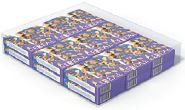
Go Math Grade 5 Answer Key Chapter 11 Geometry and Volume Lesson 7: Estimate Volume img 98
Volume of large box: __________
cu in.

Answer:
Given the volume of a cereal box is 324 cu. in
Number of boxes is 2 × 3 × 3 = 18
The volume of large box is 18 × 324 cu. in
V = 18 × 324 cu. in = 5832 cubic inches
Thus the estimated Volume of large box is 5832 cubic inches.

Question 7.
Volume of pencil box: 4,500 cu cm
Go Math Grade 5 Answer Key Chapter 11 Geometry and Volume Lesson 7: Estimate Volume img 99
Volume of large box: ________
_____ cu cm

Answer:
Volume of pencil box is 4500 cu cm
Number of pencil boxes = 2 × 5 = 10
The volume of large box is 4500 × 10 = 45000 cu cm
Thus the estimated volume of large box is 45000 cu cm

Problem Solving – Lesson 7: Estimate Volume – Page No. 678

Sense or Nonsense?

Question 8.
Marcelle estimated the volume of the two boxes below, using one of his books. His book has a volume of 48 cubic inches. Box 1 holds about 7 layers of books, and Box 2 holds about 14 layers of books. Marcelle says that the volume of either box is about the same.
Go Math Grade 5 Answer Key Chapter 11 Geometry and Volume Lesson 7: Estimate Volume img 100
Does Marcelle’s statement make sense or is it nonsense?
Explain your answer.
Type below:
_________

Answer:
Calculate the books in box 1
V = lbh
V1 = 2 × 4 × 7 = 56 books
Calculate the volume of books in box 2
V = lbh
V2 = 1 × 4 × 14 = 56 books
So, both boxes hold the same number of books.
Thus Marcelle’s statement make sense.

Share and Show – Lesson 8: Volume of Rectangular Prisms – Page No. 683

Find the volume.

Question 1.
Go Math Grade 5 Answer Key Chapter 11 Geometry and Volume Lesson 8: Volume of Rectangular Prisms img 101
The length of the rectangular prism is ______.
The width is ______. So, the area of the base is ______.
The height is ______. So, the volume of the prism is ______.
Type below:
_________

Answer: 120 cu. in

Explanation:
From the figure, we can say that the length of the rectangular prism is 4 in
The width of the rectangular prism is 5 in
The height of the rectangular prism is 6 in.
The volume of the rectangular prism is l × w × h
V = 4 in × 6 in × 5 in = 120 cu. in
So, the volume of the prism is 120 cu. in

Question 2.
Go Math Grade 5 Answer Key Chapter 11 Geometry and Volume Lesson 8: Volume of Rectangular Prisms img 102
Volume: ______ cu cm

Answer: 18

Explanation:
From the figure, we can say that the length of the rectangular prism is 2 cm
The width of the rectangular prism is 3 cm
The height of the rectangular prism is 3 cm
The volume of the rectangular prism is l × w × h
V = 2 cm × 3 cm × 3 cm = 18 cu. cm
Thus the volume of the rectangular prism is 18 cu. cm

Question 3.
Go Math Grade 5 Answer Key Chapter 11 Geometry and Volume Lesson 8: Volume of Rectangular Prisms img 103
Volume: ______ cu in.

Answer: 12

Explanation:
From the figure, we can say that the length of the rectangular prism is 2 in.
The width of the rectangular prism is 6 in.
The height of the rectangular prism is 1 in.
The volume of the rectangular prism is l × w × h
V = 2 in × 6 in × 1 in
V = 12 Cu in.
Thus the volume of the rectangular prism is 12 Cu in.

On Your Own

Find the volume.

Question 4.
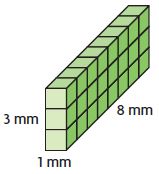
Go Math Grade 5 Answer Key Chapter 11 Geometry and Volume Lesson 8: Volume of Rectangular Prisms img 104
Volume: ______ cu mm

Answer: 24

Explanation:
From the figure, we can say that the length of the rectangular prism is 1 mm
The width of the rectangular prism is 8 mm
The height of the rectangular prism is 3 mm
The volume of the rectangular prism is l × w × h
V = 1 mm × 8 mm × 3 mm
V = 24 Cu. mm
Thus the volume of the rectangular prism is 24 Cu. mm

Lesson 11.8 Estimate Volume Answer Key Question 5.
Go Math Grade 5 Answer Key Chapter 11 Geometry and Volume Lesson 8: Volume of Rectangular Prisms img 105
Volume: ______ cu cm

Answer: 160

Explanation:
From the figure, we can say that the length of the rectangular prism is 10 cm
The width of the rectangular prism is 4 cm
The height of the rectangular prism is 4 cm
The volume of the rectangular prism is l × w × h
V = 10 cm × 4 cm × 4 cm = 160 Cu. cm
Thus the volume of the rectangular prism is 160 Cu. cm

Question 6.
Go Math Grade 5 Answer Key Chapter 11 Geometry and Volume Lesson 8: Volume of Rectangular Prisms img 106
Volume: ______ cu ft

Answer: 150

Explanation:
From the figure, we can say that the length of the rectangular prism is 5 ft
The width of the rectangular prism is 6 ft
The height of the rectangular prism is 5 ft
The volume of the rectangular prism is l × w × h
V = 5 ft × 6 ft × 5 ft
V = 150 Cu. ft
Thus the volume of the rectangular prism is 150 Cu. ft

Question 7.
Go Math Grade 5 Answer Key Chapter 11 Geometry and Volume Lesson 8: Volume of Rectangular Prisms img 107
Volume: ______ cu in.

Answer: 196

Explanation:
From the figure, we can say that the length of the rectangular prism is 7 in.
The width of the rectangular prism is 7 in.
The height of the rectangular prism is 4 in.
The volume of the rectangular prism is l × w × h
V = 7 in × 7 in × 4 in = 196 Cu. in
Thus the volume of the rectangular prism is 196 Cu. in

UNLOCK the Problem – Lesson 8: Volume of Rectangular Prisms – Page No. 684

Question 8.
Rich is building a travel crate for his dog, Thomas, a beagle mix who is about 30 inches long, 12 inches wide, and 24 inches tall. For Thomas to travel safely, his crate needs to be a rectangular prism that is about 12 inches greater than his length and width, and 6 inches greater than his height. What is the volume of the travel crate that Rich should build?
Go Math Grade 5 Answer Key Chapter 11 Geometry and Volume Lesson 8: Volume of Rectangular Prisms img 108
a. What do you need to find to solve the problem?
Type below:
_________

Answer: We need to find the volume of the travel crate that Rich should build.

Question 8.
b. How can you use Thomas’s size to help you solve the problem?
Type below:
_________

Answer: Thomas’s size helps to find the length, width and height of the dog crate.

Question 8.
c. What steps can you use to find the size of Thomas’s crate?
Type below:
_________

Answer:
Rich is building a travel crate for his dog, Thomas, a beagle mix who is about 30 inches long, 12 inches wide, and 24 inches tall.
For Thomas to travel safely, his crate needs to be a rectangular prism that is about 12 inches greater than his length and width, and 6 inches greater than his height.
Length of the dog crate is 30 in + 12 in = 42 inches
Width of the dog crate is 12 inches more than width of Thomas crate = 12 in + 12 in = 24 inches
Height of the dog crate is 24 in + 6 in = 30 inches
V = 42 in × 24 in × 30 in
V = 30,240 cu in

Question 8.
d. Fill in the blanks for the dimensions of the dog crate.
length: _____
width: _____
height: _____
area of base: _____
Type below:
_________

Answer:
Crate length = 30 + 12 = 42 in
Crate width = 12 + 12 = 24 in
Crate height = 24 + 6 = 30 in
Area of base = l × w
A = 42 in × 24 in = 1008 sq in.

Question 8.
e. Find the volume of the crate by multiplying the base area and the height.
______ × ______ = ______
So, Rich should build a travel crate for Thomas that has a volume of ______ .
Type below:
_________

Answer:
Area of base = l × w
A = 42 in × 24 in = 1008 sq in.
Height = 30 in
V = 1008 sq in × 30 in = 30240 cu. in
So, Rich should build a travel crate for Thomas that has a volume of 30240 cu. in

Question 9.
What is the volume of the rectangular prism at the right?
Go Math Grade 5 Answer Key Chapter 11 Geometry and Volume Lesson 8: Volume of Rectangular Prisms img 109
Options:
a. 35 in.3
b. 125 in.3
c. 155 in.3
d. 175 in.3

Answer: 175 in.3

Explanation:
Length = 5 in
Width = 7 in
Height = 5 in
Volume of the rectangular prism is l × w × h
V = 5 in × 7 in × 5 in
V = 175 in.3
The volume of the rectangular prism is 175 in.3
Therefore the correct answer is option D.

Share and Show – Lesson 9: Algebra Apply Volume Formulas – Page No. 689

Find the volume.

Question 1.
Go Math Grade 5 Answer Key Chapter 11 Geometry and Volume Lesson 9: Algebra Apply Volume Formulas img 110
V =____ cu ft

Answer: 40

Explanation:
length = 2 ft
width = 4 ft
height = 5 ft
Volume of the rectangular prism is l × w × h
V = 2 ft × 4 ft × 5 ft
V = 40 cu ft
Volume of the rectangular prism is 40 cu. ft

Question 2.
Go Math Grade 5 Answer Key Chapter 11 Geometry and Volume Lesson 9: Algebra Apply Volume Formulas img 111
V =____ cu cm

Answer: 144

Explanation:
length = 4 cm
width = 4 cm
height = 9 cm
Volume of the rectangular prism is l × w × h
V = 4 cm × 4 cm × 9 cm
V = 144 cu cm
Volume of the rectangular prism is 144 cu cm

On Your Own

Find the volume.

Question 3.
Go Math Grade 5 Answer Key Chapter 11 Geometry and Volume Lesson 9: Algebra Apply Volume Formulas img 112
V =____ cu in.

Answer: 216

Explanation:
length = 6 in
width = 6 in
height = 6 in
Volume of the prism is l × w × h
V = 6 in × 6 in × 6 in
V = 216 cu. in
Thus the Volume of the prism is 216 cu. in.

Question 4.
Go Math Grade 5 Answer Key Chapter 11 Geometry and Volume Lesson 9: Algebra Apply Volume Formulas img 113
V =____ cu ft

Answer: 192

Explanation:
length = 12 ft
width = 4 ft
height = 4 ft
Volume of the rectangular prism is l × w × h
V = 12 ft × 4 ft × 4 ft
V = 192 cu ft
Therefore, the Volume of the rectangular prism is 192 cu ft.

Question 5.
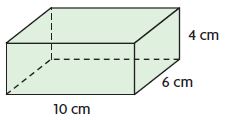
Go Math Grade 5 Answer Key Chapter 11 Geometry and Volume Lesson 9: Algebra Apply Volume Formulas img 114
V =____ cu cm

Answer: 240

Explanation:
length = 10 cm
width = 6 cm
height = 4 cm
Volume of the rectangular prism is l × w × h
V = 10 cm × 6 cm × 4 cm
V = 240 Cu. cm
Therefore, the Volume of the rectangular prism is 240 Cu. cm.

Question 6.
Go Math Grade 5 Answer Key Chapter 11 Geometry and Volume Lesson 9: Algebra Apply Volume Formulas img 115
V =____ cu in.

Answer: 1008

Explanation:
length = 14 in.
width = 6 in.
height = 12 in.
Volume of the rectangular prism is l × w × h
V = 14 in × 6 in × 12 in
V = 1008 cu. in
Thus the Volume of the rectangular prism is 1008 cu. in

Question 7.
Go Math Grade 5 Answer Key Chapter 11 Geometry and Volume Lesson 9: Algebra Apply Volume Formulas img 116
V =420 cu ft
■ = ____ ft

Answer: 10

Explanation:
length = 7 ft
width = 6 ft
height = ■ ft
Volume of the rectangular prism is l × w × h
420 cu ft = 7 ft × 6 ft × ■
■ × 42 sq ft = 420 cu ft
■ = 420 cu ft ÷ 42 sq ft
■ = 10 ft

Question 8.
Go Math Grade 5 Answer Key Chapter 11 Geometry and Volume Lesson 9: Algebra Apply Volume Formulas img 117
V =900 cu cm
■ = ____ cm

Answer: 10

Explanation:
length = 6 cm
width = 15 cm
height = ■ cm
Volume of the rectangular prism is l × w × h
V = 900 cu cm
900 cu cm = 6 cm × 15 cm × ■ cm
900 cu cm = 90 sq cm × ■ cm
■ cm = 900 cu cm ÷ 90 sq cm
■ cm = 10 cm

Problem Solving – Lesson 9: Algebra Apply Volume Formulas – Page No. 690

Question 9.
The Jade Restaurant has a large aquarium on display in its lobby. The base of the aquarium is 5 feet by 2 feet. The height of the aquarium is 4 feet. How many cubic feet of water are needed to completely fill the aquarium?
Go Math Grade 5 Answer Key Chapter 11 Geometry and Volume Lesson 9: Algebra Apply Volume Formulas img 118
V =____ cu ft of water

Answer: 40 cu ft of water

Explanation:
The Jade Restaurant has a large aquarium on display in its lobby.
The base of the aquarium is 5 feet by 2 feet.
The height of the aquarium is 4 feet.
Volume = b × w × h
V = 5 feet × 2 feet× 4 feet
V = 40 Cu. ft
Therefore, the volume of the aquarium is 40 cu ft of water.

Question 10.
The Pearl Restaurant put a larger aquarium in its lobby. The base of their aquarium is 6 feet by 3 feet, and the height is 4 feet. How many more cubic feet of water does the Pearl Restaurant’s aquarium hold than the Jade Restaurant’s aquarium?
____ cu ft

Answer: 32 cu ft

Explanation:
The Pearl Restaurant put a larger aquarium in its lobby.
The base of their aquarium is 6 feet by 3 feet, and the height is 4 feet.
Volume = b × w × h
V = 6 feet × 3 feet × 4 feet = 72 cu. feet
Thus the Volume of Pearl Restaurant’s aquarium is 72 cu. feet
The volume of the Jade Restaurant’s aquarium is 40 cu ft of water
V = Vp – Vj
V = 72 – 40 = 32 cu feet

Question 11.
Eddie measured his aquarium using a small fish food box. The box has a base area of 6 inches and a height of 4 inches. Eddie found that the volume of his aquarium is 3,456 cubic inches. How many boxes of fish food could fit in the aquarium? Explain your answer.
____ boxes

Answer: 144 boxes

Explanation:
Volume = b × h
V = 6 in × 4 in = 24 cu in
To find out how many boxes will fit, divide the aquarium volume by the food box volume.
numfit = Vaq/Vbox
numfit = 3456/24 = 144
144 fish food boxes fir inside the aquarium.

Question 12.
Describe the difference between area and volume.
Type below:
_________

Answer: The surface area is the sum of the areas of all the faces of the solid figure. It is measured in square units. Volume is the number of cubic units that make up a solid figure.

Question 13.
Test Prep Adam stores his favorite CDs in a box like the one at the right. What is the volume of the box?
Go Math Grade 5 Answer Key Chapter 11 Geometry and Volume Lesson 9: Algebra Apply Volume Formulas img 119
Options:
a. 150 cubic centimeters
b. 750 cubic centimeters
c. 1,050 cubic centimeters
d. 1,150 cubic centimeters

Answer: 1,050 cubic centimeters

Explanation:
L = 15 cm
W = 10 cm
H = 7 cm
V = lwh
V = 15 cm × 10 cm × 7 cm = 1050 cubic centimeters
Thus the correct answer is option C.

Share and Show – Lesson 10: Problem Solving Compare Volumes – Page No. 695

Question 1.
Mr. Price makes cakes for special occasions. His most popular-sized cakes have a volume of 360 cubic inches. The cakes have a height, or thickness, of 3 inches, and have different whole number lengths and widths. No cakes have a length or width of 1 or 2 inches. How many different cakes, each with a different-size base, have a volume of 360 cubic inches?
First, think about what the problem is asking you to solve, and the information that you are given.
Next, make a table using the information from problem.
Finally, use the table to solve the problem.
Type below:
_________

Answer: There are total of 8 different possible combination of length and width

Explanation:
Volume = 360 cubic inches
Height = 3 inches
Volume = l x w x h
360 = l x w x 3
l x w = 120
The factors of 120 are,
1 x 120,
2x 60,
3 x 40,
4 x 30,
5 x 24,
6 x 20,
8 x 15,
10 x 12

Question 2.
What if the 360 cubic-inch cakes are 4 inches thick and any whole number length and width are possible? How many different cakes could be made? Suppose that the cost of a cake that size is $25, plus $1.99 for every 4 cubic inches of cake. How much would the cake cost?
Type below:
_________

Answer:
Since the store have a volume of 360 cu in and a height of 4 in.
We need to find the number of different stones which have a base of 90 sq in.
V = b × h
B = 360 cu in/4 in
B = 90 sq in.
Consider the factors of 90.
The factors of 90 are 1, 2, 3, 5, 6, 9, 10, 15, 18, 30, 45, 90
Make a table with the base, height and volume for each pair of factors
Height = 4 in
1 × 90 × 4 = 360 cu in
2 × 45 × 4 = 360 cu in
3 × 30 × 4 = 360 cu in
5 × 18 × 4 = 360 cu in
6 × 15 × 4 = 360 cu in
9 × 10 × 4 = 360 cu in
6 different sized paving stones.
Remember that each store has a volume of 360 cu in.
Divide by 4 to find how many 4 cu in per stone
Concrete = $0.18 × (360/4)
= $0.18 × 90 = $18.70
The cost of the stone plus the concrete
cost = $2.50 + concrete
Cost = $2.50 + $16.20 = $18.70

Question 3.
One company makes inflatable swimming pools that come in four sizes of rectangular prisms. The length of each pool is twice the width and twice the depth. The depth of the pools are each a whole number from 2 to 5 feet. If the pools are filled all the way to the top, what is the volume of each pool?
Type below:
_________

Answer:
If the depth of the pool is 2 feet
then the length of the pool is twice the width and twice the depth
That means 2 feet × 2 × 2 = 8 feet
Width is twice the depth
W = 2 feet × 2 = 4 feet
The volume of the rectangular swimming pool is l × w × h
V = 8 ft × 4 feet × 2 ft
V = 64 cu ft
If the depth of the pool is 3 feet
then the length of the pool is twice the width and twice the depth
That means 3 feet × 2 × 2 = 12 feet
Width is twice the depth
W = 3 feet × 2 = 6 feet
The volume of the rectangular swimming pool is l × w × h
V = 12 ft × 6 feet × 2 ft
V = 144 cu ft
If the depth of the pool is 4 feet
then the length of the pool is twice the width and twice the depth
That means 4 feet × 2 × 2 = 16 feet
Width is twice the depth
W = 4 feet × 2 = 8 feet
The volume of the rectangular swimming pool is l × w × h
V = 16 ft × 8 feet × 2 ft
V = 256 cu ft
If the depth of the pool is 5 feet
then the length of the pool is twice the width and twice the depth
That means 5 feet × 2 × 2 = 20 feet
Width is twice the depth
W = 5 feet × 2 = 10 feet
The volume of the rectangular swimming pool is l × w × h
V = 20 ft × 10 feet × 2 ft
V = 400 cu ft

On Your Own – Lesson 10: Problem Solving Compare Volumes – Page No. 696

Question 4.
Ray wants to buy the larger of two aquariums. One aquarium has a base that is 20 inches by 20 inches and a height that is 18 inches. The other aquarium has a base that is 40 inches by 12 inches and a height that is 12 inches. Which aquarium has a greater volume? By how much?
Type below:
_________

Answer: 1440 cu. in

Explanation:
Volume = l × w × h
Volume of Aquarium 1 = 20 in × 20 in × 18 in
V = 7200 cu. in
Volume = l × w × h
Volume of Aquarium 2 is 40 in × 12 in × 12 in
V for A2 = 5760 cu in
A1 > A2
A1 has a greater volume.
Subtract A2 from A1
A1 – A2 = 7200 cu in – 5760 cu in
= 1440 cu in
The volume of Aquarium 1 is 1440 cu in more than Volume of Aquarium 2.

Question 5.
Ken owns 13 CDs. His brother Keith has 7 more CDs than he does. Their brother, George, has more CDs than either of the younger brothers. Together, the three brothers have 58 CDs. How many CDs does George have?
______ CDs

Answer: 25 CDs

Explanation:
Given that,
Ken owns 13 CDs.
His brother Keith has 7 more CDs than he does.
Their brother, George, has more CDs than either of the younger brothers.
Together, the three brothers have 58 CDs.
Keith has 7 more CDs than Ken
That means he has 7 + 13 = 20 CDs
Now subtract Ken’s CDs, Keith CDs from the total number of CDs.
= 58 – 20 – 13 = 25 CDs.
Thus George has 25 CDs.

Question 6.
Kathy has ribbons that have lengths of 7 inches, 10 inches, and 12 inches. Explain how she can use these ribbons to measure a length of 15 inches.
Type below:
_________

Answer: She could take the 10-inch ribbon and then use 5 inches from the 7-inch ribbon

Question 7.
A park has a rectangular playground area that has a length of 66 feet and a width of 42 feet. The park department has 75 yards of fencing material. Is there enough fencing material to enclose the playground area? Explain.
______

Answer: Yes

Explanation:
A park has a rectangular playground area that has a length of 66 feet and a width of 42 feet.
The park department has 75 yards of fencing material.
Area of the rectangular playground = l × w
A = 66 feet × 42 feet
A = 2772 sq. ft
Perimeter of the rectangular playground = 2l + 2w
P = 2 × 66 + 2 × 42
P = 216 ft
Now convert from feet to yard
We know that 1 yard = 3 feet
216 ft = 1/3 × 216 = 72 yard
72 yard is less than 75 yard
Thus the park department has enough fencing material.

Question 8.
Test Prep John is making a chest that will have a volume of 1,200 cubic inches. The length is 20 inches and the width is 12 inches. How many inches tall will his chest be?
Options:
a. 4 in.
b. 5 in.
c. 6 in.
d. 7 in.

Answer: 5 in

Explanation:
John is making a chest that will have a volume of 1,200 cubic inches.
The length is 20 inches and the width is 12 inches.
Volume = l × w × h
1200 cu in = 20 in × 12 in × h
240 sq in × h = 1200 cu in
h = 1200 cu in ÷ 240 sq in
h = 5 in
Thus John’s chest will be 5 inches tall.
The correct answer is option B.

Share and Show – Lesson 11: Find Volume of Composed Figures – Page No. 701

Find the volume of the composite figure.

Question 1.
Go Math Grade 5 Answer Key Chapter 11 Geometry and Volume Lesson 11: Find Volume of Composed Figures img 120
V = ______ cu in.

Answer: 88 cu in.

Explanation:
Split the figure into 2 parts
Volume of figure 1:
b = 2 in
h = 3 in
w = 4 in
V = 2 in × 4 in × 3 in
V = 24 cu. in
Volume of figure 2:
b = 8 in
w = 4 in
h = 2 in
V = 8 in × 4 in × 2 in
V = 64 in
Volume of the composite figure = 24 cu in + 64 cu. in = 88 cu. in

Question 2.
Go Math Grade 5 Answer Key Chapter 11 Geometry and Volume Lesson 11: Find Volume of Composed Figures img 121
V = ______ cu cm

Answer: 48 cu cm

Explanation:
Split the figure into 2 parts
Volume of figure 1:
b = 3 cm
h = 1 cm
w = 2 cm
V = 3 cm × 2 cm × 1 cm
V = 6 cu. cm
Volume of figure 2:
b = 7 cm
w = 6 cm
h = 1 cm
V = 7 cm × 6 cm × 1 cm
V = 42 cu. cm
Volume of the composite figure = 42 cu. cm + 6 cu. cm = 48 cu cm

On Your Own

Find the volume of the composite figure.

Question 3.
Go Math Grade 5 Answer Key Chapter 11 Geometry and Volume Lesson 11: Find Volume of Composed Figures img 122
V = ______ cu ft

Answer: 52 cu ft

Explanation:
Split the figure into 2 parts
Volume of figure 1:
b = 6 ft
h = 2 ft
w = 3 ft
V = 6 ft × 3 ft × 2 ft
V = 36 cu. ft
Volume of figure 2:
b = 4 ft
w = 2 ft
h = 2 ft
V = 4 ft × 2 ft × 2 ft
V = 16 cu. ft
Volume of the composite figure = 36 cu. ft + 16 cu. ft = 52 cu ft

Question 4.
Go Math Grade 5 Answer Key Chapter 11 Geometry and Volume Lesson 11: Find Volume of Composed Figures img 123
V = ______ cu cm

Answer: 108 cu. cm

Explanation:
Split the figure into 2 parts
Volume of figure 1:
b = 3 cm
w = 8 cm
h = 2 cm
V = 3 cm × 8 cm × 2 cm
V = 48 cu cm
Volume of figure 2:
b = 10 cm
w = 3 cm
h = 2 cm
V = 10 cm × 3 cm × 2 cm
V = 60 cu cm
Volume of the composite figure = 48 cu cm + 60 cu cm = 108 cu. cm

Question 5.
Go Math Grade 5 Answer Key Chapter 11 Geometry and Volume Lesson 11: Find Volume of Composed Figures img 124
V = ______ cu in.

Answer: 204 cu. in

Explanation:
Split the figure into 2 parts
Volume of figure 1:
b = 3 in
h = 5 in
w = 4 in
V = 3 in × 4 in × 5 in
V = 60 cu. in
Volume of figure 2:
b = 12 in
w = 4 in
h = 3 in
V = 12 in × 4 in × 3 in
V = 144 cu. in
Volume of the composite figure = 60 cu in + 144 cu. in = 204 cu. in

Question 6.
Go Math Grade 5 Answer Key Chapter 11 Geometry and Volume Lesson 11: Find Volume of Composed Figures img 125
V = ______ cu ft

Answer: 96 cu ft

Explanation:
Split the figure into 3 parts.
Figure 1:
V1 = 9 ft × 4 ft × 2 ft
V1 = 72 cu. ft
Figure 2:
V2 = 3 ft × 4 ft × 2 ft
V2 = 24 cu. ft
V = V1 + V2
V = 72 cu. ft + 24 cu. ft = 96 cu. ft
Thus the volume of the composite figure is 96 cu. ft

Question 7.
Go Math Grade 5 Answer Key Chapter 11 Geometry and Volume Lesson 11: Find Volume of Composed Figures img 126
V = ______ cu ft

Answer: 300 cu. ft

Explanation:
Go-Math-Grade-5-Answer-Key-Chapter-11-Geometry-and-Volume-img-126
Split the figure into 3 parts.
Figure 1:
V1 = 5 ft × 4 ft × 4 ft
V1 = 80 cu. ft
Figure 2:
V2 = 6 ft × 5 ft × 6 ft
V2 = 180 cu ft
Figure 3:
V3 = 4 ft × 5 ft × 2 ft
V3 = 40 cu. ft
V = V1 + V2 + V3
V = 80 cu. ft + 180 cu ft + 40 cu ft = 300 cu. ft

Question 8.
Go Math Grade 5 Answer Key Chapter 11 Geometry and Volume Lesson 11: Find Volume of Composed Figures img 127
V = ______ cu cm

Answer: 102 cu cm

Explanation:
Go-Math-Grade-5-Answer-Key-Chapter-11-Geometry-and-Volume-img-127
Figure 1:
V1 = 10 cm × 3 cm × 2 cm = 60 cu cm
V1 = 60 cu. cm
Figure 2:
V2= 2 cm × 3 cm × 4 cm
V2 = 24 cu. cm
Figure 3:
V3 = 2 cm × 3 cm × 3 cm
V3 = 18 cu. cm
V = V1 + V2 + V3
V = 60 cu. cm + 24 cu. cm + 18 cu. cm = 102 cu. cm

Problem Solving – Lesson 11: Find Volume of Composed Figures – Page No. 702

Use the composite figure at the right for 9–11.
Go Math Grade 5 Answer Key Chapter 11 Geometry and Volume Lesson 11: Find Volume of Composed Figures img 128

Question 9.
As part of a wood-working project, Jordan made the figure at the right out of wooden building blocks. How much space does the figure he made take up?
______ cu in.

Answer: 784 cu. in

Explanation:
Split the figure into 2 parts
Figure 1:
V1 = 14 in × 4 in × 5 in
V1 = 280 cu. in
Figure 2:
V2 = 12 in × 14 in × 3 in
V2 = 504 cu. in
V = V1 + V2
V = 280 cu. in + 504 cu. in
V = 784 cu. in

Question 10.
What are the dimensions of the two rectangular prisms you used to find the volume of the figure? What other rectangular prisms could you have used?
Type below:
________

Answer:
Dimensions for figure 1:
Base = 14 in
Width = 4 in
Height = 5 in
Dimensions for figure 2:
Base = 12 in
Width = 14 in
Height = 3 in

Question 11.
If the volume is found using subtraction, what is the volume of the empty space that is subtracted? Explain.
______ cu in.

Answer: 560 cu. in

Explanation:
B = 8 in
H = 5 in
W = 14 in
V = 8 in × 14 in × 5 in
V = 560 cu. in
Thus the volume of the empty space is 560 cu. in

Question 12.
Explain how you can find the volume of composite figures that are made by combining rectangular prisms.
Type below:
________

Answer:

Split the figure into 2 parts
Figure 1:
V1 = 14 in × 4 in × 5 in
V1 = 280 cu. in
Figure 2:
V2 = 12 in × 14 in × 3 in
V2 = 504 cu. in
V = V1 + V2
V = 280 cu. in + 504 cu. in
V = 784 cu. in

Question 13.
Test Prep What is the volume of the composite figure?
Go Math Grade 5 Answer Key Chapter 11 Geometry and Volume Lesson 11: Find Volume of Composed Figures img 129
Options:
a. 126 cubic centimeters
b. 350 cubic centimeters
c. 450 cubic centimeters
d. 476 cubic centimeters

Answer: 476 cubic centimeters

Explanation:
Split the figure into 2 parts
Figure 1:
V1 = 10 cm × 7 cm × 5 cm
V1 = 350 cu. cm
Figure 2:
V2 = 3 cm × 7 cm × 6 cm
V2 = 126 cu. cm
V = V1 + V2
V = 350 cu. cm + 126 cu. cm
V = 476 cu. cm

Chapter Review/Test – Page No. 705

Question 1.
Fran drew a triangle with no congruent sides and 1 right angle. Which term accurately describes the triangle? Mark all that apply.
Options:
a. isosceles
b. scalene
c. acute
d. right

Answer: Right

Explanation:
A right triangle is a type of triangle that has one angle that measures 90°. Right triangles, and the relationships between their sides and angles, are the basis of trigonometry.
Thus the correct answer is option D.

Question 2.
Jose stores his baseball cards in a box like the one shown.
Go Math Grade 5 Answer Key Chapter 11 Geometry and Volume Chapter Review/Test img 130
Use the numbers and symbols on the tiles to write a formula that represents the volume of the box. Symbols may be used more than once or not at all.
Go Math Grade 5 Answer Key Chapter 11 Geometry and Volume Chapter Review/Test img 131
What is the volume of the box?
V = ______ cubic inches

Answer:
Volume of the box is l × w × h
V = 8 in × 10 in × 3 in
V = 240 cu. in
Thus the volume of the box is 240 cu. in

Question 3.
Mr. Delgado sees this sign while he is driving. For 3a–3b, choose the values and term that correctly describes the shape Mr. Delgado saw.
Go Math Grade 5 Answer Key Chapter 11 Geometry and Volume Chapter Review/Test img 132
3a. The figure has Go Math Grade 5 Answer Key Chapter 11 Geometry and Volume Chapter Review/Test img 133 sides and Go Math Grade 5 Answer Key Chapter 11 Geometry and Volume Chapter Review/Test img 134angles.
Type below:
________

Answer: The figure has 3 sides and 3 angles.

Explanation:
From the above figure we can say that there are three sides and three angles.

Question 3.
3b. All of the sides are congruent, so the figure is Go Math Grade 5 Answer Key Chapter 11 Geometry and Volume Chapter Review/Test img 135
________

Answer: a regular polygon
If all the sides are congruent then the polygon is a regular polygon.

Chapter Review/Test – Page No. 706

Question 4.
What is the volume of the composite figure?
Go Math Grade 5 Answer Key Chapter 11 Geometry and Volume Chapter Review/Test img 136
______ cubic feet

Answer: 36 cubic feet

Explanation:
Figure 1:
length = 2 ft
width = 3 ft
height = 1 ft
Volume of 1st figure = l × w × h
V = 2 ft × 3 ft × 1 ft = 6 cu. ft
Figure 2:
length = 4 ft
width = 3 ft
height = 1 ft
Volume of 1st figure = l × w × h
V = 4 ft × 3 ft × 1 ft = 12 cu. ft
Figure 3:
length = 6 ft
width = 3 ft
height = 1 ft
Volume of 1st figure = l × w × h
V = 6 ft × 3 ft × 1 ft = 18 cu. ft
Add all the volumes = 6 cu. ft + 12 cu. ft + 18 cu. ft
Volume = 36 cu. ft

Question 5.
Match the figure with the number of unit cubes that would be needed to build each figure. Not every number of unit cubes will be used.
Go Math Grade 5 Answer Key Chapter 11 Geometry and Volume Chapter Review/Test img 137

Answer:
Go-Math-Grade-5-Answer-Key-Chapter-11-Geometry-and-Volume-img-137

Explanation:
Count the number of unit cubes in the first figure.
There are 10 unit cubes in figure 1 so match the figure 1 to 10 unit cubes.
Count the number of unit cubes in the second figure.
There are 12 unit cubes in figure 2 so match figure 2 to 12 unit cubes.
Count the number of unit cubes in the third figure.
There are 9 unit cubes in figure 3 so match figure 3 to 9 unit cubes.

Question 6.
Chuck is making a poster about polyhedrons for his math class. He will draw figures and organize them in different sections of the poster.
Part A
Chuck wants to draw three-dimensional figures whose lateral faces are rectangles. He says he can draw prisms and pyramids. Do you agree?
Explain your answer.
i. yes
ii. no

Answer: No

Explanation:
The lateral faces of a pyramid are triangles.
The lateral faces of a prism are rectangles.

Question 6.
Part B
Chuck says that he can draw a cylinder on his polyhedron poster because it has a pair of bases that are congruent. Is Chuck correct?
Explain your reasoning.
i. yes
ii. no

Answer: No

Explanation:
A cylinder does have 2 congruent bases, but a cylinder is not a polyhedron.
A cylinder has 1 curved surface, while a polyhedron has faces that are polygons

Chapter Review/Test – Page No. 707

Question 7.
Javier drew the shape shown. For 7a–7b, choose the values and term that correctly describe the shape Javier drew.
Go Math Grade 5 Answer Key Chapter 11 Geometry and Volume Chapter Review/Test img 138
7a. The figure has Go Math Grade 5 Answer Key Chapter 11 Geometry and Volume Chapter Review/Test img 139 sides and Go Math Grade 5 Answer Key Chapter 11 Geometry and Volume Chapter Review/Test img 140 angles.
Type below:
_________

Answer: 8, 8
The above figure has 8 sides and 8 angles.

Question 7.
7b. The figure is a Go Math Grade 5 Answer Key Chapter 11 Geometry and Volume Chapter Review/Test img 141
Type below:
_________

Answer: The polygon with 8 sides is known as the octagon. The above figure is congruent thus it is a regular octagon.

Question 8.
Victoria used 1-inch cubes to build the rectangular prism shown. Find the volume of the rectangular prism Victoria built.
Go Math Grade 5 Answer Key Chapter 11 Geometry and Volume Chapter Review/Test img 142
______ cubic inches

Answer: 72

Explanation:
Given,
l = 6 in
w = 3 in
h = 4 in
The volume of the rectangular prism is l × w × h
V = 6 in × 3 in × 4in
V = 72 cu in.
Hence, the volume of the rectangular prism Victoria built is 72 cu. in.

Question 9.
Nathan drew a scalene, obtuse triangle. For 9a–9c, choose Yes or No to indicate whether the figure shown could be the triangle that Nathan drew.
a. Go Math Grade 5 Answer Key Chapter 11 Geometry and Volume Chapter Review/Test img 143
i. yes
ii. no

Answer: Yes

Explanation:
The above different have different sizes thus the triangle is scalene. The angle for the above triangle is more than 90° thus the angle is an obtuse angle. So, the answer is yes.

Question 9.
b. Go Math Grade 5 Answer Key Chapter 11 Geometry and Volume Chapter Review/Test img 144
i. yes
ii. no

Answer: No

Explanation:
The above different have different sizes thus the triangle is scalene. It has one right angle thus the statement is not correct.

Question 9.
c. Go Math Grade 5 Answer Key Chapter 11 Geometry and Volume Chapter Review/Test img 145

Answer: No

Explanation:
The above different have different sizes thus the triangle is scalene. It has one right angle thus the statement is not correct.

Chapter Review/Test – Page No. 708

Question 10.
A shipping crate holds 20 shoeboxes. The dimensions of a shoebox are 6 inches by 4 inches by 12 inches. For 10a–10b, select True or False for each statement.
a. Each shoebox has a volume of 22 cubic inches.
i. True
ii. False

Answer: False

Explanation:
Shoebox volume:
V = 6 in × 4 in × 12 in
V = 288 cu. in
Thus the statement is false.

Question 10.
b. Each crate has a volume of about 440 cubic inches.
i. True
ii. False

Answer: False

Explanation:
Crate Volume:
V = 288 cu. in × 20
V = 5760 cu. in
Thus the statement is false.

Question 10.
c. If the crate could hold 27 shoeboxes the volume of the crate would be about 7,776 cubic inches.
i. True
ii. False

Answer: True

Explanation:
Crate Volume:
V = 288 cu. in × 27
V = 7776 cu. in
Thus the statement is true.

Question 11.
Mario is making a diagram that shows the relationship between different kinds of quadrilaterals. In the diagram, each quadrilateral on a lower level can also be described by the quadrilateral(s) above it on higher levels.
Part A
Complete the diagram by writing the name of one figure from the tiles in each box. Not every figure will be used.
Go Math Grade 5 Answer Key Chapter 11 Geometry and Volume Chapter Review/Test img 146

Answer:
Go-Math-Grade-5-Answer-Key-Chapter-11-Geometry-and-Volume-img-146

Question 11.
Part B
Mario claims that a rhombus is sometimes a square, but a square is always a rhombus. Is he correct? Explain your answer.
i. yes
ii. no

Answer: Yes

Explanation:
A square is a quadrilateral with all sides equal in length and all interior angles right angles. A square however is a rhombus since all four of its sides are of the same length.

Chapter Review/Test – Page No. 709

Question 12.
Write the letter in the box that correctly describes the three-dimensional figure.
Go Math Grade 5 Answer Key Chapter 11 Geometry and Volume Chapter Review/Test img 147
Type below:
___________

Answer:
Go-Math-Grade-5-Answer-Key-Chapter-11-Geometry-and-Volume-img-147

Explanation:
Prism: In geometry, a prism is a polyhedron comprising an n-sided polygonal base, a second base which is a translated copy of the first, and n other faces joining corresponding sides of the two bases.
Figure B and C are prisms
Pyramid: In geometry, a pyramid is a polyhedron formed by connecting a polygonal base and a point, called the apex. Each base edge and apex form a triangle called a lateral face. All the edges meet at the same point in the pyramid. Thus the figures A and D are pyramids.

Question 13.
Mark packed 1-inch cubes into a box with a volume of 120 cubic inches. How many layers of 1-inch cubes did Mark pack?
Go Math Grade 5 Answer Key Chapter 11 Geometry and Volume Chapter Review/Test img 148
______ layers

Answer: 5

Explanation:
Mark packed 1-inch cubes into a box with a volume of 120 cubic inches.
By seeing the figure we can say that there are 24 unit cubes.
To find the number of layers we need to divide 120 by 24
= 120 ÷ 24 = 5
There are 5 layers of 1-inch cubes.

Question 14.
A composite figure is shown. What is the volume of the composite figure?
Go Math Grade 5 Answer Key Chapter 11 Geometry and Volume Chapter Review/Test img 149
Volume = ______ cubic centimeters

Answer: 312

Explanation:
Split the figure into 2 parts.
Figure 1:
h = 3 cm
w = 6 cm
b = 4 cm
V = 4 cm × 6 cm × 3 cm = 72 cu. cm
Figure 2:
b = 10 cm
w = 6 cm
h = 4 cm
V = 10 cm × 6 cm × 4 cm = 240 cu. cm
Now add the volume of 2 figures
72 cu. cm + 240 cu. cm = 312 cu cm
Thus the volume of the composite figure is 312 cu. cm

Chapter Review/Test – Page No. 710

Question 15.
For 15a–15c, write the name of one quadrilateral from the tiles to complete a true statement. Use each quadrilateral once only.
Go Math Grade 5 Answer Key Chapter 11 Geometry and Volume Chapter Review/Test img 150
a. A Go Math Grade 5 Answer Key Chapter 11 Geometry and Volume Chapter Review/Test img 151 is always a parallelogram.
_________

Answer: rectangle

Explanation: Parallelograms are quadrilaterals with two sets of parallel sides. Since squares must be quadrilaterals with two sets of parallel sides, then all squares are parallelograms.

Question 15.
b. A Go Math Grade 5 Answer Key Chapter 11 Geometry and Volume Chapter Review/Test img 152 is always a rhombus.
_________

Answer: square

Explanation: A square is a quadrilateral with all sides equal in length and all interior angles right angles.

Question 15.
c. A Go Math Grade 5 Answer Key Chapter 11 Geometry and Volume Chapter Review/Test img 153 is sometimes a parallelogram.
_________

Answer: trapezoid

Explanation: A trapezoid has one pair of parallel sides and a parallelogram has two pairs of parallel sides. So a parallelogram is also a trapezoid.

Question 16.
Megan’s aquarium has a volume of 4,320 cubic inches. Which could be the dimensions of the aquarium? Mark all that apply.
Options:
a. 16 in. by 16 in. by 18 in.
b. 14 in. by 18 in. by 20 in.
c. 12 in. by 15 in. by 24 in.
d. 8 in. by 20 in. by 27 in.

Answer: C, D

Explanation:
The volume of a prism = l × w × h
1. V = 16 in × 16 in × 16 in
V = 4608 cu. in
2. V = 14 in × 18 in × 20 in = 5040 cu. in
3. V = 12 in × 15 in × 24 in = 4320 cu. in
4. V = 8 in × 20 in × 27 in = 4320 cu in
Thus the suitable answers are C and D.

Question 17.
Ken keeps paper clips in a box that is the shape of a cube. Each side of the cube is 3 inches. What is the volume of the box?
______ cubic inches

Answer: 27

Explanation:
Ken keeps paper clips in a box that is the shape of a cube.
Each side of the cube is 3 inches.
The volume of a cube = 3 in × 3 in × 3 in = 27 cu. in
Therefore the volume of the box is 27 cubic inches.

Question 18.
Monica used 1-inch cubes to make the rectangular prism shown. For 18a–18d, write the value that makes each statement true. Each value can be used more than once or not at all.
Go Math Grade 5 Answer Key Chapter 11 Geometry and Volume Chapter Review/Test img 154
Go Math Grade 5 Answer Key Chapter 11 Geometry and Volume Chapter Review/Test img 155
a. Each cube has a volume of ____ cubic inch(es).

Answer: 1

Explanation:
Monica used 1-inch cubes to make the rectangular prism
Volume = 1 in × 1 in × 1 in = 1 cu. in.
Each cube has a volume of 1 cubic inch.

Question 18.
b. Each layer of the prism is made up of ____ cubes.
______ cubes

Answer: 20

Explanation:
We can calculate the layer by calculating the base and width
4 × 5 = 20 cubes
Each layer of the prism is made up of 20 cubes.

Question 18.
c. There are ____ layers of cubes.
______ layers

Answer: 3
By seeing the figure we can say that there are 3 layers of the cube.
You can also find the layers of the cube by calculating the height of the figure.

Question 18.
d. The volume of the prism is ____ cubic inches.
______ cubic inches

Answer: 60

Explanation:
The volume of a prism = l × w × h
V = 4 in × 5 in × 3 in
Volume = 60 cu. inches
Therefore, the volume of the prism is 60 cubic inches.

Chapter Review/Test – Vocabulary – Page No. 4910

Choose the best term from the box.
Go Math Grade 5 Answer Key Chapter 11 Geometry and Volume Chapter Review/Test img 156

Question 1.
A _____ has two congruent polygons as bases and rectangular lateral faces.
__________

Answer: prism
A prism has two congruent polygons as bases and rectangular lateral faces.

Question 2.
A _____ has only one base and triangular lateral faces.
__________

Answer: pyramid
A pyramid has only one base and triangular lateral faces.

Concepts and Skills

Name each polygon. Then tell whether it is a regular polygon or not a regular polygon.

Question 3.
Go Math Grade 5 Answer Key Chapter 11 Geometry and Volume Chapter Review/Test img 157
Name: __________
Type: __________

Answer:
i. hexagon
ii. regular

Explanation:
A polygon is a closed plane figure formed by three or more line segments that meet at points called vertices. It is named by the number of sides and angles it has.
The above figure has six sides and 6 angles. Thus the name of the polygon is hexagon.
Two polygons are congruent when they have the same size and the same shape. The above figure has same size and angles. Thus it is a regular polygon.

Question 4.
Go Math Grade 5 Answer Key Chapter 11 Geometry and Volume Chapter Review/Test img 158
Name: __________
Type: __________

Answer:
i. pentagon
ii. regular

Explanation:
A polygon is a closed plane figure formed by three or more line segments that meet at points called vertices. It is named by the number of sides and angles it has.
The above figure has five sides and 5 angles. Thus the name of the polygon is pentagon.
Two polygons are congruent when they have the same size and the same shape. The above figure has same size and angles. Thus it is a regular polygon.

Question 5.
Go Math Grade 5 Answer Key Chapter 11 Geometry and Volume Chapter Review/Test img 159
Name: __________
Type: __________

Answer:
i. pentagon
ii. not regular

Explanation:
A polygon is a closed plane figure formed by three or more line segments that meet at points called vertices. It is named by the number of sides and angles it has.
The above figure has five sides and 5 angles. Thus the name of the polygon is the pentagon.
Two polygons are congruent when they have the same size and the same shape. The above figure does not have the same size and angles. Thus it is not a regular polygon.

Question 6.
Go Math Grade 5 Answer Key Chapter 11 Geometry and Volume Chapter Review/Test img 160
Name: __________
Type: __________

Answer:
i. octagon
ii. not regular

Explanation:
A polygon is a closed plane figure formed by three or more line segments that meet at points called vertices. It is named by the number of sides and angles it has.
The above figure has 8 sides and 8 angles. Thus the name of the polygon is octagon.
Two polygons are congruent when they have the same size and the same shape. The above figure does not have same size and angles. Thus it is not a regular polygon.

Classify each figure in as many ways as possible.

Question 7.
Go Math Grade 5 Answer Key Chapter 11 Geometry and Volume Chapter Review/Test img 161
1. __________
2. __________

Answer:
1. quadrilateral
2. trapezoid

Explanation:
1. A general quadrilateral has 4 sides and 4 angles.
2. A trapezoid is a 4-sided flat shape with straight sides that has a pair of opposite sides parallel.

Question 8.
Go Math Grade 5 Answer Key Chapter 11 Geometry and Volume Chapter Review/Test img 162
△ __________
∠ __________

Answer:
△ – scalene
∠ – right

Explanation:
The above triangle has different sides. Thus the triangle is a scalene triangle.
The triangle with one right angle is known as a right angled triangle.

Classify the solid figure. Write prism, pyramid, cone, cylinder, or sphere.

Question 9.
Go Math Grade 5 Answer Key Chapter 11 Geometry and Volume Chapter Review/Test img 163
__________

Answer: prism

Explanation:
In geometry, a triangular prism is a three-sided prism; it is a polyhedron made of a triangular base, a translated copy, and 3 faces joining corresponding sides.

Question 10.
Go Math Grade 5 Answer Key Chapter 11 Geometry and Volume Chapter Review/Test img 164
__________

Answer: pyramid

Explanation:
In geometry, a pentagonal pyramid is a pyramid with a pentagonal base upon which are erected five triangular faces that meet at a point (the vertex). Like any pyramid, it is self-dual.

Count the number of cubes used to build each solid figure.

Question 11.
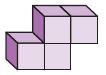
Go Math Grade 5 Answer Key Chapter 11 Geometry and Volume Chapter Review/Test img 165
_____ unit cubes

Answer: 4

Explanation:
The figure shows that there are 4 unit cubes.

Question 12.
Go Math Grade 5 Answer Key Chapter 11 Geometry and Volume Chapter Review/Test img 166
_____ unit cubes

Answer: 7

Explanation:
By seeing the above figure we can say that there are 7 unit cubes.

Question 13.
Go Math Grade 5 Answer Key Chapter 11 Geometry and Volume Chapter Review/Test img 167
_____ unit cubes

Answer: 5

Explanation:
The figure above shows that there are 5 unit cubes.

Chapter Review/Test – Page No. 4920

Fill in the bubble completely to show your answer.

Question 14.
What type of triangle is shown below?
Go Math Grade 5 Answer Key Chapter 11 Geometry and Volume Chapter Review/Test img 168
Options:
a. acute; isosceles
b. acute; scalene
c. obtuse; scalene
d. obtuse; isosceles

Answer: obtuse; scalene

Explanation:
The sides of the triangle is different. Thus it is a scalene triangle. The angle of the triangle is an obtuse angle.
Thus the correct answer is option C.

Question 15.
Angela buys a paperweight at the local gift shop. The paperweight is in the shape of a hexagonal pyramid.
Go Math Grade 5 Answer Key Chapter 11 Geometry and Volume Chapter Review/Test img 169
Which of the following represents the correct number of faces, edges, and vertices in a hexagonal pyramid?
Options:
a. 6 faces, 12 edges, 18 vertices
b. 7 faces, 7 edges, 12 vertices
c. 7 faces, 12 edges, 7 vertices
d. 8 faces, 18 edges, 12 vertices

Answer: 7 faces, 12 edges, 7 vertices

Explanation:
In geometry, a hexagonal pyramid is a pyramid with a hexagonal base upon which are erected six isosceles triangular faces that meet at a point.
The hexagonal pyramid has 7 faces, 12 edges and 7 vertices.
Therefore the correct answer is option C.

Question 16.
A manufacturing company constructs a shipping box to hold its cereal boxes. Each cereal box has a volume of 40 cubic inches. If the shipping box holds 8 layers with 4 cereal boxes in each layer, what is the volume of the shipping box?
Options:
a. 160 cu in.
b. 320 cu in.
c. 480 cu in.
d. 1,280 cu in.

Answer: 1,280 cu in.

Explanation:
A manufacturing company constructs a shipping box to hold its cereal boxes.
Each cereal box has a volume of 40 cubic inches.
If the shipping box holds 8 layers with 4 cereal boxes in each layer
Multiply the number of layers with boxes
= 8 × 4 = 32
The volume of 8 layers is 40 × 32 = 1280 cubic inches
Thus the correct answer is option D.

Chapter Review/Test – Page No. 4930

Fill in the bubble completely to show your answer.

Question 17.
Sharri packed away her old summer clothes in a storage tote that had a length of 3 feet, a width of 4 feet, and a height of 3 feet. What was the volume of the tote that Sharri used?
Options:
a. 36 cu ft
b. 24 cu ft
c. 21 cu ft
d. 10 cu ft

Answer: 36 cu ft

Explanation:
Given,
Sharri packed away her old summer clothes in a storage tote that had a length of 3 feet, a width of 4 feet, and a height of 3 feet.
Volume = l × w × h
V = 3 ft × 4 ft × 3 ft
V = 36 cu. ft
Thus the volume of the tote that Sharri used is 36 cu. ft.
The correct answer is option A.

Question 18.
Which quadrilateral is NOT classified as a parallelogram?
Options:
a. Go Math Grade 5 Answer Key Chapter 11 Geometry and Volume Chapter Review/Test img 170
b. Go Math Grade 5 Answer Key Chapter 11 Geometry and Volume Chapter Review/Test img 171
c. Go Math Grade 5 Answer Key Chapter 11 Geometry and Volume Chapter Review/Test img 172
d. Go Math Grade 5 Answer Key Chapter 11 Geometry and Volume Chapter Review/Test img 173

Answer: Go Math Grade 5 Answer Key Chapter 11 Geometry and Volume Chapter Review/Test img 171

Explanation:
The opposite sides of figure b are not parallel. Thus the figure b quadrilateral is NOT classified as a parallelogram.

Question 19.
What is the volume of the composite figure below?
Go Math Grade 5 Answer Key Chapter 11 Geometry and Volume Chapter Review/Test img 174
Options:
a. 1,875 cm3
b. 480 cm3
c. 360 cm3
d. 150 cm3

Answer:
Volume of 1st cube is 5 cm × 4 cm × 5 cm = 100 cu. cm
Volume of 2nd cube is 5 cm × 4 cm × 8 cm = 160 cu. cm
Volume of 3rd cube is 5 cm × 4 cm × 5 cm = 100 cu. cm
Add all the volumes to find the volume of the composite figure
That means 100 cu. cm + 160 cu. cm + 100 cu. cm = 360 cu. cm
Therefore the volume of the composite figure is 360 cm3
The correct answer is option C.

Chapter Review/Test – Page No. 4940

Constructed Response

Question 20.
a. A video game store made a display of game console boxes shown at the right. The length, width, and height of each game console box is 2 feet.
Go Math Grade 5 Answer Key Chapter 11 Geometry and Volume Chapter Review/Test img 175
What is the volume of the display of game console boxes? Show your work and explain your answer.
_____ cu ft.

Answer: 512 cu. ft

Explanation:
length = 2 ft
width = 2 ft
height = 2 ft
Volume of the display of game console boxes = 2 ft × 2 ft × 2 ft = 8 cu. ft
Number of console boxes = 64
64 × 8 cu. ft = 512 cu ft
The volume of the display of game console boxes = 512 cu ft

Question 20.
b. On a busy Saturday, the video game store sold 22 game consoles.
What is the volume of the game console boxes that are left?
_____ cu ft.

Answer: 336 cu. ft

length = 2 ft
width = 2 ft
height = 2 ft
The volume of the display of game console boxes = 2 ft × 2 ft × 2 ft = 8 cu. ft
Number of console boxes = 22
The volume of the game console boxes that are left
22 × 8 cu. ft = 176 cu. ft
The volume of the game console boxes that are left = 512 – 176 = 336 cu. ft

Performance Task

Question 21.
Look for two pictures of three-dimensional buildings in newspapers and magazines. The buildings should be rectangular prisms.
A. Paste the pictures on a large sheet of paper. Leave room to write information near the picture.
B. Label each building with their name and location.
C. Research the buildings, if the information is available. Find things that are interesting about the buildings or their location. Also find their length, width, and height to the nearest foot. If the information is not available, measure the buildings on the page in inches or centimeters, and make a good estimate of their width (such as 1/2 the height, rounded to the nearest whole number). Find their volumes.
D. Make a class presentation, choosing one of the buildings you found.

Conclusion:

Follow our Go Math Grade 5 Answer Key Chapter 11 Geometry and Volume to get the step by step explanation. So, Download the pdf of HMH Go Math 5th Grade Solution Key Chapter 11 Geometry and Volume for free. Click on the above links and find the question and answers with images. Do not move to anywhere, stay on Go Math, and follow them each and every question of Geometry and Volume with explanation and strengthen your math skills.

Go Math Grade 5 Chapter 11 Answer Key Pdf Geometry and Volume Read More »

Go Math Grade 5 Chapter 10 Answer Key Pdf Convert Units of Measure

Go Math Grade 5 Chapter 10 Answer Key Pdf: Check out the Answer Key for Go Math Grade 5 Chapter 10 Convert Units of Measure here. Students can learn quick and simple techniques on our Go Math Grade 5 Answer Key. So, to score students who want to become master in maths can Download Go Math Grade 5 Answer Key Chapter 10 Convert Units of Measure pdf. Along with quick learning, it is necessary for the students to understand the concepts of the measurements. It is possible only in our Go Math Answer Key.

Convert Units of Measure Go Math Grade 5 Chapter 10 Answer Key Pdf

With the help of this HMH Go Math Solution Key Grade Chapter 10 you can learn the solutions for the problems in an easy manner. The topics include Customary length, Customary Capacity, Weight, Metric Measure, etc. So students are suggested to click on the below links to get the solutions along with the step by step explanation for the problems.

Chapter 10 – Lesson 1: Customary Length

Chapter 10 – Lesson 2: Customary Capacity 

Chapter 10 – Lesson 3: Weight

Chapter 10 – Lesson 4: Multistep Measurement

Chapter 10 – Mid-Chapter Checkpoint

Chapter 10 – Lesson 5: Metric Measures

Chapter 10 – Lesson 6: Problem Solving • Customary and Metric Conversions

Chapter 10 – Lesson 7: Elapsed Time

Chapter 10 – Review/Test

Share and Show – Lesson 1: Customary Length – Page No. 587

Convert.

Question 1.
2 mi = ______ yd

Answer: 3520 yards

Explanation:
Am changing the smaller unit into the larger unit.
We know that,
1 mile = 1760 yards
2 miles = 2 × 1760 yards = 3520 yards
Thus 2 miles = 3520 yards

Question 2.
6 yd = ______ ft

Answer: 18 feet

Explanation:
Am changing the smaller unit into the larger unit.
We know that,
1 yard = 3 feet
6 yards = 6 × 3 feet = 18 feet
6 yd = 18 ft.

Go Math Book 5th Grade Chapter 10 Answer Key Question 3.
90 in. = ______ ft ______ in.

Answer: 7 feet 6 in.
Am changing the larger unit into the smaller unit.
Convert inches to feet
1 feet = 12 inches
90 inches = 84 inches + 6 inches
84/12 = 7 feet
Thus 90 in. = 7 ft 6 in.

On Your Own

Convert.

Question 4.
57 ft = ______ yd

Answer: 19 yard

Explanation:
Convert the smaller unit to the larger unit.
We know that
1 yard = 3 feet
1 foot = 1/3 yard
57 × 1/3 = 19
Thus 57 feet = 19 yards
57 ft = 19 yd

Question 5.
13 ft = ______ in.

Answer: 156 inches

Explanation:
1 feet = 12 inches
13 feet = 13 × 12 inches = 156 inches
13 ft = 156 in.

Question 6.
240 in. = ______ ft

Answer: 20 feet

Explanation:
Convert the smaller unit to the larger unit.
1 feet = 12 inches
1 inch = 1/12 feet
240 inches = 240 × 1/12 feet = 20 feet
240 in. = 20 ft

Question 7.
6 mi = ______ ft

Answer: 31680 feet

Explanation:
1 mile = 5280 feet
6 miles = 6 × 5280 feet = 31680 feet
Thus 6 mi. = 31680 ft.

Question 8.
96 ft = ______ yd

Answer: 32 yard

Explanation:
1 yard = 3 feet
1 feet = 1/3 yard
96 feet = 96 × 1/3 yard = 32 yard
96 feet = 32 yard

5th Grade Go Math Book Chapter 10 Test Answer Key Question 9.
75 in. = ______ ft ______ in

Answer: 6 feet 3 inches

Explanation:
1 feet = 12 inches
1 inch = 1/12 feet
75 inches = 75 × 1/12 feet = 6 feet + 3 inches
75 in. = 6 ft. 3 in.

Practice: Copy and Solve Convert.

Question 10.
60 in. = ■ ft
■ = ______ ft

Answer: 5 feet

Explanation:
Convert inches into feet
1 feet = 12 inches
■ be the unknown number.
60 in = ■ ft
60 inches × 1/12 = 5 feet
60 in = 5 feet

Question 11.
■ ft = 7 yd 1 ft
■ = ______ ft

Answer: 22 feet

Explanation:
■ ft = 7 yd 1 ft
1 yard = 3 feet
7 yard = 7 × 3 feet = 21 feet
21 ft + 1 ft = 22ft
■ = 22 feet

Question 12.
4 mi = ■ yd
■ = ______ yd

Answer: 7040 yard

Explanation:
We know that,
1 mile = 1760 yard
4 miles = 4 × 1760 yard = 7040 yard
4 mi. = 7040 yard

Question 13.
125 in. = ■ ft ■ in.
125 in. = ______ ft ______ in.

Answer: 10 ft 5 in.

Explanation:
Convert inches to feet.
12 inches = 1 feet
1 inch = 1/12 feet
120 × 1/12 = 10 feet
125 inches = 10 feet + 5 inches
Thus, 125 in. = 10 ft 5 in.

Question 14.
46 ft = ■ yd ■ ft
46 ft = ______ yd ______ ft

Answer: 15 yd 1 ft

Explanation:
We know that,
Converting the Larger unit into the smaller units
1 yard = 3 feet
1 foot = 1/3 yard
46 feet = 1/3 × 46 = 15 yard + 1 feet
Thus 46 ft = 15 yd 1 ft

Question 15.
42 yd 2 ft = ■ ft
■ = ______ ft

Answer: 128 feet

Explanation:
Converting larger units into smaller units
We know that,
1 yard = 3 feet
42 yard = 42 × 3 feet = 126 feet
42 yd 2 ft = 126 + 2 = 128 feet
Thus ■ = 128 ft
42 yd 2 ft = 128 ft

Compare. Write <, >, or =.

Question 16.
8 ft ______ 3 yd

Answer: 8 ft < 3 yd

Explanation:
1 yard = 3 feet
3 yards = 3 × 3 feet = 9 feet
8 is less than 9
Thus, 8 ft < 3 yd

Question 17.
2 mi ______ 10,500 ft

Answer: 2 mi > 10,500 ft

Explanation:
1 mile = 5280 feet
2 miles = 2 × 5280 = 10,560 feet
10,560 ft is greater than 10,500 feet
Thus, 2 mi > 10,500 ft

Question 18.
108 in. ______ 166 in.

Answer: 108 in. < 166 in.

Explanation:
108 is less than 166
Therefore, 108 in. < 166 in.

Problem Solving – Lesson 1: Customary Length – Page No. 588

Question 19.
Javon is helping his dad build a tree house. He has a piece of trim that is 13 feet long. How many pieces can Javon cut that are 1 yard long? How much of a yard will he have left over?
Go Math Grade 5 Answer Key Chapter 10 Convert Units of Measure Lesson 1: Customary Length img 1
Type below:
__________

Answer: 4 pieces, 4 yard 1 foot long

Explanation:

Javon is helping his dad build a tree house. He has a piece of trim that is 13 feet long.
Converting from feet into yards
We know that,
1 foot = 1/3 yard
13 feet = 12 feet + 1 foot
13 feet = 4 yard 1 foot
Javon can cut into 4 pieces.

Question 20.
Test Prep Katy’s driveway is 120 feet long. How many yards long is Katy’s driveway?
Options:
a. 60 yards
b. 40 yards
c. 20 yards
d. 10 yards

Answer: 40 yards

Explanation:
Katy’s driveway is 120 feet long.
Converting from feet into yards
We know that,
1 yard = 3 feet
1 foot = 1/3 yard
120 feet = 120 × 1/3 yard = 40 yard
Thus the correct answer is option B.

Compare and Contrast

When you compare and contrast, you tell how two or more things are alike and different. You can compare and contrast information in a table. Complete the table below. Use the table to answer the questions.
Go Math Grade 5 Answer Key Chapter 10 Convert Units of Measure Lesson 1: Customary Length img 2

Question 21.
How are the items in the table alike? How are they different?
Type below:
__________

Answer:
The table is the conversion from yards to feet and inches.
Go-Math-Grade-5-Answer-Key-Chapter-10-Convert-Units-of-Measure-img-2

Go Math Grade 5 Workbook Chapter 10 Review/Test Question 22.
What do you notice about the relationship between the number of larger units and the number of smaller units as the length increases?
Type below:
__________

Answer:
Converting the larger unit to the smaller unit.
1 yard = 3 feet
1 feet = 12 inches
3 feet = 12 × 3 = 36 inches
1 yard = 36 inches
The above table shows the conversion from yards to inches.

Share and Show – Lesson 2: Customary Capacity – Page No. 593

Go Math Grade 5 Answer Key Chapter 10 Convert Units of Measure Lesson 2: Customary Capacity img 3

Question 1.
Use the picture to complete the statements and convert 3 quarts to pints.
a. 1 quart = ______ pints

Answer: 2 pints

Explanation:
Convert the unit quarts to pints
We know that,
1 quart = 2 pints

Question 1.
b. 1 quart is ______ than 1 pint.

Answer: Bigger

Explanation:
Convert the unit quarts to pints
1 quart = 2 pints
The unit quarts is greater than pints
1 quart is bigger than 1 pint.

Question 1.
c. 3 qt __________ pt in 1 qt = ____ pt
Type below:
__________

Answer: 6 pint

Explanation:
Convert the unit quarts to pints
1 quart = 2 pints
3 quarts = 3 × 2 pints = 6 pints
So, 3 qt 6 pt in 1 qt = 2 pt

Convert.

Question 2.
3 gal = ______ pt

Answer: 24 pt

Explanation:

Convert gallons to pints
We know that,
1 gallon = 8 pints
3 gallons = 3 × 8 pints = 24 pints
This 3 gal = 24 pt

Question 3.
5 qt = ______ pt

Answer: 10 pt

Explanation:

Convert the unit quarts to pints
1 quart = 2 pints
5 quarts = 5 × 2 pints = 10 pints
So, 5 qt = 10 pt

Question 4.
6 qt = ______ c

Answer: 24 c

Explanation:
Convert quarts to cups
1 quart = 4 cups
6 quarts = 6 × 4 cups = 24 cups
6 qt = 24 c

On Your Own – Lesson 2: Customary Capacity – Page No. 594

Convert.

Question 5.
38 c = ______ pt

Answer: 19 pt

Explanation:
Convert pints to cups
1 pint = 2 cups
1 cup = 1/2 pint
38 c = 1/2 × 38 = 19 pints
Thus, 38 c = 19 pints

Question 6.
36 qt = ______ gal

Answer: 9 gal

Explanation:
Convert Quarts to Gal
1 gal = 4 quarts
1 quart = 1/4 gallon
36 quarts = 1/4 × 36 = 9 gallons
So, 36 qt = 9 gal

Question 7.
104 fl oz = ______ c

Answer: 13 c

Explanation:
Convert fluid ounces to cups
1 cup = 8 fluid ounces
1 fluid ounces = 1/8 cups
104 fluid ounces = 1/8 × 104 = 13 cups
104 fl oz = 13 c

Question 8.
4 qt = ______ c

Answer: 16 c

Explanation:

Convert quarts to cups
1 quart = 4 cups
4 quarts = 4 × 4 cups
4 quarts = 16 cups
4 qt = 4 c

Question 9.
7 gal = ______ pt

Answer: 56 pt

Explanation:
Convert gallon to pints
1 gal = 8 pints
7 gallons = 7 × 8 pints = 56 pints
7 gal = 56 pt

Question 10.
96 fl oz = ______ pt

Answer: 6 pt

Explanation:
Convert fluid ounces into pints.
1 pint = 16 fluid ounces
1 fluid ounces = 1/16 pint
96 fluid ounces = 1/16 × 96 = 6
96 fl oz = 6 pt

Practice: Copy and Solve Convert.

Question 11.
200 c = ______ qt

Answer: 50 qt

Explanation:
Convert cups to quarts
1 quart = 4 cups
1 cup = 1/4 quart
200 cups = 1/4 × 200 = 50 qt
200 c = 50 qt

Question 12.
22 pt = ______ fl oz

Answer: 352 fl oz

Explanation:
Convert pints to fluid ounces
1 pint = 16 fluid ounces
22 pints = 16 × 22 = 352 fluid ounces
So, 22 pt = 352 fl oz

Question 13.
8 gal = ______ qt

Answer: 32 qt

Explanation:
Convert gallon to quarts.
1 gallon = 4 quarts
8 gallons = 8 × 4 quarts = 32 quarts
8 gal = 32 qt

Question 14.
72 fl oz = ______ c

Answer: 9 c

Explanation:
Convert fluid ounces to cups
1 cup = 8 fluid ounces
1 fluid ounce = 1/8 cup
72 fluid ounces = 1/8 cup × 72 = 9 cups
72 fl oz = 9 c

Question 15.
2 gal = ______ pt

Answer: 16 pt

Explanation:
Convert gallon to pints
1 gal = 8 pints
2 gal = 2 × 8 pints = 16 pints
2 gal = 16 pt

Question 16.
48 pt = ______ gal

Answer: 6 gal

Explanation:
Convert pints to gallons
1 gal = 8 pints
1 pint = 1/8 gal
48 pints = 1/8 × 48 pint = 6 gal
48 pint = 6 gal

Compare. Write <, >, or =.

Question 17.
28 c ______ 14 pt

Answer: 28 c = 14 pt

Explanation:
Convert cups to a pint
1 pint = 2 cups
14 pints = 14 × 2 cups = 28 cups
28 cups = 14 pints
Thus, 28 c = 14 pt

Question 18.
25 pt ______ 13 qt

Answer: 25 pt < 13 qt

Explanation:
Convert pints to quarts
1 quart = 2 pints
13 quarts = 13 × 2 pints = 26 pints
25 pints is less than 26 pints
So, 25 pt < 13 qt

Go Math Grade 5 Chapter 10 Pdf Question 19.
20 qt ______ 80 c

Answer: 20 qt = 80 c

Explanation:
1 quart = 4 cups
20 quarts = 20 × 4 cups = 80 cups
20 qt = 80 c

Question 20.
12 gal ______ 50 qt

Answer: 12 gal < 50 qt

Explanation:
1 gal = 4 quarts
12 gal = 12 × 4 quarts = 48 quarts
12 gal = 48 quarts
48 quarts is less than 50 quarts
So, 12 gal < 50 qt

Question 21.
320 fl oz ______ 18 pt

Answer: 320 fl oz > 18 pt

Explanation:
1 pint = 16 fluid ounces
320 fluid ounces = 320 × 1/16 fluid ounces = 20 pints
20 is greater than 18 pints
320 fl oz > 18 pt

Question 22.
15 qt ______ 63 c

Answer: 15 qt < 63 c

Explanation:
Convert quarts to cups
1 quart = 4 pints
15 quarts = 4 × 15 = 60 cups
60 cup is less than 63 cups
So, 15 qt < 63 c

Question 23.
Which of exercises 17–22 could you solve mentally? Explain your answer for one exercise.

Problem Solving – Lesson 2: Customary Capacity – Page No. 4120

Show your work. For 24–26, use the table.
Go Math Grade 5 Answer Key Chapter 10 Convert Units of Measure Lesson 2: Customary Capacity img 4

Question 24.
Complete the table, and make a graph showing the relationship between pints and quarts. Draw a line through the points to make the graph.
Go Math Grade 5 Answer Key Chapter 10 Convert Units of Measure Lesson 2: Customary Capacity img 5

Answer:
Go-Math-Grade-5-Answer-Key-Chapter-10-Convert-Units-of-Measure-img-5

Question 25.
Describe any pattern you notice in the pairs of numbers you graphed. Write a rule to describe the pattern.
Type below:
__________

Answer: I observed a straight line in the pair of numbers.

Question 26.
Explain how you can use your graph to find the number of quarts equal to 5 pints.
Type below:
__________

Answer: The number of quarts for 5 pints is 3.5
The point lies between 3 and 4.
The X-axis is 5 and Y-axis is 3.5

Question 27.
Test Prep Shelby made 5 quarts of juice for a picnic. How many cups of juice did Shelby make?
Options:
a. 1 cup
b. 5 cups
c. 10 cups
d. 20 cups

Answer: 20 cups

Explanation:
Shelby made 5 quarts of juice for a picnic.
1 quarts = 4 cups
5 quarts = 5 × 4 cups = 20 cups
5 quart = 20 cups
Thus the correct answer is option D.

Share and Show – Lesson 3: Weight – Page No. 599

Question 1.
Use the picture to complete each equation.
Go Math Grade 5 Answer Key Chapter 10 Convert Units of Measure Lesson 3: Weight img 6
a. 1 pound = ______ ounces

Answer: 16 ounces

Explanation:
Convert pounds to ounces
1 pound = 16 ounces

Question 1.
b. 2 pounds = ______ ounces

Answer: 32 ounces

Explanation:
Convert pounds to ounces
1 pound = 16 ounces
2 pounds = 2 × 16 ounces = 32 ounces
2 pounds = 32 ounces

Question 1.
c. 3 pounds = ______ ounces

Answer: 48 ounces

Explanation:
Convert pounds to ounces
1 pound = 16 ounces
3 pounds = 3 × 16 ounces = 48 ounces
So, 3 pounds = 48 ounces

Question 1.
d. 4 pounds = ______ ounces

Answer: 64 ounces

Explanation:
Convert pounds to ounces
1 pound = 16 ounces
4 pounds = 4 × 16 ounces = 64 ounces
4 pounds = 64 ounces

Question 1.
e. 5 pounds = ______ ounces

Answer: 80 ounces

Explanation:
Convert pounds to ounces
1 pound = 16 ounces
5 pounds = 5 × 16 ounces = 80 ounces
5 pounds = 80 ounces

Convert.

Question 2.
15 pounds = ______ ounces

Answer: 240 ounces

Explanation:
Convert pounds to ounces
1 pound = 16 ounces
15 pounds = 15 × 16 ounces = 240 ounces
15 pounds = 240 ounces

Question 3.
3 T = ______ lb

Answer: 6,000 lb

Explanation:
1 ton = 2,000 lb
3 ton = 3 × 2,000 lb = 6,000 lb
3 T = 6000 lb

Lesson 10 Homework Answer Key 5th Grade Question 4.
320 oz = ______ lb

Answer: 20 lb

Explanation:
Convert ounces to lb.
1 lb = 16 ounces
1 ounce = 1/16 lb
320 oz = 1/16 × 320 = 20 lb
320 oz = 20 lb

On Your Own – Lesson 3: Weight – Page No. 600

Convert.

Question 5.
5 T = ______ lb

Answer: 10,000 lb

Explanation:
Convert Ton to lb
1 T = 2,000 lb
5 T = 5 × 2,000 lb = 10,000 lb
5 T = 10,000 lb

Question 6.
19 T = ______ lb

Answer: 38,000 lb

Explanation:
Convert Ton to lb
1 T = 2,000 lb
19 T = 19 × 2000 lb = 38,000 lb
19 T = 38,000 lb

Question 7.
16,000 lb = ______ T

Answer: 8 T

Explanation:
Convert Ton to lb
1 T = 2,000 lb
1 lb = 1/2000 T
16000 lb = 16000 × 1/2000 = 8T
16,000 lb = 8T

Question 8.
192 oz = ______ lb

Answer: 12 lb

Explanation:
Convert ouncers to pound
1 pound = 16 ounces
192 ounces = 192 × /16 = 12 lb
192 oz = 12 lb

Question 9.
416 oz = ______ lb

Answer: 26 lb

Explanation:
Convert ouncers to pound
1 pound = 16 ounces
1 ounce = 1/16 lb
416 oz = 416 × 1/16 = 26 lb
416 oz = 26 lb

Question 10.
24 lb = ______ oz

Answer: 384 oz

Explanation:
Convert ouncers to pound
1 pound = 16 ounces
24 lb = 24 × 16 ounces = 384 oz
24 lb = 384 oz

Practice: Copy and Solve Convert.

Question 11.
23 lb = ______ oz

Answer: 368 oz

Explanation:
Convert lb to ounces
1 lb = 16 oz
23 lb = 23 × 16 oz = 368 ounces
23 lb = 368 oz

Question 12.
6 T = ______ lb

Answer: 12,000 lb

Explanation:
Convert tons to pounds
1 T = 2,000 lb
6 T = 6 × 2,000 lb = 12,000 lb
6 T = 12,000 lb

Question 13.
144 oz = ______ lb

Answer: 9 lb

Explanation:
Convert ounces to pounds
1 pound = 16 ounces
1 oz= 1/16 lb
144 oz = 144 × 1/16 = 9 lb
Thus, 144 oz = 9 lb

Go Math Grade 5 Chapter 10 Review/Test Answer Key Question 14.
15 T = ______ lb

Answer: 30,000 lb

Explanation:
Convert tons to pounds
1 T = 2,000 lb
15 T = 15 × 2,000 lb = 30,000 lb
15 T = 30,000 lb

Question 15.
352 oz = ______ lb

Answer: 22 lb

Explanation:
Convert ounces to the pound
1 lb = 16 oz
1 oz = 1/16 lb
352 oz = 352 × 1/16 = 22 lb
352 oz = 22 lb

Question 16.
18 lb = ______ oz

Answer: 288 oz

Explanation:
1 lb = 16 oz
18 lb = 18 × 16 oz = 288 oz
18 lb = 288 oz

Compare. Write >, >, or =.

Question 17.
130 oz ______ 8 lb

Answer: 130 oz > 8 lb

Explanation:
First convert lb to ounces
1 lb = 16 oz
8 lb = 8 × 16 oz = 128 oz
8 lb = 128 oz
128 oz is less than 130 oz
So, 130 oz > 8 lb

Question 18.
34 lb ______ 544 oz

Answer: 34 lb = 544 oz

Explanation:
First convert lb to ounces
1 lb = 16 oz
34 lb = 34 × 16 oz = 544 oz
So, 34 lb = 544 oz

Question 19.
14 lb ______ 229 oz

Answer: 14 lb < 229 oz

Explanation:
First convert lb to ounces
1 lb = 16 oz
14 lb = 14 × 16 oz = 224 oz
14 lb = 224 oz
224 oz is less than 229
So, 14 lb < 229 oz

Question 20.
16 T ______ 32,000 lb

Answer: 16 T = 32,000 lb

Explanation:
Convert ton to pounds
1 Ton = 2,000 lb
16 T = 16 × 2,000 lb = 32,000 lb
16 T = 32,000 lb

Question 21.
5 lb ______ 79 oz

Answer: 5 lb > 79 oz

Explanation:
Convert lb to oz
1 lb = 16 oz
5 lb = 5 × 16 oz = 80 oz
80 is greater than 76
Thus, 5 lb > 79 oz

Question 22.
85,000 lb ______ 40 T

Answer: 85,000 lb > 40 T

Explanation:
Convert ton to pounds
1 Ton = 2,000 lb
40 T = 40 × 2000 = 80,000 lb
80,000 lb is less than 85,000 lb
Thus, 85,000 lb > 40 T

Problem Solving

Question 23.
Explain how you can use mental math to compare 7 pounds to 120 ounces.
7 pounds ______ 120 ounces.

Answer: 7 pounds < 120 ounces.

Explanation:
Convert pounds to ounces
1 pound = 16 ounces
7 Pounds = 7 × 16 ounces = 112 ounces
112 ounces is less than 120 ounces
7 pounds < 120 ounces.

Question 24.
Test Prep Carlos used 32 ounces of walnuts in a muffin recipe. How many pounds of walnuts did Carlos use?
Options:
a. 8 pounds
b. 4 pounds
c. 2 pounds
d. 1 pound

Answer: 2 pounds

Explanation:
Given that, Carlos used 32 ounces of walnuts in a muffin recipe.
1 pound = 16 ounces
2 pounds = 2 × 16 oz = 32 ounces
32 oz = 2 pounds
Thus the answer is option C.

Problem Solving – Lesson 3: Weight – Page No. 4160

Pose a Problem
Go Math Grade 5 Answer Key Chapter 10 Convert Units of Measure Lesson 3: Weight img 7

Question 25.
Kia wants to have 4 pounds of munchies for her party. She has 36 ounces of popcorn and wants the rest to be pretzel sticks. How many ounces of pretzel sticks
does she need to buy?
Go Math Grade 5 Answer Key Chapter 10 Convert Units of Measure Lesson 3: Weight img 8
64 – 36 =
So, Kia needs to buy ____ ounces of pretzel sticks.
Write a new problem using different amounts of snacks. Some weights should be in pounds and others in ounces. Make sure the amount of snacks given is less than the total amount of snacks needed.
Pose a Problem                 Draw a bar model for your problem.
Then solve.
• Write an expression you could use to solve your problem.
Explain how the expression represents the problem.
Type below:
___________

Answer:
Kia wants to have 3 pounds of munchies for her party. She has 20 ounces of popcorn and wants the rest to be pretzel sticks. How many ounces of pretzel sticks does she need to buy?
Go Math Grade 5 Answer Key Chapter 10 img-1
48 oz – 20 oz = 28 oz
She needs to buy 28 ounces of pretzel sticks.

Share and Show – Lesson 4: Multistep Measurement Problems – Page No. 605

Solve.

Question 1.
After each soccer practice, Scott runs 4 sprints of 20 yards each. If he continues his routine, how many practices will it take for Scott to have sprinted a total of 2 miles combined?
Scott sprints _____ yards each practice. Since there are _____ yards in 2 miles, he will need to continue his routine for _____ practices.
Type below:
__________

Answer:
Multiply 20 yard × 4 = 80 yards
Now convert from yards to miles
1 mile = 1760 yard
x = 1760 × 2 = 3520 yards
p = 3520 yards/80 yard = 44
Thus he will need to do 44 practices.

Question 2.
A worker at a mill is loading 5-lb bags of flour into boxes to deliver to a local warehouse. Each box holds 12 bags of flour. If the warehouse orders 3 Tons of flour, how many boxes are needed to fulfill the order?
_____ bags

Answer: 100 bags

Explanation:
A worker at a mill is loading 5-lb bags of flour into boxes to deliver to a local warehouse.
Each box holds 12 bags of flour.
Pounds of flour per box
x = 12 × 5 lb = 60 lb
We need to multiply by the conversion rule
1 T = 2000 lb
Find out how many pounds are in 3 tons. Pounds of flour in the warehouse.
y = 3 T × 2000 lb = 6,000 lb
Divide by the number of pounds per box. 100 boxes are needed.
b = 6000/60 = 100 boxes.

Go Math Chapter 10 Grade 5 Answer Key Question 3.
Cory brings five 1-gallon jugs of juice to serve during parent night at his school. If the paper cups he is using for drinks can hold 8 fluid ounces, how many drinks can Cory serve for parent night?
_____ drinks

Answer: 80 drinks

Explanation:
First, convert from gallons to quarts
We are converting larger unit to the smaller unit.
1 gal = 4 qt
We need to multiply by the conversion rule.
x = 5 gal × 4 qt
x = 20 qt
Next, convert from quarts to pints.
2 pt = 1 qt
We need to multiply by the conversion rule.
y = 20 qt × 2 pt = 40 pt
Next, convert from pints to cups.
We are converting from a larger unit to a smaller unit.
1 pt = 2 cups
y = 40 pt × 2 c = 80 c
Now convert from cups to ounces
1 c = 8 oz
y = 80 c × 8 oz = 640 oz
d = 640 oz/ 8 oz = 80 drinks
Cory can serve 80 drinks for parent night.

On Your Own – Lesson 4: Multistep Measurement Problems – Page No. 606

Solve.

Question 4.
A science teacher needs to collect lake water for a lab she is teaching. The lab requires each student to use 4 fluid ounces of lake water. If 68 students are participating, how many pints of lake water will the teacher need to collect?
_____ pints

Answer: 1 pint

Explanation:
Find the total number of ounces the students use.
s = 68 × 4 oz = 272 oz
First, convert from ounces to cups.
1 c = 8 oz
Find how many cups are in 272 ounces
y = 272 oz ÷ 8 oz = 34 c
Now from cups to pints
1 pt = 2 c
Find how mant pints are in 34 cups
x = 34 c ÷ 2 c = 17 pt
18 pt – 17 pt = 1 pt
Thus 1 pint is leftover.

Question 5.
A string of decorative lights is 28 feet long. The first light on the string is 16 inches from the plug. If the lights on the string are spaced 4 inches apart, how many lights are there on the string?
_____ lights

Answer: 81 lights

Explanation:
There are no lights for the first 12 inches
After that, each of the remaining 27 feet is composed of
3 sets of:
4 inches with no light
27 feet × 3 = 81 lights

Question 6.
When Jamie’s car moves forward such that each tire makes one full rotation, the car has traveled 72 inches. How many full rotations will the tires need to make for Jamie’s car to travel 10 yards?
_____ rotations

Answer: 5 rotations

Explanation:
When Jamie’s car moves forward such that each tire makes one full rotation, the car has traveled 72 inches.
Convert from a smaller unit to the larger unit.
Convert from inches to yards.
36 in = 1 yard
x = 72 in/ 36 in = 2 yards
Find out how many rotations are needed.
y = 10 yard/ 2 yard = 5 yard
The tired need to make 5 rotations for Jame’s car to travel 10 yards.

Question 7.
A male African elephant weighs 7 Tons. If a male African lion at the local zoo weighs \(\frac{1}{40}\) of the weight of the male African elephant, how many pounds does the lion weigh?
_____ lb

Answer: 350 lb

Explanation:
Convert from Tons to pounds
1 T = 2,000 lb
Find out how many pounds are in 7 Tons.
y = 7 T × 2000 lb = 14,000 lb
The weight of the elephant is 14,000 lb
Find the weight of the lion
l = 14,000 × 1/40 = 350 lb
Therefore the weight of the lion is 350 pounds.

Question 8.
An office supply company is shipping a case of wooden pencils to a store. There are 64 boxes of pencils in the case. If each box of pencils weighs 2.5 ounces, what is the weight, in pounds, of the case of wooden pencils?
_____ pounds

Answer: 10 pounds

Explanation:
First, we need to find the total weight of the case of pencils
w = 64 boxes × 2.5 oz = 160 oz
Now convert from ounces to pounds
We are converting from a smaller unit to a larger unit.
1 lb = 16 oz
y = 160 oz/16 oz = 10 lb
Thus the total is 10 pounds.

Go Math Chapter 10 Grade 5 Question 9.
A gallon of unleaded gasoline weighs about 6 pounds. About how many ounces does 1 quart of unleaded gasoline weigh?
HINT: 1 quart = \(\frac{1}{4}\) of a gallon
_____ ounces

Answer: 24 ounces

Explanation:
A gallon of unleaded gasoline weighs about 6 pounds.
Convert from pounds to ounces.
1 lb = 16 ounces
y = 6 × 16 ounces = 96 ounces
The weight of a quart of unleaded gasoline
qw = 96 × 1/4 = 24 oz

UNLOCK the Problem – Lesson 4: Multistep Measurement Problems – Page No. 4200

Go Math Grade 5 Answer Key Chapter 10 Convert Units of Measure Lesson 4: Multistep Measurement Problems img 9

Question 10.
At a local animal shelter there are 12 small-size dogs and 5 medium-size dogs. Every day, the small-size dogs are each given 12.5 ounces of dry food and the medium-size dogs are each given 18 ounces of the same dry food. How many pounds of dry food does the shelter serve in one day?
a. What are you asked to find?
Type below:
___________

Answer: We are asked to find how many pounds of dry food does the shelter serves in one day

Question 10.
b. What information will you use?
Type below:
___________

Answer:
I will use the information about the dry food given to the small size dogs and medium size dogs.

Question 10.
c. What conversion will you need to do to solve the problem?
Type below:
___________

Answer: We need to convert from ounces to pounds.

Question 10.
d. Show the steps you use to solve the problem.
Type below:
___________

Answer:
First, convert from ounces to pounds.
The total amount of food given to the small size and medium size dogs = 12.5 ounces + 18 ounces = 30.5 ounces
1 ounce = 0.625 pounds
32.5 ounces = 30.5 × 0.625 = 1.906 pounds

Question 10.
e. Complete the sentences.
The small-size dogs eat a total of ___ ounces of dry food each day.
The medium-size dogs eat a total of ___ ounces of dry food each day.
The shelter serves ___ ounces, or ___ pounds, of dry food each day.
Type below:
___________

Answer:
The small-size dogs eat a total of 12.5 ounces of dry food each day.
The medium-size dogs eat a total of 18 ounces of dry food each day.
The shelter serves 30.5 ounces, or 1.906 pounds, of dry food each day.

Question 11.
Test Prep For a class assignment, students are asked to record the total amount of water they drink in one day. Melinda records that she drank four 8-fluid ounce glasses of water and two 1-pint bottles. How many quarts of water did Melinda drink during the day?
Options:
a. 2 quarts
b. 4 quarts
c. 6 quarts
d. 8 quarts

Answer: 2 quarts

Explanation:
Given that,
Melinda records that she drank four 8-fluid ounce glasses of water and two 1-pint bottles
Convert from fluid ounces to quarts.
1 quart = 32 fluid ounces
2 1-pint bottles = 2 pints
1 pint = 16 fluid ounces
2 pints = 32 fluid ounces
We know that,
32 fluid ounces = 1 quart
1 quart + 1 quart = 2 quarts.
Thus the correct answer is option A.

Mid-Chapter Checkpoint – Vocabulary – Page No. 609

Choose the best term from the box.
Go Math Grade 5 Answer Key Chapter 10 Convert Units of Measure Mid-Chapter Checkpoint img 10

Question 1.
The _______ of an object is how heavy the object is.
___________

Answer: Weight

Question 2.
The _______ of a container is the amount the container can hold.
___________

Answer: Capacity

Concepts and Skills

Convert.

Question 3.
5 mi = _____ yd

Answer: 8800 yd

Explanation:

Convert from miles to yards.
1 mile = 1760 yard
5 miles = 5 × 1760 yard = 8800 yard
5 mi = 8800 yd

Question 4.
48 qt = _____ gal

Answer: 12 gal

Explanation:
Convert from quart to gal
1 gal = 4 quart
1 quart = 1/4
48 qt = 48 × 1/4 = 12 gal
48 qt = 12 gal

Question 5.
9 T = _____ lb

Answer: 18,000 lb

Explanation:
Convert from tons to lb
1 T = 2,000 lb
9 T = 9 × 2,000 lb = 18,000 lb
9  = 18,000 lb

Question 6.
336 oz = _____ lb

Answer: 21 lb

Explanation:
Convert from ounces to pound
1 pound = 16 ounces
1 oz = 1/16 lb
336 oz = 336 × 1/16 lb = 21 lb
336 oz = 21 lb

Question 7.
14 ft = _____ yd _____ ft

Answer: 4 yard 2 ft

Explanation:
Convert from feet to yards.
1 yard = 3 feet
1 feet = 1/3 yard
12 feet = 1/3 × 12 ft = 4 yard
14 ft = 4 yard 2 ft

Compare. Write <, >, or =.

Question 9.
96 fl oz _____ 13 c

Answer: 96 fl oz < 13 c

Explanation:
Convert from Cups to fluid ounces
1 cup = 8 oz
13 c = 13 × 8 oz = 104 oz
96 oz is less than 104 oz
Thus, 96 fl oz < 13 c

Question 10.
25 lb _____ 384 oz

Answer: 25 lb > 384 oz

Explanation:
Convert from lb to ounces
1 lb = 16 oz
25 lb = 25 × 16 oz = 400 oz
400 oz is greater than 384 oz
So, 25 lb > 384 oz

Question 11.
8 yd _____ 288 in.

Answer: 8 yd = 288 in.

Explanation:
Convert from yards to inches
1 yard = 36 inches
8 yard = 8 × 36 inches = 288 inches
8 yard = 288 inches

Solve.

Question 12.
A standard coffee mug has a capacity of 16 fluid ounces. If Annie needs to fill 26 mugs with coffee, how many total quarts of coffee does she need?
_____ qt

Answer: 13 qt

Explanation:
Find the number of ounces.
s = 16 oz × 26 = 416 oz
Next, convert from ounces to cups.
1 c = 8 oz
Find how many cups are in 104 ounces.
y = 416 oz ÷ 8 oz = 52 c
Next, convert from cups to pints.
1 pt = 2 c
y = 52 c ÷ 2 c = 26 pt
Convert from pints to quarts
1 qt = 2 pints
y = 26 pint ÷ 2 pint = 13 qt
y = 13 qt
Thus she need 13 quarts of coffee.

Mid-Chapter Checkpoint – Vocabulary – Page No. 610

Question 13.
The length of a classroom is 34 feet. What is this measurement in yards and feet?
_____ yd _____ ft

Answer: 11 yard 1 foot

Explanation:
Given that, The length of a classroom is 34 feet.
Convert from feet from the yard
1 yard = 3 feet
34 feet = 33 feet + 1 foot
1 feet = 1/3 yard
33 feet = 33 × 1/3 = 11 yard
34 feet = 11 yard 1 foot

Question 14.
Charlie’s puppy, Max, weighs 8 pounds. How many ounces does Max weigh?
_____ oz

Answer: 128 ounces

Explanation:
Convert from pounds from ounces
1 pound = 16 ounces
8 pounds = 8 × 16 oz = 128 ounces
8 pounds = 128 oz

Question 15.
Milton purchases a 5-gallon aquarium for his bedroom. To fill the aquarium with water, he uses a container with a capacity of 1 quart. How many times will Milton fill and empty the container before the aquarium is full?
_____ times

Answer: 20 times

Explanation:
Convert from gallon to quart
1 gallon = 4 quart
5 gallon = 5 × 4 quart = 20 quart
5 gallon = 20 quart

Go Math Grade 5 Chapter 10 Review Test Pdf Question 16.
Sarah uses a recipe to make 2 gallons of her favorite mixed berry juice. Two of the containers she plans to use to store the juice have a capacity of 1 quart. The rest of the containers have a capacity of 1 pint. How many pint-sized containers will Sarah need?
_____ pint-sized container

Answer: 12 pint-sized container

Explanation:
Sarah uses a recipe to make 2 gallons of her favorite mixed berry juice.
Two of the containers she plans to use to store the juice have a capacity of 1 quart.
1 gallon = 4 quart
Find how many quarts are in 2 gals.
y = 8 qt – 2 qt = 6 qt
Next, convert from quarts to pints.
2 pt = 1 qt
y = 6 qt × 2 pt
y = 12 pint
She will need 12 pint sized container.

Question 17.
The average length of a female white-beaked dolphin is about 111 inches. What is this length in feet and inches?
_____ ft _____ in.

Answer: 9 ft 3 in.

Explanation:
The average length of a female white-beaked dolphin is about 111 inches.
Convert from inches to feet.
1 feet = 12 inch
111 inch = 108 in. + 3 in
9 feet = 108 inches
111 inches = 9 feet 3 inches

Share and Show – Lesson 5: Metric Measures – Page No. 613

Complete the equation to show the conversion.

Question 1.
8.47 L _____ 10 = _____ dL

Answer: 8.47 L × 10 = 84.7 dL

Explanation:
Find the relationships between the units.
Determine the operation to be used.
Now convert from liter to deciliter.
84.7 L × 10 = 8.47 dL

Question 1.
8.47 L _____ 100 = _____ cL

Answer: 8.47 L × 100 = 847 cL

Explanation:
Find the relationships between the units.
Determine the operation to be used.
Convert from liter to centiliter.
8.47 L × 100 = 847 centiliter

Question 1.
8.47 L _____ 1,000 = _____ mL

Answer: 8.47 L × 1,000 = 8,470 mL

Explanation:
Find the relationships between the units.
Determine the operation to be used.
Convert the liter to the milliliter.
8.47 L × 1000 = 8470 mL

Question 2.
9,824 dg _____ 10 = _____ g

Answer: 9,824 dg ÷ 10 = 982.4 g

Explanation:
Find the relationships between the units.
Determine the operation to be used.
Now convert from decigram to gram
1 gram = 10 decigram
1 decigram = 1/10 gram
To convert 9824 dg to g we have to divide by 10.
9,824 dg ÷ 10 = 9824 × 1/10 = 982.4 grams
Thus, 9,824 dg ÷ 10 = 982.4 g

Question 2.
9,824 dg _____ 100 = _____ dag

Answer: 9,824 dg ÷ 100 = 98.24 dag

Explanation:
Find the relationships between the units.
Determine the operation to be used.
Now convert from decigram to dekagrams.
We know that,
1 dg = 0.01 dag
1 dg = 1/100 dag
9824 ÷ 100 = 9824 × 1/00 = 98.24 dag
Thus, 9,824 dg ÷ 100 = 98.24 dag

Question 2.
9,824 dg _____ 1,000 = _____ hg

Answer: 9,824 dg ÷ 1,000 = 9.824 hg

Explanation:
Find the relationships between the units.
Determine the operation to be used.
Now convert from decigram to dekagrams.
1 dg = 0.001 hg
1 dg = 1/000 hg
9,824 dg = 9824 × 1/1000 = 9824 ÷ 1000 = 9.824 hg
Thus, 9,824 dg ÷ 1,000 = 9.824 hg

Convert.

Question 3.
4,250 cm = _____ m

Answer: 42.50 m

Explanation:
Find the relationships between the units.
Converting from centimeters to meters.
1 cm = 0.01 m
1 cm = 1/100 m
4250 cm = 4250 × 1/100 = 4250/100 = 42.50 meters
So, 4,250 cm = 42.50 m

Question 4.
6,000 mL = _____ L

Answer: 6 L

Explanation:
Find the relationships between the units.
Converting from milliliters to liters.
1 liter = 1000 milliliters
1 milliliter = 1/1000 L
6000 mL = 6000 × 1/1000 L = 6 L
6,000 mL = 6 L

Question 5.
4 dg = _____ cg

Answer: 40 cg

Explanation:
Find the relationships between the units.
Converting from decigram to the centigram
We know that,
1 dg = 10 cg
4 dg = 4 × 10 cg = 40 cg
4 dg = 40 cg

On Your Own

Convert.

Question 6.
8 kg = _____ g

Answer: 8000 g

Explanation:
Find the relationships between the units.
Converting from kilograms to grams.
1 kg = 1000 grams
8 kg = 8 × 1000 grams = 8000 grams
8 kg = 8000 g

Question 7.
5 km = _____ m

Answer: 5000 m

Explanation:

Find the relationships between the units.
Converting from kilometers to meters
1 km = 1000 meters
5 km = 5 × 1000 meters = 5000 meters
5 km = 5000 m

Question 8.
40 mm = _____ cm

Answer: 4 cm

Explanation:
Converting from millimeters to centimeters
1 cm = 10 mm
1 mm = 1/10 cm
40 mm = 40 × 1/10 cm = 4 cm
40 mm = 4 cm

Question 9.
7 g = _____ mg

Answer: 7000 mg

Explanation:
Converting from grams to milligrams
1 gram = 1000 mg
7 g = 7 × 1000 mg = 7000 mg
7 g = 7000 mg

Question 10.
6,000 g = _____ kg

Answer: 6

Explanation:
Converting from grams to kilograms.
1 kg = 1000 grams
1 gram = 1/1000 kg
6000 grams = 6000 × 1/1000 = 6 kg
6000 grams = 6 kg

Question 11.
1,521 mL = _____ L

Answer: 1.521 L

Explanation:
Convert from liter to milliliters.
1 Liter = 1000 milliliters
1 milliliter = 1/1000 liter
1521 = 1521 × 1/1000 = 1.521 L
1521 mL = 1.521 L

Compare. Write <, >, or =.

Question 12.
32 hg _____ 3.2 kg

Answer: 32 hg = 3.2 kg

Explanation:
Converting from hectogram to kilogram
1 hg = 0.1 kg
32 hg = 32 × 0.1 kg = 3.2 kg
32 hg = 3.2 kg

Question 13.
6 km _____ 660 m

Answer: 6 km > 660 m

Explanation:
1 kilometer = 1000 meters
6 kilometer = 6 × 1000 meter = 6000 meters
6000 meters is greater than 600 m
6 km > 600 m

Question 14.
525 mL _____ 525 cL

Answer: 525 mL < 525 cL

Explanation:
Converting from milliliters to centiliters.
1 mL = 0.1 cL
525 mL = 525 × 0.1 = 52.5 mL
525 mL is less than 52.5 mL
Thus, 525 mL < 525 cL

Problem Solving – Lesson 5: Metric Measures – Page No. 614

For 15–16, use the table.
Go Math Grade 5 Answer Key Chapter 10 Convert Units of Measure Lesson 5: Metric Measures img 11

Question 15.
Kelly made one batch of peanut and pretzel snack mix. How many grams does she need to add to the snack mix to make 2 kilograms?
_____ g

Answer: 575 grams

Explanation:
Kelly made one batch of peanut and pretzel snack mix.
From the above figure, we can see that batch of peanut and pretzel snack mix is 1425 grams
To find how many grams she needs to add to the snack mix to make 2 kilograms
We have to subtract 1425 grams from 2 kgs
1 kg = 1000 grams
2 kg = 2000 grams
2000 g – 1425 g = 575 grams
Thus she needs to add 575 grams to make 2 kilograms.

Question 16.
Kelly plans to take juice on her camping trip. Which will hold more juice, 8 cans or 2 bottles? How much more?
__________

Answer: 2 bottles

Explanation:
Kelly plans to take the juice on her camping trip.
The capacity of the bottle is more than a bottle. Thus 2 bottles can hold more juice.

Question 17.
Erin’s water bottle holds 600 milliliters of water. Dylan’s water bottle holds 1 liter of water. Whose water bottle has the greater capacity? How much greater?
__________

Answer: Dylan

Explanation:
Erin’s water bottle holds 600 milliliters of water.
Dylan’s water bottle holds 1 liter of water.
First, convert from liter to milliliters
1 liter = 1000 milliliters
By this, we can say that Dylan’s water bottle has a greater capacity.

Go Math Grade 5 Chapter 10 Homework Question 18.
Liz and Alana each participated in the high jump at the track meet. Liz’s high jump was 1 meter. Alana’s high jump was 132 centimeters. Who jumped higher? How much higher?
Type below:
__________

Answer: Alana

Explanation:
Liz and Alana each participated in the high jump at the track meet.
Liz’s high jump was 1 meter.
Alana’s high jump was 132 centimeters.
Convert from centimeters to meters.
1 meter = 100 cm
132 cm = 132 ÷ 100 meter
132 cm = 1.32 m
1 m is less than 1.32 m
Alana jumped higher than Liz.

Question 19.
Are there less than 1 million, exactly 1 million, or greater than 1 million milligrams in 1 kilogram? Explain how you know.
__________ milligrams

Answer: Exactly 1 million

Explanation:
Convert 1 kilogram to milligrams.
multiply by 6 powers of 10, which equals one million.
Thus 1 kg = 1,000,000 mg
There are exactly 1 million milligrams in 1 kilogram.

Question 20.
Test Prep Monica has 426 millimeters of fabric. How many centimeters of fabric does Monica have?
Options:
a. 4,260 centimeters
b. 42.6 centimeters
c. 4.26 centimeters
d. 0.426 centimeters

Answer: 42.6 centimeters

Explanation:
Converting from millimeters to centimeters.
1 millimeter = 0.1 cm
426 mm = 426 × 0.1 = 42.6 cm
Monica has 42.6 cm of fabric.
Thus the correct answer is option B

Share and Show – Lesson 6: Problem Solving Customary and Metric Conversions – Page No. 619

Question 1.
Edgardo has a drink cooler that holds 10 gallons of water. He is filling the cooler with a 1-quart container. How many times will he have to fill the quart container to fill the cooler?
Go Math Grade 5 Answer Key Chapter 10 Convert Units of Measure Lesson 6: Problem Solving Customary and Metric Conversions img 12
First, make a table to show the relationship between gallons and quarts. You can use a conversion table to find how many quarts are in a gallon.
Go Math Grade 5 Answer Key Chapter 10 Convert Units of Measure Lesson 6: Problem Solving Customary and Metric Conversions img 13
Then, look for a rule to help you complete your table. number of gallons × ____ = number of quarts
Finally, use the table to solve the problem.
Edgardo will need to fill the quart container ____ times.
____ times

Answer:

gal 1 2 3 4 10
qt 4 8 12 16 40

Edgardo will need to fill the quart container 40 times.

Question 2.
What if Edgardo only uses 32 quarts of water to fill the cooler. How can you use your table to find how many gallons that is?
____ gallons

Answer: 8

Explanation:
Convert from quarts to gallons.
1 gallon = 4 quarts
1 quart = 1/4 gal
32 quart = 32 × 1/4 = 8 gallons

Question 3.
If Edgardo uses a 1-cup container to fill the cooler, how will that affect the number of times he has to fill a container to fill the cooler? Explain.
Type below:
__________

Answer: Multiply by 16

gal 1 2 3 4 10
cups 16 32 48 64 160

On Your Own – Lesson 6: Problem Solving Customary and Metric Conversions – Page No. 620

Question 4.
Jeremy made a belt that was 6.4 decimeters long. How many centimeters long is the belt Jeremy made?
____ cm

Answer: 64 cm

Explanation:
Jeremy made a belt that was 6.4 decimeters long.
Converting from decimeters to centimeters.
1 decimeter = 10 centimeter
6.4 decimeter = 6.4 × 10 cm = 64 cm
Jeremy made a 64 cm long belt.

Question 5.
Dan owns 9 DVDs. His brother Mark has 3 more DVDs than Dan has. Their sister, Marsha, has more DVDs than either of her brothers. Together, the three have 35 DVDs. How many DVDs does Marsha have?
____ DVDs

Answer: 14 DVDs

Explanation:
Given that,
Dan owns 9 DVDs.
His brother Mark has 3 more DVDs than Dan has.
Their sister, Marsha, has more DVDs than either of her brothers.
Together, the three have 35 DVDs.
His brother Mark has 3 more DVDs than Dan has.
That means Mark has 9 + 3 = 12 DVDs
Total number of DVDs = 35 – 9 – 12 = 14 DVDs
Thus Marsha has 14 DVDs.

Question 6.
Kevin is making a picture frame. He has a piece of trim that is 4 feet long. How many 14-inch-long pieces can Kevin cut from the trim? How much of a foot will he have left over?
Type below:
__________

Answer: 1/2 ft

Explanation:
Kevin is making a picture frame. He has a piece of trim that is 4 feet long.
Converting from feet to inches
1 feet = 12 inches
x = 4 × 12 = 48 inches
Calculate how many 14-inch pieces. He can cut 3 (14-inch) pieces
y = 48 ÷ 14 = 3
48 – 42 = 6 inches
Feet leftover
6 in/12 in = 1/2 feet
Thus 1/2 foot will be left over.

Question 7.
Explain how you could find the number of cups in five gallons of water.
Type below:
__________

Answer:
There are 16 cups in a gallon.
To convert gallons to cups, multiply the gallon value by 16.
1 gal = 16 cups
5 gallons = 5 × 16 cups = 80 cups

Question 8.
Carla uses 2 \(\frac{3}{4}\) cups of flour and 1 \(\frac{3}{8}\) cups of sugar in her cookie recipe. How many cups does she use in all?
_____ \(\frac{□}{□}\) cups

Answer: 4 \(\frac{1}{8}\) cups

Explanation:
Given:
Carla uses 2 \(\frac{3}{4}\) cups of flour and 1 \(\frac{3}{8}\) cups of sugar in her cookie recipe.
Add 2 \(\frac{3}{4}\) and 1 \(\frac{3}{8}\)
2 \(\frac{3}{4}\) + 1 \(\frac{3}{8}\)
2 + 1 + \(\frac{3}{4}\) + \(\frac{3}{8}\)
3 + \(\frac{3}{4}\) + \(\frac{3}{8}\)
3 + \(\frac{9}{8}\)
3 + 1\(\frac{1}{8}\)
3 + 1 + \(\frac{1}{8}\)
4 \(\frac{1}{8}\) cups

Question 9.
Tony needs 16-inch-long pieces of gold chain to make each of the 3 necklaces. He has a piece of chain that is 4 \(\frac{1}{2}\) feet long. How much chain will he have left after making the necklaces?
Options:
a. 6 inches
b. 12 inches
c. 18 inches
d. 24 inches

Answer: 6 inches

Explanation:
Given that,
Tony needs 16-inch-long pieces of gold chain to make each of the 3 necklaces.
He has a piece of chain that is 4 \(\frac{1}{2}\) feet long.
Converting from feet to inches.
1 foot = 12 inches
4 feet = 12 × 4 = 48 inches
1/2 feet = 6 inches
48 + 6 = 54 inches
Tony needs 16-inch-long pieces of gold chain to make each of the 3 necklaces.
16 × 3 = 48
54 inches – 48 inches = 6 inches
Thus the correct answer is option A.

Share and Show – Lesson 7: Elapsed Time – Page No. 625

Convert.

Question 1.
540 min = _____ hr

Answer: 9 hr

Explanation:
Convert from minutes to hours.
1 hour = 60 min
1 min = 1/60 hour
540 min = 540 × 1/60 hour = 9 hour
540 min = 9 hr

Question 2.
8 d = _____ hr

Answer: 192 hr

Explanation:
Convert from days to hours.
1 day = 24 hours
8 days = 8 × 24 hr = 192 hr
8 d = 192 hr

Question 3.
110 hr = _____ d _____ hr

Answer: 4 d 14 hr

Explanation:
Convert from hours to days.
110 hr = 96 hr + 14 hr
1 day = 24 hour
96 hours = 96/24 = 4 days
110 hour = 4 d 14 hr

Find the end time.

Question 4.
Start time: 9:17 A.M.
Elapsed time: 5 hr 18 min
Go Math Grade 5 Answer Key Chapter 10 Convert Units of Measure Lesson 7: Elapsed Time img 14
End time: _____ : _____ P.M.

Answer: 2:35 P.M.

Explanation:
You can use a number line or a clock to find the end time.
Add the hours to the start time.
10:17 A.M
11:17 A.M.
12:17 A.M.
1:17 A.M.
2:17 A.M.
Next, add the minutes.
x = 2:17 P.M. + 0:18 min = 2:35 P.M
Thus the end time is 2:35 P.M

On Your Own

Convert.

Question 5.
3 min = _____ sec

Answer: 180 sec

Explanation:
Convert from minutes to seconds.
1 min = 60 sec
3 min = 3 × 60 sec = 180 sec
3 min = 180 sec

Question 6.
240 min = _____ hr

Answer: 4 hr

Explanation:
Convert from minutes to hours.
1 hour = 60 min
1 min = 1/60 hr
240 min = 240 × 1/60 = 4 hour
240 min = 4 hour

Question 7.
1 hr = _____ sec

Answer: 3600 sec

Explanation:
1 hour = 60 min
1 min = 60 sec
60 min = 60 × 60 sec = 3600 sec
1 hour = 3600 sec

Question 8.
3 yr = _____ d

Answer: 1095 d

Explanation:
Convert from years to days.
1 year = 365 days
3 years = 3 × 365 = 1095 days
So, 3 yr = 1095 d

Question 9.
208 wk = _____ yr

Answer: 4 yr

Explanation:
Convert weeks to years.
1 year = 52 weeks
1 week = 1/52 yr
208 wk = 208 × 1/52 yr = 4 yr
208 wk = 4 yr

Question 10.
350 min = _____ hr _____ min

Answer: 5 hr 50 min

Explanation:
Convert from minutes to hours.
60 min = 1 hour
1 min = 1/60 hour
Add hours
60 min =1 hr
120 min = 2 hr
180 min = 3 hr
240 min = 4 hr
300 min = 5 hr
360 min = 6 hr
350 min = 300 min + 50 min
350 min = 5 hr 50 min

Find the start, elapsed, or end time.

Question 11.
Start time: 11:38 A.M.
Elapsed time: 3 hr 10 min
End time: _____ : _____ P.M.

Answer: 2:48 P.M.

Explanation:
You can use a number line or a clock to find the end time.
Add the hours to the start time.
12:38 pm
1:38 pm
2:38 pm
Add the minutes next.
x = 2:38 pm + 10 min = 2:48 pm
Thus the end time is 2:48 P.M.

Question 12.
Elapsed time: 2 hr 37 min
End time: 1:15 P.M.
Start time: _____ : _____ A.M.

Answer: 10:38 A.M.

Explanation:
You can use a number line or a clock to find the end time.
x = 0:15 min – 0:37 min
x = -0:22 min
y = 60 min – 22 min = 38 min
time = 12:38 pm
Next, subtract the hours from the time.
11:38 am
10:38 am
Thus the start time is 10:38 A.M.

Question 13.
Elapsed time: 2 \(\frac{1}{4}\) hr
End time: 5:30 P.M.
Start time: _____ : _____ P.M.

Answer: 3:15 P.M.

Explanation:
You can use a number line or a clock to find the end time.
x = 30 min – 15 min = 15 min
time 5:30
subtract the hours
5:30 pm
4:30 pm
3:30 pm
y = 3:30 pm – 15 min = 3:15 P.M
Thus the start time is 3:15 P.M.

Question 14.
Start time: 7:41 P.M.
End time: 8:50 P.M.
Elapsed time: _____ hr _____ min

Answer: 1 hr 9 min

Explanation:
You can use a number line or a clock to find the end time.
x = 50 min – 41 min = 9 min
subtract the hours
8 – 7 = 1 hour
1 hour 9 min
Elapsed time: 1 hour 9 min

Problem Solving – Lesson 7: Elapsed Time – Page No. 626

For 15–17, use the graph.
Go Math Grade 5 Answer Key Chapter 10 Convert Units of Measure Lesson 7: Elapsed Time img 15

Question 15.
Which Internet services downloaded the podcast in less than 4 minutes?
_________
_________

Answer:
Groove Box
Internet -C

Explanation:
From the above figure, we can observe that the Internet services that downloaded the podcast in less than 4 minutes are Groove Box and Internet-C -C
Groove box took 173 sec and Internet-C took 196 seconds.
Convert from minutes to seconds
1 min = 60 sec
1 sec= 1/60 min
173 sec = 2 min 53 sec
196 sec = 180 sec + 16 sec = 3 min 16 sec

Question 16.
Which service took the longest to download the podcast? How much longer did it take than Red Fox in minutes and seconds?
Type below:
_________

Answer: Top Hat

Explanation:
The figure shows that Top Hat took the longest time to download the podcast.
It took 1050 sec to download the podcast.
Convert from minutes to seconds
1 min = 60 sec
1 sec= 1/60 min
1050 sec = 1020 sec 30 sec
1020 sec = 1020 × 1/60 min = 17 min
1050 sec = 17 min 30 sec.
To find how much time it took than Red Fox, we need to subtract the time from Red Fox and top hat.
1050 sec – 310 sec = 740 sec
Convert from seconds to minutes.
1 min = 60 sec
1 sec = 1/60 min
740 sec = 720 + 20 sec
720 sec = 720 × 1/60 = 12 min
740 sec = 12 min 20 sec

Question 17.
Which service was faster, Red Fox or Internet-C? How much faster in minutes and seconds?
Type below:
_________

Answer: Internet-C

Explanation:
From the above figure, we can see that Internet-C is faster than Red Fox.
Internet-C took 196 sec
Red Fox took 310 sec
310 sec – 196 sec = 114 sec
Convert from seconds to minutes.
1 min = 60 sec
1 sec = 1/60 min
114 sec = 60 sec + 54 sec
114 sec = 1 min 54 sec

Question 18.
Explain how you could find the number of seconds in a full 24-hour day. Then solve.
Type below:
_________

Answer:
Convert from hours to minutes
1 hour = 60 min
24 hour = 24 × 60 min = 1440 min
Now convert from minutes to seconds.
1 min = 60 sec
1440 min = 1440 × 60 = 86400 sec
Thus a day has 86400 seconds.

Question 19.
Test Prep Samit and his friends went to a movie at 7:30 P.M. The movie ended at 9:55 P.M. How long was the movie?
Options:
a. 2 hours 25 minutes
b. 2 hours 5 minutes
c. 1 hour 25 minutes
d. 1 hour 5 minutes

Answer: 2 hours 25 minutes

Explanation:
Samit and his friends went to a movie at 7:30 P.M. The movie ended at 9:55 P.M.
Subtract the starting time and ending time of the movie.
9 hour 55 min
-7 hour 30 min
2 hour 25 min
Therefore the movie is 2hr 25 min long.
Thus the correct answer is option A.

Chapter Review/Test – Vocabulary – Page No. 4350

Choose the best term from the box.

Question 1.
A metric unit of mass that is equal to \(\frac{1}{1,000}\) of a gram is called a ________.
___________

Answer: Milligram
A metric unit of mass that is equal to \(\frac{1}{1,000}\) of a gram is called a Milligram.

Question 2.
A metric unit for measuring length that is equal to 10 meters is called a _________.
___________

Answer: Dekameter
A metric unit for measuring length that is equal to 10 meters is called a Dekameter.

Concepts and Skills

Convert.

Question 3.
96 oz = ______ lb

Answer: 6 lb

Explanation:
Convert from ounces to pounds.
1 pound = 16 ounces
1 ounce = 1/16 pound
96 oz = 96 × 1/16 lb = 6 lb
96 oz = 16 lb

Question 4.
5 kg = ______ g

Answer: 5000 g

Explanation:
Convert from kg to grams.
1 kg = 1000 g
5 kg = 5 × 1000 g = 5000 g
5 kg = 5000 g
Thus 5 kg = 5000 grams

Question 5.
500 min = ______ hr ______ min

Answer: 8 hr 20 min

Explanation:
Convert from minutes to hours.
1 hour = 60 min
1 min = 1/60 hour
500 min = 500 × 1/60
500 min = 480 min + 20 min
That means 480 × 1/60 + 20 min
= 8 hour 20 min
500 min = 8 hour 20 min

Question 6.
65 yd 2 feet = ______ ft

Answer: 197 ft

Explanation:
65 yd 2 feet
Convert from yard to feet.
1 yard = 3 feet
65 yard = 65 × 3 feet = 195 feet + 2 feet = 197 feet
65 yd 2 feet = 197 feet

Compare. Write <, >, or =.

Question 7.
7 wk ______ 52 d

Answer: 7 wk < 52 d

Explanation:
First, convert from weeks to days.
1 week = 7 days
7 weeks = 7 × 7 = 49 days
49 is less than 52 days
Thus 7 wk < 52 d

Question 8.
4 L ______ 3,000 mL

Answer: 4 L > 3,000 mL

Explanation:
Convert from liters to milliliters.
1 L = 1000 mL
4 L = 4 × 1000 mL = 4000 mL
4000 mL is greater than 3000 mL
Thus, 4 L > 3,000 mL

Question 9.
72 in. ______ 2 yd

Answer: 72 in. = 2 yd

Explanation:
Convert from inches to yards.
1 yard = 3 feet
1 feet = 12 inches
3 feet = 3 × 12 in. = 36 in.
2 yards = 2 × 36 in. = 72 in.
Thus, 72 in. = 2 yd

Solve.

Question 10.
A girl walks 5,000 meters in one hour. If the girl walks at the same speed for 4 hours, how many kilometers will she have walked?
______ km

Answer: 20 km

Explanation:
A girl walks 5,000 meters in one hour.
Convert from meters to kilometers.
1000 m = 1 km
5000 m = 5 km
If the girl walks at the same speed for 4 hours,
Then multiply 5 km × 4 = 20 km
Therefore, she will walk 20 km for 4 hours.

Chapter Review/Test – Page No. 4360

Fill in the bubble completely to show your answer.

Question 11.
Howard cuts 54 centimeters off a 1-meter board. How much of the board does Howard have left?
Options:
a. 53 centimeters
b. 53 meters
c. 46 meters
d. 46 centimeters

Answer: 46 centimeters

Explanation:
Given that,
Howard cuts 54 centimeters off a 1-meter board.
We know that,
1 meter = 100 cm
100 cm – 54 cm = 46 cm
Therefore, 46 centimeters of the board is left.
Thus the correct answer is option D.

Question 12.
Joe’s dog has a mass of 28,000 grams. What is the mass of Joe’s dog in kilograms?
Options:
a. 2,800 kilograms
b. 280 kilograms
c. 28 kilograms
d. 2.8 kilograms

Answer: 28 kilograms

Explanation:
Joe’s dog has a mass of 28,000 grams.
Convert from grams into kilograms
1 kg = 1000 g
1 g = 1/1000 kg
28000 g = 28000 × 1/1000 = 28 kg
The mass of Joe’s dog is 28 kg.
Thus the correct answer is option C.

Question 13.
Cathy drank 600 milliliters of water at school and another 400 milliliters at home. How many liters of water did Cathy drink?
Options:
a. 1,000 liters
b. 100 liters
c. 10 liters
d. 1 liter

Answer: 1 liter

Explanation:
Cathy drank 600 milliliters of water at school and another 400 milliliters at home.
600 milliliters + 400 milliliters = 1000 milliliters
We know that,
1 litre = 1000 milliliters
Therefore Cathy drank 1 liter of water.
Thus the correct answer is option D.

Question 14.
Mr. Banks left work at 5:15 P.M. It took him 1 \(\frac{1}{4}\) hours to drive home. At what time did Mr. Banks arrive home?
Options:
a. 6:15 P.M.
b. 6:30 P.M.
c. 6:45 P.M.
d. 7:30 P.M.

Answer: 6:30 P.M.

Explanation:
Mr. Banks left work at 5:15 P.M. It took him 1 \(\frac{1}{4}\) hours to drive home.
1 \(\frac{1}{4}\) hours = 1:15 hour
Add 5:15 P.M. with 1:15 hour
5 hour 15 mins
1 hour 15 mins
6 hour 30 mins
Therefore, Mr. Banks arrives home at 6:30 P.M.
Thus the correct answer is option B.

Chapter Review/Test – Page No. 4370

Fill in the bubble completely to show your answer.

Question 15.
A turtle walks 12 feet in one hour. How many inches does the turtle walk in one hour?
Options:
a. 12 inches
b. 24 inches
c. 124 inches
d. 144 inches

Answer: 144 inches

Explanation:
Given that, A turtle walks 12 feet in one hour.
Convert from 1 foot to inches.
1 foot = 12 inches
12 feet = 12 × 12 inches = 144 inches
The turtle walks 144 inches in an hour.
Thus the correct answer is option D.

Question 16.
Jason and Doug competed in the long jump at a track meet. Jason’s long jump was 98 inches. Doug’s long jump was 3 yards. How much longer was Doug’s jump than Jason’s jump?
Options:
a. 1 inch
b. 10 inches
c. 12 inches
d. 20 inches

Answer: 10 inches

Explanation:
Jason and Doug competed in the long jump at a track meet.
Jason’s long jump was 98 inches.
Doug’s long jump was 3 yards.
1 yard = 3 feet
3 yards = 9 feet
9 feet = 9 × 12 = 108 inches
108 inches – 98 inches = 10 inches
Doug’s jump 10 inches longer than Jason’s jump.
The correct answer is option B.

Question 17.
Sarita used 54 ounces of apples to make an apple pie. How many pounds and ounces of apples did Sarita use?
Options:
a. 2 pounds 6 ounces
b. 3 pounds 6 ounces
c. 4 pounds 6 ounces
d. 8 pounds 6 ounces

Answer: 3 pounds 6 ounces

Explanation:
Sarita used 54 ounces of apples to make an apple pie.
Converting from ounces to pounds
We know that,
1 pound = 16 ounces
1 ounce = 1/16 pound
48 ounce + 6 ounce = 56 ounces
48 ounces = 48 × 1/16 pound = 3 pound
3 pound 6 ounces
Sarita uses 3 pounds 6 ounces of apples.
Therefore the correct answer is option B.

Question 18.
Morgan measures the capacity of a juice glass to be 12 fluid ounces. If she uses the glass to drink 4 glasses of water throughout the day, how many pints of water does Morgan drink?
Options:
a. 3 pints
b. 6 pints
c. 24 pints
d. 48 pints

Answer: 3 pints

Explanation:
3 pints because 12× 4 is 48 and 48 divided by 8 is 6 so then there are 6 cups.
1 pint = 2 cups
So, 6 cups = 3 × 2 pints
6 cups make 3 pints.
Thus Morgan drinks 3 pints of water.
Thus the correct answer is option A.

Chapter Review/Test – Page No. 4380

Constructed Response

Question 19.
Louisa needs 3 liters of lemonade and punch for a picnic. She has 1,800 milliliters of lemonade. How much punch does she need? Explain how you found your answer.
______ mL

Answer: 1200 mL

Explanation:
Given:
Louisa needs 3 liters of lemonade and punch for a picnic.
She has 1,800 milliliters of lemonade.
Convert from liters to milliliters
1 L = 1000 milliliters
3 L = 3 × 1000 milliliters = 3000 mL
3000 mL – 1800 mL = 1200 mL
Therefore, she need 1200 mL punch.

Question 20.
Maddie bought 10 quarts of ice cream. How many gallons and quarts of ice cream did Maddie buy? Explain how you found your answer.
______ gallons ______ quarts of ice cream

Answer: 2 gal 2 quarts of ice cream

Explanation:
Maddie bought 10 quarts of ice cream.
Convert quarts to gallons.
1 gal = 4 quarts
2 gal = 2 × 4 quarts = 8 quarts
2 gal 2 quart
Thus, Maddie buys 2 gal 2 quart of ice cream.

Performance Task

Question 21.
The Drama Club is showing a video of their recent play. The first showing began at 2:30 P.M. The second showing was scheduled to start at 5:25 P.M. with a \(\frac{1}{2}\)-hour break between the showings.
A). How long is the video in hours and minutes?
______ hours and ______ minutes

Answer: 2 hour 25 minutes

Explanation:
The Drama Club is showing a video of their recent play.
The first showing began at 2:30 P.M.
The second showing was scheduled to start at 5:25 P.M. with a \(\frac{1}{2}\)-hour break between the showings.
5 hour 25 minutes
2 hour 30 minutes

4 hour 85 minutes
2 hour 30 minutes
2 hour 55 minutes
\(\frac{1}{2}\)-hour break
2 hour 55 minutes
– 0 hour 30 minutes
2 hour 25 minutes

Question 21.
B). Explain how you can use a number line to find the answer.
Type below:
_________

Answer:

Question 21.
C). The second showing started 20 minutes late. Will the second showing be over by 7:45 P.M.? Explain why your answer is reasonable.
______

Answer: No

Explanation:
If the show starts 20 minutes late that means at 5:45 P.M then it will not end at 7:45 P.M.
5:45 P.M + 2:25 = 8:15 P.M.
So, the answer is no.

Browse the Grade 5 Key paper in our Go Math Answer Key. Students who are going to the secondary level must learn all the fundamentals at the primary level. We will help you to learn the simple techniques in HMH Go Math Answer Key.

Conclusion:

I wish the question and answers given in this article are helpful for you. Test your knowledge by solving the questions in Mid Chapter Checkpoint and Review Test. We provide the question and answers for Mid Chapter and Review Test also. So, go through the solutions and rectify your mistakes. Hence Download Go Math Grade 5 Answer Key Chapter 10 Convert Units of Measure.

Go Math Grade 5 Chapter 10 Answer Key Pdf Convert Units of Measure Read More »

go-math-grade-5-answer-key-chapter-6-add-and-subtract-fractions-with-unlike-denominators

Go Math Grade 5 Chapter 6 Answer Key Pdf Add and Subtract Fractions with Unlike Denominators

Go Math Grade 5 Chapter 6 Answer Key Pdf: Download Go Math Grade 5 Answer Key Chapter 6 Add and Subtract Fractions with Unlike Denominators pdf for free. The HMH Go Math Grade 5 Answer Key includes Addition and Subtraction with unlike denominators, Estimate fraction sums and differences, Least Common Denominators, etc. Start studying the Go Math Grade 5 Chapter 6 Solution Key Add and Subtract Fractions with Unlike Denominators to score the highest marks in the exams.

Add and Subtract Fractions with Unlike Denominators Go Math Grade 5 Chapter 6 Answer Key Pdf

The Go Math Grade 5 Answer Key Add and Subtract Fractions with Unlike Denominators pdf covers the material presented in Chapter 6 Review/Test answers. You can expect the answers for homework and exercise problems in our Go Math Answer Key for Grade 5 Chapter 6 Add and Subtract Fractions with Unlike Denominators. Check out the topics covered in this chapter from the below section.

Lesson 1: Investigate • Addition with Unlike Denominators

Lesson 2: Investigate • Subtraction with Unlike Denominators

Lesson 3: Estimate Fraction Sums and Differences

Lesson 4: Common Denominators and Equivalent Fractions

Lesson 5: Add and Subtract Fractions

Mid-Chapter Checkpoint

Lesson 6: Add and Subtract Mixed Numbers

Lesson 7: Subtraction with Renaming

Lesson 8: Algebra • Patterns with Fractions

Lesson 9: Problem Solving • Practice Addition and Subtraction

Lesson 10: Algebra • Use Properties of Addition

Chapter 6 Review/Test

Share and Show – Page No. 244

Use fraction strips to find the sum. Write your answer in simplest form.

Question 1.
Go Math Grade 5 Answer Key Chapter 6 Add and Subtract Fractions with Unlike Denominators img 1
\(\frac{1}{2}+\frac{3}{8}=\)
\(\frac{□}{□}\)

Answer: \(\frac{7}{8}\)
Explanation:
Step 1:
Place three \(\frac{1}{8}\) fractions strips under the 1 whole strip on your Mathboard. Then place a \(\frac{1}{2}\) fraction strip beside the three \(\frac{1}{8}\) strips.
Step 2:
Find fraction strips, all with the same denominator, that are equivalent to \(\frac{1}{2}\) and \(\frac{3}{8}\). Place the fraction strips under the sum. At the right, draw a picture of the model and write the equivalent fractions.
\(\frac{1}{2}\) = \(\frac{1}{2}\) × \(\frac{4}{4}\) = \(\frac{4}{8}\)
\(\frac{3}{8}\)
Step 3:
Add the fractions with like denominators. Use the 1 whole strip to rename the sum in the simplest form.
\(\frac{4}{8}\) + \(\frac{3}{8}\) = \(\frac{7}{8}\)

Go Math Chapter 6 Add and Subtract Fractions with Unlike Denominators Question 2.
Go Math Grade 5 Answer Key Chapter 6 Add and Subtract Fractions with Unlike Denominators img 2
\(\frac{1}{2}+\frac{2}{5}=\)
\(\frac{□}{□}\)

Answer: \(\frac{9}{10}\)
Explanation:
Step 1:
Place two \(\frac{1}{5}\) fractions strips under the 1 whole strip on your Mathboard. Then place a \(\frac{1}{2}\) fraction strip beside the two \(\frac{1}{5}\) strips.
Step 2:
Find fraction strips, all with the same denominator, that are equivalent to \(\frac{1}{2}\) and \(\frac{2}{5}\). Place the fraction strips under the sum. At the right, draw a picture of the model and write the equivalent fractions.
\(\frac{1}{2}\) = \(\frac{1}{2}\) × \(\frac{5}{5}\) = \(\frac{5}{10}\)
\(\frac{2}{5}\) = \(\frac{2}{5}\) × \(\frac{2}{2}\) = \(\frac{4}{10}\)
Step 3:
Add the fractions with like denominators. Use the 1 whole strip to rename the sum in the simplest form.
\(\frac{5}{10}\) + \(\frac{4}{10}\) = \(\frac{9}{10}\)
Thus, \(\frac{1}{2}\) + \(\frac{2}{5}\) = \(\frac{9}{10}\)

Page No. 245

Use fraction strips to find the sum. Write your answer in the simplest form.

Question 3.
Go Math Grade 5 Answer Key Chapter 6 Add and Subtract Fractions with Unlike Denominators img 3
\(\frac{3}{8}+\frac{1}{4}=\)
\(\frac{□}{□}\)

Answer: \(\frac{5}{8}\)
Explanation:
Step 1:
Place three \(\frac{1}{8}\) fractions strips under the 1 whole strip on your Mathboard. Then place a \(\frac{1}{4}\) fraction strip beside the three \(\frac{1}{8}\) strips.
Step 2:
Find fraction strips, all with the same denominator, that are equivalent to \(\frac{1}{4}\) and \(\frac{3}{8}\). Place the fraction strips under the sum. At the right, draw a picture of the model and write the equivalent fractions.
\(\frac{1}{4}\) × \(\frac{2}{2}\) = \(\frac{2}{8}\)
Step 3:
Add the fractions with like denominators. Use the 1 whole strip to rename the sum in the simplest form.
\(\frac{2}{8}\) + \(\frac{3}{8}\) = \(\frac{5}{8}\)

Question 4.
Go Math Grade 5 Answer Key Chapter 6 Add and Subtract Fractions with Unlike Denominators img 4
\(\frac{3}{4}+\frac{1}{3}=\)
______ \(\frac{□}{□}\)

Answer: 1 \(\frac{1}{12}\)
Explanation:
Step 1:
Place three \(\frac{3}{4}\) fractions strips under the 1 whole strip on your Mathboard. Then place a \(\frac{1}{3}\) fraction strip beside the three \(\frac{1}{4}\) strips.
Step 2:
Find fraction strips, all with the same denominator, that are equivalent to \(\frac{1}{3}\) and \(\frac{3}{4}\). Place the fraction strips under the sum. At the right, draw a picture of the model and write the equivalent fractions.
\(\frac{1}{3}\) × \(\frac{4}{4}\) = \(\frac{4}{12}\)
\(\frac{3}{4}\) × \(\frac{3}{3}\) = \(\frac{9}{12}\)
Step 3:
Add the fractions with like denominators. Use the 1 whole strip to rename the sum in the simplest form.
\(\frac{4}{12}\) + \(\frac{9}{12}\) = \(\frac{13}{12}\) = 1 \(\frac{1}{12}\)

Use fraction strips to find the sum. Write your answer in simplest form.

Question 5.
\(\frac{2}{5}+\frac{3}{10}=\)
\(\frac{□}{□}\)

Answer: \(\frac{7}{10}\)
Explanation:
Step 1:
Place three \(\frac{1}{10}\) fractions strips under the 1 whole strip on your Mathboard. Then place a two \(\frac{2}{5}\) fraction strip beside the three \(\frac{1}{10}\) strips.
Step 2:
Find fraction strips, all with the same denominator, that are equivalent to \(\frac{2}{5}\) and \(\frac{3}{10}\). Place the fraction strips under the sum. At the right, draw a picture of the model and write the equivalent fractions.
\(\frac{2}{5}\) • \(\frac{2}{2}\) = \(\frac{4}{10}\)
Step 3:
Add the fractions with like denominators. Use the 1 whole strip to rename the sum in the simplest form.
\(\frac{4}{10}\) + \(\frac{3}{10}\) = \(\frac{7}{10}\)

Question 6.
\(\frac{1}{4}+\frac{1}{12}=\)
\(\frac{□}{□}\)

Answer: \(\frac{4}{12}\)
Explanation:
Step 1:
Place \(\frac{1}{12}\) fractions strips under the 1 whole strip on your Mathboard. Then place a \(\frac{1}{4}\) fraction strip beside the \(\frac{1}{12}\) strips.
Step 2:
Find fraction strips, all with the same denominator, that are equivalent to \(\frac{1}{12}\) and \(\frac{1}{4}\). Place the fraction strips under the sum. At the right, draw a picture of the model and write the equivalent fractions.
\(\frac{1}{4}\) • \(\frac{3}{3}\) = \(\frac{3}{12}\)
\(\frac{1}{12}\)
Step 3:
Add the fractions with like denominators. Use the 1 whole strip to rename the sum in the simplest form.
\(\frac{3}{12}\) + \(\frac{1}{12}\) = \(\frac{4}{12}\)

Go Math Standards Practice Book Grade 5 Question 7.
\(\frac{1}{2}+\frac{3}{10}=\)
\(\frac{□}{□}\)

Answer: \(\frac{8}{10}\)
Explanation:
Step 1:
Place three \(\frac{1}{10}\) fractions strips under the 1 whole strip on your Mathboard. Then place a \(\frac{1}{2}\) fraction strip beside the three \(\frac{1}{10}\) strips.
Step 2:
Find fraction strips, all with the same denominator, that are equivalent to \(\frac{1}{2}\) and \(\frac{3}{10}\). Place the fraction strips under the sum. At the right, draw a picture of the model and write the equivalent fractions.
\(\frac{1}{2}\) • \(\frac{5}{5}\) = \(\frac{5}{10}\)
Step 3:
Add the fractions with like denominators. Use the 1 whole strip to rename the sum in the simplest form.
\(\frac{5}{10}\) + \(\frac{3}{10}\) = \(\frac{8}{10}\)

Question 8.
\(\frac{2}{3}+\frac{1}{6}=\)
\(\frac{□}{□}\)

Answer: \(\frac{5}{6}\)
Explanation:
Step 1:
Place two \(\frac{1}{3}\) fractions strips under the 1 whole strip on your Mathboard. Then place a \(\frac{1}{6}\) fraction strip beside the two \(\frac{1}{3}\) strips.
Step 2:
Find fraction strips, all with the same denominator, that are equivalent to \(\frac{1}{6}\) and \(\frac{2}{3}\). Place the fraction strips under the sum. At the right, draw a picture of the model and write the equivalent fractions.
\(\frac{2}{3}\) = \(\frac{2}{3}\) • \(\frac{2}{2}\) = \(\frac{4}{6}\)
Step 3:
Add the fractions with like denominators. Use the 1 whole strip to rename the sum in the simplest form.
\(\frac{4}{6}\) + \(\frac{1}{6}\) = \(\frac{5}{6}\)

Question 9.
\(\frac{5}{8}+\frac{1}{4}=\)
\(\frac{□}{□}\)

Answer: \(\frac{7}{8}\)
Explanation:
Step 1:
Place five \(\frac{1}{8}\) fractions strips under the 1 whole strip on your Mathboard. Then place a \(\frac{1}{4}\) fraction strip beside the five \(\frac{1}{8}\) strips.
Step 2:
Find fraction strips, all with the same denominator, that are equivalent to \(\frac{1}{4}\) and \(\frac{5}{8}\). Place the fraction strips under the sum. At the right, draw a picture of the model and write the equivalent fractions.
\(\frac{1}{4}\) • \(\frac{2}{2}\) = \(\frac{2}{8}\)
Step 3:
Add the fractions with like denominators. Use the 1 whole strip to rename the sum in the simplest form.
\(\frac{2}{8}\) + \(\frac{5}{8}\) = \(\frac{7}{8}\)

Question 10.
\(\frac{1}{2}+\frac{1}{5}=\)
\(\frac{□}{□}\)

Answer: \(\frac{7}{10}\)
Explanation:
Find fraction strips, all with the same denominator, that are equivalent to \(\frac{1}{5}\) and \(\frac{1}{2}\). Place the fraction strips under the sum. At the right, draw a picture of the model and write the equivalent fractions.
\(\frac{1}{5}\) • \(\frac{2}{2}\) = \(\frac{2}{10}\)
\(\frac{1}{2}\) • \(\frac{5}{5}\) = \(\frac{5}{10}\)
Add the fractions with like denominators. Use the 1 whole strip to rename the sum in the simplest form.
\(\frac{2}{10}\) + \(\frac{5}{10}\) = \(\frac{7}{10}\)

Question 11.
\(\frac{3}{4}+\frac{1}{6}=\)
\(\frac{□}{□}\)

Answer: \(\frac{11}{12}\)
Explanation:
Find fraction strips, all with the same denominator, that are equivalent to \(\frac{3}{4}\) and \(\frac{1}{6}\). Place the fraction strips under the sum. At the right, draw a picture of the model and write the equivalent fractions.
\(\frac{3}{4}\) • \(\frac{3}{3}\) = \(\frac{9}{12}\)
\(\frac{1}{6}\) • \(\frac{2}{2}\)  = \(\frac{2}{12}\)
Add the fractions with like denominators. Use the 1 whole strip to rename the sum in the simplest form.
\(\frac{9}{12}\) + \(\frac{2}{12}\) = \(\frac{11}{12}\)

Question 12.
\(\frac{1}{2}+\frac{2}{3}=\)
______ \(\frac{□}{□}\)

Answer: 1 \(\frac{1}{6}\)
Explanation:
Find fraction strips, all with the same denominator, that are equivalent to \(\frac{2}{3}\) and \(\frac{1}{2}\). Place the fraction strips under the sum. At the right, draw a picture of the model and write the equivalent fractions.
\(\frac{2}{3}\) • \(\frac{2}{2}\) = \(\frac{4}{6}\)
\(\frac{1}{2}\) • \(\frac{3}{3}\) = \(\frac{3}{6}\)
Add the fractions with like denominators. Use the 1 whole strip to rename the sum in the simplest form.
\(\frac{4}{6}\) + \(\frac{3}{6}\) = \(\frac{7}{6}\)
\(\frac{7}{6}\) is greater than 1.
Convert the fraction into the mixed fraction
\(\frac{7}{6}\) = 1 \(\frac{1}{6}\)

Go Math 5th Grade Chapter 6 Review Test Answer Key Question 13.
\(\frac{7}{8}+\frac{1}{4}=\)
______ \(\frac{□}{□}\)

Answer: 1 \(\frac{1}{8}\)
Explanation:
Find fraction strips, all with the same denominator, that are equivalent to \(\frac{7}{8}\) and \(\frac{1}{4}\). Place the fraction strips under the sum. At the right, draw a picture of the model and write the equivalent fractions.
\(\frac{1}{4}\) • \(\frac{2}{2}\) = \(\frac{2}{8}\)
Add the fractions with like denominators. Use the 1 whole strip to rename the sum in the simplest form.
\(\frac{7}{8}\) + \(\frac{2}{8}\) = \(\frac{9}{8}\)
Convert \(\frac{9}{8}\) into the mixed fraction.
\(\frac{9}{8}\) = 1 \(\frac{1}{8}\)

Question 14.
Explain how using fraction strips with like denominators makes it possible to add fractions with unlike denominators.
Type below:
_________

Answer: The strips for both fractions need to be the same size. Finding denominators is done by trying smaller strips so they can all be the same size.

Problem Solving – Page No. 246

Question 15.
Maya makes trail mix by combining \(\frac{1}{3}\) cup of mixed nuts and \(\frac{1}{4}\) cup of dried fruit. What is the total amount of ingredients in her trail mix?
\(\frac{1}{3}+\frac{1}{4}=\frac{7}{12}\)
Maya uses \(\frac{1}{12}\) cup of ingredients.
Write a new problem using different amounts for each ingredient. Each amount should be a fraction with a denominator of 2, 3, or 4. Then use fraction strips to solve your problem.
Pose a problem                          Solve your problem. Draw a picture of the
fraction strips you use to solve the problem.
Explain why you chose the amounts you did for your problem.
Type below:
_________

Answer:
\(\frac{1}{3}+\frac{1}{4}=\frac{7}{12}\)
Maya uses \(\frac{1}{12}\) cup of ingredients.
Maya makes trail mix by combining \(\frac{1}{2}\) cup of mixed nuts and \(\frac{1}{3}\) cup of dried fruit and \(\frac{1}{4}\) cup of chocolate morsels. What is the total amount of ingredients in her trail mix?
\(\frac{1}{2}\) + \(\frac{1}{3}\) + \(\frac{1}{4}\) = x
2 • \(\frac{1}{2}\) +  2 • \(\frac{1}{3}\) +  2 • \(\frac{1}{4}\) =  2 • x
1 + \(\frac{2}{3}\) + \(\frac{1}{2}\) = 2x
Now multiply with 3 on both sides
3 • 1 + 3 • \(\frac{2}{3}\) + 3 • \(\frac{1}{2}\) = 3 • 2x
3 + 2 + \(\frac{3}{2}\) = 6x
6 + 4 + 1 = 12 x
11 = 12x
x = \(\frac{11}{12}\)
\(\frac{1}{2}\) + \(\frac{1}{3}\) + \(\frac{1}{4}\) = \(\frac{11}{12}\)

Share and Show – Page No. 248

Use fraction strips to find the difference. Write your answer in simplest form.

Question 1.
Go Math Grade 5 Answer Key Chapter 6 Add and Subtract Fractions with Unlike Denominators img 5
\(\frac{7}{10}-\frac{2}{5}=\)
\(\frac{□}{□}\)

Answer:
\(\frac{7}{10}\) – \(\frac{2}{5}\)
\(\frac{7}{10}\) – \(\frac{2}{5}\) • \(\frac{2}{2}\)
\(\frac{7}{10}\) – \(\frac{4}{10}\) = \(\frac{3}{10}\)

Question 2.
Go Math Grade 5 Answer Key Chapter 6 Add and Subtract Fractions with Unlike Denominators img 6
\(\frac{2}{3}-\frac{1}{4}=\)
\(\frac{□}{□}\)

Answer:
\(\frac{2}{3}\) – \(\frac{1}{4}\)
Now we have to make the fractions like denominators
\(\frac{2}{3}\) • \(\frac{4}{4}\) – \(\frac{1}{4}\) • \(\frac{3}{3}\)
\(\frac{8}{12}\) – \(\frac{3}{12}\) = \(\frac{5}{12}\)

Page No. 249

Use fraction strips to find the difference. Write your answer in simplest form.

Question 3.
Go Math Grade 5 Answer Key Chapter 6 Add and Subtract Fractions with Unlike Denominators img 7
\(\frac{5}{6}-\frac{1}{4}=\)
\(\frac{□}{□}\)

Answer:
Step 1:
Find fraction strips, all with the same denominator, that fit exactly under the difference \(\frac{5}{6}-\frac{1}{4}\)
Step 2:
Find another set of fraction strips, all with the same denominator, that fit exactly under the difference \(\frac{5}{6}-\frac{1}{4}\)
Step 3:
Find other fraction strips, all with the same denominator, that fit exactly under the difference \(\frac{5}{6}-\frac{1}{4}\)
\(\frac{5}{6}\) • \(\frac{4}{4}\) – \(\frac{1}{4}\) • \(\frac{6}{6}\)
\(\frac{20}{24}\) – \(\frac{6}{24}\) = \(\frac{14}{24}\) = \(\frac{7}{12}\)
Thus, \(\frac{5}{6}-\frac{1}{4}\) = \(\frac{7}{12}\)

Go Math Lesson 6.2 5th Grade Question 4.
Go Math Grade 5 Answer Key Chapter 6 Add and Subtract Fractions with Unlike Denominators img 8
\(\frac{1}{2}-\frac{3}{10}=\)
\(\frac{□}{□}\)

Answer:
\(\frac{1}{2}-\frac{3}{10}\)
\(\frac{1}{2}\) • \(\frac{5}{5}\) – \(\frac{3}{10}\)
\(\frac{5}{10}\) – \(\frac{3}{10}\) = \(\frac{2}{10}\)

Question 5.
Go Math Grade 5 Answer Key Chapter 6 Add and Subtract Fractions with Unlike Denominators img 9
\(\frac{3}{8}-\frac{1}{4}=\)
\(\frac{□}{□}\)

Answer:
\(\frac{3}{8}-\frac{1}{4}\)
\(\frac{3}{8}\) – \(\frac{1}{4}\) • \(\frac{2}{2}\)
= \(\frac{3}{8}\) – \(\frac{2}{8}\) = \(\frac{1}{8}\)

Question 6.
Go Math Grade 5 Answer Key Chapter 6 Add and Subtract Fractions with Unlike Denominators img 10
\(\frac{2}{3}-\frac{1}{2}=\)
\(\frac{□}{□}\)

Answer:
\(\frac{2}{3}-\frac{1}{2}\)
\(\frac{2}{3}\) • \(\frac{2}{2}\) – \(\frac{1}{2}\) • \(\frac{3}{3}\)
\(\frac{4}{6}-\frac{3}{6}\) = \(\frac{1}{6}\)

Use fraction strips to find the difference. Write your answer in simplest form.

Question 7.
\(\frac{3}{5}-\frac{3}{10}=\) \(\frac{□}{□}\)

Answer:
\(\frac{3}{5}-\frac{3}{10}\)
\(\frac{3}{5}\) • \(\frac{2}{2}\) – \(\frac{3}{10}\)
= \(\frac{6}{10}\) – \(\frac{3}{10}\) = \(\frac{3}{10}\)

Question 8.
\(\frac{5}{12}-\frac{1}{3}=\) \(\frac{□}{□}\)

Answer:
\(\frac{5}{12}-\frac{1}{3}\)
Make the denominators equal and then subtract the subtract the fraction with lide denominators.
\(\frac{5}{12}\) – \(\frac{1}{3}\) • \(\frac{4}{4}\)
\(\frac{5}{12}\) – \(\frac{4}{12}\) = \(\frac{1}{12}\)

Question 9.
\(\frac{1}{2}-\frac{1}{10}=\) \(\frac{□}{□}\)

Answer:
\(\frac{1}{2}-\frac{1}{10}\)
Make the denominators equal and then subtract the subtract the fraction with lide denominators.
\(\frac{1}{2}\) • \(\frac{5}{5}\) – \(\frac{1}{10}\)
\(\frac{5}{10}\) – \(\frac{1}{10}\) = \(\frac{4}{10}\)

Question 10.
\(\frac{3}{5}-\frac{1}{2}=\) \(\frac{□}{□}\)

Answer:
\(\frac{3}{5}-\frac{1}{2}\)
Make the denominators equal and then subtract the fraction with like denominators.
\(\frac{3}{5}\) • \(\frac{2}{2}\) – \(\frac{1}{2}\) • \(\frac{5}{5}\)
\(\frac{6}{10}-\frac{5}{10}\) = \(\frac{1}{10}\)

Question 11.
\(\frac{7}{8}-\frac{1}{4}=\) \(\frac{□}{□}\)

Answer:
\(\frac{7}{8}-\frac{1}{4}\)
Make the denominators equal and then subtract the fraction with like denominators.
\(\frac{7}{8}\) – \(\frac{1}{4}\) • \(\frac{2}{2}\)
\(\frac{7}{8}\) – \(\frac{2}{8}\) = \(\frac{5}{8}\)

Question 12.
\(\frac{5}{6}-\frac{2}{3}=\) \(\frac{□}{□}\)

Answer:
\(\frac{5}{6}-\frac{2}{3}\)
Make the denominators equal and then subtract the fraction with like denominators.
\(\frac{5}{6}\) – \(\frac{2}{3}\) • \(\frac{2}{2}\)
\(\frac{5}{6}\) – \(\frac{4}{6}\)
\(\frac{1}{6}\)

Question 13.
\(\frac{3}{4}-\frac{1}{3}=\) \(\frac{□}{□}\)

Answer:
\(\frac{3}{4}-\frac{1}{3}\)
\(\frac{3}{4}\) • \(\frac{3}{3}\) – \(\frac{1}{3}\) • \(\frac{4}{4}\)
\(\frac{9}{12}\) – \(\frac{4}{12}\) = \(\frac{5}{12}\)

Go Math Grade 5 Chapter 6 Review/Test Pdf Question 14.
\(\frac{5}{6}-\frac{1}{2}=\) \(\frac{□}{□}\)

Answer:
\(\frac{5}{6}-\frac{1}{2}\)
\(\frac{5}{6}\) – \(\frac{1}{2}\) • \(\frac{3}{3}\)
\(\frac{5}{6}\) – \(\frac{3}{6}\) = \(\frac{2}{6}\)
\(\frac{5}{6}-\frac{1}{2}=\) \(\frac{2}{6}\)

Question 15.
\(\frac{3}{4}-\frac{7}{12}=\) \(\frac{□}{□}\)

Answer:
\(\frac{3}{4}-\frac{7}{12}\)
\(\frac{3}{4}\) • \(\frac{3}{3}\) – \(\frac{7}{12}\)
\(\frac{9}{12}\) – \(\frac{7}{12}\) = \(\frac{2}{12}\)
\(\frac{3}{4}-\frac{7}{12}=\) \(\frac{2}{12}\)

Question 16.
Explain how your model for \(\frac{3}{5}-\frac{1}{2}\) is different from your model for \(\frac{3}{5}-\frac{3}{10}\).
Type below:
_________

Answer:
\(\frac{3}{5}-\frac{3}{10}\)
\(\frac{3}{5}\) • \(\frac{2}{2}\) – \(\frac{3}{10}\)
\(\frac{6}{10}\) – \(\frac{3}{10}\) = \(\frac{3}{10}\)

UNLOCK the Problem – Page No. 250

Question 17.
The picture at the right shows how much pizza was left over from lunch. Jason eats \(\frac{1}{4}\) of the whole pizza for dinner. Which subtraction sentence represents the amount of pizza that is remaining after dinner?
Go Math Grade 5 Answer Key Chapter 6 Add and Subtract Fractions with Unlike Denominators img 11
a. What problem are you being asked to solve?
Type below:
_________

Answer: I am asked to solve which subtraction sentence represents the amount of pizza that is remaining after dinner.

Question 17.
b. How will you use the diagram to solve the problem?
Type below:
_________

Answer: I will use number of slices left in the pizza to solve the problem.

Question 17.
c. Jason eats \(\frac{1}{4}\) of the whole pizza. How many slices does he eat?
______ slices

Answer: 2 slices

Explanation:
Given that, Jason eats \(\frac{1}{4}\) of the whole pizza.
The pizza is cut into 8 slices.
So, 8 × \(\frac{1}{4}\) = 2 slices.
Thus Jason ate 2 slices.

Question 17.
d. Redraw the diagram of the pizza. Shade the sections of pizza that are remaining after Jason eats his dinner.
Type below:
_________

Question 17.
e. Write a fraction to represent the amount of pizza that is remaining.
\(\frac{□}{□}\) of a pizza

Answer: \(\frac{3}{8}\) of a pizza

Explanation:
The fraction of pizzz Jason ate = \(\frac{1}{4}\)
Number of slices left = \(\frac{5}{8}\)
Now subtract \(\frac{5}{8}\) – \(\frac{1}{4}\)
= \(\frac{3}{8}\)
Thus the fraction to represent the amount of pizza that is remaining is \(\frac{3}{8}\)

Question 17.
f. Fill in the bubble for the correct answer choice above.
Options:
a. 1 – \(\frac{1}{4}\) = \(\frac{3}{4}\)
b. \(\frac{5}{8}\) – \(\frac{1}{4}\) = \(\frac{3}{8}\)
c. \(\frac{3}{8}\) – \(\frac{1}{4}\) = \(\frac{2}{8}\)
d. 1 – \(\frac{3}{8}\) = \(\frac{5}{8}\)

Answer: B
The fraction of pizzz Jason ate = \(\frac{1}{4}\)
Number of slices left = \(\frac{5}{8}\)
Now subtract \(\frac{5}{8}\) – \(\frac{1}{4}\) = \(\frac{3}{8}\)
Thus the correct answer is option B.

Go Math Grade 5 Chapter 6 Review/Test Answer Key Question 18.
The diagram shows what Tina had left from a yard of fabric. She now uses \(\frac{2}{3}\) yard of fabric for a project. How much of the original yard of fabric does Tina have left after the project?
Go Math Grade 5 Answer Key Chapter 6 Add and Subtract Fractions with Unlike Denominators img 12
Options:
a. \(\frac{2}{3}\) yard
b. \(\frac{1}{2}\) yard
c. \(\frac{1}{3}\) yard
d. \(\frac{1}{6}\) yard

Answer: \(\frac{1}{3}\) yard

Explanation:
The original yard of fabric is 6
Tina uses \(\frac{2}{3}\) yard of fabric for a project.
\(\frac{1}{1}\) – \(\frac{2}{3}\)
\(\frac{3}{3}\) – \(\frac{2}{3}\) = \(\frac{1}{3}\) yard

Share and Show – Page No. 253

Estimate the sum or difference.

Question 1.
\(\frac{5}{6}+\frac{3}{8}\)
a. Round \(\frac{5}{6}\) to its closest benchmark. ____
b. Round \(\frac{3}{8}\) to its closest benchmark. ____
c. Add to find the estimate. ____ + ____ = ____
_____ \(\frac{□}{□}\)

Answer:
a. Round \(\frac{5}{6}\) to its closest benchmark. \(\frac{6}{6}\) or 1.
b. Round \(\frac{3}{8}\) to its closest benchmark. \(\frac{4}{8}\) or \(\frac{1}{2}\)
c. Add to find the estimate. ____ + ____ = ____
1 + \(\frac{1}{2}\) = \(\frac{3}{2}\) = 1 \(\frac{1}{2}\)

Question 2.
\(\frac{5}{9}-\frac{3}{8}\)
_____

Answer: 0

Explanation:
Step 1: Place a point at \(\frac{5}{9}\) on the number line.
The fraction is between 0 and \(\frac{1}{2}\).
The fraction rounded to \(\frac{5}{9}\) is \(\frac{1}{2}\)
Step 2: Place a point at \(\frac{3}{8}\) on the number line.
The fraction is between 0 and \(\frac{1}{2}\).
The fraction rounded to \(\frac{3}{8}\) is \(\frac{1}{2}\).
\(\frac{1}{2}\) – \(\frac{1}{2}\) = 0

Question 3.
\(\frac{6}{7}+2 \frac{4}{5}\)
_____

Answer: 4

Explanation:
Step 1: Place a point at \(\frac{6}{7}\) on the number line.
The fraction is between \(\frac{1}{2}\) and 1.
Step 2: Place a point at \(\frac{4}{5}\) on the number line.
The fraction is between \(\frac{1}{2}\) and 1.
1 + 3 = 4

Go Math Grade 5 Lesson 6.3 Answer Key Question 4.
\(\frac{5}{6}+\frac{2}{5}\)
_____ \(\frac{□}{□}\)

Answer: 1 \(\frac{1}{2}\)

Explanation:
Step 1: Place a point at \(\frac{5}{6}\) on the number line.
The fraction is between \(\frac{1}{2}\) and 1.
Step 2: Place a point at \(\frac{2}{5}\) on the number line.
The fraction is between 0 and \(\frac{1}{2}\).
1 + \(\frac{1}{2}\) = \(\frac{3}{2}\) = 1 \(\frac{1}{2}\)

Question 5.
\(3 \frac{9}{10}-1 \frac{2}{9}\)
_____

Answer: 3

Explanation:

Step 1: Place a point at \(\frac{9}{10}\) on the number line.
The fraction is between \(\frac{1}{2}\) and 1.
Step 2: Place a point at \(\frac{2}{9}\) on the number line.
The fraction is between 0 and \(\frac{1}{2}\).
3 × 1 – 1 × 0 = 3 – 0 = 3
\(3 \frac{9}{10}-1 \frac{2}{9}\) = 3

Question 6.
\(\frac{4}{6}+\frac{1}{9}\)
\(\frac{□}{□}\)

Answer: \(\frac{1}{2}\)

Explanation:

Step 1: Place a point at \(\frac{4}{6}\) on the number line.
The fraction is between \(\frac{1}{2}\) and 1.
Step 2: Place a point at \(\frac{1}{9}\) on the number line.
The fraction is between 0 and \(\frac{1}{2}\).
So, \(\frac{1}{2}\) + 0 = \(\frac{1}{2}\)
\(\frac{4}{6}+\frac{1}{9}\) = \(\frac{1}{2}\)

Question 7.
\(\frac{9}{10}-\frac{1}{9}\)
_____

Answer: 1

Explanation:
Step 1: Place a point at \(\frac{9}{10}\) on the number line.
The fraction is between \(\frac{1}{2}\) and 1.
Step 2: Place a point at \(\frac{1}{9}\) on the number line.
The fraction is between 0 and \(\frac{1}{2}\).
1 – 0 = 1
\(\frac{9}{10}-\frac{1}{9}\) = 1

On Your Own

Estimate the sum or difference.

Question 8.
\(\frac{5}{8}-\frac{1}{5}\)
\(\frac{□}{□}\)

Answer: \(\frac{1}{2}\)

Explanation:
Step 1: Place a point at \(\frac{5}{8}\) on the number line.
The fraction is between \(\frac{1}{2}\) and 1.
Step 2: Place a point at \(\frac{1}{5}\) on the number line.
The fraction is between 0 and \(\frac{1}{2}\).
1 – \(\frac{1}{2}\) = \(\frac{1}{2}\)

Question 9.
\(\frac{1}{6}+\frac{3}{8}\)
\(\frac{□}{□}\)

Answer: \(\frac{1}{2}\)

Explanation:
Step 1: Place a point at \(\frac{1}{6}\) on the number line.
The fraction is between 0 and \(\frac{1}{2}\)
Step 2: Place a point at \(\frac{3}{8}\) on the number line.
The fraction is between 0 and \(\frac{1}{2}\)
0 + \(\frac{1}{2}\) = \(\frac{1}{2}\)

Question 10.
\(\frac{6}{7}-\frac{1}{5}\)
_____

Answer: 1

Explanation:
Step 1: Place a point at \(\frac{6}{7}\) on the number line.
The fraction is between \(\frac{1}{2}\) and 1.
Step 2: Place a point at \(\frac{1}{5}\) on the number line.
The fraction is between 0 and \(\frac{1}{2}\)
1 – 0 = 1
\(\frac{6}{7}-\frac{1}{5}\) = 1

Question 11.
\(\frac{11}{12}+\frac{6}{10}\)
_____ \(\frac{□}{□}\)

Answer: 1 \(\frac{1}{2}\)

Explanation:
Step 1: Place a point at \(\frac{11}{12}\) on the number line.
The fraction is between \(\frac{1}{2}\) and 1
Step 2: Place a point at \(\frac{6}{10}\) on the number line.
The fraction is between \(\frac{1}{2}\) and 1
1 + \(\frac{1}{2}\) = \(\frac{3}{2}\) = 1 \(\frac{1}{2}\)
\(\frac{11}{12}+\frac{6}{10}\) = 1 \(\frac{1}{2}\)

Question 12.
\(\frac{9}{10}-\frac{1}{2}\)
\(\frac{□}{□}\)

Answer: \(\frac{1}{2}\)

Explanation:
Step 1: Place a point at \(\frac{9}{10}\) on the number line.
The fraction is between \(\frac{1}{2}\) and 1.
Step 2: Place a point at \(\frac{1}{2}\) on the number line.
The fraction is between 0 and \(\frac{1}{2}\)
1 – \(\frac{1}{2}\) = \(\frac{1}{2}\)
\(\frac{9}{10}-\frac{1}{2}\) = \(\frac{1}{2}\)

Question 13.
\(\frac{3}{6}+\frac{4}{5}\)
_____ \(\frac{□}{□}\)

Answer: 1 \(\frac{1}{2}\)

Explanation:
Step 1: Place a point at \(\frac{3}{6}\) on the number line.
The fraction is between 0 and \(\frac{1}{2}\)
Step 2: Place a point at \(\frac{4}{5}\) on the number line.
The fraction is between \(\frac{1}{2}\) and 1
\(\frac{1}{2}\) + 1 = \(\frac{3}{2}\) = 1 \(\frac{1}{2}\)
\(\frac{3}{6}+\frac{4}{5}\) = 1 \(\frac{1}{2}\)

Go Math Chapter 6 5th Grade Question 14.
\(\frac{5}{6}-\frac{3}{8}\)
\(\frac{□}{□}\)

Answer: \(\frac{1}{2}\)

Explanation:
Step 1: Place a point at \(\frac{5}{6}\) on the number line.
The fraction is between \(\frac{1}{2}\) and 1.
Step 2: Place a point at \(\frac{3}{8}\) on the number line.
The fraction is between 0 and \(\frac{1}{2}\)
1 – \(\frac{1}{2}\) = \(\frac{1}{2}\)
\(\frac{5}{6}-\frac{3}{8}\) = \(\frac{1}{2}\)

Question 15.
\(\frac{1}{7}+\frac{8}{9}\)
_____

Answer: 1

Explanation:
Step 1: Place a point at \(\frac{1}{7}\) on the number line.
The fraction is between 0 and \(\frac{1}{2}\)
Step 2: Place a point at \(\frac{8}{9}\) on the number line.
The fraction is between \(\frac{1}{2}\) and 1.
0 + 1 = 1
\(\frac{1}{7}+\frac{8}{9}\) = 1

Question 16.
\(3 \frac{5}{12}-3 \frac{1}{10}\)
\(\frac{□}{□}\)

Answer: \(\frac{1}{2}\)

Explanation:
Step 1: Place a point at \(\frac{5}{12}\) on the number line.
The fraction is between 0 and \(\frac{1}{2}\)
Step 2: Place a point at \(\frac{1}{10}\) on the number line.
The fraction is between 0 and \(\frac{1}{2}\)
\(\frac{1}{2}\) – 0 = \(\frac{1}{2}\)
\(3 \frac{5}{12}-3 \frac{1}{10}\) = \(\frac{1}{2}\)

Problem Solving – Page No. 254

Question 17.
Lisa and Valerie are picnicking in Trough Creek State Park in Pennsylvania. Lisa has brought a salad that she made with \(\frac{3}{4}\) cup of strawberries, \(\frac{7}{8}\) cup of peaches, and \(\frac{1}{6}\) cup of blueberries. About how many total cups of fruit are in the salad?
_____ cups

Answer: 2 cups

Explanation:
Lisa and Valerie are picnicking in Trough Creek State Park in Pennsylvania.
Lisa has brought a salad that she made with \(\frac{3}{4}\) cup of strawberries, \(\frac{7}{8}\) cup of peaches, and \(\frac{1}{6}\) cup of blueberries.
Step 1: Place \(\frac{3}{4}\) on the number line.
The fraction is between \(\frac{1}{2}\) and 1.
Step 2: Place \(\frac{7}{8}\) on the number line.
The fraction is between \(\frac{1}{2}\) and 1.
Step 3: Place \(\frac{1}{6}\) on the number line.
The fraction is between 0 and \(\frac{1}{2}\).
1 + 1 + 0 = 2
Thus 2 cups of fruit are in the salad.

Question 18.
At Trace State Park in Mississippi, there is a 25-mile mountain bike trail. If Tommy rode \(\frac{1}{2}\) of the trail on Saturday and \(\frac{1}{5}\) of the trail on Sunday, about what fraction of the trail did he ride?
\(\frac{□}{□}\)

Answer: \(\frac{1}{2}\)

Explanation:
At Trace State Park in Mississippi, there is a 25-mile mountain bike trail.
If Tommy rode \(\frac{1}{2}\) of the trail on Saturday and \(\frac{1}{5}\) of the trail on Sunday
Step 1: Place \(\frac{1}{2}\) on the number line.
\(\frac{1}{2}\) lies between 0 and \(\frac{1}{2}\)
Step 2: Place \(\frac{1}{5}\) on the number line.
\(\frac{1}{5}\) 0 and \(\frac{1}{2}\)
The number closer to \(\frac{1}{5}\) is 0
\(\frac{1}{2}\) – 0 = \(\frac{1}{2}\)
The estimated fraction of the trail he rides is \(\frac{1}{2}\)

Question 19.
Explain how you know that \(\frac{5}{8}+\frac{6}{10}\) is greater than 1.
Type below:
__________

Answer:
Step 1: Place \(\frac{5}{8}\) on the number line.
\(\frac{5}{8}\) is closer to \(\frac{1}{2}\)
Step 2: Place \(\frac{6}{10}\) on the number line.
\(\frac{6}{10}\) lies between \(\frac{1}{2}\) and 1.
\(\frac{6}{10}\) is closer to \(\frac{1}{2}\)
\(\frac{1}{2}\) + \(\frac{1}{2}\) = 1

Question 20.
Nick estimated that \(\frac{5}{8}+\frac{4}{7}\) is about 2.
Explain how you know his estimate is not reasonable.
Type below:
__________

Answer:
Step 1: Place \(\frac{5}{8}\) on the number line.
\(\frac{5}{8}\) is closer to \(\frac{1}{2}\)
Step 2: Place \(\frac{4}{7}\) on the number line.
\(\frac{4}{7}\) lies between \(\frac{1}{2}\) and 1.
\(\frac{1}{2}\) + \(\frac{1}{2}\) = 1
By this, we can say that Nick’s estimation was wrong.

Question 21.
Test Prep Jake added \(\frac{1}{8}\) cup of sunflower seeds and \(\frac{4}{5}\) cup of banana chips to his sundae. Which is the best estimate of the total amount of toppings Jake added to his sundae?
Options:
a. about \(\frac{1}{2}\) cup
b. about 1 cup
c. about 1 \(\frac{1}{2}\) cups
d. about 2 cups

Answer: about 1 cup

Explanation:
Given, Test Prep Jake added \(\frac{1}{8}\) cup of sunflower seeds and \(\frac{4}{5}\) cup of banana chips to his sundae
Step 1: Place \(\frac{1}{8}\) on the number line.
\(\frac{1}{8}\) lies between 0 and \(\frac{1}{2}\)
Step 2: Place \(\frac{4}{5}\) on the number line.
\(\frac{4}{5}\) lies between \(\frac{1}{2}\) and 1.
0 + 1 = 1
The best estimate of the total amount of toppings Jake added to his sundae is about 1 cup.

Share and Show – Page No. 256

Question 1.
Find a common denominator of \(\frac{1}{6}\) and \(\frac{1}{9}\) . Rewrite the pair of fractions using the common denominator.
• Multiply the denominators.
A common denominator of \(\frac{1}{6}\) and \(\frac{1}{9}\) is ____.
• Rewrite the pair of fractions using the common denominator.
Type below:
_________

Answer:
Common denominator is 18.
\(\frac{1}{6}\) × \(\frac{3}{3}\) = \(\frac{3}{18}\)
\(\frac{1}{9}\) × \(\frac{2}{2}\) = \(\frac{2}{18}\)
The pair of fractions using the common denominator is \(\frac{3}{18}\), \(\frac{2}{18}\)

Use a common denominator to write an equivalent fraction for each fraction.

Question 2.
\(\frac{1}{3}, \frac{1}{5}\)
common denominator: _________
Type below:
_________

Answer: 15

Explanation:
Multiply the denominators of the fraction.
\(\frac{1}{3}\) × \(\frac{1}{5}\) = \(\frac{1}{15}\)
Thus the common denominator is 15.

Go Math Grade 5 Lesson 6.4 Factors Question 3.
\(\frac{2}{3}, \frac{5}{9}\)
common denominator: _________
Type below:
_________

Answer: 27

Explanation:
Multiply the denominators
\(\frac{2}{3}\) × \(\frac{5}{9}\)
= 3 × 9 = 27
Thus the common denominator of \(\frac{2}{3}, \frac{5}{9}\) is 27.

Question 4.
\(\frac{2}{9}, \frac{1}{15}\)
common denominator: _________
Type below:
_________

Answer: 45

Explanation:
Multiply the denominators
\(\frac{2}{9}\) × \(\frac{1}{15}\)
The least common denominator of 15 and 9 is 45.
So, the common denominator of \(\frac{2}{9}, \frac{1}{15}\) is 45.

Page No. 257

Use the least common denominator to write an equivalent fraction for each fraction.

Question 5.
\(\frac{1}{4}, \frac{3}{8}\)
least common denominator: ______
Type below:
_________

Answer: 8

Explanation:

First multiply the denominators of the fractions \(\frac{1}{4}, \frac{3}{8}\)
4 × 8 = 32
The least common denominator is 8
The equivalent fractions with LCD
\(\frac{1}{4}\) = \(\frac{2}{8}\)
\(\frac{3}{8}\) = \(\frac{3}{8}\)

Question 6.
\(\frac{11}{12}, \frac{5}{8}\)
least common denominator: ______
Type below:
_________

Answer: 24

Explanation:
First, multiply the denominators of the fractions.
12 × 8 = 96
The least common denominator of 12 and 8 is 24.
The equivalent fractions with LCD
\(\frac{11}{12}\) × \(\frac{2}{2}\)= \(\frac{22}{24}\)
\(\frac{5}{8}\) × \(\frac{3}{3}\) = \(\frac{15}{24}\)

Question 7.
\(\frac{4}{5}, \frac{1}{6}\)
least common denominator: ______
Type below:
_________

Answer: 30

Explanation:
First, multiply the denominators of the fractions.
5 × 6 = 30
The least common denominator (LCD) = 30
\(\frac{4}{5}\) × \(\frac{6}{6}\)= \(\frac{24}{30}\)
\(\frac{1}{6}\) × \(\frac{5}{5}\) = \(\frac{5}{30}\)

On Your Own

Use a common denominator to write an equivalent fraction for each fraction.

Question 8.
\(\frac{3}{5}, \frac{1}{4}\)
common denominator: ______
Type below:
_________

Answer: 20

Explanation:
Multiply the denominators of the fractions to find the common denominator.
5 × 4 = 20
So, the common denominator of \(\frac{3}{5}, \frac{1}{4}\) is 20.

Question 9.
\(\frac{5}{8}, \frac{1}{5}\)
common denominator: ______
Type below:
_________

Answer: 40

Explanation:
Multiply the denominators of the fractions to find the common denominator.
8 × 5 = 40
So, the common denominator of \(\frac{5}{8}, \frac{1}{5}\) is 40.

Go Math Grade 5 Chapter 6 Review Test Question 10.
\(\frac{1}{12}, \frac{1}{2}\)
common denominator: ______
Type below:
_________

Answer: 24

Explanation:
Multiply the denominators of the fractions to find the common denominator.
12 × 2 = 24
The common denominator of \(\frac{1}{12}, \frac{1}{2}\) is 24.

Practice: Copy and Solve Use the least common denominator to write an equivalent fraction for each fraction.

Question 11.
\(\frac{1}{6}, \frac{4}{9}\)
Type below:
_________

Answer: \(\frac{3}{18}, \frac{8}{18}\)

Explanation:
Multiply the denominators of the fractions.
The Least Common Denominator = 18
Now rewrite the fractions
\(\frac{1}{6}\) × \(\frac{3}{3}\) = \(\frac{3}{18}\)
\(\frac{4}{9}\) × \(\frac{2}{2}\) = \(\frac{8}{18}\)

Question 12.
\(\frac{7}{9}, \frac{8}{27}\)
Type below:
_________

Answer: \(\frac{21}{27}, \frac{8}{27}\)

Explanation:
Multiply the denominators of the fractions.
The Least Common Denominator = 27
Now rewrite the fractions
\(\frac{7}{9}\) × \(\frac{3}{3}\) = \(\frac{21}{27}\)
\(\frac{8}{27}\) × \(\frac{1}{1}\) = \(\frac{8}{27}\)

Question 13.
\(\frac{7}{10}, \frac{3}{8}\)
Type below:
_________

Answer: \(\frac{28}{40}, \frac{15}{40}\)

Explanation:
Multiply the denominators of the fractions.
The Least Common Denominator = 40
Now rewrite the fractions
\(\frac{7}{10}\) × \(\frac{4}{4}\) = \(\frac{28}{40}\)
\(\frac{3}{8}\) × \(\frac{5}{5}\) = \(\frac{15}{40}\)

Question 14.
\(\frac{1}{3}, \frac{5}{11}\)
Type below:
_________

Answer: \(\frac{11}{33}, \frac{15}{33}\)

Explanation:
Multiply the denominators of the fractions.
The Least Common Denominator = 33
Now rewrite the fractions
\(\frac{1}{3}\) × \(\frac{11}{11}\) = \(\frac{11}{33}\)
\(\frac{5}{11}\) × \(\frac{3}{3}\) = \(\frac{15}{33}\)

Question 15.
\(\frac{5}{9}, \frac{4}{15}\)
Type below:
_________

Answer: \(\frac{25}{45}, \frac{12}{45}\)

Explanation:
Multiply the denominators of the fractions.
The Least Common Denominator of \(\frac{5}{9}, \frac{4}{15}\)= 45
Now rewrite the input fractions
\(\frac{5}{9}\) × \(\frac{5}{5}\) = \(\frac{25}{45}\)
\(\frac{4}{15}\) × \(\frac{3}{3}\) = \(\frac{12}{45}\)

Question 16.
\(\frac{1}{6}, \frac{4}{21}\)
Type below:
_________

Answer: \(\frac{7}{42}, \frac{8}{42}\)

Explanation:
Multiply the denominators of the fractions.
The Least Common Denominator = 42
Now rewrite the fractions
\(\frac{1}{6}\) × \(\frac{7}{7}\) = \(\frac{7}{42}\)
\(\frac{4}{21}\) × \(\frac{2}{2}\) = \(\frac{8}{42}\)

Question 17.
\(\frac{5}{14}, \frac{8}{42}\)
Type below:
_________

Answer: \(\frac{15}{42}, \frac{8}{42}\)

Explanation:
Multiply the denominators of the fractions.
The Least Common Denominator = 42
Now rewrite the fractions
\(\frac{5}{14}\) × \(\frac{3}{3}\) = \(\frac{15}{42}\)
\(\frac{8}{42}\) × \(\frac{1}{1}\) = \(\frac{8}{42}\)

Question 18.
\(\frac{7}{12}, \frac{5}{18}\)
Type below:
_________

Answer: \(\frac{21}{36}, \frac{10}{36}\)

Explanation:
Multiply the denominators of the fractions.
The Least Common Denominator = 36
Now rewrite the fractions
\(\frac{7}{12}\) × \(\frac{3}{3}\) = \(\frac{21}{36}\)
\(\frac{5}{18}\) × \(\frac{2}{2}\) = \(\frac{10}{36}\)

Algebra Write the unknown number for each ■.

Question 19.
\(\frac{1}{5}, \frac{1}{8}\)
least common denominator: ■
■ = ______

Answer: 40

Explanation:
Multiply the denominators of the fractions.
5 × 8 = 40
Therefore, ■ = 40

Question 20.
\(\frac{2}{5}, \frac{1}{■}\)
least common denominator: 15
■ = ______

Answer: 3

Explanation:
Multiply the denominators of the fractions.
5 × ■ = 15
■ = 15/5 = 3
Thus ■ = 3

Question 21.
\(\frac{3}{■}, \frac{5}{6}\)
least common denominator: 42
■ = ______

Answer: 7

Explanation:
\(\frac{3}{■}, \frac{5}{6}\)
■ × 6 = 42
■ = 42/6
■ = 7

UNLOCK the Problem – Page No. 258

Go Math Grade 5 Answer Key Chapter 6 Add and Subtract Fractions with Unlike Denominators img 13

Question 22.
Katie made two pies for the bake sale. One was cut into three equal slices and the other into 5 equal slices. She will continue to cut the pies so each one has the same number of equal-sized slices. What is the least number of equal-sized slices each pie could have?
a. What information are you given?
Type below:
_________

Answer: I have the information about the two pies for the bake sale. One was cut into three equal slices and the other into 5 equal slices. She will continue to cut the pies so each one has the same number of equal-sized slices.

Question 22.
b. What problem are you being asked to solve?
Type below:
_________

Answer: I am asked to solve the least number of equal-sized slices each pie could have.

Question 22.
c. When Katie cuts the pies more, can she cut each pie the same number of times and have all the slices the same size? Explain.
Type below:
_________

Answer: Yes she can cut into more equal pieces. Katie can cut the pie into 6 equal pieces and 10 equal pieces. But the least number of equal-sized slices each pie could have is 3 and 5.

Question 22.
d. Use the diagram to show the steps you use to solve the problem.
Go Math Grade 5 Answer Key Chapter 6 Add and Subtract Fractions with Unlike Denominators img 14
Type below:
_________

Answer:
There are 2 pies. One pie is cut into 3 equal pieces and the second pie is cut into 5 equal pieces.
So, there are 15 pieces of pies.

Question 22.
e. Complete the sentences.
The least common denominator of \(\frac{1}{3}\) and \(\frac{1}{5}\) is ____.
Katie can cut each piece of the first pie into ____ and each piece of the second pie into ____ .
That means that Katie can cut each pie into pieces that are ____ of the whole pie.
Type below:
_________

Answer:
The least common denominator of \(\frac{1}{3}\) and \(\frac{1}{5}\) is 15
5 × 3 = 15
Katie can cut each piece of the first pie into three and each piece of the second pie into five.
That means that Katie can cut each pie into pieces that are 15 of the whole pie.

Question 23.
A cookie recipe calls for \(\frac{1}{3}\) cup of brown sugar and \(\frac{1}{8}\) cup of walnuts. Find the least common denominator of the fractions used in the recipe.
____

Answer: 24

Explanation:

A cookie recipe calls for \(\frac{1}{3}\) cup of brown sugar and \(\frac{1}{8}\) cup of walnuts.
We can calculate the LCD by multiplying the denominators of the fraction.
3 × 8 = 24.

Question 24.
Test Prep Which fractions use the least common denominator and are equivalent to \(\frac{5}{8}\) and \(\frac{7}{10}\) ?
Options:
a. \(\frac{10}{40} \text { and } \frac{14}{40}\)
b. \(\frac{25}{40} \text { and } \frac{28}{40}\)
c. \(\frac{25}{80} \text { and } \frac{21}{80}\)
d. \(\frac{50}{80} \text { and } \frac{56}{80}\)

Answer: \(\frac{50}{80} \text { and } \frac{56}{80}\)

Explanation:
The least common denominator of \(\frac{5}{8}\) and \(\frac{7}{10}\) is 80.
\(\frac{5}{8}\) × \(\frac{10}{10}\) and \(\frac{7}{10}\) × \(\frac{8}{8}\)
= \(\frac{50}{80} \text { and } \frac{56}{80}\)
Thus the correct answer is option D.

Share and Show – Page No. 260

Find the sum or difference. Write your answer in simplest form.

Question 1.
\(\frac{5}{12}+\frac{1}{3}\)
\(\frac{□}{□}\)

Answer:
Find a common denominator by multiplying the denominators.
\(\frac{5}{12}+\frac{1}{3}\)
\(\frac{5}{12}\) + \(\frac{1}{3}\) × \(\frac{4}{4}\)
\(\frac{5}{12}\) + \(\frac{4}{12}\)
\(\frac{9}{12}\)

Question 2.
\(\frac{2}{5}+\frac{3}{7}\)
\(\frac{□}{□}\)

Answer:
Find a common denominator by multiplying the denominators.
Use the common denominator to write equivalent fractions with like denominators. Then add, and write your answer in simplest form.
\(\frac{2}{5}+\frac{3}{7}\)
\(\frac{2}{5}\) × \(\frac{7}{7}\) + \(\frac{3}{7}\) × \(\frac{5}{5}\)
\(\frac{14}{35}+\frac{15}{35}\)
= \(\frac{29}{35}\)
\(\frac{2}{5}+\frac{3}{7}\) = \(\frac{29}{35}\)

Question 3.
\(\frac{1}{6}+\frac{3}{4}\)
\(\frac{□}{□}\)

Answer:
Find a common denominator by multiplying the denominators.
Use the common denominator to write equivalent fractions with like denominators. Then add, and write your answer in simplest form.
\(\frac{1}{6}\) × \(\frac{2}{2}\) + \(\frac{3}{4}\) × \(\frac{3}{3}\)
\(\frac{2}{12}+\frac{9}{12}\) = \(\frac{11}{12}\)
So, \(\frac{1}{6}+\frac{3}{4}\) = \(\frac{11}{12}\)

Question 4.
\(\frac{3}{4}-\frac{1}{8}\)
\(\frac{□}{□}\)

Answer:
First, find a common denominator by multiplying the denominators.
Use the common denominator to write equivalent fractions with like denominators. Then add, and write your answer in simplest form.
\(\frac{3}{4}-\frac{1}{8}\)
\(\frac{3}{4}\) × \(\frac{2}{2}\) – \(\frac{1}{8}\)
\(\frac{6}{8}\) – \(\frac{1}{8}\) = \(\frac{5}{8}\)
Thus \(\frac{3}{4}-\frac{1}{8}\) = \(\frac{5}{8}\)

Go Math Lesson 6.5 Answers Grade 5 Question 5.
\(\frac{1}{4}-\frac{1}{7}\)
\(\frac{□}{□}\)

Answer:
First, find a common denominator by multiplying the denominators.
Use the common denominator to write equivalent fractions with like denominators. Then add, and write your answer in simplest form.
\(\frac{1}{4}-\frac{1}{7}\)
\(\frac{1}{4}\) × \(\frac{7}{7}\) – \(\frac{1}{7}\) × \(\frac{4}{4}\)
\(\frac{7}{28}\) – \(\frac{4}{28}\) = \(\frac{3}{28}\)
\(\frac{1}{4}-\frac{1}{7}\) = \(\frac{3}{28}\)

Question 6.
\(\frac{9}{10}-\frac{1}{4}\)
\(\frac{□}{□}\)

Answer:
First, find a common denominator by multiplying the denominators.
Use the common denominator to write equivalent fractions with like denominators. Then add, and write your answer in simplest form.
\(\frac{9}{10}-\frac{1}{4}\)
\(\frac{9}{10}\) × \(\frac{4}{4}\) – \(\frac{1}{4}\) × \(\frac{10}{10}\)
\(\frac{36}{40}\) – \(\frac{10}{40}\) = \(\frac{26}{40}\)
\(\frac{9}{10}-\frac{1}{4}\) = \(\frac{26}{40}\)

On Your Own – Page No. 261

Find the sum or difference. Write your answer in simplest form.

Question 7.
\(\frac{3}{8}+\frac{1}{4}\)
\(\frac{□}{□}\)

Answer: \(\frac{5}{8}\)

Explanation:
\(\frac{3}{8}+\frac{1}{4}\) = \(\frac{3}{8}\) + \(\frac{1}{4}\)
LCD = 8
\(\frac{3}{8}\) + \(\frac{1}{4}\) × \(\frac{2}{2}\)
\(\frac{3}{8}\) + \(\frac{2}{8}\) = \(\frac{5}{8}\)
Thus \(\frac{3}{8}+\frac{1}{4}\) = \(\frac{5}{8}\)

Question 8.
\(\frac{7}{8}+\frac{1}{10}\)
\(\frac{□}{□}\)

Answer:
\(\frac{7}{8}+\frac{1}{10}\)
First, find the Least Common Denominator and rewrite the fractions with the common denominator.
LCD = 40
\(\frac{7}{8}\) × \(\frac{5}{5}\) + \(\frac{1}{10}\) × \(\frac{4}{4}\)
\(\frac{35}{40}\) + \(\frac{4}{40}\) = \(\frac{39}{40}\)
\(\frac{7}{8}+\frac{1}{10}\) = \(\frac{39}{40}\)

Question 9.
\(\frac{2}{7}+\frac{3}{10}\)
\(\frac{□}{□}\)

Answer:
\(\frac{2}{7}+\frac{3}{10}\)
First, find the Least Common Denominator and rewrite the fractions with the common denominator.
LCD = 70
\(\frac{2}{7}\) × \(\frac{10}{10}\) + \(\frac{3}{10}\) × \(\frac{7}{7}\)
\(\frac{20}{70}\) + \(\frac{21}{70}\) = \(\frac{41}{70}\)
\(\frac{2}{7}+\frac{3}{10}\) = \(\frac{41}{70}\)

Question 10.
\(\frac{5}{6}+\frac{1}{8}\)
\(\frac{□}{□}\)

Answer:
\(\frac{5}{6}+\frac{1}{8}\)
First, find the Least Common Denominator and rewrite the fractions with the common denominator.
\(\frac{5}{6}\) + \(\frac{1}{8}\)
LCD = 24
\(\frac{5}{6}\) × \(\frac{4}{4}\) + \(\frac{1}{8}\) × \(\frac{3}{3}\)
\(\frac{20}{24}\) + \(\frac{3}{24}\) = \(\frac{23}{24}\)
\(\frac{5}{6}+\frac{1}{8}\) = \(\frac{23}{24}\)

Question 11.
\(\frac{5}{12}+\frac{5}{18}\)
\(\frac{□}{□}\)

Answer:
\(\frac{5}{12}+\frac{5}{18}\) = \(\frac{5}{12}\) + \(\frac{5}{18}\)
First, find the Least Common Denominator and rewrite the fractions with the common denominator.
LCD = 36
\(\frac{5}{12}\) × \(\frac{3}{3}\) + \(\frac{5}{18}\) × \(\frac{2}{2}\)
\(\frac{15}{36}\) + \(\frac{10}{36}\) = \(\frac{25}{36}\)
\(\frac{5}{12}+\frac{5}{18}\) = \(\frac{25}{36}\)

Lesson 6.5 Answer Key 5th Grade Question 12.
\(\frac{7}{16}+\frac{1}{4}\)
\(\frac{□}{□}\)

Answer:
\(\frac{7}{16}+\frac{1}{4}\)
First, find the Least Common Denominator and rewrite the fractions with the common denominator.
LCD = 16
\(\frac{7}{16}\) + \(\frac{1}{4}\) = \(\frac{7}{16}\) + \(\frac{1}{4}\) × \(\frac{4}{4}\)
\(\frac{7}{16}\) + \(\frac{4}{16}\) = \(\frac{11}{16}\)

Question 13.
\(\frac{5}{6}+\frac{3}{8}\)
\(\frac{□}{□}\)

Answer:
\(\frac{5}{6}+\frac{3}{8}\)
First, find the Least Common Denominator and rewrite the fractions with the common denominator.
\(\frac{5}{6}\) + \(\frac{3}{8}\)
LCD = 24
\(\frac{5}{6}\) × \(\frac{4}{4}\) + \(\frac{3}{8}\) × \(\frac{3}{3}\)
= \(\frac{20}{24}\) + \(\frac{9}{24}\) = \(\frac{29}{24}\)
\(\frac{5}{6}+\frac{3}{8}\) = \(\frac{29}{24}\)

Question 14.
\(\frac{3}{4}+\frac{1}{2}\)
\(\frac{□}{□}\)

Answer:
\(\frac{3}{4}+\frac{1}{2}\)
First, find the Least Common Denominator and rewrite the fractions with the common denominator.
\(\frac{3}{4}\) + \(\frac{1}{2}\)
LCD = 4
\(\frac{3}{4}\) + \(\frac{1}{2}\) × \(\frac{2}{2}\)
= \(\frac{3}{4}\) + \(\frac{2}{4}\) = \(\frac{5}{4}\)
The miced fractiion of \(\frac{5}{4}\) is 1 \(\frac{1}{4}\)

Question 15.
\(\frac{5}{12}+\frac{1}{4}\)
\(\frac{□}{□}\)

Answer:
\(\frac{5}{12}+\frac{1}{4}\)
First, find the Least Common Denominator and rewrite the fractions with the common denominator.
\(\frac{5}{12}\) + \(\frac{1}{4}\)
LCD = 12
\(\frac{5}{12}\) + \(\frac{1}{4}\) × \(\frac{3}{3}\)
\(\frac{5}{12}\) + \(\frac{3}{12}\) = \(\frac{8}{12}\) = \(\frac{2}{3}\)

Practice: Copy and Solve Find the sum or difference. Write your answer in simplest form.

Question 16.
\(\frac{1}{3}+\frac{4}{18}\)
\(\frac{□}{□}\)

Answer:
\(\frac{1}{3}+\frac{4}{18}\)
First, find the Least Common Denominator and rewrite the fractions with the common denominator.
LCD = 18
\(\frac{1}{3}\) + \(\frac{4}{18}\)
\(\frac{1}{3}\) × \(\frac{6}{6}\) + \(\frac{4}{18}\)
\(\frac{6}{18}\) + \(\frac{4}{18}\) = \(\frac{10}{18}\) = \(\frac{5}{9}\)
\(\frac{1}{3}+\frac{4}{18}\) = \(\frac{5}{9}\)

Question 17.
\(\frac{3}{5}+\frac{1}{3}\)
\(\frac{□}{□}\)

Answer:
\(\frac{3}{5}+\frac{1}{3}\)
First, find the Least Common Denominator and rewrite the fractions with the common denominator.
LCD = 15
\(\frac{3}{5}\) + \(\frac{1}{3}\)
\(\frac{3}{5}\) × \(\frac{3}{3}\) + \(\frac{1}{3}\) × \(\frac{5}{5}\)
\(\frac{9}{15}\) + \(\frac{5}{15}\) = \(\frac{14}{15}\)
\(\frac{3}{5}+\frac{1}{3}\) = \(\frac{14}{15}\)

Question 18.
\(\frac{3}{10}+\frac{1}{6}\)
\(\frac{□}{□}\)

Answer:
\(\frac{3}{10}+\frac{1}{6}\)
First, find the Least Common Denominator and rewrite the fractions with the common denominator.
LCD = 30
\(\frac{3}{10}\) + \(\frac{1}{6}\)
\(\frac{3}{10}\) × \(\frac{3}{3}\) + \(\frac{1}{6}\) × \(\frac{5}{5}\)
\(\frac{9}{30}\) + \(\frac{5}{30}\) = \(\frac{14}{30}\)
\(\frac{3}{10}+\frac{1}{6}\) = \(\frac{14}{30}\)

Question 19.
\(\frac{1}{2}+\frac{4}{9}\)
\(\frac{□}{□}\)

Answer:
\(\frac{1}{2}+\frac{4}{9}\)
First, find the Least Common Denominator and rewrite the fractions with the common denominator.
LCD = 18
\(\frac{1}{2}\) + \(\frac{4}{9}\)
\(\frac{1}{2}\) × \(\frac{9}{9}\) + \(\frac{4}{9}\) × \(\frac{2}{2}\)
= \(\frac{9}{18}\) + \(\frac{8}{18}\) = \(\frac{17}{18}\)
\(\frac{1}{2}+\frac{4}{9}\) = \(\frac{17}{18}\)

Question 20.
\(\frac{1}{2}-\frac{3}{8}\)
\(\frac{□}{□}\)

Answer:
\(\frac{1}{2}-\frac{3}{8}\)
First, find the Least Common Denominator and rewrite the fractions with the common denominator.
LCD = 8
\(\frac{1}{2}\) – \(\frac{3}{8}\)
\(\frac{1}{2}\) × \(\frac{4}{4}\) – \(\frac{3}{8}\)
\(\frac{4}{8}\) – \(\frac{3}{8}\) = \(\frac{1}{8}\)
\(\frac{1}{2}-\frac{3}{8}\) = \(\frac{1}{8}\)

Question 21.
\(\frac{5}{7}-\frac{2}{3}\)
\(\frac{□}{□}\)

Answer:
\(\frac{5}{7}-\frac{2}{3}\)
First, find the Least Common Denominator and rewrite the fractions with the common denominator.
LCD = 21
\(\frac{5}{7}\) – \(\frac{2}{3}\)
\(\frac{5}{7}\) × \(\frac{3}{3}\) – \(\frac{2}{3}\) × \(\frac{7}{7}\)
\(\frac{15}{21}\) – \(\frac{14}{21}\) = \(\frac{1}{21}\)
\(\frac{5}{7}-\frac{2}{3}\) = \(\frac{1}{21}\)

Question 22.
\(\frac{4}{9}-\frac{1}{6}\)
\(\frac{□}{□}\)

Answer:
\(\frac{4}{9}-\frac{1}{6}\)
First, find the Least Common Denominator and rewrite the fractions with the common denominator.
LCD = 18
\(\frac{4}{9}\) – \(\frac{1}{6}\)
\(\frac{4}{9}\) × \(\frac{2}{2}\) – \(\frac{1}{6}\) × \(\frac{3}{3}\)
\(\frac{8}{18}\) – \(\frac{3}{18}\) = \(\frac{5}{18}\)
\(\frac{4}{9}-\frac{1}{6}\) = \(\frac{5}{18}\)

Question 23.
\(\frac{11}{12}-\frac{7}{15}\)
\(\frac{□}{□}\)

Answer:
\(\frac{11}{12}-\frac{7}{15}\)
First, find the Least Common Denominator and rewrite the fractions with the common denominator.
LCD = 60
\(\frac{11}{12}\) – \(\frac{7}{15}\)
\(\frac{11}{12}\) × \(\frac{5}{5}\) – \(\frac{7}{15}\) × \(\frac{4}{4}\)
\(\frac{55}{60}\) – \(\frac{28}{60}\) = \(\frac{27}{60}\)
\(\frac{11}{12}-\frac{7}{15}\) = \(\frac{27}{60}\) = \(\frac{9}{20}\)

Algebra Find the unknown number.

Question 24.
\(\frac{9}{10}\) − ■ = \(\frac{1}{5}\)
■ = \(\frac{□}{□}\)

Answer:
\(\frac{9}{10}\) – \(\frac{1}{5}\) = ■
■ = \(\frac{9}{10}\) – \(\frac{1}{5}\)
■ = \(\frac{9}{10}\) – \(\frac{2}{10}\) = \(\frac{7}{10}\)
■ = \(\frac{7}{10}\)

Question 25.
\(\frac{5}{12}\) + ■ = \(\frac{1}{2}\)
■ = \(\frac{□}{□}\)

Answer:
\(\frac{5}{12}\) + ■ = \(\frac{1}{2}\)
\(\frac{5}{12}\) − \(\frac{1}{2}\) = – ■
– ■ = \(\frac{5}{12}\) − \(\frac{1}{2}\)
– ■ = \(\frac{5}{12}\) − \(\frac{1}{2}\) × \(\frac{6}{6}\)
– ■ = \(\frac{5}{12}\) − \(\frac{6}{12}\) = – \(\frac{1}{12}\)
■ = \(\frac{1}{12}\)

Problem Solving – Page No. 262

Use the picture for 26–27.
Go Math Grade 5 Answer Key Chapter 6 Add and Subtract Fractions with Unlike Denominators img 15

Question 26.
Sara is making a key chain using the bead design shown. What fraction of the beads in her design are either blue or red?
\(\frac{□}{□}\)

Answer: \(\frac{11}{15}\)

Explanation:
Total number of red beads = 6
Total number of blue beads = 5
Total number of beads = 6 + 5 = 11
The fraction of beads = \(\frac{11}{15}\)

Question 27.
In making the key chain, Sara uses the pattern of beads 3 times. After the key chain is complete, what fraction of the beads in the key chain are either white or blue?
______ \(\frac{□}{□}\)

Answer: 1 \(\frac{4}{5}\)

Explanation:
In making the key chain, Sara uses the pattern of beads 3 times.
Given that Sara uses the pattern of beads 3 times.
Total number of blue beads = 5
5 × 3 = 15
Number of white beads = 4
4 × 3 = 12
15 + 12 = 27
Actual number of beads = 15
So, the fraction is \(\frac{27}{15}\) = \(\frac{9}{5}\)
The mixed fraction of \(\frac{9}{5}\) is 1 \(\frac{4}{5}\)

Question 28.
Jamie had \(\frac{4}{5}\) of a spool of twine. He then used \(\frac{1}{2}\) of a spool of twine to make friendship knots. He claims to have \(\frac{3}{10}\) of the original spool of twine left over. Explain how you know whether Jamie’s claim is reasonable.
Type below:
_________

Answer: Jamie’s claim is reasonable

Explanation:
Jamie had \(\frac{4}{5}\) of a spool of twine. He then used \(\frac{1}{2}\) of a spool of twine to make friendship knots. He claims to have \(\frac{3}{10}\) of the original spool of twine left over.
To know whether his estimation is reasonable or not we have to subtract the total spool of twine from used spool of twine.
\(\frac{4}{5}\) – \(\frac{1}{2}\)
LCD = 10
\(\frac{4}{5}\) × \(\frac{2}{2}\)  – \(\frac{1}{2}\) × \(\frac{5}{5}\)
\(\frac{8}{10}\) – \(\frac{5}{10}\) = \(\frac{3}{10}\)
By this is can that Jamie’s claim is reasonable.

Question 29.
Test Prep Which equation represents the fraction of beads that are green or yellow?
Go Math Grade 5 Answer Key Chapter 6 Add and Subtract Fractions with Unlike Denominators img 16
Options:
a. \(\frac{1}{4}+\frac{1}{8}=\frac{3}{8}\)
b. [atex]\frac{1}{2}+\frac{1}{4}=\frac{3}{4}[/latex]
c. \(\frac{1}{2}+\frac{1}{8}=\frac{5}{8}\)
d. \(\frac{3}{4}+\frac{2}{8}=1\)

Answer: [atex]\frac{1}{2}+\frac{1}{4}=\frac{3}{4}[/latex]

Explanation:
Number of green beads = 4 = [atex]\frac{1}{2}[/latex]
Number of blue beads = 3 = [atex]\frac{3}{4}[/latex]
Number of yellow beads = 1 [atex]\frac{1}{4}[/latex]
The fraction of beads that are green or yellow is [atex]\frac{1}{2}+\frac{1}{4}=\frac{3}{4}[/latex]
The correct answer is option B.

Mid-Chapter Checkpoint – Vocabulary – Page No. 263

Choose the best term from the box.
Go Math Grade 5 Answer Key Chapter 6 Add and Subtract Fractions with Unlike Denominators Mid-Chapter Checkpoint img 17

Question 1.
A ________ is a number that is a multiple of two or more numbers.
________

Answer: Common Multiple
A Common Multiple is a number that is a multiple of two or more numbers.

Question 2.
A ________ is a common multiple of two or more denominators.
________

Answer: Common denominator
A Common denominator is a common multiple of two or more denominators.

Concepts and Skills

Estimate the sum or difference.

Question 3.
\(\frac{8}{9}+\frac{4}{7}\)
about ______ \(\frac{□}{□}\)

Answer: 1 \(\frac{1}{2}\)

Place \(\frac{8}{9}\) on the number line.
\(\frac{8}{9}\) lies between \(\frac{1}{2}\) and 1.
\(\frac{8}{9}\) is closer to 1.
Place \(\frac{4}{7}\) on the number line.
\(\frac{4}{7}\) lies between \(\frac{1}{2}\) and 1.
\(\frac{4}{7}\) is closer to \(\frac{1}{2}\).
1 + \(\frac{1}{2}\) = 1 \(\frac{1}{2}\)

Question 4.
\(3 \frac{2}{5}-\frac{5}{8}\)
about ______

Answer: 3

Explanation:
Place \(\frac{2}{5}\) on the number line.
\(\frac{2}{5}\) lies between 0 and \(\frac{1}{2}\)
\(\frac{2}{5}\) is closer to \(\frac{1}{2}\)
Place \(\frac{5}{8}\) on the number line.
\(\frac{5}{8}\) lies between \(\frac{1}{2}\) and 1.
\(\frac{5}{8}\) is closer to \(\frac{1}{2}\)
3 + \(\frac{1}{2}\) – \(\frac{1}{2}\) = 3
\(3 \frac{2}{5}-\frac{5}{8}\) = 3

Question 5.
\(1 \frac{5}{6}+2 \frac{2}{11}\)
about ______

Answer: 4

Explanation:
Place \(\frac{5}{6}\) on the number line.
\(\frac{5}{6}\) lies between \(\frac{1}{2}\) and 1.
\(\frac{5}{6}\) is closer to 1.
Place \(\frac{2}{11}\) on the number line.
\(\frac{2}{11}\) lies between \(\frac{1}{2}\) and 0.
\(\frac{2}{11}\) is closer to 0
1 + 1 + 2 + 0 = 4
\(1 \frac{5}{6}+2 \frac{2}{11}\) = 4

Use a common denominator to write an equivalent fraction for each fraction.

Question 6.
\(\frac{1}{6}, \frac{1}{9}\)
common denominator:
Type below:
__________

Answer: 54
Multiply the denominators
6 × 9 = 54
Thus the common denominator of \(\frac{1}{6}, \frac{1}{9}\) is 54

Question 7.
\(\frac{3}{8}, \frac{3}{10}\)
common denominator:
Type below:
__________

Answer: 80
Multiply the denominators
8 × 10 = 80
The common denominator of \(\frac{3}{8}, \frac{3}{10}\) is 80

Question 8.
\(\frac{1}{9}, \frac{5}{12}\)
common denominator:
Type below:
__________

Answer: 36
Multiply the denominators
9 × 12 = 108
The common denominator of \(\frac{1}{9}, \frac{5}{12}\) is 108

Use the least common denominator to write an equivalent fraction for each fraction.

Question 9.
\(\frac{2}{5}, \frac{1}{10}\)
least common denominator: ______
Explain:
__________

Answer: 10

Explanation:
Multiply the denominators
5 × 10 = 50
The least common denominators of \(\frac{2}{5}, \frac{1}{10}\) is 10.

Question 10.
\(\frac{5}{6}, \frac{3}{8}\)
least common denominator: ______
Explain:
__________

Answer: 24

Explanation:
Multiply the denominators
The least common denominator of 6 and 8 is 24
Thus the LCD of \(\frac{5}{6}, \frac{3}{8}\) is 24

Question 11.
\(\frac{1}{3}, \frac{2}{7}\)
least common denominator: ______
Explain:
__________

Answer: 21

Explanation:
Multiply the denominators
The least common denominator of 3 and 7 is 21.
Thus the LCD of \(\frac{1}{3}, \frac{2}{7}\) is 21.

Find the sum or difference. Write your answer in simplest form.

Question 12.
\(\frac{11}{18}-\frac{1}{6}\)
\(\frac{□}{□}\)

Answer: \(\frac{8}{18}\)

Explanation:
Make the fractions like denominators.
\(\frac{11}{18}\) – \(\frac{1}{6}\)
\(\frac{1}{6}\) × \(\frac{3}{3}\) = \(\frac{3}{18}\)
\(\frac{11}{18}\) – \(\frac{3}{18}\) = \(\frac{8}{18}\)

Question 13.
\(\frac{2}{7}+\frac{2}{5}\)
\(\frac{□}{□}\)

Answer: \(\frac{24}{35}\)

Explanation:
Make the fractions like denominators.
\(\frac{2}{7}\) × \(\frac{5}{5}\) = \(\frac{10}{35}\)
\(\frac{2}{5}\) × \(\frac{7}{7}\) = \(\frac{14}{35}\)
\(\frac{10}{35}\) + \(\frac{14}{35}\) = \(\frac{24}{35}\)
Thus \(\frac{2}{7}+\frac{2}{5}\) = \(\frac{24}{35}\)

Question 14.
\(\frac{3}{4}-\frac{3}{10}\)
\(\frac{□}{□}\)

Answer: \(\frac{18}{40}\)

Explanation:
Make the fractions like denominators.
\(\frac{3}{4}\) × \(\frac{10}{10}\) = \(\frac{30}{40}\)
\(\frac{3}{10}\) × \(\frac{4}{4}\) = \(\frac{12}{40}\)
\(\frac{30}{40}\) – \(\frac{12}{40}\) = \(\frac{18}{40}\)

Mid-Chapter Checkpoint – Page No. 264

Question 15.
Mrs. Vargas bakes a pie for her book club meeting. The shaded part of the diagram below shows the amount of pie left after the meeting. That evening, Mr. Vargas eats \(\frac{1}{4}\) of the whole pie. What fraction represents the amount of pie remaining?
Go Math Grade 5 Answer Key Chapter 6 Add and Subtract Fractions with Unlike Denominators Mid-Chapter Checkpoint img 18
\(\frac{□}{□}\)

Answer: \(\frac{1}{4}\)

Explanation:
Mrs. Vargas bakes a pie for her book club meeting. The shaded part of the diagram below shows the amount of pie left after the meeting.
So, the fraction of the pie is \(\frac{1}{2}\)
That evening, Mr. Vargas eats \(\frac{1}{4}\) of the whole pie.
\(\frac{1}{2}\) – \(\frac{1}{4}\) = \(\frac{1}{4}\)
Thus the fraction represents the amount of pie remaining is \(\frac{1}{4}\)

Question 16.
Keisha makes a large sandwich for a family picnic. She takes \(\frac{1}{2}\) of the sandwich to the picnic. At the picnic, her family eats \(\frac{3}{8}\) of the whole sandwich. What fraction of the whole sandwich does Keisha bring back from the picnic?
\(\frac{□}{□}\)

Answer: \(\frac{1}{8}\)

Explanation:
Keisha makes a large sandwich for a family picnic. She takes \(\frac{1}{2}\) of the sandwich to the picnic.
At the picnic, her family eats \(\frac{3}{8}\) of the whole sandwich.
\(\frac{1}{2}\) – \(\frac{3}{8}\)
\(\frac{1}{2}\) × \(\frac{4}{4}\) – \(\frac{3}{8}\)
\(\frac{4}{8}\) – \(\frac{3}{8}\) = \(\frac{1}{8}\)
Thus Keisha brought \(\frac{1}{8}\) of the sandwich from the picnic.

Question 17.
Mike is mixing paint for his walls. He mixes \(\frac{1}{6}\) gallon blue paint and \(\frac{5}{8}\) gallon green paint in a large container. What fraction represents the total amount of paint Mike mixes?
\(\frac{□}{□}\)

Answer: \(\frac{19}{24}\)

Explanation:
Mike is mixing paint for his walls. He mixes \(\frac{1}{6}\) gallon blue paint and \(\frac{5}{8}\) gallon green paint in a large container.
\(\frac{1}{6}\) + \(\frac{5}{8}\)
\(\frac{1}{6}\) × \(\frac{8}{8}\)  + \(\frac{5}{8}\) × \(\frac{6}{6}\)
\(\frac{8}{48}\)  + \(\frac{30}{48}\)
\(\frac{38}{48}\) = \(\frac{19}{24}\)
Therefore the total amount of paint Mike mixes is \(\frac{19}{24}\)

Share and Show – Page No. 266

Question 1.
Use a common denominator to write equivalent fractions with like denominators and then find the sum. Write your answer in the simplest form.
7 \(\frac{2}{5}\) = ■
+ 4 \(\frac{3}{4}\) = + ■
—————————

_____ \(\frac{□}{□}\)

Answer: 12 \(\frac{3}{20}\)

Explanation:
First convert the mixed fraction to proper fraction.
7 \(\frac{2}{5}\) = \(\frac{37}{5}\)
4 \(\frac{3}{4}\) = \(\frac{19}{4}\)
\(\frac{37}{5}\) + \(\frac{19}{4}\)
= \(\frac{37}{5}\) × \(\frac{4}{4}\) = \(\frac{148}{20}\)
\(\frac{19}{4}\) × \(\frac{5}{5}\) = \(\frac{95}{20}\)
\(\frac{148}{20}\) + \(\frac{95}{20}\) = \(\frac{243}{20}\)
Now convert it into mixed fraction = 12 \(\frac{3}{20}\)

Find the sum. Write your answer in simplest form.

Question 2.
\(2 \frac{3}{4}+3 \frac{3}{10}\)
_____ \(\frac{□}{□}\)

Answer: 6 \(\frac{1}{20}\)

Explanation:
First convert the mixed fraction to proper fraction.
\(2 \frac{3}{4}\) = \(\frac{11}{4}\)
3 \(\frac{3}{10}\) = \(\frac{33}{10}\)
Now make the common denominators of the above fractions.
\(\frac{11}{4}\) × \(\frac{10}{10}\) = \(\frac{110}{40}\)
\(\frac{33}{10}\) × \(\frac{4}{4}\) = \(\frac{132}{40}\) = \(\frac{121}{20}\)
Now convert the fraction into a mixed fraction.
\(\frac{121}{20}\) = 6 \(\frac{1}{20}\)

Lesson 6.6 Go Math 5th Grade Question 3.
\(5 \frac{3}{4}+1 \frac{1}{3}\)
_____ \(\frac{□}{□}\)

Answer: 7 \(\frac{1}{12}\)

Explanation:
First convert the mixed fraction to proper fraction.
5 \(\frac{3}{4}\) = \(\frac{23}{4}\)
1 \(\frac{1}{3}\) = \(\frac{4}{3}\)
\(\frac{23}{4}\) + \(\frac{4}{3}\)
\(\frac{23}{4}\) × \(\frac{3}{3}\) = \(\frac{69}{12}\)
\(\frac{4}{3}\) × \(\frac{4}{4}\) = \(\frac{16}{12}\)
\(\frac{69}{12}\) + \(\frac{16}{12}\) = \(\frac{85}{12}\)
The mixed fraction of \(\frac{85}{12}\) = 7 \(\frac{1}{12}\)

Question 4.
\(3 \frac{4}{5}+2 \frac{3}{10}\)
_____ \(\frac{□}{□}\)

Answer: 6 \(\frac{1}{10}\)

Explanation:
First convert the mixed fraction to proper fraction.
3 \(\frac{4}{5}\) = \(\frac{19}{5}\)
2 \(\frac{3}{10}\) = \(\frac{23}{10}\)
\(\frac{19}{5}\) + \(\frac{23}{10}\)
Now make the common denominators of the above fractions.
\(\frac{19}{5}\) × \(\frac{2}{2}\) = \(\frac{38}{10}\)
\(\frac{38}{10}\) + \(\frac{23}{10}\) = \(\frac{61}{10}\)
The mixed fraction of \(\frac{61}{10}\) = 6 \(\frac{1}{10}\)

Page No. 267

Find the difference. Write your answer in simplest form.

Question 5.
\(9 \frac{5}{6}-2 \frac{1}{3}\)
_____ \(\frac{□}{□}\)

Answer: 7 \(\frac{1}{2}\)

Explanation:
\(9 \frac{5}{6}-2 \frac{1}{3}\) = \(\frac{59}{6}\) – \(\frac{14}{6}\)
= \(\frac{45}{6}\) = \(\frac{15}{2}\) = 7 \(\frac{1}{2}\)

Question 6.
\(10 \frac{5}{9}-9 \frac{1}{6}\)
_____ \(\frac{□}{□}\)

Answer: 1 \(\frac{7}{18}\)

Explanation:
\(10 \frac{5}{9}-9 \frac{1}{6}\) = \(\frac{95}{9}\) – \(\frac{55}{6}\)
= \(\frac{190}{18}\) – \(\frac{165}{18}\) = \(\frac{25}{18}\)
= 1 \(\frac{7}{18}\)
\(10 \frac{5}{9}-9 \frac{1}{6}\) = 1 \(\frac{7}{18}\)

Question 7.
\(7 \frac{2}{3}-3 \frac{1}{6}\)
_____ \(\frac{□}{□}\)

Answer: 4 \(\frac{1}{2}\)

Explanation:
\(7 \frac{2}{3}-3 \frac{1}{6}\)
\(\frac{23}{3}\) – \(\frac{19}{6}\) = \(\frac{46}{6}\) – \(\frac{19}{6}\)
= \(\frac{27}{6}\) = 4 \(\frac{1}{2}\)
\(7 \frac{2}{3}-3 \frac{1}{6}\) = 4 \(\frac{1}{2}\)

On Your Own

Find the sum or difference. Write your answer in simplest form.

Question 8.
\(1 \frac{3}{10}+2 \frac{2}{5}\)
_____ \(\frac{□}{□}\)

Answer: 3 \(\frac{7}{10}\)

Explanation:
\(1 \frac{3}{10}+2 \frac{2}{5}\)
\(\frac{13}{10}\) + \(\frac{12}{5}\) = \(\frac{13}{10}\) + \(\frac{24}{10}\)
= \(\frac{37}{10}\) = 3 \(\frac{7}{10}\)
Thus \(1 \frac{3}{10}+2 \frac{2}{5}\) = 3 \(\frac{7}{10}\)

Question 9.
\(3 \frac{4}{9}+3 \frac{1}{2}\)
_____ \(\frac{□}{□}\)

Answer: 6 \(\frac{17}{18}\)

Explanation:
\(3 \frac{4}{9}+3 \frac{1}{2}\)
\(\frac{31}{9}\) + \(\frac{7}{2}\) = \(\frac{62}{18}\) + \(\frac{63}{18}\)
\(\frac{125}{18}\) = 6 \(\frac{17}{18}\)
\(3 \frac{4}{9}+3 \frac{1}{2}\) = 6 \(\frac{17}{18}\)

Question 10.
\(2 \frac{1}{2}+2 \frac{1}{3}\)
_____ \(\frac{□}{□}\)

Answer: 4 \(\frac{5}{6}\)

Explanation:
\(2 \frac{1}{2}+2 \frac{1}{3}\) = \(\frac{5}{2}\) + \(\frac{7}{3}\)
\(\frac{15}{6}\) + \(\frac{14}{6}\)= \(\frac{29}{6}\)
The mixed fraction of \(\frac{29}{6}\) is 4 \(\frac{5}{6}\)

Go Math Grade 5 Chapter 6 Lesson 6.6 Answer Key Question 11.
\(5 \frac{1}{4}+9 \frac{1}{3}\)
_____ \(\frac{□}{□}\)

Answer: 14 \(\frac{7}{12}\)

Explanation:
\(5 \frac{1}{4}+9 \frac{1}{3}\) = \(\frac{21}{4}\) + \(\frac{28}{3}\)
\(\frac{63}{12}\) + \(\frac{112}{12}\) = \(\frac{175}{12}\)
The mixed fraction of \(\frac{175}{12}\) is 14 \(\frac{7}{12}\)

Question 12.
\(8 \frac{1}{6}+7 \frac{3}{8}\)
_____ \(\frac{□}{□}\)

Answer: 15 \(\frac{13}{24}\)

Explanation:
\(8 \frac{1}{6}+7 \frac{3}{8}\) = \(\frac{49}{6}\) + \(\frac{59}{8}\)
\(\frac{196}{24}\) + \(\frac{177}{24}\) = \(\frac{373}{24}\)
The mixed fraction of \(\frac{373}{24}\) is 15 \(\frac{13}{24}\)

Question 13.
\(14 \frac{7}{12}-5 \frac{1}{4}\)
_____ \(\frac{□}{□}\)

Answer: 9 \(\frac{1}{3}\)

Explanation:
\(14 \frac{7}{12}-5 \frac{1}{4}\) = \(\frac{175}{12}\) – \(\frac{21}{4}\)
\(\frac{175}{12}\) – \(\frac{63}{12}\) = \(\frac{112}{12}\)
The mixed fraction of \(\frac{112}{12}\) is 9 \(\frac{1}{3}\)

Question 14.
\(12 \frac{3}{4}-6 \frac{1}{6}\)
_____ \(\frac{□}{□}\)

Answer: 6 \(\frac{7}{12}\)

Explanation:
\(12 \frac{3}{4}-6 \frac{1}{6}\) = \(\frac{51}{4}\) – \(\frac{37}{6}\)
\(\frac{153}{12}\) – \(\frac{74}{12}\) = \(\frac{79}{12}\)
The mixed fraction of \(\frac{79}{12}\) is 6 \(\frac{7}{12}\)

Question 15.
\(2 \frac{5}{8}-1 \frac{1}{4}\)
_____ \(\frac{□}{□}\)

Answer: 1 \(\frac{3}{8}\)

Explanation:
\(2 \frac{5}{8}-1 \frac{1}{4}\)
\(\frac{21}{8}\) – \(\frac{5}{4}\) = \(\frac{21}{8}\) – \(\frac{10}{8}\)
= \(\frac{11}{8}\)
The mixed fraction of \(\frac{11}{8}\) is 1 \(\frac{3}{8}\)

Question 16.
\(10 \frac{1}{2}-2 \frac{1}{5}\)
_____ \(\frac{□}{□}\)

Answer: 8 \(\frac{3}{10}\)

Explanation:
\(10 \frac{1}{2}-2 \frac{1}{5}\) = \(\frac{21}{2}\) – \(\frac{11}{5}\)
\(\frac{105}{10}\) – \(\frac{22}{10}\) = \(\frac{83}{10}\)
The mixed fraction of \(\frac{83}{10}\) is 8 \(\frac{3}{10}\)

Practice: Copy and Solve Find the sum or difference. Write your answer in simplest form.

Question 17.
\(1 \frac{5}{12}+4 \frac{1}{6}\)
_____ \(\frac{□}{□}\)

Answer: 5 \(\frac{7}{12}\)

Explanation:
\(1 \frac{5}{12}+4 \frac{1}{6}\) = \(\frac{17}{12}\) + \(\frac{25}{6}\)
\(\frac{17}{12}\) + \(\frac{50}{12}\) = \(\frac{67}{12}\)
The mixed fraction of \(\frac{67}{12}\) is 5 \(\frac{7}{12}\)

Question 18.
\(8 \frac{1}{2}+6 \frac{3}{5}\)
_____ \(\frac{□}{□}\)

Answer: 15 \(\frac{1}{10}\)

Explanation:
\(8 \frac{1}{2}+6 \frac{3}{5}\) = \(\frac{17}{2}\) + \(\frac{33}{5}\)
\(\frac{85}{10}\) + \(\frac{66}{10}\) = \(\frac{151}{10}\)
The mixed fraction of \(\frac{151}{10}\) is 15 \(\frac{1}{10}\)
\(8 \frac{1}{2}+6 \frac{3}{5}\) = 15 \(\frac{1}{10}\)

Question 19.
\(2 \frac{1}{6}+4 \frac{5}{9}\)
_____ \(\frac{□}{□}\)

Answer: 6 \(\frac{13}{18}\)

Explanation:
\(2 \frac{1}{6}+4 \frac{5}{9}\) = \(\frac{13}{6}\) + \(\frac{41}{9}\)
\(\frac{39}{18}\) + \(\frac{82}{18}\) = \(\frac{121}{18}\)
The mixed fraction of \(\frac{121}{18}\) is 6 \(\frac{13}{18}\)
\(2 \frac{1}{6}+4 \frac{5}{9}\) = 6 \(\frac{13}{18}\)

Question 20.
\(20 \frac{5}{8}+\frac{5}{12}\)
_____ \(\frac{□}{□}\)

Answer: 21 \(\frac{1}{24}\)

Explanation:
\(20 \frac{5}{8}+\frac{5}{12}\) = \(\frac{165}{8}\) + \(\frac{5}{12}\)
\(\frac{495}{24}\) + \(\frac{10}{24}\) = \(\frac{505}{24}\)
The mixed fraction of \(\frac{505}{24}\) is 21 \(\frac{1}{24}\)
\(20 \frac{5}{8}+\frac{5}{12}\) = 21 \(\frac{1}{24}\)

Question 21.
\(3 \frac{2}{3}-1 \frac{1}{6}\)
_____ \(\frac{□}{□}\)

Answer: 2 \(\frac{1}{2}\)

Explanation:
\(3 \frac{2}{3}-1 \frac{1}{6}\) = \(\frac{11}{3}\) – \(\frac{7}{6}\)
\(\frac{22}{6}\) – \(\frac{7}{6}\) = \(\frac{15}{6}\) = \(\frac{5}{2}\)
The mixed fraction of \(\frac{5}{2}\) is 2 \(\frac{1}{2}\)
\(3 \frac{2}{3}-1 \frac{1}{6}\) = 2 \(\frac{1}{2}\)

Question 22.
\(5 \frac{6}{7}-1 \frac{2}{3}\)
_____ \(\frac{□}{□}\)

Answer: 4 \(\frac{4}{21}\)

Explanation:
\(5 \frac{6}{7}-1 \frac{2}{3}\) = \(\frac{41}{7}\) – \(\frac{5}{3}\)
\(\frac{123}{21}\) – \(\frac{35}{21}\) = \(\frac{88}{21}\)
The mixed fraction of \(\frac{88}{21}\) is 4 \(\frac{4}{21}\)

Question 23.
\(2 \frac{7}{8}-\frac{1}{2}\)
_____ \(\frac{□}{□}\)

Answer: 2 \(\frac{3}{8}\)

Explanation:
\(2 \frac{7}{8}-\frac{1}{2}\) = \(\frac{23}{8}\) – \(\frac{1}{2}\)
= \(\frac{23}{8}\) – \(\frac{4}{8}\) = \(\frac{19}{8}\)
The mixed fraction of \(\frac{19}{8}\) is 2 \(\frac{3}{8}\)
So, \(2 \frac{7}{8}-\frac{1}{2}\) = 2 \(\frac{3}{8}\)

Question 24.
\(4 \frac{7}{12}-1 \frac{2}{9}\)
_____ \(\frac{□}{□}\)

Answer: 3 \(\frac{13}{36}\)

Explanation:
\(4 \frac{7}{12}-1 \frac{2}{9}\) = \(\frac{55}{12}\) – \(\frac{11}{9}\)
\(\frac{165}{36}\) – \(\frac{44}{36}\) = \(\frac{121}{36}\)
The mixed fraction of \(\frac{121}{36}\) is 3 \(\frac{13}{36}\)

Problem Solving – Page No. 268

Use the table to solve 25–28.
Go Math Grade 5 Answer Key Chapter 6 Add and Subtract Fractions with Unlike Denominators img 19

Question 25.
Gavin is mixing a batch of Sunrise Orange paint for an art project. How much paint does Gavin mix?
_____ \(\frac{□}{□}\) ounces

Answer: 5 \(\frac{7}{8}\) ounces

Explanation:
Gavin is mixing a batch of Sunrise Orange paint for an art project.
2 \(\frac{5}{8}\) + 3 \(\frac{1}{4}\)
Solving the whole numbers
2 + 3 = 5
Add the fraction parts
\(\frac{5}{8}\) + \(\frac{1}{4}\)
LCD = 8
\(\frac{5}{8}\) + \(\frac{2}{8}\) = \(\frac{7}{8}\)
5 + \(\frac{7}{8}\) = 5 \(\frac{7}{8}\) ounces

Question 26.
Gavin plans to mix a batch of Tangerine paint. He expects to have a total of 5 \(\frac{3}{10}\) ounces of paint after he mixes the amounts of red and yellow. Explain how you can tell if Gavin’s expectation is reasonable.
Type below:
_________

Answer:
Gavin plans to mix a batch of Tangerine paint. He expects to have a total of 5 \(\frac{3}{10}\) ounces of paint after he mixes the amounts of red and yellow.
To mix a batch of Tangerine paint he need 3 \(\frac{9}{10}\) red and 2 \(\frac{3}{8}\) yellow paint.
Add the fractions
3 + \(\frac{9}{10}\) + 2 + \(\frac{3}{8}\)
Solving the whole numbers
3 + 2 = 5
\(\frac{9}{10}\) + \(\frac{3}{8}\)
LCD = 40
\(\frac{9}{10}\) + \(\frac{3}{8}\) = \(\frac{36}{40}\) + \(\frac{15}{40}\) = \(\frac{51}{40}\) = 1 \(\frac{11}{40}\)
5 + 1 \(\frac{11}{40}\) = 6 \(\frac{11}{40}\)

Question 27.
For a special project, Gavin mixes the amount of red from one shade of paint with the amount of yellow from a different shade. He mixes the batch so he will have the greatest possible amount of paint. What amounts of red and yellow from which shades are used in the mixture for the special project? Explain your answer.
Type below:
_________

Answer:
Gavin used red paint from mango and yellow paint from Sunrise Orange.
5 \(\frac{5}{6}\) + 3 \(\frac{1}{4}\)
Solving the parts of the whole number
5 + 3 = 8
Solving the fraction part
\(\frac{5}{6}\) + \(\frac{1}{4}\)
LCD = 12
\(\frac{10}{12}\) + \(\frac{3}{12}\) = \(\frac{13}{12}\)
\(\frac{13}{12}\) = 1 \(\frac{1}{12}\)

Question 28.
Gavin needs to make 2 batches of Mango paint. Explain how you could find the total amount of paint Gavin mixed.
Type below:
_________

Answer:
Gavin used Red paint and Yellow Paint to make Mango shade.
For one batch he need to add 5 \(\frac{5}{6}\) + 5 \(\frac{5}{6}\)
Foe 2 batches
5 \(\frac{5}{6}\)+ 5 \(\frac{5}{6}\) + 5 \(\frac{5}{6}\) + 5 \(\frac{5}{6}\)
Solving the whole numbers
5 + 5 + 5 + 5 = 20
Solving the fractions part
\(\frac{5}{6}\) + \(\frac{5}{6}\) + \(\frac{5}{6}\) + \(\frac{5}{6}\) = \(\frac{20}{6}\)
= \(\frac{10}{3}\)
Gavin mixed \(\frac{10}{3}\) of paint to make 2 batches of Mango Paint.

Question 29.
Test Prep Yolanda walked 3 \(\frac{6}{10}\) miles. Then she walked 4 \(\frac{1}{2}\) more miles. How many miles did Yolanda walk?
Options:
a. 7 \(\frac{1}{10}\) miles
b. 7 \(\frac{7}{10}\) miles
c. 8 \(\frac{1}{10}\) miles
d. 8 \(\frac{7}{10}\) miles

Answer: 8 \(\frac{1}{10}\) miles

Explanation:
Test Prep Yolanda walked 3 \(\frac{6}{10}\) miles.
Then she walked 4 \(\frac{1}{2}\) more miles.
3 \(\frac{6}{10}\) + 4 \(\frac{1}{2}\) = 3 + \(\frac{6}{10}\) + 4 + \(\frac{1}{2}\)
Add whole numbers
3 + 4 = 7
Add the fractions
\(\frac{6}{10}\) + \(\frac{1}{2}\)
LCD = 10
\(\frac{6}{10}\) + \(\frac{5}{10}\) = \(\frac{11}{10}\)
\(\frac{11}{10}\) = 8 \(\frac{1}{10}\) miles
Thus the correct answer is option C.

Share and Show – Page No. 270

Estimate. Then find the difference and write it in simplest form.

Question 1.
Estimate: ______
1 \(\frac{3}{4}-\frac{7}{8}\)
Estimate: _____ \(\frac{□}{□}\)
Difference: _____ \(\frac{□}{□}\)

Answer:
Estimate: 1
Difference: \(\frac{7}{8}\)

Explanation:
Estimation: 1 + \(\frac{3}{4}\) – \(\frac{7}{8}\)
\(\frac{7}{8}\) is close to 1.
\(\frac{3}{4}\) is close to 1.
1 + 1 – 1 = 1
Difference: 1 \(\frac{3}{4}-\frac{7}{8}\)
1 + \(\frac{3}{4}\) – \(\frac{7}{8}\)
\(\frac{3}{4}\) – \(\frac{7}{8}\)
\(\frac{3}{4}\) × \(\frac{8}{8}\) – \(\frac{7}{8}\) × \(\frac{4}{4}\)
\(\frac{24}{32}\) – \(\frac{28}{32}\) = – \(\frac{1}{8}\)
1 – \(\frac{1}{8}\) = \(\frac{7}{8}\)

Go Math Grade 5 Chapter 6 Lesson 6.7 Answer Key Question 2.
Estimate: ______
\(12 \frac{1}{9}-7 \frac{1}{3}\)
Estimate: _____ \(\frac{□}{□}\)
Difference: _____ \(\frac{□}{□}\)

Answer:
Estimate: 5
Difference: 4 \(\frac{7}{9}\)

Explanation:
Estimate: 12 + 0 – 7 – 0 = 5
Difference:
12 + \(\frac{1}{9}\) – 7 – \(\frac{1}{3}\)
12 – 7 = 5
\(\frac{1}{9}\) – \(\frac{1}{3}\) = \(\frac{1}{9}\) – \(\frac{3}{9}\) = – \(\frac{2}{9}\)
5 – \(\frac{2}{9}\) = 4 \(\frac{7}{9}\)

Page No. 271

Estimate. Then find the difference and write it in simplest form.

Question 3.
Estimate: ________
\(4 \frac{1}{2}-3 \frac{4}{5}\)
Estimate: _____ \(\frac{□}{□}\)
Difference: _____ \(\frac{□}{□}\)

Answer:
Estimate: \(\frac{1}{2}\)
Difference: \(\frac{7}{10}\)

Explanation:
\(4 \frac{1}{2}-3 \frac{4}{5}\)
4 – \(\frac{1}{2}\) – 3 – 1
= \(\frac{1}{2}\)
Difference:
\(4 \frac{1}{2}-3 \frac{4}{5}\)
4 \(\frac{1}{2}\) – 3 \(\frac{4}{5}\)
Solving the whole number parts
4 – 3 = 1
Solving the fraction parts
\(\frac{1}{2}\) – \(\frac{4}{5}\)
LCD = 10
\(\frac{5}{10}\) – \(\frac{8}{10}\) = – \(\frac{3}{10}\)
1 – \(\frac{3}{10}\) = \(\frac{7}{10}\)

Question 4.
Estimate: ________
\(9 \frac{1}{6}-2 \frac{3}{4}\)
Estimate: _____ \(\frac{□}{□}\)
Difference: _____ \(\frac{□}{□}\)

Answer:
Estimate: 6
Difference: 6 \(\frac{5}{12}\)

Explanation:
\(9 \frac{1}{6}-2 \frac{3}{4}\)
9 + 0 – 2 – 1 = 6
Difference:
\(9 \frac{1}{6}-2 \frac{3}{4}\)
9 + \(\frac{1}{6}\) – 2 – \(\frac{3}{4}\)
9 – 2 = 7
\(\frac{1}{6}\) – \(\frac{3}{4}\)
LCD = 12
\(\frac{2}{12}\) – \(\frac{9}{12}\) = – \(\frac{7}{12}\)
7 – \(\frac{7}{12}\) = 6 \(\frac{5}{12}\)
\(9 \frac{1}{6}-2 \frac{3}{4}\) = 6 \(\frac{5}{12}\)

On Your Own

Estimate. Then find the difference and write it in simplest form.

Question 5.
Estimate: ________
\(3 \frac{2}{3}-1 \frac{11}{12}\)
Estimate: _____ \(\frac{□}{□}\)
Difference: _____ \(\frac{□}{□}\)

Answer:
Estimate: 2
Difference: 1 \(\frac{3}{4}\)

Explanation:
Estimate:
\(3 \frac{2}{3}-1 \frac{11}{12}\)
\(\frac{2}{3}\) is close to 1.
\(\frac{11}{12}\) is close to 1.
3 + 1 – 1 – 1 = 2
Difference:
\(3 \frac{2}{3}-1 \frac{11}{12}\)
3 + \(\frac{2}{3}\) – 1 – \(\frac{11}{12}\)
3 – 1 = 2
Solving the fractions part
\(\frac{2}{3}\) – \(\frac{11}{12}\)
LCD = 12
\(\frac{8}{12}\) – \(\frac{11}{12}\) = – \(\frac{3}{12}\) = – \(\frac{1}{4}\)
3 – \(\frac{1}{4}\) = 1 \(\frac{3}{4}\)
\(3 \frac{2}{3}-1 \frac{11}{12}\) = 1 \(\frac{3}{4}\)

Lesson 6.7 Answer Key 5th Grade Question 6.
Estimate: ________
\(4 \frac{1}{4}-2 \frac{1}{3}\)
Estimate: _____ \(\frac{□}{□}\)
Difference: _____ \(\frac{□}{□}\)

Answer:
Estimate: 2
Difference: 1 \(\frac{11}{12}\)

Explanation:
\(4 \frac{1}{4}-2 \frac{1}{3}\)
\(\frac{1}{4}\) is close to 0.
\(\frac{1}{3}\) is close to 0.
4 – 2 = 2
Solving the fractions part
\(\frac{1}{4}\) – \(\frac{1}{3}\)
LCD = 12
\(\frac{1}{4}\) × \(\frac{3}{3}\) – \(\frac{1}{3}\) × \(\frac{4}{4}\)
\(\frac{3}{12}\) – \(\frac{4}{12}\) = – \(\frac{1}{12}\)
2 – \(\frac{1}{12}\) = 1 \(\frac{11}{12}\)

Question 7.
Estimate: ________
\(5 \frac{2}{5}-1 \frac{1}{2}\)
Estimate: _____ \(\frac{□}{□}\)
Difference: _____ \(\frac{□}{□}\)

Answer:
Estimate: 4
Difference: 3 \(\frac{9}{10}\)

Explanation:
Estimate:
\(5 \frac{2}{5}-1 \frac{1}{2}\)
5 + \(\frac{1}{2}\) – 1 – \(\frac{1}{2}\)
5 – 1 = 4
Solving the fractions part
\(5 \frac{2}{5}-1 \frac{1}{2}\)
LCD = 10
\(\frac{4}{10}\) – \(\frac{5}{10}\) = – \(\frac{1}{10}\)
4 – \(\frac{1}{10}\) = 3 \(\frac{9}{10}\)

Question 8.
\(7 \frac{5}{9}-2 \frac{5}{6}\)
Estimate: _____ \(\frac{□}{□}\)
Difference: _____ \(\frac{□}{□}\)

Answer:
Estimate: 4 \(\frac{1}{2}\)
Difference: 4 \(\frac{13}{18}\)

Explanation:
Estimate:
\(7 \frac{5}{9}-2 \frac{5}{6}\)
\(\frac{5}{9}\) is close to \(\frac{1}{2}\)
\(\frac{5}{6}\) is close to 1.
7 + \(\frac{1}{2}\) – 2 – 1
4 \(\frac{1}{2}\)
Difference:
\(7 \frac{5}{9}-2 \frac{5}{6}\)
7 + \(\frac{5}{9}\) – 2 – \(\frac{5}{6}\)
Solving the whole numbers
7 – 2 = 5
Solving the fraction part
\(\frac{5}{9}\) – \(\frac{5}{6}\)
LCD = 18
\(\frac{10}{18}\) – \(\frac{15}{18}\) = – \(\frac{5}{18}\)
5 – \(\frac{5}{18}\) = 4 \(\frac{13}{18}\)

Question 9.
Estimate: ________
\(7-5 \frac{2}{3}\)
Estimate: _____ \(\frac{□}{□}\)
Difference: _____ \(\frac{□}{□}\)

Answer:
Estimate: 1
Difference: 1 \(\frac{1}{3}\)

Explanation:
Estimate:
\(7-5 \frac{2}{3}\)
7 – 5 – \(\frac{2}{3}\)
7 – 5 – 1 = 1
Difference:
\(7-5 \frac{2}{3}\)
7 – 5 = 2
2 – \(\frac{2}{3}\) = 1 \(\frac{1}{3}\)
Thus \(7-5 \frac{2}{3}\) = 1 \(\frac{1}{3}\)

Question 10.
Estimate: ________
\(2 \frac{1}{5}-1 \frac{9}{10}\)
Estimate: _____ \(\frac{□}{□}\)
Difference: _____ \(\frac{□}{□}\)

Answer:
Estimate: 0
Difference: \(\frac{3}{10}\)

Explanation:
Estimate:
\(2 \frac{1}{5}-1 \frac{9}{10}\)
2 + 0 – 1 – 1 = 0
Difference:
\(2 \frac{1}{5}-1 \frac{9}{10}\)
2 \(\frac{1}{5}\) – 1 \(\frac{9}{10}\)
2 + \(\frac{1}{5}\) – 1 – \(\frac{9}{10}\)
Solving the whole number parts
2 – 1 = 1
\(\frac{1}{5}\) – \(\frac{9}{10}\)
LCD = 10
\(\frac{2}{10}\) – \(\frac{9}{10}\) = – \(\frac{7}{10}\)
1 – \(\frac{7}{10}\) = \(\frac{3}{10}\)

Practice: Copy and Solve Find the difference and write it in simplest form.

Question 11.
\(11 \frac{1}{9}-3 \frac{2}{3}\)
_____ \(\frac{□}{□}\)

Answer: 7 \(\frac{4}{9}\)

Explanation:
Rewriting our equation with parts separated
11 + \(\frac{1}{9}\) – 3 – \(\frac{2}{3}\)
Solving the whole number of parts
11 – 3 = 8
Solving the fraction parts
LCD = 9
\(\frac{1}{9}\) – \(\frac{2}{3}\)
\(\frac{1}{9}\) – \(\frac{6}{9}\) = – \(\frac{5}{9}\)
8 – \(\frac{5}{9}\) = 7 \(\frac{4}{9}\)

Question 12.
\(6-3 \frac{1}{2}\)
_____ \(\frac{□}{□}\)

Answer: 2 \(\frac{1}{2}\)

Explanation:
Rewriting our equation with parts separated
6 – 3 – \(\frac{1}{2}\)
3 – \(\frac{1}{2}\) = 2 \(\frac{1}{2}\)

Question 13.
\(4 \frac{3}{8}-3 \frac{1}{2}\)
\(\frac{□}{□}\)

Answer: \(\frac{7}{8}\)

Explanation:
Rewriting our equation with parts separated
4 + \(\frac{3}{8}\) – 3 – \(\frac{1}{2}\)
Solving the whole number parts
4 – 3 = 1
Solving the fraction parts
\(\frac{3}{8}\) – \(\frac{1}{2}\) = \(\frac{3}{8}\) – \(\frac{4}{8}\)
= – \(\frac{1}{8}\)
1 – \(\frac{1}{8}\) = \(\frac{7}{8}\)

Question 14.
\(9 \frac{1}{6}-3 \frac{5}{8}\)
_____ \(\frac{□}{□}\)

Answer: 5 \(\frac{13}{24}\)

Explanation:
Rewriting our equation with parts separated
9 + \(\frac{1}{6}\) – 3 – \(\frac{5}{8}\)
Solving the whole number parts
9 – 3 = 6
Solving the fraction parts
\(\frac{1}{6}\) – \(\frac{5}{8}\)
\(\frac{4}{24}\) – \(\frac{15}{24}\) = – \(\frac{11}{24}\)
6 – \(\frac{11}{24}\) = 5 \(\frac{13}{24}\)

Question 15.
\(1 \frac{1}{5}-\frac{1}{2}\)
\(\frac{□}{□}\)

Answer: \(\frac{7}{10}\)

Explanation:
Rewriting our equation with parts separated
1 + \(\frac{1}{5}\) – \(\frac{1}{2}\)
Solving the whole number parts
1 + 0 = 1
Solving the fraction parts
\(\frac{1}{5}\) – \(\frac{1}{2}\)
LCD = 10
\(\frac{2}{10}\) – \(\frac{5}{10}\) = – \(\frac{3}{10}\)
1 – \(\frac{3}{10}\) = \(\frac{7}{10}\)

Question 16.
\(13 \frac{1}{6}-3 \frac{4}{5}\)
_____ \(\frac{□}{□}\)

Answer: 9 \(\frac{11}{30}\)

Explanation:
Rewriting our equation with parts separated
13 + \(\frac{1}{6}\) – 3 – \(\frac{4}{5}\)
Solving the whole number parts
13 – 3 = 10
Solving the fraction parts
\(\frac{1}{6}\) – \(\frac{4}{5}\)
LCD = 30
\(\frac{5}{30}\) – \(\frac{24}{30}\) = – \(\frac{19}{30}\)
10 – \(\frac{19}{30}\) = 9 \(\frac{11}{30}\)

Question 17.
\(12 \frac{2}{5}-5 \frac{3}{4}\)
_____ \(\frac{□}{□}\)

Answer: 6 \(\frac{13}{20}\)

Explanation:
Rewriting our equation with parts separated
12 + \(\frac{2}{5}\) – 5 – \(\frac{3}{4}\)
Solving the whole number parts
12 – 5 = 7
Solving the fraction parts
\(\frac{2}{5}\) – \(\frac{3}{4}\)
LCD = 20
\(\frac{8}{20}\) – \(\frac{15}{20}\) = – \(\frac{7}{20}\)
7 – \(\frac{7}{20}\) = 6 \(\frac{13}{20}\)

Question 18.
\(7 \frac{3}{8}-2 \frac{7}{9}\)
_____ \(\frac{□}{□}\)

Answer: 4 \(\frac{43}{72}\)

Explanation:
7 + \(\frac{3}{8}\) – 2 – \(\frac{7}{9}\)
7 – 2 = 5
\(\frac{3}{8}\) – \(\frac{7}{9}\) = \(\frac{27}{72}\) – \(\frac{56}{72}\)
– \(\frac{29}{72}\)
5 – \(\frac{29}{72}\) = 4 \(\frac{43}{72}\)

Page No. 272

Connect to Reading
Go Math Grade 5 Answer Key Chapter 6 Add and Subtract Fractions with Unlike Denominators img 20

Summarize
An amusement park in Sandusky, Ohio, offers 17 amazing roller coasters for visitors to ride. One of the roller coasters runs at 60 miles per hour and has 3,900 feet of twisting track. This coaster also has 3 trains with 8 rows per train. Riders stand in rows of 4, for a total of 32 riders per train.

The operators of the coaster recorded the number of riders on each train during a run. On the first train, the operators reported that 7 \(\frac{1}{4}\) rows were filled. On the second train, all 8 rows were filled, and on the third train, 5 \(\frac{1}{2}\) rows were filled. How many more rows were filled on the first train than on the third train?

When you summarize, you restate the most important information in a shortened form to more easily understand what you have read.
Summarize the information given.
______________________
Use the summary to solve.

Question 19.
Solve the problem above.
Type below:
_________

Answer:
On the first train, the operators reported that 7 \(\frac{1}{4}\) rows were filled.
On the third train, 5 \(\frac{1}{2}\) rows were filled.
7 \(\frac{1}{4}\) – 5 \(\frac{1}{2}\)
Solving the whole numbers
7 – 5 = 2
Solving the fractions
\(\frac{1}{4}\) – \(\frac{1}{2}\) = – \(\frac{1}{4}\)
2 – \(\frac{1}{4}\) = 1 \(\frac{3}{4}\)
1 \(\frac{3}{4}\) more rows were filled on the first train than on the third train.

Question 20.
How many rows were empty on the third train? How many additional riders would it take to fill the empty rows? Explain your answer.
Type below:
_________

Answer:
The coaster also has 3 trains with 8 rows per train.
The third train has 8 rows.
On the third train, 5 \(\frac{1}{2}\) rows were filled.
8 – 5 \(\frac{1}{2}\)
8 – 5 – \(\frac{1}{2}\) = 2 \(\frac{1}{2}\)
2 \(\frac{1}{2}\) rows are empty.
So, it takes 10 additional riders to fill the empty rows on the third train.

Share and Show – Page No. 275

Write a rule for the sequence.

Question 1.
\(\frac{1}{4}, \frac{1}{2}, \frac{3}{4}, \cdots\)
Think: Is the sequence increasing or decreasing?
Rule: _________
Type below:
_________

Answer: The sequence is increasing order with difference \(\frac{1}{4}\)

Question 2.
\(\frac{1}{9}, \frac{1}{3}, \frac{5}{9}, \ldots\)
Type below:
_________

Answer: The sequence is increasing order with difference 2 in numerataor.

Write a rule for the sequence. Then, find the unknown term.

Question 3.
\(\frac{3}{10}, \frac{2}{5}\), \(\frac{□}{□}\) , \(\frac{3}{5}, \frac{7}{10}\)

Answer: The sequence is increasing order with difference \(\frac{1}{2}\)
LCD = 10
Add \(\frac{1}{2}\) to each term
Let the unknown fraction be x
\(\frac{3}{10}\), \(\frac{4}{10}\), x, \(\frac{6}{10}\), \(\frac{7}{10}\)
x = \(\frac{5}{10}\) = \(\frac{1}{2}\)

Question 4.
\(10 \frac{2}{3}, 9 \frac{11}{18}, 8 \frac{5}{9}\), ______ \(\frac{□}{□}\) , \(6 \frac{4}{9}\)

Answer: 7 \(\frac{1}{2}\)

Explanation:
\(\frac{32}{3}\), \(\frac{173}{18}\), \(\frac{77}{9}\), x, \(\frac{58}{9}\)
LCD = 54
\(\frac{576}{54}\), \(\frac{519}{54}\), \(\frac{462}{54}\), x, \(\frac{348}{54}\)
According to the series x = \(\frac{405}{54}\) = \(\frac{15}{2}\)
The mixed fraction of \(\frac{15}{2}\) is 7 \(\frac{1}{2}\)

Go Math Lesson 6 Extra Practice Answer Key Grade 5 Question 5.
\(1 \frac{1}{6}\), ______ \(\frac{□}{□}\) , \(1, \frac{11}{12}, \frac{5}{6}\)

Answer: 1 \(\frac{1}{12}\)

Explanation:
\(1 \frac{1}{6}\), ______ \(\frac{□}{□}\) , \(1, \frac{11}{12}, \frac{5}{6}\)
The LCD of the above fractons is 12
Convert them into improper fractions
\(\frac{14}{12}\), x, \(\frac{12}{12}\), \(\frac{11}{12}\), \(\frac{10}{12}\)
According to the series x = \(\frac{13}{12}\)
The mixed fraction of \(\frac{13}{12}\) is 1 \(\frac{1}{12}\)

Question 6.
\(2 \frac{3}{4}, 4,5 \frac{1}{4}, 6 \frac{1}{2}\), ______ \(\frac{□}{□}\)

Answer: 7 \(\frac{3}{4}\)

Explanation:
\(2 \frac{3}{4}, 4,5 \frac{1}{4}, 6 \frac{1}{2}\), ______ \(\frac{□}{□}\)
Convert the mixed fractions into improper fractions
\(\frac{11}{4}\), \(\frac{4}{1}\), \(\frac{21}{4}\), \(\frac{13}{2}\), x
\(\frac{11}{4}\), \(\frac{16}{4}\), \(\frac{21}{4}\), \(\frac{26}{4}\), x
According to the series x = \(\frac{31}{4}\)
The mixed fraction of \(\frac{31}{4}\) is 7 \(\frac{3}{4}\)

On Your Own

Write a rule for the sequence. Then, find the unknown term.

Question 7.
\(\frac{1}{8}, \frac{1}{2}\), \(\frac{□}{□}\) , \(1 \frac{1}{4}, 1 \frac{5}{8}\)

Answer: \(\frac{7}{8}\)

Explanation:
\(\frac{1}{8}, \frac{1}{2}\), \(1 \frac{1}{4}, 1 \frac{5}{8}\), x
LCD = 8
\(\frac{1}{8}, \frac{4}{8}\), \(\frac{10}{8}, \frac{26}{8}\), x
\(\frac{1}{8}\), \(\frac{4}{8}\), x, \(\frac{10}{8}\), \(\frac{26}{8}\)
The difference between the series is 3 in the numerator.
x = \(\frac{7}{8}\)

Question 8.
\(1 \frac{2}{3}, 1 \frac{3}{4}, 1 \frac{5}{6}, 1 \frac{11}{12}\), ______

Answer: 2

Explanation:
1 \(\frac{2}{3}\), 1 \(\frac{3}{4}\), 1 \(\frac{5}{6}\), 1 \(\frac{11}{12}\)
Convert the mixed fractions into improper fractions
\(\frac{5}{3}\), \(\frac{7}{4}\), \(\frac{11}{6}\), \(\frac{23}{12}\), x
The LCD is 12
\(\frac{20}{12}\), \(\frac{21}{12}\), \(\frac{22}{12}\), \(\frac{23}{12}\), x
x = \(\frac{24}{12}\) = 2

Question 9.
\(12 \frac{7}{8}, 10 \frac{3}{4}\), ______ \(\frac{□}{□}\) , \(6 \frac{1}{2}, 4 \frac{3}{8}\)

Answer: 8 \(\frac{5}{8}\)

Explanation:
\(12 \frac{7}{8}, 10 \frac{3}{4}\), x , \(6 \frac{1}{2}, 4 \frac{3}{8}\)
Convert the mixed fractions into improper fractions
\(\frac{103}{8}\), \(\frac{43}{4}\), x, \(\frac{13}{2}\), \(\frac{35}{8}\)
The LCD is 8
\(\frac{103}{8}\), \(\frac{86}{8}\), x, \(\frac{52}{8}\), \(\frac{35}{8}\)
x = \(\frac{69}{8}\)
The mixed fraction of \(\frac{69}{8}\) is 8 \(\frac{5}{8}\)

Question 10.
\(9 \frac{1}{3}\), ______ \(\frac{□}{□}\) , \(6 \frac{8}{9}, 5 \frac{2}{3}, 4 \frac{4}{9}\)

Answer: 8 \(\frac{1}{9}\)

Explanation:
\(9 \frac{1}{3}\), x , \(6 \frac{8}{9}, 5 \frac{2}{3}, 4 \frac{4}{9}\)
Convert the mixed fractions into improper fractions
\(\frac{28}{3}\), x, \(\frac{62}{9}\), \(\frac{17}{3}\), \(\frac{40}{9}\)
LCD = 9
\(\frac{84}{9}\), x, \(\frac{62}{9}\), \(\frac{51}{9}\), \(\frac{40}{9}\)
According to the series x =  \(\frac{73}{9}\) = 8 \(\frac{1}{9}\)

Write the first four terms of the sequence.

Question 11.
Rule: start at 5 \(\frac{3}{4}\), subtract \(\frac{5}{8}\)
First term: ______ \(\frac{□}{□}\)
Second term: ______ \(\frac{□}{□}\)
Third term: ______ \(\frac{□}{□}\)
Fourth term: ______ \(\frac{□}{□}\)

Answer:
Let the first term be 5 \(\frac{3}{4}\)
Second term = 5 \(\frac{3}{4}\) – \(\frac{5}{8}\) = \(\frac{41}{8}\) = 5 \(\frac{1}{8}\)
Third term = 5 \(\frac{1}{8}\) – \(\frac{5}{8}\) = \(\frac{36}{8}\) = 4 \(\frac{1}{2}\)
Fourth term = \(\frac{36}{8}\) – \(\frac{5}{8}\) = \(\frac{31}{8}\) = 3 \(\frac{7}{8}\)

Question 12.
Rule: start at \(\frac{3}{8}\), add \(\frac{3}{16}\)
Type below:
_________

Answer:
Let the first term be \(\frac{3}{8}\)
Second term = \(\frac{3}{8}\) + \(\frac{3}{16}\) = \(\frac{9}{16}\)
Third term = \(\frac{9}{16}\) + \(\frac{3}{16}\) = \(\frac{12}{16}\)
Fourth term = \(\frac{12}{16}\) + \(\frac{3}{16}\) = \(\frac{15}{16}\)

Question 13.
Rule: start at 2 \(\frac{1}{3}\), add 2 \(\frac{1}{4}\)
First term: ______ \(\frac{□}{□}\)
Second term: ______ \(\frac{□}{□}\)
Third term: ______ \(\frac{□}{□}\)
Fourth term: ______ \(\frac{□}{□}\)

Answer:
Let the first term be 2 \(\frac{1}{3}\)
Second term = 2 \(\frac{1}{3}\) + 2 \(\frac{1}{4}\) = \(\frac{7}{3}\) + \(\frac{9}{4}\)
= \(\frac{55}{12}\) = 4 \(\frac{7}{12}\)
Third term = 4 \(\frac{7}{12}\) + 2 \(\frac{1}{4}\) = 6 \(\frac{5}{6}\)
Fourth term = 6 \(\frac{5}{6}\) + 2 \(\frac{1}{4}\) = 9 \(\frac{1}{12}\)

Question 14.
Rule: start at \(\frac{8}{9}\), subtract \(\frac{1}{18}\)
Type below:
_________

Answer:
Let the first term be \(\frac{8}{9}\)
Second term = \(\frac{8}{9}\) – \(\frac{1}{18}\) = \(\frac{15}{18}\) = \(\frac{5}{6}\)
Third term = \(\frac{15}{18}\) – \(\frac{1}{18}\) = \(\frac{14}{18}\) = \(\frac{7}{9}\)
Fourth term = \(\frac{14}{18}\) – \(\frac{1}{18}\) = \(\frac{13}{18}\)

Problem Solving – Page No. 276

Go Math Grade 5 Answer Key Chapter 6 Add and Subtract Fractions with Unlike Denominators img 21

Question 15.
When Bill bought a marigold plant, it was \(\frac{1}{4}\) inch tall. After the first week, it measured 1 \(\frac{1}{12}\) inches tall. After the second week, it was 1 \(\frac{11}{12}\) inches. After week 3, it was 2 \(\frac{3}{4}\) inches tall. Assuming the growth of the plant was constant, what was the height of the plant at the end of week 4?
______ \(\frac{□}{□}\) inches

Answer: 3 \(\frac{7}{12}\) inches

The sequence is the increasing where the first term is \(\frac{1}{4}\)
LCD = 12
First week is \(\frac{3}{12}\)
Second week = \(\frac{13}{12}\) = 1 \(\frac{1}{12}\)
Third week = 1 \(\frac{11}{12}\) = \(\frac{23}{12}\)
Fourth week = \(\frac{33}{12}\) = 2 \(\frac{3}{4}\)
At the end of fourth week = \(\frac{43}{12}\) = 3 \(\frac{7}{12}\) inches
The height of the plant at the end of the week is 3 \(\frac{7}{12}\) inches.

Question 16.
What if Bill’s plant grew at the same rate but was 1 \(\frac{1}{2}\) inches when he bought it? How tall would the plant be after 3 weeks?
______ inches

Answer: 4 inches

Explanation:
The sequence is increasing.
First week 1 \(\frac{1}{2}\)
Let the first term is \(\frac{6}{12}\)
Second term is 1 \(\frac{16}{12}\)
Third term is 1 \(\frac{26}{12}\)
Fourth week is 1 \(\frac{36}{12}\)
1 \(\frac{36}{12}\) = 1 \(\frac{3}{1}\) = 1 + 3 = 4
After 4 weeks the plant grew 4 inches.

Question 17.
Vicki wanted to start jogging. The first time she ran, she ran \(\frac{3}{16}\) mile. The second time, she ran \(\frac{3}{8}\) mile, and the third time, she ran \(\frac{9}{16}\) mile. If she continued this pattern, when was the first time she ran more than 1 mile? Explain.
Type below:
_________

Answer: Sixth time

Explanation:
Vicki wanted to start jogging. The first time she ran, she ran \(\frac{3}{16}\) mile. The second time, she ran \(\frac{3}{8}\) mile, and the third time, she ran \(\frac{9}{16}\) mile.
The difference is \(\frac{3}{16}\)
First time = \(\frac{3}{16}\) mile
Second time = \(\frac{3}{16}\) + \(\frac{3}{16}\) = \(\frac{3}{8}\) mile
Third time = \(\frac{3}{8}\) + \(\frac{3}{16}\) = \(\frac{9}{16}\) mile
Fourth time = \(\frac{9}{16}\) + \(\frac{3}{16}\) = \(\frac{12}{16}\) mile
Fifth time = \(\frac{12}{16}\) + \(\frac{3}{16}\) = \(\frac{15}{16}\) mile
Sixth time = \(\frac{15}{16}\) + \(\frac{3}{16}\) = \(\frac{18}{16}\) mile
\(\frac{18}{16}\) = 1 \(\frac{2}{16}\) = 1 \(\frac{1}{8}\)

Question 18.
Mr. Conners drove 78 \(\frac{1}{3}\) miles on Monday, 77 \(\frac{1}{12}\) miles on Tuesday, and 75 \(\frac{5}{6}\) miles on Wednesday. If he continues this pattern on Thursday and Friday, how many miles will he drive on Friday?
______ \(\frac{□}{□}\) miles

Answer:
Given that,
Mr. Conners drove 78 \(\frac{1}{3}\) miles on Monday, 77 \(\frac{1}{12}\) miles on Tuesday, and 75 \(\frac{5}{6}\) miles on Wednesday.
The sequence is the decreasing where the first term is 78 \(\frac{4}{12}\)
78 \(\frac{4}{12}\) – 77 \(\frac{1}{12}\) = 1 \(\frac{3}{12}\)
The difference between the term is 1 \(\frac{3}{12}\)
On thursday, 75 \(\frac{5}{6}\) – 1 \(\frac{3}{12}\) = 74 \(\frac{7}{12}\)
On friday, 74 \(\frac{7}{12}\) – 1 \(\frac{3}{12}\) = 73 \(\frac{4}{12}\) = 73 \(\frac{1}{3}\)

Question 19.
Test Prep Zack watered his garden with 1 \(\frac{3}{8}\) gallons of water the first week he planted it. He watered it with 1 \(\frac{3}{4}\) gallons the second week, and 2 \(\frac{1}{8}\) gallons the third week. If he continued watering in this pattern, how much water did he use on the fifth week?
Options:
a. 2 \(\frac{1}{2}\) gallons
b. 2 \(\frac{7}{8}\) gallons
c. 3 \(\frac{1}{4}\) gallons
d. 6 \(\frac{7}{8}\) gallons

Answer: 2 \(\frac{7}{8}\) gallons

Explanation:
First term = 1 \(\frac{3}{8}\)
The difference is \(\frac{3}{4}\) – \(\frac{3}{8}\) = \(\frac{3}{8}\)
Second term is 1 \(\frac{3}{8}\) + \(\frac{3}{8}\) = 1 \(\frac{3}{4}\)
Third term = 1 \(\frac{3}{4}\) + \(\frac{3}{8}\) = 1 + 1 \(\frac{1}{8}\) = 2 \(\frac{1}{8}\)
Fourth term = 2 \(\frac{1}{8}\) + \(\frac{3}{8}\) = 2 \(\frac{1}{2}\)
Fifth term = 2 \(\frac{1}{2}\) + \(\frac{3}{8}\) = 2 \(\frac{7}{8}\) gallons
Thus the correct answer is option B.

Share and Show – Page No. 279

Question 1.
Caitlin has 4 \(\frac{3}{4}\) pounds of clay. She uses 1 \(\frac{1}{10}\) pounds to make a cup, and another 2 pounds to make a jar. How many pounds are left?
First, write an equation to model the problem.
Type below:
_________

Answer: 4 \(\frac{3}{4}\) – 1 \(\frac{1}{10}\) – 2

Explanation:
Subtract the total pound of clay from used clay.
So, the equation of the clay leftover is 4 \(\frac{3}{4}\) – 1 \(\frac{1}{10}\) – 2

Question 1.
Next, work backwards and rewrite the equation to find x.
Type below:
_________

Answer: 4 \(\frac{3}{4}\) – 1 \(\frac{1}{10}\) – 2 = x

Explanation:
Let the leftover clay be x
4 \(\frac{3}{4}\) – 1 \(\frac{1}{10}\) – 2 = x
x = 4 \(\frac{3}{4}\) – 1 \(\frac{1}{10}\) – 2

Question 1.
Solve.
_____________________
So, ________ pounds of clay remains.
Type below:
_________

Answer: 1 \(\frac{13}{20}\) pounds

Explanation:
4 \(\frac{3}{4}\) – 1 \(\frac{1}{10}\) – 2
4 + \(\frac{3}{4}\) – 1 – \(\frac{1}{10}\) – 2
4 – 3 = 1
\(\frac{3}{4}\) – \(\frac{1}{10}\) = \(\frac{13}{20}\)
1 + \(\frac{13}{20}\) = 1 \(\frac{13}{20}\) pounds

Question 2.
What if Caitlin had used more than 2 pounds of clay to make a jar? Would the amount remaining have been more or less than your answer to Exercise 1?
Type below:
_________

Answer:
Let us assume that Catlin used 2 \(\frac{1}{4}\) pounds of clay to make a jar and 1 \(\frac{1}{10}\) pounds to make a cup.
4 \(\frac{3}{4}\) – 1 \(\frac{1}{10}\) – 2 \(\frac{1}{4}\) = 2 \(\frac{1}{20}\)

Go Math Lesson 6.9 Grade 5 Answers Question 3.
A pet store donated 50 pounds of food for adult dogs, puppies, and cats to an animal shelter. 19 \(\frac{3}{4}\) pounds was adult dog food and 18 \(\frac{7}{8}\) pounds was puppy food. How many pounds of cat food did the pet store donate?
______ \(\frac{□}{□}\) pounds of cat food

Answer: 11 \(\frac{3}{8}\) pounds of cat food

Explanation:
A pet store donated 50 pounds of food for adult dogs, puppies, and cats to an animal shelter.
19 \(\frac{3}{4}\) pounds was adult dog food and 18 \(\frac{7}{8}\) pounds was puppy food.
19 \(\frac{3}{4}\) + 18 \(\frac{7}{8}\) = 38 \(\frac{5}{8}\)
50 – 38 \(\frac{5}{8}\) = 11 \(\frac{3}{8}\) pounds of cat food
Thus the pet store donate 11 \(\frac{3}{8}\) pounds of cat food

Question 4.
Thelma spent \(\frac{1}{6}\) of her weekly allowance on dog toys, \(\frac{1}{4}\) on a dog collar, and \(\frac{1}{3}\) on dog food. What fraction of her weekly allowance is left?
\(\frac{□}{□}\) of her weekly allowance

Answer: \(\frac{1}{4}\)

Explanation:
Given that, Thelma spent \(\frac{1}{6}\) of her weekly allowance on dog toys, \(\frac{1}{4}\) on a dog collar, and \(\frac{1}{3}\) on dog food.
\(\frac{1}{6}\) + \(\frac{1}{4}\) + \(\frac{1}{3}\)  = \(\frac{3}{4}\)
1 – \(\frac{3}{4}\) = \(\frac{1}{4}\)
\(\frac{1}{4}\) of her weekly allowance.

On Your Own – Page No. 280

Question 5.
Martin is making a model of a Native American canoe. He has 5 \(\frac{1}{2}\) feet of wood. He uses 2 \(\frac{3}{4}\) feet for the hull and 1 \(\frac{1}{4}\) feet for the paddles and struts. How much wood does he have left?
______ \(\frac{□}{□}\) feet

Answer: 1 \(\frac{1}{2}\) feet

Explanation:
Martin is making a model of a Native American canoe.
He has 5 \(\frac{1}{2}\) feet of wood.
He uses 2 \(\frac{3}{4}\) feet for the hull and 1 \(\frac{1}{4}\) feet for the paddles and struts.
2 \(\frac{3}{4}\) + 1 \(\frac{1}{4}\)
2 + \(\frac{3}{4}\) + 1 + \(\frac{1}{4}\)
2 + 1 = 3
\(\frac{3}{4}\) + \(\frac{1}{4}\) = 1
3 + 1 = 4
5 \(\frac{1}{2}\) – 4 = 1 \(\frac{1}{2}\)

Question 6.
What if Martin makes a hull and two sets of paddles and struts? How much wood does he have left?

Answer: 1 \(\frac{1}{4}\)

Explanation:
He has 5 \(\frac{1}{2}\) feet of wood.
If Martin makes a hull and two sets of paddles and struts
1 \(\frac{1}{4}\) + 1 \(\frac{1}{4}\) = 2 \(\frac{1}{2}\)
2 \(\frac{1}{2}\) + 2 \(\frac{3}{4}\) = 4 \(\frac{1}{4}\)
5 \(\frac{1}{2}\) – 4 \(\frac{1}{4}\)
5 + \(\frac{1}{2}\) – 4 – \(\frac{1}{4}\)
1 + \(\frac{1}{4}\) = 1 \(\frac{1}{4}\)

Question 7.
Beth’s summer vacation lasted 87 days. At the beginning of her vacation, she spent 3 weeks at soccer camp, 5 days at her grandmother’s house, and 13 days visiting Glacier National Park with her parents. How many vacation days remained?
______ days

Answer: 48 days

Explanation:
Given,
Beth’s summer vacation lasted 87 days.
At the beginning of her vacation, she spent 3 weeks at soccer camp, 5 days at her grandmother’s house, and 13 days visiting Glacier National Park with her parents.
87 – 21 – 5 – 13 = 48 days
The remaining vacation days are 48.

Question 8.
You can buy 2 DVDs for the same price you would pay for 3 CDs selling for $13.20 apiece. Explain how you could find the price of 1 DVD.
$ ______

Answer: $19.8

Explanation:
To find what is the price of 1 DVD we will find what is the price of 3 DVDs and then because 2 DVDs price is the same than 3 CDs we can easily find the price of 1 DVD.
$13.20 × 3 = $39.6
We will divide $39.6 by 2.
$39.6 ÷ 2 = $19.8
The price of 1 DVD is $19.8

Question 9.
Test Prep During the 9 hours between 8 A.M. and 5 P.M., Bret spent 5 \(\frac{3}{4}\) hours in class and 1 \(\frac{1}{2}\) hours at band practice. How much time did he spend on other activities?
Options:
a. \(\frac{3}{4}\) hour
b. 1 \(\frac{1}{4}\) hour
c. 1 \(\frac{1}{2}\) hour
d. 1 \(\frac{3}{4}\) hour

Answer: 1 \(\frac{3}{4}\) hour

Explanation:
Test Prep During the 9 hours between 8 A.M. and 5 P.M., Bret spent 5 \(\frac{3}{4}\) hours in class and 1 \(\frac{1}{2}\) hours at band practice.
5 \(\frac{3}{4}\) + 1 \(\frac{1}{2}\) = 7 \(\frac{1}{4}\) hour
9 – 7 \(\frac{1}{4}\) hour
8 + 1 – 7 – \(\frac{1}{4}\)
1 \(\frac{3}{4}\) hour
The correct answer is option D.

Share and Show – Page No. 283

Use the properties and mental math to solve. Write your answer in simplest form.

Question 1.
\(\left(2 \frac{5}{8}+\frac{5}{6}\right)+1 \frac{1}{8}\)
______ \(\frac{□}{□}\)

Answer:
\(\left(2 \frac{5}{8}+\frac{5}{6}\right)+1 \frac{1}{8}\)
2 \(\frac{5}{8}\) + \(\frac{5}{6}\)
2 + \(\frac{5}{8}\) + \(\frac{5}{6}\)
LCD = 24
\(\frac{15}{24}\) + \(\frac{20}{24}\) = \(\frac{35}{24}\)
\(\frac{35}{24}\) = 1 \(\frac{11}{24}\)
2 + 1 \(\frac{11}{24}\) = 3 \(\frac{11}{24}\)
3 \(\frac{11}{24}\) + 1 \(\frac{1}{8}\) = 4 \(\frac{7}{12}\)

Go Math 5th Grade 6.9 Answer Key Question 2.
\(\frac{5}{12}+\left(\frac{5}{12}+\frac{3}{4}\right)\)
______ \(\frac{□}{□}\)

Answer:
\(\frac{5}{12}+\left(\frac{5}{12}+\frac{3}{4}\right)\)
\(\frac{5}{12}\) + \(\frac{3}{4}\)
LCD = 12
\(\frac{5}{12}\) + \(\frac{3}{4}\) × \(\frac{3}{3}\)
\(\frac{5}{12}\) + \(\frac{9}{12}\) = \(\frac{14}{12}\)
\(\frac{5}{12}\) + \(\frac{14}{12}\) = \(\frac{19}{12}\)
\(\frac{19}{12}\) = 1 \(\frac{7}{12}\)

Question 3.
\(\left(3 \frac{1}{4}+2 \frac{5}{6}\right)+1 \frac{3}{4}\)
______ \(\frac{□}{□}\)

Answer:

\(\left(3 \frac{1}{4}+2 \frac{5}{6}\right)\)
2 + \(\frac{5}{6}\) + 3 + \(\frac{1}{4}\)
2 + 3 = 5
\(\frac{5}{6}\) + \(\frac{1}{4}\)
LCD = 12
\(\frac{5}{6}\) × \(\frac{2}{2}\) + \(\frac{1}{4}\) × \(\frac{3}{3}\)
\(\frac{10}{12}\) + \(\frac{3}{12}\) = \(\frac{13}{12}\) = 1 \(\frac{1}{12}\)
5 + 1 \(\frac{1}{12}\) = 6 \(\frac{1}{12}\)
6 \(\frac{1}{12}\) + 1 \(\frac{3}{4}\)
6 + \(\frac{1}{12}\) + 1 + \(\frac{3}{4}\)
6 + 1 = 7
\(\frac{1}{12}\) + \(\frac{3}{4}\)
\(\frac{1}{12}\) + \(\frac{9}{12}\) = \(\frac{10}{12}\) = \(\frac{5}{6}\)
7 + \(\frac{5}{6}\) = 7 \(\frac{5}{6}\)

On Your Own

Use the properties and mental math to solve. Write your answer in the simplest form.

Question 4.
\(\left(\frac{2}{7}+\frac{1}{3}\right)+\frac{2}{3}\)
______ \(\frac{□}{□}\)

Answer:
\(\left(\frac{2}{7}+\frac{1}{3}\right)+\frac{2}{3}\)
\(\left(\frac{2}{7}+\frac{1}{3}\right)\)
LCD = 21
\(\left(\frac{6}{21}+\frac{7}{21}\right)\) = \(\frac{13}{21}\)
\(\frac{13}{21}\) + \(\frac{2}{3}\)
LCD = 21
\(\frac{13}{21}\) + \(\frac{14}{21}\)
\(\frac{27}{21}\) = \(\frac{9}{7}\)
= 1 \(\frac{2}{7}\)

Question 5.
\(\left(\frac{1}{5}+\frac{1}{2}\right)+\frac{2}{5}\)
______ \(\frac{□}{□}\)

Answer:
\(\left(\frac{1}{5}+\frac{1}{2}\right)\)
\(\frac{1}{5}\) + \(\frac{1}{2}\)
LCD = 10
\(\frac{2}{10}\) + \(\frac{5}{10}\) = \(\frac{7}{10}\)
\(\frac{7}{10}\) + \(\frac{2}{5}\)
\(\frac{7}{10}\) + \(\frac{4}{10}\) = \(\frac{11}{10}\)
\(\frac{11}{10}\) = 1 \(\frac{1}{10}\)

Question 6.
\(\left(\frac{1}{6}+\frac{3}{7}\right)+\frac{2}{7}\)
\(\frac{□}{□}\)

Answer:
\(\left(\frac{1}{6}+\frac{3}{7}\right)\)
LCD = 42
\(\left(\frac{7}{42}+\frac{18}{42}\right)\) = \(\frac{25}{42}\)
\(\frac{25}{42}\) + \(\frac{2}{7}\)
LCD = 42
\(\frac{25}{42}\) + \(\frac{12}{42}\) = \(\frac{37}{42}\)
\(\left(\frac{1}{6}+\frac{3}{7}\right)+\frac{2}{7}\) = \(\frac{37}{42}\)

Question 7.
\(\left(2 \frac{5}{12}+4 \frac{1}{4}\right)+\frac{1}{4}\)
______ \(\frac{□}{□}\)

Answer:
\(\left(2 \frac{5}{12}+4 \frac{1}{4}\right)\)
2 \(\frac{5}{12}\) + 4 \(\frac{1}{4}\)
2 + \(\frac{5}{12}\) + 4 + \(\frac{1}{4}\)
2 + 4 = 6
\(\frac{5}{12}\) + \(\frac{1}{4}\) = \(\frac{8}{12}\)
6 \(\frac{8}{12}\) = 6 \(\frac{2}{3}\)
6 \(\frac{2}{3}\) + \(\frac{1}{4}\) = 6 \(\frac{11}{12}\)

Question 8.
\(1 \frac{1}{8}+\left(5 \frac{1}{2}+2 \frac{3}{8}\right)\)
______

Answer:
5 \(\frac{1}{2}\) + 2 \(\frac{3}{8}\)
5 + 2 = 7
\(\frac{1}{2}\) + \(\frac{3}{8}\)
LCD = 8
\(\frac{4}{8}\) + \(\frac{3}{8}\) = \(\frac{7}{8}\)
= 7 \(\frac{7}{8}\)
1 \(\frac{1}{8}\) + 7 \(\frac{7}{8}\) = 9

Question 9.
\(\frac{5}{9}+\left(\frac{1}{9}+\frac{4}{5}\right)\)
______ \(\frac{□}{□}\)

Answer:
\(\frac{1}{9}\) + \(\frac{4}{5}\)
LCD = 45
\(\frac{5}{45}\) + \(\frac{36}{45}\) = \(\frac{41}{45}\)
\(\frac{41}{45}\) + \(\frac{5}{9}\)
LCD = 45
\(\frac{41}{45}\) + \(\frac{25}{45}\) = \(\frac{66}{45}\)
\(\frac{66}{45}\) = 1 \(\frac{7}{15}\)

Problem Solving – Page No. 284

Use the map to solve 10–12.
Go Math Grade 5 Answer Key Chapter 6 Add and Subtract Fractions with Unlike Denominators img 22

Question 10.
In the morning, Julie rides her bike from the sports complex to the school. In the afternoon, she rides from the school to the mall, and then to Kyle’s house. How far does Julie ride her bike?
______ \(\frac{□}{□}\) miles

Answer: 1 \(\frac{13}{15}\) miles

Explanation:
Julie rides her bike from the sports complex to the school = \(\frac{2}{3}\) mile
In the afternoon, she rides from the school to the mall, and then to Kyle’s house. = \(\frac{2}{5}\) + \(\frac{4}{5}\) = \(\frac{6}{5}\) = 1 \(\frac{1}{5}\)
1 \(\frac{1}{5}\) + \(\frac{2}{3}\) mile = 1 \(\frac{13}{15}\) miles

Question 11.
On one afternoon, Mario walks from his house to the library. That evening, Mario walks from the library to the mall, and then to Kyle’s house. Describe how you can use the properties to find how far Mario walks.
______ \(\frac{□}{□}\) miles

Answer:
Mario walks from his house to the library = 1 \(\frac{3}{5}\) miles
Mario walks from the library to the mall, and then to Kyle’s house = 1 \(\frac{1}{3}\) and \(\frac{4}{5}\)
1 \(\frac{3}{5}\) + (1 \(\frac{1}{3}\) + \(\frac{4}{5}\))
1 \(\frac{3}{5}\) + 2 \(\frac{2}{15}\) = 3 \(\frac{11}{15}\) miles

Question 12.
Pose a Problem Write and solve a new problem that uses the distances between four locations.
Type below:
_________

Answer:
In the evening Kyle rides his bike from the sports complex to school. Then he rides from School to the mall and then to his house. How far does Kyle ride his bike?
The distance from Sports complex to School is \(\frac{2}{3}\) mile
The distance from School to the mall is \(\frac{2}{5}\)
The distance from the mall to Kyle house is \(\frac{4}{5}\)
\(\frac{2}{3}\) + (\(\frac{2}{5}\) + \(\frac{4}{5}\))
\(\frac{2}{3}\) + \(\frac{6}{5}\) = 1 \(\frac{13}{15}\) miles

Question 13.
Test Prep Which property or properties does the problem below use?
\(\frac{1}{9}+\left(\frac{4}{9}+\frac{1}{6}\right)=\left(\frac{1}{9}+\frac{4}{9}\right)+\frac{1}{6}\)
Options:
a. Commutative Property
b. Associative Property
c. Commutative Property and Associative Property
d. Distributive Property

Answer: Associative Property
The associative property states that you can add or multiply regardless of how the numbers are grouped. By ‘grouped’ we mean ‘how you use parenthesis’. In other words, if you are adding or multiplying it does not matter where you put the parenthesis.

Chapter Review/Test – Vocabulary – Page No. 285

Choose the best term from the box.
Go Math Grade 5 Answer Key Chapter 6 Add and Subtract Fractions with Unlike Denominators Chapter Review/Test img 23

Question 1.
A _________ is a number that is a common multiple of two or more denominators.
_________

Answer: Common Denominator

Concepts and Skills

Use a common denominator to write an equivalent fraction for each fraction.

Question 2.
\(\frac{2}{5}, \frac{1}{8}\)
common denominator: ______
Explain:
_________

Answer: 40
Multiply the denominators of the fractions
5 × 8 = 40

Question 3.
\(\frac{3}{4}, \frac{1}{2}\)
common denominator: ______
Explain:
_________

Answer: 8
Multiply the denominators of the fractions
4 × 2 = 8

Question 4.
\(\frac{2}{3}, \frac{1}{6}\)
common denominator: ______
Explain:
_________

Answer: 18
Multiply the denominators of the fractions
3 × 6 = 18

Find the sum or difference. Write your answer in simplest form

Question 5.
\(\frac{5}{6}+\frac{7}{8}\)
______ \(\frac{□}{□}\)

Answer: 1 \(\frac{17}{24}\)

Explanation:
\(\frac{5}{6}+\frac{7}{8}\) = \(\frac{20}{24}\) + \(\frac{21}{24}\)
= \(\frac{41}{24}\) = 1 \(\frac{17}{24}\)

Question 6.
\(2 \frac{2}{3}-1 \frac{2}{5}\)
______ \(\frac{□}{□}\)

Answer: 1 \(\frac{4}{15}\)

Question 7.
\(7 \frac{3}{4}+3 \frac{7}{20}\)
______ \(\frac{□}{□}\)

Answer: 11 \(\frac{1}{10 }\)

Estimate. Then find the difference and write it in simplest form.

Question 8.
\(1 \frac{2}{5}-\frac{2}{3}\)
Type below:
________

Answer:
Estimate: \(\frac{1}{2}\)
Difference:
Rewriting our equation with parts separated
1 + \(\frac{2}{5}\) – \(\frac{2}{3}\)
\(\frac{7}{5}\) – \(\frac{2}{3}\)
\(\frac{7}{5}\) × \(\frac{3}{3}\) – \(\frac{2}{3}\) × \(\frac{5}{5}\)
= \(\frac{21}{15}\) – \(\frac{10}{15}\)
= \(\frac{11}{15}\)

Question 9.
\(7-\frac{3}{7}\)
Type below:
________

Answer: 6 \(\frac{4}{7}\)

Explanation:
\(7-\frac{3}{7}\) = \(\frac{49}{7}\) – \(\frac{3}{7}\)
\(\frac{46}{7}\) = 6 \(\frac{4}{7}\)
\(7-\frac{3}{7}\) = 6 \(\frac{4}{7}\)

Go Math Grade 5 Chapter 6 Lesson 6.10 Answer Key Question 10.
\(5 \frac{1}{9}-3 \frac{5}{6}\)
Type below:
________

Answer: 1 \(\frac{5}{18}\)

Explanation:
\(5 \frac{1}{9}-3 \frac{5}{6}\) = 5 + \(\frac{1}{9}\) – 3 – \(\frac{5}{6}\)
5 – 3 = 2
\(\frac{1}{9}\) – \(\frac{5}{6}\) = \(\frac{2}{18}\) – \(\frac{15}{18}\) = – \(\frac{13}{18}\)
2 – \(\frac{13}{18}\) = 1 \(\frac{5}{18}\)

Use the properties and mental math to solve. Write your answer in simplest form.

Question 11.
\(\left(\frac{3}{8}+\frac{2}{3}\right)+\frac{1}{3}\)
______ \(\frac{□}{□}\)

Answer: 1 \(\frac{3}{8}\)

Explanation:
\(\frac{3}{8}\) + \(\frac{2}{3}\) = \(\frac{9}{24}\) + \(\frac{16}{24}\) = \(\frac{25}{24}\)
\(\frac{25}{24}\) + \(\frac{1}{3}\)
= \(\frac{25}{24}\) + \(\frac{8}{24}\) = \(\frac{33}{24}\) = \(\frac{11}{8}\)
The mixed fraction of \(\frac{11}{8}\) is 1 \(\frac{3}{8}\).

Question 12.
\(1 \frac{4}{5}+\left(2 \frac{3}{20}+\frac{3}{5}\right)\)
______ \(\frac{□}{□}\)

Answer: 4 \(\frac{11}{20}\)

Explanation:
Rewriting our equation with parts separated
2 \(\frac{3}{20}\) + \(\frac{3}{5}\) = \(\frac{43}{20}\) + \(\frac{3}{5}\)
\(\frac{43}{20}\) + \(\frac{3}{5}\) = \(\frac{215}{100}\) + \(\frac{60}{100}\)
= \(\frac{275}{100}\) = 2 \(\frac{3}{4}\)
2 \(\frac{3}{4}\) + 1 \(\frac{4}{5}\) = 2 + \(\frac{3}{4}\) + 1 + \(\frac{4}{5}\)
2 + 1 = 3
\(\frac{3}{4}\) + \(\frac{4}{5}\) = \(\frac{15}{20}\) + \(\frac{16}{20}\) = \(\frac{31}{20}\)
\(\frac{31}{20}\) = 4 \(\frac{11}{20}\)

Question 13.
\(3 \frac{5}{9}+\left(1 \frac{7}{9}+2 \frac{5}{12}\right)\)
______ \(\frac{□}{□}\)

Answer: 7 \(\frac{3}{4}\)

Explanation:
1 \(\frac{7}{9}\) + 2 \(\frac{5}{12}\)
1 + 2 = 3
\(\frac{7}{9}\) + \(\frac{5}{12}\)
LCD is 36
\(\frac{28}{36}\) + \(\frac{15}{36}\) = \(\frac{43}{36}\)
\(\frac{43}{36}\) = 1 \(\frac{7}{36}\)
3 + 1 + \(\frac{7}{36}\) = 4 \(\frac{7}{36}\)
4 \(\frac{7}{36}\) + 3 \(\frac{5}{9}\)
4 + \(\frac{7}{36}\) + 3 + \(\frac{5}{9}\)
4 + 3 = 7
\(\frac{7}{36}\) + \(\frac{5}{9}\)
= \(\frac{7}{36}\) + \(\frac{20}{36}\) = \(\frac{27}{36}\) = \(\frac{3}{4}\)
7 + \(\frac{3}{4}\) = 7 \(\frac{3}{4}\)

Chapter Review/Test – Page No. 286

Question 14.
Ursula mixed 3 \(\frac{1}{8}\) cups of dry ingredients with 1 \(\frac{2}{5}\) cups of liquid ingredients. Which answer represents the best estimate of the total amount of ingredients Ursula mixed?
Options:
a. about 4 cups
b. about 4 \(\frac{1}{2}\) cups
c. about 5 cups
d. about 5 \(\frac{1}{2}\) cups

Answer: about 4 \(\frac{1}{2}\) cups

Explanation:
Ursula mixed 3 \(\frac{1}{8}\) cups of dry ingredients with 1 \(\frac{2}{5}\) cups of liquid ingredients.
3 + 1 = 4
\(\frac{1}{8}\) is closer to 0.
\(\frac{2}{5}\) is closer to \(\frac{1}{2}\)
4 + \(\frac{1}{2}\) = 4 \(\frac{1}{2}\)
Thus the correct answer is option B.

Question 15.
Samuel walks in the Labor Day parade. He walks 3 \(\frac{1}{4}\) miles along the parade route and 2 \(\frac{5}{6}\) miles home. How many miles does Samuel walk?
Options:
a. \(\frac{5}{10}\) mile
b. 5 \(\frac{1}{12}\) miles
c. 5 \(\frac{11}{12}\) miles
d. 6 \(\frac{1}{12}\) miles

Answer: 6 \(\frac{1}{12}\) miles

Explanation:
Samuel walks in the Labor Day parade.
He walks 3 \(\frac{1}{4}\) miles along the parade route and 2 \(\frac{5}{6}\) miles home.
3 + \(\frac{1}{4}\) + 2 + \(\frac{5}{6}\)
3 + 2 =5
\(\frac{5}{6}\) + \(\frac{1}{4}\) = \(\frac{10}{12}\) + \(\frac{3}{12}\) = \(\frac{13}{12}\)
\(\frac{13}{12}\) = 6 \(\frac{1}{12}\) miles
Thus the correct answer is option D.

Question 16.
A gardener has a container with 6 \(\frac{1}{5}\) ounces of liquid plant fertilizer. On Sunday, the gardener uses 2 \(\frac{1}{2}\) ounces on a flower garden. How many ounces of liquid plant fertilizer are left?
Options:
a. 3 \(\frac{7}{10}\) ounces
b. 5 \(\frac{7}{10}\) ounces
c. 6 \(\frac{7}{10}\) ounces
d. 9 \(\frac{7}{10}\) ounces

Answer: 9 \(\frac{7}{10}\) ounces

Explanation:
A gardener has a container with 6 \(\frac{1}{5}\) ounces of liquid plant fertilizer.
On Sunday, the gardener uses 2 \(\frac{1}{2}\) ounces on a flower garden.
6 + \(\frac{1}{5}\) + 2 + \(\frac{1}{2}\)
6 + 2 = 8
\(\frac{1}{5}\) + \(\frac{1}{2}\)
LCD = 10
\(\frac{2}{10}\) + \(\frac{5}{10}\) = \(\frac{7}{10}\)
8 \(\frac{7}{10}\)

Question 17.
Aaron is practicing for a triathlon. On Sunday, he bikes 12 \(\frac{5}{8}\) miles and swims 5 \(\frac{2}{3}\) miles. On Monday, he runs 6 \(\frac{3}{8}\) miles. How many total miles does Aaron cover on the two days?
Options:
a. 23 \(\frac{1}{6}\) miles
b. 24 \(\frac{7}{12}\) miles
c. 24 \(\frac{2}{3}\) miles
d. 25 \(\frac{7}{12}\) miles

Answer: 24 \(\frac{2}{3}\) miles

Explanation:
Aaron is practicing for a triathlon.
On Sunday, he bikes 12 \(\frac{5}{8}\) miles and swims 5 \(\frac{2}{3}\) miles.
On Monday, he runs 6 \(\frac{3}{8}\) miles.
5 \(\frac{2}{3}\) + 6 \(\frac{3}{8}\) = 12 \(\frac{1}{24}\)
12 \(\frac{1}{24}\) + 12 \(\frac{5}{8}\) miles
12 + \(\frac{1}{24}\) + 12 + \(\frac{5}{8}\)
12 + 12 = 24
\(\frac{1}{24}\) + \(\frac{5}{8}\) = \(\frac{1}{24}\) + \(\frac{15}{24}\) = \(\frac{16}{24}\) = \(\frac{2}{3}\)
24 + \(\frac{2}{3}\) = 24 \(\frac{2}{3}\) mile
The correct answer is option D.

Chapter Review/Test – Page No. 287

Fill in the bubble completely to show your answer.

Question 18.
Mrs. Friedmon baked a walnut cake for her class. The pictures below show how much cake she brought to school and how much she had left at the end of the day.
Go Math Grade 5 Answer Key Chapter 6 Add and Subtract Fractions with Unlike Denominators Chapter Review/Test img 24
Which fraction represents the difference between the amounts of cake Mrs. Friedmon had before school and after school?
Options:
a. \(\frac{5}{8}\)
b. 1 \(\frac{1}{2}\)
c. 1 \(\frac{5}{8}\)
d. 2 \(\frac{1}{2}\)

Answer: 1 \(\frac{5}{8}\)

Explanation:
The fraction for the above figure is 1 \(\frac{7}{8}\)
The fraction for the second figure is \(\frac{1}{4}\)
1 + \(\frac{7}{8}\) – \(\frac{1}{4}\)
\(\frac{7}{8}\) – \(\frac{1}{4}\) = \(\frac{7}{8}\) – \(\frac{2}{8}\)
\(\frac{7}{8}\) – \(\frac{2}{8}\) = \(\frac{5}{8}\)
1 + \(\frac{5}{8}\) = 1 \(\frac{5}{8}\)
The correct answer is option C.

Question 19.
Cody is designing a pattern for a wood floor. The length of the pieces of wood are 1 \(\frac{1}{2}\) inches, 1 \(\frac{13}{16}\) inches, and 2 \(\frac{1}{8}\) inches. What is the length of the 5th piece of wood if the pattern continues?
Options:
a. 2 \(\frac{7}{6}\) inches
b. 2 \(\frac{3}{4}\) inches
c. 3 \(\frac{1}{2}\) inches
d. 4 inches

Answer: 2 \(\frac{3}{4}\) inches

Explanation:
The length of the pieces of wood are 1 \(\frac{1}{2}\) inches, 1 \(\frac{13}{16}\) inches, and 2 \(\frac{1}{8}\) inches
1 \(\frac{1}{2}\) = \(\frac{3}{2}\)
1 \(\frac{13}{16}\) inches = \(\frac{29}{16}\)
\(\frac{29}{16}\) – \(\frac{3}{2}\) = latex]\frac{5}{16}[/latex]
5th piece = \(\frac{3}{2}\) + latex]\frac{5}{16}[/latex] (5 – 1)
= \(\frac{3}{2}\) + latex]\frac{5}{16}[/latex] 4
= \(\frac{3}{2}\) + latex]\frac{20}{16}[/latex]
= \(\frac{3}{2}\) × latex]\frac{8}{8}[/latex] + latex]\frac{20}{16}[/latex]
= latex]\frac{44}{16}[/latex] = 2 latex]\frac{3}{4}[/latex]
Thus the correct answer is option B.

Question 20.
Julie spends \(\frac{3}{4}\) hour studying on Monday and \(\frac{1}{6}\) hour studying on Tuesday. How many hours does Julie study on those two days?
Options:
a. \(\frac{1}{3}\) hour
b. \(\frac{2}{5}\) hour
c. \(\frac{5}{6}\) hour
d. \(\frac{11}{12}\) hour

Answer: \(\frac{11}{12}\) hour

Explanation:
Julie spends \(\frac{3}{4}\) hour studying on Monday and \(\frac{1}{6}\) hour studying on Tuesday.
\(\frac{3}{4}\) + \(\frac{1}{6}\)
LCD = 12
\(\frac{9}{12}\) + \(\frac{2}{12}\) = \(\frac{11}{12}\) hour
So, the correct answer is option D.

Chapter Review/Test – Page No. 288

Constructed Response

Question 21.
A class uses 8 \(\frac{5}{6}\) sheets of white paper and 3 \(\frac{1}{12}\) sheets of red paper for a project. How much more white paper is used than red paper? Show your work using words, pictures, or numbers. Explain how you know your answer is reasonable.
______ \(\frac{□}{□}\) sheet of white paper

Answer: 5 \(\frac{3}{4}\) sheet of white paper

Explanation:
A class uses 8 \(\frac{5}{6}\) sheets of white paper and 3 \(\frac{1}{12}\) sheets of red paper for a project.
8 \(\frac{5}{6}\) – 3 \(\frac{1}{12}\)
8 + \(\frac{5}{6}\) – 3 – \(\frac{1}{12}\)
8 – 3 = 5
\(\frac{5}{6}\) – \(\frac{1}{12}\)
\(\frac{10}{12}\) – \(\frac{1}{12}\) = \(\frac{9}{12}\)
\(\frac{9}{12}\) = \(\frac{3}{4}\)
5 + \(\frac{3}{4}\) = 5 \(\frac{3}{4}\)

Performance Task

Question 22.
For a family gathering, Marcos uses the recipe below to make a lemon-lime punch.
Go Math Grade 5 Answer Key Chapter 6 Add and Subtract Fractions with Unlike Denominators Chapter Review/Test img 25
A). How would you decide the size of a container you need for one batch of the Lemon-Lime Punch?
Type below:
________

Answer: He may use \(\frac{1}{4}\) gallon lime juice for one batch of the lemon-lime punch.

Question 22.
B). If Marcos needs to make two batches of the recipe, how much of each ingredient will he need? How many gallons of punch will he have? Show your math solution and explain your thinking when you solve both questions.
Type below:
________

Answer: \(\frac{2}{3}\) gallon lime juice

Question 22.
C). Marcos had 1 \(\frac{1}{3}\) gallons of punch left over. He poured all of it into several containers for family members to take home. Use fractional parts of a gallon to suggest a way he could have shared the punch in three different-sized containers.
Type below:
________

Answer: 1 \(\frac{1}{12}\)

Conclusion:

Real-time learning is very important for students. By following the concepts given in the Go Math Grade 5 Chapter 6 Solution Key the students can solve the questions easily in the exam. If you understand the concept you can solve any type of question. Try to solve the questions given at the end of the chapter to test your knowledge. Get Chapter-wise Solutions in our Go Math Answer Key.

Go Math Grade 5 Chapter 6 Answer Key Pdf Add and Subtract Fractions with Unlike Denominators Read More »

go-math-grade-5-answer-key-chapter-7-multiply-fractions

Go Math Grade 5 Chapter 7 Answer Key Pdf Multiply Fractions

Go Math Grade 5 Chapter 7 Answer Key Pdf: Students who are in search of Chapter 7 Go Math Grade 5 Answer Key can get them here. We provide Go Math Grade 5 Answer Key Chapter 7 Multiply Fractions with a clear cut explanation. Parents who are unable to understand the logic in fraction can go through our Go Math 5th Grade Answer Key Chapter 7 Multiply Fractions and help their child. Enhance your mathematical skills by learning the concepts from HMH Go Math Grade 5 Answer Key.

Multiply Fractions Go Math Grade 5 Chapter 7 Answer Key Pdf

Most of the students feel that fractions are very difficult. Don’t worry we will help you out by providing the pictures and step by step multiplication for better understanding. With the help of this Go Math Answer Key Grade 5 Chapter 7 Multiply Fractions you can learn the concept quickly and can score the highest marks in your exams. You need to learn the basics at the primary level itself. So learn all the basics of fractions in our Go Math Grade 5 Key Chapter 7 Multiply Fractions.

Before you start your preparation we suggest you go through the topics covered in this chapter. Get the Answer Key topic wise. Thus, make use of all the links and improve your skills. Test your knowledge by solving the problems in the Review test and check the answers provided at the end of the chapter. By this, you can know how much you gained the knowledge in this chapter.

Chapter 7 – Lesson 1: Find Part of a Group

Chapter 7 – Lesson 2: Investigate • Multiply Fractions and Whole Numbers

Chapter 7 – Lesson 3: Fraction and Whole Number Multiplication

Chapter 7 – Lesson 4: Investigate • Multiply Fractions

Chapter 7 – Lesson 5: Compare Fraction Factors and Products

Chapter 7 – Lesson 6: Fraction Multiplication

Chapter 7 – Mid-Chapter Checkpoint

Chapter 7 – Lesson 7: Investigate • Area and Mixed Numbers

Chapter 7 – Lesson 8: Compare Mixed Number Factors and Products

Chapter 7 – Lesson 9: Multiply Mixed Numbers

Chapter 7 – Lesson 10: Problem Solving • Find Unknown Lengths

Chapter 7 – Chapter 7 Review/Test

Share and Show – Page No. 293

Question 1.
Complete the model to solve.
Go Math Grade 5 Answer Key Chapter 7 Multiply Fractions img 1
\(\frac{7}{8}\) of 16, or \(\frac{7}{8}\) × 16
How many rows of counters are there?
_____ rows

Answer: 8
By seeing the above figure we can say that the number of counters is 8 rows.

Question 1.
How many counters are in each row?
_____ counters

Answer: 2
There are 2 counters in each row.

Question 1.
Circle ____ rows to solve the problem.
_____ rows

Answer: 7

• • • • • • •
• • • • • • •
• • • • • • •
• • • • • • •
• • • • • • •
• • • • • • •
• • • • • • •
• • • • • • •

Question 1.
How many counters are circled?
\(\frac{7}{8}\) of 16=
or \(\frac{7}{8}\) × 16 =
_____ counters

Answer: 14
\(\frac{7}{8}\) × 16
8 divides 16 two times.
So, \(\frac{7}{8}\) × 16 = 7 × 2 = 14
Therefore 14 counters are circled.

Use a model to solve.

Question 2.
\(\frac{2}{3}\) × 18 = _____

Answer: 12

Explanation:
\(\frac{2}{3}\) × 18
3 divides 18 six times.
2 × 6 = 12

Question 3.
\(\frac{2}{5}\) × 15 = _____

Answer: 6

Explanation:
\(\frac{2}{5}\) × 15
5 divides 15 three times.
2 × 3 = 6
Thus \(\frac{2}{5}\) × 15 = 6

Go Math Grade 5 Chapter 7 Answer Key Pdf Question 4.
\(\frac{2}{3}\) × 6 = _____

Answer: 4

Explanation:
\(\frac{2}{3}\) × 6
3 divides 6 two times.
\(\frac{2}{3}\) × 6
2 × 2 = 4
\(\frac{2}{3}\) × 6 = 4

On Your Own

Use a model to solve.

Question 5.
\(\frac{5}{8}\) × 24 = _____

Answer: 15

Explanation:
\(\frac{5}{8}\) × 24
8 divides 24 three times.
5 × 3 = 15
\(\frac{5}{8}\) × 24 = 15

Question 6.
\(\frac{3}{4}\) × 24 = _____

Answer: 18

Explanation:
\(\frac{3}{4}\) × 24
4 divides 24 six times.
\(\frac{3}{4}\) × 24 = 3 × 6 = 18
So, \(\frac{3}{4}\) × 24 = 18

Question 7.
\(\frac{4}{7}\) × 21 = _____

Answer: 12

Explanation:
\(\frac{4}{7}\) × 21
7 divides 21 three times.
4 × 3 = 12
\(\frac{4}{7}\) × 21 = 12

Question 8.
\(\frac{2}{9}\) × 27 = _____

Answer: 6

Explanation:
\(\frac{2}{9}\) × 27
9 divides 27 three times.
2 × 3 = 6
\(\frac{2}{9}\) × 27 = 6

Question 9.
\(\frac{3}{5}\) × 20 = _____

Answer: 12

Explanation:
\(\frac{3}{5}\) × 20
5 divides 20 four times.
3 × 4 = 12
Thus \(\frac{3}{5}\) × 20 = 12

Question 10.
\(\frac{7}{11}\) × 22 = _____

Answer: 14

Explanation:
\(\frac{7}{11}\) × 22
11 divides 22 two times.
7 × 2 = 14
\(\frac{7}{11}\) × 22 = 14

Problem Solving – Page No. 294

Use the table for 11-12.
Go Math Grade 5 Answer Key Chapter 7 Multiply Fractions img 2

Question 11.
Four-fifths of Zack’s stamps have pictures of animals. How many stamps with pictures of animals does Zack have? Use a model to solve.
_____ stamps

Answer: 24 stamps

Explanation:
Given that, Four-fifths of Zack’s stamps have pictures of animals.
Number of stamps that Zack collected is 30
30 × \(\frac{4}{5}\)
5 divides 30 six times.
6 × 4 = 24
Zack has 24 stamps with pictures of animals.

Question 12.
Zack, Teri, and Paco combined the foreign stamps from their collections for a stamp show. Out of their collections, \(\frac{3}{10}\) of Zack’s stamps, \(\frac{5}{6}\) of Teri’s stamps, and \(\frac{3}{8}\) of Paco’s stamps were from foreign countries. How many stamps were in their display? Explain how you solved the problem.
_____ stamps

Answer: 33 stamps

Explanation:
Zack, Teri, and Paco combined the foreign stamps from their collections for a stamp show.
Out of their collections, \(\frac{3}{10}\) of Zack’s stamps, \(\frac{5}{6}\) of Teri’s stamps, and \(\frac{3}{8}\) of Paco’s stamps were from foreign countries.
Number of stamps Zack collected = 30
Number of stamps Teri collected = 18
Number of stamps Paco collected = 24
\(\frac{3}{10}\) of 30
\(\frac{3}{10}\) × 30 = 3 × 3 = 9
\(\frac{5}{6}\) × 18 = 5 × 3 = 15
\(\frac{3}{8}\) × 24 = 3 × 3 = 9
Now add all the stamps = 9 + 9 + 15 = 33

Go Math Grade 5 Chapter 7 Review/Test Answer Key Question 13.
Paula has 24 stamps in her collection. Among her stamps, \(\frac{1}{3}\) have pictures of animals. Out of her stamps with pictures of animals, \(\frac{3}{4}\) of those stamps have pictures of birds. How many stamps have pictures of birds on them?
_____ stamps

Answer: 6 stamps

Explanation:
Paula has 24 stamps in her collection. Among her stamps, \(\frac{1}{3}\) have pictures of animals.
Out of her stamps with pictures of animals, \(\frac{3}{4}\) of those stamps have pictures of birds.
\(\frac{1}{3}\) × \(\frac{3}{4}\) × 24 = 24/4 = 6
Therefore 6 stamps have pictures of birds.

Question 14.
Test Prep Barry bought 21 stamps from a hobby shop. He gave \(\frac{3}{7}\) of them to his sister. How many stamps did he have left?
Go Math Grade 5 Answer Key Chapter 7 Multiply Fractions img 3
Options:
a. 3 stamps
b. 6 stamps
c. 9 stamps
d. 12 stamps

Answer: 9 stamps

Explanation:
Test Prep Barry bought 21 stamps from a hobby shop. He gave \(\frac{3}{7}\) of them to his sister.
\(\frac{3}{7}\) × 21
7 divides 21 three times.
3 × 3 = 9 stamps.
Thus the correct answer is option C.

Share and Show – Page No. 297

Use the model to find the product.

Question 1.
\(\frac{5}{6}\) × 3
Go Math Grade 5 Answer Key Chapter 7 Multiply Fractions img 4
______ \(\frac{□}{□}\)

Answer: 2 \(\frac{1}{2}\)

Explanation:
Place three whole fractions strips side by side.
Find six fraction strips all with the same denominator that fits exactly under the three whole numbers.
Circle \(\frac{5}{6}\) of 3 on the model you drew.
Complete the number sentence. \(\frac{5}{6}\) of 3
\(\frac{5}{6}\) × 3 = \(\frac{5}{2}\)
2 \(\frac{1}{2}\)

Question 2.
2 × \(\frac{5}{6}\)
Go Math Grade 5 Answer Key Chapter 7 Multiply Fractions img 5
______ \(\frac{□}{□}\)

Answer: 1 \(\frac{2}{3}\)

Explanation:
Place two whole fractions strips side by side.
Find six fraction strips all with the same denominator that fits exactly under the two whole numbers.
2 of \(\frac{5}{6}\) = \(\frac{5}{6}\) × 2
\(\frac{5}{3}\)
The mixed fraction of \(\frac{5}{3}\) is 1 \(\frac{2}{3}\)

Find the product.

Question 3.
\(\frac{5}{12}\) × 3 = ______ \(\frac{□}{□}\)

Answer: 1 \(\frac{1}{4}\)

Explanation:
\(\frac{5}{12}\) × 3
Place three whole fractions strips side by side.
Find six fraction strips all with the same denominator that fits exactly under the two whole numbers.
\(\frac{5}{12}\) × 3
3 divides 12 four times
\(\frac{5}{12}\) × 3 = \(\frac{5}{4}\)
The mixed fraction of \(\frac{5}{4}\) is 1 \(\frac{1}{4}\)
\(\frac{5}{12}\) × 3 = 1 \(\frac{1}{4}\)

Go Math Book 5th Grade Lesson 7.2 Homework Answer Key Question 4.
9 × \(\frac{1}{3}\) = ______

Answer: 3

Explanation:
9 × \(\frac{1}{3}\)
Place nine whole fractions strips side by side.
Find three fraction strips all with the same denominator that fits exactly under the two whole numbers.
9 × \(\frac{1}{3}\)
3 divides 9 three times.
9 × \(\frac{1}{3}\) = 3
Thus 9 × \(\frac{1}{3}\) = 3

Question 5.
\(\frac{7}{8}\) × 4 = ______ \(\frac{□}{□}\)

Answer: 3 \(\frac{1}{2}\)

Explanation:
\(\frac{7}{8}\) × 4
Place four whole fractions strips side by side.
\(\frac{7}{8}\) × 4
4 divides 8 two times.
\(\frac{7}{8}\) × 4 = \(\frac{7}{2}\)
The mixed fraction of  \(\frac{7}{2}\) is 3 \(\frac{1}{2}\)
\(\frac{7}{8}\) × 4 = 3 \(\frac{1}{2}\)

Question 6.
4 × \(\frac{3}{5}\) = ______ \(\frac{□}{□}\)

Answer: 2 \(\frac{2}{5}\)

Explanation:
4 × \(\frac{3}{5}\)
Place four whole fractions strips side by side.
Place three \(\frac{1}{5}\) fraction strips all with the same denominator that fits exactly under the two whole numbers.
4 of \(\frac{3}{5}\)
4 × \(\frac{3}{5}\) = \(\frac{12}{5}\)
The mixed fraction of \(\frac{12}{5}\) is 2 \(\frac{2}{5}\)

Question 7.
\(\frac{7}{8}\) × 2 = ______ \(\frac{□}{□}\)

Answer: 1 \(\frac{3}{4}\)

Explanation:
\(\frac{7}{8}\) × 2
Place two whole fractions strips side by side.
Place seven \(\frac{1}{8}\) fraction strips all with the same denominator that fits exactly under the two whole numbers.
\(\frac{7}{8}\) of 2
\(\frac{7}{8}\) × 2 = \(\frac{7}{4}\)
The mixed fraction of \(\frac{7}{4}\) is 1 \(\frac{3}{4}\)

Question 8.
7 × \(\frac{2}{5}\) = ______ \(\frac{□}{□}\)

Answer: 2 \(\frac{4}{5}\)

Explanation:
7 × \(\frac{2}{5}\)
Place seven whole fractions strips side by side.
Place two \(\frac{1}{5}\) fraction strips all with the same denominator that fits exactly under the two whole numbers.
7 × \(\frac{2}{5}\) = \(\frac{14}{5}\)
The mixed fraction of \(\frac{14}{5}\) = 2 \(\frac{4}{5}\)

Question 9.
\(\frac{3}{8}\) × 4 = ______

Answer: \(\frac{3}{2}\)

Explanation:
\(\frac{3}{8}\) × 4
Place four whole fractions strips side by side.
Place three \(\frac{1}{8}\) fraction strips all with the same denominator that fits exactly under the two whole numbers.

Go Math Grade 5 Chapter 7 Lesson 7.2 Answer Key Question 10.
11 × \(\frac{3}{4}\) = ______ \(\frac{□}{□}\)

Answer: 8 \(\frac{1}{4}\)

Explanation:
11 × \(\frac{3}{4}\)
Place Eleven whole fractions strips side by side.
Place three \(\frac{1}{4}\) fraction strips all with the same denominator that fits exactly under the two whole numbers.
11 of \(\frac{3}{4}\)
11 × \(\frac{3}{4}\) = \(\frac{33}{4}\)
Convert the improper fraction to the mixed fraction.
\(\frac{33}{4}\) = 8 \(\frac{1}{4}\)
11 × \(\frac{3}{4}\) = 8 \(\frac{1}{4}\)

Question 11.
\(\frac{4}{15}\) × 5 = ______ \(\frac{□}{□}\)

Answer: 5 \(\frac{1}{3}\)

Explanation:
\(\frac{4}{15}\) × 5
Place five whole fractions strips side by side.
Place four \(\frac{1}{15}\) fraction strips all with the same denominator that fits exactly under the two whole numbers.
\(\frac{4}{15}\) of 5
\(\frac{4}{15}\) × 5 = \(\frac{4}{3}\)
Convert the improper fraction to the mixed fraction.
\(\frac{4}{3}\) = 5 \(\frac{1}{3}\)

Question 12.
Matt has a 5-pound bag of apples. To make a pie, he needs to use \(\frac{3}{5}\) of the bag. How many pounds of apples will he use for the pie? Explain what a model for this problem might look like.
______ pound(s)

Answer: 3 pounds

Explanation:
Given, Matt has a 5-pound bag of apples.
To make a pie, he needs to use \(\frac{3}{5}\) of the bag.
\(\frac{3}{5}\) × 5 = 3
Therefore Matt used 3 pounds of apples to make a pie.

Problem Solving – Page No. 298

Pose a Problem

Question 13.
Tarique drew the model below for a problem. Write 2 problems that can be solved using this model. One of your problems should involve multiplying a whole number by a fraction and the other problem should involve multiplying a fraction by a whole number.
Go Math Grade 5 Answer Key Chapter 7 Multiply Fractions img 6
Pose problems.                                       Solve your problems.
How could you change the model to give you an answer of 4 \(\frac{4}{5}\)?
Explain and write a new equation.
Type below:
_________

Answer:
The five children in the Smith family each spend 2/5 of an hour doing household chores on Saturday. How much time did they spend altogether on their chores?
Multiply the numerator with the whole number.
5 × \(\frac{2}{5}\) = \(\frac{10}{5}\) = 2

Share and Show – Page No. 301

Find the product. Write the product in the simplest form.

Question 1.
3 × \(\frac{2}{5}\) =
• Multiply the numerator by the whole number. Write the product over the denominator.
Go Math Grade 5 Answer Key Chapter 7 Multiply Fractions img 7
• Write the answer as a mixed number in simplest form.
Go Math Grade 5 Answer Key Chapter 7 Multiply Fractions img 8
______ \(\frac{□}{□}\)

Answer: 1 \(\frac{1}{5}\)

Explanation:
Multiply the whole number with the numerator.
3 \(\frac{2}{5}\) = \(\frac{6}{5}\)
Now write the improper fraction in the form of the mixed fraction.
\(\frac{6}{5}\) = 1 \(\frac{1}{5}\)

Question 2.
\(\frac{2}{3}\) × 5 = ______ \(\frac{□}{□}\)

Answer: 3 \(\frac{1}{3}\)

Explanation:
Multiply the whole number with the numerator.
\(\frac{2}{3}\) × 5 = \(\frac{10}{3}\)
Now write the improper fraction in the form of the mixed fraction.
\(\frac{10}{3}\) = 3 \(\frac{1}{3}\)

Question 3.
6 × \(\frac{2}{3}\) = ______

Answer: 4

Explanation:
6 × \(\frac{2}{3}\)
Multiply the whole number with the numerator.
6 × \(\frac{2}{3}\) = \(\frac{12}{3}\)
Now write the improper fraction in the form of the mixed fraction.
\(\frac{12}{3}\) = 4

Lesson 7.3 5th Grade Homework Answers Question 4.
\(\frac{5}{7}\) × 4 = ______ \(\frac{□}{□}\)

Answer: 2 \(\frac{6}{7}\)

Explanation:
\(\frac{5}{7}\) × 4
Multiply the whole number with the numerator.
\(\frac{5}{7}\) × 4 = \(\frac{20}{7}\)
Now write the improper fraction in the form of the mixed fraction.
2 \(\frac{6}{7}\)
Thus, \(\frac{5}{7}\) × 4 = 2 \(\frac{6}{7}\)

On Your Own

Find the product. Write the product in simplest form.

Question 5.
5 × \(\frac{2}{3}\) = ______ \(\frac{□}{□}\)

Answer: 3 \(\frac{1}{3}\)

Explanation:
5 × \(\frac{2}{3}\)
Multiply the whole number with the numerator.
5 × \(\frac{2}{3}\) = \(\frac{10}{3}\)
Now write the improper fraction in the form of the mixed fraction.
3 \(\frac{1}{3}\)
5 × \(\frac{2}{3}\) = 3 \(\frac{1}{3}\)

Question 6.
\(\frac{1}{4}\) × 3 = ______ \(\frac{□}{□}\)

Answer: \(\frac{3}{4}\)

Explanation:
\(\frac{1}{4}\) × 3
Multiply the whole number with the numerator.
\(\frac{1}{4}\) × 3 = \(\frac{3}{4}\)

Question 7.
7 × \(\frac{7}{8}\) = ______ \(\frac{□}{□}\)

Answer: 6 \(\frac{1}{8}\)

Explanation:
7 × \(\frac{7}{8}\)
Multiply the whole number with the numerator.
\(\frac{49}{8}\)
Now write the improper fraction in the form of the mixed fraction.
\(\frac{49}{8}\) = 6 \(\frac{1}{8}\)
Thus, 7 × \(\frac{7}{8}\) = 6 \(\frac{1}{8}\)

Question 8.
2 × \(\frac{4}{5}\) = ______ \(\frac{□}{□}\)

Answer: 1 \(\frac{3}{5}\)

Explanation:
2 × \(\frac{4}{5}\)
Multiply the whole number with the numerator.
2 × \(\frac{4}{5}\) = \(\frac{8}{5}\)
Now write the improper fraction in the form of the mixed fraction.
\(\frac{8}{5}\) = 1 \(\frac{3}{5}\)

Question 9.
4 × \(\frac{3}{4}\) = ______

Answer: 3

Explanation:
Multiply the whole number with the numerator.
4 × \(\frac{3}{4}\) = \(\frac{12}{4}\)
4 divides 12 three times.
So, \(\frac{12}{4}\) = 3
4 × \(\frac{3}{4}\) = 3

Question 10.
\(\frac{7}{9}\) × 2 = ______ \(\frac{□}{□}\)

Answer: 1 \(\frac{5}{9}\)

Explanation:
\(\frac{7}{9}\) × 2
Multiply the whole number with the numerator.
\(\frac{7}{9}\) × 2 = \(\frac{14}{9}\)
Now write the improper fraction in the form of the mixed fraction.
\(\frac{14}{9}\) = 1 \(\frac{5}{9}\)

Practice: Copy and Solve. Find the product. Write the product in simplest form.

Question 11.
\(\frac{3}{5}\) × 11 = ______ \(\frac{□}{□}\)

Answer: 6 \(\frac{3}{5}\)

Explanation:
\(\frac{3}{5}\) × 11
Multiply the whole number with the numerator.
\(\frac{3}{5}\) × 11 = \(\frac{33}{5}\)
Now write the improper fraction in the form of the mixed fraction.
\(\frac{33}{5}\) = 6 \(\frac{3}{5}\)

Go Math Lesson 7.3 Answer Key Grade 5 Question 12.
3 × \(\frac{3}{4}\) = ______ \(\frac{□}{□}\)

Answer: 2 \(\frac{1}{4}\)

Explanation:
3 × \(\frac{3}{4}\)
Multiply the whole number with the numerator.
3 × \(\frac{3}{4}\) = \(\frac{9}{4}\)
Now write the improper fraction in the form of the mixed fraction.
\(\frac{9}{4}\) = 2 \(\frac{1}{4}\)

Question 13.
\(\frac{5}{8}\) × 3 = ______ \(\frac{□}{□}\)

Answer: 1 \(\frac{7}{8}\)

Explanation:
\(\frac{5}{8}\) × 3
Multiply the whole number with the numerator.
\(\frac{5}{8}\) × 3 = \(\frac{15}{8}\)
Now write the improper fraction in the form of the mixed fraction.
\(\frac{15}{8}\) = 1 \(\frac{7}{8}\)

Algebra Find the unknown digit.

Question 14.
\(\frac{■}{2}\) × 8 = 4
■ = ______

Answer: 1

Explanation:
\(\frac{■}{2}\) × 8 = 4
\(\frac{■}{2}\) = 4/8
■ = 4 × 2/8 = 1
■ = 1

Question 15.
■ × \(\frac{5}{6}\) = \(\frac{20}{6}\) or 3 \(\frac{1}{3}\)
■ = ______

Answer: 4

Explanation:
■ × \(\frac{5}{6}\) = \(\frac{20}{6}\)
■ = 20/6 × 6/5
■ = 20/5 = 4
■ = 4

Question 16.
\(\frac{1}{■}\) × 18 = 3
■ = ______

Answer: 6

Explanation:
\(\frac{1}{■}\) × 18 = 3
\(\frac{1}{3}\) × 18 = ■
■ = 18/3 = 6
■ = 6

UNLOCK the Problem – Page No. 302

Go Math Grade 5 Answer Key Chapter 7 Multiply Fractions img 9

Question 17.
The caterer wants to have enough turkey to feed 24 people. If he wants to provide \(\frac{3}{4}\) of a pound of turkey for each person, how much turkey does he need?
a. What do you need to find?
Type below:
__________

Answer: I need to find How much turkey the caterer needs to provide for each person.

Question 17.
b. What operation will you use?
Type below:
__________

Answer: I will use the multiplication operation to solve the problem.

Question 17.
c. What information are you given?
Type below:
__________

I am given the information about the number of people to feed and the fraction of pounds of turkey each person gets.

Question 17.
d. Solve the problem.
Type below:
__________

Answer:
The caterer wants to serve 24 people
\(\frac{3}{4}\) × 24
4 divides 24 six times.
3 × 6 = 18
Thus the caterer needs 18 pounds of Turkey.

Question 17.
e. Complete the sentences.
The caterer wants to serve 24 people _____ of a pound of turkey each.
He will need ____ × ____ , or ______ pounds of turkey.
Type below:
__________

Answer: \(\frac{3}{4}\) × 24

Question 17.
f. Fill in the bubble for the correct answer choice.
Options:
a. 72 pounds
b. 24 pounds
c. 18 pounds
d. 6 pounds

Answer: 18 pounds

Explanation:
The caterer wants to serve 24 people
\(\frac{3}{4}\) × 24
4 divides 24 six times.
3 × 6 = 18
The correct answer is option C.

Question 18.
Patty wants to run \(\frac{5}{6}\) of a mile every day for 5 days. How far will she run in that time?
Options:
a. 25 miles
b. 5 miles
c. 4 \(\frac{1}{6}\) miles
d. 1 \(\frac{2}{3}\) miles

Answer: 4 \(\frac{1}{6}\) miles

Explanation:
Patty wants to run \(\frac{5}{6}\) of a mile every day for 5 days.
\(\frac{5}{6}\) × 5 = \(\frac{25}{6}\)
Convert the improper fraction to the mixed fraction.
\(\frac{25}{6}\) = 4 \(\frac{1}{6}\) miles
Thus the correct answer is option C.

Question 19.
Doug has 33 feet of rope. He wants to use \(\frac{2}{3}\) of it for his canoe. How many feet of rope will he use for his canoe?
Options:
a. 11 feet
b. 22 feet
c. 33 feet
d. 66 feet

Answer: 22 feet

Explanation:
Doug has 33 feet of rope. He wants to use \(\frac{2}{3}\) of it for his canoe.
\(\frac{2}{3}\) × 33 feet
3 divides 33 eleven times.
2 × 11 = 22 feet
The correct answer is option B.

Share and Show – Page No. 304

Use the model to find the product.

Question 1.
Go Math Grade 5 Answer Key Chapter 7 Multiply Fractions img 10
\(\frac{3}{5} \times \frac{1}{3}=\)
\(\frac{□}{□}\)

Answer: \(\frac{1}{5}\)

Explanation:
The fraction \(\frac{3}{5}\) represents the rows and columns.
The fraction \(\frac{1}{3}\) indicates the shaded part of the figure.
\(\frac{3}{5}\) × \(\frac{1}{3}\) = \(\frac{1}{5}\)

Question 2.
Go Math Grade 5 Answer Key Chapter 7 Multiply Fractions img 11
\(\frac{2}{3} \times \frac{3}{5}=\)
\(\frac{□}{□}\)

Answer: \(\frac{2}{5}\)

Explanation:

The above figure shows that the circle is divided into 5 parts in which 2 parts are non shaded and 3 parts are shaded.
So, the fraction of the circle is \(\frac{2}{3}\)
The fraction for the shaded part of the circle is \(\frac{3}{5}\)
\(\frac{2}{3}\) × \(\frac{3}{5}\) = \(\frac{2}{5}\)

Share and Show – Page No. 305

Find the product. Draw a model.

Question 3.
\(\frac{2}{3} \times \frac{1}{5}=\) \(\frac{□}{□}\)

Answer: \(\frac{2}{15}\)

Explanation:
\(\frac{2}{3}\) × \(\frac{1}{5}\)
Multiply the denominators of both fractions.
\(\frac{2}{15}\)
\(\frac{2}{3} \times \frac{1}{5}=\) \(\frac{2}{15}\)

Go Math Grade 5 Lesson 7.4 Answer Key Question 4.
\(\frac{1}{2} \times \frac{5}{6}=\) \(\frac{□}{□}\)

Answer: \(\frac{5}{12}\)

Explanation:
\(\frac{1}{2}\) × \(\frac{5}{6}\)
Multiply the numerators and the denominators.
\(\frac{1}{2}\) × \(\frac{5}{6}\) = \(\frac{5}{12}\)
\(\frac{1}{2} \times \frac{5}{6}=\) \(\frac{5}{12}\)

Question 5.
\(\frac{3}{5} \times \frac{1}{3}=\) \(\frac{□}{□}\)

Answer: \(\frac{1}{5}\)

Explanation:
\(\frac{3}{5}\) × \(\frac{1}{3}\)
Multiply the denominators and the numerators of the fractions.
\(\frac{3}{5}\) × \(\frac{1}{3}\) = \(\frac{3}{15}\)
\(\frac{3}{15}\) = \(\frac{1}{5}\)
\(\frac{3}{5} \times \frac{1}{3}=\) \(\frac{1}{5}\)

Question 6.
\(\frac{3}{4} \times \frac{1}{6}=\) \(\frac{□}{□}\)

Answer: \(\frac{1}{8}\)

Explanation:
\(\frac{3}{4}\) × \(\frac{1}{6}\)
Multiply the denominators and the numerators of the fractions.
\(\frac{3}{4}\) × \(\frac{1}{6}\) = \(\frac{3}{24}\)
3 divides 24 eight times.
So, \(\frac{3}{24}\) = \(\frac{1}{8}\)
Thus, \(\frac{3}{4} \times \frac{1}{6}=\) \(\frac{1}{8}\)

Question 7.
\(\frac{2}{5} \times \frac{5}{6}=\) \(\frac{□}{□}\)

Answer: \(\frac{1}{3}\)

Explanation:
\(\frac{2}{5}\) × \(\frac{5}{6}\)
Multiply the denominators and the numerators of the fractions.
\(\frac{2}{5}\) × \(\frac{5}{6}\) = \(\frac{10}{30}\)
10 divides 30 three times.
\(\frac{10}{30}\) = \(\frac{1}{3}\)
\(\frac{2}{5} \times \frac{5}{6}=\) \(\frac{1}{3}\)

Question 8.
\(\frac{5}{6} \times \frac{3}{5}=\) \(\frac{□}{□}\)

Answer: \(\frac{1}{2}\)

Explanation:
\(\frac{5}{6}\) × \(\frac{3}{5}\)
Multiply the denominators and the numerators of the fractions.
\(\frac{5}{6}\) × \(\frac{3}{5}\) = \(\frac{15}{30}\)
\(\frac{5}{6}\) × \(\frac{3}{5}\) = \(\frac{15}{30}\) = \(\frac{1}{2}\)
\(\frac{5}{6} \times \frac{3}{5}=\) \(\frac{1}{2}\)

Problem Solving – Page No. 306

What’s the Error?
Go Math Grade 5 Answer Key Chapter 7 Multiply Fractions img 12

Question 9.
Cheryl and Marcus are going to make a two-tiered cake. The smaller tier is \(\frac{2}{3}\) the size of the larger tier. The recipe for the bottom tier calls for \(\frac{3}{5}\) cup of water. How much water will they need to make the smaller tier?

They made a model to represent the problem. Cheryl says they need \(\frac{6}{9}\) cup of water. Marcus says they need \(\frac{2}{5}\) cup water. Who is correct? Explain.
Go Math Grade 5 Answer Key Chapter 7 Multiply Fractions img 13
Cheryl’s answer               Marcus’ answer
Type below:
_________

Answer: Marcus’ answer is correct.

Explanation:
Cheryl and Marcus are going to make a two-tiered cake.
The smaller tier is \(\frac{2}{3}\) the size of the larger tier.
The recipe for the bottom tier calls for \(\frac{3}{5}\) cup of water.
\(\frac{3}{5}\) × \(\frac{2}{3}\) = \(\frac{2}{5}\)

Share and Show – Page No. 309

Complete the statement with equal to, greater than, or less than.

Question 1.
4 × \(\frac{7}{8}\) will be ___________ \(\frac{7}{8}\)
Go Math Grade 5 Answer Key Chapter 7 Multiply Fractions img 14
_________

Answer: Greater than

Explanation:
4 × \(\frac{7}{8}\) = \(\frac{7}{2}\)
The denominator with a greater number will be the smallest number.
So, \(\frac{7}{2}\) is greater than \(\frac{7}{8}\)

Question 2.
\(\frac{3}{5} \times \frac{2}{7}\) will be ___________ \(\frac{3}{5}\)

Answer: Less than

Explanation:
\(\frac{3}{5}\) × \(\frac{2}{7}\) = \(\frac{6}{35}\)
The denominator with the greatest number will be the smallest fraction.
So, \(\frac{6}{35}\) is less than \(\frac{3}{5}\)

Question 3.
\(\frac{5}{8} \times 6\) will be ___________ \(\frac{5}{8}\)

Answer: Greater than

Explanation:
\(\frac{5}{8}\) × 6 = \(\frac{15}{4}\)
\(\frac{15}{4}\) = 3 \(\frac{3}{4}\)
3 \(\frac{3}{4}\) is greater than \(\frac{5}{8}\)

Question 4.
\(\frac{2}{3} \times \frac{5}{5}\) will be ___________ \(\frac{2}{3}\)

Answer: Equal to

Explanation:
\(\frac{2}{3}\) × \(\frac{5}{5}\) = \(\frac{2}{3}\)
\(\frac{2}{3}\) is equal to \(\frac{2}{3}\)

Question 5.
\(8 \times \frac{7}{8}\) will be ___________ 8

Answer: Less than

Explanation:
8 × \(\frac{7}{8}\)= 7
7 is less than 8.
\(8 \times \frac{7}{8}\) will be less than 8.

On Your Own

Complete the statement with equal to, greater than, or less than.

Question 6.
\(\frac{4}{9} \times \frac{3}{8}\) will be ___________ \(\frac{3}{8}\)

Answer: Less than

Explanation:
\(\frac{4}{9}\) × \(\frac{3}{8}\) = \(\frac{12}{72}\)
= \(\frac{1}{6}\)
\(\frac{1}{6}\) is less than \(\frac{3}{8}\)
\(\frac{4}{9} \times \frac{3}{8}\) will be less than \(\frac{3}{8}\)

Go Math Lesson 7.5 Answer Key 5th Grade Question 7.
\(7 \times \frac{9}{10}\) will be ___________ \(\frac{9}{10}\)

Answer: Greater than

Explanation:
7 × \(\frac{9}{10}\) = \(\frac{63}{10}\)
Denominators are the same so compare the numerators.
\(\frac{63}{10}\) is greater than \(\frac{9}{10}\)

Question 8.
\(5 \times \frac{1}{3}\) will be ___________ \(\frac{1}{3}\)

Answer: Greater than

Explanation:
5 × \(\frac{1}{3}\) = \(\frac{5}{3}\)
Denominators are same so compare the numerators.
\(\frac{5}{3}\) is greater than \(\frac{1}{3}\)

Question 9.
\(\frac{6}{11} \times 1\) will be ___________ \(\frac{6}{11}\)

Answer: Equal to

Explanation:
\(\frac{6}{11}\) × 1 = \(\frac{6}{11}\)
\(\frac{6}{11}\) is equal to \(\frac{6}{11}\).

Question 10.
\(\frac{1}{6} \times \frac{7}{7}\) will be ___________ 1

Answer: Less than

Explanation:
\(\frac{1}{6}\) × \(\frac{7}{7}\) = \(\frac{1}{6}\)
\(\frac{1}{6}\) is less than 1

Question 11.
\(4 \times \frac{3}{5}\) will be ___________ \(\frac{3}{5}\)

Answer: Greater than

Explanation:
4 × \(\frac{3}{5}\) = \(\frac{12}{5}\)
Denominators are same so compare the numerators.
\(\frac{12}{5}\) is greater than \(\frac{3}{5}\)

Problem Solving – Page No. 310

Question 12.
Lola is making cookies. She plans to multiply the recipe by 3 so she can make enough cookies for the whole class. If the recipe calls for \(\frac{2}{3}\) cup of sugar, will she need more than \(\frac{2}{3}\) or less than \(\frac{2}{3}\) cup of sugar to make all the cookies?
_________ \(\frac{2}{3}\) cup of sugar

Answer: More than

Explanation:
ola is making cookies. She plans to multiply the recipe by 3 so she can make enough cookies for the whole class.
3 × \(\frac{2}{3}\) = 2
So, Lola needs more than \(\frac{2}{3}\) cup of sugar.

Question 13.
Peter is planning on spending \(\frac{2}{3}\) as many hours watching television this week as he did last week. Is Peter going to spend more hours or fewer hours watching television this week?
_________ hours

Answer: Fewer

Explanation:
Peter is planning on spending \(\frac{2}{3}\) as many hours watching television this week as he did last week.
7 × \(\frac{2}{3}\) = \(\frac{14}{3}\)
\(\frac{14}{3}\) = 4 \(\frac{2}{3}\)
Thus peter going to spend more hours or fewer hours watching television this week.

Question 14.
Test Prep Rochelle saves \(\frac{1}{4}\) of her allowance. If she decides to start saving \(\frac{1}{2}\) as much, which statement below is true?
Options:
a. She will be saving the same amount.
b. She will be saving more.
c. She will be saving less.
d. She will be saving twice as much.

Answer: She will be saving more

Explanation:
Test Prep Rochelle saves \(\frac{1}{4}\) of her allowance.
\(\frac{1}{4}\) is greater than \(\frac{1}{2}\)
So, the answer is option B.

Connect to Art

A scale model is a representation of an object with the same shape as the real object. Models can be larger or smaller than the actual object but are often smaller.

Architects often make scale models of the buildings or structures they plan to build. Models can give them an idea of how the structure will look when finished. Each measurement of the building is scaled up or down by the same factor.
Go Math Grade 5 Answer Key Chapter 7 Multiply Fractions img 15

Bob is building a scale model of his bike. He wants his model to be \(\frac{1}{5}\) as long as his bike.

Question 15.
If Bob’s bike is 60 inches long, how long will his model be?
_____ in.

Answer: 12 inches

Explanation:
Given that, Bob is building a scale model of his bike. He wants his model to be \(\frac{1}{5}\) as long as his bike.
If Bob’s bike is 60 inches long then multiply with the fraction \(\frac{1}{5}\)
\(\frac{1}{5}\) × 60 = 12 inches
The model will be 12 inches long.

Question 16.
If one wheel on Bob’s model is 4 inches across, how many inches across is the actual wheel on his bike? Explain.
\(\frac{□}{□}\) in.

Answer: \(\frac{4}{5}\) in.

Explanation:
Given that, one wheel on Bob’s model is 4 inches across.
4 × \(\frac{1}{5}\) = \(\frac{4}{5}\) in.

Share and Show – Page No. 313

Find the product. Write the product in simplest form.

Question 1.
\(6 \times \frac{3}{8}\)
\(\frac{6}{1} \times \frac{3}{8}\) = \(\frac{■}{■}\)
______ \(\frac{□}{□}\)

Answer: 2 \(\frac{1}{4}\)

Explanation:
\(\frac{6}{1} \times \frac{3}{8}\) = \(\frac{■}{■}\)
6 × \(\frac{3}{8}\) = \(\frac{18}{8}\) = \(\frac{9}{4}\)
\(\frac{9}{4}\) = 2 \(\frac{1}{4}\)
2 \(\frac{1}{4}\) = \(\frac{■}{■}\)
\(\frac{■}{■}\) = 2 \(\frac{1}{4}\)

Question 2.
\(\frac{3}{8} \times \frac{8}{9}\) = \(\frac{□}{□}\)

Answer: \(\frac{1}{3}\)

Explanation:
\(\frac{3}{8} \times \frac{8}{9}\) = \(\frac{□}{□}\)
\(\frac{3}{8}\) × \(\frac{8}{9}\) = \(\frac{1}{3}\)
Thus, \(\frac{3}{8} \times \frac{8}{9}\) = \(\frac{1}{3}\)

Question 3.
\(\frac{2}{3} \times 27\) = ______

Answer: 18

Explanation:
27 × \(\frac{2}{3}\)
3 divides 27 nine times.
Thus, 27 × \(\frac{2}{3}\) = 18

Question 4.
\(\frac{5}{12} \times \frac{3}{5}\) = \(\frac{□}{□}\)

Answer: \(\frac{1}{4}\)

Explanation:
\(\frac{5}{12}\) × \(\frac{3}{5}\) = \(\frac{3}{12}\)
3 divides 12 four times.
\(\frac{3}{12}\) = \(\frac{1}{4}\)
\(\frac{5}{12} \times \frac{3}{5}\) = \(\frac{1}{4}\)

5th Grade Go Math Book 7.6 Answer Key Question 5.
\(\frac{1}{2} \times \frac{3}{5}\) = \(\frac{□}{□}\)

Answer: \(\frac{3}{10}\)

Explanation:
\(\frac{1}{2}\) × \(\frac{3}{5}\)
Multiply the numerators and the denominators.
\(\frac{1}{2}\) × \(\frac{3}{5}\)  = \(\frac{3}{10}\)
\(\frac{1}{2} \times \frac{3}{5}\) = \(\frac{3}{10}\)

Question 6.
\(\frac{2}{3} \times \frac{4}{5}\) = \(\frac{□}{□}\)

Answer: \(\frac{8}{15}\)

Explanation:
\(\frac{2}{3}\) × \(\frac{4}{5}\)
Multiply the numerators and the denominators.
\(\frac{2}{3}\) × \(\frac{4}{5}\) = \(\frac{8}{15}\)

Question 7.
\(\frac{1}{3} \times \frac{5}{8}\) = \(\frac{□}{□}\)

Answer: \(\frac{5}{24}\)

Explanation:
\(\frac{1}{3}\) × \(\frac{5}{8}\)
Multiply the numerators and the denominators.
\(\frac{1}{3} \times \frac{5}{8}\) = \(\frac{5}{24}\)

Question 8.
\(4 \times \frac{1}{5}\) = \(\frac{□}{□}\)

Answer: \(\frac{4}{5}\)

Explanation:
Multiply the numerator with the whole number.
4 × \(\frac{1}{5}\) = \(\frac{4}{5}\)
\(4 \times \frac{1}{5}\) = \(\frac{4}{5}\)

On Your Own

Find the product. Write the product in simplest form.

Question 9.
\(2 \times \frac{1}{8}\) = \(\frac{□}{□}\)

Answer: \(\frac{1}{4}\)

Explanation:
Multiply the whole number with the numerator.
2 × \(\frac{1}{8}\)
2 divides 8 four times.
2 × \(\frac{1}{8}\) = \(\frac{1}{4}\)
\(2 \times \frac{1}{8}\) = \(\frac{1}{4}\)

Question 10.
\(\frac{4}{9} \times \frac{4}{5}\) = \(\frac{□}{□}\)

Answer: \(\frac{16}{45}\)

Explanation:
\(\frac{4}{9}\) × \(\frac{4}{5}\)
Multiply the numerators and the denominators.
\(\frac{4}{9}\) × \(\frac{4}{5}\) = \(\frac{16}{45}\)
\(\frac{4}{9} \times \frac{4}{5}\) = \(\frac{16}{45}\)

Question 11.
\(\frac{1}{12} \times \frac{2}{3}\) = \(\frac{□}{□}\)

Answer: \(\frac{1}{18}\)

Explanation:
\(\frac{1}{12}\) × \(\frac{2}{3}\)
Multiply the numerators and the denominators.
\(\frac{1}{12}\) × \(\frac{2}{3}\) = \(\frac{2}{36}\)
\(\frac{2}{36}\) = \(\frac{1}{18}\)
\(\frac{1}{12} \times \frac{2}{3}\) = \(\frac{1}{18}\)

Question 12.
\(\frac{1}{7} \times 30\) = _____ \(\frac{□}{□}\)

Answer: 4 \(\frac{2}{7}\)

Explanation:
30 × \(\frac{1}{7}\) = \(\frac{30}{7}\)
Convert improper fraction to the mixed fraction.
\(\frac{30}{7}\) = 4 \(\frac{2}{7}\)
\(\frac{1}{7} \times 30\) = 4 \(\frac{2}{7}\)

Question 13.
Of the pets in the pet show, \(\frac{5}{6}\) are cats. \(\frac{4}{5}\) of the cats are calico cats. What fraction of the pets are calico cats?
\(\frac{□}{□}\) calico cats

Answer: \(\frac{2}{3}\)

Explanation:
Of the pets in the pet show, \(\frac{5}{6}\) are cats. \(\frac{4}{5}\) of the cats are calico cats.
\(\frac{5}{6}\) × \(\frac{4}{5}\) = \(\frac{20}{30}\) = \(\frac{2}{3}\)
\(\frac{2}{3}\) fraction of the pets are calico cats.

Question 14.
Five cats each ate \(\frac{1}{4}\) cup of food. How much food did they eat altogether?
_____ \(\frac{□}{□}\) cups of food

Answer: 1 \(\frac{1}{4}\)

Explanation:
Five cats each ate \(\frac{1}{4}\) cup of food.
5 × \(\frac{1}{4}\) = \(\frac{5}{4}\)
The mixed fraction of \(\frac{5}{4}\) is 1 \(\frac{1}{4}\)

Algebra Evaluate for the given value.

Question 15.
\(\frac{2}{5}\) × c for c = \(\frac{4}{7}\)
\(\frac{□}{□}\)

Answer: \(\frac{8}{35}\)

Explanation:
\(\frac{2}{5}\) × c = \(\frac{4}{7}\)
c = \(\frac{4}{7}\) × \(\frac{2}{5}\)
c = \(\frac{8}{35}\)

Question 16.
m × \(\frac{4}{5}\) for m = \(\frac{7}{8}\)
\(\frac{□}{□}\)

Answer: \(\frac{7}{10}\)

Explanation:
m = \(\frac{4}{5}\) × \(\frac{7}{8}\)
Multiply the numerators and denominators.
\(\frac{4}{5}\) × \(\frac{7}{8}\) = \(\frac{7}{10}\)

Question 17.
\(\frac{2}{3}\) × t for t = \(\frac{1}{8}\)
\(\frac{□}{□}\)

Answer: \(\frac{1}{12}\)

Explanation:
\(\frac{2}{3}\) × t for t = \(\frac{1}{8}\)
t = \(\frac{1}{8}\) × \(\frac{2}{3}\)
t = \(\frac{1}{12}\)

Question 18.
y × \(\frac{2}{3}\) for y = 5
_______

Answer: 4

Explanation:
y × \(\frac{2}{3}\) for y = 5
6 × \(\frac{2}{3}\) = 4

Problem Solving – Page No. 314

Speedskating is a popular sport in the Winter Olympics. Many young athletes in the U.S. participate in speedskating clubs and camps.
Go Math Grade 5 Answer Key Chapter 7 Multiply Fractions img 16

Question 19.
At a camp in Green Bay, Wisconsin, \(\frac{7}{9}\) of the participants were from Wisconsin. Of that group, \(\frac{3}{5}\) were 12 years old. What fraction of the group was from Wisconsin and 12 years old?
\(\frac{□}{□}\)

Answer: \(\frac{7}{15}\)

Explanation:
Given that,
At a camp in Green Bay, Wisconsin, \(\frac{7}{9}\) of the participants were from Wisconsin.
Of that group, \(\frac{3}{5}\) were 12 years old.
To find the fraction of the group was from Wisconsin and 12 years old
We have to multiply the fraction \(\frac{7}{9}\) and \(\frac{3}{5}\)
\(\frac{7}{9}\) × \(\frac{3}{5}\) = \(\frac{21}{45}\)
\(\frac{21}{45}\) = \(\frac{7}{15}\)
Thus the fraction of the group was from Wisconsin and 12 years old is \(\frac{7}{15}\).

Lesson 7.6 Go Math 5th Grade Question 20.
Maribel wants to skate 1 \(\frac{1}{2}\) miles on Monday. If she skates \(\frac{9}{10}\) mile Monday morning and \(\frac{2}{3}\) of that distance Monday afternoon, will she reach her goal? Explain.
_____

Answer: Yes

Explanation:
Maribel wants to skate 1 \(\frac{1}{2}\) miles on Monday.
To find whether Maribel reached her goal we have to multiply the fractions \(\frac{9}{10}\) and \(\frac{2}{3}\)
\(\frac{9}{10}\) × \(\frac{2}{3}\) = \(\frac{3}{5}\)
By this we can say that Maribel reaches her goal.
So, the answer is yes.

Question 21.
On the first day of camp, \(\frac{5}{6}\) of the skaters were beginners. Of the beginners, \(\frac{1}{3}\) were girls. What fraction of the skaters were girls and beginners? Explain why your answer is reasonable.
\(\frac{□}{□}\)

Answer: \(\frac{5}{18}\)

Explanation:
On the first day of camp, \(\frac{5}{6}\) of the skaters were beginners. Of the beginners, \(\frac{1}{3}\) were girls.
Multiply the fraction of the skaters were beginning and the fraction of skaters were girls.
\(\frac{5}{6}\) × latex]\frac{1}{3}[/latex] = latex]\frac{5}{18}[/latex]
The fraction of the skaters were girls and beginners are latex]\frac{5}{18}[/latex]

Question 22.
Test Prep On Wednesday, Danielle skated \(\frac{2}{3}\) of the way around the track in 2 minutes. Her younger brother skated \(\frac{3}{4}\) of Danielle’s distance in 2 minutes. What fraction of the track did Danielle’s brother finish in 2 minutes?
Options:
a. \(\frac{1}{3}\)
b. \(\frac{1}{2}\)
c. \(\frac{5}{7}\)
d. \(\frac{3}{4}\)

Answer: \(\frac{1}{2}\)

Explanation:
Test Prep On Wednesday, Danielle skated \(\frac{2}{3}\) of the way around the track in 2 minutes.
Her younger brother skated \(\frac{3}{4}\) of Danielle’s distance in 2 minutes.
Multiply the fraction of Danielle skated and her younger brother skated.
\(\frac{2}{3}\) × \(\frac{3}{4}\) = \(\frac{1}{2}\)
Thus the correct answer is option B.

Mid-Chapter Checkpoint – Page No. 315

Concept and Skills

Question 1.
Explain how you would model 5 × \(\frac{2}{3}\)
Type below:
__________

Answer: \(\frac{10}{3}\)

Question 2.
When you multiply \(\frac{2}{3}\) by a fraction less than one, how does the product compare to the factors?
Type below:
__________

Answer: \(\frac{2}{3}\) × \(\frac{1}{2}\)
= \(\frac{1}{3}\)

Find the product. Write the product in simplest form.

Question 3.
\(\frac{2}{3} \times 6\)
______

Answer: 4

Explanation:
6 × \(\frac{2}{3}\)
Multiply the numerator with the whole numbers.
\(\frac{1}{3}\)

Question 4.
\(\frac{4}{5} \times 7\)
______ \(\frac{□}{□}\)

Answer: 5 \(\frac{3}{5}\)

Explanation:
Multiply the numerator with the whole numbers.
\(\frac{4}{5} \times 7\)
7 × \(\frac{4}{5}\) = \(\frac{28}{5}\)
Convert the improper fraction to the mixed fraction.
\(\frac{28}{5}\) = 5 \(\frac{3}{5}\)
\(\frac{4}{5} \times 7\) = 5 \(\frac{3}{5}\)

Question 5.
\(8 \times \frac{5}{7}\)
______ \(\frac{□}{□}\)

Answer: 5 \(\frac{5}{7}\)

Explanation:
8 × \(\frac{5}{7}\)
Multiply the numerator with the whole numbers.
8 × \(\frac{5}{7}\) = \(\frac{40}{7}\)
Convert the improper fraction to the mixed fraction.
\(\frac{40}{7}\) = 5 \(\frac{5}{7}\)

Question 6.
\(\frac{7}{8} \times \frac{3}{8}\)
\(\frac{□}{□}\)

Answer: \(\frac{21}{64}\)

Explanation:
\(\frac{7}{8}\) × \(\frac{3}{8}\)
Multiply the numerators and denominators of the fractions.
\(\frac{7}{8}\) × \(\frac{3}{8}\) = \(\frac{21}{64}\)

Question 7.
\(\frac{1}{2} \times \frac{3}{4}\)
\(\frac{□}{□}\)

Answer: \(\frac{3}{8}\)

Explanation:
Multiply the numerators and denominators of the fractions.
\(\frac{1}{2} \times \frac{3}{4}\)
\(\frac{1}{2}\) × \(\frac{3}{4}\) = \(\frac{3}{8}\)
\(\frac{1}{2} \times \frac{3}{4}\) = \(\frac{3}{8}\)

Question 8.
\(\frac{7}{8} \times \frac{4}{7}\)
\(\frac{□}{□}\)

Answer: \(\frac{1}{2}\)

Explanation:
Multiply the numerators and denominators of the fractions.
7 in the numerator and 7 in the denominator will be canceled.
4 divides 8 two times.
Thus the fraction is \(\frac{1}{2}\)
\(\frac{7}{8} \times \frac{4}{7}\) = \(\frac{1}{2}\)

Question 9.
\(2 \times \frac{3}{11}\)
\(\frac{□}{□}\)

Answer: \(\frac{6}{11}\)

Explanation:
Multiply the numerator with the whole numbers.
2 × \(\frac{3}{11}\)
2 × 3 = 6
2 × \(\frac{3}{11}\) = \(\frac{6}{11}\)
Thus, \(2 \times \frac{3}{11}\) = \(\frac{6}{11}\)

Lesson 7 Homework 5th Grade Answer Key Question 10.
\(\frac{5}{8} \times \frac{2}{3}\)
\(\frac{□}{□}\)

Answer: \(\frac{5}{12}\)

Explanation:
\(\frac{5}{8} \times \frac{2}{3}\)
Multiply the numerators and denominators of the fractions.
\(\frac{5}{8}\) × \(\frac{2}{3}\) = \(\frac{10}{24}\)
\(\frac{10}{24}\) = \(\frac{5}{12}\)
\(\frac{5}{8} \times \frac{2}{3}\) = \(\frac{5}{12}\)

Question 11.
\(\frac{7}{12} \times 8\)
______ \(\frac{□}{□}\)

Answer: 4 \(\frac{2}{3}\)

Explanation:
8 × \(\frac{7}{12}\)
Multiply the numerator with the whole numbers.
8 × \(\frac{7}{12}\) = \(\frac{56}{12}\) = \(\frac{14}{3}\)
Convert the improper fraction to the mixed fraction.
\(\frac{14}{3}\) = 4 \(\frac{2}{3}\)

Complete the statement with equal to, greater than, or less than.

Question 12.
3 × \(\frac{2}{3}\) _________ 3

Answer: Less Than

Explanation:
3 × \(\frac{2}{3}\)
Multiply the numerator with the whole numbers.
3 in the denominator will be canceled.
3 × \(\frac{2}{3}\) = 2
2 is less than 3.
3 × \(\frac{2}{3}\) less than 3.

Question 13.
\(\frac{5}{7}\) × 3 _________ \(\frac{5}{7}\)

Answer: Greater than

Explanation:
\(\frac{5}{7}\) × 3
Multiply the numerator with the whole numbers.
\(\frac{5}{7}\) × 3 = \(\frac{15}{7}\)
Convert it into mixed fraction.
\(\frac{15}{7}\) = 2 \(\frac{1}{4}\)
2 \(\frac{1}{4}\) is greater than \(\frac{5}{7}\)

Mid-Chapter Checkpoint – Page No. 316

Question 14.
There is \(\frac{5}{6}\) of an apple pie left from dinner. Tomorrow, Victor plans to eat \(\frac{1}{6}\) of the pie that was left. How much of the whole pie will be left after he eats tomorrow?
\(\frac{□}{□}\) of the whole pie

Answer: \(\frac{25}{36}\) of the whole pie

Explanation:
Gīven that,
An apple pie left from the dinner is \(\frac{5}{6}\)
Victor plans to eat pie which was left is \(\frac{1}{6}\)
The whole pie will be left after Victor eats tomorrow =?
Pie left from dinner = \(\frac{5}{6}\)
Victor plans to eat pie which was left  = \(\frac{1}{6}\)
\(\frac{5}{6}\) × \(\frac{1}{6}\) = \(\frac{5}{36}\)
To find the whole pie will be left after he eats tomorrow:
\(\frac{5}{6}\) – \(\frac{5}{36}\)
LCD = 36
\(\frac{5}{6}\) × \(\frac{6}{6}\) – \(\frac{5}{36}\)
\(\frac{30}{36}\) – \(\frac{5}{36}\) = \(\frac{25}{36}\)
Therefore, whole pie left after Victor eats tomorrow is \(\frac{25}{36}\)

Question 15.
Everett and Marie are going to make fruit bars for their family reunion. They want to make 4 times the amount the recipe makes. If the recipe calls for \(\frac{2}{3}\) cup of oil, how much oil will they need?
______ \(\frac{□}{□}\) cup of oil

Answer: 2 \(\frac{2}{3}\)

Explanation:
Everett and Marie are going to make fruit bars for their family reunion.
They want to make 4 times the amount the recipe makes.
4 × \(\frac{2}{3}\) = \(\frac{8}{3}\)
The mixed fraction of \(\frac{8}{3}\) is 2 \(\frac{2}{3}\)
Thus Everett and Marie need Everett and Marie of oil.

Go Math Chapter 7 Grade 5 Question 16.
Matt made the model below to help him solve his math problem. Write an expression that matches Matt’s model.
Go Math Grade 5 Answer Key Chapter 7 Multiply Fractions Mid-Chapter Checkpoint img 17
Type below:
__________

Answer: \(\frac{3}{4}\) × \(\frac{1}{3}\)

Explanation:
By seeing the above figure we can say that the fraction for Matt’s model is \(\frac{3}{4}\) and \(\frac{2}{3}\).
Multiply the fractions \(\frac{3}{4}\) × \(\frac{2}{3}\) = \(\frac{1}{4}\)

Share and Show – Page No. 319

Use the grid to find the area. Let each square represent \(\frac{1}{3}\) meter by \(\frac{1}{3}\) meter.

Question 1.
1 \(\frac{2}{3}\) × 1 \(\frac{1}{3}\)
• Draw a diagram to represent the dimensions.
Go Math Grade 5 Answer Key Chapter 7 Multiply Fractions img 18
• How many squares cover the diagram?
• What is the area of each square?
• What is the area of the diagram?
______ \(\frac{□}{□}\)

Answer: 2 \(\frac{2}{9}\)

Explanation:
20 squares cover the diagram.
Each square represents \(\frac{1}{9}\) square meter
20 × \(\frac{1}{9}\) = \(\frac{20}{9}\)
Convert the fraction into the mixed fraction.
\(\frac{20}{9}\) = 2 \(\frac{2}{9}\)
Thus the area of the diagram is 2 \(\frac{2}{9}\)

Use the grid to find the area. Let each square represent \(\frac{1}{4}\) meter by \(\frac{1}{4}\) meter.

Question 2.
1 \(\frac{3}{4}\) × 1 \(\frac{2}{4}\)
Go Math Grade 5 Answer Key Chapter 7 Multiply Fractions img 19
______ \(\frac{□}{□}\)

Answer: 2 \(\frac{5}{8}\)

Explanation:
42 squares cover the diagram.
Each square represents \(\frac{1}{16}\) square meters.
42 × \(\frac{1}{16}\) = \(\frac{21}{8}\)
Convert the fraction into the mixed fraction.
\(\frac{21}{8}\) = 2 \(\frac{5}{8}\)
The area of the diagram is 2 \(\frac{5}{8}\) square meter.

Question 3.
1 \(\frac{1}{4}\) × 1 \(\frac{1}{2}\)
Go Math Grade 5 Answer Key Chapter 7 Multiply Fractions img 20
______ \(\frac{□}{□}\)

Answer: 1 \(\frac{7}{8}\)

Explanation:
30 squares cover the diagram.
Each square represents \(\frac{1}{16}\) square meters.
30 × \(\frac{1}{16}\) = \(\frac{15}{8}\)
Convert the fraction into the mixed fraction.
\(\frac{15}{8}\) = 1 \(\frac{7}{8}\)

Use an area model to solve.

Question 4.
1 \(\frac{3}{4}\) × 2 \(\frac{1}{2}\)
______ \(\frac{□}{□}\)

Answer: 4 \(\frac{3}{8}\)

Explanation:

54 squares covers the diagram.
Each square represents \(\frac{1}{16}\) square meters.
54 × \(\frac{1}{16}\) = \(\frac{27}{8}\)
Convert the fraction into the mixed fraction.
\(\frac{27}{8}\) = 4 \(\frac{3}{8}\)

Question 5.
1 \(\frac{3}{8}\) × 2 \(\frac{1}{2}\)
______ \(\frac{□}{□}\)

Answer: 3 \(\frac{7}{16}\)

Explanation:
55 squares cover the diagram.
Each square represents \(\frac{1}{16}\) square meters.
55 × \(\frac{1}{16}\) = \(\frac{55}{16}\)
Convert the fraction into the mixed fraction.
\(\frac{55}{16}\) = 3 \(\frac{7}{16}\)

Question 6.
1 \(\frac{1}{9}\) × 1 \(\frac{2}{3}\)
______ \(\frac{□}{□}\)

Answer: 1 \(\frac{23}{27}\)

Explanation:
130 squares the diagram.
Each square represents \(\frac{1}{16}\) square meters.
1 \(\frac{1}{9}\) × 1 \(\frac{2}{3}\)
\(\frac{10}{9}\) × \(\frac{5}{3}\) = \(\frac{50}{27}\)
Convert the fraction into the mixed fraction.
\(\frac{50}{27}\) = 1 \(\frac{23}{27}\)

Question 7.
Explain how finding the area of a rectangle with whole-number side lengths compares to finding the area of a rectangle with fractional side lengths.
Type below:
__________

Answer:
Go-Math-Grade-5-Answer-Key-Chapter-7-Multiply-Fractions-img-20
15 squares cover the diagram.
Each square is \(\frac{1}{16}\) square unit.
The area of the diagram is \(\frac{15}{16}\) square units.

Problem Solving – Page No. 320

Pose a Problem

Question 8.
Terrance is designing a garden. He drew the following diagram of his garden. Pose a problem using mixed numbers that can be solved using his diagram.
Go Math Grade 5 Answer Key Chapter 7 Multiply Fractions img 21
Go Math Grade 5 Answer Key Chapter 7 Multiply Fractions img 22
Pose a Problem.                 Solve your problem.
Describe how you decided on the dimensions of Terrance’s garden.
Type below:
__________

Answer:
how finding the area of a rectangle with mixed fractions side compares to finding the area of the rectangle with the fractional side lengths.
6 × 1 \(\frac{1}{8}\) = \(\frac{□}{□}\)
Let each square represent \(\frac{1}{2}\) meter by \(\frac{1}{2}\)
From the above figure, we can say that the number of squares is 27.
So, 27 squares cover the diagram.
Each square is \(\frac{1}{4}\) square unit.
27 × \(\frac{1}{4}\)  = \(\frac{27}{4}\)
Convert the fraction into the mixed fraction.
\(\frac{27}{4}\) = 6 \(\frac{3}{4}\)

Share and Show – Page No. 323

Complete the statement with equal to, greater than, or less than.

Question 1.
\(\frac{5}{6}\) × 2 \(\frac{1}{5}\) will be __________ 2 \(\frac{1}{5}\)
Go Math Grade 5 Answer Key Chapter 7 Multiply Fractions img 23 Shade the model to
show \(\frac{5}{6}\) × 2 \(\frac{1}{5}\) .
__________

Answer: Less than

Explanation:
\(\frac{5}{6}\) × 2 \(\frac{1}{5}\)
Convert the mixed fraction to the improper fraction.
2 \(\frac{1}{5}\) = \(\frac{11}{5}\)
\(\frac{5}{6}\) × \(\frac{11}{5}\) = \(\frac{55}{30}\)
1 \(\frac{25}{30}\) = 1 \(\frac{5}{6}\)
Thus 1 \(\frac{5}{6}\) is less than 2 \(\frac{1}{5}\)

Question 2.
1 \(\frac{1}{5}\) × 2 \(\frac{2}{3}\) will be __________ 2 \(\frac{2}{3}\)

Answer: Greater than

Explanation:
1 \(\frac{1}{5}\) × 2 \(\frac{2}{3}\)
First, Convert the mixed fraction to the improper fraction.
\(\frac{6}{5}\) × \(\frac{8}{3}\) = \(\frac{48}{15}\)
\(\frac{48}{15}\) = 3 \(\frac{3}{15}\)
3 \(\frac{3}{15}\) is greater than 2 \(\frac{2}{3}\)

Question 3.
\(\frac{4}{5}\) × 2 \(\frac{2}{5}\) will be __________ 2 \(\frac{2}{5}\)

Answer: Less than

Explanation:
\(\frac{4}{5}\) × \(\frac{12}{5}\)
First, Convert the mixed fraction to the improper fraction.
\(\frac{4}{5}\) × \(\frac{12}{5}\) = \(\frac{48}{5}\)
\(\frac{48}{5}\) = 9 \(\frac{3}{5}\)
9 \(\frac{3}{5}\) is less than 2 \(\frac{2}{5}\)

On Your Own

Complete the statement with equal to, greater than, or less than.

Question 4.
\(\frac{2}{2}\) × 1 \(\frac{1}{2}\) will be __________ 1 \(\frac{1}{2}\)

Answer: Equal to

Explanation:
\(\frac{2}{2}\) × \(\frac{3}{2}\) = \(\frac{6}{4}\)
\(\frac{6}{4}\) = 1 \(\frac{1}{2}\)
1 \(\frac{1}{2}\) is equal to 1 \(\frac{1}{2}\)
\(\frac{2}{2}\) × 1 \(\frac{1}{2}\) will be equal to 1 \(\frac{1}{2}\)

Question 5.
\(\frac{2}{3}\) × 3 \(\frac{1}{6}\) will be __________ 3 \(\frac{1}{6}\)

Answer: Less than

Explanation:
\(\frac{2}{3}\) × 3 \(\frac{1}{6}\)
First, Convert the mixed fraction to the improper fraction.
\(\frac{2}{3}\) × \(\frac{19}{6}\) = \(\frac{38}{18}\)
\(\frac{38}{18}\) = 2 \(\frac{2}{18}\)
2 \(\frac{2}{18}\) is less than 3 \(\frac{1}{6}\)
\(\frac{2}{3}\) × 3 \(\frac{1}{6}\) will be less than 3 \(\frac{1}{6}\)

Question 6.
2 × 2 \(\frac{1}{4}\) will be __________ 2 \(\frac{1}{4}\)

Answer: Greater than

Explanation:
2 × 2 \(\frac{1}{4}\)
First, Convert the mixed fraction to the improper fraction.
2 × \(\frac{9}{4}\) = \(\frac{18}{4}\)
\(\frac{18}{4}\) = 4 \(\frac{2}{4}\)
4 \(\frac{1}{2}\) is greater than 2 \(\frac{1}{4}\)

Question 7.
4 × 1 \(\frac{3}{7}\) will be __________ 1 \(\frac{3}{7}\)

Answer: Greater than

Explanation:
4 × 1 \(\frac{3}{7}\)
First, Convert the mixed fraction to the improper fraction.
4 × \(\frac{10}{7}\) = \(\frac{40}{7}\)
4 × 1 \(\frac{3}{7}\) = 5 \(\frac{5}{7}\)
5 \(\frac{5}{7}\) is greater than 1 \(\frac{3}{7}\)

Algebra Tell whether the unknown factor is less than 1 or greater than 1.

Question 8.
■ × 1 \(\frac{2}{3}\) = \(\frac{5}{6}\)
The unknown factor is __________ 1.

Answer: Less than

Explanation:
■ × 1 \(\frac{2}{3}\) = \(\frac{5}{6}\)
■ × \(\frac{5}{3}\) = \(\frac{5}{6}\)
■ = \(\frac{1}{2}\)
Thus the unknown factor is \(\frac{1}{2}\)
\(\frac{1}{2}\) is less than 1.

Question 9.
■ × 1 \(\frac{1}{4}\) = 2 \(\frac{1}{2}\)
The unknown factor is __________ 1.

Answer: Greater than

Explanation:
■ × 1 \(\frac{1}{4}\) = 2 \(\frac{1}{2}\)
■ = 2 \(\frac{1}{2}\) ÷ 1 \(\frac{1}{4}\)
■ = 2 × 2 = 4
■ = 4
Thus the unknown factor is 4
4 is greater than 1.

Problem Solving – Page No. 324

Question 10.
Kyle is making a scale drawing of his math book. The dimensions of his drawing will be \(\frac{1}{3}\) the dimensions of his book. If the width of his book is 8 \(\frac{1}{2}\) inches, will the width of his drawing be equal to, greater than, or less than 8 \(\frac{1}{2}\) inches?
__________

Answer: Less than

Explanation:
Given that,
Kyle is making a scale drawing of his math book.
The dimensions of his drawing will be \(\frac{1}{3}\) the dimensions of his book.
\(\frac{1}{3}\) × 8 \(\frac{1}{2}\)
First, Convert the mixed fraction to the improper fraction.
\(\frac{1}{3}\) × \(\frac{17}{2}\) = \(\frac{17}{6}\)
Convert the fraction into the mixed fraction.
\(\frac{17}{6}\) = 2 \(\frac{5}{6}\)
2 \(\frac{5}{6}\) is less than 8 \(\frac{1}{2}\) inches.

Question 11.
Sense or Nonsense?
Penny wants to make a model of a beetle that is larger than life-size. Penny says she is going to use a scaling factor of \(\frac{7}{12}\). Does this make sense or is it nonsense? Explain.
Type below:
__________

Answer: It is nonsense because Penny wants to make beetle Larger than life size. So, the scaling factor \(\frac{7}{12}\) is not corresponding, because when we multiply any value with the number less than 1 we get a smaller number.

Question 12.
Shannon, Mary, and John earn a weekly allowance. Shannon earns an amount that is \(\frac{2}{3}\) of what John earns. Mary earns an amount that is 1 \(\frac{2}{3}\) of what John earns. John earns $20 a week. Who earns the greatest allowance? Who earns the least?
__________ earns the greatest allowance.
__________ earns the least allowance

Answer:
Mary earns the greatest allowance.
Shannon earns the least allowance.

Explanation:

Shannon, Mary, and John earn a weekly allowance.
Shannon earns an amount that is \(\frac{2}{3}\) of what John earns.
Mary earns an amount that is 1 \(\frac{2}{3}\) of what John earns.
John earns $20 a week.
\(\frac{2}{3}\) ________ 1 \(\frac{2}{3}\)
Convert the mixed fraction into the improper fraction.
1 \(\frac{2}{3}\) = \(\frac{5}{3}\)
\(\frac{2}{3}\) is less than 1 \(\frac{2}{3}\)
Thus Shannon earns the least allowance and Mary earns the greatest allowance.

Question 13.
Test Prep Addie’s puppy weighs 1 \(\frac{2}{3}\) times what it weighed when it was born. It weighed 1 \(\frac{1}{3}\) pounds at birth. Which statement below is true?
Options:
a. The puppy weighs the same as it did at birth.
b. The puppy weighs less than it did at birth.
c. The puppy weighs more than it did at birth.
d. The puppy weighs twice what it did at birth.

Answer: The puppy weighs more than it did at birth.

Explanation:
Test Prep Addie’s puppy weighs 1 \(\frac{2}{3}\) times what it weighed when it was born.
It weighed 1 \(\frac{1}{3}\) pounds at birth.
1 \(\frac{2}{3}\) is greater than 1 \(\frac{1}{3}\).
So, the puppy weighs more than it did at birth.
Thus the correct answer is option C.

Share and Show – Page No. 327

Find the product. Write the product in simplest form.

Question 1.
1 \(\frac{2}{3}\) × 3 \(\frac{4}{5}\) = \(\frac{■}{3}\) × \(\frac{■}{5}\)
= \(\frac{■}{■}\)
=?
_____ \(\frac{□}{□}\)

Answer: 6 \(\frac{1}{3}\)

Explanation:

1 \(\frac{2}{3}\) × 3 \(\frac{4}{5}\)
\(\frac{5}{3}\) × \(\frac{19}{5}\)
\(\frac{■}{3}\) × \(\frac{■}{5}\) = \(\frac{5}{3}\) × \(\frac{19}{5}\)
\(\frac{5}{3}\) × \(\frac{19}{5}\) = 6 \(\frac{1}{3}\)

Question 2.
\(\frac{1}{2}\) × 1 \(\frac{1}{3}\)
Go Math Grade 5 Answer Key Chapter 7 Multiply Fractions img 24
Shade the model to find the product.
\(\frac{□}{□}\)

Answer: \(\frac{2}{3}\)

Explanation:
\(\frac{1}{2}\) × 1 \(\frac{1}{3}\)
1 \(\frac{1}{3}\) = \(\frac{4}{3}\)
\(\frac{1}{2}\) × \(\frac{4}{3}\) = \(\frac{4}{6}\)

Question 3.
\(1 \frac{1}{8} \times 2 \frac{1}{3}\) = ______ \(\frac{□}{□}\)

Answer: 2 \(\frac{5}{8}\)

Explanation:
1 \(\frac{1}{8}\) × 2 \(\frac{1}{3}\)
\(\frac{9}{8}\) × \(\frac{7}{3}\) = \(\frac{63}{24}\)
\(\frac{63}{24}\) = 2 \(\frac{63}{24}\) = 2 \(\frac{15}{24}\)
2 \(\frac{15}{24}\) = 2 \(\frac{5}{8}\)
\(1 \frac{1}{8} \times 2 \frac{1}{3}\) = 2 \(\frac{5}{8}\)

Question 4.
\(\frac{3}{4} \times 6 \frac{5}{6}\) = ______ \(\frac{□}{□}\)

Answer: 5 \(\frac{1}{8}\)

Explanation:
\(\frac{3}{4}\) × 6 \(\frac{5}{6}\)
\(\frac{3}{4}\) × \(\frac{41}{6}\)
\(\frac{123}{24}\) = \(\frac{41}{8}\)
Convert the fraction to the mixed fraction.
\(\frac{41}{8}\) = 5 \(\frac{1}{8}\)

Question 5.
\(1 \frac{2}{7} \times 1 \frac{3}{4}\) = ______ \(\frac{□}{□}\)

Answer: 2 \(\frac{1}{4}\)

Explanation:
1 \(\frac{2}{7}\) × 1 \(\frac{3}{4}\)
Multiply the numerators and the denominators.
Convert the mixed fraction to the improper fraction.
\(\frac{9}{7}\) × \(\frac{7}{4}\) = \(\frac{63}{28}\)
\(\frac{63}{28}\) = 2 \(\frac{1}{4}\)
\(1 \frac{2}{7} \times 1 \frac{3}{4}\) = 2 \(\frac{1}{4}\)

Question 6.
\(\frac{3}{4} \times 1 \frac{1}{4}\) = ______ \(\frac{□}{□}\)

Answer: \(\frac{15}{16}\)

Explanation:
\(\frac{3}{4}\) × 1 \(\frac{1}{4}\)
\(\frac{3}{4}\) × \(\frac{5}{4}\) = \(\frac{15}{16}\)
\(\frac{3}{4} \times 1 \frac{1}{4}\) = \(\frac{15}{16}\)

Use the Distributive Property to find the product.

Question 7.
\(16 \times 2 \frac{1}{2}\) = ______

Answer: 40

Explanation:
\(16 \times 2 \frac{1}{2}\)
(16 × 2) + (16 × \(\frac{1}{2}\))
32 + 8 = 40
\(16 \times 2 \frac{1}{2}\) = 40

Question 8.
\(1 \frac{4}{5} \times 15\) = ______

Answer: 27

Explanation:
\(1 \frac{4}{5} \times 15\)
15 × 1 \(\frac{4}{5}\)
(1 × 15) + (15 × \(\frac{4}{5}\))
15 + \(\frac{60}{5}\)
15 + 12 = 27
Thus \(1 \frac{4}{5} \times 15\) = 27

On Your Own

Find the product. Write the product in simplest form.

Question 9.
\(\frac{3}{4} \times 1 \frac{1}{2}\) = ______ \(\frac{□}{□}\)

Answer: 1 \(\frac{1}{8}\)

Explanation:
\(\frac{3}{4}\) × 1 \(\frac{1}{2}\)
\(\frac{3}{4}\) × \(\frac{3}{2}\) = \(\frac{9}{8}\)
Now convert the improper fraction to the mixed fraction.
\(\frac{9}{8}\) = 1 \(\frac{1}{8}\)

Question 10.
\(4 \frac{2}{5} \times 1 \frac{1}{2}\) = ______ \(\frac{□}{□}\)

Answer: 6 \(\frac{3}{5}\)

Explanation:
4 \(\frac{2}{5}\) × 1 \(\frac{1}{2}\)
Convert the mixed fraction to the improper fraction.
\(\frac{22}{5}\) × \(\frac{3}{2}\) = \(\frac{66}{10}\)
The mixed fraction of \(\frac{66}{10}\) is 6 \(\frac{3}{5}\)

Question 11.
\(5 \frac{1}{3} \times \frac{3}{4}\) = ______

Answer: 4

Explanation:
5 \(\frac{1}{3}\) × \(\frac{3}{4}\)
Convert the mixed fraction to the improper fraction.
\(\frac{16}{3}\) × \(\frac{3}{4}\) = \(\frac{48}{12}\)
12 divides 48 four times.
Thus \(5 \frac{1}{3} \times \frac{3}{4}\) = 4

Question 12.
\(2 \frac{1}{2} \times 5 \frac{1}{5}\) = ______

Answer: 13

Explanation:
2 \(\frac{1}{2}\) × 5 \(\frac{1}{5}\)
\(\frac{5}{2}\) × \(\frac{26}{5}\) = \(\frac{130}{10}\)
10 divides 130 thirteen times.
\(\frac{130}{10}\) = 13
\(2 \frac{1}{2} \times 5 \frac{1}{5}\) = 13

Question 13.
\(12 \frac{3}{4} \times 2 \frac{2}{3}\) = ______

Answer: 34

Explanation:
12 \(\frac{3}{4}\) × 2 \(\frac{2}{3}\)
\(\frac{51}{4}\) × \(\frac{6}{3}\)
3 divides 51 seventeen times.
17 × 2 = 34

Question 14.
\(3 \times 4 \frac{1}{2}\) = ______ \(\frac{□}{□}\)

Answer: 13 \(\frac{1}{2}\)

Explanation:
3 × 4 \(\frac{1}{2}\)
3 × \(\frac{9}{2}\) = \(\frac{27}{2}\)
Convert the fraction to the mixed fraction
\(\frac{27}{2}\) = 13 \(\frac{1}{2}\)

Question 15.
\(2 \frac{3}{8} \times \frac{4}{9}\) = ______ \(\frac{□}{□}\)

Answer: 1 \(\frac{1}{18}\)

Explanation:
2 \(\frac{3}{8}\) × \(\frac{4}{9}\)
\(\frac{19}{8}\) × \(\frac{4}{9}\) = \(\frac{76}{72}\)
\(\frac{76}{72}\) = 1 \(\frac{1}{18}\)
\(2 \frac{3}{8} \times \frac{4}{9}\) = 1 \(\frac{1}{18}\)

Question 16.
\(1 \frac{1}{3} \times 1 \frac{1}{4} \times 1 \frac{1}{5}\) = ______

Answer: 2

Explanation:

1 \(\frac{1}{3}\) × 1 \(\frac{1}{4}\) × 1 \(\frac{1}{5}\)
\(\frac{4}{3}\) × \(\frac{5}{4}\) × \(\frac{6}{5}\) = 2
\(1 \frac{1}{3} \times 1 \frac{1}{4} \times 1 \frac{1}{5}\) = 2

Use the Distributive Property to find the product.

Question 17.
\(10 \times 2 \frac{3}{5}\) = ______

Answer: 26

Explanation:
10 × 2 \(\frac{3}{5}\)
Now use the Distributive Property to find the product.
(10 × 2) + (10 × \(\frac{3}{5}\))
20 + \(\frac{30}{5}\)
5 divides 30 6 times.
20 + 6 = 26

Question 18.
\(3 \frac{3}{4} \times 12\) = ______

Answer: 45

Explanation:
3 \(\frac{3}{4}\) × 12
Now use the Distributive Property to find the product.
(12 × 3) + (12 × \(\frac{3}{4}\))
36 + \(\frac{36}{4}\)
36 + 9 = 45
\(3 \frac{3}{4} \times 12\) = 45

Share and Show Connect to health – Page No. 328

Changing Recipes

You can make a lot of recipes more healthful by reducing the amounts of fat, sugar, and salt.
Go Math Grade 5 Answer Key Chapter 7 Multiply Fractions img 25

Kelly has a muffin recipe that calls for 1 \(\frac{1}{2}\) cups of sugar. She wants to use \(\frac{1}{2}\) that amount of sugar and more cinnamon and vanilla. How much sugar will she use?
Multiply 1 \(\frac{1}{2}\) by \(\frac{1}{2}\) to find what part of the original amount of sugar to use.
Write the mixed number as a fraction greater than 1. Then, multiply.
\(\frac{1}{2} \times 1 \frac{1}{2}=\frac{1}{2} \times \frac{3}{2}\)
= \(\frac{3}{4}\)
So, Kelly will use \(\frac{3}{4}\) cup of sugar.

Question 19.
Michelle has a recipe that calls for 2 \(\frac{1}{2}\) cups of vegetable oil. She wants to use \(\frac{2}{3}\) that amount of oil and use applesauce to replace the rest. How much vegetable oil will she use?
______ \(\frac{□}{□}\) cups

Answer: 1 \(\frac{2}{3}\)

Explanation:
Michelle has a recipe that calls for 2 \(\frac{1}{2}\) cups of vegetable oil.
She wants to use \(\frac{2}{3}\) that amount of oil and use applesauce to replace the rest
Multiply 2 \(\frac{1}{2}\) by \(\frac{2}{3}\) to find how much vegetable oil she will use.
2 \(\frac{1}{2}\) × \(\frac{2}{3}\)
Convert the mixed fractions into the fractions.
\(\frac{5}{2}\) × \(\frac{2}{3}\) = \(\frac{10}{6}\)
\(\frac{10}{6}\) = \(\frac{5}{3}\) = 1 \(\frac{2}{3}\)
She will use 1 \(\frac{2}{3}\) cups of vegetable oil.

Question 20.
Tony’s recipe for soup calls for 1 \(\frac{1}{4}\) teaspoons of salt. He wants to use \(\frac{1}{2}\) that amount. How much salt will he use?
\(\frac{□}{□}\) teaspoon

Answer: \(\frac{5}{8}\)

Explanation:
Tony’s recipe for soup calls for 1 \(\frac{1}{4}\) teaspoons of salt.
He wants to use \(\frac{1}{2}\) that amount.
Multiply the fractions to find how much salt he will use in the recipe for soup.
1 \(\frac{1}{4}\) × \(\frac{1}{2}\)
Convert the mixed fractions to the improper fractions.
\(\frac{5}{4}\) × \(\frac{1}{2}\) = \(\frac{5}{8}\)
Thus Tony use \(\frac{5}{8}\) teaspoon of salt for soup.

Question 21.
Jeffrey’s recipe for oatmeal muffins calls for 2 \(\frac{1}{4}\) cups of oatmeal and makes one dozen muffins. If he makes 1 \(\frac{1}{2}\) dozen muffins for a club meeting, how much oatmeal will he use?
_____ \(\frac{□}{□}\) cups

Answer: 3 \(\frac{3}{8}\)

Explanation:
Jeffrey’s recipe for oatmeal muffins calls for 2 \(\frac{1}{4}\) cups of oatmeal and makes one dozen muffins.
To find how much oatmeal he will use we need to multiply the fractions.
2 \(\frac{1}{4}\) × 1 \(\frac{1}{2}\)
Convert the mixed fractions to the improper fractions.
\(\frac{9}{4}\) × \(\frac{3}{2}\)
\(\frac{27}{8}\) = 3 \(\frac{3}{8}\)
Thus he will use 3 \(\frac{3}{8}\) cups of oatmeal to make oatmeal muffins.

Question 22.
Cara’s muffin recipe calls for 1 \(\frac{1}{2}\) cups of flour for the muffins and \(\frac{1}{4}\) cup of flour for the topping. If she makes \(\frac{1}{2}\) of the original recipe, how much flour will she use?
\(\frac{□}{□}\) cup of flour

Answer: \(\frac{7}{8}\)

Explanation:
Convert mixed fractions into improper fractions.
1 \(\frac{1}{2}\) = \(\frac{3}{2}\)
\(\frac{3}{2}\) + \(\frac{1}{4}\) = \(\frac{7}{4}\)
Now we can find how much flour she will use to make \(\frac{1}{2}\) of the original recipe, when multiply
\(\frac{7}{4}\) by \(\frac{1}{2}\)
\(\frac{7}{4}\) × \(\frac{1}{2}\) = \(\frac{7}{8}\)

Share and Show – Page No. 331

Go Math Grade 5 Answer Key Chapter 7 Multiply Fractions img 26

Question 1.
When Pascal built a dog house, he knew he wanted the floor of the house to have an area of 24 square feet. He also wanted the width to be \(\frac{2}{3}\) the length. What are the dimensions of the dog house?
First, choose two numbers that have a product of 24.
Guess: ____ feet and ____ feet
Then, check those numbers. Is the greater number \(\frac{2}{3}\) of the other number?
Check: \(\frac{2}{3}\) × _____ = _____
My guess is ______.
Finally, if the guess is not correct, revise it and check again. Continue until you find the correct answer.
_____ feet by _____ feet

Answer: 4 feet by 6 feet

Explanation:
When Pascal built a dog house, he knew he wanted the floor of the house to have an area of 24 square feet.
He also wanted the width to be \(\frac{2}{3}\) the length.
My guess for 24 square feet is 4 feet and 6 feet.
Now let us check the numbers.
6 × \(\frac{2}{3}\) = 4
So my guess is correct.
Thus the dimensions are 4 feet by 6 feet

Question 2.
What if Pascal wanted the area of the floor to be 54 square feet and the width still to be \(\frac{2}{3}\) the length? What would the dimensions of the floor be?
_____ feet by _____ feet

Answer: 6 feet by 9 feet

Explanation:
My guess for 54 square feet is  6 feet and 9 feet.
9 × \(\frac{2}{3}\)
3 divides 9 three times.
9 × \(\frac{2}{3}\) = 6
So, my guess is correct.
Therefore the dimensions of the will be 6 feet by 9 feet

Question 3.
Leo wants to paint a mural that covers a wall with an area of 1,440 square feet. The height of the wall is \(\frac{2}{5}\) of its length. What is the length and the height of the wall?
_____ feet by _____ feet

Answer: 24 feet by 60 feet

Explanation:
Leo wants to paint a mural that covers a wall with an area of 1,440 square feet. The height of the wall is \(\frac{2}{5}\) of its length.
Guess: 1,440 square feet = 24 feet × 60 feet
\(\frac{2}{5}\) × 60 = 24
So, our guess is correct.
.Thus the dimensions of the wall are 24 feet by 60 feet.

On Your Own – Page No. 332

Question 4.
Barry wants to make a drawing that is \(\frac{1}{4}\) the size of the original. If a tree in the original drawing is 14 inches tall, how tall will the tree in Barry’s drawing be?
_____ \(\frac{□}{□}\) inches

Answer: 3 \(\frac{1}{2}\) inches

Explanation:
Given:
Barry wants to make a drawing that is \(\frac{1}{4}\) the size of the original.
The tree is 14 inches tall in the drawing.
14 × \(\frac{1}{4}\) = \(\frac{14}{4}\) = \(\frac{7}{2}\)
Convert the fraction to the mixed fraction.
\(\frac{7}{2}\) = 3 \(\frac{1}{2}\) inches

Go Math Lesson 7.10 5th Grade Answers Question 5.
A blueprint is a scale drawing of a building. The dimensions of the blueprint for Penny’s doll house are \(\frac{1}{4}\) of the measurements of the actual doll house. The floor of the doll house has an area of 864 square inches. If the width of the doll house is \(\frac{2}{3}\) the length, what are the dimensions of the floor on the blueprint of the doll house?
_____ inches by _____ inches

Answer: 9 inches by 6 inches

Explanation:
A blueprint is a scale drawing of a building.
The dimensions of the blueprint for Penny’s dollhouse are \(\frac{1}{4}\) of the measurements of the actual dollhouse.
The floor of the dollhouse has an area of 864 square inches.
The area of the dollhouse is 54 square inches.
My guess is 9 inches by 6 inches
Let us check the numbers
9 × \(\frac{2}{3}\) = 6
My guess is correct.
Therefore the dimensions of the floor on the blueprint of the dollhouse is 9 inches by 6 inches

Question 6.
Pose a Problem Look back at Exercise 4. Write a similar problem using a different measurement and a different fraction. Then solve your problem.
Type below:
__________

Answer:
Kyle is making reusable grocery bags and lunch bags. She used a 3/4 yard of cloth to make the grocery bag. A lunch bag requires 2/3 of the amount of cloth of a grocery bag’s needs. How much does she need to make the lunch bag?
\(\frac{3}{4}\) × \(\frac{2}{3}\) = \(\frac{1}{2}\)
Thus Kyle needs \(\frac{1}{2}\) of the grocery bag to make the lunch bag.

Question 7.
Test Prep Albert’s photograph has an area of 80 square inches. The length of the photo is 1 \(\frac{1}{4}\) the width. Which of the following could be the dimensions of the photograph?
Options:
a. 5 inches by 16 inches
b. 12 inches by 10 inches
c. 6 inches by 5 inches
d. 10 inches by 8 inches

Answer: 10 inches by 8 inches

Explanation:
Albert’s photograph has an area of 80 square inches.
The length of the photo is 1 \(\frac{1}{4}\) the width.
My guess for 80 square inches is 10 inches by 8 inches.
Now let us check the numbers.
8 × 1 \(\frac{1}{4}\) = 8 × \(\frac{5}{4}\) = 10
Thus the correct answer is option D.

Chapter Review/Test – Page No. 333

Concepts and Skills

Question 1.
When you multiply 3 \(\frac{1}{4}\) by a number greater than one, how does the product compare to 3 \(\frac{1}{4}\)? Explain.
Type below:
__________

Answer:
Your product will be greater than 3 1/4 because anytime you multiply a fraction times a whole number less than 1 you get a fraction less than one and any time you multiply by a fraction and a whole number greater than 1 your answer is greater than 1.

Use a model to solve.

Question 2.
\(\frac{2}{3}\) × 6 = _____

Answer: 4

Explanation:
\(\frac{2}{3}\) × 6
3 divides 6 two times.
2 × 2 = 4
\(\frac{2}{3}\) × 6 = 4

Question 3.
\(\frac{3}{7}\) × 14 = _____

Answer: 6

Explanation:
\(\frac{3}{7}\) × 14
7 divides 14 two times.
3 × 2 = 6
\(\frac{3}{7}\) × 14 = 6

Go Math Lesson 7.10 5th Grade Answer Key Question 4.
\(\frac{5}{8}\) × 24 = _____

Answer: 15

Explanation:

\(\frac{5}{8}\) × 24
8 divides 24 three times.
5 × 3 = 15
\(\frac{5}{8}\) × 24 = 15

Find the product. Write the product in simplest form.

Question 5.
\(\frac{3}{5}\) × 8 = _____ \(\frac{□}{□}\)

Answer: 4 \(\frac{4}{5}\)

Explanation:
\(\frac{3}{5}\) × 8 = \(\frac{24}{5}\)
The mixed fraction of \(\frac{24}{5}\) is 4 \(\frac{4}{5}\)
\(\frac{3}{5}\) × 8 = 4 \(\frac{4}{5}\)

Question 6.
\(\frac{1}{4}\) × 10 = _____ \(\frac{□}{□}\)

Answer: 2 \(\frac{1}{2}\)

Explanation:
\(\frac{1}{4}\) × 10
2 divides 10 five times.
\(\frac{1}{2}\) × 5 = \(\frac{5}{2}\)
The mixed fraction of \(\frac{5}{2}\) is 2 \(\frac{1}{2}\)
\(\frac{1}{4}\) × 10 = 2 \(\frac{1}{2}\)

Question 7.
\(\frac{7}{5}\) × 15 = _____

Answer: 21

\(\frac{7}{5}\) × 15
5 divides 15 three times.
\(\frac{7}{5}\) × 15 = 7 × 3 = 21
\(\frac{7}{5}\) × 15 = 21

Question 8.
\(\frac{5}{6}\) × \(\frac{2}{3}\) = \(\frac{□}{□}\)

Answer: \(\frac{5}{9}\)

Explanation:
\(\frac{5}{6}\) × \(\frac{2}{3}\) = \(\frac{10}{18}\)
\(\frac{10}{18}\) = \(\frac{5}{9}\)
Thus \(\frac{5}{6}\) × \(\frac{2}{3}\) = \(\frac{5}{9}\)

Question 9.
\(\frac{1}{5}\) × \(\frac{5}{7}\) = \(\frac{□}{□}\)

Answer: \(\frac{1}{7}\)

Explanation:
\(\frac{1}{5}\) × \(\frac{5}{7}\)
5 in the numerator and 5 in the denominator gets canceled.
= \(\frac{1}{7}\)
Thus \(\frac{1}{5}\) × \(\frac{5}{7}\) = \(\frac{1}{7}\)

Question 10.
\(\frac{3}{8}\) × \(\frac{1}{6}\) = \(\frac{□}{□}\)

Answer: \(\frac{1}{16}\)

Explanation:
\(\frac{3}{8}\) × \(\frac{1}{6}\)
3 divides 6 two times
\(\frac{3}{8}\) × \(\frac{1}{6}\) = \(\frac{1}{8}\) × \(\frac{1}{2}\)
Multiply the denominators.
= \(\frac{1}{16}\)
Thus \(\frac{3}{8}\) × \(\frac{1}{6}\) = \(\frac{1}{16}\)

Complete the statement with equal to, greater than, or less than.

Question 11.
\(\frac{7}{8}\) × \(\frac{6}{6}\) will be __________ \(\frac{7}{8}\)

Answer: Equal to

Explanation:
\(\frac{7}{8}\) × \(\frac{6}{6}\)
\(\frac{6}{6}\) = 1
\(\frac{7}{8}\) × 1 = \(\frac{7}{8}\)
\(\frac{7}{8}\) = \(\frac{7}{8}\)
Thus \(\frac{7}{8}\) × \(\frac{6}{6}\) will be equal to \(\frac{7}{8}\)

Question 12.
\(\frac{1}{2}\) × \(\frac{8}{9}\) will be __________ \(\frac{8}{9}\)

Answer: Less than

Explanation:
\(\frac{1}{2}\) × \(\frac{8}{9}\)
Multiply the numerators and denominators
\(\frac{1}{2}\) × \(\frac{8}{9}\) = \(\frac{4}{9}\)
\(\frac{4}{9}\) is less than \(\frac{8}{9}\)
So, \(\frac{1}{2}\) × \(\frac{8}{9}\) will be less than \(\frac{8}{9}\)

Chapter Review/Test – Page No. 334

Fill in the bubble completely to show your answer.

Question 13.
Wolfgang wants to enlarge a picture he developed. Which factor listed below would scale up (enlarge) his picture the most if he used it to multiply its current dimensions?
Options:
a. \(\frac{7}{8}\)
b. \(\frac{14}{14}\)
c. 1 \(\frac{4}{9}\)
d. \(\frac{3}{2}\)

Answer: 1 \(\frac{4}{9}\)

Explanation:
The greatest fraction among all the fractions is 1 \(\frac{4}{9}\).
1 \(\frac{4}{9}\) is greater than 1.
Thus the correct answer is option C.

Question 14.
Rachel wants to reduce the size of her photo. Which factor listed below would scale down (reduce) the size of her picture the most?
Options:
a. \(\frac{5}{8}\)
b. \(\frac{11}{16}\)
c. 1 \(\frac{3}{4}\)
d. \(\frac{8}{5}\)

Answer: \(\frac{5}{8}\)

Explanation:
Compared to all the fractions \(\frac{5}{8}\) is smaller.
So, Rachel would reduce the size of her picture to \(\frac{5}{8}\)
So, the correct answer is option A.

Question 15.
Marteen wants to paint \(\frac{2}{3}\) of her room today. She wants to paint \(\frac{1}{4}\) of that before lunch. How much of her room will she paint today before lunch?
Options:
a. \(\frac{1}{12}\)
b. \(\frac{1}{6}\)
c. 1 \(\frac{5}{12}\)
d. \(\frac{11}{12}\)

Answer: \(\frac{1}{6}\)

Explanation:
Marteen wants to paint \(\frac{2}{3}\) of her room today.
She wants to paint \(\frac{1}{4}\) of that before lunch.
\(\frac{2}{3}\) × \(\frac{1}{4}\) = \(\frac{1}{6}\)
So, the answer is option B.

Chapter Review/Test – Page No. 335

Fill in the bubble completely to show your answer.

Question 16.
Gia’s bus route to school is 5 \(\frac{1}{2}\) miles. The bus route home is 1 \(\frac{3}{5}\) times as long. How long is Gia’s bus route home?
Options:
a. 5 \(\frac{3}{10}\) miles
b. 8 miles
c. 8 \(\frac{4}{5}\) miles
d. 17 \(\frac{3}{5}\) miles

Answer: 8 \(\frac{4}{5}\) miles

Explanation:
Gia’s bus route to school is 5 \(\frac{1}{2}\) miles. The bus route home is 1 \(\frac{3}{5}\) times as long.
5 \(\frac{1}{2}\) × 1 \(\frac{3}{5}\)
Convert the mixed fractions to improper fractions.
\(\frac{11}{2}\) × \(\frac{8}{5}\) = \(\frac{88}{10}\) = \(\frac{44}{5}\)
The mixed fraction of \(\frac{44}{5}\) is 8 \(\frac{4}{5}\) miles
Therefore the answer is option C.

Go Math Grade 5 Chapter 7 Mid Chapter Checkpoint Question 17.
Carl’s dog weighs 2 \(\frac{1}{3}\) times what Judy’s dog weighs. If Judy’s dog weighs 35 \(\frac{1}{2}\) pounds, how much does Carl’s dog weigh?
Options:
a. 88 \(\frac{3}{4}\) pounds
b. 82 \(\frac{5}{6}\) pounds
c. 81 \(\frac{2}{3}\) pounds
d. 71 pounds

Answer: 82 \(\frac{5}{6}\) pounds

Explanation:
Carl’s dog weighs 2 \(\frac{1}{3}\) times what Judy’s dog weighs.
To find the weigh of Carl’s dog we need to multiply the fractions
2 \(\frac{1}{3}\) and 35 \(\frac{1}{2}\)
\(\frac{7}{3}\) × \(\frac{71}{2}\) = \(\frac{497}{6}\)
The mixed fraction of \(\frac{497}{6}\) is 82 \(\frac{5}{6}\) pounds.
Thus the correct answer is option B.

Question 18.
In a fifth grade class, \(\frac{4}{5}\) of the girls have brown hair. Of the brown-haired girls, \(\frac{3}{5}\) of the girls have long hair. What fraction of the girls in the class have long brown hair?
Options:
a. \(\frac{1}{20}\)
b. \(\frac{1}{5}\)
c. \(\frac{3}{5}\)
d. \(\frac{1}{4}\)

Answer: \(\frac{1}{5}\)

Explanation:
In a fifth grade class, \(\frac{4}{5}\) of the girls have brown hair. Of the brown-haired girls, \(\frac{3}{5}\) of the girls have long hair.
\(\frac{4}{5}\) – \(\frac{3}{5}\) = \(\frac{1}{5}\)
The correct answer is option B.

Chapter Review/Test – Page No. 336

Constructed Response

Question 19.
Tasha plans to tile the floor in her room with square tiles that are \(\frac{1}{4}\) foot long. Will she use more or fewer tiles if she is only able to purchase square tiles that are \(\frac{1}{3}\) foot long? Explain.
_________ tiles

Answer: Fewer

Explanation:
\(\frac{1}{4}\) is less than \(\frac{1}{3}\)
So, Tasha will use fewer tiles if she is only able to purchase square tiles that are \(\frac{1}{3}\) long.

Performance Task

Question 20.
For a bake sale, Violet wants to use the recipe below.
Go Math Grade 5 Answer Key Chapter 7 Multiply Fractions Chapter Review/Test img 27
A). If she wants to double the recipe, how much flour will she need?
_____ \(\frac{□}{□}\) cups flour

Answer: 5 \(\frac{1}{2}\) cups flour

Explanation:
To bake the sugar cookies she needs 2 \(\frac{3}{4}\) cups flour.
If she wants to double the recipe, she needs to multiply the 2 \(\frac{3}{4}\) cups flour by 2.
2 \(\frac{3}{4}\) + 2 \(\frac{3}{4}\) = 5 \(\frac{1}{2}\) cups flour

Question 20.
B). Baxter wants to make 1 \(\frac{1}{2}\) times the recipe. Will he need more or less sugar than Violet needs if she doubles the recipe? Explain.
__________ sugar

Answer: less

Explanation:
If violet doubles the recipe he need 2 × 1 \(\frac{1}{2}\) = 3 cups of sugar
Baxter wants to make 1 \(\frac{1}{2}\) times the recipe.
1 \(\frac{1}{2}\) × \(\frac{1}{2}\) = 1 \(\frac{3}{4}\)
Baxter needs less sugar when compared to Violet’s recipe.

Question 20.
C). As shown, the recipe makes 60 cookies. Jorge wants to bring 150 cookies. How much flour will he need to make 150 cookies? Explain how you got your answer. (Hint: what can you multiply 60 by to get 150?)
_____ \(\frac{□}{□}\) cups flour

Answer: 2 \(\frac{1}{2}\) cups flour

Explanation:
The recipe makes 60 cookies. Jorge wants to bring 150 cookies.
Let the amount of flour be x.
60 × x = 150
x = 150/60 = 5/2
The mixed fraction of \(\frac{5}{2}\) is 2 \(\frac{1}{2}\)
Thus, Jorge need 2 \(\frac{1}{2}\) cups flour to make 150 cookies.

Conclusion:

Browse Grade 5 Chapter wise Resources on Go Math Answer Key. Students can get the Solutions for all the grades in Go Math Answer Key. So, keep following to get the Pdf of all Go Math Grade 5 Answer Key with a brief explanation. It helps not only students but also the teachers to explain to the students in an easy manner. I wish the information given in this chapter is helpful for all the 5th-grade students. Feel free to post your queries in the below box so that we can clarify your doubts as early as possible.

Go Math Grade 5 Chapter 7 Answer Key Pdf Multiply Fractions Read More »

go-math-grade-5-answer-key-chapter-8-divide-fractions

Go Math Grade 5 Chapter 8 Answer Key Pdf Divide Fractions

Go Math Grade 5 Chapter 8 Answer Key Pdf: Students can grab the complete knowledge on Divide Fractions on Go Math Grade 5 Answer Key Chapter 8. This article consists of the solutions to practice problems, mid-chapter, and review tests along with answers and explanations for students to have more practice. So, the students who are in search of Go Math Grade 5 Answer Key can Download pdf from here.

It is difficult for parents to deal with the students and give explanations for their questions. So, we suggest the parents make our Go Math Answer Key for Grade Chapter 8 Divide Fractions to teach your children.

Divide Fractions Go Math Grade 5 Chapter 8 Answer Key Pdf

Get step by step solution for Go Math Grade 5 Answer Key Chapter 8 Divide Fractions For free. With the help of the HMH Go Math 5th Grade Solution Key you can score good marks in the exams. If you learn the concepts you can make the question on your own and test your knowledge.

The chapter Divide fraction includes topics such as Divide Fractions and Whole Numbers, Connect Fractions to Division, Interpret Division with Fractions and Fraction, and Whole-Number Division. Go through the solutions topic-wise in the below section.

Lesson 1: Investigate • Divide Fractions and Whole Numbers

Lesson 2: Problem Solving • Use Multiplication

Lesson 3: Connect Fractions to Division

Mid-Chapter Checkpoint

Lesson 4: Fraction and Whole-Number Division

Lesson 5: Interpret Division with Fractions

Chapter 8: Review/Test

Share and Show – Page No. 341

Divide and check the quotient.

Question 1.
Go Math Grade 5 Answer Key Chapter 8 Divide Fractions img 1
3 ÷ \(\frac{1}{3}\) = _____ because _____ × \(\frac{1}{3}\) = 3

Answer: 3 ÷ \(\frac{1}{3}\) = 9 because 9 × \(\frac{1}{3}\) = 3

Explanation:
Step 1: Place a \(\frac{1}{3}\) strip under a three 1 whole strip to show the \(\frac{1}{3}\).
Step 2: Find 9 fraction strips, all with the same denominator, that fit exactly under the \(\frac{1}{3}\) strip.
Each piece is \(\frac{1}{3}\) of the whole.
Step 3: Record and check the quotient.
3 ÷ \(\frac{1}{3}\) = 9 because 9 × \(\frac{1}{3}\) = 3

Question 2.
Go Math Grade 5 Answer Key Chapter 8 Divide Fractions img 2
Think: What label should I write for each tick mark?
3 ÷ \(\frac{1}{6}\) = _____ because _____ × \(\frac{1}{6}\) = 3

Answer: 18, 18

Explanation:
Step 1: Skip count by sixths from 0 to 3 and find 3 ÷ \(\frac{1}{6}\).
Step 2: There are 18 one-sixths in 3 wholes.
You can use the relationship between multiplication and division to explain and check your solution.
Step 3: Now record and check the quotient.
3 ÷ \(\frac{1}{6}\) = 18 because 18 × \(\frac{1}{6}\) = 3

Go Math Lesson 8.1 Answer Key 5th Grade Question 3.
Go Math Grade 5 Answer Key Chapter 8 Divide Fractions img 3
\(\frac{1}{4}\) ÷ 2 = \(\frac{□}{□}\)

Answer: \(\frac{1}{8}\)

Explanation:
Step 1: Place a \(\frac{1}{4}\) strip under a 1 whole strip to show the \(\frac{1}{4}\) on the strip.
Step 2: Find 2 \(\frac{1}{8}\) fraction strips, all with the same denominator, that fit exactly under the \(\frac{1}{4}\) strip.
Step 3: Record and check the quotient.
\(\frac{1}{4}\) ÷ 2 = \(\frac{1}{8}\)

Divide. Draw a number line or use fraction strips.

Question 4.
1 ÷ \(\frac{1}{3}\) = _____

Answer: 3

Explanation:
Step 1: Skip count by thirds from 0 to 1 find 1 ÷ \(\frac{1}{3}\).
Step 2: There are 3 \(\frac{1}{3}\) in 1 whole.
You can use the relationship between multiplication and division to explain and check your solution.
Step 3: Now record and check the quotient.
1 ÷ \(\frac{1}{3}\) = 3

Question 5.
3 ÷ \(\frac{1}{4}\) = _____

Answer: 12

Explanation:
Step 1: Skip count by fourths from 0 to 3 find 3 ÷ \(\frac{1}{4}\).
Step 2: There are 12 one-fourths in 3 wholes.
You can use the relationship between multiplication and division to explain and check your solution.
Step 3: Now record and check the quotient.
3 ÷ \(\frac{1}{4}\) = 12 because 12 × \(\frac{1}{4}\) = 3

Question 6.
\(\frac{1}{5}\) ÷ 2 = _____

Answer: \(\frac{1}{10}\)

Explanation:
Step 1: Place a \(\frac{1}{5}\) strip under a 2 whole strip to show the \(\frac{1}{5}\) on the strip.
Step 2: Find 2 \(\frac{1}{10}\) fraction strips, all with the same denominator, that fit exactly under the \(\frac{1}{5}\) strip.
Step 3: Record and check the quotient.
\(\frac{1}{5}\) ÷ 2 = \(\frac{1}{10}\)

Question 7.
2 ÷ \(\frac{1}{2}\) = _____

Answer: 4

Explanation:
Step 1: Skip count by halves from 0 to 2 find 2 ÷ \(\frac{1}{2}\).
Step 2: There are 4 halves in 2 wholes.
You can use the relationship between multiplication and division to explain and check your solution.
Step 3: Record and check the quotient.
2 ÷ \(\frac{1}{2}\) = 4 because 4 × \(\frac{1}{2}\) = 2

Question 8.
\(\frac{1}{4}\) ÷ 3 = _____

Answer: \(\frac{1}{12}\)

Explanation:
Step 1: Place a \(\frac{1}{4}\) strip under a 3 whole strip to show the \(\frac{1}{4}\) on the strip.
Step 2: Find 3 \(\frac{1}{12}\) fraction strips, all with the same denominator, that fit exactly under the \(\frac{1}{4}\) strip.
Step 3: Record and check the quotient.
\(\frac{1}{4}\) ÷ 3 = \(\frac{1}{12}\)

Go Math Grade 5 Chapter 8 Answer Key Pdf Question 9.
5 ÷ \(\frac{1}{2}\) = _____

Answer: 10

Explanation:
Step 1: Skip count by halves from 0 to 5 find 5 ÷ \(\frac{1}{2}\).
Step 2: There are 10 halves in 5 wholes.
You can use the relationship between multiplication and division to explain and check your solution.
Step 3: Record and check the quotient.
5 ÷ \(\frac{1}{2}\) = 10 because 10 × \(\frac{1}{2}\) = 5

Question 10.
4 ÷ \(\frac{1}{2}\) = _____

Answer: 8

Explanation:
Step 1: Skip count by halves from 0 to 4 find 4 ÷ \(\frac{1}{2}\).
Step 2: There are 8 halves in 4 wholes.
You can use the relationship between multiplication and division to explain and check your solution.
Step 3: Record and check the quotient.
4 ÷ \(\frac{1}{2}\) = 8 because 8 × \(\frac{1}{2}\) = 4

Question 11.
\(\frac{1}{6}\) ÷ 2 = _____

Answer: \(\frac{1}{12}\)

Explanation:
Step 1: Place a \(\frac{1}{6}\) strip under a 2 whole strip to show the \(\frac{1}{6}\) on the strip.
Step 2: Find 2 \(\frac{1}{12}\) fraction strips, all with the same denominator, that fit exactly under the \(\frac{1}{6}\) strip.
Step 3: Record and check the quotient.
\(\frac{1}{6}\) ÷ 2 = \(\frac{1}{12}\)

Question 12.
3 ÷ \(\frac{1}{5}\) = _____

Answer: 15

Explanation:
Step 1: Skip count by fifths from 0 to 3 find 3 ÷ \(\frac{1}{5}\).
Step 2: There are 15 one-fifths in 3 wholes.
You can use the relationship between multiplication and division to explain and check your solution.
Step 3: Record and check the quotient.
3 ÷ \(\frac{1}{5}\) = 15 because 15 × \(\frac{1}{5}\) = 3

Problem Solving – Page No. 342

Sense or Nonsense?

Question 13.
Emilio and Julia used different ways to find \(\frac{1}{2}\) ÷ 4. Emilio used a model to find the quotient. Julia used a related multiplication equation to find the quotient. Whose answer makes sense? Whose answer is nonsense? Explain your reasoning.
Emilio’s Work
Go Math Grade 5 Answer Key Chapter 8 Divide Fractions img 4
\(\frac{1}{2}\) ÷ 4

Julia’s Work
If \(\frac{1}{2}\) ÷ 4 = ■, then ■ × 4 = \(\frac{1}{2}\)
I know that \(\frac{1}{8}\) ÷ 4 = \(\frac{1}{2}\)
So, \(\frac{1}{2}\) ÷ 4 = \(\frac{1}{8}\) because \(\frac{1}{8}\) × 4 = \(\frac{1}{2}\)
Type below:
____________

Answer:
Julia’s Work is sense.
Emilio’s work is nonsense.

Question 13.
• For the answer that is nonsense, describe how to find the correct answer.
Type below:
____________

Answer:
Emilio’s work is nonsense because she divided \(\frac{1}{2}\) into two parts i.e., \(\frac{1}{4}\) and \(\frac{1}{4}\).
\(\frac{1}{2}\)/4 = \(\frac{1}{2}\) × \(\frac{1}{4}\)
Emilio must multiply the whole number with the denominator.
\(\frac{1}{2}\) × \(\frac{1}{4}\) = \(\frac{1}{8}\)

Question 13.
If you were going to find \(\frac{1}{2}\) ÷ 5, explain how you would find the quotient using fraction strips.
Type below:
____________

Answer: \(\frac{1}{10}\)

Explanation:
Step 1: Place a \(\frac{1}{2}\) strip under a 5 whole strip to show the \(\frac{1}{2}\) on the strip.
Step 2: Find 2 \(\frac{1}{10}\) fraction strips, all with the same denominator, that fit exactly under the \(\frac{1}{2}\) strip.
Step 3: Record and check the quotient.
\(\frac{1}{2}\) ÷ 5 = \(\frac{1}{10}\)

Share and Show – Page No. 345

Question 1.
A chef has 5 blocks of butter. Each block weighs 1 pound.
She cuts each block into fourths. How many \(\frac{1}{4}\)-pound pieces of butter does the chef have?
First, draw rectangles to represent the blocks of butter.
Then, divide each rectangle into fourths.
Finally, multiply the number of fourths in each block by the number of blocks.
So, the chef has ______ one-fourth-pound pieces of butter.
______ one-fourth-pound

Answer: 20

Explanation:
Step 1: First form 5 rectangles to represent the blocks of butter. And then divide each rectangle into fourths.
Step 2: Now we will multiply the number of fourths in each block by the number of blocks.
Multiply the fourths with the whole number.
4 × 5 = 20
Thus the chef has 20 one fourth pound pieces of butter.

Question 2.
What if the chef had 3 blocks of butter and cut the blocks into thirds? How many \(\frac{1}{3}\)-pound pieces of butter would the chef have?
______ \(\frac{1}{3}\)-pound

Answer: 9

Explanation:
Multiply the number of thirds in each block with the number of blocks.
3 × thirds = 3 × 3 = 9
Thus the chef has 9 one third pound pieces of butter.

Question 3.
Jason has 2 pizzas that he cuts into fourths. How many \(\frac{1}{4}\)-size pizza slices does he have?
______ \(\frac{1}{4}\)-size pizza slices

Answer: 8

Explanation:
Step 1: First, draw 2 circles to represent pizzas. Then divide each circle into fourths.
Step 2: Now multiply the number of fourths in each circle by the number of circles.
4 × 2 = 8
So, Jason has 8 one fourth size pizza slices.

Go Math Grade 5 Chapter 8 Mid Chapter Checkpoint Answers Question 4.
Thomas makes 5 sandwiches that he cuts into thirds. How many \(\frac{1}{3}\)-size sandwich pieces does he have?
______ \(\frac{1}{3}\)-size sandwich pieces

Answer: 15

Explanation:
Step 1: First, draw 5 rectangles to represent sandwiches. Then divide each rectangle into thirds.
Step 2: Multiply one third with the number of sandwiches.
3 × 5 = 15
Thomas has 15 one-third sandwich pieces.

Question 5.
Holly cuts 3 pans of brownies into eighths. How many \(\frac{1}{8}\)-size brownie pieces does she have?
______ \(\frac{1}{8}\)-size brownie pieces

Answer: 24

Explanation:
Step 1: First draw 3 rectangles to represent the ribbons. Then divide each rectangle into the pieces.
Step 2: Now multiply the Number of eights with the number of ribbons.
8 × 3 = 24
Thus Holy has 24 one eighths pieces of ribbon.

On Your Own – Page No. 346

Question 6.
Julie wants to make a drawing that is \(\frac{1}{4}\) the size of the original. If a tree in the original drawing is 8 inches tall, how tall will the tree in Julie’s drawing be?
______ inches

Answer: 2

Explanation:
Given, Julie wants to make a drawing that is \(\frac{1}{4}\) the size of the original.
The tree is 8 inches tall.
8 × \(\frac{1}{4}\) = 2
The height of the tree in Julie’s drawing is 2 inches.

Question 7.
Three friends go to a book fair. Allen spends $2.60. Maria spends 4 times as much as Allen. Akio spends $3.45 less than Maria. How much does Akio spend?
$ ______

Answer: $ 6.95

Explanation:
To find how much Akio spends for first we will find how much Maria spends, and then subtract 3.45 dollars from that value.
Allen spends 2.60 dollars.
Maris spends 4 times as much as Allen.
4 × 2.60 = 10.4
So, Maria spends 10.4 dollars.
Akio spends for 3.45 dollars less than Maria.
10.4 – 3.45 = 6.95
So, Akio spends 6.95 dollars.

Question 8.
Brianna has a sheet of paper that is 6 feet long. She cuts the length of paper into sixths and then cuts the length of each of these \(\frac{1}{6}\) pieces into thirds. How many pieces does she have? How many inches long is each piece?
______ pieces , each ______ inches long

Answer: 18 pieces, each 0.33 inches long

Explanation:
Brianna has a sheet of paper that is 6 feet long.
She cuts the length of paper into sixths and then cuts the length of each of these \(\frac{1}{6}\) pieces into thirds.
Then we will count the one-third pieces to find how many pieces she has.
6 feet ÷18 = 0.33 feet
So, each piece is 0.33 feet long.

Connect Fractions To Division Lesson 8.3 Question 9.
Pose a Problem Look back at Problem 8. Write a similar problem by changing the length of the paper and the size of the pieces.
Type below:
____________

Answer:

Explanation:
John has a tree that is 10 feet long. She cuts the length of the tree into tenth and then cuts the length of each of these 1/10 pieces into fourth. How many pieces does he have? How many feet long is each piece?
Answer:
First, draw one rectangle to represent the tree. Then divide this rectangle into tenths, and then we will divide each 1/10 piece into fourths.
Then we will count the one-fourth pieces to find how many pieces he has.
1 tree = 10 feet
10 feet ÷ 40 = 0.4 feet
So, each piece is 0.4 feet long.

Question 10.
Test Prep Adrian made 3 carrot cakes. He cut each cake into fourths. How many \(\frac{1}{4}\)-size cake pieces does he have?
Options:
a. 16
b. 12
c. 1 \(\frac{1}{3}\)
d. 1

Answer: 12

Explanation:
Test Prep Adrian made 3 carrot cakes.
He cut each cake into fourths.
Go Math Answer Key Chapter 8 Divide Fractions image_1
By seeing the above figure we can say that Adrian has 12 one-quarter-size pieces of a granola bar.

Share and Show – Page No. 349

Draw lines on the model to complete the number sentence.

Question 1.
Six friends share 4 pizzas equally.
Go Math Grade 5 Answer Key Chapter 8 Divide Fractions img 5
4 ÷ 6 =
Each friend’s share is _____ of a pizza.
\(\frac{□}{□}\) of a pizza.

Answer: \(\frac{2}{3}\)

Explanation:
Draw lines to divide each pizza into 4 equal pieces.
Each friend gets \(\frac{2}{3}\) of a pizza.
4 ÷ 6 = \(\frac{2}{3}\)
Each friend’s share is \(\frac{2}{3}\) of a pizza.

Question 2.
Four brothers share 5 sandwiches equally.
Go Math Grade 5 Answer Key Chapter 8 Divide Fractions img 6
5 ÷ 4 =
Each brother’s share is ____ sandwiches.
\(\frac{□}{□}\) sandwiches

Answer: \(\frac{5}{4}\)

Explanation:
Draw lines to divide each sandwich into 4 equal pieces.
Divide the number of brothers by the total number of sandwiches.
5 ÷ 4 = \(\frac{5}{4}\)
Each brother’s share is \(\frac{5}{4}\) sandwiches.

Complete the number sentence to solve.

Question 3.
Twelve friends share 3 pies equally. What fraction of a pie does each friend get?
3 ÷ 12 =
Each friend’s share is _____ of a pie.
\(\frac{□}{□}\) of a pie

Answer: \(\frac{1}{4}\)

Explanation:
Twelve friends share 3 pies equally.
3 ÷ 12 = \(\frac{1}{4}\)
Each friend’s share is \(\frac{1}{4}\) of a pie.

Go Math Grade 5 Unit 8 Answer Key Question 4.
Three students share 8 blocks of clay equally. How much clay does each student get?
8 ÷ 3 =
Each student’s share is ____ blocks of clay.
\(\frac{□}{□}\) blocks of clay

Answer: 2 \(\frac{2}{3}\)

Explanation:
Three students share 8 blocks of clay equally.
Divide the number of blocks by three students.
8 ÷ 3 = \(\frac{8}{3}\)
\(\frac{8}{3}\) = 2 \(\frac{2}{3}\)
Each student’s share is 2 \(\frac{2}{3}\) blocks of clay.

On Your Own

Complete the number sentence to solve.

Question 5.
Four students share 7 oranges equally. How many oranges does each student get?
7 ÷ 4 =
Each student’s share is _____ oranges.
_____ \(\frac{□}{□}\) oranges

Answer: 1 \(\frac{3}{4}\)

Explanation:
Four students share 7 oranges equally.
Draw lines to divide each orange into 4 equal pieces.
7 ÷ 4 = \(\frac{7}{4}\)
Convert the improper fraction to the mixed fraction.
\(\frac{7}{4}\) = 1 \(\frac{3}{4}\)
Each student’s share is 1 \(\frac{3}{4}\) oranges.

Question 6.
Eight girls share 5 fruit bars equally. What fraction of a fruit bar does each girl get?
5 ÷ 8 =
Each girl’s share is _____ of a fruit bar.
\(\frac{□}{□}\) of a fruit bar

Answer: \(\frac{5}{8}\)

Explanation:
Given that,
Eight girls share 5 fruit bars equally.
5 ÷ 8 = \(\frac{5}{8}\)
Thus the fraction of the fruit bar each friend gets is \(\frac{5}{8}\).

Question 7.
Nine friends share 6 pizzas equally. What fraction of a pizza does each friend get?
6 ÷ 9 =
Each friend’s share is _ of a pizza.
\(\frac{□}{□}\) of a pizza

Answer: \(\frac{2}{3}\)

Explanation:
Nine friends share 6 pizzas equally.
Draw lines to divide each pizza into 9 pieces.
6 ÷ 9 = \(\frac{2}{3}\)
Thus each friend’s share is \(\frac{2}{3}\) of a pizza.

Question 8.
Two boys share 9 feet of rope equally. How many feet of rope does each boy get?
9 ÷ 2 =
Each boy’s share is ____ feet of rope.
______ \(\frac{□}{□}\) feet of rope

Answer: 4 \(\frac{1}{2}\)

Explanation:
Two boys share 9 feet of rope equally.
Divide nine into halves.
9 ÷ 2 = \(\frac{9}{2}\)
\(\frac{9}{2}\) = 4 \(\frac{1}{2}\)

Problem Solving – Page No. 350

Question 9.
Shawna has 3 adults and 2 children coming over for dessert. She is going to serve 2 small apple pies. If she plans to give each person, including herself, an equal amount of pie, how much pie will each person get?
Go Math Grade 5 Answer Key Chapter 8 Divide Fractions img 7
\(\frac{□}{□}\) pie

Answer: \(\frac{1}{3}\) pie

Explanation:
To find how much pie each person will get, we will find when 2 small apple pies we will divide by 6 persons.
2 ÷ 6 = \(\frac{2}{6}\) = \(\frac{1}{3}\)
Therefore each person will get \(\frac{1}{3}\) pie.

Question 10.
There are 36 members in the math club. Addison brought 81 brownies to share with all the members. How many brownies does each member get?
______ \(\frac{□}{□}\) brownies

Answer: 2 \(\frac{1}{4}\)

Explanation:
Given that, There are 36 members in the math club.
Addison brought 81 brownies to share with all the members.
Dividing the number of brownies by members in the math club.
81 ÷ 36 = \(\frac{81}{36}\) = \(\frac{9}{4}\)
The mixed fraction of \(\frac{9}{4}\) is 2 \(\frac{1}{4}\)
Thus each member gets 2 \(\frac{1}{4}\) brownies.

Question 11.
Eight students share 12 oatmeal muffins equally and 6 students share 15 apple muffins equally. Carmine is in both groups of students. What is the total number of muffins Carmine gets?
______ muffins

Answer: 4 muffins

Explanation:
Since Carmine is in both groups of students, for first we will find out how many each student of each group gets.
Now we will find how many oatmeal muffins each of the 8 students get, we will divide the 12 oatmeal muffins by the 8 students.
12 ÷ 8 = \(\frac{12}{8}\) = \(\frac{3}{2}\)
\(\frac{3}{2}\) = 1 \(\frac{1}{2}\)
So, each student shares 1 \(\frac{1}{2}\) oatmeal muffins.
To find how many apple muffins each of the 6 students get we will divide the 15 apple muffins by the 6 students.
15 ÷ 6 = \(\frac{15}{6}\) = \(\frac{5}{2}\)
\(\frac{5}{2}\) = 2 \(\frac{1}{2}\)
As Carmine is in both groups we need to add the total number of muffins
1 \(\frac{1}{2}\)  + 2 \(\frac{1}{2}\) = 4
Therefore the total number of muffins Carmine gets is 4.

Question 12.
Nine friends order 4 large pizzas. Four of the friends share 2 pizzas equally and the other 5 friends share 2 pizzas equally. In which group does each member get a greater amount of pizza? Explain your reasoning.
Type below:
____________

Answer:
To find in which group each member get a greater amount of pizza, for first, we will find how many each of the friends gets.
Given that 4 friends share 2 pizzas equally, so to find how many pizzas each of the 4 students get, we will find when dividing the 2 pizzas among 4 friends.
2 ÷ 4 = 2/4 = \(\frac{1}{2}\)
In this group, each student’s share is \(\frac{1}{2}\) of the pizza.
The other 5 friends share 2 pizzas equally, so to find out how many pizzas each of the 5 students get, we will find when we divide the 2 pizza among 5 friends.
2 ÷ 5 = \(\frac{2}{5}\)
In this group, each student’s share is \(\frac{2}{5}\) of the pizza.
\(\frac{1}{2}\) > \(\frac{2}{5}\) so as a group with four members get a greater amount of pizza.

Question 13.
Test Prep Jason baked 5 cherry pies. He wants to share them equally among 3 of his neighbors. How many pies will each neighbor get?
Options:
a. \(\frac{3}{8}\)
b. \(\frac{3}{5}\)
c. 1 \(\frac{2}{3}\)
d. 2 \(\frac{2}{3}\)

Answer: 1 \(\frac{2}{3}\)

Explanation:
To find how many pies each neighbor we have to divide the number of cherry pies by a number of neighbor.
5 ÷ 3 = \(\frac{5}{3}\)
Convert the improper fraction to the mixed fraction.
\(\frac{5}{3}\) = 1 \(\frac{2}{3}\)

Mid-Chapter Checkpoint – Page No. 351

Concepts and Skills

Question 1.
Explain how you can tell, without computing, whether the quotient \(\frac{1}{2}\) ÷ 6 is greater than 1 or less than 1.
Type below:
____________

Answer:
\(\frac{1}{2}\) ÷ 6 = \(\frac{1}{12}\)
\(\frac{1}{12}\) is less than 1.

Divide. Draw a number line or use fraction strips.

Question 2.
3 ÷ \(\frac{1}{2}\)
______

Answer: 6

Explanation:
Step 1: Draw a number line from 0 to 3. Label each half on your number line.
Step 2: Skip count by halves from 0 to 3 to find 3 ÷ \(\frac{1}{2}\).
You can use the relationship between multiplication and division to explain and check your solution.
Step 3: Record and check the quotient.
3 ÷ \(\frac{1}{2}\) = 6 because 6 × \(\frac{1}{2}\) = 3

Question 3.
1 ÷ \(\frac{1}{4}\)
______

Answer: 4

Explanation:
Step 1: Draw a number line from 0 to 1. Label each fourth on your number line.
Step 2: Skip count by fourths from 0 to 1 to find 1 ÷ \(\frac{1}{4}\).
You can use the relationship between multiplication and division to explain and check your solution.
Step 3: Record and check the quotient.
1 ÷ \(\frac{1}{4}\) = 4 because 4 × \(\frac{1}{4}\) = 1

Question 4.
\(\frac{1}{2}\) ÷ 2
\(\frac{□}{□}\)

Answer: \(\frac{1}{4}\)

Explanation:
Step 1: Place a \(\frac{1}{2}\) strip under a 2 whole strip to show the \(\frac{1}{2}\) on the strip.
Step 2: Find 4 \(\frac{1}{2}\) fraction strips, all with the same denominator, that fit exactly under the \(\frac{1}{2}\) strip.
Step 3: Record and check the quotient.
\(\frac{1}{2}\) ÷ 2 = \(\frac{1}{4}\)

Question 5.
\(\frac{1}{3}\) ÷ 4
_____ \(\frac{□}{□}\)

Answer: \(\frac{1}{12}\)

Explanation:
Step 1: Place a \(\frac{1}{3}\) strip under a 4 whole strip to show the \(\frac{1}{3}\) on the strip.
Step 2: Find 12 \(\frac{1}{3}\) fraction strips, all with the same denominator, that fit exactly under the \(\frac{1}{3}\) strip.
Step 3: Record and check the quotient.
\(\frac{1}{3}\) ÷ 4 = \(\frac{1}{12}\)

Question 6.
2 ÷ \(\frac{1}{6}\)
______

Answer: 12

Explanation:
Step 1: Draw a number line from 0 to 2. Label each sixth on your number line.
Step 2: Skip count by fourths from 0 to 2 to find 2 ÷ \(\frac{1}{6}\).
You can use the relationship between multiplication and division to explain and check your solution.
Step 3: Record and check the quotient.
2 ÷ \(\frac{1}{6}\) = 12 because 12 × \(\frac{1}{6}\) = 2

Question 7.
\(\frac{1}{4}\) ÷ 3
\(\frac{□}{□}\)

Answer: \(\frac{1}{12}\)

Explanation:
Step 1: Place a \(\frac{1}{4}\) strip under a 3 whole strip to show the \(\frac{1}{4}\) on the strip.
Step 2: Find 12 \(\frac{1}{4}\) fraction strips, all with the same denominator, that fit exactly under the \(\frac{1}{4}\) strip.
Step 3: Record and check the quotient.
\(\frac{1}{4}\) ÷ 3 = \(\frac{1}{12}\)

Complete the number sentence to solve.

Question 8.
Two students share 3 granola bars equally. How many granola bars does each student get?
3 ÷ 2 = ______
Each student’s share is ______ granola bars.
_____ \(\frac{□}{□}\) granola bars

Answer: 1 \(\frac{1}{2}\)

Explanation:
Given that Two students share 3 granola bars equally.
Divide the number of granola bars by 2.
3 ÷ 2 = \(\frac{3}{2}\)
Convert the improper fraction into the mixed fraction.
\(\frac{3}{2}\) = 1 \(\frac{1}{2}\)
Thus each student’s share is 1 \(\frac{1}{2}\) granola bars.

Question 9.
Five girls share 4 sandwiches equally. What fraction of a sandwich does each girl get?
4 ÷ 5 = _____
Each girl’s share is ______ of a sandwich.
\(\frac{□}{□}\) of a sandwich

Answer: \(\frac{4}{5}\)

Explanation:
Given that, Five girls share 4 sandwiches equally.
Dividing the number of sandwiches by five girls.
4 ÷ 5 = \(\frac{4}{5}\)
Each girl’s share is \(\frac{4}{5}\) of a sandwich.

Question 10.
Nine boys share 4 pizzas equally. What fraction of a pizza does each boy get?
4 ÷ 9 = _____
Each boy’s share is _____ of a pizza.
\(\frac{□}{□}\) of a pizza

Answer: \(\frac{4}{9}\)

Explanation:
Given that nine boys share 4 pizzas equally.
Dividing 4 pizzas by the number of nine boys
4 ÷ 9 = \(\frac{4}{9}\)
Each boy’s share is \(\frac{4}{9}\) of a pizza.

Question 11.
Four friends share 10 fruit bars equally. How many fruit bars does each friend get?
10 ÷ 4 = _____
Each friend’s share is _____ fruit bars.
_____ \(\frac{□}{□}\) fruit bars

Answer: 2 \(\frac{1}{2}\)

Explanation:
Given that four friends share 10 fruit bars equally.
Dividing the number of fruit bars by the number of friends.
10 ÷ 4 = \(\frac{10}{4}\) = \(\frac{5}{2}\)
Convert the improper fraction into the mixed fraction.
\(\frac{5}{2}\) = 2 \(\frac{1}{2}\)

Mid-Chapter Checkpoint – Page No. 352

Question 12.
Mateo has 8 liters of punch for a party. Each glass holds \(\frac{1}{5}\) liter of punch. How many glasses can Mateo fill with a punch?
Go Math Grade 5 Answer Key Chapter 8 Divide Fractions Mid-Chapter Checkpoint img 8
______ glasses

Answer: 40

Explanation:
Draw the rectangle that represents the number of liters.
Each rectangle is equal to 1 liter.
Each rectangle contains a one-fifth liter of punch.
Now multiply the fifths by the number of liters.
8 × 5 = 40
40 glasses can Mateo fill with a punch.

Question 13.
Four friends share 3 sheets of construction paper equally. What fraction of a sheet of paper does each friend get?
Go Math Grade 5 Answer Key Chapter 8 Divide Fractions Mid-Chapter Checkpoint img 9
\(\frac{□}{□}\)

Answer: \(\frac{3}{4}\)

Explanation:
The rectangle represents the sheet of the construction paper.
Divide each rectangle into fourths.
3 × \(\frac{1}{4}\) = \(\frac{3}{4}\)
Each friend gets \(\frac{3}{4}\) sheet of paper.

Question 14.
Caleb and 2 friends are sharing \(\frac{1}{2}\) quart of milk equally. What fraction of a quart of milk does each of the 3 friends get?
\(\frac{□}{□}\) quart of milk

Answer: \(\frac{1}{6}\) quart of milk

Explanation:
Caleb and 2 friends are sharing \(\frac{1}{2}\) quart of milk equally.
\(\frac{1}{2}\) ÷ 3 = \(\frac{1}{6}\)
Therefore each of 3 friends gets \(\frac{1}{6}\) quart of milk.

Question 15.
Toni and Makayla are working on a craft project. Makayla has 3 yards of ribbon and Toni has 4 yards of ribbon. They cut all the ribbon into pieces that are \(\frac{1}{4}\) yard long. How many pieces of ribbon do they have?
Makayla: __________ pieces of ribbon
Toni: __________ pieces of ribbon

Answer:
Makayla: 12 pieces of ribbon
Toni: 16 pieces of ribbon

Explanation:
Toni and Makayla are working on a craft project.
Makayla has 3 yards of ribbon and Toni has 4 yards of ribbon.
They cut all the ribbon into pieces that are \(\frac{1}{4}\) yard long.
Now multiply the number of yards of ribbon that Makayla has with \(\frac{1}{4}\)
3 ÷ \(\frac{1}{4}\) = 12 pieces of ribbon
Multiply the number of yards of ribbon that Toni has with \(\frac{1}{4}\)
4 ÷ \(\frac{1}{4}\) = 16 pieces of ribbon

Share and Show – Page No. 355

Question 1.
Use the model to complete the number sentence.
Go Math Grade 5 Answer Key Chapter 8 Divide Fractions img 10
2 ÷ \(\frac{1}{4}\) = 2 × ______ = ______

Answer: 2 × 4 = 8

Explanation:

  • Draw 2 rectangles and divide each rectangle into fourths.
  • When you divide 1 rectangle into fourths you are finding the number of fourths in 2 rectangles.
  • There are 2 groups of rectangles. There are 8 fourths
  • Complete the number sentence.

Go Math Book 5th Grade Chapter 8 Answer Key Question 2.
Use the model to complete the number sentence.
Go Math Grade 5 Answer Key Chapter 8 Divide Fractions img 11
\(\frac{1}{6}\) ÷ 2 = _ × \(\frac{1}{6}\) = _
Type below:
__________

Answer: \(\frac{1}{12}\)

Explanation:

  • Draw the rectangle and divide the rectangle into sixths.
  • The rectangle is divided into 2 equal parts. You can find 12 sixths.
  • In the figure, you can see one shaded part in the rectangle.
  • Complete the number sentence.

\(\frac{1}{6}\) × \(\frac{1}{2}\) = \(\frac{1}{12}\)

Write a related multiplication sentence to solve.

Question 3.
3 ÷ \(\frac{1}{4}\)
______

Answer: 12

Explanation:

  • Draw 3 rectangles and divide each rectangle into fourths.
  • When you divide 1 rectangle into fourths you are finding the number of fourths in 3 rectangles.
  • There are 3 groups of rectangles. There are 12 fourths
  • Complete the number sentence.

3 × 4 = 12
3 ÷ \(\frac{1}{4}\) = 12

Question 4.
\(\frac{1}{5}\) ÷ 4
\(\frac{□}{□}\)

Answer: \(\frac{1}{20}\)

Explanation:

  • Draw the rectangle and divide the rectangle into fifths.
  • The rectangle is divided into 4 equal parts. You can find 20 fifths.
  • Complete the number sentence.

\(\frac{1}{5}\) × \(\frac{1}{4}\) = \(\frac{1}{20}\)
\(\frac{1}{5}\) ÷ 4 = \(\frac{1}{20}\)

Question 5.
\(\frac{1}{9}\) ÷ 3
\(\frac{□}{□}\)

Answer: \(\frac{1}{27}\)

Explanation:

  • Draw 3 rectangle and divide the rectangle into ninths.
  • The rectangle is divided into 3 equal parts. You can find 27 ninths.
  • Complete the number sentence.

\(\frac{1}{9}\) × \(\frac{1}{3}\) = \(\frac{1}{27}\)
\(\frac{1}{9}\) ÷ 3 = \(\frac{1}{27}\)

Question 6.
7 ÷ \(\frac{1}{2}\)
______

Answer: 14

Explanation:

  • Draw 7 rectangles and divide each rectangle into halves.
  • When you divide 7 rectangles into halves you are finding the number of halves in 7 rectangles.
  • There are 7 groups of rectangles. There are 14 halves.
  • Complete the number sentence.

7 × 2 = 14
7 ÷ \(\frac{1}{2}\) = 14

On Your Own

Write a related multiplication sentence to solve.

Question 7.
5 ÷ \(\frac{1}{3}\)
______

Answer: 15

Explanation:

  • Draw 5 rectangles and divide each rectangle into thirds.
  • When you divide 5 rectangles into halves you are finding the number of thirds in 5 rectangles.
  • There are 5 groups of rectangles. There are 15 thirds.
  • Complete the number sentence.

5 × 3 = 15
5 ÷ \(\frac{1}{3}\) = 15

Question 8.
8 ÷ \(\frac{1}{2}\)
______

Answer: 16

Explanation:

  • Draw 8 rectangles and divide each rectangle into halves.
  • When you divide 8 rectangles into halves you are finding the number of thirds in 8 rectangles.
  • There are 8 groups of rectangles. There are 16 halves.
  • Complete the number sentence.

8 × 2 = 16
8 ÷ \(\frac{1}{2}\) = 16

Question 9.
\(\frac{1}{7}\) ÷ 4
\(\frac{□}{□}\)

Answer: \(\frac{1}{28}\)

Explanation:

\(\frac{1}{7}\) ÷ 4

  • Draw 4 rectangles and divide the rectangle into sevenths.
  • The rectangle is divided into 4 equal parts. You can find 28 sevenths.
  • Complete the number sentence.

\(\frac{1}{7}\) × \(\frac{1}{4}\) = \(\frac{1}{28}\)
Thus, \(\frac{1}{7}\) ÷ 4 = \(\frac{1}{28}\)

Go Math Grade 5 Chapter 8 Mid Chapter Checkpoint Answer Key Question 10.
\(\frac{1}{2}\) ÷ 9
\(\frac{□}{□}\)

Answer: \(\frac{1}{18}\)

Explanation:

\(\frac{1}{2}\) ÷ 9

  • Draw 9 rectangles and divide the rectangle into halves.
  • The rectangle is divided into 9 equal parts. You can find 18 halves.
  • Complete the number sentence.

\(\frac{1}{2}\) × \(\frac{1}{9}\) = \(\frac{1}{18}\)
\(\frac{1}{2}\) ÷ 9 = \(\frac{1}{18}\)

Question 11.
\(\frac{1}{3}\) ÷ 4
\(\frac{□}{□}\)

Answer: \(\frac{1}{12}\)

Explanation:
\(\frac{1}{3}\) ÷ 4

  • Draw 4 rectangles and divide the rectangle into thirds.
  • The rectangle is divided into 4 equal parts. You can find 12 thirds.
  • Complete the number sentence.

\(\frac{1}{3}\) × \(\frac{1}{4}\) = \(\frac{1}{12}\)
\(\frac{1}{3}\) ÷ 4 = \(\frac{1}{12}\)

Question 12.
\(\frac{1}{4}\) ÷ 12
\(\frac{□}{□}\)

Answer: \(\frac{1}{48}\)

Explanation:

  • Draw 12 rectangles and divide the rectangle into fourths.
  • The rectangle is divided into 12 equal parts. You can find 48 thirds.
  • Complete the number sentence.
    \(\frac{1}{4}\) ÷ 12 = \(\frac{1}{4}\) × \(\frac{1}{12}\) = \(\frac{1}{48}\)

Question 13.
6 ÷ \(\frac{1}{5}\)
______

Answer: 30

Explanation:

  • Draw 6 rectangles and divide each rectangle into fifths.
  • When you divide 6 rectangles into fifths you are finding the number of fifths in 6 rectangles.
  • There are 6 groups of rectangles. There are 30 fifths.
  • Complete the number sentence.
    6 × 5 = 30
    6 ÷ \(\frac{1}{5}\) = 30

Question 14.
\(\frac{2}{3}\) ÷ 3
\(\frac{□}{□}\)

Answer: \(\frac{2}{9}\)

Explanation:
\(\frac{2}{3}\) ÷ 3

  • Draw 3 rectangles and divide the rectangle into two thirds.
  • The rectangle is divided into 3 equal parts.
  • Complete the number sentence.
    \(\frac{2}{3}\) ÷ 3 = \(\frac{2}{3}\) × \(\frac{1}{3}\) = \(\frac{2}{9}\)

UNLOCK the Problem – Page No. 356

Question 15.
The slowest mammal is the three-toed sloth. The top speed of a three-toed sloth on the ground is about \(\frac{1}{4}\) foot per second. The top speed of a giant tortoise on the ground is about \(\frac{1}{3}\) foot per second. How much longer would it take a three-toed sloth than a giant tortoise to travel 10 feet on the ground?
Go Math Grade 5 Answer Key Chapter 8 Divide Fractions img 12
a. What do you need to find?
Type below:
__________

Answer: We Need to find How much longer would it take a three-toed sloth than a giant tortoise to travel 10 feet on the ground.

Question 15.
b. What operations will you use to solve the problem?
Type below:
__________

Answer:
The operations which we will use is:
Multiplication to find how many seconds three-toed sloth tortoise need to travel 10 feet.
Subtraction to finds how second longer need three-toed to travel 10 feet.

Question 15.
c. Show the steps you used to solve the problem.
Type below:
__________

Answer:
To find how much longer would it take a three-toed sloth than a giant tortoise to travel 10 feet on the ground, for first we will find how much seconds a three-toed sloth and giant tortoise need to travel 10 feet.
The top speed of a three-toed sloth on the ground is about 1/4 foot per second, so to find how much seconds need a three-toed sloth to travel 10 feet we will find as:
10 feet ÷ 1/4 foot per second = 10 × 4 = 40 seconds
The top speed of a giant tortoise on the ground is about 1/3 foot per second, so to find how much seconds need a giant tortoise to travel 10 feet we will find as:
10 feet ÷ 1/3 foot per second = 10 × 3 = 30 seconds

Question 15.
d. Complete the sentences.
A three-toed sloth would travel 10 feet in _____ seconds.
A giant tortoise would travel 10 feet in _____ seconds.
Since _____ – _____ = _____, it would take a three-toed sloth _____ seconds longer to travel 10 feet.
Type below:
__________

Answer:
A three-toed sloth would travel 10 feet in 40 seconds.
A giant tortoise would travel 10 feet in 30 seconds.
Since 4030 = 10, it would take a three-toed sloth 10 seconds longer to travel 10 feet.

Question 15.
e. Fill in the bubble for the correct answer choice.
Options:
a. 10 seconds
b. 30 seconds
c. 40 seconds
d. 70 seconds

Answer: 10 seconds

Explanation:
A three-toed sloth would travel 10 feet in 40 seconds.
A giant tortoise would travel 10 feet in 30 seconds.
Since 40 – 30 = 10, it would take a three-toed sloth 10 seconds longer to travel 10 feet.
The correct answer is option A.

Go Math Grade 5 Workbook Chapter 8 Review Answer Key Question 16.
Robert divides 8 cups of almonds into \(\frac{1}{8}\)-cup servings. How many servings does he have?
Options:
a. 1
b. 16
c. 8
d. 64

Answer: 64

Explanation:
Robert divides 8 cups of almonds into \(\frac{1}{8}\)-cup servings.
8 × \(\frac{1}{8}\)
8 × 8 = 64
Thus robert has 64 servings.
The correct answer is option D.

Question 17.
Tina cuts \(\frac{1}{3}\) yard of fabric into 4 equal parts. What is the length of each part?
Options:
a. 12 yards
b. 1 \(\frac{1}{3}\) yards
c. \(\frac{3}{4}\) yards
d. \(\frac{1}{12}\) yards

Answer: \(\frac{1}{12}\) yards

Explanation:
\(\frac{1}{3}\) ÷ 4
\(\frac{1}{3}\) × \(\frac{1}{4}\) = \(\frac{1}{12}\) yards
The correct answer is option D.

Share and Show – Page No. 359

Question 1.
Complete the story problem to represent 3 ÷ \(\frac{1}{4}\).
Carmen has a roll of paper that is ______ feet long. She cuts the paper into pieces that are each ______ foot long. How many pieces of paper does Carmen have?
Type below:
__________

Answer:
3 ÷ \(\frac{1}{4}\)
3 × 4 = 12
Carmen has a roll of paper that is 3 feet long.
She cuts the paper into pieces that are each \(\frac{1}{4}\) foot long.

Question 2.
Draw a diagram to represent the problem. Then solve. April has 6 fruit bars. She cuts the bars into halves. How many \(\frac{1}{2}\)-size bar pieces does she have?
_____ \(\frac{1}{2}\)-size bar pieces

Answer:
First, draw 6 rectangles that represent fruit bars.
Now divide each fruit bar into halves.
Dividing 6 fruit bards by halves.
6 ÷ \(\frac{1}{2}\) = 12
Thus she has 12 \(\frac{1}{2}\)-size bar pieces

Question 3.
Write an equation to represent the problem. Then solve. Two friends share \(\frac{1}{4}\) of a large peach pie. What fraction of the whole pie does each friend get?
\(\frac{□}{□}\)

Answer: \(\frac{1}{8}\)

Explanation:
Given that, Two friends share \(\frac{1}{4}\) of a large peach pie.
\(\frac{1}{4}\) ÷ 2 = \(\frac{1}{8}\)
Thus the fraction of the whole pie each friend gets is \(\frac{1}{8}\).

On Your Own

Question 4.
Write an equation to represent the problem. Then solve.
Benito has \(\frac{1}{3}\) -kilogram of grapes. He divides the grapes equally into 3 bags. What fraction of a kilogram of grapes is in each bag?
\(\frac{□}{□}\)

Answer: \(\frac{1}{9}\)

Explanation:
Given:
Benito has \(\frac{1}{3}\) -kilogram of grapes. He divides the grapes equally into 3 bags.
The equation for the division is,
\(\frac{1}{3}\) ÷ 3 = \(\frac{1}{9}\)
\(\frac{1}{9}\) of a kilogram of grapes is in each bag.

5th Grade Go Math Book Connect Fractions to Division Question 5.
Draw a diagram to represent the problem. Then solve.
Sonya has 5 sandwiches. She cuts each sandwich into fourths. How many \(\frac{1}{4}\)-size sandwich pieces does she have?
_____ \(\frac{1}{4}\)-size sandwich pieces

Answer: 20

Explanation:
Given,
Sonya has 5 sandwiches. She cuts each sandwich into fourths.
Dividing the number of sandwiches by fourths.
5 ÷ \(\frac{1}{4}\) = 5 × 4 = 20
Thus she has 20 \(\frac{1}{4}\)-size sandwich pieces.

Question 6.
Write a story problem to represent 2 ÷ \(\frac{1}{8}\). Then solve.
Type below:
__________

Answer:
Erica makes 2 sandwiches and cuts each sandwich into eighths. How many \(\frac{1}{8}\) size sandwich pieces does she have?
Answer: 2 ÷ \(\frac{1}{8}\)
2 ÷ \(\frac{1}{8}\) = 16 because 16 × \(\frac{1}{8}\) = 2

Problem Solving – Page No. 360

Pose a Problem

Question 7.
Amy wrote the following problem to represent 4 ÷ \(\frac{1}{6}\) .
Go Math Grade 5 Answer Key Chapter 8 Divide Fractions img 13
Jacob has a board that is 4 feet long. He cuts the board into pieces that are each \(\frac{1}{6}\) foot long. How many pieces does Jacob have now?
Then Amy drew this diagram to solve her problem.
Go Math Grade 5 Answer Key Chapter 8 Divide Fractions img 14
So, Jacob has 24 pieces.
Write a new problem using a different item to be divided and different fractional pieces. Then draw a diagram to solve your problem.
Pose a problem.                           Draw a diagram to solve your problem.
Type below:
__________

Question 8.
Test Prep Melvin has \(\frac{1}{4}\) of a gallon of fruit punch. He shares the punch equally with each of 2 friends and himself. Which equation represents the fraction of a gallon of punch that each of the friends get?
Options:
a. \(\frac{1}{4}\) ÷ \(\frac{1}{3}\) = n
b. \(\frac{1}{4}\) ÷ 3 = n
c. 3 ÷ \(\frac{1}{4}\) = n
d. 3 ÷ 4 = n

Answer: \(\frac{1}{4}\) ÷ 3 = n

Explanation:
Melvin has \(\frac{1}{4}\) of a gallon of fruit punch.
He shares the punch equally with each of 2 friends and himself.
The expressions which represents this are \(\frac{1}{4}\) ÷ 3 or \(\frac{1}{4}\) × \(\frac{1}{3}\).
So, the correct answers \(\frac{1}{4}\) ÷ 3 = n i.e., option B.

Chapter Review/Test – Page No. 361

Concepts and Skills

Divide. Draw a number line or use fraction strips.

Question 1.
2 ÷ \(\frac{1}{3}\) = ______

Answer: 6

Explanation:
Step 1: Draw a number line from 0 to 2. Divide the number line into thirds. Label each third on your number line.
Step 2: Skip count by thirds from 0 to 2 to find 2 ÷ \(\frac{1}{3}\).
There are 6 thirds in 2 wholes.
You can use the relationship between multiplication and division to explain and check your solution.
Step 3: Record and check the quotient.
2 ÷ \(\frac{1}{3}\) = 6 because 6 × \(\frac{1}{3}\) = 2

Go Math 5th Grade Chapter 8 Review Test Answer Key Question 2.
1 ÷ \(\frac{1}{5}\) = ______

Answer: 5

Explanation:
Step 1: Draw a number line from 0 to 1. Divide the number line into fifths. Label each fifth on your number line.
Step 2: Skip count by fifths from 0 to 1 to find 1 ÷ \(\frac{1}{5}\).
You can use the relationship between multiplication and division to explain and check your solution.
Step 3: Record and check the quotient.
1 ÷ \(\frac{1}{5}\) = 5 because 5 × \(\frac{1}{5}\) = 1

Question 3.
\(\frac{1}{4}\) ÷ 3 = \(\frac{□}{□}\)

Answer: \(\frac{1}{12}\)

Explanation:
Step 1: Draw a number line from 0 to 3. Divide the number line into fourths. Label each fourth on your number line.
Step 2: Skip count by fourth from 0 to 3 to find 3 ÷ \(\frac{1}{4}\).
You can use the relationship between multiplication and division to explain and check your solution.
3 ÷ \(\frac{1}{4}\) = \(\frac{1}{12}\)
Thus \(\frac{1}{4}\) ÷ 3 = \(\frac{1}{12}\)

Complete the number sentence to solve.

Question 4.
Three students share 4 sandwiches equally. How many sandwiches does each student get?
4 ÷ 3 = ______ \(\frac{□}{□}\)

Answer: 1 \(\frac{1}{3}\)

Explanation:
To find what fraction of sandwich each student gets we have to divide the number of sandwiches by the number of students.
4 ÷ 3 = \(\frac{4}{3}\)
Now convert the improper fraction to the mixed fraction.
\(\frac{4}{3}\) = 1 \(\frac{1}{3}\)

Question 5.
Six girls share 5 pints of milk equally. What fraction of a pint of milk does each girl get?
5 ÷ 6 = \(\frac{□}{□}\)

Answer: \(\frac{5}{6}\)

Explanation:
Given that, Six girls share 5 pints of milk equally.
To find the fraction of a pint of milk each girl gets, we have to divide the pints of milk by the number of girls.
5 ÷ 6 = \(\frac{5}{6}\)
Thus each girl get \(\frac{5}{6}\) pint of milk.

Write a related multiplication sentence to solve.

Question 6.
\(\frac{1}{4}\) ÷ 5
Type below:
__________

Answer: \(\frac{1}{20}\)

Explanation:
\(\frac{1}{4}\) ÷ 5
\(\frac{1}{4}\) × \(\frac{1}{5}\) = \(\frac{1}{20}\)
\(\frac{1}{4}\) ÷ 5 = \(\frac{1}{20}\)

Question 7.
\(\frac{1}{3}\) ÷ 9
Type below:
__________

Answer: \(\frac{1}{27}\)

Explanation:
\(\frac{1}{3}\) ÷ 9
\(\frac{1}{3}\) × \(\frac{1}{9}\) = \(\frac{1}{27}\)
\(\frac{1}{3}\) ÷ 9 = \(\frac{1}{27}\)

Question 8.
8 ÷ \(\frac{1}{2}\)
Type below:
__________

Answer: 16

Explanation:
8 ÷ \(\frac{1}{2}\)
8 × 2 = 16

Question 9.
5 ÷ \(\frac{1}{6}\)
Type below:
__________

Answer: 30

Explanation:
5 ÷ \(\frac{1}{6}\)
5 × 6 = 30

Question 10.
Write a story problem to represent \(\frac{1}{2}\) ÷ 3. Then solve.
Type below:
__________

Answer: \(\frac{1}{6}\)

Explanation:
\(\frac{1}{2}\) ÷ 3
\(\frac{1}{2}\) × \(\frac{1}{3}\) = \(\frac{1}{6}\)

Question 11.
Write a story problem to represent 3 ÷ \(\frac{1}{2}\). Then solve.
Type below:
__________

Answer: 6

Explanation:
3 ÷ \(\frac{1}{2}\)
3 × 2 = 6

Chapter Review/Test – Page No. 362

Fill in the bubble completely to show your answer.

Question 12.
Michelle cuts \(\frac{1}{4}\) yard of ribbon into 4 equal pieces. What is the length of each piece?
Options:
a. \(\frac{1}{16}\) yard
b. \(\frac{1}{8}\) yard
c. 1 yard
d. 16 yard

Answer: \(\frac{1}{16}\) yard

Explanation:
Michelle cuts \(\frac{1}{4}\) yard of ribbon into 4 equal pieces.
\(\frac{1}{4}\) ÷ 4
\(\frac{1}{4}\) × \(\frac{1}{4}\) = \(\frac{1}{16}\)
Thus the correct answer is option A.

5th Grade Math Test and Answers Pdf Chapter 8 Test Answer Key Question 13.
Ashton picked 6 pounds of pecans. He wants to share the pecans equally among 5 of his neighbors. How many pounds of pecans will each neighbor get?
Options:
a. \(\frac{5}{11}\) pound
b. \(\frac{5}{6}\) pound
c. 1 \(\frac{1}{5}\) pounds
d. 2 \(\frac{1}{5}\) pounds

Answer: 1 \(\frac{1}{5}\) pounds

Explanation:
Ashton picked 6 pounds of pecans.
He wants to share the pecans equally among 5 of his neighbors.
Divide the number of pounds by the number of neighbors.
= \(\frac{6}{5}\)
Now convert the improper fraction to the mixed fraction.
\(\frac{6}{5}\) = 1 \(\frac{1}{5}\) pounds
Thus the correct answer is option C.

Question 14.
Isabella has 5 pounds of trail mix. She divides the mix into \(\frac{1}{4}\)-pound servings. How many \(\frac{1}{4}\)-pound servings does she have?
Options:
a. 1 \(\frac{1}{4}\)
b. 9
c. 16
d. 20

Answer: 1 \(\frac{1}{4}\)

Explanation:
Given,
Isabella has 5 pounds of trail mix.
She divides the mix into \(\frac{1}{4}\)-pound servings.
5 × \(\frac{1}{4}\) = \(\frac{5}{4}\)
Now convert the improper fraction to the mixed fraction.
\(\frac{5}{4}\) = 1 \(\frac{1}{4}\)
Thus the correct answer is option A.

Question 15.
Melvin has \(\frac{1}{2}\) of a cake. He shares the cake equally with each of 2 friends and himself. Which equation represents the fraction of the whole cake that each of the friends get?
Options:
a. \(\frac{1}{2}\) ÷ \(\frac{1}{3}\) = n
b. \(\frac{1}{2}\) ÷ 3 = n
c. 2 ÷ \(\frac{1}{3}\) = n
d. 2 ÷ 3 = n

Answer: \(\frac{1}{2}\) ÷ 3 = n

Explanation:
Melvin has \(\frac{1}{2}\) of a cake.
He shares the cake equally with each of 2 friends and himself.
\(\frac{1}{2}\) divided by 3.
\(\frac{1}{2}\) ÷ 3 = n
Thus the correct answer is option B.

Chapter Review/Test – Page No. 363

Fill in the bubble completely to show your answer.

Question 16.
Camille has 8 feet of rope. She cuts the rope into \(\frac{1}{3}\)-foot pieces for a science project. How many \(\frac{1}{3}\)-foot pieces of rope does she have?
Options:
a. 24
b. 8
c. 3
d. 2 \(\frac{2}{3}\)

Answer: 24

Explanation:
Given,
Camille has 8 feet of rope.
She cuts the rope into \(\frac{1}{3}\)-foot pieces for a science project.
8 ÷ \(\frac{1}{3}\) = 8 × 3 = 24
Thus the correct answer is option A.

Question 17.
Awan makes 3 sandwiches and cuts each sandwich into sixths. How many \(\frac{1}{6}\)-size sandwich pieces does he have?
Options:
a. \(\frac{1}{2}\)
b. 2
c. 9
d. 18

Answer: 18

Explanation:
Given that, Awan makes 3 sandwiches and cuts each sandwich into sixths.
3 ÷ \(\frac{1}{6}\)
3/ \(\frac{1}{6}\) = 3 × 6 = 18
The correct answer is option D.

Question 18.
Eight students share 5 blocks of modeling clay equally. What fraction of one block of modeling clay does each student get?
Options:
a. \(\frac{1}{40}\)
b. \(\frac{1}{8}\)
c. \(\frac{5}{8}\)
d. 1 \(\frac{3}{5}\)

Answer: 1 \(\frac{3}{5}\)

Explanation:
Eight students share 5 blocks of modeling clay equally.
Divide number of students by the number of blocks.
8 ÷ 5 = \(\frac{8}{5}\)
Convert the fraction to the mixed fraction.
\(\frac{8}{5}\) = 1 \(\frac{3}{5}\)
So, the correct answer is option D.

Lesson 8 Homework Answer Key Grade 5 Question 19.
The diagram below represents which division problem?
Go Math Grade 5 Answer Key Chapter 8 Divide Fractions hapter Review/Test img 15
Options:
a. 5 ÷ \(\frac{1}{3}\)
b. \(\frac{1}{3}\) ÷ 5
c. 5 ÷ \(\frac{1}{4}\)
d. \(\frac{1}{4}\) ÷ 5

Answer: 5 ÷ \(\frac{1}{3}\)

Explanation:
The figure above shows that there are 5 rectangles. Each rectangle is divided into three parts.
So, the fraction is one third.
Divide number of blocks by the number of thirds.
5 ÷ \(\frac{1}{3}\)
Thus the correct answer is option A.

Chapter Review/Test – Page No. 364

Constructed Response

Question 20.
Dora buys one package each of the 1-pound, 2-pound, and 4-pound packages of ground beef to make hamburgers. How many \(\frac{1}{4}\)-pound hamburgers can she make? Show your work using words, pictures, or numbers.
Explain how you found your answer.
______ hamburgers

Answer: 28 hamburgers

Explanation:
Given:
Dora buys one package each of the 1-pound, 2-pound, and 4-pound packages of ground beef to make hamburgers.
Total number of pounds = 1 + 2 + 4 = 7 pounds
Now divide number of pounds by \(\frac{1}{4}\)
7 ÷ \(\frac{1}{4}\) = 28
Thus Dora can make 28 Hamburgers.

Performance Task

Question 21.
Suppose your teacher gives you the division problem 6 ÷ \(\frac{1}{5}\).
A). In the space below, draw a diagram to represent 6 ÷ \(\frac{1}{5}\).
Type below:
__________

Answer:
Draw 6 rectangles and divide each whole by one-fifths fractions.

Question 21.
B). Write a story problem to represent 6 ÷ \(\frac{1}{5}\).
Type below:
__________

Answer:
Kyra has 6 feet of rope. If she cuts the rope into \(\frac{1}{5}\) foot pieces for a project. How many \(\frac{1}{5}\)-foot pieces of rope does she have?

Question 21.
C). Use a related multiplication expression to solve your story problem.
Show your work.
Type below:
__________

Answer:
The multiplication expression to solve the above problem is
6 ÷ \(\frac{1}{5}\) = 6/\(\frac{1}{5}\) = 6 × 5 = 30

Question 21.
D). Write a division problem that shows a unit fraction divided by a whole number. Write a story problem to represent your division problem. Then solve.
Type below:
__________

Answer:
Isabella has 7 pounds of trail mix. She divides the mix into \(\frac{1}{4}\)-pound servings. How many \(\frac{1}{4}\)-pound servings does she have?

Conclusion:

Browse Go Math Grade 5 Answer Chapter 8 Divide Fractions on our Go Math Answer Key page. Students can get Chapter-wise Answer Keys for Go Math Grade 5 here. Stick to our Go Math Answer Key page to get the simple solutions for all the chapters in an easy manner.

Go Math Grade 5 Chapter 8 Answer Key Pdf Divide Fractions Read More »

go-math-grade-5-answer-key-chapter-9-algebra-patterns-and-graphing

Go Math Grade 5 Chapter 9 Answer Key Pdf Algebra: Patterns and Graphing

Go Math Grade 5 Chapter 9 Answer Key Pdf: Now it is the time to redefine your true self using Go Math Answer Key for Grade 5. Students who wish to score the highest marks in the exams can get the step by steps explanations from Go Math Grade 5 Answer Key Chapter 9 Algebra: Patterns and Graphing for free. So, Download the pdf of HMH Go Math 5th Grade Solution Key Chapter 9 and start learning the simple techniques for better understanding.

Algebra: Patterns and Graphing Go Math Grade 5 Chapter 9 Answer Key Pdf

Learn the concepts and skills to draw the line plots and graphs from Go Math Answer Key. Get a topic-wise solution with a brief explanation from here. Get the solutions for exercises and homework problems on our Go Math Grade 5 Solution Key Chapter 9 Patterns and Graphing. Check whether the answers are correct or not on Go Math Grade 5 Answer Key Algebra: Patterns and Graphing.

Lesson 1: Line Plot

Lesson 2: Ordered Pairs

Lesson 3: Investigate • Graph Data

Lesson 4: Line Graphs

Mid-Chapter Checkpoint

Lesson 5: Numerical Patterns

Lesson 6: Problem Solving • Find a Rule

Lesson 7: Graph and Analyze Relationships

Chapter 9 Review/Test

Share and Show – Page No. 371

Use the data to complete the line plot. Then answer the questions.

Lilly needs to buy beads for a necklace. The beads are sold by mass. She sketches a design to determine what beads are needed and then writes down their sizes. The sizes are shown below.
Go Math Grade 5 Answer Key Chapter 9 Algebra Patterns and Graphing img 1
\(\frac{2}{5} g, \frac{2}{5} g, \frac{4}{5} g, \frac{2}{5} g, \frac{1}{5} g, \frac{1}{5} g, \frac{3}{5} g, \frac{4}{5} g, \frac{1}{5} g, \frac{2}{5} g, \frac{3}{5} g, \frac{3}{5} g, \frac{2}{5} g\)
Think: There are ___ Xs above \(\frac{1}{5}\) on the line plot, so the combined mass of the beads is _____ fifths, or _____ gram.

Question 1.
What is the combined mass of the beads with a mass of 1/5 gram?
\(\frac{□}{□}\) grams

Answer: \(\frac{3}{5}\) grams

Explanation:
For first we will count the number of \(\frac{1}{5}\) grams for each amount. Draw an x for the number of times each amount is recorded to complete the line plot.
There are 3 xs above \(\frac{1}{5}\) on the line plot, so the combined mass of the beads is 3 fifths
3 × \(\frac{1}{5}\) = 3/5 gram.

5th Grade Math Lesson 9.1 Answer Key Question 2.
What is the combined mass of all the beads with a mass of \(\frac{2}{5}\) gram?
_____ grams

Answer: 2

Explanation:
For first we will count the number of \(\frac{2}{5}\) grams for each amount. Draw an x for the number of times each amount is recorded to complete the line plot.
There are 5 xs above \(\frac{2}{5}\) on the line plot, so the combined mass of the beads is 5 two fifths.
5 × \(\frac{2}{5}\) = 2 grams

Question 3.
What is the combined mass of all the beads on the necklace?
_____ grams

Answer: 6

Explanation:
Total mass of all the beads on the necklace is \(\frac{3}{5}\) + 2 + \(\frac{8}{5}\) + \(\frac{9}{5}\) = \(\frac{30}{5}\) = 6
Therefore the combined mass of all the beads on the necklace is 6.

Question 4.
What is the average weight of the beads on the necklace?
\(\frac{□}{□}\) grams

Answer: \(\frac{3}{7}\) grams

Explanation:
Divide the sum by the number of beads to find the average.
The number of beads = 3 + 5 + 3 + 2 = 14
Divide by 6.
6 ÷ 14 = 3/7
So, the average mass of the beads on the necklace is 3/7 gram.

On Your Own

Use the data to complete the line plot. Then answer the questions.

A breakfast chef used different amounts of milk when making pancakes, depending on the number of pancakes ordered. The results are shown below.
\(\frac{1}{2} c, \frac{1}{4} c, \frac{1}{2} c, \frac{3}{4} c, \frac{1}{2} c, \frac{3}{4} c, \frac{1}{2} c, \frac{1}{4} c, \frac{1}{2} c, \frac{1}{2} c\)
Go Math Grade 5 Answer Key Chapter 9 Algebra Patterns and Graphing img 2

Question 5.
How much milk combined is used in \(\frac{1}{4}\)-cup amounts?
\(\frac{□}{□}\) cup

Answer: \(\frac{1}{2}\) cup

Explanation:
For first we will count the number of \(\frac{1}{4}\) cups for each amount.
2 × \(\frac{1}{4}\) = \(\frac{1}{2}\)

Question 6.
How much milk combined is used in \(\frac{1}{2}\)-cup amounts?
______ cups

Answer: 3 cups

Explanation:
For first we will count the number of \(\frac{1}{2}\) cups for each amount.
There are 6 \(\frac{1}{2}\) cups
6 × \(\frac{1}{2}\) = 3 cups

Question 7.
How much milk combined is used in \(\frac{3}{4}\)-cup amounts?
_____ \(\frac{□}{□}\) cups

Answer: 1 \(\frac{1}{2}\) cups

Explanation:
For first we will count the number of \(\frac{3}{4}\) cups for each amount.
There are 2 \(\frac{3}{4}\) cups of milk.
2 × \(\frac{3}{4}\) = \(\frac{3}{2}\)
Convert from improper fraction to the mixed fraction.
\(\frac{3}{2}\) = 1 \(\frac{1}{2}\) cups

Question 8.
How much milk is used in all the orders of pancakes?
_____ cups

Answer: 5 cups

Explanation:
\(\frac{1}{2} c\) + [/latex]\frac{1}{4} c[/latex] + [/latex]\frac{1}{2} c[/latex] + [/latex]\frac{3}{4} c[/latex] + [/latex]\frac{1}{2} c[/latex] + [/latex]\frac{3}{4} c[/latex] + [/latex]\frac{1}{2} c[/latex] +[/latex]\frac{1}{4} c[/latex] + [/latex]\frac{1}{2} c[/latex] + [/latex]\frac{1}{2} c[/latex]
= 3 + [/latex]\frac{1}{4} c[/latex] + [/latex]\frac{3}{4} c[/latex] + [/latex]\frac{3}{4} c[/latex] + [/latex]\frac{1}{4} c[/latex]
= 3 + 1 + 1 = 5cups
Therefore 5 cups of milk is used in all the orders of pancakes.

Question 9.
What is the average amount of milk used for an order of pancakes?
\(\frac{□}{□}\) cup of milk

Answer: \(\frac{1}{2}\) cup of milk

Explanation:
There are 6 \(\frac{1}{2}\) cups of milk.
The average amount of milk used for an order of pancakes is \(\frac{1}{2}\) cup.

Question 10.
Describe an amount you could add to the data that would make the average increase.
Type below:
_________

Answer: \(\frac{3}{4}\) cup
We can add \(\frac{3}{4}\) to the data to increase the average amount of milk.

UNLOCK the Problem – Page No. 372

Question 11.
For 10 straight days, Samantha measured the amount of food that her cat Dewey ate, recording the results, which are shown below. Graph the results on the line plot. What is the average amount of cat food that Dewey ate daily?
Go Math Grade 5 Answer Key Chapter 9 Algebra Patterns and Graphing img 3
\(\frac{1}{2} c, \frac{3}{8} c, \frac{5}{8} c, \frac{1}{2} c, \frac{5}{8} c, \frac{1}{4} c, \frac{3}{4} c, \frac{1}{4} c, \frac{1}{2} c, \frac{5}{8} c\)
a. What do you need to know?
Type below:
_________

Answer: I need to know the average amount of cat food that Dewey ate daily.

Question 11.
b. How can you use a line plot to organize the information?
Go Math Grade 5 Answer Key Chapter 9 Algebra Patterns and Graphing img 4
Type below:
_________

Answer:
Go Math Grade 5 Chapter 10 Answer Key solution image-2
We can draw the line plot by using the given information.

Question 11.
c. What steps could you use to find the average amount of food that Dewey ate daily?
Type below:
_________

Answer: \(\frac{1}{2}\) cup

Explanation:
Number of days = 10
1/4 + 1/4 + 3/8 + 1/2 + 1/2 + 1/2 + 5/8 + 5/8 + 5/8 + 3/4 = 1 + 1 + 1/4 + 3/8 + 1/2 + 15/8
2 + 18/8 + 3/4 = 2 + 3 = 5
The average amount of food is 5 ÷ 10 = 5/10 = \(\frac{1}{2}\) cup

Question 11.
d. Fill in the blanks for the totals of each amount measured.
\(\frac{1}{4}\) cup: __________
\(\frac{3}{8}\) cup: __________
\(\frac{1}{2}\) cup: __________
\(\frac{5}{8}\) cup: __________
\(\frac{3}{4}\) cup: __________
Type below:
_________

Answer:
There are 2 xs above \(\frac{1}{4}\) cup: 2
There is 1 x above \(\frac{3}{8}\) cup: 1
There are 3 xs above \(\frac{1}{2}\) cup: 3
There are 3 xs above \(\frac{5}{8}\) cup: 3
There is 1 x above \(\frac{3}{4}\) cup: 1

Question 11.
e. Find the total amount of cat food eaten over 10 days.
_____ + _____ + _____ + _____ + _____ = _____
So, the average amount of food Dewey ate daily was ______.
Type below:
_________

Answer:
Number of days = 10
1/4 + 1/4 + 3/8 + 1/2 + 1/2 + 1/2 + 5/8 + 5/8 + 5/8 + 3/4 = 1 + 1 + 1/4 + 3/8 + 1/2 + 15/8
2 + 18/8 + 3/4 = 2 + 3 = 5 cups

Question 12.
Test Prep How many days did Dewey eat the least amount of cat food?
Options:
a. 1 day
b. 2 day
c. 3 day
d. 4 day

Answer: 1 day
By seeing the above line plot we can say that Dewey eats the least amount of cat food on day 1.
Thus the correct answer is option A.

Share and Show – Page No. 375

Use Coordinate Grid A to write an ordered pair for the given point.
Go Math Grade 5 Answer Key Chapter 9 Algebra Patterns and Graphing img 5

Question 1.
C( _____ , _____ )

Answer: 6, 3

Explanation:
Locate the point for which you want to write an ordered pair.
Look below at the x-axis to identify the point’s horizontal distance from 0, which is its x-coordinate.
Look to the left at the y-axis to identify the point’s vertical distance from 0, which is it’s y-coordinate.
So, the ordered pair for C is (6, 3).

Question 2.
D( _____ , _____ )

Answer: 3, 0

Explanation:
Locate the point for which you want to write an ordered pair.
Look below at the x-axis to identify the points horizontal distance from 0, which is its x-coordinate.
Look to the left at the y-axis to identify the points vertical distance from 0, which is it’s y-coordinate.
Thus the ordered pair for D is (3, 0)

Question 3.
E( _____ , _____ )

Answer: 9, 9

Explanation:
Locate the point for which you want to write an ordered pair.
Look below at the x-axis to identify the point’s horizontal distance from 0, which is its x-coordinate.
Look to the left at the y-axis to identify the point’s vertical distance from 0, which is its y-coordinate.
Thus the ordered pair for E (9, 9)

Go Math Grade 5 Workbook 9.2 Answer Key Question 4.
F( _____ , _____ )

Answer: 10, 5

Explanation:
Locate the point for which you want to write an ordered pair.
Look below at the x-axis to identify the points horizontal distance from 0, which is its x-coordinate.
Look to the left at the y-axis to identify the points vertical distance from 0, which is it’s y-coordinate.
Thus the ordered pair for F is (10, 5)

Plot and label the points on Coordinate Grid A.

Question 5.
M (0, 9)
Type below:
_________

Answer:

Go-Math-Grade-5-Answer-Key-Chapter-9-Algebra-Patterns-and-Graphing-img-5

Question 6.
H (8, 6)
Type below:
_________

Answer:

Go-Math-Grade-5-Answer-Key-Chapter-9-Algebra-Patterns-and-Graphing-img-5-1

Question 7.
K (10, 4)
Type below:
_________

Answer:

Go-Math-Grade-5-Answer-Key-Chapter-9-Algebra-Patterns-and-Graphing-img-5-2

Question 8.
T (4, 5)
Type below:
_________

Answer:

Go-Math-Grade-5-Answer-Key-Chapter-9-Algebra-Patterns-and-Graphing-img-5-3

Go Math 5 Grade Answer Key Topic 9 Lesson 9.2 Answer Key Question 9.
W (5, 10)
Type below:
_________

Answer:

Go-Math-Grade-5-Answer-Key-Chapter-9-Algebra-Patterns-and-Graphing-img-5-4

Question 10.
R (1, 3)
Type below:
_________

Answer:

Go-Math-Grade-5-Answer-Key-Chapter-9-Algebra-Patterns-and-Graphing-img-5-5

On Your Own

Use Coordinate Grid B to write an ordered pair for the given point.
Go Math Grade 5 Answer Key Chapter 9 Algebra Patterns and Graphing img 6

Question 11.
G( _____ , _____ )

Answer: 6, 4

Explanation:
Locate the point for which you want to write an ordered pair.
Look below at the x-axis to identify the points horizontal distance from 0, which is its x-coordinate.
Look to the left at the y-axis to identify the points vertical distance from 0, which is it’s y-coordinate.
So, the ordered pair for G is (6, 4)

Question 12.
H( _____ , _____ )

Answer: 4, 9

Explanation:
Locate the point for which you want to write an ordered pair.
Look below at the x-axis to identify the points horizontal distance from 0, which is its x-coordinate.
Look to the left at the y-axis to identify the points vertical distance from 0, which is it’s y-coordinate.
So, the ordered pair for H is (4, 9)

Question 13.
I( _____ , _____ )

Answer: 0, 7

Explanation:
Locate the point for which you want to write an ordered pair.
Look below at the x-axis to identify the points horizontal distance from 0, which is its x-coordinate.
Look to the left at the y-axis to identify the points vertical distance from 0, which is it’s y-coordinate.
So, the ordered pair for I is (0, 7)

Question 14.
J( _____ , _____ )

Answer: 9, 5

Explanation:
Locate the point for which you want to write an ordered pair.
Look below at the x-axis to identify the points horizontal distance from 0, which is its x-coordinate.
Look to the left at the y-axis to identify the points vertical distance from 0, which is it’s y-coordinate.
So, the ordered pair for J is (9, 5)

Question 15.
K( _____ , _____ )

Answer: 3, 3

Explanation:
Locate the point for which you want to write an ordered pair.
Look below at the x-axis to identify the points horizontal distance from 0, which is its x-coordinate.
Look to the left at the y-axis to identify the points vertical distance from 0, which is it’s y-coordinate.
So, the ordered pair for K is (3, 3)

Question 16.
L( _____ , _____ )

Answer: 5, 2

Explanation:
Locate the point for which you want to write an ordered pair.
Look below at the x-axis to identify the points horizontal distance from 0, which is its x-coordinate.
Look to the left at the y-axis to identify the points vertical distance from 0, which is it’s y-coordinate.
So, the ordered pair for L is (5, 2)

Question 17.
M( _____ , _____ )

Answer: 1, 1

Explanation:
Locate the point for which you want to write an ordered pair.
Look below at the x-axis to identify the points horizontal distance from 0, which is its x-coordinate.
Look to the left at the y-axis to identify the points vertical distance from 0, which is it’s y-coordinate.
So, the ordered pair for M is (1, 1)

Question 18.
N( _____ , _____ )

Answer: 2, 5

Explanation:
Locate the point for which you want to write an ordered pair.
Look below at the x-axis to identify the points horizontal distance from 0, which is its x-coordinate.
Look to the left at the y-axis to identify the points vertical distance from 0, which is it’s y-coordinate.
So, the ordered pair for N is (2, 5)

Question 19.
O( _____ , _____ )

Answer: 7, 8

Explanation:
Locate the point for which you want to write an ordered pair.
Look below at the x-axis to identify the points horizontal distance from 0, which is its x-coordinate.
Look to the left at the y-axis to identify the points vertical distance from 0, which is it’s y-coordinate.
So, the ordered pair for O is (7, 8)

Question 20.
P( _____ , _____ )

Answer: 10, 10

Explanation:
Locate the point for which you want to write an ordered pair.
Look below at the x-axis to identify the points horizontal distance from 0, which is its x-coordinate.
Look to the left at the y-axis to identify the points vertical distance from 0, which is it’s y-coordinate.
So, the ordered pair for P is (10, 10)

Plot and label the points on Coordinate Grid B.

Question 21.
W (8, 2)

Answer:

Go-Math-Grade-5-Answer-Key-Chapter-9-Algebra-Patterns-and-Graphing-img-6-1

Question 22.
E (0, 4)

Answer:

Go-Math-Grade-5-Answer-Key-Chapter-9-Algebra-Patterns-and-Graphing-img-6-2

Question 23.
X (2, 9)

Answer:

Go-Math-Grade-5-Answer-Key-Chapter-9-Algebra-Patterns-and-Graphing-img-6-3

Question 24.
B (3, 4)

Answer:

Go-Math-Grade-5-Answer-Key-Chapter-9-Algebra-Patterns-and-Graphing-img-6-4

Go Math Pre Algebra Chapter 9 Math Test 5th Grade Question 25.
R (4, 0)

Answer:

Go-Math-Grade-5-Answer-Key-Chapter-9-Algebra-Patterns-and-Graphing-img-6-5

Question 26.
F (7, 6)

Answer:

Go-Math-Grade-5-Answer-Key-Chapter-9-Algebra-Patterns-and-Graphing-img-6-6

Question 27.
T (5, 7)

Answer:

Go-Math-Grade-5-Answer-Key-Chapter-9-Algebra-Patterns-and-Graphing-img-6-7

Question 28.
A (7, 1)

Answer:

Go-Math-Grade-5-Answer-Key-Chapter-9-Algebra-Patterns-and-Graphing-img-6-8

Question 29.
S (10, 8)

Answer:

Go-Math-Grade-5-Answer-Key-Chapter-9-Algebra-Patterns-and-Graphing-img-6-9

Question 30.
Y (1, 6)

Answer:

Go-Math-Grade-5-Answer-Key-Chapter-9-Algebra-Patterns-and-Graphing-img-6-10

Question 31.
Q (3, 8)

Answer:

Go-Math-Grade-5-Answer-Key-Chapter-9-Algebra-Patterns-and-Graphing-img-6-11

Question 32.
V (3, 1)

Answer:

Go-Math-Grade-5-Answer-Key-Chapter-9-Algebra-Patterns-and-Graphing-img-6-12

Problem Solving – Page No. 376

Nathan and his friends are planning a trip to New York City. Use the map for 33–38. Each unit represents 1 city block.
Go Math Grade 5 Answer Key Chapter 9 Algebra Patterns and Graphing img 7

Question 33.
What ordered pair gives the location of Bryant Park?
( _____ , _____ )

Answer: 4, 8

Go-Math-Grade-5-Answer-Key-Chapter-9-Algebra-Patterns-and-Graphing-img-7

Question 34.
What’s the Error? Nathan says that Madison Square Garden is located at (0, 3) on the map. Is his ordered pair correct? Explain.
Type below:
__________

Answer: He needs to put point 3 on Y-axis but he placed on X-Axis.

Question 35.
The Empire State Building is located 5 blocks right and 1 block up from (0, 0). Write the ordered pair for this location. Plot and label a point for the Empire State Building.
Type below:
__________

Answer: 5, 1

Go-Math-Grade-5-Answer-Key-Chapter-9-Algebra-Patterns-and-Graphing-img-7-1

Question 36.
Paulo walks from point B to Bryant Park. Raul walks from point B to Madison Square Garden. If they only walk along the grid lines, who walks farther? Explain.
__________

Answer: Paulo
By seeing the above graph we can say that Paulo walks farther along the grid lines.

Question 37.
Explain how to find the distance between Bryant Park and a hot dog stand at the point (4, 2).
_____ city blocks

Answer: 6

Go-Math-Grade-5-Answer-Key-Chapter-9-Algebra-Patterns-and-Graphing-img-7-2

Question 38.
Test Prep Use the map above. Suppose a pizzeria is located at point B. What ordered pair describes this point?
Options:
a. (4,2)
b. (3,4)
c. (2,4)
d. (4,4)

Answer: (2,4)

Go-Math-Grade-5-Answer-Key-Chapter-9-Algebra-Patterns-and-Graphing-img-7-3

Share and Show – Page No. 379

Graph the data on the coordinate grid.
Go Math Grade 5 Answer Key Chapter 9 Algebra Patterns and Graphing img 8
Go Math Grade 5 Answer Key Chapter 9 Algebra Patterns and Graphing img 9

Question 1.
a. Write the ordered pairs for each point.
Type below:
__________

Answer: A(1, 30), B (2, 35), C (3, 38), D (4, 41), E (5, 44)

Go-Math-Grade-5-Answer-Key-Chapter-9-Algebra-Patterns-and-Graphing-img-9

Question 1.
b. What does the ordered pair (3, 38) tell you about Ryan’s age and height?
Type below:
__________

Answer: The ordered pair tells that the age of Ryan is 3 and height is 38 inches.

Question 1.
c. Why would the point (6, 42) be nonsense?
Type below:
__________

Answer: The point (6, 42) be nonsense because the height will be increased. In the above-ordered pair the height is decreased. So, the statement is nonsense.

Go Math Grade 5 Answer Key Chapter 9 Algebra Patterns and Graphing img 10
Go Math Grade 5 Answer Key Chapter 9 Algebra Patterns and Graphing img 11

5th Grade Math Problems Lesson 9.3 Answer Key Question 2.
a. Write the ordered pairs for each point.
Type below:
__________

Answer: We can write the ordered pairs by using the above table Day is the x-axis and height is the y-axis. The coordinates are A (5,1), B (10,3), C (15, 8), D (20,12), E (25,16), F(30,19).

Go-Math-Grade-5-Answer-Key-Chapter-9-Algebra-Patterns-and-Graphing-img-11

Question 2.
b. How would the ordered pairs be different if the heights of the plants were measured every 6 days for 30 days instead of every 5 days?

Answer:
If the heights of the plants were measured every 6 days for 30 days instead of every 5 days the coordinates will be A (6,1), B (12,3), C (18, 8), D (24,12), E (30,16)

Problem Solving – Page No. 380

What’s the Error?

Question 3.
Mary places a miniature car onto a track with launchers. The speed of the car is recorded every foot. Some of the data is shown in the table. Mary graphs the data on the coordinate grid below.
Go Math Grade 5 Answer Key Chapter 9 Algebra Patterns and Graphing img 12
Look at Mary’s graphed data.
Find her error.
Go Math Grade 5 Answer Key Chapter 9 Algebra Patterns and Graphing img 14
Go Math Grade 5 Answer Key Chapter 9 Algebra Patterns and Graphing img 13
Graph the data and correct
the error.
Go Math Grade 5 Answer Key Chapter 9 Algebra Patterns and Graphing img 15
• Describe the error Mary made.
Type below:
__________

Answer:
Go-Math-Grade-5-Answer-Key-Chapter-9-Algebra-Patterns-and-Graphing-img-14-1

Graph the data and correct the error
Go-Math-Grade-5-Answer-Key-Chapter-9-Algebra-Patterns-and-Graphing-img-15

Share and Show – Page No. 383

Use the table at the right for 1–3.
Go Math Grade 5 Answer Key Chapter 9 Algebra Patterns and Graphing img 16

Question 1.
What scale and intervals would be appropriate to make a graph of the data?
Type below:
__________

Answer:
Scale is 1 cm = 10°F
Months will be on the x-axis.
The temperature will be on the y-axis.

Question 2.
Write the related pairs as ordered pairs.
Type below:
__________

Answer: The related pairs are A (Jan, 40), B (Feb, 44), C (Mar, 54), D (Apr, 62), E (May, 70)

Question 3.
Make a line graph of the data.
Type below:
__________

5th Grade Problem Solving Go Math Lesson 9.4 Question 4.
Use the graph to determine between which two months the least change in average temperature occurs.
Type below:
__________

Answer: By seeing the above graph we can say that Jan and Feb have the least change in the average temperature.

On Your Own

Use the table at the right for 5–7.
Go Math Grade 5 Answer Key Chapter 9 Algebra Patterns and Graphing img 17

Question 5.
Write the related number pairs for the plant height as ordered pairs.
Type below:
__________

Answer: The related number pairs of the above table are A (1, 20), B(2, 25), C (3, 29), D (4, 32)

Question 6.
What scale and intervals would be appropriate to make a graph of the data?
Type below:
__________

Answer: The above table says that the X-Axis is Month and Y-Axis is Height in inches.
Scale is 1 cm = 5 inches.

Explanation:
The horizontal axis could represent months from 1 to 4. In this case, the scale interval is one month.
The vertical axis could represent height from 20 inches to 32 inches but we can show a break in the scale between 1 inch and 16 inches since there are no heights between 0 inches and 20 inches, the scale interval is 1 inch.

Question 7.
Make a line graph of the data.
Type below:
__________

Question 8.
Use the graph to find the difference in height between Month 1 and Month 2.
Type below:
__________

Answer: By observing the above graph we can say that the difference between months 1 and 2 is 5 inches.
25 – 20 = 5 inches
From the graph we can see that the plant grew the most between 1 and 2 months (about 5 inches), the least change is between 3 and 4 months (about 3 inches).

Question 9.
Use the graph to estimate the height at 1 \(\frac{1}{2}\) months.
_____ in.

Answer: The estimated height at 1 \(\frac{1}{2}\) months is 22.5 inches.
The average of month 1 and month 2 is (20 + 25) ÷ 2 = 45/2 = 22.5 inches.

Connect to science – Page No. 384

Evaporation changes water on Earth’s surface into water vapor. Water vapor condenses in the atmosphere and returns to the surface as precipitation. This process is called the water cycle. The ocean is an important part of this cycle. It influences the average temperature and precipitation of a place.
Go Math Grade 5 Answer Key Chapter 9 Algebra Patterns and Graphing img 18
The overlay graph below uses two vertical scales to show monthly average precipitation and temperatures for Redding, California.
Go Math Grade 5 Answer Key Chapter 9 Algebra Patterns and Graphing img 19

Use the graph for 10–13.

Question 10.
About how much precipitation falls in Redding, California, in February?
_____ inches

Answer: From the graph, we can see that the precipitation in February is 4.2 inches.

Question 11.
What is the average temperature for Redding, California, in February?
_____ °F

Answer: From the graph, we can see that the temperature in February is 50°F.

Question 12.
Explain how the overlay graph helps you relate precipitation and temperature for each month.
Type below:
__________

Answer: The average temperature for each month is plotted on the graph with the blue line and the red bar graph represents the precipitation. As the temperature increases the precipitation decreases.

Question 13.
Describe how the average temperature changes in the first 5 months of the year.
Type below:
__________

Answer: From the graph, we can see that the temperature in the first 5 months of the year but the amount of precipitation is decreasing. It’s logical because when the temperature is increasing the amount of precipitation is decreasing.

Go Math Grade 5 Chapter 9 Review/Test Answer Key Pdf Question 14.
Test Prep Which day had an increase of 3 feet of snow from the previous day?
Go Math Grade 5 Answer Key Chapter 9 Algebra Patterns and Graphing img 20
Options:
a. Day 2
b. Day 3
c. Day 5
d. Day 6

Answer: Day 5

Explanation:
By seeing the above graph we can say that the snow level has increased 3 feet from day 4 to Day 5.
Thus the correct answer is option C.

Mid-Chapter Checkpoint – Vocabulary – Page No. 385

Choose the best term from the box.
Go Math Grade 5 Answer Key Chapter 9 Algebra Patterns and Graphing Mid-Chapter Checkpoint img 21

Question 1.
The ______ is the horizontal number line on the coordinate grid.
__________

Answer: X-Axis
The X-Axis is the horizontal number line on the coordinate grid.

Question 2.
A ______ is a graph that uses line segments to show how data changes over time.
__________

Answer: Line graph
A Line graph is a graph that uses line segments to show how data changes over time.

Concepts and Skills

Use the line plot at the right for 3–5.
Go Math Grade 5 Answer Key Chapter 9 Algebra Patterns and Graphing Mid-Chapter Checkpoint img 22

Question 3.
How many kittens weigh at least \(\frac{3}{8}\) of a pound?
______ kittens

Answer: 9

Explanation:
The line plot shows that there are 4 xs above \(\frac{3}{8}\), 3 xs above \(\frac{1}{2}\), and 2 xs on \(\frac{5}{8}\).
To find the kittens weigh at least \(\frac{3}{8}\) we need to add all above \(\frac{3}{8}\)
= 4 + 3 + 2 = 9

Question 4.
What is the combined weight of all the kittens?
______ lb

Answer: 5

Explanation:
There are 3 xs above 1/4 on the line plot, so the combined weight of Kitten in the animal shelter is 3 fourths
3 × 1/4 = 3/4.
There are 4 xs above 3/8 on the line plot, so the combined weight of kittens in the animal shelter is 4 three eights or
4 × 3/8 = 12/8 = 3/2
There are 3 xs above 1/2 on the line plot, so the combined weight of kittens in the animal shelter is 3 halves = 3/2
There are 2 xs above 5/8 on the line plot, so the combined weight of kittens in the animal shelter is 10/8
3/4 + 1 4/8 + 1 1/2 + 1 2/8
= 3/4 + 12/8 + 3/2 + 10/8 = 6/8 + 12/8 + 12/8 + 10/8 = 40/8 = 5 lb

Question 5.
What is the average weight of the kittens in the shelter?
______ lb

Answer: 5/12

Explanation:
Divide the sum you found in example 4. 5 lb by the number of the kittens to find the average. The number of kittens is 12 so we will divide 5 lb by 12.
5 ÷ 12 = 5/12.
Thus the average weight of the kittens in the shelter as 5/12 lb.

Use the coordinate grid at the right for 6–13.

Write an ordered pair for the given point.
Go Math Grade 5 Answer Key Chapter 9 Algebra Patterns and Graphing Mid-Chapter Checkpoint img 23

Question 6.
A( ______ , ______ )

Answer: 1, 6
The ordered pair for A is (1,6)

Question 7.
B( ______ , ______ )

Answer: 2, 2
The ordered pair for B is (2, 2)

Question 8.
C( ______ , ______ )

Answer: 4, 4
The ordered pair for C is (4, 4)

Question 9.
D( ______ , ______ )

Answer: 0, 3
The ordered pair for D is (0, 3)

Plot and label the point on the coordinate grid.

Question 10.
E(6, 2)
Type below:
__________

Answer:
Go-Math-Grade-5-Answer-Key-Chapter-9-Algebra-Patterns-and-Graphing-img-23-1

Question 11.
F(5, 0)
Type below:
__________

Answer:
Go-Math-Grade-5-Answer-Key-Chapter-9-Algebra-Patterns-and-Graphing-img-23-2

Question 12.
G(3, 4)
Type below:
__________

Answer:
Go-Math-Grade-5-Answer-Key-Chapter-9-Algebra-Patterns-and-Graphing-img-23-3

Question 13.
H(3, 1)
Type below:
__________

Answer:
Go-Math-Grade-5-Answer-Key-Chapter-9-Algebra-Patterns-and-Graphing-img-23-4

Mid-Chapter Checkpoint – Page No. 386

Question 14.
Jane drew a point that was 1 unit to the right of the y-axis and 7 units above the x-axis. What is the ordered pair for this location?
( ______ , ______ )

Answer: (1, 7)
The ordered pair for the location is (1, 7).

Question 15.
The graph below shows the amount of snowfall in a 6-hour period.
Go Math Grade 5 Answer Key Chapter 9 Algebra Patterns and Graphing Mid-Chapter Checkpoint img 24
Between which hours did the least amount of snowfall?
between hour ______ and hour ______

Answer: From the graph, we can see that the least amount of snowfall between 2 hours and 4 hours, 0 inches.
Go Math Grade 5 Answer Key Chapter 9 mid chapter solution

Question 16.
Joy recorded the distances she walked each day for five days. How far did she walk in 5 days?
Go Math Grade 5 Answer Key Chapter 9 Algebra Patterns and Graphing Mid-Chapter Checkpoint img 25
______ \(\frac{□}{□}\) miles

Answer: 2 \(\frac{1}{6}\) miles

Explanation:
There are 3 xs above \(\frac{1}{3}\) = 3 × \(\frac{1}{3}\) = 1
There are 1 x above \(\frac{1}{2}\) = 1 × \(\frac{1}{2}\) = \(\frac{1}{2}\)
There is 1 x above \(\frac{2}{3}\) = 1 × \(\frac{2}{3}\) = \(\frac{2}{3}\)
1 + \(\frac{2}{3}\) + \(\frac{1}{2}\) = (6 + 3 + 4)/6 = 13/6
The mixed fraction of 13/6 is 2 \(\frac{1}{6}\) miles
Thus she walked 2 \(\frac{1}{6}\) miles in 5 days.

Share and Show – Page No. 389

Use the given rules to complete each sequence. Then, complete the rule that describes how nickels are related to dimes.

Question 1.
Go Math Grade 5 Answer Key Chapter 9 Algebra Patterns and Graphing img 26
Type below:
__________

Answer: The number of Dimes is 2 times the number of Nickels.
We need to add 5 to Nickels = 5 + 5 + 5 + 5 + 5 = 25
We need to add 10 to Dimes = 10 + 10 + 10 + 10 + 10 = 50

Complete the rule that describes how one sequence is related to the other. Use the rule to find the unknown term.

Question 2.
Multiply the number of books by ______ to find the amount spent.
Go Math Grade 5 Answer Key Chapter 9 Algebra Patterns and Graphing img 27
______
Explain:
__________

Answer: The amount spent is 4 times the number of books so we multiply the number of books by 4 to find the amount spent.
Multiply 4 to the amount spent = 24 × 4 = 96

Question 3.
Divide the weight of the bag by _____ to find the number of marbles.
Go Math Grade 5 Answer Key Chapter 9 Algebra Patterns and Graphing img 28
______
Explain:
__________

Answer: The weight of Bag is 3 times the number of marbles So, we divide the weight of Bag by 3 to find the number of marbles.
Divide 360 by 3
360/3 = 120

On Your Own

Complete the rule that describes how one sequence is related to the other. Use the rule to find the unknown term.

Question 4.
Multiply the number of eggs by _______ to find the number of muffins.
Go Math Grade 5 Answer Key Chapter 9 Algebra Patterns and Graphing img 29
Type below:
__________

Answer: The muffins is 6 times the number of eggs so we multiply the number of eggs by 6 to find the muffins.
The unknown term in the table we will find when multiplying 18 by 6.
18 × 6 = 108
The unknown term is 108.

Go Math Book 5th Grade Chapter 9 Review Test Question 5.
Divide the number of meters by _______ to find the number of laps.
Go Math Grade 5 Answer Key Chapter 9 Algebra Patterns and Graphing img 30
Type below:
__________

Answer: The number of meters is 400 times the number of laps so we divide the number of meters by 400 to find the number of laps.
The unknown term in the table we will find when divide 6400 by 400.
6400 ÷ 400 = 16
The unknown term is 16.

Question 6.
Suppose the number of eggs used in Exercise 4 is changed to 3 eggs for each batch of 12 muffins, and 48 eggs are used. How many batches and how many muffins will be made?
______ batches
______ muffins

Answer: 16 batches 192 muffins will be made.

Explanation:
If we change to 3 eggs for each batch of 12 muffins and 48 eggs are used we will have 16 batches.
16 × 3 = 48
The muffins are 4 times the number of eggs so we multiply the number of eggs by 4 to fins the number of muffins.
If the number of batches is 16 and there are 48 eggs to find the number of muffins we will multiply the number of eggs 48 with 4:
48 × 4 = 192
192 muffins will be made.

Problem Solving – Page No. 390

Question 7.
Emily has a road map with a key that shows an inch on the map equals 5 miles of actual distance. If a distance measured on the map is 12 inches, what is the actual distance? Write the rule you used to find the actual distance.
______ miles

Answer: 60 miles

Explanation:
For first the total length of roads is 5 inches + 7 inches = 12 inches
1 inch on the map represents 5 miles of actual distance so to find what actual distance corresponding to 12 inches we will find with using proportion.
1 inch : 5 inches = 12 inches: x inches
1 × x = 5 × 12
x = 60 miles
The actual distance which Emily will drive is 60 miles.
The rule which we used to find the actual distance is multiplied by 5 which is a mark in solution.

Question 8.
To make a shade of lavender paint, Jon mixes 4 ounces of red tint and 28 ounces of blue tint into one gallon of white paint. If 20 gallons of white paint and 80 ounces of red tint are used, how much blue tint should be added? Write a rule that you can use to find the amount of blue tint needed.
______ oz

Answer: 560 oz

Explanation:
For one gallon of white paint, Jon mixed 28 ounces of blue tint so to find how much tint corresponding to 20 gallons of white paint we will find with using proportion.
1 gallon of white paint:28 ounces of blue tint = 20 gallons of white paint:x ounces of the blue tint.
1 × x = 28 × 20
x = 560
560 ounces of blue tint should be added.
The rule which we used to find the amount of blue tint needed is to multiply by 28 which is the mark in solution.

Question 9.
In the cafeteria, tables are arranged in groups of 4, with each table seating 8 students. How many students can sit at 10 groups of tables? Write the rule you used to find the number of students.
______ students

Answer: 320 students

Explanation:
Tables are arranged in groups of 4, with each table seating 8 students, so in one group sit
4 × 8 = 32 students
To find how many students can sit at 10 groups of tables, we will find when multiplying 32 students with 10.
32 × 10 = 320
Finally, 320 students can sit at 10 groups of tables. The rule which we used to find the number of students is to multiply by 32 which is marked is a solution.

5th Grade Go Math Book Chapter 9 Test Answer Key Question 10.
Test Prep What is the unknown number in Sequence 2 in the chart? What rule could you write that relates Sequence 1 to Sequence 2?
Go Math Grade 5 Answer Key Chapter 9 Algebra Patterns and Graphing img 31
Options:
a. 70; Multiply by 2.
b. 100; Add 25.
c. 105; Multiply by 3.
d. 150; Add 150.

Answer: 105; Multiply by 3.

Explanation:
The unknown number in Sequence number 7 we will get when multiply 35 with 3 because the rule that releases the number of miles to the number of runners is multiplying by 3.
The unknown number is: 35 × 3 = 105
Thus the correct answer is option C.

Share and Show – Page No. 393

Question 1.
Max builds rail fences. For one style of fence, each section uses 3 vertical fence posts and 6 horizontal rails. How many posts and rails does he need for a fence that will be 9 sections long?
Go Math Grade 5 Answer Key Chapter 9 Algebra Patterns and Graphing img 32
Go Math Grade 5 Answer Key Chapter 9 Algebra Patterns and Graphing img 33
Go Math Grade 5 Answer Key Chapter 9 Algebra Patterns and Graphing img 34
First, think about what the problem is asking and what you know. As each section of fence is added, how does the number of posts and the number of rails change?

Next, make a table and look for a pattern. Use what you know about 1, 2, and 3 sections. Write a rule for the number of posts and rails needed for 9 sections
of fence.
Go Math Grade 5 Answer Key Chapter 9 Algebra Patterns and Graphing img 35
Possible rule for posts: _____________
Possible rule for rails: ______________
Finally, use the rule to solve the problem.
Type below:
__________

Answer:
Possible rule for posts: 27
Possible rule for rails: 54

Explanation:
The number of posts is 3 times the number of sections. So, we multiply the number of posts by 3.
With using the rule the unknown number is 9 × 3 = 27
Thus the possible rule for posts is 27.
Now multiply the number of rails by 2.
With using the rule the unknown number is 27 × 2 = 54
Thus the possible rule for rails is 54.

Question 2.
What if another style of rail fencing has 6 rails between each pair of posts? How many rails are needed for 9 sections of this fence?
Go Math Grade 5 Answer Key Chapter 9 Algebra Patterns and Graphing img 36
Possible rule for rails: ____________________
______ rails

Answer: 108 rails

Explanation:
The number of posts is 3 times the number of sections. So, we multiply the number of posts by 3.
With using the rule the unknown number is 9 × 3 = 27
Thus the possible rule for posts is 27.
Now multiply the number of rails by 4.
With using the rule the unknown number is 27 × 4 = 108
Thus the possible rule for rails is 108.

Question 3.
Leslie is buying a coat on layaway for $135. She will pay $15 each week until the coat is paid for. How much will she have left to pay after 8 weeks?
Go Math Grade 5 Answer Key Chapter 9 Algebra Patterns and Graphing img 37
$ ______

Answer: $15

Explanation:
Leslie is buying a coat on layaway for $135. She will pay $15 each week until the coat is paid for.
Multiply the number of weeks by 15.
15 × 8 = $120
Now subtract $120 from $135
= $135 – $120 = $15

On Your Own – Page No. 394

Question 4.
Jane works as a limousine driver. She earns $50 for every 2 hours that she works. How much does Jane earn in one week if she works 40 hours per week? Write a rule and complete the table.
Possible rule: _____________
Go Math Grade 5 Answer Key Chapter 9 Algebra Patterns and Graphing img 38
$ ______

Answer: 1000

Explanation:
The possible rule for hours worked: We can see that the difference between terms is 2.
So, the rule that describes this is Add 2.
The possible rule for Jane’s Pay: We can see that the difference between terms is 50.
So, the rule that describes this is Add 50.
Jane’s Pay is 25 times the hours worked so, we will multiply the hours worked by 25 to find Jane’s Pay.
The unknown number Jane’s Pay we will find when multiplying 40 with 25:
40 × 25 = 1000
She earns 1000 dollars.

Go Math Grade 5 Chapter 9 Answer Key Pdf Question 5.
Rosa joins a paperback book club. Members pay $8 to buy 2 tokens and can trade 2 tokens for 4 paperback books. Rosa buys 30 tokens and trades them for 60 paperback books. How much money does she spend? Write a rule and complete the table.
Possible rule: _______________
Go Math Grade 5 Answer Key Chapter 9 Algebra Patterns and Graphing img 39
$ ______

Answer: 120

Explanation:
Possible rule for Tokens: We can see that the difference between terms is 8.
So, the rule which describes this is Add 8.
Possible rule for Games: We can see that the difference between terms is 4.
So, the rule which describes this is Add 4.
Tokens are 2 times the games so, we will divide the tokens by 2 to find how many games can she3 play.
The unknown number of games we will find when dividing 120 with 2:
120 ÷ 2 = 60
She can play 60 games for 120 tokens.

Question 6.
Paul is taking a taxicab to a museum. The taxi driver charges a $3 fee plus $2 for each mile traveled. How much does the ride to the museum cost if it is 8 miles away?

Answer: $40

Explanation:
Paul is taking a taxicab to a museum. The taxi driver charges a $3 fee plus $2 for each mile traveled.
That means the driver charged $5 per mile.
For 8 miles = 8 × $5 = $40.

Question 7.
Test Prep Which expression could describe the next figure in the pattern, Figure 4?
Go Math Grade 5 Answer Key Chapter 9 Algebra Patterns and Graphing img 40
Options:
a. 2 × 5
b. 2 + 4 + 4
c. 2 + 4 + 4 + 4
d. 16

Answer: 2 + 4 + 4 + 4

Explanation:
We can see that the difference between two consecutive figures is 4 squares.
So, the rule which describes this is Add 4.
Thus figure 4 has 14 squares.
Thus the correct answer is option C.

Share and Show – Page No. 397

Graph and label the related number pairs as ordered pairs.
Then complete and use the rule to find the unknown term.

Question 1.
Multiply the number of tablespoons by ___ to find its weight in ounces.
Go Math Grade 5 Answer Key Chapter 9 Algebra Patterns and Graphing img 41
Go Math Grade 5 Answer Key Chapter 9 Algebra Patterns and Graphing img 42
Type below:
_________

Answer: Multiply the number of tablespoons by 2 to find its weight in ounces.
5 × 2 = 10
Go-Math-Grade-5-Answer-Key-Chapter-9-Algebra-Patterns-and-Graphing-img-42-1

Question 2.
Multiply the number of hours by ____ to find the distance in miles.
Go Math Grade 5 Answer Key Chapter 9 Algebra Patterns and Graphing img 43
Go Math Grade 5 Answer Key Chapter 9 Algebra Patterns and Graphing img 44
Type below:
_________

Answer: Multiply the number of hours by 3 to find the distance in miles.
4 × 3 = 12 miles
Go-Math-Grade-5-Answer-Key-Chapter-9-Algebra-Patterns-and-Graphing-img-42-2

On Your Own

Graph and label the related number pairs as ordered pairs.
Then complete and use the rule to find the unknown term.

Question 3.
Multiply the number of inches by ____ to find the distance in miles.
Go Math Grade 5 Answer Key Chapter 9 Algebra Patterns and Graphing img 45
Go Math Grade 5 Answer Key Chapter 9 Algebra Patterns and Graphing img 46
Type below:
_________

Answer: Multiply the number of inches by 5 to find the distance in miles.
10 × 5 = 50
Go-Math-Grade-5-Answer-Key-Chapter-9-Algebra-Patterns-and-Graphing-img-46-1

Go Math Grade 5 Chapter 9 Review Test Answer Key Question 4.
Multiply the number of centiliters by ____ to find the equivalent number of milliliters.
Go Math Grade 5 Answer Key Chapter 9 Algebra Patterns and Graphing img 47
Go Math Grade 5 Answer Key Chapter 9 Algebra Patterns and Graphing img 48

Answer:
Multiply the number of centiliters by 10 to find the equivalent number of milliliters.
5 × 10 = 50 milliliters
Go-Math-Grade-5-Answer-Key-Chapter-9-Algebra-Patterns-and-Graphing-img-46-2

Problem Solving – Page No. 398

Sense or Nonsense?

Question 5.
Elsa solved the following problem.
Go Math Grade 5 Answer Key Chapter 9 Algebra Patterns and Graphing img 49
Lou and George are making chili for the Annual Firefighter’s Ball. Lou uses 2 teaspoons of hot sauce for every 2 cups of chili that he makes, and George uses 3 teaspoons of the same hot sauce for every cup of chili in his recipe. Who has the hotter chili, George or Lou?

Write the related number pairs as ordered pairs and then graph them. Use the graph to compare who has the hotter chili, George or Lou.
Go Math Grade 5 Answer Key Chapter 9 Algebra Patterns and Graphing img 50
Lou’s chili: (2, 2), (4, 4), (6, 6), (8, 8)
George’s chili: (1, 3), (2, 6), (3, 9), (4, 12)

Elsa said that George’s chili was hotter than Lou’s because the graph showed that the amount of hot sauce in George’s chili was always 3 times as great as the amount of hot sauce in Lou’s chili.

Does Elsa’s answer make sense, or is it nonsense?
Explain.
Go Math Grade 5 Answer Key Chapter 9 Algebra Patterns and Graphing img 51

Answer: Elsa’s Answer makes sense.

Explanation:
Elsa’s answer makes sense because the amount of hot sauce in George’s chili was always 3 times as great as the amount of hot sauce in Lou’s chili. To prove this we will take two points from the graph which has an equal amount of cups of chili and compare the amount of hot sauce in George’s chili with the amount of hot sauce in Lou’s chili.
If we take 4 cups of George’s chili and Lou’s chili the amount of hot sauce in George’s chili is 12 teaspoons and the amount of hot sauce in Lou’s chili is 4 teaspoons.
12 is 3 times greater than 4 so Elsa’s answer makes sense.

Chapter Review/Test – Vocabulary – Page No. 399

Choose the best term from the box.
Go Math Grade 5 Answer Key Chapter 9 Algebra Patterns and Graphing Chapter Review/Test img 52

Question 1.
The __________ is the point where the x-axis and y-axis meet. Its __________ is 0, and its __________ is 0.
The ________ is the point where the x-axis and y-axis meet.
Its ________ is 0,
and its ________ is 0.

Answer:
The Origin is the point where the x-axis and y-axis meet.
Its x-coordinate is 0,
and its y-coordinate is 0.

Go Math 5th Grade 11.9 Answer Key Chapter 9 Question 2.
A __________ uses line segments to show how data changes over time.

Answer: A line graph uses line segments to show how data changes over time.

Check Concepts

Use the table for 3–4.
Go Math Grade 5 Answer Key Chapter 9 Algebra Patterns and Graphing Chapter Review/Test img 53

Question 3.
Write related number pairs of data as ordered pairs.
Type below:
__________

Answer:
The ordered pair for week 1 is (1, 2)
The ordered pair for week 2 is (2, 6)
The ordered pair for week 3 is (3, 14)
The ordered pair for week 4 is (4, 16)

Question 4.
Make a line graph of the data.
Go Math Grade 5 Answer Key Chapter 9 Algebra Patterns and Graphing Chapter Review/Test img 54
Type below:
__________

Answer:
Go-Math-Grade-5-Answer-Key-Chapter-9-Algebra-Patterns-and-Graphing-img-54

The ordered pair for week 1 is (1, 2)
The ordered pair for week 2 is (2, 6)
The ordered pair for week 3 is (3, 14)
The ordered pair for week 4 is (4, 16)

Complete the rule that describes how one sequence is related to the other. Use the rule to find the unknown term.

Question 5.
Multiply the number of eggs by ________ to find the number of cupcakes.
Go Math Grade 5 Answer Key Chapter 9 Algebra Patterns and Graphing Chapter Review/Test img 55
_______

Answer:
Multiply the number of eggs by 6 to find the number of cupcakes.
The unknown number in batches 6 we will get when multiply 18 with 6 because the rule that releases the number of eggs to the number of cupcakes is multiplying by 6.
The number of eggs is multiple of 3 and the number of cupcakes is multiple of 6.

Chapter Review/Test – Page No. 400

Fill in the bubble completely to show your answer.

Question 6.
The letters on the coordinate grid represent the locations of the first four holes on a golf course.
Go Math Grade 5 Answer Key Chapter 9 Algebra Patterns and Graphing Chapter Review/Test img 56
Which ordered pair describes the location of the hole labeled T?
Options:
a. (0, 7)
b. (1, 7)
c. (7, 0)
d. (7, 1)

Answer: (0, 7)
By seeing the above graph we can find the location of the hole label T i.e., (0, 7)

Use the line plot at the right for 7–8.
Go Math Grade 5 Answer Key Chapter 9 Algebra Patterns and Graphing Chapter Review/Test img 57

Go Math Grade 5 Chapter 9 Mid Chapter Checkpoint Answer Key Question 7.
What is the average of the data in the line plot?
Options:
a. \(\frac{1}{2}\) pound
b. 1 pound
c. 6 pounds
d. 6 \(\frac{3}{4}\) pounds

Answer: 6 pounds

Explanation:
There are 3 xs above \(\frac{1}{2}\) pound = 3 × \(\frac{1}{2}\) = 3/2
There are 4 xs above \(\frac{2}{3}\) pound = 4 × \(\frac{2}{3}\) = 8/3
There is 1 x above \(\frac{5}{6}\) pound = 5/6
There are 2 xs above \(\frac{1}{6}\) = 2/6
There are 2 xs above \(\frac{1}{3}\) = 2/3
3/2 + 8/3 + 5/6 + 2/6 + 2/3 = 6 pounds
Thus the correct answer is option C.

Question 8.
How many bags of rice weigh at least \(\frac{1}{2}\) pound?
Options:
a. 2
b. 3
c. 5
d. 8

Answer: 8

Explanation:
By seeing the above line plot we can find the number of bags of rice weigh at least \(\frac{1}{2}\) pound
There are 3 xs above \(\frac{1}{2}\) pound = 3 × \(\frac{1}{2}\) = 3/2
There are 4 xs above \(\frac{2}{3}\) pound = 4 × \(\frac{2}{3}\) = 8/3
There is 1 x above \(\frac{5}{6}\) pound = 5/6
Total number of bags of rice weigh at least \(\frac{1}{2}\) pound = 3 + 4 + 1 = 8
Thus the correct answer is option D.

Chapter Review/Test – Page No. 401

Fill in the bubble completely to show your answer.

Use the table for 9–10.
Go Math Grade 5 Answer Key Chapter 9 Algebra Patterns and Graphing Chapter Review/Test img 58

Question 9.
Compare Tori’s and Martin’s savings. Which of the following statements is true?
Options:
a. Tori saves 4 times as much per week as Martin.
b. Tori will always have exactly $15 more in savings than Martin has.
c. Tori will save 15 times as much as Martin will.
d. On week 5, Martin will have $30 and Tori will have $90.

Answer: Tori saves 4 times as much per week as Martin.

Explanation:
By seeing the above table we can say that Tori saves 4 times as much per week as Martin.
Thus the correct answer is option A.

Go Math 5th Grade Chapter 9 Review Test Question 10.
What rule could you use to find Tori’s savings after 10 weeks?
Options:
a. Add 10 from one week to the next.
b. Multiply the week by 2.
c. Multiply Martin’s savings by 4.
d. Divide Martin’s savings by 4.

Answer: Multiply Martin’s savings by 4.

Explanation:
We can find the savings of Tori by multiplying the savings of Martins by 4.
Thus the suitable statement is Multiply Martin’s savings by 4.
Therefore the correct answer is option C.

Question 11.
In an ordered pair, the x-coordinate represents the number of hexagons and the y-coordinate represents the total number of sides. If the x-coordinate is 7, what is the y-coordinate?
Options:
a. 6
b. 7
c. 13
d. 42

Answer: 6

Explanation:
Given that x-coordinate represents the number of hexagons.
Thus x-coordinate is 6.
And also given that the y-coordinate represents the number of sides.
The figure hexagon contains 6 sides.
So, the y-coordinate is 6.
Thus the ordered pair is (7, 6)
Therefore the correct answer is option A.

Question 12.
Point A is 2 units to the right and 4 units up from the origin. What ordered pair describes point A?
Options:
a. (2, 0)
b. (2, 4)
c. (4, 2)
d. (0, 4)

Answer: (2, 4)

Explanation:
Point A is 2 units to the right and 4 units up from the origin.
2 units will be located on the x-axis and 4 units will be on the y-axis.
Thus the ordered pair for point A is (2, 4)
Therefore the correct answer is option B.

Chapter Review/Test – Page No. 402

Constructed Response

Question 13.
Mr. Stevens drives 110 miles in 2 hours, 165 miles in 3 hours, and 220 miles in 4 hours. How many miles will he drive in 5 hours?
Explain how the number of hours he drives is related to the number of miles he drives.
_____ miles

Answer: 275 miles

Explanation:
Given that, Mr. Stevens drives 110 miles in 2 hours, 165 miles in 3 hours, and 220 miles in 4 hours.
We have to divide the number of miles by number of hours
That means, 110/2, 165/3, 220/4
The distance gone in 5 hours can be found with this equation
110/2 x ?/5
multiply 110 by 5 then divide the product by 2
110 × 5= 550
550/2 =275
Thus the answer is Mr. Stevens goes 275 miles in 5 hr.

Performance Task

Go Math Grade 5 Chapter 9 Test Pdf Question 14.
Tim opens the freezer door and measures the temperature of the air inside. He continues to measure the temperature every 2 minutes, as the door stays open, and records the data in the table.
Go Math Grade 5 Answer Key Chapter 9 Algebra Patterns and Graphing Chapter Review/Test img 59
A). On the grid below, make a line graph showing the data in the table.
Go Math Grade 5 Answer Key Chapter 9 Algebra Patterns and Graphing Chapter Review/Test img 60
Type below:
__________

Question 14.
B). Use the graph to estimate the temperature at 7 minutes.
Estimate: _____ °F

Answer: By seeing the above graph we can say that the estimated temperature at 7 minutes is 15°F.

Question 14.
C). Write a question that can be answered by making a prediction. Then answer your question and explain how you made your prediction.
Type below:
__________

Question: Estimate the temperature at 5 minutes by using the graph.
Answer: By seeing the above table we can say that the estimated temperature at 5 minutes is 13°F

Conclusion:

Fall in love with Math by solving the sums from Go Math Answer Key. Click on the above link to get the step by step explanation for the problems. Check out the solution for the mid-chapter checkpoint and Review test from this article. No fee required to refer Go Math 5th standard 5 Answer Key. Just make use of the links and Download Go Math Grade 5 Answer Key Chapter 9 Algebra: Patterns and Graphing pdf.

Go Math Grade 5 Chapter 9 Answer Key Pdf Algebra: Patterns and Graphing Read More »

go-math-grade-5-answer-key-chapter-1-place-value

Go Math Grade 5 Chapter 1 Answer Key Pdf Place Value, Multiplication, and Expressions

Go Math Grade 5 Chapter 1 Answer Key Pdf: The best way of approach will lead you to reach high destinations. To provide a great path for your students to help them learn math, use Go Math Grade 5 Answer Key Chapter 1 Place Value, Multiplication, and Expressions PDF. Explore your student’s knowledge by choosing the best resource to learn maths. We included Go Math Grade 5 Chapter 1 Place Value, Multiplication, and Expressions Answer Key to make your students experts in learning maths. You find the Best Go Math Grade 5 Chapter 1 Answer Key to Pick Up and start practicing them here. Push your students to solve all the questions available on Go Math Grade 5 Answer Key.

Place Value, Multiplication, and Expressions Go Math Grade 5 Chapter 1 Answer Key Pdf

It is really terrible to deal with the students and give an explanation for their questions. Now, you will no more face such difficulties. We are providing Go Math Grade 5 Answer Key Chapter 1 PDF questions, answers, and also explanations for every question. So, just check the question and find out the complete answers and explanations for every problem. Download Go Math Grade 5 Chapter 1 Place Value, Multiplication, and Expressions Solution Key PDF.

Lesson 1: Investigate • Place Value and Patterns

Lesson 2: Place Value of Whole Numbers

Lesson 3: Algebra • Properties

Lesson 4: Algebra • Powers of 10 and Exponents

Lesson 5: Algebra • Multiplication Patterns

Mid-Chapter Checkpoint

Lesson 6: Multiply by 1-Digit Numbers

Lesson 7: Multiply by Multi-Digit Numbers

Lesson 8: Relate Multiplication to Division

Lesson 9: Problem Solving • Multiplication and Division

Lesson 10: Algebra • Numerical Expressions

Lesson 11: Algebra • Evaluate Numerical Expressions

Lesson 12: Algebra • Grouping Symbols

Review/Test

Place Value and Patterns – Share and Show – Page No. 7

Complete the sentence.

Question 1.
500 is 10 times as much as ______

Answer:
50

Explanation:
Let the unknown number is S.
500 = 10S
S = 500/10 = 50.
500 is 10 times as much as 50.

Question 2.
20,000 is \(\frac{1}{10}\) of ______

Answer:
2,00,000

Explanation:
Let the unknown number is S.
20,000 = \(\frac{1}{10}\) S
S = 20,000 X 10 = 2,00,000

Go Math 5th Grade Lesson 1.1 Homework Answers Question 3.
900 is \(\frac{1}{10}\) of ______

Answer:
9,000

Explanation:
Let the unknown number is S.
900 = \(\frac{1}{10}\) S
S = 900 X 10 = 9,000

Question 4.
600 is 10 times as much as ______

Answer:
60

Explanation:
Let the unknown number is S.
600 = 10S
S = 600/10 = 60.

Use place-value patterns to complete the table

Question 5.

Numbers 10 times as much as \(\frac{1}{10}\) of
10 ______ ______
3,000 ______ ______
800 ______ ______
50 ______ ______

Answer:

Numbers 10 times as much as \(\frac{1}{10}\) of
10 ___1___ ___100___
3,000 ___300___ ___30,000___
800 ___80___ ___8,000___
50 ___5___ ___500___

Explanation:
1. 10 is 10 times as much as ______
Let the unknown number is S.
10 = 10S
S = 10/10 = 1.
10 is 10 times as much as 1.
10 is \(\frac{1}{10}\) of ______
Let the unknown number is S.
10 = \(\frac{1}{10}\) S
S = 10 X 10 = 100.
2. 3,000 is 10 times as much as ______
Let the unknown number is S.
3,000 = 10S
S = 3,000/10 = 300.
3,000 is 10 times as much as 300.
3,000 is \(\frac{1}{10}\) of ______
Let the unknown number is S.
3,000 = \(\frac{1}{10}\) S
S = 3,000 X 10 = 30,000.
3. 800 is 10 times as much as ______
Let the unknown number is S.
800 = 10S
S = 800/10 = 80.
800 is 10 times as much as 80.
800 is \(\frac{1}{10}\) of ______
Let the unknown number is S.
800 = \(\frac{1}{10}\) S
S = 800 X 10 = 8,000.
4. 50 is 10 times as much as ______
Let the unknown number is S.
50 = 10S
S = 50/10 = 5.
50 is 10 times as much as 5.
50 is \(\frac{1}{10}\) of ______
Let the unknown number is S.
50 = \(\frac{1}{10}\) S
S = 50 X 10 = 500.

Question 6.

Numbers 10 times as much as \(\frac{1}{10}\) of
400 ______ ______
90 ______ ______
6,000 ______ ______
200 ______ ______

Answer:

Numbers 10 times as much as \(\frac{1}{10}\) of
400 __40____ ___4,000___
90 ___9___ ___900___
6,000 __600____ __60,000____
200 ___20___ ___2,000___

Explanation:
1. 400 is 10 times as much as ______
Let the unknown number is S.
400 = 10S
S = 400/10 = 40.
400 is 10 times as much as 40.
400 is \(\frac{1}{10}\) of ______
Let the unknown number is S.
400 = \(\frac{1}{10}\) S
S = 400 X 10 = 4,000.
2. 90 is 10 times as much as ______
Let the unknown number is S.
90 = 10S
S = 90/10 = 9.
90 is 10 times as much as 9.
90 is \(\frac{1}{10}\) of ______
Let the unknown number is S.
90 = \(\frac{1}{10}\) S
S = 90 X 10 = 900.
3. 6,000 is 10 times as much as ______
Let the unknown number is S.
6,000 = 10S
S = 6,000/10 = 600.
6,000 is 10 times as much as 600.
6,000 is \(\frac{1}{10}\) of ______
Let the unknown number is S.
6,000 = \(\frac{1}{10}\) S
S = 6,000 X 10 = 60,000.
4. 200 is 10 times as much as ______
Let the unknown number is S.
200 = 10S
S = 200/10 = 20.
200 is 10 times as much as 20.
200 is \(\frac{1}{10}\) of ______
Let the unknown number is S.
200 = \(\frac{1}{10}\) S
S = 200 X 10 = 2,000.

Complete the sentence with 100 or 1,000.

Question 13.
200 is ______ times as much as 2

Answer:
200 is 100 times as much as 2

Explanation:
Let the unknown number is S.
200 = 2S
S = 200/2 = 100

Math Expressions Grade 5 Pdf Answer Key Question 14.
4,000 is ______ times as much as 4

Answer:
4,000 is 1000 times as much as 4

Explanation:
Let the unknown number is S.
4,000 = 2S
S = 4,000/2 = 1,000

Question 15.
700,000 is ______ times as much as 700

Answer:
700,000 is 1,000 times as much as 700

Explanation:
Let the unknown number is S.
700,000 = 700S
S = 700,000/700 = 1,000

Question 16.
600 is ______ times as much as 6

Answer:
600 is 100 times as much as 6

Explanation:
Let the unknown number is S.
600 = 6S
S = 600/6= 100

Question 17.
50,000 is ______ times as much as 500

Answer:
50,000 is 100_ times as much as 500

Explanation:
Let the unknown number is S.
50,000 = 500S
S = 50,000/500= 100

Question 18.
30,000 is ______ times as much as 30

Answer:
30,000 is 1,000 times as much as 30

Explanation:
Let the unknown number is S.
30,000 = 30S
S = 30,000/30 = 1,000

Question 19.
Explain how you can use place-value patterns to describe how 50 and 5,000 compare.
Type below:
__________

Answer:
5,000 is 100 times as much as 50

Explanation:
5,000/50 = 100

Place Value and Patterns – Problem Solving – Page No. 8

Sense or Nonsense?

Question 20.
Mark and Robyn used base-ten blocks to show that 300 is 100 times as much as 3. Whose model makes sense? Whose model is nonsense? Explain your reasoning.
Go Math Grade 5 Answer Key Chapter 1 Place Value, Multiplication, and Expressions Place Value, Multiplication, and Expressions; Place Value and Patterns img 1
Type below:
__________

Answer:
Robyn’s model makes sense. Because the given data 300 is 100 times as much as 3. It clearly states that there are 100 model-blocks and one model blocks should take to solve the problem.

Question 20.
Explain how you would help Mark understand why he should have used small cubes instead of longs.
Type below:
__________

Answer:
Mark’s drew 100 model-blocks and 10 model-blocks which. To get 300 is 100 times as much as 3, he needs to do 300/3 = 100 model blocks.

Place Value of Whole Numbers – Share and Show – Page No. 11

Complete the place-value chart to find the value of each digit.

Question 1.
Go Math Grade 5 Answer Key Chapter 1 Place Value, Multiplication, and Expressions Place Value, Multiplication, and Expressions; Place Value of Whole Numbers img 2
Type below:
__________

Answer:
Grade 5 Chapter 1 Image 1
7,333,820

Explanation:
7 x 1,000,000 = 7,000,000
3 x 100,000 = 300,000
3 x 1,000 = 3000
8 x 100 = 800
2 x 10 = 20

Write the value of the underlined digit.

Question 2.
1,574,833
__________

Answer:
4,000

Explanation:
(1 x 1,000,000) + (5 x 1,00,000) + (7 x 10,000) + (4 x 1,000) + (8 x 100) + (3 x 10) + (3 x 1)
4 x 1,000 = 4 thousands = 4,000

Go Math 5th Grade Lesson 1.11 Homework Answers Question 3.
598,102
__________

Answer:
100

Explanation:
(5 x 1,00,000) + (9 x 10,000) + (8 x 1,000) + (1 x 100) + (0 x 10) + (2 x 1)
1 x 100 = 4 hundreds = 100

Question 4.
7,093,455
__________

Answer:
90,000

Explanation:
(7 x 1,000,000) + (0 x 1,00,000) + (9 x 10,000) + (3 x 1,000) + (4 x 100) + (5 x 10) + (5 x 1)
9 x 10,000 = 9 ten-thousands = 90,000

Question 5.
301,256,878
__________

Answer:
3,00,000,000

Explanation:
(3 x 1,00,000,000) + (0 x 10,000,000) + (1 x 1,000,000) + (2 x 1,00,000) + (5 x 10,000) + (6 x 1,000) + (8 x 100) + (7 x 10) + (8 x 1)
3 x 1,00,000,000 = 3 hundred- millions = 3,00,000,000

Write the number in two other forms.

Question 6.
(8 × 100,000) + (4 × 1,000) + (6 × 1) =
__________

Answer:
80,4006
Eight Hundred Four Thousand Six

Explanation:
(8 × 100,000) + (4 × 1,000) + (6 × 1) = 800,000 + 4,000 + 6 = 80,4006

Question 7.
seven million, twenty thousand, thirty-two
__________

Answer:
7,020,032
Seven Million Twenty Thousand Thirty-Two

Explanation:
seven million = 7,000,000
twenty thousand = 20,000
thirty-two = 32

On Your Own

Write the value of the underlined digit.

Question 8.
849,567,043
__________

Answer:
40,000,000

Explanation:
(8 x 1,00,000,000) + (4 x 10,000,000) + (9 x 1,000,000) + (5 x 1,00,000) + (6 x 10,000) + (7 x 1,000) + (0 x 100) + (4 x 10) + (3 x 1)
4 x 10,000,000 = 4 ten- millions = 40,000,000

Question 9.
9,422,850
__________

Answer:
4,00,000

Explanation:
(9 x 1,000,000) + (4 x 1,00,000) + (2 x 10,000) + (2 x 1,000) + (8 x 100) + (5 x 10) + (0 x 1)
4 x 1,00,000 = 4 Hundred Thousand = 4,00,000

Question 10.
96,283
__________

Answer:
90,000

Explanation:
(9 x 10,000) + (6 x 1,000) + (2 x 100) + (8 x 10) + (3 x 1)
9 x 10,000 = 9 ten-thousands = 90,000

Question 11.
498,354,021
__________

Answer:
4,00,000,000

Explanation:
(4 x 1,00,000,000) + (9 x 10,000,000) + (8 x 1,000,000) + (3 x 1,00,000) + (5 x 10,000) + (4 x 1,000) + (0 x 100) + (2 x 10) + (1 x 1)
4 x 1,00,000,000 = Four Hundred Million = 4,00,000,000

Lesson 1.1 Numerical Expressions Answer Key Question 12.
791,350
__________

Answer:
300

Explanation:
(7 x 1,00,000) + (9 x 10,000) + (1 x 1,000) + (3 x 100) + (5 x 10) + (0 x 1)
3 x 100 = 3 hundred = 300

Question 13.
27,911,534
__________

Answer:
7,000,000

Explanation:
(2 x 10,000,000) + (7 x 1,000,000) + (9 x 1,00,000) + (1 x 10,000) + (1 x 1,000) + (5 x 100) + (3 x 10) + (4 x 1)
7 x 1,000,000 = Seven Million = 7,000,000

Question 14.
105,980,774
__________

Answer:
80,000

Explanation:
(1 x 1,00,000,000) + (0 x 10,000,000) + (5 x 1,000,000) + (9 x 1,00,000) + (8 x 10,000) + (0 x 1,000) + (7 x 100) + (7 x 10) + (4 x 1)
8 x 10,000 = 8 ten-thousand = 80,000

Question 15.
8,265,178
__________

Answer:
5,000

Explanation:
(8 x 1,000,000) + (2 x 1,00,000) + (6 x 10,000) + (5 x 1,000) + (1 x 100) + (7 x 10) + (8 x 1)
5 x 1,000 = 5 one-thousand = 5,000

Write the number in two other forms.

Question 16.
345,000
Type below:
__________

Answer:
Three Hundred Forty-Five Thousand
(3 x 1,00,000) + (4 x 10,000) + (5 x 1,000) + (0 x 100) + (0 x 10) + (0 x 1)

Question 17.
119,000,003
Type below:
__________

Answer:
One Hundred Nineteen Million Three
(1 x 100,000,000) + (1 x 10,000,000) + (9 x 1,000,000) + (0 x 1,00,000) + (0 x 10,000) + (0 x 1,000) + (0 x 100) + (0 x 10) + (3 x 1)

Place Value of Whole Numbers – Problem Solving – Page No. 12

Use the table for 18–19.

Question 18.
Which planet is about 10 times as far as Earth is from the Sun?
Go Math Grade 5 Answer Key Chapter 1 Place Value, Multiplication, and Expressions Place Value, Multiplication, and Expressions; Place Value of Whole Numbers img 3
__________

Answer:
Saturn

Explanation:
Saturn = 1,427,000/10 = 142,700 which is 10 times as far as Earth

Question 19.
Which planet is about \(\frac{1}{10}\) of the distance Uranus is from the Sun?
__________

Answer:
Mars

Explanation:
Mars = 227,900
\(\frac{1}{10}\) x 2,871,000 = 287,100
Which planet is about \(\frac{1}{10}\) of the distance Uranus is from the Sun

Question 20.
What’s the Error? Matt wrote the number four million, three hundred five thousand, seven hundred sixty-two as 4,350,762. Describe and correct his error.
Type below:
__________

Answer:
Matt switched 2 digits in the thousands period: 4,305,762

Place Value And Patterns Lesson 1.1 Answers Question 21.
Explain how you know that the values of the digit 5 in the numbers 150,000 and 100,500 are not the same.
Type below:
__________

Answer:
In 150,000, the digit 5 is in the ten-thousands place, So, its value is 50,000; in 100,500, the digit 5 is in the hundreds place. So, its value is 500.

Question 22.
Test Prep In the number 869,653,214, which describes how the digit 6 in the ten-millions place compares to the digit 6 in the hundred-thousands place?
Options:
A. 10 times as much as
B. 100 times as much as
C. 1,000 times as much as
D.\(\frac{1}{10}\) of

Answer:
B. 100 times as much as

Explanation:
869,653,214
(8 x 100,000,000) + (6 x 10,000,000) + (9 x 1,000,000) + (6 x 1,00,000) + (5 x 10,000) + (3 x 1,000) + (2 x 100) + (1 x 10) + (4 x 1)
6 x 10,000,000 = 60,000,000
6 x 1,00,000 = 6,00,000
60,000,000/6,00,000 = 100

Properties – Share and Show – Page No. 15

Use properties to find 4 × 23 × 25.

Question 1.
23 × × 25 ________ Property of Multiplication
23 × ( × ) ________ Property of Multiplication
23 ×
__________
____

Answer:
23 x 4 x 25; Commutative Property of Multiplication
23 x (4 x 25); Associative Property of Multiplication
23 x 100
2,300

Use properties to find the sum or product.

Question 2.
89 + 27 + 11 = ____

Answer:
89 + (27 + 11); Associative Property of Addition
89 + 38
127

Question 3.
9 × 52 = ____

Answer:
468

Explanation:
9 x 52
Write 52 = (50 + 2)
9 x (50 + 2)
(9 x 50) + (9 x 2); Distributive Property of Multiplication
450 + 18
468

Question 4.
107 + 0 + 39 + 13 = ____

Answer:
107 + 0 + 39 + 13
(107 + 0) + (39 + 13); Associative Property of Addition
107 + 0 = 107; Identity Property of Addition
107 + 52 = 159

Complete the equation, and tell which property you used.

Question 5.
9 × (30 + 7) = (9 × ____) + (9 × 7)

Answer:
9 × (30 + 7) = (9 ×30) + (9 × 7)
Distributive Property of Multiplication

Explanation:
9 x (30 + 7)
(9 x 30) + (9 x 7); Distributive Property of Multiplication
270 + 63 = 333

Question 6.
0 + ____ = 47

Answer:
47; Identity Property of Addition

Explanation:
0 + 47 = 47; Identity Property of Addition

Question 6.
Describe how you can use properties to solve problems more easily.
Type below:
__________

Answer:
Using Properties of Addition and Properties of Multiplication, we can solve problems more easily. Simplifying problems is easy with the properties.

On Your Own

Practice: Copy and Solve Use properties to find the sum or product.

Question 7.
3 × 78 = ____

Answer:
234, Associative Property of Multiplication

Explanation:
Write 78 as 6 x 13
3 x 6 x 13
(3 x 6) x 13; Associative Property of Multiplication
18 x 13 = 234

Go Math Grade 5 Lesson 1.1 Question 8.
4 × 60 × 5 = ____

Answer:
1,200; Associative Property of Multiplication

Explanation:
4 x 60 x 5
4 x (60 x 5); Associative Property of Multiplication
4 x 300 = 1,200

Question 9.
21 + 25 + 39 + 5 = ____

Answer:
90; Associative Property of Addition

Explanation:
(21 + 25) + (39 + 5); Associative Property of Addition
46 + 44 = 90

Complete the equation, and tell which property you used.

Question 10.
11 + (19 + 6) = (11 + ____) + 6

Answer:
11 + (19 + 6) = (11 + 19) + 6; Associative Property of Addition

Question 11.
25 + 14 = ____ + 25

Answer:
25 + 14 = 14 + 25; Commutative Property of Addition

Question 12.
Show how you can use the Distributive Property to rewrite and find (32 × 6) + (32 × 4).
____

Answer:
(32 × 6) + (32 × 4) = 32 x (6 + 4); Distributive Property

Properties – Problem Solving – Page No. 16

Question 13.
Three friends’ meals at a restaurant cost $13, $14, and $11. Use parentheses to write two different expressions to show how much the friends spent in all. Which property does your pair of expressions demonstrate?
$ ____

Answer:
$38; Associative Law of Addition

Explanation:
Three friends’ meals at a restaurant cost $13, $14, and $11.
Friends spent in all = $13 + $14 + $11
$13 + ($14 + $11) = ($13 + $14) + $11 Associative Law of Addition

Question 14.
Jacob is designing an aquarium for a doctor’s office. He plans to buy 6 red blond guppies, 1 blue neon guppy, and 1 yellow guppy. The table shows the price list for the guppies. How much will the guppies for the aquarium cost?
Go Math Grade 5 Answer Key Chapter 1 Place Value, Multiplication, and Expressions Place Value, Multiplication, and Expressions; Properties img 4
$ ____

Answer:
$162

Explanation:
Jacob is designing an aquarium for a doctor’s office. He plans to buy 6 red-blond guppies, 1 blue neon guppy, and 1 yellow guppy.
(6 x $22) + (1 x $11) + (1 x $19) = $132 + $11 + $19 = $162

Question 15.
Sylvia bought 8 tickets to a concert. Each ticket costs $18. To find the total cost in dollars, she added the product 8 × 10 to the product 8 × 8, for a total of 144. Which property did Sylvia use?
i. Distributive Property
ii. Associative Property

Answer:
i. Distributive Property

Explanation:
Sylvia bought 8 tickets to a concert. Each ticket costs $18.
To find the total cost in dollars = 8 x $18
Using Distributive Property
(8 × 10) + (8 × 8) = 8 x (10 + 8) = 144.

Question 16.
Sense or Nonsense? Julie wrote (15 – 6) – 3 = 15 – (6 – 3). Is Julie’s equation sense or nonsense? Do you think the Associative Property works for subtraction? Explain.
__________

Answer:
Nonsense;
(15 – 6) – 3 = 9 – 3 = 6.
15 – (6 – 3) = 15 – 3 = 12
6 is not equal to 12.
So, Associative Property does not work for subtraction

Place Value Grade 5 Lesson 1 Understand Place Value Answer Key Question 17.
Test Prep Canoes rent for $29 per day. Which expression can be used to find the cost in dollars of renting 6 canoes for a day?
Options:
A. (6 + 20) + (6 + 9)
B. (6 × 20) + (6 × 9)
C. (6 + 20) × (6 + 9)
D. (6 × 20) × (6 × 9)

Answer:
B. (6 × 20) + (6 × 9)

Explanation:
Canoes rent for $29 per day. For renting 6 canoes for a day, 6 x $29
6 x $(20 + 9) = (6 x 20) + (6 x 9)

Powers of 10 and Exponents – Share and Show – Page No. 18

Write in exponent form and word form.

Question 1.
10 × 10
Exponent form:
Word form:
Type below:
__________

Answer:
Exponent form: 102
Word form: the second power of ten

Explanation:
10 × 10
Base = 10;
Exponent = 2;
Exponent Form: 102
Word Form: the second power of ten

Question 2.
10 × 10 × 10 × 10
Exponent form:
Word form:
Type below:
__________

Answer:
Exponent Form: 104
Word Form: The fourth power of ten

Explanation:
10 × 10 × 10 × 10
Base = 10;
Exponent = 4;
Exponent Form: 104
Word Form: The fourth power of ten

Find the value.

Question 3.
102 = ____

Answer:
100

Explanation:
100 = 1;
101 = 1 x 10 = 10;
102 = 10 x 10 = 100;

Question 4.
4 × 102 = ____

Answer:
400

Explanation:
4 × 102 =
100 = 1;
101 = 1 x 10 = 10;
102 = 10 x 10 = 100;
4 x 100 = 400

Question 5.
7 × 102 = ____

Answer:
700

Explanation:
7 × 102 =
100 = 1;
101 = 1 x 10 = 10;
102 = 10 x 10 = 100;
7 x 100 = 700

Powers of 10 and Exponents – On Your Own – Page No. 19

Write in exponent form and word form.

Question 6.
10 × 10 × 10
exponent form:
word form:
Type below:
__________

Answer:
Exponent form: 103
Word form: the third power of ten

Explanation:
10 × 10 × 10
Base = 10;
Exponent = 3;
Exponent Form: 103
Word Form: The third power of ten

Question 7.
10 × 10 × 10 × 10 × 10
exponent form:
word form:
Type below:
__________

Answer:
Exponent form: 105
Word form: the fifth power of ten

Explanation:
10 × 10 × 10 × 10 × 10
Base = 10;
Exponent = 5;
Exponent Form: 105
Word Form: The fifth power of ten

Find the value.

Question 8.
104 = ____

Answer:
10,000

Explanation:
100 = 1;
101 = 1 x 10 = 10;
102 = 10 x 10 = 100;
103 = 10 x 10 x 10 = 1,000;
104 = 10 x 10 x 10 x 10 = 10,000;

Go Math Grade 5 Chapter 1 Lesson 1.2 Answer Key Question 9.
2 × 103 = ____

Answer:
2,000

Explanation:
2 × 103 =
100 = 1;
101 = 1 x 10 = 10;
102 = 10 x 10 = 100;
103 = 10 x 10 x 10 = 1,000;
2 x 1,000 = 2,000

Question 10.
6 × 104 = ____

Answer:
60,000

Explanation:
6 × 10⁴
100 = 1;
101 = 1 x 10 = 10;
102 = 10 x 10 = 100;
103 = 10 x 10 x 10 = 1,000;
104 = 10 x 10 x 10 x 10 = 10,000;
6 x 10,000 = 60,000

Complete the pattern.

Question 11.
7 × 100 = 7 × 1 = _______
7 × 101 = 7 × 10 = _______
7 × 102 = 7 × 10 × 10 = _______
7 × 103 = 7 × 10 × 10 × 10 = _______
7 × 104 = 7 × 10 × 10 × 10 × 10 = _______

Answer:
7 × 100 = 7 × 1 = 7
7 × 101 = 7 × 10 = 70
7 × 102 = 7 × 10 × 10 = 7 x 100 = 700
7 × 103 = 7 × 10 × 10 × 10 = 7 x 1,000 = 7,000
7 × 104 = 7 × 10 × 10 × 10 × 10 = 7 x 10,000 = 70,000

Explanation:
100 = 1;
101 = 1 x 10 = 10;
102 = 10 x 10 = 100;
103 = 10 x 10 x 10 = 1,000;
104 = 10 x 10 x 10 x 10 = 10,000;

Question 12.
9 × 100 = _______ = 9
9 × 101 = _______ = 90
9 × 102 = _______ = 900
9 × 103 = _______ = 9,000
9 × 104 = _______ = 90,000

Answer:
9 × 100 = 9 x 1 = 9
9 × 101 = 9 x 10 = 90
9 × 102 = 9 x 10 x 10 = 900
9 × 103 = 9 x 10 x 10 x 10= 9,000
9 × 104 = 9 x 10 x 10 x 10 x 10 = 90,000

Explanation:
100 = 1;
101 = 1 x 10 = 10;
102 = 10 x 10 = 100;
103 = 10 x 10 x 10 = 1,000;
104 = 10 x 10 x 10 x 10 = 10,000;

Question 13.
12 × 100 = 12 × 1 = _______
12 × 101 = 12 × 10 = _______
12 × 102 = 12 × 10 × 10 = _______
12 × 103 = 12 × 10 × 10 × 10 _______
12 × 104 = 12 × 10 × 10 × 10 × 10 _______

Answer:
12 × 100 = 12 × 1 = 12
12 × 101 = 12 × 10 = 120
12 × 102 = 12 × 10 × 10 = 1,200
12 × 103 = 12 × 10 × 10 × 10 = 12,000
12 × 104 = 12 × 10 × 10 × 10 × 10 = 120,000

Explanation:
100 = 1;
101 = 1 x 10 = 10;
102 = 10 x 10 = 100;
103 = 10 x 10 x 10 = 1,000;
104 = 10 x 10 x 10 x 10 = 10,000;

Question 14.
103 = 10 × 10n What is the value of n?
Think: 103 = 10 × () × (), or 10 × ()
The value of n is ……..
n = ______

Answer:
2

Explanation:
103 = 10 × 10n
103 = 10 x 10 x 10 = 10 x 102
The value of n is 2

Question 15.
Explain how to write 50,000 using exponents.
Type below:
__________

Answer:
5 x 10⁴

Explanation:
5 x 10,000
100 = 1;
101 = 1 x 10 = 10;
102 = 10 x 10 = 100;
103 = 10 x 10 x 10 = 1,000;
104 = 10 x 10 x 10 x 10 = 10,000;
10,000 = 10 x 10 x 10 x 10 = 104
5 x 10⁴

Powers of 10 and Exponents – UNLOCK the Problem – Page No. 20

Question 16.
Lake Superior is the largest of the Great Lakes. It covers a surface area of about 30,000 square miles. How can you show the estimated area of Lake Superior as a whole number multiplied by a power of ten?
Go Math Grade 5 Answer Key Chapter 1 Place Value, Multiplication, and Expressions Place Value, Multiplication, and Expressions; Powers of 10 and Exponents img 5
a. What are you asked to find?
Options:
A. 3 × 10² sq mi
B. 3 × 10³ sq mi
C. 3 × 10⁴ sq mi
D. 3 × 10⁵ sq mi

Answer:
C. 3 × 10⁴ sq mi

Explanation:
Lake Superior is the largest of the Great Lakes. It covers a surface area of about 30,000 square miles.
3 x 10,000
100 = 1;
101 = 1 x 10 = 10;
102 = 10 x 10 = 100;
103 = 10 x 10 x 10 = 1,000;
104 = 10 x 10 x 10 x 10 = 10,000;
10,000 = 10 x 10 x 10 x 10 = 104
3 x 10⁴

Question 16.
b. How can you use a pattern to find the answer?
Type below:
__________

Answer:
3 x 10,000
100 = 1;
101 = 1 x 10 = 10;
102 = 10 x 10 = 100;
103 = 10 x 10 x 10 = 1,000;
104 = 10 x 10 x 10 x 10 = 10,000;
10,000 = 10 x 10 x 10 x 10 = 104
3 x 10⁴

Question 16.
c. Write a pattern using the whole number 3 and powers of ten.
3 × 101 = 3 × 10   =
3 × 102 =              =
3 × 103 =              =
3 × 104 =              =
Type below:
__________

Answer:
3 × 101 = 3 × 10   =
3 × 102 = 3 x 10 x 10 = 300
3 × 103 = 3 x 10 x 10 x 10 = 3,000
3 × 104 = 3 x 10 x 10 x 10 x 10 = 30,000

Question 16.
d. Fill in the correct answer choice above.
Type below:
__________

Answer:
3 × 104 = 3 x 10 x 10 x 10 x 10 = 30,000

Question 17.
The Earth’s diameter through the equator is about 8,000 miles. What is the Earth’s estimated diameter written as a whole number multiplied by a power of ten?
Options:
A. 8 × 101 miles
B. 8 × 10² miles
C. 8 × 10³ miles
D. 8 × 10⁴ miles

Answer:
C. 8 × 10³ miles

Explanation:
The Earth’s diameter through the equator is about 8,000 miles.
8 x 1,000
100 = 1;
101 = 1 x 10 = 10;
102 = 10 x 10 = 100;
103 = 10 x 10 x 10 = 1,000;
1,000 = 10 x 10 x 10
8 x 1,000 = 8 x 10³

Place Value and Patterns 5th Grade Lesson 1.4 Answers Question 18.
The Earth’s circumference around the equator is about 25 × 103 miles. What is the Earth’s estimated circumference written as a whole number?
Options:
A. 250,000 miles
B. 25,000 miles
C. 2,500 miles
D. 250 miles

Answer:
B. 25,000 miles

Explanation:
The Earth’s circumference around the equator is about 25 × 103 miles.
25 × 103 miles;
100 = 1;
101 = 1 x 10 = 10;
102 = 10 x 10 = 100;
103 = 10 x 10 x 10 = 1,000;
25 x 1,000 = 25,000 miles

Multiplication Patterns – Share and Show – Page No. 22

Use mental math and a pattern to find the product.

Question 1.
• What basic fact can you use to help you find 30×4,000?
30 × 4,000 = ____

Answer:
3 x 4 = 12

Explanation:
30 × 4,000
The basic fact is 3 x 4 = 12

Use mental math to complete the pattern.

Question 2.
1 × 1 = 1
1 × 101 = _______
1 × 102 = _______
1 × 103 = _______

Answer:
1 × 1 = 1
1 × 101 = 10
1 × 102 = 100
1 × 103 = 1,000

Explanation:
1 × 1 = 1
1 × 101 = 1 x 10 = 10
1 × 102 = 1 x 10 x 10 = 100
1 × 103 = 1 x 10 x 10 x 10 = 1,000

Question 3.
7 × 8 = 56
(7 × 8) × 101 = _______
(7 × 8) × 102 = _______
(7 × 8) × 106 = _______

Answer:
7 × 8 = 56
(7 × 8) × 101 = 560
(7 × 8) × 102 = 5,600
(7 × 8) × 106 = 56,000,000

Explanation:
7 × 8 = 56
(7 × 8) × 101 = 56 x 10 = 560
(7 × 8) × 102 = 56 x 10 x 10 = 5,600
(7 × 8) × 106 = 56 x 10 x 10 x 10 x 10 x 10 x 10 = 56,000,000

Question 4.
6 × 5 = _______
6 × 5 × _______ = 300
6 × 5 × _______ = 3000
6 × 5 × _______ = 30,000

Answer:
6 × 5 = 30
6 × 5 × 101 = 300
6 × 5 × 103 = 3000
6 × 5 × 104 = 30,000

Explanation:
6 × 5 = 30
6 × 5 × 10 = 300
6 × 5 × 10 x 10 x 10 = 3000
6 × 5 × 10 x 10 x 10 x 10 = 30,000

On Your Own

Use mental math to complete the pattern.

Question 5.
9 × 5 = 45
(9 × 5) × 101 = _______
(9 × 5) × 102 = _______
(9 × 5) × 103 = _______

Answer:
9 × 5 = 45
(9 × 5) × 101 = 450
(9 × 5) × 102 = 4,500
(9 × 5) × 103 = 45,000

Explanation:
9 × 5 = 45
(9 × 5) × 101 = 45 x 10 = 450
(9 × 5) × 102 = 45 x 10 x 10 = 4,500
(9 × 5) × 103 = 45 x 10 x 10 x 10 = 45,000

Question 6.
3 × 7 = 21
(3 × 7) × 101 = _______
(3 × 7) × 102 = _______
(3 × 7) × 103 = _______

Answer:
3 × 7 = 21
(3 × 7) × 101 = 210
(3 × 7) × 102 = 2,100
(3 × 7) × 103 = 21,000

Explanation:
3 × 7 = 21
(3 × 7) × 101 = 21 x 10 = 210
(3 × 7) × 102 = 21 x 10 x 10 = 2,100
(3 × 7) × 103 = 21 x 10 x 10 x 10 = 21,000

Question 7.
5 × 4 = _______
(5 × 4) × _______ = 200
(5 × 4) × _______ = 2,000
(5 × 4) × _______ = 20,000

Answer:
5 × 4 = 20
(5 × 4) × 101 = 200
(5 × 4) × 102 = 2,000
(5 × 4) × 103 = 20,000

Explanation:
5 × 4 = 20
(5 × 4) × 10 = 200
(5 × 4) × 10 x 10 = 2,000
(5 × 4) × 10 x 10 x 10 = 20,000

Question 8.
5 × 7 = _______
(5 × 7) × _______ = 350
(5 × 7) × _______ = 3,500
(5 × 7) × _______ = 35,000

Answer:
5 × 7 = 35
(5 × 7) × 101 = 350
(5 × 7) × 102 = 3,500
(5 × 7) × 103 = 35,000

Explanation:
5 × 7 = 35
(5 × 7) × 10 = 350
(5 × 7) × 10 x 10 = 3,500
(5 × 7) × 10 x 10 x 10 = 35,000

5th Grade Go Math Book Question 9.
4 × 2 = 8
(4 × 2) × 101 = _______
(4 × 2) × 102 = _______
(4 × 2) × 103 = _______

Answer:
4 × 2 = 8
(4 × 2) × 101 = 80
(4 × 2) × 102 = 800
(4 × 2) × 103 = 8,000

Explanation:
4 × 2 = 8
(4 × 2) × 101 = 8 x 10 = 80
(4 × 2) × 102 = 8 x 10 x 10 = 800
(4 × 2) × 103 = 8 x 10 x 10 x 10 = 8,000

Question 10.
6 × 7 = 42
(6 × 7) × 101 = _______
(6 × 7) × 102 = _______
(6 × 7) × 103 = _______

Answer:
6 × 7 = 42
(6 × 7) × 101 = 420
(6 × 7) × 102 = 4,200
(6 × 7) × 103 = 42,000

Explanation:
6 × 7 = 42
(6 × 7) × 101 = 42 x 10 = 420
(6 × 7) × 102 = 42 x 10 x 10 = 4,200
(6 × 7) × 103 = 42 x 10 x 10 x 10 = 42,000

Use mental math and a pattern to find the product.

Question 11.
(6 × 6) × 101 = ____

Answer:
(6 × 6) × 101 =  360

Explanation:
6 x 6 =36
(6 × 6) × 101 = 36 x 10 = 360

Question 12.
(7 × 4) × 103 = ____

Answer:
28,000

Explanation:
7 x 4 = 28
(7 × 4) × 101 = 28 x 10 = 280
(7 × 4) × 102 = 28 x 10 x 10 = 2,800
(7 × 4) × 103 = 28 x 10 x 10 x 10 = 28,000

Question 13.
(9 × 8) × 102 = ____

Answer:
7,200

Explanation:
(9 × 8) = 72
(9 × 8) × 101 = 72 x 10 = 720
(9 × 8) × 102 = 72 x 10 x 10 = 7,200

Question 14.
(4 × 3) × 102 = ____

Answer:
1,200

Explanation:
(4 × 3) = 12
(4 × 3) × 101 = 12 x 10 = 120
(4 × 3) × 102 = 12 x 10 x 10 = 1,200

Question 15.
(2 × 5) × 103 = ____

Answer:
10,000

Explanation:
(2 × 5) = 10
(2 × 5) × 101 = 10 x 10 = 100
(2 × 5) × 102 = 10 x 10 x 10 = 1,000
(2 × 5) × 103 = 10 x 10 x 10 x 10 = 10,000

Question 16.
(2 × 8) × 102 = ____

Answer:
1,600

Explanation:
(2 × 8) = 16
(2 × 8) × 101 = 16 x 10 = 160
(2 × 8) × 102 = 16 x 10 x 10 = 1,600

Question 17.
(6 × 5) × 103 = ____

Answer:
30,000

Explanation:
(6 × 5) = 30
(6 × 5) × 101 = 30 x 10 = 300
(6 × 5) × 102 = 30 x 10 x 10 = 3,000
(6 × 5) × 103 = 30 x 10 x 10 x 10 = 30,000

Question 18.
(8 × 8) × 104 = ____

Answer:
640,000

Explanation:
(8 × 8) = 64
(8 × 8) × 101 = 64 x 10 = 640
(8 × 8) × 102 = 64 x 10 x 10 = 6,400
(8 × 8) × 103 = 64 x 10 x 10 x 10 = 64,000
(8 × 8) × 104 = 64 x 10 x 10 x 10 x 10 = 640,000

Question 19.
(7 × 8) × 104 = ____

Answer:
560,000

Explanation:
(7 × 8) = 56
(7 × 8) × 101 = 56 x 10 = 560
(7 × 8) × 102 = 56 x 10 x 10 = 5,600
(7 × 8) × 103 = 56 x 10 x 10 x 10 = 56,000
(7 × 8) × 104 = 56 x 10 x 10 x 10 x 10 = 560,000

Multiplication Patterns – Share and Show – Page No. 23

Use mental math to complete the table.

Question 20.
1 roll = 50 dimes ; Think:50 dimes per roll × 20 rolls =(5 × 2) × (10 × 10)
Go Math Grade 5 Answer Key Chapter 1 Place Value, Multiplication, and Expressions Place Value, Multiplication, and Expressions; Multiplication Patterns img 6
Type below:
__________

Answer:
Grade 5 Chapter 1 Image 4

Explanation:
1 roll = 50 dimes ;
Think:50 dimes per roll × 20 rolls =(5 × 2) × (10 × 10) = 10 x 102
50 dimes per roll × 30 rolls = (5 x 3) x (10 × 10) = 15 x 102
50 dimes per roll × 40 rolls = (5 x 4) x (20 × 10) = 20 x 102
50 dimes per roll × 50 rolls = (5 x 5) x (10 × 10) = 25 x 102
50 dimes per roll × 60 rolls = (5 x 6) x (10 × 10) = 30 x 102
50 dimes per roll × 70 rolls = (5 x 7) x (10 × 10) = 35 x 102
50 dimes per roll × 80 rolls = (5 x 8) x (10 × 10) = 40 x 102
50 dimes per roll × 90 rolls = (5 x 9) x (10 × 10) = 45 x 102
50 dimes per roll × 100 rolls = (5 x 10) x (10 × 10) = 50 x 102

Question 21.
1 roll = 40 quarters ; Think:40 quarters per roll × 20 rolls =(4 × 2) × (10 × 10)
Go Math Grade 5 Answer Key Chapter 1 Place Value, Multiplication, and Expressions Place Value, Multiplication, and Expressions; Multiplication Patterns img 7
Type below:
__________

Answer:
Grade 5 Chapter 1 Image 5

Explanation:
1 roll = 40 quarters ;
Think:40 quarters per roll × 20 rolls =(4 × 2) × (10 × 10) = 8 x 10²
40 quarters per roll × 30 rolls =(4 × 3) × (10 × 10) = 12 x 102
40 quarters per roll × 40 rolls =(4 × 4) × (10 × 10) = 16 x 102
40 quarters per roll × 50 rolls =(4 × 5) × (10 × 10) = 20 x 102
40 quarters per roll × 60 rolls =(4 × 6) × (10 × 10) = 24 x 102
40 quarters per roll × 70 rolls =(4 × 7) × (10 × 10) = 28 x 102
40 quarters per roll × 80 rolls =(4 × 8) × (10 × 10) = 32 x 102
40 quarters per roll × 90 rolls =(4 × 9) × (10 × 10) = 36 x 102
40 quarters per roll × 100 rolls =(4 × 10) × (10 × 10) = 40 x 102

Question 22.
Go Math Grade 5 Answer Key Chapter 1 Place Value, Multiplication, and Expressions Place Value, Multiplication, and Expressions; Multiplication Patterns img 8
Type below:
__________

Answer:
Grade 5 Chapter 1 Image 6

Explanation:
80 x 800 = 64 x 103
80 x 6 = (8 x 6) x 10 = 48 x 101
80 x 70 = (8 x 7) x (10 x 10) = 56 x 102
80 x 9,000 = (8 x 9) x (10 x 10 x 10 x 10) = 64 x 104

Go Math Grade 5 Chapter 1 Answer Key Question 23.
Go Math Grade 5 Answer Key Chapter 1 Place Value, Multiplication, and Expressions Place Value, Multiplication, and Expressions; Multiplication Patterns img 9
Type below:
__________

Answer:
Grade 5 Chapter 1 Image 7

Explanation:
Given that
90 x 9,000 = (9 x 9) x 10 x 10 x 10 x 10 = 81 x 104
90 x 6 = (9 x 6) x 10 = 54 x 101
90 x 70 = (9 x 7) x (10 x 10) = 63 x 102
90 x 800 = (9 x 8) x (10 x 10 x 10) = 72 x 103

Problem Solving

Use the table for 24–26.

Question 24.
What if you magnified the image of a cluster fly by 9 × 10³ ? What would the length appear to be?
Go Math Grade 5 Answer Key Chapter 1 Place Value, Multiplication, and Expressions Place Value, Multiplication, and Expressions; Multiplication Patterns img 10
____ mm

Answer:
9,000 mm

Explanation:
9 × 103  = 9 x 10 x 10 x 10 = 9,000

Question 25.
If you magnified the image of a fire ant by 4 × 10³ and a treehopper by 3 × 10³, which insect would appear longer? How much longer?
____ mm

Answer:
103 mm

Explanation:
fire ant: 4 × 103  = 4 x 10 x 10 x 10 = 4,000 mm
tree hopper: 3 × 103 = 3 x 10 x 10 x 10 = 3,000 mm
4,000 > 3,000.
So, the fire ant appears to be longer.
4,000 – 3,000 = 1,000 = 103

Question 26.
John wants to magnify the image of a fire ant and a crab spider so they appear to be the same length. How many times their actual sizes would he need to magnify each image?
Fire ant by _______ times
Crab spider by ______ times

Answer:
Fire ant by 5 times
Crab spider by 4 times

Explanation:
Given that Fire ant = 4 mm
crab spider = 5 mm
So, to make them have the same lengths, multiply fire ant by 5 mm and multiply Crab spider by 4 mm

Multiplication Patterns – Share and Show – Page No. 24

Question 27.
What does the product of any whole-number factor multiplied by 100 always have? Explain.
Type below:
__________

Answer:
The product of any whole number factor multiplied by 100 has two digits which are 0 in ones and tens place.
Example: 2 x 100 = 200

Question 28.
Test Prep How many zeros are in the product (5 × 4) × 104?
Options:
A. 3
B. 4
C. 5
D. 6

Answer:
C. 5

Explanation:
(5 × 4) × 104 = 20 x 104 = 2 x 10⁵
5 zeroes

Use patterns and mental math to solve.

Question 29.
The human body has about 30 times as many platelets as white blood cells. A small sample of blood has 8×10³ white blood cells. About how many platelets are in the sample?
______ platelets

Answer:
24 x 104 platelets

Explanation:
Let the number of platelets = s.
s = 30 x 8×103
s = 30 x 8 x 10 x 10 x 10 = (3 x 8) x (10 x 10 x 10 x 10) = 24 x 104

Question 30.
Basophils and monocytes are types of white blood cells. A blood sample has about 5 times as many monocytes as basophils. If there are 60 basophils in the sample, how many monocytes are there?
______ monocytes

Answer:
3 x 10² monocytes

Explanation:
Let the number of monocytes = S
S = 5 x 60 = 300 = 3 x 100
S = 3 x 10²

Question 31.
Lymphocytes and eosinophils are types of white blood cells. A blood sample has about 10 times as many lymphocytes as eosinophils. If there are 2 × 10² eosinophils in the sample, how many lymphocytes are there?
______ lymphocytes

Answer:
2 × 10³ lymphocytes

Explanation:
Lymphocytes and eosinophils are types of white blood cells. A blood sample has about 10 times as many lymphocytes as eosinophils.
There are 2 × 10² eosinophils in the sample
Then, Lymphocytes = 10 x 2 × 102 eosinophils = 2 × 10³

Go Math Grade 5 Chapter 1 Extra Practice Answer Key Question 32.
An average person has 6 × 10² times as many red blood cells as white blood cells. A small sample of blood has 7 × 10³ white blood cells. About how many red blood cells are in the sample?
______ red blood cells

Answer:
42 x 10 red blood cells

Explanation:
Let the red blood cells = S
S = 7 × 103 x 6 × 102
S = 42 x 10

Mid-Chapter Checkpoint – Vocabulary – Page No. 25

Choose the best term for the box.

Question 1.
A group of three digits separated by commas in a multidigit number is a __
________

Answer:
Period

Question 2.
An __ is the number that tells how many times a base is used as a factor
________

Answer:
exponent

Concepts and Skills

Complete the sentence.

Question 3.
7 is \(\frac{1}{10}\) of ______

Answer:
70

Explanation:
Let the unknown number is S.
7 = \(\frac{1}{10}\) S
S = 7 X 10 = 70

Question 4.
800 is 10 times as much as ______

Answer:
80

Explanation:
Let the unknown number is S.
800 = 10S
S = 800/10 = 80.

Write the value of the underlined digit.

Question 5.
6,581,678
________

Answer:
80,000

Explanation:
(6 x 1,000,000) + (5 x 1,00,000) + (8 x 10,000) + (1 x 1,000) + (6 x 100) + (7 x 10) + (8 x 1)
8 x 10,000 = 80,000

Question 6.
25,634
________

Answer:
600

Explanation:
(2 x 10,000) + (5 x 1,000) + (6 x 100) + (3 x 10) + (4 x 1)
6 x 100 = 600

Question 7.
34,634,803
________

Answer:
4,000,000

Explanation:
(3 x 10,000,000) + (4 x 1,000,000) + (6 x 1,00,000) + (3 x 10,000) + (4 x 1,000) + (8 x 100) + (0 x 10) + (3 x 1)
4 x 1,000,000 = 4,000,000

Question 8.
2,764,835
________

Answer:
700,000

Explanation:
(2 x 1,000,000) + (7 x 1,00,000) + (6 x 10,000) + (4 x 1,000) + (8 x 100) + (3 x 10) + (5 x 1)
7 x 1,00,000 = 700,000

Complete the equation, and tell which property you used.

Question 9.
8 × (14 + 7) = ________ + (8 × 7)

Answer:
8 × (14 + 7) = (8 x 14) + (8 × 7);
Distributive Property of Multiplication

Explanation:
8 × (14 + 7)
(8 x 14) + (8 × 7); Distributive Property of Multiplication

Question 10.
7 + (8 + 12) = ________ + 12

Answer:
7 + (8 + 12) = (7 + 8) + 12
Associative Property of Addition

Find the value.

Question 11.
103 = ______

Answer:
1,000

Explanation:
100 = 1;
101 = 1 x 10 = 10;
102 = 10 x 10 = 100;
103 = 10 x 10 x 10 = 1,000;

Question 12.
6 × 102 = ______

Answer:
600

Explanation:
6 × 10²
100 = 1;
101 = 1 x 10 = 10;
102 = 10 x 10 = 100;
6 x 100 = 600

Go Math Grade 5 Chapter 1 Pdf Question 13.
4 × 104 = ______

Answer:
40,000

Explanation:
4 × 10⁴
100 = 1;
101 = 1 x 10 = 10;
102 = 10 x 10 = 100;
103 = 10 x 10 x 10 = 1,000;
104 = 10 x 10 x 10 x 10 = 10,000;
4 x 10,000 = 40,000

Use mental math and a pattern to find the product.

Question 14.
70 × 300 = ______

Answer:
21,000

Explanation:
70 × 300 = (7 x 3) x (10 x 10 x 10) = 21 x 1,000 = 21,000

Question 15.
(3 × 4) × 103 = ______

Answer:
12,000

Explanation:
(3 × 4) × 103
100 = 1;
101 = 1 x 10 = 10;
102 = 10 x 10 = 100;
103 = 10 x 10 x 10 = 1,000;
12 x 1,000 = 12,000

Mid-Chapter Checkpoint – Page No. 26

Fill in the bubble completely to show your answer.

Question 16.
DVDs are on sale for $24 each. Which expression can be used to find the cost in dollars of buying 4 DVDs?
Options:
A. (4 + 20) + (4 + 4)
B. (4 × 20) + (4 × 4)
C (4 + 20) × (4 + 4)
D. (4 × 20) × (4 × 4)

Answer:
B. (4 × 20) + (4 × 4)

Explanation:
24 can be written as 25 – 1
4 x 24 = 4 x (20 + 4) = (4 x 20) + (4 x 4)

Question 17.
The Muffin Shop chain of bakeries sold 745,305 muffins last year. Which choice shows that number in expanded form?
Options:
A. (7 × 100,000) + (45 × 10,000) + (3 × 100) + (5 × 10)
B. (7 × 100,000) + (4 × 10,000) + (5 × 1,000) + (5 × 10)
C. (7 × 100,000) + (4 × 10,000) + (5 × 1,000) + (3 × 100) + (5 × 1)
D. (7 × 100,000) + (4 × 10,000) + (3 × 100) + (5 × 1)

Answer:
C. (7 × 100,000) + (4 × 10,000) + (5 × 1,000) + (3 × 100) + (5 × 1)

Explanation:
First, we can write 745,305 as:
700,000 + 40, 000 + 5,000 + 300 + 5
(7 x 100,000) + (4 x 10,000) + (5 x 1,000) + (3 x 100) + 5

Go Math Grade 5 End of Year Assessment Answer Key Question 18.
The soccer field at Mario’s school has an area of 6,000 square meters. How can Mario show the area as a whole number multiplied by a power of ten?
Options:
A. 6 × 10⁴ sq m
B. 6 × 10³ sq m
C. 6 × 10² sq m
D. 6 × 101 sq m

Answer:
B. 6 × 10³ sq m

Explanation:
6,000 square meters = 6 x 1,000 = 6 x 10 x 10 x 10 = 6 × 10³ sq m

Question 19.
Ms. Alonzo ordered 4,000 markers for her store. Only \(\frac{1}{10}\) of them arrived. How many markers did she receive?
Options:
A. 4
B. 40
C. 400
D. 1,400

Answer:
C. 400

Explanation:
Ms. Alonzo ordered 4,000 markers for her store. Only \(\frac{1}{10}\) of them arrived.
4,000 x \(\frac{1}{10}\) = 400

Question 20.
Mark wrote the highest score he made on his new video game as the product of 70 × 6,000. What was his score?
Options:
A. 420
B. 4,200
C. 42,000
D. 420,000

Answer:
D. 420,000

Explanation:
Mark wrote the highest score he made on his new video game as the product of 70 × 6,000.
(7 x 6) x (10 x 10 x 10 x 10) = 42 x 10,000 = 420,000

Multiply by 1-digit numbers – Share and Show – Page No. 29

Complete to find the product.

Question 1.
6 × 796           Estimate: 6 × ___ = ___
Go Math Grade 5 Answer Key Chapter 1 Place Value, Multiplication, and Expressions Place Value, Multiplication, and Expressions; Multiply by 1-digit numbers img 11
______

Answer:
4,776

Explanation:
Go Math Grade 5 Answer Key Chapter 1 Place Value, Multiplication, and Expressions Place Value, Multiplication, and Expressions; Multiply by 1-digit numbers img 11

Estimate. Then find the product.

Question 2.
Estimate: ___
6 0 8
×   8
———-
Estimate: ________
Product: 608 × 8 = ________

Answer:
Estimate: 6,000
Product: 608 × 8 = 4,864

Explanation:
Estimate: 608 is close to 600; 8 is close to 10
600 x 10 = 6,000
608 x 8
Multiply the ones; 8 x 8 = 64. 4 ones and 6 tens. Write the ones and the
regrouped tens.
Multiply the tens; 0 x 8 = 0 + 6 = 6
Multiply the hundreds; 6 x 8 = 48.
So, 4,864 is the product of 608 × 8
Product: 4,864

Question 3.
Estimate: __
5 5 6
×   4
———–
Estimate: ________
Product: 556 × 4 = ________

Answer:
Estimate: 2,780
Product: 556 × 4 = 2,224

Explanation:
Estimate: 556 is close to 550; 4 is close to 5
556 x 5 = 2,780
556 × 4
Multiply the ones; 6 x 4 = 24. 4 ones and 2 tens. Write the ones and the
regrouped tens.
Multiply the tens; 5 x 4 = 20 + 2 = 22; 2 tens and 2 hundreds. Write the tens and regroup the hundreds.
Multiply the hundreds; 5 x 4 = 20; 20 + 2 = 22.
So, 2,224 is the product of 556 × 4
Product: 2,224

Go Math Grade 5 Chapter 1 Review/Test Answer Key Question 4.
Estimate:
1,925
×    7
———–
Estimate: ________
Product: 1,925 × 7 = ________

Answer:
Estimate: 10,000
Product: 1,925 × 7 = 13,475

Explanation:
Estimate: 1,925 is close to 2000; 7 is close to 5
2,000 x 5 = 10,000
1,925 × 7
Multiply the ones; 7 x 5 = 35. 5 ones and 3 tens. Write the ones and the
regrouped tens.
Multiply the tens; 7 x 2 = 14; 14 + 3 = 17; 7 tens and 1 hundreds. Write the tens and regrouped hundreds.
Multiply the hundreds; 7 x 9 = 63; 63 + 1 = 64. 4 hundred and 6 thousand Write the hundreds and regrouped thousands.
Multiply the thousands; 7 x 1 = 7; 7 + 6 = 13
So, 13,475 is the product of 1,925 × 7
Product: 13,475

On Your Own

Estimate. Then find the product.

Question 5.
Estimate:__
7 9 4
×   3
———-
Estimate: ________
Product:794 × 3 = ________

Answer:
Estimate: 800
Product:794 × 3 = 2,382

Explanation:
Estimate: 794 is close to 800 and 3 is close to 1
800 x 1 = 800
794 x 3 = (700 + 90 + 4) x 3 = (700 x 3) + (90 x 3) + (4 x 3) = 2100 + 270 + 12 = 2,382

Question 6.
Estimate:___
8 2 2
×   6
———-
Estimate: ________
822 × 6 = ________

Answer:
Estimate: 4,000
822 × 6 = 4,932

Explanation:
Estimate: 822 is close to 800 and 6 is close to 5
800 x 5 = 4,000
822 × 6 = (800 + 20 + 2) x 6 = (800 x 6) + (20 x 6) + (2 x 6) = 4800 + 120 + 12 = 4,932

Question 7.
Estimate:
3,102
×    5
———–
Estimate: ________
Product: 3,102 × 5 = ________

Answer:
Estimate: 15,500
Product: 3,102 × 5 = 15,510

Explanation:
Estimate: 3,102 is close to 3,100 and 5 is close to 5
3,100 x 5 = 15,500
3,102 x 5 = (3,000 + 100 + 0 + 2) x 5 = (3000 x 5) + (100 x 5) + 0 + (2 x 5) = 15,000 + 500 + 0 + 10 = 15,510

Algebra Solve for the unknown number.

Question 8.
3 9 6
×   6
———
2, 3 6
396 × 6 = 23 ______ 6

Answer:
7

Explanation:
396 x 6 = (300 + 90 + 6) x 6 = (300 x 6) + (90 x 6) + (6 x 6) = 1800 + 540 + 36 = 2376. So, the unknown number is 7

Question 9.
5,1 2
×   8
——–
16
Type below:
__________

Answer:
5127 x 8 = 41,016.
Unknown numbers = 7 and 410

Explanation:
5,127 x 8 = (5000 + 100 + 20 + 7) x 8 = (5000 x 8) + (100 x 8) + (20 x 8) + (7 x 8) = 40000 + 800 + 160 + 56 = 41,016

Question 10.
8, 5 6
×    7
———
60,03
Type below:
__________

Answer:
8,576 x 7 = 60,032

Explanation:
8,576 x 7 = (8000 + 500 + 70 + 6) x 7 = (8000 x 7) + (500 x 7) + (70 x 7) + (6 x 7) = 56000 + 3500 + 490 + 42 = 60,032

Practice: Copy and Solve Estimate. Then find the product.

Question 11.
116 × 3 = _______
Estimate: _______

Answer:
Estimate: 300
116 × 3 = 348

Explanation:
Estimate: 116 is close to 100;
100 x 3 = 300
116 x 3
6 x 3 =18; add ones and regroup tens
3 x 1 = 3; 3 + 1 = 4
3 x 1 = 3
So, 348 is the product

Question 12.
338 × 4 = _______
Estimate: _______

Answer:
338 × 4 = 1,352
Estimate: 1,200

Explanation:
Estimate: 338 is close to 300;
300 x 4 = 1,200
338 × 4
8 x 4 =32; add ones and regroup tens
3 x 4 = 12; 12 + 3 = 15; add tens and regroup hundreds
3 x 4 = 12; 12 + 1 = 13
So, 1352 is the product

Question 13.
6 × 219 = _______
Estimate: _______

Answer:
6 × 219 = 1,314
Estimate: 1200

Explanation:
Estimate: 219 is close to 200
200 x 6 = 1200
6 × 219
6 x 9 = 54; add ones and regroup tens
6 x 1 = 6; 6 + 5 = 11; add tens and regroup hundreds
6 x 2 = 12; 12 + 1 = 13
So, 1,314

Question 14.
7 × 456 = _______
Estimate: _______

Answer:
7 × 456 = 3192
Estimate: 3500

Explanation:
Estimate: 456 is close to 500
500 x 7 = 3500
7 x 456
7 x 6 = 42; add ones and regroup tens
7 x 5 = 35; 35 + 4 = 39; add tens and regroup hundreds
7 x 4 = 28; 28 + 3 = 31
So, 3192

Question 15.
5 × 1,012 = _______
Estimate: _______

Answer:
5 × 1,012 = 5,060
Estimate: 5,000

Explanation:
Estimate: 1,012 is close to 1,000
1,000 x 5 = 5,000
5 × 1,012
5 x 2 = 10; add ones and regroup tens
5 x 1 = 5; 5 + 1 = 6; add tens and regroup hundreds
5 x 0 = 0
5 x 1 = 5
So, 5,060

Question 16.
2,921 × 3 = _______
Estimate: _______

Answer:
2,921 × 3 = 8,763
Estimate: 9,000

Explanation:
Estimate: 2,921 is close to 3,000
3,000 x 3 = 9,000
2,921 × 3
3 x 1 = 3;
3 x 2 = 6;
3 x 9 = 27; add hundreds and regroup thousands
3 x 2 = 6; 6 + 2 = 8
So, 8,763

Question 17.
8,813 × 4 = _______
Estimate: _______

Answer:
8,813 × 4 = 35,252
Estimate: 3,600

Explanation:
Estimate: 8,813 is close to 9,000
9,000 x 4 = 3,600
8,813 × 4
4 x 3 = 12; add ones and regroup tens
4 x 1 = 4; 4 + 1 = 5;
4 x 8 = 32; add hundreds and regroup thousands
4 x 8 = 32; 32 + 3 = 35
So, 35,252

Question 18.
9 × 3,033 = _______
Estimate: _______

Answer:

Explanation:
Estimate: 3,033 is close to 3,000
3,000 x 9 = 27,000
9 × 3,033
9 x 3 = 27; add ones and regroup tens
9 x 3 = 27; 27 +  = 11; add tens and regroup hundreds
6 x 2 = 12; 12 + 1 = 13
So, 1,314

Multiply by 1-digit numbers – Problem Solving – Page No. 30

What’s the Error?

Question 19.
The Plattsville Glee Club is sending 8 of its members to a singing contest in Cincinnati, Ohio. The cost will be $588 per person. How much will it cost for the entire group of 8 students to attend? Both Brian and Jermaine solve the problem. Brian says the answer is $40,074. Jermaine’s answer is $4,604.
Estimate the cost. A reasonable estimate is _
$ ______

Answer:
$4,800

Explanation:
The Plattsville Glee Club is sending 8 of its members to a singing contest in Cincinnati, Ohio. The cost will be $588 per person.
So, for entire group 8 x $588 = $4,704
Jermaine’s answer is correct. Because the $4,604 is close to $4,704
588 is close to 600. So, 600 x 8 = $4,800

Use Place Value Patterns to Complete the Table Question 19.
Although Jermaine’s answer seems reasonable, neither Brian nor Jermaine solved the problem correctly. Find the errors in Brian’s and Jermaine’s work.
Then, solve the problem correctly.
Go Math Grade 5 Answer Key Chapter 1 Place Value, Multiplication, and Expressions Place Value, Multiplication, and Expressions; Multiply by 1-digit numbers img 12
What error did Brian make? Explain.
Type below:
__________

Answer:
When Brian multiplied the tens, he wrote the total number of tens in the product instead of regrouping, so the place values of his product are incorrect.

Question 19.
What error did Jermaine make? Explain.
Type below:
__________

Answer:
Jermaine regrouped the wrong amount of hundreds. He regrouped the tens as 6 hundred instead of 7 hundred.
$588 x 8 = $4,704

Question 19.
How could you predict that Jermaine’s answer might be incorrect using your estimate?
Type below:
__________

Answer:
I used 600 × 8 to estimate the product; 588 is 12 less than 600. Since 12 × 8 = 96, and 4,604 is almost 200 less than the estimate of 4,800, the answer is probably too low.

Multiply by 2-digit numbers – Share and Show – Page No. 33

Complete to find the product

Question 1.
Go Math Grade 5 Answer Key Chapter 1 Place Value, Multiplication, and Expressions Place Value, Multiplication, and Expressions; Multiply by 2-digit numbers img 13
Type below:
__________

Answer:
2,752

Explanation:
64 x 3 = 192
64 x 40 = 2,560
2,560 + 192 = 2,752

Question 2.
Go Math Grade 5 Answer Key Chapter 1 Place Value, Multiplication, and Expressions Place Value, Multiplication, and Expressions; Multiply by 2-digit numbers img 14
Type below:
__________

Answer:
21,698

Explanation:
571 x 8 = 4,568
571 x 30 = 17,130
17,130 + 4,568 = 21,698

Estimate. Then find the product.

Question 3.
Estimate:____
2 4
× 1 5
———-
Estimate: ________
Product: ________

Answer:
Estimate: 300
Product: 360

Explanation:
2 4 x 15
Estimate: 20 x 15 = 300
24 x 5 = 120
24 x 10 = 240
Product:: 240 + 120 = 360

Question 4.
Estimate:____
3 7
× 6 3
———-
Estimate: ________
Product: ________

Answer:
Estimate: 2,400
Product: 2,331

Explanation:
37 x 63
Estimate: 40 x 60 = 2,400
37 x 3 = 111
37 x 60 = 2220
Product:: 2220 + 111 = 2,331

Multiply by 1 Digit Numbers Lesson 1.6 Question 5.
Estimate:____
3 8 4
× 4 5
———-
Estimate: ________
Product: ________

Answer:
Estimate: 20,000
Product: 17,280

Explanation:
384 x 45
Estimate: 400 x 50 = 20,000
384 x 5 = 1920
384 x 40 = 15,360
Product:: 15,360 + 1920 = 17,280

On Your Own

Estimate. Then find the product.

Question 6.
Estimate:____
2 8
× 2 2
———-
Estimate: ________
Product: ________

Answer:
Estimate: 600
Product: 616

Explanation:
28 x 22
Estimate: 30 x 20 = 600
28 x 2 = 56
28 x 20 = 560
Product:: 56 + 560 = 616

Question 7.
Estimate:____
9 3
× 7 6
———-
Estimate: ________
Product: ________

Answer:
Estimate: 7200
Product: 7,068

Explanation:
93 x 76
Estimate: 90 x 80 = 7200
93 x 6 = 558
93 x 70 = 6,510
Product:: 558 + 6,510 = 7,068

Question 8.
Estimate:____
2 9 5
× 5 1
———-
Estimate: ________
Product: ________

Answer:
Estimate: 15,000
Product: 15,045

Explanation:
295 x 51
Estimate: 300 x 50 = 15,000
295 x 1 = 295
295 x 50 = 14,750
Product:: 295 + 14,750 = 15,045

Practice: Copy and Solve Estimate. Then find the product.

Question 9.
Estimate: ________
54 × 31 = ________

Answer:
Estimate: 1,500
Product: 1,674

Explanation:
54 x 31
Estimate: 50 x 30 = 1,500
54 x 1 = 54
54 x 30 = 1,620
Product:: 54 + 1,620 = 1,674

Question 10.
Estimate: ________
42 × 26 = ________

Answer:
Estimate: 1,200
Product: 1,092

Explanation:
42 x 26
Estimate: 40 x 30 = 1,200
42 x 6 = 252
42 x 20 = 840
Product:: 252 + 840 = 1,092

Go Math Grade 5 Workbook Question 11.
Estimate: ________
38 × 64 = ________

Answer:
Estimate: 2,400
Product: 2,432

Explanation:
38 × 64
Estimate: 40 x 60 = 2,400
38 x 4 = 152
38 x 60 = 2,280
Product:: 152 + 2,280 = 2,432

Question 12.
Estimate: ________
63 × 16 = ________

Answer:
Estimate: 1,200
Product: 1,008

Explanation:
63 x 16
Estimate: 60 x 20 = 1,200
63 x 6 = 378
63 x 10 = 630
Product:: 378 + 630 = 1,008

Question 13.
Estimate: ________
204 × 41 = ________

Answer:
Estimate: 8,000
Product: 8,364

Explanation:
204 × 41
Estimate: 200 x 40 = 8,000
204 x 1 = 204
204 x 40 = 8,160
Product:: 204 + 8,160 = 8,364

Place Value Patterns 5th Grade Go Math Question 14.
Estimate: ________
534 × 25 = ________

Answer:
Estimate: 15,000
Product: 13,350

Explanation:
534 x 25
Estimate: 500 x 30 = 15,000
534 x 5 = 2,670
534 x 20 = 10,680
Product:: 2,670 + 10,680 = 13,350

Question 15.
Estimate: ________
722 × 39 = ________

Answer:
Estimate: 28,000
Product: 28,158

Explanation:
722 × 39
Estimate: 700 x 40 = 28,000
722 x 9 = 6,498
722 x 30 = 21,660
Product:: 6,498 + 21,660 = 28,158

Question 16.
Estimate: ________
957 × 43 = ________

Answer:
Estimate: 40,000
Product: 44,022

Explanation:
957 × 43
Estimate: 1,000 x 40 = 40,000
957 x 3 = 2,871
957 x 40 = 41,151
Product:: 2,871 + 41,151 = 44,022

Multiply by 2-digit numbers – Problem Solving – Page No. 34

Use the table for 17–20.

Question 17.
How much sleep does a jaguar get in 1 year?
Go Math Grade 5 Answer Key Chapter 1 Place Value, Multiplication, and Expressions Place Value, Multiplication, and Expressions; Multiply by 2-digit numbers img 15
_____ hours

Answer:
4,004 hours

Explanation:
52 weeks x 77 = 4,004 hours

Question 18.
In 1 year, how many more hours of sleep does a giant armadillo get than a platypus?
_____ hours

Answer:
1,508 hours

Explanation:
giant armadillo: 52 x 127 = 6,604
platypus: 52 x 98 = 5,096
6,604 – 5,096 = 1,508

Question 19.
Owl monkeys sleep during the day, waking about 15 minutes after sundown to find food. At midnight, they rest for an hour or two, then continue to feed until sunrise. They live about 27 years. How many hours of sleep does an owl monkey that lives 27 years get in its lifetime?
_____

Answer:
4927.5 days

Explanation:
Given that the time of Owl monkeys sleep during the day walking about 15 minutes after sundown. Then, at midnight they rest for an hour or two then continue to feed until sunrise. Notice that the above description doesn’t say that they sleep in after sundown. They either eat or rest.
Day time is usually considered from 6 am to 6 pm which is a total of 12 hours.
As per the given information, owl monkey sleeps in that period.
Given that owl, monkeys live for 27 years.
So the time for sleeping in their lifetime = 12 hours * 27 years
= (12/24 days) * 27 years
= (1/2 days) * 27 years
= (1/2 days) * (27*365 days)
= (1/2 days) * (9855 days)
= 4927.5 days
Hence final answer is 4927.5 days.

Go Math Grade 5 Answer Key Chapter 1 Question 20.
Three-toed sloths move very slowly, using as little energy as possible. They sleep, eat, and even give birth upside down. A baby sloth may cling to its mother for as much as 36 weeks after being born. How much of that time is the sloth asleep?
_____ hours

Answer:
3,636 hours

Explanation:
101 x 36 = 3,636

Question 21.
Test Prep A sloth’s maximum speed on the ground is 15 feet in 1 minute. Even though it would be unlikely for a sloth to stay in motion for more than a few moments, how far would a sloth travel in 45 minutes at that speed?
Options:
A. 60 feet
B. 270 feet
C. 675 feet
D. 6,750 feet

Answer:
C. 675 feet

Explanation:
The sloth’s maximum speed on the ground is 15 feet in 1 minute. For 45 minutes, 45 x 15 = 675 feet

Relate Multiplication to Division – Share and Show – Page No. 37

Question 1.
Brad has 72 toy cars that he puts into 4 equal groups. How many cars does Brad have in each group? Use the array to show your answer.
4 × = 72         72 ÷ 4 =
Go Math Grade 5 Answer Key Chapter 1 Place Value, Multiplication, and Expressions Place Value, Multiplication, and Expressions; Relate Multiplication to Division img 16
4 × ________ = 72
72 ÷ 4 = ________

Answer:
Grade 5 Chapter 1 Image 8

Explanation:
Brad has 18 toy cars in each group.
Because 72÷4 =18
4 × 18 = 72
4 x (9 + 9) = (4 x 9) + (4 x 9)

Use multiplication and the Distributive Property to find the quotient.

Question 2.
108 ÷ 6 = _____

Answer:
18

Explanation:
108 ÷ 6
6 x 18 = 6 x (9 + 9) = (6 x 9) + (6 x 9) = 54 + 54 = 108
(36 + 72) ÷ 6 = (36 ÷ 6) + (72÷ 6) = 6 + 12 = 18

Question 3.
84 ÷ 6 = _____

Answer:
14

Explanation:
84 ÷ 6
(42 + 42) ÷ 6 = (42÷ 6) + (42÷ 6) = 7 + 7 = 14
6 x 14 = 6 x (7 + 7) = (6 x 7) + (6 x 7) = 42 + 42 = 84

Question 4.
184 ÷ 8 = _____

Answer:
23

Explanation:
184 ÷ 8
(92 + 92) ÷ 8 = (92÷ 8) + (92÷ 8) = 11.5 + 11.5 = 23
8 x 23 = 8 x (11 + 12) = (8 x 11) + (8 x 12) = 88 + 96 = 184

On Your Own

Use multiplication and the Distributive Property to find the quotient.

Question 5.
60 ÷ 4 = _____

Answer:
15

Explanation:
60 ÷ 4
(20 + 40) ÷ 4 = (20 ÷ 4) + (40 ÷ 4) = 5 + 10 = 15
4 x 15 = 4 x (7+ 8) = (4 x 7) + (4 x 8) = 28 + 32 = 60

Question 6.
144 ÷ 6 = _____

Answer:
24

Explanation:
144 ÷ 6
(72 + 72) ÷ 6 = (72 ÷ 6) + (72 ÷ 6) = 12 + 12 = 24
6 x 24 = 6 x ( 12 + 12) = (6 x 12) + (6 x 12) = 72 + 72 = 144

Question 7.
252 ÷ 9 = _____

Answer:
28

Explanation:
252 ÷ 9
(126 + 126) ÷ 9 = (126 ÷ 9) + (126 ÷ 9) = 14 + 14 = 28
6 x 28 = 6 x ( 14 + 14) = (6 x 14) + (6 x 14) = 126 + 126 = 252

Find each quotient. Then compare. Write <, > or =.

Question 8.
51 ÷ 3 _____ 68 ÷ 4

Answer:
51 ÷ 3 = 68 ÷ 4

Explanation:
51 ÷ 3 = 17
68 ÷ 4 = 17
17 = 17.

Question 9.
252 ÷ 6 _____ 135 ÷ 3

Answer:
252 ÷ 6 < 135 ÷ 3

Explanation:
252 ÷ 6 = 42
135 ÷ 3 = 45
42 < 45

Go Math Common Core Grade 5 Answer Key Question 10.
110 ÷ 5 _____ 133 ÷ 7

Answer:
110 ÷ 5 > 133 ÷ 7

Explanation:
110 ÷ 5 = 22
133 ÷ 7 = 19
22 > 19

Relate Multiplication to Division – Problem Solving – Page No. 38

Use the table to solve 11–13.

Question 11.
A group of 6 friends share a bag of the 45-millimeter bouncy balls equally among them. How many does each friend get?
Go Math Grade 5 Answer Key Chapter 1 Place Value, Multiplication, and Expressions Place Value, Multiplication, and Expressions; Relate Multiplication to Division img 17
____ balls

Answer:
7 balls

Explanation:
A group of 6 friends shares a bag of the 45-millimeter bouncy balls equally among them.
45/6 = 7 balls and 3 balls remained

Question 12.
Mr. Henderson has 2 bouncy-ball vending machines. He buys one bag of the 27-millimeter balls and one bag of the 40-millimeter balls. He puts an equal number of each in the 2 machines. How many bouncy balls does he put in each machine?
________ balls of the 27-millimeter.
________ balls of the 40-millimeter.
________ total balls

Answer:
51 balls of the 27-millimeter
29 balls of the 40-millimeter
80 total balls

Explanation:
There are 51 27 mm, 29 40 mm

Question 13.
Lindsey buys a bag of each size of a bouncy ball. She wants to put the same number of each size of bouncy ball into 5 party-favor bags. How many of each size of bouncy ball will she put in a bag?
________ balls of the 27-millimeter
________ balls of the 40-millimeter
________ balls of the 45-millimeter

Answer:
34 balls of the 27-millimeter
12 balls of the 40-millimeter
34 balls of the 45-millimeter

Explanation:
There are 34 27 mm, 12 40 mm, and 34 45 mm bouncy balls

Question 14.
What’s the Error? Sandy writes (4 × 30) + (4 × 2) and says the quotient for 128 ÷ 4 is 8. Is she correct? Explain.
128 ÷ 4 = ____

Answer:
Sandy’s answer is incorrect.
128 ÷ 4 = 32

Explanation:
(4 × 30) + (4 × 2) = 120 + 8 = 128
128 ÷ 4 = 32.
(4 × 30) + (4 × 2) = 4 x (30 + 2) = 4 x 32 = 128.
128 ÷ 4 = 32

Question 15.
Test Prep Which of the following can be used to find 150 ÷ 6?
Options:
A. (6 × 20) + (6 × 5)
B. (6 × 10) + (6 × 5)
C. (2 × 75) + (2 × 3)
D. (6 × 15) + (6 × 5)

Answer:
A. (6 × 20) + (6 × 5)

Explanation:
150 ÷ 6 = 25
25 x 6 = 150
6 x 25 = 6 x (20 + 5) = (6 × 20) + (6 × 5)

Problem Solving Multiplication and Division – Share and Show – Page No. 41

Question 1.
To make concrete mix, Monica pours 34 pounds of cement, 68 pounds of sand, 14 pounds of small pebbles, and 19 pounds of large pebbles into a large wheelbarrow. If she pours the mixture into 9 equalsize bags, how much will each bag weigh?
First, find the total weight of the mixture.
____ pounds

Answer:
135 pounds

Explanation:
34 + 68 + 14 + 19 = 135

Question 1.
Then, divide the total by the number of bags. Break the total into two simpler numbers to make the division easier, if necessary.
Finally, find the quotient and solve the problem.
So, each bag will weigh _ pounds.
____ pounds

Answer:
15 pounds

Explanation:
now, calculate 135/9 = 15 pounds.

Go Math Lesson 1.10 5th Grade Answer Key Question 2.
What if Monica pours the mixture into 5 equal-size bags? How much will each bag weigh?
____ pounds

Answer:
27 poundsMultiply by 1-Digit Numbers Lesson 1.6

Explanation:
135/5 = 27

Question 3.
Taylor is building doghouses to sell. Each doghouse requires 3 full sheets of plywood which Taylor cuts into new shapes. The plywood is shipped in bundles of 14 full sheets. How many doghouses can Taylor make from 12 bundles of plywood?
____

Answer:
56 doghouses

Explanation:
Taylor is building doghouses to sell. Each doghouse requires 3 full sheets of plywood which Taylor cuts into new shapes. The plywood is shipped in bundles of 14 full sheets.
(12 x 14)/3 = 168/3 = 56 doghouses

Question 4.
Eileen is planting a garden. She has seeds for 60 tomato plants, 55 sweet corn plants, and 21 cucumber plants. She plants them in 8 rows, with the same number of plants in each row. How many seeds are planted in each row?
____ seeds / row

Answer:
17 seeds

Explanation:
Eileen is planting a garden. She has seeds for 60 tomato plants, 55 sweet corn plants, and 21 cucumber plants. She plants them in 8 rows, with the same number of plants in each row.
60 + 55 + 21 = 136
136/8 = 17

Problem Solving Multiplication and Division – On Your Own – Page No. 42

Question 5.
Starting on day 1 with 1 jumping jack, Keith doubles the number of jumping jacks he does every day. How many jumping jacks will Keith do on day 10?
____  jumping jack

Answer:
512 jumping jacks

Explanation:
She doubled the number so you’re supposed to multiply by 2.
On day 1, 1 jumping pack;
On day 2, 2 jumping packs;
On day 3, 2 x 2 = 4 jumping packs;
On day 4, 2 x 2 x 2 = 8 jumping packs;
On day 5, 2 x 2 x 2 x 2 = 16 jumping packs;
On day 6, 2 x 2 x 2 x 2 x 2 = 32 jumping packs;
On day 7, 2 x 2 x 2 x 2 x 2 x 2 = 64 jumping packs;
On day 8, 2 x 2 x 2 x 2 x 2 x 2 x 2 = 128 jumping packs;
On day 9, 2 x 2 x 2 x 2 x 2 x 2 x 2 x 2 = 256 jumping packs;
On day 10, 2 x 2 x 2 x 2 x 2 x 2 x 2 x 2 x 2 = 512 jumping packs;
512 jumping jacks

Multiply by 1-Digit Numbers Lesson 1.6 Question 6.
Starting in the blue square, in how many different ways can you draw a line that passes through every square without picking up your pencil or crossing a line you’ve already drawn? Show the ways.
Go Math Grade 5 Answer Key Chapter 1 Place Value, Multiplication, and Expressions Place Value, Multiplication, and Expressions; Problem Solving Multiplication and Division img 18
____ ways

Answer:
8 ways

Explanation:
Grade 5 Chapter 1 Image 9
8 ways

Question 7.
On April 11, Millie bought a lawn mower with a 50-day guarantee. If the guarantee begins on the date of purchase, what is the first day on which the mower will no longer be guaranteed?
__________

Answer:
May 31

Explanation:
The guarantee begins on April 11. April has 30 days. So, we have 20 days of the guarantee in April.
May has 31 days. So, we have 30 days of the guarantee in May.
Therefore, the last day of the guarantee is May 31.

Question 8.
A classroom bulletin board is 7 feet by 4 feet. If there is a picture of a student every 6 inches along the edge, including one in each corner, how many pictures are on the bulletin board?
____ pictures

Answer:
40 pictures

Explanation:
2 pictures per foot, so that’s 14 pics along the top and bottom (counting the corners), and
6 pictures along each side (not counting the corners)
14+14+6+6 = 40

Question 9.
Dave wants to make a stone walkway. The rectangular walkway is 4 feet wide and 12 feet long. Each 2 foot by 2 foot stone covers an area of 4 square feet. How many stones will Dave need to make his walkway?
____ stones

Answer:
12 stones

Explanation:
Area of walkway = 4 x 12 = 48 square feet
Area of 1 stone = 2 x 2 = 4 square feet
48/4 = 12 stones.

Question 10.
Test Prep Dee has 112 minutes of recording time. How many 4-minute songs can she record?
Options:
A. 28
B. 27
C. 18
D. 17

Answer:
A. 28

Explanation:
Dee has 112 minutes of recording time. 112/4 = 28

Numerical Expressions – Share and Show – Page No. 45

Circle the expression that matches the words.

Question 1.
Teri had 18 worms. She gave 4 worms to Susie and 3 worms to Jamie.
(18 – 4) + 3         18 – (4 + 3)
__________

Answer:
18 – (4 + 3)

Explanation:
Teri had 18 worms. She gave 4 worms.
18 – 4 = 14.
3 worms to Jamie
14 – 3 = 11.
(18 – 4) + 3 = 14 + 3 = 17 not equal to 11;
18 – (4 + 3) = 18 – 7 = 11 = 11

Question 2.
Rick had $8. He then worked 4 hours for $5 each hour.
$8 + (4 × $5)       ($8 + 4) × $5
__________

Answer:
$8 + (4 × $5)

Explanation:
Rick had $8. He then worked 4 hours for $5 each hour = 4 x $5 = $20;
$20 +$8 =$28.
$8 + (4 × $5) = 8 + 20 = $28 = $28.

Write an expression to match the words.

Question 3.
Greg drives 26 miles on Monday and 90 miles on Tuesday.
Type below:
__________

Answer:
26 + 90 = 116 miles

Explanation:
Greg drives 26 miles on Monday and 90 miles on Tuesday. 26 + 90 = 116 miles

Question 4.
Lynda has 27 fewer fish than Jack. Jack has 80 fish.
Type below:
__________

Answer:
80 – 27 = 53

Explanation:
Lynda has 27 fewer fish than Jack. Jack has 80 fish. 80 – 27 = 53

Write words to match the expression.

Question 5.
34 – 17
Type below:
__________

Answer:
Anna has 17 fewer apples than Jack. Jack has 34 apples.

Explanation:
34 – 17 = 17.
Anna has 17 fewer apples than Jack. Jack has 34 apples.

Question 6.
6 × (12 – 4)
Type below:
__________

Answer:
Teri had 12 worms. She gave 4 worms to Susie. She sell the remaining worms for $6 each.

Explanation:
Teri had 12 worms. She gave 4 worms to Susie. She sell the remaining worms for $6 each.

On Your Own

Write an expression to match the words.

Question 7.
José shared 12 party favors equally among 6 friends.
Type below:
__________

Answer:
12/6 = 2

Explanation:
José shared 12 party favors equally among 6 friends. 12/6 = 2

Question 8.
Braden has 14 baseball cards. He finds 5 more baseball cards.
Type below:
__________

Answer:
14 + 5 = 19

Explanation:
Braden has 14 baseball cards. He finds 5 more baseball cards. 14 + 5 = 19

Question 9.
Isabelle bought 12 bottles of water at $2 each.
Type below:
__________

Answer:
12 x $2 = $24

Explanation:
Isabelle bought 12 bottles of water at $2 each. 12 x $2 = $24

Question 10.
Monique had $20. She spent $5 on lunch and $10 at the bookstore.
Type below:
__________

Answer:
20 – (5 + 10)

Explanation:
Monique had $20. She spent $5 on lunch and $10 at the bookstore. 20 – (5 + 10)

Write words to match the expression.

Question 11.
36 ÷ 9
Type below:
__________

Answer:
Anna shared 36 apples with 9 friends.

Question 12.
35 – (16 + 11)
Type below:
__________

Answer:
Monique had 35 balls. She gave 16 to her one frined and 11 to other friend.

Draw a line to match the expression with the words.

Question 13.
Fred catches 25 fish. Then he
releases 10 fish and catches 8 more.     •        •3 × (15 – 6)

Nick has 25 pens. He gives 10 pens to
one friend and 8 pens to another friend.  •     •15 – 6

Jan catches 15 fish and lets 6 fish go.       •     •25 – (10 + 8)

Libby catches 15 fish and lets 6 fish go
for three days in a row.                             •     •(25 – 10) + 8
Type below:
__________

Answer:
Fred catches 25 fish. Then he releases 10 fish and catches 8 more = (25 – 10) + 8
Nick has 25 pens. He gives 10 pens to one friend and 8 pens to another friend = 25 – (10 + 8)
Jan catches 15 fish and lets 6 fish go = 15 – 6
Libby catches 15 fish and lets 6 fish go for three days in a row = 3 × (15 – 6)

Numerical Expressions – Problem Solving – Page No. 46

Use the rule and the table for 14.
Go Math Grade 5 Answer Key Chapter 1 Place Value, Multiplication, and Expressions Place Value, Multiplication, and Expressions; Numerical Expressions img 19

Question 14.
Write a numerical expression to represent the total number of lemon tetras that could be in a 20-gallon aquarium.
_____ lemon tetras

Answer:
2 lemon tetras

Explanation:
From the given data, increase each inch of length, 1 gallon of water increases.
2 + 3 + 5 + 3 + 5 = 18 inches. So, 18 gallons of water are available in the aquarium. Add 1 lemon tetra to get the 20 gallons of water. So, in total there are 2 lemon tetra available.

Powers of 10 and Exponents Lesson 1.4 Answer Key Question 15.
Write a word problem for an expression that is three times as great as (15 + 7). Then write the expression.
Type below:
__________

Answer:
3 x (15 + 7)

Explanation:
Given that that is three times as great as (15 + 7)

Question 16.
What’s the Question? Lu has 3 swordtails in her aquarium. She buys 2 more swordtails.
Type below:
__________

Answer:
3 + 2 = 5

Explanation:
Lu has 3 swordtails in her aquarium. She buys 2 more swordtails. So, 3 + 2 = 5 swordtails

Question 17.
Tammy gives 45 stamps to her 9 friends. She shares them equally with her friends. Write an expression to match the words. How many stamps does each friend get?
_____ stamps

Answer:
45/9 = 5 stamps

Explanation:
Tammy gives 45 stamps to her 9 friends. 45/9 = 5.

Question 18.
Test Prep Josh has 3 fish in each of the 5 buckets. Then he releases 4 fish. Which expression matches the words?
Options:
a. (3 × 4) – 5
b. (5 × 4) – 3
c. (5 × 3) – 4
d. (5 – 3) × 4

Answer:
c. (5 × 3) – 4

Explanation:
Josh has 3 fish in each of 5 buckets. 3 x 5.
Then he releases 4 fish. (3 x 5) – 4

Evaluate Numerical Expressions – Share and Show – Page No. 49

Evaluate the numerical expression.

Question 1.
10 + 36 ÷ 9
_____

Answer:
14

Explanation:
10 + 36 ÷ 9 = 10 + (36 ÷ 9) = 10 + 4 = 14

Question 2.
10 + (25 – 10) ÷ 5
_____

Answer:
13

Explanation:
10 + (25 – 10) ÷ 5 = 10 + 15 ÷ 5 = 10 + (15 ÷ 5) = 10 + 3 = 13

Question 3.
9 – (3 × 2) + 8
_____

Answer:
11

Explanation:
9 – (3 × 2) + 8 = 9 – 6 + 8 = 3 + 8 = 11

On Your Own

Evaluate the numerical expression.

Question 4.
(4 + 49) – 4 × 10
_____

Answer:
13

Explanation:
(4 + 49) – 4 × 10 = 53 – 4 x 10 = 53 – (4 x 10) = 53 – 40 = 13

Question 5.
5 + 17 – 100 ÷ 5
_____

Answer:

Explanation:
5 + 17 – 100 ÷ 5 = (5 + 17) – (100 ÷ 5) = 22 – 20 = 2

Question 6.
36 – (8 + 5)
_____

Answer:
23

Explanation:
36 – (8 + 5) = 36 – 13 = 23

Question 7.
125 – (68 + 7)
_____

Answer:
50

Explanation:
125 – (68 + 7) = 125 – 75 = 50

Question 8.
(4 × 6) – 12
_____

Answer:
12

Explanation:
(4 × 6) – 12 = 24 – 12 = 12

Question 9.
3 × (22 – 2)
_____

Answer:
60

Explanation:
3 × (22 – 2) = 3 x 20 = 60

Question 10.
23 + (16 – 7)
_____

Answer:
32

Explanation:
23 + (16 – 7) = 23 + 9 = 32

Question 11.
(25 – 4) ÷ 3
_____

Answer:
7

Explanation:
(25 – 4) ÷ 3 = 21 ÷ 3 = 7

Rewrite the expression with parentheses to equal the given value.

Question 12.
100 – 30 ÷ 5
value: 14
Type below:
__________

Answer:
(100 – 30) ÷ 5 = 14

Explanation:
100 – 30 ÷ 5 = (100 – 30) ÷ 5 = 70 ÷ 5 = 14

Question 13.
12 + 17 – 3 × 2
value: 23
Type below:
__________

Answer:
23

Explanation:
(12 + 17) – (3 × 2) = 29 – 6 = 23

Question 14.
9 + 5 ÷ 5 + 2
value: 12
Type below:
__________

Answer:
12

Explanation:
9 + (5 ÷ 5) + 2 = 9 + 1 + 2 = 12

Evaluate Numerical Expressions – UNLOCK the Problem – Page No. 50

Question 15.
A movie theater has 4 groups of seats. The largest group of seats, in the middle, has 20 rows, with 20 seats in each row. There are 2 smaller groups of seats on the sides, each with 20 rows and 6 seats in each row. A group of seats in the back has 5 rows, with 30 seats in each row. How many seats are in the movie theater?
Go Math Grade 5 Answer Key Chapter 1 Place Value, Multiplication, and Expressions Place Value, Multiplication, and Expressions; Evaluate Numerical Expressions img 20
a. What do you need to know?
Type below:
__________

Answer:
We have to know the number of seats in each row to calculate the total number of seats.

Question 15.
b. What operation can you use to find the number of seats in the back group of seats? Write the expression.
Type below:
__________

Answer:
A group of seats in the back has 5 rows with 30 seats in each row. So, to calculate the number of seats, we can use multiplication.

Question 15.
c. What operation can you use to find the number of seats in both groups of side seats? Write the expression.
Type below:
__________

Answer:
2 x (20 x 6) = 2 x 120 = 240

Question 15.
d. What operation can you use to find the number of seats in the middle group? Write the expression.
Type below:
__________

Answer:
20 x 20 = (2 x 2) x (10 x 10) = 4 x 100 = 400

Question 15.
e. Write an expression to represent the total number of seats in the theater.
Type below:
__________

Answer:
(20 x 20) + (2 x 20 x 6) + (5 x 30)

Question 15.
f. How many seats are in the theater? Show the steps you use to solve the problem.
_____ seats

Answer:
(20 x 20) + (2 x 20 x 6) + (5 x 30) = 400 + 240 + 150 = 640 + 150 = 790

Place Value Lessons 5th Grade Question 16.
Test Prep In the wild, an adult giant panda eats about 30 pounds of food each day. Which expression shows how many pounds of food 6 pandas eat in 3 days?
Options:
a. 3 + (30 × 6)
b. 3 × (30 × 6)
c. (30 × 6) ÷ 3
d. (30 × 6) – 3

Answer:
b. 3 × (30 × 6)

Explanation:
1 panda eats 30 pounds of food each day.
for 3 days, 3 x 30 = 90
1 panda eats 90 pounds of food in 3 days.
6 pandas can eat 90 x 6 = 540 pounds.
3 + (180) = 183 not equal to 540 pounds.
3 x (30 x 6) = 3 x (180) = 540

Question 17.
Test Prep Which expression has a value of 6?
Options:
a. (6 ÷ 3) × 4 + 8
b. 27 – 9 ÷ 3 × ( 4 + 1)
c. (18 + 12) × 6 – 4
d. 71 – 5 × (9 + 4)

Answer:
d. 71 – 5 × (9 + 4)

Explanation:
(6 ÷ 3) × 4 + 8 = 2 x 4 + 8 = 8 + 8 = 16
27 – 9 ÷ 3 × ( 4 + 1) = 27 – (9 ÷ 3) × 5 = 27 – 3 x 5 = 27 – 15 = 12
(18 + 12) × 6 – 4 = 180 – 4 = 176
71 – 5 × (9 + 4) = 71 – (5 x 13) = 71 – 65 = 6

Grouping Symbols – Share and Show – Page No. 53

Evaluate the numerical expression.

Question 1.
12 + [(15 – 5) + (9 – 3)]
12 + [10 + ____]
12 +____
____

Answer:
12 + [(15 – 5) + (9 – 3)]
12 + [10 + 6]
12 + 16
28

Question 2.
5 × [(26 – 4) – (4 + 6)]
____

Answer:
5 × [(26 – 4) – (4 + 6)]
5 x [22 – 10]
5 x 12 = 60

Question 3.
36 ÷ [(18 – 10) – (8 – 6)]
____

Answer:
36 ÷ [(18 – 10) – (8 – 6)]
36 ÷ [8 – 2]
36 ÷ 6 = 6

On Your Own

Evaluate the numerical expression.

Question 4.
4 + [(16 – 4) + (12 – 9)]
____

Answer:
4 + [(16 – 4) + (12 – 9)]
4 + [12 + 3]
4 + 15 = 19

Question 5.
24 – [(10 – 7) + (16 – 9)]
____

Answer:
24 – [(10 – 7) + (16 – 9)]
24 – [3 + 7] = 24 – 10 = 14

Question 6.
16 ÷ [(13 + 7) – (12 + 4)]
____

Answer:
16 ÷ [(13 + 7) – (12 + 4)]
16 ÷ [20 – 16]
16 ÷ 4 = 4

Question 7.
5 × [(7 – 2) + (10 – 8)]
____

Answer:
5 × [(7 – 2) + (10 – 8)]
5 x [5 + 2]
5 x 7 = 35

Question 8.
[(17 + 8) + (29 – 12)] ÷ 6
____

Answer:
[(17 + 8) + (29 – 12)] ÷ 6
[25 + 17] ÷ 6
42 ÷ 6 = 7

Question 9.
[(6 × 7) + (3 × 4)] – 28
____

Answer:
[(6 × 7) + (3 × 4)] – 28
[42 + 12] – 28
54 – 28 = 26

Question 10.
3 × {[(12 – 8) × 2] + [(11 – 9) × 3]}
____

Answer:
3 × {[(12 – 8) × 2] + [(11 – 9) × 3]}
3 x {[4 x 2] + [2 x 3]}
3 x {8 + 6}
3 x 14 = 42

Question 11.
{[(3 × 4) + 18] + [(6 × 7) – 27]} ÷ 5
____

Answer:
{[(3 × 4) + 18] + [(6 × 7) – 27]} ÷ 5
{[12 + 18] + [42 – 27]} ÷ 5
{30 + 15} ÷ 5
45 ÷ 5 = 9

Grouping Symbols – UNLOCK the Problem – Page No. 54

Question 12.
Dan has a flower shop. Each day he displays 24 roses. He gives away 10 and sells the rest. Each day he displays 36 carnations. He gives away 12 and sells the
rest. What expression can you use to find out how many roses and carnations Dan sells in a week?
Go Math Grade 5 Answer Key Chapter 1 Place Value, Multiplication, and Expressions Place Value, Multiplication, and Expressions; Grouping Symbols img 21
a. What information are you given?
Type below:
__________

Answer:
Each day, Dan displays 24 roses (gives away 10 and sells the rest), and he displays 36 carnations (gives away 12 and selles the rest).

Question 12.
b. What are you being asked to do?
Type below:
__________

Answer:
We have to find out how many roses and carnations Dan sells in a week.

Question 12.
c. What expression shows how many roses Dan sells in one day?
Type below:
__________

Answer:
24 – 10 = 14 roses

Question 12.
d. What expression shows how many carnations Dan sells in one day?
Type below:
__________

Answer:
36 – 12 = 24 carnation

Question 12.
e. Write an expression to represent the total number of roses and carnations Dan sells in one day.
Type below:
__________

Answer:
(24 – 10) + (36 – 12) = 14 + 24 = 38 roses and carnations

Question 12.
f. Write the expression that shows how many roses and carnations Dan sells in a week.
Type below:
__________

Answer:
7 x ((24 – 10) + (36 – 12)) = 7 x (14 + 24) = 7 x 38 = 266 roses and carnations

Question 13.
Evaluate the expression to find out how many roses and carnations Dan sells in a week.
____ flowers

Answer:
7 x ((24 – 10) + (36 – 12))
7 x (14 + 24)
7 x 38 = 266 roses and carnations

Explanation:

Question 14.
Test Prep Which expression has a value of 4?
Options:
a. [(4 × 5) + (9 + 7)] + 9
b. [(4 × 5) + (9 + 7)] ÷ 9
c. [(4 × 5) – (9 + 7)] × 9
d. [(4 + 5) + (9 + 7)] – 9

Answer:
b. [(4 × 5) + (9 + 7)] ÷ 9

Explanation:
[(4 × 5) + (9 + 7)] + 9 = [20 + 16] + 9 = 36 + 9 = 45
[(4 × 5) + (9 + 7)] ÷ 9 = [20 + 16] ÷ 9 = 36 ÷ 9 = 4

Chapter Review/Test – Vocabulary – Page No. 55

Go Math Grade 5 Answer Key Chapter 1 Place Value, Multiplication, and Expressions Chapter Review/Test img 22

Question 1.
The ____ states that multiplying a sum by a number is the same as multiplying each addend in the sum by the number and then adding the products.
__________

Answer:
Distributive Property

Concepts and Skills

Complete the sentence.

Question 2.
7,000 is 10 times as much as _____

Answer:
700

Explanation:
Let the unknown number is S.
7,000 = 10S
S = 7,000/10 = 700.
7,000 is 10 times as much as 700.

Question 3.
50 is \(\frac{1}{10}\) of _____

Answer:
500

Explanation:
Let the unknown number is S.
50 = \(\frac{1}{10}\) S
S = 50 X 10 = 500

Complete the equation, and tell which property you used.

Question 4.
4 × (12 + 14) =
Type below:
________

Answer:
104; Distributive Property of Multiplication

Explanation:
4 × (12 + 14) = (4 x 12) + (4 x 14) = 48 + 56 = 104; Distributive Property of Multiplication

Question 5.
45 + 16 =__ + 45
Type below:
Type below:
________

Answer:
45 + 16 = 16 + 45; Commutative Property of Addition

Explanation:
45 + 16 = 16 + 45; Commutative Property of Addition

Find the value.

Question 6.
102 = _____

Answer:
100

Explanation:
100 = 1;
101 = 1 x 10 = 10;
102 = 10 x 10 = 100;

Question 7.
3 × 104 = _____

Answer:
30,000

Explanation:
3 × 10⁴
100 = 1;
101 = 1 x 10 = 10;
102 = 10 x 10 = 100;
103 = 10 x 10 x 10 = 1,000;
104 = 10 x 10 x 10 x 10 = 10,000;
3 x 10,000 = 30,000

How do you use Place Value and Patterns to Solve Problems Question 8.
8 × 103 = _____

Answer:
8,000

Explanation:
8 × 10³
100 = 1;
101 = 1 x 10 = 10;
102 = 10 x 10 = 100;
103 = 10 x 10 x 10 = 1,000;
8 x 1,000 = 8,000

Estimate. Then find the product.

Question 9.
Estimate:
5 7 9
×   6
———-
Estimate: _____ Product: _____

Answer:
Estimate: 3,600
Product: 3,474

Explanation:
Estimate: 579 is close to 600;
600 x 6 = 3,600
579 x 6
6 x 9 =54; add ones and regroup tens
6 x 7 = 42; 42 + 5 = 47; add tens and regroup hundreds
6 x 5 = 30; 30 + 4 = 34
So, 3,474 is the product

Question 10.
Estimate:
7,316
×    6
———-
Estimate: _____ Product: _____

Answer:
Estimate: 42,000
Product: 43,986

Explanation:
Estimate: 7,316 is close to 7,000;
7,000 x 6 = 42,000
7,316 x 6
6 x 6 = 36; add ones and regroup tens
6 x 1 = 6; 6 + 3 = 18; add tens and regroup hundreds
6 x 3 = 18; 18 + 1 = 19; add hundreds and regroup thousads
6 x 7 = 42; 42 + 1 = 43
So, 43,986 is the product

Question 11.
Estimate:
4 3 6
× 3 2
———-
Estimate: _____ Product: _____

Answer:
Estimate: 12,000
Product: 13,952

Explanation:
Estimate: 436 is close to 400; 32 is close to 30
400 x 30 = 12,000
436 x 32;
436 x 2 = 872
436 x 30 = 13,080
13,080 + 872 = 13,952

Use multiplication and the Distributive Property to find the quotient.

Question 12.
54 ÷ 3 = _____

Answer:
18

Explanation:
54 ÷ 3
(27 + 27) ÷ 3 = (27 ÷ 3) + (27 ÷ 3) = 9 + 9 = 18
3 x 18 = 3 x (9+ 9) = (3 x 9) + (3 x 9) = 27 + 27 = 54

Question 13.
90 ÷ 5 = _____

Answer:
18

Explanation:
90 ÷ 5
(45 + 45) ÷ 5 = (45 ÷ 5) + (45 ÷ 5) = 9 + 9 = 18
5 x 18 = 5 x (9+ 9) = (5 x 9) + (5 x 9) = 45 + 45 = 90

Question 14.
96 ÷ 6 = _____

Answer:

Explanation:
96 ÷ 6
(48 + 48) ÷ 6 = (48 ÷ 6) + (48 ÷ 6) = 8 + 8 = 16
6 x 16 = 6 x (8 + 8) = (6 x 8) + (6 x 8) = 48 + 48 = 96

Evaluate the numerical expression.

Question 15.
42 − (9 + 6) = _____

Answer:
42 − (9 + 6)
42 – 15
27

Question 16.
15 + (22 − 4) ÷ 6 = _____

Answer:
15 + (22 − 4) ÷ 6
15 + (18 ÷ 6)
15 + 3
18

Question 17.
6 × [(5 × 7) − (7 + 8)] = _____

Answer:
6 × [(5 × 7) − (7 + 8)]
6 x [35 – 15]
6 x [20]
120

Chapter Review/Test – Page No. 56

Fill in the bubble completely to show your answer.

Question 18.
Erica’s high score on her new video game is 30,000 points. Maria’s high score is \(\frac{1}{10}\) of Erica’s. How many points did Maria score?
Options:
A. 30
B. 300
C. 3,000
D. 30,000

Answer:
C. 3,000

Explanation:
Erica’s high score on her new video game is 30,000 points. Maria’s high score is \(\frac{1}{10}\) of Erica’s.
30,000 x \(\frac{1}{10}\) = 3,000

Question 19.
Rich makes $35 a week mowing lawns in his neighborhood. Which expression can be used to show how much money he makes in 8 weeks?
Options:
A. (8 × 30) + (8 × 5)
B. (8 × 30) + (8 × 5)
C. (8 + 30) × (8 + 5)
D. (8 × 30) × (8 × 5)

Answer:
B. (8 × 30) + (8 × 5)

Explanation:
Rich makes $35 a week mowing lawns in his neighborhood.
8 x $35 = 8 x (30 + 5) = (8 x 30) + (8 x 5)

Question 20.
Mr. Rodriguez bought a supply of 20 reams of printer paper. Each ream contains 500 sheets of paper. How many sheets of printer paper are there?
Options:
A. 1,000
B. 5,000
C. 10,000
D. 100,000

Answer:
C. 10,000

Explanation:
Mr. Rodriguez bought a supply of 20 reams of printer paper. Each ream contains 500 sheets of paper.
500 x 20 = 10,000

Question 21.
Harvester ants are common in the southwestern United States. A single harvester ant colony may have as many as 90,000 members. What is that number written as a whole number multiplied by a power of ten?
Options:
A. 9 × 10⁴
B. 9 × 10³
C. 9 × 10²
D. 9 × 101

Answer:
A. 9 × 10⁴

Explanation:
Harvester ants are common in the southwestern United States. A single harvester ant colony may have as many as 90,000 members.
90,000
100 = 1;
101 = 1 x 10 = 10;
102 = 10 x 10 = 100;
103 = 10 x 10 x 10 = 1,000;
104 = 10 x 10 x 10 x 10 = 10,000;
9 x 10,000 = 90,000 = 9 x 10⁴

Chapter Review/Test – Page No. 57

Fill in the bubble completely to show your answer.

Question 22.
Megan used the following expression to find the quotient of a division problem.
(4 × 12) + (4 × 6)
What was the division problem and the quotient?
Options:
A. 24 ÷ 4 = 6
B. 48 ÷ 4 = 12
C. 64 ÷ 4 = 16
D. 72 ÷ 4 = 18

Answer:
D. 72 ÷ 4 = 18

Explanation:
Megan used (4 × 12) + (4 × 6)
4 x (12 + 6)
4 x 18 = 72
72 ÷ 4 = 18

Question 23.
It is 1,325 feet from Kinsey’s house to her school. Kinsey walks to school each morning and gets a ride home each afternoon. How many feet does Kinsey walk to school in 5 days?
Options:
A. 6,725 feet
B. 6,625 feet
C. 6,525 feet
D. 5,625 feet

Answer:
B. 6,625 feet

Explanation:
It is 1,325 feet from Kinsey’s house to her school. Kinsey walks to school each morning and gets a ride home each afternoon.
1,325 feet x 5 = 6,625 feet

Go Math Grade 5 Lesson 1.10 Question 24.
An adult elephant eats about 300 pounds of food each day. Which expression shows how many pounds of food a herd of 12 elephants eats in 5 days?
Options:
A. 5 + (300 × 12)
B. 5 × (300 × 12)
C. (300 × 12) ÷ 5
D. (300 × 12) − 5

Answer:
B. 5 × (300 × 12)

Explanation:
An adult elephant eats about 300 pounds of food each day.
(300 x 12)
In 5 days, 5 × (300 × 12)

Question 25.
Carla can type 265 characters a minute on her computer keyboard. At that rate, how many characters can she type in 15 minutes?
Options:
A. 2,975
B. 3,875
C. 3,905
D. 3,975

Answer:
D. 3,975

Explanation:
Carla can type 265 characters a minute on her computer keyboard.
In 15 minutes, 265 x 15 = 3,975

Chapter Review/Test – Page No. 58

Constructed Response

Question 26.
Donavan copied the problem below from the board. He missed one of the numbers needed to show his work. What number is missing in his work? Explain how you found the missing number
Go Math Grade 5 Answer Key Chapter 1 Place Value, Multiplication, and Expressions Chapter Review/Test img 23
17 × 5 = ( ______ +7) × 5
= ( ______ × 5) + (7 × 5)

Answer:
Missing number is 10. Using the Distributive Property, the sum of the two number within the () has to be equal to the other factor 17.
10 + 7 = 17
17 × 5 = ( 10 +7) × 5
= ( 10 × 5) + (7 × 5)

Performance Task

Question 27.
Drew’s weekly allowance is $8.00. His friend Jan’s weekly allowance is $10. Drew spends $3 a week and Jan spends $4 a week.
A. Write two expressions to show how much money each person has at the end of the week. Use parentheses.
Drew has __ .
Jan has __ .
Type below:
__________

Answer:
Drew has ($8 – $3) .
Jan has ($10 – $4).

Question 27.
B. Drew and Jan decide that they want to put their money together to buy a video game. Write an expression that shows how much they can save each week. Explain.
Type below:
__________

Answer:
(8 – 3) + (10 – 4); Add the amount of money Drew and Jan have at the end of the week. This equals the amount they can save a week.

Question 27.
C. The video game Drew and Jan want to buy costs $55. Write an expression to show how many weeks it will take them to save enough to buy the video game. Use parentheses and brackets in your expression. Then evaluate the expression.
_____ weeks

Answer:
55 ÷ [(8 – 3) +(10 – 4)]
55 ÷ [5 + 6]
55 ÷ 11
5
It will take them 5 weeks to save the money from the game.

Conclusion:

You don’t need to discover the best books or pdf’s for your students learning. Just download Go Math Grade 5 Answer Key Chapter 1 Place Value, Multiplication, and Expressions PDF and know the process of solving math questions. Go Math Grade 5 Chapter 1 Answer Key is for free for the students along with answers and explanations.

Go Math Grade 5 Chapter 1 Answer Key Pdf Place Value, Multiplication, and Expressions Read More »

go-math-grade-6-answer-key-chapter-3-understand-positive-and-negative-numbers

Go Math Grade 6 Answer Key Chapter 3 Understand Positive and Negative Numbers

Do you really want to score well in the exams? Then why late? Simply get Go Math Grade 6 Answer Key Chapter 3 Understand Positive and Negative Numbers PDF and begin your practice. The students who even don’t like maths also fall in love with the maths be referring Go Math Grade 6 Chapter 3 Understand Positive and Negative Numbers Solution Key. It’s absolutely free to Download Go Math Grade 6 Answer Key.

Go Math Grade 6 Chapter 3 Understand Positive and Negative Numbers Answer Key

To get practical knowledge, it is mandatory to practice with the Grade 6 Chapter 3 Solution key. The easy-solving of math problems will help you to understand all the difficult problems. So, begin your practice now and be on the top list to score good marks in the exam.

Lesson 1: Understand Positive and Negative Numbers

Lesson 2: Compare and Order Integers

Lesson 3: Rational Numbers and the Number Line

Lesson 4: Compare and Order Rational Numbers

Mid-Chapter Checkpoint

Lesson 5: Absolute Value

Lesson 6: Compare Absolute Values

Lesson 7: Rational Numbers and the Coordinate Plane

Lesson 8: Ordered Pair Relationships

Lesson 9: Distance on the Coordinate Plane

Lesson 10: Problem Solving • The Coordinate Plane

Chapter 3 Review/Test

Share and Show – Page No. 141

Graph the integer and its opposite on a number line.

Question 1.
−7
Type below:
__________

Answer:
7

Explanation:
The opposite number of -7 is 7

Question 2.
9
Type below:
__________

Answer:
-9

Explanation:
The opposite number of 9 is -9

Name the integer that represents the situation, and tell what 0 represents in that situation.
Go Math Grade 6 Answer Key Chapter 3 Understand Positive and Negative Numbers img 1

Question 3.
Type below:
__________

Answer:
Integer: 24
0 represents: neither gaining nor losing points

Explanation:
Kerri gained 24 pounds during a round of the game show. So, he has a positive integer.

Question 4.
Type below:
__________

Answer:
Integer: -5
0 represents: Ben neither gains nor loses during the summer

Explanation:
Ben lost 5 points during the summer. He has a negative integer.

Question 5.
Type below:
__________

Answer:
Integer: 35
0 represents No changes in her savings account.

Explanation:
Marcy deposited $35 in her savings account. She has a positive integer.

On Your Own

Write the opposite of the integer.

Question 6.
−98
Type below:
__________

Answer:
98

Explanation:
The integer −98 is on the left side of 0.
So, the opposite of -98 is 98

Question 7.
0
Type below:
__________

Answer:
0

Explanation:
Opposite of 0 is 0

Ordering Positive and Negative Integers Answer Key Question 8.
−53
Type below:
__________

Answer:
53

Explanation:
The integer −53 is on the left side of 0.
So, the opposite of -53 is 53

Name the integer that represents the situation, and tell what 0 represents in that situation.
Go Math Grade 6 Answer Key Chapter 3 Understand Positive and Negative Numbers img 2

Question 9.
Type below:
__________

Answer:
Integer: $850
0 represents: Desmond neither gains nor loses at his summer job

Question 10.
Type below:
__________

Answer:
Integer: -300
0 represents: No change from his checking point

Question 11.
Type below:
__________

Answer:
Integer: 2
0 represents: No change of protons than electrons

Write the opposite of the opposite of the integer.

Question 12.
−23
Type below:
__________

Answer:
-23

Explanation:
The opposite integer of the -23 is 23
The opposite integer of the 23 is -23.
So, the opposite of the opposite of the integer -23 is -23.

Question 13.
17
Type below:
__________

Answer:
17

Explanation:
The opposite integer of the 17 is -17
The opposite integer of the -17 is 17.
So, the opposite of the opposite of the integer 17 is 17.

Question 14.
−125
Type below:
__________

Answer:
-125

Explanation:
The opposite integer of the -125 is 125
The opposite integer of the 125 is -125.
So, the opposite of the opposite of the integer -125 is -125.

Question 15.
Suppose you know a certain number’s distance from zero on the number line. Explain how you could find the number’s distance from its opposite.
Type below:
__________

Answer:
The distance between a number’s place on the number line and 0 is called the number’s [absolute value]. To write the absolute value of a number, use short vertical lines (|) on either side of the number. For example, the absolute value of −5 is written |−5|

Problem Solving + Applications – Page No. 142

Wind makes the air temperature seem colder. The chart gives the wind chill temperature (what the temperature seems like) at several air temperatures and wind speeds. Use the chart for 16–18.
Go Math Grade 6 Answer Key Chapter 3 Understand Positive and Negative Numbers img 3

Question 16.
At 6 a.m., the air temperature was 20°F and the wind speed was 55 mi/hr. What was the wind chill temperature at 6 a.m.?
Type below:
__________

Answer:
At 6 a.m., the air temperature was 20°F and the wind speed was 55 mi/hr.
The winds chill temperature at 6 a.m. is -4

Question 17.
At noon, the air temperature was 15°F and the wind speed was 45 mi/hr. At what air temperature and wind speed would the wind chill temperature be the opposite of what it was at noon?
Type below:
__________

Answer:
If the air temperature was 15°F and the wind speed was 45 mi/hr, the wind chill temperature is -9. The opposite number of -9 is 9.
So, at the air temperature was 25°F and the wind speed was 25 mi/hr, the wind chill temperature is the opposite of what it was at noon.

Question 18.
The wind was blowing 35 mi/hr in both Ashton and Fenton. The wind chill temperatures in the two towns were opposites. If the air temperature in Ashton was 25°F, what was the air temperature in Fenton?
Type below:
__________

Answer:
The wind was blowing 35 mi/hr in both Ashton and Fenton.
If the air temperature in Ashton was 25°F, the wind chill temperature is 7.
The wind chill temperatures in the two towns were opposites.
So, the wind chill temperature in Fenton is -7. So, the air temperature in Fenton was 15°F.

Question 19.
Sense or Nonsense? Claudia states that the opposite of any integer is always a different number than the integer. Is Claudia’s statement sense or nonsense? Explain.
Type below:
__________

Answer:
Claudia is correct.
Because the opposite of any integer is always a different number than the integer.
Example: The opposite of 7 is -7.

Question 20.
For numbers 20a−20d, choose Yes or No to indicate whether the situation can be represented by a negative number.
20a. Death Valley is located 282 feet below sea level.
20b. Austin’s golf score was 3 strokes below par.
20c. The average temperature in Santa Monica in August is 75°F.
20d. Janai withdraws $20 from her bank account.
20a. __________
20b. __________
20c. __________
20d. __________

Answer:
20a. Yes
20b. Yes
20c. No
20d. Yes

Understand Positive and Negative Numbers – Page No. 143

Graph the integer and its opposite on a number line.

Question 1.
−6
Type below:
__________

Answer:
6
grade 6 chapter 3 image 1

Explanation:
The opposite number of -6 is 6

Question 2.
3
Type below:
__________

Answer:
-3
grade 6 chapter 3 image 2

Explanation:
The opposite number of -3 is 3

Question 3.
10
Type below:
__________

Answer:
-10
grade 6 chapter 3 image 3

Explanation:
The opposite number of 10 is -10

Question 4.
−8
Type below:
__________

Answer:
8
grade 6 chapter 3 image 4

Explanation:
The opposite number of -8 is 8

Name the integer that represents the situation, and tell what 0 represents in that situation
Go Math Grade 6 Answer Key Chapter 3 Understand Positive and Negative Numbers img 4

Question 5.
Type below:
__________

Answer:
Integer: -60
0 represents: No changes in the account balance

Explanation:

Question 6.
Type below:
__________

Answer:
Integer: 12
0 represents: neither gaining nor losing points

Explanation:

Write the opposite of the opposite of the integer.

Question 7.
−20
Type below:
__________

Answer:
-20

Explanation:
The opposite integer of the -20 is 20
The opposite integer of the 20 is -20.
So, the opposite of the opposite of the integer -20 is -20

Question 8.
4
Type below:
__________

Answer:
4

Explanation:
The opposite integer of the 4 is -4
The opposite integer of the -4 is 4.
So, the opposite of the opposite of the integer -4 is 4.

Question 9.
95
Type below:
__________

Answer:
95

Explanation:
The opposite integer of the 95 is -95
The opposite integer of the -95 is 95.
So, the opposite of the opposite of the integer 95 is 95.

Question 10.
−63
Type below:
__________

Answer:
-63

Explanation:
The opposite integer of the -63 is 63
The opposite integer of the 63 is -63.
So, the opposite of the opposite of the integer -63 is -63.

Problem Solving

Question 11.
Dakshesh won a game by scoring 25 points. Randy scored the opposite number of points as Dakshesh. What is Randy’s score?
Type below:
__________

Answer:
Randy’s score -25.

Explanation:
Dakshesh won a game by scoring 25 points. Randy scored the opposite number of points as Dakshesh.
The opposite number of 25 is -25

Question 12.
When Dakshesh and Randy played the game again, Dakshesh scored the opposite of the opposite of his first score. What is his score?
Type below:
__________

Answer:
25 points

Explanation:
When Dakshesh and Randy played the game again, Dakshesh scored the opposite of the opposite of his first score.
The opposite of the 25 is -25.
The opposite of the -25 is 25.
The opposite of the opposite of his first score is 25

Question 13.
Give three examples of when negative numbers are used in daily life.
Type below:
__________

Answer:
1) negative numbers in weather reports and on food packaging. The temperature -5°C is ‘negative five degrees’ and it means 5 degrees below zero.
2) The floors As you go down in a lift, starting on the third floor you’ll see:
3, 2, 1, 0, -1, -2.
In this example, building, -2 is the second-floor underground
3) When you spend more money than you have in your bank account it shows up as a negative number.

Lesson Check – Page No. 144

Name the integers that represent each situation.

Question 1.
During their first round of golf, Imani was 7 strokes over par and Peter was 8 strokes below par.
Type below:
__________

Answer:
In the first round of golf, Imani has scored 7 strokes over par. So, it is represented by 7.
Peter was scored 8 strokes below par. So, it is represented by -8.
Therefore, the answer is 7 and -8.

Question 2.
Wyatt earned $15 babysitting on Saturday. Wilson spent $12 at the movies.
Type below:
__________

Answer:
He has $3 dollars left because you take 12 from 15 and you get 3
$15 – $12 = $3

Spiral Review

Question 3.
Mr. Nolan’s code for his ATM card is a 4-digit number. The digits of the code are the prime factors of 84 listed from least to greatest. What is the code for Mr. Nolan’s ATM card?
Type below:
__________

Answer:
2237

Explanation:
Mr.Nolan’s code for his ATM card is a 4- digit number.
The digits of the code are the prime factors of 84 listed from least to greatest.
In order to find the code, we have to find the prime factors of 84.
The prime factors of 84 are 2,2,3 and 7.
Therefore, the code=2237

Question 4.
Over a four-year period, a tree grew 2.62 feet. If the tree grows at a constant rate, how many feet does the tree grow each year?
Type below:
__________

Answer:
0.655 feet

Explanation:
Each year the tree grows
( 2.62 ÷ 4 ) feet
= 0.655 feet

Question 5.
Omarion has \(\frac{9}{10}\) of the pages in a book remaining to read for school. He reads \(\frac{2}{3}\) of the remaining pages over the weekend. What fraction of the book does Omarion read over the weekend?
Type below:
__________

Answer:
\(\frac{3}{5}\)

Explanation:
Omarion has 9/10 of the pages in a book remaining to read for school and he reads 2/3 of the remaining pages over the weekend.
The fraction of the book trade over the weekend = the fraction of the pages read over the weekend multiplied by the fraction of the book that is remaining to be read.
Therefore, the fraction of the book that Omarion trad over the weekend is 2/3 × 9/10 = 3/5
Thus, the required fraction of the book that Omarion trad over the weekend is 3/5

Question 6.
Marianne has \(\frac{5}{8}\) pound of peas. She cooks \(\frac{2}{3}\) of those peas for 5 people. If each person is served an equal amount, how many peas did each person get?
Type below:
__________

Answer:
\(\frac{1}{12}\) pounds

Explanation:
Marianne has \(\frac{5}{8}\) pound of peas. IShe cooks \(\frac{2}{3}\) of those peas for 5 people.
Marianne cooks 5/8 × 2/3 = 5/12 pounds.
(5/12)/5 = 1/12 pounds

the answer is

Share and Show – Page No. 147

Compare the numbers. Write < or >.

Question 1.
8 _____ 6

Answer:
–8 < 6

Explanation:
-8 is to the left of 6 on the number line.
So, -8 is less than 6.

Question 2.
1 _____ 8

Answer:
1 > –8

Explanation:
1 is to the right of -8 on the number line.
So, 1 is greater than -8.

Question 3.
4 _____ 0

Answer:
-4 < 0

Explanation:
-4 is to the left of 0 on the number line.
So, -4 is less than 0.

Question 4.
3 _____ 7

Answer:
3 > -7

Explanation:
3 is to the right of -7 on the number line.
So, 3 is greater than -7.

Order the numbers from least to greatest.

Question 5.
4, 3, 7
Type below:
__________

Answer:
-7, -3, 4

Explanation:
-7 is to the left of -3 on the number line. -3 is to the left of 4 on the number line.
So, -7 < -3 < 4

Question 6.
0, 1, 3
Type below:
__________

Answer:
-1, 0, 3

Explanation:
-1 is to the left of 0 on the number line. 0 is to the left of 3 on the number line.
So, -1 < 0 < 3

Question 7.
5, 3, 9
Type below:
__________

Answer:
-9, -5, -3

Explanation:
-9 is to the left of -5 on the number line. -5 is to the left of -3 on the number line.
So, -9 < -5 < -3

Order the numbers from greatest to least.

Question 8.
1, 4, 2
Type below:
__________

Answer:
2, -1, -4

Explanation:
2 is to the right of -1 on the number line. -1 is to the right of -4 on the number line.
So, 2 > -1 > -4

Question 9.
5, 0, 10
Type below:
__________

Answer:
10, 5, 0

Explanation:
10 is to the right of 5 on the number line. 5 is to the right of 0 on the number line.
So, 10 > 5 > 0

3.2 Additional Practice Answer Key 6th Grade Question 10.
5, 4, 3
Type below:
__________

Answer:
-3, -4, -5

Explanation:
-3 is to the right of -4 on the number line. -4 is to the right of -5 on the number line.
So, -3 > -4 > -5

On Your Own

Order the numbers from least to greatest.

Question 11.
2, 1, 1
Type below:
__________

Answer:
-1, 1, 2

Explanation:
-1 is to the left of 1 on the number line. 1 is to the left of 2 on the number line.
So, -1 < 1 < 2

Question 12.
6, 12, 30
Type below:
__________

Answer:
-12, -6, 30

Explanation:
-12 is to the left of -6 on the number line. -6 is to the left of 30 on the number line.
So, -12 < -6 < 30

Question 13.
15, 9, 20
Type below:
__________

Answer:
-20, -15, -9

Explanation:
-20 is to the left of -15 on the number line. -15 is to the left of -9 on the number line.
So, -20 < -15 < -9

Order the number from greatest to least.

Question 14.
13, 14, 14
Type below:
__________

Answer:
14, -13, -14

Explanation:
14 is to the right of -13 on the number line. -13 is to the right of -14 on the number line.
So, 14 > -13 > -14

Question 15.
20, 30, 40
Type below:
__________

Answer:
-20, -30, -40

Explanation:
-20 is to the right of -30 on the number line. -30 is to the right of -40 on the number line.
So, -20 > -30 > -40

Question 16.
9, 37, 0
Type below:
__________

Answer:
9, 0, -37

Explanation:
9 is to the right of 0 on the number line. 0 is to the right of -37 on the number line.
So, 9 > 0 > -37

Question 17.
Saturday’s low temperature was −6°F. Sunday’s low temperature was 3°F. Monday’s low temperature was −2°F. Tuesday’s low temperature was 5°F. Which day’s low temperature was closest to 0°F?
Type below:
__________

Answer:
Monday’s temperature was closest to 0°F

Explanation:
Saturday’s low temperature was −6°F. Sunday’s low temperature was 3°F. Monday’s low temperature was −2°F. Tuesday’s low temperature was 5°F.
-2 is closest to 0. So, Monday’s temperature was closest to 0°F.

Question 18.
Use Symbols Write a comparison using < or > to show that South America’s Valdes Peninsula (elevation −131 ft) is lower than Europe’s Caspian Sea (elevation −92 ft).
Type below:
__________

Answer:
South America’s Valdes Peninsula < Europe’s Caspian Sea

Explanation:
South America’s Valdes Peninsula (elevation −131 ft) is lower than Europe’s Caspian Sea (elevation −92 ft).
-131 < -92.
So, South America’s Valdes Peninsula < Europe’s Caspian Sea

Problem Solving + Applications – Page No. 148

What’s the Error?

Question 19.
In the game of golf, the player with the lowest score wins. Raheem, Erin, and Blake played a game of miniature golf. The table shows their scores compared to par.
Go Math Grade 6 Answer Key Chapter 3 Understand Positive and Negative Numbers img 5
At the end of the game, they wanted to know who had won.
Look at how they solved the problem. Find their error.
STEP 1: 0 is greater than both −1 and −5. Since Raheem had the highest score, he did not win.
STEP 2: −1 is less than −5, so Blake’s score was less than Erin’s score. Since Blake had the lowest score, he won the game.
Correct the error by ordering the scores from least to greatest.
So, _____ won. _____ came in second. _____ came in third.
Describe the error that the players made.
Type below:
__________

Answer:
Step 2 is wrong.
In step 2, they mentioned that -1 is less than −5. But -1 is greater than -5.
So, Erin won. Blake came in second. Raheem came in third.

Question 20.
Jasmine recorded the low temperatures for 3 cities.
Go Math Grade 6 Answer Key Chapter 3 Understand Positive and Negative Numbers img 6
Draw a dot on the number line to represent the low temperature of each city. Write the letter of the city above the dot.
Type below:
__________

Answer:
grade 6 chapter 3 image 5

Explanation:
6 > 2 > -4

Compare and Order Integers – Page No. 149

Compare the numbers. Write < or >.

Question 1.
4 ____ 5

Answer:
-4 > -5

Explanation:
-4 is to the right of -5 on the number line.
So, -4 is greater than -5.

Question 2.
0 ____ 1

Answer:
0 > -1

Explanation:
0 is to the right of -1 on the number line.
So, 0 is greater than -1.

Question 3.
4 ____ 6

Answer:
4 > -6

Explanation:
4 is to the right of -6 on the number line.
So, 4 is greater than -6.

Question 4.
9 ____ 8

Answer:
-9 < -8

Explanation:
-9 is to the left of -8 on the number line.
So, -9 is less than -8.

Question 5.
2 ____ 10

Answer:
2 > -10

Explanation:
2 is to the right of -10 on the number line.
So, 2 is greater than -10.

Question 6.
12 ____ 11

Answer:
-12 < -11

Explanation:
-12 is to the left of -11 on the number line.
So, -12 is less than -11.

Question 7.
1 ____ 10

Answer:
1 > -10

Explanation:
1 is to the right of -10 on the number line.
So, 1 is greater than -10.

Order the numbers from least to greatest.

Question 8.
3, 2, 7
Type below:
__________

Answer:
-7, -2, 3

Explanation:
-7 is to the left of -2 on the number line. -2 is to the left of 3 on the number line.
So, -7 < -2 < 3

Question 9.
0, 2, 5
Type below:
__________

Answer:
-5, 0, 2

Explanation:
-5 is to the left of 0 on the number line. 0 is to the left of 2 on the number line.
So, -5 < 0 < 2

Question 10.
9, 12, 10
Type below:
__________

Answer:
-12, -10, -9

Explanation:
-12 is to the left of -10 on the number line. -10 is to the left of -9 on the number line.
So, -12 < -10 < -9

Question 11.
2, 3, 4
Type below:
__________

Answer:
-4, -3, -2

Explanation:
-4 is to the left of -3 on the number line. -3 is to the left of -2 on the number line.
So, -4 < -3 < -2

Question 12.
1, 6, 13
Type below:
__________

Answer:
-13, -6, 1

Explanation:
-13 is to the left of -6 on the number line. -6 is to the left of 1 on the number line.
So, -13 < -6 < 1

Question 13.
5, 7, 0
Type below:
__________

Answer:
0, 5, 7

Explanation:
0 is to the left of 5 on the number line. 5 is to the left of 7 on the number line.
So, 0 < 5 < 7

Question 14.
0, 13, 13
Type below:
__________

Answer:
-13, 0, 13

Explanation:
-13 is to the left of 0 on the number line. 0 is to the left of 13 on the number line.
So, -13 < 0 < 13

Question 15.
11, 7, 5
Type below:
__________

Answer:
-11, -5, 7

Explanation:
-11 is to the left of -5 on the number line. -5 is to the left of 7 on the number line.
So, -11 < -5 < 7

Question 16.
9, 8, 1
Type below:
__________

Answer:
-9, -8, 1

Explanation:
-9 is to the left of -8 on the number line. -8 is to the left of 1 on the number line.
So, -9 < -8 < 1

Problem Solving

Question 17.
Meg and Derek played a game. Meg scored 11 points, and Derek scored 4 points. Write a comparison to show that Meg’s score is less than Derek’s score.
Type below:
__________

Answer:
-11 < 4

Explanation:
Meg and Derek played a game. Meg scored -11 points, and Derek scored 4 points.
-11 < 4

Question 18.
Misha is thinking of a negative integer greater than −4. What number could she be thinking of?
Type below:
__________

Answer:
-3, -2, -1

Explanation:
Misha is thinking of a negative integer greater than −4.
-3, -2, -1

Question 19.
Explain how to use a number line to compare two negative integers. Give an example.
Type below:
__________

Answer:
-> On a number line, numbers always increase (become “more positive”) to the right and decrease (become “more negative”) to the left.
-> Numbers to the right are greater than numbers to the left and numbers to the left are less than numbers to the right.
Example: 2 > -10
2 is to the right of -10 on the number line.
So, 2 is greater than -10.

Lesson Check – Page No. 150

Go Math Grade 6 Answer Key Chapter 3 Understand Positive and Negative Numbers img 7
The chart shows the high temperatures for seven cities on one day in January.

Question 1.
Which city had the lower temperature, Helena or Chicago?
Type below:
__________

Answer:
Helena had a lower temperature

Explanation:
Helena = -1
Chicago = 2
-1 < 2
So, Helena had a lower temperature.

Question 2.
Write the temperatures of the following cities in order from greatest to least: Denver, Helena, Lansing.
Type below:
__________

Answer:
Lansing, Helena, Denver

Explanation:
Denver = -8
Helena = -1
Lansing = 3
3 > -1 > -8
So, Lansing, Helena, and Denver are the answer.

Spiral Review

Question 3.
Fiona starts at the beginning of a hiking trail and walks \(\frac{4}{5}\) mile. She counts the mileage markers that are placed every \(\frac{1}{10}\) mile along the trail. How many markers does she count?
______ markers

Answer:
8 markers

Explanation:
Fiona starts at the beginning of a hiking trail and walks \(\frac{4}{5}\) mile. She counts the mileage markers that are placed every \(\frac{1}{10}\) mile along the trail.
Number of markers = (4/5)/(1/10) = 4/5 × 10 = 8

Question 4.
If Amanda hikes at an average speed of 2.72 miles per hour, how long will it take her to hike 6.8 miles?
______ hours

Answer:
2.5 hours

Explanation:
speed times time = distance
distance = 6.8
speed = 2.72
time = s
2.72 times s = 6.8
Divide both sides by 2.72
s = 2.5
The answer is 2.5 hours

Question 5.
The area of a rectangle is 5 \(\frac{4}{5}\) square meters. The width of the rectangle is 2 \(\frac{1}{4}\) meter. Which is the best estimate for the length of the rectangle?
______ meters

Answer:
2 \(\frac{26}{45}\) meters

Explanation:
Since the area of a rectangle is, A = l × b
A = 5 \(\frac{4}{5}\) square meters
b = 2 \(\frac{1}{4}\) meter
5 \(\frac{4}{5}\) = l × 2 \(\frac{1}{4}\)
l = \(\frac{29 × 4}{9 × 5}\) = \(\frac{116}{45}\) = 2 \(\frac{26}{45}\)

Question 6.
Lillian bought 2.52 pounds of tomatoes and 1.26 pounds of lettuce to make a salad for 18 people. If each person got the same amount of salad, how much salad did each person get?
______ pounds per person

Answer:
0.21 pounds per person

Explanation:
Lillian bought 2.52 pounds of tomatoes and 1.26 pounds of lettuce to make a salad for 18 people.
2.52 pounds + 1.26 pounds = 3.78 pounds of salad ÷ 18 people = 0.21 pounds of salad per person

Share and Show – Page No. 153

Graph the number on the horizontal number line.

Question 1.
2.25
Type below:
__________

Answer:
grade 6 chapter 3 image 6

Explanation:
-2.25 is in between -2 and -3.
-2.25 is between -2 and -2.5

Question 2.
1 \(\frac{5}{8}\)
Type below:
__________

Answer:
grade 6 chapter 3 image 7

Explanation:
-1 \(\frac{5}{8}\) is in between -1 and -2.
-1 \(\frac{5}{8}\) is closer to -2.

Question 3.
\(\frac{1}{2}\)
Type below:
__________

Answer:
grade 6 chapter 3 image 8

Explanation:
\(\frac{1}{2}\) is in between 0 and 1
\(\frac{1}{2}\) = 0.5

On Your Own

Practice: Copy and Solve Graph the number on a vertical number line.

Question 4.
0.6
Type below:
__________

Answer:
grade 6 chapter 3 image 13

Explanation:
0.6 is in between 0 and 1.
0.6 is closer to 1

Question 5.
1.25
Type below:
__________

Answer:
grade 6 chapter 3 image 10

Explanation:
-1.25 is in between -1 and -2
-1.25 is closer to -1.

Question 6.
1 \(\frac{1}{2}\)
Type below:
__________

Answer:
grade 6 chapter 3 image 11

Explanation:
-1 \(\frac{1}{2}\) is in between -1 and -2
-1 \(\frac{1}{2}\) = -1.5

Question 7.
0.3
Type below:
__________

Answer:
grade 6 chapter 3 image 14

Explanation:
0.3 is in between 0 and 1
0.3 is closer to 0

Question 8.
0.7
Type below:
__________

Answer:
grade 6 chapter 3 image 15

Explanation:
-0.7 is in between 0 and -1
-0.7 is closer to -1

Question 9.
1.4
Type below:
__________

Answer:
grade 6 chapter 3 image 16

Explanation:
1.4 is in between 1 and 2
1.4 is closer to 1

Go Math Lesson 3.3 6th Grade Question 10.
0.5
Type below:
__________

Answer:
grade 6 chapter 3 image 17

Explanation:
−0.5 is in between 0 and -1

Question 11.
− \(\frac{1}{4}\)
Type below:
__________

Answer:
grade 6 chapter 3 image 19

Explanation:
− \(\frac{1}{4}\) is in between 0 and -1
-0.25 is closer to 0

State whether the numbers are on the same or opposite sides of zero.

Question 12.
1.38 and 2.9
Type below:
__________

Answer:
Opposite

Explanation:
-1.38 is a negative number.
2.9 is a positive number.
So, both numbers are on opposite sides of zero.

Question 13.
3 \(\frac{9}{10}\) and 0.99
Type below:
__________

Answer:
Same

Explanation:
−3 \(\frac{9}{10}\) is a negative number.
−0.99 is a negative number.
So, both numbers are on the same sides of zero.

Question 14.
\(\frac{5}{6}\) and 4.713
Type below:
__________

Answer:
Opposite

Explanation:
−4.713 is a negative number.
\(\frac{5}{6}\) is a positive number.
So, both numbers are on opposite sides of zero.

Identify a decimal and a fraction in simplest form for the point.
Go Math Grade 6 Answer Key Chapter 3 Understand Positive and Negative Numbers img 8

Question 15.
Point A
Type below:
__________

Answer:
-1.0

Explanation:
The point A is located at -1.0 = -1

Question 16.
Point B
Type below:
__________

Answer:
0.75 = 3/4

Explanation:
Point B is between 0.5 and 1. It is 0.75

Question 17.
Point C
Type below:
__________

Answer:
-0.25 = 1/4

Explanation:
Point C is in between 0 and -0.5
-0.25

Question 18.
Point D
Type below:
__________

Answer:
-1.25 = 5/4

Explanation:
Point D is in between -1 and -1.5.
-1.25

Question 19.
The roots of 6 corn plants grew to 3.54 feet, 2 \(\frac{4}{5}\) feet, 3.86 feet, 4 \(\frac{1}{8}\) feet, 4.25 feet, and 2 \(\frac{2}{5}\) feet. How many corn plants had roots between 3 and 4 feet deep?
______ plants

Answer:
2 plants

Explanation:
The roots of 6 corn plants grew to −3.54 feet, −2 \(\frac{4}{5}\) feet, −3.86 feet, −4 \(\frac{1}{8}\) feet, −4.25 feet, and −2 \(\frac{2}{5}\) feet.
−3.54 feet, −3.86 feet,
2 corn plants had roots between 3 and 4 feet deep.

Problem Solving + Applications – Page No. 154

A star’s magnitude is a number that measures the star’s brightness. Use the table of star magnitudes for 20–22.
Go Math Grade 6 Answer Key Chapter 3 Understand Positive and Negative Numbers img 9

Question 20.
Between what two integers is the magnitude of Canopus?
Type below:
__________

Answer:
-0.72 is between -0.04 and -1.46

Explanation:
Canopus = -0.72
-0.72 is between -0.04 and -1.46

Question 21.
Model Mathematics
Graph the magnitude of Betelgeuse on the number line.
Type below:
__________

Answer:
grade 6 chapter 3 image 20

Explanation:
Betelgeuse = 0.7

Question 22.
What’s the Error?
Jacob graphed the magnitude of Sirius on the number line. Explain his error. Then graph the magnitude correctly.
Type below:
__________

Answer:
grade 6 chapter 3 image 21

Explanation:
Sirius = -1.46

Question 23.
The flag pole is located at point 0 on a map of Orange Avenue. Other points of interest on Orange Avenue are located on the number line based on their distances, in miles to the right of the flag pole (positive numbers) or to the left of the flag pole (negative numbers). Graph and label each location on the number line.
Go Math Grade 6 Answer Key Chapter 3 Understand Positive and Negative Numbers img 10
Type below:
__________

Answer:
grade 6 chapter 3 image 22

Explanation:
0.4 is the right side of the 0.
1.8 is the right side of the 0.
-1 is the left side of the 0.
-1.3 is the left side of the 0.

Rational Numbers and the Number Line – Page No. 155

Graph the number on the number line.

Question 1.
2 \(\frac{3}{4}\)
Type below:
__________

Answer:
grade 6 chapter 3 Page no. 155 image 1

Explanation:
The number is between the integers -3 and -2.
It is closer to the integer -3.

Question 2.
\(\frac{-1}{4}\)
Type below:
__________

Answer:
grade 6 chapter 3 Page no. 155 image 2

Explanation:
The number is between the integers -0.3 and -0.2.
It is closer to the integer -0.25.

Question 3.
0.5
Type below:
__________

Answer:
grade 6 chapter 3 Page no. 155 image 3JPG

Explanation:
The number is between integers 0 and -1.
It is closer to the integer -0.5.

Question 4.
1.75
Type below:
__________

Answer:
grade 6 chapter 3 Page no. 155 image 4

Explanation:
The number is between integers 1 and 2.
It is closer to the integer 1.75.

Question 5.
1 \(\frac{1}{2}\)
Type below:
__________

Answer:
grade 6 chapter 3 Page no. 155 image 5

Explanation:
The number is between integers 1 and 2.
It is closer to the integer 1.5.

State whether the numbers are on the same or opposite sides of zero.

Question 6.
2.4 and 2.3
Type below:
__________

Answer:
Opposite

Explanation:
-2.4 is a negative number.
2.3 is a positive number.
So, both numbers are on opposite sides of zero.

Question 7.
2 \(\frac{1}{5}\) and 1
Type below:
__________

Answer:
Same

Explanation:
−2 \(\frac{1}{5}\) is a negative number.
-1 is a negative number.
So, both numbers are on the same sides of zero.

Question 8.
0.3 and 0.3
Type below:
__________

Answer:
opposite

Explanation:
-0.3 is a negative number.
0.3 is a positive number.
So, both numbers are on opposite sides of zero.

Question 9.
0.44 and \(\frac{2}{3}\)
Type below:
__________

Answer:
Same

Explanation:
0.44 is a positive number.
\(\frac{2}{3}\) is a positive number.
So, both numbers are on the same sides of zero.

Write the opposite of the number.

Question 10.
5.23
Type below:
__________

Answer:
5.23

Explanation:
The opposite number of -5.23 is 5.23

Question 11.
\(\frac{4}{5}\)
Type below:
__________

Answer:
–\(\frac{4}{5}\)

Explanation:
The opposite number of \(\frac{4}{5}\) is –\(\frac{4}{5}\)

Question 12.
−5
Type below:
__________

Answer:
5

Explanation:
The opposite number of -5 is 5

Question 13.
2 \(\frac{2}{3}\)
Type below:
__________

Answer:
2 \(\frac{2}{3}\)

Explanation:
The opposite number of −2 \(\frac{2}{3}\) is 2 \(\frac{2}{3}\)

Problem Solving

Question 14.
The outdoor temperature yesterday reached a low of −4.5° F. Between what two integers was the temperature?
Type below:
__________

Answer:
An integer is a whole number. -4.5 is not a whole number.
-4.5 is in between -4 and the integer below it is -5.

Question 15.
Jacob needs to graph 6 \(\frac{2}{5}\) on a horizontal number line. Should he graph it to the left or right of 6?
Type below:
__________

Answer:
left

Explanation:
It will on the left because it is negative and on a number line the left side is the least side.

Question 16.
Describe how to plot 3 \(\frac{3}{4}\) on a number line.
Type below:
__________

Answer:
On the number line, negative numbers go to the left. Since -3 3/4 is negative, go 3 spaces to the left.
If there are half marks in between the numbers, plot the point near the half mark. If it’s -3 3/4, count 3 spaces, then go to the half mark of -3 to -4, and plot the 3/4 in between the -3 and -4 half mark. If there is no half mark, place it near the -4 mark.
The red line represents the half mark, the blue line represents where the point would go. Notice how when negative, the numbers go higher as they go left.
grade 6 chapter 3 Page no. 155 image 5

Lesson Check – Page No. 156

Question 1.
What number is the opposite of 0.2?
Type below:
__________

Answer:
-0.2

Explanation:
The opposite of 0.2 is -0.2

Question 2.
Between which two integers would you locate −3.4 on a number line?
Type below:
__________

Answer:
-3.4 is located between -3 and -4

Explanation:
Positive 3.4 lies between 3 and 4 on the number line. It is more than 3 but less than 4. 3.4 is further from 0 than just 3. In the same way and because of the symmetrical arrangement of numbers on the number line, -3.4 lies between -3 and -4.

Spiral Review

Question 3.
Yemi used these pattern blocks to solve a division problem. He found a quotient of 7. Which division problem was he solving?
Go Math Grade 6 Answer Key Chapter 3 Understand Positive and Negative Numbers img 11
Type below:
__________

Answer:
7

Explanation:
3 1/2 ÷ 1/2
First, we transform the mixed number into a fraction, 3 1/2 = 7/2
Then, we divide
7/2 ÷ 1/2 = 7
The quotient of the first division is 7.

Question 4.
Eric had 2 liters of water. He gave 0.42 liter to his friend and then drank 0.32 liter. How much water does he have left?
______ liters

Answer:
1.26 liters

Explanation:
Eric had 2 liters of water. He gave 0.42 liter to his friend and then drank 0.32 liter.
2 – 0.42 – 0.32 = 1.26 L

Practice and Homework Lesson 3.3 Answer Key Question 5.
To pass a math test, students must correctly answer at least 0.6 of the questions. Donald’s score is \(\frac{5}{8}\), Karen’s score is 0.88, Gino’s score is \(\frac{3}{5}\) and Sierra’s score is \(\frac{4}{5}\). How many of the students passed the test?
Type below:
__________

Answer:
4

Explanation:
Donald’s score of 5/8 is equal to 0.625.
Gino scored 3/5 which is 0.6.
Sierra’s score of 4/5 equals 0.8.
Karen’s score is already given, and 0.88 is greater than 0.6.
None of the students obtained lower than 0.6.
If at least does not include scores equal to 0.6, and only scores greater than 0.6, then Gino possibly failed this math test.
If a passing score is equal to or greater than 0.6, then all four students passed the test.

Question 6.
Jonna mixes \(\frac{1}{4}\) gallon of orange juice and \(\frac{1}{2}\) gallon of pineapple juice to make punch. Each serving is \(\frac{1}{16}\) gallon. How many servings can Jonna make?
_____ servings

Answer:
12 servings

Explanation:
The number of a gallon of orange juice mixed to make punch is given by 1/4
The number of a gallon of pineapple juice mixed to make punch is given by 1/2
The number of gallons in each serving is given by 1/16
1/4 + 1/2 = 3/4
3/4 ÷ 1/16 = 12
So, there are 12 servings that can be made by Jonna.

Share and Show – Page No. 159

Compare the numbers. Write < or >.

Question 1.
0.3 _____ 0.2

Answer:
-0.3 < 0.2

Explanation:
-0.3 is to the left of 0.2 on the number line.
So, -0.3 is less than 0.2.

Question 2.
\(\frac{1}{3}\) _____ \(\frac{−2}{5}\)

Answer:
\(\frac{1}{3}\) > \(\frac{−2}{5}\)

Explanation:
\(\frac{1}{3}\) is to the right of \(\frac{−2}{5}\) on the number line.
So, \(\frac{1}{3}\) is greater than \(\frac{−2}{5}\).

Question 3.
0.8 _____ 0.5

Answer:
−0.8 < −0.5

Explanation:
-0.8 is to the left of -0.5 on the number line.
So, -0.8 is less than -0.5.

Question 4.
\(\frac{−3}{4}\) _____ −0.7

Answer:
\(\frac{−3}{4}\) < −0.7

Explanation:
\(\frac{−3}{4}\) is to the left of −0.7 on the number line.
So, \(\frac{−3}{4}\) is less than −0.7.

Order the numbers from least to greatest.

Question 5.
3.6, 7.1, 5.9
Type below:
__________

Answer:
-7.1, -5.9, 3.6

Explanation:
-7.1 is to the left of -5.9 on the number line. -5.9 is to the left of 3.6 on the number line.
So, -7.1 < -5.9 < 3.6

Question 6.
\(\frac{-6}{7}, \frac{1}{9}, \frac{-2}{3}\)
Type below:
__________

Answer:
\(\frac{-6}{7}, \frac{-2}{3}, \frac{1}{9}\)

Explanation:
-6/7 = -0.857
1/9 = 0.111
-2/3 = -0.666
-6/7 is to the left of -2/3 on the number line. -2/3 is to the left of 1/9 on the number line.
So, -6/7 < -2/3 < 1/9

Question 7.
5 \(\frac{1}{4}\), 6.5, 5.3
Type below:
__________

Answer:
-6.5, -5.3, −5 \(\frac{1}{4}\)

Explanation:
−5 \(\frac{1}{4}\) = -21/4 = -5.25
-6.5 is to the left of -5.3 on the number line. -5.3 is to the left of -5 \(\frac{1}{4}\) on the number line.
-6.5 < -5.3 < -5.25

On Your Own

Compare the numbers. Write < or >.

Question 8.
\(\frac{−1}{2}\) _____ \(\frac{−3}{7}\)

Answer:
\(\frac{−1}{2}\) < \(\frac{−3}{7}\)

Explanation:
\(\frac{−1}{2}\) = -0.5
\(\frac{−3}{7}\) = -0.428
\(\frac{−1}{2}\) is to the left of \(\frac{−3}{7}\) on the number line.
So, \(\frac{−1}{2}\) is less than \(\frac{−3}{7}\).

Question 9.
23.7 _____ 18.8

Answer:
−23.7 < −18.8

Explanation:
−23.7 is to the left of −18.8 on the number line.
So, −23.7 is less than −18.8.

Question 10.
3 \(\frac{1}{4}\) _____ 4.3

Answer:
−3 \(\frac{1}{4}\) > −4.3

Explanation:
−3 \(\frac{1}{4}\) = -13/4 = -3.25
−3 \(\frac{1}{4}\) is to the right of −4.3 on the number line.
So, −3 \(\frac{1}{4}\) is greater than −4.3.

Order the numbers from greatest to least.

Question 11.
2.4, 1.9, 7.6
Type below:
__________

Answer:
1.9, -2.4, -7.6

Explanation:
1.9 is to the right of -2.4 on the number line. -2.4 is to the right of -7.6 on the number line.
So, 1.9 > -2.4 > -7.6

Question 12.
\(\frac{-2}{5}, \frac{-3}{4}, \frac{-1}{2}\)
Type below:
__________

Answer:
\(\frac{-2}{5}, \frac{-1}{2}, \frac{-3}{4}\)

Explanation:
-2/5 = -0.4; -3/4 = -0.75; -1/2 = -0.5
-2/5 is to the right of -1/2 on the number line. -1/2 is to the right of -3/4 on the number line.
So, -2/5 > -1/2 > -3/4

Question 13.
3, 6 \(\frac{4}{5}\), 3 \(\frac{2}{3}\)
Type below:
__________

Answer:
3, −3 \(\frac{2}{3}\), −6 \(\frac{4}{5}\)

Explanation:
−6 \(\frac{4}{5}\) = -34/5 = -6.8
−3 \(\frac{2}{3}\) = -11/3 = -3.666
3 is to the right of -3 \(\frac{2}{3}\) on the number line. -3 \(\frac{2}{3}\) is to the right of −6 \(\frac{4}{5}\) on the number line.
So, 3 > −3 \(\frac{2}{3}\) > −6 \(\frac{4}{5}\)

Question 14.
Last week, Wednesday’s low temperature was −4.5°F, Thursday’s low temperature was −1.2°F, Friday’s low temperature was −2.7°F, and Saturday’s low temperature was 0.5°F. The average low temperature for the week was −1.5°F. How many of these days had low temperatures less than the average low temperature for the week?
_____ days

Answer:
2 days

Explanation:
Last week, Wednesday’s low temperature was −4.5°F, Thursday’s low temperature was −1.2°F, Friday’s low temperature was −2.7°F, and Saturday’s low temperature was 0.5°F. The average low temperature for the week was −1.5°F.
-4.5 < -1.5; -2.7 < -1.5
2 days had low temperatures less than the average low temperature for the week.

Question 15.
Use Symbols Write a comparison using < or > to show the relationship between an elevation of 12 \(\frac{1}{2}\) ft and an elevation of 16 \(\frac{5}{8}\) ft.
Type below:__________

Answer:
−12 \(\frac{1}{2}\) ft > −16 \(\frac{5}{8}\) ft

Explanation:
−12 \(\frac{1}{2}\) = -25/2 = -12.5
−16 \(\frac{5}{8}\) = -133/8 = -16.625
-12.5 > -16.625

Problem Solving + Applications – Page No. 160

Elevations, in miles, are given for the lowest points below sea level for 4 bodies of water. Use the table for 16–19.
Go Math Grade 6 Answer Key Chapter 3 Understand Positive and Negative Numbers img 12

Question 16.
The lowest point of which has the greater elevation, the Arctic Ocean or Lake Tanganyika?
Type below:
__________

Answer:
Arctic Ocean has the greater elevation

Explanation:
Arctic Ocean = -0.8
Lake Tanganyika = -0.9
-0.8 > -0.9
Arctic Ocean has the greater elevation

Question 17.
Which has a lower elevation, the lowest point of Lake Superior or a point at an elevation of \(\frac{2}{5}\) mi?
Type below:
__________

Answer:
Lake Superior has a lower elevation

Explanation:
Lake Superior = -1/4 = -0.25
\(\frac{2}{5}\) = 0.4
-0.25 < 0.4
Lake Superior has a lower elevation

Question 18.
List the elevations in order from least to greatest.
Type below:
__________

Answer:
-0.9, -0.8, -1/3, -1/4

Explanation:
Article Ocean = -0.8
Lake Superior = -1/4 = -0.25
Lake Tanganyika = -0.9
Red Sea = -1/3 = -0.333
-0.9 < -0.8 < -0.333 < -0.25

Go Math 6th Grade Chapter 3 Review Test Question 19.
A shipwreck is found at an elevation of – 0.75 miles. In which bodies of water could the shipwreck have been found?
Type below:
__________

Answer:
Article Ocean

Explanation:
-0.75 is closer to -0.8
Article Ocean = -0.8

Question 20.
Circle <, >, or =.
20a. \(\frac{−3}{5}\) Ο \(\frac{−4}{5}\)
20b. \(\frac{−2}{5}\) Ο \(\frac{−3}{4}\)
20c. 6.5 Ο 4.2
20d. 2.4 Ο 3.7
\(\frac{−3}{5}\) _____ \(\frac{−4}{5}\)
\(\frac{−2}{5}\) _____ \(\frac{−3}{4}\)
6.5 _____ 4.7
2.4 _____ 3.7

Answer:
\(\frac{−3}{5}\) > \(\frac{−4}{5}\)
\(\frac{−2}{5}\) > \(\frac{−3}{4}\)
−6.5 < −4.7
−2.4 > −3.7

Explanation:
-3/5 = -0.6; -4/5 = -0.8
-0.6 > -0.8
-2/5 = -0.4; -3/4 = -0.75
-0.4 > -0.75
-6.5 < -4.7
-2.4 > -3.7

Compare and Order Rational Numbers – Page No. 161

Compare the numbers. Write < or >.

Question 1.
1\(\frac{1}{2}\) _____ \(\frac{−1}{2}\)

Answer:
−1\(\frac{1}{2}\) < \(\frac{−1}{2}\)

Explanation:
−1\(\frac{1}{2}\) = -3/2 = – 1.5
\(\frac{−1}{2}\) = -0.5
-1.5 < -0.5

Question 2.
0.1 _____ 1.9

Answer:
0.1 > −1.9

Explanation:
0.1 is to the right of -1.9 on the number line.
So, 0.1 is greater than -1.9.

Question 3.
0.4 _____ \(\frac{−1}{2}\)

Answer:
0.4 > \(\frac{−1}{2}\)

Explanation:
0.4 is to the right of \(\frac{−1}{2}\) on the number line.
So, 0.4 is greater than \(\frac{−1}{2}\).

Question 4.
\(\frac{2}{5}\) _____ 0.5

Answer:
\(\frac{2}{5}\) < 0.5

Explanation:
2/5 = 0.4
0.4 < 0.5

Order the numbers from least to greatest.

Question 5.
0.2, 1.7, 1
Type below:
__________

Answer:
-1.7, -1, 0.2

Explanation:
-1.7 is to the left of -1 on the number line. -1 is to the left of 0.2 on the number line.
So, -1.7 < -1 < 0.2

Question 6.
\(2 \frac{3}{4}, \frac{-3}{5}, 1 \frac{3}{4}\)
Type below:
__________

Answer:
\( \frac{-3}{5}, 1\frac{3}{4}, 2 \frac{3}{4}\)

Explanation:
2 3/4 = 11/4 = 2.75
-3/5 = – 0.6
1 3/4 = 7/4 = 1.75
-0.6 < 1.75 < 2.75

Question 7.
0.5, 1 \(\frac{2}{3}\), 2.7
Type below:
__________

Answer:
-2.7, −1 \(\frac{2}{3}\), -0.5

Explanation:
−1 \(\frac{2}{3}\) = -5/3 = -1.666
-2.7 < -1.66, -0.5

Order the numbers from greatest to least.

Question 8.
1, \(\frac{−5}{6}\), 0
Type below:
__________

Answer:
0, \(\frac{−5}{6}\), -1

Explanation:
\(\frac{−5}{6}\) = -0.8333
0 is to the right of \(\frac{−5}{6}\) on the number line. \(\frac{−5}{6}\) is to the right of -1 on the number line.
So, 0 > \(\frac{−5}{6}\) > -1

Question 9.
\(1.82, \frac{-2}{5}, \frac{4}{5}\)
Type below:
__________

Answer:
\(1.82, \frac{4}{5}, \frac{-2}{5}\)

Explanation:
-2/5 = -0.4
4/5 = 0.8
1.82
1.82 > 0.8 > -0.4

Question 10.
2.19, 2.5, 1.1
Type below:
__________

Answer:
1.1, -2.19, -2.5

Explanation:
1.1 is to the right of -2.19 on the number line. -2.19 is to the right of -2.5 on the number line.
So, 1.1 > -2.19 > -2.5

Write a comparison using < or > to show the relationship between the two values.

Question 11.
an elevation of −15 m and an elevation of −20.5 m
Type below:
__________

Answer:
-15m > -20.5m

Explanation:
-15 is to the right of -20.5 on the number line.
-15m > -20.5m

Question 12.
a balance of $78 and a balance of −$42
Type below:
__________

Answer:
$42 < $78

Explanation:
$42 is to the left of $78 on the number line.
So, $42 is less than $78.

Question 13.
a score of −31 points and a score of −30 points
Type below:
__________

Answer:
-31 points < -30 points

Explanation:
-31 is to the left of -30 on the number line.
So, -31 is less than -30.

Problem Solving

Question 14.
The temperature in Cold Town on Monday was 1°C. The temperature in Frosty Town on Monday was −2°C. Which town was colder on Monday?
Type below:
__________

Answer:
Frosty Town

Explanation:
The temperature in Cold Town on Monday was 1°C. The temperature in Frosty Town on Monday was −2°C.
Frosty Town Town was colder on Monday.

Question 15.
Stan’s bank account balance is less than −$20.00 but greater than −$21.00. What could Stan’s account balance be?
Type below:
__________

Answer:
From -$20.99 to -$20.01

Explanation:
Stan’s bank account balance is less than −$20.00 but greater than −$21.00. The possible answer is From -$20.99 to -$20.01

Question 16.
Describe two situations in which it would be helpful to compare or order positive and negative rational numbers.
Type below:
__________

Answer:
1) negative numbers in weather reports and on food packaging. The temperature -5°C is ‘negative five degrees’ and it means 5 degrees below zero.
2) When you spend more money than you have in your bank account it shows up as a negative number.

Lesson Check – Page No. 162

Question 1.
The low temperature was —1.8 °C yesterday and −2.1 °C today. Use the symbols < or > to show the relationship between the temperatures.
Type below:
__________

Answer:
The low temperature was —1.8 °C yesterday and −2.1 °C today.
-1.8 > -2.1

Question 2.
The scores at the end of a game are shown. List the scores in order from greatest to least.
Vince: −0.5
Allison: \(\frac{3}{8}\)
Mariah: \(\frac{−7}{20}\)
Type below:
__________

Answer:
\(\frac{3}{8}\), -0.5, \(\frac{−7}{20}\)

Explanation:
\(\frac{3}{8}\) = 0.375
\(\frac{−7}{20}\) = -0.35
-0.5
\(\frac{3}{8}\) > -0.5 > -0.35

Spiral Review

Question 3.
Simone bought 3.42 pounds of green apples and 2.19 pounds of red apples. She used 3 pounds to make a pie. How many pounds of apples are left?
_____ pounds

Answer:
2.61 pounds

Explanation:
She bought 3.42 pounds of green apples, then you can subtract 3 lbs off of that, so she bought .42 lbs of green apples and 2.19 lbs red apples
So now, you just need to add .42 and 2.19
.42 + 2.19 = 2.61, so she has 2.61 lbs of apples left

Question 4.
Kwan bought three rolls of regular wrapping paper with 6.7 square meters of paper each. He also bought a roll of fancy wrapping paper containing 4.18 square meters. How much paper did he have altogether?
_____ square meters

Answer:
24.28 square meters

Explanation:
He bought 3 rolls of regular wrapping paper with 6.7 m². Then the total of this paper is: 3 × 6.7 = 20.1
He also bought a roll of fancy wrapping with 4.18 m². Therefore, to calculate the amount of paper he had together (which you can call ), you must add 20.1 m² and 4.18 m²,
x = 20.1 + 41.8 = 24.28

Question 5.
Eddie needs 223 cups of flour for one batch of pancakes. How much flour does he need for 212 batches?
_____ \(\frac{□}{□}\) cups

Answer:
6\(\frac{4}{6}\) cups

Explanation:
For 1 batch of pancake = 2 2/3 = 8/3 cups
For 2 1/2 = 5/2 pancake = 8/3 × 5/2 = 40/6 cups = 6 4/6 cups

Question 6.
Tommy notices that he reads \(\frac{2}{3}\) page in a minute. At that rate, how long will it take him to read 12 pages?
_____ minutes

Answer:
18 minutes

Explanation:
It will take him 18 minutes.
2/3 of a page in 18 minutes= 12 pages read

Mid-Chapter Checkpoint – Vocabulary – Page No. 163

Choose the best term from the box to complete the sentence.
Go Math Grade 6 Answer Key Chapter 3 Understand Positive and Negative Numbers img 13

Question 1.
Any number that can be written as \(\frac{a}{b}\), where a and b are integers and b≠0 is called a(n) _____.
Type below:
__________

Answer:
rational number

Question 2.
The set of whole numbers and their opposites is the set of _____.
Type below:
__________

Answer:
Integers

Concepts and Skills

Write the opposite of the integer.

Question 3.
72
Type below:
__________

Answer:
72

Explanation:
The integer −72 is on the left side of 0.
So, the opposite of -72 is 72

Question 4.
0
Type below:
__________

Answer:
0

Explanation:

Opposite of 0 is 0

Question 5.
31
Type below:
__________

Answer:
31

Explanation:
The integer −31 is on the left side of 0.
So, the opposite of -31 is 31

Question 6.
27
Type below:
__________

Answer:

Explanation:
The integer 27 is on the right side of 0.
So, the opposite of 27 is -27

Name the integer that represents the situation, and tell what 0 represents in that situation.
Go Math Grade 6 Answer Key Chapter 3 Understand Positive and Negative Numbers img 14

Question 7.
Type below:
__________

Answer:
Integer: 278
0 represents: Neither losses nor gains in the video game.

Question 8.
Type below:
__________

Answer:
Integer: -8 degrees
0 represents: No change in the temperature.

Compare the numbers. Write < or >.

Question 9.
3 _____ 4

Answer:
3 > −4

Explanation:
3 is to the right of -4 on the number line.
So, 3 is greater than -4.

Question 10.
6 _____ 5

Answer:
−6 < −5

Explanation:
-6 is to the left of -5 on the number line.
So, -6 is less than -5.

Question 11.
5 _____ 6

Answer:
5 > −6

Explanation:
5 is to the right of -6 on the number line.
So, 5 is greater than -6.

Practice and Homework Lesson 3.5 Question 12.
\(\frac{1}{3}\) _____ \(\frac{1}{2}\)

Answer:
\(\frac{1}{3}\) < \(\frac{1}{2}\)

Explanation:
\(\frac{1}{3}\) is to the left of \(\frac{1}{2}\) on the number line.
So, \(\frac{1}{3}\) is less than \(\frac{1}{2}\).

Question 13.
3.1 _____ 4.3

Answer:
−3.1 >−4.3

Explanation:
-3.1 is to the right of -4.3 on the number line.
So, -3.1 is greater than -4.3.

Question 14.
1\(\frac{3}{4}\) _____ 2\(\frac{1}{2}\)

Answer:
1\(\frac{3}{4}\) >−2\(\frac{1}{2}\)

Explanation:
1\(\frac{3}{4}\) is to the right of −2\(\frac{1}{2}\) on the number line.
So, 1\(\frac{3}{4}\) is greater than −2\(\frac{1}{2}\).

Order the numbers.

Question 15.
5, 2, 8
Type below:
__________

Answer:
-8, -2, 5

Explanation:
-8 is to the left of -2 on the number line. -2 is to the left of 5 on the number line.
So, -8 < -2 < 5

Question 16.
0, 3, 1
Type below:
__________

Answer:
-3, 0, 1

Explanation:
-3 is to the left of 0 on the number line. 0 is to the left of 1 on the number line.
So, -3 < 0 < 1

Question 17.
7, 6, 11
Type below:
__________

Answer:
-11, -7, -6

Explanation:
-11 is to the left of -7 on the number line. -7 is to the left of -6 on the number line.
So, -11 < -7 < -6

Question 18.
2.5, 1.7, 4.3
Type below:
__________

Answer:
-4.3, -1.7, 2.5

Explanation:
-4.3 is to the left of -1.7 on the number line. -1.7 is to the left of 2.5 on the number line.
So, -4.3 < -1.7 < 2.5

Question 19.
\(\frac{2}{3} \cdot \frac{1}{4}, \frac{5}{12}\)
Type below:
__________

Answer:
\(\frac{1}{4} \cdot \frac{5}{12}, \frac{2}{3}\)

Explanation:
2/3 = 0.666
1/4 = 0.25
5/12 = 0.4166
1/4 < 5/12 < 2/3

Question 20.
5.2, 3.8, 9.4
Type below:
__________

Answer:
−9.4, −5.2, −3.8

Explanation:
-9.4 is to the left of -5.2 on the number line. -5.2 is to the left of -3.8 on the number line.
So, -9.4 < -5.2 < -3.8

Page No. 164

Question 21.
Judy is scuba diving at −7 meters, Nelda is scuba diving at −9 meters, and Rod is scuba diving at −3 meters. List the divers in order from the deepest diver to the diver who is closest to the surface.
Type below:
__________

Answer:
Judy is scuba diving at −7 meters, Nelda is scuba diving at −9 meters, and Rod is scuba diving at −3 meters.
the higher the value of the negative number, the deeper the diver is.
Nelda (-9)- Judy (-7) -Rod (-3)

Question 22.
A football team gains 8 yards on their first play. They lose 12 yards on the next play. What two integers represent the two plays?
Type below:
__________

Answer:
A football team gains 8 yards on their first play. +8
They lose 12 yards on the next play. -12
The 2 integers are positive 8 and negative 12

Question 23.
The player who scores the closest to 0 points wins the game. The scores of four players are given in the table. Who won the game?
Go Math Grade 6 Answer Key Chapter 3 Understand Positive and Negative Numbers img 15
Type below:
__________

Answer:
Donovan won the game

Explanation:
Donovan because he has-1.5
Myra has -1.93
Amari has -1.66666666
Justine has -1.8
-1.5 is the closest to 0

Question 24.
Which point on the graph represents 3 \(\frac{3}{4}\) ? What number does point C represent?
Go Math Grade 6 Answer Key Chapter 3 Understand Positive and Negative Numbers img 16
Type below:
__________

Answer:
A

Explanation:
−3 \(\frac{3}{4}\) = -15/4 = -3.75
-3.75 is in between -3 and -4.
So, point A is the correct answer

Share and Show – Page No. 167

Find the absolute value.

Question 1.
|2|
Type below:
__________

Answer:
2

Explanation:
The distance from 0 to the point I graphed is 2 units.
|−2| = 2

Question 2.
|6|
Type below:
__________

Answer:
6

Explanation:
The distance from 0 to the point I graphed is 6 units.
|6| = 6

Question 3.
|5|
Type below:
__________

Answer:
5

Explanation:
The distance from 0 to the point I graphed is 6 units.
|-5| = 5

Question 4.
|11|
Type below:
__________

Answer:
11

Explanation:
The distance from 0 to the point I graphed is 6 units.
|-11| = 11

Question 5.
|9|
Type below:
__________

Answer:
9

Explanation:
The distance from 0 to the point I graphed is 6 units.
|9| = 9

Question 6.
|15|
Type below:
__________

Answer:
15

Explanation:
The distance from 0 to the point I graphed is 6 units.
|-15| = 15

On Your Own

Find the absolute value.

Question 7.
|37|
Type below:
__________

Answer:
37

Explanation:
The distance from 0 to the point I graphed is 6 units.
|-37| = 37

Question 8.
|1.8|
Type below:
__________

Answer:
1.8

Explanation:
The distance from 0 to the point I graphed is 6 units.
|1.8| = 1.8

Question 9.
|\(\frac{−2}{3}\)|
Type below:
__________

Answer:
|\(\frac{2}{3}\)|

Explanation:
The distance from 0 to the point I graphed is 6 units.
||\(\frac{−2}{3}\)|| = |\(\frac{2}{3}\)|

Question 10.
|6.39|
Type below:
__________

Answer:
6.39

Explanation:
The distance from 0 to the point I graphed is 6 units.
|-6.39| = 6.39

Question 11.
|5\(\frac{7}{8}\)|
Type below:
__________

Answer:
5\(\frac{7}{8}\)

Explanation:
The distance from 0 to the point I graphed is 5\(\frac{7}{8}\) units.
|−5\(\frac{7}{8}\)| = 5\(\frac{7}{8}\)

Find all numbers with the given absolute value.

Question 12.
13
Type below:
__________

Answer:
13 and -13

Explanation:
13 and -13 are at the same distance from 0.

Question 13.
\(\frac{5}{6}\)
Type below:
__________

Answer:
\(\frac{5}{6}\) and \(\frac{-5}{6}\)

Explanation:
\(\frac{5}{6}\) and \(\frac{-5}{6}\) are at the same distance from 0.

Question 14.
14.03
Type below:
__________

Answer:
14.03 and -14.03

Explanation:
14.03 and -14.03 are at the same distance from 0.

Question 15.
0.59
Type below:
__________

Answer:
0.59 and -0.59

Explanation:
0.59 and -0.59 are at the same distance from 0.

Question 16.
3\(\frac{1}{7}\)
Type below:
__________

Answer:
3\(\frac{1}{7}\) and -3\(\frac{1}{7}\)

Explanation:
3\(\frac{1}{7}\) and -3\(\frac{1}{7}\) are at the same distance from 0.

Use Reasoning Algebra Find the missing number or numbers to make the statement true.

Question 17.
|?| = 10
Type below:
__________

Answer:
10 and -10

Explanation:
|-10| = 10
|10| = 10

Question 18.
|?| = 1.78
Type below:
__________

Answer:
1.78 and -1.78

Explanation:
|-1.78| = 1.78
|1.78| = 1.78

Question 19.
|?| = 0
Type below:
__________

Answer:
0

Explanation:
|0| = 0

Question 20.
|?| = \(\frac{15}{16}\)
Type below:
__________

Answer:
\(\frac{-15}{16}\) and \(\frac{15}{16}\)

Explanation:
|\(\frac{-15}{16}\)| = \(\frac{15}{16}\)
|\(\frac{15}{16}\)| = \(\frac{15}{16}\)

Question 21.
Find all of the integers whose absolute value is less than |–4|.
Type below:
__________

Answer:
3, 2, 1, 0

Explanation:
The absolute value of |–4| = 4.
3, 2, 1, 0 are the integers whose absolute value is less than |–4|.

Unlock The Problem – Page No. 168

Question 22.
The Blue Ridge Trail starts at Park Headquarters in Big Bear Park and goes up the mountain. The Green Creek Trail starts at Park Headquarters and goes down the mountain. The table gives elevations of various points of interest in relation to Park Headquarters. How many points of interest are less than 1 kilometer above or below Park Headquarters?
Go Math Grade 6 Answer Key Chapter 3 Understand Positive and Negative Numbers img 17
a. How can you find how far above or below Park Headquarters a given point of interest is located?
Type below:
__________

Answer:
By knowing the values below 1 km can help you to find how far above or below Park Headquarters a given point of interest is located

Question 22.
b. How can you find the number of points of interest that are less than 1 km above or below Park Headquarters?
Type below:
__________

Answer:
By counting the number of points of interest that are less than 1 km, you can find the number of points of interest that are less than 1 km above or below Park Headquarters.

Question 22.
c. Find how far above or below Park Headquarters each point of interest is located.
Type below:
__________

Answer:
C, D, E, F, G, H

Question 22.
d. How many points of interest are less than 1 kilometer above or below Park Headquarters?
Type below:
__________

Answer:
6

Question 23.
Use Reasoning Name a rational number that can replace? to make both statements true.
?>3             |?|<|3|
Type below:
__________

Answer:
-2 or -1 >−3          1 or 2 < |−3|

Explanation:
The greatest numbers than -3 are -2 or -1.
|−3| = 3. So, the fewer numbers than 3 are 1, 2

Question 24.
Laila said |4| equals |−4|. Is Laila correct? Use the number line and words to support your answer.
Type below:
__________

Answer:
Laila is correct. The absolute value of |−4| = 4 = |4|

Absolute Value – Page No. 169

Find the absolute value.

Question 1.
|7|
Type below:
__________

Answer:
7

Explanation:

The distance from 0 to the point I graphed is 2 units.
|7| = 7

Question 2.
|8|
Type below:
__________

Answer:
8

Explanation:
The distance from 0 to the point I graphed is 2 units.
|−8| = 8

Question 3.
|16|
Type below:
__________

Answer:
16

Explanation:
The distance from 0 to the point I graphed is 2 units.
|16| = 16

Question 4.
|8.65|
Type below:
__________

Answer:
8.65

Explanation:
The distance from 0 to the point I graphed is 2 units.
|8.65| = 8.65

Question 5.
|4\(\frac{3}{20}\)|
Type below:
__________

Answer:
4\(\frac{3}{20}\)

Explanation:
The distance from 0 to the point I graphed is 2 units.
|4\(\frac{3}{20}\)| = 4\(\frac{3}{20}\)

Question 6.
|5000|
Type below:
__________

Answer:
5000

Explanation:
The distance from 0 to the point I graphed is 2 units.
|−5000| = 5000

Find all numbers with the given absolute value.

Question 7.
12
Type below:
__________

Answer:
12 and -12

Explanation:
12 and -12 are at the same distance from 0.

Question 8.
1.7
Type below:
__________

Answer:
1.7 and -1.7

Explanation:
1.7 and -1.7 are at the same distance from 0.

Practice and Homework Lesson 3.6 Answer Key Question 9.
\(\frac{3}{5}\)
Type below:
__________

Answer:
\(\frac{3}{5}\) and \(\frac{-3}{5}\)

Explanation:
\(\frac{3}{5}\) and \(\frac{-3}{5}\) are at the same distance from 0.

Question 10.
3\(\frac{1}{6}\)
Type below:
__________

Answer:
3\(\frac{1}{6}\) and -3\(\frac{1}{6}\)

Explanation:
3\(\frac{1}{6}\) and -3\(\frac{1}{6}\) are at the same distance from 0.

Question 11.
0
Type below:
__________

Answer:
0

Explanation:
0 is the same distance from 0.

Find the number or numbers that make the statement true.

Question 12.
|?| = 17
Type below:
__________

Answer:
17 and -17

Explanation:
|-17| = 17
|17| = 17

Question 13.
|?| = 2.04
Type below:
__________

Answer:
2.04 and -2.04

Explanation:
|-2.04| = 2.04
|2.04| = 2.04

Question 14.
|?| = 1\(\frac{9}{10}\)
Type below:
__________

Answer:
1\(\frac{9}{10}\) and -1\(\frac{9}{10}\)

Explanation:
|-1\(\frac{9}{10}\)| = 1\(\frac{9}{10}\)
|1\(\frac{9}{10}\)| = 1\(\frac{9}{10}\)

Question 15.
|?| = \(\frac{19}{24}\)
Type below:
__________

Answer:
\(\frac{19}{24}\) and \(\frac{-19}{24}\)

Explanation:
|\(\frac{-19}{24}\)| = \(\frac{19}{24}\)
|\(\frac{19}{24}\)| = \(\frac{19}{24}\)

Problem Solving

Question 16.
Which two numbers are 7.5 units away from 0 on a number line?
Type below:
__________

Answer:
7.5 and -7.5 are away from 0 on a number line

Explanation:
|7.5| = 7.5
|-7.5| = 7.5

Question 17.
Emilio is playing a game. He just answered a question incorrectly, so his score will change by −10 points. Find the absolute value of −10.
Type below:
__________

Answer:
10

Explanation:
Emilio is playing a game. He just answered a question incorrectly, so his score will change by −10 points.
|-10| = 10

Question 18.
Write two different real-world examples. One should involve the absolute value of a positive number, and the other should involve the absolute value of a negative number.
Type below:
__________

Answer:
1) If we have a balance of -$35 dollars in an account, we may also choose to represent that as a debt of $35.
2) The temperature of the human body

Lesson Check – Page No. 170

Question 1.
What is the absolute value of \(\frac{8}{9}\)?
Type below:
__________

Answer:
\(\frac{8}{9}\)

Explanation:
|\(\frac{8}{9}\)| = \(\frac{8}{9}\)

Question 2.
What two numbers have an absolute value of 21.63?
Type below:
__________

Answer:
21.63 and -21.63

Explanation:
|-21.63| = 21.63
|21.63| = 21.63

Spiral Review

Question 3.
Rachel earned $89.70 on Tuesday. She spent $55.89 at the grocery store. How much money does she have left?
$ ______

Answer:
$33.81

Explanation:
Rachel earned $89.70 on Tuesday. She spent $55.89 at the grocery store.
89.70 – 55.89 = 33.81
Rachel has $33.81 left

Question 4.
One carton contains \(\frac{17}{20}\) liter of juice. Another carton contains 0.87 liter of juice. Which carton contains the most?
Type below:
__________

Answer:
0.87 is more because 17/20 is 0.85

Explanation:
One carton contains \(\frac{17}{20}\) liter of juice. Another carton contains 0.87 liters of juice.
0.87 is more because 17/20 is 0.85

Question 5.
Maggie jogged \(\frac{7}{8}\) mile on Monday and \(\frac{1}{2}\) of that distance on Tuesday. How far did she jog on Tuesday?
\(\frac{□}{□}\) mile

Answer:
\(\frac{7}{4}\) mile

Explanation:
Maggie jogged \(\frac{7}{8}\) mile on Monday and \(\frac{1}{2}\) of that distance on Tuesday.
\(\frac{7}{8}\) ÷ \(\frac{1}{2}\) = 7/4
7/4 or as a mixed fraction which is 1 3/4 mile

Question 6.
Trygg has \(\frac{3}{4}\) package of marigold seeds. He plants \(\frac{1}{6}\) of those seeds in his garden and divides the rest equally into 10 flowerpots. What fraction of a package of seeds is planted in each flowerpot?
\(\frac{□}{□}\) package

Answer:
\(\frac{1}{16}\) package

Explanation:
He has a 3/4 package and plants 1/6 of the seeds.
3/4 × 1/6 = 1/8
He divides the rest equally into 10 flowerpots.
Subtract 1/8 from 3/4.
The common denominator of 4 and 8 is 8.
Multiply the numerator 3 × 2= 6 with a denominator of 8.
3/4 – 1/8 = 6/8 -1/8 = 5/8
5/8 is left to be divided equally into 10 flowerpots.
5/8 ÷ 10/1
= 5/8 * 1/10
= 5/80
= 1/16

Share and Show – Page No. 173

Question 1.
On Monday, Allie’s bank account balance was – $24. On Tuesday, her account balance was less than it was on Monday. Use absolute value to describe Allie’s balance on Tuesday as a debt.
Type below:
__________

Answer:
On Tuesday, her account balance is less than -$24 means her debt will be bigger than $24 dollars.

Explanation:
On Monday, allies’ bank account balance was -$24.
Balance being negative means he is carrying a debt of $24.
On Tuesday, Allie’s balance account was less than it was on Monday. It means
Her bank account < -$24
So, she must be carrying a debit bigger than $24.
Therefore, on Tuesday, her account balance being less than -$24 means her debt will be greater than $24 dollars.

Question 2.
Matthew scored −36 points in his turn at a video game. In Genevieve’s turn, she scored fewer points than Matthew. Use absolute value to describe Genevieve’s score as a loss.
Type below:
__________

Answer:
Genevieve lost more than 36 points

Explanation:
Matthew scored −36 points in his turn at a video game. In Genevieve’s turn, she scored fewer points than Matthew.
-36 > -40
|-36| < |-40|
36 < 40
Genevieve lost more than 36 points

On Your Own

Question 3.
One of the cats shown in the table is a tabby. The tabby had a decrease in weight of more than 3.3 ounces. Which cat is the tabby?
Go Math Grade 6 Answer Key Chapter 3 Understand Positive and Negative Numbers img 18
Type below:
__________

Answer:
Spot is tabby

Explanation:
|-3.4| = 3.4
So, Spot is tabby

Compare. Write <, >, or =.

Question 4.
−8 _____ |8|

Answer:
−8 < |−8|

Explanation:
|−8| = 8
-8 < 8

Question 5.
13 _____ |13|

Answer:
13 = |−13|

Explanation:
|−13| = 13
13 = 13

Question 6.
|23| _____ |24|

Answer:
|−23| < |−24|

Explanation:
|−23| = 23
|−24| = 24
23 < 24

Question 7.
15 _____ |14|

Answer:
15 > |−14|

Explanation:
|−14| = 14
15 > 14

Question 8.
34 _____ |36|

Answer:
34 < |−36|

Explanation:
|−36| = 36
34 < 36

Question 9.
−5 _____ |6|

Answer:
−5 < |−6|

Explanation:
|−6| = 6
-5 < 6

Question 10.
Write the values in order from least to greatest.
Go Math Grade 6 Answer Key Chapter 3 Understand Positive and Negative Numbers img 19
Type below:
__________

Answer:
1, 2, 3, 6

Explanation:
|-2| = 2
|3| = 3
|-6| = 6
|1| = 1
1 < 2 < 3 < 6

Compare and Contrast – Page No. 174

When you compare and contrast, you look for ways that two or more subjects are alike (compare) and ways they are different (contrast). This helps you to discover information about each subject that you might not have known otherwise. As you read the following passage, think about how the main topics are alike and how they are different.

Trevor mows lawns after school to raise money for a new mountain bike. Last week, it rained every day, and he couldn’t work. While waiting for better weather, he spent some of his savings on lawnmower repairs. As a result, his savings balance changed by −$45. This week, the weather was better, and Trevor returned to work. His savings balance changed by +$45 this week.

Question 11.
The passage has two main parts. Describe them.
Type below:
__________

Answer:
Last week, Trevor couldn’t work, so he spent money to repair the lawnmower!
This week, he goes back to work and earns money again!

Question 12.
Describe the two changes in Trevor’s savings balance
Type below:
__________

Answer:
His savings balance changed by −$45 in one week and his savings balance changed by +$45 in another week.

Question 13.
Reason Quantitatively Compare the two changes in Trevor’s savings balance. How are they alike?
Type below:
__________

Answer:
Each week, Trevor’s balance changed by $45; or his balance is the same distance from 0 each week.

Question 14.
Contrast the two changes in Trevor’s savings balance. How are they different?
Type below:
__________

Answer:
The balances are different because one week the balance had a decrease, while the next week there was an increase in the balance

Compare Absolute Values – Page No. 175

Solve.

Question 1.
Jamie scored −5 points on her turn at a trivia game. In Veronica’s turn, she scored more points than Jamie. Use absolute value to describe Veronica’s score as a loss.
Type below:
__________
Jamie scored −5 points on her turn at a trivia game. In Veronica’s turn, she scored more points than Jamie.

Answer:
In this situation, |-5| represents a loss of 5 points. Veronica lost fewer than 5 points.

Question 2.
The low temperature on Friday was −10°F. The low temperature on Saturday was colder. Use absolute value to describe the temperature on Saturday as a temperature below zero.
Type below:
__________

Answer:
The temperature on Sunday was more than 10 degrees below zero

Explanation:
The low temperature on Friday was −10°F. The low temperature on Saturday was colder. The temperature on Sunday was more than 10 degrees below zero

Question 3.
The table shows changes in the savings accounts of five students. Which student had the greatest increase in money? By how much did the student’s account increase?
Go Math Grade 6 Answer Key Chapter 3 Understand Positive and Negative Numbers img 20
Type below:
__________

Answer:
Carissa; an increase of $15

Compare. Write <, >, or =.

Question 4.
16 _____ |16|

Answer:
−16 < |−16|

Explanation:
|−16| = 16
-16 < 16

Question 5.
20 _____ 20

Answer:
20 = 20

Question 6.
3 _____ |4|

Answer:
3 < |−4|

Explanation:
|−4| = 4
3 < 4

Problem Solving

Question 7.
On Wednesday, Miguel’s bank account balance was −$55. On Thursday, his balance was less than that. Use absolute value to describe Miguel’s balance on Thursday as a debt.
Type below:
__________

Answer:
In this situation, -$55 represents a debt of $55. On Thursday, Miguel had a debt of more than $55.

Explanation:
On Wednesday, Miguel’s bank account balance was −$55. On Thursday, his balance was less than that.
In this situation, -$55 represents a debt of $55. On Thursday, Miguel had a debt of more than $55.

Question 8.
During a game, Naomi lost points. She lost fewer than 3 points. Use an integer to describe her possible score.
Type below:
__________

Answer:
-2, -1

Explanation:
During a game, Naomi lost points. She lost fewer than 3 points.
It may be -2, -1

Question 9.
Give two numbers that fit this description: a number is less than another number but has a greater absolute value. Describe how you determined the numbers.
Type below:
__________

Answer:
Choose a large negative number and a smaller positive number.
Example: Use -14 and 3, -8392 and 274, -1 and 0.5, etc. Even though the negative numbers are technically less, they would have higher absolute values.

Lesson Check – Page No. 176

Question 1.
A temperature of –6° is colder than a temperature of 5°F below zero. Is this statement true or false?
Type below:
__________

Answer:
True

Explanation:
–6° is colder than a temperature of 5°F below zero

Question 2.
Long Beach, California has an elevation of −7 feet. New Orleans, Louisiana is 8 feet below sea level. Which city has a lower elevation?
Type below:
__________

Answer:
New Orleans, Louisiana has a lower elevation

Explanation:
Long Beach, California has an elevation of −7 feet.
New Orleans, Louisiana is 8 feet below sea level. = -8 feet
So, New Orleans, Louisiana has a lower elevation.

Spiral Review

Question 3.
Dawn and Lin took off on skateboards from the same location but traveled in opposite directions. After 20 minutes, Dawn had traveled 6.42 kilometers and Lin had traveled 7.7 kilometers. How far apart were they?
_____ kilometers

Answer:
14.12 kilometers

Explanation:
Distance of Dawn = 6.42 km
Distance from Lin = 7.7 km in the opposite direction.
If they went in opposite directions then they were moving away from each other.
The final distance between the two, d = 6.42 + 7.7 = 14.12 km
After 20 minutes Dawn and Lin were 14.12 km away.

Question 4.
Rico and Josh took off on skateboards going in the same direction. After 20 minutes, Rico had traveled 5.98 kilometers and Josh had gone 8.2 kilometers. How far apart were they?
_____ kilometers

Answer:
2.22 kilometers

Explanation:
Rico and Josh took off on skateboards going in the same direction.
After 20 minutes, Rico had traveled 5.98 kilometers and Josh had gone 8.2 kilometers.
D = 8.2 – 5.98 = 2.22 km
Hence, Rico and Josh were 2.22 km apart from each other.

Question 5.
Etta bought 11.5 yards of fabric selling for $0.90 per yard. What was the total cost?
$ _____

Answer:
$10.35

Explanation:
Multiply 11.5 times 0.90 and get $10.35

Question 6.
Yen calculates the product \(\frac{5}{8} \times \frac{24}{25}\). Before he multiplies, he simplifies all factors. What does the problem look like after he simplifies the factors?
Type below:
__________

Answer:
Yen calculates the product \(\frac{5}{8} \times \frac{24}{25}\).
5/8 = 0.625
24/25 = 0.96
0.625 × 0.96 = 0.6

Share and Show – Page No. 179

Go Math Grade 6 Answer Key Chapter 3 Understand Positive and Negative Numbers img 21

Question 1.
Write the ordered pair for point J.
Type below:
__________

Answer:
(-1.5, 2.5)

Explanation:
To find the x-coordinate, move 1.5 units to the left.
To find the y-coordinate, move 2.5 units up.
Point J is located at (-1.5, 2.5)

Write the ordered pair for the point.

Question 2.
K
Type below:
__________

Answer:
(1, -1.5)

Explanation:
To find the x-coordinate, move 1 unit to the right.
To find the y-coordinate, move 1.5 units down.
Point K is located at (1, -1.5)

Question 3.
L
Type below:
__________

Answer:
(-2, -1.75)

Explanation:
To find the x-coordinate, move 2 units to the left.
To find y-coordinate, move 1.75 units down.
Point L is located at (-2, -1.75)

Question 4.
M
Type below:
__________

Answer:
(1, 0)

Explanation:
To find the x-coordinate, move 1 unit to the right.
To find y-coordinate, move 0 units.
Point M is located at (1, 0)

Graph and label the point on the coordinate plane.

Question 5.
P(-2.5, 2)
Type below:
__________

Answer:
The x-coordinate is negative. Move 2.5 units to the left.
y-coordinate is positive. Move 2 units up

Question 6.
Q(-2, \(\frac{1}{4}\))
Type below:
__________

Answer:
The x-coordinate is negative. Move 2 units to the left.
y-coordinate is positive. Move 0.25 units up

Question 7.
R(0, 1.5)
Type below:
__________

Answer:
The x-coordinate is positive. Move 0 units.
y-coordinate is positive. Move 1.5 units up

Question 8.
S(-1, \(\frac{-1}{2}\))
Type below:
__________

Answer:
The x-coordinate is negative. Move 1 unit to the left.
y-coordinate is negative. Move 0.5 units down

Question 9.
T( 1\(\frac{1}{2}\), -2 )
Type below:
__________

Answer:
The x-coordinate is positive. Move 1.5 units to the right.
y-coordinate is negative. Move 2 units down

Rational Numbers and the Coordinate Plane Lesson 3.7 Question 10.
U(0.75, 1.25)
Type below:
__________

Answer:
The x-coordinate is positive. Move 0.75 units to the right.
y-coordinate is positive. Move 1.25 units up

Question 11.
V(-0.5, 0)
Type below:
__________

Answer:
The x-coordinate is negative. Move 0.5 units to the left.
y-coordinate is positive. Move 0 units

Question 12.
W(2, 0)
Type below:
__________

Answer:
The x-coordinate is positive. Move 2 units to the right.
y-coordinate is positive. Move 0 units up

Question 13.
X(0, -2)
Type below:
__________

Answer:
The x-coordinate is positive. Move 0 units.
y-coordinate is negative. Move 2 units down

grade 6 chapter 3 Page no. 175 image 1

On Your Own

Write the ordered pair for the point. Give approximate coordinates when necessary.
Go Math Grade 6 Answer Key Chapter 3 Understand Positive and Negative Numbers img 22

Question 14.
A
Type below:
__________

Answer:
(4, 4)

Explanation:
To find the x-coordinate, move 4 units to the right.
To find y-coordinate, move 4 units up.
Point A is located at (4, 4)

Question 15.
B
Type below:
__________

Answer:
(-4, 3)

Explanation:
To find the x-coordinate, move 4 units to the left.
To find y-coordinate, move 3 units up.
Point B is located at (-4, 3)

Question 16.
C
Type below:
__________

Answer:
(-3, 1)

Explanation:
To find the x-coordinate, move 3 units to the left.
To find y-coordinate, move 1 unit up.
Point C is located at (-3, 1)

Question 17.
D
Type below:
__________

Answer:
(-2, -3)

Explanation:
To find the x-coordinate, move 2 units to the left.
To find y-coordinate, move 3 units down.
Point D is located at (-2, -3)

Question 18.
E
Type below:
__________

Answer:
(5, -3)

Explanation:
To find the x-coordinate, move 5 units to the right.
To find y-coordinate, move 3 units down.
Point E is located at (5, -3)

Question 19.
F
Type below:
__________

Answer:
(2.5, 0)

Explanation:
To find the x-coordinate, move 2.5 units to the right.
To find y-coordinate, move 0 units.
Point F is located at (2.5, 0)

Question 20.
G
Type below:
__________

Answer:
(-4, -5)

Explanation:
To find the x-coordinate, move 4 units to the left.
To find y-coordinate, move 5 units down.
Point G is located at (-4, -5)

Question 21.
H
Type below:
__________

Answer:
(0, 3.5)

Explanation:
To find the x-coordinate, move 0 units.
To find y-coordinate, move 3.5 units up.
Point H is located at (0, 3.5)

Question 22.
J
Type below:
__________

Answer:
(0.5, 0.5)

Explanation:
To find the x-coordinate, move 0.5 units to the right.
To find y-coordinate, move 0.5 units up.
Point J is located at (0.5, 0.5)

Graph and label the point on the coordinate plane.

Question 23.
M(-4, 0)
Type below:
__________

Answer:
The x-coordinate is negative. Move 4 units to the left.
y-coordinate is positive. Move 0 units

Question 24.
N(2, 2)
Type below:
__________

Answer:
The x-coordinate is positive. Move 2 units to the right.
y-coordinate is positive. Move 2 units up

Question 25.
P(-3, 3)
Type below:
__________

Answer:
The x-coordinate is positive. Move 3 units to the left.
y-coordinate is positive. Move 3 units up

Question 26.
Q(0, −2\(\frac{1}{2}\))
Type below:
__________

Answer:
The x-coordinate is positive. Move 0 units.
y-coordinate is negative. Move 2.5 units down

Explanation:

Question 27.
R(0.5, 0.5)
Type below:
__________

Answer:
The x-coordinate is positive. Move 0.5 units to the right.
y-coordinate is positive. Move 0.5 units up

Question 28.
S(-5, \(\frac{1}{2}\))
Type below:
__________

Answer:
The x-coordinate is negative. Move 5 units to the left.
y-coordinate is positive. Move 0.5 units up

Question 29.
T(0, 0)
Type below:
__________

Answer:
It is at the origin. T is at the origin

Question 30.
U(3 \(\frac{1}{2}\), 0)
Type below:
__________

Answer:
The x-coordinate is positive. Move 3.5 units to the right.
y-coordinate is positive. Move 0 units

Question 31.
V(-2, -4)
Type below:
__________

Answer:
The x-coordinate is negative. Move 2 units to the left.
y-coordinate is negative. Move 4 units down

grade 6 chapter 3 Page no. 175 image 2

Question 32.
Look for Structure A point lies to the left of the y-axis and below the x-axis. What can you conclude about the coordinates of the point?
Type below:
__________

Answer:
A point lies to the left of the y-axis. So, the x-coordinate is negative.
A point lies below the x-axis. So, y-coordinate is negative.
Both coordinates points are negative

Problem Solving + Applications – Page No. 180

Many of the streets in downtown Philadelphia can be modeled by a coordinate plane, as shown on the map. Each unit on the map represents one block. Use the map for 33 and 34.
Go Math Grade 6 Answer Key Chapter 3 Understand Positive and Negative Numbers img 23

Question 33.
Anita works at the Historical Society. She leaves the building and walks 3 blocks north to a restaurant. What ordered pair represents the restaurant?
Type below:
__________

Answer:
Anita works at the Historical Society. She leaves the building and walks 3 blocks north to a restaurant.
Historical Society = (2, 4)
As she walks 3 blocks north to a restaurant 4-3 = 1
(2, 1) ordered pair represents the restaurant

Question 34.
Pose a Problem Write and solve a new problem that uses a location on the map.
Type below:
__________

Answer:
Anita is at City Hall. She walked 3 blocks to the East and 2 blocks to the North. What ordered pair represents her present location?
She is at the Fabric Workshop & Museum. The ordered pair is (3, 2)

Question 35.
The points A, B, C, and D on a coordinate plane can be connected to form a rectangle. Point A is located at (2, 0), point B is located at (6, 0), and point C is located at (6, –2.5). Write the ordered pair for point D.
Type below:
__________

Answer:
The point D is at (2, -2.5)

Explanation:
grade 6 chapter 3 Page no. 180 image 1
The points A, B, C, and D on a coordinate plane can be connected to form a rectangle. Point A is located at (2, 0), point B is located at (6, 0), and point C is located at (6, –2.5). The point D is at (2, -2.5)

Question 36.
Identify Relationships Explain how you can tell that the line segment connecting two points is vertical without graphing the points.
Type below:
__________

Answer:
The line segment connecting two points is vertical. By calculating the slope, we can say that the line segment connecting two points is vertical without graphing the points.

Question 37.
For numbers 37a–37d, select True or False for each statement.
37a. Point A (2, –1) is to the right of the y-axis and below the x-axis.
37b. Point B (– 5,2) is to the left of the y-axis and below the x-axis.
37c. Point C (3, 2) is to the right of the y-axis and above the x-axis.
37d. Point D (–2, –1) is to the left of the y-axis and below the x-axis.
37a. __________
37b. __________
37c. __________
37d. __________

Answer:
37a. True
37b. False
37c. True
37d. True

Rational Numbers and the Coordinate Plane – Page No. 181

Write the ordered pair for the point. Give approximate coordinates when necessary.
Go Math Grade 6 Answer Key Chapter 3 Understand Positive and Negative Numbers img 24

Question 1.
A
Type below:
__________

Answer:
(1, 0.5)

Explanation:
To find the x-coordinate, move 1 unit to the right.
To find y-coordinate, move 0.5 units up.
Point A is located at (1, 0.5)

Question 2.
B
Type below:
__________

Answer:
(-0.75, -2.5)

Explanation:
To find the x-coordinate, move 0.75 units to the left.
To find y-coordinate, move 2.5 units down.
Point B is located at (-0.75, -2.5)

Question 3.
C
Type below:
__________

Answer:
(2, -1.5)

Explanation:
To find the x-coordinate, move 2 units to the right.
To find y-coordinate, move 1.5 units down.
Point C is located at (2, -1.5)

Question 4.
D
Type below:
__________

Answer:
(-1.5, 0)

Explanation:
To find the x-coordinate, move 1.5 units to the left.
To find y-coordinate, move 0 units.
Point D is located at (-1.5, 0)

Graph and label the point on the coordinate plane.

Question 5.
G(−\(\frac{1}{2}\), 1 \(\frac{1}{2}\))
Type below:
__________

Answer:
The x-coordinate is negative. Move 0.5 units to the left.
y-coordinate is positive. Move 1.5 units up

Explanation:
-1/2 = -0.5
1 1/2 = 3/2 = 1.5

Question 6.
H(0, 2.50)
Type below:
__________

Answer:
The x-coordinate is positive. Move 0 units.
y-coordinate is positive. Move 2.5 units up

Question 7.
J(−1 \(\frac{1}{2}\), \(\frac{1}{2}\))
Type below:
__________

Answer:
The x-coordinate is negative. Move 1.5 units to the left.
y-coordinate is positive. Move 0.5 units up

Explanation:
-1 1/2 = -3/2 = -1.5
1/2 = 0.5

Question 8.
K(1, 2)
Type below:
__________

Answer:
The x-coordinate is positive. Move 1 unit to the right.
y-coordinate is positive. Move 2 units up

Question 9.
L(−1 \(\frac{1}{2}\), −2 \(\frac{1}{2}\))
Type below:
__________

Answer:
The x-coordinate is negative. Move 1.5 units to the left.
y-coordinate is negative. Move 2.5 units down

Explanation:
-1 1/2 = -3/2 = -1.5
-2 1/2 = -5/2 = -2.5

Question 10.
M(1, -0.5)
Type below:
__________

Answer:
The x-coordinate is positive. Move 1 unit to the up.
y-coordinate is negative. Move 0.5 units down

Question 11.
N(\(\frac{1}{4}\), 1 \(\frac{1}{2}\))
Type below:
__________

Answer:
The x-coordinate is positive. Move 0.25 units to the right.
y-coordinate is positive. Move 1.5 units up

Question 12.
P(1.25, 0)
Type below:
__________

Answer:
The x-coordinate is positive. Move 1.25 units to the right.
y-coordinate is positive. Move 0 units

grade 6 chapter 3 Page no. 180 image 2

Problem Solving

Use the map for 13–15.
Go Math Grade 6 Answer Key Chapter 3 Understand Positive and Negative Numbers img 25

Question 13.
What is the ordered pair for the city hall?
Type below:
__________

Answer:
(-1, 0.5)

Explanation:
To find the x-coordinate, move 1 unit to the left.
To find y-coordinate, move 0.5 units up.
City Hall is located at (-1, 0.5)

Question 14.
The post office is located at (\(\frac{−1}{2}\), 2). Graph and label a point on the map to represent the post office.
Type below:
__________

Answer:
grade 6 chapter 3 Page no. 181 image 1

Explanation:
The x-coordinate is negative. Move 0.5 units to the left.
y-coordinate is positive. Move 2 units up

Question 15.
Describe how to graph the ordered pair (−1, 4.5).
Type below:
__________

Answer:
The x-coordinate is negative. Move 1 unit to the left.
y-coordinate is positive. Move 4.5 units up

Lesson Check – Page No. 182

Question 1.
An artist uses a coordinate plane to create a design. As part of the design, the artist wants to graph the point (−6.5, 2). How should the artist graph this point?
Type below:
__________

Answer:
The Artist should go 6.5 units to the left on the x-axis and then 2 units up on the y-axis giving:
graph {((x + 6.5)^2 + (y – 2)^2 – 0.0125) = 0 [-10, 5, -5, 2.5]}

Question 2.
What are the coordinates of the campground?
Go Math Grade 6 Answer Key Chapter 3 Understand Positive and Negative Numbers img 26
Type below:
__________

Answer:
(-1, -1.5)

Explanation:
The x-coordinate is negative. Move 1 unit to the left.
y-coordinate is negative. Move 1.5 units down

Spiral Review

Question 3.
Four students volunteer at the hospital. Casey volunteers 20.7 hours, Danielle 20 \(\frac{3}{4}\) hours, Javier 18 \(\frac{9}{10}\) hours, and Forrest, 20 \(\frac{18}{25}\) hours. Who volunteered the greatest number of hours?
__________

Answer:
Danielle volunteered the greatest number of hours

Explanation:
Danielle volunteered the most. She did 20.75 hours while Forest had 20.72, Casey had 20.7 and Javier had the least at 18.90 hours.

Question 4.
Directions for making a quilt say to cut fifteen squares with sides that are 3.625 inches long. What is the side length written as a fraction?
_____ \(\frac{□}{□}\)

Answer:
3\(\frac{5}{8}\)

Explanation:
3.625 = 3 0.625
3.625 = 3 0.625(1000)/1000
3.625 = 3 625/1000
3.625 = 3 (625/125) / (1000/125)
3.625 = 3 5/8
The decimal length of the side of the squares (3.625 inches long) witten as a fraction is 3 5/8 inches long.

Question 5.
Cam has a piece of plywood that is 6 \(\frac{7}{8}\) feet wide. He is going to cut shelves from the plywood that are each 1 \(\frac{1}{6}\) feet wide. Which is a good estimate for the number of shelves Cam can make?
Type below:
__________

Answer:
5 shelves

Explanation:
6 7/8= 55/8
6 1/6= 7/6
first, find common denominators
55/8 × 3= 165/24
7/6 × 4= 28/24
165/24 divided by 28/24 is the same as 165/24 time 24/28
so that equals 3960/672 = 5.8928
About 5 shelves

Question 6.
Zach has \(\frac{3}{4}\) hour to play video games. It takes him \(\frac{1}{12}\) hour to set up the system. Each round of his favorite game takes \(\frac{1}{6}\) hour. How many rounds can he play?
_____ rounds

Answer:
4 rounds

Explanation:
Zach has 3/4 hour to play video games. it takes him 1/12 hour to set up the system. Each round of his favorite game takes 1/6 hours.
1) Zach has 3/4 hour to play video games
Convert to minutes
1 hour = 60 minutes
3/4 × 60 = 45 minutes
2) It takes him an hour to set up the system
Convert to minutes
1/12 × 60 = 5 minutes
3) 45 minutes – 5 minutes = 40 minutes
4) Each round of his favorite game takes an hour
Convert to minutes
1/6 × 60 = 10 minutes
5) Divide the time available to play video games by the time each round of his favorite game
40/10 = 4 rounds

Share and Show – Page No. 185

Identify the quadrant where the point is located.

Question 1.
(2, -5)
Type below:
__________

Answer:
Quadrant IV

Explanation:
The x-coordinate is positive. So, the point is 2 units to the right of the origin.
Since the point is to the right of the origin, it must be located in either
Quadrant I or Quadrant IV
The y-coordinate is negative, so the point is 5 units down from the origin.
Since the point is down the origin, it must be located in Quadrant IV.
Check by graphing the point (2, -5) on the coordinate plane.
Quadrant IV.

Question 2.
(4, 1)
Type below:
__________

Answer:
Quadrant I

Explanation:
The x-coordinate is positive. So, the point is 4 units to the right of the origin.
Since the point is to the right of the origin, it must be located in either
Quadrant I or Quadrant IV
y-coordinate is positive, so the point is 1 unit up from the origin.
Since the point is up to the origin, it must be located in Quadrant I.
Check by graphing the point (4, 1) on the coordinate plane.
Quadrant I.

Question 3.
(-6, -2)
Type below:
__________

Answer:
Quadrant III

Explanation:
The x-coordinate is negative. So, the point is 6 units to the left of the origin.
Since the point is to the left of the origin, it must be located in either
Quadrant II or Quadrant III
The y-coordinate is negative, so the point is 2 units down from the origin.
Since the point is down the origin, it must be located in Quadrant III.
Quadrant III.

Question 4.
(-7, 3)
Type below:
__________

Answer:
Quadrant II

Explanation:
The x-coordinate is negative. So, the point is 7 units to the left of the origin.
Since the point is to the left of the origin, it must be located in either
Quadrant II or Quadrant III
The y-coordinate is positive, so the point is 3 units up from the origin.
Since the point is up to the origin, it must be located in Quadrant II.
Quadrant II.

Question 5.
(8, 8)
Type below:
__________

Answer:
Quadrant I

Explanation:
The x-coordinate is positive. So, the point is 8 units to the right of the origin.
Since the point is to the right of the origin, it must be located in either
Quadrant I or Quadrant IV
The y-coordinate is positive, so the point is 8 units up from the origin.
Since the point is up to the origin, it must be located in Quadrant I.
Quadrant I.

Question 6.
(1, -1)
Type below:
__________

Answer:
Quadrant IV

Explanation:
The x-coordinate is positive. So, the point is 1 unit to the right of the origin.
Since the point is to the right of the origin, it must be located in either
Quadrant I or Quadrant IV
The y-coordinate is negative, so the point is 1 unit down from the origin.
Since the point is down to the origin, it must be located in Quadrant IV.
Quadrant IV.

The two points are reflections of each other across the x- or y-axis. Identify the axis.

Question 7.
(-1, 3) and (1, 3)
Type below:
__________

Answer:
y-axis

Explanation:
The given x-axis points are -1 and 1
The y-axis points are 3 and 3
The y-axis points are reflections of each other

Ordered Pair Relationships Lesson 3.8 Question 8.
(4, 4) and (4, -4)
Type below:
__________

Answer:
x-axis

Explanation:
The given x-axis points are 4 and 4
The y-axis points are 4 and -4
The x-axis points are reflections to each other

Question 9.
(2, -9) and (2, 9)
Type below:
__________

Answer:
x-axis

Explanation:
The given x-axis points are 2 and 2
The y-axis points are -9 and 9
The x-axis points are reflections to each other

Question 10.
(8, 1) and (-8, 1)
Type below:
__________

Answer:
y-axis

Explanation:
The given x-axis points are 8 and -8
The y-axis points are 1 and 1
The y-axis points are reflections to each other

On Your Own

Identify the quadrant where the point is located.

Question 11.
(-8, -9)
Type below:
__________

Answer:
Quadrant III

Explanation:
The x-coordinate is negative. So, the point is 8 units to the left of the origin.
Since the point is to the left of the origin, it must be located in either
Quadrant II or Quadrant III
The y-coordinate is negative, so the point is 9 units down from the origin.
Since the point is down to the origin, it must be located in Quadrant III.
Quadrant III.

Question 12.
(12, 1)
Type below:
__________

Answer:
Quadrant I

Explanation:
The x-coordinate is positive. So, the point is 12 units to the right of the origin.
Since the point is to the right of the origin, it must be located in either
Quadrant I or Quadrant IV
The y-coordinate is positive, so the point is 1 unit up from the origin.
Since the point is up to the origin, it must be located in Quadrant I.
Quadrant I.

Question 13.
(-13, 10)
Type below:
__________

Answer:
Quadrant II

Explanation:
The x-coordinate is negative. So, the point is 13 units to the left of the origin. Since the point is to the left of the origin, it must be located in either
Quadrant II or Quadrant III
The y-coordinate is negative, so the point is 10 units up from the origin.
Since the point is up to the origin, it must be located in Quadrant II.
Quadrant II.

Question 14.
(5, -20)
Type below:
__________

Answer:
Quadrant IV

Explanation:
The x-coordinate is positive. So, the point is 5 units to the right of the origin.
Since the point is to the right of the origin, it must be located in either
Quadrant I or Quadrant IV
The y-coordinate is negative, so the point is 20 units down from the origin.
Since the point is down to the origin, it must be located in Quadrant IV.
Quadrant IV.

The two points are reflections of each other across the x- or y-axis. Identify the axis.

Question 15.
(-9, -10) and (-9, 10)
Type below:
__________

Answer:
x-axis

Explanation:
The given x-axis points are -9 and -9
The y-axis points are -10 and 10
The x-axis points are reflections to each other

Question 16.
(21, -31) and (21, 31)
Type below:
__________

Answer:
x-axis

Explanation:
The given x-axis points are 21 and 21
The y-axis points are -31 and 31
The x-axis points are reflections to each other

Question 17.
(15, -20) and (-15, -20)
Type below:
__________

Answer:
y-axis

Explanation:
The given x-axis points are 15 and -15
The y-axis points are -20 and -20
The y-axis points are reflections to each other

Give the reflection of the point across the given axis.

Question 18.
(−7, −7), y-axis
Type below:
__________

Answer:
(7, -7)

Explanation:
The x-axis point is -7.
So, the reflection of point 7

Question 19.
(−15, 18), x-axis
Type below:
__________

Answer:
(-15, -18)

Explanation:
The y-axis point is 18.
So, the reflection of a point -18

Question 20.
(11, 9), x-axis
Type below:
__________

Answer:
(11, -9)

Explanation:
The y-axis point is 9.
So, the reflection of a point -9

Problem Solving + Applications – Page No. 186

Use the map of Gridville for 21–23.

Question 21.
The library’s location has opposite x- and y-coordinates as City Hall. Across which streets could you reflect City Hall’s location to find the library’s location?
Type below:
__________

Answer:
The library’s location has opposite x- and y-coordinates as City Hall.
City Hall = (2, -3)
The opposite x- and y-coordinates of City Hall = (-2, 3)
So, the library’s location is (-2, 3)

Question 22.
Each unit on the map represents 1 mile. Gregory leaves his house at (−5, 4), cycles 4 miles east, 6 miles south, and 1 mile west. In which quadrant of the city is he now?
Type below:
__________

Answer:
Quadrant III

Explanation:
Gregory leaves his house at (−5, 4)
cycles 4 miles east = -5 + 4 = -1; (-1, 4)
6 miles south = (-1, -1)
1 mile west (-2, -1)
So, he is now in Quadrant III

Question 23.
The bus station has the same x-coordinate as City Hall but the opposite y-coordinate. In which quadrant of the city is the bus station located?
Type below:
__________

Answer:
Quadrant I

Explanation:
The bus station has the same x-coordinate as City Hall but the opposite y-coordinate.
City Hall = (2, -3)
The opposite y-coordinate = 3
Bus station located at (2, 3)
Bus station located at Quadrant I

Question 24.
Describe Relationships Describe the relationship between the locations of the points (2, 5) and (2, −5) on the coordinate plane.
Type below:
__________

Answer:
(2, 5) and (2, −5) have the same x-coordinate.
They have the opposite y-coordinate.

Question 25.
Identify the quadrant where each point is located. Write each point in the correct box.
(−1, 3), (4, −2), (−3, −2), (1, −3), (−1, 2), (3, 4)
Type below:
__________

Answer:
(−1, 3) = Quadrant II
(4, −2) = Quadrant IV
(−3, −2) = Quadrant III
(1, −3) = Quadrant IV
(−1, 2) = Quadrant II
(3, 4) = Quadrant I

Problem Solving + Applications – Page No. 187

Identify the quadrant where the point is located.

Question 1.
(10, -2)
Type below:
__________

Answer:
Quadrant IV

Explanation:
The x-coordinate is positive. So, the point is 10 units to the right of the origin.
Since the point is to the right of the origin, it must be located in either
Quadrant I or Quadrant IV
The y-coordinate is negative, so the point is 2 units down from the origin.
Since the point is down the origin, it must be located in Quadrant IV.
Quadrant IV

Question 2.
(-5, -6)
Type below:
__________

Answer:
Quadrant III

Explanation:
The x-coordinate is negative. So, the point is 5 units to the left of the origin.
Since the point is to the left of the origin, it must be located in either
Quadrant II or Quadrant III
The y-coordinate is negative, so the point is 6 units down from the origin.
Since the point is down the origin, it must be located in Quadrant III.
Quadrant III.

Question 3.
(3, 7)
Type below:
__________

Answer:
Quadrant I

Explanation:
The x-coordinate is positive. So, the point is 3 units to the right of the origin.
Since the point is to the right of the origin, it must be located in either
Quadrant I or Quadrant IV
y-coordinate is positive, so the point is 7 units up from the origin.
Since the point is up to the origin, it must be located in Quadrant I.
Quadrant I

The two points are reflections of each other across the x- or y-axis. Identify the axis.

Question 4.
(5, 3) and (−5, 3)
Type below:
__________

Answer:
y-axis

Explanation:
The given x-axis points are 5 and -5
The y-axis points are 3 and 3
The y-axis points are reflections to each other

Question 5.
(−7, 1) and (−7, −1)
Type below:
__________

Answer:
x-axis

Explanation:
The given x-axis points are -7 and -7
The y-axis points are 1 and -1
The x-axis points are reflections of each other

Lesson 3.8 Answer Key 6th Grade Question 6.
(−2, 4) and (−2, −4)
Type below:
__________

Answer:
x-axis

Explanation:
The given x-axis points are -2 and -2
The y-axis points are 4 and -4
The x-axis points are reflections to each other

Give the reflection of the point across the given axis.

Question 7.
(−6, −10), y-axis
Type below:
__________

Answer:
(6, -10)

Explanation:
The x-axis point is -6.
So, the reflection of the point 6

Question 8.
(−11, 3), x-axis
Type below:
__________

Answer:
(-11, -3)

Explanation:
The y-axis point is -3.
So, the reflection of a point 3

Question 9.
(8, 2), x-axis
Type below:
__________

Answer:
(8, -2)

Explanation:
The y-axis point is 2.
So, the reflection of a point -2

Problem Solving

Question 10 .
A town’s post office is located at the point (7, 5) on a coordinate plane. In which quadrant is the post office located?
Type below:
__________

Answer:
Quadrant I

Explanation:
A town’s post office is located at the point (7, 5) on a coordinate plane.
The x-coordinate is positive. So, the point is 7 units to the right of the origin.
Since the point is to the right of the origin, it must be located in either
Quadrant I or Quadrant IV
The y-coordinate is positive, so the point is 5 units up from the origin.
Since the point is up the origin, it must be located in Quadrant I.
Quadrant I

Question 11.
The grocery store is located at a point on a coordinate plane with the same y-coordinate as the bank but with the opposite x-coordinate. The grocery store and bank are reflections of each other across which axis?
Type below:
__________

Answer:
y-axis

Explanation:
The grocery store is located at a point on a coordinate plane with the same y-coordinate as the bank but with the opposite x-coordinate.
The grocery store and bank are reflections of each other across the y-axis.

Question 12.
Explain to a new student how a reflection across the y-axis changes the coordinates of the original point.
Type below:
__________

Answer:
The coordinate plane with the same y-coordinate remains same but with the opposite x-coordinate.

Lesson Check – Page No. 188

Question 1.
In which quadrant does the point (−4, 15) lie?
Type below:
__________

Answer:
Quadrant II

Explanation:
The x-coordinate is negative. So, the point is 4 units to the left of the origin.
Since the point is to the left of the origin, it must be located in either
Quadrant II or Quadrant III
The y-coordinate is positive, so the point is 15 units up from the origin.
Since the point is up to the origin, it must be located in Quadrant II.
Quadrant II.

Question 2.
What are the coordinates of the point (10, −4) if it is reflected across the y–axis?
Type below:
__________

Answer:
(-10, -4)

Explanation:
coordinates of the point (-10, −4)
If it is reflected across the y–axis, coordinates of the point will be (-10, -4)

Spiral Review

Question 3.
Small juice bottles come in packages of 6. Yogurt treats come in packages of 10. Paula wants to have the exact same number of each item. What is the least number of bottles of juice and individual yogurt treats she will have? How many packages of each will she need?
Type below:
__________

Answer:
5 packages

Explanation:
Number of packages of small juice bottles = 6
Number of packages of yogurt = 10
For this, we will find the L.C.M. of 6 and 10 =30
So, there will be 5 packages of small juice bottles and 3 packages of yogurt.

Question 4.
Alison saves $29.26 each month. How many months will it take her to save enough money to buy a stereo for $339.12?
_____ month

Answer:
11 months

Explanation:
Round 29 and 339 to 30 and 340.
Divide 340 by 30
The answer should be 11.3 repeatings.
11 months

Question 5.
The library is 1.75 miles directly north of the school. The park is 0.6 miles directly south of the school. How far is the library from the park?
Type below:
__________

Answer:
2.35 miles

Explanation:
The library is 1.75 miles directly north of the school. The park is 0.6 miles directly south of the school.
1.75 + 0.6 would be 2.35 miles, the library to the parking.

Question 6.
Tours of the art museum are offered every \(\frac{1}{3}\) hour starting at 10 A.M. The museum closes at 4:00 P.M. How many tours are offered each day?
_____ tours

Answer:
18 tours

Explanation:
Staring time of tours=10 am
Closing time of tours=4 pm
Duration of tours(10 am to 4 pm)=6 hours
Time for each tour= 1/3 hours
Total number of tours offered in a day= 6 × 3 = 18
Therefore, 18 tours offered each day.

Share and Show – Page No. 191

Find the distance between the pair of points.
Go Math Grade 6 Answer Key Chapter 3 Understand Positive and Negative Numbers img 27

Question 1.
(−3, 1) and (2, 1)
_____ units

Answer:
5 units

Explanation:
The points have the same y-coordinate, so they are located on a horizontal line.
Find the distance between the x-coordinates of the point (-3, 1) and the point (2, 1)
|-3| = 3
3 + 2 = 5

Question 2.
(2, 1) and (2, -4)
_____ units

Answer:
5 units

Explanation:
The points have the same x-coordinate, so they are located on a vertical line.
Find the distance between the y-coordinates of the point (2, 1) and the point (2, -4)
|-4| = 4
1 + 4 = 5

Question 3.
(2, -4) and (4, -4)
_____ units

Answer:
2 units

Explanation:
The points have the same y-coordinate, so they are located on a horizontal line.
Find the distance between the x-coordinates of the point (2, -4) and the point (4, -4)
4 – 2 = 2

Question 4.
(-3, 3) and (-3, 1)
_____ units

Answer:
2 units

Explanation:
The points have the same x-coordinate, so they are located on a vertical line.
Find the distance between the y-coordinates of the point (-3, 3) and the point (-3, 1)
3 – 1 = 2

On Your Own

Practice: Copy and Solve Graph the pair of points. Then find the distance between them.

Question 5.
(0, 5) and (0, -5)
_____ units

Answer:
10 units

Explanation:
The points have the same x-coordinate, so they are located on a vertical line.
Find the distance between the y-coordinates of the point (0, 5) and the point (0, -5)
|-5| = 5
5 + 5 = 10

Question 6.
(1, 1) and (1, -3)
_____ units

Answer:
4 units

Explanation:
The points have the same x-coordinate, so they are located on a vertical line.
Find the distance between the y-coordinates of the point (1, 1) and the point (1, -3)
|-3| = 3
1 + 3 = 4

Question 7.
(-2, -5) and (-2, -1)
_____ units

Answer:
4 units

Explanation:
The points have the same x-coordinate, so they are located on a vertical line.
Find the distance between the y-coordinates of the point (-2, -5) and the point (-2, -1)
|-5| = 5
|-1| = 1
5 – 1 = 4

Question 8.
(-7, 3) and (5, 3)
_____ units

Answer:
12 units

Explanation:
The points have the same y-coordinate, so they are located on a horizontal line.
Find the distance between the x-coordinates of the point (-7, 3) and the point (5, 3)
|-7| = 7
7 + 5 = 12

Question 9.
(3, -6) and (3, -10)
_____ units

Answer:
4 units

Explanation:
The points have the same x-coordinate, so they are located on a vertical line.
Find the distance between the y-coordinates of the point (3, -6) and the point (3, -10)
|-6| = 6
|-10| = 10
10 – 6 = 4

Question 10.
(8, 0) and (8, -8)
_____ units

Answer:
8 units

Explanation:
The points have the same x-coordinate, so they are located on a vertical line.
Find the distance between the y-coordinates of the point (8, 0) and the point (8, -8)
|-8| = 8
0 + 8 = 8

Use Reasoning Algebra Write the coordinates of a point that is the given distance from the given point.

Question 11.
4 units from (3, 5)
Type below:
__________

Answer:
1 or 9

Explanation:
4 units from (3, 5)
(3, 9) or (3, 1)

Question 12.
6 units from (2, 1)
Type below:
__________

Answer:
8 or -4

Explanation:
6 units from (2, 1)
(8, 1) or (-4, 1)

Question 13.
7 units from (−4, −1)
Type below:
__________

Answer:
-8 or 6

Explanation:
7 units from (−4, −1)
(-8, -1) or (-8, 6)

Problem Solving + Applications – Page No. 192

An archaeologist is digging at an ancient city. The map shows the locations of several important finds. Each unit represents 1 kilometer. Use the map for 14–18.

Question 14.
How far is it from the stadium to the statue?
Go Math Grade 6 Answer Key Chapter 3 Understand Positive and Negative Numbers img 28
_____ km

Answer:
8 km

Explanation:
Stadium = (4, 5)
statue = (4, -3)
The points have the same x-coordinate, so they are located on a vertical line.
Find the distance between the y-coordinates of the point (4, 5) and the point (4, -3)
|-3| = 3
5 + 3 = 8

Question 15.
The archaeologist drives 3 km south from the palace. How far is he from the market?
_____ km

Answer:
3 km

Explanation:
The palace is at the origin (0, 0)
So, the answer is 3 km

Question 16.
The archaeologist’s campsite is located at (−9, −3). How far is it from the campsite to the market?
_____ km

Answer:
11 km

Explanation:
the campsite is located at (−9, −3)
the market is located at (-2, -3)
The points have the same y-coordinate, so they are located on a horizontal line.
Find the distance between the x-coordinates of the point (−9, −3) and the point (-2, -3)
|-9| = 9
|-2| = 2
9 + 2 = 11
campsite is 11 km far to the market

Question 17.
The archaeologist rode east on a donkey from the Great Gate, at (−11, 4), to the Royal Road. Then he rode south to the palace. How far did the archaeologist ride?
_____ km

Answer:
15 km

Explanation:
The archaeologist rode east on a donkey from the Great Gate, at (−11, 4), to the Royal Road. Then he rode south to the palace.
First, he needs to move |-11| = 11 km
Then, he needs to move 4 km
4 + 11 = 15 km

Question 18.
Generalize Explain how you could find the distance from the palace to any point on the Imperial Highway.
Type below:
__________

Answer:
The distance varies according to the points on the Imperial Highway

Question 19.
Select the pairs of points that have a distance of 10 between them. Mark all that apply.
(3, −6) and (3, 4)
( −3, 8) and (7, 8)
(4, 5) and (6, 5)
(4, 1) and (4, 11)
Type below:
__________

Answer:
(3, −6) and (3, 4)
( −3, 8) and (7, 8)
(4, 5) and (6, 5)

Explanation:
6 + 4 = 10
3 + 7 = 10
4 + 6 = 10

Distance on the Coordinate Plane – Page No. 193

Find the distance between the pair of points.

Question 1.
(1, 4) and (−3, 4)
_____ units

Answer:
4 units

Explanation:
The points have the same y-coordinate, so they are located on a horizontal line.
Find the distance between the x-coordinates of the point (1, 4) and the point (−3, 4)
|-3| = 3
1 + 3 = 4

Question 2.
(7, −2) and (11, −2)
_____ units

Answer:
3 units

Explanation:
The points have the same y-coordinate, so they are located on a horizontal line.
Find the distance between the x-coordinates of the point (7, −2) and the point (11, −2)
11 – 7 = 3

Question 3.
(6, 4) and (6, −8)
_____ units

Answer:
12 units

Explanation:
The points have the same x-coordinate, so they are located on a vertical line.
Find the distance between the y-coordinates of the point (6, 4) and the point (6, −8)
|-8| = 8
4 + 8 = 12

Question 4.
(8, −10) and (5, −10)
_____ units

Answer:
3 units

Explanation:
The points have the same y-coordinate, so they are located on a horizontal line.
Find the distance between the x-coordinates of the point (8, −10) and the point (5, −10)
8 – 5 = 3

Question 5.
(−2, −6) and (−2, 5)
_____ units

Answer:
11 units

Explanation:
The points have the same x-coordinate, so they are located on a vertical line.
Find the distance between the y-coordinates of the point (−2, −6)and the point (−2, 5)
|-6| = 6
6 + 5 = 11

Question 6.
(−5, 2) and (−5, −4)
_____ units

Answer:
6 units

Explanation:
The points have the same x-coordinate, so they are located on a vertical line.
Find the distance between the y-coordinates of the point (−5, 2) and the point (−5, −4)
|-4| = 4
2 + 4 = 6

Write the coordinates of a point that is the given distance from the given point.

Question 7.
5 units from (−1, −2)
Type below:
__________

Answer:
-6 or 4

Explanation:
5 units from (−1, −2)
(-6, -2) or (4, -2)

Question 8.
8 units from (2, 4)
Type below:
__________

Answer:
12 or -4

Explanation:
8 units from (2, 4)
(2, 12) or (2, -4)

Question 9.
3 units from (−7, −5)
Type below:
__________

Answer:
-2 or -8

Explanation:
3 units from (−7, −5)
(-7, -2) or (-7, -8)

Problem Solving

The map shows the locations of several areas in an amusement park. Each unit represents 1 kilometer.
Go Math Grade 6 Answer Key Chapter 3 Understand Positive and Negative Numbers img 29

Question 10.
How far is the Ferris wheel from the rollercoaster?
_____ km

Answer:
4 km

Explanation:
Ferris wheel = (5, 6)
rollercoaster = (5, 2)
6 – 2 = 4

Question 11.
How far is the water slide from the restrooms?
_____ km

Answer:
7 km

Explanation:
water slide = (-3, -4)
restrooms = (4, -4)
3 + 4 = 7

Question 12.
Graph the points (23, 3), (23, 7), and (4, 3) on a coordinate plane. Explain how to find the distance from (23, 3) to (23, 7) and from (23, 3) and (4, 3).
Type below:
__________

Answer:

Explanation:
(23, 3) to (23, 7)
The points have the same x-coordinate, so they are located on a vertical line.
Find the distance between the y-coordinates of the point (23, 3) and the point (23, 7)
7 – 3 = 4
(23, 3) and (4, 3).
The points have the same y-coordinate, so they are located on a horizontal line.
Find the distance between the x-coordinates of the point (23, 3) and the point (4, 3)
4 – 3 = 1

Lesson Check – Page No. 194

Question 1.
What is the distance between (4, −7) and (−5, −7)?
_____ units

Answer:
9 units

Explanation:
(4, −7) and (−5, −7)
The points have the same y-coordinate, so they are located on a horizontal line.
Find the distance between the x-coordinates of the point (4, −7) and the point (−5, −7)
|-5| = 5
5 + 4 = 9

Question 2.
Point A and point B are 5 units apart. The coordinates of point A are (3, −9). The y–coordinate of point B is −9. What is a possible x–coordinate for point B?
Type below:
__________

Answer:
8 or -2

Explanation:
Point A and point B are 5 units apart. The coordinates of point A are (3, −9). The y–coordinate of point B is −9.
The points have the same y-coordinate, so they are located on a horizontal line.
the distance between the x-coordinates = 5
So, 8 or -2

Spiral Review

Question 3.
An apple is cut into 10 pieces. 0.8 of the apple is eaten. Which fraction, in simplest form, represents the amount of apple that is left?
\(\frac{□}{□}\)

Answer:
\(\frac{1}{5}\)

Explanation:
An apple is cut into 10 pieces. 0.8 of the apple is eaten.
10/10 – 8/10 = 2/10 = 1/5 amount of apple left.

Question 4.
A carton contains soup cans weighing a total of 20 pounds. Each can weighs 1 \(\frac{1}{4}\) pounds. How many cans does the carton contain?
_____ cans

Answer:
16 cans

Explanation:
Divide 20 with 5/4 (=1 1/4)
So, 20 × 4/5 which would be 80/5 = 16 cans

Question 5.
List −1, \(\frac{1}{4}\), and −1 \(\frac{2}{3}\) in order from greatest to least.
Type below:
__________

Answer:
\(\frac{1}{4}\), -1, −1 \(\frac{2}{3}\)

Explanation:
\(\frac{1}{4}\) > -1 > −1 \(\frac{2}{3}\)

Question 6.
The point located at (3, −1) is reflected across the y−axis. What are the coordinates of the reflected point?
Type below:
__________

Answer:
(-3, -1)

Explanation:
The point located at (3, −1) is reflected across the y−axis.
(-3, -1)

Share and Show – Page No. 197

Question 1.
Busby County is rectangular. A map of the county on a coordinate plane shows the vertices of the county at (−5, 8), (8, 8), (8, −10), and (−5, −10). Each unit on the map represents 1 mile. What is the county’s perimeter?
_____ miles

Answer:
62 miles

Explanation:
Busby County is rectangular. A map of the county on a coordinate plane shows the vertices of the county at (−5, 8), (8, 8), (8, −10), and (−5, −10).
The distance of (−5, 8) is 8
The distance of (8, 8) is 8
The distance between -5 to 8 is 5 + 8 = 13
The distance of (8, −10) is 10
The distance of (−5, −10) is 10
The distance between -5 to 8 is 5 + 8 = 13
8 + 8 + 13 + 10 + 10 + 13 = 62

Question 2.
What if the vertices of the county were (−5, 8), (8, 8), (8, −6), and (−5, −6)? What would the perimeter of the county be?
_____ miles

Answer:
54 miles

Explanation:
The distance from – 5 to 8 is 5 + 8 = 13
The distance from 8 to -6 is 8 + 6 = 14
13 + 14 + 13 + 14 = 54

Question 3.
On a coordinate map of Melville, a restaurant is located at (−9, −5). A laundry business is located 3 units to the left of the restaurant on the map. What are the map coordinates of the laundry business?
Type below:
__________

Answer:
(-12, -5)

Explanation:
On a coordinate map of Melville, a restaurant is located at (−9, −5).
A laundry business is located 3 units to the left of the restaurant on the map.(-12, -5) is the answer

Question 4.
The library is 4 blocks north and 9 blocks east of the school. The museum is 9 blocks east and 11 blocks south of the school. How far is it from the library to the museum?
_____ blocks

Answer:
15 blocks

Explanation:
the library is 4 blocks north = (0, 4)
9 blocks east = (9, 4)
The museum is 9 blocks east = (9, 0)
11 blocks south = (9, -11)
4 + 11 = 15

Problem Solving + Applications – Page No. 198

Question 5.
Make Sense of Problems Diana left her campsite at (2, 6) on a map of Big Trees Park, hiked to Redwood Grove at (−5, 6), and continued on to Bass Lake at (−5, −3). Each unit on the map represents 1 kilometer. How far did Diana hike?
_____ km

Answer:
16 km

Explanation:
Diana left her campsite at (2, 6) on a map of Big Trees Park, hiked to Redwood Grove at (−5, 6), 2 + 5 = 7
and continued on to Bass Lake at (−5, −3), 6 + 3 = 9
7 + 9 = 16 km

Question 6.
Hector left his house at (−6, 13) on a map of Coleville and walked to the zoo at (−6, 2). From there he walked east to his friend’s house. He walked a total distance of 25 blocks. If each unit on the map represents one block, what are the coordinates of Hector’s friend’s house?
Type below:
__________

Answer:
(19,2) should be the answer. He was -6 above the x-axis. Going east for 25 unit means he walked horizontally keeping the y-axis same

Question 7.
In November, the price of a cell phone was double the price in March. In December, the price was $57, which was $29 less than the price in November. What was the price of the cell phone in March?
$ _____

Answer:
$172

Explanation:
In November, the price of a cell phone was double the price in March. In December, the price was $57, which was $29 less than the price in November.
29 + 57 = 86
86 × 2 = $172

Question 8.
A map of the city holding the Olympics is placed on a coordinate plane. Olympic Stadium is located at the origin of the map. Each unit on the map represents 2 miles.
Go Math Grade 6 Answer Key Chapter 3 Understand Positive and Negative Numbers img 30
Graph the locations of four other Olympic buildings.

Max said the distance between the Aquatics Center and the Olympic Village is greater than the distance between the Media Center and the Basketball Arena. Do you agree with Max? Use words and numbers to support your answer
Type below:
__________

Answer:
Max said is correct
Aquatics Center = (8, 4)
Olympic Village = (-8, 4)
The distance = 8 + 8 = 16
Media Center = (4, -5)
Basketball Arena = (-8, -5)
The distance = 4 + 8 = 12

Problem Solving The Coordinate Plane – Page No. 199

Read each problem and solve.

Question 1.
On a coordinate map of Clifton, an electronics store is located at (6, −7). A convenience store is located 7 units north of the electronics store on the map. What are the map coordinates of the convenience store?
Type below:
__________

Answer:
(6, 0)

Explanation:
On a coordinate map of Clifton, an electronics store is located at (6, −7). A convenience store is located 7 units north of the electronics store on the map.
The map coordinates of the convenience store is (6, 0)

Question 2.
Sonya and Lucas walk from the school to the library. They walk 5 blocks south and 4 blocks west to get to the library. If the school is located at a point (9, −1) on a coordinate map, what are the map coordinates of the library?
Type below:
__________

Answer:
(5, -6)

Explanation:
The school is at (9, −1)
5 blocks South mean that you subtract 5 from the y coordinate:
(9, -1-5) = (9, -6)
4 blocks West means that you subtract 4 from the x coordinate:
(9-4, -6) = (5, -6)
The library is at (5, -6)

Question 3.
On a coordinate map, Sherry’s house is at the point (10, −2) and the mall is at point (−4, −2). If each unit on the map represents one block, what is the distance between Sherry’s house and the mall?
_____ blocks

Answer:
14 blocks

Explanation:
(10,-2)
(-4,-2)
x value- 10-(-4)=14
y value- Since both y values are the same, you don’t do anything.

Question 4.
Arthur left his job at (5, 4) on a coordinate map and walked to his house at (5, −6). Each unit on the map represents 1 block. How far did Arthur walk?
_____ blocks

Answer:
10 blocks

Explanation:
He walked 10 blocks. 4 to -6 is 10. 4, 3, 2, 1, 0, -1, -2, -3, -4, -5, -6.

Question 5.
A fire station is located 2 units east and 6 units north of a hospital. If the hospital is located at a point (−2, −3) on a coordinate map, what are the coordinates of the fire station?
Type below:
__________

Answer:
(0, 3)

Explanation:
the hospital is located at a point (−2, −3).
A fire station is located 2 units east and 6 units north of a hospital.
(-2 +2, -3+6) = (0,3)

Question 6.
Xavier’s house is located at the point (4, 6). Michael’s house is 10 blocks west and 2 blocks south of Xavier’s house. What are the coordinates of Michael’s house?
Type below:
__________

Answer:
(-6, 4)

Explanation:
the coordinates are -6,4. (x-10,y-2)

Question 7.
Write a problem that can be solved by drawing a diagram on a coordinate plane.
Type below:
__________

Answer:
On a coordinate map, Sherry’s house is at the point (10, −2) and the mall is at point (−4, −2). If each unit on the map represents one block, what is the distance between Sherry’s house and the mall?

Lesson Check – Page No. 200

Question 1.
The points (−4, −4), (−4, 4), (4, 4), and (4, −4) form a square on a coordinate plane. How long is a side length of the square?
_____ units

Answer:
8 units

Explanation:
-4 + 4 = 8 units
side length of the square is 8 units

Question 2.
On a coordinate map, the museum is located at (−5, 7). A park is located 6 units to the right of the museum on the map. What are the coordinates of the park?
Type below:
__________

Answer:
(1, 7)

Explanation:
On a coordinate map, the museum is located at (−5, 7). A park is located 6 units to the right of the museum on the map.
(1,7)

Spiral Review

Question 3.
On a grid Joe’s house is marked at (−5, −3) and Andy’s house is marked at (1, −3). What is the distance, on the grid, between Joe’s house and Andy’s house?
_____ units

Answer:
6 units

Explanation:
On a grid Joe’s house is marked at (−5, −3) and Andy’s house is marked at (1, −3).
|-5| = 5
5 + 0 = 5
0 + 1 = 1
5 + 1 = 6

Question 4.
In the last two years, Mari grew 2 \(\frac{1}{4}\) inches, Kim grew 2.4 inches, and Kate grew 2 \(\frac{1}{8}\) inches. Write the amounts they grew in order from least to greatest.
Type below:
__________

Answer:
2 \(\frac{1}{8}\), 2 \(\frac{1}{4}\), 2.4

Explanation:
In the last two years, Mari grew 2 \(\frac{1}{4}\) inches, Kim grew 2.4 inches, and Kate grew 2 \(\frac{1}{8}\) inches.
2 \(\frac{1}{4}\) = 9/4 = 2.25
2 \(\frac{1}{8}\) = 17/8 = 2.125
2.125, 2.25, 2.4

Question 5.
A jar of jelly that weighs 4.25 ounces costs $2.89. What is the cost of one ounce of jelly?
$ _____

Answer:
$0.68

Explanation:
A jar of jelly that weighs 4.25 ounces costs $2.89.
$2.89/4.25 = $0.68

Question 6.
Jan began with \(\frac{5}{6}\) pound of modeling clay. She used \(\frac{1}{5}\) of the clay to make decorative magnets. She divided the remaining clay into 8 equal portions. What is the weight of the clay in each portion?
\(\frac{□}{□}\) pounds

Answer:
\(\frac{1}{12}\) pounds

Explanation:
Weight of modelling clay is = 5/6 pounds
Part of clay used to make decorative magnets is = 1/5
Remaining part of clay = 1 – 1/5 = 4/5
So, Remaining part of clay is divided into 8 equal parts so, Weight of each clay is given by 4/5 × 5/6 × 1/8 = 1/12 pounds
So, weight of the clay in each portion is 1/12 pounds

Chapter 3 Review/Test – Page No. 201

Question 1.
For numbers 1a–1d, choose Yes or No to indicate whether the situation can be represented by a negative number.
1a. Sherri lost 100 points answering a question wrong. Yes No
1b. The peak of a mountain is 2,000 feet above sea level. Yes No
1c. Yong paid $25 for a parking ticket. Yes No
1d. A puppy gained 3 pounds. Yes No
1a. __________
1b. __________
1c. __________
1d. __________

Answer:
1a. Yes
1b. No
1c. No
1d. No

Question 2.
The low weekday temperatures for a city are shown.
Go Math Grade 6 Answer Key Chapter 3 Understand Positive and Negative Numbers img 31
Part A
Using the information in the table, order the temperatures from lowest to highest.
Type below:
__________

Answer:
-7, -5, -3, 2, 3

Explanation:
Monday = -5
Tuesday = -3
Wednesday = 2
Thursday = -7
Friday = 3
-7, -5, -3, 2, 3

Question 2.
Part B
Explain how to use a vertical number line to determine the order.
Type below:
__________

Answer:
Place the -3, -5, -7, are below the 0. And place 2 and 3 are above the 0.

Page No. 202

Question 3.
For numbers 3a–3e, choose Yes or No to indicate whether the number is between –1 and –2.
3a. \(\frac{-4}{5}\) Yes No
3b. 1 \(\frac{2}{3}\) Yes No
3c. −1.3 Yes No
3d. −1 \(\frac{1}{4}\) Yes No
3e. −2 \(\frac{1}{10}\) Yes No
3a. __________
3b. __________
3c. __________
3d. __________
3e. __________

Answer:
3a. No
3b. No
3c. Yes
3d. Yes
3e. No

Explanation:
3a. \(\frac{-4}{5}\) = -0.8
3b. 1 \(\frac{2}{3}\) = 1.666
3c. -1.3
3d. −1 \(\frac{1}{4}\) = -1.25
3e. −2 \(\frac{1}{10}\) = -21/10 = -2.1

Question 4.
Compare \(\frac{-1}{5}\) and –0.9. Use numbers and words to explain your answer
Type below:
__________

Answer:
\(\frac{-1}{5}\) = -0.2
-0.9
-0.2 and -0.9 both are negative numbers. They lies between 0 and -1

Question 5.
Jeandre said |3| equals |–3|. Is Jeandre correct? Use a number line and words to support your answer.
Type below:
__________

Answer:
grade 6 chapter 3 Page no. 202 image 1

Explanation:
Yes, he is correct and he is referring to the absolute values of number 3 and -3. And by absolute value, this is the distance of the number from the origin zero (0) which is symbolized by two vertical lines, as |3| or |-3| is equal to 3.
The picture shows a number line where green is the origin zero (0). The purple line is the distance between 0 and 3 which is 3. The pink one is the distance of -3 from 0 which is also 3. Therefore, |3| equals |-3|

Question 6.
Write the values in order from least to greatest.
Go Math Grade 6 Answer Key Chapter 3 Understand Positive and Negative Numbers img 32
Type below:
__________

Answer:
|2| |-4| |8| |-12|

Explanation:
|-4| = 4
|2| = 2
|-12| = 12
|8| = 8
2, 4, 8, 12

Question 7.
For numbers 7a–7d, select True or False for each statement.
7a. The x-coordinate of any point on the y-axis is 0. True False
7b. Point D(–2, 1) is to the left of the y-axis and below the x-axis. True False
7c. The point where the axes intersect is the origin. True False
7d. If both the x- and y- coordinates are positive, the point is to the right of the y-axis and below the x-axis. True False
__________
__________
__________
__________

Answer:
7a. True
7b. False
7c. True
7d. False

Page No. 203

Question 8.
Mia’s house is located at point (3, 4) on a coordinate plane. The location of Keisha’s house is the reflection of the location of Mia’s house across the y-axis. In what quadrant is Keisha’s house in?
Type below:
__________

Answer:
quadrant II

Explanation:
Mia’s house is located at point (3, 4) on a coordinate plane. The location of Keisha’s house is the reflection of the location of Mia’s house across the y-axis.
quadrant II is the answer.

Question 9.
Points A(3, 8) and B(–4, 8) are located on a coordinate plane. Graph the pair of points. Then find the distance between them. Use numbers and words to explain your answer.
Type below:
__________

Answer:

Explanation:
Points A(3, 8) and B(–4, 8) are located on a coordinate plane.
3 + 0 = 3
|-4| = 4
4 + 0 = 4
3 + 4 = 7
7 units

Page No. 204

Question 10.
The map shows the location J of Jose’s house and the location F of the football field. Jose is going to go to Tyrell’s house and then the two of them are going to go to the football field for practice.
Go Math Grade 6 Answer Key Chapter 3 Understand Positive and Negative Numbers img 33
Part A
Tyrell’s house is located at point T, the reflection of point J across the y-axis. What are the coordinates of points T, J, and F?
Type below:
__________

Answer:
coordinates of points T (6, 8)
coordinates of points J (-6, 8), and
coordinates of points F(-5, 6)

Question 10.
Part B
If each unit on the map represents 1 block, what was the distance Tyrell traveled to the football field and what was the distance Jose traveled to the football field? Use numbers and words to explain your answer
Type below:
__________

Answer:
If each unit on the map represents 1 block, the distance Jose traveled to the football field
coordinates of points T (6, 8)
coordinates of points J (-6, 8)
|-6| = 6
6 + 6 = 12 units.
the distance Tyrell traveled to the football field
coordinates of points T (6, 8)
coordinates of points F(-5, 6)
6 + 5 = 11 units

Question 11.
For numbers 11a–11d, choose Yes or No to indicate whether the situation could be represented by the integer +3.
11a. A football team gains 3 yards on a play. Yes No
11b. A golfer’s score is 3 over par. Yes No
11c. A student answers a Yes No 3-point question correctly. Yes No
11d. A cat loses 3 pounds. Yes No
11a. __________
11b. __________
11c. __________
11d. __________

Answer:
11a. Yes
11b. Yes
11c. Yes
11d. No

Page No. 205

Question 12.
Jason used a map to record the elevations of five locations.
Go Math Grade 6 Answer Key Chapter 3 Understand Positive and Negative Numbers img 34
Jason wrote the elevations in order from lowest to highest : -3, 5, 8 -18, -20.
Is Jason correct? Use words and numbers to explain why or why not. If Jason is incorrect, what is the correct order?
Type below:
__________

Answer:
Jason is incorrect.
the elevations in order from lowest to highest: -20, -18, -3, 5, 8

Question 13.
For numbers 13a–13d, select True or False for each statement.
13a. \(\frac{1}{5}\) is between 0 and 1. True False
13b. −2 \(\frac{2}{3}\) is between -1 and -2. True False
13c. −3 \(\frac{5}{8}\) is between -3 and -4. True False
13d. 4 \(\frac{3}{4}\) is between 3 and 4. True False
13a. __________
13b. __________
13c. __________
13d. __________

Answer:
13a. True
13b. False
13c. True
13d. False

Question 14.
Choose <, >, or =.
14a. 0.25 ο \(\frac{3}{4}\)
14b. 2 \(\frac{7}{8}\) ο 2.875
14c. \(\frac{1}{3}\) ο 0.325
14d. \(\frac{-3}{4}\) ο \(\frac{-1}{2}\)
0.25 ____ \(\frac{3}{4}\)
2 \(\frac{7}{8}\) _____ 2.875
\(\frac{1}{3}\) _____ 0.325
\(\frac{-3}{4}\) _____ \(\frac{-1}{2}\)

Answer:
0.25 < \(\frac{3}{4}\)
2 \(\frac{7}{8}\) = 2.875
\(\frac{1}{3}\) > 0.325
\(\frac{-3}{4}\) < \(\frac{-1}{2}\)

Explanation:
\(\frac{3}{4}\) = 0.75
0.25 < \(\frac{3}{4}\)
2 \(\frac{7}{8}\) = 23/8 = 2.875
2 \(\frac{7}{8}\) = 2.875
\(\frac{-3}{4}\) = -0.75
\(\frac{-1}{2}\) = -0.5

Page No. 206

Question 15.
Graph 4 and −4 on the number line.
Go Math Grade 6 Answer Key Chapter 3 Understand Positive and Negative Numbers img 35
Tyler says both 4 and −4 have an absolute value of 4. Is Tyler correct? Use the number line and words to explain why or why not.
Type below:__________

Answer:
Tyler is correct.
|-4| = 4
|4| = 4

Question 16.
Lindsay and Will have online accounts for buying music. Lindsay’s account balance is −$20 and Will’s account balance is −$15. Express each account balance as a debt and explain whose debt is greater.
Type below:
__________

Answer:
Lindsey is 5$ more in dept than Will.
Lindsey= -20$
Will= -15$

Question 17.
Explain how to graph points A(–3, 0), B(0, 0), and C(0, –3) on the coordinate plane. Then, explain how to graph point D, so that ABCD is a square.
Type below:
__________

Answer:
First place the points A(–3, 0), B(0, 0), and C(0, –3) on the coordinate plane.
The length from point A to point B is 3.
A square has equal lengths on each side.
So, to find D, Add 3 units to the left to C or down to A.
D(-3, -3)

Question 18.
Point A(2, –3) is reflected across the x-axis to point B. Point B is reflected across the y-axis to point C. What are the coordinates of point C? Use words and numbers to explain your answer.
Type below:
__________

Answer:
Quadrant III

Explanation:
Point A(2, –3) is reflected across the x-axis to point B. Point B is reflected across the y-axis to point C.
So, Point B is (2,3)
Point C is (-2, 3)
C is in Quadrant III

Conclusion:

Are you looking for quick learning for maths? Then, you must follow Go Math Grade 6 Answer Key Chapter 3 Understand Positive and Negative Numbers PDf which is completely free for every student. Once you go through the concepts of maths included in the Go Math Grade 6 Chapter 3 Answer Key, you will never look for another source to learn maths. So, whoever wants the best learning of maths can refer to Go Math HMH Grade 6 Answer Key. Tips, Techniques, Practice questions, altogether will help you to move a step forward in maths learning.

Go Math Grade 6 Answer Key Chapter 3 Understand Positive and Negative Numbers Read More »

go-math-grade-6-answer-key-chapter-7-exponents

Go Math Grade 6 Answer Key Chapter 7 Exponents

In order to excel in exams, we suggest the students check out the solutions in the Go Math Grade 6 Answer Key Chapter 7 Exponents. The solutions of Go Math Answer Key for Chapter 7 Exponents are available in simple PDF which can be downloaded by the students. The Answer of Go Math Grade 6 Chapter 7 can be used as a model of reference by the students to enhance the math skills.

Go Math Grade 6 Answer Key Chapter 7 Exponents

In grade 6, students studied whole-number exponents. In this unit, they extend the definition of exponents to include all integers, and in the process codify the properties of exponents. This chapter includes concepts such as Exponents, Algebraic expressions, combine like terms, identify equivalent expressions, etc.

Click on the links in topic wise to get the question and answers for the exercise problems. Students can get solutions for homework problems, mid-chapter problems also. Hence make use of the links given below and learn the simple techniques to solve the problems in exponents.

Lesson 1: Exponents

Lesson 2: Evaluate Expressions Involving Exponents

Lesson 3: Write Algebraic Expressions

Lesson 4: Identify Parts of Expressions

Lesson 5: Evaluate Algebraic Expressions and Formulas

Mid-Chapter Checkpoint

Lesson 6: Use Algebraic Expressions

Lesson 7: Problem Solving • Combine Like Terms

Lesson 8: Generate Equivalent Expressions

Lesson 9: Identify Equivalent Expressions

Chapter 7 Review/Test

Share and Show – Page No. 359

Question 1.
Write 24 by using repeated multiplication. Then find the value of 24.
___________

Answer: 16

Explanation:
The repeated factor is 2
The number 2 is repeated 4 times.
The repeated multiplication of 24 is 2 × 2 × 2 × 2 = 16
Thus the value of 24 is 16.

Use one or more exponents to write the expression.

Question 2.
7 × 7 × 7 × 7
Type below:
_____________

Answer: 74

Explanation:
The repeated factor is 7.
7 is repeated four times.
The exponent of the repeated multiplication 7 × 7 × 7 × 7 is 74

Question 3.
5 × 5 × 5 × 5 × 5
Type below:
_____________

Answer: 55

Explanation:
The repeated factor is 5. The number 5 is repeated five times.
The exponent of the repeated multiplication 5 × 5 × 5 × 5 × 5 is 55

Question 4.
3 × 3 × 4 × 4
Type below:
_____________

Answer: 32 × 42

Explanation:
The exponent of the repeated multiplication 3 × 3 is 32
The exponent of the repeated multiplication 4 × 4 is 42
Thus the exponent for 3 × 3 × 4 × 4 is 32 × 42

On Your Own

Find the value.

Question 5.
202
______

Answer: 20 × 20 = 400

Explanation:
The repeated factor is 20
Write the factor 2 times.
20 × 20 = 400
The value of 202 = 400

Question 6.
821
______

Answer: 82

Explanation:
The repeated factor is 82
Write the factor 1 time.
The value of 821 is 82

Question 7.
35

Answer: 3 × 3 × 3 × 3 × 3 = 243

Explanation:
The repeated factor is 3
Write the factor 5 times.
The value of 35 is 343

Lesson 7 Problem Set 7.1 Answer Key Question 8.
Write 32 as a number with an exponent by using 2 as the base.
Type below:
_____________

Answer: 25

Explanation:
The exponent of 32 by using the base 2 is 2 × 2 × 2 × 2 × 2  = 25

Complete the statement with the correct exponent.

Question 9.
5? = 125
______

Answer: 53

Explanation:
The exponential form of 125 is 5 × 5 × 5 = 53
5? = 125
5? = 53
When bases are equal powers should be equated.
Thus the exponent is 3

Question 10.
16? = 16
______

Answer: 1

Explanation:
The exponential form of 16 is 161
16? = 161
When bases are equal powers should be equated.
Thus the exponent is 1.

Question 11.
30? = 900
______

Answer: 2

Explanation:
The exponential form of 900 is 30 × 30 = 302
30? = 302
When bases are equal powers should be equated.
Thus the exponent is 2.

Identifying Parts in An Algebraic Expression Worksheet 7.1 Answer Key Question 12.
Use Repeated Reasoning Find the values of 41, 42, 43, 44, and 45. Look for a pattern in your results and use it to predict the ones digit in the value of 46.
Type below:
_____________

Answer:
The value of 41 is 4.
The value of 42 is 4 × 4 = 16
The value of 43 is 4 × 4 × 4 = 64
The value of 44 is 4 × 4 × 4 × 4 = 256
The value of 45 is 4 × 4 × 4 × 4 × 4 = 1024
The value of 46 is 4 × 4 × 4 × 4 × 4 × 4 = 4096

Question 13.
Select the expressions that are equivalent to 32. Mark all that apply.
Options:
a. 25
b. 84
c. 23 × 4
d. 2 × 4 × 4

Answer: 25

Explanation:
The exponent of 32 by using the base 2 is 2 × 2 × 2 × 2 × 2  = 25
32 = 25
Thus the correct answer is option A.

Bacterial Growth – Page No. 360

Bacteria are tiny, one-celled organisms that live almost everywhere on Earth. Although some bacteria cause disease, other bacteria are helpful to humans, other animals, and plants. For example, bacteria are needed to make yogurt and many types of cheese.

Under ideal conditions, a certain type of bacterium cell grows larger and then splits into 2 “daughter” cells. After 20 minutes, the daughter cells split, resulting in 4 cells. This splitting can happen again and again as long as conditions remain ideal.

Complete the table.
Go Math Grade 6 Answer Key Chapter 7 Exponents img 1
Extend the pattern in the table above to answer 14 and 15.

Question 14.
What power of 2 shows the number of cells after 3 hours? How many cells are there after 3 hours?
Type below:
_____________

Answer: 29

Explanation:
So, each cell doubles every 20 mins. After 20 minutes, you have 1(2) = 2 cells. After 40 minutes, you have 2(2) = 4 cells, etc.
1 hour = 60 minutes
3 hours = 3 × 60 minutes = 180 minutes
180/20 = 9 divisions
Thus 29 cells are there after 3 hours.

Question 15.
How many minutes would it take to have a total of 4,096 cells?
_______ minutes

Answer: 240 minutes

Explanation:
First, convert the cells into the exponential form.
The exponential form of 4096 is 2 × 2 × 2 × 2 × 2 × 2× 2 × 2× 2 × 2× 2 × 2 = 212
Multiply the power with 20
12 × 20 = 240
Thus it would take 240 minutes to have a total of 4,096 cells

Exponents – Page No. 361

Use one or more exponents to write the expression.

Question 1.
6 × 6
Type below:
_____________

Answer:
The number 6 is used as a repeated factor.
6 is used as a factor 2 times.
Now write the base and exponent for 6 × 6 = 62

Question 2.
11 × 11 × 11 × 11
Type below:
_____________

Answer:
The number 11 is used as a repeated factor.
11 is used as a factor 4 times.
Now write the base and exponent for 11 × 11 × 11 × 11 = 114

Question 3.
9 × 9 × 9 × 9 × 7 × 7
Type below:
_____________

Answer:
The number 9 and 7 is used as a repeated factor.
9 is used as a factor 4 times and 7 is used 2 times.
Now write the base and exponent for 9 × 9 × 9 × 9 × 7 × 7 = 94 × 72

Question 4.
64
_______

Answer:
The repeated factor is 6.
Write the factor 4 times.
The value of 64 is 6 × 6 × 6 × 6 = 1296

Question 5.
16
_______

Answer:
The repeated factor is 1.
Write the factor 6 times.
The value of 16 is 1 × 1 × 1 × 1 × 1 × 1 = 1

Question 6.
105
_______

Answer:
The repeated factor is 10.
Write the factor 5 times.
The value of 105 is 10 × 10 × 10 × 10 × 10 = 1,00,000

Question 7.
Write 144 with an exponent by using 12 as the base.
Type below:
_____________

Answer: 12 × 12 = 122
The exponential form of 144 is 12 × 12 = 122

Question 8.
Write 343 with an exponent by using 7 as the base.
Type below:
_____________

Answer: The exponential form of 343 is 7 × 7 × 7 = 73

Question 9.
Each day Sheila doubles the number of push-ups she did the day before. On the fifth day, she does 2 × 2 × 2 × 2 × 2 push-ups. Use an exponent to write the number of push-ups Shelia does on the fifth day.
Type below:
_____________

Answer:
The number 2 is the repeated factor.
2 is repeated 5 times.
The exponential form of 2 × 2 × 2 × 2 × 2 is 25

Lesson 7.1 Homework Answer Key Question 10.
The city of Beijing has a population of more than 107 people. Write 107 without using an exponent.
_______

Answer:
The repeated factor is 10.
Write the factor 7 times.
The value of 107 is 10 × 10 × 10 × 10 × 10 × 10 × 10 = 10,000,000

Question 11.
Explain what the expression 45 means and how to find its value.
Type below:
_____________

Answer:
The repeated factor is 4.
Write the factor 5 times.
The value of 45 is 4 × 4 × 4 × 4 × 4 = 1024

Lesson Check – Page No. 362

Question 1.
The number of games in the first round of a chess tournament is equal to 2 × 2 × 2 × 2 × 2 × 2. Write the number of games using an exponent.
Type below:
_____________

Answer: 26

Explanation:

The number 2 is the repeated factor.
2 is repeated 6 times.
2 × 2 × 2 × 2 × 2 × 2 = 26

Question 2.
The number of gallons of water in a tank at an aquarium is equal to 83. How many gallons of water are in the tank?
_______ gallons

Answer: 512 gallons

Explanation:
The repeated factor is 8.
Write the factor 3 times.
The value of 83 is 8 × 8 × 8 = 512 gallons
Therefore there are 512 gallons of water in the tank.

Spiral Review

Question 3.
The table shows the amounts of strawberry juice and lemonade needed to make different amounts of strawberry lemonade. Name another ratio of strawberry juice to lemonade that is equivalent to the ratios in the table.
Go Math Grade 6 Answer Key Chapter 7 Exponents img 2
Type below:
_____________

Answer: 5 : 15

Explanation:
By using the above table we can find the ratio of strawberry juice to lemonade.
2 : 6 = 1 : 3
The ratio of strawberry juice to lemonade next to 4 : 12 is 5 : 15

Question 4.
Which percent is equivalent to the fraction \(\frac{37}{50}\)?
_______ %

Answer: 74%

Explanation:
\(\frac{37}{50}\) × 100
0.74 × 100 = 74
Thus 74% is equivalent to the fraction \(\frac{37}{50}\)

Lesson 7.1 Answer Key 6th Grade Question 5.
How many milliliters are equivalent to 2.7 liters?
_______ milliliters

Answer: 2700 milliliters

Explanation:
Convert from liters to milliliters.
1 liter = 1000 milliliters
2.7 liters = 2.7 × 1000 milliliters = 2700 milliliters
2.7 liters is equivalent to 2700 milliliters.

Question 6.
Use the formula d = rt to find the distance traveled by a car driving at an average speed of 50 miles per hour for 4.5 hours.
_______ miles

Answer: 225 miles

Explanation:
Given,
r = 50 miles/hour
t = 4.5 hours
Use the formula d = rt
d = 50 × 4.5 = 225 miles
Thus the distance traveled by a car driving at an average speed of 50 miles per hour for 4.5 hours is 225 miles.

Share and Show – Page No. 365

Question 1.
Evaluate the expression 9 + (52 − 10)
_______

Answer: 24

Explanation:
First, write the square for 52
52 is 25
Now simplify the expression 9 + (25 – 10)
9 + 15 = 24
So, 9 + (52 − 10) = 24

Evaluate the expression.

Question 2.
6 + 33 ÷ 9
_______

Answer: 9

Explanation:
6 + 33 ÷ 9
6 + (33 ÷ 9)
Write the factor for 33
33 = 3 × 3 × 3 = 27
6 + (27 ÷ 9)
27 ÷ 9 = 3
6 + 3 = 9
Thus 6 + 33 ÷ 9 = 9

Question 3.
(15 − 3)2 ÷ 9
_______

Answer: 16

Explanation:
First subtract 15 – 3 = 12
(12)2 ÷ 9
(12)2 = 12 × 12 = 144
144 ÷ 9
9 divides 144 16 times.
144 ÷ 9 = 16
Thus (15 − 3)2 ÷ 9 = 16

Question 4.
(8 + 92) − 4 × 10
_______

Answer: 49

Explanation:
First multiply 9 × 9 = 81
(8 + 81) – (4 × 10)
Multiply 4 and 10.
4 × 10 = 40
(8 + 81) – (40)
89 – 40 = 49
(8 + 92) − 4 × 10 = 49

On Your Own

Evaluate the expression

Question 5.
10 + 62 × 2 ÷ 9
_______

Answer: 18

Explanation:
10 + (62 × 2) ÷ 9
Multiply 6 × 6 = 36
10 + (36 × 2) ÷ 9
Multiply 36 and 2 and then divide by 9.
10 + (72 ÷ 9)
10 + 8 = 18
So, 10 + 62 × 2 ÷ 9 = 18

Question 6.
62 − (23 + 5)
_______

Answer: 23

Explanation:

The value of 62 is 6 × 6 = 36
The value of 23 is 2 × 2 × 2 = 8
36 – (8 + 5)
36 – 13 = 23
Thus the answer for the expression for 62 − (23 + 5) is 23.

Question 7.
16 + 18 ÷ 9 + 34
_______

Answer: 99

Explanation:
16 + (18 ÷ 9) + 34
First divide 18 by 9
16 + 2 + 34
18 + 34
The value of 34 is 3 × 3 × 3 × 3 = 81
18 + 81 = 99
Thus the answer for the expression 16 + (18 ÷ 9) + 34 is 99.

Place parentheses in the expression so that it equals the given value.

Question 8.
102 − 50 ÷ 5
value: 10
Type below:
_____________

Answer: 10

Explanation:
102 − 50 ÷ 5
The factor of 102 is 10 × 10 = 100
(102 − 50) ÷ 5
50 ÷ 5 = 10
102 − 50 ÷ 5 = 10
The value of 102 − 50 ÷ 5 = 10

Question 9.
20 + 2 × 5 + 41
value: 38
Type below:
_____________

Answer: 38

Explanation:
20 + 2 × 5 + 41
The value of 41 is 4.
20 + 2 × (5 + 4)
20 + 2 × 9
Now multiply 2 and 9.
20 + 18 = 38
The value of 20 + 2 × 5 + 41 = 38

Question 10.
28 ÷ 22 + 3
value: 4
Type below:
_____________

Answer: 4

Explanation:
28 ÷ 22 + 3
28 ÷ (22 + 3)
The value of 22 is 4
28 ÷ (4 + 3)
28 ÷ 7 = 4
The value of 28 ÷ 22 + 3 is 4.

Problem Solving + Applications – Page No. 366

Use the table for 11–13.
Go Math Grade 6 Answer Key Chapter 7 Exponents img 3

Question 11.
Write an Expression To find the cost of a window, multiply its area in square feet by the price per square foot. Write and evaluate an expression to find the cost of a knot window
$ _______

Answer: 108

Explanation:
To find the cost of the knot window multiply the area with the price per square foot.
Area per square feet is 22
Price per square foot is $27
Cost = 22 × 27 = 4 × 27 = 108
Thus the cost of a knot window is $108

Question 12.
A builder installs 2 rose windows and 2 tulip windows. Write and evaluate an expression to find the combined area of the windows.
_______ square feet

Answer: 50

Explanation:
The area of rose window is 32
The area of tulip windows is 22
Combines area of rose and tulip window is 32 + 22 = 52
52 × 2 = 25 × 2 = 50
Thus the area of the combined windows is 50 square feet.

Evaluate Expressions Involving Exponents Lesson 7.2 Question 13.
DeShawn bought a tulip window. Emma bought a rose window. Write and evaluate an expression to determine how much more DeShawn paid for his window than Emma paid for hers.
$ _______

Answer: 258

Explanation:
Given that, DeShawn bought a tulip window.
DeShawn bought it for 42 × $33 = 16 × $33 = 528
Emma bought a rose window
Emma bought it for 32 × 30 = 9 × 30 = 270
$528 – $270 = $258
DeShawn paid $258 for his window and Emma paid for hers.

Question 14.
What’s the Error? Darius wrote 17 − 22 = 225. Explain his error.
Type below:
_____________

Answer: 17 – 4 is actually 13 but not 225.

Question 15.
Ms. Hall wrote the expression 2 × (3 + 5)2÷ 4 on the board. Shyann said the first step is to evaluate 52. Explain Shyann’s mistake. Then evaluate the expression
_______

Answer: 32

Explanation:
2 × (3 + 5)2÷ 4
First, add 3 and 5.
2 × (8)2÷ 4
The square of 8 × 8 is 64.
2 × (64 ÷ 4) = 2 × 16 = 32

Evaluate Expressions Involving Exponents – Page No. 367

Evaluate the expression.

Question 1.
5 + 17 − 102 ÷ 5
_______

Answer: 2

Explanation:
5 + 17 – (100 ÷ 5)
Divide 100 by 5
(5 + 17) – 20
22 – 20 = 2
So, the value for the expression 5 + 17 − 102 ÷ 5 = 2

Question 2.
72 − 32 × 4
_______

Answer: 13

Explanation:
72 − 32 × 4
72 − (32 × 4)
72 − (9 × 4)
49 – 36 = 13
Thus, 72 − 32 × 4 = 13

Question 3.
24 ÷ (7 − 5)
_______

Answer: 8

Explanation:
24 ÷ (7 − 5)
24 ÷ 2
24 = 2 × 2 × 2 × 2 = 16
16 ÷ 2 = 8
24 ÷ (7 − 5) = 8

Lesson 7 Problem Set 7.2 Answer Key Question 4.
(82 + 36) ÷ (4 × 52)
_______

Answer: 1

Explanation:
(82 + 36) ÷ (4 × 52)
82 = 8 × 8 = 64
52 = 5 × 5 = 25
(64 + 36) ÷ (4 × 25)
100 ÷ 100 = 1
So, (82 + 36) ÷ (4 × 52) = 1

Question 5.
12 + 21 ÷ 3 + (22 × 0)
_______

Answer: 19

Explanation:
12 + 21 ÷ 3 + 0
12 + (21 ÷ 3)
12 + 7 = 19
12 + 21 ÷ 3 + (22 × 0) = 19

Question 6.
(12 − 8)3 − 24 × 2
_______

Answer: 16

Explanation:
(12 − 8)3 − 24 × 2 = (4)3 − 24 × 2
64 – (24 × 2)
= 64 – 48 = 16
(12 − 8)3 − 24 × 2 = 16

Place parentheses in the expression so that it equals the given value.

Question 7.
12 × 2 + 23
value: 120
Type below:
_____________

Answer:
12 × (2 + 23)
12 × (2 + 8)
12 × 10 = 120
12 × 2 + 23 = 120

Question 8.
72 + 1 − 5 × 3
value: 135
Type below:
_____________

Answer:
(72 + 1 − 5) × 3
(49 + 1 – 5) × 3
(50 – 5) × 3
45 × 3 = 135
72 + 1 − 5 × 3 = 135

Problem Solving

Question 9.
Hugo is saving for a new baseball glove. He saves $10 the first week, and $6 each week for the next 6 weeks. The expression 10 + 62 represents the total amount in dollars he has saved. What is the total amount Hugo has saved?
$ _______

Answer: $46

Explanation:
Hugo is saving for a new baseball glove.
He saves $10 the first week, and $6 each week for the next 6 weeks.
The expression 10 + 62 represents the total amount in dollars he has saved.
10 + 62 = 10 + 36 = 46
The total amount Hugo has saved is $46

Practice and Homework Lesson 7.2 Answer Key Question 10.
A scientist placed 5 fish eggs in a tank. Each day, twice the number of eggs from the previous day hatch. The expression 5 × 26 represents the number of eggs that hatch on the seventh day. How many eggs hatch on the seventh day?
_______ eggs

Answer: 320 eggs

Explanation:
A scientist placed 5 fish eggs in a tank.
Each day, twice the number of eggs from the previous day hatch.
The expression 5 × 26 represents the number of eggs that hatch on the seventh day.
5 × 26 = 5 × 64 = 320 eggs
Therefore 320 eggs hatch on the seventh day.

Question 11.
Explain how you could determine whether a calculator correctly performs the order of operations.
Type below:
_____________

Answer: Create a problem that must use the order of operations and isn’t solved by just left to right. Solve it going left to right. Then solve it using the order of operations. Solve it on the calculator. Your answer on the calculator will match the one using the order of operations.

Lesson Check – Page No. 368

Question 1.
Ritchie wants to paint his bedroom ceiling and four walls. The ceiling and each of the walls are 8 feet by 8 feet. A gallon of paint covers 40 square feet. Write an expression that can be used to find the number of gallons of paint Ritchie needs to buy.
Type below:
_____________

Answer:
Ritchie wants to paint his bedroom ceiling and four walls.
The ceiling and each of the walls are 8 feet by 8 feet.
A gallon of paint covers 40 square feet.
8 × 8 × (4 + 1) ÷ 40
82 (4 + 1) ÷ 40
Thus the expression that can be used to find the number of gallons of paint Ritchie needs to buy is 82 (4 + 1) ÷ 40

Question 2.
A Chinese restaurant uses about 225 pairs of chopsticks each day. The manager wants to order a 30-day supply of chopsticks. The chopsticks come in boxes of 750 pairs. How many boxes should the manager order?
_______ boxes

Answer: 9 boxes

Explanation:
A Chinese restaurant uses about 225 pairs of chopsticks each day.
The manager wants to order a 30-day supply of chopsticks.
Multiply the number of pairs with the number of days
225 × 30 = 6750
The chopsticks come in boxes of 750 pairs.
Now divide the number of chopsticks by the number of pairs.
6750 ÷ 750 = 9 boxes.

Spiral Review

Question 3.
Annabelle spent $5 to buy 4 raffle tickets. How many tickets can she buy for $20?
_______ tickets

Answer: 16 tickets

Explanation:
Annabelle spent $5 to buy 4 raffle tickets.
To find the number of tickets she can buy for $20.
($20 ÷ $5) × 4
4 × 4 = 16 tickets
That means she can buy 16 tickets for $20.

Question 4.
Gavin has 460 baseball players in his collection of baseball cards, and 15% of the players are pitchers. How many pitchers are in Gavin’s collection?
_______ pitchers

Answer: 69 pitchers

Explanation:
Gavin has 460 baseball players in his collection of baseball cards, and 15% of the players are pitchers.
The decimal form of 15% is 0.15
Now multiply 460 with 0.15
460 × 0.15 = 69.00
Thus there are 69 pitchers in Gavin’s collection.

Question 5.
How many pounds are equivalent to 40 ounces?
_______ pounds

Answer: 2.5 pounds

Explanation:
Convert from ounces to pounds.
1 pound = 16 ounces
1 ounce = 1/16 pound
40 ounces = 40 × 1/16 pound
40 ounces = 2.5 pounds
Thus, 2.5 pounds are equivalent to 40 ounces

Question 6.
List the expressions in order from least to greatest.
15 33 42 81
Type below:
_____________

Answer:
15 33 42 81
15 = 1 × 1 × 1 × 1 × 1 = 1
33 = 3 × 3 × 3 = 27
42 = 4 × 4 = 16
81 = 8
Thus the order from least to greatest.
15 81 42 33

Share and Show – Page No. 371

Question 1.
Write an algebraic expression for the product of 6 and p.
What operation does the word “product” indicate?
Type below:
_____________

Answer: 6 × p
Explanation:
The word product indicates multiplication.
Multiply 6 with p.
The algebraic expression for the product of 6 and p is 6 × p.

Write an algebraic expression for the word expression.

Question 2.
11 more than e
Type below:
_____________

Answer: 11 + e

Explanation:
The word more than indicates addition operation.
So, the algebraic expression is 11 + e

Question 3.
9 less than the quotient of n and 5
Type below:
_____________

Answer: 9 – (n ÷ 5)

Explanation:
The word “less than” indicates subtraction and the “quotient” indicates division.
So, the expression is 9 – (n ÷ 5)

On Your Own

Write an algebraic expression for the word expression.

Question 4.
20 divided by c
Type below:
_____________

Answer: 20 ÷ c

Explanation:
Here we have to divide 20 by c.
The expression is 20 ÷ c

Question 5.
8 times the product of 5 and t
Type below:
_____________

Answer: 8 × (5t)

Explanation:
The word times indicate multiplication and the product indicates multiplication.
Here we have to multiply 8 with 5 and t.
Thus the expression is 8 × 5 × t = 8 × 5t

Question 6.
There are 12 eggs in a dozen. Write an algebraic expression for the number of eggs in d dozen.
Type below:
_____________

Answer: 12d

Explanation:
Given,
There are 12 eggs in a dozen.
d represents the number of eggs in a dozen
So, we have to multiply 12 with d.
Thus the algebraic expression is 12d.

Write Algebraic Expressions Lesson 7.3 Answer Key Question 7.
A state park charges a $6.00 entry fee plus $7.50 per night of camping. Write an algebraic expression for the cost in dollars of entering the park and camping for n nights.
Type below:
_____________

Answer: $6.00 + $7.50 n

Explanation:
Given that, A state park charges a $6.00 entry fee plus $7.50 per night of camping.
Find the camping for n nights. The product of $7.50 camping for n nights.
$7.50 × n
Now add park charges to the camping nights.
$6.00 + $7.50 n
Thus the algebraic expression for the cost in dollars of entering the park and camping for n nights is $6.00 + $7.50 n

Question 8.
Look for Structure At a bookstore, the expression 2c + 8g gives the cost in dollars of c comic books and g graphic novels. Next month, the store’s owner plans to increase the price of each graphic novel by $3. Write an expression that will give the cost of c comic books and g graphic novels next month.
Type below:
_____________

Answer: 2c + 11g

Explanation:
Look for Structure At a bookstore, the expression 2c + 8g gives the cost in dollars of c comic books and g graphic novels.
Next month, the store’s owner plans to increase the price of each graphic novel by $3.
Here we have to add $3 to 8 g = 3g + 8g = 11g
The sum of cost of c comic books and g graphic novels
Thus the expression is 2c + 11g

Unlock the Problem – Page No. 372

Question 9.
Martina signed up for the cell phone plan described at the right. Write an expression that gives the total cost of the plan in dollars if Martina uses it for m months.
Go Math Grade 6 Answer Key Chapter 7 Exponents img 4
a. What information do you know about the cell phone plan?
Type below:
_____________

Answer: Pay a low monthly fee of $50. Receive $10 off your first month’s fee.

Question 9.
b. Write an expression for the monthly fee in dollars for m months.
Type below:
_____________

Answer:
M is the number of months.
50 × m
Given that $10 off on the first-month fee.
50m + (50-10)
50m + $40

Question 9.
c. What operation can you use to show the discount of $10 for the first month?
Type below:
_____________

Answer: We have to use subtraction operations to show a discount of $10 for the first month.

Question 9.
d. Write an expression for the total cost of the plan in dollars for m months
Type below:
_____________

Answer: 50m + 40

Question 10.
A group of n friends evenly share the cost of dinner. The dinner costs $74. After dinner, each friend pays $11 for a movie. Write an expression to represent what each friend paid for dinner and the movie.
Type below:
_____________

Answer: 74 ÷ n + 11n

Explanation:
Given,
A group of n friends evenly share the cost of dinner.
The dinner costs $74. After dinner, each friend pays $11 for a movie.
The word share represents the division operation.
That means we have to divide 74 by n.
74 ÷ n
After that n friends paid $11 for movie
Multiply 11 with n.
Thus the expression to represent what each friend paid for dinner and the movie is 74 ÷ n + 11n

Question 11.
A cell phone company charges $40 per month plus $0.05 for each text message sent. Select the expressions that represent the cost in dollars for one month of cell phone usage and sending m text messages. Mark all that apply.
Options:
a. 40m + 0.05
b. 40 + 0.05m
c. 40 more than the product of 0.05 and m
d. the product of 40 and m plus 0.05

Answer: 40 + 0.05m

Explanation:
A cell phone company charges $40 per month plus $0.05 for each text message sent.
Let m represent the messages sent.
40m + 0.05m
Thus the answer is option B.

Write Algebraic Expressions – Page No. 373

Write an algebraic expression for the word expression.

Question 1.
13 less than p
Type below:
_____________

Answer: 13 – p

Explanation:
Less than is nothing but subtraction.
So the expression for 13 less than p is 13 – p

Question 2.
the sum of x and 9
Type below:
_____________

Answer: x + 9

Explanation:
The sum is nothing but an addition.
Thus the expression for the sum of x and 9 is x + 9.

Question 3.
6 more than the difference of b and 5
Type below:
_____________

Answer: 6 + (b – 5)

Explanation:
More than is nothing but addition and difference means subtraction.
The expression for 6 more than the difference of b and 5 is 6 + (b – 5)

Question 4.
the sum of 15 and the product of 5 and v
Type below:
_____________

Answer: 15 + 5v

Explanation:
Product is nothing but multiplication and sum is nothing but an addition.
So, the expression for the sum of 15 and the product of 5 and v is 15 + 5 × v

Question 5.
the difference of 2 and the product of 3 and k
Type below:
_____________

Answer: 2 – 3k

Explanation:
The difference means subtraction and Product is nothing but the multiplication
So, the difference of 2 and the product of 3 and k is 2 – 3 × k
2 – 3k

Question 6.
12 divided by the sum of h and 2
Type below:
_____________

Answer: 12 ÷ h + 2

Explanation:
12 divided by the sum of h and 2
Divide 12 by sum of h and 2.
12 ÷ (h + 2)

Question 7.
the quotient of m and 7
Type below:
_____________

Answer: m ÷ 7

Explanation:
Given the quotient of m and 7
That means we have to divide m by 7.
Thus the answer is m ÷ 7

Question 8.
9 more than 2 multiplied by f
Type below:
_____________

Answer: 9 + 2f

Explanation:
9 more than 2 multiplied by f
We have to add 9 to 2 × f
So, the expression is 9 + 2f

Question 9.
6 minus the difference of x and 3
Type below:
_____________

Answer: 6 – (x – 3)

Explanation:
First, subtract 3 from x
The expression for 6 minus the difference of x and 3 is 6 – (x – 3)

Question 10.
10 less than the quotient of g and 3
Type below:
_____________

Answer: 10 – (g ÷ 3)

Explanation:
The quotient of g and 3 is nothing but divide g by 3
g ÷ 3
Now subtract g ÷ 3 from 10.
So, the expression for 10 less than the quotient of g and 3 is 10 – (g ÷ 3)

Question 11.
the sum of 4 multiplied by a and 5 multiplied by b
Type below:
_____________

Answer: 4a + 5b

Explanation:
First, multiply 4 with a and then multiply 5 with b
After that add both the expressions.
4a + 5b
So, the sum of 4 multiplied by a and 5 multiplied by b is 4a + 5b

Question 12.
14 more than the difference of r and s
Type below:
_____________

Answer: 14 + (r – s)

Explanation:
Subtract r and s
And then add 14 to that r -s
14 + (r – s)

Problem Solving

Question 13.
Let h represent Mark’s height in inches. Suzanne is 7 inches shorter than Mark. Write an algebraic expression that represents Suzanne’s height in inches.
Type below:
_____________

Answer: h – 7

Explanation:
Let h represent Mark’s height in inches. Suzanne is 7 inches shorter than Mark.
That means we have to subtract 7 from h.
i.e., h – 7
Thus Suzanne’s height is h – 7 inches.

Question 14.
A company rents bicycles for a fee of $10 plus $4 per hour of use. Write an algebraic expression for the total cost in dollars for renting a bicycle for h hours.
Type below:
_____________

Answer: 10 + 4h

Explanation:
A company rents bicycles for a fee of $10 plus $4 per hour of use.
Multiply 4 with hours
And then 10 to 4h
10 + 4h
Thus the total cost in dollars for renting a bicycle for h hours is 10 + 4h

Question 15.
Give an example of a real-world situation involving two unknown quantities. Then write an algebraic expression to represent the situation.
Type below:
_____________

Answer:
Cooper bikes so many miles per day and does it for 7 months.
The expression for the question is 6m × 7

Lesson Check – Page No. 374

Question 1.
The female lion at a zoo weighs 190 pounds more than the female cheetah. Let c represent the weight in pounds of the cheetah. Write an expression that gives the weight in pounds of the lion.
Type below:
_____________

Answer: c + 190

Explanation:
Given that, The female lion at a zoo weighs 190 pounds more than the female cheetah.
Let c represent the weight in pounds of the cheetah.
We have to add 190 to the weight in pounds of the cheetah.
That means c + 190
Thus the expression that gives the weight in pounds of the lion is c + 190.

Question 2.
Tickets to a play cost $8 each. Write an expression that gives the ticket cost in dollars for a group of g girls and b-boys.
Type below:
_____________

Answer: 8 × (g + b)

Explanation:
First add girls group and boys group.
g + b
And then multiply 8 with the group of girls and boys.
8 × (g + b)
So, the expression that gives the ticket cost in dollars for a group of g girls and b-boys is 8 × (g + b).

Spiral Review

Question 3.
A bottle of cranberry juice contains 32 fluid ounces and costs $2.56. What is the unit rate?
$ _______ per fluid ounce

Answer: 0.08

Explanation:
A bottle of cranberry juice contains 32 fluid ounces and costs $2.56.
Divide the number of fluid ounces by the cost.
32 ÷ $2.56
32/2.56 = 0.08
The unit rate is 0.08 per fluid ounce.

Question 4.
There are 32 peanuts in a bag. Elliott takes 25% of the peanuts from the bag. Then Zaire takes 50% of the remaining peanuts. How many peanuts are left in the bag?
_______ peanuts

Answer: 12

Explanation:
First, we have to find 25% of 32.
25% of 32 its 0.25 × 32=8
Now we have to subtract 32 and 8
32 – 8=24
Now we have to find 50% of 24
50% of 24 = 12
24-12=12.
Thus 12 peanuts are left in the bag.

Question 5.
Hank earns $12 per hour for babysitting. How much does he earn for 15 hours of babysitting?
$ _______

Answer: 180

Explanation:
Hank earns $12 per hour for babysitting.
Multiply $12 with 15
12 × 15 = $180
He earned $180 for 15 hours of babysitting.

Question 6.
Write an expression using exponents that represent the area of the figure in square centimeters
Go Math Grade 6 Answer Key Chapter 7 Exponents img 5
Type below:
_____________

Answer: 72 – 22

Explanation:
The area of the square is 7 cm × 7 cm = 72
The area of the square is 2 cm × 2 cm = 22
Now subtract a small square from the large square.
The expression that represents the area of the figure is 72 – 22

Share and Show – Page No. 377

Identify the parts of the expression. Then, write a word expression for the numerical or algebraic expression.

Question 1.
7 × (9 ÷ 3)
Type below:
_____________

Answer:
The quotient of 9 and 3 and then multiply with 7.
Word expression: Product of 7 with the quotient of 9 and 3.

Question 2.
5m + 2n
Type below:
_____________

Answer:
Product of 5 and m and product of 2 and n
Now add both the product of 5 and m and 2 and n.
Word Expression: Product of 5 and m plus the product of 2 and n.

On Your Own

Practice: Copy and Solve Identify the parts of the expression. Then write a word expression for the numerical or algebraic expression.

Question 3.
8 + (10 − 7)
Type below:
_____________

Answer:
Subtraction is the difference between 10 and 7. Addition to the subtraction of 10 and 7.
Word expression: Add 8 to the difference between 10 and 7.

Question 4.
1.5 × 6 + 8.3
Type below:
_____________

Answer:
The addition is the sum of 6 and 8.3 and then multiply the sum to 1.5.
Word expression: 1.5 times the sum of 6 and 8.3

Question 5.
b + 12x
Type below:
_____________

Answer:
Product of 12 and x. Add b to the product of 12 and x.
Word expression: Sum of b to the product of 12 and x.

Question 6.
4a ÷ 6
Type below:
_____________

Answer:
The division is the quotient of 4a and 6. Multiply 4 and a. The expression is the product of 4 and a divided by 6.
Word expression: The quotient of the product 4 and a and 6.

Identify the terms of the expression. Then, give the coefficient of each term.

Question 7.
k − \(\frac{1}{3}\)d
Type below:
_____________

Answer:
The terms of the expression are k and \(\frac{1}{3}\)d
Coefficients – 1 and \(\frac{1}{3}\)

Question 8.
0.5x + 2.5y
Type below:
_____________

Answer:
The terms of the expression are 0.5x and 2.5y
Coefficients – 0.5 and 2.5

Question 9.
Connect Symbols and Words Ava said she wrote an expression with three terms. She said the first term has the coefficient 7, the second term has the coefficient 1, and the third term has the coefficient 0.1. Each term involves a different variable. Write an expression that could be the expression Ava wrote
Type below:
_____________

Answer:
Connect Symbols and Words Ava said she wrote an expression with three terms.
She said the first term has the coefficient 7, the second term has the coefficient 1, and the third term has the coefficient 0.1.
The expression for the first term is 7x
The expression for the second term is 1y
The expression for the third term is 0.1z
7x + y + 0.1z

Problem Solving + Applications – Page No. 378

Use the table for 10–12.
Go Math Grade 6 Answer Key Chapter 7 Exponents img 6

Question 10.
A football team scored 2 touchdowns and 2 extra points. Their opponent scored 1 touchdown and 2 field goals. Write a numerical expression for the points scored in the game.
Type below:
_____________

Answer:
A football team scored 2 touchdowns and 2 extra points.
2 touchdowns = 2 × 6
2 extra points = 2 × 1
Their opponent scored 1 touchdown and 2 field goals.
1 touchdown = 1 × 6
2 field goals = 2 × 3
Thue the numerical expression is 12 + 2 + 6 + 6
14 + 12
The numerical expression for the points scored in the game is 14 + 12.

Question 11.
Write an algebraic expression for the number of points scored by a football team that makes t touchdowns, f field goals, and e extra points
Type below:
_____________

Answer: 6t + 3f + e

Explanation:
The number of points scored by a football team that makes t touchdowns, f field goals, and e extra points.
The table shows that touchdown has 6 points, field goal has 3 points and extra point has 1 point.
So we need to add all the points to make the expressions
That means 6t + 3f + e

Question 12.
Identify the parts of the expression you wrote in Exercise 11.
Type below:
_____________

Question 13.
Give an example of an expression involving multiplication in which one of the factors is a sum. Explain why you do or do not need parentheses in your expression
Type below:
_____________

Answer: 6 × 2 + 3
In this expression, there is no need for parentheses because there are no exponents or multiple operations.

Question 14.
Kennedy bought a pounds of almonds at $5 per pound and p pounds of peanuts at $2 per pound. Write an algebraic expression for the cost of Kennedy’s purchase.
Type below:
_____________

Answer: 5 + 2p = x

Explanation:
Kennedy bought a pounds of almonds at $5 per pound and p pounds of peanuts at $2 per pound.
We have to multiply p with $2 per pound.
The algebraic expression for the cost of Kennedy’s purchase is the sum of 5 and the product of p and 2
Thus the expression is 5 + 2p = x

Identify Parts of Expressions – Page No. 379

Identify the parts of the expression. Then write a word expression for the numerical or algebraic expression.

Question 1.
(16 − 7) ÷ 3
Type below:
_____________

Answer:
Subtraction is the difference between 16 and 7. The division is the quotient of the difference and 3
Word expression: the quotient of the difference 16 and 7 and 3.

Question 2.
8 + 6q + q
Type below:
_____________

Answer:
Sum of 8 and the product of 6 and q added to q.
Addition – Sum of 8 plus the product of 6 and q plus q.
Addition – 6 times q and the sum of q.
Multiply – the product of 6 and q.

Identify the terms of the expression. Then give the coefficient of each term.

Question 3.
11r + 7s
Type below:
_____________

Answer:
The terms of the expression are 11r and 7s
The coefficient of each term is 11 and 7.

Question 4.
6g − h
Type below:
_____________

Answer:
The terms of the expression are 6g and h
The coefficient of each term is 6 and 1.

Problem Solving

Question 5.
Adam bought granola bars at the store. The expression 6p + 5n gives the number of bars in p boxes of plain granola bars and n boxes of granola bars with nuts. What are the terms of the expression?
Type below:
_____________

Answer:
Adam bought granola bars at the store.
The expression 6p + 5n gives the number of bars in p boxes of plain granola bars and n boxes of granola bars with nuts.
The terms of the expression are 6p and 5n.

Question 6.
In the sixth grade, each student will get 4 new books. There is one class of 15 students and one class of 20 students. The expression 4 × (15 + 20) gives the total number of new books. Write a word expression for the numerical expression.
Type below:
_____________

Answer:
In the sixth grade, each student will get 4 new books.
There is one class of 15 students and one class of 20 students.
The expression 4 × (15 + 20) gives the total number of new books.
The product of 4 the sum of 15 and 20.

Question 7.
Explain how knowing the order of operations helps you write a word expression for a numerical or algebraic expression.
Type below:
_____________

Answer: Because if you don’t know and use the order of operations you can get an entirely different answer.

Lesson Check – Page No. 380

Question 1.
A fabric store sells pieces of material for $5 each. Ali bought 2 white pieces and 8 blue pieces. She also bought a pack of buttons for $3. The expression 5 × (2 + 8) + 3 gives the cost in dollars of Ali’s purchase. How can you describe the term (2 + 8) in words?
Type below:
_____________

Answer: the sum of 2 and 8

Explanation:
A fabric store sells pieces of material for $5 each.
Ali bought 2 white pieces and 8 blue pieces.
She also bought a pack of buttons for $3.
The expression 5 × (2 + 8) + 3 gives the cost in dollars of Ali’s purchase.
The word expression for the term 2 + 8 is the sum of 2 and 8.

Question 2.
A hotel offers two different types of rooms. The expression k + 2f gives the number of beds in the hotel where k is the number of rooms with a king-size bed and f is the number of rooms with 2 full-size beds. What are the terms of the expression?
Type below:
_____________

Answer: k and 2f

Explanation:
The terms for the expression k + 2f is k and 2f.

Spiral Review

Question 3.
Meg paid $9 for 2 tuna sandwiches. At the same rate, how much does Meg pay for 8 tuna sandwiches?
$ _______

Answer: 36

Explanation:
Meg paid $9 for 2 tuna sandwiches.
To find how much does Meg pay for 8 tuna sandwiches
2 – $9
8 -?
$9 × 8/2 = 72/2 = 36
Thus Meg pays $36 for 8 tuna sandwiches.

Question 4.
Jan is saving for a skateboard. She has saved $30 already, which is 20% of the total price. How much does the skateboard cost?
$ _______

Answer: 150

Explanation:
Jan is saving for a skateboard. She has saved $30 already, which is 20% of the total price.
Divide $30 by 20%
30 ÷ 20%
30 ÷ 20 × 1/100
30 ÷ 1/5
30 × 5 = 150
Thus the cost of the skateboard is $150.

Question 5.
It took Eduardo 8 hours to drive from Buffalo, NY, to New York City, a distance of about 400 miles. Find his average speed.
_______ miles per hour

Answer: 50

Explanation:
Given,
It took Eduardo 8 hours to drive from Buffalo, NY, to New York City, a distance of about 400 miles.
We can use the formula d = rt
r = d/t
r = 400 miles/8 hours
r = 50 miles per hour

Question 6.
Write an expression that represents the value, in cents, of n nickels.
Type below:
_____________

Answer: 0.05n

Explanation:
An expression does not have an equal sign.
Since the value of a nickel is 5 cents and you want to find out the value of n nickels (which means if you had any number of nickels) the expression would be
.05n

Share and Show – Page No. 383

Question 1.
Evaluate 5k + 6 for k = 4.
_______

Answer: 26

Explanation:
The expression is 5k + 6
Substitute the value k = 4
5(4) + 6 = 20 + 6 = 26
5k + 6 = 26

Evaluate the expression for the given value of the variable.

Question 2.
m − 9 for m = 13
_______

Answer: 4

Explanation:
m – 9
Substitute the value of m in the expression
13 – 9 = 4
Thus m – 9 = 4

Question 3.
16 − 3b for b = 4
_______

Answer: 4

Explanation:
Given the expression 16 – 3b
Now substitute the value of b in the expression.
16 – 3b = 16 – 3(4) = 16 – 12 = 4
16 – 3b = 4

Question 4.
p2 + 4 for p = 6
_______

Answer: 40

Explanation:
Given the expression p2 + 4
Substitute the value of p in the expression
62 + 4 = 36 + 4 = 40
Thus the value of p2 + 4 is 40.

Question 5.
The formula A = lw gives the area A of a rectangle with length l and width w. What is the area in square feet of a United States flag with a length of 12 feet and a width of 8 feet?
_______ square feet

Answer: 96 square feet

Explanation:
Use the formula A = lw
Length = 12 feet
Width = 8 feet
A = lw
A = 12 feet × 8 feet = 96 square feet
Thus the area of the United States flag is 96 square feet.

On Your Own

Practice: Copy and Solve Evaluate the expression for the given value of the variable.

Question 6.
7s + 5 for s = 3
_______

Answer: 26

Explanation:
Given the expression 7s + 5
Substitute  the value of S in the above expression
7(3) + 5 = 21 + 5 = 26

Question 7.
21 − 4d for d = 5
_______

Answer: 1

Explanation:
Given the expression 21 – 4d
Substitute  the value d = 5 in the above expression
21 – 4(5) = 21 – 20 = 1

Question 8.
(t − 6)2 for t = 11
_______

Answer: 25

Explanation:
Given the expression (t − 6)2
Substitute the value t = 11
Thus (t − 6)2 = (11 − 6)2 = 5 × 5 = 25

9.6 × (2v − 3) for v = 5
_______

Answer: 42

Explanation:
Given the expression 6 × (2v – 3)
Substitute the value of v in the above expression.
6 × (2v – 3) = 6 × (2 × 5 – 3)
6 × (10 – 3)
6 × 7 = 42
Thus the value of 6 × (2v – 3) = 42

Question 10.
2 × (k2 − 2) for k = 6
_______

Answer: 68

Explanation:
Given the expression 2 × (k2 − 2)
Substitute the value of k in the above expression
2 × (k2 − 2) = 2 × (62 − 2)
2 × (36 – 2) = 2 × 34 = 68
Thus the value of 2 × (k2 − 2) is 68

Question 11.
5 × (f − 32) ÷ 9 for f = 95
_______

Answer: 35

Explanation:
The expression is 5 × (f – 32) ÷ 9
Substitute  the value f = 95
5 × (f – 32) ÷ 9 = 5 × (95 – 32) ÷ 9
5 × (63 ÷ 9) = 5 × 7 = 35
The value of 5 × (63 ÷ 9) = 35

Question 12.
The formula P = 4s gives the perimeter P of a square with side length s. How much greater is the perimeter of a square with a side length of 5 \(\frac{1}{2}\) inches than a square with a side length of 5 inches?
_______ inches

Answer: 2 inches

Explanation:
We have to use the formula P = 4s to find the perimeter of the square.
4 × 5 \(\frac{1}{2}\)
Convert the mixed fraction to the improper fraction.
4 × 11/2 = 2 × 11 = 22 inches
4 × 5 inches = 20 inches
To find which has the greater  perimeter  we have to subtract 20 inches from 22 inches
22 inches – 20 inches = 2 inches
Thus the perimeter of a square with 5 \(\frac{1}{2}\) inches is 2 inches greater than a square with a side length of 5 inches.

Problem Solving + Applications – Page No. 384

The table shows how much a company charges for skateboard wheels. Each pack of 8 wheels costs $50. Shipping costs $7 for any order. Use the table for 13−15.
Go Math Grade 6 Answer Key Chapter 7 Exponents img 7

Question 13.
Complete the table.
Type below:
_____________

Answer:
Go-Math-Grade-6-Answer-Key-Chapter-7-Exponents-img-7

Question 14.
A skateboard club has $200 to spend on new wheels this year. What is the greatest number of packs of wheels the club can order?
_______ packs

Answer: 3 packs

Explanation:
A skateboard club has $200 to spend on new wheels this year.
From the above table, we can say that the club can order 3 packs of wheels.

Evaluate Algebraic Expressions and Formulas Lesson 7.5 Answer Key Question 15.
Make Sense of Problems A sporting goods store placed an order for 12 packs of wheels on the first day of each month last year. How much did the sporting goods store spend on these orders last year?
$ _______

Answer: 7284

Explanation:
Make Sense of Problems A sporting goods store placed an order for 12 packs of wheels on the first day of each month last year.
Substitute n = 7 in the expression 50 × n + 7
We get, 50 × 12 + 7
600 + 7 = 607
Now multiply 607 with 12
607 × 12 = 7284
Therefore the sporting goods store spent $7284 on these orders last year.

Question 16.
What’s the Error? Bob used these steps to evaluate 3m − 3 ÷ 3 for m = 8. Explain his error.
3 × 8 − 3 ÷ 3 = 24 − 3 ÷ 3
= 21 ÷ 3
= 7
Type below:
_____________

Answer:
First, he has to subtract 8 and 3. But he first multiplied and then subtracted 24 and 3.
3 × 8 − 3 ÷ 3 = 3 × (8 − 3) ÷ 3
3 × 5 ÷ 3
15 ÷ 3 = 5

Question 17.
The surface area of a cube can be found by using the formula 6s2, where s represents the length of the side of the cube.
The surface area of a cube that has a side length of 3 meters is _____ meters squared.
The surface area of a cube that has a side length                       meters
of 3 meters is _____________ squared

Answer: 5

Explanation:
The surface area of a cube can be found by using the formula 6s2
he surface area of a cube that has a side length of 3 meters
s2 = 32 = 9
6 × 9 = 54 square meters

Evaluate Algebraic Expressions and Formulas – Page No. 385

Evaluate the expression for the given values of the variables.

Question 1.
w + 6 for w = 11
_______

Answer: 17

Explanation:
Given the expression w + 6
Substitute the value w = 6 in the expression
w + 6 = 11 + 6 = 17

Question 2.
17 − 2c for c = 7
_______

Answer: 3

Explanation:
Substitute  the value c = 7 in the given expression
17 – 2(7) = 17 – 14 = 3
Thus the value for 17 – 2c is 3.

Question 3.
b2 − 4 for b = 5
_______

Answer: 21

Explanation:
Substitute the value b = 5 in the expression
b2 − 4 = 52 − 4 = 25 – 4 = 21
Thus the value for the expression b2 − 4 is 21.

Question 4.
(h − 3)2 for h = 5
_______

Answer: 4

Explanation:
We have to substitute the value h = 5
(h − 3)2 = (5 − 3)2
= (2)2 = 4
Therefore the value of (h − 3)2 is 4.

Question 5.
m + 2m + 3 for m = 12
_______

Answer: 39

Explanation:
Given the expression m + 2m + 3
Now substitute the value m = 12 in the above expression.
12 + 2(12) + 3 = 12 + 24 + 3 = 39.
The value for m + 2m + 3 = 39.

Question 6.
4 × (21 − 3h) for h = 5
_______

Answer: 24

Explanation:
Substitute h = 5 in the given expression.
4 × (21 – 3h) = 4 × (21 – 3(5))
4 × (21 – 15) = 4 × 6 = 24
Therefore the value for 4 × (21 – 3h) is 24.

Question 7.
7m − 9n for m = 7 and n = 5
_______

Answer: 4

Explanation:
Substitute the values m = 7 and n = 5 in the above expression.
7m – 9n = 7 × 7 – 9 × 5
= 49 – 45 = 4
Thus 7m – 9n = 4.

Question 8.
d2 − 9k + 3 for d = 10 and k = 9
_______

Answer: 22

Explanation:
Given the expression d2 − 9k + 3
Now substitute d = 10 and k = 9 in the expression.
d2 − 9k + 3 = 102 − 9(9) + 3
100 – 81 + 3 = 22
Thus the value for the expression d2 − 9k + 3 is 22.

Question 9.
3x + 4y ÷ 2 for x = 7 and y = 10
_______

Answer: 41

Explanation:
Substitute the values x = 7 and y = 10 in the expression.
3x + 4y ÷ 2 = 3(7) + 4(10) ÷ 2
21 + 40 ÷ 2 = 21 + 20 = 41
Thus the value for 3x + 4y ÷ 2 is 41.

Problem Solving

Question 10.
The formula P = 2l + 2w gives the perimeter P of a rectangular room with length l and width w. A rectangular living room is 26 feet long and 21 feet wide. What is the perimeter of the room?
_______ feet

Answer: 94 feet

Explanation:
Use the formula  of the perimeter  of a rectangle P = 2l + 2w
L = 26 feet
W = 21 feet
P = 2(26) + 2(21)
P = 52 feet + 42 feet
P = 94 feet
Therefore the perimeter of a room is 94 feet.

Question 11.
The formula C = 5(F − 32) ÷ 9 gives the Celsius temperature in C degrees for a Fahrenheit temperature of F degrees. What is the Celsius temperature for a Fahrenheit temperature of 122 degrees?
_______ degrees Celsius

Answer: 50

Explanation:
C = 5(F – 32) ÷ 9
We know that F = 122 degrees
Substitute the value of F in the formula
C = 5(122 – 32) ÷ 9
C = 5(90) ÷ 9
C = 450 ÷ 9 = 50
Thus the answer is 50 degrees Celsius.

Question 12.
Explain how the terms variable, algebraic expression, and evaluate are related.
Type below:
_____________

Answer: To evaluate an algebraic expression, you have to substitute a number for each variable and perform the arthematic operations. If we know the variables, we can replace the variables with their values and then evaluate the expression.

Lesson Check – Page No. 386

Question 1.
When Debbie baby-sits, she charges $5 to go to the house plus $8 for every hour she is there. The expression 5 + 8h gives the amount in dollars she charges. How much will she charge to baby-sit for 5 hours?
$ _______

Answer: 45

Explanation:
When Debbie baby-sits, she charges $5 to go to the house plus $8 for every hour she is there. The expression 5 + 8h gives the amount in dollars she charges.
If h = 5 hours
Substitute the value h in the above expression.
5 + 8h = 5 + 8(5) = 5 + 40 = 45
Thus she charges $45 to baby-sit for 5 hours.

Question 2.
The formula to find the cost C in dollars of a square sheet of glass is C = 25s2 where s represents the length of a side in feet. How much will Ricardo pay for a square sheet of glass that is 3 feet on each side?
$ _______

Answer: $225

Explanation:
Use the formula C = 25s2
s represents the length of a side in feet.
s = 3 feet
Substitute the value s in the above formula.
C = 25s2
C = 25(32)
C = 25(9) = 225
Ricardo pays $225 for a square sheet of glass that is 3 feet on each side.

Spiral Review

Question 3.
Evaluate using the order of operations.
\(\frac{3}{4}+\frac{5}{6} \div \frac{2}{3}\)
_______

Answer: 2

Explanation:
\(\frac{3}{4}\) + [/latex]\frac{5}{6}[/latex] ÷ [/latex]\frac{2}{3}[/latex]
[/latex]\frac{5}{6}[/latex] ÷ [/latex]\frac{2}{3}[/latex]
= [/latex]\frac{5}{6}[/latex] × [/latex]\frac{3}{2}[/latex] = [/latex]\frac{15}{12}[/latex] = [/latex]\frac{5}{4}[/latex]
Now convert the improper fraction to the mixed fraction.
[/latex]\frac{5}{4}[/latex] = 1 [/latex]\frac{1}{4}[/latex]
1 [/latex]\frac{1}{4}[/latex] + \(\frac{3}{4}\)
1 + [/latex]\frac{1}{4}[/latex] + \(\frac{3}{4}\) = 1 + 1 = 2
\(\frac{3}{4}+\frac{5}{6} \div \frac{2}{3}\) = 2

Practice and Homework Lesson 7.5 Answer Key Question 4.
Patricia scored 80% on a math test. She missed 4 problems. How many problems were on the test?
_______ problems

Answer: 20

Explanation:
Patricia scored 80% on a math test. She missed 4 problems.
4 ÷ 80%
4 × [/latex]\frac{100}{80}[/latex] = 4 × 5 = 20
Therefore there are 20 questions in the test.

Question 5.
What is the value of 73?
_______

Answer: 343

Explanation:
73 = 7 × 7 × 7 = 49 × 7 = 343
Thus the value of 73 is 343.

Question 6.
James and his friends ordered b hamburgers that cost $4 each and f fruit cups that cost $3 each. Write an algebraic expression for the total cost in dollars of their purchases.
Type below:
_____________

Answer: 4b + 3f

Explanation:
Given that, James and his friends ordered b hamburgers that cost $4 each and f fruit cups that cost $3 each.
Multiply b with $4 and multiply $3 with f
Add 4b and 3f
Thus the expression is 4b + 3f.

Vocabulary – Page No. 387

Choose the best term from the box to complete the sentence.
Go Math Grade 6 Answer Key Chapter 7 Exponents img 8

Question 1.
A(n) _____ tells how many times a base is used as a factor.
Type below:
_____________

Answer: Exponent
An Exponent tells how many times a base is used as a factor.

Question 2.
The mathematical phrase 5+2×18 is an example of a(n) _____.
Type below:
_____________

Answer: Numerical expression
The mathematical phrase 5+2×18 is an example of Numerical expression.

Concepts and Skills

Find the value.

Question 3.
54
________

Answer: 5 × 5 × 5 × 5 = 625

Explanation:
The number 5 is the repeated factor.
5 is used 4 times.
Multiply 5 four times.
5 × 5 × 5 × 5 = 625

Question 4.
212
________

Answer: 21 × 21 = 441

Explanation:
The number 21 is the repeated factor.
21 is used 2 times.
Multiply 21 two times.
21 × 21 = 441

Question 5.
83
________

Answer: 8 × 8 × 8 = 512

Explanation:
The number 8 is the repeated factor.
8 is used 3 times.
8 × 8 × 8 = 512

Evaluate the expression.

Question 6.
92 × 2 − 42
________

Answer: 146

Explanation:
92 × 2 − 42
92 = 9 × 9 = 81
42 = 4 × 4 = 16
81 × 2 – 16 = 162 – 16 = 146
Thus 92 × 2 − 42 = 146

Question 7.
2 × (10 − 2) ÷ 22
________

Answer: 4

Explanation:
2 × (10 − 2) ÷ 22
2 × (10 − 2) ÷ 4
2 × 8 ÷ 4 = 16 ÷ 4 = 4
Thus 2 × (10 − 2) ÷ 22 = 4

Question 8.
30 − (33 − 8)
________

Answer: 11

Explanation:
33 = 3 × 3 × 3 = 27
30 − (33 − 8) = 30 – (27 – 8) = 30 – 19 = 11
30 − (33 − 8) = 11
So, 30 − (33 − 8) is 11.

Write an algebraic expression for the word expression.

Question 9.
the quotient of c and 8
Type below:
_____________

Answer: c ÷ 8
The quotient is nothing but the division of c by 8. So, the expression is c ÷ 8.

Question 10.
16 more than the product of 5 and p
Type below:
_____________

Answer: 16 + 5p

Explanation:
The operation for more than is addition. Here we have to add 16 to the product of 5 and p.
The product is the operation for multiplication. Multiply 5 and p and then add 16 to it.
The expression of the word is 16 + 5p.

Question 11.
9 less than the sum of x and 5
Type below:
_____________

Answer: 9 – x + 5

Explanation:
First, we have to evaluate the expression x and 5.
Sum of is nothing but adding x and 5.
Difference between 9 and x and 5
The expression is 9 – x + 5.

Evaluate the expression for the given value of the variable.

Question 12.
5 × (h + 3) for h = 7
________

Answer: 50

Explanation:
Given expression is 5 × (h + 3)
Substitute h = 7 in the above expression.
5 × (h + 3) = 5 × (7 + 3)
5 × 10 = 50
5 × (h + 3) = 50

Question 13.
2 × (c2 − 5) for c = 4
________

Answer: 22

Explanation:
Given 2 × (c2 − 5)
Substitute c = 4 in the expression
2 × (c2 − 5) = 2 × (42 − 5)
= 2 × (16 – 5) = 2 × 11 = 22
2 × (c2 − 5) = 22

Question 14.
7a − 4a for a = 8
________

Answer: 24

Explanation:
Given, 7a − 4a
Subtract the like terms
7a − 4a = 3a
Now substitute the value a = 8 in the above expression
3a = 3 × 8 = 24
7a − 4a = 24

Page No. 388

Question 15.
The greatest value of any U.S. paper money ever printed is 105 dollars. What is this amount written in standard form?
________

Answer: 100000

Explanation:
105 dollars = 10 × 10 × 10 × 10 × 10
10 is a repeated factor.
10 repeated 5 times.
10 × 10 × 10 × 10 × 10 = 100000 dollars

Question 16.
A clothing store is raising the price of all its sweaters by $3.00. Write an expression that could be used to find the new price of a sweater that originally cost d dollars.
Type below:
_____________

Answer: d + 3

Explanation:
A clothing store is raising the price of all its sweaters by $3.00.
The cost of the sweater is d dollars. The store is going to add $3.
So, the new price of a sweater is the sum of d dollars and $3.
The expression is d + 3.

Question 17.
Kendra bought a magazine for $3 and 4 paperback books for $5 each. The expression 3 + 4 × 5 represents the total cost in dollars of her purchases. What are the terms in this expression?
Type below:
_____________

Answer: 3 and 4 × 5

Explanation:
Kendra bought a magazine for $3 and 4 paperback books for $5 each. The expression 3 + 4 × 5 represents the total cost in dollars of her purchases.
The terms in the expression are 3, 4, and 5.

Question 18.
The expression 5c + 7m gives the number of people who can ride in c cars and m minivans. What are the coefficients in this expression?
Type below:
_____________

Answer: The coefficients in the expression 5c + 7m are 5 and 7.

Question 19.
The formula P = a + b + c gives the perimeter P of a triangle with side lengths a, b, and c. How much greater is the perimeter of a triangular field with sides that measure 33 yards, 56 yards, and 65 yards than the perimeter of a triangular field with sides that measure 26 yards, 49 yards, and 38 yards?
________ yards

Answer: 41 yards

Explanation:
First, we have to calculate the perimeter of the 1st triangle.
Given:
a = 33 yards
b = 56 yards
c = 65 yards
P1 = a + b + c
P1 = 33 + 56 + 65 = 154 yards
Now we have to calculate the perimeter of 2nd triangle.
Given:
a = 26 yards
b = 49 yards
c = 38 yards
P2 = a + b + c
P2 = 26 + 49 + 38 = 113 yards
Now we have to calculate which triangle has greater perimeter and how much greater.
P1 – P2 = 154 yards – 113 yards = 41 yards
Therefore, 41 yards greater is the perimeter of the 1st triangular field than the perimeter of the 2nd triangular field.

Share and Show – Page No. 391

Louisa read that the highest elevation of Mount Everest is 8,848 meters. She wants to know how much higher Mount Everest is than Mount Rainier. Use this information for 1–2.

Question 1.
Write an expression to represent the difference in the heights of the two mountains. Tell what the variable in your expression represents.
Type below:
_____________

Answer: 8848 – h, where h represents the height of the Mount Rainier

Explanation:
Given that, the height of the Mount Everest is 8848 meters
Let the height of the Mount Rainier is h
The difference in height of Mount Everest and height of the Mount Rainier is 8848 – h.

Question 2.
Louisa researches the highest elevation of Mount Rainier and finds that it is 4,392 meters. Use your expression to find the difference in the mountains’ heights.
________ meters

Answer: 4456 meters

Explanation:
The height of the Mount Rainier = 4392 meters
Replace the value of height of the Mount Rainier in the above expression.
8848 – h = 8848 meters – 4392 meters = 4456 meters
Thus the difference between the height of the two mountains is 4456 meters.

On Your Own

A muffin recipe calls for 3 times as much flour as sugar. Use this information for 3–5.

Question 3.
Write an expression that can be used to find the amount of flour needed for a given amount of sugar. Tell what the variable in your expression represents.
Type below:
_____________

Answer:
Let the amount of sugar used represents the variable is s.
The expression to find the amount of flour needed for a given amount of sugar is 3 × m i.e., 3m

Question 4.
Use your expression to find the amount of flour needed when \(\frac{3}{4}\) cup of sugar is used.
______ \(\frac{□}{□}\)

Answer: 2 \(\frac{1}{4}\)

Explanation:
Given that, A muffin recipe calls for 3 times as much flour as sugar.
The amount of flour needed when \(\frac{3}{4}\) cup of sugar used is 3 × \(\frac{3}{4}\) = \(\frac{9}{4}\)
Convert the improper fraction into the mixed fraction.
\(\frac{9}{4}\) = 2 \(\frac{1}{4}\)
Therefore 2 \(\frac{1}{4}\) amount of flour needed when \(\frac{3}{4}\) cup of sugar is used.

Question 5.
Reason Quantitatively Is the value of the variable in your expression restricted to a particular set of numbers? Explain.
Type below:
_____________

Answer: The values that make the denominator equal to zero for a rational expression are known as restricted values. The solutions are the restricted values since they result in a denominator of zero when replaced for the variable(s).

Practice: Copy and Solve Write an algebraic expression for each word expression. Then evaluate the expression for these values of the variable: \(\frac{1}{2}\), 4, and 6.5.

Question 6.
the quotient of p and 4
Type below:
_____________

Answer: p ÷ 4

Explanation:
The expression is p ÷ 4
p = \(\frac{1}{2}\)
\(\frac{1}{2}\) ÷ 4
\(\frac{1}{2}\)/4 = \(\frac{1}{8}\)
p ÷ 4 when p = \(\frac{1}{2}\) is \(\frac{1}{8}\)
p = 4
4 ÷ 4 = 1
p = 6.5
6.5 ÷ 4 = 1.625

Question 7.
4 less than the sum of x and 5
Type below:
_____________

Answer: 4 – (x + 5)

Explanation:
The expression is 4 – (x + 5)
x = 1/2
4 – (x + 5) = 4 – 1/2 + 5
3 1/2 + 5 = 8 1/2
x = 4
4 – x + 5
4 – 4 + 5 = 5
x = 6.5
4 – 6.5 + 5 = 2.5

Problem Solving + Applications – Page No. 392

Use the graph for 8–10.
Go Math Grade 6 Answer Key Chapter 7 Exponents img 9

Question 8.
Write expressions for the distance in feet that each animal could run at top speed in a given amount of time. Tell what the variable in your expressions represents.
Type below:
_____________

Answer:
The expression for distance in feet for Elephant = 22t
The expression for distance in feet for Cheetah = 103t
The expression for distance in feet for Giraffe = 51t
The expression for distance in feet for hippopotamus = 21t
Where t represents the time.

Question 9.
How much farther could a cheetah run in 20 seconds at top speed than a hippopotamus could?
______ feet

Answer: 1640 feet

Explanation:
The expression for distance in feet for Cheetah = 103t
where t = 20 sec
103t = 103 × 20 sec = 2060 feet
The expression for distance in feet for hippopotamus = 21t
where t = 20 sec
21t = 21 × 20 = 420 feet
Now we have to find How much farther could a cheetah run in 20 seconds at top speed than a hippopotamus could
2060 feet – 420 feet = 1640 feet

Question 10.
A giraffe runs at top speed toward a tree that is 400 feet away. Write an expression that represents the giraffe’s distance in feet from the tree after s seconds.
Type below:
_____________

Answer:
The expression representing the giraffe’s distance from tree after s seconds, if the rate is 51 ft per second.
7 43/60 seconds in all

Question 11.
A carnival charges $7 for admission and $2 for each ride. An expression for the total cost of going to the carnival and riding n rides is 7 + 2n.
Complete the table by finding the total cost of going to the carnival and riding n rides.
Go Math Grade 6 Answer Key Chapter 7 Exponents img 10
Type below:
_____________

Answer:
Go-Math-Grade-6-Answer-Key-Chapter-7-Exponents-img-10

Use Algebraic Expressions – Page No. 393

Jeff sold the pumpkins he grew for $7 each at the farmer’s market.

Question 1.
Write an expression to represent the amount of money in dollars Jeff made selling the pumpkins. Tell what the variable in your expression represents
Type below:
_____________

Answer: 7p, where p is the number of pumpkins

Question 2.
If Jeff sold 30 pumpkins, how much money did he make?
$ ________

Answer: 210

Explanation:
The expression is 7p
p = 30 pumpkins
7 × 30 = 210
Thus Jeff sold 30 pumpkins for $210.

An architect is designing a building. Each floor will be 12 feet tall.

Question 3.
Write an expression for the number of floors the building can have for a given building height. Tell what the variable in your expression represents.
Type below:
_____________

Answer: The expression for the number of floors is h/12, where h is the height of the building.

Question 4.
If the architect is designing a building that is 132 feet tall, how many floors can be built?
________ floors

Answer: 11 floors

Explanation:
Given the height of the building is 132 feet
Substitute h in the above expression
h/12 = 132/12 = 11 floors
Thus 11 floors can be built.

Write an algebraic expression for each word expression. Then evaluate the expression for these values of the variable: 1, 6, 13.5.

Question 5.
the quotient of 300 and the sum of b and 24
Type below:
_____________

Answer: 300 ÷ (b + 24)

Explanation:
For b = 1
300 ÷ (b + 24) = 300 ÷ (1 + 24)
300 ÷ 25 = 12
Thus 300 ÷ (b + 24) when b = 1 is 12.
For b = 6
300 ÷ (b + 24) = 300 ÷ (6 + 24)
300 ÷ 30 = 10
Thus 300 ÷ (b + 24) when b = 6 is 10.
For b = 13.5
300 ÷ (b + 24) = 300 ÷ (13.5 + 24)
300 ÷ 37.5 = 8
300 ÷ (b + 24) when b = 13.5 is 8.

Question 6.
13 more than the product of m and 5
Type below:
_____________

Answer: 13 + 5m

Explanation:
For m = 1
13 + 5m = 13 + 5(1) = 13 + 6 = 19
For m = 6
13 + 5m = 13 + 5(6) = 13 + 30 = 43
For m = 13.5
13 + 5m = 13 + 5(13.5) = 13 + 67.5 = 80.5

Problem Solving

Question 7.
In the town of Pleasant Hill, there is an average of 16 sunny days each month. Write an expression to represent the approximate number of sunny days for any number of months. Tell what the variable represents.
Type below:
_____________

Answer: 16m, m for months

Explanation:
In the town of Pleasant Hill, there is an average of 16 sunny days each month. Write an expression to represent the approximate number of sunny days for any number of months.
we have to multiply the number of months with 16
The expression will be 16 times of m = 16m

Question 8.
How many sunny days can a resident of Pleasant Hill expect to have in 9 months?
________ days

Answer: 144 days

Explanation:
The expression to represent the approximate number of sunny days for any number of months is 16m
m = 9
Substitute the value of m in the expression.
16m = 16 × 9 = 144 days

Question 9.
Describe a situation in which a variable could be used to represent any whole number greater than 0.
Type below:
_____________

Answer: To represent the number of people any answer can be accepted.

Lesson Check – Page No. 394

Question 1.
Oliver drives 45 miles per hour. Write an expression that represents the distance in miles he will travel for h hours driven.
Type below:
_____________

Answer: 45h

Explanation:
It is given that Oliver drives 45 miles per hour. Let the number of hours he drove be h. The distance is the product of speed and time. The distance travel by Oliver is defined by the expression is 45h.

Question 2.
Socks cost $5 per pair. The expression 5p represents the cost in dollars of p pairs of socks. Why must p be a whole number?
Type below:
_____________

Answer: p must be a whole number because in almost 100% of all stores it is not allowed to buy a single sock, you must always buy a pair of socks.

Spiral Review

Question 3.
Sterling silver consists of 92.5% silver and 7.5% copper. What decimal represents the portion of the silver in sterling silver?
________

Answer: 0.925

Explanation:
If Sterling silver is 92.5% silver, that means it has 92.5/100 * 100% silver
The fraction 92.5/100 can be simplified by just moving the decimal 2 places to the left:
92.5/100 = .925

Question 4.
How many pints are equivalent to 3 gallons?
________ pints

Answer: 24

Explanation:
Convert from gallons to pints.
1 gallon = 8 pints
3 gallons = 3 × 8 pints = 24 pints
24 pints are equivalent to 3 gallons.

Question 5.
Which operation should be done first to evaluate 10 + (66 – 62)?
Type below:
_____________

Answer: Square 6

Question 6.
Evaluate the algebraic expression h(m + n) ÷ 2 for h = 4, m = 5, and n = 6.
________

Explanation:
Given the expression h(m + n) ÷ 2
h = 4
m = 5
n = 6
h(m + n) ÷ 2 = 4 (5 + 6) ÷ 2
4 (11) ÷ 2 = 44 ÷ 2 = 22
h(m + n) ÷ 2 = 22

Share and Show – Page No. 397

Question 1.
Museum admission costs $7, and tickets to the mammoth exhibit cost $5. The expression 7p + 5p represents the cost in dollars for p people to visit the museum and attend the exhibit. Simplify the expression by combining like terms.
Type below:
_____________

Answer: 12p

Explanation:

7p+5p
When you combine like terms, you just add all the terms that have the same variable
so you get 7p + 5p = 12p

Question 2.
What if the cost of tickets to the exhibit was reduced to $3? Write an expression for the new cost in dollars for p people to visit the museum and attend the exhibit. Then, simplify the expression by combining like terms.
Type below:
_____________

Answer: 10p

Explanation:
Museum admission costs $7, and tickets to the mammoth exhibit cost $5.
The expression 7p + 5p represents the cost in dollars for p people to visit the museum and attend the exhibit.
The cost of tickets to the mammoth exhibit is $5.
If it is reduced to $3 then the cost will be $5 – $2 = $3
12p – 2p = 10p

Question 3.
A store receives tomatoes in boxes of 40 tomatoes each. About 4 tomatoes per box cannot be sold due to damage. The expression 40b − 4b gives the number of tomatoes that the store can sell from a shipment of b boxes. Simplify the expression by combining like terms.
Type below:
_____________

Answer: 36b

Explanation:
Given, A store receives tomatoes in boxes of 40 tomatoes each.
About 4 tomatoes per box cannot be sold due to damage.
The expression 40b − 4b gives the number of tomatoes that the store can sell from a shipment of b boxes.
Subtract 40b and 4b
40b – 4b = 36b

Question 4.
Each cheerleading uniform includes a shirt and a skirt. The shirts cost $12 each, and skirts cost $18 each. The expression 12u + 18u represents the cost in dollars of buying u uniforms. Simplify the expression by combining like terms.
Type below:
_____________

Answer: 30u

Explanation:
The expression 12u + 18u represents the cost in dollars of buying u uniforms.
12u and 18u are the like terms. So add the two terms
12u + 18u = 30u

Question 5.
A shop sells vases holding 9 red roses and 6 white roses. The expression 9v + 6v represents the total number of roses needed for v vases. Simplify the expression by combining like terms.
Type below:
_____________

Answer: 15v

Explanation:
A shop sells vases holding 9 red roses and 6 white roses.
The expression 9v + 6v represents the total number of roses needed for v vases.
The like terms are 9v and 6v
9v + 6v = 15v

On Your Own – Page No. 398

Question 6.
Marco received a gift card. He used it to buy 2 bike lights for $10.50 each. Then he bought a handlebar bag for $18.25. After these purchases, he had $0.75 left on the card. How much money was on the gift card when Marco received it?
$ _______

Answer:
Marco received a gift card. He used it to buy 2 bike lights for $10.50 each.
Then he bought a handlebar bag for $18.25.
After these purchases, he had $0.75 left on the card.
Add total amount = 2 × $10.50 + $18.25 + $0.75
$21 + $19 = $40
$40 was on the gift card when Marco received it.

Question 7.
Lydia collects shells. She has 24 sea snail shells, 16 conch shells, and 32 scallop shells. She wants to display the shells in equal rows, with only one type of shell in each row. What is the greatest number of shells Lydia can put in each row?
_______ shells

Answer: 8 shells

Explanation:
Lydia collects shells. She has 24 sea snail shells, 16 conch shells, and 32 scallop shells.
She wants to display the shells in equal rows, with only one type of shell in each row.
The possible shells in equal rows are 8 because 16, 24, and 32 are the multiples of 8.
Thus the greatest number of shells Lydia can put in each row is 8.

Question 8.
The three sides of a triangle measure 3x + 6 inches, 5x inches, and 6x inches. Write an expression for the perimeter of the triangle in inches. Then simplify the expression by combining like terms.
Type below:
_____________

Answer:
Perimeter of the triangle = a + b + c
Let a = 3x + 6 inches
b = 5x inches
c = 6x inches
P = a + b + c
P = 3x + 6 + 5x + 6x
Combine the like terms 3x, 5x, 6x
P = 14x + 6
Thus the perimeter of the triangle is 14x + 6.

Question 9.
Verify the Reasoning of Others Karina states that you can simplify the expression 20x + 4 by combining like terms to get 24x. Does Karina’s statement make sense? Explain.
Type below:
_____________

Answer: Karina’s statement doesn’t make sense. Because the 20x + 4 are not the like terms.
We can add only the like terms. 20x + 4 ≠ 24x

Question 10.
Vincent is ordering accessories for his surfboard. A set of fins costs $24 each and a leash costs $15. The shipping cost is $4 per order. The expression 24b + 15b + 4 can be used to find the cost in dollars of buying b fins and b leashes plus the cost of shipping.
For numbers 10a–10c, select True or False for each statement.
10a. The terms are 24b, 15b and 4.
10b. The like terms are 24b and 15b.
10c. The simplified expression is 43b.
10a. _____________
10b. _____________
10c. _____________

Answer:
10a. True
10b. True
10c. False

Explanation:
a. The terms of the expression 24b + 15b + 4 area 24b, 15b, 4.
b. The terms are said to be like if they have the common variable. So, the common terms are 24b, 15b.
c. Combine the like terms 24b and 15b
24b + 15b = 39b
Thus the statement is false.

Problem Solving Combine Like Terms – Page No. 399

Read each problem and solve.

Question 1.
A box of pens costs $3 and a box of markers costs $5. The expression 3p + 5p represents the cost in dollars to make p packages that include 1 box of pens and 1 box of markers. Simplify the expression by combining like terms.
Type below:
_____________

Answer: 3p + 5p = 8p

Explanation:
A box of pens costs $3 and a box of markers costs $5.
The expression 3p + 5p represents the cost in dollars to make p packages that include 1 box of pens and 1 box of markers.
Adding the like terms 3p + 5p is 8p.

Question 2.
Riley’s parents got a cell phone plan that has a $40 monthly fee for the first phone. For each extra phone, there is a $15 phone service charge and a $10 text service charge. The expression 40 + 15e + 10e represents the total phone bill in dollars, where e is the number of extra phones. Simplify the expression by combining like terms.
Type below:
_____________

Answer: 25e + 40

Explanation:
Given that,
Riley’s parents got a cell phone plan that has a $40 monthly fee for the first phone.
For each extra phone, there is a $15 phone service charge and a $10 text service charge.
The expression 40 + 15e + 10e represents the total phone bill in dollars,
We have to combine the like terms here
The like terms in the expression are 15e and 10e.
That means 40 + 15e + 10e = 25e + 40

Question 3.
A radio show lasts for h hours. For every 60 minutes of air time during the show, there are 8 minutes of commercials. The expression 60h – 8h represents the air time in minutes available for talk and music. Simplify the expression by combining like terms.
Type below:
_____________

Answer: 52h

Explanation:
A radio show lasts for h hours. For every 60 minutes of air time during the show, there are 8 minutes of commercials.
The expression 60h – 8h represents the air time in minutes available for talk and music.
Now we have to Subtract the like terms 60h – 8h = 52h

Question 4.
A sub shop sells a meal that includes an Italian sub for $6 and chips for $2. If a customer purchases more than 3 meals, he or she receives a $5 discount. The expression 6m + 2m – 5 shows the cost in dollars of the customer’s order for m meals, where m is greater than 3. Simplify the expression by combining like terms.
Type below:
_____________

Answer: 8m – 5

Explanation:
The expression is 6m + 2m – 5
Now combine the like terms 6m + 2m – 5 = 8m – 5

Question 5.
Explain how combining like terms is similar to adding and subtracting whole numbers. How are they different?
Type below:
_____________

Answer: It’s the same because you are adding or subtracting numbers but it’s different because they can only be added or subtracted if the variable attached is the same. There are no variables when adding/subtracting regular whole numbers.

Lesson Check – Page No. 400

Question 1.
For each gym class, a school has 10 soccer balls and 6 volleyballs. All of the classes share 15 basketballs. The expression 10c + 6c + 15 represents the total number of balls the school has for c classes. What is a simpler form of the expression?
Type below:
_____________

Answer: 16c + 15

Explanation:
For each gym class, a school has 10 soccer balls and 6 volleyballs.
All of the classes share 15 basketballs.
c represents classes.
The expression is 10c + 6c + 15
Combine the like terms 10c and 6c
Now add common terms 10c + 6c + 15 = 16c + 15

Question 2.
A public library wants to place 4 magazines and 9 books on each display shelf. The expression 4s + 9s represents the total number of items that will be displayed on s shelves. Simplify this expression.
Type below:
_____________

Answer: 13s

Explanation:
A public library wants to place 4 magazines and 9 books on each display shelf.
The expression is 4s + 9s
Combine the like terms 4s + 9s = 13s

Spiral Review

Question 3.
A bag has 8 bagels. Three of the bagels are cranberry. What percent of the bagels are cranberry?
________ %

Answer: 37.5%

Explanation:
[/latex]\frac{3}{8}[/latex] = 0.375
0.375 × 100 = 37.5 %
37.5% of the bagels are cranberry.

Question 4.
How many kilograms are equivalent to 3,200 grams?
________ kilograms

Answer: 3.2 kg

Explanation:
Convert from grams into kilograms
1000 grams = 1kg
3200 grams = 3200 × 1/1000 kg = 3.2 kg
3.2 kilograms are equivalent to 3,200 grams.

Question 5.
Toni earns $200 per week plus $5 for every magazine subscription that she sells. Write an expression that represents how much she will earn in dollars in a week in which she sells s subscriptions.
Type below:
_____________

Answer: 200 + 5s

Explanation:
Toni earns $200 per week plus $5 for every magazine subscription that she sells.
s represents subscriptions.
200 + 5 × s
Thus the expression that represents how much she will earn in dollars in a week is 200 + 5s

Question 6.
At a snack stand, drinks cost $1.50. Write an expression that could be used to find the total cost in dollars of d drinks.
Type below:
_____________

Answer: 1.5d

Explanation:
At a snack stand, drinks cost $1.50.
To find the total cost in dollars of d drinks we have to multiply 1.50 with d.
1.50 × d
Thus the expression that could be used to find the total cost in dollars of d drinks is 1.5d

Share and Show – Page No. 403

Use properties of operations to write an equivalent expression by combining like terms.

Question 1.
\(3 \frac{7}{10} r-1 \frac{1}{5} r\)
Type below:
_____________

Answer: 2 \(frac{5}{10}\)r

Explanation:
3 \(frac{7}{10}\)r – 1 \(frac{1}{5}\)r
3 + \(frac{7}{10}\)r – 1 – \(frac{1}{5}\)r
3 – 1 = 2
\(frac{7}{10}\)r – \(frac{1}{5}\)r
\(frac{7}{10}\)r – \(frac{2}{10}\)r = \(frac{5}{10}\)r
\(3 \frac{7}{10} r-1 \frac{1}{5} r\) = 2 \(frac{5}{10}\)r

Question 2.
20a + 18 + 16a
Type below:
_____________

Answer: 36a + 18

Explanation:
Combine  the like terms first
16a and 20a are like terms in the given expression.
Add 16a and 20a
16a + 20a +18 = 36a + 18

Question 3.
7s + 8t + 10s + 12t
Type below:
_____________

Answer: 17s + 20t

Explanation:
There are 4 terms in the expression they are 7s, 10s, 8t, 12t.
Now combine the like terms
7s + 10s + 8t + 12t = 17s + 20t

Use the Distributive Property to write an equivalent expression.

Question 4.
8(h + 1.5)
Type below:
_____________

Answer: 8h + 12

Explanation:
Here we have to use the distributive property for the above expression.
8(h + 1.5) = 8 × h + 1.5 × 8
= 8h + 12
Thus 8(h + 1.5) is 8h + 12.

Question 5.
4m + 4p
Type below:
_____________

Answer: 4(m + p)

Explanation:
Here we have to take 4 as a common factor from the expression.
4m + 4p = 4 × m + 4 × p
That implies 4 × (m + p)

Question 6.
3a + 9b
Type below:
_____________

Answer: 3(a + 3b)

Explanation:
Let us take 4 as a common factor from the expression.
3a + 9b = 3 × a + 9 × b
3(a + 3b)
3a + 9b = 3(a + 3b)

On Your Own

Practice: Copy and Solve Use the Distributive Property to write an equivalent expression.

Question 7.
3.5(w + 7)
Type below:
_____________

Answer: 3.5w + 24.5

Explanation:
Use the distributive property.
Multiply within the parentheses.
3.5(w + 7) = 3.5 × w + 3.5 × 7
3.5w + 24.5
Thus 3.5(w + 7) = 3.5w + 24.5

Question 8.
\(\frac{1}{2}\)(f + 10)
Type below:
_____________

Answer: \(\frac{1}{2}\)f + 5

Explanation:
\(\frac{1}{2}\)(f + 10)
Use the distributive property.
Multiply within the parentheses.
\(\frac{1}{2}\) × f + \(\frac{1}{2}\) × 10
= \(\frac{1}{2}\)f + 5
Thus \(\frac{1}{2}\)(f + 10) = \(\frac{1}{2}\)f + 5

Question 9.
4(3z + 2)
Type below:
_____________

Answer: 12z + 8

Explanation:
Use the distributive property.
Multiply within the parentheses.
4(3z + 2) = 4 × 3z + 4 × 2
= 12z + 8
So, 4(3z + 2) = 12z + 8

Question 10.
20b + 16c
Type below:
_____________

Answer: 4(5b + 4c)

Explanation:
20b + 16c
Use the distributive property.
Multiply within the parentheses.
Take 4 as a common factor.
20b + 16c = 4 × 5b + 4 × 4c = 4 (5b + 4c)
Thus the expression 20b + 16c = 4 (5b + 4c)

Question 11.
30d + 18
Type below:
_____________

Answer: 6(5d + 3)

Explanation:
30 and 18 are the factors of 6.
So, take 6 as a common factor.
30d + 18 = 6 × 5d + 6 × 3
6 (5d + 3)
30d + 18 = 6 (5d + 3)

Question 12.
24g − 8h
Type below:
_____________

Answer: 8(3g – h)

Explanation:
Given the expression 24g − 8h
24 and 8 are the factors of 8.
So, let us take 8 as a common factor.
24g − 8h = 8 × 3g – 8 × 1h
= 8(3g – h)

Question 13.
Write an Expression The lengths of the sides of a triangle are 3t, 2t + 1, and t + 4. Write an expression for the perimeter (sum of the lengths). Then, write an equivalent expression with 2 terms.
Type below:
_____________

Answer: 6t + 5

Explanation:
Given that, The lengths of the sides of a triangle are 3t, 2t + 1, and t + 4.
We know that the perimeter of the triangle is P = a + b + c
P = 3t + 2t + 1 + t + 4
Combine the like terms.
P = 6t + 5

Question 14.
Use properties of operations to write an expression equivalent to the sum of the expressions 3(g + 5) and 2(3g − 6).
Type below:
_____________

Answer: 3(3g + 1)

Explanation:
Given two expressions 3(g + 5) and 2(3g − 6).
Use the distributive property to simplify the expressions.
3(g + 5) = 3 × g + 3 × 5 = 3g + 15
2(3g − 6) = 2 × 3g – 2 × 6 = 6g – 12
Add both the expressions and combine the like terms
3g + 15 + 6g – 12 = 9g + 3 = 3(3g + 1)

Problem Solving + Applications – Page No. 404

Question 15.
Sense or Nonsense Peter and Jade are using what they know about properties to write an expression equivalent to 2 × (n + 6) + 3. Whose answer makes sense? Whose answer is nonsense? Explain your reasoning.
Peter’s Work:
Expression: 2 × (n + 6) + 3
Associative Property of Addition: 2 × n + (6 + 3)
Add within parentheses: 2 × n + 9
Multiply: 2n + 9

Jade’s Work:
Expression: 2 × (n + 6) + 3
Distributive Property: (2 × n) + (2 × 6) + 3
Multiply within parentheses: 2n + 12 + 3
Associative Property of Addition: 2n + (12 + 3)
Add within parentheses: 2n + 15
For the answer that is nonsense, correct the statement.
Type below:
_____________

Answer: Jade’s Work makes sense. Peter’s Work makes non-sense because
He must have multiplied n + 6 with 2 but he added 6 with 3.
2 × (n + 6) + 3
2 × n + 2 × 6 + 3 = 2n + 12 + 3
= 2n + 15

Question 16.
Write the algebraic expression in the box that shows an equivalent expression.
Go Math Grade 6 Answer Key Chapter 7 Exponents img 11
Type below:
_____________

Answer:
6(z + 5) = 6 × z + 6 × 5 = 6z + 30
6z + 5z = z(6 + 5) = 11z
2 + 6z + 3 = 6z + 5

Generate Equivalent Expressions – Page No. 405

Use properties of operations to write an equivalent expression by combining like terms.

Question 1.
7h − 3h
Type below:
_____________

Answer: 4h

Explanation:
Combine the like terms
7h and 3h are the common terms
Now subtract 3h from 7h
7h – 3h = 4h

Question 2.
5x + 7 + 2x
Type below:
_____________

Answer: 7x + 7

Explanation:
The given expression is 5x + 7 + 2x
The common terms are 5x and 2x
Combine the like terms 5x + 7 + 2x = 7x + 7

Question 3.
16 + 13p − 9p
Type below:
_____________

Answer: 16 + 4p

Explanation:

Combine the like terms for the above expressions.
The like terms are 13p and 9p
16 + 13p − 9p = 16 + 4p

Question 4.
y2 + 13y − 8y
Type below:
_____________

Answer: y2 + 5y

Explanation:
The given expression is y2 + 13y − 8y
The like terms are 13y and 8y
y2 + 13y − 8y = y2 + 5y

Question 5.
5(2h + 3) + 3h
Type below:
_____________

Answer: 13h + 15

Explanation:
5(2h + 3) + 3h = 10h + 15 + 3h
The like terms are 10h and 3h
10h + 15 + 3h = 13h + 15

Question 6.
12 + 18n + 7 − 14n
Type below:
_____________

Answer: 19 + 4n

Explanation:
The expression is 12 + 18n + 7 − 14n
The like terms are 18n and 14n
12 + 18n + 7 − 14n = 19 + 4n

Use the Distributive Property to write an equivalent expression.

Question 7.
2(9 + 5k)
Type below:
_____________

Answer: 18 + 10k

Explanation:
Use the Distributive property
Multiply within the parentheses.
2(9 + 5k) = (2 × 9) + (2 × 5k)
(2 × 9) + (2 × 5k) = 18 + 10k

Question 8.
4d + 8
Type below:
_____________

Answer: 4(d + 2)

Explanation:
Use the Distributive property
Multiply within the parentheses.
4d + 8 = 4 × d + 4 × 2
The common term is 4.
Take 4 as a common factor.
4d + 8 = 4 (d + 2)

Question 9.
21p + 35q
Type below:
_____________

Answer: 7(3p + 5q)

Explanation:
Use the Distributive property
Multiply within the parentheses.
7 × 3p + 7 × 5q
The common term is 7.
7(3p + 5q)
21p + 35q = 7(3p + 5q)

Problem Solving

Question 10.
The expression 15n + 12n + 100 represents the total cost in dollars for skis, boots, and a lesson for n skiers. Simplify the expression 15n + 12n + 100. Then find the total cost for 8 skiers.
Type below:
_____________

Answer: 27n + 100, $316

Explanation:
The terms that have n can be operated:
15n +12n + 100 = 27n +100. Then, we have that
total cost = 27n +100 for n skiers. So, for 8 skiers we have
total cost = 27(8) +100 = 216 + 100 = 316.
Then, the total cost of 8 skiers is $316.

Question 11.
Casey has n nickels. Megan has 4 times as many nickels as Casey has. Write an expression for the total number of nickels Casey and Megan have. Then simplify the expression.
Type below:
_____________

Answer: n + 4n; 5n

Explanation:
Casey has n nickels. Megan has 4 times as many nickels as Casey has.
Sum of n and 4n
Add the common terms n and 4n.
n + 4n = 5n

Question 12.
Explain how you would use properties to write an expression equivalent to 7y + 4b – 3y.
Type below:
_____________

Answer:
1st you combine like terms so subtract 7y and 3y and you get 4y.
So this is the final answer: 4y+4b.

Lesson Check – Page No. 406

Question 1.
A ticket to a museum costs $8. A ticket to the dinosaur exhibit costs $5. The expression 8n + 5n represents the cost in dollars for n people to visit the museum and the exhibit. What is a simpler form of the expression 8n + 5n?
Type below:
_____________

Answer: 13n

Explanation:
A ticket to a museum costs $8. A ticket to the dinosaur exhibit costs $5.
The expression is the sum of 8n and 5n.
Thus the simpler form of the expression is 8n + 5n = 13n

Question 2.
What is an expression that is equivalent to 3(2p – 3)?
Type below:
_____________

Answer: 6p – 9

Explanation:
Use the distributive property to find the equivalent expression.
3(2p – 3) = 3 × 2p – 3 × 3
= 6p – 9
Thus the expression that is equivalent to 3(2p – 3) is 6p – 9.

Question 3.
A Mexican restaurant received 60 take-out orders. The manager found that 60% of the orders were for tacos and 25% of the orders were for burritos. How many orders were for other items?
______ orders

Answer: 9 orders

Explanation:
Given,
A Mexican restaurant received 60 take-out orders.
The manager found that 60% of the orders were for tacos and 25% of the orders were for burritos.
The answer is 9 because 25% of 60 is 15 plus 60% of 60 is 36 so 36+15=51 and 60-51=9
Thus 9 orders were for other items.

Question 4.
The area of a rectangular field is 1,710 square feet. The length of the field is 45 feet. What is the width of the field?
______ feet

Answer: 38 feet

Explanation:
The area of a rectangular field is 1,710 square feet.
The length of the field is 45 feet.
The width of the field is x feet
A = l × w
1710 square feet = 45 feet × x
x = 1710/45 = 38 feet
Thus the width of the rectangular field is 38 feet.

Question 5.
How many terms are in 2 + 4x + 7y?
______ terms

Answer: 3

Explanation:
Given expression 2 + 4x + 7y
There are 3 terms in the expression 2, 4x, 7y.

Question 6.
Boxes of cereal usually cost $4, but they are on sale for $1 off. A gallon of milk costs $3. The expression 4b – 1b + 3 can be used to find the cost in dollars of buying b boxes of cereal and a gallon of milk. Write the expression in a simpler form.
Type below:
_____________

Answer: 3b + 3

Explanation:
Boxes of cereal usually cost $4, but they are on sale for $1 off. A gallon of milk costs $3.
The expression is 4b – 1b + 3
Combine the like terms for the above expression.
4b – 1b + 3 = 3b + 3 = 3(b + 1)

Share and Show – Page No. 409

Use properties of operations to determine whether the expressions are equivalent.

Question 1.
7k + 4 + 2k and 4 + 9k
The expressions are _____________

Answer: equivalent

Explanation:
7k + 4 + 2k
Combine the like terms 7k and 2k
Add the like terms 7k + 2k + 4 = 9k + 4
9k + 4 and 4 + 9k are equivalent.

Question 2.
9a × 3 and 12a
The expressions are _____________

Answer: not equivalent

Explanation:
Multiply 9a with 3.
9a × 3 = 27a
27a and 12a are not equivalent.
Thus the expressions are not equivalent.

Question 3.
8p + 0 and 8p × 0
The expressions are ______

Answer: not equivalent

Explanation:
8p + 0 = 8p
8p × 0 = 0
8p and 0 are not equivalent.
The expressions 8p + 0 and 8p × 0 are not equivalent.

Question 4.
5(a + b) and (5a + 2b) + 3b
The expressions are _____________

Answer: equivalent

Explanation:
5(a + b) = 5a + 5b
(5a + 2b) + 3b
The like terms are 5a and 2b, 3b
Add the combine terms 5a + 2b + 3b = 5a + 5b
Thus the expressions 5(a + b) and (5a + 2b) + 3b are equivalent.

On Your Own

Use properties of operations to determine whether the expressions are equivalent.

Question 5.
3(v + 2) + 7v and 16v
The expressions are _____________

Answer: not equivalent

Explanation:
3(v + 2) + 7v
Combine the like terms 3v and 7v
3(v + 2) + 7v = 3v + 6 + 7v = 10v + 6
The expressions 10v + 6 and 16v are not equivalent.

Question 6.
14h + (17 + 11h) and 25h + 17
The expressions are _____________

Answer: equivalent

Explanation:
14h + (17 + 11h)
Combine the like terms 14h and 11h.
14h + 17 + 11h = 25h + 17
The expressions 14h + (17 + 11h) and 25h + 17 are equivalent.

Question 7.
4b × 7 and 28b
The expressions are _____________

Answer: equivalent

Explanation:
Multiply 4b with 7.
4b × 7 = 28b
The expressions 4b × 7 and 28b are equivalent.

Question 8.
Each case of dog food contains c cans. Each case of cat food contains 12 cans. Four students wrote the expressions below for the number of cans in 6 cases of dog food and 1 case of cat food. Which of the expressions are correct?
6c + 12     6c × 12      6(c + 2)      (2c + 4) × 3
Type below:
_____________

Answer: The correct expressions are 6c + 12, 6(c + 2), (2c + 4) × 3
6(c + 2) is the distributive form of the expression.

Problem Solving + Applications – Page No. 410

Use the table for 9–11.
Go Math Grade 6 Answer Key Chapter 7 Exponents img 12

Question 9.
Marcus bought 4 packets of baseball cards and 4 packets of animal cards. Write an algebraic expression for the total number of cards Marcus bought.
Type below:
_____________

Answer: 4a + 4b

Explanation:
Marcus bought 4 packets of baseball cards and 4 packets of animal cards.
b represents the number per packet
Multiply 4 with b
4 × b = 4b
a represents the number per packet of animal cards.
Multiply 4 with a.
4 × a = 4a
Therefore the algebraic expression for the total number of cards Marcus bought is the sum of 4a and 4b.
The expression is 4a + 4b

Question 10.
Make Arguments Is the expression for the number of cards Marcus bought equivalent to 4(a + b)? Justify your answer.
Type below:
_____________

Answer: Yes
Use the distributive property to simplify the expression 4a + 4b.
Take 4 as the common factor for the expression 4a + 4b.
4a + 4b = 4(a + b)

Question 11.
Angelica buys 3 packets of movie cards and 6 packets of cartoon cards and adds these to the 3 packets of movie cards she already has. Write three equivalent algebraic expressions for the number of cards Angelica has now
Type below:
_____________

Answer: 3m + 6c + 3m

Explanation:
Angelica buys 3 packets of movie cards and 6 packets of cartoon cards and adds these to the 3 packets of movie cards she already has.
The expression for 3 packets of movie cards is 3m
The expression for 6 packets of cartoon cards is 6c.
Now we have to add 3m to the expression.
3m + 6c + 3m
Thus the three equivalent algebraic expressions for the number of cards Angelica has now is 3m + 6c + 3m

Question 12.
Select the expressions that are equivalent to 3(x + 2). Mark all that apply.
Options:
a. 3x + 6
b. 3x + 2
c. 5x
d. x + 5

Answer: 3x + 6

Explanation:
Use distributive property to solve the expression 3(x + 2).
3(x + 2) = 3 × x + 3 × 2 = 3x + 6
Thus the correct answer is option A.

Identify Equivalent Expressions – Page No. 411

Use properties of operations to determine whether the expressions are equivalent.

Question 1.
2s + 13 + 15s and 17s + 13
The expressions are _____________

Answer: equivalent

Explanation:
2s + 13 + 15s
Combine the like terms
2s + 13 + 15s = 17s + 13
17s + 13 = 17s + 13
Thus the expressions 2s + 13 + 15s and 17s + 13 are equivalent.

Question 2.
5 × 7h and 35h
The expressions are _____________

Answer: equivalent

Explanation:
5 × 7h = 35h
35h = 35h
The expressions 5 × 7h and 35h are equivalent.

Question 3.
10 + 8v − 3v and 18 − 3v
The expressions are _____________

Answer: not equivalent

Explanation:
Combine the like terms 8v and 3v
10 + 8v − 3v = 10 + 5v
10 + 5v ≠ 18 − 3v
Thus the expressions 10 + 8v − 3v and 18 − 3v are not equivalent.

Question 4.
(9w × 0)−12 and 9w – 12
The expressions are _____________

Answer: not equivalent

Explanation:
(9w × 0)−12 = 0 – 12 = – 12
– 12 ≠ 9w – 12
So, the expressions (9w × 0)−12 and 9w – 12 are not equivalent.

Question 5.
11(p + q) and 11p + (7q + 4q)
The expressions are _____________

Answer: equivalent

Explanation:
11(p + q) = 11p + 11q
Combine the terms 7q and 4q
11p + (7q + 4q) = 11p + 11q = 11(p + q)
So, the expressions 11(p + q) and 11p + (7q + 4q) are equivalent.

Question 6.
6(4b + 3d) and 24b + 3d
The expressions are _____________

Answer: not equivalent

Explanation:
6(4b + 3d) = 24b + 18d
24b + 18d ≠ 24b + 3d
So, the expressions 6(4b + 3d) and 24b + 3d are not equivalent.

Question 7.
14m + 9 − 6m and 8m + 9
The expressions are _____________

Answer: equivalent

Explanation:
Combine the like terms 14m and 6m
14m + 9 − 6m = 8m + 9
8m + 9 = 8m + 9
Thus the expressions are equivalent.

Question 8.
(y × 1) + 2 and y + 2
The expressions are _____________

Answer: equivalent

Explanation:
(y × 1) + 2 = y + 2
y + 2 = y + 2
Thus the expressions (y × 1) + 2 and y + 2 are equivalent.

Question 9.
4 + 5(6t + 1) and 9 + 30t
The expressions are _____________

Answer: equivalent

Explanation:
4 + 5(6t + 1) = 4 + 30t + 5 = 9 + 30t
9 + 30t = 9 + 30t
Thus the expressions 4 + 5(6t + 1) and 9 + 30t are equivalent.

Question 10.
9x + 0 + 10x and 19x + 1
The expressions are _____________

Answer: not equivalent

Explanation:
9x + 0 + 10x
Combine the like terms 9x and 10x.
9x + 10x = 19x
19x ≠ 19x + 1
Thus the expressions 9x + 0 + 10x and 19x + 1 are not equivalent.

Question 11.
12c − 3c and 3(4c − 1)
The expressions are _____________

Answer: not equivalent

Explanation:
12c − 3c
Take 3 as a common factor.
3c(4 – 1) or 3 (4c – 1c)
3 (4c – 1c) ≠ 3(4c − 1)
Thus the expressions 12c − 3c and 3(4c − 1) are not equivalent.

Question 12.
6a × 4 and 24a
The expressions are _____________

Answer: equivalent

Explanation:
6a × 4 = 24a
24a = 24a
The expressions 6a × 4 and 24a are equivalent.

Problem Solving

Question 13.
Rachel needs to write 3 book reports with b pages and 3 science reports with s pages during the school year. Write an algebraic expression for the total number of pages Rachel will need to write.
Type below:
_____________

Answer: 3b + 3s

Explanation:
Rachel needs to write 3 book reports with b pages and 3 science reports with s pages during the school year.
Multiply 3 book reports with b pages = 3b.
Multiply 3 science books with s pages = 3s.
The algebraic expression for the total number of pages Rachel will need to write is 3b + 3s.

Question 14.
Rachel’s friend Yassi has to write 3(b + s) pages for reports. Use properties of operations to determine whether this expression is equivalent to the expression for the number of pages Rachel has to write.
This expression is _____________

Answer: equivalent

Explanation:
Rachel’s friend Yassi has to write 3(b + s) pages for reports.
The equivalent expression of 3(b + s) = 3b + 3s

Question 15.
Use properties of operations to show whether 7y + 7b + 3y and 7(y + b) + 3b are equivalent expressions. Explain your reasoning.
Type below:
_____________

Answer:
Use Distributive property to simplify the expressions.
The equivalent expression of 7y + 7b + 3y = 7(y + b) + 3y
Thus 7y + 7b + 3y and 7(y + b) + 3b are equivalent.

Lesson Check – Page No. 412

Question 1.
Ian had 4 cases of comic books and 6 adventure books. Each case holds c comic books. He gave 1 case of comic books to his friend. Write an expression that gives the total number of books Ian has left.
Type below:
_____________

Answer: 3c + 6

Explanation:
Ian had 4 cases of comic books and 6 adventure books. Each case holds c comic books. He gave 1 case of comic books to his friend.
4c + 6 – 1c
Combine the like terms
3c + 6

Question 2.
In May, Xia made 5 flower planters with f flowers in each planter. In June, she made 8 flower planters with f flowers in each planter. Write an expression in the simplest form that gives the number of flowers Xia has in the planters.
Type below:
_____________

Answer: 13f

Explanation:
In May, Xia made 5 flower planters with f flowers in each planter.
The expression is 5f
In June, she made 8 flower planters with f flowers in each planter.
The expression is 8f.
Sum of 5f and 8f is 8f + 5f = 13f

Spiral Review

Question 3.
Keisha wants to read for 90 minutes. So far, she has read 30% of her goal. How much longer does she need to read to reach her goal?
________ minutes

Answer: 63 min

Explanation:
Keisha wants to read for 90 minutes.
So far, she has read 30% of her goal.
30% = 30/100 = 0.3
Multiply 90 with 0.3
90 × 0.3 = 27
Subtract 27 from 90
90 – 27 = 63
She needs to read 63 minutes to reach her goal.

Question 4.
Marvyn travels 105 miles on his scooter. He travels for 3 hours. What is his average speed?
________ miles per hour

Answer: 35 miles per hour

Explanation:
Divide the number of miles by hours traveled.
Average speed = 105 miles/3 hours = 35 miles per hour
Thus the average speed is 35 miles per hour.

Question 5.
The expression 5(F − 32) ÷ 9 gives the Celsius temperature for a Fahrenheit temperature of F degrees. The noon Fahrenheit temperature in Centerville was 86 degrees. What was the temperature in degrees Celsius?
________ degrees Celsius

Answer: 30 degrees Celsius

Explanation:
The expression is 5(F − 32) ÷ 9
F = 86 degrees
Substitute F in the above expression.
5(86 − 32) ÷ 9 = 5(54) ÷ 9
270 ÷ 9 = 30
The temperature is 30 degrees Celsius

Question 6.
At the library book sale, hardcover books sell for $4 and paperbacks sell for $2. The expression 4b + 2b represents the total cost for b hardcover books and b paperbacks. Write a simpler expression that is equivalent to 4b + 2b.
Type below:
_____________

Answer: 6b

Explanation:
Given expression is 4b + 2b
The terms are 4b and 2b
Now combine the like terms
That means 4b + 2b = 6b

Chapter 7 Review/Test – Page No. 413

Question 1.
Use exponents to rewrite the expression.
3 × 3 × 3 × 3 × 5 × 5
Type below:
_____________

Answer: 34 × 52

Explanation:
3 is a repeated factor.
The number 3 is repeated four times.
5 is a repeated factor.
The number 5 is repeated two times.
The exponential form of 3 × 3 × 3 × 3 × 5 × 5 is 34 × 52

Question 2.
A plumber charges $10 for transportation and $55 per hour for repairs. Write an expression that can be used to find the cost in dollars for a repair that takes h hours.
Type below:
_____________

Answer: 10 + 55h

Explanation:
A plumber charges $10 for transportation and $55 per hour for repairs.
Multiply 55 with an hour
Sum of 10 and product of 55 and h.
The expression is 10 + 55h.

Question 3.
Ellen is 2 years older than her brother Luke. Let k represent Luke’s age. Identify the expression that can be used to find Ellen’s age.
Options:
a. k−2
b. k+2
c. 2k
d. \(\frac{k}{2}\)

Answer: k+2

Explanation:
Given, Ellen is 2 years older than her brother Luke. Let k represent Luke’s age.
Older is nothing but more so we have to add 2 years to k.
That means k + 2.
Thus the correct answer is option B.

Question 4.
Write 43 using repeated multiplication. Then find the value of 43.
________

Answer:
43 = 4 × 4 × 4 = 64
The value of 43 is 64.

Question 5.
Jasmine is buying beans. She bought r pounds of red beans that cost $3 per pound and b pounds of black beans that cost $2 per pound. The total amount of her purchase is given by the expression 3r + 2b. Select the terms of the expression. Mark all that apply
Options:
a. 2
b. 2b
c. 3
d. 3r

Answer: B, D

Explanation:
The expression is 3r + 2b
The terms of the expressions are 3r and 2b.
Thus the correct answers are B and D.

Chapter 7 Review/Test – Page No. 414

Question 6.
Choose the number that makes the sentence true. The formula V= s3 gives the volume V of a cube with side length s.
The volume of a cube that has a side length of 8 inches
inches is _____________ cubed

Answer: 512

Explanation:
Use the formula V= s3
s = 8
V = 83 = 8 × 8 × 8 = 512

Question 7.
Liang is ordering new chairs and cushions for his dining room table. A new chair costs $88 and a new cushion costs $12. Shipping costs $34. The expression 88c + 12c + 34 gives the total cost for buying c sets of chairs and cushions. Simplify the expression by combining like terms.
Type below:
_____________

Answer: 100c + 34

Explanation:
Liang is ordering new chairs and cushions for his dining room table.
A new chair costs $88 and a new cushion costs $12. Shipping costs $34.
The expression is 88c + 12c + 34.
Combine the like terms
88c + 12c + 34 = 100c + 34

Question 8.
Mr. Ruiz writes the expression 5 × (2 + 1)2 ÷ 3 on the board. Chelsea says the first step is to evaluate 12. Explain Chelsea’s mistake. Then, evaluate the expression
_____________

Answer:
She should have done what was in the parentheses (2 + 1) and then the exponent 32= 9
5 × (2 + 1)2 ÷ 3 = 5 × 9 ÷ 3
5 × 3 = 15

Question 9.
Jake writes this word expression.
Go Math Grade 6 Answer Key Chapter 7 Exponents img 13
Write an algebraic expression for the word expression. Then, evaluate the expression for m = 4. Show your work.
________

Answer:
The expression is 7m
Replace m = 4 with m
7m = 7 × 4 = 28

Chapter 7 Review/Test – Page No. 415

Question 10.
Sora has some bags that each contain 12 potatoes. She takes 3 potatoes from each bag. The expression 12p – 3p represents the number of potatoes p left in the bags. Simplify the expression by combining like terms. Draw a line to match the expression with the simplified expression.
Go Math Grade 6 Answer Key Chapter 7 Exponents img 14
Type below:
_____________

Answer: 9p
Go-Math-Grade-6-Answer-Key-Chapter-7-Exponents-img-14

Question 11.
Logan works at a florist. He earns $600 per week plus $5 for each floral arrangement he delivers. Write an expression that gives the amount in dollars that Logan earns for delivering f floral arrangements. Use the expression to find the amount Logan will earn if he delivers 45 floral arrangements in one week. Show your work.
$ ________

Answer: $825

Explanation:
Logan works at a florist. He earns $600 per week plus $5 for each floral arrangement he delivers. Write an expression that gives the amount in dollars that Logan earns for delivering f floral arrangements.
The expression is 600 + 5f
f = 45
600 + 5f = 600 + 5(45)
600 + 225 = 825
Thus Logan earned $825 for delivering f floral arrangements.

Question 12.
Choose the word that makes the sentence true.
Dara wrote the expression 7 × (d + 4) in her notebook. She used the _____ Property to write the equivalent expression 7d + 28.
Answer: Dara wrote the expression 7 × (d + 4) in her notebook. She used the Distributive Property to write the equivalent expression 7d + 28.
Use the distributive property to simplify the expression.
7 × (d + 4) = 7d + 28

Chapter 7 Review/Test – Page No. 416

Question 13.
Use properties of operations to determine whether 5(n + 1) + 2n and 7n + 1 are equivalent expressions.
The expressions are _____________

Answer:
5n + 5 + 2n is Distributive property
5n + 2n + 5 is Commutative property of addition
7n + 5 combine like term
5n + 5 + 2n is equivalent to 7n + 5
Since it is not equivalent to 7n + 1, 7n + 5 is not equivalent to 7n.

Question 14.
Alisha buys 5 boxes of peanut butter granola bars and 5 boxes of cinnamon granola bars. Let p represent the number of bars in a box of peanut butter granola bars and c represents the number of bars in a box of cinnamon granola bars. Jaira and Emma each write an expression that represents the total number of granola bars Alisha bought. Are the equivalent of the expression? Justify your answer
Jaira
5p + 5c
Emma
5(p + c)
Type below:
_____________

Answer:
They are equivalent statements.
5p + 5c = 5(p + c) by the distributive property.

Question 15.
Abe is 3 inches taller than Chen. Select the expressions that represent Abe’s height if Chen’s height is h inches. Mark all that apply
Options:
a. h−3
b. h+3
c. the sum of h and 3
d. the difference between h and 3

Answer:
Abe is 3 inches taller than Chen.
Let Chen’s height is h.
The expression is the sum of Chen’s height and 3.
So, the suitable answers are h + 3 and the sum of h and 3.
Thus the correct answers are option B and C.

Question 16.
Write the algebraic expression in the box that shows an equivalent expression.
Go Math Grade 6 Answer Key Chapter 7 Exponents img 15
Type below:
_____________

Answer:
3(k + 2) = 3k + 6
3k + 2k = 5k
2 + 6k + 3 = 6k + 5

Chapter 7 Review/Test – Page No. 417

Question 17.
Draw a line to match the property with the expression that shows the property.
Go Math Grade 6 Answer Key Chapter 7 Exponents img 16
Type below:
_____________

Answer:
Go-Math-Grade-6-Answer-Key-Chapter-7-Exponents-img-16

Question 18.
A bike rental company charges $10 to rent a bike plus $2 for each hour the bike is rented. An expression for the total cost of renting a bike for h hours is 10 + 2h. Complete the table to find the total cost of renting a bike for h hours.
Go Math Grade 6 Answer Key Chapter 7 Exponents img 17
Type below:
_____________

Answer:
Go-Math-Grade-6-Answer-Key-Chapter-7-Exponents-img-17

Question 19.
An online sporting goods store charges $12 for a pair of athletic socks. Shipping is $2 per order
Part A
Write an expression that Hana can use to find the total cost in dollars for ordering n pairs of socks.
Type below:
_____________

Answer: 12n + 2

Explanation:
Let n represents a pair of socks.
Multiply the price of pair of athletic socks with pair of socks = 12 × n
Shipping is $2 per order
The expression for the total cost in dollars for ordering n pairs of socks is 12n + 2

Question 19.
Part B
Hana orders 3 pairs of athletic socks and her friend, Charlie, order 2 pairs of athletic socks. What is the total cost, including shipping, for both orders? Show your work.
$ ________

Answer:
The cost of Hannah’s order is 12 × 3 + 2 = 36 + 2 = 38
The cost of Charlie’s order is 12 × 2 + 2 = 24 + 2 = 26
The total cost for both is 38 + 26 = 64

Chapter 7 Review/Test – Page No. 418

Question 20.
Fernando simplifies the expression (6 + 2)2 – 4 × 3.
Part A
Fernando shows his work on the board. Use numbers and words to explain his mistake.
(6 + 2)2 – 4 × 3
(6 + 4) – 4 × 3
10 − 4 × 3
6 × 3
18
Type below:
_____________

Answer: Fernando did not use the correct order of operations. He should have added 6 and 2, then evaluate the exponent. He also subtracted before multiplying. He should have multiplied first.

Question 20.
Part B
Simplify the expression (6 + 2)2 − 4 × 3 using the order of operations.
_______

Answer: 52

Explanation:
(6 + 2)2 − 4 × 3
First, add 6 and 2 and then subtract with 12.
82 – 4 × 3
= 64 – 12 = 52
(6 + 2)2 − 4 × 3 = 52

Conclusion:

You can also get the solutions for the review test at the end of the chapter. So, test your knowledge by solving the problems in Mid Chapter Checkpoint and Review test. So, Download Go Math Grade 6 Answer Key Chapter 7 Exponents to score good marks in the exams. To get solutions for all Grade 6 chapter wise we suggest you follow our Go Math Answer Key page.

Go Math Grade 6 Answer Key Chapter 7 Exponents Read More »

go-math-grade-6-answer-key-chapter-10-area-of-parallelograms

Go Math Grade 6 Answer Key Chapter 10 Area of Parallelograms

Students of 6th Grade can get the detailed explanations for Chapter 10 Area of Parallelograms from here. So, Download Go Math Grade 6 Answer Key Chapter 10 Area of Parallelograms pdf for free. You can understand the concepts of areas from Go Math Grade 6 Answer Key. Click on the link in which you are lagging and allot some time to learn the concepts.

Go Math Grade 6 Answer Key Chapter 10 Area of Parallelograms

Get the answers for Go Math Grade 6 Chapter 10 Area of Parallelograms Practice Test here. So, the who are preparing for the exams can practice the questions and check the answer from the below links. Check out the topics of Chapter 10 Area of Parallelograms before you start your preparation.

The Chapter Area of Parallelograms includes topics like the area of triangles, Area of Trapezoids, Area of Regular Polygons, Composite Figures. To make you understand in a simple manner we have provided the images and graphs in the explanation.

Lesson 1: Algebra • Area of Parallelograms

Lesson 2: Investigate • Explore Area of Triangles

Lesson 3: Algebra • Area of Triangles

Lesson 4: Investigate • Explore Area of Trapezoids

Lesson 5: Algebra • Area of Trapezoids

Mid-Chapter Checkpoint

Lesson 6: Area of Regular Polygons

Lesson 7: Composite Figures

Lesson 8: Problem Solving • Changing Dimensions

Lesson 9: Figures on the Coordinate Plane

Chapter 10 Review/Test

Share and Show – Page No. 535

Find the area of the parallelogram or square.

Question 1.
Go Math Grade 6 Answer Key Chapter 10 Area of Parallelograms img 1
_______ m2

Answer: 9.96

Explanation:
Given that
Base = 8.3 m
Height = 1.2 m
We know that the area of the parallelogram is base × height
A = bh
A = 8.3 m × 1.2 m
A = 9.96 square meters
Thus the area of the parallelogram for the above figure is 9.96 m²

Question 2.
Go Math Grade 6 Answer Key Chapter 10 Area of Parallelograms img 2
_______ ft2

Answer: 90

Explanation:
Given,
Base = 15 ft
Height = 6 ft
Area = ?
We know that,
Area of the parallelogram = bh
A = 15 ft × 6 ft
A = 90 square feet
Thus the area of the parallelogram for the above figure is 90 ft²

Question 3.
Go Math Grade 6 Answer Key Chapter 10 Area of Parallelograms img 3
_______ mm2

Answer: 6.25

Explanation:
The above figure is a square
The side of the square is a × a
A = 2.5 mm × 2.5 mm
A = 6.25 square mm
Thus the area of the square is 6.25 mm²

Lesson 1 Area of Parallelograms Answer Key Question 4.
Go Math Grade 6 Answer Key Chapter 10 Area of Parallelograms img 4
\(\frac{□}{□}\) ft2

Answer: 1/2

Explanation:
Given
Base = 3/4 ft
Height = 2/3 ft
Area of the parallelogram is base × height
A = bh
A = 3/4 × 2/3
A = 1/2
Thus the area of the above parallelogram is 1/2 ft²

Find the unknown measurement for the parallelogram.

Question 5.
Area = 11 yd2
Go Math Grade 6 Answer Key Chapter 10 Area of Parallelograms img 5
_______ yd

Answer: 2

Explanation:
Given,
A = 11 yd²
B = 5 1/2 yd
We know that
A = bh
11 = 5 1/2 × h
11 = 11/2 × h
22 = 11 × h
H = 2 yd
Thus the height of the above figure is 2 yards.

Question 6.
Area = 32 yd2
Go Math Grade 6 Answer Key Chapter 10 Area of Parallelograms img 6
_______ yd

Answer: 8 yd

Explanation:
Given
Area = 32 yd2
Base = 4 yd
Height = ?
We know that
A = b × h
32 = 4 yd × h
H = 32/4
H = 8 yd
Therefore the height of the above figure is 8 yards.

On Your Own

Find the area of the parallelogram.

Question 7.
Go Math Grade 6 Answer Key Chapter 10 Area of Parallelograms img 7
_______ m2

Answer: 58.24

Explanation:
Given
Base = 9.1 m
Height = 6.4 m
A = b × h
A = 9.1 m × 6.4 m
A = 58.24 square meters
Thus the area of the parallelogram for the above figure is 58.24 m²

Question 8.
Go Math Grade 6 Answer Key Chapter 10 Area of Parallelograms img 8
_______ ft2

Answer: 168

Explanation:
Given
Base = 21 ft
Height = 8ft
We know that the area of the parallelogram is  base × height
A = 21 ft × 8ft
A = 168 square feet
Therefore the area of the above figure is 168 ft²

Find the unknown measurement for the figure.

Question 9.
square
A = ?
s = 15 ft
A = _______ ft

Answer: 225

Explanation:
Given,
S = 15 ft
The area of the square is s × s
A = 15 ft × 15 ft
A = 225 ft²
Thus the area of the square is 225 square feet.

Question 10.
parallelogram
A = 32 m2
b = ?
h = 8 m
b = _______ m

Answer: 4

Explanation:
Given
A = 32 m²
H = 8m
B = ?
To find the base we have to use the area of the parallelogram formula
A = bh
32 m² = b × 8 m
B = 32/8
B = 4 m
Thus the base is 4 meters

Lesson 1 Extra Practice Area of Parallelograms Answers Question 11.
parallelogram
A = 51 \(\frac{1}{4}\) in.2
b = 8 \(\frac{1}{5}\) in.
h = ?
________ \(\frac{□}{□}\) in.

Answer: 6 \(\frac{1}{4}\) in.

Explanation:
Given,
A = 51 \(\frac{1}{4}\) in.2
b = 8 \(\frac{1}{5}\) in.
H = ?
We know that the area of the parallelogram is  base × height
A = bh
51 \(\frac{1}{4}\) = h × 8 \(\frac{1}{5}\) in.
h = 51 \(\frac{1}{4}\) ÷ 8 \(\frac{1}{5}\) in.
h = 205/4 ÷ 41/5
h = 1025/164
h = 6 \(\frac{1}{4}\) in.
Thus the height of the parallelogram is 6 \(\frac{1}{4}\) in.

Question 12.
parallelogram
A = 121 mm2
b = 11 mm
h = ?
________ mm

Answer: 11 mm

Explanation:
Given
A = 121 mm²
B = 11 mm
H = ?
We know that
A = b × h
121 mm² = 11 mm × h
H = 121/11
H = 11 mm
Thus the height is 11 mm.

Question 13.
The height of a parallelogram is four times the base. The base measures 3 \(\frac{1}{2}\) ft. Find the area of the parallelogram.
________ ft2

Answer: 49

Explanation:
Given
B= 3 \(\frac{1}{2}\)
H = 4b
H = 4 × 3 \(\frac{1}{2}\)
H = 4 × 7/2
H = 14
A = bh
A = 7/2 × 14
A = 7 × 7 = 49
Thus the area of the parallelogram is 49 ft²

Problem Solving + Applications – Page No. 536

Question 14.
Jane’s backyard is shaped like a parallelogram. The base of the parallelogram is 90 feet, and the height is 25 feet. What is the area of Jane’s backyard?
Go Math Grade 6 Answer Key Chapter 10 Area of Parallelograms img 9
________ ft2

Answer: 2250

Explanation:
Jane’s backyard is shaped like a parallelogram.
The base of the parallelogram is 90 feet, and the height is 25 feet.
A = bh
A = 90 ft × 25 ft
A = 2250 square feet
Therefore the area of the parallelogram for the above figure is 2250 ft2

Question 15.
Jack made a parallelogram by putting together two congruent triangles and a square, like the figures shown at the right. The triangles have the same height as the square. What is the area of Jack’s parallelogram?
Go Math Grade 6 Answer Key Chapter 10 Area of Parallelograms img 10
________ cm2

Answer: 104

Explanation:
Jack made a parallelogram by putting together two congruent triangles and a square, like the figures shown at the right.
The triangles have the same height as the square.
Base = 8 cm + 5 cm = 13 cm
Height = 8 cm
Area = bh
A = 13 cm × 5 cm
A = 104 square cm
Thus the area of the parallelogram is 104 cm2

Question 16.
The base of a parallelogram is 2 times the parallelogram’s height. If the base is 12 inches, what is the area?
________ ft2

Answer: 72

Explanation:
The base of a parallelogram is 2 times the parallelogram’s height.
Base = 12 ft
Height = 12/2 = 6 ft
The area of parallelogram is base × height
A = bh
A = 12 ft × 6 ft
A = 72 ft2
Thus the area of the parallelogram is 72 ft2

Question 17.
Verify the Reasoning of Others Li Ping says that a square with 3-inch sides has a greater area than a parallelogram that is not a square but has sides that have the same length. Does Li Ping’s statement make sense? Explain.
Go Math Grade 6 Answer Key Chapter 10 Area of Parallelograms img 11
Type below:
_______________

Answer: 9

Explanation:
Base = 3 in
Height = 3 in
A = bh
A = 3 in × 3 in
A = 9 square inches
Therefore the area of the above figure is 9 in²

Question 18.
Find the area of the parallelogram.
Go Math Grade 6 Answer Key Chapter 10 Area of Parallelograms img 12
________ in.2

Answer: 60

Explanation:
Base = 12 in
H = 5 in
A = bh
A = 12 in × 5 in
A = 60 square inches
A = 60 in²

Area of Parallelograms – Page No. 537

Find the area of the figure.

Question 1.
Go Math Grade 6 Answer Key Chapter 10 Area of Parallelograms img 13
________ ft2

Answer: 126

Explanation:
The base of the figure is 18 ft
Height = 7 ft
The area of the parallelogram is bh
A = 18 ft × 7 ft
A = 126 square feet
Thus the area of the parallelogram is 126 ft2

Question 2.
Go Math Grade 6 Answer Key Chapter 10 Area of Parallelograms img 14
________ cm2

Answer: 35

Explanation:
Base = 7 cm
Height = 5 cm
A = bh
A = 7 cm × 5 cm
A = 35 square cm
A = 35 cm2

Find the unknown measurement for the figure.

Question 3.
parallelogram
A = 9.18 m2
b = 2.7 m
h = ?
h = ________ m

Answer: 3.4

Explanation:
A = 9.18 m2
b = 2.7 m
h = ?
A = bh
9.18 m2 = 2.7 m × h
h = 9.18/2.7
A = 3.4 m

Question 4.
parallelogram
A = ?
b = 4 \(\frac{3}{10}\) m
h = 2 \(\frac{1}{10}\) m
A = ________ \(\frac{□}{□}\) m2

Explanation:
b = 4 \(\frac{3}{10}\) m
h = 2 \(\frac{1}{10}\) m
A = ?
A = bh
A = 4 \(\frac{3}{10}\) m × 2 \(\frac{1}{10}\) m
A = \(\frac{43}{10}\) m × \(\frac{21}{10}\) m
A = \(\frac{903}{100}\) m²
A = 9 \(\frac{3}{100}\) m²

Question 5.
square
A = ?
s = 35 cm
A = ________ cm2

Answer: 1225

Explanation:
s = 35 cm
A = s × s
A = 35 cm × 35 cm
A = 1225 cm2
Area of the parallelogram is 1225 cm2

Question 6.
parallelogram
A = 6.3 mm2
b = ?
h = 0.9 mm
b = ________ mm

Answer: 7

Explanation:
A = 6.3 mm2
b = ?
h = 0.9 mm
A = bh
6.3 mm2 = b × 0.9 mm
b = 6.3/0.9
b = 7 mm
Thus the base of the parallelogram is 7 mm.

Problem Solving

Question 7.
Ronna has a sticker in the shape of a parallelogram. The sticker has a base of 6.5 cm and a height of 10.1 cm. What is the area of the sticker?
________ cm2

Answer: 65.65

Explanation:
Ronna has a sticker in the shape of a parallelogram.
The sticker has a base of 6.5 cm and a height of 10.1 cm.
A = bh
A = 6.5 cm × 10.1 cm
A = 65.65 cm2

Question 8.
A parallelogram-shaped tile has an area of 48 in.2. The base of the tile measures 12 in. What is the measure of its height?
________ in.

Answer: 4

Explanation:
A parallelogram-shaped tile has an area of 48 in.2
The base of the tile measures 12 in.
A = bh
48 = 12 × h
h = 48/12 = 4 in
Therefore the height of the parallelogram is 4 inches

Question 9.
Copy the two triangles and the square in Exercise 15 on page 536. Show how you found the area of each piece. Draw the parallelogram formed when the three figures are put together. Calculate its area using the formula for the area of a parallelogram.
Type below:
_______________

Answer:
Go Math Grade 6 Answer Key Chapter 10 Area of Parallelograms img 10
First, we need to add the base of the triangle and square
So, base = 8 cm + 5 cm
base = 13 cm
The height of the triangle and square are the same.
So, h = 8 cm
Area of the parallelogram is base × height
A = bh
A = 13 cm × 5 cm
A = 104 square cm
Thus the area of the parallelogram is 104 cm2

Lesson Check – Page No. 538

Question 1.
Cougar Park is shaped like a parallelogram and has an area of \(\frac{1}{16}\) square mile. Its base is \(\frac{3}{8}\) mile. What is its height?
\(\frac{□}{□}\) mile

Answer: \(\frac{1}{6}\) mile

Explanation:
Cougar Park is shaped like a parallelogram and has an area of \(\frac{1}{16}\) square mile.
Its base is \(\frac{3}{8}\) mile.
A = bh
\(\frac{1}{16}\) = \(\frac{3}{8}\) × h
\(\frac{1}{16}\) × \(\frac{8}{3}\) = h
h =  \(\frac{1}{6}\) mile

Question 2.
Square County is a square-shaped county divided into 16 equal-sized square districts. If the side length of each district is 4 miles, what is the area of Square County?
________ square miles

Answer: 256 square miles

Explanation:
Square County is a square-shaped county divided into 16 equal-sized square districts.
If the side length of each district is 4 miles
4 × 4 = 16
A = 16 × 16 = 256 square miles

Spiral Review

Question 3.
Which of the following values of y make the inequality y < 4 true?
y = 4     y = 6      y = 0    y = 8    y = 2
Type below:
_______________

Answer: y = -6

Practice and Homework Lesson 10.2 Answer Key Question 4.
On a winter’s day, 9°F is the highest temperature recorded. Write an inequality that represents the temperature t in degrees Fahrenheit at any time on this day.
Type below:
_______________

Answer: t ≤ 9

Explanation:
On a winter’s day, 9°F is the highest temperature recorded.
t will be less than or equal to 9.
The inequality is t ≤ 9

Question 5.
In 2 seconds, an elevator travels 40 feet. In 3 seconds, the elevator travels 60 feet. In 4 seconds, the elevator travels 80 feet. Write an equation that gives the relationship between the number of seconds x and the distance y the elevator travels.
Type below:
_______________

Answer: y = 20x

Explanation:
x represents the number of seconds
y represents the distance the elevator travels.
The elevator travels 20 feet per second.
Thus the equation is y = 20x

Question 6.
The linear equation y = 4x represents the number of bracelets y that Jolene can make in x hours. Which ordered pair lies on the graph of the equation?
Type below:
_______________

Answer: (4, 16)

Explanation:
y = 4x
If x = 4
Then y = 4(4)
y = 16
Thus the ordered pairs are (4, 16)

Share and Show – Page No. 541

Question 1.
Trace the parallelogram, and cut it into two congruent triangles. Find the areas of the parallelogram and one triangle, using square units.
Go Math Grade 6 Answer Key Chapter 10 Area of Parallelograms img 15
Type below:
_______________

Answer:
Base = 9 units
Height = 4 units
Area of the parallelogram = base × height
A = 9 × 4
A = 36 sq. units
Area of the triangle = ab/2
A = (9 × 4)/2
A = 18 sq. units
Area of another triangle = ab/2
A = (9 × 4)/2
A = 18 sq. units

Find the area of each triangle.

Question 2.
Go Math Grade 6 Answer Key Chapter 10 Area of Parallelograms img 16
_______ in.2

Answer: 40

Explanation:
The area of the right triangle is bh/2
A = (8 × 10)/2
A = 80/2
A = 40 in.2
Thus the area of the triangle for the above figure is 40 in.2

Question 3.
Go Math Grade 6 Answer Key Chapter 10 Area of Parallelograms img 17
_______ ft2

Answer: 180

Explanation:
The area of the right triangle is bh/2
A = (18 × 20)/2
A = 360/2
A = 180 ft2

Question 4.
Go Math Grade 6 Answer Key Chapter 10 Area of Parallelograms img 18
_______ yd2

Answer: 22

Explanation:
The area of the right triangle is bh/2
A = (4 × 11)/2
A = 44/2
A = 22
A = 22 yd2
Thus the area of the triangle is 22 yd2

Lesson 2 Find the Area of Triangles and Other Polygons Question 5.
Go Math Grade 6 Answer Key Chapter 10 Area of Parallelograms img 19
_______ mm2

Answer: 495

Explanation:
The area of the right triangle is bh/2
A = (30 × 33)/2
A = 990/2
A = 495 mm2
Thus the area of the triangle is 495 mm2

Question 6.
Go Math Grade 6 Answer Key Chapter 10 Area of Parallelograms img 20
_______ in.2

Answer: 190

Explanation:
The area of the right triangle is bh/2
A = (19 × 20)/2
A = 380/2
A = 190 in.2
Thus the area of the triangle is 190 in.2

Question 7.
Go Math Grade 6 Answer Key Chapter 10 Area of Parallelograms img 21
_______ cm2

Answer: 96

Explanation:
The area of the right triangle is bh/2
A = (16 × 12)/2
A = 192/2
A = 96 Sq. cm
Thus the area of the triangle is 96 Sq. cm

Problem Solving + Applications

Question 8.
Communicate Describe how you can use two triangles of the same shape and size to form a parallelogram.
Type below:
_______________

Answer: Put them together like a puzzle. if the sides are parallel then it would be a parallelogram.

Question 9.
A school flag is in the shape of a right triangle. The height of the flag is 36 inches and the base is \(\frac{3}{4}\) of the height. What is the area of the flag?
_______ in.2

Answer: 486 in.2

Explanation:
A school flag is in the shape of a right triangle.
The height of the flag is 36 inches and the base is \(\frac{3}{4}\) of the height.
B = 36 × \(\frac{3}{4}\)
B = 27
Area of the triangle = bh/2
A = (36 × 27)/2
A = 486 sq. in
Thus the area of the triangle is 486 in.2

Sense or Nonsense? – Page No. 542

Question 10.
Cyndi and Tyson drew the models below. Each said his or her drawing represents a triangle with an area of 600 square inches. Whose statement makes sense? Whose statement is nonsense? Explain your reasoning.
Tyson’s Model:
Go Math Grade 6 Answer Key Chapter 10 Area of Parallelograms img 22

Cyndi’s Model:
Go Math Grade 6 Answer Key Chapter 10 Area of Parallelograms img 23
Type below:
_______________

Answer: Tyson’s Model makes sense.
The base of the figure is 30 in.
The height of the figure is 40 in
Area of the triangle = bh/2
A = (30 × 40)/2
A = 1200/2 = 600 sq. in
Cyndi’s Model doesn’t make sense because there is no base for the triangle.

Question 11.
A flag is separated into two different colors. Find the area of the white region. Show your work.
Go Math Grade 6 Answer Key Chapter 10 Area of Parallelograms img 24
_______ ft.2

Answer: 7.5 ft.2

Explanation:
A flag is separated into two different colors.
B = 5 ft
H = 3 ft
Area of the triangle = bh/2
A = (3 × 5)/2
A = 15/2
A = 7.5 sq. ft

Explore Area of Triangles – Page No. 543

Find the area of each triangle.

Question 1.
Go Math Grade 6 Answer Key Chapter 10 Area of Parallelograms img 25
_______ ft2

Answer: 30

Explanation:
Given,
Base = 6 ft
Height = 10 ft
Area of the triangle = bh/2
A = (6 ft × 10 ft)/2
A = 60 sq. ft/2
A = 30 ft2
Thus the area of the triangle for the above figure is 0 ft2

Question 2.
Go Math Grade 6 Answer Key Chapter 10 Area of Parallelograms img 26
_______ cm2

Answer: 925

Explanation:
Given,
Base = 50 cm
Height = 37 cm
Area of the triangle = bh/2
A = (50 × 37)/2
A = 1850/2
A = 925 sq. cm
Therefore the area of the above figure is 925 cm2

Question 3.
Go Math Grade 6 Answer Key Chapter 10 Area of Parallelograms img 27
_______ mm2

Answer: 400

Explanation:
Given,
Base = 40 mm
Height = 20 mm
Area of the triangle = bh/2
A = (40 × 20)/2
A = 800/2
A = 400 mm2
Therefore the area of the above figure is 400 mm2

Question 4.
Go Math Grade 6 Answer Key Chapter 10 Area of Parallelograms img 28
_______ in.2

Answer: 180

Explanation:
Given,
Base = 12 in.
Height = 30 in.
Area of the triangle = bh/2
A = (12 × 30)/2
A = 360/2
A = 180 in.2
Therefore the area of the above figure is 180 in.2

Question 5.
Go Math Grade 6 Answer Key Chapter 10 Area of Parallelograms img 29
_______ cm2

Answer: 225

Explanation:
Given,
Base = 15 cm
Height = 30 cm
Area of the triangle = bh/2
A = (15 × 30)/2
A = 450/2
A = 225 cm2
Therefore the area of the above figure is 225 cm2

Question 6.
Go Math Grade 6 Answer Key Chapter 10 Area of Parallelograms img 30
_______ cm2

Answer: 450

Explanation:
Given,
Base = 20 cm
Height = 45 cm
Area of the triangle = bh/2
A = (20 × 45)/2
A = 900/2
A = 450 cm2
Therefore the area of the above figure is 450 cm2

Problem Solving

Question 7.
Fabian is decorating a triangular pennant for a football game. The pennant has a base of 10 inches and a height of 24 inches. What is the total area of the pennant?
_______ in.2

Answer: 120

Explanation:
Fabian is decorating a triangular pennant for a football game.
The pennant has a base of 10 inches and a height of 24 inches.
Area of the triangle = bh/2
A = (10 × 24)/2
A = 240/2
A = 120 in.2
Therefore the area of the above figure is 120 in.2

Question 8.
Ryan is buying a triangular tract of land. The triangle has a base of 100 yards and a height of 300 yards. What is the area of the tract of land?
_______ yd2

Answer: 15000

Explanation:
Given,
Base = 100 yards
Height = 300 yards
Area of the triangle = bh/2
A = (100 × 300)/2
A = 30000/2
A = 15000 yd2
Therefore the area of the above figure is 15000 yd2

Question 9.
Draw 3 triangles on grid paper. Draw appropriate parallelograms to support the formula for the area of the triangle. Tape your drawings to this page.
Type below:
_______________

Lesson Check – Page No. 544

Question 1.
What is the area of a triangle with a height of 14 feet and a base of 10 feet?
_______ ft2

Answer: 70

Explanation:
Given,
Base = 10 feet
Height = 14 feet
Area of the triangle = bh/2
A = (14 × 10)/2
A = 140/2
A = 70 ft2
Therefore the area of the triangle is 70 ft2

10.2 Area of Parallelograms and Triangles Question 2.
What is the area of a triangle with a height of 40 millimeters and a base of 380 millimeters?
_______ mm2

Answer: 7600

Explanation:
Given,
Base = 380 millimeters
Height = 40 millimeters
Area of the triangle = bh/2
A = (380 × 40)/2
A = 15200/2
A = 7600 mm2

Spiral Review

Question 3.
Jack bought 3 protein bars for a total of $4.26. Which equation could be used to find the cost c in dollars of each protein bar?
Type below:
_______________

Answer: 3c = 4.26

Explanation:
Jack bought 3 protein bars for a total of $4.26.
c represents the cost of each protein bar
3c = 4.26

Question 4.
Coach Herrera is buying tennis balls for his team. He can solve the equation 4c = 92 to find how many cans c of balls he needs. How many cans does he need?
_______ cans

Answer: 23

Explanation:
Coach Herrera is buying tennis balls for his team.
4c = 92
c = 92/4
c = 23
Therefore he need 23 cans.

Question 5.
Sketch the graph of y ≤ 7 on a number line.
Type below:
_______________

Answer:
Go Math Grade 6 Answer Key Chapter 10 solution img-1

Question 6.
A square photograph has a perimeter of 20 inches. What is the area of the photograph?
_______ in.2

Answer: 25

Explanation:
A square photograph has a perimeter of 20 inches.
p = 4s
20 = 4s
s = 20/4
s = 5 in.
Area of the square is s × s
A = 5 × 5 = 25
Thus the area of square photograph = 25 in.2

Share and Show – Page No. 547

Question 1.
Find the area of the triangle.
Go Math Grade 6 Answer Key Chapter 10 Area of Parallelograms img 31
A = _______ cm2

Answer: 56

Explanation:
B = 14 cm
H = 8 cm
Area of the triangle = bh/2
A = (14 × 8)/2
A = 14 × 4
A = 56 sq. cm
Thus the area of the above figure is 56 cm2

Question 2.
The area of the triangle is 132 in.2. Find the height of the triangle
Go Math Grade 6 Answer Key Chapter 10 Area of Parallelograms img 32
h = _______ in.

Answer: 12

Explanation:
B = 22 in.
H = ?
A = 132 in.2
Area of the triangle = bh/2
132 sq. in  = 22 in × h
h = 132 sq. in/22 in
h = 12 in
Thus the height of the above figure is 12 in.

Find the area of the triangle.

Question 3.
Go Math Grade 6 Answer Key Chapter 10 Area of Parallelograms img 33
A = _______ mm2

Answer: 540

Explanation:
B = 27 mm
H = 40 mm
Area of the triangle = bh/2
A = (27 × 40)/2
A = 27 × 20 = 540
A = 540 mm2
Therefore the area of the above figure is 540 mm2

Question 4.
Go Math Grade 6 Answer Key Chapter 10 Area of Parallelograms img 34
A = _______ mm2

Answer: 11

Explanation:
B = 5.5 mm
H = 4 mm
Area of the triangle = bh/2
A = (5.5 mm × 4 mm)/2
A = 5.5 mm × 2 mm
A = 11 mm2
Therefore the area of the above figure is 11 mm2

On Your Own

Find the unknown measurement for the figure.

Question 5.
Go Math Grade 6 Answer Key Chapter 10 Area of Parallelograms img 35
h = _______ in.

Answer: 21

Explanation:
B = 5 in
H =?
A = 52.5 sq. in
Area of the triangle = bh/2
52.5 sq. in = (5 × h)/2
52.5 sq. in × 2 = 5h
h = 21 in
Thus the height of the above figure is 21 in

Question 6.
Go Math Grade 6 Answer Key Chapter 10 Area of Parallelograms img 36
h = _______ cm

Answer: 4.3

Explanation:
B = 80 mm = 8 cm
H = ?
A = 17.2 sq. cm
Area of the triangle = bh/2
17.2 sq. cm = (8 cm × h)/2
17.2 × 2 = 8 × h
h = 4.3 cm
Thus the height of the above figure is 4.3 cm

Lesson 3 Area of Trapezoids Answer Key Question 7.
Verify the Reasoning of Others The height of a triangle is twice the base. The area of the triangle is 625 in.2. Carson says the base of the triangle is at least 50 in. Is Carson’s estimate reasonable? Explain.
Type below:
_______________

Answer:
A = 625 in.2
B = 50 in
H = 2b
H = 2 × 50 in
H = 100 in
Area of the triangle = bh/2
625 in.2 = (50 × 100)/2
625 in.2 = 2500
No Carson’s estimation is not reasonable.

Unlock the Problem – Page No. 548

Question 8.
Alani is building a set of 4 shelves. Each shelf will have 2 supports in the shape of right isosceles triangles. Each shelf is 14 inches deep. How many square inches of wood will she need to make all of the supports?
Go Math Grade 6 Answer Key Chapter 10 Area of Parallelograms img 37
a. What are the base and height of each triangle?
Base: ___________ in.
Height: ___________ in.

Answer:
Base: 14 in
Height: 14 in

Explanation:
Given that,
Each shelf is 14 inches deep.
Height = 14 inches
By seeing the above figure we can say that the base of the shelves is 14 inches
Base = 14 inches

Question 8.
b. What formula can you use to find the area of a triangle?
Type below:
_______________

Answer: The formula to find the Area of the triangle = bh/2

Question 8.
c. Explain how you can find the area of one triangular support.
Type below:
_______________

Answer:
We can find the area of one triangle support by substituting the base and height in the formula.
A = (14 × 14)/2
A = 98 sq. in

Question 8.
d. How many triangular supports are needed to build 4 shelves?
_______ supports

Answer: 8
By seeing the above figure we can say that 8 triangular supports are needed to build 4 shelves.

Question 8.
e. How many square inches of wood will Alani need to make all the supports?
_______ in.2

Answer: 784

Explanation:
The depth of each shelf made by the Alamo is 14 inches.
So the base of the right isosceles triangular supporter is 14 inches.
So one equal side is 14 cm. Now by using the Pythagoras theorem, we can calculate the other side of the supporter = = 19.8 inches.
The area of the right isosceles triangle is given by × base × height. Here the base and height are equal to 14 inches.
Therefore the area of each right isosceles triangular supporter is
A = (14 × 14)/2
A = 98 sq. in
Each shelf would require two such supporters and there are 4 such shelves. Thus the total number of supporters required is 8.
Square inches of wood necessary for 8 right isosceles triangular supporters = 98 × 8 = 784 square inches.

Question 9.
The area of a triangle is 97.5 cm2. The height of the triangle is 13 cm. Find the base of the triangle. Explain your work.
b = _______ cm

Answer: 15 cm

Explanation:
Given,
The area of a triangle is 97.5 cm2.
The height of the triangle is 13 cm.
Area of the triangle = bh/2
97.5 cm2 = (b × 13 cm)/2
b = 2 × 97.5cm2/13 cm
b = 15 cm
Therefore the base of the triangle is 15 cm

Question 10.
The area of a triangle is 30 ft2.
For numbers 10a–10d, select Yes or No to tell if the dimensions given could be the height and base of the triangle.
10a. h = 3, b = 10
10b. h = 3, b = 20
10c. h = 5, b = 12
10d. h = 5, b = 24
10a. ___________
10b. ___________
10c. ___________
10d. ___________

Answer:
10a. No
10b. yes
10c. Yes
10d. No

Explanation:
The area of a triangle is 30 ft2.
10a. h = 3, b = 10
Area of the triangle = bh/2
A = (3 × 10)/2
A = 15 ft2.
Thus the answer is no.
10b. h = 3, b = 20
Area of the triangle = bh/2
A = (3 × 20)/2
A = 30 ft2.
Thus the answer is yes.
10c. h = 5, b = 12
Area of the triangle = bh/2
A = (5 × 12)/2
A = 30 ft2.
Thus the answer is yes.
10d. h = 5, b = 24
Area of the triangle = bh/2
A = (5 × 24)/2
A = 60 ft2.
Thus the answer is no.

Area of Triangles – Page No. 549

Find the area.

Question 1.
Go Math Grade 6 Answer Key Chapter 10 Area of Parallelograms img 38
_______ in.2

Answer: 45

Explanation:
Given,
Base = 15 in.
Height = 6 in.
Area of the triangle = bh/2
A = (15 × 6)/2
A = 90/2
A = 45 in.2

Question 2.
Go Math Grade 6 Answer Key Chapter 10 Area of Parallelograms img 39
_______ m2

Answer: 0.36

Explanation:
Given,
Base = 1.2 m
Height = 0.6 m
Area of the triangle = bh/2
A = (1.2 × 0.6)/2
A = 0.72/2
A = 0.36 m2

Question 3.
Go Math Grade 6 Answer Key Chapter 10 Area of Parallelograms img 40
_______ ft2

Answer: 6

Explanation:
Given,
Base = 4 1/2 ft
Height = 2 2/3 ft
Area of the triangle = bh/2
A = (4 1/2 × 2 2/3)/2
A = 12/2
A = 6 ft2

Find the unknown measurement for the triangle.

Question 4.
A = 0.225 mi2
b = 0.6 mi
h = ?
h = _______ mi

Answer: 0.75

Explanation:
Given,
A = 0.225 mi2
b = 0.6 mi
h = ?
Area of the triangle = bh/2
0.225 = (0.6 × h)/2
0.450 = 0.6 × h
h = 0.450/0.6
h = 0.75 mi

Answer Key 10.3 Practice A Geometry Answers Question 5.
A = 4.86 yd2
b = ?
h = 1.8 yd
b = _______ yd

Answer: 5.4 yd

Explanation:
Given,
A = 4.86 yd2
b = ?
h = 1.8 yd
Area of the triangle = bh/2
4.86 yd2 = (b × 1.8 yd)/2
4.86 × 2 = b × 1.8
9.72 = b × 1.8
b = 9.72/1.8
b = 5.4 yd

Question 6.
A = 63 m2
b = ?
h = 12 m
b = _______ m

Answer: 10.5

Explanation:
Given,
A = 63 m2
b = ?
h = 12 m
Area of the triangle = bh/2
63 = (b × 12)/2
63 = b × 6
b = 63/6
b = 10.5 m

Lesson 3 Skills Practice Area of Trapezoids Answer Key Question 7.
A = 2.5 km2
b = 5 km
h = ?
h = _______ km

Answer: 1

Explanation:
Given,
A = 2.5 km2
b = 5 km
h = ?
Area of the triangle = bh/2
2.5 = (5 km × h)/2
2.5 km2 = 2.5 km × h
h = 2.5/2.5
h = 1 km

Problem Solving

Question 8.
Bayla draws a triangle with a base of 15 cm and a height of 8.5 cm. If she colors the space inside the triangle, what area does she color?
_______ cm2

Answer: 63.75 cm2

Explanation:
Bayla draws a triangle with a base of 15 cm and a height of 8.5 cm.
B = 15 cm
h = 8.5 cm
Area of the triangle = bh/2
A = (15 cm × 8.5 cm)/2
A = 7.5 cm × 8.5 cm
A = 63.75 cm2

Question 9.
Alicia is making a triangular sign for the school play. The area of the sign is 558 in.2. The base of the triangle is 36 in. What is the height of the triangle?
_______ in.

Answer: 31

Explanation:
Given,
Alicia is making a triangular sign for the school play.
The area of the sign is 558 in.2
The base of the triangle is 36 in.
Area of the triangle = bh/2
558 = (36 × h)/2
558 = 18 × h
h = 558/18
h = 31 inches

Question 10.
Describe how you would find how much grass seed is needed to cover a triangular plot of land.
Type below:
_______________

Answer:

You will need to find the area
A=height multiplied by the base divided by 2
Area of the triangle = bh/2

Lesson Check – Page No. 550

Question 1.
A triangular flag has an area of 187.5 square inches. The base of the flag measures 25 inches. How tall is the triangular flag?
_______ in.

Answer: 15 in.

Explanation:
A triangular flag has an area of 187.5 square inches.
The base of the flag measures 25 inches.
Area of the triangle = bh/2
187.5 square inches = (25 inches × h)/2
187.5 sq. in × 2 = 25h
375 sq. in = 25h
h = 375 sq. in/25
h = 15 inches

Lesson 3 Area of Triangles Answer Key Question 2.
A piece of stained glass in the shape of a right triangle has sides measuring 8 centimeters, 15 centimeters, and 17 centimeters. What is the area of the piece?
_______ cm2

Answer: 60

Explanation:
A piece of stained glass in the shape of a right triangle has sides measuring 8 centimeters, 15 centimeters, and 17 centimeters.
b = 8 cm
h = 15 cm
Area of the triangle = bh/2
A = (8 × 15)/2
A = 4 cm × 15 cm
A = 60 sq. cm

Spiral Review

Question 3.
Tina bought a T-shirt and sandals. The total cost was $41.50. The T-shirt cost $8.95. The equation 8.95 + c = 41.50 can be used to find the cost of c in dollars of the sandals. How much did the sandals cost?
$ _______

Answer: $32.55

Explanation:
Tina bought a T-shirt and sandals.
The total cost was $41.50.
The T-shirt cost $8.95.
8.95 + c = 41.50
c = 41.50 – 8.95
c = $32.55

Question 4.
There are 37 paper clips in a box. Carmen places more paper clips in the box. Write an equation to show the total number of paper clips p in the box after Carmen places n more paper clips in the box.
Type below:
_______________

Answer: 37 + n = p

Explanation:
There are 37 paper clips in a box. Carmen places more paper clips in the box.
n represents the number of paper clips in the box
The equation is 37 + n = p

Question 5.
Name another ordered pair that is on the graph of the equation represented by the table.
Go Math Grade 6 Answer Key Chapter 10 Area of Parallelograms img 41
Type below:
_______________

Answer: The ordered pairs are (1, 6), (2, 12), (3, 18), (4, 16)

Question 6.
Find the area of the triangle that divides the parallelogram in half.
Go Math Grade 6 Answer Key Chapter 10 Area of Parallelograms img 42
_______ cm2

Answer: 58.5

Explanation:
Given,
b = 13 cm
h = 9 cm
Area of the triangle = bh/2
A = (13 × 9)/2
A = 117/2
A = 58.5 cm2

Share and Show – Page No. 553

Question 1.
Trace and cut out two copies of the trapezoid. Arrange the trapezoids to form a parallelogram. Find the areas of the parallelogram and one trapezoid using square units
Go Math Grade 6 Answer Key Chapter 10 Area of Parallelograms img 43
Type below:
_______________

Answer:
Figure 1:
Base 1 = 3 units
Base 2= 7 units
Height = 4 units
Area of the trapezium = (b1 + b2)h/2
A = (3 + 7)4/2
A = 10 × 2
A = 20 sq. units
Figure 2:
Base 1 = 7 units
Base 2= 3 units
Height = 4 units
Area of the trapezium = (b1 + b2)h/2
A = (7 + 3)4/2
A = 10 × 2
A = 20 sq. units

Find the area of the trapezoid.

Question 2.
Go Math Grade 6 Answer Key Chapter 10 Area of Parallelograms img 44
_______ cm2

Answer: 40

Explanation:
Base 1 = 6 cm
Base 2 = 10 cm
Height = 5 cm
We know that the Area of the trapezium is the sum of bases into height divided by 2.
Area of the trapezium = (b1 + b2)h/2
A = (6 cm + 10 cm)5 /2
A = (16 × 5)/2
A = 40 sq. cm

Chapter 10 Mid Chapter Test Lessons 10.1 Through 10.3 Answers Question 3.
Go Math Grade 6 Answer Key Chapter 10 Area of Parallelograms img 45
_______ in.2

Answer: 48

Explanation:
b1 = 3 in
b2 = 9 in.
h = 8 in.
We know that the Area of the trapezium is the sum of bases into height divided by 2.
Area of the trapezium = (b1 + b2)h/2
A = (3 + 9)8/2
A = 12 × 4
A = 48 sq. in

Question 4.
Go Math Grade 6 Answer Key Chapter 10 Area of Parallelograms img 46
_______ ft2

Answer: 64

Explanation:
b1 = 11 ft
b2 = 5 ft
h = 8 ft
We know that the Area of the trapezium is the sum of bases into height divided by 2.
Area of the trapezium = (b1 + b2)h/2
A = (11 + 5)8/2
A = 16 × 4
A = 64 sq. ft

Question 5.
Go Math Grade 6 Answer Key Chapter 10 Area of Parallelograms img 47
_______ cm2

Answer: 266

Explanation:
b1 = 16 cm
b2 = 22 cm
h = 14 cm
We know that the Area of the trapezium is the sum of bases into height divided by 2.
Area of the trapezium = (b1 + b2)h/2
A = (16 + 22)14/2
A = 38 × 7
A = 266 sq. cm

Question 6.
Go Math Grade 6 Answer Key Chapter 10 Area of Parallelograms img 48
_______ mm2

Answer: 71.5

Explanation:
b1 = 8 mm
b2 = 14 mm
h = 6.5 mm
We know that the Area of the trapezium is the sum of bases into height divided by 2.
Area of the trapezium = (b1 + b2)h/2
A = (8 + 14)6.5/2
A = 11 × 6.5
A = 71.5 sq. mm

Question 7.
Go Math Grade 6 Answer Key Chapter 10 Area of Parallelograms img 49
_______ in.2

Answer: 31.5

Explanation:
b1 = 3 1/2 in.
b2 = 8 1/2 in.
h = 5 1/4 in.
We know that the Area of the trapezium is the sum of bases into height divided by 2.
Area of the trapezium = (b1 + b2)h/2
b = 3 1/2 + 8 1/2
b = 12
A = 5 1/4 × 12/2
A = 5 1/4 × 6
A = 31.5 sq. in

Problem Solving + Applications

Question 8.
Describe a Method Explain one way to find the height of a trapezoid if you know the area of the trapezoid and the length of both bases.
Type below:
_______________

Answer:
1) Add the length of both bases: [Total Length = Length 1 + Length 2]
2) Divide the length that you found by 2. [Average Length = Total Length ÷ 2]
3) Divide the Area with the length found [Height = Area ÷ average length]

Lesson 3 Area of Composite Figures Answer Key Question 9.
A patio is in the shape of a trapezoid. The length of the longer base is 18 feet. The length of the shorter base is two feet less than half the longer base. The height is 8 feet. What is the area of the patio?
_______ ft2

Answer: 100

Explanation:
trapezoid area = ((sum of the bases) ÷ 2) × height
long base = 18
short base = 7
height = 8
trapezoid area = [(18 + 7) / 2] × 8
trapezoid area = [(12.5)] × 8
trapezoid area = 100 square feet

What’s the Error? – Page No. 554

Question 10.
Except for a small region near its southeast corner, the state of Nevada is shaped like a trapezoid. The map at the right shows the approximate dimensions of the trapezoid. Sabrina used the map to estimate the area of Nevada.
Look at how Sabrina solved the problem. Find her error.
Two copies of the trapezoid can be put together to form a rectangle.
length of rectangle: 200 + 480 = 680 mi
width of rectangle: 300 mi
A = lw
A = 680 × 300
A = 204,000
The area of Nevada is about 204,000 square miles.
Describe the error. Find the area of the trapezoid to estimate the area of Nevada.
Type below:
_______________

Answer:
The area of Nevada is she didn’t divide by 2.
Area of the trapezium = (b1 + b2)h/2
A = (200 + 480)300/2
A = 680 × 150
A = 102000 sq. miles

Question 11.
A photo was cut in half at an angle. What is the area of one of the cut pieces?
Go Math Grade 6 Answer Key Chapter 10 Area of Parallelograms img 50
_______ in.2

Answer: 30

Explanation:
b1= 3 in
b2 = 7 in
h = 6 in.
Area of the trapezium = (b1 + b2)h/2
A = (3 + 7)6/2
A = 10 × 3
A = 30 sq. in
Thus the area of the trapezium is 30 in.2

Explore Area of Trapezoids – Page No. 555

Question 1.
Trace and cut out two copies of the trapezoid. Arrange the trapezoids to form a parallelogram. Find the areas of the parallelogram and the trapezoids using square units.
Go Math Grade 6 Answer Key Chapter 10 Area of Parallelograms img 51
Type below:
_______________

Answer:
Figure 1:
b1 = 2 units
b2 = 6 units
h = 3 units
Area of the trapezium = (b1 + b2)h/2
A = (2 + 6)3/2
A = (8)(3)/2
A = 24/2 = 12
A = 12 sq. units
Figure 2:
b1 = 6 units
b2 = 2 units
h = 3 units
Area of the trapezium = (b1 + b2)h/2
A = (6 + 2)3/2
A = (8)(3)/2
A = 24/2 = 12
The area of figure 2 is 12 sq. units

Find the area of the trapezoid.

Question 2.
Go Math Grade 6 Answer Key Chapter 10 Area of Parallelograms img 52
_______ in.2

Answer: 38.5

Explanation:
Given,
b1 = 9 in
b2 = 2 in
h = 7 in
Area of the trapezium = (b1 + b2)h/2
A = (9 + 2)7/2
A = (11 × 7)/2
A = 77/2 = 38.5 in.2

Go Math Chapter 10 Grade 6 Answer Key Question 3.
Go Math Grade 6 Answer Key Chapter 10 Area of Parallelograms img 53
_______ yd2

Answer: 3600

Explanation:
Given,
b1 = 24 yd
b2 = 48 yd
h = 100 yd
Area of the trapezium = (b1 + b2)h/2
A = (24 + 48)100/2
A = 72 × 50
A = 3600 yd2

Question 4.
Go Math Grade 6 Answer Key Chapter 10 Area of Parallelograms img 54
_______ ft2

Answer: 64

Explanation:
Given,
b1 = 4.5 ft
b2 = 11.5 ft
h = 8 ft
Area of the trapezium = (b1 + b2)h/2
A = (4.5 + 11.5)8/2
A = 16 × 4
A = 64 sq. ft

Problem Solving

Question 5.
A cake is made out of two identical trapezoids. Each trapezoid has a height of 11 inches and bases of 9 inches and 14 inches. What is the area of one of the trapezoid pieces?
_______ in.2

Answer: 126.5

Explanation:
Given,
A cake is made out of two identical trapezoids.
Each trapezoid has a height of 11 inches and bases of 9 inches and 14 inches.
Area of the trapezium = (b1 + b2)h/2
A = (9 + 14)11/2
A = 23 × 11/2
A = 126.5 in.2

Go Math Grade 6 Chapter 10 Review Test Answer Key Question 6.
A sticker is in the shape of a trapezoid. The height is 3 centimeters, and the bases are 2.5 centimeters and 5.5 centimeters. What is the area of the sticker?
_______ cm2

Answer: 12

Explanation:
Given,
A sticker is in the shape of a trapezoid.
The height is 3 centimeters, and the bases are 2.5 centimeters and 5.5 centimeters.
Area of the trapezium = (b1 + b2)h/2
A = (2.5 + 5.5)3/2
A = 8 × 3/2
A = 4 × 3
A = 12 sq. cm

Question 7.
Find the area of a trapezoid that has bases that are 15 inches and 20 inches and a height of 9 inches.
_______ in.2

Answer: 157.5

Explanation:
b1 = 15 inches
b2 = 20 inches
h = 9 inches
Area of the trapezium = (b1 + b2)h/2
A = (15 + 20)9/2
A = (35 × 9)/2
A = 157.5 sq. in

Lesson Check – Page No. 556

Question 8.
Go Math Grade 6 Answer Key Chapter 10 Area of Parallelograms img 55
_______ yd2

Answer: 84

Explanation:
b1 = 9 yd
b2 = 15 yd
h = 7 yd
Area of the trapezium = (b1 + b2)h/2
A = (9 + 15)7/2
A = 24 × 3.5
A = 84 sq. yd

Question 2.
Maggie colors a figure in the shape of a trapezoid. The trapezoid is 6 inches tall. The bases are 4.5 inches and 8 inches. What is the area of the figure that Maggie colored?
_______ in.2

Answer: 37.5

Explanation:
Maggie colors a figure in the shape of a trapezoid.
The trapezoid is 6 inches tall.
The bases are 4.5 inches and 8 inches.
b1 = 4.5 in
b2 = 8 in
h = 6 in
Area of the trapezium = (b1 + b2)h/2
A = (4.5 in + 8 in)6/2
A = 12.5 in × 3
A = 37.5 sq. in

Spiral Review

Question 3.
Cassandra wants to solve the equation 30 = \(\frac{2}{5}\)p. What operation should she perform to isolate the variable?
Type below:
_______________

Answer: Divide two sides by \(\frac{2}{5}\)

Explanation:
In order to make p independent
We have to divide \(\frac{2}{5}\) on both sides.
30 = \(\frac{2}{5}\)p
30 ÷ \(\frac{2}{5}\) p ÷ \(\frac{2}{5}\)
p = 75

Question 4.
Ginger makes pies and sells them for $14 each. Write an equation that represents the situation, if y represents the money that Ginger earns and x represents the number of pies sold.
Type below:
_______________

Answer: y = 14x

Explanation:
Ginger makes pies and sells them for $14 each.
y represents the money that Ginger earns
x represents the number of pies sold
The equation is y = 14x

Question 5.
What is the equation for the graph shown below?
Go Math Grade 6 Answer Key Chapter 10 Area of Parallelograms img 56
Type below:
_______________

Answer: y = 2x
By seeing the graph we can say that y = 2x

Question 6.
Cesar made a rectangular banner that is 4 feet by 3 feet. He wants to make a triangular banner that has the same area as the other banner. The triangular banner will have a base of 4 feet. What should its height be?
_______ feet

Answer: 6

Explanation:
6 Because 4×3=12 and (4× 6)/2=12

Share and Show – Page No. 559

Question 1.
Find the area of the trapezoid.
Go Math Grade 6 Answer Key Chapter 10 Area of Parallelograms img 57
A = _______ cm2

Answer: 18

Explanation:
Given,
b1 = 6 cm
b2 = 3 cm
h = 4 cm
We know that,
Area of the trapezium = (b1 + b2)h/2
A = (6 cm + 3 cm)4 cm/2
A = 9 cm × 2 cm
A = 18 sq. cm
Therefore the area of the trapezoid is 18 cm2

Go Math Grade 6 Chapter 10 Review/Test Answer Key Question 2.
The area of the trapezoid is 45 ft2. Find the height of the trapezoid.
Go Math Grade 6 Answer Key Chapter 10 Area of Parallelograms img 58
h = _______ ft

Answer: 5

Explanation:
b1 = 10 ft
b2 = 8 ft
The area of the trapezoid is 45 ft2
We know that,
Area of the trapezium = (b1 + b2)h/2
45 ft2 = (10 ft + 8 ft)h/2
90 = 18 × h
h = 90/18
h = 5 ft
Thus the height of the above figure is 5 ft.

Question 3.
Find the area of the trapezoid.
Go Math Grade 6 Answer Key Chapter 10 Area of Parallelograms img 59
_______ mm2

Answer: 540

Explanation:
b1 = 17 mm
b2 = 43 mm
h = 18 mm
We know that,
Area of the trapezium = (b1 + b2)h/2
A = (17 + 43)18/2
A = 60 mm × 9 mm
A = 540 sq. mm
Thus the area of the trapezoid is 540 mm2

On Your Own

Find the area of the trapezoid.

Question 4.
Go Math Grade 6 Answer Key Chapter 10 Area of Parallelograms img 60
A = _______ in.2

Answer: 266

Explanation:
Given,
b1 = 17 in
b2 = 21 in
h = 14 in
We know that,
Area of the trapezium = (b1 + b2)h/2
A = (17 in + 21 in)14/2
A = 38 in × 7 in
A = 266 sq. in
Therefore Area of the trapezium is 266 in.2

Question 5.
Go Math Grade 6 Answer Key Chapter 10 Area of Parallelograms img 61
A = _______ m2

Answer: 25.2 m2

Explanation:
Given,
b1 = 9.2 m
b2 = 2.8 m
h = 4.2 m
We know that,
Area of the trapezium = (b1 + b2)h/2
A = (9.2 + 2.8)4.2/2
A = 12 × 2.1
A = 25.2 sq. m
Therefore the area of the trapezium is 25.2 m2

Find the height of the trapezoid.

Question 6.
Go Math Grade 6 Answer Key Chapter 10 Area of Parallelograms img 62
h = _______ in.

Answer: 25

Explanation:
Given,
b1 = 27.5 in
b2 = 12.5 in
h = ?
A = 500 sq. in
We know that,
Area of the trapezium = (b1 + b2)h/2
500 sq. in = (27.5 in + 12.5 in)h/2
500 sq. in = 40 × h/2
500 sq. in = 20h
h = 500/20
h = 25 inches
Thus the height of the above figure is 25 inches.

Practice and Homework Lesson 10.5 Answer Key Question 7.
Go Math Grade 6 Answer Key Chapter 10 Area of Parallelograms img 63
h = _______ cm

Answer: 15

Explanation:
A = 99 sq. cm
b1 = 3.2 cm
b2 = 10 cm
h = ?
We know that,
Area of the trapezium = (b1 + b2)h/2
99 sq. cm = (3.2 cm+ 10 cm)h/2
99 sq. cm = (13.2 cm)h/2
99 sq. cm = 6.6 × h
h = 99 sq. cm/6.6 cm
h = 15 cm

Problem Solving + Applications – Page No. 560

Use the diagram for 8–9.
Go Math Grade 6 Answer Key Chapter 10 Area of Parallelograms img 64

Question 8.
A baseball home plate can be divided into two trapezoids with the dimensions shown in the drawing. Find the area of the home plate.
_______ in.2

Answer: 21.75

Explanation:
The bases of the trapezoid area are 8.5 in and 17 in and the height is 8.5 in.
We know that,
Area of the trapezium = (b1 + b2)h/2
A = 1/2 (8.5 + 17)8.5
A = (25.5)(8.5)/2
A = 1/2 × 216.75
The area of the home plate is double the area of a trapezoid.
So, the area of the home plate is 216.75 sq. in.

Question 9.
Suppose you cut the home plate along the dotted line and rearranged the pieces to form a rectangle. What would the dimensions and the area of the rectangle be?
Type below:
_______________

Answer:
The dimensions of the rectangle would be 25.5 in by 8.5 in.
The area would be 216.75 sq. in.

Question 10.
A pattern used for tile floors is shown. A side of the inner square measures 10 cm, and a side of the outer square measures 30 cm. What is the area of one of the yellow trapezoid tiles?
Go Math Grade 6 Answer Key Chapter 10 Area of Parallelograms img 65
_______ cm2

Answer: 200 sq. cm

Explanation:
A side of the inner square measures 10 cm, and a side of the outer square measures 30 cm.
The bases of the trapezoid are 10 cm and 30 cm and the height of the trapezoid is 10 cm.
We know that,
Area of the trapezium = (b1 + b2)h/2
A = (10 + 30)10/2
A = 40 cm × 5 cm
A = 200 sq. cm
So, the area of one of the yellow trapezoid tiles is 200 sq. cm

Question 11.
Verify the Reasoning of Others A trapezoid has a height of 12 cm and bases with lengths of 14 cm and 10 cm. Tina says the area of the trapezoid is 288 cm2. Find her error, and correct the error.
Type below:
_______________

Answer:
A trapezoid has a height of 12 cm and bases with lengths of 14 cm and 10 cm.
Tina says the area of the trapezoid is 288 cm2
We know that,
Area of the trapezium = (b1 + b2)h/2
A = (14 + 10)12/2
A = 24 cm × 6 cm
A = 144 sq. cm
The error of Tina is she didn’t divide by 2.

Go Math Grade 6 Chapter 10 Test Pdf Question 12.
Which expression can be used to find the area of the trapezoid? Mark all that apply.
Go Math Grade 6 Answer Key Chapter 10 Area of Parallelograms img 66
Options:
a. \(\frac{1}{2}\) × (4 + 1.5) × 3.5
b. \(\frac{1}{2}\) × (1.5 + 3.5) × 4
c. \(\frac{1}{2}\) × (4 + 3.5) × 1.5
d. \(\frac{1}{2}\) × (5) × 4

Answer: \(\frac{1}{2}\) × (1.5 + 3.5) × 4

Explanation:
b1 = 3.5 ft
b2 = 1.5 ft
h = 4 ft
We know that,
Area of the trapezium = (b1 + b2)h/2
A = (3.5 ft + 1.5 ft)4ft/2
A = \(\frac{1}{2}\) × (1.5 + 3.5) × 4
Thus the correct answer is option B.

Area of Trapezoids – Page No. 561

Find the area of the trapezoid.

Question 1.
Go Math Grade 6 Answer Key Chapter 10 Area of Parallelograms img 67
_______ cm2

Answer: 252 cm2

Explanation:
Given that,
long base b1 = 17 cm
short base b2 = 11 cm
h = 18 cm
We know that,
The Area of the trapezium = (b1 + b2)h/2
A = (17 cm + 11 cm)18 cm/2
A = 28 cm × 9 cm
A = 252 cm2
Thus the area of the trapezium for the above figure is 252 cm2

Question 2.
Go Math Grade 6 Answer Key Chapter 10 Area of Parallelograms img 68
_______ ft2

Answer: 30 ft2

Explanation:
Given,
b1 = 6.5 ft
b2 = 5.5 ft
h = 5 ft
We know that,
The Area of the trapezium = (b1 + b2)h/2
A = (6.5 + 5.5)5/2
A = 12 ft × 2.5 ft
A = 30 sq. ft
Therefore the area of the trapezium is 30 ft2

Question 3.
Go Math Grade 6 Answer Key Chapter 10 Area of Parallelograms img 69
_______ cm2

Answer: 0.08 cm2

Explanation:
Given,
b1 = 0.6 cm
b2 = 0.2 cm
h = 0.2 cm
We know that,
The Area of the trapezium = (b1 + b2)h/2
A = (0.6 cm + 0.2 cm)0.2 cm/2
A = 0.8 cm × 0.1 cm
A = 0.08 sq. cm
Thus the area of the trapezium is 0.08 sq. cm

Question 4.
Go Math Grade 6 Answer Key Chapter 10 Area of Parallelograms img 70
_______ in.2

Answer: 37.5 in.2

Explanation:
Given,
b1 = 5 in
b2 = 2 1/2
h = 10 in
We know that,
The Area of the trapezium = (b1 + b2)h/2
A = (5 in + 2 1/2 in)10/2
A = 7 1/2 × 5
A = 37.5 sq. in
Thus the area of the trapezium is 37.5 in.2

Problem Solving

Question 5.
Sonia makes a wooden frame around a square picture. The frame is made of 4 congruent trapezoids. The shorter base is 9 in., the longer base is 12 in., and the height is 1.5 in. What is the area of the picture frame?
_______ in.2

Answer: 63

Explanation:
Given,
Sonia makes a wooden frame around a square picture.
The frame is made of 4 congruent trapezoids.
The shorter base is 9 in., the longer base is 12 in., and the height is 1.5 in.
We know that,
The Area of the trapezium = (b1 + b2)h/2
A = (9 in + 12 in)1.5/2
A = 21 in × 1.5 in/2
A = 63 sq. in
Thus the area of the trapezium is 63 in.2

Question 6.
Bryan cuts a piece of cardboard in the shape of a trapezoid. The area of the cutout is 43.5 square centimeters. If the bases are 6 centimeters and 8.5 centimeters long, what is the height of the trapezoid?
_______ cm

Answer: 6 cm

Explanation:
Given,
Bryan cuts a piece of cardboard in the shape of a trapezoid.
The area of the cutout is 43.5 square centimeters.
If the bases are 6 centimeters and 8.5 centimeters long.
We know that,
The Area of the trapezium = (b1 + b2)h/2
43.5 sq. cm = (6 + 8.5)h/2
43.5 × 2 = 14.5 × h
h = 6 cm
Therefore the height of the trapezoid is 6 cm.

Question 7.
Use the formula for the area of a trapezoid to find the height of a trapezoid with bases 8 inches and 6 inches and an area of 112 square inches.
_______ in.

Answer: 16 in.

Explanation:
Given,
b1 = 8 inches
b2 = 6 in
A = 112 sq. in
We know that,
The Area of the trapezium = (b1 + b2)h/2
112 sq. in = (8 in + 6 in)h/2
112 sq. in = 7 × h
h = 112/7
h = 16 in.
Thus the height of the trapezoid is 16 in.

Lesson Check – Page No. 562

Question 1.
Dominic is building a bench with a seat in the shape of a trapezoid. One base is 5 feet. The other base is 4 feet. The perpendicular distance between the bases is 2.5 feet. What is the area of the seat?
_______ ft2

Answer: 11.25 sq. ft

Explanation:
Given,
Dominic is building a bench with a seat in the shape of a trapezoid.
One base is 5 feet. The other base is 4 feet.
The perpendicular distance between the bases is 2.5 feet.
We know that,
The Area of the trapezium = (b1 + b2)h/2
A = (5 ft + 4 ft)2.5/2
A = 4.5 ft × 2.5 ft
A = 11.25 sq. ft
Thus the area of the seat is 11.25 sq. ft

Question 2.
Molly is making a sign in the shape of a trapezoid. One base is 18 inches and the other is 30 inches. How high must she make the sign so its area is 504 square inches?
_______ in.

Answer: 21 in.

Explanation:
Given,
Molly is making a sign in the shape of a trapezoid.
One base is 18 inches and the other is 30 inches.
A = 504 sq. in
We know that,
The Area of the trapezium = (b1 + b2)h/2
504 sq. in = (18 + 30)h/2
504 sq. in = 24 × h
h = 504 sq. in÷ 24 in
h = 21 inches
Thus the height of the trapezoid is 21 inches.

Spiral Review

Question 3.
Write these numbers in order from least to greatest.
3 \(\frac{3}{10}\)     3.1       3 \(\frac{1}{4}\)
Type below:
_______________

Explanation:
First, convert the fraction into the decimal.
3 \(\frac{3}{10}\) = 3.3
3 \(\frac{1}{4}\) = 3.25
Now write the numbers from least to greatest.
3.1 3.25 3.3

Question 4.
Write these lengths in order from least to greatest.
2 yards       5.5 feet        70 inches
Type below:
_______________

Answer: 5.5 feet , 70 inches, 2 yards

Explanation:
First, convert from inches to feet.
1 feet = 12 inches
70 inches = 5.8 ft
1 yard = 3 feet
2 yards = 2 × 3 ft
2 yards = 6 feet
Now write the numbers from least to greatest.
5.5 ft 5.8 ft 6 ft

Question 5.
To find the cost for a group to enter the museum, the ticket seller uses the expression 8a + 3c in which a represents the number of adults and c represents the number of children in the group. How much should she charge a group of 3 adults and 5 children?
$ _______

Answer: 39

Explanation:
The expression is 8a + 3c
where,
a represents the number of adults.
c represents the number of children in the group.
a = 3
c = 5
8a + 3c = 8(3) + 3(5)
= 24 + 15 = $39

Question 6.
Brian frosted a cake top shaped like a parallelogram with a base of 13 inches and a height of 9 inches. Nancy frosted a triangular cake top with a base of 15 inches and a height of 12 inches. Which cake’s top had the greater area? How much greater was it?
Type below:
_______________

Explanation:
Parallelogram Formula = Base × Height
A=bh
A=13 × 9=117 in
Triangle Formula=
A=1/2bh
A=1/2 × 15 × 12 = 90 in
Brian’s cake top has a greater area, and by 27 inches.

Mid-Chapter Checkpoint – Vocabulary – Page No. 563

Choose the best term from the box to complete the sentence.
Go Math Grade 6 Answer Key Chapter 10 Area of Parallelograms img 71

Question 1.
A _____ is a quadrilateral that always has two pairs of parallel sides.
Type below:
_______________

Answer: A parallelogram is a quadrilateral that always has two pairs of parallel sides.

Question 2.
The measure of the number of unit squares needed to cover a surface without any gaps or overlaps is called the _____.
Type below:
_______________

Answer: The measure of the number of unit squares needed to cover a surface without any gaps or overlaps is called the Area.

Question 3.
Figures with the same size and shape are _____.
Type below:
_______________

Answer: Figures with the same size and shape are Congruent.

Concepts and Skills

Find the area.

Question 4.
Go Math Grade 6 Answer Key Chapter 10 Area of Parallelograms img 72
_______ cm2

Answer: 19.38

Explanation:
b = 5.7 cm
h = 3.4 cm
Area of parallelogram = bh
A = 5.7 cm × 3.4 cm
A = 19.38 cm2
Thus the area of the parallelogram is 19.38 cm2

Question 5.
Go Math Grade 6 Answer Key Chapter 10 Area of Parallelograms img 73
_______ \(\frac{□}{□}\) in.2

Answer: 42 \(\frac{1}{4}\) in.2

Explanation:
b = 6 \(\frac{1}{2}\)
h = 6 \(\frac{1}{2}\)
Area of parallelogram = bh
A = 6 \(\frac{1}{2}\) × 6 \(\frac{1}{2}\)
A = 42 \(\frac{1}{4}\) in.2
Thus the area of the parallelogram is 42 \(\frac{1}{4}\) in.2

Question 6.
Go Math Grade 6 Answer Key Chapter 10 Area of Parallelograms img 74
_______ mm2

Answer: 57.4

Explanation:
b = 14 mm
h = 8.2 mm
A = bh/2
A = (14 mm × 8.2 mm)/2
A = 57.4 mm2

Question 7.
Go Math Grade 6 Answer Key Chapter 10 Area of Parallelograms img 75

Answer: 139.5

Explanation:
b1 = 13 cm
b2= 18 cm
h = 9 cm
Area of the trapezium = (b1 + b2)h/2
A = (13 + 18)9/2
A = 31 × 4.5
A = 139.5 sq. cm

Question 8.
A parallelogram has an area of 276 square meters and a base measuring 12 meters. What is the height of the parallelogram?
_______ m

Answer: 23

Explanation:
A parallelogram has an area of 276 square meters and a base measuring 12 meters.
A = bh
276 = 12 × h
h = 276/12
h = 23 m

Question 9.
The base of a triangle measures 8 inches and the area is 136 square inches. What is the height of the triangle?
_______ in.

Answer: 34

Explanation:
The base of a triangle measures 8 inches and the area is 136 square inches.
A = 136 sq. in
b = 8 in.
h = ?
A = bh/2
136 = 8h/2
136 = 4h
h = 136/4
h = 34 in

Page No. 564

Question 10.
The height of a parallelogram is 3 times the base. The base measures 4.5 cm. What is the area of the parallelogram?
_______ cm2

Answer: 60.75

Explanation:
The height of a parallelogram is 3 times the base. The base measures 4.5 cm.
A = bh
h = 3 × 4.5
h = 13.5 cm
b = 4.5 cm
A = 13.5 cm × 4.5 cm
A = 60.75 cm2

6th Grade Math Area of Parallelogram Question 11.
A triangular window pane has a base of 30 inches and a height of 24 inches. What is the area of the window pane?
_______ in.2

Answer: 360

Explanation:
A triangular window pane has a base of 30 inches and a height of 24 inches.
b = 30 in
h = 24 in
A = bh/2
A = (30 × 24)/2
A = 30 × 12
A = 360 in.2

Question 12.
The courtyard behind Jennie’s house is shaped like a trapezoid. The bases measure 8 meters and 11 meters. The height of the trapezoid is 12 meters. What is the area of the courtyard?
_______ m2

Answer: 114

Explanation:
Given,
The courtyard behind Jennie’s house is shaped like a trapezoid.
The bases measure 8 meters and 11 meters.
The height of the trapezoid is 12 meters.
Area of the trapezium = (b1 + b2)h/2
A = (8 + 11)12/2
A = 19 × 6
A = 114 m2

Question 13.
Rugs sell for $8 per square foot. Beth bought a 9-foot-long rectangular rug for $432. How wide was the rug?
_______ feet

Answer: 6 feet

Explanation:
If you know the rugs sell for 8$ per square foot and the total spend was $432.
You divide 432 by 8 to find the total number of square feet of the rug.
To find the total square foot you find the area.
So the area of a rectangle is L × W. So 54 = 9 × width.
So just divide 54 by 9 and you get the width of the rug.
The width is 6 feet.
Now you check. A nine by 6 rugs square foot is 54. and then times by 8 and you get 432 total.

Question 14.
A square painting has a side length of 18 inches. What is the area of the painting?
_______ in.2

Answer: 324

Explanation:
A square painting has a side length of 18 inches.
A = s × s
A = 18 × 18
A = 324 in.2

Share and Show – Page No. 567

Find the area of the regular polygon.

Question 1.
Go Math Grade 6 Answer Key Chapter 10 Area of Parallelograms img 76
_______ cm2

Answer: 120

Explanation:
b = 5 cm
h = 6 cm
Number of congruent figures inside the figure: 8
Area of each triangle = bh/2
A = (5 cm)(6 cm)/2
A = 15 sq. cm
Now to find the area of the regular polygon we have to multiply the area of each triangle and number of congruent figures.
Area of regular octagon = 8 × 15 sq. cm
A = 120 sq. cm
Therefore the area of the regular octagon for the above figure = 120 sq. cm

Question 2.
Go Math Grade 6 Answer Key Chapter 10 Area of Parallelograms img 77
_______ m2

Answer: 60

Explanation:
Given,
b = 6 m
h = 4 m
Number of congruent figures inside the figure: 5
Area of each triangle = bh/2
A = (6 m)(4 m)/2
A = 12 sq. m
Now to find the area of the regular polygon we have to multiply the area of each triangle and number of congruent figures.
Area of regular pentagon = 5 × 12 sq. m
A = 60 sq. m
Therefore the area of the above figure is 60 sq. m.

Question 3.
Go Math Grade 6 Answer Key Chapter 10 Area of Parallelograms img 78
_______ mm2

Answer: 480

Explanation:
Given,
b = 8 mm
h = 12 mm
Number of congruent figures inside the figure: 10
Area of each triangle = bh/2
A = (12 mm)(8 mm)/2
A = 48 sq. mm
Now to find the area of the regular polygon we have to multiply the area of each triangle and number of congruent figures.
Area of regular polygon = 10 × 48 sq. mm
A = 480 sq. mm
Therefore, the area of the regular polygon is 480 sq. mm

On Your Own

Find the area of the regular polygon.

Question 4.
Go Math Grade 6 Answer Key Chapter 10 Area of Parallelograms img 79
_______ cm2

Answer: 168

Explanation:
Given,
b = 8 cm
h = 7 cm
Number of congruent figures inside the figure: 6
Area of each triangle = bh/2
A = (8 cm)(7 cm)/2
A = 28 sq. cm
Now to find the area of the regular polygon we have to multiply the area of each triangle and number of congruent figures.
Area of regular hexagon = 6 × 28 sq. cm
A = 168 sq. cm
Thus the area of the above figure is 168 sq. cm

Question 5.
Go Math Grade 6 Answer Key Chapter 10 Area of Parallelograms img 80
_______ in.2

Answer: 6020

Explanation:
Given,
b = 28 in
h = 43 in
Number of congruent figures inside the figure: 10
Area of each triangle = bh/2
A = (28 in)(43 in)/2
A = 602 sq. in
Now to find the area of the regular polygon we have to multiply the area of each triangle and a number of congruent figures.
Area of regular polygon = 10 × Area of each triangle
A = 10 × 602 sq. in
A = 6020 sq. in
Therefore the area of the regular polygon is 6020 sq. in

Area of Parallelogram Answers Key Question 6.
Explain A regular pentagon is divided into congruent triangles by drawing a line segment from each vertex to the center. Each triangle has an area of 24 cm2. Explain how to find the area of the pentagon
Type below:
_______________

Answer: 120

Explanation:
Given,
Each triangle has an area of 24 cm2.
Pentagon has 5 sides. The number of congruent figures is 5.
Now to find the area of the regular polygon we have to multiply the area of each triangle and number of congruent figures.
Area of regular pentagon = 5 × 24 sq. cm
A = 120 sq. cm
Therefore the area of the pentagon is 120 sq. cm

Page No. 568

Question 7.
Name the polygon and find its area. Show your work.
Go Math Grade 6 Answer Key Chapter 10 Area of Parallelograms img 81
_______ in.2

Answer: 76.8 sq. in

Explanation:
b = 4 in
h = 4.8 in
Number of configured figures of the regular polygon: 8
Area of the triangle = bh/2
A = (4)(4.8)/2
A = 9.6 sq. in.
Now to find the area of the regular polygon we have to multiply the area of each triangle and number of congruent figures.
Area of regular polygon = 8 × area of the triangle
A = 8 × 9.6 sq. in.
A = 76.8 sq. in
Thus the area of the regular polygon is 76.8 sq. in.

Regular polygons are common in nature

One of the best known examples of regular polygons in nature is the small hexagonal cells in honeycombs constructed by honeybees. The cells are where bee larvae grow. Honeybees store honey and pollen in the hexagonal cells. Scientists can measure the health of a bee population by the size of the cells.

Question 8.
Cells in a honeycomb vary in width. To find the average width of a cell, scientists measure the combined width of 10 cells, and then divide by 10.
The figure shows a typical 10-cell line of worker bee cells. What is the width of each cell?
Go Math Grade 6 Answer Key Chapter 10 Area of Parallelograms img 82
_______ cm

Answer: 0.52 cm

Explanation:
Since the combined width of 10 cells is 5.2 cm, the width of each cell is 5.2 ÷ 10 = 0.52 cm.

Question 9.
The diagram shows one honeycomb cell. Use your answer to Exercise 8 to find h, the height of the triangle. Then find the area of the hexagonal cell.
Go Math Grade 6 Answer Key Chapter 10 Area of Parallelograms img 83
Type below:
_______________

Answer: 0.234 sq. cm

Explanation:
The length of the h, the height of the triangle, is half of the width of each cell.
Since the width of each cell is 0.52 cm
h = 0.52 ÷ 2 = 0.26 cm
Area of the triangle = bh/2
A = (0.3)(0.26)/2
A = 0.078/2
A = 0.039
The area of the hexagon is:
6 × 0.039 = 0.234 sq. cm.

Question 10.
A rectangular honeycomb measures 35.1 cm by 32.4 cm. Approximately how many cells does it contain?
_______ cells

Answer: 4860 cells

Explanation:
A = lw
A = 35.1 cm × 32.4 cm
A = 1137.24
The area of the rectangular honeycomb is 1137.24 sq. cm
The honeycomb contains
1137.24 ÷ 0.234 = 4860 cells

Area of Regular Polygons – Page No. 569

Find the area of the regular polygon.

Question 1.
Go Math Grade 6 Answer Key Chapter 10 Area of Parallelograms img 84
_______ mm2

Answer: 168

Explanation:
Given,
b = 8 mm
h = 7 mm
Number of congruent figures inside the figure: 6
Area of each triangle = bh/2
A = (8)(7)/2
A = 28 sq. mm
Now to find the area of regular polygon we have to multiply the area of each triangle and number of congruent figures.
Area of regular polygon = 6 × 28 sq. mm
A = 168 sq. mm
Therefore the area of the regular polygon for the above figure is 168 sq. mm

Question 2.
Go Math Grade 6 Answer Key Chapter 10 Area of Parallelograms img 85
_______ yd2

Answer: 139.5

Explanation:
Given,
b = 9 yd
h = 6.2 yd
Number of congruent figures inside the figure: 5
Area of each triangle = bh/2
A = (9 yd) (6.2 yd)/2
A = 9 yd × 3.1 yd
A = 27.9 sq. yd
Now to find the area of the regular polygon we have to multiply the area of each triangle and number of congruent figures.
Area of regular polygon = 5 × 27.9 sq. yd
A = 139.5 sq. yd
Thus the area of the regular polygon for the above figure is 139.5 sq. yd.

Question 3.
Go Math Grade 6 Answer Key Chapter 10 Area of Parallelograms img 86
_______ in.2

Answer: 52.8

Explanation:
Given,
b = 3.3 in
h = 4 in
Number of congruent figures inside the figure: 8
Area of each triangle = bh/2
A = (3.3 in)(4 in)/2
A = 6.6 sq. in
Now to find the area of the regular polygon we have to multiply the area of each triangle and number of congruent figures.
Area of regular polygon = 8 × 6.6 sq. in
A = 52.8 sq. in
The area of the regular polygon is 52.8 sq. in

Problem Solving

Question 4.
Stu is making a stained glass window in the shape of a regular pentagon. The pentagon can be divided into congruent triangles, each with a base of 8.7 inches and a height of 6 inches. What is the area of the window?
_______ in.2

Answer: 130.5

Explanation:
Stu is making a stained glass window in the shape of a regular pentagon.
The pentagon can be divided into congruent triangles, each with a base of 8.7 inches and a height of 6 inches.
Number of congruent figures inside the figure: 5
Area of each triangle = bh/2
A = (8.7 in)(6 in)/2
A = 8.7 in × 3 in
A = 26.1 sq. in.
Now to find the area of the regular polygon we have to multiply the area of each triangle and number of congruent figures.
Area of regular polygon = 5 × 26.1 sq. in
A = 130.5 sq. in
Thus the area of the window is 130.5 sq. in

Area of Parallelogram 6th Grade Question 5.
A dinner platter is in the shape of a regular decagon. The platter has an area of 161 square inches and a side length of 4.6 inches. What is the area of each triangle? What is the height of each triangle?

Answer: 7 in

Explanation:
A dinner platter is in the shape of a regular decagon.
The platter has an area of 161 square inches and a side length of 4.6 inches.
Area of each triangle = bh/2
161 sq. in = 4.6 × h/2
161 sq. in = 2.3 × h
h = 161 sq. in/2.3
h = 70 sq. in
Therefore the height of each triangle is 70 sq. in

Question 6.
A square has sides that measure 6 inches. Explain how to use the method in this lesson to find the area of the square.
Type below:
_______________

Answer: 36 sq. in

Explanation:
A square has sides that measure 6 inches.
s = 6 in
We know that,
Area of the square = s × s
A = 6 in × 6 in
A = 36 sq. in
Thus the area of the square is 36 sq. in

Lesson Check – Page No. 570

Question 1.
What is the area of the regular hexagon?
Go Math Grade 6 Answer Key Chapter 10 Area of Parallelograms img 87
________ \(\frac{□}{□}\) m2

Answer: 30 \(\frac{3}{5}\) m2

Explanation:
Given,
b = 3 \(\frac{2}{5}\) m
h = 3 m
Area of each triangle = bh/2
A = 3 \(\frac{2}{5}\) m × 3/2 m
A = 5.1 sq. m
Now to find the area of the regular polygon we have to multiply the area of each triangle and number of congruent figures.
Area of the regular hexagon = 6 × 5.1 = 30.6
= 30 \(\frac{6}{10}\) m2
= 30 \(\frac{3}{5}\) m2
Therefore the area of the regular hexagon is 30 \(\frac{3}{5}\) m2

Question 2.
A regular 7-sided figure is divided into 7 congruent triangles, each with a base of 12 inches and a height of 12.5 inches. What is the area of the 7-sided figure?
________ in.2

Answer: 525 sq. in

Explanation:
A regular 7-sided figure is divided into 7 congruent triangles, each with a base of 12 inches and a height of 12.5 inches.
Area of each triangle = bh/2
A = (12 in)(12.5 in)/2
A = 12.5 in × 6 in
A = 75 sq. inches
Thus the area of each triangle = 75 sq. in
Now to find the area of the regular polygon we have to multiply the area of each triangle and a number of congruent figures.
Area of regular polygon = 7 × 75 sq. in
A = 525 sq. in
Thus the area of the 7-sided figure is 525 sq. in

Spiral Review

Question 3.
Which inequalities have b = 4 as one of its solutions?
2 + b ≥ 2      3b ≤ 14
8 − b ≤ 15     b − 3 ≥ 5
Type below:
_______________

Answer: b − 3 ≥ 5

Explanation:
Substitute b = 4 in the inequality
i. 2 + b ≥ 2
2 + 4 ≥ 2
6 ≥ 2
ii. 3b ≤ 14
3(4) ≤ 14
12 ≤ 14
iii. 8 − b ≤ 15
8 – 4 ≤ 15
4 ≤ 15
iv. b − 3 ≥ 5
4 – 3 ≥ 5
1 ≥ 5
1 is not greater than or equal to 5.

Question 4.
Each song that Tara downloads costs $1.25. She graphs the relationship that gives the cost y in dollars of downloading x songs. Name one ordered pair that is a point on the graph of the relationship.
Type below:
_______________

Answer: (2, 2.5)

Explanation:
The equation is y = 2x
y = 1.25
y = 2 (1.25)
y = 2.5
The coordinates of (x,y) is (2, 2.5)

Question 5.
What is the area of triangle ABC?
Go Math Grade 6 Answer Key Chapter 10 Area of Parallelograms img 88
________ ft2

Answer: 30 ft2

Explanation:
b = 6 ft
h = 10 ft
We know that,
Area of each triangle = bh/2
A = (6 ft)(10 ft)/2
A = 60 sq. ft/2
A = 30 sq. ft
Therefore the area of triangle ABC is 30 sq. ft

Question 6.
Marcia cut a trapezoid out of a large piece of felt. The trapezoid has a height of 9 cm and bases of 6 cm and 11 cm. What is the area of Marcia’s felt trapezoid?
________ cm2

Answer: 76.5 cm2

Explanation:
Marcia cut a trapezoid out of a large piece of felt.
The trapezoid has a height of 9 cm and bases of 6 cm and 11 cm.
Area of the trapezium = (b1 + b2)h/2
A = (6 + 11)9/2
A = 17 cm × 4.5 cm
A = 76.5 sq. cm
Therefore the area of Marcia’s felt trapezoid is 76.5 cm2

Share and Show – Page No. 573

Question 1.
Find the area of the figure.
Go Math Grade 6 Answer Key Chapter 10 Area of Parallelograms img 89
________ ft2

Answer: 126 sq. ft

Explanation:
Figure 1:
l = 10 ft
w = 5 ft
A = lw
A = 10 ft × 5 ft
A = 50 sq. ft
Figure 2:
l = 10 ft
w = 5 ft
A = lw
A = 10 ft × 5 ft
A = 50 sq. ft
Figure 3:
b = 5 ft + 5 ft + 3 ft
b = 13 ft
h = 4 ft
Area of triangle = bh/2
A = 13 ft × 4 ft/2
A = 13 ft × 2 ft
A = 26 sq. ft
Add the areas of all the figures = 50 sq. ft + 50 sq. ft + 26 sq. ft
Thus the Area of the composite figure is 126 sq. ft.

Find the area of the figure.

Question 2.
Go Math Grade 6 Answer Key Chapter 10 Area of Parallelograms img 90
________ mm2

Answer: 128.2 sq. mm

Explanation:
Figure 1:
b1 = 11 mm
b2 = 11 mm
h = 8.2 mm
Area of the trapezoid = (b1 + b2)h/2
A = (11 mm + 11 mm)8.2 mm/2
A = 22 mm × 4.1 mm
A = 90.2 sq. mm
Figure 2:
b1 = 11mm
b2 = 8mm
h = 4mm
Area of the trapezoid = (b1 + b2)h/2
A = (11mm + 8mm)4mm/2
A = 19mm × 2mm
A = 38 sq. mm
Add the areas of both figures = 90.2 sq. mm + 38 sq. mm
Thus the area of the figure is 128.2 sq. mm

Question 3.
Go Math Grade 6 Answer Key Chapter 10 Area of Parallelograms img 91
________ m2

Answer: 144 sq. m

Explanation:
Figure 1:
l = 12 m
w = 7 m
Area of Rectangle = lw
A = 12m × 7m
A = 84 sq. m
Figure 2:
Area of right triangle = ab/2
a = 5m
b = 12m
A = (5m)(12m)/2
A = 30 sq. m
Figure 3:
Area of right triangle = ab/2
a = 5m
b = 12m
A = (5m)(12m)/2
A = 30 sq. m
Area of all figures = 84 sq. m + 30 sq. m + 30 sq. m = 144 sq. m.
Therefore the area of the figure is 144 sq. m

On Your Own

Question 4.
Find the area of the figure.
Go Math Grade 6 Answer Key Chapter 10 Area of Parallelograms img 92
________ in.2

Answer: 184 sq. in

Explanation:
Figure 1:
b = 8 in
h = 6 in
Area of right triangle = ab/2
A = 8 in × 6 in/2
A = 24 sq. in
Figure 2:
Area of Rectangle = lw
A = 16 in × 6 in
A = 96 sq. in
Figure 3:
Area of right triangle = ab/2
b = 8 in
h = 8 in
A = 8 in × 8 in/2
A = 32 sq. in
Figure 4:
Area of right triangle = ab/2
b = 8 in
h = 8 in
A = 8 in × 8 in/2
A = 32 sq. in
Area of all figures = 24 sq. in + 96 sq. in + 32 sq. in + 32 sq. in = 184 sq. in
Thus the area of the figure = 184 sq. in.

Question 5.
Attend to Precision Find the area of the shaded region.
Go Math Grade 6 Answer Key Chapter 10 Area of Parallelograms img 93
________ m2

Answer: 96.05 sq. m

Explanation:
Figure 1:
Area of Rectangle = lw
A = 12.75 m × 8.8 m
A = 112.2 sq. m
Figure 2:
Area of Rectangle = lw
l = 4.25 m
w = 3.3 m
A = 4.25 m × 3.3 m
A = 16.15 sq. m
Area of all the figures = 112.2 sq. m + 16.15 sq. m = 90.05 sq. m
Therefore the area of the figure = 90.05 sq. m

Unlock the Problem – Page No. 574

Question 6.
Marco made the banner shown at the right. What is the area of the yellow shape?
Go Math Grade 6 Answer Key Chapter 10 Area of Parallelograms img 99
a. Explain how you could find the area of the yellow shape if you knew the areas of the green and red shapes and the area of the entire banner.
Type below:
_______________

Answer: I can find the area of the yellow shape by subtracting the areas of the green and red shapes from the area of the entire banner.

Question 6.
b. What is the area of the entire banner? Explain how you found it.
The area of the banner is ________ in.2

Answer: 1440 sq. in

Explanation:
The banner is a rectangle with a width of 48 inches and a length of 30 inches.
A = lw
A = 48 in × 30 in
A = 1440 sq. in
Therefore, the area of the banner is 1440 sq. in.

Question 6.
c. What is the area of the red shape? What is the area of each green shape?
The area of the red shape is ________ in.2
The area of each green shape is ________ in.2

Answer:
The area of the red shape is 360 in.2
The area of each green shape is 360 in.2

Explanation:
The red shape is a triangle with a base of 30 inches and a height of 24 inches.
A = bh/2
A = (30)(24)/2
A = 360 sq. in.
The area of the red triangle is 360 sq. in.
Each green shape is a triangle with a base of 15 inches and a height of 48 inches.
A = bh/2
A = 1/2 × 15 × 48
A = 720/2
A = 360 sq. in
Therefore the area of each green triangle is 360 sq. in.

Question 6.
d. What equation can you write to find A, the area of the yellow shape?
Type below:
_______________

Answer: A = 1440 – (360 + 360 + 360)

Question 6.
e. What is the area of the yellow shape?
The area of the yellow shape is ________ in.2

Answer: 360 sq. in

Explanation:
A = bh/2
A = 1/2 × 15 × 48
A = 720/2
A = 360 sq. in
Therefore the area of the yellow shape is 360 sq. in

Question 7.
There are 6 rectangular flower gardens each measuring 18 feet by 15 feet in a rectangular city park measuring 80 feet by 150 feet. How many square feet of the park are not used for flower gardens?
________ ft2

Answer: 10380 ft2

Explanation:
18 × 15=270
270 × 6 flower gardens = 1620
80 × 150=12000 this is the total area of the park
12000 – 1620=10380 ft2

Question 8.
Sabrina wants to replace the carpet in a few rooms of her house. Select the expression she can use to find the total area of the floor that will be covered. Mark all that apply.
Go Math Grade 6 Answer Key Chapter 10 Area of Parallelograms img 95
Options:
a. 8 × 22 + 130 + \(\frac{1}{2}\) × 10 × 9
b. 18 × 22 − \(\frac{1}{2}\) × 10 × 9
c. 18 × 13 + \(\frac{1}{2}\) × 10 × 9
d. \(\frac{1}{2}\) × (18 + 8) × 22

Answer: 8 × 22 + 130 + \(\frac{1}{2}\) × 10 × 9

Explanation:
Figure 1:
l = 13 ft
w = 10 ft
Area of the rectangle = lw
A = 13 ft × 10 ft = 130
Figure 2:
b = 9 ft
h = 10 ft
Area of the triangle = bh/2
A = (9)(10)/2
A = 45 sq. ft
Figure 3:
Area of the rectangle = lw
l = 22 ft
w = 8 ft
The area of the composite figure is 8 × 22 + 130 + \(\frac{1}{2}\) × 10 × 9
Thus the correct answer is option A.

Composite Figures – Page No. 575

Find the area of the figure

Question 1.
Go Math Grade 6 Answer Key Chapter 10 Area of Parallelograms img 96
________ cm2

Answer: 37 cm2

Explanation:
Area of square = s × s
A = 3 × 3 = 9 sq. cm
Area of Triangle = bh/2
A = 2 × 8/2 = 8 sq. cm
Area of the trapezoid = (b1 + b2)h/2
A = (5 + 3)5/2
A = 4 × 5 = 20 sq. in
Area of composite figure = 9 sq. cm + 8 sq. cm + 20 sq. in
A = 37 cm2

Question 2.
Go Math Grade 6 Answer Key Chapter 10 Area of Parallelograms img 97
________ ft2

Answer:

Explanation:
Figure 1:
b = 9 ft
h = 6 ft
Area of Triangle = bh/2
A = (9ft)(6ft)/2
A = 27 sq. ft
Figure 2:
l = 12 ft
w = 9 ft
Area of the rectangle = lw
A = (12ft)(9ft)/2
A = 12 ft × 9 ft
A = 108 sq. ft
Figure 3:
Area of Triangle = bh/2
b = 9 ft
h = 10 ft
A = (10ft)(9ft)/2
A = 45 sq. ft
Area of the composite figure = 27 sq. ft + 108 sq. ft + 45 sq. ft = 180 sq. ft

Question 3.
Go Math Grade 6 Answer Key Chapter 10 Area of Parallelograms img 98
________ yd2

Answer: 128 yd2

Explanation:
Figure 1:
b1 = 7 yd
b2 = 14 yd
h = 8 yd
Area of the trapezoid = (b1 + b2)h/2
A = (7yd + 14yd)8yd/2
A = 21 yd × 4 yd
A = 84 sq. yd
Figure 2:
b = 11 yd
h = 4 yd
Area of the parallelogram = bh
A = 11yd × 4yd = 44 sq. yd
Area of the composite figure = 84 sq. yd + 44 sq. yd = 128 sq. yd

Problem Solving

Question 4.
Janelle is making a poster. She cuts a triangle out of poster board. What is the area of the poster board that she has left?
Go Math Grade 6 Answer Key Chapter 10 Area of Parallelograms img 99
________ in.2

Answer: 155 sq. in

Explanation:
The poster is a parallelogram, and it’s area is:
A = bh
A = 20 x 10
A = 200 sq. in
The area of the triangle that Janelle cut out of the poster board is:
A = 1/2bh
A = 1/2 x 10 x 9
A = 90/2
A = 45 sq. in
The area of the poster board that she has left is 200 sq. in – 45 sq. in = 155 sq. in

Question 5.
Michael wants to place grass on the sides of his lap pool. Find the area of the shaded regions that he wants to cover with grass.
Go Math Grade 6 Answer Key Chapter 10 Area of Parallelograms img 100
________ yd2

Answer: 204 yd2

Explanation:
The area of the shaded region can be found by finding the total area and subtracting the area of the lap pool.
Total area = Area of the trapezium = 1/2 × (Sum of parallel sides) × distance between them
Sum of parallel sides = 25 yd + (3 + 12) = 40 yd
Distance between them = 12 yd
Total area = 1/2 × 40 × 12 = 240 yd²
Find the area of the lap pool.
Area = length × width = 12 × 3 = 36 yd²
Find the area of the shaded region
Area to be covered with grass = 240 – 36 = 204 yd²

Question 6.
Describe one or more situations in which you need to subtract to find the area of a composite figure.
Type below:
_______________

Answer:
Go Math Grade 6 Answer Key Chapter 10 Area of Parallelograms img 93
Figure 1:
Area of Rectangle = lw
A = 12.75 m × 8.8 m
A = 112.2 sq. m
Figure 2:
Area of Rectangle = lw
l = 4.25 m
w = 3.3 m
A = 4.25 m × 3.3 m
A = 16.15 sq. m
Area of all the figures = 112.2 sq. m + 16.15 sq. m = 90.05 sq. m
Therefore the area of the figure = 90.05 sq. m

Lesson Check – Page No. 576

Question 1.
What is the area of the composite figure?
Go Math Grade 6 Answer Key Chapter 10 Area of Parallelograms img 101
________ m2

Answer: 227 m2

Explanation:
Figure 1:
b = 7 m
h = 7 m
Area of the triangle = bh/2
A = (7m)(7m)/2
A = 24.5 sq. m
Figure 2:
b1 = 7m
b2 = 10m
h = 9m
Area of the trapezoid = (b1 + b2)h/2
A = (7m + 10m)9m/2
A = 17m × 4.5 m
A = 76.5 sq. m
Area of the rectangle = lw
A = 18m × 7m
A = 126 sq. m
Area of the figures = 24.5 sq. m + 76.5 sq. m + 126 sq. m = 227 sq. m
Thus the area of the figure is 227 sq. m

Question 2.
What is the area of the shaded region?
Go Math Grade 6 Answer Key Chapter 10 Area of Parallelograms img 102
________ in.2

Answer: 251.5 in.2

Explanation:
Figure 1:
l = 21 in
w = 15 in
Area of triangle = bh/2
A = 21 in × 15 in/2
A = 157.5 sq. in
Figure 2:
b1 = 12 in
b2 = 15 in
h = 11 in
Area of the trapezoid = (b1 + b2)h/2
A = (12 in + 15 in)11 in/2
A = 27 in × 5.5 in
A = 148.5 sq. in
Figure 3:
b = 13 in
h = 14.4 in
Area of trinagle = bh/2
A = 13 × 14.4in/2
A = 13in × 7.2 in
A = 94 sq. in
The area of the shaded region is 94 sq. in + 157.5 sq. in = 251.5 in.2

Spiral Review

Question 3.
In Maritza’s family, everyone’s height is greater than 60 inches. Write an inequality that represents the height h, in inches, of any member of Maritza’s family.
Type below:
_______________

Answer: h > 60

Explanation:
Given, Maritza’s family, everyone’s height is greater than 60 inches.
The inequality is h > 60

Question 4.
The linear equation y = 2x represents the cost y for x pounds of apples. Which ordered pair lies on the graph of the equation?
Type below:
_______________

Answer: (2, 4)

Explanation:
y = 2x
put x = 2
y = 2(2)
y = 4
The ordered pair is (2,4)

Question 5.
Two congruent triangles fit together to form a parallelogram with a base of 14 inches and a height of 10 inches. What is the area of each triangle?
________ in.2

Answer: 70 in.2

Explanation:
b = 14 in
h = 10 in
Area of trinagle = bh/2
A = (14 in)(10 in)/2
A = 140/2
A = 70 sq. in
Thus the area of the triangle is 70 sq. in.

Question 6.
A regular hexagon has sides measuring 7 inches. If the hexagon is divided into 6 congruent triangles, each has a height of about 6 inches. What is the approximate area of the hexagon?
________ in.2

Answer: 126 in.2

Explanation:
b = 7 in
h = 6 in
Number of congruent figures: 6
Area of the triangle = bh/2
A = (7in)(6in)/2
A = 21 sq. in
Area of regular hexagon = 6 × area of each triangle
A = 6 × 21 sq. in
A = 126 sq. in
Thus the approximate area of the hexagon is 126 sq. in.

Share and Show – Page No. 579

Question 1.
The dimensions of a 2-cm by 6-cm rectangle are multiplied by 5. How is the area of the rectangle affected?
Type below:
_______________

Answer: 25

Explanation:
The dimensions of a 2-cm by 6-cm rectangle are multiplied by 5.
Original Area:
Area of rectangle = lw
A = 2cm × 6cm = 12 sq. cm
New dimensions:
l = 6 × 5 = 30 cm
w = 2 × 5 = 10 cm
The new area is:
A = 10 cm × 30 cm = 300 sq. cm
New Area/ Original Area = 300/12 = 25
So, the new area is 25 times the original area.

Question 2.
What if the dimensions of the original rectangle in Exercise 1 had been multiplied by \(\frac{1}{2}\)? How would the area have been affected?
Type below:
_______________

Answer:
The new dimensions are:
l = 1/2 × 6 =3cm
w = 1/2 × 2 = 1cm
The original area is:
A = 2 × 6 = 12 sq. cm
The new area is:
A = 1 × 3 = 3 sq. cm
New Area/Original Area = 3/12 = 1/4
So, the new area is 1/4 times the original area.

Question 3.
Evan bought two square rugs. The larger one measured 12 ft square. The smaller one had an area equal to \(\frac{1}{4}\) the area of the larger one. What fraction of the side lengths of the larger rug were the side lengths of the smaller one?
Type below:
_______________

Answer:
Since the area of the smaller rug is \(\frac{1}{4}\) times the area of the larger rug, the side lengths of the smaller rug are \(\frac{1}{2}\) of the side lengths of the larger one.

Question 4.
On Silver Island, a palm tree, a giant rock, and a buried treasure form a triangle with a base of 100 yd and a height of 50 yd. On a map of the island, the three landmarks form a triangle with a base of 2 ft and a height of 1 ft. How many times the area of the triangle on the map is the area of the actual triangle?
Go Math Grade 6 Answer Key Chapter 10 Area of Parallelograms img 103
Type below:
_______________

Answer: 45,000

Explanation:
Area of triangle= (1/2) (base x height)
1 yard = 3 foot
Base of the actual triangle= 100 yards= 300ft
Height of the actual triangle= 50 yards= 150ft.
Area of the actual triangle= (1/2) (300 x 150) = 45000 square ft
The base of the triangle on the map = 2ft
Height of the triangle on the map= 1ft
Area of the triangle on the map= (1/2) (2 x 1) = 1 square ft.
The actual area is 45000 time the area of the map

On Your Own – Page No. 580

Question 5.
A square game board is divided into smaller squares, each with sides one-ninth the length of the sides of the board. Into how many squares is the game board divided?
________ small squares

Answer: 81 small squares

Explanation:
Each side of the game board is divided into 9 lengths.
The game board is divided into 9 × 9 = 81 small squares.
Thus, the board is divided into 81 small squares.

Question 6.
Flynn County is a rectangle measuring 9 mi by 12 mi. Gibson County is a rectangle with an area 6 times the area of Flynn County and a width of 16 mi. What is the length of Gibson County?
________ mi

Answer: 40.5 mi.

Explanation:
Flynn County is a rectangle measuring 9 mi by 12 mi.
Gibson County is a rectangle with an area 6 times the area of Flynn County and a width of 16 mi.
The area of Flynn Country is
A = 9 × 12 = 108 sq. mi
The area of Gibson Country is
A = 6 × 108 = 648 sq. mi
A = lw
648 = 16 × l
l = 648/16
l = 40.5 mi
Therefore the length of Gibson Country is 40.5 miles.

Question 7.
Use Diagrams Carmen left her house and drove 10 mi north, 15 mi east, 13 mi south, 11 mi west, and 3 mi north. How far was she from home?
________ miles

Answer:
15 mi – 11 mi = 4 miles
Thus Carmen is 4 miles from home.

Question 8.
Bernie drove from his house to his cousin’s house in 6 hours at an average rate of 52 mi per hr. He drove home at an average rate of 60 mi per hr. How long did it take him to drive home?
________ hours

Answer: 5.2 hours

Explanation:
Given,
Bernie drove from his house to his cousin’s house in 6 hours at an average rate of 52 mi per hr. He drove home at an average rate of 60 mi per hr.
The distance from Bernie’s house to his cousin’s house is
52 mi/hr × 6hr = 52 × 6mi = 312 miles
On the way back, he drove for
312mi ÷ 60mi/hr = 5.2 hours
Therefore it takes 5.2 hours for Bernie to drive home.

Question 9.
Sophia wants to enlarge a 5-inch by 7-inch rectangular photo by multiplying the dimensions by 3.
Find the area of the original photo and the enlarged photo. Then explain how the area of the original photo is affected.
Type below:
_______________

Answer:
Original Area:
l = 5 in
w = 7 in
Area of rectangle = lw
A = 5 in × 7 in
A = 35 sq. in
New dimensions:
l = 5 in × 3 = 15 in
w = 7 in × 3 = 21 in
Area of rectangle = lw
A = 15 in × 21 in = 315 sq. in
New Area/Original Area = 315 sq. in/35 sq. in = 9
Thus the new area is 9 times the original photo.

Problem Solving Changing Dimensions – Page No. 581

Read each problem and solve.

Question 1.
The dimensions of a 5-in. by 3-in. rectangle are multiplied by 6. How is the area affected?
Type below:
_______________

Answer: 36

Explanation:
Original area: A = 5 × 3 = 15 sq. in
new dimensions:
l = 6 × 5 = 30 in
w = 6 × 3 = 18 in
New Area = l × w
A = 30 in × 18 in
A = 540 sq. in
Thus new area = 540 sq. in
new area/original area = 540/15 = 36
Thus the area was multiplied by 36.

Question 2.
The dimensions of a 7-cm by 2-cm rectangle are multiplied by 3. How is the area affected?
Type below:
_______________

Answer: 9

Explanation:
Original area: A = 7 × 2 = 14 sq. cm
new dimensions:
l = 3 × 7 = 21 cm
w = 3 × 2 cm = 6 cm
new area: A = 21 cm × 6 cm = 126 sq. cm
new area/original area = 126 sq. cm/14 sq. cm
The area was multiplied by 9.
Thus the answer is 9.

Question 3.
The dimensions of a 3-ft by 6-ft rectangle are multiplied by \(\frac{1}{3}\). How is the area affected?
Type below:
_______________

Answer: 1/9

Explanation:
Original area: A = 3 ft × 6 ft = 18 sq. ft
new dimensions:
l = 3 ft × \(\frac{1}{3}\) = 1 ft
w = 6 ft × \(\frac{1}{3}\) = 2 ft
New area: A = 1 ft × 2 ft = 2 sq. ft
new area/original area = 2/18 = 1/9
The area was multiplied by 1/9.

Question 4.
The dimensions of a triangle with base 10 in. and height 4.8 in. are multiplied by 4. How is the area affected?
Type below:
_______________

Answer: 16

Explanation:
original area: A = 10 in × 4.8 in = 48 sq. in
new dimensions:
l = 10 in × 4 = 40 in
w = 4.8 in × 4 = 19.2 in
new area = l × w
A = 40 in × 19.2 in
A = 768 sq. in
new area/original area = 768/48
Thus the area was multiplied by 16.

Question 5.
The dimensions of a 1-yd by 9-yd rectangle are multiplied by 5. How is the area affected?
Type below:
_______________

Answer: 25

Explanation:
original area: A = 1 yd × 9 yd = 9 sq. yd
new dimensions:
l = 1 yd × 5 = 5 yd
w = 9 yd × 5 = 45 yd
new area = 5 yd × 45 yd = 225 sq. yd
new area/original area = 225 sq. yd/9 sq. yd
Thus the area was multiplied by 25.

Question 6.
The dimensions of a 4-in. square are multiplied by 3. How is the area affected?
Type below:
_______________

Answer: 9

Explanation:
original area = 4 in × 4 in = 16 sq. in
new dimensions:
s = 4 in × 3 = 12 in
new area = s × s
= 12 in × 12 in = 144 sq. in
new area/original area = 144 sq. in/16 sq. in = 9
Thus the area was multiplied by 9.

Question 7.
The dimensions of a triangle are multiplied by \(\frac{1}{4}\). The area of the smaller triangle can be found by multiplying the area of the original triangle by what number?
Type below:
_______________

Answer: 1/16

Explanation:
We can find the area of the original triangle by multiplying with \(\frac{1}{4}\)
\(\frac{1}{4}\) × \(\frac{1}{4}\) = \(\frac{1}{16}\)
Thus the area was multiplied by \(\frac{1}{16}\)

Question 8.
Write and solve a word problem that involves changing the dimensions of a figure and finding its area.
Type below:
_______________

Answer:
The dimensions of a triangle with a base 1.5 m and height 6 m are multiplied by 2. How is the area affected?
Original area:
Area of triangle = bh/2
A = (1.5m)(6m)/2
A = 4.5 sq. m
new dimensions:
b = 1.5m × 2 = 3 m
h = 6 m × 2 = 12 m
Area of triangle = bh/2
A = (12m × 3m)/2
A = 6m × 3m
A = 18 sq. m
new area/original area = 18 sq. m/4.5 sq. m
The area was multiplied by 4.

Lesson Check – Page No. 582

Question 1.
The dimensions of Rectangle A are 6 times the dimensions of Rectangle B. How do the areas of the rectangles compare?
Type below:
_______________

Answer: Area of Rectangle A = 36 × Area of Rectangle B

Explanation:
The area of Rectangle A will always be 36 times the area of Rectangle B.
If Rectangle B has length 1 and width 2, Rectangle A will have length 6 and width 12. By multiplying, Rectangle A will have an area of 72 and B 2. Divide the two numbers and you will have 36.

Question 2.
A model of a triangular piece of jewelry has an area that is \(\frac{1}{4}\) the area of the jewelry. How do the dimensions of the triangles compare?
Type below:
_______________

Answer: Model dimensions = 1/2 jewelry dimensions

Explanation:
The dimensions of the model area
1/4 ÷ 2 = 1/2 times the dimensions of the piece of jewelry.

Spiral Review

Question 3.
Gina made a rectangular quilt that was 5 feet wide and 6 feet long. She used yellow fabric for 30% of the quilt. What was the area of the yellow fabric?
________ square feet

Answer: 9 square feet

Explanation:
Gina made a rectangular quilt that was 5 feet wide and 6 feet long.
She used yellow fabric for 30% of the quilt.
Area of rectangle = lw
A = 5 ft × 6 ft = 30 square ft
she used 30% of yellow fabric so 30% of 30
30/x = 100/30
x = 900/100
x = 9
The area of the yellow fabric is 9 square feet.

Question 4.
Graph y > 3 on a number line.
Type below:
_______________

Answer:
HMH Go Math Grade 6 Chapter 10 Answer Key img-1

Question 5.
The parallelogram below is made from two congruent trapezoids. What is the area of the shaded trapezoid?
Go Math Grade 6 Answer Key Chapter 10 Area of Parallelograms img 104
________ mm2

Answer: 1312.5 sq. mm

Explanation:
Given,
b1 = 25mm
b2 = 50mm
h = 35mm
Area of the trapezoid = (b1 + b2)h/2
A = (25mm + 50mm)35mm/2
A = 75mm × 35mm/2
A = 1312.5 sq. mm
Thus the area of the shaded region is 1312.5 sq. mm

Question 6.
A rectangle has a length of 24 inches and a width of 36 inches. A square with side length 5 inches is cut from the middle and removed. What is the area of the figure that remains?
________ in.2

Answer: 839 sq. in

Explanation:
Area of rectangle = lw
A = 24 in × 36 in
A = 864 sq. in
Area of square = s × s
s = 5 in
A = 5 in × 5 in
A = 25 sq. in
Area of the figure that remains = 864 sq. in – 25 sq. in
A = 839 sq. in

Share and Show – Page No. 585

Question 1.
The vertices of triangle ABC are A(−1, 3), B(−4, −2), and C(2, −2). Graph the triangle and find the length of side \(\overline { BC } \).
________ units

Answer: 6 units
Go Math Grade 6 chapter 10 img-5

Give the coordinates of the unknown vertex of rectangle JKLM, and graph.

Question 2.
Go Math Grade 6 Answer Key Chapter 10 Area of Parallelograms img 105
Type below:
_______________

Answer:
Go-Math-Grade-6-Answer-Key-Chapter-10-Area-of-Parallelograms-img-105

Question 3.
Go Math Grade 6 Answer Key Chapter 10 Area of Parallelograms img 106
Type below:
_______________

Answer:
Go-Math-Grade-6-Answer-Key-Chapter-10-Area-of-Parallelograms-img-106

On Your Own

Question 4.
Give the coordinates of the unknown vertex of rectangle PQRS, and graph.
Go Math Grade 6 Answer Key Chapter 10 Area of Parallelograms img 107
Type below:
_______________

Answer:
Go-Math-Grade-6-Answer-Key-Chapter-10-Area-of-Parallelograms-img-107

Question 5.
The vertices of pentagon PQRST are P(9, 7), Q(9, 3), R(3, 3), S(3, 7), and T(6, 9). Graph the pentagon and find the length of side \(\overline { PQ } \).
________ units

Answer: 4 units
Go Math Grade 6 chapter 10 img-6

Problem Solving + Applcations – Page No. 586

The map shows the location of some city landmarks. Use the map for 6–7.
Go Math Grade 6 Answer Key Chapter 10 Area of Parallelograms img 108

Question 6.
A city planner wants to locate a park where two new roads meet. One of the new roads will go to the mall and be parallel to Lincoln Street which is shown in red. The other new road will go to City Hall and be parallel to Elm Street which is also shown in red. Give the coordinates for the location of the park.
Type below:
_______________

Answer:
Go-Math-Grade-6-Answer-Key-Chapter-10-Area-of-Parallelograms-img-108
By seeing we can say that the coordinates for the location of the park is (1,1)

Question 7.
Each unit of the coordinate plane represents 2 miles. How far will the park be from City Hall?
________ miles

Answer: 8 units

Explanation:
The distance from City Hall to Park is 4 units.
Each unit = 2 miles
So, 2 miles × 4 = 8 miles
The distance from City Hall to Park is 8 miles.

Question 8.
\(\overline { PQ } \) is one side of right triangle PQR. In the triangle, ∠P is the right angle, and the length of side \(\overline { PR } \) is 3 units. Give all the possible coordinates for vertex R.
Go Math Grade 6 Answer Key Chapter 10 Area of Parallelograms img 109
Type below:
_______________

Answer:
Go-Math-Grade-6-Answer-Key-Chapter-10-Area-of-Parallelograms-img-109
The coordinates of S are (-2,-2)
The coordinates of R are (3,-2)

Question 9.
Use Math Vocabulary Quadrilateral WXYZ has vertices with coordinates W(−4, 0), X(−2, 3), Y(2, 3), and Z(2, 0). Classify the quadrilateral using the most exact name possible and explain your answer.
Type below:
_______________

Answer: Trapezoid
Go Math Grade 6 chapter 11 img
By seeing the above graph we can say that a suitable quadrilateral is a trapezoid.

Question 10.
Kareem is drawing parallelogram ABCD on the coordinate plane. Find and label the coordinates of the fourth vertex, D, of the parallelogram. Draw the parallelogram. What is the length of side CD? How do you know?
Go Math Grade 6 Answer Key Chapter 10 Area of Parallelograms img 110
Type below:
_______________

Answer:
Go-Math-Grade-6-Answer-Key-Chapter-10-Area-of-Parallelograms-img-110

Figures on the Coordinate Plane – Page No. 587

Question 1.
The vertices of triangle DEF are D(−2, 3), E(3, −2), and F(−2, −2). Graph the triangle, and find the length of side \(\overline { DF } \).
________ units

Answer: 5 units

Explanation:
Vertical distance of D from 0: |3| = 3 units
Vertical Distance of F from 0: |-2| = 2 units
The points are in different quadrants, so add to find the distance from D to F: 3 + 2 = 5

Graph the figure and find the length of side \(\overline { BC } \).

Question 2.
A(1, 4), B(1, −2), C(−3, −2), D(−3, 3)
________ units

Answer: 4 units
Go Math Grade 6 chapter 10 img-1

Question 3.
A(−1, 4), B(5, 4), C(5, 1), D(−1, 1)
________ units

Answer: 3 units
Go Math Grade 6 chapter 10 img-2

Problem Solving

Question 4.
On a map, a city block is a square with three of its vertices at (−4, 1), (1, 1), and (1, −4). What are the coordinates of the remaining vertex?
Type below:
_______________

Answer: (-4, -4)
Go Math Grade 6 chapter 10 img-3

Question 5.
A carpenter is making a shelf in the shape of a parallelogram. She begins by drawing parallelogram RSTU on a coordinate plane with vertices R(1, 0), S(−3, 0), and T(−2, 3). What are the coordinates of vertex U?
Type below:
_______________

Answer: (2, 3)
Go Math Grade 6 chapter 10 img-4

Question 6.
Explain how you would find the fourth vertex of a rectangle with vertices at (2, 6), (−1, 4), and (−1, 6).
Type below:
_______________

Answer:

Explanation:
Midpoint of AC = (2 + (-1))/2 = 1/2; (6 + 6)/2 = 6
Midpoint of AC = (1/2, 6)
Midpoint of BD = (-1 + a)/2 = (-1 + a)/2; (b + 4)/2
(-1 + a)/2 = 1/2
-1 + a = 1
a = 2
(b + 4)/2 = 6
b + 4 = 12
b = 12 – 4
b = 8
So, the fouth vertex D is (2, 8)

Lesson Check – Page No. 588

Question 1.
The coordinates of points M, N, and P are M(–2, 3), N(4, 3), and P(5, –1). What coordinates for point Q make MNPQ a parallelogram?
Type below:
_______________

Answer: Q (-1, -1)

Question 2.
Dirk draws quadrilateral RSTU with vertices R(–1, 2), S(4, 2), T(5, –1), and U( 2, –1). Which is the best way to classify the quadrilateral?
Type below:
_______________

Answer:
The bases and height are not equal.
So, the best way to classify the quadrilateral is Trapezoid.

Spiral Review

Question 3.
Marcus needs to cut a 5-yard length of yarn into equal pieces for his art project. Write an equation that models the length l in yards of each piece of yarn if Marcus cuts it into p pieces.
Type below:
_______________

Answer:
Given,
Marcus needs to cut a 5-yard length of yarn into equal pieces for his art project.
To find the length we have to divide 5 by p.
Thus the equation is l = 5 ÷ p

Question 4.
The area of a triangular flag is 330 square centimeters. If the base of the triangle is 30 centimeters long, what is the height of the triangle?
________ cm

Answer: 22 cm

Explanation:
Given,
A = 330 sq. cm
b = 30
h = ?
Area of the triangle = bh/2
330 sq. cm = (30 × h)/2
330 sq. cm = 15 × h
h = 330 sq. cm/15 cm
h = 22 cm

Question 5.
A trapezoid is 6 \(\frac{1}{2}\) feet tall. Its bases are 9.2 feet and 8 feet long. What is the area of the trapezoid?
________ ft2

Answer: 55.9

Explanation:
Given that,
A trapezoid is 6 \(\frac{1}{2}\) feet tall. Its bases are 9.2 feet and 8 feet long.
We know that
Area of trapezoid = (b1 + b2)h/2
A = (9.2 + 8)6.5/2
A = (17.2 × 6.5)/2
A = 55.9 ft2

Question 6.
The dimensions of the rectangle below will be multiplied by 3. How will the area be affected?
Go Math Grade 6 Answer Key Chapter 10 Area of Parallelograms img 111
Type below:
_______________

Answer:
3 × 3 = 9
the area will be multiplied by 9.

Chapter 10 Review/Test – Page No. 589

Question 1.
Find the area of the parallelogram.
Go Math Grade 6 Answer Key Chapter 10 Area of Parallelograms img 112
________ in.2

Answer: 67.5

Explanation:
b = 9 in
h = 7.5 in
Area of the parallelogram is bh
A = 9 in × 7.5 in
A = 67.5 sq. in
Thus the area of the parallelogram is 67.5 in.2

Question 2.
A wall tile is two different colors. What is the area of the white part of the tile? Explain how you found your answer.
Go Math Grade 6 Answer Key Chapter 10 Area of Parallelograms img 113
________ in.2

Answer: 11 in.2

Explanation:
b = 5.5 in
h = 4 in
We know that
The area of the triangle is bh/2
A = (5.5 in × 4 in)/2
A = 22/2 sq. in
A = 11 sq. in
Thus the area of one triangle is 11 in.2

Question 3.
The area of a triangle is 36 ft2. For numbers 3a–3d, select Yes or No to tell if the dimensions could be the height and base of the triangle.
3a. h = 3 ft, b = 12 ft
3b. h = 3 ft, b = 24 ft
3c. h = 4 ft, b = 18 ft
3d. h = 4 ft, b = 9 ft
3a. ____________
3b. ____________
3c. ____________
3d. ____________

Answer:
3a. No
3b. Yes
3c. Yes
3d. No

Explanation:
The area of a triangle is 36 ft2.
3a. h = 3 ft, b = 12 ft
The area of the triangle is bh/2
A = (12 × 3)/2
A = 6 × 3 = 18
A = 18 sq. ft
Thus the answer is no.
3b. h = 3 ft, b = 24 ft
The area of the triangle is bh/2
A = (3 × 24)/2
A = 3 × 12
A = 36 sq. ft
Thus the answer is yes.
3c. h = 4 ft, b = 18 ft
The area of the triangle is bh/2
A = (4 × 18)/2
A = 4 × 9
A = 36 sq. ft
Thus the answer is yes.
3d. h = 4 ft, b = 9 ft
The area of the triangle is bh/2
A = (4 × 9)/2
A = 2 ft × 9 ft
A = 18 sq. ft
Thus the answer is no.

Question 4.
Mario traced this trapezoid. Then he cut it out and arranged the trapezoids to form a rectangle. What is the area of the rectangle?
Go Math Grade 6 Answer Key Chapter 10 Area of Parallelograms img 114
________ in.2

Answer: 112

Explanation:
b1 = 10 in
b2 = 4 in
h = 8 in
We know that
Area of trapezoid = (b1 + b2)h/2
A = (10 in + 4 in)8 in/2
A = 14 in × 4 in
A = 56 sq. in
Thus the area of the trapezoid for the above figure is 56 sq. in

Chapter 10 Review/Test Page No. 590

Question 5.
The area of the triangle is 24 ft2. Use the numbers to label the height and base of the triangle.
Go Math Grade 6 Answer Key Chapter 10 Area of Parallelograms img 115
Type below:
_______________

Answer: 6, 8

Explanation:
Go-Math-Grade-6-Answer-Key-Chapter-10-Area-of-Parallelograms-img-115
Area of the triangle = bh/2
A = (6 ft × 8 ft)/2
A = 6 ft × 4 ft
A = 24 ft2

Question 6.
A rectangle has an area of 50 cm2. The dimensions of the rectangle are multiplied to form a new rectangle with an area of 200 cm2. By what number were the dimensions multiplied?
Type below:
_______________

Answer: 2

Explanation:
Let A₁ = the original area a
and A₂ = the new area
and n = the number by which the dimensions were multiplied
A₁ = lw
A₂ = nl × nw = n²lw
A₂/A₁ = (n²lw)/(lw) = 200/50
n² = 4
n = 2

Question 7.
Sami put two trapezoids with the same dimensions together to make a parallelogram.
Go Math Grade 6 Answer Key Chapter 10 Area of Parallelograms img 116
The formula for the area of a trapezoid is \(\frac{1}{2}\)(b1 + b2)h. Explain why the bases of a trapezoid need to be added in the formula.
Type below:
_______________

Answer:
A trapezoid is a 4-sided figure with one pair of parallel sides. To find the area of a trapezoid, take the sum of its bases, multiply the sum by the height
sum by the height of the trapezoid, and then divide the result by 2.

Question 8.
A rectangular plastic bookmark has a triangle cut out of it. Use the diagram of the bookmark to complete the table.
Go Math Grade 6 Answer Key Chapter 10 Area of Parallelograms img 117
Go Math Grade 6 Answer Key Chapter 10 Area of Parallelograms img 118
Type below:
_______________

Answer: 10 – 0.5 = 9.5
Go-Math-Grade-6-Answer-Key-Chapter-10-Area-of-Parallelograms-img-118

Chapter 10 Review/Test Page No. 591

Question 9.
A trapezoid has an area of 32 in.2. If the lengths of the bases are 6 in. and 6.8 in., what is the height?
________ in.

Answer: 5 in

Explanation:
A trapezoid has an area of 32 in.2.
If the lengths of the bases are 6 in. and 6.8 in
Area of trapezoid = (b1 + b2)h/2
32 sq. in = (6 in + 6.8 in)h/2
32 sq. in = 12.8 in × h/2
32 sq. in =6.4 in × h
h = 32 sq. in/6.4 in
h = 5 in
Thus the height of the trapezium is 5 inches.

Question 10.
A pillow is in the shape of a regular pentagon. The front of the pillow is made from 5 pieces of fabric that are congruent triangles. Each triangle has an area of 22 in.2. What is the area of the front of the pillow?
________ in.2

Answer: 110 in.2

Explanation:
Given,
Each triangle has an area of 22 in.2
The front of the pillow is made from 5 pieces of fabric that are congruent triangles.
Area of front pillow = 5 × 22 in.2 = 110 in.2

Question 11.
Which expressions can be used to find the area of the trapezoid? Mark all that apply.
Go Math Grade 6 Answer Key Chapter 10 Area of Parallelograms img 119
Options:
a. \(\frac{1}{2}\) × (5 + 2) × 4.5
b. \(\frac{1}{2}\) × (2 + 4.5) × 5
c. \(\frac{1}{2}\) × (5 + 4.5) × 2
d. \(\frac{1}{2}\) × (6.5) × 5

Answer: \(\frac{1}{2}\) × (2 + 4.5) × 5

Explanation:
b1 = 4.5 in
b2 = 2
h = 5 in
We know that,
Area of trapezoid = (b1 + b2)h/2
A = \(\frac{1}{2}\) × (2 + 4.5) × 5
Thus the correct answer is option B.

Question 12.
Name the polygon and find its area. Show your work.
Go Math Grade 6 Answer Key Chapter 10 Area of Parallelograms img 120
Type below:
_______________

Answer: 31 sq. in.

Explanation:
b = 5 in
h = 6.2 in
The area of the triangle is bh/2
A = (5 × 6.2)/2
A = 31/2
A = 15.5 sq. in
There are 2 triangles.
To find the area of the regular polygon we have to multiply the area of the triangle and number of triangles.
A = 15.5 × 2 = 31

Chapter 10 Review/Test Page No. 592

Question 13.
A carpenter needs to replace some flooring in a house.
Go Math Grade 6 Answer Key Chapter 10 Area of Parallelograms img 121
Select the expression that can be used to find the total area of the flooring to be replaced. Mark all that apply.
Options:
a. 19 × 14
b. 168 + 12 × 14 + 60
c. 19 × 24 − \(\frac{1}{2}\) × 10 × 12
d. 7 × 24 + 12 × 14 + \(\frac{1}{2}\) × 10 × 12

Answer: B, C, D

Explanation:
Go-Math-Grade-6-Answer-Key-Chapter-10-Area-of-Parallelograms-img-121

Here we have to use the Area of the parallelogram, Area of the rectangle, and area of triangle formulas.
Thus the suitable answers are 168 + 12 × 14 + 60, 19 × 24 − \(\frac{1}{2}\) × 10 × 12 and 7 × 24 + 12 × 14 + \(\frac{1}{2}\) × 10 × 12.

Question 14.
Ava wants to draw a parallelogram on the coordinate plane. She plots these 3 points.
Go Math Grade 6 Answer Key Chapter 10 Area of Parallelograms img 122
Part A
Find and label the coordinates of the fourth vertex, K, of the parallelogram. Draw the parallelogram
Type below:
_______________

Answer: K (2, 1)
Go-Math-Grade-6-Answer-Key-Chapter-10-Area-of-Parallelograms-img-122

Question 14.
Part B
What is the length of side JK? How do you know?
Type below:
_______________

Answer:
By using the above graph we can find the length of JK.
The length of the JK is 2 units.

Chapter 10 Review/Test Page No. 593

Question 15.
Joan wants to reduce the area of her posters by one-third. Draw lines to match the original dimensions in the left column with the correct new area in the right column. Not all dimensions will have a match.
Go Math Grade 6 Answer Key Chapter 10 Area of Parallelograms img 123
Type below:
_______________

Answer:
Go-Math-Grade-6-Answer-Key-Chapter-10-Area-of-Parallelograms-img-123

Question 16.
Alex wants to enlarge a 4-ft by 6-ft vegetable garden by multiplying the dimensions of the garden by 2.
Part A
Find each area.
Area of original garden: ________ ft2
Area of enlarged garden: ________ ft2

Answer:
B = 4 ft
w = 6 ft
Area of original garden = 4 ft × 6 ft
A = 24 sq. ft
Now multiply 2 to base and width
b = 4 × 2 = 8 ft
w = 6 × 2 = 12 ft
Area of original garden = bw
A = 8 ft × 12 ft
A = 96 sq. ft

Question 16.
Suppose the point (3, 2) is changed to (3, 1) on this rectangle. What other point must change so the figure remains a rectangle? What is the area of the new rectangle?
Go Math Grade 6 Answer Key Chapter 10 Area of Parallelograms img 124
Type below:
_______________

Answer:
Point: (-2, 2) would change to (-2, 1)
Rectangle:
B = 5 units
W = 4 units
Area of the rectangle = b × w
A = 5 × 4 = 20
A = 20 sq. units

Chapter 10 Review/Test Page No. 594

Question 18.
Look at the figure below. The area of the parallelogram and the areas of the two congruent triangles formed by a diagonal are related. If you know the area of the parallelogram, how can you find the area of one of the triangles?
Go Math Grade 6 Answer Key Chapter 10 Area of Parallelograms img 125
Type below:
_______________

Answer:
Each of the diagonals of a parallelogram divides it into two congruent triangles, as we saw when we proved properties like that the opposite sides are equal to each other or that the two pairs of opposite angles are congruent. Since those two triangles are congruent, their areas are equal.
We also saw that the diagonals of the parallelogram bisect each other, and so create two additional pairs of congruent triangles.
When comparing the ratio of areas of triangles, we often look for an equal base or an equal height.

Question 19.
The roof of Kamden’s house is shaped like a parallelogram. The base of the roof is 13 m and the area is 110.5 m². Choose a number and unit to make a true statement.
The height of the roof is _____ __ .
Type below:
_______________

Answer: 8.5 m

Explanation:
A = 110.5 m²
b = 13 m
Area of the parallelogram is bh
110.5 m² = 13 × h
h = 8.5 m

Question 20.
Eliana is drawing a figure on the coordinate grid. For numbers 20a–20d, select True or False for each statement.
20a. The point (−1, 1) would be the fourth vertex of a square.
20b. The point (1, 1) would be the fourth vertex of a trapezoid.
20c. The point (2, -1) would be the fourth vertex of a trapezoid.
20d. The point (−1, -1) would be the fourth vertex of a square.
20a. ____________
20b. ____________
20c. ____________
20d. ____________

Answer:
20a. False
20b. False
20c. True
20d. True

Conclusion:

Just tap on the clicks available to access the Go Math 4th Class Answer Key. Refer to the answer provided here while doing your homework. Solve numerous questions to enhance your skills and score maximum marks in the exams. This is the best platform for the students to learn the concepts quickly and easily. Get step-by-step explanations for all the problems from our Go Math Grade 6 Chapter 10 Answer Key.

Go Math Grade 6 Answer Key Chapter 10 Area of Parallelograms Read More »

Scroll to Top