
Texas Go Math

Texas Go Math Grade 7 Lesson 9.4 Answer Key Area of Composite Figures

Refer to our Texas Go Math Grade 7 Answer Key Pdf to score good marks in the exams. Test yourself by practicing the problems from Texas Go Math Grade 7 Lesson 9.4 Answer Key Area of Composite Figures.

Texas Go Math Grade 7 Lesson 9.4 Answer Key Area of Composite Figures

Essential Question
How do you find the area of composite figures?

Texas Go Math Grade 7 Lesson 9.4 Explore Activity Answer Key

Exploring Areas of Composite Figures
Aaron was plotting the shape of his garden on grid paper. While it was an irregular shape, it was perfect for his yard. Each square on the grid represents 1 square meter.

A. Describe one way you can find the area of this garden.
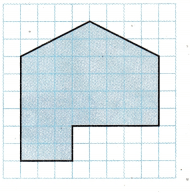
Texas Go Math Grade 7 Lesson 9.4 Answer Key 1
Answer:

B. The area of the garden is ___ square meters.
Answer:

C. Compare your results with other students. What other methods were used to find the area?
Answer:

D. How does the area you found compare with the area found using different methods?
Answer:

Reflect

Area of Composite Figures Worksheet 7th Grade Answer Key Question 1.
Use dotted lines to show two different ways Aaron’s garden could be divided up into simple geometric figures.
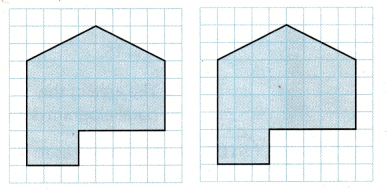
Texas Go Math Grade 7 Lesson 9.4 Answer Key 2
Answer:
Texas Go Math Grade 7 Lesson 9.4 Answer Key 21
Separate the figure into a triangle and two rectangles.
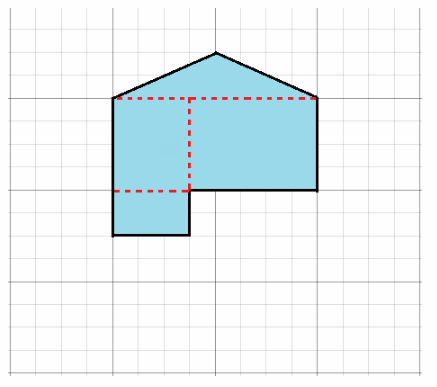
Texas Go Math Grade 7 Lesson 9.4 Answer Key 22
Separate figure into a triangle and three rectangles.

One way is to separate figure into a triangle and two rectangles, and other way is to separate figure into a triangle and three rectangles

Finding the Area of a Composite Figure

A composite figure is made up of simple geometric shapes. To find the area of a composite figure or other irregular-shaped figure, divide it into simple, nonoverlapping figures. Find the area of each simpler figure, and then add the areas together to find the total area of the composite figure.
Use the chart below to review some common area formulas.
Texas Go Math Grade 7 Lesson 9.4 Answer Key 3

Find the area of the figure.
Step 1
Separate the figure into smaller, familiar figures: a parallelogram and a trapezoid.
Texas Go Math Grade 7 Lesson 9.4 Answer Key 4
Step 2
Find the area of each shape.
Texas Go Math Grade 7 Lesson 9.4 Answer Key 5
Step 3
Add the areas to find the total area.
A = 15 + 12.75 = 27.75 cm2
The area of the figure is 27.75 cm2.

Your Turn

Find the area of each figure. Use 3.14 for π.

Question 2.
Texas Go Math Grade 7 Lesson 9.4 Answer Key 6
Answer:
Separate the figure into 2 triangles and one rectangle.
Area of the first triangle
base = 2 ft
height = 3 ft
Use the formula for the area of the triangle.
A1 = \(\frac{1}{2} \cdot b \cdot h\)
A1 = \(\frac{1}{2} \cdot 2 \cdot 3\)
A1 = \(\frac{6}{2}\)
A1 = 3
The area of the first triangle is 3 ft2.
Area of the second triangle
base = 3 ft
height = 3 ft
Use the forumula for the area of the triangle.
A2 = \(\frac{1}{2} \cdot b \cdot h\)
A2 = \(\frac{1}{2} \cdot 3 \cdot 3\)
A1 = \(\frac{9}{2}\)
A1 = 4.5
The area of the second triangle is 4.5 ft2.

Area of the rectangle
length = 8 ft
width = 4 ft
Use the forum ula for the area of the rectangle.
À3 = l ∙ w
A3 = 8 ∙ 4
A3 = 24
The area of the rectangle is 24 ft2.
Add the areas to find the total area.
A = A1 + A2 + A3 = 3 + 4.5 + 24 = 31.5
The area of the figure is 31.5 ft2.

7th Grade Area of Composite Figures Lesson 9.4 Question 3.
Texas Go Math Grade 7 Lesson 9.4 Answer Key 7
Answer:
Separate the figure into a square and a semicircle.

Area of the square
side = 10 m
Use the formula for the area of the square.
A1 = s2
A1 = 102
A1 = 100
The area of the sqaure is 100 m2.
Area of the circle
diameter = 10 m
Use the formula for the area of the circle when given diameter
Ac = \(\pi\left(\frac{d}{2}\right)^{2}\) Subsitute 10 ford and 3.14 for π.
Ac = \(3.14\left(\frac{10}{2}\right)^{2}\)
Ac = 3.14 ∙ 52
Ac = 3.14 ∙ 25
Ac = 78.5
Area of the semicircle is half the area of the circle.
A2 = \(\frac{A_{c}}{2}\) = \(\frac{78.5}{2}\) = 39.25
The area of the semicircle is 39.25 m2.
Add the areas to find the total area.
A = A1 + A2 = 100 + 39.25 = 139.25
The area of the figure is 139.25 m2

Using Area to Solve Problems

Example 2
A banquet room is being carpeted. A floor plan of the room is shown at right. Each unit represents 1 yard. The carpet costs $23.50 per square yard. How much will it cost to carpet the room?
Texas Go Math Grade 7 Lesson 9.4 Answer Key 8

Step 1
Separate the composite figure into simpler shapes as shown by the dashed lines: a parallelogram, a rectangle, and a triangle.

Step 2
Find the area of the simpler figures. Count units to find the dimensions.
Texas Go Math Grade 7 Lesson 9.4 Answer Key 9

Step 3
Find the area of the composite figure.
A = 8 + 24 + 1 = 33 square yards

Step 4
Calculate the cost to carpet the room.
Area ∙ Cost per yard = Total cost
33 ∙ $23.50 = $775.50
The cost to carpet the banquet room is $775.50.

Your Turn

Area of Composite Figures Answer Key Go Math 7th Grade Lesson 9.4 Question 4.
A window is being replaced with tinted glass. The plan at the right shows the design of the window. Each unit length represents 1 foot. The glass costs $28 per square foot. How much will it cost to replace the glass? Use 3.14 for π.
Texas Go Math Grade 7 Lesson 9.4 Answer Key 10
Answer:
Seperate the figure into a rectangle and two semicircles.
Since each unit length represents 1 foot, we see from the picture that the diameter of the semicircles is 4 ft,
and length and width of the rectangle are 5 ft and 4 ft.
We have two semicircles with same diameter, which make up the whole circle. Hence, find the area of the circle.
Area of the circle
diameter = 4
Use the formula for the area of the circle when given diameter.
A1 = \(\pi\left(\frac{d}{2}\right)^{2}\) Substitute 4 for d and 3.14 for π.
A1 = \(3.14\left(\frac{4}{2}\right)^{2}\)
A1 = 3.14 ∙ 22
A1 = 3.14 ∙ 4
A1 = 12.56
Area of the circle is 12.56 ft2.
Area of the rectangle
length = 5 ft
width = 4 ft
Use the formula for the area of the rectangle.
A2 = l ∙ w
A2 = 5 ∙ 4
A2 = 20
The area of the rectangle is 20 ft2.

Add the areas to find the total area.
A = A1 + A2 = 12.56 + 20 = 32.56
The area of the figure is 32.56 ft2..
To find how will it cost to replace the glass multiply the area of the figure by the cost of the glass per square foot.
The total cost = 32.56 ∙ 28 = 911.68
$911.68 will cost the replacement of the glass.

Texas Go Math Grade 7 Lesson 9.4 Guided Practice Answer Key

Question 1.
A tile installer plots an irregular shape on grid paper. Each square on the grid represents 1 square centimeter. What is the area of the irregular shape? (Explore Activity, Example 2)
Texas Go Math Grade 7 Lesson 9.4 Answer Key 11
Step 1
Separate the figure into a triangle, a ____ and a parallelogram.
Step 2
Find the area of each figure.
triangle: ____ cm2; rectangle: ___ cm2; parallelogram: ___ cm2
The area of the irregular shape is ____ cm2.
Answer:
A rectangle
Area of the triangle
base = 4 cm
height = 2 cm
Use the formula for the area of the triangle.
A1 = \(\frac{1}{2} b \cdot h\)
A1 = \(\frac{1}{2} 4 \cdot 2\)
A1 = \(\frac{8}{2}\)
A1 = 4
The area of the triangle is 4 cm2.
Area of the rectangle
length = 5 cm
width = 3 cm
Use the formula for the area of the rectangle.
A2 = l ∙ w
A2 = 5 ∙ 3
A2 = 15
The area of the rectangle is 15 cm2
Area of the parallelogram
length = 5 cm
width = 3 cm
Use the formula for the area of the parallelogram.
A3 = l ∙ w
A3 = 5 ∙ 3
A3 = 15
The area of the parallelogram is 15 cm2.

Add the areas to find the total area.
A = A1 + A2 + A3 = 4 + 15 + 15 = 34
The area of the irregular shape is 34 cm2.

Area of Composite Figures 7th Grade Go Math Question 2.
Show two different ways to divide the composite figure. Find the area both ways. Show your work below. (Example Texas Go Math Grade 7 Lesson 9.4 Answer Key 12
Answer:
First way
Separate the figure into two rectangles.
Area of the first rectangle
length = 20 cm
width = 9 cm
Use the formula for the area of the rectangle.
A1 = l ∙ w
A1 = 20 ∙ 9
A1 = 180
The area of the first rectangle is 180 cm2.
Area of the second rectangle
length = 12 cm
width = 9 cm
Use the formula for the area of the rectangle.
A2 = l ∙ w
A2 = 20 ∙ 9
A2 = 180
The area of the second rectangle is 108 cm2.
Add the areas to find the total area.
A = A1 + A2 = 180 + 108
The area of the figure is 288 cm2.

Second way
Separate the figure into three rectangles.
Area of the first rectangle
length = 9 cm
width = 8 cm
Use the formula for the area of the rectangle.
A1 = l ∙ w
A1 = 9 ∙ 8
A1 = 78

The area of the first rectangle is 72 cm2.
Area of the second rectangle
length = 12 cm
width = 9 cm
Use the formula for the area of the rectangle.
A2 = l ∙ w
A2 = 12 ∙ 9
A2 = 108
The area of the second rectangle is 108 cm2.

Area of the third rectangle
length = 12 cm
width = 9 cm
Use the formula for the area of the rectangle.
A2 = l ∙ w
A2 = 12 ∙ 9
A2 = 108
The area of the third rectangle is 108 cm2.

Add the areas to find the total area.
A = A1 + A2 + A3 = 72 + 108 + 108 = 288
The area of the figure is 288 cm2.

Go Math Grade 7 Answer Key Pdf Area of Composite Figures Question 3.
Sal is tiling his entryway. The floor plan is drawn on a unit grid. Each unit length represents 1 foot. Tile costs $2.25 per square foot. How much will Sal pay to tile his entryway? (Example 2)
Texas Go Math Grade 7 Lesson 9.4 Answer Key 13
Answer:
Separate the figure into a parallelogram and a trapezoid.
Area of the parallelogram
length = 4 ft
width = 4 ft
Use the formula for the area of the parallelogram.
A1 = l ∙ w
A1 = 4 ∙ 4
A1 = 16
The area of the parallelogram is 16 ft2.
Area of the trapezoid
b1 = 7 ft
b2 = 4 ft
h = 5 ft
Use the formula for the area of the trapezoid.
Texas Go Math Grade 7 Lesson 9.4 Answer Key 23
The area of the trapezoid is 27.5 ft2.

Add the areas to find the total area.
A = A1 + A2 = 16 + 27.5 = 43.5
The area of the figure is 43.5 ft2.
The total area of the floor is 43.3 ft2.
Total cost of tilling = 43.5 ∙ 2.25 = 97.87
Sal will pay $97.87 to tile his entryway.

Essential Question Check-In

Question 4.
What is the first step in finding the area of a composite figure?
Answer:
First step is to separate the composite figure into smaller familiar figures.

Texas Go Math Grade 7 Lesson 9.4 Independent Practice Answer Key

Question 5.
A banner is made of a square and a semicircle. The square has side lengths of 26 inches. One side of the square is also the diameter of the semicircle. What is the total area of the banner? Use 3.14 for π.
Answer:
Area of the square
side = 26 in.
Use the formula for the area of the square.
A1 = s2
A1 = 262
A1 = 676
The area of the sqaure is 676 in.2.
Area of the circle
diameter = 26 in.
Use the formula for the area of the circle when given diameter
Texas Go Math Grade 7 Lesson 9.4 Answer Key 24
Area of the semicircle is half the area of the circle.
A2 = \(\frac{A_{c}}{2}\) = \(\frac{530.66}{2}\) = 265.33
The area of the semicircle is 265.33 in.2.

Add the areas to find the total area.
A = A1 + A2 = 676 + 265.33 = 941.33
The area of the banner is 941.33 in.2

Lesson 9.3 Area of Composite Figures Answer Key Pdf Question 6.
Multistep Erin wants to carpet the floor of her closet. A floor plan of the closet is shown.
Texas Go Math Grade 7 Lesson 9.4 Answer Key 14
Answer:
Separate the floor into a rectangle and a triangle.
Area of the triangle
base = 6 ft
height = 7 ft
Use the formula for the area of the triangle.
A1 = \(\frac{1}{2} b \cdot h\)
A1 = \(\frac{1}{2} 6 \cdot 7\)
A1 = \(\frac{42}{2}\)
A1 = 21
The area of the triangle is 21 ft2.
Area of the rectangle
length = 10 ft
width = 4 ft
Use the formula for the area of the rectangle
A3 = l ∙ w
A3 = 10 ∙ 4
A3 =40
The area of the rectangle is 40 ft2.

Add the areas to find the total area.
A = A1 + A2 = 21 + 40 = 61
The area of the floor is 61 ft2.

a. How much carpet does Erin need?
Answer:
The area of the floor is 61 ft2.

b. The carpet Erin has chosen costs $2.50 per square foot. How much will it cost her to carpet the floor?
Answer:
To find the total cost of the carpet multiply the total area of the carpet by the cost of the carpet per square foot.
Total cost of the carpet = 61 ∙ 2.5 = 152.5
Total cost of the carpet = $152.5

Question 7.
Multiple Representations Hexagon ABCDEF has vertices A(-2, 4), B(0, 4), C(2, 1), D(5, 1), E(5, -2), and F(-2, -2). Sketch the figure on a coordinate plane. What is the area of the hexagon?
Texas Go Math Grade 7 Lesson 9.4 Answer Key 15
Answer:
Texas Go Math Grade 7 Lesson 9.4 Answer Key 25
The area of the hexagon consists of a rectangle and a trapezoid

Area of Composite Figures Worksheet Lesson 9.3 Answer Key Question 8.
A field is shaped like the figure shown. What is the area of the field? Use 3.14 for π.
Texas Go Math Grade 7 Lesson 9.4 Answer Key 16
Answer:
Separate the field into a triangle, a square, and a quarter of a circle.
Area of the triangle
base = 8 m
height = 8 m
Use the formula for the area of the triangle.
A1 = \(\frac{1}{2} b \cdot h\)
A1 = \(\frac{1}{2} 8 \cdot 8\)
A1 = \(\frac{64}{2}\)
A1 = 32
The area of the triangle is 32 m2.
Area of the square
side = 8 m
Use the formula for the area of the square.
A2 = s2
A2 = 82
A2 = 64
The area of the sqaure is 64 m2.

To find the area of the quarter of a circle, find the area of the circle and divide it by 4.
Area of the circle
radius = 8 m
Use the formula for the area of the circle when given radius.
Ac = π(r)2 Substitute 10 for r and 3.14 for π.
Ac = 3.14(8)2
Ac = 3.14 ∙ 64
Ac = 200.96
A3 = \(\frac{A_{c}}{4}\) = \(\frac{200.96}{4}\) = 50.24
The area of the quarter of the circle is 50.24 m2.
Add the areas to find the total area.
A = A1 + A2 + A3 = 32 + 64 + 50.24 = 146.24
The area of the field is 146.24 m2.

Question 9.
A bookmark is shaped like a rectangle with a semicircle attached at both ends. The rectangle is 12 cm long and 4 cm wide. The diameter of each semicircle is the width of the rectangle. What is the area of the bookmark? Use 3.14 for π.
Answer:
Texas Go Math Grade 7 Lesson 9.4 Answer Key 26
Separate the figure into a rectangle and two semicircles.
Two semicircles with the same diameter make a circle with the same diameter
Area of the circle
diameter = 4 cm
Use the formula for the area of the circle when given diameter
Texas Go Math Grade 7 Lesson 9.4 Answer Key 27
Area of the circle is 12.56 cm2.
Area of the rectangle
length = 12 cm
width = 4 cm
Use the formula for the area of the rectangle.
A2 = l ∙ w
A2 = 12 ∙ 4
A2 = 48
The area of the rectangle is 48 cm2.
Add the areas to find the total area.
A = À1 + À2 = 12.56 + 48 = 60.56
The area of the bookmark is 60.56 cm2

Question 10.
Multistep Alex is making 12 pennants for the school fair. The pattern he is using to make the pennants is shown in the figure. The fabric for the pennants costs $1.25 per square foot. How much will it cost Alex to make 12 pennants?
Texas Go Math Grade 7 Lesson 9.4 Answer Key 17
Answer:
Separate the figure into a triangles and one rectangle.
Area of the triangle
base = 1 ft
height = 1 ft
Use the formula for the area of the triangle.
Texas Go Math Grade 7 Lesson 9.4 Answer Key 28
The area of the triangle is 1.5 ft2.
Area of the rectangle
length = 3 ft
width = 1 ft
Use the formula for the area of the rectangle.
A2 = l ∙ w
A2 = 3 ∙ 1
A2 = 3
The area of the rectangLe is 3 ft2.

Add the area to find the total area.
A = A1 + A2 = 1.5 + 3 = 4.5
The area of the pennants is 4.5 ft2.
The cost of one pennants = 4 ∙ 1 .25 = 5
The cost of one pennants is 85.
Alex is making 12 of them so the total cost of 12 is
The total cost = total cost of one pennants∙12 = 5 ∙ 12 = 60
Alex will pay $60 for 12 pennants.

Question 11.
Reasoning A composite figure is formed by combining a square and a triangle. Its total area is 32.5 ft2. The area of the triangle is 7.5 ft2. What is the length of each side of the square? Explain.
Answer:
Texas Go Math Grade 7 Lesson 9.4 Answer Key 29
A = the area of the composite figure
A1 = the area of the triangle
A2 = the area of the square
A1 = 7.5ft
A = 32.5 ft
Composite figure consists a triangle and a square.
A = A1 + A2 Substitute 7.5 for A_1 and 32.5 for A.
32.5 = 7.5 + A2 Subtract 7.5 from both sides.
32.5 – 7.5 = A2
A2 = 25
The area of the square is 25 ft2.
A2 = s2. Substititute 25 for A_2
25 = s2 Root both sides.
\(\sqrt{25}\) = \(\sqrt{s^{2}}\)
5 = s
s = 5
The Length of the side of the square is 5 ft

Texas Go Math Grade 7 Lesson 9.4 H.O.T. Focus On Higher Order Thinking Answer Key

Question 12.
Represent Real-World Problems Christina plotted the shape of her garden on graph paper. She estimates that she will get about 15 carrots from each square unit. She plans to use the entire garden for carrots. About how many carrots can she expect to grow? Explain.
Texas Go Math Grade 7 Lesson 9.4 Answer Key 18
Answer:
Separate the figure into a rectangle and a trapezoid.
Area of the parallelogram
length = 4
width = 2
Use the formula for the area of the rectangle.
A1 = l ∙ w
A1 = 4 ∙ 2
A1 = 8
The area of the parallelogram is 8 square units.
Area of the trapezoid
b1 = 8
b2 = 6
h = 2
Use the formula for the area of the trapezoid.
Texas Go Math Grade 7 Lesson 9.4 Answer Key 30
Add the areas to find the total area.
A = A1 + A2 = 8 + 14 = 22
The area of the garden is 22 square units.
Christina estimates that she’ll get 15 carrots from each square unit hence, the total number of carrots she can expect
is 22 ∙ 15 = 330.

Total number of carrots she can expect is 330.

Go Math Lesson 9.4 7th Grade Area of Composite Figures Worksheet Question 13.
Analyze Relationships The figure shown is made up of a triangle and a square. The perimeter of the figure is 56 inches. What is the area of the figure? Explain.
Texas Go Math Grade 7 Lesson 9.4 Answer Key 19
Answer:
The perimeter of the figure consists 3 sides of a square and 2 sides of a triangle.
Hence
P = 3 s1 – 2 s2
where s1 represents side of a square, and s2 represents side of a triangle.
P = 56 in.
s2 = 10 in.
P = 3 ∙ s1 + 2 ∙ s2 Substitute 56 for P, and 10 for s_2.
56 = 3s1 + 2 ∙ 10
56 = 3s1 + 20 Subtract 20 from both sides.
56 – 20 = 3s1
36 = 3s1 Divide both sides by 3.
Texas Go Math Grade 7 Lesson 9.4 Answer Key 31
The side of the square is 12 in.
The side of the square is also base of the triangle.

Area of the triangle
base = 12 in.
height = 8 in.
Use the formula for the area of the triangle.
Texas Go Math Grade 7 Lesson 9.4 Answer Key 32
The area of the triangle is 48 in.2.
Area of the square
side = 12 in.
Use the formula for the area of the square.
A2 = s2
A2 = 122
A2 = 144
The area of the square is 144 in.2.
Add the areas to find the total area.
A = A1 + A2 = 48 + 144 = 192
The area of the figure is 192 in.2.

Question 14.
Critical Thinking The pattern for a scarf is 28 in. shown at right. What is the area of the scarf? Use 3.14 for π.
Texas Go Math Grade 7 Lesson 9.4 Answer Key 20
Answer:
The pattern for a scarf we get when we subtract two semicircles with a diameter 15 in. from the rectangle with 28 in. length and 15 in.width.
Hence, the area of the scarf is
A = A1 – A2
A1 = the area of the rectangle
A2 = area of the two semicircles with same diameter, which make a circle with the same diameter.
Area of the rectangle
Length = 28 in.
width = 15 in.
Use the formula for the area of the rectangle.
A1 = l ∙ w
A1 = 28 ∙ 15
A1 = 420
The area of the rectangle is 420 in 2

Area of the circle
diameter = 15 in.
Use the formula for the area of the circle when given diameter.
Texas Go Math Grade 7 Lesson 9.4 Answer Key 33
Area of the circle is 176.62 in.2.
A = A1 – A2 = 420 – 176.62 = 243.38
The area of the scarf is 243.38 in.2.

Texas Go Math Grade 7 Lesson 9.4 Composite Figure Answer Key Question 15.
Persevere in Problem-Solving The design for the palladium window shown includes a semicircular shape at the top. The bottom is formed by squares of equal size. A shade for the window will extend 4 inches beyond the perimeter of the window, as shown by the dashed line around the window. Each square in the window has an area of 100 in2.

a. What is the area of the window? Use 3.14 for π.
Answer:
The length of the side of small, squares is 10 inches since their area is loo square inches. Since there are four small
squares for the square part of the palladium window, the length will be 40 inches. Determine the area of the
square part of the window.
A = s2 Write the formula for the area of square
A = 402 Substitute the value
A = 1, 600 Evaluate the exponent
The diameter of the semicircle is 40 inches (Length of the square of the window). The radius is half of the diameter,
therefore, the radius is 20 inches. Determine the area of the semicircle.
Texas Go Math Grade 7 Lesson 9.4 Answer Key 34
Determine the area of the window.
Awindow = Asquare + Asemicircle
Awindow = 1, 600 in2 + 628 in2
Awindow = 2, 228 in2

b. What is the area of the shade? Round your answer to the nearest whole number.
Answer:
From the length of the window which is 40 inches, adding the shadow will give the dimensions of the square part
of the window as 48 inches by 44 inches. Determine the area of the rectangle part of the window
A = lw Write the formula for the area of a rectangle
A = 48(44) Substitute the value
A = 2, 112 Multiply the values
The diameter of the semicircle with the shadow will be 48 inches. The radius is half of the diameter, therefore, the
radius is 24 inches. Determine the area of the semicircle.
Texas Go Math Grade 7 Lesson 9.4 Answer Key 35
Determine the area of the shade.
Ashade = Arectangle + Asemicircle
Ashade = 2, 112 in2 + 904.32 in2
Ashade = 3, 016.32 in2
Ashade = 3, 016 in2

Texas Go Math Grade 7 Lesson 9.4 Answer Key Area of Composite Figures Read More »

Texas Go Math Grade 7 Module 9 Quiz Answer Key

Refer to our Texas Go Math Grade 7 Answer Key Pdf to score good marks in the exams. Test yourself by practicing the problems from Texas Go Math Grade 7 Module 9 Quiz Answer Key.

Texas Go Math Grade 7 Module 9 Quiz Answer Key

Texas Go Math Grade 7 Module 9 Ready to Go On? Answer Key

9.1 Angle Relationships

Use the diagram to name a pair of each type of angle.

Question 1.
Supplementary angles _____
Answer:
∠DFC and ∠BFC

Go Math Module 9 Answer Key Module 9 Test Question 2.
Complementary angles. _____
Answer:
∠AFB and ∠BFC

Question 3.
Vertical angles. _____
Answer:
∠EFD and ∠BFC

9.2, 9.3 Finding Circumference and Area of Circles

Find the circumference and area of each circle. Use 3.14 for π.

Texas Go Math Grade 7 Module 9 Quiz Answer Key 1

Question 4.
Circumference ≈ _____
Answer:
d = 36 cm
Use the formula for the circumference of the circle when given diameter
C = π(d) Substitute 36 for d, and 3.14 for π.
C ≈ 3.14(36)
C ≈ 113.04
The circumference of the circle is 113.04 cm
C ≈ 113.04 cm

Question 5.
area ≈ ___
Answer:
Use the formula for the area of the circle.
Since the diameter is twice a radius, the formula for area of a circle, when given the diameter, is
A = π\(\left(\frac{d}{2}\right)^{2}\) Substitute 36 for d, and 3.14 for π.
A ≈ 3.14 . \(\left(\frac{36}{4}\right)^{2}\)
A ≈ 3.14 182
A ≈ 3.14 . 324
A ≈ 1017.36
The area of the circle is about 1017.36 cm2.

A ≈ 1017.36 cm2

Texas Go Math Grade 7 Module 9 Quiz Answer Key 2

Question 6.
Circumference ≈ _____
Answer:
The radius of the circle is 7 m.
Use the formula for the circumference of the circle.
C = 2π(r) Substitute 7 for r, and \(\frac{22}{7}\) for π.
Texas Go Math Grade 7 Module 9 Quiz Answer Key 9
The circumference is about 44 m.

C ≈ 44

Grade 7 Math Module Answer Key Pdf Circles Question 7.
area ≈ ___
Answer:
Use the formula for the area of the circle
A = Substitute 7 for r, and 314 for w.
A ≈ 3.14(7)2
A ≈ 3.14 49
A ≈ 153.86
The area of the circle is about 153.86 m2

A ≈ 153.86 m2.

9.4 Area of Composite Figures

Find the area of each figure. Use 3.14 for π.

Question 8.
Texas Go Math Grade 7 Module 9 Quiz Answer Key 3
Answer:
Separate the figure into a triangle and one semicircle.
Area of the triangle
base = 14 m
height = 10 m
Use the formula for the area of the triangle.
A1 = \(\frac{1}{2} b \cdot h\)
A1 = \(\frac{1}{2} 14 \cdot 10\)
A1 = \(\frac{70}{2}\)
A1 = 35
The area of the triangle is 35 m2.

Area of the circle
diameter = 14 m
Use the formula for the area of the circle when given the diameter
Ac = \(\pi\left(\frac{d}{2}\right)^{2}\) Subsitute 14 for d and 3.14 for π.
Ac = 3.14\(\left(\frac{14}{2}\right)^{2}\)
Ac = 3.14 . 72
Ac = 3.14 . 49
Ac = 153.86
Area of the semicircle is half the area of the circle.
A2 = \(\frac{A_{c}}{2}\) = \(\frac{153.86}{2}\) = 76.93
The area of the semicircle is 76.93 m2.
Add the areas to find the total area.
A = A1 + A2 = 35 + 76.93 = 111.93
The area of the figure is 111.93 m2.

Quiz for Grade 7 Math Module 9 Question 9.
Texas Go Math Grade 7 Module 9 Quiz Answer Key 4
Answer:
Separate the figure into a rectangle and a parallelogram.
Area of the rectangle
length = 20 cm
width = 5.5 cm
Use the formula for the area of the rectangle.
A1 = l . w
A1 = 20 . 5.5
A1 = 110
The area of the rectangle is 110 cm2.
Area of the parallelogram
b = 20 cm
h = 4.5 cm
Use the formula for the area of the parallelogram.
A2 = b . h
A2 = 20 . 4.5
A2 = 90
The area of the parallelogram is 90 cm2

Add the areas to find the total area.
A = A1 + A2 = 110 + 90 = 200
The area of the figure is 200 cm2.

Essential Question

Question 10.
How can you use geometric formulas in real-world situations?
Answer:
There are times that we need to determine the area perimeter or volume of a certain object or even a place and
the only given is the dimensions, the geometric formulas are very helpful in such a way that we can calculate it by ourselves.

The geometric formulas are very helpful.

Texas Go Math Grade 7 Module 9 Mixed Review Texas Test Prep Answer Key 

Selected Response

Use the diagram for Exercises 1-3.

Texas Go Math Grade 7 Module 9 Quiz Answer Key 5

Question 1.
What is the measure of ∠BFC?
(A) 18°
(B) 72°
(C) 108°
(D) 144°
Answer:
(C) 108°

Explanation:
∠AFB and ∠BFC are supplement angles, hence
∠AFB + ∠BFC = 180° Substitute 72° for ∠AFB
72° + ∠BFC = 180° Subtract 72° from both sides.
∠BFC = 180° – 72°
∠BFC = 108°

Math Quiz for Grade 7 Module 9 Test Question 2.
Which describes the relationship between ∠BFA and ∠CFD?
(A) adjacent angles
(B) complementary angles
(C) supplementary angles
(D) vertical angles
Answer:
(D) vertical angles

Question 3.
Which information would allow you to identify ∠BFA and ∠AFE as complementary angles?
(A) m∠AFE = 108°
(B) ∠DFE is a right angle.
(C) ∠BFA and ∠BFC are supplementary angles.
(D) ∠BFA and ∠BFC are adjacent angles.
Answer:
(B) ∠DFE is a right angle.

Explanation:
∠DFE is a right angle, as we see in the diagram.

Question 4.
David pays $7 per day to park his car. He uses a debit card each time. By what amount does his bank account change due to parking charges over a 40-day period?
(A) -$280
(B) -$47
(C) $47
(D) $280
Answer:
(A) -$280

Explanation:
David pays $7 each day for 40 days, so amount on his bank account decreases for $7 . 40 = $280.

Question 5.
What is the circumference of the circle? Use 3.14 for π.
Texas Go Math Grade 7 Module 9 Quiz Answer Key 6
(A) 34.54 m
(B) 69.08 m
(C) 379.94 m
(D) 1,519.76 m
Answer:
(B) 69.08 m

Explanation:
r = 11 m
Use the formula for circumference.
C = 2πr(r) Substitute 11 for r and 314 for π
C ≈ 2 3.14 . 11
C ≈ 69.08
The circumference of the circle is 69.08 m.

7th Grade Module 9 Quiz Answers Question 6.
What is the area of the circle? Use 3.14 for π.
Texas Go Math Grade 7 Module 9 Quiz Answer Key 7
(A) 23.55 m2
(B) 176.625 m2
(C) 47.1 m2
(D) 706.5 m2
Answer:
(B) 176.625 m2

Explanation:
d = 15m
Use the formula for the area of the circle.
A = πr2
Since the diameter is twice a radius, the formula for area of a circle, when given the diameter, is
A = π(r)2 Substitute \(\frac{d}{2}\) for r.
A = \(\pi\left(\frac{d}{2}\right)^{2}\) Substitute 15 for d, and 3.14 for π.
A ≈ 3.14 . \(\left(\frac{15}{2}\right)^{2}\)
A ≈ 3.14 . (7.5)2
A ≈ 3.14 . 56.25
A ≈ 176.62
The area of the circle is about 176.62 m2.

Gridded Response

Grade 7 Math Module 9 Answer Key Question 7.
Find the area in square meters of the figure below. Use 3.14 for π.
Texas Go Math Grade 7 Module 9 Quiz Answer Key 8
Answer:
Separate the figure into a square and a quarter of circle.
Area of the square
side = 6 m
Use the formula for the area of the square
A1 = 82
A1 = 62
A1 = 36
The area of the square is 36 m2.
To find the area of the quarter of a circle, find the area of the circle and divide it by 4.
Area of the circle
radius = 6 m
Use the formula for the area of the circle when given a radius.
Ac = πr2 Substitute 10 for r and 314 for w.
Ac = 3.14(6)2
Ac = 3.14 . 36
Ac = 113.04
A2 = \(\frac{A_{c}}{4}\) = \(\frac{113}{404}\) = 28.26
The area of the quarter of the circle is 28.26 m2.
Add the areas to find the total area.
A = A1 + A2 = 36 + 28.26 = 64.26
The area of the figure is 64.26 m2.

Texas Go Math Grade 7 Module 9 Quiz Answer Key Read More »

Texas Go Math Grade 7 Module 13 Answer Key Taxes, Interest, and Incentives

Refer to our Texas Go Math Grade 7 Answer Key Pdf to score good marks in the exams. Test yourself by practicing the problems from Texas Go Math Grade 7 Module 13 Answer Key Taxes, Interest, and Incentives.

Texas Go Math Grade 7 Module 13 Answer Key Taxes, Interest, and Incentives

Texas Go Math Grade 7 Module 13 Are You Ready? Answer Key

Write each percent as a decimal.

Question 1.
45% ______
Answer:
Write the percent as the sum of 1 whole and a percent remainder.
100% – 55% = \(\frac{100}{100}\) – \(\frac{55}{100}\) Write the percents as fractions.
= 1 – 0.55 Write the fractions as decimals.
= 0.45

Question 2.
91% ______
Answer:
Write the percent as the sum of 1 whole and a percent remainder.
100% – 9% = \(\frac{100}{100}\) – \(\frac{9}{100}\) Write the percents as fractions.
= 1 – 0.09 Write the fractions as decimals.
= 0.91

Question 3.
8%
Answer:
Write the percent as the sum of 1 whole and a percent remainder.
100% – 92% = \(\frac{100}{100}\) – \(\frac{92}{100}\) Write the percents as fractions
= 1 – 0.92 Write the fractions as decimals
= 0.08

Question 4.
111%
Answer:
Write the percent as the sum of 1. whole and a percent remainder.
100% + 11% = \(\frac{100}{100}\) – \(\frac{11}{100}\) Write the percents as fractions.
= 1 + 0.11 Write the fractions as decimals.
= 1.11

Write each decimal as a percent.

Question 5.
0.79 _______
Answer:
Write the decimal as the sum of 1 whole and a decimal remainder.
1 – 0.21 = \(\frac{100}{100}\) – \(\frac{21}{100}\) Write the decimals as fractions.
= 100% – 21% Write the fractions as percents.
= 79%

Question 6.
0.8 ________
Answer:
Write the decimal as the sum of 1 whole and a decimal remainder.
1 – 0.21 = \(\frac{100}{100}\) – \(\frac{20}{100}\) Write the decimals as fractions.
= 100% – 20% Write the fractions as percents.
= 80%

Question 7.
0.05 ____
Answer:
Write the decimal as the sum of 1 whole and a decimal remainder.
1 – 0.95 = \(\frac{100}{100}\) – \(\frac{95}{100}\) Write the decimals as fractions.
= 100% – 95% Write the fractions as percents.
= 5%

Question 8.
1.98
Answer:
Write the decimal as the sum of 1 whole and a decimal remainder.
1 + 0.98 = \(\frac{100}{100}\) + \(\frac{98}{100}\) Write the decimals as fractions.
= 100% + 98% Write the fractions as percents.
= 198%

Find each sum or difference.

Question 9.
11.9 – 7.6 _________
Answer:
Texas Go Math Grade 7 Module 13 Answer Key 6
4.3

Question 10.
24.1 – 9.25 ______
Answer:
Texas Go Math Grade 7 Module 13 Answer Key 7
14.85

Question 11.
45 – 10.6 ________
Answer:
Texas Go Math Grade 7 Module 13 Answer Key 8
34.4

Question 12.
6.04 – 3.5 _________
Answer:
Texas Go Math Grade 7 Module 13 Answer Key 9
2.54

Question 13.
5.17 – 5.09 ______
Answer:
Texas Go Math Grade 7 Module 13 Answer Key 10
0.08

Question 14.
100 – 3.77 _______
Answer:
Texas Go Math Grade 7 Module 13 Answer Key 11
96.23

Multiply.

Question 15.
Texas Go Math Grade 7 Module 13 Answer Key 1
Answer:
Multiply as whole numbers.
Count the total number of decimal places in the both factors, and put the same number of decimals in the product.
Texas Go Math Grade 7 Module 13 Answer Key 12
66.48

Question 16.
Texas Go Math Grade 7 Module 13 Answer Key 2
Answer:
Multiply as whole numbers.
Count the total number of decimal places in the both factors, and put the same number of decimals in the product.
Texas Go Math Grade 7 Module 13 Answer Key 13
6.965

Question 17.
Texas Go Math Grade 7 Module 13 Answer Key 3
Answer:
Multiply as whole numbers.
Count the total number of decimal places in the both factors, and put the same number of decimals in the product.
Texas Go Math Grade 7 Module 13 Answer Key 14
38.528

Question 18.
Texas Go Math Grade 7 Module 13 Answer Key 4
Answer:
Multiply as whole numbers.
Count the total number of decimal places in the both factors, and put the same number of decimals in the product.
Texas Go Math Grade 7 Module 13 Answer Key 15
27.648

Texas Go Math Grade 7 Module 13 Reading Start-Up Answer Key

Visualize Vocabulary

Use the ✓ words to complete the graphic. You will put a different word in each box.
Texas Go Math Grade 7 Module 13 Answer Key 5

Understand Vocabulary

Complete each sentence using the preview words.

Question 1.
The amount of money earned by bank customers based on the amount of principal in their savings account is _____
Answer:
The amount of money earned by bank customers based on the amount of principal in their savings account is Interest

Question 2.
_____________________ is interest paid only on the principal, according to an agreed upon interest rate.
Answer:
Simple Interest is interest paid only on the principal, according to an agreed upon interest rate.

Texas Go Math Grade 7 Module 13 Answer Key Taxes, Interest, and Incentives Read More »

Texas Go Math Grade 7 Lesson 9.3 Answer Key Area of Circles

Refer to our Texas Go Math Grade 7 Answer Key Pdf to score good marks in the exams. Test yourself by practicing the problems from Texas Go Math Grade 7 Lesson 9.3 Answer Key Area of Circles.

Texas Go Math Grade 7 Lesson 9.3 Answer Key Area of Circles

Essential Question
How do you find the area of a circle?

Texas Go Math Grade 7 Lesson 9.3 Explore Activity 1 Answer Key
You can use what you know about circles and π to help find the formula for the area of a circle.
Step 1
Use a compass to draw a circle and cut it out.
Texas Go Math Grade 7 Lesson 9.3 Answer Key 1
Step 2
Fold the circle three times as shown to get equal wedges.
Step 3
Unfold and shade one-half of the circle.
Texas Go Math Grade 7 Lesson 9.3 Answer Key 2
Step 4
Cut out the wedges, and fit the pieces together to form a figure that looks like a parallelogram.

The base and height of the parallelogram relate to the parts of the circle.
base b = Texas Go Math Grade 7 Lesson 9.3 Answer Key 3 the circumference of the circle, or ______
Texas Go Math Grade 7 Lesson 9.3 Answer Key 4
height h = the ___________ of the circle, or ______
To find the area of a parallelogram, the equation is A = ___
To find the area of the circle, substitute for b and h in the area formula.
Texas Go Math Grade 7 Lesson 9.3 Answer Key 5

Reflect

Go Math Grade 7 Pdf Practice and Homework Lesson 9.3 Question 1.
How can you make the wedges look more like a parallelogram?
Answer:
In order to make a parallelogram for the wedges of the circle, cut one wedge into half. Then re-arrange the
wedges alternating each wedge to form a parallelogram. The two halves of one wedge will go on each end side.
This will form a rectangle, a kind of parallelogram.
Texas Go Math Grade 7 Lesson 9.3 Answer Key 46
Making a circle into a parallelogram.

Finding the Area of a Circle

Area of circle
The area of a circle is equal to π times the radius squared.
A = πr2
Texas Go Math Grade 7 Lesson 9.3 Answer Key 6
Remember that area is given in square units.

Example 1
A biscuit recipe calls for the dough to be rolled out and circles to be cut from the dough. The biscuit cutter has a radius of 4 cm. Find the area of the biscuit once it is cut. Use 3.14 for π.
Texas Go Math Grade 7 Lesson 9.3 Answer Key 7

Reflect

Question 2.
Compare finding the area of a circle when given the radius with finding the area when given the diameter.
Answer:
The area of the circle when given the radius is
A = πr2
Since the diameter is twice the radius, the formula for the area of a circle, when given the diameter, is
A = πr2 Substitute \(\frac{d}{2}\) for r.
Texas Go Math Grade 7 Lesson 9.3 Answer Key 16

Question 3.
Why do you evaluate the power in the equation before multiplying?
Answer:
Because the power refers to the radius only, not the number π.

Your Turn

Practice and Homework Lesson 9.3 Answer Key 7th Grade Question 4.
A circular pool has a radius of 10 feet. What is the area of the pool? Use 3.14 for π. ______
Answer:
r = 10 feet
Use the formula for the area of the circle, cause the pool is circular.
A = πr(r)2 Substitute 10 for r, and 3.14 for π.
A ≈ 3.14(2)2
A ≈ 3.14 . 100
A ≈ 314
The area of the pool is about 314 feet

Explore Activity 2
Finding the Relationship between Circumference and Area
You can use what you know about the circumference and area of circles to find a relationship between them.
Texas Go Math Grade 7 Lesson 9.3 Answer Key 8
Find the relationship between the circumference and area of a circle.
Texas Go Math Grade 7 Lesson 9.3 Answer Key 9
The circumference of the circle squared is equal to
___________
Answer:

Reflect

Question 5.
Does this formula work for a circle with a radius of 3 inches? Show your work.
Answer:
The radius of the circle is 3 in.
The circumference of the circle squared is equal to
C2 = 4π . A,
where A represents the area of the circle.
First find the area of the circle with the radius of 3 in.
Use the formula for the area of the circle.
A = π(r)2 Substitute 3 for r, and 3.14 for π.
A ≈ 3.14(3)2
A ≈ 3.14 . 9
A ≈ 28.26
The area of the circle is about 28.26 in.
Use the formula for the circumference when given the area
C2 = 4π . A Substitute 28.26 for A and 3.14 for π.
C2 ≈ 4 . 3.14 ∙ 28.26
C2 ≈ 354.94 Root both sides.
\(\sqrt{C^{2}}\) ≈ \(\sqrt{354.94}\)
The circumference of the circle is 18.84 in.

Let’s see if we get the same result if we use the original formula for circumference
Use the formula for the circumference of the circle.
C = 2πr(r) Substitute 3 for r and 3.14 for π.
C ≈ 23.14 ∙ 3
C ≈ 18.84
The circumference of the circle is 18.84 in.
Hence, we can use both formulas for the circumference of the circle.

The formula works, so we can use both formulas for the circumference of the circle.

Texas Go Math Grade 7 Lesson 9.3 Guided Practice Answer Key

Find the area of each circle. Round to the nearest tenth if necessary. Use 3.14 for π. (Explore Activity 1)

Question 1.
Texas Go Math Grade 7 Lesson 9.3 Answer Key 10
Answer:
The diameter of the circle is 14,m.
Use the formula for the area of the circle
A = π(r)2
Since the diameter is twice the radius, the formula for the area of a circle, when given the diameter, is
Texas Go Math Grade 7 Lesson 9.3 Answer Key 17
The area of the circle is about 153.86 m2.

Go Math Grade 7 Lesson 9.3 Answer Key Question 2.
Texas Go Math Grade 7 Lesson 9.3 Answer Key 11
Answer:
The radius of the circle is 12 mm.
Use the formula for the area of the circle.
A = π(r)2 Substitute 12 mm for r, and 3.14 for π.
A ≈ 3.14 ∙ (12 mm)2
A ≈ 3.14 ∙ 144 mm2
A ≈ 452.16 mm2
The area of the circle is about 452.16 mm2.

Question 3.
Texas Go Math Grade 7 Lesson 9.3 Answer Key 12
Answer:
The diameter of the circle is 20 yd
Use the formula for the area of the circle
A = π(r)2
Since the diameter is twice the radius, the formula for the area of a circle, when given the diameter, is
Texas Go Math Grade 7 Lesson 9.3 Answer Key 18
The area of the circle is about 314 yd2.

Solve. Use 3.14 for π. (Example 1)

Question 4.
A clock face has a radius of 8 inches. What is the area of the clock face? Round your answer to the nearest hundredth.
Answer:
The radius of the circle is 8 in.
Use the formula for the area of the circle
A = π(r)2 Substitute 8 in. for r, and 3.14 for π.
A ≈ 3.14. (8 in)2
A ≈ 3.14 ∙ 64 in2
A ≈ 200.96 in2
The area of the circle is about 200.96 in2

Question 5.
A DVD has a diameter of 12 centimeters. What is the area of the DVD? Round your answer to the nearest hundredth.
Answer:
The diameter of the circle is 12 cm.
Use the formula for the area of the Circle.
A = π(r)2
Since the diameter is twice a radius, the formula for area of a circle, when given the diameter, is
Texas Go Math Grade 7 Lesson 9.3 Answer Key 19
The area of the circle is about 226.08 cm2.

Go Math Book 7th Grade Area of a Circle Answer Key Question 6.
A company makes steel lids that have a diameter of 13 inches. What is the area of each lid? Round your answer to the nearest hundredth.
Answer:
The diameter of the circle is 13 in.
Use the formula for the area of the circle.
A = π(r)2
Since the diameter is twice a radius, the formula for area of a circle, when given the diameter, is
Texas Go Math Grade 7 Lesson 9.3 Answer Key 20
The area of the circle is about 132.66 in2.

Find the area of each circle. Give your answers in terms of π. (Explore Activity 2)

Question 7.
C = 4π
A = ____
Answer:
Use the formula for the circumference of the circle.
Texas Go Math Grade 7 Lesson 9.3 Answer Key 21
Use the formula for area of the circle
Texas Go Math Grade 7 Lesson 9.3 Answer Key 22

Question 8.
C = 12π
A = ___
Answer:
Use the formula for the circumference of the circle.
Texas Go Math Grade 7 Lesson 9.3 Answer Key 23
Use the formula for area of the circle.
Texas Go Math Grade 7 Lesson 9.3 Answer Key 24

Area in Terms of Circumference Answer Key Pdf Grade 7 Question 9.
C = \(\frac{\pi}{2}\)
A = ____________
Answer:
Use the formula for the circumference of the circle.
Texas Go Math Grade 7 Lesson 9.3 Answer Key 25
Use the formula for area of the circle.
Texas Go Math Grade 7 Lesson 9.3 Answer Key 26
Texas Go Math Grade 7 Lesson 9.3 Answer Key 27

Question 10.
A circular pen has an area of 64π square yards. What is the circumference of the pen? Give your answer in terms of π. (Explore Activity 2)
___________
Answer:
Use the formula for the circumference of the circle.
Texas Go Math Grade 7 Lesson 9.3 Answer Key 28
Use the formula for area of the circle.
Texas Go Math Grade 7 Lesson 9.3 Answer Key 29

Essential Question Check-In

Question 11.
What is the formula for the area A of a circle in terms of the radius r?
Answer:
A = r2π

Independent Practice

Question 12.
The most popular pizza at Pavone’s Pizza is the 10-inch personal pizza with one topping. What is the area of a pizza with a diameter of 10 inches? Round your answer to the nearest hundredth.
Answer:
The diameter of the pizza is 10 in.
Use the formula for area of the circle.
Since the radius is half the diameter, formula for the area of the pizza will be
A = π(r)2 Substitute \(\frac{d}{2}\) for r.
Texas Go Math Grade 7 Lesson 9.3 Answer Key 30
The area of the pizza is about 78.5 in.2.

Lesson 9.3 Area of Circles Answer Key Go Math Grade 7 Question 13.
A hubcap has a radius of 16 centimeters, What is the area of the hubcap? Round your answer to the nearest hundredth.
Texas Go Math Grade 7 Lesson 9.3 Answer Key 13
Answer:
The radius of the hubcap is 16 cm.
Use the formula for area of the circle to find area of the hubcap.
A = π(r)2 Substitute 16 cm for r, and 3.14 for π.
A ≈ 3.14(16 cm)2
A ≈ 3.14 256 cm2
A ≈ 803.84 cm2
The area of the hubcap is about 803.84 cm2.

Question 14.
A stained glass window is shaped like a semicircle. The bottom edge of the window is 36 inches long. What is the area of the stained glass window? Round your answer to the nearest hundredth.
Answer:
The bottom edge of the window represents the diameter of the circle whose half is a window, hence, the area of the window is half of the area of the circle.
Use the formula for area of the circle, where instead of the radius, we place the diameter which is twice the radius
Texas Go Math Grade 7 Lesson 9.3 Answer Key 31
The area of the circle is about 1017.36 in.2.
Hence, the area of the window is half of the area of the circle
A ÷ 2 ≈ 1017.36 ÷ 2 ≈ 508.68 in.2
The area of the window is about 508.68 in.2.

Question 15.
Analyze Relationships The point (3, 0) lies on a circle with the center at the origin. What is the area of the circle to the nearest hundredth?
Answer:
Texas Go Math Grade 7 Lesson 9.3 Answer Key 32
As the center of the circle is origin, the distance from it to the point(3, 0) is the radius.
From the diagram above, we see that the radius of the circle is 3.
Use the formula for the area of the circle.
A = π(r)2 substitute 3 for r, and 3.14 for π.
A ≈ 3.14(3)2
A ≈ 3.14 ∙ 9
A ≈ 28.26
The area of the circle is about 28.26

Question 16.
Multistep A radio station broadcasts a signal over an area with a radius of 50 miles. The station can relay the signal and broadcast over an area with a radius of 75 miles. How much greater is the area of the broadcast region when the signal is relayed? Round your answer to the nearest square mile.
Answer:
We have to find the area of the signal that the station can relay, and the area of the signal that station broadcasts.
The station can relay the signal over an area with a radius of 75 miles, so the area of it will be
A1 ≈ π(r)2 Substitute 75 miles for r, and 3.14 for π.
A1 ≈ 3.14(75 miles)2
A1 ≈ 3.14 ∙ 5625 miles2
A1 ≈17, 662.5 miles2
The area of the signal that the station can relay is about 17, 662.5 miles2.
On the other side, the station broadcasts a signal over an area with a radius of 50 miles, so the area of it will be
A2 = π(r)2 Substitute 50 miles for r, and 3.14 for π.
A2 ≈ 3.14(50 miles)2
A2 ≈ 3.14 ∙ 2500 miles2
A2 ≈ 7 miles
A2 ≈ 7,850 miles2
The area of the signal that the station broadcasts is about 7,850 miles2.
The area of the broadcast region when the signal is relayed, is greater for the difference between the area of the signal that the station can relay, and the area of the signal that station broadcasts.
A1 – A2 ≈ 17,662.5 – 7,850 ≈ 9,812.5 miles2

Question 17.
Multistep The sides of a square field are 12 meters. A sprinkler in the center of the field sprays a circular area with a diameter that corresponds to a side of the field. How much of the field is not reached by the sprinkler? Round your answer to the nearest hundredth.
Answer:
Texas Go Math Grade 7 Lesson 9.3 Answer Key 33
The area marked with red color is the area sprinkler does not reach.
To find it, first we have to find the area of the square, and a circular area that a sprinkler sprays.
Use the formula for the area of a square.
A1 = a2 where a represents side of a square. Substitute 12 m for a.
A1 = 12 m2
A1 = 144 m2
The area of the square is 144 m2.
Use the formula for the area of the circle with a diameter same as a square.
Since the radius is half of the diameter, it follows
Texas Go Math Grade 7 Lesson 9.3 Answer Key 34
The area of the circular area that a sprinkler sprays is about 113.04 m2
From the area of the square subtract the area of the circular area to get the area the sprinkler does not reach.
À1 – A2 ≈ 144 m2 – 113.04 m2 ≈ 30.96 m2
The area the sprinkler does not reach is about 30.96 m2.

Lesson 9.3 Area of Circles Answer Key Go Math Pdf Grade 7 Question 18.
Justify Reasoning A small silver dollar pancake served at a restaurant has a circumference of 2π inches. A regular pancake has a circumference of 4π inches. Is the area of the regular pancake twice the area of the silver dollar pancake? Explain.
Answer:
Find the area of the small silver dollar pancake and the area of the regular pancake.
First, find the formula for the area of the circle when given circumstance.
Use the formula for the circumference of the circle.
Texas Go Math Grade 7 Lesson 9.3 Answer Key 35
Use the formula for area of the circle.
Texas Go Math Grade 7 Lesson 9.3 Answer Key 36
The circumference of the small silver dollar pancake is 2π in.
Use the formula above for the area.
Texas Go Math Grade 7 Lesson 9.3 Answer Key 37
The area of the small silver dollar pancake is π in.2.

The circumference of the regular pancake is 4π in.
Use the formula above for the area.
Texas Go Math Grade 7 Lesson 9.3 Answer Key 38
The area of the regular pancake is 4π in.2.
A2 – A1 =4π – π = 3π
The area of the regular pancake is more than twice the area of the small silver dollar pancake.

Question 19.
Analyze Relationships A bakery offers a small circular cake with a diameter of 8 inches. It also offers a large circular Cake with a diameter of 24 inches. Does the top of the large cake have three times the area of that of the small cake? If not, how much greater is its area? Explain.
Answer:
Find the area of the small and large circular cakes.
Use the formula for the area of a circle.
Since the diameter is twice the radius, the formula for the area of a circle when given the diameter is
A = π(r)2 Substitute \(\frac{d}{2}\) for r.
Texas Go Math Grade 7 Lesson 9.3 Answer Key 39
Let d1 be the diameter of the larger cake and d2 the diameter of the smaller cake.
d1 = 24 inches
d2 = 8 inches
Use the formula above to find the area of the large cake.
Texas Go Math Grade 7 Lesson 9.3 Answer Key 40
The area of the large cake is about 452.16 in.2.
Use the formula above to find the area of the small cake.
Texas Go Math Grade 7 Lesson 9.3 Answer Key 41
The area of the small cake is about 50.24 in.2
The top of the large cake have area greater than the area of the small cake for about
A1 – A2 ≈ 452.16 – 50.24 ≈ 401.92 in.2
Hence, the area of the large cake is more than 3 times the area of the small cake.

Question 20.
Communicate Mathematical Ideas You can use the formula A = \(\frac{C^{2}}{4 \pi}\) to find the area of a circle given the circumference. Describe another way to find the area of a circle when given the circumference.
Answer:
The other way is to find the radius first Since C = 2πr, we have r = \(\frac{C}{2 \pi}\). After that, we can find the area by substituting for r in A = πr2.
Determine the radius first with the formula r = \(\frac{C}{2 \pi}\)

Question 21.
Draw Conclusions Mark wants to order a pizza. Which is the better deal? Explain.
Texas Go Math Grade 7 Lesson 9.3 Answer Key 14
Answer:
Texas Go Math Grade 7 Lesson 9.3 Answer Key 42
Texas Go Math Grade 7 Lesson 9.3 Answer Key 43
Hence, a pizza with a diameter of 18 inches for $20 will better deal because in this case will get a larger pizza as compared to a tile pizza with a diameter 12 inch for $10.

Question 22.
Multistep A bear was seen near a campground. Searchers were dispatched to the region to find the bear.
a. Assume the bear can walk in any direction at a rate of 2 miles per hour. Suppose the bear was last seen 4 hours ago. How large an area must the searchers cover? Use 3.14 for π. Round your answer to the nearest square mile. _______
Answer:
Determine the area the searchers must cover The radius of the area the bear walks is 8 miles since the bear was
last seen 4 hours ago with the rate of 2 miles per hour
A = πr2 Write the formula for the area of a circle
A = (3.14)(8)2 Substitute the values
A = (3.14)(64) Evaluate the exponent
A = 200.96 Multiply the values
A = 201 Round off

b. What If? How much additional area would the searchers have to cover if the bear were last seen 5 hours ago?
Answer:
Determine the area the searchers must cover. The radius of the area the bear walks is 10 miles since the bear was
last seen 5 hours ago with the rate of 2 miles per hour.
A = πr2 Write the formula for the area of a circle
A = (3.14)(10)2 Substitute the values
A = (3.14)(100) Evaluate the exponent
A = 314 Multiply the values
Determine the additional area the searchers need to cover
314 – 201 = 113
The searchers need to cover an additional 113 square miles.

Texas Go Math Grade 7 Lesson 9.3 H.O.T. Focus on Higher Order Thinking Answer Key

Question 23.
Analyze Relationships Two circles have the same radius. Is the combined area of the two circles the same as the area of a circle with twice the radius? Explain.
Answer:
The combined area of the two circles, with the same radius, is twice the area of that circle.
Use the formula for the area of the circle.
A = the combined area
A1 the area of the circle
A = 2 ∙ A1
A = 2πr2
The area of the circle with twice the radius is
A = π(2r)2
A = π22r2
A = 4πr2
Hence, the combined area of the two circles with the same radius isn’t the same as the area of the circle with twice
the radius.

Question 24.
Look for a Pattern How does the area of a circle change if the radius is multiplied by a factor of n, where n is a whole number?
Answer:
If we multiply the radius by a whole number n, the area of the circle will be
A = π(nr)2
A = πn2r2
Hence, the area of the circle will be n2 times larger.

Question 25.
Represent Real World Problems The bull’s eye on a target has a diameter of 3 inches. The whole target has a diameter of 15 inches. What part of the whole target is the bull’s-eye? Explain.
Answer:
Use the formula for the circle to find the area of the whole target with a diameter of 15 in.
Texas Go Math Grade 7 Lesson 9.3 Answer Key 44
The area of the whole target is 176.62 in.2
Use the formula for the circle to find the area of the bull’s – eye with the diameter of 3 in
Texas Go Math Grade 7 Lesson 9.3 Answer Key 45
The area of the bull’s – eye is 7.06 in.2

To find what part of the whole target is the bull’s – eye, we have to divide the area of the whole target by the area
of the bull’s – eye.
\(\frac{A_{1}}{A_{2}}\) = \(\frac{176.62}{7.06}\) = 25.01
Hence, the bull’s – eye is the 25th part of the whole target

Texas Go Math Grade 7 Lesson 9.3 Answer Key Area of Circles Read More »

Texas Go Math Grade 7 Unit 6 Study Guide Review Answer Key

Refer to our Texas Go Math Grade 7 Answer Key Pdf to score good marks in the exams. Test yourself by practicing the problems from Texas Go Math Grade 7 Unit 6 Study Guide Review Answer Key.

Texas Go Math Grade 7 Unit 6 Study Guide Review Answer Key

Analyzing and Comparing Data

Texas Go Math Grade 7 Unit 6 Exercises Answer Key

Question 1.
Five candidates are running for the position of School Superintendent. Find the percent of votes that each candidate received. (Lesson 11.1)
Texas Go Math Grade 7 Unit 6 Study Guide Review Answer Key 2
Answer:
Number votes A gets = 70
Number votes B gets = 84
Number votes C gets = 80
Number votes D gets = 82
Number votes E gets = 98
Total number of votes = 70 + 84 + 80 + 82 + 98 = 414
Texas Go Math Grade 7 Unit 6 Study Guide Review Answer Key 16
Percentage of votes of A = \(\frac{70}{414}\) × 100 = 16.90%
Percentage of votes of B = \(\frac{84}{414}\) × 100 = 20.29%
Percentage of votes of C = \(\frac{80}{414}\) × 10o = 19.32%
Percentage of votes of D = \(\frac{82}{414}\) × 100 = 19.80%
Percentage of votes of E = \(\frac{98}{414}\) × 100 = 23.67%
Percentage of vote A gets is 16.90%

The dot plots show the number of hours a group of students spend online each week, and how many hours they spend reading. Compare the dot plots visually. (Lesson 11.2)

Texas Go Math Grade 7 Unit 6 Study Guide Review Answer Key 3

Grade 7 Unit 6 Practice Problems Answer Key Question 2.
Compare the shapes, centers, and spreads of the dot plots.
Shape: ___________________
Center: _________________________
Spread: ______________
Answer:
Comparing the shapes, centers, and spreads of the dot plots:
Shape: In case of Online time most of the data are greater than 4 but in case of Reading time data is almost symmetric about the point 3.
Centre: Centre of the both given dot plot will be the median of both dot plot. Median or centre of Online time is 6
and the median or centre of Reading time is 5.
Spread: Spread of dot plot is the range of dot pot. Range of Online time is 7 – 0 = 7 and range of Reading time
is 6 – 0 = 6.

Median of Online time is 6 and of Reading time is 5.

Question 3.
Calculate the medians of the dot plots. _______
Answer:
Arranging Online time data: 0, 4, 4, 5, 5, 6, 6, 6, 6, 6, 6, 7, 7, 7, 7
Arranging Reading time data: 0, 0, 0, 0, 1, 1, 2, 5, 5, 5, 6, 6, 6, 6, 6
We know that when total number of given data in a sample is “n” and it is an odd number then the median is the \(\frac{(n+1)}{2} t h\) term after arranging the data in increasing order. In above given dot plot total number of data is 15. So, \(\frac{15+1}{2}\) = 8th term will be the median of both the dot plots.
Median of Online time = 6
Median of Reading time = 5

Medians of dot plots are 6 and 5

Question 4.
Calculate the ranges of the dot plots. _______
Answer:
For Online Time:
Maximum value = 7
Minimum value = 0
Range = Maximum value – Minimum value = 7 – 0 = 7
For Reading Time:
Maximum value = 6
Minimum value = 0
Range = Maximum value – Minimum value = 6 – 0 = 6
Hence, range of online time is 7 hrs and range of reading time is 0 hrs.

Range of online time is 7 hrs and range of reading time is 6 hrs.

The box plots show the math and reading scores on a standardized test for a group of students. Use the box
plots shown to answer the following questions.

Texas Go Math Grade 7 Unit 6 Study Guide Review Answer Key 4

Texas Go Math Grade 7 Unit 6 Assessment Math Answer Key Question 5.
Compare the maximum and minimum values of the box plots.
Answer:
For math score:
Maximum value = 20
Minimum vaLue = 4
Range = Maximum value – Minimum value = 20 – 4 = 16
For Reading score:
Maximum value = 20
Minimum vaLue = 4
Range = Maximum value – Minimum value = 20 – 4 = 16
On comparing both the box plot we can see that Minimum and maximum value of both are same so their range are also same. Median of math score is 8 and median of reading score is 14.

Maximum and minimum value of both box plot are same

Question 6.
Compare the interquartile range of the box plots.
Answer:
For math score:
Lower interquartile (Q1) = 14
Upper interquartile (Q2) = 6
interquartie Range = Q2 – Q1 = 14 – 6 = 8
For Reading score:
Lower interquartile (Q1) = 18
Upper interquartile (Q2) = 10
interquartile Range = Q2 – Q1 = 18 – 10 = 8
On comparing both the box plot we can see that their interquartite range are also same.

Random Samples and Populations

Question 1.
Molly uses the school directory to select 25 students at random from her school for a survey on which sports people like to watch on television. She calls the students and asks them, “Do you think basketball is the best sport to watch on television?” (Leson 12.1)

a. Did Molly survey a random sample or a biased sample of the students at her school?
Answer:
It is given in problem that Molly uses the school, directory to select 25 students for her survey. She select students
randomly from the school directory. So every student of school have an equal chance of being selected and we
know that the sample in which every person or object has an equal chance of being selected is called as random
sample. Hence, Molly survey a random sample of students at her school.

b. Was the question she asked an unbiased question? Explain your answer.
Answer:
The question asked by Molly is “Do you think basketball is the best sport to watch on television?” Here she has already mentioned basketball sports so every other sport will not have an equal chance of being selected and we know that a sample in which every person, object, or event does not have an equal chance of being selected is called a biased sample. Hence, the question asked by Molly is not unbiased.

Yes Molly surveyed a random sample

Go Math Grade 7 Book Pdf Review and Preview Answer Key Question 2.
There are 2,300 licensed dogs in Clarkson. A ràndom sample of 50 of the dogs in Clarkson shows that 8 have ID microchips implanted. How many dogs in Clarkson are likely to have ID microchips implanted? (Lesson 1 2.2)
Answer:
Total number of licensed dogs = 2,300
Number of dogs in random sample = 50
Number of dogs with ID microchips = 8
Texas Go Math Grade 7 Unit 6 Study Guide Review Answer Key 17
Hence, 368 dogs in Clarkson are likely to have ID microchips implanted.

Question 3.
Mr. Puccia teaches Algebra 1 and Geometry. He randomly selected 10 students from each class. He asked the students how many hours they spend on math homework in a week. He recorded each set of data in a list. (Lesson 12.3)
Algebra 1: 4, 0, 5, 3, 6, 3, 2, 1, 1, 4
Geometry: 7, 3, 5, 6, 5, 3, 5, 3, 6, 5

a. Make a dot plot for Algebra 1. Then find the mean and the range for Algebra 1.
Texas Go Math Grade 7 Unit 6 Study Guide Review Answer Key 5
Answer:
Texas Go Math Grade 7 Unit 6 Study Guide Review Answer Key 18
Minimum value of Algebra 1 = 0
Maximum valueof Algebra 1 = 6
Range of Algebra 1 = Maximum value – Minimum value
= 6 – 0
= 6
Texas Go Math Grade 7 Unit 6 Study Guide Review Answer Key 19

b. Make a dot plot for Geometry. Then find the mean and the range for Geometry.
Texas Go Math Grade 7 Unit 6 Study Guide Review Answer Key 6
Answer:
Texas Go Math Grade 7 Unit 6 Study Guide Review Answer Key 20
Minimum value of Geometry 1 = 3
Maximum valueof Geometry 1 = 7
Range of Geometry 1 = Maximum value – Minimum value
= 7 – 3
= 4
Texas Go Math Grade 7 Unit 6 Study Guide Review Answer Key 21

c. What can you infer about the students in the Algebra 1 class compared to the students in the Geometry class?
Answer:
Mean of geometry 1 is greater than algebra 1 which means that the students spend more hours on Geometry 1 as compared to algebra 1 for their math homework. And the range or spread of data is more in case of aLgebra 1 as compared to geometry 1.

Mean of algebra 1 is 2.9 hrs and of Geometry 1 is 4 hrs.

Texas Go Math Grade 7 Unit 6 Performance Tasks Answer Key

Go Math Grade 7 Answer Key Pdf Unit 6 Study Guide Question 1.
CAREERS IN MATH Entomologist An entomologist is studying how two different types of flowers appeal to butterflies. The box-and-whisker plots show the number of butterflies that visited one of two different types of flowers in a field. The data were collected over a two-week period, for one hour each day.
Texas Go Math Grade 7 Unit 6 Study Guide Review Answer Key 7

a. Find the median, range, and interquartile range for each data set.
Answer:
In box plot representation the middle point of box is median point and left and right point of box is lower and
upper quartile respectively.
For type A :
Median = Middle point of box
= 11
Maximum value = 13
Minimum value = 9
Range = Maximum vaLue – Minimum value
= 13 – 9
= 4
Lower quartile = 9
Upper quartile = 12
Interquartile Range = Upper quartile – lower quartile
= 12 – 9
= 3

Fortype B:
Median = Middle point of box
= 11
Maximum value = 17
Minimum vaLue = 7
Range = Maximum value – Minimum vaWe
= 17 – 7
= 10
Lower quartile = 10
Upper quartile = 12
Interquartite Range = Upper quartile – Lower quartile
= 12 – 10
= 2

b. Which measure makes it appear that flower type A had a more consistent number of butterfly visits? Which measure makes it appear that flower type B did? If you had to choose one flower as having the more consistent visits, which would you choose? Explain your reasoning.
Answer:
We can see that range of type A flower is 4 and of type B flower is 10 Range of type A flower is less as compared
to type B flower so we can say that type A flower had more consistent number of butterflies visit
We can see that interquartiLe range of type B flower is 2 and of type A flower is 3 Interquartile range of type B
flower is less as compared to type A flower so we can say that type B flower had more consistent number of
butterflies visit.

Hence, median of both type A and type B fLower is same which is 11 but the range of type A flower is very Less as compared to type B flower. In case of type A flower spread of data is less as most of the data are near its centre as median point. So i will choose type A flower as having more consistent visit.
I will choose type A flower as having more consistent visit.

Texas Go Math Grade 7 Unit 6 Mixed Review Texas Test Prep Answer Key

Selected Response

Question 1.
Which is a true statement based on the dot plots below?
Texas Go Math Grade 7 Unit 6 Study Guide Review Answer Key 8
(A) Set B has the greater range.
(B) Set B has the greater median.
(C) Set B has the greater mean.
(D) Set A is less symmetric than Set B.
Answer:
(A) Set B has the greater range.

We know that Range = Maximum value – Minimum value
For set A:
Maximum value = 60
Minimum value = 20
Range of set A = 60 – 20 = 40
For set B:
Maximum value = 60
Minimum value = 10
Range of set B = 60 – 10 = 50
So, set B has greater range than set A
Hence, option A is correct answer.

Question 2.
Which is a solution to the equation 7g – 2 = 47?
(A) g = 5
(B) g = 6
(C) g = 7
(D) g = 8
Answer:
(C) g = 7

Given equation in problem: 7g – 2 = 47
7g – 2 = 49 (Given)
7g – 2 + 2 = 47 + 2 (Adding 2 on both side)
7g = 49 (Simplifying)
g = \(\frac{49}{7}\) (Dividing both side by 7)
g = 7 (Solution)
Hence, option C is the correct answer.

Unit 6 Math Test 7th Grade Answer Key Question 3.
Which is a true statement based on the box plots below?
Texas Go Math Grade 7 Unit 6 Study Guide Review Answer Key 9
(A) The data for Team B have the greater range.
(B) The data for Team A are more symmetric.
(C) The data for Team B have the greater interquartile range.
(D) The data for Team A have the greater median.
Answer:
(C) The data for Team B have the greater interquartile range.

In boxplot representation of data the box represent the interquartile range. First or left end of the box is called the
lower quartile (Q1) and the second or right end of box is called the upper quartile (Q2). So the quartile range is the difference of upper quartile and lower quartile (Q2 – Q1). So if box is larger in length means interquartile range is greater as compared to the box having smaller Length.
Now on comparing the boxplot of team A and team B we can see that the box length of team B is larger as compared to the team A. So the interquartile range of team B will be more than team A.
Hence, option C is correct answer.

Question 4.
Which is a random sample?
(A) 10 students in the Spanish Club are asked how many languages they speak.
(B) 20 customers at an Italian restaurant are surveyed on what their favorite food is.
(C) 15 students were asked what their favorite color is.
(D) 10 customers at a pet store were asked whether or not they had pets.
Answer:
(C) 15 students were asked what their favorite color is.

Random Sample : A sample in which every person, object or event has an equal chance of being selected is called as the Random Sample.
So incase of option C there are 15 students who are being asked that “what is there favourite colour”. Here in asked question name of any colour is not mentioned. Hence each colour has equal chance of being selected in the sample. Thus this sample will be random sample.
Hence, option C is correct answer

Question 5.
Find the percent change from 84 to 63.
(A) 30% decrease
(B) 30% increase
(C) 25% decrease
(D) 25% increase
Answer:
Origina[ value = 84
New value = 63
Changed value = 63 – 84 = – 21
Negative sign means the new value has decreased from original value.
Texas Go Math Grade 7 Unit 6 Study Guide Review Answer Key 22
Hence, option C is correct answer.

Question 6.
A survey asked 100 students in a school to name the temperature at which they feel most comfortable. The box plot below shows the results for temperatures in degrees Fahrenheit. Which could you infer based on the box plot below?
Texas Go Math Grade 7 Unit 6 Study Guide Review Answer Key 10
(A) Most students prefer a temperature less than 65 degrees.
(B) Most students prefer a temperature of at least 70 degrees.
(C) Almost no students prefer a temperature of less than 75 degrees.
(D) Almost no students prefer a temperature of more than 65 degrees.
Answer:
(B) Most students prefer a temperature of at least 70 degrees.

In boxplot representation of data the box has 3 points first and third points are the lower quartile and upper
quartile respectively and the middle point of box is the median And we know that median is the almost centre
point of the data around which the values of other data lies.

So, when we observe the given boxplot we can see that centre point of box or median is 73 which means that the values of most of the data are around 73. Hence we can say that most of the students prefer a temperature of at least 70 degrees.
hence, option B is correct answer.

Unit 6 Study Guide Answer Key Geometry Question 7.
The box plots below show data from a survey of students under 14 years old. They were asked on how many days in a month they read and draw. Based on the box plots, which is a true statement about students?
Texas Go Math Grade 7 Unit 6 Study Guide Review Answer Key 11
(A) Most students a month.
(B) Most students a month.
(C) Most students they draw.
(D) Most students they read.
Answer:
(C) Most students they draw.

In boxplot representation of data the box has 3 points first and third points are the lower quartile and upper quartile respectively and the middle point of box is the median And we know that median is the almost centre
point of the data around which the values of other data lies.
Now on comparing the boxplot of Read and Draw we can see that the median or centre point of Read is greater than 18 and median or centre point of Draw is less than 12. And also box length of Read is larger as compared to the draw. So now we can say that most of the students read more often than they draw.
Hence, option C ¡s correct answer.

Hot tip!

Use logic to eliminate answer choices that are incorrect. This will help you to make an educated guess if you are having trouble with the question.

Question 8.
Which describes the relationship between ∠NOM and ∠JOK ¡n the diagram?
Texas Go Math Grade 7 Unit 6 Study Guide Review Answer Key 12
(A) adjacent angles
(B) complementary angles
(C) supplementary angles
(D) vertical angles
Answer:
In given figure when we observe line JM and NK we can see that ∠NOM and ∠JOK are just opposite of each
other and vertex point of both angle is point O. So ∠NOM and ∠JOK are vertically opposite angle and both
vertically opposite angLe will be equal in magnitude.
∠NOM = ∠JOK
Hence, option D will be correct answer.

Gridded Response

Question 9.
Katie is reading a 200-page book that is divided into five chapters. The bar graph shows the number of pages in each chapter.
Texas Go Math Grade 7 Unit 6 Study Guide Review Answer Key 13
What percent of the pages are in Chapter 2?
Texas Go Math Grade 7 Unit 6 Study Guide Review Answer Key 14
Answer:
Total number of pages in book that Katie is reading = 200
Number of pages in chapter 2 of book = 30
Texas Go Math Grade 7 Unit 6 Study Guide Review Answer Key 23
Hence, 15% of pages are in the chapter 2 of book.

Steps for marking the given box:
1st column : mark + sign
2nd column: mark 0
3rd column : mark 0
4th column: mark 1
5th column : mark ‘5
6th column : mark t,
7th column : mark ‘0’

Texas Go Math Book 7th Grade Unit 6 Answer Key Question 10.
Lee Middle School has 420 students. Irene surveys a random sample of 45 students and finds that 18 of them have pet cats. How many students are likely to have pet cats?
Texas Go Math Grade 7 Unit 6 Study Guide Review Answer Key 15
Answer
Total number of students in Lee middle school = 420
Number of students in random sample = 45
Number of students who have pet cats = 18
Texas Go Math Grade 7 Unit 6 Study Guide Review Answer Key 24
So, 196 students in Lee Middle School have pet cats
Step 2
Steps for marking the given box:
1st column : mark ‘+’ sign
2nd column : mark ‘0’
3rd column : mark ‘1’
4th column: mark ‘9’
5th column : mark ‘6’
6th column: mark ‘0’
7th column : mark ‘0’

Texas Go Math Grade 7 Unit 6 Vocabulary Preview Answer Key

Use the puzzle to preview key vocabulary from this unit. Unscramble the circled letters to answer the riddle at the bottom of the page.

Texas Go Math Grade 7 Unit 6 Study Guide Review Answer Key 1

Across
3. A sample in which every person, object, or event has an equal chance of being selected (2 words). (Lesson 12.1)
5. A display that shows how the values in a data set are distributed (2 words). (Lesson 11.3)
6. A display in which each piece of data is represented by a dot above a number line (2 words). (Lesson 11.2)

Down

1. A round chart divided into pieces that represent a portion of a set of data (2 words). (Lesson 11.1)
2. The entire group of objects, individuals, or events in a set of data. (Lesson 12.1)
4. Part of a population chosen to represent the entire group. (Lesson 12.1)

Q: Where do cowboys who love statistics live?
A: onthe ___ ___ ___ ___ !

Texas Go Math Grade 7 Unit 6 Study Guide Review Answer Key Read More »

Texas Go Math Grade 7 Module 11 Answer Key Analyzing and Comparing Data

Refer to our Texas Go Math Grade 7 Answer Key Pdf to score good marks in the exams. Test yourself by practicing the problems from Texas Go Math Grade 7 Module 11 Answer Key Analyzing and Comparing Data.

Texas Go Math Grade 7 Module 11 Answer Key Analyzing and Comparing Data

Texas Go Math Grade 7 Module 11 Are You Ready? Answer Key

Write each fraction as a decimal and a percent.

Question 1.
\(\frac{7}{8}\) _____
Answer:
Divide 7 by 8. Write a decimal point and zeros in the dividend and place a decimal point in the quotient.
Texas Go Math Grade 7 Module 11 Answer Key 11
The result is: 0.875
Move the decimal point two places to the right and add the “%“ sign.
0.875 = 87.5%
\(\frac{7}{8}\) = 87.5%

Go Math Grade 7 Answer Key Pdf Module 11 Question 2.
\(\frac{4}{5}\) _____
Answer:
Divide 4 by 5. Write a decimal point and zeros in the dividend and place a decimal point in the quotient.
Texas Go Math Grade 7 Module 11 Answer Key 2
The result is: 0.8 = 0.800
Move the decimal point two places to the right and add the “%” sign.
0.8 = 80%
\(\frac{4}{5}\) = 80%

Question 3.
\(\frac{4}{5}\) _____
Answer:
Divide 1 by 4. Write a decimal point and zeros in the dividend and place a decimal point in the quotient.
Texas Go Math Grade 7 Module 11 Answer Key 3
The result is: 0.25
Move the decimal point two places to the right mid add the”%” sign.
0.25 = 25%
\(\frac{1}{4}\) = 25%

Question 4.
\(\frac{3}{10}\) _____
Answer:
Divide 3 by 10. Write a decimal point, and zeros in the dividend and place a decimal point in the quotient.
Texas Go Math Grade 7 Module 11 Answer Key 4
The result is: 0.3 = 0.300
Move the decimal point two places to the right and add the “%” sign.
0.3 = 0.300 = 30%
\(\frac{3}{10}\) = 30%

Grade 7 Math Module 11 Answer Key Analyzing and Comparing Data Question 5.
\(\frac{19}{20}\) _____
Answer:
Divide 19 by 20. Write a decimal point and zeros in the dividend and place a decimal point in the quotient.
Texas Go Math Grade 7 Module 11 Answer Key 5
The result is: 0.95
Move the decimal point two places to the right and add the “ %“ sign.
0.95 = 95%
\(\frac{19}{20}\) = 95%

Question 6.
\(\frac{7}{25}\) _____
Answer:
Divide 7 by 25. Write a decimal point and zeros in the dividend and place a decimal point in the quotient.
Texas Go Math Grade 7 Module 11 Answer Key 6
The result is: 0.28
Move the decimal point two places to the right and add the ”%” sign.
0.28 = 28%
\(\frac{7}{25}\) = 28%

Question 7.
\(\frac{37}{50}\) _____
Answer:
Divide 37 by 50. Write a decimal point and zeros in the dividend and place a decimal point in the quotient.
Texas Go Math Grade 7 Module 11 Answer Key 7
The result is: 0.74
Move the decimal point two places to the tile right awl add the %“ sign.
0.74 = 74%
\(\frac{37}{50}\) = 74%

Grade 7 Mathematics Answer Key Module 11 Question 8.
\(\frac{29}{100}\) _____
Answer:
Divide 29 by 100. Write a decimal point and zeros in the dividend and place a decimal point in the quotient.
Texas Go Math Grade 7 Module 11 Answer Key 8
The result is: 0.29
Move the decimal point two places to the right and add the “%“ sign.
0.29 = 29%
\(\frac{29}{100}\) = 29%

Find the median and the mode of the data.

Question 9.
11, 17, 7, 6, 7, 4, 15, 9 _________
Answer:
Put number in order centering 4, 6, 7, 7, 9, 11, 15, 17
Median is the middle number; found by ordering alt data points and picking out the one in the middle. There are three middle numbers, so take the mean of those three numbers).
centering Median = \(\frac{6+7+11}{3}\) = \(\frac{24}{3}\) = 8
centering Mode is the number that occurs the highest number of times.
Mode = 7
centering Median= 8
centering Mode= 7

Question 10.
43, 37, 49, 51, 56, 40, 44, 50, 36 _____
Answer:
Put number in order
centering 36, 37, 40, 43, 44, 49, 50, 51, 56
Median is the middle number; found by ordering all, data points and picking out the one in the middle. There are
four middle numbers,so take the mean of those four numbers.
Median = \(\frac{37+43+49+51}{4}\) = \(\frac{180}{4}\) = 45
centering Mode is the number that occurs the highest number of times.
Mode: All numbers only appear.

Median= 45
Mode: All numbers only appear once.

Find the mean of the data.

Question 11.
9, 16, 13, 14, 10, 16, 17,9 ________
Answer:
Mean: found by adding all data points and dividing by the number of data points.
Texas Go Math Grade 7 Module 11 Answer Key 9
mean = 13

Analyzing and Comparing Data Module 11 Grade 7 Answer Key Question 12.
108, 95, 104, 96, 97, 106, 94 ________
Answer:
Mean: found by adding all data points and dividing by the number of data points.
Texas Go Math Grade 7 Module 11 Answer Key 10
mean = 100

Texas Go Math Grade 7 Module 11 Reading Start-Up Answer Key

Visualize Vocabulary
Use the ✓ words to complete the right column of the chart.

Texas Go Math Grade 7 Module 11 Answer Key 1

Complete each sentence using the preview words.

Question 1.
A display that uses values from a data set to show how the values are spread out is a ____.
Answer:
A display that uses values from a data set to show how the values are spread out is a box plot

Question 2.
A ____ uses vertical or horizontal bars to display data.
Answer:
A bar graph uses vertical or horizontal bars to display data

Texas Go Math Grade 7 Module 11 Answer Key Analyzing and Comparing Data Read More »

Texas Go Math Grade 7 Lesson 9.1 Answer Key Angle Relationships

Refer to our Texas Go Math Grade 7 Answer Key Pdf to score good marks in the exams. Test yourself by practicing the problems from Texas Go Math Grade 7 Lesson 9.1 Answer Key Angle Relationships.

Texas Go Math Grade 7 Lesson 9.1 Answer Key Angle Relationships

Essential Question
How can you use angle relationships to solve problems?

Texas Go Math Grade 7 Lesson 9.1 Explore Activity Answer Key  

Measuring Angles
It is useful to work with pairs of angles and to understand how pairs of angles relate to each other. Congruent angles are angles that have the same measure.

Step 1
Using a ruler, draw a pair of intersecting lines. Label each angle from 1 to 4.

Step 2
Use a protractor to help you complete the chart.
Texas Go Math Grade 7 Lesson 9.1 Answer Key 1

Reflect

Question 1.
Conjecture Share your results with other students. Make a conjecture about pairs of angles that are opposite each other.
Answer:
The measures of the vertically opposite angles are equal, so we have two pairs of angles with the same measure.

Go Math Answer Key Grade 7 Practice and Homework Lesson 9.1 Question 2.
Conjecture When two lines intersect to form two angles, what conjecture can you make about the pairs of angles that are next to each other?
Answer:
Every pair of angles, obtained by the intersection of two lines, that are next to each other form a straight line, or an angle of 180°. Hence, they are supplementary angles.

Example 1
Use the diagram.
Texas Go Math Grade 7 Lesson 9.1 Answer Key 2

A. Name a pair of vertical angles.
∠AFB and ∠DFE
B. Name a pair of adjacent angles.
∠AFB and ∠BFD
C. Name a pair of supplementary angles.
∠AFB and ∠BFD
D. Find the measure of ∠AFB.
Use the fact that ∠AFB and ∠BFD in the diagram are supplementary angles to find m∠AFB.
Texas Go Math Grade 7 Lesson 9.1 Answer Key 3
The measure of ∠AFB is 40°

Reflect

Question 3.
Analyze Relationships What is the relationship between ∠AFB and ∠BFC? Explain.
Answer:
The measure of ∠DFC is 90°
m∠AFB + m∠BFC + m∠DFC = 180°
m∠AFB + m∠BFC + 90° = 180°
Subtract 90° from both sides
m∠AFB + m∠BFC = 90°
∠AFB and ∠BFC are complementary angles.

∠AFB and ∠BFC are complementary angles.

Lesson 9.1 Practice A Geometry Answers Go Math Grade 7 Question 4.
Draw Conclusions Are ∠AFC and ∠BFC adjacent angles? Why or why not?
Answer:
Yes, they are, because they have a common side, a common vertex(corner point), and they don’t overlap.

Your Turn

Use the diagram.

Texas Go Math Grade 7 Lesson 9.1 Answer Key 4

Question 5.
Name a pair of supplementary angles.
Answer:
∠EGF and ∠FGB.

Question 6.
Name a pair of vertical angles.
Answer:
∠FGA and ∠DGC

Question 7.
Find the measure of ∠CGD. ______
Answer:
We see from the diagram that
m∠CGD + m∠DGE + m∠EGF = 180°.
∠DGE and ∠AGB are vertically opposite angles, so their measures are equal.
m∠DGE + m∠AGB = 90°.
m∠CGD + m∠DGE + m∠EGF = 180° Substitute 90° for m∠DGE, and 35° for m∠EGF.
m∠CGD + 90° + 35° = 180°
m∠CGD + 125° = 180° Subtract 125° from both sides.
m∠CGD = 180° – 125°
m∠CGD = 55°

m∠CGD = 55°

Example 2
A. Find the measure of ∠EHF.
Texas Go Math Grade 7 Lesson 9.1 Answer Key 6
Since m∠EHF = 2x, then m∠EHE = 132°

B. Find the measure of ∠ZXY.
Texas Go Math Grade 7 Lesson 9.1 Answer Key 7

Your Turn

Go Math Grade 7 Answer Key Pdf Lesson 9.1 Question 8.
Find the measure of ∠JML.
Texas Go Math Grade 7 Lesson 9.1 Answer Key 8
Answer:
From the diagram we see
m∠JML + m∠LMN = 180° Substitute 3x for m∠JML, and 54° for m∠LMN.
3x + 54° = 180° Subtract 54° from both sides.
3x = 180° – 54°
3x = 126° Divide both sides by 3
Texas Go Math Grade 7 Lesson 9.1 Answer Key 20
m∠JML = 3x Substitute 41° for x.
m∠JML = 3. 41°
m∠JML = 126°

Question 9.
Critique Reasoning Cory says that to find m∠JML above you can stop when you get to the solution step 3x = 126°. Explain why this works.
Answer:
Both angle ∠JML and ∠LMN are on same straight line and the angle of straight line is 180° So sum of the ∠JML and ∠LMN will be 180° this means both angle are supplementary to each other.
∠JML + ∠LMN = 180°
3x + 54° = 180°
3x + 54 – 54 = 180 – 54
3x = 126°
x = 42°
Hence, 3x = 126° works both angle 3x and 54° are supplementary to each other. So the sum of both the angle will be equal to the 180°
∠JML and ∠LMN are supplementary to each other.

Example 3
The front of the top story of a house is shaped like an isosceles triangle. The measure of the angle at the top of the triangle is 70. Find the measure of each of the base angles.
Texas Go Math Grade 7 Lesson 9.1 Answer Key 9
Texas Go Math Grade 7 Lesson 9.1 Answer Key 10

Your Turn

Use the diagram.

Lesson 9.1 Answer Key 7th Grade Angle Relationships Question 10.
Find the value of x. ____________
Answer:
The sum of the measures of angles in a triangle is
∠C + ∠A + ∠B = 180° Substitute 800° for ∠C, x for ∠A, and 3x for ∠B.
80 + x + 3x = 180°
4x + 80° = 180° Subtract 80° from both sides.
4x = 180° – 80°
4x = 100° Divide both sides by 4.
Texas Go Math Grade 7 Lesson 9.1 Answer Key 21

x = 25°

Texas Go Math Grade 7 Lesson 9.1 Answer Key 11

Question 11.
Find the measures of
∠A and ∠B. _____________
Answer:
x = 25°
m∠A = x Substitute 25° for x
m∠A = 25°
m∠B = 3x Substitute 25° for x
m∠B = 3 . 25°
m∠B = 75°
m∠A = 25°, m∠B = 75°

Texas Go Math Grade 7 Lesson 9.1 Guided Practice Answer Key  

For Exercises 1-2, use the figure. (Example 1)

Question 1.
Vocabulary The sum of the measures of ∠UWV and ∠UWZ is 90°, so ∠UWV and ∠UWZ are ____ angles.
Texas Go Math Grade 7 Lesson 9.1 Answer Key 12
Answer:
Complementary angles

Question 2.
Vocabulary ∠UWV and ∠VWX share a vertex and one side. They do not overlap, so ∠UWV and ∠VWX are
____ angles.
Answer:
Adjacent angles

For Exercises 3-4, use the figure.

Angle Relationship Texas Go Math Grade 7 Answer Key Question 3.
∠AGB and ∠DGE are ________________ angles, so m∠DGE= . (Example 1)
Answer:
– Vertical angles.
-m∠DGE = 30°.

Texas Go Math Grade 7 Lesson 9.1 Answer Key 13

Question 4.
Find the measure of ∠EGF. (Example 2)
m∠CGD + m∠DGE + m∠EGF = 180°
____ + ____ + ____ = 180°
____ + 2x = 180°
2x = _____
m∠EGF = 2x = ___
Answer:
50° + 30° + 2x = 180°
80° + 2x = 180°
2x = 100°
m∠EGF = 2x = 100°
m∠EGF = 100°

Question 5.
Find the measures of ∠A and ∠B. (Example 3)
m∠A + m∠B + m∠C = 180
____ + _______ + ____ = 180
2x + __ = 180
Texas Go Math Grade 7 Lesson 9.1 Answer Key 14
2x = _____
x = __, so, m∠A = ___.
x + 10 = _____, so m∠B = ___.
Answer:
x + x + 10° + 40° = 180°
2x + 50° = 180°
2x = 130°
x = 65°, so m∠A = 65°
x + 10° = 75°, so m∠A = 75°
m∠A = 65° m∠B = 75°

Essential Question Check-In

Go Math Lesson 9.1 Angle Relationships Answers Question 6.
Suppose that you know that ∠T and ∠S are supplementary and that m∠T = 3 . (m∠S). How can you find m∠T?
Answer:
∠T and ∠S are supplementary, so they form an angle of 180°
m∠T = 180°
m∠T + m∠S = 180°
3(m∠S) + m∠S = 180°
4 . m∠S = 180° Divide both sides by 4.
Texas Go Math Grade 7 Lesson 9.1 Answer Key 22
m∠T = 3 . 45° = 125°

Texas Go Math Grade 7 Lesson 9.1 Independent Practice Answer Key  

For Exercises 7-11, use the figure.

Texas Go Math Grade 7 Lesson 9.1 Answer Key 15

Question 7.
Name a pair of adjacent angles. Explain why they are adjacent.
Answer:
∠RUS and ∠SUT because they have a common side and a common vertex.

Question 8.
Name a pair of acute vertical angles.
Answer:
∠RUS and ∠QUP

Question 9.
Name a pair of supplementary angles.
Answer:
∠TUP and ∠PUN

Lesson 9.1 Understand Angle Relationships Answer Key Question 10.
Justify Reasoning Find m∠QUR. Justify your answer.
Answer:
∠QUR and ∠RUS are supplementary angles, so
m∠QUR + m∠RUS = 180° Substitute 41° for both sides
m∠QUR + 41° = 180° Subtract 41° from both sides.
m∠QUR = 180° – 41°
m∠QUR = 139°

Question 11.
Draw Conclusions Which is greater, m∠TUR or m∠RUQ? Explain.
Answer:
From the diagram we see
m∠TUR = m∠TUS + m∠RUS
m∠RUQ = m∠NUQ + m∠RUN
∠TUS and ∠NUQ are vertical opposite angles, so their measures are equal.
m∠TUS = m∠NUQ = 90°
∠RUN and ∠RUS are complementary angles, so they form an angle of 90°
Since m∠RUS = 41°, we have
m∠RUS + m∠RUN = 90° Substitute 41° for ∠RUS.
41° + m∠RUN = 90° Subtract 41° from both sides
m∠RUN = 90° – 41°
m∠RUN = 49°
Put these reasults into the following:
m∠TUR = m∠TUS + m∠RUS
m∠TUR = 90° + 41°
m∠TUR = 131°
m∠RUQ = m∠NUQ + m∠RUN
m∠RUQ = 90° + 49°
m∠RUQ = 139°

m∠TUR < m∠RUQ

m∠RUQ is greater than m∠TUR

Solve for each indicated angle measure or variable in the figure.

Texas Go Math Grade 7 Lesson 9.1 Answer Key 16

Question 12.
x ____________
Answer:
∠KMI and ∠HMG are vertical opposite angles, so they have the same measure.
4x = 84° Divide both sides by 4.
Texas Go Math Grade 7 Lesson 9.1 Answer Key 23

x = 21°

Go Math Answer Key Angle Pair Relationships Worksheet Pdf Question 13.
m∠KMH _______
Answer:
m∠KMH and m∠KMI are supplementary angles
m∠KMH – m∠KMI = 180° Substitute 84° for ∠KMI.
m∠KMH + 84° = 180° Subtract 84° from both sides
m∠KMH = 180° – 84°
m∠KMH = 96°

Solve for each indicated angle measure or variable in the figure.

Texas Go Math Grade 7 Lesson 9.1 Answer Key 17

Question 14.
m∠CBE ______
Answer:
m∠CBE and m∠EBF are supplementary angles.
m∠CBE + m∠EBF = 180° Substitute 62° for ∠EBF.
m∠CBE + 62° = 180° Subtract 62° from both sides.
m∠CBE = 180° – 62°
m∠CBE = 118°

Question 15.
m∠ABF _____
Answer:
m∠ABF and m∠FBE are complementary angles.
m∠ABF + m∠FBE = 90° Substitute 62° for ∠FBE.
m∠ABF + 62° = 90° Subtract 62° from both sides.
m∠ABF = 90° – 62°
m∠ABF = 28°

Question 16.
m∠CBA _____
Answer:
m∠CBA and m∠ABF are supplementary angles.
m∠CBA + m∠ABF = 180° Substitute 28° for ∠ABF.
m∠CBA + 28° = 180° Subtract 28° from both sides.
m∠CBA = 180° – 28°
m∠CBA = 152°

Solve for each indicated angle measure or variable in the figure.

Texas Go Math Grade 7 Lesson 9.1 Answer Key 18

Question 17.
x ___________
Answer:
The sum of the measures of angles in a triangle is 180°, so we have
∠P + ∠Q + ∠R = 180° Substitute 25° for ∠P, 3x for ∠Q and 20° for ∠R.
25° + 3 + 20° = 180°
3x + 45° = 180° Subtract 45° from both sides.
3x = 180° – 45°
3x = 135° Divide both sides by 3.
Texas Go Math Grade 7 Lesson 9.1 Answer Key 24

Texas Go Math Grade 7 Solutions Lesson 9.1 Answer Key Question 18.
m∠Q _______
Answer:
x = 45°
m∠Q = 3x Supstitute 45° for z.
= 3 . 45°
= 135°

Texas Go Math Grade 7 Lesson 9.1 H.O.T. Focus on Higher Order Thinking Answer Key  

Let ∆ABC be a right triangle with m∠C = 90°.

Question 19.
Critical Thinking An equilateral triangle has three congruent sides and three congruent angles. Can ∆ABC be an equilateral triangle? Explain your reasoning.
Answer:
In given triangle ABC one angle is m∠C = 90° so the triangle ABC cannot be a equilateral triangle. Because in
equilateral triangle all three sides and angle are congruent to each other. So each angle of equilateral triangle is
60° because sum of all the interior angle of triangle is 180°. Hence each angle of equilateral triangle is \(\frac{180}{3}\) = 60°.
Thus the given triangle ABC cannot be a equilateral triangle.

Given triangle ABC cannot be a equilateral triangle.

Question 20.
Counterexample An isosceles triangle has two congruent sides, and the angles opposite those sides are congruent. River says that right triangle ABC cannot be an isosceles triangle. Give a counterexample to show that his statement is incorrect.
Answer:
There is a special right triangle that can be considered as an isosceles triangle. This is the 45° right triangle wherein, the two sides have 45° angles. The measure of the sides are congruent and the angles are also congruent.
Texas Go Math Grade 7 Lesson 9.1 Answer Key 25
The 45° right triangle is an isosceles triangle.

Angle Relationships Practice Answer Key Lesson 9.1 Go Math 7th Grade Question 21.
Make a Conjecture In a scalene triangle, no two sides have the same length, and no two angles have the same measure. Do you think a right triangle can be a scalene triangle? Explain your reasoning.
Answer:
Any right triangle can be a scalene triangle except for the 45°-45° right triangle. This is because the two angles of
a right triangle can be of any measure for as long as the total of the two angles is 90°. The measurement of the
sides of the right triangle will also vary.

Yes

Question 22.
Represent Real-World Problems The railroad tracks meet the road as shown. The town will allow a parking lot at angle J if the measure of angle J is greater than 38°. Can a parking lot be built at an angle? Why or why not?
Texas Go Math Grade 7 Lesson 9.1 Answer Key 19
Answer:
All the upper angles are on a straight line so they must be supplementary to each other, thus their sum will be equal to 180°
50° + 90° + J = 180°
140° + J = 180°
J = 180 – 140
J = 40°
It is given in the problem that the minimum required angle J for the parking lot should be greater than 38° and we have found that angle J is 40°. So a parking lot can be built there.
Hence, the parking lot can be built there because angle J is 40°

Question 23.
Analyze Relationships In triangle XYZ, m∠X = 30°, and all the angles have measures that are whole numbers. Angle Y is an obtuse angle. What is the greatest possible measure that angle Z can have? Explain your answer.
Answer:
In triangle XYZ, m∠X = 30° so the sum of remaining angles ∠Y and ∠Z will be 180 – 30 = 150°. Since ∠Y is
an obtuse angle and all angle measures the whole number, so minimum value of ∠Y will be 91°. And in equation
∠Y + ∠Z = 180° if ∠Y is minimum then ∠Z must be maximum. Thus the maximum value of ∠Y = 150 – 91 = 59°.
Hence, the greatest possible measure of angle Z is 59°.

Texas Go Math Grade 7 Lesson 9.1 Answer Key Angle Relationships Read More »

Texas Go Math Grade 7 Lesson 13.2 Answer Key Calculating and Comparing Simple and Compound Interest

Refer to our Texas Go Math Grade 7 Answer Key Pdf to score good marks in the exams. Test yourself by practicing the problems from Texas Go Math Grade 7 Lesson 13.2 Answer Key Calculating and Comparing Simple and Compound Interest.

Texas Go Math Grade 7 Lesson 13.2 Answer Key Calculating Sales and Income Tax

Example 1.
Roberto’s parents open a savings account for him on his birthday. The account earns simple interest at an annual rate of 5%. They deposit $100 and will deposit $100 on each birthday after that. Roberto will make no withdrawals from the account for at least 10 years. Make a table to show how the interest accumulates over five years.
Texas Go Math Grade 7 Lesson 13.2 Answer Key 1
Roberto earns a total of $75 ¡n interest over the five years.

Reflect

Question 1.
Make a Prediction Predict how much simple interest Roberto will have earned after the tenth year. Suppose he continues to make no withdrawals. ______
Answer:
Amount of interest earned = New balance × interest rate
Write the interest rate as decimal. ie 5% = 0.05.
Every year we calculate simple interest on a new balance to find the amount of a interest earned.
Year 6
Amount of interest earned = $6000 × 0.05 = $30
Year 7
Amount of interest earned = $700 × 0.05 = $35
Year 8
Amount of interest earned = $800 × 0.05 = $40
Year 9
Amount of interest earned = $900 × 0.05 = $45
Year 10
Ainouiit of interest earned = $1,000 × 0.05 = $50
Roberto earns a total of $275 in interest after the tenth year.

Your Turn

Simple and Compound Interest Practice Worksheet Answer Key Question 2.
Each year Amy deposits $100 into an account that earns simple interest at an annual rate of 8%. How much interest will she earn over the first five years? How much will be in her account after that time?
Answer:

Texas Go Math Grade 7 Lesson 13.2 Answer Key 6
Amount of interest earned = New balance × interest rate
Write the interest rate as decimal. ie 8% = 0.08.
Every year we calculate simple interest on a new balance to find the amount of interest earned.
Year 1
Amount of interest carnal = $100 × 0.08 = $8
Year 2
Amount of interest earned = $200 × 0.08 = $16
Year 3
Amount of interest earned = $300 × 0.08 = $24
Year 4
Amount of interest eariìed = $400 × 0.08 = $32
Year 5
Amount of interest earned = $500 × 0.08 = $40
Amy earns a total of $120 in interest after the fifth year.

Example 2.
On Claudia’s birthday, her parents opened a savings account and deposited $100. They also deposit $100 each year after that on her birthday. The account earns interest at an annual rate of 5% compounded annually. Claudia will make no withdrawals from the account for at least 10 years. Make a table to find the ending balance in Claudia’s account after 5 years.
Texas Go Math Grade 7 Lesson 13.2 Answer Key 2
The total amount in the account at the end of the fifth year is $580.19.

Reflect

Question 3.
Does the balance of Claudia’s account change by the same amount each year? Explain why or why not.
Answer:
No, it does not, because it is the case of compound interest.
Compound interest is computed on the amount that includes the principal and any previously interest earned.
The beginning balance for new phase is actually the ending balance from the previous phase, which contains the interest earned in that previous phase.
Every year the interest is computed on that previous ending balance, which is different every year, and because of that the ending balance does not change by the same amount each year.

Question 4.
Would the total amount in the account after 5 years be greater if the interest rate were higher? Explain.
Answer:
Yes, it would.
If the interest rate were higher, the amount of interest earned in the first year would be greater and the ending balance would be greater too.
It is compound interest and every next year the ending balance will be greater, and because of that, the total amount in the account after 5 years will be greater.

Your Turn

Lesson 13.2 Simple and Compound Interest Answer Key Question 5.
What If? Suppose the interest rate on Claudia’s account is 6% instead of 5%. How much will Claudia have in her account at the end of the fifth year? How does it compare to the amount in Example 2?
Answer:
Texas Go Math Grade 7 Lesson 13.2 Answer Key 7
New balance = Beginning balance for new phase + Amount deposited
Amount of interest earned = New balance × Interest rate
Ending balance = New balance + Amount of interest earned
Ending balance in the first year is the Beginning balance for new phase in the second year.
Hence, the Beginning balance for new phase is the Ending balance from the previous year.
Write the interest rate as decimal, ie 6% = 0.06.

Year 1
New balance in the first year is $100.
Amount of interest, earned = $100 × 0.06 = $6
Ending balance = $100 + $6 = $106

Year 2
New balance in the second year is the Ending balance from previous year plus Amount deposited, ie $106 + $100 = $206.
Amount of interest earned = $206 × 0.06 = $12.36
Ending balance = $206 + $12.36 = $218.36

Year 3
New balance in the third year is the Ending balance from previous year plus
Amount deposited, ie $218.36 + $100 = 8318.36.
Amount of interest earned = $318.36 × 0.06 = $19.10
Ending balance = $318.36 + $19.10 = $337.46

Year 4
New balance in the forth year is the Ending balance from previous year plus
Amount deposited. ie $337.46 + $100 = $437.46.
Amount of interest earned = $437.16 × 0.06 = $26.25
Ending balance = $437.46 + $26.25 = $463.72

Year 5
New balance in the fifth year is the Ending balance from previous year plus
Amount deposited. ie $463.72 + $100 = $563.72.
Amount of interest earned $563.72 × 0.06 = $33.82
Ënding balance = $563.72 + $33.82 = $597.54
The total amount on the Claudia’s account at the end of the fifth year is $597.54.

Compare the amount on Claudia’s account with interest rate of 6% and amount on account with interest rate of 5%(from Example 2) using subtraction:
$597.54 – $580.19 = $17.35
When the interest rate is higher, the amount on account is greater.

Example 3.
Jane has two savings accounts, Account S and Account C. Both accounts are opened with an initial deposit of $100 and an annual interest rate of 5%. No additional deposits are made, and no withdrawals are made. Account S earns simple interest, and Account C earns interest compounded annually. Which account will earn more interest after 10 years? How much more?
Answer:
Step 1
Find the total interest earned by Account S after 10 years.
Find the amount of interest earned in one year.
principal × Interest rate = Interest for 1 year
$100 × 0.05 = $5
Find the amount of interest earned in ten years.
Interest for 1 year × Number of years = Interest for 10 years
$5 × 10 = $50
Account S will earn $50 after 10 years.
Step 2
Find the final amount in Account C. Then subtract the principal to find the amount of interest earned.
A = P(1 + r)t
= 100 × (1 + 0.05)10
= 162.89
Account C will earn $162.89 – $100.00 = $62.89 after 10 years.
Step 3
Compare the amounts using subtraction: $62.89 – $50 = $12.89
Account C earns $12.89 more in compound interest after 10 years than Account S earns in simple interest.

Your Turn

Question 6.
What If? Suppose the accounts in Example 3 both have interest rates of 4.5%. Which account will earn more interest after 10 years? How much more?
Answer:
The account S earns simple interest, and account C earns interest compounded annually.
The principal for both accounts is $100.

Account S
Write interest rate as decimal. ie 1.5% = 0.045
Find the amount of interest earned in one year.
Principal × Interest rate = Interest in one year
$100 × 0.045 = $4.5
Now, find the amount of interest earned in ten tears.
Interest for 1 year × Number of years = Interest for 10 years
$4.5 × 10 = $45
Account S will earn $45 after 10 years.

Account C
Use the formula for compound interest compounded annually.
A= P(1 +r)t
where P is the principal, r is interest rate(in decimal), t is the time in years and A is the amount in the account after t years if no withdrawals are made.
Find the final amount in the account after 10 years.
Substitute 10 for t, 100 for P and 0.045 for r in the formula.
A = 100(1 + 0.045)10
A = 100(1.045)10
A = 100 . 1.55
A = 155
The final amount in account C is $155.

To find the amount of interest earned subtract principal from the final amount.
$155 – $100 = $55
Account C will earn $55 after 10 years.

Compare the amounts using subtraction:
$55 – $45 = $10
Account C will earn $10 more in compound interest after 10 years than account S earns in simple interest.

Texas Go Math Grade 7 Lesson 13.2 Guided Practice Answer Key  

Question 1.
Each year on the same day, Hasan deposits $150 in a savings account that earns simple interest at an annual rate of 3%. He makes no other deposits or withdrawals. How much interest does his account earn after one year? After two years? After five years? (Example 1)
Answer:
Texas Go Math Grade 7 Lesson 13.2 Answer Key 8
Amount of interest earned = New balance × Interest rate
Write the interest rate as decimal, ie 3% = 0.03.
Every year we calculate simple interest on a new balance to find the amount of a interest earned.

year 1
Amount of interest earned = $150 × 0.03 = $4.5
Year 2
Amount of interest earned = $300 × 0.03 = $9
Year 3
Amount of interest earned = $450 × 0.03 = $13.5
Year 4
Amount of interest earned = $600 × 0.03 = $18
Year 5
Amount of interest earned = $750 × 0.03 = $22.5

Hasan earns $4.5 in interest after the first year.
Hasan earns $4.5 + $9 = $13.5 in interest after the second year.
Hasan earns $67.5 in interest after the fifth year.

Keri deposits $100 in an account every year on the same day. She makes no other deposits or withdrawals. The account earns an annual rate of 4% compounded annually. Complete the table. (Example 2)

Simple Interest Problems 7th Grade Go Math Answer Key Question 2.
Texas Go Math Grade 7 Lesson 13.2 Answer Key 3
Answer:
Texas Go Math Grade 7 Lesson 13.2 Answer Key 9
Amount of interest earned = New balance × Interest rate
Ending balance = New balance + Amount of interest earned
Write the interest rate as decimal, ie % = 0.04.

Year 1
New balance in the first year is $100.
Amount of interest earned = $100 × 0.04 = $4
Ending balance = $100 + $4 = $104

Question 3.
Texas Go Math Grade 7 Lesson 13.2 Answer Key 3
Answer:
Texas Go Math Grade 7 Lesson 13.2 Answer Key 10
New balance = Beginning balance for new phase + Amount deposited
Amount of interest earned = New balance × Interest rate
Ending balance = New balance + Amount of interest earned

Year 2
New balance in the second year is the Ending balance front previous year plus Amount deposited. ie $104 + $100 = $201.
Amount of interest carried = $204 × 0.04 = $8.16
Ending balance = $204 + $8.16 = $212.16

Question 4.
Texas Go Math Grade 7 Lesson 13.2 Answer Key 3
Answer:
Texas Go Math Grade 7 Lesson 13.2 Answer Key 11
New balance = Beginning balance for new phase + Amount deposited
Amount of interest earned = New balance × Interest rate
Ending balance = New balance + Amount of interest earned
Year 3
New balance in the third year is the Ending balance from previous year plus Amount deposited, ie $212.16 + $100 = $312.16.
Amount of interest earned = $312.16 × 0.04 = $12.49
Ending balance = $312.16 + $12.49 = $324.65

Question 5.
Texas Go Math Grade 7 Lesson 13.2 Answer Key 3
Answer:
Texas Go Math Grade 7 Lesson 13.2 Answer Key 12
New balance = Beginning balance for new phase + Amount deposited
Amount of interest earned = New balance × Interest rate
Ending balance = New balance + Amount of interest earned
Year 4
The new balance in the fourth year is the Ending balance from the previous year plus the Amount deposited. ie $324.65 + $100 = $424.65.
Amount of interest earned = $424.65 × 0.04 = $16.99
Ending balance = $424.65 + $16.99 = $441.64

Texas Go Math Grade 7 Answer Key Compound Interest Formula Question 6.
Texas Go Math Grade 7 Lesson 13.2 Answer Key 3
Answer:
Texas Go Math Grade 7 Lesson 13.2 Answer Key 13
New baLance = Beginning baLance for new phase + Amount deposited
Amount of interest earned = New balance × Interest rate
Ending balance = New balance + Amount of interest earned

Year 5
New balance in the fifth year is the Ending balance from previous year plus Amount deposited. ie $441.64 + $100 = $541.64.
Amount of interest earned = $541.61 × 0.04 = $21.66
Ending balance $541.64 + $21.66 = $563.3

Question 7.
Theo deposits $2,000 deposit in a savings account earning compound interest at an annual rate of 5% compounded annually. He makes no additional deposits or withdrawals. Use the formula for compound interest to find the amount in the account after 10 years. (Example 3)
Answer:
Use the formula for compound interest compounded annually.
A = P(1 + r)t
where P is the principal, r is interest rate(in decimal), t is the time in years and A is the amount in the account after
t years if no withdrawals are made.
Find the final amount in the account after 10 years.
Substitute 10 for t, 2,000 for P and 0.05 for r in the formula.
A = 2,000(1 + 0.05)10
A = 2,000(1.05)10
A = 2,000 . 1.63
A= 3,260

The final amount in the account after 10 years is $3,260.
To find the amount of interest earned subtract principal from the final amount.
$3,260 – $2,000 = $1,260
Theo will earn $1,260 after 10 years.

Essential Question Check-In

Question 8.
Describe the difference between simple interest and compound interest.
Answer:
The simple interest is computed only on the principal, and the compound interest is computed on the amount that includes the principal and any previously interest earned.
Hence, amount of interest earned is greater when account earns a compounded annually, because the amount on
which interest is calculated is greater.

The simple interest is computed only on the principal, and the compound interest is computed on the amount that includes the principal and any previously interest earned.

Texas Go Math Grade 7 Lesson 13.2 Independent Practice Answer Key   

Mia borrowed $5,000 from her grandparents to pay college expenses. She pays them $125 each month, and simple interest at an annual rate of 5% on the remaining balance of the loan at the end of each year.

Question 9.
How many months will it take her to pay the loan off? Explain.
Answer:
She pays $125 each month, and the loan to her grandparents is $5,000.
To find how many months will she take to pay the loan off, we have to divide the whole loan by the amount of monthly pay.
\(\frac{\$ 5,000}{\$ 125}\) = 40
She will pay off the loan for 40 months.

Compound Interest 7th Grade Worksheet Answer Key Question 10.
For how many years will she pay interest? Explain.
Answer:
Mia pays interest at the end of the year on the remaining balance of the loan.
As long as there is some amount of remaining balance of the loan at the end of the year, she will pay interest.
She pays monthly $125, which means that she pays yearly
$125 × 12 = $1,500

The remaining balance of the loan at the cud of the first year we get when we subtract the amount of the loan that has been paid that year from the whole loan.
First year she will pay $1,500 (plus the simple interest on the remaining balance of the loan, which we will not calculate in this Exercise).

The remaining balance at the end of the first year = $5,000 – $1,500 = $3,500
After the first year the loan is no longer $5,000 but $3,500.

To find the remiaining balance of the loan at the end of the second year we have to subtract the amount she pays yearly, ie $1,500 (the same amount every year), from the new amount of loan $3,500.
The remaining balance at the end of the second year $3,500 – $1,500 = $2,000
After the second year the loan is $2,000.

To find the remaining balance of the loan at the end of the third year we have to subtract the amount she pays yearly, ie $1,500, from the new amount of loan, ie $2,000.
The remaining balance at the end of the third year = $2,000 – $1,500 = $500

In the fourth year the remaining balance of the loan is 8500 which she will pay for the first four months of that year.
By the end of the fourth year she will not have any remaining balance of the loan to calculate the simple interest.
Hence, she will pay interest for three years.

Question 11.
How much simple interest will she pay her grandparents altogether? Explain.
Answer:
Min pays simple interest on the remaining balance of the loan each year, so we have to calculate the simple interest at the end of each year.
The simple interest = The remaining balance of the loan × Annual rate(in decimal)
She pays monthly $125, which means that she pays yearly
$125 × 12 = $1,500
Year 1
The remaining balance of the loan at the end of the first year we get when we subtract the amount of the loan that has been paid that year from the whole loan.
The remaining balance at the end of the first year = $5,000 – $1,500 = $3,500
After the first year the remaining balance of the loan is $3,500.
The simple interest = $3, 500 × 0.05 = $175
The simple interest at the end of the first year is $175.

Year 2
After the first year the loan is $3,500.
To find the remaining balance of the loan at the end of the second year we have to subtract the amount she pays yearly, which is the same amount every year, ie $1,500, from the new amount of loan, ie $3,500.
The remaining balance at the end of the second year = $3, 500 – $1,500 = $2,000
After the second year the remaining balance of the loan is $2,000.
The simple interest $2, 000 × 0.05 = $100
The simple interest at the end of the second year is $100.

Year 3
After the second year the loan is $2,000.
To find the remaining balance of the loan at the end of the third year we have to subtract the amount she pays yearly, ie $1,500, from the new amount of loan. ie $2,000.
The remaining balance at the end of the third year = $2,000 – $1,500 = $500
After the third year the remaining balance of the loan is $500.
The simple interest = $500 × 0.05 = $25
The simple interest at tile end of the second year is $25.

In the fourth year the remaining balance of the loan is $500 which she will pay for the first four months of that year.
Hence, by the end of the fourth year, she will not have any remaining balance of the loan to calculate the simple interest.

Add all the simple interest we previously calculated to find the simple interest she will have to pay to her grandparents altogether.
The simple interest = $175 + $100 + $25 = $300
Altogether she will pay the simple interest of $300.

7th Grade Simple and Compound Interest Worksheet Answers Question 12.
Roman saves $500 each year in an account earning interest at an annual rate of 4% compounded annually. How much interest will the account earn at the end of each of the first 3 years?
Answer:
Texas Go Math Grade 7 Lesson 13.2 Answer Key 14
Each year Roman saves $500 which represents the amount deposited for each year.
Amount of interest earned = New balance × Interest rate
Ending balance = New balance + Amount of interest earned
Write the interest rate as decimal, ie 4% = 0.04.

Year 1
New balance in the first year is $500.
Amount of interest earned = 8500 × 0.04 = $20
The interest earned at the end of the first year is $20.
Ending balance = $500 + $20 = $250

Year 2
New balance in the second year is the Ending balance from previous year plus Amount deposited. ie $520 + $500 = $1,020.
Amount of interest earned = $1.020 × 0.04 = $40.8
The interest earned at the cud of the second year is $40.8.
Ending balance = $1,020 + $40.8 = $1,060.8

Year 3
New balance in the third year is the Ending balance from previous year plus Amount deposited, ie $1,060.8 + $500 = $1,560.8.
Amount of interest earned = $1.560.8 × 0.04 = $62.43
The interest earned at the end of the third year is $62.43.
Ending balance = $1,560.8 + $62.43 = $1,623

The interest earned at the end of the first year is $20.
The interest earned at the end of the second year is $40.8.
The interest earned at the end of the third year is $62.43.

Question 13.
Jackson started a savings account with $25. He plans to deposit $25 each month for the next 12 months, then continue those monthly deposits in following years. The account earns interest at an annual rate of 4% compounded annually, based on his final yearly balance. Fill in the chart to find out how much money he will have in the account after 3 years.
Texas Go Math Grade 7 Lesson 13.2 Answer Key 4
Answer:
Texas Go Math Grade 7 Lesson 13.2 Answer Key 15

Each month Jackson plans to deposit $25, and the year has 12 months. hence
Amount deposited by year end = Monthly deposit × 12
Amount deposited by year end = $25 × 12 = $300
Amount of interest earned = New balance × Interest rate
Ending balance = New balance + Amount of interest earned
Write the interest rate as decimal, ie % = 0.04.

Year 1
New balance in the first year is $325.
Amount of interest earned = $325 × 0.04 = $13
Ending balance = $325 + $13 = $338

Year 2
New balance in the second year is the Ending balance from previous year plus Amount deposited, ie $338 + $300 = $638.
Amount of interest earned = $638 × 0.04 = $25.52
Ending balance = $638 + 825.52 = $663.52

Year 3
New balance in the third year is the Ending balance from previous year plus Amount deposited. ie $663.52 + $300 = $963.52.
Amount of interest earned = $963.52 × 0.04 = $38.54
Ending balance = $963.52 + $38.54 = $1,002.06
After three years Jackson will have $1,002.06 on his account.

Question 14.
Communicate Mathematical Ideas Look back at Exercise 13. Suppose Jackson increased the initial deposit by $75, but made the same monthly deposits. Would the balance at the end of every year increase by $75?
Answer:
Texas Go Math Grade 7 Lesson 13.2 Answer Key 16
The Ending balance in the first year with a beginning balance of $25 is $338.
The Ending balance in the first year with a beginning balance of $75 is $390.
Compare these two Ending balances using subtraction:
$390 – $338 = $52

The Ending balance in the second year with a beginning balance of $25 is $663.52.
The Ending balance in the first year with a beginning balance of $75 is $717.6.
Compare these two Ending balances using subtraction:
$717.6 – $663.52 = $54.08

The Ending balance in the third year with a beginning balance of $25 is $1,002.06.
The Ending balance in the third year with a beginning balance of $75 is $1,058.3.
Compare these two Ending balances using subtraction:
$1,058.3 – $1,002.06 = $56.24

Notice that the differences between Ending balances each year, from Exercise 13 and Exercise 14, are not the same and not $75.
Hence, the balance do not increase by $75 when the initial deposit increases by $75.

Simple Interest 7th Grade Math Worksheet Answer Key Question 15.
Account A and Account B both have a principal of $1,000 and an annual interest rate of 4%. No additional deposits or withdrawals are made. Account A earns simple interest. Account B earns interest compounded annually. Compare the amounts in the two accounts after 20 years. Which earns more interest? How much more?
Answer:
Account A earns simple interest, and account B earns interest compounded annually.
The principal for both accounts is $1,000.

Account A
Write the interest rate as decimal. ie 4% = 0.04
Find the amount of interest earned in one year.
Principal × Interest rate = Interest in one year
$1,000 × 0.04 = $40
Now, find the amount of interest earned in 20 years.
Interest for 1 year × Number of years = Interest for 20 years
$40 × 20 = $800
Account A will earn $800 after 20 years.

Account B
Use the formula for compound interest compounded ‘manually.
A = P(1 + r)t
where P is the principal, r is the interest rate(in decimal), t is the time in years and A is the amount in the account after t years if no withdrawals are made.
Find the final amount in the account after 10 years.
Substitute 20 for t, 1,000 for P, and 0.04 for r in the formula.
A = 1,000(1 + 0.04)20
44 = 1,000(1.04)20
A = 1,000 ∙ 2.19
A = 2,190
The final amount iii account B is $2,190.

To find the amount of interest earned subtract the principal from the final amount.
$2,190 – $1,000 = $1,190
Account C will earn $1,190 after 20 years.

Compare the amounts using subtraction:
$1,190 – $800 = $390
Account B will earn $390 more in compound interest after 20 years than account A earns in simple interest.

Account B will earn $390 more in compound interest after 20 years than account A earns in simple interest.

Texas Go Math Grade 7 Lesson 13.2 H.O.T. Focus on Higher Order Thinking Answer Key   

Question 16.
Justify Reasoning Luisa deposited $2,000 in an account earning simple interest at an annual rate of 5%. She made no additional deposits and no withdrawals. When she closed the account, she had earned a total of $2,000 in interest. How long was the account open?
Answer:
The principal for Luis’s account is $2. 000.
Write interest rate as decimal. ie 5% 0.05
Find the amount of intere$ earned in one year.
Principal × Interest rate = Interest in one year
$2 000 × 0.05 = $100

We know that she earned a total of $2,000 in interest when she closed the account.

To find the number of years the account was open. we have to divide the total of interest earned by interest earned in one year.
\(\frac{\$ 2,000}{\$ 100}\) = 200
20 years after the account was opened.

Question 17.
Draw Conclusions Amanda deposits $500 into a savings account earning simple interest at an annual rate of 8%. Tori deposits $1,000 into a savings account earning simple interest at an annual rate of 2.5%. Neither girl makes any additional deposits or withdrawals. Which girl’s account will reach a balance of $1,500 first? Justify your answer.
Answer:
The principal for Anianda’s account is $500.
Write interest rate as decimal, ie 8% = 0.08
Find the amount of interest in one year.
Principal × Interest rate = Interest in one year
$500 × 0.08 = $40
The amount of interest in one year is $40.
We want to know when the total balance of Amanda’s account will be $1,500, ie how much interest the account needs to earn.

When we sum the principal and the total interest earned we get the total account balance.

Total balance = The principal + The total interest earned
$1,500 = $500 + The total interest earned
The total interest earned = $1,500 – $500 = $1,000
The total interest account needs to earn is $1,000.
As the account earns $40 for one year. how many years does it take for the account to earn $1,000?
To find the number of years needed divide the total interest by the interest in one year.
\(\frac{\$ 1,000}{\$ 40}\) = 2o
It needs 25 year to Amanda’s account reach a balance of $1,500.

The principal for Tori’s account is $1,000.
Write interest rate as decimal. ie 2.5% = 0.025
Find the amount of interest earn in one year.
Principal × Interest rate = Interest in one year
$1.000 × 0.025 = $25
The amount of interest earn in one year is $25.
We want to know when the total balance of Tori’s account will be $1,500, ie how much interest the account needs to earn.

When we sum the principal and the total interest earned we get the total account balance.

Total balance = The principal + The total interest earned
$1, 500 = $1,000 + The total interest earned
The total interest earned = $1,500 – $1,000 = $500
The total interest account needs to earn is $500.
As the account earns $25 for one year, how many years does it take for the account to earn $500?
To find the number of years needed divide the total interest by the interest in one year.
\(\frac{\$ 500}{\$ 25}\) = 20
It needs 20 year to Tori’s account reach a balance of $1,500.
Hence, Tori account will first reach a balance of $1,500.

Question 18.
Persevere in Problem Solving Gary invested $1,000 in an account earning interest at an annual rate of 5% compounded annually. Each year, he deposited an additional $1,000, and made no withdrawals. When he closed the account, he had a balance of $4,525.64. Make a table similar to the one in Example 2 to help you estimate how long the money was in the account. How much interest would Gary earn in that same time if he invests $10,000 and deposits $10,000 into the account each year?
Answer:
Texas Go Math Grade 7 Lesson 13.2 Answer Key 17
Each year Gary deposit $1,000 which represents the amount deposited for each year.
Amount of interest earned = New balance × Interest rate
Ending balance = New balance + Amount of interest earned
Write the interest rate as decimal. ie 5% = 0.05.

Year 1
New balance in the first year is $1,000.
Amount of interest earned = $1, 000 × 0.05 = $50
Ending balance = $1,000 + $50 = $1,050

Year 2
New balance in the second year is the Ending balance from previous year plus Amount deposited, ie $1,050+ $1,000 = $2,050
Amount of interest earned = $2,050 × 0.05 = $102.5
Ending balance = $2,050 + $102.5 = $2,152.50

Year 3

New balance in the third year is the Ending baIance from previous year plus Amount deposited, ie $2,152.50 + $1,000 = $3,152.5
Amount of interest earned = $3,152.5 × 0.5 = $157.63
Ending balance = $3,152.5 + $157.63 = $3,310.13

Year 4
New balance in the forth year is the Ending balance from previous year pLus Amount deposited, ie
$3,310.13 + $1,000 = $4,310.13
Amount of interest earned = $4, 310.13 × 0.5 = $215.51
Ending balance = $4,310.13 + $215.51 = $4,525.64
The money was 4 years in the account
Texas Go Math Grade 7 Lesson 13.2 Answer Key 19
Each year Gary deposit $10,000 which represents the amount deposited for each year.
Amount of interest earned = New balance × Interest rate
Ending balance = New balance + Amount of interest earned
Wite the interest rate as decinial. ie 5% = 0.05.

Year 1
New balance in the first year is $10,000.
Amount of interest earned = $10,000 × 0.05 = $500
Ending balance = $10,000 + $500 = $10,500

Year 2
New balance in the second year is the Ending balance from previous year plus Amount deposited, ie
$10,500 + $10,000 = $20,500
Amount of interest earned = $20, 500 × 0.05 = $1,025
Ending balance = $20,500 + $1,025 = $21, 525

Year 3

New balance in the third year is the Ending balance from previous year plus Amount deposited, ie
$21,525 + $10,000 = $31,525
Amount of interest earned = $31,525 × 0.5 = $1,576.25
Ending balance = $31, 525 + $1, 576.25 = $33,101.25

Year 4
New balance in the forth year is the Eìiding balance from previous year plus Amount deposited. ie
$33,101.25 + $10,000 = $13, 101.25
Amount of interest earned = $43,101.25 × 0.5 = $2,155.06
Ending balance = $43,101.25 + $2,155.06 = $45,256.31
After 4 years Gary would earn interest of $5,256.31.

The money was 4 years in the account.
If Gary deposit $10,000 instead $1,000 he would earn interest of $5,256.31.

Texas Go Math Grade 7 Lesson 13.2 Answer Key Calculating and Comparing Simple and Compound Interest Read More »

Texas Go Math Grade 7 Lesson 9.2 Answer Key Finding Circumference

Refer to our Texas Go Math Grade 7 Answer Key Pdf to score good marks in the exams. Test yourself by practicing the problems from Texas Go Math Grade 7 Lesson 9.2 Answer Key Finding Circumference.

Texas Go Math Grade 7 Lesson 9.2 Answer Key Finding Circumference

Essential Question
How do you find the circumference of a circle?

Example 1
Find the circumference of the circle to the nearest hundredth. Use 3.14 or \(\frac{22}{7}\) for π.

Step 1
Identify the diameter of the circle.
d = 8 in.
Texas Go Math Grade 7 Lesson 9.2 Answer Key 1

Step 2
Use the formula.
C = πd
C = π(8) Substitute 8 for d.
C ≈ 3.14(8) Substitute 3.14 for π.
C ≈ 25.12 Multiply.
The circumference is about 25.12 inches.

Reflect

Question 1.
What value of π could you use to estimate the circumference? ____
Answer:
We could use 3.14 or \(\frac{22}{7}\).

Go Math Answer Key Grade 7 Lesson 9.2 Practice Answer Key Question 2.
Checking for Reasonableness How do you know your answer is reasonable?
Answer:
The answer would be reasonable as the value of π is close to the actual result. We could not use the real value of π because it is a non-terminating decimal. It is better to use a round-off value for π.

The result is closer to the actual value.

Your Turn

Question 3.
Find the circumference of the circle to the nearest hundredth.
Texas Go Math Grade 7 Lesson 9.2 Answer Key 2
Answer:
Diameter of the circle is 11 cm
Use the formula for the circumference of the circle
C = π(d) Substitute 11 for d, and 3.14 for π.
C ≈ 3.14(11)
C ≈ 34.54
The circumference is about 34.54 cm.

C ≈ 34.54 cm

Example 2
An irrigation sprinkler waters a circular region with a radius of 14 feet. Find the circumference of the region watered by the sprinkler. Use \(\frac{22}{7}\) for π.
Use the formula.
Texas Go Math Grade 7 Lesson 9.2 Answer Key 3
The circumference of the region watered by the sprinkler is about 88 feet.

Reflect

Lesson 9.2 Practice Answer Key Texas Go Math Grade 7 Question 4.
Analyze Relationships When is it logical to use \(\frac{22}{7}\) instead of 3.14 for π?
Answer:
We use \(\frac{22}{7}\) when the length of the diameter(or the radius) is divisible by 7 so that we can shorten 7 from the fraction \(\frac{22}{7}\).

Your Turn

Question 5.
Find the circumference of the circle.
Texas Go Math Grade 7 Lesson 9.2 Answer Key 4
Answer:
The radius of the circle is 21 cm.
Use the formula for the circumference of the circle
C = 2π(r) Substitute 21 for r, and \(\frac{22}{7}\) for π.
C ≈ 2 . (\(\frac{22}{7}\))(21)
Texas Go Math Grade 7 Lesson 9.2 Answer Key 17
The circumference is about 132 cm.

C ≈ 132 cm

Example 3.
A circular pond has a circumference of 628 feet. A model boat is moving directly across the pond, along a radius, at a rate of 5 feet per second. How long does it take the boat to get from the edge of the pond to the center?
Step 1
Find the radius of the pond.
Texas Go Math Grade 7 Lesson 9.2 Answer Key 26
The radius is about 100 feet.

Step 2
Find the time it takes the boat to get from the edge of the pond to the center along the radius. Divide the radius of the pond by the speed of the model boat.
1oo ÷ 5 = 20
It takes the boat about 20 seconds to get to the center of the pond.

Reflect

Question 6.
Analyze Relationships Dante checks the answer to Step 1 by multiplying it by 6 and comparing it with the given circumference. Explain why Dante’s estimation method works. Use it to check Step 1.
Answer:
Dantes’s estimation method works because the value of 2π when rounded off is equal to 6.
Since 2π = 6.28 ≈ 6, and r = \(\frac{C}{2 \pi}\), we have
r ≈ \(\frac{C}{6}\) ⇒ C = 6r.
Let’s check the estimation:
6 . 100 = 600 ≈ 628 = C.

The value of 2π when rounded off is equal to 6.

Go Math Grade 7 Lesson 9.2 Circumference Answer Key Question 7.
What If? Suppose the model boat were traveling at a rate of 4 feet per second. How long would it take the model boat to get from the edge of the pond to the center? _________________________________________
Answer:
The radius is about 100 feet
We have to divide the radius by the speed of the boat, which is 4 feet per second.
Hence,
100 ÷ 4 = 25
Boat needs about 25 seconds to get to the center of the pond

Your Turn

Question 8.
A circular garden has a circumference of 44 yards. Lars is digging a straight line along a diameter of the garden at a rate of 7 yards per hour. How many hours will it take him to dig across the garden?
Answer:
From the formula for the circumference of the circle we find the diameter of the garden.
C = π(d) Substitute 44 for C, and 3.14 for π
44 ≈ 3.14 . (d) Divide both sides by 3.14
Texas Go Math Grade 7 Lesson 9.2 Answer Key 18
The diameter is about 14 yards.
To find the time which wiLl take Lars to dig across the garden, we divide the diameter of the garden by the speed of digging, 14 ÷ 7 = 2.
It will take him 2 hours to dig the garden.

Texas Go Math Grade 7 Lesson 9.2 Guided Practice Answer Key 

Find the circumference of each circle. (Examples 1 and 2)

Question 1.
C = πd
C ≈ ___
C ≈ inches
Texas Go Math Grade 7 Lesson 9.2 Answer Key 6
Answer:
The diameter of the circle is 9 inches.
C = π(d) Substitute 9 for d and 3.14 for π
C ≈ 3.14(9)
C ≈ 28.26
The circumference is about 28.26 inches.

C ≈ 28.26 inches.

Question 2.
C ≈ 2πr
C ≈ \(2\left(\frac{22}{7}\right)\) (_______)
C ≈ ___ cm
Texas Go Math Grade 7 Lesson 9.2 Answer Key 7
Answer:
The radius of the circle is 7 cm.
Texas Go Math Grade 7 Lesson 9.2 Answer Key 19
The circumference is about 44 cm.
C ≈ 44 cm

Find the circumference of each circle. Use 3.14 or \(\frac{22}{7}\) for π. Round to the nearest hundredth, if necessary. (Examples 1 and 2)

Question 3.
Texas Go Math Grade 7 Lesson 9.2 Answer Key 8
Answer:
Diameter of the circle is 25 m.
Use the formula for the circumference of the circle
C = π(d) Substitute 25 for d, and 3.14 for π.
C ≈ 3.14(25)
C ≈ 78.5
The circumference ¡s about 78.5 m

C ≈ 78.5 m.

Question 4.
Texas Go Math Grade 7 Lesson 9.2 Answer Key 9
Answer:
The radius of the circle is 4.8 yd.
Use the formula for the circumference of the circle.
C = 2πr(r) Substitute 4.8 for r, and 3.14 for π.
C ≈ 2 . 3.14(4.8)
C ≈ 30.14
The circumference is about 30 yd.

Go Math Grade 7 Lesson 9.2 Practice Answer Key Question 5.
Texas Go Math Grade 7 Lesson 9.2 Answer Key 10
Answer:
The radius of the circle is 1.5 in.
Use the formula for the circumference of the circle.
C = 2πr(r) Substitute 7.5 for r, and 314 for π.
C ≈ 2 . 3.14(1.5)
C ≈ 47.1
The circumference is about 47 in.

C ≈ 41 in.

Question 6.
A round swimming pool has a circumference of 66 feet. Carlos wants to buy a rope to put across the diameter of the pool. The rope costs $0.45 per foot, and Carlos needs 4 feet more than the diameter of the pool. How much will Carlos pay for the rope? (Example 3)
Find the diameter.
C = πd
____ ≈ 3.14d
Texas Go Math Grade 7 Lesson 9.2 Answer Key 11

Find the cost.
Carlos needs ____ feet of rope.
_____ × $0.45 = ______
Carlos will pay ________ for the rope.
Answer:
Texas Go Math Grade 7 Lesson 9.2 Answer Key 20
Carlos ìieeds 21,02 + 4 ≈ 25.02 feet of rope.
250.2 × $0.45 ≈ $11.26
Carlos will pay about $11.26 for the rope.
Carlos will pay about 11.25 for the rope.

Find each missing measurement to the nearest hundredth. Use 3.14 for π. (Example 1 and 3)

Question 7.
r = ___
d = ____
C = π yd
Answer:
Texas Go Math Grade 7 Lesson 9.2 Answer Key 21
r = \(\frac{C}{2 \cdot \pi \cdot y}\)

Question 8.
r ≈ ____
d ≈ _____
C = 78.8 ft
Answer:
C = π(d)
Substitute 78.8 for C, and 3.14 for π
78.8 ≈ 3.14(d) Divide both sides by 3.14.
\(\frac{78.8}{3.14}\) ≈ \(\frac{3.14}{3.14}(d)\)
25.09 ≈ d
d ≈ 25.09
Since the diameter of the circle is double the radius, the radius will be half of the diameter
r = d ÷ 2 Substitute 25.09 for d.
r = 25.09 ÷ 2
r = 12.54
d ≈ 25.09, r = 12.54

Question 9.
r ≈ ____
d ≈ 3.4 in.
C = ____
Answer:
Use the formula for the circumference.
C = π(d)
Substitute 3.4 for d, and 3.14 for π.
C ≈ 3.14(3.4)
C ≈ 10.68
Since the diameter of the circle is double the radius, the radius will be half of the diameter.
r = d ÷ 2 Substitute 3.4 for d.
r = (3.4) ÷ 2
r = 1.7

C ≈ 10.68 in., r = 1.7 in.

Essential Question Check-In

Question 10.
Norah knows that the diameter of a circle ¡s 13 meters. How would you tell her to find the circumference?
Answer:
Use the formula for the circumference of the circle, where d represents the diameter of the circle.
C = π(d) Substitute 13 for d, and 3.14 for π.
C ≈ 3.14(13)
C ≈ 40.82
The circumference is about 40 m.

C ≈ 40.82 m

Texas Go Math Grade 7 Lesson 9.2 Independent Practice Answer Key 

Find the circumference of each circle. Use 3.14 or \(\frac{22}{7}\) for π. Round to the nearest hundredth, if necessary.

Question 11.
Texas Go Math Grade 7 Lesson 9.2 Answer Key 12
Answer:
The diameter of the circle is 5.9 ft
Use the formula for the circumference of the circle.
C = π(d) Substitute 5.9 for d, and 3.14 for π.
C ≈ 3.14(5.9)
C ≈ 18.53
The circumference is about 18.53 ft.
C ≈ 18.53 ft

Go Math 7th Grade Pdf Lesson 9.2 Circles Answer Key Question 12.
Texas Go Math Grade 7 Lesson 9.2 Answer Key 13
Answer:
The radius of the circle is 56 cm.
Use the formula for the circumference of the circle.
C = 2πr(r) Substitute 56 for r, and \(\frac{22}{7}\) for π.
Texas Go Math Grade 7 Lesson 9.2 Answer Key 22
The circumference is about 352 cm.
C ≈ 352 cm

Question 13.
Texas Go Math Grade 7 Lesson 9.2 Answer Key 14
Answer:
The diameter of the circle is 35 in.
Use the formula for the circumference of the circle.
C = π(d) Substitute 35 for d, and \(\frac{22}{7}\) for π.
Texas Go Math Grade 7 Lesson 9.2 Answer Key 23
The circumference is about 110 in.
C ≈ 110 in

Question 14.
In Exercises 11—13, for which problems did you \(\frac{22}{7}\) use for π? Explain your choice.
Answer:
We use the fraction \(\frac{22}{7}\) in exercises 12 and 13 because the radius and the diameter in both exercises are divisible by 7, so we can shorten 7 from the fraction \(\frac{22}{7}\).

Question 15.
A circular fountain has a radius of 9.4 feet. Find its diameter and circumference to the nearest hundredth.
Answer:
Use the formula for the circumference.
C = 2πr
Substitute 9.4 for r, and 3.14 for π
C ≈ 2 . 3.14(9.4)
C ≈ 59.03
The diameter of the circle is double the radius
d = 2 . r Substitute 9.4 for r.
d = 2 . 9.4
d = 18.8

C ≈ 59.03 ft, d = 18.8 ft

Question 16.
Find the radius and circumference of a CD with a diamèter of 4.75 inches.
Answer:
Use the formula for the circumference.
C = π(d)
Substitute 4.75 for d, and 3.14 for π.
C ≈ 3.14(4.75)
C ≈ 14.91
Since the diameter of the circle is double the radius, the radius will be half of the diameter.
r = d ÷ 2 Substitute 4.75 for d.
r = (4.75) ÷ 2
r = 2.37
ResuLt
C ≈ 14.91 in., r = 2.37 in.

Question 17.
A dartboard has a diameter of 18 inches. What is its radius and circumference?
Answer:
Use the formula for the circumference.
C = π(d)
Substitute 18 for d, and 3.14 for π.
C ≈ 3.14(18)
C ≈ 56.52
Since the diameter of the circle is double the radius, the radius will be half of the diameter.
r = d ÷ 2 Substitute 18 for d.
r = (18) ÷ 2
r = 9

C ≈ 56.52 in., r = 9 in.

Question 18.
Multistep Randy’s circular garden has a radius of 1.5 feet. He wants to enclose the garden with edging that costs $0.75 per foot. About how much will the edging cost? Explain.
Answer:
First, we have to find the circumference of the garden.
C = 2πr(r) Substitute 1.5 for r, and 3.14 for π.
C ≈ 2.3.14(1.5)
C ≈ 9.42
The circumference of the garden is about 9.42 ft, and one foot of the edging costs $0.73. so we have to multiply the circumference with $0.75 to find how much will the edging cost.
9.12 . $0.75 ≈ $7.06

The edging will cost about $7.06.

Question 19.
Represent Real-World Problems The Ferris wheel shown makes 12 revolutions per ride. How far would someone travel during one ride?
________
Texas Go Math Grade 7 Lesson 9.2 Answer Key 15
Answer:
The diameter of the wheel is 63 feet, and we have to find the circumference of the wheel, which will represents
one revolution.
C = π(d) Substitute 63 for d, and 3.14 for π.
C ≈ 3.14(63)
C ≈ 197.82
The circumference is about 197.82 ft.
The wheel makes 12 revolutions per ride, so we have to multiply the circumference with 12 to get how far
someone wouLd traveL during the one ride.
12 . 197.82 ≈ 2, 373.84 ft.

2,373.84 ft

Question 20.
The diameter of a bicycle wheel is 2 feet. About how many revolutions does the wheel make to travel 2 kilometers? Explain.
Hint: 1 km 3,280 ft
Answer:
d = 2feet
1km = 3280 feet
One revolution would be the circumference of the wheel.
Use the formula for the circumference of the circle
C = π(d) Substitute 2 for d, and 3.14 for π
C ≈ 3.14(2)
C ≈ 7.28
The circumference of the wheel is about 7.28 feet
We said that one revolution is the circumference of the wheel so we have to find how many circumference will be 2 km.
First, we have to convert 2 km to feet
1 km = 3,280 ft
2 km = 2 . 3280 ft
2km = 6,560 ft
The equation for finding how many revolutions the wheel makes to travel 2 km, where x represents the number of revolutions are
Texas Go Math Grade 7 Lesson 9.2 Answer Key 24
The wheel makes about 901 revolutions to travel 2 km.

About 901 revolutions

Go Math 7th Grade Lesson 9.2 Answer Key Question 21.
Multistep A map of a public park shows a circular pond. There ¡s a bridge along the diameter of the pond that is 0.25 mi long. You walk across the bridge, while your friend walks halfway around the pond to meet you at the other side of the bridge. How much farther does your friend walk?
Answer:
The diameter of the pond is 0.25 mi long.
Use the formula for the circumference of the circle to find the circumference of the pond.
C = π(d) Substitute 0.25 for d, and 3.14 for π.
C ≈ 3.14(0.25)
C ≈ 0.78
The circumference of the pond is about 0.78 mi.
My friend walks halfway around the pond, so he walks the half circumference.
C ÷ 2 ≈ \(\frac{0.78}{2}\)
≈ 0.39
My friend walks about 0.39 mi and I walk 0.25 mi, so he walks about 0.39 mi – 0.25 mi = 0.14 mi farther than me.

About 0.14 mi.

Question 22.
Architecture The Capitol Rotunda connects the House and the Senate sides of the U.S. Capitol. Complete the table. Round your answers to the nearest foot.
Texas Go Math Grade 7 Lesson 9.2 Answer Key 16
Answer:
Use the formula for the circumference.
C = 2π(r) Substitute 301.5 for C, and 3.14 for π.
301.5 ≈ 2 . 3.14(r)
301.5 ≈ 6.28(r) Divide both sides by 6.28.
\(\frac{301.5}{6.28}\) ≈ \(\frac{6.28}{6.28}(r)\)
48.01 ≈ r
r ≈ 48.01
Diameter is twice the radius, hence
d = 2 . r 2 . 48.01 ≈ 96.02

r ≈ 48.01 ft d ≈ 96.02 ft

Focus On Higher Order Thinking

Question 23.
Multistep A museum groundskeeper is creating a semicircular statuary garden with a diameter of 30 feet. There will be a fence around the garden. The fencing costs $9.25 per linear foot. About how much will the fencing cost altogether?
Answer:
The diameter of the garden is 30 feet.
To find how much will the fencing cost, first we have to find the circumference
of the garden, and then to multiply it by the price of a fence per foot($9.25).
Use the formula for the circumference of the circle.
C = π(d) Substitute .30 for d, and 3.14 for π.
C ≈ 3.14(30)
C ≈ 94.2
The circumference of the garden is about 94.2 feet.
The cost of the fencing = C . $9.25 ≈ 94.2 . $9.25 ≈ $871.35

About $871.35

Question 24.
Critical Thinking Sam is placing rope lights around the edge of a circular patio with a diameter of 18 feet. The lights come in lengths of 54 inches. How many strands of lights does he need to surround the patio edge?
Answer:
The diameter of the patio is 18 feet
First, we have to find the circumference of the patio.
Use the formula for the circumference of the circle.
C = π(d) Substitute 18 for d, and 3.14 for π.
C ≈ 3.14(18)
C ≈ 56.52
The circumference of the patio is about 56.52 feet
Convert the circumference from feet to inches, because the length of the lights is in inches
1 foot = 12 inches
C ≈ 56.52feet . 12 inches ≈ 678.24 inches
To find now many strands of lights Sam needs, we have to divide the circumference of the patio by the length of one strand. One strand is 54 inches Long.
C ÷ 54in. ≈ 678.24in. ÷ 54in. ≈ 12.56
Sam needs about 12.56 strands of lights.

Question 25.
Represent Real-World Problems A circular path 2 feet wide has an inner diameter of 150 feet. How much farther is it around the outer edge of the path than around the inner edge?
Answer:
Texas Go Math Grade 7 Lesson 9.2 Answer Key 25
First, we find the circumference of the inner circle with a diameter of 150 ft, which will represent the inner edge.
The outer edge is the circumference of the circle which diameter we get as the sum of the diameter of the inner
circle and two times path width.
Let d1 be the diameter of the inner circle and d2 the diameter of the outer circle.
d2 = d1 + 2 . 2 feet Subtract 150 for d_1.
d2 = 150 feet + 4 feet
d2 = 154 feet
Let C1 be the circumference of the inner circle and C2 the circumference of the outer circle.
Use the formula for the circumference of the circle.
C1 = π(d1) Substitute 150 for d_1, and 3.14 for π.
C1 ≈ 3.14(150)
C1 ≈ 471
The circumference of the inner circle is about 471 feet
C2 = π(d2) Substitute 154 for d_2 and 3.14 for π.
C2 ≈ 3.14(154)
C2 ≈ 483.56
The circumference of the inner circle is about 483.56 feet.
The difference between these two circumferences represents how much farther is it around the outer edge, than around the inner edge of the path.
C2 – C1 = 483.56 – 471 = 12.56
The outer edge is 12.56, feet farther than the inner edge.

The outer edge is 12.56, feet farther than the inner edge

Question 26.
Critique Reasoning A gear on a bicycle has the shape of a circle. One gear has a diameter of 4 inches, and a smaller one has a diameter of 2 inches Justin says that the circumference of the larger gear is 2 inches more than the circumference of the smaller gear. Do you agree? Explain your answer.
Answer:
I do not agree. The circumference doesn’t depend only on the diameter, but also on the number of π. Proof.
Let d1 be the diameter of the larger gear and d2 the diameter of the smaller gear.
d1 = 4 inches
d2 = 2 inches
Let C1 be the circumference of the larger gear and C2 be the circumference of the smaller gear.
Use the formula for the circumference of the circle.
C1 = π(d1) Substitute 4 for d_1, and 3.14 for π.
C1 ≈ 3.14(4)
C1 ≈ 12.56
The circumference of the larger gear is about 12.56 inches.
C2 = π(d2) Substitute 2 for d_2, and 3.14 for π.
C2 ≈ 3.14(2)
C2 ≈ 6.28
The circumference of the smaller gear is about 6.28 inches.
C1 – C2 = 12.56 – 6.28 = 6.28 inches
The difference between these two circumferences is greater than 2 inches, actually, the difference is (2 inches × π).

The difference between these two circumferences is greater than 2 inches.

Question 27.
Persevere In Problem-Solving Consider two circular swimming pools. Pool A has a radius of 12 feet, and Pool B has a diameter of 7.5 meters. Which pool has a greater circumference? How much greater? Justify your
answers.
Answer:
In order to compare these two pools, both measuring units must be the same.
1 foot = 0.3048 m
Let r1 be the radius of the Pool A and r2 the radius of the Pool B.
r1 = 12 . 0.3048 m = 3.66 m
r2 = 7.5 m

Let C1 be the circumference of the Pool A and C2 the circumference of the Pool B.
Use the formula for the circumference of the circle.
C1 = π(r1) Substitute 3.66 for r_1, and 3.14 for π.
C1 ≈ 3.14(3.66)
C1 ≈ 11.5
The circumference of the Pool A is about 11.5 m
C2 = π(r2) Substitute 3.66 for r_2, and 3.14 for π.
C2 ≈ 3.14(7.5)
C2 ≈ 23.55
The circumference of the Pool B is about 23.55 m.
Hence,
C1 < C2
The difference between these two circumferences represents how much greater Pool is. B is then Pool. A.
C2 – C1 ≈ 23.55 – 11.5 ≈ 12.05
Pool B is greater than Pool A for about 12.05 m.
C1 < C2

Texas Go Math Grade 7 Lesson 9.2 Answer Key Finding Circumference Read More »

Texas Go Math Grade 7 Module 8 Quiz Answer Key

Refer to our Texas Go Math Grade 7 Answer Key Pdf to score good marks in the exams. Test yourself by practicing the problems from Texas Go Math Grade 7 Module 8 Quiz Answer Key.

Texas Go Math Grade 7 Module 8 Quiz Answer Key

Texas Go Math Grade 7 Module 8 Ready to Go On? Answer Key

8.1 Writing Two-Step Equations

Question 1.
Jerry started doing sit-ups every day. The first day he did 15 sit-ups. Every day after that he did 2 more sit-ups than he had done the previous day. Today Jerry did 33 sit-ups. Write an equation that could be solved to find the number of days Jerry has been doing sit-ups since the first day.
Answer:
We have to sum the number of sit-ups Jerry did first day and x times 2,
where x represents the number of days he has been doing sit-ups since the first day, and that sum shouLd be number of sit-ups Jerry did today.
15 + 2x = 33 Subtract 15 from both sides.
2x = 33 – 15
2x = 18 Divide each side by Z
\(\frac{2 x}{2}\) = \(\frac{18}{2}\)
x = 9
Jerry has been doing sit-ups for 9 days and plus one first day when he started.
Hence, he has been doing sit-ups for 10 days successive.

8.2 Solving Two-Step Equations

Solve.

7th Grade Quiz Module 8 Answer Key Question 2.
5n + 8 – 43 ____________
Answer:
Subtract 8 from both sides.
5n + 8 – 8 = 43 – 8
5n = 35 Divide both sides by 5.
Texas Go Math Grade 7 Module 8 Quiz Answer Key 2

Question 3.
\(\frac{y}{6}\) – 7 = 4
Answer:
Add 7 to both sides
\(\frac{y}{6}\) – 7 + 7 = 4 + 7
\(\frac{y}{6}\) = 11 Multiply both sides by 6.
Texas Go Math Grade 7 Module 8 Quiz Answer Key 4

Question 4.
8w – 15 = 57 __________
Answer:
Add 15 to both sides
8w – 15 + 15 = 57 + 15
8m = 72 Divide both sides by 8.
Texas Go Math Grade 7 Module 8 Quiz Answer Key 5

Question 5.
\(\frac{g}{3}\) + 11 = 25 ___________
Answer:
Subtract 11 from both sides
\(\frac{g}{3}\) + 11 – 11 = 25 – 11
\(\frac{g}{3}\) = 14 Multiply both sides by 3.
Texas Go Math Grade 7 Module 8 Quiz Answer Key 6

Grade 7 Quiz Module 8 Geometry Test Answers Question 6.
\(\frac{f}{5}\) – 22 = -25 _________
Answer:
Add 22 to both sides
\(\frac{f}{5}\) – 22 + 22 = -25 + 22
\(\frac{f}{5}\) = -3 Multiply both sides by 5.
Texas Go Math Grade 7 Module 8 Quiz Answer Key 7

Question 7.
-4p + 19 = 11 _________
Answer:
Subtract 19 from both sides
-4p + 19 – 19 = 11 – 19
-4p = -8 Divide both sides by (-4)
Texas Go Math Grade 7 Module 8 Quiz Answer Key 8

8.3 Writing Two-Step Inequalities

Question 8.
Eddie scored at least 27 points more than half of what Duncan scored. Eddie scored 58 points. Write an inequality that could be solved to find the numbers of points that Duncan could have scored.
Answer:
Let the Duncan scored be x and Eddie scored be y
It is given in problem that Eddie scored at least 27 points more than half of what Duncan scored. So the inequality will be:
y ≥ \(\frac{x}{2}\) + 27
Now it is also given that Eddie has scored 58 points, so inequality wiLL be:
\(\frac{x}{2}\) + 27 ≤ 58

8.4 Solving Two-Step Inequalities

Solve.

Question 9.
2s + 3 > 15 ________
Answer:
Subtract 3 from both sides.
2s + 3 – 3 > 15 – 3 Divide both sides by 2.
Texas Go Math Grade 7 Module 8 Quiz Answer Key 9

7th Grade Quizzes Math Module 8 Answer Key Question 10.
\(\frac{d}{12}\) – 6 < 1 ________
Answer:
Add 6 to both sides
\(\frac{d}{12}\) – 6 + 6 < 1 + 6
\(\frac{d}{12}\) < 7 Multiply both sides by 12.
Texas Go Math Grade 7 Module 8 Quiz Answer Key 10
Answer:

Question 11.
6w – 18 ≥ 36 ________
Answer:
Add 18 to both sides
6w – 18 + 18 ≥ 36 + 18
Texas Go Math Grade 7 Module 8 Quiz Answer Key 11

Question 12.
\(\frac{z}{4}\) + 22 ≤ 38
Answer:
Subtract 22 from both sides
\(\frac{z}{4}\) + 22 – 22 ≤ 38 – 22
\(\frac{z}{4}\) ≤ 16 Multiply both sides by 4.
Texas Go Math Grade 7 Module 8 Quiz Answer Key 12

Question 13.
\(\frac{b}{9}\) – 34 < -36 ___
Answer:
Add 34 to both sides.
\(\frac{b}{9}\) – 34 + 34 < -36 + 34
\(\frac{b}{9}\) < -2 Multiply both sides by 9
Texas Go Math Grade 7 Module 8 Quiz Answer Key 13

Module 8 Test Answers Math 7th Grade Question 14.
-2p + 12 > 8 ________
Answer:
Divide both sides by (-2), and reverse the direction of inequality, due to the division with a negative number
Texas Go Math Grade 7 Module 8 Quiz Answer Key 14

Essential Question

Question 15.
How can you use two-step equations and inequalities to represent and solve real-world problems?
Answer:
Using two-step equations and inequalities let you solve real-world problems for multiple pieces which have the
same values. For example, you have 8 dozens of doughnuts and you wanted to determine the cost of each dozen.
Dividing the total amount of the doughnuts by 8 would give you the cost of each dozen. Also when you wanted to
know the maximum numbers you could buy when you only have a limited amount to use.

Using two-step equations and inequalities let you determine the value of each for multiple pieces or determine the maximum numbers you could buy with a limited amount to use.

Texas Go Math Grade 7 Module 8 Mixed Review Texas Test Prep Answer Key

Texas Test Prep

Selected Response

Question 1.
A taxi cab costs $1.50 for the first mile and $0.75 for each additional mile. Which equation could be solved to find
how many miles you can travel in a taxi for $10, if x is the number of additional miles?
(A) 1.5x + 0.75 = 10
(B) 0.75x + 1.5 = 10
(C) 1.5x – 0.75 = 10
(D) 0.75x – 1.5 = 10
Answer:
(B) 0.75x + 1.5 = 10

Question 2.
Tony operates a skate rental company. He charges an equipment fee of $3 plus $6 per hour. Which equation represents this linear relationship?
(A) y = -6x + 3
(B) y = 3x + 6
(C) y = -6x + 3
(D) y = 3x – 3
Answer:
(A) y = -6x + 3

Grade 8 Math Module 8 Answer Key Quiz Answers Question 3.
Which evaluation has x = 8 for a solution?
(A) 2x + 3 = 13
(B) 4x + 6 = 38
(C) 3x – 5 = 29
(D) 5x – 8 = 48
Answer:
(B) 4x + 6 = 38

Question 4.
Which inequality has the following graphed solution?
Texas Go Math Grade 7 Module 8 Quiz Answer Key 1
(A) 3x – 8 ≤ 2
(B) 4x + 12 < 4
(C) 2x + 5 ≤ 1
(D) 3x + 6 < 3
Answer:
(C) 2x + 5 ≤ 1

Question 5.
Which represents the solution for the inequality 3x – 7 > 5?
(A) x < 4
(B) x ≤ 4
(C) x > 4
(D) x ≥ 4
Answer:
(C) x > 4

Question 6.
The 30 members of a choir are trying to raise at least $1,500 to cover travel costs to a singing camp. They have already raised $600. Which inequality could you solve to find the average amounts each member can raise in order to meet the goal?
(A) 30x + 600 ≥ 1,500
(B) 30x + 600 ≥ 1,500
(C) 30x + 600 < 1,500
(D) 30x + 600 ≤ 1,500
Answer:
(B) 30x + 600 ≥ 1,500

Gridded Response

Math Quiz for Grade 7 Module 8 Test Answers Question 7.
Mrs. Drennan keeps a bag of small prizes to distribute to her students. She likes to keep at least three times as many prizes in the bag as she has students. The bag currently has 72 prizes in it. Mrs. Drennan has 26 students. What is the least amount of prizes Mrs. Drennan needs to buy?
Texas Go Math Grade 7 Module 8 Quiz Answer Key 3
Answer:
She has 72 prizes in a bag and 26 students.
She wants to have at least 3 times as many prizes as she has students, hence 3 × 26 = 78.
The inequality will be
72 + x ≥ 78
where x represents the prizes she needs to buy
72 + x ≥ 78 Subtract 72 from both sides.
72 + x – 72 ≥ 78 – 72
x ≥ 6
She needs to buy at least 6 prizes.

Texas Go Math Grade 7 Module 8 Quiz Answer Key Read More »

Scroll to Top