Texas Go Math

Texas Go Math Grade 6 Module 18 Answer Key Becoming a Knowledgeable Consumer and Investor

Refer to our Texas Go Math Grade 6 Answer Key Pdf to score good marks in the exams. Test yourself by practicing the problems from Texas Go Math Grade 6 Module 18 Answer Key Becoming a Knowledgeable Consumer and Investor.

Texas Go Math Grade 6 Module 18 Answer Key Becoming a Knowledgeable Consumer and Investor

Texas Go Math Grade 6 Module 18 Are You Ready? Answer Key

Write the fraction as a decimal and a percent.

Question 1.
\(\frac{1}{4}\) ___________
Answer:
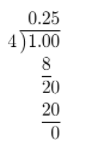
Write the fraction as a division problem and affix zeroes on the dividend if necessary.
Texas Go Math Grade 6 Module 18 Answer Key 4
0.25 × 100 = 25% multiply the decimal by 100 to make it in percent

Question 2.
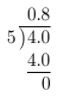
\(\frac{4}{5}\) ___________
Answer:
Write the fraction as a division problem and affix zeroes on the dividend if necessary.
Texas Go Math Grade 6 Module 18 Answer Key 5
0.8 × 100 = 80% multiply the decimal by 100 to make it in percent.

Texas Go Math Grade 6 Module 18 Review Answer Key Question 3.
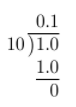
\(\frac{1}{10}\) ___________
Answer:
Write the fraction as a division problem and affix zeroes on the dividend if necessary.
Texas Go Math Grade 6 Module 18 Answer Key 6
0.1 × 100 = 10% multiply the decimal by 100 to make it in percent.

Question 4.
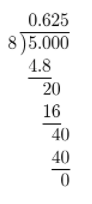
\(\frac{5}{8}\) ___________
Answer:
Write the fraction as a division problem and affix zeroes on the dividend if necessary.
Texas Go Math Grade 6 Module 18 Answer Key 7
0.625 × 100 = 62.5% multiply the decimal by 100 to make it in percent.

Find the sum.

Question 5.
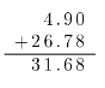
4.9 + 26.78
Answer:
Determine the sum of the decimal numbers. Align the decimal points and affix zeros if necessary.
Texas Go Math Grade 6 Module 18 Answer Key 8
The sum is 31.68.

Question 6.
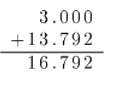
3 + 13.792
Answer:
Determine the sum of the decimal numbers. Align the decimal points and affix zeros if necessary.
Texas Go Math Grade 6 Module 18 Answer Key 9
The sum is 16.792.

Question 7.
65.8 + 88.39
Answer:
Determine the sum of the decimal numbers. Align the decimal points and affix zeros if necessary.
Texas Go Math Grade 6 Module 18 Answer Key 10
The sum is 154.19.

Question 8.
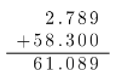
2.789 + 58.3
Answer:
Determine the sum of the decimal numbers. Align the decimal points and affix zeros if necessary.
Texas Go Math Grade 6 Module 18 Answer Key 11
The sum is 61.089.

Find the percent.

Question 9.
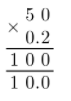
20% of 50 __________
Answer:
Determine the percent of a number. First write the percent as a decimal number then multiply.
20% = 0.20
Texas Go Math Grade 6 Module 18 Answer Key 12
The answer is 10.

Module 18 Answer Key Texas Go Math Grade 6 Question 10.
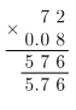
8% of 72 __________
Answer:
Determine the percent of a number. First, write the percent as a decimal number then multiply.
8% = 0.08
Texas Go Math Grade 6 Module 18 Answer Key 13
The answer is 5.76.

Question 11.
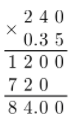
35% of 240 ___________
Answer:
Determine the percent of a number. First write the percent as a decimal number then multiply.
35% = 0.35
Texas Go Math Grade 6 Module 18 Answer Key 14
The answer is 84.

Question 12.
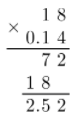
14% of 18 __________
Answer:
Determine the percent of a number. First write the percent as a decimal number then multiply.
14% = 0.14
Texas Go Math Grade 6 Module 18 Answer Key 15
The answer is 2.52.

Question 13.
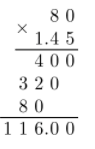
145% of 80 ________
Answer:
Determine the percent of a number. First write the percent as a decimal number then multiply.
145% = 1.45
Texas Go Math Grade 6 Module 18 Answer Key 16
The answer is 116.

Question 14.
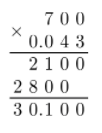
4.3% of 700 __________
Answer:
Determine the percent of a number. First write the percent as a decimal number then multiply.
4.3% = 0.043
Texas Go Math Grade 6 Module 18 Answer Key 17
The answer is 30.10.

Texas Go Math Grade 6 Module 18 Reading Start-Up Answer Key

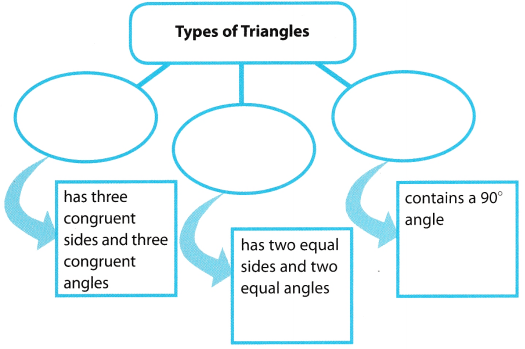
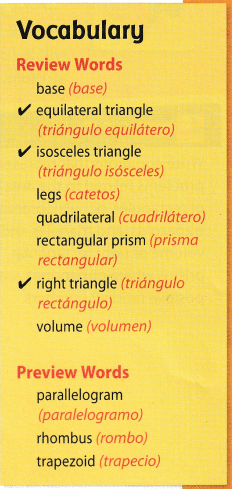
Visualize Vocabulary

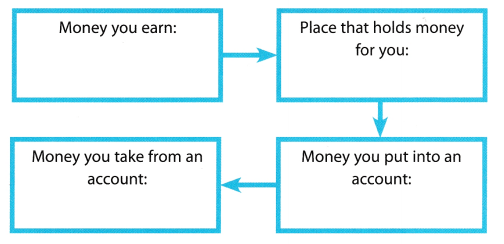
Use the ✓ words to complete the graphic.
Texas Go Math Grade 6 Module 18 Answer Key 1
Texas Go Math Grade 6 Module 18 Answer Key 2
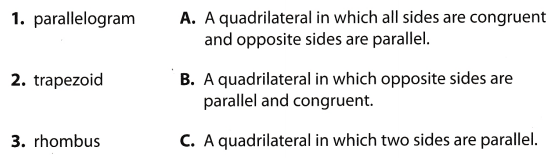
Understand Vocabulary

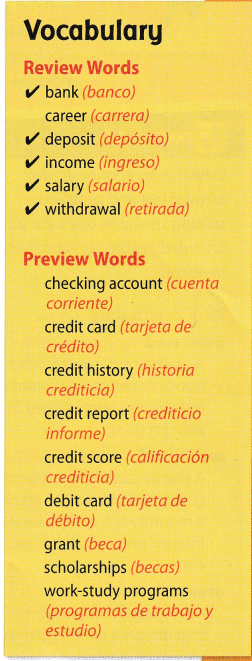
Complete the sentences using the preview words.

Question 1.
When you use a ___________, the money you spend is deducted immediately from your checking or savings account.
When you use a ___________, you pay for your purchases later.
Answer:
The missing information that will complete the sentences are debit cards and credit cards.

Texas Go Math Grade 6 Becoming Knowledgeable Consumer and Investor Module 18 Question 2.
A ____________ includes information about how well you manage money.
Answer:
The missing information that will complete the sentences is a credit report.

Question 3.
Banks use your ____________________ to decide whether to give you a loan or credit card.
Answer:
The missing information that will complete the sentences is credit history.

Active Reading
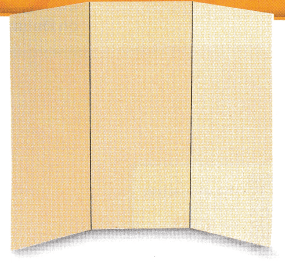
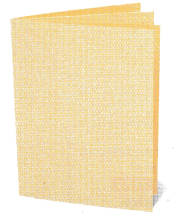
Tri-Fold Before beginning the module, create a tri-fold to help you learn the concepts and vocabulary in this module. Fold the paper into three sections. Label the columns “What I Know,” “What I Need to Know,” and “What I Learned.” Complete the first two columns before you read. After studying the chapter, complete the third column.
Texas Go Math Grade 6 Module 18 Answer Key 3

Texas Go Math Grade 6 Module 18 Answer Key Becoming a Knowledgeable Consumer and Investor Read More »

Texas Go Math Grade 6 Unit 6 Study Guide Review Answer Key

Refer to our Texas Go Math Grade 6 Answer Key Pdf to score good marks in the exams. Test yourself by practicing the problems from Texas Go Math Grade 6 Unit 6 Study Guide Review Answer Key.

Texas Go Math Grade 6 Unit 6 Study Guide Review Answer Key

Essential Question
How can you solve real-world problems by displaying, analyzing, and summarizing data?

Exercises

Question 1.
Find the mean and median of the data set: 4, 6, 2, 8, 14, 2. ________
Answer:
Determine the mean and median of the data.
mean = \(\frac{2+2+4+6+8+14}{6}\) get the sum of all, the values then divide by 6
= \(\frac{36}{6}\) simplify
= 6 mean of the data
median = \(\frac{4+6}{2}\) add the 4th and 5th vaLue then divide by 2
= \(\frac{10}{2}\) simplify
= 5 median of the data

The mean of the data is 6 while the median is 5.

Grade 6 Mathematics Unit 6 Answer Key Question 2.
The number of goals for the 13 players on a soccer team are 4, 9, 0, 1, 1, 2, 0, 0, 2, 8, 8, 3, 1. Find the median, lower quartile, and upper quartile. Then make a box plot for the data. (Lesson 17.2) _____
Texas Go Math Grade 6 Unit 6 Study Guide Review Answer Key 1
Answer:
Determine the median, lower quartile, and upper quartile.
0, 0, 0, 1, 1, 1, 2, 2, 3, 4, 8, 8, 9

  • The median of the data is the 7th value which is 2.
  • The lower quartile is the average of 4th and 5th value which is 0.5
  • The upper quartile is the average of 10th and 11th value which is 6.

Box plot of the data
Texas Go Math Grade 6 Unit 6 Study Guide Review Answer Key 13
The mean of data is 2, the lower quartile is 0.5, and upper quartile is 6.

Question 3.
Use the dot plot to find the mean, median, and range of the data. (Lesson 1 7.3)
mean ___ median ________ range ____
Texas Go Math Grade 6 Unit 6 Study Guide Review Answer Key 2
Answer:
Determine the mean, median, and range.
mean = \(\frac{1(17)+2(18)+3(20)+2(22)+1(23)}{9}\) get the sum of all the values then divide by 9
= \(\frac{180}{9}\) simplify
= 20 mean of the data
median = 17, 18, 18, 20, 20, 20, 22, 22, 23 middle value of the data set
= 20 median of the data
range = 23 – 17 subtract the least value from the greatest value
= 6 range of the data
Mean = 20
Median = 20
Range = 6

Algebra Unit 6 Test Answer Key Pdf 6th Grade Question 4.
The coach recorded the time it took 14 students to run a mile. The times are as follows: 9:23, 8:15, 9:23, 9:01,6:45,6:55,7:20, 9:14,6:21, 7:12, 7:34, 6:10,9:15,9:18. (Lesson 17.4)
Use the data to complete the frequency table. Then use the table to make a histogram.
Texas Go Math Grade 6 Unit 6 Study Guide Review Answer Key 3
Texas Go Math Grade 6 Unit 6 Study Guide Review Answer Key 4
Answer:
Texas Go Math Grade 6 Unit 6 Study Guide Review Answer Key 14
Histogram of the data
Texas Go Math Grade 6 Unit 6 Study Guide Review Answer Key 15
Frequency table and histogram of the recorded time.

Question 5.
The 16 students in Mr. Wu’s algebra class took a survey on their favorite color. The results are shown in the frequency table. (Lesson 17.5)
Make a relative frequency table of the data that shows each data item as a fraction of the total and as a percent.
Texas Go Math Grade 6 Unit 6 Study Guide Review Answer Key 5
Texas Go Math Grade 6 Unit 6 Study Guide Review Answer Key 6
Answer:
Texas Go Math Grade 6 Unit 6 Study Guide Review Answer Key 16
Relative frequency of the indicated data as shown on the table

Texas Go Math Grade 6 Unit 6 Performance Tasks Answer Key

Question 1.
CAREERS IN MATH Getici Kinesha collects data about the eye colors of the students in her science class.

a. Which measure or measures of center are appropriate for this data? Explain your answer.
Answer:
The measure of center that is appropriate for the given data is mode. As the mode is used to describe the categorical data as to which category occurs most often.
mode

b. Which measure or measures of variation are appropriate for this data? Explain your answer.
Answer:
There is no appropriate measure of variation that can be used for the given data. In a categorical data, we can only identify the relative frequency of the data using the given frequency for each category.
none

Texas Go Math Grade 6 Unit 6 Mixed Review Texas Test Prep Answer Key

Selected Response

Question 1.
Over 6 days, Jim jogged 6.5 miles, 5 miles, 3 miles, 2 miles, 3.5 miles, and 4 miles. What is the mean distance that Jim jogged each day?
(A) 3.75 miles
(B) 4 miles
(C) 4.5 miles
(D) 6.5 miles
Answer:
(B) 4 miles

Explanation:
Determine the mean of the data
mean = \(\frac{6.5+5+3+2+3.5+4}{6}\) get the sum of the values and divide it by 6
= \(\frac{24}{6}\) simplify
= 4 mean of the data

The mean of the data is B. 4 miles.

6th Grade Unit 6 Test Study Guide Answer Key Question 2.
What is the range of the data represented by the stem-and-leaf plot shown below?
Texas Go Math Grade 6 Unit 6 Study Guide Review Answer Key 7
Key: \(\frac{3}{5}\) means 35
(A) 27
(B) 30
(C) 33
(D) 36
Answer:
(D) 36

Explanation:
Determine the range of the data.
range = 69 – 33 subtract the least value from the greatest value
= 36 range of the data

The range of the data is D. 36.

Question 3.
The percent bar graph below shows the day of the week on which students have their weekly spelling quiz. On which day do most students have their weekly spelling quiz?
Texas Go Math Grade 6 Unit 6 Study Guide Review Answer Key 8
(A) 20%
(B) 35%
(C) Tuesday
(D) Monday
Answer:
(D) Monday

Explanation:
The data with the greatest relative frequency based from the graph is Monday. It indicates that most students have spelling quiz on Mondays
D. Monday

Question 4.
The ages of the volunteers at a local food bank are shown below.
34, 25, 24, 50, 18, 46, 43, 36,32
What is the median of this set of data?
(A) 32
(B) 33.1
(C) 34
(D) 50
Answer:
(C) 34

Explanation:
Determine the median.
18, 24, 25, 32, 34, 36, 43, 46, 50
The median is the 5th value of the data which is 34.

Median is C. 34.

Question 5.
The dot plot shows the number of participants in each age group in a science fair.
Texas Go Math Grade 6 Unit 6 Study Guide Review Answer Key 9
Which of the following is not supported by the dot plot?
(A) The range is 6.
(B) The mean of the ages is about 14.4.
(C) The mode of the ages is 13.
(D) The median of the ages is 15.
Answer:
(C) The mode of the age is 13.

Explanation:
Mode is not supported by the dot plot because there are no dots above the value of 13.

6th Grade Go Math Study Guide Unit 6 Question 6.
Which expression shows the prime factorization of 120?
(A) 23 × 3 × 5
(B) 2 × 3 × 5
(C) 1012
(D) 2 × 5 × 12
Answer:
(A) 23 × 3 × 5

Explanation:
Texas Go Math Grade 6 Unit 6 Study Guide Review Answer Key 17
The prime factorization of the indicated number is A. 23 × 3 × 5.

Question 7.
The two longer sides of a triangle measure 22 units and 29 units. Which of the following is a possible length of the shortest side?
(A) 4
(B) 14
(C) 24
(D) 34
Answer:
(B) 14

Explanation:
a.
22 + 29 > 4 add the two sides and compare to the third side
51 > 4 the sum of the two sides is greater than the third side
22 + 4> 29 add the two sides and compare to the third side
26 ≯ 29 the sum of the two sides is NOT greater than the third side
29 + 4> 22 add the two sides and compare to the third side
33 > 22 the sum of the two sides is greater than the third side

b.
22 + 29> 14 add the two sides and compare to the third side
51 > 14 the sum of the two sides is greater than the third side
22 + 14 > 29 add the two sides and compare to the third side
36 > 29 the sum of the two sides is greater than the third side
29 + 14 > 22 add the two sides and compare to the third side
43 > 22 the sum of the two sides is greater than the third side

c.
22 + 29> 24 add the two sides and compare to the third side
51 > 24 the sum of the two sides is greater than the third side
22 + 24 > 29 add the two sides and compare to the third side
46 > 29 the sum of the two sides is NOT greater than the third side
29 + 24 > 22 add the two sides and compare to the third side
53 > 22 the sum of the two sides is greater than the third side

d.
22 + 29 > 34 add the two sides and compare to the third side
51 > 34 the sum of the two sides is greater than the third side
22 + 34 > 29 add the two sides and compare to the third side
56 > 29 the sum of the two sides is greater than the third side
29 + 34 > 22 add the two sides and compare to the third side
63 > 22 the sum of the two sides is greater than the third side

The possible shortest side of the triangle is B. 14.

Question 8.
On a map of the city, 1 centimeter represents 2.5 miles. What distance on the map would represent 20 miles?
(A) 6 centimeters
(B) 8 centimeters
(C) 12 centimeters
(D) 18 centimeters
Answer:
(B) 8 centimeters

Explanation:
2.5x = 20 determine the number of centimeters that will represent 20 miles
\(\frac{2.5 x}{2.5}\) = \(\frac{20}{2.5}\) divide both sides of the equation by 2.5
x = 8 centimeters simplify
8 centimeters

6th Grade Go Math Unit 6 Answer Key Question 9.
Which expression is equal to 0?
(A) \(\frac{-56}{7}\) – 8
(B) \(\frac{-56}{-7}\) + 8
(C) \(\frac{56}{7}\) + 8
(D) \(\frac{-56}{-7}\) – 8
Answer:
(D) \(\frac{-56}{-7}\) – 8

Explanation:
a.
= 8 – 8 divide the numerator by the denominator
= – 16 add and copy the same sign
b.
= 8 + 8 divide the numerator by the denominator
= 16 add
c.
= 8 + 8 divide the numerator by the denominator
= 16 add
d.
= 8 – 8 divide the numerator by the denominator
= 0 0

The expression which is equal to 0 is D

Gridded Response

Question 10.
What is the median of the data represented by the dot plot?
Texas Go Math Grade 6 Unit 6 Study Guide Review Answer Key 10
Answer:
Median is the middle value of the data set The middle value of the indicated dot plot is on the 9th and 10th data. Therefore, we need to get the average of those values.
\(\frac{30+40}{2}\) = \(\frac{70}{2}\) = 35
The median of the data is 35.

Question 11.
The heights (in inches) of 8 students are 50, 53, 52, 68, 54, 49, 55, and 51. What is the mean height if the outlier is removed from the data?
Texas Go Math Grade 6 Unit 6 Study Guide Review Answer Key 11
Answer:
Determine the mean height without the outlier
mean = \(\frac{49+50+51+52+53+54+55}{7}\) get the sum of all the values then divide it by 7
= \(\frac{364}{7}\) simplify
= 52 mean of the data

The mean of the data is 52.

Hot Tip!
Read a graph or diagram as closely as you read the actual test question. These visual aids contain important information.

Unit 6 End of Unit Assessment Answer Key Grade 6 Question 12.
What is the interquartile range of the data represented by the box plot shown below?
Texas Go Math Grade 6 Unit 6 Study Guide Review Answer Key 12
Answer:
IQR = 25 – 10 subtract the lower quartile from the upper quartile
= 15 interquartile range of the data
The interquartile range is 15

Vocabulary Preview

Use the puzzle to preview key vocabulary from this unit. Unscramble the circled letters to answer the riddle at the bottom of the page.

Question 1.
OBXLOTP Texas Go Math Grade 6 Unit 6 Study Guide Review Answer Key 18
Answer:

Question 2.
TODTOLP Texas Go Math Grade 6 Unit 6 Study Guide Review Answer Key 19
Answer:

Question 3.
HOSTIARMG Texas Go Math Grade 6 Unit 6 Study Guide Review Answer Key 20
Answer:

Question 4.
NIADEM Texas Go Math Grade 6 Unit 6 Study Guide Review Answer Key 21
Answer:

6th Grade Math Study Guide Pdf Unit 6 Test Review Question 5.
Texas Go Math Grade 6 Unit 6 Study Guide Review Answer Key 22
Answer:

Question 6.
Texas Go Math Grade 6 Unit 6 Study Guide Review Answer Key 23
Answer:

1. A display that shows how the values in a data set are distributed. (Lesson 17-2)
2. A display in which each piece of data is represented by a dot above the number line. (Lesson 17-3)
3. A type of bar graph whose bars represent frequencies of numerical data within intervals. (Lesson 17-4)
4. The middle value of an ordered data set. (Lesson 17-1)
5. The median of the upper half of the data in a box plot. (Lesson 17-2)
6. The ratio of the frequency and the total amount of data. (Lesson 17-5)

Q: What is a math teacher’s favorite dessert?
A: ___ __ __ __ ___ __ __ ___
__ ___ ___ ___ __ ___ ___!

Texas Go Math Grade 6 Unit 6 Study Guide Review Answer Key Read More »

Texas Go Math Grade 6 Lesson 17.1 Answer Key Measures of Center

Refer to our Texas Go Math Grade 6 Answer Key Pdf to score good marks in the exams. Test yourself by practicing the problems from Texas Go Math Grade 6 Lesson 17.1 Answer Key Measures of Center.

Texas Go Math Grade 6 Lesson 17.1 Answer Key Measures of Center

Essential Question
How can you use measures of center to describe a data set?

Texas Go Math Grade 6 Lesson 17.1 Explore Activity Answer Key

Explore Activity 1

Finding the Mean
A measure of center is a single number used to describe a set of numeric data. A measure of center describes a typical value from the data set.

One measure of center is the mean. The mean, or average, of a data set is the sum of the data values divided by the number of data values in the set.

Tami surveyed five of her friends to find out how many brothers and sisters they have. Her results are shown in the table.

Texas Go Math Grade 6 Lesson 17.1 Answer Key 1

A. Model each person’s response as a group of counters.
Texas Go Math Grade 6 Lesson 17.1 Answer Key 2
B. Now rearrange the counters so that each group has the same number of counters.
Texas Go Math Grade 6 Lesson 17.1 Answer Key 3
Each group now has ________ counter(s). This value is the mean. This model demonstrates how the mean “evens out” the data values.
C. Use numbers to calculate the mean.
The sum of the data values is Texas Go Math Grade 6 Lesson 17.1 Answer Key 4
How many data values are in the set? ________

Texas Go Math Grade 6 Lesson 17.1 Answer Key 5

Math Talk
Mathematical Processes
Suppose you have a data set in which all of the values are 2. What is the mean?

Reflect

Texas Go Math Grade 6 Measures of Center Answer Key Lesson 17.1 Question 1.
Can the mean be greater than the greatest value in a data set? Why or why not?
Answer:
No, because the group with the greatest amount will share its counters to ‘even out’ the data

Reflect

Question 2.
What If? Which units are used for the data in A ? if the coach had recorded some distances in kilometers and some in miles, can you still find the median of the data? Explain.
Answer:
The unit used for recording the distance is miles.
If the coach had recorded some distances in kilometers and some in miles, then the median could not be evaluated because the unit of the data set must be same.

Your Turn

Question 3.
Charlotte recorded the number of minutes she spent exercising in the past ten days: 12, 4, 5, 6, 8, 7, 9, 8, 2, 1. Find the median of the data.
Answer:
Data set:
12, 4, 5, 6, 8, 7, 9, 8, 2, 1

Arrarge the data set in ascending order:
= 1, 2, 4, 5, 6, 7, 8, 8, 9, 12
Determine the average/mean of the middle values of the data set arranged in ascending order, therefore:
Median = \(\frac{6+7}{2}\) = 6.5

Median = 6.5 minutes

Explore Activity 2
Comparing the Mean and the Median
The mean and median of a data set may be equal, very close to each other, or very different from each other. For data sets where the mean and median differ greatly, one likely describes the data set better than the other.

The monthly earnings of several teenagers are $200, $320, $275, $250, $750, $350, and $310.
Texas Go Math Grade 6 Lesson 17.1 Answer Key 6
A. Find the mean.
Texas Go Math Grade 6 Lesson 17.1 Answer Key 7
B. Write the data values in order from least to greatest and find the median.
C. The mean and the median differ by about $__. why?
D. Which measure of center better describes the typical monthly earnings for this group of teenagers—the mean or the median? Explain.

Reflect

Go Math Lesson 17.1 Measures of Center Answer Key Grade 6 Question 4.
Communicate Mathematical Ideas Luka’s final exam scores for this semester are 70, 72, 99, 72, and 69. Find the mean and median. Which is a better description of Luka’s typical exam score? Explain your thinking.
Answer:
70, 72, 99, 72, 69

Arrange the data set in ascending order:
= 69, 70, 72, 72, 99
Determine the middle value of the data set arranged in ascending order, therefore:
Median = 72

Evaluate the mean of the data set:
Median = \(\frac{69+70+72+72+99}{5}\) = 76.4

Median is a better representation of the data set because 4 out of his 5 scores are around the 69 to 72 range.

Texas Go Math Grade 6 Lesson 17.1 Guided Practice Answer Key

Question 1.
Spencer surveyed five of his friends to find out how many pets they have. His results are shown in the table. What is the mean number of pets? (Explore Activity 1)
Texas Go Math Grade 6 Lesson 17.1 Answer Key 8
Texas Go Math Grade 6 Lesson 17.1 Answer Key 9
The mean number of pets is ___
Answer:
Evaluate mean of the given data:
Mean = \(\frac{3+5+2+4+1}{5}\) = 3

The mean number of pets is 3.

Question 2.
The following are the weights, in pounds, of some dogs at a kennel: 36,45, 29, 39, 51,49. (Example 1)
a. Find the median. ____
Answer:
Data set:
36, 45, 29, 39, 51, 49

Arrange the data set in ascending order:
= 29, 36, 39, 45, 49, 51
Determine the mean of the 2 middle values of the data set arranged in ascending order, therefore:
Median = \(\frac{39+45}{2}\) = 42
Median weight is 42 pounds.

b. Suppose one of the weights were given in kilograms. Can you still find the median? Explain.
Answer:
The unit of the data set must be same. If 1 value was in kilograms, then it should be converted to an equivalent weight in pounds before the evaluation of the mean. The mean in this case can not directly be calculated.

Question 3.
a. Find the mean and the median of this data set: 9, 6, 5, 3, 28, 6, 4, 7. (Explore Activity 2)
Answer:
Ascending order of the data: 3, 4, 5, 6, 6, 7, 9, 28.
Texas Go Math Grade 6 Lesson 17.1 Answer Key 13

The mean is 8.5 whiLe the median is 6.

b. Which better describes the data set, the mean or the median? Explain.
Answer:
Median describes the data set better because the values are much nearer to the value of the median than the mean.
Median

Essential Question Check-In

Measure of Center Answer Key Go Math 6th Grade Lesson 17.1 Question 4.
How can you use measures of center to describe a data set?
Answer:
Measures of the center is used to describe the trend in a certain data set. The 2 types of measures are mean and median. The median is usually a better representation of a data set because the mean is affected by extreme values.

Texas Go Math Grade 6 Lesson 17.1 Independent Practice Answer Key

Several students in Ashton’s class were randomly selected and asked how many text messages they sent yesterday. Their answers were 1, 0, 10, 7, 13, 2, 9, 15, 0, 3.

Question 5.
How many students were asked? How do you know?
Answer:
The number of responses are 10. This implies that 10 students were asked.

10 students were asked.

Question 6.
Find the mean and the median for these data. Mean = ____ Median = ____
Answer:
Data set:
1, 0, 10, 7, 13, 2, 9, 15, 0, 3

Arrange the data set in ascending order:
= 0, 0, 1, 2, 3, 7, 9, 10, 13, 15
Determine the mean of the 2 middle values of the data set arranged in ascending order, therefore:
Median = \(\frac{3+7}{2}\) = 5
Median number of texts is 5.
Evaluate mean of the data:
Mean = \(\frac{0+0+1+2+3+7+9+10+13+15}{10}\)
Evaluate:
Mean = 6
Mean number of texts is 6
Median = 5
Mean = 6

The points scored by a basketball team in its last 6 games are shown. Use these data for 7 and 8.

Texas Go Math Grade 6 Lesson 17.1 Answer Key 10

Question 7.
Find the mean score and the median score.
Mean = ___ Median = ___
Answer:
Data set:
73, 77, 85, 84, 37, 115

Arrange the data set in ascending order:
= 37, 73, 77, 84, 85, 115
Determine the mean of the 2 middle values of the data set arranged in ascending order, therefore:
Median = \(\frac{77+84}{2}\) = 80.5
Evaluate mean of the data:
Mean = \(\frac{73+77+85+84+37+115}{6}\)
Evaluate:
Mean = 78.5

6th Grade Math Homework Answer Key Lesson 17.1 Question 8.
Which measure better describes the typical number of points scored? Explain.
Answer:
Median = 80.5 is a better representation of the points scored as this is closest to most of the numbers in the data set because the extreme values of 37 and 115 have affected the central tendency of the data set.
Median.

Some people were asked how long it takes them to commute to work. Use the data for 9-11.

Question 9.
What units are used for the data? What should you do before finding the mean and median number of minutes?
Texas Go Math Grade 6 Lesson 17.1 Answer Key 11
Answer:
2 different units are used here. Therefore, convert the times given in hours to minutes for the evaluation of mean and median, so 0.5 hours = 0.5 × 60 = 30 minutes and 1 hour = 60 minutes.

Question 10.
Find the mean and median number of minutes.
Mean = ___ Median = ____
Answer:
Data set:
16, 7, 14, 30, 5, 8, 12, 60

Arrange the data set in ascending order:
= 5, 7, 8, 12, 14, 16, 30, 60
Determine the mean of the 2 middle values of the data set arranged in ascending order, therefore:
Median = \(\frac{12+14}{2}\) = 13
Evaluate mean of the data:
Mean = \(\frac{16+7+14+30+5+8+12+60}{8}\)
Evaluate
Mean = 19

Question 11.
Which measure do you think is more typical of the data?
Answer:
It can be seen that most members of the data set are less than or equal to 16, therefore, 13 = median is a more typical measure of the data set. It can also be seen that mean here is affected by the commutes of 30 and 60 minutes, increasing it to 19 minutes, which in this scenario, does not make sense.

Median.

Texas Go Math Grade 6 Lesson 17.1 H.O.T. Focus On Higher Order Thinking Answer Key

Question 12.
Critique Reasoning For two weeks, the school librarian recorded the number of library books returned each morning. The data are shown in the dot plot. The librarian found the mean number of books returned each morning.
Texas Go Math Grade 6 Lesson 17.1 Answer Key 12
\(\frac{8+6+10+5+9+8+3+6}{8}\) = \(\frac{55}{8}\) = 6.9
Is this the correct mean of this data set? If not, explain and correct the answer.
Answer:
The number of entries recorded is 10 so the divisor during mean calculation should also be 10. This is the error made here. The correct mean in this context is \(\frac{55}{10}\) = 5.5

Go Math Grade 6 Answer Key Lesson 17.1 Question 13.
Critical Thinking Lauren’s scores on her math tests are 93, 91, 98, 100, 95, 92, and 96. What score could Lauren get on her next math test so that the mean and median remain the same? Explain your answer.
Answer:
Data set:
93, 91, 98, 100, 95, 92, 96

Arrange the data set in ascending order:
= 91, 92, 93, 95, 96, 98, 100
Determine the middle value of the data set arranged in ascending order, therefore:
Median = 95
The next test will be the 8th test so let her score in this test be x, then the equation of mean here becomes:
Texas Go Math Grade 6 Lesson 17.1 Answer Key 14
Solve for x:
x + 665 = 8(95)
Evaluate:
x = 760 – 665 = 95

She must score 95 on her 8th test

Question 14.
Persevere in Problem-Solving Yuko wants to take a job selling cars. Since she will get a commission for every car she sells, she finds out the sale price of the last four cars sold at each company.
Company A: $16,000; $20,000; $25,000; $35,000;
Company B: $21,000, $23,000, $36,000, $48,000
a. Find the mean selling price at each company.
Answer:
Evaluate the mean of the data for A:
Texas Go Math Grade 6 Lesson 17.1 Answer Key 15

b. Find the median selling price at each company.
Answer:
Determine the mean of the 2 middle values of the data set arranged in ascending order, therefore:
MedianA = \(\frac{20000+25000}{2}\) = 22500
Determine the mean of the 2 middle values of the data set arranged in ascending order, therefore:
MedianB = \(\frac{23000+36000}{2}\) = 29500

c. Communicate Mathematical Ideas At either company, Yuko will get paid a commission of 20% of the sale price of each car she sells. Based on the data, where do you recommend she take a job? Why?
Answer:
She should work in company B because both the median and mean price of cars sold there are more than that of A. The more the amount of cars sold, the greater is the commission.

Texas Go Math Grade 6 Lesson 17.1 Answer Key Measures of Center Read More »

Texas Go Math Grade 6 Module 17 Quiz Answer Key

Refer to our Texas Go Math Grade 6 Answer Key Pdf to score good marks in the exams. Test yourself by practicing the problems from Texas Go Math Grade 6 Module 17 Quiz Answer Key.

Texas Go Math Grade 6 Module 17 Quiz Answer Key

Texas Go Math Grade 6 Module 17 Ready to Go On? Answer Key

17.1 Measures of Center

Question 1.
Find the mean and median of the data set. ____.
Texas Go Math Grade 6 Module 17 Quiz Answer Key 1
Answer:
Determine the mean and median.
Texas Go Math Grade 6 Module 17 Quiz Answer Key 11
Mean = 10.5
Median = 10

17.2 Box Plots

Go Math Answer Key Grade 6 Module 17 Question 2.
Make a box plot for the data set.
Texas Go Math Grade 6 Module 17 Quiz Answer Key 2
Answer:
Box plot of the given data
Texas Go Math Grade 6 Module 17 Quiz Answer Key 12
Using the given data, identify the least value, first quartile, median, third quartile, and the greatest value to create a box plot of the data.

17.3 Dot Plots and Data Distribution

A baseball team scored the following number of runs over a 10-game period:
6, 6, 8, 5, 4, 6, 4, 3, 8, 4.

Question 3.
Make a dot plot for the data.
Texas Go Math Grade 6 Module 17 Quiz Answer Key 3
Answer:
Dot plot of the given data
Texas Go Math Grade 6 Module 17 Quiz Answer Key 13
Use the frequency of the data to create a dot plot graph.

Question 4.
Find the mean, median, and range.
Answer:
Determine the mean, median, and range.
Texas Go Math Grade 6 Module 17 Quiz Answer Key 14
Mean = 5.4
Median = 5.5
Range = 3

17.4 Stem-and-Leaf Plots and Histograms

Texas Go Math Grade 6 Pdf Module 17 Quiz Answer Key Question 5.
Make a histogram for the data set.
Texas Go Math Grade 6 Module 17 Quiz Answer Key 4
Texas Go Math Grade 6 Module 17 Quiz Answer Key 5
Answer:
Histogram of the given data
Texas Go Math Grade 6 Module 17 Quiz Answer Key 15
Using the frequency of the data and intervals to create the histogram.

17.5 Categorical Data

Question 6.
On one day, a pet store sells 2 birds, 6 gerbils, 4 puppies, 3 fish, and 3 hamsters. Identify the mode of the data and find its relative frequency expressed as a percent.
Answer:
Texas Go Math Grade 6 Module 17 Quiz Answer Key 16
Graph of the data
Texas Go Math Grade 6 Module 17 Quiz Answer Key 17
Based from the data set and graph, it shows that the mode of the given data indicates that the most sold out pet is the gerbil.

Texas Go Math Grade 6 Module 17 Mixed Review Texas Test Prep Answer Key

Selected Response

Question 1.
Over 6 days, Dan jogged 7.5 miles, 6 miles, 3 miles, 3 miles, 5.5 miles, and 5 miles. What is the mean distance that Dan jogged each day?
(A) 3 miles
(B) 5 miles
(C) 5.25 miles
(D) 7.5 miles
Answer:
(B) 5 miles

Explanation:
Determine the mean of the data
mean = \(\frac{7.5+6+3+3+5.5+5}{6}\) add all the values then divide by 6
= \(\frac{30}{6}\) simplify
= 5 miles mean of the dat

The mean of the data is B. 5 miles.

Go Math 6th Grade Answer Key Module 17 Question 2.
What is the interquartile range of the data represented by the box plot shown below?
Texas Go Math Grade 6 Module 17 Quiz Answer Key 6
(A) 15
(B) 20
(C) 35
(D) 40
Answer:
(A) 15

Explanation:
The interquartile range is the difference between the first quartile and the third quartile.
IQR = 35 – 20 subtract the first quartile from the third quartile
= 15 value of the interquartile range

The interquartile range of the data is A. 15.

Question 3.
What is the median of the data represented by the dot plot ?
Texas Go Math Grade 6 Module 17 Quiz Answer Key 7
(A) 21
(B) 21.5
(C) 22
(D) 25
Answer:
(C) 22

Explanation:
First count the number of dots above the line, then get the middle value of the data. The middle dot is located at the 7th dot with a value of 22. Therefore, the median of the data is 22.

The median of the data is C. 22.

Question 4.
What is the range of the data represented by the stem-and-leaf plot shown below?
Texas Go Math Grade 6 Module 17 Quiz Answer Key 8
Key: 3|7 means 37
(A) 25
(B) 26
(C) 28
(D) 65
Answer:
(C) 28

Explanation:
Range is the difference between the least and greatest data value.
range = 65 – 37 subtract the least value from the greatest value
= 28 range of the data

The range of the data is C. 28.

The percent bar graph below shows what day of the week students have music class.

Texas Go Math Grade 6 Module 17 Quiz Answer Key 9

6th Grade Math Quiz with Answers Module 17 Question 5.
What is the mode of the data?
(A) 20%
(B) 35%
(C) Tuesday
(D) Wednesday
Answer:
(C) Tuesday

Explanation:
Mode indicates how frequent a value occurs or how often a value was chosen. In the given graph, the bar with the tallest height is Tuesday. It was the most frequent day of the week for students to have music class.

The mode of the data is C. Tuesday.

Question 6.
The graph displays data collected from 200 students. How many more students have music class on Tuesday than on Friday?
(A) 1o
(B) 20
(C) 50
(D) 70
Answer:
Determine the number of students for each day.
Texas Go Math Grade 6 Module 17 Quiz Answer Key 18
There are C. 50 more students on Tuesday than on Friday.

Gridded Response

Grade 6 Module 17 Answer Key Texas Go Math Question 7.
What is the solution of the equation 5x = 195.5?
Texas Go Math Grade 6 Module 17 Quiz Answer Key 10
Answer:
Determine the value of x.
\(\frac{5 x}{5}\) = \(\frac{195.5}{5}\) divide both sides of the equation by 5
x = 39.1 value of x

The solution to the equation is 39.1.

Texas Go Math Grade 6 Module 17 Quiz Answer Key Read More »

Texas Go Math Grade 6 Lesson 16.1 Answer Key Area of Quadrilaterals

Refer to our Texas Go Math Grade 6 Answer Key Pdf to score good marks in the exams. Test yourself by practicing the problems from Texas Go Math Grade 6 Lesson 16.1 Answer Key Area of Quadrilaterals.

Texas Go Math Grade 6 Lesson 16.1 Answer Key Area of Quadrilaterals

Texas Go Math Grade 6 Lesson 16.1 Explore Activity Answer Key

Area of a Parallelogram

Recall that a rectangle is a special type of parallelogram.
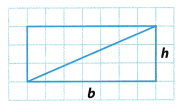
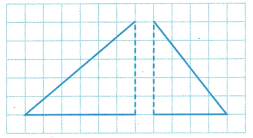
A. Draw a large parallelogram on grid paper. Cut out your parallelogram.
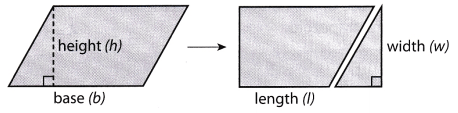
B. Cut your parallelogram on the dashed line as shown. Then move the triangular piece to the other side of the parallelogram.
Texas Go Math Grade 6 Lesson 16.1 Answer Key 1
C. What figure have you formed? ____________
Does this figure have the same area as the parallelogram? ____________
base of parallelogram = ____________ of rectangle
height of parallelogram = __________ of rectangle
area of parallelogram = __________ of rectangle
What is the formula for the area of this figure? A = ___________ or _________
D. What is the formula for the area of a parallelogram? A = ___________

Area of a Parallelogram
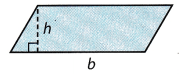
The area A of a parallelogram is the product of its base b and its height h.
Texas Go Math Grade 6 Lesson 16.1 Answer Key 2
A = bh

Reflect

Go Math Grade 6 Lesson 16.1 Independent Practice Answer Key Question 1.
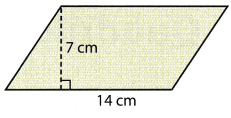
Find the area of the parallelogram.
Texas Go Math Grade 6 Lesson 16.1 Answer Key 3
A = ____________
Answer:
Data:
base = 14
height = 7
Write equation of area of a parallelogram:
Area = base × height
Substitute values:
Area = 14 × 7
Evaluate:
Area = 98
Area of the given parallelogram is 98 square centimeters.

Example 1

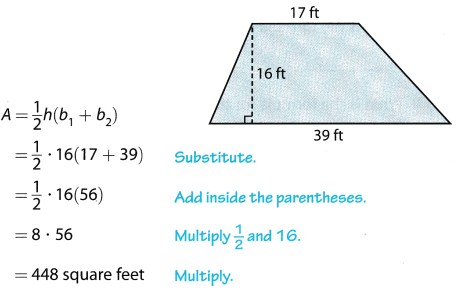
A section of a deck is in the shape of a trapezoid. What is the area of this section of the deck?
b1 = 17; b2 = 39; h = 16
Use the formula for area of a trapezoid.
Texas Go Math Grade 6 Lesson 16.1 Answer Key 4

Your Turn

Question 2.
Another section of the deck is also shaped like a trapezoid. For this section, the length of one base is 27 feet, and the length of the other base is 34 feet. The height is 12 feet. What is the area of this section of the deck? A = _________ft2
Answer:
Solution to this example is given below
b1 = 27; b2 = 34; h = 12
Use the formuLa for area of a trapezoid
A = \(\frac{1}{2}\)h(b1 + b2)
= \(\frac{1}{2}\) ∙ 12(274 – 34) (Substitute)
= \(\frac{1}{2}\) ∙ 12(61) (Add inside the parentheses)
= 6 ∙ 61 (Multiply \(\frac{1}{2}\) and 12.)
= 366 square feet (Multiply)
= 366 ft2

Example 2

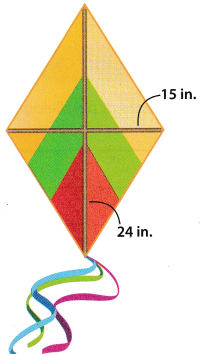
Cedric is constructing a kite in the shape of a rhombus. The spars of the kite measure 15 inches and 24 inches. How much fabric will Cedric need for the kite?
Texas Go Math Grade 6 Lesson 16.1 Answer Key 5
To determine the amount of fabric needed, find the area of the kite.
d1 = 15; d2 = 24
Use the formula for area of a rhombus.
A = \(\frac{1}{2}\)d1d2
= \(\frac{1}{2}\) (15) (24) Substitute.
= 80 square inches Multiply.

Your Turn

Find the area of each rhombus.

Go Math Grade 6 Answer Key Lesson 16.1 Answer Key Question 3.
d1 = 35 m; d2 = 12 m
A = _________ m2
Answer:
Find the area of a rhombus.
d1 = 35 m, and d2 = 12 m
Use the formula for the area of a rhombus.
A = \(\frac{1}{2}\) d1d2
= \(\frac{1}{2}\) (35) (12) (Substitute.)
= 210 square meters. (Multiply.)
The area is 210 square meters.
= 210 m2

Question 4.
d1 = 9.5 in.; d2 = 14 in.
A = ______ in2
Answer:
Data:
d1 = 9.5
d2 = 14
Write equation of area of a rhombus:
Area = \(\frac{1}{2}\) × d1 × d2
Substitute values:
Area = \(\frac{1}{2}\) × 9.5 × 14
Evaluate:
Area = 66.5
Area of the given rhombus is 66.5 square inches.

Question 5.
d1 = 10 m; d2 = 18 m
A = ______ m2
Answer:
Find the area of a rhombus.
d1 = 10 m, and d2 = 18 m
Use the formula for area of a rhombus.
A = \(\frac{1}{2}\) d1d2
= \(\frac{1}{2}\) (10) (18) Substitute.
= 90 square meters. Multiply.
The area is 90 square meters.
= 90 m2

Question 6.
d1 = 8\(\frac{1}{4}\) ft; d2 = 40 ft
A = ________ ft2
Answer:
\(8 \frac{1}{4}=\frac{8 \times 4+1}{4}\) = 334 = 8.25 Convert to decimal number
Find the area of a rhombus.
d1 = 8.25 ft, and d2 = 40 ft
Use the formula for area of a rhombus.
A = \(\frac{1}{2}\) d1d2
= \(\frac{1}{2}\) (8.25)(40) Substitute.
= 165 square feet. Multiply
The area is 165 square feet
= 165 ft2

Texas Go Math Grade 6 Lesson 16.1 Guided Practice Answer Key

Question 1.
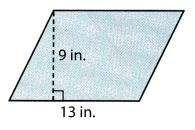
Find the area of the parallelogram. (Explore Activity)
Texas Go Math Grade 6 Lesson 16.1 Answer Key 6
A = bh
= (________) (________)
= _______ in2.
Answer:
Data:
b = 13
h = 9
Write equation of area of a parallelogram:
Area = b × h
Substitute values:
Area = 13 × 9
Evaluate:
Area = 117
Area of the given parallelogram is 117 square inches.

Go Math Answer Key Grade 6 Lesson 16.1 Area of Quadrilaterals Question 2.
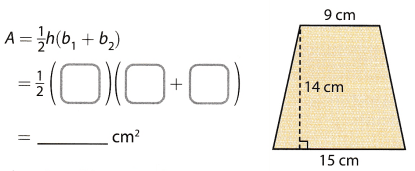
Find the area of the trapezoid. (Example 1)
Texas Go Math Grade 6 Lesson 16.1 Answer Key 7
Answer:
Solution to this example is given below
b1 = 9; b2 = 15; h = 14
Use the formula for area of a trapezoid
A = \(\frac{1}{2}\)h(b1 + b2)
= \(\frac{1}{2}\) ∙ 14 (9 + 15) Substitute
= \(\frac{1}{2}\) ∙ 14 (24) Add inside the parentheses
= 7 ∙ 24 Multiply \(\frac{1}{2}\) and 14
= 168 square centimeters Multiply
= 168 cm2

Question 3.
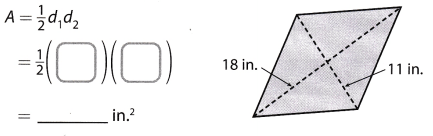
Find the area of the rhombus. (Example 2)
Texas Go Math Grade 6 Lesson 16.1 Answer Key 8
Answer:
Find the area of a rhombus.
d1 = 18 in, and d2 = 11 in
Use the formula for area of a rhombus.
A = \(\frac{1}{2}\) d1d2
= \(\frac{1}{2}\) (18) (11) Substitute.
= 99 square feet Multiply.
The area is 99 square inches.
= 99 in2

Essential Question Check-In

Question 4.
How can you find the areas of parallelograms, rhombuses, and trapezoids?
Answer:
Area of a parallelogram is the product of its base and its height Mathematically it is:
Area = base × height.

Area of a trapezoid is the product of the sum of its 2 bases and its height divided by 2. Mathematically it is:
Area = \(\frac{1}{2}\) × (b1 + b2) × h

Area of a rhombus is the product of its 2 diagonals divided by 2. Mathematically it 5: Area = \(\frac{1}{2}\) × d1 × d2. A rhombus is a kind of a parallelogram so its area can also be evaluated by taking the product of its base and height. The choice of the formula to be used depends on the data given.

Texas Go Math Grade 6 Lesson 16.1 Independent Practice Answer Key

Question 5.
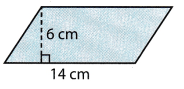
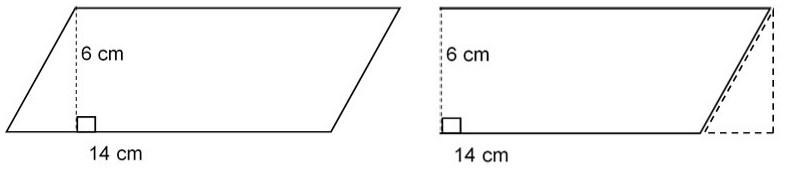
Rearrange the parts of the parallelogram to form a rectangle. Find the area of the parallelogram and the area of the rectangle. What is the relationship between the areas?
Texas Go Math Grade 6 Lesson 16.1 Answer Key 9
Answer:
Transforming the parallelogram to a rectangle.
Texas Go Math Grade 6 Lesson 16.1 Answer Key 13
Determine the area of the parallelogram and rectangle.
A = b × h formula for the area of a parallelogram
A = 14 × 6 substitute for the formula
A = 84 sq. cm. area of the parallelogram

A = 1 × W formula for the area of a rectangle
A = 14 × 6 substitute for the formula
A = 84 sq. cm. area of the rectangle
The area of the parallelogram is 84 sq. cm. while the area of the rectangle is 84 sq. cm which shows that the area of a parallelogram is equal to the area of the rectangle.

Go Math 6th Grade Lesson 16.1 Practice Answer Key Question 6.
What is the area of a parallelogram that has a base of 12\(\frac{3}{4}\) in. and a height of 2\(\frac{1}{2}\) in.?
Answer:
Data:
b = 12\(\frac{3}{4}\) = 12.75
h = 2\(\frac{1}{2}\) = 2.5
Write equation of area of a parallelogram:
Area = b × h
Substitute values:
Area = 12.75 × 2.5
Evaluate:
Area = 31.875
Area of the given parallelogram is 31.875 square inches.

Question 7.
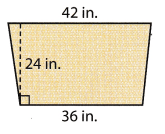
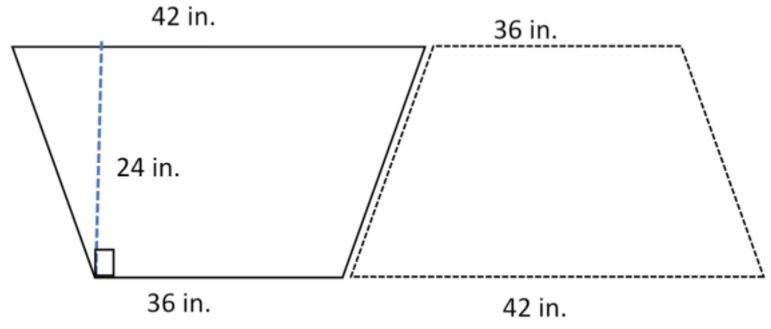
Draw a copy of the trapezoid to form a parallelogram. Find the area of the trapezoid and the area of the parallelogram. What is the relationship between the areas?
Texas Go Math Grade 6 Lesson 16.1 Answer Key 10
Answer:
Parallelogram made of trapezoid
Texas Go Math Grade 6 Lesson 16.1 Answer Key 14
Determine the area of the parallelogram and rectangle.
A = \(\frac{1}{2}\) × h (b1 + b2) formula for the area of a trapezoid
A = \(\frac{1}{2}\) × 24(42 + 36) substitute for the formula
A = 12 × 78 simplify
A = 936 sq. in. area of the trapezoid

b = 36 + 42 total base of the parallelogram
A = b × h formula for the area of a parallelogram
A = 78 × 24 substitute for the formula
A = 1,872 sq in. area of the parallelogram
The area of the trapezoid is 936 sq in. while the area of the parallelogram is 1,872 sq. which shows that the area of the trapezoid is half of the area of a parallelogram.

Texas Go Math Grade 6 Answer Key Area of Special Quadrilaterals Question 8.
The bases of a trapezoid are 11 meters and 14 meters. Its height is 10 meters. What is the area of the trapezoid?
Answer:
Data:
b1 = 11
b2 = 14
h = 10
Write equation of area of a trapezoid:
Area = \(\frac{1}{2}\) × (b1 + b2) × h
Substitute values:
Area = \(\frac{1}{2}\) × (11 + 14) × 10
Evaluate:
Area = 125
Area of the given trapezoid is 125 square meters.

Question 9.
The seat of a bench is in the shape of a trapezoid with bases of 6 feet and 5 feet and a height of 1.5 feet. What is the area of the seat?
Answer:
b1 = 6
b2 = 5
h = 1.5
Write equation of area of a trapezoid:
Area = \(\frac{1}{2}\) × (b1 + b2) × h
Substitute values:
Area = \(\frac{1}{2}\) × (6 + 5) × 1.5
Evaluate:
Area = 8.25
Area of the seat is 8.25 square feet.

Question 10.
A kite in the shape of a rhombus has diagonals that are 25 inches long and 15 inches long. What is the area of the kite?
Answer:
Find the area of a rhombus.
d1 = 25 in, and d2 = 15 in
Use the formula for area of a rhombus.
A = \(\frac{1}{2}\)d1d2
= \(\frac{1}{2}\) (25) (15) Substitute.
= 187.5 square inches. Multiply.
Area of the kite is 187.5 square inches.
= 187.5 in2

Question 11.
A window in the shape of a parallelogram has a base of 36 inches and a height of 45 inches. What is the area of the window?
Answer:
Find the area of the parallelogram.
base = 36 in, and height = 45 in
Use the formula for the area of a parallelogram. Substitute for base and height.
A = bh
= 36 × 45
= 1620
The area is 1620 square inches.
1620 in2

Go Math Grade 6 Answers Lesson 16.1 Question 12.
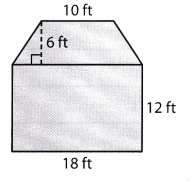
Communicate Mathematical Ideas Find the area of the figure. Explain how you found your answer.
Texas Go Math Grade 6 Lesson 16.1 Answer Key 11
Answer:
SoLution to this example is given below
b1 = 10; b2 = 18; h = 6
Use the formuLa for area of a trapezoid
A = \(\frac{1}{2}\)h(b1 + b2)
= \(\frac{1}{2}\) ∙ 6(10 + 18) Substitute
= \(\frac{1}{2}\) ∙ 6(28) Add inside the parentheses
= 3 ∙ 28 Multiply \(\frac{1}{2}\) and 6.
= 84 square feet Multiply
Find the area of the rectangle.
base 13 ft, and height = 9 ft
A = bh Use the formula for the area of a rectangle.
= 18 × 12 Substitute for base and height
= 216
The area is 216 square feet.
The total area is 84 ft2 + 216 ft2
= 300 ft2

Question 13.
Multistep A parking space shaped like a parallelogram has a base of 17 feet and a height is 9 feet. A car parked in the space is 16 feet long and 6 feet wide. How much of the parking space is not covered by the car?
Answer:
Data of the paralleLogram shaped parking space:
b = 17
h = 9
Data of the rectangle shaped car:
l = 16
w = 6
The area not covered by car is the difference of the area of the parallelogram shaped total area and that of the rectangular shaped car so write respective formulas:
Area = (b × h) – (l × w)
Substitute values:
Area = (17 × 9) – (16 × 6)
Simplify:
Area = 153 – 96
Evaluate:
Area = 57
57 square feet of the parking space is not covered by the car.

H.O.T. Focus on Higher Order Thinking

Question 14.
Critique Reasoning Simon says that to find the area of a trapezoid, you can multiply the height by the top base and the height by the bottom base. Then add the two products together and divide the sum by 2. Is Simon correct? Explain your answer.
Answer:
Write equation of area of a trapezoid:
Area = \(\frac{1}{2}\) × (b1 + b2) × h
Rewrite:
Area = \(\frac{1}{2}\) × (hb1 + hb2)
Or:
Area = \(\frac{\left(h b_{1}+h b_{2}\right)}{2}\)
The product hb1 is the product of the height by the top base and hb2 is the product of height by the bottom base. The plus sign shows their sum and this sum is divided by 2 to evaluate the final answer Therefore, it can be said that Simon is correct.

Question 15.
Multistep The height of a trapezoid is 8 in. and its area is 96 in2. One base of the trapezoid is 6 inches longer than the other base. What are the lengths of the bases? Explain how you found your answer.
Answer:
Data:
b1 = x
b2 = x + 6
h = 8
Area = 96
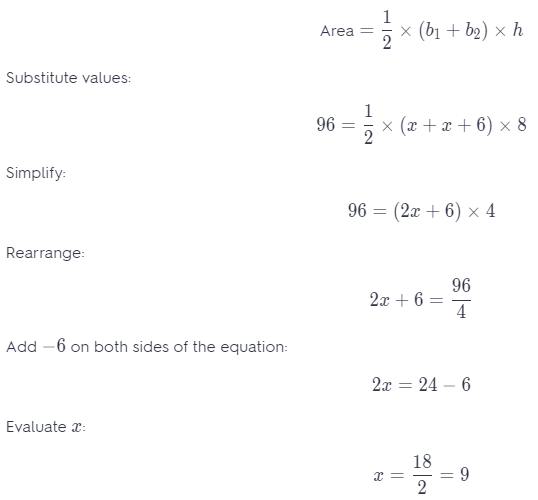
Write equation of area of a trapezoid:
Texas Go Math Grade 6 Lesson 16.1 Answer Key 15
The length of one of the base is 9 inches while the other is 9 + 6 = 15 inches long.

6th Grade Go Math Answer Key Area of Parallelogram Activity Question 16.
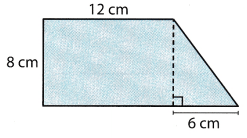
Critique Reasoning Find the area of the trapezoid using the formula A = \(\frac{1}{2}\)h(b1 + b2). Decompose the trapezoid into a rectangle and a triangle and find the area of each. Then find the sum of the two areas. Compare this sum with the area of the trapezoid.
Texas Go Math Grade 6 Lesson 16.1 Answer Key 12
Answer:
Determine the area of the trapezoid.
A = \(\frac{1}{2}\) × 8 (12 + 18) substitute for the area of a trapezoid
A = 4 × 30 simplify
A = 120 sq. cm. area of the trapezoid

Determine the area of the triangle
A = \(\frac{1}{2}\) × (6 ∙ 8) substitute for the area of a triangle
A = \(\frac{1}{2}\) × 48 simplify
A = 24 sq. cm. area of the triangle

A = l × w formula for the area of a rectangle
A = 12 × 8 substitute for the formula
A = 96 sq. cm. area of the rectangle
A = 96 + 24 add the area of the triangle and the rectangle
A = 120 sq. cm
The area of the trapezoid is similar to the combined area of the rectangle and the triangle.

Texas Go Math Grade 6 Lesson 16.1 Answer Key Area of Quadrilaterals Read More »

Texas Go Math Grade 6 Lesson 17.2 Answer Key Box Plots

Refer to our Texas Go Math Grade 6 Answer Key Pdf to score good marks in the exams. Test yourself by practicing the problems from Texas Go Math Grade 6 Lesson 17.2 Answer Key Box Plots.

Texas Go Math Grade 6 Lesson 17.2 Answer Key Box Plots

Essential Question
How can you use a box plot and measures of spread to describe a data set?

Reflect

Question 1.
In the example, what percent of the data values are included in the box portion? What percent are included in each of the “whiskers” on the ends of the box? _________________
Answer:
The data values included in the box portion represent 50% of the data while the data values included in each whisker represent 25% on both sides.

Percentage for data in the box is 50%.
Percentage for the data on the ends of the box is 25% on each side.

Your Turn

Go Math Answer Key Grade 6 Lesson 17.2 Question 2.
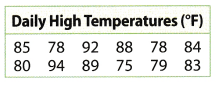
The daily high temperatures for some days last month are shown. Make a box plot of the data.
Texas Go Math Grade 6 Lesson 17.2 Answer Key 1
Texas Go Math Grade 6 Lesson 17.2 Answer Key 2
Answer:
Box plot of the data
Texas Go Math Grade 6 Lesson 17.2 Answer Key 12
The box plot of the data on daily high temperatures.

Your Turn

Question 3.
The box plots compare the weekly earnings of two groups of salespeople from different clothing stores. Find and compare the IQRs of the box plots.
Texas Go Math Grade 6 Lesson 17.2 Answer Key 3
Answer:
Determine the IQR of both groups then compare.
IQRA = 1,800 – 1,100 subtract the lower quartie from the upper quarti[e
= 700
IQRB = 1, 850 – 1,400 subtract the lower quartie from the upper quartile
= 450

The IQR of Group A is greater than the IQR of Group B. The weekly earnings of Group A are more spread out than Group B.

Your Turn

Question 4.
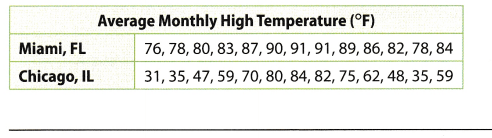
Find the range of each set of data. Which city’s data has a greater range?
Texas Go Math Grade 6 Lesson 17.2 Answer Key 4
Answer:
Arrange the data in ascending order

  • Miami, FL: 76, 78, 78, 80, 82, 83, 84, 86, 87, 89, 90, 91, 91
  • Chicago, IL: 31, 35, 35, 47, 48, 59, 59, 62, 70, 75, 80, 82, 84

Determine the range of each set of data.
range = 91 – 76 subtract the least value from the greatest value
= 15 range of the data for Miami
range = 84 – 31 subtract the least value from the greatest value
= 53 range of the data for Chicago

The city with a greater range of 53 is Chicago.

Texas Go Math Grade 6 Lesson 17.2 Guided Practice Answer Key

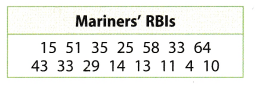
The RBIs (runs batted in) for 15 players from the 2010 Seattle Mariners are shown. Use this data set for 1—7.

Texas Go Math Grade 6 Lesson 17.2 Answer Key 5

Go Math Grade 6 Box Plot Lesson 17.2 Question 1.
Order the data from least to greatest. (Example 1)
_________________
Answer:
Arrangement of data in ascending order.
4, 10, 11, 13, 14, 15, 25, 29, 33, 33, 35, 43, 51, 58, 64

The data is 4, 10, 11 , 13, 14, 15, 25, 29, 33, 33, 35, 43, 51, 58, 64 when arranged from least to greatest

Question 2.
Find the median.(Example 1) _______
Answer:
Arrange the data in ascending order
4, 10, 11, 13, 14, 15, 25, 29, 33, 33, 35, 43, 51, 58, 64
Median is the middle value in the given data.
Median is 29.

The median of the data is 29.

Question 3.
Find the lower quartile.(Example 1) _______
Answer:
Arrangement of data in ascending order
4, 10, 11, 13, 14, 15, 25, 29, 33, 33, 35, 43, 51, 58, 64
Determine the lower quartile by getting the median of the lower half of the data set
lower quartile is 13.

The lower quartile of the data is 13.

Question 4.
Find the upper quartile. (Example 1) _______
Answer:
Arrangement of data in ascending order
4, 10, 11, 13, 14, 15, 25, 29, 33, 33, 35, 43, 51, 58, 64
Determine the upper quartile by getting the median of the upper half of the data set.
Upper quartile is 43.

The upper quartile of the data is 43.

Lesson 17.2 Box Plot 6th Grade Go Math Question 5.
Make a box plot for the data. (Example 1)
Texas Go Math Grade 6 Lesson 17.2 Answer Key 6
Answer:
Box plot of the given data
Texas Go Math Grade 6 Lesson 17.2 Answer Key 13
The box plot of the data showing the runs battled in for the Seattle Mariners.

Question 6.
Find the IQR. (Example 2) _____
Answer:
Determine the IQR for the given data.
IQR = 43 – 13 subtract the lower quartile from the upper quartile
= 30

The value of the interquartile range is 30.

Question 7.
Find the range. (Example 3) _____
Answer:
Determine the range of the given data.
range = 64 – 4 subtract the least value from the greatest value in the data
= 60

The range of the data is 60.

Essential Question Check-In

Question 8.
How is the range of a set of data different from the IQR?
Answer:
The range is the spread of the data because the value came from the difference between the largest and the least data. The interquartile range is the spread of the middle 50% of the data because the value came from the difference between the upper and lower quartile of the data.

Range is the difference between the greatest and least data while the interquartile range focuses on the middle 50% of the data.

Texas Go Math Grade 6 Lesson 17.2 Independent Practice Answer Key

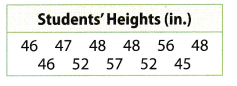
For 9-12, use the data set of the heights of several different students.

Texas Go Math Grade 6 Answer Key Pdf Lesson 17.2 Question 9.
Draw a box plot of the data.
Texas Go Math Grade 6 Lesson 17.2 Answer Key 7
Texas Go Math Grade 6 Lesson 17.2 Answer Key 8
Answer:
Box plot of the given data
Texas Go Math Grade 6 Lesson 17.2 Answer Key 14
The box plot of the height of the students in inches.

Question 10.
How many students are included in the data set? _____
Answer:
There are 11 entries in the data set for the height of the students. It shows that there are 11 students included in the data set
11 students

Question 11.
What method could have been used to collect the data?
Answer:
In order to get the accurate height of the students, one must have a one-to-one interaction between the data gatherer and the respondent. With the given data set, the method that was used to gather the information is through interview with the selected students.

The data collection was done through interview method.

Question 12.
Represent Real-World Problems What other data could you collect from the students to create a box plot? Provide several examples with units of measurement, if applicable.
Answer:
Data that can be collected from the students.

  • Weight of the students: 40 pounds, 42 pounds, 43 pounds, 43 pounds, 45 pounds, 45 pounds, 48 pounds, 48 pounds, 48 pounds, 50 pounds, 50 pounds
  • Grades in Math: 90, 90, 90, 92, 92, 93, 94, 94, 94, 95, 95
  • Age: 5, 5, 5, 5, 6, 6, 6, 7, 7, 7, 8

There are different data that can be collected from the students like their weight, age, and grade in a subject area.

For 13-15, use the box plots of the total precipitation for the same group of cities for the months of January and June.

Texas Go Math Grade 6 Lesson 17.2 Answer Key 9

Question 13.
Calculate the IQR for each month.
January = ___ inches June = ___ inches
Answer:
Determine the interquartile range of the given box plot
IQR = 2.0 – 1.7 subtract the lower quartile from the upper quartile
= 0.3 inches interquartile range for January
IQR = 2.3 – 2.0 subtract the lower quartile from the upper quartile
= 0.3 inches interquartile range for June

The interquartile range to January and June are both 0.3 inches.

Grade 6 Go Math Answer Key Box Plots Answer Key Question 14.
Calculate the range for each month.
January = ___ inches June = ___ inches
Answer:
Determine the range of the given box plot.
range = 2.5 – 1.3 subtract the least value from the greatest value
= 1.2 inches range of the data for January
range = 2.4 – 1.9 subtract the least value from the greatest value
= 0.5 inches range of the data for June

The range for each month is:
January = 1.2 inches
June = 0.5 inches

Question 15.
Compare the IQRs. What can you conclude about the two data sets?
Answer:
The data has the same interquartile range. It denotes that the spread of the middle 50% of the data are the same same interquartile range

Question 16.
Compare the ranges. What can you conclude about the two data sets?
Answer:
The range of the precipitation in January is 1.2 inches while in June it is 0.5 inches. It shows that there is a greater spread of data in January than in June.

The data is more widely spread in January than in June.

Texas Go Math Grade 6 Lesson 17.2 H.O.T. Focus On Higher Order Thinking Answer Key

Question 17.
Analyze Relationships Can two box plots have the same range and IQR and yet represent completely different data? Explain.
Answer:
Yes, it is possible for two box plots to have the same range and IQR although they have different data sets as long as the median, lower quartile, and upper quartile are the same. Since range and IQR both determine the measure of the spread of the data.

Yes, both are measures of the spread of the data.

6th Grade Go Math Box Plot Lesson 17.2 Answer Key Question 18.
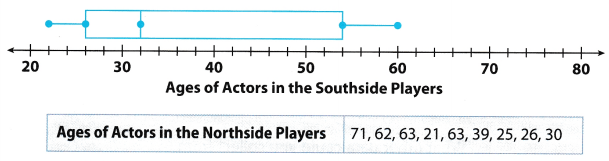
Multiple Representations Matthew collected data about the ages of the actors in two different community theater groups. He drew a box plot for one of the sets of data.
Texas Go Math Grade 6 Lesson 17.2 Answer Key 10

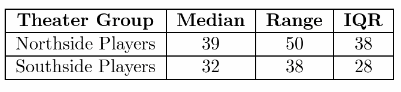
a. Find the median, range, and IQR for each set of data.
Texas Go Math Grade 6 Lesson 17.2 Answer Key 11
Answer:
Texas Go Math Grade 6 Lesson 17.2 Answer Key 15

b. Suppose you were to draw a second box plot for the Northside Players using the same number line as for the Southside Players. Which box plot would be longer overall? Which would have the longest box portion?
Answer:
The box plot for Northside Players is much longer than the box plot of Southside Players. The diagram for Northside Players has the longest box portion.
Box plot for the Northside Players
Texas Go Math Grade 6 Lesson 17.2 Answer Key 16

c. Critique Reasoning Mandy assumes that because nine data values are shown for the Northside Players, nine data values were used to make the box plot for the Southside Players. Explain why this is not necessarily true.
Answer:
In creating box plot, the only data being used are the least and greatest value of the data, lower and upper quartile together with the median. Not all values of the data set will be used in creating a box plot.

Texas Go Math Grade 6 Lesson 17.2 Answer Key Box Plots Read More »

Texas Go Math Grade 6 Lesson 16.3 Answer Key Solving Area Equations

Refer to our Texas Go Math Grade 6 Answer Key Pdf to score good marks in the exams. Test yourself by practicing the problems from Texas Go Math Grade 6 Lesson 16.3 Answer Key Solving Area Equations.

Texas Go Math Grade 6 Lesson 16.3 Answer Key Solving Area Equations

Example 1

The Hudson High School wrestling team just won the state tournament and has been awarded a triangular pennant to hang on the wall in the school gymnasium. The base of the pennant is 1.5 feet long. It has an area of 2.25 square feet. What is the height of the pennant?
Texas Go Math Grade 6 Lesson 16.3 Answer Key 1
The height of the pennant is 3 feet.

Your Turn

Go Math Grade 6 Answer Key Area Equations Question 1.
Renee is sewing a quilt whose pattern contains right triangles. Each quilt piece has a height of 6 in. and an area of 24 in2. How long is the base of each quilt piece? ___________
Answer:
Data:
Area = 24
h = 6
Write equation of area of a triangle:
Area = \(\frac{1}{2}\) × b × h
Solve for b:
b = \(\frac{2 \times \text { Area }}{h}\)
Substitute values:
b = \(\frac{2 \times 24}{6}\)
Evaluate:
b = 8
The base of the quilt is 8 inches long.

Example 2

A garden in the shape of a trapezoid has an area of 44.4 square meters. One base is 4.3 meters and the other base is 10.5 meters long. The height of the trapezoid is the width of the garden. How wide is the garden?
Texas Go Math Grade 6 Lesson 16.3 Answer Key 2
The garden is 6 meters wide.

Reflect

Question 2.
Communicate Mathematical Ideas Explain why the first step after substituting is addition.
Answer:
The numbers in the parentheses are added because parentheses simplification has the highest priority and that rule is followed after substitution.

Your Turn

Question 3.
The cross section of a water bin is shaped like a trapezoid. The bases of the trapezoid are 18 feet and 8 feet long. It has an area of 52 square feet. What is the height of the cross section?
Answer:
What is the height of the cross section?
A = \(\frac{1}{2}\) h(b1 + b2) Write the formula
52 = \(\frac{1}{2}\)h(18 + 8) Use the formula to write an equation
52 = \(\frac{1}{2}\)h(26) Add inside parentheses
52 = 13h Multiply \(\frac{1}{2}\) and 26
\(\frac{52}{13}=\frac{13 h}{13}\) Divide both sides of the equation by 13
4 = h
The height of the cross-section is 4 feet long

Texas Go Math Grade 6 Answer Key Solving Area Equations Question 4.
A parallelogram-shaped field in a park needs sod. The parallelogram has a base of 21.5 meters and a height of 18 meters. The sod is sold in pallets of 50 square meters. How many pallets of sod are needed to fill the field?
Answer:
Data:
b = 21.5
h = 18
Write equation of area of a paralLelogram:
Area = b × h
Substitute values:
Area = 21.5 × 18
Evaluate:
Area = 387
Evaluate the number of pallets of sods, therefore: n = \(\frac{387}{50}\) = 7.74
7.74 ≈ 8 pallets of sods are needed.

Texas Go Math Grade 6 Lesson 16.3 Guided Practice Answer Key

Question 1.
A triangular bandana has an area of 70 square inches. The height of the triangle is 8\(\frac{3}{4}\) inches. Write and solve an equation to find the length of the base of the triangle. (Example 1)
Answer:
Data:
Area = 70
h = 8\(\frac{3}{4}\) = 8.75
Write equation of area of a triangle:
Area = \(\frac{1}{2}\) × b × h
Solve for b:
b = \(\frac{2 \times \text { Area }}{h}\)
Substitute values:
b = \(\frac{2 \times 70}{8.75}\)
Evaluate:
b = 16
Base of the triangle is 16 inches.

Question 2.
The top of a desk is shaped like a trapezoid. The bases of the trapezoid are 26.5 and 30 centimeters long. The area of the desk is 791 square centimeters. The height of the trapezoid is the width of the desk. Write and solve an equation to find the width of the desk. (Example 2)
Answer:
Data:
Area = 791
b1 = 26.5
b2 = 30
Write equation of area of a trapezoid:
Texas Go Math Grade 6 Lesson 16.3 Answer Key 5
The desk is 28 centimeters wide.

Go Math Answer Key Grade 6 Lesson 16.3 Question 3.
Taylor wants to paint his rectangular deck that is 42 feet long and 28 feet wide. A gallon of paint covers about 350 square feet. How many gallons of paint will Taylor need to cover the entire deck? (Example 3)
Write an equation to find the ______________ of the deck.
Write and solve the equation.
Write an equation to find the ______________.
Write and solve the equation.
Taylor will need ________ gallons of paint.
Answer:
Data:
l = 42
w = 28
Write equation of area of a rectangle:
Area = l × w
Substitute values:
Area = 42 × 28
Evaluate:
Area = 1176
Area of the deck is 1176 square feet.
Evaluate the total number of gallons of paint required by dividing the total area with the area covered by 1 gallon, therefore:
n = \(\frac{1176}{350}\) = 3.364 ≈ 4
Taylor will need 4 gallons of paint.

Essential Question Check-In

Question 4.
How do you use equations to solve problems about area of rectangles, parallelograms, trapezoids, and triangles?
Answer:
Depending on the type of figure given, the respective formula of parallelogram, trapezoid, triangle or rectangle is used to solve such problems.

Texas Go Math Grade 6 Lesson 16.3 Independent Practice Answer Key

Question 5.
A window shaped like a parallelogram has an area of 18\(\frac{1}{3}\) square feet. The height of the window is 3\(\frac{1}{3}\) feet. How long is the base of the window?
Answer:
Data:
h = 3\(\frac{1}{3}\) = \(3 . \overline{3}\)
Area = 18\(\frac{1}{3}\) = \(18 . \overline{3}\)
Write equation of area of a parallelogram:
Area = b × h
Solve for b:
b = \(\frac{\text { Area }}{h}\)
Substitute values:
b = \(\frac{18 . \overline{3}}{3 . \overline{3}}\)
Evaluate:
b = 5.5
The base of the window is 5.5 feet.

Question 6.
A triangular sail has a base length of 2.5 meters. The area of the sail is 3.75 square meters. How tall is the sail?
Answer:
Data:
b = 2.5
Area = 3.75
Write equation of area of a triangle:
Area = \(\frac{1}{2}\) × b × h
Solve for h:
h = \(\frac{2 \times \text { Area }}{b}\)
Substitute values:
h = \(\frac{2 \times 3.75}{2.5}\)
Evaluate:
h = 3
The sail is 3 meters high.

Texas Go Math Grade 6 Answer Key Pdf Solving Area Equations Question 7.
A section in a stained glass window is shaped like a trapezoid. The top base is 4 centimeters and the bottom base is 2.5 centimeters long. If the area of the section of glass is 3.9 square centimeters, how tall is the section?
Answer:
Data:
b1 = 2.5
b2 = 4
Area = 3.9
Write equation of area of a trapezoid:
Texas Go Math Grade 6 Lesson 16.3 Answer Key 6
The section is 1.2 centimeters high.

Question 8.
Multistep Amelia wants to paint three walls in her family room. Two walls are 26 feet long by 9 feet wide. The other wall is 18 feet long by 9 feet wide.
a. What is the total area of the walls that Amelia wants to paint?
Answer:
Data for rectangle 1:
l = 26
w = 9
Data for rectangle 2:
l = 18
w = 9
The totaL area to be painted is the sum of the 3 rectangles out of which 2 are identical so the equation becomes:
Area = 2(l × w) + (l × w)
Substitute values:
Area = 2(26 × 9) + (18 × 9)
Simplify:
Area = 468 + 162
Evaluate:
Area = 630
Total area to be painted in 630 square feet.

b. Each gallon of paint covers about 250 square feet. How many gallons of paint should Amelia buy to paint the walls?
Answer:
For the total number of gallons of paint needed by dividing the total area by the area covered by 1 gallon, therefore:
n = \(\frac{630}{250}\) = 2.52 ≈ 3

Question 9.
Critical Thinking The area of a triangular block is 64 square inches. If the base of the triangle is twice the height, how long are the base and the height of the triangle?
Answer:
Data:
h = x
b = 2x
Area = 64
Write equation of area of a triangle:
Area = \(\frac{1}{2}\) × b × h
Substitute values:
64 = \(\frac{1}{2}\) × 2x × x
Simplify:
64 = x2
Solve for x:
x = \(\sqrt {64}\)
Evaluate:
x = 8
The height of the triangle is 8 inches while its base is 2 × 8 = 16 inches long.

Go Math Grade 6 Answer Key Pdf Solving Area Equations Question 10.
Multistep Alex needs to varnish the top and the bottom of a dozen rectangular wooden planks. The planks are 8 feet long and 3 feet wide. Each pint of varnish covers about 125 square feet and costs $3.50.
a. What is the total area that Alex needs to varnish?
Answer:
Data:
l = 8
w = 3
Write equation for area of a triangle:
Area = l × w
Substitute values:
Area = 8 × 3
Evaluate:
Area = 24
The area of 1 side is 24 square feet Both sides of the planks are to be painted and there are 12 planks so the total area to be painted is 24 × 2 × 12 = 576.

b. How much will it cost Alex to varnish all the wooden planks?
Answer:
For the total number of pints of varnish needed by dividing the total area by the area covered by 1 pint. therefore:
n = \(\frac{576}{125}\) = 4.608 ≈ 5
5 pints of varnish are needed so the total cost of varnish is 5 × $3.5 = $17.50

Question 11.
Multistep Leia cuts congruent triangular patches with an area of 45 square centimeters from a rectangular piece of fabric that is 18 centimeters long and 10 centimeters wide. How many of the patches can Leia cut from 32 pieces of the fabric?
Answer:
Evaluate the total area of the rectangular piece of fabric, therefore:
Area = l × w = 18 × 10 = 180
There are 32 such pieces, so the total area is 180 × 32 = 5760 square centimeters.
Evaluate the number of triangles that can be made dividing the total area by the area of 1 triangular piece, therefore:
n = \(\frac{5760}{45}\) = 128
128 triangles can be made.

Question 12.
Multistep A farmer needs to buy fertilizer for two fields. One field is shaped like a trapezoid, and the other is shaped like a triangle. The trapezoidal field has bases that are 35 and 48 yards and a height of 26 yards. The triangular field has the same height and a base of 39 yards. Each bag of fertilizer covers 150 square yards. Use a problem solving model to find how many bags of fertilizer the farmer needs to buy.
Answer:
Data of the triangular field:
b = 39
h = 26
Data of the trapezoidal field:
b1 = 35, b2 = 48
h = 26
The total area to be covered with fertilizers is the sum of the 2 areas of the triangle and the trapezoid so write respective formulas:
Area = (\(\frac{1}{2}\) × b × h)+(\(\frac{1}{2}\) × (b1 + b2) × h)
Substitute vaLues:
Area = (\(\frac{1}{2}\) × 39 × 26) + (\(\frac{1}{2}\) × (35 + 48) × 26)
Simplify:
Area = 507 + 1079
Evaluate:
Area = 1586
Total area to be covered with fertiLizer is 1586 square yards.

The total number of bags of fertilizer needed is evaluated by dividing the total area by the area covered by 1 bag, therefore:
n = \(\frac{1586}{150}\) = 10.57 ≈ 11
11 bags of fertilizers are needed.

Lesson 16.3 6th Grade Go Math Answer Key Question 13.
A tennis court for singles play is 78 feet long and 27 feet wide.
a. The court for doubles play has the same length but is 9 feet wider than the court for singles play. How much more area is covered by the tennis court used for doubles play?
Answer:
Area of a regular-sized tennis court is 78 × 27 = 2106 square feet. The doubles court is 9 feet wider so the area of the doubles court is 78 × (27 + 9) = 2808 square feet Therefore, the area of this court is 2808 – 2106 = 702 square feet more than that of the regular court.

b. The junior court for players 8 and under is 36 feet long and 18 feet wide. How much more area is covered by the tennis court used for singles play than by the junior court?
Answer:
Area of a regular sized tennis court is 78 × 27 = 2106 square feet The area of the juniors court is 36 × 18 = 648 square feet. Therefore, the area of this court is 2106 – 648 = 1458 square feet less than that of the regular court.

c. The court for players 10 and under has the same width but is 18 feet shorter than the court for singles play. How much more area is covered by the tennis court used for singles play?
Answer:
Area of a regular-sized tennis court is 78 × 27 = 2106 square feet. The court for 10 and under is 18 feet shorter so the area of this court is (78 – 18) × 27 = 1620 square feet. Therefore, the area of this court is 2106 – 1620 = 486 square feet less than that of the regular court.

Question 14.
Draw Conclusions The cross-section of a metal ingot is a trapezoid. The cross-section has an area of 39 square centimeters. The top base of the cross-section is 12 centimeters. The length of the bottom base is 2 centimeters greater than the top base. How tall is the metal ingot? Explain.
Answer:
Data:
b1 = 12
b2 = 12 + 2 = 14
Area = 39
Write equation of the area of a trapezoid:
Texas Go Math Grade 6 Lesson 16.3 Answer Key 7
The metal ingot is 3 centimeters tall.

H.O.T. Focus on Higher Order Thinking

Question 15.
Analyze Relationships A mirror is made of two congruent parallelograms as shown in the diagram. The parallelograms have a combined area of 9\(\frac{1}{3}\) square yards. The height of each parallelogram is 1\(\frac{1}{4}\) yards.
Texas Go Math Grade 6 Lesson 16.3 Answer Key 3
a. How long is the base of each parallelogram?
Answer:
Data:
h = 1\(\frac{1}{3}\) = \(1 . \overline{3}\)
Area of 1 parallelogram is therefore:
Area = \(\frac{9 \frac{1}{3}}{2}=4 . \overline{6}\)
Write equation of area of a parallelogram:
Area = b × h
Solve for b;
b = \(\frac{\text { Area }}{h}\)
Substitute values:
b = \(\frac{4 . \overline{6}}{1 . \overline{3}}\)
Evaluate:
b = 3.5
The base of the parallelogram shown is 3.5 yards

b. What is the area of the smallest rectangle of the wall that the mirror could fit on?
Answer:
The smallest rectangle of the wall that the mirror could fit on must have a width equal to the base of the parallelogram and length equal to the height of the parallelogram plus the extra \(\frac{1}{2}\) = 0.5 yards so the length becomes: \(1 . \overline{3}\) + 0.5 = \(1.8 \overline{3}\) so the area of the wall is 3.5 × \(1.8 \overline{3}\) = 6.42 square yards.

Go Math Grade 6 Answers Pdf Lesson 16.3 Question 16.
Persevere in Problem Solving A watercolor painting is 20 inches long by 9 inches wide. Ramon makes a mat that adds a 1-inch-wide border around the painting. What is the area of the mat?
Texas Go Math Grade 6 Lesson 16.3 Answer Key 4
Answer:
The length of the mat plus the painting is 1 + 20 + 1 = 22 inches and its width is 1 + 9 + 1 = 11 inches so the area of the mat pLus the painting is 22 × 11 = 242 square inches.
The length of the painting is 20 inches and its width is inches so the area of the painting is 20 × 9 = 180 square inches. The area of the mat is therefore: 242 – 180 = 62 square inches.
The area of the mat is 62 square inches.

Texas Go Math Grade 6 Lesson 16.3 Answer Key Solving Area Equations Read More »

Texas Go Math Grade 6 Module 17 Answer Key Analyzing and Comparing Data

Refer to our Texas Go Math Grade 6 Answer Key Pdf to score good marks in the exams. Test yourself by practicing the problems from Texas Go Math Grade 6 Module 17 Answer Key Analyzing and Comparing Data.

Texas Go Math Grade 6 Module 17 Answer Key Analyzing and Comparing Data

Essential Question
How can you use solve real-world problems by displaying, analyzing, and summarizing data?
Texas Go Math Grade 6 Module 17 Answer Key 1

Texas Go Math Grade 6 Module 17 Are You Ready? Answer Key

Complete these exercises to review skills you will need for this chapter.

Find the quotient.

Question 1.
Texas Go Math Grade 6 Module 17 Answer Key 7
Answer:
Texas Go Math Grade 6 Module 17 Answer Key 3
Include a decimal point and zero on the dividend until there is no remainder.

The quotient is 2.8.

Analyzing Pictures Grade 6 Module 17 Test Answers Question 2.
Texas Go Math Grade 6 Module 17 Answer Key 8
Answer:
Texas Go Math Grade 6 Module 17 Answer Key 4
Include a decimal point and zero on the dividend until there is no remainder.
The quotient is 1.24.

Question 3.
Texas Go Math Grade 6 Module 17 Answer Key 9
Answer:
Texas Go Math Grade 6 Module 17 Answer Key 5
Include a decimal point and zero on the dividend until there is no remainder.

The quotient is 1.75.

Question 4.
Texas Go Math Grade 6 Module 17 Answer Key 10
Answer:
Texas Go Math Grade 6 Module 17 Answer Key 6
Include a decimal point and zero on the dividend until there is no remainder.

The quotient is 2.375.

Question 5.
How many goals did Dion score? ________________
Answer:
How many goals did Dion score? 3 goals

Study the given bar graph to identify the height on Dion’s graph. It is 3. This implies that Dion scored 3 goals.

Dion scored 3 goals

Question 6.
Which two players together scored the same number of goals as Jeff? _______
Answer:
Study the given bar graph to identify the height on Jeffs graph. It is 4. This implies that Jeff scored 4 goals. This implies that the total number of goals scored is 4, therefore, it can be seen that Dion and Ted together scored 4 goals

Dion and Ted together scored as many goals as Jeff.

Go Math Module 17 Grade 6 Module 17 Review Answer Key Question 7.
How many fewer goals than Cesar did Alec score? __________
Answer:
Ceaser scored 6 goals white Alec scored 5, so Ceaser scored 6 – 5 = 1 more goal than Alec.

Ceaser scored 1 more goal than Alec

Texas Go Math Grade 6 Module 17 Reading Start-Up Answer Key

Visualize Vocabulary

Use the review words to complete the chart.

Texas Go Math Grade 6 Module 17 Answer Key 2

Understand Vocabulary

Complete the sentences using the preview words.

Question 1.
The average of a data set is the ___.
Answer:
The average of a data set is the mean.

The missing word that will complete the sentence is mean.

Go Math Grade 6 Answer Key Pdf Displaying Analyzing and Summarizing Data Question 2.
The ____________________ is the middle value of a data set.
Answer:
The median is the middle value of a data set.
The missing word that will complete the sentence is the median

Question 3.
The number or category that occurs most frequently in a data set is the ___.
Answer:
The number or category that occurs most frequently in a data set is the mode

The missing word that will complete the sentence is mode

Texas Go Math Grade 6 Module 17 Answer Key Analyzing and Comparing Data Read More »

Texas Go Math Grade 6 Lesson 16.2 Answer Key Area of Triangles

Refer to our Texas Go Math Grade 6 Answer Key Pdf to score good marks in the exams. Test yourself by practicing the problems from Texas Go Math Grade 6 Lesson 16.2 Answer Key Area of Triangles.

Texas Go Math Grade 6 Lesson 16.2 Answer Key Area of Triangles

Texas Go Math Grade 6 Lesson 16.2 Explore Activity Answer Key

Explore Activity 1

Area of a Right Triangle
A. Draw a large rectangle on grid paper.
What is the formula for the area of a rectangle? A = ____________
Texas Go Math Grade 6 Lesson 16.2 Answer Key 1
B. Draw one diagonal of your rectangle.
The diagonal divides the rectangle into ____________.
Each one represents ____________ of the rectangle.
Use this information and the formula for the area of a rectangle to write a formula for the area of a right triangle. A = ____________

Reflect

Go Math Grade 6 Answer Key Lesson 16.2 Area of Triangle Question 1.
Communicate Mathematical Ideas In the formula for the area of a right triangle, what do b and h represent?
Answer:
b is the base of the right triangle and h is the height of the right triangle.

Explore Activity 2

Area of a Triangle

A. Draw a large triangle on grid paper. Do not draw a right triangle.
Texas Go Math Grade 6 Lesson 16.2 Answer Key 2
B. Cut out your triangle. Then trace around it to make a copy of your triangle. Cut out the copy.
C. Cut one of your triangles into two pieces by cutting through one angle directly across to the opposite side. Now you have three triangles — one large triangle and two smaller triangles.
When added together, the areas of the two smaller triangles equal the __________ of the large triangle.
D. Arrange the three triangles into a rectangle.
Texas Go Math Grade 6 Lesson 16.2 Answer Key 3
What fraction of the rectangle does the large triangle represent? __________
The area of the rectangle is A = bh. What is the area of the large triangle? A = __________
How does this formula compare to the formula for the area of a right triangle that you found in Explore Activity 1 ? __________

Reflect

Question 2.
Communicate Mathematical Ideas What type of angle is formed by the base and height of a triangle?
Answer:
The height of a triangle is always the perpendicular distance between the base and its top edge, so it can be said that the angle between the base and height of a triangle is always 90°.

Your Turn

Find the area of the triangle.

Question 3.
Texas Go Math Grade 6 Lesson 16.2 Answer Key 4
A = _____________
Answer:
Find the area of the triangle.
b = 8.5 inches h = 14 inches
A = \(\frac{1}{2}\) bh
= \(\frac{1}{2}\) (8.5 inches)(14 inches) Substitute
= 59.5 square inches Multiply
= 59.5 in2

Texas Go Math Grade 6 Lesson 16.2 Area of Triangles Answer Key Question 4.
Amy needs to order a shade for a triangular-shaped window that has a base of 6 feet and a height of 4 feet. What is the area of the shade?
Answer:
Data:
b = 6
h = 4
Write the equation of the area of a triangle:
Area = \(\frac{1}{2}\) × b × h
Substitute values:
Area = \(\frac{1}{2}\) × 6 × 4
Evaluate:
Area = 12
Area of the shade is 12 square feet.

Texas Go Math Grade 6 Lesson 16.2 Guided Practice Answer Key

Question 1.
Show how you can use a copy of the triangle to form a rectangle. Find the area of the triangle and the area of the rectangle. What is the relationship between the areas? (Explore Activities 1 and 2, Example 1)
Texas Go Math Grade 6 Lesson 16.2 Answer Key 5
Answer:
Transforming the triangle to rectangle.
Texas Go Math Grade 6 Lesson 16.2 Answer Key 14
Determine the area of the triangle.
A = \(\frac{1}{2}\) (14) (8) substitute for the area of the triangle
A = \(\frac{1}{2}\) (112) simplify
A = 56 sq. in. area of the triangle
A = 14 × 8 substitute for the area of the rectangle
A = 112 sq. in. area of the rectangle
The area of the triangle is 56 sq. in. while the area of the rectangle is 112 sq. in. which shows that the area of the triangle is half of the area of the rectangle.

Question 2.
A pennant in the shape of a triangle has a base of 12 inches and a height of 30 inches. What is the area of the pennant? (Example 2)
Texas Go Math Grade 6 Lesson 16.2 Answer Key 6
A = \(\frac{1}{2}\)bh
= \(\frac{1}{2}\) (________) (_______)
= ________ in2
Answer:
Data:
b = 12
h = 30
Write the equation of the area of a triangle:
Area = \(\frac{1}{2}\) × b × h
Substitute values:
Area = \(\frac{1}{2}\) × 12 × 30
Evaluate:
Area = 180
The area of the pennant is 180 square inches.

Essential Question Check-In

Area of a Triangle Grade 6 Lesson 16.2 Practice Answer Key Question 3.
How do you find the area of a triangle?
Answer:
The area of a triangle is the product of its height and base divided by 2. Mathematically the formula for the area of a triangle is:
Area = \(\frac{1}{2}\) × b × h

Texas Go Math Grade 6 Lesson 16.2 Independent Practice Answer Key

Find the area of each triangle.

Question 4.
Texas Go Math Grade 6 Lesson 16.2 Answer Key 7
Answer:
Find the area of the triangle.
b = 15 cm h = 10 cm
A = \(\frac{1}{2}\)bh
= \(\frac{1}{2}\) (15 cm) (10 cm) Substitute
= 75 square centimeters Multiply
= 75 cm2

Question 5.
Texas Go Math Grade 6 Lesson 16.2 Answer Key 8
Answer:
Find the area of the triangle.
b = 24 feet; h = 20 feet
A = \(\frac{1}{2}\)bh
= \(\frac{1}{2}\) (24 feet) (20 feet) Substitute
= 240 square feet Multiply
= 240 ft2

Question 6.
Texas Go Math Grade 6 Lesson 16.2 Answer Key 9
Answer:
Find the area of the triangle.
b = 12 inches; h = 17 inches
A = \(\frac{1}{2}\)bh
= \(\frac{1}{2}\) (12 inches) (17 inches) Substitute
= 102 square inches Multiply
= 102 in2

Question 7.
Texas Go Math Grade 6 Lesson 16.2 Answer Key 10
Answer:
Find the area of the triangle.
b = 18 feet; h = 32 feet
A = \(\frac{1}{2}\)bh
= \(\frac{1}{2}\) (18 feet) (32 feet) Substitute
= 288 square feet Multiply
= 288 ft2

Texas Go Math Grade 6 Answer Key Pdf Area of Triangle Question 8.
What is the area of a triangle that has a base of 15\(\frac{1}{4}\) in. and a height of 18 in.?
Answer:
Solution to this example is given below
\(15 \frac{1}{4}=\frac{15 \times 4+1}{4}=\frac{61}{4}\) = 15.25 Convert to decimal number
Find the area of the triangle.
b = 15.25 inches; h = 18 inches
A = \(\frac{1}{2}\)bh
= \(\frac{1}{2}\) (15.25 inches) (18 inches) Substitute
= 137.25 square inches Multiply
= 137.25 in2

Question 9.
A right triangle has legs that are 11 in. and 13 in. long. What is the area of the triangle?
Answer:
Find the area of the triangle
b = 11 inches; h = 13 inches
A = \(\frac{1}{2}\)bh
= \(\frac{1}{2}\) (11 inches) (13 inches) Substitute
= 71.5 square inches Multiply
= 71.5 in2

Question 10.
A triangular plot of land has the dimensions shown in the diagram. What is the area of the land?
Texas Go Math Grade 6 Lesson 16.2 Answer Key 11
Answer:
Find the area of the triangle.
b = 30km; h = 20 km
A = \(\frac{1}{2}\)bh
= \(\frac{1}{2}\) (30 km) (20 km) Substitute
= 300 square kilometer Multiply
= 300 km2

Question 11.
The front part of a tent has the dimensions shown in the diagram. What is the area of this part of the tent?
Texas Go Math Grade 6 Lesson 16.2 Answer Key 12
Answer:
Data:
b = 8
h = 5
Write equation of area of a triangle:
Area = \(\frac{1}{2}\) × b × h
Substitute values:
Area = \(\frac{1}{2}\) × 8 × 5
Evaluate:
Area = 20
Area of the front of the tent is 20 square feet.

Question 12.
Multistep The sixth-grade art students are making a mosaic using tiles in the shape of right triangles. Each tile has leg measures of 3 centimeters and 5 centimeters. If there are 200 tiles in the mosaic, what is the area of the mosaic?
Answer:
Data:
b = 3
h = 5
Write equation of area of a triangle:
Area = \(\frac{1}{2}\) × b × h
Substitute values:
Area = \(\frac{1}{2}\) × 3 × 5
Evaluate:
Area = 7.5
The area of 1 tile is 7.5 square centimeters so the total area of 200 tiles is 7.5 × 200 = 1500 square centimeters.
Total area of 200 tiles is 1500 square centimeters.

6th Grade Answer Key Go Math Area of Triangle Question 13.
Critique Reasoning Monica has a triangular piece of fabric. The height of the triangle is 15 inches and the triangle’s base is 6 inches. Monica says that the area of the fabric is 90 in2. What error did Monica make? Explain your answer.
Answer:
Find the area of the triangle
b = 6 inches h = 15 inches
A = \(\frac{1}{2}\)bh
= \(\frac{1}{2}\) (6 inches) (15 inches) Substitute
= 45 square inches Multiply
Area of the piece of cloth is 45 square inches.
= 45 in2

Question 14.
Show how you can use the given triangle and its two smaller right triangles to form a rectangle. What is the relationship between the area of the original triangle and the area of the rectangle?
Texas Go Math Grade 6 Lesson 16.2 Answer Key 13
Answer:
Transform the triangle together with its two smaller triangles to form a rectangle.
Texas Go Math Grade 6 Lesson 16.2 Answer Key 15
Determine the area of the triangle.
A = \(\frac{1}{2}\) (18) (12) substitute for the area of the triangle
A = \(\frac{1}{2}\) (216) simplify
A = 108 sq. in. area of the triangle
A = 18 × 12 substitute for the area of the rectangle
A = 216 sq. in. area of the rectangle
The area of the triangle is 108 sq. in. while the area of the rectangle is 216 sq. in. which shows that the area of the rectangle is twice the area of the triangle.

H.O.T. Focus on Higher Order Thinking

Question 15.
Communicate Mathematical Ideas Explain how the areas of a triangle and a parallelogram with the same base and height are related.
Answer:
The area of a parallelogram with a base b and height h is always twice that of a triangle with the same dimensions. This is because this parallelogram when cut along its diagonal, gives 2 triangles with the same dimensions but half the area as that of the parallelogram.

Question 16.
Analyze Relationships A rectangle and a triangle have the same area. If their bases are the same lengths, how do their heights compare? Justify your answer.
Answer:
The area of a rectangle with a length b and height h is always twice that of a triangle with the same dimensions. If their areas and their bases are the same, then this implies that the height of the rectangle will be half of that of the triangle.

Area of Triangle 6th Grade Go Math Lesson 16.2 Question 17.
What If? A right triangle has an area of 18 square inches.
a. If the triangle is an isosceles triangle, what are the lengths of the legs of the triangle?
Answer:
Data:
Area = 18
l = b = x
Write the equation of the area of a triangle:
Area = \(\frac{1}{2}\) × b × h
Substitute values:
18 = \(\frac{1}{2}\) × x × x
Solve for x:
x2 = 18 × 2
Apply square root on both sides of the equation:
Evaluate:
x = 6
The base and height of the isosceles triangle is equal to 6 inches.

b. If the triangle is not an isosceles triangle, what are all the possible lengths of the legs, if the lengths are whole numbers?
Answer:
Data:
Area = 18
From a we know that the area before division must be 36 so evaluate the factors of 36:
36 = 2 × 18
36 = 3 × 12
36 = 4 × 9
The triangle can have the dimensions in the form: b × h in the form: 2 × 18, 3 × 12 or 4 × 9.

Texas Go Math Grade 6 Lesson 16.2 Answer Key Area of Triangles Read More »

Texas Go Math Grade 6 Module 16 Answer Key Area and Volume Equations

Refer to our Texas Go Math Grade 6 Answer Key Pdf to score good marks in the exams. Test yourself by practicing the problems from Texas Go Math Grade 6 Module 16 Answer Key Area and Volume Equations.

Texas Go Math Grade 6 Module 16 Answer Key Area and Volume Equations

Texas Go Math Grade 6 Module 16 Are You Ready? Answer Key

Evaluate.

Question 1.
\(\frac{1}{2}\)(3)(5 + 7)
Answer:
Solution to this example is given below
\(\frac{1}{2}\)(3)(5 + 7) = \(\frac{1}{2}\)(3)(12) Perform operations inside parentheses first
= 1.5(12) Multiply left to right
= 18 Multiply again.
= 18 Final solution.

Go Math Grade 6 Module 16 Answer Key Question 2.
\(\frac{1}{2}\)(15)(13 + 17)
Answer:
Solution to this example is given below
\(\frac{1}{2}\)(15)(13 + 17) = \(\frac{1}{2}\)(15)(30) Perform operations inside parentheses first
= 7.5(30) Multiply left to right
= 225 Multiply again.
= 225 Final solution.

Question 3.
\(\frac{1}{2}\)(10)(9.4 + 3.6)
Answer:
Solution to this example is given below
\(\frac{1}{2}\)(10)(9.4 + 3.6) = \(\frac{1}{2}\)(10)(13) Perform operations inside parentheses first
= 5(13) Multiply left to right
= 65 Multiply again.
= 65 Final solution.

Grade 6 Module 16 Study Guide Answer Key Go Math Question 4.
\(\frac{1}{2}\)(2.1)(3.5 + 5.7)
Answer:
Solution to this example is given below
\(\frac{1}{2}\)(2.1)(3.5 + 5.7) = \(\frac{1}{2}\)(2.1)(9.2) Perform operations inside parentheses first
= 1.05(9.2) Multiply left to right
= 9.66 Multiply again.
= 9.66 Final solution.

Find the area of each figure.

Question 5.
a triangle with base 6 in. and height 3 in. _____________
Answer:
Find the area of the triangle
b = 6 inches h = 3 inches
A = \(\frac{1}{2}\)bh
= \(\frac{1}{2}\)(6 inches)(3 inches) Substitute
= 9 square inches Multiply
= 9 in2

Go Math Expressions Grade 6 Module 16 Review Answer Key Question 6.
a square with sides of 7.6 m ______________
Answer:
s = 7.6
Write equation of area of a square:
Area = s2
Substitute values:
Area = 7.62
Evaluate:
Area = 57.76
Area of the given square is 57.76 square meters.

Question 7.
a rectangle with length 3\(\frac{1}{4}\) ft and width 2\(\frac{1}{2}\) ft. ____________
Answer:
Solution to this example is given below
\(3 \frac{1}{4}=\frac{3 \times 4+1}{4}=\frac{13}{4}=3.25\) Convert to decimal number
\(2 \frac{1}{2}=\frac{2 \times 2+1}{2}=\frac{5}{2}=2.5\) Convert to decimal number
Find the area of the rectangle.
base = 3.25 ft. and height = 2.5 ft
A = bh Use the formula for the area of a parallelogram.
= 3.25 × 2.5 Substitute for base and height.
= 8.125
The area is 8.125 square feet.

Go Math Module 16 Answer Key Area and Volume Vocabulary Review Question 8.
a triangle with base 8.2 cm and height 5.1 cm ____________
Answer:
Find the area of the triangle.
b = 8.2cm h = 5.1 cm
A = bh
= \(\frac{1}{2}\)(8.2 cm)(5.1 cm) Substitute
= 20.91 square centimeters Multiply
= 20.91 cm2

Texas Go Math Grade 6 Module 16 Reading Start-Up Answer Key

Visualize Vocabulary

Use the ✓words to complete the graphic. You will put one word in each oval.
Texas Go Math Grade 6 Module 16 Answer Key 1
Texas Go Math Grade 6 Module 16 Answer Key 2

Understand Vocabulary

Match the term on the left to the correct expression on the right.
Texas Go Math Grade 6 Module 16 Answer Key 3
Answer:
1 – B. A parallelogram is a type of quadrilateral with opposite sides equal and parallel.
2 – C. A trapezoid is a type of quadrilateral with one pair of opposite parallel sides.
3 – A. A rhombus is a type of quadrilateral with all sides equal and opposite sides are parallel.

Active Reading
Booklet Before beginning the module, create a booklet to help you learn the concepts in this module. Write the main idea of each lesson on each page of the booklet. As you study each lesson, write important details that support the main idea, such as vocabulary and formulas. Refer to your finished booklet as you work on assignments and study for tests.
Texas Go Math Grade 6 Module 16 Answer Key 4

Texas Go Math Grade 6 Module 16 Answer Key Area and Volume Equations Read More »

Scroll to Top