Texas Go Math

Texas Go Math Grade 5 Lesson 5.7 Answer Key Subtraction with Renaming

Refer to our Texas Go Math Grade 5 Answer Key Pdf to score good marks in the exams. Test yourself by practicing the problems from Texas Go Math Grade 5 Lesson 5.7 Answer Key Subtraction with Renaming.

Texas Go Math Grade 5 Lesson 5.7 Answer Key Subtraction with Renaming

Unlock the Problem

To practice for a race, Kara is running 2\(\frac{1}{2}\) miles. When she reaches the end of her street, she knows that she has already run 1 \(\frac{5}{6}\) miles. How many miles does Kara have left to run?

  • Underline the sentence that tells you what you need to find.
  • What operation should you use to solve the problem?

One Way

Subtract. 2\(\frac{1}{2}\) – 1\(\frac{5}{6}\)

STEP 1: Estimate the difference.

STEP 2: Find a common denominator. Use the common denominator to write equivalent fractions with like denominators.

STEP 3: Rename 2\(\frac{6}{12}\) as a mixed number with a fraction greater than 1.
Think: 2\(\frac{6}{12}\) = 1 + 1 + \(\frac{6}{12}\) = 1 + \(\frac{12}{12}\) + \(\frac{6}{12}\) = 1\(\frac{18}{12}\)
2\(\frac{6}{12}\) = __________

STEP 4: Find the difference of the fractions. Then find the difference of the whole numbers. Write the answer in simplest form. Check to make sure your answer is reasonable.
Texas Go Math Grade 5 Lesson 5.7 Answer Key 1
So, Kara has __________ mile left to run.
Answer:

STEP 1: Estimate the difference.

STEP 2: Find a common denominator. Use the common denominator to write equivalent fractions with like denominators.

STEP 3: Rename 2\(\frac{6}{12}\) as a mixed number with a fraction greater than 1.
Think: 2\(\frac{6}{12}\) = 1 + 1 + \(\frac{6}{12}\) = 1 + \(\frac{12}{12}\) + \(\frac{6}{12}\) = 1\(\frac{18}{12}\)
2\(\frac{6}{12}\) = 1\(\frac{18}{12}\)

STEP 4: Find the difference of the fractions. Then find the difference of the whole numbers. Write the answer in simplest form. Check to make sure your answer is reasonable.

So, Kara has  \(\frac{8}{12}\) mile left to run.

Another Way
Rename both mixed numbers as fractions greater than 1.

Subtract. 2\(\frac{1}{2}\) – 1\(\frac{5}{6}\)

STEP 1: Write equivalent fractions, using a common denominator.
A common denominator of \(\frac{1}{2}\) and \(\frac{5}{6}\) is 6.
Texas Go Math Grade 5 Lesson 5.7 Answer Key 2

STEP 2: Rename both mixed numbers as fractions greater than 1.
Texas Go Math Grade 5 Lesson 5.7 Answer Key 3

STEP 3: Find the difference of the fractions. Then write the answer in simplest form.
Texas Go Math Grade 5 Lesson 5.7 Answer Key 4
2\(\frac{1}{2}\) – 1\(\frac{5}{6}\) = _____________
Answer:

STEP 1: Write equivalent fractions, using a common denominator.
A common denominator of \(\frac{1}{2}\) and \(\frac{5}{6}\) is 6.

STEP 2: Rename both mixed numbers as fractions greater than 1.

STEP 3: Find the difference of the fractions. Then write the answer in simplest form.

2\(\frac{1}{2}\) – 1\(\frac{5}{6}\) = \(\frac{2}{3}\)

Share and Show

Estimate. Then find the difference and write it in simplest form.

Question 1.
Estimate: _____________
1\(\frac{3}{4}\) – \(\frac{7}{8}\)
Answer: \(\frac{7}{8}\)
Explanation:
A common denominator of \(\frac{3}{4}\) and \(\frac{7}{8}\) is 8.
1\(\frac{3}{4}\) = 1\(\frac{6}{8}\) = \(\frac{8}{8}\) +\(\frac{6}{8}\) = \(\frac{14}{8}\)
\(\frac{7}{8}\) =\(\frac{7}{8}\)
Find the difference between the fractions. Then write the answer in simplest form.
\(\frac{14}{8}\) –\(\frac{7}{8}\) = \(\frac{7}{8}\)

Lesson 5.7 Answer Key Go Math 5th Grade Question 2.
Estimate: ______________
12\(\frac{1}{9}\) – 7\(\frac{1}{3}\)
Answer: \(\frac{43}{9}\)
Explanation:
A common denominator of \(\frac{1}{9}\) and \(\frac{1}{3}\) is 9.
12\(\frac{1}{9}\) = 12\(\frac{1}{9}\) = \(\frac{9}{9}\)  + \(\frac{9}{9}\)+ + \(\frac{9}{9}\) + \(\frac{9}{9}\)+ \(\frac{9}{9}\) + \(\frac{9}{9}\) + \(\frac{9}{9}\) + \(\frac{9}{9}\) + \(\frac{9}{9}\) + \(\frac{9}{9}\)+ \(\frac{9}{9}\) + \(\frac{9}{9}\)+\(\frac{1}{9}\) = \(\frac{109}{9}\)
7\(\frac{1}{3}\) = \(\frac{9}{9}\)  + \(\frac{9}{9}\)+ + \(\frac{9}{9}\) + \(\frac{9}{9}\)+ \(\frac{9}{9}\) + \(\frac{9}{9}\) + \(\frac{9}{9}\) + \(\frac{3}{9}\) =\(\frac{66}{9}\)
Find the difference of the fractions. Then write the answer in simplest form.
\(\frac{109}{9}\)–\(\frac{66}{9}\) = \(\frac{43}{9}\)

Math Talk
Mathematical Processes

Explain the strategy you could use to solve 3\(\frac{1}{9}\) – 2\(\frac{1}{3}\).
Answer: \(\frac{7}{9}\)
Explanation:
A common denominator of \(\frac{1}{9}\) and \(\frac{1}{3}\) is 9.
3\(\frac{1}{9}\) = \(\frac{9}{9}\)  + \(\frac{9}{9}\)+ + \(\frac{9}{9}\) +\(\frac{1}{9}\) = \(\frac{28}{9}\)
2\(\frac{1}{3}\) = \(\frac{9}{9}\)  + \(\frac{9}{9}\)+ \(\frac{3}{9}\) =\(\frac{21}{9}\)
Find the difference of the fractions. Then write the answer in simplest form.
\(\frac{28}{9}\)–\(\frac{21}{9}\) = \(\frac{7}{9}\)

Problem-Solving

Practice! Copy and Solve find the difference and write it in simplest form.

Question 3.
11\(\frac{1}{9}\) – 3\(\frac{2}{3}\)
Answer:
\(\frac{9}{9}\)  + \(\frac{9}{9}\)+ + \(\frac{9}{9}\) + \(\frac{9}{9}\)+ \(\frac{9}{9}\) + \(\frac{9}{9}\) + \(\frac{9}{9}\) + \(\frac{9}{9}\) + \(\frac{9}{9}\) + \(\frac{9}{9}\)+ \(\frac{9}{9}\) + \(\frac{1}{9}\) – \(\frac{9}{9}\) + \(\frac{9}{9}\)+ \(\frac{9}{9}\) + \(\frac{6}{9}\)
\(\frac{100}{9}\) –\(\frac{33}{9}\)
\(\frac{67}{9}\)
Explanation:
STEP 1: Written the equivalent fractions, using a common denominator.
found the common denominator
STEP 2: Rename both mixed numbers as fractions greater than 1.
STEP 3: Found the difference of the fractions. Then written the answer in simplest form.

Question 4.
6 – 3\(\frac{1}{2}\)
Answer:
6 – 3\(\frac{1}{2}\)
\(\frac{6}{6}\) +\(\frac{6}{6}\)+\(\frac{6}{6}\)+\(\frac{6}{6}\)+\(\frac{6}{6}\)+\(\frac{6}{6}\)– \(\frac{6}{6}\)+\(\frac{6}{6}\)+\(\frac{6}{6}\)+\(\frac{3}{6}\)
\(\frac{36}{6}\) – \(\frac{21}{6}\)
\(\frac{15}{6}\)
Explanation:
STEP 1: Written the equivalent fractions, using a common denominator.
found the common denominator
STEP 2: Rename both mixed numbers as fractions greater than 1.
STEP 3: Found the difference of the fractions. Then written the answer in simplest form.

Question 5.
4\(\frac{3}{8}\) – 3\(\frac{1}{2}\)
Answer:
4\(\frac{3}{8}\) – 3\(\frac{1}{2}\)
\(\frac{8}{8}\) +\(\frac{8}{8}\)+\(\frac{8}{8}\)+\(\frac{8}{8}\).+\(\frac{3}{8}\)– \(\frac{8}{8}\)+\(\frac{8}{8}\)+\(\frac{8}{8}\)+\(\frac{4}{8}\)
\(\frac{35}{8}\)–\(\frac{28}{8}\)
\(\frac{7}{8}\)
Explanation:
STEP 1: Written the equivalent fractions, using a common denominator.
found the common denominator
STEP 2: Rename both mixed numbers as fractions greater than 1.
STEP 3: Found the difference of the fractions. Then written the answer in simplest form.

Go Math Grade 5 Lesson 5.7 Answer Key Question 6.
9\(\frac{1}{6}\) – 3\(\frac{5}{8}\)
Answer:
\(\frac{24}{24}\) +\(\frac{24}{24}\) +\(\frac{24}{24}\) +\(\frac{24}{24}\) +\(\frac{24}{24}\) +\(\frac{24}{24}\) +\(\frac{24}{24}\) +\(\frac{24}{24}\) +\(\frac{24}{24}\) +\(\frac{4}{24}\) – \(\frac{24}{24}\) +\(\frac{24}{24}\) +\(\frac{24}{24}\) +\(\frac{15}{24}\)
\(\frac{220}{24}\) – \(\frac{87}{24}\)
\(\frac{133}{24}\)
Explanation:
STEP 1: Written the equivalent fractions, using a common denominator.
found the common denominator
STEP 2: Rename both mixed numbers as fractions greater than 1.
STEP 3: Found the difference of the fractions. Then written the answer in simplest form.

Question 7.
Communicate Why is it important to write equivalent fractions before renaming? Explain.
Answer:
Equivalent fractions and “fraction families” are not only used to help us add and subtract fractions with unlike denominators, but they are a big part of understanding how to simplify fractions. … This makes it very easy for students to visualize the size of each fraction and how they are related to each other.

Problem Solving

A roller coaster has 3 trains with 8 rows per train. Riders stand in rows of 4, for a total of 32 riders per train. The operators of the coaster recorded the number of riders on each train during a run. On the first train, the operators reported that 7\(\frac{1}{4}\) rows were filled. On the second train, all 8 rows were filled, and on the third train, 5\(\frac{1}{2}\) rows were filled.

Use the summary to solve.

Question 8.
Evaluate How many more rows were filled on the first train than on the third train?
Answer: \(\frac{7}{4}\)
Explanation:
more rows were filled on the first train than on the third train is \(\frac{7}{4}\)
7\(\frac{1}{4}\) – 5\(\frac{1}{2}\)
\(\frac{29-12}{4}\)
\(\frac{7}{4}\)

Question 9.
H.O.T. Multi-Step How many rows were empty on the first train? How many additional riders would it take to fill the empty rows? Explain your answer.
Texas Go Math Grade 5 Lesson 5.7 Answer Key 5
Answer: \(\frac{3}{4}\)
Explanation:
\(\frac{3}{4}\) many additional riders would it take to fill the empty rows
8-7\(\frac{1}{4}\)
8 – \(\frac{29}{4}\)

Question 10.
Multi-Step How many rows were empty on the third train? How many additional riders would it take to fill the empty rows? Explain your answer.
Answer: 2\(\frac{1}{2}\)
8 – 5\(\frac{1}{2}\)
8 – \(\frac{11}{2}\)
2\(\frac{1}{2}\)

Daily Assessment Task

Fill in the bubble completely to show your answer.

Question 11.
You plan to enter a songwriting contest. Your song must be exactly 3\(\frac{1}{2}\) minutes long. You have a song that lasts for 4\(\frac{1}{5}\) minutes. How many minutes do you need to cut from the song?
(A) 1\(\frac{3}{10}\)
(B) \(\frac{7}{10}\)
(C) \(\frac{3}{10}\)
(D) 1\(\frac{7}{10}\)
Answer: B
Explanation:
You plan to enter a songwriting contest.
Your song must be exactly 3\(\frac{1}{2}\) minutes long.
You have a song that lasts for 4\(\frac{1}{5}\) minutes.
\(\frac{7}{10}\) we need to cut from the song
4\(\frac{1}{5}\) – 3\(\frac{1}{2}\)
\(\frac{27}{5}\) – \(\frac{7}{2}\)
\(\frac{42 – 35}{10}\)
\(\frac{7}{10}\)

Go Math 5th Grade Lesson 5.7 Answer Key Question 12.
Harris and Ji are spending a weekend camping. Their campsite is 6\(\frac{1}{4}\) kilometers from the main park road. They can take an ATV for the first 4\(\frac{7}{10}\) kilometers, but they must walk the rest of the way. How far do Harris and Ji need to walk to get to their campsite?
(A) 1\(\frac{11}{20}\)km
(B) 1\(\frac{19}{20}\)km
(C) 2\(\frac{9}{20}\)km
(D) 2\(\frac{19}{20}\)km
Answer: A
Explanation:
Harris and Ji are spending a weekend camping.
Their campsite is 6\(\frac{1}{4}\) kilometers from the main park road.
They can take an ATV for the first 4\(\frac{7}{10}\) kilometers,
but they must walk the rest of the way.
1\(\frac{11}{20}\)km Harris and Ji need to walk to get to their campsite
\(\frac{25}{4}\) – \(\frac{47}{10}\)
\(\frac{125}{20}\) – \(\frac{94}{20}\)
\(\frac{31}{20}\)

Question 13.
Multi-Step Three commercials are played in a row between songs on the radio. The three commercials fill exactly 3 minutes of time. If the first commercial uses 1\(\frac{1}{6}\) minutes, and the second uses \(\frac{3}{5}\) minute, how long is the third commercial?
(A) \(\frac{23}{30}\) minute
(B) 1\(\frac{23}{30}\) minutes
(C) 1\(\frac{7}{30}\) minutes
(D) 2\(\frac{7}{30}\) minutes
Answer: C
Explanation:
Three commercials are played in a row between songs on the radio.
The three commercials fill exactly 3 minutes of time.
If the first commercial uses 1\(\frac{1}{6}\) minutes,
and the second uses \(\frac{3}{5}\) minute,
1\(\frac{1}{6}\) + \(\frac{3}{5}\)  – 3
\(\frac{30}{30}\)+\(\frac{5}{30}\)+\(\frac{18}{30}\) –\(\frac{30}{30}\)+\(\frac{30}{30}\)+\(\frac{30}{30}\)
\(\frac{23}{30}\) – \(\frac{60}{30}\)
\(\frac{37}{30}\)

Texas Test Prep

Question 14.
Coach Lopes filled a water cooler with 4\(\frac{1}{2}\) gallons of water before a game. At the end of the game, 1\(\frac{3}{4}\) gallons of water were left over. How many gallons of water did the team drink during the game?
(A) 3\(\frac{1}{4}\) gallons
(B) 2\(\frac{1}{2}\) gallons
(C) 2\(\frac{3}{4}\) gallons
(D) \(\frac{3}{4}\) gallon
Answer: C
Explanation:
Coach Lopes filled a water cooler with 4\(\frac{1}{2}\) gallons of water before a game.
At the end of the game, 1\(\frac{3}{4}\) gallons of water were left over.
2\(\frac{3}{4}\) gallons of water the team drink during the game.
4\(\frac{1}{2}\) – 2\(\frac{3}{4}\)
\(\frac{9}{2}\)– \(\frac{7}{4}\)
\(\frac{18}{7}\)
\(\frac{11}{4}\)

Texas Go Math Grade 5 Lesson 5.7 Homework and Practice Answer Key

Find the difference and write it in simplest form.

Question 1.
5\(\frac{1}{2}\) – 1\(\frac{2}{3}\) ____________
Answer:
5\(\frac{1}{2}\) – 1\(\frac{2}{3}\)
\(\frac{6}{6}\) +\(\frac{6}{6}\)+\(\frac{6}{6}\)+\(\frac{6}{6}\)+\(\frac{6}{6}\)+\(\frac{2}{6}\)–\(\frac{6}{6}\)+\(\frac{1}{6}\)
\(\frac{25}{6}\) – \(\frac{2}{6}\)
\(\frac{23}{6}\)
Explanation:
STEP 1: Written the equivalent fractions, using a common denominator.
found the common denominator
STEP 2: Rename both mixed numbers as fractions greater than 1.
STEP 3: Found the difference of the fractions. Then written the answer in simplest form.

Lesson 5.7 Subtraction with Renaming Go Math 5th Grade Question 2.
4\(\frac{2}{9}\) – 3\(\frac{1}{3}\) ____________
Answer:
4\(\frac{2}{9}\) – 3\(\frac{1}{3}\)
\(\frac{9}{9}\) +\(\frac{9}{9}\)+\(\frac{9}{9}\)+\(\frac{9}{9}\)+\(\frac{2}{9}\) – \(\frac{9}{9}\)+\(\frac{9}{9}\)+\(\frac{9}{9}\)+\(\frac{3}{9}\)
\(\frac{11}{9}\) – \(\frac{3}{9}\)
\(\frac{8}{9}\)
Explanation:
STEP 1: Written the equivalent fractions, using a common denominator.
found the common denominator
STEP 2: Rename both mixed numbers as fractions greater than 1.
STEP 3: Found the difference of the fractions. Then written the answer in simplest form.

Question 3.
8 – 3\(\frac{2}{7}\) _____________
Answer:
\(\frac{7}{7}\)+\(\frac{7}{7}\)+\(\frac{7}{7}\)+\(\frac{7}{7}\)\(\frac{7}{7}\)+\(\frac{7}{7}\)+\(\frac{7}{7}\)–\(\frac{7}{7}\)+\(\frac{7}{7}\)\(\frac{7}{7}\)+\(\frac{2}{7}\)
\(\frac{35}{7}\)–\(\frac{2}{7}\)
\(\frac{33}{7}\)
Explanation:
STEP 1: Written the equivalent fractions, using a common denominator.
found the common denominator
STEP 2: Rename both mixed numbers as fractions greater than 1.
STEP 3: Found the difference of the fractions. Then written the answer in simplest form.

Question 4.
7\(\frac{2}{5}\) – 2\(\frac{1}{2}\) _____________
Answer:
7\(\frac{2}{5}\) – 2\(\frac{1}{2}\)
\(\frac{10}{10}\) +\(\frac{10}{10}\)+\(\frac{10}{10}\)+\(\frac{10}{10}\)+\(\frac{10}{10}\)+\(\frac{10}{10}\)+\(\frac{10}{10}\)+\(\frac{4}{10}\)–\(\frac{10}{10}\)+\(\frac{10}{10}\)+\(\frac{5}{10}\)
\(\frac{54}{10}\)–\(\frac{5}{10}\)
\(\frac{49}{10}\)
Explanation:
STEP 1: Written the equivalent fractions, using a common denominator.
found the common denominator
STEP 2: Rename both mixed numbers as fractions greater than 1.
STEP 3: Found the difference of the fractions. Then written the answer in simplest form.

Question 5.
4\(\frac{2}{3}\) – 2\(\frac{5}{6}\) _____________
Answer:
4\(\frac{2}{3}\) – 2\(\frac{5}{6}\)
\(\frac{6}{6}\)+\(\frac{6}{6}\)+\(\frac{6}{6}\)+\(\frac{6}{6}\)+\(\frac{4}{6}\)–\(\frac{6}{6}\)+\(\frac{6}{6}\)+\(\frac{5}{6}\)
\(\frac{16}{6}\)–\(\frac{5}{6}\)
\(\frac{11}{6}\)
Explanation:
STEP 1: Written the equivalent fractions, using a common denominator.
found the common denominator
STEP 2: Rename both mixed numbers as fractions greater than 1.
STEP 3: Found the difference of the fractions. Then write the answer in simplest form.

Go Math Answer Key Grade 5 Subtract with Renaming Lesson 5.7 Question 6.
8\(\frac{3}{10}\) – 5\(\frac{3}{5}\) ____________
Answer:
8\(\frac{3}{10}\) – 5\(\frac{3}{5}\)
\(\frac{10}{10}\) +\(\frac{10}{10}\)+\(\frac{10}{10}\)+\(\frac{10}{10}\)+\(\frac{10}{10}\)+\(\frac{10}{10}\)+\(\frac{10}{10}\)+\(\frac{10}{10}\)+\(\frac{3}{10}\)–\(\frac{10}{10}\)+\(\frac{10}{10}\)+\(\frac{10}{10}\)+\(\frac{10}{10}\)+\(\frac{6}{10}\)
\(\frac{33}{10}\)–\(\frac{6}{10}\)
\(\frac{27}{10}\)
Explanation:
STEP 1: Written the equivalent fractions, using a common denominator.
found the common denominator
STEP 2: Rename both mixed numbers as fractions greater than 1.
STEP 3: Found the difference of the fractions. Then written the answer in simplest form.

Question 7.
4\(\frac{1}{8}\) – 1\(\frac{1}{2}\) ____________
Answer:
4\(\frac{1}{8}\) – 1\(\frac{1}{2}\)
\(\frac{8}{8}\)+\(\frac{8}{8}\)+\(\frac{8}{8}\)+\(\frac{8}{8}\)+\(\frac{1}{8}\)–\(\frac{8}{8}\)+\(\frac{4}{8}\)
\(\frac{25}{8}\)–\(\frac{4}{8}\)
\(\frac{21}{8}\)
Explanation:
STEP 1: Written the equivalent fractions, using a common denominator.
found the common denominator
STEP 2: Rename both mixed numbers as fractions greater than 1.
STEP 3: Found the difference of the fractions. Then written the answer in simplest form.

Question 8.
6\(\frac{5}{12}\) – 5\(\frac{3}{4}\) ___________
Answer:
6\(\frac{5}{12}\) – 5\(\frac{3}{4}\)
\(\frac{12}{12}\) +\(\frac{5}{12}\) –\(\frac{9}{12}\)
\(\frac{17}{12}\)–\(\frac{9}{12}\)
\(\frac{8}{12}\)
Explanation:
STEP 1: Written the equivalent fractions, using a common denominator.
found the common denominator
STEP 2: Rename both mixed numbers as fractions greater than 1.
STEP 3: Found the difference of the fractions. Then written the answer in simplest form.

Question 9.
12\(\frac{1}{6}\) – 4\(\frac{3}{8}\) ____________
Answer:
8 x 24 + \(\frac{4}{24}\) –\(\frac{9}{24}\)
\(\frac{196}{24}\) –\(\frac{9}{24}\)
\(\frac{187}{24}\)
Explanation:
STEP 1: Written the equivalent fractions, using a common denominator.
found the common denominator
STEP 2: Rename both mixed numbers as fractions greater than 1.
STEP 3: Found the difference of the fractions. Then write the answer in simplest form.

Go Math Grade 5 Lesson 5.7 Practice and Homework Answer Key Question 10.
9\(\frac{1}{6}\) – 3\(\frac{4}{5}\) ___________
Answer:
9\(\frac{1}{6}\) – 3\(\frac{4}{5}\)
6 x 30 + \(\frac{5}{30}\) –\(\frac{24}{30}\)
\(\frac{185}{30}\) –\(\frac{24}{30}\)
\(\frac{161}{30}\)
Explanation:
STEP 1: Written the equivalent fractions, using a common denominator.
found the common denominator
STEP 2: Rename both mixed numbers as fractions greater than 1.
STEP 3: Found the difference of the fractions. Then written the answer in simplest form.

Question 11.
13\(\frac{3}{5}\) – 4\(\frac{3}{4}\) __________
Answer:
13\(\frac{3}{5}\) – 4\(\frac{3}{4}\)
9 x 20 + \(\frac{12}{20}\) – \(\frac{15}{20}\)
\(\frac{192}{20}\) – \(\frac{15}{20}\)
\(\frac{177}{20}\)
Explanation:
STEP 1: Written the equivalent fractions, using a common denominator.
found the common denominator
STEP 2: Rename both mixed numbers as fractions greater than 1.
STEP 3: Found the difference of the fractions. Then written the answer in simplest form.

Question 12.
6\(\frac{3}{8}\) – 2\(\frac{5}{9}\) __________
Answer:
6\(\frac{3}{8}\) – 2\(\frac{5}{9}\)
4 x 72 + \(\frac{27}{72}\) – \(\frac{40}{72}\)
\(\frac{315}{72}\)– \(\frac{40}{72}\)
\(\frac{275}{72}\)
Explanation:
STEP 1: Written the equivalent fractions, using a common denominator.
found the common denominator
STEP 2: Rename both mixed numbers as fractions greater than 1.
STEP 3: Found the difference of the fractions. Then written the answer in simplest form.

Question 13.
2\(\frac{1}{3}\) – 1\(\frac{5}{6}\) ___________
Answer:
2\(\frac{1}{3}\) – 1\(\frac{5}{6}\)
1 x6 +\(\frac{2}{6}\) – \(\frac{5}{6}\)
\(\frac{8}{6}\)–\(\frac{5}{6}\)
\(\frac{3}{6}\)
Explanation:
STEP 1: Written the equivalent fractions, using a common denominator.
found the common denominator
STEP 2: Rename both mixed numbers as fractions greater than 1.
STEP 3: Found the difference of the fractions. Then written the answer in simplest form.

Question 14.
5 – 2\(\frac{1}{2}\) ___________
Answer:
5 – 2\(\frac{1}{2}\)
\(\frac{2}{2}\)+\(\frac{2}{2}\)+\(\frac{2}{2}\)+\(\frac{2}{2}\)+\(\frac{2}{2}\)–\(\frac{2}{2}\)+\(\frac{2}{2}\)+\(\frac{1}{2}\)
\(\frac{6}{2}\)–\(\frac{1}{2}\)
\(\frac{5}{2}\)
Explanation:
STEP 1: Written the equivalent fractions, using a common denominator.
found the common denominator
STEP 2: Rename both mixed numbers as fractions greater than 1.
STEP 3: Found the difference of the fractions. Then written the answer in simplest form.

Question 15.
1\(\frac{1}{10}\) – \(\frac{1}{2}\) ___________
Answer:
1\(\frac{1}{10}\) – \(\frac{1}{2}\)
\(\frac{10}{10}\)+\(\frac{1}{10}\) – \(\frac{5}{10}\)
\(\frac{6}{10}\)
Explanation:
STEP 1: Written the equivalent fractions, using a common denominator.
found the common denominator
STEP 2: Rename both mixed numbers as fractions greater than 1.
STEP 3: Found the difference of the fractions. Then written the answer in simplest form.

Question 16.
7\(\frac{1}{4}\) – 1\(\frac{3}{8}\) ___________
Answer:
7\(\frac{1}{4}\) – 1\(\frac{3}{8}\)
6 x 8 +\(\frac{2}{8}\)–\(\frac{3}{8}\)
\(\frac{50}{8}\)–\(\frac{3}{8}\)
\(\frac{47}{8}\)
Explanation:
STEP 1: Written the equivalent fractions, using a common denominator.
found the common denominator
STEP 2: Rename both mixed numbers as fractions greater than 1.
STEP 3: Found the difference of the fractions. Then written the answer in simplest form.

Question 17.
Tell how you know when you need to use renaming when subtracting mixed numbers.
Answer:

Problem Solving

Use the table for 20-21.

Question 18.
Chef Rossi makes 7\(\frac{5}{8}\) gallons of soup for the soup kitchen. She needs to fill a large container with a capacity of 9\(\frac{1}{2}\) gallons. How many more gallons of soup does Chef Rassi need to make?
Answer: \(\frac{15}{8}\)
Explanation:
Chef Rossi makes 7\(\frac{5}{8}\) gallons of soup for the soup kitchen.
She needs to fill a large container with a capacity of 9\(\frac{1}{2}\) gallons.
Chef Rassi need to make 1\(\frac{7}{8}\)  more gallons of soup
9\(\frac{1}{2}\) – 7\(\frac{5}{8}\)
\(\frac{61-76}{8}\)
\(\frac{15}{8}\)

Question 19.
Derek made a rope swing with a length of 5\(\frac{3}{4}\) feet. Nick’s rope swing is 6\(\frac{1}{8}\) feet long. How much longer is Nick’s swing than Derek’s swing?
Answer: \(\frac{3}{8}\)
Explanation:
Derek made a rope swing with a length of 5\(\frac{3}{4}\) feet.
Nick’s rope swing is 6\(\frac{1}{8}\) feet long.
\(\frac{3}{8}\) longer is Nick’s swing than Derek’s swing
6\(\frac{1}{8}\) – 5\(\frac{3}{4}\)
\(\frac{49}{8}\) – \(\frac{46}{8}\)
\(\frac{3}{8}\)

Lesson Check

Fill in the bubble completely to show your answer.

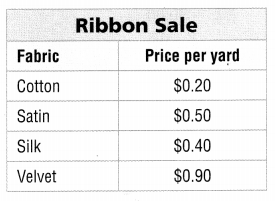
Use the table for 20 – 21.
Texas Go Math Grade 5 Lesson 5.7 Answer Key 6

Question 20.
Sasha and Lee are looking at the park’s list of hiking trails in order to choose a hike. How much farther will they have to hike if they choose Lake Trail instead of Woodland Trail?
(A) 4\(\frac{1}{3}\) miles
(B) 2\(\frac{2}{3}\) miles
(C) 2\(\frac{1}{2}\) miles
(D) 1\(\frac{1}{2}\) miles
Answer: D
Explanation:
Sasha and Lee are looking at the park’s list of hiking trails in order to choose a hike.
4\(\frac{1}{3}\) miles farther  they have to hike if they choose Lake Trail instead of Woodland Trail
4\(\frac{1}{3}\) – 2\(\frac{5}{6}\)
\(\frac{26-17}{6}\)

Go Math Subtraction with Renaming Fractions Grade 5 Question 21.
Lee and Sasha have hiked \(\frac{7}{8}\) mile on Meadow Trail. How much farther do they need to hike to get to the end of the trail?
(A) 2\(\frac{5}{8}\) miles
(B) 4 miles
(C) 4\(\frac{3}{8}\) miles
(D) \(\frac{3}{8}\) mile
Answer: A
Explanation:
Lee and Sasha have hiked \(\frac{7}{8}\) mile on Meadow Trail.
2\(\frac{5}{8}\) miles farther need to hike to get to the end of the trail
3\(\frac{1}{2}\) – \(\frac{7}{8}\)
\(\frac{28-7}{8}\)
\(\frac{21}{8}\)

Question 22.
Mario renames the mixed numbers to fractions greater than 1 to find 4\(\frac{1}{2}\) – 2\(\frac{2}{3}\). Which fractions should Mario use to find the difference?
(A) \(\frac{27}{6}\), \(\frac{16}{6}\)
(B) \(\frac{24}{6}\), \(\frac{12}{6}\)
(C) \(\frac{27}{5}\), \(\frac{16}{5}\)
(D) \(\frac{7}{6}\), \(\frac{8}{6}\)
Answer: A
Mario renames the mixed numbers to fractions greater than 1 to find
4\(\frac{1}{2}\) – 2\(\frac{2}{3}\).
\(\frac{27}{6}\), \(\frac{16}{6}\) Mario used to find the difference
4\(\frac{1}{2}\) – 2\(\frac{2}{3}\).
\(\frac{9}{2}\),\(\frac{8}{3}\).
is renamed as
\(\frac{27}{6}\), \(\frac{16}{6}\)

Question 23.
Multi-Step Ian’s mother drives 8\(\frac{1}{5}\) miles to work each day. His father drives 9\(\frac{1}{2}\) miles round-trip between home and work. How much farther is Ian’s mother’s round-trip than his father’s?
(A) 6\(\frac{9}{10}\) miles
(B) 16\(\frac{2}{5}\) miles
(C) 7\(\frac{1}{10}\) miles
(D) 17\(\frac{7}{10}\) miles
Answer: A
8\(\frac{1}{5}\) x 2
= 16\(\frac{2}{5}\) miles
\(\frac{82}{5}\) – \(\frac{19}{2}\)
\(\frac{164-95}{10}\)
= 6\(\frac{9}{10}\) miles
Ian’s mother drives 8\(\frac{1}{5}\) miles to work each day.
His father drives 9\(\frac{1}{2}\) miles round-trip between home and work.
6\(\frac{9}{10}\) miles farther is Ian’s mother’s round-trip than his father’s.

Question 24.
Multi-Step Mrs. Holbrook’s delivery truck consumes 12 galLons of gasoline in three days. If 2\(\frac{4}{5}\) gallons of gas are consumed on the first day, and 3\(\frac{7}{10}\) gallons are consumed on the second day, how much is consumed on the third day?
(A) 6\(\frac{1}{2}\) gallons
(B) 9\(\frac{1}{5}\) gallons
(C) 5\(\frac{1}{2}\) gallons
(D) 8\(\frac{3}{10}\) gallons
Answer: C
Explanation:
Mrs. Holbrook’s delivery truck consumes 12 galLons of gasoline in three days.
If 2\(\frac{4}{5}\) gallons of gas are consumed on the first day,
and 3\(\frac{7}{10}\) gallons are consumed on the second day,
5\(\frac{1}{2}\) gallons of gas on third day
12 -2\(\frac{4}{5}\)  + 3\(\frac{7}{10}\)
12 – \(\frac{28+37}{10}\)
12 – \(\frac{65}{10}\)
5\(\frac{1}{2}\) gallons

Texas Go Math Grade 5 Lesson 5.7 Answer Key Subtraction with Renaming Read More »
Texas Go Math Grade 5 Lesson 5.6 Answer Key Add and Subtract Mixed Numbers

Refer to our Texas Go Math Grade 5 Answer Key Pdf to score good marks in the exams. Test yourself by practicing the problems from Texas Go Math Grade 5 Lesson 5.6 Answer Key Add and Subtract Mixed Numbers.

Texas Go Math Grade 5 Lesson 5.6 Answer Key Add and Subtract Mixed Numbers

Unlock the Problem

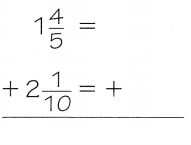
Denise mixed 1\(\frac{4}{5}\) ounces of blue paint with 2\(\frac{1}{10}\) ounces of yellow paint. How many ounces of paint did Denise mix?

  • What operation should you use to solve the problem?
  • Do the fractions have the same denominator?

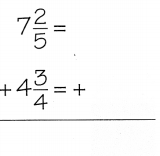
Add. 1\(\frac{4}{5}\) + 2\(\frac{1}{10}\)
To find the sum of mixed numbers with unequal denominators, you can use a common denominator.
STEP 1: Estimate the sum.

STEP 2: Find a common denominator. Use the common denominator to write equivalent fractions with equal denominators.

STEP 3: Add the fractions. Then add the whole numbers. Write the answer in simplest form.
Texas Go Math Grade 5 Lesson 5.6 Answer Key 1
So, Denise mixed __________ ounces of paint.
Answer:

So, Denise mixed \(\frac{39}{10}\)  ounces of paint.

Math Talk
Mathematical Processes

Did you use the least common denominator? Explain.
Answer: yes
Explanation:
The sum of mixed numbers with unequal denominators  can use a common denominator.

Question 1.
Explain how you know whether your answer is reasonable.
Answer: Yes my answer is reasonable
Because the sum of two mixed numbers is solved and it is proved

Go Math Grade 5 Lesson 5.6 Answer Key Question 2.
What other common denominator could you have used?
Answer: 50
multiply 5 x 10 = 50

Example

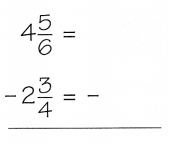
Subtract. 4\(\frac{5}{6}\) – 2\(\frac{3}{4}\)

You can also use a common denominator to find the difference between mixed numbers with unequal denominators.
STEP 1: Estimate the difference.

STEP 2: Find a common denominator. Use the common denominator to write equivalent fractions with equal denominators.

STEP 3: Subtract the fractions. Subtract the whole numbers. Write the answer in the simplest form.
Texas Go Math Grade 5 Lesson 5.6 Answer Key 2
Answer:

Question 3.
Explain how you know whether your answer is reasonable.
Answer: Used the common denominator to write equivalent fractions with equal denominators.
so, my answer is reasonable.

Share and Show

Question 1.
Use a common denominator to write equivalent fractions with equal denominators and then find the sum. Write your answer in simplest form.
Texas Go Math Grade 5 Lesson 5.6 Answer Key 3
Answer:

Explanation:
Used a common denominator and written equivalent fractions with equal denominators and then find the sum. written the answer in simplest form.

Find the sum. Write your answer in simplest form.

Question 2.
2\(\frac{3}{4}\) + 3\(\frac{3}{10}\)
Answer:
2\(\frac{3}{4}\) + 3\(\frac{3}{10}\)  = \(\frac{11}{4}\) + \(\frac{33}{10}\) = \(\frac{55}{20}\) + \(\frac{66}{20}\) = \(\frac{121}{20}\)
Explanation:
Step I: We add the whole numbers, separately. We change the mixed fractions into improper fractions.
Step II: To add fractions, we take the least common denominators and change the fractions into like fractions.
Step III: We find the sum of the whole numbers and the fractions in the simplest form.

Lesson 5.6 Answer Key Go Math Grade 5 Question 3.
5\(\frac{3}{4}\) + 1\(\frac{1}{3}\)
Answer:
5\(\frac{3}{4}\) + 1\(\frac{1}{3}\) = \(\frac{23}{4}\) + \(\frac{4}{3}\) = \(\frac{69}{12}\)+ \(\frac{16}{12}\) = \(\frac{85}{12}\)
Explanation:
Step I: We add the  whole numbers, separately. We change the mixed fractions into improper fractions.
Step II: To add fractions, we take least common denominators and change the fractions into like fractions.
Step III: We find the sum of the whole numbers and the fractions in the simplest form.

Question 4.
3\(\frac{4}{5}\) + 2\(\frac{3}{10}\)
Answer:
3\(\frac{4}{5}\) + 2\(\frac{3}{10}\) = \(\frac{19}{5}\) + \(\frac{23}{10}\) = \(\frac{38}{10}\) + \(\frac{23}{10}\) = \(\frac{61}{10}\)
Explanation:
Step I: We add the  whole numbers, separately. We change the mixed fractions into improper fractions.
Step II: To add fractions, we take least common denominators and change the fractions into like fractions.
Step III: We find the sum of the whole numbers and the fractions in the simplest form.

Problem Solving

Practice: Copy and Solve Find the sum or difference. Write your answer in simplest form.

Question 5.
1\(\frac{5}{12}\) + 4\(\frac{1}{6}\)
Answer:
1\(\frac{5}{12}\) + 4\(\frac{1}{6}\) = \(\frac{17}{12}\) + \(\frac{21}{6}\) = \(\frac{17}{12}\) + \(\frac{42}{12}\) = \(\frac{59}{12}\)
Explanation:
Step I: We add the whole numbers, separately. We change the mixed fractions into improper fractions.
Step II: To add fractions, we take the least common denominators and change the fractions into like fractions.
Step III: We find the sum of the whole numbers and the fractions in the simplest form.

Go Math 5th Grade Lesson 5.6 Add and Subtract Mixed Numbers Question 6.
8\(\frac{1}{2}\) + 6\(\frac{3}{5}\)
Answer:
8\(\frac{1}{2}\) + 6\(\frac{3}{5}\) = \(\frac{17}{2}\) + \(\frac{33}{5}\) = \(\frac{85}{10}\) + \(\frac{66}{10}\) = \(\frac{151}{10}\)
Explanation:
Step I: We add the whole numbers, separately. We change the mixed fractions into improper fractions.
Step II: To add fractions, we take the least common denominators and change the fractions into like fractions.
Step III: We find the sum of the whole numbers and the fractions in the simplest form.

Question 7.
2\(\frac{1}{6}\) + 4\(\frac{5}{9}\)
Answer:
2\(\frac{1}{6}\) + 4\(\frac{5}{9}\) = \(\frac{13}{6}\) + \(\frac{36}{9}\) = \(\frac{39}{18}\) + \(\frac{72}{18}\) = \(\frac{41}{18}\)
Explanation:
Step I: We add the  whole numbers, separately. We change the mixed fractions into improper fractions.
Step II: To add fractions, we take least common denominators and change the fractions into like fractions.
Step III: We find the sum of the whole numbers and the fractions in the simplest form.

Question 8.
3\(\frac{5}{8}\) + \(\frac{5}{12}\)
Answer:
3\(\frac{5}{8}\) + \(\frac{5}{12}\) = \(\frac{29}{8}\) + \(\frac{5}{12}\) = \(\frac{87}{24}\) + \(\frac{10}{24}\) = \(\frac{97}{24}\)
Explanation:
Step I: We add the  whole numbers, separately. We change the mixed fractions into improper fractions.
Step II: To add fractions, we take least common denominators and change the fractions into like fractions.
Step III: We find the sum of the whole numbers and the fractions in the simplest form.

Lesson 5.6 Add and Subtract Mixed Numbers Answer Key Question 9.
3\(\frac{2}{3}\) – 1\(\frac{1}{6}\)
Answer:
3\(\frac{2}{3}\) – 1\(\frac{1}{6}\) = \(\frac{11}{3}\) – \(\frac{7}{6}\) = \(\frac{22}{6}\) – \(\frac{7}{6}\) = \(\frac{15}{6}\)
Explanation:
Step I: We add the whole numbers, separately. We change the mixed fractions into improper fractions.
Step II: To add fractions, we take the least common denominators and change the fractions into like fractions.
Step III: We find the sum of the whole numbers and the fractions in the simplest form.

Question 10.
5\(\frac{6}{7}\) – 1\(\frac{2}{3}\)
Answer:
5\(\frac{6}{7}\) – 1\(\frac{2}{3}\) = \(\frac{41}{7}\) – \(\frac{5}{3}\) = \(\frac{123}{21}\) – \(\frac{35}{21}\) = \(\frac{88}{21}\)
Explanation:
Step I: We add the  whole numbers, separately. We change the mixed fractions into improper fractions.
Step II: To add fractions, we take least common denominators and change the fractions into like fractions.
Step III: We find the sum of the whole numbers and the fractions in the simplest form.

Question 11.
2\(\frac{7}{8}\) – \(\frac{1}{2}\)
Answer:
2\(\frac{7}{8}\) – \(\frac{1}{2}\) = \(\frac{23}{8}\) – \(\frac{1}{2}\) = \(\frac{23}{8}\) – \(\frac{4}{8}\) =  \(\frac{19}{8}\)
Explanation:
Step I: We add the  whole numbers, separately. We change the mixed fractions into improper fractions.
Step II: To add fractions, we take least common denominators and change the fractions into like fractions.
Step III: We find the sum of the whole numbers and the fractions in the simplest form.

Question 12.
4\(\frac{7}{12}\) – 1\(\frac{2}{9}\)
Answer:
4\(\frac{7}{12}\) – 1\(\frac{2}{9}\) = \(\frac{55}{12}\) – \(\frac{7}{5}\) = \(\frac{275}{60}\) – \(\frac{72}{60}\) = \(\frac{203}{60}\)
Explanation:
Step I: We add the  whole numbers, separately. We change the mixed fractions into improper fractions.
Step II: To add fractions, we take least common denominators and change the fractions into like fractions.
Step III: We find the sum of the whole numbers and the fractions in the simplest form.

Go Math 5th Grade Lesson 5.6 Answers Question 13.
Communicate Why do you need to write equivalent fractions with common denominators to add 4\(\frac{5}{6}\) and \(\frac{11}{8}\)? Explain.
Answer: 4\(\frac{5}{6}\) + \(\frac{11}{8}\) = \(\frac{25}{24}\) + \(\frac{11}{24}\) = \(\frac{36}{24}\)
Explanation:
Step I: We add the whole numbers, separately. We change the mixed fractions into improper fractions.
Step II: To add fractions, we take the least common denominators and change the fractions into like fractions.
Step III: We find the sum of the whole numbers and the fractions in the simplest form.

Problem-Solving

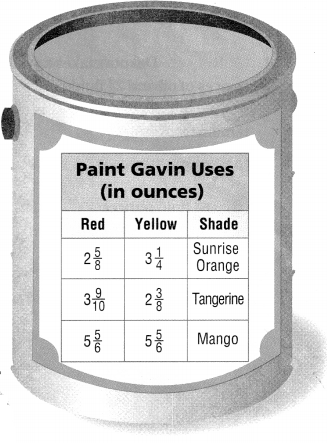
Use the table to solve 14-15.
Texas Go Math Grade 5 Lesson 5.6 Answer Key 4
Question 14.
H.O.T. Multi-Step Gavin needs to make 2 batches of Mango paint. Explain how you could find the total amount of paint Gavin mixed.
Answer: \(\frac{70}{6}\)
Explanation:
Gavin needs to make 2 batches of Mango paint
5\(\frac{5}{6}\) red + 5\(\frac{5}{6}\) yellow = \(\frac{70}{6}\) mango

Question 15.
H.O.T. Gavin mixes the amount of red from one shade of paint with the amount of yellow from a different shade of paint. He mixes the batch so he will have the greatest possible amount of paint. What amounts of red and yellow from which shades are used in the mixture? Explain your answer.
Texas Go Math Grade 5 Lesson 5.6 Answer Key 5
Answer: The amounts of red and yellow from each shades are used in the mixture is same
Explanation:
Gavin needs to make 2 batches of Mango paint
5\(\frac{5}{6}\) red + 5\(\frac{5}{6}\) yellow = \(\frac{70}{6}\) mango

Daily Assessment Task

Fill in the bubble completely to show your answer.

Question 16.
Dr. Whether-or-Not collects two hailstones during a storm in California. One hailstone weighs 2\(\frac{3}{8}\) pounds, and the other hailstone weighs 1\(\frac{3}{10}\) pounds. How much heavier is the larger hailstone than the smaller hailstone?
(A) \(\frac{3}{40}\) pounds
(B) 1\(\frac{27}{40}\) pounds
(C) 1\(\frac{3}{40}\) pounds
(D) 3\(\frac{27}{40}\) pounds
Answer: D
Explanation:
Dr. Whether-or-Not collects two hailstones during a storm in California.
One hailstone weighs 2\(\frac{3}{8}\) pounds,
and the other hailstone weighs 1\(\frac{3}{10}\) pounds.
2\(\frac{3}{8}\) + 1\(\frac{3}{10}\) pounds
\(\frac{19}{8}\) + \(\frac{13}{10}\)
\(\frac{294}{80}\)
3\(\frac{27}{40}\) pounds

Go Math Lesson 5.6 5th Grade Answer Key Question 17.
Apply Jason is making a fruit salad. He mixes in 3\(\frac{1}{4}\) cups of orange melon and 2\(\frac{2}{3}\) cups of green melon. How many cups of melon does Jason put in the fruit salad?
(A) 5\(\frac{1}{4}\) cups
(B) 5\(\frac{1}{3}\) cups
(C) 5\(\frac{7}{12}\) cups
(D) 5\(\frac{11}{12}\) cups
Answer: A
Explanation:
Apply Jason is making a fruit salad.
He mixes in 3\(\frac{1}{4}\) cups of orange melon and 2\(\frac{2}{3}\) cups of green melon.
3\(\frac{1}{4}\) + 2\(\frac{2}{3}\)
\(\frac{13}{4}\) + \(\frac{8}{3}\)
\(\frac{39}{12}\) + \(\frac{24}{12}\)
\(\frac{63}{12}\)
5\(\frac{1}{4}\)

Question 18.
Multi-Step Dakota makes a salad dressing by combining 6\(\frac{1}{3}\) fluid ounces of oil and 2\(\frac{3}{8}\) fluid ounces of vinegar in a jar. She then pours 2\(\frac{1}{4}\) fluid ounces of the dressing onto her salad. How much dressing remains in the jar?
(A) 6\(\frac{1}{8}\) fluid ounces
(B) 6\(\frac{3}{8}\) fluid ounces
(C) 6\(\frac{11}{24}\) fluid ounces
(D) 6\(\frac{17}{24}\) fluid ounces
Answer: C
Dakota makes a salad dressing by combining 6\(\frac{1}{3}\) fluid ounces of oil
and 2\(\frac{3}{8}\) fluid ounces of vinegar in a jar.
She then pours 2\(\frac{1}{4}\) fluid ounces of the dressing onto her salad.
6\(\frac{1}{3}\) + 2\(\frac{3}{8}\) – 2\(\frac{1}{4}\)
\(\frac{155}{24}\)
6\(\frac{11}{24}\) fluid ounces

Texas Test Prep

Question 19.
Yolanda walked 3\(\frac{6}{10}\) miles. Then she walked 4\(\frac{1}{2}\) more miles. How many miles did Yolanda walk?
(A) 7\(\frac{1}{10}\) miles
(B) 8\(\frac{7}{10}\) miles
(C) 8\(\frac{1}{10}\) miles
(D) 7\(\frac{7}{10}\) miles
Answer: C
Explanation:
Yolanda walked 3\(\frac{6}{10}\) miles.
Then she walked 4\(\frac{1}{2}\) more miles
3\(\frac{6}{10}\) + 4\(\frac{1}{2}\)
\(\frac{72}{20}\) + \(\frac{90}{20}\)
\(\frac{162}{20}\)

Texas Go Math Grade 5 Lesson 5.6 Homework and Practice Answer Key

Find the sum or difference. Write your answer in simplest form.

Question 1.
1\(\frac{1}{4}\) + 2\(\frac{2}{3}\) _____________
Answer:
1\(\frac{1}{4}\) + 2\(\frac{2}{3}\) = \(\frac{5}{4}\) + \(\frac{8}{3}\) = \(\frac{15}{12}\) + \(\frac{32}{12}\) = \(\frac{47}{12}\)
Explanation:
Step I: We add the  whole numbers, separately. We change the mixed fractions into improper fractions.
Step II: To add fractions, we take least common denominators and change the fractions into like fractions.
Step III: We find the sum of the whole numbers and the fractions in the simplest form.

Question 2.
3\(\frac{3}{4}\) + 4\(\frac{5}{12}\) _____________
Answer:
3\(\frac{3}{4}\) + 4\(\frac{5}{12}\) = \(\frac{36}{12}\) + \(\frac{53}{12}\) = \(\frac{89}{12}\)
Explanation:
Step I: We add the  whole numbers, separately. We change the mixed fractions into improper fractions.
Step II: To add fractions, we take least common denominators and change the fractions into like fractions.
Step III: We find the sum of the whole numbers and the fractions in the simplest form.

Question 3.
1\(\frac{1}{3}\) + 2\(\frac{1}{6}\) _____________
Answer:
1\(\frac{1}{3}\) + 2\(\frac{1}{6}\) = \(\frac{8}{6}\) + \(\frac{13}{6}\) = \(\frac{21}{6}\)
Explanation:
Step I: We add the  whole numbers, separately. We change the mixed fractions into improper fractions.
Step II: To add fractions, we take least common denominators and change the fractions into like fractions.
Step III: We find the sum of the whole numbers and the fractions in the simplest form.

Go Math Lesson 5.6 5th Grade Add and Subtract Mixed Numbers Question 4.
4\(\frac{1}{2}\) + 3\(\frac{4}{5}\) _____________
Answer:
4\(\frac{1}{2}\) + 3\(\frac{4}{5}\) = \(\frac{45}{10}\) + \(\frac{38}{10}\) = \(\frac{83}{10}\)
Explanation:
Step I: We add the  whole numbers, separately. We change the mixed fractions into improper fractions.
Step II: To add fractions, we take least common denominators and change the fractions into like fractions.
Step III: We find the sum of the whole numbers and the fractions in the simplest form.

Question 5.
5\(\frac{5}{6}\) + 4\(\frac{2}{9}\) ____________
Answer:
5\(\frac{5}{6}\) + 4\(\frac{2}{9}\) = \(\frac{35}{6}\) + \(\frac{38}{9}\) = \(\frac{105}{18}\) + \(\frac{76}{18}\) = \(\frac{181}{18}\)
Explanation:
Step I: We add the  whole numbers, separately. We change the mixed fractions into improper fractions.
Step II: To add fractions, we take least common denominators and change the fractions into like fractions.
Step III: We find the sum of the whole numbers and the fractions in the simplest form.

Question 6.
7\(\frac{1}{4}\) + 3\(\frac{2}{5}\) ___________
Answer:
7\(\frac{1}{4}\) + 3\(\frac{2}{5}\) = \(\frac{29}{4}\) + \(\frac{17}{5}\) = \(\frac{145}{20}\) + \(\frac{68}{20}\) = \(\frac{213}{20}\)
Explanation:
Step I: We add the  whole numbers, separately. We change the mixed fractions into improper fractions.
Step II: To add fractions, we take least common denominators and change the fractions into like fractions.
Step III: We find the sum of the whole numbers and the fractions in the simplest form.

Question 7.
3\(\frac{2}{7}\) + 8\(\frac{1}{3}\) _____________
Answer:
3\(\frac{2}{7}\) + 8\(\frac{1}{3}\) = \(\frac{23}{7}\) + \(\frac{25}{3}\) = \(\frac{69}{21}\) + \(\frac{175}{21}\) = \(\frac{244}{21}\)
Explanation:
Step I: We add the  whole numbers, separately. We change the mixed fractions into improper fractions.
Step II: To add fractions, we take least common denominators and change the fractions into like fractions.
Step III: We find the sum of the whole numbers and the fractions in the simplest form.

Question 8.
4\(\frac{3}{7}\) + 3\(\frac{1}{2}\) ____________
Answer:
4\(\frac{3}{7}\) + 3\(\frac{1}{2}\)  = \(\frac{31}{7}\) + \(\frac{7}{2}\) = \(\frac{62}{14}\) + \(\frac{49}{14}\) = \(\frac{114}{14}\)
Explanation:
Step I: We add the  whole numbers, separately. We change the mixed fractions into improper fractions.
Step II: To add fractions, we take least common denominators and change the fractions into like fractions.
Step III: We find the sum of the whole numbers and the fractions in the simplest form.

Question 9.
2\(\frac{4}{5}\) – 1\(\frac{1}{2}\) ____________
Answer:
2\(\frac{4}{5}\) – 1\(\frac{1}{2}\) = \(\frac{14}{5}\) – \(\frac{3}{2}\) = \(\frac{28}{10}\) – \(\frac{15}{10}\) = \(\frac{13}{10}\)
Explanation:
Step I: We add the  whole numbers, separately. We change the mixed fractions into improper fractions.
Step II: To add fractions, we take least common denominators and change the fractions into like fractions.
Step III: We find the sum of the whole numbers and the fractions in the simplest form.

Question 10.
5\(\frac{3}{8}\) – 1\(\frac{1}{4}\) ____________
Answer:
5\(\frac{3}{8}\) – 1\(\frac{1}{4}\) = \(\frac{43}{8}\) – \(\frac{5}{4}\) = \(\frac{43}{8}\) – \(\frac{10}{8}\) = \(\frac{33}{8}\)
Explanation:
Step I: We add the  whole numbers, separately. We change the mixed fractions into improper fractions.
Step II: To add fractions, we take least common denominators and change the fractions into like fractions.
Step III: We find the sum of the whole numbers and the fractions in the simplest form.

Question 11.
4\(\frac{1}{3}\) – 3\(\frac{1}{6}\) _____________
Answer:
4\(\frac{1}{3}\) – 3\(\frac{1}{6}\) = \(\frac{13}{3}\) – \(\frac{19}{6}\) = \(\frac{26}{6}\) – \(\frac{19}{6}\) = \(\frac{7}{6}\)
Explanation:
Step I: We add the  whole numbers, separately. We change the mixed fractions into improper fractions.
Step II: To add fractions, we take least common denominators and change the fractions into like fractions.
Step III: We find the sum of the whole numbers and the fractions in the simplest form.

Question 12.
6\(\frac{5}{6}\) – 5\(\frac{7}{9}\) _____________
Answer:
6\(\frac{5}{6}\) – 5\(\frac{7}{9}\) = \(\frac{41}{6}\) – \(\frac{53}{9}\) = \(\frac{123}{18}\) – \(\frac{106}{18}\) = \(\frac{17}{18}\)
Explanation:
Step I: We add the whole numbers, separately. We change the mixed fractions into improper fractions.
Step II: To add fractions, we take least common denominators and change the fractions into like fractions.
Step III: We find the sum of the whole numbers and the fractions in the simplest form.

Go Math Grade 5 Practice and Homework Lesson 5.6 Answer Key Question 13.
4\(\frac{1}{3}\) – 2\(\frac{1}{4}\) ____________
Answer:
4\(\frac{1}{3}\) – 2\(\frac{1}{4}\) = \(\frac{13}{3}\) – \(\frac{9}{4}\) = \(\frac{52}{12}\) – \(\frac{27}{12}\) = \(\frac{25}{12}\)
Explanation:
Step I: We add the whole numbers, separately. We change the mixed fractions into improper fractions.
Step II: To add fractions, we take least common denominators and change the fractions into like fractions.
Step III: We find the sum of the whole numbers and the fractions in the simplest form.

Question 14.
3\(\frac{1}{4}\) – 1\(\frac{1}{6}\) _____________
Answer:
3\(\frac{1}{4}\) – 1\(\frac{1}{6}\) = \(\frac{13}{4}\) – \(\frac{7}{6}\)  = \(\frac{39}{12}\) – \(\frac{14}{12}\) = \(\frac{25}{12}\)
Explanation:
Step I: We add the  whole numbers, separately. We change the mixed fractions into improper fractions.
Step II: To add fractions, we take least common denominators and change the fractions into like fractions.
Step III: We find the sum of the whole numbers and the fractions in the simplest form.

Question 15.
6\(\frac{3}{4}\) – 2\(\frac{5}{16}\) _____________
Answer:
6\(\frac{3}{4}\) – 2\(\frac{5}{16}\) = \(\frac{23}{4}\) – \(\frac{37}{16}\)= \(\frac{92}{16}\) – \(\frac{37}{16}\) = \(\frac{55}{16}\)
Explanation:
Step I: We add the  whole numbers, separately. We change the mixed fractions into improper fractions.
Step II: To add fractions, we take least common denominators and change the fractions into like fractions.
Step III: We find the sum of the whole numbers and the fractions in the simplest form.

Question 16.
7\(\frac{3}{5}\) – 2\(\frac{1}{4}\) _____________
Answer:
7\(\frac{3}{5}\) – 2\(\frac{1}{4}\) = \(\frac{38}{5}\) – \(\frac{9}{4}\) = \(\frac{152}{20}\) – \(\frac{45}{20}\) = \(\frac{107}{20}\)
Explanation:
Step I: We add the  whole numbers, separately. We change the mixed fractions into improper fractions.
Step II: To add fractions, we take least common denominators and change the fractions into like fractions.
Step III: We find the sum of the whole numbers and the fractions in the simplest form.

Question 17.
Use two mixed numbers to write an equation with a sum of 4\(\frac{1}{4}\).
Answer:
Explanation:
Step I: We add the  whole numbers, separately. We change the mixed fractions into improper fractions.
Step II: To add fractions, we take least common denominators and change the fractions into like fractions.
Step III: We find the sum of the whole numbers and the fractions in the simplest form.

Problem Solving

Question 18.
Lucas says his twin baby brothers have a total weight of 15\(\frac{1}{8}\) pounds. Jackson weighs pounds, and Jeremy weighs 8\(\frac{7}{8}\) pounds. Explain how you can use estimation to tell if the total weight is reasonable.
Answer:

Question 19.
The gas tank in Rebecca’s old car held 14\(\frac{1}{5}\) gallons. The gas tank in Rebecca’s new car holds 18\(\frac{1}{2}\) gallons. How many more gallons will the tank in Rebecca’s new car hold than her old car?
Answer: 4\(\frac{3}{10}\)
Explanation:
18\(\frac{1}{2}\) – 14\(\frac{1}{5}\)
= 4\(\frac{3}{10}\)

Lesson Check

Fill in the bubble completely to show your answer.

Use the table for 20-21.
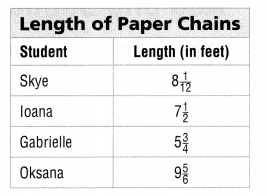
Texas Go Math Grade 5 Lesson 5.6 Answer Key 6
Four students made paper chains to decorate the community center. The table at the right shows the lengths of the paper chains.

Question 20.
If Ioana attaches her chain to the end of Gabrielle’s chain, what will be the length of the combined chain?
(A) 13\(\frac{3}{4}\) feet
(B) 13\(\frac{1}{4}\) feet
(C) 12\(\frac{1}{4}\) feet
(D) 12\(\frac{1}{2}\) feet
Answer: B
Explanation:
the length of the combined chain is 13\(\frac{1}{4}\) feet
7\(\frac{1}{2}\) feet + 5\(\frac{3}{4}\) feet=
\(\frac{30+23}{4}\) feet
\(\frac{53}{4}\)

Question 21.
How much longer is Oksana’s chain than Gabrielle’s chain?
(A) 15\(\frac{7}{12}\) feet
(B) 14\(\frac{1}{12}\) feet
(C) 4\(\frac{1}{4}\) feet
(D) 4\(\frac{1}{12}\) feet
Answer: D
4\(\frac{1}{12}\) feet is longer than Oksana’s chain than Gabrielle’s chain
Explanation:
9\(\frac{5}{6}\) feet + 5\(\frac{3}{4}\) feet=
\(\frac{118-69}{12}\) feet
\(\frac{49}{12}\)
4\(\frac{1}{12}\)

Question 22.
Mia hiked 2\(\frac{1}{2}\) miles farther than Jacob. Which could be the two distances each person hiked?
(A) Mia: 2\(\frac{1}{2}\) miles; Jacob: 1\(\frac{1}{4}\) miles
(B) Mia: 2\(\frac{1}{2}\) miles; Jacob: 7\(\frac{1}{2}\) miles
(C) Mia: 3\(\frac{2}{5}\) miles; Jacob: 5\(\frac{9}{10}\) miles
(D) Mia: 5\(\frac{9}{10}\) miles; Jacob: 3\(\frac{2}{5}\) miles
Answer: A
Explanation:
2\(\frac{1}{2}\) than jacob
if Mia: 2\(\frac{1}{2}\) miles; Jacob: 1\(\frac{1}{4}\) miles

Question 23.
Multi-Step Mr. Carter owned a ranch with 7\(\frac{1}{4}\) acres. Last year, he bought 3\(\frac{1}{5}\) acres of land from his neighbor. Then he sold 2\(\frac{1}{4}\) acres. How many acres does Mr. Carter own now?
(A) 10\(\frac{9}{20}\) acres
(B) 8\(\frac{1}{5}\) acres
(C) 12\(\frac{7}{10}\) acres
(D) 6\(\frac{3}{10}\) acres
Answer: B
Mr. Carter owned a ranch with 7\(\frac{1}{4}\) acres.
Last year, he bought 3\(\frac{1}{5}\) acres of land from his neighbor
Then he sold 2\(\frac{1}{4}\) acres.
7\(\frac{1}{4}\) + 3\(\frac{1}{5}\)  – 2\(\frac{1}{4}\)
\(\frac{164}{20}\)
= 8\(\frac{1}{5}\) acres

Question 24.
Multi-Step This week, Maddie worked 2\(\frac{1}{2}\) hours on Monday, 2\(\frac{2}{3}\) hours on Tuesday, and 3\(\frac{1}{4}\) hours on Wednesday. How many more hours will Maddie need to work this week to make her goal of 10\(\frac{1}{2}\) hours a week?
(A) 2\(\frac{1}{12}\) hours
(B) 8\(\frac{5}{12}\) hours
(C) 18\(\frac{11}{12}\) hours
(D) 5\(\frac{1}{3}\) hours
Answer: A
Explanation:
This week, Maddie worked 2\(\frac{1}{2}\) hours on Monday,
2\(\frac{2}{3}\) hours on Tuesday,
and 3\(\frac{1}{4}\) hours on Wednesday.
2\(\frac{1}{2}\)+2\(\frac{2}{3}\) + 3\(\frac{1}{4}\) -10\(\frac{1}{2}\)
\(\frac{25}{12}\)
=2\(\frac{1}{12}\) hours

Texas Go Math Grade 5 Lesson 5.6 Answer Key Add and Subtract Mixed Numbers Read More »

Texas Go Math Grade 5 Lesson 5.4 Answer Key Common Denominators and Equivalent Fractions

Refer to our Texas Go Math Grade 5 Answer Key Pdf to score good marks in the exams. Test yourself by practicing the problems from Texas Go Math Grade 5 Lesson 5.4 Answer Key Common Denominators and Equivalent Fractions.

Texas Go Math Grade 5 Lesson 5.4 Answer Key Common Denominators and Equivalent Fractions

Unlock the Problem

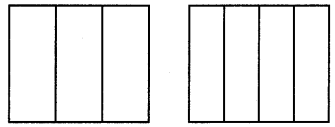
Sarah planted two 1-acre gardens. One had 3 sections of flowers and the other had 4 sections of flowers. She plans to divide both gardens into more sections so that they have the same number of equal-sized sections. How many sections will each garden have?

You can use a common denominator or a common multiple of two or more denominators to write fractions that name the same part of a whole.

Find the common denominator.
Think
Texas Go Math Grade 5 Lesson 5.4 Answer Key 1
Divide each \(\frac{1}{3}\) into fourths and divide each \(\frac{1}{4}\) into thirds, each of the wholes will be divided into the same size parts, twelfths.

Record

  • Multiply the denominators to find a common denominator.
    A common denominator of \(\frac{1}{3}\) and \(\frac{1}{4}\) is __________.
  • Write and as equivalent fractions using the common denominator.
    \(\frac{1}{3}\) = ___________ \(\frac{1}{4}\) = ____________

So, both gardens will have ___________ sections.
Answer:

  • Multiply the denominators to find a common denominator.
    A common denominator of \(\frac{1}{3}\) and \(\frac{1}{4}\) is 12
  • Write and as equivalent fractions using the common denominator.
    \(\frac{1}{3}\) =\(\frac{4}{12}\)
    \(\frac{1}{4}\) = \(\frac{3}{12}\)

So, both gardens will have12 sections.

Find the least common denominator of \(\frac{3}{4}\) and \(\frac{1}{6}\).

List nonzero multiples of the denominators.
Find the least common multiple.
Multiplesof 4: ___________________
Multiples of 6: ___________________
So, the least common denominator of \(\frac{3}{4}\) and \(\frac{1}{6}\) is _______________.
Answer:
List nonzero multiples of the denominators.
Find the least common multiple.
Multiples of 4:    2 , 4
Multiples of 6:   2, 3, 6
So, the least common denominator of \(\frac{3}{4}\) and \(\frac{1}{6}\) is 12.

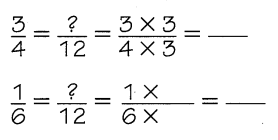
Use the least common denominator to write equivalent fractions.
Texas Go Math Grade 5 Lesson 5.4 Answer Key 2
\(\frac{3}{4}\) can be rewritten as ______________ and \(\frac{1}{6}\) can be rewritten as ____________.
Answer:

\(\frac{3}{4}\) can be rewritten as \(\frac{9}{12}\) and \(\frac{1}{6}\) can be rewritten as \(\frac{2}{12}\) .

Share and Show

Go Math Lesson 5.4 5th Grade Answer Key Question 1.
Find a common denominator of \(\frac{1}{6}\) and \(\frac{1}{9}\). Rewrite the pair of fractions using the common denominator.

  • Multiply the denominators.
    A common denominator of \(\frac{1}{6}\) and \(\frac{1}{9}\) is ___________.
  • Rewrite the pair of fractions using the common denominator.
    \(\frac{1}{6}\) = ___________ \(\frac{1}{9}\) = ____________

Answer:

  • Multiply the denominators.
    A common denominator of \(\frac{1}{6}\) and \(\frac{1}{9}\) is 18.
  • Rewrite the pair of fractions using the common denominator.
    \(\frac{1}{6}\) = \(\frac{3}{18}\)
    \(\frac{1}{9}\) = \(\frac{2}{18}\)

Explanation:
By using A common denominator written an equivalent fraction for each fraction

Math Talk
Mathematical Processes

Explain two methods for finding a common denominator of two fractions.
Answer:
Prime Factorization Method and Division method

Use a common denominator to write an equivalent fraction for each fraction.

Question 2.
\(\frac{1}{3}\), \(\frac{1}{5}\)
common denominator: ___________

Answer:

  • Multiply the denominators.
    A common denominator of \(\frac{1}{3}\) and \(\frac{1}{5}\) is 15.
  • Rewrite the pair of fractions using the common denominator.
    \(\frac{1}{3}\) = \(\frac{5}{15}\)
    \(\frac{1}{5}\) = \(\frac{3}{15}\)

Explanation:
By using A common denominator written an equivalent fraction for each fraction

Question 3.
\(\frac{2}{3}\) , \(\frac{5}{9}\)
common denominator: ___________

Answer:

  • Multiply the denominators.
    A common denominator of \(\frac{2}{3}\) and \(\frac{5}{9}\) is 9.
  • Rewrite the pair of fractions using the common denominator.
    \(\frac{2}{3}\) = \(\frac{6}{9}\)
    \(\frac{5}{9}\) = \(\frac{5}{9}\)

Explanation:
By using A common denominator write an equivalent fraction for each fraction

Go Math Lesson 5.4 Answer Key 5th Grade Question 4.
\(\frac{2}{9}\), \(\frac{1}{15}\)
common denominator: _____________

Answer:

  • Multiply the denominators.
    A common denominator of \(\frac{2}{9}\) and \(\frac{1}{15}\)is 15.
  • Rewrite the pair of fractions using the common denominator.
    \(\frac{2}{9}\) = \(\frac{10}{45}\)
    \(\frac{1}{15}\) = \(\frac{3}{45}\)

Explanation:
By using A common denominator written an equivalent fraction for each fraction

Use the least common denominator to write an equivalent fraction for each fraction.

Question 5.
\(\frac{1}{4}\), \(\frac{3}{8}\)
least common denominator: _____________

Answer: 8
Explanation:
a “Denominator” is the bottom number of a fraction. a “Common Denominator” is when the bottom number is the same for the fractions. the “Least Common Denominator” is the smallest number that can be used for all denominators of the fractions. It makes it easy to add and subtract the fractions.

Question 6.
\(\frac{11}{12}\), \(\frac{5}{8}\)
least common denominator: _____________
Answer:  24
Explanation:
a “Denominator” is the bottom number of a fraction. a “Common Denominator” is when the bottom number is the same for the fractions. the “Least Common Denominator” is the smallest number that can be used for all denominators of the fractions. It makes it easy to add and subtract the fractions.

Question 7.
\(\frac{4}{5}\), \(\frac{1}{6}\)
least common denominator: _____________
Answer: 30
Explanation:
a “Denominator” is the bottom number of a fraction. a “Common Denominator” is when the bottom number is the same for the fractions. the “Least Common Denominator” is the smallest number that can be used for all denominators of the fractions. It makes it easy to add and subtract the fractions.

Problem Solving

Practice: Copy and Solve Use the least common denominator to write an equivalent fraction for each fraction.

Question 8.
\(\frac{1}{6}\), \(\frac{4}{9}\)
Answer:
\(\frac{1}{6}\) = \(\frac{3}{18}\)
\(\frac{4}{9}\) = \(\frac{8}{18}\)
Explanation:

  • A common denominator of \(\frac{1}{6}\), \(\frac{4}{9}\) is 18.
  • Rewrite the pair of fractions using the common denominator.
    \(\frac{1}{6}\)= \(\frac{3}{18}\)
    \(\frac{4}{9}\), = \(\frac{8}{18}\)

Question 9.
\(\frac{7}{9}\), \(\frac{8}{27}\)

Answer:
\(\frac{7}{9}\) = \(\frac{21}{27}\)
\(\frac{8}{27}\)= \(\frac{8}{27}\)
Explanation:

  • A common denominator of \(\frac{7}{9}\), \(\frac{8}{27}\) is 27.
  • Rewrite the pair of fractions using the common denominator.
    \(\frac{7}{9}\) = \(\frac{21}{27}\)
    \(\frac{8}{27}\)= \(\frac{8}{27}\)

Lesson 5.4 5th Grade Go Math Answer Key Question 10.
\(\frac{7}{10}\), \(\frac{3}{8}\)

Answer:
\(\frac{7}{10}\) = \(\frac{28}{40}\)
\(\frac{3}{8}\)= \(\frac{15}{40}\)
Explanation:

  • A common denominator of \(\frac{7}{10}\), \(\frac{3}{8}\) is 40.
  • Rewrite the pair of fractions using the common denominator.
    \(\frac{7}{10}\) = \(\frac{28}{40}\)
    \(\frac{3}{8}\)= \(\frac{15}{40}\)

Question 11.
\(\frac{1}{3}\), \(\frac{5}{11}\)

Answer:
\(\frac{1}{3}\) = \(\frac{11}{33}\)
\(\frac{5}{11}\)= \(\frac{15}{33}\)
Explanation:

  • A common denominator of \(\frac{1}{3}\), \(\frac{5}{11}\) is 33.
  • Rewrite the pair of fractions using the common denominator.
    \(\frac{1}{3}\) = \(\frac{11}{33}\)
    \(\frac{5}{11}\)= \(\frac{15}{33}\)

H.O.T. Algebra Write the unknown number for each Texas Go Math Grade 5 Lesson 5.4 Answer Key 3.

Question 12.
\(\frac{1}{5}\), \(\frac{1}{8}\)
least common denominator: Texas Go Math Grade 5 Lesson 5.4 Answer Key 3
Texas Go Math Grade 5 Lesson 5.4 Answer Key 3 = _____________
Answer: 40
Explanation:
Found the unknown number in each expression

Question 13.
\(\frac{2}{5}\), \(\frac{1}{}\)
least common denominator: 15
Texas Go Math Grade 5 Lesson 5.4 Answer Key 3 = _____________
Answer: \(\frac{1}{3}\)
Explanation:
Found the unknown number in each expression

Question 14.
\(\frac{3}{}\), \(\frac{5}{6}\)
least common denominator: 42
Texas Go Math Grade 5 Lesson 5.4 Answer Key 3 = _____________
Answer: \(\frac{3}{7}\)
Explanation:
Found the unknown number in each expression

Question 15.
What does a common denominator of two fractions represent? Explain.
Answer: least common denominator
Explanation:
common denominator of two fractions represent multiples of the fraction

Unlock the Problem

Question 16.
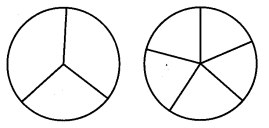
Katie made two pies for the bake sale. One was cut into three equal slices and the other into 5 equal slices. She will continue to cut the pies so each one has the same number of equal-sized slices. What is the least number of equal-sized slices each pie could have?
a. What information are you given?
Answer:
The information is about pie making into slices and sharing them to equal shares

b. What problem are you being asked to solve?
Answer:
least number of equal-sized slices each pie had.

c. When Katie cuts the pies more, can she cut each pie the same number of times and have all the slices the same size? Explain.
Answer:
When Katie cuts the slices to 3 times the slices as 5
Katie cuts the pies more,  she  can’t cut each pie the same number of times and have all the slices doesn’t have the same size

d. Use the diagram to show the steps you use to solve the problem.
Texas Go Math Grade 5 Lesson 5.4 Answer Key 4
Answer:
Step 1:
The first one is sliced once again so it is again made 2 share
Step 2:
In complete the first pie also have 5 parts

e. Complete the sentences.
The least common denominator of \(\frac{1}{3}\) and \(\frac{1}{5}\) is __________.
Katie can cut each piece of the first pie into ________ and each piece of the second pie into _________.
That means that Katie can cut each pie into pieces that are ________ of the whole pie.
Answer:
The least common denominator of \(\frac{1}{3}\) and \(\frac{1}{5}\) is 15
Katie can cut each piece of the first pie into \(\frac{5}{15}\) and each piece of the second pie into \(\frac{3}{15}\)
That means that Katie can cut each pie into pieces that are \(\frac{8}{15}\) of the whole pie.

Question 17.
H.O.T. Multi-Step Arnold had three pieces of different color string all the same length. Arnold cut the blue string into 2 equal lengths. He cut the red string into 3 equal-size lengths, and the green string into 6 equal-size lengths. He needs to cut the string so each color has the same number of equal-size lengths. What is the least number of equal-sized lengths each color string could have?
Texas Go Math Grade 5 Lesson 5.4 Answer Key 5
Answer: 12 each color string could have
Explanation:
Arnold had three pieces of different color string all the same length.
Arnold cut the blue string into 2 equal lengths.
He cut the red string into 3 equal-size lengths,
and the green string into 6 equal-size lengths.
He needs to cut the string so each color has the same number of equal-size lengths
12 the least number of equal-sized lengths each color string could have.

Daily Assessment Task

Fill in the bubble completely to show your answer.

Question 18.
Reasoning Magara entered the fractions \(\frac{1}{4}\) and \(\frac{7}{}\) into a computer program. The computer used the least common denominator to rename the fractions as \(\frac{5}{20}\) and \(\frac{14}{20}\). What is the unknown denominator?
(A) 20
(B) 8
(C) 12
(D) 10
Answer: A
Explanation:
Magara entered the fractions \(\frac{1}{4}\) and \(\frac{7}{}\) into a computer program.
The computer used the least common denominator to rename the fractions as
\(\frac{5}{20}\) and \(\frac{14}{20}\). The unknown denominator is 20

Go Math Lesson 5.4 Homework Answer Key 5th Grade Question 19.
Alejandro wants to use the least common denominator to write equivalent fractions for \(\frac{3}{7}\) and \(\frac{4}{5}\). He rewrites the fractions as \(\frac{15}{35}\) and \(\frac{20}{35}\). How should he change his answer?
(A) The numerators are correct, but the denominators should be 7.
(B) \(\frac{20}{35}\) is correct, but \(\frac{15}{35}\) should be \(\frac{21}{25}\).
(C) \(\frac{15}{35}\) is correct, but \(\frac{20}{35}\) should be \(\frac{28}{35}\).
(D) The denominators are correct, but both numerators should be 12.
Answer: C
Explanation:
Alejandro wants to use the least common denominator to write equivalent fractions for
\(\frac{3}{7}\) and \(\frac{4}{5}\).
He rewrites the fractions as
\(\frac{15}{35}\) and \(\frac{20}{35}\). he changes the answer to
\(\frac{15}{35}\) is correct, but \(\frac{20}{35}\) should be \(\frac{28}{35}\).

Question 20.
Multi-Step Aiesha and her mom are cutting two sandwiches into smaller bite-size pieces. They cut the first sandwich in four equal sized pieces. They cut the second sandwich into six equal-sized pieces. However, they want an equal number of pieces from each sandwich. What is the least number of pieces they could cut from each sandwich?
(A) 4
(B) 6
(C) 10
(D) 12
Answer: C
Explanation:
Aiesha and her mom are cutting two sandwiches into smaller bite-size pieces.
They cut the first sandwich in four equal sized pieces.
They cut the second sandwich into six equal-sized pieces.
However, they want an equal number of pieces from each sandwich.
10 is the least number of pieces they could cut from each sandwich

Texas Test Prep

Question 21.
Which fractions use the least common denominator and are equivalent to \(\frac{5}{8}\) and \(\frac{7}{10}\) ?
(A) \(\frac{10}{40}\) and \(\frac{14}{40}\)
(B) \(\frac{25}{80}\) and \(\frac{21}{80}\)
(C) \(\frac{25}{40}\) and \(\frac{28}{40}\)
(D) \(\frac{50}{80}\) and \(\frac{56}{80}\)
Answer: C
Explanation:
least common denominator and are equivalent to \(\frac{5}{8}\) and \(\frac{7}{10}\)
is \(\frac{25}{40}\) and \(\frac{28}{40}\)

Texas Go Math Grade 5 Lesson 5.4 Homework and Practice Answer Key

Use the least common denominator to write an equivalent fraction for each fraction.

Question 1.
\(\frac{1}{10}\), \(\frac{1}{5}\) ___________
Answer:
\(\frac{1}{10}\) = \(\frac{1}{10}\)
\(\frac{1}{5}\)= \(\frac{2}{10}\)

Explanation:

  • A common denominator of \(\frac{1}{10}\), \(\frac{1}{5}\) is 10
  • Rewrite the pair of fractions using the common denominator.
    \(\frac{1}{10}\) = \(\frac{1}{10}\)
    \(\frac{1}{5}\)= \(\frac{2}{10}\)

Question 2.
\(\frac{1}{3}\), \(\frac{2}{9}\) ___________
Answer:
\(\frac{1}{3}\) = \(\frac{3}{9}\)
\(\frac{2}{9}\)= \(\frac{2}{9}\)

Explanation:

  • A common denominator of \(\frac{1}{3}\), \(\frac{2}{9}\) is 9
  • Rewrite the pair of fractions using the common denominator.
    \(\frac{1}{3}\) = \(\frac{3}{9}\)
    \(\frac{2}{9}\)= \(\frac{2}{9}\)

Question 3.
\(\frac{1}{6}\), \(\frac{2}{4}\) ___________
Answer:
\(\frac{1}{6}\) = \(\frac{2}{12}\)
\(\frac{2}{4}\)= \(\frac{6}{12}\)

Explanation:

  • A denominator of \(\frac{1}{6}\), \(\frac{2}{4}\) is 12
  • Rewrite the pair of fractions using the common denominator.
    \(\frac{1}{6}\) = \(\frac{2}{12}\)
    \(\frac{2}{4}\)= \(\frac{6}{12}\)

Question 4.
\(\frac{2}{3}\), \(\frac{1}{2}\) ___________
Answer:
\(\frac{2}{3}\) = \(\frac{4}{6}\)
\(\frac{1}{2}\)= \(\frac{3}{6}\)

Explanation:

  • A common denominator of \(\frac{2}{3}\), \(\frac{1}{2}\) is 6.
  • Rewrite the pair of fractions using the common denominator.
    \(\frac{2}{3}\) = \(\frac{4}{6}\)
    \(\frac{1}{2}\)= \(\frac{3}{6}\)

Question 5.
\(\frac{3}{4}\), \(\frac{3}{8}\) ___________
Answer:
\(\frac{3}{4}\) = \(\frac{6}{8}\)
\(\frac{3}{8}\)= \(\frac{3}{8}\)

Explanation:

  • A common denominator of \(\frac{3}{4}\), \(\frac{3}{8}\) is8
  • Rewrite the pair of fractions using the common denominator.
    \(\frac{3}{4}\) = \(\frac{6}{8}\)
    \(\frac{3}{8}\)= \(\frac{3}{8}\)

Question 6.
\(\frac{11}{12}\), \(\frac{1}{6}\) ___________
Answer:
\(\frac{11}{12}\) = \(\frac{11}{12}\)
\(\frac{1}{6}\)= \(\frac{2}{12}\)

Explanation:

  • A common denominator of \(\frac{11}{12}\), \(\frac{1}{6}\) is 12.
  • Rewrite the pair of fractions using the common denominator.
    \(\frac{11}{12}\) = \(\frac{11}{12}\)
    \(\frac{1}{6}\)= \(\frac{2}{12}\)

Question 7.
\(\frac{1}{2}\), \(\frac{2}{5}\) ___________
Answer:
\(\frac{1}{2}\) = \(\frac{5}{10}\)
\(\frac{2}{5}\)= \(\frac{4}{10}\)

Explanation:

  • A common denominator of \(\frac{1}{2}\), \(\frac{2}{5}\) is 10
  • Rewrite the pair of fractions using the common denominator.
    \(\frac{1}{2}\) = \(\frac{5}{10}\)
    \(\frac{2}{5}\)= \(\frac{4}{10}\)

Question 8.
\(\frac{5}{7}\), \(\frac{3}{5}\) ___________
Answer:
\(\frac{5}{7}\)/ = \(\frac{25}{35}[latex]
[latex]\frac{3}{5}\)= \(\frac{21}{35}\)

Explanation:

  • A common denominator of \(\frac{5}{7}\), \(\frac{3}{5}\) is 35
  • Rewrite the pair of fractions using the common denominator.
    \(\frac{5}{7}\)/ = \(\frac{25}{35}[latex]
    [latex]\frac{3}{5}\)= \(\frac{21}{35}\)

Go Math Common Denominators and Equivalent Fractions Lesson 5.4 Question 9.
\(\frac{1}{4}\), \(\frac{3}{16}\) ___________
Answer:
\(\frac{1}{4}\) = \(\frac{4}{16}\)
\(\frac{3}{16}\)= \(\frac{3}{16}\)

Explanation:

  • A common denominator of \(\frac{1}{4}\), \(\frac{3}{16}\) is 16
  • Rewrite the pair of fractions using the common denominator.
    \(\frac{1}{4}\) = \(\frac{4}{16}\)
    \(\frac{3}{16}\)= \(\frac{3}{16}\)

Question 10.
\(\frac{2}{5}\), \(\frac{3}{4}\) ___________
Answer:
\(\frac{2}{5}\) = \(\frac{8}{20}\)
\(\frac{3}{4}\)= \(\frac{15}{20}\)

Explanation:

  • A common denominator of \(\frac{2}{5}\), \(\frac{3}{4}\) is 20
  • Rewrite the pair of fractions using the common denominator.
    \(\frac{2}{5}\) = \(\frac{8}{20}\)
    \(\frac{3}{4}\)= \(\frac{15}{20}\)

Question 11.
\(\frac{2}{15}\), \(\frac{5}{6}\) ___________
Answer:
\(\frac{2}{15}\) = \(\frac{4}{30}\)
\(\frac{5}{6}\)= \(\frac{25}{30}\)

Explanation:

  • A common denominator of \(\frac{2}{15}\), \(\frac{5}{6}\) is 30
  • Rewrite the pair of fractions using the common denominator.
    \(\frac{2}{15}\) = \(\frac{4}{30}\)
    \(\frac{5}{6}\)= \(\frac{25}{30}\)

Question 12.
\(\frac{7}{8}\), \(\frac{1}{2}\) ___________
Answer:
\(\frac{7}{8}\) = \(\frac{7}{8}\)
\(\frac{1}{2}\)= \(\frac{4}{8}\)

Explanation:

  • A common denominator of \(\frac{7}{8}\), \(\frac{1}{2}\) is 8.
  • Rewrite the pair of fractions using the common denominator.
    \(\frac{7}{8}\) = \(\frac{7}{8}\)
    \(\frac{1}{2}\)= \(\frac{4}{8}\)

Write the unknown number for each Texas Go Math Grade 5 Lesson 5.4 Answer Key 3.

Question 13.
\(\frac{2}{3}\), \(\frac{1}{6}\)
least common denominator: Texas Go Math Grade 5 Lesson 5.4 Answer Key 3
Texas Go Math Grade 5 Lesson 5.4 Answer Key 3 = _____________
Answer: 6
Explanation:
Found the unknown number in each expression

Question 14.
\(\frac{1}{8}\), \(\frac{2}{}\)
least common denominator: 24
Texas Go Math Grade 5 Lesson 5.4 Answer Key 3 = _____________
Answer: \(\frac{2}{3}\)
Explanation:
Found the unknown number in each expression

Question 15.
\(\frac{1}{}\), \(\frac{2}{7}\)
least common denominator: 21
Texas Go Math Grade 5 Lesson 5.4 Answer Key 3 = ____________
Answer: \(\frac{1}{3}\)
Explanation:
Found the unknown number in each expression

Problem Solving

Question 16.
Dana bought two same-sized posterboards. She cut the posterboards into equal-sized pieces to make placemats for her dinner guests. She cut the first posterboard into 5 pieces and the second posterboard into 2 pieces. She will continue to cut the pieces of posterboard so that each one is divided into the same number of equal-sized pieces. What is the least number of equal-sized pieces each posterboard could have?
Answer: 10
Explanation:
least number of equal-sized pieces each posterboard could have is 10

Question 17.
A recipe for homemade goop calls for \(\frac{1}{4}\) cup of cornstarch and \(\frac{1}{8}\) cup of glue. Find the least common denominator of the fractions used in the recipe.
Answer: 8
Explanation:
least common denominator of the fractions used in the recipe is 8

Lesson Check

Fill in the bubble completely to show your answer.

Question 18.
How can you find the least common denominator for \(\frac{1}{8}\) and \(\frac{2}{9}\).
(A) Multiply 8 and 9.
(B) Add 8 and 9.
(C) Multiply each number by 2.
(D) Add 2 to 8 and 1 to 9.
Answer: A
Explanation:
a “Denominator” is the bottom number of a fraction. a “Common Denominator” is when the bottom number is the same for the fractions. the “Least Common Denominator” is the smallest number that can be used for all denominators of the fractions. It makes it easy to add and subtract the fractions.

Go Math Lesson 5.4 Homework Answer Key Question 19.
If the least common denominator for \(\frac{1}{}\) and \(\frac{5}{12}\) is 12, which of the following could not be the unknown denominator?
(A) 2
(B) 3
(C) 4
(D) 5
Answer: D
Explanation:
Remaining are the multiples of 12

Question 20.
Which fractions use the least common denominator and are equivalent to \(\frac{3}{10}\) and \(\frac{1}{6}\)?
(A) \(\frac{18}{60}\) and \(\frac{10}{60}\)
(B) \(\frac{30}{60}\) and \(\frac{10}{60}\)
(C) \(\frac{10}{30}\) and \(\frac{18}{30}\)
(D) \(\frac{5}{30}\) and \(\frac{9}{30}\)
Answer: D
Explanation:
The least common denominator and are equivalent to \(\frac{3}{10}\) and \(\frac{1}{6}\) is \(\frac{5}{30}\) and \(\frac{9}{30}\)

Question 21.
Lindsay writes two fractions with a least common denominator of 36. Which fractions does Lindsay write?
(A) \(\frac{2}{3}\), \(\frac{5}{12}\)
(B) \(\frac{2}{9}\), \(\frac{1}{12}\)
(C) \(\frac{3}{8}\), \(\frac{7}{72}\)
(D) \(\frac{1}{8}\), \(\frac{5}{36}\)
Answer: B
Explanation:
Lindsay writes two fractions with a least common denominator of 36
Lindsay fraction is \(\frac{2}{9}\), \(\frac{1}{12}\)

Question 22.
Multi-Step An archeologist marks off two equal-sized sites for excavation. She uses a grid system to divide each square site into sections. One square has 8 sections. The other square has 6 sections. She plans to divide both squares into more sections so that they have the same number of equal-sized sections. How many sections will each square have?
(A) 14
(B) 8
(C) 24 .
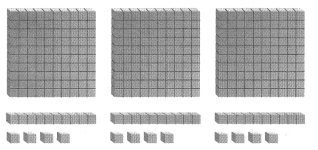
(D) 36
Answer: C
Explanation:
An archeologist marks off two equal-sized sites for excavation.
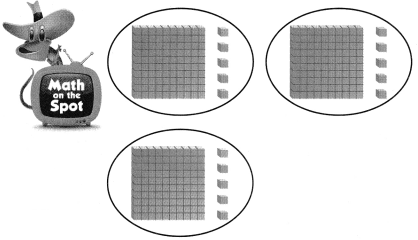
She uses a grid system to divide each square site into sections.
One square has 8 sections. The other square has 6 sections.
She plans to divide both squares into more sections so that they have the same number of equal-sized sections.
24sections will each square have

Question 23.
Multi-Step Mr. Nickelson tells the class that they double the least common denominator for \(\frac{1}{2}\), \(\frac{3}{5}\), and \(\frac{9}{15}\) to find the number of the day. Which number is the number of the day?
(A) 30
(B) 15
(C) 60
(D) 32
Answer: C
Explanation: least common denominator for \(\frac{1}{2}\), \(\frac{3}{5}\), and \(\frac{9}{15}\) = 30
30 is the number of the day and it is doubled that is 60

Texas Go Math Grade 5 Lesson 5.4 Answer Key Common Denominators and Equivalent Fractions Read More »

Texas Go Math Grade 5 Lesson 5.2 Answer Key Subtraction with Unequal Denominators

Refer to our Texas Go Math Grade 5 Answer Key Pdf to score good marks in the exams. Test yourself by practicing the problems from Texas Go Math Grade 5 Lesson 5.2 Answer Key Subtraction with Unequal Denominators.

Texas Go Math Grade 5 Lesson 5.2 Answer Key Subtraction with Unequal Denominators

Investigate

Mario fills a hummingbird feeder with \(\frac{3}{4}\) cup of sugar water on Friday. On Monday, Mario sees that \(\frac{1}{8}\) cup of sugar water is left. How much sugar water did the hummingbirds drink?

Materials: fraction strips; MathBoard

A. Find \(\frac{3}{4}\) – \(\frac{1}{8}\). Place three \(\frac{1}{4}\) strips under the 1-whole strip on your MathBoard. Then place a \(\frac{1}{8}\) strip under the \(\frac{1}{4}\) strips.
Texas Go Math Grade 5 Lesson 5.2 Answer Key 1

B. Find fraction strips all with the same denominator that fit exactly under the difference \(\frac{3}{4}\) – \(\frac{1}{8}\).
Texas Go Math Grade 5 Lesson 5.2 Answer Key 2

C. Record the difference, \(\frac{3}{4}\) – \(\frac{1}{8}\) = ___________

So, the hummingbirds drank _________ cup of sugar water.
Answer:

C. Record the difference, \(\frac{3}{4}\) – \(\frac{1}{8}\) = \(\frac{6}{8}\) – \(\frac{1}{8}\) = \(\frac{5}{8}\)

So, the hummingbirds drank \(\frac{5}{8}\) cup of sugar water.

Math Talk
Mathematical Processes

How can you tell if the difference of the fractions is less than 1? Explain.
Answer: \(\frac{5}{8}\) is less than one
by using the fraction strip method
Explanation:

Draw Conclusions

Question 1.
Describe how you determined what fraction strips, all with the same denominator, would fit exactly under the difference. What are they?
Answer:

Explanations:
Fraction strips, all with the same denominator, would fit exactly under the difference.
the above figure explains

Lesson 5.2 Answer Key 5th Grade Go Math Question 2.
H.O.T. Explain whether you could have used fraction strips with any other denominator to find the difference. If so, what is the denominator?
Answer: Unequal denominator
Explanation:
used fraction strips with any other denominator to find the difference. If so, that is called unequal denominator

Make Connections

Sometimes you can use different sets of same-denominator fraction strips to find the difference. All of the answers will be correct.

Solve. \(\frac{2}{3}\) – \(\frac{1}{6}\)

A. Find fraction strips, all with the same denominator, that fit exactly under the difference \(\frac{2}{3}\) – \(\frac{1}{6}\).
Texas Go Math Grade 5 Lesson 5.2 Answer Key 3
\(\frac{2}{3}\) – \(\frac{1}{6}\) = \(\frac{3}{6}\)

B. Find another set of fraction strips, all with the same denominator, that fit exactly under the difference \(\frac{2}{3}\) – \(\frac{1}{6}\). Draw the fraction strips you used.
Texas Go Math Grade 5 Lesson 5.2 Answer Key 4
\(\frac{2}{3}\) – \(\frac{1}{6}\) = ___________

C. Find other fraction strips, all with the same denominator, that fit exactly under the difference \(\frac{2}{3}\) – \(\frac{1}{6}\). Draw the fraction strips you used.
\(\frac{2}{3}\) – \(\frac{1}{6}\) = ____________

While each answer appears different, all of the answers can be simplified to _________.
Answer:

A. Find fraction strips, all with the same denominator, that fit exactly under the difference \(\frac{2}{3}\) – \(\frac{1}{6}\).
Texas Go Math Grade 5 Lesson 5.2 Answer Key 3
\(\frac{2}{3}\) – \(\frac{1}{6}\) = \(\frac{3}{6}\)
\(\frac{7}{10}\) – \(\frac{2}{5}\) =\(\frac{7}{10}\) – \(\frac{4}{10}\) = \(\frac{3}{10}\)

B. Find another set of fraction strips, all with the same denominator, that fit exactly under the difference \(\frac{2}{3}\) – \(\frac{1}{6}\). Draw the fraction strips you used.
Texas Go Math Grade 5 Lesson 5.2 Answer Key 4
\(\frac{2}{3}\) – \(\frac{1}{6}\) =\(\frac{3}{6}\)
\(\frac{2}{3}\) – \(\frac{1}{4}\) =\(\frac{8}{12}\) – \(\frac{3}{12}\) = \(\frac{5}{12}\)

C. Find other fraction strips, all with the same denominator, that fit exactly under the difference \(\frac{2}{3}\) – \(\frac{1}{6}\). Draw the fraction strips you used.
\(\frac{2}{3}\) – \(\frac{1}{6}\) =\(\frac{3}{6}\)

While each answer appears different, all of the answers can be simplified to equal denominators

Math Talk
Mathematical Processes

Which other fraction strips with the same denominator could fit exactly in the difference of \(\frac{2}{3}\) – \(\frac{1}{6}\)?
Answer: \(\frac{3}{6}\)
Explanation: fraction strips with the same denominator could fit exactly in the difference of \(\frac{2}{3}\) – \(\frac{1}{6}\) is \(\frac{3}{6}\)

Share and Show

Use fraction strips to find the difference. Write your answer in the simplest form.

Question 1.
Texas Go Math Grade 5 Lesson 5.2 Answer Key 3
Answer:
\(\frac{7}{10}\) – \(\frac{2}{5}\) =\(\frac{7}{10}\) – \(\frac{4}{10}\) = \(\frac{3}{10}\)
Explanation:
The fractions with unequal denominators are subtracted to get the sum
By doing them to equal denominators

Go Math Lesson 5.2 Answer Key 5th Grade Question 2.
Texas Go Math Grade 5 Lesson 5.2 Answer Key 4
Answer:
\(\frac{2}{3}\) – \(\frac{1}{4}\) =\(\frac{8}{12}\) – \(\frac{3}{12}\) = \(\frac{5}{12}\)
Explanation:
The fraction with unequal denominators are subtracted to get the sum
By doing them to equal denominators

Use fraction strips to find the difference. Write your answer in simplest form.

Question 3.
\(\frac{3}{4}\) – \(\frac{1}{3}\) = _____________
Answer:
\(\frac{3}{4}\) – \(\frac{1}{3}\) =\(\frac{9}{12}\) – \(\frac{4}{12}\) = \(\frac{5}{12}\)
Explanation:
The fraction with unequal denominators are subtracted to get the sum
By doing them to equal denominators

Question 4.
\(\frac{5}{6}\) – \(\frac{1}{2}\) = ______________
Answer:
\(\frac{5}{6}\) – \(\frac{1}{2}\) = \(\frac{5}{6}\) – \(\frac{3}{6}\)= \(\frac{2}{6}\)
Explanation:
The fraction with unequal denominators are subtracted to get the sum
By doing them to equal denominators

Question 5.
\(\frac{3}{4}\) – \(\frac{7}{12}\) = ______________
Answer:
\(\frac{3}{4}\) – \(\frac{7}{12}\) = \(\frac{9}{12}\) – \(\frac{7}{12}\) =
\(\frac{2}{12}\)
Explanation:
The fraction with unequal denominators are subtracted to get the sum
By doing them to equal denominators

Unlock the Problem

Question 6.
H.O.T. Multi-Step The picture at the right shows how much pizza was left over from lunch. Jason eats \(\frac{1}{4}\) of the whole pizza for dinner. Which subtraction sentence represents the amount of pizza that is remaining after dinner?
Texas Go Math Grade 5 Lesson 5.2 Answer Key 5

a. What problem are you being asked to solve?
Answer: fractions with unequal denominators

b. How will you use the diagram to solve the problem?
Answer:
By calculating, Number of slices ate by number of slices are not eaten

c. Jason eats 1 of the whole pizza. How many slices does he eat?
Answer: \(\frac{1}{8}\)

d. Redraw the diagram of the pizza. Shade the sections of pizza that are remaining after Jason eats his dinner.
Answer:

e. Write a fraction to represent the amount of pizza that is remaining.
Answer: \(\frac{5}{8}\)

f. Fill in the bubble for the correct answer choice above.
Answer: B

Lesson 5.2 Homework Answer Key 5th Grade Go Math Question 7.
H.O.T. Explain how a model for \(\frac{3}{5}\) – \(\frac{1}{2}\) is different from a model for \(\frac{3}{5}\) – \(\frac{3}{10}\).
Answer:
\(\frac{3}{5}\) – \(\frac{1}{2}\) = \(\frac{6}{10}\) – \(\frac{5}{10}\) = \(\frac{1}{10}\)
\(\frac{3}{5}\) – \(\frac{3}{10}\) = \(\frac{6}{10}\) – \(\frac{3}{10}\) =
\(\frac{3}{10}\)
They both are same
subtraction with unequal denominator
both get the denominator same
with numerator change

Daily Assessment Task

Fill in the bubble completely to show your answer.

Question 8.
You are making cranberry lemonade for the Tastiest Beverage contest. You use \(\frac{3}{10}\) liter cranberry juice and \(\frac{1}{2}\) liter lemonade. You drink \(\frac{1}{10}\) liter, just to be sure that it tastes delicious! How much cranberry lemonade do you have left?
(A) \(\frac{7}{10}\) liter
(B) \(\frac{9}{10}\) liter
(C) \(\frac{3}{11}\) liter
(D) \(\frac{3}{10}\) liter
Answer: A
\(\frac{3}{10}\) + \(\frac{1}{2}\) = \(\frac{3}{10}\) + \(\frac{5}{10}\) = \(\frac{8}{10}\)
\(\frac{8}{10}\) – \(\frac{1}{10}\) =\(\frac{7}{10}\)

Question 9.
Use Diagrams Calvin used fraction strips correctly to model the difference of \(\frac{7}{12}\) – \(\frac{1}{3}\). Which of these describes his model?
(A) seven \(\frac{1}{12}\) strips, one \(\frac{1}{3}\) strip, two \(\frac{1}{4}\) strips
(B) seven \(\frac{1}{12}\) strips, one \(\frac{1}{3}\) strip, one \(\frac{1}{2}\) strip
(C) seven \(\frac{1}{12}\) strips, two \(\frac{1}{6}\) strips, one \(\frac{1}{8}\) strip
(D) seven \(\frac{1}{12}\) strips, one \(\frac{1}{3}\) strip, one \(\frac{1}{4}\) strip
Answer:

Question 10.
Multi-Step Bethany made her Apple Surprise drink by mixing \(\frac{1}{8}\) pint lemon juice, \(\frac{1}{8}\) pint grape juice, and \(\frac{4}{8}\) pint apple juice. She then drank \(\frac{1}{4}\) pint of the mixture. How much Apple Surprise was left?
(A) \(\frac{1}{2}\) pint
(B) \(\frac{1}{8}\) pint
(C) \(\frac{1}{4}\) pint
(D) \(\frac{3}{8}\) pint
Answer: A
\(\frac{1}{8}\) + \(\frac{1}{8}\) + \(\frac{4}{8}\) = \(\frac{6}{8}\)
\(\frac{6}{8}\) – \(\frac{1}{4}\) = \(\frac{6}{8}\) – \(\frac{2}{8}\) = \(\frac{1}{2}\)

Texas Test Prep

Question 11.
The diagram shows what Tina had left from a yard of fabric. She now uses a yard of fabric for a project. How much of the original yard of fabric
does Tina have left after the project?
Texas Go Math Grade 5 Lesson 5.2 Answer Key 6
(A) \(\frac{1}{2}\) yard
(B) \(\frac{2}{3}\) yard
(C) \(\frac{1}{3}\) yard
(D) \(\frac{1}{6}\) yard
Answer: D
Tina had left from a yard of fabric. She now uses a yard of fabric for a project. \(\frac{5}{6}\) yard
\(\frac{1}{6}\) yard is left

Texas Go Math Grade 5 Lesson 5.2 Homework and Practice Answer Key

Use fraction strips to find the difference. Write your answer in the simplest form.

Question 1.
Texas Go Math Grade 5 Lesson 5.2 Answer Key 7
Answer:
\(\frac{7}{8}\) – \(\frac{1}{4}\) = \(\frac{7}{8}\) – \(\frac{2}{8}\) =
\(\frac{5}{8}\)
Explanation:
The fraction with unequal denominators are subtracted to get the sum
By doing them to equal denominators

Go Math Practice and Homework Lesson 5.2 Answer Key Question 2.
Texas Go Math Grade 5 Lesson 5.2 Answer Key 8
Answer:
\(\frac{11}{12}\) – \(\frac{2}{3}\) = \(\frac{11}{12}\) – \(\frac{8}{12}\) =
\(\frac{3}{12}\)
Explanation:
The fraction with unequal denominators are subtracted to get the sum
By doing them to equal denominators

Question 3.
\(\frac{1}{2}\) – \(\frac{1}{3}\) = _____________
Answer:
\(\frac{1}{2}\) – \(\frac{1}{3}\) = \(\frac{3}{6}\) – \(\frac{2}{6}\) =
\(\frac{1}{6}\)
Explanation:
The fraction with unequal denominators are subtracted to get the sum
By doing them to equal denominators

Question 4.
\(\frac{9}{10}\) – \(\frac{2}{5}\) = _____________
Answer:
\(\frac{9}{10}\) – \(\frac{2}{5}\) = \(\frac{9}{10}\) – \(\frac{4}{10}\) = \(\frac{5}{10}\)
Explanation:
The fraction with unequal denominators are subtracted to get the sum
By doing them to equal denominators

Question 5.
\(\frac{11}{12}\) – \(\frac{3}{4}\) = _____________
Answer:
\(\frac{11}{12}\) – \(\frac{3}{4}\) =  \(\frac{11}{12}\) – \(\frac{9}{12}\) =\(\frac{1}{6}\)
Explanation:
The fraction with unequal denominators are subtracted to get the sum
By doing them to equal denominators

Question 6.
\(\frac{5}{6}\) – \(\frac{1}{3}\) = _____________
Answer:
Explanation:
The fraction with unequal denominators are subtracted to get the sum
By doing them to equal denominators

Question 7.
\(\frac{2}{3}\) – \(\frac{1}{12}\) = _____________
Answer:
Explanation:
The fraction with unequal denominators are subtracted to get the sum
By doing them to equal denominators

Go Math Lesson 5.2 Homework Answer Key Grade 5 Question 8.
\(\frac{3}{4}\) – \(\frac{5}{12}\) = _____________
Answer:
Explanation:
The fraction with unequal denominators are subtracted to get the sum
By doing them to equal denominators

Question 9.
\(\frac{9}{10}\) – \(\frac{1}{2}\) = _____________
Answer:
Explanation:
The fraction with unequal denominators are subtracted to get the sum
By doing them to equal denominators

Question 10.
\(\frac{5}{8}\) – \(\frac{1}{2}\) = _____________
Answer:
\(\frac{5}{8}\) – \(\frac{1}{2}\) = \(\frac{5}{8}\) – \(\frac{4}{8}\) = \(\frac{1}{8}\)
Explanation:
The fraction with unequal denominators are subtracted to get the sum
By doing them to equal denominators

Question 11.
\(\frac{3}{4}\) – \(\frac{2}{3}\) = _____________
Answer:
\(\frac{3}{4}\) – \(\frac{2}{3}\) = \(\frac{9}{12}\) – \(\frac{8}{12}\) = \(\frac{1}{12}\)
Explanation:
The fraction with unequal denominators are subtracted to get the sum
By doing them to equal denominators

Problem Solving

Question 12.
Annette is making a fruit drink that calls for \(\frac{3}{4}\) cup of fresh lemon juice. She has \(\frac{1}{2}\) cup of lemon juice. How much more lemon juice does Annette need?
Answer:
\(\frac{3}{4}\) – \(\frac{1}{2}\) = \(\frac{3}{4}\)–\(\frac{2}{4}\) =  \(\frac{1}{4}\)
Explanation:
The fraction with unequal denominators are subtracted to get the sum
By doing them to equal denominators

Question 13.
Ramon needs to walk \(\frac{3}{4}\) mile to the bus stop. He has walked \(\frac{3}{8}\) mile so far. How much farther does Ramon need to walk to get to the bus stop?
Answer:
\(\frac{3}{4}\) – \(\frac{3}{8}\) = \(\frac{6}{8}\) – \(\frac{3}{8}\) =\(\frac{3}{8}\)
Explanation:
The fraction with unequal denominators are subtracted to get the sum
By doing them to equal denominators

Lesson Check

Fill In the bubble completely to show your answer.

Question 14.
Matt spent \(\frac{1}{3}\) of the money in his pocket on a movie ticket. He spent \(\frac{1}{4}\) of the money on a snack. What fraction of his money is left?
(A) \(\frac{7}{12}\)
(B) \(\frac{5}{12}\)
(C) \(\frac{1}{12}\)
(D) \(\frac{1}{6}\)
Answer: B
Explanation:
\(\frac{1}{3}\) + \(\frac{1}{4}\) = \(\frac{4}{12}\) + \(\frac{3}{12}\) = \(\frac{7}{12}\)
1 – \(\frac{7}{12}\) = \(\frac{5}{12}\)
Matt spent \(\frac{1}{3}\) of the money in his pocket on a movie ticket.
He spent \(\frac{1}{4}\) of the money on a snack.
\(\frac{5}{12}\) fraction of his money is left.

Go Math Grade 5 Lesson 5.2 Homework Answer Key Question 15.
Jabar used fraction strips to model the difference of \(\frac{7}{12}\) –\(\frac{1}{6}\) Which represents the difference?
(A) seven \(\frac{1}{12}\) strips
(B) one \(\frac{1}{12}\) strip
(C) two \(\frac{1}{12}\) strips
(D) five \(\frac{1}{12}\) strips
Answer:  D
\(\frac{7}{12}\) – \(\frac{1}{6}\) = \(\frac{7}{12}\) – \(\frac{2}{12}\) = \(\frac{5}{12}\)
Explanation:
Jabar used fraction strips to model the difference of \(\frac{7}{12}\) –\(\frac{1}{6}\)  represents the difference is five \(\frac{1}{12}\) strips

Question 16.
Which fraction correctly completes the equation?
\(\frac{3}{4}\) – _________ = \(\frac{1}{8}\)
(A) \(\frac{7}{8}\)
(B) \(\frac{1}{2}\)
(C) \(\frac{5}{8}\)
(D) \(\frac{1}{4}\)
Answer: C
Explanation:
\(\frac{3}{4}\) – \(\frac{5}{8}\) = \(\frac{1}{8}\)

Question 17.
Three friends share a pizza divided into eighths. If each person eats one slice, how many more slices must be eaten so that \(\frac{1}{2}\) of the pizza remains?
(A) 1
(B) 2
(C) 3
(D) 4
Answer: A
Explanation:
Three friends share a pizza divided into eighths.\(\frac{3}{8}\)
half of the pizza means 4 pieces
If each person eats one slice, 1 more slices must be eaten so that \(\frac{1}{2}\) of the pizza remains

Question 18.
Multi-Step Sara and Jon each ordered a medium pizza. Sara ate \(\frac{3}{8}\) of her pizza for lunch and \(\frac{1}{4}\) for a snack. Jon ate \(\frac{1}{2}\) of his pizza for lunch and \(\frac{1}{4}\) for a snack. How much more pizza did Jon eat?
(A) \(\frac{1}{8}\)
(B) \(\frac{1}{4}\)
(C) \(\frac{1}{2}\)
(D) \(\frac{1}{3}\)
Answer: A
Explanation:
Sara and Jon each ordered a medium pizza.
Sara ate \(\frac{3}{8}\) of her pizza for lunch and \(\frac{1}{4}\) for a snack.
\(\frac{3}{8}\) + \(\frac{1}{4}\) = \(\frac{5}{8}\)
Jon ate \(\frac{1}{2}\) of his pizza for lunch and \(\frac{1}{4}\) for a snack.
\(\frac{1}{2}\) + \(\frac{1}{4}\) = \(\frac{3}{4}\)
\(\frac{5}{8}\) – \(\frac{3}{4}\) = \(\frac{1}{8}\)
Jon eat \(\frac{1}{8}\)

Question 19.
Multi-Step On field day, \(\frac{1}{10}\) of the students in Mrs. Brown’s class competed in jumping events, \(\frac{3}{5}\) of the students competed in running events, and \(\frac{1}{10}\) competed in throwing events. What part of Mrs. Brown’s class did not compete in jumping, running, or throwing events?
(A) \(\frac{1}{5}\)
(B) \(\frac{7}{10}\)
(C) \(\frac{2}{5}\)
(D) \(\frac{4}{5}\)
Answer: A
Explanation:
On field day, \(\frac{1}{10}\) of the students in Mrs. Brown’s class competed in jumping events,
\(\frac{3}{5}\) of the students competed in running events,
and \(\frac{1}{10}\) competed in throwing events.
\(\frac{1}{10}\) + \(\frac{3}{5}\) + \(\frac{1}{10}\) = \(\frac{1}{10}\) + \(\frac{6}{10}\) + \(\frac{1}{10}\) = \(\frac{8}{10}\) – 1= \(\frac{1}{5}\)

Texas Go Math Grade 5 Lesson 5.2 Answer Key Subtraction with Unequal Denominators Read More »

Texas Go Math Grade 5 Lesson 5.1 Answer Key Addition with Unequal Denominators

Refer to our Texas Go Math Grade 5 Answer Key Pdf to score good marks in the exams. Test yourself by practicing the problems from Texas Go Math Grade 5 Lesson 5.1 Answer Key Addition with Unequal Denominators.

Texas Go Math Grade 5 Lesson 5.1 Answer Key Addition with Unequal Denominators

Investigate

Hilary is using red fabric to make a tote bag. She uses one piece that is \(\frac{1}{2}\) yard long. She uses another piece that is \(\frac{1}{4}\) yard long. How much red fabric does she use?

Materials; fraction strips; MathBoard

A. Find \(\frac{1}{2}\) + \(\frac{1}{4}\). Place a \(\frac{1}{2}\) strip and a \(\frac{1}{4}\) strip under the 1-whole strip on your MathBoard.
Texas Go Math Grade 5 Lesson 5.1 Answer Key 1
Answer:

B. Find fraction strips, all with the same denominator, that are equivalent to \(\frac{1}{2}\) and \(\frac{1}{4}\) and fit exactly under the sum \(\frac{1}{2}\) + \(\frac{1}{4}\). Record the addends, using equal denominators.
Texas Go Math Grade 5 Lesson 5.1 Answer Key 2
Answer: 3/4

C. Record the sum in simplest form. \(\frac{1}{2}\) + \(\frac{1}{4}\) = ___________
So, Hilary uses ___________ yard of fabric.
Answer: So, Hilary uses \(\frac{3}{4}\) yard of fabric.
Record the sum in simplest form. \(\frac{1}{2}\) + \(\frac{1}{4}\) = \(\frac{3}{4}\)

Math Talk
Mathematical Processes

How can you tell if the sum of the fractions is less than 1?
Answer:
Fractions greater than 1 have numerators larger than their denominators; those that are less than 1 have numerators smaller than their denominators; the rest are equal to 1.

Draw Conclusions

Question 1.
Describe how you would determine what fraction strips, all with the same denominator, would fit exactly under \(\frac{1}{2}\) + \(\frac{1}{3}\). What are they?
Answer:

Explanation:
The denominator is 6
Which would fit exactly under \(\frac{1}{6}\) + \(\frac{1}{6}\)+ \(\frac{1}{6}\) + \(\frac{1}{6}\)+\(\frac{1}{6}\) + \(\frac{1}{6}\).

Go Math Grade 5 Lesson 5.1 Answer Key Question 2.
H.O.T. Explain the difference between finding fraction strips with the same denominator for \(\frac{1}{2}\) + \(\frac{1}{3}\) and \(\frac{1}{2}\) + \(\frac{1}{4}\).
Answer:

Make Connections

Sometimes, the sum of two fractions is greater than 1. When adding fractions with unequal denominators, you can use the 1-whole strip to help determine If a sum is greater than 1 or less than 1.

Use fraction strips to solve. \(\frac{3}{5}\) + \(\frac{1}{2}\)
STEP 1:
Work with another student. Place three \(\frac{1}{5}\) fraction strips under the 1-whole strip on your MathBoard. Then place a \(\frac{1}{2}\) fraction strip beside the three \(\frac{1}{5}\) strips.

STEP 2:
Find fraction strips, all with the same denominator, that are equivalent to \(\frac{3}{5}\) and \(\frac{1}{2}\). Place the fraction strips under the sum. At the right, draw a picture of the model and write the equivalent fractions.
\(\frac{3}{5}\) = __________ \(\frac{1}{2}\) = __________

STEP 3:
Add the fractions with equal denominators. Use the 1-whole strip to rename the sum in simplest form.
\(\frac{3}{5}\) + \(\frac{1}{2}\) = __________ + _________
= __________ or _________
Think: How many fraction strips with the same denominator are equal to 1 whole?
Answer:
step 1:

Explanation:
Placed three \(\frac{1}{5}\) fraction strips under the 1-whole strip on your MathBoard. Then place a \(\frac{1}{2}\) fraction strip beside the three \(\frac{1}{5}\) strips.
step 2:
Place the fraction strips under the sum. At the right, draw a picture of the model and write the equivalent fractions.
\(\frac{3}{5}\) = 6\(\frac{1}{10}\)
\(\frac{1}{2}\) = 5\(\frac{1}{10}\)

step 3:
\(\frac{3}{5}\) + \(\frac{1}{2}\) = 6\(\frac {1}{10}\) + 5\(\frac{1}{10}\)
= \(\frac{11}{10}\)

Math Talk
Mathematical Processes

In what step did you find out that the answer is greater than 1? Explain.
Answer: In step 2
Explanation:
\(\frac{3}{5}\) =6\(\frac{1}{10}\)
\(\frac{1}{2}\) =5\(\frac{1}{10}\)

Share and Show

Use fraction strips to find the sum. Write your answer in simplest form.

Question 1.
Texas Go Math Grade 5 Lesson 5.1 Answer Key 3
Answer:

Explanation:
Place the fraction strips with the same denominator 8, that are equivalent to \(\frac{1}{2}\)
then Added

Go Math Grade 5 Chapter 5 Answer Key Pdf Lesson 5.1 Question 2.
Texas Go Math Grade 5 Lesson 5.1 Answer Key 4
Answer:

Explanation:
Place the fraction strips with the same denominator of 12, that are equivalent to \(\frac{3}{4}\) and \(\frac{1}{3}\). Then Added.

Use fraction strips to find the sum. Write your answer in simplest form.

Question 3.
\(\frac{2}{5}\) + \(\frac{3}{10}\) = __________
Answer: \(\frac{7}{10}\)
Explanation:
\(\frac{2}{5}\) + \(\frac{3}{10}\) = \(\frac{4}{10}\) + \(\frac{3}{10}\) = \(\frac{7}{10}\)
or

Question 4.
\(\frac{1}{4}\) + \(\frac{1}{12}\) = ___________
Answer: \(\frac{1}{3}\)
Explanation:
\(\frac{1}{4}\) + \(\frac{1}{12}\) = \(\frac{3}{12}\) + \(\frac{1}{12}\) = \(\frac{4}{12}\) = \(\frac{1}{3}\)
or

Question 5.
\(\frac{1}{2}\) + \(\frac{3}{10}\) = ____________
Answer: \(\frac{4}{5}\)
Explanation:
\(\frac{1}{2}\) + \(\frac{3}{10}\) = \(\frac{5}{10}\) + \(\frac{3}{10}\) = \(\frac{8}{10}\) = \(\frac{4}{5}\)

Problem Solving

Question 6.
H.O.T. Multi-Step Maya makes trail mix by combining \(\frac{1}{3}\) cup mixed nuts, \(\frac{1}{4}\) cup of dried fruit, and \(\frac{1}{6}\) cup of chocolate morsels. What is the total amount of ingredients in her trail mix?
Texas Go Math Grade 5 Lesson 5.1 Answer Key 5
Answer: \(\frac{3}{4}\)
Explanation:
\(\frac{1}{3}\) + \(\frac{1}{4}\) + \(\frac{1}{6}\)= \(\frac{4}{12}\) + \(\frac{3}{12}\) +\(\frac{2}{12}\) = \(\frac{9}{12}\) = \(\frac{3}{4}\)

Go Math Practice and Homework Lesson 5.1 Answer Key Question 7.
H.O.T. Pose a Problem Write a new problem using different amounts of ingredients Maya used. Each amount should be a fraction with a denominator of 2, 3, or 4.
Answer:
Maya makes trail mix by combining \(\frac{1}{2}\) cup mixed nuts, \(\frac{1}{3}\) cup of dried fruit, and \(\frac{1}{4}\) cup of chocolate morsels. What is the total amount of ingredients in her trail mix?

Question 8.
Use Diagrams to Solve the problem you wrote. Draw a picture of the fraction strips you use to solve your problem.
Answer: \(\frac{13}{12}\)

Question 9.
Explain why you chose the amounts you did for your problem.
Answer: in the question asked use different amounts for ingredients and Each amount should be a fraction with a denominator of 2, 3, or 4.

Question 10.
Write Math Explain how using fraction strips with equal denominators makes it possible to add fractions with unequal denominators.
Answer:

Think of the fruit analogy?

Does it make sense to add two bananas plus one watermelon? The units do not make sense for the sum.

BUT … we could think about changing both of them to common units, servings of fruit. If one banana serves one person and one watermelon serves ten people, then we could convert:

  • two bananas + one watermelon =
  • = two fruit servings + ten fruit servings =
  • = twelve servings of fruit

Example:

Daily Assessment Task

Fill in the bubble completely to show your answer.

Question 11.
In a garden, bluebonnets occupy \(\frac{7}{10}\) of the garden. After winter, the bluebonnets spread to cover another \(\frac{1}{5}\) of the garden. What fraction of the garden is now covered in bluebonnets?
(A) \(\frac{1}{5}\)
(B) \(\frac{1}{2}\)
(C) \(\frac{8}{10}\)
(D) \(\frac{9}{10}\)
Answer: D
Explanation:
\(\frac{7}{10}\) + \(\frac{1}{5}\)  = \(\frac{9}{10}\)

Question 12.
Ling is using fraction strips to add \(\frac{2}{3}\) and \(\frac{7}{12}\). The sum is one whole, plus how many twelfths?
(A) 1
(B) 2
(C) 3
(D) 4
Answer: C
Explanation:

Question 13.
Multi-Step Juan uses \(\frac{1}{5}\) liter to water a small plant, and he uses \(\frac{1}{2}\) liter to water a large plant. Now he has \(\frac{2}{10}\) liter Left in the pitcher. How much water did Juan have in the beginning?
(A) \(\frac{3}{5}\) L
(B) \(\frac{9}{10}\) L
(C) \(\frac{1}{10}\) L
(D) \(\frac{3}{10}\) L
Answer: B
Explanation:
Juan uses \(\frac{1}{5}\) liter to water a small plant, and he uses \(\frac{1}{2}\) liter to water a large plant.
So total water he used \(\frac{7}{10}\) L.
Now he has \(\frac{2}{10}\) liter Left in the pitcher.
So Juan have water in the beginning is \(\frac{9}{10}\) L. Since

Texas Test Prep

Go Math Lesson 5.1 5th Grade Homework Answer Key Question 14.
Wilhelm is making a pie. He uses \(\frac{1}{2}\) cup of blueberries and \(\frac{2}{3}\) cup of raspberries. What is the total amount of berries in Wilhelm’s pie?
(A) \(\frac{3}{5}\) cup
(B) \(\frac{2}{6}\) cup
(C) \(\frac{7}{6}\) cups
(D) \(\frac{3}{6}\) cup
Answer: \(\frac{7}{6}\) cups
Explanation:
He uses \(\frac{1}{2}\) cup of blueberries and \(\frac{2}{3}\) cup of raspberries.
Sum of  \(\frac{1}{2}\)  + \(\frac{2}{3}\) = \(\frac{7}{6}\)

Texas Go Math Grade 5 Lesson 5.1 Homework and Practice Answer Key

Use fraction strips to find the sum. Write your answer in the simplest form.

Question 1.
Texas Go Math Grade 5 Lesson 5.1 Answer Key 6
Answer:

Explanation:
To add the given fractions, did the denominator equal first then added

Question 2.
Texas Go Math Grade 5 Lesson 5.1 Answer Key 7
Answer:

Explanation:
To add the given fractions, did the denominator equal first then added

Question 3.
\(\frac{1}{6}\) + \(\frac{3}{4}\) = ____________
Answer:\(\frac{11}{12}\)
Explanation:
To add the given fractions, did the denominator equal first then added

Question 4.
\(\frac{5}{6}\) + \(\frac{1}{2}\) = ____________
Answer: \(\frac{8}{6}\)
Explanation:
To add the given fractions, did the denominator equal first then added

Question 5.
\(\frac{1}{2}\) + \(\frac{2}{5}\) = _____________
Answer: \(\frac{9}{10}\)
Explanation:
To add the given fractions, did the denominator equal first then added

Question 6.
\(\frac{1}{4}\) + \(\frac{2}{3}\) = ______________
Answer: \(\frac{11}{12}\)
Explanation:
To add the given fractions, did the denominator equal first then added
\(\frac{1}{4}\) + \(\frac{2}{3}\) = \(\frac{3}{12}\) + \(\frac{8}{12}\) = \(\frac{11}{12}\)

Question 7.
\(\frac{1}{3}\) + \(\frac{5}{6}\) = _____________
Answer: \(\frac{7}{6}\)
Explanation:
To add the given fractions, did the denominator equal first then added
\(\frac{1}{3}\) + \(\frac{5}{6}\) = \(\frac{2}{6}\) + \(\frac{5}{6}\) = \(\frac{7}{6}\)

Question 8.
\(\frac{3}{5}\) + \(\frac{3}{10}\) = ______________
Answer: \(\frac{9}{10}\)
Explanation:
To add the given fractions, did the denominator equal first then added
\(\frac{3}{5}\) + \(\frac{3}{10}\) = \(\frac{6}{10}\) + \(\frac{3}{10}\) = \(\frac{9}{10}\)

Question 9.
\(\frac{1}{8}\) + \(\frac{3}{4}\) = _____________
Answer: \(\frac{7}{8}\)
Explanation:
To add the given fractions, did the denominator equal first then added
\(\frac{1}{8}\) + \(\frac{3}{4}\) = \(\frac{1}{8}\) + \(\frac{6}{8}\) = \(\frac{7}{8}\)

Question 10.
\(\frac{7}{10}\) + \(\frac{1}{2}\) = _____________
Answer: \(\frac{7}{8}\)
Explanation:
To add the given fractions, did the denominator equal first then added
\(\frac{7}{10}\) + \(\frac{1}{2}\) = \(\frac{7}{10}\) + \(\frac{5}{10}\) = \(\frac{12}{10}\) = \(\frac{6}{5}\)

Question 11.
\(\frac{5}{6}\) + \(\frac{1}{12}\) = _____________
Answer: \(\frac{11}{12}\)
Explanation:
To add the given fractions, did the denominator equal first then added
\(\frac{5}{6}\) + \(\frac{1}{12}\) = \(\frac{10}{12}\) + \(\frac{1}{12}\) = \(\frac{11}{12}\)

Problem Solving

Question 12.
Cooper is grating cheese for the family taco dinner. He grates \(\frac{1}{2}\) cup of cheddar cheese and \(\frac{3}{4}\) cup of monterey jack cheese. How much cheese does Cooper grate?
Answer:  Cooper grate \(\frac{5}{4}\) cup of cheese
Explanation:
Cooper grates \(\frac{1}{2}\) cup of cheddar cheese and \(\frac{3}{4}\) cup of monterey jack cheese. then total cheese is sum of \(\frac{1}{2}\) cup of cheddar cheese and \(\frac{3}{4}\) cup of monterey jack cheese. So Total cheese is \(\frac{5}{4}\)
\(\frac{1}{2}\)+\(\frac{3}{4}\)  =\(\frac{2}{4}\)+\(\frac{3}{4}\)  = \(\frac{5}{4}\)

Lesson 5.1 Answer Key Go Math 5th Grade Question 13.
Jasmine has to mix \(\frac{3}{4}\) cup of flour and \(\frac{3}{8}\) cup of cornmeal. She has a container that holds 1 cup. Can Jasmine mix the flour and cornmeal in the container? Explain.
Answer: Jasmine Can not mix the flour and cornmeal in the container. Since the total mix of flour and cornmeal is 1/8 cup more than a cup.
Explanation:
Jasmine has to mix \(\frac{3}{4}\) cup of flour and \(\frac{3}{8}\) cup of cornmeal. So Sum of flour and cornmeal is \(\frac{9}{8}\)
if divided into fraction strips of the same denominator the \(\frac{8}{8}\) + \(\frac{1}{8}\). \(\frac{8}{8}\) is equals to 1 cup. So she can not mix in the container.

Lesson Check

Fill in the bubble completely to show your answer.

Question 14.
Julio spent \(\frac{1}{10}\) of his weekly allowance on a set of markers and \(\frac{2}{5}\) of it on a book. What fraction of Julio’s allowance is this altogether?
(A) \(\frac{1}{2}\)
(B) \(\frac{3}{10}\)
(C) \(\frac{3}{5}\)
(D) \(\frac{1}{5}\)
Answer: \(\frac{1}{2}\)
Explanation:
\(\frac{1}{10}\) + \(\frac{2}{5}\)  = \(\frac{1}{10}\) + \(\frac{4}{10}\) =\(\frac{5}{10}\) = \(\frac{1}{2}\)

Question 15.
Kate is using fraction strips to add \(\frac{4}{10}\) and \(\frac{4}{5}\). She uses one whole strip to represent the sum. How many fifth strips does she need to complete the sum?
(A) 1
(B) 2
(C) 5
(D) 8
Answer: A
Explanation:

one extra strip is needed to complete the sum
Question 16.
Which fraction correctly completes the equation?
\(\frac{6}{8}\) + \(\frac{}{}\) = 1
(A) \(\frac{1}{2}\)
(B) \(\frac{1}{8}\)
(C) \(\frac{3}{8}\)
(D) \(\frac{1}{4}\)
Answer: D
Explanation:
\(\frac{6}{8}\) + \(\frac{1}{4}\) = \(\frac{6}{8}\) + \(\frac{2}{8}\) = \(\frac{8}{8}\) = 1

Question 17.
An apple was cut into 8 equal-size pieces. Stacy ate \(\frac{1}{4}\) of the apple. Tony ate \(\frac{3}{8}\) of the apple. What part of the apple did Stacy and Tony eat in all?
(A) \(\frac{1}{2}\)
(B) \(\frac{5}{8}\)
(C) \(\frac{3}{4}\)
(D) \(\frac{1}{4}\)
Answer: B
Explanation:
Equal the all denominators:
Stacy ate \(\frac{1}{4}\) of the apple = \(\frac{1}{4}\) = \(\frac{2}{8}\)
Tony ate \(\frac{3}{8}\) of the apple = \(\frac{3}{8}\)
Stacy and Tony ate = \(\frac{3}{8}\)  + \(\frac{2}{8}\)= \(\frac{5}{8}\)

Question 18.
Multi-Step Last weekend, Beatrice walked her poodle \(\frac{2}{3}\) mile on Saturday and \(\frac{5}{6}\) mile on Sunday. Fiona walked her beagle \(\frac{1}{3}\) mile on Saturday and \(\frac{1}{2}\) mile on Sunday. How much farther did the poodle walk last weekend than the beagle?
(A) \(\frac{1}{2}\) mile
(B) 1\(\frac{1}{3}\) miles
(C) \(\frac{2}{3}\) mile
(D) 1\(\frac{1}{2}\) miles
Answer: C
Explanation:
Last weekend, Beatrice walked her poodle \(\frac{2}{3}\) mile on Saturday
and \(\frac{5}{6}\) mile on Sunday.
Fiona walked her beagle \(\frac{1}{3}\) mile on Saturday
and \(\frac{1}{2}\) mile on Sunday.
\(\frac{2}{3}\) + \(\frac{5}{6}\) = \(\frac{4}{6}\) + \(\frac{5}{6}\) = \(\frac{9}{6}\) = \(\frac{3}{2}\)
\(\frac{1}{3}\) + \(\frac{1}{2}\) = \(\frac{2}{6}\) + \(\frac{3}{6}\) = \(\frac{5}{6}\)
\(\frac{3}{2}\) – \(\frac{5}{6}\) = \(\frac{9}{6}\) – \(\frac{5}{6}\) = \(\frac{2}{3}\)

Question 19.
Multi-Step Rick worked in his garden on Friday. He pulled weeds for \(\frac{5}{6}\) hour, planted seeds for \(\frac{1}{2}\) hour, and watered for \(\frac{1}{6}\) hour. How much time did Rick spend working in his garden on Friday?
(A) \(\frac{1}{2}\) hour
(B) 1 hour
(C) 1\(\frac{1}{3}\) hours
(D) 1\(\frac{1}{2}\) hours
Answer: D
Explanation:
\(\frac{5}{6}\) +\(\frac{1}{2}\) + \(\frac{1}{6}\) = \(\frac{5}{6}\)  +\(\frac{3}{6}\) +\(\frac{1}{6}\) = \(\frac{9}{6}\) = \(\frac{6}{6}\) +\(\frac{3}{6}\) = 1 + \(\frac{1}{2}\)

Texas Go Math Grade 5 Lesson 5.1 Answer Key Addition with Unequal Denominators Read More »

Texas Go Math Grade 5 Lesson 4.5 Answer Key 2-Digit Divisors

Refer to our Texas Go Math Grade 5 Answer Key Pdf to score good marks in the exams. Test yourself by practicing the problems from Texas Go Math Grade 5 Lesson 4.5 Answer Key 2-Digit Divisors.

Texas Go Math Grade 5 Lesson 4.5 Answer Key 2-Digit Divisors

Unlock the Problem

The annual rainfall in Greensville is 4.32 inches. What is the average monthly rainfall in Greensville?

One Way Use place value.
Divide. 4.32 ÷ 12

STEP 1: Share the ones.
Texas Go Math Grade 5 Lesson 4.5 Answer Key 1
4 ones cannot be shared among 12 groups without regrouping.
Place a zero to show there are no ones.

STEP 2: Share the tenths.
Texas Go Math Grade 5 Lesson 4.5 Answer Key 2
Divide. _______ tenths ÷ 12
Multiply. 12 × _______ tenths
Subtract. _______ tenths – _______ tenths
Check._______ tenths cannot be shared among 12 groups.

STEP 3: Share the hundredths.
Texas Go Math Grade 5 Lesson 4.5 Answer Key 3
Divide. ______ hundredths ÷ 12
Multiply. 12 × _______ hundredths
Subtract, _______ hundredths – _______ hundredths
Check. _______ hundredths cannot be shared among 12 groups.
Place the decimal point in the quotient to separate the ones and the tenths.

So, the average monthly rainfall in Greenville is ___________ inch.
Answer:

STEP 1: Share the ones.

4 ones cannot be shared among 12 groups without regrouping.
Place a zero to show there are no ones.

STEP 2: Share the tenths.

Divide. 43 tenths ÷ 12
Multiply. 12 × 3 tenths
Subtract. 43tenths – 36tenths
Check.7 tenths cannot be shared among 12 groups.

STEP 3: Share the hundredths.

Divide. 72 hundredths ÷ 12
Multiply. 12 × 6 hundredths
Subtract, 72 hundredths – 72hundredths
Check. 0 hundredths cannot be shared among 12 groups.
Placed the decimal point in the quotient to separate the ones and the tenths.

So, the average monthly rainfall in Greenville is 0.36 inch.

Math Talk
Mathematical Processes

Explain how you would model 10.32 ÷ 12 using base-ten blocks.
Answer:

Another Way Use an estimate.

Divide as you would with whole numbers.
Divide. $40.89 ÷ 47

  • Estimate the quotient. 4,000 hundredths ÷ 50 = 80 hundredths, or $0.80
    Texas Go Math Grade 5 Lesson 4.5 Answer Key 4
  • Divide the tenths.
  • Divide the hundredths. When the remainder is zero and there are no more digits in the dividend, the division is complete.
  • Use your estimate to place the decimal point. Place a zero to show there are no ones.

So, $40.89 ÷ 47 is $0.80.
Answer: The estimated quotient is 0.80
Explanation:

Explain how you used the estimate to place the decimal point in the quotient.
Answer:
Estimated to place the decimal point.
Placed a zero to show there are no ones.
the decimal point is placed in the product so that the number of decimal places in the product is the sum of the decimal places in the factors.

Share and Show

Divide.

Question 1.
Texas Go Math Grade 5 Lesson 4.5 Answer Key 5
Estimate the quotient.
40 tenths ÷ 20 = _________
Answer: 2

Explanation:
Divided the tenths.
Divide the hundredths.
When the remainder is zero and there are no more digits in the dividend, the division is complete.
Use your estimate to place the decimal point. Place a zero to show there are no ones.

Go Math 5th Grade Lesson 4.5 Answer Key Question 2.
Texas Go Math Grade 5 Lesson 4.5 Answer Key 6
Answer:
Estimate the quotient.
60 tenths ÷ 20 =3

Explanation:
Divided the tenths.
Divide the hundredths.
When the remainder is zero and there are no more digits in the dividend, the division is complete.
Used your estimate to place the decimal point. Place a zero to show there are no ones.

Question 3.
Texas Go Math Grade 5 Lesson 4.5 Answer Key 7
Answer:

Estimate the quotient.
140 tenths ÷ 14 = 10
Explanation:
Divided the tenths.
Divide the hundredths.
When the remainder is zero and there are no more digits in the dividend, the division is complete.
Used your estimate to place the decimal point. Place a zero to show there are no ones.

Question 4.
Texas Go Math Grade 5 Lesson 4.5 Answer Key 8
Answer:

Estimate the quotient.
40 tenths ÷ 40 = 1
Explanation:
Divided the tenths.
Divide the hundredths.
When the remainder is zero and there are no more digits in the dividend, the division is complete.
Used your estimate to place the decimal point. Place a zero to show there are no ones.

Problem Solving

Question 5.
H.O.T. Representations Make a model to find 11.16 ÷ 18. Describe your model.
Answer:

2 digit division model
Explanation:
Divided the tenths.
Divide the hundredths.
When the remainder is zero and there are no more digits in the dividend, the division is complete.
Used your estimate to place the decimal point. Place a zero to show there are no ones.

Go Math Lesson 4.5 5th Grade Answer Key Question 6.
Write Math what’s the Error? Darla divided 812.5 by 50. She says the quotient is 1.625. Describe Darla’s error.
Answer: 16.25
Explanation:
She placed the decimal point wrong

Problem Solving

Question 7.
Jin makes trail mix with apricots and walnuts. A package of dried apricots weighs 25.5 ounces. Jin divides the apricots equally among 34 bags of trail mix. How many ounces of apricots are in each bag?
Answer: 0.75 ounces
Explanation:
Jin makes trail mix with apricots and walnuts.
A package of dried apricots weighs 25.5 ounces.
Jin divides the apricots equally among 34 bags of trail mix.
2.5 ÷ 34 = 0.75

Question 8.
Analyze A large box of cereal weighs 17 ounces and costs $5.95. A small box of the same cereal weighs 10 ounces and costs $3.90. Which has a greater cost per ounce?
Texas Go Math Grade 5 Lesson 4.5 Answer Key 9
Answer: A large box of cereal weighs 17 ounces and costs $5.95. is greater cost per ounce
Explanation:
A large box of cereal weighs 17 ounces and costs $5.95.
17 ÷ 5.95 = 2.85
A small box of the same cereal weighs 10 ounces and costs $3.90.
10 ÷ 3.90 = 2.56
2.85 – 2.56 = 0.29

Question 9.
Multi-Step Maya trains 5 days each week for a triathlon. In 5 weeks she logs 24.6 miles in the pool. 445.45 miles on the bike, and 167.45 miles running. On average, how many miles did Maya cover each day?
Answer: 318.5miles
Explanation:
Maya trains 5 days each week for a triathlon.
In 5 weeks she logs 24.6 miles in the pool.
445.45 miles on the bike,
and 167.45 miles running.
24.6 + 445.45 + 167.45 = 637.5
To find the average we have to divide the total with 2
637.5 ÷ 2 = 318.5

Daily Assessment Task

Fill in the bubble completely to show your answer.

Question 10.
A scientist conducting a dig spent $37.95 on 23 packets of hand wipes for her team of volunteers. What was the price of each packet?
(A) $16.50
(B) $16.05
(C) $1.60
(D) $1.65
Answer: D
Explanation:
A scientist conducting a dig spent $37.95 on 23 packets of hand wipes for her team of volunteers.
the price of each packet is $1.65

Division with 2-Digit Divisors Lesson 4.5 Answer Key Question 11.
Calvin needs to buy carpet to cover the floor of a rectangular room with an area of 170.8 square feet. Calvin measures the room’s length to be 14 feet. He then divides the room’s area by its length to find the room’s width. How many decimal places will the quotient have?
(A) 0
(B) 1
(C) 2
(D) 3
Answer: C
Explanation:
Calvin needs to buy carpet to cover the floor of a rectangular room with an area of 170.8 square feet.
Calvin measures the room’s length to be 14 feet.
He then divides the room’s area by its length to find the room’s width.
The quotient is 12.2 so, the decimal point is 2

Question 12.
Multi-Step Farmer Lee grows tomatoes and squash. He harvests 49.92 kilograms of tomatoes and 65.92 kilograms of squash. He distributes the tomatoes and squash into 32 farm share baskets. How many more kilograms of squash than tomatoes does each basket contain?
(A) 2.06 kilograms
(B) 0.5 kilogram
(C) 1.56 kilograms
(D) 3.62 kilograms
Answer: 0.5 kilograms
Explanation:
Farmer Lee grows tomatoes and squash.
He harvests 49.92 kilograms of tomatoes and 65.92 kilograms of squash.
He distributes the tomatoes and squash into 32 farm share baskets.
49.92 ÷ 32 = 2.06
65.92 ÷ 32 = 1.56
2.06 – 1.56 = 0.5
0.5 more kilograms of squash than tomatoes in each basket contain.

Texas Test Prep

Question 13.
Jasmine uses 14.24 pounds of fruit for 16 servings of fruit salad. If each serving contains the same amount of fruit, how much fruit is in each serving?
(A) 0.089 pound
(B) 1.76 pounds
(C) 0.89 pound
(D) 17.6 pounds
Answer: C
Explanation:
Jasmine uses 14.24 pounds of fruit for 16 servings of fruit salad.
If each serving contains the same amount of fruit,
the fruit in each serving is 0.89 pounds

Texas Go Math Grade 5 Lesson 4.5 Homework and Practice Answer Key

Divide.

Question 1.
Texas Go Math Grade 5 Lesson 4.5 Answer Key 10
Answer:

Explanation:
Divided the tenths.
Divide the hundredths.
When the remainder is zero and there are no more digits in the dividend, the division is complete.
Used your estimate to place the decimal point. Place a zero to show there are no ones.

Go Math 5th Grade Practice and Homework Lesson 4.5 Answer Key Question 2.
Texas Go Math Grade 5 Lesson 4.5 Answer Key 11
Answer:

Explanation:
Divided the tenths.
Divide the hundredths.
When the remainder is zero and there are no more digits in the dividend, the division is complete.
Used your estimate to place the decimal point. Place a zero to show there are no ones.

Question 3.
Texas Go Math Grade 5 Lesson 4.5 Answer Key 12
Answer:

Explanation:
Divided the tenths.
Divide the hundredths.
When the remainder is zero and there are no more digits in the dividend, the division is complete.
Used your estimate to place the decimal point. Place a zero to show there are no ones.

Question 4.
Texas Go Math Grade 5 Lesson 4.5 Answer Key 13
Answer:

Explanation:
Divided the tenths.
Divide the hundredths.
When the remainder is zero and there are no more digits in the dividend, the division is complete.
Used your estimate to place the decimal point. Place a zero to show there are no ones.

Question 5.
Texas Go Math Grade 5 Lesson 4.5 Answer Key 14
Answer:

Explanation:
Divided the tenths.
Divide the hundredths.
When the remainder is zero and there are no more digits in the dividend, the division is complete.
Used your estimate to place the decimal point. Place a zero to show there are no ones.

Question 6.
Texas Go Math Grade 5 Lesson 4.5 Answer Key 15
Answer:

Explanation:
Divided the tenths.
Divide the hundredths.
When the remainder is zero and there are no more digits in the dividend, the division is complete.
Use your estimate to place the decimal point. Place a zero to show there are no ones.

Lesson 4.5 Homework Answer Key Go Math 5th Grade Question 7.
Texas Go Math Grade 5 Lesson 4.5 Answer Key 16
Answer:

Explanation:
Divided the tenths.
Divide the hundredths.
When the remainder is zero and there are no more digits in the dividend, the division is complete.
Used your estimate to place the decimal point. Place a zero to show there are no ones.

Question 8.
Texas Go Math Grade 5 Lesson 4.5 Answer Key 17
Answer:

Explanation:
Divided the tenths.
Divide the hundredths.
When the remainder is zero and there are no more digits in the dividend, the division is complete.
Used your estimate to place the decimal point. Place a zero to show there are no ones.

Question 9.
Texas Go Math Grade 5 Lesson 4.5 Answer Key 18
Answer:

Explanation:
Divided the tenths.
Divide the hundredths.
When the remainder is zero and there are no more digits in the dividend, the division is complete.
Used your estimate to place the decimal point. Place a zero to show there are no ones.

Question 10.
Texas Go Math Grade 5 Lesson 4.5 Answer Key 19
Answer:

Explanation:
Divided the tenths.
Divide the hundredths.
When the remainder is zero and there are no more digits in the dividend, the division is complete.
Used your estimate to place the decimal point. Place a zero to show there are no ones.

Question 11.
Texas Go Math Grade 5 Lesson 4.5 Answer Key 20
Answer:

Explanation:
Divided the tenths.
Divide the hundredths.
When the remainder is zero and there are no more digits in the dividend, the division is complete.
Used your estimate to place the decimal point. Place a zero to show there are no ones.

Go Math Grade 5 Lesson 4.5 Homework Answers Question 12.
Texas Go Math Grade 5 Lesson 4.5 Answer Key 21
Answer:

Explanation:
Divided the tenths.
Divide the hundredths.
When the remainder is zero and there are no more digits in the dividend, the division is complete.
Used your estimate to place the decimal point. Place a zero to show there are no ones.

Problem Solving

Question 13.
Carla’s car travels 412.5 miles on a tank of gas. The tank holds 15 gallons of gas. How many miles can Carla go on each gallon?
Answer: 27.5miles
Explanation:
Carla’s car travels 412.5 miles on a tank of gas.
The tank holds 15 gallons of gas.
Carla can go on each gallon of gas is 27.5 miles

Question 14.
Muffins cost $35.40 for a dozen or $18.72 for a half dozen. Which is the better buy? Explain.
Answer: Dozen = $2.95
Half dozen = $3.12
Explanation:
The better buy is dozen as it cost per piece is $2.95

Lesson Check

Fill in the bubble completely to show your answer.

Question 15.
Anita pays $20.70 to copy an 18 page report. What is the cost for each page?
(A) $1.05
(B) $1.03
(C) $1.15
(D) $1.10
Answer: C
Explanation:
Anita pays $20.70 to copy an 18 page report.
the cost for each page is $1.15

Question 16.
A florist sells a dozen roses for $29.88. What is the cost of one rose?
(A) $2.41
(B) $2.49
(C) $2.40
(D) $2.08
Answer: B
Explanation:
A florist sells a dozen roses for $29.88.
cost of one rose $2.49
since dozen equals to 12. So 29.88 ÷ 12 = 2.49

Question 17.
Cameron has a stack of 13 identical books that is 30.55 centimeters tall. He divides the total height by the number of books to find the width of one book. How many decimal places will the quotient have?
(A) 3
(B) 2
(C) 1
(D) 0
Answer:
Explanation:
Cameron has a stack of 13 identical books that is 30.55 centimeters tall.
He divides the total height by the number of books to find the width of one book.
So width of each book is 2.35cm.  Since 30.55 ÷13 = 2.35.
So 2 decimal places will the quotient have.

Question 18.
Kiera makes 188.6 ounces of punch for a pool party. She has 23 guests attending the party. How many ounces of punch does she make for each guest?
(A) 8.2 ounces
(B) 9.4 ounces
(C) 8.1 ounces
(D) 7.2 ounces
Answer: A
Explanation:
Kiera makes 188.6 ounces of punch for a pool party.
She has 23 guests attending the party.
So She made the 8.2 ounces of punch for each guest.
Since 188.6 ÷ 23 = 8.2

Question 19.
Multi-Step Last year, Mr. Henderson paid a total of $98.40 for phone service and $79.20 for garbage pickup. What was his average cost per month for phone service and garbage pickup?
(A) $8.20
(B) $6.60
(C) $1.48
(D) $14.80
Answer: D
Explanation:
Last year, Mr. Henderson paid a total of $98.40 for phone service and $79.20 for garbage pickup. So total paid per year is $177.6.
12 months in a year. So his average cost per month phone service and garbage pick up is 14.80.
Since 177.60 ÷12 = 14.80

Question 20.
Multi-Step Isabel worked 20 hours last week and earned $145.80. Nan worked 15 hours last week and earned $112.50. How much more does Nan earn per hour?
(A) $2.22
(B) $3.30
(C) $0.39
(D) $0.21
Answer: D
Explanation:
Isabel worked 20 hours last week and earned $145.80. So Isabel  earn $7.29 per hour. Since 145.80 ÷20 = 7.29.
Nan worked 15 hours last week and earned $112.50. So Nan earn $7.50 per hour. Since $112.50 ÷15 = 7.50.
Nan Earned $0.21 more than Isabel per hour.

Texas Go Math Grade 5 Lesson 4.5 Answer Key 2-Digit Divisors Read More »

Texas Go Math Grade 5 Lesson 4.3 Answer Key Estimate Quotients

Refer to our Texas Go Math Grade 5 Answer Key Pdf to score good marks in the exams. Test yourself by practicing the problems from Texas Go Math Grade 5 Lesson 4.3 Answer Key Estimate Quotients.

Texas Go Math Grade 5 Lesson 4.3 Answer Key Estimate Quotients

Unlock the Problem

Carmen likes to ski. The ski resort where she goes to the sky got 3.2 feet of snow during a 5-day period. The average daily snowfall for a given number of days is the quotient of the total amount of snow and the number of days. Estimate the average daily snowfall.

You can estimate decimal quotients by using compatible numbers. When choosing compatible numbers, you can look at the whole-number part of a decimal dividend or rename the decimal dividend as tenths or hundredths.

Estimate. 3.2 ÷ 5

Carly and her friend Marco each find an estimate. Since the divisor is greater than the dividend, they both first rename 3.2 as tenths.
3.2 is _________ tenths.

CARLY’S ESTIMATE
30 tenths is close to 32 tenths and divides easily by 5. Use a basic fact to find 30 tenths ÷ 5.
30 tenths ÷ 5 is ______ tenths or _________.
So, the average daily snowfall is about ________ foot.

MARCO’S ESTIMATE
35 tenths is close to 32 tenths and divides easily by 5. Use a basic fact to find 35 tenths ÷ 5.
35 tenths ÷ 5 is ______ tenths or _________.
So, the average daily snowfall is about ________ foot.
Answer:

Carly and her friend Marco each find an estimate. Since the divisor is greater than the dividend, they both first rename 3.2 as tenths.
3.2 is 32 tenths.

CARLY’S ESTIMATE
30 tenths is close to 32 tenths and divides easily by 5. Use a basic fact to find 30 tenths ÷ 5.
30 tenths ÷ 5 is 6 tenths or 0.6 tenths
So, the average daily snowfall is about 6 foot.

MARCO’S ESTIMATE
35 tenths is close to 32 tenths and divides easily by 5. Use a basic fact to find 35 tenths ÷ 5.
35 tenths ÷ 5 is 7 tenths or 0.7.
So, the average daily snowfall is about 0.7 foot.

Question 1.
Whose estimate do you think is closer to the exact quotient? Explain your reasoning.
Answer: Exact quotient is0.64
Explanation:
CARLY’S ESTIMATE
30 tenths is close to 32 tenths and divides easily by 5. Use a basic fact to find 30 tenths ÷ 5.
30 tenths ÷ 5 is 6 tenths or 0.6 tenths
So, the average daily snowfall is about 6 foot.

MARCO’S ESTIMATE
35 tenths is close to 32 tenths and divide easily by 5. Use a basic fact to find 35 tenths ÷ 5.
35 tenths ÷ 5 is 7 tenths or 0.7.
So, the average daily snowfall is about 0.7 feet.
By seeing this Carly’s estimation is nearest.
0.6is near the 0.64

How to Estimate Division 5th Grade Lesson 4.3 Answer Key Question 2.
Explain how you would rename the dividend in 29.7 ÷ 40 to choose compatible numbers and estimate the quotient.
Answer: 0.7 or 7
Explanation:
280 tenths is close to 297 tenths and divide easily by 40. Use a basic fact to find 297 tenths ÷ 40.
280  tenths ÷ 40 is 7 tenths or 0.7.
So,
You can estimate decimal quotients by using compatible numbers. When choosing compatible numbers, you can look at the whole-number part of a decimal dividend or rename the decimal dividend as tenths or hundredths.

Example

A group of 31 students is going to visit the museum. The total cost for the tickets is $76.15. About how much money will each student need to pay for a ticket?

Estimate. $76.15 ÷ 31

A. Use a whole number greater than the dividend.
Use 30 for the divisor. Then find a number close to and greater than $76.15 that divides easily by 30.
Texas Go Math Grade 5 Lesson 4.3 Answer Key 1
So, each student will pay about $ ________ for a ticket.
Answer:
A. Used a whole number greater than the dividend.
Used 30 for the divisor. Then found the number close to and greater than $76.15 that divides easily by 30.

So, each student will pay about $ 3 for a ticket.

B. Used a whole number less than the dividend.
Used 30 for the divisor. Then found the number close to and less than $76.15 that divides easily by 30.

So, each student will pay about $ 2 for a ticket.

Math Talk
Mathematical Processes

Explain which estimate you think will be a better estimate of the cost of a ticket.
Answer: The estimated answer is 2.45
Explanation:
The number close to and greater than $76.15 that divided easily by 30.

So, each student will pay about $ 3 for a ticket.
2.45is very near to 3
a better estimate of the cost of a ticket is 90 ÷30 = 3

Share and Show

Use compatible numbers to estimate the quotient.

Question 1.
28.8 ÷ 9
________ ÷ _________ = __________
Answer:  30 ÷ 10= 3
Explanation:
You can estimate decimal quotients by using compatible numbers.
When choosing compatible numbers,
you can look at the whole-number part of a decimal dividend
or rename the decimal dividend as tenths or hundredths.

Lesson 4.3 Estimate Quotients 5th Grade Go Math Question 2.
393.5 ÷ 41
________ ÷ __________ = ___________
Answer: 400 ÷40 = 10
Explanation:
You can estimate decimal quotients by using compatible numbers.
When choosing compatible numbers,
you can look at the whole-number part of a decimal dividend
or rename the decimal dividend as tenths or hundredths.

Estimate the quotient.

Question 3.
161.7 ÷ 7
Answer: 160 ÷ 10 = 16
Explanation:
You can estimate decimal quotients by using compatible numbers.
When choosing compatible numbers,
you can look at the whole-number part of a decimal dividend
or rename the decimal dividend as tenths or hundredths.

Question 4.
$17.90 ÷ 9
Answer: 180 ÷ 10 = 18
Explanation:
You can estimate decimal quotients by using compatible numbers.
When choosing compatible numbers,
you can look at the whole-number part of a decimal dividend
or rename the decimal dividend as tenths or hundredths.

Question 5.
145.4 ÷ 21
Answer: 140÷ 20 = 7
Explanation:
You can estimate decimal quotients by using compatible numbers.
When choosing compatible numbers,
you can look at the whole-number part of a decimal dividend
or rename the decimal dividend as tenths or hundredths.

Problem Solving

Question 6.
Write Math Explain why you might want to find an estimate for a quotient.
Answer:
In a division sum, when the divisor is made up of 2 digits or more than 2 digits, it helps if we first estimate the quotient and then try to find the actual number. Calculate mentally. In the process of division, the estimation of the quotient plays a great role in its solution.

Estimating Quotients 5th Grade Lesson 4.3 Answer Key Question 7.
H.O.T. What’s the Error? During a 3-hour storm, it snowed 2.5 inches. Jacob said that it snowed an average of about 8 inches per hour.
Answer: 2.5 ÷ 3 = 0.83
Explanation:
He did not estimate with the help of compatible numbers
so, he said an average of 8 inches per hour
but the average is 0.8 per hour

Problem-Solving

Use the table to solve 8-10.
Texas Go Math Grade 5 Lesson 4.3 Answer Key 3

Question 8.
Estimate the average daily snowfall for Alaska’s greatest 7-day snowfall.
Answer: 26.7
Explanation:
The average daily snowfall for Alaska’s greatest 7-day snowfall is 26.7.

Question 9.
Multi-Step How does the estimate of the average daily snowfall for Wyoming’s greatest 7-day snowfall compare to the estimate of the average daily snowfall for South Dakota’s greatest 7-day snowfall?
Answer: South Dakota’s rain fall is greater
Explanation:
The average daily snowfall for Wyoming’s greatest 7-day snowfall is 12.07
The estimate of the average daily snowfall for South Dakota’s greatest 7-day snowfall is 16.1
South Dakota’s rain fall is greater than the Wyoming’s snowfall

Question 10.
H.O.T. The greatest monthly snowfall total in Alaska is 297.9 inches. This happened in February, 1953. Compare the daily average snowfall for February, 1953, with the average daily snowfall for Alaska’s greatest 7-day snowfall. Use estimation.
Texas Go Math Grade 5 Lesson 4.3 Answer Key 4
Answer:  February
Explanation:
The greatest monthly snowfall total in Alaska is 297.9 inches. This happened in February, 1953.
The daily average snowfall for February, 1953 is 10.63
The average daily snowfall for Alaska’s greatest 7-day snowfall is 26.7.
The average daily snowfall for Alaska’s greatest 7-day snowfall is greater than the daily average snowfall for February, 1953

Daily Assessment Task

Fill in the bubble completely to show your answer.

Question 11.
You are participating in a remote control car race. It takes 215.78 seconds for your car to complete five laps. Which is the best estimate of the average time it takes to complete each lap?
(A) 22 seconds
(B) 44 seconds
(C) 30 seconds
(D) 55 seconds
Answer: B
Explanation:
You are participating in a remote control car race.
It takes 215.78 seconds for your car to complete five laps. 215 ÷ 5 = 43
43 is near to 44
43 is the best estimate of the average time it takes to complete each lap.

5th Grade Estimating Quotients Lesson 4.3 Answer Key Question 12.
Communicate Jake buys 12 books at the bookstore for $92.08. Each book costs the same amount. Jake uses 84 to estimate the cost of each book, and then also uses 96 to estimate. Why does he choose these numbers?
(A) 92.08 falls between 84 and 96, and both whole numbers are divisible by 92.08.
(B) 84 and 96 are even numbers.
(C) 92.08 falls between 84 and 96, and both whole numbers are divisible by 12.
(D) 92.08 does not fall between 84 and 96.
Answer: C
Explanation;
92.08 falls between 84 and 96, and both whole numbers are divisible by 12.
Jake buys 12 books at the bookstore for $92.08.
Each book costs the same amount.
Jake uses 84 to estimate the cost of each book,
and then also uses 96 to estimate.
Question 13.
Multi-Step Last week, Alaina ran 12 miles in 131.25 minutes. The next week, Alaina ran 12 miles in 119.5 minutes. About how much faster did she run each mile in the second week?
(A) 0 minutes
(B) 1 minute
(C) 3 minutes
(D) 5 minutes
Answer: B
Explanation:
Last week, Alaina ran 12 miles in 131.25 minutes.
The next week, Alaina ran 12 miles in 119.5 minutes.
She runs each mile in the second week is
131.25-119.5 = 11.75
11.75 ÷ 12 = 0.91
which is near to 1

Texas Test Prep

Question 14.
A plant grew 23.8 inches over 8 weeks. Which is the best estimate of the average number of inches the plant grew each week?
(A) 0.2 inch
(B) 2 inches
(C) 0.3 inch
(D) 3 inches
Answer: D
Explanation:
A plant grew 23.8 inches over 8 weeks.
23.8 ÷ 8 =2.9 is 3 the best estimate of the average number of inches the plant grew each week.

Texas Go Math Grade 5 Lesson 4.3 Homework and Practice Answer Key

Use compatible numbers to estimate the quotient.

Question 1.
78.8 ÷ 8
_________ ÷ _________ = __________
Answer: 80 ÷ 10= 8
Explanation:
You can estimate decimal quotients by using compatible numbers.
When choosing compatible numbers,
you can look at the whole-number part of a decimal dividend
or rename the decimal dividend as tenths or hundredths.

Question 2.
646.1 ÷ 34
_________ ÷ __________ = __________
Answer: 600 ÷ 30 = 20
Explanation:
You can estimate decimal quotients by using compatible numbers.
When choosing compatible numbers,
you can look at the whole-number part of a decimal dividend
or rename the decimal dividend as tenths or hundredths.

Estimate the quotient.

Question 3.
434.2 ÷ 62
Answer: 400 ÷ 60 = 6.6
Explanation:
You can estimate decimal quotients by using compatible numbers.
When choosing compatible numbers,
you can look at the whole-number part of a decimal dividend
or rename the decimal dividend as tenths or hundredths.

5th Grade Practice and Homework Lesson 4.3 Answer Key Question 4.
$14.60 ÷ 5
Answer: 15÷ 5 =3
Explanation:
You can estimate decimal quotients by using compatible numbers.
When choosing compatible numbers,
you can look at the whole-number part of a decimal dividend
or rename the decimal dividend as tenths or hundredths.

Question 5.
35.6 ÷ 6
Answer: 36 ÷ 6 = 6
Explanation:
You can estimate decimal quotients by using compatible numbers.
When choosing compatible numbers,
you can look at the whole-number part of a decimal dividend
or rename the decimal dividend as tenths or hundredths.

Question 6.
$82.15 ÷ 23
Answer: 100 ÷ 25 = 4
Explanation:
You can estimate decimal quotients by using compatible numbers.
When choosing compatible numbers,
you can look at the whole-number part of a decimal dividend
or rename the decimal dividend as tenths or hundredths.

Question 7.
63.2 ÷ 18
Answer: 60 ÷ 20 = 3
Explanation:
You can estimate decimal quotients by using compatible numbers.
When choosing compatible numbers,
you can look at the whole-number part of a decimal dividend
or rename the decimal dividend as tenths or hundredths.

Question 8.
227.5 ÷ 21
Answer: 220 ÷ 20 = 11
Explanation:
You can estimate decimal quotients by using compatible numbers.
When choosing compatible numbers,
you can look at the whole-number part of a decimal dividend
or rename the decimal dividend as tenths or hundredths.

Question 9.
36.9 ÷ 9
Answer: 36÷ 9 = 4
Explanation:
You can estimate decimal quotients by using compatible numbers.
When choosing compatible numbers,
you can look at the whole-number part of a decimal dividend
or rename the decimal dividend as tenths or hundredths.

Question 10.
143.2 ÷ 7
Answer: 140 ÷ 7 = 20
Explanation:
You can estimate decimal quotients by using compatible numbers.
When choosing compatible numbers,
you can look at the whole-number part of a decimal dividend
or rename the decimal dividend as tenths or hundredths.

Question 11.
$9.65 ÷ 5
Answer: 10 ÷ 5 = 2
Explanation:
You can estimate decimal quotients by using compatible numbers.
When choosing compatible numbers,
you can look at the whole-number part of a decimal dividend
or rename the decimal dividend as tenths or hundredths.

Problem-Solving

Question 12.
Gino opens a savings account and deposits about the same amount each month for 5 months. At the end of 5 months, he has deposited $33.55. About how much did Gino deposit each month?
Answer:

Question 13.
Thunderstorms brought a total of 5.8 inches of rain to the first week of spring. Estimate the average daily rainfall for the first week of spring.
Answer:

Lesson Check

Fill in the bubble completely to show your answer.

Question 14.
Aaron gives an estimate of 2 for the quotient in a division problem. His teacher says his estimate is reasonable. If the divisor is 4, which number could be the dividend in Aaron’s problem?
(A) 80.4
(B) 8.24
(C) 0.84
(D) 2.84
Answer: B
Explanation:
The nearest whole number for 8.24 is 8
when its divisor is 4
8 divided by 4 is 2
so, His teacher says his estimate is reasonable.

Question 15.
Natalie buys 4 pieces of wood to build a square pen for her rabbit. She decides the perimeter will be 6.96 meters. Which wood length should she buy to build each side of the pen so that she has enough wood, but has the least amount of wood left over?
(A) 1 meter
(B) 2 meters
(C) 2.5 meters
(D) 3 meters
Answer: B
Explanation:
Natalie buys 4 pieces of wood to build a square pen for her rabbit
She decides the perimeter will be 6.96 meters. 6.96 ÷ 4 = 1.74
2 meters she bought to build each side of the pen so that she has enough wood

Question 16.
It takes the printer in Reba’s office 240.42 seconds to print out six reports. About how long does it take to print out each report?
(A) 50-51 seconds
(B) 24-25 seconds
(C) 40-41 seconds
(D) 30-31 seconds
Answer: C
Explanation:
It takes the printer in Reba’s office 240.42 seconds to print out six reports.
240.42 ÷ 6 = 40.07
40.07seconds it takes to print out each report

Question 17.
Ross and Lydia estimate the quotient for 387.5 ÷ 73. Ross uses a whole number greater than the dividend. Which equation shows how Lydia uses compatible numbers to get a closer estimate?
(A) 400 ÷ 80 = 5
(B) 450 ÷ 75 = 6
(C) 360 ÷ 60 = 6
(D) 375 ÷ 75 = 5
Answer: A
Explanation:
Ross uses a whole number greater than the dividend.
400 ÷ 80 = 5
Lydia uses compatible numbers to get a closer estimate

Question 18.
Multi-Step Mr. Williams owns an orchard. He has 211.9 pounds of grapefruits and 169.6 pounds of oranges to sell. He divides the fruit evenly into 8 shipments. About how many pounds are in each shipment?
(A) 50 pounds
(B) 30 pounds
(C) 400 pounds
(D) 20 pounds
Answer: A pounds
Explanation:
Mr. Williams owns an orchard. He has 211.9 pounds of grapefruits
and 169.6 pounds of oranges to sell.
211.9 + 169.6 = 381.5
381.5 ÷ 8 = 47.68
He divides the fruit evenly into 8 shipments.
In each shipment 50 pounds of fruit.

Question 19.
Multi-Step Cara has $25. She buys a shirt for $13.68. She buys a hat that is half the cost of the shirt. Which is the best estimate for the amount of money Cara should expect to have left?
(A) $4
(B) $3
(C) $6
(D) $7
Answer: C
Explanation:
Cara has $25.
She buys a shirt for $13.68. That is 25 – 13 = 12
She buys a hat that is half the cost of the shirt.  12÷ 2 = 6
6 is the best estimate for the amount of money Cara should expect to have left.

Texas Go Math Grade 5 Lesson 4.3 Answer Key Estimate Quotients Read More »

Texas Go Math Grade 5 Lesson 4.2 Answer Key Divide Decimals by Whole Numbers

Refer to our Texas Go Math Grade 5 Answer Key Pdf to score good marks in the exams. Test yourself by practicing the problems from Texas Go Math Grade 5 Lesson 4.2 Answer Key Divide Decimals by Whole Numbers.

Texas Go Math Grade 5 Lesson 4.2 Answer Key Divide Decimals by Whole Numbers

Investigate

Materials; decimal models; color pencils

Angela has enough wood to make a picture frame with a perimeter of 2.4 meters. She wants the frame to be a square. What will be the length of each side of the frame?
Texas Go Math Grade 5 Lesson 4.2 Answer Key 1
A. Shade decimal models to show 2.4.

B. You need to share your model among __________ equal groups.

C. Since 2 wholes cannot be shared among 4 groups without regrouping, cut your model apart to show the tenths.
There are ______ tenths in 2.4.
Share the tenths equally among the 4 groups.
There are ______ ones and ______ tenths in each group.
Write a decimal for the amount in each group.

D. Use your model to complete the number sentence.
2.4 ÷ 4 = ___________
So, the length of each side of the frame will be ___________ meter.
Answer:
A. Shade decimal models to show 2.4.
B. You need to share your model among  4 equal groups.
C. Since 2 wholes cannot be shared among 4 groups without regrouping, cut your model apart to show the tenths.
There are 24  tenths in 2.4.
Share the tenths equally among the 4 groups.
There are 0 ones and 6 tenths in each group.
Write a decimal for the amount in each group.
D. Use your model to complete the number sentence.
2.4 ÷ 4 =0.6
So, the length of each side of the frame will be 0.6 meter.
Explanation:
This is done by base 10 blocks model

Replace the ones blocks with tenths blocks. You have a total of 24-tenths blocks
Group the blocks into groups of 0.6 each.
There are four groups of 0.6. So, 2.4 ÷ 4 = 0.6

Draw Conclusions

Multiply Decimals and Whole Numbers Lesson 4.2 Question 1.
You can also use area models to represent division. Shade the area model below and circle groups to show 2.4 ÷ 4.
Answer:

Explanation:
Shaded the area model below and circle groups to show 2.4 ÷ 4.

Math Talk
Mathematical Processes

What other manipulatives or models could you use to solve this problem?
Answer: Base 10 model
Explanation:
You can also use base 10 blocks method to model the division of a decimal by the whole number

Make Connections

You can also use base-ten blocks to model the division of a decimal by a whole number.

Materials; base-ten blocks

Kyle has a roll of ribbon 3.21 yards long. He cuts the ribbon into 3 equal lengths. How long is each piece of ribbon?

Divide. 3.21 ÷ 3

STEP 1:
Use base-ten blocks to show 3.21.
Remember that a flat represents one, a long represents one-tenth, and a small cube represents one hundredth.
There are __________ one(s), ________ tenth(s), and _________ hundredth(s).
Texas Go Math Grade 5 Lesson 4.2 Answer Key 2

STEP 2:
Share the ones.
Share an equal number of ones among 3 groups.
There is __________ one(s) shared in each group and _________ one(s) left over.

STEP 3:
Share the tenths.
Two tenths cannot be shared among 3 groups without regrouping. Regroup the tenths by replacing them with hundredths.
There are __________ tenth(s) shared in each group and __________ tenth(s) left over.
There are now __________ hundredth(s).
Texas Go Math Grade 5 Lesson 4.2 Answer Key 3

STEP 4:
Share the hundredths.
Share the 21 hundredths equally among the 3 groups.
There are _________ hundredth(s) shared in each group and _________ hundredth(s) left over.
So, each piece of ribbon is __________ yards long.
Answer:

STEP 1:
Remember that a flat represents one, a long represents one-tenth, and a small cube represents one hundredth.
There are 3  one(s), 2  tenth(s), and 1 hundredth(s).
Texas Go Math Grade 5 Lesson 4.2 Answer Key 2

STEP 2:
Share the ones.
Share an equal number of ones among 3 groups.
There is 3 one(s) shared in each group and 0 one(s) left over.

STEP 3:
Share the tenths.
Two tenths cannot be shared among 3 groups without regrouping. Regroup the tenths by replacing them with hundredths.
There are 0  tenth(s) shared in each group and 0 tenth(s) left over.
There are now 21 hundredth(s).
Texas Go Math Grade 5 Lesson 4.2 Answer Key 3

STEP 4:
Share the hundredths.
Share the 21 hundredths equally among the 3 groups.
There are 21 hundredth(s) shared in each group and 0 hundredth(s) left over.
So, each piece of ribbon is 1.07 yards long.

Math Talk
Mathematical Processes

Explain why your answer makes sense.
Answer: When 3,21 is divided 3 the answer is 1.07
Explanation:
The sharing is to be done by division.

Share and Show

Use the model to complete the number sentence.

Question 1.
1.6 ÷ 4 = ______________
Texas Go Math Grade 5 Lesson 4.2 Answer Key 4
Answer: 0.4
Explanation:
1.6 is divided into 4 groups equally
There is 1 one(s) cannot be shared in each group and 1 one(s) left over.
so, 16 tenths are divided in to 4 groups.
each group has 0.4

Question 2.
3.42 ÷ 3 = ____________
Texas Go Math Grade 5 Lesson 4.2 Answer Key 5
Answer:  1.14
Explanation:
This is done by base 10 blocks method
There are 3  one(s), 4  tenth(s), and 2 hundredth(s).
Shared an equal number of ones among 3 groups.
There is 3 one(s) shared in each group and 0 one(s) left over.
There are 4  tenth(s) shared in each group and 1 tenth(s) left over.
1 tenths cannot be regrouped so, done to hundredths
Share the 12 hundredths equally among the 3 groups.
There are 12 hundredth(s) shared in each group and 0 hundredth(s) left over.
Problem-Solving

Go Math Grade 5 Chapter 4 Lesson 4.2 Answer Key Question 3.
H.O.T. What’s the Error? Aida is making banners from a roll of paper that is 4.05 meters long. She will cut the paper into 3 equal lengths. She uses base-ten blocks to model how long each piece will be. Describe Aida’s error.
Texas Go Math Grade 5 Lesson 4.2 Answer Key 6
Answer: Tenths are missing
Explanation:
She did not done tenths
There are 4  one(s), 0  tenth(s), and 5 hundredth(s).
Shared an equal number of ones among 3 groups.
There is 3 one(s) shared in each group and 1 one(s) left over.
There are 10  tenth(s) can be shared in each group and 1 tenth(s) left over.
1 tenths cannot be regrouped so, done to hundredths
Share the 15 hundredths equally among the 3 groups.
There are 15 hundredth(s) shared in each group and 0 hundredth(s) left over. 3 tenths is missing

Question 4.
Multi-Step Sam can ride his bike 4.5 kilometers in 9 minutes, and Amanda can ride her bike 3.6 kilometers in 6 minutes. Which rider might go farther in 1 minute?
Answer: 0.5 > 0.6
Explanation:
Sam can ride his bike 4.5 kilometers in 9 minutes is 0.5
Amanda can ride her bike 3.6 kilometers in 6 minutes. is 0.6
so, 0.5 is greater than 0.6
Sam can ride faster in one minute

Question 5.
H.O.T. Explain how you can use inverse operations to find 1.8 ÷ 3.
Answer: 1.8 ÷ 3 =0.6
Explanation:
To find the inverse operation we have to find the multiplication
So, inverse operation for the equation is ____÷ 3 = 0.6

Daily Assessment Task

Fill in the bubble completely to show your answer.

Question 6.
Multi-Step Yesterday, a bamboo plant was 12.62 yards tall. Today, the bamboo had grown by 0.34 yard. Bryson chopped the bamboo into 6 equal pieces. How long was each piece?
(A) 21.6 yd
(B) 0.216 yd
(C) 2.16 yd
(D) 216 yd
Answer: C
Explanation:
The total length of the bamboo tree is 12.63+0.34=12.94,
Bryson chopped the bamboo tree into 6 equal parts
12.94÷6= 2.16 each piece was 2.16 long

Go Math Grade 5 Lesson 4.2 Answer Key Question 7.
Representations Terrance used base-ten blocks to help him divide a decimal by 4. His model is shown. What division problem did he model?
Texas Go Math Grade 5 Lesson 4.2 Answer Key 7
(A) 1.26 ÷ 4
(B) 1.62 ÷ 4
(C) 6.48 ÷ 4
(D) 6.84 ÷ 4
Answer: C
Explanation:
There are 6 one(s), 4 tenth(s), and 8 hundredth(s).
Shared an equal number of ones among 4 groups.
There is 4 one(s) shared in each group and 2 one(s) left over.
There are  24 tenth(s) share in each group and 0 tenth(s) left over
There are 8 hundredth(s) shared in each group and 0 hundredth(s) left over.

Question 8.
Multi-Step Marvyn worked for 3 days. He earned $87.20 each day. He uses his earnings to buy four chairs. If he has no money left over, what is the cost of each chair?
(A) $65.40
(B $261.60
(C) $116.27
(D) $21.80
Answer: D
Explanation: Marvyn worked for 3 days. He earned $87.20 each day.
He uses his earnings to buy four chairs. If he has no money left over,
The cost of each chair is $21.80

$87.30÷4=$21.80

Texas Test Prep

Go Math Lesson 4.2 5th Grade Answer Key Question 9.
A bag of oranges costs $7.65. Five friends want to share the bag. How much will each friend pay?
(A) $38.25
(B) $1.53
(C) $2.00
(D) $1.13
Answer: B
Explanation:
A bag of oranges costs $7.65.
Five friends want to share the bag.
$1.53 should each friend pay
$7.65 ÷ 5 = $1.53

Texas Go Math Grade 5 Lesson 4.2 Homework and Practice Answer Key

Use the model to complete the number sentence.

Question 1.
1.5 ÷ 3 = _________
Texas Go Math Grade 5 Lesson 4.2 Answer Key 8
Answer: 0.5
Explanation:
There are 1 one(s), 5 tenth(s), and 0 hundredth(s).
Shared an equal number of ones among 3 groups.
There is 1 one(s) cannot be shared in each group and 1 one(s) left over.
There are 10  tenth(s) can be shared in each group and 1 tenth(s) left over.
1 tenths cannot be regrouped so, done to hundredths
Share the 15 hundredths equally among the 3 groups.
There are 15 hundredth(s) shared in each group and 0 hundredth(s) left over.

Question 2.
2.48 ÷ 4 = __________
Texas Go Math Grade 5 Lesson 4.2 Answer Key 9
Answer: 0.62

Explanation: There are 2 one(s), 4  tenth(s), and 8 hundredth(s).
Shared an equal number of ones among 4 groups.
There is 2 one(s) cannot be shared in each group and 2 one(s) left over.
There are 24  tenth(s) can be shared in each group and 0 tenth(s) left over.
Share the 8 hundredths equally among the 4 groups.
There are 8 hundredth(s) shared in each group and 0 hundredth(s) left over.

Question 3.
2.8 ÷ 4 = ____________
Texas Go Math Grade 5 Lesson 4.2 Answer Key 10
Answer: 0.7

Explanation: There are 2 one(s), 8 tenth(s), and 0 hundredth(s).
Shared an equal number of ones among 4 groups.
There are 2 one(s) that cannot be shared in each group and 2 one(s) left over.
There are 28  tenth(s) that can be shared in each group and 0 tenth(s) left over.
Each group get 7 tenth parts equally

Go Math Grade 5 Answer Key Practice and Homework Lesson 4.2 Question 4.
3.54 ÷ 3 = ____________
Texas Go Math Grade 5 Lesson 4.2 Answer Key 11
Answer: 1.18

Explanation:

Question 5.There are 3  one(s), 5  tenth(s), and 4 hundredth(s).
Shared an equal number of ones among 3 groups.
There is 3 one(s) shared in each group and 0 one(s) left over.
There are 5  tenth(s) can be shared in each group and 2 tenth(s) left over.
2 tenths cannot be regrouped so, done to hundredths
Share the 24 hundredths equally among the 3 groups.
There are 24 hundredth(s) shared in each group and 0 hundredth(s) left over.

Explain how you can use the whole number expression 248 ÷ 4 to check that your answer to Exercise 2 is reasonable.
Answer: Yes

Explanation: There are 2 one(s), 4  tenth(s), and 8 hundredth(s).
Shared an equal number of ones among 4 groups.
There is 2 one(s) cannot be shared in each group and 2 one(s) left over.
There are 24  tenth(s) can be shared in each group and 0 tenth(s) left over.
Share the 8 hundredths equally among the 4 groups.
There are 8 hundredth(s) shared in each group and 0 hundredth(s) left over.
Used a whole number expression 248 ÷ 4= 62
This is reasonable

Problem Solving

Question 6.
Mrs. Tillman builds furniture. She saws a maple board that is 4.56 meters long into 4 equal lengths. She saws an oak board that is 3.69 meters long into 3 equal lengths. Which is longer, a piece of oak or a piece of maple? Explain.
Answer: 1.14 and 1.23

Explanation:
Mrs. Tillman builds furniture. She saws a maple board that is 4.56 meters long into 4 equal lengths. That is 1.14
She saws an oak board that is 3.69 meters long into 3 equal lengths. That is 1.23
A piece of oak is longer

Question 7.
Drew has a video game with five different challenges. He sets the timer to play his game for 10.75 minutes. He spends the same amount of time playing each challenge. How long does Drew play the fifth challenge?
Answer: 2.15 minutes
Explanation: Drew has a video game with five different challenges.
He sets the timer to play his game for 10.75 minutes.
He spends the same amount of time playing each challenge.
So, 10.75 ÷ 5= 2.15 he plays the fifth challenge for 2.15 minutes

Lesson Check

Fill in the bubble completely to show your answer.

Question 8.
Karina places concrete blocks along one side of her garden. The length of the border is 3.6 meters. If she uses 9 concrete blocks, what is the length of 1 block?
(A) 0.3 meter
(B) 0.9 meter
(C) 0.04 meter
(D) 0.4 meter
Answer: D
Explanation:
Karina places concrete blocks along one side of her garden.
The length of the border is 3.6 meters. If she uses 9 concrete blocks,
The length of 1 block is 0.4 meters

Go Math Grade 5 Lesson 4.2 Homework Answer Key Question 9.
Max used base-ten blocks to solve the division problem 12.15 ÷ 3. Which set of blocks shows the quotient for 12.15 ÷ 3?
(A) 4 ones, 5 tenths, 0 hundredths
(B) 4 ones, 0 tenths, 5 hundredths
(C) 0 ones, 4 tenths, 5 hundredths
(D) 5 ones, 0 tenths, 4 hundredths
Answer: B
Explanation:
4 ones, 0 tenths and 5 hundredths show the quotient for 12.53 which is divided by 3

Question 10.
The base-ten blocks pictured below show Carter’s solution to a division expression.
Texas Go Math Grade 5 Lesson 4.2 Answer Key 12
Which expression did Carter solve?
(A) 2.84 ÷ 4
(B) 0.71 ÷ 4
(C) 2.48 ÷ 4
(D) 7.1 ÷ 4
Answer: A
Explanation:
There are 2 one(s), 8 tenth(s), and 4 hundredth(s).
Shared an equal number of ones among 4 groups.
There is 2 one(s) cannot be shared in each group and 2 one(s) left over.
There are 28  tenth(s) can be shared in each group and 0 tenth(s) left over. 4×7=28
Share the 4 hundredths equally among the 4 groups. 4×1=4
There are 4 hundredth(s) shared in each group and 0 hundredth(s) left over

Question 11.
Mr. Jefferson gives his two children $5.46 to spend at the garage sale. If they split the money evenly, how much will each child have to spend?
(A) $1.82
(B) $1.23
(C) $2.23
(D) $2.73
Answer: D
Explanation:
Mr. Jefferson gives his two children $5.46 to spend at the garage sale.
If they split the money evenly,  Each child has to spend $2.73

Question 12.
Multi-Step Mrs. Gonzales decorates the perimeter of her rectangular bulletin board with ribbon. She cuts a ribbon 3.72 yards long in half to decorate the top and the bottom. She cuts a ribbon 2.6 yards long in half to decorate the two sides. How much shorter is one side ribbon than the top ribbon?
(A) 0.56 yard
(B) 0.5 yard
(C) 0.66 yard
(D) 0.6 yard
Answer: 1.86 and  1.3 = 0.56 (A)
Explanation:
Mrs. Gonzales decorates the perimeter of her rectangular bulletin board with ribbon.
She cuts a ribbon 3.72 yards long in half to decorate the top and the bottom.
That is 1.86
She cuts a ribbon 2.6 yards long in half to decorate the two sides. That is 1.3
1.86 – 1.3 = 0.56 yard shorter is one side ribbon than the top ribbon

Question 13.
Multi-Step Tamilca bought 6 fish at the pet store for a total of $7.26. If two of the fish together cost $4.10, and each of the other four fish had the same cost, how much was each remaining fish?
(A) $1.21
(B) $2.05
(C) $0.79
(D) $3.16
Answer: C
Explanation:
Tamilca bought 6 fish at the pet store for a total of $7.26.
If two of the fish together cost $4.10, 7.26 – 4.10 = 3.16
and each of the other four fish had the same cost,
3.16÷ 4 = $0.79
The remaining fish cost each is $0.79

Texas Go Math Grade 5 Lesson 4.2 Answer Key Divide Decimals by Whole Numbers Read More »

Texas Go Math Grade 5 Lesson 4.1 Answer Key Division Patterns with Decimals

Refer to our Texas Go Math Grade 5 Answer Key Pdf to score good marks in the exams. Test yourself by practicing the problems from Texas Go Math Grade 5 Lesson 4.1 Answer Key Division Patterns with Decimals.

Texas Go Math Grade 5 Lesson 4.1 Answer Key Division Patterns with Decimals

Unlock the Problem

The Healthy Wheat Bakery uses 560 pounds of flour to make 1,000 loaves of bread. Each loaf contains the same amount of flour. How many pounds of flour are used in each loaf of bread?

You can use place value patterns to help you find quotients. Dividing by 10, 100, or 1,000 is the same as multiplying by 0.1, 0.01, or 0.001.

  • Underline the sentence that tells you what you are trying to find.
  • Circle the numbers you need to use.

Use place-value patterns

Divide. 560 ÷ 1,000
Look for a pattern in these products and quotients.
Texas Go Math Grade 5 Lesson 4.1 Answer Key 1
So, __________ pound of flour is used in each loaf of bread.

Explanation:
So, 0.560 pounds of flour is used in each loaf of bread.

Go Math 5th Grade Lesson 4.1 Answer Key Question 1.
As you divide by 10,100, and 1,000, how does the position of the decimal point change in the quotients?
Answer:

Move the decimal point to the left for as many places (steps) as there are zeros in the factor 10, 100, or 1000.
Explanation:

28 ÷ 10=2.8  — Move the decimal point one step to the left.
28÷ 100 = 0.28 –Move the decimal point two steps to the left. It would help if you wrote zeros in front of the number.
28 ÷ 1000 = 0.028 — Move the decimal point three steps to the left. It would help if you wrote zeros in front of the number.

Try This! Complete the pattern.

A.
32.6 ÷ 1 = __________
32.6 ÷ 10 = __________
32.6 ÷ 100 = __________
Answer:
32.6 ÷ 1 = 32.6
32.6 ÷ 10 = 3.26
32.6 ÷ 100 =0.326
Explanation:
Move the decimal point to the left for as many places (steps) as there are zeros in factor 10, 100, or 1000.

B.
150.2 ÷ 1 = __________
150.2 ÷ 10 = __________
150.2 ÷ 100 = _________
Answer:
150.2 ÷ 1 = 150.2
150.2 ÷ 10 = 15.02
150.2 ÷ 100 = 1.502
Explanation:
Move the decimal point to the left for as many places (steps) as there are zeros in the factor 10, 100, or 1000.

Math Talk
Mathematical Processes

Explain how you can determine where to place the decimal point in the quotient 47.3 ÷ 100.
Answer:0 .473
Explanation:
Move the decimal point two steps to the left. You need to write zeros in front of the number.

Example

Liang used 25.5 pounds of tomatoes to make a large batch of salsa. He used one-tenth as many pounds of onions as pounds of tomatoes. He used one-hundredth as many pounds of green peppers as pounds of tomatoes. How many pounds of each ingredient did Liang use?
Tomatoes: 25.5 pounds
Onions: 25.5 pounds ÷ _________
Think: 25.5 ÷ 1 =
25.5 ÷ 10 = ______

Green Peppers: 25.5 pounds ÷ _________
Think ________ ÷ 1 = _________
_________ ÷ 10 = _________
_________ ÷ 100 = _________
So, Liang used 25.5 pounds of tomatoes, _________ pounds of onions, and _________ pounds of green peppers.
Answer:
Tomatoes: 25.5 pounds
Onions: 25.5 pounds ÷ 10
Think: 25.5 ÷ 1 =25.5
25.5 ÷ 10 =2.55

Green Peppers: 25.5 pounds ÷ 100
Think 25.5 ÷ 1 = 25.5
25.5 ÷ 10 =2.55
25.5÷ 100 = 0.255
So, Liang used 25.5 pounds of tomatoes, 2.55 pounds of onions, and  0.255  pound of green peppers.
Explanation:
Move the decimal point two steps to the left. It would help if you wrote zeros in front of the number

Math Talk
Mathematical Processes

Explain what happens to the value of a number when you divide by 10, 100, or 1,000.
Answer:
The decimal point will move to the left.
Explanation:
The place value changes. It would help if you wrote zeros in front of the number.

Share and Show

Complete the pattern.

Question 1.
456 ÷ 1 = 456
456 ÷ 10 = 45.6
456 ÷ 100 = 4.56
456 + 1000 = __________
Think: The dividend is being divided by 10, 100, and 1,000 so the decimal point will move to the _________ one place for each equation.
Answer: 0.456
Explanation:
The dividend is divided by 10, 100, and 1,000 so the decimal point will move to the left one place for each equation.

Division Patterns Go Math Lesson 4.1 Answer Key Question 2.
1,225 ÷ 1 = ________
1,225 ÷ 10 = ________
1,225 ÷ 100 = ________
1,225 ÷ 1,000 = ______
Answer:
1,225 ÷ 1 = 1225
1,225 ÷ 10 = 122.5
1,225 ÷ 100 =12.25
1,225 ÷ 1,000 =1.225
Explanation:
Move the decimal point to the left for as many places (steps) as there are zeros in the factor 10, 100, or 1000.

Question 3.
605 ÷ 1 = ________
605 ÷ 10 = ________
605 ÷ 100 = _____
605 ÷ 1,000 = ________
Answer:
605 ÷ 1 =605
605 ÷ 10 = 60.5
605 ÷ 100 =6.05
605 ÷ 1,000 = 0.605
Explanation:
Move the decimal point to the left for as many places (steps) as there are zeros in the factor 10, 100, or 1000.

Question 4.
74.3 ÷ 1 = ________
74.3 ÷ 10 = ________
74.3 ÷ 100 = ________
Answer:
74.3 ÷ 1 = 74.3
74.3 ÷ 10 = 7.43
74.3 ÷ 100 = 0.743
Explanation:
Move the decimal point to the left for as many places (steps) as there are zeros in the factor 10, 100, or 1000.

Problem Solving

H.O.T. Algebra Find the value of n.

Question 5.
268 ÷ n = 0.268
n = _____________
Answer: 1000
Explanation:
when 268 is divided by 1000
the answer will be 0.268

Question 6.
n ÷ 100 = 0.123
n = _____________
Answer: 12.3
Explanation:
When 12.3 divided by 100
the answer will be 0.123

Question 7.
n ÷ 10 = 4.6
n = ______________
Answer: 46
Explanation:
When 46 is divided 10
the answer will be 4.6

Division Patterns with Zeros Practice and Homework Lesson 4.1 Question 8.
Write Math Explain how you know that the quotient 47.3 is equal to the product 47.3 × 0.1.
Answer: Equal
Explanation:
When 47.3 is divided with 10 the answer is 4.73
and the same number is multiplied with 0.1 the answer is 4.73

Problem-Solving

Use the table to solve 9-11.
Texas Go Math Grade 5 Lesson 4.1 Answer Key 2

Question 9.
Multi-Step About How much more cornmeal than flour does each muffin contain?
Answer: 40kilograms
Explanation:
As cornmeal is 150 and flour is 110
150 – 110 = 40

Question 10.
H.O.T. If each muffin contains the same amount of sugar, how many kilograms of sugar, to the nearest thousandth, are in each corn muffin?
Texas Go Math Grade 5 Lesson 4.1 Answer Key 3
Answer: 0.0667
Explanation:
If each muffin contains the same amount of sugar,
0.0667 kilograms of sugar, to the nearest thousandth, are in each corn muffin

Question 11.
H.O.T. Multi-Step The bakery decides to make only 100 corn muffins on Tuesday. How many kilograms of sugar will be needed?
Answer: 0.667
Explanation:
The bakery decides to make only 100 corn muffins on Tuesday.
0.667 kilograms of sugar will be needed

Daily Assessment Task

Fill in the bubble completely to show your answer.

Question 12.
Orange crayons are usually made in batches of 100. If it takes 22 pounds of wax to make 100 orange crayons, how much will you need to make one?
(A) 0.22 pound
(B) 22 pounds
(C) 2 pounds
(D) 0.022 pound
Answer: A
Explanation:
Orange crayons are usually made in batches of 100.
If it takes 22 pounds of wax to make 100 orange crayons,
0.22 pounds of  wax will be needed to make one orange crayon

Go Math Lesson 4.1 5th Grade Answer Key Question 13.
Use Symbols A famous barbecue restaurant in Texas makes 1,000 pounds of barbecue pork weekly. The owner has a catering order that requires 100 pounds of barbecue pork. The owner uses 44 pounds of sauce for every 1,000 pounds of barbecue pork. Which equation shows the amount of sauce needed for the catering order?
(A) 44 ÷ 1 = 44 pounds
(B) 44 ÷ 10 = 4.4 pounds
(C) 44 ÷ 100 = 0.44 pound
(D) 44 ÷ 1,000 = 0.044 pound
Answer: B
Explanation:
A famous barbecue restaurant in Texas makes 1,000 pounds of barbecue pork weekly.
The owner uses 44 pounds of sauce for every 1,000 pounds of barbecue pork.
44 ÷ 1,000 = 0.044 pound
0.044 x 100 = 4.4
so, 44 ÷ 10 = 4.4 pounds

Question 14.
Multi-Step Loretta is trying to build the largest taco in the world. She uses 2,000 pounds of ground beef, one-tenth as many pounds of cheese, one-hundredth as many pounds of lettuce, and one-thousandth as many pounds of hot sauce. How many pounds of lettuce and cheese does she use?
(A) 2,020 pounds
(B) 220 pounds
(C) 2,200 pounds
(D) 20 pounds
Answer: B
Explanation:
Loretta is trying to build the largest taco in the world.
She uses 2,000 pounds of ground beef, one-tenth as many pounds of cheese, 2000 ÷ 10 = 200
one-hundredth as many pounds of lettuce, 2000 ÷ 100 = 20
and one-thousandth as many pounds of hot sauce.
220 pounds of lettuce and cheese  she uses, 200 + 20 = 220

Texas Test Prep

Go Math Grade 5 Lesson 4.1 Answer Key Question 15.
Apply Ella used 37.2 pounds of apples to make applesauce. She used one-tenth as many pounds of sugar as pounds of apples. How many pounds of sugar did Ella use?
(A) 0.372 pound
(B) 3.72 pounds
(C) 372 pounds
(D) 0.0372 pound
Answer: B
Explanation:
Apply Ella used 37.2 pounds of apples to make applesauce.
She used one-tenth as many pounds of sugar as pounds of apples.
3.72 pounds of sugar used by Ella
37.2  ÷ 10 = 3.72

Texas Go Math Grade 5 Lesson 4.1 Homework and Practice Answer Key

Find the value of n.

Question 1.
456 ÷ n = 4.56
n = _____________
Answer: 100
Explanation:
When 456 is divided by 100
the answer is 4.56

Question 2.
n ÷ 100 = 0.982
n = _____________
Answer: 98.2
Explanation:
When 98.2 is divided by 100
the answer will be 0.982

Question 3.
n ÷ 10 = 32.7
n = ______________
Answer: 327
Explanation:
When 327 is divided by 10
the answer will be 32.7

Go Math Grade 5 Division Pattern Lesson 4.1 Question 4.
32 ÷ 1,000 = n
n = ______________
Answer: 0.032
Explanation:
When 32 is divided by 1000
the answer will be 0.032

Question 5.
1,672 ÷ n= 1.672
n = _______________
Answer: 1000
Explanation:
When 1672 is divided by 1000
the answer will be 1.672

Question 6.
24 ÷ 100 = n
n = _______________
Answer: 0.24
Explanation:
When 24 is divided by 100
the answer will be 0.24

Question 7.
9,871 ÷ n = 987.1
n = ______________
Answer: 10
When 9871 is divided by 10
the answer will be 987.4

Question 8.
n ÷ 10 = 5.69
n = ______________
Answer: 56.9
Explanation:
When 56.9 is divided by 10
the answer will be 5.69

Question 9.
n ÷ 1,000 = 0.823
n = _______________
Answer: 823
Explanation:
When 823 is divided by 1000
the answer is 0.823

Problem Solving

Question 10.
Mr. Baker drives 24.5 miles to his cousin’s house. He drives one-tenth as many miles to his nephew’s house. How many miles does Mr. Baker drive to his nephew’s house?
Answer: 2.45
Explanation:
Mr. Baker drives 24.5 miles to his cousin’s house.
He drives one-tenth as many miles to his nephew’s house.
24.5÷10 =2.45
Mr. Baker drove to his nephew’s house

Division Patterns with Decimals 5th Grade Go Math Question 11.
Elena sews sequins on a skirt for the dance recital. She sews 100 sequins end-to-end along the length of the skirt. The skirt is 50 centimeters long. What is the length of one sequin?
Answer: 50 centimeters
Explanation:
Elena sews sequins on a skirt for the dance recital.
She sews 100 sequins end-to-end along the length of the skirt.
The skirt is 50 centimeters long.
50 ÷1=50

Lesson Check

Fill in the bubble completely to show your answer.

Question 12.
An online bookstore ships boxes with a copy of the new bestseller in each box. The total weight of the shipment is 1,200 pounds. If each box weighs 1.2 pounds, how many boxes are shipped?
(A) 10
(B) 10,000
(C) 1,000
(D) 100
Answer: B
Explanation:
An online bookstore ships boxes with a copy of the new bestseller in each box.
The total weight of the shipment is 1,200 pounds.
If each box weighs 1.2 pounds
1000 boxes are shipped

Question 13.
A car dealership uses 1,350 gallons of gasoline to fill the tanks of 100 of their compact cars. How much gas does each tank hold?
(A) 13.5 gallons
(B) 1.35 gallons
(C) 135 gallons
(D) 0.135 gallon
Answer: A
Explanation:
A car dealership uses 1,350 gallons of gasoline to fill the tanks of 100 of their compact cars.
1350 ÷ 100 = 13.50 pounds

Violet sells homemade granola at the Saturday market. Her recipe makes 10 large bags of granola or 100 snack-size bags. Use Violet’s recipe at the right for 14-16.
Texas Go Math Grade 5 Lesson 4.1 Answer Key 4

Question 14.
Which equation shows the number of grams of almonds in one large bag?
(A) 750.2 ÷ 1 = 750.2 grams
(B) 750.2 ÷ 10 = 75.02 grams
(C) 750.2 ÷ 100 = 7.502 grams
(D) 750.2 ÷ 1,000 = 0.7502 gram
Answer: B
Explanation:
Her recipe makes 10 large bags of granola
for 10 large bags, she uses 750.2 grams of almonds
750.2 ÷ 10 = 75.02

Go Math Grade 5 Lesson 4.1 More Practice/Homework Answer Key Question 15.
Multi-Step What is the total number of grams of oats and sunflower seeds in one large bag?
(A) 345.05 grams
(B) 750.5 grams
(C) 45.05 grams
(D) 120.07 grams
Answer: A
Explanation:
Her recipe makes 10 large bags of granola
For 10 large bags, she uses 3000 grams of oats and 450.5 grams of sunflower seeds
3450.5 ÷ 10 = 345.05

Question 16.
Multi-Step How many grams of sunflower seeds are in two snack-size servings of granola?
(A) 4.505 grams
(B) 45.05 grams
(C) 91 grams
(D) 9.01 grams
Answer:  D
Explanation:
Her recipe makes 10 large bags of granola or 100 snack-size bags.
for 100 grams of sunflower seeds 450.5 grams of sunflower seeds are used
grams of sunflower seeds are in two snack-size servings of granola
450.5÷100=4.505
4.505×2=9.01

Texas Go Math Grade 5 Lesson 4.1 Answer Key Division Patterns with Decimals Read More »

Texas Go Math Grade 5 Lesson 3.8 Answer Key Zeros in the Product

Refer to our Texas Go Math Grade 5 Answer Key Pdf to score good marks in the exams. Test yourself by practicing the problems from Texas Go Math Grade 5 Lesson 3.8 Answer Key Zeros in the Product.

Texas Go Math Grade 5 Lesson 3.8 Answer Key Zeros in the Product

Unlock the Problem

Connect When decimals are multiplied, the product may not
have enough digits to place the decimal point. In these cases,
you may need to write additional zeros.

Students are racing garden snails and measuring the
distance the snails travel in 1 minute.
Chris’s snail travels a distance of 0.2 foot. Jamie’s snail
travels 0.4 times as far as Chris’s snail. How far does Jamie’s snail travel?

Using the given information, describe what you are being asked to find.
Answer:
Jamie’s snail travel 0.08 foot,

Multiply. 0.4 × 0.2

Explanation:
STEP 1:
Multiply as with whole numbers.

STEP 2:
Determine the position of the decimal point in the product.
Since tenths are being multiplied by tenths, the
product will show ____0.08______.

STEP 3:
Place the decimal point.
Are there enough digits in the product to place the decimal point? _____Yes_____
Write zeros, as needed, to the left of the whole number product to place the decimal point.
So, Jamie’s snail travels a distance of ____0.08______ foot.
Texas Go Math Grade 5 Lesson 3.8 Answer Key 1
Answer:
0.4 x 0.2 = 0.08 foot,

Explanation:
STEP 1:
Multiply as with whole numbers,

STEP 2:
Determining the position of the decimal point in the product.
Since tenths are being multiplied by tenths, the product will show 0.08,

STEP 3:
Placing the decimal point, Yes there are enough digits in the product in
placing the decimal point, Writing zeros, as needed, to the left of the
whole number product to place the decimal point.
So, Jamie’s snail travels a distance of  0.08 foot.

Math Talk
Mathematical Processes

Explain how you know when to write zeros in the product place a decimal point.
Answer:
Multiplying as with whole numbers,
Determining the position of the decimal point in the product,
Placing the decimal point. Writing zeros to the left of the whole number product as needed.

Example Multiply money.

Explanation:
Multiplying  0.2 × $0.30,

STEP 1:
Multiply as with whole numbers.
Think: The factors are 30 hundredths and 2 tenths.
What are the whole numbers you will multiply?

STEP 2:
Determine the position of the decimal point in the product.
Since hundredths are being multiplied by tenths, the product will show ____600_________.

STEP 3:
Place the decimal point. Write zeros to the left of the whole number product as needed.
Since the problem involves dollars and cents, what place value should you use to show cents?

Texas Go Math Grade 5 Lesson 3.8 Answer Key 2
So, 0.2 × $0.30 is ____0.06 cents_______.
Answer:
0.2 X $0.30 = 0.06 cents,

Explanation:
STEP 1:
Multiplying as with whole numbers.
Thinking: The factors are 30 hundredths and 2 tenths.
We multiply the whole numbers,

STEP 2:
Determining the position of the decimal point in the product.
Since tenths are being multiplied by tenths,
the product will show 600,

STEP 3:
Placing the decimal point. Writing zeros to the left of the
whole number product as needed.
Since the problem involves dollars and cents,
the place value we should use to show cent is 0.06.

Share and Show

Writes zeros in the product.

Question 1.
Texas Go Math Grade 5 Lesson 3.8 Answer Key 3
Think: Hundredths are multiplied by tenths. What should be the place value of the product?
Answer:
0.05
X0.7
0.035
The place value of the product  is 0.035,

Explanation:
STEP 1:
Multiplying as with whole numbers.
Thinking: The factors are 5 hundredths and 7 tenths.
We multiply the whole numbers,

STEP 2:
Determining the position of the decimal point in the product.
Since hundredths are being multiplied by tenths,
the product will show 35,

STEP 3:
Placing the decimal point. Write zeros to the left of the
whole number product as needed.
The place value of the product is 0.035.

Lesson 3.8 Grade 5 Go Math Answer Key Question 2.
Texas Go Math Grade 5 Lesson 3.8 Answer Key 4
Answer:
0.2
X0.3
0.06
The place value of the product  is 0.06,

Explanation:
STEP 1:
Multiplying as with whole numbers.
Thinking: The factors are 2 tenths and 3 tenths.
We multiply the whole numbers,

STEP 2:
Determining the position of the decimal point in the product.
Since tenths are being tenths by tenths,
the product will show 6,

STEP 3:
Placing the decimal point. Writing zeros to the left of the
whole number product as needed.
The place value of the product  is 0.06.

Question 3.
Texas Go Math Grade 5 Lesson 3.8 Answer Key 5
Answer:
0.02
X0.2
0.004
The place value of the product  is 0.004,

Explanation:
STEP 1:
Multiplying as with whole numbers.
Thinking: The factors are 2 hundredths and 2 tenths.
We multiply the whole numbers,

STEP 2:
Determining the position of the decimal point in the product.
Since hundredths are being multiplied by tenths,
the product will show 4,

STEP 3:
Placing the decimal point. Writing zeros to the left of the
whole number product as needed.
The place value of the product  is 0.004.

Find the product.

Question 4.
Texas Go Math Grade 5 Lesson 3.8 Answer Key 6
Answer:
$0.05
X0.8
0.040
The place value of the product  is 0.040,

Explanation:
STEP 1:
Multiplying as with whole numbers.
Thinking: The factors are 5 hundredths and 8 tenths.
We multiply the whole numbers,

STEP 2:
Determining the position of the decimal point in the product.
Since hundredths are being multiplied by tenths,
the product will show 40,

STEP 3:
Placing the decimal point. Write zeros to the left of the
whole number product as needed.
The place value of the product is 0.040.

Grade 5 Math Answer Key Lesson 3.8 Question 5.
Texas Go Math Grade 5 Lesson 3.8 Answer Key 7
Answer:
0.09
X0.7
0.063
The place value of the product  is 0.063,

Explanation:
STEP 1:
Multiplying as with whole numbers.
Thinking: The factors are 9 hundredths and 7 tenths.
We multiply the whole numbers,

STEP 2:
Determining the position of the decimal point in the product.
Since hundredths are being multiplied by tenths,
the product will show 63,

STEP 3:
Placing the decimal point. Writing zeros to the left of the
whole number product as needed.
The place value of the product  is 0.063.

Question 6.
Texas Go Math Grade 5 Lesson 3.8 Answer Key 8
Answer:
0.2
X0.1
0.02
The place value of the product  is 0.02,

Explanation:
STEP 1:
Multiplying as with whole numbers.
Thinking: The factors are 2 tenths and 7 tenths.
We multiply the whole numbers,

STEP 2:
Determining the position of the decimal point in the product.
Since tenths are being multiplied by tenths,
the product will show 2,

STEP 3:
Placing the decimal point. Writing zeros to the left of the
whole number product as needed.
The place value of the product  is 0.02.

Math Talk
Mathematical Processes

Explain why 0.04 × 0.2 has the same product as 0.4 × 0.02.
Answer:
Both the product results are the same 0.008,

Explanation:
If we multiply 0.04 X 0.2 we get
0.04
X0.2
0.008
and if we multiply 0.4 X 0.02 we get
0.4
X0.02
0.008
therefore 0.04 × 0.2 has the same product as 0.4 × 0.02.

Unlock the Problem

Question 7.
H.O.T. Multi-Step On an average day, a garden snail can travel about 0.05 mile.
The snail travels 0.2 times as far as the average distance on Day 1.
It travels 0.6 times as far as the average distance on Day 2.
How far does it travel in two days?
(A) 0.01 mile
(B) 0.03 mile
(C) 0.1 mile
(D) 0.04 mile

a. What are you being asked to find?
Answer:
Snail travels far in two days is (D) 0.04 mile,

Explanation:
Given on an average day, a garden snail can travel about 0.05 mile.
The snail travels 0.2 times as far as the average distance on Day 1.
It travels 0.6 times as far as the average distance on Day 2.
So snail travels far in two days is on day 1- 0.05 mile X 0.2 = 0.01 mile and
on day 2 – 0.05 mile X 0.6 = 0.03 mile in total 0.01mile + 0.03 mile = 0.04 mile
matches with (D).

b. What information will you use to solve the problem?
Answer:
How much snail travels,

Explanation:
By using given information of distance traveled by the snail on
average day, day 1 and day 2.

c. Which operations can you use to solve the problem?
Answer:
Multiplication and addition,

Explanation:
Multiplication for calculating distance traveled by the snail with
average day and  day 1, day 2.
Addition for total distance traveled by the snail on  day 1, day 2.

d. Show how you will solve the problem.
Answer:
By solving the problem snail travels far in two days is 0.04 mile,

Explanation:
Solving the given on an average day, a garden snail can travel about 0.05 mile.
The snail travels 0.2 times as far as the average distance on Day 1.
It travels 0.6 times as far as the average distance on Day 2.
So snail travels far in two days is on day 1- 0.05 mile X 0.2 = 0.01 mile and
on day 2 – 0.05 mile X 0.6 = 0.03 mile in total 0.01mile + 0.03 mile = 0.04 mile.

e. Fill in the bubble for the correct answer choice above.
Answer:
(D) 0.04 mile,

Explanation:
The bubble for the correct answer choice above is (D) 0.04 mile.

Go Math Grade 5 Lesson 3.8 Answer Key Question 8.
H.O.T. Michael multiplies 0.2 by a number. He records the product as 0.008.
What number did Michael use?
Texas Go Math Grade 5 Lesson 3.8 Answer Key 9
Answer:
Michael uses 0.04,

Explanation:
Given Michael multiplies 0.2 by a number. He records the product as 0.008.
Therefore the number did Michael used is 0.008 ÷ 0.2 = 0.04.

Daily Assessment Task

Fill in the bubble completely to show your answer.

Question 9.
Apply Newaye is making a salt solution. The instructions ask for
0.07 kilograms of salt to be added to every liter of water.
How much salt should he use if he wants to make a solution with 0.5 liter of water?
(A) 0.35 kilogram
(B) 0.035 kilogram
(C) 0.305 kilogram
(D) 3.5 kilograms
Answer:
(B) 0.035 kilogram,

Explanation:
Applying Newaye is making a salt solution. The instructions ask for
0.07 kilograms of salt to be added to every liter of water salt should he use
if he wants to make a solution with 0.5 liter of water is
0.07 kilograms X 0.5 liter = 0.035 kilogram matches with (B).

Question 10.
Al buys raw peanuts for $0.40 for a pound. He roasts them and
sells them in 0.2-pound bags. How much does a bag of peanuts cost Al?
(A) $8.00
(B) $0.80
(C) $0.08
(D) $0,008
Answer:
(C) $0.08,

Explanation:
Given AI buys raw peanuts for $0.40 for a pound. He roasts them and
sells them in 0.2-pound bags. Bag of peanuts does AI cost is
$0.40 X 0.2 = $0.08 which matches with (C).

Question 11.
Multi-Step Al finds a new supplier. He can buy raw peanuts for
$0.30 for a pound. If he sells the peanuts in 0.2-pound bags for $2.50 a bag,
how much profit is made on each bag?
(A) $2.44
(B) $2.04
(C) $1.90
(D) $0.60
Answer:
(A) $2.44,

Explanation:
Given Al finds a new supplier. He can buy raw peanuts for $0.30 for a pound.
If he sells the peanuts in 0.2-pound bags for $2.50 a bag,
So he bought 0.2 X $0.30 = $0.06,So profit he made on each bag is
$2.50 – $0.06 = $2.44 which matches with (A).

Texas Test Prep

Question 12.
Apply In a science experiment, Tania uses 0.8 ounce of water to create a reaction.
She wants the next reaction to be 0.1 times the size of the previous reaction.
How much water should she use?
(A) 0.08 ounce
(B) 0.9 ounce
(C) 0.8 ounce
(D) 0.09 ounce
Answer:
(A) 0.08 ounce,

Explanation:
Applying this in a science experiment, Tania uses 0.8 ounces of water to create a reaction.
She wants the next reaction to be 0.1 times the size of the previous reaction.
So the amount of water should she use is 0.8 X 0.1 = 0.08 ounces which matches (A).

Texas Go Math Grade 5 Lesson 3.8 Homework and Practice Answer Key

Write zeros in the product.

Question 1.
Texas Go Math Grade 5 Lesson 3.8 Answer Key 10
Answer:
0.06
X0.4
0.024
The place value of the product  is 0.024,

Explanation:
STEP 1:
Multiplying as with whole numbers.
Thinking: The factors are 6 hundredths and 4 tenths.
We multiply the whole numbers,

STEP 2:
Determining the position of the decimal point in the product.
Since hundredths are being multiplied by tenths,
the product will show 35,

STEP 3:
Placing the decimal point. Write zeros to the left of the
whole number product as needed.
The place value of the product is 0.024.

Practice and Homework Lesson 3.8 Go Math Grade 5 Question 2.
Texas Go Math Grade 5 Lesson 3.8 Answer Key 11
Answer:
0.3
X0.3
0.09
The place value of the product  is 0.09,

Explanation:
STEP 1:
Multiplying as with whole numbers.
Thinking: The factors are 9 tenths and 9 tenths.
We multiply the whole numbers,

STEP 2:
Determining the position of the decimal point in the product.
Since tenths are being tenths by tenths,
the product will show 9,

STEP 3:
Placing the decimal point. Writing zeros to the left of the
whole number product as needed.
The place value of the product  is 0.09.

Question 3.
Texas Go Math Grade 5 Lesson 3.8 Answer Key 12
Answer:
0.04
X0.2
0.008
The place value of the product  is 0.008,

Explanation:
STEP 1:
Multiplying as with whole numbers.
Thinking: The factors are 4 hundredths and 2 tenths.
We multiply the whole numbers,

STEP 2:
Determining the position of the decimal point in the product.
Since hundredths are being multiplied by tenths,
the product will show 8,

STEP 3:
Placing the decimal point. Writing zeros to the left of the
whole number product as needed.
The place value of the product  is 0.008.

Question 4.
Texas Go Math Grade 5 Lesson 3.8 Answer Key 13
Answer:
0.05
X0.9
0.045
The place value of the product  is 0.045,

Explanation:
STEP 1:
Multiplying as with whole numbers.
Thinking: The factors are 5 hundredths and 9 tenths.
We multiply the whole numbers,

STEP 2:
Determining the position of the decimal point in the product.
Since hundredths are being multiplied by tenths,
the product will show 45,

STEP 3:
Placing the decimal point. Writing zeros to the left of the
whole number product as needed.
The place value of the product  is 0.045.

Question 5.
Texas Go Math Grade 5 Lesson 3.8 Answer Key 14
Answer:
0.03
X0.2
0.006
The place value of the product  is 0.006,

Explanation:
STEP 1:
Multiplying as with whole numbers.
Thinking: The factors are 3 hundredths and 2 tenths.
We multiply the whole numbers,

STEP 2:
Determining the position of the decimal point in the product.
Since hundredths are being multiplied by tenths,
the product will show 6,

STEP 3:
Placing the decimal point. Writing zeros to the left of the
whole number product as needed.
The place value of the product  is 0.006.

Question 6.
Texas Go Math Grade 5 Lesson 3.8 Answer Key 15
Answer:
0.9
X0.1
0.09
The place value of the product  is 0.09,

Explanation:
STEP 1:
Multiplying as with whole numbers.
Thinking: The factors are 9 tenths and 1 tenths.
We multiply the whole numbers,

STEP 2:
Determining the position of the decimal point in the product.
Since tenths are being multiplied by tenths,
the product will show 9,

STEP 3:
Placing the decimal point. Writing zeros to the left of the
whole number product as needed.
The place value of the product  is 0.09.

Find the product.

Question 7.
Texas Go Math Grade 5 Lesson 3.8 Answer Key 16
Answer:
$0.04
X0.5
0.02
The place value of the product  is 0.02,

Explanation:
STEP 1:
Multiplying as with whole numbers.
Thinking: The factors are 4 hundredths and 5 tenths.
We multiply the whole numbers,

STEP 2:
Determining the position of the decimal point in the product.
Since hundredths are being multiplied by tenths,
the product will show 20,

STEP 3:
Placing the decimal point. Writing zeros to the left of the
whole number product as needed.
The place value of the product  is 0.02.

Question 8.
Texas Go Math Grade 5 Lesson 3.8 Answer Key 17
Answer:
$0.80
X0.2
0.16
The place value of the product  is $0.16,

Explanation:
STEP 1:
Multiplying as with whole numbers.
Thinking: The factors are 8 tenths and 2 tenths.
We multiply the whole numbers,

STEP 2:
Determining the position of the decimal point in the product.
Since tenths are being multiplied by tenths,
the product will show 16,

STEP 3:
Placing the decimal point. Writing zeros to the left of the
whole number product as needed.
The place value of the product  is $0.16.

Lesson 3.8 Homework Go Math Grade 5 Answer Key Question 9.
Texas Go Math Grade 5 Lesson 3.8 Answer Key 18
Answer:
$0.08
X0.8
0.064
The place value of the product  is 0.064,

Explanation:
STEP 1:
Multiplying as with whole numbers.
Thinking: The factors are 8 hundredths and 8 tenths.
We multiply the whole numbers,

STEP 2:
Determining the position of the decimal point in the product.
Since hundredths are being multiplied by tenths,
the product will show 64,

STEP 3:
Placing the decimal point. Writing zeros to the left of the
whole number product as needed.
The place value of the product  is 0.02.

Question 10.
Texas Go Math Grade 5 Lesson 3.8 Answer Key 19
Answer:
$0.02
X0.3
0.006
The place value of the product  is 0.006,

Explanation:
STEP 1:
Multiplying as with whole numbers.
Thinking: The factors are 2 hundredths and 3 tenths.
We multiply the whole numbers,

STEP 2:
Determining the position of the decimal point in the product.
Since hundredths are being multiplied by tenths,
the product will show 6,

STEP 3:
Placing the decimal point. Writing zeros to the left of the
whole number product as needed.
The place value of the product  is 0.006.

Question 11.
Texas Go Math Grade 5 Lesson 3.8 Answer Key 20
Answer:
0.1
X0.7
0.07
The place value of the product  is 0.07,

Explanation:
STEP 1:
Multiplying as with whole numbers.
Thinking: The factors are 1 tenths and 7 tenths.
We multiply the whole numbers,

STEP 2:
Determining the position of the decimal point in the product.
Since tenths are being multiplied by tenths,
the product will show 7,

STEP 3:
Placing the decimal point. Writing zeros to the left of the
whole number product as needed.
The place value of the product  is 0.07.

Question 12.
Texas Go Math Grade 5 Lesson 3.8 Answer Key 21
Answer:
$0.60
X0.5
0.30
The place value of the product  is 0.30,

Explanation:
STEP 1:
Multiplying as with whole numbers.
Thinking: The factors are 6 tenths and 5 tenths.
We multiply the whole numbers,

STEP 2:
Determining the position of the decimal point in the product.
Since tenths are being multiplied by tenths,
the product will show 3,

STEP 3:
Placing the decimal point. Writing zeros to the left of the
whole number product as needed.
The place value of the product  is $0.30.

Problem Solving

Question 13.
The distance from Mario’s house to the park is 0.5 mile.
His friend Kirk’s house is 0.3 times as far from Mario’s house as
Mario’s house is from the park. What is the distance from Mario’s house to Kirk’s house?
Answer:
The distance from Mario’s house to Kirk’s house is 0.5 mile X 0.3 = 0.15 miles,

Explanation:
Given the distance from Mario’s house to the park is 0.5 mile.
His friend Kirk’s house is 0.3 times as far from Mario’s house as
Mario’s house is from the park.
So the distance from Mario’s house to Kirk’s house is 0.5 mile X 0.3 = 0.15 miles.

Question 14.
A scientist determines the mass of two specimens.
Specimen A has a mass of 0.08 gram. Specimen B has a mass
0.9 times the mass of Specimen B. What is the mass of Specimen B?
Answer:
0.9 times the mass of Specimen B,

Explanation:
Given A scientist determines the mass of two specimens.
Specimen A has a mass of 0.08 gram. Specimen B has a mass
0.9 times the mass of Specimen B. So the mass of Specimen B is
0.9 times the mass of Specimen B.

Lesson Check

Fill in the bubble completely to show your answer.

Question 15.
Joel makes a card for his dad. The length of the card is 0.7 foot.
The width of the card is 0.4 times the length. What is the width of the card?
(A) 0.11 foot
(B) 0.74 foot
(C) 0.28 foot
(D) 0.21 foot
Answer:
(C) 0.28 foot,

Explanation:
Given Joel makes a card for his dad. The length of the card is 0.7 foot.
The width of the card is 0.4 times the length.
Therefore the width of the card is 0.7 foot X 0.4 = 0.28 foot.

Question 16.
Carlos uses a ruler to measure the distances between cities on his map of the U.S.
The first distance measures 0.6 meter. The second distance he
measures is 0.1 times the first measurement. What is the second measurement?
(A) 0.6 meter
(B) 0.06 meter
(C) 6 meters
(D) 0.006 meter
Answer:
(B) 0.06 meter,

Explanation:
Given Carlos uses a ruler to measure the distances between cities on his map of the U.S.
The first distance measures 0.6 meter. The second distance Carlos measures is
0.1 times the first measurement. So the second measurement is 0.6 X  0.1 =0.06 meter,
matches with (B).

Question 17.
The product is 0.016. One factor is 0.8. What is the other factor?
(A) 0.02
(B) 0.2
(C) 2
(D) 0.002
Answer:
(A) 0.02,

Explanation:
Given the product is 0.016, One factor is 0.8 and the other factor is
0.016 ÷ 0.8 = 0.02.

Question 18.
The mass of a vase is 0.3 kilogram. A flower has a mass that is 0.03 times as
much as the vase. What is the mass of the flower?
(A) 0.09 kilogram
(B) 0.9 kilogram
(C) 9.0 kilograms
(D) 0.009 kilogram
Answer:
(D) 0.009 kilogram,

Explanation:
Given the mass of a vase is 0.3 kilogram. A flower has a mass that is 0.03 times as
much as the vase. So the mass of the flower is 0.3 kilogram X 0.03 = 0.009 kilogram,
matches with (D).

Use the table for 19-21.

Texas Go Math Grade 5 Lesson 3.8 Answer Key 22

Question 19.
Amanda buys 0.4 yard of cotton ribbon to wrap a package. How much does Amanda spend?
(A) $0.80
(B) $0.08
(C) $0.24
(D) $0.60
Answer:
(B) $0.08,

Explanation:
Given Amanda buys 0.4 yard of cotton ribbon to wrap a package.
By using the table cotton fabric costs $0.20 ,
Therefore Amanda spends 0.4 X $0.20 = $0.08 matches with (B).

Question 20.
Multi-Step Li buys 0.8 yard of satin ribbon and 0.8 yard of velvet ribbon.
How much more does she spend on the velvet ribbon?
(A) $0.32
(B) $0.40
(C) $0.72
(D) $0.12
Answer:
(C) $0.72,

Explanation:
Given Li buys 0.8 yard of satin ribbon and 0.8 yard of velvet ribbon,
as given in the table the fabric velvet price per yard is $0.90,
so for 0.8 yard Li spends on the velvet ribbon is 0.8 X $0.90 = $0.72
matches with (C).

Question 21.
Multi-Step Marta wants to buy 0.5 yard each of two types of ribbon.
She wants to spend less than 40 cents. Which two types of ribbon can Marta buy?
(A) Cotton and satin
(B) Satin and silk
(C) Silk and velvet
(D) Cotton and velvet
Answer:

Explanation:
Given Marta wants to buy 0.5 yard each of two types of ribbon.
She wants to spend less than 40 cents. (As 100 cents = 1 dollar),
The two types of ribbon can Marta buy
(A) If considering (A) Cotton and satin-
On cotton she spends $0.20 X 0.5 Yards = $0.1 ≈ 100 X 0.1 = 10 cents
On satin she spends $0.50 X 0.5 Yards = $0.25 ≈  100 X 0.25 = 25 cents,
so 10 cents + 25 cents = 35 cents ≠ 40 cents which does not matches with (A).
(B) If considering (B) Satin and silk-
On satin she spends $0.50 X 0.5 Yards = $0.25 ≈ 100 X 0.25 = 25 cents
On silk she spends $0.40 X 0.5 Yards = $0.2 ≈  100 X 0.2 = 20 cents,
so 25 cents + 20 cents = 45 cents ≠ 40 cents which does not matches with (B).
(C) If considering (C) Silk and velvet-
On silk she spends $0.40 X 0.5 Yards = $0.20 ≈ 100 X 0.20 = 20 cents
On velvet she spends $0.90 X 0.5 Yards = $0.90 ≈  100 X 0.90 = 90 cents,
so 20 cents + 90 cents = 110 cents ≠ 40 cents which does not matches with (C).
(D) If considering (D) Silk and velvet-
On silk she spends $0.40 X 0.5 Yards = $0.20 ≈ 100 X 0.20 = 20 cents
On velvet she spends $0.90 X 0.5 Yards = $0.90 ≈  100 X 0.90 = 90 cents,
so 20 cents + 90 cents = 110 cents ≠ 40 cents which does not matches with (D).

Texas Go Math Grade 5 Lesson 3.8 Answer Key Zeros in the Product Read More »

Scroll to Top