Texas Go Math

Texas Go Math Grade 4 Lesson 15.7 Answer Key Metric Units of Mass and Liquid Volume

Refer to our Texas Go Math Grade 4 Answer Key Pdf to score good marks in the exams. Test yourself by practicing the problems from Texas Go Math Grade 4 Lesson 15.7 Answer Key Metric Units of Mass and Liquid Volume.

Texas Go Math Grade 4 Lesson 15.7 Answer Key Metric Units of Mass and Liquid Volume

Essential Question

How can you convert metric units of mass and liquid volume?
Answer:
Texas Go Math Grade 4 Lesson 15.7 Answer Key Metric Units of Mass and Liquid Volume 5
1 kilogram = 1000 grams
1 liter = 1000 milliliters.

Unlock the Problem

Mass is the amoLuu of matter in an object. Metric units of mass include kilograms (kg) and grams (g). Liters (L) and milliliters (mL) are metric units of liquid volume.

The charts show the relationship between these units.
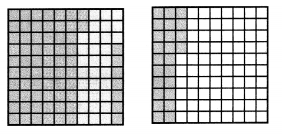
Texas Go Math Grade 4 Lesson 15.7 Answer Key Metric Units of Mass and Liquid Volume 1

Example 1 Convert larger units to smaller units.

Becky planted a flower garden full of bluebonnets. She used 9 kilograms of soil. How many grams of soil is that?
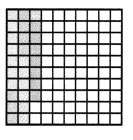
Texas Go Math Grade 4 Lesson 15.7 Answer Key Metric Units of Mass and Liquid Volume 2
So, Becky used ___________ grams of soil to plant her blue bonnets.
Answer:

So, Becky used 9000 grams of soil to plant her blue bonnets.

Are kilograms larger or smaller than grams?
Answer: kilograms larger than grams
Explanation:
1 kilogram= 1000 grams

Will the number of grams be greater than or less than the number of kilograms?
Answer: number of grams be less than the number of kilograms

What operation will you use to solve the problem?
Answer:
We used multiplication to solve the problem.

Metric Units of Mass and Liquid Volume 1

Example 2 Convert smaller units to larger units.

Becky used 5,000 milliliters of water to water her bluebonnet garden. How many liters of water is that?
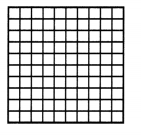
Texas Go Math Grade 4 Lesson 15.7 Answer Key Metric Units of Mass and Liquid Volume 3
So, Becky used __________ liters of water.
Answer:

So, Becky used 5 liters of water.

Math Talk

Mathematical Processes
Compare the size of a kilogram to the size of a gram. Then compare the size of a liter to the size of a milliliter.
Answer:
Texas Go Math Grade 4 Lesson 15.7 Answer Key Metric Units of Mass and Liquid Volume 5
1 kilogram = 1000 grams
1 liter = 1000 milliliters.

Share and Show

Question 1.
There are 3 liters of water in a pitcher. How many milliliters of water are in the pitcher?

There are ___________ milliliters in 1 liter. Since I am changing from a larger unit to a smaller unit, I can ___________ 3 by 1,000 to find the number of milliliters in 3 liters.

So, there are ___________ milliliters of water in the pitcher.
Answer:

There are 1000 milliliters in 1 liter. Since I am changing from a larger unit to a smaller unit, I can multiply 3 by 1,000 to find the number of milliliters in 3 liters.

So, there are 3000 milliliters of water in the pitcher.

Complete.

Question 2.
4 liters = ___________ milliliters
Answer: 4000
Explanation:
There are 1000 milliliters in 1 liter. Since I am changing from a larger unit to a smaller unit, I can multiply 4 by 1,000 to find the number of milliliters in 4 liters.
So, Answer is 4000 milliliters.

Question 3.
6 kilograms = ___________ grams
Answer: 6000
Explanation:
There are 1000 grams in 1 kilogram. Since I am changing from a larger unit to a smaller unit, I can multiply 6 by 1,000 to find the number of grams in 6 kilograms.
So, Answer is  6000 grams.

Question 4.
8,000 grams = ___________ kilograms
Answer: 8 kilograms.
Explanation:
There are 1000 grams in 1 kilogram. Since I am changing from a Smaller unit to a larger unit, I can divide 8000 by 1,000 to find the number of kilograms in 8,000 grams.
So, Answer is  8 kilograms.

Question 5.
7 liters = ___________ milliliters
Answer: 7000
Explanation:
There are 1000 milliliters in 1 liter. Since I am changing from a larger unit to a smaller unit, I can multiply 7 by 1,000 to find the number of milliliters in 7 liters.
So, Answer is 7000 milliliters.

Math Talk

Mathematical Processes
Explain how you found the number of grams in 6 kilograms in Exercise 3.
Answer:
There are 1000 grams in 1 kilogram. Since I am changing from a larger unit to a smaller unit, I can multiply 6 by 1,000 to find the number of grams in 6 kilograms.
So, Answer is  6000 grams.

Problem Solving

Question 6.
Frank wants to fill a fish tank with 8 liters of water.
How many milliliters is that?
Answer: 8000
Explanation:
There are 1000 milliliters in 1 liter. Since I am changing from a larger unit to a smaller unit, I can multiply 8 by 1,000 to find the number of milliliters in 8 liters.
So, Answer is 8000 milliliters.

Question 7.
Kim has 3 water bottles. She fills each bottle with 1,000 milliliters of water. How many liters of water does she have?
Answer: 3 liters
Explanation:
There are 1000 milliliters in 1 liter.
So 3x 1000 milliliters = 3000 milliliters
Now convert to liters
Since I am changing from a smaller unit to a larger unit, I can divide 3000 by 1,000 to find the number of liters in 3000 milliliters.
So, the Answer is 3 liters.

Question 8.
H.O.T. Multi-Step A 500-gram bag of granola costs $4, and a 2-kilogram bag of granola costs $15. What is the cheapest way to buy 2,000 grams of granola? Explain.
Answer: To buy a 2-kilogram bag of granola is cheap.
Explanation:
A 500-gram bag of granola costs $4. to buy 2,000 grams of granola need to buy 4 bags. Since 4 x 500 grams = 2000 grams
So cost is  4 x 4 = $16
A 2-kilogram bag of granola costs $15. 1 kilogram is equal to 1000 grams.
2 kilograms = 2 x 1000 grams= 2000 grams
to buy 2,000 grams of granola need to buy $15.

Metric Units of Mass and Liquid Volume 2

Lesson 15.7 Metric Units of Mass 4th Grade Question 9.
Sense or Nonsense? The world’s largest apple had a mass of 1,849 grams. Sue said the mass was greater than 2 kilograms. Does Sue’s statement make sense? Explain.
Answer: No. It does not make sense
Explanation:
1 kilogram = 1000 grams
2 kilogram = 2000 grams
1849 < 2000. So Sue’s statement does not make sense.

Unlock the Problem

Question 10.
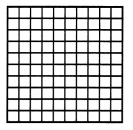
Texas Go Math Grade 4 Lesson 15.7 Answer Key Metric Units of Mass and Liquid Volume 4
H.O.T. Apply Multi-Step Lori bought 600 grams of cayenne pepper and 2 kilograms of black pepper. How many grams of pepper did she buy?
Answer: 2600 grams
Explanation:
1 kilogram = 1000 grams
2 kilogram = 2000 grams
600 grams of cayenne pepper and 2 kilograms of black pepper = 600 grams + 2000 grams = 2600 grams

a. What are you asked to find?
Answer: How many grams of pepper  she bought in all.

b. What information will you use?
Answer: Lori bought 600 grams of cayenne pepper and 2 kilograms of black pepper

c. Tell how you might solve th€ problem.
Answer: Changing from a larger unit to a smaller unit

d. Show how you solved the problem.
Answer:
1 kilogram = 1000 grams
2 kilogram = 2000 grams
600 grams of cayenne pepper and 2 kilograms of black pepper = 600 grams + 2000 grams = 2600 grams

e. Complete the sentences.
Lori bought __________ grams of cayenne pepper.
She bought __________ grains of black pepper.
__________ + __________ = __________ grams
So, Lori bought __________ grams of pepper in all.
Answer:
Lori bought 600 grams of cayenne pepper.
She bought 2000 grams grains of black pepper.
600 + 2000 = 2600 grams
So, Lori bought 2600 grams of pepper in all.

Daily Assessment Task

Fill in the bubble completely to show your answer.

Question 11.
The largest natural pearl in the world has a mass of about 6,000 grams. What is the mass of the pearl in kilograms?
(A) 600 kilograms
(B) 6 kilograms
(C) 60,000 kilograms
(D) 60 kilograms
Answer: B
Explanation:
There are 6000 grams in 1 kilogram. Since I am changing from a Smaller unit to a larger unit, I can divide 6000 by 1,000 to find the number of kilograms in 6,000 grams.
So, Answer is  6 kilograms.

Question 12.
Jen puts 10 liters of water in her aquarium. How many milliliters of water does she put in the aquarium?
(A) 100,000 milliliters
(B) 1,000 milliliters
(C) 100 milliliters
(D) 10,000 milliliters
Answer: B
Explanation:
There are 1000 milliliters in 1 liter. Since I am changing from a larger unit to a smaller unit, I can multiply 10 by 1,000 to find the number of milliliters in 10 liters.
So, Answer is 10,000 milliliters.

Question 13.
Multi-Step Terry buys 3 kilograms of peanuts for a baseball game. He puts the peanuts in bags of 200 grams each. How many bags of peanuts does he have?
(A) 3,000 bags
(B) 150 bags
(C) 15 bags
(D) 50 bags
Answer:  C
Explanation:
There are 1000 grams in 1 kilogram. Since I am changing from a larger unit to a smaller unit, I can multiply 3 by 1,000 to find the number of grams in 3 kilograms.
So, it is  3000 grams.
He puts the peanuts in bags of 200 grams each. 3000 ÷ 200 = 15

Texas Test Prep

Question 14.
Caroline bought a bag of onions that was labeled 5 kilograms. She needs to know how many grams that is for her recipe. How many grams is 5 kilograms?
(A) 5,000 grams
(B) 50 grams
(C) 50,000 grams
(D) 500 grams
Answer: A
Explanation:
There are 1000 grams in 1 kilogram. Since I am changing from a larger unit to a smaller unit, I can multiply 5 by 1,000 to find the number of grams in 5 kilograms.
So, it is  5000 grams.

Texas Go Math Grade 4 Lesson 15.6 Homework and Practice Answer Key

Complete.

Texas Go Math Grade 4 Lesson 15.7 Answer Key Metric Units of Mass and Liquid Volume 5

Question 1.
5,000 grams = ___________ kilograms
Answer: 5
Explanation:
There are 5000 grams in 1 kilogram. Since I am changing from a Smaller unit to a larger unit, I can divide 5000 by 1,000 to find the number of kilograms in 5,000 grams.
So, Answer is  5 kilograms.

Question 2.
3 liters = ___________ milliliters
Answer: 3000
Explanation:
There are 1000 milliliters in 1 liter. Since I am changing from a larger unit to a smaller unit, I can multiply 3 by 1,000 to find the number of milliliters in 3 liters.
So, Answer is 3,000 milliliters.

Question 3.
9 kilograms = ___________ grams
Answer: 9000
Explanation:
There are 1000 grams in 1 kilogram. Since I am changing from a Smaller unit to a larger unit, I can divide 9000 by 1,000 to find the number of kilograms in 8,000 grams.
So, Answer is  9 kilograms.

Question 4.
6,000 milliliters = ___________ liters
Answer:
Explanation:
There are 1000 milliliters in 1 liter. Since I am changing from a Smaller unit to a larger unit, I can divide 6000 by 1,000 to find the number of liters in 6000  milliliters .
So, Answer is  6 liters .

Problem Solving

Question 5.
A bucket holds 10 liters of water. How many milliliters of water does it hold?
Answer: 10,000 milliliters
Explanation:
There are 1000 milliliters in 1 liter. Since I am changing from a larger unit to a smaller unit, I can multiply 10 by 1,000 to find the number of milliliters in 10 liters.
So, Answer is 10,000 milliliters.

Question 6.
Jessie’s cat has a mass of 5 kilograms. How many grams is Jessie’s cat?
Answer: 5000 grams
Explanation:
There are 1000 grams in 1 kilogram. Since I am changing from a larger unit to a smaller unit, I can multiply 5 by 1,000 to find the number of grams in 5 kilograms.
So, it is  5000 grams.

Question 7.
Austin bought 2,500 grams of red apples and 3,500 grams of green apples. How many kilograms of apples did Austin buy?
Answer: 6 kilograms
Explanation:
2500 + 3500 = 6000
There are 1000 grams in 1 kilogram. Since I am changing from a Smaller unit to a larger unit, I can divide 6000 by 1,000 to find the number of kilograms in 6000 grams.
So, Answer is  6 kilograms.

Question 8.
Kendal has a 5 liter bottle of orange juice and a 3 liter bottle of grapefruit juice. How many more milliliters of orange juice than grapefruit juice does she have?
Answer: 2000 milliliters
Explanation:
There are 1000 milliliters in 1 liter. Since I am changing from a larger unit to a smaller unit, I can multiply 5 by 1,000 to find the number of milliliters in 5 liters.
So, it is 5,000 milliliters orange juice.
There are 1000 milliliters in 1 liter. Since I am changing from a larger unit to a smaller unit, I can multiply 3 by 1,000 to find the number of milliliters in 3 liters.
So, it is 3,000 milliliters orange juice.
5000 – 3000 = 2000 milliliters
Question 9.
Kent’s backpack has a mass of 6 kilograms. Brent s backpack has a mass of 8 kilograms. How many grams greater is the mass of Brent’s backpack?
Answer:  2000 grams
Explanation:
Kent’s backpack has a mass of 6 kilograms. 6 x 100 grams = 6000 grams
Brent s backpack has a mass of 8 kilograms. 8 x 1000 grams = 8000 grams
8000 – 6000 = 2000 grams

Question 10.
A bottle can hold 2 liters of water. The bottle has 500 milliliters of water in it. How many ’ milliliters more can the bottle hold?
Answer: 1500 milliliters
Explanation:
A bottle can hold 2 liters of water = 2 x 1000 = 2000 milliliters
The bottle has 500 milliliters of water in it.
2000 – 500 =1500 milliliters

Question 11.
The maximum amount a picture hook can hold is 5 kilograms. Can Jamie hang a picture that has a mass of 4,600 grams on the hook? Explain.
Answer: Yes.
Explanation:
The maximum amount a picture hook can hold is 5 kilograms. 5 x 1000=5000 grams

5000 > 4600.

Lesson Check

Fill in the bubble completely to show your answer.

Question 12.
A punch bowl holds 16 liters, How many milliliters does the punch bowl hold?
(A) 1,600 milliliters
(B) 160 milliliters
(C) 16,000 milliliters
(D) 160,000 milliliters
Answer: C
Explanation:
There are 1000 milliliters in 1 liter. Since I am changing from a larger unit to a smaller unit, I can multiply 16 by 1,000 to find the number of milliliters in 16 liters.
So, Answer is 16,000 milliliters.

Question 13.
Tim bought a block of cheese that is labeled 4 kilograms. He wants to cut the cheese into blocks that weigh 200 grams. How? many blocks of cheese can Tim cut?
(A) 20
(B) 80
(C) 8
(D) 200
Answer: B
Explanation:
Tim bought a block of cheese that is labeled 4 kilograms. 4 x 1000 = 4000 grams
4000 ÷ 200 =80

Question 14.
Allen bought a 3-kilogram squash and a 2-kilogram squash. How many grams of squ ash did Allen buy in all?
(A) 50,000 grams
(B) 500 grams
(C) 50 grams
(D) 5,000 grams
Answer: D
Explanation:
1 kilogram = 1000 grams
3-kilogram squash and a 2-kilogram squash = 3 x 1000 + 2 x 1000 = 5000 grams

Question 15.
How many 25 milliliter doses of plant food can Tim get from a 1-liter bottle of plant food?
(A) 40
(B) 4
(C) 400
(D) 4,000
Answer: A
Explanation:
1-liter = 1000 milliliters
1000 ÷25 =40

Question 16.
Multi-Step Maria has a 2-liter bottle of juice. She pours two 300 milliliter glasses of juice. How much juice is left in the bottle?
(A) 1,940 milliliters
(B) 1,400 milliliters
(C) 800 milliliters
(D) 1,700 milliliters
Answer: B
Explanation:
Maria has a 2-liter bottle of juice. 2 x 1000 =2000
She pours two 300 milliliter glasses of juice = 2 x 300 =600
2000 – 600 = 1400 milliliters
Question 17.
Multi-Step Hannah bought a bag of pears that has a mass of 5 kilograms. She used 1,600 grams of pears for a recipe. What is the mass of the pears she has left?
(A) 3,400 grams
(B) 34 kilograms
(C) 3,400 kilograms
(D) 340 grams
Answer: C
Explanation:
Hannah bought a bag of pears that has a mass of 5 kilograms. 5 x 1000 grams = 5000 grams
She used 1,600 grams of pears for a recipe
5000 – 1600 = 3400 grams

Texas Go Math Grade 4 Lesson 15.7 Answer Key Metric Units of Mass and Liquid Volume Read More »
Texas Go Math Grade 8 Module 6 Quiz Answer Key

Refer to our Texas Go Math Grade 8 Answer Key Pdf to score good marks in the exams. Test yourself by practicing the problems from Texas Go Math Grade 8 Module 6 Quiz Answer Key.

Texas Go Math Grade 8 Module 6 Quiz Answer Key

Texas Go Math Grade 8 Module 6 Ready to Go On? Answer Key

6.1 Identifying and Representing Functions

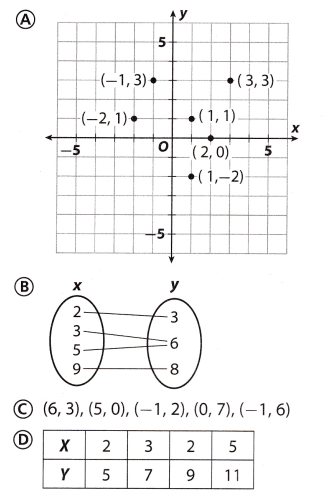
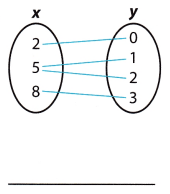
Determine whether each relationship is a function.

Question 1.
Texas Go Math Grade 8 Module 6 Quiz Answer Key 1
Answer:
Not a function A relationship is a function when each input is paired with exactly one output. The input 5 has more than one output

Grade 8 Module 6 Quiz Answer Key 2

Go Math Grade 8 Module 6 Answer Key Question 2.
Texas Go Math Grade 8 Module 6 Quiz Answer Key 2
Answer:
To determine the answer here, we will review the definition of a function.

A certain relationship represents a function if every input is paired with only one output. Considering the fact that in a given table every input has only one output we can conclude that it represents a function.

Question 3.
(2, 5), (7, 2), (-3, 4), (2, 9), (1, 1)
Answer:
Not a function A relationship is a function when each input is paired with exactly one output. Input 2 has more than one output

6.2 Describing Functions

Determine whether each situation is linear or nonlinear, and proportional or nonproportional.

Grade 8 Module 6 Quiz Answer Key Question 4.
Joanna is paid $14 per hour.
Answer:
To determine if the situation is linear or nonlinear. Let us analyze if we can express the situation in a linear equation.
Given the situation Joana is paid $14 per hour, we can express this in a linear equation using the slope-intercept from y = mx + b.
Let y be the amount to be paid to Joana x be the number of hours m is the rate of payment per hour

The equation that can be formed is y = 4x

Since the equation formed is a linear equation, then the situation is linear.

To determine if the given situation is proportional or nonproportional, let us have the equation y = 4x and determine the value of b. If b = 0, then the equation is proportional and if b ≠ 0, then the equation is nonproportional
Since the equation of the given situation is y = 4x, where b = 0, then the equation is proportional.
Thus, the situation is proportional.
linear; proportional

Question 5.
Alberto started out bench pressing 50 pounds. He then added 5 pounds every week.
Answer:
To determine if the situation is linear or nonlinear. Let us analyze if we can express the situation in a linear equation.

Given the problem “Alberto started out bench pressing 50 pounds. He then added 5 pounds every week”. We can
express this in the linear equation using the slope-intercept form y = mx + b.
Let y be the number of Alberto’s bench pressing in pounds
x be the number of weeks
m be the additional pounds every week
b be the number of pounds when Alberto started bench pressing

The equation that can be formed where m = 5 and b = 50 is
y = mx + b
y = 5x + 50
Since the equation formed is a linear equation, then the situation is linear.
To determine if the given situation is proportional or nonproportional, let us have the equation and determine the
value of b. If b = 0, then the equation is proportional if b ≠ 0, then the equation is nonproportional.

Since the equation of the given situation is y = 5x + 50, where b ≠ 0, then the equation is nonproportional.
Thus, the situation is nonproportional.
linear; nonproportional

6.3 Comparing Functions

Question 6.
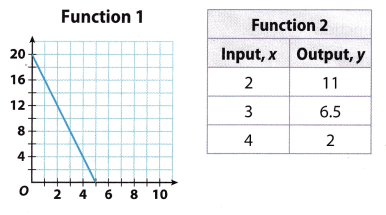
Which function is changing more quickly? Explain.
Texas Go Math Grade 8 Module 6 Quiz Answer Key 3
Answer:
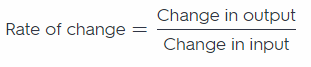
To determine the answer here, we will calculate the average rate of change for given functions. We will calculate
the rate using following formula:
Texas Go Math Grade 8 Module 6 Quiz Answer Key 9
Therefore, we can calculate the average rate of change for function 1 as following:
Rate of change = \(\frac{0-20}{5-0}\)
= -4

Let’s calculate the rate of change for function 2:
\begin{align*}
\text{ Rate of change}&=\dfrac{2-11}{4-2}\\
&=-4.5
\end{align}

To determine which function is changing more quickly, we have to compare the absolute values of obtained
numbers. Considering the fact that:
|-4| < |-4.5|,
we can conclude that function 2 changes more quickly.

Essential Question

Go Math Grade 8 Module 6 Answer Key Question 7.
How can you use functions to solve real-world problems?
Answer:
The situation gives a graph that is a straight line which is linear since it is stated that Sam is running at a constant
rate, meaning the distance covered per unit of time is always of the same value.

Another thing is that, since the distance covered per unit of time is always of the same value, the graph has a
proportional relationship that passes through the origin.

See the explanation.

Texas Go Math Grade 8 Module 6 Mixed Review Texas Test Prep Answer Key

Selected Response

Question 1.
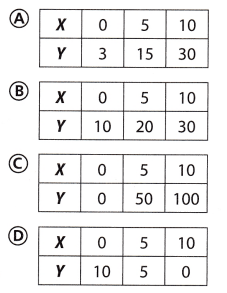
Which table shows a proportional function?
Texas Go Math Grade 8 Module 6 Quiz Answer Key 4
Answer:
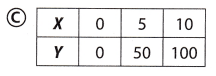
Texas Go Math Grade 8 Module 6 Quiz Answer Key 10

Explanation:
Option C represents a proportional relationship. It contains the ordered pair of the origin (0, 0)

Question 2.
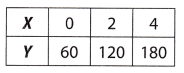
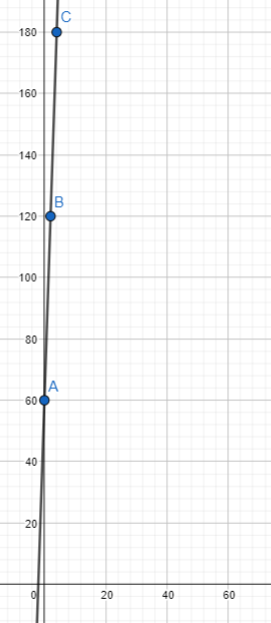
Which term does not correctly describe the relationship shown in the table?
Texas Go Math Grade 8 Module 6 Quiz Answer Key 5
(A) function
(B) linear
(C) proportional
(D) nonproportional
Answer: (B) linear
Texas Go Math Grade 8 Module 6 Mixed Review Texas Test Prep Answer Key_2
Option B is the correct answer.

Question 3.
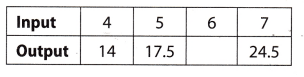
The table below shows some input and output values of a function.
Texas Go Math Grade 8 Module 6 Quiz Answer Key 6
What is the missing output value?
(A) 20
(B) 21
(C) 22
(D) 23
Answer:
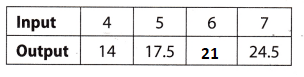
17.5 – 14 = 3.5
17.5 + 3.5 = 21
Texas-Go-Math-Grade-8-Module-6-Quiz-Answer-Key-6
Option B is the correct answer.

Go Math Grade 8 Module 6 Answer Key Pdf Question 4.
Which number is not rational?
(A) -7
(B) \(\sqrt{25}\)
(C) 0.33
(D) \(\sqrt{15}\)
Answer:
(A) -7 is a rational number because 7 corresponds to the definition of a rational number.
(B) \(\sqrt{25}\) is a rational number.
(C) 0.33 is a rational number.
(D) \(\sqrt{15}\) The square root of 15 is not a rational number. It is an irrational number.

Grade 8 Module 6 Quiz Answer Key 3

Question 5.
Which of the relationships below is a function?
Texas Go Math Grade 8 Module 6 Quiz Answer Key 7
Answer: B is a function

Gridded Response

8th Grade Module 6 Module Quiz Ready To Go On Question 6.
A dance school charges a registration fee in addition to a fee per lesson. The equation y = 30x + 25 represents the total cost y of x lessons. What is the cost per lesson?
Texas Go Math Grade 8 Module 6 Quiz Answer Key 8
Answer:
Given,
A dance school charges a registration fee in addition to a fee per lesson.
The equation y = 30x + 25 represents the total cost y of x lessons.
25 indicates the registration fee
30 indicates the cost per lesson.
Texas-Go-Math-Grade-8-Module-6-Quiz-Answer-Key-8

Texas Go Math Grade 8 Module 6 Quiz Answer Key Read More »
Texas Go Math Grade 2 Lesson 12.1 Answer Key Add Equal Groups

Refer to our Texas Go Math Grade 2 Answer Key Pdf to score good marks in the exams. Test yourself by practicing the problems from Texas Go Math Grade 2 Lesson 12.1 Answer Key Add Equal Groups.

Texas Go Math Grade 2 Lesson 12.1 Answer Key Add Equal Groups

Explore

Draw to model the problem. Write the skip counting to find the total.
Jim’s shoes
Texas Go Math Grade 2 Lesson 12.1 Answer Key 1
__________ shoes
Ella’s flower petals
Texas Go Math Grade 2 Lesson 12.1 Answer Key 2
__________ flower petals

FOR THE TEACHER • Read this problem to children. Then have them draw a model and skip count to find the answer. Jim has 4 pairs of shoes. How many shoes does he have? Repeat for the following problem. Ella has 5 flowers. Each flower has 5 petals. How many petals are there?
Answer:
Jim has 4 pairs of shoes.
each pair has 2 shoes
4 x 2 = 8
Ella has 5 flowers.
Each flower has 5 petals.
5 x 5 = 25
25 petals are there
Explanation:
8  shoes
25 petals

Math Talk
Mathematical Processes

Explain how skip counting helped you solve the second problem.
Answer:
In 2 cases skip counting is used
in the way of multiplication.

Add Equal Groups 1

Model and Draw

Chen has 4 pages of postcards. Each page has 5 postcards. How many postcards does Chen have?
Texas Go Math Grade 2 Lesson 12.1 Answer Key 3
Chen has ___________ postcards.
Answer:

Explanation:
5 x 4 = 20
total there are 20 postcards

Share and Show

Add equal groups to find the total number of objects.

Question 1.
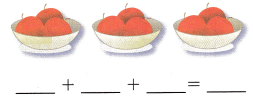
3 bowls of 3 apples
Texas Go Math Grade 2 Lesson 12.1 Answer Key 4
________ apples
Answer:

Explanation:
The sum is found with the help of images

Question 2.
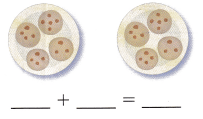
2 plates of 4 cookies
Texas Go Math Grade 2 Lesson 12.1 Answer Key 5
____________ cookies
Answer:

2 x 4 = 8
Explanation:
The sum is found with the help of images

Question 3.
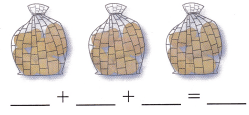
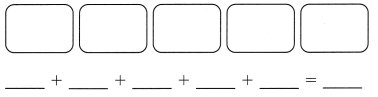
3 bags of 5 potatoes
Texas Go Math Grade 2 Lesson 12.1 Answer Key 6
__________ potatoes
Answer:

15 potatoes
3 x 5 = 15
Explanation:
The sum is found with the help of images

Question 4.
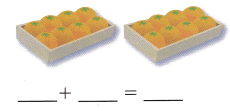
2 boxes of 8 oranges
Texas Go Math Grade 2 Lesson 12.1 Answer Key 7
__________ oranges
Answer:

16 oranges
2 x 8 = 16
Explanation:
The sum is found with the help of images

Problem Solving

Use counters. Draw and then add equal groups. Find the total.

Question 5.
5 groups of 4 counters
Texas Go Math Grade 2 Lesson 12.1 Answer Key 8
___________ counters
Answer:

Explanation:
4 Balloons are shared among 5 friends
4 x 5 = 20

Add Equal Groups 2

Question 6.
4 groups of 3 counters
Texas Go Math Grade 2 Lesson 12.1 Answer Key 9
___________ counters
Answer:

Explanation:
3 x 4 = 12
12 balls shared among 4 groups
each group has 3 balls

Question 7.
H.O.T. Multi-Step Jeff has 5 toy cars. Then his sister gives him 3 more toy cars. Each toy car has 4 wheels. How many wheels are on Jeff’s toy cars?
Texas Go Math Grade 2 Lesson 12.1 Answer Key 10
_________ wheels
Answer:
2 wheels
Explanation:
Jeff has 5 toy cars.
Then his sister gives him 3 more toy cars.
Each toy car has 4 wheels.
5 + 3 = 8
8 ÷ 4 = 2
2 wheels are on Jeff’s toy cars

Question 8.
H.O.T. Angela used these counters to act out a problem.
Texas Go Math Grade 2 Lesson 12.1 Answer Key 11
Write a problem that Angela could have solved with these counters.
Answer:
Angela went picnic with her friends
they were 8 friends
And 4 tents
How many friends should she accommodate for each tent
Explanation:
8 ÷ 4 = 2

Daily Assessment Task

Choose the correct answer.

Question 9.
Analyze There are 2 juice boxes for each person at a picnic. There are 10 people at the picnic. How many juice boxes are there?
(A) 12
(B) 8
(C) 20
Answer: C
Explanation:
There are 2 juice boxes for each person at a picnic.
There are 10 people at the picnic.
10 x 2 = 20
20 juice boxes are there

Question 10.
Use counters to model 3 equal groups of 5 objects. Draw a picture of the groups below. Then write an addition sentence for your model.
_________ + _________ + _________ = _________
________ objects
Answer:
5 + 5 + 5 = 15
15 objects
Explanation:

Question 11.
TEXAS Test Prep Brett has 3 bags of shells. He has 4 shells in each bag. How many shells does he have?
Texas Go Math Grade 2 Lesson 12.1 Answer Key 12
(A) 12
(B) 7
(C) 16
Answer: A
Explanation:
Brett has 3 bags of shells.
He has 4 shells in each bag.
3 x 4 = 12
12 shells that he have

TAKE HOME ACTIVITY • Ask your child to show how he or she solved on exercise in the lesson.
Answer:
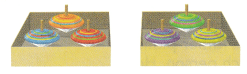
2 boxes of 3 toy tops
Texas Go Math Grade 2 Lesson 12.1 Answer Key 13
_________ + _________
_________ toy tops
Answer:
3 + 3
6 toy tops
Explanation:
The sum is found with the help of images
Explanation:
Addition is done in the above problem

Texas Go Math Grade 2 Lesson 12.1 Homework and Practice Answer Key

Add equal groups to find the total number of objects.

Question 1.
2 boxes of 3 toy tops
Texas Go Math Grade 2 Lesson 12.1 Answer Key 13
_________ + _________
_________ toy tops
Answer:
3 + 3
6 toy tops
Explanation:
The sum is found with the help of images

Question 2.
4 groups of 5 pennies
Texas Go Math Grade 2 Lesson 12.1 Answer Key 14
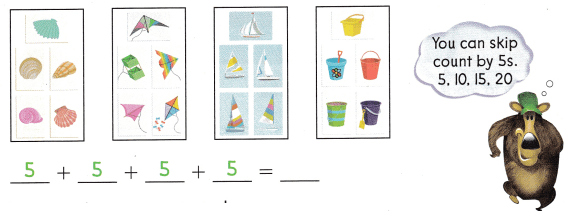
_________ + _________ + _________ + _________ = _________
_________ pennies
Answer:
5 + 5 + 5 + 5 = 20
20 pennies
Explanation:
The sum is found with the help of images

Question 3.
3 groups of 4 counters
Texas Go Math Grade 2 Lesson 12.1 Answer Key 15
_________ + _________ + _________ = _________
_________ counters
Answer:
4 + 4 + 4 = 12
12 counters
Explanation:
The sum is found with the help of images

Problem Solving

Solve. Write or draw to explain.

Question 4.
Multi-Step Jonathan has 2 toy cars. Then he buys 2 more toy cars. Each toy car has 4 wheels. How many wheels are on Jonathan’s toy cars?
___________ wheels
Answer:
16 wheels
Explanation:
Jonathan has 2 toy cars.
Then he buys 2 more toy cars.
Each toy car has 4 wheels.
2 + 2 = 4
4 x 4 = 16
16 wheels are on Jonathan’s toy cars

Lesson Check

Choose the correct answer.

Question 5.
Linda has 6 bags of ribbons. She has 5 ribbons in each bag. How many ribbons does she have?
(A) 25
(B) 30
(C) 11
Answer: B
Explanation:
Linda has 6 bags of ribbons.
She has 5 ribbons in each bag.
6 x 5 = 30
30 ribbons that she have

Question 6.
Jason’s family is having a cookout. His father plans to cook 3 small pieces of chicken for each person. How many pieces of chicken will he cook for 7 people?
(A) 21
(B) 10
(C) 24
Answer: A
Explanation:
Jason’s family is having a cookout.
His father plans to cook 3 small pieces of chicken for each person.
3 x 7 = 21
21 pieces of chicken that  he cook for 7 people

Question 7.
Julie is having a dinner party. She wants to have 2 bottles of water for each person. There will be a total of 9 people at dinner. How many bottles of water does she need?
(A) 20
(B) 16
(C) 18
Answer: C
Explanation:
Julie is having a dinner party. She wants to have 2 bottles of water for each person.
There will be a total of 9 people at dinner.
9 x 2 = 18
18 bottles of water that she need

Question 8.
Mark, his sister, and his 4 friends are sharing a box of mini pizzas. Each person will get 5 mini pizzas. What is the total number of mini pizzas in the box?
(A) 20
(B) 30
(C) 25
Answer: A
Explanation:
Mark, his sister, and his 4 friends are sharing a box of mini pizzas.
Each person will get 5 mini pizzas.
4 x 5 = 20
20 is the total number of mini pizzas in the box

Texas Go Math Grade 2 Lesson 12.1 Answer Key Add Equal Groups Read More »

Texas Go Math Grade 2 Lesson 12.2 Answer Key Describe Multiplication

Refer to our Texas Go Math Grade 2 Answer Key Pdf to score good marks in the exams. Test yourself by practicing the problems from Texas Go Math Grade 2 Lesson 12.2 Answer Key Describe Multiplication.

Texas Go Math Grade 2 Lesson 12.2 Answer Key Describe Multiplication

Explore

Use counters to model the problem. Then draw a picture of your model. Write o number sentence for it.
Texas Go Math Grade 2 Lesson 12.2 Answer Key 1
Robby has _________ DVDs.

FOR THE TEACHER • Read the problem to children. Then have them model the problem using counters and write a number sentence for it. Robby has 5 boxes of DVDs. Each box holds 7 DVDs. How many DVDs does Robby have?
Answer:
Robby has 35 DVDs.

7 x 5 = 35
Explanation:
Robby has 5 boxes of DVDs.
Each box holds 7 DVDs.
5 x 7 = 35
35 DVDs that Robby have

Math Talk
Mathematical Processes

Describe the groups that you drew.
Answer:
Robby has 5 boxes of DVDs.
Each box holds 7 DVDs.
5 x 7 = 35
35 DVDs that Robby have

Model and Draw

When you multiply, you join equal groups. Use the pictures to describe equal groups.
Texas Go Math Grade 2 Lesson 12.2 Answer Key 2
Answer:

Explanation:
15 ÷ 3 = 5
12 ÷ 4 = 3
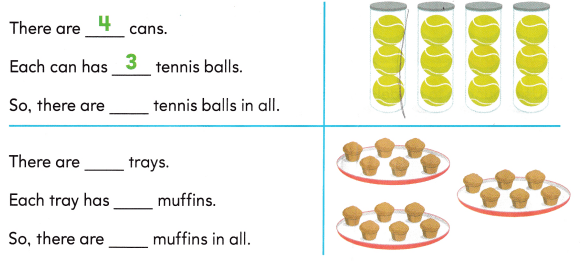
15 muffins shared among 3 trays
12 balls shared among 4 boxes

Share and Show

Use the pictures to describe equal groups.

Question 1.
Texas Go Math Grade 2 Lesson 12.2 Answer Key 3
There are _________ boxes of crayons.
Each ___________ has ___________.
So. there are ___________ in all.
Answer:
There are 2 boxes of crayons.
Each box has 12.
So. there are 24 in all.
Explanation:
2 x 12 = 24
With the help of images found the sum

Describe Multiplication 1

Go Math Grade 2 Lesson 12.2 Answer Key Question 2.
Texas Go Math Grade 2 Lesson 12.2 Answer Key 4
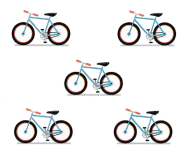
There are ___________ bicycles.
Each ___________ has ___________.
So, there are ___________ in all.
Answer:
There are 5 bicycles.
Each friend has 1 cycle.
So, there are 5 in all.
Explanation:
5 x 1 = 5
With the help of images found the sum

Problem Solving

Use the pictures to describe equal groups.

Question 3.
Texas Go Math Grade 2 Lesson 12.2 Answer Key 5
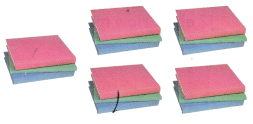
There are ____________ stacks of books.
Each stack ___________.
So, ___________.
Answer:
There are 5 stacks of books.
Each stack 3 .
So, 15 books.
Explanation:
3 x 5 = 15
With the help of images found the sum

Question 4.
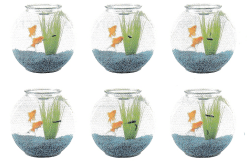
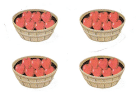
Texas Go Math Grade 2 Lesson 12.2 Answer Key 13
There are ____________ fish bowls.
Each bowl ____________.
So, ____________.
Answer:
There are 6 fish bowls.
Each bowl 2 fishes.
So, 12 fishes in all.
Explanation:
6 x 2 = 12
With the help of images found the sum

Go Math Grade 2 Answer Key Describe Multiplication Question 5.
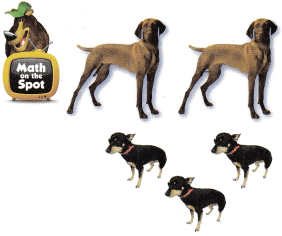
H.O.T. Multi-Step Use the pictures to describe the equal groups. Then write the total number of legs.
Texas Go Math Grade 2 Lesson 12.2 Answer Key 7
Answer:
5 x 4 = 20
Explanation:
5 dogs with 4 legs
5 x 4 = 20
With the help of images found the sum

Question 6.
H.O.T. Caleb uses 3 toothpicks to make a triangle. He makes 3 triangles. How many toothpicks does he use?
__________ toothpicks
Answer:
9 toothpicks
Explanation:
Caleb uses 3 toothpicks to make a triangle.
He makes 3 triangles.
3 x 3 = 9
9 toothpicks that he use

Daily Assessment Task

Choose the correct answer.

Question 7.
Analyze One egg carton can hold 12 eggs. How many eggs will fit in 2 cartons?
(A) 24
(B) 12
(C) 28
Answer: A
Explanation:
One egg carton can hold 12 eggs.
2 x 12 = 24
24 eggs will fit in 2 cartons

Question 8.
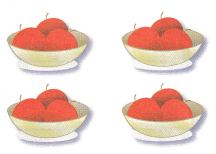
Use the pictures to describe equal groups.
Texas Go Math Grade 2 Lesson 12.2 Answer Key 8
There are ________ bowls of apples.
Each bowl __________________
So, __________________.
Answer:
There are 4 bowls of apples.
Each bowl has 3 apples
So, 12 apples in all.
Explanation:
4 x 3 = 12
With the help of images found the sum

Go Math Grade 2 Answer Key Pdf Lesson 12.2 Question 9.
TEXAS Test Prep Tim has 5 cards. He puts 3 stickers on each card. How many stickers does he use?
(A) 8
(B) 15
(C) 10
Answer: B
Explanation:
Tim has 5 cards.
He puts 3 stickers on each card.
5 x 3 = 15
15 stickers that he use

TAKE HOME ACTIVITY • Ask your child to show how he or she solved an exercise in the lesson.
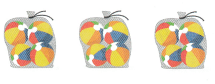
Texas Go Math Grade 2 Lesson 12.2 Answer Key 9
There are _________ bags of beach balls.
Each bag has __________________ beach balls.
So, there are __________________ balls in all.
Answer:
There are 3 bags of beach balls.
Each bag has  4 beach balls.
So, there are 12 balls in all.
Explanation:
3 x 4 = 12
With the help of images found the sum

Texas Go Math Grade 2 Lesson 12.2 Homework and Practice Answer Key

Use the pictures to describe equal groups.

Question 1.
Texas Go Math Grade 2 Lesson 12.2 Answer Key 9
There are _________ bags of beach balls.
Each bag has __________________ beach balls.
So, there are __________________ balls in all.
Answer:
There are 3 bags of beach balls.
Each bag has  4 beach balls.
So, there are 12 balls in all.
Explanation:
3 x 4 = 12
With the help of images found the sum

Describe Multiplication 3

Go Math Grade 2 Practice and Homework Lesson 12.2 Answer Key Question 2.
Texas Go Math Grade 2 Lesson 12.2 Answer Key 10
There are __________ starfish.
Each starfish ____________________ .
So, __________________.
Answer:
There are 6 starfish.
Each starfish 5 fingers.
So, 30 fingers.
Explanation:
6 x 5 = 30 fingers
With the help of images found the sum

Question 3.
Texas Go Math Grade 2 Lesson 12.2 Answer Key 11
There are _________ baskets of apples.
Each basket __________________.
So, __________________.
Answer:
There are 4 baskets of apples.
Each basket has 8 apples.
So, 32 apples
Explanation:
4 x 8 = 32
With the help of images found the sum

Problem Solving

Solve. Write or draw to explain.

Question 4.
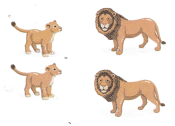
Multi-Step Use the picture to describe the equal groups of toy animals. Then write the total number of legs.
Texas Go Math Grade 2 Lesson 12.2 Answer Key 12
Answer:
2 cubs
and 2 loins
2 + 2 = 4
4 x 4 = 16
Explanation:
the total number of legs = 16
With the help of images found the sum

Lesson Check

Choose the correct answer.

Question 5.
Ken has 3 boxes of sandwiches. Each box has 6 sandwiches. How many sandwiches does Ken have?
(A) 9
(B) 18
(C) 15
Answer: B
Explanation:
Ken has 3 boxes of sandwiches.
Each box has 6 sandwiches.
3 x 6 = 18
18 sandwiches that Ken have

Go Math Lesson 12.2 Homework Answer Key Grade 2 Question 6.
Three girls are making puppets. Each puppet takes I hour to make. How many puppets will the girls make in 3 hours?
(A) 3
(B) 9
(C) 6
Answer: B
Explanation:
Three girls are making puppets.
Each puppet takes I hour to make.
3 x 3 = 9
9 puppets will the girls make in 3 hours

Question 7.
Carl has 4 stacks of 5 pennies. How many pennies does he have in all?
(A) 20
(B) 50
(C) 100
Answer: A
Explanation:
Carl has 4 stacks of 5 pennies.
4 x 5 = 20
20 pennies that he has in all

Question 8.
There are 6 pigs in a pen. Each pig gets a pail of food twice a day. How many pails of food are used each day?
(A) 14
(B) 8
(C) 12
Answer: C
Explanation:
There are 6 pigs in a pen.
Each pig gets a pail of food twice a day.
6 x 2 = 12
12 pails of food are used each day

Texas Go Math Grade 2 Lesson 12.2 Answer Key Describe Multiplication Read More »
Texas Go Math Grade 3 Lesson 10.2 Answer Key Number of Equal Groups

Refer to our Texas Go Math Grade 3 Answer Key Pdf to score good marks in the exams. Test yourself by practicing the problems from Texas Go Math Grade 3 Lesson 10.2 Answer Key Number of Equal Groups.

Texas Go Math Grade 3 Lesson 10.2 Answer Key Number of Equal Groups

Essential Question
How can you model a division problem to find how many equal groups?
Answer:
By using counters, and putting the same amount into each group then we count each group. The equal groups model used in multiplication can be used to solve division problems as well.
Understand division as an unknown-factor problem.
For example,
find 32 ÷ 8  = 4 by finding the number that makes 32 when multiplied by 8.

When you multiply, you put equal groups together. When you divide, you separate into equal groups.

Unlock the Problem
William has 12 shells and some boxes. He wants to put his shells in groups of 3. How many boxes does he need for his shells?

  • Underline what you need to find.
  • How many shells does William want in each group? ____
    Answer:
    He need to find boxes for his shells.
    He need 4 shells in each group
    Explanation:
    William has 12 shells and some boxes.
    He wants to put his shells in groups of 3
    Total boxes he need for his shells
    12 ÷ 3 = 4

Make equal groups.

  • Look at the 12 counters.
  • Circle a group of 3 counters.
  • Continue circling groups of 3 until all 12 counters are in groups.
    Texas Go Math Grade 3 Lesson 10.2 Answer Key 6

There are ___ groups of counters.
So, William needs ___ boxes for his shells.

There are 4 groups of 3 counters.
So, William needs 4 boxes for his shells.

Number of Equal Groups 2

Math Talk
Mathematical Processes
Explain how the drawing would change if William wanted to put his shells in groups of 4.

Share and Show

Question 1.
Emily has 12 counters. She puts them in groups of 2. Draw a picture to show the number of groups.
Answer: 12

Explanation:
Emily has 12 counters.
She puts them in groups of 2.
Total number of groups to show the counters
12 ÷ 2 = 6

Explain how the drawing would change if William wanted to put his shells in groups of 4.

Math Talk
Mathematical Processes
Explain how you find the number of equal groups when you divide.

Draw counters on your Math Board. Then circle equal groups. Complete the table.

Texas Go Math Grade 3 Lesson 10.2 Answer Key 2
Answer:

Problem-Solving

Go Math Grade 3 Lesson 10.2 Answer Key Question 5.
H.O.T. Explain two ways you could divide 18 counters into equal groups. Draw a picture to show each way.
Answer:
Two ways as follows:

Unlock the Problem

Question 6.
A store has 24 beach towels in stacks of 6 towels each. How many stacks of beach towels are at the store?
Texas Go Math Grade 3 Lesson 10.2 Answer Key 7

a. What do you need to find?
Answer:
How many stacks of beach towels are at the store?
4 stacks
24 ÷ 6 = 4

b. How will you use what you know about making equal groups to solve the problem?
Answer:
By using counters, and putting the same amount into each group then we count each group.

Explanation:
each red counter is one beach towel
6 beach towels in one group
4 stacks for 24 beach towel

c. Draw equal groups at the right to find how many stacks of beach towels there are at the store.
Answer:

d. Complete the sentences.

The store has ___ beach towels.
There are ___ towels in each stack.
So, there are ___ stacks of beach towels at the store.
Answer:
The store has 24 beach towels.
There are 6 towels in each stack.
So, there are 4 stacks of beach towels at the store.

Question 7.
H.O.T. Multi-Step A store has 18 red beach balls and 17 green beach balls in boxes of 5 beach balls each. How many boxes of beach balls are at the store?
Texas Go Math Grade 3 Lesson 10.2 Answer Key 8
Answer:
7 boxes of beach balls.
Explanation:
A store has 18 red beach balls and 17 green beach balls in boxes of 5 beach balls each.
Total beach balls 18 + 17 = 35
Total boxes of beach balls at the store
35 ÷ 5 = 7

Go Math Grade 3 Chapter 10 Lesson 10.2 Answer Key Question 8.
H.O.T. Pose a Problem Write a problem about dividing beach toys into equal groups. Solve the problem.
Answer:
A store has total18 beach toys into equal groups .Each box contains 6 beach toys. How many boxes of beach toys at the store?
Explanation:
A store has total18 beach toys into equal groups
Each box contains 6 beach toys.
Total boxes of beach toys at the store are
18 ÷ 6 = 3

Number of Equal Groups 3

Daily Assessment Task

Fill in the bubble for the correct answer choice. You may use models or strategies to solve.

Question 9.
Analyze Jake’s family spends 16 days visiting national parks. They spend 4 days at each national park. How many national parks do they visit?
(A) 4
(B) 12
(C) 64
(D) 20
Answer:
Option (A)
Explanation:
Analyze Jake’s family spends 16 days visiting national parks.
They spend 4 days at each national park.
Number of national parks they visit?
16 ÷ 4 = 4

Question 10.
Hitomi picks 28 peaches to make pies. She uses 7 peaches in each pie. How many pies does she make?
(A) 21
(B) 3
(C) 35
(D) 4
Answer:
Option (D)
Explanation:
Hitomi picks 28 peaches to make pies.
She uses 7 peaches in each pie.
Number of pies she make
28 ÷ 7 = 4

Question 11.
Multi-Step Molly is making string bracelets for her friends. She has 25 pieces of blue string and 17 pieces of red string. She uses 7 strings for each bracelet. How many string bracelets can Molly make?
Texas Go Math Grade 3 Lesson 10.2 Answer Key 9
(A) 10
(B) 6
(C) 35
(D) 7
Answer:
Option (B)
Explanation:
Molly has 25 pieces of blue string and 17 pieces of red string.
Total strings she has 25 + 17 = 42
She uses 7 strings for each bracelet.
Total string bracelets Molly make
42 ÷ 7 = 6

Texas Test Prep

3rd Grade Go Math Lesson 10.2 Answer Key Question 12.
Apply Dan’s train is 27 inches long. If each train car is 3 inches long, how many train cars are there?
(A) 9
(B) 6
(C) 7
(D) 8
Answer:
Option(A)
Explanation:
Apply Dan’s train is 27 inches long.
If each train car is 3 inches long,
Number of train cars
27 ÷ 3 = 9

Texas Go Math Grade 3 Lesson 10.2 Homework and Practice Answer Key

Draw equal groups to solve. Complete the sentences.

Question 1.
A classroom has 21 desks in rows of 3 desks each. How many rows are there?
The classroom has ___ desks.
There are ___ in each row.
So, there are ___ rows.
Answer:
The classroom has 21 desks.
There are 3 in each row.
So, there are 7 rows.
Explanation:
A classroom has 21 desks in rows of 3 desks each.
Total rows of desks
21 ÷ 3 =7

Question 2.
The lunchroom has 28 plates in 7 equal stacks. How many plates are in each stack?
The lunchroom has ___ plates.
There are ___ equal stacks.
So, there are ___ plates in each stack.
Answer:
The lunchroom has 28 plates.
There are 7 equal stacks.
So, there are 4 plates in each stack.
Explanation:
The lunchroom has 28 plates in 7 equal stacks.
Number of plates in each stack
28 ÷ 7 = 4

Problem Solving

Question 3.
There are 35 students in gym class. There are 7 students on each team. How many teams are there?
Answer:
5 Teams
Explanation:
There are 35 students in gym class.
There are 7 students on each team.
Total teams in gym class
35 ÷ 7 = 5

Go Math Lesson 10.2 Homework Answers 3rd Grade Question 4.
On a class trip there are 24 students in mini vans. There are 8 students in each van. How many vans are there?
Answer:
3 vans
Explanation:
On a class trip there are 24 students in mini vans.
There are 8 students in each van.
Total vans required for class trip
24 ÷ 8 = 3

Texas Test Prep

Lesson Check

Fill in the bubble completely to show your answer.

Question 5.
Lisa has 40 beads to make a ñecklace. She puts the beads in 8 equal groups. How many beads are in each group?
(A) 32
(B) 8
(C) 48
(D) 5
Answer:
Option (D)
Explanation:
Lisa has 40 beads to make a ñecklace.
She puts the beads in 8 equal groups.
Number of beads in each group
40 ÷ 8 = 5

Question 6.
A store clerk has 18 video games. She puts them in 3 equal groups on some shelves. How many video games are on each shelf?
(A) 15
(B) 6
(C) 21
(D) 5
Answer:
Option(B)
Explanation:
A store clerk has 18 video games.
She puts them in 3 equal groups on some shelves.
Number of video games on each shelf
18 ÷ 3 = 6

Question 7.
A grocer has 32 bunches of bananas. He puts them in baskets of 8 each. How many baskets does the grocer use?
(A) 40
(B) 24
(C) 6
(D) 4
Answer:
Option (A)
Explanation:
A grocer has 32 bunches of bananas.
He puts them in baskets of 8 each.
Total baskets the grocer use
32 ÷ 8 = 4

Practice and Homework Lesson 10.2 Answer Key Grade 3 Question 8.
Jake’s workout includes 25 push-ups. He does them in sets of 5 each. How many sets of push-ups does Jake’s workout include?
(A) 5
(B) 4
(C) 20
(D) 6
Answer:
Option (A)
Explanation:
Jake’s workout includes 25 push-ups.
He does them in sets of 5 each.
Total sets of push-ups Jake’s workout include
25 ÷ 5 = 5

Question 9.
Multi-Step Holly has 24 roses and 24 tulips. She wants to put 8 flowers each into a vase. How many vases will Holly need for all of the flowers?
(A) 48
(B) 3
(C) 6
(D) 40
Answer:
Option (C)
Explanation:
Holly has 24 roses and 24 tulips.
Total flowers 24 + 24 = 48
She wants to put 8 flowers each into a vase.
Number of vases Holly need for all of the flowers
48 ÷ 8 = 6

Go Math 3rd Grade Lesson 10.2 Answer Key Question 10.
Multi-Step Roscoe makes a tile design with 18 red tiles and 27 blue tiles. He arranges them in 9 rows. How many tiles are in each row?
(A) 3
(B) 5
(C) 2
(D) 9
Answer:
Option(B)
Explanation:
Roscoe makes a tile design with 18 red tiles and 27 blue tiles.
Total tiles 18 + 27 = 45
He arranges them in 9 rows.
Number of tiles in each row?
45 ÷ 9 = 5

Texas Go Math Grade 3 Lesson 10.2 Answer Key Number of Equal Groups Read More »

Texas Go Math Grade 3 Lesson 9.3 Answer Key Multiply Multiples of 10 by 1-Digit Numbers

Refer to our Texas Go Math Grade 3 Answer Key Pdf to score good marks in the exams. Test yourself by practicing the problems from Texas Go Math Grade 3 Lesson 9.3 Answer Key Multiply Multiples of 10 by 1-Digit Numbers.

Texas Go Math Grade 3 Lesson 9.3 Answer Key Multiply Multiples of 10 by 1-Digit Numbers

Essential Question
How can you model and record multiplying multiples of 10 by I-digit whole numbers?

Unlock the Problem
The community center offers 4 dance classes. If 30 students sign up for each class, how many students sign up for dance class altogether?

  • How many equal groups are there? ___
  • How many are in each group? ___

Activity
Use base-ten blocks to model 4 × 30.

Materials Texas Go Math Grade 3 Lesson 9.3 Answer Key 1 base-ten blocks

Step 1
Model 4 groups of 30.
Texas Go Math Grade 3 Lesson 9.3 Answer Key 2

Step 2
Combine the tens. Regroup 12 tens as 1 hundred 2 tens.
Texas Go Math Grade 3 Lesson 9.3 Answer Key 3
So, __ students sign up for dance class together.

Math Idea
If one factor is a multiple of 10, then the product will also be a multiple of 10.

Example
Use place value and regrouping. Find 7 × 40.
Texas Go Math Grade 3 Lesson 9.3 Answer Key 4

Example
Use Mental Math and the Properties of Multiplication.

You can change the order or the grouping of the factors. The product is the same.

Math Idea
You can use mental math to multiply multiples of 10.
Texas Go Math Grade 3 Lesson 9.3 Answer Key 5

Share and Show

Question 1.
Use the quick picture to find 5 × 40. ____
5 × 40 = __
Texas Go Math Grade 3 Lesson 9.3 Answer Key 6
Answer:
Texas-Go-Math-Grade-3-Lesson-9.3-Answer-Key-Multiply-Multiples-of-10-by-1-Digit Numbers-Share and Show-1

Explanation:
Multiply the Ones.
5 × 0 = 0 ones.
Multiply the Tens.
5 × 4 = 20.
Re-grouping the ones and tens as hundreds and tens:
5 × 40 = 200.


Find the product.
Question 3.
Texas Go Math Grade 3 Lesson 9.3 Answer Key 7
Answer:
Texas-Go-Math-Grade-3-Lesson-9.3-Answer-Key-Multiply-Multiples-of-10-by-1-Digit Numbers-Share and Show-Find the product-3

Explanation:
Multiply the Ones.
9 × 0 = 0 ones.
Multiply the Tens.
9 × 8 = 72.
Re-grouping the ones and tens as hundreds and tens:
9 × 80 = 720.


Go Math Grade 3 Lesson 9.3 Answer Key Question 4.
Texas Go Math Grade 3 Lesson 9.3 Answer Key 8
Answer:
Texas-Go-Math-Grade-3-Lesson-9.3-Answer-Key-Multiply-Multiples-of-10-by-1-Digit Numbers-Share and Show-Find the product-4

Explanation:
Multiply the Ones.
7 × 0 = 0 ones.
Multiply the Tens.
7 × 7 = 49.
Re-grouping the ones and tens as hundreds and tens:
7 × 70 = 490.

Multiply Multiples of 10 by 1-Digit Numbers 4

Question 5.
Texas Go Math Grade 3 Lesson 9.3 Answer Key 9
Answer:
Texas-Go-Math-Grade-3-Lesson-9.3-Answer-Key-Multiply-Multiples-of-10-by-1-Digit Numbers-Share and Show-Find the product-5

Explanation:
Multiply the Ones.
4 × 0 = 0 ones.
Multiply the Tens.
4 × 9 = 36.
Re-grouping the ones and tens as hundreds and tens:
4 × 90 = 360.


Question 6.
Texas Go Math Grade 3 Lesson 9.3 Answer Key 10
Answer:
Texas-Go-Math-Grade-3-Lesson-9.3-Answer-Key-Multiply-Multiples-of-10-by-1-Digit Numbers-Share and Show-Find the product-6

Explanation:
Multiply the Ones.
8 × 0 = 0 ones.
Multiply the Tens.
8 × 6 = 48.
Re-grouping the ones and tens as hundreds and tens:
8 × 60 = 480.


Use mental math or properties to group the factors another way.
Then find the product.

Question 6.
4 × (2 × 30)
Answer:
4 × (2 × 30) = 240.

Explanation:
4 × (2 × 30)
= (4 × 2 × 3) 10
= (8 × 3) 10
= 24 × 10
= 240.


Go Math Lesson 9.3 Answer Key Grade 3 Question 7.
(50 × 2) × 2
Answer:
(50 × 2) × 2 = 200.

Explanation:
(50 × 2) × 2 = (10 × 5) × 2 × 2
= 10 (5 × 2 × 2)
= 10 (10 × 2)
= 10 × 20
= 200.


Question 8.
3 × (3 × 40)
Answer:
3 × (3 × 40) = 360.

Explanation:
3 × (3 × 40) = 3 × 3 × (4 × 10)
= (3 × 3 × 4) × 10
= (9 × 4) 10
= 36 × 10
= 360.


Math Talk
Mathematical Processes
Explain how you can use place value to solve Exercise 5.

Algebra Find the unknown factor.

Question 9.
a × 80 = 480
a =___
Answer:
a × 80 = 480
a = 8.

Explanation:
a × 80 = 480
=> a = 480 ÷ 80
=> a = 48 ÷ 8
=> a = 8.

Multiply Multiples of 10 by 1-Digit Numbers 5

Question 10.
b × 30 = 30
b = ___
Answer:
b × 30 = 30
b = 1.

Explanation:
b × 30 = 30
=> b = 30 ÷ 30
=> b = 1.


Lesson 9.3 Answer Key Go Math Grade 3 Question 11.
Texas Go Math Grade 3 Lesson 9.3 Answer Key 11
Answer:
7 × ?? = 420.
?? = 60.

Explanation:
7 × ?? = 420
=> ?? = 420 ÷ 7
=> ?? = 60.


Question 12.
Texas Go Math Grade 3 Lesson 9.3 Answer Key 12
Answer:
50 × ?? = 0
?? = 0.

Explanation:
50 × ?? = 0
=> ?? = 0 ÷ 50
=> ?? = 0.


Problem Solving
Question 13.
Reasoning Multi-Step Ben writes the product of 7 and 50. Then he subtracts the least 3-digit multiple of 10 from the product. What is the difference?
Answer:
Difference = 250.

Explanation:
Product of 7 and 50:
=> 7 × 50 = (7 × 10) + (7 × 10) + (7 × 10) + (7 × 10) + (7 × 10)
= 70 + 70 + 70 + 70 + 70
= 140 + 70 + 70 + 70
= 210 + 70 + 70
= 280 + 70
= 350.
Least 3-digit multiple of 10 = 100.
Difference:
Product of 7 and 50 – Least 3-digit multiple of 10
= 350 – 100
= 250.

Question 14.
H.O.T. Sense or Nonsense? Lori says that 8 is not a factor of 80 because 8 does not end in zero. Does Lori’s statement make sense? Explain.
Answer:
Lori says that 8 is not a factor of 80 because 8 does not end in zero. Lori’s statement does make sense because 80 is a multiple of 8.

Explanation:
8 × ?? = 80.
=> ?? = 80 ÷ 8
=> ?? = 10.


Question 15.
Multi-Step Ava’s class bought 6 packages of balloons for a school celebration. Each package had 30 balloons. If 17 balloons were left over, how many balloons were used for the party?
Texas Go Math Grade 3 Lesson 9.3 Answer Key 13
Answer:
Number of balloons were used for the party = 163.

Explanation:
Number of packages of balloons for a school celebration Ava’s class bought = 6.
Number of balloons each package had = 30.
Number of balloons left over = 17.
Total number of balloons = Number of packages of balloons for a school celebration Ava’s class bought  × Number of balloons each package had
= 6 × 30
= (6 × 10) + (6 × 10) + (6 × 10)
= 60 + 60 + 60
= 120 + 60
= 180.
Number of balloons were used for the party = Total number of balloons – Number of balloons left over
= 180 – 17
= 163.


Question 16.
Analyze Frank has a 2-digit number on his baseball uniform. The number is a multiple of 10 and has 3 as one of its factors. What three numbers could Frank have on his uniform?
Answer:
Three numbers could Frank have on his uniform:
=> 3 × 10 = 30.
=> 6 × 10 = 60.
=> 9 × 10 = 90.

Explanation:
Frank has a 2-digit number on his baseball uniform.
The number is a multiple of 10 and has 3 as one of its factors.
=> 3 × 10 = 30.
=> 6 × 10 = 60.
=> 9 × 10 = 90.

Question 17.
Write Math A landscaper planted 1 group of 30 trees in 9 different city parks. How many trees did he plant? Explain how you grouped your factors to solve the problem.
Answer:
Number of trees he planted = 270.

Explanation:
Number of trees he planted = 30.
Number of different city parks he planted = 9.
Number of trees he planted = Number of trees he planted × Number of different city parks he planted
= 30 × 9
= (10 × 9) + (10 × 9) + (10 × 9)
= 90 + 90 + 90
= 180 + 90
= 270.


Daily Assessment Practice
Fill in the bubble for the correct answer choice.
Question 18.
A food carnival visited Morris Elementary School. During the show, 30 students each juggle 6 carrots. How many carrots do the Morris Elementary School students juggle?
(A) 180
(B) 36
(C) 60
(D) 6
Answer:
Number of carrots the Morris Elementary School students juggle = 180.
(A) 180.

Explanation:
Number of students = 30.
Number of carrots each juggle = 6.
Number of carrots the Morris Elementary School students juggle = Number of students × Number of carrots each juggle
= 30 × 6
= 180.

Question 19.
Apply Asha bike jumps for 90 minutes every time she practices. She practices 4 days each week. How many minutes does Asha practice each week?
(A) 94
(B) 3,600
(C) 360
(D) 36
Answer:
Number of minutes Asha practice each week = 360.
(C) 360.

Explanation:
Number of days she practiced each week = 4.
Time apply Asha bike jumps for every time she practices = 90 minutes.
Number of minutes Asha practices each week = Time applied Asha bike jumps for every time she practices × Number of days she practiced each week
= 90 × 4
= 10 (9 × 4)
= 10 × 36
= 360.


Go Math Grade 3 Lesson 9.3 Multiply by Multiples of 10 Answer Key Question 20.
Multi-Step Vic makes ice pops in batches. He makes 2 batches of 20 cherry ice pops and 3 batches of 30 lime ice pops. How many ice pops does Vic make?
(A) 90
(B) 40
(C) 50
(D) 130
Answer:
Number of ice pops Vic make = 130.
(D) 130.

Explanation:
Number of batches of cherry ice pops = 2.
Number of cherry ice pops = 20.
Total number of cherry ice pops = Number of batches of cherry ice pops × Number of cherry ice pops
= 2 × 20
= (2 × 10) + (2 × 10)
= 20 + 20
= 40.
Number of batches of lime ice pops = 3.
Number of lime ice pops = 30.
Total number of lime ice pops = Number of batches of lime ice pops × Number of lime ice pops
= 3 × 30
= (3 × 10) + (3 × 10) + (3 × 10)
= 30 + 30 + 30
= 60 + 30
= 90.
Number of ice pops Vic make = Total number of cherry ice pops + Total number of lime ice pops
= 40 + 90
= 10(4 + 9)
= 10 × 13
= 130.


Texas Test Prep

Question 21.
Wesley runs 10 miles each week for 2 weeks. Then he runs 20 miles each week for 3 weeks. How many miles does Wesley run in 5 weeks?
(A) 20 miles
(B) 80 miles
(C) 60 miles
(D) 30 miles
Answer:
Number of miles Wesley run in 5 weeks = 80.
(B) 80 miles.

Explanation:
Number of miles Wesley runs each week = 10.
Number of weeks Wesley runs = 2.
Total number of weeks Wesley runs for 2 weeks = Number of miles Wesley runs each week × Number of weeks Wesley runs
= 10 × 2
= 20.
Number of miles Wesley runs each week = 20.
Number of weeks Wesley runs = 3.
Total number of weeks Wesley runs for 3 weeks = Number of miles Wesley runs each week × Number of weeks Wesley runs
= 20 × 3
= 60.
Number of miles Wesley run in 5 weeks = Total number of weeks Wesley runs for 2 weeks + Total number of weeks Wesley runs for 3 weeks
= 20 + 60
= 10(2 + 6)
= 10 × 8
= 80.

Texas Go Math Grade 3 Lesson 9.3 Homework and Practice Answer Key

Find the product.

Question 1.
Texas Go Math Grade 3 Lesson 9.3 Answer Key 14
Answer:
Texas-Go-Math-Grade-3-Lesson-9.3-Answer-Key-Multiply-Multiples-of-10-by-1-Digit Numbers-Texas Go Math Grade 3 Lesson 9.3 Homework and Practice Answer Key-1

Explanation:
Multiply the Ones.
9 × 0 = 0 ones.
Multiply the Tens.
9 × 5 = 45.
Re-grouping the ones and tens as hundreds and tens:
9 × 50 = 450.


Question 2.
Texas Go Math Grade 3 Lesson 9.3 Answer Key 15
Answer:
Texas-Go-Math-Grade-3-Lesson-9.3-Answer-Key-Multiply-Multiples-of-10-by-1-Digit Numbers-Texas Go Math Grade 3 Lesson 9.3 Homework and Practice Answer Key-2

Explanation:
Multiply the Ones.
6 × 0 = 0 ones.
Multiply the Tens.
6 × 7 = 42.
Re-grouping the ones and tens as hundreds and tens:
6 × 70 = 420.


Question 3.
Texas Go Math Grade 3 Lesson 9.3 Answer Key 16
Answer:
Texas-Go-Math-Grade-3-Lesson-9.3-Answer-Key-Multiply-Multiples-of-10-by-1-Digit Numbers-Texas Go Math Grade 3 Lesson 9.3 Homework and Practice Answer Key-3

Explanation:
Multiply the Ones.
7 × 0 = 0 ones.
Multiply the Tens.
7 × 9 = 63.
Re-grouping the ones and tens as hundreds and tens:
7 × 90 = 630.


Question 4.
Texas Go Math Grade 3 Lesson 9.3 Answer Key 17
Answer:
Texas-Go-Math-Grade-3-Lesson-9.3-Answer-Key-Multiply-Multiples-of-10-by-1-Digit Numbers-Texas Go Math Grade 3 Lesson 9.3 Homework and Practice Answer Key-4

Explanation:
Multiply the Ones.
8 × 0 = 0 ones.
Multiply the Tens.
8 × 4 = 32.
Re-grouping the ones and tens as hundreds and tens:
8 × 40 = 320.


Use mental math or properties to group the factors another way. Then find the product.

Question 5.
3 × (3 × 20)
Answer:
3 × (3 × 20) = 180.

Explanation:
3 × (3 × 20)
= 3 × 3 × 2 × 10
= (3 × 3 × 2) 10
= (9 × 2) 10
= 18 × 10
= 180.


Question 6.
4 × (2 × 50)
Answer:
4 × (2 × 50) = 400.

Explanation:
4 × (2 × 50)
= 4 × 2 × 5 × 10
= (4 × 2 × 5) 10
= (8 × 5) 10
= 40 × 10
= 400.


Go Math Practice and Homework Lesson 9.3 Answer Key Question 7.
(60 × 2) × 4
Answer:
(60 × 2) × 4 = 480.

Explanation:
(60 × 2) × 4
= 6 × 10 × 2 × 4
= (6 × 2 × 4) 10
= (12 × 4) 10
= 48 × 10
= 480.


Problem Solving

Question 8.
Rikki’s locker number is a two-digit number. The number is less than 70 and is an even multiple of 10. What three numbers could be Rikki’s locker number?
Answer:
Three numbers could be Rikki’s locker numbers are
20, 40, 60.

Explanation:
Rikki’s locker number is a two-digit number.
The number is less than 70 and is an even multiple of 10.
=> The number is less than 70 = 10, 20, 30, 40, 50, 60.
=> Even multiple of 10 = 20, 40, 60.

Question 9.
Jerry brings 8 packages of paper plates to a picnic. Each package contains 20 plates. If 23 plates were left over, how many plates were used at the picnic?
Answer:
The number of plates were used at the picnic = 137.

Explanation:
Number of packages of paper plates to a picnic Jerry brings = 8.
Number of plates each package contains = 20.
Number of plates were left over = 23.
Total number of plates = Number of packages of paper plates to a picnic Jerry brings × Number of plates each package contains
= 8 × 20
= (8 × 10) + (8 × 10)
= 80 + 80
= 160.
Number of plates were used at the picnic = Total number of plates – Number of plates were left over
= 160 – 23
= 137.

Question 10.
At the school play, there are 2 groups of seats. Each group of seats has 5 rows that hold 30 people. How many people can be seated at the play? Explain how you grouped your factors to solve the problem.
Answer:
Number of people can be seated at the play = 300.

Explanation:
Number of groups of seats are at the school play = 2.
Number of seats of rows in each group = 5.
Number of people can seat in each row = 30.
Number of people can be seated at the play = Number of groups of seats are at the school play × Number of seats of rows in each group × Number of people can seat in each row
= 2 × 5 × 30
= (2 × 5 × 3) × 10
= (10 × 3) 10
= 30 × 10
= 300.

Texas test Prep

Lesson Check

Question 11.
Evelyn reads 40 pages of a book each night for 5 nights. How many pages does Evelyn read in all?
(A) 45
(B) 200
(C) 160
(D) 405
Answer:
Number of pages Evelyn reads in all = 200.
(B) 200.

Explanation:
Number of pages of a book each night Evelyn reads = 40.
Number of nights Evelyn reads = 5.
Number of pages Evelyn reads in all = Number of pages of a book each night Evelyn reads × Number of nights Evelyn reads
= 40 × 5
= 10 × 4 × 5
= 10 × 20
= 200.


Question 12.
Lamar walks for 40 minutes every day. How many minutes does Lamar walk in one week?
(A) 280 minutes
(B) 210 minutes
(C) 200 minutes
(D) 320 minutes
Answer:
Number of minutes Lamar walks in one week = 280.
(A) 280 minutes.

Explanation:
Time Lamar walks for every day = 40 minutes.
Number of days a week = 7.
Number of minutes Lamar walks in one week = Time Lamar walks for every day × Number of days a week
= 40 × 7
= 10 × 4 × 7
= 10 × 28
= 280.


Question 13.
Mr. Carmello drives 30 miles each way back and forth to work. If he works 4 days each week, how many miles does he drive in all?
(A) 120 miles
(B) 304 miles
(C) 240 miles
(D) 210 miles
Answer:
Number of miles he drive in all = 120.
(A) 120 miles.

Explanation:
Number of miles each way back and forth to work Mr. Carmello drives = 30.
Number of days he works in a week = 4.
Number of miles he drive in all = Number of miles each way back and forth to work Mr. Carmello drives × Number of days he works in a week
= 30 × 4
= 10 × 3 × 4
= 10 × 12
= 120.


Question 14.
At the parade, there are 7 floats. Each float has 30 people riding on it. How many people ride on the floats at the parade?
(A) 308
(B) 420
(C) 210
(D) 320
Answer:
Number of people ride on the floats at the parade = 210.
(C) 210.

Explanation:
Number of floats at the parade there are = 7.
Number of people riding on each float = 30.
Number of people ride on the floats at the parade = Number of floats at the parade there are × Number of people riding on each float
= 7 × 30
= 7 × 3 × 10
= 21 × 10
= 210.

Question 15.
Multi-Step Luisa has 2 rows of cabbage plants and 4 rows of lettuce plants. There are 30 plants in each row. How many plants does Luisa have?
(A) 200
(B) 180
(C) 120
(D) 240
Answer:
Number of plants Luisa have = 120.
(C) 120.

Explanation:
Number of rows of cabbage plants Luisa has = 2.
Number of rows of lettuce plants Luisa has = 2.
Number of plants in each row = 30.
Number of plants Luisa have = Number of rows of cabbage plants Luisa has × Number of rows of lettuce plants Luisa has  × Number of plants in each row
= 2 × 2 × 30
= 2 × 2 × 3 × 10
= 4 × 3 × 10
= 12 × 10
= 120.

Question 16.
Multi-Step A store has 3 crates of sweet potatoes that each weigh 40 pounds. There are 4 crates of white potatoes that each weigh 50 pounds. How many pounds of potatoes are there?
(A) 280 pounds
(B) 360 pounds
(C) 420 pounds
(D) 320 pounds
Answer:
Number of pounds of potatoes are there = 320.
(D) 320 pounds.

Explanation:
Number of crates of sweet potatoes a store has = 3.
Weight of each crates of sweet potatoes = 40 pounds.
Number of crates of white potatoes a store has = 4.
Weight of each crates of white potatoes = 50 pounds.
Number of pounds of potatoes are there = (Number of crates of sweet potatoes a store has × Weight of each crates of sweet potatoes) + (Number of crates of white potatoes a store has × Weight of each crates of white potatoes)
= (3 × 40) + (4 × 50)
= (3 × 4 × 10) + (4 × 5 × 10)
= (12 × 10) + ( 20 × 10)
= 120 + 200
= 320.

Texas Go Math Grade 3 Lesson 9.3 Answer Key Multiply Multiples of 10 by 1-Digit Numbers Read More »

Texas Go Math Grade 6 Module 5 Quiz Answer Key

Refer to our Texas Go Math Grade 6 Answer Key Pdf to score good marks in the exams. Test yourself by practicing the problems from Texas Go Math Grade 6 Module 5 Quiz Answer Key.

Texas Go Math Grade 6 Module 5 Quiz Answer Key

Texas Go Math Grade 6 Module 5 Ready to Go On? Answer Key

5.1 Adding Integers with the Same Sign

Add.

Question 1.
– 8 + (- 6) __________
Answer:
First, find absolute values of given integers:
|- 8| = 8 and |- 6|= 6
Then, sum that absolute values
8 + 6 = 14
Final result would be 14 or – 14, depending on sign of given integers (both positive then +, both negative then -).
Given integers are negative so final result is – 14.

Result is – 14.
Find absolute values, sum them and add minus if both integers were negative.

Go Math Grade 6 Module 5 Answer Key Pdf Question 2.
– 4 + (- 7) __________
Answer:
First, find absolute values of given integers:
|- 4| = 4 and |- 7|= 7
Then, sum that absolute values
4 + 7 = 11
Final result would be 11 or – 11, depending on sign of given integers (both positive then +, both negative then -).
Given integers are negative so final result is – 11.

Result is – 11.
Find absolute values, sum them and add minus if both integers were negative.

Question 3.
– 9 + (- 12) __________
Answer:
First, find absolute values of given integers:
|- 9| = 9 and |- 12|= 12
Then, sum that absolute values
9 + 12 = 21
Final result would be 21 or – 21, depending on sign of given integers (both positive then +, both negative then -).
Given integers are negative so final result is – 21.

Result is – 21.
Find absolute values, sum them and add minus if both integers were negative.

5.2 Adding Integers with Different Signs

Add.

Question 4.
5 + (- 2) __________
Answer:
Find absolute values and subtract lesser absolute value from greater:
| 5 | – |- 2| = 3
Final result would be 3 or -3, depending on signs of given integers.
Use the sign of number with greater absolute value to find the final result:
5 + (- 2) = 3

The sum is 3.
Find absolute values, subtract them and add minus if integer with greater absolute value was negative.

Texas Go Math Grade 6 Module 5 Quiz Answer Key 3

Question 5.
– 8 + 4 __________
Answer:
Find absolute values and subtract lesser absolute value from greater:
| – 8 | – |4| = 4
Final result would be 4 or – 4, depending on signs of given integers.
Use the sign of number with greater absolute value to find the final result:
– 8 + 4 = – 4

The sum is – 4.
Find absolute values, subtract them and add minus if integer with greater absolute value was negative.

Grade 6 Module 5 Quiz Answer Key Go Math Question 6.
15 + (- 8) __________
Answer:
Find absolute values and subtract lesser absolute value from greater:
| 15 | – |- 8| = 7
Final result would be 7 or – 7, depending on signs of given integers.
Use the sign of number with greater absolute value to find the final result:
15 + (- 8) = 7

The sum is 7.
Find absolute values, subtract them and add minus if integer with greater absolute value was negative.

5.3 Subtracting integers

Subtract.

Question 7.
2 – 9 __________
Answer:
Subtracting 9 is equal to adding its additive inverse – 9 so you can find sum:
2 + (- 9)
To calculate sum, subtract lesser absolute value from greater:
|- 9| – |2| = 7
Result would be 7 or – 7, depending on signs of given integers.
Use the sign of integer with greater absolute value to find the sum:
2 + (- 9) = – 7
Since finding difference
2 – 9
is the same as finding sum
2 + (- 9)
the difference is – 7.

The difference is – 7
To subtract 9, add its additive inverse – 9 and find the sum using rules for adding integers.

Texas Go Math Grade 6 Module 5 Quiz Answer Key 1

Question 8.
– 3 – (- 4) __________
Answer:
Subtracting – 4 is equal to adding its additive inverse 4 so you can find sum:
– 3 + 4
To calculate sum, subtract lesser absolute value from greater:
|4| – |- 3| = 1
Result would be 1 or – 1, depending on signs of given integers.
Use the sign of integer with greater absolute value to find the sum:
– 3 + 4 = 1
Since finding difference
– 3 – (- 4)
is the same as finding sum
– 3 + 4
the difference is 1.

The difference is 1.
To subtract – 4, add its additive inverse 4 and find the sum using rules for adding integers.

Module 5 Quiz Answers 6th Grade Go Math Question 9.
11 – (- 12) __________
Answer:
Subtracting – 12 is equal to adding its additive inverse 12 so you can find sum:
11 + 12
The sum is:
11 + 12 = 23
Since finding difference
11 – (- 12)
is the same as finding sum
11 + 12
the difference is 23.
To subtract – 12, add its additive inverse 12 and find the sum using rules for adding integers.

5.4 Applying Addition and Subtraction of Integers

Question 10.
A bus makes a stop at 2:30, letting off 15 people and letting on 9. The bus makes another stop ten minutes later to let off 4 more people. How does the number of people on the bus after the second stop compare to the number of people on the bus before the 2:30 stop?
Answer:
The expression that represents number of people on the bus after second stop is:
– 15 + 9 – 4
Subtracting 4 is equal to adding its additive inverse -4 so you can find sum:
– 15 + 9 + (- 4)
Use Commutative Property to simplify addition:
– 15 + (- 4) + 9
Use Associative Property and rules for adding integers to find the result:
– 19 + 9 = – 10
The number of people on the bus after second stop is Lesser than the number of people on the bus before first stop. There are 10 people less than before two stops.

Question 11.
Cate and Elena were playing a card game. The stack of cards in the middle had 24 cards in it to begin with. Cate added 8 cards to the stack. Elena then took 12 cards from the stack. Finally, Cate took 9 cards from the stack. How many cards were left in the stack?
Answer:
Start with 24. Use positive integer to represent cards that are added to the stack and negative integer to represent cards that are taken from stack. The expression you get 15:
24 + 8 – 12 – 9
Subtracting 12 and 9 is equal to adding additive inverses – 12 and – 9 so you can find sum:
24 + 8 + (- 12) + (- 9)
Use Associative Property and rules for adding integers to find the result:
(24 + 8) + (- 12 + (- 9))
32 + (- 21) = 11
There were 11 cards left in the stack.
Use Associative Property and rules for adding integers to find the result

Essential Question

Grade 6 Module 5 Topic Quiz Answer Key Question 12.
Write and solve a word problem that can be modeled by the addition of two negative integers.
Answer:
Sally withdrew $50 from her account on Tuesday and she withdrew $75 from her account on Friday. Find the total amount Sally withdrew on Tuesday and on Friday.
Since she withdrew money, write the sum of negative integers to calculate the amount.
The sum ¡s:
– 50 + (- 75)
First, find absolute values of given integers:
|- 50| = 50 and |- 75| = 75
Then, sum that absolute values
50 + 75 = 125
Final result would be 125 or -125, depending on sign of given integers (both positive then +, both negative then -).
Given integers are negative so final result is – 125.
Sally withdrew $125 from her account.

Sally withdrew $50 from her account on Tuesday and she withdrew $75 from her account on Friday. Find the total amount Sally withdrew on Tuesday and on Friday.
She withdrew $125 from her account.

Texas Go Math Grade 6 Module 5 Mixed Review Texas Test Prep Answer Key

Selected Response

Question 1.
Which expression has the same value as – 3 + (- 5)?
(A) – 3 – (- 5)
(B) – 3 + 5
(C) – 5 + (- 3)
(D) – 5 – (- 3)
Answer:
(C) – 5 + (- 3)

Explaination:
The expression is:
– 3 + (- 5)
Apply Commutative Property to that expression.
The expression you get is:
– 5 + (- 3)
so the answer is: C).
To check, find both sums using rules for adding integers with the same sign:
– 3 + (- 5) = – 8
– 5 + (- 3) = – 8
Apply Commutative Property to the expression – 3 + (- 5) to get the expression with the same value.

Question 2.
A diver’s elevation is – 30 feet relative to sea level. She dives down 12 feet. What is her elevation after the dive?
(A) 12 feet
(B) 18 feet
(C) – 30 feet
(D) – 42 feet
Answer:
(D) – 42 feet

Explaination:
Start with – 30 and add negative integer because she dives down. The expression you get iS:
– 30 + (- 12)
Find absolute values of given integers:
|- 30| = 30 and |- 12| = 12
Then, sum that absolute values
30 + 12 = 42
Final result would be 42 or – 42, depending on sign of given integers (both positive then +, both negative then -).
Given integers are negative so final result is – 42.
The answer is:
– 42 feet.
Find absolute values, sum them and add minus if both integers were negative.

Go Math 6th Grade Module 5 Quiz Answer Key Question 3.
Which number line models the expression – 3 + 5?
(A) Texas Go Math Grade 6 Module 5 Quiz Answer Key 1
(B) Texas Go Math Grade 6 Module 5 Quiz Answer Key 2
(C) Texas Go Math Grade 6 Module 5 Quiz Answer Key 3
(D) Texas Go Math Grade 6 Module 5 Quiz Answer Key 4
Answer:
(B) Texas Go Math Grade 6 Module 5 Quiz Answer Key 2

Use number line to model that expression.
Start at – 3 and move 5 units to the right to represent adding 5.
Therefore, the answer is:
Texas Go Math Grade 6 Module 5 Quiz Answer Key 2

Question 4.
Which number can you add to 5 to get a sum of 0?
(A) – 10
(B) – 5
(C) 0
(D) 5
Answer:
(B) – 5

Explaination:
The answer is: – 5
To get a sum of 0, you need to add additive inverse of 5, which is – 5.
You get the expression:
5 + (- 5)
Its value is:
5 + (- 5) = 0

Question 5.
The temperature in the morning was – 3°F. The temperature dropped 11 degrees by night. What was the temperature at night?
(A) – 14°F
(B) – 8°T
(C) 8°F
(D) 14°F
Answer:
(C) 8°F

Explaination:
Start with – 3 and add 11 to find the temperature before it dropped.
The expression you get is:
– 3 + 11
To calculate sum, subtract lesser absolute value from greater:
|11| – |- 3| = 8
Result would be 8 or – 8, depending on signs of given integers.
Use the sign of integer with greater absolute value to find the sum:
– 3 + 11 = 8
The answer ¡s:
8°F

Question 6.
Which of the following expressions has the greatest value?
(A) 3 – 7 + (- 10)
(B) 3 + 7 – (- 10)
(C) 3 – 7 – (- 10)
(D) 3 – 7 + (- 10)
Answer:
(B) 3 + 7 – (- 10)

Explaination:
Use Commutative Property, Associative Property and rules for adding integers to calculate each sum and then compare results to find the greatest value.

(A) 3 – 7 + (- 10)
Subtracting 7 is equal to adding its additive inverse – 7 so you can find sum:
3 + (- 7) + (- 10)
Associative Property:
3 + ((- 7) + (- 10))
3 + (- 17) = – 14

(B) 3 + 7 – (- 10)
Subtracting – 10 is equal to adding its additive inverse 10 so you can find sum:
3 + 7 + 10
3 + 7 + 10 = 20

(C) 3 – 7 – (- 10)
Subtracting 7 and – 10 is equal to adding additive inverses – 7 and 10 so you can find sum:
3 + (- 7) + 10
Commutative Property:
3 + 10 + (- 7)
Associative Property:
13 + (- 7) = 6

(D) 3 + 7 + (- 10)
Associative Property:
10 + (- 10) = 0
The expression that has the greatest value is:
(B) 3 + 7 – (- 10)
Calculate each sum using rules for adding integers and compare results to find the greatest value.

Gridded Response

Module 5 Grade 6 Answer Key Integers Quiz with Answers Question 7.
Mr. Renato had $150 in his bank account. He deposited $50. A couple of days later, he withdrew $20. A week later, he deposited $75. The next week he withdrew $ 100. What is Mr. Ranato’s balance after all the transactions?
Texas Go Math Grade 6 Module 5 Quiz Answer Key 5
Answer:
Add the integer if he deposited money and subtract integer if he withdrew ii
The expression you get is:
150 + 50 – 20 + 75 – 100
Subtracting 20 and 100 is equal to adding additive inverses – 20 and – 100 so you can find sum:
150 + 50 + (- 20) + 75 + (- 100)
Use Commutative Property and Associative Property to simplify addition:
(150 + 50) + 75 + (- 20) + (- 100)
Use Associative Property and rules for adding integers to find the result:
200 + 75 + ((- 20) + (- 100))
275 + (- 120) = 155
His balance after alt the transactions ¡s $155.
Find the value of the expression 150 + 50 – 20 + 75 – 100 to calculate his balance.

Texas Go Math Grade 6 Module 5 Quiz Answer Key Read More »
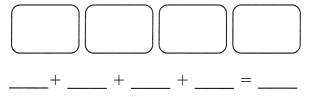
Texas Go Math Grade 7 Lesson 8.1 Answer Key Writing Two-Step Equations

Refer to our Texas Go Math Grade 7 Answer Key Pdf to score good marks in the exams. Test yourself by practicing the problems from Texas Go Math Grade 7 Lesson 8.1 Answer Key Writing Two-Step Equations.

Texas Go Math Grade 7 Lesson 8.1 Answer Key Writing Two-Step Equations

Texas Go Math Grade 7 Lesson 8.1 Explore Activity Answer Key

Modeling Two-Step Equations

You can use algebra tiles to model two-step equations.
Texas Go Math Grade 7 Lesson 8.1 Answer Key 1
Use algebra tiles to model 3x – 4 = 5.
A. How can you model the left side of the equation?
B. How can you model the right side of the equation?
C. Use algebra tiles or draw them to model the equation on the mat.
Texas Go Math Grade 7 Lesson 8.1 Answer Key 2

Reflect

Question 1.
What If? How would you change the equation in the Explore Activity to model -3x + 4 = 5?
Answer:
In order to change the model for the given equation and model the equation -3x + 4 = 5 use the following:
• • Instead of using 3 yellow tiles for the positive variable, use 3 red tiles for the negative variabLe to show – 3x
• • Instead of using 4 red tiles for -1, use 4 yelLow tiles for 1.
The model for the equation 3x + 4 = 5 is:
Texas Go Math Grade 7 Lesson 8.1 Answer Key 4
Change the yellow tiles for the positive variable to red tiles for negative variable.
Change red tiles for -1 to yellow tiles for 1.

Question 2.
Multiple Representations Why would this equation for finding the monthly fee be difficult to model with algebra tiles?
Answer:
It will be difficult because we will need so many tiles.

Texas Go Math Grade 7 Solutions Lesson 8.1 Question 3.
Can you rewrite the equation in the form 52m = 460? Explain.
Answer:
No, we can not. On the left side of the equation we have number and variable m, and we can not sum the number and variable m.

YOUR TURN

Question 4.
Billy has a gift card with a $150 balance. He buys several video games that cost $35 each. After the purchases, his gift card balance is $45. Write an equation to help find out how many video games Billy bought.
Answer:
Let x be the number of video games Billy bought.
$150 – $35 ∙ x = $45

Question 5.
Write a real-world problem that can be represented by 10x + 40 = 100.
Answer:
Bart go to store to buy a tennis balls and a racket. He buys one racket that cost $10 and $10 tennis balls. The bill was $100. how much does one tennis ball cost?

Texas Go Math Grade 7 Lesson 8.1 Guided Practice Answer Key

Draw algebra tiles to model the given two-step equation. (Explore Activity)

Question 1.
2x + 5 = 7
Texas Go Math Grade 7 Lesson 8.1 Answer Key 3
Answer:
Texas Go Math Grade 7 Lesson 8.1 Answer Key 5
On the left side of the mat, we put 2 positive variables and 5 + 1 tiles. On the right side, we put 7 + 1 tiles.

Writing Two-Step Equations Algebra 2 Practice Lesson 8.1 Question 2.
-3 = 5 – 4x
Texas Go Math Grade 7 Lesson 8.1 Answer Key 3
Answer:
Texas Go Math Grade 7 Lesson 8.1 Answer Key 6
On the left side of the mat we put 3 – 1 tiles. On the right side we put 4 negative variable and 5 + 1 tiles.

Question 3.
A group of adults plus one child attend a movie at Cineplex 15. Tickets cost $9 for adults and $6 for children. The total cost for the movie is $78. Write an equation to find the number of adults in the group. (Example 1)
Answer:
Let x be the number of adults.
$9 ∙ x – $6 = $78

Question 4.
Break down the equation 2x + 10 = 16 to analyze each part. (Example 2)
x is ________ of the problem.
2x is the quantity you are looking for _________.
+ 10 means 10 is ________. = 16 means the __________ is 16.
Answer:
– Solution.
– Is multiplied by 2.
– Added to 2x.
– The result

Question 5.
Write a corresponding real-world problem to represent 2x – 125 = 400. (Example 2)
Answer:
John bought two bicycles and got a discount of $124. The total cost after the discount is $100. How much is the cost of one bicycle?

Essential Question Check-In

Writing Two-Step Equations 1

Lesson 8.1 Answer Key 7th Grade Two Step Equations Question 6.
Describe the steps you would follow to write a two-step equation you can use to solve a real-world problem.
Answer:
The steps in writing a two-step equation to solve a real-world problem:

  1. Read the problem carefully and identify what is needed. Assign a variable for the said needed information.
  2. Write down the important information that can be used to help to write an equation.
  3. Use words ¡n the problem to tie the information together. Translate these words into numbers and variables in order to make an equation.

Texas Go Math Grade 7 Lesson 8.1 Independent Practice Answer Key

Question 7.
Describe how to model -3x + 7 = 28 with algebra tiles.
Answer:
On the left side we put 3 negative variable and 7 + 1 tiles.
On the right side we put 28 + 1 tiles.
To solve the equation, remove 7 + 1 tiles from each side.
Then, divide each side into 3 equal groups.
The solution will be x = -7.

Question 8.
Val rented a bicycle while she was on vacation. She paid a flat rental fee of $55.00, plus $8.50 each day. The total cost was $123. Write an equation you can use to find the number of days she rented the bicycle.
Answer:
At first, Val paid $55. and then plus $8.5 per day for a bicycle. Let x be the number of days Val rented the bicycle.
$55 + $8.5 ∙ x = $123

Question 9.
A restaurant sells a coffee refill mug for $6.75. Each refill costs $1.25. Last month Keith spent $31.75 on a mug and refills. Write an equation you can use to find the number of refills that Keith bought.
Answer:
Coffee refill mug costs $6.75, and each refill costs $1.25. Let x be the number of refills that Keith bought.
$6.75 + $1.25 ∙ x = $31.75

Question 10.
A gym holds one 60-minute exercise class on Saturdays and several 45-minute classes during the week. Last week all of the classes lasted a total of 285 minutes. Write an equation you can use to find the number of weekday classes.
Answer:
During the week exercise class Lasts 4 – minutes, and on Saturday 60 – minutes. Let x be the number of weekday classes.
60 + 45 ∙ x = 285

Texas Go Math Grade 7 Two-Step Equation Answer Key Question 11.
Multiple Representations There are 172 South American animals ¡n the Springdale Zoo. That is 45 more than half the number of African animals in the zoo. Write an equation you could use to find n, the number of African animals in the zoo.
Answer:
Springdale Zoo has 45 more animals than half the number of African animals in the zoo. Let n be the number of African animals in the zoo.
\(\frac{n}{2}\) + 45 = 172

Question 12.
A school bought $548 in basketball equipment and uniforms costing $29.50 each. The total cost was $2,023. Write an equation you can use to find the number of uniforms the school purchased.
Answer:
Basketball equipment costs $548 and each uniform $29.5. Let x be the number of uniforms the school purchased.
$548 + $29.5 ∙ x = $2023

Question 13.
Financial literacy Heather has $500 in her savings account. She withdraws $20 per week for gas. Write an equation Heather can use to see how many weeks it will take her to have a balance of $220.
Answer:
Heather spends. per week, $20 for gas, from hers saving account. Let x be the number of weeks.
$500 – $20 ∙ x = $220

Question 14.
Critique Reasoning For 9x + 25 = 88, Deena wrote the situation “I bought some shirts at the store for $9 each and received a $25 discount. My total bill was $88. How many shirts did I buy?”
a. What mistake did Deena make?
Answer:
She received discount, hence. she paved $25 less, so she have to subtract $25, not to add.

b. Rewrite the equation to match Deena’s situation.
Answer:
Deena bought some shirts that costs $9, and got the $25 discount. Let x be the number of shirts Deena bought.

c. How could you rewrite the situation to make it fit the equation?
Answer:
$9 ∙ x – $25 = $88

Writing Two-Step Equations 2

Two Step Equations 7th Grade Texas Go Math Question 15.
Multistep Sandy charges each family that she babysits a flat fee of $10 for the night and an extra $5 per child. Kimmi charges $25 per night, no Work Area matter how many children a family has.
a. Write a two-step equation that would compare what the two girls charge and find when their fees are the same.
Answer:
Let x be the number of children.
Let’s write the equation. Left side of equation represents how much Sandy charges for babysitting per night, and the right side represents who much Kimmi charges per night.
$10 + $5 ∙ x = $25
Subtract from both sides $10.
-$10 + $10 + $5 ∙ x = -$10 + $25
$5 ∙ x = $15
Divide both sides by $5.
\(\frac{x \cdot \$ 5}{\$ 5}=\frac{3 \cdot \$ 5}{\$ 5}\)
Their fees are the same when they babysit 3 children.

b. How many children must a family have for Sandy and Kimmi to charge the same amount?
Answer:
3 children

c. The Sanderson family has five children. Which babysitter should they choose if they wish to save some money on babysitting, and why?
Answer:
They should choose Kimmi because she charges $25 per night. no matter how many children she babysits, and Sandy charges flat fee of $10 pills extra $5 per child, which would be
$10 + 5 ∙ $5 = $35.

H.O.T. Focus on Higher Order Thinking

Question 16.
Analyze Relationships Each student wrote a two-step equation. Peter wrote the equation 4x – 2 = 10, and Andres wrote the equation 16x – 8 = 40. The teacher looked at their equations and asked them to compare them. Describe one way in which the equations are similar.
Answer:
The equations are similar because any equation can be multiplied or divided by any number and still be the same.
In this case, if we multiply Peter’s equation by 4, we get the Andres’s equation.
Hence, these two equations are equal.

Go Math Lesson 8.1 7th Grade Two-Step Equation Answer Key Question 17.
What’s the Error? Damon has 5 dimes and some nickels in his pocket, worth a total of $1.20. To find the number of nickels Damon has, a student wrote the equation 5n + 50 = 1.20. Find the error in the student’s equation.
Answer:
On the left side of the equation, Damon put the cents, but on the right side, he left the dollars. He needs to convert dollars on the left side of the equation to cents, and then the equation will be correct.
5 ∙ n + 50 = 120 This is the correct equation.

Question 18.
Represent Real-World Problems Write a real-world problem you could answer by solving the equation -8x + 60 = 28.
Answer:
Sarah has $60. She bought 8 T-shirts, and after the purchase, she had left 20 dollars. How much does it cost, one t-shirt?

Texas Go Math Grade 7 Lesson 8.1 Answer Key Writing Two-Step Equations Read More »

Texas Go Math Grade 5 Lesson 3.2 Answer Key Multiply Decimals and Whole Numbers

Refer to our Texas Go Math Grade 5 Answer Key Pdf to score good marks in the exams. Test yourself by practicing the problems from Texas Go Math Grade 5 Lesson 3.1 Answer Key Multiplication Patterns with Decimals.

Texas Go Math Grade 5 Lesson 3.2 Answer Key Multiply Decimals and Whole Numbers

Investigate

Materials Texas Go Math Grade 5 Lesson 3.2 Answer Key 1 decimal models Texas Go Math Grade 5 Lesson 3.2 Answer Key 1 color pencils

Giant tortoises move very slowly. They can travel a distance of about 0.17 mile in 1 hour,
If a giant tortoise travels at the same speed, how far could it move in 4 hours?
A. Complete the statement to describe the problem.
I need to find how many total miles are in _0.17__ groups of _4__
• Write an expression to represent the problem. _0.17 X 4___

B. Use the decimal model to find the answer.
• What does each small square in the decimal model represent?

C. Shade a group of ___ squares to represent the distance a giant tortoise can move in 1 hour.

D. Use a different color to shade each additional
group of ___ squares until you have __ group of __ squares.

E. Record the total number of squares shaded. ___ squares
So, the giant tortoise can move ___ mile in 4 hours.

Answer:
A. Total number of miles are in 0.17 groups of 4,
Wrote an expression to represent the problem 0.17 X 4,
B. Used the decimal model to find the answer,
Used small square in the decimal model represents,
Texas Go Math Grade 5 Lesson 3.2 Answer Key Multiply Decimals and Whole Numbers-1
C. Shaded a group of 4 squares to represent the distance a
giant tortoise can move in 1 hour.
D. Used a different color to shade each additional
group of __0.17_ squares until you have _4_ group of _0.17_ squares.

E. Record the total number of squares shaded. __0.68_ squares
So, the giant tortoise can move _0.68__ mile in 4 hours.

Explanation:
A. Total number of miles are in 0.17 groups of 4,
Wrote an expression to represent the problem 0.17 X 4,
B. Used the decimal model to find the answer,
Used small square in the decimal model represents,
C. Shaded a group of 4 squares to represent the distance a
giant tortoise can move in 1 hour.
D. Used a different color to shade each additional
group of  0.17 squares until you have 4 group of 0.17 squares.

E. Record the total number of squares shaded 0.68 squares
So, the giant tortoise can move 0.68 mile in 4 hours.

Math talk
Mathematical Process

Explain how the model helps you determine if your answer is reasonable.
Answer:
Model helped easy way to represent decimal values with the whole,

Explanation:
The model helped to determine the answer is reasonable as
4 blocks of 17 we get
17
X 4
68
hundredths places so 0.68.

Make connection

You can use base-ten blocks to solve decimal multiplication problems.
A quick picture is a way to record your work.
Find the product. 3 × 0.46
Texas Go Math Grade 5 Lesson 3.2 Answer Key 2

Step 1
Make 3 groups of 4 tenths and 6 hundredths.
Remembering that a square or a flat is equal to 1.
Drawn a quick picture to record your work.

Step 2
Combined the hundredths and renamed.
There are _6__ hundredths. I will rename _6_ hundredths as _0.60__.
In our quick picture, cross out the hundredths you renamed.

Step 3
Combined the tenths and renamed.
There are _4_ tenths. I will rename _4_ tenths as _0.40__.
In quick picture, cross out the tenths you renamed.

Step 4
Record the value shown by your completed quick picture.
So, 3 × 0.46 = _1.38_

Share and Show

Math Talk
Mathematical Processes
Explain how renaming decimals is like renaming Whole numbers.
Answer:
Place values change,

Explanation:
When whole numbers are renamed the decimal’s place values change
from units to tenths, tens to hundredths.

Share and Show

Use the decimal model to find the product.

Question 1.
5 × 0.06 = __0.30_
Texas Go Math Grade 5 Lesson 3.2 Answer Key 3
Answer:
Texas Go Math Grade 5 Lesson 3.2 Answer Key Multiply Decimals and Whole Numbers-2
Explanation:
Step 1
Making  5 groups of 6 hundredths.
Remember that a square or a flat is equal to 1.
Drawn a quick picture to record your work.

Step 2
Combined the hundredths and rename.
There are 6 hundredths. I will rename _6__ hundredths as _0.60__.
In our quick picture, cross out the hundredths you renamed.

Step 3
Recorded the value shown by your completed quick picture
So, 5 × 0.06 = _0.30_

Multiply Decimals and Whole Numbers 5

Go Math Grade 5 Lesson 3.2 Answer Key Question 2.
5 × 0.38 = _1.90__
Texas Go Math Grade 5 Lesson 3.2 Answer Key 4
Answer:
Texas Go Math Grade 5 Lesson 3.2 Answer Key Multiply Decimals and Whole Numbers-3

Explanation:
Step 1
Making  5 groups of 3 tenths and 8  hundredths,
Remembering that a square or a flat is equal to 1.
Drawn a quick picture to record your work.

Step 2
Combined the tenths,hundredths and rename.
There are 3 tenths and 8 hundredths,
I will rename _3__ tenths and __8 __hundredths as _0.38__.
In your quick picture, cross out the hundredths you renamed.

Step 3
Recorded the value shown by your completed quick picture
So, 5 × 0.38 = _1.90_

Question 3.
4 × 0.24 = ___
Texas Go Math Grade 5 Lesson 3.2 Answer Key 5
Answer:
4 X 0.24 = 0.96,
Texas Go Math Grade 5 Lesson 3.2 Answer Key Multiply Decimals and Whole Numbers-5

Explanation:
Step 1
Making  4 groups of 2 tenths and 4 hundredths,
Remembering that a square or a flat is equal to 1.
Drawn a quick picture to record your work.

Step 2
Combined the tenths and hundredths and rename.
There are 2 tenths, 4 hundredths. I will rename 2 tenths,
4 hundredths as _0.24__.
In your quick picture, cross out the hundredths you renamed.

Step 3
Recorded the value shown by your completed quick picture
So, 4 × 0.24 = _0.96_

Lesson 3.2 Answer Key 5th Grade Multiply Decimals Question 4.
3 × 0.62 = __1.86__
Answer:
Texas Go Math Grade 5 Lesson 3.2 Answer Key Multiply Decimals and Whole Numbers-6Explanation:
Step 1
Making  3 groups of 6 tenths and 2 hundredths,
Remembering that a square or a flat is equal to 1.
Drawn a quick picture to record your work.

Step 2
Combined the tenths and hundredths and rename.
There are 6 tenths, 2 hundredths. I will rename 6 tenths,
2 hundredths as _0.62__.
In your quick picture, cross out the hundredths you renamed.

Step 3
Recorded the value shown by your completed quick picture
So, 3 × 0.62 = _1.86_

Question 5.
4 × 0.32 = _1.28__
Answer:
Texas Go Math Grade 5 Lesson 3.2 Answer Key Multiply Decimals and Whole Numbers-8

Explanation:
Step 1
Making 4 groups of 3 tenths and 2 hundredths,
Remembering that a square or a flat is equal to 1.
Drawn a quick picture to record your work.

Step 2
Combined the tenths and hundredths and rename.
There are 3 tenths, 2 hundredths. I will rename 3 tenths,
2 hundredths as _1.28__.
In your quick picture, cross out the hundredths you renamed.

Step 3
Recorded the value shown by your completed quick picture
So, 4 × 0.32 = _1.28_

Problem Solving

Use the table for 6-8. Use quick pictures or base-ten blocks to help.

Question 6.
Each day a bobcat drinks about 3 times as much water as a Canada goose drinks.
How much water does a bobcat drink in one day?
Texas Go Math Grade 5 Lesson 3.2 Answer Key 6
Answer:
3 X 0.24 = 0.72 liters,

Explanation:
Given each day a bobcat drinks about 3 times as much water as a Canada Goose drinks.
Average amount each day Canada Goose drinks is 0.24 liters,
Water does a bobcat drink in one day is
0.24
X  3
0.72

Go Math Grade 5 Chapter 3 Lesson 3.2 Answer Key Question 7.
Multi-Step River otters drink about 5 times as much water as a bald eagle drinks in a day.
How much water does a river otter drink in three days?
Texas Go Math Grade 5 Lesson 3.2 Answer Key 7
Answer:
Water does a River otter drink in three days is 2.40 liters,

Explanation:
Given Multi-Step River otters drink about 5 times as much
water as a bald eagle drinks in a day.
Average amount each day Bald Eagle drinks is 0.16 liters
5 X 0.16 = 0.80,
Water does a River otter drink in three days is
3 X 0.80
0.80
X   3
2.40

Question 8
Write Math Explain how you could use a quick picture to
find the amount of water that a cat drinks in 5 days.
Answer:
Texas Go Math Grade 5 Lesson 3.2 Answer Key Multiply Decimals and Whole Numbers-9
The amount of water that a cat drinks in 5 days is 0.75 liters,

Explanation:
Given Math explained the amount of water that a cat drinks in
5 days is 5 X 0.15 = 0.75  liters.

Question 9.
Compare the product of 0.46 and 3 with each of the factors.
Which number has the greatest value? Explain how this is different than
multiplying two whole numbers.
Answer:
The greatest values will be multiplying two whole numbers rather than
multiplying decimal values,

Explanation:
The product of 0.46 and 3 is
1
0.46
X   3
1.38
Factors of 0.4 is (0.1,0.4) or (0.2,0.2),
Factors of 0.06 is (0.01,0.06) or (0.02, 0.03),
Factors of 3 are (1,3), there are no common factors as we have whole numbers compared with tenths and hundredths, therefore, the greatest values will be multiplying two whole numbers rather than multiplying decimal values.

Daily Assessment Task

Fill in the bubble completely to show your answer.

Go Math 5th Grade Lesson 3.2 Answer Key Question 10.
Representations What multiplication expression does the model show?
Texas Go Math Grade 5 Lesson 3.2 Answer Key 8
(A) 5 × 0.4
(B) 5 × 0.6
(C) 16 × 0.05
(D) 5 × 0.16
Answer:
(A) 5 × 0.4,

Explanation:
Given model represents 5 multiplied by 4 tenths,
So matches with (A) 5 X 0.4.

Question 11.
Display Which equation matches the model?
Texas Go Math Grade 5 Lesson 3.2 Answer Key 9
(A) 4 × 0.31 = 1.24
(B) 4 × 0.31 = 1.51
(C) 4 × 0.39 = 1.24
(D) 4 × 0.39 = 1.56
Answer:
(A) 4 × 0.31 = 1.24

Explanation:
Given model represents 4 multiplied by 3 tenths and 1 hundredths
giving the results as 4 X 0.31 =
0.31
X 4
1.24, So matches with (A) 4 X 0.31 = 1.24.

Multiply Decimals and Whole Numbers 3

Question 12.
Multi-Step Use Diagrams Use a quick picture to multiply 3 × 0.16.
Then multiply the result by 3 again. What is the final product?
(A) 0.32
(B) 0.48
(C) 1.44
(D) 1.24
Answer:
Texas Go Math Grade 5 Lesson 3.2 Answer Key Multiply Decimals and Whole Numbers-10
(C) 1.44,

Explanation:
Using Diagrams a quick picture to multiply
0.16
X  3
0.48
Now multiplying the result by 3 again,
0.48
X  3
0.24
1.20
1.44, 
matches with (C).

Texas Test Prep

Lesson 3.2 Multiply Decimals by Whole Numbers Question 13.
Jared has a parakeet that weighs 1.44 ounces. Susie has a Senegal parrot that
weighs 3 times as much as Jared’s parakeet. How many ounces does Susie’s parrot weigh?
(A) 0.32 ounce
(B) 43.2 ounces
(C) 4.32 ounces
(D) 0.43 ounce
Answer:
(C) 4.32 ounces,

Explanation:
Given Jared has a parakeet that weighs 1.44 ounces.
Susie has a Senegal parrot that weighs 3 times as much as Jared’s parakeet.
Number of ounces does Susie’s parrot weigh is
11
1.44
X  3
4.32 matches with (C) 4.32 ounces.

Texas Go Math Grade 5 Lesson 3.2 Homework and Practice Answer Key

Use the decimal model to find the product.

Question 1.
4 × 0.07 = _0.28__
Texas Go Math Grade 5 Lesson 3.2 Answer Key 10
Answer:
4 X 0.07 = 0.28,

Explanation:
Given model represents 4 multiplied by 7 hundredths
giving the results as 4 X 0.07 =
0.07
X  4
0.28, So 4 X 0.07 = 0.28.

Go Math Practice and Homework Lesson 3.2 Answer Key Question 2.
3 × 0.21 = __0.63_
Texas Go Math Grade 5 Lesson 3.2 Answer Key 11
Answer:
Texas Go Math Grade 5 Lesson 3.2 Answer Key Multiply Decimals and Whole Numbers-11

Explanation:
Given model represents 3 multiplied by 2 tenths and 1 hundredths
giving the results as 3 X 0.21 =
0.21
X  3
0.63, So 3 X 0.63 = 0.63.

Question 3.
4 × 0.13 = _0.52__
Texas Go Math Grade 5 Lesson 3.2 Answer Key 12
Answer:
Texas Go Math Grade 5 Lesson 3.2 Answer Key Multiply Decimals and Whole Numbers-12
Explanation:
Given model represents 4 multiplied by 1 tenths and 3 hundredths
giving the results as 4 X 0.13 =
0.13
X  4
0.52, So 4 X 0.13 = 0.52.

Find the product. Draw a quick picture.

Question 4.
3 × 0.38 = _1.14___
Answer:
Texas Go Math Grade 5 Lesson 3.2 Answer Key Multiply Decimals and Whole Numbers-13
Explanation:
Given model represents 3 multiplied by 3 tenths and 8 hundredths
giving the results as 3 X 0.38 =
2
0.38
X  3
1.14, So 3 X 0.38 = 1.14.

Go Math 5th Grade Practice and Homework Lesson 3.2 Question 5.
2 × 0.41 = __0.82__
Answer:
2 X 0.41 =
Texas Go Math Grade 5 Lesson 3.2 Answer Key Multiply Decimals and Whole Numbers-14
Explanation:
Given model represents 2 multiplied by 4 tenths and 1 hundredths
giving the results as 2 X 0.41 =
0.41
X  2
0.82, So 2 X 0.41 = 0.82.

Problem Solving

Question 6.
Lars walks his dog 4 times farther than Michelle walks her dog.
Michelle walks her dog 0.23 mile. How far does Lars walk his dog?
Answer:
0.92 Lars walk his dog,

Explanation:
Lars walks his dog 4 times farther than Michelle walks her dog.
Michelle walks her dog 0.23 mile. Far does Lars walk his dog is
0.23
X  4
0.92

Question 7.
One day, Nat’s dog drank 3 times as much water as his cat.
If his cat drank 0.83 liter of water, how many liters did his dog drink?
Answer:
24.9 liter Nat’s dog drank water,

Explanation:
One day, Nat’s dog drank 3 times as much water as his cat.
If his cat drank 0.83 liter of water, Liters does his dog drank is
0.83
X  3
24.9
therefore, 24.9 liter Nat’s dog drank water.

Lesson Check

Texas Test Prep

Fill in the bubble completely to show your answer.

Question 8.
Which equation matches the model?
Texas Go Math Grade 5 Lesson 3.2 Answer Key 13
(A) 5 × 0.18 = 0.9
(B) 5 × 0.18 = 90
(C) 5 × 0.18 = 9.0
(D) 5 × 0.18 = 0.09
Answer:
(A) 5 × 0.18 = 0.9,

Explanation:
Given model represents 5 multiplied by 1 tenth and 8 hundredths
giving the results as 5 X 0.18 =
4
0.18
X  5
0.90, So 5 X 0.18 = 0.90.

Go Math Lesson 3.2 5th Grade Multiply Decimals Question 9.
Sidney’s bag of popcorn weighs 1.89 ounces. Sam’s bag of popcorn weighs 4 times as much as Sidney’s. What is the weight of Sam’s bag of popcorn?
(A) 0.756 ounce
(B) 7.56 ounces
(C) 75.6 ounces
(D) 756 ounces
Answer:
(B) 7.56 ounces,

Explanation:
Given Sidney’s bag of popcorn weighs 1.89 ounces. Sam’s bag of popcorn weighs 4 times as much as Sidney’s. So the weight of Sam’s bag of popcorn is
33
1.89
X  4
7.56 
ounces which matches with (B).

Question 10.
A beaker is filled with 0.23 liter of water. Leon fills another beaker with
3 times as much water. How much water is in Leon’s beaker?
(A) 0.96 liter
(B) 0.84 liter
(C) 0.69 liter
(D) 0.47 liter
Answer:
(C) 0.69 liter,

Explanation:
Given a beaker is filled with 0.23 liter of water. Leon fills another beaker with
3 times as much water. So water is in Leon’s beaker is
0.23
X  3
0.69 liter
which matches with (C).

Question 11.
In a swimming race, Yvonne swam 0.18 mile. David swam
4 times as far as Yvonne. How far did David swim?
(A) 2.2 miles
(B) 0.22 mile
(C) 7.2 miles
(D) 0.72 mile
Answer:
(D) 0.72 mile,

Explanation:
Given in a swimming race, Yvonne swam 0.18 mile. David swam
4 times as far as Yvonne. So far did David swim is
3
0.18
X  4
 0.72 mile matches with (D).

Lesson 3.2 Answer Key 5th Grade Multiply Decimals Question 12.
Multi-Step Carrie has 0.73 liters of juice in her pitcher.
Sanji’s pitcher has 2 times as much juice as Carrie’s pitcher.
Lee’s pitcher has 4 times as much juice as Carrie’s pitcher.
Sanji and Lee pour all their juice into a large bowl. How much juice is in the bowl?
(A) 1.46 liters
(B) 4.38 liters
(C) 2.92 liters
(D) 5.11 liters
Answer:
(B) 4.38 liters,

Explanation:
Given Multi-Step Carrie has 0.73 liters of juice in her pitcher.
Sanji’s pitcher has 2 times as much juice as Carrie’s pitcher.
So Sanji’s pitcher has 2 X 0.73 = 1.46 liters,
Lee’s pitcher has 4 times as much juice as Carrie’s pitcher.
So Lee’s pitcher has 4 X 0.73 = 2.92 liters,
As Sanji and Lee pour all their juice into a large bowl.
Juice is in the bowl is 1.46 + 2.92 = 4.38 liters matches with (B).

Question 13.
Multi-Step Justin and Hayden are playing a number game.
Justin’s number is the product of 4 × 0.06. Hayden’s number 0.04
less than the product of Justin’s number and 4. What is Hayden’s number?
(A) 0.92
(B) 0.96
(C) 0.60
(D) 1.0
Answer:
(A) 0.92,

Explanation:
Given Justin and Hayden are playing a number game.
Justin’s number is the product of 4 × 0.06. Hayden’s number 0.04
less than the product of Justin’s number and 4,
Justin’s number is 4 X 0.06 = 0.24,
Hayden’s number is (4 X 0.24) – 0.04 = 0.96 – 0.04 = 0.92 matches with (A).

Texas Go Math Grade 5 Lesson 3.2 Answer Key Multiply Decimals and Whole Numbers Read More »

Texas Go Math Grade 7 Lesson 8.4 Answer Key Solving Two-Step Inequalities

Refer to our Texas Go Math Grade 7 Answer Key Pdf to score good marks in the exams. Test yourself by practicing the problems from Texas Go Math Grade 7 Lesson 8.4 Answer Key Solving Two-Step Inequalities.

Texas Go Math Grade 7 Lesson 8.4 Answer Key Solving Two-Step Inequalities

Your Turn

Use algebra tiles to model and solve each inequality.

Question 1.
2x + 7 > 11 ____
Answer:
Texas Go Math Grade 7 Lesson 8.4 Answer Key 19
Subtract 7 from both sides.
2x + 7 – 7 > 11 – 7
2x > 4 Divide both sides by 2.
Texas Go Math Grade 7 Lesson 8.4 Answer Key 20

Texas Go Math Grade 7 Solutions Lesson 8.4 Answer Key Question 2.
5h – 4 ≥ 11
Answer:
Texas Go Math Grade 7 Lesson 8.4 Answer Key 21
Add 4 to both sides.
5h – 4 + 4 ≥ 11 + 4
5h ≥ 15 Divide both sides by 5.
Texas Go Math Grade 7 Lesson 8.4 Answer Key 22

Your Turn

Solving Two-Step Inequalities 1

Question 3.
Joshua wants to complete the first mile of a 5-mile run in 10 minutes or less running at a steady pace. The inequality 5 – \(\frac{p}{6}\) ≤ 4 can be used to find p, the pace, in miles per hour, he can run to reach his goal. Solve the inequality. Then graph and interpret the solution.
Texas Go Math Grade 7 Lesson 8.4 Answer Key 2
Answer:
Multiply both sides by 6. Because we are multiplying by a negative number, we have to reverse the direction of the
inequality.
Texas Go Math Grade 7 Lesson 8.4 Answer Key 23
-30 + 9 ≥ -24 Add 30 to both sides
30 – 30 + p ≥ 30 – 24
p ≥ 6
Texas Go Math Grade 7 Lesson 8.4 Answer Key 24
p ≥ 6

Your Turn

Circle any given values that make the inequality true.

Question 4.
3v – 8 > 22
v = 9; v = 10; v = 11
Answer:
Substitute 9 for v in the given equation.
v = 9
Texas Go Math Grade 7 Lesson 8.4 Answer Key 25
Substitute 10 for v in the given equation.
Texas Go Math Grade 7 Lesson 8.4 Answer Key 26
Substitute 11 for v in the given equation.
Texas Go Math Grade 7 Lesson 8.4 Answer Key 27
v = 11

Practice and Homework Lesson 8.4 Texas Go Math Grade 7 Question 5.
5h + 12 ≤ -3
h = -3; h = -4; h = -5
Answer:
Substitute -3 for h in the given equation.
Texas Go Math Grade 7 Lesson 8.4 Answer Key 28
Substitute -4 for h in the given equation.
Texas Go Math Grade 7 Lesson 8.4 Answer Key 29
Substitute -5 for h in the given equation.
Texas Go Math Grade 7 Lesson 8.4 Answer Key 30
h = -3,
h = -4,
h = -5

Texas Go Math Grade 7 Lesson 8.4 Guided Practice Answer Key

Question 1.
Describe how to solve the inequality 3x + 4 < 13 using algebra tiles. (Example 1)
Texas Go Math Grade 7 Lesson 8.4 Answer Key 3
Answer:
Remove 4 + 1 tiles from each side on the mat.
Then, divide each side into 3 equal groups.
3x < 13 – 4
3x < 9 Divide both sides by 3.
\(\frac{3 x}{3}\) < \(\frac{9}{3}\)
x < 3
The solution is x < 3.

Solve each inequality. Graph and check the solution. (Example 2)

Question 2.
5d – 13 < 32 ____
Texas Go Math Grade 7 Lesson 8.4 Answer Key 4
Answer:
Add 13 to the both sides.
Texas Go Math Grade 7 Lesson 8.4 Answer Key 31
Check the solution for d < 9. For example, d = 5.
Texas Go Math Grade 7 Lesson 8.4 Answer Key 32
Texas Go Math Grade 7 Lesson 8.4 Answer Key 33
d < 9

Lesson 8.4 Answer Key 7th Grade Two-Step Inequalities Question 3.
-4b + 9 < -7 _____
Texas Go Math Grade 7 Lesson 8.4 Answer Key 5
Answer:
Subtract 9 to the both sides.
Texas Go Math Grade 7 Lesson 8.4 Answer Key 34
Check the solution for b ≥ 4. For example, b = 5.
Texas Go Math Grade 7 Lesson 8.4 Answer Key 35
Texas Go Math Grade 7 Lesson 8.4 Answer Key 36
b ≥ 4

Circle any given values that make the inequality true. (Example 3)

Solving Two-Step Inequalities 2

Question 4.
2m + 18 > -4
m = -12;m = -11; m = -10
Answer:
Substitute -12 for m in the given equation.
Texas Go Math Grade 7 Lesson 8.4 Answer Key 37
Substitute -11 for m in the given equation.
Texas Go Math Grade 7 Lesson 8.4 Answer Key 38
Substitute -10 for m in the qiven equation.
Texas Go Math Grade 7 Lesson 8.4 Answer Key 39
m = -10

Question 5.
-6y + 3 ≥ 0
y = 1; y = \(\frac{1}{2}\); y = 0
Answer:
Substitute 1 for y in the given equation.
Texas Go Math Grade 7 Lesson 8.4 Answer Key 40
Substitute 1/2 for y in the given equation.
Texas Go Math Grade 7 Lesson 8.4 Answer Key 41
Substitute 0 for y in the given equation.
Texas Go Math Grade 7 Lesson 8.4 Answer Key 42
y = 0

Texas Go Math Grade 7 Lesson 8.4 Answer Key 6

Go Math Lesson 8.4 7th Grade Two Step Inequalities Answer Key Question 6.
Lizzy has 6.5 hours to tutor 4 students and spend 1.5 hours in a lab. She plans to tutor each student the same amount of time. The inequality 6.5 – 4t ≥ 1.5 can be used to find t, the amount of time in hours Lizzy could
spend with each student. Solve the inequality. Graph and interpret the solution. Can Lizzy tutor each student for
1.5 hours? Explain. (Example 2 and 3)
Answer:
Subtract 6.5 from the both sides.
-6.5 + 6.5 – 4t ≤ -6.5 + 1.5
-4f ≤ 4 Divide both sides by -4.
Texas Go Math Grade 7 Lesson 8.4 Answer Key 43
Substitute 1.5 for t in the given equation.
t = 1.5
Texas Go Math Grade 7 Lesson 8.4 Answer Key 44
t ≥ 1

Essential Question Check-In

Question 7.
How do you solve a two-step inequality?
Answer:
First, isolate the variable. On one side of the inequality we put the variable, and on other side we put what’s left.
If the variable is multiplied by some number, we have to divide inequality by that number.
If we divide or multiply by a negative number, we have to reverse the direction of inequality.

Texas Go Math Grade 7 Lesson 8.4 Independent Practice Answer Key

Solve each inequality. Graph and check the solution.

Question 8.
2s + 5 ≥ 49
Texas Go Math Grade 7 Lesson 8.4 Answer Key 7
Answer:
Divide both side by 2.
Texas Go Math Grade 7 Lesson 8.4 Answer Key 45
Check the solution for s ≥ 22. For example, s = 23.
Texas Go Math Grade 7 Lesson 8.4 Answer Key 46
The solution is shown in graph
Texas Go Math Grade 7 Lesson 8.4 Answer Key 47
s ≥ 22

Question 9.
-3f + 9 ≥ -21
Texas Go Math Grade 7 Lesson 8.4 Answer Key 8
Answer:
Subtract 9 from the both sides.
-3t + 9 – 9 ≥ -21 – 9
– 3t > -30 Divide both sides by (-3).
Texas Go Math Grade 7 Lesson 8.4 Answer Key 48
Check the solution for t ≤ 10. For example, t = 9.
Texas Go Math Grade 7 Lesson 8.4 Answer Key 49
This inequality is shown in the picture.
Texas Go Math Grade 7 Lesson 8.4 Answer Key 50
t ≤ 10

Solving Two-Step Inequalities Answer Key Grade 7 Question 10.
55 > -7v + 6 ____
Texas Go Math Grade 7 Lesson 8.4 Answer Key 9
Answer:
Subtract 6 from the both sides.
55 – 6 > -7v + 6 – 6
49 > -7v Divide both sides by (- 7).
Texas Go Math Grade 7 Lesson 8.4 Answer Key 51 Reverse the direction of inequality, due to the division with a negative number
-7 < v Check the solution for v > – 7. For example, v = 6.
55 ⩼ -7 ∙ (-6) + 6
55 ⩼ 42 + 6
55 ⩼ 48
True
This inequality is shown in the picture.
Texas Go Math Grade 7 Lesson 8.4 Answer Key 52
v > -7

Question 11.
41 > 6m – 7 ____
Texas Go Math Grade 7 Lesson 8.4 Answer Key 10
Answer:
Add 7 from the both sides.
41 + 7 > 6m – 7 + 7
48 > 6m Divide both sides by 6.
Texas Go Math Grade 7 Lesson 8.4 Answer Key 53
8 > m
Check the solution for in < 8. For example, m = 7.
41 ⩼ 6 . (7) – 7
41 ⩼ 42 – 7
41 ⩼ 35
True
This inequality is shown in the picture.
Texas Go Math Grade 7 Lesson 8.4 Answer Key 54
m < 8 Question 12. \(\frac{a}{-8}\) + 15 > 23
Texas Go Math Grade 7 Lesson 8.4 Answer Key 11
Answer:
Subtract 15 from the both sides.
\(\frac{a}{-8}\) + 15 – 15 > 23 – 15
\(\frac{a}{-8}\) > 8 Multiply both sides by (-8).
Texas Go Math Grade 7 Lesson 8.4 Answer Key 55 Reverse the direction of inequality, due to the division with a negative number
a < -61
Check the solution for a < -64. For example, a = -72.
– \(\frac{-72}{-8}\) + 15 ⩼ 23
9 + 15 ⩼ 23
24 ⩼ 23
True
This inequality is shown in the picture.
Texas Go Math Grade 7 Lesson 8.4 Answer Key 56
a < -64

Texas Go Math Grade 7 Answer Key Lesson 8.4 Question 13.
\(\frac{f}{2}\) – 22 < 48
Texas Go Math Grade 7 Lesson 8.4 Answer Key 12
Answer:
Add 22 from both sides.
\(\frac{f}{2}\) – 22 + 22 < 48 + 22
\(\frac{f}{2}\) < 70 Multiply both sides by 2.
Texas Go Math Grade 7 Lesson 8.4 Answer Key 57
Check the solution for f < 140. For example, f = 130
\(\frac{130}{2}\) – 22 ⩻ 48
65 – 22 ⩻ 48
43 ⩻ 48
True
This inequality is shown in the picture.
Texas Go Math Grade 7 Lesson 8.4 Answer Key 58
f < 140

Question 14.
-25 + \(\frac{t}{2}\) ≥ 50
Texas Go Math Grade 7 Lesson 8.4 Answer Key 13
Answer:
Add 25 from both sides.
-25 + 25 + \(\frac{t}{2}\) ≥ 50 + 25
\(\frac{t}{2}\) ≥ 75 Multiply both sides by 2.
Texas Go Math Grade 7 Lesson 8.4 Answer Key 59
Check the solution for t ≥ 150. For example, t = 160.
-25 + \(\frac{160}{2}\) ⩼ 50
-25 + 80 ⩼ 50
55 ⩼ 50
True
This inequality is shown in the picture.
Texas Go Math Grade 7 Lesson 8.4 Answer Key 71
t ≥ 150

Question 15.
10 + \(\frac{g}{-9}\) > 12
Texas Go Math Grade 7 Lesson 8.4 Answer Key 14
Answer:
Subtract -10 from
10 – 10 + \(\frac{g}{-9}\) > 12 – 10
\(\frac{g}{-9}\) > 2 Multiply both sides by (-9).
Texas Go Math Grade 7 Lesson 8.4 Answer Key 61 Reverse the direction of inequality, due to the multiplication with a negative number
g < -18
Check the solution for g < -18. For example, g = -27
10 + \(\frac{-27}{-9}\) ⩼ 12
10 + 3 ⩼ 12
13 ⩼ 12
True
This inequality is shown in the picture.
Texas Go Math Grade 7 Lesson 8.4 Answer Key 62
g < -18

7th Grade Go Math Answer Key Lesson 8.4 Question 16.
25.2 ≤ -1.5y + 1.2.
Texas Go Math Grade 7 Lesson 8.4 Answer Key 15
Answer:
Subtract 1.2 from the both sides.
25.2 – 1.2 ≤ -1.5y + 1.2 – 1.2
24 ≤ —1.5y Divide both sides by (-1.5).
Texas Go Math Grade 7 Lesson 8.4 Answer Key 63 Reverse the direction of inequality, due to the division with a negative number
-16 ≥ y
y ≤ -16
Check the solution for y ≤ -16. For example, y = -18.
25.2 ⩻ (-1.5) . (-18) + 1.2
25.2 ⩻ 27 + 1.2
25.2 ⩻ 28.2
True
This inequality is shown in the picture.
Texas Go Math Grade 7 Lesson 8.4 Answer Key 64
y ≤ -16

Question 17.
-3.6 ≥ -0.3a + 1.2
Texas Go Math Grade 7 Lesson 8.4 Answer Key 16
Answer:
Subtract 1.2 from boths sides.
-3.6 – 1.2 ≥ -0.3a + 1.2 – 1.2
-4.8 ≥ -0.3a Divide both sides by (-0.3).
Texas Go Math Grade 7 Lesson 8.4 Answer Key 65 Reverse the direction of inequality, due to the division by a negative number.
16 ≤ a
a ≥ 16
Check the solution for a ≥ 16. For example, a = 18.
-3.6 ⩼ (-0.3) . (18) + 1.2
-3.6 ⩼ -5.4 + 1.2
-3.6 ⩼ -4.2
True
This inequality is shown in the picture.
Texas Go Math Grade 7 Lesson 8.4 Answer Key 66
a ≥ 16

Question 18.
What If? The perimeter of a rectangle is at most 80 inches. The length of the rectangle is 25 inches. The inequality 80 – 2w ≥ 50 can be used to find w, the width of the rectangle in inches. Solve the inequality and interpret the solution. How will the solution change if the width must be at least 10 inches and a whole number?
Answer:
Subtract 80 from both sides.
-80 + 80 – 2 . w ≥ -80 + 50 Multiply both sides by (-2).
Texas Go Math Grade 7 Lesson 8.4 Answer Key 67 Reverse the direction of inequality, due to the multiplication by a negative number.
The width is not greater than 15 inches.
If the width must be at least 10 inches and the whole number, the solution set is {10, 11, 12, 13, 14, 15}.
w ≤ 15 inches

Question 19.
Interpret the Answer Grace earns $7 for each car she washes. She always saves $25 of her weekly earnings. This week, she wants to have at least $65 in spending money. How many cars must she wash? Write and solve an inequality to represent this situation. Interpret the solution in context.
Answer:
Sum $25 Grace saves every week, and $7 . x. where x represents the number of cars she must wash, and that sum should be at least $65.
$25 + $7 . x ≥ $65 Subtract $25 from both sides.
-$25 + $25 + $7 . x ≥ -$25 + $65
$7 . x ≥ $40 Divide b0th sides by $7.
Texas Go Math Grade 7 Lesson 8.4 Answer Key 68
She can not wash 5.71 cars. so we have to take the next whole number.
Because of that, she must wash at least 6 cars to meet her goal. Proof:
$25 + $7 . 6 ⩼ $65
$25 + $42 ⩼ $65
$66 ⩼ $65
True
x ≥ 6

Texas Go Math Grade 7 Lesson 8.4 H.O.T. Focus On Higher Order Thinking Answer Key

Question 20.
Critical Thinking Is there any value of x with the property that x < x – 1? Explain your reasoning. Answer: No, there is not. If we decrease any number by 1, the obtained number can not be greater than himself. For example, let x be 5. 5 ⩻ 5 – 1 5 ⩻ 4 Not true. Not, there is not. Question 21. Analyze Relationships A compound inequality consists of two simple inequalities joined by the word “and” or “or.” Graph the solution sets of each of these compound inequalities. a. x > 2 and x < 7
Texas Go Math Grade 7 Lesson 8.4 Answer Key 17
Answer:
x > 2 and x < 7
Texas Go Math Grade 7 Lesson 8.4 Answer Key 69

b. x < 2 or x > 7
Texas Go Math Grade 7 Lesson 8.4 Answer Key 18
Answer:
x < 2 or x > 7
Texas Go Math Grade 7 Lesson 8.4 Answer Key 70

c. Describe the solution set of the compound inequality x < 2 and x > 7.
Answer:
The solution set is the intersection of sets where x is greater than 2 and less than 7, x ε (2, 7).

d. Describe the solution set of the compound inequality x > 2 or x < 7.
Answer:
The solution set is the union of sets where x is less than 2 and greater than 7, x ε (-∞, 2) ∪ (7, ∞).

Go Math Lesson 8.4 7th Grade Solving Two-Step Inequalities Question 22.
Communicate Mathematical Ideas Joseph used the problem-solving strategy Work Backward to solve the inequality 2n+ 5 < 13. Shawnee solved the inequality using the algebraic method you used in this lesson. Compare the two methods.
Answer:
Working backward consists of mentally performing the following operations: Subtract 5 from 13 to obtain 8 and
dividing by 2 gives us that n must be less than 4.
Let’s perform the algebraic operations:
2n + 5 < 13 Write the inequality
2n + 5 – 5 < 13 – 5 Subtract 5 from both sides
2n < 8 Simplify
\(\frac{2 n}{2}\) < \(\frac{8}{2}\) Divide both sides by 2
n < 4 Simplify
The two methods are basically the same. Working backward consists of mostly working mentally, while the algebraic method is mostly written, but the operations performed are the same.
The two methods are basically the same. The backward method works mentally while the algebraic method is a written solution.

Texas Go Math Grade 7 Lesson 8.4 Answer Key Solving Two-Step Inequalities Read More »

Scroll to Top