Texas Go Math

Texas Go Math Grade 8 Module 3 Quiz Answer Key

Refer to our Texas Go Math Grade 8 Answer Key Pdf to score good marks in the exams. Test yourself by practicing the problems from Texas Go Math Grade 8 Module 3 Quiz Answer Key.

Texas Go Math Grade 8 Module 3 Quiz Answer Key

Texas Go Math Grade 8 Module 3 Ready to Go On? Answer Key

3.1 Representing Proportional Relationships

Question 1.
Find the constant of proportionality for the table of values.
Texas Go Math Grade 8 Module 3 Quiz Answer Key 1
Answer:
\(\frac{3}{2}\) = 1.5
\(\frac{4.5}{3}\) = \(\frac{3}{2}\) = 1.5
\(\frac{6}{4}\) = \(\frac{3}{2}\) = 1.5
\(\frac{7.5}{5}\) = \(\frac{3}{2}\) = 1.5
Therefore the constant of proportionality is 1.5
The constant of proportionality is 1.5.

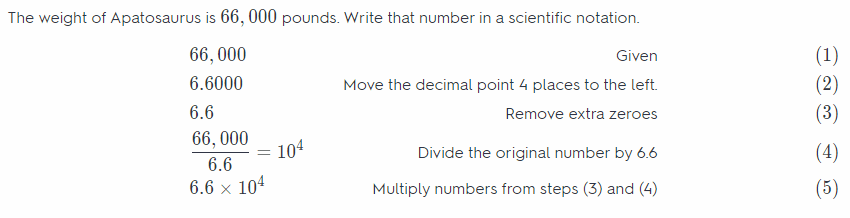
Grade 8 Math Module Answer Key Quiz Answers Question 2.
Phil is riding his bike. He rides 25 miles in 2 hours, 37.5 miles in 3 hours, and 50 miles in 4 hours. Find the constant of proportionality and write an equation to describe the situation.
Answer:
Let’s first find the tabLe of the given situation:
Texas Go Math Grade 8 Module 3 Quiz Answer Key 8

The constant of proportionality is 12.5
An equation to describe the situation is y = 12.5x where y is the distance and æ the time.
\(\frac{25}{2}\) = 12.5
\(\frac{37.5}{3}\) = \(\frac{25}{2}\) = 12.5
\(\frac{50}{4}\) = \(\frac{25}{2}\) = 12.5
The constant of proportionality is 12.5.
An equation to describe the situation is y = 12.5x where y is the distance and x the time

Constant of proportionality is 12.5, and the equation y = 12.5x

3.2 Rate of Change and Slope

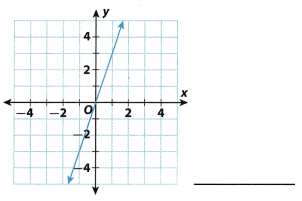
Find the slope of each tine.

Question 3.
Texas Go Math Grade 8 Module 3 Quiz Answer Key 2
Answer:
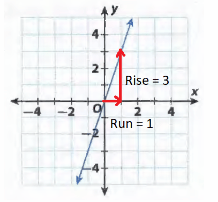
We choose two points on the line and we find the change in y-values and the change in x-values as we move from
one point to the other.
rise = +3, since we move up
run = +1, since we move right
Therefore,
slope = \(\frac{+3}{+1}\)
Texas Go Math Grade 8 Module 3 Quiz Answer Key 9
slope = 3

Grade 8 Math Module 3 Quiz Answer Key Question 4.
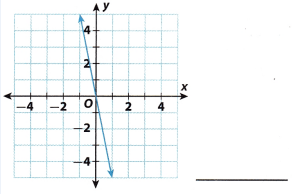
Texas Go Math Grade 8 Module 3 Quiz Answer Key 33
Answer:
Using the graph find 2 points that are on the given line, for example: (0, 0) and (1, -5). Now find the slope
Slope = \(\frac{-5-0}{1-0}\) = -5

The slope is —5.

3.3 Interpreting the Unit Rate as Slope

Question 5.
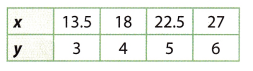
What is the slope of the data in the table?
Texas Go Math Grade 8 Module 3 Quiz Answer Key 4
Answer:
The formula for the slope m= y2 – y1/x2 x1.
Here
x1 = 13.5
x2 = 18
y1 = 3
y2 = 4
m = 4 – 3/18 -13.5
m = 1/ 4.5.
m = 0.22.
And
x1 = 18
x2 = 22.5
y1 = 4
y2 = 5
m = 5 – 4/22.5 – 18
m = 1/ 4.5.
m = 0.22.
And
x1 = 22.5
x2 = 27
y1 = 5
y2 = 6
m = 6 – 5/27 -22.5
m = 1/ 4.5.
m = 0.22.
The slope of the data is 0.22

3.4 Direct Variation

Question 6.
A wheelchair ramp rises 2.25 feet for every 25 feet of horizontal distance it covers. What is the slope of the ramp? ________
Answer:
Given that,
Wheelchair ramp rises = 2.25 feet per every 25 feet of horizontal distance.
Slope of the ramp = m = 2.25/25 = 0.09
The slope of the ramp = 0.09

Essential Question

Grade 8 Math Module 3 Answer Key Question 7.
What is the relationship among direct variation, lines, rates of change, and slope?
Answer:
The relationship among direct variation, lines, rates of change, and the slope is the variables of the x-axis and the y-axis is the proportional relational ship that has the slope it means the direct variation is determined by calculating the rate of change in the line.

Texas Go Math Grade 8 Module 3 Mixed Review Texas Test Prep Answer Key

Selected Response

Question 1.
Lupe’s heart beats 288 times in 4 minutes. Which equation represents the number of times her heart beats per minute?
(A) y = \(\frac{1}{288}\)x
(B) y = \(\frac{1}{72}\)x
(C) y = 72x
(D) y = 288x
Answer:
Given that,
Lupe’s heartbeat = 288 times per 4 minutes.
Let x be the number of minutes.
Heartbeat per minute equal to = 288x/4
= 72x
Option C is the correct answer.

Question 2.
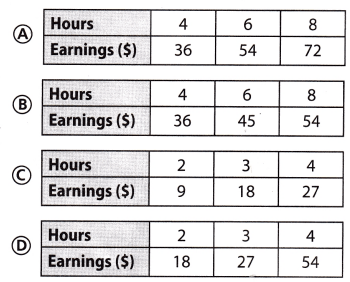
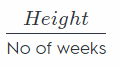
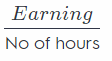
Prasert earns $9 an hour. Which table represents this proportional relationship?
Texas Go Math Grade 8 Module 3 Quiz Answer Key 5
Answer:
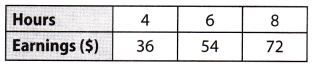
(A)
Texas Go Math Grade 8 Module 3 Quiz Answer Key 35

Explanation:
y = 9x Relationship representing earning at $9 per hr. where x is the number of hour

y = 9(2) = 18 When x = 2, 3, 4, 6, 8
y = 9(3) = 27
y = 9(4) = 36
y = 9(6) = 54
y = 9(8) = 72
Table $A$ represents the situation

Texas Go Math Grade 8 Module 3 Test Answers Question 3.
A factory produces widgets at a constant rate. After 4 hours, 3,120 widgets have been produced. At what rate are the widgets being produced?
(A) 630 widgets per hour
(B) 708 widgets per hour
(C) 780 widgets per hour
(D) 1,365 widgets per hour
Answer:
(C) 780 widgets per hour

Explanation:
Let’s denote with x the change ¡n time (hours) and with y the change in the number of widgets produced. We
know that x = 4 and y = 3120. To find the rate of change at which the widgets are being produced, we have:
rate = \(\frac{y}{x}\)
= \(\frac{3120}{4}\)
= 780
In conclusion, 780 widgets are produced every hour.

Question 4.
A full lake begins dropping at a constant rate. After 4 weeks it has dropped 3 feet. What is the unit rate of change in the lake’s level compared to its full level?
(A) 0.75 feet per week
(B) 1.33 feet perweek
(C) -0.75 feet per week
(D) -1.33 feet per week
Answer:
(A) 0.75 feet per week

Explanation:
\(\frac{3}{4}\) = 0.75 Find the unit rate by Texas Go Math Grade 8 Module 3 Quiz Answer Key 10
The lake leaks at $0.75$ feet per week

Question 5.
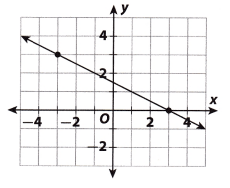
What is the slope of the line below?
Texas Go Math Grade 8 Module 3 Quiz Answer Key 6
(A) -2
(B) – \(\frac{1}{2}\)
(C) \(\frac{1}{2}\)
(D) 2
Answer:
(B) – \(\frac{1}{2}\)

Explanation:
Using the graph find two points on the line. For example: (3, 0) and (-3, 3). Now using those two points calculate
the slope:
Slope = \(\frac{0-3}{3-(-3)}\) = \(\frac{-3}{6}\) = –\(\frac{1}{2}\)

Grade 8 Module 3 Math Quiz Answer Key Question 6.
Jim earns $41.25 in 5 hours. Susan earns $30.00 in 4 hours. Pierre’s hourly rate is less than Jim’s, but more than Susan’s. What is his hourly rate?
(A) $6.50
(B) $7.75
(C) $7.35
(D) $8.25
Answer:
(B) $7.75

Explanation:
\(\frac{41.25}{5}\) = 8.25 Unit rate is given byTexas Go Math Grade 8 Module 3 Quiz Answer Key 34
Jim’s unit rate is $\$8.25$per hr$
$\dfrac{30}{4} = 7.5$ $Susan’s unit
rate is$\$7.5$ per hr

Pierre’s hourly rate = $7.75 per hour Pierre’s hourly rate is less than Jim’s but more than Susan’s
7.5 < x < 8.25

Gridded Response

Question 7.
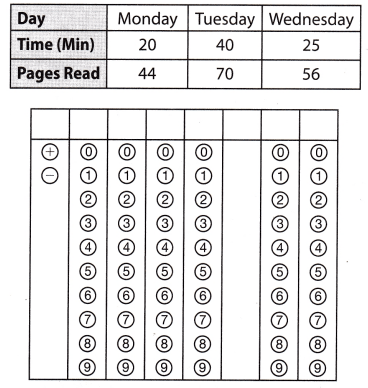
Joelle kept track of her daily reading in the table shown below. What is her fastest daily reading rate in pages per minute?
Texas Go Math Grade 8 Module 3 Quiz Answer Key 7
Answer:
Given that,
Monday timing time = 20 minutes
Monday number of pages = 44
Number of minutes per minute = 44/20 = 2.2
Tuesday timing time = 40 minutes
Tuesday number of pages = 70
Number of minutes per minute = 70/40 = 1.75
Wednesday timing time = 25 minutes
Wednesday number of pages = 56
Number of minutes per minute = 56/25 = 2.24
The fastest daily reading rate is 2.24 pages per minute.

Texas Go Math Grade 8 Module 3 Quiz Answer Key Read More »

Texas Go Math Grade 8 Lesson 1.3 Answer Key Ordering Real Numbers

Refer to our Texas Go Math Grade 8 Answer Key Pdf to score good marks in the exams. Test yourself by practicing the problems from Texas Go Math Grade 8 Lesson 1.3 Answer Key Ordering Real Numbers.

Texas Go Math Grade 8 Lesson 1.3 Answer Key Ordering Real Numbers

Essential Question
How do you order a set of real numbers?

Reflect

Question 1.
If 7 + \(\sqrt{5}\) is equal to \(\sqrt{5}\) plus a number, what do you know about the number? Why?
Answer:
We are told that 7 + \(\sqrt{5}\) is equal to\(\sqrt{5}\) plus a number. Lets denote with x the unknown number. We have:
7 + \(\sqrt{5}\) = \(\sqrt{5}\) + x
If we subtract \(\sqrt{5}\) in both sides we get:
7 + \(\sqrt{5}\) – \(\sqrt{5}\) = \(\sqrt{5}\) + x – \(\sqrt{5}\)
x = 7

The unknown number is 7 (whole number, integer, rational, real number).

Go Math Grade 8 Algebra Lesson 1.3 Question 2.
What are the closest two integers that \(\sqrt{300}\) is between?
Answer:
\(\sqrt{300}\) Given
289 < 300 < 324 Find the perfect squares of the number that 300 is between

17 < \(\sqrt{300}\) < 18 Take square roots
The close two integers are $17$ and $18$

Your Turn

Compare. Write <, >, or .

Question 3.
\(\sqrt{2}\) + 4 Texas Go Math Grade 8 Lesson 1.3 Answer Key 1 2 + \(\sqrt{4}\)
Answer:
First approximate \(\sqrt{2}\) by comparing 2 to the closest perfect squares and then take square root from both sides of the equation.
1 < 2 < 4
\(\sqrt{1}\) < \(\sqrt{2}\) < \(\sqrt{4}\) \(\sqrt{2}\) is between 1 and 2. Next since 4 is a perfect square, we know that \(\sqrt{4}\) = 2. \(\sqrt{2}\) + 4 is between 5 and 6 2 + \(\sqrt{4}\) is equal to 4. So, \(\sqrt{2}\) + 4 > 2 + \(\sqrt{4}\)
\(\sqrt{2}\) + 4 > 2 + \(\sqrt{2}\)

Question 4.
\(\sqrt{12}\) + 6 Texas Go Math Grade 8 Lesson 1.3 Answer Key 1 12 + \(\sqrt{6}\)
Answer:
\(\sqrt{12}\) + 6 ? 12 + \(\sqrt{6}\) Given
\(\sqrt{12}\) is between 3 and 4 Approximate \(\sqrt{12}\)

\(\sqrt{6}\) is between 2 and 3 Approximate \(\sqrt{6}\)

\(\sqrt{12}\) + 6 is between 9 and 10 Use approximations to simply the expressions
12 + \(\sqrt{6}\) is between 14 and 15
\(\sqrt{12}\) + 6 < 12 + \(\sqrt{6}\) Compare

Your Turn

Order the numbers from least to greatest. Then graph them on the number line.

Go Math Grade 8 Lesson 1.3 Independent Practice Answer Key Question 5.
\(\sqrt{5}\), 2.5, \(\sqrt{3}\) ____
Texas Go Math Grade 8 Lesson 1.3 Answer Key 2
Answer:
\(\sqrt{5}\), 2.5, \(\sqrt{3}\) Given
4 < 5 < 9 Approximate \(\sqrt{5}\). Find the perfect squares that 5 is between. Take square roots.
2 < \(\sqrt{5}\) < 3
\(\sqrt{5}\) is between 2 and 3
2.152 = 4.62 Find better estimates for \(\sqrt{5}\) so it can be compared to 2.5.
2.22 = 4.84 5 is closer to 4,; try numbers between 2 and 2.5
2.252 = 5.06
Since $2.25^{2}$ is closer to $5$, an approximate value is $2.25$
1 < 3 < 4 Approximate \(\sqrt{3}\). Find the perfect squares that 3 is between Take square roots.
1 < \(\sqrt{3}\) < 2
\(\sqrt{3}\) is between 1 and 2

1.62 = 2.56 Find better estimates for \(\sqrt{3}\).
1.72 = 2.89 3 is closer to 4, hence try numbers between 1.5 and 2
1.82 = 3.24
Since $1.7^{2}$ is closer to $3$, an approximate value is $1.7$
Texas Go Math Grade 8 Lesson 1.3 Answer Key 10 Graph on a Number line
\(\sqrt{3}\), \(\sqrt{5}\), 2.5 From the least to greatest

Math Talk
Mathematical Processes
If real numbers a, b, and c are in order from least to greatest, what is the order of their opposites from least to greatest? Explain.

Question 6.
π2, 10, \(\sqrt{75}\) ____
Texas Go Math Grade 8 Lesson 1.3 Answer Key 3
Answer:
π2, 10, \(\sqrt{75}\) Given
64 < 75 < 81 Approximate \(\sqrt{75}\) Find the perfect squares that 75 is between. Take square roots.
8 < \(\sqrt{75}\) < 9
\(\sqrt{75}\) is between 8 and 9

8.62 = 73.96 Find better estimates for \(\sqrt{75}\)
8.652 = 74.82 75 is closer to 81, hence try numbers between 8.5 and 9
8.78.62 = 75.69
Since $8.65^{2}$ is closer to $75$, an approximate value is $8.65$
π2 = (3.14)2 = 9.86 Find π2
Texas Go Math Grade 8 Lesson 1.3 Answer Key 11 Graph on number line
\(\sqrt{75}\), π, 10

Your Turn

Question 7.
Four people have found the distance in miles across a crater using different methods. Their results are given below.
Jonathan: \(\frac{10}{3}\) Elaine: \(3 . \overline{45}\), José: 3\(\frac{1}{2}\), Lashonda: \(\sqrt{10}\)
Order the distances from greatest to least.
Answer:
\(\frac{10}{3}\) = \(3 . \overline{3}\) ≈ 3.33 Express the given numbers as decimals.
\(3 . \overline{45}\) = 3.454545 ≈ 3.45
3\(\frac{1}{2}\) = 3.5
\(\sqrt{10}\) is between 3.1 and 3.2. Since 3.22 = 10.24, an approximate value is 3.2.
Texas Go Math Grade 8 Lesson 1.3 Answer Key 12 Graph on number line
3\(\frac{1}{2}\) , \(3 . \overline{45}\), \(\frac{10}{3}\), \(\sqrt{10}\) From greatest to least

Texas Go Math Grade 8 Lesson 1.3 Guided Practice Answer Key 

Compare. Write <, >, or =. (Example 1)

Question 1.
\(\sqrt{3}\) + 2 Texas Go Math Grade 8 Lesson 1.3 Answer Key 4 \(\sqrt{3}\) + 3
Answer:
\(\sqrt{3}\) + 2 ? \(\sqrt{3}\) + 3
\(\sqrt{3}\) is between 1 and 2 Approximate \(\sqrt{3}\)
\(\sqrt{3}\) + 2 is between 3 and 4 Use approximations to simply the expressions
\(\sqrt{3}\) + 3 is between 4 and 5
\(\sqrt{3}\) + 2 < \(\sqrt{3}\) + 3 Compare
\(\sqrt{3}\) + 2 < \(\sqrt{3}\) + 3

Go Math 8th Grade Compare and Order Real Numbers Answer Key Question 2.
\(\sqrt{11}\) + 15 Texas Go Math Grade 8 Lesson 1.3 Answer Key 4 \(\sqrt{8}\) + 15.
Answer:
First approximate \(\sqrt{11}\) by comparing 11 to the closest perfect squares and then take square root from both sides of the equation
9 < 11 < 16
\(\sqrt{9}\) < \(\sqrt{11}\) < \(\sqrt{16}\)
3 < \(\sqrt{11}\) < 4
\(\sqrt{11}\) is between 3 and 4.
Next, approximate\(\sqrt{8}\) by comparing 8 to the closest perfect squares and then take the square root from both sides of the equation.
4 < 8 < 9
\(\sqrt{4}\) < \(\sqrt{8}\) < \(\sqrt{9}\)
2 < \(\sqrt{8}\) < 3 \(\sqrt{8}\) is between 2 and 3.
\(\sqrt{11}\) + 15 is then in between 18 and 19. \(\sqrt{8}\) + 15 is between 17 and 18
Therefore, \(\sqrt{11}\) + 15 > \(\sqrt{8}\) + 15

\(\sqrt{11}\) + 15 > \(\sqrt{8}\) + 15

Practice and Homework Lesson 1.3 8th Grade Question 3.
\(\sqrt{6}\) + 5 Texas Go Math Grade 8 Lesson 1.3 Answer Key 4 6 + \(\sqrt{5}\)
Answer:
\(\sqrt{6}\) + 5 ? 6 + \(\sqrt{5}\) Given

4 < 6 < 9 Approximate \(\sqrt{6}\)
\(\sqrt{4}\) < \(\sqrt{6}\) < \(\sqrt{9}\)
2 < \(\sqrt{6}\) < 3

4 < 5 < 9 Approximate \(\sqrt{5}\)
\(\sqrt{4}\) < \(\sqrt{5}\) < \(\sqrt{9}\)
2 < \(\sqrt{5}\) < 3
\(\sqrt{6}\) + 5 is between 7 and 8 Use approximately to simplify the expressions
6 + \(\sqrt{5}\) is between 8 and 9
\(\sqrt{6}\) + 5 < 6 + \(\sqrt{5}\) Compare

Question 4.
\(\sqrt{9}\) + 3 Texas Go Math Grade 8 Lesson 1.3 Answer Key 4 9 + \(\sqrt{3}\)
Answer:
\(\sqrt{9}\) + 3 ? 9 + \(\sqrt{3}\)
\(\sqrt{9}\) = 3 Approximate \(\sqrt{9}\)
\(\sqrt{3}\) is between 1 and 2 Approximate \(\sqrt{3}\)
\(\sqrt{9}\) + 3 = 3 + 3 = 5 use approximations to simplify the expressions
9 + \(\sqrt{3}\) is between 10 and 11
\(\sqrt{9}\) + 3 < 9 + \(\sqrt{3}\) Compare
\(\sqrt{9}\) + 3 < 9 + \(\sqrt{3}\)

Question 5.
\(\sqrt{17}\) – 3 Texas Go Math Grade 8 Lesson 1.3 Answer Key 4 -2 + \(\sqrt{5}\)
Answer:
\(\sqrt{17}\) – 3 ? -2 + \(\sqrt{5}\) Given
\(\sqrt{17}\) is between 4 and 5 Approximate \(\sqrt{17}\)
\(\sqrt{5}\) is between 2 and 3 Approximate \(\sqrt{5}\)

\(\sqrt{17}\) – 3 is between 1 and 2 Use approximations to simplify the expressions
-2 + \(\sqrt{5}\) is between 0 and 1
\(\sqrt{17}\) – 3 > -2 + \(\sqrt{5}\) Compare

Compare and Order Numbers Lesson 1.3 Question 6.
10 – \(\sqrt{8}\) Texas Go Math Grade 8 Lesson 1.3 Answer Key 4 12 – \(\sqrt{2}\)
Answer:
10 – \(\sqrt{8}\) ? 12 – \(\sqrt{2}\) Given
\(\sqrt{2}\) is between 1 and 2 Approximate \(\sqrt{8}\)
\(\sqrt{2}\) is between 1 and 2 Approximate \(\sqrt{2}\)

10 – \(\sqrt{8}\) is between 8 and 7 Use approximations to simplify the expressions
12 – \(\sqrt{2}\) is between 11 and 10

10 – \(\sqrt{8}\) < 12 – \(\sqrt{2}\) Compare

Question 7.
\(\sqrt{7}\) + 2 Texas Go Math Grade 8 Lesson 1.3 Answer Key 4 \(\sqrt{10}\) – 1.
Answer:
\(\sqrt{7}\) + 2 ? \(\sqrt{10}\) – 1. Given
\(\sqrt{7}\) is between 2 and 3 Approximate \(\sqrt{8}\)
\(\sqrt{10}\) is between 3 and 4 Approximate \(\sqrt{10}\)

\(\sqrt{7}\) + 2 is between 4 and 5 Use approximations to simplify the expressions
\(\sqrt{10}\) – 1 is between 2 and 3

\(\sqrt{7}\) + 2 > \(\sqrt{10}\) – 1 Compare

Question 8.
\(\sqrt{17}\) + 3 Texas Go Math Grade 8 Lesson 1.3 Answer Key 4 3 + \(\sqrt{11}\)
Answer:
\(\sqrt{17}\) + 3 ? 3 + \(\sqrt{11}\) Given
\(\sqrt{17}\) is between 4 and 5 Approximate \(\sqrt{17}\)
\(\sqrt{11}\) is between 3 and 4 Approximate \(\sqrt{11}\)

\(\sqrt{17}\) + 3 is between 7 and 8 Use approximations to simplify the expressions
3 + \(\sqrt{11}\) is between 6 and 7

\(\sqrt{7}\) + 3 > 3 + \(\sqrt{11}\) Compare

Practice and Homework Lesson 1.3 Answer Key 8th Grade Question 9.
Order \(\sqrt{3}\), 2π, and 1.5 from least to greatest. Then graph them on the number line. (Example 2)
\(\sqrt{3}\) is between ___ and ___, so \(\sqrt{3}\) ≈ ____.
π ≈ 3.14, so 2π ≈ ____.
Texas Go Math Grade 8 Lesson 1.3 Answer Key 5
From least to greatest, the numbers are ____ , _____
______
Answer:
\(\sqrt{3}\) is between 1.7 and 1.8 since 1.72 = 2.89, a good approximation for \(\sqrt{3}\) is 1.7.
1.5 is in good form so we don’t need to change it.
π ≈ 3.14 ⇒ 2π ≈ 6.28

Graphing:
A = 1.7, B = 1.5 and C = 6.28.
Texas Go Math Grade 8 Lesson 1.3 Answer Key 13
From least to greatest, the numbers are 1.5, \(\sqrt{3}\), 2π

From least to greatest, the numbers are 1.5, \(\sqrt{3}\), 2π. Click for the graph.

Question 10.
Four people have found the perimeter of a forest using different methods. Their results are given in the table. Order their calculations from greatest to least. (Example 3)
Texas Go Math Grade 8 Lesson 1.3 Answer Key 6
Answer:
\(\sqrt{3}\) – 2 Estimate the value of \(\sqrt{3}\)
\(\sqrt{3}\) is between 4 and 5
Since, $17$ is closer to $16$, the estimated value is $4.1$
1 + \(\frac{\pi}{2}\) Where π = 3.14
1 + \(\frac{3.14}{2}\) = 2.57

\(\frac{12}{5}\) = 2.4 Evaluate the fraction
2.5 Given
Texas Go Math Grade 8 Lesson 1.3 Answer Key 14 Graph on number line
\(\sqrt{17}\) – 2, 1 + \(\frac{\pi}{2}\), 2.5, \(\frac{12}{5}\) From greatest to least

Essential Question Check-in

Question 11.
Explain how to order a set of real numbers.
Answer:
To order real numbers first express them in the decimal form. If all numbers can’t be calculated to a finite decimal,
approximate them to a chosen accuracy (number of digits behind the decimal point, where more digits equal higher accuracy). Then you can easily place them on a number line.

Express numbers in decimal form and approximate.

Texas Go Math Grade 8 Lesson 1.3 Independent Practice Answer Key 

Order the numbers from least to greatest.

Question 12.
\(\sqrt{7}\), 2, \(\frac{\sqrt{8}}{2}\)
Answer:
\(\sqrt{7}\), 2, \(\frac{\sqrt{8}}{2}\) Given
\(\sqrt{7}\) Estimate the value of \(\sqrt{7}\)
\(\sqrt{7}\) is between 2 and 3
Since, $7$ is closer to $9$, $2.65^{2} = 7.02$, hence the estimated value is $2.65$

2 Given

\(\frac{\sqrt{8}}{2}\) Estimate the value of \(\sqrt{8}\) and simplify
\(\sqrt{8}\) is between 2 and 3
Since, $8$ is closer to $9$, $2.85^{2} = 8.12$, hence the estimated value is $2.85$
\(\frac{2.85}{2}\) = 1.43
Texas Go Math Grade 8 Lesson 1.3 Answer Key 15 Graph on a number line
\(\frac{\sqrt{8}}{2}\), 2, \(\sqrt{7}\) From least to greatest

Go Math Grade 8 Answer Key Algebra Lesson 1.3 Question 13.
\(\sqrt{10}\), π, 3.5
Answer:
\(\sqrt{10}\) is between 3.1 and 3.2. In some cases, this approximation is precise enough, but this is not the case. Since we have a given number π ≈ 3.14 that ¡s also between 3.1 and 3.2 we must be more precise. So, an even better approximation is 3.15 because 3.152 ≈ 9.92.
π ≈ 3.14

We can now order the numbers from [east to greatest easily:
Because 3.14 < 3.15 < 3.5 it follows that π < \(\sqrt{10}\) < 3.5
Numbers from least to greatest π < \(\sqrt{10}\) < 3.5

Question 14.
\(\sqrt{220}\), -10, \(\sqrt{100}\), 11.5
Answer:
\(\sqrt{220}\), -10, \(\sqrt{100}\), 11.5 Given
196 < 220 < 225 Approximate \(\sqrt{220}\)
\(\sqrt{196}\) < \(\sqrt{220}\) < \(\sqrt{225}\)
14 < \(\sqrt{220}\) < 15
\(\sqrt{220}\) ≈ 14.5
\(\sqrt{100}\) = 10 Calculate \(\sqrt{100}\)
Texas Go Math Grade 8 Lesson 1.3 Answer Key 16 Plot on a number line
-10, \(\sqrt{100}\), 11.5, \(\sqrt{220}\) Order from least to greatest
-10, \(\sqrt{100}\), 11.5, \(\sqrt{220}\)

Question 15.
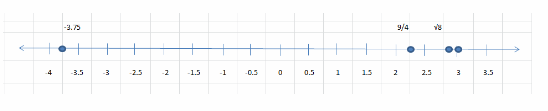
\(\sqrt{8}\), -3.75, 3, \(\frac{9}{4}\)
Answer:
\(\sqrt{8}\), -3.75, 3, \(\frac{9}{4}\) Given
\(\sqrt{8}\) Estimate the value of \(\sqrt{8}\)
\(\sqrt{8}\) is between 2 and 3
Since, $8$ is closer to $9$, $2.85^{2} = 8.12$, hence the estimated value is $2.85$
-3.75 Given
3
\(\frac{9}{4}\) = 2.25 Evaluate the fraction
Texas Go Math Grade 8 Lesson 1.3 Answer Key 17 Graph on the number line
-3.75, \(\frac{9}{4}\), \(\sqrt{8}\), 3 From least to greatest

Ordering Real Numbers 8th Grade Question 16.
Your sister is considering two different shapes for her garden. One is a square with side lengths of 3.5 meters, and the other is a circle with a diameter of 4 meters.
a. Find the area of the square. _______
Answer:
To find the area of a square use the formula: A = x2 where x is the side of the square and the area is represented by A.
So, A = 352 = 12.25

To find the area of a square use the formula: B = r2π where r is the radius of the circle and the area is represented by B.
So, B = 22π = 12.57 (Diameter d is twice the radius r, so r = 2.)

The garden shaped like a circle would give her more space to plant because it has a bigger area.
A = 3.52 = 12.25

b. Find the area of the circle. ____
Answer:
B = 22π = 12.57

c. Compare your answers from parts a and b. Which garden would give your sister the most space to plant?
Answer:
The circle-shaped garden has more space to plant.

Question 17.
Winnie measured the length of her father’s ranch four times and got four different distances. Her measurements are shown in the table.
Texas Go Math Grade 8 Lesson 1.3 Answer Key 7
a. To estimate the actual length, Winnie first approximated each distance to the nearest hundredth. Then she averaged the four numbers. Using a calculator, find Winnie’s estimate.
Answer:
\(\sqrt{60}\) ≈ 7.75 Evaluate the lengths to nearest hundredth (using calculator)
\(\frac{58}{8}\) ≈ 7.25
\(7 . \overline{3}\) ≈ 7.33
7\(\frac{3}{5}\) ≈ 7.60
Average = $\dfrac{7.75 + 7.25 + 7.33
+ 7.60}{4} = 7.4815$

b. Winnie’s father estimated the distance across his ranch to be \(\sqrt{56}\) km. How does this distance compare to Winnie’s estimate?
Answer:
\(\sqrt{56}\) ≈ 7.4833 Using claculator
They are nearly identical

Give an example of each type of number.

Question 18.
a real number between \(\sqrt{13}\) and \(\sqrt{14}\) _____
Answer:
Since, \(\sqrt{13}\) ≈ 3.61 < 3.7 < \(\sqrt{14}\) ≈ 3.74
3.7 is a good example of a real. number that is in between \(\sqrt{13}\) and \(\sqrt{14}\)

3.7

Question 19.
an irrational number between 5 and 7 _________
Answer:
Square the given numbers to find their perfect squares and then a square root of any number in between those two is an example of an irrational number between 5 and 7:
52 = 25
72 = 49
So, one example is \(\sqrt{31}\)
\(\sqrt{31}\)

Question 20.
A teacher asks his students to write the numbers shown from least to greatest. Paul thinks the numbers are already in order. Sandra thinks the order should be reversed. Who is right?
Texas Go Math Grade 8 Lesson 1.3 Answer Key 8
Answer:
Approximate every given number in decimal form:
Use dosest perfect squares to approximate
100 < 115 < 121
\(\sqrt{100}\) < \(\sqrt{115}\) < \(\sqrt{121}\)
10 < \(\sqrt{115}\) < 11
A good approximation for \(\sqrt{115}\) is 10.7 since 10.72 = 114.5
\(\frac{115}{11}\) ≈ 10.45
Finally, that gives us the approximated numbers that the teacher gave them in the task: 10.7, 10.45, 10.5624
We can conclude that neither is right because they are not in any order

Neither are right The numbers aren’t in any order.

Question 21.
Math History There is a famous irrational number called Euler’s number, often symbolized with an e. Like π, it never seems to end. The first few digits of e are 2.7182818284.

a. Between which two square roots of integers could you find this number?
Answer:
2.718281828
The square of e lies between 7 and 8
2.722 = 7.3984
Hence, it lies between $\sqrt{7} =
2.65$ and $\sqrt{8} = 2.82$

b. Between which two square roots of integers can you find π?
Answer:
The square of π lies between 9 and 10
3.142
3.142 = 9.8596
Hence, it lies between $\sqrt{9} = 3$
and $\sqrt{1ø} = 3.16$

Texas Go Math Grade 8 Lesson 1.3 H.O.T. Focus On Higher Order Thinking Answer Key 

Question 22.
Analyze Relationships There are several approximations used for π, including 3.14 and \(\frac{22}{7}\).π is approximately 3.14159265358979…

a. Label π and the two approximations on the number line.
Texas Go Math Grade 8 Lesson 1.3 Answer Key 9
Answer:
a) We plot on number line π, 3.14 and \(\frac{22}{7}\):
Texas Go Math Grade 8 Lesson 1.3 Answer Key 18

b. Which of the two approximations is a better estimate for π? Explain.
Answer:
As we can see from the number line, \(\frac{22}{7}\) is closer to π, so we can conclude that \(\frac{22}{7}\) is a better estimation for π.

c. Find a whole number x in \(\frac{x}{113}\) so that the ratio is a better estimate for π than the two given approximations. ______
Answer:
\(\frac{355}{113}\) is a better estimation for π, because
\(\frac{355}{113}\) = 3.14159292035 ≈ 3.14159265358979 = π

Go Math 8th Grade Lesson 1.3 Compare and Order Real Numbers Question 23.
Communicate Mathematical Ideas If a set of six numbers that include both rational and irrational numbers is graphed on a number line, what is the fewest number of distinct points that need to be graphed? Explain.
Answer:
The fewest number of distinct points that need to be graphed is 2. Because there are both rational and irrational
numbers in the set and every rational number is not irrational and every irrational is not rational they can’t all be the same.
Therefore it could be that there are some numbers that repeat but there are at least two different numbers.

Two. Click for proof.

Question 24.
Critique Reasoning Jill says that \(12 . \overline{6}\) is less than 12.63. Explain her error.
Answer:
The line over the digit 6 means that it is repeating forever. So,
\(12 . \overline{6}\) = 12.666666….
If we round that number to two decimal Places we have \(12 . \overline{6}\) ≈ 12.67.
Obviously, 12.67 > 12.63

12.67 > 12.63. Click for proof.

Texas Go Math Grade 8 Lesson 1.3 Answer Key Ordering Real Numbers Read More »

Texas Go Math Grade 8 Lesson 3.4 Answer Key Direct Variation

Refer to our Texas Go Math Grade 8 Answer Key Pdf to score good marks in the exams. Test yourself by practicing the problems from Texas Go Math Grade 8 Lesson 3.4 Answer Key Direct Variation.

Texas Go Math Grade 8 Lesson 3.4 Answer Key Direct Variation

Essential Question
How can you solve problems involving direct variation?

Your Turn

Question 1.
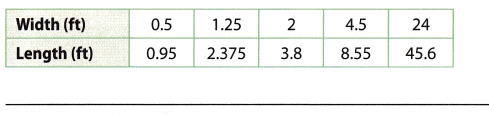
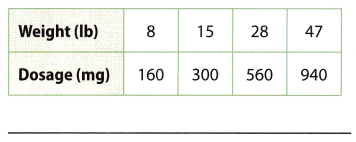
The table shows the widths and lengths of United States flags. Determine whether the data set shows direct variation. If so, write an equation that describes the relationship.
Texas Go Math Grade 8 Lesson 3.4 Answer Key 1
Answer:

Reflect

Go Math Lesson 3.4 8th Grade Direct Variation Question 2.
Does the equation y = \(\frac{3}{2}\)x – 5 show a direct variation? Why or why not?
Answer:

Your Turn

Question 3.
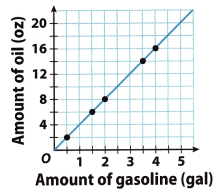
One brand of motorcycle uses an oil-to-gasoline ratio as shown in the graph. The amount of oil that should be added varies directly with the amount of gasoline. Write a direct variation equation that describes the relationship. Use your equation to determine the amount of oil that should be added to 6.5 gallons of gasoline.
Texas Go Math Grade 8 Lesson 3.4 Answer Key 2
Answer:

Texas Go Math Grade 8 Lesson 3.4 Guided Practice Answer Key 

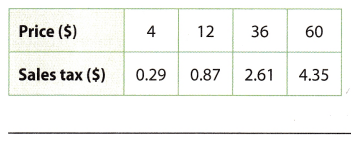
Determine whether the data sets show direct variation. If so, write an equation that describes the relationship. (Example 1)

Question 1.
Texas Go Math Grade 8 Lesson 3.4 Answer Key 3
Answer:

Question 2.
Texas Go Math Grade 8 Lesson 3.4 Answer Key 4
Answer:

Question 3.
Texas Go Math Grade 8 Lesson 3.4 Answer Key 5
Answer:

Go Math Grade 8 Lesson 3.4 Answer Key Question 4.
Texas Go Math Grade 8 Lesson 3.4 Answer Key 6
Answer:

Question 5.
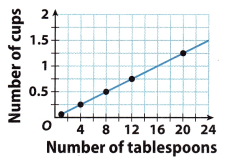
The number of cups in a measure varies directly as the number of tablespoons. Write a direct variation equation that describes the relationship. Use your equation to determine the number of cups in 56 tablespoons. (Example 2)
Texas Go Math Grade 8 Lesson 3.4 Answer Key 7
Answer:

Question 6.
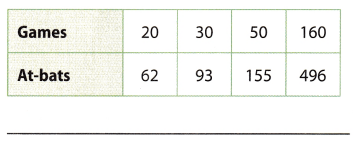
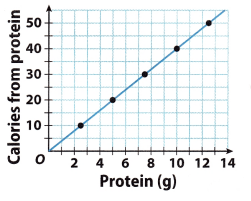
The number of calories varies directly with the number of grams of protein. Write a direct variation equation that describes the relationship. Use your equation to determine the number of calories from 25 grams of protein. (Example 2)
Texas Go Math Grade 8 Lesson 3.4 Answer Key 8
Answer:

Essential Question Check-In

Question 7.
How can you solve problems involving direct variation?
Answer:

Texas Go Math Grade 8 Lesson 3.4 Independent Practice Answer Key 

Question 8.
Vocabulary A _______ is a relationship that can written be as y = kx, where k is a ____.
Answer:

Direct Variation 8th Grade Math Lesson 3.4 Answer Key Question 9.
Which equation does NOT represent a direct variation?
(A) y = \(\frac{1}{4}\)
(B) y = -4x
(C) y = 5x + 1
(D) y = 6x
Answer:

Question 10.
Environment Mischa bought an energy-efficient washing machine. The amount of water she saves per wash load compared to her old washer is shown in the table.
Texas Go Math Grade 8 Lesson 3.4 Answer Key 9

a. Determine whether the relationship is a direct variation. If so, write an equation that describes the relationship.
Answer:

b. How much water will she save when washing 8 loads?
Answer:

Question 11.
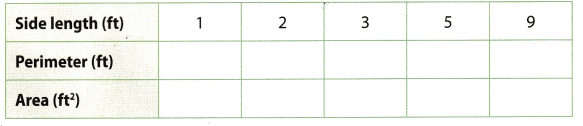
Sandy wants to build a square garden. Complete the table for the different side lengths.
Texas Go Math Grade 8 Lesson 3.4 Answer Key 10

a. Does the perimeter of a square vary directly with the side length? If so, write an equation that describes the relationship. Explain your answer.
Answer:

b. Does the area of a square vary directly with the side length? Why or why not?
Answer:

c. Sandy decides to build her garden with a side length of 3 feet. The border she buys for the perimeter costs $1.99 for a 1.5-foot piece. The soil she buys covers an area of 3 square feet and costs $4.99 a bag. How much does Sandy spend on border and soil for her garden? Explain.
Answer:

Direct Variation Worksheet Answer Key Question 12.
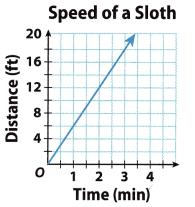
The three-toed sloth is an extremely slow animal. Use the graph to write a direct variation equation for the distance y a sloth will travel in x minutes. How long will it take the sloth to travel 24 feet?
Texas Go Math Grade 8 Lesson 3.4 Answer Key 11
Answer:

Texas Go Math Grade 8 Lesson 3.4 H.O.T. Focus On Higher Order Thinking Answer Key

Question 13.
Critique Reasoning Martin is told that a graph includes the points (2, 5) and (4, 10). He says that this is the graph of the direct variation y = 2.5x. Do you agree? Explain.
Answer:

Texas Go Math Grade 8 Pdf Download Lesson 3.4 Question 14.
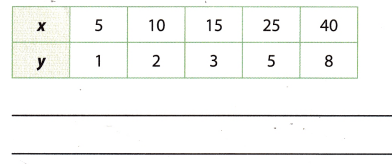
Make a Conjecture If you can write a direct variation equation that relates y to x,y = kx, then you can write a direct variation equation that relates x to y, x = k1y. Make a conjecture about how the constants of variation are related. Use the table to help you decide.
Texas Go Math Grade 8 Lesson 3.4 Answer Key 12
Answer:

Question 15.
Analyze Relationships One graph of a direct variation equation goes through point A in Quadrant I which is not at the origin. A second graph of a different direct variation equation goes through a point that is one unit to the right of A. Which direct variation equation has a greater constant of variation? Explain.
Answer:

Texas Go Math Grade 8 Lesson 3.4 Answer Key Direct Variation Read More »

Texas Go Math Grade 8 Module 3 Answer Key Proportional Relationships

Refer to our Texas Go Math Grade 8 Answer Key Pdf to score good marks in the exams. Test yourself by practicing the problems from Texas Go Math Grade 8 Module 3 Answer Key Proportional Relationships.

Texas Go Math Grade 8 Module 3 Answer Key Proportional Relationships

Texas Go Math Grade 8 Module 3 Answer Key 1

Essential Question
How can you use proportional relationships to solve real-world problems?

Texas Go Math Grade 8 Module 3 Are You Ready? Answer Key

Complete these exercises to review skills you will need for this chapter.

Write each fraction as decimal.

Question 1.
\(\frac{3}{8}\)
Answer:
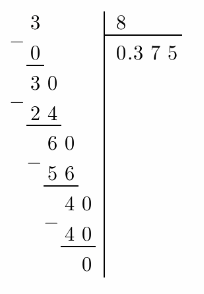
To express \(\frac{3}{8}\) as a decimal, we write the fraction as a division problem.
Texas Go Math Grade 8 Module 3 Answer Key 4
Therefore, \(\frac{3}{8}\) = 0.375

Go Math Grade 8 Module 3 Proportional Relationships Module Answer Key Question 2.
\(\frac{0.3}{0.4}\)
Answer:
First, multiply the numerator and the denominator by 10 so that the denominator is a whole number.
\(\frac{0.3 \times 10}{0.4 \times 10}\) = \(\frac{3}{4}\)
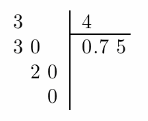
Now write the fraction as a division problem, place a decimal point in the quotient, and divide as whole numbers:
Texas Go Math Grade 8 Module 3 Answer Key 5
0.75

Question 3.
\(\frac{0.13}{0.2}\)
Answer:
First multiply the numerator and the denominator by 10 so that the denominator is a whole number.
\(\frac{0.13 \times 10}{0.2 \times 10}\) = \(\frac{1.3}{2}\)
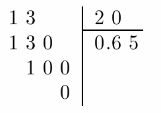
Now write the fraction as a division problem. place a decimal point in the quotient and divide as whole numbers:
Texas Go Math Grade 8 Module 3 Answer Key 6
0.65

Question 4.
\(\frac{0.39}{0.75}\)
Answer:
First, multiply the numerator and the denominator by 100 so that the denominator is a whole number.
\(\frac{0.39 \times 100}{0.75 \times 100}\) = \(\frac{39}{75}\)
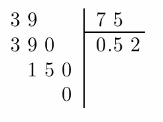
Now write the fraction as a division problem, place a decimal point in the quotient and divide as whole numbers:
Texas Go Math Grade 8 Module 3 Answer Key 7
0.52

Question 5.
\(\frac{4}{5}\)
Answer:
Write the fraction as a division problem, place a decimal point in the quotient and divide as whole numbers
Texas Go Math Grade 8 Module 3 Answer Key 8
\(\frac{4}{5}\) = 0.8

Question 6.
\(\frac{0.1}{2}\)
Answer:
First, we multiply the numerator and the denominator by a power of 10 so that we get whole numbers.
\(\frac{0.1}{2}\) = \(\frac{0.1 \cdot 10}{2 \cdot 10}\) = \(\frac{1}{20}\)
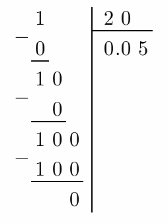
To express \(\frac{1}{20}\) as a decimal, we write the fraction as a division problem.
Texas Go Math Grade 8 Module 3 Answer Key 9
Therefore,
\(\frac{0.1}{2}\) = 0.05

Grade 8 Math Module 3 Answer Key Question 7.
\(\frac{3.5}{14}\)
Answer:
First, we multiply the numerator and the denominator by a power of 10 so that we get whole numbers.
\(\frac{3.5}{14}\) = \(\frac{3.5 \cdot 10}{14 \cdot 10}\) = \(\frac{35}{140}\)
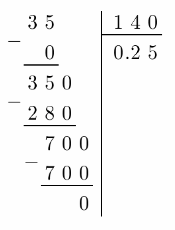
To express \(\frac{35}{140}\) as a decimal, we write the fraction as a division problem.
Texas Go Math Grade 8 Module 3 Answer Key 10
Therefore, \(\frac{3.5}{14}\) = 0.25

Question 8.
\(\frac{7}{14}\)
Answer:
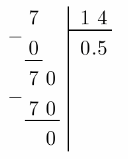
To express \(\frac{7}{14}\) as a decimal, we write the fraction as a division problem.
Texas Go Math Grade 8 Module 3 Answer Key 11
\(\frac{7}{14}\) = 0.5

Go Math Grade 8 Module 3 Answer Key Question 9.
\(\frac{0.3}{10}\)
Answer:
First, we multiply the numerator and the denominator by a power of 10 so that we get whole numbers.
\(\frac{0.3}{10}\) = \(\frac{0.3 \cdot 10}{10 \cdot 10}\) = \(\frac{3}{100}\)
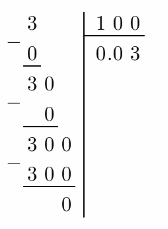
To express \(\frac{3}{100}\) as a decimal, we write the fraction as a division problem.
Texas Go Math Grade 8 Module 3 Answer Key 12
\(\frac{0.3}{10}\) = 0.03

Solve each proportion for x.

Question 10.
\(\frac{20}{18}\) = \(\frac{10}{x}\) ______
Answer:
\(\frac{20}{18}\) = \(\frac{10}{x}\) Given
\(\frac{20 \div 2}{18 \div 2}\) = \(\frac{10}{x}\) Divide 20 ÷ 2 = 10, so divide the numerator and denominator by 2
\(\frac{10}{9}\) = \(\frac{10}{x}\)
x = 9 compare

Grade 8 Module 3 Proportional Relationships Question 11.
\(\frac{x}{12}\) = \(\frac{30}{72}\) ______
Answer:
\(\frac{x}{12}\) = \(\frac{30}{72}\) Given
\(\frac{x}{12}\) = \(\frac{30 \div 6}{72 \div 6}\) Divide 72 ÷ 6 = 12, so divide the numerator and denominator by 6.
\(\frac{x}{12}\) = \(\frac{5}{12}\)
x = 5 compare

Question 12.
\(\frac{x}{4}\) = \(\frac{4}{16}\) ______
Answer:
\(\frac{x}{4}\) = \(\frac{4}{16}\) Given
\(\frac{x}{4}\) = \(\frac{4 \div 4}{16 \div 4}\) Divide 16 ÷ 4 = 4, so divide the numerator and denominator by 4.
\(\frac{x}{4}\) = \(\frac{1}{4}\)
x = 1 compare

Question 13.
\(\frac{11}{x}\) = \(\frac{132}{120}\) ______
Answer:
\(\frac{11}{x}\) = \(\frac{132}{120}\) Given
\(\frac{11}{x}\) = \(\frac{132 \div 12}{120 \div 12}\) Divide 132 ÷ 12 = 11, so divide the numerator and denominator by 12.
\(\frac{11}{x}\) = \(\frac{11}{10}\)
x = 10 compare

Question 14.
\(\frac{36}{48}\) = \(\frac{x}{4}\) ______
Answer:
\(\frac{36}{48}\) = \(\frac{x}{4}\) Given
\(\frac{36 \div 12}{48 \div 12}\) = \(\frac{x}{4}\) Divide 48 ÷ 12 = 4, so divide the numerator and denominator by 12.
\(\frac{3}{4}\) = \(\frac{x}{4}\)
x = 3 compare

Go Math Grade 4 Module 3 Answer Key Question 15.
\(\frac{x}{9}\) = \(\frac{21}{27}\) ______
Answer:
\(\frac{x}{9}\) = \(\frac{21}{27}\) Given
\(\frac{x}{9}\) = \(\frac{21 \div 3}{27 \div 3}\) Divide 27 ÷ 3 = 9, so divide the numerator and denominator by 12.
\(\frac{x}{9}\) = \(\frac{7}{9}\)
x = 7 Compare
x = 7

Question 16.
\(\frac{24}{16}\) = \(\frac{x}{2}\) ______
Answer:
\(\frac{24}{16}\) = \(\frac{x}{2}\) Given
\(\frac{24 \div 8}{16 \div 8}\) = \(\frac{x}{2}\) Divide 16 ÷ 8 = 2, so divide the numerator and denominator by 8.
\(\frac{3}{2}\) = \(\frac{x}{2}\)
x = 3 Compare
x = 3

Question 17.
\(\frac{30}{15}\) = \(\frac{6}{x}\) ______
Answer:
\(\frac{30}{15}\) = \(\frac{6}{x}\) Given
\(\frac{30 \div 5}{15 \div 5}\) = \(\frac{6}{x}\) Divide 30 ÷ 5 = 6, so divide the numerator and denominator by 5.
\(\frac{6}{3}\) = \(\frac{6}{x}\)
x = 3 Compare
x = 3

Module 3 Answer Key Grade 8 Answer Key Question 18.
\(\frac{3}{x}\) = \(\frac{18}{36}\) ______
Answer:
\(\frac{3}{x}\) = \(\frac{18}{36}\)
\(\frac{3}{x}\) = \(\frac{18 \div 6}{36 \div 6}\) Divide 18 ÷ 6 = 3, so divide the numerator and denominator by 6.
\(\frac{3}{x}\) = \(\frac{3}{6}\)
x = 6

Texas Go Math Grade 8 Module 3 Reading Start-Up Answer Key

Visualize Vocabulary
Use the ✓ words to complete the diagram.

Texas Go Math Grade 8 Module 3 Answer Key 2

Understand Vocabulary

Match the term on the left to the definition on the right.

Texas Go Math Grade 8 Module 3 Answer Key 3
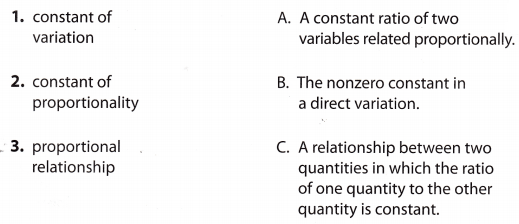
Answer:
1. (B) A unit rate is B. A rate in which the second quantity in the comparison is one unit.
2. (A) Constant of proportionality is A. A constant ratio of two variables is related proportionally.
3. (C) A proportional relationship is C. A relationship between two quantities in which the ratio of one quantity to the other quantity is constant.

Texas Go Math Grade 8 Module 3 Answer Key Proportional Relationships Read More »

Texas Go Math Grade 8 Lesson 1.2 Answer Key Sets of Real Numbers

Refer to our Texas Go Math Grade 8 Answer Key Pdf to score good marks in the exams. Test yourself by practicing the problems from Texas Go Math Grade 8 Lesson 1.2 Answer Key Sets of Real Numbers.

Texas Go Math Grade 8 Lesson 1.2 Answer Key Sets of Real Numbers

Essential Question
How can you describe relationships between sets of real numbers?

Your Turn

Write all names that apply to each number.

Question 1.
A baseball pitcher has pitched 12\(\frac{2}{3}\) innings.
Texas Go Math Grade 8 Lesson 1.2 Answer Key 1
Answer:
12\(\frac{2}{3}\) = \(\frac{38}{3}\) is a fraction, so it is rational and real.

Rational, real

Question 2.
The length of the side of a square that has an area of 10 square yards. __________________
Answer:
10 is a whole number, integer, real and a rational number
Length of the side of the given square is \(\sqrt{10}\) and it is an irrational (5 is a whole number that is not a perfect square), real number.

10 – integer, whole, real, rational
\(\sqrt{10}\) – irrational, real

Your Turn

Tell whether the given statement is true or false. Explain your choice.

Question 3.
All rational numbers are integers.
Answer:
All rational numbers are integers

False. Every integer is a rational number but every rational number is not an integer Ration numbers such as \(\frac{3}{8}\) and –\(\frac{7}{2}\) are not integers.

Texas Go Math Grade 8 Pdf Lesson 1.2 Real Numbers Answer Key Question 4.
Some irrational numbers are integers.
Answer:
False, every integer is a rational number (Integers are a subset of rational numbers), but no rational number ¡s an
irrational number and no irrational number is a rational number. So no irrational number is an integer.

False. Click for explanation

Your Turn

Identify the set of numbers that best describes the situation. Explain your choice.

Question 5.
the amount of water in a glass as it evaporates
Answer:
The set of real, numbers best describes the situation since the number of water in a glass can be any number greater or even to 0.

Real numbers.

Question 6.
the number of seconds remaining when a song is playing, displayed as a negative number
Answer:
Set of integers best describes the situation since seconds can’t be a fraction or an irrational number.

Integers.

Texas Go Math Grade 8 Lesson 1.2 Guided Practice Answer Key 

Write all names that apply to each number. (Example 1)

Question 1.
\(\frac{7}{8}\)
Answer:
\(\frac{7}{8}\)

Rational Number, Real

Question 2.
\(\sqrt{36}\)
Answer:
\(\sqrt{36}\) = 6
Natural Number, Rational, whole number, integer, real

Question 3.
\(\sqrt{24}\)
Answer:
\(\sqrt{24}\) is an irrational, real number

Irrational, real

Question 4.
0.75
Answer:
Since 0.75 can be expressed as \(\frac{3}{4}\) it is a rational, real number but it is not an integer.

Rational, real

Question 5.
0
Answer:
Rational, Whole number, Integer, real

Go Math Book Grade 8 Answer Key Lesson 1.2 Answer Key Question 6.
–\(\sqrt{100}\)
Answer:
–\(\sqrt{100}\) = -10
Rational, integer, real

Question 7.
\(5 . \overline{45}\)
Answer:
Rational Numbers, real number

Question 8.
\(-\frac{18}{6}\)
Answer:
\(-\frac{18}{6}\) = -3
Rational, Integer, real

Tell whether the given statement is true or false. Explain your choice. (Example 2)

Question 9.
All whole numbers are rational numbers.
Answer:
True

Explanation:
The statement is true. Whole numbers are a subset of integers, which are a subset of rational numbers. It follows
that any whole number is also a rational number.
Also notice that you can write every whole number as a rational one, by expressing it as a fraction with “1” for it
denominator.

Go Math Grade 8 Lesson 1.2 Answer Key Question 10.
No irrational numbers are whole numbers.
Answer:
True

Explanation:
No irrational numbers are whole numbers

True Whole numbers are ration numbers.

Identify the set of numbers that best describes each situation. Explain your choice. (Example 3)

Question 11.
the change ¡n the value of an account when given to the nearest dollar
Answer:
Integers.
The change can be a whole dollar amount and can be positive, negative or zero

Question 12.
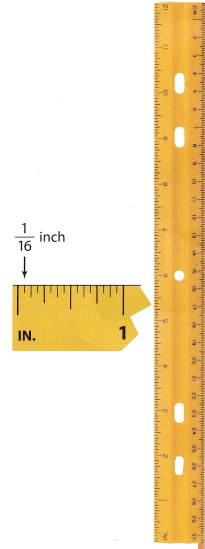
the markings on a standard ruler
Texas Go Math Grade 8 Lesson 1.2 Answer Key 2
Answer:
Rational
The ruler is marked every \(\frac{1}{16}\)th inch.

Essential Question Check-In

Question 13.
What are some ways to describe the relationships between sets of numbers?
Answer:
There are two ways that we have been using until now to describe the relationships between sets of numbers:

  • Using as scheme or a diagram like the one on page 15.
  • Verbal description, for example, ‘All irrational numbers are real numbers.”

Texas Go Math Grade 8 Lesson 1.2 Independent Practice Answer Key

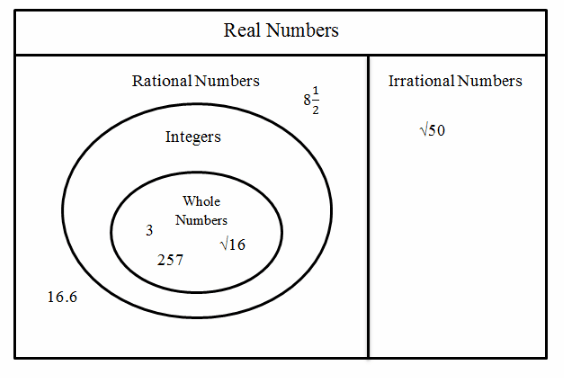
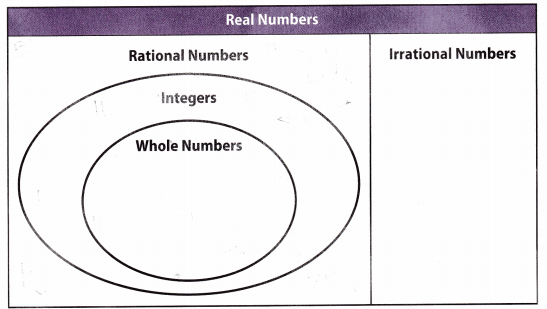
Write all names that apply to each number. Then place the numbers in the correct location on the Venn diagram.

Question 14.
\(\sqrt{9}\) _____
Answer:
Since \(\sqrt{9}\) = 3, it is a whole number, integer, rational and real number

It should be placed inside the area for whole numbers.

Whole, integer, rational and real number. Place inside the area for whole numbers.

Lesson 1.2 Go Math 8th Grade Question 15.
257 _____
Answer:
257
whole, integer, rational, real

Question 16.
\(\sqrt{50}\) _____
Answer:
\(\sqrt{50}\)
irrational, real

Question 17.
8\(\frac{1}{2}\) _____
Answer:
8\(\frac{1}{2}\) = \(\frac{17}{2}\) is a fraction so it is a rational number and a real number, but it is not an integer nor whole.

It should be placed inside the area for rational numbers but outside the area for integers.

Rational, real. Place inside area for rational numbers and outside of integers.

Question 18.
16.6 ______
Answer:
The decimal number 16.6 means “166 tenths” so it can be expressed as a fraction: \(\frac{166}{10}\). Therefore it is a rational, real number.

It should be placed in the area for rational numbers but outside of the area for integers.

Rational, real. Place in the area for rational numbers but outside of the area for integers.

Question 19.
\(\sqrt{16}\) _____
Answer:
\(\sqrt{16}\) = 4
Rational, whole, integers, real
Texas Go Math Grade 8 Lesson 1.2 Answer Key 5

Texas Go Math Grade 8 Lesson 1.2 Answer Key 3

Identify the set of numbers that best describes each situation. Explain your choice.

Go Math 8 Grade Answer Key Lesson 1.2 Answer Key Question 20.
the height of an airplane as it descends to an airport runway
Answer:
Set of real numbers best describes the given situation because the height of the airplane is a real number larger
than or equal to 0. The plane doesn’t jump from one height to the other, for example from 100 to 99, rather it descends gradually hitting every height on its way down.

Real numbers.

Question 21.
the score with respect to par of several golfers: 2, -3, 5, 0, -1
Answer:
Integers. The scores are counting numbers, their opposites and zero.

Question 22.
Critique Reasoning Ronald states that the number \(\frac{1}{11}\) is not rational because, when converted into a decimal, it does not terminate. Nathaniel says it is rational because it is a fraction. Which boy is correct? Explain.
Answer:
Nathaniel is correct, if a number can be expressed as a ratio in the form \(\frac{a}{b}\) where a and b are integers and b is not 0, it is a rational number.
Obviously in this case a = 1 and b = 11, so both are integers and b ≠ 0

Nathaniel is correct.

Question 23.
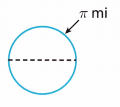
Critique Reasoning The circumference of a circular region is shown. What type of number best describes the diameter of the circle? Explain your answer.
Texas Go Math Grade 8 Lesson 1.2 Answer Key 4
Answer:
The formula for the circumference of a circular region is C = 2rπ where r is the radius of the circle.
C = 2rπ
π = 2rπ Substitute C = π
1 = 2r Divide both sides of the equation with π

Since the diameter of the circle is twice the length of its radius: d = 2r we get d = 1. Therefore, the type of
number that best describes the diameter of the circle is a whole number

Whole number

Question 24.
Critical Thinking A number is not an integer. What type of number can it be?
Answer:
Since it is not an integer it can not be a whole number because every whole number is also an integer. It can be
any other type of number so: rational or irrational real number

Rational or irrational real number.

Simple Solutions Math Grade 8 Answer Key Pdf Lesson 1 Question 25.
A grocery store has a shelf with half-gallon containers of milk. What type of number best represents the total number of gallons?
Answer:
\(\frac{1}{2}\) gallons
Rational number

Texas Go Math Grade 8 Lesson 1.2 H.O.T. Focus On Higher Order Thinking Answer Key

Question 26.
Explain the Error Katie said, “Negative numbers are integers.” What was her error?
Answer:
Her error is that not alt negative numbers are integers, for example, the number –\(\frac{1}{2}\) is obviously a negative number but it is not an integer.

Not all negative numbers are Integers.

Question 27.
Justify Reasoning Can you ever use a calculator to determine if a number is rational or irrational? Explain.
Answer:
Yes, in some cases you can use a calculator to tell if the number is rational or not
For example, if we wonder if the number 0.5 is rational we can just type 0.5 in the calculator and it will give us a
result \(\frac{1}{2}\)”. Since we have a representation of the number 0.5 as a ratio of two integers we can conclude that it is in fact a rational number

This method doesn’t always work since calculators show a limited number of digits and sometimes that is not
enough to tell it there is a repeating decimal or not.

Yes, but not always.

Practice and Homework Lesson 1.2 Answer Key 8th Grade Question 28.
Draw Conclusions The decimal \(0 . \overline{3}\) represents \(\frac{1}{3}\). What type of number best describes \(0 . \overline{9}\), which is 3 ∙ \(0 . \overline{3}\)? Explain.
Answer:
Let
x = \(0 . \overline{9}\)
10x = 10 × \(0 . \overline{9}\). Since \(0 . \overline{9}\) has one repeating decimal, multiply both sides with 10
10x = \(9 . \overline{9}\). Subtract x = \(0 . \overline{9}\) from both sides
9x = 9
x = 1
Since x = 1 the type of number that best describes \(0 . \overline{9}\) is a whole number.

A whole number.

Question 29.
Communicate Mathematical Ideas Irrational numbers can never be precisely represented in decimal form. Why is this?
Answer:
We say that a number is irrational if it not rational, so if it can’t be expressed as a ratio \(\frac{a}{b}\) where a and b are integers and b is not 0.

The problem why irrational numbers can’t be precisely represented is that unlike some rational numbers that
have digits repeating forever, for example \(\frac{1}{3}\) = \(0 . \overline{3}\), so the digit 3 goes on forever, irrational numbers don’t have a ‘rule” that we can observe. This means that to know what digit is on any place behind the decimal point we have to calculate it (where in the previous example we know that if we express the number \(\frac{1}{3}\) as a decimal we can say with certainty exactly what digit is in what place, even if in this case it is very simple because all digits are 3)
For example \(\sqrt{2}\) ≈ 1.414213562…

There is no pattern/rule for the repeating decimals. Click for an explanation.

Texas Go Math Grade 8 Lesson 1.2 Answer Key Sets of Real Numbers Read More »

Texas Go Math Grade 8 Module 2 Answer Key Scientific Notation

Refer to our Texas Go Math Grade 8 Answer Key Pdf to score good marks in the exams. Test yourself by practicing the problems from Texas Go Math Grade 8 Module 2 Answer Key Scientific Notation.

Texas Go Math Grade 8 Module 2 Answer Key Scientific Notation

Essential Question
How can you use scientific notation to solve real-world problems?

Texas Go Math Grade 8 Module 2 Answer Key 1

Texas Go Math Grade 8 Module 2 Are You Ready? Answer Key

Complete these exercises to review skills you will need for this chapter.

Write each exponential expression as a simplified number.

Question 1.
102 _______
Answer:
102 Given
10 * 10 = 100.00 Evaluate

Texas Go Math Grade 8 Module 2 Answer Key Question 2.
103 _______
Answer:
103 Given
10 * 10 * 10 = 1,000.00 Evaluate

Question 3.
105 _______
Answer:
105 Given
10 * 10 * 10 * 10 * 10 = 100,000 Evaluate

Question 4.
107 _______
Answer:
107 Given
10 * 10 * 10 * 10 * 10 * 10 * 10 = 10,000,000.00 Evaluate

Find each product or quotient.

Question 5.
45.3 × 10³
Answer:
45.3 * 103 Identify the number of zeros in the power of 10
45.3 * 1,000 When multiplying, move the decimal point to the right the same number of places as the number of zeros
45,300

Question 6.
7.08 ÷ 102
Answer:
7.08 ÷ 102 Identify the number of zeros in the power of 10
7.08 ÷ 100 When dividing, move the decimal point to the left the same number of places as the number of zeros.
0.0708

Texas Go Math 8th Grade Module 2 Answer Key Question 7.
0.00235 × 10⁶
Answer:
0.00235 × 10⁶ Identify the number of zeros in the power of 10

0.00235 × 1,000, 000 When multiplying, move the decimal point to the right the same number of places as the number of zeros
2,350

Question 8.
3,600 ÷ 104
Answer:
3600 ÷ 104 Identify the number of zeros in the power of 10

3600 ÷ 10000 When dividing, move the decimal point to the left the same number of places as the number of zeros.
0.36

Question 9.
0.5 × 10²
Answer:
0.5 × 10² Identify the number of zeros in the power of 10
0.5 × 100 When multiplying, move the decimal point to the right the same number of places as the number of zeros
50

Question 10.
67.7 ÷ 105
Answer:
67.7 ÷ 105 Identify the number of zeros in the power of 10
67.7 ÷ 100000 When dividing, move the decimal point to the left the same number of places as the number of zeros.
0.000677

Texas Go Math Grade 8 Module 2 Question 11.
0.0057 × 10⁴
Answer:
0.0057 × 10⁴
Identify the number of zeros in the power of 10
0.0057 × 10,000 When multiplying, move the decimal point to the right the same number of places as the number of zeros
57

Question 12.
195 ÷ 106
Answer:
195 ÷ 106 Identify the number of zeros in the power of 10
195 ÷ 1000000 When dividing, move the decimal point to the left the same number of places as the number of zeros.
0.000195

Texas Go Math Grade 8 Module 2 Reading Start-Up Answer Key

Visualize Vocabulary

Use the ✓ words to complete the Venn diagram. You can put more than one word in each section of the diagram.

Texas Go Math Grade 8 Module 2 Answer Key 2

Understand Vocabulary

Complete the sentences using the preview words.

Question 1.
A number produced by raising a base to an exponent is a _______
Answer:
A number produced by raising a base to an exponent is a power.

Texas Go Math Grade 8 Module 2 Pdf Question 2.
____ is a method of writing very large or very small numbers by using powers of 10.
Answer:
Scientific notation is a method of writing very large or very small numbers by using powers of 10.

Question 3.
A ____ is any number that can be expressed as a ratio of two integers.
Answer:
A rational number is any number that can be expressed as a ratio of two integers.

Texas Go Math Grade 8 Module 2 Answer Key Scientific Notation Read More »

Texas Go Math Grade 8 Lesson 2.1 Answer Key Scientific Notation with Positive Powers of 10

Refer to our Texas Go Math Grade 8 Answer Key Pdf to score good marks in the exams. Test yourself by practicing the problems from Texas Go Math Grade 8 Lesson 2.1 Answer Key Scientific Notation with Positive Powers of 10.

Texas Go Math Grade 8 Lesson 2.1 Answer Key Scientific Notation with Positive Powers of 10

Essential Question
How can you use scientific notation to express very large quantities?

Using Scientific Notation
Scientific notation is a method of expressing very large and very small numbers as a product of a number greater than or equal to 1 and less than 10, and a power of 10.

The weights of various sea creatures are shown in the table. Write the weight of the blue whale in scientific notation.

Texas Go Math Grade 8 Lesson 2.1 Answer Key 1

Texas Go Math Grade 8 Lesson 2.1 Answer Key 2

A. Move the decimal point in 250,000 to the left as many places as necessary to find a number that is greater than or equal to 1 and less than 10.
What number did you find? ____

B. Divide 250,000 by your answer to A . Write your answer as a power of 10.

C. Combine your answers to
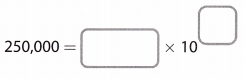
A and B to represent 250,000. Texas Go Math Grade 8 Lesson 2.1 Answer Key 3
Repeat steps A through C towrite the weight of the whale shark in scientific notation. Texas Go Math Grade 8 Lesson 2.1 Answer Key 4
Reflect

Question 1.
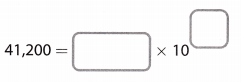
How many places to the left did you move the decimal point to write 41,200 in scientific notation? ___________________________________
Answer:
We need to move the decimal point 4 places to the left to write 42,200 in scientific notation.
41,200 = 41,200.0 = 4.1200 × 104 = 4.12 × 10⁴

Four places to the left.

Go Math Grade 8 Lesson 2.1 Answer Key Question 2.
What is the exponent on 10 when you write 41,200 in scientific notation?
Answer:
To write 41,200 in scientific notation, we move the decimal point 4 places to the right and we multiply by 104.
41,200 = 4.12 • 104

4 places to the left

Your Turn

Write each number in scientific notation.

Question 3.
6,400
Answer:
6,400 Given
6.400 Move the decimal point 3 places to the left.
6.4 Remove extra zeros
1000 Divide the original number by the result from above
103 Write the answer as power of 10.
6 × 10³ Write the product of the results from above
6 × 10³

Question 4.
570,000,000,000
Answer:
570,000,000,000 Given
5.70000000000 Move the decimal point $. Remove extra zeros.
100, 000, 000, 000 Divide the original number by the result from above.
1011 Write the answer as the power of 10.
5.7 × 10¹¹ Write the product of the results from above
5.7 × 10¹¹

Question 5.
A light-year is the distance that light travels in a year and is equivalent to 9,461,000,000,000 km. Write this distance in scientific notation.
Answer:
9,461,000, 000,000 Given
9,461000000000 Move the decimal point 11 places to the left.
9.461 Remove extra zeros.

1, 000, 000, 000, 000 Divide the original number by the result from above.
1012 Write the answer as the power of 10.
9.461 × 10¹² km Write the product of the results from above
9.461 × 10¹² km

Lesson 2.1 Extra Practice Powers and Exponents Answer Key Question 6.
3.5 × 10⁶ means that the decimal should be moved 6 decimals. Placeholder zeros are added as necessary. Moving one decimal gives 35 and the remaining five decimals are represented by placeholder zeros.

Question 7.
To express a number in scientific notation we follow some steps:

  1. We move the decimal point until we get a number that is greater than or equal to 1 and less than 10.
  2. We divide the original number with the one we got from Step 1.
  3. We write the product of the results from Step I and Step 2.
    In our case. the given number is already greater than 1 and less than 10. So it can be written as:
    5.3 = 5.3 100
    The exponent on 10 is 0.

The exponent on 10 is 0

Question 8.
7.034 × 10⁹ Given

9 places Use the exponent of the power of 10 to determine the number of places to move the decimal point

7,034 000000 Place the decimal point Since you are going to write a number greater than 7.035, move the decimal point to the right. Add placeholder zeros if necessary. The number
7.034 × 10⁹ in standard form is 7, 034,000,000

Question 9.
2.36 × 10⁵ Given
5 places Use the exponent of the power of 10 to determine the number of places to move the decimal point

236,000 Place the decimal point Since you are going to write a number greater than 2.36, move the decimal point to the right Add placeholder zeros if necessary.
The number 2.36 × 10⁵ in standard form is 236,000

Lesson 2.1 Extra Practice Scientific Notation Answer Key Question 10.
5 × 10⁶ Given
6 places Use the exponent of the power of 10 to determine the number of places to move the decimal point
5, 000, 000 Place the decimal point Since you are going to write a number greater than 5, move the decimal point to the right. Add placeholder zeros if necessary.
The number 5 × 10⁶ grams in standard form is 5, 000, 000 grams

Texas Go Math Grade 8 Lesson 2.1 Guided Practice Answer Key 

Question 1.
58,927 Given

5.8927 Move the decimal point 4 places to the Left.

10,000 Divide the original number by the result from above.
104 Write the answer as the power of 10.
5.8927 × 10⁴ Write the product of the results from above
5.8927 × 10⁴

Question 2.
1, 304, 000,000 Given
1.304000000 Move me decimal point 9 places to the left.
1.304 Remove extra zeros.

1,000,000 Divide the original number by the result from above.
109 Write the answer as power of 10.
1.304 × 10⁹ Write the product of the results from above
1.304 × 10⁹

Question 3.
6,730,000 Given

6.730000 Move the decimal point 6 places to the left.
6.73 Remove extra zeros.
1,000,000 Divide the original number by the result from above.
106 Write the answer as power of 10.
6.73 × 10⁶ Write the product of the results from above
6.73 × 10⁶

Question 4.
13 300 Given (1)
1.3300 Move the decimal point L places to the left (2)
1.33 Remove extra zeroes (3)
10000 = 104 Divide the original number by 1.33 (4)
1.33 × 10⁴ Multiply numbers from above

1.33 × 10⁴

Question 5.
97, 700, 000, 000, 000, 000, 000, 000 Given

9.7700000000000000000000 Move the decimal point 22 places to the left
9.77 Remove extra zeros.
10,000, 000,000,000, 000,000,000 Divide the original number by the result from above.
1022 Write the answer as the power of 10.
9.77 × 10²² Write the product of the results from above

Scientific Notation with Positive Powers of 10 Answer Key Question 6.
384,000 Given
3.84000 Move the decimal point 5 places to the left
3.84 Remove extra zeros.
100,000 Divide the original number by the result from above.
105 Write the answer as power of 10.

3.84 × 10⁵ Write the product of the results from above
3.84 × 10⁵

Question 7.
4 × 10⁵ Given
5 places Use exponent of the power of 10 to determine the number places to move the decimal point
400,000 Place the decimal point Since you are going to write a number greater than 4, move decimal point to the right. Add placeholder zeros if necessary.
The number 4 × 10⁵ in standard form is 400, 000

Question 8.
1.8499 × 10⁹ Given

9 places use exponent of the power of 10 to determine the number places to move the decimal point
1,849,900,000 Place the decimal point Since you are going to write a number greater than 1.8499, move decimal point to the right. Add placeholder zeros if necessary.
The number 1.8499 × 10⁹ in standard form is 1, 849, 900, 000

Question 9.
6.41 × 10³ Given
3 places use exponent of the power of 10 to determine the number places to move the decimal point
6,410 Place the decimal point Since you are going to write a number greater than 6.41, move decimal point to the right. Add placeholder zeros if necessary.
The number 6.41 × 10³ in standard form is 6, 410

Question 10.
8.456 × 10⁷ Given
7 places use exponent of the power of 10 to determine the number places to move the decimal point
84, 560, 000 Place the decimal point Since you are going to write a number greater than 8.456, move decimal point to the right. Add placeholder zeros if necessary.
The number
8.456 × 10⁷ in standard form is 84, 560, 000

Question 11.
8 × 10⁵ Given
5 places use exponent of the power of 10 to determine the number places to move the decimal point
800,000 Place the decimal point Since you are going to write a number greater than 8, move decimal point to the right. Add placeholder zeros if necessary.
The number
8 × 10⁵ in standard form is 800, 000

Question 12.
9 × 10¹⁰ Given
10 places use exponent of the power of 10 to determine the number places to move the decimal point
90, 000, 000, 000 Place the decimal point Since you are going to write a number greater than 8, move decimal point to the right. Add placeholder zeros if necessary.
The number 9 × 10¹⁰ in standard form is 90, 000, 000, 000

Question 13.
5.4 × 10⁴ Given
4 places use exponent of the power of 10 to determine the number places to move the decimal point
54, 000 Place the decimal point Since you are going to write a number greater than 5.4, move decimal point to the right. Add placeholder zeros if necessary.
The time in standard form is 54, 000 seconds

Go Math Grade 8 Lesson 2.1 Answer Key Question 14.
7.6 × 10⁶ Given
6 places use exponent of the power of 10 to determine the number places to move the decimal point
7, 600, 000 Place the decimal point Since you are going to write a number greater than 7.6, move decimal point to the right. Add placeholder zeros if necessary.
The time in standard form is 7, 600, 000 cans

Question 15.
3,482,000.000 Given (1)
3.482000000 Move the decimal point 9 places to the left. (2)
3.482 Remove extra zeroes (3)
1000000000 = 109 Divide the original number by 3.482 (4)
3.482 × 10⁹ Multiply numbers from steps (3) and (4) (5)

Rewrite the number as a decimal that has a whole between 1 and 10 (not including 10) multiplied by 109 where 9 is the number of places you moved the decimal. Click for details!

Texas Go Math Grade 8 Lesson 2.1 Independent Practice Answer Key 

Paleontology Use the table for problems 16-21. Write the estimated weight of each dinosaur in scientific notation.
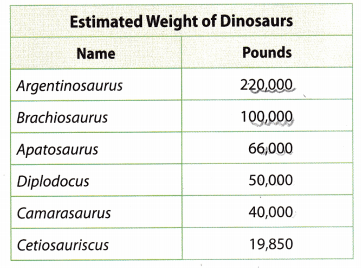
Texas Go Math Grade 8 Lesson 2.1 Answer Key 5

Question 16.
Apatosaurus
Answer:
Texas Go Math Grade 8 Lesson 2.1 Answer Key 6
6.6 × 10⁴

Question 17.
Argentinosaurus _____
Answer:
The weight of Argentinosaurus is 220, 000 pounds. Write that number in a scientific notation.
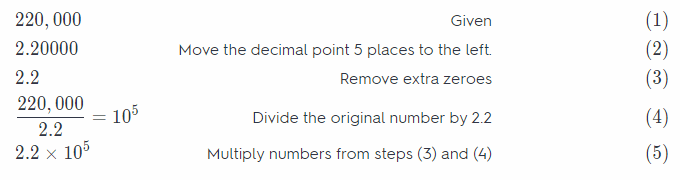
Texas Go Math Grade 8 Lesson 2.1 Answer Key 7
2.2 × 10⁵

Question 18.
Brachiosaurus _____
Answer:
The weight of Brachiosaurus is 100, 000 pounds. Write that number in a scientific notation.
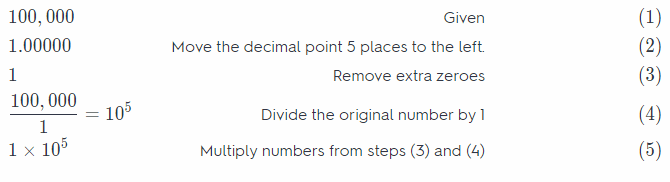
Texas Go Math Grade 8 Lesson 2.1 Answer Key 8
1 × 10⁵

Go Math Grade 8 Lesson 2.1 Answer Key Question 19.
Camarasaurus ____
Answer:
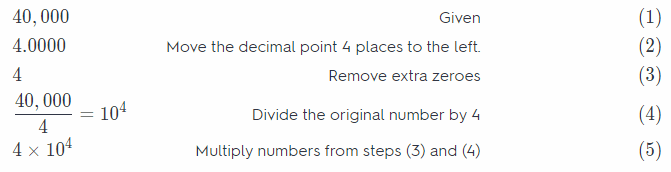
The weight of Camarasaurus is 40, 000 pounds. Write that number in a scientific notation.
Texas Go Math Grade 8 Lesson 2.1 Answer Key 9
4 × 10⁴

Question 20.
Ceriosauriscus ________________________
Answer:
Estimated weight of Cetiosauriscus is 19,850 pounds. To express this number in scientific notation:
Move the decimal point 4 places to the left, so we get a number that is greater than or equal to 1 and less
than 10. We remove the extra zeros.
1.9800 = 1.98
Divide the original number by the result from above. Write the answer as a power of 10.
\(\frac{19,800}{1.98}\) = 10,000 = 104
Write the product of the results from above.
19,800 = 1.98 • 104

Question 21.
Diplodocus _____________________
Answer:
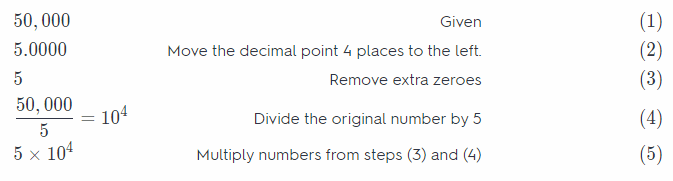
The weight of Diplodocus is 50,000 pounds. Write that number in a scientific notation.
Texas Go Math Grade 8 Lesson 2.1 Answer Key 10
5 × 10⁴

Question 22.
A single little brown bat can eat up to 1000 mosquitoes in a single hour. Express in scientific notation how many
mosquitoes a little brown bat might eat in 10.5 hours.
Answer:
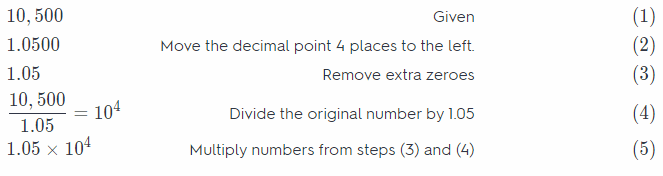
Since a Little brown bat can eat up to 1, 000 mosquitoes in an hour it can eat 10.5 times more in 10.5 hours, SO:
10.5 × 1,000 = 10,500
Write 10, 500 in a scientific notation.
Texas Go Math Grade 8 Lesson 2.1 Answer Key 11
1.05 × 10⁴

Question 23.
Multistep Samuel can type nearly 40 words per minute. Use this information to find the number of hours it would take him to type 2.6 × 10⁵ words.
Answer:
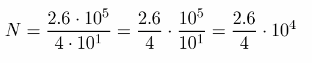
To find the member of hours N, we need to divide the total number of words by typing speed (words per minute). We have:
N = \(\frac{2.6 \cdot 10^{5}}{40}\)
To simplify, we write 40 in a scientific form as 4 • 101:
Texas Go Math Grade 8 Lesson 2.1 Answer Key 12
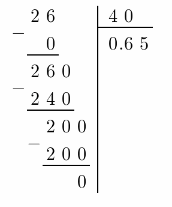
To write \(\frac{2.6}{4}\) as a decimal, we divide the numerator by the denominator until the remainder is zero or until the digits in the quotient begin to repeat.
We add as many zeros after the decimal point in the dividend as needed.
Texas Go Math Grade 8 Lesson 2.1 Answer Key 13
Therefore,
N = 0.65 . 104
N = 0.65 . 103 minutes

To convert from minutes to hours, we divide the result by 60:
N = \(\frac{6.5 \cdot 10^{3}}{60}\)
To simplify, we write 60 in a scientific form as 6 . 101:

Texas Go Math Grade 8 Lesson 2.1 Answer Key 14
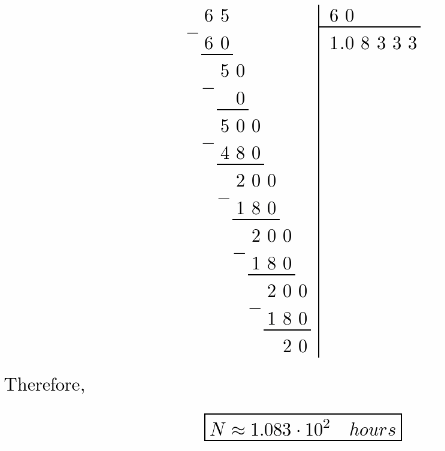
To write \(\frac{6.5}{6}\) as a decimal, we divide the numerator by the denominator until the remainder is zero or until the digits in the quotient begin to repeat.
We add as many zeros after the decimal point in the dividend as needed.
Texas Go Math Grade 8 Lesson 2.1 Answer Key 15
108.3 hours = 108 hours 20 minutes

Lesson 2.1 Integer Exponents Answer Key Pdf Question 24.
Entomology A tropical species of mite named Archegozetes longisetosus is the record holder for the strongest insect in the world. It can lift up to 1.182 × 10³ times its own weight.

a. If you were as strong as this insect, explain how you could find how many pounds you could lift.
Answer:
Number of pounds you can lift by multiplying 1.182 × 10³ by your weight.
Since you are as strong as the ant which can lift up to 1.182 × 10³ its own weight.

b. Complete the calculation to find how much you could lift, in pounds, if you were as strong as an Archegozetes longisetosus mite. Express your answer in both scientific notation and standard notation.
Answer:
Number of pounds = 100 * 1.182 × 103 Let weight = 100 pounds
102 * 1.182 × 103, Simplify
1.182 × 10⁵ In scientific notation. Add the exponent of 10
118200 In standard notation. Move the decimal 5 places to the right. Add placeholder zeros if necessary.

Question 25.
During a discussion in science class, Sharon learns that at birth an elephant weighs around 230 pounds. In four herds of elephants tracked by conservationists, about 20 calves were born during the summer. In scientific notation, express approximately how much the calves weighed altogether.
Answer:
Total weight of calves = 230 * 20 = 4600 where each elephant calves weight 230 pounds and 20 calves are born

4.600 Move the decimal point 4 places to the left
Remove extra zeros.

1, 000 Divide the original number by the result from above
103 Write the answer as the power of 10.
4.6 × 10³ Write the product of the results from above
The total weight is $4.6 \times
10^{3}$ pounds
4.6 × 10³ pounds

Question 26.
Classifying Numbers Which of the following numbers are written in scientific notation?
0.641 × 10³ 9.999 × 10⁴
2 × 101 4.38 × 510
Answer:
In order for a number to be written in scientific notation it must be of the format
c × 103
where c is a decimal number greater or equal to 1 and less than 10 and n is an integer, let’s name that rule: Rule (1).
Using this rule we have to check which numbers are written in scientific notation:
0.641 × 10³ Not in scientific notation, correct would be 641 × 102
9.999 × 10⁴ This is in scientific notation according to Rule (1)
2 × 101 This is in scientific notation according to Rule (1).
4.38 × 510 Not in scientific notation because it is not in the correct form according to Rule (1)

9.999 × 10⁴ and 2 × 101 are written in scientific notation.

Question 27.
Explain the Error Polly’s parents’ car weighs about 3500 pounds. Samantha, Esther, and Polly each wrote the weight of the car in scientific notation. Polly wrote 35.0 × 10², Samantha wrote 0.35 × 10⁴, and Esther wrote 3.5 × 10⁴.

a. Which of these girls, if any, is correct?
Answer:
3500 pounds Given

None of the girls is correct Correct scientific notation: 3.5 × 10³

b. Explain the mistakes of those who got the question wrong.
Answer:
Potty did not express the number such first part is greater than or equal to 1 and less than 10
Scientific notation is a way of expressing numbers as a product of numbers greater than or equal to 1 and
less than 10 and 10
Samantha did not express the number such first part is greater than or equal to $1$ and less than $10$ Esther did not express the exponent of $10$ correctly

Question 28.
Justify Reasoning If you were a biologist counting very large numbers of cells as part of your research, give several reasons why you might prefer to record your cell counts in scientific notation instead of standard notation.
Answer:
Reason 1
It is a standard way of writing results in a scientific environment accepted and used by scientists all over the world.

Reason 2
It is easier to compare large numbers since you only have to compare the exponents on the power 10n or if they are the same number between 1 and 10 that are multiplied by 10’

Reason 3
It is much easier to write very large (or very small) numbers and take less space, for example:
15, 000, 000. 000, 000, 000, 000 = 1.5 × 10¹⁹
1) It is a notation accepted around the world and used in science.
2) It is easy to compare numbers.
3) It is easier to write large numbers.

Texas Go Math Grade 8 Lesson 2.1 H.O.T. Focus On Higher Order Thinking Answer Key 

Question 29.
Draw Conclusions Which measurement would be least likely to be written in scientific notation: number of stars in a galaxy, number of grains of sand on a beach, speed of a car, or population of a country? Explain your reasoning.
Answer:
Scientific notation is used to express measurements that are extremely large or extremely small. The number of stars in a galaxy and the number of grains of sand on a beach are extremely large, so we use scientific notation for those. Comparing the speed of a car and the population of a country, it is clear that the speed of a car is a smaller number. Therefore, the speed of a car is less likely to be written in scientific notation.

The speed of a car is less likely to be written in scientific notation.

Lesson 2.1 Scientific Notation with Positive Powers of 10 Answer Key Question 30.
Analyze Relationships Compare the two numbers to find which is greater. Explain how you can compare them without writing them in standard notation first.
4.5 × 10⁶ 2.1 × 10⁸
Answer:
We can easily compare them by just comparing the exponents of the power 10n. In this case, we have 106 and 108, since 108 > 106 every number greater or equal to 1 and less than 10 multiplied by 106 is smaller than any number greater or equal to 1 and less than 10 multiplied by 108
We can conclude: 4.5 × 10⁶ < 2.1 × 10⁸

Comparing the exponents we have: 4.5 × 10⁶ < 2.1 × 10⁸

Question 31.
Communicate Mathematical Ideas To determine whether a number is written in scientific notation, what test can you apply to the first factor, and what test can you apply to the second factor?
Answer:
Scientific notation is in the form of c × 10n so c is the first factor and 10n is the second factor.
To the first factor, we can apply the test: if it is a decimal number greater than or equal to 1 but less than 10 it can
be a first factor in a scientific notation.
To the second factor, we can apply the test: if it’s a power of 10 it can be a second factor in a scientific notation.

The first factor has to be greater or equal to 1 and less than 10.
The second factor must be a power of 10.

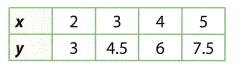
Texas Go Math Grade 8 Lesson 2.1 Answer Key Scientific Notation with Positive Powers of 10 Read More »

Texas Go Math Grade 8 Lesson 3.1 Answer Key Representing Proportional Relationships

Refer to our Texas Go Math Grade 8 Answer Key Pdf to score good marks in the exams. Test yourself by practicing the problems from Texas Go Math Grade 8 Lesson 3.1 Answer Key Representing Proportional Relationships.

Texas Go Math Grade 8 Lesson 3.1 Answer Key Representing Proportional Relationships

Explore Activity
Representing Proportional Relationships with Tables
In 1870, the French writer Jules Verne published 20,000 Leagues Under the Sea, one of the most popular science fiction novels ever written. One definition of a league is a unit of measure equaling 3 miles.
A. Complete the table.
Texas Go Math Grade 8 Lesson 3.1 Answer Key 1

B. What relationships do you see among the numbers in the table?

C. For each column of the table, find the ratio of the distance in miles to the distance in leagues. Write each ratio in simplest form.
Texas Go Math Grade 8 Lesson 3.1 Answer Key 2

D. What do you notice about the ratios? ______________________________________

Reflect

Question 1.
If you know the distance between two points in leagues, how can you find the distance in miles? ______________________________________
Answer:
Since the definition of a league is that one league is 3 miles to find the distance in miles, multiply the given distance in leagues by 3
We can express this with a mathematical formula:
y = 3x
where y is the distance in miles, and x the distance in leagues.
Multiply by 3

Lesson 3.1 Independent Practice Answer Key 8th Grade Question 2.
If you know the distance between two points in miles, how can you find the distance in leagues? _________________
Answer:
Since the definition of a league is that one league is 3 miles to find the distance in miles we have to divide the
distance in miles by 3 (or multiply by \(\frac{1}{3}\))in order to get the distance in leagues.
We can express this in a mathematical formula:
\(\frac{1}{3}\)y = x
where y is the distance in miles and x is the distance in leagues.

Divide by 3.

Your Turn

Question 3.
Fifteen bicycles are produced each hour at the Speedy Bike Works. Show that the relationship between the number of bikes produced and the number of hours is a proportional relationship. Then write an equation for the relationship. ____________
Answer:
Texas Go Math Grade 8 Lesson 3.1 Answer Key 12
Make a table relating number of bicycle produced to the numbers of hours
Texas Go Math Grade 8 Lesson 3.1 Answer Key 13
For each number of hours, write the relationship between the number of bicycles produced and the number of hours as a ratio in simplest form.
Since the ratios for the two quantities are all equal to \(\frac{15}{1}\), the relationship is proportional.
y = kx Where an equation Let x represent the number of hours and y represents the bicycle produced
y = 15x

Your Turn

The graph shows the relationship between the amount of time that a backpacker hikes and the distance traveled.

Lesson 3.1 Understanding Ratios Answer Key Question 4.
What does the point (5, 6) represent?
Answer:
The first unit (5) in the points (5, 6) represents the amount of time the backpacker hikes, and the second unit (6)
represents the distance traveled.
It means that the backpacker has hiked 6 miles in 5 hours.

The hours (5 h) and distance (6 mi) a backpacker has hiked.

Texas Go Math Grade 8 Lesson 3.1 Answer Key 3

Question 5.
What is the equation of the relationship?
Answer:
Texas Go Math Grade 8 Lesson 3.1 Answer Key 14 Use the points on the graph to make a table.
Texas Go Math Grade 8 Lesson 3.1 Answer Key 15
Find the constant of the proportional
The constant of proportionality $(k)$ is
\(\frac{6}{5}\)

y = kx Write an equation
y = \(\frac{6}{5}\)x Let x represents the number of hours and y represents the distance traveled

Texas Go Math Grade 8 Lesson 3.1 Guided Practice Answer Key 

Question 1.
Vocabulary A proportional relationship is a relationship between two quantities in which the ratio of one quantity to the other quantity Texas Go Math Grade 8 Lesson 3.1 Answer Key 4 constant.
Answer:
A proportional. relationship is a relationship between two quantities in which the ratio of one quantity to the other
quantity is constant

Representing Proportional Relationships Answer Key Question 2.
Vocabulary When writing an equation of a proportional relationship in the form y = kx, k represents the ____.
Answer:
When writing an equation of a proportional relationship in the form y = kx, k represents the constant of proportionality.

Question 3.
Write an equation that describes the proportional relationship between the number of days and the number of weeks in a given length of time. (Explore Activity and Example 1)
a. Complete the table.
Texas Go Math Grade 8 Lesson 3.1 Answer Key 5
Answer:
Texas Go Math Grade 8 Lesson 3.1 Answer Key 16
Top row: 8, bottom row: 14, 28, 70.

b. Let x represent ______________
Let y represent _____
The equation that describes the relationship is _____
Answer:
Let x represent the number of weeks in a given length of time.
Let y represent the number of days in a given length of time.
The equation that describes the relationship is y = 7x.

Each table or graph represents a proportional relationship. Write an equation that describes the relationship. (Example 1 and Example 2)

Let x represent weeks, y days, then: y = 7x describes the relationship.

Representing Proportional Relationships Lesson 3.1 Answer Key Question 4.
Physical Science The relationship between the numbers of oxygen atoms and hydrogen atoms in water
Texas Go Math Grade 8 Lesson 3.1 Answer Key 6
Answer:
Texas Go Math Grade 8 Lesson 3.1 Answer Key 17
To find the constant of proportionality compare the following ratios:
Texas Go Math Grade 8 Lesson 3.1 Answer Key 18
The constant of proportionality “k’ is 2.
We can conclude that if y represents the number of hydrogen atoms and æ the number of oxygen atoms in water,
then the following equation describes their relationship:
y = kx
y = 2x

Question 5.
Texas Go Math Grade 8 Lesson 3.1 Answer Key 7
Answer:
Texas Go Math Grade 8 Lesson 3.1 Answer Key 19 Use the points on the graph to make a table
Texas Go Math Grade 8 Lesson 3.1 Answer Key 20
Find the constant of proportionality
The constant of proportionality $(k)$ is
30
y = kx Write an equation Let x represent the distance and y represent the actual distance.
y = 30x

Essential Question Check-In

Question 6.
If you know the equation of a proportional relationship, how can you draw the graph of the equation?
Answer:
If you know the equation of a proportional, relationship, you can substitute a few values of x to find y and plot them on a coordinate plane. Connect the points in a straight line.

Texas Go Math Grade 8 Lesson 3.1 Independent Practice Answer Key 

The table shows the relationship between temperatures measured on the Celsius and Fahrenheit scales.

Texas Go Math Grade 8 Lesson 3.1 Answer Key 8

Question 7.
Is the relationship between the temperature scales proportional? Why or why not?
Answer:
For the relationship between the temperature scales to be proportional, the ratio (the number we get when dividing the corresponding temperature in Celsius by the temperature in Fahrenheit) has to be constant. Then we
call, it a constant of proportionality
\(\frac{0}{32}\) = 0
\(\frac{10}{50}\) = 0.2
\(\frac{20}{68}\) ≈ 0.29
We can see that that is not the case in our example. Therefore, the relationship is not proportional.

No. Because the ratio is not the same (no constant of proportionality).

Go Math Grade 8 Lesson 3.1 Worksheet Answer Key Question 8.
Describe the graph of the Celsius-Fahrenheit relationship.
Answer:
The graph is a straight line (with a coefficient \(\frac{9}{5}\)) that intercepts the y-axis in (0, 32)

Straight line that intercepts the y-axis in (0, 32).

Question 9.
Analyze Relationships Ralph opened a savings account with a deposit of $100. Every month after that, he deposited $20 more.
a. Why is the relationship described not proportional?
Answer:
The ratio between two consecutive deposits isn’t constant because the first 100-dollar deposit
The ratio isn’t constant.

b. How could the situation be changed to make the situation proportional?
Answer:
He could be depositing 100 dollars every month also and not just the first.
Constant deposits every month, including the first

Question 10.
Represent Real-World Problems Describe a real-world situation that can be modeled by the equation y = \(\frac{1}{20}\)x. Be sure to describe what each variable represents.
Answer:
If we need to pay taxes in the amount of \(\frac{1}{20}\) = 5 percent of our paycheck, the given equation would model the amount of taxes we need to pay depending on how much we earn. y could represent the tax we need to pay and x our paycheck.

y can be taxing and x our paycheck.

Look for a Pattern The variables x and y are related proportionally.

Question 11.
When x = 8, y = 20. Find y when x = 42. ____________
Answer:
Since x and y are related proportionally, the following equation holds:
\(\frac{y}{x}\) = k (1)
where k is a constant of proportionality.
Now, from
\(\frac{20}{8}\) = k
it follows that
k = \(\frac{5}{2}\) = 2.5
Since the variables are related proportionally, the equation (1) has to hold for every x and y in that relation (for k = 2.5).
\(\frac{y}{42}\) = 2.5
y = 2.5 × 42 Multiply by 12
y = 105 Solve for y

Go Math Answer Key Grade 8 Lesson 3.1 Question 12.
When x = 12, y = 8. Find x when y = 12. ____________
Answer:
y = kx Direct variation equation relating x and y
k = \(\frac{y}{x}\) = \(\frac{8}{12}\) = \(\frac{2}{3}\) k is the constant of variation
y = 8
x = 12
Equation is
y = \(\frac{2}{3}\)x

12 = \(\frac{2}{3}\)x When y = 12
x = \(\frac{12 * 3}{2}\) = 18

Question 13.
The graph shows the relationship between the distance that a snail crawls and the time that it crawls.
Texas Go Math Grade 8 Lesson 3.1 Answer Key 9
a. Use the points on the graph to make a table.
Texas Go Math Grade 8 Lesson 3.1 Answer Key 24
Answer:
Texas Go Math Grade 8 Lesson 3.1 Answer Key 21
Top row: 10, 20, 30, 40, 50; bottom row: 1, 2, 3, 4, 5.

b. Write the equation for the relationship and tell what each variable represents.
Answer:
First, find the constant of proportionality:
Texas Go Math Grade 8 Lesson 3.1 Answer Key 22
The constant of proportionality is k = \(\frac{1}{10}\)
We can conclude that the equation to model the distance that a snail. crawls and the time that it crawls is y = \(\frac{1}{10}\)x
where y represents the time the snail, crawls (in minutes) and x the distance it has crawled (in inches).

y = \(\frac{1}{10}\)x where y is time and x is distance.

c. How long does it take the snail to crawl 85 inches? ________________
Answer:
In this case, x = 85, therefore:
y = \(\frac{1}{10}\) × 85 = \(\frac{85}{10}\) = 8.5
It would take 8 and a half minutes for a snail, to crawl, 85 inches.

Texas Go Math Grade 8 Lesson 3.1 H.O.T. Focus On Higher Order Thinking Answer Key 

Lesson 3.1 Representing Proportional Relationships Answer Key Question 14.
Communicate Mathematical Ideas Explain why all of the graphs in this lesson show the first quadrant but omit the other three quadrants.
Answer:
The graphs in this lesson have time, distance, and weight as one (or both) of it’s variables. Since these values are
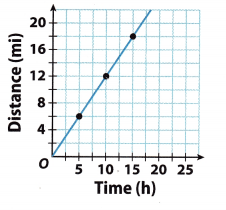
always positive we can only show the first quadrant

Because the graphs have only variables that are always positive.

Question 15.
Analyze Relationships Complete the table.
Texas Go Math Grade 8 Lesson 3.1 Answer Key 11
Answer:
Texas Go Math Grade 8 Lesson 3.1 Answer Key 23

a. Are the length of a side of a square and the perimeter of the square related proportionally? Why or why not?
Answer:
Since the perimeter of a square is 4 times the length of a side of a square the following equation holds:
y = 4x
where y is the perimeter of a square and x is the length of a side of a square. Therefore, they are related proportionally with the constant of proportionality k = 4.
Yes, because their ratio is always the same.

b. Are the length of a side of a square and the area of the square related proportionally? Why or why not?
Answer:
Let’s take a look at some of the ratios:
\(\frac{1}{1}\) = 1
\(\frac{2}{4}\) = \(\frac{1}{2}\)
\(\frac{3}{9}\) = \(\frac{1}{3}\)
Obviously, the ratio isn’t the same (there is no constant of proportionality), and because of that, they are not proportional.
No, because there is no constant of proportionality

Lesson 3.1 Representing Proportional Relationships 8th Grade Pdf Question 16.
Make a Conjecture A table shows a proportional relationship where k is the constant of proportionality. The rows are then switched. How does the new constant of proportionality relate to the original one?
Answer:
Let us take a look at what equation holds if y and x are proportional:
\(\frac{y}{x}\) = k
where k is the constant of proportionality. Now if we switch y and x we get:
\(\frac{x}{y}\) = \(\frac{1}{k}\)
Therefore the new constant is the reciprocal of the original one.

The new constant is the reciprocal of the original one.

Texas Go Math Grade 8 Lesson 3.1 Answer Key Representing Proportional Relationships Read More »

Texas Go Math Grade 8 Module 1 Answer Key Real Numbers

Refer to our Texas Go Math Grade 8 Answer Key Pdf to score good marks in the exams. Test yourself by practicing the problems from Texas Go Math Grade 8 Module 1 Answer Key Real Numbers.

Texas Go Math Grade 8 Module 1 Answer Key Real Numbers

Essential Question
How cart you use real numbers to solve real-world problems?

Texas Go Math Grade 8 Module 1 Answer Key 1

Texas Go Math Grade 8 Module 1 Are You Ready? Answer Key

Complete these exercises to review the skills you will need for this chapter.

Find the Square of a Number

Example
Find the Square of \(\frac{2}{3}\)
Texas Go Math Grade 8 Module 1 Answer Key 2

Find the square of each number.

Go Math Grade 8 Module 1 Question 1.
7 _____
Answer:
72 Given
7 * 7 Multiply the number by itself
49 Simplify
49

Question 2.
21 _____
Answer:
212 Given
21 * 21 Multiply the number by itself
441 Simplify
441

Question 3.
-3
Answer:
(-3)2 Given
(-3) * (-3) Multiply the number by itself
9 Simplify
9

Grade 8 Module 1 Answer Key Question 4.
\(\frac{4}{5}\) ____
Answer:
\(\left(\frac{4}{5}\right)^{2}\) Given
\(\frac{4}{5}\) * \(\frac{4}{5}\)
\(\frac{4 * 4}{5 * 5}\)
\(\frac{16}{25}\) Simplify
\(\frac{16}{25}\)

Question 5.
2.7 ________
Answer:
2.72 Given
2.7 * 2.7 Multiply the number by itself
7.29 Simplify
7.29

Question 6.
–\(\frac{1}{4}\) ________
Answer:
Multiply the number by itself:
\(\left(-\frac{1}{4}\right)\) × \(\left(-\frac{1}{4}\right)\) = \(\frac{(-1) \times(-1)}{4 \times 4}\)
\(\frac{1}{16}\)

Question 7.
-5.7 _______
Answer:
(-5.7)2 Given
(-5.7) * (-5.7) Multiply the number by itself
32.49 Simplify
32.49

Question 8.
1\(\frac{2}{5}\) ____
Answer:
\(\left(1 \frac{2}{5}\right)^{2}\) Given
\(\left(\frac{7}{5}\right)^{2}\) Rewrite as improper fraction
\(\left(\frac{7}{5}\right)\) * \(\left(\frac{7}{5}\right)\) Multiply the number by itself
\(\frac{7 * 7}{5 * 5}\)
\(\frac{49}{25}\) Simplify
1\(\frac{24}{25}\)

Exponents
Example 53 = 5 × 5 × 5 Use the base, 5, as a factor 3 times.
= 25 × 5 Multiply from left to right
= 125

Simplify each exponential expression.

Question 9.
92 _________
Answer:
92 Given
9 * 9 Use the base 9 as a factor for 2 times
81 Multiply from left to right
81

Question 10.
24 __________
Answer:
24 Given
2 * 2 * 2 * 2 Use the base 2 as a factor for 4 times

4 * 2 * 2 Multiply from left to right
8 * 2
16

Grade 8 Math Module 1 Answer Key Question 11.
(\(\frac{1}{3}\))2
Answer:
Use the base \(\frac{1}{3}\) as a factor 2 times:
(\(\frac{1}{3}\))2 = \(\frac{1}{3}\) × \(\frac{1}{3}\)
Multiply from left to right:
\(\frac{1}{9}\)

Question 12.
(-7)2 _______
Answer:
(-7)2 Given
(-7) * (-7) Use the base -7 as a factor for 2 times
49 Multiply from left to right
49

Question 13.
43 _________
Answer:
43 Given
4 * 4 * 4 Use the base 4 as a factor for 3 times

16 * 4 Multiply from left to right
64

Question 14.
(-1)5 ______
Answer:
Use the base -1 as a factor 5 times:
(-1)5 = (-1) × (-1) × (-1) × (-1) × (-1)

Multiply from left to right:
(-1)5 = (-1) × (-1) × (-1) × (-1) × (-1)
= 1 × (-1) × (-1) × (-1)
= (-1) × (-1) × (-1)
= 1 ×(-1)
= -1

Algebra 1 Module 1 Answer Key Question 15.
4.52 _______
Answer:
4.52 Given
(4.5) * (4.5) Use the base 4.5 as a factor for 2 times
20.25 Multiply from left to right

Question 16.
105 ________
Answer:
105 Given
1o * 10 * 10 * 10 * 10 Use the base 10 as a factor for 5 times
1oo * 10 * 10 * 10 Multiply from left to right
1000 * 10 * 10
10000 * 10
100000

Write each mixed number as an improper fraction.

Question 17.
3\(\frac{1}{3}\) _______
Answer:
3\(\frac{1}{3}\) Given
3 + \(\frac{1}{3}\) Write the mixed number as a sum of whole number and a fraction

\(\frac{9}{3}\) + \(\frac{1}{3}\) Write the whole number as an equivalent fraction with the same denominator as the fraction
\(\frac{10}{3}\) Add the numerators
\(\frac{10}{3}\)

Question 18.
1\(\frac{5}{8}\) _______
Answer:
1\(\frac{5}{8}\) Given
1 + \(\frac{5}{8}\) Write the mixed number as a sum of whole number and a fraction
\(\frac{8}{8}\) + \(\frac{5}{8}\) Write the whole number as an equivalent fraction with the same denominator as the fraction
\(\frac{13}{8}\) Add the numerators
\(\frac{13}{8}\)

Texas Go Math Grade 8 Module 1 Answer Question 19.
2\(\frac{3}{7}\)
Answer:
2\(\frac{3}{7}\) Given
2 + \(\frac{3}{7}\)
Write the mixed number as a sum of a whole number and a fraction
\(\frac{14}{7}\) + \(\frac{3}{7}\) Write the whole number as an equivalent fraction with the same denominator as the fraction
\(\frac{17}{7}\) Add the numerators
\(\frac{17}{7}\)

Question 20.
5\(\frac{5}{6}\) _______
Answer:
5\(\frac{5}{6}\) Given
5 + \(\frac{5}{6}\) Write the mixed number as a sum of whole number and a fraction
\(\frac{30}{6}\) + \(\frac{5}{6}\) Write the whole number as an equivalent fraction with
the same denominator as the fraction
\(\frac{35}{6}\) Add the numerators
\(\frac{35}{6}\)

Texas Go Math Grade 8 Module 1 Reading Start-Up Answer Key

Visualize Vocabulary

Use the ✓ words to complete the graphic. You can put more than one word In each section of the triangle.

Texas Go Math Grade 8 Module 1 Answer Key 3

Understand Vocabulary

Complete the sentences using the preview words.

Question 1.
One of the two equal factors of a number is a ____
Answer:
One of the two equa[ factors of a number is a square root.

Grade 8 Math Module 1 Question 2.
A ____________________ has integers as its square roots.
Answer:
A perfect square has integers as its square roots.

Question 3.
The ________________________ is the nonnegative square root of a number.
Answer:
The principal square root is the nonnegative square root of a number.

Texas Go Math Grade 8 Module 1 Answer Key Real Numbers Read More »

Scroll to Top