HMH Go Math

go-math-grade-8-answer-key-chapter-14-scatter-plots

Go Math Grade 8 Answer Key Chapter 14 Scatter Plots

A great selection will give you a happy ending. Such best selection to learn maths is Go Math Grade 8 Answer Key Chapter 14 Scatter Plots. Yes. Go Math Grade 8 Chapter 14 Scatter Plots Answer Key is the only choice for students who wants the easy and best learning of maths. To help every student to practice maths, we provided questions and answers along with the explanation in an easy way. Therefore, start practicing the maths with the help of Go Math Grade 8 Answer Key.

Go Math Grade 8 Answer Key Chapter 14 Scatter Plots

It is an open place to learn maths. You need not pay anything to anyone to learn maths. We are offering a free PDF of Go Math Grade 8 Answer Key Chapter 14 Scatter Plots. So, students can learn offline with the help of Go Math Grade 8 Chapter 14 Scatter Plots Answer Key if they want. Or else, it is also easy to learn maths with the HMH Go Math guide. What are you waiting for? Immediately start practicing maths now using GO Math Grade 8 Answer Key.

Lesson 1: Scatter Plots and Association

Lesson 2: Trend Lines and Predictions

Model Quiz

Mixed Review

Guided Practice – Scatter Plots and Association – Page No. 436

Bob recorded his height at different ages. The table below shows his data.
Go Math Grade 8 Answer Key Chapter 14 Scatter Plots Lesson 1: Scatter Plots and Association img 1

Question 1.
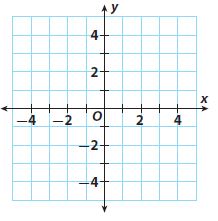
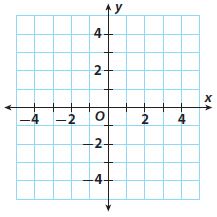
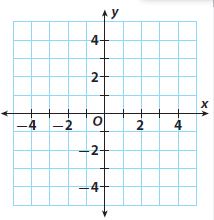
Make a scatter plot of Bob’s data.
Go Math Grade 8 Answer Key Chapter 14 Scatter Plots Lesson 1: Scatter Plots and Association img 2
Type below:
_____________

Answer:
grade 8 chapter 14 image 1

Explanation:
As Bob gets older, his height increases along with the straight line on the
graph. So, the association is positive and linear.

Scatter Plots and Data Analysis Answer Key Question 2.
Describe the association between Bob’s age and his height. Explain the association.
Type below:
_____________

Answer:
The association is positive and linear. Bob’s height increases as he gets older. We would see that Bob’s height eventually stops increasing if the data continues.

Question 3.
The scatter plot shows the basketball shooting results for 14 players. Describe any clusters you see in the scatter plot. Identify any outliers.
Go Math Grade 8 Answer Key Chapter 14 Scatter Plots Lesson 1: Scatter Plots and Association img 3
Type below:
_____________

Answer:
There is an outlier at (35,18)

Explanation:
There is a cluster in the “20 – 25” shots attempted range and a smaller cluster in the “5 – 14” shots attempted range.
There is an outlier at (35,18)

ESSENTIAL QUESTION CHECK-IN

Question 4.
Explain how you can make a scatter plot from a set of bivariate data.
Type below:
_____________

Answer:
Bivariate data – data that has two variables per observation,
An x variable and y variable.
Scatterplot – The graph displaying categorical data, with an x and y-axis.
Response Variable – the variable that is explained by the other.
Explanatory Variable – the variable which explains the other.

14.1 Independent Practice – Scatter Plots and Association – Page No. 437

Sports Use the scatter plot for 5–8.

Olympic Men’s Long Jump Winning Distances
Go Math Grade 8 Answer Key Chapter 14 Scatter Plots Lesson 1: Scatter Plots and Association img 4

Question 5.
Describe the association between the year and the distance jumped for the years 1960 to 1988.
Type below:
_____________

Answer:
The data shows a positive linear association. If the year increases, the winning distance increases.

Question 6.
Describe the association between the year and the distance jumped for the years after 1988.
Type below:
_____________

Answer:
Between 1996 and 2004, there was a slight increase in distance over time. The data from 1988 to 2012 will show a negative association.

Question 7.
For the entire scatter plot, is the association between the year and the distance jumped linear or nonlinear?
_____________

Answer:
The data show a rise between 1960 and 1988. The data also show a fall between 1988 and 2012. Therefore, overall, there is no linear pattern.

Scatter Plots and Data Unit Test Answer Key Question 8.
Identify the outlier and interpret its meaning.
Type below:
_____________

Answer:
The outlier is at (1968, 8.9). It represents a long jump of 8.9 meters in 1968 that exceeds the other jumps made in the surrounding years.

Question 9.
Communicate Mathematical Ideas Compare a scatter plot that shows no association to one that shows a negative association.
Type below:
_____________

Answer:
Randomly scattered data points with no apparent pattern define a scatter plot with no association. Data points that fall from left to right and has data set values that increase as the other decreases define a scatter plot with a negative association.

Scatter Plots and Association – Page No. 438

For 10–11, describe a set of real-world bivariate data that the given scatter plot could represent. Define the variable represented on each axis.

Question 10.
Go Math Grade 8 Answer Key Chapter 14 Scatter Plots Lesson 1: Scatter Plots and Association img 5
_____________

Answer:
The x-axis represents the number of containers. The y-&is represents the price per container.

Unit Scatter Plots and Data Homework 4 Problem Solving with Trend Lines Question 11.
Go Math Grade 8 Answer Key Chapter 14 Scatter Plots Lesson 1: Scatter Plots and Association img 6
_____________

Answer:
The x-axis represents the number of hours spent watching tv. The y-axis represents the number of TVs owned.

FOCUS ON HIGHER ORDER THINKING

Question 12.
Multiple Representations Describe what you might see in a table of bivariate data that would lead you to conclude that the scatter plot of the data would show a cluster.
Type below:
_____________

Answer:
A cluster in a scatter plot is when there are a lot of points all grouped around the same location.
Look for points that have the same input and output values. If there are a lot of points together, you must have a cluster in your scatter plot.

Question 13.
Justify Reasoning Is it possible for a scatter plot to have a positive or negative association that is not linear? Explain.
Type below:
_____________

Answer:
Yes

Explanation:
Yes; it is possible for a scatter plot to have a positive or negative association that is not linear. The data points may have a falling or rising curve that will exhibit a nonlinear association.

Question 14.
Critical Thinking To try to increase profits, a theater owner increases the price of a ticket by $25 every month. Describe what a scatter plot might look like if x represents the number of months and y represents the profits. Explain your reasoning.
Type below:
_____________

Answer:
Initially, the number of tickets sold might decline a little, but the price increase would offset the loss in sales. That means that profits would increase, showing a positive association. When the price would get too high, ticket sales would decline rapidly, so profits would fall giving a negative association.

Guided Practice – Trend Lines and Predictions – Page No. 442

Angela recorded the price of different weights of several bulk grains. She made a scatter plot of her data. Use the scatter plot for 1–4.

Question 1.
Draw a trend line for the scatter plot.
Go Math Grade 8 Answer Key Chapter 14 Scatter Plots Lesson 2: Trend Lines and Predictions img 7
Type below:
_____________

Answer:
grade 8 chapter 14 image 2

Question 2.
How do you know whether your trend line is a good fit for the data?
Type below:
_____________

Answer:
Most of the data points are close to the trend line. The trend line has about the same number of points above and below it.

Scatter Plots and Trend Lines Quiz 1 Answer Key Question 3.
Write an equation for your trend line.
Type below:
_____________

Answer:
y = 0.09x

Explanation:
The trend line passes through (0, 0) and (19, 1.80).
Find the slope by using the slope formula.
slope = m = (y2 – y1)/(x2 – x1) = 1.80/19 = 0.09
The line passes through the origin. So, the y-intercept is 0.
From an equation for the trend line substituting the slope value for m and the value of the y-intercept b in the slope-intercept formula.
y = mx + b
y = 0.09x + 0
y = 0.09x

Question 4.
Use the equation for your trend line to interpolate the price of 7 ounces and extrapolate the price of 50 ounces.
Type below:
_____________

Answer:
The price for 7 and 50 ounces is $0.63 and $4.50

Explanation:
Use the equation for the trend line (y = 0.09x) to interpolate the price of 7 ounces by substituting 7 for x (y= 0.09 • 7) and solving for y.
Use the equation for the trend line (y = 0.09x) to interpolate the price of 50 ounces by substituting 50 for x (y= 0.09 • 50) and solving for y.

ESSENTIAL QUESTION CHECK-IN

Question 5.
A trend line passes through two points on a scatter plot. How can you use the trend line to make a prediction between or outside the given data points?
Type below:
_____________

Answer:
Use two points on the line. rind the slope and y-intercept. Substitute the values of the slope (m) and y-intercept (b) to form an equation using y = mx + b. Substitute the value of x for which you want to make a prediction and solve for y OR substitute your prediction for y and solve to find its value.

14.2 Independent Practice – Trend Lines and Predictions – Page No. 443

Use the data in the table for Exercises 6–10.
Go Math Grade 8 Answer Key Chapter 14 Scatter Plots Lesson 2: Trend Lines and Predictions img 8

Question 6.
Make a scatter plot of the data and draw a trend line.
Go Math Grade 8 Answer Key Chapter 14 Scatter Plots Lesson 2: Trend Lines and Predictions img 9
Type below:
_____________

Answer:
grade 8 chapter 14 image 3

Question 7.
What type of association does the trend line show?
Type below:
_____________

Answer:
Negative Association

Explanation:
One data set increases – Wind Speed and the other – Wind Chill decreases. So, the trend line shows a Negative Association.

Scatter Plots and Trend Lines Answer Key Question 8.
Write an equation for your trend line.
Type below:
_____________

Answer:
y = -0.25x + 2.5

Explanation:
Find the slope using the Slope Formula
m = (y2 – y1)/(x2 – x1) = ((-10) – 5)/(50 – 30) = -5/20 = -0.25
Find the y-intercept using the Slope-Intercept Formula
y = mx + b
-5 = -0.25(30) + b
-5 = -7.5 + b
2.5 = b
Substitute the value of m and b into the Slope-Intercept Formula to form an equation for the trend line.
y = -0.25x + 2.5

Question 9.
Make a Prediction Use the trend line to predict the wind chill at these wind speeds.
a. 36 mi/h
_________ °F

Answer:
-6.5°F

Explanation:
Use the trend line to predict the wind chill at 36mi/h
y = -0.25x + 2.5
y = -0.25(36) + 2.5
y = -9 + 2.5
y = -6.5
The wind chill at 36mi/h is -6.5ºF

Question 9.
b. 100 mi/h
_________ °F

Answer:
-22.5°F

Explanation:
Use the trend line to predict the wind chill at 100mi/h
y = -0.25x + 2.5
y = -0.25(100) + 2.5
y = -25 + 2.5
y = -22.5
The wind chill at 100mi/h is -22.5ºF

Question 10.
What is the meaning of the slope of the line?
Type below:
_____________

Answer:
The slope means that the wind chill falls about 1°F for every 4 mph increase in wind speed.

Use the data in the table for Exercises 11–14.
Go Math Grade 8 Answer Key Chapter 14 Scatter Plots Lesson 2: Trend Lines and Predictions img 10

Question 11.
Make a scatter plot of the data and draw a trend line.
Go Math Grade 8 Answer Key Chapter 14 Scatter Plots Lesson 2: Trend Lines and Predictions img 11
Type below:
_____________

Answer:
grade 8 chapter 14 image 4

Problem Solving with Trend Lines Worksheet Answers Question 12.
Write an equation for your trend line.
Type below:
_____________

Answer:
y = -(2/15)x + 64

Explanation:
Find the slope using the Slope Formula
m = (y2 – y1)/(x2 – x1) = (72 – 64)/(60 – 0) = 8/60 = -2/15
Find the y-intercept using the Slope-Intercept Formula at (0, 64)
y = mx + b
b = 64
Substitute the value of m and b into the Slope-Intercept Formula to form an equation for the trend line.
y = -2/15x + 64

Question 13.
Make a Prediction Use the trend line to predict the apparent temperature at 70% humidity.
Type below:
_____________

Answer:
73.3º F

Explanation:
Use the equation of the trend line. Substitute 70(for 70%) into the equation for x.
y = -(2/15)x + 64
y = -(2/15)(70) + 64
y = -140/15 + 64
y = -9.3 + 64
y = 73.3
The apparent temperature is 73.3º F

Question 14.
What is the meaning of the y-intercept of the line?
Type below:
_____________

Answer:
The y-intercept explains that at 0% humidity, the apparent temperature is 64ºF

FOCUS ON HIGHER ORDER THINKING – Trend Lines and Predictions – Page No. 444

Question 15.
Communicate Mathematical Ideas Is it possible to draw a trend line on a scatter plot that shows no association? Explain.
_____________

Answer:
No

Explanation:
It is not possible to draw a trend line on a scatter plot that shows no association. If the scatter plot shows no association, the data points have no relationships with one another. You can draw a trend line if a linear association is available.

Question 16.
Critique Reasoning Sam drew a trend line that had about the same number of data points above it as below it, but did not pass through any data points. He then picked two data points to write the equation for the line. Is this a correct way to write the equation? Explain.
_____________

Answer:
No

Explanation:
Sam did not use the correct way to write an equation.
Sam may have drawn a correct trend line but using the data points that are not on the trend line may have an incorrect equation for the line. He should use two points on that trend line to write the equation.

Problem Solving with Trend Lines Homework 4 Answer Key Question 17.
Marlene wanted to find a relationship between the areas and populations of counties in Texas. She plotted x (area in square miles) and y (population) for two counties on a scatter plot:
Kent County (903, 808)                                Edwards County (2118, 2002)
She concluded that the population of Texas counties is approximately equal to their area in square miles and drew a trend line through her points.
a. Critique Reasoning Do you agree with Marlene’s method of creating a scatter plot and a trend line? Explain why or why not.
_____________

Answer:
I do not agree with Marlene’s method of creating a scatter plot and a trend line. She did not have enough data. Marlene should have collected and plotted data for many more counties.

Question 17.
b. Counterexamples Harris County has an area of 1778 square miles and a population of about 4.3 million people. Dallas County has an area of 908 square miles and a population of about 2.5 million people. What does this data show about Marlene’s conjecture that the population of Texas counties is approximately equal to their area?
Type below:
_____________

Answer:
The data collected are only of two counties whose populations are nearly equal to their area. The fact that the populations of Harris and Dallas counties are in the millions, Marlene’s conjecture about the population of Texas counties being equivalent to their area is invalid.

Ready to Go On? – Model Quiz – Page No. 445

14.1 Scatter Plots and Association

An auto store is having a sale on motor oil. The chart shows the price per quart as the number of quarts purchased increases. Use the data for Exs. 1–2.
Go Math Grade 8 Answer Key Chapter 14 Scatter Plots Model Quiz img 12

Question 1.
Use the given data to make a scatter plot.
Go Math Grade 8 Answer Key Chapter 14 Scatter Plots Model Quiz img 13
Type below:
_____________

Answer:
grade 8 chapter 14 image 5

Unit Scatter Plots and Data Homework 1 Answer Key Question 2.
Describe the association you see between the number of quarts purchased and the price per quart. Explain.
Type below:
_____________

Answer:
Negative nonlinear association

Explanation:
The association seen between the number of quarts purchased and the price per quart is negative and nonlinear. As the number of quarts rises, the price per quart decreases but you can see a data curve.

14.2 Trend Lines and Predictions

The scatter plot below shows data comparing wind speed and wind chill for an air temperature of 20 °F. Use the scatter plot for Exs. 3–5.

Question 3.
Draw a trend line for the scatter plot.
Go Math Grade 8 Answer Key Chapter 14 Scatter Plots Model Quiz img 14
Type below:
_____________

Answer:
grade 8 chapter 14 image 6

Question 4.
Write an equation for your trend line.
Type below:
_____________

Answer:
y = -0.35x + 12.25

Explanation:
The line passes through (10, 8.75) and (35, 0) so we can use these points to find the slope.
The slope of the line is :
Slope = m = (y2 – y1)/(x2 – x1) = (0 – 8.75)/(35 – 10) = -8.75/25 = -0.35
Find the y-intercept using the slope-intercept formula :
y = mx + b
0 = -0.35 . 35 + b
0 = -12.25 + b
b = 12.25
Substitute the slope m and the y-intercept b in the slope-intercept formula.
The equation for the trend line is :
y = mx + b
y = -0.35x + 12.25

Problem-Solving with Trend Lines Homework 4 Answers Question 5.
Use your equation to predict the wind chill to the nearest degree for a wind speed of 60 mi/h.
________ °F

Answer:
9°F

Explanation:
y = −0.35x + 12.25
y = -0.35(60) + 12.25
y = -21 + 12.25
y = -8.75
The wind chill to the nearest degree for a wind speed of 60 mi/h is 9°F.

ESSENTIAL QUESTION

Question 6.
How can you use scatter plots to solve real-world problems?
Type below:
_____________

Answer:
Using a scatter plot, you can see positive and negative trends such as prices over time. You can also make predictions such as height at a certain age.

Selected Response – Mixed Review – Page No. 446

Question 1.
Which scatter plot could have a trend line whose equation is y = 3x + 10?
Go Math Grade 8 Answer Key Chapter 14 Scatter Plots Mixed Review img 15
Options:
a. A
b. B
c. C
d. D

Answer:
b. B

Question 2.
What type of association would you expect between a person’s age and hair length?
Options:
a. linear
b. negative
c. none
d. positive

Answer:
c. none

Explanation:
The length of their hair reduces. This is because the length of hair changes with the growth phase of the hair follicles. When one is young, the cells of the papilla divide more rapidly, and hence the length of the hair is long before reaching the transitional phase and then shedding off in the telogen phase. The older one gets, the papilla cells do not divide as rapidly and the length of the hair shortens with age.

Question 3.
Which is not shown on the scatter plot?
Go Math Grade 8 Answer Key Chapter 14 Scatter Plots Mixed Review img 16
Options:
a. cluster
b. negative association
c. outlier
d. positive association

Answer:
d. positive association

Explanation:
The scatter plot shows a cluster, some outliers, and a negative association.
It does not show a positive association.

Unit Scatter Plots and Data Homework 3 Answer Key Question 4.
A restaurant claims to have served 352,000,000 hamburgers. What is this number in scientific notation?
Options:
a. 3.52 × 10⁶
b. 3.52 × 10⁸
c. 35.2 × 10⁷
d. 352 × 106

Answer:
b. 3.52 × 10⁸

Explanation:
100,000,000
So, 3.52 × 10⁸

Question 5.
Which equation describes the relationship between x and y in the table?
Go Math Grade 8 Answer Key Chapter 14 Scatter Plots Mixed Review img 17
Options:
a. y = −4x
b. y = −\(\frac{1}{4}\)x
c. y = 4x
d. y = \(\frac{1}{4}\)x

Answer:
b. y = −\(\frac{1}{4}\)x

Explanation:
In order to find out the relationship between x and y, we have to use the values in the question and substitute them into the solution options.
So, y = -1/4x

Mini-Task

Question 6.
Use the data in the table.
Go Math Grade 8 Answer Key Chapter 14 Scatter Plots Mixed Review img 18
a. Make a scatterplot of the data.
Go Math Grade 8 Answer Key Chapter 14 Scatter Plots Mixed Review img 19
Type below:
______________

Answer:
grade 8 chapter 14 image 7

Question 6.
b. Which data point is an outlier?
Type below:
______________

Answer:
The outlier is the point (92, 135).

Question 6.
c. Predict the number of visitors on a day when the high temperature is 102 °F.
Type below:
______________

Answer:
Based on the cluster around 100°F, I would expect that on a day with a temperature of 102 °F, the pool would have between 350 and 400 visitors.

Conclusion:

Go Math Grade 8 Answer Key Chapter 14 Scatter Plots for free. Get your copy and start practicing now. Become a member of learning maths in the best and easy way with the help of the Go Math Grade 8 Chapter 14 Scatter Plots Answer Key. Enjoy learning maths with the help of the HMH Go Maths Grade 8 Solution Key.

Go Math Grade 8 Answer Key Chapter 14 Scatter Plots Read More »

go-math-grade-8-answer-key-chapter-10-transformations-and-similarity

Go Math Grade 8 Answer Key Chapter 10 Transformations and Similarity

Be the first person to grab Go Math Grade 8 Answer Key Chapter 10 Transformations and Similarity to score good marks in the exam. Many students have loved the way of explanation given on Go Math Grade 8 Answer Key on our website. If you want to learn the best way of solving maths, students can immediately start their practice with the help of the Go Math Grade 8 Chapter 10 Transformations and Similarity Answer Key.

Go Math Grade 8 Chapter 10 Transformations and Similarity Answer Key

The best learning comes with the best learning guide. So, to have the best online maths practice, follow the questions, answers, and explanations available on Go Math Grade 8 Answer Key Chapter 10 Transformations and Similarity. Download Go Math Grade 8 Chapter 10 Transformations and Similarity Answer Key PDF and begin your practice. The students can easily learn maths with the Go Math Grade 8 Solution Key.

Lesson 1: Properties of Dilations

Lesson 2: Algebraic Representations of Dilations

Lesson 3: Similar Figures

Model Quiz

Mixed Review

Guided Practice – Properties of Dilations – Page No. 318

Use triangles ABC and A′B′C ′ for 1–5.
Go Math Grade 8 Answer Key Chapter 10 Transformations and Similarity Lesson 1: Properties of Dilations img 1

Question 1.
For each pair of corresponding vertices, find the ratio of the x-coordinates and the ratio of the y-coordinates.
ratio of x-coordinates = _______
ratio of y-coordinates = _______
ratio of x-coordinates = ____________
ratio of y-coordinates = ____________

Answer:
ratio of x-coordinates = 2
ratio of y-coordinates = 2

Explanation:
A’ = (-4, 4), A = (-2, 2);
ratio of x-coordinates = -4/-2 = 2
ratio of y-coordinates = 4/2 = 2
B’ = (4, 2), B = (2, 1);
ratio of x-coordinates = 4/2 = 2
ratio of y-coordinates = 2/1 = 2
C’ = (-2, -4), C = (-1, -2);
ratio of x-coordinates = -2/-1 = 2
ratio of y-coordinates = -4/-2 = 2

Question 2.
I know that triangle A′B′C ′ is a dilation of triangle ABC because the ratios of the corresponding x-coordinates are _______ and the ratios of the corresponding y-coordinates are _______.
Type below:
_____________

Answer:
I know that triangle A′B′C ′ is a dilation of triangle ABC because the ratios of the corresponding x-coordinates are equal and the ratios of the corresponding y-coordinates are equal.

Question 3.
The ratio of the lengths of the corresponding sides of triangle A′B′C ′ and triangle ABC equals _______.
________

Answer:
The ratio of the lengths of the corresponding sides of triangle A′B′C ′ and triangle ABC equals 2.

Properties of Dilations Answer Key Question 4.
The corresponding angles of triangle ABC and triangle A′B′C ′ are _______.
Type below:
_____________

Answer:
The corresponding angles of triangle ABC and triangle A′B′C ′ are congruent.

Question 5.
The scale factor of the dilation is _______.
________

Answer:
The scale factor of the dilation is 2.

ESSENTIAL QUESTION CHECK-IN

Question 6.
How can you find the scale factor of a dilation?
Type below:
_____________

Answer:
Divide a side length of the dilated figure by the corresponding side length of the original figure.

10.1 Independent Practice – Properties of Dilations – Page No. 319

For 7–11, tell whether one figure is a dilation of the other or not. Explain your reasoning.

Question 7.
Quadrilateral MNPQ has side lengths of 15 mm, 24 mm, 21 mm, and 18 mm. Quadrilateral M′N′P′Q′ has side lengths of 5 mm, 8 mm, 7 mm, and 4 mm.
_____________

Answer:
MNPQ is not a dilation of M′N′P′Q′

Explanation:
15/5 = 3 mm
24/8 = 3 mm
21/7 = 3 mm
18/4 = 4.5 mm
The ratios of the lengths of the corresponding sides are not equal.
Therefore, MNPQ is not a dilation of M′N′P′Q′

Question 8.
Triangle RST has angles measuring 38° and 75°. Triangle R′S′T ′ has angles measuring 67° and 38°. The sides are proportional.
_____________

Answer:
Yes

Explanation:
Both Triangle S have Angle S of measures 38°, 67° and 75°. So, the corresponding ∠S are congruent.

Question 9.
Two triangles, Triangle 1 and Triangle 2, are similar.
_____________

Answer:
Yes

Explanation:
a dilation produces an image similar to the original figure

Question 10.
Quadrilateral MNPQ is the same shape but a different size than quadrilateral M′N′P′Q.
_____________

Answer:
Yes

Explanation:
The figures are similar is they are the same shape but different size SO one is a dilation of the other

Question 11.
On a coordinate plane, triangle UVW has coordinates U(20, −12), V(8, 6), and W(−24, -4). Triangle U′V′W′ has coordinates U′(15, −9), V′(6, 4.5), and W′(−18, -3).
_____________

Answer:
Yes

Explanation:
Each coordinate of Triangle U′V′W′ is 3/4 times the corresponding coordinate of Triangle UVW.
So, the scale factor of the dilation is 3/4.

Complete the table by writing “same” or “changed” to compare the image with the original figure in the given transformation.

Question 12.
Go Math Grade 8 Answer Key Chapter 10 Transformations and Similarity Lesson 1: Properties of Dilations img 2
Type below:
_____________

Answer:
grade 8 chapter 10 image 1

Question 16.
Describe the image of a dilation with a scale factor of 1.
_____________

Answer:
The image is congruent to the original figure

Properties of Dilations – Page No. 320

Identify the scale factor used in each dilation.

Question 17.
Go Math Grade 8 Answer Key Chapter 10 Transformations and Similarity Lesson 1: Properties of Dilations img 3
________

Answer:
3

Explanation:
A’B’/AB = 6/2 = 3
B’D’/BD = 6/2 = 3
scale factor = 3

Question 18.
Go Math Grade 8 Answer Key Chapter 10 Transformations and Similarity Lesson 1: Properties of Dilations img 4
\(\frac{□}{□}\)

Answer:
\(\frac{1}{2}\)

Explanation:
A’B’/AB = 2/4 = 1/2
scale factor = 1/2

FOCUS ON HIGHER ORDER THINKING

Question 19.
Critical Thinking Explain how you can find the center of dilation of a triangle and its dilation.
Type below:
_____________

Answer:
If you draw a line connecting each pair of corresponding vertices, the lines will intersect at the center of dilation

Dilations and Similarity Answer Key Question 20.
Make a Conjecture
a. A square on the coordinate plane has vertices at (−2, 2), (2, 2), (2, −2), and (−2, −2). A dilation of the square has vertices at (−4, 4), (4, 4), (4, −4), and (−4, −4). Find the scale factor and the perimeter of each square.
Scale factor: _________
Original perimeter: _________
Image perimeter: _________

Answer:
Scale factor: 2
Original perimeter: 16
Image perimeter: 32

Explanation:
-4/-2 =2; 4/2 = 2
Scale factor = 2
perimeter of the original square = 4 + 4 + 4 + 4 = 16
perimeter of the image = 8 + 8 + 8 + 8 = 32

Question 20.
b. A square on the coordinate plane has vertices at (−3, 3), (3, 3), (3, −3), and (−3, −3). A dilation of the square has vertices at (−6, 6), (6, 6), (6, −6), and (−6, −6). Find the scale factor and the perimeter of each square.
Scale factor: _________
Original perimeter: _________
Image perimeter: _________

Answer:
Scale factor: 2
Original perimeter: 24
Image perimeter: 48

Explanation:
-6/-3 =2; 6/3 = 2
Scale factor = 2
perimeter of the original square = 6 + 6 + 6 + 6 = 24
perimeter of the image = 12 + 12 + 12 + 12 = 48

Question 20.
c. Make a conjecture about the relationship of the scale factor to the perimeter of a square and its image.
Type below:
_____________

Answer:
The perimeter of the image is the perimeter of the original figure times the scale factor

Guided Practice – Algebraic Representations of Dilations – Page No. 324

Question 1.
The grid shows a diamond-shaped preimage. Write the coordinates of the vertices of the preimage in the first column of the table. Then apply the dilation (x, y) → (\(\frac{3}{2}\)x, \(\frac{3}{2}\)y) and write the coordinates of the vertices of the image in the second column. Sketch the image of the figure after the dilation.
Go Math Grade 8 Answer Key Chapter 10 Transformations and Similarity Lesson 2: Algebraic Representations of Dilations img 5
Type below:
_____________

Answer:
grade 8 chapter 10 image 2

Graph the image of each figure after a dilation with the origin as its center and the given scale factor. Then write an algebraic rule to describe the dilation.

Question 2.
scale factor of 1.5
Go Math Grade 8 Answer Key Chapter 10 Transformations and Similarity Lesson 2: Algebraic Representations of Dilations img 6
Type below:
_____________

Answer:
(x, y) -> (1.5x, 1.5y)

Explanation:
After dilation
F’ (3, 3)
G’ (7.5, 3)
H’ (7.5, 6)
I’ (3, 6)
algebraic rule: (x, y) -> (1.5x, 1.5y)

Algebraic Representations of Dilations Lesson 10.2 Answers Question 3.
scale factor of \(\frac{1}{3}\)
Go Math Grade 8 Answer Key Chapter 10 Transformations and Similarity Lesson 2: Algebraic Representations of Dilations img 7
Type below:
_____________

Answer:
(x, y) -> (1/3x, 1/3y)

Explanation:
After dilation
A’ (3, 3)
B’ (7.5, 3)
C’ (7.5, 6)
algebraic rule: (x, y) -> (1/3x, 1/3y)

ESSENTIAL QUESTION CHECK-IN

Question 4.
A dilation of (x, y) → (kx, ky) when 0 < k < 1 has what effect on the figure? What is the effect on the figure when k > 1?
Type below:
_____________

Answer:
When k is between 0 and 1, the dilation is a reduction by the scale factor k.
When k is greater than 1, the dilation is an enlargement by the scale factor k.

10.2 Independent Practice – Algebraic Representations of Dilations – Page No. 325

Question 5.
The blue square is the preimage. Write two algebraic representations, one for the dilation to the green square and one for the dilation to the purple square.
Go Math Grade 8 Answer Key Chapter 10 Transformations and Similarity Lesson 2: Algebraic Representations of Dilations img 8
Type below:
_____________

Answer:
Green square -> (x, y) -> (2x, 2y)
Purple square -> (x, y) -> (1/2x, 1/2y)

Question 6.
Critical Thinking A triangle has vertices A(-5, -4), B(2, 6), and C(4, -3). The center of dilation is the origin and (x, y) → (3x, 3y). What are the vertices of the dilated image?
Type below:
_____________

Answer:
A'(-15, -12)
B'(6, 18)
C'(12, -9)

Explanation:
A'((3.-15), (3.-12)) -> A'(-15, -12)
B'((3. 2), (3.6)) -> B'(6, 18)
C'((3. 4), (3.-3)) -> C'(12, -9)

Dilations Worksheet Answer Key 8th Grade Question 7.
Critical Thinking M′N′O′P′ has vertices at M′(3, 4), N′(6, 4), O′(6, 7), and P′(3, 7). The center of dilation is the origin. MNOP has vertices at M(4.5, 6), N(9, 6), O′(9, 10.5), and P′(4.5, 10.5). What is the algebraic representation of this dilation?
Type below:
_____________

Answer:
(x, y) -> (2/3x, 2/3y)

Explanation:
M’N’/MN = 3/4.5 = 2/3
algebraic rule: (x, y) -> (2/3x, 2/3y)

Question 8.
Critical Thinking A dilation with center (0,0) and scale factor k is applied to a polygon. What dilation can you apply to the image to return it to the original preimage?
Type below:
_____________

Answer:
A dilation with scale factor 1/k

Question 9.
Represent Real-World Problems The blueprints for a new house are scaled so that \(\frac{1}{4}\) inch equals 1 foot. The blueprint is the preimage and the house is the dilated image. The blueprints are plotted on a coordinate plane.
a. What is the scale factor in terms of inches to inches?
Scale factor: ________

Answer:
Scale factor: 48

Explanation:
scale factor = 48

Question 9.
b. One inch on the blueprint represents how many inches in the actual house? How many feet?
________ inches
________ feet

Answer:
48 inches
4 feet

Explanation:
48 inches or 4 feet

Question 9.
c. Write the algebraic representation of the dilation from the blueprint to the house.
Type below:
_____________

Answer:
(x, y) -> (48x, 48y)

Question 9.
d. A rectangular room has coordinates Q(2, 2), R(7, 2), S(7, 5), and T(2, 5) on the blueprint. The homeowner wants this room to be 25% larger. What are the coordinates of the new room?
Type below:
_____________

Answer:
Q'(2.5, 2.5),
R'(8.75, 2.5),
S'(8.75, 6.25),
T'(2.5, 6.25)

Question 9.
e. What are the dimensions of the new room, in inches, on the blueprint? What will the dimensions of the new room be, in feet, in the new house?
Type below:
_____________

Answer:
Blueprint dimensions: 6.25 in. by 3.75 in.
House dimensions: 25ft by 15ft

Algebraic Representations of Dilations – Page No. 326

Question 10.
Write the algebraic representation of the dilation shown.
Go Math Grade 8 Answer Key Chapter 10 Transformations and Similarity Lesson 2: Algebraic Representations of Dilations img 9
Type below:
_____________

Answer:
(x, y) -> (1/4x, 1/4y)

Explanation:
algebraic rule of the dilation: (x, y) -> (1/4x, 1/4y)

FOCUS ON HIGHER ORDER THINKING

Question 11.
Critique Reasoning The set for a school play needs a replica of a historic building painted on a backdrop that is 20 feet long and 16 feet high. The actual building measures 400 feet long and 320 feet high. A stage crewmember writes (x, y) → (\(\frac{1}{12}\)x, \(\frac{1}{12}\)y) to represent the dilation. Is the crewmember’s calculation correct if the painted replica is to cover the entire backdrop? Explain.
_____________

Answer:
The stage crewmember’s calculation is incorrect.
The backdrop scale factor is 1/20, not 1/12

10.2 Independent Practice Answer Key Question 12.
Communicate Mathematical Ideas Explain what each of these algebraic transformations does to a figure.
a. (x, y) → (y, -x)
Type below:
_____________

Answer:
(x, y) → (y, -x)
90º clockwise rotation

Question 12.
b. (x, y) → (-x, -y)
Type below:
_____________

Answer:
(x, y) → (-x, -y)
180º rotation

Question 12.
c. (x, y) → (x, 2y)
Type below:
_____________

Answer:
(x, y) → (x, 2y)
vertically stretches by a factor of 2

Question 12.
d. (x, y) → (\(\frac{2}{3}\)x, y)
Type below:
_____________

Answer:
(x, y) → (\(\frac{2}{3}\)x, y)
horizontally shrinks by a factor of 2/3

Question 12.
e. (x, y) → (0.5x, 1.5y)
Type below:
_____________

Answer:
(x, y) → (0.5x, 1.5y)
horizontally shrinks by a factor of 0.5 and vertically stretches by a factor of 1.5

Question 13.
Communicate Mathematical Ideas Triangle ABC has coordinates A(1, 5), B(-2, 1), and C(-2, 4). Sketch triangle ABC and A′B′C′ for the dilation (x, y) → (-2x, -2y). What is the effect of a negative scale factor?
Type below:
_____________

Answer:
The figure is dilated by a factor of 2, but the orientation of the figure in the coordinate plane is rotated 180°

Guided Practice – Similar Figures – Page No. 330

Question 1.
Apply the indicated sequence of transformations to the square. Apply each transformation to the image of the previous transformation. Label each image with the
letter of the transformation applied.
Go Math Grade 8 Answer Key Chapter 10 Transformations and Similarity Lesson 3: Similar Figures img 10
A: (x, y) → (-x, y)
B: Rotate the square 180° around the origin.
C: (x, y) → (x – 5, y – 6)
D: (x, y) → (\(\frac{1}{2}\)x, \(\frac{1}{2}\)y)
Type below:
_____________

Answer:

Explanation:
A: (x, y) → (-x, y)
coordinates for A
(-7, -8)
(-7, -4)
(-3, -4)
(-3, -8)
B: Rotate the square 180° around the origin.
coordinates for B
(3, 4)
(3, 8)
(7, 8)
(7, 4)
C: (x, y) → (x – 5, y – 6)
coordinates for C
(-2, -2)
(-2, 2)
(2, 2)
(2, -2)
D: (x, y) → (\(\frac{1}{2}\)x, \(\frac{1}{2}\)y)
coordinates for D
(-1, -1)
(-1, 1)
(1, 1)
(1, -1)

Identify a sequence of two transformations that will transform Figure A into the given figure.
Go Math Grade 8 Answer Key Chapter 10 Transformations and Similarity Lesson 3: Similar Figures img 11

Question 2.
figure B
Type below:
_____________

Answer:
(x, y) -> (x, -y)
(x, y) -> (x +5, y-6)

Question 3.
figure C
Type below:
_____________

Answer:
(x, y) -> (x, y+6)
rotate 90º counterclockwise

Question 4.
figure D
Type below:
_____________

Answer:
(x, y) -> (1.5x, 1.5y)
(x, y) -> (x+3, y+5)

ESSENTIAL QUESTION CHECK-IN

Question 5.
If two figures are similar but not congruent, what do you know about the sequence of transformations used to create one from the other?
Type below:
_____________

Answer:
At least one transformation must be a dilation with a scale factor other than 1

10.3 Independent Practice – Similar Figures – Page No. 331

Question 6.
A designer creates a drawing of a triangular sign on centimeter grid paper for a new business. The drawing has sides measuring 6 cm, 8 cm, and 10 cm, and angles measuring 37°, 53°, and 90°. To create the actual sign shown, the drawing must be dilated using a scale factor of 40.
Go Math Grade 8 Answer Key Chapter 10 Transformations and Similarity Lesson 3: Similar Figures img 12
a. Find the lengths of the sides of the actual sign.
Type below:
_____________

Answer:
240 cm, 320 cm, and 400 cm

Explanation:
6cm × 40 = 240cm
8cm × 40 = 320cm
10cm × 40 = 400cm
The lengths are 240 cm, 320 cm, and 400 cm

Question 6.
b. Find the angle measures of the actual sign.
Type below:
_____________

Answer:
The angle measures are the same
37º, 53º, and 90º

Question 6.
c. The drawing has the hypotenuse on the bottom. The business owner would like it on the top. Describe two transformations that will do this.
Type below:
_____________

Answer:
Reflect the drawing over the x-axis
Rotate the drawing 180º around the origin.

Question 6.
d. The shorter leg of the drawing is currently on the left. The business owner wants it to remain on the left after the hypotenuse goes to the top. Which transformation in part c will accomplish this?
Type below:
_____________

Answer:
Reflecting over the x-axis

In Exercises 7–10, the transformation of a figure into its image is described. Describe the transformations that will transform the image back into the original figure. Then write them algebraically.

Question 7.
The figure is reflected across the x-axis and dilated by a scale factor of 3.
Type below:
_____________

Answer:
Dilate the image by a scale factor of 1/3 and reflect it back across the x-axis.
(x, y) -> (1/3x, 1/3y)

Lesson 10 Practice Problems Answer Key Grade 8 Question 8.
The figure is dilated by a scale factor of 0.5 and translated 6 units left and 3 units up.
Type below:
_____________

Answer:
Translate the image 3 units down and 6 units right and dilate it by a factor of 2
(x, y) -> (x+6, y-3)
(x, y) -> (2x, 2y)

Question 9.
The figure is dilated by a scale factor of 5 and rotated 90° clockwise.
Type below:
_____________

Answer:
Rotate the image 90 counterclockwise and dilate it by a factor of 1/5.
(x, y) -> (-y, x)
(x, y) -> (1/5x, 1/5y)

Similar Figures – Page No. 332

Question 10.
The figure is reflected across the y-axis and dilated by a scale factor of 4.
Type below:
_____________

Answer:
Dilate the image by a factor of 1/4 and reflect it back across the y-axis.
(x, y) -> (1/4x, 1/4y)
(x, y) -> (-x, y)

FOCUS ON HIGHER ORDER THINKING

Question 11.
Draw Conclusions A figure undergoes a sequence of transformations that include dilations. The figure and its final image are congruent. Explain how this can happen.
Type below:
_____________

Answer:
There must be an even number of dilations and for each dilation applied to the figure, a dilation that has the opposite effect must be applied as well.

Question 12.
Multistep As with geometric figures, graphs can be transformed through translations, reflections, rotations, and dilations. Describe how the graph of y = x shown at the right is changed through each of the following transformations.
Go Math Grade 8 Answer Key Chapter 10 Transformations and Similarity Lesson 3: Similar Figures img 13
a. a dilation by a scale factor of 4
Type below:
_____________

Answer:
original coordinates
(0, -6)
(0, -4)
(4, 0)
(0, 4)
(-4, 4)
(-4, 2)
(-2, 0)
(-4, -2)

Question 12.
b. a translation down 3 units
Type below:
_____________

Answer:
coordinates for A
(0, -4)
(0, -3)
(2, -1)
(0, 1)
(-2, 1)
(-2, 0)
(-1, -1)
(-2, -2)

Question 12.
c. a reflection across the y-axis
Type below:
_____________

Answer:
coordinates for B
(-4, 3)
(-4, 2)
(-2, 0)
(-4, -2)
(-6, -2)
(-6, -1)
(-5, 0)
(-6, 1)

Question 13.
Justify Reasoning The graph of the line y = x is dilated by a scale factor of 3 and then translated up 5 units. Is this the same as translating the graph up 5 units and then dilating by a scale factor of 3? Explain.
Type below:
_____________

Answer:
No; the dilation is not the same reversed

Explanation:
The position of the sketch from 12A will be 1/2 unit above the sketch obtained when the translation occurs first

Ready to Go On? – Model Quiz – Page No. 333

10.1 Properties of Dilations

Determine whether one figure is a dilation of the other. Justify your answer.

Question 1.
Triangle XYZ has angles measuring 54° and 29°. Triangle X′Y′Z′ has angles measuring 29° and 92°.
_____________

Answer:
No; one figure is not a dilation of the other

Explanation:
The triangles have only one pair of congruent angles

Dilations Answer Key Question 2.
Quadrilateral DEFG has sides measuring 16 m, 28 m, 24 m, and 20 m. Quadrilateral D′E′F′G′ has sides measuring 20 m, 35 m, 30 m, and 25 m.
_____________

Answer:
Yes; Quadrilateral D’E’F’G’ is a dilation of quadrilateral DEFG

Explanation:
each side of the second figure is 1.25 times the corresponding side of the original figure.

10.2 Algebraic Representations of Dilations

Dilate each figure with the origin as the center of dilation.

Question 3.
(x, y) → (0.8x, 0.8y)
Go Math Grade 8 Answer Key Chapter 10 Transformations and Similarity Model Quiz img 14
Type below:
_____________

Answer:
Coordinates after dilation
(0, -4)
(4, 0)
(0, 4)
(-4, 0)

Question 4.
(x, y) → (2.5x, 2.5y)
Go Math Grade 8 Answer Key Chapter 10 Transformations and Similarity Model Quiz img 15
Type below:
_____________

Answer:
Coordinates after dilation
(-2.5, 2.5)
(5, 5)
(5, -3)

10.3 Similar Figures

Question 5.
Describe what happens to a figure when the given sequence of transformations is applied to it: (x, y) → (-x, y); (x, y) → (0.5x, 0.5y); (x, y) → (x – 2, y + 2)
Type below:
_____________

Answer:
After the sequencing of transformations, reflection over the y-axis.
dilation with a scale factor of 0.5
translation 2 units left and 2 units up

ESSENTIAL QUESTION

Question 6.
How can you use dilations to solve real-world problems?
Type below:
_____________

Answer:
You can use dilations when drawing or designing

Selected Response – Mixed Review – Page No. 334

Question 1.
A rectangle has vertices (6, 4), (2, 4), (6, –2), and (2, –2). What are the coordinates of the vertices of the image after a dilation with the origin as its center and a scale factor of 1.5?
Options:
a. (9, 6), (3, 6), (9, –3), (3, –3)
b. (3, 2), (1, 2), (3, –1), (1, –1)
c. (12, 8), (4, 8), (12, –4), (4, –4)
d. (15, 10), (5, 10), (15, –5), (5, –5)

Answer:
a. (9, 6), (3, 6), (9, –3), (3, –3)

Explanation:
(9 -3)/(6 -2) = 6/4 = 1.5

Question 2.
Which represents the dilation shown where the black figure is the preimage?
Go Math Grade 8 Answer Key Chapter 10 Transformations and Similarity Mixed Review img 16
Options:
a. (x, y) -> (1.5x, 1.5y)
b. (x, y) -> (2.5x, 2.5y)
c. (x, y) -> (3x, 3y)
d. (x, y) -> (6x, 6y)

Answer:
b. (x, y) -> (2.5x, 2.5y)

Explanation:
5/2 = 2.5
10/4 = 2.5
(x, y) -> (2.5x, 2.5y)

Question 3.
Identify the sequence of transformations that will reflect a figure over the x-axis and then dilate it by a scale factor of 3.
Options:
a. (x, y) -> (-x, y); (x, y) -> (3x, 3y)
b. (x, y) -> (-x, y); (x, y) -> (x, 3y)
c. (x, y) -> (x, -y); (x, y) -> (3x, y)
d. (x, y) -> (x, -y); (x, y) -> (3x, 3y)

Answer:
d. (x, y) -> (x, -y); (x, y) -> (3x, 3y)

Explanation:
Reflection over x-axis (x, y) -> (x, -y)
dilation by scale factor of 3 (x, y) -> (3x, 3y)
(x, y) -> (x, -y); (x, y) -> (3x, 3y)

Question 4.
Solve −a + 7 = 2a − 8.
Options:
a. a = -3
b. a = −\(\frac{1}{3}\)
c. a = 5
d. a = 15

Answer:
c. a = 5

Explanation:
-a + 7 = 2a – 8
2a + a = 8 + 7
3a = 15
a = 15/3
a = 5

8th Grade Transformations Worksheet Answers Question 5.
Which equation does not represent a line with an x-intercept of 3?
Options:
a. y = −2x + 6
b. y = −\(\frac{1}{3}\)x + 1
c. y = \(\frac{2}{3}\)x − 2
d. y = 3x − 1

Answer:
d. y = 3x − 1

Explanation:
y = -2x + 6
0 = -2x + 6
2x = 6
x = 3
y = -1/3 . x + 1
0 = -1/3 . x + 1
1/3x = 1
x = 3
y = 2/3 . x – 2
0 = 2/3 . x – 2
2/3x = 2
x = 2 . 3/2
x = 3
y = 3x – 1
0 = 3x – 1
3x = 1
x = 1/3

Mini-Task

Dilation and Similarity Iready Answers Question 6.
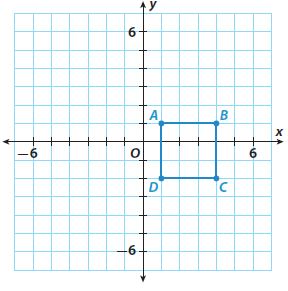
The square is dilated under the dilation (x, y) → (0.25x, 0.25y).
Go Math Grade 8 Answer Key Chapter 10 Transformations and Similarity Mixed Review img 17
a. Graph the image. What are the coordinates?
Type below:
_____________

Answer:
After dilation:
(-1, 1)
(1, 1)
(1, -1)
(-1, -1)

Question 6.
b. What is the length of a side of the image?
______ units

Answer:
2 units

Explanation:
The length is 2 units

Question 6.
c. What are the perimeter and area of the preimage?
Perimeter = ________ units
Area = ________ square units

Answer:
Perimeter = 32 units
Area = 64 square units

Explanation:
Perimeter = 2l + 2w = 2(8) + 2(8) = 32
area = l.w = 8 .8 = 64

Question 6.
d. What are the perimeter and area of the image?
Perimeter = ________ units
Area = ________ square units

Answer:
Perimeter = 8 units
Area = 4 square units

Explanation:
Perimeter = 2l + 2w = 2(2) + 2(2) = 8
area = l.w = 2 . 2 = 4

Conclusion:

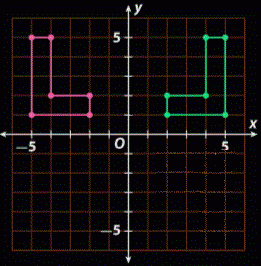
Go Math Grade 8 Answer Key Chapter 10 Transformations and Similarity Online PDF to help the students to practice maths. All the explanations are given by the best online maths experts. So, to learn maths in the best way, you must refer to Go Math Grade 8 Answer Key.

Go Math Grade 8 Answer Key Chapter 10 Transformations and Similarity Read More »

go-math-grade-8-answer-key-chapter-8-solving-systems-of-linear-equations

Go Math Grade 8 Answer Key Chapter 8 Solving Systems of Linear Equations

Go Math Grade 8 Answer Key Chapter 8 Solving Systems of Linear Equations for the best practice of maths. All the answers and explanations are explained by the best maths experts. All the students can quickly open our website and start practicing now. If you don’t have an internet connection, then download the free pdf of Go Math Grade 8 Chapter 8 Solving Systems of Linear Equations Answer Key and start practicing offline. There is no payment required to get Go Math Grade 8 Answer Key.

Go Math Grade 8 Chapter 8 Solving Systems of Linear Equations Answer Key

Sometimes it’s really a difficult task to choose the best maths to answer key to know the correct answers. A trustable guide will help you to learn perfectly and to improve your math skills. One of such best online guide is Go Math Grade 8 Answer Key Chapter 8 Solving Systems of Linear Equations. Refer to Go Math Grade 8 Solution Key to learning the easy way of maths practice.

Lesson 1: Solving Systems of Linear Equations by Graphing

Lesson 2: Solving Systems by Substitution

Lesson 3: Solving Systems by Elimination

Lesson 4: Solving Systems by Elimination with Multiplication

Lesson 5: Solving Solving Special Systems

Model Quiz

Review

Guided Practice – Solving Systems of Linear Equations by Graphing – Page No. 232

Solve each system by graphing.

Question 1.
\(\left\{\begin{array}{l}y=3 x-4 \\y=x+2\end{array}\right.\)
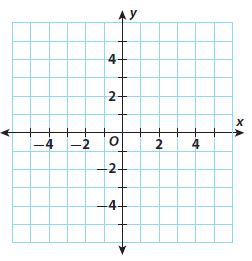
Go Math Grade 8 Answer Key Chapter 8 Solving Systems of Linear Equations Lesson1: Solving Systems of Linear Equations by Graphing img 1
Type below:
______________

Answer:
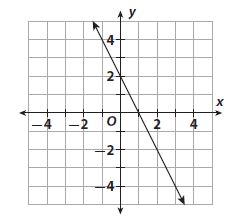
grade 8 chapter 8 image 1

Explanation:
y = 3x – 4
y = x + 2
The solution of thr linear system of equations is the intersection point of the two equations.
(3, 5) is the solution of the system of equations.
If x = 3, y = 3(3) – 4 = 9 – 4 = 5; y = 3 + 2 = 5
5 = 5; True

Question 2.
\(\left\{\begin{array}{l}x-3 y=2 \\-3x+9y=-6\end{array}\right.\)
Go Math Grade 8 Answer Key Chapter 8 Solving Systems of Linear Equations Lesson1: Solving Systems of Linear Equations by Graphing img 2
Type below:
______________

Answer:
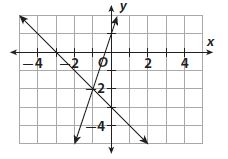
grade 8 chapter 8 image 2
Infinitely many solutions

Explanation:
x – 3y = 2
-3x + 9y = -6
x – 3y – x = -x + 2
-3y = -x + 2
y = 1/3 . x – 2/3
-3x + 9y + 3x = 3x – 6
9y = 3x – 6
y = 3/9 . x – 6/9
y = 1/3 . x – 2/3
The solution of the linear system of equations is the intersection of the two equations.
Infinitely many solutions

Lesson 8.1 Solve Systems of Equations Algebraically Answer Key Question 3.
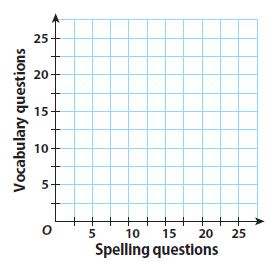
Mrs. Morales wrote a test with 15 questions covering spelling and vocabulary. Spelling questions (x) are worth 5 points and vocabulary questions (y) are worth 10 points. The maximum number of points possible on the test is 100.
a. Write an equation in slope-intercept form to represent the number of questions on the test.
Go Math Grade 8 Answer Key Chapter 8 Solving Systems of Linear Equations Lesson1: Solving Systems of Linear Equations by Graphing img 3
Type below:
______________

Answer:
y = -x + 15

Explanation:
Mrs. Morales wrote a test with 15 questions covering spelling and vocabulary. Spelling questions (x) are worth 5 points and vocabulary questions (y) are worth 10 points.
x + y = 15
x + y – x = -x + 15
y = -x + 15

Question 3.
b. Write an equation in slope-intercept form to represent the total number of points on the test.
Type below:
______________

Answer:
y = -1/2 . x + 10

Explanation:
The total number of points on the test is 100
5x + 10y = 100
5x + 10y – 5x = -5x + 100
10y = -5x + 100
y = -5/10 . x + 100/10
y = -1/2 . x + 10

Question 3.
c. Graph the solutions of both equations.
Type below:
______________

Answer:
grade 8 chapter 8 image 3

Question 3.
d. Use your graph to tell how many of each question type are on the test.
_________ spelling questions
_________ vocabulary questions

Answer:
10 spelling questions
5 vocabulary questions

ESSENTIAL QUESTION CHECK-IN

Question 4.
When you graph a system of linear equations, why does the intersection of the two lines represent the solution of the system?
Type below:
______________

Answer:
Solving a system of linear equations means finding the solutions that satisfy all the equations of that system. When we graph a system of linear equations, the intersection point lies on the line of each equation, which means that satisfies all the equations. Therefore, it is considered to be the solution to that system.

Solving Systems of Linear Equations by Graphing – Page No. 233

Question 5.
Vocabulary
A_________________ is a set of equations that have the same variables.
______________

Answer:
system of equations

Explanation:
A system of equations is a set of equations that have the same variables.

Lesson 8.1 Solving Systems of Linear Equations by Graphing Question 6.
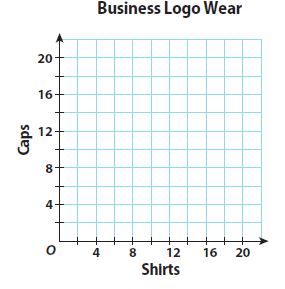
Eight friends started a business. They will wear either a baseball cap or a shirt imprinted with their logo while working. They want to spend exactly $36 on the shirts and caps. The shirts cost $6 each and the caps cost $3 each.
a. Write a system of equations to describe the situation. Let x represent the number of shirts and let y represent the number of caps.
______________

Answer:
6x + 3y = 36

Explanation:
The sum of caps and shirts is 8. The total cost of caps and shirts is $36.
x + y = 8
6x + 3y = 36

Question 6.
b. Graph the system. What is the solution and what does it represent?
Go Math Grade 8 Answer Key Chapter 8 Solving Systems of Linear Equations Lesson1: Solving Systems of Linear Equations by Graphing img 4
Type below:
______________

Answer:
The solution is (4, 4)
grade 8 chapter 8 image 4

Explanation:
x + y – x = -x + 8
y = -x + 8
6x + 3y – 6x = -6x + 36
3y = -6x + 36
y = -6/2 . x + 36/3
y = -2x + 12
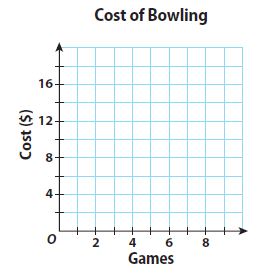
(4, 4). They should order 4 shirts and 4 caps.

Question 7.
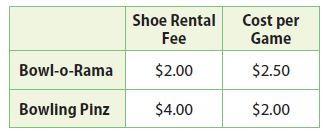
Multistep The table shows the cost of bowling at two bowling alleys.
Go Math Grade 8 Answer Key Chapter 8 Solving Systems of Linear Equations Lesson1: Solving Systems of Linear Equations by Graphing img 5
a. Write a system of equations, with one equation describing the cost to bowl at Bowl-o-Rama and the other describing the cost to bowl at Bowling Pinz. For each equation, let x represent the number of games played and let y represent the total cost.
Type below:
______________

Answer:
y = 2.5x + 2
y = 2x + 4

Explanation:
Cost at Bowl-o-Rama => y = 2.5x + 2
Cost at Bowling Pinz => y = 2x + 4

Question 7.
b. Graph the system. What is the solution and what does it represent?
Go Math Grade 8 Answer Key Chapter 8 Solving Systems of Linear Equations Lesson1: Solving Systems of Linear Equations by Graphing img 6
Type below:
______________

Answer:
grade 8 chapter 8 image 5

Explanation:
The solution of the linear system of equations is the intersection of the two equations.
(4, 12)
When 4 games are played, the total cost is $12.

Solving Systems of Linear Equations by Graphing – Page No. 234

Question 8.
Multi-Step Jeremy runs 7 miles per week and increases his distance by 1 mile each week. Tony runs 3 miles per week and increases his distance by 2 miles each week. In how many weeks will Jeremy and Tony be running the same distance? What will that distance be?
Type below:
______________

Answer:
After 4 weeks Jeremy and Tony will be running the same distance and that distance would be 11 miles.

Explanation:
Multi-Step Jeremy runs 7 miles per week and increases his distance by 1 mile each week.
y = x + 7
Tony runs 3 miles per week and increases his distance by 2 miles each week.
y = 2x + 3
grade 8 chapter 8 image 6
The solution of the system of linear equation is (4, 11) which means that after 4 weeks Jeremy and Tony will be running the same distance and that distance would be 11 miles.

Lesson 1 Solve Systems of Equations Algebraically Answers Question 9.
Critical Thinking Write a real-world situation that could be represented by the system of equations shown below.
\(\left\{\begin{array}{l}y=4 x+10 \\y=3x+15\end{array}\right.\)
Type below:
______________

Answer:
The entry fee of the first gym is $10 and for every hour that you spend there, you pay an extra $4. If we denote with x the number of hours that somebody spends at the gym and with y the total cost is
y = 4x + 10
The entry fee of the second gym is $15 and for every hour that you spend there, you pay an extra $3. If we denote with x the number of hours that somebody spends at the gym and with y the total cost is
y = 3x + 15
y = 4x + 10
y = 3x + 15

FOCUS ON HIGHER ORDER THINKING

Question 10.
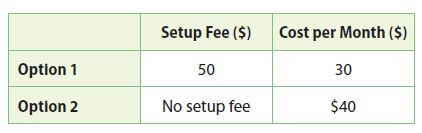
Multistep The table shows two options provided by a high-speed Internet provider.
Go Math Grade 8 Answer Key Chapter 8 Solving Systems of Linear Equations Lesson1: Solving Systems of Linear Equations by Graphing img 7
a. In how many months will the total cost of both options be the same? What will that cost be?
________ months
$ ________

Answer:
5 months
$ 200

Explanation:
Let y be the total cost after x month
y = 30x + 50
Let y be the total cost after x month
y = 40x
Substitute y = 40x in y = 30x + 50
40x = 30x + 50
40x – 30x = 50
10x = 50
x = 50/10
x = 5
The total cost of both options will be the same after 5 months. Total cost would be y = 40(5) = $200.

Question 10.
b. If you plan to cancel your Internet service after 9 months, which is the cheaper option? Explain.
______________

Answer:
When x = 9 months
y = 30(9) + 50 = $320
y = 40(9) = $360
$320 < $360
Option 1 is cheaper as the total cost is less for option 1

Lesson 1 Solve Systems of Equations by Graphing Question 11.
Draw Conclusions How many solutions does the system formed by x − y = 3 and ay − ax + 3a = 0 have for a nonzero number a? Explain.
Type below:
______________

Answer:
x – y = 3
ay – ax + 3a =0
ay – ax + 3a – 3a = 0 – 3a
ay – ax = – 3a
a(y – x) = -3a
y – x = -3
x – y = 3
Both equations are the same. The system of linear equations has infinitely many solutions.

Guided Practice – Solving Systems by Substitution – Page No. 240

Solve each system of linear equations by substitution.

Question 1.
\(\left\{\begin{array}{l}3x-2y=9 \\y=2x-7\end{array}\right.\)
x = ________
y = ________

Answer:
x = 5
y = 3

Explanation:
\(\left\{\begin{array}{l}3x-2y=9 \\y=2x-7\end{array}\right.\)
Substitute 2x – 7 in 3x – 2y = 9
3x – 2(2x – 7) = 9
3x – 4x + 14 = 9
-x + 14 = 9
-x + 14 – 14 = 9 – 14
-x = -5
x = -5/-1 = 5
y = 2(5) – 7 = 3
Solution is (5, 3)

Question 2.
\(\left\{\begin{array}{l}y=x-4 \\2x+y=5\end{array}\right.\)
x = ________
y = ________

Answer:
x = 3
y = -1

Explanation:
\(\left\{\begin{array}{l}y=x-4 \\2x+y=5\end{array}\right.\)
2x + x – 4 = 5
3x – 4 = 5
3x – 4 + 4 = 5 + 4
3x = 9
x = 9/3 = 3
y = 3 – 4 = -1
The solution is (3, -1)

8.2 Solving Systems by Substitution Answer Key Question 3.
\(\left\{\begin{array}{l}x+4y=6 \\y=-x+3\end{array}\right.\)
x = ________
y = ________

Answer:
x = 2
y = 1

Explanation:
\(\left\{\begin{array}{l}x+4y=6 \\y=-x+3\end{array}\right.\)
Substitute y = -x + 3 in x + 4y = 6
x + 4(-x + 3) = 6
x – 4x + 12 = 6
-3x + 12 = 6
-3x + 12 – 12 = 6 – 12
-3x = -6
x = -6/-3 = 2
y = -2 + 3 = 1
The solution is (2, 1)

Question 4.
\(\left\{\begin{array}{l}x+2y=6 \\x-y=3\end{array}\right.\)
x = ________
y = ________

Answer:
x = 4
y = 1

Explanation:
\(\left\{\begin{array}{l}x+2y=6 \\x-y=3\end{array}\right.\)
y = x – 3
Substitute y = x – 3 in x + 2y = 6
x + 2(x – 3) = 6
x + 2x – 6 = 6
3x = 12
x = 12/3
x = 4
4 – y = 3
-y = 3 – 4
-y = -1
y = 1
The solution is (4, 1)

Solve each system. Estimate the solution first.

Question 5.
\(\left\{\begin{array}{l}6x+y=4 \\x-4y=19\end{array}\right.\)
Estimate ______________
Solution ______________
Type below:
______________

Answer:
Estimate (2, -5)
Solution (1.4, -4.4)

Explanation:
\(\left\{\begin{array}{l}6x+y=4 \\x-4y=19\end{array}\right.\)
Let’s find the estimation by graphing the equations
Estimate: (2, -5)
grade 8 chapter 8 image 7
x = 4y + 19
6(4y + 19) + y = 4
24y + 114 + y = 4
25y + 114 = 4
25y = 4 – 114
25y = -110
y = -110/25
y = -4.4
x + 4(-4.4) = 19
x + 17.6 = 19
x = 19 – 17.6
x = 1.4
The solution is (1.4, -4.4)

8.2 Solving Systems by Substitution Question 6.
\(\left\{\begin{array}{l}x+2y=8 \\3x+2y=6\end{array}\right.\)
Estimate ______________
Solution ______________
Type below:
______________

Answer:
Estimate (-1, 5)
Solution (-1, 4.5)

Explanation:
\(\left\{\begin{array}{l}x+2y=8 \\3x+2y=6\end{array}\right.\)
Let’s find the estimation by graphing the equations
Estimate: (-1, 5)
grade 8 chapter 8 image 8
x = -2y + 8
Substitute the equation x = -2y + 8 in 3x + 2y = 6
3(-2y + 8) + 2y = 6
-6y + 24 + 2y = 6
-4y = 6 – 24
-4y = -18
y = -18/-4
y = 4.5
x + 2(4.5) = 8
x + 9 = 8
x = 8 – 9
x = -1
The solution is (-1, 4.5)

Question 7.
\(\left\{\begin{array}{l}3x+y=4 \\5x-y=22\end{array}\right.\)
Estimate ______________
Solution ______________
Type below:
______________

Answer:
Estimate (3, -6)
Solution (3.25, -5.75)

Explanation:
\(\left\{\begin{array}{l}3x+y=4 \\5x-y=22\end{array}\right.\)
Find the Estimation using graphing the equations.
Estimate: (3, -6)
grade 8 chapter 8 image 9
y = -3x + 4
Substitute y = -3x + 4 in 5x – y = 22
5x – (-3x + 4) = 22
5x + 3x -4 = 22
8x = 26
x = 26/8
x = 3.25
3(3.25) + y = 4
9.75 + y = 4
y = 4 – 9.75
y = -5.75
The solution is (3.25, -5.75)

Question 8.
\(\left\{\begin{array}{l}2x+7y=2 \\x+y=-1\end{array}\right.\)
Estimate ______________
Solution ______________
Type below:
______________

Answer:
Estimate (-2, 1)
Solution (-1.8, 0.8)

Explanation:
\(\left\{\begin{array}{l}2x+7y=2 \\x+y=-1\end{array}\right.\)
Find the Estimation using graphing the equations.
Estimate: (-2, 1)
grade 8 chapter 8 image 10
y = -x -1
Substitute y = -x – 1 in 2x + 7y = 2
2x + 7(-x – 1) = 2
2x – 7x -7 = 2
-5x = 2 + 7
-5x = 9
x = -9/5
x = -1.8
-1.8 + y = -1
y = -1 + 1.8
y = 0.8
The solution is (-1.8, 0.8)

Question 9.
Adult tickets to Space City amusement park cost x dollars. Children’s tickets cost y dollars. The Henson family bought 3 adult and 1 child tickets for $163. The Garcia family bought 2 adult and 3 child tickets for $174.
a. Write equations to represent the Hensons’ cost and the Garcias’ cost.
Hensons’ cost: ________________
Garcias’ cost:__________________
Type below:
______________

Answer:
Hensons’ cost: 3x + y = 163
Garcias’ cost: 2x + 3y = 174

Explanation:
Henson’s cost
3x + y = 163
Garcia’s cost
2x + 3y = 174

Question 9.
b. Solve the system.
adult ticket price: $ _________
Garcias’ cost: $ _________

Answer:
adult ticket price: $ 45
Garcias’ cost: $ 28

Explanation:
y = -3x + 163
Substitute y = -3x + 163 in 2x + 3y = 174
2x + 3(-3x + 163) = 174
2x -9x + 489 = 174
-7x = -315
x = -315/-7 = 45
3(45) + y = 163
135 + y = 163
y = 163 – 135
y = 28
Adult ticket price: $ 45
Garcias’ cost: $ 28

ESSENTIAL QUESTION CHECK-IN

Question 10.
How can you decide which variable to solve for first when you are solving a linear system by substitution?
Type below:
______________

Answer:
The variable with the unit coefficient should be solved first when solving a linear system by substitution.

8.2 Independent Practice – Solving Systems by Substitution – Page No. 241

Question 11.
Check for Reasonableness Zach solves the system
\(\left\{\begin{array}{l}x+y=-3 \\x-y=1\end{array}\right.\)
and finds the solution (1, -2). Use a graph to explain whether Zach’s solution is reasonable.
Go Math Grade 8 Answer Key Chapter 8 Solving Systems of Linear Equations Lesson 2: Solving Systems by Substitution img 8
Type below:
______________

Answer:
grade 8 chapter 8 image 11

Explanation:
\(\left\{\begin{array}{l}x+y=-3 \\x-y=1\end{array}\right.\)
The x coordinate of the solution is negative, hence Zach’s solution is not reasonable.

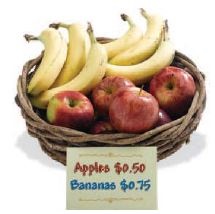
Represent Real-World Problems Angelo bought apples and bananas at the fruit stand. He bought 20 pieces of fruit and spent $11.50. Apples cost $0.50 and bananas cost $0.75 each.
a. Write a system of equations to model the problem. (Hint: One equation will represent the number of pieces of fruit. A second equation will represent the money spent on the fruit.)
Go Math Grade 8 Answer Key Chapter 8 Solving Systems of Linear Equations Lesson 2: Solving Systems by Substitution img 9
Type below:
______________

Answer:
x + y = 20
0.5x + 0.75y = 11.5

Explanation:
x + y = 20
0.5x + 0.75y = 11.5
where c is the number of Apples and y is the number of Bananas.

Question 12.
b. Solve the system algebraically. Tell how many apples and bananas Angelo bought.
________ apples
________ bananas

Answer:
14 apples
6 bananas

Explanation:
y = -x + 20
Substitute y = -x + 20 in 0.5x + 0.75y = 11.5
0.5x + 0.75(-x + 20) = 11.5
0.5x – 0.75x + 15 = 11.5
-0.25x + 15 = 11.5
-0.25x = 11.5 – 15
-0.25x = -3.5
x = -3.5/-0.25
x = 14
14 + y = 20
y = 6
Angelo bought 14 apples and 6 bananas.

Solving Systems by Substitution Lesson 8.2 Answer Key Question 13.
Represent Real-World Problems A jar contains n nickels and d dimes. There is a total of 200 coins in the jar. The value of the coins is $14.00. How many nickels and how many dimes are in the jar?
________ nickels
________ dimes

Answer:
120 nickels
80 dimes

Explanation:
A jar contains n nickels and d dimes. There is a total of 200 coins in the jar. The value of the coins is $14.00.
$14 = 1400 cents
n + d = 200
5n + 10d = 1400
d = -n + 200
5n + 10(-n + 200) = 1400
5n – 10n + 2000 = 1400
-5n = -600
n = -600/-5
n = 120
120 + d = 200
d = 200 – 120
d = 80
There are 120 nickles and 80 dimes in the jar.

Question 14.
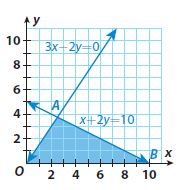
Multistep The graph shows a triangle formed by the x-axis, the line 3x−2y=0, and the line x+2y=10. Follow these steps to find the area of the triangle.
a. Find the coordinates of point A by solving the system
\(\left\{\begin{array}{l}3x-2y=0 \\x-2y=10\end{array}\right.\)
Point A: ____________________
Go Math Grade 8 Answer Key Chapter 8 Solving Systems of Linear Equations Lesson 2: Solving Systems by Substitution img 10
Type below:
______________

Answer:
Point A: (2.5, 3.75)Coordinate of A is (2.5, 3.75)

Explanation:
\(\left\{\begin{array}{l}3x-2y=0 \\x-2y=10\end{array}\right.\)
x = -2y + 10
Substitute x = -2y + 10 in 3x – 2y = 0
3(-2y + 10) -2y = 0
-6y + 30 – 2y = 0
-8y = -30
y = -30/-8 = 3.75
x + 2(3.75) = 10
x + 7.5 = 10
x = 10 – 7.5
x = 2.5
Coordinate of A is (2.5, 3.75)

Question 14.
b. Use the coordinates of point A to find the height of the triangle.
height:__________________
height: \(\frac{□}{□}\) units

Answer:
height: 3.75
height: \(\frac{15}{4}\) units

Explanation:
The height of the triangle is the y coordinate of A
Height = 3.75

Question 14.
c. What is the length of the base of the triangle?
base:________________
base: ______ units

Answer:
base: 10 units

Explanation:
Length of the base = 10

Question 14.
d. What is the area of the triangle?
A = ______ \(\frac{□}{□}\) square units

Answer:
A = 18.75 square units
A = 18 \(\frac{3}{4}\) square units

Explanation:
Area of the triangle = 1/2 . Height . Base
Area = 1/2 . 3.75 . 10 = 18.75

Solving Systems by Substitution – Page No. 242

Question 15.
Jed is graphing the design for a kite on a coordinate grid. The four vertices of the kite are at A(−\(\frac{4}{3}\), \(\frac{2}{3}\)), B(\(\frac{14}{3}\), −\(\frac{4}{3}\)), C(\(\frac{14}{3}\), −\(\frac{16}{3}\)), and D(\(\frac{2}{3}\), −\(\frac{16}{3}\)). One kite strut will connect points A and C. The other will connect points B and D. Find the point where the struts cross.
Go Math Grade 8 Answer Key Chapter 8 Solving Systems of Linear Equations Lesson 2: Solving Systems by Substitution img 11
Type below:
______________

Answer:
The struts cross as (8/3, 10/3)

Explanation:
1. From AC
Slope = (y2 – y1)/(x2 – x1) = [(-16/3)-(2/3)] ÷ [(14/3) – (-4/3)] = (-18/3) ÷ (18/3) = -1
y = mx + b
2/3 = -1(-4/3) + b
2/3 = 4/3 + b
1. From BD
Slope = (y2 – y1)/(x2 – x1) = [(-16/3)-(-4/3)] ÷ [(2/3) – (144/3)] = (-12/3) ÷ (-12/3) = 1
y = mx + b
-4/3 = 1(14/3) + b
-4/3 = 14/3 + b
-18/3 = b
-6 = b
y = mx + b
y = x -6
3. y = -x -2/3
y = x – 6
4. y = -x – 2/3
x – 6 = -x – 2/3
x = -x – 2/3 + 6
x = – x + 16/3
2x = 16/3
x = 16/6
x = 8/3
then y = x – 6
y = 8/3 – 18/3
y = -10/3
The struts cross as (8/3, 10/3)

FOCUS ON HIGHER ORDER THINKING

Question 16.
Analyze Relationships Consider the system
\(\left\{\begin{array}{l}6x-3y=15 \\x+3y=-8\end{array}\right.\)
Describe three different substitution methods that can be used to solve this system. Then solve the system.
Type below:
______________

Answer:
(1, -3) is the answer.

Explanation:
As there are three different substitution methods, we can write
Solve for y in the first equation, then substitute that value into the second equation.
Solve for x in the second equation, then substitute that value into the first equation.
Solve either equation for 3y, then substitute that value into the other equation.
From the Second method,
x + 3y = -8
x = -3y – 8
6x – 3y = 15
6 (-3y – 8) -3y = 15
-18y – 48 -3y = 15
-21y – 48 = 15
-21y = 63
y = -3
x + 3y = -8
x + 3(-3) = -8
x – 9 = -8
x = 1
(1, -3) is the answer.

Question 17.
Communicate Mathematical Ideas Explain the advantages, if any, that solving a system of linear equations by substitution has over solving the same system by graphing.
Type below:
______________

Answer:
The advantage of solving a system of linear equations by graphing is that it is relatively easy to do and requires very little algebra.

Question 18.
Persevere in Problem Solving Create a system of equations of the form
\(\left\{\begin{array}{l}Ax+By=C \\Dx+Ey=F\end{array}\right.\)
that has (7, −2) as its solution. Explain how you found the system.
Type below:
______________

Answer:
x + y = 5
x – y = 9
solves in :
x = (5+9)/2 = 7
y = 5-9)/2 = -2
A=1, B=2, C= 5
D=1, E= -1, F=9
x = 7
y = -2
IS a system (even if it is a trivial one) of equations so this answer would be acceptable.
The target for a system is to find it SOLUTION SET and not to conclude with x=a and y=b

Guided Practice – Solving Systems by Elimination – Page No. 248

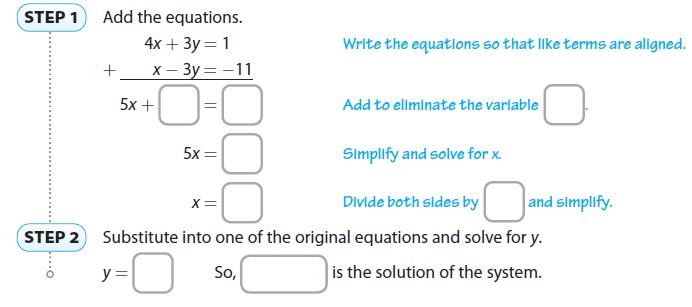
Question 1.
Solve the system
\(\left\{\begin{array}{l}4x+3y=1 \\x-3y=-11\end{array}\right.\)
by adding.
Go Math Grade 8 Answer Key Chapter 8 Solving Systems of Linear Equations Lesson 3: Solving Systems by Elimination img 12
Type below:
______________

Answer:
4x + 3y = 1
x – 3y = -11
Add the above two equations
4x + 3y = 1
+(x – 3y = -11)
Add to eliminate the variable y
5x + 0y = -10
Simplify and solve for x
5x = -10
Divide both sided by 5
x = -10/5 = -2
Substitute into one of the original equations and solve for y.
4(-2) + 3y = 1
-8 + 3y = 1
3y = 9
y = 9/3 = 3
So, (-2, 3) is the solution of the system.

Solve each system of equations by adding or subtracting.

Question 2.
\(\left\{\begin{array}{l}x+2y=-2 \\-3x+2y=-10\end{array}\right.\)
x = ________
y = ________

Answer:
x = 2
y = -2

Explanation:
\(\left\{\begin{array}{l}x+2y=-2 \\-3x+2y=-10\end{array}\right.\)
Subtract the equations
x + 2y = -2
-(-3x + 2y = -10)
y is eliminated as it has reversed coefficients. Solve for x
x + 2y + 3x – 2y = -2 + 10
4x = 8
x = 8/4 = 2
Substituting x in either of the equations to find y
2 + 2y = -2
2 + 2y -2 = -2 -2
2y = -4
y = -4/2 = -2
(2, -2) is the answer.

Lesson 3 Solve Systems of Equations Algebraically Answer Key Question 3.
\(\left\{\begin{array}{l}3x+y=23 \\3x-2y=8\end{array}\right.\)
(________ , ________)

Answer:
(6, 5)

Explanation:
\(\left\{\begin{array}{l}3x+y=23 \\3x-2y=8\end{array}\right.\)
Subtract the equations
3x + y = 23
-(3x – 2y = 8)
x is eliminated as it has reversed coefficients. Solve for y
3x + y – 3x + 2y = 23 – 8
3y = 15
y = 15/3 = 5
Substituting y in either of the equations to find x
3x + 5 = 23
3x + 5 – 5 = 23 – 5
3x = 18
x = 18/3 = 6
Solution is (6, 5)

Question 4.
\(\left\{\begin{array}{l}-4x-5y=7 \\3x+5y=-14\end{array}\right.\)
(________ , ________)

Answer:
(7, -7)

Explanation:
\(\left\{\begin{array}{l}-4x-5y=7 \\3x+5y=-14\end{array}\right.\)
Add the equations
-4x – 5y = 7
+(3x + 5y = -14)
y is eliminated as it has reversed coefficients. Solve for x
-4x -5y +3x + 5y = 7 -14
-x = -7
x = -7/-1 = 7
Substituting x in either of the equations to find y
3(7) + 5y = -14
21 + 5y -21 = -14 -21
5y = -35
y = -35/5 = -7
The answer is (7, -7)

Question 5.
\(\left\{\begin{array}{l}x-2y=-19 \\5x+2y=1\end{array}\right.\)
(________ , ________)

Answer:
(-3, 8)

Explanation:
\(\left\{\begin{array}{l}x-2y=-19 \\5x+2y=1\end{array}\right.\)
Add the equations
x – 2y = -19
+(5x + 2y = 1)
y is eliminated as it has reversed coefficients. Solve for x
x – 2y + 5x + 2y = -19 + 1
6x = -18
x = -18/6 = -3
Substituting x in either of the equations to find y
-3 -2y = -19
-3 -2y + 3 = -19 + 3
-2y = -16
y = -16/-2 = 8
The answer is (-3, 8)

Question 6.
\(\left\{\begin{array}{l}3x+4y=18 \\-2x+4y=8\end{array}\right.\)
(________ , ________)

Answer:
(2, 3)

Explanation:
\(\left\{\begin{array}{l}3x+4y=18 \\-2x+4y=8\end{array}\right.\)
Subtract the equations
3x + 4y = 18
-(-2x + 4y = 8)
y is eliminated as it has reversed coefficients. Solve for x
3x + 4y + 2x – 4y = 18 – 8
5x = 10
x = 10/5 = 2
Substituting x in either of the equations to find y
3(2) + 4y = 18
6 + 4y – 6 = 18 – 6
4y = 12
y = 12/4 =3
Solution is (2, 3)

Question 7.
\(\left\{\begin{array}{l}-5x+7y=11 \\-5x+3y=19\end{array}\right.\)
(________ , ________)

Answer:
(-5, -2)

Explanation:
\(\left\{\begin{array}{l}-5x+7y=11 \\-5x+3y=19\end{array}\right.\)
Subtract the equations
-5x + 7y = 11
-(-5x + 3y = 19)
x is eliminated as it has reversed coefficients. Solve for y
-5x + 7y + 5x – 3y = 11 – 19
4y = -8
y = -8/4 = -2
Substituting y in either of the equations to find x
-5x + 7(-2) = 11
-5x -14 + 14 = 11 + 14
-5x = 25
x = 25/-5 = -5
The solution is (-5, -2)

Question 8.
The Green River Freeway has a minimum and a maximum speed limit. Tony drove for 2 hours at the minimum speed limit and 3.5 hours at the maximum limit, a distance of 355 miles. Rae drove 2 hours at the minimum speed limit and 3 hours at the maximum limit, a distance of 320 miles. What are the two-speed limits?
a. Write equations to represent Tony’s distance and Rae’s distance.
Type below:
______________

Answer:
Tony’s distance: 2x + 3.5y = 355
Rae’s distance: 2x + 3y = 320
where x is the minimum speed and y is the maximum speed.

Question 8.
b. Solve the system.
minimum speed limit:______________
maximum speed limit______________
minimum speed limit: ________ mi/h
maximum speed limit: ________ mi/h

Answer:
minimum speed limit:55
maximum speed limit70
minimum speed limit: 55mi/h
Maximum speed limit: 70mi/h

Explanation:
Subtract the equations
2x + 3.5y = 355
-(2x + 3y = 320)
x is eliminated as it has reversed coefficients. Solve for y
2x + 3.5y – 2x – 3y = 355 – 320
0.5y = 35
y = 35/0.5 = 70
Substituting y in either of the equation to find x
2x + 3(70) = 320
2x + 210 – 210 = 320 – 210
2x = 110
x = 110/2 = 55
Minimum speed limit: 55 miles per hour
Maximum speed limit: 70 miles per hour

ESSENTIAL QUESTION CHECK-IN

Question 9.
Can you use addition or subtraction to solve any system? Explain.
________

Answer:
No. One of the variables should have the same coefficient in order to add or subtract the system.

8.3 Independent Practice – Solving Systems by Elimination – Page No. 249

Question 10.
Represent Real-World Problems Marta bought new fish for her home aquarium. She bought 3 guppies and 2 platies for a total of $13.95. Hank also bought guppies and platies for his aquarium. He bought 3 guppies and 4 platies for a total of $18.33. Find the price of a guppy and the price of a platy.
Go Math Grade 8 Answer Key Chapter 8 Solving Systems of Linear Equations Lesson 3: Solving Systems by Elimination img 13
Guppy: $ ________
Platy: $ ________

Answer:
Guppy: $ 3.19
Platy: $ 2.19

Explanation:
3x + 2y = 13.95
3x + 4y = 18.33
where x is the unit price of guppy and y is the unit price of platy
Subtract the equations
3x + 2y = 13.95
-(3x + 4y = 18.33)
x is eliminated as it has reversed coefficients. Solve for y
3x + 2y – 3x – 4y = 13.95 – 18.33
-2y = -4.38
y = -4.38/-2 = 2.19
Substituting y in either of the equations to find x
3x + 2(2.19) = 13.95
3x + 4.38 – 4.38 = 13.95 – 4.38
3x = 9.57
x = 9.57/3 = 3.19
The price of a guppy is $3.19 and the price of platy is $2.19

Practice 8.3 Systems of Equations (Elimination) Answers Question 11.
Represent Real-World Problems The rule for the number of fish in a home aquarium is 1 gallon of water for each inch of fish length. Marta’s aquarium holds 13 gallons and Hank’s aquarium holds 17 gallons. Based on the number of fish they bought in Exercise 10, how long is a guppy and how long is a platy?
Length of a guppy = ________ inches
Length of a platy = ________ inches

Answer:
Length of a guppy = 3 inches
Length of a platy = 2 inches

Explanation:
3x + 2y = 13
3x + 4y = 17
where x is the length of guppy and y is the length of a platy
Subtract the equations
3x + 2y = 13
-(3x + 4y = 17)
x is eliminated as it has reversed coefficients. Solve for y
3x + 2y – 3x – 4y = 13 – 17
-2y = -4
y = -4/-2 = 2
Substituting y in either of the equation to find x
3x + 2(2) = 13
3x + 4 – 4 = 13 – 4
3x = 9
x = 9/3 = 3
The length of a guppy is 3 inches and price of a platy is 2 inches

Question 12.
Line m passes through the points (6, 1) and (2, -3). Line n passes through the points (2, 3) and (5, -6). Find the point of intersection of these lines.
Type below:
________________

Answer:
The intersection of these lines is (3.5, -1.5)

Explanation:
Find the slope of line m = (y2 – y1)/(x2 – x1) where (x2, y2) = (2, -3) and (x1, y1) = (6, 1)
Slope = (-3 -1)/(2 – 6) = -4/-4 = 1
Substitute the value of m and any of the given ordered pair (x, y) in the point-slope form of an equation: y – y1 = m(x – x1)
y – 1 = 1(x – 6)
y – 1 = x – 6
y = x – 6 + 1
x – y = 5
Find the slope of line n = (y2 – y1)/(x2 – x1) where (x2, y2) = (5, -6) and (x1, y1) = (2, 3)
Slope = (-6 -3)/(5 – 2) = -9/3 = -3
Substitute the value of m and any of the given ordered pair (x, y) in the point-slope form of an equation: y – y1 = m(x – x1)
y – 3 = -3(x – 2)
y – 3 = -3x + 6
y = -3x + 6 + 3
3x + y = 9
Add the equations
x – y = 5
+(3x + y = 9)
y is eliminated as it has reversed coefficients. Solve for x
x – y + 3x + y = 5 + 9
4x = 14
x = 14/4 = 3.5
Substituting x in either of the equations to find y
3.5 – y = 5
3.5 – y – 3.5 = 5 – 3.5
-y = 1.5
y = -1.5
The intersection of these lines is (3.5, -1.5)

Question 13.
Represent Real-World Problems Two cars got an oil change at the same auto shop. The shop charges customers for each quart of oil plus a flat fee for labor. The oil change for one car required 5 quarts of oil and cost $22.45. The oil change for the other car required 7 quarts of oil and cost $25.45. How much is the labor fee and how much is each quart of oil?
Labor fee: $ ________
Quart of oil: $ ________

Answer:
Labor fee: $ 14.95
Quart of oil: $ 1.5

Explanation:
5x + y = 22.45
7x + y = 25.45
where x is the unit cost of quarts of oil and y is the flat fee for labor
Subtract the equations
5x + y = 22.45
-(7x + y = 25.45)
y is eliminated as it has reversed coefficients. Solve for x
5x + y – 7x – y = 22.45 – 25.45
-2x = -3
x = -3/-2 = 1.5
Substituting x in either of the equations to find y
5(1.5) + y = 22.45
7.5 + y – 7.5 = 22.45 – 7.5
y = 14.95
Labor fee is $14.95 and the unit cost of a quart of oil is $1.5

Solving System of Equations by Elimination Worksheet Answers Question 14.
Represent Real-World Problems A sales manager noticed that the number of units sold for two T-shirt styles, style A and style B, was the same during June and July. In June, total sales were $2779 for the two styles, with A selling for $15.95 per shirt and B selling for $22.95 per shirt. In July, total sales for the two styles were $2385.10, with A selling at the same price and B selling at a discount of 22% off the June price. How many T-shirts of each style were sold in June and July combined?
________ T-shirts of style A and style B were sold in June and July.

Answer:
15.95x + 22.95y = 2779
15.95x + 17.9y = 2385.10
where x is the number of style A shirts and y is the number of style B shirts
In July, the price of style B shirt is 22% of the price of style B shirt in June, hence 0.78(22.95) = 17.90
Subtract the equations
15.95x + 22.95y = 2779
-(15.95x + 17.9y = 2385.10)
x is eliminated as it has reversed coefficients. Solve for y
15.95x + 22.95 – 15.95x – 17.9y = 2779 – 2385.10
5.05y = 393.9
y = 393.9/5.05 = 78
Substituting y in either of the equations to find x
15.95x +22.95(78) = 2779
15.95x + 1790.1 – 1790.1 = 2779 – 1790.1
15.95x = 988.9
x = 988.9/15.95 = 62
The number of style A T-shirt sold in June is 62.
Since the number of T-shirts sold in both numbers is the same, the total number = 2. 62 = 124.
The number of style B T-shirts sold in June is 78.
Since the number of T-shirts sold in both numbers is the same, the total number = 2. 78 = 156.

Question 15.
Represent Real-World Problems Adult tickets to a basketball game cost $5. Student tickets cost $1. A total of $2,874 was collected on the sale of 1,246 tickets. How many of each type of ticket were sold?
Go Math Grade 8 Answer Key Chapter 8 Solving Systems of Linear Equations Lesson 3: Solving Systems by Elimination img 14img 14
________ adult tickets
________ student tickets

Answer:
407 adult tickets
839 student tickets

Explanation:
x + y = 1246
5x + y = 2874
where x is the number of adult tickets sold and y is the number of student tickets sold.
Subtract the equations
x + y = 1246
-(5x + y = 2874)
y is eliminated as it has reversed coefficients. Solve for x
x + y – 5x – y = 1246 – 2874
-4x = -1628
x = -1628/-4 = 407
Substituting x in either of the equations to find y
407 + y = 1246
407 + y – 407 = 1246 – 407
y = 839
The number of adult tickets sold is 407 and student tickets sold is 839.

FOCUS ON HIGHER ORDER THINKING – Solving Systems by Elimination – Page No. 250

Question 16.
Communicate Mathematical Ideas Is it possible to solve the system
\(\left\{\begin{array}{l}3x-2y=10 \\x+2y=6\end{array}\right.\)
by using substitution? If so, explain how. Which method, substitution or elimination, is more efficient? Why?
________

Answer:
The system can be solved by substitution as x in equation 2 can be isolated.
3x – 2y = 10
x + 2y = 6
Solve the equation for x in the equation.
x = -2y + 6
Substitute the expression for x in the other equation and solve.
3(-2y + 6) -2y = 10
-6y + 18 – 2y = 10
-8y + 18 = 10
-8y = -8
y = -8/-8 = 1
Substitute the values of y into one of the equations and solve for the other variable x.
x + 2(1) = 6
x = 4
The solution is (4, 1)
As the coefficient if variable y is opposite, it will be eliminated and solved for x in less number of steps.
Elimination would be more efficient.

Question 17.
Jenny used substitution to solve the system
\(\left\{\begin{array}{l}2x+y=8 \\x-y=1\end{array}\right.\). Her solution is shown below.
Step 1: y = -2x + 8               Solve the first equation for y.
Step 2: 2x + (-2x + 8) = 8     Substitute the value of y in an original equation.
Step 3: 2x – 2x + 8 = 8          Use the Distributive Property.
Step 4: 8 = 8                         Simplify.
a. Explain the Error Explain the error Jenny made. Describe how to correct it.
Type below:
______________

Answer:
2x + y = 8
x – y = 1
The rewritten equation should be substituted in the other original equation
Error is that Jenny solved for y in the first equation and substituted it in the original equation.
x – (-2x + 8) = 1
3x – 8 = 1
3x = 9
x = 9/3 = 3
x = 3

Question 17.
b. Communicate Mathematical Ideas Would adding the equations have been a better method for solving the system? If so, explain why.
________

Answer:
Yes

Explanation:
As the coefficient, if variable y is the opposite, it will be eliminated and solved for x in less number of steps.

Guided Practice – Solving Systems by Elimination with Multiplication – Page No. 256

Question 1.
Solve the system
\(\left\{\begin{array}{l}3x-y=8 \\-2x+4y=-12\end{array}\right.\)
by multiplying and adding.
Go Math Grade 8 Answer Key Chapter 8 Solving Systems of Linear Equations Lesson 4: Solving Systems by Elimination with Multiplication img 15
Type below:
______________

Answer:
\(\left\{\begin{array}{l}3x-y=8 \\-2x+4y=-12\end{array}\right.\)
Multiply each term in the first equation by 4 to get opposite coefficients for the y-terms.
4(3x – y = 8)
12x – 4y = 32
Add the second equation to the new equation
12x – 4y = 32
+(-2x + 4y = -12)
Add to eliminate the variable y
10x = 20
Divide both sides by 10
x = 20/10 = 2
Substitute into one of the original equations and solve for y
y = 3(2) – 8 = -1
S0, (2, -2)is the solution of the system.

Solve each system of equations by multiplying first.

Question 2.
\(\left\{\begin{array}{l}x+4y=2 \\2x+5y=7\end{array}\right.\)
(________ , ________ )

Answer:
(6, -1)

Explanation:
x + 4y = 2
2x + 5y = 7
To eliminate x terms, multiply the 2nd equation by 2
2(x + 4y = 2)
2x + 8y = 4
Subtract the equations
2x + 8y = 4
-(2x + 5y = 7)
x is eliminated as it has reversed coefficients. Solve for y
2x + 8y – 2x – 5y = 4 – 7
3y = -3
y = -3/3 = -1
Substituting y in either of the equations to find x
x + 4(-1) = 2
x – 4 + 4 = 2 + 4
x = 6
Solution: (6, -1)

Question 3.
\(\left\{\begin{array}{l}3x+y=-1 \\2x+3y=18\end{array}\right.\)
(________ , ________ )

Answer:
(-3, 8)

Explanation:
\(\left\{\begin{array}{l}3x+y=-1 \\2x+3y=18\end{array}\right.\)
To eliminate y terms, multiply the 1st equation by 3
3(3x + y = -1)
9x + 3y = -3
Subtract the equations
9x + 3y = -3
-(2x + 3y = 18)
y is eliminated as it has reversed coefficients. Solve for x
9x + 3y – 2x – 3y = -3 -18
7x = -21
x = -21/7
x = -3
Substituting x in either of the equations to find y
3(-3) + y = -1
-9 + y + 9 = -1 + 9
y = 8
Solution: (-3, 8)

Question 4.
\(\left\{\begin{array}{l}2x+8y=21 \\6x-4y=14\end{array}\right.\)
Type below:
______________

Answer:
The solution is (3.5, 1.75)

Explanation:
\(\left\{\begin{array}{l}2x+8y=21 \\6x-4y=14\end{array}\right.\)
To eliminate y terms, multiply the 2nd equation by 2
2(6x – 4y = 14)
2x + 8y = 21
Add the equations
2x + 8y = 21
+(12x – 8y = 28)
y is eliminated it has reversed coefficients. Solve for x
2x + 8y + 12x – 8y = 21 + 28
14x = 49
x = 49/14 = 3.5
Substituting x in either of the equations to find y
6(3.5) – 4y = 14
21 – 4y – 21 = 14 – 21
-4y = -7
y = -7/-4 = 1.75
The solution is (3.5, 1.75)

Question 5.
\(\left\{\begin{array}{l}2x+y=3 \\-x+3y=-12\end{array}\right.\)
(________ , ________ )

Answer:

Explanation:
\(\left\{\begin{array}{l}2x+y=3 \\-x+3y=-12\end{array}\right.\)
To eliminate x terms, multiply the 2nd equation by 2
2(-x + 3y = -12)
-2x + 6y = -24
Add the equations
2x + y = 3
+(-2x + 6y = -24)
x is eliminated it has reversed coefficients. Solve for y
2x + y – 2x + 6y = 3 – 24
7y = -21
y = -21/7 = -3
Substituting y in either of the equations to find x
-x + 3(-3) = -12
-x -9 + 9 = -12 + 9
-x = -3
x = 3
The soultion is (3, -3)

Question 6.
\(\left\{\begin{array}{l}6x+5y=19 \\2x+3y=5\end{array}\right.\)
(________ , ________ )

Answer:
The solution is (4, -1)

Explanation:
\(\left\{\begin{array}{l}6x+5y=19 \\2x+3y=5\end{array}\right.\)
To eliminate x terms, multiply the 2nd equation by 3
3(2x + 3y = 5)
6x + 9y = 15
Subtract the equations
6x + 5y = 19
-(6x + 9y = 15)
x is eliminated it has reversed coefficients. Solve for y
6x + 5y – 6x – 9y = 19 – 15
-4y = 4
y = 4/-4 = -1
Substituting y in either of the equations to find x
2x + 3(-1) = 5
2x – 3 + 3 = 5 + 3
2x = 8
x = 8/2 = 4
The solution is (4, -1)

Question 7.
\(\left\{\begin{array}{l}2x+5y=16 \\-4x+3y=20\end{array}\right.\)
(________ , ________ )

Answer:
The solution is (-2, 4)

Explanation:
\(\left\{\begin{array}{l}2x+5y=16 \\-4x+3y=20\end{array}\right.\)
To eliminate x terms, multiply the 1st equation by 2
2(2x + 5y = 16)
4x + 10y = 32
Add the equations
4x + 10y = 32
+(-4x + 3y = 20)
x is eliminated it has reversed coefficients. Solve for y
10y + 3y = 32 + 20
13y = 52
y = 52/13 = 4
Substituting y in either of the equations to find x
2x + 5(4) = 16
2x + 20 – 20 = 16 – 20
2x = -4
x = -4/2 = -2
The solution is (-2, 4)

Question 8.
Bryce spent $5.26 on some apples priced at $0.64 each and some pears priced at $0.45 each. At another store he could have bought the same number of apples at $0.32 each and the same number of pears at $0.39 each, for a total cost of $3.62. How many apples and how many pears did Bryce buy?
a. Write equations to represent Bryce’s expenditures at each store
First store: _____________
Second store: _____________
Type below:
_____________

Answer:
First store: 0.64x + 0.45y = 5.26
Second store: 0.32x + 0.39y = 3.62

Explanation:
First store = 0.64x + 0.45y = 5.26
Second store = 0.32x + 0.39y = 3.62
where x is the number of apples and y is the number of pears.

Question 8.
b. Solve the system.
Number of apples: _______
Number of pears: _______

Answer:
Number of apples: 4
Number of pears: 6

Explanation:
First store = 0.64x + 0.45y = 5.26
Second store = 0.32x + 0.39y = 3.62
Multiply by 100
64x + 45y = 526
32x + 39y = 362
To eliminate x terms, multiply the 2nd equation by 2
2(32x + 39y = 362)
64x + 45y = 526
Subtract the equations
64x + 45y = 526
-(64x + 78y = 724)
x is eliminated it has reversed coefficients. Solve for y
64x + 45y – 64x – 78y = 526 – 724
-33y = -198
y = -198/-33 = 6
Substituting y in either of the equation to find x
32x + 39(6) = 362
32x + 234 – 234 = 362 – 234
32x = 128
x = 128/32 = 4
He bought 4 apples and 6 pears.

ESSENTIAL QUESTION CHECK-IN

Question 9.
When solving a system by multiplying and then adding or subtracting, how do you decide whether to add or subtract?
Type below:
_____________

Answer:
If the variable with the same coefficient but a reversed sign, we add and if they have the same sign, we subtract.

Solving Systems by Elimination with Multiplication – Page No. 257

Question 10.
Explain the Error Gwen used elimination with multiplication to solve the system
\(\left\{\begin{array}{l}2x+6y=3 \\x-3y=-1\end{array}\right.\)
Her work to find x is shown. Explain her error. Then solve the system.
2(x − 3y) = -1
2x − 6y = -1
+2x + 6y = 3
_____________
4x + 0y = 2
x = \(\frac{1}{2}\)
Type below:
____________

Answer:
2x + 6y = 3
x – 3y = -1
To eliminate x terms, multiply the 2nd equation by 2
2(x – 3y = -1)
2x – 6y = -2
Error is the Gnew did not multiply the entire expression with 2.
Add the equations
2x + 6y = 3
+(2x – 6y = -2)
y is eliminated it has reversed coefficients. Solve for x
2x + 6y + 2x – 6y = 3 – 2
4x = 1
x = 1/4
Substituting x in either of the equations to find y
x – 3y = -1
1/4 – 3y – 1/4 = -1 -1/4
-3y = -5/4
y = -5/4(-3) = 5/12

Question 11.
Represent Real-World Problems At Raging River Sports, polyester-fill sleeping bags sell for $79. Down-fill sleeping bags sell for $149. In one week the store sold 14 sleeping bags for $1,456.
a. Let x represent the number of polyester-fill bags sold and let y represent the number of down-fill bags sold. Write a system of equations you can solve to find the number of each type sold.
Go Math Grade 8 Answer Key Chapter 8 Solving Systems of Linear Equations Lesson 4: Solving Systems by Elimination with Multiplication img 16
Type below:
____________

Answer:
x + y = 14
79x + 149y = 1456
where x is the polyester-fill bags and y is the number of down-fill bags

Question 11.
b. Explain how you can solve the system for y by multiplying and subtracting.
Type below:
____________

Answer:
x + y = 14
79x + 149y = 1456
Multiply the second equation by 79. Subtract the new equation from the first equation and solve the resulting equation for y.

Question 11.
c. Explain how you can solve the system for y using substitution.
Type below:
____________

Answer:
Solve the second equation for x. Substitute the expression for x , in the first equation and solve the resulting equation for y.

Question 11.
d. How many of each type of bag were sold?
_______ polyester-fill
_______ down-fill

Answer:
9 polyester-fill
5 down-fill

Explanation:
x + y = 14
79x + 149y = 1456
To eliminate x terms, multiply the 2nd equation by 2
79(x + y = 14)
79x + 149y = 1456
Subtract the equations
79x + 79y = 1106
-(79x + 149y = 1456)
x is eliminated it has reversed coefficients. Solve for y
79x + 79y – 79x – 149y = 1106 – 1456
-70y = -350
y = -350/-70 = 5
Substituting y in either of the equations to find x
x + 5 = 14
x = 14 – 5
x = 9
There were 9 polyester-fill bags and 5 down-fill bags sold.

Question 12.
Twice a number plus twice a second number is 310. The difference between the numbers is 55. Find the numbers by writing and solving a system of equations. Explain how you solved the system.
x = _______
y = _______

Answer:
x = 105
y = 50

Explanation:
2x + 2y = 310
x – y = 55
To eliminate y terms, multiply the 2nd equation by 2
2(x – y = 55)
2x – 2y = 110
Add the equations
2x + 2y = 310
+ (2x – 2y = 110)
y is eliminated it has reversed coefficients. Solve for x
2x + 2y + 2x – 2y = 310 + 110
4x = 420
x = 420/4 = 105
Substituting x in either of the equations to find y
105 – y = 55
y = 105 – 55
y = 50
The solution is (105, 50)

Solving Systems by Elimination with Multiplication – Page No. 258

Question 13.
Represent Real-World Problems A farm stand sells apple pies and jars of applesauce. The table shows the number of apples needed to make a pie and a jar of applesauce. Yesterday, the farm picked 169 Granny Smith apples and 95 Red Delicious apples. How many pies and jars of applesauce can the farm make if every apple is used?
Go Math Grade 8 Answer Key Chapter 8 Solving Systems of Linear Equations Lesson 4: Solving Systems by Elimination with Multiplication img 17
_______ pies
_______ jars of applesauce

Answer:
21 pies
16 jars of applesauce

Explanation:
5x + 4y = 169
3x + 2y = 95
where x is the number of apples needed for pie and y is the number of apples for jar of applesauce
To eliminate y terms, multiply the 2nd equation by 2
2(3x + 2y = 95)
6x + 4y = 190
Subtract the equations
5x + 4y = 169
– (6x + 4y = 190)
y is eliminated it has reversed coefficients. Solve for x
5x + 4y – 6x – 4y = 169 – 190
-x = -21
x = -21/-1 = 21
Substituting x in either of the equation to find y
5(21) + 4y = 169
105 + 4y – 105 = 169 – 105
4y = 64
y = 64/4 = 16
The number of apples needed for pie is 21 and the number of apples for jar of applesauce is 16.

FOCUS ON HIGHER ORDER THINKING

Question 14.
Make a Conjecture Lena tried to solve a system of linear equations algebraically and in the process found the equation 5 = 9. Lena thought something was wrong, so she graphed the equations and found that they were parallel lines. Explain what Lena’s graph and equation could mean.
Type below:
____________

Answer:
Lena’s graph is a parallel line which means the graph does not intersect each other, hence they have no solutions. Equation 5 = 9 means variables are eliminated and this statement is not true. This linear system has no solution.

Question 15.
Consider the system
\(\left\{\begin{array}{l}2x+3y=6 \\3x+7y=-1\end{array}\right.\)
a. Communicate Mathematical Ideas Describe how to solve the system by multiplying the first equation by a constant and subtracting. Why would this method be less than ideal?
Type below:
____________

Answer:
Multiplying the first equation by a constant and subtracting
2x + 3y = 6
3x + 7y = -1
Multiply the first equation by 1.5 and subtract. This would be less than ideal because you would introduce decimals into the solution process.

Question 15.
b. Draw Conclusions Is it possible to solve the system by multiplying both equations by integer constants? If so, explain how.
Type below:
____________

Answer:
Yes

Explanation:
Multiply the first equation by 3 and the second equation by 2. Both x-term coefficients would be 6. Solve by eliminating the x-terms using subtraction.

Question 15.
c. Use your answer from part b to solve the system.
(_______ , _______)

Answer:
(9, -4)

Explanation:
2x + 3y = 6
3x + 7y = -1
Multiply the first equation by 3 and the second equation by 2.
3(2x + 3y = 6)
2(3x + 7y = -1)
Subtract the equations
6x + 9y = 18
-(6x + 14y = -2)
x is eliminated it has reversed coefficients. Solve for y
6x + 9y – 6x – 14y = 18 + 2
-5y = 20
y = 20/-5 = -4
Substituting y in either of the equation to find x
2x + 3(-4) = 6
2x = 18
x = 18/2 = 9
The solution is (9, -4)

Guided Practice – Solving Solving Special Systems – Page No. 262

Use the graph to solve each system of linear equations

Question 1.
A. \(\left\{\begin{array}{l}4x-2y=-6 \\2x-y=4\end{array}\right.\)
B. \(\left\{\begin{array}{l}4x-2y=-6 \\x+y=6\end{array}\right.\)
C. \(\left\{\begin{array}{l}2x-y=4 \\6x-3y=-12\end{array}\right.\)
STEP 1 Decide if the graphs of the equations in each system intersect, are parallel, or are the same line.
Go Math Grade 8 Answer Key Chapter 8 Solving Systems of Linear Equations Lesson 5: Solving Solving Special Systems img 18
System A: The graphs __________
System B: The graphs __________
System C: The graphs __________

Answer:
System A: The graphs are parallel
System B: The graphs are intersecting
System C: The graphs are  the same line

Explanation:
System A: 4x – 2y = -6
2x – y = 4
System B: 4x – 2y = -6
x + y = 6
System C: 2x – y = 4
6x – 3y = 12

Question 1.
STEP 2 Decide how many points the graphs have in common.
a. Intersecting lines have _______________ point(s) in common.
b. Parallel lines have _______________ point(s) in common.
c. The same lines have ___________ point(s) in common.
a. __________
b. __________
c. __________

Answer:
a. Intersecting lines have one point(s) in common.
b. Parallel lines have no point(s) in common.
c. The same lines have infinitely many points (s) in common.

Explanation:
From the graphs,
Intersecting lines have one point(s) in common
Parallel lines have no point(s) in common
The same lines have infinitely many points (s) in common

Question 1.
STEP 3 Solve each system.
System A has __________ points in common, so it has __________ solution.
System B has __________ point in common. That point is the solution, __________.
System C has __________ points in common. ________ ordered pairs on the line will make both equations true.
Type below:
___________

Answer:
System A has no points in common, so it has no solution. System B has one point in common. That point is the solution, (1,5). System C has an infinite number of points in common. All ordered pairs on the line will make both equations true.

Explanation:
Number of solutions for each system
System A has no points in common, so it has no solution. System B has one point in common. That point is the solution, (1,5). System C has an infinite number of points in common. All ordered pairs on the line will make both equations true.

Solve each system. Tell how many solutions each system has.

Question 2.
\(\left\{\begin{array}{l}x-3y=4 \\-5x+15y=-20\end{array}\right.\)
___________

Answer:
infinitely many solutions

Explanation:
x – 3y = 4
-5x + 15y = -20
To eliminate y terms, multiply the 1st equation by 5
5(x – 3y = 4)
5x – 15y = 20
Add the equations
5x – 15y = 20
+(-5x + 15y = -20)
x and y is eliminated as it has reversed coefficients.
5x – 15y – 5x + 15y = 20 – 20
0 = 0
The statement is true, hence the solution has infinitely many solutions.

Question 3.
\(\left\{\begin{array}{l}6x+2y=-4 \\3x+y=4\end{array}\right.\)
___________

Answer:
no solution

Explanation:
6x + 2y = -4
3x + y = 4
To eliminate y terms, multiply the 2nd equation by 5
2(3x + y = 4)
6x + 2y = 8
Subtract the equations
6x + 2y = -4
-(6x + 2y = 8)
x and y is eliminated as it has reversed coefficients.
6x + 2y – 6x – 2y = -4 -8
0 = -12
The statement is false, hence the solution has no solution.

Question 4.
\(\left\{\begin{array}{l}6x-2y=-10 \\3x+4y=-25\end{array}\right.\)
___________

Answer:
one solution

Explanation:
6x – 2y = -10
3x + 4y = -25
To eliminate y terms, multiply the 1st equation by 2
2(6x – 2y = -10)
12x – 4y = -20
Add the equations
12x – 4y = -20
+(3x + 4y = -25)
y is eliminated as it has reversed coefficients. Solve for x.
12x – 4y + 3x + 4y = -20 – 25
15x = -45
x = -45/15 = -3
Substitute x in any one of the original equations and solve for y
3(-3) + 4y = -25
-9 + 4y + 9 = -25 + 9
4y = -16
y = -16/4
y = -4
There is one solution, (-3, -4)

ESSENTIAL QUESTION CHECK-IN

Question 5.
When you solve a system of equations algebraically, how can you tell whether the system has zero, one, or an infinite number of solutions?
Type below:
___________

Answer:
When x and y are eliminated and the statement is true, the system has infinitely many solutions.
When x and y are eliminated and the statement is false, the system has no solutions.
When the system has one solution by solving, the system has one solution.

8.5 Independent Practice – Solving Solving Special Systems – Page No. 263

Solve each system by graphing. Check your answer algebraically.

Question 6.
\(\left\{\begin{array}{l}-2x+6y=12 \\x-3y=3\end{array}\right.\)
Go Math Grade 8 Answer Key Chapter 8 Solving Systems of Linear Equations Lesson 5: Solving Solving Special Systems img 19
Solution: ______________
___________

Answer:
\(\left\{\begin{array}{l}-2x+6y=12 \\x-3y=3\end{array}\right.\)
Graph the equations on same coordinate plane
No solution as equations are parallel
grade 8 chapter 8 image 1
To eliminate y terms, multiply the 2nd equation by 2
2(x – 3y = 3)
2x – 6y = 6
Add the equations
-2x + 6y = 12
2x – 6y = 6
x and y is eliminated as it has reversed coefficients.
-2x + 6y + 2x – 6y = 12 + 6
0 = 18
The statement is false, hence the system has no solution.

Question 7.
\(\left\{\begin{array}{l}15x+5y=5 \\3x+y=1\end{array}\right.\)
Go Math Grade 8 Answer Key Chapter 8 Solving Systems of Linear Equations Lesson 5: Solving Solving Special Systems img 20
Solution: ______________
___________

Answer:
\(\left\{\begin{array}{l}15x+5y=5 \\3x+y=1\end{array}\right.\)
Graph the equations on same coordinate plane
grade 8 chapter 8 image 2
Infinitely many solutions as equations are overlapping
To eliminate y terms, multiply the 2nd equation by 5
5(3x + y = 1)
15x + 5y = 5
Subtarct the equations
15x + 5y = 5
-(15x + 5y = 5)
x and y is eliminated as it has reversed coefficients.
15x + 5y -15x – 5y = 5 – 5
0 = 0
The statement is true, hence the system has infinitely many solutions.

For Exs. 8–14, state the number of solutions for each system of linear equations

Question 8.
a system whose graphs have the same slope but different y-intercepts
___________

Answer:
No solutions

Explanation:
Equations are parallel
No solutions

Question 9.
a system whose graphs have the same y-intercepts but different slopes
___________

Answer:
One solution

Explanation:
Equations are intersecting
One solution

Question 10.
a system whose graphs have the same y-intercepts and the same slopes
___________

Answer:
Infinitely many solutions

Explanation:
Equations are overlapping
Infinitely many solutions

Question 11.
a system whose graphs have different y-intercepts and different slopes
___________

Answer:
One solution

Explanation:
Equations are intersecting
One solution

Question 12.
the system
\(\left\{\begin{array}{l}y=2 \\y=-3\end{array}\right.\)
___________

Answer:
No solutions

Explanation:
Equations are parallel
No solutions

Question 13.
the system
\(\left\{\begin{array}{l}y=2 \\y=-3\end{array}\right.\)
___________

Answer:
One solution

Explanation:
Equations are intersecting
One solution

Question 14.
the system whose graphs were drawn using these tables of values:
Go Math Grade 8 Answer Key Chapter 8 Solving Systems of Linear Equations Lesson 5: Solving Solving Special Systems img 21
___________

Answer:
No solutions

Explanation:
Equations are parallel The slope is the same for both equations but the y-intercept is different.
No solutions

Question 15.
Draw Conclusions The graph of a linear system appears in a textbook. You can see that the lines do not intersect on the graph, but also they do not appear to be parallel. Can you conclude that the system has no solution? Explain.
___________

Answer:

No; although the lines do not intersect on the graph, they intersect at a point that is not on the graph. To prove that a system has no solution, you must do so algebraically

Solving Solving Special Systems – Page No. 264

Question 16.
Represent Real-World Problems Two school groups go to a roller skating rink. One group pays $243 for 36 admissions and 21 skate rentals. The other group pays $81 for 12 admissions and 7 skate rentals. Let x represent the cost of admission and let y represent the cost of a skate rental. Is there enough information to find values for x and y? Explain.
Go Math Grade 8 Answer Key Chapter 8 Solving Systems of Linear Equations Lesson 5: Solving Solving Special Systems img 22
___________

Answer:
36x + 21y = 243
12x + 7y = 81
where x is the cost of admission and y is the cost of stake rentals.
Although the information can be used to develop a system of linear equations, where each equation has two variables when the system is solved, the number of solutions is infinite, Mee the values of x and y cannot be determined.
No

System of Linear Equations Answer Key Question 17.
Represent Real-World Problems Juan and Tory are practicing for a track meet. They start their practice runs at the same point, but Tory starts 1 minute after Juan. Both run at a speed of 704 feet per minute. Does Tory catch up to Juan? Explain.
___________

Answer:
No; Both Juan and Tory run at the same rate, so the lines representing the distances each has run are parallel. There is no solution to the system

FOCUS ON HIGHER ORDER THINKING

Question 18.
Justify Reasoning A linear system with no solution consists of the equation y = 4x − 3 and a second equation of the form y = mx + b. What can you say about the values of m and b? Explain your reasoning.
Type below:
___________

Answer:
y = 4x – 3
y = mx + b
Since the system has no solutions, the two equations are parallel. The value of the slope, m would be the same i.e. 4.
The value of y-intercept, b can be any number except -3 as b is different for parallel lines.

Question 19.
Justify Reasoning A linear system with infinitely many solutions consists of the equation 3x + 5 = 8 and a second equation of the form Ax + By = C. What can you say about the values of A, B, and C? Explain your reasoning.
Type below:
___________

Answer:
3x + 5 = 8
Ax + By = C
Since the system has infinitely many solutions, the values of A, B, and C must all be the same multiple of 3, 5, and 8, respectively. The two equations represent a single line, so the coefficients and constants of one equation must be a multiple of the other.

Question 20.
Draw Conclusions Both points (2, -2) and (4, -4) are solutions of a system of linear equations. What conclusions can you make about the equations and their graphs?
Type below:
___________

Answer:
If a system has more than one solution, the equations represent the same line and have infinitely many solutions.

Ready to Go On? – Model Quiz – Page No. 265

8.1 Solving Systems of Linear Equations by Graphing

Solve each system by graphing.

Question 1.
\(\left\{\begin{array}{l}y=x-1 \\y=2x-3\end{array}\right.\)
Go Math Grade 8 Answer Key Chapter 8 Solving Systems of Linear Equations Model Quiz img 23
(________ , ________)

Answer:
(2, 1)

Explanation:
y = x – 1
y = 2x – 3
Graph the equations on the same coordinate plane
grade 8 chapter 8 image 3
The solution of the system is the point of intersection
The solution is (2, 1)

Lesson 1 Solve Systems of Equations by Graphing Answers Question 2.
\(\left\{\begin{array}{l}x+2y=1 \\-x+y=2\end{array}\right.\)
Go Math Grade 8 Answer Key Chapter 8 Solving Systems of Linear Equations Model Quiz img 24
(________ , ________)

Answer:
(-1, 1)

Explanation:
x + 2y = 1
-x + y = 2
Graph the equations on same coordinate plane
grade 8 chapter 8 image 4
The solution of the system is the point of intersection
The solution is (-1, 1)

8.2 Solving Systems by Substitution

Solve each system of equations by substitution.

Question 3.
\(\left\{\begin{array}{l}y=2x \\x+y=-9\end{array}\right.\)
(________ , ________)

Answer:
(-3, -6)

Explanation:
y = 2x
x + y = -9
Substitute y from equation 1 in the other equation.
x + 2x = -9
3x = -9
x = -9/3
x = -3
Then, y = 2(-3) = -6
The Solution is (-3, -6)

Question 4.
\(\left\{\begin{array}{l}3x-2y=11 \\x+2y=9\end{array}\right.\)
(________ , ________)

Answer:
(5, 2)

Explanation:
3x – 2y = 11
x + 2y = 9
Solve for x in equation 2
x = – 2y + 9
Substitute x from equation 2 in the other equation
3(-2y + 9) – 2y = 11
-6y + 27 -2y = 11
-8y = -16
y = -16/-8 = 2
Substitute y in any of the equations to find x
x + 2(2) = 9
x + 4 – 4 = 9 – 4
x = 5
The solution is (5, 2)

8.3 Solving Systems by Elimination

Solve each system of equations by adding or subtracting.

Question 5.
\(\left\{\begin{array}{l}3x+y=9 \\2x+y=5\end{array}\right.\)
(________ , ________)

Answer:
(4, -3)

Explanation:
\(\left\{\begin{array}{l}3x+y=9 \\2x+y=5\end{array}\right.\)
Subtract the equations
3x + y = 9
-(2x + y = 5)
y is eliminated as it has reversed coefficients. Solve for x
3x + y – 2x – y = 9 – 5
x = 4
Substituting x in either of the equation to find y
2(4) + y = 5
8 + y – 8 = 5 – 8
y = -3
The solution is (4, -3)

Question 6.
\(\left\{\begin{array}{l}-x-2y=4 \\3x+2y=4\end{array}\right.\)
(________ , ________)

Answer:
(4, -4)

Explanation:
\(\left\{\begin{array}{l}-x-2y=4 \\3x+2y=4\end{array}\right.\)
Add the equations
-x – 2y = 4
+(3x + 2y = 4)
y is eliminated as it has reversed coefficients. Solve for x
-x – 2y + 3x + 2y = 4 + 4
2x = 8
x = 8/2 = 4
Substituting x in either of the equation to find y
3(4) + 2y = 4
12 + 2y – 12 = 4 – 12
2y = -8
y = -8/2 = -4
The solution is (4, -4)

8.4 Solving Systems by Elimination with Multiplication

Solve each system of equations by multiplying first.

Question 7.
\(\left\{\begin{array}{l}x+3y=-2 \\3x+4y=-1\end{array}\right.\)
(________ , ________)

Answer:
(1, -1)

Explanation:
\(\left\{\begin{array}{l}x+3y=-2 \\3x+4y=-1\end{array}\right.\)
Subtract the equations
3x + 9y = -6
-(3x + 4y = -1)
x is eliminated as it has reversed coefficients. Solve for y
3x + 9y – 3x – 4y = -6 + 1
5y = -5
y = -5/5
y = -1
Substituting y in either of the equation to find x
x + 3(-1) = -2
x – 3 = -2
x = -2 + 3
x = 1
The solution is (1, -1)

Solving Systems of Equations Algebraically Worksheet Question 8.
\(\left\{\begin{array}{l}2x+8y=22 \\3x-2y=5\end{array}\right.\)
(________ , ________)

Answer:
(3, 2)

Explanation:
\(\left\{\begin{array}{l}2x+8y=22 \\3x-2y=5\end{array}\right.\)
Multiply equation 2 by 4 so that y can be eliminated
4(3x – 2y = 5)
12x – 8y = 20
Add the equations
2x + 8y = 22
+(12x – 8y = 20)
y is eliminated as it has reversed coefficients. Solve for x
2x + 8y + 12x – 8y = 22 + 20
14x = 42
x = 42/14
x = 3
Substituting y in either of the equation to find x
2(3) + 8y = 22
6 + 8y = 22
8y = 22 – 6
8y = 16
y = 16/8
y = 2
The solution is (3, 2)

8.5 Solving Special Systems

Solve each system. Tell how many solutions each system has.

Question 9.
\(\left\{\begin{array}{l}-2x+8y=5 \\x-4y=-3\end{array}\right.\)
_____________

Answer:
no solution

Explanation:
\(\left\{\begin{array}{l}-2x+8y=5 \\x-4y=-3\end{array}\right.\)
Multiply equation 2 by 2 so that y can be eliminated
2(x – 4y = -3)
2x – 8y = -6
Add the equations
-2x + 8y = 5
+(2x – 8y = -6)
x and y is eliminated
-2x + 8y + 2x – 8y = 5 – 6
0 = -1
The statement is false. Hence, the system has no solution.

Question 10.
\(\left\{\begin{array}{l}6x+18y=-12 \\x+3y=-2\end{array}\right.\)
_____________

Answer:
infinitely many solutions

Explanation:
\(\left\{\begin{array}{l}6x+18y=-12 \\x+3y=-2\end{array}\right.\)
Multiply equation 2 by 6 so that x can be eliminated
6(x + 3y = -2)
6x + 18y = -12
Subtract the equations
6x + 18y = -12
-(6x + 18y = -12)
x and y is eliminated
6x + 18y -6x -18y = -12 + 12
0 = 0
The statement is true. Hence, the system has infinitely many solutions.

ESSENTIAL QUESTION

Question 11.
What are the possible solutions to a system of linear equations, and what do they represent graphically?
Type below:
___________

Answer:
A system of linear equations can have no solution, which is represented by parallel lines; one solution, which is represented by intersecting lines; and infinitely many solutions, which is represented by overlapping lines.

Selected Response – Mixed Review – Page No. 266

Question 1.
The graph of which equation is shown?
Go Math Grade 8 Answer Key Chapter 8 Solving Systems of Linear Equations Mixed Review img 25
Options:
A. y = −2x + 2
B. y = −x + 2
C. y = 2x + 2
D. y = 2x + 1

Answer:
C. y = 2x + 2

Explanation:
Options A and B are eliminated as the slope of the graph is 2.
Option D is eliminated as the y-intercept from the graph should be 2.
Option C is the equation of the graph

Question 2.
Which best describes the solutions to the system
\(\left\{\begin{array}{l}x+y=-4 \\-2x-2y=0\end{array}\right.\)
Options:
A. one solution
B. no solution
C. infinitely many
D. (0, 0)

Answer:
B. no solution

Explanation:
\(\left\{\begin{array}{l}x+y=-4 \\-2x-2y=0\end{array}\right.\)
Multiply equation 1 by 2 so that x can be eliminated
2(x + y = -4)
2x + 2y = -8
Add the equations
2x + 2y = -8
-2x – 2y = 0
x and y is eliminated
2x + 2y – 2x -2y = -8 + 0
0 = -8
The statement is false. Hence, the system has no solution.

Question 3.
Which of the following represents 0.000056023 written in scientific notation?
Options:
A. 5.6023 × 10⁵
B. 5.6023 × 10⁴
C. 5.6023 × 10⁻⁴
D. 5.6023 × 10⁻⁵

Answer:
D. 5.6023 × 10⁻⁵

Explanation:
Move the decimal 5 points right to get the equation.
D. 5.6023 × 10⁻⁵

Question 4.
What is the solution to
\(\left\{\begin{array}{l}2x-y=1 \\4x+y=11\end{array}\right.\)
Options:
A. (2, 3)
B. (3, 2)
C. (-2, 3)
D. (3, -2)

Answer:
A. (2, 3)

Explanation:
\(\left\{\begin{array}{l}2x-y=1 \\4x+y=11\end{array}\right.\)
Add the equations
2x – y = 1
4x + y = 11
y is eliminated as it has reversed coefficients. Solve for x.
2x – y + 4x + y = 1 + 11
6x = 12
x = 12/6 = 2
Substituting x in either of the equations to find y
4(2) + y = 11
8 + y = 11
y = 11 – 8
y = 3
The solution is (2, 3)

Question 5.
Which expression can you substitute in the indicated equation to solve
\(\left\{\begin{array}{l}3x-y=5 \\x+2y=4\end{array}\right.\)
Options:
A. 2y – 4 for x in 3x – y = 5
B. 4 – x for y in 3x – y = 5
C. 3x – 5 for y in 3x – y = 5
D. 3x – 5 for y in x + 2y = 4

Answer:
D. 3x – 5 for y in x + 2y = 4

Explanation:
\(\left\{\begin{array}{l}3x-y=5 \\x+2y=4\end{array}\right.\)
Solve for y in equation 1
y = 3x – 5
Substitute in other equation x + 2y = 4

Question 6.
What is the solution to the system of linear equations shown on the graph?
Go Math Grade 8 Answer Key Chapter 8 Solving Systems of Linear Equations Mixed Review img 26
Options:
A. -1
B. -2
C. (-1, -2)
D. (-2, -1)

Answer:
C. (-1, -2)

Explanation:
The point of intersection is (-1, -2), which is the solution of the system

Question 7.
Which step could you use to start solving
\(\left\{\begin{array}{l}x-6y=8 \\2x-5y=3\end{array}\right.\)
Options:
A. Add 2x – 5y = 3 to x – 6y = 8.
B. Multiply x – 6y = 8 by 2 and add it to 2x – 5y = 3.
C. Multiply x – 6y = 8 by 2 and subtract it from 2x – 5y = 3.
D. Substitute x = 6y – 8 for x in 2x – 5y = 3.

Answer:
C. Multiply x – 6y = 8 by 2 and subtract it from 2x – 5y = 3.

Explanation:
x – 6y = 8
2x – 5y = 3
Multiply the 1st equation by 2 so that the coefficient of variable x is the same in both equations
Subtract the equations as x has the same sign.

Mini-Task

Question 8.
A hot-air balloon begins rising from the ground at 4 meters per second at the same time a parachutist’s chute opens at a height of 200 meters. The parachutist descends at 6 meters per second.
a. Define the variables and write a system that represents the situation.
Type below:
_____________

Answer:
y represents the distance from the ground and x represents the time in seconds
y = 4x
y = -6x + 200

Question 8.
b. Find the solution. What does it mean?
Type below:
_____________

Answer:
Substitute y from the equation 1 in the equation 2
4x = -6x + 200
4x + 6x = -6x + 200 + 6x
10x = 200
x = 200/10 = 20
Substitute x in any one of the equations and solve for x
y = 4(20) = 80
The solution is (20, 80)
The balloon and parachute meet after 20sec at 80m from the ground.

Conclusion:

Go Math Grade 8 Answer Key Chapter 8 Solving Systems of Linear Equations PDF for all the students who want to learn maths. See the Grade 8 Chapter 8 questions along with answers and explanations. Immediately start your practice now.

Go Math Grade 8 Answer Key Chapter 8 Solving Systems of Linear Equations Read More »

go-math-grade-8-answer-key-chapter-9-transformations-and-congruence

Go Math Grade 8 Answer Key Chapter 9 Transformations and Congruence

Fins multiple ways to solve Math problems. Choose the best and easy way to solve your math problems present on Go Math Text Book. Every student’s first preference to practice maths is Go Math Grade 8 Answer Key Chapter 9 Transformations and Congruence. Go Math Grade 8 Chapter 9 Transformations and Congruence Answer Key along with different explanations makes students’ math practice easy and simple. Refer to Go Math Grade 8 Answer Key to learn maths.

Go Math Grade 8 Answer Key Chapter 9 Transformations and Congruence

As many ways of problem-solving methods are available on Go Math Grade 8 Chapter 9 Transformations and Congruence Solution Key, student’s can select the easy solving method and learn the method of solving math problems. Also, images are included for a better understanding of the student. Therefore, students who want to score good marks in the exam must practice with Go Math Grade 8 Answer Key Chapter 9 Transformations and Congruence.

Lesson 1: Properties of Translations

Lesson 2: Properties of Reflections

Lesson 3: Algebraic Representations of Transformations

Lesson 4: Congruent Figures

Model Quiz

Mixed Review

Guided Practice – Properties of Translations – Page No. 282

Question 1.
Vocabulary A __________________is a change in the position, size, or shape of a figure.
____________

Answer:
transformation

Explanation:
A transformation is a change in the position, size, or shape of a figure.

Question 2.
Vocabulary When you perform a transformation of a figure on the coordinate plane, the input of the transformation is called the ________________, and the output of the transformation is called the_________________ .
Type below:
____________

Answer:
pre-image
image

Explanation:
When you perform a transformation of a figure on the coordinate plane, the input of the transformation is called the pre-image, and the output of the transformation is called the image.

Practice 9.1 Translations Answers Question 3.
Joni translates a right triangle 2 units down and 4 units to the right. How does the orientation of the image of the triangle compare with the orientation of the preimage?
Orientation is: _______

Answer:
Orientation is: Same

Explanation:
Since translation does not change the shape and size of a geometric figure, the two triangles are identical in shape and size, so they are congruent and the orientation is the same

Question 4.
Rashid drew a rectangle PQRS on a coordinate plane. He then translated the rectangle 3 units up and 3 units to the left and labeled the image P ‘Q ‘R ‘S ‘. How do rectangle PQRS and rectangle P ‘Q ‘R ‘S ‘ compare?
They are: _______

Answer:
congruent

Explanation:
Since translation does not change the shape and size of a geometric figure, the two rectangles are identical in shape and size, so they are congruent.

Question 5.
The figure shows trapezoid WXYZ. Graph the image of the trapezoid after a translation of 4 units up and 2 units to the left.
Go Math Grade 8 Answer Key Chapter 9 Transformations and Congruence Lesson 1: Properties of Translations img 1
Type below:
____________

Answer:
After translation:
W'(-4, 3)
X'(2, 3)
Y'(1, 1)
Z'(-3, 1)

ESSENTIAL QUESTION CHECK-IN

9.1 Reflections Homework Answer Key Question 6.
What are the properties of translations?
Type below:
____________

Answer:
A translation is a geometric transformation that moves every point of a figure or space by the same amount in a given direction. So the figures are identical and are congruent.

9.1 Independent Practice – Properties of Translations – Page No. 283

Question 7.
The figure shows triangle DEF.
Go Math Grade 8 Answer Key Chapter 9 Transformations and Congruence Lesson 1: Properties of Translations img 2
a. Graph the image of the triangle after the translation that maps point D to point D ‘.
Type below:
____________

Answer:
2 left, and 4 down

Question 7.
b. How would you describe the translation?
Type below:
____________

Answer:
It has the same size, shape. and orientation, but a different location

Question 7.
c. How does the image of triangle DEF compare with the preimage?
____________

Answer:
congruent

Quiz 9.1 Translations and Reflections Answers Question 8.
a. Graph quadrilateral KLMN with vertices K(-3, 2), L(2, 2), M(0, -3), and N(-4, 0) on the coordinate grid.
Go Math Grade 8 Answer Key Chapter 9 Transformations and Congruence Lesson 1: Properties of Translations img 3
Type below:
____________

Question 8.
b. On the same coordinate grid, graph the image of quadrilateral KLMN after a translation of 3 units to the right and 4 units up.
Type below:
____________

Answer:
grade 8 chapter 9 image 1

Question 8.
c. Which side of the image is congruent to side \(\overline { LM } \)?
___________
Name three other pairs of congruent sides.
___________
Type below:
____________

Answer:
Line LM is congruent to Line L!M!
Line KL is equal to K’L’
Line MN is equal to M’N’
Line KN is equal to K’N’

Draw the image of the figure after each translation.

Question 9.
4 units left and 2 units down
Go Math Grade 8 Answer Key Chapter 9 Transformations and Congruence Lesson 1: Properties of Translations img 4
Type below:
____________

Answer:
After translation
P'(-3, 1)
Q'(0, 2)
R'(0, -1)
S'(-3, -3)

Question 10.
5 units right and 3 units up
Go Math Grade 8 Answer Key Chapter 9 Transformations and Congruence Lesson 1: Properties of Translations img 5
Type below:
____________

Answer:
After translation
A'(0, 4)
B'(3, 5)
C'(3, 1)
D'(0, 0)

Properties of Translations – Page No. 284

Question 11.
The figure shows the ascent of a hot air balloon. How would you describe the translation?
Go Math Grade 8 Answer Key Chapter 9 Transformations and Congruence Lesson 1: Properties of Translations img 6
Type below:
____________

Answer:
4 units along positive X and 5 units along positive Y

Explanation:
Initial coordinate of balloon = ( -2 , -4)
Final coordinates of the balloon = (2,1)
Translation along x-axis = 2 – (-2)
= 4 units along positive x direction
Translation along y-axis = 1-(-4)
= 5 units along the positive y direction

Properties of Translations Answer Key Question 12.
Critical Thinking Is it possible that the orientation of a figure could change after it is translated? Explain.
_________

Answer:
No, it is not possible to change the orientation just by translation. As translation means, a transformation in which a figure is moved to another location without any change in size or orientation.

FOCUS ON HIGHER ORDER THINKING

Question 13.
a. Multistep Graph triangle XYZ with vertices X(-2, -5), Y(2, -2), and Z(4, -4) on the coordinate grid.
Go Math Grade 8 Answer Key Chapter 9 Transformations and Congruence Lesson 1: Properties of Translations img 7

Question 13.
b. On the same coordinate grid, graph and label triangle X’Y’Z’, the image of triangle XYZ after a translation of 3 units to the left and 6 units up.

Question 13.
c. Now graph and label triangle X”Y”Z”, the image of triangle X’Y’Z’ after a translation of 1 unit to the left and 2 units down.
Type below:
____________

Answer:
grade 8 chapter 9 image 2

Question 13.
d. Analyze Relationships How would you describe the translation that maps triangle XYZ onto triangle X”Y”Z”?
Type below:
____________

Answer:
Triangle XYZ has translated 4 units up and 4 units to the left

Question 14.
Critical Thinking The figure shows rectangle P’Q’R’S’, the image of rectangle PQRS after a translation of 5 units to the right and 7 units up. Graph and label the preimage PQRS.
Go Math Grade 8 Answer Key Chapter 9 Transformations and Congruence Lesson 1: Properties of Translations img 8
Type below:
____________

Answer:
grade 8 chapter 9 image 3

Question 15.
Communicate Mathematical Ideas Explain why the image of a figure after a translation is congruent to its preimage.
Type below:
____________

Answer:
A translation is a geometric transformation that moves every point of a figure or space by the same amount in a given direction. So the 2 figures are identical and the translated figure is congruent to its pre-image.

Guided Practice – Properties of Reflections – Page No. 288

Question 1.
Vocabulary A reflection is a transformation that flips a figure across a line called the __________ .
____________

Answer:
Reflection Axis

Explanation:
A reflection is a transformation that flips a figure across a line called the Reflection Axis.

Question 2.
The figure shows trapezoid ABCD.
Go Math Grade 8 Answer Key Chapter 9 Transformations and Congruence Lesson 2: Properties of Reflections img 9
a. Graph the image of the trapezoid after a reflection across the x-axis. Label the vertices of the image.
Type below:
____________

Answer:
A'(-3, -4)
B'(1, -4)
C'(3, -1)
D'(-3, -1)

Question 2.
b. How do trapezoid ABCD and trapezoid A’B’C’D’ compare?
____________

Answer:
congruent

Explanation:
trapezoid ABCD and trapezoid A’B’C’D’ are congruent

Question 2.
c. What If? Suppose you reflected trapezoid ABCD across the y-axis. How would the orientation of the image of the trapezoid compare with the orientation of the preimage?
Type below:
____________

Answer:
The orientation would be reversed horizontally.

ESSENTIAL QUESTION CHECK-IN

Question 3.
What are the properties of reflections?
Type below:
____________

Answer:
properties of reflections

  • The size stays the same
  • The shape stays the same
  • The orientation does NOT stay the same

9.2 Independent Practice – Properties of Reflections – Page No. 289

The graph shows four right triangles. Use the graph for Exercises 4-7.
Go Math Grade 8 Answer Key Chapter 9 Transformations and Congruence Lesson 2: Properties of Reflections img 10

Question 4.
Which two triangles are reflections of each other across the x-axis?
Type below:
____________

Answer:
Triangles A and C are the reflections of each other across the x-axis.

Question 5.
For which two triangles is the line of reflection the y-axis?
Type below:
____________

Answer:
For triangles C & D the line of reflection is the y-axis.

Question 6.
Which triangle is a translation of triangle C? How would you describe the translation?
Type below:
____________

Answer:
Triangle B is the translation of triangle C.
Lets take any one point of the triangle = (-2, -6)
Let’s take the corresponding side of triangle B = (4,2)
Translation across x-axis = 4 -(-2) = 6 units
Translation across y-axis = 2 -(-6) = 8 units

Question 7.
Which triangles are congruent? How do you know?
Type below:
____________

Answer:
All the 4 triangles A, B, C, D are congruent.
The length of the base and height of all four triangles are 3 units, and 4 units respectively.

Explanation:
All the 4 triangles A, B, C, D are congruent.
If base and height are equal then the hypotenuse should also be equal. Thus all three sides of the triangles A, B, C, and D are equal. Thus these triangles are congruent,
The length of the base and height of all four triangles are 3 units, and 4 units respectively.

Question 8.
a. Graph quadrilateral WXYZ with vertices W(-2, -2), X(3, 1), Y(5, -1), and Z(4, -6) on the coordinate grid.
Type below:
____________

Question 8.
b. On the same coordinate grid, graph quadrilateral W’X’Y’Z’, the image of quadrilateral WXYZ after a reflection across the x-axis.
Type below:
____________

Answer:
grade 8 chapter 9 image 4

Question 8.
c. Which side of the image is congruent to side \(\overline { YZ } \)?
_______________
Name three other pairs of congruent sides.
_______________
Type below:
____________

Answer:
Line YZ = Line Y’Z’
Line WX = Line W’X’
Line XY = Line X’Y’
Line WZ = Line W’Z’

Question 8.
d. Which angle of the image is congruent to ∠X?
_______________
Name three other pairs of congruent angles.
_______________
Type below:
____________

Answer:
Angle X’
Angle W and Angle W’
Angle Y and Angle Y’
Angle Z and Angle Z’

Properties of Reflections – Page No. 290

Question 9.
Critical Thinking Is it possible that the image of a point after a reflection could be the same point as the preimage? Explain.
________

Answer:
Yes

Explanation:
It is possible that the image of a point after a reflection could be the same point as the preimage

FOCUS ON HIGHER ORDER THINKING

Question 10.
a. Graph the image of the figure shown after a reflection across the y-axis.
Go Math Grade 8 Answer Key Chapter 9 Transformations and Congruence Lesson 2: Properties of Reflections img 11
Type below:
____________

Answer:
grade 8 chapter 9 image 5

Question 10.
b. On the same coordinate grid, graph the image of the figure you drew in part a after a reflection across the x-axis.
Type below:
____________

Answer:
grade 8 chapter 9 image 6

Question 10.
c. Make a Conjecture What other sequence of transformations would produce the same final image from the original preimage? Check your answer by performing the transformations. Then make a conjecture that generalizes your findings.
Type below:
____________

Answer:
The same image can be obtained by reflecting first across the x-axis and then across the y-axis.
Reflecting a figure first across the y-axis and then across the x-axis has the same outcome,. reflecting first across the x-axis and then across the y-axis.

Reflections Worksheet 8th Grade Answers Question 11.
a. Graph triangle DEF with vertices D(2, 6), E(5, 6), and F(5, 1) on the coordinate grid.

Question 11.
b. Next graph triangle D ′E ′F ′, the image of triangle DEF after a reflection across the y-axis.
Type below:
____________

Question 11.
c. On the same coordinate grid, graph triangle D′′ E′′ F′′, the image of triangle D ′E ′F ′ after a translation of 7 units down and 2 units to the right.
Type below:
____________

Answer:
grade 8 chapter 9 image 7

Question 11.
d. Analyze Relationships Find a different sequence of transformations that will transform triangle DEF to triangle D ′′E ′′F ′′.
Type below:
____________

Answer:
Translate triangle DEF 7 units down and 2 units to the left. Then reflect the image across the y-axis.

Guided Practice – Properties of Reflections – Page No. 294

Question 1.
Vocabulary A rotation is a transformation that turns a figure around a given _____ called the center of rotation.
____________

Answer:
point

Explanation:
A rotation is a transformation that turns a figure around a given point called the center of rotation.

Siobhan rotates a right triangle 90° counterclockwise about the origin.

Question 2.
How does the orientation of the image of the triangle compare with the orientation of the preimage?
Type below:
____________

Answer:
Each leg in the preimage is perpendicular to its corresponding leg in the image.

Algebraic Representation of Reflections Question 3.
Is the image of the triangle congruent to the preimage?
______

Answer:
Yes

Explanation:
The image of the triangle is congruent to the preimage

Draw the image of the figure after the given rotation about the origin.

Question 4.
90° counterclockwise
Go Math Grade 8 Answer Key Chapter 9 Transformations and Congruence Lesson 3: Properties of Rotation img 12
Type below:
____________

Answer:
grade 8 chapter 9 image 8

Translations Reflections and Rotations Lesson 9.2 Question 5.
180°
Go Math Grade 8 Answer Key Chapter 9 Transformations and Congruence Lesson 3: Properties of Rotation img 13
Type below:
____________

Answer:
After 180° rotation
A'(-2, -3)
B'(-4, -1)
C'(-2, 0)
D'(0, -1)

ESSENTIAL QUESTION CHECK-IN

Question 6.
What are the properties of rotations?
Type below:
____________

Answer:
Rotations preserve size and shape but change orientation.

9.3 Independent Practice – Properties of Reflections – Page No. 295

Question 7.
The figure shows triangle ABC and a rotation of the triangle about the origin.
Go Math Grade 8 Answer Key Chapter 9 Transformations and Congruence Lesson 3: Properties of Rotation img 14
a. How would you describe the rotation?
____________

Answer:
ABC was rotated 90º counterclockwise about the origin

Question 7.
b. What are the coordinates of the image?
Type below:
____________

Answer:
A'(3, 1)
B'(2, 3)
C'(-1, 4)

Question 8.
The graph shows a figure and its image after a transformation.
Go Math Grade 8 Answer Key Chapter 9 Transformations and Congruence Lesson 3: Properties of Rotation img 15
a. How would you describe this as a rotation?
____________

Answer:
The figure was rotated 180º about the origin.

Question 8.
b. Can you describe this as a transformation other than a rotation? Explain.
____________

Answer:
Yes

Explanation:
This can also be described as a reflection across the y-axis.

Question 9.
What type of rotation will preserve the orientation of the H-shaped figure in the grid?
Go Math Grade 8 Answer Key Chapter 9 Transformations and Congruence Lesson 3: Properties of Rotation img 16
____________

Answer:
A 180º rotation about the origin will preserve the orientation of the H-shaped figure in the grid.

Question 10.
A point with coordinates (-2, -3) is rotated 90° clockwise about the origin. What are the coordinates of its image?
(_______ , _______)

Answer:
(-3, 2)

Explanation:
The new coordinates are (-3, 2)

Complete the table with rotations of 180° or 90°. Include the direction of rotation for rotations of 90°.

Question 11.
Go Math Grade 8 Answer Key Chapter 9 Transformations and Congruence Lesson 3: Properties of Rotation img 17
Type below:
____________

Answer:
grade 8 chapter 9 image 10

Properties of Reflections – Page No. 296

Draw the image of the figure after the given rotation about the origin.

Question 14.
180°
Go Math Grade 8 Answer Key Chapter 9 Transformations and Congruence Lesson 3: Properties of Rotation img 18
Type below:
____________

Answer:
After 180°
A'(4, 0)
B'(2, -1)
C'(0, 0)
D'(2, 1)

Question 15.
270° counterclockwise
Go Math Grade 8 Answer Key Chapter 9 Transformations and Congruence Lesson 3: Properties of Rotation img 19
Type below:
____________

Answer:
After 270º counterclockwise rotation
A'(1, 2)
B'(2, -1)
C'(4, 2)

9.2 Practice A Geometry Answers Page 296 Question 16.
Is there a rotation for which the orientation of the image is always the same as that of the preimage? If so, what?
______

Answer:
Yes

Explanation:
A 360º rotation will always be the same as the original image

FOCUS ON HIGHER ORDER THINKING

Question 17.
Problem Solving Lucas is playing a game where he has to rotate a figure for it to fit in an open space. Every time he clicks a button, the figure rotates 90 degrees clockwise. How many times does he need to click the button so that each figure returns to its original orientation?
Figure A ____________
Figure B ____________
Figure C ____________
Go Math Grade 8 Answer Key Chapter 9 Transformations and Congruence Lesson 3: Properties of Rotation img 20
Figure A: _________ time(s)
Figure B: _________ time(s)
Figure C: _________ time(s)

Answer:
Figure A: 2 time(s)
Figure B: 1 time(s)
Figure C: 4 time(s)

Explanation:
2 times to return to original orientation
1 time to return to original orientation
4 times to return to the original orientation

Question 18.
Make a Conjecture Triangle ABC is reflected across the y-axis to form the image A′B′C′. Triangle A′B′C′ is then reflected across the x-axis to form the image A″B″C″. What type of rotation can be used to describe the relationship between triangle A″B″C″ and triangle ABC?
Type below:
____________

Answer:
Triangle A’B’C’ is a 90º rotation of triangle ABC
Triangle A”B”C” is a 90º rotation of triangle A’B’C’
Therefore, Triangle A”B”C” is a 180º rotation of triangle ABC

Question 19.
Communicate Mathematical Ideas Point A is on the y-axis. Describe all possible locations of image A′ for rotations of 90°, 180°, and 270°. Include the origin as a possible location for A.
Type below:
____________

Answer:
If Point A is on the y-axis, Point A’ will be on the x-axis for 190° and 270° rotations and on the y-axis for 180° rotation
If point A is at the origin,
A’ is at the origin for any rotation about the origin.

Guided Practice – Algebraic Representations of Transformations – Page No. 300

Question 1.
Triangle XYZ has vertices X(-3, -2), Y(-1, 0), and Z(1, -6). Find the vertices of triangle X′Y′Z′ after a translation of 6 units to the right. Then graph the triangle and its image.
Go Math Grade 8 Answer Key Chapter 9 Transformations and Congruence Lesson 4: Algebraic Representations of Transformations img 21
Type below:
____________

Answer:
After a translation of 6 units to the right:
X'(3, -2)
Y'(5, 0)
Z'(7, -6)

Question 2.
Describe what happens to the x- and y-coordinates after a point is reflected across the x-axis.
Type below:
____________

Answer:
The x-coordinate remains the same, while the sign of the y-coordinate changes

Lesson 9.3 Reflection Answer Key Question 3.
Use the rule (x, y) → (y, -x) to graph the image of the triangle at right. Then describe the transformation.
Go Math Grade 8 Answer Key Chapter 9 Transformations and Congruence Lesson 4: Algebraic Representations of Transformations img 22
Type below:
____________

Answer:
The triangle is rotated 90º clockwise about the origin

ESSENTIAL QUESTION CHECK-IN

Question 4.
How do the x- and y-coordinates change when a figure is translated right a units and down b units?
Type below:
____________

Answer:
The x-coordinates increase by a, and the y-coordinates decrease by b

9.4 Independent Practice – Algebraic Representations of Transformations – Page No. 301

Write an algebraic rule to describe each transformation.Then describe the transformation.

Question 5.
Go Math Grade 8 Answer Key Chapter 9 Transformations and Congruence Lesson 4: Algebraic Representations of Transformations img 23
Type below:
____________

Answer:
algebraic rule
(x, y) -> (x-2, y-5)
transformation
translation of 2 units to the left and 5 units down
new coordinates
M'(-4, -2)
N'(-2, -2)
O'(-1, -4)
P'(-4, -4)

Question 6.
Go Math Grade 8 Answer Key Chapter 9 Transformations and Congruence Lesson 4: Algebraic Representations of Transformations img 24
Type below:
____________

Answer:
algebraic rule
(x, y) -> (-x, -y)
transformation
rotation of 180º
new coordinates
A'(0, 0)
B'(0, -3)
C'(2, -3)
D'(2, 0)

Question 7.
Triangle XYZ has vertices X(6, -2.3), Y(7.5, 5), and Z(8, 4). When translated, X′ has coordinates (2.8, -1.3). Write a rule to describe this transformation. Then find the coordinates of Y′ and Z′.
Type below:
____________

Answer:
algebraic rule
(x, y) -> (x-3.2, y+1)
new coordinates
Y'(4.3, 6)
Z'(4.8, 5)

Question 8.
Point L has coordinates (3, -5). The coordinates of point L′ after a reflection are (-3, -5). Without graphing, tell which axis point L was reflected across. Explain your answer.
____________

Answer:
Point L was reflected on the y-axis.
When you reflect a point across the y-axis, the sign of the x-coordinate changes and the sign of the y-coordinate remains the same

Translations and Reflections Worksheet Answer Key Question 9.
Use the rule (x, y) → (x – 2, y – 4) to graph the image of the rectangle. Then describe the transformation.
Go Math Grade 8 Answer Key Chapter 9 Transformations and Congruence Lesson 4: Algebraic Representations of Transformations img 25
Type below:
____________

Answer:
The rectangle is translated 2 units to the left and 4 units down

Question 10.
Parallelogram ABCD has vertices A(−2, −5\(\frac{1}{2}\)), B(−4, −5\(\frac{1}{2}\)),C(-3, -2), and D(-1, -2). Find the vertices of parallelogram A′B′C′D′ after a translation of 2 \(\frac{1}{2}\) units down.
Type below:
__________

Answer:
after a translation of 2 \(\frac{1}{2}\) units
A'(-2, -8)
B'(-4, -8)
C'(-3, -4 \(\frac{1}{2}\))
D'(-1, -4 \(\frac{1}{2}\))

Algebraic Representations of Transformations – Page No. 302

Question 11.
Alexandra drew the logo shown on half-inch graph paper. Write a rule that describes the translation Alexandra used to create the shadow on the letter A.
Go Math Grade 8 Answer Key Chapter 9 Transformations and Congruence Lesson 4: Algebraic Representations of Transformations img 26
Type below:
__________

Answer:
(x,y) –> (x+1,y-0.5)
(x+1,y-0.5) –> (x+0.5,y-0.25)

Explanation:
translation in units
(x,y) –> (x+1,y-0.5)
This step converts translation rule in units to translation rule in inches. (Divide by 2 since graph paper is half inch paper.
(x+1,y-0.5) –> (x+0.5,y-0.25)

Question 12.
Kite KLMN has vertices at K(1, 3), L(2, 4), M(3, 3), and N(2, 0). After the kite is rotated, K′ has coordinates (-3, 1). Describe the rotation, and include a rule in your description. Then find the coordinates of L′, M′, and N′.
Type below:
__________

Answer:
rotation
90 counterclockwise
rule
(x, y) -> (-y, x)
new coordinates
L'(-4, 2)
M'(-3, 3)
N'(0, 2)

FOCUS ON HIGHER ORDER THINKING

Question 13.
Make a Conjecture Graph the triangle with vertices (-3, 4), (3, 4), and (-5, -5). Use the transformation (y, x) to graph its image.
a. Which vertex of the image has the same coordinates as a vertex of the original figure? Explain why this is true.
Go Math Grade 8 Answer Key Chapter 9 Transformations and Congruence Lesson 4: Algebraic Representations of Transformations img 27
Type below:
__________

Answer:
(-5, 5) has the same coordinates

Question 13.
b. What is the equation of a line through the origin and this point?
Type below:
__________

Answer:
x and y are equal so switching x and y has no effect on the coordinates

Question 13.
c. Describe the transformation of the triangle.
Type below:
__________

Answer:
x and y are equal so switching x and y has no effect on the coordinates

Understand Properties of Transformations Answer Key Question 14.
Critical Thinking Mitchell says the point (0, 0) does not change when reflected across the x- or y-axis or when rotated about the origin. Do you agree with Mitchell? Explain why or why not.
_______

Answer:
Yes, I agree with Mitchell

Explanation:
Reflecting across the x-axis or y-axis changes the sign of the y or x coordinate 0 cannot change signs.
Rotating about the origin does not change the origin (0, 0)

Question 15.
Analyze Relationships Triangle ABC with vertices A(-2, -2), B(-3, 1), and C(1, 1) is translated by (x, y) → (x – 1, y + 3). Then the image, triangle A′B′C′, is translated by (x, y) → (x + 4, y – 1), resulting in A″B″C″.
a. Find the coordinates for the vertices of triangle A″B″C″.
Type below:
__________

Answer:
A”(-2-1+4, -2+3-1) = A”(1, 0)
B”(-3-1+4, 1+3-1) = B”(0, 3)
C”(1-1+4, 1+3-1) = C”(4, 3)

Question 15.
b. Write a rule for one translation that maps triangle ABC to triangle A″B″C″.
Type below:
__________

Answer:
(x, y) -> (x-1+4, y+3-1)
(x, y) -> (x+3, y+2)

Guided Practice – Congruent Figures – Page No. 306

Question 1.
Apply the indicated series of transformations to the rectangle. Each transformation is applied to the image of the previous transformation, not the original figure. Label each image with the letter of the transformation applied.
Go Math Grade 8 Answer Key Chapter 9 Transformations and Congruence Lesson 5: Congruent Figures img 28
A. Reflection across the y-axis
B. Rotation 90° clockwise around the origin
C. (x, y) → (x – 2, y)
D. Rotation 90° counterclockwise around the origin
E. (x, y) → (x – 7, y – 2)
Type below:
__________

Answer:
A. After transformation
(1, 3)
(1, 4)
(4, 4)
(4, 3)
B. After transformation
(3, -1)
(4, -1)
(4, -4)
(3, -4)
C. After transformation
(1, -1)
(2, -1)
(2, -4)
(1, -4)
D. After transformation
(1, 1)
(1, 2)
(4, 2)
(4, 1)
E. After transformation
(-6, -1)
(-6, 0)
(-3, 0)
(-3, -1)

Identify a sequence of transformations that will transform figure A into figure C.
Go Math Grade 8 Answer Key Chapter 9 Transformations and Congruence Lesson 5: Congruent Figures img 29

Question 2.
What transformation is used to transform figure A into figure B?
Type below:
__________

Answer:
Reflection across the y-axis

Explanation:
Reflection across the y-axis is used to transform figure A into figure B

Grade 8 Transformations Worksheets Pdf Answer Key Question 3.
What transformation is used to transform figure B into figure C?
Type below:
__________

Answer:
Translation 3 units right and 4 units down

Explanation:
Translation 3 units right and 4 units down is used to transform figure B into figure C

Question 4.
What sequence of transformations is used to transform figure A into figure C? Express the transformations algebraically.
Type below:
__________

Answer:
Reflection across the y-axis is used to transform figure A into figure B
Translation 3 units right and 4 units down is used to transform figure B into figure C
Algebraically:
(x, y) -> (-x, y)
(x, y) -> (x +3, y-4)

Question 5.
Vocabulary What does it mean for two figures to be congruent?
Type below:
__________

Answer:
Two figures are congruent when the figures have the same size and the same shape.

ESSENTIAL QUESTION CHECK-IN

Question 6.
After a sequence of translations, reflections, and rotations, what is true about the first figure and the final figure?
Type below:
__________

Answer:
After a sequence of translations, reflections, and rotations, the first and final figures have the same size and shape. (They are congruent)

9.5 Independent Practice – Congruent Figures – Page No. 307

For each given figure A, graph figures B and C using the given sequence of transformations. State whether figures A and C have the same or different orientation.

Question 7.
Go Math Grade 8 Answer Key Chapter 9 Transformations and Congruence Lesson 5: Congruent Figures img 30
Figure B: a translation of 1 unit to the right and 3 units up
Figure C: a 90° clockwise rotation around the origin
Type below:
__________

Answer:
Different orientation

Explanation:
grade 8 chapter 9 image 11
Different orientation

8th Grade Transformations Worksheet Answers Question 8.
Go Math Grade 8 Answer Key Chapter 9 Transformations and Congruence Lesson 5: Congruent Figures img 31
Figure B: a reflection across the y-axis
Figure C: a 180° rotation around the origin
Type below:
__________

Answer:
Different orientation

Explanation:
grade 8 chapter 9 image 12
Different orientation

Question 9.
Go Math Grade 8 Answer Key Chapter 9 Transformations and Congruence Lesson 5: Congruent Figures img 32
Figure B: a reflection across the y-axis
Figure C: a translation 2 units down
Type below:
__________

Answer:
Different orientation

Explanation:
grade 8 chapter 9 image 13
Different orientation

Question 10.
Go Math Grade 8 Answer Key Chapter 9 Transformations and Congruence Lesson 5: Congruent Figures img 33
Figure B: a translation 2 units up
Figure C: a rotation of 180° around the origin
Type below:
__________

Answer:
Different orientation

Explanation:
grade 8 chapter 9 image 14
Different orientation

Congruent Figures – Page No. 308

Question 11.
Represent Real-World Problems A city planner wanted to place the new town library at site A. The mayor thought that it would be better at site B. What transformations were applied to the building at site A to relocate the building to site B? Did the mayor change the size or orientation of the library?
Go Math Grade 8 Answer Key Chapter 9 Transformations and Congruence Lesson 5: Congruent Figures img 34
Type below:
__________

Answer:
From Site A to Site B: Translation 2 units right and 4 units down
The size did NOT change
The orientation changed

Question 12.
Persevere in Problem-Solving Find a sequence of three transformations that can be used to obtain figure D from figure A. Graph the figures B and C that are created by the transformations.
Go Math Grade 8 Answer Key Chapter 9 Transformations and Congruence Lesson 5: Congruent Figures img 35
Type below:
__________

Answer:
From figure A to D:
Reflection across the x-axis (-1, -5) (-1, -6) (2, -5) (4, -6)
90º clockwise rotation (4, -1) (5, -1) (5, -4) (4, -6)
translation 6 units left (4, -1) (5, -1) (5, -4) (4, -6)

FOCUS ON HIGHER ORDER THINKING

Question 13.
Counterexamples The Commutative Properties for Addition and Multiplication state that the order of two numbers being added or multiplied does not change the sum or product. Are translations and rotations commutative? If not, give a counterexample.
________

Answer:
No, Translation and rotations are not commutative

Explanation:
The point (2, 2) becomes (2, -4) when translated 2 units to the right then rotated 90 around the origin.
The point (2, 2) becomes (4, -2) when rotated 90 around the origin then translated 2 units to the right.
The above two points are not the same.

Lesson 9 Practice Problems Answer Key Grade 8 Question 14.
Multiple Representations For each representation, describe a possible sequence of transformations.
a. (x, y) → (-x – 2, y + 1)
Type below:
____________

Answer:
translation 2 units right and 1 unit up
reflection across y-axis

Question 14.
b. (x, y) → (y, -x – 3)
Type below:
____________

Answer:
rotation 90º clockwise around the origin
translation 3 units down

Ready to Go On? – Model Quiz – Page No. 309

9.1–9.3 Properties of Translations, Reflections, and Rotations

Question 1.
Graph the image of triangle ABC after a translation of 6 units to the right and 4 units down. Label the vertices of the image A’, B’, and C’.
Go Math Grade 8 Answer Key Chapter 9 Transformations and Congruence Model Quiz img 36
Type below:
____________

Answer:
After translation:
A'(2, 1)
B'(2, -1)
C'(5, -1)

Question 2.
On the same coordinate grid, graph the image of triangle ABC after a reflection across the x-axis. Label the vertices of the image A”, B”, and C”.
Type below:
____________

Answer:
After reflection:
A”(-4, -5)
B”(-4, -3)
C”(-1, -3)

Question 3.
Graph the image of HIJK after it is rotated 180° about the origin. Label the vertices of the image H’I’J’K’.
Go Math Grade 8 Answer Key Chapter 9 Transformations and Congruence Model Quiz img 37
Type below:
____________

Answer:
After rotation:
H'(0, -4)
I'(0, -1)
J'(2, -2)
K'(2, -3)

9.4 Algebraic Representations of Transformations

Question 4.
A triangle has vertices at (2, 3), (−2, 2), and (−3, 5). What are the coordinates of the vertices of the image after the translation (x, y) → (x + 4, y − 3)?
Type below:
____________

Answer:
After translation:
(6, 0)
(2, -1)
(1, 2)

9.5 Congruent Figures

Question 5.
Vocabulary Translations, reflections, and rotations produce a figure that is _____ to the original figure.
Type below:
____________

Answer:
congruent

Explanation:
Vocabulary Translations, reflections, and rotations produce a figure that is congruent to the original figure.

Chapter 9 Properties and Equations Answer Key Question 6.
Use the coordinate grid for Exercise 3. Reflect H’I’J’K’ over the y-axis, then rotate it 180° about the origin. Label the new figure H″I″J″K″.
Type below:
____________

Answer:
after reflection
H'(0, -4)
I'(0, -1)
J'(-2, -2)
K'(-2, -3)
after rotation
H”(0, 4)
I”(0, 1)
J”(2, 2)
K”(2, 3)

ESSENTIAL QUESTION

Question 7.
How can you use transformations to solve real-world problems?
Type below:
____________

Answer:
Transformational properties allow the systematic movement of congruent figures while maintaining or adjusting their orientation.

Selected Response – Mixed Review – Page No. 310

Question 1.
What would be the orientation of the figure L after a translation of 8 units to the right and 3 units up?
Go Math Grade 8 Answer Key Chapter 9 Transformations and Congruence Mixed Review img 38
Options:
a. A
b. B
c. C
d. D

Answer:
c. C

Explanation:
After a translation of 8 units right and 3 units up, the orientation of figure L stays the same.

Question 2.
Figure A is reflected over the y-axis and then lowered 6 units. Which sequence describes these transformations?
Options:
a. (x, y) -> (x, -y) and (x, y) -> (x, y – 6)
b. (x, y) -> (-x, y) and (x, y) -> (x, y – 6)
c. (x, y) -> (x, -y) and (x, y) -> (x – 6, y)
d. (x, y) -> (-x, y) and (x, y) -> (x – 6, y)

Answer:
b. (x, y) -> (-x, y) and (x, y) -> (x, y – 6)

Explanation:
reflection over y-axis:
(x, y) -> (-x, y)
Translation 6 units down
(x, y) -> (x, y-6)

Question 3.
What quadrant would the triangle be in after a rotation of 90° counterclockwise about the origin?
Go Math Grade 8 Answer Key Chapter 9 Transformations and Congruence Mixed Review img 39
Options:
a. I
b. II
c. III
d. IV

Answer:
d. IV

Explanation:
After a rotation of 90° counterclockwise about the origin, the triangle will be in QIV

Question 4.
Which rational number is greater than −3 \(\frac{1}{3}\) but less than −\(\frac{4}{5}\)?
Options:
a. −0.4
b. −\(\frac{9}{7}\)
c. −0.19
d. −\(\frac{22}{5}\)

Answer:
b. −\(\frac{9}{7}\)

Question 5.
Which of the following is not true of a trapezoid that has been reflected across the x-axis?
Options:
a. The new trapezoid is the same size as the original trapezoid.
b. The new trapezoid is the same shape as the original trapezoid.
c. The new trapezoid is in the same orientation as the original trapezoid.
d. The x-coordinates of the new trapezoid are the same as the x-coordinates of the original trapezoid.

Answer:
d. The x-coordinates of the new trapezoid are the same as the x-coordinates of the original trapezoid.

Explanation:
The x-coordinates of the new trapezoid are the same as the x-coordinates of the original trapezoid.

Question 6.
A triangle with coordinates (6, 4), (2, −1), and (−3, 5) is translated 4 units left and rotated 180° about the origin. What are the coordinates of its image?
Options:
a. (2, 4), (-2, -1), (-7, 5)
b. (4, 6), (-1, 2), (5, -3)
c. (4, -2), (-1, 2), (5, 7)
d. (-2, -4), (2, 1), (7, -5)

Answer:
d. (-2, -4), (2, 1), (7, -5)

Question 7.
A rectangle with vertices (3, -2), (3, -4), (7, -2), (7, -4) is reflected across the x-axis and then rotated 90° counterclockwise.
a. In what quadrant does the image lie?
____________

Answer:
After reflection and rotation, the image lies in QII

Question 7.
b. What are the vertices of the image?
Type below:
____________

Answer:
image vertices
(-2, 3)
(-4, 3)
(-2, 7)
(-4, 7)

Question 7.
c. What other transformations produce the same image?
Type below:
____________

Answer:
A reflection across the y-axis and 90º clockwise rotation will produce the same result.

Conclusion:

Go Math Grade 8 Answer Key Chapter 9 Transformations and Congruence available both online and offline. Students can refer to the Go Math Grade 8 Answer Key in their convenient way. Get your favorite Chapter math questions and answers and start practicing them.

Go Math Grade 8 Answer Key Chapter 9 Transformations and Congruence Read More »

go-math-grade-8-answer-key-chapter-15-two-way-tables

Go Math Grade 8 Answer Key Chapter 15 Two-Way Tables

Who doesn’t love the best learning? Go, Math Grade, 8 Answer Key Chapter 15 Two-Way Tables is the perfect guide for every student to learn maths. The explanation also included along with the questions and answers where students can easily understand the method of solving math questions. Students can habituate practice maths if they start their practice with the Go Math Grade 8 Chapter 15 Two-Way Tables Solution Key. Don’t look anymore. Make your students learn the maths using Go Math Grade 8 Answer Key.

Go Math Grade 8 Chapter 15 Two-Way Tables Answer Key

Go Math Grade 8 Answer Key Chapter 15 Two-Way Tables offering the best way to practice maths with easy tricks and tips. So, every student loves to learn maths in an easy way. You can download and practice Go Math Grade 8 Text Book questions for free. Free PDF of HMH Go Math Grade 8 Answer Key is provided for the students here.

Lesson 1: Two-Way Frequency Tables

 Lesson 2: Two-Way Relative Frequency Tables

Model Quiz

Mixed Review

Guided Practice – Two-Way Frequency Tables – Page No. 454

Question 1.
In a survey of 50 students, 60% said that they have a cat. Of the students who have a cat, 70% also have a dog. Of the students who do not have a cat, 75% have a dog. Complete the two-way table.
Go Math Grade 8 Answer Key Chapter 15 Two-Way Tables Lesson 1: Two-Way Frequency Tables img 1
a. Enter the total number of students surveyed in the bottom right cell of the table.
Type below:
_______________

Answer:
grade 8 chapter 15 image 1

Explanation:
In a survey of 50 students, 60% said that they have a cat.
In mathematical terms:
Cat = 0.6×50 = 30
If 60% have a cat, then 40% don’t have a cat
No Cat = (1 – 0.6) × 50 = 20
Because there are 2 options, Adding them will give the total amount of students
Total = Cat + No Cat = 50
Of the students who have a cat, 70% also have a dog. Of the students who do not have a cat, 75% have a dog. So, in mathematical terms:
Dog = Cat × 0.7 + No Cat ×0.75 = 30 × 0.7 + 20 × 0.75 = 36
Following the same logic as before, if 70% of students who have a cat also have a dog, then 30% of them don’t have a dog. The same analysis for the students who do not have a cat.
No Dog = Cat × (1-0.7) + No Cat × (1-0.75) = 30 × (1-0.7) + 20 × (1-0.75) = 14
Again, the addition of the 2 options has to give the total amount of students
Total = 50

Question 1.
b. Fill in right column.
Type below:
_______________

Answer:
Of the students who have a cat, 70% also have a dog. Of the students who do not have a cat, 75% have a dog. In mathematical terms:
Dog = Cat × 0.7 + No Cat ×0.75 = 30 × 0.7 + 20 × 0.75 = 36

Question 1.
c. Fill in top row.
Type below:
_______________

Answer:
In a survey of 50 students, 60% said that they have a cat. In mathematical terms:
Cat = 0.6×50 = 30

Question 1.
d. Fill in second row.
Type below:
_______________

Answer:
If 60% have a cat, then 40% don’t have a cat
No Cat = (1 – 0.6) × 50 = 20

Question 1.
e. Fill in last row.
Type below:
_______________

Answer:
Because there are 2 options, the addition of them has to give the total amount of students
Total = Cat + No Cat = 50

Two-Way Frequency Table Worksheet Answers Question 2.
The results of a survey at a school are shown. Is there an association between being a boy and being left-handed? Explain.
Go Math Grade 8 Answer Key Chapter 15 Two-Way Tables Lesson 1: Two-Way Frequency Tables img 2
_______________

Answer:
No, there isn’t any association between being a boy and being left-handed.
Boys are no more likely to be left-handed than right-handed.

ESSENTIAL QUESTION CHECK-IN

Question 3.
Voters were polled to see whether they supported Smith or Jones. Can you construct a two-way table of the results? Why or why not?
_______________

Answer:
You cannot construct a two-way table of the results. Because there is only one variable; voters. If there were two variables, such as men and women, a two-way table could be constructed.

15.1 Independent Practice – Two-Way Frequency Tables – Page No. 455

Question 4.
Represent Real-World Problems One hundred forty students were asked about their language classes. Out of 111 who take French, only 31 do not take Spanish. Twelve take neither French nor Spanish. Use this information to make a two-way table.
Go Math Grade 8 Answer Key Chapter 15 Two-Way Tables Lesson 1: Two-Way Frequency Tables img 3
Type below:
_______________

Answer:
grade 8 chapter 15 image 2

Question 5.
Represent Real-World Problems Seventh- and eighth-grade students were asked whether they preferred science or math.
a. Complete the two-way table.
Go Math Grade 8 Answer Key Chapter 15 Two-Way Tables Lesson 1: Two-Way Frequency Tables img 4
Type below:
_______________

Answer:
grade 8 chapter 15 image 3

Question 5.
b. Is there an association between being in eighth grade and preferring math? Explain.
_______________

Answer:
There is no association as such between being in eighth grade and preferring maths. But due the total no. of eighth-grade students choosing maths is greater than the total number of students in seventh-grade preferring science. So, the eighth-grade students preferred it.

Two-Way Frequency Table Worksheet Answer Key Question 6.
Persevere in Problem-Solving The table gives partial information on the number of men and women who play in the four sections of the Metro Orchestra.
a. Complete the table.
Go Math Grade 8 Answer Key Chapter 15 Two-Way Tables Lesson 1: Two-Way Frequency Tables img 5
Type below:
_______________

Answer:
grade 8 chapter 15 image 4

Question 6.
b. Is there an association between being a woman and playing strings? Explain.
_______________

Answer:
There is no association between being a woman and playing strings since the number of men playing strings is less than women.

Two-Way Frequency Tables – Page No. 456

FOCUS ON HIGHER ORDER THINKING

Question 7.
Multi-Step The two-way table below shows the results of a survey of Florida teenagers who were asked whether they preferred surfing or snorkeling.
a. To the right of the number in each cell, write the relative frequency of the number compared to the total for the row the number is in. Round to the nearest percent.
Go Math Grade 8 Answer Key Chapter 15 Two-Way Tables Lesson 1: Two-Way Frequency Tables img 6
Type below:
_______________

Answer:
grade 8 chapter 15 image 9

Two-Way Table Questions and Answers Question 7.
b. Explain the meaning of the relative frequency you wrote beside 28.
Type below:
_______________

Answer:
The relative frequency shows the percentage of people aged 16-18 who prefer snorkeling.

Question 7.
c. To the right of each number you wrote in part a, write the relative frequency of each number compared to the total for the column the number is in. Are the relative frequencies the same? Why or why not?
Type below:
_______________

Answer:
grade 8 chapter 15 image 10

Question 7.
d. Explain the meaning of the relative frequency you wrote beside 28.
Type below:
_______________

Answer:
The relative frequency represents the percentage of people that prefer snorkeling that is aged 16-18.

Guided Practice – Two-Way Relative Frequency Tables – Page No. 462

Question 1.
In a class survey, students were asked to choose their favorite vacation destination. The results are displayed by gender in the two-way frequency table.
Go Math Grade 8 Answer Key Chapter 15 Two-Way Tables Lesson 2: Two-Way Relative Frequency Tables img 7
a. Find the total for each gender by adding the frequencies in each row. Write the row totals in the Total column.
Type below:
_______________

Answer:
grade 8 chapter 15 image 5
Girl = 7 + 3 + 2 = 12
Boy = 5 + 2 + 6 = 13

Question 1.
b. Find the total for each preferred vacation spot by adding the frequencies in each column. Write the column totals in the Total row.
Type below:
_______________

Answer:
Seashore = 7 + 5 = 12
Mountains = 3 + 2 = 5
Other = 2 + 6 = 8

15.2 Relative Frequency Answer Key Question 1.
c. Write the grand total (the sum of the row totals and the column totals) in the lower-right corner of the table.
Type below:
_______________

Answer:
grand total = 25

Question 1.
d. Create a two-way relative frequency table by dividing each number in the above table by the grand total. Write the quotients as decimals.
Go Math Grade 8 Answer Key Chapter 15 Two-Way Tables Lesson 2: Two-Way Relative Frequency Tables img 8
Type below:
_______________

Answer:
grade 8 chapter 15 image 6

Explanation:
7/25 = 0.28, 3/25 = 0.12; 2/25 = 0.08; 12/25 = 0.48
5/25 = 0.2; 2/25 = 0.08; 6/25 = 0.24; 13/25 = 0.52
12/25 = 0.48; 5/25 = 0.2; 8/25= 0.32; 25/25 = 1

Question 1.
e. Use the table to find the joint relative frequency of students surveyed who are boys and who prefer vacationing in the mountains.
_________

Answer:
Joint relative frequency of boys = 2/25 = 0.08
These boys prefer vacationing in the mountains.

Question 1.
f. Use the table to find the marginal relative frequency of students surveyed who prefer vacationing at the seashore.
_________

Answer:
The marginal relative frequency of students = 12/25 = 0.48
These are the number of students who prefer vacationing in the seashore.

Question 1.
g. Find the conditional relative frequency that a student surveyed prefers vacationing in the mountains, given that the student is a girl. Interpret this result.
_________

Answer:
The condition relative frequency of girls of row = 3/12 = 0.25
And that of the column is 3/5 = 0.6
These are the number of girls who preferred vacationing in the mountains.

ESSENTIAL QUESTION CHECK-IN

Question 2.
How can you use a two-way frequency table to learn more about its data?
Type below:
_______________

Answer:
The two-way frequency table gives perfection and accuracy in calculating the data. It helps to calculate the total value two times while calculating the data of the row and to calculate the data of the column.

15.2 Independent Practice – Two-Way Relative Frequency Tables – Page No. 463

Stefan surveyed 75 of his classmates about their participation in school activities as well as whether they had a part-time job. The results are shown in the two-way frequency table. Use the table for Exercises 3–6.
Go Math Grade 8 Answer Key Chapter 15 Two-Way Tables Lesson 2: Two-Way Relative Frequency Tables img 9

Question 3.
a. Complete the table.
Type below:
_______________

Answer:
grade 8 chapter 15 image 7

Question 3.
b. Explain how you found the correct data to enter in the table.
Type below:
_______________

Answer:
1) In the first row of yes the values of sports only, Neither, and total were provided. Also, in the 1st column of cubes, only the values of No and Total were providers. So, these values were subtracted and the value of yes was known.
2) The values in the 1st row of yes were added and subtracted from the total column. Hence the value in both columns was known. So, Similarly, by adding and subtracting the values in the rows and columns the vacant values were known.

2 Way Relative Frequency Tables Question 4.
Create a two-way relative frequency table using decimals. Round to the nearest hundredth.
Go Math Grade 8 Answer Key Chapter 15 Two-Way Tables Lesson 2: Two-Way Relative Frequency Tables img 10
Type below:
_______________

Answer:
grade 8 chapter 15 image 8

Explanation:
Using the frequency table in problem 3, divide each number in each cell by 75, the grand total, and round to the nearest hundredth.
Job and clubs only: 10/75 = 0.13
Job and sports only: 12/75 = 0.16
Job and both clubs not sports: 20/75 = 0.27
Job and neither clubs nor sports: 9/75 = 0.12
Job total: 51/75 = 0.68
No jobs and clubs only: 5/75 = 0.07
No Job and sports only: 6/75 = 0.08
No job and both clubs and sports: 10/75 = 0.13
No Job and neither clubs nor sports: 3/75 = 0.04
No Job total: 24/75 = 0.32
Clubs only total: 15/75 = 0.2
Sports-only total: 18/75 = 0.24
Both clubs and sports total: 30/75 = 0.4
Neither clubs nor sports total: 12/75 = 0.16
Total: 75/75 = 1.00
Use the totals above to create a two-way frequency table.

Question 5.
Give each relative frequency as a percent.
a. the joint relative frequency of students surveyed who participate in school clubs only and have part-time jobs
_________ %

Answer:
13%

Explanation:
The joint relative frequency of students surveyed who participate in school clubs only and have part-time jobs 0.13 or 13%
(Job and clubs only: 10/75 = 0.13)

Question 5.
b. the marginal frequency of students surveyed who do not have a part-time job
_________ %

Answer:
32%

Explanation:
The marginal frequency of students surveyed who do not have a part-time job is 0.32 or 32%
(No job total: 24/75 = 0.32)

Question 5.
c. The conditional relative frequency that a student surveyed participates in both school clubs and sports, given that the student has a part-time job
_________ %

Answer:
39%

Explanation:
The conditional relative frequency that a student surveyed participates in both school clubs and sports, given that the student has a part-time job is 0.39 or 39%
(20/51 = 0.39)

Two-Way Relative Frequency Tables – Page No. 464

Question 6.
Discuss possible influences of having a part-time job on participation in school activities. Support your response with an analysis of the data.
Type below:
_______________

Answer:
The joint relative frequency of students surveyed who participate in school activities and have part-time jobs is 0.27 or 27%.
The joint relative frequency of students surveyed who participate in school activities and do not have part-time jobs is 0.13 or 13%.
This means that the students who have jobs are more likely to participate in school activities than the students who do not have jobs.

FOCUS ON HIGHER ORDER THINKING

Question 7.
The head of quality control for a chair manufacturer collected data on the quality of two types of wood that the company grows on its tree farm. The table shows the acceptance and rejection data.
Go Math Grade 8 Answer Key Chapter 15 Two-Way Tables Lesson 2: Two-Way Relative Frequency Tables img 11
a. Critique Reasoning To create a two-way relative frequency table for this data, the head of quality control divided each number in each row by the row total. Is this correct? Explain.
_______________

Answer:
No, it is not correct for the head of quality control to divide each number in each row by the row total to create a two-way relative frequency table. Each data value should have been divided by 600, the grand total, not by the row total.

Question 7.
b. Draw Conclusions Are any of the data the head of quality control entered into the two-way relative frequency table correctly? If so, which is and which isn’t? Explain.
Type below:
_______________

Answer:
Since the head of quality control is divided incorrectly, the top two rows are incorrect. However, the bottom row has correct data because each number in the bottom row was divided by the grand total.

Two-Way Table Questions and Answers Question 8.
Analyze Relationships What is the difference between relative frequency and conditional relative frequency?
Type below:
_______________

Answer:
Relative frequency is found by dividing a frequency by the grand total while conditional relative frequency is found by dividing a frequency that is not in the Total row or the Total column by the frequency’s row total or column total.

Ready to Go On? – Model Quiz – Page No. 465

15.1 Two-Way Frequency Tables

Martin collected data from students about whether they played a musical instrument. The table shows his results. Use the table for Exercises 1–4.
Go Math Grade 8 Answer Key Chapter 15 Two-Way Tables Model Quiz img 12

Question 1.
Of the students surveyed, how many played an instrument?
__________ students

Answer:
90 students

Explanation:
Of the students surveyed, 90 students played an instrument

Question 2.
How many girls surveyed did NOT play an instrument?
__________ girls

Answer:
40 girls

Explanation:
(No. of boys did not play a musical instrument) + (No.of girls who did not play a musical instrument) = (Total no. of students who did not play an instrument)
70 + x = 110
x = 40
So, the number of girls who did not play a musical instrument = 40.

Question 3.
What is the relative frequency of a student playing an instrument? Write the answer as a percent.
________ %

Answer:
45%

Explanation:
The relative frequency of a student playing an instrument in this case, 90 out of 200 students play a musical instrument
(90/200) . 100 = 45%

Two-Way Tables Worksheets with Answers Question 4.
What is the relative frequency of playing an instrument among boys? Write the answer as a decimal.
________ %

Answer:
38%

Explanation:
The relative frequency of playing an instrument among boys
(42/112) . 100 = 37.5% or 38%

15.2 Two-Way Relative Frequency Tables

Students were asked how they traveled to school. The two-way relative frequency table shows the results. Use the table for Exercises 5–7. Write answers as decimals rounded to the nearest hundredth.
Go Math Grade 8 Answer Key Chapter 15 Two-Way Tables Model Quiz img 13

Question 5.
What is the joint relative frequency of high school students who ride the bus?
________

Answer:
The joint relative frequency of high school students who ride the bus is 0.12

Question 6.
What is the marginal relative frequency of students surveyed who are in middle school?
________

Answer:
The marginal frequency of students surveyed in middle school is 0.42

Two-Way Table Worksheet With Answers Question 7.
What is the conditional relative frequency that a student rides the bus, given that the student is in middle school?
________

Answer:
0.62

Explanation:
The conditional relative frequency that a student rides the bus given that the student is in middle school.
Total no. of students going to bus = 0.26
Students who ride the bus (who are a middle school) = 0.42
Conditional relative frequency = 0.26/0.42 = 0.62

ESSENTIAL QUESTION

Question 8.
How can you use two-way tables to solve real-world problems?
Type below:
_______________

Answer:
Accuracy in the calculation of the data as it is maintained decently in a suitable format. It helps to measure each and every frequency easily as the values are placed individually. Also, helps to measure the total of each row and column separately. So, since the data represented is suitable it makes the person understand and solve the problem.

Selected Response – Mixed Review – Page No. 466

The table gives data on the length of time that teachers at Tenth Avenue School have taught. Use the table for Exercises 1–5.
Go Math Grade 8 Answer Key Chapter 15 Two-Way Tables Mixed Review img 14

Question 1.
How many female teachers have taught for fewer than 10 years?
Options:
a. 4
b. 9
c. 21
d. 30

Answer:
c. 21

Explanation:
(No. of male teachers who have taught fewer than 10 years) + (No. of female teachers who have taught fewer than 10 years) = 30
9 + x = 30
x = 21
The number of female teachers who have taught for fewer than 10 years is 21.

Lesson 15 Making A 2-Way Frequency Tables Answer Key Question 2.
What is the relative frequency of teachers who have taught for 10 or more years?
Options:
a. 10%
b. 25%
c. 30%
d. 60%

Answer:
b. 25%

Explanation:
The relative frequency of teachers who have taught more than 10 or more years.
Total no. of teachers = 40
No. of teachers who taught for more than 10 years = 10
Relative frequency = (10/40) . 100 = 25%

Question 3.
What is the relative frequency of having taught for fewer than 10 years among male teachers?
Options:
a. 0.09
b. 0.225
c. 0.6
d. 1.50

Answer:
c. 0.6

Explanation:
The relative frequency of male teachers who have taught fewer than 10 or more years.
Total no. of teachers = 15
No. of male teachers who taught for fewer than 10 years = 9
Relative frequency = (9/15) = 0.6

Question 4.
What is the joint relative frequency of female teachers who have taught for more than 10 years?
Options:
a. 4%
b. 10%
c. 16%
d. 25%

Answer:
b. 10%

Explanation:
The relative frequency of female teachers who taught for more than 10 years is 4/40 = 1/10 = 0.1 × 100 to calculate the data in percentage
10%

Question 5.
What is the marginal relative frequency of teachers who are female?
Options:
a. 0.16
b. 0.25
c. 0.4
d. 0.625

Answer:
d. 0.625

Explanation:
The total number of teachers who are female = 25
Total no. of teachers = 40
Marginal frequency = 25/40 = 0.625

Two-Way Frequency Tables Practice and Problem-Solving a/b Answers Question 6.
A triangle has an exterior angle of x°. Which of the following represents the measure of the interior angle next to it?
Options:
a. (180 − x)°
b. (x − 180)°
c. (90 − x)°
d. (x − 90)°

Answer:
a. (180 − x)°

Explanation:
The triangle has an exterior angle of x°. Let that angle be Angle ACD. So, the angle next to it is
Angle ACD + Angle ACB = 180º
Angle ACB = (180 − x)°

Question 7.
What is the volume of a cone that has a diameter of 12 cm and a height of 4 cm? Use 3.14 for π and round to the nearest tenth.
Options:
a. 25.12 cm3
b. 602.88 cm3
c. 150.72 cm3
d. 1,808.64 cm3

Answer:
c. 150.72 cm3

Explanation:
Diameter = 12cm
Radius r = 6cm
height h = 4cm
So, the volume of the cone = 1/3 . π . r². h
= 1/3 . 6 . 6 . 4 . 3.14 = 150.72 cm³

Mini-Task

Question 8.
The table gives data on books read by members of the Summer Reading Club.
Go Math Grade 8 Answer Key Chapter 15 Two-Way Tables Mixed Review img 15
a. Find the relative frequency of a club member reading fewer than 25 books.
________ %

Answer:
25%

Explanation:
The relative frequency of a club member reading fewer than 25 books is
Total of 16 members read fewer than 25 books
16/64 = 0.25 or 25%

Question 8.
b. Find the relative frequency of reading fewer than 25 books among girl club members.
________ %

Answer:
14%

Explanation:
The relative frequency of a girl club member reading fewer than 25 books is
9/64 = 0.14 or 14%

Question 8.
c. Is there an association between being a girl and reading fewer than 25 books? Explain.
____________

Answer:
No, there isn’t any association between being a girl and reading fewer than 25 books. It is a choice depending on an individual to read as many books as he/she can compare with the boys reading fewer than 25 books because the number of girls reading these books is comparatively greater.

Conclusion:

Practice all the questions available on Go Math Grade 8 Answer Key Chapter 15 Two-Way Tables. Get your copy now to start your practice to be a part of the competition for maths exams. Go Math Grade 8 Answer Key is a great material that helps the students to learn in the best way.

Go Math Grade 8 Answer Key Chapter 15 Two-Way Tables Read More »

go-math-grade-8-answer-key-chapter-12-the-pythagorean-theorem

Go Math Grade 8 Answer Key Chapter 12 The Pythagorean Theorem

Go Math Grade 8 Answer Key Chapter 12 The Pythagorean Theorem contains 8th Standard Go Math solutions which will make students understand the concepts easily help the students to score well in the exams. This Go Math Grade 8 Answer Key Chapter 12 The Pythagorean Theorem. And in this, each and every question was explained intimately. The answers in this chapter are explained in a simple way that anyone can understand easily.

Go Math Grade 8 Answer Key Chapter 12 The Pythagorean Theorem

This chapter 12 contains Pythagorean Theorem,Converse of the Pythagorean Theorem, etc. are explained clearly which makes the scholars learn quickly. Go Math Grade 8 Answer Key Chapter 12 Chapter 12 The Pythagorean Theorem. questions are explained in a basic way that students will never feel any difficulty in learning. By this, students can gain good knowledge and this is helpful in finish student’s assignments also.

Chapter 12- Lesson 1: 

Chapter 12- Lesson 2: 

Chapter 12- Lesson 3: 

Guided Practice – The Pythagorean Theorem – Page No. 378

Question 1.
Find the length of the missing side of the triangle
Go Math Grade 8 Answer Key Chapter 12 The Pythagorean Theorem Lesson 1: The Pythagorean Theorem img 1
a2 + b2 = c2 → 242 + ? = c2 → ? = c2
The length of the hypotenuse is _____ feet.
_____ feet

Answer: The length of the hypotenuse is 26 feet.

Explanation: According to the Pythagorean Theorem, we shall consider values of a = 24ft, b = 10ft.
Therefore c = √(a2 +b2)
c = √(242 + 102)
= √(576 + 100)
= √676
= 26ft

The Pythagorean Theorem Answer Key Question 2.
Mr. Woo wants to ship a fishing rod that is 42 inches long to his son. He has a box with the dimensions shown.
Go Math Grade 8 Answer Key Chapter 12 The Pythagorean Theorem Lesson 1: The Pythagorean Theorem img 2
a. Find the square of the length of the diagonal across the bottom of the box.
________ inches

Answer: 1700 inches.

Explanation: Here we consider the length of the diagonal across the bottom of the box as d.
Therefore, according to Pythagorean Theorem
W2 + l2 = d2
402 + 102 = d2
1600 + 100 = d2
1700 = d2

Question 2.
b. Find the length from the bottom corner to the opposite top corner to the nearest tenth. Will the fishing rod fit?
________ inches

Answer: 42.42 inches.

Explanation: We denote by r, the length from the bottom corner to the opposite top corner. We use our Pythagorean formula to find r.
h2 + s2 = r2
102 + 1700 = r2
100 + 1700 = r2
1800 = r2,    r = √1800 => 42.42 inches

ESSENTIAL QUESTION CHECK-IN

Question 3.
State the Pythagorean Theorem and tell how you can use it to solve problems.

Answer:
Pythagorean Theorem: In a right triangle, the sum of squares of the legs a and b is equal to the square of the hypotenuse c.
a2 + b2 = c2
We can use it to find the length of a side of a right triangle when the lengths of the other two sides are known.

12.1 Independent Practice – The Pythagorean Theorem – Page No. 379

Find the length of the missing side of each triangle. Round your answers to the nearest tenth.

Question 4.
Go Math Grade 8 Answer Key Chapter 12 The Pythagorean Theorem Lesson 1: The Pythagorean Theorem img 3
________ cm

Answer: 8.9 cm.

Explanation: According to the Pythagorean theorem we consider values of a = 4cm, b = 8cm.
c2 = a2 + b2
= 42 + 82
= 16 + 64
c2= 80, c= √80 => 8.944
After rounding to the nearest tenth value c= 8.9cm

Pythagorean Theorem Quiz 8th Grade Math Question 5.
Go Math Grade 8 Answer Key Chapter 12 The Pythagorean Theorem Lesson 1: The Pythagorean Theorem img 4
________ in.

Answer: 11.5 in.

Explanation: According to the Pythagorean theorem we consider values of b = 8in, c= 14in
c2 = a2 + b2
142 = a2 + 82
196 = a2 + 64
a2 = 196 – 64
a  = √132 => 11.4891
a = 11.5 in

Question 6.
The diagonal of a rectangular big-screen TV screen measures 152 cm. The length measures 132 cm. What is the height of the screen?
________ cm

Answer: 75.4 cm

Explanation: Let’s consider the diagonal of the TV screen as C = 152cm, length as A = 132 cm, and height of the screen as B.
Go Math Grade 8 Answer Key Chapter 12 The Pythagorean Theorem
As C2 = A2 + B2
   1522 = 1322 + B2
23,104 = 17,424 + B2
B2 = 23,104 – 17,424
B = √5680 => 75.365
So the height of the screen B = 75.4cm

Question 7.
Dylan has a square piece of metal that measures 10 inches on each side. He cuts the metal along the diagonal, forming two right triangles. What is the length of the hypotenuse of each right triangle to the nearest tenth of an inch?
________ in.

Answer: 14.1in.

Explanation:
Go Math Grade 8 Answer Key Chapter 12 The Pythagorean Theorem

Using the Pythagorean Theorem, we have:
a2 + b2 = c2
102 + 102 = c2
100 + 100 = c2
200 = c2
We are told to round the length of the hypotenuse of each right triangle to the nearest tenth of an inch, therefore: c = 14.1in

Question 8.
Represent Real-World Problems A painter has a 24-foot ladder that he is using to paint a house. For safety reasons, the ladder must be placed at least 8 feet from the base of the side of the house. To the nearest tenth of a foot, how high can the ladder safely reach?
________ ft

Answer: 22.6 ft.

Explanation: Consider the below diagram. Length of the ladder C = 24ft, placed at a distance from the base B = 8ft, let the safest height be A.

Go Math Grade 8 Answer Key Chapter 12 The Pythagorean Theorem

By using the Pythagorean Theorem:
C2 = A2 + B2
242 = A2 + 82
576 = A2 + 64
A2 = 576 – 64 => 512
A = √512 => 22.627
After rounding to the nearest tenth, the value of A = 22.6ft

Pythagorean Theorem Unit Test Answer Key Question 9.
What is the longest flagpole (in whole feet) that could be shipped in a box that measures 2 ft by 2 ft by 12 ft?
Go Math Grade 8 Answer Key Chapter 12 The Pythagorean Theorem Lesson 1: The Pythagorean Theorem img 5
________ ft

Answer: The longest flagpole (in whole feet) that could be shipped in this box is 12 feet.

Explanation:
From the above diagram, we have to find the value of r, which gives us the length longest flagpole that could be shipped in the box.
Where width w = 2ft, height h = 2ft and length l = 12ft.

First find s, the length of the diagonal across the bottom of the box.
w2 + l2 = s2
22 + 122 = s2
4 + 144 = s2
148 = s2
We use our expression for s to find r, since triangles with sides s, r, and h also form a right-angle triangle.
h2 + s2 = r2
22 + 148 = r2
4 + 148 = r2
152 = r2
r = 12.33ft.

Question 10.
Sports American football fields measure 100 yards long between the end zones and are 53 \(\frac{1}{3}\) yards wide. Is the length of the diagonal across this field more or less than 120 yards? Explain.
____________

Answer: The diagonal across this field is less than 120 yards.

Explanation: From the above details we will get a diagram as shown below.
Go Math Grade 8 Answer Key Chapter 12 The Pythagorean Theorem

We are given l = 100 and w = 53  =  . If we denote with d the diagonal of the field, using the Pythagorean Theorem, we have:
l2 + w2 = d2
1002 + (160/3)2 = d2
10000 + (25600/9) = d2
9*10000 + 9*(25600/9) = 9* d2
90000 + 25600 = 9 d2
(115600/9) = d2
(340/9) = d2
d = 113.3
Hence the diagonal across this field is less than 120 yards.

Question 11.
Justify Reasoning A tree struck by lightning broke at a point 12 ft above the ground as shown. What was the height of the tree to the nearest tenth of a foot? Explain your reasoning.
Go Math Grade 8 Answer Key Chapter 12 The Pythagorean Theorem Lesson 1: The Pythagorean Theorem img 6
________ ft

Answer: The total height of the tree was 52.8ft

Explanation:

Go Math Grade 8 Answer Key Chapter 12 The Pythagorean Theorem
By using the Pythagorean Theorem
a2 + b= c2
122 + 392 = c2
144 + 1521 = c2
1665 = c2
We are told to round the length of the hypotenuse to the nearest tenth of a foot, therefore: c = 40.8ft.
Therefore, the total height of the tree was:
height = a+c
height = 12 +40.8
height = 52.8 feet

FOCUS ON HIGHER ORDER THINKING – The Pythagorean Theorem – Page No. 380

Question 12.
Multistep Main Street and Washington Avenue meet at a right angle. A large park begins at this corner. Joe’s school lies at the opposite corner of the park. Usually Joe walks 1.2 miles along Main Street and then 0.9 miles up Washington Avenue to get to school. Today he walked in a straight path across the park and returned home along the same path. What is the difference in distance between the two round trips? Explain.
________ mi

Answer: Joe walks 1.2 miles less if he follows the straight path across the park.

Explanation: Using the Pythagorean Theorem, we find the distance from his home to school following the straight path across the park:
a2 + b= c2
1.22 + 0.92 = c2
1.44 + 0.81 = c2
2.25 = c2
1.5 = c
Therefore, the distance of Joe’s round trip following the path across the park is 3 miles (dhome-school + dschool-home = 1.5 + 1.5). Usually, when he walks along Main Street and Washington Avenue, the distance of his round trip is 4.2 miles (dhome-school + dschool-home = (1.2 + 0.9) + (0.9+1.2)). As we can see, Joe walks 1.2 miles less if he follows the straight path across the park.

Question 13.
Analyze Relationships An isosceles right triangle is a right triangle with congruent legs. If the length of each leg is represented by x, what algebraic expression can be used to represent the length of the hypotenuse? Explain your reasoning.

Answer: c = x√ 2

Explanation: From the Pythagorean Theorem, we know that if a and b are legs and c is the hypotenuse, then a2 + b= c2. In our case, the length of each leg is represented by x, therefore we have:
a2 + b= c2
x2 + x2 = c2
2x2 = c2
c = x√ 2

Pythagorean Theorem 8th Grade Math Question 14.
Persevere in Problem-Solving A square hamburger is centered on a circular bun. Both the bun and the burger have an area of 16 square inches.
Go Math Grade 8 Answer Key Chapter 12 The Pythagorean Theorem Lesson 1: The Pythagorean Theorem img 7
a. How far, to the nearest hundredth of an inch, does each corner of the burger stick out from the bun? Explain.
________ in

Answer: Each corner of the burger sticks out 0.57 inches from the bun.

Explanation: First, we need to find the radius r of the circular bun. We know that its area A is 16 square inches, therefore:


Go Math Grade 8 Answer Key Chapter 12 The Pythagorean Theorem

A = πr2
16 = 3.14*r2
r2 = (16/3.14)
r = 2.26

Then, we need to find the side s of the square hamburger. We know that its area A is 16 square inches, therefore:
A = s2
16 = s2
s = 4
Using the Pythagorean Theorem, we have to find the diagonal d of the square hamburger:
s2 + s2 = d2
42 + 42 = d2
16 + 16 = d2
32 = d2
d = 5.66
To find how far each corner of the burger sticks out from the bun, we denote this length by a and we get:
a = (d/2) – r => (5.66/2) – 2.26
a = 0.57.
Therefore, Each corner of the burger sticks out 0.57 inches from the bun.

Question 14.
b. How far does each bun stick out from the center of each side of the burger?
________ in

Answer: Each bun sticks out 0.26 inches from the center of each side of the burger.

Explanation:

Go Math Grade 8 Answer Key Chapter 12 The Pythagorean Theorem

We found that r = 2.26 and s = 4. To find how far each bun sticks out from the center of each side of the burger, we denote this length by b and we get:
b = r – (s/2) = 2.26 – (4/2)
b = 0.26 inches.

Question 14.
c. Are the distances in part a and part b equal? If not, which sticks out more, the burger or the bun? Explain.
Answer:
The distances a and b are not equal. From the calculations, we found that the burger sticks out more than the bun.

Guided Practice – Converse of the Pythagorean Theorem – Page No. 384

Question 1.
Lashandra used grid paper to construct the triangle shown.
Go Math Grade 8 Answer Key Chapter 12 The Pythagorean Theorem Lesson 2: Converse of the Pythagorean Theorem img 8
a. What are the lengths of the sides of Lashandra’s triangle?
_______ units, _______ units, _______ units,

Answer: The length of Lashandra’s triangle is 8 units, 6 units, 10 units.

Question 1.
b. Use the converse of the Pythagorean Theorem to determine whether the triangle is a right triangle.
Go Math Grade 8 Answer Key Chapter 12 The Pythagorean Theorem Lesson 2: Converse of the Pythagorean Theorem img 9
The triangle that Lashandra constructed is/is not a right triangle.
_______ a right triangle

Answer: Lashandra’s triangle is right angled triangle as it satisfied the Pythagorean theorem

Explanation:
Verifying with Pythagorean formula a2 + b= c2
82 + 62 = 102
64 + 36 =100
100 = 100.

Understand The Pythagorean Theorem Answer Key Question 2.
A triangle has side lengths of 9 cm, 12 cm, and 16 cm. Tell whether the triangle is a right triangle.
Let a = _____, b = _____, and c = ______.
Go Math Grade 8 Answer Key Chapter 12 The Pythagorean Theorem Lesson 2: Converse of the Pythagorean Theorem img 10
By the converse of the Pythagorean Theorem, the triangle is/is not a right triangle.
_______ a right triangle

Answer: The given triangle is not a right-angled triangle

Explanation: Verifying with Pythagorean formula a2 + b= c2
92 + 122 = 162
81 + 144 = 256
225 ≠ 256.
Hence given dimensions are not from the right-angled triangle.

Question 3.
The marketing team at a new electronics company is designing a logo that contains a circle and a triangle. On one design, the triangle’s side lengths are 2.5 in., 6 in., and 6.5 in. Is the triangle a right triangle? Explain.
_______

Answer: It is a right-angled triangle.

Explanation: Let a = 2.5, b = 6 and c= 6.5
Verifying with Pythagorean formula a2 + b= c2
2.52 + 62 = 6.52
6.25 + 36 = 42.25
42.25 = 42.25.
Hence it is a right-angled triangle.

ESSENTIAL QUESTION CHECK-IN

Question 4.
How can you use the converse of the Pythagorean Theorem to tell if a triangle is a right triangle?

Answer: Knowing the side lengths, we substitute them in the formula a2 + b= c2, where c contains the biggest value. If the equation holds true, then the given triangle is a right triangle. Otherwise, it is not a right triangle.

12.2 Independent Practice – Converse of the Pythagorean Theorem – Page No. 385

Tell whether each triangle with the given side lengths is a right triangle.

Question 5.
11 cm, 60 cm, 61 cm
______________

Answer: Since 112 + 602 = 612, the triangle is a right-angled triangle.

Explanation: Let a = 11, b = 60 and c= 61
Using the converse of the Pythagorean Theorem a2 + b= c2
112 + 602 = 612
121 + 3600 = 3721
3721 = 3721.
Since 112 + 602 = 612, the triangle is a right-angled triangle.

Question 6.
5 ft, 12 ft, 15 ft
______________

Answer: Since 52 + 122 ≠ 152, the triangle is not a right-angled triangle.

Explanation: Let a = 5, b = 12 and c= 15
Using the converse of the Pythagorean Theorem a2 + b= c2
 52 + 122 = 152
25 + 144 = 225
169 ≠ 225.
Since 52 + 122 ≠ 152, the triangle is not a right-angled triangle.

Pythagorean Theorem Quick Check Answer Key Question 7.
9 in., 15 in., 17 in.
______________

Answer: Since 92 + 152 ≠ 172, the triangle is not a right-angled triangle.

Explanation: Let a = 9, b = 15 and c= 17
Using the converse of the Pythagorean Theorem a2 + b= c2
92 + 152 = 172
81 + 225 = 225
306 ≠ 225.
Since 92 + 152 ≠ 172, the triangle is not a right-angled triangle.

Question 8.
15 m, 36 m, 39 m
______________

Answer: Since 152 + 362 = 392, the triangle is a right-angled triangle.

Explanation: Let a = 15, b = 36 and c= 39
Using the converse of the Pythagorean Theorem a2 + b= c2
152 + 362 = 392
225 + 1296 = 1521
1521 = 1521.
Since 152 + 362 = 392, the triangle is a right-angled triangle.

Question 9.
20 mm, 30 mm, 40 mm
______________

Answer: Since 202 + 302 ≠ 402, the triangle is not a right-angled triangle.

Explanation: Let a = 20, b = 30 and c= 40
Using the converse of the Pythagorean Theorem a2 + b= c2
202 + 302 = 402
400 + 900 = 1600
1300 ≠ 1600.
Since 202 + 302 ≠ 402, the triangle is not a right-angled triangle.

Question 10.
20 cm, 48 cm, 52 cm
______________

Answer: Since 202 + 482 = 522, the triangle is a right-angled triangle.

Explanation: Let a = 20, b = 48 and c= 52
Using the converse of the Pythagorean Theorem a2 + b= c2
202 + 482 = 522
400 + 2304 = 2704
2704 = 2704.
Since 202 + 482 = 522, the triangle is a right-angled triangle.

Question 11.
18.5 ft, 6 ft, 17.5 ft
______________

Answer: Since 62 + 17.52 = 18.52, the triangle is a right-angled triangle.

Explanation: Let a = 6, b = 17.5 and c= 18.5
Using the converse of the Pythagorean Theorem a2 + b= c2
62 + 17.52 = 18.52
36 + 306.25 = 342.25
342.5 = 342.25.
Since 62 + 17.52 = 18.52, the triangle is a right-angled triangle.

Question 12.
2 mi, 1.5 mi, 2.5 mi
______________

Answer: Since 22 + 1.52 = 2.52, the triangle is a right-angled triangle.

Explanation: Let a = 2, b = 1.5 and c= 2.5
Using the converse of the Pythagorean Theorem a2 + b= c2
 22 + 1.52 = 2.52
4 + 2.25 = 6.25
6.25 = 6.25.
Since  22 + 1.52 = 2.52, the triangle is a right-angled triangle.

Question 13.
35 in., 45 in., 55 in.
______________

Answer: Since 352 + 452 ≠ 552, the triangle is not a right-angled triangle.

Explanation: Let a = 35, b = 45 and c= 55
Using the converse of the Pythagorean Theorem a2 + b= c2
352 + 452 = 552
1225 + 2025 = 3025
3250 ≠ 3025.
Since 352 + 452 ≠ 552, the triangle is not a right-angled triangle.

Question 14.
25 cm, 14 cm, 23 cm
______________

Answer: Since  142 + 232 ≠ 252, the triangle is not a right-angled triangle.

Explanation: Let a = 14, b = 23 and c= 25 (longest side)
Using the converse of the Pythagorean Theorem a2 + b= c2
142 + 232 = 252
196 + 529 = 625
725 ≠ 625.
Since  142 + 232 ≠252, the triangle is not a right-angled triangle.

Question 15.
The emblem on a college banner consists of the face of a tiger inside a triangle. The lengths of the sides of the triangle are 13 cm, 14 cm, and 15 cm. Is the triangle a right triangle? Explain.
________

Answer: Since  132 + 142 ≠ 152, the triangle is not a right-angled triangle.

Explanation: Let a = 13, b = 14 and c= 15
Using the converse of the Pythagorean Theorem a2 + b= c2
132 + 142 = 152
169 + 196 = 225
365 ≠ 225.
Since  132 + 142 ≠ 152, the triangle is not a right-angled triangle.

Question 16.
Kerry has a large triangular piece of fabric that she wants to attach to the ceiling in her bedroom. The sides of the piece of fabric measure 4.8 ft, 6.4 ft, and 8 ft. Is the fabric in the shape of a right triangle? Explain.
________

Answer: The triangular piece of fabric that Kerry has is in the shape of a right angle since it follows the Pythagorean theorem.

Explanation: Let a = 4.8, b = 6.4 and c= 8
Using the converse of the Pythagorean Theorem a2 + b= c2
4.82 + 6.42 = 82
23.04 + 40.96 = 64
64 = 64.
Since 4.82 + 6.42 = 82, the triangle is a right-angled triangle.

Question 17.
A mosaic consists of triangular tiles. The smallest tiles have side lengths 6 cm, 10 cm, and 12 cm. Are these tiles in the shape of right triangles? Explain.
________

Answer: Since 62 + 102 ≠ 122, by the converse of the Pythagorean Theorem, we say that the tiles are not in the shape of a right-angled triangle.

Explanation: Let a = 6, b = 10 and c= 12
Using the converse of the Pythagorean Theorem a2 + b= c2
 62 + 102 = 122
36 + 100 = 144
136 ≠ 144.
Since 62 + 102 ≠ 122, by the converse of the Pythagorean Theorem, we say that the tiles are not in the shape of a right-angled triangle.

The Pythagorean Theorem and Maps Answer Key Question 18.
History In ancient Egypt, surveyors made right angles by stretching a rope with evenly spaced knots as shown. Explain why the rope forms a right angle.
Go Math Grade 8 Answer Key Chapter 12 The Pythagorean Theorem Lesson 2: Converse of the Pythagorean Theorem img 11

Answer: The rope has formed a right-angled triangle because the length of its sides follows the Pythagorean Theorem.

Explanation: The knots are evenly placed at equal distances
The lengths in terms of knots are a=4 knots, b = 3knots, c = 5 knots
Therefore a2 + b= c2
42 + 3= 52
16+9 = 25
25 = 25.
Hence rope has formed a right-angled triangle because the length of its sides follows Pythagorean Theorem.

Converse of the Pythagorean Theorem – Page No. 386

Question 19.
Justify Reasoning Yoshi has two identical triangular boards as shown. Can he use these two boards to form a rectangle? Explain.
Go Math Grade 8 Answer Key Chapter 12 The Pythagorean Theorem Lesson 2: Converse of the Pythagorean Theorem img 12

Answer: Since it was proved that both can form a right-angled triangle, we can form a rectangle by joining them.

Explanation: Given both triangles are identical, if both are right-angled triangles then we can surely join to form a rectangle.
Let’s consider a = 0.75, b= 1 and c=1.25.
By using converse Pythagorean Theorem a2 + b= c2
0.752 + 12 = 1.252
0.5625 + 1 = 1.5625
1.5625 = 1.5625.
Since it was proved that both can form a right-angled triangle, we can form a rectangle by joining them.

12.2 Pythagorean Theorem Answer Key Question 20.
Critique Reasoning Shoshanna says that a triangle with side lengths 17 m, 8 m, and 15 m is not a right triangle because 172 + 82 = 353, 152 = 225, and 353 ≠ 225. Is she correct? Explain
_______

Answer: She is not right, A triangle with sides 15, 8, and 17 is a right-angled triangle.

Explanation: Lets consider a =15, b= 8 and c = 17 (which is long side)
We will verify by using converse Pythagorean Theorem a2 + b= c2
152 + 82 = 172
225 + 64 = 289
289 = 289.
Since the given dimensions satisfied the Pythagorean Theorem, we can say it is a right-angled triangle. In the given above statement what Shoshanna did was c2 + b2 = a2, which is not the correct definition of the Pythagorean Theorem.

FOCUS ON HIGHER ORDER THINKING

Question 21.
Make a Conjecture Diondre says that he can take any right triangle and make a new right triangle just by doubling the side lengths. Is Diondre’s conjecture true? Test his conjecture using three different right triangles.
_______

Answer: Yes, Diondre’s conjecture is true. By doubling the sides of a right triangle would create a new right triangle.

Explanation: Given a right triangle, the Pythagorean Theorem holds. Therefore, a2 + b= c2
If we double the side lengths of that triangle, we get:
(2a)2 + (2b)= (2c)2
4a2 + 4b2 = 4c2
4(a2 + b2) = 4c2
a2 + b= c2                    
As we can see doubling the sides of a right triangle would create a new right triangle.We can test that by using three different right triangles.

The triangle with sides a = 6, b = 8, and c = 10 is a right triangle. We double its sides and check if the new triangle is a right triangle. After doubling the value of a = 12, b = 16 and c = 20.
122 + 162 = 202
144 + 256 = 400
400 = 400
Hence proved!
Since 122 + 162 = 202, the new triangle is a right triangle by the converse of the Pythagorean Theorem.

The triangle with sides a = 3, b = 4 and c = 5 is a right triangle. We double its sides and check if the new triangle is a right triangle. After doubling the value of a = 6, b = 8 and c = 10.
62 + 82 = 102
36 + 64 = 100
100 = 100
Hence proved!
Since 62 + 82 = 102, the new triangle is a right triangle by the converse of the Pythagorean Theorem.

The triangle with sides a = 12, b = 16 and c = 20 is a right triangle. We double its sides and check if the new triangle is a right triangle. After doubling the value of a = 24, b = 32 and c = 40.
242 + 322 = 402
576 + 1024 = 1600
1600 = 1600
Hence proved!
Since 242 + 322 = 402, the new triangle is a right triangle by the converse of the Pythagorean Theorem.

Question 22.
Draw Conclusions A diagonal of a parallelogram measures 37 inches. The sides measure 35 inches and 1 foot. Is the parallelogram a rectangle? Explain your reasoning.
_______

Answer: Since 122 + 352 = 372, the triangle is the right triangle. Therefore, the given parallelogram is a rectangle.

Explanation: A rectangle is a parallelogram where the interior angles are right angles. To prove if the given parallelogram is a rectangle, we need to prove that the triangle formed by the diagonal of the parallelogram and two sides of it, is a right triangle. Converting all the values into inches, we have a = 12, b = 35 and c = 37. Using the converse of the Pythagorean Theorem, we have:
a2 + b= c2
122 + 352 = 372
144 + 1225 = 1369
1369 = 1369.
Since 122 + 352 = 372, the triangle is the right triangle. Therefore, the given parallelogram is a rectangle.

Question 23.
Represent Real-World Problems A soccer coach is marking the lines for a soccer field on a large recreation field. The dimensions of the field are to be 90 yards by 48 yards. Describe a procedure she could use to confirm that the sides of the field meet at right angles.

Answer: To confirm that the sides of the field meet at right angles, she could measure the diagonal of the field and use the converse of the Pythagorean Theorem. If a2 + b= c2 (where a = 90, b = 48, and c is the length of the diagonal), then the triangle is the right triangle. This method can be used for every corner to decide if they form right angles or not.

Guided Practice – Distance Between Two Points – Page No. 390

Question 1.
Approximate the length of the hypotenuse of the right triangle to the nearest tenth using a calculator.
Go Math Grade 8 Answer Key Chapter 12 The Pythagorean Theorem Lesson 3: Distance Between Two Points img 13
_______ units

Answer: The length of the hypotenuse of the right triangle to the nearest tenth is 5.8 units.

Explanation: From the above figure let’s take
Length of the vertical leg = 3 units
Length of the horizontal leg = 5 units
let length of the hypotenuse = c
By using Pythagorean Theorem a2 + b= c2
c2 = 32 + 52
c2 = 9 +25
c = √34 => 5.830.
Therefore Length of the hypotenuse of the right triangle to the nearest tenth is 5.8 units.

Question 2.
Find the distance between the points (3, 7) and (15, 12) on the coordinate plane.
_______ units

Answer: The distance between points on the coordinate plane is 13

Explanation: So (x1, y1) = (3,7) and  (x2, y2) = (15, 12)
distance formula d = √( x2 – x1)2 + √( y2 – y1)2
d = √(15 -3)2 + √(12 – 7)2
d = √122 + 52
d = √144 + 25
d = √169 => 13
Therefore distance between points on the coordinate plane is 13.

Lesson 2 Pythagorean Theorem Answer Key Question 3.
A plane leaves an airport and flies due north. Two minutes later, a second plane leaves the same airport flying due east. The flight plan shows the coordinates of the two planes 10 minutes later. The distances in the graph are measured in miles. Use the Pythagorean Theorem to find the distance shown between the two planes.
Go Math Grade 8 Answer Key Chapter 12 The Pythagorean Theorem Lesson 3: Distance Between Two Points img 14
_______ miles

Answer: The distance between the two planes is 103.6 miles.

Explanation:
Length of the vertical dv = √(80 -1)2 + √(1-1)2
= √792 => 79.
Length of the horizontal dh = √(68 -1)2 + √(1-1)2
= √672 => 67.
Distance between the two planes D = √(792 + 672)
= √(6241+4489) => √10730
= 103.5857 => 103.6 miles.

ESSENTIAL QUESTION CHECK-IN

Question 4.
Describe two ways to find the distance between two points on a coordinate plane.

Answer:

Explanation: We can draw a right triangle whose hypotenuse is the segment connecting the two points and then use the Pythagorean Theorem to find the length of that segment. We can also the Distance formula to find the length of that segment.

For example, plot three points; (1,2), (20,2) and (20,12)

Using the Pythagorean Theorem:

The length of the horizontal leg is the absolute value of the difference between the x-coordinates of the points (1,2) and (20,2).
|1 – 20| = 19
The length of the horizontal leg is 19.

The length of the vertical leg is the absolute value of the difference between the y-coordinates of the points (20,2) and (20,12).
|2 – 12| = 10
The length of the vertical leg is 10.

Let a = 19, b = 10 and let c represent the hypotenuse. Find c.
a2 + b= c2
192 + 10= c2
361 + 100 = c2
461 = c2
distance is 21.5 = c

Using the Distance formula:
d= √( x2 – x1)2 + √( y2 – y1)2
The length of the horizontal leg is between (1,2) and (20,2).
d= √( x2 – x1)2 + √( y2 – y1)2
  =  √(20 -1)2 + √(2-2)2
= √(19)2 + √(0)2
= √361 => 19
The length of the vertical leg is between (20,2) and (20,12).
d= √( x2 – x1)2 + √( y2 – y1)2
  =  √(20 -20)2 + √(12-2)2
= √(0)2 +√(10)2
= √100 => 10
The length of the diagonal leg is between (1,2) and (20,12).
d= √( x2 – x1)2 + √( y2 – y1)2
  =  √(20 -1)2 + √(12-2)2
= √(19)2 + √(10)2
= √(361+100) => √461 = 21.5

12.3 Independent Practice – Distance Between Two Points – Page No. 391

Question 5.
A metal worker traced a triangular piece of sheet metal on a coordinate plane, as shown. The units represent inches. What is the length of the longest side of the metal triangle? Approximate the length to the nearest tenth of an inch using a calculator. Check that your answer is reasonable.
Go Math Grade 8 Answer Key Chapter 12 The Pythagorean Theorem Lesson 3: Distance Between Two Points img 15
_______ in.

Answer: The length of the longest side of the metal triangle to the nearest tenth is 7.8 units.

Explanation: From the above figure let’s take
Length of the vertical leg = 6 units
Length of the horizontal leg = 5 units
let length of the hypotenuse = c
By using Pythagorean Theorem a2 + b= c2
c2 = 62 + 52
c2 = 36 +25
c = √61 => 7.8
Therefore Length of the longest side of the metal triangle to the nearest tenth is 7.8 units.

Question 6.
When a coordinate grid is superimposed on a map of Harrisburg, the high school is located at (17, 21) and the town park is located at (28, 13). If each unit represents 1 mile, how many miles apart are the high school and the town park? Round your answer to the nearest tenth.
_______ miles

Answer: The high school and the town park are 13.6 miles apart.

Explanation: The coordinates of the high school are said to be (17,21), whereas the coordinates of the park are (28,13). In a coordinate plane, the distance d between the points (17,21) and (28,13) is:

d= √( x2 – x1)2 + √( y2 – y1)2
  =  √(28 -17)2 + √(13-21)2
= √(11)2 + √(-8)2
= √(121+64) => √185 = 13.6014

Rounding the answer to the nearest tenth:
d = 13.6.
Taking into consideration that each unit represents 1 mile, the high school and town park are 13.6 miles apart.

Question 7.
The coordinates of the vertices of a rectangle are given by R(- 3, – 4), E(- 3, 4), C (4, 4), and T (4, – 4). Plot these points on the coordinate plane at the right and connect them to draw the rectangle. Then connect points E and T to form diagonal \(\overline { ET } \).
a. Use the Pythagorean Theorem to find the exact length of \(\overline { ET } \).
Go Math Grade 8 Answer Key Chapter 12 The Pythagorean Theorem Lesson 3: Distance Between Two Points img 16

Answer: The diagonal ET is about 10.63 units long.

Explanation:
Taking into consideration the triangle TRE, the length of the vertical leg (ER) is 8 units. The length of the horizontal leg (RT) is 7 units. Let a = 8 and b =7. Let c represent the length of the hypotenuse, the diagonal ET. We use the Pythagorean Theorem to find c.
a2 + b= c2
c2 = 82 + 72
c2 = 64 +49
c = √113 => 10,63.
The diagonal ET is about 10.63 units long.

Question 7.
b. How can you use the Distance Formula to find the length of \(\overline { ET } \) ? Show that the Distance Formula gives the same answer.

Answer: The diagonal ET is about 10.63 units long. As we can see the answer is the same as the one we found using the Pythagorean Theorem.

Explanation: Using the distance formula, in a coordinate plane, the distance d between the points E(-3,4) and T(4, -4) is:
d= √( x2 – x1)2 + √( y2 – y1)2
  =  √(4 – (-3))2 + √(- 4 – 4)2
= √(7)2 + √(-8)2
= √(49+64) => √113 = 10.63.
The diagonal ET is about 10.63 units long. As we can see the answer is the same as the one we found using the Pythagorean Theorem.

Grade 8 Lesson 3 Distance in the Coordinate Plane Answer Key Question 8.
Multistep The locations of three ships are represented on a coordinate grid by the following points: P(-2, 5), Q(-7, -5), and R(2, -3). Which ships are farthest apart?

Answer: Ships P and Q are farthest apart

Explanation: Distance Formula: In a coordinate plane, the distance d between two points (x1,y1) and (x2,y2) is:

Go Math Grade 8 Answer Key Chapter 12 The Pythagorean Theorem
d= √( x2 – x1)2 + √( y2 – y1)2
The distance d1 between the two points P(-2,5) and Q(-7,-5) is:
d1 = √( xQ – xP)2 + √( yQ – yP)2
= √(-7 – (-2))2 + √(- 5 – 5)2
= √(-5)2 + √(-10)2
= √(25+100) => √125 = 11.18

The distance d2 between the two points Q(-7,-5) and R(2,-3) is:
d3 = √( xR – xQ)2 + √( yR – yQ)2
  = √(2 – (-7))2 + √(- 3 – 5)2
= √(9)2 + √(2)2
= √(81+4) => √85 = 9.22

The distance d3 between the two points P(-2,5) and R(2,-3) is:
d3 = √( xR – xP)2 + √( yR – yP)2
= √(2 – (-2))2 + √(- 3 – 5)2
= √(4)2 + √(-8)2
= √(16+64) => √80 = 8.94.
As we can see, the greatest distance is d1 11.8, which means that ships P and Q are farthest apart.

Distance Between Two Points – Page No. 392

Question 9.
Make a Conjecture Find as many points as you can that are 5 units from the origin. Make a conjecture about the shape formed if all the points 5 units from the origin were connected.

Answer: (0,5), (3,4), (4,3),(5,0),(4,-3),(3,-4),(0,-5),(-3,-4),(-4,-3),(-5,0),(-4,3),(-3,4).

Explanation: Some of the points that are 5 units away from the origin are: (0,5), (3,4), (4,3),(5,0),(4,-3),(3,-4),(0,-5),(-3,-4),(-4,-3),(-5,0),(-4,3),(-3,4) etc If all the points 5 units away from the origin are connected, a circle would be formed.

Go Math Grade 8 Answer Key Chapter 12 The Pythagorean Theorem

Question 10.
Justify Reasoning The graph shows the location of a motion detector that has a maximum range of 34 feet. A peacock at point P displays its tail feathers. Will the motion detector sense this motion? Explain.
Go Math Grade 8 Answer Key Chapter 12 The Pythagorean Theorem Lesson 3: Distance Between Two Points img 17

Answer: Considering each unit represents 1 foot, the motion detector, and peacock are 33.5 feet apart. Since the motion detector has a maximum range of 34 feet, it means that it will sense the motion of the peacock’s feathers.

Explanation: The coordinates of the motion detector are said to be (0,25), whereas the coordinates of the peacock are (30,10). In a coordinate plane, the distance d between the points (0,25) and (30,10) is:
d = √( x2 – x1)2 + √( y2 – y1)2
= √(30 – 0)2 + √(10 – 25)2
= √(30)2 + √(-15)2
= √(900+225) => √1125.
Rounding answer to the nearest tenth:
d = 33.5 feet.
Considering each unit represents 1 foot, the motion detector and peacock are 33.5 feet apart. Since the motion detector has a maximum range of 34 feet, it means that it will sense the motion of the peacock’s feathers.

FOCUS ON HIGHER ORDER THINKING

Question 11.
Persevere in Problem-Solving One leg of an isosceles right triangle has endpoints (1, 1) and (6, 1). The other leg passes through the point (6, 2). Draw the triangle on the coordinate plane. Then show how you can use the Distance Formula to find the length of the hypotenuse. Round your answer to the nearest tenth.
Go Math Grade 8 Answer Key Chapter 12 The Pythagorean Theorem Lesson 3: Distance Between Two Points img 18

Answer: 7.1 units.

Explanation:

Go Math Grade 8 Answer Key Chapter 12 The Pythagorean Theorem

One leg of an isosceles right triangle has endpoints (1,1) and (6,1), which means that the leg is 5 units long. Since the triangle is isosceles, the other leg should be 5 units long too, therefore the endpoints of the second leg that passes through the point (6,2) are (6,1) and (6,6).
In the coordinate plane, the length of the hypotenuse is the distance d between the points (1,1) and (6,6).
d = √( x2 – x1)2 + √( y2 – y1)2
= √(6 – 1)2 + √(6 – 1)2
= √(5)2 + √(5)2
= √(25+25) => √50.
Rounding answer to nearest tenth:
d = 7.1.
The hypotenuse is around 7.1 units long.

Question 12.
Represent Real-World Problems The figure shows a representation of a football field. The units represent yards. A sports analyst marks the locations of the football from where it was thrown (point A) and where it was caught (point B). Explain how you can use the Pythagorean Theorem to find the distance the ball was thrown. Then find the distance.
Go Math Grade 8 Answer Key Chapter 12 The Pythagorean Theorem Lesson 3: Distance Between Two Points img 19
_______ yards

Answer: The distance between point A and B is 37 yards

Explanation:
Go Math Grade 8 Answer Key Chapter 12 The Pythagorean Theorem
To find the distance between points A and B, we draw segment AB and label its length d. Then we draw vertical segment AC and Horizontal segment CB. We label the lengths of these segments a and b. triangle ACB is a right triangle with hypotenuse AB.
Since AC is vertical segment, its length, a, is the difference between its y-coordinates. Therefore, a = 26 – 14 = 12 units.
Since CB is horizontal segment, its length b is the difference between its x-coordinates. Therefore, b = 75 – 40 = 35units.
We use the Pythagorean Theorem to find d, the length of segment AB.
d2 = a2 + b2
d2 = 122 + 352
d2 = 144 + 1225
d2 = 1369 => d = √1369 => 37
The distance between points A and B is 37 yards

Ready to Go On? – Model Quiz – Page No. 393

12.1 The Pythagorean Theorem

Find the length of the missing side.

Question 1.
Go Math Grade 8 Answer Key Chapter 12 The Pythagorean Theorem Model Quiz img 20
________ meters

Answer: Length of missing side is 28m

Explanation: Lets consider value of a = 21 and c = 35.
Using Pythagorean Theorem a2 + b= c2
212 + b2 = 352                                            
441 + b2 = 1225
b2= 784 => b = √784 = 28.
Therefore length of missing side is 28m.

Question 2.
Go Math Grade 8 Answer Key Chapter 12 The Pythagorean Theorem Model Quiz img 21
________ ft

Answer: Length of missing side is 34ft

Explanation: Let’s consider value of a = 16 and b = 30.
Using Pythagorean Theorem a2 + b= c2
162 + 302 = c2                                              
256 + 900 = c2
c2= 1156 => c = √1156 = 34.
Therefore length of missing side is 34ft.

12.2 Converse of the Pythagorean Theorem

Tell whether each triangle with the given side lengths is a right triangle.

Question 3.
11, 60, 61
____________

Answer: Since 112 + 602 = 612, by the converse of the Pythagorean Theorem, we say that the given sides are in the shape of a right-angled triangle.

Explanation: Let a = 11, b = 60 and c= 61
Using the converse of the Pythagorean Theorem a2 + b= c2
112 + 602 = 612
121 + 3600 = 3721
3721 = 3721
Since 112 + 602 = 612, by the converse of the Pythagorean Theorem, we say that the given sides are in the shape of a right-angled triangle.                      
Question 4.
9, 37, 40
____________

Answer: Since  92 + 372 ≠ 402, by the converse of the Pythagorean Theorem, we say that the given sides are not in the shape of a right-angled triangle.

Explanation: Let a = 9, b = 37 and c= 40
Using the converse of the Pythagorean Theorem a2 + b= c2
92 + 372 = 402
81 + 1369 = 1600
1450 ≠ 3721.
Since  92 + 372 ≠ 402, by the converse of the Pythagorean Theorem, we say that the given sides are not in the shape of a right-angled triangle.

Pythagorean Theorem Test Grade 8 Question 5.
15, 35, 38
____________

Answer: Since 152 + 352 ≠ 382, by the converse of the Pythagorean Theorem, we say that the given sides are not in the shape of a right-angled triangle.

Explanation: Let a = 15, b = 35 and c= 38
Using the converse of the Pythagorean Theorem a2 + b= c2
152 + 352 = 382
225 + 1225 = 1444
1450 ≠ 1444
Since 152 + 352 ≠ 382, by the converse of the Pythagorean Theorem, we say that the given sides are not in the shape of a right-angled triangle.                                                                        

Question 6.
28, 45, 53
____________

Answer: Since 282 + 452 = 532, by the converse of the Pythagorean Theorem, we say that the given sides are in the shape of right-angled triangle.

Explanation: Let a = 28, b = 45 and c= 53
Using the converse of the Pythagorean Theorem a2 + b= c2
282 + 452 = 532
784 + 2025 = 2809
2809 = 2809
Since 282 + 452 = 532, by the converse of the Pythagorean Theorem, we say that the given sides are in the shape of right-angled triangle.                                
Question 7.
Keelie has a triangular-shaped card. The lengths of its sides are 4.5 cm, 6 cm, and 7.5 cm. Is the card a right triangle?
____________

Answer: Since 4.52 + 62 = 7.52, by the converse of the Pythagorean Theorem, we say that the given sides are in the shape of right-angled triangle.

Explanation: Let a = 4.5, b = 6 and c= 7.5
Using the converse of the Pythagorean Theorem a2 + b= c2
4.52 + 62 = 7.52
20.25 + 36 = 56.25
56.25= 56.25
Since 4.52 + 62 = 7.52, by the converse of the Pythagorean Theorem, we say that the given sides are in the shape of right-angled triangle.                                                                            

12.3 Distance Between Two Points

Find the distance between the given points. Round to the nearest tenth.
Go Math Grade 8 Answer Key Chapter 12 The Pythagorean Theorem Model Quiz img 22

Question 8.
A and B
________ units

Answer: The distance between A and B is 6.7 units

Explanation: A= (-2,3) and B= (4,6)

Distance between A and B is d = √( x2 – x1)2 + √( y2 – y1)2
= √(4 – (-2)2 + √(6 – 3)2
= √(6)2 + √(3)2
= √(36+9) => √45 = 6.7 units

Question 9.
B and C
________ units

Answer: The distance between B and C is 7.07 units

Explanation: B= (4,6) and C= (3,1)

Distance between B and C is d = √( x2 – x1)2 + √( y2 – y1)2
= √(4 – 3)2 + √(6 – (-1))2
= √(1)2 + √(7)2
= √(1+49) => √50 = 7.07 units

Question 10.
A and C
________ units

Answer: The distance between A and C is 6.403 units

Explanation: A= (-2,3) and C= (3, -1)

Distance between A and C is d = √( x2 – x1)2 + √( y2 – y1)2
= √(3 – (-2)2 + √(-1 – 3)2
= √(5)2 + √(-4)2
= √(25+16) => √41 = 6.403 units

ESSENTIAL QUESTION

Question 11.
How can you use the Pythagorean Theorem to solve real-world problems?

Answer: We can use the Pythagorean Theorem to find the length of a side of a right triangle when we know the lengths of the other two sides. This application is usually used in architecture or other physical construction projects. For example, it can be used to find the length of a ladder, if we know the height of the wall and distance on the ground from the wall of the ladder.

Selected Response – Mixed Review – Page No. 394

Question 1.
What is the missing length of the side?
Go Math Grade 8 Answer Key Chapter 12 The Pythagorean Theorem Mixed Review img 23
A. 9 ft
B. 30 ft
C. 39 ft
D. 120 ft

Answer: C

Explanation:
Given a= 80 ft
b= ?
c= 89 ft
As a2+b2=c 2
802+b2= 892
6,400+b2= 7,921
b2= 7,921-6,400
b= √1,521
b= 39 ft.

Pythagorean Theorem Test Grade 8 Pdf Question 2.
Which relation does not represent a function?
Options:
A. (0, 8), (3, 8), (1, 6)
B. (4, 2), (6, 1), (8, 9)
C. (1, 20), (2, 23), (9, 26)
D. (0, 3), (2, 3), (2, 0)

Answer: D

Explanation: The value of X is the same for 2 points and 2 values of Y [(2, 3), (2, 0)]. The value of X is repeated for a function to exist, no two points can have the same X coordinates.

Question 3.
Two sides of a right triangle have lengths of 72 cm and 97 cm. The third side is not the hypotenuse. How long is the third side?
Options:
A. 25 cm
B. 45 cm
C. 65 cm
D. 121 cm

Answer: C

Explanation:
Given a= 72 cm
b= ?
c= 97 cm
As a2+b2=c 2
722+b2= 972
5,184+b2= 9,409
b2= 9,409-5,184
b= √4,225
b= 65 cm.

Question 4.
To the nearest tenth, what is the distance between point F and point G?
Go Math Grade 8 Answer Key Chapter 12 The Pythagorean Theorem Mixed Review img 24
Options:
A. 4.5 units
B. 5.0 units
C. 7.3 units
D. 20 units

Answer: A.

Explanation:
Given F= (-1,6) =(x1,y1).
G= (3,4) = (x2,y2).
The difference between F&G points is
d= √(x2-x1)2 + (y2-y1)2
=  √(3 – (-1))2 + (4 – 6)2
 = √(4)2 + (-2)2
= √16+4
= √20
= 4.471
= 4.5 units.

Question 5.
A flagpole is 53 feet tall. A rope is tied to the top of the flagpole and secured to the ground 28 feet from the base of the flagpole. What is the length of the rope?
Options:
A. 25 feet
B. 45 feet
C. 53 feet
D. 60 feet

Answer: D

Explanation:
Go Math Grade 8 Answer Key Chapter 12 The Pythagorean Theorem
By Pythagorean theorem
a2+b2=c 2
532+282= C2
2,809+784= C2
C2 = 9,409-5,184
C2 = 3,593
C= √3,593
C= 59.94 feet
=60 feet.

Question 6.
Which set of lengths are not the side lengths of a right triangle?
Options:
A. 36, 77, 85
B. 20, 99, 101
C. 27, 120, 123
D. 24, 33, 42

Answer: D.

Explanation:
Check if side lengths in option A form a right triangle.
Let a= 36, b= 77, c= 85
By Pythagorean theorem
a2+b2=c 2
362+772= 852
1,296+ 5,929= 7,225
7,225= 7,225
As 362+772= 852 the triangle is a right triangle.

Check if side lengths in option B form a right triangle.
Let a= 20, b= 99, c= 101
By Pythagorean theorem
a2+b2=c 2
202+992= 1012
400+ 9,801= 10,201
10,201= 10,201
As 202+992= 1012 the triangle is a right triangle.

Check if side lengths in option B form a right triangle.
Let a= 27, b= 120, c= 123
By Pythagorean theorem
a2+b2=c 2
272+1202= 1232
729+ 14,400= 15,129
15,129= 15,129
As 272+1202= 1232 the triangle is a right triangle.

Check if side lengths in option B form a right triangle.
Let a= 27, b= 120, c= 123
By Pythagorean theorem
a2+b2=c 2
242+332= 422
576+ 1,089= 1,764.
1,665= 1,764
As 242+332 is not equal to 422 the triangle is a right triangle.

Question 7.
A triangle has one right angle. What could the measures of the other two angles be?
Options:
A. 25° and 65°
B. 30° and 15°
C 55° and 125°
D 90° and 100°

Answer: A

Explanation:
The sum of all the angles of a triangle is 180
<A+<B+<C= 180°
<A+<B+ 90°= 180°
<A+<B= 180°-90°
<A+<B= 90, here we will verify with the given options.
25°+65°= 90°
So, the measure of the other two angles are 25° and 65°

Mini-Task

Question 8.
A fallen tree is shown on the coordinate grid below. Each unit represents 1 meter.
Go Math Grade 8 Answer Key Chapter 12 The Pythagorean Theorem Mixed Review img 25
a. What is the distance from A to B?
_______ meters

Answer: 13.34  m.

Explanation:
A= (-5,3)
B= (8,0)
Distance between A & B is
D= √{8-(-5)2 + (0-3)2
= √(13)2 + (-3)2
= √169+9
= √178
= 13.34  m.

Question 8.
b. What was the height of the tree before it fell?
_______ meters

Answer: 16.3 m.

Explanation:
Length of the broken part= 13.3 m
Length of vertical part = 3 m
Total Length = 13.3 m + 3 m = 16.3 m.

Free Grade 6 HMH Go Math Answer Key PDF Download

You can access all questions and explanations free on our website which are very helpful for students for their examinations. Download free pdf of Go Math Grade 8 Answer Key.

Go Math Grade 8 Answer Key Chapter 12 The Pythagorean Theorem Read More »

go-math-grade-8-answer-key-chapter-11-angle-relationships-in-parallel-lines-and-triangles

Go Math Grade 8 Answer Key Chapter 11 Angle Relationships in Parallel Lines and Triangles

Tired of searching for the best online guide to practice maths? Don’t worry discover all the questions, answers, and explanations on Go Math Grade 8 Answer Key Chapter 11 Angle Relationships in Parallel Lines and Triangles. Free Go Math Grade 8 Chapter 11 Angle Relationships in Parallel Lines and Triangles Solution Key PDF is provided to download and practice online. All the students who wish to practice Grade 8 math questions can begin their practice now by using Go Math Grade 8 Answer Key. Go Math Grade 8 Chapter 11 Answer key is the best guide to learn maths.

Go Math Grade 8 Chapter 11 Angle Relationships in Parallel Lines and Triangles Answer Key

Students can get trusted results with the practice of Go Math Grade 8 Answer Key Chapter 11 Angle Relationships in Parallel Lines and Triangles. Get unlimited access to Go Math Grade 8 Chapter 11 Questions and Answers on our website. Choose the best and get the best. practice with perfection and get the best results by practicing with Go Math Grade 8 Chapter 11 Angle Relationships in Parallel Lines and Triangles Answer Key.

Lesson 1: Parallel Lines Cut by a Transversal

Lesson 2: Angle Theorems for Triangles

Lesson 3: Angle-Angle Similarity

Model Quiz

Review

Guided Practice – Parallel Lines Cut by a Transversal – Page No. 350

Use the figure for Exercises 1–4.
Go Math Grade 8 Answer Key Chapter 11 Angle Relationships in Parallel Lines and Triangles Lesson 1: Parallel Lines Cut by a Transversal img 1

Question 1.
∠UVY and ____ are a pair of corresponding angles.
∠ _________

Answer:
∠ VWZ

Explanation:
∠UVY and ∠ VWZ are a pair of corresponding angles.
When two lines are crossed by Transversal the angles in matching corners are called corresponding angles.

Question 2.
∠WVY and ∠VWT are _________ angles.
____________

Answer:
∠WVY and ∠VWT are alternate interior angles.
Alternate Interior Angles are a pair of angles on the inner side of each of those two lines but on opposite sides of the transversal.

Explanation:
∠WVY and ∠VWT are alternate interior angles.
Alternate Interior Angles are a pair of angles on the inner side of each of those two lines but on opposite sides of the transversal.

Parallel Lines cut by a Transversal Answer Key Question 3.
Find m∠SVW.
_________ °

Answer:
80º

Explanation:
∠SVW and ∠VWT are same sider interior angles. Therefore,
m∠SVW + m∠VWT = 180º
4xº +5xº = 180º
9x = 180º
x = 180/9
x = 20
m∠SVW = 4xº = (4.20)º = 80º

Question 4.
Find m∠VWT.
_________ °

Answer:
100º

Explanation:
∠SVW and ∠VWT are same sider interior angles. Therefore,
m∠SVW + m∠VWT = 180º
4xº +5xº = 180º
9x = 180º
x = 180/9
x = 20
m∠VWT = 5xº = (5.20)º = 100º

Question 5.
Vocabulary When two parallel lines are cut by a transversal, _______________ angles are supplementary.
____________

Answer:
If two parallel lines are cut by a transversal, then the pairs of alternate exterior angles are congruent. If two parallel lines are cut by a transversal, then the pairs of consecutive interior angles are supplementary.

ESSENTIAL QUESTION CHECK-IN

Question 6.
What can you conclude about the interior angles formed when two parallel lines are cut by a transversal?
Type below:
____________

Answer:
Alternate interior angles are congruent; same-side interior angles are supplementary.

Explanation:
When two parallel lines are cut by a transversal, the interior angles will be the angles between the two parallel lines. Alternate interior angles will be on opposite sides of the transversal; the measures of these angles are the same.
Same-side interior angles will be on the same side of the transversal; the measures of these angles will be supplementary, adding up to 180 degrees.

11.1 Independent Practice – Parallel Lines Cut by a Transversal – Page No. 351

Vocabulary Use the figure for Exercises 7–10.
Go Math Grade 8 Answer Key Chapter 11 Angle Relationships in Parallel Lines and Triangles Lesson 1: Parallel Lines Cut by a Transversal img 2

Question 7.
Name all pairs of corresponding angles.
Type below:
____________

Answer:
∠1 and ∠5
∠3 and ∠7
∠2 and ∠6
∠4 and ∠8

Explanation:
Corresponding angles are
∠1 and ∠5
∠3 and ∠7
∠2 and ∠6
∠4 and ∠8

Parallel Lines cut by a Transversal Worksheet Answer Key Question 8.
Name both pairs of alternate exterior angles.
Type below:
____________

Answer:
∠1 and ∠8
∠2 and ∠7

Explanation:
Alternate exterior angles
∠1 and ∠8
∠2 and ∠7

Question 9.
Name the relationship between ∠ 3 and ∠6.
Type below:
____________

Answer:
alternate interior angles

Explanation:
∠3 and ∠6 are alternate interior angles.
Alternate Interior Angles are a pair of angles on the inner side of each of those two lines but on opposite sides of the transversal.

Question 10.
Name the relationship between ∠4 and ∠6.
Type below:
____________

Answer:
same-side interior angles

Explanation:
∠4 and ∠6 are same-side interior angles.

Find each angle measure.
Go Math Grade 8 Answer Key Chapter 11 Angle Relationships in Parallel Lines and Triangles Lesson 1: Parallel Lines Cut by a Transversal img 3

Question 11.
m∠AGE when m∠FHD = 30°
_________ °

Answer:
m∠AGE = 30°

Explanation:
∠AGE and ∠FHD are alternate exterior angles.
Therefore, m∠AGE = m∠FHD = 30°
m∠AGE = 30°

Question 12.
m∠AGH when m∠CHF = 150°
_________ °

Answer:
150°

Explanation:
∠AGH and ∠CHF are corresponding angles.
Therefore, m∠AGH = m∠CHF = 150°
m∠AGH = 150°

Question 13.
m∠CHF when m∠BGE = 110°
_________ °

Answer:
110°

Explanation:
∠CHF and ∠BGE are alternate exterior angles.
Therefore, m∠CHF = m∠BGE = 110°
m∠CHF = 110°

Question 14.
m∠CHG when m∠HGA = 120°
_________ °

Answer:
m∠CHG = 60º

Explanation:
∠CHF and ∠HGA are same-side interior angles.
m∠CHG + m∠HGA = 180°
m∠CHG + 120° = 180°
m∠CHG = 180 – 120 = 60
m∠CHG = 60º

Question 15.
m∠BGH
_________ °

Answer:
78º

Explanation:
∠BGH and ∠GHD are same-side interior angles.
So, ∠BGH + ∠GHD = 180º
3x + (2x + 50)º = 180º
5x = 180º – 50º = 130º
x = 130/5 = 26º
∠BGH = 3xº = 3 × 26º = 78º
∠GHD = (2x + 50) += (2 × 26 + 50) = 102º

Question 16.
m∠GHD
_________ °

Answer:
102º

Explanation:
∠BGH and ∠GHD are same-side interior angles.
So, ∠BGH + ∠GHD = 180º
3x + (2x + 50)º = 180º
5x = 180º – 50º = 130º
x = 130/5 = 26º
∠BGH = 3xº = 3 × 26º = 78º
∠GHD = (2x + 50) += (2 × 26 + 50) = 102º

Parallel Lines cut by a Transversal Quiz Answer Key Question 17.
The Cross Country Bike Trail follows a straight line where it crosses 350th and 360th Streets. The two streets are parallel to each other. What is the measure of the larger angle formed at the intersection of the bike trail and 360th Street? Explain.
Go Math Grade 8 Answer Key Chapter 11 Angle Relationships in Parallel Lines and Triangles Lesson 1: Parallel Lines Cut by a Transversal img 4
_________ °

Answer:
The larger angle formed at the intersection of the bike trail and 360th Street is 132º

Explanation:
grade 8 chapter 11 image 1
The larger angle formed at the intersection of the bike trail and 360th Street is angle 5 in our schema. ∠5 and ∠3 are same-side interior angles. Therefore, m∠5 + m∠3 = 180º
m∠5 + 48º = 180º
m∠5 = 180º – 48º
m∠5 = 132º

Question 18.
Critical Thinking How many different angles would be formed by a transversal intersecting three parallel lines? How many different angle measures would there be?
_________ different angles
_________ different angle measures

Answer:
12 different angles
2 different angle measures

Explanation:
There are 12 different angles formed by a transversal intersecting three parallel lines.
There are 2 different angle measures:
m∠1 = m∠4 = m∠5 = m∠8 = m∠9 = m∠12
m∠2 = m∠3 = m∠6 = m∠7 = m∠10 = m∠11

Parallel Lines Cut by a Transversal – Page No. 352

Question 19.
Communicate Mathematical Ideas In the diagram at the right, suppose m∠6 = 125°. Explain how to find the measures of each of the other seven numbered angles.
Go Math Grade 8 Answer Key Chapter 11 Angle Relationships in Parallel Lines and Triangles Lesson 1: Parallel Lines Cut by a Transversal img 5
Type below:
____________

Answer:
m∠2 = m∠6 = 125º because ∠2 and ∠6 are corresponding angles.
m∠3 = m∠2 = 125º because ∠3 and ∠2 are vertical angles.
m∠7 = m∠3 = 125º because ∠7 and ∠3 are corresponding angles.
∠4 and ∠6 are same-side interior angles.
Therefore, m∠4 + m∠6 = 180º
m∠4 + 125º = 180º
m∠4 = 180º – 125º
m∠4 = 55º
m∠8 = m∠4 = 55º because ∠8 and ∠4 are corresponding angles.
m∠1 = m∠4 = 55º because ∠1 and ∠4 are vertical angles.
m∠5 = m∠1 = 55º because ∠5 and ∠1 are corresponding angles.

FOCUS ON HIGHER ORDER THINKING

Parallel Lines and Triangles Worksheet Answers Question 20.
Draw Conclusions In a diagram showing two parallel lines cut by a transversal, the measures of two same-side interior angles are both given as 3x°. Without writing and solving an equation, can you determine the measures of both angles? Explain. Then write and solve an equation to find the measures.

Answer:
m∠1 and m∠2 are same-side interior angles is 180º
Therefore, m∠1 + m∠2 = 180º
3x + 3x = 180º
6x = 180º
x = 180/6 = 30
m∠1 = m∠2 = 3x = 3(30) = 90º

Question 21.
Make a Conjecture Draw two parallel lines and a transversal. Choose one of the eight angles that are formed. How many of the other seven angles are congruent to the angle you selected? How many of the other seven angles are supplementary to your angle? Will your answer change if you select a different angle?
Type below:
____________

Answer:
grade 8 chapter 11 image 3
We have to select ∠a form of eight angles that are formed. There are two other angles that are congruent to the angle ∠a. Two other angles are ∠e and ∠g.
There are no supplementary to ∠a.
If we select a different angle then the answer will also change.

Question 22.
Critique Reasoning In the diagram at the right, ∠2, ∠3, ∠5, and∠8 are all congruent, and∠1, ∠4, ∠6, and ∠7 are all congruent. Aiden says that this is enough information to conclude that the diagram shows two parallel lines cut by a transversal. Is he correct? Justify your answer.
Go Math Grade 8 Answer Key Chapter 11 Angle Relationships in Parallel Lines and Triangles Lesson 1: Parallel Lines Cut by a Transversal img 6
____________

Answer:
This is not enough information to conclude that the diagram shows two parallel lines cut by a transversal. Because ∠2 and ∠3 are same-side interior angles. But ∠5 and ∠8 are not congruent with each other. And ∠6 and ∠7 are same-side interior angles. But ∠1 and ∠4 are not congruent with each other.

Guided Practice – Angle Theorems for Triangles – Page No. 358

Find each missing angle measure.

Question 1.
Go Math Grade 8 Answer Key Chapter 11 Angle Relationships in Parallel Lines and Triangles Lesson 2: Angle Theorems for Triangles img 7
m∠M = _________ °

Answer:
m∠M = 71º

Explanation:
From the Triangle Sum Theorem,
m∠L + m∠N + m∠M = 180º
78º + 31º + m∠M = 180º
109º + m∠M = 180º
m∠M = 180º – 109º
m∠M = 71º

Angle Relationships Study Guide Answer Key Pdf Question 2.
Go Math Grade 8 Answer Key Chapter 11 Angle Relationships in Parallel Lines and Triangles Lesson 2: Angle Theorems for Triangles img 8
m∠Q = _________ °

Answer:
m∠Q = 30º

Explanation:
From the Triangle Sum Theorem,
m∠Q + m∠S + m∠R = 180º
m∠Q + 24º + 126º = 180º
m∠Q + 150º = 180º
m∠Q = 180º – 150º
m∠Q = 30º

Use the Triangle Sum Theorem to find the measure of each angle in degrees.

Question 3.
Go Math Grade 8 Answer Key Chapter 11 Angle Relationships in Parallel Lines and Triangles Lesson 2: Angle Theorems for Triangles img 9
m∠T = _________ °
m∠V = _________ °
m∠U = _________ °

Answer:
m∠T = 88°
m∠V = 63°
m∠U = 29°

Explanation:
From the Triangle Sum Theorem,
m∠U + m∠T + m∠V = 180º
(2x + 5)º + (7x + 4)º + (5x + 3)º = 180º
2xº + 5º + 7xº + 4º + 5xº + 3º = 180º
14xº + 12º = 180º
14xº = 168º
x = 168/14 = 12
Substitute x value to find the angles
m∠U = (2x + 5)º = ((2 . 12) + 5)º = 29º
m∠U = 29º
m∠T = (7x + 4)º = ((7 . 12) + 4)º = 88º
m∠T = 88º
m∠V = (5x + 3)º = ((5 . 12) + 3)º = 63º
m∠V = 63º

Parallel Lines and Angle Relationships Worksheet Answers Question 4.
Go Math Grade 8 Answer Key Chapter 11 Angle Relationships in Parallel Lines and Triangles Lesson 2: Angle Theorems for Triangles img 10
m∠X = _________ °
m∠Y = _________ °
m∠Z = _________ °

Answer:
m∠X = 90°
m∠Y = 45 °
m∠Z = 45°

Explanation:
From the Triangle Sum Theorem,
m∠X + m∠Y + m∠Z = 180º
nº + (1/2 . n)º + (1/2 . n)º = 180º
2nº = 180º
n = 90
Substitute n values to find the angles
m∠X = nº = 90º
m∠X = 90º
m∠Y = (1/2 . n)º = (1/2 . 90)º = 45º
m∠Y = 45º
m∠Z = (1/2 . n)º = (1/2 . 90)º = 45º
m∠Z = 45º

Use the Exterior Angle Theorem to find the measure of each angle in degrees.

Question 5.
Go Math Grade 8 Answer Key Chapter 11 Angle Relationships in Parallel Lines and Triangles Lesson 2: Angle Theorems for Triangles img 11
m∠C = _________ °
m∠D = _________ °

Answer:
m∠C = 40°
m∠D = 76°

Explanation:
Given m∠C = 4y°, m∠D = (7y + 6)°, m∠E = 116°
By using the exterior angle theorem,
∠DEC + ∠DEF = 180°
grade 8 chapter 11 image 4
∠DEC + 116° = 180°
∠E = ∠DEC = 180° – 116° = 64°
The sum of the angles of a triangle = 180°
∠C +∠D + ∠E = 180°
4y° + (7y + 6)°+ 64° = 180°
11y° + 70° = 180°
11y° = 180° – 70° = 110°
y = 10
∠C = 4y° = 4. 10 = 40°
∠D = (7y + 6)° = ((7 . 10)  + 6)° = (70 + 6)° = 76°

Angle Relationships Worksheet Answer Key Pdf Question 6.
Go Math Grade 8 Answer Key Chapter 11 Angle Relationships in Parallel Lines and Triangles Lesson 2: Angle Theorems for Triangles img 12
m∠L = _________ °
m∠M = _________ °

Answer:
m∠L = 129°
m∠M = 32°

Explanation:
Given that m∠M = (5z – 3)°, m∠L = (18z + 3)°, m∠JKM = 161°
From the Exterior Angle Theorem,
m∠M + m∠L = m∠JKM
(5z – 3)° + (18z + 3)° = 161°
5z° – 3° + 18z° + 3° = 161°
23z° = 161°
z = 161/23 = 7
Substitute z values to find the angles
m∠M = (5z – 3)° = ((5 . 7) – 3)° = 32°
m∠L = (18z + 3)° = ((18 . 7) + 3)° = 129°
From the Triangle Sum Theorem,
m∠M + m∠L + m∠LKM = 180º
32º + 129º + m∠LKM = 180º
161º + m∠LKM = 180º
m∠LKM = 19º

ESSENTIAL QUESTION CHECK-IN

Question 7.
Describe the relationships among the measures of the angles of a triangle.
Type below:
______________

Answer:
The sum of all measures of the interior angles of a triangle is 180°. The measure of the exterior angle of a triangle is equal to the sum of its remote interior angles.

11.2 Independent Practice – Angle Theorems for Triangles – Page No. 359

Find the measure of each angle.

Question 8.
Go Math Grade 8 Answer Key Chapter 11 Angle Relationships in Parallel Lines and Triangles Lesson 2: Angle Theorems for Triangles img 13
m∠E = _________ °
m∠F = _________ °

Answer:
m∠E = 41°
m∠F = 41°

Explanation:
m∠E = x°, m∠F = x°,  m∠D = 98°
From the Triangle Sum Theorem, sum of the angles of the traingle is 180°
m∠E + m∠D + m∠F = 180°
x + 98 + x = 180°
2x + 98 = 180°
2x = 82°
x = 41°
So, m∠E = 41°
m∠F = 41°

Angle Relationships in Triangles Answer Key Question 9.
Go Math Grade 8 Answer Key Chapter 11 Angle Relationships in Parallel Lines and Triangles Lesson 2: Angle Theorems for Triangles img 14
m∠T = _________ °
m∠V = _________ °

Answer:
m∠T = 60°
m∠V = 30°

Explanation:
m∠W = 90°, m∠T = 2x°,  m∠V = x°
From the Triangle Sum Theorem, the sum of the angles of the triangle is 180°
m∠T + m∠V + m∠W = 180°
2x + x + 90 = 180°
3x = 90°
x = 30°
So, m∠T = 2x° = 2 . 30° = 60°
m∠V = x° = 30°

Question 10.
Go Math Grade 8 Answer Key Chapter 11 Angle Relationships in Parallel Lines and Triangles Lesson 2: Angle Theorems for Triangles img 15
m∠G = _________ °
m∠H = _________ °
m∠J = _________ °

Answer:
m∠G = 75°
m∠H = 60°
m∠J = 45°

Explanation:
m∠G = 5x°, m∠H = 4x°,  m∠J = 3x°
From the Triangle Sum Theorem, the sum of the angles of the traingle is 180°
m∠G + m∠H + m∠J = 180°
5x + 4x + 3x = 180°
12x = 90°
x = 15°
So, m∠G = 5x° = 5 . 15° = 75°
m∠H = 4x° = 4. 15° = 60°
m∠J = 3x° = 3. 15° = 45°

Question 11.
Go Math Grade 8 Answer Key Chapter 11 Angle Relationships in Parallel Lines and Triangles Lesson 2: Angle Theorems for Triangles img 16
m∠Q = _________ °
m∠P = _________ °
m∠QRP = _________ °

Answer:
m∠Q = 98°
m∠P = 55°
m∠QRP = 27°

Explanation:
Given that m∠Q = (3y + 5)°, m∠P = (2y – 7)°, m∠QRS = 153°
From the exterior angle Theorem,
∠QRS + ∠QRP = 180°
153° + ∠QRP = 180°
grade 8 chapter 11 image 5
m∠R = m∠QRP = 180° – 153° = 27°
From the Triangle Sum Theorem, the sum of the angles of the triangle is 180°
m∠P + m∠Q + m∠R = 180°
(3y + 5)° + (2y – 7)°+ 27° = 180°
5y° + 25 = 180°
5y° = 155°
y = 31°
m∠Q = (3y + 5)° = ((3 . 31°) + 5)° = 98°
m∠P = (2y – 7)° = ((2. 31° – 7)° = 55°
m∠QRP = 27°

Angle Relationships Math Lib Answer Key Question 12.
Go Math Grade 8 Answer Key Chapter 11 Angle Relationships in Parallel Lines and Triangles Lesson 2: Angle Theorems for Triangles img 17
m∠ACB = _________ °
m∠DCE = _________ °
m∠BCD = _________ °

Answer:
m∠ACB = 44°
m∠DCE = 35°
m∠BCD = 101°

Explanation:
In traingle ABC, m∠A = 78°, m∠B = 58°, m∠ACB = ?°
From the Triangle Sum Theorem, the sum of the angles of the triangle is 180°
m∠A + m∠B + m∠ACB = 180°
78° + 58° + m∠ACB = 180°
m∠ACB = 180° – 136°
m∠ACB = 44°
In traingle CDE, m∠D = 85°, m∠E = 60°, m∠CDE = ?°
From the Triangle Sum Theorem, the sum of the angles of the triangle is 180°
m∠D + m∠E + m∠CDE = 180°
85° + 60° + m∠CDE = 180°
m∠CDE = 180° – 145°
m∠CDE = 35°
From the Exterior Angle Theorem,
m∠ACB + m∠CDE + m∠BCD = 180°
44° + 35° + m∠BCD = 180°
m∠BCD = 180° – 79°
m∠BCD = 101°

Question 13.
Go Math Grade 8 Answer Key Chapter 11 Angle Relationships in Parallel Lines and Triangles Lesson 2: Angle Theorems for Triangles img 18
m∠K = _________ °
m∠L = _________ °
m∠KML = _________ °
m∠LMN = _________ °

Answer:

Explanation:
m∠K = 2x°, m∠L = 3x°, m∠KML = x°
So, From the Triangle Sum Theorem, the sum of the angles of the triangle is 180°.
m∠K + m∠L + m∠KML = 180°
2x° + 3x° + x° = 180°
6x° = 180°
x= 30°
∠KML = x = 30°
∠L = 3x = 3 . 30° = 90°
∠K = 2x = 2 . 30° = 60°
From the Exterior Angle Theorem,
∠KML + ∠LMN = 180°
∠LMN = 180° – 30° = 150°

Question 14.
Multistep The second angle in a triangle is five times as large as the first. The third angle is two-thirds as large as the first. Find the angle measures.
The measure of the first angle: _________ °
The measure of the second angle: _________ °
The measure of the third angle: _________ °

Answer:
The measure of the first angle: 27°
The measure of the second angle: 135°
The measure of the third angle: 18°

Explanation:
Let us name the angles of a triangle as ∠1, ∠2, ∠3.
Consider ∠1 as x.
∠2 is 5 times as large as the first.
∠2 = 5x
Also, ∠3 = 2/3 . x
So, From the Triangle Sum Theorem, the sum of the angles of the triangle is 180°.
x+ 5x + (2/3 . x) = 180°
20x = 540°
x = 27°
So, ∠1 = x = 27°
∠2 = 5x = 5 . 27° = 135°
∠3 = 2/3 . x = 2/3 . 27° = 18°
The measure of the first angle: 27°
The measure of the second angle: 135°
The measure of the third angle: 18°

Angle Theorems for Triangles – Page No. 360

Question 15.
Analyze Relationships Can a triangle have two obtuse angles? Explain.
___________

Answer:
No; a triangle can NOT have two obtuse angles

Explanation:
The measure of an obtuse angle is greater than 90°. Two obtuse angles and the third angle would have a sum greater than 180°

FOCUS ON HIGHER ORDER THINKING

Question 16.
Critical Thinking Explain how you can use the Triangle Sum Theorem to find the measures of the angles of an equilateral triangle.
Type below:
___________

Answer:
All angles have the same measure in an equilateral triangle

Explanation:
Using the Triangle Sum Theorem,
∠x + ∠x + ∠x = 180°
3∠x = 180°
∠x = 60°
All angles have the same measure in an equilateral triangle

Angle Relationships 8th Grade Math Question 17.
a. Draw Conclusions Find the sum of the measures of the angles in quadrilateral ABCD. (Hint: Draw diagonal \(\overline { AC } \). How can you use the figures you have formed to find the sum?)
Go Math Grade 8 Answer Key Chapter 11 Angle Relationships in Parallel Lines and Triangles Lesson 2: Angle Theorems for Triangles img 19
Sum: _________ °

Answer:
Sum: 360°

Question 17.
b. Make a Conjecture Write a “Quadrilateral Sum Theorem.” Explain why you think it is true.
Type below:
___________

Answer:
The sum of the angle measures of a quadrilateral is 360°
Any quadrilateral can be divided into two triangles (180 + 180 = 360)

Angle in Triangles Math Lib Answer Key Question 18.
Communicate Mathematical Ideas Describe two ways that an exterior angle of a triangle is related to one or more of the interior angles.
Type below:
___________

Answer:
An exterior angle and it’s an adjacent interior angle equal 180°
An exterior angle equals the sum of the two remote interior angles.

Guided Practice – Angle-Angle Similarity – Page No. 366

Question 1.
Explain whether the triangles are similar. Label the angle measures in the figure.
Go Math Grade 8 Answer Key Chapter 11 Angle Relationships in Parallel Lines and Triangles Lesson 3: Angle-Angle Similarity img 20
Type below:
___________
△ABC has angle measures _______and △DEF has angle measures______. Because _______in one triangle are congruent to ______in the other triangle, the triangles are_____.

Answer:
△ABC has angle measures 40°, 30°, and 109° and △DEF has angle measures 41°, 109°, and 30°. Because 2∠s in one triangle are congruent to in the other triangle, the triangles similar.

Angle-Angle Similarity Worksheet Answers Question 2.
A flagpole casts a shadow 23.5 feet long. At the same time of day, Mrs. Gilbert, who is 5.5 feet tall, casts a shadow that is 7.5 feet long. How tall in feet is the flagpole? Round your answer to the nearest tenth.
Go Math Grade 8 Answer Key Chapter 11 Angle Relationships in Parallel Lines and Triangles Lesson 3: Angle-Angle Similarity img 21
_________ ft

Answer:
17.2 ft

Explanation:
In similar triangles, corresponding side lengths are proportional.
5.5/7.5 = h/23.5
h (7.5) = 129.25
h = 129.25/7.5
h = 17.23
Rounding to the nearest tenth
h = 17.2 feet

Question 3.
Two transversals intersect two parallel lines as shown. Explain whether △ABC and △DEC are similar.
Go Math Grade 8 Answer Key Chapter 11 Angle Relationships in Parallel Lines and Triangles Lesson 3: Angle-Angle Similarity img 22
∠BAC and∠EDC are ___________ since they are ___________.
∠ABC and∠DEC are ___________ since they are ___________.
By ________, △ABC and△DEC are ___________.
Type below:
___________

Answer:
∠BAC and∠EDC are congruent since they are alt. interior ∠s
∠ABC and∠DEC are congruent since they are alt. interior ∠s.
By AA similarity, △ABC and△DEC are similar.

ESSENTIAL QUESTION CHECK-IN

Question 4.
How can you determine when two triangles are similar?
Type below:
___________

Answer:
If 2 angles of one triangle are congruent to 2 angles of another triangle, the triangles are similar by the Angle-Angle Similarity Postulate

11.3 Independent Practice – Angle-Angle Similarity – Page No. 367

Use the diagrams for Exercises 5–7.
Go Math Grade 8 Answer Key Chapter 11 Angle Relationships in Parallel Lines and Triangles Lesson 3: Angle-Angle Similarity img 23

Question 5.
Find the missing angle measures in the triangles.
Type below:
___________

Answer:
m∠B = 42°
m∠F = 69°
m∠H = 64°
m∠K = 53°

Explanation:
Using the Triangle Sum Theorem,
m∠A + m∠B + m∠C = 180°
85° + m∠B + 53° = 180°
138° + m∠B = 180°
m∠B = 180° – 138°
m∠B = 42°
Using the Triangle Sum Theorem,
m∠D + m∠E + m∠F = 180°
We substitute the given angle measures and we solve for m∠F
64° + 47° + m∠F = 180°
111° + m∠F = 180°
m∠F = 180° – 111°
m∠F = 69°
Using the Triangle Sum Theorem,
m∠G + m∠H + m∠J = 180°
We substitute the given angle measures and we solve for m∠H
47° + m∠H + 69° = 180°
116° + m∠H = 180°
m∠H = 180° – 116°
m∠H = 64°
Using the Triangle Sum Theorem,
m∠J + m∠K + m∠L = 180°
We substitute the given angle measures and we solve for m∠K
85° + m∠K + 42° = 180°
127° + m∠K = 180°
m∠K = 180° – 127°
m∠K = 53°

11.3 Corresponding Parts of Similar Figures Answer Key Pdf Question 6.
Which triangles are similar?
Type below:
___________

Answer:
△ABC and △JKL are similar because their corresponding angles are congruent. Also, △DEF and △GHJ are similar because their corresponding is congruent.

Question 7.
Analyze Relationships Determine which angles are congruent to the angles in △ABC.
∠A ≅ ∠ ________
∠B ≅ ∠ ________
∠C ≅ ∠ ________

Answer:
△JKL ≅ △ABC

Explanation:
△JKL has angle measures that are the same as those is △ABC
∠A ≅ ∠ J
∠B ≅ ∠ L
∠C ≅ ∠ K
Therefore, they are congruent.

Question 8.
Multistep A tree casts a shadow that is 20 feet long. Frank is 6 feet tall,and while standing next to the tree he casts a shadow that is 4 feet long.
Go Math Grade 8 Answer Key Chapter 11 Angle Relationships in Parallel Lines and Triangles Lesson 3: Angle-Angle Similarity img 24
a. How tall is the tree?
h = ________ ft

Answer:
h = 30 ft

Explanation:
In similar triangles, corresponding side lengths are proportional.
20/4 = h/6
5 = h/6
h = 30
The tree is 30 feet tall.

Question 8.
b. How much taller is the tree than Frank?
________ ft

Answer:
24 ft

Explanation:
30 – 6 = 24
The tree is 24 feet taller than Frank.

Question 9.
Represent Real-World Problems Sheila is climbing on a ladder that is attached against the side of a jungle gym wall. She is 5 feet off the ground and 3 feet from the base of the ladder, which is 15 feet from the wall. Draw a diagram to help you solve the problem. How high up the wall is the top of the ladder?
________ ft

Answer:
25 ft

Explanation:
grade 8 chapter 11 image 6
3/15 = 5/h
15 ×3 = 3h
75 = 3h
h = 75/3 = 25

11.3 Practice Angle Relationships and Parallel Lines Answers Question 10.
Justify Reasoning Are two equilateral triangles always similar? Explain.
______________

Answer:
yes; two equilateral triangles are always similar.
Each angle of an equilateral triangle is 60°. Since both triangles are equilateral then they are similar.

Angle-Angle Similarity – Page No. 368

Question 11.
Critique Reasoning Ryan calculated the missing measure in the diagram shown. What was his mistake?
Go Math Grade 8 Answer Key Chapter 11 Angle Relationships in Parallel Lines and Triangles Lesson 3: Angle-Angle Similarity img 25
\(\frac{3.4}{6.5}=\frac{h}{19.5}\)
19.5 × \(\frac{3.4}{6.5}=\frac{h}{19.5}\) × 19.5
\(\frac{66.3}{6.5}\) = h
10.2cm = h
Type below:
___________

Answer:
In the first line, Ryan did not take the sum of 6.5 and 19.5 to get the denominator on the right.
The denominator on the right should be 26 instead of 19.5
The correct value for h
3.4/6.5 = h/26
h = (3.4/6.5) × 26
h = 13.6cm

FOCUS ON HIGHER ORDER THINKING

Question 12.
Communicate Mathematical Ideas For a pair of triangular earrings, how can you tell if they are similar? How can you tell if they are congruent?
Type below:
___________

Answer:
The earrings are similar if two angle measures of one are equal to two angle measures of the other.
The earrings are congruent if they are similar and if the side lengths of one are equal to the side lengths of the other.

Question 13.
Critical Thinking When does it make sense to use similar triangles to measure the height and length of objects in real life?
Type below:
___________

Answer:
If the item is too tall or the distance is too long to measure directly, similar triangles can help with measuring.

Question 14.
Justify Reasoning Two right triangles on a coordinate plane are similar but not congruent. Each of the legs of both triangles are extended by 1 unit, creating two new right triangles. Are the resulting triangles similar? Explain using an example.
___________

Answer:
Two triangles are similar if their corresponding angles are congruent and the lengths of their corresponding sides are proportional. If each of the legs of both triangles is extended by 1 unit, the ratio between proportional sides does not change. Therefore, the resulting triangles are similar.

Ready to Go On? – Model Quiz – Page No. 369

11.1 Parallel Lines Cut by a Transversal

In the figure, line p || line q. Find the measure of each angle if m∠8 = 115°.
Go Math Grade 8 Answer Key Chapter 11 Angle Relationships in Parallel Lines and Triangles Model Quiz img 26

Question 1.
m∠7 = _________ °

Answer:
m∠7 = 65°

Explanation:
According to the exterior angle theorem,
m∠7 + m∠8 = 180°
m∠7 + 115° = 180°
m∠7 = 180° – 115°
m∠7 = 65°

How do Parallel Lines cut by a Transversal Question 2.
m∠6 = _________ °

Answer:
m∠6 = 115°

Explanation:
From the given figure, Line P is parallel to line Q. So, the angles given in line P is equal to the angles in line Q. They are corresponding angles.
So, m∠8 is parallel is m∠6 or m∠8 = m∠6 = 115°

Question 3.
m∠1 = _________ °

Answer:
m∠1 = 115°

Explanation:
∠1 and ∠6 are alternative exterior angles.
So, m∠1 = m∠6 = 115°

11.2 Angle Theorems for Triangles

Find the measure of each angle.
Go Math Grade 8 Answer Key Chapter 11 Angle Relationships in Parallel Lines and Triangles Model Quiz img 27

Question 4.
m∠A = _________ °

Answer:
m∠A = 48°

Explanation:
m∠A + m∠B + m∠C = 180°
4y° + (3y + 22)° + 74° = 180°
7y = 180 – 96 = 84
y = 12°
m∠A = 4y° = 4 (12°) = 48°
m∠B = (3y + 22)° = (3(12°) + 22)° = 58°

Question 5.
m∠B = _________ °

Answer:
m∠B = 58°

Explanation:
m∠A + m∠B + m∠C = 180°
4y° + (3y + 22)° + 74° = 180°
7y = 180 – 96 = 84
y = 12°
m∠A = 4y° = 4 (12°) = 48°
m∠B = (3y + 22)° = (3(12°) + 22)° = 58°

Transversal Angles Relationships Question 6.
m∠BCA = _________ °

Answer:
m∠BCA = 74°

Explanation:
m∠BCD + m∠BCA = 180°
106° + m∠BCA = 180°
m∠BCA = 180° – 106°
m∠BCA = 74°
So, m∠BCA = 74°

11.3 Angle-Angle Similarity

Triangle FEG is similar to triangle IHJ. Find the missing values.
Go Math Grade 8 Answer Key Chapter 11 Angle Relationships in Parallel Lines and Triangles Model Quiz img 28

Question 7.
x = _________

Answer:
x = 16

Explanation:
In similar triangles, corresponding side lengths are proportional.
HJ/EG = IJ/FG
(x + 12)/42 = 40/60
(x + 12)/42 = 4/6
6x = 96
x = 16

Question 8.
y = _________

Answer:
y = 9

Explanation:
In similar triangles, corresponding side lengths are congruent.
m∠HJI = m∠EGF
(5y + 7)° = 52°
5y° + 7° = 52°
5y° = 45°
y = 9

Question 9.
m∠H = _________°

Answer:
m∠H = 92°

Explanation:
Using the Triangle Sum Theorem,
m∠E + m∠F + m∠G = 180°
We substitute the given angle measures and we solve for m∠E
m∠E + 36° + 52° = 180°
m∠E + 88° = 180°
m∠E = 92°
In similar angles, corresponding side lengths are congruent
m∠H = m∠E
m∠H = 92°

ESSENTIAL QUESTION

Question 10.
How can you use similar triangles to solve real-world problems?
Type below:
____________

Answer:
we know that if two triangles are similar, then their corresponding angles are congruent and the lengths of their corresponding sides are proportional. We can use this to determine values that we cannot measure directly. For example, we can calculate the length of the tree if we measure its shadow and our shadow on a sunny day.

Selected Response – Mixed Review – Page No. 370

Use the figure for Exercises 1 and 2.
Go Math Grade 8 Answer Key Chapter 11 Angle Relationships in Parallel Lines and Triangles Mixed Review img 29

Question 1.
Which angle pair is a pair of alternate exterior angles?
Options:
A. ∠5 and ∠6
B. ∠6 and∠7
C. ∠5 and ∠4
D. ∠5 and ∠2

Answer:
C. ∠5 and ∠4

Explanation:
∠5 and ∠4 are alternate exterior angles

Question 2.
Which of the following angles is not congruent to ∠3?
Options:
A. ∠1
B. ∠2
C. ∠6
D. ∠8

Answer:
B. ∠2

Explanation:
∠2 and ∠3 are same-side interior angles. They are not congruent instead their sum is equal to 180°

Angle Sums and Exterior Angles of Triangles Independent Practice Worksheet Answers Question 3.
The measures, in degrees, of the three angles of a triangle are given by 2x + 1, 3x – 3, and 9x. What is the measure of the smallest angle?
Options:
A. 13°
B. 27°
C. 36°
D. 117°

Answer:
B. 27°

Explanation:
From the Triangle Sum Theorem, the sum of the angles of the triangle is 180°
m∠1 + m∠2 + m∠3 = 180°
(2x + 1)° + (3x – 3)° + (9x)° = 180°
2x° + 1° + 3x° – 3° + 9x° = 180°
14x° – 2° = 180°
14x° = 178°
x = 13
Substitute the value of x to find the m∠1, m∠2, and m∠3
m∠1 = (2x + 1)° = (2(13) + 1)° = 27°
m∠2 = (3x – 3)° = (3(13) – 3)° = 36°
m∠3 = (9x)° = (9(13))° = 117°
The smallest angle is 27°

Question 4.
Which is a possible measure of ∠DCA in the triangle below?
Go Math Grade 8 Answer Key Chapter 11 Angle Relationships in Parallel Lines and Triangles Mixed Review img 30
Options:
A. 36°
B. 38°
C. 40°
D 70°

Answer:
D 70°

Explanation:
Using the Exterior Angle Theorem
m∠A + m∠B = m∠DCA
m∠A + 40° = m∠DCA
m∠DCA will be greater than 40°. The only suitable option is D, 70°.

Question 5.
Kaylee wrote in her dinosaur report that the Jurassic period was 1.75 × 10⁸ years ago. What is this number written in standard form?
Options:
A. 1,750,000
B. 17,500,000
C. 175,000,000
D. 17,500,000,000

Answer:
C. 175,000,000

Explanation:
1.75 × 10⁸ standard form
Move the decimal point to 8 right places.
175,000,000

Question 6.
Given that y is proportional to x, what linear equation can you write if y is 16 when x is 20?
Options:
A. y = 20x
B. y = \(\frac{5}{4}\) x
C. y = \(\frac{4}{5}\)x
D. y = 0.6x

Answer:
C. y = \(\frac{4}{5}\)x

Explanation:
Y=4/5x
16=4/5(20)
4/5×20/1=80/5
80/5=16

Mini-Task

Angles and Parallel Lines Answer Key Question 7.
Two transversals intersect two parallel lines as shown.
Go Math Grade 8 Answer Key Chapter 11 Angle Relationships in Parallel Lines and Triangles Mixed Review img 31
a. What is the value of x?
x = ________

Answer:
x = 4

Explanation:
mJKL = mLNM
6x + 1 = 25
6x = 24
x = 4

Question 7.
b. What is the measure of ∠LMN?
_________°

Answer:
23°

Explanation:
m∠LMN = 3x + 11 = 3(4) + 11 = 12 + 11 = 23

Question 7.
c. What is the measure of ∠KLM?
∠KLM = _________°

Answer:
∠KLM = 48°

Explanation:
∠KLM exterior angle of the triangle LMN
m∠KLM = m∠LNM + m∠LMN
= 25 + 23 = 48

Question 7.
d. Which two triangles are similar? How do you know?
Type below:
_____________

Answer:
triangle JKL = triangle LNM
triangle KJL = triangle LMN

Explanation:
triangle JLK and triangle LNM are similar.
triangle JKL = triangle LNM
triangle KJL = triangle LMN

Conclusion:

Go Math Grade 8 Answer Key Chapter 11 Angle Relationships in Parallel Lines and Triangles PDF for the best practice. Practice all the math questions available on Grade 8 Text Book and learn how to solve Grade 8 math questions in a simple way.

Go Math Grade 8 Answer Key Chapter 11 Angle Relationships in Parallel Lines and Triangles Read More »

Go Math Grade 8 Answer Key Chapter 6 Functions

Go Math Grade 8 Answer Key Chapter 6 Functions PDF is provided here for download. The best-loved math experts are provided an easy way of solving maths questions along with the explanations. Every problem is simplified with a clear explanation with many tricks. Great problems with a high level of difficulty also solved in an easy way. Refer to Go Math Grade 8 Answer Key Chapter 6 Functions now to begin your practice.

Go Math Grade 8 Chapter 6 Functions Answer Key

Prefer learning using Go Math Grade 8 Chapter 6 Functions Solution Key. To get the good results in an exam you must prepare with the Go Math Grade 8 Chapter 6 Answer Key. Use HMH Go Math Grade 8 Answer Key for the best practice of maths. Step by step explanation is provided for every question below. Build your confidence in solving math problems by practicing with Go Math Grade 8 Answer Key Chapter 6 Functions.

Lesson 1: Identifying and Representing Functions 

Lesson 2: Describing Functions

Lesson 3: Comparing Functions 

Lesson 4: Analyzing Graphs

Model Quiz 

Mixed Review 

Guided Practice – Identifying and Representing Functions – Page No. 158

Complete each table. In the row with x as the input, write a rule as an algebraic expression for the output. Then complete the last row of the table using the rule.

Question 1.
Go Math Grade 8 Answer Key Chapter 6 Functions Lesson 1: Identifying and Representing Functions img 1
Type below:
_______________

Answer:
Grade 8 Chapter 6 image 1

Explanation:
Unit Cost of ticket = 40/2 = 20
Total cost = 20x where x is the number of tickets.
x = 20x
10 = 20(100) = 200

Question 2.
Go Math Grade 8 Answer Key Chapter 6 Functions Lesson 1: Identifying and Representing Functions img 2
Type below:
_______________

Answer:
Grade 8 Chapter 6 image 2

Explanation:
Number of pages per minute = 1/2 = 0.5
Total cost = 0.5x where x is the number of minutes.
x = 0.5x
30 = 0.5(30) = 15

Identifying and Representing Functions Question 3.
Go Math Grade 8 Answer Key Chapter 6 Functions Lesson 1: Identifying and Representing Functions img 3
Type below:
_______________

Answer:
Grade 8 Chapter 6 image 3

Explanation:
Units cost of Muffins = 2.25/1 = 2.25
Total cost = 2.25x where x is the number of muffins
x = 2.25x
12 = 2.25(12) = 27

Determine whether each relationship is a function.

Question 4.
Go Math Grade 8 Answer Key Chapter 6 Functions Lesson 1: Identifying and Representing Functions img 4
_______________

Answer:
Function

Explanation:
Each input is assigned to exactly one output.

Question 5.
Go Math Grade 8 Answer Key Chapter 6 Functions Lesson 1: Identifying and Representing Functions img 5
_______________

Answer:
Not a function

Explanation:
The input value is 4 is paired with two outputs 25 and 35

Lesson 6.1 Identifying and Representing Functions Reteach Answer Key Question 6.
The graph shows the relationship between the weights of 5 packages and the shipping charge for each package. Is the relationship represented by the graph a function? Explain.
Go Math Grade 8 Answer Key Chapter 6 Functions Lesson 1: Identifying and Representing Functions img 6
_______________

Answer:
Function

Explanation:
Each input is assigned to exactly one output.

Essential Question Check-In

Question 7.
What are four different ways of representing functions? How can you tell if a relationship is a function?
Type below:
_______________

Answer:
The function can be represented by an equation, table, graph, and Venn diagram.
If a relationship is a function, each input is paired with exactly one output.

Independent Practice – Identifying and Representing Functions – Page No. 159

Determine whether each relationship represented by the ordered pairs is a function. Explain.

Question 8.
(2, 2), (3, 1), (5, 7), (8, 0), (9, 1)
_______________

Answer:
Function

Explanation:
Each input value is paired with exactly one output value.

Question 9.
(0, 4), (5, 1), (2, 8), (6, 3), (5, 9)
_______________

Answer:
Not a function

Explanation:
The input value is 5 is paired with two outputs 1 and 9

Identifying and Representing Functions Worksheet Answers Question 10.
Draw Conclusions
Joaquin receives $0.40 per pound for 1 to 99 pounds of aluminum cans he recycles. He receives $0.50 per pound if he recycles more than 100 pounds. Is the amount of money Joaquin receives a function of the weight of the cans he recycles? Explain your reasoning.
_______________

Answer:
Yes

Explanation:
The amount of money increases with the weight of the cans. No weight will result in the same amount of money earned.

Question 11.
A biologist tracked the growth of a strain of bacteria, as shown in the graph.
Go Math Grade 8 Answer Key Chapter 6 Functions Lesson 1: Identifying and Representing Functions img 7
a. Explain why the relationship represented by the graph is a function.
Type below:
_______________

Answer:
The relationship is a function as each input has been assigned exactly one output. There is only one number of bacteria for each number of hours.

Question 11.
b. What If?
Suppose there was the same number of bacteria for two consecutive hours. Would the graph still represent a function? Explain.
Type below:
_______________

Answer:
Yes. If the number of bacteria for two consecutive hours is the same, one input will still be paired with one output, hence the relationship is still a function.

Question 12.
Multiple Representations
Give an example of a function in everyday life, and represent it as a graph, a table, and a set of ordered pairs. Describe how you know it is a function.
Go Math Grade 8 Answer Key Chapter 6 Functions Lesson 1: Identifying and Representing Functions img 8
Type below:
_______________

Answer:
The cost of a bouquet of flowers and the number of flowers in the bouquet is a function. The unit cost of flowers = $0.85 and x the number of flowers. Hence, C= 0.85x
Grade 8 Chapter 6 image 4
Grade 8 Chapter 6 image 5
(2, 1.7), (4, 3.4), (6, 5.1), (8, 6.8), (10, 8.5)
Each value of the input is paired with exactly one output.

Identifying and Representing Functions – Page No. 160

The graph shows the relationship between the weights of six wedges of cheese and the price of each wedge.
Go Math Grade 8 Answer Key Chapter 6 Functions Lesson 1: Identifying and Representing Functions img 9

Question 13.
Is the relationship represented by the graph a function? Justify your reasoning. Use the words “input” and “output” in your explanation, and connect them to the context represented by the graph.
_______________

Answer:
Yes, the relationship represented by the graph is a function.
Each input (weight) in the graph is paired with exactly one output(price).

6.1 Identifying and Representing Functions Answer Key Question 14.
Analyze Relationships
Suppose the weights and prices of additional wedges of cheese were plotted on the graph. Might that change your answer to question 13? Explain your reasoning.
Type below:
_______________

Answer:
No. As the weight of the cheese will increase, the cost of wedges of cheese will increase as well. Hence, for each input (weight), there would be exactly one output (price).

H.O.T.

Focus on Higher Order Thinking

Question 15.
Justify Reasoning
A mapping diagram represents a relationship that contains three different input values and four different output values. Is the relationship a function? Explain your reasoning.
_______________

Answer:
No. Since there are three inputs and four outputs, one of the inputs will have more than one output, hence the relationship cannot be a function.

Question 16.
Communicate Mathematical Ideas
An onion farmer is hiring workers to help harvest the onions. He knows that the number of days it will take to harvest the onions is a function of the number of workers he hires. Explain the use of the word “function” in this context.
Type below:
_______________

Answer:
Number of days = f(number of workers)

Explanation:
We know that the more the number of workers will be involved in the harvesting of onion, the lesser days it will take to complete.
Thus the number of workers becomes the independent variable and the number of days becomes the dependent variable.
Here the word function is used to describe that the number of days is dependent on the number of workers.
Number of days = f(number of workers)

Guided Practice – Describing Functions – Page No. 164

Plot the ordered pairs from the table. Then graph the function represented by the ordered pairs and tell whether the function is linear or nonlinear.

Question 1.
y = 5 − 2x
Go Math Grade 8 Answer Key Chapter 6 Functions Lesson 2: Describing Functions img 10
_______________

Answer:
Grade 8 Chapter 6 image 6
Grade 8 Chapter 6 image 7
The graph of a linear function is a straight line
Linear relationship

Explanation:
Given y = 5 – 2x
y = 5 – 2(-1) = 5 + 2 = 7
y = 5 – 2(1) = 5 – 2 = 3
y = 5 – 2(3) = 5 – 6 = -1
y = 5 – 2(5) = 5 – 10 = -5

Analyzing Functions and Graphs Answer Key Question 2.
y = 2 − x2
Go Math Grade 8 Answer Key Chapter 6 Functions Lesson 2: Describing Functions img 11
_______________

Answer:
y = 2 − x2
Grade 8 Chapter 6 image 8
Graph the ordered pairs. Then draw a line through the points to represent the solution.
Grade 8 Chapter 6 image 9
Graph of a linear function is not a straight line
Non-linear relationship

Explanation:
y = 2 − x2
y = 2 – 4 = -2
y = 2 – 1 = 1
y = 2 – 0 = 2
y = 2 – 1 = 1
y = 2 – 4 = -2

Explain whether each equation is a linear equation.

Question 3.
y = x2 – 1
_______________

Answer:
The equation is not in the form of a linear equation, hence is not a linear equation.

Explanation:
Compare the equation with the general linear equation y = mx + b.
The equation is not in the form of a linear equation, hence is not a linear equation.

Question 4.
y = 1 – x
_______________

Answer:
The equation is in the form of a linear equation, hence is a linear equation.

Explanation:
Compare the equation with the general linear equation y = mx + b.
The equation is in the form of a linear equation, hence is a linear equation.

Essential Question Check-In

Question 5.
Explain how you can use a table of values, an equation, and a graph to determine whether a function represents a proportional relationship.
Type below:
_______________

Answer:
From a table, determine the ratio y/x. If it is constant the relationship is proportional.
From a graph, note if the graph passes through the origin. The graph of a proportional relationship must pass through the origin (0, 0).
From an equation, compare with the general linear form of the equation, y = mx + b. If b = 0, the relationship is proportional.

Independent Practice – Describing Functions – Page No. 165

Question 6.
State whether the relationship between x and y in y = 4x – 5 is proportional or nonproportional. Then graph the function.
Go Math Grade 8 Answer Key Chapter 6 Functions Lesson 2: Describing Functions img 12
_______________

Answer:
Grade 8 Chapter 6 image 10

Explanation:
First, we compare the equation with the general linear equation y = mx + b. y = 4x – 5 is in the form of y = mx + b, with m = 4 and b = -5. Therefore, the equation is a linear equation. Since b is not equal to 0, the relationship is non-proportional.
Then, we choose several values for the input x. We substitute these values of x in the equation to find the output y.
y = 4x – 5
If x = 0; y = 4(0) – 5 = -5; (0, -5)
If x = 2; y = 4(2) – 5 = 3; (2, 3)
If x = 4; y = 4(4) – 5 = 11; (4, 11)
If x = 6; y = 4(6) – 5 = 19; (6, 19)
We graph the ordered pairs and we draw a line through the points to represent the solutions of the function.

Question 7.
The Fortaleza telescope in Brazil is a radio telescope. Its shape can be approximated with the equation y = 0.013x2. Is the relationship between x and y linear? Is it proportional? Explain.
____________
____________

Answer:
Compare the equation with the general linear equation y = mx + b.
The equation is not in the form of a linear equation, hence it is not a linear equation. Since x is squared, it is not proportional.

Question 8.
Kiley spent $20 on rides and snacks at the state fair. If x is the amount she spent on rides, and y is the amount she spent on snacks, the total amount she spent can be represented by the equation x + y = 20. Is the relationship between x and y linear? Is it proportional? Explain.
____________
____________

Answer:
x + y = 20
Rewriting the equation
y = 20 – x
Compare the equation with the general linear equation y = mx + b.
It is linear
Since b is not equal to 0, the relationship is not proportional.

Question 9.
Represent Real-World Problems
The drill team is buying new uniforms. The table shows y, the total cost in dollars, and x, the number of uniforms purchased.
Go Math Grade 8 Answer Key Chapter 6 Functions Lesson 2: Describing Functions img 13
a. Use the data to draw a graph. Is the relationship between x and y linear? Explain.
____________

Answer:
Grade 8 Chapter 6 image 10
The graph of a linear relationship is a straight line.
x and y are linear.

Question 9.
b. Use your graph to predict the cost of purchasing 12 uniforms.
$ ________

Answer:
$720

Explanation:
Grade 8 Chapter 6 image 10
The cost of 12 uniforms is $720

Go Math Grade 8 Chapter 6 Answer Key Question 10.
Marta, a whale calf in an aquarium, is fed a special milk formula. Her handler uses a graph to track the number of gallons of formula y the calf drinks in x hours. Is the relationship between x and y linear? Is it proportional? Explain.
Go Math Grade 8 Answer Key Chapter 6 Functions Lesson 2: Describing Functions img 14
____________
____________

Answer:
The relationship is linear
The relationship is proportional

Explanation:
As the data lies on a straight line, the relationship is linear
As the graph passes through the origin, the relationship is proportional

Describing Functions – Page No. 166

Question 11.
Critique Reasoning
A student claims that the equation y = 7 is not a linear equation because it does not have the form y=mx + b. Do you agree or disagree? Why?
Go Math Grade 8 Answer Key Chapter 6 Functions Lesson 2: Describing Functions img 15
____________

Answer:
Disagree; The equation can be written in the form y = mx + b Where m is 0. The graph of the solutions is a horizontal line.

Identifying and Representing Functions Worksheet Answer Key Question 12.
Make a Prediction
Let x represent the number of hours you read a book and y represent the total number of pages you have read. You have already read 70 pages and can read 30 pages per hour. Write an equation relating x hours and y pages you read. Then predict the total number of pages you will have read after another 3 hours.
_______ pages

Answer:
160 pages

Explanation:
Let x represent the number of hours you read a book and y represents the total number of pages you have read. You have already read 70 pages and can read 30 pages per hour.
m = 30; b = 70 pages
y = 30x + 70
x = 3 hrs
y = 30(3) + 70 = 160

H.O.T.

Focus on Higher Order Thinking

Question 13.
Draw Conclusions
Rebecca draws a graph of a real-world relationship that turns out to be a set of unconnected points. Can the relationship be linear? Can it be proportional? Explain your reasoning.
Type below:
______________

Answer:
The relationship is linear if all the points lie on the same line. If the relationship is linear and passes through the origin, it is proportional.

Question 14.
Communicate Mathematical Ideas
Write a real-world problem involving a proportional relationship. Explain how you know the relationship is proportional.
Type below:
______________

Answer:
The amount of money earned at a car wash is a proportional relationship. When there are 0 cars washed, $0 are earned. The amount of money earned increases by the unit cost of a car wash.

Question 15.
Justify Reasoning
Show that the equation y + 3 = 3(2x + 1) is linear and that it represents a proportional relationship between x and y.
Type below:
______________

Answer:
y + 3 = 3(2x + 1)
y +3 = 6x + 3
y = 6x
As b = 0, it is a Proportional Relationship.

Guided Practice – Comparing Functions – Page No. 170

Doctors have two methods of calculating maximum heart rate. With the first method, the maximum heart rate, y, in beats per minute is y = 220 − x, where x is the person’s age. Maximum heart rate with the second method is shown in the table.
Go Math Grade 8 Answer Key Chapter 6 Functions Lesson 3: Comparing Functions img 16

Question 1.
Which method gives the greater maximum heart rate for a 70-year-old?
____________ method

Answer:
Second

Explanation:
y = 220 – x
y = 220 – 70 = 150
Find the slope using two points from the grapgh by
Slope m = (y2 -y1)/(x2 – x1) where (x1, y1) = (20, 194) and (x2, y2) = (30, 187)
Slope m = (y2 -y1)/(x2 – x1) = (187 – 194)/(30 – 20) = -7/10 = -0.7
197 = -0.7(20) + b
y-intercept b = 208
Substituting the value of the slope m and y-intercept in the slope-intercept form. y = mx + b where, m = -0.7 and b = 208.
y = -0.7x +208
x = 70yrs
y = -0.7(70) + 208 = 159
150 < 159
The second method gives a greater maximum heart rate for a 70-year old.

Lesson 6.3 Comparing Functions Answer Key Question 2.
Are heart rate and age proportional or nonproportional for each method?
____________

Answer:
For method 1, the relationship is non-proportional.
For method 2, the relationship is non-proportional.

Explanation:
Compare the equation with the general linear equation y = mx + b.
It is linear
Since b is not equal to 0, the relationship is not proportional.

Aisha runs a tutoring business. With Plan 1, students may choose to pay $15 per hour. With Plan 2, they may follow the plan shown on the graph.
Go Math Grade 8 Answer Key Chapter 6 Functions Lesson 3: Comparing Functions img 17

Question 3.
Describe the plan shown on the graph.
Type below:
______________

Answer:
Choose two points on the graph to find the slope.
Find the slope
m = (y2 -y1)/(x2 – x1)
m = (60 – 40)/(4 – 0) = 20/4 = 5
Read the y-intercept from the graph: b = 40
Use your slope and y-intercept values to write an equation in slope-intercept
form.
y = 5x + 40
Plan 2 has an initial cost of $40 and a rate of $5 per hour.

Question 4.
Sketch a graph showing the $15 per hour option.
Type below:
______________

Answer:
Grade 8 Chapter 6 image 11

Question 5.
What does the intersection of the two graphs mean?
Type below:
______________

Answer:
The intersection of the two graphs represents the number of hours for which both plans will cost the same,

Question 6.
Which plan is cheaper for 10 hours of tutoring?
______________

Answer:
Plan 1
y = 15x
x = 10 hrs
y = 15(10) = $150
Plan 2
y = 5x + 40
y = 5(10) + 40 = $90
$150 > $90
Plane 2 is cheaper

Question 7.
Are cost and time proportional or nonproportional for each plan?
Type below:
______________

Answer:
Comparing with the general linear form of equation y = mx + b. Since b = 0, the relationship is proportional
The cost and time are proportional for Plan 1
Comparing with the general linear form of equation y = mx + b. Since b is not equal to 0, the relationship is proportional
The cost and time are not proportional for Plan 2

Essential Question Check-In

Question 8.
When using tables, graphs, and equations to compare functions, why do you find the equations for tables and graphs?
Type below:
______________

Answer:
The tables and graphs represent a part of the solution of the function. By writing the equation, any value can be a substitute to evaluate the function and compare it with the equations.

Independent Practice – Comparing Functions – Page No. 171

The table and graph show the miles driven and gas used for two scooters.
Go Math Grade 8 Answer Key Chapter 6 Functions Lesson 3: Comparing Functions img 18

Question 9.
Which scooter uses fewer gallons of gas when 1350 miles are driven?
______________

Answer:
Scooter B uses fewer gallons of gas when 1350 miles are driven

Explanation:
The equation for Scooter A Slope m = m = (y2 -y1)/(x2 – x1) where (x1, y1) = (150, 2) and (x2, y2) = (300, 4)
Slope m = (y2 -y1)/(x2 – x1) = (4 – 2)/(300 – 150) = 2/150 = 1/75
2 = 1/75(150) + b
y-intercept b = 0
Substituting the value of the slope m and y-intercept in the slope-intercept form. y = mx + b where, m = 1/75 and b = 0.
y = 1/75x
x = 1350 miles
y = 1/75(1,350)
y = 18gal
The equation for Scooter B Slope m = m = (y2 -y1)/(x2 – x1) where (x1, y1) = (0, 0) and (x2, y2) = (90, 1)
Slope m = (y2 -y1)/(x2 – x1) = (1 – 0)/(90 – 0) = 1/90
2 = 1/90(90) + b
y-intercept b = 0
Substituting the value of the slope m and y-intercept in the slope-intercept form. y = mx + b where, m = 1/90 and b = 0.
y = 1/90x
x = 1350 miles
y = 1/90(1,350)
y = 15gal
Compare the gallons of gas to drive 1,350 miles
18 > 15
Scooter B uses fewer gallons of gas when 1,350 miles are driven.

Lesson 6.3 Comparing Functions Reteach Answer Key Question 10.
Are gas used and miles proportional or nonproportional for each scooter?
______________

Answer:
The gas used and miles are proportional to both scooters.

Explanation:
Compared with the general linear form of an equation, y = mx + b. If b = 0, the relationship is proportional.
The gas used and miles are proportional to both scooters.

A cell phone company offers two texting plans to its customers. The monthly cost, y dollars, of one plan, is y = 0.10x + 5, where x is the number of texts. The cost of the other plan is shown in the table.
Go Math Grade 8 Answer Key Chapter 6 Functions Lesson 3: Comparing Functions img 19

Question 11.
Which plan is cheaper for under 200 texts?
______________

Answer:
Plane 1 is cheaper

Explanation:
Plan 1
y = 0.10x + 5
Substitute x = 199
y = 0.10(199) + 5 = $24.90
Find the slope using two points from the graph by m = (y2 -y1)/(x2 – x1) where (x1, y1) = (100, 20), (x2, y2) =(200, 25)
Substitute the value of m and (x1, y1) = (100, 20), (x2, y2) =(200, 25)
Slope m = (y2 -y1)/(x2 – x1) = (25 – 20)/(200 – 100) = 5/100 = 0.05
20 = 0.05(100) + b
y-intercept b = 15
Substituting the value of slope (m) and (x, y) in the slope-intercept form to find y-intercept (b):
y = 0.05x + 15
x = 199
y = 0.05(199) + 15 = $24.95
Compare the cost for two plans for text < 200
$24.90 < $24.95
Plane 1 is cheaper

Question 12.
The graph of the first plan does not pass through the origin. What does this indicate?
Type below:
______________

Answer:
Plan 1
y = 0.10x + 5
The graph that does not pass through the origin indicates that there is a base price of $5 for the plan.

Question 13.
Brianna wants to buy a digital camera for a photography class. One store offers the camera for $50 down and a payment plan of $20 per month. The payment plan for a second store is described by y = 15x + 80, where y is the total cost in dollars and x is the number of months. Which camera is cheaper when the camera is paid off in 12 months? Explain.
______________

Answer:
For the first store, the slope-intercept form y = mx + b where m = 20 dollars per month and b = 50 dollars.
y = 20x + 50
x = 12 months
y = 20(12) + 50 = $290
Second store
y = 15x + 80
x = 12 months
y = 15(12) + 80 = $260
Compare the cost of the camera if it paid off in 12 months $290 > $260
The camera is cheaper at the second store

Comparing Functions – Page No. 172

Question 14.
The French club and soccer team are washing cars to earn money. The amount earned, y dollars, for washing x cars is a linear function. Which group makes the most money per car? Explain.
Go Math Grade 8 Answer Key Chapter 6 Functions Lesson 3: Comparing Functions img 20
______________

Answer:

Explanation:
Find the slope using two points from the grapgh by
Slope m = (y2 -y1)/(x2 – x1) where (x1, y1) = (2, 10) and (x2, y2) = (4, 20)
Slope m = (y2 -y1)/(x2 – x1) = (20 – 10)/(4 – 2) = 10/2 = 5
French Club makes $5 per car.
Find the slope using two points from the grapgh by
Slope m = (y2 -y1)/(x2 – x1) where (x1, y1) = (0, 0) and (x2, y2) = (2, 16)
Slope m = (y2 -y1)/(x2 – x1) = (16 – 0)/(2 – 0) = 16/2 = 8
Soccer Club makes $8 per car.
Compare the money earned for washing one car $5 < $8
Soccer club makes the most money per car

H.O.T.

Focus on Higher Order Thinking

Question 15.
Draw Conclusions
Gym A charges $60 a month plus $5 per visit. The monthly cost at Gym B is represented by y = 5x + 40, where x is the number of visits per month. What conclusion can you draw about the monthly costs of the gyms?
__________ is more expensive

Answer:
Gym A is more expensive

Explanation:
Since the rate per visit is the same, the monthly cost of Gyn A is always more than Gym B.

Question 16.
Justify Reasoning
Why will the value of y for the function y = 5x + 1 always be greater than that for the function y = 4x + 2 when x > 1?
Type below:
______________

Answer:
y1 = 5x + 1 and y2 = 4x + 2 Subtracting y2 from y1
y1 – y2 = 5x + 1 – (4x + 2)
y1 – y2 = x -1
For x>= 1 we get x – 1 >= 0
So y1 – y2 >= 0 or y1 >= y2

Question 17.
Analyze Relationships
The equations of two functions are y = −21x + 9 and y = −24x + 8. Which function is changing more quickly? Explain.
______________

Answer:
y = -21x + 9
y = -24x + 8
y = -24x + 8 is changing more quickly as the absolute value of -24 is greater than the absolute value of -21.

Guided Practice – Analyzing Graphs – Page No. 176

In a lab environment, colonies of bacteria follow a predictable pattern of growth. The graph shows this growth over time.
Go Math Grade 8 Answer Key Chapter 6 Functions Lesson 4: Analyzing Graphs img 21

Question 1.
What is happening to the population during Phase 2?
______________

Answer:
For Phase 2, the graph is increasing quickly. This shows a period of rapid growth.

Sketching Graphs and Comparing Functions Question 2.
What is happening to the population during Phase 4?
______________

Answer:
In Phase 4, the graph is decreasing, hence the number of bacteria is decreasing.

The graphs give the speeds of three people who are riding snowmobiles. Tell which graph corresponds to each situation.
Go Math Grade 8 Answer Key Chapter 6 Functions Lesson 4: Analyzing Graphs img 22

Question 3.
Chip begins his ride slowly but then stops to talk with some friends. After a few minutes, he continues his ride, gradually increasing his speed.
______________

Answer:
Graph 2

Explanation:
The slope of the graph is increasing, then it becomes constant and starts increasing again.
Graph 2

Question 4.
Linda steadily increases her speed through most of her ride. Then she slows down as she nears some trees.
______________

Answer:
Graph 3

Explanation:
The slope of the graph is increasing and then decreasing.
Graph 3

Question 5.
Paulo stood at the top of a diving board. He walked to the end of the board and then dove forward into the water. He plunged down below the surface, then swam straight forward while underwater. Finally, he swam forward and upward to the surface of the water. Draw a graph to represent Paulo’s elevation at different distances from the edge of the pool.
Go Math Grade 8 Answer Key Chapter 6 Functions Lesson 4: Analyzing Graphs img 23
Type below:
______________

Answer:
Grade 8 Chapter 6 image 12

Independent Practice – Analyzing Graphs – Page No. 177

Tell which graph corresponds to each situation below.
Go Math Grade 8 Answer Key Chapter 6 Functions Lesson 4: Analyzing Graphs img 24

Question 6.
Arnold started from home and walked to a friend’s house. He stayed with his friend for a while and then walked to another friend’s house farther from home.
______________

Answer:
Graph 3

Explanation:
The graph increases (as Arnold walks from home to their friend’s house), then becomes constant (when he stays with his friend), and then increases again (when he walk to another friend’s house farther away).
Graph 3

Question 7.
Francisco started from home and walked to the store. After shopping, he walked back home.
______________

Answer:
Graph 1

Explanation:
The graph increases (as Francisco walks from home to the store), becomes constant (when he shops), and then decreases (as he walked back home)
Graph 1

Question 8.
Celia walks to the library at a steady pace without stopping.
______________

Answer:
Graph 2

Explanation:
The graph increases at a constant rate (as Celia walks to the library without any stops)
Graph 2

Regina rented a motor scooter. The graph shows how far away she is from the rental site after each half-hour of riding.
Go Math Grade 8 Answer Key Chapter 6 Functions Lesson 4: Analyzing Graphs img 25

Question 9.
Represent Real-World Problems
Use the graph to describe Regina’s trip. You can start the description like this: “Regina left the rental shop and rode for an hour…”
Type below:
______________

Answer:
Regina left the rental shop and rode for an hour. She rested for half an hour and then started back. After half an hour, she changed her mind and rode for another half an hour. She rest for half an hour. Then she started back and ranched the rental site in 2 hours.

Question 10.
Analyze Relationships
Determine during which half-hour Regina covered the greatest distance.
Type below:
______________

Answer:
Regina covered the greatest distance between 0.5 to 1hr of the journey. She covered 12 miles.

Analyzing Graphs – Page No. 178

The data in the table shows the speed of a ride at an amusement park at different times one afternoon.
Go Math Grade 8 Answer Key Chapter 6 Functions Lesson 4: Analyzing Graphs img 26

Question 11.
Sketch a graph that shows the speed of the ride over time.
Type below:
______________

Answer:
Grade 8 Chapter 6 image 13

Question 12.
Between which times is the ride’s speed increasing the fastest?
Type below:
______________

Answer:
The speed is increasing the fastest during the 3: 21 and 3: 22

Question 13.
Between which times is the ride’s speed decreasing the fastest?
Type below:
______________

Answer:
The speed is decreasing the fastest during the 3: 23 and 3: 24

H.O.T.

Focus on Higher Order Thinking
Go Math Grade 8 Answer Key Chapter 6 Functions Lesson 4: Analyzing Graphs img 27

Question 14.
Justify Reasoning
What is happening to the fox population before time t? Explain your reasoning.
Go Math Grade 8 Answer Key Chapter 6 Functions Lesson 4: Analyzing Graphs img 28
Type below:
______________

Answer:
The population decreases and then increases before time t

Question 15.
What If?
Suppose at time t, a conservation organization moves a large group of foxes to the island. Sketch a graph to show how this action might affect the population on the island after time t.
Go Math Grade 8 Answer Key Chapter 6 Functions Lesson 4: Analyzing Graphs img 29
Type below:
______________

Answer:
Grade 8 Chapter 6 image 14

Explanation:
Population is decreasing at first, then it is increasing rapidly.

Question 16.
Make a Prediction
At some point after time t, a forest fire destroys part of the woodland area on the island. Describe how your graph from problem 15 might change.
Type below:
______________

Answer:
The population would dramatically decrease if there was a fire due to lack of food supply and good land.

6.1 Identifying and Representing Functions – Model Quiz – Page No. 179

Determine whether each relationship is a function.

Question 1.
Go Math Grade 8 Answer Key Chapter 6 Functions Model Quiz img 30
__________

Answer:
Not a function

Explanation:
A relationship is a function when each input is paired with exactly one output. The input 5 has more than one output.
Not a function

Question 2.
Go Math Grade 8 Answer Key Chapter 6 Functions Model Quiz img 31
__________

Answer:
Function

Explanation:
A relationship is a function when each input is paired with exactly one output.
Each input is paired with only one output.
Function

Identifying and Representing Functions Homework Answer Key Question 3.
(2, 5), (7, 2), (−3, 4), (2, 9), (1, 1)
__________

Answer:
Not a function

Explanation:
A relationship is a function when each input is paired with exactly one output. Input 2 has more than one output.
Not a function

6.2 Describing Functions

Determine whether each situation is linear or nonlinear, and proportional or nonproportional.

Question 4.
Joanna is paid $14 per hour.
__________
__________

Answer:
Linear
Proportional

Explanation:
Writing the situation as an equation, where x is the number of hours.
y = 14x
Compare with general linear equation y = mx + b
Linear
Since b = 0, the relationship is proportional.
Proportional

Question 5.
Alberto started out bench pressing 50 pounds. He then added 5 pounds every week.
__________
__________

Answer:
Linear
Non-proportional

Explanation:
Writing the situation as an equation, where x is the number of hours.
y = 5x + 50
Compare with general linear equation y = mx + b
Linear
Since b is not equal to 0, the relationship is non-proportional.
Non-proportional

6.3 Comparing Functions

Question 6.
Which function is changing more quickly? Explain.
Go Math Grade 8 Answer Key Chapter 6 Functions Model Quiz img 32
__________

Answer:
Function 2 is changing more quickly.

Explanation:
Find the rate of change for function 1
Rate of Change = (20 – 0)/(0 – 5) = -4
Find the rate of change for function 1
Rate of Change = (6.5 – 11)/(3 – 2) = -4.5
Althogh -4.5 < -4, the absolute value of -4.5 s greater than -4.
Function 2 is changing more quickly.

6.4 Analyzing Graphs

Question 7.
Describe a graph that shows Sam running at a constant rate.
Type below:
______________

Answer:
The graph would be a straight line

Explanation:
Since Sam is running at a constant rate, distance covered per unit of time remains the same and the relationship is linear and proportional.
The graph would be a straight line

Essential Question

Question 8.
How can you use functions to solve real-world problems?
Type below:
______________

Answer:
If in the equation the power of x is 1 then it is linear otherwise nonlinear.
In a graph, if the points form a line it is linear if they form a curve it is a nonlinear function.

Selected Response – Mixed Review – Page No. 180

Question 1.
Which table shows a proportional function?
Go Math Grade 8 Answer Key Chapter 6 Functions Mixed Review img 33
Options:
a. A
b. B
c. C
d. D

Answer:
c. C

Explanation:
It contains the ordered pair of the origin (0, 0)
Option C represents a proportional relationship.

Question 2.
What is the slope and y-intercept of the function shown in the table?
Go Math Grade 8 Answer Key Chapter 6 Functions Mixed Review img 34
Options:
a. m = -2; b = -4
b. m = -2; b = 4
c. m = 2; b = 4
d. m = 4; b = 2

Answer:
c. m = 2; b = 4

Explanation:
Find the slope using two points from the grapgh by
Slope m = (y2 -y1)/(x2 – x1) where (x1, y1) = (1, 6) and (x2, y2) = (4, 12)
Slope m = (y2 -y1)/(x2 – x1) = (12 – 6)/(4 – 1) = 6/3 = 2
Substituting the value of the slope m and (x, y) to find the slope-intercept form.
12 = 4(2) + b
y-intercept b = 4

Question 3.
The table below shows some input and output values of a function.
Go Math Grade 8 Answer Key Chapter 6 Functions Mixed Review img 35
What is the missing output value?
Options:
a. 20
b. 21
c. 22
d. 23

Answer:
b. 21

Explanation:
Find the rate of change = (17.5 – 14)/(5 – 4) = 3.5
Since the missing output is corresponding to x = 6 and 3.5 to 17.5 (for x = 5)
Output = 17.5 + 3.5 = 21

Lesson 6 Extra Practice Construct Functions Answer Key Question 4.
Tom walked to school at a steady pace, met his sister, and they walked home at a steady pace. Describe this graph.
Options:
a. V-shaped
b. upside down V-shaped
c. Straight line sloping up
d. Straight line sloping down

Answer:
b. upside-down V-shaped

Explanation:
The graph would increase at a constant rate and would decrease at a constant rate.
The graph would be the upside-down V-shaped

Mini-Task

Question 5.
Linear functions can be used to find the price of a building based on its floor area. Below are two of these functions.
y = 40x + 15,000
Go Math Grade 8 Answer Key Chapter 6 Functions Mixed Review img 36
a. Find and compare the slopes.
Type below:
____________

Answer:
Compare the slopes
The slope for the first function is less than the slope of the second function.
y = 40x + 15000
Compare with slope intercept form y = mx + b where m is the slope m = 40
Second function find the slope using given points by Slope m = (y2 -y1)/(x2 – x1) where (x1, y1) = (7, 3) and (x2, y2) = (6, 4)
Slope m = (y2 -y1)/(x2 – x1) = (56000 – 32000)/(700 – 400) = 24000/300 = 80
m = 80

Question 5.
b. Find and compare the y-intercepts.
Type below:
____________

Answer:
y = 40x + 15,000
Compare with slope-intercept form y = mx + b where m is the slope b = 15000
The second function finds the slope using given points by Slope m and (x, y) in the slope-intercept form to find y-intercept b
y = mx + b where (x, y) = (700, 56000) and m = 80
56000 = 80(700) + b
b = 0
Compare y-intercepts
The y-intercept of the first function is greater than the y-intercept of the second function

Question 5.
c. Describe each function as proportional or nonproportional.
Type below:
____________

Answer:
Comparable to slope intercept form y = mx + b
First function: y = 40x + 15000
Second function: y = 80x
Since b is not equal to 0
The first function is non-proportional
Since b = 0
The second function is proportional.

Conclusion:

Download Go Math Grade 8 Answer Key Chapter 6 Functions PDF for free. Famous and great math experts are working to provide the best way of solving math problems. Immediately, start your practice and learn maths easily.

Go Math Grade 8 Answer Key Chapter 6 Functions Read More »

go-math-grade-8-answer-key-chapter-2-exponents-and-scientific-notation

Go Math Grade 8 Answer Key Chapter 2 Exponents and Scientific Notation

Free step-by-step solutions for students along with the Go Math Grade 8 Answer Key Chapter 2 Exponents and Scientific Notation PDF. Start your practice by using Go Math Grade 8 Answer Key. You must know the importance of maths in real life. Every part of our life includes maths. So, learning maths will help you to have a happy and easy life. Learn the easy maths using Go Math Grade 8 Chapter 2 Exponents and Scientific Notation Solution Key.

Go Math Grade 8 Chapter 2 Exponents and Scientific Notation Answer Key

You can access all the questions, answers, and explanations of HMH Go Math Grade 8 Answer Key Chapter 2 Exponents and Scientific Notation are for free here. Quickly download Go Math Grade 8 Chapter 2 Answer Key PDF and begin your learning. Free downloadable chapter wise Go Math Chapter 2 Exponents and Scientific Notation will help the students to learn maths in an easy way.

Lesson 1: Integer Exponents

Lesson 2: Scientific Notation with Positive Powers of 10

Lesson 3: Scientific Notation with Negative Powers of 10

Lesson 4: Operations with Scientific Notation

Model Quiz

Mixed Review

Guided Practice – Integer Exponents – Page No. 36

Find the value of each power.

Question 1.
8−1 =
\(\frac{□}{□}\)

Answer:
\(\frac{1}{8}\)

Explanation:
Base = 8
Exponent = 1
8−1 = (1/8)1 = 1/8

Question 2.
6−2 =
\(\frac{□}{□}\)

Answer:
\(\frac{1}{36}\)

Explanation:
Base = 6
Exponent = 2
6−2 = (1/6)2 = 1/36

Exponents Grade 8 Worksheet Question 3.
2560 =
______

Answer:
1

Explanation:
2560
Base = 256
Exponent = 0
Anything raised to the zeroth power is 1.
2560 = 1

Question 4.
102 =
______

Answer:
100

Explanation:
Base = 10
Exponent = 2
102 = 10 × 10 = 100

Question 5.
54 =
______

Answer:
625

Explanation:
Base = 5
Exponent = 4
54 = 5 × 5 × 5 × 5 = 625

Question 6.
2−5 =
\(\frac{□}{□}\)

Answer:
\(\frac{1}{32}\)

Explanation:
Base = 2
Exponent = 5
2−5 = (1/2)5 = (1/2) × (1/2) × (1/2) × (1/2) × (1/2) = 1/32

Question 7.
4−5 =
\(\frac{□}{□}\)

Answer:
\(\frac{1}{1,024}\)

Explanation:
Base = 4
Exponent = 5
4−5 = (1/4)5 = (1/4) × (1/4) × (1/4) × (1/4) × (1/4) = 1/1,024

Question 8.
890 =
______

Answer:
1

Explanation:
890
Base = 89
Exponent = 0
Anything raised to the zeroth power is 1.
890 = 1

Exponents and Scientific Notation Unit Test Answer Key 8th Grade Question 9.
11−3 =
\(\frac{□}{□}\)

Answer:
\(\frac{1}{1,331}\)

Explanation:
Base = 11
Exponent = 3
11−3 = (1/11)3 = (1/11) × (1/11) × (1/11) = 1/1,331

Use properties of exponents to write an equivalent expression.

Question 10.
4 ⋅ 4 ⋅ 4 = 4?
Type below:
_____________

Answer:
43

Explanation:
The same number 4 is multiplying 3 times.
The number of times a term is multiplied is called the exponent.
So the base is 4 and the exponent is 3
4 ⋅ 4 ⋅ 4 = 43

Question 11.
(2 ⋅ 2) ⋅ (2 ⋅ 2 ⋅ 2) = 2? ⋅ 2? = 2?
Type below:
_____________

Answer:
25

Explanation:
The same number 2 is multiplying 5 times.
The number of times a term is multiplied is called the exponent.
So the base is 2 and the exponent is 5
(2 ⋅ 2) ⋅ (2 ⋅ 2 ⋅ 2) = 22 ⋅ 23 = 25

Question 12.
\(\frac { { 6 }^{ 7 } }{ { 6 }^{ 5 } } \) = \(\frac{6⋅6⋅6⋅6⋅6⋅6⋅6}{6⋅6⋅6⋅6⋅6}\) = 6?
Type below:
_____________

Answer:
62

Explanation:
\(\frac { { 6 }^{ 7 } }{ { 6 }^{ 5 } } \) = \(\frac{6⋅6⋅6⋅6⋅6⋅6⋅6}{6⋅6⋅6⋅6⋅6}\)
Cancel the common factors
6.6
Base = 6
Exponent = 2
62

Question 13.
\(\frac { { 8 }^{ 12 } }{ { 8 }^{ 9 } } \) = 8?-? = 8?
Type below:
_____________

Answer:
83

Explanation:
\(\frac { { 8 }^{ 12 } }{ { 8 }^{ 9 } } \)
Bases are common. So, the exponents are subtracted
812-9 = 83

Add and Subtract Scientific Notation Calculator Question 14.
510 ⋅ 5 ⋅ 5 = 5?
Type below:
_____________

Answer:
512

Explanation:
Bases are common and multiplied. So, the exponents are added
Base = 5
Exponents = 10 + 1 + 1 = 12
512

Question 15.
78 ⋅ 75 = 7?
Type below:
_____________

Answer:
713

Explanation:
Bases are common and multiplied. So, the exponents are added
Base = 7
Exponents = 8 + 5 = 13
713

Question 16.
(62)4 = (6 ⋅ 6)? = (6 ⋅ 6) ⋅ (6 ⋅ 6) ⋅ (? ⋅ ?) ⋅ ? = 6?
Type below:
_____________

Answer:
68

Explanation:
(62)4 = (6 ⋅ 6)4 = (6 ⋅ 6) ⋅ (6 ⋅ 6) ⋅ (6 ⋅ 6) ⋅ (6 ⋅ 6) = 62 ⋅ 62 . 62 ⋅ 62
Bases are common and multiplied. So, the exponents are added
= 62+2+2+2
68

Question 17.
(33)3 = (3 ⋅ 3 ⋅ 3)3 = (3 ⋅ 3 ⋅ 3) ⋅ (? ⋅ ? ⋅ ?) ⋅ ? = 3?
Type below:
______________

Answer:
39

Explanation:
(3 ⋅ 3 ⋅ 3) ⋅ (3 ⋅ 3 ⋅ 3) ⋅ (3 ⋅ 3 ⋅ 3) = 33 ⋅ 33 ⋅ 33
Bases are common and multiplied. So, the exponents are added
33 + 3 + 3
39

Simplify each expression.

Question 18.
(10 − 6)3⋅42 + (10 + 2)2
______

Answer:
1,168

Explanation:
4³. 4² + (12)² = 45 + (12)² = 45 + (12 . 12)²
45 + (144) = 1,024 + 144 = 1,168

Question 19.
\(\frac { { (12-5) }^{ 7 } }{ { [(3+4)^{ 2 }] }^{ 2 } } \)
________

Answer:
343

Explanation:
77 ÷ (7²)² = 77 ÷ 74
77-4

7 . 7 . 7 = 343

ESSENTIAL QUESTION CHECK-IN

Question 20.
Summarize the rules for multiplying powers with the same base, dividing powers with the same base, and raising a power to a power.
Type below:
______________

Answer:
The exponent “product rule” tells us that, when multiplying two powers that have the same base, you can add the exponents.
The quotient rule tells us that we can divide two powers with the same base by subtracting the exponents.
The “power rule” tells us that to raise a power to a power, just multiply the exponents.

Independent Practice – Integer Exponents – Page No. 37

Question 21.
Explain why the exponents cannot be added in the product 123 ⋅ 113.
Type below:
______________

Answer:
The exponent “product rule” tells us that, when multiplying two powers that have the same base, you can add the exponents.
The bases are not the same in the given problem.
=> (12)³ x (11)³
If we solve this equation following the rule of exponent will get the correct answer:
=> (12 x 12 x 12) x (11 x 11 x 11)
=> 1728 X 1331
=> The answer is 2 299 968
But if we add the exponent, the answer would be wrong
=> (12)³ x (11)³
=> 132^6
=> 5289852801024 which is wrong.

Question 22.
List three ways to express 35 as a product of powers.
Type below:
______________

Answer:
3¹ . 34
3² . 33
3³ . 32

Question 23.
Astronomy
The distance from Earth to the moon is about 224 miles. The distance from Earth to Neptune is about 227 miles. Which distance is the greater distance and about how many times greater is it?
_______ times

Answer:
(22)³ or 10,648 times

Explanation:
The distance from Earth to the moon is about 224 miles. The distance from Earth to Neptune is about 227 miles.
227 – 224  = (22)³
The greatest distance is from Earth to Neptune
The distance from Earth to Neptune is greater by (22)³ or 10,648 miles

Question 24.
Critique Reasoning
A student claims that 83 ⋅ 8-5 is greater than 1. Explain whether the student is correct or not.
______________

Answer:
83 ⋅ 8-5 is = 8-2
(1/8)²
(1/8) . (1/8) = 1/64 = 0.015
The student is not correct.

Find the missing exponent.

Question 25.
(b2)? = b-6
_______

Answer:
(b2)-8

Explanation:
(b2)? = b-6
(b-6) = b2-8
(b2-8) = b2 . b-8
(b2)-8 = b-6

Grade 8 Lesson 1 Properties of Integer Exponents Quiz Answer Key Question 26.
x? ⋅ x6 = x9
_______

Answer:

Explanation:
x? ⋅ x6 = x9
x9 = x3 + 6
x³ x6

Question 27.
\(\frac { { y }^{ 25 } }{ { y }^{ ? } } \) = y6
_______

Answer:
y25 ÷ y16

Explanation:
\(\frac { { y }^{ 25 } }{ { y }^{ ? } } \) = y
y6 = y25 – 16
y25 ÷ y16

Question 28.
Communicate Mathematical Ideas
Why do you subtract exponents when dividing powers with the same base?
Type below:
______________

Answer:
To divide exponents (or powers) with the same base, subtract the exponents. The division is the opposite of multiplication, so it makes sense that because you add exponents when multiplying numbers with the same base, you subtract the exponents when dividing numbers with the same base.

Question 29.
Astronomy
The mass of the Sun is about 2 × 1027 metric tons, or 2 × 1030 kilograms. How many kilograms are in one metric ton?
________ kgs in one metric ton

Answer:
1,000 kgs in one metric ton

Explanation:
The mass of the Sun is about 2 × 1027 metric tons, or 2 × 1030 kilograms.
2 × 1027 metric tons = 2 × 1030 ki
1 metric ton = 2 × 1030 ki ÷ 2 × 1027 = (10)³ = 1,000 kgs in one metric ton

Question 30.
Represent Real-World Problems
In computer technology, a kilobyte is 210 bytes in size. A gigabyte is 230 bytes in size. The size of a terabyte is the product of the size of a kilobyte and the size of a gigabyte. What is the size of a terabyte?
Type below:
______________

Answer:
240 bytes

Explanation:
In computer technology, a kilobyte is 210 bytes in size. A gigabyte is 230 bytes in size. The size of a terabyte is the product of the size of a kilobyte and the size of a gigabyte.
terabyte = 210 bytes × 230 bytes = 210+30 bytes = 240 bytes

Integer Exponents – Page No. 38

Question 31.
Write equivalent expressions for x7 ⋅ x-2 and \(\frac { { x }^{ 7 } }{ { x }^{ 2 } } \). What do you notice? Explain how your results relate to the properties of integer exponents.
Type below:
______________

Answer:
x^a * x^b = x^(a+b)
and
x^-a = 1/x^a
Therefore, x^7 * x^-2 = x^7/x^2 = x^5
or
x^7 * x^-2 = x^(7-2) = x^5
x^7 / x^2 = x^7 * x^-2

A toy store is creating a large window display of different colored cubes stacked in a triangle shape. The table shows the number of cubes in each row of the triangle, starting with the top row.
Go Math Grade 8 Answer Key Chapter 2 Exponents and Scientific Notation Lesson 1: Integer Exponents img 1

Question 32.
Look for a Pattern
Describe any pattern you see in the table.
Type below:
______________

Answer:
As the number of rows increased, the number of cubes in each row by a multiple of 3.

Exponents Questions and Answers Grade 8 Question 33.
Using exponents, how many cubes will be in Row 6? How many times as many cubes will be in Row 6 than in Row 3?
_______ times more cubes

Answer:
(33) times more cubes

Explanation:
For row 6, the number of cubes in each row = (36)
(36) ÷ (33) = (36-3) = (33)
(33) times more cubes

Question 34.
Justify Reasoning
If there are 6 rows in the triangle, what is the total number of cubes in the triangle? Explain how you found your answer.
______ cubes

Answer:
1,092 cubes

Explanation:
(31) + (32) + (33) + (34) + (35) + (36)
3 + 9 + 27 + 81 + 243 + 729 = 1,092

H.O.T.

Focus on Higher Order Thinking

Question 35.
Critique Reasoning
A student simplified the expression \(\frac { { 6 }^{ 2 } }{ { 36 }^{ 2 } } \) as \(\frac{1}{3}\). Do you agree with this student? Explain why or why not.
______________

Answer:
\(\frac { { 6 }^{ 2 } }{ { 36 }^{ 2 } } \)
(62) ÷ (62
(62) ÷ (64)
(62 – 4)
(6-2) = 1/36
I don’t agree with the student

Question 36.
Draw Conclusions
Evaluate –an when a = 3 and n = 2, 3, 4, and 5. Now evaluate (–a)n when a = 3 and n = 2, 3, 4, and 5. Based on this sample, does it appear that –an = (–a)n? If not, state the relationships, if any, between –an and (–a)n.
Type below:
______________

Answer:
–an when a = 3 and n = 2, 3, 4, and 5.
-3n
-(32 )= -9
(–a)n = -3 . -3 = 9
–an = (–a)n are not equal.

Properties of Integer Exponents Worksheet Question 37.
Persevere in Problem-Solving
A number to the 12th power divided by the same number to the 9th power equals 125. What is the number?
_______

Answer:
Let’s call our number a.
(a12 ) ÷ (a9 )
(a12-9 ) = (a3 )
(a3 ) = 125
a = (125)1/3
a = 5

Guided Practice – Scientific Notation with Positive Powers of 10 – Page No. 42

Write each number in scientific notation.

Question 1.
58,927
(Hint: Move the decimal left 4 places)
Type below:
______________

Answer:
5.8927 × (10)4

Explanation:
58,927
Move the decimal left 4 places
5.8927 × (10)4

Scientific Notation Exercises Worksheet Question 2.
1,304,000,000
(Hint: Move the decimal left 9 places.)
Type below:
______________

Answer:
1.304 × (10)9

Explanation:
1,304,000,000
Move the decimal left 9 places
1.304 × (10)9

Question 3.
6,730,000
Type below:
______________

Answer:

Explanation:
6,730,000
Move the decimal left 6 places
6.73 × (10)6

Question 4.
13,300
Type below:
______________

Answer:

Explanation:
13,300
Move the decimal left 4 places
1.33 × (10)4

Question 5.
An ordinary quarter contains about 97,700,000,000,000,000,000,000 atoms.
Type below:
______________

Answer:

Explanation:
97,700,000,000,000,000,000,000
Move the decimal left 22 places
9.77 × (10)22

Question 6.
The distance from Earth to the Moon is about 384,000 kilometers.
Type below:
______________

Answer:
3.84 × (10)6

Explanation:
384,000
Move the decimal left 6 places
3.84 × (10)6

Write each number in standard notation.

Question 7.
4 × 10⁵
(Hint: Move the decimal right 5 places.)
Type below:
______________

Answer:
400,000

Explanation:
4 × 10⁵
Move the decimal right 5 places
400,000

Lesson 2 Problem Set 2.1 Answer Key Question 8.
1.8499 × 10⁹
(Hint: Move the decimal right 9 places.)
Type below:
______________

Answer:
1849900000

Explanation:
1.8499 × 10⁹
Move the decimal right 9 places
1849900000

Question 9.
6.41 × 10³
Type below:
______________

Answer:
6410

Explanation:
6.41 × 10³
Move the decimal right 3 places
6410

Question 10.
8.456 × 10⁷
Type below:
______________

Answer:
84560000

Explanation:
8.456 × 10⁷
Move the decimal right 7 places
84560000

Question 11.
8 × 10⁵
Type below:
______________

Answer:
800,000

Explanation:
8 × 10⁵
Move the decimal right 5 places
800,000

Question 12.
9 × 10¹⁰
Type below:
______________

Answer:
90000000000

Explanation:
9 × 10¹⁰
Move the decimal right 10 places
90000000000

Scientific Notation Worksheet 8th Grade Pdf Question 13.
Diana calculated that she spent about 5.4 × 10⁴ seconds doing her math homework during October. Write this time in standard notation.
Type below:
______________

Answer:
5400

Explanation:
Diana calculated that she spent about 5.4 × 10⁴ seconds doing her math homework during October.
5.4 × 10⁴
Move the decimal right 4 places

5400

Question 14.
The town recycled 7.6 × 10⁶ cans this year. Write the number of cans in standard notation
Type below:
______________

Answer:
7600000

Explanation:
The town recycled 7.6 × 10⁶ cans this year.
7.6 × 10⁶
Move the decimal right 10 places
7600000

ESSENTIAL QUESTION CHECK-IN

Question 15.
Describe how to write 3,482,000,000 in scientific notation.
Type below:
______________

Answer:
3.482 × (10)9

Explanation:
3,482,000,000
Move the decimal left 9 places
3.482 × (10)9

Independent Practice – Scientific Notation with Positive Powers of 10 – Page No. 43

Paleontology

Use the table for problems 16–21. Write the estimated weight of each dinosaur in scientific notation.
Go Math Grade 8 Answer Key Chapter 2 Exponents and Scientific Notation Lesson 2: Scientific Notation with Positive Powers of 10 img 2

Question 16.
Apatosaurus ______________
Type below:
______________

Answer:
6.6 × (10)4

Explanation:
66,000
Move the decimal left 4 places
6.6 × (10)4

Question 17.
Argentinosaurus ___________
Type below:
______________

Answer:
2.2 × (10)5

Explanation:
220,000
Move the decimal left 5 places
2.2 × (10)5

Question 18.
Brachiosaurus ______________
Type below:
______________

Answer:
1 × (10)5

Explanation:
100,000
Move the decimal left 5 places
1 × (10)5

Lesson 2 Extra Practice Powers and Exponents Answer Key Question 19.
Camarasaurus ______________
Type below:
______________

Answer:
4 × (10)4

Explanation:
40,000
Move the decimal left 4 places
4 × (10)4

Question 20.
Cetiosauriscus ____________
Type below:
______________

Answer:
1.985 × (10)4

Explanation:
19,850
Move the decimal left 4 places
1.985 × (10)4

Question 21.
Diplodocus _____________
Type below:
______________

Answer:
5 × (10)4

Explanation:
50,000
Move the decimal left 4 places
5 × (10)4

Question 22.
A single little brown bat can eat up to 1,000 mosquitoes in a single hour. Express in scientific notation how many mosquitoes a little brown bat might eat in 10.5 hours.
Type below:
______________

Answer:
1.05 × (10)4

Explanation:
(1000 x 10.5) = 10500.
The little brown bat can eat 10500 mosquitoes in 10.5 hours.
1.05 × (10)4

Question 23.
Multistep
Samuel can type nearly 40 words per minute. Use this information to find the number of hours it would take him to type 2.6 × 10⁵ words.
Type below:
______________

Answer:
Samuel can type 40 words per minute.
Then how many hours will it take for him to type 2.6 words times 10 to the power of five words
2.6 words time 10 to the power of 5
2.6 × (10)4
2.6 x 100 000 = 260 000 words in all.
Now, we need to find the number of words Samuel can type in an hour
40 words/minutes, in 1 hour there are 60 minutes
40 x 60
2,400 words /hour
Now, let’s divide the total of words he needs to type to the number of words he can type in an hour
260 000 / 2 400
108.33 hours.

Question 24.
Entomology
A tropical species of mite named Archegozetes longisetosus is the record holder for the strongest insect in the world. It can lift up to 1.182 × 10³ times its own weight.
a. If you were as strong as this insect, explain how you could find how many pounds you could lift.
Type below:
______________

Answer:
Number of pounds you can lift by 1.182 × 10³ by your weight

Question 24.
b. Complete the calculation to find how much you could lift, in pounds, if you were as strong as an Archegozetes longisetosus mite. Express your answer in both scientific notation and standard notation.
Type below:
______________

Answer:
scientific notation: 1.182 × 10⁵
standard notation: 118200

Explanation:
1.182 × 103 × 102
1.182 × 10⁵
118200

Question 25.
During a discussion in science class, Sharon learns that at birth an elephant weighs around 230 pounds. In four herds of elephants tracked by conservationists, about 20 calves were born during the summer. In scientific notation, express approximately how much the calves weighed all together.
Type below:
______________

Answer:
4.6 × 10³

Explanation:
During a discussion in science class, Sharon learns that at birth an elephant weighs around 230 pounds. In four herds of elephants tracked by conservationists, about 20 calves were born during the summer.
Total weight of the claves = 230 × 20 = 4600
Move the decimal left 3 places
4.6 × 10³

Question 26.
Classifying Numbers
Which of the following numbers are written in scientific notation?
0.641 × 10³          9.999 × 10⁴
2 × 101                 4.38 × 510
Type below:
______________

Answer:
0.641 × 10³
4.38 × 510

Scientific Notation with Positive Powers of 10 – Page No. 44

Question 27.
Explain the Error
Polly’s parents’ car weighs about 3500 pounds. Samantha, Esther, and Polly each wrote the weight of the car in scientific notation. Polly wrote 35.0 × 10², Samantha wrote 0.35 × 10⁴, and Esther wrote 3.5 × 10⁴.
a. Which of these girls, if any, is correct?
______________

Answer:
None of the girls is correct

Question 27.
b. Explain the mistakes of those who got the question wrong.
Type below:
______________

Answer:
Polly did not express the number such first part is greater than or equal to 1 and less than 10
Samantha did not express the number such first part is greater than or equal to 1 and less than 10
Esther did not express the exponent of 10 correctly

Question 28.
Justify Reasoning
If you were a biologist counting very large numbers of cells as part of your research, give several reasons why you might prefer to record your cell counts in scientific notation instead of standard notation.
Type below:
______________

Answer:
It is easier to comprehend the magnitude of large numbers when in scientific notation as multiple zeros in the number are removed and express as an exponent of 10.
It is easier to compare large numbers when in scientific notation as numbers are be expressed as a product of a number greater than or equal to 1 and less than 10
It is easier to multiply the numbers in scientific notation.

H.O.T.

Focus on Higher Order Thinking

Question 29.
Draw Conclusions
Which measurement would be least likely to be written in scientific notation: number of stars in a galaxy, number of grains of sand on a beach, speed of a car, or population of a country? Explain your reasoning.
Type below:
______________

Answer:
speed of a car

Explanation:
As we know scientific notation is used to express measurements that are extremely large or extremely small.
The first two are extremely large, then, they could be expressed in scientific notation.
If we compare the speed of a car and the population of a country, it is clear that the larger will be the population of a country.
Therefore, it is more likely to express that in scientific notation, so the answer is the speed of a car.

Question 30.
Analyze Relationships
Compare the two numbers to find which is greater. Explain how you can compare them without writing them in standard notation first.
4.5 × 10⁶              2.1 × 10⁸
Type below:
______________

Answer:
2.1 × 10⁸

Explanation:
2.1 × 10⁸ is greater because the power of 10 is greater in  2.1 × 10⁸

Question 31.
Communicate Mathematical Ideas
To determine whether a number is written in scientific notation, what test can you apply to the first factor, and what test can you apply to the second factor?
Type below:
______________

Answer:
The first term must have one number before the decimal point
The second term (factor) must be 10 having some power.

Guided Practice – Scientific Notation with Negative Powers of 10 – Page No. 48

Write each number in scientific notation.

Question 1.
0.000487
Hint: Move the decimal right 4 places.
Type below:
______________

Answer:
4.87 × 10⁻⁴

Explanation:
0.000487
Move the decimal right 4 places
4.87 × 10⁻⁴

How to Multiply Scientific Notation with Negative Exponents Question 2.
0.000028
Hint: Move the decimal right 5 places
Type below:
______________

Answer:
2.8 × 10⁻⁵

Explanation:
0.000028
Move the decimal right 5 places
2.8 × 10⁻⁵

Question 3.
0.000059
Type below:
______________

Answer:
5.9 × 10⁻⁵

Explanation:
0.000059
Move the decimal right 5 places
5.9 × 10⁻⁵

Question 4.
0.0417
Type below:
______________

Answer:
4.17 × 10⁻²

Explanation:
0.0417
Move the decimal right 2 places
4.17 × 10⁻²

Question 5.
Picoplankton can be as small as 0.00002 centimeters.
Type below:
______________

Answer:
2 × 10⁻⁵

Explanation:
0.00002
Move the decimal right 5 places
2 × 10⁻⁵

Question 6.
The average mass of a grain of sand on a beach is about 0.000015 grams.
Type below:
______________

Answer:
1.5 × 10⁻⁵

Explanation:
0.000015
Move the decimal right 5 places
1.5 × 10⁻⁵

Write each number in standard notation.

Question 7.
2 × 10⁻⁵
Hint: Move the decimal left 5 places.
Type below:
______________

Answer:
0.00002

Explanation:
2 × 10⁻⁵
Move the decimal left 5 places
0.00002

Question 8.
3.582 × 10⁻⁶
Hint: Move the decimal left 6 places.
Type below:
______________

Answer:
0.000003582

Explanation:
3.582 × 10⁻⁶
Move the decimal left 6 places
0.000003582

Question 9.
8.3 × 10⁻⁴
Type below:
______________

Answer:
0.00083

Explanation:
8.3 × 10⁻⁴
Move the decimal left 4 places
0.00083

Question 10.
2.97 × 10⁻²
Type below:
______________

Answer:
0.0297

Explanation:
2.97 × 10⁻²
Move the decimal left 2 places
0.0297

Question 11.
9.06 × 10⁻⁵
Type below:
______________

Answer:
0.0000906

Explanation:
9.06 × 10⁻⁵
Move the decimal left 5 places
0.0000906

Question 12.
4 × 10⁻⁵
Type below:
______________

Answer:
0.00004

Explanation:
4 × 10⁻⁵
Move the decimal left 5 places
0.00004

Question 13.
The average length of a dust mite is approximately 0.0001 meters. Write this number in scientific notation.
Type below:
______________

Answer:
1 × 10⁻⁴

Explanation:
The average length of a dust mite is approximately 0.0001 meters.
0.0001
Move the decimal right 4 places
1 × 10⁻⁴

Question 14.
The mass of a proton is about 1.7 × 10⁻²⁴ grams. Write this number in standard notation.
Type below:
______________

Answer:
0.000000000000000000000017

Explanation:
The mass of a proton is about 1.7 × 10⁻²⁴ grams.
1.7 × 10⁻²⁴
Move the decimal left 24 places
0.000000000000000000000017

ESSENTIAL QUESTION CHECK-IN

Question 15.
Describe how to write 0.0000672 in scientific notation.
Type below:
______________

Answer:
6.72 × 10⁻⁵

Explanation:
0.0000672
Move the decimal right 5 places
6.72 × 10⁻⁵

Independent Practice – Scientific Notation with Negative Powers of 10 – Page No. 49

Use the table for problems 16–21. Write the diameter of the fibers in scientific notation.
Go Math Grade 8 Answer Key Chapter 2 Exponents and Scientific Notation Lesson 3: Scientific Notation with Negative Powers of 10 img 3

Question 16.
Alpaca _______
Type below:
______________

Answer:
2.77 × 10⁻³

Explanation:
0.00277
Move the decimal right 3 places
2.77 × 10⁻³

Question 17.
Angora rabbit _____________
Type below:
______________

Answer:
1.3 × 10⁻³

Explanation:
0.0013
Move the decimal right 3 places
1.3 × 10⁻³

Question 18.
Llama ____________
Type below:
______________

Answer:
3.5 × 10⁻³

Explanation:
0.0035
Move the decimal right 3 places
3.5 × 10⁻³

Question 19.
Angora goat ____________
Type below:
______________

Answer:
4.5 × 10⁻³

Explanation:
0.0045
Move the decimal right 3 places
4.5 × 10⁻³

Question 20.
Orb web spider ___________
Type below:
______________

Answer:
1.5 × 10⁻²

Explanation:
0.015
Move the decimal right 2 places
1.5 × 10⁻²

Question 21.
Vicuña __________
Type below:
______________

Answer:
8 × 10⁻⁴

Explanation:
0.0008
Move the decimal right 4 places
8 × 10⁻⁴

Question 22.
Make a Conjecture
Which measurement would be least likely to be written in scientific notation: the thickness of a dog hair, the radius of a period on this page, the ounces in a cup of milk? Explain your reasoning.
Type below:
______________

Answer:
The ounces in a cup of milk would be least likely to be written in scientific notation. The ounces in a cup of milk is correct.
Scientific notation is used for either very large or extremely small numbers.
The thickness of dog hair is very small as the hair is thin. Hence can be converted to scientific notation.
The radius of a period on this page is also pretty small. Hence can be converted to scientific notation.
The ounces in a cup of milk. There are 8 ounces in a cup, so this is least likely to be written in scientific notation.

Question 23.
Multiple Representations
Convert the length 7 centimeters to meters. Compare the numerical values when both numbers are written in scientific notation
Type below:
______________

Answer:
7 centimeters convert to meters
In every 1 meter, there are 100 centimeters = 7/100 = 0.07
Therefore, in 7 centimeters there are 0.07 meters.
7 cm is a whole number while 0.07 m is a decimal number
Scientific Notation of each number
7 cm = 7 x 10°
7 m = 1 x 10¯²
Scientific notation, by the way, is an expression used by the scientist to make a large number of very small number easy to handle.

Question 24.
Draw Conclusions
A graphing calculator displays 1.89 × 10¹² as 1.89E12. How do you think it would display 1.89 × 10⁻¹²? What does the E stand for?
Type below:
______________

Answer:
1.89E-12. E= Exponent

Explanation:

Question 25.
Communicate Mathematical Ideas
When a number is written in scientific notation, how can you tell right away whether or not it is greater than or equal to 1?
Type below:
______________

Answer:
A number written in scientific notation is of the form
a × 10-n where 1 ≤ a < 10 and n is an integer
The number is greater than or equal to one if n ≥ 0.

Question 26.
The volume of a drop of a certain liquid is 0.000047 liter. Write the volume of the drop of liquid in scientific notation.
Type below:
______________

Answer:
4.7 × 10⁻⁵

Explanation:
The volume of a drop of a certain liquid is 0.000047 liter.
Move the decimal right 5 places
4.7 × 10⁻⁵

Question 27.
Justify Reasoning
If you were asked to express the weight in ounces of a ladybug in scientific notation, would the exponent of the 10 be positive or negative? Justify your response.
______________

Answer:
Negative

Explanation:
Scientific notation is used to express very small or very large numbers.
Very small numbers are written in scientific notation using negative exponents.
Very large numbers are written in scientific notation using positive exponents.
Since a ladybug is very small, we would use the very small scientific notation, which uses negative exponents.

Physical Science – Scientific Notation with Negative Powers of 10 – Page No. 50

The table shows the length of the radii of several very small or very large items. Complete the table.
Go Math Grade 8 Answer Key Chapter 2 Exponents and Scientific Notation Lesson 3: Scientific Notation with Negative Powers of 10 img 4

Question 28.
Type below:
______________

Answer:
1.74 × (10)6

Explanation:
The moon = 1,740,000
Move the decimal left 6 places
1.74 × (10)6

Question 29.
Type below:
______________

Answer:
1.25e-10

Explanation:
1.25 × (10)-10
Move the decimal left 10 places
1.25e-10

Question 30.
Type below:
______________

Answer:
2.8 × (10)3

Explanation:
0.0028
Move the decimal left 3 places
2.8 × (10)3

Question 31.
Type below:
______________

Answer:
71490000

Explanation:
7.149 × (10)7
Move the decimal left 7 places
71490000
Question 32.
Type below:
______________

Answer:
1.82 × (10)-10

Explanation:
0.000000000182
Move the decimal right 10 places
1.82 × (10)-10

Question 33.
Type below:
______________

Answer:
3397000

Explanation:
3.397 × (10)6
Move the decimal left 6 places
3397000

Question 34.
List the items in the table in order from the smallest to the largest.
Type below:
______________

Answer:
1.82 × (10)-10
1.25 × (10)-10
2.8 × (10)3
1.74 × (10)6
3.397 × (10)6
7.149 × (10)7

H.O.T.

Focus on Higher Order Thinking

Question 35.
Analyze Relationships
Write the following diameters from least to greatest. 1.5 × 10⁻²m ; 1.2 × 10² m ; 5.85 × 10⁻³ m ; 2.3 × 10⁻² m ; 9.6 × 10⁻¹ m.
Type below:
______________

Answer:
5.85 × 10⁻³ m, 1.5 × 10⁻²m, 2.3 × 10⁻² m, 9.6 × 10⁻¹ m, 1.2 × 10² m

Explanation:
1.5 × 10⁻²m = 0.015
1.2 × 10² m = 120
5.85 × 10⁻³ m = 0.00585
2.3 × 10⁻² m = 0.023
9.6 × 10⁻¹ m = 0.96
0.00585, 0.015, 0.023, 0.96, 120

Question 36.
Critique Reasoning
Jerod’s friend Al had the following homework problem:
Express 5.6 × 10⁻⁷ in standard form.
Al wrote 56,000,000. How can Jerod explain Al’s error and how to correct it?
Type below:
______________

Answer:

Explanation:
5.6 × 10⁻⁷ in
0.000000056
Al wrote 56,000,000. AI wrote the zeroes to the right side of the 56 which is not correct. As the exponent of 10 is negative zero’s need to add to the left of the number.

Question 37.
Make a Conjecture
Two numbers are written in scientific notation. The number with a positive exponent is divided by the number with a negative exponent. Describe the result. Explain your answer.
Type below:
______________

Answer:
When the division is performed, the denominator exponent is subtracted from the numerator exponent. Subtracting a negative value from the numerator exponent will increase its value.

Guided Practice – Operations with Scientific Notation – Page No. 54

Add or subtract. Write your answer in scientific notation.

Question 1.
4.2 × 10⁶ + 2.25 × 10⁵ + 2.8 × 10⁶
4.2 × 10⁶ + ? × 10 ? + 2.8 × 10⁶
4.2 + ? + ?
? × 10?
Type below:
______________

Answer:
4.2 × 10⁶ + 0.225 × 10 × 105 + 2.8 × 10⁶
Rewrite 2.25 = 0.225 × 10
(4.2 + 0.225 + 2.8) × 106
7.225 × 10⁶

Question 2.
8.5 × 10³ − 5.3 × 10³ − 1.0 × 10²
8.5 × 10³ − 5.3 × 10³ − ? × 10?
? − ? − ?
? × 10?
Type below:
______________

Answer:
8.5 × 10³ − 5.3 × 10³ − 0.1 × 10³
(8.5 − 5.3 − 0.1) × 103
(3.1) × 103

Lesson 2 Multiplication of Numbers in Exponential Form Answer Key Question 3.
1.25 × 10² + 0.50 × 10² + 3.25 × 10²
Type below:
______________

Answer:
1.25 × 10² + 0.50 × 10² + 3.25 × 10²
(1.25 + 0.50 + 3.25) × 102
5 × 10²

Question 4.
6.2 × 10⁵ − 2.6 × 10⁴ − 1.9 × 10²
Type below:
______________

Answer:
6.2 × 10⁵ − 2.6 × 10⁴ − 1.9 × 10²
6.2 × 10⁵ − 0.26 × 10⁵ − 0.0019 × 10⁵
(6.2 – 0.26 – 0.0019) × 105
5.9381 × 10⁵

Multiply or divide. Write your answer in scientific notation.

Question 5.
(1.8 × 10⁹)(6.7 × 10¹²)
Type below:
______________

Answer:
12.06 × 10²¹

Explanation:
(1.8 × 10⁹)(6.7 × 10¹²)
1.8 × 6.7 = 12.06
109+12 = 1021
12.06 × 10²¹

Question 6.
\(\frac { { 3.46×10 }^{ 17 } }{ { 2×10 }^{ 9 } } \)
Type below:
______________

Answer:
1.73 × 10⁸

Explanation:
3.46/2 = 1.73
1017/109 = 1017-9 = 108
1.73 × 10⁸

Question 7.
(5 × 10¹²)(3.38 × 10⁶)
Type below:
______________

Answer:
16.9 × 10¹⁸

Explanation:
(5 × 10¹²)(3.38 × 10⁶)
5 × 3.38 = 16.9
106+12 = 1018
16.9 × 10¹⁸

Question 8.
\(\frac { { 8.4×10 }^{ 21 } }{ { 4.2×10 }^{ 14 } } \)
Type below:
______________

Answer:
2 × 10⁷

Explanation:
8.4/4.2 = 2
1021/1014 = 1021-14 = 107
2 × 10⁷

Write each number using calculator notation.

Question 9.
3.6 × 10¹¹
Type below:
______________

Answer:
3.6e11

Question 10.
7.25 × 10⁻⁵
Type below:
______________

Answer:
7.25e-5

Question 11.
8 × 10⁻¹
Type below:
______________

Answer:
8e-1

Write each number using scientific notation.

Question 12.
7.6E − 4
Type below:
______________

Answer:
7.6 × 10⁻⁴

Question 13.
1.2E16
Type below:
______________

Answer:
1.2 × 10¹⁶

Question 14.
9E1
Type below:
______________

Answer:
9 × 101

ESSENTIAL QUESTION CHECK-IN

Question 15.
How do you add, subtract, multiply, and divide numbers written in scientific notation?
Type below:
______________

Answer:
Numbers with exponents can be added and subtracted only when they have the same base and exponent.
To multiply two numbers in scientific notation, multiply their coefficients and add their exponents.
To divide two numbers in scientific notation, divide their coefficients, and subtract their exponents.

Independent Practice – Operations with Scientific Notation – Page No. 55

Question 16.
An adult blue whale can eat 4.0 × 10⁷ krill in a day. At that rate, how many krill can an adult blue whale eat in 3.65 × 10² days?
Type below:
______________

Answer:
14.6 × 10⁹

Explanation:
(4.0 × 10⁷ )(3.65 × 10² )
4.0 × 3.65 = 14.6
107+2  =  109
14.6 × 10⁹

How to Multiply and Divide in Scientific Notation Question 17.
A newborn baby has about 26,000,000,000 cells. An adult has about 4.94 × 10¹³ cells. How many times as many cells does an adult have as a newborn? Write your answer in scientific notation.
Type below:
______________

Answer:
1.9 × 10³

Explanation:
26,000,000,000 = 2.6 × 10¹⁰
4.94 × 10¹³
(4.94 × 10¹³ )/(2.6 × 1010 )
1.9 × 10³

Represent Real-World Problems

The table shows the number of tons of waste generated and recovered (recycled) in 2010.
Go Math Grade 8 Answer Key Chapter 2 Exponents and Scientific Notation Lesson 4: Operations with Scientific Notation img 5

Question 18.
What is the total amount of paper, glass, and plastic waste generated?
Type below:
______________

Answer:
11.388 × 10⁷

Explanation:
7.131 × 10⁷ + 1.153 × 10⁷ + 3.104 × 10⁷
11.388 × 10⁷

Question 19.
What is the total amount of paper, glass, and plastic waste recovered?
Type below:
______________

Answer:
5.025 × 10⁷

Explanation:
4.457 × 10⁷  + 0.313 × 10⁷  + 0.255 × 10⁷
5.025 × 10⁷

How to Multiply Scientific Notation Question 20.
What is the total amount of paper, glass, and plastic waste not recovered?
Type below:
______________

Answer:
6.363 × 10⁷

Explanation:
(11.388 × 10⁷ )  – (5.025 × 10⁷)
6.363 × 10⁷

Question 21.
Which type of waste has the lowest recovery ratio?
Type below:
______________

Answer:
Plastics

Explanation:
7.131 × 10⁷  – 4.457 × 107 = 2.674 × 10⁷
1.153 × 10⁷  – 0.313 × 107 = 0.84 × 10⁷
3.104 × 10⁷  – 0.255 × 107 = 2.849 × 10⁷
Plastics have the lowest recovery ratio

Social Studies

The table shows the approximate populations of three countries.
Go Math Grade 8 Answer Key Chapter 2 Exponents and Scientific Notation Lesson 4: Operations with Scientific Notation img 6

Question 22.
How many more people live in France than in Australia?
Type below:
______________

Answer:
4.33 × 10⁷

Explanation:
(6.48 × 10⁷ )  – (2.15× 10⁷)
4.33 × 10⁷

Question 23.
The area of Australia is 2.95 × 10⁶ square miles. What is the approximate average number of people per square mile in Australia?
Type below:
______________

Answer:
About 7 people per square mile

Explanation:
2.95 × 10⁶ square miles = (2.15× 10⁷)
1 square mile = (2.15× 10⁷)/(2.95 × 106) = 7.288

Question 24.
How many times greater is the population of China than the population of France? Write your answer in standard notation.
Type below:
______________

Answer:
20.52; there are about 20 people in China for every 1 person in France.

Multiplication of Numbers in Exponential Form Answer Key Question 25.
Mia is 7.01568 × 10⁶ minutes old. Convert her age to more appropriate units using years, months, and days. Assume each month to have 30.5 days.
Type below:
______________

Answer:
13 years 3 months 22.5 days

Explanation:
7.01568 × 10⁶ minutes
(7.01568 × 10⁶ minutes) ÷ (6 × 101)(2.4 × 101)(1.2 × 101)(3.05 × 101)
= (1.331 × 101)
= 13 years 3 months 22.5 days

Operations with Scientific Notation – Page No. 56

Question 26.
Courtney takes 2.4 × 10⁴ steps during her long-distance run. Each step covers an average of 810 mm. What total distance (in mm) did Courtney cover during her run? Write your answer in scientific notation. Then convert the distance to the more appropriate unit kilometers. Write that answer in standard form.
______ km

Answer:
19.4 km

Explanation:
Courtney takes 2.4 × 10⁴ steps during her long-distance run. Each step covers an average of 810 mm.
(2.4 × 10⁴ steps) × 810mm
(2.4 × 10⁴ ) × (8.1 × 10² )
The total distance covered = (19.44 × 10⁶ )
Convert to unit kilometers:
(19.44 × 10⁶ ) × (1 × 10⁻⁶ )
(1.94 × 101 )
19.4 km

Question 27.
Social Studies
The U.S. public debt as of October 2010 was $9.06 × 10¹². What was the average U.S. public debt per American if the population in 2010 was 3.08 × 10⁸ people?
$ _______

Answer:
$29,400 per American

Explanation:
($9.06 × 10¹².)/(3.08 × 108 )
($2.94 × 10⁴.) = $29,400 per American

H.O.T.

Focus on Higher Order Thinking

Question 28.
Communicate Mathematical Ideas
How is multiplying and dividing numbers in scientific notation different from adding and subtracting numbers in scientific notation?
Type below:
______________

Answer:
When you multiply or divide in scientific notation, you just add or subtract the exponents. When you add or subtract in scientific notation, you have to make the exponents the same before you can do anything else.

Question 29.
Explain the Error
A student found the product of 8 × 10⁶ and 5 × 10⁹ to be 4 × 10¹⁵. What is the error? What is the correct product?
Type below:
______________

Answer:
The error the student makes is he multiplies the terms instead of the addition.

Explanation:
product of 8 × 10⁶ and 5 × 10⁹
40 × 1015
4 × 10¹⁶
The student missed the 10 while multiplying the product of 8 × 10⁶ and 5 × 10⁹

Question 30.
Communicate Mathematical Ideas
Describe a procedure that can be used to simplify \(\frac { { (4.87×10 }^{ 12 }) – { (7×10 }^{ 10 }) }{ { (3×10 }^{ 7 })-{ (6.1×10 }^{ 8 }) } \). Write the expression in scientific notation in simplified form.
Type below:
______________

Answer:
\(\frac { { (4.87×10 }^{ 12 }) – { (7×10 }^{ 10 }) }{ { (3×10 }^{ 7 })-{ (6.1×10 }^{ 8 }) } \)
\(\frac { { (487×10 }^{ 10 }) – { (7×10 }^{ 10 }) }{ { (3×10 }^{ 7 })-{ (61×10 }^{ 7 }) } \)
(480 × 1010 )/(64 × 107 )
7.50 × 10³

2.1 Integer Exponents – Model Quiz – Page No. 57

Find the value of each power.

Question 1.
3-4
\(\frac{□}{□}\)

Answer:
\(\frac{1}{81}\)

Explanation:
Base = 3
Exponent = 4
3-4 = (1/3)4 = 1/81

Question 2.
350
______

Answer:
1

Explanation:
350
Base = 35
Exponent = 0
Anything raised to the zeroth power is 1.
350 = 1

Question 3.
44
______

Answer:
256

Explanation:
Base = 4
Exponent = 4
44 = 4 . 4 . 4 . 4 = 2561

Use the properties of exponents to write an equivalent expression.

Question 4.
83 ⋅ 87
Type below:
____________

Answer:
810

Explanation:
83 ⋅ 87
83+7
810

Question 5.
\(\frac { 12^{ 6 } }{ 12^{ 2 } } \)
Type below:
____________

Answer:
124

Explanation:
126 ÷ 122
126-2
124

Question 6.
(103)5
Type below:
____________

Answer:
108

Explanation:
(103)5
(103+5)
(108)

2.2 Scientific Notation with Positive Powers of 10

Convert each number to scientific notation or standard notation.

Question 7.
2,000
Type below:
____________

Answer:
2 × (103)

Explanation:
2 × 1,000
Move the decimal left 3 places
2 × (103)

Question 8.
91,007,500
Type below:
____________

Answer:
9.10075 × (107)

Explanation:
91,007,500
Move the decimal left 7 places
9.10075 × (107)

Question 9.
1.0395 × 10⁹
Type below:
____________

Answer:
1039500000

Explanation:
1.0395 × 10⁹
Move the decimal right 9 places
1039500000

Question 10.
4 × 10²
Type below:
____________

Answer:
400

Explanation:
4 × 10²
Move the decimal right 2 places
400

2.3 Scientific Notation with Negative Powers of 10

Convert each number to scientific notation or standard notation.

Question 11.
0.02
Type below:
____________

Answer:
2 × 10⁻²

Explanation:
0.02
Move the decimal right 2 places
2 × 10⁻²

Practice and Homework Lesson 2.3 Answer Key Question 12.
0.000701
Type below:
____________

Answer:
7.01 × 10⁻⁴

Explanation:
0.000701
Move the decimal right 4 places
7.01 × 10⁻⁴

Question 13.
8.9 × 10⁻⁵
Type below:
____________

Answer:
0.000089

Explanation:
8.9 × 10⁻⁵
Move the decimal left 5 places
0.000089

Question 14.
4.41 × 10⁻²
Type below:
____________

Answer:
0.0441

Explanation:
4.41 × 10⁻²
Move the decimal left 2 places
0.0441

2.4 Operations with Scientific Notation

Perform the operation. Write your answer in scientific notation.

Question 15.
7 × 10⁶ − 5.3 × 10⁶
Type below:
____________

Answer:
1.7 × 10⁶

Explanation:
7 × 10⁶ − 5.3 × 10⁶
(7 – 5.3) × 106
1.7 × 10⁶

Question 16.
3.4 × 10⁴ + 7.1 × 10⁵
Type below:
____________

Answer:
7.44 × 10⁴

Explanation:
3.4 × 10⁴ + 7.1 × 10⁵
0.34 × 10⁵ + 7.1 × 10⁵
(0.34 + 7.1) × 105
7.44 × 10⁵

Question 17.
(2 × 10⁴)(5.4 × 10⁶)
Type below:
____________

Answer:
10.8 × 10¹⁰

Explanation:
(2 × 10⁴)(5.4 × 10⁶)
(2 × 5.4)(104 × 106)
10.8 × 10¹⁰

Question 18.
\(\frac { 7.86×10^{ 9 } }{ 3×10^{ 4 } } \)
Type below:
____________

Answer:
2.62 × 10⁵

Explanation:
7.86/3 = 2.62
109/104 = 105
2.62 × 10⁵

Question 19.
Neptune’s average distance from the Sun is 4.503×10⁹ km. Mercury’s average distance from the Sun is 5.791 × 10⁷ km. About how many times farther from the Sun is Neptune than Mercury? Write your answer in scientific notation.
Type below:
____________

Answer:
(0.7776 × 10² km) = 77.76 times

Explanation:
As Neptune’s average distance from the sun is 4.503×10⁹ km and Mercury’s is 5.791 × 10⁷ km
(4.503×10⁹ km)/(5.791 × 107 km)
(0.7776 × 10⁹-7 km)
(0.7776 × 10² km)
77.76 times

Essential Question

Question 20.
How is scientific notation used in the real world?
Type below:
____________

Answer:
Scientific notation is used to write very large or very small numbers using fewer digits.

Selected Response – Mixed Review – Page No. 58

Question 1.
Which of the following is equivalent to 6-3?
Options:
a. 216
b. \(\frac{1}{216}\)
c. −\(\frac{1}{216}\)
d. -216

Answer:
b. \(\frac{1}{216}\)

Explanation:
Base = 6
Exponent = 3
63 = (1/6)3 = 1/216

Question 2.
About 786,700,000 passengers traveled by plane in the United States in 2010. What is this number written in scientific notation?
Options:
a. 7,867 × 105 passengers
b. 7.867 × 10² passengers
c. 7.867 × 10⁸ passengers
d. 7.867 × 10⁹ passengers

Answer:
c. 7.867 × 10⁸ passengers

Explanation:
786,700,000
Move the decimal left 8 places
7.867 × 10⁸ passengers

Question 3.
In 2011, the population of Mali was about 1.584 × 10⁷ people. What is this number written in standard notation?
Options:
a. 1.584 people
b. 1,584 people
c. 15,840,000 people
d. 158,400,000 people

Answer:
c. 15,840,000 people

Explanation:
1.584 × 10⁷
Move the decimal right 7 places
15,840,000 people

Question 4.
The square root of a number is between 7 and 8. Which could be the number?
Options:
a. 72
b. 83
c. 51
d. 66

Answer:
c. 51

Explanation:
7²= 49
8²=64
(49+64)/2
56.5

Question 5.
Each entry-level account executive in a large company makes an annual salary of $3.48 × 10⁴. If there are 5.2 × 10² account executives in the company, how much do they make in all?
Options:
a. $6.69 × 101
b. $3.428 × 10⁴
c. $3.532 × 10⁴
d. $1.8096 × 10⁷

Answer:
d. $1.8096 × 10⁷

Explanation:
Each entry-level account executive in a large company makes an annual salary of $3.48 × 10⁴. If there are 5.2 × 10² account executives in the company,
($3.48 × 10⁴)( 5.2 × 10²)
$1.8096 × 10⁷

Question 6.
Place the numbers in order from least to greatest.
0.24,4 × 10-2, 0.042, 2 × 10⁻⁴, 0.004
Options:
a. 2 × 10⁻⁴, 4 × 10⁻², 0.004, 0.042, 0.24
b. 0.004, 2 × 10⁻⁴, 0.042, 4 × 10⁻², 0.24
c. 0.004, 2 × 10⁻⁴, 4 × 10⁻², 0.042, 0.24
d. 2 × 10⁻⁴, 0.004, 4 × 10⁻², 0.042, 0.24

Answer:
d. 2 × 10⁻⁴, 0.004, 4 × 10⁻², 0.042, 0.24

Explanation:
2 × 10-4 = 0.0002
4 × 10-2 = 0.04

Question 7.
Guillermo is 5 \(\frac{5}{6}\) feet tall. What is this number of feet written as a decimal?
Options:
a. 5.7 feet
b. 5.\(\bar{7}\) feet
c. 5.83 feet
d. 5.8\(\bar{3}\) feet

Answer:
c. 5.83 feet

Question 8.
A human hair has a width of about 6.5 × 10⁻⁵ meters. What is this width written in standard notation?
Options:
a. 0.00000065 meter
b. 0.0000065 meter
c. 0.000065 meter
d. 0.00065 meter

Answer:
c. 0.000065 meter

Explanation:
6.5 × 10⁻⁵ meter = 0.000065

Mini-Task

Question 9.
Consider the following numbers: 7000, 700, 70, 0.7, 0.07, 0.007
a. Write the numbers in scientific notation.
Type below:
_____________

Answer:
7000 = 7 × 10³
700 = 7 × 10²
70 = 7 × 10¹
0.7 = 7 × 10¯¹
0.07 = 7 × 10¯²
0.007 = 7 × 10¯³

Question 9.
b. Look for a pattern in the given list and the list in scientific notation. Which numbers are missing from the lists?
Type below:
_____________

Answer:
In the given list the decimal is moving to the left by one place. From the scientific notation, numbers are decreasing by 10. The number missing is 7

Question 9.
c. Make a conjecture about the missing numbers.
Type below:
_____________

Answer:
The numbers will continue to decrease by 10 in the given list.

Conclusion:

Go Math Grade 8 Answer Key Chapter 2 Exponents and Scientific Notation Free PDF for all the students. Students must go through the solved examples to have a complete grip on the maths and also on the way to solving each problem. Go Math Grade 8 Chapter 2 Exponents and Scientific Notation Answer Key will make students task easier to finish their maths practice. A good score will be in your hands by selecting the best way of learning. So, without any late begin your practice now.

Go Math Grade 8 Answer Key Chapter 2 Exponents and Scientific Notation Read More »

go-math-grade-8-answer-key-chapter-1-real-numbers

Go Math Grade 8 Answer Key Chapter 1 Real Numbers

What is the best way to learn maths? Referring to the Go Math Grade 8 Answer Key Chapter 1 Real Numbers is the best and perfect solution for all the students who want to learn maths in an easy way. Get Go Math Grade 8 Chapter 1 Real Numbers Answer Key now and begin your practice today. You will find the best and easy ways to learn maths by using Go Math Grade 8 Answer Key. Therefore, don’t look for the other source to start learning and practicing maths. Immediately open Go Math Grade 8 Chapter 1 Real Numbers Solution Key and start practicing.

Go Math Grade 8 Chapter 1 Real Numbers Answer Key

Download HMH Go Math Grade 8 Answer Key Chapter 1 Real Numbers PDF for free. Learn more about the tricks and tips to practice maths with the help of the Go Math Grade 8 Chapter 1 Real Numbers Answer Key. Find a better way to make your learning simple.

Lesson 1: Rational and Irrational Numbers

Lesson 2: Sets of real Numbers

Lesson 3: Ordering Real Numbers

Model Quiz

Mixed Review

Guided Practice – Rational and Irrational Numbers – Page No. 12

Write each fraction or mixed number as a decimal.

Question 1.
\(\frac{2}{5}\) =

Answer:
0.4

Explanation:
\(\frac{2}{5}\) = \(\frac{2 × 2}{5 × 2}\) = \(\frac{4}{10}\) = 0.4

Lesson 1-1 Rational and Irrational Numbers Reteach Answer Key Question 2.
\(\frac{8}{9}\) =

Answer:
0.88

Explanation:
\(\frac{8}{9}\) = \(\frac{8 × 10}{9 × 10}\) = \(\frac{80}{9 × 10}\) = \(\frac{8.88}{10}\) = 0.88

Question 3.
3 \(\frac{3}{4}\) =

Answer:
3.75

Explanation:
3 \(\frac{3}{4}\) =\(\frac{15}{4}\) = 3.75

Question 4.
\(\frac{7}{10}\) =

Answer:
0.7

Explanation:
\(\frac{7}{10}\) = 0.7

Question 5.
2 \(\frac{3}{8}\) =

Answer:
2.375

Explanation:
2 \(\frac{3}{8}\) = \(\frac{19}{8}\) = 2.375

Grade 8 Mathematics Unit 1 Answer Key Question 6.
\(\frac{5}{6}\) =

Answer:
0.833

Explanation:
\(\frac{5}{6}\) = \(\frac{5 × 10}{6 × 10}\) = \(\frac{50}{6 × 10}\) = \(\frac{8.33}{10}\) = 0.833

Write each decimal as a fraction or mixed number in simplest form

Question 7.
0.675
\(\frac{□}{□}\)

Answer:
\(\frac{27}{40}\)

Explanation:
\(\frac{0.675 × 1000}{1 × 1000}\) = \(\frac{675}{1000}\) = \(\frac{675/25}{1000/25}\) = \(\frac{27}{40}\)

Topic 1 Solve Problems Involving Real Numbers Question 8.
5.6
______ \(\frac{□}{□}\)

Answer:
5 \(\frac{3}{5}\)

Explanation:
\(\frac{5.6 × 10}{10}\) = \(\frac{56}{10}\) = 5 \(\frac{6}{10}\) = 5 \(\frac{6/2}{10/2}\) = 5 \(\frac{3}{5}\)

Question 9.
0.44
\(\frac{□}{□}\)

Answer:
\(\frac{11}{25}\)

Explanation:
\(\frac{0.44 × 100}{1 × 100}\) = \(\frac{44}{100}\) = \(\frac{44/4}{100/4}\) = \(\frac{11}{25}\)

Question 10.
0.\(\bar{4}\)
\(\frac{□}{□}\)

Answer:
\(\frac{4}{9}\)

Explanation:
Let x = 0.\(\bar{4}\)
Now, 10x = 4.\(\bar{4}\)
10x – x = 4.\(\bar{4}\) – 0.\(\bar{4}\)
9x = 4
x = \(\frac{4}{9}\)

Question 11.
0.\(\overline { 26 } \)
\(\frac{□}{□}\)

Answer:
\(\frac{26}{99}\)

Explanation:
Let x = 0.\(\overline {26}\)
Now, 100x = 26.\(\overline{26}\)
100x – x = 26.\(\overline{26}\) – 0.\(\overline {26}\)
99x = 26
x = \(\frac{26}{99}\)

Question 12.
0.\(\overline { 325 } \)
\(\frac{□}{□}\)

Answer:
\(\frac{325}{999}\)

Explanation:
Let x = 0.\(\overline {325}\)
Now, 1000x = 325.\(\overline{325}\)
1000x – x = 325.\(\overline{325}\) – 0.\(\overline {325}\)
999x = 325
x = \(\frac{325}{999}\)

Solve each equation for x

Question 13.
x2 = 144
± ______

Answer:
x=±12

Explanation:
x2 = 144
Taking square roots on both sides
x2=±144
x = ±12

Real Number System Study Guide Answer Key 8th Grade Question 14.
x2 = \(\frac{25}{289}\)
± \(\frac{□}{□}\)

Answer:
x = ±\(\frac{5}{17}\)

Explanation:
x2 = \(\frac{25}{289}\)
Taking square roots on both the sides
x2=±√\(\frac{25}{289}\)
x = ±\(\frac{5}{17}\)

Question 15.
x3 = 216
______

Answer:
x = 6

Explanation:
x3 = 216
Taking cube roots on both the sides
3x3= 3√216
x = 6

Approximate each irrational number to two decimal places without a calculator.

Question 16.
\(\sqrt { 5 } \) ≈ ______

Answer:
2.236

Explanation:
x = \(\sqrt { 5 } \)
The 5 is in between 4 and 6
Take square root of each year
√4 < √5 < √6
2 < √5 < 3
√5 = 2.2
(2.2)² = 4.84
(2.25)² = 5.06
(2.5)³ = 5.29
A good estimate for √5 is 2.25

Question 17.
\(\sqrt { 3 } \) ≈ ______

Answer:
1.75

Explanation:
\(\sqrt { 3 } \)
1 < 3 < 4
√1 < √3 < √4
1 < √3 < 2
√3 = 1.6
(1.65)² = 2.72
(1.7)² = 2.89
(1.75)² = 3.06
A good estimate for √3 is 1.75

Question 18.
\(\sqrt { 10 } \) ≈ ______

Answer:
3.15

Explanation:
\(\sqrt { 10 } \)
9 < 10 < 16
√9 < √10 < √16
3 < √10 < 4
√10 = 3.1
(3.1)² = 9.61
(3.15)² = 9.92
(3.2)² = 10.24
A good estimate for √10 is 3.15

Real Numbers 8th Grade Math Question 19.
What is the difference between rational and irrational numbers?
Type below:
_____________

Answer:

Rational number can be expressed as a ration of two integers such as 5/2
Irrational number cannot be expressed as a ratio of two integers such as √13

Explanation:
A rational number is a number that can be express as the ratio of two integers. A number that cannot be expressed that way is irrational.

1.1 Independent Practice – Rational and Irrational Numbers – Page No. 13

Question 20.
A \(\frac{7}{16}\)-inch-long bolt is used in a machine. What is the length of the bolt written as a decimal?
______ -inch-long

Answer:
0.4375 inch

Explanation:
The length of the bolt is \(\frac{7}{16}\)-inch
Let, x = \(\frac{7}{16}\)
Multiplying by 125 on both nominator and denominator
x = \(\frac{7×125}{16×125}\) = \(\frac{875}{2000}\) =\(\frac{437.5}{1000}\) = 0.4375

Question 21.
The weight of an object on the moon is \(\frac{1}{6}\) its weight on Earth. Write \(\frac{1}{6}\) as a decimal.
______

Answer:
0.1666

Explanation:
The weight of the object on the moon is \(\frac{1}{6}\)
Let, x = \(\frac{1}{6}\)
Multiplying by 100 on both nominator and denominator
x = \(\frac{1×100}{6×100}\) = \(\frac{16.6}{100}\) =0.166

Lesson 1-1 Operations on Real Numbers Answer Key Question 22.
The distance to the nearest gas station is 2 \(\frac{4}{5}\) kilometers. What is this distance written as a decimal?
______

Answer:
2.8

Explanation:
The distance of the nearest gas station is 2 \(\frac{4}{5}\)
Let, x = 2 \(\frac{4}{5}\)
Multiplying by 100 on both nominator and denominator
x = 2 \(\frac{4×100}{5×100}\) = \(\frac{80}{100}\) =0.8

Question 23.
A baseball pitcher has pitched 98 \(\frac{2}{3}\) innings. What is the number of innings written as a decimal?
______

Answer:
98.6

Explanation:
A baseball pitcher has pitched 98 \(\frac{2}{3}\) innings.
98 \(\frac{2}{3}\) = 98 + 2/3
= (294/3) + (2/3)
296/3
98.6

Question 24.
A heartbeat takes 0.8 second. How many seconds is this written as a fraction?
\(\frac{□}{□}\)

Answer:
\(\frac{4}{5}\)

Explanation:
A heartbeat takes 0.8 seconds.
0.8
There are 8 tenths.
8/10 = 4/5

Question 25.
There are 26.2 miles in a marathon. Write the number of miles using a fraction.
\(\frac{□}{□}\)

Answer:
26\(\frac{1}{5}\)

Explanation:
There are 26.2 miles in a marathon.
26.2 miles
262/10
131/5
26 1/5 miles

Question 26.
The average score on a biology test was 72.\(\bar{1}\). Write the average score using a fraction.
\(\frac{□}{□}\)

Answer:
80 \(\frac{1}{9}\)

Explanation:
The average score on a biology test was 72.\(\bar{1}\).
72.\(\bar{1}\)
Let x = 72.\(\bar{1}\)
10x = 10(72.\(\bar{1}\))
10x = 721.1
-x = -0.1
9x = 721
x = 721/9
x = 80 1/9

Question 27.
The metal in a penny is worth about 0.505 cent. How many cents is this written as a fraction?
\(\frac{□}{□}\)

Answer:
\(\frac{101}{200}\)

Explanation:
The metal in a penny is worth about 0.505 cent.
0.505 cent
505 thousandths
505/1000
101/200 cents

Question 28.
Multistep An artist wants to frame a square painting with an area of 400 square inches. She wants to know the length of the wood trim that is needed to go around the painting.
Go Math Grade 8 Answer Key Chapter 1 Real Numbers Lesson 1: Rational and Irrational Numbers img 1
a. If x is the length of one side of the painting, what equation can you set up to find the length of a side?
x2 = ______

Answer:
x² = 400

Explanation:
The area of a square is the square of its equal side, x
x² = 400

Question 28.
b. Solve the equation you wrote in part a. How many solutions does the equation have?
x = ± ______

Answer:
x = ± 20

Explanation:
Take the square root on both sides. Solve
x = ± 20

Question 28.
c. Do all of the solutions that you found in part b make sense in the context of the problem? Explain.
Type below:
_____________

Answer:
No. Both values of x do not make sense.

Explanation:
The length cannot be negative, hence negative value does not make sense.
No. Both values of x do not make sense.

Question 28.
d. What is the length of the wood trim needed to go around the painting?
P = ______ inches

Answer:
Length P = 20 + 2y

Rational and Irrational Numbers – Page No. 14

Question 29.
Analyze Relationships To find \(\sqrt { 15 } \), Beau found 32 = 9 and 42 = 16. He said that since 15 is between 9 and 16, \(\sqrt { 15 } \) must be between 3 and 4. He thinks a good estimate for \(\sqrt { 15 } \) is \(\frac { 3+4 }{ 2 } \) = 3.5. Is Beau’s estimate high, low, or correct? Explain.
_____________

Answer:
3.85

Explanation:
15 is closer to 16
√15 is closer to √16
Beau’s estimate is low.
(3.8)² = 14.44
(3.85)² = 14.82
(3.9)² = 15.21
√15 is 3.85

Simple Solutions Math Grade 8 Answer Key Pdf Lesson 1 Question 30.
Justify Reasoning What is a good estimate for the solution to the equation x3 = 95? How did you come up with your estimate?
x ≈ ______

Answer:
x ≈  4.55

Explanation:
3√x = 95
x = 3√95
64 < 95 < 125
Take the cube root of each number
3√64 < 3√95  < 3√125
4 < 3√95 < 5
3√95 = 4.6
(4.5)³ = 91.125
(4.55)³ = 94.20
(4.6)³ = 97.336
3√95 = 4.55

Question 31.
The volume of a sphere is 36π ft3. What is the radius of the sphere? Use the formula V = \(\frac { 4 }{ 3 } \)πr3 to find your answer.
Go Math Grade 8 Answer Key Chapter 1 Real Numbers Lesson 1: Rational and Irrational Numbers img 2
r = ______

Answer:
r = 3

Explanation:
V = 4/3 πr³
36π = 4/3 πr³
r³ = 36π/π . 3/4
r³ = 27
r = 3√27
r = 3

FOCUS ON HIGHER ORDER THINKING

Question 32.
Draw Conclusions Can you find the cube root of a negative number? If so, is it positive or negative? Explain your reasoning.
_____________

Answer:
Yes

Explanation:
Yes. The cube root of a negative number would be negative. Because the product of three negative signs is always negative.

Question 33.
Make a Conjecture Evaluate and compare the following expressions.
\(\sqrt { \frac { 4 }{ 25 } } \) and \(\frac { \sqrt { 4 } }{ \sqrt { 25 } } \) \(\sqrt { \frac { 16 }{ 81 } } \) and \(\frac { \sqrt { 16 } }{ \sqrt { 81 } } \) \(\sqrt { \frac { 36 }{ 49 } } \) and\(\frac { \sqrt { 36 } }{ \sqrt { 49 } } \)
Use your results to make a conjecture about a division rule for square roots. Since division is multiplication by the reciprocal, make a conjecture about a multiplication rule for square roots.
Expressions are: _____________

Answer:
Evaluating and comparing
√4/25 = 2/5
√16/81 = 4/9
√36/49 = 6/7
Conjecture about a division rule for square roots
√a/√b = √(a/b)
Conjecture about a multiplication rule for square roots
√a × √b

Question 34.
Persevere in Problem Solving
The difference between the solutions to the equation x2 = a is 30. What is a? Show that your answer is correct.
_____

Answer:
30

Explanation:
x2 = a
x = ±√a
√a – (-√a) = 30
√a + √a = 30
2√a = 30
√a = 15
a = 225
x2 = 225
x = ±225
x = ±15
15 – (-15) = 15 + 15 = 30

Guided Practice – Sets of real Numbers – Page No. 18

Write all names that apply to each number.

Question 1.
\(\frac{7}{8}\)
Options:
a. Real Numbers
b. Rational Numbers
c. Integers
d. Whole Numbers
e. Irrational Numbers

Answer:
a. Real Numbers
b. Rational Numbers

Mid Topic Performance Task Topic 1 Answer Key Question 2.
\(\sqrt { 36 } \)
Options:
a. Real Numbers
b. Rational Numbers
c. Integers
d. Whole Numbers
e. Irrational Numbers

Answer:
a. Real Numbers
b. Rational Numbers
c. Integers
d. Whole Numbers

Explanation:
\(\sqrt { 36 } \) = 6

Question 3.
\(\sqrt { 24 } \)
Options:
a. Real Numbers
b. Rational Numbers
c. Integers
d. Whole Numbers
e. Irrational Numbers

Answer:
a. Real Numbers
e. Irrational Numbers

Question 4.
0.75
Options:
a. Real Numbers
b. Rational Numbers
c. Integers
d. Whole Numbers
e. Irrational Numbers

Answer:
a. Real Numbers
b. Rational Numbers

Question 5.
0
Options:
a. Real Numbers
b. Rational Numbers
c. Integers
d. Whole Numbers
e. Irrational Numbers

Answer:
a. Real Numbers
b. Rational Numbers
c. Integers
d. Whole Numbers

Question 6.
−\(\sqrt { 100 } \)
Options:
a. Real Numbers
b. Rational Numbers
c. Integers
d. Whole Numbers
e. Irrational Numbers

Answer:
a. Real Numbers
b. Rational Numbers
c. Integers

Explanation:
−\(\sqrt { 100 } \) = – 10

Grade 8 Math Unit 1 Performance Assessment Task 1 Answer Key Question 7.
5.\(\overline { 45 } \)
Options:
a. Real Numbers
b. Rational Numbers
c. Integers
d. Whole Numbers
e. Irrational Numbers

Answer:
a. Real Numbers
b. Rational Numbers

Question 8.
−\(\frac{18}{6}\)
Options:
a. Real Numbers
b. Rational Numbers
c. Integers
d. Whole Numbers
e. Irrational Numbers

Answer:
a. Real Numbers
b. Rational Numbers
c. Integers

Explanation:
−\(\frac{18}{6}\) = -3

Tell whether the given statement is true or false. Explain your choice.

Question 9.
All whole numbers are rational numbers.
i. True
ii. False

Answer:
i. True

Explanation:
All whole numbers are rational numbers.
Whole numbers are a subset of the set of rational numbers and can be written as ratio of the whole number to 1.

Question 10.
No irrational numbers are whole numbers.
i. True
ii. False

Answer:
i. True

Explanation:
True. Whole numbers are ration numbers.

Identify the set of numbers that best describes each situation. Explain your choice.

Question 11.
the change in the value of an account when given to the nearest dollar
Options:
a. Real Numbers
b. Rational Numbers
c. Integer Numbers
d. Whole Numbers
e. Irrational Numbers

Answer:
c. Integer Numbers

Explanation:
The change can be a whole dollar amount and can be positive, negative or zero.

Lesson 1-1 Additional Practice Operations on Real Numbers Question 12.
The markings on a standard ruler
Go Math Grade 8 Answer Key Chapter 1 Real Numbers Lesson 2: Sets of real Numbers img 3
Options:
a. Real Numbers
b. Rational Numbers
c. Integer Numbers
d. Whole Numbers
e. Irrational Numbers

Answer:
b. Rational Numbers

Explanation:
The ruler is marked every 1/16t inch.

ESSENTIAL QUESTION CHECK-IN

Question 13.
What are some ways to describe the relationships between sets of numbers?

Answer:
There are two ways that we have been using until now to describe the relationships between sets of numbers

  • Using a scheme or a diagram as the one on page 15.
  • Verbal description, for example, “All irrational numbers are real numbers.”

1.2 Independent Practice – Sets of real Numbers – Page No. 19

Write all names that apply to each number. Then place the numbers in the correct location on the Venn diagram.
Go Math Grade 8 Answer Key Chapter 1 Real Numbers Lesson 2: Sets of real Numbers img 4

Question 14.
\(\sqrt { 9 } \)
Options:
a. Real Numbers
b. Rational Numbers
c. Integer Numbers
d. Whole Numbers
e. Irrational Numbers

Answer:
a. Real Numbers
b. Rational Numbers
c. Integer Numbers
d. Whole Numbers

Explanation:
\(\sqrt { 9 } \) = 3

Question 15.
257
Options:
a. Real Numbers
b. Rational Numbers
c. Integer Numbers
d. Whole Numbers
e. Irrational Numbers

Answer:
a. Real Numbers
b. Rational Numbers
c. Integer Numbers
d. Whole Numbers

Question 16.
\(\sqrt { 50 } \)
Options:
a. Real Numbers
b. Rational Numbers
c. Integer Numbers
d. Whole Numbers
e. Irrational Numbers

Answer:
a. Real Numbers
e. Irrational Numbers

Question 17.
8 \(\frac{1}{2}\)
Options:
a. Real Numbers
b. Rational Numbers
c. Integer Numbers
d. Whole Numbers
e. Irrational Numbers

Answer:
a. Real Numbers
b. Rational Numbers

Question 18.
16.6
Options:
a. Real Numbers
b. Rational Numbers
c. Integer Numbers
d. Whole Numbers
e. Irrational Numbers

Answer:
a. Real Numbers
b. Rational Numbers

Question 19.
\(\sqrt { 16 } \)
Options:
a. Real Numbers
b. Rational Numbers
c. Integer Numbers
d. Whole Numbers
e. Irrational Numbers

Answer:
a. Real Numbers
b. Rational Numbers
c. Integer Numbers
d. Whole Numbers

Explanation:
\(\sqrt { 16 } \) = 4

Identify the set of numbers that best describes each situation. Explain your choice.

Question 20.
the height of an airplane as it descends to an airport runway
Options:
a. Real Numbers
b. Rational Numbers
c. Integer Numbers
d. Whole Numbers
e. Irrational Numbers

Answer:
d. Whole Numbers

Explanation:
Whole. The height of an airplane as it descents to an airport runway is a whole number greater than 0

Question 21.
the score with respect to par of several golfers: 2, – 3, 5, 0, – 1
Options:
a. Real Numbers
b. Rational Numbers
c. Integer Numbers
d. Whole Numbers
e. Irrational Numbers

Answer:
c. Integer Numbers

Explanation:
Integers. The scores are counting numbers, their opposites, and zero.

Question 22.
Critique Reasoning Ronald states that the number \(\frac{1}{11}\) is not rational because, when converted into a decimal, it does not terminate. Nathaniel says it is rational because it is a fraction. Which boy is correct? Explain.
i. Ronald
ii. Nathaniel

Answer:
ii. Nathaniel

Explanation:
Nathaniel is correct.
A fraction is a rational real number, even if it is not a terminating decimal.

Sets of real Numbers – Page No. 20

Question 23.
Critique Reasoning The circumference of a circular region is shown. What type of number best describes the diameter of the circle? Explain your answer.
Go Math Grade 8 Answer Key Chapter 1 Real Numbers Lesson 2: Sets of real Numbers img 5
Options:
a. Real Numbers
b. Rational Numbers
c. Irrational Numbers
d. Integers
e. Whole Numbers

Answer:
e. Whole Numbers

Explanation:
Circumference of the circle
A = 2πr
π = 2πr
Diameter is twice the radius
2r = 1
Whole

Question 24.
Critical Thinking A number is not an integer. What type of number can it be?
Options:
a. Real Numbers
b. Rational Numbers
c. Integers
d. Whole Numbers
e. Irrational Numbers

Answer:
b. Rational Numbers
e. Irrational Numbers

Question 25.
A grocery store has a shelf with half-gallon containers of milk. What type of number best represents the total number of gallons?
Options:
a. Real Numbers
b. Rational Numbers
c. Integers
d. Whole Numbers
e. Irrational Numbers

Answer:
b. Rational Numbers

FOCUS ON HIGHER ORDER THINKING

Question 26.
Explain the Error Katie said, “Negative numbers are integers.” What was her error?
Type below:
_______________

Answer:
Her error is that she stated that all negative numbers are integers. Some negative numbers are integers such as -4 but some are not such an -0.8

Question 27.
Justify Reasoning Can you ever use a calculator to determine if a number is rational or irrational? Explain.
Type below:
_______________

Answer:
Not always.

Explanation:
Not always.
If the calculator shows a terminating decimal, the number is rational but otherwise, it is not possible as you can only see a few digits.

Question 28.
Draw Conclusions The decimal 0.\(\bar{3}\) represents \(\frac{1}{3}\). What type of number best describes 0.\(\bar{9}\) , which is 3 × 0.\(\bar{3}\)? Explain.
Type below:
_______________

Answer:
1

Explanation:
let x = 0.9999999
10x = 9.99999999
10x = 9 + 0.999999999
10x = 9 + x
9x = 9
x=1.

Question 29.
Communicate Mathematical Ideas Irrational numbers can never be precisely represented in decimal form. Why is this?

Answer:
Because irrational numbers are nonrepeating, otherwise they could be represented as a fraction. Although a potential counter-example to this claim is that some irrational numbers can only be represented in decimal form, for example, 0.1234567891011121314151617…, 0.24681012141618202224…, 0.101101110111101111101111110… are all irrational numbers.

Guided Practice – Ordering Real Numbers – Page No. 24

Compare. Write <, >, or =.

Question 1.
\(\sqrt { 3 } \) + 2 ________ \(\sqrt { 3 } \) + 3

Answer:
\(\sqrt { 3 } \) + 2 < \(\sqrt { 3 } \) + 3

Explanation:
\(\sqrt { 3 } \) is between 1 and 2
\(\sqrt { 3 } \) + 2 is between 3 and 4
\(\sqrt { 3 } \) + 3 is between 4 and 5
\(\sqrt { 3 } \) + 2 < \(\sqrt { 3 } \) + 3

Lesson 1.3 Ordering Real Numbers Question 2.
\(\sqrt { 11 } \) + 15 _______ \(\sqrt { 8 } \) + 15

Answer:
\(\sqrt { 11 } \) + 15 > \(\sqrt { 8 } \) + 15

Explanation:
\(\sqrt { 11 } \) is between 3 and 4
\(\sqrt { 8 } \) is between 2 and 3
\(\sqrt { 11 } \) + 15 is between 18 and 19
\(\sqrt { 8 } \) + 15 is between 17 and 18
\(\sqrt { 11 } \) + 15 > \(\sqrt { 8 } \) + 15

Question 3.
\(\sqrt { 6 } \) + 5 _______ 6 + \(\sqrt { 5 } \)

Answer:
\(\sqrt { 6 } \) + 5 < 6 + \(\sqrt { 5 } \)

Explanation:
\(\sqrt { 6 } \) is between 2 and 3
\(\sqrt { 5 } \) is between 2 and 3
\(\sqrt { 6 } \) is between 7 and 8
\(\sqrt { 5 } \) is between 8 and 9
\(\sqrt { 6 } \) + 5 < 6 + \(\sqrt { 5 } \)

Question 4.
\(\sqrt { 9 } \) + 3 _______ 9 + \(\sqrt { 3 } \)

Answer:
\(\sqrt { 9 } \) + 3 < 9 + \(\sqrt { 3 } \)

Explanation:
\(\sqrt { 9 } \) + 3
9 + \(\sqrt { 3 } \)
\(\sqrt { 3 } \) is between 1 and 2
\(\sqrt { 9 } \) + 3 = 3 + 3 = 6
9 + \(\sqrt { 3 } \) is between 10 and 11
\(\sqrt { 9 } \) + 3 < 9 + \(\sqrt { 3 } \)

Question 5.
\(\sqrt { 17 } \) – 3 _______ -2 + \(\sqrt { 5 } \)

Answer:
\(\sqrt { 17 } \) – 3 > -2 + \(\sqrt { 5 } \)

Explanation:
\(\sqrt { 17 } \) is between 4 and 5
\(\sqrt { 5 } \) is between 2 and 3
\(\sqrt { 17 } \) – 3 is between 1 and 2
-2 + \(\sqrt { 5 } \) is between 0 and 1
\(\sqrt { 17 } \) – 3 > -2 + \(\sqrt { 5 } \)

Question 6.
10 – \(\sqrt { 8 } \) _______ 12 – \(\sqrt { 2 } \)

Answer:
10 – \(\sqrt { 8 } \) < 12 – \(\sqrt { 2 } \)

Explanation:
\(\sqrt { 8 } \) is between 2 and 3
\(\sqrt { 2 } \) is between 1 and 2
10 – \(\sqrt { 8 } \) is between 8 and 7
12 – \(\sqrt { 2 } \) is between 11 and 10
10 – \(\sqrt { 8 } \) < 12 – \(\sqrt { 2 } \)

Question 7.
\(\sqrt { 7 } \) + 2 _______ \(\sqrt { 10 } \) – 1

Answer:
\(\sqrt { 7 } \) + 2 > \(\sqrt { 10 } \) – 1

Explanation:
\(\sqrt { 7 } \) is between 2 and 3
\(\sqrt { 10 } \) is between 3 and 4
\(\sqrt { 7 } \) + 2 is between 4 and 5
\(\sqrt { 10 } \) – 1 is between 2 and 3
\(\sqrt { 7 } \) + 2 > \(\sqrt { 10 } \) – 1

Question 8.
\(\sqrt { 17 } \) + 3 _______ 3 + \(\sqrt { 11 } \)

Answer:
\(\sqrt { 17 } \) + 3 > 3 + \(\sqrt { 11 } \)

Explanation:
\(\sqrt { 17 } \) is between 4 and 5
\(\sqrt { 11 } \) is between 3 and 4
\(\sqrt { 17 } \) + 3 is between 7 and 8
3 + \(\sqrt { 11 } \) is between 6 and 7
\(\sqrt { 17 } \) + 3 > 3 + \(\sqrt { 11 } \)

Comparing and Ordering Real Numbers Worksheet 8th Grade Answer Key Question 9.
Order \(\sqrt { 3 } \), 2 π, and 1.5 from least to greatest. Then graph them on the number line.
\(\sqrt { 3 } \) is between _________ and _____________ , so \(\sqrt { 3 } \) ≈ ____________.
π ≈ 3.14, so 2 π ≈ _______________.
Go Math Grade 8 Answer Key Chapter 1 Real Numbers Lesson 3: Ordering Real Numbers img 6
From least to greatest, the numbers are ______________, _____________________ ,_________________.
Type below:
___________

Answer:
1.5, \(\sqrt { 3 } \), 2 π

Explanation:
\(\sqrt { 3 } \) is between 1.7 and 1.75
π = 3.14; 2 π = 6.28
grade 8 chapter 1 image 1
1.5, \(\sqrt { 3 } \), 2 π

Question 10.
Four people have found the perimeter of a forest using different methods. Their results are given in the table. Order their calculations from greatest to least.
Go Math Grade 8 Answer Key Chapter 1 Real Numbers Lesson 3: Ordering Real Numbers img 7
Type below:
___________

Answer:
\(\sqrt { 17 } \) – 2, 1+ π/2, 2.5, 12/5

Explanation:
\(\sqrt { 17 } \) – 2
\(\sqrt { 17 } \) is between 4 and 5
Since, 17 is closer to 16, the estimated value is 4.1
1+ π/2
1 + (3.14/2) = 2.57
12/5 = 2.4
2.5
\(\sqrt { 17 } \) – 2, 1+ π/2, 2.5, 12/5

ESSENTIAL QUESTION CHECK-IN

Question 11.
Explain how to order a set of real numbers.
Type below:
___________

Answer:
Evaluate the given numbers and write in decimal form. Plot on number line and arrange the numbers accordingly.

Independent Practice – Ordering Real Numbers – Page No. 25

Order the numbers from least to greatest.

Question 12.
\(\sqrt { 7 } \), 2, \(\frac { \sqrt { 8 } }{ 2 } \)
Type below:
____________

Answer:
\(\frac { \sqrt { 8 } }{ 2 } \), 2, \(\sqrt { 7 } \)

Explanation:
\(\sqrt { 7 } \), 2, \(\frac { \sqrt { 8 } }{ 2 } \)
\(\sqrt { 7 } \) is between 2 and 3
Since 7 is closer to 9, (2.65)² = 7.02, hence the estimated value is 2.65
\(\frac { \sqrt { 8 } }{ 2 } \)
\(\sqrt { 8 } \) is between 2 and 3
Since 8 is closer to 9, (2.85)² = 8.12, hence the estimated value is 2.85
2.85/2 = 1.43
grade 8 chapter 1 image 3
\(\frac { \sqrt { 8 } }{ 2 } \), 2, \(\sqrt { 7 } \)

Question 13.
\(\sqrt { 10 } \), π, 3.5
Type below:
____________

Answer:
π, \(\sqrt { 10 } \), 3.5

Explanation:
\(\sqrt { 10 } \), π, 3.5
\(\sqrt { 10 } \) is between 3 and 4
Since, 10 is closer to 9, (3.15)² = 9.92, hence the estimated value is 3.15
π = 3.14
3.5
grade 8 chapter 1 image 4
π, \(\sqrt { 10 } \), 3.5

Question 14.
\(\sqrt { 220 } \), −10, \(\sqrt { 100 } \), 11.5
Type below:
____________

Answer:
-10, √100, 11.5, √220

Explanation:
\(\sqrt { 220 } \), −10, \(\sqrt { 100 } \), 11.5
196 < 220 < 225
√196 < √220 < √225
14 < √220 < 15
√220 = 14.5
√100 = 10
grade 8 chapter 1 image 5
-10, √100, 11.5, √220

Question 15.
\(\sqrt { 8 } \), −3.75, 3, \(\frac{9}{4}\)
Type below:
____________

Answer:
−3.75, \(\frac{9}{4}\), \(\sqrt { 8 } \)

Explanation:
\(\sqrt { 8 } \), −3.75, 3, \(\frac{9}{4}\)
\(\sqrt { 8 } \) is between 2 and 3
Since, 8 is closer to 9, (2.85)² = 8.12, hence the estimated value is 2.85
-3.75 = 3
9/4 = 2.25
grade 8 chapter 1 image 6
−3.75, \(\frac{9}{4}\), \(\sqrt { 8 } \)

Ordering Real Numbers Worksheet 8th Grade Pdf Question 16.
Your sister is considering two different shapes for her garden. One is a square with side lengths of 3.5 meters, and the other is a circle with a diameter of 4 meters.
a. Find the area of the square.
_______ m2

Answer:
(3.5)² = 12.25

Explanation:
Area of the square = x²
Area = (3.5)² = 12.25

Question 16.
b. Find the area of the circle.
_______ m2

Answer:
π(2)² = 12.56

Explanation:
Area of the circle = πr² where r = d/2 = 4/2 = 2
Area = π(2)² = 12.56

Question 16.
c. Compare your answers from parts a and b. Which garden would give your sister the most space to plant?
___________

Answer:
12.25 < 12.56
The circle will give more space

Question 17.
Winnie measured the length of her father’s ranch four times and got four different distances. Her measurements are shown in the table.
a. To estimate the actual length, Winnie first approximated each distance to the nearest hundredth. Then she averaged the four numbers. Using a calculator, find Winnie’s estimate.
Go Math Grade 8 Answer Key Chapter 1 Real Numbers Lesson 3: Ordering Real Numbers img 8
______

Answer:
7.4815

Explanation:
\(\sqrt { 60 } \) = 7.75
58/8 = 7.25
7.3333
7 3/5 = 7.60
Average = (7.75 + 7.25 + 7.33 + 7.60)/4 = 7.4815

Question 17.
b. Winnie’s father estimated the distance across his ranch to be \(\sqrt { 56 } \) km. How does this distance compare to Winnie’s estimate?
____________

Answer:
They are nearly identical

Explanation:
\(\sqrt { 56 } \) = 7.4833
They are nearly identical

Give an example of each type of number.

Question 18.
a real number between \(\sqrt { 13 } \) and \(\sqrt { 14 } \)
Type below:
____________

Answer:
A real number between \(\sqrt { 13 } \) and \(\sqrt { 14 } \)
Example: 3.7

Explanation:
\(\sqrt { 13 } \) = 3.61
\(\sqrt { 13 } \) = 3.74
A real number between \(\sqrt { 13 } \) and \(\sqrt { 14 } \)
Example: 3.7

Question 19.
an irrational number between 5 and 7
Type below:
____________

Answer:
An irrational number between 5 and 7
Example: \(\sqrt { 29 } \)

Explanation:
5² = 25 and 7² = 49
An irrational number between 5 and 7
Example: \(\sqrt { 29 } \)

Ordering Real Numbers – Page No. 26

Question 20.
A teacher asks his students to write the numbers shown in order from least to greatest. Paul thinks the numbers are already in order. Sandra thinks the order should be reversed. Who is right?
Go Math Grade 8 Answer Key Chapter 1 Real Numbers Lesson 3: Ordering Real Numbers img 9
_____________

Answer:
Neither are correct

Explanation:
\(\sqrt { 115 } \), 115/11, 10.5624
\(\sqrt { 115 } \) is between 10 and 11
Since, 115 is closer to 121, (10.7)² = 114.5, hence the estimated value is 10.7
115/11 = 10.4545
10.5624
Neither are correct

Compare and Order Numbers Lesson 1.3 Answer Key Question 21.
Math History
There is a famous irrational number called Euler’s number, symbolized with an e. Like π, its decimal form never ends or repeats. The first few digits of e are 2.7182818284.
a. Between which two square roots of integers could you find this number?
Type below:
_____________

Answer:
The square of e lies between 7 and 8
2.718281828
(2.72)² = 7.3984
Hence, it lies between \(\sqrt { 7 } \) = 2.65 and \(\sqrt { 8 } \) = 2.82

Question 21.
b. Between which two square roots of integers can you find π?
Type below:
_____________

Answer:
3.142
(3.14)² = 9.8596
Hence. it lies between \(\sqrt { 9 } \) = 3 and \(\sqrt { 10 } \) = 3.16

H.O.T.

FOCUS ON HIGHER ORDER THINKING

Question 22.
Analyze Relationships
There are several approximations used for π, including 3.14 and \(\frac{22}{7}\). π is approximately 3.14159265358979 . . .
a. Label π and the two approximations on the number line.
Go Math Grade 8 Answer Key Chapter 1 Real Numbers Lesson 3: Ordering Real Numbers img 10
Type below:
_____________

Answer:
grade 8 chapter 1 image 7

Question 22.
b. Which of the two approximations is a better estimate for π? Explain.
Type below:
_____________

Answer:
As we can see from the number line, 22/7 is closer to π, so we can conclude that 22/7 is a better estimation for π.

Question 22.
c. Find a whole number x so that the ratio \(\frac{x}{113}\) is a better estimate for π than the two given approximations.
Type below:
_____________

Answer:
355/113 is a better estimation for π, because 355/113 = 3.14159292035 = 3.14159265358979 = π

Lesson 1-3 Compare and Order Real Numbers Question 23.
Communicate Mathematical Ideas
What is the fewest number of distinct points that must be graphed on a number line, in order to represent natural numbers, whole numbers, integers, rational numbers, irrational numbers, and real numbers? Explain.
_______ points

Answer:
2 points

Explanation:
There need to be plotting of at least 2 points because a rational number can never be equal to an irrational number. So let’s say 5 points are the same among six but the 6th will be different as there both rational numbers and irrational numbers included.

Question 24.
Critique Reasoning
Jill says that 12.\(\bar{6}\) is less than 12.63. Explain her error.
Type below:
_____________

Answer:
12.\(\bar{6}\) = 12.666
12.\(\bar{6}\) > 12.63

1.1 Rational and Irrational Numbers – Model Quiz – Page No. 27

Write each fraction as a decimal or each decimal as a fraction.

Question 1.
\(\frac{7}{20}\)
_______

Answer:
0.35

Explanation:
\(\frac{7}{20}\) = 0.35

Question 2.
1.\(\overline { 27} \)
______ \(\frac{□}{□}\)

Answer:
1\(\frac{28}{99}\)

Explanation:
1.\(\overline { 27} \)
x = 1.\(\overline { 27} \)
100x = 100(1.\(\overline { 27} \))
100x = 127(\(\overline { 27} \))
x = .\(\overline { 27} \)
99x = 127
x = 127/99
x = 1 28/99

Question 3.
1 \(\frac{7}{8}\)
______

Answer:
1.875

Explanation:
1 \(\frac{7}{8}\)
1 + 7/8
8/8 + 7/8
15/8 = 1.875

Solve each equation for x.

Question 4.
x2 = 81
± ______

Answer:
± 9

Explanation:
x2 = 81
x = ± 81
x = ± 9

Question 5.
x3 = 343
______

Answer:
x = 7

Explanation:
x3 = 343
x = 7

Question 6.
x2 = \(\frac{1}{100}\)
± \(\frac{□}{□}\)

Answer:
± \(\frac{1}{10}\)

Explanation:
x2 = \(\frac{1}{100}\)
x = ± \(\frac{1}{10}\)

Question 7.
A square patio has an area of 200 square feet. How long is each side of the patio to the nearest 0.05?
______ feet

Answer:
14.15 feet

Explanation:
The area of a square is found by multiplying the side of the square by itself. Therefore, to find the side of the square, we have to take the square root of the area.
Let’s denote with A the area of the patio and with s each side of the square.
We have:
A = 200
A = s.s
s = \(\sqrt { A } \) = \(\sqrt { 200 } \)
Following the steps as in “Explore Activity” on page 9, we can make an estimation for the irrational number:
196 < 200 < 225
\(\sqrt { 196 } \) < \(\sqrt { 200 } \) < \(\sqrt { 225 } \)
14 < \(\sqrt { 200 } \) < 15
We see that 200 is much closer to 196 than to 225, therefore the square root of it should be between 14 and 14.5. To make a better estimation, we pick some numbers between 14 and 14.5 and calculate their squares:
(14.1)² = 198.81
(14.2)² = 201.64
14.1 < \(\sqrt { 200 } \) < 14.2
\(\sqrt { 200 } \) = 14.15
We see that 200 is much closer to 14.1 than to 14.2, therefore the square root of it should be between 14.1 and 14.15. If we round to the nearest 0.05, we have:
s = 14.15

1.2 Sets of Real Numbers

Write all names that apply to each number.

Question 8.
\(\frac { 121 }{ \sqrt { 121 } }\)
Type below:
___________

Answer:
Rational, whole, integer, real numbers

Explanation:
\(\frac { 121 }{ \sqrt { 121 } }\)
121/11 = 11

Question 9.
\(\frac{π}{2}\)
Type below:
___________

Answer:
Irrational, real numbers

Question 10.
Tell whether the statement “All integers are rational numbers” is true or false. Explain your choice.
___________

Answer:
True

Explanation:
“All integers are rational numbers” is true, because every integer can be expressed as a fraction with a denominator equal to 1. The set of integer A a subset of rational numbers.

1.3 Ordering Real Numbers

Compare. Write <, >, or =.

Question 11.
\(\sqrt { 8 }\) + 3 _______ 8 + \(\sqrt { 3 }\)

Answer:
\(\sqrt { 8 }\) + 3 < 8 + \(\sqrt { 3 }\)

Explanation:
4 < 8 < 9
\(\sqrt { 4 }\) < \(\sqrt { 8 }\) < \(\sqrt { 9 }\)
2 < \(\sqrt { 8 }\) < 3
1 < 3 < 4
\(\sqrt { 1 }\) < \(\sqrt { 3 }\) < \(\sqrt { 4 }\)
1 < \(\sqrt { 3 }\) < 2
\(\sqrt { 8 }\) + 3 is between 5 and 6
8 + \(\sqrt { 3 }\) is between 9 and 10
\(\sqrt { 8 }\) + 3 < 8 + \(\sqrt { 3 }\)

Real Number System Study Guide Answer Key Question 12.
\(\sqrt { 5 }\) + 11 _______ 5 + \(\sqrt { 11 }\)

Answer:
\(\sqrt { 5 }\) + 11 > 5 + \(\sqrt { 11 }\)

Explanation:
\(\sqrt { 5 }\) lies in between 2 and 3
\(\sqrt { 11 }\) lies in between 3 and 4
\(\sqrt { 5 }\) + 11 lies in between 13 and 14
5 + \(\sqrt { 11 }\) lies in between 8 and 9
\(\sqrt { 5 }\) + 11 > 5 + \(\sqrt { 11 }\)

Order the numbers from least to greatest.

Question 13.
\(\sqrt { 99 }\), π2, 9.\(\bar { 8 }\)
Type below:
_______________

Answer:
π2, 9.\(\bar { 8 }\), \(\sqrt { 99 }\)

Explanation:
\(\sqrt { 99 }\), π2, 9.\(\bar { 8 }\)
99 lies between 9² and 10²
99 is closer to 100, hence \(\sqrt { 99 }\) is closer to 10
(9.9)² = 98.01
(9.95)² = 99.0025
(10)² = 100
\(\sqrt { 99 }\) = 9.95
π² = 9.86
9.88888 = 9.89
grade 8 chapter 1 image 8
π2, 9.\(\bar { 8 }\), \(\sqrt { 99 }\)

Question 14.
\(\sqrt { \frac { 1 }{ 25 } } \), \(\frac{1}{4}\), 0.\(\bar { 2 }\)
Type below:
____________

Answer:
\(\sqrt { \frac { 1 }{ 25 } } \), 0.\(\bar { 2 }\), \(\frac{1}{4}\)

Explanation:
\(\sqrt { \frac { 1 }{ 25 } } \), \(\frac{1}{4}\), 0.\(\bar { 2 }\)
\(\sqrt { \frac { 1 }{ 25 } } \) = 1/5 = 0.2
1/4 = 0.25
0.\(\bar { 2 }\) = 0.222 = 0.22
grade 8 chapter 1 image 9
\(\sqrt { \frac { 1 }{ 25 } } \), 0.\(\bar { 2 }\), \(\frac{1}{4}\)

Essential Question

Question 15.
How are real numbers used to describe real-world situations?
Type below:
_______________

Answer:
In real-world situations, we use real numbers to count or make measurements. They can be seen as a convention for us to quantify things around, for example, the distance, the temperature, the height, etc.

Selected Response – Mixed Review – Page No. 28

Question 1.
The square root of a number is 9. What is the other square root?
Options:
a. -9
b. -3
c. 3
d. 81

Answer:
a. -9

Explanation:
We know that every positive number has two square roots, one positive and one negative. We are given the principal square root (9), so the other square root would be its negative (-9). To prove that, we square both numbers and we compare the results:
9 • 9 = 81
(-9). (-9)= 81

Question 2.
A square acre of land is 4,840 square yards. Between which two integers is the length of one side?
Options:
a. between 24 and 25 yards
b. between 69 and 70 yards
c. between 242 and 243 yards
d. between 695 and 696 yards

Answer:
b. between 69 and 70 yards

Explanation:
The area of a square is found by multiplying the side of the square by itself. Therefore, to Bud the side of the square, we have to take the square root of the area.
Let’s denote with A the area of the land and with each side of the square. We have:
A = 4840
A = s . s
A = s²
s = √A = √4840
Following the steps as in °Explore Activity on page 9, we can make an estimation for the irrational number:
4761 < 4840 < 4900
\(\sqrt { 4761 }\) < \(\sqrt { 4840 }\) < \(\sqrt { 4900 }\)
69 < \(\sqrt { 4840 }\) < 70
Each side of the land is between 69 and 70 yards.

Question 3.
Which of the following is an integer but not a whole number?
Options:
a. -9.6
b. -4
c. 0
d. 3.7

Answer:
b. -4

Explanation:
Whole numbers are not negative
-4 is an integer but not a whole number

Question 4.
Which statement is false?
Options:
a. No integers are irrational numbers.
b. All whole numbers are integers.
c. No real numbers are irrational numbers.
d. All integers greater than 0 are whole numbers.

Answer:
c. No real numbers are irrational numbers.

Explanation:
Rational and irrational numbers are real numbers.

Question 5.
Which set of numbers best describes the displayed weights on a digital scale that shows each weight to the nearest half pound?
Options:
a. whole numbers
b. rational numbers
c. real numbers
d. integers

Answer:
b. rational numbers

Explanation:
The scale weighs nearest to 1/2 pound.

Question 6.
Which of the following is not true?
Options:
a. π2 < 2π + 4
b. 3π > 9
c. \(\sqrt { 27 }\) + 3 > 172
d. 5 – \(\sqrt { 24 }\) < 1

Answer:
c. \(\sqrt { 27 }\) + 3 > 172

Explanation:
a. π2 < 2π + 4
(3.14)² < 2(3.14) + 4
9.86 < 10.28
True
b. 3π > 9
9.42 > 9
True
c. \(\sqrt { 27 }\) + 3 > 172
5.2 + 3 > 8.5
8.2 > 8.5
False
d. 5 – \(\sqrt { 24 }\) < 1
5 – 4.90 < 1
0.1 < 1
True

Question 7.
Which number is between \(\sqrt { 21 }\) and \(\frac{3π}{2}\) ?
Options:
a. \(\frac{14}{3}\)
b. 2 \(\sqrt { 6 }\)
c. 5
d. π + 1

Answer:

Explanation:
a. \(\sqrt { 21 }\) and \(\frac{3π}{2}\)
\(\sqrt { 21 }\) = 4.58
\(\frac{3π}{2}\) = 4.71
14/3 = 4.67
b. 2\(\sqrt { 6 }\) = 4.90
c. 5
d. π + 1 = 3.14 + 1 = 4.14

Question 8.
What number is shown on the graph?
Go Math Grade 8 Answer Key Chapter 1 Real Numbers Mixed Review img 11
Options:
a. π+3
b. \(\sqrt { 4 }\) + 2.5
c. \(\sqrt { 20 }\) + 2
d. 6.\(\overline { 14 } \)

Answer:
c. \(\sqrt { 20 }\) + 2

Explanation:
6.48
a. π+3 = 3.14 + 3 = 6.14
b. \(\sqrt { 4 }\) + 2.5 = 2 + 2.5 = 4.5
c. \(\sqrt { 20 }\) + 2 = 4.47 + 2 = 6.47
d. 6.\(\overline { 14 } \) = 6.1414

Question 9.
Which is in order from least to greatest?
Options:
a. 3.3, \(\frac{10}{3}\), π, \(\frac{11}{4}\)
b. \(\frac{10}{3}\), 3.3, \(\frac{11}{4}\), π
c. π, \(\frac{10}{3}\), \(\frac{11}{4}\), 3.3
d. \(\frac{11}{4}\), π, 3.3, \(\frac{10}{3}\)

Answer:
d. \(\frac{11}{4}\), π, 3.3, \(\frac{10}{3}\)

Explanation:
10/3 = 3.3333333
11/4 = 2.75
grade 8 chapter 1 image 10

Mini-Task

Question 10.
The volume of a cube is given by V = x3, where x is the length of an edge of the cube. The area of a square is given by A = x2, where x is the length of a side of the square. A given cube has a volume of 1728 cubic inches.
a. Find the length of an edge.
______ inches

Answer:
12 inches

Explanation:
V = x3
A = x2
1728 = x3
x = 12
The length of an edge = 12 in

Question 10.
b. Find the area of one side of the cube.
______ in2

Answer:
144 in2

Explanation:
A = (12)² = 144
Area of the side of the cube = 144 in2

Question 10.
c. Find the surface area of the cube.
______ in2

Answer:
864 in2

Explanation:
SA = 6 (12)² = 864
The surface area of the cube = 864 in2

Question 10.
d. What is the surface area in square feet?
______ ft2

Answer:
6 ft2

Explanation:
SA = 864/144 = 6
The surface area of the cube = 6 ft2

Conclusion:

If you are looking for the Grade 8 maths notes and textbook, then refer to Go Math Grade 8 Answer Key Chapter 1 Real Numbers. It is the best source for students to learn maths and get a good score in the exam.

Go Math Grade 8 Answer Key Chapter 1 Real Numbers Read More »

Scroll to Top