Prasanna

Texas Go Math Grade 8 Unit 3 Study Guide Review Answer Key

Refer to our Texas Go Math Grade 8 Answer Key Pdf to score good marks in the exams. Test yourself by practicing the problems from Texas Go Math Grade 8 Unit 3 Study Guide Review Answer Key.

Texas Go Math Grade 8 Unit 3 Study Guide Review Answer Key

Texas Go Math Grade 8 Unit 3 Exercises Answer Key

Module 7 Angle Relationships in Parallel Lines and Triangles

Question 1.
If m∠GHA = 76°, find the measures of the given angles. (Lesson 7.1)
Texas Go Math Grade 8 Unit 3 Study Guide Review Answer Key 1
m∠EGC = _____________
m∠EGD = _____________
m∠BHF = _____________
m∠HGD = _____________
Answer:
(i) ∠GHA = ∠EGC (corresponding angles) = 106°
(ii) ∠EGC + ∠EGD = 180°
∠EGD = 180 – 106 = 74°
(iii) ∠GHA = ∠BHF (vertical angles) = 106°
(iv) ∠GHA = ∠HGD (alternate interior angles) = 106°

8th Grade Math Unit 3 Study Guide Question 2.
Find the measure of the missing angles. (Lesson 7.2)
Texas Go Math Grade 8 Unit 3 Study Guide Review Answer Key 2
m∠JKL = _____________
m∠LKM = _____________
Answer:
From the Triangle Sum Theorem we have:
m∠L + m∠M + m∠LKM = 1800
We substitute the given angle measures and we solve for x.
125° + 40° + m∠LKM = 180°
165° + m∠LKM = 180°
165° – 165° + m∠LKM = 180° – 165°
m∠LKM = 15°
∠JKL and ∠LKM are supplementary angles, therefore
m∠JKL + m∠LKM = 180°
m∠JKL + 150 = 180°
m∠JKL + 15° – 15° = 180° 15°
m∠JKL = 165°

Question 3.
Is the larger triangle similar to the smaller triangle? Explain your answer. (Lesson 7.3)
Answer:
yes; the triangles are similar because all of their angles are congruent both triangles have a right angle and angle B.

Question 4.
Find the value of x and y in the figure. (Lesson 7.3)
Texas Go Math Grade 8 Unit 3 Study Guide Review Answer Key 3
Answer:
In similar triangles, corresponding side lengths are proportional.
Texas Go Math Grade 8 Unit 3 Study Guide Review Answer Key 18
Also,
Texas Go Math Grade 8 Unit 3 Study Guide Review Answer Key 19

Module 8 The Pythagorean Theorem

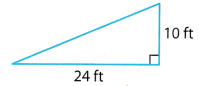
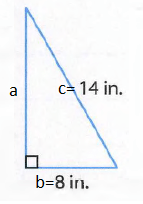
Find the missing side lengths. Round your answers to the nearest hundredth. (Lesson 8.1)

Question 1.
Texas Go Math Grade 8 Unit 3 Study Guide Review Answer Key 4
Answer:
Base = 10 ft
Height 10 ft
Hypotenuse = \(\sqrt{\text { base }^{2}+\text { height }^{2}}\)
Hyp = \(\sqrt{10^{2}+10^{2}}\)
Hyp = \(\sqrt{100+100}\)
Hyp = \(\sqrt{200}\)
Hyp = \(10 \sqrt{2}\) ft

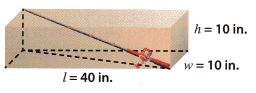
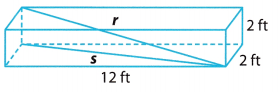
Unit 3 Math Test 8th Grade Answer Key Question 2.
Texas Go Math Grade 8 Unit 3 Study Guide Review Answer Key 5
Answer:
We want to find r, the length from a bottom corner to the opposite top corner. First, we find s, the length of the diagonal across the bottom of the box.
w2 + l2 = s2
102 + 252 = s2
100 + 625 = s2
725 = s2
s ≈ 26.9 cm
We use our expression for s to find r.
h2 + s2 = r2
102 + 725 = r2
100 + 725 = r2
825 = r2
r ≈ 28.7 cm

Question 3.
Hye Sun has a modern coffee table whose top is a triangle with the following side lengths: 8 feet, 6 feet, and 5 feet. Is Hye Sun’s coffee table top a right triangle? (Lesson 8.2)
Answer:
Formula for the right-angle triangle = a² + b² = c²
a = 6 feet
b = 5 feet
c = 8 feet
= 6² + 5² = 8²
= 36 + 25 = 64
= 61 > 64
The given triangle is not a right-angled triangle.

Unit 3 Study Guide Math Grade 8 Question 4.
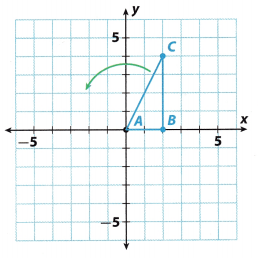
Find the length of each side of triangle ABC. If necessary, round your answers to the nearest hundredth. (Lesson 8.3)
Texas Go Math Grade 8 Unit 3 Study Guide Review Answer Key 6
Answer:
The Length of the vertical. leg is 6 units.
\(\overline{A C}\) = 6 units
The length of the horizontaL leg is 3 units
\(\overline{A B}\) = 3 units
Let a = 6 and b = 3. Let C represent the Length of the hypotenuse. We use the Pythagorean Theorem to find C.
a2 + b2 = c2
62 + 32 = c2
36 + 9 = c2
45 = c2
c = \(\sqrt {45}\)
c ≈ 6.71
\(\overline{B C}\) = 6.71 units

Module 9 Volume

Find the volume of each figure. Round your answers to the nearest hundredth. (Lessons 9.1, 9.2, 9.3)

Question 1.
Texas Go Math Grade 8 Unit 3 Study Guide Review Answer Key 7
Answer:
Base diameter = 12 mm
Base radius r = \(\frac{12}{2}\)
Base radius r = 6 mm
Height = 4 mm
VoLume of a cylinder = πr2h
V = 3.14 × 62 × 4
V = 3.14 × 36 × 6
V = 452.16 mm3

Question 2.
Texas Go Math Grade 8 Unit 3 Study Guide Review Answer Key 8
Answer:
Base diameter 50 in
Base radius r = \(\frac{50}{2}\)
Base radius r = 25 in
Height = 34 in
VoIime of a cone = \(\frac{1}{3}\)πr2h
V = \(\frac{1}{3}\) × 3.14 × 252 × 34
V = 22241.66667 in3
V ≈ 22241.67 in3

8th Grade Unit 3 Study Guide Answer Key Question 3.
Find the volume of a ball with a radius of 1.68 inches.
Answer:
The ball is in the shape of a sphere
The volume of the sphere = V = 4/3πr².sphere
Radius r = 1.68 inches
= 4/3 × π × (1.68) ²
= 4/3 × 3.14 × 2.82
= 5.025 sq. inches.
The volume of the sphere = V = 5.025 sq. inches.

Module 10 Surface Area

Find the lateral and total surface area of each figure. If necessary, round your answers to the nearest hundredth. (Lessons 10.1, 10.2)

Question 1.
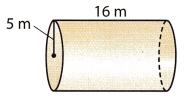
Texas Go Math Grade 8 Unit 3 Study Guide Review Answer Key 9
Answer:
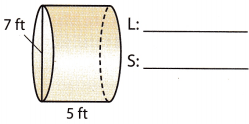
Given that the shape is the cylinder.
The formula for the total surface area of a cylinder = 2πrh + 2πr².
Diameter = 5ft =5/2
Radius = 2.5ft.
Height = 5ft
= 2(3.14) (2.5) (5) + 2(3.14) (5) ²
= 78.5 + 157
= 235.5 sq. ft.
The total surface area of a cylinder = 235.5 sq. ft.
The lateral surface area of a cylinder = 2πrh
= 2(3.14)(2.5)(5)
= 78.5 sq. ft
The lateral surface area of a cylinder = 78.5 sq. ft.

Question 2.
Texas Go Math Grade 8 Unit 3 Study Guide Review Answer Key 10
Answer:
Given that the shape is the rectangular prism
The formula for the surface area of a rectangular prism = 2(lb + bh + lh).
Length = l = 7.5ft
Breadth = b = 4ft
Height = h = 2ft
= 2(7.5 × 4 + 4 × 2 + 7.5 × 2).
= 2(30 + 8 + 15)
= 2(53)
= 106 cu. ft
The surface area of a rectangular prism = 106 cubic ft.
The lateral surface area of the rectangular prism = 2(l + b)h.
= 2(7.5 + 4) × 2.
= 60 × 2
= 120 sq. ft
The lateral surface area of the rectangular prism = 120 sq. ft

Grade 8 Unit 3 Test Math Answer Key Question 3.
A cylindrical water tower has a height of 50 meters and a radius of 20 meters.
Answer:
Given that,
The height of the cylindrical water tank = 50 meters.
The radius of the cylindrical water tank = 20 meters.
The formula for the total surface area of a cylinder = 2πrh + 2πr².
= 2 × 3.14 × 20 × 50 + 2 × 3.14 × (20)².
= 6280 + 2512
= 8792 sq. meter.
The total surface area of a cylinder = 8792 sq. meter
The lateral surface area of a cylinder = 2πrh
= 2(3.14)(20)(50)
= 6280 sq. meter
The lateral surface area of a cylinder = 6280 sq. meters.

Texas Go Math Grade 8 Unit 3 Performance Tasks Answer Key

Question 1.
CAREERS IN MATH Hydrologist A hydrologist needs to estimate the mass of water in an underground aquifer, which is roughly cylindrical in shape. The diameter of the aquifer is 65 meters, and its depth is 8 meters. One cubic meter of water has a mass of about 1000 kilograms.

a. The aquifer is completely filled with water. What is the total mass of the water in the aquifer? Explain how you found your answer. Use 3.14 for π and round your answer to the nearest kilogram.
Answer:
a) Since the aquifer is completely filled with water, we need to find the volume of the aquifer Its diameter is 65 meters, which means that its radius is 32-5 meters.
V = πr2h
V ≈ 3.14 ∙ 32.52 ∙ 8
V ≈ 26, 533m3
Since one cubic meter of water has a mass of about 1000 kilograms, then we have
26. 533 ∙ 1000 = 26, 533,000kg
The aquifer has about 26,533,000 kg of water

b. Another cylindrical aquifer has a diameter of 70 meters and a depth of 9 meters. The mass of the water in it is 2.7 × 10⁷ kilograms. Is the aquifer totally filled with water? Explain your reasoning.
Answer:
The diameter of the other aquifer is 70 meters, which means that its radius is 35 meters.
V = πr2h
V ≈ 3.14 ∙ 352 ∙ 9
V ≈ 34,618.5m3
Since one cubic meter of water has a mass of about 1,000 kilograms, we have
34,618.5 ∙ 1000 = 34, 618, 500 kg
On the other hand, we are told that there are 27 ∙ 107 kg of water in the aquifer, which is more than the aquifer can hold.

Texas Go Math Grade 8 Answer Key Pdf Unit 3 Study Guide Question 2.
From his home, Myles walked his dog north 5 blocks, east 2 blocks, and then stopped at a drinking fountain. He then walked north 3 more blocks and east 4 more blocks, It started to rain so he cut through a field and walked straight home.
a. Draw a diagram of his path.
Answer:
Texas Go Math Grade 8 Unit 3 Study Guide Review Answer Key 20

b. How many blocks did Myles walk in all? How much longer was his walk before it started to rain than his walk home?
Answer:
Before it started to rain, Myles walked 14 blocks (black route).
5 + 2 + 3 + 4 = 14
To find how many blocks he walks after it started to rain, we let a = 8 blocks and b = 6 blocks. Let C represent the Length of the hypotenuse (the red route, the road straight home). We use the Pythagorean Theorem to find C.
a2 + b2 = c2
82 + 62 = c2
64 + 36 = c2
100 = c2
c = \(\sqrt {100}\)
c = 10 blocks
Myles walked 24 blocks in total (14 from home to the destination and 10 back home). The walk before it started to rain was 4 blocks longer than the walk home.

Texas Go Math Grade 8 Unit 3 Mixed Review Texas Test Prep Answer Key

Selected Response

Question 1.
Which of the following angle pairs formed by a transversal that intersects two parallel lines are not congruent?
(A) alternate interior angles
(B) adjacent angles
(C) corresponding angles
(D) alternate exterior angles
Answer:
(B) adjacent angles

Study Guide 8th Grade Math Unit 3 Answer Key Question 2.
The measures of the three angles of a triangle are given by 3x + 1, 2x – 3, and 9x. What is the measure of the smallest angle?
(A) 13°
(B) 23°
(C) 29°
(D) 40°
Answer:
(B) 23°

Explanation:
The angles of the given triangle = {(3x + 1), (2x-3), 9x}
As we know the sum of all three angles of a triangle is 180°
Thus the sum of the given angles should be also 180°
Therefore,
(3x + 1) + (2x – 3)9x = 180°
3x + 2x + 9x + 1 – 3 = 180
14x – 2 = 180
14x = 182
x = \(\frac{182}{14}\)
x = 13°.
Thus the angles are;
3x + 1 = 3(13) + 1 = 40°
2x – 3 = 2(13) – 3 = 23°
9x = 9(13) = 117°
Since 23° < 40° < 117°
Therefore the smallest angle is 23°.

Question 3.
Using 3.14 for π, what is the volume of the cylinder?
Texas Go Math Grade 8 Unit 3 Study Guide Review Answer Key 10
(A) 200 cubic yards
(B) 628 cubic yards
(C) 1256 cubic yards
(D) 2512 cubic yards
Answer:
(B) 628 cubic yards

Explanation:
Diameter of base 10 yd
Radius = \(\frac{10}{2}\)
Radius r = 5 yd
Height = 8yd
Volume of cylinder = πr2h
Volume = 3.14 × (5)2 × 8
Volume 628 yd3

Unit 3 Study Guide Answer Key Math 8th Grade Question 4.
Which of the following is not true?
(A) \(\sqrt {36}\) + 2 > \(\sqrt {16}\) + 5
(B) 5π > 17
(C) \(\sqrt {10}\) + 1 < \(\frac{9}{2}\)
(D) 5 – \(\sqrt {35}\) < 0 Answer: (A) \(\sqrt {36}\) + 2 > \(\sqrt {16}\) + 5

Explanation:
(A) \(\sqrt {36}\) + 2 > \(\sqrt {16}\) + 5
6 + 2 > 4 + 5
8 > 9
This statement is false as 8 is not greater than 9.

(B) 5π > 17
5 ∙ 3.14 < 17
15.7 < 17
This statement is true as 17 is greater than 15.7.

(C) \(\sqrt {10}\) + 1 < \(\frac{9}{2}\)
3.16 + 1 < 4.5
4.16 < 4.5
This statement is true as 4.5 is greater than 4.16.

(D) 5 – \(\sqrt {35}\) < 0
5 – 5.92 < 0
5 – 5.92 < 0
-0.92 < 0
This statement is true as 0 is greater than -0.92.

Question 5.
A pole is 65 feet tall. A support wire is attached to the top of the pole and secured to the ground 33 feet from the pole’s base. Find the approximate length of the wire.
(A) 32 feet
(B) 73 feet
(C) 56 feet
(D) 60 feet
Answer:
(B) 73 feet

Explanation:
Let a = 65 feet and b = 33 feet Let C represent the length of the hypotenuse, the length of the wire. We use the Pythagorean Theorem to find C.
a2 + b2 = c2
652 + 332 = c2
4225 + 1089 = c2
5314 = c2
c = \(\sqrt {5314}\)
c ≈ 72.897
c ≈ 73 feet

Question 6.
Using 3.14 for π, what is the volume of the sphere 7 cm to the nearest tenth?
Texas Go Math Grade 8 Unit 3 Study Guide Review Answer Key 12
(A) 205.1 cm3
(B) 1077 cm3
(C) 179.5 cm3
(D) 4308.1 cm3
Answer:
(C) 179.5 cm3

Explanation:
Diameter of base = 7 cm
Radius = \(\frac{7}{2}\) cm
Radius r = 3.5 cm
Volume of sphere = \(\frac{4}{3}\)πr3
Volume = \(\frac{4}{3}\) × 3.14 × (3.5)3
Volume = 179.5033 cm3
Volume ≈ 179.5cm3

Question 7.
Which set of lengths are not the side lengths of a right triangle?
(A) 28, 45, 53
(B) 13, 84, 85
(C) 36, 77, 85
(D) 16, 61, 65
Answer:
(D) 16, 61, 65

Explanation:
Check if the lengths in Option A form a right triangle.
Let a = 28, b = 45 and c = 53. Using the converse of the Pythagorean Theorem, we have:
a2 + b2 = c2
282 + 452 = 532
784 + 2025 = 2809
2809 = 2809
True
Since 282 + 452 = 532, the triangle is a right triangle.

Check if the lengths in Option B form a right triangle.
Let a. = 13, b = 84 and c = 85. Using the converse of the Pythagorean Theorem, we have:
a2 + b2 = c2
132 + 842 = 852
169 + 7056 = 7225
7225 = 7225
True
Since 132 + 842 = 852, the triangle is a right triangle.

Check if the Lengths in Option C form a right triangLe.
Let a = 36, b = 77 and c = 85. Using the converse of the Pythagorean Theorem, we have:
a2 + b2 = c2
362 + 772 = 852
1296 + 5929 = 7225
7225 = 7225
True
Since 362 + 772 = 852, the triangle is a right triangle.

Check if the Lengths in Option D form a right triangle.
Let a = 16, b = 61 and c = 65. Using the converse of the Pythagorean Theorem, we have:
a2 + b2 = c2
162 + 612 = 652
256 + 3721 = 4225
3977 = 4225
False
Since 162 + 612 = 652, the triangle is not a right triangle.

Unit 3 Review/Test 8th Grade Math Answer Key Question 8.
Which statement describes the solution of a system of linear equations for two lines with different slopes and different y-intercepts?
(A) one non-zero solution
(B) infinitely many solutions
(C) no solution
(D) solution of 0
Answer:
(A) one non-zero solution

Question 9.
What is the side length of a cube that has a surface area of 486 square inches?
(A) 7 inches
(B) 8 inches
(C) 9 inches
(D) 10 inches
Answer:
(C) 9 inches

Explanation:
Volume of the given cube 729 in2
Volume of a cube of side 7 in 73 = 343
Volume of a cube of side 8 in 83 = 512
Volume of a cube of side 9 in 93 = 729
Volume of a cube of side 10 in = 103 = 1000
A cube of side 9 in will have volume of 729 in3. Thus option C is correct.

Question 10.
A box in the shape of a triangular prism is shown below. What is the surface area of the box?
Texas Go Math Grade 8 Unit 3 Study Guide Review Answer Key 13
(A) 96 in2
(B) 102 in2
(C) 108 in2
(D) 116 in2
Answer:
Given that the box is in the shape of a triangular prism.
The formula of the surface area of the triangular prism = bh + (b1 + b2 + b3) l.
b = 3 inches.
h = 4 inches.
b1 = 4 inches.
b2 = 3 inches.
b3 = 5 inches.
l = 8 inches.
= 3 × 4 + (4 + 3 + 5)8
= 108 sq. in.
The surface area of the triangular prism = 108 sq. in.
Option B is the correct answer

Gridded Response

Question 11.
What is the value of h in the triangle below?
Texas Go Math Grade 8 Unit 3 Study Guide Review Answer Key 14
Answer:
In similar triangles the corresponding sides and lengths are proportional.
h/8 = 9/10
h/8 = 0.9
h = 0.9 × 8
h = 7.2
The value of h in the triangle is 7.2
Texas Go Math Grade 8 Unit 3 Study Guide Review Answer Key_11

Grade 8 Math Unit 3 Assessment Answer Key Question 12.
Chandra is working on an art project using a cone that has a height of 11 inches and a base radius of 2 inches. Using 3.14 for π, what is the volume of the cone to the nearest tenth of a cubic inch?
Texas Go Math Grade 8 Unit 3 Study Guide Review Answer Key 15
Answer:
Given that the shape is a cone.
The formula for the volume of the cone = 1/3hπr².
Height = h = 11 inches.
Radius = r = 2 inches.
= ⅓ × 11 × 3.14 × (2) ².
= 45.59 sq. inches.
The volume of the cone = 45.59 sq. inches.
Texas Go Math Grade 8 Unit 3 Study Guide Review Answer Key_12

Hot Tips! Read graphs and diagrams carefully. Look at the labels for important information.

Question 13.
The net of a cylinder is shown below.
Texas Go Math Grade 8 Unit 3 Study Guide Review Answer Key 16
Using 3.14 for π, what is the lateral surface area of the cylinder in square meters?
Texas Go Math Grade 8 Unit 3 Study Guide Review Answer Key 17
Answer:

Texas Go Math Grade 8 Unit 3 Vocabulary Preview Answer Key

Use the puzzle to preview key vocabulary from this unit. Unscramble the circled letters to answer the riddle at the bottom of the page.
Texas Go Math Grade 8 Unit 3 Study Guide Review Answer Key 21

Across
1. The angle formed by two sides of a triangle (2 words) (Lesson 7-2)
5. A three-dimensional figure that has two congruent circular bases. (Lesson 9-1)
6. A three-dimensional figure with all points the same distance from the center. (Lesson 9-3)

Down
2. The line that intersects two or more lines. (Lesson 7-1)
3. The side opposite the right angle ¡n a right triangle. (Lesson 8-1)
4. Figures with the same shape but not necessarily the same size. (Lesson 7-3)
5. A three-dimensional figure that has one vertex and one circular base. (Lesson 9-2)

Question.
What do you call an angle that is adorable?
Answer:
____ ____ ____ ____ ____ ____ ____ ____ ____ ____!

Texas Go Math Grade 8 Unit 3 Study Guide Review Answer Key Read More »
Texas Go Math Grade 8 Module 11 Quiz Answer Key

Refer to our Texas Go Math Grade 8 Answer Key Pdf to score good marks in the exams. Test yourself by practicing the problems from Texas Go Math Grade 8 Module 11 Quiz Answer Key.

Texas Go Math Grade 8 Module 11 Quiz Answer Key

Texas Go Math Grade 8 Module 11 Ready to Go On? Answer Key

11.1 Equations with the Variable on Both Sides

Solve.

Question 1.
4a – 4 = 8 + a ____________
Answer:
4a – 4 = 8 + a
(Subtract a from both sides.) 4a – 4 – a = 8 + a – a
(Add 4 to both sides.) 3a – 4 = 8
(Divide both sides by 3.) 3a = 12
a = 4
The statement is true. There is one solution.

Grade 8 Math Module 11 Answer Key Question 2.
4x + 5 = x + 8 ___________
Answer:
4x + 5 = x + 8
(Subtract x from both sides) 4x + 5 – x = x + 8 – x
(Subtract 5 from both sides.) 3x + 5 = 8
(Divide both sides by 3.) 3x = 3
x = 1
The statement is true. There is one solution.

Question 3.
Hue is arranging chairs. She can form 6 rows of a given length with 3 chairs left over, or 8 rows of that same length if she gets 11 more chairs. Write and solve an equation to find how many chairs are in that row length.
Answer:
(Write an equation) 6x + 3 = 8x – 11
(Subtract 3 from both sides.) 6x + 3 – 3 = 8x – 11 – 3
(Subtract 8x from both sides.) 6x = 8x – 14
(Divide by -2.)  – 2x = -14
x = 7
There are 7 chairs in each row.

11.2 Equations with Rational Numbers

Solve.

Question 4.
\(\frac{2}{3}\)s – \(\frac{2}{3}\) = \(\frac{s}{6}\) + \(\frac{4}{3}\) ____________
Answer:
(Multiply both sides by the LCM(3, 6) = 6) \(\frac{2}{3}\)s – \(\frac{2}{3}\) = \(\frac{s}{6}\) + \(\frac{4}{3}\)
6 ∙ \(\frac{2}{3}\)s – 6 ∙ \(\frac{2}{3}\) = 6 ∙ \(\frac{s}{6}\) + 6 ∙ \(\frac{4}{3}\)
4s – 4 = n + 8
(Add 4 to both sides) 4s – 4 + 4 = s + 8 + 4
4s = s + 12
(Subtract n from both sides) 4s – s = s + 12 – s
3s = 12
(Divide both sides by 3) \(\frac{3s}{3}\) = \(\frac{12}{3}\)
s = 4

Math Quiz for Grade 8 Module 11 Test Answers Question 5.
1.5d + 3.25 = 1 + 2.25d _____________
Answer:
1.5d + 3.25 = 1 + 2.25d
(Subtract 3.25 from both sides) 1.5d + 3.25 – 3.25 = 1 + 2.25d – 3.25
1.5d = 2.25d – 2.25
(Subtract 2.25d from both sides.) 1.5d – 2.25d = 2.25d – 2.25 – 2.25d
-0.75d = -2.25
(Divide both sides by -0.75) \(\frac{-0.75d}{-0.75}\) = \(\frac{-2.25}{-0.75}\)
d = 3

Question 6.
Happy Paws charges $19.00 plus $1.50 per hour to keep a dog during the day. Woof Watchers charges $15.00 plus $2.75 per hour. Write and solve an equation to find how many hours the total cost of the services is equal.
Answer:
Happy Paws charge for x hours
1.5x + 19
Woof Watchers charge for x hours
2.75x + 15
Put two expressions as equal
2.75x + 15 = 1.5x + 19
Subtract 1.5 from both sides
2.75x + 15 – 1.5x = 1.5x + 19 – 1.5x
1.25x + 15 = 19
Subtract 15 from both sides
1.25x + 15 – 15 = 19 – 15
1.25x = 4
Divide both sides by 1.25
x = \(\frac{4}{1.25}\) = 3.2
The total cost of the services is equal after $3.2 hrs.

11.3 inequalities with the Variable on Both Sides

Question 7.
Write an inequality to represent the relationship “Two less than 2 times a number is greater than the number plus 64″. Then solve your inequality.
Answer:
Let us consider the number = x
2 – 2x ≥ x + 60
-2x -x ≥ 60 – 2
-3x ≥ 58
x ≥ 58/-3
x ≥ -19.33
2 – 2(-19.33) ≥ -19.33 + 60
40.66 ≥ 40.67.

11.4 Inequalities with Rational Numbers

Question 8.
One prepaid cell phone company charges $0.028 per minute and a $3 monthly fee. Another company charges $0.034 per minute with no monthly fee. For what number of minutes per month are the charges for the first company cheaper?
Answer:
Let us consider the number of charges = x
The first company charges = $0.028 and $3 for the monthly fee.
The secondary company charges = $0.034 and no monthly fee.
The inequality equation is
$0.029 + $3 ≤ $0.034x
Multiply both sides by 1000
28x + 2000 ≤ 34x
2000 ≤ 34x + 28x
2000 ≤ 62x
x ≥ 2000/62
X ≥ 32.2
32.2 minutes per month are the charges for the first company cheaper.

Essential Question

Grade 8 Module 11 Answer Key Math Quiz Answers Question 9.
How can you use equations with the variable on both sides to solve real-world problems?
Answer:
I could join a game club for $15 and rent games for $2 each, or I could pay $3 for each video rental, which is the better deal?

Texas Go Math Grade 8 Module 11 Mixed Review Texas Test Prep Answer Key

Selected Response

Question 1.
Two cars are traveling in the same direction. The first car is going 40 mi/h and the second car is going 55 mi/h. The first car left 3 hours before the second car. Which equation could you solve to find how many hours it will take for the second car to catch up to the first car?
(A) 55t + 3 = 40t
(B) 55t + 165 = 40t
(C) 40t + 3 = 55t
(D) 40t + 120 = 55t
Answer:
(D) 40t + 120 = 55t

Explanation:
We write an expression representing the distance that car A has traveled. Let’s denote the time by t.
3 * 40 + 40t = 120 + 40t
We write an expression representing the distance that car B has traveled. Let’s denote the time by t
55t
We write an equation that can be solved to find the time it will take for the second car to catch up to the first car.
40t + 120 = 55t

Question 2.
A wide-screen television display measures approximately 15 inches high and 27 inches wide. A television is advertised by giving the approximate length of the diagonal of its screen. How should the television be advertised?
(A) 36 inches
(B) 31 inches
(C) 30 inches
(D) 21 inches
Answer:
The wide-screen television display is in the shape of a rectangle
The formula for the length of the diagonal of a rectangle = c² = a² + b²
The length of the rectangle = a = 15
Wide of the rectangle = b = 27
c² = 15² + 27²
c² = 225 + 729
c = sq. root (954)
c = 31 sq. inches.
Option B is the correct answer.

Grade 8 Math Module 11 Answer Key Pdf Question 3.
Shawn’s Rentals charges $27.50 per hour to rent a surfboard and a wet suit. Darla’s Surf Shop charges $23.25 per hour to rent a surfboard plus $17 extra for a wetsuit. For what total number of hours are the charges for Shawn’s Rentals the same as the charges for Darla’s Surf Shop?
(A) 3
(B) 4
(C) 5
(D) 6
Answer:
(B) 4

Explanation:
Shawn’s rentaL charge after x hrs
27.5x
Darlas surf shop charge after x hr
23.25x + 17
Equate the two expressions
23.25x + 17 = 27.5x
Subtract 23.25x from both sides
23.25x + 17 – 23.25x = 27.5x – 23.25x
4.25x = 17
Divide both sides by 4.25
x = \(\frac{17}{4.25}\) = 4
The charge would be equal after $4 hrs.

Question 4.
Which of the following is an irrational number?
(A) -8
(B) 4.63
(C) \(\sqrt{11}\)
(D) \(\frac{1}{3}\)
Answer:
(C) \(\sqrt{11}\)

Explanation:
\(\sqrt{11}\) is irrational.

Question 5.
Carlos has at least as many action figures in his collection as Josh. Carlos has 5 complete sets plus 4 individual figures. Josh has 3 complete sets plus 14 individual figures. Which inequality represents how many action figures can be in a complete set?
(A) x ≥ 7
(B) x ≤ 7
(C) x ≥ 5
(D) x ≤ 5
Answer:
Let us consider the action figures in a complete set = x
The Charles has 5 complete sets + 4 individual figures
Josh has 3 complete sets + 14 individual figures
The inequality equation is
5x + 4 ≤ 3x + 14
5x – 3x ≤ 14 – 4
2x ≤ 10
x ≤ 10/2
x ≤ 5
Option D is the correct answer.

Module 11 Math Quiz for Grade 8 with Answers Question 6.
Which inequality represents the solution to 1.25x + 2.5 < 2.75x – 6.5?
(A) x > 6
(B) x < 6
(C) x > 2.25
(D) x < 2.25
Answer:
1.25x + 2.5 < 2.75x – 6.5
1.25x – 2.75x < -6.5 – 2.5
-1.50x < -9
1.5x < 9
x < 9/1.5
x < 6
Option B is the correct answer.

Gridded Response

Question 7.
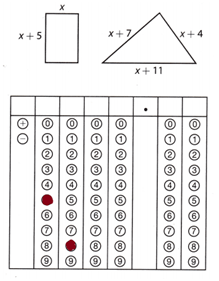
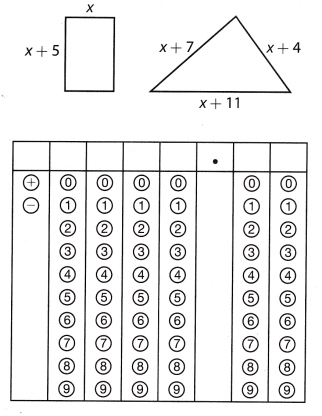
If both figures have the same perimeter, what is the perimeter of each figure?
Texas Go Math Grade 8 Module 11 Quiz Answer Key 1
Answer:
Given that,
The perimeter of the rectangle = perimeter of the triangle
2(l + w) = a + b + c
l = x + 5
w = x
a = x + 7
b = x + 4
c = x + 11
2(x + 5 + x) = x + 7 + x + 4 + x + 11
4x + 10 = 3x + 22
22 – 10 = 4x – 3x
x = 12.
3(12) + 22 = 4(12) + 10
58 = 58
The perimeter of the rectangle is 58 sq. inches.
The perimeter of the triangle is 58 sq. inches.
Texas Go Math Grade 8 Module 11 Quiz Answer Key_7

Texas Go Math Grade 8 Module 11 Quiz Answer Key Read More »
Texas Go Math Grade 8 Module 10 Quiz Answer Key

Refer to our Texas Go Math Grade 8 Answer Key Pdf to score good marks in the exams. Test yourself by practicing the problems from Texas Go Math Grade 8 Module 10 Quiz Answer Key.

Texas Go Math Grade 8 Module 10 Quiz Answer Key

Texas Go Math Grade 8 Module 10 Ready to Go On? Answer Key

10.1 Surface Area of Prisms

Find the lateral and total surface area of each prism. Round your answers to the nearest tenth if necessary.

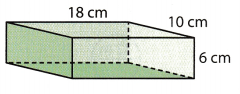
Question 1.
Texas Go Math Grade 8 Module 10 Quiz Answer Key 1
Answer:
Given that the prism is a rectangular prism.
Lateral surface area of a rectangular prism = 2(l + w)h.
Length = l = 18cm
Width = w = 10cm
Height = h = 6cm.
=2(18 + 10)6.
=2(28)6.
= 336 square units.

Surface Area Quiz Answer Key Grade 8 Math Question 2.
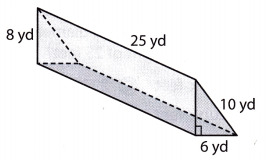
Texas Go Math Grade 8 Module 10 Quiz Answer Key 2
Answer:
Given that the prism is the triangular prism.
The formula for the lateral surface of the triangular prism = perimeter of the base x height of the prism = (a + b + c)h.
H = 8yd
A = 25yd
B = 10yd
C = 6yd
= (25 + 10 + 6)8
= (41)8
= 328yd.
The lateral surface area of the triangular prism = 328 yd²
328 rounded to the nearest ten is 330. Because in the 336 the one’s place is greater than the 5. Thus replace 0 by 0 and tens place by 3.

Question 3.
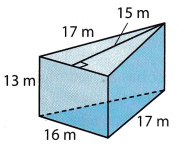
Texas Go Math Grade 8 Module 10 Quiz Answer Key 3
Answer:
Given that the prism is the triangular prism.
The formula for the lateral surface of the triangular prism = perimeter of the base x height of the prism = (a + b + c)h.
H = 15m
A = 17m
B = 13m
C = 16m
= (17 + 13 + 16)15
= (46)15
= 690m.
The lateral surface of the triangular prism = 690m²
690 rounded to the nearest ten is 690.

Question 4.
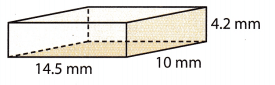
Texas Go Math Grade 8 Module 10 Quiz Answer Key 10
Answer:
Given that the prism is a rectangular prism.
Lateral surface area of a rectangular prism = 2(l + w)h.
Length = l = 14.5mm
Width = w = 10mm
Height = h = 4.2mm
=2(14.5 + 10)4.2.
=2(24.5)4.2.
= 205.8mm²
205.8 rounded to the nearest ten is 205. Because in the 205.8 the decimal place is greater than the 5. So replace the 8 by 0

10.2 Surface Area of Cylinders

Find the lateral and total surface area of each cylinder. Round your answers to the nearest tenth if necessary. Use 3.14 for π.

Question 5.
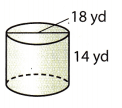
Texas Go Math Grade 8 Module 10 Quiz Answer Key 5
Answer:
Formula for the lateral surface area of the cylinder is 2πRH.
Diameter = 18yd
Radius = 18/2 = 9
H = height = 14yd
R = radius = 9yd
LA = 2 x 3.14 x 9 x 14.
lateral surface area of the cylinder = 791.28yd.
791.28 is rounded to the nearest tenth is 791.20. Because in the decimal the one’s place is greater than 5 it is replaced by 0.

Grade 8 Math Module 10 Answer Key Question 6.
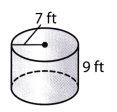
Texas Go Math Grade 8 Module 10 Quiz Answer Key 6
Answer:
The formula for the lateral surface area of the cylinder is 2πRH.
H = height = 9ft
R = radius = 7ft
LA = 2 x 3.14 x 7 x 9.
the lateral surface area of the cylinder= 395.64ft
395.64 is rounded to the nearest tenth is 1582.60. Because in the decimal the one’s place is less than 5 so it is replaced by 0.

Essential Question

Question 7.
How can finding surface area help you solve packaging problems?
Answer: The packaging boxes are in the shape of a cuboid and it has 6 faces. Its label has length, width, and height. The surface area of the prism is SA = 2lw + 2lh + 2hw.

Texas Go Math Grade 8 Module 10 Mixed Review Texas Test Prep Answer Key

Selected Response

Question 1.
Grain is stored in cylindrical structures called silos. Which is the best estimate for the volume of a silo with a diameter of 12.3 feet and a height of 25 feet?
(A) 450 cubic feet
(B) 900 cubic feet
(C) 2970 cubic feet
(D) 10,800 cubic feet
Answer:
The formula for the volume of the cylinder = 2πr2h.
H = 25feet
Diameter = 12.3 feet
Radius = d/2 = 12.3/2 =6.15.
= 2 x 3.14 x (12.3)2 x 25
= 2969.06625 = 2970 cubic feet.
Option C is the correct answer.

Question 2.
What is the side length of a cube that has a total surface area of 384 square inches?
(A) 6 inches
(B) 7 inches
(C) 8 inches
(D) 9 inches
Answer:
Given that the total surface area of the cube = 384 inches
The formula for the total surface area = 6a²
= 6(6)² = 216 inches.
= 6(7)² = 294 inches.
= 6(8)² = 384 inches.
= 6(9)² = 486 inches.
Option C is the correct answer.

Question 3.
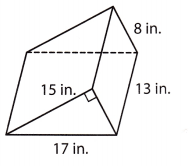
A block of cheese is shown in the shape of the triangular prism below.
Texas Go Math Grade 8 Module 10 Quiz Answer Key 7
What is the total surface area of the block of cheese?
(A) 120 in2
(B) 494 in2
(C) 510 in2
(D) 640 in2
Answer:
There are two triangles in the triangular prism
Area of the one triangle = ½ x b x h
= ½ x 17 x 15 = 127.5
Area of the two triangles = ½ x b x h
= 1/2 x 8 x 13 = 52
The formula for the total surface area of the triangle = area of one triangle + area of two triangles.
= 179.5 square inches.

Question 4.
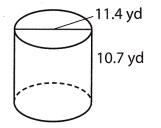
Using 3.14 for π, what is the lateral surface area of the cylinder to the nearest unit?
Texas Go Math Grade 8 Module 10 Quiz Answer Key 8
(A) 122 yd2
(B) 204 yd2
(C) 383 yd2
(D) 587 yd2
Answer:
The formula for the lateral surface area of the cylinder is 2πRH.
Diameter = 11.4yd
Radius = 11.4/2 = 5.7yd
H = height = 10.7yd
R = radius = 5.7yd
LA = 2 x 3.14 x 5.7 x 10.7.
the lateral surface area of the cylinder= 383.01yd2
383.01 is rounded to the nearest tenth of 383. Because in the decimal the one’s place is less than 5 so it is replaced by 0.
Option C is the correct answer.

Module 10 Review Quiz Grade 8 Math Question 5.
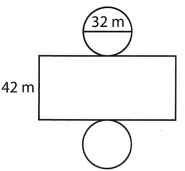
The net of a cylinder is shown.
What is the total surface area of the cylinder represented by the net?
Texas Go Math Grade 8 Module 10 Quiz Answer Key 11
(A) 1607.7 m2
(B) 1856 m2
(C) 4220.2 m2
(D) 5827.8 m2
Answer:
The formula for the surface area of the cylinder = 2πr(r + h).
H = 42m
Diameter = 32m
Radius = 32/2 = 16m
= 2 x 3.14 x 16(16 + 42)
= 100.48(58)
= 5827.8
Option D is the correct answer.

Question 6.
A cylinder has a circumference of 12π cm and a height that is half the radius. What is the total surface area of the cylinder?
(A) 367π cm2
(B) 72π cm2
(C) 108π cm2
(D) 144π cm2
Answer:
The formula for the surface area of the cylinder = 2πr(r + h).
Circumference = 12π/π
= 12 is the diameter.
Radius = d/2 = 12/2 = 6
R = 6
H = half the radius = 6/2 = 3.
= 2 x π x 6(6 + 3)
= 6.28 x 54
= 108πcm²
Option C is the correct answer.

Gridded Response

Question 7.
A rectangular prism has a length of 4 feet, a width of 1 yard, and a height of 3 inches. What is the total surface area of the prism to the nearest tenth of a square foot?
Texas Go Math Grade 8 Module 10 Quiz Answer Key 9
Answer:
The formula for the surface area of the rectangular prism = 2(lb + bh + lh).
L = 4 feet.
1 feet 12 inches
4 feets = 12 x 4 = 48 inches.
Width = breadth = B = 1 yard.
1 yard = 36 inches.
H = 3 inches.
= 2(48 x 36 + 36 x 3 + 48 x 3)
= 2(1728 + 108 + 144)
= 3960 inches = 27.5 square foot
27.5 nearest tenth to square foot is 27.5

Texas Go Math Grade 8 Module 10 Quiz Answer Key Read More »
Texas Go Math Grade 8 Lesson 10.2 Answer Key Surface Area of Cylinders

Refer to our Texas Go Math Grade 8 Answer Key Pdf to score good marks in the exams. Test yourself by practicing the problems from Texas Go Math Grade 8 Lesson 10.2 Answer Key Surface Area of Cylinders.

Texas Go Math Grade 8 Lesson 10.2 Answer Key Surface Area of Cylinders

Texas Go Math Grade 8 Lesson 10.2 Explore Activity Answer Key

Modeling the Surface Area of a Cylinder

Just as you did with a prism, you can use a net to help you find a formula for the surface area of a cylinder.
Texas Go Math Grade 8 Lesson 10.2 Answer Key 1
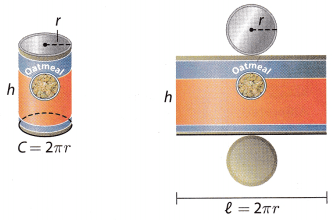
The lateral area of a cylinder is the area of the curved surface that connects the two bases. The net shows that the lateral surface is a rectangle.
Use the diagram of the oatmeal container and its net.
A. Imagine unrolling the container’s lateral surface to form a rectangle
What dimension of the cylinder matches the rectangle’s length? ____________
What dimension of the cylinder matches the rectangle’s height? ____________
Answer:
What dimension of the cylinder matches the rectangle’s length? 2πr
What dimension of the cylinder matches the rectangle’s height? h
B. Express the lateral area of a cylinder in words and as a formula using the given variables.
Texas Go Math Grade 8 Lesson 10.2 Answer Key 2
C. Express the total surface area of a cylinder in words and as a formula using the given variables.
Texas Go Math Grade 8 Lesson 10.2 Answer Key 3

Reflect

Surface Area of Prisms and Cylinders Answer Key Lesson 10.2 Question 1.
Communicate Mathematical Ideas How is the process for finding the lateral and total surface area of a cylinder like the process for a prism?
Answer:
For both prisms, you can draw a net to help you find the areas of the faces. Add the areas together to find the surface area. The lateral area of a cylinder is the area of the curved surface that connects the two bases. The net shows that the lateral surface is a rectangle. The total surface area S of a cylinder with height h and radius r is twice the area of a base B plus the lateral area.

Your Turn

Find the lateral and total surface area of each cylinder. Round your answers to the nearest tenth. Use 3.14 for π.

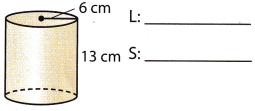
Question 2.
Texas Go Math Grade 8 Lesson 10.2 Answer Key 4
Answer:
Given,
r = 6 cm
h = 13 cm
We know that,
Lateral Surface Area of a Cylinder = 2πrh
π = 3.14
LSA = 2 × 3.14 × 6 × 13
LSA = 489.84
489.84 to the nearest tenth is 489.8 sq. cm
Total Surface Area = 2πr² + L
TSA = 2 × 3.14 × 6 × 6 + 489.8
TSA = 226.08 + 489.8 = 715.88
715.88 to the nearest tenth is 715.9

Question 3.
Texas Go Math Grade 8 Lesson 10.2 Answer Key 5
Answer:
Given,
d = 7 ft
r = 7/2 = 3.5 ft
h = 5 ft
We know that,
Lateral Surface Area of a Cylinder = 2πrh
π = 3.14
LSA = 2 × 3.14 × 3.5 × 5
LSA = 109.9 sq. ft
109.9 to the nearest tenth is 110.
Total Surface Area = 2πr² + L
TSA = 2 × 3.14 × 3.5 × 3.5 + 109.9
TSA = 76.93 + 109.9 = 186.83 sq. ft
186.83 to the nearest tenth is 186.8

Lesson 10.2 Surface Area of Prisms and Cylinders Answer Key Question 4.
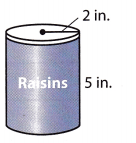
How many square inches of cardboard is needed for the lateral area of the raisin container shown? What is the total surface area of the container? Round your answers to the nearest tenth. Use 3.14 for π.
Texas Go Math Grade 8 Lesson 10.2 Answer Key 6
Answer:
Given,
r = 2 in
h = 5 in.
We know that,
Lateral Surface Area of a Cylinder = 2πrh
π = 3.14
LSA = 2 × 3.14 × 2 × 5
LSA = 62.8 sq. in.
62.8 to the nearest tenth is 62.8.
Total Surface Area = 2πr² + L
TSA = 2 × 3.14 × 2 × 2 + 62.8
TSA = 25.12 + 62.8 = 87.92 sq. in
87.92 to the nearest tenth is 87.9 sq. in.

Texas Go Math Grade 8 Lesson 10.2 Guided Practice Answer Key

Question 1.
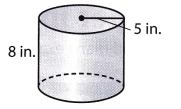
Draw a net of the cylinder. Label the radius and the height. Then find the lateral area and total surface area. Round your answers to the nearest tenth. Use 3.14 for π. (Explore Activity and Example 1)
Texas Go Math Grade 8 Lesson 10.2 Answer Key 7
Find the circumference of the circle. Use 3.14 for π.
C = 2πr ≈ 2 ∙ 3.14 ∙ ________ ≈ ________ inches
The lateral area is the circumference times the height of the can.
L ≈ 31.4 ∙ _______ ≈ ______ in2
Find the area of the two bases. Use 3.14 for π.
2B = 2πr2 ≈ (3.14) (_________ ) ≈ _______ in2
Add the area of the bases and the lateral area.
S ≈ ________ + __________ ≈ __________ in2
Answer:
Find the circumference of the circle. Use 3.14 for π.
C = 2πr ≈ 2 ∙ 3.14 ∙ 5 ≈ 31.4 inches
The lateral area is the circumference times the height of the can.
L ≈ 31.4 ∙ 8 ≈ 251.2 in2
Find the area of the two bases. Use 3.14 for π.
2B = 2πr2 ≈ 2 (3.14) (25) ≈ 157 in2
Add the area of the bases and the lateral area.
S ≈ 157 + 251.2 ≈ 408 in2

Question 2.
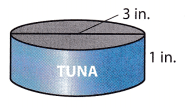
A can of tuna fish has a height of 1 inch and a diameter of 3 inches. How many square inches of paper are needed for the label? How many square inches of metal are needed to make the can including the top and bottom? Round your answers to the nearest whole number. Use 3.14 for π. (Example 2)
Texas Go Math Grade 8 Lesson 10.2 Answer Key 8
It takes about __________ square inches of paper to make the label.
It takes about ___________ square inches of metal to make the can.
Answer:
A can of tuna fish has a height of 1 inch and a diameter of 3 inches.
h = 1 in.
d = 3 in
r = d/2 = 3/2 = 1.5 in.
We know that,
Lateral Surface Area of a Cylinder = 2πrh
π = 3.14
LSA = 2 × 3.14 × 1.5 × 1
LSA = 9.42 sq. in.
Total Surface Area = 2πr² + L
TSA = 2 × 3.14 × 1.5 × 1.5 + 9.42 = 23.55 sq. in.
It takes about 9.42 sq. in. square inches of paper to make the label.
It takes about 23.55 sq. in. square inches of metal to make the can.

Essential Question Check-In

Go Math Grade 8 Lesson 10.2 Surface Area Cylinder Answer Key Question 3.
How do you find the total surface area of a cylinder?
Answer:
The surface area of a cylinder is the area occupied by its surface in a three-dimensional space.
The Surface Area of Cylinder = Curved Surface + Area of Circular bases
S.A. = 2πr (h + r) sq.unit
Where, π (Pi) = 3.142 or = 22/7
r = Radius of the cylinder
h = Height of the cylinder
TSA = 2π × r × h + 2πr²= 2πr (h + r) Square units

Texas Go Math Grade 8 Lesson 10.2 Independent Practice Answer Key

Find the lateral and total surface area of each cylinder. Round your answers to the nearest tenth. Use 3.14 for π.

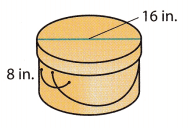
Question 4.
Texas Go Math Grade 8 Lesson 10.2 Answer Key 9
Answer:
h = 8 in.
d = 16 in
r = d/2 = 16/2 = 8 in.
We know that,
Lateral Surface Area of a Cylinder = 2πrh
π = 3.14
LSA = 2 × 3.14 × 8 × 8
LSA = 401.92 sq. in.
Total Surface Area = 2πr² + L
TSA = 2 × 3.14 × 8 × 8 + 401.92 = 401.92 + 401.92 = 803.84
803.84 to the nearest tenth is 803.8 sq. in

Question 5.
Texas Go Math Grade 8 Lesson 10.2 Answer Key 10
Answer:
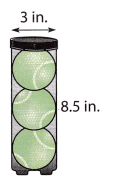
h = 8.5 in.
d = 3 in
r = d/2 = 3/2 = 1.5 in.
We know that,
Lateral Surface Area of a Cylinder = 2πrh
π = 3.14
LSA = 2 × 3.14 × 1.5 × 8.5
LSA = 80.07 sq. in.
Total Surface Area = 2πr² + L
TSA = 2 × 3.14 × 1.5 × 1.5 + 80.07 = 14.13 + 80.07 = 94.2 sq. in.

Question 6.
Texas Go Math Grade 8 Lesson 10.2 Answer Key 11
Answer:
Given,
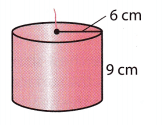
r = 6 cm
h = 9 cm
We know that,
Lateral Surface Area of a Cylinder = 2πrh
π = 3.14
LSA = 2 × 3.14 × 6 × 9
LSA = 339.12 sq. cm
339.12 to the nearest tenth is 339.1 sq. cm
Total Surface Area = 2πr² + L
TSA = 2 × 3.14 × 6 × 6 + 339.12
TSA = 226.08 + 339.12 = 565.2 sq. cm
565.2 to the nearest tenth is 565.2 sq. cm.

Question 7.
A container of bread crumbs has a radius of 4 inches and a height of 8 inches.
Answer:
Given,
A container of bread crumbs has a radius of 4 inches and a height of 8 inches.
r = 4 in
h = 8 in.
We know that,
Lateral Surface Area of a Cylinder = 2πrh
π = 3.14
LSA = 2 × 3.14 × 4 × 8
LSA = 200.96 sq. in.
200.96 to the nearest tenth is 201 sq. in.
Total Surface Area = 2πr² + L
TSA = 2 × 3.14 × 4 × 4 + 201
TSA = 100.48 + 201 = 301.48 sq. in.

Lesson 10.2 Surface Area of a Cylinder Answer Key Go Math Grade 8 Question 8.
A rain barrel has a diameter of 18 inches and a height of 3 feet.
Answer:
Given,
A rain barrel has a diameter of 18 inches and a height of 3 feet.
h = 3 ft
d = 18 ft
r = d/2 = 18/2 = 9 ft
We know that,
Lateral Surface Area of a Cylinder = 2πrh
π = 3.14
LSA = 2 × 3.14 × 9 × 3
LSA = 169.56 sq. ft.
Total Surface Area = 2πr² + L
TSA = 2 × 3.14 × 9 × 9 + 80.07 = 508.68 + 169.56 = 678.24 sq. ft

Question 9.
A drum has a diameter of 14 inches and a height of 5.5 inches.
Answer:
Given,
A drum has a diameter of 14 inches and a height of 5.5 inches.
h = 5.5 in.
d = 14 in.
r = d/2 = 14/2 = 7 in.
We know that,
Lateral Surface Area of a Cylinder = 2πrh
π = 3.14
LSA = 2 × 3.14 × 7 × 5.5
LSA = 241.78 sq. in.
Total Surface Area = 2πr² + L
TSA = 2 × 3.14 × 7 × 7 + 241.78 = 307.72 + 241.78 = 549.5 sq. in.

Question 10.
Multistep A pipe is 25 inches long and has a diameter of 5 inches. What is the lateral area of the pipe to the nearest tenth? Use 3.14 for π.
Answer:
Given,
A pipe is 25 inches long and has a diameter of 5 inches
The pipe is in the shape of a cylinder.
Height = h = 25 inches
Diameter = D = 5 inches.
Radius = R = D/2 = 5/2. = 2.5 inches.
The formula for the lateral surface area of the cylinder =2πrh
π = 3.14
= 2 x 3.14 x 2.5 x 25.
= 392.5 sq. inches.
392.5 nearest to the tenth is 392 sq. inches.

Surface Area Cylinder Worksheet Answer Key Lesson 10.2 Question 11.
Multistep A size D battery has a diameter of 32 millimeters and a length of 5.6 centimeters. What is the lateral area of the battery to the nearest square centimeter? Use 3.14 for π.
Answer:
Given,
A size D battery has a diameter of 32 millimeters and a length of 5.6 centimeters.
32 millimeters = 32/10 = 3.2 centimeters
The formula for the lateral surface area of the cylinder =2πrh
d = r/2
d = 3.2/2 = 1.6 cm
LSA = 2 × 3.14 × 1.6 × 5.6 = 56.2 sq. cm

Question 12.
What If? Carol is designing an oatmeal container. Her first design is a rectangular prism with a height of 12 inches, a width of 8 inches, and a depth of 3 inches.
a. What is the total surface area of the container to the nearest square inch? Use 3.14 for π.
Answer:
The formula for the total surface area of the rectangular prism = 2(lb + bh + lh).
Length = 3 inches
Breath = 8 inches.
Height = 12 inches
= 2(3 x 8 + 8 x 12 + 3 x 12)
= 2(24 + 96 + 36)
= 312 sq. inches.
The total surface area of the rectangular prism = 312 sq. inches.

b. Carol wants to redesign the package as a cylinder with the same total surface area as the prism in part a. If the radius of the cylinder is 2 inches, what is the height of the cylinder? Round your answer to the nearest inch. Use 3.14 for π.
Answer:
The formula for the total surface cylinder = 2πr² + 2πrh.
Radius = 2
The total surface area of the rectangular prism = 312 cu. inches.
2(3.12)(4) + 2 (3.14)(2)h = 312
24.96 + 6.28h = 312
6.2h = 312 + 24.96
6.2h = 336.96
h = 54.34.
The height of the cylinder = 54.34 inches

Question 13.
Vocabulary How do the lateral and total surface area of a cylinder differ?
Answer:
The lateral surface area means the curved surface area.
The total surface area means the curved surface area plus the surface area of the bottom and the top.

H.O.T. Focus on Higher Order Thinking

Go Math Grade 8 Lesson 10.2 Answer Key Lateral Area for a Cylinder Question 14.
Multiple Representations The formula for the total surface area of a cylinder is S = 2πr2 + 2πrh. Explain how you could use the Distributive Property to write the formula another way.
Answer:
Distribute property = ab + ac = a(b + c).
The formula for the total surface cylinder = 2πr² + 2πrh.
2πr² + 2πrh = 2r(πr + πh).
The formula of the total surface area of the cylinder in another way = 2r(πr + πh).

Question 15.
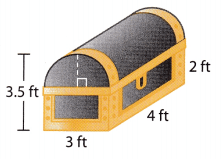
Persevere in Problem-Solving The treasure chest shown is a composite figure. What is the surface area of the treasure chest to the nearest square foot? Explain how you found your answer.
Texas Go Math Grade 8 Lesson 10.2 Answer Key 12
Answer:
The treasure chest is rectangular.
The total surface area of the rectangular prism for composite figures = 2Bh + Ph.
Perimeter of a rectangle = 2(l + w)
Length = 3 feets.
Width = 4 feets.
Height = 2 feets.
= 2(3 + 4).
= 14 feets.
Find base of the rectangle = ½ bh.
b = 3 feets.
h = 3.5 feets.
B = ½ x 3 x 3.5
B = 5.25 sq. feets.
The total surface area of the rectangular prism for composite figures = 2(5.25)(2) + (14)(2).
= 21 + 28
= 49 sq. feets.

Question 16.
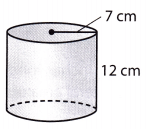
Analyze Relationships A square prism has the same height as the cylinder shown. The perimeter of the prism’s base equals the circumference of the cylinder’s base.
Texas Go Math Grade 8 Lesson 10.2 Answer Key 13
a. Find the side length of the prism’s base to the nearest centimeter. ___________
Answer:
The formula for the base area of the cylinder = πr²
Radius = 7 cm
Height = 12 cm
= π x 7².
= 153.86 sq. cm.
The base area of the cylinder = 153.86 sq. cm.

b. Which figure has the greater lateral area? Which has the greater total surface area? Which has the greater volume? Explain.
Answer:

Go Math Grade 8 Total Surface Area of Cylinders Lesson 10.2 Question 17.
Communicate Mathematical Ideas A cylinder has a circumference of 16π inches and its height is half the radius of the cylinder. What is the total surface area of the cylinder? Give your answer in terms of π. Explain how you found your answer.
Answer:
Given that,
The circumference of the cylinder = 16π inches.
The height of the cylinder is half of the radius.
The formula for the radius of the cylinder = 2πr
2πr = 16π
r = 16π/2π
r = 8
Radius = 8
Height = R/2 = 8/2 = 4.
Height of the cylinder = 4.
The formula for the total surface cylinder = 2πr² + 2πrh.
= 2π(8²) + 2π(8)(4)
= 2π(64) + 2π(32)
= 2π(96)
= 192π sq. inches.

Texas Go Math Grade 8 Lesson 10.2 Answer Key Surface Area of Cylinders Read More »
Texas Go Math Grade 8 Lesson 8.2 Answer Key Converse of the Pythagorean Theorem

Refer to our Texas Go Math Grade 8 Answer Key Pdf to score good marks in the exams. Test yourself by practicing the problems from Texas Go Math Grade 8 Lesson 8.2 Answer Key Converse of the Pythagorean Theorem.

Texas Go Math Grade 8 Lesson 8.2 Answer Key Converse of the Pythagorean Theorem

Texas Go Math Grade 8 Lesson 8.2 Explore Activity Answer Key

Testing the Converse of the Pythagorean Theorem

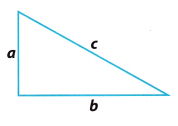
The Pythagorean Theorem states that if a triangle is a right triangle, then a2 + b2 = c2.
Texas Go Math Grade 8 Lesson 8.2 Answer Key 1
The converse of the Pythagorean Theorem states that if a2 + b2 = c2, then the triangle is a right triangle.

Decide whether the converse of the Pythagorean Theorem is true.
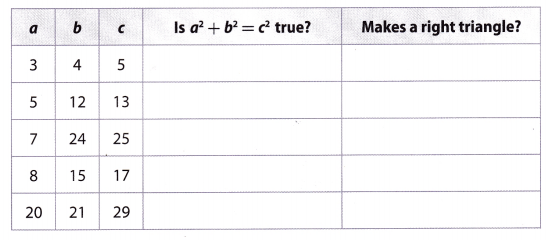
A. Verify that the following sets of lengths make the equation a2 + b2 = c2 true. Record your results in the table.
Texas Go Math Grade 8 Lesson 8.2 Answer Key 2
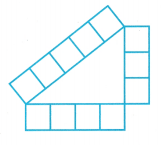
B. For each set of lengths in the table, cut strips of grid paper with a width of one square and lengths that correspond to the values of a, b, and c.
Texas Go Math Grade 8 Lesson 8.2 Answer Key 3
C. For each set of lengths, use the strips of grid paper to try to form a right triangle. An example using the first set of lengths is shown. Record your findings in the table.

Reflect

Go Math Lesson 8.2 The Pythagorean Theorem Worksheet Answers Question 1.
Draw Conclusions Based on your observations, explain whether you think the converse of the Pythagorean Theorem is true.
Answer:
Based on our observations, we saw that the sets of lengths that made the equation a2 + b2 = c2 true also formed a right triangle. Therefore, the converse of the Pythagorean Theorem is true.

Example 1

Tell whether each triangle with the given side lengths is a right triangle.
A. 9 inches, 40 inches, and 41 inches
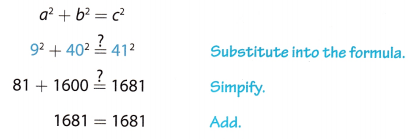
Let a = 9, b = 40, and c = 41.
Texas Go Math Grade 8 Lesson 8.2 Answer Key 4
Since 92 + 402 = 412, the triangle is a right triangle by the converse of the Pythagorean Theorem.

B. 8 meters, 10 meters, and 12 meters
Let a = 8, b = 10, and c = 12.
Texas Go Math Grade 8 Lesson 8.2 Answer Key 5
Since 82 + 102 ≠ 122, the triangle is not a right triangle by the converse of the Pythagorean Theorem.

Your Turn

Tell whether each triangle with the given side lengths is a right triangle.

Question 2.
14 cm, 23 cm, and 25 cm
Answer:
The converse of the Pythagorean Theorem gives you a way to tell if a triangle is a right triangle when you know the side lengths. The Longest side is 25cm, so thats the hypothenuse c. Let a = 14cm and b = 23cm.
a2 + b2 = c2 …………. (1)
142 + 232 = 252 (Substitute into the formula) ………….. (2)
196 + 529 = 625 (Simplify) ………… (3)
725 ≠ 625 (Add) ……….. (4)
Since 142 + 232 ≠ 252, the triangle is not a right triangle by the converse of the Pythagorean Theorem.

Question 3.
16 in., 30 in., and 34 in.
Answer:
The converse of the Pythagorean Theorem gives you a way to tell if a triangle is a right triangle when you know the side lengths. The longest side is 34 in, so thats the hypothenuse c = 34 in. Let a = 30 in and b = 16 in.
a2 + b2 = c2 …………. (1)
302 + 162 = 342 (Substitute into the formula) ………….. (2)
900 + 256 = 1156 (Simplify) ………… (3)
1156 = 1156 (Add) ……….. (4)
Since 302 + 162 = 342, the triangle is a right triangle by the converse of the Pythagorean Theorem.

Question 4.
27 ft, 36 ft, 45 ft
Answer:
The converse of the Pythagorean Theorem gives you a way to tell if a triangle is a right triangle when you know the side lengths. The longest side is the hypothenuse c = 45 cm. Let a = 27 cm and b = 36 cm.
a2 + b2 = c2 …………. (1)
272 + 362 = 452 (Substitute into the formula) ………….. (2)
729 + 1296 = 2025 (Simplify) ………… (3)
2025 = 2025 (Add) ……….. (4)
Since 272 + 362 = 452, the triangle is a right triangle by the converse of the Pythagorean Theorem.

Lesson 8.2 Pythagorean Theorem Converse Answer Key Question 5.
11 mm, 18 mm, 21 mm
Answer:
The converse of the Pythagorean Theorem gives you a way to tell if a triangle is a right triangle when you know the side lengths. Let a = 11 mm, b = 18 m and C = 2 1 mm.
a2 + b2 = c2 …………. (1)
112 + 182 = 212 (Substitute into the formula) …………. (2)
121 + 324 = 441 (Simplify) ………… (3)
445 ≠ 441 (Add) ………………… (4)
Since 112 + 182 ≠ 212, the triangle is not a right triangle by the converse of the Pythagorean Theorem.

Example 2

Katya is buying edging for a triangular flower garden she plans to build in her backyard. If the lengths of the three pieces of edging that she purchases are 13 feet, 10 feet, and 7 feet, will the flower garden be in the shape of a right triangle?
Use the converse of the Pythagorean Theorem. Remember to use the longest length for c.
Let a = 7, b = 10,and c = 13.
a2 + b2 = c2
Texas Go Math Grade 8 Lesson 8.2 Answer Key 6
Since 72 + 102 ≠ 132, the garden will not be in the shape of a right triangle.

Your Turn

Question 6.
A blueprint for a new triangular playground shows that the sides measure 480 ft, 140 ft, and 500 ft. Is the playground in the shape of a right triangle? Explain.
Answer:
Let a = 480 ft, b = 140 ft and c = 500 ft
a2 + b2 = c2 …………. (1)
4802 + 1402 = 5002 (Substitute into the formula) ………… (2)
230400 + 19600 = 250000 (Simplify) ………… (3)
250000 = 250000 (Add) ………….. (4)
Since 4802 + 1402 = 5002 the playground is in the shape of a right triangle.

The Pythagorean Theorem Answer Key Go Math Lesson 8.2 8th Grade Question 7.
A triangular piece of glass has sides that measure 18 in., 19 in., and 25 in. Is the piece of glass in the shape of a right triangle? Explain.
Answer:
Let a = 18 in, b = 19 in and c = 25 in
a2 + b2 = c2 …………. (1)
182 + 192 = 252 (Substitute into the formula) ………… (2)
324 + 361 = 625 (Simplify) ……………. (3)
685 ≠ 625 (Add) …………… (4)
Since 182 + 192 ≠ 252, the triangle is not a right triangle by the converse of the Pythagorean Theorem.
The piece of glass is not in the shape of a right triangle.

Question 8.
A corner of a fenced yard forms a right angle. Can you place a 12-foot-long board across the corner to form a right triangle for which the leg lengths are whole numbers? Explain.
Answer:
No, we cannot find two whole numbers to serve as leg lengths, such that the sum of their squares to be 144.

Texas Go Math Grade 8 Lesson 8.2 Guided Practice Answer Key

Question 1.
Lashandra used grid paper to construct the triangle shown. (Explore Activity)
Texas Go Math Grade 8 Lesson 8.2 Answer Key 7
a. What are the lengths of the sides of Lashandra’s triangle?
__________ units, __________ units, __________ units
Answer:
Lashandra used grid paper to construct the triangle which the lengths of the sides are a number of units.
Let count units: a = 8 units, b = 6 units, c = 10 units.

b. Use the converse of the Pythagorean Theorem to determine whether the triangle is a right triangle.
Texas Go Math Grade 8 Lesson 8.2 Answer Key 8
The triangle that Lashandra constructed (is/is not) a right triangle.
Answer:
Using the converse of the Pythagorean Theorem we can determine whether the triangle is a right triangle.
a2 + b2 = c2 …………. (1)
82 + 62 = 102 (Substitute) …………….. (2)
64 + 36 = 100 (Simplify) ………………. (3)
100 = 100 (Add) …………… (4)
As 82 + 62 = 102 the triangle is the right triangle.

Question 2.
A triangle has side lengths 9 cm, 12 cm, and 16 cm. Tell whether the triangle is a right triangle. (Example 1)
Let a = __________, b = __________, and c = __________.
Texas Go Math Grade 8 Lesson 8.2 Answer Key 8
By the converse of the Pythagorean Theorem, the triangle (is/is not) a right triangle.
Answer:
Let a= 9, b = 12 and c = 16.
a2 + b2 = c2 …………. (1)
92 + 122 = 162     (Substitute into formula) ………….. (2)
81 + 144 = 256        (Simplify) ………….. (3)
225 ≠ 256       (Add) …………… (4)
By the converse of the Pythagorean Theorem, the triangle IS NOT a right triangle.

Go Math Lesson 8.2 8th Grade Converse of The Pythagorean Theorem Question 3.
The marketing team at a new electronics company is designing a logo that contains a circle and a triangle. On one design, the triangle’s side lengths are 2.5 in., 6 in., and 6.5 in. Is the triangle a right triangle? Explain. (Example 2)
Answer:
Let a = 2.5in, b = 6m and c = 6.5in.
a2 + b2 = c2 …………. (1)
(2.5)2 + 62 = (6.5)2    (Substitute into formula) ………….. (2)
6.25 + 36 = 42.25   (Simplify) ………………. (3)
42.25 = 42.25   (Add) ………………. (4)
By the converse of the Pythagorean Theorem, the triangle ( is / is not) a right triangle.
The triangle is a right triangle.

Essential Question Check-In

Question 4.
How can you use the converse of the Pythagorean Theorem to tell if a triangle is a right triangle?
Answer:
Knowing the side lengths, we substitute them in the formula a2 + b2 = c2, where c contains the biggest value. If the equation holds true, then the given triangle is a right triangle. Otherwise, it is not a right triangle.

Texas Go Math Grade 8 Lesson 8.2 Independent Practice Answer Key

Tell whether each triangle with the given side lengths is a right triangle.

Question 5.
11 cm, 60 cm, 61 cm
Answer:
Let a = 11, b = 60 and c = 61. Using the converse of the Pythagorean Theorem, we have:
a2 + b2 = c2
112 + 602 = 612
121 + 3600 = 3721
3721 = 3721
True
Since 112 + 602 = 612, the triangle is a right triangle.

Question 6.
5 ft, 12 ft, 15 ft
Answer:
Let a = 5, b = 12 and c = 15 Using the converse of the Pythagorean Theorem, we have:
a2 + b2 = c2
52 + 122 = 152
25 + 144 = 225
169 ≠ 225
False
Since 52 + 122 ≠ 152, the triangle is not a right triangle.

Question 7.
9 in., 15 in., 17 in.
Answer:
Let a = 9 in, b = 15 in, and C = 17 in.
a2 + b2 = c2 ……………….. (1)
92 + 152 = 172   (Substitute into the formula) ………….. (2)
81 + 225 = 289    (Simplify) …………… (3)
306 ≠ 289    (Add) …………… (4)
Since 92 + 152≠ 172, the triangle is not a right triangle by the converse of the Pythagorean Theorem.

Use The Converse of The Pythagorean Theorem Lesson 8.2 Answer Key Question 8.
15 m, 36 m, 39 m
Answer:
Let a = 15m, b = 36m and C = 39m.
a2 + b2 = c2 ……………….. (1)
152 + 362 = 392    (Substitute into the formula) ………….. (2)
225 + 1296 = 1521    (Simplify) ………… (3)
1521 = 1521    (Add) ………….. (4)
Since 152 + 362 = 392, the triangle is a right triangle by the converse of the Pythagorean Theorem.

Question 9.
20 mm, 30 mm, 40 mm
Answer:
Let a = 20mm, b = 30mm and c = 40mm.
a2 + b2 = c2 ……………….. (1)
202 + 302 = 402    (Substitute into the formula) …………. (2)
400 + 900 = 1600    (SimpLify) …………. (3)
1300 ≠ 1600    (Add) …………. (4)
Since 202 + 302 ≠ 402, the triangle is not a right triangle by the converse of the Pythagorean Theorem.

Question 10.
20 cm, 48 cm, 52 cm
Answer:
Let a = 20 cm, b = 48 cm and c = 52 cm.
a2 + b2 = c2 ……………….. (1)
202 + 482 = 522    (Substitute into the formula) …………. (2)
400 + 2304 = 2704    (Simplify) …………… (3)
2704 = 2704    (Add) ……………. (4)
Since 202 + 482 = 522, the triangle is a right triangle by the converse of the Pythagorean Theorem.

Question 11.
18.5 ft, 6 ft, 17.5 ft
Answer:
Let a = 6ft, b = 17.5ft and c = 18.5ft.
a2 + b2 = c2 ……………….. (1)
62 + (17.5)2 = (18.5)2  (Substitute into the formula) ……………. (2)
36 + 306.25 = 342.25    (Simplify) ………………. (3)
342.25 = 342.25    (Add) ………….. (4)
Since 62 + (17.5)2 = (18.5)2, the triangle is right triangle by the converse of the Pythagorean Theorem.

Question 12.
2 mi, 1.5 mi, 2.5 mi
Answer:
Let a = 2, b = 1.5 and c = 2.5. Using the converse of the Pythagorean Theorem, we have:
a2 + b2 = c2
22 + 1.52 = 2.52
4 + 2.25 = 6.25
6.25 = 6.25
True
Since 22 + 1.52 = 2.52, the triangle is a right triangle.

Pythagorean Theorem Converse Worksheet Answer Key Question 13.
35 in., 45 in., 55 in.
Answer:
Let a = 35 in, b = 45 in and c = 55 in.
a2 + b2 = c2 ……………….. (1)
352 + 452 = 552    (Substitute into the formula) …………… (2)
1225 + 2025 = 3025    (Simplify) …………… (3)
3250 ≠ 3025    (Add) ……………. (4)
Since 352 + 452 ≠ 552, the triangle is not a right triangle by the converse of the Pythagorean Theorem.

Question 14.
25cm, 14cm, 23cm
Answer:
Let a = 14, b = 23 and c = 25. Using the converse of the Pythagorean Theorem, we have:
a2 + b2 = c2
142 + 232 = 252
196 + 529 = 625
725 = 625
False
Since 142 + 232 ≠ 252, the triangle is not a right triangle.

Question 15.
The emblem on a college banner consists of the face of a tiger inside a triangle. The lengths of the sides of the triangle are 13 cm, 14 cm, and 15 cm. Is the triangle a right triangle? Explain.
Answer:
Let a = 13 cm, b = 14 cm and c = 15 cm.
a2 + b2 = c2 ……………….. (1)
132 + 142 = 152 (Substitute into the formula) ………………. (2)
169 + 196 = 225 (Simplify) ……………. (3)
365 ≠ 225 (Add) …………… (4)
Since 132 + 142 ≠ 152, the triangle is not a right triangle by the converse of the Pythagorean Theorem.

Question 16.
Kerry has a large triangular piece of fabric that she wants to attach to the ceiling in her bedroom. The sides of the piece of fabric measure 4.8 ft, 6.4 ft, and 8 ft. Is the fabric in the shape of a right triangle? Explain.
Answer:
Let a = 4.8 ft, b = 6.4 ft and c = 8 ft
a2 + b2 = c2 ……………….. (1)
(4.8)2 + (6.4)2 = 82    (Substitute into the formula) ……………… (2)
23.04 + 40.96 = 64    (Simplify) ……………. (3)
64 = 64     (Add) ……………… (4)
Since (4.8)2 + (6.4)2 = 82, the triangle is a right triangle by the converse of the Pythagorean Theorem.
The piece of fabric in the shape of a right triangle.

Question 17.
A mosaic consists of triangular tiles. The smallest tiles have side lengths 6 cm, 10 cm, and 12 cm. Are these tiles in the shape of right triangles? Explain.
Answer:
Let a = 6, b = 10 and c = 12. Using the converse of the Pythagorean Theorem, we have:
a2 + b2 = c2
62 + 102 = 122
36 + 100 = 144
136 = 144
False
Since 62 + 102 ≠ 122, the tiles are not in the shape of right triangles.

Question 18.
History In ancient Egypt, surveyors made right angles by stretching a rope with evenly spaced knots as shown. Explain why the rope forms a right angle.
Texas Go Math Grade 8 Lesson 8.2 Answer Key 9
Answer:
Every knote is placed on the equal distance, so the unit of measure ¡s part of the rope between two knotes. Let a = 4 units, b = 3 units, and c = 5 units.
a2 + b2 = c2 ……………….. (1)
42 + 32 = 52 (Substitute into the formula) ……………… (2)
16 + 9 = 25 (Simplify) …………….. (3)
25 = 25 (Add) ……………… (4)
Since 42 + 32 = 52, the triangle is a right triangle by the converse of the Pythagorean Theorem.

Question 19.
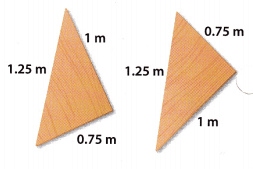
Justify Reasoning Yoshi has two identical triangular boards as shown. Can he use these two boards to form a rectangle? Explain.
Texas Go Math Grade 8 Lesson 8.2 Answer Key 10
Answer:
If the triangle boards are right triangles, then Yoshi can form a rectangle. We can use the converse of the Pythagorean Theorem. Let a = 1 m, b = 0.75m and c = 1.25m
a2 + b2 = c2 ……………….. (1)
12 + (0.75)2 = (1.25)2    (Substitute into the formula) ……………….. (2)
1 + 0.5625 = 1.5625    (Simplify) ……………… (3)
1.5625 = 1.5625    (Add) …………….. (4)
Since 12 + (0.75)2 = (1.25)2, triangle boards are right-angled by the converse of the Pythagorean Theorem.
Yes, Yoshi can form a rectangle from those triangle boards.

The Converse of The Pythagorean Theorem Worksheet Answer Key Question 20.
Critique Reasoning Shoshanna says that a triangle with side lengths 17 m, 8 m, and 15 m is not a right triangle because 172 + 82 = 353, 152 = 225, and 353 ≠ 225. Is she correct? Explain.
Answer:
The converse of the Pythagorean Theorem states that if a2 + b2 = c2 (where c is the biggest side length), then the triangle is a right triangle. Using this theorem, we see a = 8, b = 15 and c = 17.
a2 + b2 = c2
82 + 152 = 172
64 + 225 = 289
289 = 289
True
Since 82 + 152 = 172, the triangle is a right triangle. Shoshanna was incorrect because she used the formula c2 + a2 = b2, which is not the correct formula of the Pythagorean Theorem.

H.O.T. Focus on Higher Order Thinking

Question 21.
Make a Conjecture Diondre says that he can take any right triangle and make a new right triangle just by doubling the side lengths. Is Diondre’s conjecture true? Test his conjecture using three different right triangles.
Answer:
Given a right triangle, the Pythagorean Theorem holds. Therefore,
a2 + b2 = c2
If we double the side lengths of that triangle, we get:
(2a)2 + (2b)2 = (2c)2
4a2 + 4b2 = 4c2
4(a2 + b22) = 4c2
a2 + b2 = c2
As we can see, doubling the side lengths of a right triangle would create a new right triangle.
We can test that by using three different right triangles.
The triangle with sides a = 3, b = 4, and c = 5 is a right triangle. We double its sides and check if the new triangle is a right triangle. We get a = 6, b = 8, c = 10.
62 + 82 = 102
36 + 64 = 100
100 = 100
True
Since 62 + 82 = 102, the new triangle is a right triangle by the converse of the Pythagorean Theorem.
The triangle with sides a = 6, b = 8, and c = 10 is a right triangle. We double its sides and check if the new triangle is a right triangle. We get a = 12, b = 16, c = 20.
122 + 162 = 202
144 + 256 = 400
400 = 400
True
Since 122 + 162 = 202, the new triangle is a right triangle by the converse of the Pythagorean Theorem.
The triangle with sides a = 12, b = 16, and c = 20 is a right triangle. We double its sides and check if the new triangle is a right triangle. We get a = 24, b = 32, c = 40.
242 + 322 = 402
576 + 1024 = 1600
1600 = 1600
True
Since 242 + 322 = 402, the new triangle is a right triangle by the converse of the Pythagorean Theorem.

Question 22.
Draw Conclusions A diagonal of a parallelogram measures 37 inches. The sides measure 35 inches and 1 foot. Is the parallelogram a rectangle? Explain your reasoning.
Answer:
A rectangle is a parallelogram where the interior angles are right angles. To prove if the given parallelogram is a rectangle, we need to prove that the triangle formed by the diagonal of the parallelogram and two sides of it, is a right triangle. Converting all the values into inches, we have a = 12, b = 35, and c = 37 Using the converse of the Pythagorean Theorem, we have:
a2 + b2 = c2
122 + 352 = 372
144 + 1225 = 1369
1369 = 1369
True
Since 122 + 352 = 372, the triangle is a right triangle. Therefore, the given parallelogram is a rectangle.

Question 23.
Represent Real-World Problems A soccer coach is marking the lines for a soccer field on a large recreation field. The dimensions of the field are to be 90 yards by 48 yards. Describe a procedure she could use to confirm that the sides of the field meet at right angles.
Answer:
To confirm that the sides of the field meet at right angles, she could measure the diagonal of the field and use the converse of the Pythagorean Theorem. If a2 + b2 = c2 (where a = 90, b = 48, and c is the length of the diagonal), then the triangle is a right triangle. This method can be used for every corner to decide if they form right angles or not.

Texas Go Math Grade 8 Lesson 8.2 Answer Key Converse of the Pythagorean Theorem Read More »
Texas Go Math Grade 8 Lesson 9.3 Answer Key Volume of Spheres

Refer to our Texas Go Math Grade 8 Answer Key Pdf to score good marks in the exams. Test yourself by practicing the problems from Texas Go Math Grade 8 Lesson 9.3 Answer Key Volume of Spheres.

Texas Go Math Grade 8 Lesson 9.3 Answer Key Volume of Spheres

Texas Go Math Grade 8 Lesson 9.3 Explore Activity Answer Key

Modeling the Volume of a Sphere

A sphere is a three-dimensional figure with all points the same distance from the center. The radius of a sphere is the distance from the center to any point on the sphere.

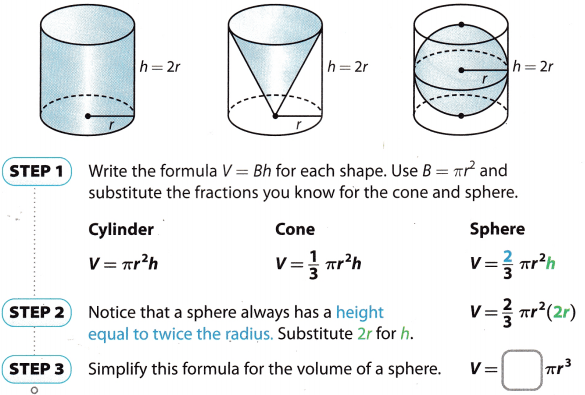
You have seen that a cone fills \(\frac{1}{3}\) of a cylinder of the same radius and height h. If you were to do a similar experiment with a sphere of the same radius, you would find that a sphere fills \(\frac{2}{3}\) of the cylinder. The cylinder’s height is equal to twice the radius of the sphere.
Texas Go Math Grade 8 Lesson 9.3 Answer Key 1

Reflect

Grade 8 Go Math Answer Key Volume of Spheres Answer Key Question 1.
Analyze Relationships A cone has a radius of r and a height of 2r. A sphere has a radius of r. Compare the volume of the sphere and cone.
Answer:
The volume of the cone with a radius of r and a height of 2r is
Vcone = \(\frac{1}{3}\)πr2h
Vcone = \(\frac{1}{3}\) ∙ π ∙ r2 ∙ (2r)
Vcone = \(\frac{2}{3}\) ∙ π ∙ r3
The volume of the sphere with a radius of r is
Vsphere = \(\frac{4}{3}\)πr3
As we can see, the volume of the sphere is twice the volume of the cone.

Example 1

Find the volume of each sphere. Round your answers to the nearest tenth if necessary. Use 3.14 for π.
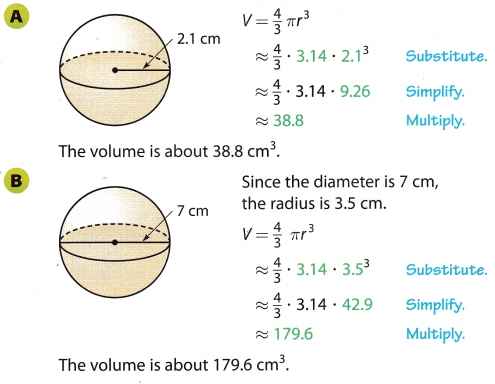
Texas Go Math Grade 8 Lesson 9.3 Answer Key 2

Your Turn

Find the volume of each sphere. Round your answers to the nearest tenth. Use 3.14 for π.

Question 2.
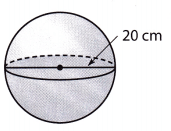
A sphere has a radius of 10 centimeters. __________________
Answer:
It is given that the radius of the sphere is 10 centimeters. Therefore, the volume of the sphere is:
Vsphere = \(\frac{4}{3}\)πr3
Vsphere = \(\frac{4}{3}\) ∙ (3.14) ∙ (10)3
Vsphere ≈ 4186.7 cm3

Question 3.
A sphere has a diameter of 3.4 meters. __________________
Answer:
It is given that the diameter of the sphere is 3.4 meters, which means that the radius is 1.7 meters. Therefore, the volume of the sphere is:
Vsphere = \(\frac{4}{3}\)πr3
Vsphere = \(\frac{4}{3}\) ∙ (3.14) ∙ (1.7)3
Vsphere ≈ 20.6 m3

Example 2

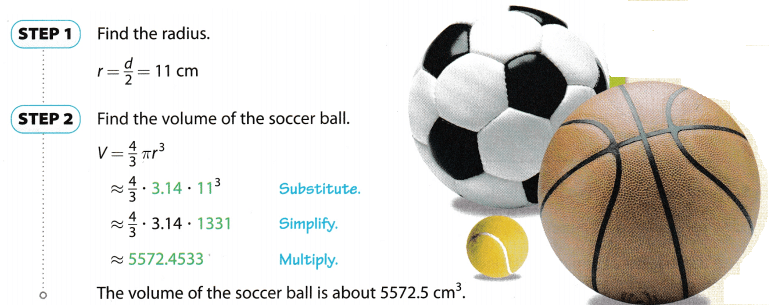
Soccer balls come in several different sizes. One soccer ball has a diameter of 22 centimeters. What is the volume of this soccer ball? Round your answer to the nearest tenth. Use 3.14 for π.
Texas Go Math Grade 8 Lesson 9.3 Answer Key 3

Reflect

Question 4.
What is the volume of the soccer ball in terms of π, to the nearest whole number multiple? Explain your answer.
Answer:
Vsphere = \(\frac{4}{3}\)πr3
Vsphere = \(\frac{4}{3}\) ∙ π ∙ (11)3
Vsphere = \(\frac{4}{3}\) ∙ π ∙ 1331
Vsphere = \(\frac{5324}{3}\) ∙ π
Vsphere ≈ 1775 π
The volume of the soccer ball in terms of π, to the nearest whole number multiple, is 1775 πcm3.

Texas Go Math Grade 8 Pdf Lesson 9.3 Volume of Spheres Question 5.
Analyze Relationships The diameter of a basketball is about 1.1 times that of a soccer ball. The diameter of a tennis ball is about 0.3 times that of a soccer ball. How do the volumes of these balls compare to that of a soccer ball? Explain.
Answer:
The volume of the soccer ball is
Vsoccer = \(\frac{4}{3}\)πr3
Since the diameter of a basketball is about 1.1 times that of a soccer ball, its radius is also 1.1 times that of a soccer ball. Therefore, the volume of the basketball is
Vbasketball = \(\frac{4}{3}\) ∙ π ∙ (1.1 r)3
Vbasketball = \(\frac{4}{3}\) ∙ π ∙ 1.331 ∙ r3
Vbasketball = 1.331 Vsoccer
Since the diameter of a tennis ball is about 0.3 times that of a soccer ball, its radius is also 0.3 times that of a soccer ball. Therefore, the volume of the basketball is
Vtennis = \(\frac{4}{3}\) ∙ π ∙ (0.3r)3
Vtennis = \(\frac{4}{3}\) ∙ π ∙ 0.027 ∙ r3
Vtennis = 0.027 Vsoccer

Your Turn

Question 6.
Val measures the diameter of a ball as 12 inches. How many cubic inches of air does this ball hold, to the nearest tenth? Use 3.14 for π.
Answer:
Here, the diameter of the ball = 12 inch
so, the radius of the ball = 6 inch
Volume of the sphere = \(\frac{4}{3}\) × π × r3
= \(\frac{4}{3}\) × 3.14 × 63
= 904.3 in3

Texas Go Math Grade 8 Lesson 9.3 Guided Practice Answer Key

Question 1.
Vocabulary A sphere is a three-dimensional figure with all points ___________ from the center. (Explore Activity)
Answer:
A sphere is a three-dimensional figure with all points the same distance from the center.

Question 2.
Vocabulary The _____________ is the distance from the center of a sphere to a point on the sphere. (Explore Activity)
Answer:
The radius is the distance from the center f the sphere to a point on the sphere.

Find the volume of each sphere. Round your answers to the nearest tenth if necessary. Use 3.14 for π. (Example 1)

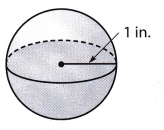
Question 3.
Texas Go Math Grade 8 Lesson 9.3 Answer Key 4
Answer:
Radius r = 1 in
Volume of the sphere = \(\frac{4}{3}\)πr3
V = \(\frac{4}{3}\) ∙ 3.14 ∙ 13
V = 4.1867 in3
V ≈ 4.12 in3

Go Math Grade 8 Answer Key Lesson 9.3 Volume of a Sphere Answer Key Question 4.
Texas Go Math Grade 8 Lesson 9.3 Answer Key 5
Answer:
Diameter = 20 cm
Radius r = \(\frac{20}{2}\) cm
Radius r = 10 cm
Volume of sphere = \(\frac{4}{3}\)πr3
Volume = \(\frac{4}{3}\) × 3.14 × 10³
Volume = 4186.66 cm3
Volume ≈ 4186.7 cm3

Question 5.
A sphere has a radius of 1.5 feet. ___________
Answer:
Radius r = 1.5 ft
Volume of sphere = \(\frac{4}{3}\)πr3
Volume = \(\frac{4}{3}\) × 3.14 × 1.53
Volume = 14.13 ft3
Volume ≈ 14.1 ft3

Question 6.
A sphere has a diameter of 2 yards. ___________
Answer:
Diameter = 2 yards
Radius r = \(\frac{2}{2}\) yards
Radius r = 1 yd
Volume of sphere = \(\frac{4}{3}\)πr3
Volume = \(\frac{4}{3}\) × 3.14 × 13
Volume = 4.1866 yd3
Volume ≈ 4.2 yd3

Question 7.
A baseball has a diameter of 2.9 inches. Find the volume of the baseball. Round your answer to the nearest tenth if necessary. Use 3.14 for π. (Example 2)
Answer:
Diameter of baseball = 2.9 in
Radius r = \(\frac{2.9}{2}\) in
Radius of baseball = 1.45 in
Volume of sphere = \(\frac{4}{3}\)πr3
Volume = \(\frac{4}{3}\) × 3.14 × 1.453
Volume = 12.763 in3
Volume ≈ 12.8 in3

Question 8.
A basketball has a radius of 4.7 inches. What is its volume to the nearest cubic inch? Use 3.14 for π. (Example 2)
Answer:
Radius of basketball r = 4.7 in
Volume of sphere = \(\frac{4}{3}\)πr3
Volume = \(\frac{4}{3}\) × 3.14 × 4.73
Volume = 434.6723 in3
Volume ≈ 434.67 in3

Question 9.
A company is deciding whether to package a ball in a cubic box or a cylindrical box. In either case, the ball will touch the bottom, top, and sides.
(Explore Activity)
Texas Go Math Grade 8 Lesson 9.3 Answer Key 6
a. What portion of the space inside the cylindrical box is empty? Explain.
Answer:
The volume of the cylinder is
Vcylinder = πr2h
Since the ball touches the bottom, top, and sides, then the height of the cylinder will be equal to 2r.
Vcylinder = π ∙ r2 ∙ (2r)
Vcylinder = 2πr3
On the other hand, the voLume of the sphere is
Vsphere = \(\frac{4}{3}\)πr3
The volume of the empty space inside the cylindrical box is found by subtracting the volume of the sphere from the volume of the cylinder:
Vcylinder – Vsphere = 2πr3 – \(\frac{4}{3}\)πr3
= (2 – \(\frac{4}{3}\))πr3
= (\(\frac{6}{3}-\frac{4}{3}\))πr3
= \(\frac{2}{3}\)πr3

b. Find an expression for the volume of the cubic box.
Answer:
The volume of a cube with side a is
Vcube = a3
Since the ball touches the bottom, top, and sides, then the side of the cube will be equal to 2r.
Vcube = (2r)3
Vcube = 8r3

c. About what portion of the space inside the cubic box is empty? Explain.
Answer:
The volume of the empty space inside the cubical box is found by subtracting the volume of the sphere from the volume of the cube:
Vcube – Vsphere = 8r3 – \(\frac{4}{3}\)πr3
= (8 – \(\frac{4}{3}\)π)r3
= (8 – \(\frac{4}{3}\) ∙ 3.14)r3
≈ (8 – 4.2)r3
≈ 3.8r3

Essential Question Check-In

Question 10.
Explain the steps you use to find the volume of a sphere.
Answer:
Step 1: The radius of the sphere is found out
Step 2: The volume of the sphere is \(\frac{4}{3}\)πR3; where R stands for the radius.
Step 3: Put the value of radius in the equation of volume.
Step 4 : Calculate the volume.

Texas Go Math Grade 8 Lesson 9.3 Independent Practice Answer Key

Find the volume of each sphere. Round your answers to the nearest tenth if necessary. Use 3.14 for π.

Question 11.
radius of 3.1 meters ____________
Answer:
The volume of the sphere with a radius of 3.1 meters is
V = \(\frac{4}{3}\)πr3
V = \(\frac{4}{3}\) ∙ 3.14 ∙ (3.1)3
V ≈ 124.7 m3

Go Math 8th Grade Answers Lesson 9.3 Answer Key Volume of a Sphere Question 12.
diameter of 18 inches __________
Answer:
The diameter of the sphere is 18 inches, which means that its radius is 9 inches. The volume of this sphere is
V = \(\frac{4}{3}\)πr3
V = \(\frac{4}{3}\) ∙ 3.14 ∙ (9)3
V = 3052.08
V ≈ 3052.1 inches3

Question 13.
r = 6 in. _____________
Answer:
The volume of the sphere with a radius of 6 inches is
V = \(\frac{4}{3}\)πr3
V = \(\frac{4}{3}\) ∙ 3.14 ∙ (6)3
V = 904.32
V ≈ 904.3 inches3

Question 14.
d = 36 m _____________
Answer:
Diameter d = 36 m
Radius r = \(\frac{36}{2}\) = 18 m
V = \(\frac{4}{3}\)πr3
V = \(\frac{4}{3}\) ∙ 3.14 ∙ (18)3
V = 24416.64 m3

Question 15.
Texas Go Math Grade 8 Lesson 9.3 Answer Key 7
Answer:
The volume of the sphere with a radius of 11 centimeters is
V = \(\frac{4}{3}\)πr3
V = \(\frac{4}{3}\) ∙ 3.14 ∙ (11)3
V ≈ 5572.5 cm3

Question 16.
Texas Go Math Grade 8 Lesson 9.3 Answer Key 8
Answer:
The diameter of the sphere is 2.5 feet, which means that its radius is 1.25 feet. The volume of this sphere is
V = \(\frac{4}{3}\)πr3
V = \(\frac{4}{3}\) ∙ 3.14 ∙ (1.25)3
V ≈ 8.2 feet3

The eggs of birds and other animals come in many different shapes and sizes. Eggs often have a shape that is nearly spherical. When this is true, you can use the formula for a sphere to find their volume.

Question 17.
The green turtle lays eggs that are approximately spherical with an average diameter of 4.5 centimeters. Each turtle lays an average of 113 eggs at one time. Find the total volume of these eggs, to the nearest cubic centimeter.
Answer:
The diameter of an egg (sphere) is 4.5 centimeters, which means that its radius is 2.25 centimeters. The volume of a single egg is
V = \(\frac{4}{3}\)πr3
V = \(\frac{4}{3}\) ∙ 3.14 ∙ (2.25)3
V ≈ 47.68875 cm3
Therefore, the total volume of 113 eggs is
113 ∙ V = 113 ∙ 47.68875
= 5388.82875
≈ 5389 cm3
The total volume of 113 eggs is approximately 5388.8 cm3

Question 18.
Hummingbirds lay eggs that are nearly spherical and about 1 centimeter in diameter. Find the volume of an egg. Round your answer to the nearest tenth.
Answer:
The diameter of the egg (sphere) is 1 centimeter, which means that its radius is 0.5 centimeters. The volume of a single egg is
V = \(\frac{4}{3}\)πr3
V = \(\frac{4}{3}\) ∙ 3.14 ∙ (0.5)3
V ≈ 0.5233
V ≈ 0.5 cm3

Question 19.
Fossilized spherical eggs of dinosaurs called titanosaurid sauropods were found in Patagonia. These eggs were 15 centimeters in diameter. Find the volume of an egg. Round your answer to the nearest tenth.
Answer:
Diameter of an egg (d) = 15 cm
Radius (r) = \(\frac{15}{2}\) = 7.5 cm
Volume = \(\frac{4}{3}\)πr3
Volume = \(\frac{4}{3}\) × 3.14 × 7.53
Volume = 1766.25 cm3
Volume ≈ 1766.3 cm3

Question 20.
Persevere in Problem Solving An ostrich egg has about the same volume as a sphere with a diameter of 5 inches. If the eggshell is about \(\frac{1}{12}\) inch thick, find the volume of just the shell, not including the interior of the egg. Round your answer to the nearest tenth.
Answer:
The diameter of the egg, including the eggshell, is
d = 5 + (2 ∙ \(\frac{1}{12}\))
d = 5 + \(\frac{1}{6}\)
d = \(\frac{31}{6}\) inches
Therefore, the radius of the egg, including the eggshell, is
r = \(\frac{d}{2}\)
r = \(\frac{31}{12}\)
r ≈ 2.583 inches
The volume of the egg, including the eggshell, is
V1 = \(\frac{4}{3}\)πr3
V1 = \(\frac{4}{3}\) ∙ 3.14 ∙ (2.583)3
V1 ≈ 72.2 inches3
The diameter of the egg, excluding the eggshell, is 5 inches, which means that its radius ¡s 25 inches The volume of the egg, excluding the eggshell, is
V2 = \(\frac{4}{3}\)πr3
V2 = \(\frac{4}{3}\) ∙ 3.14 ∙ (2.5)3
V2 ≈ 65.4 inches3
To find the volume of just the shell, we subtract the volume of the egg excluding the shell from the volume of the egg including the shell.
V1 – V2 = 72.2 – 65.4
V1 – V2 = 6.8 inches3
The volume of just the eggshell is approximately 6.8 inches3.

Go Math Book Grade 8 Answer Key Practice and Homework Lesson 9.3 Question 21.
Multistep Write the steps you would use to find a formula for the volume of the figure at right. Then write the formula.
Texas Go Math Grade 8 Lesson 9.3 Answer Key 9
Answer:
Radius of hemisphere = r
Radius of cyLinder = r
Height of cylinder = r
Step 1: Find the formula for the volume of the hemisphere.
Volume of hemisphere = \(\frac{\frac{4}{3} \pi r^{3}}{2}=\frac{2}{3} \pi r^{3}\)

Step 2: Find the formula for the volume of a cylinder.
Volume of cylinder = πr2h
Height of cylinder is equal to the radius, so
Volume of cylinder = πr3

Step 3: Add both the volume expressions:
Total volume = \(\frac{2}{3}\)πr3 + πr3 = \(\frac{5}{3}\)πr3

Question 22.
Critical Thinking Explain what happens to the volume of a sphere if you double the radius.
Answer:
Let radius = r
Volume V1 = \(\frac{4}{3}\)πr3
Let radius = 2r
Volume V2 = \(\frac{4}{3}\)π(2r)3
= 8 × \(\frac{4}{3}\)πr3
= 8V1
= 8 (initial volume)
By doubling the radius of the sphere we make the volume 8 times the initial value.

Question 23.
Multistep A cylindrical can of tennis balls holds a stack of three balls so that they touch the can at the top, bottom, and sides. The radius of each ball is 1.25 inches. Find the volume inside the can that is not taken up by the three tennis balls.
Texas Go Math Grade 8 Lesson 9.3 Answer Key 10
Answer:
Radius of a tennis ball = 1.25 in
Diameter of one ball = 2 × 1.25 = 2.5 in
Height of the cylinder = 2.5 × 3 = 7.5 in
Radius of base of cylinder = 125 in
Volume of cylinder (V1)= πr2h
V1 = 3.14 × 1.252 × 7.5
V1 = 36.796875 in3
V1 ≈ 36.8 in3
Volume of a ball (all three) (V2) 3 × \(\frac{4}{3}\)πr3
V2 = 4 × 3.14 × 1.253
V2 = 24.53125 in3
V2 ≈ 24.5 in3
Volume of empty space = Volume of cylinder – Volume of a ball (all three)
= 36.8 – 24.5 = 12.3 in3

H.O.T. Focus on Higher Order Thinking

Question 24.
Critique Reasoning A sphere has a radius of 4 inches, and a cube-shaped box has an edge length of 7.5 inches. J.D. says the box has a greater volume, so the sphere will fit in the box. Is he correct? Explain.
Answer:
Radius of sphere 4 in
Volume of sphere = \(\frac{4}{3}\)πr3 = \(\frac{4}{3}\)π43 = 267.9467 in3
Volume of sphere ≈ 267.9 in3
Volume of cube-shaped box = 7.5 3 = 421.875 in3
Volume of cube-shaped box ≈ 421.9 in3
Volume of cube > Volume of a sphere
But the base of the cube has an area of (7.5 × 7.5) = 56.25 in2 while the cross-action area of the sphere is:
πr2 = 3.14 × 42 = 50.24 in2
The cross-section area of the sphere is less than that of a cube. J.D. is right and the ball (sphere) will fit in the cube.

Question 25.
Critical Thinking Which would hold the most water: a bowl in the shape of a hemisphere with radius r, a cylindrical glass with radius r and height r, or a cone-shaped drinking cup with radius r and height r? Explain.
Answer:
The volume of a sphere with a radius r is
Vsphere = \(\frac{4}{3}\)πr3
Therefore, the volume of a hemisphere is
Vhemisphere = \(\frac{V_{\text {sphere }}}{2}\)
Vhemisphere = \(\frac{2}{3}\)πr3
The volume of a cylinder with radius r and height r is
Vcylinder = πr2h
Vcylinder = πr3
The volume of a cone with radius r and height r is
Vcone = \(\frac{1}{3}\)πr2h
Vcone = \(\frac{1}{3}\)πr3
As we can notice
Vcone < Vhemisphere < Vcylinder
Therefore, the cylindrical glass with radius r and height r will hold the most water.

Question 26.
Analyze Relationships Hari has models of a sphere, a cylinder, and a cone. The sphere’s diameter and the cylinder’s height are the same, 2r. The cylinder has radius r. The cone has diameter 2r and height 2r. Compare the volumes of the cone and the sphere to the volume of the cylinder.
Answer:
Diameter of sphere = 2r
Radius r = \(\frac{d}{2}\) = \(\frac{2r}{2}\) = r
Volume of sphere = \(\frac{4}{3}\)πr3
Radius of cylinder = r
Height of cylinder 2r
Volume of cylinder = πr2h = πr2(2r) = 2πr3
Diameter of cone = 2r
Radius of cone r = \(\frac{d}{2}\) = \(\frac{2r}{2}\) = r
Height of cone 2r
Volume of cone = \(\frac{1}{3}\)πr2h = \(\frac{2}{3}\)πr2r = \(\frac{2}{3}\)πr3
Volume of cylinder > Volume of sphere > Volume of cone
2πr3 > \(\frac{4}{3}\)πr3 > \(\frac{2}{3}\)πr3

Question 27.
A spherical helium balloon that is 8 feet in diameter can lift about 17 pounds. What does the diameter of a balloon need to be to lift a person who weighs 136 pounds? Explain.
Answer:
Diameter of heAium balloon = 8 ft
Radius = r = \(\frac{8}{2}\) = 4 ft
Weight it can lift = 17 pounds
Volume of a spherical helium balloon = \(\frac{4}{3}\)πr3 = 43(\(\frac{4}{3}\)π)
Texas Go Math Grade 8 Lesson 9.3 Answer Key 11
Volume of balloon which can lift 136 pounds is equal to \(\frac{4}{3}\)π83.
Radius of that balloon = 8 ft
Diameter = 8 × 2 = 16 ft
Diameter of helium balloon = 16 ft

Texas Go Math Grade 8 Lesson 9.3 Answer Key Volume of Spheres Read More »
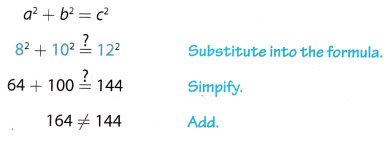
Texas Go Math Grade 8 Lesson 12.3 Answer Key Properties of Rotations

Refer to our Texas Go Math Grade 8 Answer Key Pdf to score good marks in the exams. Test yourself by practicing the problems from Texas Go Math Grade 8 Lesson 12.3 Answer Key Properties of Rotations.

Texas Go Math Grade 8 Lesson 12.3 Answer Key Properties of Rotations

Texas Go Math Grade 8 Lesson 12.3  Explore Activity Answer Key

Explore Activity 1

Exploring Rotations

A rotation is a transformation that turns a figure around a given point called the center of rotation. The image has the same size and shape as the preimage.
Texas Go Math Grade 8 Lesson 12.3 Answer Key 1
The triangle shown on the grid is the preimage. You will use the origin as the center of rotation.
Texas Go Math Grade 8 Lesson 12.3 Answer Key 2
A. Trace triangle ABC onto a piece of paper. Cut out your traced triangle.
B. Rotate your triangle 90° counterclockwise about the origin. The side of the triangle that lies along the x-axis should now lie along the y-axis.
C. Sketch the image of the rotation. Label the images of points A, B, and C as A’, B’, and C’.
D. Describe the motion modeled by the rotation.
Rotate ________________ degrees ____________________ about the origin.
E. Check that the motion you described in, D is the same motion that maps point A onto A’, point B onto B’, and point C onto C’.

Reflect

Question 1.
Communicate Mathematical Ideas How are the size and the orientation of the triangle affected by the rotation?
Answer:
A rotation is a transformation that turns a figure around a given point called the center of rotation.
The image has the same size and shape as the preimage, but a different orientation.
For example, the side \(\overline{\mathrm{BC}}\) was vertical and on the image, it will be horizontal.

Properties of Rotations Lesson 12.3 Grade 8 Go Math Question 2.
Rotate the triangle ABC 90° clockwise about the origin. Sketch the result on the coordinate grid above. Label the image vertices A”, B”, and C”.
Answer:
After a 900 cLockwise rotation, the vertices of the triangle will be:
A(0, 0) → A”(0, 0)
B(2, 0) → B”(0, -2)
C(2, 4) → C”(4, -2)
Texas Go Math Grade 8 Lesson 12.3 Answer Key 16

Explore Activity 2

Properties of Rotations

Use trapezoid TRAP to investigate the properties of rotations.
Texas Go Math Grade 8 Lesson 12.3 Answer Key 3
A. Trace the trapezoid onto a piece of paper. Include the portion of the x- and y-axes bordering the third quadrant. Cut out your tracing.
B. Place your trapezoid and axes on top of those in the figure. Then use the axes to help rotate your trapezoid 180° counterclockwise about the origin. Sketch the image of the rotation of your trapezoid in this new location. Label the vertices of the image T’, R’ A’, and P’.
C. Use a ruler to measure the sides of trapezoid TRAP in centimeters.
TR = ____________ RA = ____________ AP = ____________ TP = ____________
D. Use a ruler to measure the sides of trapezoid T’R’A’P’ in centimeters.
T’R’ = ____________ R’A’ = ____________ A’P’ = ____________ T’P’ = ____________
E. What do you notice about the lengths of corresponding sides of the two figures?
F. Use a protractor to measure the angles of trapezoid TRAP.
m∠J = ____________ m∠R = ____________ m∠A = ____________ m∠P = ____________
G. Use a protractor to measure the angles of trapezoid T’R’A’P’.
m∠T’ = ____________ m∠R’ = ____________ m∠A’ = ____________ m∠P’ = ____________
H. What do you notice about the measures of corresponding angles of the two figures?
I. Which sides of trapezoid TRAP are parallel?
Which sides of trapezoid T’R’A’P’ are parallel?
What do you notice?

Reflect

Question 3.
Make a Conjecture Use your results from E, H, and I to make a conjecture about rotations.
Answer:
The image of a figure and its preimage have the same length of sides and the same interior angles, which means that the two figures are congruent.

Question 4.
Place your tracing back in its original position. Then perform a 180° clockwise rotation about the origin. Compare the results.
Answer:
The image will be the same after a 180° clockwise rotation and after a 180° counterclockwise rotation.

Go Math Grade 8 Lesson 12.3 Answer Key Question 5.
Is the image congruent to the preimage? How do you know?
Texas Go Math Grade 8 Lesson 12.3 Answer Key 17
Answer:
The image of a figure and its preimage have the same size and shape, so this means that two figures are congruent.

Your Turn

Graph the image of quadrilateral ABCD after each rotation.
Texas Go Math Grade 8 Lesson 12.3 Answer Key 4
Question 6.
180°
Answer:
Step 1: Rotate the figure clockwise from the y-axis to the x-axis. Point A will still be at (0, 0).
Plot point; B'(- 1, 2).
Plot point; C'(- 4, 2).
Plot point; D'(- 3, 0)

Step 2: Connect A’, B’, C’, and D’ to form the image quadrilateraL A’B’C’D’.
Texas Go Math Grade 8 Lesson 12.3 Answer Key 18

Question 7.
270° clockwise
Answer:
Step 1: Rotate the figure clockwise from the y-axis to the x-axis. Point A will still be at (0,0).
Plot point B”(-2, 1).
Plot point C”(-2, 4).
Plot point D”(0, 3).

Step 2: Connect A”, B”, C” and D” to form the image quadrilateral A”B”C”D’.
Texas Go Math Grade 8 Lesson 12.3 Answer Key 19

Question 8.
Find the coordinates of Point C after a 90° counterclockwise rotation followed by a 180° rotation.
Answer:
The coordinates of point C after a 90° counterclockwise rotation followed by a 180° rotation are (2, -4).

Texas Go Math Grade 8 Lesson 12.3  Guided Practice Answer Key

Question 1.
Vocabulary A rotation is a transformation that turns a figure around a given _____________________ called the center of rotation.
Answer:
A rotation is a transformation that turns a figure around a given point called the center of rotation.

Siobhan rotates a right triangle 90° counterclockwise about the origin.

Question 2.
How does the orientation of the image of the triangle compare with the orientation of the preimage? (Explore Activity 1)
Answer:
The image has the same size and shape as the preimage. but different orientations.

Lesson 12.3 Rotations Answer Key Go Math 8th Grade Question 3.
Is the image of the triangle congruent to the preimage? (Explore Activity 2)
Answer:
The image of the figure and its preimage have the same size and shape, so this means that the two figures are congruent.

Draw the image of the figure after the given rotation about the origin. (Example 1)

Question 4.
90° counterclockwise
Texas Go Math Grade 8 Lesson 12.3 Answer Key 5
Answer:
Step 1: Rotate the figure counterclockwise from the x-axis to the y-axis. Point E will still be (0, 0)
Plot point F'(0, 3).
Plot point G'(3, 0).

Step 2: Connect E’, F’ and G’ to form the image triangle E’F’G’.
Texas Go Math Grade 8 Lesson 12.3 Answer Key 20

Question 5.
180°
Texas Go Math Grade 8 Lesson 12.3 Answer Key 6
Answer:
Step 1: Points will be A'(-2, -3).
B'(-4, -1)
C'(-2, 0)
D'(0, -1)

Step 2: Connect A’, B’, C’, and D’ to form the image quadrilateral A’B’C’D’.
Texas Go Math Grade 8 Lesson 12.3 Answer Key 21

Essential Question Check-In

Question 6.
What are the properties of rotations?
Answer:
The image and its preimage have the same size and shape, but different orientation.

Texas Go Math Grade 8 Lesson 12.3  Independent Practice Answer Key

Question 7.
The figure shows triangle ABC and a rotation of the triangle about the origin.
Texas Go Math Grade 8 Lesson 12.3 Answer Key 7
a. How would you describe the rotation?
Answer:
The triangle was rotated 90° counterclockwise about the origin.

b. What are the coordinates of the image?
Answer:
The coordinates of the image are:
A'(3, 1), B'(2, 3) and C'(-1, 4).

Properties of Rotation Practice Worksheet Answer Key Question 8.
The graph shows a figure and its image after a transformation.
Texas Go Math Grade 8 Lesson 12.3 Answer Key 8
a. How would you describe this as a rotation?
Answer:
The figure was rotated 180° about the origin.

b. Can you describe this as a transformation other than a rotation? Explain.
Answer:
Yes, this transformation also can be a reflection across the y-axis.

Question 9.
What type of rotation will preserve the orientation of the H-shaped figure in the grid?
Texas Go Math Grade 8 Lesson 12.3 Answer Key 9
Answer:
A 180° rotation about the origin will preserve the orientation of the H-shaped figure in the grid.

Question 10.
A point with coordinates (-2, -3) is rotated 90° clockwise about the origin. What are the coordinates of its image?
Answer:
The coordinates of its image are (-3, 2).

Complete the table with rotations of 180° or less. Include the direction of rotation for rotations of less than 180°.

Question 11.
Texas Go Math Grade 8 Lesson 12.3 Answer Key 10
Answer:
If the shape is in quadrant I and the image is in quadrant IV, the rotation is 90° clockwise.

Activity 12.3 Rotations 8th Grade Math Answer Key Pdf Question 12.

Texas Go Math Grade 8 Lesson 12.3 Answer Key 11
Answer:
If the shape is in quadrant III and the image in quadrant I, the rotation is 180°.

Question 13.
Texas Go Math Grade 8 Lesson 12.3 Answer Key 25
Answer:
If the shape is in the IV quadrant and the image is in the III quadrant, the rotation is 90° clockwise.

Draw the image of the figure after the given rotation about the origin.

Question 14.
180°
Texas Go Math Grade 8 Lesson 12.3 Answer Key 13
Answer:
Step 1: After the 180° rotation about the origin, the points will be;
A'(4, 0).
B'(2, -1)
C'(0, 0)
D'(2, 1)

Step 2: Connect A’, B’, C’, and D’ to form the image quadrilateral A’B’C’D’.
Texas Go Math Grade 8 Lesson 12.3 Answer Key 22

8th Grade Go Math Answer Key Lesson 12.3 Rotations Question 15.
270° counterclockwise
Texas Go Math Grade 8 Lesson 12.3 Answer Key 14
Answer:
Step 1: After the 270° counterclockwise rotation, the points will be:
A'(1, 2)
B'(2, -1)
C'(4, 2)

Step 2: Connect points A’, B’ and C’ to form image triangle A’B’C’.
Texas Go Math Grade 8 Lesson 12.3 Answer Key 23

Question 16.
Is there a rotation for which the orientation of the image is always the same as that of the preimage? If so, what?
Answer:
Yes, there is 360° rotation With that rotation the orientation of the image is always the same as that of the preimage.

H.O.T. Focus on Higher Order Thinking

Question 17.
Problem Solving Lucas is playing a game where he has to rotate a figure for it to fit in an open space. Every time he clicks a button, the figure rotates 90 degrees clockwise. How many times does he need to click the button so that each figure returns to its original orientation?
Texas Go Math Grade 8 Lesson 12.3 Answer Key 15
Figure A _______________
Figure B _______________
Figure C _______________
Answer:
Figure A – 2 times to return to the original orientation
Figure B – 1 time to return to the original orientation
Figure B – 4 times to return to the original orientation

Texas Go Math Grade 8 Pdf Rotation Answer Key Question 18.
Make a Conjecture Triangle ABC is reflected across the y-axis to form the image A’B’C’. Triangle A’B’C’ is then reflected across the x-axis to form the image A”B”C”. What type of rotation can be used to describe the relationship between triangle A”B”C” and triangle ABC?
Answer:
Triangle A’B’C’ is a 90° rotation of triangle ABC
Triangle A”B”C” is a 90° rotation of triangle A’B’C’.
Therefore,
Triangle A”B”C” is a 180° rotation of triangle ABC

Question 19.
Communicate Mathematical Ideas Point A is on the y-axis. Describe all possible locations of image A’ for rotations of 90°, 180°, and 270°. Include the origin as a possible location for A.
Answer:
If point A is on the y-axis, for 90° clockwise rotation, and for the 90° counterclockwise rotation, the image will be on the x-axis.
If point A is on the y-axis, for 270° clockwise rotation, and for the 270° counterclockwise rotation, the image will be on the x-axis.
If point A is on the y-axis, for 180° rotation the image will still be on the y-axis.
If point A is at the origin, A’ is at the origin for any rotation about the origin.
For example, for point A(0, 3), possible locations are:
A'(3, 0) after a 90° clockwise rotation;
A”(0, -3) after a 180° rotation;
A”(-3, 0) after a 270° clockwise rotation.
Texas Go Math Grade 8 Lesson 12.3 Answer Key 24

Texas Go Math Grade 8 Lesson 12.3 Answer Key Properties of Rotations Read More »
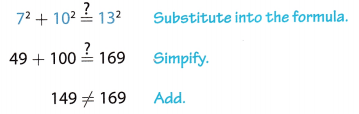
Texas Go Math Grade 8 Lesson 12.2 Answer Key Properties of Reflections

Refer to our Texas Go Math Grade 8 Answer Key Pdf to score good marks in the exams. Test yourself by practicing the problems from Texas Go Math Grade 8 Lesson 12.2 Answer Key Properties of Reflections.

Texas Go Math Grade 8 Lesson 12.2 Answer Key Properties of Reflections

Texas Go Math Grade 8 Lesson 12.2 Explore Activity Answer Key

Explore Activity 1

Exploring Reflections

A reflection is a transformation that flips a figure across a line. The line ¡s called the line of reflection. Each point and its image are the same distance from the line of reflection.
Texas Go Math Grade 8 Lesson 12.2 Answer Key 1
The triangle shown on the grid is the preimage. You will explore reflections across the x- and y-axes.
Texas Go Math Grade 8 Lesson 12.2 Answer Key 2
A. Trace triangle ABC and the x- and y-axes onto a piece of paper.
B. Fold your paper along the x-axis and trace the image of the triangle on the opposite side of the x-axis. Unfold your ‘ paper and label the vertices of the image A’, B’, and C’.
C. What is the line of reflection for this transformation?
D. Find the perpendicular distance from each point to the line of reflection.
Point A __________ Point B ___________ Point C ___________
E. Find the perpendicular distance from each point to the line of reflection.
Point A’ __________ Point B’ ___________ Point C’ ___________
F. What do you notice about the distances you found in D and E?

Reflect

Question 1.
Fold your paper from A along the y-axis and trace the image of triangle ABC on the opposite side. Label the vertices of the image A”, B”, and C”. What is the line of reflection for this transformation?
Answer:
The line of reflection for this transformation is the y-axis.

Go Math Grade 8 Lesson 12.2 Answer Key Question 2.
How does each image in your drawings compare with its preimage?
Answer:
The triangle A’B’C’ is on the same distance from the x-axis like triangle ABC.
The triangle A”B”C” is on the same distance from the y-axis like triangle ABC.
The image and its preimage are the same distance from the line of reflection.

Explore Activity 2

Properties of Reflections

Use trapezoid TRAP to investigate the properties of reflections.
Texas Go Math Grade 8 Lesson 12.2 Answer Key 3
A. Trace the trapezoid onto a piece of paper. Cut out your traced trapezoid.
B. Place your trapezoid on top of the trapezoid in the figure. Then reflect your trapezoid across the y-axis. Sketch the image of the reflection by tracing your trapezoid in this new location. Label the vertices of the image T’, R’, A’, and P’.
C. Use a ruler to measure the sides of the trapezoid TRAP in centimeters.
TR = ___________ RA = ___________ AP = ___________ TP = ___________
D. Use a ruler to measure the sides of trapezoid T’R’A’P’ in centimeters.
TR’= ___________ R’A’ = ___________ A’P’ = ___________ T’P’ = ___________
E. What do you notice about the lengths of the corresponding sides of the two figures?
F. Use a protractor to measure the angles of the trapezoid TRAP.
m∠T = ___________ m∠R = ___________ m∠A = ___________ m∠P = ___________
G. Use a protractor to measure the angles of trapezoid T’R’A’P’.
m∠T’ = ___________ m∠R’ = ___________ m∠A’ = ___________ m∠P’ = ___________
H. What do you notice about the measures of corresponding angles of the two figures?
I. Which sides of the trapezoid TRAP are parallel? ___________
Which sides of trapezoid T’R’A’P’are parallel? ___________
What do you notice?

Reflect

Question 3.
Make a Conjecture Use your results from E, H, and I to make a conjecture about reflections.
Answer:
A reflection is a transformation that flips a figure across a line. This means that the image of the figure and its preimage have the same size and shape, so they are congruent.

Your Turn

Go Math Grade 8 Answer Key Properties of Reflections Pdf Question 4.
The figure shows the pentagon ABCDE. Graph the image of the pentagon after a reflection across the y-axis.
Texas Go Math Grade 8 Lesson 12.2 Answer Key 4
Answer:
Step 1: Reflect point A.
Count 5 units from the other side of the y-axis. Plot point A'(5, 6).

Step 2: Reflect point B.
Count 3 units from the other side of the y-axis. Plot point B'(3, 6).

Step 3: Reflect point C.
Count 2 units from the other side of the y-axis. PLot point C'(2, 4).

Step 4: Reflect point D.
Count 3 units from the other side of the y-axis. Plot point D'(3, 1).

Step 5: Reflect point E.
Count 5 units from the other side of the y-axis. Plot point E'(5, 1).

Step 6: Connect A’, B’, C’, D’ and E’ to form pentagon A’B’C’D’E’.
Texas Go Math Grade 8 Lesson 12.2 Answer Key 10
A'(5, 6)
B'(3, 6)
C'(2, 4)
D'(3, 1)
E'(5, 1)

Texas Go Math Grade 8 Lesson 12.2 Guided Practice Answer Key

Question 1.
Vocabulary A reflection is a transformation that flips a figure across a line called the ______________.
Answer:
A reflection is a transformation that flips a figure across a line called the line of reflection.

Question 2.
The figure shows trapezoid ABCD. (Explore Activities 1 and 2 and Example 1)
Texas Go Math Grade 8 Lesson 12.2 Answer Key 5
a. Graph the image of the trapezoid after a reflection across the x-axis. Label the vertices of the image.
Answer:
Step 1: Reflect point A.
Count 4 units below the x-axis. Plot point A'(-3, -4).

Step 2: Reflect point B.
Count 4 units below the x-axis. Plot point B'(1, -4).

Step 3: Reflect point C.
Count 1 unit below the x-axis. Plot point C'(3, -1).

Step 4: Reflect point D.
Count 1 unit below the x-axis. Plot point D'(-3, -1).

Step 5: Connect A’, B’, C’ and D’ to form trapezoid A’B’C’D’.
Texas Go Math Grade 8 Lesson 12.2 Answer Key 11

b. How do trapezoid ABCD and trapezoid A’B’C’D’ compare?
Answer:
Trapezoid ABCD and trapezoid A’B’C’D’ are congruent.

c. What If? Suppose you reflected trapezoid ABCD across the y-axis. How would the orientation of the image of the trapezoid compare with the orientation of the preimage?
Answer:
If we reflect trapezoid ABCD across the y-axis, the trapezoids would be oppositely oriented, in that case.

Essential Question Check-In

Question 3.
What are the properties of reflections?
Answer:
The properties of reflection are that the image of a geometric figure has the same size as the preimage and the same shape, but a different orientation.

Texas Go Math Grade 8 Lesson 12.2 Independent Practice Answer Key

The graph shows four right triangles. Use the graph for Exercises 4-7.
Texas Go Math Grade 8 Lesson 12.2 Answer Key 6

Question 4.
Which two triangles are reflections of each other across the x-axis?
Answer:
Triangles A and C are reflections of each other across the x-axis.

8th Grade Go Math Lesson 12.2 Reflections Answer Key Question 5.
For which two triangles is the line of reflection the y-axis?
Answer:
Triangles C and D the line of reflection is the y-axis.

Question 6.
Which triangle is a translation of triangle C? How would you describe the translation?
Answer:
The triangle B is a translation of triangle C. The translation is 8 units up and 6 units right.

Question 7.
Which triangles are congruent? How do you know?
Answer:
The preimage and the image obtained by reflection and translation are congruent. The graph shows us 4 triangles obtained either by translation or reflection. This means that all 4 triangles are congruent.

Question 8.
a. Graph quadrilateral WXYZ with vertices W(-2, -2), X(3,1), Y(5, -1), and Z(4, -6) on the coordinate grid.
Texas Go Math Grade 8 Lesson 12.2 Answer Key 7
Answer:
Step 1: Reflect point W.
Count 2 units above the x-axis. PLot point W'(-2, 2).

Step 2: Reflect point X.
Count 1 unit below the x-axis. Plot point X'(3, -1).

Step 3: Reflect point Y.
Count 1 unit above the x-axis Plot point Y'(5, 1)

Step 4: Reflect point Z.
Count 6 units above the x-axis PLot point Z'(4, 6).

Step 5: Connect W’, X’, Y’ and Z’ to form quadrilateral W’X’Y’Z’.
Texas Go Math Grade 8 Lesson 12.2 Answer Key 12

b. On the same coordinate grid, graph quadrilateral W’X’Y’Z’, the image of quadrilateral WXYZ after a reflection across the x-axis.
Answer:
\(\overline{\mathrm{YZ}}\) is congruent to \(\overline{Y^{\prime} Z^{\prime}}\);
\(\overline{\mathrm{XY}}\) is congruent to \(\overline{X^{\prime} Y^{\prime}}\);
\(\overline{\mathrm{WZ}}\) is congruent to \(\overline{W^{\prime} Z^{\prime}}\),
\(\overline{\mathrm{XW}}\) is congruent to \(\overline{X^{\prime} W^{\prime}}\).

c. Which side of the image is congruent to side \(\overline{Y Z}\)?
Answer:
∠X is congruent to ∠X’;
∠Y is congruent to ∠Y’;
∠Z is congruent to ∠Z’;
∠W is congruent to ∠W’;

d. Which angle of the image is congruent to ∠X?
Name three other pairs of congruent angles.
Answer:

Properties of Reflection Lesson 12.2 Answer Key Question 9.
Critical Thinking Is it possible that the image of a point after a reflection could be the same point as the preimage? Explain.
Answer:
Yes, it’s possible when the point is on the line of the reflection. The distance between the point and the line is 0, and the image of the point will be in the same place as the preimage.

H.O.T. Focus on Higher Order Thinking

Question 10.
a. Graph the image of the figure shown after a reflection across the y-axis.
Texas Go Math Grade 8 Lesson 12.2 Answer Key 8
Answer:
Texas Go Math Grade 8 Lesson 12.2 Answer Key 13

b. On the same coordinate grid, graph the image of the figure you drew in part a after a reflection across the x-axis.
Answer:
Texas Go Math Grade 8 Lesson 12.2 Answer Key 13

c. Make a Conjecture What other sequence of transformations would produce the same final image from the original preimage? Check your answer by performing the transformations. Then make a conjecture that generalizes your findings.
Answer:
With a reflection of the figure first across the x-axis, and then over the y-axis, it’s obtained the same image of the original figure.

The Properties of Reflections Go Math Grade 8 Answer Key Pdf Question 11.
a. Graph triangle DEF with vertices D(2, 6), E(5, 6), and F(5, 1) on the coordinate grid.
Texas Go Math Grade 8 Lesson 12.2 Answer Key 9
Answer:
Texas Go Math Grade 8 Lesson 12.2 Answer Key 14

b. Next graph triangle D’E’F’, the image of triangle DEF after a reflection across the y-axis.
Answer:
Texas Go Math Grade 8 Lesson 12.2 Answer Key 14

c. On the same coordinate grid, graph triangle D”E”F”, the image of triangle D’E’F’ after a translation of 7 units down and 2 units to the right.
Answer:
After a translation of 7 units down and 2 units to the Left and a reflection across the y-axis we can get triangle D’E’F’, the image of triangle DEF.

d. Analyze Relationships Find a different sequence of transformations that will transform triangle DEF to triangle D”E”F”.
Answer:

Texas Go Math Grade 8 Lesson 12.2 Answer Key Properties of Reflections Read More »
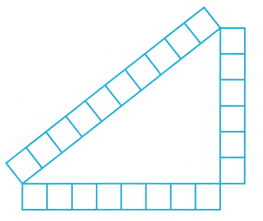
Texas Go Math Grade 8 Lesson 9.1 Answer Key Volume of Cylinders

Refer to our Texas Go Math Grade 8 Answer Key Pdf to score good marks in the exams. Test yourself by practicing the problems from Texas Go Math Grade 8 Lesson 9.1 Answer Key Volume of Cylinders.

Texas Go Math Grade 8 Lesson 9.1 Answer Key Volume of Cylinders

Texas Go Math Grade 8 Lesson 9.1 Explore Activity Answer Key

Modeling the Volume of a Cylinder

A cylinder is a three-dimensional figure that has two congruent circular bases that lie in parallel planes. The volume of any three-dimensional figure is the number of cubic units needed to fill the space taken up by the solid figure.

One cube represents one cubic unit of volume. You can develop the formula for the volume of a cylinder using an empty soup can or other cylindrical container. First, remove one of the bases.
Texas Go Math Grade 8 Lesson 9.1 Answer Key 1
A. Arrange centimeter cubes in a single layer at the bottom of the cylinder. Fit as many cubes into the layer as possible. How many cubes are in this layer?
Texas Go Math Grade 8 Lesson 9.1 Answer Key 2
B. To find how many layers of cubes fit in the cylinder, make a stack of cubes along the inside of the cylinder. How many layers fit in the cylinder?
Texas Go Math Grade 8 Lesson 9.1 Answer Key 3
C. How can you use what you know to find the approximate number of cubes that would fit in the cylinder?

Reflect

Question 1.
Make a Conjecture Suppose you know the area of the base of a cylinder and the height of the cylinder. How can you find the cylinder’s volume?
Answer:
Volume of the cylinder is base times height. That is we will multiply the base area by the height of the cylinder, to find the volume
Volume of cylinder = base area × height

Go Math Grade 8 Lesson 9.1 Volume of Cylinders Answer Key Question 2.
Let the area of the base of a cylinder be B and the height of the cylinder be h. Write a formula for the cylinder’s volume V.
Answer:
Base area = B
Height = h
VoLume of cylinder = base area × height
V = Bh
V = r2πh

Example 1

Find the volume of each cylinder. Round your answers to the nearest tenth if necessary. Use 3.14 for π.

Texas Go Math Grade 8 Lesson 9.1 Answer Key 4
The volume is about 418 cm3.

Reflect

Question 3.
What If? If you want a formula for the volume of a cylinder that involves the diameter d instead of the radius r, how can you rewrite it?
Answer:
Volume of cylinder = πr2h
Diameter(d) = 2r
r = \(\frac{d}{2}\)
Put the value of radius in the equation of volume of a cylinder.
V = πr2h
V = π(\(\frac{d}{2}\))2h
V = π\(\frac{d^{2}}{4}\)h
V = \(\frac{\pi d^{2} h}{4}\)

Your Turn

Find the volume of each cylinder. Round your answers to the nearest tenth if necessary. Use 3.14 for π.

Question 4.
Texas Go Math Grade 8 Lesson 9.1 Answer Key 5
Answer:
Base diameter = 10 in
Base radius r = \(\frac{10}{2}\)
Base radius r = 5 in
Height = 6 in
VoLume of a cylinder = πr2h
V = 3.14 × 52 × 6
V = 3.14 × 25 × 6
V = 471 in3

Question 5.
Texas Go Math Grade 8 Lesson 9.1 Answer Key 6
Answer:
Base radius r = 4 ft
Length h = 12 ft
Volume of cylinder V = πr2h
V = 3.14 × 42 × 12
V = 3.14 × 16 × 12
V = 602.88 ft3
V ≈ 602.9 ft3

Volume of Cylinder Worksheet 8th Grade Lesson 9.1 Answer Key Question 6.
A drum company advertises a snare drum that is 4 inches high and 12 inches in diameter. Find the volume of the drum to the nearest tenth. Use 3.14 for π.
Answer:
Diameter of the drum – d = 12 in
Radius of the drum – r = \(\frac{d}{2}\) = \(\frac{12}{2}\) = 6 in
Height – h = 4 in
Volume of the drum – V = πr2h
V = 3.14 × 62 × 4
V = 3.14 × 36 × 4
V = 452.16 in3
V ≈ 452.2 in3

Texas Go Math Grade 8 Lesson 9.1 Guided Practice Answer Key

Question 1.
Vocabulary Describe the bases of a cylinder. (Explore Activity)
Answer:
The two flat surfaces, on the ends of a cylinder, are the bases of the cylinder.

Question 2.
Figure 1 shows a view from above of inch cubes on the bottom of a cylinder. Figure 2 shows the highest stack of cubes that will fit inside the cylinder. Estimate the volume of the cylinder. Explain your reasoning. (Explore Activity)
Texas Go Math Grade 8 Lesson 9.1 Answer Key 7
Answer:
Number of inch cubes that fit in base of the cylinder = 61
Number of inch cubes that fit in length of the cylinder = 7
Volume of cylinder = base area × height
V = 61 × 7
V = 427 cubic units.
Volume of each cube = 1 in3
Volume of cylinder = 427 in3
The approximate volume of cylinder = 427 in3

Question 3.
Find the volume of the cylinder to the nearest tenth. Use 3.14 for π. (Example 1)
Texas Go Math Grade 8 Lesson 9.1 Answer Key 8
The volume of the cylinder is approximately __________ m3.
Answer:
V = πr2h
V = π ∙ 62 ∙ 15
V ≈ 3.14 × 36 × 15
V ≈ 1695.6m3

Texas Go Math Grade 8 Pdf Volume Cylinder Worksheet Answer Key Question 4.
A Japanese odaiko is a very large drum that is made by hollowing out a section of a tree trunk. A museum in Takayama City has three odaikos of similar size carved from a single tree trunk. The largest measures about 2.7 meters in both diameter and length, and weighs about 4.5 metric tons. Using the volume formula for a cylinder, approximate the volume of the drum to the nearest tenth. (Example 2)
The radius of the drum is about ________ m.
The volume of the drum is about ____________ m3.
Answer:
Diameter of base of the drum = 2.7 m
Radius of the base of the drum = \(\frac{2.7}{2}\)
R = 1.35 m
Volume of cylinder = πR2h
Height (h) = 2.7 m
Radius (R) = 1.35 m
Volume = 3.14 × 1.352 × 2.7
V = 15.4511 m3
V ≈ 15.5 m3

Essential Question Check-In

Question 5.
How do you find the volume of a cylinder? Describe which measurements of a cylinder you need to know.
Answer:
We need to find the radius of the base, r, and the height of the cylinder, h.
The volume of cylinder is = πr2h

Texas Go Math Grade 8 Lesson 9.1 Independent Practice Answer Key

Find the volume of each figure. Round your answers to the nearest tenth if necessary. Use 3.14 for π.

Question 6.
Texas Go Math Grade 8 Lesson 9.1 Answer Key 9
Answer:
Radius of base = 11 cm
Height of cylinder = 1.5 cm
Volume of cylinder = πr2h
V = 3.14 × 112 × 1.5
V = 56991
V ≈ 569.9 cm3
V = 569.9 cm32

8th Grade Volume of A Cylinder Worksheet Question 7.
Texas Go Math Grade 8 Lesson 9.1 Answer Key 10
Answer:
Radius of base = 4 in
Height of cylinder = 24 in
Volume of cylinder = πr2h
V = 3.14 × 42 × 24
V = 1205.76 in3
V ≈ 1205.8 in3

Question 8.
Texas Go Math Grade 8 Lesson 9.1 Answer Key 11
Answer:
Radius of base = 5 m
Height of cylinder = 16 m
Volume of cylinder = πr2h
V = 3.14 × 52 × 16
V = 1256 m3

Question 9.
Texas Go Math Grade 8 Lesson 9.1 Answer Key 12
Answer:
Diameter of Base = 10 in
Radius of base = 5 in
Height of cylinder = 12 in
Volume of cylinder = πr2h
V = 3.14 × 52 × 12
V = 942 in3

Question 10.
A cylinder has a radius of 4 centimeters and a height of 40 centimeters.
Answer:
Radius of base = 4 cm
Height of cylinder = 40 cm
Volume of cylinder = πr2h
V = 3.14 × 42 × 40
V = 2009.6 cm3

Go Math Grade 8 Lesson 9.1 Volume of A Cylinder Answer Key Question 11.
A cylinder has a radius of 8 meters and a height of 4 meters.
Answer:
Radius of base = 8 m
Height of cylinder = 4 m
Volume of cylinder = πr2h
V = 3.14 × 82 × 4
V = 803.84 m3
V ≈ 803.8 m3

Round your answer to the nearest tenth, if necessary. Use 3.14 for π.
Texas Go Math Grade 8 Lesson 9.1 Answer Key 13
Question 12.
The cylindrical Giant Ocean Tank at the New England Aquarium in Boston is 24 feet deep and has a radius of 18.8 feet. Find the volume of the tank.
Answer:
Base radius of the tank = 18.8 ft
Depth of the tank in the ocean = 24 ft
Volume of the tank = πr2h
V = 3.14 × 18.82 × 24
V = 3.14 × 354.44 × 24
V = 26635.2384 ft3
V ≈ 26635.2 ft3

Question 13.
A standard-size bass drum has a diameter of 22 inches and is 18 inches deep. Find the volume of this drum.
Answer:
Base diameter of a drum = 22 in
Base radius of the drum = \(\frac{22}{2}\) in
Base radius of a drum = 11 in
Depth of the drum = 18 in
Volume of the drum = πr2h
V = 3.14 × 112 × 18
V = 3.14 × 121 × 18
V = 6838.92 in3
V ≈ 6838.9 in3

Question 14.
Grain is stored in cylindrical structures called silos. Find the volume of a silo with a diameter of 11.1 feet and a height of 20 feet.
Answer:
Base diameter of silo 11.1 ft
Base radius of the silo = \(\frac{11.1}{2}\) = 555 ft
Depth of the silo = 20 ft
Volume of the silo = πr2h
V = 3.14 × 5552 × 18
V = 3.14 × 30.8025 × 18
V = 1934.397 ft3
V = 1934.4 ft3

Go Math 8th Grade Volume of A Cylinder Worksheet Answer Key Question 15.
The Frank Erwin Center, or” The Drum:’ at the University of Texas in Austin can be approximated by a cylinder that is 120 meters in diameter and 30 meters in height. Find its volume.
Answer:
Base diameter of a center 120 m
Base radius of the center = \(\frac{120}{2}\) m
Base radius of the center = 60 m
Height of the center = 30 m
Volume of the center = πr2h
V = 3.14 × 602 × 30
V = 3.14 × 3600 × 30
V = 339120 m3

Question 16.
A barrel of crude oil contains about 5.61 cubic feet of oil. How many barrels of oil are contained in 1 mile (5280 feet) of a pipeline that has an inside diameter of 6 inches and is completely filled with oil? How much is “1 mile” of oil in this pipeline worth at a price of $100 per barrel?
Answer:
Volume of barrel = 5.61 cubic feet
Length of the pipe = 1 mile = 5280 feet
Diameter of the ripe = 6 inches = 0.5 feet
Radius of the pipe = \(\frac{6}{2}\) inches = 3 inches = 0.25 feet
Volume of oil in the pipe = πr2h = 3.14 × 0.252 × 5280 = 1036.2 cubic feet
Number of barrels in the pipe = \(\frac{1036.2}{5.61}\) ≈ 184.7 barrels
Cost of one barrel = $100
Cost of 184.7 barrels = 184.7 ∙ $100 = $18470

Question 17.
A pan for baking French bread is shaped like half a cylinder. It is 12 inches long and 3.5 inches in diameter. What is the volume of uncooked dough that would fill this pan?
Texas Go Math Grade 8 Lesson 9.1 Answer Key 14
Answer:
The Length of the pan = 12 in
Diameter of the pan = 3.5 in
Radius = \(\frac{3.5}{2}\)
Radius = 1.75 in
The volume of uncooked dough = Half the volume of full cylinder of above dimensions.
= \(\frac{\pi r^{2} h}{2}\)
= \(\frac{3.14 \times 1.75^{2} \times 12}{2}\)
= 57.697 in3
Volume of uncooked dough ≈ 57.7 in3

H.O.T. Focus on Higher Order Thinking

Question 18.
What’s the Error? A student said the volume of a cylinder with a 3-inch diameter is two times the volume of a cylinder with the same height and a 1.5-inch radius. What is the error?
Answer:
To find the voLume of a cylinder we use the formula:
V = πr2h
If the diameter of the first cyLinder is 3 inches, it means that its radius is 1.5 inches. Therefore, its volume can be written as:
V1 = π ∙ (1.5)2 ∙ h
The volume of the second cylinder with the same height h and a radius of 15 inches is:
V2 = π ∙ (1.5)2 ∙ h
As we can see, the volumes of the two given cylinders are equal.
V1 = V2

Question 19.
Communicate Mathematical Ideas Explain how you can find the height of a cylinder if you know the diameter and the volume. Include an example with your explanation.
Answer:
Let the diameter be D.
Radius r = \(\frac{D}{2}\)
Volume = πr2h
Volume = π(\(\frac{D}{2}\))2h
V = π\(\frac{D^{2}}{4}\)h
h = \(\frac{4 V}{\pi D^{2}}\)
To find the height of a cylinder with diameter D = 2m
Let the volume be 10 m 3
h = \(\frac{4 V}{\pi D^{2}}\)
h = \(\frac{4 \times 10}{3.14 \times 2^{2}}\)
h = 3.18 m 3

Lesson 9.1 Go Math 8th Grade Volume of Cylinder Worksheet Answer Key Question 20.
Analyze Relationships Cylinder A has a radius of 6 centimeters. Cylinder B has the same height and a radius half as long as cylinder A. What fraction of the volume of cylinder A is the volume of cylinder B? Explain.
Answer:
rA = 6 cm
rB = half of the radius of cylinder A = 3 cm
hA = hB
VA = πrA2h
VB = πrB2h
Therefore,
Texas Go Math Grade 8 Lesson 9.1 Answer Key 15

Texas Go Math Grade 8 Lesson 9.1 Answer Key Volume of Cylinders Read More »
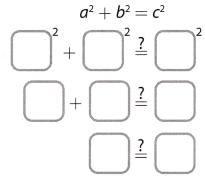
Texas Go Math Grade 8 Lesson 8.1 Answer Key The Pythagorean Theorem

Refer to our Texas Go Math Grade 8 Answer Key Pdf to score good marks in the exams. Test yourself by practicing the problems from Texas Go Math Grade 8 Lesson 8.1 Answer Key The Pythagorean Theorem.

Texas Go Math Grade 8 Lesson 8.1 Answer Key The Pythagorean Theorem

Texas Go Math Grade 8 Lesson 8.1 Explore Activity Answer Key

Proving the Pythagorean Theorem

In a right triangle, the two sides that form the right angle are the legs. The side opposite the right angle is the hypotenuse.
Texas Go Math Grade 8 Lesson 8.1 Answer Key 1
The Pythagorean Theorem
In a right triangle, the sum of the squares of the lengths of the legs is equal to the square of the length of the hypotenuse.
If a and b are legs and c is the hypotenuse, a2 + b2 = c2.

A. Draw a right triangle on a piece of paper and cut it out. Make one leg shorter than the other.
Texas Go Math Grade 8 Lesson 8.1 Answer Key 2
B. Trace your triangle onto another piece of paper four times, arranging them as shown. For each triangle, label the shorter leg a, the longer leg b, and the hypotenuse c.
C. What is the area of the unshaded square?
Label the unshaded square with its area.
D. Trace your original triangle onto a piece of paper four times again, arranging them as shown. Draw a line outlining a larger square that is the same size as the figure you made in B.
Texas Go Math Grade 8 Lesson 8.1 Answer Key 3
E. What is the area of the unshaded square at the top right of the figure in D ? at the top left?
Label the unshaded squares with their areas.
F. What is the total area of the unshaded regions in D?

Reflect

Question 1.
Explain whether the figures in B and D have the same area.
Answer:
We are told that the line outlining the larger square in Figure D is the same as the one in Figure B. In both of them, the side of the square is (a + b). Therefore, the figures in B and D have the same area.

Go Math Lesson 8.1 Answer Key 8th Grade The Pythagorean Theorem Answers Question 2.
Explain whether the unshaded regions of the figures in B and D have the same area.
Answer:
We are told that the larger square in Figure D is the same size as the one in Figure B. The shaded triangles in Figure D are the same as the ones in Figure B, but they are rearranged. Therefore, the unshaded regions of both Figure D and B have the same area.

Question 3.
Analyze Relationships Write an equation relating the area of the unshaded region in Step B to the unshaded region in D.
Answer:
Taking into consideration Figure B, the Legs of a single shaded triangle are denoted by a and b (where a < b), and the hypotenuse is denoted by c. As we can see, there are four equal shaded triangles and their hypotenuses form a square with side c. This means that the area of the unshaded region, denoted by A1, is:
A1 = c2
Taking into consideration Figure D, we can notice again four shaded triangles with legs a and b and hypotenuse C, just like in Figure B, but in this case, the triangles are rearranged. The area of the unshaded region can be found as the sum of the areas of the two unshaded square regions formed. The area of the first unshaded square, with side b, is given as b2, while the area of the other unshaded square, with side a, is given as a2.
This means that the area of the unshaded region, denoted by A2, is:
A2 = a2 + b2
Since a and b are legs and c is the hypotenuse we know from the Pythagorean Theorem that a2 + b2 = c2.
Therefore,
A2 = a2+ b2 = c2
A2 = c2
As we can see A1 and A2 are equal.

Example 1

Find the length of the missing side.
Texas Go Math Grade 8 Lesson 8.1 Answer Key 4
The length of the leg is 9 centimeters.

Your Turn

Find the length of the missing side.

Question 4.
Texas Go Math Grade 8 Lesson 8.1 Answer Key 5
Answer:
We use the Pythagorean Theorem to find the length of a side of a right triangle when we know the lengths of the other two sides.
a2 + b2 = c2 ………… (1)
302 + 402 = c2 (Substitute into the formula.) …… (2)
900 + 1600 = c2 (Simplify.) ………….. (3)
2500 = c2 (Add) …………… (4)
50 = c (Take the square root of both sides.) ……………. (5)

Go Math Lesson 8.1 Proving The Pythagorean Theorem Answer Key Question 5.
Texas Go Math Grade 8 Lesson 8.1 Answer Key 6
Answer:
We use the Pythagorean Theorem to find the length of a side of a right triangle when we know the lengths of the other two sides.
a2 + b2 = c2 …………… (1)
a2 + 402 = 412 (Substitute into the formula.) ………….. (2)
a2 + 1600 = 1681 (Simplify.) …………… (3)
a2 = 81 (Use properties of equality to get a2 by itself.) ……………. (4)
a = 9 (Take the square root of both sides.) ……………… (5)

Question 6.
Tina ordered a replacement part for her desk. It was shipped in a box that measures 4 in. by 4 in. by 14 in. What is the greatest length, in whole inches, that the part could have been?
Texas Go Math Grade 8 Lesson 8.1 Answer Key 7
Answer:
We want to find r, the length from the bottom corner to the opposite top corner. First, we find s, the length of the diagonal across the bottom of the box.
w2 + l2 = s2
42 + 142 = s2
16 + 196 = s2
212 = s2
We use our expression for s to find r.
h2 + s2 = r2
42 + 212 = r2
16 + 212 = r2
228 = r2
15.1 ≈ r
The greatest length in whole inches that the part could have been is 15 inches.
Texas Go Math Grade 8 Lesson 8.1 Answer Key 15

Texas Go Math Grade 8 Lesson 8.1 Guided Practice Answer Key

Question 1.
Find the length of the missing side of the triangle. (Explore Activity 1 and Example 1)
Texas Go Math Grade 8 Lesson 8.1 Answer Key 8
a2 + b2 = c2 → 242 + ______ = c2 → ________ = c2
The length of the hypotenuse is ________ feet.
Answer:
a2 + b2 = c2
242 + 102 = c2
576 + 100 = c2
676 = c2
c = 26
The length of the hypotenuse is 26 feet

Question 2.
Mr. Woo wants to ship a fishing rod that is 42 inches long to his son. He has a box with the dimensions shown. (Example 2)
Texas Go Math Grade 8 Lesson 8.1 Answer Key 9
a. Find the square of the length of the diagonal across the bottom of the box.
Answer:
We denote by s, the length of the diagonal across the bottom of the box.
w2 + l2 = s2
402 + 102 = s2
1600 + 100 = s2
1700 = s2

b. Find the length from the bottom corner to the opposite top corner to the nearest tenth. Will the fishing rod fit?
Answer:
We denote by r, the length from the bottom corner to the opposite top corner. We use our expression for s to find r.
h2 + s2 = r2
102 + 1700 = r2
100 + 1700 = r2
1800 = r2
42.2 ≈ r
Since the fishing rod is 42 inches (smaller than r), it will fit in the box.

Essential Question Check-In

8th Grade Lesson 8.1 Pythagorean Theorem Answer Key Pdf Question 3.
Use a model or a diagram to help you state the Pythagorean Theorem and tell how you can use it to solve problems.
Answer:
Pythagorean Theorem
In a right triangle, the sum of squares of the legs a and b is equal to the square of the hypotenuse c.
a2 + b2 = c2
You can use it to find the length of a side of a right triangle when the lengths of the other two sides are known.

Texas Go Math Grade 8 Lesson 8.1 Independent Practice Answer Key

Find the length of the missing side of each triangle. Round your answers to the nearest tenth.

Question 4.
Texas Go Math Grade 8 Lesson 8.1 Answer Key 10
Answer:
Using the Pythagorean Theorem we find the length of a side of a right triangle when we know the lengths of the other two sides.
a2 + b2 = c2 ……………. (1)
42 + 82 = c2 (Substitute into the formula.) ………… (2)
16 + 64 = c2 (Simplify.) …………. (3)
80 = c2 (Add) …………… (4)
(Take the square root of both sides.) ………… (5)
c = 8.9442 (Calculate) ………… (6)
c ≈ 8.9 (Round to the nearest tenth) …………. (7)
c = 8.9 cm

Question 5.
Texas Go Math Grade 8 Lesson 8.1 Answer Key 11
Answer:
Using the Pythagorean Theorem we have:
a2 + b2 = c2
a2 + 82 = 142
a2 + 64 = 196
a2 + 64 – 64 = 196 – 64
a2 = 132
We are told to round our answer to the nearest tenth, therefore:
a ≈ 11.5
Texas Go Math Grade 8 Lesson 8.1 Answer Key 16

Question 6.
The diagonal of a rectangular TV screen measures 152 cm. The length measures 132 cm. What is the height of the screen?
Answer:
The diagonal of a rectangular TV screen is d = 15 2cm. The length is l = 132 cm. Let’s find the measure of the height h.
As t and h are two sides that form the right angle of a right triangle with a hypotenuse d, we can use the
Pythagorean Theorem to find the length of height.
d2 = l2 + h2 ………………. (1)
1522 = 1322 + h2 (Substitute) …………. (2)
h2 = 23104 – 17424 (Use properties of equality to get h2 by itself.) ………… (3)
h2 = 5680 (Calculate) …………… (4)
h = 75.3658 (Take the square root of both sides.) ……………. (5)
h ≈ 75.4 (Round to the nearest tenth) ……………. (6)
Height is approx 75.4 cm

Go Math Grade 8 Lesson 8.1 The Pythagorean Theorem Answer Key Question 7.
Dylan has a square piece of metal that measures 10 inches on each side. He cuts the metal along the diagonal, forming two right triangles. What is the length of the hypotenuse of each right triangle to the nearest tenth of an inch?
Answer:
Using the Pythagorean Theorem, we have:
a2 + b2 = c2
102 + 102 = c2
100 + 100 = c2
200 = c2
We are told to round the length of the hypotenuse of each right triangle to the nearest tenth of an inch, therefore:
c ≈ 14.11
Texas Go Math Grade 8 Lesson 8.1 Answer Key 17

Question 8.
Represent Real-World Problems A painter has a 24-foot ladder that he is using to paint a house. For safety reasons, the ladder must be placed at least 8 feet from the base of the side of the house. To the nearest tenth of a foot, how high can the ladder safely reach?
Answer:
If we denote with a the height that the ladder can reach, with b the length of the ladder from the base of the side of the house and with c the length of the ladder, using the Pythagorean Theorem, we have:
a2 + b2 = c2
a2 + 82 = 242
a2 + 64 = 756
a2 = 512
We are toLd to round the length to the nearest tenth of a foot, therefore:
a ≈ 22.6
Texas Go Math Grade 8 Lesson 8.1 Answer Key 18

Question 9.
What is the longest flagpole (in whole feet) that could be shipped in a box that measures 2 ft by 2 ft by 12 ft? ___________
Texas Go Math Grade 8 Lesson 8.1 Answer Key 12
Answer:
We want to find r, the length from the bottom corner to the opposite top corner. First, we find s, the length of the diagonal across the bottom of the box.
w2 + l2 = s2
22 + 122 = s2
4 + 144 = s2
148 = s2
We use our expression for s to find r.
h2 + s2 = r2
22 + 148 = r2
4 + 148 = r2
152 = r2
12.33 ≈ r
The longest flagpole (in whole feet) that could be shipped in this box is 12 inches.
Texas Go Math Grade 8 Lesson 8.1 Answer Key 19

Go Math Lesson 8.1 8th Grade Pythagorean Theorem Project Answer Key Question 10.
Sports American football fields measure 100 yards long between the end zones, and are 53 yards wide, Is the length of the diagonal across this field more or less than 120 yards? Explain.
Answer:
We are given l = 100 and w = 53\(\frac{1}{3}\) = \(\frac{160}{3}\). If we denote with d the diagonal of the field, using the Pythagorean Theorem, we have:
l2 + w2 = d2
1002 + (\(\frac{160}{3}\))2 = d2
10000 + \(\frac{25600}{9}\) = d2
9 ∙ 10000 + 9 ∙ \(\frac{25600}{9}\) = 9 ∙ d2
90000 + 25600 = 9 ∙ d2
115600 = 9 ∙ d2
\(\frac{115600}{9}\) = d2
\(\frac{340}{3}\) = d
d = \(113 . \overline{3}\)
The diagonal across this field is less than 120 yards.
Texas Go Math Grade 8 Lesson 8.1 Answer Key 20

Question 11.
Justify Reasoning A tree struck by lightning broke at a point 12 ft above the ground as shown. What was the height of the tree to the nearest tenth of a foot? Explain your reasoning.
Texas Go Math Grade 8 Lesson 8.1 Answer Key 13
Answer:
Using the Pythagorean Theorem, we have:
a2 + b2 = c2
122 + 392 = c2
144 + 1521 = c2
1665 = c2
We are told to round the length of the hypotenuse to the nearest tenth of a foot, therefore:
c ≈ 40.8
Therefore, the total height of the tree was:
height = a + c
height = 12 + 40.8
height = 52.8
Texas Go Math Grade 8 Lesson 8.1 Answer Key 21
The total height of the tree was 52.8 feet.

H.O.T. Focus on Higher Order Thinking

Go Math Lesson 8.1 8th Grade The Pythagorean Theorem Answers Question 12.
Multistep Main Street and Washington Avenue meet at a right angle. A large park begins at this corner. Usually, Joe walks 1.2 miles along Main Street and then 0.9 miles up Washington Avenue to get to school. Today he walked in a straight path across the park and returned home along the same path. What is the difference in distance between Joe’s round trip today and his usual round trip? Explain.
Answer:
Using the Pythagorean Theorem, we find the distance from his home to school following a straight path across
the park:
a2 + b2 = c2
1.22 + 0.92 = c2
1.44 + 0.81 = c2
2.25 = c2
1.5 = c
Therefore, the distance of Joe’s round trip following the path across the park is 3 mites (dhome – school + dschool – home = 1.5 + 1.5). Usually, when he walks aLong Main Street and Washington Avenue, the distance of his round trip is 4.2 miles (dhome – school + dschool – home = (1.2 + 0.9) + (0.9 + 1.2)). As we can see, Joe walks 1.2 miles less if he follows the straight path across the park.

Question 13.
Analyze Relationships An isosceles right triangle is a right triangle with congruent legs. If the length of each leg is represented by x, what algebraic expression can be used to represent the length of the hypotenuse? Explain your reasoning.
Answer:
From the Pythagorean Theorem, we know that if a and b are legs and c is the hypotenuse, then a2 + b2 = c2. In our case, the length of each leg is represented by x, therefore we have:
a2 + b2 = c2
x2 + x2 = cc
2x2 = c2
c = x\(\sqrt {2}\)

Go Math Grade 8 Lesson 8.1 Answer Key Question 14.
Persevere in Problem-Solving A square hamburger is centered on a circular bun. Both the bun and the burger have an area of 16 square inches.
Texas Go Math Grade 8 Lesson 8.1 Answer Key 14
a. How far, to the nearest hundredth of an inch, does each corner of the burger stick out from the bun? Explain.
Answer:
First, we need to find the radius r of the circular bun. We know that its area A is 16 square inches, therefore:
A = πr2
16 = 3.14 ∙ r2
r2 = \(\frac{16}{3.14}\)
r ≈ 3.14
Then, we need to find the side s of the square hamburger. We know that its area A is 16 square inches, therefore:
A = s2
16 = s2
s = 4
Using the Pythagorean Theorem, we have to find the diagonal d of the square hamburger:
s2 + s2 = d2
42 + 42 = d2
16 + 16 = d2
32 = d2
d ≈ 5.66
To find how far does each corner of the burger stick out from the bun, we denote this length by a and we get:
a = \(\frac{d}{2}\) – r = \(\frac{5.66}{2}\) – 2.26
a = 0.57
Each corner of the burger stick out 0.57 inches from the bun.
Texas Go Math Grade 8 Lesson 8.1 Answer Key 22

b. How far does the bun stick out from the center of each side of the burger?
Answer:
We found that r = 2.26 and s = 4. To find how far does each bun stick out from the center of each side of the burger, we denote this length by b and we get:
b = r – \(\frac{s}{2}\) = 2.26 – \(\frac{4}{2}\)
b = 0.26
Each bun sticks out 0.26 inches from the center of each side of the burger.
Texas Go Math Grade 8 Lesson 8.1 Answer Key 23

c. Are the distances in part a and part b equal? If not, which sticks out more, the burger or the bun? Explain.
Answer:
The distances a and b are not equal. From the calculations, we found that the burger sticks out more than the bun.

Texas Go Math Grade 8 Lesson 8.1 Answer Key The Pythagorean Theorem Read More »
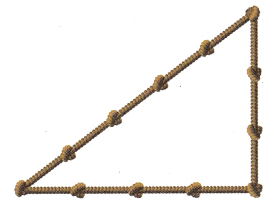
Scroll to Top