Prasanna

Texas Go Math Grade 8 Module 15 Quiz Answer Key

Refer to our Texas Go Math Grade 8 Answer Key Pdf to score good marks in the exams. Test yourself by practicing the problems from Texas Go Math Grade 8 Module 15 Quiz Answer Key.

Texas Go Math Grade 8 Module 15 Quiz Answer Key

Texas Go Math Grade 8 Module 15 Ready to Go On? Answer Key

15.1 Mean Absolute Deviation

The table shows scores for a gymnastics team. Use the table for 1-3.
Texas Go Math Grade 8 Module 15 Quiz Answer Key 1

Question 1.
Find the mean of the scores. ___________________________
Answer:
Given that,
The scores are 8.0, 9.0, 8.3, 8.9, 9.1, 8.3.
Sum of scores = 51.6
The formula for the mean = sum of the scores/number of the scores.
Mean of scores = 51.6/6 = 8.6.

Go Math Grade 8 Module 15 Review Quiz Question 2.
Complete the table to find the distance of each score from the mean.
Answer:
Texas Go Math Grade 8 Module 15 Quiz Answer Key_2
The formula for the mean of distance = Mean of scores – each value of the mean.
Ignore the signs.
8.6 – 8.0 = 0.6
8.6 – 9.0 = 0.4
8.6 – 8.3 = 0.3
8.6 – 8.9 = 0.3
8.6 – 9.1 = 0.5
8.6 – 8.3 = 0.3

Question 3.
Find the mean absolute deviation. _____________________________
Answer:
Mean of scores = 51.6/6 = 8.6.
Absolute value = Mean – each scores
Ignore the signs.
8.6 – 8.0 = 0.6
8.6 – 9.0 = 0.4
8.6 – 8.3 = 0.3
8.6 – 8.9 = 0.3
8.6 – 9.1 = 0.5
8.6 – 8.3 = 0.3
Mean absolute deviation = sum of absolute values – number of absolute values.
= 0.6 + 0.4 + 0.3 + 0.3 + 0.5 + 0.3/6 = 2.4/6 = 0.4
Mean absolute deviation = 0.4

15.2 Generating Random Samples

A manufacturer ships a store 5000 MP3 players, of which 300 are defective. The store manager does not know this but tests a random sample of 10 players to look for problems. A graphing calculator is used to simulate the sample, with 1-300 representing the defective players. The results are shown in the table.
Texas Go Math Grade 8 Module 15 Quiz Answer Key 2

Math Grade 8 Answer Key Pdf Module 15 Answer Key Question 4.
Complete the table to tell whether each number generated represents a good or defective player.
Answer:
Given that,
A manufacturer ships a store = 5000 MP3 players
Of that 300 are defective players.
He randomly checks the 10 players.
1-300 representing the defective players.
Texas Go Math Grade 8 Module 15 Quiz Answer Key_4

Question 5.
From this sample, how many defective players might the manager expect?
Answer: The manager expects 2 defective players as per the information seen in the above table.

Question 6.
Is the manager’s expectation accurate? Explain.
Answer:

Essential Question

Question 7.
How can you use random samples to solve real-world problems?
Answer:
Yes, you use random samples to solve real-world problemsRandom samples are a technique used to select the items or people. For this, you can use random sampling. For example, you have 10 papers and you have to divide them into different groups using random samples.

Texas Go Math Grade 8 Module 15 Mixed Review Texas Test Prep Answer Key

Selected Response

Question 1.
The radius of a ball is 4 inches. What is the volume of the ball in cubic inches?
(A) 16π in3
(B) \(\frac{64 \pi}{3}\) in3
(C) \(\frac{256 \pi}{3}\) in3
(D) \(\frac{4096 \pi}{3}\) in3
Answer:
Given that the radius of the ball = 4 inches.
Volume of the ball = 4/3πr3
= 4/3(π×(4)3
= 4/3(π × 64)
= \(\frac{256 \pi}{3}\) in3
Option C is the correct answer.

Grade 8 Math Module 15 Quiz Answer Key Question 2.
A random sample of 30 students was asked to pick their favorite school subject, and 12 of them answered math. There are 480 students in the school. How many students in the school are likely to pick math as their favorite subject?
(A) 120 students
(B) 192 students
(C) 288 students
(D) 360 students
Answer:
Given,
A random sample of 30 students was asked to pick their favorite school subject, and 12 of them answered math.
There are 480 students in the school.
(480 ÷ 30) × 12 = 192 students
Thus 192 students in the school are likely to pick math as their favorite subject.

Question 3.
For which situation could flipping a coin be used to simulate a random sample?
(A) to predict the number of defective cell phones in a shipment of 2000 phones
(B) to predict the number of days in a month it will rain
(C) to predict the number of blue marbles in a box of 200 marbles
(D) to predict the number of boys or girls born at a hospital in a year
Answer:
Flipping a coin be used to simulate a random sample for the situation to predict the number of defective cell phones in a shipment of 2000 phones
Option A is the correct answer.

Question 4.
Vertex A of triangle ABC is located at the point (2, 5). Which transformation moves vertex A to the point (-2, 5)?
(A) reflection across the x-axis
(B) reflection across they-axis
(C) (x, y) → (x + 4, y)
(D) (x, y) → (x – 4, -y)
Answer:
(2,5) is in the first quadrant.
(-2,5) is in the second quadrant.
Translation transformation moves vertex A to the point (-2, 5).
The reflection is across the y axis.

Question 5.
Which number is closest to \(\sqrt {111}\)?
(A) -50
(B) -10
(C) 10
(D) 50
Answer:
\(\sqrt {111}\) = square root(111) = 10
Option C is the correct answer.

Go Math Grade 8 Module 15 Quiz Answer Key Question 6.
There are 24 red jellybeans in a bag of 140 jellybeans. Let the integers 1-24 represent the red jellybeans in a calculator simulation of the situation that generates random integers from 1 to 140. A sample of 15 “jellybeans” gives the following:
Texas Go Math Grade 8 Module 15 Quiz Answer Key 3
Using the sample, which is the best prediction of the number of jelly beans in the bag?
(A) 5
(B) 24
(C) 28
(D) 55
Answer:

Gridded Response

Question 7.
The table below shows the height in meters of several buildings. What is the mean absolute deviation of the data set?
Texas Go Math Grade 8 Module 15 Quiz Answer Key 4
Answer:
Given data is 28, 32, 47, 39, 38, 16, 40, 35, 54, 31.
Mean = sum of the heights/number of the heights = 360/10 = 36.
Absolute value =mean – each of the heights.
36 – 28 = 8
36 – 32 = 4
36 – 47 = 11
36 – 39 = 3
36 – 16 = 20
36 – 40 = 4.
36 – 35 = 1
36 – 54 = 18
36 – 31 = 5
Mean absolute deviation = sum of absolute values – number of absolute values
= 74/9 = 65.
Mean absolute deviation = 65.
Texas Go Math Grade 8 Module 15 Quiz Answer Key_7

Texas Go Math Grade 8 Module 15 Quiz Answer Key Read More »

Texas Go Math Grade 8 Lesson 14.1 Answer Key Scatter Plots and Association

Refer to our Texas Go Math Grade 8 Answer Key Pdf to score good marks in the exams. Test yourself by practicing the problems from Texas Go Math Grade 8 Lesson 14.1 Answer Key Scatter Plots and Association.

Texas Go Math Grade 8 Lesson 14.1 Answer Key Scatter Plots and Association

Texas Go Math Grade 8 Lesson 14.1 Explore Activity Answer Key

Explore Activity 1

Making a Scatter Plot

Recall that a set of bivariate data involves two variables. Bivariate data are used to explore the relationship between two variables. You can graph bivariate data on a scatterplot. A scatter plot is a graph with points plotted to show the relationship between two sets of data.

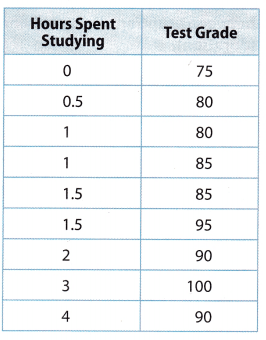
The final question on a math test reads, “How many hours did you spend studying for this test?”The teacher records the number of hours each student studied and the grade the student received on the test.
Texas Go Math Grade 8 Lesson 14.1 Answer Key 1
A. Make a prediction about the relationship between the number of hours spent studying and test grades.

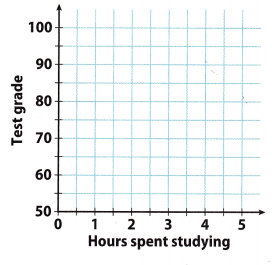
B. Make a scatter plot. Graph hours spent studying as the independent variable and test grades as the dependent variable.

Reflect

Question 1.
What trend do you see in the data?
Texas Go Math Grade 8 Lesson 14.1 Answer Key 2
Answer:
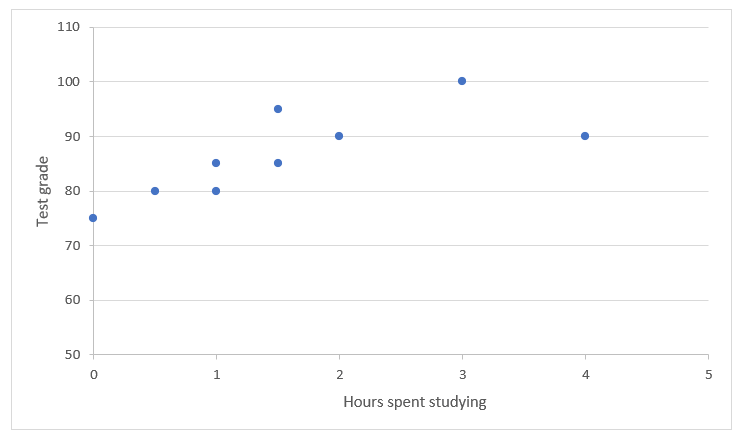
You can make a scatter plot which will help you to decide what trend do you see in the data.
Texas Go Math Grade 8 Lesson 14.1 Answer Key 13
Trend shows positive association which means that both data sets increase together.

Lesson 14.1 Scatter Plots and Association Answer Key Question 2.
Justify Reasoning Do you think that studying for 10 hours would greatly increase a student’s grade?
Answer:
The grade associated with studying for 10 hours would follow this trend. Students who spent more hours studying will have better test results.

Explore Activity 2

Interpreting Clusters and Outliers

A cluster is a set of closely grouped data. Data may cluster around a point or along a line. An outlier is a data point that is very different from the rest of the data in the set.
Texas Go Math Grade 8 Lesson 14.1 Answer Key 3
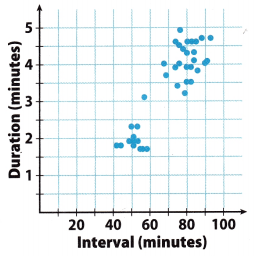
A scientist gathers information about the eruptions of Old Faithful, a geyser in Yellowstone National Park. She uses the data to create a scatter plot. The data show the length of time between eruptions (interval) and how long the eruption lasts (duration).
Texas Go Math Grade 8 Lesson 14.1 Answer Key 4
A. Describe any clusters you see in the scatter plot.

B. What do the clusters tell you about eruptions of Old Faithful?

C. Describe any outliers you see in the scatter plot.

Reflect

Question 3.
Suppose the geyser erupts for 2.2 minutes after a 75-minute interval. Would this point lie in one of the clusters? Would it be an outlier? Explain your answer.
Answer:
Try to make a point that is given in a scatter plot and make conclusions based on that.

If the geyser erupts for 22 minutes after a 75-minute interval, this point would not lie in one of the clusters. It will be an outlier.

This point will be an outlier because it will not be a part of a set of closely grouped data. This set is pointed between intervals of 40 and 60 minutes, and they last between 1.5 and 2.5 minutes. Based on that, the geyser which erupts for 2.2 minutes after a 75-minute interval will present a data point that is very different from the rest of the data in the set.

Scatter Plots and Association Worksheet Go Math 8th Grade Question 4.
Suppose the geyser erupts after an 80-minute interval. Give a range of possible duration times for which the point on the scatter plot would not be considered an outlier. Explain your reasoning.
Answer:
Use a given scatter plot to find out a range of possible duration.

If the geyser erupts after an 80-minute interval, the range of possible duration times for which the point on the scatter plot would not be considered an outlier is between 3 and 5 minutes.

Example 1

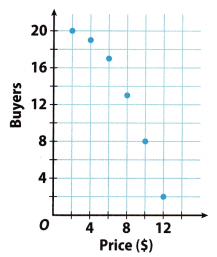
Susan asked 20 people if they would buy a new product she developed at each of several prices. The scatter plot shows how many of the 20 said “yes” at a given price. Describe the association between price and the number of buyers.
Answer:
As price increases, the number of buyers decreases. So, there is a negative association. Because the data points do not lie along a line, the association is nonlinear.
Texas Go Math Grade 8 Lesson 14.1 Answer Key 5

Reflect

Question 5.
What If? Based on the association shown in the scatter plot, what might happen if Susan increased the price to $14?
Answer:
As the price increases, the number of buyers decreases. So, there is a negative association.
If Susan increases the price to 14 $. then the number of buyers will be smaller than it has been. It might happen that there will not be buyers.

Your Turn

Question 6.
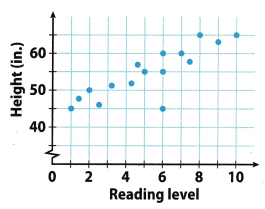
The plot shows the reading level and height for 16 students in a district. Describe the association and give a possible reason for it.
Texas Go Math Grade 8 Lesson 14.1 Answer Key 6
Answer:
The association is positive and linear. Taller students are likely to be oLder students and would therefore be more likely to read at a higher level.

Texas Go Math Grade 8 Lesson 14.1 Guided Practice Answer Key

Bob recorded his height at different ages. The table below shows his data.
Texas Go Math Grade 8 Lesson 14.1 Answer Key 7
Question 1.
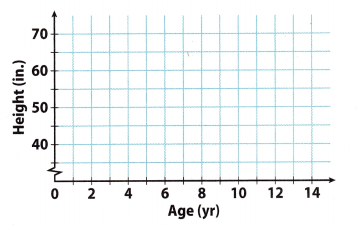
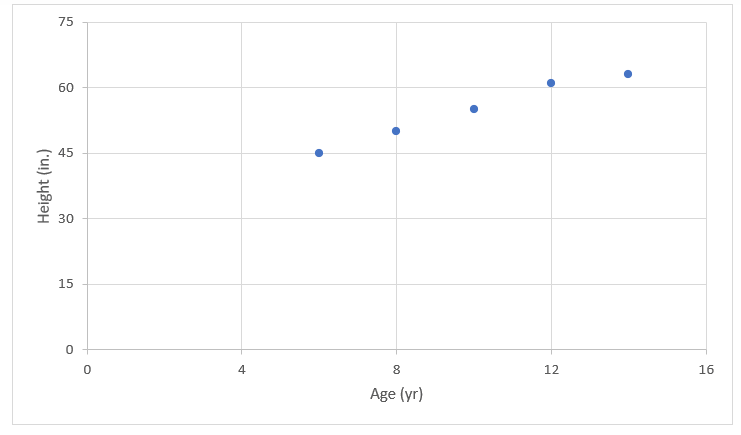
Make a scatter plot of Bob’s data. (Explore Activity 1)
Texas Go Math Grade 8 Lesson 14.1 Answer Key 8
Answer:
Make a scatter plot.
Texas Go Math Grade 8 Lesson 14.1 Answer Key 14

Scatter Plots and Association Worksheet Answer Key Question 2.
Describe the association between Bob’s age and his height. Explain the association. (Example 1)
Answer:
The association is positive and linear. Bob’s height increases as he gets older. We would see that Bob’s height eventually stops increasing if the data continues.

Question 3.
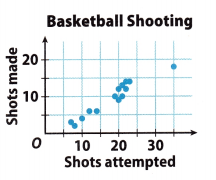
The scatter plot shows the basketball shooting results for 14 players. Describe any clusters you see in the scatter plot. Identify any outliers. (Explore Activity 2)
Texas Go Math Grade 8 Lesson 14.1 Answer Key 9
Answer:
There is a cluster in the ‘20 – 25” shots attempted range and a smaller cluster in the “5 – 14” shots attempted range.
There is an outlier at (35, 18)

Essential Question Check-In

Question 4.
Explain how you can make a scatter plot from a set of bivariate data.
Answer:
A set of bivariate data involves two variables. To explore the relationship between two variables, we use bivariate data. A graph with points plotted to show the relationship between two sets of data is called a scatter plot.

So, there are two variables in every bivariate data, usually an x and y. Data set we’re asked to create a scatter plot of the data described.

All we need is to plot the data from the bivariate data table onto the graph and see if there is a correlation between them.

Texas Go Math Grade 8 Lesson 14.1 Independent Practice Answer Key

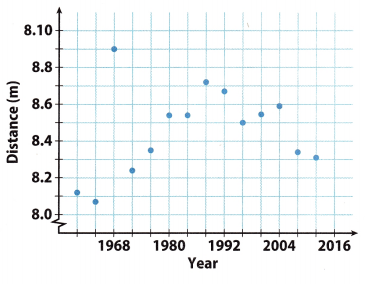
Sports: Use the scatter plot for 5-8.

Texas Go Math Grade 8 Lesson 14.1 Answer Key 10
Question 5.
Describe the association between the year and the distance jumped for the years 1960 to 1988.
Answer:
Generally, the data shows a positive linear association. The winning distance increases as the year increases.

Scatter Plots and Association Go Math Grade 8 Question 6.
Describe the association between the year and the distance jumped for the years after 1988.
Answer:
Between 1996 and 2004, there was a slight increase in distance jumped over time. However, overall, the data between 1988 to 2012 show a negative association.

Question 7.
For the entire scatter plot, is the association between the year and the distance jumped linear or nonlinear? Explain.
Answer:
The data show a rise between 1960 and 1988. The data also show a fall between 1988 and 2012. Therefore, overall, there is nonlinear pattern.

Question 8.
Identify the outlier and interpret its meaning.
Answer:
The outlier is at (1968, 8.9). It represents a long jump of 8.9 meters in 1968 that exceeds the other jumps made in the surrounding years.

Question 9.
Communicate Mathematical Ideas Compare a scatter plot that shows no association to one that shows a negative association.
Answer:
Randomly scattered data points with no apparent pattern define a scatter plot with no association. Data points that fall from left to right and has data set values that increases as the other decreases define a scatter plot with a negative association

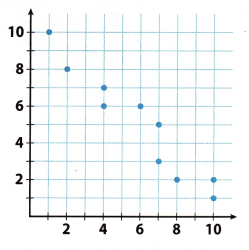
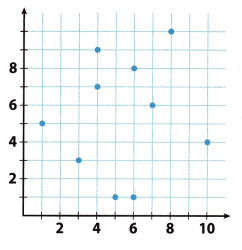
For 10-11, describe a set of real-world bivariate data that the given scatter plot could represent. Define the variable represented on each axis.

Question 10.
Texas Go Math Grade 8 Lesson 14.1 Answer Key 11
Answer:
The x-axis represents the number of containers.
The y-axis represents the price per container.

Question 11.
Texas Go Math Grade 8 Lesson 14.1 Answer Key 12
Answer:
The x-axis represents the number of hours spent watching tv. The y-axis represents the number of tvs owned.

H.O.T. Focus on Higher Order Thinking

Question 12.
Multiple Representations Describe what you might see in a table of bivariate data that would lead you to conclude that the scatter plot of the data would show a cluster.
Answer:
You would see data points with x and y values that are close together.

Scatter Plot Activity 8th Grade Go Math Question 13.
Justify Reasoning Is it possible for a scatter plot to have a positive or negative association that is not linear? Explain.
Answer:
Yes; it is possible for a scatter plot to have a positive or negative association that is not linear. The data points may have a falling or rising curve that will exhibit a nonlinear association.

Question 14.
Critical Thinking To try to increase profits, a theater owner increases the price of a ticket by $25 every month. Describe what a scatter plot might look like if x represents the number of months and y represents the profits. Explain your reasoning.
Answer:
Initially, the number of tickets sold might decline, but the price increase would offset the loss in sales. That means that profit would increase, showing a positive association.

When the price of a ticket would get too high, ticket sales would decline rapidly, so profits would fall giving a negative association.

Texas Go Math Grade 8 Lesson 14.1 Answer Key Scatter Plots and Association Read More »

Texas Go Math Grade 8 Module 16 Quiz Answer Key

Refer to our Texas Go Math Grade 8 Answer Key Pdf to score good marks in the exams. Test yourself by practicing the problems from Texas Go Math Grade 8 Module 16 Quiz Answer Key.

Texas Go Math Grade 8 Module 16 Quiz Answer Key

Texas Go Math Grade 8 Module 16 Ready to Go On? Answer Key

16.1 Repaying Loans

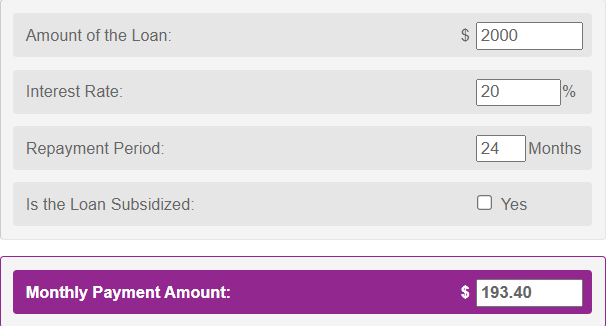
Dustin is taking out a loan for $2000 and wants to know how much money he will save by taking a 2-year loan at 14% interest instead of 20% interest. (Use an online calculator.)

Texas Go Math Grade 8 Answer Key Module 16 Review Quiz Question 1.
What is the total repayment for the 20% loan?.
Answer:
Amount of loan = $2000
Interest Rate = 20%
Time Period = 2 year or 24 months
The total repayment for the 20% loan is $193.40
Texas Go Math Grade 8 Module 16 Quiz Answer Key_1

Question 2.
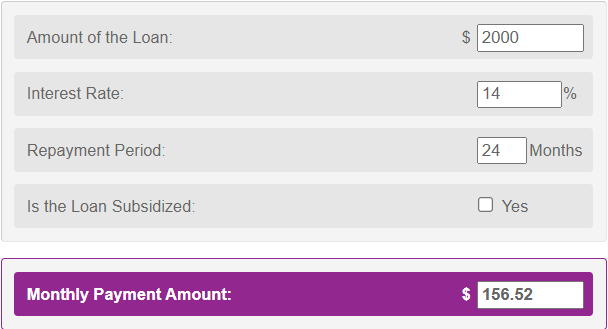
What is the total repayment for the 14% loan?.
Answer:
Amount of loan = $2000
Interest Rate = 14%
Time Period = 2 year or 24 months
The total repayment for the 14% loan is $156.52
Texas Go Math Grade 8 Module 16 Quiz Answer Key_2

Question 3.
How much can Dustin save?
Answer:
The total repayment for the 14% loan is $156.52
The total repayment for the 20% loan is $193.40
$193.40 – $156.52 = $36.88
Thus Dustin save $36.88

16.2 Saving and Investing

Go Math Grade 8 Answer Key Quiz Answer Pdf Question 4.
Cecilia has $800 in an account earning 4.5% simple interest. How much more interest would her account earn in 7 years with annually compounded interest?
Answer:
Given,
Cecilia has $800 in an account earning 4.5% simple interest.
Initial amount = $800
Interest Rate = 4.5%
Period = 7 years
Total interest earned = $11,949.03

16.3 Analyzing Financial Situations

Question 5.
Byron has $250 in his savings account. He starts a new job next week and spends $300 on tickets to a sporting event to celebrate. Is his decision financially responsible or financially irresponsible? Explain.
Answer: Irresponsible, because Byron does not have a steady source of income.

16.4 Estimating College Costs and Payments

Question 6.
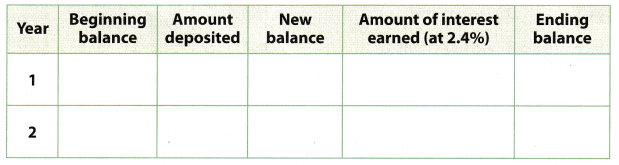
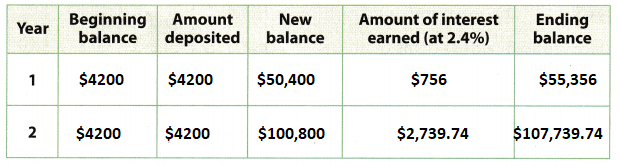
At the beginning of each of the last two years, Alfonso put $4200 from his earnings as a part-time pizza delivery driver into a college savings account earning 2.4% interest compounded annually. Complete the table to determine how much money Alfonso has saved.
Texas Go Math Grade 8 Module 16 Quiz Answer Key 1
Answer:
Texas-Go-Math-Grade-8-Module-16-Quiz-Answer-Key-6

Texas Go Math Grade 8 Module 16 Mixed Review Texas Test Prep Answer Key

Selected Response

Question 1.
Which interest rate and time period result in the lowest total loan repayment for a $ 4,000 loan earning simple interest?
(A) 3 years at 11%
(B) 3 years at 13%
(C) 4 years at 8%
(D) 4 years at 11%
Answer:
(A) 3 years at 11%
Formula for simple interest equal to SI = PTR/100
Here,
P = actual money = $4000
T = time = 3 years.
R = interest rate = 11%
Simple interest for 3 years = $4000 × 3 × 11/100 = $1320
(B) 3 years at 13%
Formula for simple interest equal to SI = PTR/100
Here,
P = actual money = $4000
T = time = 3 years.
R = interest rate = 13%
Simple interest for 3 years = $4000 × 3 × 13/100 = $1560.
(C) 4 years at 8%
Formula for simple interest equal to SI = PTR/100
Here,
P = actual money = $4000
T = time = 4 years.
R = interest rate = 8%
Simple interest for 4 years = $4000 × 4 × 8/100 = $1280
(D) 4 years at 11%
Formula for simple interest equal to SI = PTR/100
Here,
P = actual money = $4000
T = time = 4 years.
R = interest rate = 11%
Simple interest for 4 years = $4000 × 4 × 11/100 = $1760.
The interest rate and time period result in the lowest total loan repayment for a $4000 loan = $1280
Option C is the correct answer.

Go Math Answer Key Grade 8 Module 16 Test Answers Question 2.
Which equation represents a non-proportional relationship?
(A) y = -5x
(B) y = 5x + 0
(C) y = \(\frac{1}{5}\)x
(D) y = 5x – 5
Answer: y = \(\frac{1}{5}\)x
Explanation:
Let the ordered pair is (5, 5)
y = \(\frac{1}{5}\)x
5 = \(\frac{1}{5}\) × 5
5 = 1
Thus As y increases x decreases which means that the equation is nonproportional.
So, option C is the correct answer.

Question 3.
Jemarcus starts with $1200 in a college savings account. His account earns interest at a rate of 1.8% compounded annually. How much money is in the account after 6 years?
(A) $1221.60
(B) $1265.97
(C) $1329.60
(D) $1335.57
Answer:
Given that,
Jamarcus starts in a college savings account = $1200
The interest at the rate = 1.8%
Formula for compound interest = A = P(1 + R/1000)n
P = actual money = $1200
n = time = 6 years.
R = interest rate = 1.8%
Compound interest for 6 years = A = 1200(1 + 1.8/100)6
= 1200(1 + 0.018)6
= 1200(1.018)6
= 1200(1.1129)
The total money is in the account after 6 years= 1335.48
Option D is the correct answer.

Question 4.
Which equation relates x and y for the set of ordered pairs (4, 1), (8, 2), (12, 3)?
(A) y = \(\frac{1}{4}\)x
(B) y = 4x
(C) y = x – 3
(D) y = x – 9
Answer:
(A) y = \(\frac{1}{4}\)x
(4, 1)
1 = \(\frac{1}{4}\)4
1 = 1
(8, 2)
2 = \(\frac{1}{4}\)8
(12, 3)
3 = \(\frac{1}{4}\)12
3 = 3
So, Option A is the correct answer.

Question 5.
Danielle received a gift card to a clothing store and uses it to buy a pair of jeans. Which payment method did she use?
(A) cash
(B) credit card
(C) debit card
(D) stored-value card
Answer:
Given that,
Danielle received a gift card to a clothing store and he used it to buy a pair of jeans.
The payment method he can use is a cash or credit card.
A credit card means it is a card issued by the bank to the holder to purchase goods or services.
Option A and B is the correct answer.

Module 16 Assessment Answer Key Go Math Grade 8 Question 6.
Ashley is considering attending the state university to obtain a 4-year bachelor’s degree. For one year, the tuition and fees are $9890, room and board are $8250, and books are $680. What will be the total of these costs over the 4 years of obtaining the degree?
(A) $18,140
(B) $18,820
(C) $37,640
(D) $75,280
Answer:
Given that,
The total amount for 1 year Ashley’s tuition and fees = $9890.
The amount for 4 years of tuition and fees = $9890 × 4 = $39,560
The total amount for 1 year Ashley room and board = $8250.
The amount for 4 years of room and board = $8250 × 4 = $33,000
The total amount for 1 year Ashley books = $680.
The total amount for 4 years of books = $680 × 4 = $2720
The total of these costs over the 4 years of obtaining the degree = $39,560 + $33,000 + $2720 = 75,280.
Option D is the correct answer.

Question 7.
Triangle ABC, with vertices A(2, 3), 8(4, -5), arid C(6, 8), is reflected across the x-axis to form triangle A’B’C’. What are the coordinates of triangle A’B’C’?
(A) A'(2, -3), B'(4, 5), C'(6, -8)
(B) A'(-2, 3), B'(-4, -5), C'(-6, 8)
(C) A'(-2, -3), B'(-4, 5), C'(-6, -8)
(D) A'(2, -3), B'(4, -11), C'(6, 2)
Answer:
The reflection of the point (x,y) on the x- axis is (x,-y).
The vertices A(2, 3), 8(4, -5), and C(6, 8) reflected on the x axis are A'(2, -3), B'(4, 5), C'(6, -8).
Option A is the correct answer.

Gridded Response

Go Math Grade 8 Answer Key Pdf Module 16 Question 8.
A cone-shaped cup has a height of 3 inches and a volume of 9 cubic inches. What is the length in inches of the diameter of the cone? Use 3.14 for π. Round your answer to the nearest hundredth.
Texas Go Math Grade 8 Module 16 Quiz Answer Key 2
Answer:
Given that,
Height of the cone-shaped cup = 3 inches.
The volume of the cone-shaped cup = 9 inches.
The formula for the radius of the cone = square root of (3× V/πh)
= square root of (3 × 9/3.14 × 3)
= square root of (27/9.42)
= square root of (2.86)
= 1.691
Therefore the length of the cone = 2πr
= 2 × 3.14 × 1.691
= 10.61
The length of the diameter of a cone-shaped cup is 10.61.

Texas Go Math Grade 8 Module 16 Quiz Answer Key Read More »

Texas Go Math Grade 8 Lesson 15.2 Answer Key Generating Random Samples

Refer to our Texas Go Math Grade 8 Answer Key Pdf to score good marks in the exams. Test yourself by practicing the problems from Texas Go Math Grade 8 Lesson 15.2 Answer Key Generating Random Samples.

Texas Go Math Grade 8 Lesson 15.2 Answer Key Generating Random Samples

Texas Go Math Grade 8 Lesson 15.2 Explore Activity Answer Key

Explore Activity 1

Generating a Random Sample

When information is being gathered about a group, the entire group of objects, individuals, or events is called the population. A sample is part of the population chosen to represent the entire group.

A sample in which every person, object, or event has an equal chance of being selected is called a random sample. A random sample is more likely to be representative of the entire population than other sampling methods.

A store gets a shipment of 1000 light bulbs. Due to a manufacturing problem, 200 of the bulbs are defective, but the store’s manager is not aware of this. As she always does, however, the manager will check a sample of the bulbs to look for potential problems. How can she choose a sample of the bulbs to represent the shipment?

A. The manager will want to use a random sample to represent the entire shipment. One way to simulate a random sample is to use a graphing calculator to generate random integers.
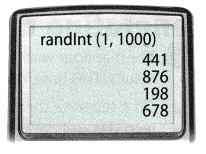
To simulate picking out random light bulbs between 1 and 1000:
Texas Go Math Grade 8 Lesson 15.2 Answer Key 1

  • Press MATH, scroll right and select PRB, then select 5: randlnt(.
  • Enter the smallest value, comma, largest possible value.
  • Hit ENTER to generate random numbers.

In this specific case, you will enter randlnt (______, __________) because there are __________ light bulbs in the shipment.

The numbers that are generated will each represent a bulb in the shipment. Because we know the numbers of defective and working bulbs, we can choose numbers to model the bulbs in the population.

Let numbers 1 to 200 represent bulbs that are ___________.
Numbers 201 to 1000 will represent bulbs that are ____________.

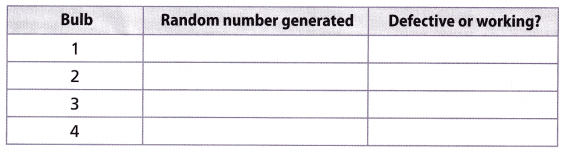
The manager has a calculator randomly select 4 integers to tell her which bulbs to check. To model this, generate four numbers and record them in the table below. Then tell whether each number represents a defective or a working bulb in the model.
Texas Go Math Grade 8 Lesson 15.2 Answer Key 2

B. If the manager’s sample matched your results, would it represent the population well? Explain.

Reflect

Question 1.
You and your classmates have generated multiple samples. Compare your results to those of your classmates. What do you notice?
Answer:

Grade 8 Math Answer Key Pdf Generating Random Samples Question 2.
Communicate Mathematical Ideas Why did you and your classmates generate different answers for the number of defective light bulbs?
Answer:

Explore Activity 2

Generating a Larger Random Sample

A. The manager wants to use a larger random sample to get better results. This time, collect a sample of 20 light bulbs.
On a separate sheet of paper copy the table from Explore Activity 1 and record your results in the table. You will need rows for 20 light bulbs.

B. Does your new sample better represent the shipment than your original sample? Explain.

Reflect

Question 3.
You and your classmates have generated multiple samples. Compare your results to those of your classmates. What do you notice?
Answer:

Explore Activity 3

Generating a Random Sample without Technology

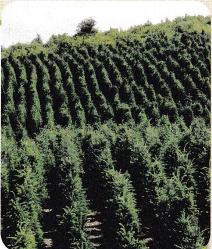
A tree farm has a 100 acre square field arranged in a 10-by-10 array. The farmer wants to know the average number of trees on each acre. Each cell in the table below represents an acre of land. The number in each cell tells how many trees grow on that particular acre.
Texas Go Math Grade 8 Lesson 15.2 Answer Key 3
Texas Go Math Grade 8 Lesson 15.2 Answer Key 4
Because counting the trees on all of the acres is too time-consuming, the farmer decides to choose 10 acres at random and find the average number of trees.

A. To simulate the random selection, place this page on the floor. Drop 10 small objects onto the chart. Use these numbers for the 10 random acres.

B. What is the average number of trees on the 10 acres that were randomly selected?

C. Alternately, the farmer decides to choose the 10 acres in the first row. What is the average number of trees on these 10 acres?

Reflect

Question 4.
How do the averages you got with each sampling method compare?
Answer:

Lesson 15.2 Go Math Grade 8 Answer Key Pdf Question 5.
How do the averages you got with each sampling method compare to the average for the entire population, which is 48.4?
Answer:

Question 6.
Communicate Mathematical Ideas Why do you think the first method gave a closer average than the second method?
Answer:

Texas Go Math Grade 8 Lesson 15.2 Guided Practice Answer Key

Question 1.
A manufacturer gets a shipment of 600 batteries of which 50 are defective. The quality control manager tests a random sample of 30 batteries in each shipment. Simulate the test by generating random numbers between 1 and 600. How well does your sample represent the shipment? Explain. (Explore Activities 1 and 2)
Answer:

Question 2.
The farmer from Explore Activity 3 would like to have a better estimate of the number of trees per acre. This time, the farmer decides to choose 20 acres at random. Use the table to simulate the farmer’s random selection and find a new estimated average for the number of trees per acre. (Explore Activity 3)
Answer:

Essential Question Check-In

Question 3.
Why can data from a random sample be used to represent a population? What can happen if a sample is too small or not random?
Answer:

Texas Go Math Grade 8 Lesson 15.2 Independent Practice Answer Key

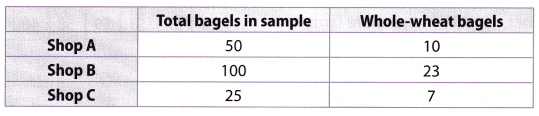
Maurie owns three bagel shops. Each shop sells 500 bagels per day. Maurie asks her store managers to use a random sample to see how many whole-wheat bagels are sold at each store each day. The results are shown in the table. Use the table for 4-6.
Texas Go Math Grade 8 Lesson 15.2 Answer Key 5

Question 4.
If you assume the samples are representative, how many whole-wheat bagels are sold at each store?
Answer:

Question 5.
Rank the samples for the shops in terms of how representative they are likely to be. Explain your rankings.
Answer:

Question 6.
Which sample or samples should Maurie use to tell her managers how many whole-wheat bagels to make each day? Explain.
Answer:

Random Math Problems for 8th Graders Lesson 15.2 Question 7.
In a shipment of 1000 T-shirts, 75 do not meet quality standards. The store manager does not know this but always tests a random sample of each shipment. The table below simulates the manager’s random sample of 20 T-shirts to inspect. For the simulation, the integers 1 to 75 represent the below-standard shirts.
Texas Go Math Grade 8 Lesson 15.2 Answer Key 6
In the sample, how many of the shirts are below quality standards?
If the manager assumes his sample is representative and uses it to predict how many of the 1000 shirts are below standard, what will he conclude?
Answer:

Question 8.
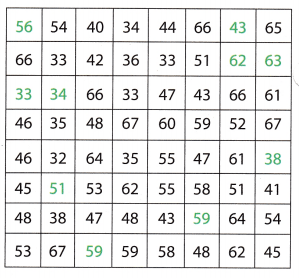
Multistep A 64 acre coconut farm is arranged in an 8-by-8 array. Mika wants to know the average number of coconut palms on each acre. Each cell in the table represents an acre of land. The number in each cell tells how many coconut palms grow on that particular acre.
Texas Go Math Grade 8 Lesson 15.2 Answer Key 7
a. The numbers in green represent Mika’s random sample of 10 acres. What is the average number of coconut palms on the randomly selected acres?
Answer:

b. Project the number of palms in the entire farm.
Answer:

H.O.T. Focus on Higher Order Thinking

Question 9.
A random sample of 15 of the 78 competitors at a middle school gymnastics competition are asked about their height. The data set lists the heights in inches: 55, 57, 57, 58, 59, 59, 59, 59, 59, 61,62, 62, 63, 64, 66. What is the mean height of the sample? Could you say this is a good estimate of the mean height of all competitors? Why or why not?
Answer:

Lesson 15.2 Go Math 8th Grade Answer Key Pdf Question 10.
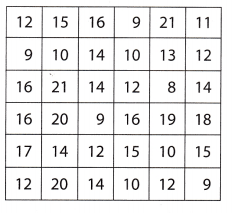
Critical Thinking The six-by-six grid contains the ages of actors in a youth Shakespeare festival. Describe a method for randomly selecting 8 cells by using number cubes. Then calculate the average of the 8 values you found.
Texas Go Math Grade 8 Lesson 15.2 Answer Key 8
Answer:

Question 11.
Communicating Mathematical Ideas Describe how the size of a random sample affects how well it represents a population as a whole.
Answer:

Texas Go Math Grade 8 Lesson 15.2 Answer Key Generating Random Samples Read More »

Texas Go Math Grade 8 Lesson 15.1 Answer Key Mean Absolute Deviation

Refer to our Texas Go Math Grade 8 Answer Key Pdf to score good marks in the exams. Test yourself by practicing the problems from Texas Go Math Grade 8 Lesson 15.1 Answer Key Mean Absolute Deviation.

Texas Go Math Grade 8 Lesson 15.1 Answer Key Mean Absolute Deviation

Texas Go Math Grade 8 Lesson 15.1 Explore Activity Answer Key

Understanding Mean Absolute Deviation

A measure of center is a single number used to describe a data set. One measure of the center is the mean, which is the sum of the data values divided by the number of values in the data set. A measure of variability is a single number used to describe the spread of a data set. One measure of variability is the mean absolute deviation (MAD), which is the mean distance between each data value and the mean of the data set.

The data represent the height, in feet, of various buildings. Find the mean absolute deviation for each data set.
A. 60, 58, 54, 56, 63, 65, 62, 59, 56, 58
Calculate the mean. Round to the nearest whole number.
Complete the table.
Texas Go Math Grade 8 Lesson 15.1 Answer Key 1
Calculate the MAD by finding the mean of the values in the second row of the table. Round to the nearest whole number.
Answer:
Given that the heights of the various buildings are 60, 58, 54, 56, 63, 65, 62, 59, 56, 58.
Mean = sun of the heights of the various buildings/ number of the heights of the various buildings. = 60 + 58 + 54 + 56 + 63 + 65 + 62 + 59 + 56 + 58/10 = 526/10 = 52.6
52.6 rounded to the nearest whole number is 53. Because the decimal point is greater than 5 then remove the fraction part and 1 to the decimal.
Texas Go Math Grade 8 Lesson 15.1 Explore Activity Answer Key_A
Given that the heights of the various buildings are 60, 58, 54, 56, 63, 65, 62, 59, 56, 58.
Mean = 52.6
Distance from mean equal to
60 – 52.6 = 7.4
58 – 52.6 = 5.4
54 – 52.6 = 1.4
56 – 52.6 = 3.4
63 – 52.6 = 10.4
65 – 52.6 = 12.4
62 – 52.6 = 9.4
59 – 52.6 = 6.4
56 – 52.6 = 3.4
58 – 52.6 = 5.4
Mean absolute deviation = sum of the distances from mean/number of the distances = 7.4 + 5.4 + 1.4 + 3.4 + 10.4 + 12.4 + 9.4 + 6.4 + 3.4 + 5.4/ 10 = 6.5
6.5 rounded to the nearest whole number is 7.

B. 46, 47, 56, 48, 46, 52, 57, 52, 45
Find the mean. Round to the nearest whole number.

Complete the table.
Texas Go Math Grade 8 Lesson 15.1 Answer Key 2
Calculate the MAD. Round to the nearest whole number.
Answer:
Given that the heights are 46, 47, 56, 48, 46, 52, 57, 52, 45.
Mean = sum of the heights by number of the heights = 46 + 47 + 56 + 48 + 56 + 52 + 57 + 52 + 45/9 = 459/9 = 51.
51 rounded to the nearest whole number is 51.
Texas-Go-Math-Grade-8-Lesson-15.1-Answer-Key-2
Given that the heights are 46, 47, 56, 48, 46, 52, 57, 52, 45.
Mean = 51
Distance from mean equal to
51 – 46 = 5
51 – 47 = 4
51 – 56 = -5
51 – 48 = 3
51 – 46 = 5
51 – 52 = -1
51 – 57 = -6
51 – 52 = -1
51 – 45 = 6
Neglect the negative signs.
Mean absolute deviation = sum of the distances/ number of the distances.
= 5 + 4 + 5 + 3 + 5 + 1 + 6 + 1 + 6/9 =30/9 = 3.3
3.3 rounded to the nearest whole number is 3.

Reflect

Go Math Grade 8 Answer Key Pdf Mean Absolute Deviation Question 1.
Analyze Relationships Compare the MADs. How do the MADs describe the distribution of the heights in each group?
Answer:
Mean absolute deviation of first heights is 6.5
Mean absolute deviation of seconds heights is 3.3
The mean absolute deviation of the first heights is greater than the mean absolute deviation of the second heights.
Using the formula distance = each height – mean. We can distribute the heights in each group.

Your Turn

Question 2.
Two baristas at a coffee shop each served 10 large coffees. The amount in each large coffee is shown below. Which barista’s coffees showed less variability?
Texas Go Math Grade 8 Lesson 15.1 Answer Key 3
Answer:
Given that,
The Amount in the first Barista A’s large coffees = 19.1 + 20.1 + 20.9 + 19.6 + 20.9 + 19.5 + 19.2 + 19.4 + 20.3 + 20.9 = 199.9.
The Amount in the second Barista A’s large coffees = 20.1 + 19.6 + 20.0 + 20.5 + 19.8 + 20.0 + 20.1 + 19.7 + 19.9 + 20.4 = 200.1
The first coffee shop has the least variability.

Question 3.
Two aspirin-making devices are set to make tablets containing 0.35 gram of aspirin. The actual amounts in 8 tablets from each device are shown. Use a spreadsheet to determine which device has less variability.
Texas Go Math Grade 8 Lesson 15.1 Answer Key 4
Answer:
Texas-Go-Math-Grade-8-Lesson-15.1-Answer-Key-3
Given that,
The tablets contained 0.35 grams of aspirin.
The amounts of Aspirin in tablets made by device A have the least variability.

Texas Go Math Grade 8 Lesson 15.1 Guided Practice Answer Key

Mean Absolute Deviation Part 1 Answer Key 8th Grade Go Math Question 1.
A bus route takes about 45 minutes. The company’s goal is a MAD of less than 0.5 minutes. One driver’s times for 9 runs of the route are shown. Did the bus driver meet the goal? (Explore Activity and Example 1)
Texas Go Math Grade 8 Lesson 15.1 Answer Key 5
a. Calculate the mean of the bus times. ______________
Answer:
Given that the time to complete the bus route is 44.2, 44.9. 46.1, 45.8, 44.7, 45.2, 45.1, 45.3, 44.6.
Mean = sum of the bus time to complete the round/number of the bus rounds to complete the round.
44.2 + 44.9 + 46.1 + 45.8 +44.7 + 45.2 + 45.1 + 45.3 + 44.6/9 = 405.9/9 = 45.1

b. Calculate the MAD to the nearest tenth. ____________
The bus driver did /did not meet the company’s goal.
Answer:
Given that the time to complete the bus route is 44.2, 44.9. 46.1, 45.8, 44.7, 45.2, 45.1, 45.3, 44.6.
Mean = 45.1
Mean absolute deviation equal to first subtracting the mean from each route.
44.2 – 45.1 = -0.9
44.9 – 45.1 = -0.2
46.1 – 45.1 = 1
45.8 – 45.1 = 0.7
44.7 – 45.1 = -0.4
45.2 – 45.1 = 0.1
45.1 – 45.1 = 0
45.3 – 45.1 = 0.2
44.6 – 45.1 = -0.5
Neglect the negative sign.
Mean absolute deviation = sum of the mean from each value/number of the mean from each value = 0.9 + 0.2 + 1 + 0.7 + 0.4 + 0.1 + 0 + 0.2 + 0.5/9 = 4/9 = 0.4 minutes.
The company’s goal is for the mean absolute deviation to be less than 0.5 minutes.
Mean absolute deviation = 0.4 minutes.
Yes, The driver did meet the company’s goal

Question 2.
Below are different driver’s times on the same route. Find the mean and the MAD using a spreadsheet. Enter the data values into row 1 using cells A to I. Enter “mean =” into cell A2 and “MAD =” into cell A3. (Example 2)
Texas Go Math Grade 8 Lesson 15.1 Answer Key 6
The mean is ___________ minutes, and the MAD is ____________ minutes.
This time, the bus driver did/did not meet the company’s goal.
Answer:
Given that the data of the times to complete the bus route is 44.4, 43.8. 45.6, 45.9, 44.1, 45.6, 44.0, 44.9, 45.8.
Mean = sum of the sum of the bus time to complete the round/number of the bus rounds to complete the round.
= 44.4 + 43.8 + 45.6 + 45.9 + 44.1 + 45.6 + 44.0 + 44.9 +45.8/9
=404.1/9
= 44.9
The mean absolute deviation is first to find the difference between the mean and each round.
44.4 – 44.9 = -0.5
43.8 – 44.9 = -1.1
45.6 – 44.9 = 0.7
45.9 – 44.9 = 1
44.1 – 44.9 = -0.8
45.6 – 44.9 = 0.7
44.0 – 44.9 = -0.9
44.9 – 44.9 = 0
45.8 – 44.9 = 0.9
Neglect the negative sign.
Mean absolute deviation = sum of the mean from each value/number of the mean from each value = 0.5 + 1.1 + 0.7 + 1 + 0.8 + 0.7 + 0.9 + 0 + 0.9/9 = 6.6/9 = 0.7

Essential Question Check-In

Mean Absolute Deviation 8th Grade Go Math Question 3.
What is the mean absolute deviation and what does it tell you about data sets?
Answer:
The company’s goal is for the mean absolute deviation to be less than 0.5 minutes.
Mean absolute deviation = 0.7 minutes.
The driver did not meet the company’s goal.

Texas Go Math Grade 8 Lesson 15.1 Independent Practice Answer Key

Frank wants to know how many people live in each household in his town. He conducts a random survey of 10 people and asks how many people live in their household. His results are shown in the table.
Texas Go Math Grade 8 Lesson 15.1 Answer Key 7

Question 4.
Calculate the mean number of people per household.
Answer:
Mean = sum of the people /number of the people
= 1 + 6 + 2 + 4 + 4 + 3 + 5 + 5 + 2 + 8/10
= 40/10 = 4
A mean number of people per household = 4.

Question 5.
Calculate the MAD of the number of people per household.
Answer:
First subtract the mean from the given number of each person.
1 – 4 = -3
6 – 4 = 2
2 – 4 = -2
4 – 4 = 0
4 – 4 = 0
3 – 4 = -1
5 – 4 = 1
5 – 4 = 1
2 – 4 = -2
8 – 4 = 4
Negate the negative sign
Mean absolute deviation = sum of the difference of mean and each person/number of the people in the household.
= 3 + 2 + 2 + 0 + 0 + 1 + 1 + 1 + 2 + 4 /10
= 16/10
Mean absolute deviation = 1.6

Question 6.
What conclusions can you draw about the “typical” number of people in each household? Explain.
Answer:
3, 2, 2, 0, 0, 1, 1, 1, 2, 4 typical numbers of people in each household.
We get these numbers by finding the difference between the mean and each number of people per household.

Teachers are being trained to standardize the scores they give to students’ essays. The same essay was scored by 10 different teachers at the beginning and at the end of their training. The results are shown in the tables.
Texas Go Math Grade 8 Lesson 15.1 Answer Key 8
Answer Key Mean Absolute Deviation Worksheet Answers Question 7.
Calculate the MADs for the teachers’ scores. Did the teachers make progress in standardizing their scores?
Answer:
Given that the data of the scores for the essay at the beginning of teachers’ training are 76, 81, 85, 79, 89, 86, 84, 80, 88, and 79.
Mean = sum of the scores/number of the scores.
= 76 + 81 + 85 + 79 + 89 + 86 + 84 + 80 + 88 + 79 /10
= 827/10
= 82.7
Difference = each score – mean
76 – 82.7 = -6.7
81 – 82.7 = -1.7
85 – 82.7 = 2.3
79 – 82.7 = -3.7
89 – 82.7 = 6.3
86 – 82.7 = 3.3
84 – 82.7 = 1.3
80 – 82.7 = -2.7
88 – 82.7 = 5.3
79 – 82.7 = -3.7
Negate the negative signs.
Mean absolute deviation = sum of the difference/number of the difference.
= 6.7 + 1.7 + 2.3 + 3.7 + 6.3 + 3.3 + 1.3 + 2.7 + 5.3 + 3.7 /10
= 37/10 = 3.7
The mean absolute deviation of the scores for the essay at the beginning of teachers’ training is 3.7.
Given that the data of the scores for the essay at the end of teachers training is 79, 82, 84, 81, 77, 85, 82, 80, 78, 83.
Mean = sum of the scores/number of the scores.
= 79 + 82 + 84 + 81 + 77 + 85 + 82 + 78 + 83 / 10
=731/10
Mean = 73.1
Difference = each score – mean
79 – 73.1 = 5.9
82 – 73.1 = 8.9
84 – 73.1 =10.9
81 – 73.1 = 7.9
77 – 73.1 = 3.9
85 – 73.1 = 11.9
82 – 73.1 = 8.9
80 – 73.1 =6.9
78 – 73.1 =4.9
83 – 73.1 =9.9
Mean absolute deviation = sum of the difference /number of the differences.
5.9 + 8.9 + 10. 9 + 7.9 + 3.9 + 11.9 + 8.9 + 6.9 + 4.9 + 9.9 /10
= 80/10
=8
The mean absolute deviation of the scores for the essay at the end of the teacher’s training is 8.
Yes, the teachers make progress in standardizing their scores.

Question 8.
What If? What would it mean if the teachers had a MAD of 0?
Answer: Mean absolute deviation is 0. It means that there is no deviation, so the values are the same.

The annual rainfall for Austin, Texas, and San Antonio, Texas, in each of the years from 2002 to 2011 are shown in the tables. Use the data for 9-11.
Texas Go Math Grade 8 Lesson 15.1 Answer Key 9

Question 9.
Use a spreadsheet to find the mean for the two cities’ annual rainfalls. In which city does it rain more in a year, on average?
Answer:
Texas-Go-Math-Grade-8-Lesson-15.1-Answer-Key-9
Mean of annual rainfall for Austin, Texas = sum of annual rainfall/number of years.
= 318.18/10
= 31.8
Texas-Go-Math-Grade-8-Lesson-15.1-Answer-Key-9_1
Mean of San Antonio, Texas = sum of annual rainfall/number of years = 304.59/10
Mean of San Antonio, Texas = 30.45

Mean Absolute Deviation Formula 8th Grade Go Math Question 10.
Use your spreadsheet to find the MADs. Use the MADs to compare the distribution of annual rainfall for the two cities.
Answer:
Texas-Go-Math-Grade-8-Lesson-15.1-Answer-Key-10
Mean of annual rainfall for Austin, Texas = sum of the deviations/number of the deviations
= 96.8/10
= 9.68
Texas-Go-Math-Grade-8-Lesson-15.1-Answer-Key-10_2
Mean absolute deviation of San Antonio, Texas = sum of the deviations/number of the deviations.
= 109.34/10
= 10.934

Question 11.
Make a Conjecture Does the information allow you to predict how the future amounts of rainfall for the two cities will compare? Explain.
Answer:
Mean of annual rainfall for Austin, Texas = 9.68
Mean absolute deviation of San Antonio, Texas = 10.93
The future rainfall in Austin, Texas is less than the Future rainfall in San Antonio, Texas.

Question 12.
Critical Thinking The life spans of 10 adult mayflies have a mean of 4 hours and a MAD of 2 hours. Fill in the table below with possible values for the life spans. You can use the same value more than once.
Texas Go Math Grade 8 Lesson 15.1 Answer Key 10
Can any one of the 10 mayflies in the group live for 1 full day? Justify your answer.
Answer:
Given that,
Mean = 4 hours.
Mean absolute deviation = 2 hours.
Assume that the life spans of each fisv is 4 hours
Then mean = 4 + 4 + 4 + 4 + 4 + 4 + 4 + 4 + 4 + 4/10
= 40/10
= 4hours.
No fish can live for a full day.
Texas-Go-Math-Grade-8-Lesson-15.1-Answer-Key-12

H.O.T. Focus on Higher Order Thinking

Question 13.
Multistep In a spreadsheet, before entering any data values, first enter “mean =” into cell A2 and the formula =AVERAGE(A1 :J1) into cell B2. Next, enter “MAD =”into cell A3 and the formula =AVEDEV(A1:J1) into cell B3.You should see #DIV/0! in cell B2 and #NUM! in cell B3 as shown. Now do the following:
Texas Go Math Grade 8 Lesson 15.1 Answer Key 11
a. Enter “1” into cell A1. What do you get for the mean and the MAD of the data set? Explain why this makes sense.
Answer:
Given that,
0! = 1
Enter 1 into cell A1. then mean = 1/1 = 1
Mean absolute deviation = 1.

b. Enter “2” into cell B1. What do you get for the mean and the MAD of the data set this time? Explain why this makes sense.
Answer:
Given that
Enter 2 into cell A1. then mean = 2/1 = 2
Mean absolute deviation = 2.

c. Enter the numbers 3 through 10 into cells C1 to J1 and watch the mean and the MAD change. Do they increase, decrease, or stay the same? Explain why this makes sense.
Answer:
Given that,
Enter the numbers 3 through 10 into cells C1 to J1.
The mean = 0
The mean absolute deviation increases when the number increases.

Question 14.
Make a Conjecture Each of the values in a data set is increased by 10. Does this affect the MAD of the data set? Why or why not?
Answer:
Each of the values in the data set is increased by 10 then the values of the data increase. Then the mean absolute deviation of the data will not affect.

Question 15.
What If? Suppose a data set contains all negative numbers. Would the MAD for the data set also be negative? Explain.
Answer:
The data set contains all negative numbers also the mean absolute deviation is positive. Because the negative numbers cannot be eligible.

Texas Go Math Grade 8 Lesson 15.1 Answer Key Mean Absolute Deviation Read More »

Texas Go Math Grade 8 Module 15 Answer Key Sampling

Refer to our Texas Go Math Grade 8 Answer Key Pdf to score good marks in the exams. Test yourself by practicing the problems from Texas Go Math Grade 8 Module 15 Answer Key Sampling.

Texas Go Math Grade 8 Module 15 Answer Key Sampling

Texas Go Math Grade 8 Module 15 Are You Ready? Answer Key

Find the percent.

Question 1.
20% of 50 ___________
Answer:
20% = 20/100
\(\frac{20}{100}\) × 50
2 × 5 = 10
So, 20% of 50 is 10

Texas Go Math Grade 8 Pdf Module 15 Answer Key Question 2.
8.5% of 300 ____________
Answer:
8.5% = 8.5/100
\(\frac{8.5}{100}\) × 300
= 8.5 × 3
= 25.5
Therefore 8.5% of 300 is 25.5

Question 3.
175% of 16.8 ____________
Answer:
175% = 175/100
\(\frac{175}{100}\) × 16.8
= 1.75 × 16.8
= 29.4
Therefore 175% of 16.8 is 29.4

Solve for x.

Question 4.
\(\frac{x}{12}\) = \(\frac{24}{36}\) ____________
Answer:
Given,
\(\frac{x}{12}\) = \(\frac{24}{36}\)
x = \(\frac{24}{36}\) × 12
x = 8

Question 5.
\(\frac{8}{x}\) = \(\frac{16}{7}\) ____________
Answer:
Given,
\(\frac{8}{x}\) = \(\frac{16}{7}\)
8 × \(\frac{7}{16}\) = x
x = 7/2
x = 3.5

Go Math Grade 8 Pdf Module 15 Answer Key Pdf Question 6.
\(\frac{5}{6}\) = \(\frac{x}{18}\) ____________
Answer:
Given,
\(\frac{5}{6}\) = \(\frac{x}{18}\)
x = \(\frac{5}{6}\) × 18
x = 5 × 3
x = 15

Question 7.
\(\frac{14}{15}\) = \(\frac{x}{75}\) ____________
Answer:
Given,
\(\frac{14}{15}\) = \(\frac{x}{75}\)
x = \(\frac{14}{15}\) × 75
x = 14 × 5
x = 70

Find the mean of the data.

Question 8.
55, 44, 53, 62, 51: ____________
Answer:
Given data 55, 44, 53, 62, 51
mean = sum of observations/number of observations
mean = (55 + 44 + 53 + 62 + 51)/5
mean = 265/5
mean = 53
Thus the mean of the data is 53.

Module 15 Go Math 8th Grade Answer Key Pdf Question 9.
3, 5, 3, 5, 2, 2, 5, 7: _____________
Answer:
Given data 3, 5, 3, 5, 2, 2, 5, 7
mean = sum of observations/number of observations
mean = (3 + 5 + 3 + 5 + 2 + 2 + 5 + 7)/8
mean = 32/8
mean = 4
Thus the mean of the data is 4.

Texas Go Math Grade 8 Module 15 Reading Start-Up Answer Key

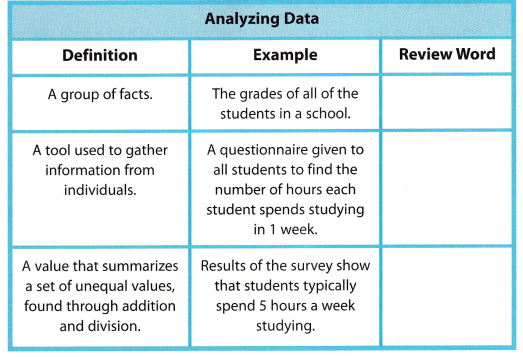
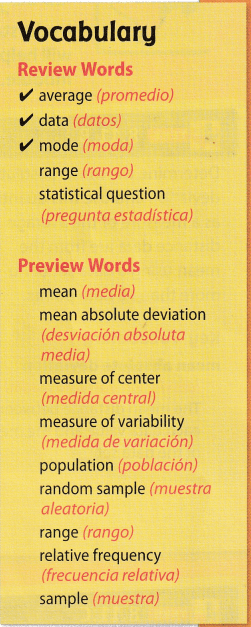
Visualize Vocabulary

Use the ✓ words to complete the right column of the chart.
Texas Go Math Grade 8 Module 15 Answer Key 1
Texas Go Math Grade 8 Module 15 Answer Key 2

Understand Vocabulary

Complete the sentences using the preview words.

Question 1.
The entire group of objects, individuals, or events is the ____________.
Answer: The entire group of objects, individuals, or events is the population.

Go Math Grade 8 Answer Key Module 15 Question 2.
A sample in which every person, object, or event has an equal chance at being selected is a ___________.
Answer: A sample in which every person, object, or event has an equal chance of being selected is a simple random sample.

Active Reading
Layered Book Before beginning the module, create a layered book to help you learn the concepts in this module. Label each flap with lesson titles from this module. As you study each lesson, write important ideas, such as vocabulary and formulas, under the appropriate flap. Refer to your finished layered book as you work on exercises from this module.
Texas Go Math Grade 8 Module 15 Answer Key 3

Texas Go Math Grade 8 Module 15 Answer Key Sampling Read More »

Texas Go Math Grade 7 Lesson 2.3 Answer Key Proportional Relationships and Graphs

Refer to our Texas Go Math Grade 7 Answer Key Pdf to score good marks in the exams. Test yourself by practicing the problems from Texas Go Math Grade 7 Lesson 2.3 Answer Key Proportional Relationships and Graphs.

Texas Go Math Grade 7 Lesson 2.3 Answer Key Proportional Relationships and Graphs

Your Turn

Question 1.
Jared rents bowling shoes for $6 and pays $5 per bowling game. Graph the data. Is the relationship a proportional relationship? Explain.
Texas Go Math Grade 7 Lesson 2.3 Answer Key 1
Answer:
The relationship isn’t proportional, because the points form a line that does not go through the origin.
Texas Go Math Grade 7 Lesson 2.3 Answer Key 14

Example
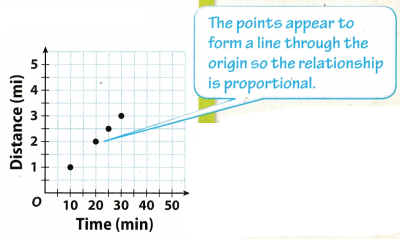
The graph shows the relationship between time in minutes and the number of miles Damon runs. Write an equation for this relationship.
Texas Go Math Grade 7 Lesson 2.3 Answer Key 2
STEP 1: Choose a point on the graph and tell what the point represents.
The point (25, 2.5) represents the distance (2.5 miles) that Damon runs in 25 minutes.
STEP 2: What ¡s the constant of proportionality?
Because distance \(\frac{\text { distance }}{\text { time }}=\frac{2.5 \mathrm{mi}}{25 \mathrm{~min}}=\frac{1}{10}\), the constant of proportionality is \(\frac{1}{10}\).
STEP 3: Write an equation in the form y = kx.
y = \(\frac{1}{10}\)x

Reflect

Question 2.
Communicate Mathematical Ideas What does the point (0, 0) on the graph represent?
Answer:
The point (0, 0) represents a start on the graph, origin.

Go Math Lesson 2.3 7th Grade Proportional Relationships Question 3.
What If? Esther runs faster than Damon. Suppose you drew a graph representing the relationship between time in minutes and distance run for Esther. How would the graph compare to the one for Damon?
Answer:
Esther’s Line would be steeper than Damon’s

Your Turn

Question 4.
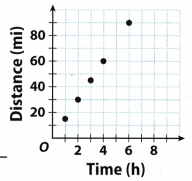
The graph shows the relationship between the distance a bicyclist travels and the time in hours.
Texas Go Math Grade 7 Lesson 2.3 Answer Key 3
a. What does the point (4, 60) represent?
Answer:
The point (4,60) represents the distance (60 miles) that the bicyclist travels in 4 hours

b. What is the constant of proportionality?
Answer:
The constant is equal to 15 because \(\frac{\text { distance }}{\text { time }}=\frac{60}{4}\) = 15. Only one point is enough since the relationship is proportional.

c. Write an equation in the form y = kx for this relationship.
Answer:
The equation is equal to y = 15x.

Texas Go Math Grade 7 Lesson 2.3 Guided Practice Answer Key

Complete each table. Tell whether the relationship is a proportional relationship. Explain why or why not. xpIore Activity)
Question 1.
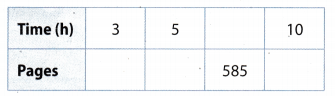
A student reads 65 pages per hour.
Texas Go Math Grade 7 Lesson 2.3 Answer Key 4
Answer:
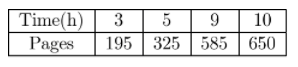
Texas Go Math Grade 7 Lesson 2.3 Answer Key 15
3 × 65 = 195
5 × 65 = 325
585 ÷ 65 = 9
10 × 65 = 650
The relationship is proportional because we made sure with our calculations that all constants are equal to 65.

Lesson 2.3 Proportional Relationships Answer Key Grade 7 Question 2.
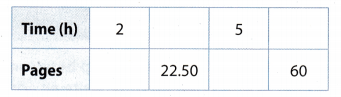
A babysitter makes $7.50 per hour.
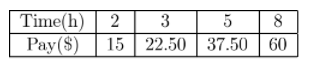
Texas Go Math Grade 7 Lesson 2.3 Answer Key 5
Answer:
Texas Go Math Grade 7 Lesson 2.3 Answer Key 16
2 × 7.51 = 15
22.50 ÷ 7.50 = 3
5 × 7.50 = 37.5()
60 ÷ 7.50 = 8
The relationship is proportional because we made sure with our calculations that all constants are equal to 7.50.

Tell whether the relationship is a proportional relationship. Explain why or why not. (Explore Activity and Example 1)

Question 3.
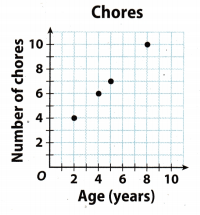
Texas Go Math Grade 7 Lesson 2.3 Answer Key 6
Answer:
The relationship is not proportional because the line does not go through the origin.

Question 4.
Texas Go Math Grade 7 Lesson 2.3 Answer Key 7
Answer:
The relationship is proportional, the constant is equal to 2 because \(\frac{2}{1}\) = \(\frac{4}{2}\) = \(\frac{10}{5}\) = \(\frac{16}{8}\) = 2. The equation is equal to y = 2x.

Write an equation of the form y = kx for the relationship shown in each graph.

Question 5.
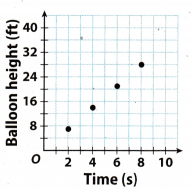
Texas Go Math Grade 7 Lesson 2.3 Answer Key 8
Answer:
The relationship is proportional because points form a line through the origin.
Thus, we need only one point to determine the constant
7 ÷ 2 = 3.5
y = Balloon height(ft)
x = Time(s)
Equation: y = 3.5x

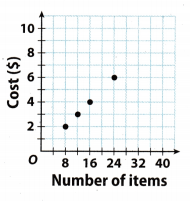
Graphing Proportional Relationships 7th Grade Answer Key Question 6.
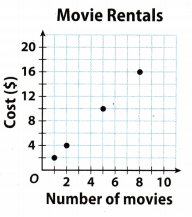
Texas Go Math Grade 7 Lesson 2.3 Answer Key 9
Answer:
The relationship is proportional because points form a line through the origin.
Thus, we need only one point to determine the constant
2 ÷ 8 = 025
y = Cost ($)
x = Number of items
Equation: y = 0.5x

Essential Question Check-In

Question 7.
How does a graph show a proportional relationship?
Answer:
The graph forms a line that passes through the origin.

Texas Go Math Grade 7 Lesson 2.3 Independent Practice Answer Key

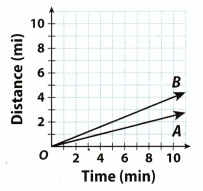
For Exercises 8-12, the graph shows the relationship between time and distance run by two horses.

Texas Go Math Grade 7 Lesson 2.3 Answer Key 10

Question 8.
Explain the meaning of the point (0, 0).
Answer:
The point (0,0) represents the start, position of horses right before they started to run.

Question 9.
How long does it take each horse to run a mile?
Answer:
We can see from the graph that horse A takes 4 minutes to run a mile, while horse B takes 2.5 minutes to run a mile.
Lesson 2.3 Reteach Answer Key Go Math Grade 7 Question 10.
Multiple Representations Write an equation for the relationship between time and distance for each horse.
Answer:
Horse A runs 1 mile in 4 minutes. That means he runs \(\frac{1}{4}\) miles per minute.

Horse B runs 1 mile in 2.5 minutes That means he runs \(\frac{1 \times 2}{2.5 \times 2}\) = \(\frac{2}{5}\) miles per minute.
x = Time (min)
y = Distance(miles)
Horse A: y = \(\frac{1}{4}\) x
Horse B: y = \(\frac{2}{5}\) x

Question 11.
Draw Conclusions At the given rates, how far would each horse run in 12 minutes?
Answer:
Use the equations from 11:
Horse A:
y = \(\frac{1}{4}\) x
y = \(\frac{1}{4}\)(12)3
y = 3

Horse B:
y = \(\frac{2}{5}\) x
y = \(\frac{2}{5}\) (12)
y = \(\frac{25}{4}\)
y = 4\(\frac{4}{5}\)
Horse A passes 3 miles in 12 minutes.
Horse B passes 4\(\frac{4}{5}\) in 12 minutes.

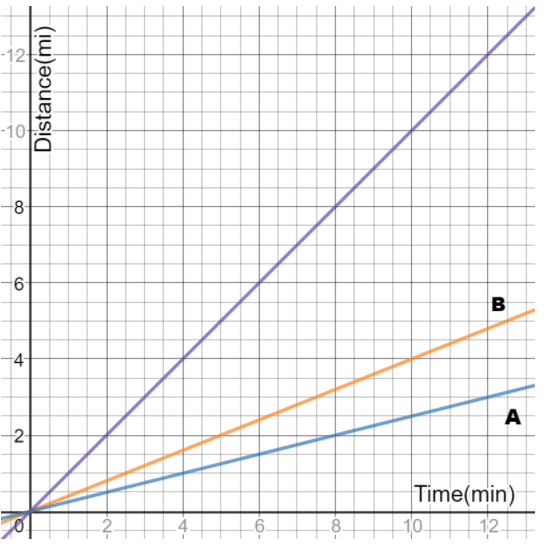
Question 12.
Analyze Relationships Draw a line on the graph representing a horse than runs faster than horses A and B.
Answer:
Texas Go Math Grade 7 Lesson 2.3 Answer Key 17

Go Math Grade 7 Lesson 2.3 Constant of Proportionality Question 13.
A bullet train can travel at 170 miles per hour. Will a graph representing the distance in miles compared to the time in hours show a proportional relationship? Explain.
Answer:
The graph will show a proportional relationship because of the constant unit rate, 170 miles per hour.

Question 14.
Critical Thinking When would it be more useful to represent a proportional relationship with a graph rather than an equation?
Answer:
It would be easier to draw graphs when we have whole numbers
It would not be easy to draw a graph if a constant is a long decimal number or a fraction with big numbers. Thus, we rather use the equation in this case.

Question 15.
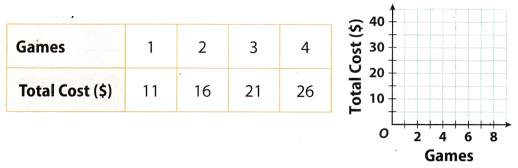
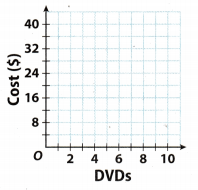
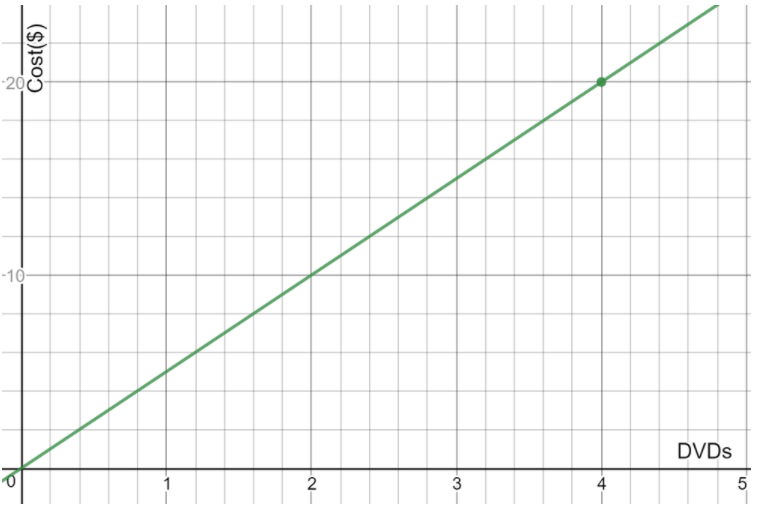
Multiple Representations Bargain DVDs cost $5 each at Mega Movie.
a. Graph the proportional relationship that gives the cost y in dollars of buying x bargain DVDs.
Texas Go Math Grade 7 Lesson 2.3 Answer Key 11
Answer:
Graph

b. Give an ordered pair on the graph and explain its meaning in the real world context.
Answer:
The point (4, 20) represents $20 you have to pay for renting 4 DVDs.
Texas Go Math Grade 7 Lesson 2.3 Answer Key 18

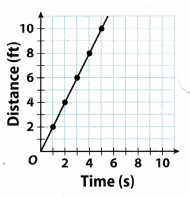
The graph shows the relationship between distance and time as Glenda swims.

Texas Go Math Grade 7 Lesson 2.3 Answer Key 12

7th Grade Constant of Proportionality Answer Key Go Math Question 16.
How far did Glenda swim in 4 seconds?
Answer:
Glenda swam 8 feet in 4 seconds.

Question 17.
Communicate Mathematical Ideas Is this a proportional relationship? Explain your reasoning.
Answer:
This is a proportional relationship because points form a line through the origin.

Texas Go Math Grade 7 Answer Key Lesson 2.3 Question 18.
Multiple Representations Write an equation that shows the relationship between time and distance. ________________________________
Answer:
Because the relationship is proportional we can calculate the constant k. From point (2, 4) we conclude the constant is equal to 2.
x = Time(s)
y = Distance(ft)
Thus, the equation is y = 2x.

H.O.T.S Focus On Higher Order Thinking

Question 19.
Make a Conjecture If you know that a relationship is proportional and are given one ordered pair other than (0, 0), how can you find another pair?
Answer:
From the point that is given to us, we can draw a line on the graph through that point and (0, 0). Then we can find whichever point we need.

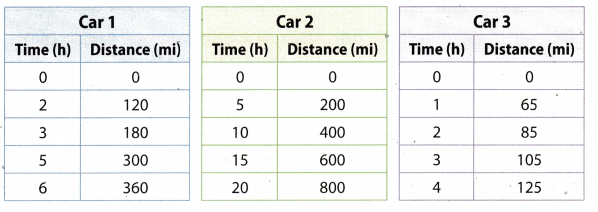
The tables show the distance traveled by three cars.

Texas Go Math Grade 7 Lesson 2.3 Answer Key 13

Proportional Relationships 7th Grade Answer Key Question 20.
Communicate Mathematical Ideas Which car is not traveling at a constant speed? Explain your reasoning.
Answer:
Car 3 is not traveling at a constant speed because \(\frac{65}{1}\) ≠ \(\frac{85}{2}\).

Question 21.
Make a Conjecture Car 4 is traveling at twice the rate of speed of car 2. How will the table values for car 4 compare to the table values for car 2?
Answer:
The time column will stay the same but the distance column will double its values because the constant doubles.

Texas Go Math Grade 7 Lesson 2.3 Answer Key Proportional Relationships and Graphs Read More »

Texas Go Math Grade 8 Module 14 Quiz Answer Key

Refer to our Texas Go Math Grade 8 Answer Key Pdf to score good marks in the exams. Test yourself by practicing the problems from Texas Go Math Grade 8 Module 14 Quiz Answer Key.

Texas Go Math Grade 8 Module 14 Quiz Answer Key

Texas Go Math Grade 8 Module 14 Ready to Go On? Answer Key

14.1 Scatter Plots arid Association

An auto store is having a sale on motor oil. The chart shows the price per quart as the number of quarts purchased increases. Use the data for 1-2.
Texas Go Math Grade 8 Module 14 Quiz Answer Key 1
Question 1.
Use the given data to make a scatter plot.
Texas Go Math Grade 8 Module 14 Quiz Answer Key 2
Answer:
Plot the points: (1, 2), (2, 1.50), (3. 1.25), (4, 1.10), (5, 1), (6, 0.95)
Texas Go Math Grade 8 Module 14 Quiz Answer Key 8

Scatter Plot Quiz Module 14 Test Answers 8th Grade Go Math Question 2.
Describe the association you see between the number of quarts purchased and the price per quart. Explain.
Answer:
The association seen between the number of quarts purchased and the price per quart is negative and nonlinear. As the number of quarts rises, the price per quart decreases but there is a data curve.

14.2 Trend Lines and Predictions

The scatter plot below shows data comparing wind speed and wind chill for an air temperature of 20 °F. Use the scatter plot for 3-5.
Texas Go Math Grade 8 Module 14 Quiz Answer Key 3
Question 3.
Draw a trend line for the scatter plot.
Answer:
Draw a trend line for the scatter plot.
Texas Go Math Grade 8 Module 14 Quiz Answer Key 9

Question 4.
Write an equation for your trend line.
Answer:
Find the slope of the trend line The line passes through points (10, 8.75) and (35, 0).
Use the slope formula: m = \(\frac{y_{2}-y_{1}}{x_{2}-x_{1}}\)
m = \(\frac{0-8.75}{35-10}\)
m = \(\frac{-8.75}{25}\)
m = -0.35
Find the y-intercept of the trend line.
Slope-intercept form : y = mx + b
0 = -0.35.0 + b
0 = -12.25 + b
b = 12.25
Use your slope and y-intercept values to write the equation.
y = mx + b
y = -0.35x + 12.25
The equation for the trend line is y = -0.35x + 12.25

Module 14 Scatter Plots Module Quiz D Answer Key Question 5.
Use your equation to predict the wind chill to the nearest degree for a wind speed of 60 mi/h.
Answer:
Use the equation for the trend line.
y = mx+b
y = -0.35(60) + 12.25
y = -21 + 12.25
y = -8.75
y ≈ -9
The wind chill to the nearest degree for a wind speed of 60 mi/h is 9°F.

Essential Question

Question 6.
How can you use scatter plots to solve real-world problems?
Answer:
Using a scatter plot, you can see positive and negative trends such as prices over time. You can also make predictions such as height at a certain age.

Texas Go Math Grade 8 Module 14 Mixed Review Texas Test Prep Answer Key

Selected Response

Question 1.
Which scatter plot could have a trend line whose equation is y = 3x + 10?
Texas Go Math Grade 8 Module 14 Quiz Answer Key 4
Answer:
(C)

Explanation:
Equation for the trend Line is y = 3x + 10
y = mx + b
The slope of the trend line is m = 3.
The slope is positive, m > 0, which means that a trend line is increasing.
If the line is increasing, options A and C are not solutions because in these options trend line decreasing.
The y-intercept of the trend line is b = 10.
That is the y-coordinate where the line intersects the y-axis.
(0, 10) where the trend line intersects the y-axis is in scatter plot in option B.

Question 2.
What type of association would you expect between a person’s age and hair length?
(A) linear
(B) negative
(C) none
(D) positive
Answer:
(B) negative

Explanation:
The length of their hair reduces. This is because the length of hair changes with the growth phase of the hair follicles. When one is young, the cells of the papilla divide more rapidly, and hence the length of the hair to be long before reaching the transitional phase and then shed off in the telogen phase. The older one gets, the papilla cells do not divide as rapidly and the length of the hair shortens with age.
The older persons tended to have shorter hair.

Question 3.
Which is not shown on the scatter plot?
Texas Go Math Grade 8 Module 14 Quiz Answer Key 5
(A) cluster
(B) negative association
(C) outlier
(D) positive association
Answer:
(D) positive association

Explanation:
Cluster, negative association and outlier are shown on the scatter plot.
Cluster is visible between points (12, 21) and (5, 43).
Outlier is visible at point (10, 59)
If we draw the trend line, line would decrease. Because of that, on the scatter plot is shown negative association.
If the trend line decreases, on the scatter plot is not shown positive association.

Module 14 Scatter Plots Quiz Ready To Go On 8th Grade Math Question 4.
A restaurant claims to have served 352,000,000 hamburgers. What is this number in scientific notation?
(A) 3.52 × 10⁶
(B) 3.52 × 10⁸
(C) 35.2 × 10⁷
(D) 352 × 106
Answer:
(B) 3.52 × 10⁸

Explanation:
100,000,000 is 108
352,000,000 = 352 × 106 = 3.52 × 10⁸

Question 5.
Which equation describes the relationship between x and yin the table?
Texas Go Math Grade 8 Module 14 Quiz Answer Key 6
(A) y = -4x
(B) y = \(\frac{-1}{4}\)x
(C) y = 4x
(D) y = \(\frac{1}{4}\)x
Answer:
(B) y = \(\frac{-1}{4}\)x

Explanation:
In order to find out the relationship between x and y, we have use the values in the question and substitute them into the solution options.
So, we will use point (- 8, 2) and substitute x with -8 and y with 2 in every option.

(a)
y = -4x
2 = -4(-8)
2 = 32
False

(b)
y = \(\frac{-1}{4}\)x
2 = \(\frac{-1}{4}\) (-8)
2 = 2
True

(c)
y = 4x
2 = 4(-8)
2 = -32
False

(d)
y = \(\frac{1}{4}\)x
2 = \(\frac{1}{4}\)(-8)
2 = -2
False

Gridded Response

8th Grade Math Problems Scatter Plot Quiz Answer Key Question 6.
Predict the number of visitors when the temperature is 102°F.
Texas Go Math Grade 8 Module 14 Quiz Answer Key 7
Answer:
a)
Texas Go Math Grade 8 Module 14 Quiz Answer Key 10

b)
An outlier is points (92, 135).

c)
Based on the number of visitors on a day with a temperature of 100° F, I would expect that on a day with a temperature of 102°, the pool would have between 350 and 400 visitors.

Texas Go Math Grade 8 Module 14 Quiz Answer Key Read More »

Texas Go Math Grade 7 Lesson 1.6 Answer Key Dividing Rational Numbers

Refer to our Texas Go Math Grade 7 Answer Key Pdf to score good marks in the exams. Test yourself by practicing the problems from Texas Go Math Grade 7 Lesson 1.6 Answer Key Dividing Rational Numbers.

Texas Go Math Grade 7 Lesson 1.6 Answer Key Dividing Rational Numbers

Texas Go Math Grade 7 Lesson 1.6 Explore Activity 1 Answer Key 

A diver needs to descend to a depth of 100 feet below sea level. She wants to do it in 5 equal descents. How far should she travel in each descent?

A. To solve this problem, you can set up a division problem: \(\frac{-100}{}\) =?
B. Rewrite the division problem as a multiplication problem. Think: Some number multiplied by 5 equals -100.
_______ × ? = -100
C. Remember the rules for integer multiplication. If the product is negative, one of the factors must be negative. Since ________ ¡s positive, the unknown factor must be [Positive/negative.]
D. You know that 5 × _________ = 100. So, using the rules for integer multiplication you can say that 5 × ____ 100.
The diver should descend ________ feet in each descent.

Reflect

Question 1.
What do you notice about the quotient of two rational numbers with different signs?
Answer:
The quotient of two rational numbers with different signs will have a negative sign.

Texas Go Math Grade 7 Pdf Lesson 1.6 Answer Key Question 2.
What do you notice about the quotient of two rational numbers with the same sign? Does it matter if both signs are positive or both are negative?
Answer:
The quotient of two rational numbers with the same sign will have a positive sign. It does not matter if both signs are positive or both signs are negative.

Write two equivalent expressions for each quotient.

Question 3.
\(\frac{14}{-7}\) __________, __________
Answer:
\(\frac{-14}{7}\), – (\(\frac{14}{7}\))

Question 4.
\(\frac{-32}{-8}\) __________, ___________
Answer:
\(\frac{32}{8}\), -(\(\frac{-32}{8}\))

Your Turn

Find each quotient.

Question 5.
\(\frac{2.8}{-4}\) = ____________
Answer:
The quotient will be negative because signs are different.
Write a decimal as fraction: \(\frac{\frac{28}{10}}{-4}\)
Write complex fraction as division: \(\frac{28}{10}\) ÷ (-4)
Rewrite using multiplication:
\(\frac{28}{10} \times \frac{-1}{4}=\frac{-28}{40}\)
= \(\frac{-7}{10}\)

Question 6.
\(\frac{-\frac{5}{8}}{-\frac{6}{7}}\) = ____________
Answer:
The quotient will be positive because the signs are the same.
Write complex fractions as division:
–\(\frac{5}{8}\) ÷ (-\(\frac{6}{7}\))
Rewrite using multiplication:
–\(\frac{5}{8}\) × (-\(\frac{7}{6}\)) = \(\frac{35}{48}\)

Texas Go Math Grade 7 Pdf Dividing Rational Numbers Question 7.
– \(\frac{5.5}{0.5}\) = ___________
Answer:
The quotient will be negative because signs are different.
Write decimal numbers as fractions:
\(-\frac{\frac{55}{10}}{\frac{5}{10}}\)
Write complex fractions as division:
–\(\frac{55}{10}\) ÷ \(\frac{5}{10}\)
Rewrite using multiplication:
–\(\frac{55}{10}\) × \(\frac{10}{5}\) = -11

Texas Go Math Grade 7 Lesson 1.6 Guided Practice Answer Key 

Find each quotient. (Explore Activity 1 and 2, Example 1)

Question 1.
\(\frac{0.72}{-0.9}\) = ____________
Answer:
The quotient will be negative because signs are different.
Write decimal numbers as fraction:
\(\frac{\frac{72}{100}}{\frac{-9}{10}}\)
Write complex fraction as division:
\(\frac{72}{100}\) ÷ \(\frac{-9}{10}\)
Rewrite using multiplication:
\(\frac{72}{100}\) × \(\frac{10}{-9}\) = \(\frac{8}{-10}\)
= –\(\frac{4}{5}\)

Question 2.
\(\left(-\frac{\frac{1}{5}}{\frac{7}{5}}\right)\) = ____________
Answer:
The quotient will be negative because signs are different.
Write complex fraction as division:
–\(\frac{1}{5}\) ÷ \(\frac{7}{5}\)
Rewrite using multiplication:
–\(\frac{1}{5}\) × \(\frac{5}{7}\) = –\(\frac{1}{7}\)

Question 3.
\(\frac{56}{-7}\) = _____________
Answer:
The quotient will be negative because the signs are different.
\(\frac{56}{-7}\) = -8

Question 4.
\(\frac{251}{4} \div\left(-\frac{3}{8}\right)\) = ____________
Answer:
The quotient will be negative because the complex fraction is negative.
Rewrite using multiplication:
– \(\frac{251}{4}\) × \(\frac{8}{3}\) = –\(\frac{502}{3}\)

Texas Go Math Grade 7 Answer Key Pdf Lesson 1.6 Question 5.
\(\frac{75}{-\frac{1}{5}}\) = ____________
Answer:
The quotient will be negative because the signs are different
Write complex fractions as division:
-75 ÷ \(\frac{1}{5}\)
Rewrite using multiplication:
-75 × 5 = -375

Question 6.
\(\frac{-91}{-13}\) = ____________
Answer:
The quotient will be positive because the signs are the same.
\(\frac{-91}{-13}\) = \(\frac{91}{13}\)
= 7

Question 7.
\(\frac{-\frac{3}{7}}{\frac{9}{4}}\) = _____________
Answer:
The quotient will be negative because the signs are different.
Write complex fraction as division:
–\(\frac{3}{7}\) ÷ \(\frac{9}{4}\)
Rewrite using multiplication:
–\(\frac{3}{7}\) × \(\frac{4}{9}\) = –\(\frac{4}{21}\)

Question 8.
–\(\frac{12}{0.03}\) = ____________
Answer:
The quotient will be negative because the fraction has a negative sign.
Write decimal numbers as fraction:
–\(\frac{12}{\frac{3}{100}}\)
Write complex fraction as division:
-12 ÷ \(\frac{3}{100}\)
Rewrite using multiplication:
-12 × \(\frac{100}{3}\) = -400

Question 9.
A water pail in your backyard has a small hole in it. You notice that it has drained a total of 3.5 liters in 4 days. What is the average change in water volume each day? (Example 1)
Answer:
Use a negative number to represent spiLLage of water
Find \(\frac{-3.5}{4}\).
The quotient will be negative because signs are different.
Write decimal numbers as fraction:
\(-\frac{\frac{35}{10}}{4}\)
Write complex fraction as division:
– \(\frac{35}{10}\) ÷ 4
Rewrite using multiplication:
–\(\frac{35}{10}\) × \(\frac{1}{4}\) = – \(\frac{35}{40}\)
= –\(\frac{7}{8}\)
The average change in water volume each day is –\(\frac{7}{8}\) liters.

Question 10.
The price of one share of ABC Company declined a total of $45.75 in 5 days. What was the average change of the price of one share per day? (Example 1)
Answer:
Use a negative number to represent decline in share price.
Find \(\frac{-45.75}{5}\)
The quotient will be negative because signs are different
Write decimal numbers as fraction:
\(-\frac{\frac{4575}{100}}{5}\)
Write complex fraction as division:
–\(\frac{4575}{100}\) ÷ 5
Rewrite using multiplication:
–\(\frac{915}{100}\) × \(\frac{1}{5}\) = –\(\frac{915}{100}\)
= –\(\frac{183}{25}\)
The average change of the price of one share per day is –\(\frac{183}{25}\)

Question 11.
To avoid a storm, a passenger jet pilot descended 0.44 mile in 0.8 minute. What was the plane’s average change of altitude per minute? (Example 1)
Answer:
Use a negative number to represent descent
Find \(\frac{-0.44}{0.8}\).
UL
The quotient will be negative because signs are different.
Write decimal numbers as fraction:
\(\frac{1}{2}\)
Write complex fraction as division:
–\(\frac{44}{100}\) ÷ \(\frac{8}{10}\)
Rewrite using multiplication:
–\(\frac{44}{100}\) × \(\frac{10}{8}\) = –\(\frac{11}{20}\)
The average change of altitude per minute is –\(\frac{11}{20}\) miles.

Essential Question Check-In

Question 12.
Explain how you would find the sign of the quotient \(\frac{32 \div(-2)}{-16 \div 4}\).
Answer:
I would first find the sign of the numerator and denominator separately, and then the sign of the whole fraction.
Numerator: Negative, because signs are different
Denominator: Negative, because signs are different.
Whole fraction: Positive, because signs are the same.

Texas Go Math Grade 7 Lesson 1.6 Independent Practice Answer Key  

Question 13.
\(\frac{5}{-\frac{2}{8}}\) = __________
Answer:
The quotient will be negative because the signs are different
Write complex fraction as division: -5 ÷ \(\frac{2}{8}\)
Rewrite using multiplication:
-5 × \(\frac{8}{2}\) = -5 × 4
= -20

7th Grade Go Math Answer Key Lesson 1.6 Question 14.
\(5 \frac{1}{3} \div\left(-1 \frac{1}{2}\right)\) = __________
Answer:
Write mixed fractions as proper fractions:
\(\frac{16}{3}\) ÷ (-\(\frac{3}{2}\))
The quotient will be negative because the complex fraction is negative
Rewrite using multiplication:
– \(\frac{16}{3}\) × \(\frac{2}{3}\) = –\(\frac{32}{9}\)

Question 15.
\(\frac{-120}{-6}\) = ___________
Answer:
The quotient will be positive because the signs are the same.
\(\frac{-120}{-6}\) = \(\frac{120}{6}\)
= 20

Question 16.
\(\frac{-\frac{4}{5}}{-\frac{2}{3}}\) = _____________
Answer:
The quotient will be positive because the signs are the same.
Write complex fraction as division:
\(\frac{4}{5}\) ÷ \(\frac{2}{3}\)
Rewrite using multiplication:
\(\frac{4}{5}\) × \(\frac{3}{2}\) = \(\frac{6}{5}\)

Question 17.
1.03 ÷ (-10.3) = _____________
Answer:
Write decimal numbers as fractions.
\(\frac{103}{100}\) ÷ (-\(\frac{103}{10}\))
The quotient will be negative because the signs are different.
Rewrite using multiplication:
–\(\frac{103}{100}\) × \(\frac{10}{103}\) = –\(\frac{1}{10}\)

Question 18.
\(\frac{-0.4}{80}\) = ____________
Answer:
The quotient will be negative because signs are different.
Write decimal numbers as fraction:
\(\frac{-\frac{4}{10}}{80}\)
Write complex fraction as division:
–\(\frac{4}{10}\) ÷ 80
Rewrite using multiplication:
–\(\frac{4}{10}\) × \(\frac{1}{80}\) = –\(\frac{1}{200}\)

Question 19.
1 ÷ \(\frac{9}{5}\) = ___________
Answer:
The quotient will be positive because the signs are the same.
Rewrite using multiplication:
1 × \(\frac{5}{9}\) = \(\frac{5}{9}\)

Question 20.
\(\frac{\frac{-1}{4}}{\frac{23}{24}}\) = _____________
Answer:
The quotient will be negative because the signs are different
Write complex fractions as division:
–\(\frac{1}{4}\) ÷ \(\frac{23}{24}\)
Rewrite using multipLication:
–\(\frac{1}{4}\) × \(\frac{24}{23}\) = –\(\frac{6}{23}\)

Lesson 1.6 Go Math 7th Grade Dividing Rational Numbers Answer Key Question 21.
\(\frac{-10.35}{-2.3}\) = ___________
Answer:
The quotient will be positive because the signs are the same.
Write decimal numbers as fractions:
\(\frac{-\frac{1035}{100}}{-\frac{23}{10}}\)
Write complex fractions as division:
\(\frac{1035}{100}\) ÷ \(\frac{23}{10}\)
Rewrite using muLtiplication:
\(\frac{1035}{100}\) × \(\frac{10}{23}\) = \(\frac{45}{10}\)
= \(\frac{9}{2}\)

Question 22.
Alex usually runs for 21 hours a week, training for a marathon. If he is unable to run for 3 days, describe how to find out how many hours of training time he loses, and write the appropriate integer to describe how it affects his time.
Answer:
If Alex runs 21 hours for a week, that means he runs \(\frac{21}{7}\) = 3 hours per day. If he is unable to run for 3 days, that means he loses 3 × 3 = 9 hours.

Question 23.
The running back for the Bulldogs football team carried the ball 9 times for a total loss of 15\(\frac{3}{4}\) yards. Find the average change in field position on each run.
Answer:
Use negative number to represent loss of yards
Find \(\frac{-15 \frac{3}{4}}{9} .\)
Write mixed fractions as proper fractions:
\(\frac{-\frac{63}{4}}{9}\)
The quotient will be negative because the signs are different.
Write complex fraction as division:
–\(\frac{63}{4}\) ÷ 9
Rewrite using multiplication:
–\(\frac{63}{4}\) × \(\frac{1}{9}\) = –\(\frac{7}{4}\)
Averange change in field position on each run is –\(\frac{7}{4}\) yards.

Question 24.
The 6:00 a.m. temperatures for four consecutive days in the town of Lincoln were -12.1°C, -7.8°C, -14.3°C, and -7.2 °C. What was the average 6:00 a.m. temperature for the four days?
Answer:
First we need to add the temperatures up.
12.1 + (- 7.8) + (- 14.3) + (- 7.2) = 19.9 + (- 14.3) + (- 7.2)
= 34.2 + (- 7.2)
= 41.4
Now, we need to divide the result with the count of temperature measurements.
Find \(\frac{-41.4}{4}\).
The quotient will be negative because signs are different.
Write decimal numbers as fraction:
\(\frac{-\frac{414}{10}}{4}\)
Write complex fraction as division:
–\(\frac{414}{10}\) ÷ 4
Rewrite using multiplication:
–\(\frac{414}{10}\) × \(\frac{1}{4}\) = –\(\frac{207}{20}\)
The average 6.00 a.m temperature for four days was –\(\frac{207}{20}\) degrees Celsius.

Question 25.
Multistep A seafood restaurant claims an increase of $1,750.00 over its average profit during a week where it introduced a special of baked clams.
a. If this is true, how much extra profit did it receive per day?
Answer:
Find \(\frac{1750}{7}\).
\(\frac{1750}{7}\) = 250
They received $250 extra profit per day.

b. If it had, instead, lost $150 per day, how much money would it have lost for the week?
Answer:
Find -150 × 7
-150 × 7 = -1050
They would have lost $1050 for the week.

c. If its total loss was $490 for the week, what was its average daily change?
Answer:
Find \(\frac{-490}{7}\)
\(\frac{-490}{7}\) = -70
The average daily change was -$70.

Question 26.
A hot air balloon descended 99.6 meters in 12 seconds. What was the balloon’s average rate of descent in meters per second?
Texas Go Math Grade 7 Lesson 1.6 Answer Key 1
Answer:
Use a negative number to represent descent.
Find \(\frac{-99.6}{12}\)
The quotient will be negative because signs are different.
Write decimal numbers as fraction:
\(-\frac{\frac{996}{10}}{12}\)
Write complex fraction as division:
–\(\frac{996}{10}\) ÷ 12
Rewrite using multiplication:
–\(\frac{996}{10}\) × \(\frac{1}{12}\) = –\(\frac{83}{10}\)
= -8.3
The average rate of descent is 8.3 meters per second

Question 27.
Sanderson is having trouble with his assignment. His work is as follows:
\(\frac{-\frac{3}{4}}{\frac{4}{3}}=-\frac{3}{4} \times \frac{4}{3}=-\frac{12}{12}=-1\)
However, his answer does not match the answer that his teacher gave him. What is Sanderson’s mistake? Find the correct answer.
Answer:
Sanderson jumped over one step. He should have written complex fractions using division.
\(\frac{3}{4}\) ÷ \(\frac{4}{3}\)
And then rewrite it using multiplication.
\(\frac{3}{4}\) × \(\frac{3}{4}\)

Go Math Answer Key Grade 7 Lesson 1.6 Question 28.
Science Beginning in 1996, a glacier lost an average of 3.7 meters of thickness each year. Find the total change in its thickness by the end of 2012.
Answer:
First, find out how many years have passed in the period 1996-2012.
2012 – 1996 = 16
Find -3.7 × 16.
-3.7 × 16 = -59.2
The total change in thickness by the end of 2012 is -59.2 inches.

H.O.T. Focus on Higher Order Thinking

Question 29.
Represent Real-World Problems Describe a real-world situation that can be represented by the quotient -85 ÷ 15. Then find the quotient and explain what the quotient means in terms of the real-world situation.
Answer:
A group of 15 people lost 85 dollars. If every person lost the same amount of dollars, how many dollars have each person lost?
–\(\frac{85}{15}\) = –\(\frac{17}{3}\)
Each person lost –\(\frac{17}{3}\)

Question 30.
Construct an Argument Divided 5 by 4. Is your answer a rational number? Explain.
Answer:
Yes, it is a Quotient of dividing 5 by 4 is a fraction, and every fraction is a rational number.

Question 31.
Critical Thinking Is the quotient of an integer divided by a nonzero integer always a rational number? Explain.
Answer:
Yes, it is. A quotient of any two integers can be written as a fraction, the denominator being a nonzero integer. Thus, it is a rational. number.

Texas Go Math Grade 7 Lesson 1.6 Answer Key Dividing Rational Numbers Read More »

Texas Go Math Grade 7 Module 1 Answer Key Rational Numbers

Refer to our Texas Go Math Grade 7 Answer Key Pdf to score good marks in the exams. Test yourself by practicing the problems from Texas Go Math Grade 7 Module 1 Answer Key Rational Numbers.

Texas Go Math Grade 7 Module 1 Answer Key Rational Numbers

Texas Go Math Grade 7 Module 1 Are You Ready? Answer Key

Multiply. Write the product in simplest form.

Question 1.
\(\frac{9}{14}\) × \(\frac{7}{6}\) ____________
Answer:
Start with dividing by the common factors:
\(\frac{9}{14}\) × \(\frac{7}{6}\)
= \(\frac{3}{4}\)

Question 2.
\(\frac{3}{5}\) × \(\frac{4}{7}\) ____________
Answer:
We do not have any common factors here to divide with.
Simplify:
= \(\frac{12}{35}\)

Grade 7 Go Math Texas Module 1 Answer Key Question 3.
\(\frac{11}{8}\) × \(\frac{10}{33}\) ____________
Answer:
Start with dividing by the common factors:
\(\frac{11}{8}\) × \(\frac{10}{33}\)
= \(\frac{5}{12}\)

Question 4.
\(\frac{4}{9}\) × 3 ____________
Answer:
Start with dividing by the common factors:
Write 3 as \(\frac{3}{1}\)
\(\frac{4}{9}\) × \(\frac{3}{1}\)
= \(\frac{4}{3}\)

Divide.

Question 5.
\(\frac{1}{2}\) ÷ \(\frac{1}{4}\) ____________
Answer:
= \(\frac{1}{2}\) × \(\frac{4}{1}\) Multiply by the reciprocal of the divisor.
= \(\frac{1}{2}\) × \(\frac{4}{1}\) Divide by the common factors.
= \(\frac{2}{1}\) = 2 Simplify
= 2

Question 6.
\(\frac{3}{8}\) ÷ \(\frac{13}{16}\) ____________
Answer:
= \(\frac{3}{8}\) × \(\frac{16}{13}\) Multiply by the reciprocal of the divisor.
= \(\frac{3}{8}\) × \(\frac{16}{12}\) Divide by the common factors.
= \(\frac{6}{13}\) Simplify
= \(\frac{6}{13}\)

Question 7.
\(\frac{2}{5}\) ÷ \(\frac{14}{15}\) ____________
Answer:
= \(\frac{2}{5}\) × \(\frac{15}{14}\) Multiply by the reciprocal of the divisor.
= \(\frac{2}{5}\) × \(\frac{15}{15}\) Divide by the common factors.
= \(\frac{3}{7}\) Simplify
= \(\frac{3}{7}\)

Module 1 Grade 7 Answer Key Texas Go Math Question 8.
\(\frac{4}{9}\) ÷ \(\frac{16}{27}\) ____________
Answer:
= \(\frac{4}{9}\) × \(\frac{27}{16}\) Multiply by the reciprocal of the divisor.
= \(\frac{4}{9}\) × \(\frac{27}{16}\) Divide by the common factors.
= \(\frac{3}{4}\) Simplify
= \(\frac{3}{4}\)

Question 9.
\(\frac{3}{5}\) ÷ \(\frac{5}{6}\) ____________
Answer:
= \(\frac{3}{5}\) × \(\frac{6}{5}\) Multiply by the reciprocal of the divisor.
= \(\frac{18}{25}\) No common factors. Simplify
= \(\frac{18}{25}\)

Question 10.
\(\frac{1}{4}\) ÷ \(\frac{23}{24}\) ____________
Answer:
= \(\frac{1}{4}\) × \(\frac{24}{23}\) Multiply by the reciprocal of the divisor.
= \(\frac{1}{4}\) × \(\frac{24}{23}\) Divide by the common factors.
= \(\frac{6}{23}\) Simplify
= \(\frac{6}{23}\)

Question 11.
6 ÷ \(\frac{3}{5}\) ____________
Answer:
Write 6 as \(\frac{6}{1}\)
= \(\frac{6}{1}\) × \(\frac{5}{3}\) Multiply by the reciprocal of the divisor.
= \(\frac{6}{1}\) × \(\frac{5}{3}\) Divide by the common factors.
= \(\frac{10}{1}\) = 10 Simplify
= 10

Texas Go Math Grade 7 Module 1 Answer Key Pdf Question 12.
\(\frac{4}{5}\) ÷ 10 ____________
Answer:
Write 10 as \(\frac{10}{1}\)
= \(\frac{4}{5}\) × \(\frac{10}{1}\) Multiply by the reciprocal of the divisor.
= \(\frac{4}{5}\) × \(\frac{10}{1}\) Divide by the common factors.
= \(\frac{8}{1}\) = 8 Simplify
= 8

Evaluate each expression.

Question 13.
21 – 6 ÷ 3 _________
Answer:
= 21 – 2 MultipLy and divide from Left to right.
= 19 Add and substract from left to right
= 19

Question 14.
18 + (7 – 4) × 3 _________
Answer:
If first step get rid of parentheses to obtain:
18 + (7 – 3) • 3 = 18 + 3 • 3
In second step multiply from left to right.
18 + 3 • = 18 + 9
Third step is where we add from left to right.
18 + 9 = 27
= 27

Question 15.
5 + (8 – 3)2 ___________
Answer:
= 5 + (5)2 Operate within parenthesis.
= 5 + 25 SimpLify exponents
= 30 Add and subtract from Left to right.
= 30

Texas Go Math Rational Numbers Test Grade 7 Pdf with Answers Question 16.
9 + 18 ÷ 3 + 10 ________
Answer:
= 9 + 6 + 10 MuLtiply and divide from Left to right
= 15 + 10 Add and subtract from Left to right.
= 25

Question 17.
60 – (3 – 1)4 × 3 _________
Answer:
= 60 – (2)4 × 3 Operate within parenthesis.
= 60 – 16 × 3 SimpLify exponents
= 60 – 48 MuLtiply and divide from Left to right
= 12 Add and subtract from left to right.
= 12

Grade 7 Texas Go Math Module 1 Answer Key Question 18.
10 – 16 ÷ 4 × 2 + 6 _________
Answer:
= 10 – 4 × 2 + 6 MuLtipLy and divide from Left to right
= 10 – 8 + 6 Add and subtract from Left to right.
= 2 + 6
= 8

Texas Go Math Grade 7 Module 1 Reading Start-Up Answer Key

Visualize Vocabulary
Use the ✓ words to complete the graphic. You can put more than one word in each section of the triangle.
Texas Go Math Grade 7 Module 1 Answer Key 30

Understand Vocabulary

Complete the sentences using the preview words.

Question 1.
A group of items is a __________. A set contained within another set is a __________.
Answer:
set, subset

Texas Go Math Grade 7 Answer Key Pdf Module 1 Question 2.
The ___________ of a number is the same distance from 0 on a number line as the original number but on the other side of 0.
Answer:
opposite

Question 3.
A ___________ can be expressed as a ratio of two integers.
Answer:
rational number

Texas Go Math Grade 7 Module 1 Answer Key Rational Numbers Read More »

Scroll to Top