Prasanna

Texas Go Math Grade 7 Lesson 1.1 Answer Key Rational Numbers and Decimals

Refer to our Texas Go Math Grade 7 Answer Key Pdf to score good marks in the exams. Test yourself by practicing the problems from Texas Go Math Grade 7 Lesson 1.1 Answer Key Rational Numbers and Decimals.

Texas Go Math Grade 7 Lesson 1.1 Answer Key Rational Numbers and Decimals

Texas Go Math Grade 7 Lesson 1.1 Explore Activity Answer Key

A. Use a calculator to find the equivalent decimal form of each fraction. Remember that numbers that repeat can be written as 0.333… or 0.\(\overline{3}\).

Texas Go Math Grade 7 Lesson 1.1 Answer Key 1

B. Now find the corresponding fraction of the decimal equivalents given in the last two columns in the table. Write the fractions in simplest form.

C. Conjecture What do you notice about the digits after the decimal point in the decimal forms of the fractions? Compare notes with your neighbor and refine your conjecture if necessary.

Reflect

Question 1.
Consider the decimal 0.101001000100001000001… Do you think this decimal represents a rational number? Why or why not?
Answer:
This decimal. number does not represent a rational number because it racks a repeating pattern.

Go Math Grade 7 Lesson 1.1 Rational Number Answers Question 2.
Do you think a negative sign affects whether or not a number is a rational number? Use –\(\frac{8}{5}\) as an example.
Answer:
No, a negative sign does not affect whether or not a number is a rational number.
– \(\frac{8}{5}\) = \(\frac{-8}{5}\)
No, – \(\frac{8}{5}\) = \(\frac{-8}{5}\)

EXPLORE ACTIVITY (cont’d)

Question 3.
Do you think a mixed number is a rational number? Explain.
Answer:
Yes, a mixed number is a rational number because it can be written as a simpLe fraction.
For exampLe,
2 \(\frac{1}{4}\) = \(\frac{9}{4}\)

Your Turn

Write each rational number as a decimal.

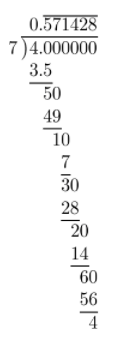
Question 4.
\(\frac{4}{7}\) ___________
Answer:
Complete the long division.
Stop when you discover a pattern.
Texas Go Math Grade 7 Lesson 1.1 Answer Key 3
= \(0 . \overline{571428}\)

Question 5.
\(\frac{1}{3}\) ___________
Answer:
Complete the long division.
Stop when you discover a pattern.
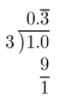
Texas Go Math Grade 7 Lesson 1.1 Answer Key 4
= \(0 . \overline{3}\)

Rational Numbers Test Grade 7 Pdf Go Math Question 6.
\(\frac{9}{20}\) __________
Answer:
Complete the long division.
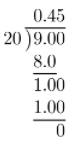
Texas Go Math Grade 7 Lesson 1.1 Answer Key 5
= 0.45

Question 7.
Yvonne made 2\(\frac{3}{4}\) quarts of punch. Write 2\(\frac{3}{4}\) as a decimal. 2\(\frac{3}{4}\) = _________ Is the decimal equivalent a terminating or repeating decimal
Answer:
First, write \(\frac{3}{4}\) as a decimal.
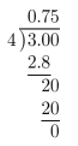
Texas Go Math Grade 7 Lesson 1.1 Answer Key 6
Then, add 2 to the result.
2 + 0.75 = 2.75
The decimal equivalent is a terminating decimal.
2.75, The decimal equivalent is a terminating decimal.

Question 8.
Yvonne bought a watermelon that weighed 7\(\frac{1}{3}\) pounds. Write 7\(\frac{1}{3}\) as a decimal. 7\(\frac{1}{3}\) = __________
Is the decimal equivalent a terminating or repeating decimal?
Answer:
First, write \(\frac{1}{3}\) as a decimal.
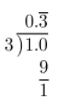
Texas Go Math Grade 7 Lesson 1.1 Answer Key 7
Then, add 7 to the result.
7 + \(0 . \overline{3}\) = \(7 . \overline{3}\)
The decimal equivalent is a terminating decimal.
\(7 . \overline{3}\) , The decimal equivalent is a repeating decimal.

Texas Go Math Grade 7 Lesson 1.1 Guided Practice Answer Key

Write each rational number as a decimal. Then tell whether each decimal is a terminating or a repeating decimal. (Explore Activity and Example 1)

Question 1.
\(\frac{3}{5}\) = ____________
Answer:
Complete the long division.
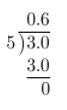
Texas Go Math Grade 7 Lesson 1.1 Answer Key 8
The decimal equivalent is a terminating decimal.
0.6; Terminating decimal.

Question 2.
\(\frac{89}{100}\) = _____________
Answer:
Complete the long division.
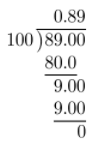
Texas Go Math Grade 7 Lesson 1.1 Answer Key 9
The decimal equivalent is a terminating decimal.
0.89; Terminating decimal.

Go Math Workbook Grade 7 Answer Key Rational Numbers Question 3.
\(\frac{4}{12}\) = ______________
Answer:
Complete the long division.
Stop when you discover a pattern.
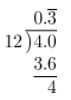
Texas Go Math Grade 7 Lesson 1.1 Answer Key 10
The decimal equivalent is a repeating decimal.
\(0 . \overline{3}\) ; Repeating decimal.

Question 4.
\(\frac{25}{99}\) = ______________
Answer:
Complete the long division.
Stop when you discover a pattern.
Texas Go Math Grade 7 Lesson 1.1 Answer Key 11
The decimal equivalent is a repeating decimal.
\(0 . \overline{25}\) ; Repeating decimal.

Question 5.
\(\frac{7}{9}\) = ____________
Answer:
Complete the long division.
Stop when you discover a pattern.
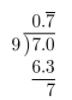
Texas Go Math Grade 7 Lesson 1.1 Answer Key 12
The decimal equivalent is a repeating decimal.
\(0 . \overline{7}\) ; Repeating decimal.

Question 6.
\(\frac{9}{25}\) = ____________
Answer:
Complete the long division.
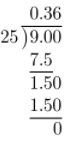
Texas Go Math Grade 7 Lesson 1.1 Answer Key 13
The decimal equivalent is a terminating decimal.
0.36; Terminating decimal.

Question 7.
\(\frac{1}{25}\) = ___________
Answer:
Complete the long division.
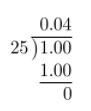
Texas Go Math Grade 7 Lesson 1.1 Answer Key 14
The decimal equivalent is a terminating decimal.
0.04; Terminating decimal.

Question 8.
\(\frac{25}{176}\) = ____________
Answer:
Complete long division.
Stop when you discover a pattern.
This case is special because the first. four decimals are not a part of the pattern that occurs after them.
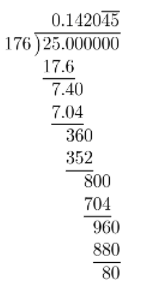
Texas Go Math Grade 7 Lesson 1.1 Answer Key 15
The decimal equivalent is a repeating decimal.
\(0.1420 \overline{45}\) ; Repeating decimal.

Go Math Answer Key Grade 7 Lesson 1.1 Rational Numbers As Decimals Question 9.
\(\frac{12}{1,000}\) = _____________
Answer:
Complete the long division.
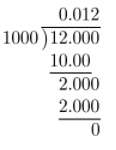
Texas Go Math Grade 7 Lesson 1.1 Answer Key 16
The decimal equivalent is a terminating decimal.
0.012; Terminating decimal.

Write each mixed number as a decimal. (Example 2)

Question 10.
11\(\frac{1}{6}\) = ___________
Answer:
First, write \(\frac{1}{6}\) as a decimal.
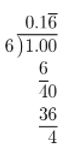
Texas Go Math Grade 7 Lesson 1.1 Answer Key 17
Then, add 11 to the result.
11 + \(0.1 \overline{6}\) = \(11.1 \overline{6}\)
= \(11.1 \overline{6}\)

Question 11.
2\(\frac{9}{10}\) = ____________
Answer:
First, write \(\frac{9}{10}\) as a decimal.
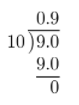
Texas Go Math Grade 7 Lesson 1.1 Answer Key 18
Then, add 2 to the result.
2 + 0.9 = 2.9
= 2.9

Question 12.
8\(\frac{23}{100}\) = _____________
Answer:
First, write \(\frac{23}{100}\) as a decimal.
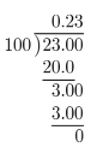
Texas Go Math Grade 7 Lesson 1.1 Answer Key 19
Then, add 8 to the result.
8 + 0.23 = 8.23
8.23

Question 13.
7\(\frac{3}{15}\) = ___________
Answer:
First, write \(\frac{3}{15}\) as a decimal.
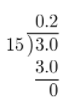
Texas Go Math Grade 7 Lesson 1.1 Answer Key 20
Then, add 7 to the result.
7 + 0.2 = 7.2
= 7.2

Question 14.
54\(\frac{3}{11}\) = ____________
Answer:
First, write \(\frac{3}{11}\) as a decimal.
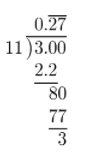
Texas Go Math Grade 7 Lesson 1.1 Answer Key 21
Then, add 54 to the result.
54 + \(0 . \overline{27}\) = \(54 . \overline{27}\)
= \(54 . \overline{27}\)

Question 15.
3\(\frac{1}{18}\) = _________
Answer:
First, write \(\frac{1}{18}\) as a decimal.
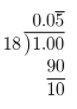
Texas Go Math Grade 7 Lesson 1.1 Answer Key 22
Then, add 3 to the result.
3 + \(0.0 \overline{5}\) = \(3.0 \overline{5}\)
= \(3.0 \overline{5}\)

Question 16.
Maggie bought 3\(\frac{2}{3}\) lb of apples to make some apple pies. What is the weight of the apples written as a decimal? (Example 2)
3\(\frac{2}{3}\) = ______________
Answer:
First, write \(\frac{2}{3}\) as a decimal.
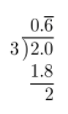
Texas Go Math Grade 7 Lesson 1.1 Answer Key 23
Then, add 3 to the result.
3 + \(0 . \overline{6}\) = \(3 . \overline{6}\)
Maggie bought \(3 . \overline{6}\) lb of apples.

Rational Numbers Answer Key Go Math Grade 7 Question 17.
Harry’s dog weighs 12\(\frac{7}{8}\) pounds. What is the weight of Harry’s dog written as a decimal? (Example 2)
12 \(\frac{7}{8}\) = _____________
Answer:
First, write \(\frac{7}{8}\) as a decimal.
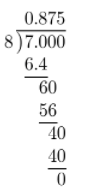
Texas Go Math Grade 7 Lesson 1.1 Answer Key 24
Then, add 12 to the result.
12 + 0.875 = 12.875
Harry’s dog weighs 12.875 pounds.

Essential Question Check-In

Question 18.
Tom is trying to write \(\frac{3}{47}\) as a decimal. He used long division and divided until he got the quotient 0.0638297872, at which point he stopped. Since the decimal doesn’t seem to terminate or repeat, he concluded that \(\frac{3}{47}\) is not rational. Do you agree or disagree? Why?
Answer:
Tom was wrong to conclude that \(\frac{3}{47}\) is not rational. First of all. \(\frac{3}{47}\) is a fraction. Thus, \(\frac{3}{47}\) is a rational number. After some time of long division, the patter would appear.
I disagree. \(\frac{3}{47}\) is a rational number.

Texas Go Math Grade 7 Lesson 1.1 Independent Practice Answer Key

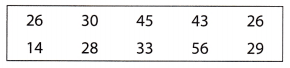
Use the table for 19-23. Write each ratio in the form \(\frac{a}{b}\) and then as a decimal. Tell whether each decimal is a terminating or a repeating decimal.
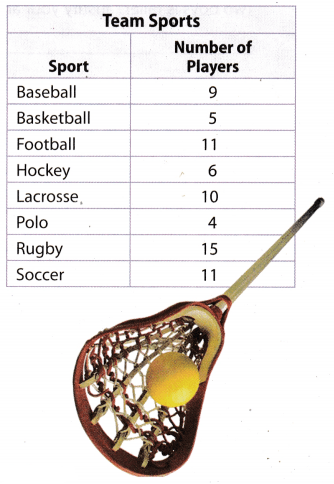
Texas Go Math Grade 7 Lesson 1.1 Answer Key 2

Question 19.
basketball players to football players
Answer:
\(\frac{5}{11}\) is the ratio of basketball players to football players.
Texas Go Math Grade 7 Lesson 1.1 Answer Key 25
The equivalent decimal is a repeating decimal.
\(\frac{5}{11}\) = \(0 . \overline{45}\); repeating decimal

Question 20.
hockey players to lacrosse players
Answer:
\(\frac{6}{10}\) is the ratio of basketball players to football players.
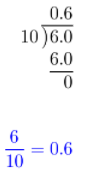
Texas Go Math Grade 7 Lesson 1.1 Answer Key 26
The equivalent decimal is a terminating decimal.
\(\frac{6}{10}\) = 0.6; terminating decimal.

Question 21.
polo players to football players
Answer:
\(\frac{4}{11}\) is the ratio of polo players to football players.
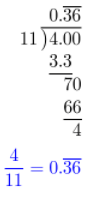
Texas Go Math Grade 7 Lesson 1.1 Answer Key 27
The equivalent decimal is a repeating decimal.
\(\frac{4}{11}\) = \(0 . \overline{36}\); repeating decimal.

Question 22.
lacrosse players to rugby players
Answer:
\(\frac{10}{15}\) is the ratio of basketball lacrosse players to football players.
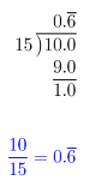
Texas Go Math Grade 7 Lesson 1.1 Answer Key 28
The equivalent decimal is a repeating decimal.
\(\frac{10}{15}\) = \(0 . \overline{6}\); repeating decimal.

Question 23.
football players to soccer players
Answer:
\(\frac{11}{11}\) is the ratio of football players to soccer players.
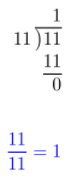
Texas Go Math Grade 7 Lesson 1.1 Answer Key 29
The equivalent decimal is a terminating decimal (.0).
\(\frac{11}{11}\) = 1; terminatimg decimal.

Question 24.
Look for a Pattern Beth said that the ratio of the number of players in any sport to the number of players on a lacrosse team must always be a terminating decimal. Do you agree or disagree? Why?
Answer:
I agree. The number of lacrosse players on a team is equal to 10. Since in any other sport the number of players on a team must be a whole number. Thus, by dividing any whole number by 10. you just “ move” the decimal point one spot to the left.
Example: Number of soccer players on a team is 11.
The ratio of soccer players on a team to lacrosse players on a team is \(\frac{11}{10}\)
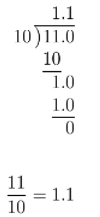
Texas Go Math Grade 7 Lesson 1.1 Answer Key 30
The ratio will always have a terminating decimal.

Go Math Grade 7 Lesson 1.1 Answer Key Grade 7 Question 25.
Yvonne bought 4\(\frac{7}{8}\) yards of material to make a dress.
a. What is 4\(\frac{7}{8}\) written as an improper fraction?
Answer:
4 × 8 + 7 = 39
4\(\frac{7}{8}\) = \(\frac{39}{8}\)

b. What is 4\(\frac{7}{8}\) written as a decimal?
Answer:
First, write \(\frac{7}{8}\) as a decimal.
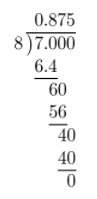
Texas Go Math Grade 7 Lesson 1.1 Answer Key 31
Then, add 4 to the result
4 + 0.875 = 4.875

c. Communicate Mathematical Ideas If Yvonne wanted to make 3 dresses that use 4\(\frac{7}{8}\) yd of fabric each, explain how she could use estimation to make sure she has enough fabric for all of them.
Answer:
Yvonne could multiply 4\(\frac{7}{8}\) by 3 and then buy some more yards (1 or 2) of fabric to ensure she would have enough to make 3 dresses.

Question 26.
Vocabulary A rational number can be written as the ratio of one _________ to another and can be represented by a repeating or ________ decimal.
Answer:
A rational number can be written as the ratio of one integer to another and can be represented by a repeating or a terminating decimal.

Question 27.
Problem Solving Marcus is 5\(\frac{7}{24}\) feet tall. Ben is 5\(\frac{5}{16}\) feet tall. Which of the two boys is taller? Justify your answer.
Answer:
Since both boys are 5 and something feet tall, we can just compare the fractions in the mixed numbers to find out which boy is taller.
Compare it by reducing to a common denominator or converting it to a decimal number.
Since it is not so easy to convert those fractions to decimal numbers we will reduce to a common denominator.
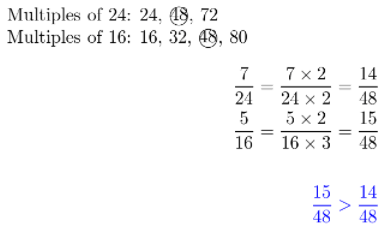
Texas Go Math Grade 7 Lesson 1.1 Answer Key 32
Ben is taller than Marcus.

Question 28.
Represent Real-World Problems If one store is selling \(\frac{3}{4}\) of a bushel of apples for $9, and another store is selling \(\frac{2}{3}\) of a bushel of apples for $9, which store has the better deal? Explain your answer.
Answer:
They both offer some amount of apples for the same price of $9.
The store which offers a greater amount of tipples for the price of $9 has the better deal.
Convert fractions to decimal numbers.
Texas Go Math Grade 7 Lesson 1.1 Answer Key 33
The first store has a better offer.

Question 29.
Analyze Relationships You are given a fraction in simplest form. The numerator is not zero. When you write the fraction as a decimal, it is a repeating decimal. Which numbers from 1 to 10 could be the denominator?
Answer:
The denominator could be a prime number (except 2 and 5) or a number that has a prime number in its factored form (again except 2 and 5).
These numbers from 1 to 10 are: 3, 6 = 2 × 3, 7, 9 = 3 × 3

Question 30.
Communicate Mathematical Ideas Julie got 21 of the 23 questions on her math test correct. She got 29 of the 32 questions on her science test correct. On which test did she get a higher score? Can you compare the fractions \(\frac{21}{23}\) and \(\frac{29}{32}\) by comparing 29 and 21 ? Explain. How can Julie compare her scores?.
Answer:
Divide the number of correct answers to the number of alt questions on both tests (round to 3 decimal digits).
Compare those decimaL numbers to see on which test she scored better
21 ÷ 23 = 0.913
29 ÷ 32 = 0.906
0.913 > 0.906
She got a higher score on the first test.
You can not compare those fractions by comparing 29 and 21 because the denominators are not equal. You could do that if they were equal.

Question 31.
Look for a Pattern Look at the decimal 0.121122111222…. If the pattern continues, is this a repeating decimal? Explain.
Answer:
It is not a repeating decimal if the pattern continues
This is not a repeating pattern. This pattern is created by adding 1 and 2 after 1 and 2 respectively.
The pattern of a repeating decimal has to repeat without adding any other decimal in the pattern
Example:
0.567567567… = \(0 . \overline{567}\) Is a repeating decimal.
0.56556555655556… IS NOT a repeating decimal because the pattern has an additional 5 at every repetition.
This is not a repeating decimal if the pattern continues.

Texas Go Math Grade 7 Lesson 1.1 Answer Key Rational Numbers and Decimals Read More »
Texas Go Math Grade 7 Module 3 Answer Key Proportions and Percent

Refer to our Texas Go Math Grade 7 Answer Key Pdf to score good marks in the exams. Test yourself by practicing the problems from Texas Go Math Grade 7 Module 3 Answer Key Proportions and Percent.

Texas Go Math Grade 7 Module 3 Answer Key Proportions and Percent

Texas Go Math Grade 7 Module 3 Are You Ready? Answer Key

Write each percent as a decimal.

Question 1.
22% ______
Answer:
Write the percent as fractions. Then, write the fraction as a decimal.
= \(\frac{22}{100}\)
= 0.22

Question 2.
75% _____________
Answer:
Write the percent as fractions. Then, write the fraction as a decimal.
= \(\frac{75}{100}\)
= 0.75

Grade 7 Module 3 Answer Key Proportions and Percent Question 3.
6% _____________
Answer:
Write the percent as fractions. Then, write the fraction as a decimal.
= \(\frac{6}{100}\)
= 0.06

Question 4.
189% _____________
Answer:
Write the percent as the sum of 1 whole and a percent remainder
= 100% + 89%
Write the percent as fractions.
= \(\frac{100}{100}\) + \(\frac{89}{100}\)
Write the fractions as decimals.
= 1 + 0.89
= 1.89

Write each decimal as a percent.

Question 5.
0.59 ______________
Answer:
Multiply the decimal by 100 to get the percentage.
0.59 × 100 = 59%

Question 6.
0.98 ____________
Answer:
Multiply the decimal by 100 to get the percentage.
0.98 × 100 = 98%

Question 7.
0.02 _____________
Answer:
Multiply the decimal by 100 to get the percentage.
0.02 × 100 = 2%

Proportions and Percent Module 3 Grade 7 Answer Key Question 8.
1.33 ________________
Answer:
Multiply the decimal by 100 to get the percentage.
1.33 × 100 = 133%

Find the percent of each number.

Question 9.
50% of 64 ___________
Answer:
50% = 0.5
\opmul[displayshiftintermediary=all]{64}{0.5}
= 32.

Question 10.
7% of 30 ___________
Answer:
7% = 0.07
\opmul[displayshiftintermediary=all]{30}{0.07}
= 2.1

Question 11.
15% of 160 ____________
Answer:
15% = 0.15
\opmul[displayshiftintermediary=all]{160}{0.15}
= 24

7th Grade Proportions Answer Key Module 3 Question 12.
32% of 62 _____________
Answer:
32% = 0.32
\opmul[displayshiftintermediary=all]{62}{0.32}
= 19.84

Question 13.
120% of 4 ____________
Answer:
120% = 1.2
\opmul[displayshiftintermediary=all]{4}{1.2}
= 4.8

Question 14.
6% of 1,000 ______________
Answer:
6% = 0.06
\opmul[displayshiftintermediary=all]{1000}{0.06}
= 60

Texas Go Math Grade 7 Module 3 Reading Start-Up Answer Key

Visualize Vocabulary

Use the ✓ words to complete the graphic. You can put more than one word in each bubble.
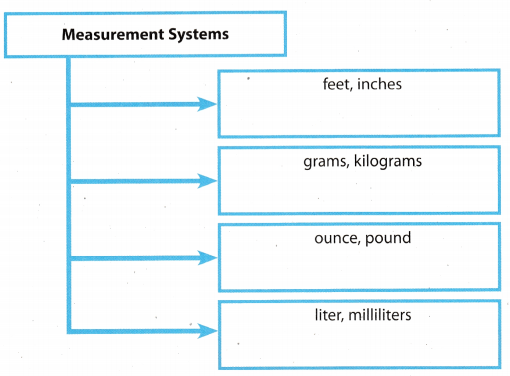
Texas Go Math Grade 7 Module 3 Answer Key 1

Understand Vocabulary

Complete the sentences using the preview words.

Question 1.
A fixed percent of the principal is _______________.
Answer:
A fixed percent of the principal is simple interest.

Go Math Grade 7 Module 3 Answer Key Pdf Question 2.
The original amount of money deposited or borrowed is the __________________
Answer:
The original amount of money deposited or borrowed is the principal.

Question 3.
A _____________ _______ is a ratio of two equivalent measurements.
Answer:
A conversion factor is a ratio of two equivalent measurements.

Texas Go Math Grade 7 Module 3 Answer Key Proportions and Percent Read More »

Texas Go Math Grade 8 Lesson 16.4 Answer Key Estimating College Costs and Payments

Refer to our Texas Go Math Grade 8 Answer Key Pdf to score good marks in the exams. Test yourself by practicing the problems from Texas Go Math Grade 8 Lesson 16.4 Answer Key Estimating College Costs and Payments.

Texas Go Math Grade 8 Lesson 16.4 Answer Key Estimating College Costs and Payments

Example 1

June wants to attend Texas A&M University-Kingsville, near Corpus Christi, Texas. She is 18, single, does not have any dependents, and lives in Dallas. She was raised by her single father, a contractor who makes $81,000 per year and pays roughly 12% income tax. For the past 4 years, June has worked part time at the local bookstore, earning a taxable annual income of $15,000, which is taxed at roughly 8%. June has 2 brothers, both of whom are in middle school.

How much should June expect to spend if she plans on completing a four-year degree program at A&M University-Kingsville while living in on-campus housing?
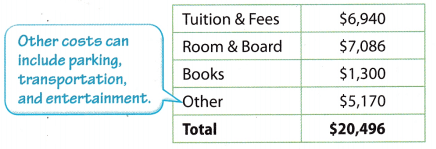
STEP 1: Find the cost of attending Texas A&M University-Kingsville for 1 year using the values in the table.
Texas Go Math Grade 8 Lesson 16.4 Answer Key 1
STEP 2: Compute the cost of attending the university for 4 years.
$20,496 × 4 = $81,984
The estimated cost of June attending for 4 years is $81,984.

Reflect

Question 1.
How can June help to pay for her education?
Answer: June has worked part time at the local bookstore, earning a taxable annual income of $15,000. It is taxed at roughly 8%.

Your Turn

Question 2.
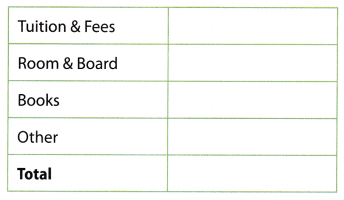
June is also considering attending Del Mar College in Corpus Christi to get a 2-year associate’s degree. Estimate the cost of June attending Del Mar College. Use the college’s website or another online tool to find the figures for an out-of-district student.
Texas Go Math Grade 8 Lesson 16.4 Answer Key 2
Answer:
The total amount of June tuition and fees at the Del Mar College for one year = is $5738.
The total amount of June tuition and fees at the Del Mar College for two years = $5738 × 2 = $11,476
The total amount of June’s room and board fee for one year = is $6013.
The total amount of June room and board fee for two years = $6013 × 2 = $12,026
The total amount for June books for one year = $3820.
The total amount for June books for two year = $3820 × 2 = $7640
The total amount for June and other purposes for one year = $1000.
The total amount for June and other purposes for two years = $1000 × 2 = $2000
The total cost of June attending Del Mar College for two years = $11,476 + $12,026 + $7640 + $2000 = $33,142.

Texas Go Math Grade 8 Pdf Paying for College Answer Key Question 3.
Suppose June earns an associate’s degree from Del Mar and then transfers to Texas A&M University-Kingsville for two more years to complete a bachelor’s degree. Estimate the total amount that the 4 years of school will cost.
Answer:
The total amount of June tuition and fees at the Del Mar College for one year = $5738.
The total amount of June tuition and fees at the Del Mar College for two years = $5738 × 2 = $11,476
The total amount of June room and board fee for one year = $6013.
The total amount of June room and board fee for two years = $6013 × 2 = $12,026
The total amount for June books for one year = $3820.
The total amount for June books for two year = $3820 × 2 = $7640
The total amount for June and other purposes for one year = $1000.
The total amount for June and other purposes for two years = $1000 × 2 = $2000.
The total cost of June attending Del Mar College for two years = $11,476 + $12,026 + $7640 + $2000 = $33,142.
June wants to attend Texas A&M University-Kingsville college for one year = $20,494.
June wants to attend Texas A&M University-Kingsville college for two years = $20,494 × 2 = 40,988
The total amount that the 4 years of school will cost = $33,142 + $40,988 = $74,130

Question 4.
Approximately how much less would it cost June to attend Del Mar for two years and A&M Kingsville for two years than to attend A&M Kingsville for four years?
Answer:
Compute the cost of attending the university for 4 years.
$20,496 × 4 = $81,984
The cost June to attend Del Mar for two years = (11,445 × 2) + ($20,496 × 2) = $63,882
$81,984 – $63,882 = $18,102
Thus it costs around $18,102 less.

Texas Go Math Grade 8 Lesson 16.4 Explore Activity Answer Key

As we saw in Example 1, it will cost June an estimated $81,984 to attend Texas A&M University-Kingsville for 4 years. Let’s apply the savings from June’s scholarship, the money her father can contribute to her education, and the funds from her college savings account, to find a more accurate estimated total remaining cost.

A. June received a scholarship and has been awarded $2,000 each year for 4 years. Find the new estimated total cost of June’s college education.
After subtracting the funds from the scholarship from the total cost of her college education, what estimated amount will June pay?
Answer:
Given,
June received a scholarship and has been awarded $2,000 each year for 4 years.
It will cost June an estimated $81,984 to attend Texas A&M University-Kingsville for 4 years.
2000× 4 = 8000
$81,984 – $8000 = $73,984
Thus the estimated amount June will pay is $73,984.

B. June’s father has put aside $11,000 for June’s college expenses. Find the new estimated total remaining cost of June’s education.
After applying her father’s contribution to her education expenses, what estimated remaining amount will June pay?
Answer:
June’s father has put aside $11,000 for June’s college expenses.
The estimated amount June will pay is $73,984.
By subtracting the father’s contribution to her educational expenses and the estimated amount June will pay we can find the remaining amount that June pays.
$73,984 – $11,000 = $62,984

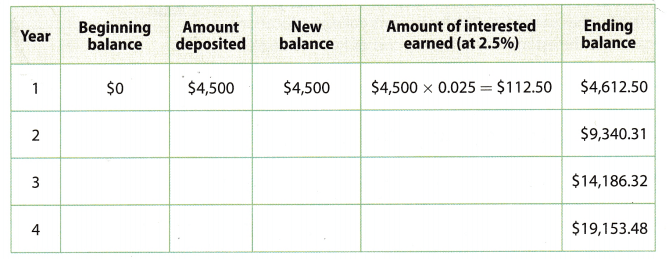
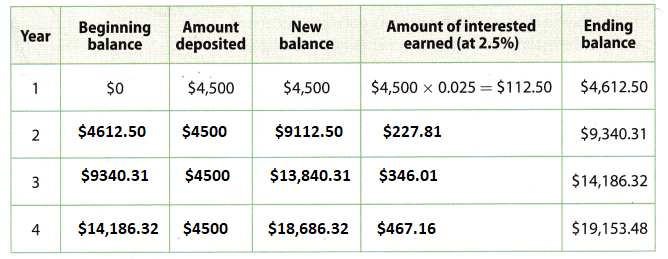
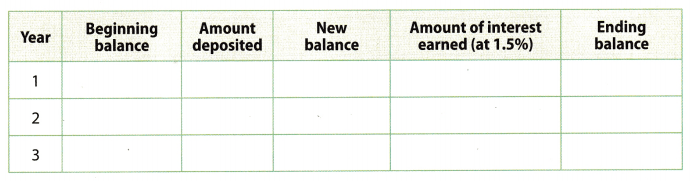
C. At the beginning of each of the 4 years of high school, June put $4500 of her bookstore income into a savings account. The account earns interest at a rate of 2.5%, compounded annually. Complete the table to find how much June has in her college savings account at the beginning of her freshman year of college.
Texas Go Math Grade 8 Lesson 16.4 Answer Key 3
After applying June’s savings to her education expenses, what estimated remaining amount will June pay?
Answer:
2. The beginning balance is $4612.50
The amount deposited = $4500
Total = $4612.50 + $4500 = $9112.50
The account earns interest at a rate of 2.5% = 9112.50 × 0.025 = $227.81
3. The beginning balance is $9340.31
The amount deposited = $4500
Total = $9340.31 + $4500 = $13,840.31
The account earns interest at a rate of 2.5% = 13,840.31 × 0.025 = $346.01
4. The beginning balance is $14,186.32
The amount deposited = $4500
Total = $14,186.32 + $4500 = $18686.32
The account earns interest at a rate of 2.5% = 18686.32 × 0.025 = $467.16
Texas-Go-Math-Grade-8-Lesson-16.4-Answer-Key-3

Reflect

Question 5.
Does June have enough in her savings account to cover her first year at Texas A&M University-Kingsville without help from her father or a scholarship? What about the scholarship?
Answer:
As per Example 1, one year will cost an estimated $20,496 and she has only $19,153, hence she cannot cover her first year with her savings account alone.
The scholarship fees of $21,153 will be able to pay for her first year.

Texas Go Math Answer Key Grade 8 Lesson 16.4 Workbook Answers Question 6.
If June had been able to deposit $5,000 a year instead of $4,500, earning the same annual interest rate of 2.5%, would she have enough saved to pay for her first year?
Answer:
Given,
June had deposited $5000 instead of $4500 for a year.
Interest rate = 2.5%
The formula for simple interest equal to SI = PTR/100
Here,
P = actual money = $5000
T = time = 1 year
R = interest rate = 2.5%
Simple interest for 1 years = $5000 × 1 × 2.5/100 = $125.
June fee for one year = $5738
Now he has = $5000 + $125 = $5125.
Therefore after the deposit of $5000 also he had less money than the college fee.

Texas Go Math Grade 8 Lesson 16.4 Guided Practice Answer Key

Ronan, a 19-year-old male from Texas, has been accepted at the University of Texas at Austin. If he attends the University of Texas, he plans to live at home with his mother, a single parent. His mother is a nurse who makes roughly $60,000 a year and pays roughly 13% in taxes annually. Ronan has never had a job. (Example 1, Explore Activity)
Texas Go Math Grade 8 Lesson 16.4 Answer Key 4
Question 1.
Use the table and an online tool to estimate the cost of Ronan attending the University of Texas for 1 year.
Answer:
The cost of Ronan attending the University of Texas for one-year Tuition and fees = $9794
The cost of books for one year = $904
The cost other for one year = $3752
The total cost of Ronan attending the university of texas for one year = $9794 + $904 + $3752 = $14,450.

Question 2.
Estimate the cost of Ronan getting a 4-year degree from the University of Texas.
Answer:
The total cost of Ronan attending the university of texas for one year = $14,450
The total cost of Ronan attending the university of texas for four years = $14,450 × 4 = $57,800

Question 3.
Ronan has been granted a scholarship for $1,500 per year. His mother has saved $21,000 for Ronan’s college education. Recalculate the estimated remaining cost of Ronan’s degree.
Answer:
Given that,
Ronan has been granted a scholarship for one year = $1,500
For four years = $1500 × 4 = $6000.
Mother saved for Ronan’s college education = $21,000.
The total money at Ronan = $6000 + $21000 = $27000
The total cost of Ronan attending the university of texas for four years = $57800.
Remaining cost of Ronan’s degree = $57800 – $27,000 = $30,800

Essential Question Check-In

Question 4.
What are some things to consider when estimating the cost of college?
Answer:
1. Will you attend in/out state school?
2. Do you plan on living at home?
3. Do you have any savings or not to pay the fees?
4. Are you eligible for scholarships?

Texas Go Math Grade 8 Lesson 16.4 Independent Practice Answer Key

Question 5.
At the beginning of each of the last two years, Laura put $4800 from her earnings as a part-time cashier during high school into a college savings account earning 1.2% interest compounded annually. Now she is applying for school and needs to know how much she has in her account. Complete the table to determine how much money Laura has saved.
Texas Go Math Grade 8 Lesson 16.4 Answer Key 5
Answer:
Texas Go Math Grade 8 Lesson 16.4 Answer Key Estimating College Costs and Payments_5
Laura saved from her earnings as a part-time cashier during high school into a college savings account earning = $4800.
Interest = 1.2%

Go Math Answer Key Grade 8 The Cost of College Homework 4 Answer Key Question 6.
At the beginning of each of the last three years, Lucas put $7000 from his earnings as a waiter into a college savings account that earned 1.5% interest compounded annually. Now he wants to attend community college for 2 years without taking out a loan. The cost of college will be about $18,000. Complete the table to determine whether Lucas has saved enough money to attend a community college.
Texas Go Math Grade 8 Lesson 16.4 Answer Key 6
Answer:
Lucas saved from his earnings as a waiter into a college savings account that earned = $1800.
Interest = 1.5%
Texas Go Math Grade 8 Lesson 16.4 Answer Key Estimating College Costs and Payments_6

Question 7.
Find a college grant online.
a. Grant Name:
Answer: College grants online are Federal Pell Grants.

b. Describe the application process.
Answer: To apply for Federal Pell Grants. First, you should fill out the FAFSA form and submit it. Then you will have to fill out the FAFSA form every year you are in school and demonstrate financial need to stay eligible for federal students.

c. How much money does the grant award?
Answer: The money for the grant award is $6995.

Question 8.
Find a college scholarship,
a. Name of Scholarship:
Answer: The name of the scholarship is the Tennessee HOPE scholarship.

b. Describe the application process.
Answer:

  • First login to the student’s login.
  • Filling in the scholarship application.
  • Upload all the documents related to education.
  • Submit the form to the respective educational institution.

c. How much money does the scholarship award?
Answer: The money award for the scholarship is $2000. It is not available for the summer semester.

H.O.T. Focus on Higher Order Thinking

Question 9.
Critical Thinking Having a savings plan is important even if you are not currently planning on attending college. Describe your savings plan, including stating a goal, how much you plan to save, and how you plan to save your money.
Answer:
Having a savings plan is important even if there is no plan for attending college. Saving money helps in the emergency purpose and it is also used for enjoying a quality life. I can save 30% of my salary every month

Question 10.
Make a Conjecture A CD, or certificate of deposit, is similar to a savings account, but it requires the depositor to leave the money in the account for a fixed period of time. There is a penalty for withdrawing money from the CD before the time period is over. The interest rates on CDs are generally higher than those for savings accounts. When would it be a good idea to put money in a CD to save for college? Would you put all of your savings into a CD? Explain your answer.
Answer:

Texas Go Math Grade 8 Lesson 16.4 Answer Key Estimating College Costs and Payments Read More »
Texas Go Math Grade 8 Lesson 16.3 Answer Key Analyzing Financial Situations

Refer to our Texas Go Math Grade 8 Answer Key Pdf to score good marks in the exams. Test yourself by practicing the problems from Texas Go Math Grade 8 Lesson 16.3 Answer Key Analyzing Financial Situations.

Texas Go Math Grade 8 Lesson 16.3 Answer Key Analyzing Financial Situations

Texas Go Math Grade 8 Lesson 16.3 Explore Activity Answer Key

Exploring Different Payment Methods

There are several ways to pay for goods and services. These payment methods include cash, stored-value cards, debit cards, credit cards, money orders, and checks.
Texas Go Math Grade 8 Lesson 16.3 Answer Key 1
Research the similarities and differences between stored-value cards, also known as prepaid cards, debit cards, and credit cards.
A. Use an Internet search engine to find images of the three types of cards. How are they similar and different in appearance?
Answer: They are plastic, rectangular cards. Debit cards and credit cards look similar. Prepaid cards often come in different colors and style.

B. What information is on each card?
Stored-value card: ______________
Debit card: ______________
Credit card: ______________
Answer:
Stored-value card: Account number, name of bank, store name
Debit card: Account number, name and expiry date
Credit card: Account number, name and expiry date, photo

C. When you use a stored-value card, debit card, or credit card, the money you spend is coming from different places. From where is the money deducted when you use each card?
Answer:
stored-value card: A fixed amount is put on the card at the time of purchase. The amount on the card goes down with each purpose.
Debit: The money is automatically taken out of your account.
Credit: The credit card is paid by the company, and you agree to pay the amount at a future date.

D. Do you need to have an account at a bank to have each type of card?
Answer: You need a bank account to have a debit card and you often get a credit card through a bank. Prepaid cards can be purchased with cash.

E. Research the fees associated with each type of card, such as activation fees, ATM fees, annual fees, and late payment fees. Describe the possible fees associated with each type of payment method.
Stored-value card ______________
Debit card ______________
Credit card ______________
Answer:
Stored-value card ATM fee for using the card to get cash at ATMs, inactivity fee, activation fee
Debit card ATM fee, overdraft fee if the card is used and there isn’t enough money in your account
Credit card Annual fee, ATM fee, late payment fee, interest charges

Reflect

Question 1.
What are the advantages and disadvantages of using a credit card?
Answer:
Advantages: credit cards are widely accepted, you can buy things before you have saved for them.
Disadvantages: more charges and fees than with debit cards and stored-value cards, you can spend money you do not have, so it is easier to go into debt.

Go Math Grade 8 Lesson 16.3 Eight Credit Cards Answer Key Question 2.
What are the advantages and disadvantages of using a debit card?
Answer:
Advantages: You don’t have to carry cash or safety, because only you know your pin number.
Disadvantages: You need enough money in your account to cover the entire cost of things or you might overdraw your account.

Identify the payment method used in each transaction as a stored-value card, a debit card, or a credit card.

Question 3.
Stan buys a television and pays for it over the next 3 months.
Answer: Credit card

Question 4.
Ingra buys a cup of coffee, and the money is immediately withdrawn from her bank account.
Answer: Debit card

Question 5.
Yun used a $20 bus pass to ride the bus.
Answer: Stored-value card

Reflect

Question 6.
Don has been saving to buy a used truck for his lawn care business. He has $5,200 in his business savings account. The truck he wants costs $6000, and there is a possibility of financing at an interest rate of 7.5%. What financial advice would you give Don?
Answer:
Don should consider how much additional money the purchase of the truck will bring in for his business. He should also consider how much he should pay upfront to reduce interest interest payments.

Your Turn

Tom has $524 in savings. His car needs new tires. Tom bought new racing tires for his car for $1400 with his credit card.

Question 7.
Was Tom’s decision financially responsible or financially irresponsible? Explain your answer.
Answer: Irresponsible because he does not have enough money, must pay high interest and does not need the tires.

Buy It or Pass Lesson 16.3 Answers Go Math Grade 8 Question 8.
What could Tom have done differently?
Answer: Tom could have purchased more reasonably priced tires.

Texas Go Math Grade 8 Lesson 16.3 Guided Practice Answer Key

Identify the payment method used in each transaction as cash, a credit card, a debit card, or a stored-value card. (Explore Activity)
Texas Go Math Grade 8 Lesson 16.3 Answer Key 2
Question 1.
Trina received a gift card to an electronics store and used it to buy a video game.
Answer: The payment method is a stored-value card

Question 2.
Sue gives $5 to a street vendor for a necklace.
Answer: The mode of payment is cash.

Question 3.
Steve uses a card and types in his PIN so that his purchase will be withdrawn from his checking account.
Answer: The method of payment is a debit card

Determine if the decisions described are financially responsible or financially irresponsible. Explain your answers. (Example 1)

Question 4.
John was just laid off from his job. He has $750 in savings. To make himself feel better, he buys a new bike for $650 with his credit card.
Answer: Irresponsible
John does not have a steady source of income and could have purchased a cheaper bike.

Question 5.
Maria and Pat are recently married and work for the same company. They each pay $45 per month for health insurance. Pat combined their insurance for a new rate of $74 per month.
Answer: Responsible
Given,
Maria and Pat are recently married and work for the same company.
They each pay $45 per month for health insurance.
Pat combined their insurance for a new rate of $74 per month.
The new rate will save them $16 per months
45 × 2 – 74
90 – 74 = 16

Essential Question Check-In

Question 6.
What are the characteristics of financially responsible decisions?
Answer: They enable long-term goals, avoid burdensome debt maximize value, and increase flexibility for the future.

Texas Go Math Grade 8 Lesson 16.3 Independent Practice Answer Key

Research the similarities and differences of checks and money orders. Then answer 7-10.

Question 7.
What is a check? What is a money order?
Answer:
A cheque is a bill of exchange in which one party orders the bank to transfer the money to the bank account of another party.
Money order: A money order is a mode of paying for something with cash using a check from a third party.

Question 8.
When someone writes a check, where is the money coming from?
Answer: The money comes from a savings account. The person writes the check according to the cash deposited in the bank.

Question 9.
When someone pays with a money order, where is the money coming from?
Answer: The money comes from a savings account or from another party’s account.

Lesson 16.3 Credit Cards Answer Key Go Math Grade 8 Question 10.
Do you think it is more secure to have someone pay you with a check or a money order? Explain.
Answer: There are security benefits to paying through check compared to the money order. Money orders are beneficial for people who don’t have a checking account or do not want to accept personal checks.

Question 11.
Matt is saving for a new computer. Matt’s uncle offers to pay him $15 an hour to clean out his garage. Matt decides to go play soccer with his friends instead. Do you think Matt made the right decision? Why or why not?
Answer: No, because it helps him to buy a new computer if go for cleaning out his garage. So, I think Matt made the wrong decision.

Question 12.
Amy owns her own business as a landscaper of homes and office buildings. On average, maintaining a homeowner’s yard takes 2 hours per month, and Amy is paid $300 per month. The office buildings require 35 hours of landscaping per month and pay $2800 monthly. Which type of client do you think Amy prefers? Explain your answer.
Answer:
Given,
Amy owns her own business as a landscaper of homes and office buildings.
On average, maintaining a homeowner’s yard takes 2 hours per month, and Amy is paid $300 per month.
The office buildings require 35 hours of landscaping per month and pay $2800 monthly.
Amy prefers the office building client.

H.O.T. Focus on Higher Order Thinking

Question 13.
Analyze Relationships Fred and Wilma are buying a house. They have enough money in savings to pay for it directly. However, they have an opportunity to get a loan for the total price of the house at a 3% annual interest rate. They believe they could put their savings into investments that earn 5% annual interest. How should Fred and Wilma pay for their house? Explain.
Answer:

Question 14.
Critical Thinking Nikola has received two job offers. The first is for an online company that pays $20 per hour. The work is interesting and lets him work from home, allowing him to spend more time with his kids. The second offer is at a factory an hour away. It is hard and repetitive work that pays $25 per hour. Which job should Nikola take? What factors should he consider besides the hourly pay in making his decision?
Answer:
I get how Nikolai is working at home and will be getting paid $20 but despite the $25 being at a factory and is repetitive, here is a little word from experience.
The $25 is a start-off which is pretty good and it won’t always be at a factory.
If Nikolai is working hard and repetitive, he will be promoted to the fact that he will be paid more and work at home time-to-time.
The $20 one, however, is a work-at-home type and since there are children, the house will have to be quiet during calls and what-not.

Question 15.
Critique Reasoning Elena has learned to analyze whether decisions are financially responsible or not. For all of her future decisions, she plans to choose the option that is most financially responsible. Do you think this is a good idea? Explain.
Answer: Yes Elena’s thought is a good idea

Texas Go Math Grade 8 Lesson 16.3 Answer Key Analyzing Financial Situations Read More »

Texas Go Math Grade 8 Lesson 16.1 Answer Key Repaying Loans

Refer to our Texas Go Math Grade 8 Answer Key Pdf to score good marks in the exams. Test yourself by practicing the problems from Texas Go Math Grade 8 Lesson 16.1 Answer Key Repaying Loans.

Texas Go Math Grade 8 Lesson 16.1 Answer Key Repaying Loans

Example 1

A. In September, Alex charged his textbooks, clothes, and some downloads on his credit card. He received a bill from his credit card company for $1000. The interest rate on his card is 21%. He is going to pay in 3 monthly payments. He wants to know how much this loan will cost him in interest.

Use an online calculator. Enter these numbers
Loan amount: $1000
Loan term: 3 months
Interest rate: 21% per year
The calculator converts to 0.25 year.

Click CALCULATE.
Monthly payment: $345.07

What is Alex’s total repayment?
$345.07 monthly payment × 3 months = $1035.21

The credit card company loaned Alex $1000, and he paid $1035.21 back to the credit card company. What was the cost of this loan?
Interest paid = $1035.21 – $1000 = $35.21 The cost of the loan

B. Barry takes out a loan from his bank for $1000 to buy a bicycle. The interest rate on his loan is 9%. He is going to pay the total amount in 3 monthly payments. Use an online calculator to find the cost of his loan.

What is Barry’s total repayment and the cost of his loan?
$338.35 monthly payment × 3 months = $1015.05
Interest paid = $1015.05 – $1000 = $15.05 The cost of the loan

Reflect

Question 1.
What If? If Alex had saved $333.34 a month for 3 months, how much money would he have? If he had used his savings instead of his credit card, how much less would his purchases have cost him?
Answer:
Alex savings = $333.34 monthly payment × 3 months = $1000.02.
Alex credit card = $333.34 monthly payment × 3 months = $1000.02.
Both the accounts have the same amount for 3 months.

Question 2.
How much less did Barry’s loan, at an interest rate of 9%, cost than Alex’s loan at 21%?
Answer:
Barry’s loan at an interest rate of 9 % = $1015.05
Alex’s loan at 21% = $1035.21.
Therefore $1035.21 – $1015.05 = $20.16
Barry’s loan is $20.16 less.

Lesson 16.1 Answers Go Math Answer Key Grade 8 Question 3.
Barry looks into the cost of repaying an easy access loan for $1000. The up-front cost of the loan is $3 for every $20 borrowed, plus Barry will owe $1000 at the end of the loan. How much will this loan cost Barry?
Answer:
Barry cost of repaying an easy access loan = $1000.
Cost of a loan is 3% for every $20.
Therefore 20 × 10 = 200
2% of 20 = 0.6.
0.6 × 50 = $30.
Jess will owe at the end of a loan = $1000.
Jess’s total payment is $1000 + $1000 + $30 = $2030.

Your Turn

Use an online calculator to fill in the blanks for the easy access loans.

Question 4.
Loan amount: $5000 Monthly payment: _______________
Loan term: 2 years Total repayment: _______________
Interest rate: 7% Interest paid: _______________
Answer:
Loan amount = $5000.
Loan term = 2 years.
Interest rate = 7%
The formula for the simple interest is PTR/100.
Here P = principle.
T = time.
R = interest rate.
Interest for 2 years = $5000 × 2 × 7/100 = $700.
Total payment for 2 years = $5000 + $700 = $5700.
Monthly payment = $2700/24 = $112.5.
Interest paid = $700

Question 5.
Loan amount: $5000 Monthly payment: _______________
Loan term: 2 years Total repayment: _______________
Interest rate: 21% Interest paid: _______________
Answer:
Loan amount = $5000.
Loan term = 2 years.
Interest rate = 21%
The formula for the simple interest is PTR/100.
Here P = principle.
T = time.
R = interest rate.
Interest for 2 years = $5000 × 2 × 21/100 = $2100.
Total repayment for 2 years = $5000 + $2100 = $7100.
Monthly payment = $7100/24 = $295.8
Interest paid = $2100.

Example 2

A. Susan has a balance of $1000 on her credit card. She stops using her card and pays the minimum monthly amount until the loan ¡s paid off.
Texas Go Math Grade 8 Lesson 16.1 Answer Key 1
Use an online calculator. Enter these numbers:
Loan amount: $1000
Loan term: 93 months
Interest rate: 18% per year
Click CALCULATE. Monthly payment: $20.01

What is Susan’s total repayment?
$20.01 monthly payment × 93 months = $1860.93

What was the cost of this loan?
Interest paid = $1860.93 – $1000 = $860.93 The cost of the loan

B. Laura also has a balance of $1000 at 18% interest on her credit card. She stops using her card. She wants to pay as much as she can each month to pay off the loan as quickly as she can.

Use an online calculator. Enter these numbers:
Loan amount: $1000
Loan term: 3 years
Interest rate: 18% per year
Click CALCULATE. Monthly payment: $36.15

What is Laura’s total repayment?
$36.15 monthly payment × 36 months = $1301.40

What was the cost of this loan?
Interest paid = $1301.40 – $1000 = $301.40 The cost of the loan

Reflect

Question 6.
What If? If Susan had put $20 in her savings account each month, how long would it take her to save a total of $1000? Compare this to the time she took to pay off her credit card loan of $1000.
Answer:
Susan saves each month in her savings account =$20.
Save a total $ 1000 = 1000/20 = 50 months.
Time she took to pay the credit card loan = 93 months.
The savings account has fewer months.

Go Math Answer Key Grade 8 Lesson 16.1 Answer Key Question 7.
Laura paid off her debt in 36 months while Susan took 93 months to pay off her debt of the same amount. How much less did Laura pay in interest than Susan paid?
Answer:
Laura paid off her debt in 36 months interest = $301.40.
Susan paid off her debt in 93 months interest =$860.93.
Therefore $860.93 – $301.40 = $559.53.
$559.53 less did laura pay in interest than susan paid.

Your Turn

Use an online calculator to fill in the blanks.

Question 8.
Loan amount: $5000 Monthly payment: _______________
Loan term: 2 years Total repayment: _______________
Interest rate: 15% Interest paid: _______________
Answer:
Using online calculator:
Loan amount: $5000 Monthly payment: $270.8
Loan term: 2 years Total repayment: $6500
Interest rate: 15% Interest paid: $1500
Explanation:
Loan amount = $5000.
Loan term = 2 years.
Interest rate = 15%
The formula for the simple interest is PTR/100.
Here P = principle.
T = time.
R = interest rate.
Interest for 2 years = $5000 × 2 × 15/100 = $1500.
Total repayment for 2 years = $5000 + $1500 = $6500.
Monthly payment = $6500/24 = $27.8.
Interest paid = $1500.
Question 9.
Loan amount: $5000 Monthly payment: _______________
Loan term: 4 years Total repayment: _______________
Interest rate: 15% Interest paid: _______________
Answer:
Using online calculator
Loan amount: $5000 Monthly payment: $166.6
Loan term: 4 years Total repayment: $8000
Interest rate: 15% Interest paid: $3000
Explanation:
Loan amount = $5000.
Loan term = 4 years.
Interest rate = 15%
Formula for the simple interest is PTR/100.
Here P = principle.
T = time.
R = interest rate.
Interest for 4 years = $5000 × 4 × 15/100 = $3000.
Total payment for 2 years = $5000 + $3000. = $8000.
4 years = 42 months.
Monthly payment = $8000/48 = $166.6

Texas Go Math Grade 8 Lesson 16.1 Guided Practice Answer Key

Question 1.
Kyle is going to take out a loan for $1500 for 2 years. He wants to know how much more it will cost him in interest if he uses his credit card, at 20% interest, instead of borrowing from the bank at 11% interest. Find the difference in the cost of these two choices. (Example 1)

Enter the numbers in an online calculator and fill in the blanks.
Credit Card
Loan amount: $________
Loan term: ________ months
Interest rate: ________% per year
Monthly payment: $________
$________ × 24 months =
Total repayment: $________
Interest paid: $_________

Bank Loan
Loan amount: $_________
Loan term: ________ months
Interest rate: ________% per year
Monthly payment: $________
$________ × 24 months =
Total repayment: $________
Interest paid: $_________
Kyle would pay $________ less in interest if he borrows from the bank than if he borrows using his credit card.
Answer:
Credit card loan:
Using online calculator:
Loan amount: $1500
Loan term: 24 months
Interest rate: 20% per year
Monthly payment: $76.34
$76.34 × 24 months = 1832.16
Total repayment: $1832.16
Interest paid: $332.25
Bank loan:
Using online calculator
Loan amount: $1500
Loan term: 24 months
Interest rate: 11% per year
Monthly payment: $76.25
$76.25 × 24 months = $1830
Total repayment: $1830
Interest paid: $330
Credit card interest – bank interest = $332.25 – $330 = $2.25
Kyle pays $2.25 less in interest if he borrows from the bank than if he borrows using his credit card.

Question 2.
How much less will Kyle pay in interest if he borrows $1500 at 11% for 1 year instead of for 2 years? (Example 2)
Monthly payment: $________
$________ × ________ months = Total repayment: $__________
Interest paid: $_________
Kyle will pay $_________ less for a loan that lasts 1 year instead of 2.
Answer:
Using online calculator:
Monthly payment: $138.75
$138.75 × 12 months = Total repayment: 1665
Interest paid: $165
Kyle will pay $165 less for a loan that lasts 1 year instead of 2.
Explanation:
Loan money = $1500.
Time = 1 year = 12 months.
Interest = 11%
Formula for simple interest = PTR/100
Interest = $1500 × 1 × 11/100 = $165.
Total replacement = $1500 + $165 = $1665.
Monthly payment = $1665/12 = 138.75
2 year interest – 1 year interest = $330 – $165 = $165.

Essential Question Check-In

Question 3.
How do you calculate the cost of repaying a loan using an online calculator?
Answer: The cost of repaying a loan using an online calculator is multiplying the monthly payment with the number of months.

Texas Go Math Grade 8 Lesson 16.1 Independent Practice Answer Key

Claudia is going to buy a used car for $10,000. She can finance it at the car dealer for 14% interest, or she can get a loan from the bank at 8% interest for 3 years. If she chooses to finance with the car dealer, she can choose either a 3-year loan or a 5-year loan. Use an online calculator.
Texas Go Math Grade 8 Lesson 16.1 Answer Key 2

Question 4.
Find the amount of Claudia’s monthly payment for these choices.
a. 14% for 3 years: _________
Answer:
Loan money = $10,000
Number of years = 3
Interest rate = 14%
Formula = PTR/100 = $10,000 × 3 × 14/100 = $4200.
The total money for 3 years = $10,000 + $4200 = $14200.
1 year = 12 months
3 years = 36 months
For monthly payment = $14200/36 = $394.4.

b. 14% for 5 years: __________
Answer:
Loan money = $10,000
Number of years = 5
Interest rate = 14%
Formula = PTR/100 = $10,000 × 5 × 14/100 = $7000.
The total money for 5 years = $10,000 + $7000 = $17000.
1 year = 12 months
5 years = 5 × 12 = 45 months
For monthly payment = $17000/45 = $377.7.

c. 8% for 3 years: ____________
Answer:
Loan money = $10,000
Number of years = 3
Interest rate = 8%
Formula = PTR/100 = $10,000 × 3 × 8/100 = $2400.
The total money for 3 years = $10,000 + $2400 = $12400.
1 year = 12 months
3 years = 3 × 12 = 36 months
For monthly payment = $12400/36 = $344.4.

Lesson 16.1 Repaying Loans Answer Key Grade 8 Go Math Question 5.
Find the amount of Claudia’s total repayment for these choices.
a. 14% for 3 years: ____________
Answer:
Loan money = $10,000
Number of years = 3
Interest rate = 14%
Formula = PTR/100 = $10,000 × 3 × 14/100 = $4200.
The total repayment money for 3 years = $10,000 + $4200 = $14200.

b. 14% for 5 years: ____________
Answer:
Loan money = $10,000
Number of years = 5
Interest rate = 14%
Formula = PTR/100 = $10,000 × 5 × 14/100 = $7000.
The total repayment money for 5 years = $10,000 + $7000 = $17000.

c. 8% for 3 years: ____________
Answer:
Loan money = $10,000
Number of years = 3
Interest rate = 8%
Formula = PTR/100 = $10,000 × 3 × 8/100 = $2400.
The total repayment money for 3 years = $10,000 + $2400 = $12400.

Question 6.
Find the amount that Claudia would pay in interest for these choices.
a. 14% for 3 years: ____________
Answer:
Loan money = $10,000
Number of years = 3
Interest rate = 14%
Formula = PTR/100 = $10,000 × 3 × 14/100 = $4200.

b. 14% for 5 years: ____________
Answer:
Loan money = $10,000
Number of years = 5
Interest rate = 14%
Formula = PTR/100 = $10,000 × 5 × 14/100 = $7000.
The total interest for 5 years = $7000.

c. 8% for 3 years: ____________
Answer:
Loan money = $10,000
Number of years = 3
Interest rate = 8%
Formula = PTR/100 = $10,000 × 3 × 8/100 = $2400.
The interest for 3 years = $2400.

Question 7.
What is the difference in interest cost between the car dealer loan at 14% for 3 years and the bank loan at 8% for 3 years?
Answer:
Car dealer loan at 14% of 3 years.
Loan money = $10,000
Number of years = 3
Interest rate = 14%
Formula = PTR/100 = $10,000 × 3 × 14/100 = $4200.
The total interest for 3 years =$4200.
Bank loan at 8% of 3 years.
Loan money = $10,000
Number of years = 3
Interest rate = 8%
Formula = PTR/100 = $10,000 × 3 × 8/100 = $2400.
The interest for 3 years = $2400.
The interest on the bank loan is less compared to the dealer loan.

Question 8.
What is the difference in interest cost between the car dealer loan for 3 years and the car dealer loan for 5 years?
Answer:
Car dealer loan at 14% of 3 years.
Loan money = $10,000
Number of years = 3
Interest rate = 14%
Formula = PTR/100 = $10,000 × 3 × 14/100 = $4200.
The total interest for 3 years =$4200.
Car dealer loan at 14% of 5 years.
Loan money = $10,000
Number of years = 5
Interest rate = 14%
Formula = PTR/100 = $10,000 × 5 × 14/100 = $7000.
The total interest for 5 years = $7000.
The interest rate is more for the 5 years loan compared to the 3 years loan.

Question 9.
If Claudia wants the lowest possible monthly payment, which option should she choose?
Answer:
8% of a 3 years bank loan is the best option. Compared to all the options its amount is less.
Loan money = $10,000
Number of years = 3
Interest rate = 8%
Formula = PTR/100 = $10,000 × 3 × 8/100 = $2400.
The total money for 3 years = $10,000 + $2400 = $12400.
1 year = 12 months
3 years = 3 × 12 = 36 months
For monthly payment = $12400/36 = $344.4.

Question 10.
If Claudia wants the lowest possible cost for the loan, which option should she choose?
Answer:
She can choose the 8% of 3 years bank loan. Because it is the lowest possible cost.
Loan money = $10,000
Number of years = 3
Interest rate = 8%
Formula = PTR/100 = $10,000 × 3 × 8/100 = $2400.
The total repayment money for 3 years = $10,000 + $2400 = $12400.

Question 11.
Communicate Mathematical Ideas With Claudia’s loan, does loan length or interest rate have the greater effect on the cost of the interest for the loan? Explain.
Answer:
Here loan length means the duration. When the duration increases you have a lower interest rate. But you affect the monthly payments because the duration increases the monthly payments increases.

Question 12.
Jess takes out an easy access loan for $200. The up-front cost of the loan is $4 for every $20, plus Jess will owe $200 at the end of the loan. Flow much will Jess’s total payments be?
Answer:
Jess takes an easy access loan = $200.
The cost of a loan is 2% for every $20.
Therefore 20 × 10 = 200
2% of 20 = 0.4.
0.4 × 10 = $4.
Jess will owe at the end of a loan = $200.
Jess’s total payment is $200 + $200 + $4 = $404.

H.O.T. Focus On Higher Order Thinking

Use an online calculator for 13-16.

Question 13.
Persevere in Problem Solving Christopher is thinking about charging a $2000 computer on his credit card at an interest rate of 21%. He realizes that if he takes m months to pay off this debt, he will have paid just over twice the original price. What is the value of m?
Texas Go Math Grade 8 Lesson 16.1 Answer Key 3
Answer:
Changing a computer = $2000.
Interest =21%
Months = m
Using online calculator
$44.30 per month
Christopher paid twice the original price = $4000.
Repaying money = monthly payment × number of months.
4000 = monthly payment × m
4000 = $44.30 × m
M = 4000/$44.30 = 90.2
Therefore m = 90.2 months.

Question 14.
Make a Conjecture Lara wants to buy a sewing machine so she can sell quilts that she makes. The machine costs $1500. She is able to save $200 each month. What advice would you give Lara about how to pay for the machine? Explain.
Answer:
The cost of the machine = $1500.
She saves in each month =$200.
Therefore $1500/$200 = 7.5
To buy a machine you can save $200 for 7 and half months.
Or take a loan from the bank and buy a machine and later may have $200 in the bank with interest.

Question 15.
Multistep Pat can get a student loan of $10,000 for 10 years at an interest rate of 7% or borrow the same amount for 5 years at an interest rate of 4%. Which do you think Pat should do and why?
Answer:
Pat can get a student loan = $10,000.
Number of years = 10.
Interest rate = 7%.
Formula for the simple interest = PTR/100 =$10,000 × 10 × 7/100 = 7000.
Total amount for 10 years = $10,000 + $7000 = $17000.
And the same amount of 5 years and 4%.
Simple interest = PTR/100 =$10,000 × 5 × 4/100 = $2000.
Pat should do the %5 years at an interest rate of 4%. Because it interest is less than the 10 years at an interest of 7%.

Question 16.
Analyze Relationships What do you need to know in order to decide which choice is better when you are borrowing money? What do you need to consider when you make your choice?
Answer:
Almost everyone needs to borrow money at some point in their life. For a new home, college, or a business.
There are so many ways to borrow money. Some of the ways are
For the general purpose you have banks, credit cards and financial companies.
The credit cards are for short term loans.

Texas Go Math Grade 8 Lesson 16.1 Answer Key Repaying Loans Read More »
Texas Go Math Grade 8 Lesson 16.2 Answer Key Saving and Investing

Refer to our Texas Go Math Grade 8 Answer Key Pdf to score good marks in the exams. Test yourself by practicing the problems from Texas Go Math Grade 8 Lesson 16.2 Answer Key Saving and Investing.

Texas Go Math Grade 8 Lesson 16.2 Answer Key Saving and Investing

Texas Go Math Grade 8 Lesson 16.2 Explore Activity Answer Key

Explore Activity 1

Calculating Simple Interest

Interest is money paid by banks and others for the use of depositors’ money. Simple interest is earned using the formula l = Prt, where l is the amount of interest, P is the principal, or the original amount deposited, r is the interest rate expressed as a decimal, and f is the time in years. Simple interest is paid at the end of the term based only on the principal at the beginning.

Adan makes regular deposits to a savings account to save money for college. He deposits $1000 at the start of each year into an account that pays 4% simple interest at the end of each year. He does not deposit the interest.

A. How much interest does Adan’s account earn the first year?
l = Prt Use the formula for simple interest.
l = 1000 × __________ × 1 = __________ Substitute and simplify
Adan’s account earns ___________ the first year.
Answer:
Given,
Adan makes regular deposits to a savings account to save money for college.
He deposits $1000 at the start of each year into an account that pays 4% simple interest at the end of each year.
He does not deposit the interest.
I = Prt
P = 1000
r = 0.04
t = 1
I = 1000 × 0.04 × 1
I = 40
Adan’s account earns $40the first year.

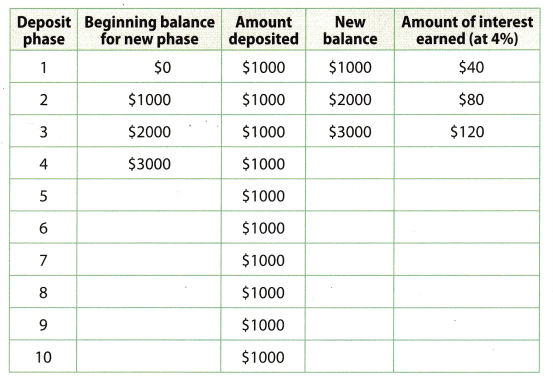
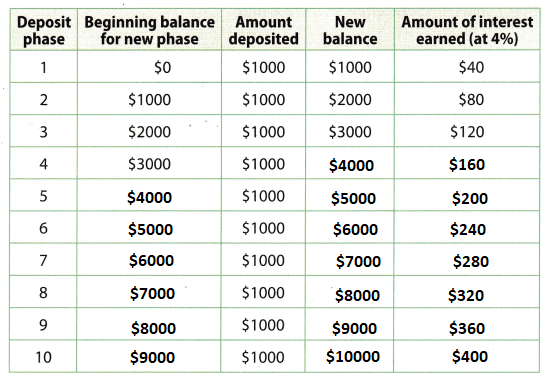
B. Complete the table to show how the interest earned grows over time.
Texas Go Math Grade 8 Lesson 16.2 Answer Key 1
Answer:
Texas-Go-Math-Grade-8-Lesson-16.2-Answer-Key-1
Explanation:
4. Beginning balance = $3000
Amount deposited = $1000
3000 + 1000 = $4000
So, new balance = $4000
Amount of interest earned at 4% = 4000 × 0.04 = $160
5. Beginning balance = $4000
Amount deposited = $1000
4000 + 1000 = $5000
So, new balance = $5000
Amount of interest earned at 4% = 5000 × 0.04 = $200
6. Beginning balance = $5000
Amount deposited = $1000
5000 + 1000 = $6000
So, new balance = $6000
Amount of interest earned at 4% = 6000 × 0.04 = $240
7. Beginning balance = $6000
Amount deposited = $1000
6000 + 1000 = $7000
So, new balance = $7000
Amount of interest earned at 4% = 7000 × 0.04 = $280
8. Beginning balance = $7000
Amount deposited = $1000
7000 + 1000 = $8000
So, new balance = $8000
Amount of interest earned at 4% = 8000 × 0.04 = $320
9. Beginning balance = $8000
Amount deposited = $1000
8000 + 1000 = $9000
So, new balance = $9000
Amount of interest earned at 4% = 9000 × 0.04 = $360
10. Beginning balance = $9000
Amount deposited = $1000
9000 + 1000 = $10000
So, new balance = $10000
Amount of interest earned at 4% = 10000 × 0.04 = $400

Reflect

Go Math Grade 8 Answer Key Pdf Investing Math Worksheet Question 1.
How much interest did Adan’s account earn from the initial deposit to the end of year 5? from the start of year 6 to the end of year 10? How do these values compare? Explain.
Answer:
Adan deposits $1000 at the start of each year.
The income earned at year 10 = $400
The income earned in the next 5 years = $600
Adding $600 to the initial deposit = 600 + 1000 = $1600
More interest is earned in later years as deposits are made. If money is saved regularly, the amount of interest increases over time.

Question 2.
What was the total amount saved from the initial deposit to the end of year 5? from the start of year 6 to the end of year 10? Include the amount contributed and the interest.
Answer:
The income earned in the next 5 years = $600
So, new balance = $5000
Adding both to know the total amount saved from the initial deposit to the end of year 5.
$5000 + $600 = $5600
Beginning balance = $5000
Amount deposited = $1000
5000 + 1000 = $6000
So, new balance = $6000
$6000 + $600 = $6600

Explore Activity 2

Calculating Compound interest

Compound interest is interest paid not only on the principal but also on any interest that has already been earned. Every time interest is calculated, the interest is added to the principal for future interest calculations. The calculation can be made more than once a year, but in this lesson only interest compounded annually will be found.

The formula for compound interest is A = P(1 + r)t, where P is the principal, r is the interest rate expressed as a decimal, t is the time in years, and A is the amount in the account after t years if no withdrawals were made.

Lilly makes regular deposits to a savings account to save money for retirement. She deposits $1000 each year, and her account earns interest compounded annually at a rate of 4%.
A. How much interest does Lilly earn the first year?
A = P(1 + r)t Use the formula for compound interest.
A = 1000 × (1 + __________) 1 Substitute
A = _________ Simplify
So, Lilly’s account earns __________ – $1000 = __________ the first year.
Answer:
A = P(1 + r)t Use the formula for compound interest.
A = 1000 × (1 + 0.04) 1
A = 1040
So, Lilly’s account earns $1040- $1000 = $40 the first year.

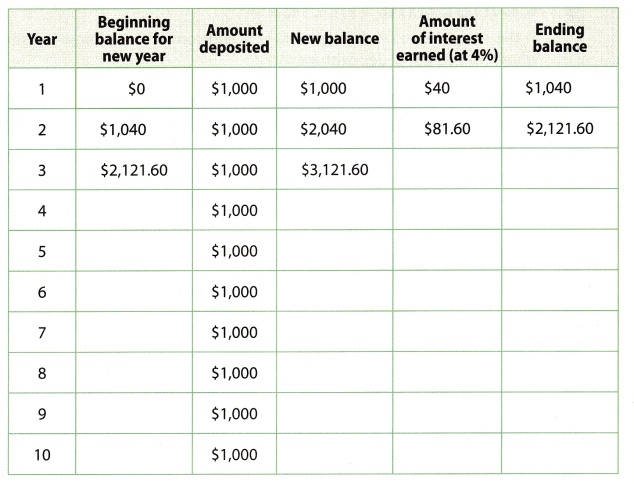
B. Complete the table to show how the amount in the account accumulates over time. Round all values to the nearest cent.
Texas Go Math Grade 8 Lesson 16.2 Answer Key 2
Answer:
Texas Go Math Grade 8 Lesson 16.2 Explore Activity Answer Key_B
Beginning balance for the new year = $0.
The amount deposited in the account = $1000.
Interest = 4%
The formula for compound interest is A = P(1 + r/100)t
P = principle
R = interest rate.
T = time
A = $1000(1 + 4/100)1
=$1000 (1.04)
Ending balance = $1040
= $1040 – $1000 = 40
Interest for 1 year = 40.
As for the 1 year calculation.
For the second year the beginning balance is $1040.
The ending balance is $2121.60.
The interest for the second year = $81.60.
For the 3rd year the beginning balance is $2121.60.
The ending balance is $3246.46.
The interest for the second year = $124.86.
For the second year the beginning balance is $1040.
The ending balance is $212160.
The interest for the second year = $81.60.
For the second year the beginning balance is $1040.
The ending balance is $212160.
The interest for the second year = $81.60.
For the second year the beginning balance is $1040.
The ending balance is $212160.
For the 10 years the beginning balance, interest, and ending balance are in the table.

Reflect

Lesson 16.2 Saving and Investing Go Math Answer Key Grade 8 Question 3.
How much interest did Lilly’s account earn from the initial deposit to the end of year 5? from the start of year 6 to the end of year 10?
Answer:
The interest earned from the initial deposit to the end of 5 years = $40 + $81.60 + $124.86 + $169.86 + $216.65 = $632.97.
The interest earned from 6 years to 10 years = $265.32 + $315.93 + $368.57 +$423.31 + $480.24 = $1853.37.

Question 4.
Compare the interest earned during the two five-year periods. Explain the difference.
Answer:
The interest for the first 5 years = $632.97.
The interest for after 5 years = $1853.37.
The interest after 5 years has increased almost 3 times to the first five years. Because every year a new amount is deposited. So, the interest increases.

Question 5.
Compare the final balance in this Explore Activity to the total amount deposited and earned in interest in Explore Activity 1 (see Reflect question 2). What can you conclude?
Answer:
In explore 1 the total was $5600 + $6600 = $12200.
In Explore 2 the total final balance is $12486.34.
The explore 2 earned more compared to the explore 1.

Your Turn

Question 6.
Marlena saved $50 in an account earning 3.5% simple interest. How much more interest would her account earn in 10 years if her account earned interest compounded annually instead of simple interest?
Answer:
Given that,
Marlena saved in the account = $50.
Simple interest = 3.5%.
Number of years = 10.
The formula for compound interest is A = P(1 + r)t
P = principle
R = interest rate.
T = time
A = $50(1 + 3.5)10
=$50 (1.410)
= $70.5
= $70.5 – $50 = 20.5
The compounded interest for 10 years is 20.5

Texas Go Math Grade 8 Lesson 16.2 Independent Practice Answer Key

Question 1.
Gina deposits $150 at the start of each year into a college savings account that pays 4% simple interest at the end of each year. She does not deposit the interest she earns each year. How much total interest will Gina earn on her deposits through the end of the fifth year? (Explore Activity 1)
Answer:
Given that,
Gina deposits into a college savings account = $150.
Simple interest = 4%.
Number of years = 5
The formula for simple interest equal to SI = PTR/100
Here,
P = actual money = $150.
T = time = 5 years.
R = interest rate = 4%
Simple interest for 5 years = $150 × 5 × 4/100 = $300.
The total interest will Gina earn on her deposits through the end of the fifth year = $300.

Texas Go Math Grade 8 Savings by Nation Worksheet Answer Key Question 2.
Fredo deposits $75 each year in an account earning 3% interest compounded annually. If he deposits an additional $75 per year and does not make any withdrawals, how much interest will the account earn in the fourth year? (Explore Activity 2)
Answer:
Given that,
Fredo deposits each year in an account = $75
Interest = 3%.
Interest for one year
The formula for compound interest is A = P(1 + r/100)t
A = $75(1 + 3/100)¹
A = $75(1.03)
A = $9.75
For second year deposit = $75 + $75 = 150.
Interest for 2 years = 9.75 + 9.75 = 19.5
The interest for the account earn in the fourth year = $97.5

Question 3.
Huan deposited $850 into a college savings account earning 4.8% interest compounded annually. He also deposited $850 into a second account earning 4.8% simple interest. He made no additional deposits. (Example 1)
a. How much interest does the first account earn in 10 years?
Answer:
Huan deposited into a college savings account = $ 850.
Earning an interest = 4.8%.
Number of years = 10
The formula for compound interest is A = P(1 + r/100)t
A = $850(1 + 4.8/100)10
A = $850(1.5981)
A = $1358.3
The compound interest for 10 years = $1358.3 – $850 = $508.3

b. How much interest does the second account earn in 10 years?
Answer:
Huan deposited into a college savings account = $ 850.
Earning an interest = 4.8%.
Number of years = 10
Formula for simple interest equal to SI = PTR/100
Here,
P = actual money = $850.
T = time = 10 years.
R = interest rate = 4.8%
Simple interest for 10 years = $850 × 10 × 4.8/100 = $408

c. After 10 years, which account earned more interest? How much more?
Answer:
The compound interest for 10 years = $508.3
The simple interest for 10 years = $408.
$508.3 – $408 = $100.3
Compound interest has more interest than simple interest.
$100.3 is more than simple interest.

Go Math 8th Grade Simple Interest Answer Key Question 4.
Andreas invested $1000 in a savings account. After 4 years, the account had earned a total of $112 simple interest without any additional deposits. What was his interest rate?
Answer:
Given,
Andreas invested $1000 in a savings account.
After 4 years, the account had earned a total of $112 in simple interest without any additional deposits.
I = Prt
112 = 1000 × r × 4
112 = 4000 × r
r = 0.028
rate of interest = 2.8%

Question 5.
Hei has $1500 in a retirement account earning 5% interest compounded annually. Each year after the first, she makes additional deposits of $1500. After 5 years, what was her account balance if she did not make any withdrawals?
Answer:
Given,
Hei has $1500 in a retirement account earning 5% interest compounded annually.
Each year after the first, she makes additional deposits of $1500.
After 1 year:
1500 × (1 + 0.05) = 1500 × 1.05 = $1575
After 2 years:
Adding the interest from the previous year to this year.
1575 + 1500 = 3075
3075 × (1 + 0.05) = 3075 × 1.05 = $3228.75
After 3 years:
Adding the interest from the previous year to this year.
3228.75 + 1500 = 4728.75
4728.75× (1 + 0.05) = 4728.75× 1.05 = $4965.18
After 4 years:
Adding the interest from the previous year to this year.
4965.18 + 1500 = 6465.18
6465.18 × (1 + 0.05) = 6465.18 × 1.05 = $6788.44
After 5 years:
Adding the interest from the previous year to this year.
6788.44 + 1500 = 8288.44
8288.44 × (1 + 0.05) = 8288.44 × 1.05 = $8702.87

Grade 8 Go Math Compound Interest Answer Key Question 6.
Lester deposited $400 into a savings account earning 4.5% simple interest, and $450 into an investment account earning 3.2% interest compounded annually. What was the total interest he earned in 3 years? Justify your reasoning.
Answer:
Given,
Lester deposited $400 into a savings account earning 4.5% simple interest, and $450 into an investment account earning 3.2% interest compounded annually.
Formula for simple interest is I = prt
I = 400 × 0.045 × 3 = 54
Compound balance after 3 years
A = p(1 + r)t
A = 450 × (1 + 0.032)³
A = 494.597
Compound interest earned is 494.59 – 450 = 44.59
Total = 54 + 44.59 = 98.59

Question 7.
Randee invested $1000 for college in an account earning 5% simple interest. When she withdrew the investment, she had earned a total of $550 in interest. How long was the money invested? Justify your reasoning.
Answer:
Given,
Randee invested $1000 for college in an account earning 5% simple interest.
When she withdrew the investment, she had earned a total of $550 in interest.
The formula for simple interest
A = P(1 + rt)
1550 = 1000 (1 + (0.05 × t))
1.55 = 1 + 0.05 × t
1.55 – 1 = 0.05 × t
0.55 = 0.05t
t = 11

Question 8.
Critical Thinking Is it possible for an amount of money invested in an account earning simple interest to earn more interest than the same amount of money invested at the same rate in an account earning interest compounded annually? Explain.
Answer:
Comparing the simple interest and compounded interest. The compounded interest is more beneficial. In this, the funds increase fast. Because the interest is calculated on the accumulated interest over time.

H.O.T. Focus on Higher Order Thinking

Question 9.
Multiple Representations The graph shows how the values of two accounts increase over time. The line represents $50 invested in an account paying 5% simple interest, and the curve represents $50 invested in an account paying 5% interest compounded annually. Write an equation for the line and for the curve. Assume no additional deposits were made to either account.
Texas Go Math Grade 8 Lesson 16.2 Answer Key 3
Answer:
The line represents $50 invested in an account paying 5% simple interest.
The curve represents $50 invested in an account paying 5% interest compounded annually
The equation for the line is y = 5x + 50.
The equation for the curve = dy/dx = 5x + 50.

Go Math Grade 8 Lesson 16.2 Answer Key Question 10.
Critique Reasoning Marco says he will earn more interest on his $100 savings if he gets 4% interest compounded annually than if he gets 5% simple interest. How many years does he have to keep the money in the bank without withdrawing any to be right? Justify your reasoning.
Answer:
Given,
Marco says he will earn more interest on his $100 savings if he gets 4% interest compounded annually than if he gets 5% simple interest.
If he gets 5% simple interest on $100 = 5/100 × 100 = $5
Thus the compound interest must be greater than $5.
Let us calculate the compound interest over the years.
Year 1: 4/100 × 100 = $4
Year 2: 100 + $4 = $104
= 4/100 × 104 = $4.16
Year 3: Interest from the 2nd year will be added this year.
104 + 4.16 = 108.16
4/100 × 108.16 = $4.33
Year 4: Interest from the 3rd year will be added this year.
108.16 + 4.33 = $112.49
4/100 × 112.49 = $4.49
Year 5: Interest from the 4th year will be added this year.
112.49 + 4.49 = 116.99
4/100 × 116.99 = $4.68
Year 6: Interest from the 5th year will be added this year.
116.99 + 4.68 = 121.67
4/100 × 121.67= $4.87
Year 7: Interest from the 6th year will be added this year.
121.67 + 4.87 = 126.54
4/100 × 126.54= $5.06
Hence in the 7th year, Marco will get the compound interest greater than $5, so he will have to keep money in the bank without withdrawing for 6 years.

Question 11.
Critique Reasoning Parker invested $6,500 for 2 years, part at 6% interest compounded annually and part at 5% simple interest. He earned three times as much interest in the account paying compound interest as in the account paying simple interest. Can Parker model this situation using the equation x(1 + 0.06)2 = 3(6500 – x)(0.05)(2), where x is the initial amount in the 6% account and 6500 – x is the amount in the 5% account? Explain.
Answer:
Given that,
Parker invested for 2 years = $6500
Interest = 6%
The formula for compound interest is A = P(1 + r/100)t
A = $6500(1 + 6/100)2
A = $6500(1.123)
A = $6500(1.123)
A = $7299.5
The compounded interest for 2 years = $7299.5 – $6500 = $799.5.
Formula for simple interest equal to SI = PTR/100
Here,
P = actual money = $6500.
T = time = 2 years.
R = interest rate = 5%
Simple interest for 10 years = $6500 × 2 × 5/100 = $650
The equation x(1 + 0.06)² = 3(6500 – x)(0.05)(2).
where, x is the initial amount in the 6% account and 6500 – x is the amount in the 5% account.
Initial amount = $6500
$6500(1 + 0.06)² = 3(6500 – $6500)(0.05)(2).
= $7303.4 = $0
Using this equation the answer is not correct.

Texas Go Math Grade 8 Lesson 16.2 Answer Key Saving and Investing Read More »
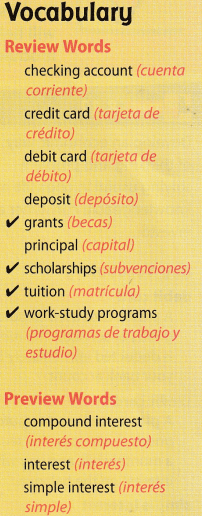
Texas Go Math Grade 8 Module 16 Answer Key Managing Your Money and Planning for Your Future

Refer to our Texas Go Math Grade 8 Answer Key Pdf to score good marks in the exams. Test yourself by practicing the problems from Texas Go Math Grade 8 Module 16 Answer Key Managing Your Money and Planning for Your Future.

Texas Go Math Grade 8 Module 16 Answer Key Managing Your Money and Planning for Your Future

Texas Go Math Grade 8 Module 16 Are You Ready? Answer Key

Multiply

Question 1.
Texas Go Math Grade 8 Module 16 Answer Key 1
Answer: 92.92
Explanation:
There are 2 total decimal places in both numbers.
Ignore the decimal places and complete the multiplication as if operating on two integers.
Texas Go Math Grade 8 Module 16 Answer Key Managing Your Money and Planning for Your Future_1
Rewrite the product with 2 total decimal places.
So, the answer is 92.92

Texas Go Math Grade 8 Answer Key Pdf Module 16 Question 2.
Texas Go Math Grade 8 Module 16 Answer Key 2
Answer: 27.09
Explanation:
There are 2 total decimal places in both numbers.
Ignore the decimal places and complete the multiplication as if operating on two integers.
Texas Go Math Grade 8 Module 16 Are You Ready Answer Key_2
Rewrite the product with 2 total decimal places.
So, the answer is 27.09

Question 3.
Texas Go Math Grade 8 Module 16 Answer Key 3
Answer: 158.76
Explanation:
There are 2 total decimal places in both numbers.
Ignore the decimal places and complete the multiplication as if operating on two integers.
Texas Go Math Grade 8 Module 16 Are You Ready Answer Key_3
Rewrite the product with 2 total decimal places.
So, the answer is 158.76

Question 4.
Texas Go Math Grade 8 Module 16 Answer Key 4
Answer: 0.3870
Explanation:
There are 4 total decimal places in both numbers.
Ignore the decimal places and complete the multiplication as if operating on two integers.
Texas Go Math Grade 8 Module 16 Are You Ready Answer Key_4
Rewrite the product with 2 total decimal places.
So, the answer is 0.3870

Find the percent.

8th Grade Math Answer Key Module 16 Answer Key Question 5.
4% of 40 __________
Answer: 1.6
Explanation:
Finding the fraction of a number is similar to multiplying the fractions with the whole number.
4% = 4/100 or 0.04
4/100 × 40 = 16/10 = 1.6
or
0.04 × 40 = 1.6
Therefore the answer is 1.6

Question 6.
7% of 300 ________
Answer: 21
Explanation:
Finding the fraction of a number is similar to multiplying the fractions with the whole number.
7% = 7/100 or 0.07
7/100 × 300 = 21
or
0.07 × 300 = 21
Therefore the answer is 21.

Question 7.
4.3% of 1,200 _______
Answer: 51.6
Explanation:
Finding the fraction of a number is similar to multiplying the fractions with the whole number.
4.3% = 4.3/100 or 0.043
4.3/100 × 1200 = 51.6
or
0.043 × 1200 = 51.6
Therefore the answer is 51.6

Evaluate. Round to the nearest hundredth.

Question 8.
120(1 + 0.02)2 ____________
Answer:
Given,
120(1 + 0.02)2
First add the whole number with the decimal number.
120 (1.02)² = 120 × 1.04
120 × 1.04 = 124.8
Now we have to Round to the nearest hundredth.
124.80 to the nearest hundredth.
To round 124.80 to the nearest hundredth consider the thousandths’ value of 124.8, which is 0 and less than 5. Therefore, the hundredths’ value of 124.8 remains 0.

Go Math Module 16 Answer Key Grade 8 Question 9.
450(1 + 0.05)2 ____________
Answer:
Given,
450(1 + 0.05)2
First, add the whole number with the decimal number.
450 (1.05)2
450 × 1.1025 = 496.125
Now we have to Round to the nearest hundredth.
496.125 to the nearest hundredth.
To round 496.125 to the nearest hundredth consider the thousandths’ value of 496.125, which is 5 and equal or more than 5. Therefore, the hundredths value of 496.125 increases by 1 to 3.
496.125 to the nearest hundredth is 496.13

Question 10.
900(1 + 0.03)2 ___________
Answer:
Given,
900(1 + 0.03)2
First, add the whole number with the decimal number.
900(1.03)² = 900 × 1.0609
900 × 1.0609 = 954.81
Now we have to Round to the nearest hundredth.
954.81 to the nearest hundredth.
954.81 to the nearest hundredth is 954.80

Question 11.
75(1 + 0.01)2 ____________
Answer:
Given,
75(1 + 0.01)2
First, add the whole number with the decimal number.
75(1.01)² = 75 × 1.0201
75 × 1.0201 = 76.50
Now we have to Round to the nearest hundredth.
76.50 to the nearest hundredth is 76.50

Texas Go Math Grade 8 Module 16 Reading Start-Up Answer Key

Visualize Vocabulary

Use the ✓ words to complete the graphic organizer. You will put one word in each box.

Texas Go Math Grade 8 Module 16 Answer Key 5
Texas Go Math Grade 8 Module 16 Answer Key 6

Understand Vocabulary

Complete the sentences using the preview words.

Question 1.
The amount of money paid by banks and others to use money in an account is ______________.
Answer: The amount of money paid by banks and others to use money in an account is a checking account.

Go Math Module 16 Grade 8 Answer Key Question 2.
____________________ is earned on an annual basis using the formula l = Prt.
Answer: Simple Interest is earned on an annual basis using the formula l = Prt.
Interest earned according to this formula is called simple interest.

Active Reading
Tri-Fold Before beginning the module, create a tri-fold to help you learn the concepts and vocabulary in this module. Fold the paper into three sections. Label the columns “What I Know”. What I Need to Know$and “What I Learned.” Complete the first two columns before you read. After studying the module, complete the third column.
Texas Go Math Grade 8 Module 16 Answer Key 7
Answer:

Texas Go Math Grade 8 Module 16 Answer Key Managing Your Money and Planning for Your Future Read More »
Texas Go Math Grade 7 Module 2 Quiz Answer Key

Refer to our Texas Go Math Grade 7 Answer Key Pdf to score good marks in the exams. Test yourself by practicing the problems from Texas Go Math Grade 7 Module 2 Quiz Answer Key.

Texas Go Math Grade 7 Module 2 Quiz Answer Key

Texas Go Math Grade 7 Module 2 Ready to Go On? Answer Key

2.1 Unit Rates

Find each unit rate. Round to the nearest hundredth, if necessary.

Question 1.
$140 for 18 ft2 _____________
Answer:
140 ÷ 18 ≈ $7.78 per ft2

Grade 7 Go Math Module 2 Quiz Answer Key Question 2.
$2.99 for 14 lb ______________
Answer:
2.99 ÷ 14 ≈ $0.21 per lb

Circle the better deal in each pair. Then give the unit rate for the better deal.

Question 3.
\(\frac{\$ 56}{25 \mathrm{gal}}\) or \(\frac{\$ 32.05}{15 \mathrm{gal}}\) ____________
Answer:
56 ÷ 25 = $2.24 per gal
32.05 ÷ 15 ≈ $2.14 per gal
First deal is better.

Question 4.
\(\frac{\$ 160}{5 \mathrm{~g}}\) or \(\frac{\$ 315}{9 \mathrm{~g}}\) ____________
Answer:
160 ÷ 5 = $32 per gram
315 ÷ 9 = $35 per gram
First deal is better.

2.2 Constant Rates of Change

Question 5.
The table shows the amount of money Tyler earns for mowing lawns. Is the relationship a proportional relationship? Why or why not?
Texas Go Math Grade 7 Module 2 Quiz Answer Key 1
Answer:
\(\frac{\text { Amount Earned }(\$)}{\text { Number of Lawns }}: \frac{15}{1}=15 \quad \frac{30}{2}=15 \quad \frac{48}{3}=16\)
We can stop here because the constants are not equal. Thus, the relationship is not proportional.

Texas Go Math Grade 7 Module 2 Quiz Answers Question 6.
On a recent day, 8 euros were worth $9 and 24 euros were worth $27. Write an equation of the form y = kx to show the relationship between the number of euros and the value in dollars.
_____________ , where y is dollars and x is euros
Answer:
\(\frac{9}{8}\) = 1.125
\(\frac{27}{24}\) = \(\frac{9}{8}\) = 1.125
k = 1.125
y = 1.125 x

2.3 Proportional Relationships and Graphs

Question 7.
The graph shows the number of servings in different amounts of frozen yogurt listed on a carton. Write an t equation that gives the number of servings y in x pints.
Texas Go Math Grade 7 Module 2 Quiz Answer Key 2
Answer:
The relationship is obviously proportional. Thus. we only need 1 point to determine the constant.
\(\frac{5}{2}\) = 2.5
y = 2.5x

Question 8.
A refreshment stand makes 2 large servings of frozen yogurt from 3 pints. Add the line to the graph and write 2 its equation.
Answer:
\(\frac{2}{3}\) servings per pint Equation: y = \(\frac{2}{3}\) x.
Texas Go Math Grade 7 Module 2 Quiz Answer Key 6

Essential Question

7th Grade Proportional Relationships Quiz Pdf Answer Key Question 9.
How can you use rates to determine whether a situation is a proportional relationship?
Answer:
Rates need to be equal for a relationship to be proportional.

Texas Go Math Grade 7 Module 2 Mixed Review Texas Test Prep Answer Key

Selected Response

Question 1.
Kori spent $46.20 on 12 gallons of gasoline. What was the price per gallon?
A. $8. 35
B. $3.85
C. $2.59
D. $0.26
Answer:
B. $3.85

46.20 ÷ 12 = 3.85$ per gallon

Question 2.
A rabbit can run 35 miles per hour. A fox can run 21 miles in half an hour. Which animal is faster, and by how much?
A. The rabbit is faster by 7 miles per hour.
B. The fox is faster by 7 miles per hour.
C. The rabbit is faster by 14 miles per hour.
D. The fox is faster by 14 miles per hour.
Answer:
C. The rabbit is faster by 14 miles per hour.

The rabbit runs can run more miles per hour, which means he is faster.
35 – 21 = 14
The rabbit is faster by 14 miles per flour.

Question 3.
A pet survey found that the ratio of dogs to cats is \(\frac{2}{5}\). Which proportion shows the number of dogs if the number of cats is 140?
Texas Go Math Grade 7 Module 2 Quiz Answer Key 3
Answer:
Texas Go Math Grade 7 Module 2 Quiz Answer Key 7

Question 4.
What is the cost of 2 kilograms of flour, if 3 kilograms cost $4.86 and the unit price for each package of flour is the same?
A. $0.81
B. $2.86
C. $3.24
D. $9.72
Answer:
C. 3.24

First, notice that 2 is equal to \(\frac{2}{3}\) of 3. Thus, price of 2 kilograms will be \(\frac{2}{3}\) of the price of 3 kilograms.
4.86 × \(\frac{2}{3}\) = 3.24
The price of 2 kilograms of flour is $3.24.

Question 5.
One gallon of paint covers about 450 square feet. How many square feet will 1.5 gallons of paint cover?
A. 300 ft2
B. 451.5 ft2
C. 675 ft2
D. 900 ft2
Answer:
C. 675 ft2

First, notice that 1.5 is equal to 1 × 1.5. Thus, 1.5 gallons of paint will cover 1.5 × 450 (how much 1-gallon covers).
1.5 × 450 = 675
1.5 gallons will cover 675 ft2.

Texas Go Math Grade 7 Module 2 Quiz Answer Key Question 6.
The graph shows the relationship between the late fines the library charges and the number of days late.
Texas Go Math Grade 7 Module 2 Quiz Answer Key 4
What is an equation for the relationship?
A. y = 0.25x
B. y = 0.40x
C. y = 0.50x
D. y = 0.75x
Answer:
A. y = 0.25x

First, notice that points form a line. Thus, we will need only one point to determine the equation of the relationship.
y ÷ x = 0.5 ÷ 2 = 0.25
The equation of a relationship is y = 0.25x.

Gridded Response

Grade 7 Module 2 End of Module Assessment Answer Key Question 7.
School is 2 miles from home along a straight road, The table shows your distance from home as you walk home at a constant rate. Give the constant of proportionality as a decimal.
Texas Go Math Grade 7 Module 2 Quiz Answer Key 5
Answer:
From the given table you can see that the distance from home is not proportional to time, but the distance from school is proportional to time Using the equation y = kx, the formula for the constant of proportionality is:
k = \(\frac{2-y}{x}\)
Determine the value of k or the constant of proportionality.
Texas Go Math Grade 7 Module 2 Quiz Answer Key 8
The constant of proportionality is 0.05.

Texas Go Math Grade 7 Module 2 Quiz Answer Key Read More »

Texas Go Math Grade 7 Module 1 Quiz Answer Key

Refer to our Texas Go Math Grade 7 Answer Key Pdf to score good marks in the exams. Test yourself by practicing the problems from Texas Go Math Grade 7 Module 1 Quiz Answer Key.

Texas Go Math Grade 7 Module 1 Quiz Answer Key

Texas Go Math Grade 7 Module 1 Ready to Go On? Answer Key

1.1 Rational Numbers and Decimals

Write each mixed number as a decimal.

Question 1.
4\(\frac{1}{5}\) __________
Answer:
First. write \(\frac{1}{5}\) as a decimal.
Texas Go Math Grade 7 Module 1 Quiz Answer Key 3
Then, add 4 to the result.
4 + 0.2 = 4.2

Module 1 Grade 7 Quiz Answer Key Go Math Question 2.
12\(\frac{14}{15}\) _________
Answer:
First. write \(\frac{14}{15}\) as a decimal.
Texas Go Math Grade 7 Module 1 Quiz Answer Key 4
Then, add 12 to the result.
12 + \(0.9 \overline{3}\) = \(12.9 \overline{3}\)

Question 3.
5\(\frac{5}{32}\) ___________
Answer:
First. write \(\frac{5}{32}\) as a decimal.
Texas Go Math Grade 7 Module 1 Quiz Answer Key 5
Then, add 5 to the result.
5 + 0.15625 = 5.15625

1.2 Relationships Between Sets of Numbers

Question 4.
Are all whole numbers rational numbers? Explain.
Answer:
True Every whole number is included in the set of integers, and every integer is incLuded in the set of rational numbers.
Whole numbers are a subset of the set of rational numbers

1.3 Adding Rational Numbers

Find each sum.

Question 5.
4.5 + 7.1 = _____________
Answer:
11.6

Question 6.
5\(\frac{1}{6}\) + (-3\(\frac{5}{6}\)) = ____________
Answer:
Write mixed fractions as proper fractions.
Texas Go Math Grade 7 Module 1 Quiz Answer Key 6

1.4 Subtracting Rational Numbers

Find each difference.

Question 7.
–\(\frac{1}{8}\) – (6\(\frac{7}{8}\)) = _____________
Answer:
= -6\(\frac{8}{8}\)
= -7

Grade 7 Go Math Module 1 Answer Key Question 8.
14.2 – (-4.9) = ___________
Answer:
= 14.2 + 4.9
= 19.1

1.5 Multiplying Rational Numbers

Multiply.

Question 9.
-4(\(\frac{7}{10}\)) = _______________
Answer:
Texas Go Math Grade 7 Module 1 Quiz Answer Key 7

Question 10.
-3.2(-5.6)(4) = ___________
Answer:
The result will be positive, because the expression has an even number of negative signs.
= 3.2(5.6)(4)
= 17.92(4)
= 71.68

1.6 Dividing Rational Numbers

Find each quotient.

Question 11
–\(\frac{19}{2}\) ÷ \(\frac{38}{7}\) = _______________
Answer:
= -8 ÷ \(\frac{38}{7}\)
Write using multiplication:
= -8 × \(\frac{7}{38}\)
= – \(\frac{28}{19}\) (= -1\(\frac{9}{28}\))

Mathematics Module 1 Grade 7 Quiz Answers Question 12.
\(\frac{-32.01}{-3.3}\) = ___________
Answer:
The quotient will be positive because the signs are the same.
Write decimal numbers as fractions:
\(\frac{\frac{3201}{100}}{\frac{33}{10}}\)
Write the complex fraction as division:
\(\frac{3201}{100}\) ÷ \(\frac{33}{10}\)
Write using multiplication:
\(\frac{3201}{100}\) \(\frac{10}{33}\) = \(\frac{97}{10}\)
= 9.7

Essential Question

Question 13.
How can you use rational numbers to represent real-world problems?
Answer:
We can use rational numbers to represent real-world problems by expressing some kind of ratio.
E g
Martha planted 30 flowers, 24 of them did not wither. Her success rate was \(\frac{24}{31}\).

Texas Go Math Grade 7 Module 1 Mixed Review Texas Test Prep Answer Key

Selected Response

Question 1.
What is -7\(\frac{5}{12}\) written as a decimal?
A. -7.25
B. -7.333.
C. -7.41666…
D. -7.512
Answer:
C. -7.41666…

First, write \(\frac{5}{12}\) as a decimal.
Texas Go Math Grade 7 Module 1 Quiz Answer Key 8
Then, add 7 to the result.
7 + \(0.41 \overline{6}\) = \(7.41 \overline{6}\)
Now, since the starting number was negative, this one has to be negative too.
-7\(\frac{5}{12}\) = –\(7.41 \overline{6}\)

Question 2.
Which set or sets does the number -9\(\frac{1}{2}\) belong to?
A. Integers only
B. Rational numbers only
C. Integers and rational numbers only.
D. Whole numbers, integers, and rational numbers
Answer:
B. Rational numbers only

-9\(\frac{1}{2}\) is a mixed fraction. Thus, it is onLy a rational number.

Question 3.
Renee ate \(\frac{1}{4}\) of a pizza, and Sumi ate of the same pizza. How much of the pizza did they eat in all?
A. \(\frac{1}{7}\) of the pizza
B. \(\frac{2}{7}\) of the pizza
C. \(\frac{5}{12}\) of the pizza
D. \(\frac{7}{12}\) of the pizza
Answer:
D. \(\frac{7}{12}\) of the pizza

We have to add how much Renee ate, and how much Sumi ate.
\(\frac{1}{4}\) + \(\frac{1}{3}\) = \(\frac{3+4}{12}\)
= \(\frac{7}{12}\)
Renee and Sumi ate \(\frac{7}{12}\) of the pizza

Question 4.
Kareem had $25 in his bank account on Monday. The table shows his account activity for the next four days. What was the balance in Kareem’s account on Friday?
Texas Go Math Grade 7 Module 1 Quiz Answer Key 1
A. $59.23
B. -$9.23
C. $9.23
D. -$59.23
Answer:
A. $59.23

Use positive numbers to represent deposit and negative numbers to represent withdrawal. Then, add it up to the account’s balance before any deposits or withdrawals, 25.
25 + (-13.50) + 85.10 + (-55.32) + 17.95 = 25 + 85.10 + 17.95 – 13.50 – 55.32
= – 110.10 + 17.95 – 13.50 – 55.32
= 128.05 – 13.50 – 55.32
= 114.55 – 55.32
= 59.2:3
The balance is in Kareem’s account. on Friday was $59.23.

Grade 7 Math Module 1 Answer Key Quiz Answers Question 5.
A used boat is on sale for $2,400. Austin makes an offer equal to this price. How much does Austin offer for the boat?
A. $3,600
B. $1,600
C. $1,800
D. $800
Answer:
C. $1,800

Start by multiplying 2400 and \(\frac{2}{3}\).
2400 × \(\frac{2}{3}\) = 1600
Austin offers $1600.

Question 6.
Working together, 9 friends pick 23 bags of apples at an orchard. They divide the bags of apples equally between them. How many bags does each friend get?
A. 32\(\frac{2}{5}\) bags
B. 14\(\frac{2}{5}\) bags
C. 2\(\frac{3}{5}\) bags
D. 2\(\frac{5}{9}\) bags
Answer:
C. 2\(\frac{3}{5}\) bags

Start with dividing 23\(\frac{2}{5}\) by 9:
23\(\frac{2}{5}\) ÷ 9
Write mixed fraction as a proper fraction:
\(\frac{117}{5}\) ÷ 9
Write using multiplication:
\(\frac{117}{5}\) × \(\frac{1}{9}\) = \(\frac{13}{5}\)
= 2\(\frac{3}{5}\)
Each friend gets 2\(\frac{3}{5}\) bags

Question 7.
The Flathead Rail Tunnel in Montana is about 7\(\frac{3}{4}\) miles long. A train travels at a speed of \(\frac{3}{4}\) mile per minute. How long will it take the train to go through the tunnel?
A. \(\frac{7}{16}\) minute
B. 5\(\frac{3}{16}\) minutes
C. 8\(\frac{1}{3}\) minutes
D. 10\(\frac{1}{3}\) minutes
Answer:
D. 10\(\frac{1}{3}\) minutes

Start with diving by 7\(\frac{3}{4}\) by \(\frac{3}{4}\).
Write mixed fraction as a proper fraction:
\(\frac{31}{4}\) ÷ \(\frac{3}{4}\)
Write using multiplication:
\(\frac{31}{4}\) × \(\frac{4}{3}\) = \(\frac{31}{3}\)
= 10\(\frac{1}{3}\)
The train will 10\(\frac{1}{3}\) minutes to pass the tunnel.

Gridded Response

Grade 7 Math Quiz Module 1 Test Answers Question 8.
What is the value of (-2.75 )(-1 .16)?
Texas Go Math Grade 7 Module 1 Quiz Answer Key 2
Answer:
Given in problem: (-2.75)(-1.16)
SoLution will be: (- 2.75)(- 1.16) = +3.19
Final product of the expression will be positive because the product of two negative vaLue is always positive.
The table will be made as per below instructions:
1st column: mark + sign
2nd column : mark 0
3rd column : mark 0
4th column : mark 1
5th column : mark 7
6th column: mark 9
7th column: mark 4

Texas Go Math Grade 7 Module 1 Quiz Answer Key Read More »

Texas Go Math Grade 8 Unit 6 Study Guide Review Answer Key

Refer to our Texas Go Math Grade 8 Answer Key Pdf to score good marks in the exams. Test yourself by practicing the problems from Texas Go Math Grade 8 Unit 6 Study Guide Review Answer Key.

Texas Go Math Grade 8 Unit 6 Study Guide Review Answer Key

Texas Go Math Grade 8 Unit 6 Exercises Answer Key

Module 14 Scatter Plots

Question 1.
The table shows the income of 8 households, in thousands of dollars, and the number of televisions in each household. (Lesson 14.1)
Texas Go Math Grade 8 Unit 6 Study Guide Review Answer Key 1

a. Make a scatter plot of the data.
Texas Go Math Grade 8 Unit 6 Study Guide Review Answer Key 2
Answer:
Texas Go Math Grade 8 Unit 6 Study Guide Review Answer Key 13

b. Describe the association between income and the number of televisions. Are any of the values outliers?
Answer:
Data show a positive association because data sets increase together. In other words, we may say that with greater income, the number of televisions in households increases.
Data that show a positive association lie basic along with a line exhibiting a linear association.

One value is very different from the rest of the data in the set and that value represents an outlier. OutLier is point (20, 4).

Go Math Grade 8 Unit 6 Assessment Math Answer Key Question 2.
The scatter plot shows the relationship between the price of a product and the number of potential buyers. (Lesson 14.2)
Texas Go Math Grade 8 Unit 6 Study Guide Review Answer Key 3

a. Draw a trend line for the scatter plot.
Answer:
Texas Go Math Grade 8 Unit 6 Study Guide Review Answer Key 14

b. Write an equation for your trend line.
Answer:
The trend line passes through points (4, 16) and (8, 8).
Slope formula: m = \(\frac{y_{2}-y_{1}}{x_{2}-x_{1}}\)
m = \(\frac{8-16}{8-4}\)
m = \(\frac{-8}{4}\)
m = 2
Find the y-intercept of the trend line.
Slope-intercept form: y = mx + b
16 = -2(4) + b
b = 24
Use slope and y-intercept values to write the equation.
y = -2x + 24

c. When the price of the product is $3.50, the number of potential buyers will be about ___________.
Answer:
Use the equation for trend line:
y = -2x + 21
y = -2(3.50) + 24
y = -7 + 24
y = 17
When the price of the product is $3.50, the number of potential buyers will be about 17.

d. When the price of the product is $5.50, the number of potential buyers will be about _______.
Answer:
y = -2x + 24
y = -2(5.50) + 21
y = -11 + 24
y = 13
Then the price of the product is $5.50, the number of potential buyers will be about 13.

Module 15 Sampling

Unit 6 Study Guide Answer Key Go Math Grade 8 Question 1.
Find the mean and mean absolute deviation of the set of data. Round to the nearest hundredth. (Lesson 15.1)
Texas Go Math Grade 8 Unit 6 Study Guide Review Answer Key 4
Mean: ____________
Mean absolute deviation: _________
Answer:
Mean: 9
Mean absolute deviation: 1.7
Explanation:
Given data,
12, 9, 7, 7, 11, 10, 7
Step 1 is to find the mean of the data
Mean = (12+9+7+7+11+10+7)/7 = 9
Step 2 to find the difference between each data and mean
The difference between 12 and 9 is 3
The difference between 9 and 9 is 0
The difference between 7 and 9 is 2
The difference between 11 and 9 is 2
The difference between 10 and 9 is 1
The difference between 7 and 9 is 2
Now add all the differences
3 + 0 + 2 + 2 + 2 + 1 + 2 = 12
Now divide it by the number of data
12/7 = 1.7
Therefore mean absolute deviation of the set of data is 1.7

Question 2.
A pottery store gets a shipment of 1500 dishes and wants to estimate how many dishes are broken. The manager will use a random sample to represent the entire shipment. In actuality, 18% of the dishes are broken. (Lesson 15.2)

You will simulate the manager’s test by generating random numbers between 1 and 1500. Explain what the generated numbers will mean.

Use the graphing calculator function randlnt(1, 1500) to generate 30 numbers.

According to the sample, how many broken dishes should the manager expect to find in the shipment?
Answer:

Texas Go Math Grade 8 Unit 6 Performance Tasks Answer Key

Question 1.
CAREERS IN MATH Psychologist A psychologist gave a test to 15 women of different ages to measure their short-term memory. The test score scale goes from 0 to 24, and a higher score means that the participant has a better short-term memory. The scatter plot shows the results of this study.
Texas Go Math Grade 8 Unit 6 Study Guide Review Answer Key 5
a. Describe the pattern in the data. Is there a positive or negative association?
Answer:
The pattern in the data shows a negative correlation. That means that as one data set increases, the other decreases.
For example, when persons age increases, short- term memory score decrease. In process of becoming older, people have worse short-term memory.

b. Draw a line of best fit on the scatter plot and estimate its slope, interpret the slope in the context of the problem.
Answer:
This scatter plot shows the negative association and lie along a line exhibit a linear association.
Texas Go Math Grade 8 Unit 6 Study Guide Review Answer Key 15

c. In another test, a 70-year-old woman scored 8. Does your line of best fit predict a higher or lower score? What may have happened?
Answer:
The line of best fit predicts a lower score.
The trend line will move a little higher. Also, that point might become an outlier because it will be different and much further than others in line.

Unit 6 Test Study Guide Answer Key 8th Grade Go Math Question 2.
Tara and Makina are friends and study partners who decide to compare their math test scores for the semester.
Tara’s grades: 80, 95, 85, 70, 90
Makina’s grades: 75, 90, 95, 75, 100

a. Find the mean of each girl’s test scores. Show your work.
Answer:
Tara’s grades: 80, 95, 85, 70, 90
There are 5 observations
We know that,
Mean = sum of observations/number of observations
Mean = (80 + 95 + 85 + 70 + 90)/5
Mean = 84
Makina’s grades: 75, 90, 95, 75, 100
There are 5 observations
We know that,
Mean = sum of observations/number of observations
Mean = (75 + 90 + 95 + 75 + 100)/5 = 87

b. Find the mean absolute deviation (MAD) for each girl. Show your work.
Answer:
Mean of Tara’s grades is 84.
Find the difference between each data and mean:
The difference between 80 and 84 is 4
The difference between 95 and 84 is 11
The difference between 85 and 84 is 1
The difference between 70 and 84 is 14
The difference between 90 and 84 is 6
Add all the difference:
4 + 11 + 1 + 14 + 6 = 36
MAD = 36/5 =  7.2
So, the MAD of Tara’s grade is 7.2
Mean of Makina’s grades is 87.
Find the difference between each data and mean:
The difference between 75 and 87 is 12
The difference between 90 and 87 is 3
The difference between 95 and 87 is 8
The difference between 75 and 87 is 12
The difference between 100 and 87 is 13
The sum of all the differences
12 + 3 + 8 + 12 + 13 = 48
Now divide it by the number of data
48/5 = 9.6
Thus the mean absolute deviation is 9.6

c. Who has the better test scores? Who is more consistent? Explain.
Answer:
By comparing both the Mean and MAD we can say that Makina has the better test scores.

Texas Go Math Grade 8 Unit 6 Mixed Review Texas Test Prep Answer Key

Selected Response

Use the data set below for 1-2.
Texas Go Math Grade 8 Unit 6 Study Guide Review Answer Key 6

Unit 6 Math Test 8th Grade Answer Key Question 1.
What ¡s the mean of the data set?
(A) 14
(B) 26
(C) 33
(D) 42
Answer: (C) 33
Explanation:
Given data.
26, 30, 45, 43, 26, 14, 28, 33, 56, 29
We know that,
Mean = sum of observations/number of observations
Mean = (26+30+45+43+26+14+28+33+56+29)/10 = 33
Option C is the correct answer.

Question 2.
What is the mean absolute deviation?
(A) 2
(B) 4
(C) 6
(D) 9
Answer:(D) 9
Explanation:
Mean = sum of observations/number of observations
Mean = (26+30+45+43+26+14+28+33+56+29)/10 = 33
Find the difference between each data and mean:
The difference between 26 and 33 is 7
The difference between 30 and 33 is 3
The difference between 45 and 33 is 12
The difference between 43 and 33 is 10
The difference between 26 and 33 is 7
The difference between 14 and 33 is 19
The difference between 28 and 33 is 5
The difference between 33 and 33 is 0
The difference between 56 and 33 is 23
The difference between 29 and 33 is 4
Add all the differences:7+3+12+10+7+19+5+0+23+4 = 90
MAD = 90/10 = 9
Thus MAD = 9
Option D is the correct answer.

Question 3.
What type of association is there between the speed of a car and the distance the car travels in a given time at that speed?
(A) cluster
(B) negative association
(C) no association
(D) positive association
Answer:
(D) positive association

Explanation:
As the speed of a car increases, the distance the car travels increases. This is an example of a positive association.

Grade 8 Math Answer Key Pdf Unit 6 Test Review Question 4.
Using 3.14 for π, what is the volume of the sphere to the nearest tenth?
Texas Go Math Grade 8 Unit 6 Study Guide Review Answer Key 7
(A) 508.7 cubic centimeters
(B) 678.2 cubic centimeters
(C) 904.3 cubic centimeters
(D) 2713 cubic centimeters
Answer:
(C) 904.3 cubic centimeters

Explanation:
Diameter of a sphere = 12 cm
Radius = \(\frac{12}{2}\) = 6 cm
Volume of the sphere = \(\frac{4}{3}\)πr3
VoLume = \(\frac{4}{3}\) × 3.14 × 63
Volume = \(\frac{4}{3}\) × 3.14 × 216
Volume = 904.32 cm3
Volume ≈ 904.3 cm3

Hot Tip! Read graphs and diagrams carefully. Look at the labels for important information.

Question 5.
Which scatter plot could have a trend line given by the equation y = -7x + 90?
Texas Go Math Grade 8 Unit 6 Study Guide Review Answer Key 8
Texas Go Math Grade 8 Unit 6 Study Guide Review Answer Key 9
Answer: Option A is the correct answer

Question 6.
For which situation could flipping a coin not be used as a simulation to generate a random sample?
(A) to predict the number of wins a team will have in a season
(B) to predict whether the number of times the number rolled on a standard number cube will be even or odd
(C) to predict the number of people who will attend an event
(D) to predict the number of boys or girls born at a hospital in a month
Answer: (D) to predict the number of boys or girls born at a hospital in a month

Question 7.
The vertices of a triangle are (11, 9), (7, 4), and (1, 11). What are the vertices after the triangle has been reflected over the y-axis?
(A) (9, 11), (4, 7), (11, 1)
(B) (11, -9), (7, -4), (1, -11)
(C) (9, 11), (4, 7), (11, 1)
(D) (-11, 9), (-7, 4), (-1, 11)
Answer:
(D) (-11, 9), (-7, 4), (-1, 11)

Explanation:
(11, 9),(7, 4) and (1, 11) are the vertices of a triangle.
We need to use the rule to reflect the triangle across the y-axis. The rule said that we need to change the sign of the x-coordinate.
Coordinates:
(11, 9)
(7, 4)
(1, 11)
RefLect across the y-axis (-x, y):
(- 11, 9)
(-7, 4)
(-1, 11)

Question 8.
Which of the following is not shown on the scatter plot below?
Texas Go Math Grade 8 Unit 6 Study Guide Review Answer Key 10
(A) cluster
(B) negative association
(C) outlier
(D) positive association
Answer:
(B) negative association

Explanation:
Cluster is shown on the scatter plot around point (8, 34).
Negative association is not shown on the scatter plot because a trend line is increasing.

Outlier is shown on the scatter plot at point (3. 65).
Positive association is shown on the scatter plot because the trend line is increasing.

Gridded Response

Question 9.
A random sample of 45 students was asked to pick their favorite type of shoe, and 18 of them answered sandals. There are 390 students in the school. How many are likely to pick sandals as their favorite type of shoe?
Texas Go Math Grade 8 Unit 6 Study Guide Review Answer Key 11
Answer:
Given,
A random sample of 45 students was asked to pick their favorite type of shoe, and 18 of them answered sandals. There are 390 students in the school.
18/45 = 0.4
390 × 0.4 = 156
Thus 156 students are likely to pick sandals as their favorite type of shoe.

Hot Tip! Estimate your answer before solving the question. Use your estimate to check the reasonableness of your answer.

Question 10.
Bert took a handful of buttons from a bag. Out of the 27 buttons in his hand, 12 were brown. How many brown buttons should Bert expect to find in the bag if there are a total of 180 buttons?
Texas Go Math Grade 8 Unit 6 Study Guide Review Answer Key 12
Answer:
Given,
Bert took a handful of buttons from a bag. Out of the 27 buttons in his hand, 12 were brown.
12/27 = 0.4
Bert expects to find in the bag if there are a total of 180 buttons
That means 180 × 0.4 = 72
Thus there would be 72 buttons if there are 180 buttons.

Texas Go Math Grade 8 Unit 6 Study Guide Review Answer Key Read More »

Scroll to Top