Prasanna

Texas Go Math Grade 7 Lesson 6.4 Answer Key Using Technology to Conduct a Simulation

Refer to our Texas Go Math Grade 7 Answer Key Pdf to score good marks in the exams. Test yourself by practicing the problems from Texas Go Math Grade 7 Lesson 6.4 Answer Key Using Technology to Conduct a Simulation.

Texas Go Math Grade 7 Lesson 6.4 Answer Key Using Technology to Conduct a Simulation

Your Turn

Question 1.
An elephant has a 50% chance of giving birth to either a male or to a female calf. Use a simulation to find the experimental probability that the elephant gives birth to 3 male calves before having a female calf. (Hint: Use 0s and 1s. Let 0 represent a male calf, and 1 represent a female calf. Generate random numbers until you get a 1.)
Texas Go Math Grade 7 Lesson 6.4 Answer Key 1
Answer:
Texas Go Math Grade 7 Lesson 6.4 Answer Key 5
The probability that the elephant gives birth to three male calves before having a female calf is \(\frac{7}{10}\).

Texas Go Math Grade 7 Solutions Lesson 6.4 Answer Key Question 2.
Matt guesses the answers on a quiz with 5 true-false questions. The probability of guessing a correct answer on each question is 50%. Use a simulation to find an experimental probability that he gets at least 2 questions right. (Hint: Use 0s and is. Let 0s represent incorrect answers, and 1s represent correct answers. Perform 10 trials, generating 5 random numbers in each, and count the number of 1s.)
Answer:
Texas Go Math Grade 7 Lesson 6.4 Answer Key 6
The probability to get at least 2 question right is \(\frac{7}{10}\).

Texas Go Math Grade 7 Lesson 6.4 Guided Practice Answer Key

There is a 30% chance that T’Shana’s county will have a drought during any given year. She performs a simulation to find the experimental probability of a drought in at least 1 of the next 4 years. (Examples 1 and 2)

Question 1.
T’Shana’s model involves the whole numbers from 1 to 10. Complete the description of her model.
Let the numbers 1 to 3 represent _____________ and the numbers 4 to 10 represent _____________
Perform multiple trials, generating _______ random numbers each time.
Answer:
Let the numbers 1 to 3 represent that will be drought during any given year, and the numbers 4 to 10 represent that will not have drought during any year.
Perform multiple trials, generating 4 random numbers each time.

Question 2.
Suppose T’Shana used the model described in Exercise 1 and got the results shown in the table. Complete the table.
Texas Go Math Grade 7 Lesson 6.4 Answer Key 2
Answer:
Texas Go Math Grade 7 Lesson 6.4 Answer Key 7
The probability that there will be a drought in the country at least 1 of the next 4 years is \(\frac{8}{10}\).

Question 3.
According to the simulation, what is the experimental probability that there will be a drought in the county in at least 1 of the next 4 years?
Answer:
The probability that there will be a drought in the country at least 1 of the next 4 years is \(\frac{8}{10}\).

Essential Question Check-In

Lesson 6.4 Texas Go Math Grade 7 Answers Question 4.
You want to generate random numbers to simulate an event with a 75% chance of occurring. Describe a model you could use.
Answer:
The probability of some event is = \(\frac{75}{100}\) = \(\frac{3}{4}\).
We can use numbers 1, 2, 3 which represent that the chosen event is happen and 4 that is not.
Generating a random number in every trial until you get 1 or 2 or 3.

Texas Go Math Grade 7 Lesson 6.4 Independent Practice Answer Key

Every contestant on a game show has a 40% chance of winning. In the simulation below, the numbers 1-4 represent a winner, and the numbers 5-10 represent a non winner. Numbers were generated until one that represented a winner was produced.
Texas Go Math Grade 7 Lesson 6.4 Answer Key 3
Question 5.
In how many of the trials did it take exactly 4 contestants to get a winner?
Answer:
Only in one. In the eighth trial, it was taken exactly 4 contestants to get a winner.

Lesson 6.4 Answer Key 7th Grade Go Math Question 6.
Based on the simulation, what is the experimental probability that it will take exactly 4 contestants to get a winner?
Answer:
The probability of taking exactly 4 contestants to get a winner is \(\frac{1}{10}\).

Over a 100-year period, the probability that a hurricane struck Rob’s city in any given year was 20%. Rob performed a simulation to find an experimental probability that a hurricane would strike the city in at least 4 of the next 10 years. In Rob’s simulation, 1 represents a year with a hurricane.
Texas Go Math Grade 7 Lesson 6.4 Answer Key 4

Question 7.
According to Rob’s simulation, what was the experimental probability that a hurricane would strike the city in at least 4 of the next 10 years?
Answer:
The experimental probability that a hurricane would strike the city in at last 4 of the next 10 years is \(\frac{2}{10}\) = \(\frac{1}{5}\).

Question 8.
Analyze Relationships Suppose that over the 10 years following Rob’s simulation, there was actually 1 year in which a hurricane struck. How did this compare to the results of Rob’s simulation?
Answer:
The probability that over the 10 years, where was 1 year in which hurricane struck is \(\frac{3}{10}\).
How is the experimental probability of Rob’s simulation \(\frac{1}{5}\), the probability that over the 10 years, where was 1 year in. which hurricane struck is greater.

Question 9.
Communicate Mathematical Ideas You generate three random whole numbers from 1 to 10. Do you think that it is unlikely or even impossible that all of the numbers could be 10? Explain?
Answer:
The probability that in three generated numbers all of three is 10 is:
P (in each is 10) = \(\frac{1}{1000}\)
Because we have 10 possibilities for first ∙ 10 possibilities for second ∙ 10 possibilities for third = 1000, but only one that all of three are 10.

Go Math Lesson 6.4 Answer Key Homework 7th Grade Question 10.
Erika collects baseball cards, and 60% of the packs contain a player from her favorite team. Use a simulation to find an experimental probability that she has to buy exactly 2 packs before she gets a player from her favorite team.
Answer:
Texas Go Math Grade 7 Lesson 6.4 Answer Key 8
The probability that she has to buy exactly 2 packs before she gets a player from fer favorite time is \(\frac{3}{10}\).

H.O.T. Focus on Higher Order Thinking

Question 11.
Represent Real-World Problems When Kate plays basketball, she usually makes 37.5% of her shots. Describe a simulation that you could use to find the experimental probability that she makes at least 3 of her next 10 shots.
Answer:
The probability that Kate makes a shot is \(\frac{3}{8}\).
Let 1, 2 and 3 represent that she makes a shot and 4, 5, 6, 7, and 8 that not. Generate 5 numbers in each of 10 trials and find an experimental probability that she makes at least 3 of the 10 shots.

Go Math Lesson 6.4 4th Grade Answer Key Question 12.
Justify Reasoning George and Susannah used a simulation to simulate the flipping of 8 coins 50 times. In all of the trials, at least 5 heads came up. What can you say about their simulation? Explain.
Answer:
The experimental probability that Susannah and George flip at least 5 heads in every trial is greater than flipping tails, because in every attempt if they flip at least 5 heads, there are 3 or fewer possibilities for the tails.

Texas Go Math Grade 7 Lesson 6.4 Answer Key Using Technology to Conduct a Simulation Read More »

Texas Go Math Grade 7 Module 6 Answer Key Theoretical Probability and Simulations

Refer to our Texas Go Math Grade 7 Answer Key Pdf to score good marks in the exams. Test yourself by practicing the problems from Texas Go Math Grade 7 Module 6 Answer Key Theoretical Probability and Simulations.

Texas Go Math Grade 7 Module 6 Answer Key Theoretical Probability and Simulations

Texas Go Math Grade 7 Module 6 Are You Ready? Answer Key

Write each fraction as a decimal and a percent.

Question 1.
\(\frac{3}{4}\) ____________
Answer:
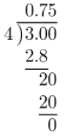
Divide 3 by 4. Write a decimal point and insert extra zeros in the dividend.
Texas Go Math Grade 7 Module 6 Answer Key 5
The result is 0.75.
Move the decimal point two places to the right and add the “%” sign.
0.75 = 75%
\(\frac{3}{4}\) = 75%

Go Math Grade 7 Module 6 Answer Key Question 2.
\(\frac{2}{5}\) ____________
Answer:
Divide 2 by 5. Write a decimal point and insert extra zeros in the dividend.
Texas Go Math Grade 7 Module 6 Answer Key 6
The result is 0.40.
Move the decimal point two places to the right and add the “%” sign.
0.40 = 40%
\(\frac{2}{5}\) = 40%

Question 3.
\(\frac{9}{10}\) ____________
Answer:
Divide 9 by 10. Write a decimal point and insert extra zeros in the dividend.
Texas Go Math Grade 7 Module 6 Answer Key 7
The result is 0.90.
Move the decimal point two places to the right and add the “%” sign.
0.90 = 90%
\(\frac{9}{10}\) = 90%

Question 4.
\(\frac{7}{20}\) ____________
Answer:
Divide 7 by 20. Write a decimal point and insert extra zeros in the dividend.
Texas Go Math Grade 7 Module 6 Answer Key 8
The result is 0.35.
Move the decimal point two places to the right and add the “%” sign.
0.35 = 35%
\(\frac{7}{20}\) = 35%

Grade 7 Go Math Module 6 Answer Key Question 5.
\(\frac{7}{8}\) ____________
Answer:
Divide 7 by 8. Write a decimal point and insert extra zeros in the dividend.
Texas Go Math Grade 7 Module 6 Answer Key 9
The result is 0.875.
Move the decimal point two places to the right and add the “%” sign.
0.875 = 87.5%
\(\frac{7}{8}\) = 87.5%

Question 6.
\(\frac{1}{20}\) ____________
Answer:
Divide 1 by 20. Write a decimal point and insert extra zeros in the dividend.
Texas Go Math Grade 7 Module 6 Answer Key 10
The result is 0.05.
Move the decimal point two places to the right and add the “%” sign.
0.05 = 5%
\(\frac{1}{20}\) = 5%

Question 7.
\(\frac{19}{25}\) ____________
Answer:
Divide 19 by 25. Write a decimal point and insert extra zeros in the dividend.
Texas Go Math Grade 7 Module 6 Answer Key 11
The result is 0.76.
Move the decimal point two places to the right and add the “%” sign.
0.76 = 76%
\(\frac{19}{25}\) = 76%

Question 8.
\(\frac{23}{50}\) ____________
Answer:
Divide 23 by 50. Write a decimal point and insert extra zeros in the dividend.
Texas Go Math Grade 7 Module 6 Answer Key 12
The result is 0.46.
Move the decimal point two places to the right and add the “%” sign.
0.46 = 46%
\(\frac{23}{50}\) = 46%

Find each difference.

Question 9.
1 – \(\frac{1}{5}\) ___________
Answer:
1 – \(\frac{1}{5}\) = \(\frac{5}{5}\) – \(\frac{1}{5}\) Write 1 as \(\frac{5}{5}\).
= \(\frac{5-1}{5}\) Subtract the numerators.
= \(\frac{4}{5}\)

Question 10.
1 – \(\frac{2}{9}\) ___________
Answer:
1 – \(\frac{2}{9}\) = \(\frac{9}{9}\) – \(\frac{2}{9}\) Write 1 as \(\frac{9}{9}\).
= \(\frac{9-2}{9}\) Subtract the numerators.
= \(\frac{7}{9}\)

Grade 7 Module 6 Answer Key Go Math Question 11.
1 – \(\frac{8}{13}\) ___________
Answer:
1 – \(\frac{8}{13}\) = \(\frac{13}{13}\) – \(\frac{8}{13}\) Write 1 as \(\frac{13}{13}\).
= \(\frac{13-8}{13}\) Subtract the numerators.
= \(\frac{5}{13}\)

Question 12.
1 – \(\frac{3}{20}\) ___________
Answer:
1 – \(\frac{3}{20}\) = \(\frac{20}{20}\) – \(\frac{3}{20}\) Write 1 as \(\frac{20}{20}\).
= \(\frac{20-3}{20}\) Subtract the numerators.
= \(\frac{17}{20}\)

Multiply. Write each product in simplest form.

Grade 7 Module 6 Answer Key Go Math Question 13.
\(\frac{8}{15}\) × \(\frac{5}{8}\) ___________
Answer:
\(\frac{8}{15}\) × \(\frac{5}{8}\) = \(\frac{8}{15}\) × \(\frac{5}{8}\) Divide numerators and denominators by the common factors.
= \(\frac{1}{3}\) × \(\frac{1}{1}\)
= \(\frac{1 \cdot 1}{3 \cdot 1}\)
= \(\frac{1}{3}\)

Question 14.
\(\frac{2}{9}\) × \(\frac{3}{4}\) ___________
Answer:
\(\frac{2}{9}\) × \(\frac{3}{4}\) = \(\frac{2}{9}\) × \(\frac{3}{4}\) Divide numerators and denominators by the common factors.
= \(\frac{1}{3}\) × \(\frac{1}{2}\)
= \(\frac{1 \cdot 1}{3 \cdot 2}\)
= \(\frac{1}{6}\)

Question 15.
\(\frac{9}{16}\) × \(\frac{12}{13}\) ___________
Answer:
\(\frac{9}{16}\) × \(\frac{12}{13}\) = \(\frac{9}{16}\) × \(\frac{12}{13}\) Divide numerators and denominators by the common factors.
= \(\frac{9}{4}\) × \(\frac{3}{13}\)
= \(\frac{9 \cdot 3}{4 \cdot 13}\)
= \(\frac{27}{52}\)

Module 6 Answer Key Go Math Grade 7 Question 16.
\(\frac{7}{10}\) × \(\frac{5}{28}\) ___________
Answer:
\(\frac{7}{10}\) × \(\frac{5}{28}\) = \(\frac{7}{10}\) × \(\frac{5}{28}\) Divide numerators and denominators by the common factors.
= \(\frac{1}{2}\) × \(\frac{1}{4}\)
= \(\frac{1 \cdot 1}{2 \cdot 4}\)
= \(\frac{1}{8}\)

Texas Go Math Grade 7 Module 6 Reading Start-Up Answer Key

Visualize Vocabulary

Use the ✓ words to complete the graphic.

Texas Go Math Grade 7 Module 6 Answer Key 1
Texas Go Math Grade 7 Module 6 Answer Key 2

Understand Vocabulary

Match the term on the left to the correct expression on the right.
Texas Go Math Grade 7 Module 6 Answer Key 3
Answer:
1. Compound event – an event made of two or more simple events.

2. Theoretical probability – the ratio of the number of equally likely outcomes in an event to the total number of possible outcomes.

3. Complement – the set of all outcomes that are not the desired event.

Active Reading
Two-Panel Flip Chart Create a two-panel flip chart, to help you understand the concepts in this module. Label one flap “Simple Events and the other flap “Compound Events’ As you study each lesson, write important ideas under the appropriate flap. Include information that will help you remember the concepts later when you look back at your notes.
Texas Go Math Grade 7 Module 6 Answer Key 4

Texas Go Math Grade 7 Module 6 Answer Key Theoretical Probability and Simulations Read More »

Texas Go Math Grade 7 Lesson 7.1 Answer Key Linear Relationships in the Form y = mx + b

Refer to our Texas Go Math Grade 7 Answer Key Pdf to score good marks in the exams. Test yourself by practicing the problems from Texas Go Math Grade 7 Lesson 7.1 Answer Key Linear Relationships in the Form y = mx + b.

Texas Go Math Grade 7 Lesson 7.1 Answer Key Linear Relationships in the Form y = mx + b

Texas Go Math Grade 7 Lesson 7.1 Explore Activity Answer Key

Discovering Linear Relationships

Many real-world situations can be described by linear relationships.

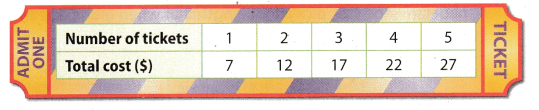
Jodie pays $5 per ticket for a play and a one-time $2 convenience fee. The table shows the total cost for different numbers of tickets.
Texas Go Math Grade 7 Lesson 7.1 Answer Key 1
A. Describe a pattern for the row showing the number of tickets bought.
B. Describe the pattern for the row showing total cost.
C. Out of the total cost paid, how much does the actual ticket account for?

Reflect

Question 1.
How much more than $5 does Jodie pay for one ticket? What if she buys 5 tickets? Explain.
Answer:
Jodie pays $2 more for one ticket. If she buys 5 tickets she will pay also $ 2 more because only at the first payment is charged $ 2.

Lesson 7.1 Modeling Linear Relationships Answer Key Question 2.
Analyze Relationships Describe the total amount paid in dollars based on the number of tickets.
Answer:
One ticket: 2 + 5= 7
Two tickets: 2 – 5 (2) = 12
Three tickets: 2 + 5 (3) = 17
Four tickets: 2 + 5 (4) = 22
Five tickets: 2 + 5 (5) = 27

One ticket cost $7.
Two tickets cost $12.
Three tickets cost $17.
Four tickets cost $ 22.
Five tickets $ 27.

Example 1

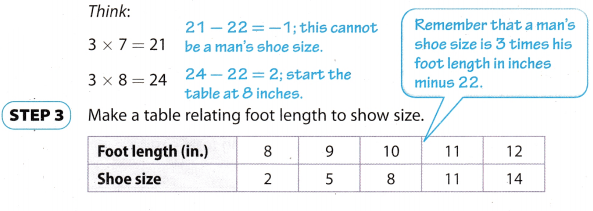
A man’s shoe size is approximately 3 times his foot length in inches minus 22. Use a table to represent the relationship between foot length and shoe size.

STEP 1: Make a table. Label the top row Foot length (in.) and the bottom row Shoe size.
STEP 2: Enter some foot lengths in inches. Since ¡t is impossible to have a negative shoe size, pick a foot length that when multiplied by 3 will be greater than 22.
Texas Go Math Grade 7 Lesson 7.1 Answer Key 2

Reflect

Question 3.
Analyze Relationships If someone had a foot length of 13 inches, how can you use the table to determine his shoe size?
Answer:
Multiply 13 by 3 and subtract 22 from that product
13 ∙ 3 = 39
39 – 22 = 17

Question 4.
Critical Thinking Foot lengths do not have to be whole numbers. Give an example of a non-whole number foot length you could have chosen when filling in the table and find the approximate shoe size. What should a person do if their foot length does not correspond to a whole or half shoe size? Explain.
Answer:
For example: Foot Length of 12A in.
12.4 ∙ 3 – 22 = 37.2 – 22 = 15.2
therefore, it will be chosen shoe with a size of 15.5.
Conclusion: If a number whose decimal is between 0 and 5 is obtained, then foot length corresponds to half shoe size, if a number whose decimal is between 5 and 9 is obtained then foot length corresponds to whole shoe size.

Your Turn

Go Math 7th Grade Answer Key Pdf Lesson 7.1 Question 5.
Lea’s house is 350 meters from her friend’s house. Lea walks to her friend’s house at a constant rate of 50 meters per minute. Use a table to represent the relationship between time and the distance Lea has left to walk to her friend’s house.
Texas Go Math Grade 7 Lesson 7.1 Answer Key 3
Answer:
At first divide 350 by 50.
Texas Go Math Grade 7 Lesson 7.1 Answer Key 15
In this way, we are calculated how many minutes she has to walk to the friend’s house with a constant rate of 50 meters per minute.
As we have five fields in the table for values of time and distance, divide 7 by 5.
Texas Go Math Grade 7 Lesson 7.1 Answer Key 16
The value of distance for each value of time in table we calculate as
Distance = 50 ∙ time
Texas Go Math Grade 7 Lesson 7.1 Answer Key 17
She has to walk 7 minutes.

Example 2

Luis will participate in a walkathon for charity. He received a pledge from his aunt, and the table shows the relationshipbetween the miles walked by Luis and the amount his aunt pledged.
Texas Go Math Grade 7 Lesson 7.1 Answer Key 4
Use the table to give a verbal description of the relationship between miles walked and amount pledged.
Texas Go Math Grade 7 Lesson 7.1 Answer Key 5
STEP 1: Look for patterns in the different values for miles walked and amount pledged.
Texas Go Math Grade 7 Lesson 7.1 Answer Key 6
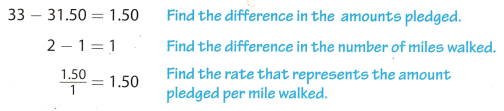
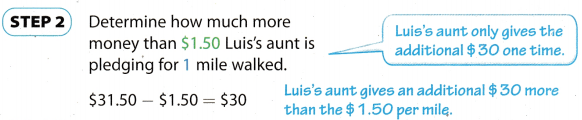
In the table, each value for the number of miles walked is 1 greater than the previous one, and each amount pledged is $1.50 greater than the previous one.
Texas Go Math Grade 7 Lesson 7.1 Answer Key 7
STEP 3: Give a verbal description for the relationship between the miles walked by Luis and amount of money pledged by his aunt.
Luis’s aunt pledged $30 plus an additional $1.50 for each mile he walks.

Reflect

Question 6.
Make a Prediction How could you find the amount pledged by Luis’s aunt if Luis walks 7 miles? What is the amount pledged?
Answer:
If Luis walks 7 miles the amount of pledged will be:
37.5 + 1.5 (2)
= $40.5
If Luis walks 7 miles the amount of pledged will be $ 40.5.

Texas Go Math Grade 7 Linear Functions Answer Key Question 7.
What If…? Luis’s mother decides to also pledge $15 plus an additional $3 per mile. If Luis wants to earn the same amount from his mother and his aunt, how far must he walk? What is the amount he will earn?
Answer:
For aunt:
Texas Go Math Grade 7 Lesson 7.1 Answer Key 18
For mother:
Texas Go Math Grade 7 Lesson 7.1 Answer Key 19
He has to walk 10 miles to earn $45.

Your Turn

The relationship between the cost of an online advertisement for a movie and the number of times it is clicked on is shown in the table.

Question 8.
Use the table to give a verbal description of the relationship.
Texas Go Math Grade 7 Lesson 7.1 Answer Key 8
Answer:
To buy an online advertisement for a movie you will pay $150 plus an additional $ 0.5 for every tenth click.

Question 9.
What is the cost for the advertisement if it is clicked 1000 times?
Answer:
An online advertisement for a movie if it is clicked 1000 times will cost:
150 + 0.5 (1000)
= 150 + 500
= $650
An online advertisement for a movie if it is clicked 1000 times will cost $ 650.

Question 10.
Is there a lower limit for the number of clicks? Is there an upper limit? Explain.
Answer:
For every ten clicks, we’re paying half a dollar, dividing that half-dollar difference from 10 to get a one-click cost.
\(\frac{0.5}{10}\) = 0.05
The upper limit does not exist because each click increases the price.

Texas Go Math Grade 7 Lesson 7.1 Guided Practice Answer Key

Question 1.
The age of a cat 2 years or older can be approximately converted into human years by multiplying by 4 and adding 16. Use a table to represent the relationship between cat age and human years. (Example 1)
Label the rows of the table.
Choose numbers to represent the ages of the cat. Choose numbers that are 2 or greater, since the relationship described is only for cats 2 years or older.
Complete the table by calculating the value for Human years based on the description.
Texas Go Math Grade 7 Lesson 7.1 Answer Key 9
Answer:
Texas Go Math Grade 7 Lesson 7.1 Answer Key 20
Let X represent the age of a cat, and Y represent human years. To find human years we are solving the equation:
X ∙ 4 + 16 = Y

Go Math Grade 7 Lesson 7.1 Answer Key Question 2.
The yearly cost of a community college based on the number of credits taken is shown in the table. Use the table to give a verbal description of the relationship between credits and cost. (Explore Activity and Example 2)
Texas Go Math Grade 7 Lesson 7.1 Answer Key 10
STEP 1: Look for patterns in the different values for credits and cost.
Each value for credits is _________ greater than the previous one,
and each value for cost is _________ greater than the previous one.
This means that 1 credit corresponds to _________ in cost.

STEP 2: Determine how many more dollars than _________ that it costs to take 3 credits.
It costs _________ – _________ = _________ more than _________ to take 3 credits.

STEP 3: Give a verbal description for the relationship between credits and cost.
The yearly cost of the community college is _________ plus _________ for each credit taken.
Answer:
Each value for credits is 3 greater than the previous one.
Each value for cost is $75 greater than the previous one.
This mean one credit correspond to $25 in cost.

Determine how many more dollars than $75 that it costs to take 3 credits.
It cost 175 – 75 = $100 more than $75 to take 3 credits.

The yearly cost of community college is $100 plus $25 for each credit taken.

Essential Question Check-In

Question 3.
When using tables and verbal descriptions to describe a linear relationship, why is it useful to convert from one to another?
Answer:
Because in this way a connection is established and it is clearly explained how the connection has developed between them. It can be concluded quite a lot in case we know the value of one size and its relationship with another to accurately calculate the value of the other.

Texas Go Math Grade 7 Lesson 7.1 Independent Practice Answer Key

A teacher is making multiple copies of a 1 -page homework assignment. The time it takes her in seconds is 2 times the number of copies she makes plus 3.
Question 4.
What does the 3 represent in this scenario? What does the 2 represent?
Answer:
This scenario we can represent with next equation:
y = 2 ∙ x + 3
Therefore when we look general form y = m ∙ x + b, in our equation m = 2 and b = 3.

Texas Go Math Grade 7 Answers Lesson 7.1 Practice Answers Question 5.
What is the total number of seconds it takes for the teacher to make 1 copy? 2 copies? 3 copies? By how many seconds does the total time increase for each copy?
Answer:
For one copy: x = 1
y = 2 (1) + 3
y = 5
For two copies: x = 2
y = 2 (2) + 3
y = 7
For three copies: x = 3
y = 2 (3) + 3
y = 9
For each subsequent copy, it takes two seconds more.

Question 6.
Represent Real-World Problems Represent the relationship between the number of copies made and time in seconds in the table below.
Texas Go Math Grade 7 Lesson 7.1 Answer Key 11
Answer:
The equation is: y = 2 ∙ x + 3, where y represent seconds and x represent number of copies
Texas Go Math Grade 7 Lesson 7.1 Answer Key 21

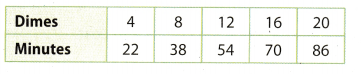
Rosalee parks at a metered space that still has some time left. She adds some dimes to the meter. The table below represents the number of minutes left based on the number of dimes inserted into the meter.
Texas Go Math Grade 7 Lesson 7.1 Answer Key 12
Question 7.
How many minutes does 1 dime correspond to?
Answer:
First find the difference between the adjacent values expressed in minutes
38 – 22 = 16
Divide the result by 4.
\(\frac{16}{4}\) = 4
It takes 4 minutes for 1 dime.

Question 8.
Based on your answer to exercise 7, how many minutes should you receive for inserting 4 dimes?
Answer:
You should receive 4 ∙ 4 = 16 minutes

Question 9.
Analyze Relationships Give a verbal description of the relationship between dimes and the number of minutes left on the meter.
Answer:
Rosalee has 6 minutes left for parking plus an additional 4 minutes for each dime she adds.

Question 10.
Look at your answer for exercise 9. What does each of the numbers in the answer represent?
Answer:
If we Look at the equation y = m ∙ x + b, for our example m = 16, b = 6, y represent how many minutes left for parking space and x represents how meny dimes are added.

The cost in dollars of a loaf of bread in a bakery is equal to 2 minus 0.25 times the number of days since it was baked.
Question 11.
What is different about this description compared to most of the other descriptions you have seen in this lesson?
Answer:
The difference is that in our exercises it was mostly an increase for a certain value.
More precisely, we added a new value to the initial value, while in this case we deduct some value from the value.

Question 12.
Make a Conjecture Is there a point at which the linear relationship between days and dollars no longer makes sense?
Answer:
Equation is: y = 2 – 0.25 ∙ x
8 days after being baked, the Linear relationship between days and dollars no longer makes sense, because:
y = 2 – 0.25 ∙ 8 = 2 – 2 = 0
y represent the cost in dollars of a loaf of bread and x represent a number of days since it was baked.

7th Grade Go Math Lesson 7.1 Homework Answers Question 13.
Represent Real-World Problems Represent the relationship between days and dollars in the table below.
Texas Go Math Grade 7 Lesson 7.1 Answer Key 13
Answer:
Texas Go Math Grade 7 Lesson 7.1 Answer Key 22
y = 2 – 0.25 ∙ x

Question 14.
Find the number of days it will take the price to reach $0.25.
Answer:
In that case y = 0.25
Replace this in equation y = 2 – 0.25 ∙ x
y = 2 – 0.25 ∙ x
0.25 = 2 – 0.25 ∙ x Subtract 2 from each side.
0.25 – 2 = 2 – 0.25 ∙ x – 2
– 1.75 = 0.25 ∙ x Divide both sides by -0.25
\(\frac{-1.75}{-0.25}\) = x
7 = x
It will take 7 days for a price to reach $ 0.25.

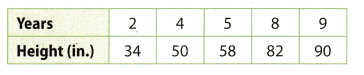
The relationship between the number of years since a tree was transplanted and its height in inches is shown in the table.
Texas Go Math Grade 7 Lesson 7.1 Answer Key 14
Question 15.
What is different about this table compared to the other tables you have seen in this lesson?
Answer:
In this table, there is no constant increase between the values for the variable x, while in each preceding case, we had the same increase for the value of the variable x. In this case, x represents the number of years.

Question 16.
Analyze Relationships Can you give a description of the relationship between the years since the tree was transplanted and its height in inches? If so, what is it?
Answer:
The tree had a height of 18 in. before it was transplanted and plus an additional 8 in. for each year that follows.

H.O.T. Focus on Higher Order Thinking

Question 17.
Communicate Mathematical Ideas Suppose you are analyzing the relationship between time and distance given in a table, and there are 4 values for each quantity. You divide distance 2 minus distance 1 by time 2 minus time 1. You then divide distance 4 minus distance 3 by time 4 minus time-3 and get a different answer. What can you say about the relationship? Explain.
Answer:
If you get different answers that means its not about equal distance or time given in the table, as in exercise 15.

Question 18.
Persevere in Problem-Solving There is a linear relationship between a salesperson’s sales and her weekly income. If her sales are $200, her income is $500, and if her sales are $1,200, her income is $600. What is the relationship between sales and income?
Answer:
The relationship between sales and income is given by the equation
y = \(\frac{1}{10}\) ∙ x + 480
where y represents sales, and x represents income.

Question 19.
Critique Reasoning Molly orders necklace kits online. The cost of the necklace kits can be represented by a linear relationship. Molly’s order of 3 kits cost $12.50. Another order of 5 kits cost $17.50. Molly decides that the kits cost $5 each. Is she correct? Explain.
Answer:
Equation: y = \(\frac{5}{2}\) ∙ x + 5
The procedure for obtaining this equation 5: First find the difference between the number of necklaces in these orders 5 – 3 = 2.
Then find the difference between the prices 17.5 – 12.5 = 5
Divide this two values \(\frac{5}{2}\) = 2.5
That much costs one necklace kits
The kits cost $ 2.5 each. Molly’s answer is not correct.

Texas Go Math Grade 7 Lesson 7.1 Answer Key Linear Relationships in the Form y = mx + b Read More »

Texas Go Math Grade 7 Lesson 5.2 Answer Key Experimental Probability of Simple Events

Refer to our Texas Go Math Grade 7 Answer Key Pdf to score good marks in the exams. Test yourself by practicing the problems from Texas Go Math Grade 7 Lesson 5.2 Answer Key Experimental Probability of Simple Events.

Texas Go Math Grade 7 Lesson 5.2 Answer Key Experimental Probability of Simple Events

Texas Go Math Grade 7 Lesson 5.2 Explore Activity Answer Key

Finding Experimental Probability

You can toss a paper cup to demonstrate experimental probability.
A. Consider tossing a paper cup. Fill in the Outcome column of the table with the three different ways the cup could land.
Texas Go Math Grade 7 Lesson 5.2 Answer Key 1
B. Toss a paper cup twenty times. Record your observations in the table.

Reflect

Question 1.
Which outcome do you think is most likely?
Answer:
The most likely outcome is the one that happens most often.

Go Math Grade 7 Lesson 5.2 Answer Key Question 2.
Describe the three outcomes using the words likely and unlikely.
Answer:
Outcome – Open-ended up an experiment is unlikely;
Outcome – open-end down is unlikely;
Outcome – its side is likely.

Question 3.
Use the number of times each event occurred to calculate the probability of each event.
Answer:
Texas Go Math Grade 7 Lesson 5.2 Answer Key 9
P (open-end up) = \(\frac{4}{20}\)
P (open-end down) = \(\frac{4}{20}\)
P (on its side) = \(\frac{4}{20}\)

Question 4.
What do you think would happen if you performed more trials?
Texas Go Math Grade 7 Lesson 5.2 Answer Key 2
Answer:
Probability will slowly approximate.

Question 5.
What is the sum of the three probabilities in the table?
Answer:
The sum of the three probabilities is:
\(\frac{3}{20}\) + \(\frac{4}{20}\) + \(\frac{13}{20}\) = 1

Example 1

Martin has a bag of marbles. He removed one marble, recorded the color, and then placed it back in the bag. He repeated this process several times and recorded his results in the table. Find the probability of drawing each color. Write your answers in the simplest form.
Texas Go Math Grade 7 Lesson 5.2 Answer Key 3
A. Number of trials = 50
B. Complete the table of experimental probabilities. Write each answer as a fraction in simplest form.
Texas Go Math Grade 7 Lesson 5.2 Answer Key 4

Reflect

Lesson 5.2 Probability of Simple Events Answer Key Question 6.
What are two different ways you could find the experimental probability of the event that you do not draw a red marble?
Answer:
P(red) = \(\frac{6}{25}\)
P(blue) = \(\frac{1}{5}\)
P(green) = \(\frac{3}{10}\)
P(yellow) = \(\frac{13}{50}\)
First Way
The sum of the probabilities of an event and ¡ts complement equals 1
P(event) + P(complement) = 1
P(red) + P(not red) = 1 Substitute \(\frac{6}{25}\) for P(red).
\(\frac{6}{25}\) + P(not red) = 1 Subtract \(\frac{6}{25}\) from both sides.
P(not red) = 1 – \(\frac{6}{25}\)
P(not red) = \(\frac{19}{25}\)
The probability of not drawing a red marble is \(\frac{19}{25}\).

Second Way
The probability of not drawing a red marble equals the probability of drawing a marble of any other color.

Since we have 3 other colors, the probability of drawing a marble of any other color is the sum of the probabilities of drawing each one of them.

P(not red) = P(blue) + P(green) + P(yellow) Substitute \(\frac{1}{5}\) for P(blue), \(\frac{3}{10}\) for P(green), and \(\frac{13}{50}\).
P(not red) = \(\frac{1}{5}+\frac{3}{10}+\frac{13}{50}\)
P(not red) = \(\frac{1 \cdot 10+3 \cdot 5+13}{50}\)
P(not red) = \(\frac{38}{50}\)
P(not red) = \(\frac{19 \cdot 2}{25 \cdot 2}\)
P(not red) = \(\frac{19}{25}\)
The probability of not drawing a red marble is \(\frac{19}{25}\).

Your Turn

Question 7.
A spinner has three unequal sections: red, yellow, and blue, The table shows the results of Nolan’s spins. Find the experimental probability of landing on each color. Write your answers in the simplest form.
Texas Go Math Grade 7 Lesson 5.2 Answer Key 5
Answer:
The number of trials is the sum of frequencies.
Total number of trials is = 10 + 14 + 6 = 30
P(red color) = Texas Go Math Grade 7 Lesson 5.2 Answer Key 10 Substitute 10 for frequency of the event, and 30 for total number of trials.
P(red color) = \(\frac{10}{30}\)
P(red color) = \(\frac{1 \cdot 10}{3 \cdot 10}\)
P(red color) = \(\frac{1}{3}\)

P(yellow color) = Texas Go Math Grade 7 Lesson 5.2 Answer Key 10 Substitute 14 for frequency of the event, and 30 for total number of trials.
P(yellow color) = \(\frac{14}{30}\)
P(yellow color) = \(\frac{7 \cdot 2}{15 \cdot 2}\)
P(yellow color) = \(\frac{7}{15}\)

P(blue color) = Texas Go Math Grade 7 Lesson 5.2 Answer Key 10 Substitute 6 for frequency of the event, and 30 for total number of trials.
P(yellow color) = \(\frac{6}{30}\)
P(yellow color) = \(\frac{1 \cdot 6}{5 \cdot 6}\)
P(yellow color) = \(\frac{1}{5}\)

Experimental Probability Answer Key Go Math Lesson 5.2 Question 8.
A toy machine has equal numbers of red, white, and blue rubber balls. Ross wonders which color ball will come out of the machine next. Describe how you can use a standard number cube to model this situation. Then use a simulation to predict the color of the next ball.
Answer:
The standard cube has six sides marked with numbers 1, 2, 3, 4, 5, 6. If the numbers 1 and 2 come up, the red ball is released, 3 or 4 comes out white and 4 or 5 turns out blue.
Let’s throw the cube 10 times and we’ll make numbers:
6, 5, 5, 4, 5, 2, 3, 1, 2, 4
It means it will. come out 4 blue, 3 white, and 3 red balls.
Therefore, you can predict that the blue ball has the most of chance coming out.

Texas Go Math Grade 7 Lesson 5.2 Guided Practice Answer Key

Question 1.
Toss a coin at least 20 times. (Explore Activity and Example 1)
Texas Go Math Grade 7 Lesson 5.2 Answer Key 6
a. Record the results in the table.
Answer:
Texas Go Math Grade 7 Lesson 5.2 Answer Key 11
P (flip a head) = \(\frac{2}{5}\)
P (flip a tails) = \(\frac{3}{5}\)

b. What do you think would happen if you performed more trials?
Answer:
Probabilities will be the same.

Question 2.
Rachel’s free-throw average for basketball is 60%. Describe how you can use 10 index cards to model this situation. Then use a simulation to predict how many times in the next 50 tries Rachel will make a free throw. (Example 2).
Answer:
Let the cards be marked with numbers from 1 to 10. Let numbers 1, 2, 3, 4, 5, 6 represent that free-throw is on average, while numbers 7, 8, 9, lO, and the free-throw was beLow the average.

Let’s draw one card, we’ll record the number that we have and return it again Let’s repeat this 50 times
4, 7, 5, 6, 8, 5, 4, 2, 1, 1, 1, 9, 7, 10, 10, 6, 3, 4, 4, 5, 7, 8, 2, 1, 5, 8, 4, 10, 2, 2, 6, 7, 7, 5, 4, 1, 3, 2, 2, 2, 6, 7, 10, 3, 5, 9, 7, 4, 4, 1
Rachel will make a free throw 34 times.

Essential Question Check-In

Question 3.
Essential Question Follow Up How do you find the experimental probability of a simple event?
Answer:
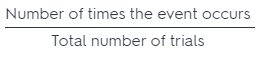
Experimental probability is a value of number of time the event occurs divided by total number of trials.

Texas Go Math Grade 7 Lesson 5.2 Independent Practice Answer Key

Question 4.
Dree rolls a strike in 6 out of the 10 frames of bowling. What is the experimental probability that Dree will roll a strike in the first frame of the next game? Explain why a number cube would not be a good way to simulate this situation.
Answer:
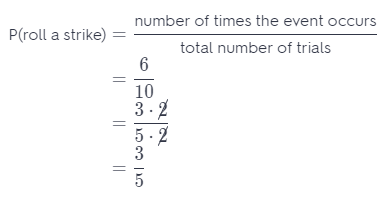
P (roll a strike) = Texas Go Math Grade 7 Lesson 5.2 Answer Key 12
The experimental probability that Dree will roll a strike in the first frame of the next game is \(\frac{3}{5}\).

The cube is not good for presenting this situation because we have the probability of achieving the goal of \(\frac{3}{5}\), so three numbers would be marked as winnings, two that were not, and with the remaining number would have no meaning.

Texas Go Math Grade 7 Answer Key Lesson 5.2 Probability Question 5.
To play a game, you spin a spinner like the one shown. You win if the arrow lands in one of the areas marked “WIN”. Lee played this game many times and recorded her results. She won 8 times and lost 40 times. Use Lee’s data to explain how to find the experimental probability of winning this game.
Texas Go Math Grade 7 Lesson 5.2 Answer Key 7
Answer:
Texas Go Math Grade 7 Lesson 5.2 Answer Key 13
P (lend on “WIN”) = \(\frac{1}{6}\)

Question 6.
Critique Reasoning A meteorologist reports an 80% chance of precipitation. Is this an example of experimental probability, written as a percent? Explain your reasoning.
Answer:
80% = \(\frac{80}{100}\) = \(\frac{4}{5}\)
This is the experimental probability because when we translate it into a fraction, it actually means that 4 out of 5 days will be precipitation.

Question 7.
The names of the students in Mr. Hayes’ math class are written on the board. Mr. Hayes writes each name on an index card and shuffles the cards. Each day he randomly draws a card, and the chosen student explains a math problem on the board. What is the probability that Ryan is chosen today? What is the probability that Ryan is not chosen today?
Texas Go Math Grade 7 Lesson 5.2 Answer Key 8
Answer:
Texas Go Math Grade 7 Lesson 5.2 Answer Key 14
P (Ryan is chosen) = \(\frac{1}{20}\)
P (Ryan is not chosen) = \(\frac{19}{20}\)

Probability Grade 7 Pdf Lesson 5.2 Answer Key Question 8.
Mica and Joan are on the same softball team. Mica got 8 hits out of 48 times at bat, while Joan got 12 hits out of 40 times at bat. Who do you think is more likely to get a hit her next time at bat? Explain.
Answer:
Texas Go Math Grade 7 Lesson 5.2 Answer Key 15
Is more likely that Joan get a hit because \(\frac{1}{6}\) < \(\frac{3}{10}\).

Question 9.
Make a Prediction In tennis, Gabby serves an ace, a ball that can’t be returned, 4 out of the 10 times she serves. What is the experimental probability that Gabby will serve an ace on the first serve of the next game? Make a prediction about how many aces Gabby will make on her next 40 serves. Justify your reasoning.
Answer:
Texas Go Math Grade 7 Lesson 5.2 Answer Key 16
The probability that Gabby will serve an ace is \(\frac{2}{5}\).
You can predict that she will serve an ace about 16 times out of 40.

H.O.T. Focus on Higher Order Thinking

Question 10.
Represent Real-World Problems Patricia finds that the experimental probability of her dog wanting to go outside between 4 p.m. and 5 p.m. is \(\frac{7}{12}\) About what percent of the time does her dog not want to go out between 4 p.m. and 5 p.m.?
Answer:
P (dog wanting to go outside) = \(\frac{7}{12}\)
P (dog not want to go outside) = 1 – P (dog wanting to go outside) = 1 – \(\frac{7}{12}\) = \(\frac{12}{12}\) – \(\frac{7}{12}\) = \(\frac{5}{12}\)
Use proportion.
Texas Go Math Grade 7 Lesson 5.2 Answer Key 17
About 41.7 % her dog not want to go out between 4 p.m. and 5 p.m.

Question 11.
Critique Reasoning Talia tossed a penny many times; she got 40 heads and 60 tails. She said the experimental probability of getting heads was \(\frac{40}{60}\). Explain the error and correct the experimental probability.
Answer:
She actually tossed the coin 100 times and out of 100 she got 40 heads and 60 tails.
P (getting heads) = Texas Go Math Grade 7 Lesson 5.2 Answer Key 18
P (getting heads) = \(\frac{2}{5}\)

Lesson 5.2 Answer Key 7th Grade Experimental Probability Question 12.
Communicate Mathematical Ideas A high school has 438 students, with about the same number of males as females. Describe a simulation to predict how many of the first 50 students who leave school at the end of the day are female.
Answer:
P (student is a female) = Texas Go Math Grade 7 Lesson 5.2 Answer Key 19
Have 25 red and 25 blue balls in the basket. If we choose a red ball, a female student comes out, otherwise a male student comes out.

Question 13.
Critical Thinking For a scavenger hunt, Chessa put one coin in each of 10 small boxes. Four coins are quarters, 4 are dimes, and 2 are nickels. How could you simulate choosing one box at random? What problem would there be if you planned to put these coins in your pocket and pick one?
Answer:
In the box are 10 balls, 4 blue, 4 white and 2 green. We choose randomly one ball If the ball is blue, we select one of the boxes in which the dimes are, if the ball is white, we select one of the boxes with quarter and if the ball is green we select one of the boxes with nickle.

If you put all the coins in your pocket then the probability will be equal for each coin.

Texas Go Math Grade 7 Lesson 5.2 Answer Key Experimental Probability of Simple Events Read More »

Texas Go Math Grade 7 Module 5 Quiz Answer Key

Refer to our Texas Go Math Grade 7 Answer Key Pdf to score good marks in the exams. Test yourself by practicing the problems from Texas Go Math Grade 7 Module 5 Quiz Answer Key.

Texas Go Math Grade 7 Module 5 Quiz Answer Key

Texas Go Math Grade 7 Module 5 Ready to Go On? Answer Key

5.1 Probability

Question 1.
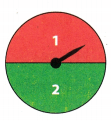
Josue tosses a coin and spins the spinner at the right. What are all the possible outcomes? __________________
Texas Go Math Grade 7 Module 5 Quiz Answer Key 1
Answer:
The possible outcomes are;
1. head and section 1 (red);
2. head and section 2 (green);
3. tails and section 1 (red);
4. tails and section 2 (green).

5.2 Experimental Probability of Simple Events

Grade 7 Module 5 Answer Key Go Math Question 2.
While bowling with friends, Brandy rolls a strike in 6 out of 10 frames. What is the experimental probability that Brandy will roll a strike in the first frame of the next game?
Answer:
Texas Go Math Grade 7 Module 5 Quiz Answer Key 6
The experimental probability that Brandy will roll a strike in the first frame of the next game is \(\frac{3}{5}\)

Question 3.
Ben is greeting customers at a music store. Of the first 20 people he sees enter the store, 13 are wearing jackets and 7 are not. What is the experimental probability that the next person to enter the store will be wearing a jacket?
Answer:
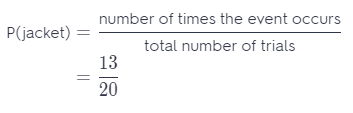
Texas Go Math Grade 7 Module 5 Quiz Answer Key 7
The experimental probability that the next person to enter the store will be wearing a jacket is \(\frac{13}{20}\).

5.3 Experimental Probability of Compound Events

Question 4.
Auden rolled two number cubes and recorded the results.
Texas Go Math Grade 7 Module 5 Quiz Answer Key 2
What is the experimental probability that the sum of the next two numbers rolled is more than 5?
Answer:
From the table we see that the number of times of event occurs is 3 (roll#2, roll#6, and roll#7).
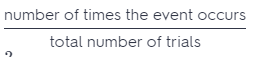
P(the sum > 5) = Texas Go Math Grade 7 Module 5 Quiz Answer Key 8
= \(\frac{3}{7}\)
The experimental probability that the sum of the next two numbers rolled is more than 5 is \(\frac{3}{7}\).

5.4 Making Predictions with Experimental Probability

Module 5 Test Answers Go Math Grade 7 Quiz Question 5.
A player on a school baseball team reaches first base \(\frac{3}{10}\) of the time he is at bat. Out of 80 times at bat, about how many times would you predict he will reach first base?
Answer:
Use a percent equation.
Find \(\frac{3}{10}\) (30%) of 80.
Write 30% as a fraction. The percent equation will be
x = \(\frac{3}{100}\) ∙ 80 Write fraction as decimal.
= 0.3 ∙ 80 Multiply.
= 24
About 24 times player will reach first base.

Essential Question

Question 6.
How is experimental probability used to make predictions?
Answer:
Experimental probability is comparing the number of times the event occurs to the total number of trials Based on its name, experimentaL, this is the actual result of an experiment done. This is often used for small events which could be done through various trials. One example is when you want to determine the probability of getting a head or a tail when you flip a coin. In experimental probability, you could conduct a trial of flipping a coin 50 times.

The result will be the experimental probability.

Texas Go Math Grade 7 Module 5 Mixed Review Texas Test Prep Answer Key

Selected Response

Question 1.
A frozen yogurt shop offers scoops in cake cones, waffle cones, or cups. You can get vanilla, chocolate, strawberry, pistachio, or coffee-flavored frozen yogurt. If you order a single scoop, how many outcomes are in the sample space?
(A) 3
(B) 5
(C) 8
(D) 15
Answer:
(D) 15

Explanation:
There are 5 flavors of yogurt (vanilla, chocolate, strawberry, pistachio, coffee).
There are 3 ways to serve yogurt (cake cones, waffle cones, cups).
Hence, the sample space is 3 × 5 = 15.

Probability of Compound Events Quiz Grade 7 Question 2.
A bag contains 7 purple beads, 4 blue, beads, and 4 pink beads. What is the probability of not drawing a pink bead?
(A) \(\frac{4}{15}\)
(B) \(\frac{7}{15}\)
(C) \(\frac{8}{15}\)
(D) \(\frac{11}{15}\)
Answer:
(D) \(\frac{11}{15}\)

Explanation:
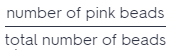
P(pink bead) = Texas Go Math Grade 7 Module 5 Quiz Answer Key 9
P(pink bead) = \(\frac{4}{15}\)
The sum of the probabilities of an event and its complement equals 1
P(event) + P(complement) = 1
P(pink bead) + P(not pink bead) = 1 Substitute \(\frac{4}{15}\) for P(pink bead)
\(\frac{4}{15}\) + P(not pink bead) = 1 Subtract \(\frac{4}{15}\) from both sides
P(not pink bead) = 1 – \(\frac{4}{15}\)
P(not pink bead) = \(\frac{11}{15}\)

Question 3.
During the month of June, Ava kept track of the number of days she saw birds in her garden. She saw birds on 18 days of the month. What is the experimental probability that she will see birds in her garden on July 1?
(A) \(\frac{1}{18}\)
(B) \(\frac{2}{5}\)
(C) \(\frac{1}{2}\)
(D) \(\frac{3}{5}\)
Answer:
(D) \(\frac{3}{5}\)

Explanation:
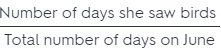
P (Ava saw birds) = Texas Go Math Grade 7 Module 5 Quiz Answer Key 10 = \(\frac{18}{30}\) = \(\frac{3}{5}\)
The probability that she will see birds on July 1 is \(\frac{3}{5}\)

Go Math Module 5 Quiz Answers Grade 7 Question 4.
A rectangle has a width of 4 inches and a length of 6 inches. A similar rectangle has a width of 12 inches. What is the length of a similar rectangle?
(A) 8 inches
(B) 12 inches
(C) 14 inches
(D) 18 inches
Answer:
(D) 18 inches

Explanation:
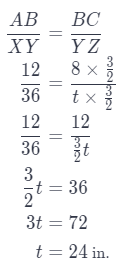
The rectangles are similar, hence, they have corresponding sides.
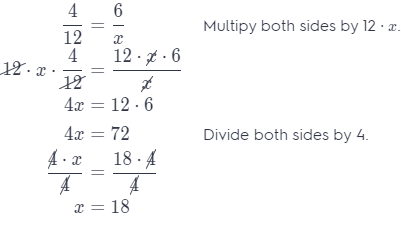
Write the proportion of the corresponding sides.
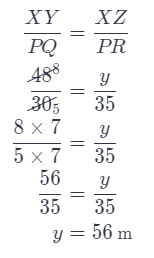
Texas Go Math Grade 7 Module 5 Quiz Answer Key 11
The Length of rectangle is 18 inches.

Question 5.
The experimental probability of hearing thunder on any given day in Ohio is 30%. Out of 600 days, on about how many days can Ohioans expect to hear thunder?
(A) 90 days
(B) 180 days
(C) 210 days
(D) 420 days
Answer:
(B) 180 days

Explanation:
Find 30% of 600.
Write 30% as a fraction. The percent equation will. be
x = \(\frac{30}{100}\) ∙ 600 Write fraction as decimal
= 0.3 ∙ 600 Multiply.
= 180
Ohioans can expect to hear thunder about 180 days out of 600 days

Go Math Grade 7 Module 5 Answer Key Question 6.
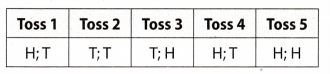
Isidro tossed two coins several times and then recorded the results in the table below.
Texas Go Math Grade 7 Module 5 Quiz Answer Key 3
What is the experimental probability that both coins will land on the same side on Isidro’s next toss?
(A) \(\frac{1}{5}\)
(B) \(\frac{2}{5}\)
(C) \(\frac{3}{5}\)
(D) \(\frac{4}{5}\)
Answer:
(B) \(\frac{2}{5}\)

Explanation:
Total number of trials is 5: HT, TT, TH, HT, HH
N umber of time he tossed a same side on both coins is 2: TT, HH
Therefore, experimental probability that both of coins Land on same side in next toss is:
P (on both coins are same side) = Texas Go Math Grade 7 Module 5 Quiz Answer Key 12 = \(\frac{2}{5}\)
Experimental probability that both of coins land on same side in next toss is \(\frac{2}{5}\)

Gridded Response

Module 5 Grade 7 Answer Key Go Math Question 7.
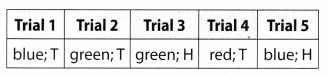
Magdalena had a spinner that was evenly divided into sections of red, blue, and green. She spun the spinner and tossed a coin several times. The table below shows the results.
Texas Go Math Grade 7 Module 5 Quiz Answer Key 4
Given the results, what is the experimental probability of spinning blue? Write an answer as a decimal.
Texas Go Math Grade 7 Module 5 Quiz Answer Key 5
Answer:
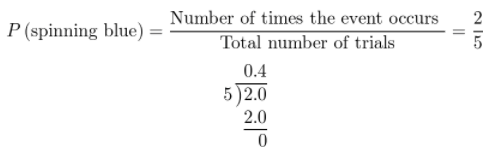
Total number of trials is 5.
The number of spinning blue is 2: blue-T, blue-H
Texas Go Math Grade 7 Module 5 Quiz Answer Key 13
The experimental probability of spinning blue is 0.4.

Texas Go Math Grade 7 Module 5 Quiz Answer Key Read More »

Texas Go Math Grade 7 Lesson 4.4 Answer Key Ratios and Pi

Refer to our Texas Go Math Grade 7 Answer Key Pdf to score good marks in the exams. Test yourself by practicing the problems from Texas Go Math Grade 7 Lesson 4.4 Answer Key Ratios and Pi.

Texas Go Math Grade 7 Lesson 4.4 Answer Key Ratios and Pi

Texas Go Math Grade 7 Lesson 4.4 Explore Activity Answer Key

Exploring Circumference
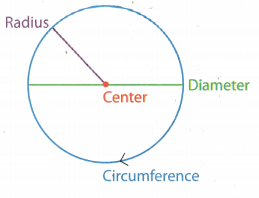
A circle is a set of points in a plane that are a fixed distance from the center.

A radius is a line segment with one endpoint at the center of the circle and the other endpoint on the circle. The length of a radius is called the radius of the circle.

A diameter of a circle is a line segment that passes through the center of the circle and whose endpoints lie on the circle. The length of the diameter is twice the length of the radius. The length of a diameter is called the diameter of the circle.

The circumference of a circle is the distance around the circle.
Texas Go Math Grade 7 Lesson 4.4 Answer Key 1
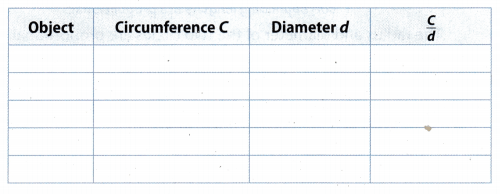
A. Use a measuring tape to find the circumference of five circular objects. Then measure the distance across each item to find its diameter. Record the measurements of each object in the table below.
Texas Go Math Grade 7 Lesson 4.4 Answer Key 2

B. Divide the circumference of each object by its diameter. Round your answer to the nearest hundredth.

Reflect

Question 1.
Make a Conjecture Describe what you notice about the ratio \(\frac{C}{d}\) in your table.
Answer:
All, ratios when calculated are approximately 3.14.

Question 2.
In every circle, what is the ratio of the radius to the diameter? What is the ratio of the circumference to the diameter?
Answer:
In every circle, the ratio of the radius to the diameter is 1 : 2
The ratio of the circumference to the diameter is π

Go Math Lesson 4.4 7th Grade Answer Key Question 3.
Draw Conclusions Based on the ratios of the radius to diameter and circumference to diameter, are all circles proportional? Is the ratio of circumference to the diameter of any circle the same for all circles?
Answer:
Yes, all circles are proportional based on the ratios of the radius to diameter and circumference to diameter.
The ratio of circumference to the diameter of any circle will be equal to π and the same for all circles.

Your Turn

Question 4.
Determine if the radius and diameter of the two circles are proportional.
Texas Go Math Grade 7 Lesson 4.4 Answer Key 3
Answer:
Find the radius and diameter of each circle
First circle:
r1 = 8 ft
d1 = 2 × r= 2 × 8= 16 ft
Second Circle:
d2 = 9 ft
r2 = d ÷ 2 = 9 ÷ 2 = 4.5 ft
Set up a proportion using the corresponding lengths of the radius and diameter
Texas Go Math Grade 7 Lesson 4.4 Answer Key 7
The radius and diameter of the two circles are proportional.

Go Math Answer Key Grade 7 Lesson 4.4 Question 5.
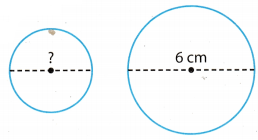
The circumference of the larger circle is approximately 44 meters and the circumference of the smaller circle is approximately 11 meters. Use a proportion to find the approximate
diameter of the smaller circle.__________
Texas Go Math Grade 7 Lesson 4.4 Answer Key 4
Answer:
C2 = 44 m
C1 = 11 m
d2 = 14 m
Set up a proportion using the given information for the larger and smaller circles.
Texas Go Math Grade 7 Lesson 4.4 Answer Key 8

Texas Go Math Grade 7 Lesson 4.4  Guided Practice Answer Key

Fill in the blanks. (Explore Activity)

Question 1.
Vocabulary In any circle, the ratio of the ___________ to the diameter is pi.
Answer:
In any circle, the ratio of the circumference to the diameter is pi.

Question 2.
Vocabulary In any circle, the ratio of the ____________ radius is 2.
Answer:
In any circle, the ratio of the diameter to the radius is 2.

Question 3.
You can use the decimal number ________ or the fraction ______ as an approximation for pi.
Answer:
You can use the decimal number 3.14 or the fraction \(\frac{C}{d}\) as an approximation for pi.

Circles and Ratios 7th Grade Go Math Question 4.
Determine if the radius and diameter of a circle with a diameter of 100 mm and a circle with a diameter of 10 mm are proportional. (Example 1)
Answer:
Find the radius and diameter of each circle.
First circle:
d1 = 100 mm
r1 = d ÷ 2 = 100 ÷ 2 = 50 mm
Second circle:
d2 = 10 mm
r2 = d ÷ 2 = 10 ÷ 2 = 5 mm
Set up a proportion using the corresponding Lengths of the radius and diameter.
\(\frac{50}{5} \stackrel{?}{=} \frac{100}{10}\)
10 = 10
The radius and diameter of the two circles are proportional.

Question 5.
Is the circle represented by a penny similar to the one of a quarter? Explain. (Example 1)
Answer:
Every circle is proportional to each other. Thus, the circle represented by a penny is similar to the one of a quarter.

Question 6.
The circumference of the larger circle is about 18.8 centimeters and the circumference of the smaller circle is about 6.3 centimeters Find the approximate diameter of the smaller circle. (Example 2)
Texas Go Math Grade 7 Lesson 4.4 Answer Key 5
Answer:
C2 = 18.8 cm
C1 = 6.3 cm
d2 = 6 m
Set up a proportion using the given information for the larger and smaller circle.
\(\frac{C_{1}}{d_{1}}=\frac{C_{2}}{d_{2}}\)
\(\frac{6.3}{d_{1}}=\frac{18.8}{6}\)
18.8d1 = 6.3 × 6
18.8d1 = 37.8
d1 = 37.8 ÷ 18.8
d1 ≈ 2 cm

Essential Question Check-In

Question 7.
What is the result of dividing the distance around a circle by the distance across the same circle? What number can you use as an approximate value for this ratio?
Answer:
The result of dividing the distance around a circle by the distance across the same circle is π(pi).
We can use the decimal number 3.14 to approximate the value for π.

Texas Go Math Grade 7 Lesson 4.4  Independent Practice Answer Key

Go Math Grade 7 Lesson 4.4 Answer Key Question 8.
Measurement Jillian measured the distance around a small fishpond as 27 yards. Which would be a good estimate for the distance across the pond, 14 yards, 9 yards, or 7 yards? Explain how you decided.
Answer:
The distance around a small fishpond is the circumference(C).
The distance around the pond is the diameter(d).
C = 27 yd
We know that \(\frac{C}{d}\) ≈ 3.14
\(\frac{C}{d}\) ≈ 3.14
\(\frac{27}{d}\) ≈ 3.14
3.14d ≈ 27
d ≈ 27 ÷ 3.14
d ≈ 8.6 yd
A good estimate for the distance across the pond would be 9 yards.

Question 9.
A rotating wind turbine has a diameter of about 185 feet and its circumference is about 580 feet. A smaller model of the turbine has a circumference of about 10 feet. What will the diameter of the model be?
Texas Go Math Grade 7 Lesson 4.4 Answer Key 6
Answer:
d1 = 185 ft
C1 = 580 ft
C2 = 10 ft
Set up a proportion using the given information for the larger and smaller wind turbine
Texas Go Math Grade 7 Lesson 4.4 Answer Key 9
The diameter of the model will be 319 ft

Question 10.
Multistep Andrew has a flying disc with a radius of 10 centimeters. What is the circumference of the disc? (Remember \(\frac{C}{d}\) = 3.14.)
Answer:
r = 10 cm ⇒ d = 20 cm
Now, calcuLate the circumference of the disc using that \(\frac{C}{d}\) = 3.14
\(\frac{C}{d}\) = 3.14
\(\frac{C}{20}\) = 3.14
C = 20 × 3.14
C = 62.8 cm
The circumference of the disk is 62.8 cm.

Go Math Lesson 4.4 7th Grade Ratio of Circumference Question 11.
Mandie wants to put some lace trim around the outside of a round tablecloth she expanded. The original tablecloth had a radius of 2 feet and a circumference of 12.56 feet. If the tablecloth now has a radius of 3 feet, is 15 feet of lace enough? Explain.
Answer:
Calculate the circumference of the new tablecloth to find out if 15 feet of lace is enough.
r1 = 2 ft ⇒ d1 = 4 ft
C1 = 12.56 ft
r2 = 3 ft ⇒ d2 = 6 ft
Texas Go Math Grade 7 Lesson 4.4 Answer Key 10
Since the circumference of the new tablecloth is 18.86 ft which is greater than 15 ft, 15 feet of lace is not enough to put around the outside of the new tablecloth.

Question 12.
Marta is making two different charms for a necklace. One charm has a 1 centimeter diameter and a 3.14 centimeter circumference. A similar charm has a diameter of 4 centimeters. What is the circumference?
Answer:
C = 3.14 cm The circumference of charm
d = 1 cm Diameter of charm
C1 = ? The circumference of simiLar charm
d1 = 4 cm Diameter of similar charm
Use a proportion to find the value of the circumference of the similar charm.
Texas Go Math Grade 7 Lesson 4.4 Answer Key 11
The circumference of the similar charm is 12.56 cm.

Question 13.
Randy is putting bricks around the outside of his round flower bed to protect the plants.
a. If the diameter of his flower bed is 100 inches, what is the distance around the garden? (Remember \(\frac{C}{d}\) = 3.14.)
Answer:
To find the distance around the garden, we have to find the circumference of the round flower bed
Use the formula for circumference of the circle
C = π(d) Substitute 100 for d and 3.14 for π.
C ≈ 3.14 ∙ 100
C ≈ 314
The distance around the garden is about 314 in.

b. If the curved bricks he wants to buy are each half a foot long, how many will he need to put around the outside of the garden? Explain.
Answer:
First, convert inches to feet
1 in. = 0.083 ft
C ≈ 314 ∙ 0.83 = 26.26ft
The circumference of the flower bed is 26.26 ft
One brick is half a feet Long, se we have to divide C by \(\frac{1}{2}\) to find how many bricks will he need to buy.
26.06 ÷ \(\frac{1}{2}\) = 26.06 ∙ 2 = 52.12
Randy needs 52.12 bricks to put around the outside of the garden.

c. If each brick costs $0.68, and he can only buy whole bricks, how much will it cost him to get the material to put around the outside of his garden?
Answer:
He needs 52.12 bricks, so he must buy 53 whole bricks.
One brick costs $0.68. therefore
The cost of whole material 0.68 ∙ 53 = 36.04
The material will cost him $36.04.

d. If his mother decides he can only have half of that diameter for his flower bed, how will the cost of the bricks be affected? Explain?
Answer:
The circumference of the flower bed with half of the diameter is half of the circumference with the whole diameter.
Hence, he will need half of the number of bricks, so the cost of the bricks will be halved.
\(\frac{36.04}{2}\) = $18.02

Texas Go Math Grade 7 Answer Key Pdf Lesson 4.4 Question 14.
Your grandmother is teaching you how to make a homemade pie. The pie pan has a diameter of 9 inches.
a. If she asks you to cut a strip of pie crust long enough to go around the outside of the pan, how long does it need to be? (Remember \(\frac{C}{d}\) = 3.14.)
Answer:
C = ? The circumference of pan
d = 9 in Diameter of pan
Use a equation \(\frac{C}{d}\) = 3.14 to find a value of circumference. Substitute value for diameter.
\(\frac{C}{9}\) = 3.14
Multiply both sides by 9.
9 ∙ \(\frac{C}{9}\) = 9 ∙ 3.14
C = 28.26
It need to be 28.26 inches long.

b. If another pie pan is 8 inches across the diameter, how long does that piece of crust need to be?
Answer:
C = ? The circumference of pan
d = 8 + 9 = 17 in Diameter of pan
Use a equation \(\frac{C}{d}\) = 3.14 to find a value of circumference. Substitute value for diameter.
\(\frac{C}{17}\) = 3.14
Multiply both sides by 17.
17 ∙ \(\frac{C}{17}\) = 17 ∙ 3.14
C = 53.38
It need to be 53.38 inches Long.

H.O.T. Focus on Higher Order Thinking

Question 15.
Make a Conjecture You know that all squares are similar and all circles are similar. An equilateral triangle has 3 equal sides and 3 angles of 60 degrees each. Are all equilateral triangles similar?
Answer:
Yes they are, because the corresponding angles of all equilateral triangles are equal, and corresponding sides are proportional.

Question 16.
Multiple Representations You know three different number representations for pi that you can use to approximate the answer to a problem. Describe a situation when you might choose to use \(\frac{22}{7}\).
Answer:
You might choose to use \(\frac{22}{7}\) when you have a diameter whose value is 7.
For example:
Find the circumference of the circle if the diameter is 7 centimeters.
C = ? The circumference of a circle
d = 7 cm Diameter of circle
Use the equation \(\frac{C}{d}\) = \(\frac{22}{7}\) to find a value of circumference Substitute value for diameter.
\(\frac{C}{7}\) = \(\frac{22}{7}\)
Therefore C = 22 centimeters.

Texas Go Math Grade 7 Lesson 4.4 Answer Key Question 17.
Represent Real-World Problems Describe an example in your daily life where you might be able to measure around something but could not measure across it.
Answer:
One example is that when you want to measure the circumference of a post. We could use a measuring tool to determine the circumference of the post by simply going around the post. However, if we want to determine the area of the post, it is somewhat impossible. First, the post was already attached to the ground and depending on the height of the post, we could not check the diameter or radius of the post.

Another one is measuring the circumference and area of a tree. We could find the circumference of a tree by simply going around the tree. But if you want to measure the area of a tree, it is impossible unless you cut the tree to determine the diameter or radius of the tree.

You can measure the circumference of a post or tree but you can’t measure their area.

Question 18.
Critical Thinking Every morning Jesse runs 3 laps on a circular track. One morning the track is closed, but the straight path from one side of the track to the other is open. How many times should Jesse run across the path if he wants to run his usual distance? Explain your answer.
Answer:
As Jesse runs 3 Laps on a circular track, he crosses 3 ∙ C where C represents the circumference of the track.
The straight path in this case represents the diameter d of this circular track.
Therefore, if you want to calculate how many times he must run across the path to run his usual distance, use the formula \(\frac{C}{d}\) = 3.14 to find C.
C = 3.14 ∙ d
He crosses the circular track 3 times, therefore, 3 ∙ C = 9.42 ∙ d
He must run across the path to run his usual distance of 9.42 times.

Texas Go Math Grade 7 Lesson 4.4 Answer Key Ratios and Pi Read More »

Texas Go Math Grade 7 Module 5 Answer Key Experimental Probability

Refer to our Texas Go Math Grade 7 Answer Key Pdf to score good marks in the exams. Test yourself by practicing the problems from Texas Go Math Grade 7 Module 5 Answer Key Experimental Probability.

Texas Go Math Grade 7 Module 5 Answer Key Experimental Probability

Texas Go Math Grade 7 Module 5 Are You Ready? Answer Key

Write each fraction in simplest form.

Question 1.
\(\frac{6}{10}\) ____________
Answer:
Find the greatest common factor of the numerator and denominator.
List factors of the numerator and denominator.
6 : 1, 2, 3, 6
10 : 1, 2, 5, 10
The greatest common factor is 2.
Divide the numerator and denominator by the greatest common factor.
\(\frac{6 \div 2}{10 \div 2}\) = \(\frac{3}{5}\)

Go Math Grade 7 Module 5 Answer Key Question 2.
\(\frac{9}{15}\) ____________
Answer:
Find the greatest common factor of the numerator and denominator.
List factors of the numerator and denominator.
9 : 1, 3, 9
15 : 1, 3, 5, 15
The greatest common factor is 3.
Divide the numerator and denominator by the greatest common factor.
\(\frac{9 \div 3}{15 \div 34}\) = \(\frac{3}{5}\)

Question 3.
\(\frac{16}{24}\) ____________
Answer:
Find the greatest common factor of the numerator and denominator.
List factors of the numerator and denominator.
16 : 1, 2, 4, 8, 16
24 : 1, 2, 3, 4, 6, 8, 12, 24
The greatest common factor is 8.
Divide the numerator and denominator by the greatest common factor.
\(\frac{16 \div 8}{24 \div 8}\) = \(\frac{2}{3}\)

Question 4.
\(\frac{9}{36}\) ____________
Answer:
Find the greatest common factor of the numerator and denominator.
List factors of the numerator and denominator.
9 : 1, 3, 9
36 : 1, 2, 3, 4, 6, 9, 12, 18, 36
The greatest common factor is 9.
Divide the numerator and denominator by the greatest common factor.
\(\frac{9 \div 9}{36 \div 9}\) = \(\frac{1}{4}\)

Question 5.
\(\frac{45}{54}\) ____________
Answer:
Find the greatest common factor of the numerator and denominator.
List factors of the numerator and denominator.
45 : 1, 3, 5, 9, 15, 45
54 : 1, 2, 3, 6, 9, 18, 27, 54
The greatest common factor is 9.
Divide the numerator and denominator by the greatest common factor.
\(\frac{45 \div 9}{54 \div 9}\) = \(\frac{5}{6}\)

Go Math Grade 7 Module 5 Topic A Quiz Answer Key Question 6.
\(\frac{30}{42}\) ____________
Answer:
Find the greatest common factor of the numerator and denominator.
List factors of the numerator and denominator.
30 : 1, 2, 3, 5, 6, 10, 15, 30
42 : 1, 2, 3, 6, 7, 14, 21, 42
The greatest common factor is 6.
Divide the numerator and denominator by the greatest common factor.
\(\frac{30 \div 6}{42 \div 6}\) = \(\frac{5}{7}\)

Question 7.
\(\frac{36}{60}\) ____________
Answer:
Find the greatest common factor of the numerator and denominator.
List factors of the numerator and denominator.
36 : 1, 2, 3, 4, 6, 9, 12, 18, 36
60 : 1, 2, 3, 4, 5, 6, 10, 12, 15, 20, 30, 60
The greatest common factor is 12.
Divide the numerator and denominator by the greatest common factor.
\(\frac{36 \div 12}{60 \div 12}\) = \(\frac{3}{5}\)

Question 8.
\(\frac{14}{42}\) ____________
Answer:
Find the greatest common factor of the numerator and denominator.
List factors of the numerator and denominator.
14 : 1, 2, 7, 14
42 : 1, 2, 3, 6, 7, 14, 21, 42
The greatest common factor is 14.
Divide the numerator and denominator by the greatest common factor.
\(\frac{14 \div 14}{42 \div 14}\) = \(\frac{1}{3}\)

Write each fraction as a decimal.

Question 9.
\(\frac{3}{4}\) ____________
Answer:
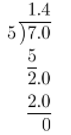
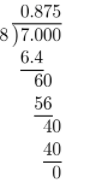
Divide 3 by 4. Write a decimal point and insert extra zeros in the dividend.
Texas Go Math Grade 7 Module 5 Answer Key 5
The result is 0.75.

Grade 7 Module 5 Review Answer Key Go Math Question 10.
\(\frac{7}{8}\) ____________
Answer:
Divide 7 by 8. Write a decimal point and insert extra zeros in the dividend.
Texas Go Math Grade 7 Module 5 Answer Key 6
The result is 0.875.

Question 11.
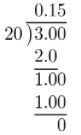
\(\frac{3}{20}\) ____________
Answer:
Divide 3 by 20. Write a decimal point and insert extra zeros in the dividend.
Texas Go Math Grade 7 Module 5 Answer Key 7
The result is 0.15.

Question 12.
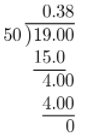
\(\frac{19}{50}\) ____________
Answer:
Divide 19 by 50. Write a decimal point and insert extra zeros in the dividend.
Texas Go Math Grade 7 Module 5 Answer Key 8
The result is 0.38.

Write each percent as a decimal.

Question 13.
67% ______
Answer:
Write the 67% as the sum of the 1 whole and the percent remainder.
= 100% – 33% Write the percents as a fractions.
= \(\frac{100}{100}\) – \(\frac{33}{100}\) Divide.
= 1 – 0.33 Subtract
= 0.67

Question 14.
31% ______
Answer:
Write the 31% as the sum of the 1 whole and the percent remainder.
= 100% – 69% Write the percents as a fraction.
= \(\frac{100}{100}\) – \(\frac{69}{100}\) Divide.
= 1 – 0.69 Subtract
= 0.31

Question 15.
7% ____________
Answer:
Write the 7% as the sum of the 1 whole and the percent remainder.
= 100% – 93% Write the percents as a fraction.
= \(\frac{100}{100}\) – \(\frac{93}{100}\) Divide.
= 1 – 0.93 Subtract
= 0.7

Question 16.
54% ____________
Answer:
Write the 54% as the sum of the 1 whole and the percent remainder.
= 100% – 46% Write the percent as a fraction.
= \(\frac{100}{100}\) – \(\frac{46}{100}\) Divide.
= 1 – 0.46 Subtract
= 0.54

Write each decimal as a percent.

Question 17.
0.13 ____________
Answer:
Multiply 0.13 by 1. Any number will be the same when multiplied by 1.
0.13 ∙ 1 = 0.13 ∙ \(\frac{100}{100}\) Write 1 as a fraction with the denominator 100.
= \(\frac{13}{100}\) Multiply Write fraction as a percent
= 13%

Question 18.
0.55 ____________
Answer:
Multiply 0.55 by 1. Any number will be the same when multiplied by 1.
0.55 ∙ 1 = 0.55 ∙ \(\frac{100}{100}\) Write 1 as a fraction with the denominator 100.
= \(\frac{55}{100}\) Multiply Write fraction as a percent
= 55%

Question 19.
0.08 ____________
Answer:
Multiply 0.08 by 1. Any number will be the same when multiplied by 1.
0.08 ∙ 1 = 0.08 ∙ \(\frac{100}{100}\) Write 1 as a fraction with the denominator 100.
= \(\frac{8}{100}\) Multiply Write fraction as a percent
= 8%

Grade 7 Module 5 Answer Key Go Math Question 20.
1.16 ____________
Answer:
Multiply 1.16 by 1. Any number will be the same when multiplied by 1.
1.16 ∙ 1 = 1.16 ∙ \(\frac{100}{100}\) Write 1 as a fraction with the denominator 100.
= \(\frac{116}{100}\) Multiply Write fraction as a percent
= 116%

Texas Go Math Grade 7 Module 5 Reading Start-Up Answer Key

Visualize Vocabulary

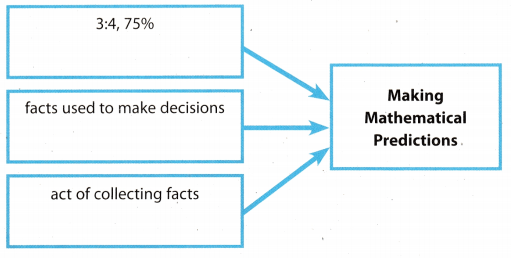
Use the ✓ words to complete the graphic. You can put more than one word in each box.
Texas Go Math Grade 7 Module 5 Answer Key 1
Texas Go Math Grade 7 Module 5 Answer Key 2

Understand Vocabulary

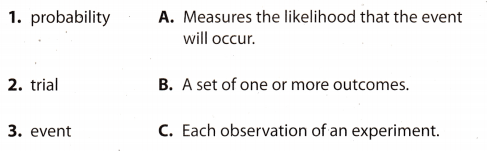
Match the term on the left to the definition on the right.
Texas Go Math Grade 7 Module 5 Answer Key 3
Answer:
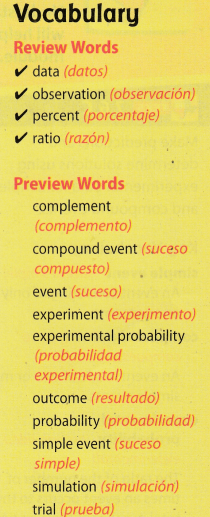
1 – A. The probability – measures the likelihood that the event will occur.
3 – C. Each observation of an experiment is a trial.
2 – B. A set of one or more outcomes is an event

Active Reading
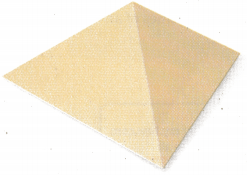
Pyramid Before beginning the module, create a rectangular pyramid to help you organize what you learn. Label each side with one of the lesson titles from this module. As you study each lesson, write important ideas, such as vocabulary, properties, and formulas, on the appropriate side.
Texas Go Math Grade 7 Module 5 Answer Key 4

Texas Go Math Grade 7 Module 5 Answer Key Experimental Probability Read More »

Texas Go Math Grade 7 Lesson 6.3 Answer Key Making Predictions with Theoretical Probability

Refer to our Texas Go Math Grade 7 Answer Key Pdf to score good marks in the exams. Test yourself by practicing the problems from Texas Go Math Grade 7 Lesson 6.3 Answer Key Making Predictions with Theoretical Probability.

Texas Go Math Grade 7 Lesson 6.3 Answer Key Making Predictions with Theoretical Probability

Your Turn

Question 1.
Predict how many times you will roll a number less than 5 if you roll a standard number cube 250 times.
Answer:
The probability of rolling number less than 5 is \(\frac{4}{6}\) = \(\frac{2}{3}\)
Use proportion.
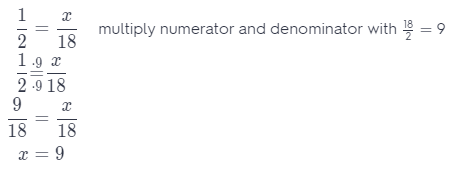
The probability of rolling number less than 5 is equal to what number “x divided by 150?
Texas Go Math Grade 7 Lesson 6.3 Answer Key 5
To roll a number less than 5, you should roll a cube 167 times.

Texas Go Math Grade 7 Solutions Lesson 6.3 Answer Key Question 2.
You flip a fair coin 18 times. About how many times would you expect heads to appear?
Answer:
The probability of flipping a coin and getting a head is \(\frac{1}{2}\).
Use proportion.
The probability to flip a coin and get a head is equal to what number ‘x’ divided by 18?
Texas Go Math Grade 7 Lesson 6.3 Answer Key 6
To get a head, you should flip a coin 9 times.

Question 3.
A bag of marbles contains 8 red marbles, 4 blue marbles, and 5 white marbles. Tom picks a marble at random, Is it more likely that he picks a red marble or a marble of another color?
Answer:
P (picking red marble) = \(\frac{8}{17}\)
P (picking a marble with another color) = 1 – P (picking red marble) = 1 – \(\frac{8}{17}\) = \(\frac{9}{17}\)
The probability to pick red marble is less than a probability to pick a marbLe of another color because \(\frac{8}{17}\) < \(\frac{9}{17}\).

Question 4.
At a fundraiser, a school group charges $6 for tickets for a “grab bag.” You choose one bill at random from a bag that contains 40 $1 bills, 20 $5 bills, 5 $10 bills, 5 $20 bills, and 1 $100 bill. Is it likely that you will win enough to pay for your ticket? Justify your answer.
Answer:
Total number of possible outcomes is: 40 + 20 + 5 + 5 + 1 = 71.
Number of $10, $20 and $100 bills is 5 + 5 + 1 = 11.\$
P (win enough to pay ticket) = Texas Go Math Grade 7 Lesson 6.3 Answer Key 7 = \(\frac{11}{71}\)
1 – P (win enough to pay ticket) = 1 – Texas Go Math Grade 7 Lesson 6.3 Answer Key 7 = 1 – \(\frac{11}{71}\) = \(\frac{60}{71}\)
It is more likely not to win enough to pay a ticket.

Texas Go Math Grade 7 Lesson 6.3 Guided Practice Answer Key

Question 1.
Bob works at a construction company. He has an equally likely chance of being assigned to work different crews every day. He can be assigned to work on crews building apartments, condominiums, or houses. If he works 18 days a month, about how many times should he expect to be assigned to the house crew? (Example 1)
STEP 1 Find the probabilities of beg assigned to each crew.
Texas Go Math Grade 7 Lesson 6.3 Answer Key 1
The probability of being assigned to the house crew is _________.

STEP 2: Set up and solve a proportion.
Texas Go Math Grade 7 Lesson 6.3 Answer Key 2
Bob can expect to be assigned to the house crew about _______ times out of 18.
Answer:
Texas Go Math Grade 7 Lesson 6.3 Answer Key 8
The probability of being assigned to the house crew is \(\frac{1}{3}\)
Bob can expect to be assigned to the house crew about 6 times out of 18.

Making Predictions with Theoretical Probability Lesson 6.3 Answer Key Question 2.
During a raffle drawing, half of the ticket holders will receive a prize. The winners are equally likely to win one of three prizes: a book, a gift certificate to a restaurant, or a movie ticket. If there are 300 ticket holders, predict the number of people who will win a movie ticket. (Example 1)
Answer:
P(win) = \(\frac{1}{2}\)
P (win a movie ticket) = Texas Go Math Grade 7 Lesson 6.3 Answer Key 9
Use a proportion.
\(\frac{1}{3}\) = \(\frac{x}{150}\)
x = 50
About 50 peoples will win a movie tickets.

Question 3.
In Mr. Jawarani’s first period math class, there are 9 students with hazel eyes, 10 students with brown eyes, 7 students with blue eyes, and 2 students with green eyes. Mr. Jawarani picks a student at random. Which color eyes is the student most likely to have? Explain. (Example 2)
Texas Go Math Grade 7 Lesson 6.3 Answer Key 3
Answer:
Total number of possible outcomes is: 9 + 10 + 7 + 2 = 28.
Texas Go Math Grade 7 Lesson 6.3 Answer Key 10
It is more likely to pick a student with brown eyes.

Essential Question Check-In

Question 4.
How do you make predictions using theoretical probability?
Answer:
Because theoretical and experimental probabilities are ratios, we can use proportions with probabilities to make predictions. Therefore using an equation where the theoretical probability is equal to number of x divided by a total number of outcomes, we get a prediction for some event, which is number x.

Texas Go Math Grade 7 Lesson 6.3 Independent Practice Answer Key

Question 5.
A bag contains 6 red marbles, 2 white marbles, and 1 gray marble. You randomly pick out a marble, record its color, and put it back in the bag. You repeat this process 45 times. How many white or gray marbles do you expect to get?
Answer:
Total. number of possibIe outcomes is: 6 + 2 + 1 = 9
Texas Go Math Grade 7 Lesson 6.3 Answer Key 11
You can expect about 15 grey or white marbles.

Lesson 6.3 Answer Key 7th Grade Go Math Question 6.
Using the blank circle below, draw a spinner with 8 equal sections and 3 colors—red, green, and yellow. The spinner should be such that you are equally likely to land on green or yellow, but more likely to land on red than either on green or yellow.
Texas Go Math Grade 7 Lesson 6.3 Answer Key 4
Answer:
Texas Go Math Grade 7 Lesson 6.3 Answer Key 12
Texas Go Math Grade 7 Lesson 6.3 Answer Key 13
P (land on red) = \(\frac{6}{8}\)
P (land on yellow) = \(\frac{1}{8}\)
P (land on green) = \(\frac{1}{8}\)

Use the following for Exercises 7-9.

In a standard 52-card deck, half of the cards are red and half are black. The 52 cards are divided evenly into 4 suits: spades, hearts, diamonds, and clubs. Each suit has three face cards (jack, queen, king), and an ace. Each suit also has 9 cards numbered from 2 to 10.

Question 7.
Dawn draws 1 card, replaces it, and draws another card. Is it more likely that she draws 2 red cards or 2 face cards?
Answer:
Total number of possible outcomes is:
red-black, red-red, black-black, black-red = 4
P (draw two red cards) = Texas Go Math Grade 7 Lesson 6.3 Answer Key 14

Total number of possible outcomes is:
52 possibilities ∙ 52 possibilities = 52 ∙ 52 = 2704
P (draw two face cards) = Texas Go Math Grade 7 Lesson 6.3 Answer Key 15
The probability to pick two red cards is more likely than the probability to pick two face cards.

Question 8.
Luis draws 1 card from a deck, 39 times. Predict how many times he draws an ace.
Answer:
Texas Go Math Grade 7 Lesson 6.3 Answer Key 16
You can predict that an ace will be drawn about 3 times.

Go Math Answer Key Grade 7 Probability Lesson 6.3 Question 9.
Suppose a solitaire player has played 1,000 games. Predict how many times the player turned over a red card as the first card.
Answer:
Texas Go Math Grade 7 Lesson 6.3 Answer Key 18
You can predict that the player will, turn over the red card as the first card about 500 times.

Question 10.
John and O’Neal are playing a board game in which they roll two number cubes. John needs to get a sum of 8 on the number cubes to win. O’Neal needs a sum of 11. If they take turns rolling the number cube, who is more likely to win? Explain.
Answer:
Texas Go Math Grade 7 Lesson 6.3 Answer Key 17
It is more likely John to win.

Question 11.
Every day, Navya’s teacher randomly picks a number from 1 to 20 to be the number of the day. The number of the day can be repeated. There are 180 days in the school year. Predict how many days the number of the day will be greater than 15.
Answer:
Texas Go Math Grade 7 Lesson 6.3 Answer Key 19
You can expect the number of day will be greater than 5 about 45 days.

Go Math 7th Grade Lesson 6.3 Theoretical Probability Answer Key Question 12.
Eben rolls two standard number cubes 36 times. Predict how many times he will roll a sum of 4.
Answer:
Texas Go Math Grade 7 Lesson 6.3 Answer Key 20
About 45 times will roll a sum of 4.

Question 13.
Communicate Mathematical Ideas Can you always show that a prediction based on theoretical probability is true by performing the event often enough? If so, explain why. If not, describe a situation that justifies your response.
Answer:
Answer is no.
Example:
A coin is flipped 16 times and head is obtained 7 times. Find a experimental. probability to flip a head.
Texas Go Math Grade 7 Lesson 6.3 Answer Key 21

Question 14.
Represent Real-World Problems Give a real-world example of an experiment in which all of the outcomes are not equally likely. Can you make a prediction for this experiment, using theoretical probability?
Answer:
What is the probability of rolling a 2 or 5 on a 6-sided cube with one of next numbers on each side: 1, 2, 2, 3, 4,5?
How 2 appear on two sides of the cube, and 5 only on one, it is more likely that we will roll a 2.
Using the theoretical probability we will show the same.
Texas Go Math Grade 7 Lesson 6.3 Answer Key 22

H.O.T. Focus on Higher Order Thinking

Question 15.
Critical Thinking Pierre asks Sherry a question involving the theoretical probability of a compound event in which you flip a coin and draw a marble from a bag of marbles. The bag of marbles contains 3 white marbles, 8 green marbles, and 9 black marbles. Sherry’s answer, which is correct, is \(\frac{12}{40}\). What was Pierre’s question?
Answer:
Pierre’s question was: What is the probability to pick white or black marble and flip a head?

Go Math Grade 7 Lesson 6.3 Making Predictions Question 16.
Make a Prediction Horace is going to roll a standard number cube and flip a coin. He wonders if it is more likely that he rolls a 5 and the coin lands on heads, or that he rolls a 5 or the coin lands on heads. Which event do you think is more likely to happen? Find the probability of both events to justify or reject your initial prediction.
Answer:
Total number of possible outcomes for rolling 5 and flip a head is: 6 possibilities ∙ 2 possibilities 6 ∙ 2 = 12
Number of rolling a 5 and flip a head is only one.
Texas Go Math Grade 7 Lesson 6.3 Answer Key 23
Number of head or rolling 5 is: head-1, head-2, head-3, head-4, head-6 and head-5 and letter-5 = 7
Texas Go Math Grade 7 Lesson 6.3 Answer Key 24
To flip a head or roll a 5 is more likely to happen.

Question 17.
Communicate Mathematical Ideas Cecil solved a theoretical prediction problem and got this answer: “The spinner will land on the red section 4.5 times.” Is it possible to have a prediction that is not a whole number? If so, give an example.
Answer:
Use spinner with eight equal sections with 4 red, 2 green, and 2 blue sections
Cecil spins a spinner shown. Predict how many time she spins on red if she spins 9 times
Texas Go Math Grade 7 Lesson 6.3 Answer Key 25

Texas Go Math Grade 7 Lesson 6.3 Answer Key Making Predictions with Theoretical Probability Read More »

Texas Go Math Grade 7 Unit 2 Study Guide Review Answer Key

Refer to our Texas Go Math Grade 7 Answer Key Pdf to score good marks in the exams. Test yourself by practicing the problems from Texas Go Math Grade 7 Unit 2 Study Guide Review Answer Key.

Texas Go Math Grade 7 Unit 2 Study Guide Review Answer Key

Texas Go Math Grade 7 Unit 2 Exercises Answer Key

Module 2 Rates and Proportionality

Question 1.
Steve uses \(\frac{8}{9}\) gallon of paint to paint 4 identical birdhouses. How many gallons of paint does he use for each birdhouse? (Lesson 2.1)
Answer:
For 4 identical birdhouses Steve uses \(\frac{8}{9}\) gallons of paint.
To find how many gallons he needs for one birdhouse, we have to divide \(\frac{8}{9}\) by 4.
\(\frac{8}{9}\) ÷ 4 = \(\frac{8}{9}\) ∙ \(\frac{1}{4}\) Multiply by the reciprocaL of the divisor
= \(\frac{8 \cdot 1}{9 \cdot 4}\)
= \(\frac{8}{36}\)
= \(\frac{4 \cdot 2}{4 \cdot 9}\)
= \(\frac{2}{9}\)
He uses \(\frac{2}{9}\) gallons of paint for each birdhouse.

Grade 7 Mathematics Unit 2 Answer Key Question 2.
Ron walks 0.5 miles on the track in 10 minutes. Stevie walks 0.25 miles on the track in 6 minutes. Find the unit rate for each walker in miles per hour. Who is the faster walker? (Lesson 2.1)
Answer:
To find how much miles Ron waLks for one minute, divide the number of miles by a number of minutes.
\(\frac{0.5}{10}\) = 0.05
For one minute he waLks 0.05 miles.
For one hour he walks 0.05 ∙ 60 = 3 miles.
Therefore, he walks 3 miles per hour.
Repeat procedure with Stevie.
\(\frac{0.25}{6}\) = 0.04
For one hour he walks 0.04 ∙ 60 = 2.4 miles.
Therefore, he walks 2.4 miles per hour.
We get 3 > 2.4, therefore, Ron is the faster walker.

Question 3.
(Lessons 2.2, 2.3) The table below shows the proportional relationship between Juan’s pay and the hours he works. Complete the table. Plot the data and connect the points with a line. (Lessons 2.2, 2.3)
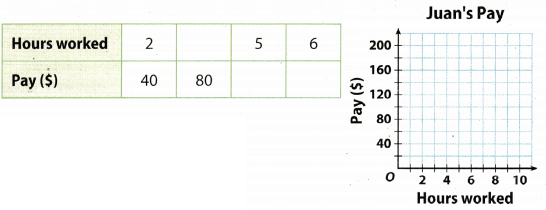
Texas Go Math Grade 7 Unit 2 Study Guide Review Answer Key 1
Answer:
First, find the constant of proportionality.
Let y be pay ($) and x be hours worked.
The constant of proportionality = \(\frac{y}{x}\) = \(\frac{40}{2}\) = 20
Hence, for I hour of work he earns $20.
To find how many hours he needs to work for $80. we divide 80 by the constant of proportionality.
\(\frac{80}{20}\) = 4
For 1 hour he earns $20, so for 5 hours he earns 5 ∙ 20 = $100.
For 1 hour he earns $20. so for 6 hours he earns 6 ∙ 20 = $120.
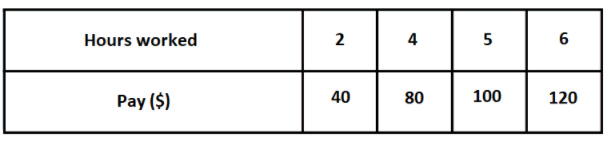
Texas Go Math Grade 7 Unit 2 Study Guide Review Answer Key 18
Texas Go Math Grade 7 Unit 2 Study Guide Review Answer Key 19

Module 3 Proportions and Percent

Convert each measurement. (Lesson 3.1)

Texas Go Math Study Guide 7th Grade Unit 2 Question 1.
7 centimeters ≈ __________ inches
Answer:
As we know 1 inch ≈ 2.54 centimeters.
Divide both sides by 2.54.
You get:
≈ 1 cm
To calculate for 7 centimeters, multiply both sides by 7.
7 ∙ \(\frac{1 \mathrm{~ in}}{2.54}\) ≈ 7 ∙ 1 cm
7 0.4 in ≈ 7 cm
2.8 in ≈ 7 cm

Question 2.
10 pounds ≈ __________ kilograms
Answer:
1 pound ≈ 0.45 kg
10 pound ≈ 4.5 kg

Question 3.
24 kilometers ≈ ___________ miles
Answer:
As we know 1 mile ≈ 1.61 kilometers
Divide both sides by 1.61.
You get:
\(\frac{1 \mathrm{~ mi}}{1.61}\) ≈ 1 km
To calculate for 24 kilometers. multipLy both sides by 24.
24 ∙ \(\frac{1 \mathrm{~ mi}}{1.61}\) ≈ 24. 1 km
24 ∙ 0.62 mi ≈ 24 km
14.9 mi ≈ 24 km

Question 4.
12 quarts ≈ _____________ liters
Answer:
1 quart ≈ 0.95 l
12 quart ≈ 11.4 l

Question 5.
Michelle purchased 25 audio files in January. In February she purchased 40 audio files. Find the percent increase. (Lesson 3.2)
Answer:
First we find amount of change.
Amount of Change = Purchased audio files in February – Purchased audio files in January
= 40 – 25
= 15
Now, we have all, necessary data to find percent change.

Texas Go Math Grade 7 Unit 2 Study Guide Review Answer Key 20
= \(\frac{15}{25}\)
= \(\frac{3}{5}\)
= 0.6 = 60%

Texas Go Math Unit 2 Assessment Answer Key Question 6.
Sam’s dog weighs 72 pounds. The vet suggests that for the dog’s health, its weight should decrease by 12.5 . percent. According to the vet, what is a healthy weight for the dog? (Lesson 3.2)
Answer:
Find 12.5 percent od 72 and subtract it from 72
Write percent as fractor.
\(\frac{12.5}{100}\) ∙ 72 = 0.125 ∙ 72 = 9
The healthy weight for the dog is 72 – 9 = 63 pounds.

Question 7.
The original price of a barbecue grill is $79.50. The grill is marked down 15%. What is the sale price of the grill? (Lesson 3.3)
Answer:
Original price is $79.50.
Find 15% percent of original price.
79.50 ∙ \(\frac{15}{100}\) = 79.50 ∙ 0.15 = 11.9
Subtract the result from original price.
79.50 – 11.9 = $67.6
Therefore, the sale price of grill is $67.6.

Question 8.
A sporting goods store marks up the cost s of soccer balls by 250%. Write an expression that represents the retail cost of the soccer balls. The store buys soccer balls for $5.00 each. What is the retail price of the soccer balls? (Lesson 3.3)
Answer:
Store pays $5 for each soccer hail and sells it for 250% of the price she pays for the ball.
Find the 250% of the 5.
Write percent as a fraction.
\(\frac{250}{100}\) ∙ 5 = 2.55
= 12.5
The retail price of the soccer hail is $12.5.

Module 4 Proportionality in Geometry
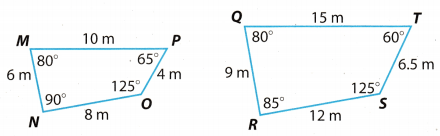
Texas Go Math Grade 7 Unit 2 Study Guide Review Answer Key 28
Question 1.
Are the four-sided shapes similar? Explain. (Lesson 4.1)
Answer:
\centering From the picture we can see that:
m∡M = m∡Q = 80°; ∡M corresponds to ∡Q
m∡O = m∡S = 125°; ∡O corresponds to ∡S
\centering AngLes ∡N and ∡P do not correspond to angles ∡R and ∡T.
\(\overline{M P}\) corresponds to \(\overline{Q T}\)
\(\overline{M N}\) corresponds to \(\overline{Q R}\)
\(\overline{N O}\) corresponds to \(\overline{R S}\)
\(\overline{M P}\) corresponds to \(\overline{Q T}\)
\(\overline{P O}\) corresponds to \(\overline{T S}\)
Is it true that \(\frac{M P}{Q T}=\frac{M N}{Q R}=\frac{N O}{R S}=\frac{P O}{T S}\)?
\(\frac{10}{15}=\frac{6}{9}=\frac{8}{12}=\frac{4}{6.5}\)
We get:
0.66 = 0.66 = 0.66 = 0.61
which is not correct, therefore, these four-sided shapes are not similar

Texas Go Math Grade 7 Solutions Unit 2 Answer Key Question 2.
â–³JNZ ~ â–³KOA. Find the unknown measures. (Lesson 4.2)
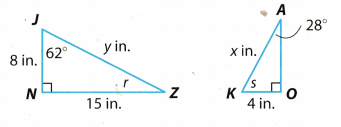
Texas Go Math Grade 7 Unit 2 Study Guide Review Answer Key 3
x = ______________
y = ______________
r = ______________
s = ______________
Answer:
To find y, we use Pythagoras theorem:
a2 + b2 = c2
where C represents the Length of the hypotenuse and a and b the lengths of the triangLes other two sides.
y2 = 82 + 152
y2 = 64 + 225
y2 = 289 Root both side
\(\sqrt{y^{2}}=\sqrt{289}\)
y = 17
These two shapes are similar, so the corresponding sides are proportional.
Write the proportion.
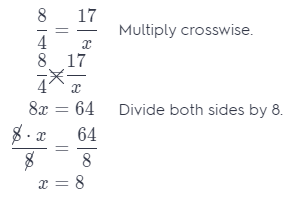
Texas Go Math Grade 7 Unit 2 Study Guide Review Answer Key 21

The sum of angles in a triangle is 180°.
Hence
62° + 90° + r = 180°
152° + r = 180° Subtract 152° from both sides
r = 180° – 152°
r = 28°

28° + 90° + s = 180°
118° + s = 180° Subtract 118° from both sides.
s = 180° – 118°
s = 62°

Question 3.
In the scale drawing of a park, the scale is 1 cm: 10 m. Find the area of the actual park. (Lesson 4.3)
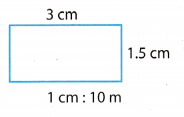
Texas Go Math Grade 7 Unit 2 Study Guide Review Answer Key 4
Answer:
1 centimeter in this drawing equals 10 meters oo the actual park.
Find the length of the actual park.
MuLtiply 3 by 10.
3 ∙ 10 = 30 m
Find a width of actual park.
Multiply 1.5 by 10.
1.5 ∙ 10 = 15
The area of the actual park find from formula for the area of rectangle P = l ∙ w.
P = 30 ∙ 15 = 450 m2

Unit 2 Test Review Math Answers 7th Grade Question 4.
The circumference of the larger circle is 1 5.7 yards. Find the circumference of the smaller circle. (Lesson 4.4)
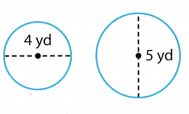
Texas Go Math Grade 7 Unit 2 Study Guide Review Answer Key 5
Answer:
C1 = the circumference of the larger circle
C2 = the circumference of the smaller circle
d1= the diameter of the larger circle
d2 = the diameter of the smaller circle
Two circles are similar, so the corresponding measures are proportional.
Write the proportion.
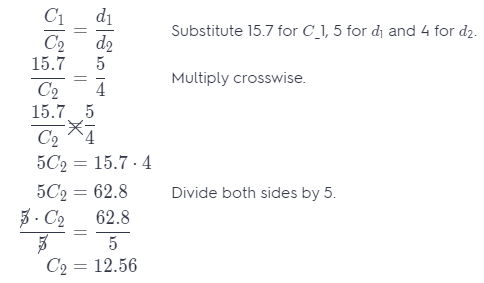
Texas Go Math Grade 7 Unit 2 Study Guide Review Answer Key 22
The circumference of the smaller circle is 12.56 yards.

Texas Go Math Grade 7 Unit 2 Performance Tasks Answer Key

Question 1.
CAREERS IN MATH Landscape Architect A landscape architect creates a scale drawing of her plans for a garden. She draws the plans on a sheet of paper that measures 8\(\frac{1}{2}\) inches by 11 inches. On the right- hand side of the paper, there is a column 2\(\frac{1}{2}\) inches wide that includes the company name and logo. The drawing itself is 5\(\frac{1}{2}\) inches by 7\(\frac{1}{2}\) inches. The scale of the drawing is 1 inch = 10 feet.
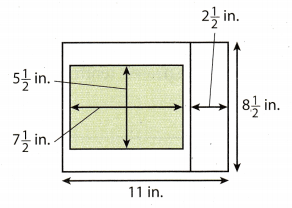
Texas Go Math Grade 7 Unit 2 Study Guide Review Answer Key 6
a. The landscape architect wants to make a larger drawing on a sheet of paper that measures 11 inches by 17 inches. The larger drawing should include the same 2\(\frac{1}{2}\) inch column on the side. There should be at least \(\frac{1}{2}\) inch of space on all sides of the drawing. What are the dimensions of the area she can use to make the new drawing?
Answer:
From the 17 inches, the 2\(\frac{1}{2}\) inches removed for the area of the sketch there is 14\(\frac{1}{2}\) Removing the \(\frac{1}{2}\) inch for the border, the dimensions of the area will be 10 inches by 13\(\frac{1}{2}\) inches. The sketch of the dimensions for the 11 inches by 17 inches is:
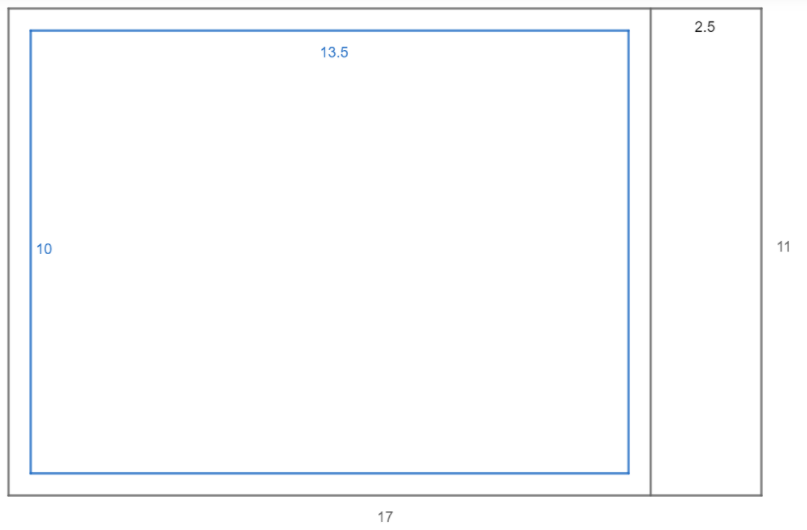
Texas Go Math Grade 7 Unit 2 Study Guide Review Answer Key 23

b. How large can she make the scale drawing without changing any of the proportions? Justify your reasoning.
Answer:
Determine how large the scale drawing can be without changing the proportion. Let x be the length of the other side.
\(\frac{5.5}{7.5}\) = \(\frac{x}{13.5}\) Set up the proportion
74.25 = 7.5x Cross multiply
\(\frac{74.25}{7.5}\) = \(\frac{7.5x}{7.5}\) Divide both sides by 7.5
9.9 = x Simplify

Unit 2 Mid Unit Assessment Answer Key Grade 7 Question 2.
The table below shows how far several animals can travel at their maximum speeds in a given time.
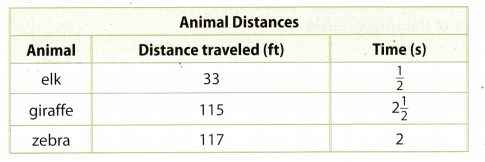
Texas Go Math Grade 7 Unit 2 Study Guide Review Answer Key 7
a. Write each animal’s speed as a unit rate in feet per second.
Answer:
Elk travels 33 ft in \(\frac{1}{2}\) seconds.
To find the unit rate in feet per second, divide the distance by time.
33 ÷ \(\frac{1}{2}\) = 33 ∙ 2 = 66
Speed of elk is 66 ft/second.
Giraffe travels 115 ft in 2\(\frac{1}{2}\) seconds.
To find the unit rate in feet per second, divide the distance by time.
115 ÷ 2\(\frac{1}{2}\) = 115 ÷ \(\frac{5}{2}\) = 115 ÷ 2.5 = 46
Speed of giraffe is 46 ft/second.
Zebra travels 117 ft in 2 seconds.
To find the unit rate in feet per second, divide the distance by time.
117 ÷ 2 = 117 ÷ 2 = 58.5
Speed of zebra is 58.5 ft/second.

b. Which animal has the fastest speed?
Answer:
The elk is fastest animal.

c. How many miles could the fastest animal travel in 2 hours if it maintained the speed you calculated in part a? Use the formula d = rt and round your answer to the nearest tenth of a mile. Show your work.
Answer:
First, convert 2 hours to seconds, and 66 ft/second to miles/second
1 foot = 0.00019 miles
1 hours = 3600 seconds
2 hours = 2 3600 = 7200 seconds
66 ft/s = 66 0.00019 = 0.0 12 mi/s
d = r ∙ t Substitute 0.012 for r and 7200 for t.
d = 0.012 ∙ 7200
d = 86.4
The fastest animal, in this case elk, travels 86 miles in 2 hours.

d. The data in the table represents how fast each animal can travel at its maximum speed. Is it reasonable to expect the animal from part b to travel that distance in 2 hours? Explain why or why not.
Answer:
Yes, it is reasonable, because the average top speed of the elk is about 45 miles per hour.

Texas Go Math Grade 7 Unit 2 Mixed Review Texas Test Prep Answer Key

Selected Response

Question 1.
If the relationship between distance y in feet and time x in seconds is proportional, which rate is represented by \(\frac{y}{x}\) = 0.6?
(A) 3 feet in 5 s
(B) 3 feet in 9 s
(C) 10 feet in 6 s
(D) 18 feet in 3 s
Answer:
(A) 3 feet in 5 s

Explanation:
Variable x represents time in seconds.
Variable y represents distance in feets.
We need to get. that x divided by y is 0.6.
check answer under (A) when we substitute value for x and y.
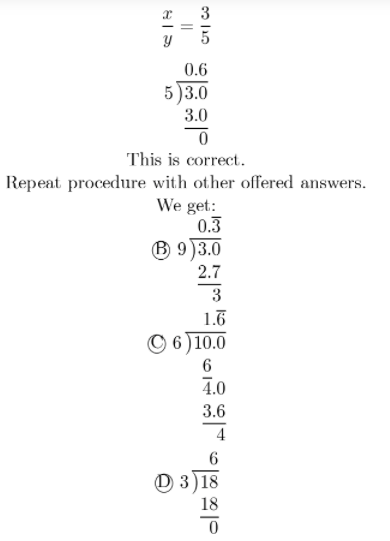
Texas Go Math Grade 7 Unit 2 Study Guide Review Answer Key 24
The rate represented by \(\frac{x}{y}\) = 0.6 is under (A) 3 feet in 5 seconds.

Algebra 1 Unit 2 Study Guide Texas Go Math Grade 7 Question 2.
The Baghrams make regular monthly deposits in a savings account. The graph shows the relationship between the number x of months and the amount y in dollars in the account.
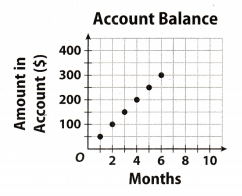
Texas Go Math Grade 7 Unit 2 Study Guide Review Answer Key 8
What is the equation for the deposit?
(A) \(\frac{y}{x}\) = $25/month
(B) \(\frac{y}{x}\) = $40/month
(C) \(\frac{y}{x}\) = $50/month
(D) \(\frac{y}{x}\) = $75/month
Answer:
(C) \(\frac{y}{x}\) = $50/month

Explanation:
For 1 month, the amount in account is $50.
Hence.
\(\frac{y}{x}\) = \(\frac{50}{1}\) = $50/month

For 2 month, the amount in account is $100.
Hence,
\(\frac{y}{x}\) = \(\frac{100}{2}\) = $50/month

For 3 month, the amount in account is $150.
Hence,
\(\frac{y}{x}\) = \(\frac{150}{3}\) = $50/month
The answer is \(\frac{y}{x}\) = \(\frac{50}{1}\) = $50/month.

Hot Tip! Read graphs and diagrams carefully. Look at the labels for important information.

Question 3.
Rosa’s room is 4 meters wide. Which of these is an equivalent measurement?
(A) 0.28 mile
(B) 4.38 yards
(C) 12.4 feet
(D) 136.2 inches
Answer:
(B) 4.38 yards

Explanation:
\centering As we know:
0.39 = \(\frac{1}{2.54}\) inch ≈ 1 centimeters
3.28 = \(\frac{1}{0.305}\) foot ≈ 1 meters
1.094 = \(\frac{1}{0.914}\) yard ≈ 1 meters
0.62 = \(\frac{1}{1.61}\) mile ≈ 1 kilometers

One meter has 100 centimeters. so. four meters have 400 centimeters.
Multiply 0.39 by 100 to obtain how much inches is in four meters.
0.39 ∙ 400 = 156 inches
Therefore, the answer under (D) is not correct.
To obtain how much feet is in four meters, multiply 3.28 by 4.
3.28 ∙ 4 = 13.12 ft
Therefore, the answer under (C) is not, correct.
To obtain how many yards are in four meters, multiply 1 .094 by 4.
1.091 ∙ 1 = 4.38 yards
Therefore, the answer under (B) is correct.
One kilometer has 1000 meters. so. four kilometers have 4000 meters.
To obtain how many miles is in four meters, multiply 0.62 by 4000.
0.62 ∙ 4000 = 2480 miles
Therefore, the answer under (A) is not correct.

Unit 2 Study Guide Answer Key Grade 7 Go Math Question 4.
What is the decimal form of -4\(\frac{7}{8}\)?
(A) -4.9375
(B) -4.875
(C) -4.75
(D) -4.625
Answer:
(B) -4.875

Explanation:
First, convert whole number 4 to eights and add \(\frac{7}{8}\).
\(-\frac{4 \cdot 8+7}{8}=-\frac{32+7}{8}=-\frac{39}{8}\) = -4.875.

Question 5.
Find the percent change from 72 to 90.
(A) 20% decrease
(B) 20% increase
(C) 25% decrease
(D) 25% increase
Answer:
(D) 25% increase

Explanation:
First we find amount of change.
Amount of Change = Greater Value Lesser Value
= 90 – 72
= 18
Now, we have all necessary data to find percent change.

Texas Go Math Grade 7 Unit 2 Study Guide Review Answer Key 25
= \(\frac{18}{72}\)
= \(\frac{1}{4}\)
= 0.25 = 25%

Question 6.
A store had a sale on art supplies. The price p of each item was marked down 60%. Which expression represents the new price?
(A) 0.4p
(B) 0.6p
(C) 1.4p
(D) 1.6p
Answer:
(A) 0.04p

Explanation:
Because the price of each item decreases 60%, the new price of each item is 40% of price p.
40% as a decimal. is 0.4.
Hence, the new price for each item is 0.04p.

Question 7.
Clarke borrows $ 16,000 to buy a car. He pays simple interest at an annual rate of 6% over a period of 3.5 years. How much does he pay altogether?
(A) $18,800
(B) $19,360
(C) $19,920
(D) $20,480
Answer:
(B) $19,360

Explanation:
6 % in decimal amounts 0.06.
We are searching for an amount of simple interest for one year.
Multiply 0.06 by 16, 000.
0.06 ∙ 16000 = $960
To find for 3.5 years, multiply the result by 3.5.
960 ∙ 3.5 = $3,360
Altogether he pay:
16,000 + 3,360 = $19,360

Question 8.
To which set or sets does the number 37 belong?
(A) integers only
(B) rational numbers only
(C) integers and rational numbers only
(D) whole numbers, integers, and rational numbers
Answer:
(D) whole numbers, integers, and rational numbers

Explanation:
Number 37 is whole number, integer and rational number.

Question 9.
The two triangles below are similar. What is the missing length?
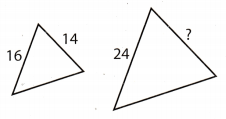
Texas Go Math Grade 7 Unit 2 Study Guide Review Answer Key 9
(A) 21
(B) 22
(C) 24
(D) 26
Answer:
(A) 21

Explanation:
a1 = 14
b1 = 16
a = ?
b = 24
\centering To find the missing Length, use a proportion
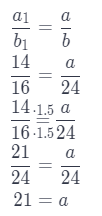
Texas Go Math Grade 7 Unit 2 Study Guide Review Answer Key 26

Gridded Response

Question 10.
The smaller circle has a diameter that is half the size of the larger circle. What is the missing circumference in centimeters?
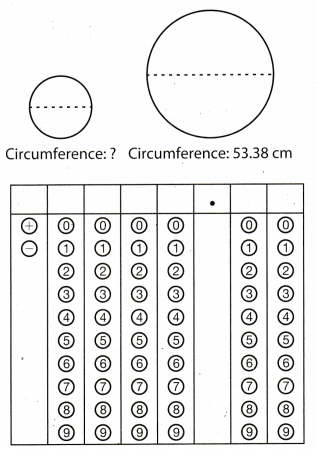
Texas Go Math Grade 7 Unit 2 Study Guide Review Answer Key 10
Answer:
C1 = the circumference of the larger circle
C2 = the circumference of the smaller circle
d1 = the diameter of the larger circle
d2 = the diameter of the smaller circle
The diameter of the smaller circle is half the diameter of the larger circle.
Hence
d1 = 2d2
Two circles are similar, so the corresponding measures are proportional.
Write the proportion.
\(\frac{C_{1}}{C_{2}}=\frac{d_{1}}{d_{2}}\) Substitute 53.38 for C_1, 2d2 for d1.
\(\frac{53.38}{C_{2}}=\frac{d_{2}}{d_{2}}\)
\(\frac{53.38}{C_{2}}\) = 2
C2 = \(\frac{53.38}{2}\)
C2 = 26.69
The circumference of the smaller circle is 26.69 cm.

7th Grade Math Study Guide Pdf Unit 2 Test Answers Question 11.
Jermaine paid $37.95 for 11 gallons of gasoline. What was the price in dollars per gallon?
Texas Go Math Grade 7 Unit 2 Study Guide Review Answer Key 11
Answer:
To find a price in dollars per gallon, divide $37.95 by 11.
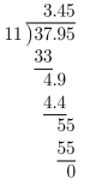
Texas Go Math Grade 7 Unit 2 Study Guide Review Answer Key 27
Therefore, each gallon cost $3.45.

Hot Tip! Pay attention to the units given in a test question, especially if there are mixed units, such as inches and feet.

Question 12.
Shown below is a scale drawing of a rectangular patio.
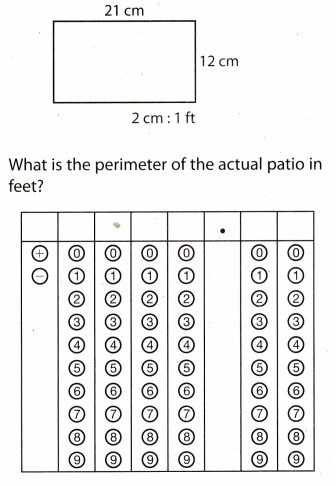
Texas Go Math Grade 7 Unit 2 Study Guide Review Answer Key 12
Answer:
2 cm : 1 ft ⇔ 1 cm : \(\frac{1}{2}\) ft
P = perimeter of a rectangle
l = 21 cm
w = 12 cm
Use the formula for the perimeter of a rectangle.
P = 2(l + w) Substitute 21 for l and 12 for w.
P = 2(21 + 12)
P = 2.33
P = 66 cm
Because 1 cm : \(\frac{1}{2}\) ft, the perimeter of the actual patio is 66 ∙ \(\frac{1}{2}\) = 33 ft.

Texas Go Math Grade 7 Unit 2 Vocabulary Preview Answer Key

Use the puzzle to preview key vocabulary from this unit. Unscramble the circled letters within found words to answer the riddle at the bottom of the page.

1. A relationship between two quantities in which the rate of change or the ratio of one quantity to the other is constant. (Lesson 2-2)
Texas Go Math Grade 7 Unit 2 Study Guide Review Answer Key 13

2. Describes how much a quantity decreases in comparison to the original amount. (Lesson 3-2)
Texas Go Math Grade 7 Unit 2 Study Guide Review Answer Key 14

3. A fixed percent of the principal. (Lesson 3-4)

Texas Go Math Grade 7 Unit 2 Study Guide Review Answer Key 15

4. Angles of two or more similar shapes that are in the same relative position. (Lesson 4-1)
Texas Go Math Grade 7 Unit 2 Study Guide Review Answer Key 16

5. A proportional two-dimensional drawing of an object. (Lesson 4-3)

Texas Go Math Grade 7 Unit 2 Study Guide Review Answer Key 17

Question.
What did the athlete order when he needed a huge helping of mashed potatoes?
Answer:
_____ ____ ____ ____ – ____ ____ ____ ____ ____ ____ ____!

Texas Go Math Grade 7 Unit 2 Study Guide Review Answer Key Read More »

Texas Go Math Grade 7 Lesson 4.2 Answer Key Using Similar Shapes

Refer to our Texas Go Math Grade 7 Answer Key Pdf to score good marks in the exams. Test yourself by practicing the problems from Texas Go Math Grade 7 Lesson 4.2 Answer Key Using Similar Shapes.

Texas Go Math Grade 7 Lesson 4.2 Answer Key Using Similar Shapes

Example 1

â–³ABC ~ â–³JKL. Find the unknown measures.
A. Find the unknown side, x.
Texas Go Math Grade 7 Lesson 4.2 Answer Key 1

B. Find y.
∠K corresponds to ∠B
y = ∠103°
Corresponding angles of similar triangles have equal angle measures.

Reflect

Texas Go Math Grade 7 Answers Lesson 4.2 Question 1.
Analyze Relationships What other proportion could be used to find the value of x in the example? Explain.
Answer:
We could use the proportion between the other two sides that were not used: AC and JL and do the same calculation.
\(\frac{A C}{J L}\) = \(\frac{B C}{K L}\)
\(\frac{16}{56}\) = \(\frac{12}{x}\)
\(\frac{16 \div 8}{56 \div 8}=\frac{2}{7}=\frac{12}{x}\)
2x = 7 × 12
2x = 84
x = 42 cm

Your Turn

â–³ABC ~ â–³JGH. Find the unknown measures.

Question 2.
Texas Go Math Grade 7 Lesson 4.2 Answer Key 2
Answer:
∠y corresponds to ∠BCA because they are both on the right from the right angle.
∠y = ∠BCA = 59°
Write a proportion using corresponding sides.
AB corresponds to GJ, and BC corresponds to GH.
\(\frac{A B}{G J}\) = \(\frac{B C}{G H}\)
\(\frac{10}{5}\) = \(\frac{6}{x}\)
10x = 5 × 6
10x = 30
x = 3 cm

Question 3.
Texas Go Math Grade 7 Lesson 4.2 Answer Key 3
Answer:
∠s corresponds to ∠HJG because they are obtuse angles. A triangle can have only one obtuse angle.
∠s = ∠HJG = 120°
Write a proportion using the corresponding sides
AB corresponds to GJ, and AC corresponds to HJ.
Texas Go Math Grade 7 Lesson 4.2 Answer Key 16

Go Math 7th Grade Answer Key Pdf Similar Shapes Question 4.
These rectangular gardens are similar in shape. Find the width of the smaller garden.
Texas Go Math Grade 7 Lesson 4.2 Answer Key 4
Answer:
Write proportions between corresponding sides
Texas Go Math Grade 7 Lesson 4.2 Answer Key 17

Question 5.
A student who is 4 feet tall stands beside a tree. The tree has a shadow that is 12 feet long at the same time that the shadow of the student is 6 feet long. Find the height of the tree. _________
Answer:
Write a proportion
Texas Go Math Grade 7 Lesson 4.2 Answer Key 18
The tree is 8 ft tall.

Question 6.
A photographer is taking a photo of a statue of Paul Bunyan, the legendary giant lumberjack. He measures the length of his shadow and the shadow cast by the statue. Find the height of the
Texas Go Math Grade 7 Lesson 4.2 Answer Key 5
Paul Bunyan statue. ___________
Answer:
Write a proportion
Texas Go Math Grade 7 Lesson 4.2 Answer Key 19
The statue of Paul Bunyan is 18 ft tall.

Texas Go Math Grade 7 Lesson 4.2 Guided Practice Answer Key

â–³ABC ~ â–³XYZ in each pair. Find the unknown measures (Example 1)

Question 1.
Texas Go Math Grade 7 Lesson 4.2 Answer Key 6
Answer:
∠d corresponds to ∠XZY because they are both on the right from the right angLe
∠d = ZXZY = 53°
Write a proportion using the corresponding sides.
AC corresponds to XZ, and AB corresponds to XY
\(\frac{A C}{X Z}\) = \(\frac{A B}{X Y}\)
\(\frac{6}{15}\) = \(\frac{8}{z}\)
6z = 15 × 8
6z = 120
z = 20 m

Go Math 7th Grade Pdf Angles of Triangles Answer Key Question 2.
Texas Go Math Grade 7 Lesson 4.2 Answer Key 7
Answer:
∠s corresponds to ∠CBA.
∠s = ∠CBA = 85°
Write a proportion using the corresponding sides
AB corresponds to XY, and BC corresponds to YZ.
Texas Go Math Grade 7 Lesson 4.2 Answer Key 20

Question 3.
Texas Go Math Grade 7 Lesson 4.2 Answer Key 8
Answer:
∠x corresponds to ∠ACB.
∠x = ∠ACB = 46°
Write a proportion using corresponding sides.
AC corresponds to XZ, and AB corresponds to XY.
\(\frac{X Z}{A C}\) = \(\frac{X Y}{A B}\)
\(\frac{44}{11}\) = \(\frac{t}{8}\)
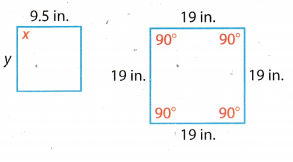
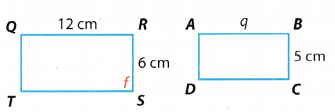
4 = \(\frac{t}{8}\)
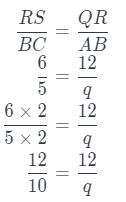
t = 4 × 8
t = 32 in.

Question 4.
Texas Go Math Grade 7 Lesson 4.2 Answer Key 9
Answer:
∠a corresponds to ∠YXZ.
∠a = ∠YXZ = 84°
Write a proportion using the corresponding sides
AC corresponds to XZ, and BC corresponds to YZ.
\(\frac{X Z}{A C}\) = \(\frac{Y Z}{B C}\)
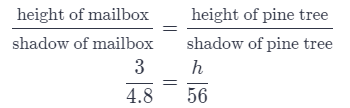
\(\frac{72}{18}\) = \(\frac{x}{25}\)
x = \(\frac{x}{25}\)
x = 4 × 25
x = 100 ft

The rectangles in each pair are similar. Find the unknown measures. (Example 1)

Question 5.
Texas Go Math Grade 7 Lesson 4.2 Answer Key 10
Answer:
Al angles in a rectangle (in this case square) are equal to 90°.
Thus, ∠x = 90°.
Since we concluded the second rectangle is a square (all sides are equal), then the first rectangle is a square too.
Thus, y = 9.5 in

Go Math Grade 7 Lesson 4.2 Answer Key Question 6.
Texas Go Math Grade 7 Lesson 4.2 Answer Key 11
Answer:
All angles in a rectangle are equal to 90°.
Thus, ∠f = 90°.
Write a proportion using the corresponding sides.
RS corresponds to BC, and QR corresponds to AB.
Texas Go Math Grade 7 Lesson 4.2 Answer Key 21
q = 10 cm

Question 7.
Samantha wants to find the height of a pine tree in her yard. She measures the height of the mailbox at 3 feet and its shadow at 4.8 feet. Then she measures the shadow of the tree at 56 feet. How tall is the tree? (Example 3)
Answer:
Write a proportion
Texas Go Math Grade 7 Lesson 4.2 Answer Key 22
4.8h = 3 × 56
4.8h = 168
h = 35 feet
The height of the pine tree is 35 feet.

Essential Question Check-In

Question 8.
Describe how you could use your height and a yardstick to determine the unknown height of a flagpole.
Answer:
We could measure your height, your shadow and the flagpole’s shadow.
Then, we would write a proportion using thoes measures.
Texas Go Math Grade 7 Lesson 4.2 Answer Key 23

Texas Go Math Grade 7 Lesson 4.2 Independent Practice Answer Key

Question 9.
A cactus casts a shadow that is 15 ft long. A gate nearby casts a shadow that is 5 ft long. Find the height of the cactus.
Texas Go Math Grade 7 Lesson 4.2 Answer Key 12
Answer:
Write a proportion
Texas Go Math Grade 7 Lesson 4.2 Answer Key 24
The height of the cactus is 9 ft.

Question 10.
Two ramps modeled with triangles are similar. Which side of triangle KOA corresponds to \(\overline{J N}\)? Explain.
Texas Go Math Grade 7 Lesson 4.2 Answer Key 13
Answer:
We can see that \(\overline{J N}\) Lies on the left side of the right angLe. In triangle KOA \(\overline{K O}\) Lies on the Left side of the right angle.
Thus, \(\overline{K O}\) responds to \(\overline{J N}\).

Question 11.
A building with a height of 14 m casts a shadow that is 16 m long while a taller building casts a 24 m long shadow. What is the height of the taller building?
Answer:
Write a proportion
Texas Go Math Grade 7 Lesson 4.2 Answer Key 25
The taller building is 24 m tall.

Texas Go Math Grade 7 Similar Triangles Pdf Question 12.
Katie uses a copy machine to enlarge her rectangular design that is 6 in. wide and 8 in. long. The new width is 10 in. What is the new length?
Answer:
Write a proportion
Texas Go Math Grade 7 Lesson 4.2 Answer Key 26
The new length is \(13 . \overline{3}\) in.

Question 13.
Art An art exhibit at a local museum features several similarly shaped metal cubes welded together to make a sculpture. The smallest cube has a edge length of 6 inches.
a. What are the edge lengths of the other cubes if the ratios of similarity to the smallest cube are 1.25, \(\frac{4}{3}\), 1.5, \(\frac{7}{4}\), and 2 respectively?
Answer:
l1 = length of the smallest cube = 6 in.
Calculate lengths of other cubes using given ratios.
Texas Go Math Grade 7 Lesson 4.2 Answer Key 27

b. If the artist wanted to add a smaller cube with an edge length with a ratio of \(\frac{2}{3}\) to the sculpture, what size would the cube be?
Answer:
la = added cube
Again, use the given ratio to calculate la
\(\frac{l_{a}}{l_{1}}\) = \(\frac{2}{3}\)
\(\frac{l_{a}}{6}\) = \(\frac{2}{3}\)
la = \(\frac{2}{3}\) × 6
la = 4 in.

c. Why do you only have to find the length of one edge for each cube?
Answer:
We only have to find length of one edge for each cube, because all edges of a cube are of equal length.

â–³XYZ ~ â–³PQR in each pair. Find the unknown measures.

Question 14.
Texas Go Math Grade 7 Lesson 4.2 Answer Key 14
Answer:
∠b corresponds to ∠XZY
∠d = ∠XZY = 89°
Write a proportion using the corresponding sides.
XZ corresponds to PR, and YZ corresponds to RQ.
\(\frac{P R}{X Z}\) = \(\frac{R Q}{Y Z}\)
\(\frac{20}{8}\) = \(\frac{a}{9}\)
\(\frac{5}{2}\) = \(\frac{a}{9}\)
2a = 5 × 9
2a = 45
a = 22.5 cm

Question 15.
Texas Go Math Grade 7 Lesson 4.2 Answer Key 15
Answer:
∠s corresponds to ∠RQP.
∠s = ∠RQP = 58°
Write a proportion using the corresponding sides.
x corresponds to and XZ corresponds to PR.
Texas Go Math Grade 7 Lesson 4.2 Answer Key 28

Question 16.
Two common envelope sizes are 3\(\frac{1}{2}\) in. × 6\(\frac{1}{2}\) in. and 4in. × 9\(\frac{1}{2}\) in. Are these envelopes similar? Explain.
Answer:
Check if the ratios of the corresponding sides are equal.
Texas Go Math Grade 7 Lesson 4.2 Answer Key 29
Although all corresponding angles of enveLopes are equal, the ratios of corresponding sides are not equal.
Thus, the envelopes are not similar

Go Math 7th Grade Lesson 4.2 Find the Value of the Shapes Question 17.
A pair of rectangular baking pans come in a set together for $15. One pan is 13 inches by 9 inches and the other pan is 6 inches by 6 inches. Without doing any calculations, how can you tell that these pans are not similar?
Answer:
We can see right away that the sides of the second pan are equal. Thus, the second pan has the shape of a square white the first one has the shape of a rectangle.
From this, we can conclude that the pans are not similar.

H.O.T. Focus On Higher Order Thinking

Question 18.
Draw Conclusions In the similar triangles used in indirect measurement with the shadows of a flagpole and a person, which sides of the triangles represent the rays of the sun?
Answer:
The hypotenuse represents the rays of the sun.

Question 19.
Make a Conjecture Do you think it is possible to use indirect measurement with shadows if the sun is directly overhead? Explain.
Answer:
No, it is not possible.
When the sun is directly overhead, the Length of the shadow is 0. Thus, comparing any ratio including shadow side in it would equal to 0 (\(\frac{0}{x}\)), or would not be possible to divide (\(\frac{x}{0}\))

Question 20.
Analyze Relationships Joseph’s parents have planted two gardens. One is square and has an area of 25 ft2. The other one has two sides equal to \(\frac{2}{3}\) of one side of the square, and the other two sides equal to \(\frac{5}{2}\) of one side of the square.

a. Find the dimensions of the other garden. Explain how you found your answer.
Answer:
If first garden ¡s a square, that means his area is calculated with the following formula:
A = a2
Now, calculate its side using that A = 25 ft2.
25 = a2
a = \(\sqrt {25}\)
a = 5 ft
Next, calculate the sides of the other garden using given ratios.
x = first and third side of the other garden
y = second and fourth side of the other garden
x = \(\frac{2}{3}\) × 5
x = \(\frac{10}{3}\) ft

y = \(\frac{5}{2}\) × 5
y = \(\frac{25}{2}\) ft

b. Find the area of the other garden.
Answer:
Calculate the area of the other garden, which is a rectangle, with the following formula:
A = x × y
A = \(\frac{10}{3}\) × \(\frac{25}{2}\)
A = \(\frac{5 \times 25}{3 \times 1}\)
A = \(\frac{125}{3}\) ft2

Texas Go Math Grade 7 Lesson 4.2 Answer Key Using Similar Shapes Read More »

Scroll to Top