Prasanna

Texas Go Math Grade 7 Lesson 13.2 Answer Key Calculating and Comparing Simple and Compound Interest

Refer to our Texas Go Math Grade 7 Answer Key Pdf to score good marks in the exams. Test yourself by practicing the problems from Texas Go Math Grade 7 Lesson 13.2 Answer Key Calculating and Comparing Simple and Compound Interest.

Texas Go Math Grade 7 Lesson 13.2 Answer Key Calculating Sales and Income Tax

Example 1.
Roberto’s parents open a savings account for him on his birthday. The account earns simple interest at an annual rate of 5%. They deposit $100 and will deposit $100 on each birthday after that. Roberto will make no withdrawals from the account for at least 10 years. Make a table to show how the interest accumulates over five years.
Texas Go Math Grade 7 Lesson 13.2 Answer Key 1
Roberto earns a total of $75 ¡n interest over the five years.

Reflect

Question 1.
Make a Prediction Predict how much simple interest Roberto will have earned after the tenth year. Suppose he continues to make no withdrawals. ______
Answer:
Amount of interest earned = New balance × interest rate
Write the interest rate as decimal. ie 5% = 0.05.
Every year we calculate simple interest on a new balance to find the amount of a interest earned.
Year 6
Amount of interest earned = $6000 × 0.05 = $30
Year 7
Amount of interest earned = $700 × 0.05 = $35
Year 8
Amount of interest earned = $800 × 0.05 = $40
Year 9
Amount of interest earned = $900 × 0.05 = $45
Year 10
Ainouiit of interest earned = $1,000 × 0.05 = $50
Roberto earns a total of $275 in interest after the tenth year.

Your Turn

Simple and Compound Interest Practice Worksheet Answer Key Question 2.
Each year Amy deposits $100 into an account that earns simple interest at an annual rate of 8%. How much interest will she earn over the first five years? How much will be in her account after that time?
Answer:

Texas Go Math Grade 7 Lesson 13.2 Answer Key 6
Amount of interest earned = New balance × interest rate
Write the interest rate as decimal. ie 8% = 0.08.
Every year we calculate simple interest on a new balance to find the amount of interest earned.
Year 1
Amount of interest carnal = $100 × 0.08 = $8
Year 2
Amount of interest earned = $200 × 0.08 = $16
Year 3
Amount of interest earned = $300 × 0.08 = $24
Year 4
Amount of interest eariìed = $400 × 0.08 = $32
Year 5
Amount of interest earned = $500 × 0.08 = $40
Amy earns a total of $120 in interest after the fifth year.

Example 2.
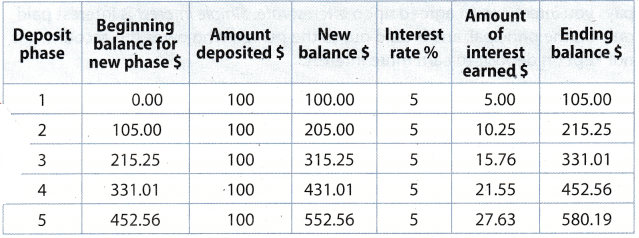
On Claudia’s birthday, her parents opened a savings account and deposited $100. They also deposit $100 each year after that on her birthday. The account earns interest at an annual rate of 5% compounded annually. Claudia will make no withdrawals from the account for at least 10 years. Make a table to find the ending balance in Claudia’s account after 5 years.
Texas Go Math Grade 7 Lesson 13.2 Answer Key 2
The total amount in the account at the end of the fifth year is $580.19.

Reflect

Question 3.
Does the balance of Claudia’s account change by the same amount each year? Explain why or why not.
Answer:
No, it does not, because it is the case of compound interest.
Compound interest is computed on the amount that includes the principal and any previously interest earned.
The beginning balance for new phase is actually the ending balance from the previous phase, which contains the interest earned in that previous phase.
Every year the interest is computed on that previous ending balance, which is different every year, and because of that the ending balance does not change by the same amount each year.

Question 4.
Would the total amount in the account after 5 years be greater if the interest rate were higher? Explain.
Answer:
Yes, it would.
If the interest rate were higher, the amount of interest earned in the first year would be greater and the ending balance would be greater too.
It is compound interest and every next year the ending balance will be greater, and because of that, the total amount in the account after 5 years will be greater.

Your Turn

Lesson 13.2 Simple and Compound Interest Answer Key Question 5.
What If? Suppose the interest rate on Claudia’s account is 6% instead of 5%. How much will Claudia have in her account at the end of the fifth year? How does it compare to the amount in Example 2?
Answer:
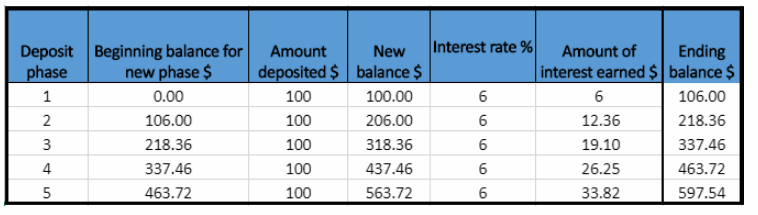
Texas Go Math Grade 7 Lesson 13.2 Answer Key 7
New balance = Beginning balance for new phase + Amount deposited
Amount of interest earned = New balance × Interest rate
Ending balance = New balance + Amount of interest earned
Ending balance in the first year is the Beginning balance for new phase in the second year.
Hence, the Beginning balance for new phase is the Ending balance from the previous year.
Write the interest rate as decimal, ie 6% = 0.06.

Year 1
New balance in the first year is $100.
Amount of interest, earned = $100 × 0.06 = $6
Ending balance = $100 + $6 = $106

Year 2
New balance in the second year is the Ending balance from previous year plus Amount deposited, ie $106 + $100 = $206.
Amount of interest earned = $206 × 0.06 = $12.36
Ending balance = $206 + $12.36 = $218.36

Year 3
New balance in the third year is the Ending balance from previous year plus
Amount deposited, ie $218.36 + $100 = 8318.36.
Amount of interest earned = $318.36 × 0.06 = $19.10
Ending balance = $318.36 + $19.10 = $337.46

Year 4
New balance in the forth year is the Ending balance from previous year plus
Amount deposited. ie $337.46 + $100 = $437.46.
Amount of interest earned = $437.16 × 0.06 = $26.25
Ending balance = $437.46 + $26.25 = $463.72

Year 5
New balance in the fifth year is the Ending balance from previous year plus
Amount deposited. ie $463.72 + $100 = $563.72.
Amount of interest earned $563.72 × 0.06 = $33.82
Ënding balance = $563.72 + $33.82 = $597.54
The total amount on the Claudia’s account at the end of the fifth year is $597.54.

Compare the amount on Claudia’s account with interest rate of 6% and amount on account with interest rate of 5%(from Example 2) using subtraction:
$597.54 – $580.19 = $17.35
When the interest rate is higher, the amount on account is greater.

Example 3.
Jane has two savings accounts, Account S and Account C. Both accounts are opened with an initial deposit of $100 and an annual interest rate of 5%. No additional deposits are made, and no withdrawals are made. Account S earns simple interest, and Account C earns interest compounded annually. Which account will earn more interest after 10 years? How much more?
Answer:
Step 1
Find the total interest earned by Account S after 10 years.
Find the amount of interest earned in one year.
principal × Interest rate = Interest for 1 year
$100 × 0.05 = $5
Find the amount of interest earned in ten years.
Interest for 1 year × Number of years = Interest for 10 years
$5 × 10 = $50
Account S will earn $50 after 10 years.
Step 2
Find the final amount in Account C. Then subtract the principal to find the amount of interest earned.
A = P(1 + r)t
= 100 × (1 + 0.05)10
= 162.89
Account C will earn $162.89 – $100.00 = $62.89 after 10 years.
Step 3
Compare the amounts using subtraction: $62.89 – $50 = $12.89
Account C earns $12.89 more in compound interest after 10 years than Account S earns in simple interest.

Your Turn

Question 6.
What If? Suppose the accounts in Example 3 both have interest rates of 4.5%. Which account will earn more interest after 10 years? How much more?
Answer:
The account S earns simple interest, and account C earns interest compounded annually.
The principal for both accounts is $100.

Account S
Write interest rate as decimal. ie 1.5% = 0.045
Find the amount of interest earned in one year.
Principal × Interest rate = Interest in one year
$100 × 0.045 = $4.5
Now, find the amount of interest earned in ten tears.
Interest for 1 year × Number of years = Interest for 10 years
$4.5 × 10 = $45
Account S will earn $45 after 10 years.

Account C
Use the formula for compound interest compounded annually.
A= P(1 +r)t
where P is the principal, r is interest rate(in decimal), t is the time in years and A is the amount in the account after t years if no withdrawals are made.
Find the final amount in the account after 10 years.
Substitute 10 for t, 100 for P and 0.045 for r in the formula.
A = 100(1 + 0.045)10
A = 100(1.045)10
A = 100 . 1.55
A = 155
The final amount in account C is $155.

To find the amount of interest earned subtract principal from the final amount.
$155 – $100 = $55
Account C will earn $55 after 10 years.

Compare the amounts using subtraction:
$55 – $45 = $10
Account C will earn $10 more in compound interest after 10 years than account S earns in simple interest.

Texas Go Math Grade 7 Lesson 13.2 Guided Practice Answer Key  

Question 1.
Each year on the same day, Hasan deposits $150 in a savings account that earns simple interest at an annual rate of 3%. He makes no other deposits or withdrawals. How much interest does his account earn after one year? After two years? After five years? (Example 1)
Answer:
Texas Go Math Grade 7 Lesson 13.2 Answer Key 8
Amount of interest earned = New balance × Interest rate
Write the interest rate as decimal, ie 3% = 0.03.
Every year we calculate simple interest on a new balance to find the amount of a interest earned.

year 1
Amount of interest earned = $150 × 0.03 = $4.5
Year 2
Amount of interest earned = $300 × 0.03 = $9
Year 3
Amount of interest earned = $450 × 0.03 = $13.5
Year 4
Amount of interest earned = $600 × 0.03 = $18
Year 5
Amount of interest earned = $750 × 0.03 = $22.5

Hasan earns $4.5 in interest after the first year.
Hasan earns $4.5 + $9 = $13.5 in interest after the second year.
Hasan earns $67.5 in interest after the fifth year.

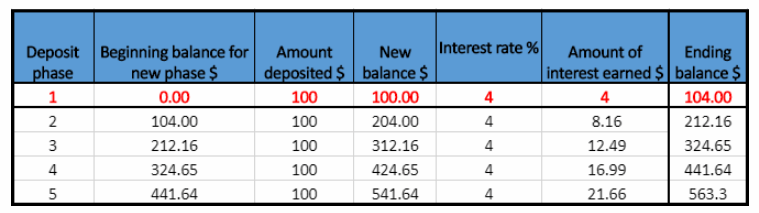
Keri deposits $100 in an account every year on the same day. She makes no other deposits or withdrawals. The account earns an annual rate of 4% compounded annually. Complete the table. (Example 2)

Simple Interest Problems 7th Grade Go Math Answer Key Question 2.
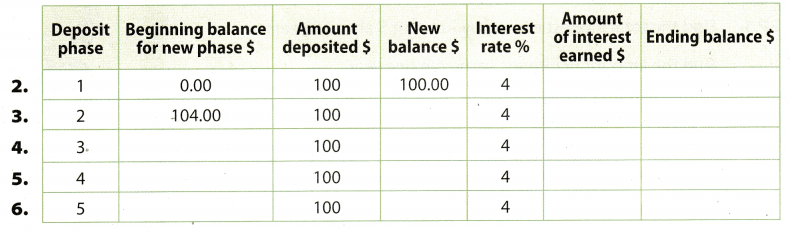
Texas Go Math Grade 7 Lesson 13.2 Answer Key 3
Answer:
Texas Go Math Grade 7 Lesson 13.2 Answer Key 9
Amount of interest earned = New balance × Interest rate
Ending balance = New balance + Amount of interest earned
Write the interest rate as decimal, ie % = 0.04.

Year 1
New balance in the first year is $100.
Amount of interest earned = $100 × 0.04 = $4
Ending balance = $100 + $4 = $104

Question 3.
Texas Go Math Grade 7 Lesson 13.2 Answer Key 3
Answer:
Texas Go Math Grade 7 Lesson 13.2 Answer Key 10
New balance = Beginning balance for new phase + Amount deposited
Amount of interest earned = New balance × Interest rate
Ending balance = New balance + Amount of interest earned

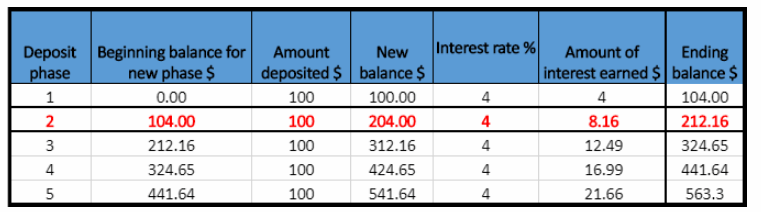
Year 2
New balance in the second year is the Ending balance front previous year plus Amount deposited. ie $104 + $100 = $201.
Amount of interest carried = $204 × 0.04 = $8.16
Ending balance = $204 + $8.16 = $212.16

Question 4.
Texas Go Math Grade 7 Lesson 13.2 Answer Key 3
Answer:
Texas Go Math Grade 7 Lesson 13.2 Answer Key 11
New balance = Beginning balance for new phase + Amount deposited
Amount of interest earned = New balance × Interest rate
Ending balance = New balance + Amount of interest earned
Year 3
New balance in the third year is the Ending balance from previous year plus Amount deposited, ie $212.16 + $100 = $312.16.
Amount of interest earned = $312.16 × 0.04 = $12.49
Ending balance = $312.16 + $12.49 = $324.65

Question 5.
Texas Go Math Grade 7 Lesson 13.2 Answer Key 3
Answer:
Texas Go Math Grade 7 Lesson 13.2 Answer Key 12
New balance = Beginning balance for new phase + Amount deposited
Amount of interest earned = New balance × Interest rate
Ending balance = New balance + Amount of interest earned
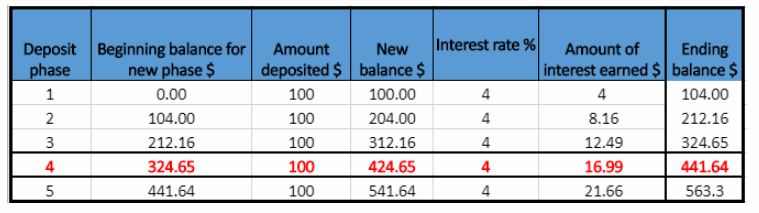
Year 4
The new balance in the fourth year is the Ending balance from the previous year plus the Amount deposited. ie $324.65 + $100 = $424.65.
Amount of interest earned = $424.65 × 0.04 = $16.99
Ending balance = $424.65 + $16.99 = $441.64

Texas Go Math Grade 7 Answer Key Compound Interest Formula Question 6.
Texas Go Math Grade 7 Lesson 13.2 Answer Key 3
Answer:
Texas Go Math Grade 7 Lesson 13.2 Answer Key 13
New baLance = Beginning baLance for new phase + Amount deposited
Amount of interest earned = New balance × Interest rate
Ending balance = New balance + Amount of interest earned

Year 5
New balance in the fifth year is the Ending balance from previous year plus Amount deposited. ie $441.64 + $100 = $541.64.
Amount of interest earned = $541.61 × 0.04 = $21.66
Ending balance $541.64 + $21.66 = $563.3

Question 7.
Theo deposits $2,000 deposit in a savings account earning compound interest at an annual rate of 5% compounded annually. He makes no additional deposits or withdrawals. Use the formula for compound interest to find the amount in the account after 10 years. (Example 3)
Answer:
Use the formula for compound interest compounded annually.
A = P(1 + r)t
where P is the principal, r is interest rate(in decimal), t is the time in years and A is the amount in the account after
t years if no withdrawals are made.
Find the final amount in the account after 10 years.
Substitute 10 for t, 2,000 for P and 0.05 for r in the formula.
A = 2,000(1 + 0.05)10
A = 2,000(1.05)10
A = 2,000 . 1.63
A= 3,260

The final amount in the account after 10 years is $3,260.
To find the amount of interest earned subtract principal from the final amount.
$3,260 – $2,000 = $1,260
Theo will earn $1,260 after 10 years.

Essential Question Check-In

Question 8.
Describe the difference between simple interest and compound interest.
Answer:
The simple interest is computed only on the principal, and the compound interest is computed on the amount that includes the principal and any previously interest earned.
Hence, amount of interest earned is greater when account earns a compounded annually, because the amount on
which interest is calculated is greater.

The simple interest is computed only on the principal, and the compound interest is computed on the amount that includes the principal and any previously interest earned.

Texas Go Math Grade 7 Lesson 13.2 Independent Practice Answer Key   

Mia borrowed $5,000 from her grandparents to pay college expenses. She pays them $125 each month, and simple interest at an annual rate of 5% on the remaining balance of the loan at the end of each year.

Question 9.
How many months will it take her to pay the loan off? Explain.
Answer:
She pays $125 each month, and the loan to her grandparents is $5,000.
To find how many months will she take to pay the loan off, we have to divide the whole loan by the amount of monthly pay.
\(\frac{\$ 5,000}{\$ 125}\) = 40
She will pay off the loan for 40 months.

Compound Interest 7th Grade Worksheet Answer Key Question 10.
For how many years will she pay interest? Explain.
Answer:
Mia pays interest at the end of the year on the remaining balance of the loan.
As long as there is some amount of remaining balance of the loan at the end of the year, she will pay interest.
She pays monthly $125, which means that she pays yearly
$125 × 12 = $1,500

The remaining balance of the loan at the cud of the first year we get when we subtract the amount of the loan that has been paid that year from the whole loan.
First year she will pay $1,500 (plus the simple interest on the remaining balance of the loan, which we will not calculate in this Exercise).

The remaining balance at the end of the first year = $5,000 – $1,500 = $3,500
After the first year the loan is no longer $5,000 but $3,500.

To find the remiaining balance of the loan at the end of the second year we have to subtract the amount she pays yearly, ie $1,500 (the same amount every year), from the new amount of loan $3,500.
The remaining balance at the end of the second year $3,500 – $1,500 = $2,000
After the second year the loan is $2,000.

To find the remaining balance of the loan at the end of the third year we have to subtract the amount she pays yearly, ie $1,500, from the new amount of loan, ie $2,000.
The remaining balance at the end of the third year = $2,000 – $1,500 = $500

In the fourth year the remaining balance of the loan is 8500 which she will pay for the first four months of that year.
By the end of the fourth year she will not have any remaining balance of the loan to calculate the simple interest.
Hence, she will pay interest for three years.

Question 11.
How much simple interest will she pay her grandparents altogether? Explain.
Answer:
Min pays simple interest on the remaining balance of the loan each year, so we have to calculate the simple interest at the end of each year.
The simple interest = The remaining balance of the loan × Annual rate(in decimal)
She pays monthly $125, which means that she pays yearly
$125 × 12 = $1,500
Year 1
The remaining balance of the loan at the end of the first year we get when we subtract the amount of the loan that has been paid that year from the whole loan.
The remaining balance at the end of the first year = $5,000 – $1,500 = $3,500
After the first year the remaining balance of the loan is $3,500.
The simple interest = $3, 500 × 0.05 = $175
The simple interest at the end of the first year is $175.

Year 2
After the first year the loan is $3,500.
To find the remaining balance of the loan at the end of the second year we have to subtract the amount she pays yearly, which is the same amount every year, ie $1,500, from the new amount of loan, ie $3,500.
The remaining balance at the end of the second year = $3, 500 – $1,500 = $2,000
After the second year the remaining balance of the loan is $2,000.
The simple interest $2, 000 × 0.05 = $100
The simple interest at the end of the second year is $100.

Year 3
After the second year the loan is $2,000.
To find the remaining balance of the loan at the end of the third year we have to subtract the amount she pays yearly, ie $1,500, from the new amount of loan. ie $2,000.
The remaining balance at the end of the third year = $2,000 – $1,500 = $500
After the third year the remaining balance of the loan is $500.
The simple interest = $500 × 0.05 = $25
The simple interest at tile end of the second year is $25.

In the fourth year the remaining balance of the loan is $500 which she will pay for the first four months of that year.
Hence, by the end of the fourth year, she will not have any remaining balance of the loan to calculate the simple interest.

Add all the simple interest we previously calculated to find the simple interest she will have to pay to her grandparents altogether.
The simple interest = $175 + $100 + $25 = $300
Altogether she will pay the simple interest of $300.

7th Grade Simple and Compound Interest Worksheet Answers Question 12.
Roman saves $500 each year in an account earning interest at an annual rate of 4% compounded annually. How much interest will the account earn at the end of each of the first 3 years?
Answer:
Texas Go Math Grade 7 Lesson 13.2 Answer Key 14
Each year Roman saves $500 which represents the amount deposited for each year.
Amount of interest earned = New balance × Interest rate
Ending balance = New balance + Amount of interest earned
Write the interest rate as decimal, ie 4% = 0.04.

Year 1
New balance in the first year is $500.
Amount of interest earned = 8500 × 0.04 = $20
The interest earned at the end of the first year is $20.
Ending balance = $500 + $20 = $250

Year 2
New balance in the second year is the Ending balance from previous year plus Amount deposited. ie $520 + $500 = $1,020.
Amount of interest earned = $1.020 × 0.04 = $40.8
The interest earned at the cud of the second year is $40.8.
Ending balance = $1,020 + $40.8 = $1,060.8

Year 3
New balance in the third year is the Ending balance from previous year plus Amount deposited, ie $1,060.8 + $500 = $1,560.8.
Amount of interest earned = $1.560.8 × 0.04 = $62.43
The interest earned at the end of the third year is $62.43.
Ending balance = $1,560.8 + $62.43 = $1,623

The interest earned at the end of the first year is $20.
The interest earned at the end of the second year is $40.8.
The interest earned at the end of the third year is $62.43.

Question 13.
Jackson started a savings account with $25. He plans to deposit $25 each month for the next 12 months, then continue those monthly deposits in following years. The account earns interest at an annual rate of 4% compounded annually, based on his final yearly balance. Fill in the chart to find out how much money he will have in the account after 3 years.
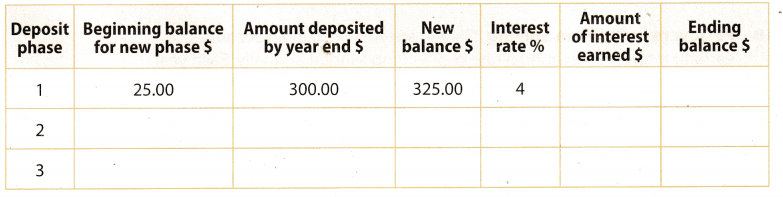
Texas Go Math Grade 7 Lesson 13.2 Answer Key 4
Answer:
Texas Go Math Grade 7 Lesson 13.2 Answer Key 15

Each month Jackson plans to deposit $25, and the year has 12 months. hence
Amount deposited by year end = Monthly deposit × 12
Amount deposited by year end = $25 × 12 = $300
Amount of interest earned = New balance × Interest rate
Ending balance = New balance + Amount of interest earned
Write the interest rate as decimal, ie % = 0.04.

Year 1
New balance in the first year is $325.
Amount of interest earned = $325 × 0.04 = $13
Ending balance = $325 + $13 = $338

Year 2
New balance in the second year is the Ending balance from previous year plus Amount deposited, ie $338 + $300 = $638.
Amount of interest earned = $638 × 0.04 = $25.52
Ending balance = $638 + 825.52 = $663.52

Year 3
New balance in the third year is the Ending balance from previous year plus Amount deposited. ie $663.52 + $300 = $963.52.
Amount of interest earned = $963.52 × 0.04 = $38.54
Ending balance = $963.52 + $38.54 = $1,002.06
After three years Jackson will have $1,002.06 on his account.

Question 14.
Communicate Mathematical Ideas Look back at Exercise 13. Suppose Jackson increased the initial deposit by $75, but made the same monthly deposits. Would the balance at the end of every year increase by $75?
Answer:
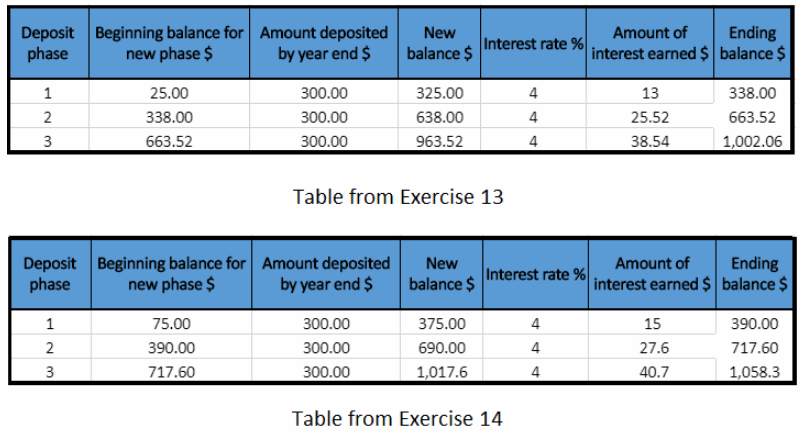
Texas Go Math Grade 7 Lesson 13.2 Answer Key 16
The Ending balance in the first year with a beginning balance of $25 is $338.
The Ending balance in the first year with a beginning balance of $75 is $390.
Compare these two Ending balances using subtraction:
$390 – $338 = $52

The Ending balance in the second year with a beginning balance of $25 is $663.52.
The Ending balance in the first year with a beginning balance of $75 is $717.6.
Compare these two Ending balances using subtraction:
$717.6 – $663.52 = $54.08

The Ending balance in the third year with a beginning balance of $25 is $1,002.06.
The Ending balance in the third year with a beginning balance of $75 is $1,058.3.
Compare these two Ending balances using subtraction:
$1,058.3 – $1,002.06 = $56.24

Notice that the differences between Ending balances each year, from Exercise 13 and Exercise 14, are not the same and not $75.
Hence, the balance do not increase by $75 when the initial deposit increases by $75.

Simple Interest 7th Grade Math Worksheet Answer Key Question 15.
Account A and Account B both have a principal of $1,000 and an annual interest rate of 4%. No additional deposits or withdrawals are made. Account A earns simple interest. Account B earns interest compounded annually. Compare the amounts in the two accounts after 20 years. Which earns more interest? How much more?
Answer:
Account A earns simple interest, and account B earns interest compounded annually.
The principal for both accounts is $1,000.

Account A
Write the interest rate as decimal. ie 4% = 0.04
Find the amount of interest earned in one year.
Principal × Interest rate = Interest in one year
$1,000 × 0.04 = $40
Now, find the amount of interest earned in 20 years.
Interest for 1 year × Number of years = Interest for 20 years
$40 × 20 = $800
Account A will earn $800 after 20 years.

Account B
Use the formula for compound interest compounded ‘manually.
A = P(1 + r)t
where P is the principal, r is the interest rate(in decimal), t is the time in years and A is the amount in the account after t years if no withdrawals are made.
Find the final amount in the account after 10 years.
Substitute 20 for t, 1,000 for P, and 0.04 for r in the formula.
A = 1,000(1 + 0.04)20
44 = 1,000(1.04)20
A = 1,000 ∙ 2.19
A = 2,190
The final amount iii account B is $2,190.

To find the amount of interest earned subtract the principal from the final amount.
$2,190 – $1,000 = $1,190
Account C will earn $1,190 after 20 years.

Compare the amounts using subtraction:
$1,190 – $800 = $390
Account B will earn $390 more in compound interest after 20 years than account A earns in simple interest.

Account B will earn $390 more in compound interest after 20 years than account A earns in simple interest.

Texas Go Math Grade 7 Lesson 13.2 H.O.T. Focus on Higher Order Thinking Answer Key   

Question 16.
Justify Reasoning Luisa deposited $2,000 in an account earning simple interest at an annual rate of 5%. She made no additional deposits and no withdrawals. When she closed the account, she had earned a total of $2,000 in interest. How long was the account open?
Answer:
The principal for Luis’s account is $2. 000.
Write interest rate as decimal. ie 5% 0.05
Find the amount of intere$ earned in one year.
Principal × Interest rate = Interest in one year
$2 000 × 0.05 = $100

We know that she earned a total of $2,000 in interest when she closed the account.

To find the number of years the account was open. we have to divide the total of interest earned by interest earned in one year.
\(\frac{\$ 2,000}{\$ 100}\) = 200
20 years after the account was opened.

Question 17.
Draw Conclusions Amanda deposits $500 into a savings account earning simple interest at an annual rate of 8%. Tori deposits $1,000 into a savings account earning simple interest at an annual rate of 2.5%. Neither girl makes any additional deposits or withdrawals. Which girl’s account will reach a balance of $1,500 first? Justify your answer.
Answer:
The principal for Anianda’s account is $500.
Write interest rate as decimal, ie 8% = 0.08
Find the amount of interest in one year.
Principal × Interest rate = Interest in one year
$500 × 0.08 = $40
The amount of interest in one year is $40.
We want to know when the total balance of Amanda’s account will be $1,500, ie how much interest the account needs to earn.

When we sum the principal and the total interest earned we get the total account balance.

Total balance = The principal + The total interest earned
$1,500 = $500 + The total interest earned
The total interest earned = $1,500 – $500 = $1,000
The total interest account needs to earn is $1,000.
As the account earns $40 for one year. how many years does it take for the account to earn $1,000?
To find the number of years needed divide the total interest by the interest in one year.
\(\frac{\$ 1,000}{\$ 40}\) = 2o
It needs 25 year to Amanda’s account reach a balance of $1,500.

The principal for Tori’s account is $1,000.
Write interest rate as decimal. ie 2.5% = 0.025
Find the amount of interest earn in one year.
Principal × Interest rate = Interest in one year
$1.000 × 0.025 = $25
The amount of interest earn in one year is $25.
We want to know when the total balance of Tori’s account will be $1,500, ie how much interest the account needs to earn.

When we sum the principal and the total interest earned we get the total account balance.

Total balance = The principal + The total interest earned
$1, 500 = $1,000 + The total interest earned
The total interest earned = $1,500 – $1,000 = $500
The total interest account needs to earn is $500.
As the account earns $25 for one year, how many years does it take for the account to earn $500?
To find the number of years needed divide the total interest by the interest in one year.
\(\frac{\$ 500}{\$ 25}\) = 20
It needs 20 year to Tori’s account reach a balance of $1,500.
Hence, Tori account will first reach a balance of $1,500.

Question 18.
Persevere in Problem Solving Gary invested $1,000 in an account earning interest at an annual rate of 5% compounded annually. Each year, he deposited an additional $1,000, and made no withdrawals. When he closed the account, he had a balance of $4,525.64. Make a table similar to the one in Example 2 to help you estimate how long the money was in the account. How much interest would Gary earn in that same time if he invests $10,000 and deposits $10,000 into the account each year?
Answer:
Texas Go Math Grade 7 Lesson 13.2 Answer Key 17
Each year Gary deposit $1,000 which represents the amount deposited for each year.
Amount of interest earned = New balance × Interest rate
Ending balance = New balance + Amount of interest earned
Write the interest rate as decimal. ie 5% = 0.05.

Year 1
New balance in the first year is $1,000.
Amount of interest earned = $1, 000 × 0.05 = $50
Ending balance = $1,000 + $50 = $1,050

Year 2
New balance in the second year is the Ending balance from previous year plus Amount deposited, ie $1,050+ $1,000 = $2,050
Amount of interest earned = $2,050 × 0.05 = $102.5
Ending balance = $2,050 + $102.5 = $2,152.50

Year 3

New balance in the third year is the Ending baIance from previous year plus Amount deposited, ie $2,152.50 + $1,000 = $3,152.5
Amount of interest earned = $3,152.5 × 0.5 = $157.63
Ending balance = $3,152.5 + $157.63 = $3,310.13

Year 4
New balance in the forth year is the Ending balance from previous year pLus Amount deposited, ie
$3,310.13 + $1,000 = $4,310.13
Amount of interest earned = $4, 310.13 × 0.5 = $215.51
Ending balance = $4,310.13 + $215.51 = $4,525.64
The money was 4 years in the account
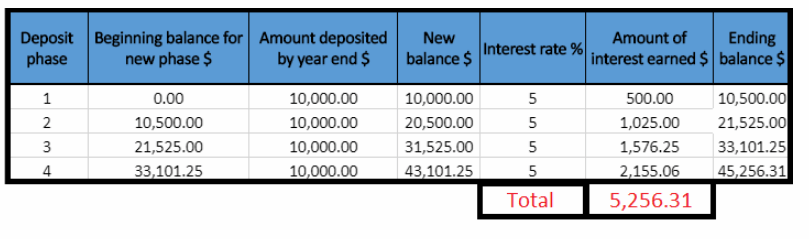
Texas Go Math Grade 7 Lesson 13.2 Answer Key 19
Each year Gary deposit $10,000 which represents the amount deposited for each year.
Amount of interest earned = New balance × Interest rate
Ending balance = New balance + Amount of interest earned
Wite the interest rate as decinial. ie 5% = 0.05.

Year 1
New balance in the first year is $10,000.
Amount of interest earned = $10,000 × 0.05 = $500
Ending balance = $10,000 + $500 = $10,500

Year 2
New balance in the second year is the Ending balance from previous year plus Amount deposited, ie
$10,500 + $10,000 = $20,500
Amount of interest earned = $20, 500 × 0.05 = $1,025
Ending balance = $20,500 + $1,025 = $21, 525

Year 3

New balance in the third year is the Ending balance from previous year plus Amount deposited, ie
$21,525 + $10,000 = $31,525
Amount of interest earned = $31,525 × 0.5 = $1,576.25
Ending balance = $31, 525 + $1, 576.25 = $33,101.25

Year 4
New balance in the forth year is the Eìiding balance from previous year plus Amount deposited. ie
$33,101.25 + $10,000 = $13, 101.25
Amount of interest earned = $43,101.25 × 0.5 = $2,155.06
Ending balance = $43,101.25 + $2,155.06 = $45,256.31
After 4 years Gary would earn interest of $5,256.31.

The money was 4 years in the account.
If Gary deposit $10,000 instead $1,000 he would earn interest of $5,256.31.
Texas Go Math Grade 7 Lesson 13.2 Answer Key Calculating and Comparing Simple and Compound Interest Read More »

Texas Go Math Grade 7 Lesson 9.2 Answer Key Finding Circumference

Refer to our Texas Go Math Grade 7 Answer Key Pdf to score good marks in the exams. Test yourself by practicing the problems from Texas Go Math Grade 7 Lesson 9.2 Answer Key Finding Circumference.

Texas Go Math Grade 7 Lesson 9.2 Answer Key Finding Circumference

Essential Question
How do you find the circumference of a circle?

Example 1
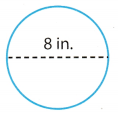
Find the circumference of the circle to the nearest hundredth. Use 3.14 or \(\frac{22}{7}\) for π.

Step 1
Identify the diameter of the circle.
d = 8 in.
Texas Go Math Grade 7 Lesson 9.2 Answer Key 1

Step 2
Use the formula.
C = πd
C = π(8) Substitute 8 for d.
C ≈ 3.14(8) Substitute 3.14 for π.
C ≈ 25.12 Multiply.
The circumference is about 25.12 inches.

Reflect

Question 1.
What value of π could you use to estimate the circumference? ____
Answer:
We could use 3.14 or \(\frac{22}{7}\).

Go Math Answer Key Grade 7 Lesson 9.2 Practice Answer Key Question 2.
Checking for Reasonableness How do you know your answer is reasonable?
Answer:
The answer would be reasonable as the value of π is close to the actual result. We could not use the real value of π because it is a non-terminating decimal. It is better to use a round-off value for π.

The result is closer to the actual value.

Your Turn

Question 3.
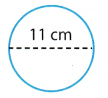
Find the circumference of the circle to the nearest hundredth.
Texas Go Math Grade 7 Lesson 9.2 Answer Key 2
Answer:
Diameter of the circle is 11 cm
Use the formula for the circumference of the circle
C = π(d) Substitute 11 for d, and 3.14 for π.
C ≈ 3.14(11)
C ≈ 34.54
The circumference is about 34.54 cm.

C ≈ 34.54 cm

Example 2
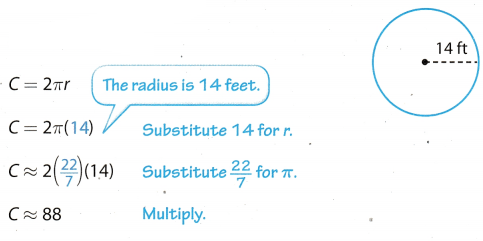
An irrigation sprinkler waters a circular region with a radius of 14 feet. Find the circumference of the region watered by the sprinkler. Use \(\frac{22}{7}\) for π.
Use the formula.
Texas Go Math Grade 7 Lesson 9.2 Answer Key 3
The circumference of the region watered by the sprinkler is about 88 feet.

Reflect

Lesson 9.2 Practice Answer Key Texas Go Math Grade 7 Question 4.
Analyze Relationships When is it logical to use \(\frac{22}{7}\) instead of 3.14 for π?
Answer:
We use \(\frac{22}{7}\) when the length of the diameter(or the radius) is divisible by 7 so that we can shorten 7 from the fraction \(\frac{22}{7}\).

Your Turn

Question 5.
Find the circumference of the circle.
Texas Go Math Grade 7 Lesson 9.2 Answer Key 4
Answer:
The radius of the circle is 21 cm.
Use the formula for the circumference of the circle
C = 2π(r) Substitute 21 for r, and \(\frac{22}{7}\) for π.
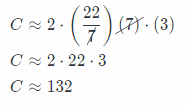
C ≈ 2 . (\(\frac{22}{7}\))(21)
Texas Go Math Grade 7 Lesson 9.2 Answer Key 17
The circumference is about 132 cm.

C ≈ 132 cm

Example 3.
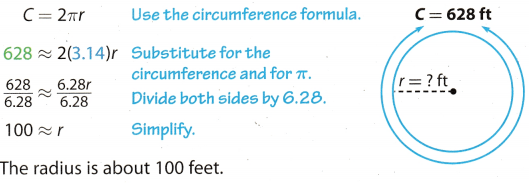
A circular pond has a circumference of 628 feet. A model boat is moving directly across the pond, along a radius, at a rate of 5 feet per second. How long does it take the boat to get from the edge of the pond to the center?
Step 1
Find the radius of the pond.
Texas Go Math Grade 7 Lesson 9.2 Answer Key 26
The radius is about 100 feet.

Step 2
Find the time it takes the boat to get from the edge of the pond to the center along the radius. Divide the radius of the pond by the speed of the model boat.
1oo ÷ 5 = 20
It takes the boat about 20 seconds to get to the center of the pond.

Reflect

Question 6.
Analyze Relationships Dante checks the answer to Step 1 by multiplying it by 6 and comparing it with the given circumference. Explain why Dante’s estimation method works. Use it to check Step 1.
Answer:
Dantes’s estimation method works because the value of 2Ï€ when rounded off is equal to 6.
Since 2π = 6.28 ≈ 6, and r = \(\frac{C}{2 \pi}\), we have
r ≈ \(\frac{C}{6}\) ⇒ C = 6r.
Let’s check the estimation:
6 . 100 = 600 ≈ 628 = C.

The value of 2Ï€ when rounded off is equal to 6.

Go Math Grade 7 Lesson 9.2 Circumference Answer Key Question 7.
What If? Suppose the model boat were traveling at a rate of 4 feet per second. How long would it take the model boat to get from the edge of the pond to the center? _________________________________________
Answer:
The radius is about 100 feet
We have to divide the radius by the speed of the boat, which is 4 feet per second.
Hence,
100 ÷ 4 = 25
Boat needs about 25 seconds to get to the center of the pond

Your Turn

Question 8.
A circular garden has a circumference of 44 yards. Lars is digging a straight line along a diameter of the garden at a rate of 7 yards per hour. How many hours will it take him to dig across the garden?
Answer:
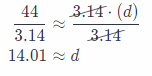
From the formula for the circumference of the circle we find the diameter of the garden.
C = π(d) Substitute 44 for C, and 3.14 for π
44 ≈ 3.14 . (d) Divide both sides by 3.14
Texas Go Math Grade 7 Lesson 9.2 Answer Key 18
The diameter is about 14 yards.
To find the time which wiLl take Lars to dig across the garden, we divide the diameter of the garden by the speed of digging, 14 ÷ 7 = 2.
It will take him 2 hours to dig the garden.

Texas Go Math Grade 7 Lesson 9.2 Guided Practice Answer Key 

Find the circumference of each circle. (Examples 1 and 2)

Question 1.
C = πd
C ≈ ___
C ≈ inches
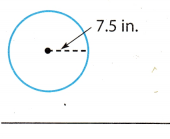
Texas Go Math Grade 7 Lesson 9.2 Answer Key 6
Answer:
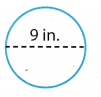
The diameter of the circle is 9 inches.
C = π(d) Substitute 9 for d and 3.14 for π
C ≈ 3.14(9)
C ≈ 28.26
The circumference is about 28.26 inches.

C ≈ 28.26 inches.

Question 2.
C ≈ 2πr
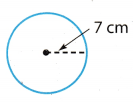
C ≈ \(2\left(\frac{22}{7}\right)\) (_______)
C ≈ ___ cm
Texas Go Math Grade 7 Lesson 9.2 Answer Key 7
Answer:
The radius of the circle is 7 cm.
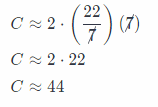
Texas Go Math Grade 7 Lesson 9.2 Answer Key 19
The circumference is about 44 cm.
C ≈ 44 cm

Find the circumference of each circle. Use 3.14 or \(\frac{22}{7}\) for π. Round to the nearest hundredth, if necessary. (Examples 1 and 2)

Question 3.
Texas Go Math Grade 7 Lesson 9.2 Answer Key 8
Answer:
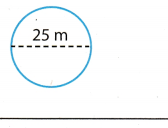
Diameter of the circle is 25 m.
Use the formula for the circumference of the circle
C = π(d) Substitute 25 for d, and 3.14 for π.
C ≈ 3.14(25)
C ≈ 78.5
The circumference ¡s about 78.5 m

C ≈ 78.5 m.

Question 4.
Texas Go Math Grade 7 Lesson 9.2 Answer Key 9
Answer:
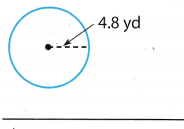
The radius of the circle is 4.8 yd.
Use the formula for the circumference of the circle.
C = 2πr(r) Substitute 4.8 for r, and 3.14 for π.
C ≈ 2 . 3.14(4.8)
C ≈ 30.14
The circumference is about 30 yd.

Go Math Grade 7 Lesson 9.2 Practice Answer Key Question 5.
Texas Go Math Grade 7 Lesson 9.2 Answer Key 10
Answer:
The radius of the circle is 1.5 in.
Use the formula for the circumference of the circle.
C = 2πr(r) Substitute 7.5 for r, and 314 for π.
C ≈ 2 . 3.14(1.5)
C ≈ 47.1
The circumference is about 47 in.

C ≈ 41 in.

Question 6.
A round swimming pool has a circumference of 66 feet. Carlos wants to buy a rope to put across the diameter of the pool. The rope costs $0.45 per foot, and Carlos needs 4 feet more than the diameter of the pool. How much will Carlos pay for the rope? (Example 3)
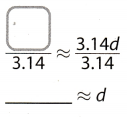
Find the diameter.
C = πd
____ ≈ 3.14d
Texas Go Math Grade 7 Lesson 9.2 Answer Key 11

Find the cost.
Carlos needs ____ feet of rope.
_____ × $0.45 = ______
Carlos will pay ________ for the rope.
Answer:
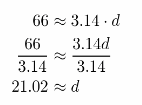
Texas Go Math Grade 7 Lesson 9.2 Answer Key 20
Carlos ìieeds 21,02 + 4 ≈ 25.02 feet of rope.
250.2 × $0.45 ≈ $11.26
Carlos will pay about $11.26 for the rope.
Carlos will pay about 11.25 for the rope.

Find each missing measurement to the nearest hundredth. Use 3.14 for π. (Example 1 and 3)

Question 7.
r = ___
d = ____
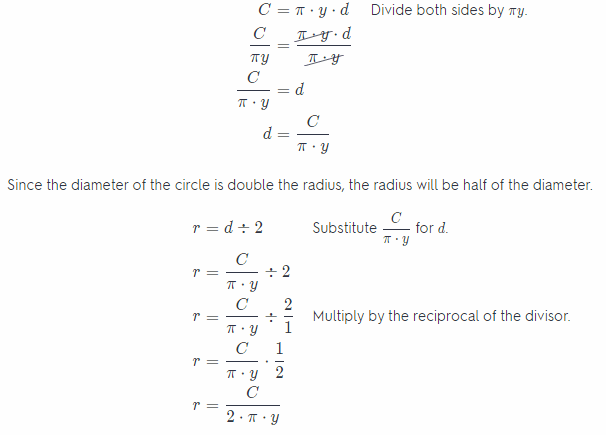
C = π yd
Answer:
Texas Go Math Grade 7 Lesson 9.2 Answer Key 21
r = \(\frac{C}{2 \cdot \pi \cdot y}\)

Question 8.
r ≈ ____
d ≈ _____
C = 78.8 ft
Answer:
C = π(d)
Substitute 78.8 for C, and 3.14 for π
78.8 ≈ 3.14(d) Divide both sides by 3.14.
\(\frac{78.8}{3.14}\) ≈ \(\frac{3.14}{3.14}(d)\)
25.09 ≈ d
d ≈ 25.09
Since the diameter of the circle is double the radius, the radius will be half of the diameter
r = d ÷ 2 Substitute 25.09 for d.
r = 25.09 ÷ 2
r = 12.54
d ≈ 25.09, r = 12.54

Question 9.
r ≈ ____
d ≈ 3.4 in.
C = ____
Answer:
Use the formula for the circumference.
C = π(d)
Substitute 3.4 for d, and 3.14 for π.
C ≈ 3.14(3.4)
C ≈ 10.68
Since the diameter of the circle is double the radius, the radius will be half of the diameter.
r = d ÷ 2 Substitute 3.4 for d.
r = (3.4) ÷ 2
r = 1.7

C ≈ 10.68 in., r = 1.7 in.

Essential Question Check-In

Question 10.
Norah knows that the diameter of a circle ¡s 13 meters. How would you tell her to find the circumference?
Answer:
Use the formula for the circumference of the circle, where d represents the diameter of the circle.
C = π(d) Substitute 13 for d, and 3.14 for π.
C ≈ 3.14(13)
C ≈ 40.82
The circumference is about 40 m.

C ≈ 40.82 m

Texas Go Math Grade 7 Lesson 9.2 Independent Practice Answer Key 

Find the circumference of each circle. Use 3.14 or \(\frac{22}{7}\) for π. Round to the nearest hundredth, if necessary.

Question 11.
Texas Go Math Grade 7 Lesson 9.2 Answer Key 12
Answer:
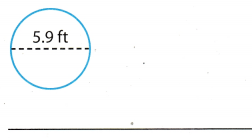
The diameter of the circle is 5.9 ft
Use the formula for the circumference of the circle.
C = π(d) Substitute 5.9 for d, and 3.14 for π.
C ≈ 3.14(5.9)
C ≈ 18.53
The circumference is about 18.53 ft.
C ≈ 18.53 ft

Go Math 7th Grade Pdf Lesson 9.2 Circles Answer Key Question 12.
Texas Go Math Grade 7 Lesson 9.2 Answer Key 13
Answer:
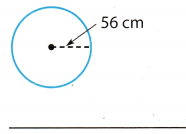
The radius of the circle is 56 cm.
Use the formula for the circumference of the circle.
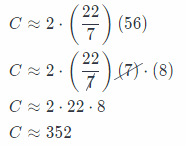
C = 2πr(r) Substitute 56 for r, and \(\frac{22}{7}\) for π.
Texas Go Math Grade 7 Lesson 9.2 Answer Key 22
The circumference is about 352 cm.
C ≈ 352 cm

Question 13.
Texas Go Math Grade 7 Lesson 9.2 Answer Key 14
Answer:
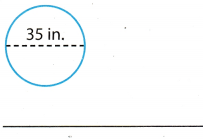
The diameter of the circle is 35 in.
Use the formula for the circumference of the circle.
C = π(d) Substitute 35 for d, and \(\frac{22}{7}\) for π.
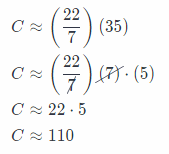
Texas Go Math Grade 7 Lesson 9.2 Answer Key 23
The circumference is about 110 in.
C ≈ 110 in

Question 14.
In Exercises 11—13, for which problems did you \(\frac{22}{7}\) use for π? Explain your choice.
Answer:
We use the fraction \(\frac{22}{7}\) in exercises 12 and 13 because the radius and the diameter in both exercises are divisible by 7, so we can shorten 7 from the fraction \(\frac{22}{7}\).

Question 15.
A circular fountain has a radius of 9.4 feet. Find its diameter and circumference to the nearest hundredth.
Answer:
Use the formula for the circumference.
C = 2Ï€r
Substitute 9.4 for r, and 3.14 for π
C ≈ 2 . 3.14(9.4)
C ≈ 59.03
The diameter of the circle is double the radius
d = 2 . r Substitute 9.4 for r.
d = 2 . 9.4
d = 18.8

C ≈ 59.03 ft, d = 18.8 ft

Question 16.
Find the radius and circumference of a CD with a diamèter of 4.75 inches.
Answer:
Use the formula for the circumference.
C = π(d)
Substitute 4.75 for d, and 3.14 for π.
C ≈ 3.14(4.75)
C ≈ 14.91
Since the diameter of the circle is double the radius, the radius will be half of the diameter.
r = d ÷ 2 Substitute 4.75 for d.
r = (4.75) ÷ 2
r = 2.37
ResuLt
C ≈ 14.91 in., r = 2.37 in.

Question 17.
A dartboard has a diameter of 18 inches. What is its radius and circumference?
Answer:
Use the formula for the circumference.
C = π(d)
Substitute 18 for d, and 3.14 for π.
C ≈ 3.14(18)
C ≈ 56.52
Since the diameter of the circle is double the radius, the radius will be half of the diameter.
r = d ÷ 2 Substitute 18 for d.
r = (18) ÷ 2
r = 9

C ≈ 56.52 in., r = 9 in.

Question 18.
Multistep Randy’s circular garden has a radius of 1.5 feet. He wants to enclose the garden with edging that costs $0.75 per foot. About how much will the edging cost? Explain.
Answer:
First, we have to find the circumference of the garden.
C = 2πr(r) Substitute 1.5 for r, and 3.14 for π.
C ≈ 2.3.14(1.5)
C ≈ 9.42
The circumference of the garden is about 9.42 ft, and one foot of the edging costs $0.73. so we have to multiply the circumference with $0.75 to find how much will the edging cost.
9.12 . $0.75 ≈ $7.06

The edging will cost about $7.06.

Question 19.
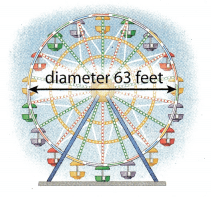
Represent Real-World Problems The Ferris wheel shown makes 12 revolutions per ride. How far would someone travel during one ride?
________
Texas Go Math Grade 7 Lesson 9.2 Answer Key 15
Answer:
The diameter of the wheel is 63 feet, and we have to find the circumference of the wheel, which will represents
one revolution.
C = π(d) Substitute 63 for d, and 3.14 for π.
C ≈ 3.14(63)
C ≈ 197.82
The circumference is about 197.82 ft.
The wheel makes 12 revolutions per ride, so we have to multiply the circumference with 12 to get how far
someone wouLd traveL during the one ride.
12 . 197.82 ≈ 2, 373.84 ft.

2,373.84 ft

Question 20.
The diameter of a bicycle wheel is 2 feet. About how many revolutions does the wheel make to travel 2 kilometers? Explain.
Hint: 1 km 3,280 ft
Answer:
d = 2feet
1km = 3280 feet
One revolution would be the circumference of the wheel.
Use the formula for the circumference of the circle
C = π(d) Substitute 2 for d, and 3.14 for π
C ≈ 3.14(2)
C ≈ 7.28
The circumference of the wheel is about 7.28 feet
We said that one revolution is the circumference of the wheel so we have to find how many circumference will be 2 km.
First, we have to convert 2 km to feet
1 km = 3,280 ft
2 km = 2 . 3280 ft
2km = 6,560 ft
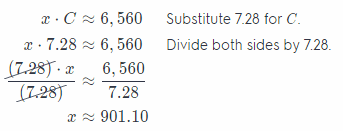
The equation for finding how many revolutions the wheel makes to travel 2 km, where x represents the number of revolutions are
Texas Go Math Grade 7 Lesson 9.2 Answer Key 24
The wheel makes about 901 revolutions to travel 2 km.

About 901 revolutions

Go Math 7th Grade Lesson 9.2 Answer Key Question 21.
Multistep A map of a public park shows a circular pond. There ¡s a bridge along the diameter of the pond that is 0.25 mi long. You walk across the bridge, while your friend walks halfway around the pond to meet you at the other side of the bridge. How much farther does your friend walk?
Answer:
The diameter of the pond is 0.25 mi long.
Use the formula for the circumference of the circle to find the circumference of the pond.
C = π(d) Substitute 0.25 for d, and 3.14 for π.
C ≈ 3.14(0.25)
C ≈ 0.78
The circumference of the pond is about 0.78 mi.
My friend walks halfway around the pond, so he walks the half circumference.
C ÷ 2 ≈ \(\frac{0.78}{2}\)
≈ 0.39
My friend walks about 0.39 mi and I walk 0.25 mi, so he walks about 0.39 mi – 0.25 mi = 0.14 mi farther than me.

About 0.14 mi.

Question 22.
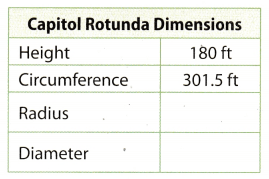
Architecture The Capitol Rotunda connects the House and the Senate sides of the U.S. Capitol. Complete the table. Round your answers to the nearest foot.
Texas Go Math Grade 7 Lesson 9.2 Answer Key 16
Answer:
Use the formula for the circumference.
C = 2π(r) Substitute 301.5 for C, and 3.14 for π.
301.5 ≈ 2 . 3.14(r)
301.5 ≈ 6.28(r) Divide both sides by 6.28.
\(\frac{301.5}{6.28}\) ≈ \(\frac{6.28}{6.28}(r)\)
48.01 ≈ r
r ≈ 48.01
Diameter is twice the radius, hence
d = 2 . r 2 . 48.01 ≈ 96.02

r ≈ 48.01 ft d ≈ 96.02 ft

Focus On Higher Order Thinking

Question 23.
Multistep A museum groundskeeper is creating a semicircular statuary garden with a diameter of 30 feet. There will be a fence around the garden. The fencing costs $9.25 per linear foot. About how much will the fencing cost altogether?
Answer:
The diameter of the garden is 30 feet.
To find how much will the fencing cost, first we have to find the circumference
of the garden, and then to multiply it by the price of a fence per foot($9.25).
Use the formula for the circumference of the circle.
C = π(d) Substitute .30 for d, and 3.14 for π.
C ≈ 3.14(30)
C ≈ 94.2
The circumference of the garden is about 94.2 feet.
The cost of the fencing = C . $9.25 ≈ 94.2 . $9.25 ≈ $871.35

About $871.35

Question 24.
Critical Thinking Sam is placing rope lights around the edge of a circular patio with a diameter of 18 feet. The lights come in lengths of 54 inches. How many strands of lights does he need to surround the patio edge?
Answer:
The diameter of the patio is 18 feet
First, we have to find the circumference of the patio.
Use the formula for the circumference of the circle.
C = π(d) Substitute 18 for d, and 3.14 for π.
C ≈ 3.14(18)
C ≈ 56.52
The circumference of the patio is about 56.52 feet
Convert the circumference from feet to inches, because the length of the lights is in inches
1 foot = 12 inches
C ≈ 56.52feet . 12 inches ≈ 678.24 inches
To find now many strands of lights Sam needs, we have to divide the circumference of the patio by the length of one strand. One strand is 54 inches Long.
C ÷ 54in. ≈ 678.24in. ÷ 54in. ≈ 12.56
Sam needs about 12.56 strands of lights.

Question 25.
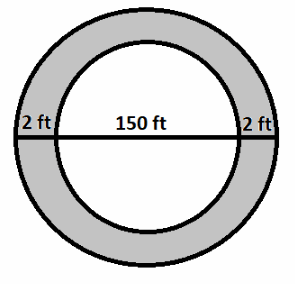
Represent Real-World Problems A circular path 2 feet wide has an inner diameter of 150 feet. How much farther is it around the outer edge of the path than around the inner edge?
Answer:
Texas Go Math Grade 7 Lesson 9.2 Answer Key 25
First, we find the circumference of the inner circle with a diameter of 150 ft, which will represent the inner edge.
The outer edge is the circumference of the circle which diameter we get as the sum of the diameter of the inner
circle and two times path width.
Let d1 be the diameter of the inner circle and d2 the diameter of the outer circle.
d2 = d1 + 2 . 2 feet Subtract 150 for d_1.
d2 = 150 feet + 4 feet
d2 = 154 feet
Let C1 be the circumference of the inner circle and C2 the circumference of the outer circle.
Use the formula for the circumference of the circle.
C1 = π(d1) Substitute 150 for d_1, and 3.14 for π.
C1 ≈ 3.14(150)
C1 ≈ 471
The circumference of the inner circle is about 471 feet
C2 = π(d2) Substitute 154 for d_2 and 3.14 for π.
C2 ≈ 3.14(154)
C2 ≈ 483.56
The circumference of the inner circle is about 483.56 feet.
The difference between these two circumferences represents how much farther is it around the outer edge, than around the inner edge of the path.
C2 – C1 = 483.56 – 471 = 12.56
The outer edge is 12.56, feet farther than the inner edge.

The outer edge is 12.56, feet farther than the inner edge

Question 26.
Critique Reasoning A gear on a bicycle has the shape of a circle. One gear has a diameter of 4 inches, and a smaller one has a diameter of 2 inches Justin says that the circumference of the larger gear is 2 inches more than the circumference of the smaller gear. Do you agree? Explain your answer.
Answer:
I do not agree. The circumference doesn’t depend only on the diameter, but also on the number of π. Proof.
Let d1 be the diameter of the larger gear and d2 the diameter of the smaller gear.
d1 = 4 inches
d2 = 2 inches
Let C1 be the circumference of the larger gear and C2 be the circumference of the smaller gear.
Use the formula for the circumference of the circle.
C1 = π(d1) Substitute 4 for d_1, and 3.14 for π.
C1 ≈ 3.14(4)
C1 ≈ 12.56
The circumference of the larger gear is about 12.56 inches.
C2 = π(d2) Substitute 2 for d_2, and 3.14 for π.
C2 ≈ 3.14(2)
C2 ≈ 6.28
The circumference of the smaller gear is about 6.28 inches.
C1 – C2 = 12.56 – 6.28 = 6.28 inches
The difference between these two circumferences is greater than 2 inches, actually, the difference is (2 inches × π).

The difference between these two circumferences is greater than 2 inches.

Question 27.
Persevere In Problem-Solving Consider two circular swimming pools. Pool A has a radius of 12 feet, and Pool B has a diameter of 7.5 meters. Which pool has a greater circumference? How much greater? Justify your
answers.
Answer:
In order to compare these two pools, both measuring units must be the same.
1 foot = 0.3048 m
Let r1 be the radius of the Pool A and r2 the radius of the Pool B.
r1 = 12 . 0.3048 m = 3.66 m
r2 = 7.5 m

Let C1 be the circumference of the Pool A and C2 the circumference of the Pool B.
Use the formula for the circumference of the circle.
C1 = π(r1) Substitute 3.66 for r_1, and 3.14 for π.
C1 ≈ 3.14(3.66)
C1 ≈ 11.5
The circumference of the Pool A is about 11.5 m
C2 = π(r2) Substitute 3.66 for r_2, and 3.14 for π.
C2 ≈ 3.14(7.5)
C2 ≈ 23.55
The circumference of the Pool B is about 23.55 m.
Hence,
C1 < C2
The difference between these two circumferences represents how much greater Pool is. B is then Pool. A.
C2 – C1 ≈ 23.55 – 11.5 ≈ 12.05
Pool B is greater than Pool A for about 12.05 m.
C1 < C2

Texas Go Math Grade 7 Lesson 9.2 Answer Key Finding Circumference Read More »

Texas Go Math Grade 7 Module 8 Quiz Answer Key

Refer to our Texas Go Math Grade 7 Answer Key Pdf to score good marks in the exams. Test yourself by practicing the problems from Texas Go Math Grade 7 Module 8 Quiz Answer Key.

Texas Go Math Grade 7 Module 8 Quiz Answer Key

Texas Go Math Grade 7 Module 8 Ready to Go On? Answer Key

8.1 Writing Two-Step Equations

Question 1.
Jerry started doing sit-ups every day. The first day he did 15 sit-ups. Every day after that he did 2 more sit-ups than he had done the previous day. Today Jerry did 33 sit-ups. Write an equation that could be solved to find the number of days Jerry has been doing sit-ups since the first day.
Answer:
We have to sum the number of sit-ups Jerry did first day and x times 2,
where x represents the number of days he has been doing sit-ups since the first day, and that sum shouLd be number of sit-ups Jerry did today.
15 + 2x = 33 Subtract 15 from both sides.
2x = 33 – 15
2x = 18 Divide each side by Z
\(\frac{2 x}{2}\) = \(\frac{18}{2}\)
x = 9
Jerry has been doing sit-ups for 9 days and plus one first day when he started.
Hence, he has been doing sit-ups for 10 days successive.

8.2 Solving Two-Step Equations

Solve.

7th Grade Quiz Module 8 Answer Key Question 2.
5n + 8 – 43 ____________
Answer:
Subtract 8 from both sides.
5n + 8 – 8 = 43 – 8
5n = 35 Divide both sides by 5.
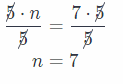
Texas Go Math Grade 7 Module 8 Quiz Answer Key 2

Question 3.
\(\frac{y}{6}\) – 7 = 4
Answer:
Add 7 to both sides
\(\frac{y}{6}\) – 7 + 7 = 4 + 7
\(\frac{y}{6}\) = 11 Multiply both sides by 6.
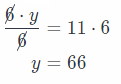
Texas Go Math Grade 7 Module 8 Quiz Answer Key 4

Question 4.
8w – 15 = 57 __________
Answer:
Add 15 to both sides
8w – 15 + 15 = 57 + 15
8m = 72 Divide both sides by 8.
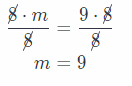
Texas Go Math Grade 7 Module 8 Quiz Answer Key 5

Question 5.
\(\frac{g}{3}\) + 11 = 25 ___________
Answer:
Subtract 11 from both sides
\(\frac{g}{3}\) + 11 – 11 = 25 – 11
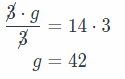
\(\frac{g}{3}\) = 14 Multiply both sides by 3.
Texas Go Math Grade 7 Module 8 Quiz Answer Key 6

Grade 7 Quiz Module 8 Geometry Test Answers Question 6.
\(\frac{f}{5}\) – 22 = -25 _________
Answer:
Add 22 to both sides
\(\frac{f}{5}\) – 22 + 22 = -25 + 22
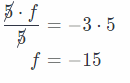
\(\frac{f}{5}\) = -3 Multiply both sides by 5.
Texas Go Math Grade 7 Module 8 Quiz Answer Key 7

Question 7.
-4p + 19 = 11 _________
Answer:
Subtract 19 from both sides
-4p + 19 – 19 = 11 – 19
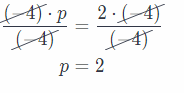
-4p = -8 Divide both sides by (-4)
Texas Go Math Grade 7 Module 8 Quiz Answer Key 8

8.3 Writing Two-Step Inequalities

Question 8.
Eddie scored at least 27 points more than half of what Duncan scored. Eddie scored 58 points. Write an inequality that could be solved to find the numbers of points that Duncan could have scored.
Answer:
Let the Duncan scored be x and Eddie scored be y
It is given in problem that Eddie scored at least 27 points more than half of what Duncan scored. So the inequality will be:
y ≥ \(\frac{x}{2}\) + 27
Now it is also given that Eddie has scored 58 points, so inequality wiLL be:
\(\frac{x}{2}\) + 27 ≤ 58

8.4 Solving Two-Step Inequalities

Solve.

Question 9.
2s + 3 > 15 ________
Answer:
Subtract 3 from both sides.
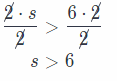
2s + 3 – 3 > 15 – 3 Divide both sides by 2.
Texas Go Math Grade 7 Module 8 Quiz Answer Key 9

7th Grade Quizzes Math Module 8 Answer Key Question 10.
\(\frac{d}{12}\) – 6 < 1 ________
Answer:
Add 6 to both sides
\(\frac{d}{12}\) – 6 + 6 < 1 + 6
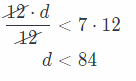
\(\frac{d}{12}\) < 7 Multiply both sides by 12.
Texas Go Math Grade 7 Module 8 Quiz Answer Key 10
Answer:

Question 11.
6w – 18 ≥ 36 ________
Answer:
Add 18 to both sides
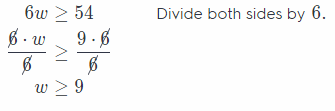
6w – 18 + 18 ≥ 36 + 18
Texas Go Math Grade 7 Module 8 Quiz Answer Key 11

Question 12.
\(\frac{z}{4}\) + 22 ≤ 38
Answer:
Subtract 22 from both sides
\(\frac{z}{4}\) + 22 – 22 ≤ 38 – 22
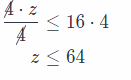
\(\frac{z}{4}\) ≤ 16 Multiply both sides by 4.
Texas Go Math Grade 7 Module 8 Quiz Answer Key 12

Question 13.
\(\frac{b}{9}\) – 34 < -36 ___
Answer:
Add 34 to both sides.
\(\frac{b}{9}\) – 34 + 34 < -36 + 34
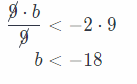
\(\frac{b}{9}\) < -2 Multiply both sides by 9
Texas Go Math Grade 7 Module 8 Quiz Answer Key 13

Module 8 Test Answers Math 7th Grade Question 14.
-2p + 12 > 8 ________
Answer:
Divide both sides by (-2), and reverse the direction of inequality, due to the division with a negative number
Texas Go Math Grade 7 Module 8 Quiz Answer Key 14

Essential Question

Question 15.
How can you use two-step equations and inequalities to represent and solve real-world problems?
Answer:
Using two-step equations and inequalities let you solve real-world problems for multiple pieces which have the
same values. For example, you have 8 dozens of doughnuts and you wanted to determine the cost of each dozen.
Dividing the total amount of the doughnuts by 8 would give you the cost of each dozen. Also when you wanted to
know the maximum numbers you could buy when you only have a limited amount to use.

Using two-step equations and inequalities let you determine the value of each for multiple pieces or determine the maximum numbers you could buy with a limited amount to use.

Texas Go Math Grade 7 Module 8 Mixed Review Texas Test Prep Answer Key

Texas Test Prep

Selected Response

Question 1.
A taxi cab costs $1.50 for the first mile and $0.75 for each additional mile. Which equation could be solved to find
how many miles you can travel in a taxi for $10, if x is the number of additional miles?
(A) 1.5x + 0.75 = 10
(B) 0.75x + 1.5 = 10
(C) 1.5x – 0.75 = 10
(D) 0.75x – 1.5 = 10
Answer:
(B) 0.75x + 1.5 = 10

Question 2.
Tony operates a skate rental company. He charges an equipment fee of $3 plus $6 per hour. Which equation represents this linear relationship?
(A) y = -6x + 3
(B) y = 3x + 6
(C) y = -6x + 3
(D) y = 3x – 3
Answer:
(A) y = -6x + 3

Grade 8 Math Module 8 Answer Key Quiz Answers Question 3.
Which evaluation has x = 8 for a solution?
(A) 2x + 3 = 13
(B) 4x + 6 = 38
(C) 3x – 5 = 29
(D) 5x – 8 = 48
Answer:
(B) 4x + 6 = 38

Question 4.
Which inequality has the following graphed solution?
Texas Go Math Grade 7 Module 8 Quiz Answer Key 1
(A) 3x – 8 ≤ 2
(B) 4x + 12 < 4
(C) 2x + 5 ≤ 1
(D) 3x + 6 < 3
Answer:
(C) 2x + 5 ≤ 1

Question 5.
Which represents the solution for the inequality 3x – 7 > 5?
(A) x < 4
(B) x ≤ 4
(C) x > 4
(D) x ≥ 4
Answer:
(C) x > 4

Question 6.
The 30 members of a choir are trying to raise at least $1,500 to cover travel costs to a singing camp. They have already raised $600. Which inequality could you solve to find the average amounts each member can raise in order to meet the goal?
(A) 30x + 600 ≥ 1,500
(B) 30x + 600 ≥ 1,500
(C) 30x + 600 < 1,500
(D) 30x + 600 ≤ 1,500
Answer:
(B) 30x + 600 ≥ 1,500

Gridded Response

Math Quiz for Grade 7 Module 8 Test Answers Question 7.
Mrs. Drennan keeps a bag of small prizes to distribute to her students. She likes to keep at least three times as many prizes in the bag as she has students. The bag currently has 72 prizes in it. Mrs. Drennan has 26 students. What is the least amount of prizes Mrs. Drennan needs to buy?
Texas Go Math Grade 7 Module 8 Quiz Answer Key 3
Answer:
She has 72 prizes in a bag and 26 students.
She wants to have at least 3 times as many prizes as she has students, hence 3 × 26 = 78.
The inequality will be
72 + x ≥ 78
where x represents the prizes she needs to buy
72 + x ≥ 78 Subtract 72 from both sides.
72 + x – 72 ≥ 78 – 72
x ≥ 6
She needs to buy at least 6 prizes.

Texas Go Math Grade 7 Module 8 Quiz Answer Key Read More »

Texas Go Math Grade 7 Unit 4 Study Guide Review Answer Key

Refer to our Texas Go Math Grade 7 Answer Key Pdf to score good marks in the exams. Test yourself by practicing the problems from Texas Go Math Grade 7 Unit 4 Study Guide Review Answer Key.

Texas Go Math Grade 7 Unit 4 Study Guide Review Answer Key

Linear Relationships

Essential Question
How can you use linear relationships to solve real-world problems?

Example
Ross earns a set rate of $10 for babysitting, plus $6 per hour. Represent the relationship using a table, an equation, and a graph of the linear relationship.
Texas Go Math Grade 7 Unit 4 Study Guide Review Answer Key 1
Texas Go Math Grade 7 Unit 4 Study Guide Review Answer Key 2
Write an equation for the amount y in dollars earned for x hours.
Amount = $10 + $6 per hour .
y = 10 + 6x

Texas Go Math Grade 7 Unit 4 Exercises Answer Key

Question 1.
The cost of a box of cupcakes is $1.50 per cupcake plus $3. Complete the table to represent the linear relationship. (Lesson 7.1)
Texas Go Math Grade 7 Unit 4 Study Guide Review Answer Key 3
Answer:
Texas Go Math Grade 7 Unit 4 Study Guide Review Answer Key 20
Box of cupcake + 1 cupcake = 1.5 + 1 . 3 = 4.5
Box of cupcake + 2 cupcake = 1.5 + 2 . 3 = 7.5
Box of cupcake + 3 cupcake = 1.5 + 3 . 3 = 10.5
Box of cupcake + 4 cupcake= 1.5 + 4 . 3 = 13.5

y = Box of cupcake + x cupcake

Texas Go Math Grade 7 Solutions Unit 4 Study Guide Question 2.
The score a student receives on a standardized test is based on the number of correct answers, as shown in the table. Use the table to give a verbal description of the relationship between correct answers and scores. (Lesson 7.1)
Texas Go Math Grade 7 Unit 4 Study Guide Review Answer Key 4
Answer:
The relationship between the correct answers and the score is:
The score is 200 plus an additional of the correct answer multiplied by 2.

Question 3.
Steve is saving for his daughter’s college education. He opens an account with $2,400 and deposits $40 per month. Represent the relationship using a table and an equation. (Lesson 7.2)
Answer:
Texas Go Math Grade 7 Unit 4 Study Guide Review Answer Key 21
y = 2400 + 40x
1 month
y = 2400 + 40 . 1 = 2440
2 months
y = 2400 + 40 . 2 = 2480
3 months
y = 2400 + 40 . 3 = 2520
4 months
y = 2400 + 40 . 4 = 2560

y = 2400 + 40x

7th Grade Math Study Guide Unit 4 Review Answer Key Question 4.
Tonya has a 2-page story she wants to expand. She plans to write 3 pages per day until it is done. Represent the relationship using a table, an equation, and a graph. (Les5on 7.2)
Texas Go Math Grade 7 Unit 4 Study Guide Review Answer Key 5
Answer:
Texas Go Math Grade 7 Unit 4 Study Guide Review Answer Key 22
y = 2 + 3x
1 day
y = 2 + 3 . 1 = 5
2 days
y = 2 + 3 . 2 = 8
3 days
y = 2 + 3 . 3 = 11
4 days
y = 2 + 3 . 4 = 14

Texas Go Math Grade 7 Unit 4 Study Guide Review Answer Key 23
y = 2 + 3x

Equations and Inequalities

Essential Question
How can you use equations and inequalities to solve real-world problems?

Example 1
A clothing store sells clothing for 2 times the wholesale cost plus $10. The store sells a pair of pants for $48. How much did the store pay for the pants? Represent the solution on a number line.
Let w represent the wholesale cost of the pants or the price paid by the store.
Texas Go Math Grade 7 Unit 4 Study Guide Review Answer Key 6
The store paid $19 for the pants.

Example 2
Determine which, if any, of these values makes the inequality
-7x + 42 ≤ 28 true: x = -1, x = 2, x = 5.
Texas Go Math Grade 7 Unit 4 Study Guide Review Answer Key 7

Texas Go Math Grade 7 Unit 4 Exercises Answer Key

Unit 4 Test Study Guide Answer Key 7th Grade Math Question 1.
The cost of a ticket to an amusement park is $42 per person. For groups of up to 8 people, the cost per ticket decreases by $3 for each person in the group. Marcos’s ticket cost $30. Write and solve an equation to find the number of people in Marcos’s group. (Lessons 8.1, 8.2)
Answer:
Assign a variable for the unknown value. Let x be the number of people in Marco’s group. The equation for the
given problem is:
42 – 3x = 30
Determine the number of people in Marco’s group.
42 – 3x = 30 Write the equation
42 – 3x – 42 = 30 – 42 Subtract 42 from both sides
-3x = -12 Simplify
\(\frac{-3 x}{-3}\) = \(\frac{-12}{-3}\) Divide both sides by -3
x = 4 Simplify
There are 4 people in Marco’s group.

Solve each equation. Graph the solution on a number line. (Lesson 8.2)

Grade 7 Mathematics Unit 4 Answer Key Question 2.
8x – 28 = 44
Texas Go Math Grade 7 Unit 4 Study Guide Review Answer Key 8
Answer:
Add 28 to both sides.
8x – 28 + 28 = 44 + 28
8x = 72 Divide both sides by 8.
Texas Go Math Grade 7 Unit 4 Study Guide Review Answer Key 24
Texas Go Math Grade 7 Unit 4 Study Guide Review Answer Key 25
x = 9

Question 3.
-5z + 4 = 34
Texas Go Math Grade 7 Unit 4 Study Guide Review Answer Key 9
Answer:
Subtract 4 from both sides.
– 5z + 4 – 4 = 34 – 4
– 5z = 30 Divide both sides by (-5).
Texas Go Math Grade 7 Unit 4 Study Guide Review Answer Key 26
Texas Go Math Grade 7 Unit 4 Study Guide Review Answer Key 27
z = -6

Texas Go Math Book 7th Grade Answer Key Unit 4 Study Guide Question 4.
Prudie needs $90 or more to be able to take her family out to dinner. She has already saved $30 and wants to take her family out to eat in 4 days. (Lesson 6.3)

a. Suppose that Prudie saves the same each day. Write an inequality to find how much she needs to save each day.
Answer:
a) Sum $30 Prudie already has and 1x, where r represents how much money
she needs to save each day to raise at least $90.
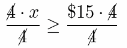
$30 + 4r ≥ 890 Subtract $30 from both sides.
-$30 + $30 + 4x ≥ -$30 + $90
4x ≥ $60 Divide both sides by 4.
Texas Go Math Grade 7 Unit 4 Study Guide Review Answer Key 28
x ≥ $15

b. Suppose that Prudie saves $18 each day. Will she have enough money to take her family to dinner in 4 days? Explain.
Answer:
Yes, she will, because $18 satisfies the inequation. Let’s check.
Texas Go Math Grade 7 Unit 4 Study Guide Review Answer Key 29
x ≥ $15

Solve each inequality. Graph and check the solution. (Lesson 8.4)

Question 5.
15 + 5y > 45
Texas Go Math Grade 7 Unit 4 Study Guide Review Answer Key 10
Answer:
Subtract 15 from both sides
-15 + 15 + 5y > – 15 + 45
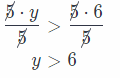
5y > 30 Divide both sides by .
Texas Go Math Grade 7 Unit 4 Study Guide Review Answer Key 30
Check the solution for y > 6. For example, y = 7.
Texas Go Math Grade 7 Unit 4 Study Guide Review Answer Key 31
This inequality is shown in the picture.
Texas Go Math Grade 7 Unit 4 Study Guide Review Answer Key 32
y > 6

Texas Go Math Grade 7 Unit 4 Assessment Answers Question 6.
7x – 2 ≤ 61
Texas Go Math Grade 7 Unit 4 Study Guide Review Answer Key 11
Answer:
Add 2 to both sides
7x – 2 + 2 ≤ 61 + 2
7x ≤ 63 Divide both sides by 7.
Texas Go Math Grade 7 Unit 4 Study Guide Review Answer Key 33
Check the solution for x ≤ 9. For example, x = 8.
Texas Go Math Grade 7 Unit 4 Study Guide Review Answer Key 34
True
This inequality is shown in the picture.
Texas Go Math Grade 7 Unit 4 Study Guide Review Answer Key 35
x ≤ 9

Texas Go Math Grade 7 Unit 4 Performance Tasks Answer Key

Question 1.
Careers in Math Mechanical Engineer A mechanical engineer is testing the amount of force needed to make a spring stretch by a given amount. The force y is measured in units called Newtons, abbreviated N. The stretch x is measured in centimeters. Her results are shown in the graph.
Texas Go Math Grade 7 Unit 4 Study Guide Review Answer Key 12

a. Write an equation for the line. Explain, using the graph and then using the equation, why the relationship is proportional.
Answer:
Based on the graph, use (2, 16). This point represents the force (16 N) with a stretch (2 cm). Using this point,
determine the value of k in k = \(\frac{y}{x}\).
k = \(\frac{y}{x}\) = \(\frac{16}{2}\) = 8
Substitute the value of k in the given form y = kx. The equation for the given graph 5:
y = 8x
The graph is said to be proportional because the graph is a straight line through the origin. Furthermore, the rate
of change is constant.

b. Identify the rate of change and the constant of proportionality.
Answer:
Based on the equation y = 8x, the rate of change and constant of proportionality is 8. This is because the comparison between the force and stretch in the given graph is constant for every point on the Line.

c. What is the meaning of the constant of proportionality in the context of the problem?
Answer:
The constant of proportionality in the problem showed that when there is an increase ¡n the stretch of the spring the force also increases by 8.

Question 2.
A math tutor charges $30 for a consultation, and then $25 per hour. An online tutoring service charges $30 per hour.

a. Does either service represent a proportional relationship? Explain.
Answer:
The online tutoring service represents a proportion relationship. This is because the relationship between the two
quantities is constant or the ratio of one quantity to the other is constant

b. Write an equation for the cost c of h hours of tutoring for each service. Which service charges less for 4 hours of tutoring? Show your work.
Answer:
The equation for the math tutor is:
30 + 25h = c
The equation for the online tutoring service is:
30h = c
Using the two equations, determine which service will charge less
Math tutor:
30 + 25h = c Write the equation
30 + 25(4) = c Substitute the value
30 + 1oo = c Multiply the values
130 = c Add the values
Online Tutoring
30h = c Write the equation
30(4) = c Substitute the value
120 = c Multiply the values
The online tutoring service will charge less compared to a math tutor.

Texas Go Math Grade 7 Unit 4 Mixed Review Texas Test Prep Answer Key

Selected Response

Question 1.
Which description corresponds to the relationship shown in the table?
Texas Go Math Grade 7 Unit 4 Study Guide Review Answer Key 13
(A) earning $10 per hour
(B) earning $8 per hour plus $10 in tips
(C) earning $7 per hour plus $15 in tips
(D) earning $8.50 per hour
Answer:
(C) earning $7 per hour plus $15 in tips

Explanation:
y = 15 + 7x
x = number of hours
y = amount of pay
C. earning $7 per hour plus $15 in tips.

Unit 4 End of Unit Assessment Answer Key 7th Grade Question 2.
Timothy began the week with $35. He bought lunch at school, paying $2.25 for each meal. Let x be the number of meals he bought at school and y be the amount of money he had left at the end of the week. Which equation represents the relationship in the situation?
(A) y = 2.25x + 35
(B) y = 35 – 2.25x
(C) x = 35 – 2.25y
(D) y = 2.25x – 35
Answer:
(B) y = 35 – 2.25x

Explanation:
Timothy has $35 and spend $2.25 for each meal at school, hence amount of money he has decreases for each meal he buys.
y = 35 – 2.25x

Question 3.
Which table represents the linear relationship described by the equation y = 3x + 9?
Texas Go Math Grade 7 Unit 4 Study Guide Review Answer Key 14
Answer:
Texas Go Math Grade 7 Unit 4 Study Guide Review Answer Key 36
x = 2
y = 3(2) + 9 = 15
x = 3
y = 3(3) + 9 = 18
x = 4
y = 3(4) + 9 = 21
x = 5
y = 3(5) + 9 = 24

y = 3x + 9 = 15

Question 4.
A taxi costs $1.65 for the first mile and $0.85 for each additional mile. Which equation could be solved to find the number x of additional miles traveled in a taxi given that the total cost of the trip is $20?
(A) 1.65x + 0.85 = 20
(B) 0.85x + 1.65 = 20
(C) 1.65x – 0.85 = 20
(D) 0.85x – 1.65 = 20
Answer:
(B) 0.85x + 1.65 = 20

Explanation:
The equation will be:
the cost of the first mile plus the number of miles multiplied by the cost of each mile equals to total cost of the trip.
Hence
0.85x + 1.65 = 20

Texas Go Math Grade 7 Unit 4 Test Answer Key Question 5.
A bag contains 7 purple beads, 4 blue beads, and 7 pink beads. What is the probability of not drawing a blue bead?
(A) \(\frac{4}{18}\)
(B) \(\frac{7}{18}\)
(C) \(\frac{11}{18}\)
(D) \(\frac{14}{18}\)
Answer:
(D) \(\frac{14}{18}\)

Explanation:
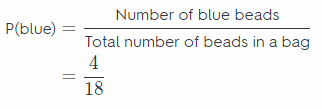
Total number of beads in a bag is 18.
Texas Go Math Grade 7 Unit 4 Study Guide Review Answer Key 37
The sum of the probabilities of an event and its complement equals 1.
P(event) + P(complement) = 1
P(blue) + P(not blue) = 1
\(\frac{4}{18}\) + P(not blue) = 1 Subtract \(\frac{4}{18}\) from both sides.
P(not blue) = 1 – \(\frac{4}{18}\)
P(not blue) = \(\frac{14}{18}\)
The probability of not drawing a blue bead is \(\frac{14}{18}\).

Question 6.
Which equation has the solution x = 12?
(A) 4x + 3 = 45
(B) 3x + 6 = 42
(C) 2x – 5 = 29
(D) 5x – 8 = 68
Answer:
(B) 3x + 6 = 42

Explanation:
The answer is 3x + 6 = 42
Proof:
Texas Go Math Grade 7 Unit 4 Study Guide Review Answer Key 38
3x + 6 = 42

Question 7.
The 23 members of the school jazz band are trying to raise at least $1,800 to cover the cost of traveling to a competition. The members have already raised $750. Which inequality could you solve to find the amount that each member should raise to meet the goal?
(A) 23x + 750 > 1,800
(B) 23x + 750 ≥ 1,800
(C) 23x + 750 < 1,800
(D) 23x + 750 ≤ 1,800
Answer:
(B) 23x + 750 ≥ 1,800

Explanation:
Sum the amount they already have and a number of members multiplied by the amount each member should raise to collect at least $1800.
23x + 750 ≥ 1800

Question 8.
What is the solution of the inequality 2x – 9 < 7?
(A) x < 8 (B) x ≤ 8 (C) x > 8
(D) x ≥ 8
Answer:
Add 9 to both sides.
2x – 9 + 9 < 7 + 9
2x < 16 Divide both sides by 2
\(\frac{2 x}{2}\) < \(\frac{16}{2}\)
x < 8

Grade 7 Mathematics Unit 4 Answer Key Question 9.
Carter rolls a fair number cube 18 times. Which is the best prediction for the number of times he will roll a number that is odd and less than 3?
(A) 2
(B) 3
(C) 4
(D) 5
Answer:
(B) 3

Explanation:
Total number of outcome in a fair dice = 6
Number of outcome which is odd and less than 3 = 1
Probability of outcome which is odd and less than 3 = \(\frac{1}{6}\)
But it is given in the problem that dice is rolled for 18 times. So the probability of outcome which is an odd number and Less than 3 will be in the same proportion.
Let the number of rolls which results in an odd number and less than 3 be x.
\(\frac{x}{18}\) = \(\frac{1}{6}\) (By proportion)
x = \(\frac{18}{6}\) (Cross-multiplying)
x = 3 (Simplifying)
So, 3 rolls are expected for result of an odd number and less than 3
Hence, option B is correct answer.

Question 10.
Which inequality has the solution shown?
Texas Go Math Grade 7 Unit 4 Study Guide Review Answer Key 15
(A) 3x + 5 < 2
(B) 4x + 12 < 4
(C) 2x + 5 ≤ 1
(D) 3x + 6 ≤ 3
Answer:
(A) 3x + 5 < 2

Explanation:
Subtract 5 from both sides
3x + 5 – 5 < 2 – 5
3x < – 3 Divide both sides by 3.
\(\frac{3 x}{3}\) < \(\frac{-3}{3}\)
x < -1

Gridded Response

Question 11.
What is the greatest whole number value that makes the inequality 4x + 4 ≤ 12 true?
Texas Go Math Grade 7 Unit 4 Study Guide Review Answer Key 16
Answer:
Subtract 4 from both sides.
4x + 4 – 4 ≤ 12 – 4
4x ≤ 8 Divide both sides by 4.
\(\frac{4 x}{4}\) ≤ \(\frac{8}{4}\)
x ≤ 2
The number 2 is the greatest whole number that makes the inequality true.

7th Grade Unit 4 Study Guide Grade 7 Question 12.
The rectangles shown are similar. The dimensions are given in inches.
Texas Go Math Grade 7 Unit 4 Study Guide Review Answer Key 17
What is the width of the smaller rectangle?
Texas Go Math Grade 7 Unit 4 Study Guide Review Answer Key 18
Answer:
The bigger rectangle
l1 = 50 in.
w1 = 25 in.
The smaller rectangle
l2 = 25 in.
w2 = x in.
Because they are similar, the corresponding lengths of the sides are proportional.
Texas Go Math Grade 7 Unit 4 Study Guide Review Answer Key 39
The width of the smaller rectangle is 12.5 in.

Hot Tip!
Gridded responses can be positive or negative numbers. Enter any negative signs in the first column. Check your work!

Question 13.
What is the solution to the equation 8x – 11 = 77?
Texas Go Math Grade 7 Unit 4 Study Guide Review Answer Key 19
Answer:
Add 11 to both sides.
8x – 11 + 11 = 77 + 11
8x = 88 Divide both sides by 8.
Texas Go Math Grade 7 Unit 4 Study Guide Review Answer Key 40
The solution is 11

Vocabulary Preview

Use the puzzle to preview key vocabulary from this unit. Unscramble the circled letters to answer the riddle at the bottom of the page.

As one quantity changes by a constant amount, the other quantity also changes by a constant amount. (Lesson 7.1)
Texas Go Math Grade 7 Unit 4 Study Guide Review Answer Key 41

A special type of linear relationship in which the rate of change is constant, or one in which the ratio of one quantity to the other is constant. (Lesson 7.1)
Texas Go Math Grade 7 Unit 4 Study Guide Review Answer Key 42

An equation with more than one operation. (Lesson 8.1)
Texas Go Math Grade 7 Unit 4 Study Guide Review Answer Key 43

A variable whose value is less than zero. (Lesson 8.1)
Texas Go Math Grade 7 Unit 4 Study Guide Review Answer Key 44

A variable whose value is greater than zero. (Lesson 8.1)
Texas Go Math Grade 7 Unit 4 Study Guide Review Answer Key 45

Q: Why does the sum of -4 and 3 complain more than the sum of -3 and 5?
A: It’s the ___ ___ ___ __ ___ ___ ___ ___ ___ __ ___ !
Answer:

Texas Go Math Grade 7 Unit 4 Study Guide Review Answer Key Read More »

Texas Go Math Grade 7 Module 9 Answer Key Applications of Geometry Concepts

Refer to our Texas Go Math Grade 7 Answer Key Pdf to score good marks in the exams. Test yourself by practicing the problems from Texas Go Math Grade 7 Module 9 Answer Key Applications of Geometry Concepts.

Texas Go Math Grade 7 Module 9 Answer Key Applications of Geometry Concepts

Essential Question
How can you apply geometry concepts to solve real-world problems?

Texas Go Math Grade 7 Module 9 Answer Key 17

Texas Go Math Grade 7 Module 9 Are You Ready? Answer Key

Complete these exercises to review skills you will need for this chapter.

Multiply with Fractions and Decimals

Texas Go Math Grade 7 Module 9 Answer Key 2

Multiply.

Question 1.
Texas Go Math Grade 7 Module 9 Answer Key 3
Answer:
We multiply as a whole number
Texas Go Math Grade 7 Module 9 Answer Key 10
Since there are two decimal digits in the factor 4.16, there must be two decimal digits in the product 54.08.

Module 9 Answer Key Grade 7 Geometry Question 2.
Texas Go Math Grade 7 Module 9 Answer Key 4
Answer:
We mutiply as a whole number
Texas Go Math Grade 7 Module 9 Answer Key 11
Since there are two decimal digits in the factor 6.47 and one decimal digit in the factor 0.4, there must be three
decimal digits in the product 2.588.

Question 3.
Texas Go Math Grade 7 Module 9 Answer Key 5
Answer:
We multiply as a whole number.
Texas Go Math Grade 7 Module 9 Answer Key 12
Since there are two decimal digits in the factor 7.05 and one decimal digit in the factor 9.4, there must be three
decimal digits in the product 66.270.

Question 4.
Texas Go Math Grade 7 Module 9 Answer Key 6
Answer:
We multiply as a whole number
Texas Go Math Grade 7 Module 9 Answer Key 13
Since there are two decimal digits in the factor 0.49 and one decimal digit in the factor 25.6, there must be three
decimal digits in the product 12.544

Area of Squares, Rectangles, and Triangles

Texas Go Math Grade 7 Module 9 Answer Key 7

Find the area of each figure.

7th Grade Geometry Test Module 9 Review Answer Key Question 5.
triangle with a base of 14 in. and a height of 10 in. ____________________
Answer:
The formula for the area of a triangle, where b is base and h is height is
A = \(\frac{1}{2}\) b . h Substitute 14 in. for b, and 10 in. for h.
A = \(\frac{1}{2}\) . 14 . 10
A = \(\frac{1}{2}\) . 140
Texas Go Math Grade 7 Module 9 Answer Key 14

Question 6.
square with sides of 3.5 ft . ___________
Answer:
Formula for area of a square, where a represents side of a square, is
A = a2 Substitute 3.5 ft for a.
= (3.5)2
A = 12.25 ft2

Question 7.
rectangle with length 8\(\frac{1}{2}\) in. and width 6 in. __________________
Answer:
The formula for the area of a rectangle, where a represents length and b represents the width, is
A = a . b Substitute 8\(\frac{1}{2}\) in. for a, and 6 in for b.
A = 8\(\frac{1}{2}\) . 6
A = \(\frac{17}{2}\) . 6
Texas Go Math Grade 7 Module 9 Answer Key 15

Geometry Concepts and Applications Answer Key Pdf Question 8.
triangle with base 12.5 m and height 2.4 m _________________
Answer:
The formula for the area of a triangle, where b is base and h is height is
A = \(\frac{1}{2}\) . b . h Substitute 12.5 m for b, and 2.4 m for h.
A = \(\frac{1}{2}\) . 12.5 . 2.4
A = \(\frac{1}{2}\) . 30
Texas Go Math Grade 7 Module 9 Answer Key 16

Texas Go Math Grade 7 Module 9 Reading Start-Up Answer Key

Visualize Vocabulary

Use the ✓ words to complete the graphic. You will put one word in each oval.

Texas Go Math Grade 7 Module 9 Answer Key 8

Understand Vocabulary

Complete each sentence, using the preview words.

7th Grade Geometry Test Pdf Module 9 Test Answers Question 1.
____ are angles that have the same measure.
Answer:
Congruent angles.

Question 2.
___ are two angles whose measures have a sum of 90°.
Answer:
Complementary angles.

Texas Go Math Grade 7 Module 9 Answer Key Applications of Geometry Concepts Read More »

Texas Go Math Grade 7 Lesson 8.2 Answer Key Solving Two-Step Equations

Refer to our Texas Go Math Grade 7 Answer Key Pdf to score good marks in the exams. Test yourself by practicing the problems from Texas Go Math Grade 7 Lesson 8.2 Answer Key Solving Two-Step Equations.

Texas Go Math Grade 7 Lesson 8.2 Answer Key Solving Two-Step Equations

Your Turn

Use algebra tiles to model and solve each equation.

Question 1.
2x + 5 = -11 __________
Answer:
Texas Go Math Grade 7 Lesson 8.2 Answer Key 4
First step
On the left side put 2 positive variables and 5 +1 tiles. On the right side put 11 + 1 tiles.

Second step
Remove 5 + 1 tiles from each side of the mat.

Third step
Divide each side into 2 groups.
The solution is x = 3

Texas Go Math Grade 7 Solutions Lesson 8.2 Question 2.
3n – 1 = 8 ___________
Answer:
Texas Go Math Grade 7 Lesson 8.2 Answer Key 5
First step
On the left side put 3 positive variables and 1 – 1 tiles. On the right side put 8 + 1 tiles.

Second step
Add 1 + 1 tiles to each side of the mat.
The sum of the +1 and 1 tiles is 0.

Third step
Divide each side into 3 groups.
The solution is n = 3.

Question 3.
2a – 3 = -5 __________
Answer:
Texas Go Math Grade 7 Lesson 8.2 Answer Key 6
First step
On the left side put 2 positive variables and 3 – 1 tiles. On the right side put 5 – 1 tiles.

Second step
Add 3 + 1 tiles to each side of the mat.
The sum of the +1 and 1 tiles is 0.

Third step
Divide each side into 2 groups.
The solution is a = -1.

Go Math Grade 7 Answer Key Pdf Solving Two Step Equations Question 4.
-4y + 2 = -2 ___________
Answer:
Texas Go Math Grade 7 Lesson 8.2 Answer Key 7
First step
On the left side put 4 negative variable and 2 + 1 tiles. On the right side put 2 – 1 tiles.

Second step
Remove 2 + 1 tiles from each side of the mat.
The sum of the +1 and -1 tiles is 0.

Third step
Divide each side into 4 groups.
The solution is -y = -4, hence y = 4.

Example 2

Tony carried 5 identical baseball bats to a ball game inside a carrying case weighing 12 ounces. The combined weight of the bats and the case was 162 ounces. How much did each bat weigh? Graph the solution on a number line.
Texas Go Math Grade 7 Lesson 8.2 Answer Key 1

Reflect

Question 5.
Analyze Relationships Describe how you could find the weight of one baseball bat using only arithmetic. Compare your method with the one used in Example 2.
Answer:
Using the arithmetic method, first subtract the weight of the case from the combined weight of the bats and case.
162 – 12 = 150
Then, divide the result by 5, since there are 5 identical bats.
150 ÷ 5 = 30
Each bat weighs 30 ounces. The two methods gave the same result. For some, it would be easier to use arithmetic and for some using an equation is easier. It will always depend on who is answering the problem which method they would prefer.

Your Turn

Write and solve an equation that represents the situation. Graph the solution on the number line.

Question 6.
Maureen wants to buy a $198 camera. She has $30 and plans to save $12 each week. In how many weeks will she be able to buy the camera?
Texas Go Math Grade 7 Lesson 8.2 Answer Key 2
Answer:
Sum $30 that Maureen has, and $12x, where x represents the number of weeks, to get the amount. of money she needs for the camera.
$30 + $12 ∙ x = $198 Subtract $30 from both sides.
-$30 + $30 + $12 ∙ x = $30 + $198
$12∙ x = $168 Divide both sides by $12.
\(\frac{\$ 12 \cdot x}{\$ 12}=\frac{14 \cdot \$ 12}{\$ 12}\)
x = 14
Texas Go Math Grade 7 Lesson 8.2 Answer Key 8
$30 + $12 ∙ x = $198

Texas Go Math Grade 7 Solving Two-Step Equations Answer Key Question 7.
A rectangular picture frame has a perimeter of 58 inches. The height of the frame is 18 inches. What is the width of the frame?
Texas Go Math Grade 7 Lesson 8.2 Answer Key 2
Answer:
A perimeter of a rectanguLar is equal the sum 2 × height and 2 × width. Let x be the width of the frame.
18 + 2 ∙ x = 58 Subtract 18 from both sides.
-18 + 18 + 2 ∙ x = -18 + 58
2 ∙ x = 40 Divide both sides by 2.
\(\frac{2 \cdot x}{2}=\frac{20 \cdot 2}{2}\)
x = 20 inches
Texas Go Math Grade 7 Lesson 8.2 Answer Key 9
18 + 2 ∙ x = 58

Determine which, if any, of the given values is a solution.

Question 8.
3k + 15 = 66
k = -7; k = 17; k = 27
Answer:
Substitute 7 for k in the given equation.
k = 7
3 ∙ (-7) + 15 ≟ 66
-21 + 15 ≟66
-6 ≟ 66
Not true.

Substitute 17 for k in the given equation.
k = 17
3 ∙ (17) + 15 ≟ 66
51 + 15 ≟ 66
66 ≟ 66
True.

Substitute 27 for k in the given equation.
k = 27
3 ∙ (27) + 15 ≟ 66
81 + 15 ≟ 66
96 ≟ 66
Not True.

Question 9.
\(\frac{p}{2}\) – 5 = 7
p = -72; p = 18; p = 108
Answer:
Substitute 72 for p in the given equation.
p = 72
\(\frac{-72}{9}\) – 5 ≟ 7 Multiply by 9 both sides
\(\frac{-72 \cdot 9}{9}\) – 5 ∙ 9 ≟ 7 ∙ 9
-72 – 45 ≟ 63
-117 ≟ 63
Not true.

Substitute 18 for p in the given equation.
p = 18
\(\frac{18}{9}\) – 5 ≟ 7 Multiply by 9 both sides
\(\frac{18 \cdot 9}{9}\) – 5 ∙ 9 ≟ 7 ∙ 9
18 – 45 ≟ 63
-27 ≟ 63
Not true.

Substitute 108 for p in the given equation.
p = 108
\(\frac{108}{9}\) – 5 ≟ 7 Multiply by 9 both sides
\(\frac{108 \cdot 9}{9}\) – 5 ∙ 9 ≟ 7 ∙ 9
108 – 45 ≟ 63
63 ≟ 63
True.

Texas Go Math Grade 7 Lesson 8.2 Guided Practice Answer Key

The equation 2x + 1 = 9 is modeled below. (Example 1)
Texas Go Math Grade 7 Lesson 8.2 Answer Key 3

Question 1.
To solve the equation with algebra tiles, first remove. ____________.
Then divide each side into ______________
Answer:

  • first remove +1 tile from each side
  • then divide each side into 2 equal groups

Two Step Equations Answer Key Go Math Lesson 8.2 7th Grade Question 2.
The solution is x = ________________
Answer:
The solution is x = 4

Solve each equation. Then graph the solution on the number line. (Example 2)

Question 3.
8m – 15 = 41
m = ___________
Texas Go Math Grade 7 Lesson 8.2 Answer Key 2
Answer:
Add 15 to both sides.
8m – 15 + 15 = 41 + 15
8m = 56 Divide both sides by 8.
\(\frac{8 \cdot m}{8}=\frac{56}{8}\)
m = 7
Texas Go Math Grade 7 Lesson 8.2 Answer Key 10

Question 4.
\(\frac{k}{3}\) + 21 = 27
k = ____________
Texas Go Math Grade 7 Lesson 8.2 Answer Key 2
Answer:
Subtract 21 from both sides.
\(\frac{k}{3}\) + 21 – 21 = 27 – 21
\(\frac{k}{3}\) = 6 Multiply both sides by 3.
3 ∙ \(\frac{k}{3}\) = 3 ∙ 6
k = 18
Texas Go Math Grade 7 Lesson 8.2 Answer Key 11

Determine which, if any, of the given values is a solution. (Example 3)

Question 5.
9p – 18 = 27
p = 3; p = 5; p = 7
Answer:
Substitute 3 for p in the given equation.
p = 3
9 ∙ (3) – 18 ≟ 27
27 – 18 ≟ 27
9 ≟ 27
Not true.

Substitute 5 for p in the given equation.
p = 5
9 ∙ (5) – 18 ≟ 27
45 – 18 ≟ 27
27 ≟ 27
True.

Substitute 7 for p in the given equation.
p = 7
9 ∙ (7) – 18 ≟ 27
63 – 18 ≟ 27
45 ≟ 27
Not true.

Grade 7 Go Math Answer Key Solving Two Step Equations Question 6.
\(\frac{a}{-2}\) – 5 = 0
a = -10; a = 0; a = 10
Answer:
Substitute 10 for a in the given equation
a = -10
\(\frac{-10}{-2}\) – 5 ≟ 0
\(\frac{-10 \cdot(-2)}{-2}\) – 5 ∙ (-2) ≟ 0 ∙ (-2) Multiply both sides by (-2)
– 10 + 10 ≟ 0
0 ≟ 0
True.

Substitute 0 for a in the given equation
a = 0
\(\frac{0}{-2}\) – 5 ≟ 0
0 – 5 ≟ 0
-5 ≟ 0
Not true.

Substitute 10 for a in the given equation
a = -10
\(\frac{10}{-2}\) – 5 ≟ 0
\(\frac{10 \cdot(-2)}{-2}\) – 5 ∙ (-2) ≟ 0 ∙ (-2) Multiply both sides by (-2)
10 + 10 ≟ 0
20 ≟ 0
Not true.

Essential Question Check-In

Question 7.
How can you decide which operations to use to solve a two-step equation?
Answer:
If we have variable multiplied by some number, we divide both sides of the equation by that number.
If we have variable divided by some number, we multiply both sides of the equation by that number.
If some number is added to variable, we subtract that number from both sides of the equation.
If some number is subtracted from variable, we add that number to the both sides of the equation.

Texas Go Math Grade 7 Lesson 8.2 Independent Practice Answer Key

Solve.

Question 8.
9s + 3 = 57
Answer:
Subtract 3 from both sides.
9 ∙ s + 3 – 3 = 57 – 3
9 ∙ s = 54 Divide both sides by 9.
\(\frac{s \cdot 9}{9}=\frac{6 \cdot 9}{9}\)
s = 6

Question 9.
4d + 6 = 42
Answer:
Subtract 6 from both sides.
4 ∙ d + 6 – 6 = 42 – 6
4 ∙ d = 36 Divide both sides by 4.
\(\frac{d \cdot 4}{4}=\frac{9 \cdot 4}{4}\)
d = 9

Question 10.
-3y + 12 = -48
Answer:
Subtract 12 from both sides.
-3 ∙ y + 12 – 12 = 48 – 12
-3 ∙ y = 60 Divide both sides by 4.
\(\frac{y \cdot(-3)}{3}=\frac{20 \cdot(-3)}{3}\)
y = 20

Question 11.
\(\frac{k}{2}\) + 9 = 30
Answer:
Multiply both sides by 2.
\(\frac{k \cdot 2}{2}\) + 9 ∙ 2 = 30 ∙ 2
k + 18 = 60 Subtract 18 from both sides
k + 18 – 18 = 60 – 18
k = 42

Question 12.
\(\frac{g}{3}\) – 7 = 15
Answer:
Multiply both sides by 3.
\(\frac{g \cdot 3}{3}\) + 7 ∙ 3 = 15 ∙ 3
g – 21 = 45 Subtract 21 from both sides
g – 21 + 21 = 45 + 21
g = 66

Go Math Answer Key 7th Grade Practice and Homework Lesson 8.2 Question 13.
\(\frac{z}{5}\) + 3 = -35
Answer:
Multiply both sides by 5.
\(\frac{z \cdot 5}{5}\) + 3 ∙ 5 = (-35) ∙ 2
z + 15 = -105 Subtract 15 from both sides
z + 15 – 15 = -105 – 15
k = -120

Question 14.
-9h – 15 = 93
Answer:
Add 15 to both sides.
-9 ∙ h – 15 + 15 = 93 + 15
-9 ∙ h = 108 Divide both sides by (-9)
\(\frac{h \cdot(-9)}{-9}=\frac{(-12) \cdot(-9)}{-9}\)
h = -12

Question 15.
24 + \(\frac{n}{4}\) = 10
Answer:
Multiply both sides by 4.
24 ∙ 4 + \(\frac{n \cdot 4}{4}\) = 10 ∙ 4
96 + n = 40 Subtract 96 from both sides.
-96 + 96 + n = -96 + 40
n = – 56

Question 16.
-17 + \(\frac{b}{8}\) = 13
Answer:
MuLtiply both sides by 8.
(-17) ∙ 8 + \(\frac{b \cdot 8}{8}\) = 13 ∙ 8
-136 + b = 104 Add 136 to both sides.
136 – 136 + b = 136 + 104
b = 240

Question 17.
-5 = 9 + \(\frac{c}{4}\)
Answer:
Multiply both sides by 4.
(-5) ∙ 4 = 9 ∙ 4 + \(\frac{c \cdot 4}{4}\)
-20 = 36 + c Subtract 36 from both sides
-36 – 20 = -36 + 36 + c
-56 = c
c = -56

Question 18.
-3 + \(\frac{p}{7}\) = -5
Answer:
Multiply both sides by 7.
(-3) ∙ 7 + \(\frac{p \cdot 7}{7}\) = ( 5) ∙ 4
-21 + p = -35 Add 21 to both sides.
21 – 21 + p = 21 – 35
p = -14

Question 19.
46 =-6t – 8
Answer:
Divide by (-6) both sides
Texas Go Math Grade 7 Lesson 8.2 Answer Key 12

Question 20.
After making a deposit, Puja had $264 in her savings account. She noticed that if she added $26 to the amount originally in the account and doubled the sum, she would get the new amount. How much did she originally have in the account?
Answer:
Let x be the amount originally in the account.
If she added $26 to x and double it, she’ll get 264 in lier’s saves account.
Hence, the equation will be
(x + 26)2 = 264 Divide both sides by 2.
\(\frac{(x+26) 2}{2}=\frac{264}{2}\)
x + 26 = 132 Subtract 26 from both sides.
x + 26 – 26= 132 – 26
x = 106
She originally had 106 dollars in the account.

Question 21.
The current temperature in Smalltown is 20 °F. This is 6 degrees less than twice the temperature that it was six hours ago. What was the temperature in Smalltown six hours ago?
Answer:
Let x be the temperature in Smalltown six hours ago.
20° + 60° = 2 ∙ x
26° = 2 ∙ x Divide both sides by 2.
\(\frac{26^{\circ}}{2}=\frac{2 \cdot x}{2}\)
13° = x
x = 13°

Question 22.
Daphpe gave away 3 more than half of her apples. She gave away 17 apples in all. How many apples did Daphne have originally?.
Answer:
Multiply both sides by 2
3 ∙ 2 + \(\frac{x \cdot 2}{2}\) = 17 ∙ 2
6 + x = 34 Subtract 6 from both sides.
-6 + 6 + x = 6 + 34
x = 28

Question 23.
Artaud noticed that if he takes the opposite of his age and adds 40 he gets the number 28. How old is Artaud?
Answer:
Subtract 40 from both sides
-x + 40 – 40 = 28 – 40
-x = -12 Multiply both sides by (-1)
(-1) ∙ x = (-1) ∙ (-12)
x = 12

Go Math Grade 7 Lesson 8.2 Answer Key Question 24.
Sven has 11 more than twice as many customers as when he started selling newspapers. He now has 73 customers. How many did he have when he started?
Answer:
Subtract 11 from both sides
-11 + 11 + 2x = -11 + 73
2x = 62 Divide both sides by 2.
\(\frac{2 \cdot x}{2}=\frac{62}{2}\)
x = 31

Question 25.
Paula bought a ski jacket on sale for $6 less than half its original price. She paid $88 for the jacket. What was the original price?
Answer:
Multiply both sides by 2.
\(\frac{x \cdot 2}{2}\) – 6 ∙ 2 = 88 ∙ 2
x – 12 = 176 Add 12 to both sides
x – 12 + 12 = 176 + 12
x = 188

Question 26.
Michelle has a starting balance on a gift card for $300. She buys several dresses at $40 a piece. After her purchases she has $140 left on the gift card. How many dresses did she buy?
Answer:
Divide by (-40) both sides.
Texas Go Math Grade 7 Lesson 8.2 Answer Key 13

Use a calculator to solve each equation.

Question 27.
-5.5x + 0.56 = -1.64
Answer:
Subtract 0.56 from both sides.
-5.5 ∙ x + 0.56 – 0.56 = -1.64 – 0.56
-5.5 ∙ x = -2.2 Divide both sides by (-5.5).
\(\frac{(-5.5) \cdot x}{(-5.5)}=\frac{-2.2}{-5.5}\)
x = 0.4

Question 28.
-4.2x + 31.5 = -65.1
Answer:
Subtract 31.5 from both sides.
-4.2 x + 31.5 – 31.5 = -65, 1 – 31,5
-4.2 x = -96.6 Divide both sides by (-4.2).
\(\frac{(-4.2) \cdot x}{(-4.2)}=\frac{-96.6}{-4.2}\)
x = 23

Question 29.
\(\frac{k}{5.2}\) + 81.9 = 47.2
Answer:
Subtract 81.9 from both sides
\(\frac{k}{5.2}\) + 81.9 – 81.9 = 47.2 – 81.9
\(\frac{k}{5.2}\) = -34.7 Multiply both sides by 5.2
\(\frac{5 \cdot 2 \cdot k}{5.2}\) = (-34.7) ∙ 5.2
k = -180.44

Question 30.
Write a two-step equation involving multiplication and subtraction that has a solution of x = 7.
Answer:
First, we multiply x by 10, and then we subtract 20 from 10x. So, we have multiplication and subtraction in following equation.
10 ∙ x – 20 = 50

Question 31.
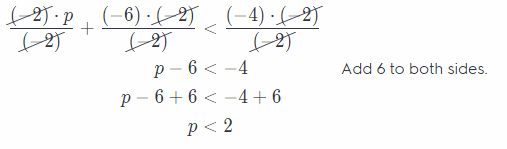
Write a two-step equation involving division and addition that has a solution of x = -25
Answer:
First, we divide x by 5, and then we add 20 to 5x. So, we have division and addition in following equation.
\(\frac{x}{5}\) + 20 = 15

Question 32.
Reason Abstractly The formula F = 1,8C + 32 allows you to find the Fahrenheit (F) temperature for a given Celsius (C) temperature. Solve the equation for C to produce a formula for finding the Celsius temperature for a given Fahrenheit temperature.
Answer:
Subtract 32 from both sides
F – 32 = 18C + 32 – 32
F – 32 = 18C Divide both sides by 18.
\(\frac{F}{18}\) – \(\frac{32}{18}\) = \(\frac{18 \cdot C}{18}\)
\(\frac{1}{18}\) ∙ F – 1.78 = C
0.55F – 1.78 = C
C = 0.55F – 1.78

Texas Go Math Grade 7 Pdf Two Step Equations Question 33.
Reason Abstractly The equation P = 2(l + w) can be used to find the perimeter P of a rectangle with length l and width w. Solve the equation for w to produce a formula for finding the width of a rectangle given its perimeter and length.
Answer:
Divide both sides by 2
Texas Go Math Grade 7 Lesson 8.2 Answer Key 14

H.O.T. Focus on Higher Order Thinking

Question 34.
Critique Reasoning A student’s solution to the equation 3x + 2 = 15 is shown. Describe the error that the student made.
3x + 2 = 15 Divide both sides by 3.
x + 2 = 5 Subtract 2 from both sides,
x = 3
Answer:
When the student had divided both sides by 3, he didn’t divide number 2 on the left side.

Question 35.
Multiple Representations Explain how you could use the work backward problem-solving strategy to solve the equation \(\frac{x}{4}\) – 6 = 2.
Answer:
Translating the given equation to words, 6 was subtracted to a number divided by 4 and the result will be 2. Using the backward problem-solving strategy, add 6 to 2, which is 8 then multiply it by 4 and the result is 32.

Question 36.
Reason Abstractly Solve the equation ax + b = c for x.
Answer:
Divide both sides by a.
Texas Go Math Grade 7 Lesson 8.2 Answer Key 15

Texas Go Math Grade 7 Lesson 8.2 Answer Key Solving Two-Step Equations Read More »

Texas Go Math Grade 7 Unit 3 Study Guide Review Answer Key

Refer to our Texas Go Math Grade 7 Answer Key Pdf to score good marks in the exams. Test yourself by practicing the problems from Texas Go Math Grade 7 Unit 3 Study Guide Review Answer Key.

Texas Go Math Grade 7 Unit 3 Study Guide Review Answer Key

Texas Go Math Grade 7 Unit 3 Exercises Answer Key

Module 5 Experimental Probability

Find the probability of each event. (Lesson 5.1)

Question 1.

Rolling a 5 on a fair number cube.
Answer:
Total number of cube: Possibilities 1, 2, 3, 4, 5, 6, so 6.
Number: A regular cube has only one side with the number five, so 1 possibility.
P (rolling a 5) = Texas Go Math Grade 7 Unit 3 Study Guide Review Answer Key 7
The probability of rolling a 5 is \(\frac{1}{6}\).

7th Grade Unit 3 Study Guide Test Answer Key Question 2.
Picking a 7 from a standard deck of 52 cards. A standard deck includes 4 cards of each number from 2 to 10.
Answer:
There are 4 cards with 7, so number of cards with 7 is 4.
P (picking a 7) = Texas Go Math Grade 7 Unit 3 Study Guide Review Answer Key 8
The probability of picking a number 7 is \(\frac{1}{13}\).

Question 3.
Picking a blue marble from a bag of 4 red marbles, 6 blue marbles, and 1 white marble.
Answer:
Total number of marbles in all color: 4 + 6 + 1 = 11
P (picking a blue marble) = Texas Go Math Grade 7 Unit 3 Study Guide Review Answer Key 9
The probability of picking a blue marble is \(\frac{6}{11}\).

Question 4.
Rolling a number greater than 7 on a 12-sided number cube.
Answer:
Number of sides with number greater than 7 is side with 8, 9, 10, 11, 12, so 5 possibilities for number greater than 7.
P(greater than 7) = Texas Go Math Grade 7 Unit 3 Study Guide Review Answer Key 10
The probability of rolling a number greater than 7 is \(\frac{5}{12}\).

Question 5.
Christopher picked coins randomly from his piggy Penny Nickel Dime Quarter bank and got the numbers of coins shown in the table. Find each experimental probability. (Lessons 5.2, 5.3)
Texas Go Math Grade 7 Unit 3 Study Guide Review Answer Key 1
Answer:
Total number of possible outcomes is:
7 + 2 + 8 + 6 = 23

a. The next coin that Christopher picks is a quarter. __________________
Answer:
P (picking a quarter) = Texas Go Math Grade 7 Unit 3 Study Guide Review Answer Key 11
The probabiLity of picking a quarter is \(\frac{6}{23}\)

b. The next coin that Christopher picks is not a quarter. _______________
Answer:
P (not picking a quarter) = 1 – P (picking a quarter) = 1 – \(\frac{6}{23}\) = \(\frac{23}{23}\) – \(\frac{6}{23}\) = \(\frac{17}{23}\)
The probability of not picking a quarter is \(\frac{17}{23}\)

c. The next coin that Christopher picks is a penny or a nickel. __________
Answer:
P (picking a penny or nickel) = Texas Go Math Grade 7 Unit 3 Study Guide Review Answer Key 12
The probability of picking a penny or nickel is \(\frac{9}{23}\)

Unit 3 Study Guide Grade 7 Answer Key Question 6.
A grocery store manager found that 54% of customers usually bring their own bags. In one afternoon, 82 out of 124 customers brought their own grocery bags. Did a greater or lesser number of people than usual bring their own bags? (Lesson 5.4)
Answer:
Use proportion
Texas Go Math Grade 7 Unit 3 Study Guide Review Answer Key 13
The number of people that usually bring their own bags is greater that afternoon because 82 > 67

Module 6 Theoretical Probability

Find the probability of each event. (Lessons 6.1, 6.2)

Question 1.
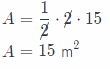
Graciela picks a white mouse at random from a bin of 8 white mice, 2 gray mice, and 2 brown mice.
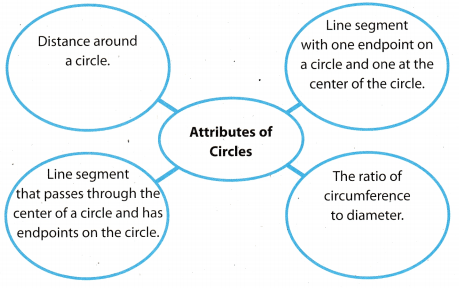
Answer:
The number of possible ways is 8 because we have 8 white mice.
The total number of possible outcomes is 12 because we have in total 12 miles in white, grey, and brown color.
P (picking a white mouse) = Texas Go Math Grade 7 Unit 3 Study Guide Review Answer Key 14
The probability of picking a white mouse is \(\frac{2}{3}\)

Question 2.
Theo spins a spinner that has 12 equal sections marked 1 through 12. It does not land on 1.
Answer:
Texas Go Math Grade 7 Unit 3 Study Guide Review Answer Key 15
The probability not to land on 1 is \(\frac{11}{12}\).

Question 3.
Tania flips a coin three times. The coin lands on heads twice and on tails once, not necessarily in that order.
Answer:
Number of possible ways is 3 because we can flip HHT, HTH, THH
Total number of possible outcomes is 8 because we can flip HHH, HTT, HHT, TTT, THH, TTH, THT, HTH.
P (lands on heads twice and on tails once) = Texas Go Math Grade 7 Unit 3 Study Guide Review Answer Key 16
The probability that a coin lands on heads twice and on tails once is \(\frac{3}{8}\).

Texas Go Math Book 7th Grade Answer Key Question 4.
Students are randomly assigned two-digit codes. Each digit is either 1, 2, 3, or 4. The guy is given the number 11.
Answer:
Number of possible ways is 1 because to have 1 on each digit of the code is only one.
Total number of possible outcomes is 16 because for the first digit, we have 4 possibilities and also for the second, 4 ∙ 4 = 16.
P (two-digit code is 11) = Texas Go Math Grade 7 Unit 3 Study Guide Review Answer Key 17
The probability to give a number is 11 is \(\frac{1}{16}\).

Question 5.
Patty tosses a coin and rolls a number cube. (Lesson 6.3)
a. Find the probability that the coin lands on heads and the cube lands on an even number.
Answer:
Number of possible ways is 3 because there are three ways to flip a head and roll a even number: H-2,H-4, H-6.
Total number of possible outcomes is 12 because: for coin we have 2 possibilities and for cube 6, so 2 ∙ 6 = 12.
P (flip a head and a cube is on an even number) = Texas Go Math Grade 7 Unit 3 Study Guide Review Answer Key 18
The probability to flip a head and a cube is on an even number is \(\frac{1}{4}\).

b. Patty tosses the coin and rolls the number cube 60 times. Predict how many times the coin will land on heads and the cube will land on an even number.
Answer:
Use proportion
Texas Go Math Grade 7 Unit 3 Study Guide Review Answer Key 19
The coin will land on head and a cube on an even number about 15 times out of 60.

Question 6.
Rajan’s school is having a raffle. The school sold raffle tickets with 3-digit numbers. Each digit is either 1, 2, or 3. The school also sold 2 tickets with the number 000. Which number is more likely to be picked, 123 or 000? (Lesson 6.3)
Answer:
For total number of possible outcomes we have for the first digit 3 possibilities, for the second and third and we have also 2 possibilities with 000, so 29 possibilities.
Texas Go Math Grade 7 Unit 3 Study Guide Review Answer Key 20
It is more likely to pick a ticket numerated with 000 than a ticket numerated with 123.

Unit 3 Study Guide Math 7th Grade Question 7.
Suppose you know that over the last 10 years, the probability that your town would have at least one major storm was 40%. Describe a simulation that you could use to find the experimental probability that your town will have at least one major storm in at least 3 of the next 5 years. (Lesson 6.4)
Answer:
The probability that the city will have at least one major storm is \(\frac{40}{100}\) = \(\frac{2}{5}\).
Let numbers 1 and 2 represent that there was a major storm and 3 4 and 5 that not We generate five numbers in each of 10 trials Find the experimental probability that the major storm occurred at least three times over the five years.

Texas Go Math Grade 7 Unit 3 Performance Task Answer Key

Question 1.
CAREERS IN MATH Meteorologist A meteorologist predicts a 20% chance of rain for the next two nights and a 75% chance of rain on the third night.
a. On which night is it most likely to rain? On that night, is it likely to rain or unlikely to rain?
Answer:
P (chance to rain to the next two nights) = \(\frac{1}{5}\)
P (chance to rain third night) = \(\frac{3}{4}\)
Chance to rain is more likely third day than first two nights. It is likely to rain that night.

b. Tara would like to go camping for the next 3 nights, but will not go if it is likely to rain on all 3 nights. Should she go? Use probability to justify your answer.
Answer:
P (chance to rain all three nights is) : \(\frac{1}{5}\) ∙ \(\frac{3}{4}\) = \(\frac{3}{20}\)
It is not likely to rain all three nights.

Question 2.
Sinead tossed 4 coins at the same time. She did this 50 times, and 6 of those times, all 4 coins showed the same result (heads or tails).
a. Find the experimental probability that all 4 coins show the same result when tossed.
Answer:
The experimental probability that all 4 coins show the same result when tossed is:
Texas Go Math Grade 7 Unit 3 Study Guide Review Answer Key 21

b. Can you determine the experimental probability that no coin shows heads? Explain.
Answer:
The experimental probability that all 4 coins shows heads is P = \(\frac{3}{25}\).
The experimental probability that no coin shows the heads is:
1 – P = 1 – \(\frac{3}{25}\) = \(\frac{25}{25}\) – \(\frac{3}{25}\) = \(\frac{22}{25}\)

c. Suppose Sinead tosses the coins 125 more times. Use experimental probability to predict the number of times that all 4 coins will show heads or tails. Show your work.
Answer:
Use proportion.
Texas Go Math Grade 7 Unit 3 Study Guide Review Answer Key 22
You can expect that all 4 coins will show heads or tails about 15 times out of 125.

Texas Go Math Grade 7 Unit 3 Mixed Review Texas Test Prep Answer Key

Selected Response

Question 1
A pizza parlor offers thin, thick, and traditional-style pizza crusts. You can get pepperoni, beef, mushrooms, olives, or peppers for toppings. You order a one-topping pizza. How many outcomes are in the sample space?
(A) 3
(B) 5
(C) 8
(D) 15
Answer:
(D) 15

Explanation:
3 possibilities for the crust and 5 possibilities for topping are 3 ∙ 5 = 15 possibilities for pizza.
The sample space is 15.

Unit 3 Assessment Answer Key 7th Grade Question 2.
A bag contains 9 purple marbles, 2 blue marbles, and 4 pink marbles, The probability of randomly drawing a blue marble is \(\frac{2}{15}\). What is the probability of not drawing a blue marble?
(A) \(\frac{2}{15}\)
(B) \(\frac{4}{15}\)
(C) \(\frac{11}{15}\)
(D) \(\frac{13}{15}\)
Answer:
(D) \(\frac{13}{15}\)

Explanation:
Texas Go Math Grade 7 Unit 3 Study Guide Review Answer Key 23
The probability of not picking a blue marble is \(\frac{13}{15}\).

Question 3.
During the month of April, Dora kept track of the bugs she saw in her garden. She saw a ladybug on 23 days of the month. What is the experimental probability that she will see a ladybug on May 1?
(A) \(\frac{1}{23}\)
(B) \(\frac{7}{30}\)
(C) \(\frac{1}{2}\)
(D) \(\frac{23}{30}\)
Answer:
(D) \(\frac{23}{30}\)

Explanation:
Number of times the event occurs represents how many times a ladybug appeared in April.
The total number of trials represents how many days she kept track of the bugs in her garden.
The experimental probability that she will see a ladybug on May 1 is:
Texas Go Math Grade 7 Unit 3 Study Guide Review Answer Key 24

Question 4.
Ryan flips a coin 8 times and gets tails all 8 times. What is the experimental probability that Ryan will get heads the next time he flips the coin?
(A) 1
(B) \(\frac{1}{2}\)
(C) \(\frac{1}{8}\)
(D) 0
Answer:
(D) 0

Explanation:
The experimental probability that Rayan flip a head next time is:
P (flip a head) = Texas Go Math Grade 7 Unit 3 Study Guide Review Answer Key 25

Question 5.
Jay tossed two coins several times and then recorded the results in the table below.
Texas Go Math Grade 7 Unit 3 Study Guide Review Answer Key 2
What is the experimental probability that the coins will land on different sides on his next toss?
(A) \(\frac{1}{5}\)
(B) \(\frac{2}{5}\)
(C) \(\frac{3}{5}\)
(D) \(\frac{4}{5}\)
Answer:
(C) \(\frac{3}{5}\)

Explanation:
The number of possible ways is 3 because in toss 1, 3, 5 we have that possibility.
P (the coins land on different sides) = \(\frac{3}{5}\)
The experimental probability that the coins land on different sides is \(\frac{3}{5}\).

Unit 3 Test Math Answer Key Grade 7 Question 6.
A used guitar is on sale for $280. Derek offers the seller \(\frac{3}{4}\) of the advertised price. How much does Derek offer for the guitar?
(A) $180
(B) $210
(C) $240
(D) $270
Answer:
\(\frac{3}{5}\)

Explanation:
Derek offer’s:
2800 ∙ \(\frac{3}{4}\) = 210
Derek offer’s for the guitar $ 210.

Question 7.
What is the probability of tossing two fair coins and having exactly one land tails side up?
(A) \(\frac{1}{8}\)
(B) \(\frac{1}{4}\)
(C) \(\frac{1}{3}\)
(D) \(\frac{1}{2}\)
Answer:
(D) \(\frac{1}{2}\)

Explanation:
Number of possible ways is 2 because we have HT or TH.
P (one land tails side up) = Texas Go Math Grade 7 Unit 3 Study Guide Review Answer Key 26
The probability of tossing two fair coins and having exactly one land tails side up is \(\frac{1}{2}\).

Question 8.
Find the percent change from 60 to 96.
(A) 37.5% decrease
(B) 37.5% increase
(C) 60% decrease
(D) 60% increase
Answer:
(D) 60% increase

Explanation
Use proportion
Texas Go Math Grade 7 Unit 3 Study Guide Review Answer Key 27
Subtract 100 % of the last result. In this way, we will get a percentage of increase because we have taken away the original price from the increased price.
160 – 100 = 60%
The percent of change is 60% increase.

Unit 3 Study Guide Math 7th Grade Texas Go Math Question 9.
Jason, Erik, and Jamie are friends in art class. The teacher randomly chooses 2 of the 21 students in the class to work together on a project. What is the probability that two of these three friends will be chosen?
(A) \(\frac{1}{105}\)
(B) \(\frac{1}{70}\)
(C) \(\frac{34}{140}\)
(D) \(\frac{4}{50}\)
Answer:
(B) \(\frac{1}{70}\)

Explanation:
Number of favorable possibilities:
3 for first student and 2 for second 6
Total number of possible outcomes:
21 for first student and 20 for second = 420.
P (two of three friends are chosen) = Texas Go Math Grade 7 Unit 3 Study Guide Review Answer Key 28
The probability that two of these three students will be chosen is \(\frac{1}{70}\).

Question 10.
Philip rolls a number cube 12 times. Which is the best prediction for the number of times that he will roll a number that is odd and less than 5?
(A) 2
(B) 3
(C) 4
(D) 6
Answer:
(C) 4

Explanation:
Texas Go Math Grade 7 Unit 3 Study Guide Review Answer Key 29
Phillip can expect that he will roll a number that is odd and less than 5 about 4.

Gridded Response

Question 11.
A bag contains 6 white beads and 4 black beads. You pick out a bead at random, record its color, and put the bead back in the bag. You repeat this process 35 times. How many times would you expect to remove a white bead from the bag?
Texas Go Math Grade 7 Unit 3 Study Guide Review Answer Key 3
Answer:
Texas Go Math Grade 7 Unit 3 Study Guide Review Answer Key 30
How we get the value of 21 in the fourth column from the left we round the number 2, in the column to the right of it 1. In the columns after the column with a decimal point, we do not round anything because it is an integer.
You can expect that you will pick a white bead about 21 times

Unit 3 End of Unit Assessment Grade 7 Answer Key Question 12.
A set of cards includes 20 yellow cards, 16 green cards, and 24 blue cards. What is the probability, written in decimal form, that a blue card is chosen at random?
Texas Go Math Grade 7 Unit 3 Study Guide Review Answer Key 4
Answer:
Texas Go Math Grade 7 Unit 3 Study Guide Review Answer Key 31
As we get the decimal number 0.4 in the column in front of the column with a decimal point, we will round the number 0, while in the column after the decimal point we will round the number 4.
The probability of choosing blue card is 0.4.

Hot Tips! Estimate your answer before solving the problem. Use your estimate to check the reasonableness of your answer.

Probability Unit Study Guide Answer Key Question 13.
A survey reveals that one airline’s flights have a 92% probability of being on time. Out of 4,000 flights in a year, how many flights would you predict to arrive on time?
Texas Go Math Grade 7 Unit 3 Study Guide Review Answer Key 5
Answer:
P (flight arrive on time) = \(\frac{92}{100}\) = \(\frac{23}{25}\)
To predict how many flights will arrive on time we use proportion. In that proportion equalize the probability that the flight will arrive on time with a fraction, whose numerator is unknown and mean the number of flight which arrive on time out of 4000 flights, denominator 4000 which is the total number of flights
Texas Go Math Grade 7 Unit 3 Study Guide Review Answer Key 32

Texas Go Math Grade 7 Unit 3 Vocabulary Review Answer Key

Use the puzzle to preview key vocabulary from this unit. Unscramble the circled letters within found words to answer the riddle at the bottom of the page.
Texas Go Math Grade 7 Unit 3 Study Guide Review Answer Key 6

  • An activity based on chance in which results are observed. (Lesson 5-1)
  • The set of all outcomes that are not included in the event. (Lesson 5-1)
  • Each observation of an experiment. (Lesson 5-1)
  • A model of an experiment that would be difficult or too time-consuming to perform. (Lesson 5-2) .
  • Measures the likelihood that the event will occur. (Lesson 5-1)
  • An event with only one outcome (2 words). (Lesson 5-2)
  • A set of all possible outcomes for an event (2 words), (Lesson 5-1)

Question.
Why was there little chance of success for the clumsy thieves?
Answer:
Because they had low _____ _____ _____ – _____ _____ _____ _____ _____ _____ _____!

Texas Go Math Grade 7 Unit 3 Study Guide Review Answer Key Read More »

Texas Go Math Grade 7 Module 7 Quiz Answer Key

Refer to our Texas Go Math Grade 7 Answer Key Pdf to score good marks in the exams. Test yourself by practicing the problems from Texas Go Math Grade 7 Module 7 Quiz Answer Key.

Texas Go Math Grade 7 Module 7 Quiz Answer Key

Texas Go Math Grade 7 Module 7 Ready to Go On? Answer Key

7.1 Linear Relationships in the Form y = mx + b

Question 1.
Darice also took a break after riding 10 miles. The table below shows the rate at which Darice rides her bicycle after the break.
Texas Go Math Grade 7 Module 7 Quiz Answer Key 1
Write a verbal description of the relationship between the time she rides and the distance she travels.
Answer:
Dance was riding a bike 10 miles plus an additional 0.25 miles after each break.

7.2 Writing and Graphing Equations in the Form y = mx + b

Emir started out a card game with 500 points. For every hand he won, he gained 100 points.

Module Quiz Ready to go on Answers 7th Grade Question 2.
Complete the table.
Texas Go Math Grade 7 Module 7 Quiz Answer Key 2
Answer:
Texas Go Math Grade 7 Module 7 Quiz Answer Key 8
y = 100 ∙ x + 500

Question 3.
Plot the points on the graph.
Texas Go Math Grade 7 Module 7 Quiz Answer Key 3
Answer:
Texas Go Math Grade 7 Module 7 Quiz Answer Key 9
y = 100 ∙ x + 500

Question 4.
Write an equation for the linear relationship.
Answer:
y = 100 ∙ x + 500

Essential Question

Grade 7 Math Module 7 Answer Key Question 5.
What are some of the ways you can represent real-world linear relationships?
Answer:
Real-world relationships can be represented by graphics. tables, and equations.

Texas Go Math Grade 7 Module 7 Mixed Review Texas Test Prep Answer Key

Selected Response

Question 1.
Which description corresponds to the relationship shown in the table?
Texas Go Math Grade 7 Module 7 Quiz Answer Key 4
(A) earning $10 an hour
(B) earning $8 an hour plus a $10 bonus
(C) earning $7 an hour plus a $15 bonus
(D) earning $9 an hour
Answer:
(B) earning $8 an hour plus a $10 bonus

Explanation:
90 – 50 = 40 Find the difference between two payments.
\(\frac{40}{5}\) = 8 Find how much is paid for 1 hour.
50 – 40 = 10 Find a bonus.

Question 2.
Which equation represents the same linear relationship as the graph below?
Texas Go Math Grade 7 Module 7 Quiz Answer Key 5
Answer:
(A) y = 1.2x + 32
(B) y = 1.5x + 20
(C) y = 0.75x + 50
(D) y = 0.8x + 45
Answer:
(C) y = 0.75 ∙ x + 50

Explanation:
Our points on the graph are:
A = (40,80)
B = (80,110)
C = (120, 140)
D = (160, 170)
Replacing the value of point A in the solution under (A) we get:
80 = 1.2 ∙ 40 + 32 = 80
This is correct
Replacing the value of point B in the solution under (A) we get:
110 = 1.2 ∙ 80 + 32 = 128
This isn’t correct.

By repeating the procedure, we will conclude that alt points are solutions of the equation under (C)

Go Math Grade 7 Module 7 Answer Key Question 3.
Omar began the week with $25. He took a city bus to and from school, paying $1.25 for each trip. Let x be the number of trips he took and y be the amount of money he had left at the end of the week. Which equation represents the relationship in the situation?
(A) y = 1.25x + 25
(B) y = 25 – 1.25x
(C) x = 25 – 1.25y
(D) y = 1.25x – 25
Answer:
(B) y = 25 – 1.25x

Explanation:
The right answer is (B) y = 25 – 1.25 ∙ x, because he spends money on the bus, so the sum of money that remains to be reduced after each payment of trip.

Question 4.
Which table represents the same linear relationship as the equation y = 5x + 7?
Texas Go Math Grade 7 Module 7 Quiz Answer Key 6
Answer:
Table (B)

Explanation:
The table represent the equation
y = 5 ∙ x + 7

Question 5.
Selina is planning to paint a large picture on a wall. She draws a smaller version first. The drawing is 8 inches by 6 inches. If the scale of the drawing is 2 in: 1 ft, what is the area of the actual picture on the wall?
(A) 4 feet
(B) 3 feet
(C) 48 square inches
(D) 12 square feet
Answer:
(D) 12 square feet

Explanation:
The answer is (D) 12 square feet
The area of the drawing is 8 ∙ 6 = 48 in.
Because scale of the drawing, the area of the actual picture on the wall is
\(\frac{8}{2} \cdot \frac{6}{2}\) = 4 ∙ 3 = 12 square feet

Gridded Response

Module 7 Go Math Answer Key Grade 7 Question 6.
The equation y = 3.5x – 210 represents the profit made by a manufacturer that sells products for $3.50 each, where y is the profit and x is the number of units sold. What is the profit in dollars when 80 units are sold?
Texas Go Math Grade 7 Module 7 Quiz Answer Key 7
Answer:
y= 3.5 ∙ x – 210 ……….. (1)
Variable x is the number of sold units
Variable y represents the profit.
We have 80 sold units so x = 80.
Substitute this value for x in equation (1):
y = 3.5 ∙ 80 – 210 = 70
y = 70

Texas Go Math Grade 7 Module 7 Quiz Answer Key Read More »

Texas Go Math Grade 7 Lesson 7.2 Answer Key Writing and Graphing Equations in the Form y = mx + b

Refer to our Texas Go Math Grade 7 Answer Key Pdf to score good marks in the exams. Test yourself by practicing the problems from Texas Go Math Grade 7 Lesson 7.2 Answer Key Writing and Graphing Equations in the Form y = mx + b.

Texas Go Math Grade 7 Lesson 7.2 Answer Key Writing and Graphing Equations in the Form y = mx + b

Texas Go Math Grade 7 Lesson 7.2 Explore Activity Answer Key

Graphing Linear Relationships

Teresa signs up for a membership to rent video games. The company charges $5 per month and $2 per video game. Graph a linear relationship between the number of games Teresa rents and her monthly cost.
Texas Go Math Grade 7 Lesson 7.2 Answer Key 1
STEP 1: Make a table. Record different values for the linear relationship.
Texas Go Math Grade 7 Lesson 7.2 Answer Key 2
STEP 2: Use the table to create ordered pairs:
(0, 5), (1, 7), (2, 9), (3, 11), (4, 13)
Plot each ordered pair on the coordinate grid.
Texas Go Math Grade 7 Lesson 7.2 Answer Key 3

Reflect

Texas Go Math Grade 7 Solutions Lesson 7.2 Answer Key Question 1.
Do the values between the points make sense in this context? Explain.
Answer:
This makes sense because the graphics show that when the number of lending increases, the price rises.

Your Turn

Write an equation to describe the linear relationship.

Question 2.
The temperature of a pot of water is 45°F. The temperature increases by 20°F per minute when being heated.
Answer:
Texas Go Math Grade 7 Lesson 7.2 Answer Key 12
y = 20 ∙ x + 45

Question 3.
A bamboo reed is planted when it is 12 centimeters tall. It grows 2.2 centimeters per week.
Answer:
Texas Go Math Grade 7 Lesson 7.2 Answer Key 13
y = 22 ∙ x + 12

Example 2
Charlie starts with $350 in his savings account. He withdraws $15 per week from his account. Represent the relationship using a table, an equation, and a graph.
STEP 1: Make a table. Record different values for the linear relationship.
Texas Go Math Grade 7 Lesson 7.2 Answer Key 4
STEP 2: Write an equation for the amount of money y in the savings after x weeks. $350 minus $15 times the number of weeks
y = 350 – 15x
STEP 3: Use the table to create ordered pairs and then plot the data.
Texas Go Math Grade 7 Lesson 7.2 Answer Key 5

Reflect

Question 4.
Does it make sense to connect the points on the graph with a line? Explain.
Answer:
It makes sense because in this way it is easier to see that when withdrawing money, the saved amount is reduced.

Lesson 7.2 Homework Texas Go Math Grade 7 Answer Key Question 5.
Does an ordered pair with a negative y-value make sense in the situation?
Answer:
It makes no sense to take negative values for y because it would mean that he takes more money than what he has on the account, which is impossible.

Your Turn

Question 6.
A bicycle rental company charges $18 to rent a bicycle, plus $7 for every two hours of rental time. Represent the relationship using a table, an equation, and a graph.
Texas Go Math Grade 7 Lesson 7.2 Answer Key 6
Answer:
Texas Go Math Grade 7 Lesson 7.2 Answer Key 14
Equation: 18 + 7 ∙ x = y
Texas Go Math Grade 7 Lesson 7.2 Answer Key 15

Texas Go Math Grade 7 Lesson 7.2 Guided Practice Answer Key

Graph the linear relationship. (Explore Activity)

Question 1.
A pool contains 5 liters of water, and 10 liters of water are being poured into the pool every 5 minutes.
Texas Go Math Grade 7 Lesson 7.2 Answer Key 7
Answer:
y = 2 ∙ x + 5
Ploted pairs on the coordinate grid are:
A = (0, 5)
More precisely in equation replace x with 0, and y with 5 for point A;
B = (10, 25)
Replace in equation x with 10, and y with 25 for point B.

Write an equation to describe the linear relationships. (Example 1)

Question 2.
A moving company charges a $50 flat fee and $55 per hour to move.
y = _______ x + _______
Answer:
y = 55 ∙ x + 50

Question 3.
Anne has $250 in a savings account. She withdraws $5 per month.
y = _______ x + _______
Answer:
y = -5 ∙ x + 250

Lesson 7.2 Texas Go Math Grade 7 Answers Question 4.
Erin owns $375 worth of comic books. She spends $15 every week on new comic books. Represent the relationship using a table and an equation. (Example 2)
y = _______x + _______
Texas Go Math Grade 7 Lesson 7.2 Answer Key 8
Answer:
Texas Go Math Grade 7 Lesson 7.2 Answer Key 16
y = 15 ∙ x + 375

Essential Question Check-In

Question 5.
How can you use a table of data to write and graph a linear relationship?
Answer:
All the initial values that we get actually represent x, while all the values obtained based on the initial conditions by solving the equation represent y.

Texas Go Math Grade 7 Lesson 7.2 Independent Practice Answer Key

A cab company charges a $3.50 boarding fee and $0.50 per mile.

Question 6.
Write an equation to describe the relationship between the cost of the cab ride and the number of miles traveled.
Answer:
y = 0.5 ∙ x + 3.5

Question 7.
Graph the linear relationship.
Texas Go Math Grade 7 Lesson 7.2 Answer Key 9
Answer:
Texas Go Math Grade 7 Lesson 7.2 Answer Key 17
Texas Go Math Grade 7 Lesson 7.2 Answer Key 18
y = 0.5 ∙ x + 3.5

Go Math Answer Key Grade 7 Lesson 7.2 Answer Key Question 8.
Draw Conclusions Does it make sense to draw a line through the points? Explain.
Answer:
It makes sense because in this way we easily notice how the billing increases in the miles ahead.

Question 9.
What If? Suppose that the boarding fee was changed to $5. How would the graph change?
Answer:
Texas Go Math Grade 7 Lesson 7.2 Answer Key 19
y1 = 0.5 ∙ x + 3.5
y2 = 0.5 ∙ x + 5
The value of the variable y1 has increased
(with that increase we got a variable y_2)
so the points on the graph are above the points before increasing the variable y1.

For 10-13 write an equation to represent the given linear relationship. Then state the meaning of the given ordered pair.

Question 10.
A plain medium pizza costs $8.00. Additional toppings cost $0.85 each. (4, 11.4)
Answer:
y = 0.85 ∙ x + 8
For x = 4 in the equation we get y = 11.4

Question 11.
Luis joined a gym that charges a membership fee of $99.95 plus $7.95 per month. (9, 171.5)
Answer:
y = 7.95 ∙ x + 99.95
For x = 9 in the equation we get y = 171.5

Practice and Homework Lesson 7.2 Answer Key Question 12.
A tank currently holds 35 liters of water, and water is pouring into the tank at 15 liters per minute. (5.5, 117.5)
Answer:
y = 15 ∙ x + 35
For x = 5.5 in the equation we get y = 117.5

Question 13.
Jonas is riding his bicycle at 18 kilometers per hour, and he has already ridden for 40 kilometers. (6, 148)
Answer:
y = 18 ∙ x 40
For x = 6 in the equation we get y = 148

Question 14.
Analyze Relationships How can you use an equation of a linear relationship to verify the points on the graph of the relationship?
Answer:
Let the point A= (p, q) from the graph. By replacing the value in the equation y = mx + b, where x = p, y = q, if the left and right sides are equal, we have confirmed the relation between the equation and the graph.

Question 15.
Multiple Representations A furniture salesperson earns $750 per week plus a 15% commission on all sales made during the week.
a. Complete the table of data.
Texas Go Math Grade 7 Lesson 7.2 Answer Key 10
Answer:
Texas Go Math Grade 7 Lesson 7.2 Answer Key 22

b. Graph the values in the table.
Texas Go Math Grade 7 Lesson 7.2 Answer Key 11
Answer:
Texas Go Math Grade 7 Lesson 7.2 Answer Key 21

c. Write a linear equation to describe the relationship.
Answer:
y = 0.15 ∙ x + 750

Go Math Grade 7 Lesson 7.2 Answer Key Question 16.
Make a Conjecture Can you draw a straight line through the points? Explain.
Answer:
We can for the reason that all points are solutions of the same equation.

H.O.T. Focus on Higher Order Thinking

Question 17.
Analyze Relationships What are the advantages of portraying a linear relationship as a table, graph, or equation?
Answer:
The advantage of graphics, tables and equations is that it helps us to see the changes and understand them in easy way.

Question 18.
Critical Thinking Describe when it would be more useful to represent a linear relationship with an equation than with a graph.
Answer:
It would be more useful to present it through the equation because from the equation for the given value we can easily get points on the graph.

Question 19.
Communicate Mathematical Ideas How can you determine when to draw a line through the points on the graph of a linear relationship?
Answer:
Linear relationship can represent with equation. If all the points on graph are the solutions of the equation, then we can draw a line through them.

Texas Go Math Grade 7 Lesson 7.2 Answer Key Writing and Graphing Equations in the Form y = mx + b Read More »

Texas Go Math Grade 7 Module 6 Quiz Answer Key

Refer to our Texas Go Math Grade 7 Answer Key Pdf to score good marks in the exams. Test yourself by practicing the problems from Texas Go Math Grade 7 Module 6 Quiz Answer Key.

Texas Go Math Grade 7 Module 6 Quiz Answer Key

Texas Go Math Grade 7 Module 6 Ready to Go On? Answer Key

6.1, 6.2 Theoretical Probability of Simple and Compound Events

Find the probability of each event. Write your answer as a fraction, as a decimal, and as a percent.

Question 1.
You choose a marble at random from a bag containing 12 red, 12 blue, 15 green, 9 yellow, and 12 black marbles. The marble is red.
Answer:
The number of possible outcomes is:
12 + 12 + 15 + 9 + 12 = 61
P (choose a red marble) = Texas Go Math Grade 7 Module 6 Quiz Answer Key 3
The probability of choosing a red marble is \(\frac{12}{61}\).

Go Math Grade 7 Module 6 Answer Key Question 2.
You draw a card at random from a shuffled deck of 52 cards. The deck has four 13-card suits (diamonds, hearts, clubs, spades). The card is a diamond or a spade.
Answer:
The total number of possible outcomes is: 4 ∙ 13 = 52
P (diamond or a spade) = Texas Go Math Grade 7 Module 6 Quiz Answer Key 4
The probability to draw a diamond or spide is \(\frac{1}{2}\).

6.3 Making Predictions with Theoretical Probability

Question 3.
A bag contains 23 red marbles, 25 green marbles, and 18 blue marbles. You choose a marble at random from the bag. What color marble will you most likely choose?
Answer:
The total number of possible outcomes is: 23 + 25 + 18 = 66
Texas Go Math Grade 7 Module 6 Quiz Answer Key 5
It is more likely to pick a green marble than marble in other color.

6.4 Using Technology to Conduct a Simulation

Question 4.
Bay City has a 20% chance of having a flood in any given decade. The table shows the results of a simulation using random numbers to find the experimental probability that there will be a flood in Bay City in at least 1 of the next 5 decades. In the table, the number 1 represents a decade with a flood. The numbers 2 through 5 represent a decade without a flood.
Texas Go Math Grade 7 Module 6 Quiz Answer Key 1
According to the simulation, what is the experimental probability of a flood in Bay City in at least 1 of the next 5 decades?
Answer:
Texas Go Math Grade 7 Module 6 Quiz Answer Key 6
The experimental probability of a flood in Bay City in at least 1 of the next 5 decades is \(\frac{4}{10}\) = \(\frac{2}{5}\).

Essential Question

Grade 7 Module 6 Topic Quiz Go Math Question 5.
How can you use theoretical probability to make predictions in real-world situations?
Answer:
Theoretical probability is a ratio that describes what should happen, so we can make prediction about all possible situations which helps us to find the answer in real-world situations.

Texas Go Math Grade 7 Module 6 Mixed Review Texas Test Prep Answer Key

Selected Response

Question 1.
What is the probability of flipping two fair coins and having both show tails?
(A) \(\frac{1}{8}\)
(B) \(\frac{1}{4}\)
(C) \(\frac{1}{3}\)
(D) \(\frac{1}{2}\)
Answer:
(B) \(\frac{1}{4}\)

Explanation:
Total numbers of possible outcomes is:
HT, HH, TT, TH = 4
Number of flips with tail on each coin The only way to fall two tails is to get tails on both coins.
P (flip on each tail) = Texas Go Math Grade 7 Module 6 Quiz Answer Key 7
The probability of picking two tails is \(\frac{1}{4}\).

Grade 7 Module 6 Quiz Answers Go Math Question 2.
A bag contains 8 white marbles and 2 black marbles. You pick out a marble, record its color, and put the marble back in the bag. If you repeat this process 45 times, how many times would you expect to remove a white marble from the bag?
(A) 9
(B) 32
(C) 36
(D) 40
Answer:
(A) 9 times

Explanation:
Texas Go Math Grade 7 Module 6 Quiz Answer Key 8
You can expect to remove a white marble about 9 times.

Question 3.
Philip rolls a standard number cube 24 times. Which is the best prediction for the number of times he will roll a number that is even and less than 4?
(A) 2
(B) 3
(C) 4
(D) 6
Answer:
(C) 4

Explanation:
A number that is even and less than 4 is number 2
Texas Go Math Grade 7 Module 6 Quiz Answer Key 9
The best prediction for the number of times to roll number that is even and less than 4 is 4.

Question 4.
A set of cards includes 24 yellow cards, 18 green cards, and 18 blue cards. What is the probability that a card chosen at random is not green?
(A) \(\frac{3}{10}\)
(B) \(\frac{4}{10}\)
(C) \(\frac{3}{5}\)
(D) \(\frac{7}{10}\)
Answer:
(D) \(\frac{7}{10}\)

Explanation:
Total number of possible outcomes is:
24 + 18 + 18 = 60
P (choose a green card) = Texas Go Math Grade 7 Module 6 Quiz Answer Key 10
P (not to choose a green card) = 1 – P (choose a green card) = 1 – \(\frac{3}{10}\) = \(\frac{10}{10}\) – \(\frac{3}{10}\) = \(\frac{7}{10}\)
The probability that the chosen card at random is not green is \(\frac{7}{10}\).

Grade 7 Module 6 Review Answer Key Go Math Question 5.
A rectangle made of square tiles measures 10 tiles long and 8 tiles wide. What is the width of a similar rectangle whose length is 15 tiles?
(A) 3 tiles
(B) 12 tiles
(C) 13 tiles
(D) 18.75 tiles
Answer:
(B) 12 tiles

Explanation:
Use Proportion.
Texas Go Math Grade 7 Module 6 Quiz Answer Key 11
The width of a similar rectangle is 12 tiles.

Question 6.
You buy a game that originally cost $35. It was on sale at 20% off. You paid 6% tax on the sale price. What was the total amount that you paid?
(A) $29.68
(B) $37.10
(C) $44.10
(D) $44.52
Answer:
(A) $29.68

Explanation:
Originally price is $35.
Sale is 20%.
Tax is 6%.
Calculate how ¡iiicIi a game on sale costs.
35 – 35 ∙ \(\frac{20}{100}\) = 35 – 35 ∙ \(\frac{1}{5}\) = 35 – 7 = $28
Find a tax on the sale price.
28 ∙ \(\frac{6}{100}\) = $1.68
Total amount is: sale price + tax = 28 + 1.68 = $29.68
The total amount that you paid is $29.68.

Grade 7 Math Module 6 Answer Key With Solution Question 7.
The Fernandez family drove 273 miles in 5.25 hours. How far would they have driven at that rate in 4 hours?
(A) 208 miles
(B) 220 miles
(C) 280 miles
(D) 358 miles
Answer:
(A) 208 miles

Explanation:
To find how much he drove for one hour, number of miles divide by number of hours that he drove.
\(\frac{273}{5.25}\) = 52
He drove about 52 miles per hour
For 4 hours he will drive 4 ∙ 52 = 208 miles.
The right answer is 208 miles.

Question 8.
There are 20 tennis balls in a bag. Five are orange, 7 are white, 2 are yellow, and 6 are green. You choose one at random. Which color ball are you least likely to choose?
(A) green
(B) orange
(C) white
(D) yellow
Answer:
(D) yellow

Explanation:
Total number of possible outcomes is:
5 + 7 + 2 + 6 = 20
Texas Go Math Grade 7 Module 6 Quiz Answer Key 12
It is least likely to choose a yellow ball.

Gridded Response

Grade 7 Module 6 Topic Quiz Answer Key Question 9.
Gibley’s frozen yogurt cones come in 3 flavors (chocolate, vanilla, and strawberry) with 4 choices of topping (sprinkles, strawberries, nuts, and granola). You choose a cone at random. What is the probability, expressed as a decimal, that you get a cone with strawberry topping?
Texas Go Math Grade 7 Module 6 Quiz Answer Key 2
Answer:
Number of favorable outcomes: Chocolate-strawberry, vanilla-strawberry, strawberry-strawberry.
Total number of possible outcomes: 3 possibilities for flavor and 4 possibiLities for topping = 3 ∙ 4 = 12
Texas Go Math Grade 7 Module 6 Quiz Answer Key 13
The probability of getting a cone with strawberry topping is 0.25

Texas Go Math Grade 7 Module 6 Quiz Answer Key Read More »

Scroll to Top