Prasanna

Texas Go Math Grade 6 Lesson 8.2 Answer Key Ratios, Rates, Tables, and Graphs

Refer to our Texas Go Math Grade 6 Answer Key Pdf to score good marks in the exams. Test yourself by practicing the problems from Texas Go Math Grade 6 Lesson 8.2 Answer Key Ratios, Rates, Tables, and Graphs.

Texas Go Math Grade 6 Lesson 8.2 Answer Key Ratios, Rates, Tables, and Graphs

Reflect

Question 1.
Look for a Pattern When the amount of solvent increases by 1 milliliter, the amount of distilled water increases by ____________ milliliters. So 6 milliliters of solvent requires ____________ milliliters of distilled water.
Answer:
1 ∙ 50 = 50
6 ∙ 50 = 300
50 milliliters, 300 milliliters.

Go Math Grade 6 Lesson 8.2 Ratio Tables Answer Key Question 2.
Communicate Mathematical Ideas How can you use the graph to find the amount of distilled water to use for 4.5 milliliters of solvent?
Answer:
Locate the point x = 4.5 on the graph and then study its corresponding value of y. This value of y is the amount of distilled water required for 4.5 ml of ammonia and will be equal to 4.5 × 50 = 225 ml.

Your Turn

Question 3.
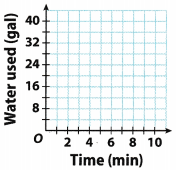
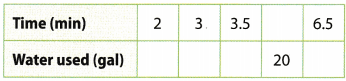
A shower uses 12 gallons of water in 3 minutes. Complete the table and graph.
Texas Go Math Grade 6 Lesson 8.2 Answer Key Ratios, Rates, Tables, and Graphs 1
Texas Go Math Grade 6 Lesson 8.2 Answer Key Ratios, Rates, Tables, and Graphs 2
Answer:
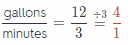
To find the unit rate, divide the numerator and denominator by 3:
Texas Go Math Grade 6 Lesson 8.2 Answer Key Ratios, Rates, Tables, and Graphs 14
The shower uses 4 gallons per minute.
Use this rate to complete the table.
If you need to find the amount of used water, multiply the time by 4.
If you need to find the time, divide the amount of used water by 4.

time gallon
2 8
3 12
3.5 14
5 20
6.5 26

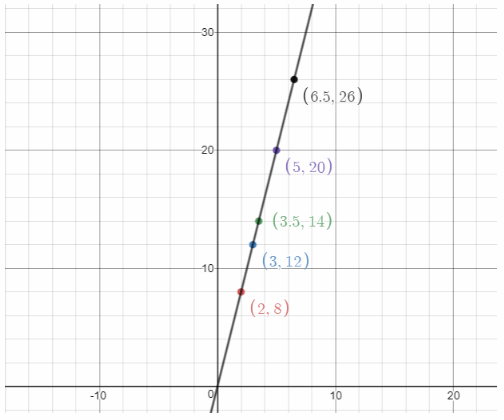
List the ordered pairs from the table:
(2,8), (3. 12), (3.5. 14), (5, 20), (6.5, 26)
and graph them on a coordinate plane.
Texas Go Math Grade 6 Lesson 8.2 Answer Key Ratios, Rates, Tables, and Graphs 15

The shower uses 4 gallons per minute.

Texas Go Math Grade 6 Lesson 8.2 Guided Practice Answer Key

Lesson 8.2 Answer Key 6th Grade Go Math Question 1.
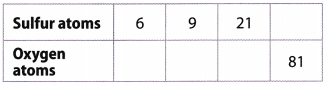
Sulfur trioxide molecules all have the same ratio of oxygen atoms to sulfur atoms. A number of molecules of sulfur dioxide have 18 oxygen atoms and 6 sulfur atoms. Complete the table.
Texas Go Math Grade 6 Lesson 8.2 Answer Key Ratios, Rates, Tables, and Graphs 3
What are the equivalent ratios shown in the table?
Answer:
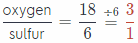
To find the unit rate, divide the numerator and denominator by 6:
Texas Go Math Grade 6 Lesson 8.2 Answer Key Ratios, Rates, Tables, and Graphs 16
To find the number of sulfur atoms, multiply the number of oxygen atoms by 3.
To find the number of oxygen atoms, divide the number of sulfur atoms by 3.

Sulfur Oxygen
6 18
9 27
21 63
27 81

Equivalent ratios are:
\(\frac{6}{18}=\frac{9}{27}=\frac{21}{63}=\frac{27}{81}\)

Question 2.
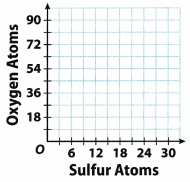
Graph the relationship between sulfur atoms and oxygen atoms.
Texas Go Math Grade 6 Lesson 8.2 Answer Key Ratios, Rates, Tables, and Graphs 4
Answer:
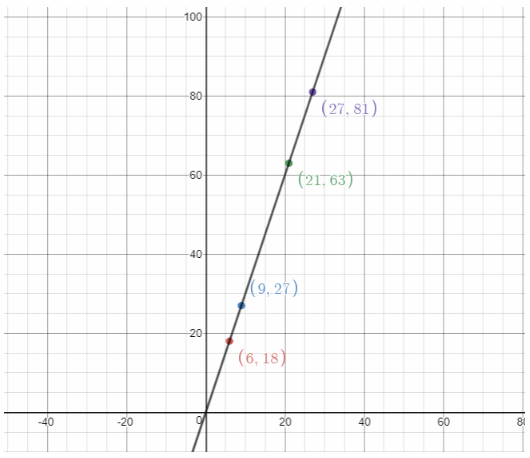
Texas Go Math Grade 6 Lesson 8.2 Answer Key Ratios, Rates, Tables, and Graphs 17

List the ordered pairs from the table:
(6, 18), (9, 27), (21, 63), (27, 81)
and graph them on a coordinate plane.

Ratio Tables and Graphs Answer Key Lesson 8.2 Question 3.
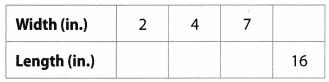
Stickers are made with the same ratio of width to length. A sticker 2 inches wide has a length of 4 inches. Complete the table.
Texas Go Math Grade 6 Lesson 8.2 Answer Key Ratios, Rates, Tables, and Graphs 5
What are the equivalent ratios shown in the table?
Answer:

Width (in) Length (in)
2 4
4 8
7 14
8 16
For every 2 inches of width the length is 4 inches. This implies that there is \( \frac{4}{2} \) = 2 inches of length per inch of width.

Equivalent ratio of width to length is 1 : 2

Question 4.
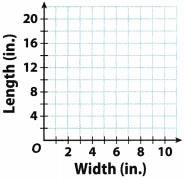
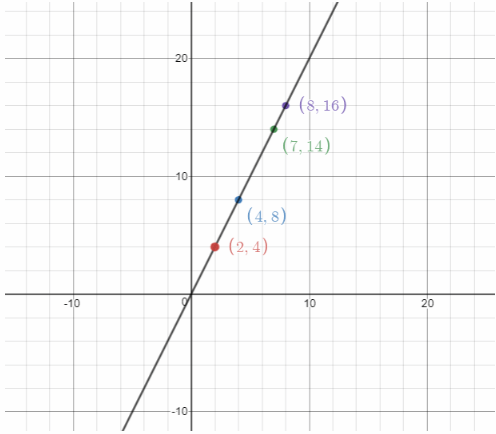
Graph the relationship between the width and the length of the stickers.
Texas Go Math Grade 6 Lesson 8.2 Answer Key Ratios, Rates, Tables, and Graphs 6
Answer:
Texas Go Math Grade 6 Lesson 8.2 Answer Key Ratios, Rates, Tables, and Graphs 18

List the ordered pairs from the table:
(2, 4), (4, 8), (7, 14), (8, 16)
and graph them on a coordinate plane.

Go Math Lesson 8.2 Ratios Rates Tables and Graphs Question 5.
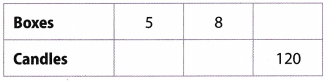
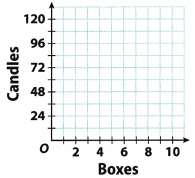
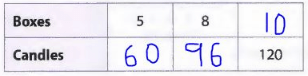
Five boxes of candles contain a total of 60 candles. Each box holds the same number of candles. Complete the table and graph the relationship.
Texas Go Math Grade 6 Lesson 8.2 Answer Key Ratios, Rates, Tables, and Graphs 7
Texas Go Math Grade 6 Lesson 8.2 Answer Key Ratios, Rates, Tables, and Graphs 8
Answer:
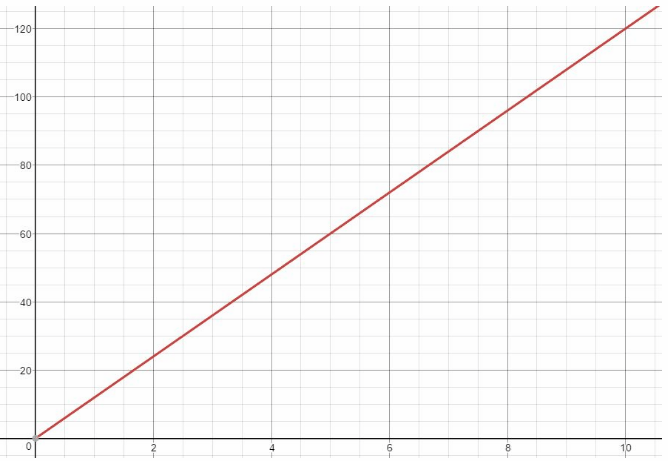
There are 60 candles in 5 boxes so each box can hold up to \(\frac{60}{5}\) = 12 candles so the rate is 12 candles per box.
Use this function to complete the table.

Table:
Texas Go Math Grade 6 Lesson 8.2 Answer Key Ratios, Rates, Tables, and Graphs 19

Graph of y = 12x:
Texas Go Math Grade 6 Lesson 8.2 Answer Key Ratios, Rates, Tables, and Graphs 20

Essential Question Check-In

Question 6.
How do you represent real-world problems involving ratios and rates with tables and graphs?
Answer:
Real-world problems involving ratios and rates are represented with tables as ordered pairs and then these ordered pairs are graphed to study the relation between the 2 given variables or quantities.

We can study the relation between the two given variables or quantities.

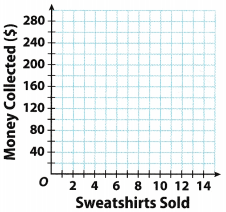
The table shows information about the number of sweatshirts sold and the money collected at a fund raiser for school athletic programs. For Exercises 7 – 12, use the table.

Texas Go Math Grade 6 Lesson 8.2 Answer Key Ratios, Rates, Tables, and Graphs 9

Question 7.
Find the rate of money collected per sweatshirt sold. Show your work.
Answer:
According to the given data, the sale of 3 sweatshirts collected $60, so this means that 1 sweatshirt collected \(\frac{\$ 60}{3}\) = $20
$20 is collected per sweatshirt sold.

Question 8.
Use the unit rate to complete the table.
Answer:
$20 is collected per sweatshirt sold, so the sale of 5 sweatshirts will generate 5 × $20 = $100.
$20 is collected per sweatshirt sold, so the sale of 8 sweatshirts will generate 8 × $20 = $160.
$20 is collected per sweatshirt sold, so the sale of 12 sweatshirts will generate 12 × $20 = $240.
$20 is collected per sweatshirt sold, so $180 was collected by selling \(\frac{\$ 180}{\$ 20}\) = 9 sweatshirts.

Go Math 6th Grade Ratios and Rates Answer Key Question 9.
Explain how to graph Information from the table.
Answer:
List the ordered pairs from the table:
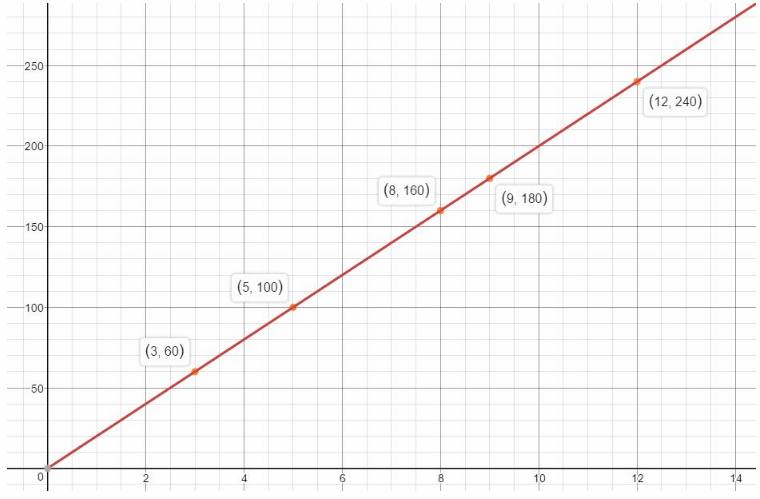
(3, 60), (5, 100), (8, 160), (9, 180), (12. 240)
and graph them on a coordinate plane.

Question 10.
Write the information in the table as ordered pairs. Graph the relationship from the table.
Answer:
The information in the tabLe can be written as ordered pairs (x, y) so this becomes:
(3, 60), (5, 100), (8, 160), (9, 180) and (12, 240). Plot these on a graph and join them using a straight line to graph the function:
Texas Go Math Grade 6 Lesson 8.2 Answer Key Ratios, Rates, Tables, and Graphs 21

Question 11.
What If? How much money would be collected if 24 sweatshirts were sold? Show your work.
Texas Go Math Grade 6 Lesson 8.2 Answer Key Ratios, Rates, Tables, and Graphs 10
Answer:
Each sweatshirt sold, collects $20 so the sale of 24 will collect 24 × $20 = $480.

The sale of 24 sweatshirts will collect $480.

Question 12.
Analyze Relationships Does the point (5.5, 110) make sense in this context? Explain.
Answer:
The point (5.5, 110) does not make sense in this context because the independent variable x, the number of shirts sold is discrete and not continuous. This means that selling 5.5 sweatshirts does not make sense, the number of sweatshirts sold MUST be a whole number.

Question 13.
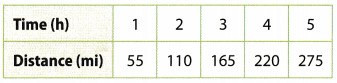
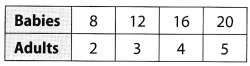
Communicate Mathematical Ideas The table shows the distance Randy drove on one day of her vacation. Find the distance Randy would have gone if she had driven for one more hour at the same rate. Explain how you solved the problem.
Texas Go Math Grade 6 Lesson 8.2 Answer Key Ratios, Rates, Tables, and Graphs 11
Answer:
From the data given in the table, it can be seen that she covers a distance of 55 miles in 1 hour, so in 6 hours she would have covered a distance of 6 × 55 = 330 miles.

She would have covered a distance of 330 miles.

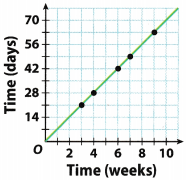
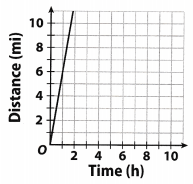
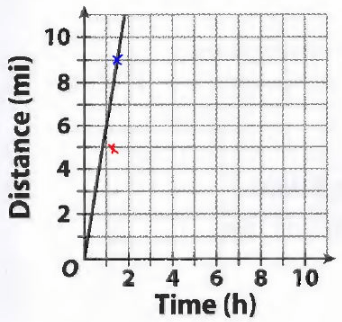
Use the graph for Exercises 14 – 15.

Texas Go Math Grade 6 Lesson 8.2 Answer Key Ratios, Rates, Tables, and Graphs 12

Question 14.
Analyze Relationships Does the relationship show a ratio or a rate? Explain.
Answer:
The ratio because it represents the relationship between the two numbers.

Go Math Grade 6 Lesson 8.2 Ratios and Rates Question 15.
Represent Real-World Problems What is a real-life relationship that might be described by the graph?
Answer:
We can find out how many days are in, for example, one, two, or three weeks.
Ordered pair on the graph (4, 28) tells us there are
28 days in 4 weeks.

H.O.T. Focus On Higher Order Thinking

Question 16.
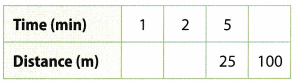
Make a Conjecture Complete the table.
Then find the rates \(=\frac{\text { distance }}{\text { time }}\) and \(\frac{\text { time }}{\text { distance }}\)
Texas Go Math Grade 6 Lesson 8.2 Answer Key Ratios, Rates, Tables, and Graphs 13
\(\frac{\text { distance }}{\text { time }}\) = _______________
\(\frac{\text { time }}{\text { distance }}\) = _______________
Answer:

Time Distance
1 5
2 10
5 25
20 100

\(\frac{\text { distance }}{\text { time }}\) = \(\frac{5}{1}\)
\(\frac{\text { time }}{\text { distance }}\) = \(\frac{1}{5}\)

a. Are the \(\frac{\text { time }}{\text { distance }}\) rates equivalent? Explain.
Answer:
They are equivalent because
\(\frac{1}{5} \cdot \frac{2}{2}=\frac{2}{10}\)
\(\frac{1}{5} \cdot \frac{5}{5}=\frac{5}{25}\)
\(\frac{1}{5} \cdot \frac{20}{20}=\frac{20}{100}\)

b. Suppose you graph the points (time, distance) and your friend graphs (distance, time). How will your graphs be different?
Answer:
The graph of (time, distance) will grow slower than the graph of (distance, time)

Lesson 8.2 Answer Key 6th Grade Go Math Question 17.
Communicate Mathematical Ideas To graph a rate or ratio from a table, how do you determine the scales to use on each axis?
Answer:
The maximum values of the 2 given quantities are considered and based on that, the scales of the axes of the graphs are decided.

Texas Go Math Grade 6 Lesson 8.2 Answer Key Ratios, Rates, Tables, and Graphs Read More »

Texas Go Math Grade 6 Module 7 Answer Key Representing Ratios and Rates

Refer to our Texas Go Math Grade 6 Answer Key Pdf to score good marks in the exams. Test yourself by practicing the problems from Texas Go Math Grade 6 Module 7 Answer Key Representing Ratios and Rates.

Texas Go Math Grade 6 Module 7 Answer Key Representing Ratios and Rates

Texas Go Math Grade 6 Module 7 Are You Ready? Answer Key

Write each fraction in simplest form.

Question 1.
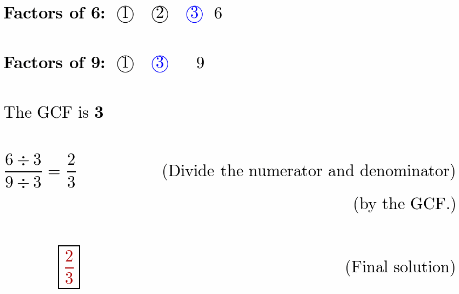
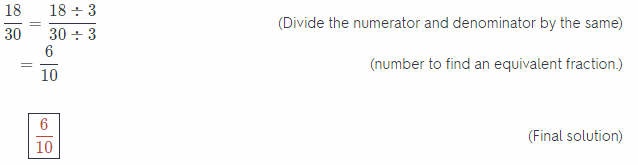
\(\frac{6}{9}\)
Answer:
List the factors of 6 and 9.
Then circle the common factors.
Texas Go Math Grade 6 Module 7 Answer Key Representing Ratios and Rates 11

Go Math Grade 6 Answer Key Representing Rates Question 2.
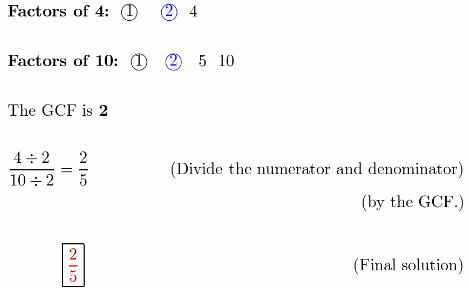
\(\frac{4}{10}\)
Answer:
List the factors of 4 and 10.
Then circle the common factors.
Texas Go Math Grade 6 Module 7 Answer Key Representing Ratios and Rates 12

Question 3.
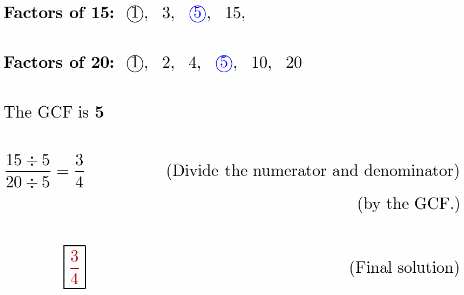
\(\frac{15}{20}\)
Answer:
Simplify \(\frac{15}{20}\)
List the factors of 15 and 20.
Then circle the common factors.
Texas Go Math Grade 6 Module 7 Answer Key Representing Ratios and Rates 13

Question 4.
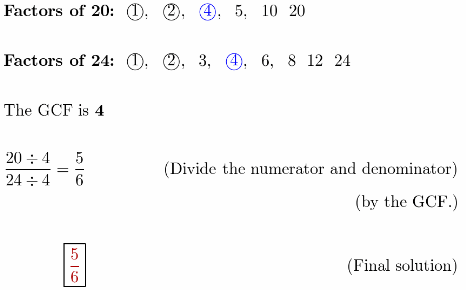
\(\frac{20}{24}\)
Answer:
Simplify \(\frac{20}{24}\)
List the factors of 20 and 24.
Then circle the common factors.
Texas Go Math Grade 6 Module 7 Answer Key Representing Ratios and Rates 14

Go Math Grade 6 Module 7 Answer Key Question 5.
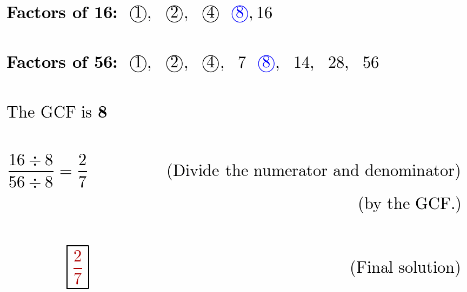
\(\frac{16}{56}\)
Answer:
Simplify \(\frac{16}{56}\)
List the factors of 16 and 56.
Then circle the common factors.
Texas Go Math Grade 6 Module 7 Answer Key Representing Ratios and Rates 15

Question 6.
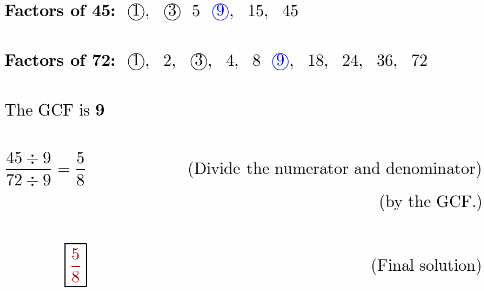
\(\frac{45}{72}\)
Answer:
Simplify \(\frac{45}{72}\)
List the factors of 45 and 72.
Then circle the common factors.
Texas Go Math Grade 6 Module 7 Answer Key Representing Ratios and Rates 16

Question 7.
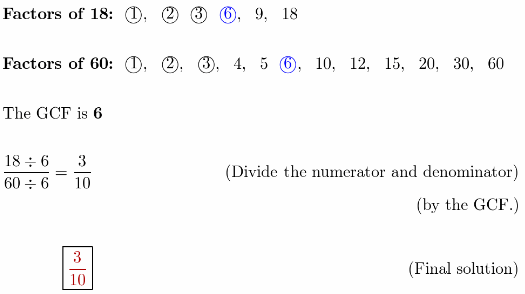
\(\frac{18}{60}\)
Answer:
Simplify \(\frac{18}{60}\)
List the factors of 18 and 60.
Then circle the common factors.
Texas Go Math Grade 6 Module 7 Answer Key Representing Ratios and Rates 17

Module 7 Go Math Grade 6 Rate and Ratio Question 8.
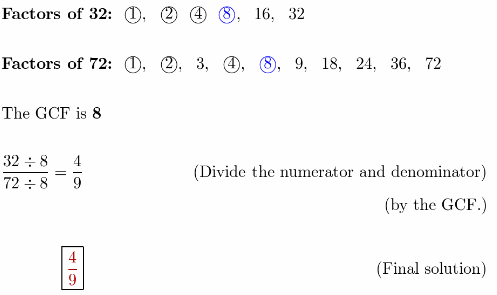
\(\frac{32}{72}\)
Answer:
Simplify \(\frac{32}{72}\)
List the factors of 32 and 72.
Then circle the common factors.
Texas Go Math Grade 6 Module 7 Answer Key Representing Ratios and Rates 18

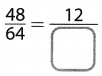
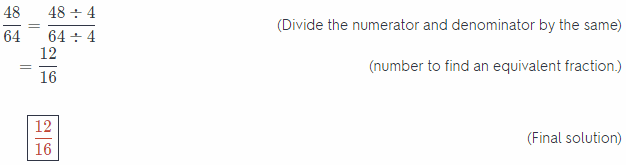
Write the equivalent fraction.

Question 9.
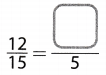
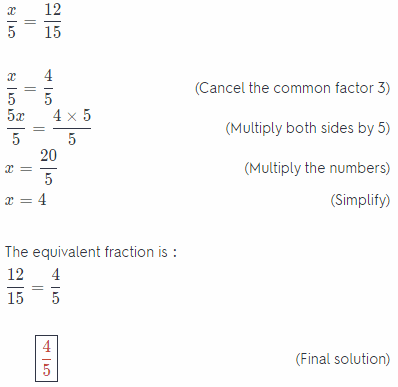
Texas Go Math Grade 6 Module 7 Answer Key Representing Ratios and Rates 1
Answer:
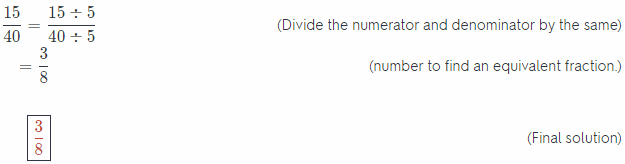
Switch sides
Texas Go Math Grade 6 Module 7 Answer Key Representing Ratios and Rates 19

Question 10.
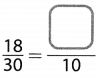
Texas Go Math Grade 6 Module 7 Answer Key Representing Ratios and Rates 2
Answer:
Switch sides
Texas Go Math Grade 6 Module 7 Answer Key Representing Ratios and Rates 20

Question 11.
Texas Go Math Grade 6 Module 7 Answer Key Representing Ratios and Rates 3
Answer:
Solution to this example is given below
Texas Go Math Grade 6 Module 7 Answer Key Representing Ratios and Rates 21

Question 12.
Texas Go Math Grade 6 Module 7 Answer Key Representing Ratios and Rates 4
Answer:
Solution to this example is given below
Texas Go Math Grade 6 Module 7 Answer Key Representing Ratios and Rates 22

Go Math Grade 6 Module 7 Answer Key Representing Ratios Question 13.
Texas Go Math Grade 6 Module 7 Answer Key Representing Ratios and Rates 5
Answer:
Solution to this example is given below
Texas Go Math Grade 6 Module 7 Answer Key Representing Ratios and Rates 23

Question 14.
Texas Go Math Grade 6 Module 7 Answer Key Representing Ratios and Rates 6
Answer:
Solution to this example is given below
Texas Go Math Grade 6 Module 7 Answer Key Representing Ratios and Rates 24

Question 15.
Texas Go Math Grade 6 Module 7 Answer Key Representing Ratios and Rates 7
Answer:
Solution to this example is given below
Texas Go Math Grade 6 Module 7 Answer Key Representing Ratios and Rates 25

Grade 6 Module 7 Answer Key Go Math Question 16.
Texas Go Math Grade 6 Module 7 Answer Key Representing Ratios and Rates 8
Answer:
Given expression
\(\frac{2}{7}=\frac{18}{x}\)

Multiply both sides of the equation with \(\) to isolate the variable on 1 side of the equation:
\(\frac{2}{7} \times \frac{7 x}{2}=\frac{18}{x} \times \frac{7 x}{2}\)
Evaluate:
x = 63
Therefore the equivalent fraction is:
\(\frac{2}{7}=\frac{18}{63}\)

Texas Go Math Grade 6 Module 7 Reading Start-Up Answer Key

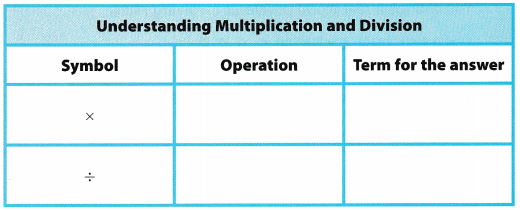
Visualize Vocabulary
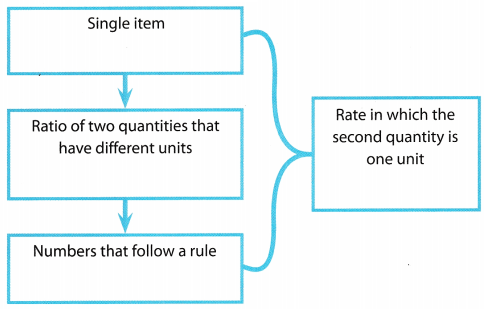
Use the ✓ words to complete the chart. Choose the review words that describe multiplication and division.

Texas Go Math Grade 6 Module 7 Answer Key Representing Ratios and Rates 9

Understand Vocabulary

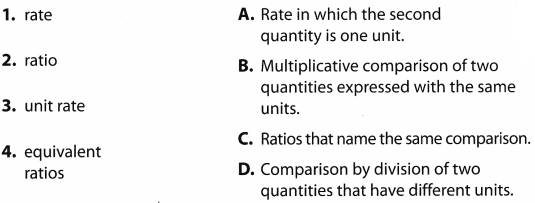
Match the term on the left to the definition on the right.

Texas Go Math Grade 6 Module 7 Answer Key Representing Ratios and Rates 10
Answer:

  1. – D
  2. – B
  3. – A
  4. – C

Texas Go Math Grade 6 Module 7 Answer Key Representing Ratios and Rates Read More »

Texas Go Math Grade 6 Unit 2 Study Guide Review Answer Key

Refer to our Texas Go Math Grade 6 Answer Key Pdf to score good marks in the exams. Test yourself by practicing the problems from Texas Go Math Grade 6 Unit 2 Study Guide Review Answer Key.

Texas Go Math Grade 6 Unit 2 Study Guide Review Answer Key

Module 3 Multiplying and Dividing Fractions

Multiply, Write the answer in simplest form.

Question 1.
\(\frac{1}{7} \times \frac{4}{5}\)
Answer:
Solution to this example is given below
Texas Go Math Grade 6 Unit 2 Study Guide Review Answer Key 10

Question 2.
\(\frac{5}{6} \times \frac{2}{3}\)
Answer:
Solution to this example is given below
Texas Go Math Grade 6 Unit 2 Study Guide Review Answer Key 11

Grade 6 Unit 2 Texas Go Math Answer Key Question 3.
\(\frac{3}{7} \times \frac{14}{15}\)
Answer:
Solution to this example is given below
Texas Go Math Grade 6 Unit 2 Study Guide Review Answer Key 12

Question 4.
\(1 \frac{1}{3} \times \frac{5}{8}\)
Answer:
Solution to this example is given below
Texas Go Math Grade 6 Unit 2 Study Guide Review Answer Key 13

Question 5.
\(1 \frac{2}{9} \times 1 \frac{1}{2}\)
Answer:
Solution to this example is given below
Texas Go Math Grade 6 Unit 2 Study Guide Review Answer Key 14

Question 6.
\(2 \frac{1}{7} \times 3 \frac{2}{3}\)
Answer:
Solution to this example is given below
Texas Go Math Grade 6 Unit 2 Study Guide Review Answer Key 15

Divide. Write the answer in the simplest form.

Unit 2 End of Unit Assessment Answer Key Grade 6 Question 7.
\(\frac{3}{7} \div \frac{2}{3}\)
Answer:
Solution to this example is given below
Texas Go Math Grade 6 Unit 2 Study Guide Review Answer Key 16

Question 8.
\(\frac{1}{8} \div \frac{3}{4}\)
Answer:
Solution to this example is given below
Texas Go Math Grade 6 Unit 2 Study Guide Review Answer Key 17

Question 9.
\(1 \frac{1}{5} \div \frac{1}{4}\)
Answer:
Solution to this example is given below
Texas Go Math Grade 6 Unit 2 Study Guide Review Answer Key 18

Question 10.
Ron had 20 apples. He used \(\frac{2}{5}\) of the apples to make pies. How many apples did Ron use for pies?
Answer:
Solution to this example is given below
Texas Go Math Grade 6 Unit 2 Study Guide Review Answer Key 19

Question 11.
The area of a rectangular garden is 38\(\frac{1}{4}\) square meters. The width of the garden is 4\(\frac{1}{2}\) meters. Find the length of the garden. (Lesson 3.4)
Answer:
Solution to this example is given below
Texas Go Math Grade 6 Unit 2 Study Guide Review Answer Key 20

Module 4 Multiplying and Dividing Decimals

Multiply

Question 1.
Texas Go Math Grade 6 Unit 2 Study Guide Review Answer Key 1
Answer:
Solution to this example is given below
Texas Go Math Grade 6 Unit 2 Study Guide Review Answer Key 21

Go Math Study Guide 6th Grade Unit 2 Answer Key Question 2.
Texas Go Math Grade 6 Unit 2 Study Guide Review Answer Key 2
Answer:
Solution to this example is given below
Texas Go Math Grade 6 Unit 2 Study Guide Review Answer Key 22

Question 3.
Texas Go Math Grade 6 Unit 2 Study Guide Review Answer Key 3
Answer:
Solution to this example is given below
Texas Go Math Grade 6 Unit 2 Study Guide Review Answer Key 23

Divide.

Question 4.
Texas Go Math Grade 6 Unit 2 Study Guide Review Answer Key 4
Answer:
Solution to this example is given below
Texas Go Math Grade 6 Unit 2 Study Guide Review Answer Key 24

Question 5.
Texas Go Math Grade 6 Unit 2 Study Guide Review Answer Key 5
Answer:
The divisor has one decimal place, so multiply both the dividend and the divisor by 10 so that the divisor is a whole number

0.6 × 10 = 6
25.2 × 10 = 252

Divide
Texas Go Math Grade 6 Unit 2 Study Guide Review Answer Key 25

Question 6.
Texas Go Math Grade 6 Unit 2 Study Guide Review Answer Key 6
Answer:
The divisor has one decimal place, so multiply both the dividend and the divisor by 10 so that the divisor is a whole number

2.1 × 10 = 21
36.75 × 10 = 367.5

Divide
Texas Go Math Grade 6 Unit 2 Study Guide Review Answer Key 26

Question 7.
Olga worked 37.5 hours last week at the library and earned $12.50 an hour. If she gets a $2.50 per hour raise, how many hours will she have to work to make the same amount of money as she did last week?
Answer:
First, calculate the amount of money that she earned last week:
37.5 × 12.5 = 468.75
She earned $ 468.75.
Now, divide 468.75 by 12.5 + 2.5 to find how many ¡tours site will have to work to make t he same amount of money:
468.75 ÷ (12.5 + 2.5)
Find the stun in the brackets:
468.75 ÷ 15
Use rules for dividing decimals to find the final result:
468.75 ÷ 15 = 31.25
Olga will have to work 31.25 hours to make the same amount of money.

Olga will have to work 3125 hours to make the same amount of money like last week.
Calculate the amount of money she earned last week and divide it by new hourly rate to find the number of hours she will have to work.

Texas Go Math Grade 6 Unit 2 Assessment Answers Question 8.
A pound of rice crackers costs $2.88. Matthew purchased pound of crackers. How much did he pay for the crackers? (Lesson 4.3)
Answer:
Solution to this example is given below
\(\frac{1}{4}\) = 0.25
Texas Go Math Grade 6 Unit 2 Study Guide Review Answer Key 27
For the crackers he pay 0.72 dollars

Module 5 Adding and Subtracting Integers

Add.

Question 1.
– 10 + (- 5)
Answer:
First find absolute values of given integers:
|- 10| = 10 and |- 5| = 5
Then, sum that absolute values
10 + 5 = 15
Final result would be 15 or – 15, depending on sign of given integers (both positive then +, both negative then -).
Given integers are negative so final result is – 15.
Find absolute values, sum them and add minus if both integers were negative.

Question 2.
9 + (- 20)
Answer:
Find absolute values and subtract lesser absolute value from greater:
|9| = 9 and |- 20| = 20
20 – 9 = 11
Final result would be 11 or – 11, depending on signs of given integers.
To find the final result, use the sign of number with greater absolute value:
9 + (- 20) = – 11

The sum is – 11.
Find absolute values, subtract them and add minus if the integer with the greater absolute value was negative.

Question 3.
– 13 + 32
Answer:
Find absolute values and subtract lesser absolute value from greater:
|- 13| = 13 and |32| = 32
32 – 13 = 19
Final result would be 19 or – 19, depending on signs of given integers.
To find the final result use the sign of number with greater absolute value:
– 13 + 32 = – 19

The sum is – 19.
Find absolute values, subtract them and add minus if the integer with the greater absolute value was negative.

Subtract.

Question 4.
– 12 – 5
Answer:
Subtracting 5 is equal to adding its additive inverse – 5 so you can find sum:
– 12 + (- 5)
To calculate sum, find absolute values of given integers:
|- 12| = 12 and |- 5| = 5
Then, sum that absolute values:
12 + 5 = 17
Result would be 17 or – 17. depending on sign of given integers.
Given integers are negative so final result is – 17
Since finding difference – 12 – 5 is the same as finding sum – 12 + (- 5), the difference is – 17.

The difference is – 17
To subtract 5, add its additive inverse – 5 and find sum using rules for adding integers.

Question 5.
25 – (- 4)
Answer:
Subtracting – 4 is equal to adding its additive inverse 4 so you can find sum:
25 + 4
The sum S:
25 + 4 = 29
Since finding difference 25 – (- 4) is the same as finding sum 25 + 4, the difference is 29.

The difference is 29.
To subtract – 4, add its additive inverse 4 and find sum using rules for adding integers.

Question 6.
– 3 – (- 40)
Answer:
Subtracting – 40 is equal to adding its additive inverse 40 so you can find sum:
– 3 + 40
To calculate sum, subtract lesser absolute value from greater:
|40| – |- 3| = 37
Result would be 37 or – 37, depending on signs of given integers.
Use the sign of integer with greater absolute value to find the sum:
– 3 + 40 = 37
Since finding difference – 3 – (- 40) is the same as finding sum – 3 + 40, the difference is 37.

The difference is 37
To subtract – 40, add its additive inverse 40 and find the sum using rules for adding integers.

Unit 2 Study Guide Answer Key Texas Go Math Grade 6 Question 7.
Antoine has $13 in his savings account. He buys some school supplies and ends up with $5 in his account. What was the overall change in Antoine’s account? (Lesson 5.4)
Answer:
The difference:
5 – 13
represents the change in his account
Subtracting 13 is equal to adding its additive inverse – 13 so you can find sum:
5 + (- 13)
To calculate sum, subtract lesser absolute value from greater:
|- 13| – |5| = 8
Result would be 8 or – 8, depending on signs of given integers.
Use the sign of integer with greater absolute value to find the sum:
5 + (- 13) = – 8
Since finding difference
5 – 13
is the same as finding sum
5 + (- 13)
the difference is – 8.
The overall change in his account was – $ 8.
To subtract 13, add its additive inverse – 13 and find sum using rules for adding integers.

Question 8.
Steve finds the value of – 12 + 18. Marion finds the value of – 10 – (- 15). Whose expression has the greater value? (Lesson 5.4)
Answer:
Calculate value of Steve’s expression first
Find absolute values and subtract lesser absolute value from greater:
|18| – |- 12| = 6
Result would be 6 or – 6, depending on signs of given integers.
To find the result use the sign of number with greater absolute value
– 12 + 18 = 6
The value of Steve’s expression is 6.

Then, calculate value of Marion’s expression.
Subtracting – 15 is equal to adding its additive inverse 15 so you can find sum:
– 10 + 15
To calculate sum, subtract lesser absolute value from greater:
|15| – |- 10| = 5
Result would be 5 or – 5, depending on signs of given integers.
Use the sign of integer with greater absolute value to find the sum:
– 10 + 15 = 5
Since finding difference – 10 – (- 5) is the same as finding sum -10 + 5, the difference is 5.
The value of Marion’s expression is 5.
Compare values:
6 > 5
Steve’s expression has greater value.
Use rules for subtracting integers and rules for adding integers to find values and compare them.

Module 6 Multiplying and Dividing Integers

Multiply or divide.

Question 1.
– 9 × (- 5) ____________
Answer:
First, determine if the product will be positive or negative
Since – 9 is negative and – 5 is negative (they have the same sign), the product will, be positive.
Then, multiply absolute values of given integers:
|- 9| = 9 and |- 5| = 5
9 × 5 = 45
The result is 45 or – 45, depending on signs of given integers.
Product is positive so final result is 45.

Result is 45.
Find the sign of the product, multiply absolute values of integers and add minus if the sign of product is minus ().

Question 2.
0 × ( – 10) ____________
Answer:
The result is 0.
When you multiply any integer with 0, the result you get is 0.

Question 3.
12 × (- 4) ____________
Answer:
First, determine if the product will be positive or negative
Since 12 is positive and – 4 is negative (they have opposite signs), the product will be negative.
Then, multiply absolute values of given integers:
|12| = 12 and |- 4| = 4
12 × 4 = 48
The result is 48 or – 48, depending on signs of given integers.
Product is negative so final result is – 48.

Result is – 48
Find the sign of the product, multiply absolute values of integers and add minus if the sign of product is minus (-).

Question 4.
– 32 ÷ 8 ____________
Answer:
First, determine if the quotient will be positive or negative
Since – 32 is negative and 8 is positive (they have opposite signs), the quotient will be negative.
Divide given integers:
– 32 ÷ 8 = – 4

Result is – 4.
Find the sign of the quotient (opposite signs of integers then -, the same sign of integers then +) and divide given integers.

Question 5.
– 9 ÷ (- 1) ____________
Answer:
First determine if the quotient will be positive or negative
Since – 9 is negative and – 1 is negative (they have the same sign), the quotient will be positive.
Divide given integers:
(- 9) ÷ (- 1) = 9

Result is 9.
Find the sign of the quotient (opposite signs of integers then -, the same sign of integers then +) and divide given integers.

Question 6.
– 56 ÷ 8 ____________
Answer:
First determine if the quotient will be positive or negative
Since – 56 is negative and 8 is positive (they have the opposite sign), the quotient will be negative.
Divide given integers:
– 56 ÷ 8 = – 7

Result is – 7.
Find the sign of the quotient (opposite signs of integers then -, the same sign of integers then +) and divide given integers.

Simplify.

Question 7.
– 14 ÷ 2 – 3 ____________
Answer:
The expression you want to simplify is:
– 14 ÷ 2 – 3
First, calculate the quotient using rules for dividing integers:
– 7 – 3
Then, find the difference using rules for subtracting integers:
– 7 – 3 = – 10
The expression is equal to – 10

The expression – 14 ÷ 2 – 3 is equal to – 10.
Use rules for dividing integers and rules for subtracting integers to simplify it.

Question 8.
8 + (- 20) × 3 ____________
Answer:
The expression you want to simplify is:
8 + (- 20) × 3
First calculate the product using rules for multiplying integers:
8 + (- 60)
Then, find the sum using rules for adding integers:
8 + (- 60) = – 52
The expression is equal to – 52

The expression 8 + (-20) 3 is equal to – 52.
Use rules for multiplying integers and rules for adding integers to simplify it.

Question 9.
36 ÷ (- 6) – 15 ____________
Answer:
The expression you want to simplify is:
36 ÷ (-6) – 15
First calculate the quotient using rules for dividing integers:
– 6 – 15
Then, find the difference using rules for subtracting integers:
– 6 – 15 = – 21
The expression is equal to – 21

The expression 36 ÷ (- 6) – 15 is equal to – 21.
Use rules for dividing integers and rules for subtracting integers to simplify it

Write an expression to represent the situation. Evaluate the expression and answer the question.

Question 10.
Steve spent $24 on dog grooming supplies. He washed 6 dogs and charged the owners $12 per dog wash. How much money did Steve earn? (Lesson 6.3)
Answer:
Use negative integer to represent the money he spent and positive integer to represent the money he earned for each dog wash
The expression you get is:
– 24 + 6 × 12
First calculate the product using rules for multiplying integers:
– 24 + 72
Then, find the sum using rules for adding integers:
– 24 + 72 = 48
Steve earned $48.
Write an expression that represents his earnings and use rules for multiplying and adding integers to find its value.

6th Grade Unit 2 Math Review Answer Key Question 11.
Tony and Mario went to the store to buy school supplies. Tony bought 3 packs of pencils for $4 each and a pencil box for $7. Mario bought 4 binders for $6 each and used a coupon for $6 off. Who spent more money? (Lesson 6.3)
Answer:
Calculate how much money was spent Tony and how much money spent Mario and compare results to find who spent more money.
The expression that represents Tony’s costs is:
3 × 4 + 7
First calculate the product using rules for multiplying integers:
12 + 7
Then, find the sum using rules for adding integers:
12 + 7 = 19
Tony spent
$ 19.

The expression that represents Mario’s costs is:
4 × 6 – 6
First calculate the product using rules for multiplying integers:
24 – 6
Then, find the difference using rules for subtracting integers:
24 – 6 = 18
Mario spent
$ 18.
Compare their costs
19 > 18
Therefore, Tony spent more money.

Tony spent more money for school supplies.
Use rules for multiplying, adding and subtracting integers to calculate their costs and compare that costs to find who spent more money.

Texas Go Math Grade 6 Unit 2 Performance Task Answer Key

Question 1.
CAREERS IN MATH Chef Chef Alonso is creating a recipe called Spicy Italian Chicken with the following ingredients: \(\frac{3}{4}\) pound chicken, 2\(\frac{1}{2}\) cups tomato sauce, 1 teaspoon oregano, and \(\frac{1}{2}\) teaspoon of his special hot sauce.

a. Chef Alonso wants each serving of the dish to include \(\frac{1}{2}\) pound of chicken. How many \(\frac{1}{2}\) pound servings does this recipe make?
Answer:
The expression that represents number of servings is:
\(\frac{3}{4} \div \frac{1}{2}\)
Use the reciprocal of the divisor to rewrite that expression as multiplication:
\(\frac{3}{4} \times \frac{2}{1}\)
Then, multiply the numerators and multiply the denominators to find the result:
\(\frac{3}{4} \times \frac{2}{1}=\frac{6}{4}\)
Simplify the answer and write ¡tin simplest form:
\(\frac{6 \div 2}{4 \div 2}=\frac{3}{2}\)
Therefore:
\(\frac{3}{4} \div \frac{1}{2}=\frac{3}{2}\), or 1\(\frac{1}{2}\)
That recipe makes 1\(\frac{1}{2}\) servings that each includes \(\frac{1}{2}\) pound of chicken.

b. What is the number Chef Alonso should multiply the amount of chicken by so that the recipe will make 2 full servings, each with \(\frac{1}{2}\) pound of chicken?
Answer:
Calculate the product
2 × \(\frac{1}{2}\)
to find the amount of chicken that is used for 2 servings.
Use rules for multiplying fractions to find that product:
2 × \(\frac{1}{2}\) = \(\frac{2}{2}\)
Simplify the answer and write it in simplest form:
\(\frac{2 \div 2}{2 \div 2}\) = 1
Then, divide the amount of chicken that is used for 2 servings by the amount of chicken from the recipe:
1 ÷ \(\frac{3}{4}\)
Use rules for dividing fractions to find that quotient:
1 × \(\frac{4}{3}\) = \(\frac{4}{3}\)
Therefore:
1 ÷ \(\frac{3}{4}\) = \(\frac{4}{3}\)
Chef should multiply the amount of chicken in recipe by \(\frac{4}{3}\).

c. Use the multiplier you found in part b to find the amount of all the ingredients in the new recipe.
Answer:
Use rules for multiplying fractions to find the solution.
Texas Go Math Grade 6 Unit 2 Study Guide Review Answer Key 28
The amount of chicken ¡n new recipe is 1 pound.
Texas Go Math Grade 6 Unit 2 Study Guide Review Answer Key 29
The amount of tomato sauce in new recipe is 3\(\frac{1}{3}\) cups.
Texas Go Math Grade 6 Unit 2 Study Guide Review Answer Key 30
The amount of oregano in new recipe is 1\(\frac{1}{3}\) teaspoons.
Texas Go Math Grade 6 Unit 2 Study Guide Review Answer Key 31
The amount of Chef’s special hot sauce in new recipe is \(\frac{2}{3}\) teaspoon.

d. Chef Alonso only has three measuring spoons: 1 teaspoon, \(\frac{1}{2}\) teaspoon, and \(\frac{1}{4}\) teaspoon. Can he measure the new amounts of oregano and hot sauce exactly? Explain why or why not.
Answer:
New amounts of oregano and hot sauce are 1\(\frac{1}{3}\) teaspoons and \(\frac{2}{3}\) teaspoon.
Convert the amounts of oregano and hot sauce to a decimals You get:
1\(\frac{1}{3}\) = 1,33333…. = 1,\(\dot{3}\)
\(\frac{2}{3}\) = 0,66666… = 0, \(\dot{6}\)
Convert \(\frac{1}{4}\) and \(\frac{1}{2}\) to a decimals:
\(\frac{1}{4}\) = 0,25
\(\frac{1}{2}\) = 0, 5
Numbers that represent the amounts of oregano and hot sauce are not finite and numbers 1, \(\frac{1}{4}\) and \(\frac{1}{2}\) are finite so Chef Alonso cannot measure that amounts exactly with the measuring spoons he has.

Question 2.
Amira is painting a rectangular banner 2\(\frac{1}{4}\) yards wide on a wall in the cafeteria. The banner will have a blue background. Amira has enough blue paint to cover 1\(\frac{1}{2}\) square yards of wall.

a. Find the height of the banner If Amira uses all of the blue paint. Show your work.
Answer:
Write mixed numbers as fractions:
2\(\frac{1}{4}\) = \(\frac{9}{4}\)
1\(\frac{1}{2}\) = \(\frac{3}{2}\)
Since the formula for calculating area of rectangle is:
area = width × height,
the quotient
area ÷ width
represents the height of rectangle.
Therefore, quotient
\(\frac{3}{2} \div \frac{9}{4}\)
represents the height of the banner.
Use the reciprocal of the divisor to rewrite that exDression as multiplication:
\(\frac{3}{2} \times \frac{4}{9}\)
Then, multiply the numerators and multiply the denominators to find the result:
\(\frac{3}{2} \times \frac{4}{9}=\frac{12}{18}\)
Simplify the answer and write it in simplest form:
\(\frac{12 \div 6}{18 \div 6}=\frac{2}{3}\)
The height of the banner is \(\frac{2}{3}\) yards.

b. The school colors are blue and yellow, so Amira wants to add yellow rectangles on the left and right sides of the blue rectangle. The yellow rectangles will each be \(\frac{3}{4}\) yard wide and the same height as the blue rectangle. What will be the total area of the two yellow rectangles? Explain how you found your answer.
Answer:
The height of the yellow rectangles will be \(\frac{2}{3}\) yards.
Find the area of one yellow rectangle and multiply it by 2 to find the total area.
The expression you get is:
\(\left(\frac{3}{4} \times \frac{2}{3}\right)\) × 2
First multiply the numerators and multiply the denominators to find the product in the brackets:
\(\frac{6}{12}\) × 2
Then, use rules for multiplying fractions to find the final result:
\(\frac{6}{12}\) × 2 = \(\frac{12}{12}\)
Simplify the answer and write it in simplest form:
\(\frac{12 \div 12}{12 \div 12}\) = 1
The total area of two yellow rectangles will be 1 square yard.

c. What are the dimensions of the banner plus yellow rectangles? What is the total area? Show your work.
Answer:
Width of blue banner is \(\frac{9}{4}\) yards and width of each yellow rectangle is \(\frac{3}{4}\) yard so total width is:
\(\frac{9}{4}\) + 2 × \(\frac{3}{4}\)
Use rules for multiplying fractions and rules for adding fractions to find the result:
\(\frac{9}{4}+\frac{6}{4}\)
\(\frac{9}{4}+\frac{6}{4}=\frac{15}{4}\)
Total width is \(\frac{15}{4}\) yards.
Height of blue banner is the same as height of yellow rectangles so
total height is \(\frac{2}{3}\) yard
Multiply total width and total height using rules for multiplying fractions to find the total area:
\(\frac{15}{4} \times \frac{2}{3}=\frac{30}{12}\)
Simplify the answer and write it in simplest form:
\(\frac{30 \div 6}{12 \div 6}=\frac{5}{2}\) or 2\(\frac{1}{2}\)
The total area is 2\(\frac{1}{2}\) square yards.

Texas Go Math Grade 6 Unit 1 Texas Test Prep Answer Key

Selected Response

Question 1.
Which of the following statements is correct?
(A) The product of \(\frac{5}{6}\) and \(\frac{9}{10}\) is greater than.
(B) The product of 1\(\frac{3}{4}\) and \(\frac{3}{4}\) is less than 1\(\frac{1}{5}\).
(C) The product of \(\frac{6}{7}\) and \(\frac{5}{6}\) is greater than \(\frac{5}{6}\).
(D) The product of 1\(\frac{3}{4}\) and \(\frac{2}{5}\) is less than \(\frac{2}{5}\).
Answer:
(B) The product of 1\(\frac{3}{4}\) and \(\frac{3}{4}\) is less than 1\(\frac{1}{5}\).

Explaination:
(A) Calculate the product:
\(\frac{5}{6} \times \frac{9}{10}\)
Multiply the numerators and multiply the denominators to find the result:
\(\frac{5}{6} \times \frac{9}{10}=\frac{45}{60}\)
Write in form in which it has the same denominator as previous product, \(\frac{45}{60}\):
\(\frac{9 \times 6}{10 \times 6}=\frac{54}{60}\)
Compare the product with that fraction:
\(\frac{45}{60}<\frac{54}{60}\)
The product is less than \(\frac{9}{10}\).
Therefore, statement A) is incorrect.

(B) Write mixed number as fraction:
1 \(\frac{1}{5}\) = \(\frac{6}{5}\)
Calculate the product:
\(\frac{6}{5} \times \frac{6}{7}\)
Multiply the numerators and multiply the denominators to find the result:
\(\frac{6}{5} \times \frac{6}{7}=\frac{36}{35}\)
Write \(\frac{6}{5}\) in form in which it has the same denominator as previous product, \(\frac{36}{35}\):
\(\frac{6 \times 7}{5 \times 7}=\frac{42}{35}\)
Compare the product with that fraction:
\(\frac{36}{35}<\frac{42}{35}\)
The product is less than 1\(\frac{1}{5}\) so the correct answer is B.

Use same rules to check statements C and D:

(C)
Texas Go Math Grade 6 Unit 2 Study Guide Review Answer Key 32
The product is less than \(\frac{5}{6}\).

(D)
Texas Go Math Grade 6 Unit 2 Study Guide Review Answer Key 33
The product is greater than \(\frac{2}{5}\).
Therefore, statements (C) and (D) are incorrect.

Question 2.
Which of these is the same as \(\frac{8}{9} \div \frac{2}{3}\)
(A) \(\frac{8}{9} \div \frac{3}{2}\)
(B) \(\frac{2}{3} \div \frac{8}{9}\)
(C) \(\frac{8}{9} \times \frac{2}{3}\)
(D) \(\frac{8}{9} \times \frac{3}{2}\)
Answer:
(D) \(\frac{8}{9} \times \frac{3}{2}\)

Explaination:
Given expression:
\(\frac{8}{9} \div \frac{2}{3}\)
Convert the divide sign to a multiply sign by taking the reciprocal of the fraction after the divide sign, therefore:
= \(\frac{8}{9} \times \frac{3}{2}\)

Question 3.
A rectangular tabletop has a length of 4\(\frac{3}{4}\) feet and an area of 11\(\frac{7}{8}\) square feet. What is the width of the tabletop?
(A) 1\(\frac{1}{16}\) feet
(B) 2\(\frac{1}{2}\) feet
(C) 4\(\frac{1}{4}\) feet
(D) 8\(\frac{1}{2}\) feet
Answer:
(B) 2\(\frac{1}{2}\) feet

Exaplaination:
Write mixed numbers as fractions:
4\(\frac{3}{4}\) = \(\frac{19}{4}\)
11\(\frac{7}{8}\) = \(\frac{95}{8}\)
Since the formula for calculating the area of rectangle is:
area = length × width,
the quotient
area ÷ length
represents the width of rectangle.
Therefore, the quotient
\(\frac{95}{8} \div \frac{19}{4}\)
represents me width of the tabletop.
Use the reciprocal of the divisor to rewrite that expression as multiplication:
\(\frac{95}{8} \times \frac{4}{19}\)
Then, multiply the numerators and multiply the denominators to find the result:
\(\frac{95}{8} \times \frac{4}{19}=\frac{380}{152}\)
Simplify the answer and write it in the simplest form:
\(\frac{380 \div 76}{152 \div 76}=\frac{5}{2}\), or 2\(\frac{1}{2}\)
The width of the rectangular tabletop is 2\(\frac{1}{2}\) feet.

Go Math 6th Grade Answer Key Unit 2 Test Answers Question 4.
Dorothy types 120 words per minute. How many words does Dorothy type in 1.75 minutes?
(A) 150 words
(B) 180 words
(C) 200 words
(D) 210 words
Answer:
(D) 210 words

Explaination:
Solution to this example is given below
Texas Go Math Grade 6 Unit 2 Study Guide Review Answer Key 34

Question 5.
What is the opposite of 17?
(A) – 17
(B) –\(\frac{1}{17}\)
(C) \(\frac{1}{17}\)
(D) 17
Answer:
(A) – 17

Explaination:
Solution to this example is given below
17 × (- 1)
– 17 × 1 (Remove parentheses)
– 17 (Multiply the numbers)

Question 6.
Each paper clip is of an inch long and costs $0.03. Exactly enough paper clips are laid end to end to have a total length of 56 inches. What is the total cost of these paper clips?
(A) $0.49
(B) $0.64
(C) $1.47
(D) $1.92
Answer:
(D) $1.92

Explaination:
The number of paper clips required to make a length of 56 inches is evaluated as \(\frac{56}{\frac{7}{8}}=\frac{56 \times 8}{7}\) = 64.
Total cost to buy these 64 clips is 64 × $0.03 = $1.92.

Question 7.
Which expression simplifies to 5?
(A) \(\frac{27}{3}\) – 14
(B) \(\frac{27}{3}\) + 14
(C) \(\frac{-27}{3}\) – 4
(D) \(\frac{-27}{3}\) + 14
Answer:
(D) \(\frac{-27}{3}\) + 14

Explaination:
(A) \(\frac{27}{3}\) – 14
Calculate the quotient using rules for dividing integers:
9 – 14
Find the difference using rules for subtracting integers:
9 – 14 = – 5
The expression is equal to – 5 so it is not the answer.

(B) \(\frac{27}{3}\) + 4
Calculate the quotient using rules for dividing integers:
9 + 4
Find the difference using rules for subtracting integers:
9 + 4 = 13
The expression is equal to 13 so it is not the answer.

(C) \(\frac{-27}{3}\) – 4
Calculate the quotient using rules for dividing integers:
– 9 – 4
Find the difference using rules for subtracting integers:
– 9 – 4 = – 13
The expression is equal to – 13 so it is not the answer.

(D) \(\frac{-27}{3}\) + 14
Calculate the quotient using rules for dividing integers:
– 9 + 14
Find the difference using rules for subtracting integers:
– 9 + 14 = 5
The expression is equal to 5 so the correct answer is D.

Question 8.
What is the absolute value of – 36?
(A) -36
(B) 0
(C) 6
(D) 36
Answer:
(D) 36

Exaplaination:
Solution to this example is given below
|- 36| = 36 (This option is correct answer)

Apply absolute rule: |- a| = a

Question 9.
Which number can you add to 13 to get a sum of 0?
(A) – 26
(B) – 13
(C) 0
(D) 13
Answer:
(B) – 13

Explaination:
Add each number to 13 using rules for adding integers to find the result of 0.
(A) 13 + (- 26)
Find absolute values and subtract lesser absolute value from greater:
|- 26| – |13| = 13
Final result would be 13 or – 13, depending on signs of given integers.
Use the sign of the number with the greater absolute value to find the result:
13 + (- 26) = – 13
– 13 is not equal to 0 so A) is not the answer

(B) 13 + (- 13)
Find absolute values and subtract lesser absolute value from greater:
|- 13| – |13| = 0
Final result is 0 so the correct answer is B.

Question 10.
Joseph owes his older brother $15, so he has a balance of – $15 with his brother. Joseph borrows some more money from his brother, bringing his balance to 5 times the previous amount. What is Joseph’s new balance with his brother?
(A) – $ 90
(B) – $ 75
(C) – $ 10
(D) $ 60
Answer:
(B) – $ 75

Multiply Josephs balance of – $15 by 5 to find bis new balance.
The expression you get is:
5(- 15)
First, determine if the product will be positive or negative.
Since 5 is positive and – 15 is negative (they have opposite signs), the product will be negative.
Then, multiply absolute values of given integers:
|5| = 5 and |- 15| = 15
5 × 15 = 75
The result is 75 or – 75. depending on signs of given integers.
Product is negative so final result is – 75.
he answer is B. His new balance with his brother is – $ 75.

Question 11.
Which expression simplifies to a positive answer?
(A) a negative number divided by a positive number
(B) a positive number divided by a negative number
(C) a negative number multiplied by a negative number
(D) a positive number multiplied by a negative number
Answer:
(C) a negative number multiplied by a negative number

Explaination:
The product of two integers with the same sign is positive so the correct answer is C.

The quotient of two integers with different signs is negative as well as the product of two integers with different signs so results of expressions A), B) and D) are negative.

Question 12.
Which expression has the least value?
(A) (- 9) ÷ 3 – 2
(B) (- 24) ÷ 6 + 2
(C) 36 ÷ (- 4) + 7
(D) (- 32) ÷ 8 – 4
Answer:
(D) (- 32) ÷ 8 – 4

Exaplaination:
Find value of each expression and compare results you get
(A) (- 9) ÷ 3 – 2
Calculate the quotient using rules for dividing integers:
– 3 – 2
Find the difference using rules for subtracting integers:
– 3 – 2 = – 5
(- 9) ÷ 3 – 2 = – 5

(B) (- 24) ÷ 6 + 2
Calculate the quotient using rules for dividing integers:
– 4 + 2
Find the sum using rules for adding integers:
– 4 + 2 = – 2
(- 24) ÷ 6 + 2 = – 2

(C) 36 ÷ (-4) + 7
Calculate the quotient using rules for dividing integers:
– 9 + 7
Find the sum using rules for adding integers:
– 9 + 7 = – 2
36 ÷ (- 4) + 7 = – 2

(D) (- 32) ÷ 8 – 4
Calculate the quotient using rules for dividing integers:
– 4 – 4
Find the difference using rules for subtracting integers:
– 4 – 4 = -8
(- 32) ÷ 8 – 4 = – 8
Compare results:
– 8 < – 5 < – 2
The expression D) has the least value.

Gridded Response

Hot Tip! Make sure that your answer makes sense before marking it as your response. Reread the question and determine whether your answer is reasonable.

Question 13.
A fish is 73 feet below sea level. It then swims 14 feet toward the surface. How many feet below sea level is the fish now?
Texas Go Math Grade 6 Unit 2 Study Guide Review Answer Key 7
Answer:
Use negative integer to represent where fish was at the beginning and positive integer to represent the distance it moves toward the surface.
The expression you get is:
– 73 + 14
Find absolute values and subtract lesser absolute value from greater:
|- 73| – |14| = 59
Final result would be 59 or – 59, depending on signs of given integers.
Use sign of number with greater absolute value to find the final result:
– 73 + 14 = – 59
The fish is 59 feet below the surface.
Use rules for adding integers to find how many feet below sea level the fish is now.

Question 14.
A box contained 162 matches. A bigger box contained 1\(\frac{4}{9}\) times as many matches. How many matches did the bigger box contain?
Texas Go Math Grade 6 Unit 2 Study Guide Review Answer Key 8
Answer:
Multiply 162 by 1\(\frac{4}{9}\) to find how many matches the bigger box contained.
The expression you get is:
162 × 1\(\frac{4}{9}\)
First, write 1\(\frac{4}{9}\) as a fraction:
1\(\frac{4}{9}\) = \(\frac{13}{9}\)
Then, multiply the numerators and multiply the denominators to find the result:
\(\frac{162}{1} \times \frac{13}{9}=\frac{2106}{9}\)
Simplify the answer and write it in simplest form:
\(\frac{2106 \div 9}{9 \div 9}\) = 234
The bigger box contained 234 matches.
Use rules for multiplying fractions to find the result.

Question 15.
Colby and his 3 friends buy lunch. The total is $30.60. If they share the cost equally, how much, in dollars, should each person pay?
Texas Go Math Grade 6 Unit 2 Study Guide Review Answer Key 9
Answer:
Divide 30.60 by 4 to find how much money each person should pay.
The expression you get is:
30.60 ÷ 4
Use rules for dividing decimals to find the final result:
30.60 ÷ 4 = 7.65
Each person should pay $7.65.
Use rules for dividing decimals to calculate how much money each person should pay.

Texas Go Math Grade 6 Unit 2 Study Guide Review Answer Key Read More »

Texas Go Math Grade 6 Module 6 Quiz Answer Key

Refer to our Texas Go Math Grade 6 Answer Key Pdf to score good marks in the exams. Test yourself by practicing the problems from Texas Go Math Grade 6 Module 6 Quiz Answer Key.

Texas Go Math Grade 6 Module 6 Quiz Answer Key

Texas Go Math Grade 6 Module 6 Ready to Go On? Answer Key

6.1 Multiplying Integers

Find each product.

Question 1.
(- 2) (3) ______________
Answer:
First, determine if the product wilt be positive or negative
Since – 2 is negative and 3 is positive (they have opposite signs), the product will be negative.
Then, multiply absolute values of given integers:
|- 2| = 2 and |3| = 3
2 × 3 = 6
The result is 6 or – 6, depending on signs of given integers.
Product is negative so final result is – 6.

Result is – 6.
Find the sign of the product, multiply absolute values of integers and add minus if the sign of product is minus (-).

Question 2.
(- 5) (- 7) _____________
Answer:
First, determine if the product wilt be positive or negative
Since – 5 is negative and – 7 is negative (they have same signs), the product will be positive.
Then, multiply absolute values of given integers:
|- 5| = 5 and |- 7| = 7
5 × 7 = 35
The result is 35 or – 35, depending on signs of given integers.
Product is negative so final result is 35.

Result is 35.
Find the sign of the product, multiply absolute values of integers and add minus if the sign of product is minus (-).

Go Math Grade 6 Module 6 Answer Key Question 3.
(8) (- 11) ______________
Answer:
First, determine if the product will be positive or negative
Since 8 is positive and – 11 is negative (they have opposite signs), the product will be negative.
Then, multiply absolute values of given integers:
|8| = 8 and |- 11| = 11
8 × 11 = 88
The result is 88 or – 88, depending on signs of given integers.
Product is negative so final result is – 88

Result is – 88.
Find the sign of the product, multiply absolute values of integers and add minus if the sign of product is minus (-).

Question 4.
(- 3) (2) (- 2) ______________
Answer:
First, calculate the product:
(-3) (2)
Determine if the product will be positive or negative
Since – 3 is negative and 2 is positive (they have opposite signs, the product will be negative.
Then, multiply absolute values of given integers:
|- 3| = 3 and |2| = 2
3 × 2 = 6
The result is 6 or – 6, depending on signs of given integers.
Product is negative so result is – 6.
Now, find the product:
(- 6) (- 2)
Determine if the product will be positive or negative.

Since – 6 is negative and – 2 is negative (they have the same sign), the product will be positive.
Then, multiply absolute values of given integers:
|- 6| = 6 and |- 2| = 2
6 × 2 = 12
The result is 12 or – 12, depending on signs of given integers.
Product is positive so final result is 12.
Therefore:
(- 3) (2) (- 2) = 12

First, calculate the product (- 3)(2) and then multiply it with – 2.
Find the sign of the product, multiply absolute values of integers and add minus if the sign of product is minus (-).

Question 5.
The temperature dropped 3 °C every hour for 5 hours.
Write an integer that represents the change ¡n temperature. ______________
Answer:
Use negative integer to represent how many degrees the temperature dropped each hour.
The expression you get is:
5 (- 3)
First, determine if the product will be positive or negative
Since 5 is positive and – 3 is negative (they have opposite signs), the product will be negative.
Then, multiply absolute values of given integers:
|5| = 5 and |- 3| = 3
5 × 3 = 15
The result is 15 or – 15, depending on signs of given integers.
Product is negative so final result is – 15.
The change in temperature is – 15 degrees.
Write the expression that represents the change in temperature and find the product using rules for multiplying integers.

6.2 Dividing Integers

Find each quotient.

Question 6.
\(\frac{-63}{7}\)
Answer:
First determine if the quotient will be positive or negative
Since – 63 is negative and 7 is positive (they have opposite signs), the quotient will be negative.
Divide given integers:
\(\frac{-63}{7}\) = – 9

Result is – 9
Find the sign of the quotient (opposite signs of integers then -, the same sign of integers then +) and divide given integers.

Question 7.
\(\frac{-15}{-3}\)
Answer:
First determine if the quotient will be positive or negative
Since – 15 is negative and – 3 is negative (they have same signs), the quotient will be positive.
Divide given integers:
\(\frac{-15}{-3}\) = 5

Result is 5
Find the sign of the quotient (opposite signs of integers then -, the same sign of integers then +) and divide given integers.

Module 6 Test Answers Go Math Grade 6 Question 8.
\(\frac{0}{-15}\)
Answer:
First, determine if the quotient wilt be positive or negative
Since dividend is 0 and divisor – 15 is not 0, the quotient is 0.
The result of division is:
\(\frac{0}{-15}\) = 0

Result is 0.
Find the sign of the quotient (opposite signs of integers then -, the same sign of integers then +) and divide given integers.

Question 9.
\(\frac{96}{-12}\)
Answer:
First determine if the quotient will be positive or negative
Since 96 is positive and – 12 is negative (they have opposite signs), the quotient will be negative.
Divide given integers:
\(\frac{96}{-12}\) = – 8

Result is – 8.
Find the sign of the quotient (opposite signs of integers then -, the same sign of integers then +) and divide given integers.

Question 10.
An elephant at the zoo lost 24 pounds over 6 months. The elephant lost the same amount of weight each month. Write an integer that represents the change in the elephant’s weight each month.
Answer:
Use negative integer to represent the change in elephant’s weight
The expression you get is:
\(\frac{- 24}{6}\)
First determine if the quotient will be positive or negative
Since – 24 is negative and 6 is positive (they have opposite signs), the quotient wilt be negative.
Divide given integers:
\(\frac{- 24}{6}\) = – 4
The change in weight each month is – 4 pounds.
Write the expression that represents the change in elephant’s weight and find the quotient using rules for dividing integers.

6.3 Applying Integer Operations

Evaluate each expression.

Question 11.
(- 4) (5) + 8 _____________
Answer:
The expression you need to evaluate is:
(- 4)(5) + 8
First find the product using rules for multiplying integers:
– 20 + 8
Then, use rules for adding integers to find the sum:
– 20 + 8 = – 12
Therefore:
(- 4)(5) + 8 = – 12

The value of the expression is – 12
Use rules for multiplying integers and rules for adding integers to find that value.

Question 12.
(- 3) (-6) – 7 _____________
Answer:
The expression you need to evaluate is:
(- 3) (- 6) – 7
First find the product using rules for multiplying integers:
18 – 7
Then, use rules for subtracting integers to find the difference:
18 – 7 = 11
Therefore:
(- 3) (- 6) – 7 = 11

The value of the expression is 11.
Use rules for multiplying integers and rules for subtracting integers to find the value.

Go Math Module 6 Review Answer Key Grade 6 Question 13.
\(\frac{- 27}{9}\) – 11 _____________
Answer:
The expression you need to evaluate is:
\(\frac{-27}{9}\) – 11
First find the quotient using rules for dividing integers:
– 3 – 11
Then, use rules for subtracting integers to find the difference:
– 3 – 11 = – 14
Therefore:
\(\frac{-27}{9}\) – 11 = – 14

The value of the expression is – 14.
Use rules for dividing integers and rules for subtracting integers to find the value.

Question 14.
\(\frac{-24}{-3}\) – (- 2) _____________
Answer:
The expression you need to evaluate is:
\(\frac{-24}{-3}\) – (- 2)
First find the quotient using rules for dividing integers:
8 – (- 2)
Then, use rules for subtracting integers to find the difference:
8 – (- 2) = 10
Therefore:
\(\frac{-24}{-3}\) – (- 2) = 10

The value of the expression is 10.
Use rules for dividing integers and rules for subtracting integers to find the value.

Essential Question

Question 15.
Write and solve a real-world problem that can be represented by the expression (- 3) (5) + 10.
Answer:
Jim is at the entrance to the cave. He descends 5 times, each time 3 feet Then, he ascends 10 feet What is his new position relative to the cave entrance
Use negative integer if he descends and positive integer if he ascends.
The expression you get is:
(- 3) (5) + 10
First, find the product using rules for multiplying integers:
– 15 + 10
Then, use rules for adding integers to find the sum
– 15 + 10 = – 5
His new position is 5 feet below the cave entrance.

Jim is at the entrance to the cave. He descends 5 times, each time 3 feet Then, he ascends 10 feet What is his new position relative to the cave entrance?
Jim’s new position is 5 feet below the cave entrance.
Use rules for multiplying integers and rules for adding integers to find his new position.

Texas Go Math Grade 6 Module 6 Mixed Review Texas Test Prep Answer Key

Selected Response

Question 1.
A diver is at an elevation of – 18 feet relative to sea level. The diver descends to an undersea cave that is 4 times as far from the surface. What is the elevation of the cave?
(A) – 72 feet
(B) – 22 feet
(C) – 18 feet
(D) – 14 feet
Answer:
(A) – 72 feet

Explaination:
The expression that represents elevation of the cave is:
4(- 18)
Calculate that product to find the elevation.
First, determine if the product will be positive or negative
Since 4 is positive and – 18 is negative (they have opposite signs), the product will be negative.
Then, multiply absolute values of given integers:
|4| = 4 and |- 18| = 18
4 × 18 = 72
The result is 72 or – 72, depending on signs of given integers.
Product is negative so final result is – 72.
The elevation of the cave is – 72 feet.

Module 6 Quiz Answers Go Math Grade 6 Question 2.
The football team lost 4 yards on 2 plays in a row. Which of the following could represent the change in field position?
(A) – 12 yards
(B) – 8 yards
(C) – 6 yards
(D) – 2 yards
Answer:
(B) – 8 yards

Explaination:
Use negative integer because the team lost yards. The expression you get is:
2(- 4)
First, determine if the product will be positive or negative
Since 2 is positive and – 4 is negative (they have opposite signs), the product will be negative.
Then, multiply absolute values of given integers:
|2| = 2 and |- 4| = 4
2 × 4 = 8
The result is 8 or – 8, depending on signs of given integers.
Product is negative so final result is – 8.
The change in field position is – 8 yards.

Question 3.
Clayton climbed down 50 meters. He climbed down in 10-meter intervals. In how many intervals did Clayton make his climb?
(A) 5
(B) 10
(C) 40
(D) 500
Answer:
(A) 5

Explaination:
Divide total distance by distance of one interval to get number of intervals. The expression you get is:
50 ÷ 10
First, determine if the quotient will be positive or negative
Since 50 is positive and 10 is positive (they have the same sign), the quotient will be positive.
Divide given integers:
50 ÷ 10 = 5
He made his climb in 5 intervals.

Question 4.
Which expression results in a negative answer?
(A) a negative number divided by a negative number
(B) a positive number divided by a negative number
(C) a negative number multiplied by a negative number
(D) a positive number multiplied by a positive number
Answer:
(B) a positive number divided by a negative number

Explaination:
The quotient of two integers with opposite signs is negative so the correct answer is B.

The quotient of two integers with the same sign is positive as well as the product of two integers with the same sign so results of expressions A), C) and D) are positive

Question 5.
Clara played a video game before she left the house to go on a walk. She started with 0 points, lost 6 points 3 times, won 4 points, and then lost 2 points. How many points did she have when she left the house to go on the walk?
(A) – 20
(B) 12
(C) – 16
(D) 20
Answer:
(C) – 16

Explaination:
Subtract integer if she lost points and add integer if she won points
The expression you get is:
3(- 6) + 4 – 2
First, find the product using rules for multiplying integers:
– 18 + 4 – 2
Use rules for adding integers:
– 14 – 2
Use rules for subtracting integers to find the final result:
– 14 – 2 = – 16
Clara had – 16 points when she left the house.

Question 6.
Which expression is equal to
(A) \(\frac{-24}{6}\) – 4
(B) \(\frac{-24}{-6}\) + 4
(C) \(\frac{24}{6}\) + 4
(D) \(\frac{-24}{-6}\) – 4
Answer:
(D) \(\frac{-24}{-6}\) – 4

Explaination:
Calculate value of each expression to see which one is equal to 0.

(A) \(\frac{-24}{6}\) – 4
Find the quotient using rules for dividing integers:
– 4 – 4
Use rules for subtracting integers to find the difference:
– 4 – 4 = – 8

(B) \(\frac{-24}{-6}\) + 4
Find the quotient using rules for dividing integers:
4 + 4
Use rules for adding integers to find the sum:
4 + 4 = 8

(C) \(\frac{24}{6}\) + 4
Find the quotient using rules for dividing integers:
4 + 4
Use rules for adding integers to find the sum:
4 + 4 = 8

(D) \(\frac{-24}{-6}\) – 4
Find the quotient using rules for dividing integers:
4 – 4
Use rules for subtracting integers to find the difference:
4 – 4 = 0
Therefore, the correct answer is D.

Gridded Response

Grade 6 Module 6 Quiz Answer Key Go Math Question 7.
Rochelle made three $25 withdrawals and then wrote a check for $100. If she started with $200 in her account, find the total amount she has left in her account in dollars.
Texas Go Math Grade 6 Module 6 Quiz Answer Key 1
Answer:
Use positive integer to represent the amount she had at the beginning and use negative integers to represent the amount she withdrew and the value of the check.
The expression you get is:
200 + 3(- 25) + (- 100)
First find the product using rules for multiplying integers:
200 – 75 + (- 100)
Use rules for subtracting integers:
125 – (- 100)
Use rules for adding integers to find the final result:
125 + (- 100) = 25
Rochelle has left $25 in her account

Texas Go Math Grade 6 Module 6 Quiz Answer Key Read More »

Texas Go Math Grade 6 Lesson 6.3 Answer Key Applying integer Operations

Refer to our Texas Go Math Grade 6 Answer Key Pdf to score good marks in the exams. Test yourself by practicing the problems from Texas Go Math Grade 6 Lesson 6.3 Answer Key Applying integer Operations.

Texas Go Math Grade 6 Lesson 6.3 Answer Key Applying integer Operations

Your Turn

Question 1.
Reggie lost 3 spaceships in level 3 of a video game. He lost 30 points for each spaceship. When he completed level 3, he earned a bonus of 200 points. By how much did his score change?
Answer:
Use negative integer to represent lost points for each spaceship. The product
3 × (- 30)
shows how many points he lost for 3 spaceships.
Add positive integer that represents bonus he earned when he completed level 3.
The expression you get is:
3 × (- 30) + 200
First, calculate the product using rules for multiplying integers:
– 90 + 200
Then, find the sum using rules for adding integers:
– 90 + 200 = 110
His score increased by 110 points when he completed level 3

His score increased by 110 points.
Use rules for multiplying integers and rules for adding integers to find the change in his score.

Go Math Grade 6 Lesson 6.3 Answer Key Question 2.
Simplify: – 6(13) – 21
Answer:
The expression you want to simplify ¡S:
– 6(13) – 21
First, calculate the product using rules for multiplying integers:
– 78 – 21
Then, find the difference using rules for subtracting integers:
– 78 – 21 = – 99
The expression is equal to – 99

The expression – 6(13) – 21 is equal to – 99
Use rules for multiplying integers and rules for subtracting integers to simplify it

Reflect

Question 3.
What If? Suppose there were four brothers in Example 2. How much would the youngest brother need to pay?
Answer:
Use positive integers because you want to calculate how much money he would need to pay.
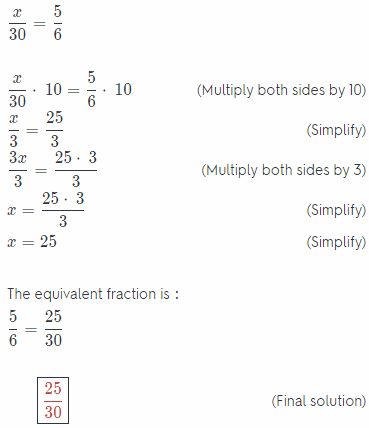
The quotient
72 ÷ 4
represents equal parts that each brother needs to pay.
Add 15 to that quotient to find the final result.
The value of the expression:
72 ÷ 4 + 15
is the amount that youngest brother would need to pay.
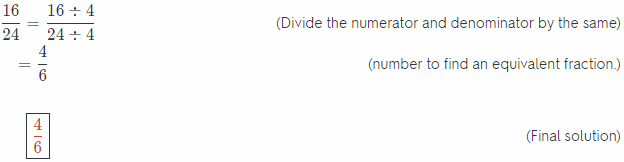
First, calculate the quotient using rules for dividing integers:
18 + 15
Then, find the sum using rules for adding integers:
18 + 15 = 33
Youngest brother would need to pay $33 to his parents.
Use rules for dividing integers and rules for adding integers to calculate the amount

Your Turn

Simplify each expression.

Question 4.
(- 12) ÷ 6 + 2 ___________
Answer:
The expression you want to simplify is:
(-12) ÷ 6 + 2
First calculate the quotient using rules for dividing integers:
– 2 + 2
Then, find the sum using rules for adding integers:
– 2 + 2 = 0
The expression is equal to 0.

The expression (- 12) ÷ 6 + 2 is equal to 0.
Use rules for dividing integers and rules for adding integers to simplify it.

Question 5.
– 87 ÷ (- 3) – 9 _________
Answer:
The expression you want to simplify is:
(- 87) ÷ (- 3) – 9
First, calculate the quotient using rules for dividing integers:
29 – 9
Then, find the difference using rules for subtracting integers:
29 – 9 = 20
The expression is equal to 20.

The expression (- 87) ÷ (- 3) – 9 is equal to 0.
Use rules for dividing integers and rules for adding integers to simplify it.

Question 6.
40 ÷ (- 5) + 30 ___________
Answer:
The expression you want to simplify is:
40 ÷ (- 5) + 30
First, calculate the quotient using rules for dividing integers:
– 8 + 30
Then, find the difference using rules for subtracting integers:
– 8 + 30 = 20
The expression is equal to 22.

The expression 40 ÷ (- 5) + 30 is equal to 22.
Use rules for dividing integers and rules for adding integers to simplify it.

Question 7.
– 39 ÷ 3 – 15 ____________
Answer:
The expression you want to simplify is:
– 39 ÷ 3 – 15
First, calculate the quotient using rules for dividing integers:
– 13 – 15
Then, find the difference using rules for subtracting integers:
– 13 – 15 = – 28
The expression is equal to – 28.

The expression – 39 ÷ 3 – 15 is equal to – 28.
Use rules for dividing integers and rules for adding integers to simplify it.

Question 8.
Amber and Will are in line together to buy tickets. Amber moves back by 3 places three times to talk to friends. She then is invited to move 5 places up in line. Will moved back by 4 places twice, and then moved up in line by 3 places. Overall, who moved farther back in line?
Answer:
Write the expression that represents Amber’s change in position in the line:
3(- 3) + 5
First calculate the quotient using rules for dividing integers:
– 9 + 5
Then, find the sum using rules for adding integers:
– 9 + 5 = – 4
Amber moves back 4 places.
Now, write the expression that represents Will’s change in position in the line:
2(- 4) + 3
Calculate the quotient using rules for dividing integers:
– 8 + 3
Then, find the sum using rules for adding integers:
– 8 + 3 = – 5
Will moves back 5 places.
Compare absolute values of the results to find who moved farther in line:
|- 4| < |- 5|
Will moved farther back in tine.
Find change in position for Amber and Will using rules for multiplying integers and rules for adding integers and then compare results.

Evaluate each expression. Circle the expression with the greater value.

Question 9.
(- 10) ÷ 2 – 2 = ____________
(- 28) ÷ 4 + 1 = ____________
Answer:
First expression is:
(-10) ÷ 2 – 2
First calculate the quotient using rules for dividing integers:
– 5 – 2
Then, find the difference using rules for subtracting integers:
– 5 – 2 = – 7
Second expression is:
(- 28) ÷ 4 + 1
Calculate the quotient using rules for dividing integers:
– 7 + 1
Then find the sum using rules for adding integers
– 7 + 1 = – 6
Compare values:
– 7 < – 6
The expression with the greater value is (- 28) ÷ 4 + 1.
Find values of both expressions using rules for dividing, subtracting and adding integers and compare them.

Applying Integer Operations Lesson 6.3 Answer Key Question 10.
42 ÷ (-3) + 9 = ____________
(- 36) ÷ 9 – 2= ____________
Answer:
First expression is:
42 ÷ (- 3) + 9
First calculate the quotient using rules for dividing integers:
– 14 + 9
then, find the sum using rules for adding integers:
– 14 + 9 = – 5
Second expression is:
(- 36) ÷ 9 – 2
Calculate the quotient using rules for dividing integers:
– 4 – 2
then, find the difference using rules for subtracting integers:
– 4 – 2 = – 6
Compare values:
– 5 > – 6
The expression with the greater value is 42 ÷ (-3) + 9.
Find values of both expressions using rules for dividing, subtracting and adding integers and compare them.

Texas Go Math Grade 6 Lesson 6.3 Guided Practice Answer Key

Evaluate each expression. (Example 1)

Question 1.
-6 (-5) + 12 ______________
Answer:
The expression is:
– 6(- 5) + 12
First calculate the product using rules for multiplying integers:
30 + 12
Then, find the sum using rules for adding integers:
30 + 12 = 42
Therefore:
– 6(- 5) + 12 = 42
The value of the expression is 42
Use rules for multiplying integers and rules for adding integers to find the value of the expression.

Question 2.
3(-6) – 3 ______________
Answer:
The expression is:
3(-6) – 3
First calculate the product using rules for multiplying integers:
– 18 – 3
Then, find the sum using rules for adding integers:
– 18 – 3 = – 21
Therefore:
3(- 6) – 3 = – 21
The value of the expression is – 21
Use rules for multiplying integers and rules for adding integers to find the value of the expression.

Question 3.
– 2(8) + 7 ______________
Answer:
The expression is:
– 2(8) + 7
First calculate the product using rules for multiplying integers:
– 16 + 7
Then, find the sum using rules for adding integers:
– 16 + 7 = – 9
Therefore:
– 2(8) + 7 = – 9
The value of the expression is – 9
Use rules for multiplying integers and rules for adding integers to find the value of the expression.

Question 4.
4(-13) + 20 ______________
Answer:
The expression is:
4(-13) + 20
First calculate the product using rules for multiplying integers:
– 52 + 20
Then, find the sum using rules for adding integers:
– 52 + 20 = – 32
Therefore:
4(- 13) + 20 = – 32
The value of the expression is – 32
Use rules for multiplying integers and rules for adding integers to find the value of the expression.

Question 5.
(- 4)(0) – 4 ______________
Answer:
The expression is:
(- 4)(0) – 4
First calculate the product using rules for multiplying integers:
0 – 4
Then, find the sum using rules for adding integers:
0 – 4 = – 4
Therefore:
– 4(0) – 4 = – 4
The value of the expression is – 4
Use rules for multiplying integers and rules for adding integers to find the value of the expression.

Question 6.
– 3(- 5) – 16 ______________
Answer:
The expression is:
– 3(- 5) – 16
First calculate the product using rules for multiplying integers:
15 – 16
Then, find the sum using rules for adding integers:
15 – 16 = – 1
Therefore:
– 3(- 5) – 16 = – 1
The value of the expression is – 1
Use rules for multiplying integers and rules for adding integers to find the value of the expression.

Write an expression to represent the situation. Evaluate the expression and answer the question.

Question 7.
Bella pays 7 payments of $5 each to a game store. She returns one game and receives $20 back. What is the change to the amount of money she has?
Answer:
Use negative integer to represent each payment and use positive integer to represent the amount of money she receives back.
The expression you get is:
7(- 5) + 20
First, calculate the product using rules for multiplying integers:
– 35 + 20
Then, find the sum using rules for adding integers:
– 35 + 20 = – 15
The change to the amount of money Bella has is – $15.
Use rules for multiplying integers and rules for adding integers to find the change.

Integer Operations Review Answer Key Go Math Grade 6 Question 8.
Ron lost 10 points seven times playing a video game. He then lost an additional 100 points for going over the time limit. What was the total change in his score?
Answer:
Use negative integers to represent points he lost
The expression you get is:
7(- 10) – 100
First, calculate the product using rules for multiplying integers:
– 70 – 100
Then, find the difference using rules for subtracting integers:
– 70 – 100 = – 170
Total, change in Ron’s score was – 170 points.
Use rules for multiplying integers and rules for adding integers to find the change.

Question 9.
Ned took a test with 25 questions. He lost 4 points for each of the 6 questions he got wrong and earned an additional 10 points for answering a bonus question correctly. How many points did Ned receive or lose overall?
Answer:
Negative integer represents points he lost and positive integer represents additional points he earned.
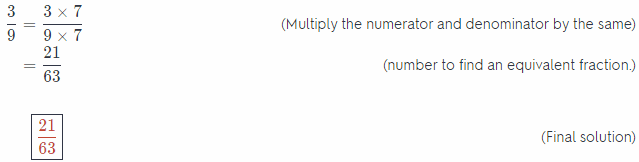
The expression you get is:
6(- 4) + 10
First, calculate the product using rules for multiplying integers:
– 24 + 10
Then, find the sum using rules for adding integers:
– 24 + 10 = – 14
Ned lost 14 points.
Use rules for multiplying integers and rules for adding integers to find how many points he received or lost

Question 10.
Mr. Harris has some money in his wallet. He pays the babysitter $12 an hour for 4 hours of babysitting. His wife gives him $10, and he puts the money in his wallet. By how much does the amount in his wallet change?
Answer:
Negative integer represents the money he pays the babysitter and positive integer represents the money he gets from his wife.
The expression you get is:
4(- 12) + 10
First calculate the product using rules for multiplying integers:
-48 + 10
Then, find the sum using rules for adding integers:
– 48 + 10 = – 38
The amount changes by – $38.
Use rules for multiplying integers and rules for adding integers to find by how much the amount changes.

Compare the values of the two expressions using <, =, or >.

Question 11.
– 3(- 2) + 3 _______ 3(- 4) + 9
Answer:
First expression is:
– 3(- 2) + 3
First, calculate the product using rules for multiplying integers:
6+3
Then, find the sum using rules for adding integers:
6 + 3 = 9
Second expression is:
3(- 4) + 9
Calculate the product using rules for multiplying integers:
– 12 + 9
Find the sum using rules for adding integers:
– 12 + 9 = – 3
Compare results you got:
9 > – 3
Therefore:
– 3(- 2) + 3 > 3(- 4) + 9
Use rules form multiplying integers and rules far adding integers to find the values of the expressions and then compare those values.

Question 12.
– 8(- 2) – 20 _______ 3(- 2) + 2
Answer:
First expression is:
– 8(- 2) – 20
First, calculate the product using rules for multiplying integers:
16 – 20
Then, find the difference using rules for subtracting integers:
16 – 20 = – 4
Second expression is:
3(- 2) + 2
Calculate the product using rules for multiplying integers:
– 6 + 2
Find the sum using rules for adding integers:
– 6 + 2 = – 4
Compare results you got:
– 4 = – 4
Therefore:
– 8(-2) – 20 = 3(-2) + 2
Use rules form multiplying integers and rules far adding integers to find the values of the expressions and then compare those values.

Question 13.
– 7(5) 9 ________ – 3(20) + 10
Answer:
First expression is:
– 7(5) – 9
First calculate the product using rules for multiplying integers:
– 35 – 9
Then, find the difference using rules for subtracting integers:
– 35 – 9 = – 44
Second expression is:
– 3(20) + 10
Calculate the product using rules for multiplying integers:
– 60 + 10
Find the sum using rules for adding integers:
– 60 + 10 = – 50
Compare results you got:
– 44 > – 50
Therefore:
– 7(5) – 9 > – 3(20) + 10
Use rules form multiplying integers and rules far adding integers to find the values of the expressions and then compare those values.

Question 14.
– 16(0) – 3 ________ – 8(- 2) – 3
Answer:
First expression is:
– 16(0) – 3
First calculate the product using rules for multiplying integers:
0 – 3
Then, find the difference using rules for subtracting integers:
0 – 3 = – 3
Second expression is:
– 8(- 2) – 3
Calculate the product using rules for multiplying integers:
16 – 3
Find the difference using rules for subtracting integers:
16 – 3 = 13
Compare results you got:
– 3 < 13
Therefore:
– 16(0) – 3 < – 8(- 2) – 3
Use rules form multiplying integers and rules far adding integers to find the values of the expressions and then compare those values.

Essential Question Check-In

Question 15.
When you solve a problem involving money, what can a negative answer represent?
Answer:
There are several possible situations.
A negative solution for a problem involving money can represent the amount of money that some person spent (for example shopping) or withdrew from account.

It can represent by how much someone’s savings changed after payment (returning debt paying bills,…).
Another possibility is that it represents how much price of some product reduced over the time.

There are several possibilities. It can represent the amount of money that some person spent (for example shopping) or how much someone’s savings changed after payment, how much price of some product reduced over the time

Evaluate each expression.

Question 16.
– 12(- 3) + 7 ____________
Answer:
The expression is:
– 12(- 3) + 7
First, calculate the product using rules for multiplying integers:
36 + 7
Then, find the sum using rules for adding integers:
36 + 7 = 43
Therefore:
– 12(- 3) + 7 = 43
The value of the expression is 43.
Use rules for multiplying integers and rules for adding integers to find the value of the expression.

Question 17.
– 42 ÷ (- 6) + 5 – 8 _____________
Answer:
The expression is:
– 42 ÷ (- 6) + 5 – 8
First, calculate the product using rules for multiplying integers:
7 + 5 – 8
Then, find the sum using rules for adding integers:
12 – 8
Finally, find the difference using rules for subtracting integers:
12 – 8 = 4
Therefore:
– 42 ÷ (- 6) + 5 – 8 = 4
The value of the expression is 4.
Use rules for dividing, adding and subtracting integers to find the value of the expression.

Question 18.
10(- 60) – 18 _____________
Answer:
The expression ¡s:
10(- 60) – 18
First calculate the product using rules for multiplying integers:
– 600 – 18
Then, find the difference using rules for subtracting integers:
– 600 – 18 = – 618
Therefore:
10(- 60) – 18 = – 618
The value of the expression is – 618.
Use rules for multiplying integers and rules for subtracting integers to find the value of the expression.

Go Math 6th Grade Lesson 6.3 Applying Integer Operations Answer Key Question 19.
(- 11) (- 7) + 5 – 82 _____________
Answer:
The expression is:
(- 11) (- 7) + 5 – 82
First calculate the product using rules for multiplying integers:
77 + 5 – 82
Then, use Associative Property and rules for adding integers:
82 – 82
Finally, find the difference using rules for subtracting integers:
82 – 82 = 0
Therefore:
(- 11) (- 7) + 5 – 82 = 0
The value of the expression is 0.
Use rules for multiplying, adding and subtracting integers to find the value of the expression.

Question 20.
35 ÷ (- 7) + 6 ___________
Answer:
The expression is:
35 ÷ (- 7) + 6
First calculate the quotient using rules for dividing integers:
– 5 + 6
Then, find the sum ‘using rules for adding integers:
– 5 + 6 = 1
Therefore:
35 ÷ (- 7) + 6 = 1
The value of the expression is 1.
Use rules for dividing integers and rules for adding integers to find the value of the expression.

Question 21.
– 13(- 2) – 16 – 8 _____________
Answer:
The expression is:
– 13 (- 2) – 16 – 8
First calculate the product using rules for multiplying integers:
26 – 16 – 8
Then, use Associative Property and rules for subtracting integers:
10 – 8
Finally, find the difference using rules for subtracting integers:
10 – 8 = 2
Therefore:
– 13(- 2) – 16 – 8 = 2
The value of the expression is 2.
Use rules for multiplying integers and rules for subtracting integers to find the value of the expression

Question 22.
Multistep Lily and Rose are playing a game. In the game, each player starts with O points and the player with the most points at the end wins. Lily gains 5 points two times, loses 12 points, and then gains 3 points. Rose loses 3 points two times, loses 1 point, gains 6 points, and then gains 7 points.

a. Write and evaluate an expression to find Lily’s score.
Answer:
The expression that represents lily’s score 5:
2(5) – 12 + 3
First, calculate the product using rules for multiplying integers:
10 – 12 + 3
Then, use Commutative Property and rules for adding integers:
10 + 3 – 12
13 – 12
Finally, find the difference using rules for subtracting integers:
13 – 12 = 1
Lily’s score is 1 point

b. Write and evaluate an expression to find Rose’s score.
Answer:
The expression that represents Rose’s score is:
2(-3) – 1 + 6 + 7
First calculate the product using rules for multiplying integers:
– 6 – 1 + 6 + 7
Then, use Associative Property and rules for subtracting and adding integers:
(- 6 – 1) + (6 + 7)
– 7 + 13
Finally, find the sum using rules for adding integers:
– 7 + 13 = 6
Rose’s score is 6 points.

c. Who won the game?
Answer:
Compare results to find who won the game:
1 < 6
Rose won the game.

Use rules for multiplying, adding and subtracting integers to calculate their scores and compare results to find who won the game.

Write an expression from the description. Then evaluate the expression.

Question 23.
8 less than the product of 5 and – 4
Answer:
The expression
a less than b
represents a value of b less a:
b – a
so you get:
5(- 4) – 8
First, calculate the product using rules for multiplying integers:
– 20 – 8
Then, find the difference using rules for subtracting integers:
– 20 – 8 = – 28
Therefore:
5(- 4) – 8 = – 28

The value of the expression 5(- 4) – 8 is – 28.
The expression a less than b represents a value of b less a: b – a.
Use rules for multiplying and subtracting integers to find the value.

Question 24.
9 more than the quotient of – 36 and – 4.
Answer:
The expression more than indicates addition so you get:
First calculate the quotient using rules for dividing integers:
9 + 9
Then, find the sum using rules for adding integers:
9 + 9 = 18
Therefore:
(- 36) ÷ (- 4) + 9 = 18

The value of the expression (- 36) + (- 4) + 9 is 18
The expression ‘more than’ indicates addition.
Use rules for dividing integers and rules for adding integers to find the value

Question 25.
Multistep Arleen has a gift card for a local lawn and garden store. She uses the gift card to rent a tiller for 4 days. It costs $35 per day to rent the tiller. She also buys a rake for $9.

a. Find the change to the value on her gift card.
Answer:
Use negative integer to represent how much renting a tiller costs and subtract integer that represents price of a rake.
The expression you get is:
4(- 35) – 9
First, calculate the product using rules for multiplying integers:
– 140 – 9
Then, find the difference using rules for subtracting integers:
– 140 – 9 = – 149
The change to the value is – $149.

b. The original amount on the gift card was $200. Does Arleen have enough left on the card to buy a wheelbarrow for $50? Explain.
Answer:
Add the change to the value you got, – $149. to the original amount on gift card, $200. to find how much money Arleen has left on the card.
The expression you get is:
200 + (- 149)
Find the sum using rules for adding integers;
200 + (- 149) = 51
She has $51 left on the card.
Now, compare that amount with the price of a wheelbarrow, $ 50;
51 > 50
Arleen has enough money left on the card because she has $ 51 left on it after renting tiller and buying rake.

Use rules for multiplying, subtracting and adding integers to find the change to the value.

Question 26.
Carlos made up a game where, in a deck of cards, the red cards (hearts and diamonds) are negative and the black cards (spades and clubs) are positive. All face cards are worth 10 points, and number cards are worth their value.

a. Samantha has a king of hearts, a jack of diamonds, and a 3 of spades. Write an expression to find the value of her cards.
Answer:
Represent king of hearts with – 10, jack of diamonds with – 10 and 3 of spades with 3.
The expression you get is:
2(- 10) + 3
First, calculate the product using rules for multiplying integers:
– 20 + 3
Then, find the sum using rules for adding integers:
– 20 + 3 = – 17
The value of Samantha’s cards is – 17.

b. Warren has a 7 of clubs, a 2 of spades, and a 7 of hearts. Write an expression to find the value of his cards.
Answer:
Represent 7 of clubs with 7, 2 of spades with 2 and 7 of hearts with – 7.
The expression you get is:
7 + 2 – 7
Use Associative Property and rules for adding integers:
9 – 7
Then, find the sum using rules for adding integers:
9 – 7 = 2
The value of Warren’s cards is 2.

c. If the greater score wins, who won?
Answer:
Compare their scores to find who won the game:
– 17 < 2
Therefore, Warren won the game.

d. If a player always gets three cards, describe two different ways to receive a score of 7.
Answer:
One possibility is that the player gets a king of clubs, a 5 of hearts and a 2 of spades.
The expression that represents the value of his cards is:
10 – 5 + 2
Use rules for subtracting and adding integers to calculate the value:
10 – 5 + 2 = 7
Another possibility is that the player gets a 4 of diamonds, a jack of clubs and a 1 of spades.
The expression that represents the value of his cards is:
– 4 + 10 + 1
Use rules for adding integers to calculate the value:
– 4 – 10 + 1 = 7

Another possibility is that he gets a 4 of diamonds, a jack of clubs and a 1 of spades.

H.O.T. Focus On Higher Order Thinking

Question 27.
Represent Real-World Problems Write a problem that the expression 3(-7) – 10 + 25 = – 6 could represent.
Answer:
Jenny wants to buy three shirts that cost $7 each and a pair of jeans that costs $10 She has $25 in her wallet Does she have enough money to buy everything she wants?
Use negative integers to represent prices of clothes and positive integer for the amount of money she has.
The expression you get is:
3(- 7) – 10 + 25
First, find the product using rules for multiplying integers:
– 21 – 10 + 25
Use Associative Property and rules for subtracting integers:
– 31 + 25
Find the sum using rules for adding integers:
– 31 + 25 = – 6
Jenny doesn’t have enough money because she has $6 less than total cost, $31.

Jenny wants to buy three shirts that cost $7 each and a pair of jeans that costs $10. She has $25 in her wallet. Does she have enough money to buy everything she wants?
Jenny doesn’t have enough money because she has $6 less than total cost, $31.

Question 28.
Critique Reasoning Jim found the quotient of two integers and got a positive integer. He added another integer to the quotient and got a positive integer. His sister Kim says that all the integers Jim used to get this result must be positive. Do you agree? Explain.
Answer:
His sister is wrong.
One possibility is that Jim found the quotient of two negative integers and added positive integer to that quotient.

Since the quotient of two negative integers is positive, the sum of two positive integers would be positive.

Another possibility is that he found the quotient of two negative integers and added negative integer with condition that the absolute value of the negative integer he added is lesser than the absolute value of the quotient.

Since absolute value of positive integer (the quotient of two negative integers is positive)
is greater than the absolute value of the negative integer, the sum of those two integers would be positive.

He could also find the quotient of two positive integers and added negative integer with condition that the absolute value of the negative integer he added is lesser than the absolute value of the quotient.

Since absolute value of positive integer (the quotient of two positive integers is positive)
is greater than the absolute value of the negative integer, the sum of those two integers would be positive.

Question 29.
Persevere in Problem Solving Lisa is standing on a dock beside a lake. She drops a rock from her hand into the lake. After the rock hits the surface of the lake, the rock’s distance from the lake’s surface changes at a rate of -5 Inches per second. If Lisa holds her hand 5 feet above the lake’s surface, how far from Lisa’s hand is the rock 4 seconds after it hits the surface?
Answer:
First note that 1 feet is equal to 12 inches
so the product:
5 × 12 = 60
shows that 5 feet is equal to 60 inches.
The expression
4(-5) – 60
represents how far from her hand the rock is.
First find the product using rules for multiplying integers:
– 20 – 60
Then, find the difference using rules for subtracting integers:
– 20 – 60 = -80
The rock is 80 inches far from Lisa’s hand.

The rock is 80 inches far from Lisa’s hand 4 seconds after it hits the surface of the Lake
Use rules for multiplying and subtracting integers to find the solution and the fact that 1 feet is equal to 12 inches.

Texas Go Math Grade 6 Lesson 6.3 Answer Key Applying integer Operations Read More »

Texas Go Math Grade 6 Lesson 6.1 Answer Key Multiplying Integers

Refer to our Texas Go Math Grade 6 Answer Key Pdf to score good marks in the exams. Test yourself by practicing the problems from Texas Go Math Grade 6 Lesson 6.1 Answer Key Multiplying Integers.

Texas Go Math Grade 6 Lesson 6.1 Answer Key Multiplying Integers

Texas Go Math Grade 6 Lesson 1.1 Explore Activity Answer Key

Mu1tiplying integers Using a Number Line

You can use a number line to see what happens when you multiply a positive number by a negative number.

(A) Henry made three withdrawals of $2 each from his savings account.
What was the change in his balance?
Find 3(- 2).
To graph – 2, you would start at 0 and move __________ units to the left.
3(- 2) means ( __________ ) + ( __________ ) + ( __________ ).
To graph 3(- 2), start at 0 and move
2 units to the left __________ times.
The result is __________ .
The change in Henry’s balance was __________ .
Texas Go Math Grade 6 Lesson 6.1 Answer Key Multiplying Integers 1

(B) Lisa plays a video game in which she loses points. She loses 3 points 2 times. What is her score?
Find 2(- 3).
2(- 3) means ( _____________ ) + ( _____________ ).
Show this on the number line. _________________________
Lisa has a score of _____________ .
Texas Go Math Grade 6 Lesson 6.1 Answer Key Multiplying Integers 2

RefIect

Question 1.
What do you notice about the product of two integers with different signs?
Answer:
The product of two integers with different signs is negative integer.
You can get the product using number line. Start at 0 and move to the left to represent multiplication of positive integer by negative integer.

Go Math Grade 6 Lesson 6.1 Answer Key Question 2.
What do you notice about the sign of the product of two negative integers?
Answer:
When you multiply two negative integers, the sign of the product would be plus (+).
If you use counters to find the product, counters that represent the result are positive so the sign of the result is plus(+).

Question 3.
Make a Conjecture What can you conclude about the sign of the product of two integers with the same sign?
Answer:
The sign of product of two integers with same sign is plus (+).
Use counters to represent the product of two integers, both positive or both negative.
You get all positive counters that represent the product so the result is positive.

Your Turn

Find each Product.

Question 4.
– 3(5) ________________
Answer:
First determine if the product will be positive or negative
Since – 3 is negative and 5 is positive (they have opposite signs), the product will be negative.
Then, multiply absolute values of given integers:
|- 3| = 3 and |5| = 5
3 × 5 = 15
the resuLt is 15 or – 15, depending on signs of given integers.
Product is negative so final result is – 15.
Find the sign of the product, multiply absolute values of integers and add minus if the sign of product is minus (-).

Question 5.
(- 10) (- 2) ________________
Answer:
First, determine if the product will be positive or negative
Since – 10 is negative and – 2 is negative (they have the same sign), the product will be positive.
Then, multiply absolute values of given integers:
|- 10| = 10 and |- 2| = 2
10 × 2 = 20
The result is 20 or – 20, depending on signs of given integers.
Product is positive so final result is 20.
Find the sign of the product, multiply absolute values of integers and add minus if the sign of product is minus (-).

Question 6.
7(- 6) ________________
Answer:
First, determine if the product will be positive or negative
Since 7 is positive and – 6 is negative (they have opposite signs), the product will be negative.
Then, multiply absolute values of given integers:
|7| = 7 and |- 6| = 6
7 × 6 = 42
The result is 42 or – 42, depending on signs of given integers.
Product is negative so final result is – 42.
Find the sign of the product, multiply absolute values of integers and add minus if the sign of product is minus (-).

Question 7.
0(- 22) ________________
Answer:
The product is 0
When you multiply any integer with 0, the result you get is 0.

Lesson 6.1 Answer Key Go Math Grade 6 Question 8.
(- 15) (- 3) ________________
Answer:
First, determine if the product will be positive or negative
Since – 15 is negative and – 3 is negative (they have the same sign), the product wilt be positive.
Then, multiply absolute values of given integers:
|- 15| = 15 and |- 3| = 3
15 × 3 = 45
The result is 45 or – 45, depending on signs of given integers.
Product is positive so final result is 45.
Find the sign of the product, multiply absolute values of integers and add minus if the sign of product is minus (-).

Question 9.
8(4) ________________
Answer:
First, determine if the product will be positive or negative
Since 8 is positive and 4 is positive (they have the same sign), the product wilt be positive.
Then, multiply absolute values of given integers:
|8| = 8 and |4| = 4
8 × 4 = 32
The result is 32 or – 32, depending on signs of given integers.
Product is positive so final result is 32.
Find the sign of the product, multiply absolute values of integers and add minus if the sign of product is minus (-).

Texas Go Math Grade 6 Lesson 6.1 Guided Practice Answer Key

Find each product.

Question 1.
– 1(9) ________________
Answer:
First, determine if the product will be positive or negative
Since – 1 is negative and 9 is positive (they have opposite signs), the product will be negative.
Then, multiply absolute values of given integers
|- 1| = 1 and |9| = 9
1 × 9 = 9
The result is 9 or – 9, depending on signs of given integers.
Product is negative so final result is – 9.
Find the sign of the product, multiply absolute values of integers and add minus if the sign of product is minus (-).

Question 2.
14(- 2) ________________
Answer:
First determine if the product will be positive or negative
Since 14 is positive and – 2 is negative (they have opposite signs), the product will be negative.
Then, multiply absolute values of given integers:
|14| = 14 and |- 2| = 2
14 × 2 = 28
The result is 28 or – 28, depending on signs of given integers.
Product is negative so final result is – 28.
Find the sign of the product, multiply absolute values of integers and add minus if the sign of product is minus (-).

Question 3.
(- 9) (- 6) ________________
Answer:
First determine if the product will be positive or negative
Since – 9 is negative and – 6 is negative (they have the same sign), the product will be positive.
Then, multiply absolute values of given integers:
|- 9| = 9 and |- 6| = 6
9 × 6 = 54
The result is 54 or – 54, depending on signs of given integers.
Product is positive so final result is 54.
Find the sign of the product, multiply absolute values of integers and add minus if the sign of product is minus (-).

Question 4.
(- 2) (50) ________________
Answer:
First, determine if the product will be positive or negative
Since – 2 is negative and 50 is positive (they have opposite signs), the product will be negative.
Then, multiply absolute values of given integers:
|- 2| = 2 and |50| = 50
2 × 50 = 100
The result is 100 or – 100, depending on signs of given integers.
Product is negative so final result is – 100.
Find the sign of the product, multiply absolute values of integers and add minus if the sign of product is minus (-).

Question 5.
(- 4) (15) ________________
Answer:
First, determine if the product will be positive or negative
Since – 4 is negative and 15 is positive (they have opposite signs), the product will be negative.
Then, multiply absolute values of given integers:
|- 4| = 4 and |15| = 15
4 × 15 = 60
The result is 60 or – 60, depending on signs of given integers.
Product is negative so final result is – 60.
Find the sign of the product, multiply absolute values of integers and add minus if the sign of product is minus (-).

Question 6.
– 18(0) ________________
Answer:
The product is 0
When you multiply any integer with 0, the result you get is 0.

Question 7.
(- 7) (- 7) ________________
Answer:
First, determine if the product will be positive or negative
Since – 7 is negative and – 7 is negative (they have the same sign), the product will be positive.
Then, multiply absolute values of given integers:
|- 7| = 7 and |- 7| = 7
7 × 7 = 49
The result is 49 or – 49, depending on signs of given integers.
Product is positive so final result is 49.
Find the sign of the product, multiply absolute values of integers and add minus if the sign of product is minus (-).

Go Math Lesson 6.1 Answer Key Grade 6 Question 8.
– 15 (9) ________________
Answer:
First, determine if the product will be positive or negative
Since – 15 is negative and 9 is positive (they have opposite signs), the product will be negative.
Then, multiply absolute values of given integers:
|- 15| = 15 and |9| = 9
15 × 9 = 135
The result is 135 or -135, depending on signs of given integers.
Product is negative so final result is – 135
Find the sign of the product, multiply absolute values of integers and add minus if the sign of product is minus (-).

Question 9.
(8) (- 12) ________________
Answer:
First, determine if the product will be positive or negative
Since 8 is positive and – 12 is negative (they have opposite signs), the product will be negative.
Then, multiply absolute values of given integers:
|8| = 8 and |- 12| = 12
8 × 12 = 96
The result is 96 or – 96, depending on signs of given integers.
Product is negative so final result is – 96.
Find the sign of the product, multiply absolute values of integers and add minus if the sign of product is minus (-).

Question 10.
– 3(- 100) ________________
Answer:
First, determine if the product will be positive or negative
Since – 3 is negative and – 100 is negative (they have the same sign), the product will be positive.
Then, multiply absolute values of given integers:
|- 3| = 3 and |- 100| = 100
3 × 100 = 300
The result is 300 or – 300, depending on signs of given integers.
Product is positive so final result is 300.
Find the sign of the product, multiply absolute values of integers and add minus if the sign of product is minus (-).

Question 11.
0(- 53) ________________
Answer:
The result is 0
When you multiply any integer with 0, the result you get is 0.

Question 12.
– 6(32) ________________
Answer:
First, determine if the product will be positive or negative
Since – 6 is negative and 32 is positive (they have opposite signs), the product will be negative.
Then, multiply absolute values of given integers.
|- 6| = 6 and |32| = 32
6 × 32 = 192
The result is 192 or – 192, depending on signs of given integers.
Product is negative so final result is – 192.
Find the sign of the product, multiply absolute values of integers and add minus if the sign of product is minus (-).

Question 13.
Flora made 7 withdrawals of $75 each from her bank account. What was the overall change in her account?
Answer:
Use negative integer to represent one withdrawal. The expression you get is:
7(- 75)
To find the value of the expression, determine if the product will be positive or negative
Since 7 is positive and 75 is negative (they have opposite signs), the product will be negative.
Then, multiply absolute values of given integers:
|7| = 7 and |75| = 75
7 × 75 = 525
The result is 525 or – 525, depending on signs of given integers.
Product is negative so final result is – 525.
The overall change in Flora’s account is $ – 525.
Find the sign of the product, multiply absolute values of integers and add minus if the sign of product is minus (-).

Question 14.
A football team lost 5 yards on each of 3 plays. Explain how you could use a number line to find the team’s change in field position after the 3 plays.
Answer:
The expression:
3(- 5)
represents the team’s change in field position
Use the number line to graph 3(- 5).
Start at 0 and move 5 units to the left 3 times to find the product
Read the result from number line.

Number line:
Texas Go Math Grade 6 Lesson 6.1 Answer Key Multiplying Integers 5
The team’s change in field position is – 15 because it is 15 units left from 0 on the number line.

The team’s change in field position is – 15.
Start at 0 and move 5 units to the left 3 times to find the product and read the result from number line.

Question 15.
The temperature dropped 2 °F every hour for 6 hours. What was the total number of degrees the temperature changed in the 6 hours?
Answer:
Use negative integer to represent the temperature change because the temperature dropped every hour.
The expression:
6 (-2)
models the temperature change.
Use the number tine to graph 6(-2).
Start at 0 and move 2 units to the left 6 times to find the product.
The result is 12 units left from 0 on the number line so the product is – 12.

The temperature dropped 12 degrees in 6 hours
Start at 0 and move 2 units to the left 6 times on number line to find the result.

Lesson 6.1 Multiply Integers Answer Key Question 16.
The price of one share of Acme Company declined $5 per day for 4 days in a row. How much did the price of one share change in total after the 4 days?
Answer:
Use a negative integer to represent a change of price per day because it declined each day.
The expression: 4(- 5)
models the change of the price.
Use a number line to graph 4(- 5).
Start at 0 and move 5 units to the left 4 times to find the product.
The result is 20 units left from 0 on the number line so the product is – 20
The price of one share declined $20 after 4 days.

Question 17.
A mountain climber climbed down a cliff 50 feet at a time. He did this 5 times in one day. What was the overall change in his elevation?
Answer:
Use negative integer to represent change at a time because he climbed down
The expression:
5(- 50)
models the overall change in climbers elevation
Use number line to graph 5(- 50).
Start at 0 and move 50 units to the left 5 times to find the product
The result is 250 units left from 0 on the number tine so the product is – 250.
Overall change in climber’s elevation was – 250 feet

Essential Question Check-In

Question 18.
Explain the process for finding the product of two integers.
Answer:
First determine if the product wilL be positive or negative
If integers have the same sign (both positive or both negative), the product will be positive.
If integers have opposite signs (one positive and another negative), the product will be negative.
Then, multiply absolute values of given integers:
|a| × |b| = c
The result is c or – c, depending on signs of given integers.
If product is positive, final result is c and if it is negative, final result is – c.
If you multiply any integer with 0, the product you get is 0.

Find the sign of the product (the same sign of integers then +, opposite signs of integers then -), multiply absolute value of integers and add minus if the sign of product is minus (-)

Question 19.
Critique Reasoning Lisa used a number line to model 2(3). Does her number line make sense? Explain why or why not.
Texas Go Math Grade 6 Lesson 6.1 Answer Key Multiplying Integers 3
Answer:
Lisa’s number line is incorrect.
She moved to the left on the number line so that would represent the product: 2(- 3)
To model: 2(3)
using number line, she needed to start at 0 and move 3 units to the right 2 times (see number line below).
The product is 6 because it is 6 units right from 0 on number line

Number line:
Texas Go Math Grade 6 Lesson 6.1 Answer Key Multiplying Integers 6
Lisa’s number line is incorrect.
To model 2(3) using number line, she needed to start at 0 and move 3 units to the right 2 times.

Question 20.
Represent Real-World Problems Mike got on an elevator and went down 3 floors. He meant to go to a lower level, so he stayed on the elevator and went down 3 more floors. How many floors did Mike go down altogether?
Answer:
Use negative integer to represent number of floors he went down at once.
The expression you get is:
2 (- 3)
First, determine if the product will be positive or negative
Since 2 is positive and – 3 is negative (they have opposite signs), the product will be negative.
Then, multiply absolute values of given integers:
|2| = 2 and |- 3| = 3
2 × 3 = 6
The result is 6 or – 6, depending on signs of given integers
Product is negative so final result is – 6.
Mike went down 6 floors
Find the sign of the product, multiply absolute values of integers and add minus if the sign of product is minus (-).

Solve. Show your work.

Question 21.
When Brooke buys lunch at the cafeteria, money is withdrawn from a lunch account. The table shows amounts withdrawn in one week. By how much did the amount in Brooke’s lunch account change by the end of that week?
Texas Go Math Grade 6 Lesson 6.1 Answer Key Multiplying Integers 4
Answer:
Use negative integer to represent each amount because the money is withdrawn.
Since the same amount ¡s withdrawn every day, you can find the product: 5 (- 4)
First, determine if the product will be positive or negative
Since 5 is positive and – 4 is negative (they have opposite signs), the product will be negative.
Then, multiply absolute values of given integers:
|5| = 5 and |- 4| = 4
5 × 4 = 20
The result is 20 or – 20, depending on signs of given integers.
Product is negative so the final result is – 20.
The amount in Brooke’s account changed by $ – 20.
Find the sign of the product, multiply absolute values of integers and add minus if the sign of product is minus (-).

Question 22.
Adam is scuba diving. He descends 5 feet below sea level. He descends the same distance 4 more times. What is Adam’s final elevation?
Answer:
Adam descends 5 times the same distance, 5 feet, so the expression that models his elevation is: 5(- 5)
First, determine if the product will be positive or negative.
Since 5 is positive and – 5 is negative (they have opposite signs), the product will be negative.
Then, multiply absolute values of given integers:
|5| = 5 and |- 5| = 5
5 × 5 = 25
The result is 25 or – 25, depending on signs of given integers.
Product is negative so final result is – 25.
Adam’s final elevation b – 25 feet or 25 feet below sea level.
Find the sign of the product, multiply absolute values of integers and add minus if the sign of product is minus (-).

Question 23.
The price of jeans was reduced $6 per week for 7 weeks. By how much did the price of the jeans change over the 7 weeks?
Answer:
Since the price was reduced $6 per week. the expression that models change of price is:
7(- 6)
First determine if the product will be positive or negative.
Since 7 is positive and – 6 is negative (they have opposite signs), the product will be negative.
Then, multiply absolute values of given integers:
|7| = 7 and |- 6| = 6
7 × 6 = 42
The result is 42 or – 42. depending on signs of given integers.
Product is negative so final result is – 42.
The price changed by $ – 42.
Find the sign of the product, multiply absolute values of integers and add minus if the sign of product is minus (-).

Question 24.
Casey uses some of his savings on batting practice. The cost of renting a batting cage for 1 hour is $6. He rents a cage for 9 hours in each of two months. What is the change in Casey’s savings after two months?
Answer:
First, calculate the amount of savings that Casey spends first month. Use negative integer to represent the cost of renting for 1 hour.
The expression you get is:
9(- 6)
Determine if the product wilt be positive or negative
Since 9 is positive and – 6 is negative (they have opposite signs), the product will be negative
Multiply absolute values of given integers:
|9| = 9 and |- 6| = 6
9 × 6 = 54
The result is 54 or – 54, depending on signs of given integers.
Product is negative so result is – 54
Now, multiply that result with 2 to calculate the change in his savings after 2 months.
The expression you get is:
2(- 54)
Determine if the product will be positive or negative
Since 2 ¡s positive and – 54 is negative (they have opposite signs), the product will be negative.
Multiply absolute values of given integers:
|2| = 2 and |- 54| = 54
2 × 54 = 108
The result is 108 or – 108, depending on signs of given integers.
Product is negative so result is – 108.
The change in Casey’s savings is $ – 108.

The change in Casey’s savings after 2 months is $ – 108.
Multiply 9(-6) to find the change for one month and then multiply that result with 2 to find the change in savings after two months.

Question 25.
Volunteers at Sam’s school use some of the student council’s savings for a special project. They buy 7 backpacks for $8 each and fill each backpack with paper and pens that cost $5. By how much did the student council’s savings change because of this project?
Answer:
Use negative integers to model by how much the savings changed.
They pay each backpack $8 and paper and pens for each backpack cost $5
so the product
7(- 8 + (- 5))
shows how much this project cost.
First, find the sum in the brackets using rules for adding integers:
7(- 13)
Then, determine if the product will be positive or negative.
Since 7 is positive and – 13 is negative (they have opposite signs), the product will be negative.
Multiply absolute values of given integers:
|7| = 7 and |- 13| = 13
7 × 13 = 91
The result is 91 or – 91, depending on signs of given integers.
Product is negative so final result is – 91.
Student council’s savings changed by $ – 91.
Find the sum in brackets using rules for adding integers and then calculate the product using rules for multiplying integers.

Question 26.
Communicate Mathematical Ideas Describe a real-world situation that can be represented by the product 8(- 20). Then find the product and explain what the product means in terms of the real-world situation.
Answer:
Nick wants to clean the pool so he needs to drain water to a certain level. He drains 20 cm of water at once and he repeats that procedure another 7 times. Find out how much the water level changes after the draining.
Since the water level falls, use negative integer to represent water level that is drained at once. The expression you get is:
8(- 20)
First, determine if the product will be positive or negative
Since 8 is positive and – 20 is negative (they have opposite signs, the product will be negative.
Then, multiply absolute values of given integers:
|8| = 8 and |- 20| = 20
8 × 20 = 160
The result is 160 or – 160, depending on signs of given integers.
Product is negative so final result is – 160
The water level is 160 cm lower than before draining. In another way, change of water level is – 160 cm.

Nick wants to clean the pool so he needs to drain water to a certain level.
He drains 20 cm of water at once and he repeats that procedure another 7 times. Find out how much the water level changes after the draining.

The water level is 160 cm lower than before draining. In another way, change of water level is – 160 cm.

Question 27.
What If? The rules for multiplying two integers can be extended to a product of 3 or more integers. Find the following products by using the Associative Property to multiply 2 numbers at a time.
a. 3(3)(- 3) ________________
Answer:
3(3) (- 3)
Use Associative Property and rules for multiplying integers to simplify multiplication:
(3 × 3) (- 3)
9(- 3)
Find the final result using rules for multiplying integers:
9 × (- 3) = – 27
3(3) (- 3) = – 27

b. 3(- 3)(- 3) ________________
Answer:
3(3) (- 3)
Use Associative Property and rules for multiplying integers to simplify multiplication:
3((- 3) × (- 3))
3(9)
Find the final result using rules for multiplying integers:
3 × 9 = 27
3(- 3) (- 3) = 27

c. – 3(- 3)(- 3) ________________
Answer:
– 3 (-3) (-3)
Use Associative Property and rules for multiplying integers to simplify multiplication:
((-3) × (-3)) (-3)
9(- 3)
Fina the final result using rules for multiplying integers:
9 × (-3) = -27
-3(-3)(-3) = -27

d. 3(3)(3) (- 3) ________________
Answer:
– 3 (-3) (-3)
Use Associative Property and rules for multiplying integers to simplify multiplication:
(3 × 3) (3 × (- 3))
9 (- 9)
Fina the final result using rules for multiplying integers:
9 × (- 9) = – 81
3(3) (3) (- 3) = – 81

e. 3(3) (- 3) (- 3) ________________
Answer:
3(3) (- 3) (- 3)
Use Associative Property and rules for multiplying integers to simplify multiplication:
(3 × 3)((- 3) × (- 3))
9(9)
Find the final result using rules for multiplying integers:
9 × 9 = 81
3(3) (- 3) (- 3) = 81

f. 3(3) (- 3) (- 3) (- 3) ________________
Answer:
3(3) (- 3) (- 3)
Use Associative Property and rules for multiplying integers to simplify multiplication:
(3 × (- 3)) ((- 3) × (- 3))
– 9 (9)
Find the final result using rules for multiplying integers:
– 9 × 9 = 81
3(- 3) (- 3) (- 3) = – 81

g. Make a Conjecture Based on your results, complete the following statements:
When a product of integers has an odd number of negative factors,
then the sign of the product is ____________ .
When a product of integers has an even number of negative factors,
then the sign of the product is ____________ .
Answer:
Based on examples a), C), d) and f), first requested word is minus(-).
Based on examples b) and e), second requested word is plus(+).

H.O.T. Focus ON Higher Order Thinking

Question 28.
Multiple Representations The product of three integers is – 3. Determine all of the possible values for the three factors.
Answer:
One possible combination is:
1(1) (-3)
Use Associative Property and rules for multiplying integers to check the result:
(1 × 1) (- 3)
1 × (- 3) = – 3
Another possible combination is:
1(- 1) (3)
Use Associative Property and rules for multiplying integers to check the result:
(1 × (-1) (3)
– 1 × 3 = – 3
You can get combination
– 1(1)(3)
by using Commutative Property on the previous combination so the result is the same as the previous one, – 3.

Possible combinations are 1(1)(- 3) and 1(- 1)(3).
You can get one more combination by using Commutative Property, – 1(1)(3).

Question 29.
Analyze Relationships When is the product of two nonzero integers less than or equal to both of the two factors?
Answer:
There are two cases in which the product of two integers (both nonzero) is less than or equal to both of those two numbers.
First possibility is that one factor is negative and another factor is positive.
Second possibility is that both of the factors are equal to 1.
You can check first possibility on examples (use rules for multiplying integers to find products):
4 × (- 5) = – 20
Compare the product with both factors:
Texas Go Math Grade 6 Lesson 6.1 Answer Key Multiplying Integers 7
Compare the product with both factors:
Texas Go Math Grade 6 Lesson 6.1 Answer Key Multiplying Integers 8
Compare the product with both factors:
Texas Go Math Grade 6 Lesson 6.1 Answer Key Multiplying Integers 9

Question 30.
Justify Reasoning The sign of the product of two integers with the same sign is positive. What is the sign of the product of three integers with the same sign? Explain your thinking.
Answer:
The sign of the product of three integers with the same sign depends on sign of those integers.
If integers are positive, the sign of the product would be plus ( + )
If integers are negative, the sign of the product would be minus ( – )
Check it on the product of three integers with the same sign:
a(b) (c)
Find the product of first and second factor:
a × b
You will get positive result because the sign of the product of two integers with the same sign is plus (+).
If the third factor, c, is positive, final result would be positive (because the sign of the product of two integers with the same sign is plus (+)).
If c is negative, final result would be negative (because the sign of the product of two integers with opposite signs is minus (-)).

The sign of the product of three integers with the same sign depends on sign of those integers.
If integers are positive, the sign of the product would he plus (+).
If integers are negative, the sign of the product would be minus (-).

Texas Go Math Grade 6 Lesson 6.1 Answer Key Multiplying Integers Read More »

Texas Go Math Grade 6 Module 8 Quiz Answer Key

Refer to our Texas Go Math Grade 6 Answer Key Pdf to score good marks in the exams. Test yourself by practicing the problems from Texas Go Math Grade 8 Module 7 Quiz Answer Key.

Texas Go Math Grade 6 Module 8 Quiz Answer Key

8.1 Comparing Additive and Multiplicative Relationships

Complete each table and describe the rule for the relationship.

Question 1.
Texas Go Math Grade 6 Module 8 Quiz Answer Key 1
Answer:
table – 1
This relationship is additive.
Swim time = Meat time + 45 minutes

Grade 6 Quiz Module 8 Answer Key Go Math Question 2.
Texas Go Math Grade 6 Module 8 Quiz Answer Key 2
Answer:
table – 2

The relationship is multiplicative.
Number of pens = Sets of pens ∙ 3

8.2 Ratios, Rates, Tables, and Graphs

Question 3.
Charlie runs laps around a track The table shows how long it takes him to run different numbers of laps. How long would it take Charlie to run 5 laps?
Answer:
Evaluate the rate here. Therefore, it takes \(\frac{10}{2}\) = 5 minutes per lap, so 5 laps will require 5 × 5 = 25 minutes.

Charlies takes 25 minutes to run 5 laps.

8.3 Solving Problems with Proportions

Question 4.
Emily is entering a bicycle race for charity. Her mother pledges $0.40 for every 0.25 mile she bikes. If Emily bikes 15 miles, how much will her mother donate? ___________________
Answer:
0.25 = 1 quarter of a mile and there are 1 quarters in 1 mile, so there are 1 × 4 = 60 quarters in 15 miles. Therefore. Emily’s mom will have to donate $0.40 × 60 = $ 24.

Result:
Emily’s mom will have to donate $ 24.

8.4 Converting Measurements

Convert each measurement.

Question 5.
18 meters = ______________ centimeters
Answer:
Find the conversion factor
Write 100 centimeters = 1 meter as a ratio: \(\frac{100 \text { centimeters }}{1 \text { meter }}\)
Multiply the given measurement by the conversion factor.
18 meters ∙ \(\frac{100 \text { centimeters }}{1 \text { meter }}\) = ? centimeters
18 meters ∙ \(\frac{100 \text { centimeters }}{1 \text { meter }}\) = 1800 centimeters [Cancel the common unit]
Final solution = 18 meters = 1800 centimeters

Question 6.
5 pounds = ____________ ounces
Answer:
Find the conversion factor
Write 16 ounces = 1 pound as a ratio: \(\frac{16 \text { ouncess }}{1 \text { pound }}\)

Multiply the given measurement by the conversion factor.
5 pounds ∙ \(\frac{16 \text { ouncess }}{1 \text { pound }}\) = ? ounces
5 pounds ∙ \(\frac{16 \text { ouncess }}{1 \text { pound }}\) = ? ounces [Cancel the common unit]
Final Solution = 5 pounds = 80 ounces

Question 7.
6 quarts = ____________ fluid ounces
Answer:
Find the conversion factor.
Write 32 fluid ounces = 1 quart as a ratio: \(\frac{32 \text { fluid ounces }}{1 \text { quart }}\)
Multiply the given measurement by the conversion factor
6 quarts \(\frac{32 \text { fluid ounces }}{1 \text { quart }}\) = ? fluid ounces
6 quarts \(\frac{32 \text { fluid ounces }}{1 \text { quart }}\) = 192 fluid ounces [Cancel the common unit]
Final Solution = 6 quarts = 192 fluid ounces

Quiz for Grade 6 Math Module 8 Review Answer Key Question 8.
9 liters = _______________ milliliters.
Answer:
Find the conversion factor
Write 1000 milliliters = 1 liter as a ratio: \(\frac{1000 \text { militers }}{1 \text { liter }}\)
Multiply the given measurement by the conversion factor
9 liters ∙ \(\frac{1000 \text { militers }}{1 \text { liter }}\) = ? milliliters
9 liters ∙ \(\frac{1000 \text { militers }}{1 \text { liter }}\) = 9000 milliliters [Cancel the common unit]
Final Solution = 9 liters = 9000 milliliters

Essential Question

Question 9.
Write a real-world problem that could be solved using a proportion.
Answer:
A door is 7 feet tall. Evaluate its height in inches

1 feet is equal to 12 inches so 7 feet is equal to 7 × 12 = 84 inches. The door is 84 inches tall.

Texas Go Math Grade 6 Module 8 Mixed Review Texas Test Prep Answer Key

Selected Response

Question 1.
The table below shows the number of babies and adults at a nursery.
Texas Go Math Grade 6 Module 8 Quiz Answer Key 3
Which represents the number of babies?
(A) adults × 6
(B) adults × 6
(C) adults + 6
(D) adults + 6
Answer:
(B) adults × 6

Explaination:
The relationship is multiplicative.
Number of Babies = Number of adults ∙ 4

Question 2.
The graph represents the distance Manuel walks over several hours.
Texas Go Math Grade 6 Module 8 Quiz Answer Key 4
Which is an ordered pair on the line?
(A) (2.5, 14)
(B) (1,25, 5)
(C) (2.25, 12)
(D) (1.5, 9)
Answer:
(D) (1.5, 9)

Explaination:
plot all the given graph.
Texas Go Math Grade 6 Module 8 Quiz Answer Key 7
A and C can not be drawn as the y-axis ends on 11. It can be seen that only (1.5, 9) lies on the line shown.

Question 3.
On a map of the city, 1 inch represents 1.5 miles. What distance on the map would represent 12 miles?
(A) 6 inches
(B) 8 inches
(C) 12 inches
(D) 18 inches
Answer:
(C) 12 inches

Explaination:
\(\frac{\text { inches }}{\text { miles }}=\frac{1}{1.5}=\frac{x}{12}\)
112 is a common denominator:
\(\frac{1}{1.5} \cdot \frac{8}{8}=\frac{x}{12}\)
\(\frac{8}{12}=\frac{x}{12}\)
x = 12

Question 4.
The table below shows the number of petals and leaves for different numbers of flowers.
Texas Go Math Grade 6 Module 8 Quiz Answer Key 5
How many petals are present when there are 12 leaves?
(A) 25 petals
(B) 30 petals
(C) 35 petals
(D) 36 petals
Answer:
(B) 30 petals

Explaination:
It can be seen that there are \(\frac{5}{2}=\frac{10}{4}=\frac{15}{6}=\frac{20}{8}\) = 2.5 petals per leaf, therefore this implies that there must be 2.5 × 12 = 30 petals for 12 leaves.

Go Math Quiz for Grade 6 Module 8 Answer Key Question 5.
A recipe calls for 3 cups of sugar and 9 cups of water. If the recipe is reduced, how many cups of water should be used with 2 cups of sugar?
(A) 3 cups
(B) 4 cups
(C) 6 cups
(D) 8 cups
Answer:
(C) 6 cups

Explaination:
The given ratio is 3 : 9 which simplifies to 1: 3, this implies that there are 3 cups of water for every 1 cup of sugar, therefore for 2 cups of sugar, 2 × 3 = 6 cups of water wilt be required.

Gridded Response

Question 6.
Janice bought 4 oranges for $3.40. What is the unit price?
Texas Go Math Grade 6 Module 8 Quiz Answer Key 6
Answer:
To find the rate, divide the numerator and denominator by 4.
Texas Go Math Grade 6 Module 8 Quiz Answer Key 8
The cost per oranges is $ 0.85

Texas Go Math Grade 6 Module 8 Quiz Answer Key Read More »

Texas Go Math Grade 6 Lesson 6.2 Answer Key Dividing Integers

Refer to our Texas Go Math Grade 6 Answer Key Pdf to score good marks in the exams. Test yourself by practicing the problems from Texas Go Math Grade 6 Lesson 6.2 Answer Key Dividing Integers.

Texas Go Math Grade 6 Lesson 6.2 Answer Key Dividing Integers

Reflect

Question 1.
Make a Conjecture Make a conjecture about the quotient of two integers with different signs. Make a conjecture about the quotient of two integers with the same sign.
Answer:
The quotient of two integers with different signs is negative.
Rewrite the expression
a ÷ b = c
as multiplication
b × c = a
If b is negative and a is positive, factor c must be negative because the product (a) of two integers with the same sign (b × c) is positive.
If b is positive and a is negative, factor e must be negative because the product (a) of two integers with opposite signs (b × c) is negative
The quotient of two integers with the same sign is positive.
Rewrite the expression
a ÷ b = c
as multiplication
b × c = a
If b is negative and a is negative, factor c must be positive because the product (a) of two integers with opposite signs (b × C) is negative.
If b is positive and a is positive, factor c must be positive because the product (a) of two integers with the same sign (b × c) is positive.

Your Turn

Find each quotient.

Question 2.
0 ÷ (- 6) ____________
Answer:
First, determine if the quotient will be positive or negative.
Since dividend is 0 and divisor – 6 is not 0. the quotient is 0.
The result of division 15:
0 ÷ (- 6) = 0

Result is 0
Find the sign of the quotient (opposite signs of integers then -, the same sign of integers then +) and divide given integers.

Go Math Grade 6 Lesson 6.2 Answer Key Question 3.
38 ÷ (- 19) ____________
Answer:
First, determine if the quotient will be positive or negative
Since 38 is positive and – 19 is negative (they have opposite signs), the quotient will be negative.
Divide given integers:
38 ÷ (- 19) = – 2

Result is – 2
Find the sign of the quotient (opposite signs of integers then -, the same sign of integers then +) and divide given integers.

Question 4.
– 13 ÷ (- 1) ____________
Answer:
First determine if the quotient will be positive or negative
Since – 13 is negative and – 1 is negative (they have the same sign), the quotient will be positive.
Divide given integers:
– 13 ÷ (- 1) = 13

Result is 13
Find the sign of the quotient (opposite signs of integers then -, the same sign of integers then +) and divide given integers.

Your Turn

Question 5.
A penalty in Meteor-Mania is -5 seconds. A penalty in Cosmic Calamity is -7 seconds. Yolanda had penalties totaling -25 seconds in a game of Meteor-Mania and -35 seconds in a game of Cosmic Calamity. In which game did Yolanda receive more penalties? Justify your answer.
Answer:
First, calculate how many penalties Yolanda received in first game. Find the quotient:
– 25 ÷ (- 5)
Determine if the quotient will be positive or negative.
Since – 25 is negative and – 5 is negative (they have the same sign), the quotient will be positive.
Divide given integers:
– 25 ÷ (- 5) = 5
Then, calculate how many penalties she received in second game Find the quotient:
– 35 ÷ (- 7)
Determine if the quotient will be positive or negative.
Since – 35 is negative and – 7 is negative (they have the same sign), the quotient will be positive.
Divide given integers:
– 35 ÷ (- 7) = 5
Compare number of penalties in both games:
5 = 5
Yolanda received the same number of penalties in each game, 5 penalties in first and 5 in the second game.
Calculate the number of penalties in each game and compare the results to find in which game she received more.

Texas Go Math Grade 6 Lesson 6.2 Guided Practice Answer Key

Find each quotient.

Question 1.
\(\frac{-14}{2}\) ____________
Answer:
First, determine if the quotient will be positive or negative
Since – 14 is negative and 2 is positive (they have opposite signs), the quotient will be negative.
Divide given integers:
\(\frac{-14}{2}\) = – 7

Result is – 7
Find the sign of the quotient (opposite signs of integers then -, the same sign of integers then +) and divide given integers.

Question 2.
21 ÷ (- 3) ____________
Answer:
First, determine if the quotient will be positive or negative
Since 21 is positive and – 3 is negative (they have opposite signs), the quotient will be negative.
Divide given integers:
21 ÷ (- 3) = – 7

Result is – 7
Find the sign of the quotient (opposite signs of integers then -, the same sign of integers then +) and divide given integers.

Lesson 6.2 Multiply and Divide Positive and Negative Integers Answer Key Question 3.
\(\frac{26}{- 13}\) ____________
Answer:
First, determine if the quotient will be positive or negative
Since 26 is positive and – 13 is negative (they have opposite signs), the quotient will be negative.
Divide given integers:
\(\frac{26}{-13}\) = – 2

Result is – 2
Find the sign of the quotient (opposite signs of integers then -, the same sign of integers then +) and divide given integers.

Question 4.
0 ÷ (- 4) ____________
Answer:
First, determine if the quotient will be positive or negative
Since 21 is dividend is 0 and divisor – 4 is not 0, the quotient is 0.
Divide given integers:
0 ÷ (- 4) = 0

Result is 0
Find the sign of the quotient (opposite signs of integers then -, the same sign of integers then +) and divide given integers.

Question 5.
\(\frac{-45}{-5}\) ____________
Answer:
First, determine if the quotient will be positive or negative
Since – 45 is negative and – 5 is negative (they have same sign), the quotient will be positive.
Divide given integers:
\(\frac{- 45}{-5}\) = 9

Result is 9
Find the sign of the quotient (opposite signs of integers then -, the same sign of integers then +) and divide given integers.

Question 6.
– 30 ÷ (10) ____________
Answer:
First, determine if the quotient will be positive or negative
Since -30 is negative and 10 is positive (they have opposite signs), the quotient will be negative.
Divide given integers:
– 30 ÷ (10) = – 3

Result is – 3
Find the sign of the quotient (opposite signs of integers then -, the same sign of integers then +) and divide given integers.

Question 7.
\(\frac{-11}{-1}\) ____________
Answer:
First, determine if the quotient will be positive or negative
Since – 11 is negative and – 1 is negative (they have same signs), the quotient will be positive.
Divide given integers:
\(\frac{-11}{-1}\) = 11

Result is 11
Find the sign of the quotient (opposite signs of integers then -, the same sign of integers then +) and divide given integers.

Question 8.
– 31 ÷ (- 31) ____________
Answer:
First, determine if the quotient will be positive or negative
Since – 31 is negative and – 31 is negative (they have same signs), the quotient will be positive.
Divide given integers:
– 31 ÷ (- 31) = 1

Result is 1
Find the sign of the quotient (opposite signs of integers then -, the same sign of integers then +) and divide given integers.

Question 9.
\(\frac{0}{-7}\) ____________
Answer:
First, determine if the quotient will be positive or negative
Since dividend is 0 and divisor – 7 is not 0, the quotient is 0.
The result of division is:
\(\frac{0}{-7}\) = 0

Result is 0
Find the sign of the quotient (opposite signs of integers then -, the same sign of integers then +) and divide given integers.

Question 10.
\(\frac{-121}{-11}\) ____________
Answer:
First, determine if the quotient will be positive or negative
Since – 121 is negative and – 11 is negative (they have the same sign). the quotient will be positive.
Divide given integers:
\(\frac{-121}{-11}\) = 11

Result is 11
Find the sign of the quotient (opposite signs of integers then -, the same sign of integers then +) and divide given integers.

Question 11.
84 ÷ (- 7) ____________
Answer:
First, determine if the quotient will be positive or negative
Since 84 is positive and – 7 is negative (they have opposite signs), the quotient will be negative.
Divide given integers:
84 ÷ (- 7) = – 12

Result is – 12
Find the sign of the quotient (opposite signs of integers then -, the same sign of integers then +) and divide given integers.

Question 12.
\(\frac{500}{-25}\) ____________
Answer:
First, determine if the quotient will be positive or negative
Since 500 is positive and – 25 is negative (they have opposite signs. the quotient will be negative
Divide given integers:
\(\frac{500}{-25}\) = – 20

Result is – 20
Find the sign of the quotient (opposite signs of integers then -, the same sign of integers then +) and divide given integers.

Question 13.
– 6 ÷ (0) ____________
Answer:
Rewrite given expression as a multiplication problem:
0 × ? = – 6
Since the product of 0 and any integer is 0, that multiplication problem does not nave a solution.
Therefore, the division by 0 is undefined, it is not possible
The division by 0 is undefined because there is no such a number you can multiply with 0 and get a product different from 0.

Question 14.
\(\frac{-63}{-21}\) ____________
Answer:
First, determine if the quotient will be positive or negative
Since – 63 is negative and – 21 is negative (they have the same sign), the quotient wilt be positive
Divide given integers:
\(\frac{-63}{-21}\) = 3

Result is 3
Find the sign of the quotient (opposite signs of integers then -, the same sign of integers then +) and divide given integers.

Write a division expression for each problem. Then find the value of the expression.

Question 15.
Clark made four of his truck payments late and was fined four late fees. The total change to his savings from late fees was – $40. How much was one late fee?
Answer:
Total change to Clark’s savings was – $40 so that would be the dividend.
He made four payments late so the divisor would he 4.
The value of the expression
– 40 ÷ 4
represents the amount of one late fee.
First, determine if the quotient will be positive or negative.
Since – 40 is negative and 4 is positive (they have opposite signs), the quotient will be negative.
Divide given integers:
– 40 ÷ 4 = – 10
One late fee was – $10.
The value of the expression – 40 ÷ 4 represents the amount of one late fee.
Find the sign of the quotient (opposite signs of integers then -, the same sign of integers then +) and divide given integers.

Go Math 6th Grade Lesson 6.2 Answer Key Question 16.
Jan received – 22 points on her exam. She got 11 questions wrong out of 50 questions. How much was Jan penalized for each wrong answer?
Answer:
Jane received 22 negative points so the dividend is – 22
She got 11 questions wrong so that would be the divisor
The value of the expression
– 22 ÷ 11
represents penalty for each wrong answer
First determine if the quotient will be positive or negative
Since – 22 is negative and 11 is positive (they have opposite signs), the quotient will be negative.
Divide given integers:
– 22 ÷ 11 = – 2
She was penalized – 2 points for each wrong answer
The value of the expression – 22 ÷ 11 represents penalty for each wrong answer.
Find the sign of the quotient (opposite signs of integers then -, the same sign of integers then +) and divide given integers.

Question 17.
Allen’s score in a video game was changed by – 75 points because he missed some targets. He got – 15 points for each missed target. How many targets did he miss?
Answer:
His score was changed by – 75 so the dividend is – 75.
The divisor is – 15 because he got 15 negative points for each missed target.
The value of the expression
– 75 ÷ (- 15)
represents the number of targets he missed.
First, determine if the quotient will be positive or negative
Since – 75 is negative and – 15 is negative (they have the same sign), the quotient will be positive
Divide given integers:
– 75 ÷ (- 15) = 5
Allen missed 5 targets.
The value of the expression – 75 ÷(-15) represents the number of targets he missed.
Find the sign of the quotient (opposite signs of integers then -, the same sign of integers then +) and divide given integers.

Question 18.
Louisa’s savings change by – $9 each time she goes bowling. In all, it changed by – $99 during the summer. How many times did she go bowling in the summer?
Answer:
Total change to lier savings is – $ 99 so that would be the dividend.
She spends $9 for each time she goes bowling so the divisor would be – 9.
The value of the expression
– 99 ÷ (- 9)
represents the number of times she went bowling.
First, determine if the quotient will be positive or negative.
Since – 99 is negative and – 9 is negative (they have the same sign), the quotient will be positive.
Divide given integers:
– 99 ÷ (- 9) = 11
Louisa went bowling 11 times in the summer.
The value of the expression – 99 ÷ (- 9) represents the number of times she went bowling.
Find the sign of the quotient (opposite signs of integers then -, the same sign of integers then +) and divide given integers.

Essential Question Check-In

Question 19.
How is the process of dividing integers similar to the process of multiplying integers?
Answer:
You can simplify the division problem by rewriting it as a multiplication problem.
You are supposed to find the quotient c value of the expression
a ÷ b
Find a number that when multiplied with b gives a product a:
b × c = a
and that would be the quotient c for the previous division problem.
Further, rule for the sign of the quotient is the same as rule for the sign of the product:
If both integers have the same sign, the quotient would be positive (same as product of two integers with same sign).
If integers have opposite signs, the quotient would be negative (same as product of two integers with opposite signs).

You can simplify the division probLem by rewriting it as a multiplication problem
Rule for the sign of the quotient is the same as rule for the sign of the product

Question 20.
Walter buys a bus pass for $30. Every time he rides the bus, money is deducted from the value of the pass. He rode 12 times and $24 was deducted from the value of the pass. How much does each bus ride cost?
Answer:
The amount that was deducted front value of the pass is $ 24 so the dividend is 24. Waiter rode 12 times so the divisor is 12.
The value of the expression
24 ÷ 12
represents the cost of each bus ride.
First, determine if the quotient will he positive or negative.
Since 24 is positive and 12 is positive (they have the same sign), the quotient will be positive.
Divide given integers:
24 ÷ 12 = 2
Each bus ride cost $2.
Find the sign of the quotient (opposite signs of integers then -, the same sign of integers then +) and divide given integers.

Question 21.
Analyze Relationships Elisa withdrew $20 at a time from her bank account and withdrew a total of $140. Francis withdrew $45 at a time from his bank account and withdrew a total of $270. Who made the greater number of withdrawals? Justify your answer.
Answer:
Use negative integers to represent the amounts because Elisa withdrew money.
The value of the expression
– 140 ÷ (- 20)
represents the number of withdrawals Elisa made.
First, determine if the quotient will be positive or negative
Since -140 is negative and -20 is negative (they have the same sign), the quotient will be positive
Divide given integers:
– 140 ÷ (- 20) = 7
Elisa made 7 withdrawals
Use negative integers to represent the amounts because Francis withdrew money.
The value of the expression
– 270 ÷ (- 45)
represents the number of withdrawals Francis made
First, determine if the quotient will be positive or negative
Since – 270 is negative and – 45 is negative (they have the same sign), the quotient will be positive
Divide given integers:
– 270 ÷ (- 45) = 6
Francis made 6 withdrawals
Compare results to see who made more withdrawals
7 > 6
Elisa made 1 withdrawal more than Francis.
Find the sign of the quotient (opposite signs of integers then -, the same sign of integers then +) and divide given integers.

Question 22.
MuItistep At 7 p.m. last night, the temperature was 10°F, At 7a.m. the next morning, the temperature was – 2 °F.
a. By how much did the temperature change from 7 p.m. to 7 a.m.?
Answer:
The difference
– 2 – 10
represents how much the temperature changed.
Subtracting 10 is equal to adding -lo so you can find the sum:
– 2 + (- 10)
First, find absolute values of given integers:
|- 2| = 2 and |- 10| = 10
Then, sum that absolute values
2 + 10 = 12
Final result would be 12 or -12, depending on sign of given integers (both positive then +, both negative then -).
Given integers are negative so final result is – 12.
The temperature changed by – 12 °F.

b. The temperature changed by a steady amount overnight. By how much did it change each hour?
Answer:
Find the quotient
– 12 ÷ 12
to find how much the temperature changed each hour
Determine if the quotient wilt be positive or negative.
Since – 12 is negative and 12 is positive (they have opposite signs), the quotient will be negative.
Divide given integers:
– 12 ÷ 12 = – 1
The temperature changed by – 1 °F each hour.
Find the sign of the quotient (opposite signs of integers then -, the same sign of integers then +) and divide the given integers.

Dividing Integers 6th Grade Lesson 6.2 Answer Key Question 23.
Analyze Relationships Nola hiked down a trail at a steady rate for 10 minutes. Her change in elevation was – 200 feet. Then she continued to hike down for another 20 minutes at a different rate. Her change in elevation for this part of the hike was – 300 feet. During which portion of the hike did she walk down at a faster rate? Explain your reasoning.
Answer:
First, calculate the rate of Nora’s hiking during the first 10 minutes.
The quotient
– 200 ÷ 10
shows her change in elevation each minute.
Determine if the quotient will be positive or negative.
Since -200 is negative and 10 is positive (they have opposite signs)., the quotient will be negative
Divide given integers:
– 200 ÷ 10 = – 20
Note that the quotient is negative because she walked down a trail.

Nora walked down at a rate of 20 feet per minute during the first 10 minutes.
Then, calculate the rate of Nora’s hiking for another 20 minutes
The quotient
– 300 ÷ 20
shows her change in elevation each minute
Determine if the quotient will be positive or negative.
Since -300 is negative and 20 is positive (they have opposite signs), the quotient will be negative
Divide given integers:
– 300 ÷ 20 = – 15
Again, the quotient is negative because she walked down a trail.
Nora walked down at a rate of 15 feet per minute during those 20 minutes.

Compare the results:
20 > 15
Nora walked down at a faster rate during first part of the hike.
She walked down at a rate of 20 feet per minute during the first part and she walked down at a rate of 15 feet per minute during the second part of the hike.

Question 24.
Write a real-world description to fit the expression – 50 ÷ 5.
Answer:
John has a debt of $50 in bank. During 5 months, equal amounts of money are taken from his account as a payment of the debt. Calculate the change in his account each month.
Use a negative integer to model a debt he has.
The expression you get is:
– 50 ÷ 5
First, determine if the quotient will be positive or negative
Since – 50 is negative and 5 is positive (they have opposite signs), the quotient wilt be negative.
Divide given integers:
– 50 ÷ 5 = – 10
The change in his account is – $10 each month.

John has a debt of $50 in bank. During 5 months, equal amounts of money are taken from his account as a payment of the debt. Calculate the change in his account each month.
The change in his account is – $10 each month.
Find the sign of the quotient (opposite signs of integers then -, the same sign of integers +) and divide given integers.

Question 25.
Communicate Mathematical Ideas Two integers, a and b. have different signs. The absolute value of integer a is divisible by the absolute value of integer b. Find two integers that fit this description. Then decide if the product of the integers is greater than or less than the quotient of the integers. Show your work.
Answer:
You need to find two integers with different signs, for example, the positive one, a, and the negative one, b.
You know that you can divide absolute values of those two integers:
\(\frac{|a|}{|b|}\) = c
Take integers 27 and – 9:
a = 27, b = – 9
To find a value of c, find absolute values of given integers and divide them:
|27| = 27
|- 9| = 9
\(\frac{27}{9}\) = 3
Therefore, |27| is divisible by |- 9|.
The quotient of 27 and – 9 would be negative because they have opposite signs so you get;
\(\frac{27}{-9}\) = – 3

Now, find the product:
27 × (- 9)
and compare it with the quotient
Use rules for multiplication integers to find the result:
27 × (- 9) = – 243
Compare the quotient with the product:
– 3 > – 243
The product is less than the quotient of these two integers.
Numbers that fit given description are 27 and – 9.
Find the sign of the quotient (opposite signs of integers then -, the same sign of integers +) and divide given integers.

Determine if each statement is true or false. Justify your answer.

Question 26.
For any two nonzero integers, the product and quotient have the same sign.
Answer:
You know that the product will be positive if integers have the same sign and that it will be negative if integers have opposite signs.
You use the same rule to determine if the quotient will be positive or negative.
If integers have the same sign, the quotient will be positive and if integers have opposite signs, it will be negative.

The statement is true.
You use the same rule to determine if the product or the quotient wilt be positive or negative.

Question 27.
Any nonzero integer divided by 0 equals 0.
Answer:
The statement is false.
Rewrite the expression as a multiplication problem
0 × ? = a
Since the product of 0 and any other integer is 0, this multiplication problem does not have a solution.
Therefore, the division by 0 is undefined, it is not possible.

The statement is false
The division by 0 is undefined because there is no such a number you can multiply with 0 and get a product different from 0.

H.O.T. Focus on Higher Order Thinking

Question 28.
Multi-step A perfect score on a test with 25 questions is 100. Each question is worth the same number of points.
a. How many points is each question on the test worth? _____________
Answer:
a. A test has 25 questions and it is worth 100 points. The value of the expression:
100 ÷ 25
shows how many points each question is worth.
First determine if the quotient wiLt be positive or negative
Since 100 is positive and 25 is positive (they have the same sign), the quotient will be positive.
Divide given integers:
100 ÷ 25 = 4
Each question is worth 4 points.

b. Fred got a score of 84 on the test. Write a division sentence using negative numbers where the quotient represents the number of questions Fred answered incorrectly. _____________
Answer:
The difference
84 – 100
represents number of points that Fred lost on the test.
Use negative integer – 4 to represent number of points he lost in each incorrectly answered question.
The quotient
(84 – 100) ÷ (- 4)
represents number of question lie answered incorrectly.

Find the difference in brackets using rules for subtracting integers:
– 16 ÷ (- 4)
Use rules for dividing integers to find the final result:
– 16 ÷ (- 4) = 4
Fred answered 4 questions incorrectly.
Use rules for dividing integers and rules for subtracting integers to find the results.

Question 29.
Persevere in Problem Solving Colleen divided integer a by – 3 and got 8. Then she divided 8 by integer b and got – 4. Find the quotient of integer a and integer b.
Answer:
She got an expression:
a ÷ (-3) = 8
Rewrite that expression as a multiplication to get the value of a.
You get the expression:
– 3 × 8
Use rules for multiplying integers to find the result:
– 3 × 8 = – 24
a = – 24.
Then, she got an expression:
8 ÷ b = – 4
Divide 8 by – 4 to get the value of b.
You get the expression:
8 ÷ (- 4)
Use rules for dividing integers to find the result:
8 ÷ (- 4) = – 2
b = – 2

Find the quotient:
– 24 ÷ (- 2)
Determine if the quotient will be positive or negative.
Since – 24 is negative and – 2 is negative (they have the same sign), the product will, be positive.
Divide given integers:
– 24 ÷ (- 2) = 12
The quotient is 12.

The quotient of a and b is 12.
Find the values of a and b using rules for multiplying integers and rules for dividing integers and then find the quotient a ÷ b.

Question 30.
Justify Reasoning The quotient of two negative integers results in an integer. How does the value of the quotient compare to the value of the original two integers? Explain.
Answer:
You have the quotient of two negative integers, a and b:
a ÷ b
Since both integers are negative (they nave the same sign). the quotient will be positive.
Both integers are negative so they are less than 0
and the quotient is positive so it is greater than 0
Therefore, the quotient is greater than the original integers.

The quotient is greater than the original integers because integers are negative so they are less than 0 and the quotient is positive so it is greater than 0.

Texas Go Math Grade 6 Lesson 6.2 Answer Key Dividing Integers Read More »

Texas Go Math Grade 6 Lesson 7.1 Answer Key Ratios

Refer to our Texas Go Math Grade 6 Answer Key Pdf to score good marks in the exams. Test yourself by practicing the problems from Texas Go Math Grade 6 Lesson 7.1 Answer Key Ratios.

Texas Go Math Grade 6 Lesson 7.1 Answer Key Ratios

Texas Go Math Grade 6 Lesson 7.1 Explore Activity Answer Key

Representing Ratios with Models

A ratio is a multiplicative comparison of two quantities expressed with the same units. The figure shows a ratio of 4 blue squares to 1 red square, or 4 to 1.

Texas Go Math Grade 6 Lesson 7.1 Answer Key Ratios 1

A bracelet has 3 star-shaped beads fer every 1 moon-shaped bead.

Texas Go Math Grade 6 Lesson 7.1 Answer Key Ratios 2

(A) Write the ratio of star beads to moon beads. ______________

(B) If the bracelet has 2 moon beads, how many star beads does it have? _______________

(C) If the bracelet has 9 star beads, how many moon beads does it have? How do you know? _______________

Reflect

Question 1.
Make a Prediction Write a rule that you can use to find the number of star beads when you know the number of moon beads.
Answer:
There are 4 units on the bracelet. 3 of them are star-shaped, and one is moon-shaped
The ratio of the star to moon beads is:
\(\frac{\text { star }}{\text { moon }}\) = \(\frac{3}{1}\)
That means, there are 3 times more star beads than moon beads.

Go Math Grade 6 Lesson 7.1 Answer Key Question 2.
Make a Prediction Write a rule that you can use to find the number of moon beads when you know the number of star beads.
Answer:
There are 4 units on the bracelet. 3 of them are star-shaped, and one is moon-shaped.
The ratio of the moon to star beads is:
\(\frac{\text { moon }}{\text { star }}\) = \(\frac{1}{3}\)
That means, there are 3 times less moons beads than star beads.

Question 3.
Analyze Relationships Describe the relationship between the drama videos and the science fiction videos.
Answer:
There are 3 Drama videos and 1 Science fiction video, so it can be said that there are 3 times as many Drama videos as Science fiction videos.

Question 4.
Analyze Relationships The ratio of floor seats to balcony seats in a theater is 20:1. Does this theater have more floor seats or more balcony seats? How do you know?
Answer:
\(\frac{\text { floor }}{\text { balcony }}\) = \(\frac{20}{1}\)
That means, for every 20 floor seats
there is one balcony seat.
There are more floor seats.

Your Turn

Write each ratio ¡n three different ways.

Question 5.
bagel chips to peanuts ______________
Answer:
Write the ratio of bagel chips to peanuts in three different ways

part to part:
3 ÷ 1
\(\frac{3}{1}\)
3 cups of bagel chips to 1 cup of peanuts

Question 6.
total party mix to pretzels ____________
Answer:
Write the ratio of total party mix to pretzels in three different ways

part to part:
8 ÷ 3
\(\frac{8}{3}\)
8 total party mix to 3 cups of pretzels

Go Math Lesson 7.1 Answer Key 6th Grade Question 7.
cheese crackers to peanuts ___________
Answer:
Write the ratio of chees crackers to peanuts in three different ways

part to part
1 ÷ 1
\(\frac{1}{1}\)
1 cup cheese crackers to 1 cup of peanuts

The number of dogs compared to the number of cats owned by the residents of an apartment complex is represented by the model shown.

Texas Go Math Grade 6 Lesson 7.1 Answer Key Ratios 3

Find three ratios equivalent to the given ratio.

Question 8.
\(\frac{8}{10}\) ______________
Answer:
Given
\(\frac{8}{10}\)

Multiply both the numerator and the denominator of the given ratio with the same number to obtain an equivalent ratio, therefore:
\(\frac{8}{10}=\frac{8 \times 2}{10 \times 2}=\frac{16}{20}\)
And:
\(\frac{8}{10}=\frac{8 \times 3}{10 \times 3}=\frac{24}{30}\)
And:
\(\frac{8}{10}=\frac{8 \times 4}{10 \times 4}=\frac{32}{40}\)

Question 9.
\(\frac{5}{2}\) ______________
Answer:
Given
\(\frac{5}{2}\)

Multiply both the numerator and the denominator of the given ratio with the same number to obtain an equivalent ratio, therefore:
\(\frac{5}{2}=\frac{5 \times 2}{2 \times 2}=\frac{10}{4}\)
And:
\(\frac{5}{2}=\frac{5 \times 3}{2 \times 3}=\frac{15}{6}\)
And:
\(\frac{5}{2}=\frac{5 \times 4}{2 \times 4}=\frac{20}{8}\)

Texas Go Math Grade 6 Lesson 7.1 Guided Practice Answer Key

Question 1.
Write a ratio that compares the number of dogs to the number of cats. _______________
Answer:
Write the ratio of the number of dogs to the number of cats in two different ways

part to part
1 ÷ 5, \(\frac{1}{5}\)

Lesson 7.1 Reteach Answer Key Representing Ratios Question 2.
If there are 15 cats in the apartment complex, how many dogs are there?
15 ÷ _________ = _________ dogs
Answer:
For the given condition, the proportion becomes:
\(\frac{1}{5}\) = \(\frac{x}{15}\)
Solve for x:
x = \(\frac{1}{5}\) × 15
Evaluate:
x = 3
3 dogs.

Question 3.
How many cats are there if there are 5 dogs in the apartment complex?
5 × _________ = ________ cats
Answer:
For the given condition, the proportion becomes:
\(\frac{1}{5}\) = \(\frac{5}{x}\)
Solve for x:
x = 5 × 5
Evaluate:
x = 25
25 cats.

The contents of Dana’s box of muffins is shown. Write each ratio in three different ways.

Texas Go Math Grade 6 Lesson 7.1 Answer Key Ratios 4

Question 4.
Banana nut muffins to chocolate chip muffins ______________
Answer:
The ratio of banana nuts to chocolate chips:
\(=\frac{\text { banana nut }}{\text { chocolate chip }}\) = \(\frac{2}{6}\)
The ratio can also be written as
2 to 6
or
2 : 6
or
\(\frac{2}{6}\)

Question 5.
Bran muffins to total muffins ____________________
Answer:
There are
6 + 3 + 2 + 1 = 12 muffins
The ratio of bran to total number of muffins:
\(\frac{\text { bran }}{\text { total }}\) = \(\frac{3}{12}\)
This ratio can also be written as
3 to 12
or
3 : 12
or
\(\frac{3}{12}\)

Write three equivalent ratios for the given ratio.

Question 6.
\(\frac{10}{12}\) ___________
Answer:
Multiply the numerator and denominator by the same number:
Texas Go Math Grade 6 Lesson 7.1 Answer Key Ratios 8
\(\frac{20}{24}\), \(\frac{50}{60}\), \(\frac{1,000}{1,200}\)

Go Math Grade 6 Lesson 7.1 Exponents Answer Key Question 7.
\(\frac{14}{2}\) ___________
Answer:
Multiply the numerator and denominator by the same number:
Texas Go Math Grade 6 Lesson 7.1 Answer Key Ratios 9
\(\frac{28}{4}\), \(\frac{70}{10}\), \(\frac{14,000}{200}\)

Question 8.
\(\frac{4}{7}\) ___________
Answer:
Multiply the numerator and denominator by the same number:
Texas Go Math Grade 6 Lesson 7.1 Answer Key Ratios 10
\(\frac{8}{14}\), \(\frac{20}{35}\), \(\frac{400}{700}\)

Essential Question Check-In

Question 9.
Use an example to describe the multiplicative relationship between two equivalent ratios.
Answer:
Example:
Given ratio:
\(\frac{4}{7}\)

Multiply both the numerator and the denominator of the given ratio with the same number to obtain an equivalent ratio, therefore:
\(\frac{4}{7}=\frac{4 \times 2}{7 \times 2}=\frac{8}{14}\)
And:
\(\)
And:
\(\frac{4}{7}=\frac{4 \times 4}{7 \times 4}=\frac{16}{28}\)
It can be seen that all. equivalent ratios when simplified, reduce to the same fraction in their simplest form. This is the multiplicative relationship between equivalent ratios.
Equivalent ratios have the same reduced from.

Question 10.
Draw a model to represent the ratio 1 to 3. Describe how to use the model to find an equivalent ratio.
Answer:
Padme and Anakin have 4 childrens: Leia (girl), Luke, Han and Obi (boys). So the ratio of girls to boys is:
\(\frac{\text { girls }}{\text { boys }}=\frac{1}{3}\)
To find an equivalent ratio, multiply numerator and denominator by the same number:
\(\frac{1}{3}=\frac{1}{3} \cdot \frac{2}{2}=\frac{2}{6}\)

Question 11.
The ratio of boys to girls on the bus is \(\frac{20}{15}\) Find three ratios equivalent to the described ratio.
Answer:
Multiply or divide the numerator and denominator by the same number:
Texas Go Math Grade 6 Lesson 7.1 Answer Key Ratios 11
\(\frac{40}{30}\), \(\frac{100}{75}\), \(\frac{20,000}{15,000}\)

Lesson 1 Ratios Answer Key Go Math Grade 6 Question 12.
In each bouquet of flowers, there are 4 roses and 6 white carnations. Complete the table to find how many roses and carnations there are in 4 bouquets of flowers.
Texas Go Math Grade 6 Lesson 7.1 Answer Key Ratios 5
Answer:

Number of bouquets Roses Carnations
1 4 6
2 2 × 4 = 8 2 × 6 = 12
3 3 × 4 = 12 3 × 6 = 18
4 4 × 4 = 16 4 × 6 = 24

Question 13.
Ed is using the recipe shown to make fruit salad. He wants to use 30 diced strawberries in his fruit salad. How many bananas, apples, and pears should Ed use in his fruit salad?
Texas Go Math Grade 6 Lesson 7.1 Answer Key Ratios 6
Answer:
It can be seen that if he is using 30 diced strawberries, then he is making = 3 times the amount of salad given in the recipe, so multiply the quantity of each ingredient with 3 to evaluate the amount of ingredients required, therefore: 4 × 3 = 12 diced bananas are required, 3 × 3 = 9 diced apples are required and 6 × 3 = 18 diced pears are required.

124 diced bananas, 9 diced apples, 18 diced pears

Question 14.
A collector has 120 movie posters and 100 band posters. She wants to sell 24 movie posters but still have her poster collection maintain the same ratio of 120:100. If she sells 24 movie posters, how many band posters should she sell? Explain.
Answer:
The ratio to be maintained is 120 : 100 = \(\frac{120}{100}\). After selling 24 of the movie posters, she has sold, \(\frac{24}{120}\) × 100 = 20% of them, so she must sell 20% of the other posters too, that is 100 × 20% = 20. She must sell 20 band posters.

Question 15.
Bob needs to mix 2 cups of liquid lemonade concentrate with 3.5 cups of water to make lemonade. Bob has 6 cups of lemonade concentrate. How much lemonade can he make?
Answer:
The ratio of lemonade concentrate to water is:
\(\frac{\text { lemonade }}{\text { water }}=\frac{2}{3.5}\)
Multiply numerator and denominator by 3 to find the amount of the water he needs to use:
\(\frac{2}{3.5} \cdot \frac{3}{3}=\frac{6}{10.5}\)
He will mix 6 cups of lemonade concentrate and 10.5 cups of water He can make 16.5 cups of lemonade.

Question 16.
Multistep The ratio of North American butterflies to South American butterflies at a butterfly park is 5:3. The ratio of South American butterflies to European butterflies is 3:2. There are 30 North American butterflies at the butterfly park.
a. How many South American butterflies are there?
Answer:
Given ratio:
5 : 3 = \(\frac{5}{3}\)
The number of North American butterflies is 30 so the equation of proportion becomes:
\(\frac{5}{3}=\frac{30}{n}\)
Where n is the number of South American butterflies. Solve for n:
n = \(\frac{3}{5}\) × 30 = 18
There are 18 South American butterflies.

b. How many European butterflies are there?
Answer:
Given ratio:
3 : 2 = \(\frac{3}{2}\)
The number of South American butterflies is 18 so the equation of proportion becomes:
\(\frac{3}{2}=\frac{18}{y}\)
Where y is the number of European butterflies. Solve for y:
y = \(\frac{2}{3}\) × 18 = 12
There are 12 European butterflies.

Go Math Grade 6 Lesson 7.1 Answer Key Question 17.
Sinea and Ren are going to the carnival next week. The table shows the amount that each person spent on snacks, games, and souvenirs the last time they went to the carnival.
im – 7
a. Sinea wants to spend money using the same ratios as on her last trip to the carnival. If she spends $26 on games, how much will she spend on souvenirs?
Answer:
It can be seen that if she is spending $26 on games. then she is using \(\frac{26}{8}\) = 3.25 times the amount of money she used last time, so multiply the amount of money in each category with 3.25 to evaluate the amount of money to be spent this time on each category, therefore: 5 × 3.25 = $16.25 will be spent on games and 12 × 3.25 = $39 will be spent on souvenirs.

b. Ren wants to spend money using the same ratios as on his last trip to the carnival. If he spends $5 on souvenirs, how much will he spend on snacks?
Answer:
It can be seen that if he is spending $5 on souvenirs, then he is using \(\frac{5}{20}\) = 0.25 times the amount of money he used last time, so multiply the amount of money in each category with 0.25 to evaluate the amount of money to be spent this time on each category, therefore: 10 × 0.25 = $2.5 will be spent on snacks and 8 × 0.25 = $2 will be spent on games.

c. What If? Suppose Sinea and Ren each spend $40 on snacks, and each person spends money using the same ratios as on their last trip. Who spends more on souvenirs? Explain.
Answer:
It can be seen that if Sinea is spending $10 on snacks, then she is using \(\frac{40}{5}\) = 8 times the amount of money she used last time. so multiply the amount of money spent on souvenirs with 8 to evaluate the amount of money to be spent on souvenirs this time, therefore: 12 × 8 = $ 96 will be spent on souvenirs.

It can be seen that if Ren is spending $40 on snacks, then he is using \(\) = 4 times the amount of money lie used last time, so multiply the amount of money spent on souvenirs with 4 to evaluate the amount of money to be spent on souvenirs this time. therefore: 20 × 4 = $80 will be spent on souvenirs. Since 96 > 8, Sinea spends more on souvenirs.

H.O.T. Focus On Higher Order Thinking

Question 18.
Communicate Mathematical Ideas Explain why the ratio 2 to 5 is different from the ratio 5 to 2 if both represent the ratio of cats to dogs.
Answer:
In the first case, ratio of cats to dogs is:
\(\frac{\text { cats }}{\text { dogs }}=\frac{2}{5}\)
If there are 10 cats, let us find out how many dogs there are.
\(\frac{10}{\text { dogs }}=\frac{2}{5}\)
Multiply \(\frac{2}{5}\) with \(\frac{5}{5}\)
\(\frac{10}{\text { dogs }}=\frac{2}{5} \cdot \frac{5}{5}\)
\(\frac{10}{{dogs}}=\frac{10}{25}\)
There are 25 dogs.

In the second case, ratio of cats to dogs is:
\(\frac{\text { cats }}{\text { dogs }}=\frac{5}{2}\)
If there are 10 cats, Let us find out how many dogs there are.
\(\frac{10}{\text { dogs }}=\frac{5}{2}\)
Multiply \(\frac{5}{2}\) with \(\frac{2}{2}\)
\(\frac{10}{\text { dogs }}=\frac{5}{2} \cdot \frac{2}{2}\)
\(\frac{10}{{dogs}}=\frac{10}{4}\)
There are 4 dogs.
If there are 10 cats, in the first case, there are 25 dogs, while in the second case there are 4 dogs.

Question 19.
Analyze Relationships How is the process of finding equivalent ratios like the process of finding equivalent fractions?
Answer:
The 2 processes are identical, because a ratio is actually another representation of a fraction itself, the only difference that the numerator and denominator of a ratio represent a relation between the 2 given quantities.

A ratio is a representation of a fraction.

Question 20.
Explain the Error Tina says that 6:8 is equivalent to 36:64. What did Tina do wrong?
Answer:
She has multiplied both the numbers with 2 different numbers instead of the same. Here 6 : 8 can be equal to 36 : 48 or 48 : 64 but not 36 : 64.

Texas Go Math Grade 6 Lesson 7.1 Answer Key Ratios Read More »

Texas Go Math Grade 6 Module 8 Answer Key Applying Ratios and Rates

Refer to our Texas Go Math Grade 6 Answer Key Pdf to score good marks in the exams. Test yourself by practicing the problems from Texas Go Math Grade 6 Module 8 Answer Key Applying Ratios and Rates.

Texas Go Math Grade 6 Module 8 Answer Key Applying Ratios and Rates

Texas Go Math Grade 6 Module 8 Are You Ready? Answer Key

Graph each point on the coordinate grid above.

Question 1.
B(9, 6)
Answer:
The point B(9, 6) locate on an xy-coordinate graph, go nine units from the origin to the right to 6 on the horizontal axis and then, from that point. go 6 units up (using the y-axis scale).
Texas Go Math Grade 6 Module 8 Answer Key Applying Ratios and Rates 10

Module 8 Grade 6 Module Answer Key Go Math Question 2.
C(0, 2)
Answer:
Point C(0, 2) is located on a xy-coordinate graph, go zero units from the origin to 0 on the horizontal axis, and then, from that point, go 2 units up (using the y-axis scale).
Texas Go Math Grade 6 Module 8 Answer Key Applying Ratios and Rates 11

Question 3.
D(6, 10)
Answer:
The point D(6, 10) locate on an xy-coordinate graph, go six units from the origin to the right to 6 on the horizontal axis and then, from that point, go 10 units up (using the y-axis scale).
Texas Go Math Grade 6 Module 8 Answer Key Applying Ratios and Rates 12

Go Math Grade 8 Module 6 Answer Key Question 4.
E(3, 4)
Answer:
Point E(3, 4) located on an XY-coordinate graph, go three units from the origin to the right to 3 on the horizontal axis and then, from that point, go 4 units up (using the y-axis scale).
Texas Go Math Grade 6 Module 8 Answer Key Applying Ratios and Rates 13

Write the equivalent fractions.

Question 5.
Texas Go Math Grade 6 Module 8 Answer Key Applying Ratios and Rates 1
Answer:
Switch sides
Texas Go Math Grade 6 Module 8 Answer Key Applying Ratios and Rates 14
x = 24

The equivalent fractions becomes
\(\frac{6}{8}=\frac{24}{32}\)

Question 6.
Texas Go Math Grade 6 Module 8 Answer Key Applying Ratios and Rates 2
Answer:
Switch Sides
Texas Go Math Grade 6 Module 8 Answer Key Applying Ratios and Rates 15
x = 7

The equivalent fractions become
\(\frac{1}{8}=\frac{7}{56}\)

Grade 6 Math Module 8 Answer Key Pdf Question 7.
Texas Go Math Grade 6 Module 8 Answer Key Applying Ratios and Rates 3
Answer:
Switch Sides
Texas Go Math Grade 6 Module 8 Answer Key Applying Ratios and Rates 16
x = 7

The equivalent fractions becomes
\(\frac{1}{8}=\frac{7}{56}\)

Question 8.
Texas Go Math Grade 6 Module 8 Answer Key Applying Ratios and Rates 4
Answer:
Switch Sides
Texas Go Math Grade 6 Module 8 Answer Key Applying Ratios and Rates 17
x = 3

The equivalent fractions becomes
\(\frac{9}{12}=\frac{3}{4}\)

Question 9.
Texas Go Math Grade 6 Module 8 Answer Key Applying Ratios and Rates 4
Answer:
First we use this rule
Apply fraction cross multiply: if \(\frac{a}{b}=\frac{c}{d}\) then a ∙ d = b ∙ c
5x = 9 ∙ 25
5x = 225 (Multiply the numbers)
\(\frac{5 x}{5}=\frac{225}{5}\) (Divide both sides by 5)
x = 25

The equivalent fraction becomes
\(\frac{5}{9}=\frac{25}{45}\)

Module 8 Grade 6 Go Math Answer Key Pdf Question 10.
Texas Go Math Grade 6 Module 8 Answer Key Applying Ratios and Rates 6
Answer:
First we use this rule
Apply fraction cross multiply: if \(\frac{a}{b}=\frac{c}{d}\) then a ∙ d = b ∙ c
5x = 6 ∙ 20

5x = 120 (Multiply the numbers)
\(\frac{5 x}{5}=\frac{120}{5}\) (Divide both sides by 5)
x = 24

The equivalent fraction becomes
\(\frac{5}{6}=\frac{20}{24}\)

Question 11.
Texas Go Math Grade 6 Module 8 Answer Key Applying Ratios and Rates 7
Answer:
First we use this rule
Apply fraction cross multiply: if \(\frac{a}{b}=\frac{c}{d}\) then a ∙ d = b ∙ c
36x = 45 ∙ 12

36x = 540 (Multiply the numbers)
\(\frac{36 x}{36}=\frac{540}{36}\) (Divide both sides by 5)
x = 15

The equivalent fraction becomes
\(\frac{36}{45}=\frac{12}{15}\)

Question 12.
Texas Go Math Grade 6 Module 8 Answer Key Applying Ratios and Rates 8
Answer:
First we use this rule
Apply fraction cross multiply: if \(\frac{a}{b}=\frac{c}{d}\) then a ∙ d = b ∙ c
20x = 36 ∙ 10

20x = 360 (Multiply the numbers)
\(\frac{20 x}{20}=\frac{360}{20}\) (Divide both sides by 20)
x = 18

The equivalent fraction becomes
\(\frac{20}{36}=\frac{10}{18}\)

List the first five multiples of each number.

Question 13.
3 ______________
Answer:
List the first five multiples of 3

3 × 1 = 3
3 × 2 = 6 (Multiply 3 by the numbers 1, 2,)
3 × 3 = 9 (3, 4, and 5)
3 × 4 = 12
3 × 5 = 15

3, 6, 9, 12, 15

Grade 6 Go Math Module 8 Answer Key Question 14.
7 ______________
Answer:
List the first five multiples of 7

7 × 1 = 7
7 × 2 = 14 (Multiply 7 by the numbers 1, 2,)
7 × 3 = 21 (3, 4 and 5)
7 × 4 = 28
7 × 5 = 35

7, 14, 21, 28, 35

Question 15.
8 ______________
Answer:
List the first five multiples of 8
8 × 1 = 8
8 × 2 = 16 (Multiply 8 by the numbers 1, 2,)
8 × 3 = 24 (3, 4, and 5)
8 × 4 = 32
8 × 5 = 40

8, 16, 24, 32, 40

Texas Go Math Grade 6 Module 8 Reading Start-Up Answer Key

Visualize Vocabulary
Use the ✓ words to complete the graphic. Comparing Unit Rates

Texas Go Math Grade 6 Module 8 Answer Key Applying Ratios and Rates 9

Understand Vocabulary

Complete the sentences using the preview words.

Go Math Grade 6 Module 8 Answer Key Question 1.
A __________________ is a rate that compares two equivalent measurements.
Answer:
Conversion factor

Question 2.
The two sides that form the right angle of a right triangle are called __________________. The side opposite the right angle in a right triangle is called the __________________.
Answer:
cathetus, hypotenuse

Texas Go Math Grade 6 Module 8 Answer Key Applying Ratios and Rates Read More »

Scroll to Top