Prasanna

Texas Go Math Grade 6 Lesson 9.1 Answer Key Understanding Percent

Refer to our Texas Go Math Grade 6 Answer Key Pdf to score good marks in the exams. Test yourself by practicing the problems from Texas Go Math Grade 6 Lesson 9.1 Answer Key Understanding Percent.

Texas Go Math Grade 6 Lesson 9.1 Answer Key Understanding Percent

Texas Go Math Grade 6 Lesson 9.1 Explore Activity Answer Key

Using a Grid to Model Percents

A percent is a ratio that compares a number to 100. The symbol % is used to show a percent.
17% is equivalent to
Texas Go Math Grade 6 Lesson 9.1 Answer Key Understanding Percent 1

• \(\frac{17}{100}\) • 17 to 100 • 17:100

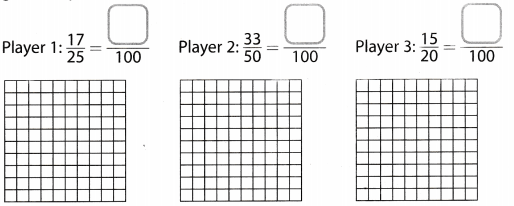
The free-throw ratios for three basketball players are shown.

Player 1: \(\frac{17}{25}\)
Player 2: \(\frac{33}{50}\)
Player 3: \(\frac{15}{20}\)

(A) Rewrite each ratio as a number compared to 100. Then shade the grid to represent the free-throw ratio.
Texas Go Math Grade 6 Lesson 9.1 Answer Key Understanding Percent 2

(B) Which player has the greatest free-throw ratio? ____________________
How is this shown on the grids? ____________________

(C) Use a percent to describe each player’s free-throw ratio. Write the percents in order from least to greatest.

(D) How did you determine how many squares t0 shade on each grid?

Connecting Fractions and Percents

You can use a percent bar model to model a ratio expressed as a fraction and to find an equivalent percent.

(A) Use a percent bar model to find an equivalent percent for \(\frac{1}{4}\).
Draw a model to represent 100 and divide it into fourths. Shade \(\frac{1}{4}\).

Texas Go Math Grade 6 Lesson 9.1 Answer Key Understanding Percent 3
\(\frac{1}{4}\) of 100 = 25, so \(\frac{1}{4}\) of 100% = _________________
Tell which operation you can use to find \(\frac{1}{4}\) of 100.
Then find \(\frac{1}{4}\) of 100%. _________________

(B) Use a percent bar model to find an equivalent percent for \(\frac{1}{3}\).
Draw a model and divide it into thirds. Shade \(\frac{1}{3}\).

Texas Go Math Grade 6 Lesson 9.1 Answer Key Understanding Percent 4
\(\frac{1}{3}\) of 100 = 33\(\frac{1}{3}\), so \(\frac{1}{3}\) of 100% = _________________
Tell which operation you can use to find \(\frac{1}{3}\) of 100.
Then find \(\frac{1}{3}\) of 100%. _________________

Reflect

Go Math Grade 6 Lesson 9.1 Answer Key Question 1.
Critique Reasoning Jo says she can find the percent equivalent of \(\frac{3}{4}\) by multiplying the percent equivalent of \(\frac{1}{4}\) by 3. How can you use a percent bar model to support this claim?
Answer:
The fraction \(\frac{3}{4}\) can be written as 3 × \(\frac{1}{4}\). This implies that the fraction is a product of a unit fraction and 3. In percentage expression; \(\frac{3}{4}\) = 25% and \(\frac{3}{4}\) = 3(25%) = 75%.

Your Turn

Use a benchmark to find an equivalent percent for each fraction.

Question 2.
\(\frac{9}{10}\) _______________
Answer:
Write \(\frac{9}{10}\) as a multiple of a benchmark fraction.
\(\frac{9}{10}\) = 9 × \(\frac{1}{10}\)
Think: \(\frac{9}{10}\) = \(\frac{1}{10}+\frac{1}{10}+\frac{1}{10}+\frac{1}{10}+\frac{1}{10}+\frac{1}{10}+\frac{1}{10}+\frac{1}{10}+\frac{1}{10}\)
Find an equivalent percent for \(\frac{1}{10}\)
\(\frac{1}{10}\) = 10%
Multiply
\(\frac{9}{10}\) = 9 × \(\frac{1}{10}\) = 9 × 10% = 90%

Question 3.
\(\frac{2}{5}\) _______________
Answer:
Solution to this example is given below
\(\frac{2}{5}\) = 2 ÷ 5 = 0.4 (Divide the numerator by the denominator)
0.4 = 40% (Move the decimal point 2 places to the right)
Final solution = 40%

Go Math Grade 6 Lesson 9.1 Understand Percent Answer Key Question 4.
64% of the animals at an animal shelter are dogs. About what fraction of the animals at the shelter are dogs?
Answer:
Find a fraction equivalent for 64%
64% = \(\frac{64}{100}\)
64 % = \(\frac{64 \div 4}{100 \div 4}\) (Divide numerator and denominator by 4)
64% = \(\frac{16}{25}\)
Final solution = \(\frac{16}{25}\)
\(\frac{16}{25}\) of the animals in the shelter are dogs.

Texas Go Math Grade 6 Lesson 9.1 Guided Practice Answer Key

Question 1.
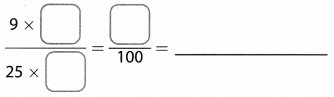
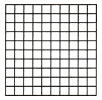
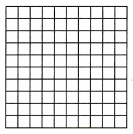
Shade the grid to represent the ratio \(\frac{9}{25}\). Then find a percent equivalent to the given ratio.
Texas Go Math Grade 6 Lesson 9.1 Answer Key Understanding Percent 5
Texas Go Math Grade 6 Lesson 9.1 Answer Key Understanding Percent 6
Answer:
Given fraction:
\(\frac{9}{25}\)

Multiply the given fraction with 100% to convert it to an equivalent percentage, therefore:
= \(\frac{9}{25}\) × 100%
Evaluate:
= 36%

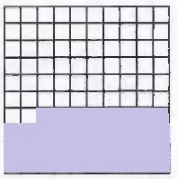
Here this implies that 36 of the 100 boxes must be shaded, therefore:
Texas Go Math Grade 6 Lesson 9.1 Answer Key Understanding Percent 16
Shade 36 boxes in the 100 boxes diagram shown.

Go Math Lesson 9.1 Answer Key Understanding Percent 6th Grade Question 2.
Use the percent bar model to find the missing percent.

Texas Go Math Grade 6 Lesson 9.1 Answer Key Understanding Percent 7
Answer:
Given fraction: \(\frac{1}{5}\)

Multiply the given fraction with 100% to convert it to an equivalent percentage, therefore:
= \(\frac{1}{5}\) × 100%
Evaluate: = 20%

\(\frac{1}{5}\) = 20%

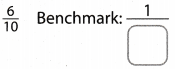
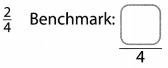
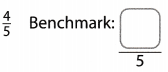
Identify a benchmark you can use to find an equivalent percent for each ratio. Then find the equivalent percent.

Question 3.
Texas Go Math Grade 6 Lesson 9.1 Answer Key Understanding Percent 8
Answer:
Write \(\frac{6}{10}\) as a multiple of a benchmark fraction.
\(\frac{6}{10}\) = 6 × \(\frac{1}{10}\)
Think: \(\frac{6}{10}\) = \(\frac{1}{10}+\frac{1}{10}+\frac{1}{10}+\frac{1}{10}+\frac{1}{10}+\frac{1}{10}\)
Find an equivalent percent for \(\frac{1}{10}\)
\(\frac{1}{10}\) = 10%
Multiply
\(\frac{6}{10}\) = 6 × \(\frac{1}{10}\) = 6 × 10% = 60%

Question 4.
Texas Go Math Grade 6 Lesson 9.1 Answer Key Understanding Percent 9
Answer:
Solution to this example is given below
\(\frac{2}{4}\) = 2 ÷ 4 = 0.50 (Divide the numerator by the denominator.)
0.50 = 50% (Move the decimal point 2 places to the right)
Final solution = 50%

Question 5.
Texas Go Math Grade 6 Lesson 9.1 Answer Key Understanding Percent 10
Answer:
Solution to this example is given below
\(\frac{4}{5}\) = 4 ÷ 5 = 0.80 (Divide the numerator by the denominator.)
0.80 = 80% (Move the decimal point 2 places to the right)
Final solution = 80%

Question 6.
41% of the students at an art college want to be graphic designers. About what fraction of the students want to be graphic designers?
Answer:
Note that 41% is close to the benchmark 40% .
Find a fraction equivalent for40%
40% = \(\frac{2}{5}\)
Final solution = \(\frac{2}{5}\)
Approximately \(\frac{2}{5}\) of the students want to be graphic designers.

Essential Question Check-In

Go Math Lesson 9.1 Answer Key 6th Grade Question 7.
How do you write a ratio as a percent?
Answer:
First we can write the given ratio as a fraction, and then expand or reduce that fraction so that it has the denominator of 100. Then the number in the numerator is the percent equivalent to the starting ratio.

For example, let our ratio be 3 : 10
3 : 10 = \(\frac{3}{10}=\frac{3 \cdot 10}{10 \cdot 10}=\frac{30}{100}\)
so 30% is equivalent to 3 : 10

Generally, if the given ratio is a : b, we do the same thing:
a : b = \(\frac{a}{b}\) = \(\frac{a \cdot \frac{100}{b}}{b \cdot \frac{100}{b}}\) = \(\frac{\frac{100 \cdot a}{b}}{100}\)
So \(\left(\frac{100 \cdot a}{b}\right)\) % is equivalent to a : b

We divide the first term of the ratio with the second, and multiply that number by 100(%)

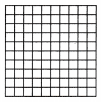
Shade the grid to represent the ratio. Then find the missing number.

Question 8.
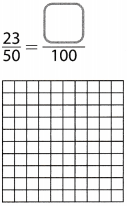
Texas Go Math Grade 6 Lesson 9.1 Answer Key Understanding Percent 11
Answer:
Given fraction:
\(\frac{23}{50}\)

Multiply the given fraction with 100% to convert ¡t to an equivalent percentage, therefore:
= \(\frac{23}{50}\) × 100%
Evaluate:
= 46%

Here this implies that 46 of the 100 boxes must be shaded, therefore:
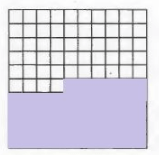
Texas Go Math Grade 6 Lesson 9.1 Answer Key Understanding Percent 17
Shade 46 of the 100 boxes shown.

Question 9.
Texas Go Math Grade 6 Lesson 9.1 Answer Key Understanding Percent 12
Answer:
Given fraction:
\(\frac{11}{20}\)

Multiply the given fraction with 100% to convert ¡t to an equivalent percentage, therefore:
= \(\frac{11}{20}\) × 100%
Evaluate:
= 55%

Here this implies that 55 of the 100 boxes must be shaded, therefore:
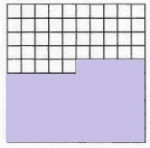
Texas Go Math Grade 6 Lesson 9.1 Answer Key Understanding Percent 18
Shade 55 of the 100 boxes shown.

Question 10.
Mark wants to use a grid like the ones in Exercises 8 and 9 to model the percent equivalent of the fraction \(\frac{2}{3}\). How many grid squares should he shade? What percent would his model show?
Answer:
There are 100 squares on the grid.
To find how many squares should he shade, multiply 100 by \(\frac{2}{3}\):
\(\frac{2}{3}\) · 100 = 66.67 ≈ 67 = 67%
He should shade 67 squares.

Lesson 9.1 Answer Key 6th Grade Go Math Question 11.
The ratios of saves to the number of save opportunities are given for three relief pitchers: \(\frac{9}{10}, \frac{4}{5}, \frac{17}{20}\). Write each ratio as a percent. Order the percents from least to greatest.
Answer:
\(\frac{9}{10} \cdot \frac{10}{10}\) = \(\frac{90}{100}\) = 90%
\(\frac{4}{5} \cdot \frac{20}{20}\) = \(\frac{80}{100}\) = 80%
\(\frac{17}{20} \cdot \frac{5}{5}\) = \(\frac{85}{100}\) = 85%
80% < 85% < 90%

Circle the greater quantity.

Question 12.
\(\frac{1}{3}\) of a box of Corn Krinkles
50% of a box of Corn Krinkles
Answer:
50% of a box is the same as \(\frac{1}{2}\) box, and we know that
\(\frac{1}{2}=\frac{3}{6}\) > \(\frac{2}{6}=\frac{1}{3}\)
So 50% of a box is the greater quantity.

Question 13.
30% of your minutes are used up
\(\frac{1}{4}\) of your minutes are used up
Answer:
Solution to this example is given below
\(\frac{1}{4}\) = 1 ÷ 4 = 0.25 (Divide the numerator by the denominator.)
0.25 = 25% (Move the decimal point 2 places to the right.)
Since 25% < 30% , therefore: \(\frac{1}{4}\) < 30%
30% = Final solution
30% of minutes is a greater quantity.

Question 14.
Multiple Representations Explain how you could write 35% as the sum of two benchmark percents or as a multiple of a percent.
Answer:
Given percentage: = 35%

Divide the given percentage with 100% to convert it to an equivalent fraction, therefore:
= \(\frac{35 \%}{100 \%}\)
Evaluate:
= \(\frac{7}{20}=\frac{3}{10}+\frac{1}{20}\)
35% is equal to \(\frac{7}{20}\) which is a sum of \(\frac{3}{10}+\frac{1}{20}\). The benchmarks here are \(\frac{1}{10}\) and \(\frac{1}{20}\).

35% as a multiple of a percent is 7(5%).

Question 15.
Use the percent bar model to find the missing percent.

Texas Go Math Grade 6 Lesson 9.1 Answer Key Understanding Percent 13
Answer:
Texas Go Math Grade 6 Lesson 9.1 Answer Key Understanding Percent 19

The percent bar is divided into 8 blocks of the same size.
So, just as we calculate that one block is 1 ÷ 8 = \(\frac{1}{8}\) of the whole bar, we can do the same thing with percentages.
One block of the percent bar equals 100% ÷ 8 = 12.5% of the whole bar.

Question 16.
Multistep Carl buys songs and downloads them to his computer. The bar graph shows the numbers of each type of song he downloaded last year.
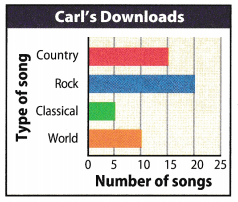
Texas Go Math Grade 6 Lesson 9.1 Answer Key Understanding Percent 14
a. What is the total number of songs Carl downloaded last year?
Answer:
Evaluate the total number of songs by taking the sum of the songs downloaded in each category. Therefore: 15 + 20 + 5 + 10 = 50.

b. What fraction of the songs were country? Find the fraction for each type of song. Write each fraction in simplest form and give its percent equivalent.
Answer:
Find the fraction for each type of song downloaded by dividing its share in the collection by the total number of songs downloaded. Divide out the common factor to write as a fraction is simplest form? therefore:
Fraction of Country songs = \(\frac{15}{50}\) = \(\frac{3}{10}\)
Fraction of Rock songs = \(\frac{20}{50}\) = \(\frac{2}{5}\)
Fraction of Classical songs = \(\frac{5}{50}\) = \(\frac{1}{10}\)
Fraction of World songs = \(\frac{10}{50}\) = \(\frac{1}{5}\)

Multiply each of the given fraction with 100% to convert it to an equivalent percentage, therefore:
Fraction of Country songs = \(\frac{3}{10}\) × 100% = 30%
Fraction of Rock songs = \(\frac{2}{5}\) × 100% = 40%
Fraction of Classical songs = \(\frac{1}{10}\) × 100% = 10%
Fraction of World songs = \(\frac{1}{5}\) × 100% = 20%

H.O.T. Focus On Order Thinking

Question 17.
Critique Reasoning Marcus bought a booklet of tickets to use at the amusement park. He used 50% of the tickets on rides, \(\frac{1}{3}\) of the tickets on video games, and the rest of the tickets in the batting cage. Marcus says he used 10% of the tickets in the batting cage. Do you agree? Explain.
Answer:
The fraction \(\frac{1}{3}\) is equal to 33.\(\overline{3}\)%. This means that the percentage of tickets used in batting cage are equal to 100% – 50% – 33.\(\overline{3}\)% 16.\(\overline{6}\)% ≠ 10%. Therefore, Marcus is incorrect in his reasoning.

Question 18.
Look for a pattern Complete the table.

Texas Go Math Grade 6 Lesson 9.1 Answer Key Understanding Percent 15
Answer:
Texas Go Math Grade 6 Lesson 9.1 Answer Key Understanding Percent 20

a. Analyze Relationships What is true when the numerator and denominator of the fraction are equal? What is true when the numerator is greater than the denominator?
Answer:
\(\frac{x}{x}\) = 1, for any number x
In the context of this table, i.e. it we assume that we are dealing with positive percentages, then
a > b => \(\frac{a}{b}\) > 1 = 100%
However, if we are dealing with negative numbers as well, this is not true.
If the numerator is greater than the denominator, then we can write the numerator as “denominator + some positive number”
Then we have

Texas Go Math Grade 6 Lesson 9.1 Answer Key Understanding Percent 21
which is less/greater than 1 = 100% if the denominator is negative/positive number.
See strict proof at the bottom.

(a) let our fraction be \(\frac{a}{b}\), where a > b
That is equivalent to a – b > 0
Now, let’s write c = a – b > 0
Now we have
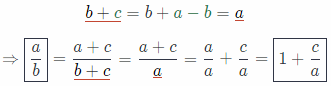
Texas Go Math Grade 6 Lesson 9.1 Answer Key Understanding Percent 23

Finally, since c > 0, the answer to the question depends on a
1) It a is positive, then \(\frac{c}{a}\) > 0 ⇒ 1 + \(\frac{c}{a}\) > 1 = 100%
2) If a is negative, then \(\frac{c}{a}\) < 0 ⇒ 1 + \(\frac{c}{a}\) < 1 = 100%
For example, 1 > – 4 and
\(\frac{1}{-4}\) = – 0.25 = – 25% < 100% = 1
also, – 3 > – 8, but
\(\frac{-3}{-8}=\frac{3}{8}\) = 0.375 = 37.5% < 100% = 1

b. Justify Reasoning What is the percent equivalent of \(\frac{3}{2}\)? Use a pattern like the one in the table to support your answer.
Answer:
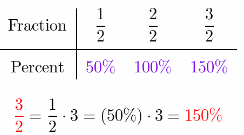
Texas Go Math Grade 6 Lesson 9.1 Answer Key Understanding Percent 22

Texas Go Math Grade 6 Lesson 9.1 Answer Key Understanding Percent Read More »

Texas Go Math Grade 6 Lesson 8.3 Answer Key Solving Problems with Proportions

Refer to our Texas Go Math Grade 6 Answer Key Pdf to score good marks in the exams. Test yourself by practicing the problems from Texas Go Math Grade 6 Lesson 8.3 Answer Key Solving Problems with Proportions.

Texas Go Math Grade 6 Lesson 8.3 Answer Key Solving Problems with Proportions

Your Turn

Question 1.
The PTA is ordering pizza for their next meeting. They plan to order 2 cheese pizzas for every 3 pepperoni pizzas they order. How many cheese pizzas will they order if they order 15 pepperoni pizzas?
Answer:
\(\frac{\text { cheese }}{\text { pepperoni }}=\frac{2}{3}=\frac{x}{15}\)
15 is a common denominator:
\(\frac{2}{3} \cdot \frac{5}{5}=\frac{x}{15}\)
\(\frac{10}{15}=\frac{x}{15}\)
⇒ x = 10
10 cheese pizzas.

Go Math Grade 6 Answers Pdf Lesson 8.3 Question 2.
Ms. Reynold’s sprinkler system has 9 stations that water all the parts of her front and back lawn. Each station runs for an equal amount of time. If it takes 48 minutes for the first 4 stations to water, how long does it take to water all parts of her lawn? _______________
Answer:
It takes 48 minutes for the first l stations to water. This implies that each station takes \(\frac{48}{4}\) = 12 minutes. Therefore the total of 9 stations will require a total time of 9 × 12 = 108 minutes.

9 stations will require 108 minutes.

Question 3.
The distance between Sandville and Lewiston is shown on the map. What is the actual distance between the towns? ___________
Texas Go Math Grade 6 Lesson 8.3 Answer Key Solving Problems with Proportions 1
Answer:
Write a proportion.
\(\frac{20 \text { miles }}{1 \text { inch }}=\frac{? \text { miles }}{2.5 \text { inches }}\) write the scale as a unit rate
Write an equivalent rate to find the missing number
\(\frac{20 \text { miles } \times 2.5}{1 \text { inch } \times 2.5}=\frac{50 \text { miles }}{2.5 \text { inches }}\)
So, the missing number is 50.
The actual distance between the two towns is 50 miles
Final Solution = 50

Texas Go Math Grade 6 Lesson 8.3 Guided Practice Answer Key

Find the unknown value in each proportion.

Question 1.
Texas Go Math Grade 6 Lesson 8.3 Answer Key Solving Problems with Proportions 2
Answer:
Write a proportion
\(\frac{3}{5}=\frac{x}{30}\)
Use common denominators to write equivalent ratio&
\(\frac{3 \times 6}{5 \times 6}=\frac{x}{30}\)
30 is a common denominator

\(\frac{18}{30}=\frac{x}{30}\)
Equivalent ratios with the same denominators have the same numerators
x = 18
The unknown value is 18
Final solution = 18

Lesson 8.3 Go Math Grade 6 Answer Key Pdf Question 2.
Texas Go Math Grade 6 Lesson 8.3 Answer Key Solving Problems with Proportions 3
Answer:
Write a proportion.
\(\frac{4}{10}=\frac{x}{5}\)
Use common denominators to write equivalent ratios.
\(\frac{4 \div 2}{10 \div 2}=\frac{x}{5}\) 10 is a common denominator

\(\frac{2}{5}=\frac{x}{5}\)
Equivalent ratios with the same denominators have the same numerators
x = 2
The unknown value is 2
Final solution = 2

Solve using equivalent ratios.

Question 3.
Leila and Jo are two of the partners in a business. Leila makes $3 in profits for every $4 that Jo makes. If Jo makes $60 profit on the first item they sell, how much profit does Leila make?
Answer:
Write a proportion.
\(\frac{\text { Leila’s profit }}{\text { Jo’s profit }}=\frac{3}{4}=\frac{?}{60}=\frac{\text { Leila’s profit }}{\text { Jo’s profit }}\)
Use common denominators to write equivalent ratios.
\(\frac{3 \times 15}{4 \times 15}=\frac{?}{60}\) 60 is a common denominator

\(\frac{45}{60}=\frac{?}{60}\)
Equivalent ratios with the same denominators have the same numerators

? = 45
If Jo makes 60 dollars profit Leila makes 45 dollars profit
Final solution = 45

Question 4.
Hendrick wants to enlarge a photo that is 4 inches wide and 6 inches tall. The enlarged photo keeps the same ratio. How tall is the enlarged photo if it is 12 inches wide?
Answer:
Write a proportion.
\(\frac{6}{4}=\frac{x}{12}\)
Use common denominators to write equivalent ratios.
\(\frac{6 \times 3}{4 \times 3}=\frac{x}{12}\) 12 is a common denominator

\(\frac{18}{12}=\frac{x}{12}\)
Equivalent ratios with the same denominators have the same numerators

x = 18
The unknown value is 18
The enlarged photo is 18 inches tall
Final Solution = 18

Solve using unit rates.

Question 5.
A person on a moving sidewalk travels 21 feet in 7 seconds. The moving sidewalk has a length of 180 feet. How long will it take to move from one end to the other?
Answer:
Evaluate the unit rate of the distance traveled. Here it is \(\frac{21}{7}\) = 3 feet per second. This implies that the time required to cover the moving walkway 180 feet long is \(\frac{180}{3}\) = 60 seconds.

It takes 60 seconds to move from one end of the sidewalk to the other.

Go Math 6th Grade Pdf Lesson 8.3 Proportions Question 6.
In a repeating musical pattern, there are 56 beats in 7 measures. How many measures are there after 104 beats?
Answer:
To find the unit rate, divide the numerator and denominator by 7:
Texas Go Math Grade 6 Lesson 8.3 Answer Key Solving Problems with Proportions 8

Texas Go Math Grade 6 Lesson 8.3 Answer Key Solving Problems with Proportions 9
x = 13
There are 13 measures.

Question 7.
Contestants in a dance-a-thon rest for the same amount of time every hour. A couple rests for 25 minutes in 5 hours. How long did they rest in 8 hours?
Answer:
To find the unit rate, divide the numerator and denominator by 5:
Texas Go Math Grade 6 Lesson 8.3 Answer Key Solving Problems with Proportions 10

Texas Go Math Grade 6 Lesson 8.3 Answer Key Solving Problems with Proportions 11
⇒ x = 40
They rested for 40 minutes.

Question 8.
Francis gets 6 paychecks in 12 weeks. How many paychecks does she get in 52 weeks?
Answer:
To find the unit rate, divide the numerator and denominator by 12:
Texas Go Math Grade 6 Lesson 8.3 Answer Key Solving Problems with Proportions 12

Texas Go Math Grade 6 Lesson 8.3 Answer Key Solving Problems with Proportions 13
⇒ x = 26
He received 26 paychecks.

Go Math Grade 6 Lesson 8.3 Answer Key Question 9.
What is the actual distance between Gendet and Montrose? ________________
Texas Go Math Grade 6 Lesson 8.3 Answer Key Solving Problems with Proportions 4
Answer:
Write a proportion.
\(\frac{16 \mathrm{~km}}{1 \mathrm{~cm}}=\frac{? \mathrm{~km}}{1.5 \mathrm{~cm}}\) Write the scale as a unit rate

Write an equivalent rate to find the missing number
\(\frac{16 \mathrm{~km} \times 1.5}{1 \mathrm{~cm} \times 1.5}=\frac{24 \mathrm{~km}}{1.5 \mathrm{~cm}}\)
So, the missing number is 24

The actual distance between the two towns is 24 kilometers
Final solution = 24

Essential Question Check-In

Question 10.
How do you solve problems with proportions?
Answer:
Problems with proportions are converted to an equation using the given situation and then basic laws of algebra are used to evaluate the unknown quantity ¡n the given proportion.

Question 11.
On an airplane, there are two seats on the left side in each row and three seats on the right side. There are 90 seats on the right side of the plane.
a. How many seats are on the left side of the plane? _______________
Answer:
There are 3 seats on the right side and there are 90 seats on the right side of the plane This implies that there are \(\frac{90}{3}\) = 30 rows in the plane. There are 2 seats on the left side plane, so in total there are 30 × 2 = 60 seats on the left hand side of the plane.

b. How many seats are there altogether? _______________
Answer:
There are a total of 90 + 60 = 150 seats on the plane.

Question 12.
The scale of the map is missing. The actual distance from Liberty to West Quail is 72 miles, and it is 6 inches on the map.
Texas Go Math Grade 6 Lesson 8.3 Answer Key Solving Problems with Proportions 5
a. What is the scale of the map?
Answer:
The actual distance from liberty to West Quail is 72 miles, and it ¡s 6 inches on the map. This means that each represents an actual distance of \(\frac{72}{6}\) = 12 miles, so the scale is 1 inch = 12 miles.

b. Foston is directly between Liberty and West Quail and is 4 inches from Liberty on the map. How far is Foston from West Quail? Explain.
Answer:
Foston s between Liberty and West Quail and is 4 inches from Liberty on the map This impLies that Foston is 6 – 4 = 2 inches away from West Quall on the map. Therefore the actual distance between Foston and West Quall is 2 × 12 = 24 miles.

Texas Go Math Grade 6 Practice and Homework Lesson 8.3 Question 13.
Wendell is making punch for a party. The recipe he is using says to mix 4 cups pineapple juice, 8 cups orange juice, and 12 cups lemon-lime soda in order to make 18 servings of punch.

a. How many cups of punch does the recipe make? _______________
Answer:
It makes: 4 pineapple – 8 orange + 12 Lemon-Lime = 24 cups

b. If Wendell makes 108 cups of punch, how many cups of each ingredient will he use?
__________ cups pineapple juice
__________ cups orange juice
__________ cups lemon-lime soda
Answer:
To find the unit rate, divide the numerator and denominator by 6:
Texas Go Math Grade 6 Lesson 8.3 Answer Key Solving Problems with Proportions 14

108 is a common numerator:
\(\frac{4}{1} \cdot \frac{27}{27}=\frac{108}{x}\)
\(\frac{108}{27}=\frac{108}{x}\)
⇒ x = 27
27 cups pineapple juice

To find the unit rate, divide the numerator and denominator by 8:
Texas Go Math Grade 6 Lesson 8.3 Answer Key Solving Problems with Proportions 15

108 is a common numerator:
\(\frac{3}{1} \cdot \frac{36}{36}=\frac{108}{x}\)
\(\frac{108}{36}=\frac{108}{x}\)
⇒ x = 36
36 cups orange juice

To find the unit rate, divide the numerator and denominator by 12:
Texas Go Math Grade 6 Lesson 8.3 Answer Key Solving Problems with Proportions 16
108 is a common numerator:
\(\frac{2}{1} \cdot \frac{54}{54}=\frac{108}{x}\)
\(\frac{108}{54}=\frac{108}{x}\)
⇒ x = 54
54 cups lemon-lime juice

c. How many servings can be made from 108 cups of punch? __________
Answer:
a. 24 cups

b. 27 cups pineapple juice
36 cups orange juice
54 cups Lemon-Lime juice

Question 14.
Carlos and Krystal are taking a road trip from Greenville to North Valley. Each has their own map, and the scales on their maps are different.

a. On Carlos’s map, Greenville and North Valley are 4.5 inches apart. The scale on his map is 1 inch = 20 mîles. How far is Greenville from North Valley?
Answer:
The scale on is 1 inch = 20 miles, so a scale distance of 4.5 inches imply an actual distance of 4.5 × 20 = 90 miles. Therefore, it can be said that Greenville and North Valley are 90 miles apart.

b. The scale on Krystal’s map is 1 inch = 18 miles. How far apart are Greenville and North Valley on Krystal’s map?
Answer:
The scale on is 1 inch = 18 miles, so a total distance of 90 miles imply an scale distance of \(\frac{90}{18}\) = 5 inches on the map Therefore, it can be said that Greenville and North Valley are 5 inches apart on Krystal’s map

Lesson 8.3 Answer Key 6th Grade Texas Go Math Question 15.
Multistep A machine can produce 27 inches of ribbon every 3 minutes. How many feet of ribbon can the machine make in one hour? Explain.
Answer:
A machine can produce 27 inches of ribbon every 3 minutes. This implies that the rate of ribbon production is \(\frac{27}{3}\) = 9 inches per minute. Therefore, in 1 hour which consists of 60 minutes, 60 × 9 = 540 inches of ribbon will be made.

540 inches of ribbon will be made in 1 hour.

Marta, Loribeth, and Ira all have bicycles. The table shows the number of miles of each rider’s last bike ride, as well as the time it took each rider to complete the ride.

Texas Go Math Grade 6 Lesson 8.3 Answer Key Solving Problems with Proportions 6

Question 16.
What is Marta’s unit rate, in minutes per mile? __________
Answer:
Martas unit rate, in minutes per mile is equal to \(\frac{80}{8}\) = 10.

Martas unit rate is equal to 10 minutes per mile

Question 17.
Whose speed was the fastest on their last bike ride? ______________
Answer:
Evaluate the speed of each rider by dividing the distance traveled by the time taken. Therefore, Marta’s speed is equal to \(\frac{8}{80}\) = 0.1 miles per minute. Loribeth’s speed is equal to \(\frac{6}{42}\) = 0.143 miles per minute and Ira’s speed is equal to \(\frac{15}{75}\) = 0.2 miles per minute. Since 0.2 > 0.143 > 0.1, Ira’s speed was the fastest

Question 18.
If all three riders travel for 3.5 hours at the same speed as their last ride, how many total miles will all 3 riders have traveled? Explain.
Answer:
Evaluate the speed of each rider by dividing the distance traveled by the time taken. Therefore, Marta’s speed is equal to \(\frac{8}{80}\) = 0.1 miles per minute. Loribeth’s speed is equal to \(\frac{6}{42}\) = 0.143 miles per minute and Ira’s speed is equal to \(\frac{15}{75}\) = 0.2 miles per minute. Since 0.2 > 0.143 > 0.1, Ira’s speed was the fastest.

3.5 hours is equal to 3.5 × 60 = 210 minutes. Therefore in 210 minutes, Marta would have covered a distance of 0.1 × 210 = 21 miLes, Loribeth would have covered a distance of 0.143 × 210 = 30 miles and Ira would have covered a distance of 0.2 × 210 = 42 miles. Altogether they would have covered a distance of 21 + 30 + 42 = 93 miles.

Altogether they would have covered a distance of 93 miles in 35 hours.

Question 19.
Critique Reasoning Jason watched a caterpillar move 10 feet in 2 minutes. Jason says that the caterpillar’s unit rate is 0.2 feet per minute. Is Jason correct? Explain.
Answer:
Jason watched a caterpillar move 10 feet in 2 minutes, so its unit rate is \(\frac{10}{2}\) = 5 feet per minute and not 0.2 feet per minute.

H.O.T. Focus On Higher Order Thinking

Go Math Practice and Homework Lesson 8.3 Answer Key Question 20.
Analyze Relationships If the number in the numerator of a unit rate is 1, what does this indicate about the equivalent unit rates? Give an example.
Answer:
The word unit rate implies that the denominator is equal to 1. If the numerator is also equal to 1, then this implies that the 2 quantities are equal and so their equivalent rates will always be equal to 1 An example of this is a speed of a bicycle rider who covers a distance of 5 meters in 5 seconds, so his unit rate or speed will be = 1 meter per second.

Question 21.
Multiple Representations A boat travels at a constant speed. After 20 minutes, the boat has traveled 2.5 miles. The boat travels a total of 10 miles to a bridge.
 Texas Go Math Grade 6 Lesson 8.3 Answer Key Solving Problems with Proportions 7

a. Graph the relationship between the distance the boat travels and the time it takes.
Answer:
At time 0, the distance traveled is 0 miles and after 20 minutes, the distance traveled is 2.5 miles, so the 2 ordered pairs are (0, 0) and (20, 2.5). Plot these on a graph and join them using a straight line, therefore:
Texas Go Math Grade 6 Lesson 8.3 Answer Key Solving Problems with Proportions 18

b. How long does it take the boat to reach the bridge? Explain how you found it.
Answer:
Use the graph to locate the value of y = 10 and then its corresponding value of x. It is 80. This means that the ship takes 80 minutes to cover a distance of 10 miles.

Texas Go Math Grade 6 Lesson 8.3 Answer Key Solving Problems with Proportions Read More »

Texas Go Math Grade 6 Module 9 Quiz Answer Key

Refer to our Texas Go Math Grade 6 Answer Key Pdf to score good marks in the exams. Test yourself by practicing the problems from Texas Go Math Grade 8 Module 9 Quiz Answer Key.

Texas Go Math Grade 6 Module 9 Quiz Answer Key

Texas Go Math Grade 6 Module 9 Ready to Go On? Answer Key

9.1 Understanding Percent

Shade the grid and write the equivalent percent for each fraction.

Question 1.
\(\frac{19}{50}\) ________________
Texas Go Math Grade 6 Module 9 Quiz Answer Key 1
Answer:
Given fraction = \(\frac{19}{50}\)

Multiply the given fraction with 100% to convert it to an equivalent percentage, therefore:
= \(\frac{19}{50}\) × 100%
Evaluate:
= 38%

Shade 38 of the 100 square shown, therefore:
Texas Go Math Grade 6 Module 9 Quiz Answer Key 5

\(\frac{19}{50}\) = 38%

Module 9 Quiz Ready To Go On Answers 6th Grade Question 2.
\(\frac{13}{20}\) ________________
Texas Go Math Grade 6 Module 9 Quiz Answer Key 2
Answer:
Given fraction = \(\frac{13}{20}\)

Multiply the given fraction with 100% to convert it to an equivalent percentage, therefore:
= \(\frac{13}{20}\) × 100%
Evaluate:
= 65%

Shade 65 of the 100 square shown, therefore:
Texas Go Math Grade 6 Module 9 Quiz Answer Key 6

\(\frac{13}{20}\) = 65%

9.2 Percents, Fractions, and Decimals

Write each number in two equivalent forms.

Question 3.
\(\frac{3}{5}\) _____________
Answer:
Write an equivalent fraction with a denominator of 100
\(\frac{3}{5}=\frac{3 \times 20}{5 \times 20}=\frac{60}{100}\) (Multiply both the numerator and denominator by 20)

Write the decimal equivalent
\(\frac{60}{100}\) = 0.60

Write the percent equivalent
\(\frac{60}{100}\) = 0.60 = 60% (Move the decimal point 2 places to the right)

Final solution ⇒ \(\frac{3}{5}\) = 0.6 = 60%

Go Math Grade 6 Answer Key Module 9 Final Quiz Question 4.
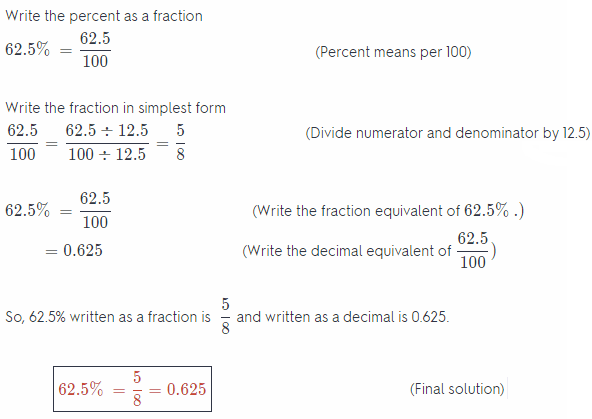
62.5% ______________
Answer:
Texas Go Math Grade 6 Module 9 Quiz Answer Key 7

Question 5.
0.24 ____________
Answer:
Given number = 0.24

Convert the given number to an equivalent percentage by multiplying it with 100%. The percentage is evaluated by moving the decimal 2 places to the right from its current position, therefore:
= 0.24 × 100% = 24%

To convert it to an equivalent fraction replace the % sign with × \(\frac{1}{100}\) and simplify:
= 24 × \(\frac{1}{100}\)
Divide out the common factor to simplify:
= \(\frac{6}{25}\)

⇒ 0.24 = 24% = \(\frac{6}{25}\)

Question 6.
\(\frac{31}{50}\) ______________
Answer:
Write an equivalent fraction with a denominator of 100
\(\frac{31}{50}=\frac{31 \times 2}{50 \times 2}=\frac{62}{100}\) (Multiply both the numerator and denominator by 2)

Write the decimal equivalent
\(\frac{62}{100}\) = 0.62

Write the percent equivalent.
\(\frac{62}{100}\) = 0.62 = 62% (Move the decimal point 2 places to the right)

Final Solution ⇒ \(\frac{31}{50}\) = 0.62 = 62%

Module 9 Quiz Go Math Grade 6 Answers Pdf Question 7.
Selma spent \(\frac{7}{10}\) of her allowance on a new backpack. What percent of her allowance did she spend?
Answer:
Given Fraction = \(\frac{7}{10}\)

Multiply the given fraction with 100% to convert it to an equivalent percentage, therefore:
= \(\frac{7}{10}\) × 100%
Evaluate:
= 70%

Selma spent 70% of her allowance on a new backpack.

9.3 Solving Percent Problems

Complete each sentence.

Question 8.
12 is 30% of
Answer:
Multiply by a fraction to find 12 is 30% of?

Multiply
Percent = \(\frac{12}{30}\) × 100%
= \(\frac{1200}{30}\)
= 40

Final Solution = 40
12 is 30% of 40

Question 9.
45% of 20 is
Answer:
Multiply by a fraction to find 45 % of 20

Write the percent as a fraction.
45% of 20 = \(\frac{45}{100}\) of 20

Multiply
\(\frac{45}{100}\) of 20 = \(\frac{45}{100}\) × 20
= \(\frac{900}{100}\)
= 9

Final solution = 9
45% of 20 is 9 tiles

Question 10.
18 is _________ % of 30.
Answer:
Multiply by a fraction to find 18 is ?% of 30

Multiply
Percent = \(\frac{18}{30}\) × 100%
= \(\frac{1800}{30}\)
= 60%

Final Solution = 60%
18 is 60% of 30

Go Math Grade 6 Module 9 Answer Key Question 11.
56 is 80% of
Answer:
Multiply by a fraction to find 56 is 80% of?

Multiply
Percent = \(\frac{56}{80}\) × 100%
= \(\frac{5600}{80}\)
= 70%

Final Solution = 70
56 is 80% of 70

Question 12.
A pack of cinnamon-scented pencils sells for $4.00. What is the sales tax rate if the total cost of the pencils is $4.32?
Answer:
Data:
Portion = 4.32 – 4 = 0.32
Total = 4
Percent = x

Write equation of percentage: Portion
Percent = \(\frac{\text { Portion }}{\text { Total }}\) × 100%

Substitute values:
x = \(\frac{0.32}{4}\) × 100%

Evaluate:
x = 8
The sales tax rate was 8%

Essential Question

Question 13.
How can you solve problems involving percents?
Answer:
Percents represent a portion of any total on a scale of 100. The equation of percentage is Percent = \(\frac{\text { Portion }}{\text { Total }}\) × 100%. If 2 of the 3 variables shown are given, the 3rd can be evaluated using this equation, for any problem.

Texas Go Math Grade 6 Module 9 Mixed Review Texas Test Prep Answer Key

Selected Response

Question 1.
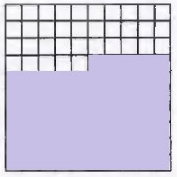
What percent does this shaded grid represent?
Texas Go Math Grade 6 Module 9 Quiz Answer Key 3
(A) 42%
(B) 48%
(C) 52%
(D) 58%
Answer:
(A) 42%

Explaination:
Since 42 of the 100 boxes are shaded, the percentage represented here is 42%.

Question 2.
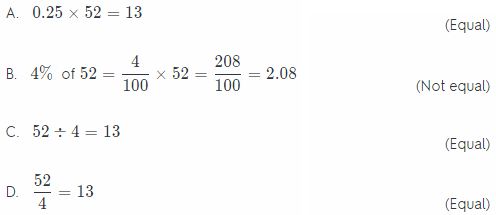
Which expression is not equal to one fourth of 52?
(A) 0.25∙52
(B) 4% of 52
(C) 52 ÷ 4
(D) \(\frac{52}{4}\)
Answer:
(B) 4% of 52

Explaination:
Texas Go Math Grade 6 Module 9 Quiz Answer Key 8
option B = This option is not equal

Question 3.
Approximately \(\frac{4}{5}\) of U.S. homeowners have a cell phone. What percent of homeowners do not have a cell phone?
(A) 20%
(B) 45%
(C) 55%
(D) 80%
Answer:
(A) 20%

Explaination:
Write an equivalent fraction with a denominator of 100
\(\frac{4}{5}=\frac{4 \times 20}{5 \times 20}=\frac{80}{100}\) (Multiply both the numerator and denominator by 20)

Write the decimal equivalent
\(\frac{80}{100}\) = 0.8

Write the percent equivalent
\(\frac{80}{100}\) = 0.8 = 80% (Move the decimal point 2 places to the right)

Therefore 100 – 80 = 20 % do not have a cell phone.

Go Math Module 9 Test Answers Grade 6 Answer Key Question 4.
The ratio of rock music to total CDs that Ella owns is \(\frac{25}{40}\). Paolo has 50 rock music CDs. The ratio of rock music to total CDs in his collection is equivalent to the ratio of rock music to total CDs in Ella’s collection. How many CDs do they own?
(A) 65
(B) 80
(C) 120
(D) 130
Answer:
(C) 120

Explaination:
Note: This task is sloppily written. The sentence:
the ratio of rock music to total CDs that Ella owns is \(\frac{25}{40}\)

does not tell us how many CDs in total Ella has, and neither can we find out that (necessary) information from any other part of the task.
The ratio 25 : 40 is equivalent to, for example, 50 : 80, so the sentence the ratio of rock music to total CDs that Ella owns is \(\frac{50}{80}\)
would be equivalent to the one above, telling us that we can not determine the total number of Ella’s CDs from that information.

However, since the fraction \(\frac{25}{40}\) is not reduced all the way, it makes some sense to assume that Ella has 40 CDs in total.

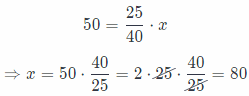
Paul has x CDs in total 50 of which are rock, but also has the same ratio of rock music CDs to total CDs as Ella, so
Texas Go Math Grade 6 Module 9 Quiz Answer Key 9
Altogether, they own 40 + 80 = 120 CDs, so the correct answer is C)

Question 5.
Gabriel saves 40% of his monthly paycheck for college. He earned $270 last month. How much money did Gabriel save for college?
(A) $96
(B) $108
(C) $162
(D) $180
Answer:
(B) $108

Explaination:
Multiply by a fraction to find 40 % of 270
Write the percent as a fraction

Multiply
\(\frac{40}{100}\) of 270 = \(\frac{40}{100}\) × 270
= \(\frac{10800}{100}\) (this option is correct answer)
= 108
Gabriel saves 108 dollars.

Question 6.
Forty children from an after-school club went to the matinee. This is 25% of the children in the club. How many children are in the club?
(A) 10
(B) 160
(C) 200
(D) 900
Answer:
(B) 160

Explaination:
Multiply by a fraction to find 40 is 25% of x
Write the percent as a fraction

Multiply
x = \(\frac{40}{25}\) of 100 = \(\frac{40}{25}\) × 100
= \(\frac{4000}{25}\) (this option is correct answer)
x = 160
In the club are 160 children.

Question 7.
Dominic answered 43 of the 50 questions on his spelling test correctly. Which decimal represents the fraction of problems he answered incorrectly?
(A) 0.07
(B) 0.14
(C) 0.86
(D) 0.93
Answer:
(B) 0.14

Explaination:
The number of questions answered incorrectly are 50 – 43 = 7 Therefore, the fraction of incorrect answers is \(\frac{7}{50}\) = 0.14

Gridded Response

Question 8.
Jen bought some bagels. The ratio of the number of sesame bagels to the number of plain bagels that she bought is 1:3. Find the decimal equivalent of the percent of the bagels that are plain.
Texas Go Math Grade 6 Module 9 Quiz Answer Key 4
Answer:
The \(\frac{1}{3}\) of the bagels are with sesame, so
1 – \(\frac{1}{3}\) = \(\frac{3}{3}-\frac{1}{3}=\frac{2}{3}\)
are plain bagels.
\(\frac{2}{3}\) = 0.67 ≈ 67%

Texas Go Math Grade 6 Module 9 Quiz Answer Key Read More »

Texas Go Math Grade 6 Lesson 7.3 Answer Key Using Ratios and Rates to Solve Problems

Refer to our Texas Go Math Grade 6 Answer Key Pdf to score good marks in the exams. Test yourself by practicing the problems from Texas Go Math Grade 6 Lesson 7.3 Answer Key Using Ratios and Rates to Solve Problems.

Texas Go Math Grade 6 Lesson 7.3 Answer Key Using Ratios and Rates to Solve Problems

Reflect

Question 1.
Explain the Error Marisol makes the following claim: “Bailey’s lemonade is stronger because it has more lemonade concentrate. Bailey’s lemonade has 3 cups of lemonade concentrate, and Anna’s lemonade has only 2 cups of lemonade concentrate” Explain why Marisol is incorrect.
Answer:
The strength of the Lemonade also depends on the amount of water

Question 2.
In the science club, there are 2 sixth graders for every 3 seventh graders. At this year’s science fair, there were 7 projects by sixth graders for every 12 projects by seventh graders. Is the ratio of sixth graders to seventh graders in the science club equivalent to the ratio of science fair projects by sixth graders to projects by seventh graders? Explain.
Answer:
The ratio of sixth-graders to seventh-graders in the science club is given by 2 : 3 or \(\frac{2}{3}\)

Reflect

Go Math Lesson 7.3 Answer Key Grade 6 Question 3.
In fifteen minutes, Lena can finish 2 math homework problems. How many math problems can she finish in 75 minutes? Use a double-number line to find the answer.
Texas Go Math Grade 6 Lesson 7.3 Answer Key Using Ratios and Rates to Solve Problems 1
Answer:
Find the unit rate. How long does Leny need to solve the problem?

Divide to find the unit rate
\(\frac{15 \text { minutes }}{2 \text { problems }}=\frac{7.5 \text { minutes }}{1 \text { problems }}\)

Lena solves one prob1em in 7.5 minutes
Divide
75 minutes ÷ 7.5 minutes = 10 problems

In 75 minutes, Lena solves 10 problems
Final solution = 10

Texas Go Math Grade 6 Lesson 7.3 Guided Practice Answer Key

Question 1.
Celeste is making fruit baskets for her service club to take to a local hospital. The directions say to fill the boxes using 5 apples for every 6 oranges. Celeste is filling her baskets with 2 apples for every 3 oranges.

a. Complete the tables to find equivalent ratios.
Texas Go Math Grade 6 Lesson 7.3 Answer Key Using Ratios and Rates to Solve Problems 2
Answer:
Texas Go Math Grade 6 Lesson 7.3 Answer Key Using Ratios and Rates to Solve Problems 6

b. Compare the ratios. Is Celeste using the correct ratio of apples to oranges?
Answer:
No, Celeste is not using the correct ratio of apples to oranges. It can be seen that when there are 6 oranges in the 2nd table, there are 4 apples white the direction is of 5 apples.

Question 2.
Neha used 4 bananas and 5 oranges in her fruit salad. Daniel used 7 bananas and 9 oranges. Did Neha and Daniel use the same ratio of bananas to oranges? If not, who used the greater ratio of bananas to oranges?
Answer:
The ratio of bananas to oranges is Neha’s salad is 4 : 5 or \(\frac{4}{5}\) = 0.8.
The ratio of bananas to oranges is Daniel’s salad is 7 : 9 or \(\frac{7}{9}\) = 0.\(\overline{7}\)
Since 0.8 > 0. bar 7, it can be said that the banana to oranges ratio was more in Neha’s salad
The banana to oranges ratio was higher in Neha’s salad.

Go Math Grade 6 Lesson 7.3 Answer Key Question 3.
Tim is a first-grader and reads 28 words per minute. Assuming he maintains the same rate, use the double number line to find how many words he can read in 5 minutes.

Answer:
He can read 140 words in 5 minutes.
Texas Go Math Grade 6 Lesson 7.3 Answer Key Using Ratios and Rates to Solve Problems 7

Question 4.
A cafeteria sells 30 drinks every 15 minutes. Predict how many drinks the cafeteria sells every hour.
Answer:
Texas Go Math Grade 6 Lesson 7.3 Answer Key Using Ratios and Rates to Solve Problems 8
120 drinks are sold every hour.

Essential Question Check-In

Question 5.
Explain how to compare two ratios.
Answer:
Decimal value: The decimal value of the 2 given ratios is evaluated and their values are compared. If the decimal value of both is equal then this implies that they are equivalent, otherwise not.

Same denominator: The 2 given ratios are converted to an equivalent denominator and then their numerators are compared. If the numerators are equal, then this implies that they are equivalent, otherwise not.

Comparing the decimals values or using the same denominator method

Question 6.
Last week, Gina’s art teacher mixed 9 pints of red paint with 6 pints of white paint to make pink. Gina mixed 4 pints of red paint with 3 pints of white paint to make pink.

a. Did Gina use the same ratio of red paint to white paint as her teacher? Explain.
Answer:
To compare this to ratios, find the decjmaL value of both fractions.
Gina’s teacher:
\(\frac{9}{6}=\frac{3}{2}\) = 1.5
Gina:
\(\frac{4}{3}\) = 1.33
They did not use the same ratio of red to white paint

b. Yesterday, Gina again mixed red and white paint and made the same amount of paint, but she used one more pint of red paint than she used last week. Predict how the new paint color will compare to the paint she mixed last week.
Answer:
To compare this to ratios, find the decimal value of both fraction&
Gina’s last week:
\(\frac{4}{3}\) = 1.33
Gina’s current week:
\(\frac{5}{3}\) = 1.33
The new paint has more red paint.

Question 7.
The Suarez family paid $15.75 for 3 movie tickets. How much would they have paid for 12 tickets?
Answer:
Given rate is $ 15.75 for 3 movie tickets. This implies that the cost of 1 ticket is \(\frac{15.75}{3}\) = $5.25. Therefore the cost of 12 tickets will be 12 × $5.25 = $63.

Suarez family will have to pay $63 for 12 tickets.

Go Math Answer Key Grade 6 Lesson 7.3 Question 8.
A grocery store sells snacks by weight. A six-ounce bag of mixed nuts costs $3.60. Predict the cost of a two-ounce bag.
Answer:
Given rate is $:3.60 for 6 ounces bag. This implies that the cost of 1 ounce of snacks is \(\frac{3.60}{6}\) = $ 0.60. Therefore, the cost of 2 ounces will be 2 × $ 0.6 = $ 1.20

The cost of the 2-ounce bag is $1.20

Question 9.
The Martin family’s truck gets an average of 25 miles per gallon. Predict how many miles they can drive using 7 gallons of gas.
Answer:
Given rate is 25 miles per gallon so the truck will travel 25 × 7 = 175 miles on 7 gallons of gas.
The truck will travel 175 miles on 7 gallons of gas.

Question 10.
Multistep The table shows two cell phone plans that offer free minutes for each given number of paid minutes used. Pablo has Plan A and Sam has Plan B.
Texas Go Math Grade 6 Lesson 7.3 Answer Key Using Ratios and Rates to Solve Problems 4

a. What is Pablo’s ratio of free to paid minutes? Cell Pl
Answer:
Pablo’s ratio of free to paid minutes is 2 : 10 or \(\frac{2}{10}\) = 0.2

b. What is Sam’s ratio of free to paid minutes? ________
Answer:
Sam’s ratio of free to paid minutes is 8: 25 or \(\frac{8}{25}\) = 0.32

c. Does Pablo s cell phone plan offer the same ratio of free to paid minutes as Sam’s? Explain.
Answer:
It can be seen that 0.2 ≠ 0.32 this implies that the 2 ratios are not equivalent and that Pablo’s cell phone plan does not offer the same ratio of free to paid minutes as Sam’s.

Question 11.
Consumer Math A store has apples on sale for $3.00 for 2 pounds.

a. If an apple is approximately 5 ounces, how many apples can you buy for $9? Explain.
Answer:
There are 16 ounces in 1 pound.
For $9 dollars we can buy
3. $3 = $9 ⇒ 3. 2 pounds = 6 pounds
Therefore, 6 pounds equals to
6 ∙ 16 = 96 ounces
If an apple is approximately 5 ounces,
\(\frac{96}{5}\) = 19.2
We can buy 19 apples.

b. If Dabney paid less per pound for the same number of apples at a different store, what can you predict about the total cost of the apples?
Answer:
The price of the apples at the other store will be cheaper.

Question 12.
Sophie and Eleanor are making bouquets using daisies and tulips. Each bouquet will have the same total number of flowers. Eleanor uses fewer daisies in her bouquet than Sophie. Whose bouquet will have the greater ratio of daisies to total flowers? Explain.
Answer:
If Eleanor uses fewer daisies, that means she uses more tulips. Therefore, hers bouquet will have the greater ratio of daisies to total flowers (both ratios have the same denominator (number of total flowers) but Eleanor’s has greater denominator).

Go Math Lesson 7.3 Answer Key Grade 6 Pdf Question 13.
A town in east Texas received 10 inches of rain in two weeks. If it kept raining at this rate for a 31-day month, how much rain did the town receive?
Answer:
There are 7 days in a week so the given rate becomes \(\frac{10}{14}\) inches per day. This means that in 31 days, it would have rained \(\frac{10}{14}\) × 31 = 22.143 inches.

The town received 22.143 inches of rain in the month.

Question 14.
One patterned blue fabric sells for $15.00 every two yards, and another sells for $37.50 every 5 yards. Do these fabrics have the same unit cost? Explain.
Answer:
The unit cost of the first fabric is \(\frac{\$ 15}{2}\) = $ 7.50 per yard.
The unit cost of the second fabric is \(\frac{\$ 37.5}{5}\) = $ 7.50 per yard.
It can be seen that the unit cost of both the fabrics is same and equal to $7.50 per yard.
These fabrics have the same unit cost.

H.O.T. Focus On Higher Order Thinking

Question 15.
Problem Solving Complete each ratio table.
Texas Go Math Grade 6 Lesson 7.3 Answer Key Using Ratios and Rates to Solve Problems 5
Answer:
Table a: The table is completed using the ratio \(\frac{24}{18}\) = \(\frac{4}{3}\)
Texas Go Math Grade 6 Lesson 7.3 Answer Key Using Ratios and Rates to Solve Problems 9

Table b: The table is completed using the ratio \(\frac{40.4}{512}\)
Texas Go Math Grade 6 Lesson 7.3 Answer Key Using Ratios and Rates to Solve Problems 10

Go Math Problems for 6th Graders with Answers Lesson 7.3 Question 16.
Represent Real-World Problems Write a real-world problem that compares the ratios 5to 9 and 12 to 15.
Answer:
Juice A is made of 5 cups of concentrate mixed with 9 cups of water Juice B is made of 12 cups of concentrate mixed with 15 cups of water Which of the 2 is more concentrated?

Question 17.
Analyze Relationships Explain how you can be sure that all the rates you have written on a double number line are correct.
Answer:
A double number line consists of 2 different quantities on both sides of the double number line. It can be seen that the double number line is made correctly by checking the interval between each successive entry on both sides of the number line. This interval should be constant.

Texas Go Math Grade 6 Lesson 7.3 Answer Key Using Ratios and Rates to Solve Problems Read More »

Texas Go Math Grade 6 Module 7 Quiz Answer Key

Refer to our Texas Go Math Grade 6 Answer Key Pdf to score good marks in the exams. Test yourself by practicing the problems from Texas Go Math Grade 6 Module 7 Quiz Answer Key.

Texas Go Math Grade 6 Module 7 Quiz Answer Key

Texas Go Math Grade 6 Module 7 Ready to Go On? Answer Key

Texas Go Math Grade 6 Module 7 Quiz Answer Key 1

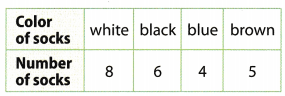
Use the table to find each ratio. _____________

Question 1.
white socks to brown socks Color _____________
Answer:
Write the ratio of white socks to brown socks in three different ways

part to part
8 : 5 , \(\frac{8}{5}\), 8 white socks to 5 brown socks
8 : 5 = Final solution

Grade 6 Math Module 7 Answer Key Question 2.
blue socks to non blue socks _____________
Answer:
The solution to this example is given below
Non blue socks = 8 + 6 + 5 = 19
Write the ratio of blue socks to non blue socks in three different ways

part to part
4 : 19, \(\frac{4}{9}\), 4 blue socks to 19 non blue socks
4 : 19 = Final Solution

Question 3.
black socks to all of the socks _____________
Answer:
Solution to this example is given below
All of the socks = 8 + 6 + 4 + 5 = 23
Write the ratio of black socks to alt of the socks in three different ways

part to part
6 : 23, \(\frac{6}{23}\) 6 black socks to 23 all of the socks
6 : 23 = Final solution

Question 4.
Find two ratios equivalent to the ratio in Exercise 1.
Answer:
There are 8 white socks and 5 brown socks so the ratio of white socks to brown socks is 8 : 5 which can be written
as \(\frac{8}{5}\) 2 equivalent ratios of this are \(\frac{8 \times 2}{5 \times 2}=\frac{16}{10}\) and \(\frac{8 \times 3}{5 \times 3}=\frac{24}{15}\)

7.2 Rates

Find each rate.

Question 5.
Earl runs 75 meters in 30 seconds. How many meters does Earl run per second? _____________
Answer:
Find the unit rate. How many meters Earl ran in a second

Divide to find the unit rate
\(\frac{75 \text { meters }}{30 \text { seconds }}=\frac{2.5 \text { meters }}{1 \text { second }}\)

Earl ran 2.5 meters per second
2.5 = Final solution

Ratio Quiz Grade 6 Pdf Answer Key Question 6.
The cost of 3 scarves is $26.25. What is the unit price? _____________
Answer:
Find the unit rate. What is the unit price?

Divide to find the unit rate
\(\frac{26.25 \text { dollars }}{3 \text { scarves }}=\frac{8.75 \text { dollars }}{1 \text { scarf }}\)

The cost of 1 scarf is 8.75 dollars
8.75 = Final solution

7.3 Using Ratios and Rates to Solve Problems

Question 7.
Danny charges $35 for 3 hours of swimming lessons. Martin charges $24 for 2 hours of swimming lessons. Who offers a better deal?
Answer:
Evaluate the cost of 1 hour of swimming. Danny charges $35 for 3 hours so \(\frac{\$ 35}{3}\) = $ 11.6 per hour while Martin charges $24 for 2 hours so \(\frac{\$ 24}{2}\) = $12 per hour. Since 12 > 11.6, Danny’s charges less so offers a better deal.

Danny offers a better deal.

Question 8.
There are 32 female performers in a dance recital. The ratio of men to women is 3:8. How many men are in the dance recital?
Answer:
Multiply the numerator and denominator by the \(\frac{4}{4}\).
\(\frac{3}{8}=\frac{3}{8} \cdot \frac{4}{4}=\frac{12}{32}\)
There are 12 men.

Essential Question

Question 9.
How can you use ratios and rates to solve problems?
Answer:
Ratios and rates are used to solve problems as they numerically define the relationship between the 2 quantities under consideration.

Texas Go Math Grade 6 Module 7 Mixed Review Texas Test Prep Answer Key

Selected Response

Ratio Quiz Grade 6 Pdf Module 7 Test Answers Question 1.
Which ratio is not equivalent to the other three?
(A) \(\frac{2}{3}\)
(B) \(\frac{6}{9}\)
(C) \(\frac{12}{15}\)
(D) \(\frac{18}{27}\)
Answer:
(C) \(\frac{12}{15}\)

Explaination:
It can be seen \(\frac{2}{3}=\frac{2 \times 3}{3 \times 3}=\frac{6}{9}\) and \(\frac{2}{3}=\frac{2 \times 9}{3 \times 9}=\frac{18}{27}\), so option C.

Question 2.
A lifeguard received 15 hours of first aid training and 10 hours of cardiopulmonary resuscitation (CPR) training. What is the ratio of hours of CPR training to hours of first aid training?
(A) 15:10
(B) 15:25
(C) 10:15
(D) 25:15
Answer:
(C) 10:15

Explaination:
The ratio of hours of CPR training to hours of first aid training is 10 : 15, therefore Option C.

Question 3.
Jerry bought 4 DVDs for $25.20. What was the unit rate?
(A) $3.15
(B) $4.20
(C) $6.30
(D) $8.40
Answer:
(C) $6.30

Explaination:
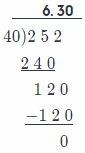
The divisor has one decimal place, so multiply both the dividend and the divisor by 10 so that the divisor is a whole number
4 × 10 = 40
25.20 × 10 = 252

Divide:
Texas Go Math Grade 6 Module 7 Quiz Answer Key 3

Ratios Quiz 6th Grade Module 7 Answer Key Question 4.
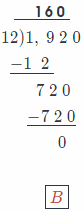
There are 1,920 fence posts used in a 12-kilometer stretch offence. How many fence posts are used in 1 kilometer offence?
(A) 150
(B) 160
(C) 155
(D) 180
Answer:
(B) 160

Explaination:
Solution to this example is given below
Texas Go Math Grade 6 Module 7 Quiz Answer Key 4
160 fence posts are used in 1 kilometer of fence.

Question 5.
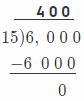
Sheila can ride her bicycle 6,000 meters in 15 minutes. How far can she ride her bicycle in 2 minutes?
(A) 400 meters
(B) 600 meters
(C) 800 meters
(D) 1 ,000 meters
Answer:
(C) 800 meters

Explaination:
Solution to this example is given below
Texas Go Math Grade 6 Module 7 Quiz Answer Key 5
So in 1 minute can ride 400 meters
Therefore in 2 minutes, she can travel a distance of 800 meters.

Question 6.
Lennon has a checking account. He withdrew $130 from an ATM Tuesday. Wednesday he deposited $240. Friday he wrote a check for $56. What was the total change in Lennon’s account?
(A) – $74
(B) $54
(C) $166
(D) $184
Answer:
(D) $184

Explaination:
First, he withdrew $130. So the change in the account is – $130.
After that, he deposited $240. So the change in the account is
– $130 + 240 = $110
And finally, he wrote a check for $56. So the total change in the account is
$240 + (- 56) = $ 184

Question 7.
Cheyenne is making a recipe that uses 5 cups of beans and 2 cups of carrots. Which combination below uses the same ratio of beans to carrots?
(A) 10 cups of beans and 3 cups of carrots
(B) 10 cups of beans and 4 cups of carrots
(C) 12 cups of beans and 4 cups of carrots
(D) 12 cups of beans and 5 cups of carrots
Answer:
(B) 10 cups of beans and 4 cups of carrots

Explaination:
The combination given in option B is according to the ratio of the recipe. Both items are increased by the same constant 2, that is are doubted.

Go Math 6th Grade Answer Key Module 7 Review Quiz Question 8.
\(\frac{5}{8}\) of the 64 musicians in a music contest are guitarists. Some of the guitarists play jazz solos, and the rest play classical solos. The ratio of the number of guitarists playing jazz solos to the total number of guitarists in the contest is 1:4. How many guitarists play classical solos in the contest?
(A) 10
(B) 20
(C) 30
(D) 40
Answer:
Multiply the numerator and denominator by \(\frac{8}{8}\):
\(\frac{5}{8}=\frac{5}{8} \cdot \frac{8}{8}=\frac{40}{64}\)
There are 40 guitarists.
Multiply the numerator and denominator by \(\frac{10}{10}\):
\(\frac{1}{4}=\frac{1}{4} \cdot \frac{10}{10}=\frac{10}{40}\)
10 guitarists play classical solos.

Gridded Response

Grade 6 Module 7 Quiz Answers Question 9.
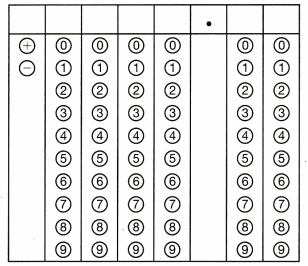
Mikaela is competing in a race in which she both runs and rides a bicycle. She runs 5 kilometers in 0.5 hours and rides her bicycle 20 kilometers in 0.8 hours. At this rate, how many kilometers can Mikaela ride her bicycle in one hour?
Texas Go Math Grade 6 Module 7 Quiz Answer Key 2
Answer:
She runs for 0.5 hour and bicycles for 0.8 hour.
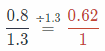
That is 1.3 hours in total. Let us find the unit rate of bicycling time to total time:
Texas Go Math Grade 6 Module 7 Quiz Answer Key 6
Now, find the unit rate of kilometers to time:
Texas Go Math Grade 6 Module 7 Quiz Answer Key 7
To find the solution, multiply this unit rate by \(\frac{0.62}{0.62}\).
\(\frac{25}{1}=\frac{25}{1} \cdot \frac{0.62}{0.62}=\frac{15.5}{0.62}\)
15.5 kilometers.

Texas Go Math Grade 6 Module 7 Quiz Answer Key Read More »

Texas Go Math Grade 6 Lesson 7.2 Answer Key Rates

Refer to our Texas Go Math Grade 6 Answer Key Pdf to score good marks in the exams. Test yourself by practicing the problems from Texas Go Math Grade 6 Lesson 7.2 Answer Key Rates.

Texas Go Math Grade 6 Lesson 7.2 Answer Key Rates

Reflect

Question 1.
Analyze Relationships Describe another method to compare the costs.
Answer:
The total cost can be divided by the total number of ounces. The result of this division will be the cost per ounce or cost of 1 ounce The greater this number, the more expensive the juice is.

Question 2.
Analyze Relationships In all of these problems, how is the unit rate related to the rate given in the original problem?
Answer:
Unit rate multiplied by the number of ounces equals to the given rate.

Your Turn

Go Math Grade 6 Lesson 7.2 Answer Key Question 3.
There are 156 players on 13 teams. How many players are on each team? ________ players per team
Answer:
In order to find how many players are in each team,
we have divide 156 by 13.
Texas Go Math Grade 6 Lesson 7.2 Answer Key Rates 5
12 players in each term

Question 4.
A package of 36 photographs costs $18. What is the cost per photograph? $ _______ per photograph
Answer:
To find the unit rate, divide the numerator and denominator by 2:
Texas Go Math Grade 6 Lesson 7.2 Answer Key Rates 6
The cost per photograph is $2.

Reflect

Question 5.
What If? Suppose each group has 12 campers and 3 canoes. Find the unit rate of campers to canoes.
Answer:
To find the unit rate, divide the numerator by 3:
 Texas Go Math Grade 6 Lesson 7.2 Answer Key Rates 7
= \(\frac{4}{1}\)

Question 6.
Petra jogs 3 miles in 27 minutes. At this rate, how long would it take her to jog 5 miles?
Answer:
To find the unit rate, divide the numerator and denominator by 3:
Texas Go Math Grade 6 Lesson 7.2 Answer Key Rates 88
Multiply the numerator and denominator by 5 to find the solution:
Texas Go Math Grade 6 Lesson 7.2 Answer Key Rates 9
It would take 45 minutes.

Go Math Grade 6 Chapter 7 Lesson 7.2 Answer Key Question 7.
When Jerry drives 100 miles on the highway, his car uses 4 gallons of gasoline. How much gasoline would his car use if he drove 275 miles on the highway?
Answer:
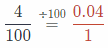
To find the unit rate, divide the numerator and denominator by 100:
 Texas Go Math Grade 6 Lesson 7.2 Answer Key Rates 10
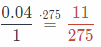
Multiply the numerator and denominator by 5 to find the solution:
 Texas Go Math Grade 6 Lesson 7.2 Answer Key Rates 11
It would use 11 gallons of gasoline.

Texas Go Math Grade 6 Lesson 7.2 Guided Practice Answer Key

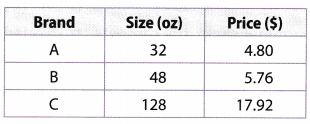
The sizes and prices of three brands of laundry detergent are shown in the table. Use the table for 1 and 2.

Texas Go Math Grade 6 Lesson 7.2 Answer Key Rates 1

Question 1.
What is the unit price for each detergent?
Brand A: $ ________________ per ounce
Brand B: $ ________________ per ounce
Brand C: $ ________________ per ounce
Answer:
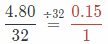
A: To find the unit rate, divide the numerator and denominator by 32:
 Texas Go Math Grade 6 Lesson 7.2 Answer Key Rates 12
$ 0.15 per ounce.

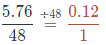
B: To find the unit rate, divide the numerator and denominator by 48:
 Texas Go Math Grade 6 Lesson 7.2 Answer Key Rates 13
$ 0.12 per ounce.

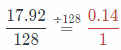
C: To find the unit rate, divide the numerator and denominator by 48:
 Texas Go Math Grade 6 Lesson 7.2 Answer Key Rates 14
$ 0.14 per ounce.

Question 2.
Which detergent is the best buy? ________________
Answer:
Brand B. (lowest price per ounce)

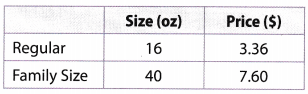
Mason’s favorite brand of peanut butter is available in two sizes. Each size and its price are shown in the table. Use the table for 3 and 4.

Texas Go Math Grade 6 Lesson 7.2 Answer Key Rates 2

Lesson 7.2 Answer Key Go Math Grade 6 Question 3.
What is the unit rate for each size of peanut butter?
Regular: $ _________________ per ounce
Family size: $ _________________ per ounce
Answer:
Form the rate fraction by using the given data, therefore:
Rate = \(\frac{\text { Cost }}{\text { Quantity }}\)
Substitute values for Regular:
Rate = \(\frac{3.36}{16}\) = 0.21
This implies that the unit rate for regular size peanut butter is $0.21 per ounce.

Form the rate fraction by using the given data, therefore:
Rate = \(\frac{\text { Cost }}{\text { Quantity }}\)
Substitute values for Regular:
Rate = \(\frac{7.6}{40}\) = 0.19
This implies that the unit rate for regular size peanut butter is $0.19 per ounce.

Question 4.
Which size is the better buy?
Answer:
0.21 > 0.19 implies that the family size is a better buy because it costs lesser per ounce than the regular size one.

Find the unit rate. (Example 1)

Question 5.
Lisa walked 48 blocks in 3 hours. _____________ blocks per hour
Answer:
Find the unit rate. How many blocks Lisa passes in an hour

Divide to find the unit rate
\(\frac{48 \text { blocks }}{3 \text { hours }}=\frac{16 \text { blocks }}{1 \text { hours }}\)

Liza passes 16 blocks in an hour
Final solution = 16

Question 6.
Gordon types 1,800 words in 25 minutes. _____________ words per minute
Answer:
Find the unit rate. How many words he types per minute

Divide to find the unit rate
\(\frac{1800 \text { words }}{25 \text { minutes }}=\frac{72 \text { words }}{1 \text { minute }}\)

Gordon types 72 words per minute.
Final solution = 72

Solve.

Lesson 7.2 Go Math Answer Key Grade 6 Question 7.
A particular frozen yogurt has 75 calories in 2 ounces. How many calories are in 8 ounces of yogurt?
Answer:
Find the unit rate. How many calories are in one ounce

Divide to find the unit rate
\(\frac{75 \text { calories }}{2 \text { ounces }}=\frac{37.5 \text { calories }}{1 \text { ounce }}\)

Yogurt has 37.5 calories in 1 ounce
37.5 calories × 8 ounces = 300 calories

In yogurt there are 300 calories
Final Solution = 300

Question 8.
The cost of 10 oranges is $1.00. What is the cost of 5 dozen oranges?
Answer:
Form the rate fraction by using the given data. therefore:
Rate = \(\frac{\text { Calories }}{\text { Ounces }}\)
Substitute values:
Rate = \(\frac{1}{10}\) = 0.1
Unit rate is equal to $0.1 per orange.

5 dozens of oranges are 5 × 12 = 60. Therefore Go oranges will cost 60 × $0.1 = $6.
5 dozens of oranges will cost $6.

Question 9.
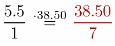
On Tuesday, Donovan earned $11 for 2 hours of babysitting. On Saturday, he babysat for the same family and earned $38.50. How many hours did he babysit on Saturday?
Answer:
To find the unit rate, divide the numerator and denominator by 2:
 Texas Go Math Grade 6 Lesson 7.2 Answer Key Rates 15
For every hour lie earns 5.5$. Multiply the numerator and denominator by 7 to find the solution:
 Texas Go Math Grade 6 Lesson 7.2 Answer Key Rates 16
He babysat 7 hours on Saturday.

Essential Question Check-In

Question 10.
How can you use a rate to compare the costs of two boxes of cereal that are different sizes?
Answer:
Divide the cost of the cereal box with the total amount of cereal in the box for both boxes. This will give the cost per amount. The larger this number, the more expensive the cereal box is with respect to its content.

Practice and Homework Lesson 7.2 Answer Key 6th Grade Question 11.
Abby can buy an 8-pound bag of dog food for $7.40 or a 4-pound bag of the same dog food for $5.38. Which is the better buy?
Answer:
Evaluate the unit rate of each bag. Therefore the 8 pounds bags costs \(\frac{\$ 7.40}{8}\) = $ 0.925 per pound, while the 4 pounds bags costs = \(\frac{\$ 5.38}{4}\) = $1 .345 per pound. Since 1.315 > 0.925. the 8 pounds bag is a better buy because it costs lesser per pound.

8 pound bag is a better buy.

Question 12.
A bakery offers a sale price of $3.50 for 4 muffins. What is the price per dozen?
Answer:
To find the unit rate, divide the numerator and denominator by 4:
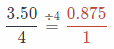
 Texas Go Math Grade 6 Lesson 7.2 Answer Key Rates 17
The cost per muffin is = $ 0.875 .
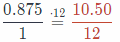
Multiply the numerator and denominator by 12 to find the solution:
 Texas Go Math Grade 6 Lesson 7.2 Answer Key Rates 18

The cost per dozen is $ 10.50

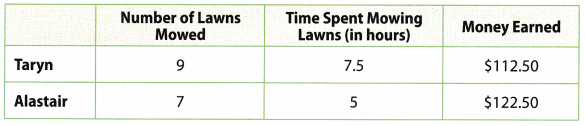
Taryn and Alastair both mow lawns. Each charges a flat fee to mow a lawn. The table shows the number of lawns mowed in the past week, the time spent mowing lawns, and the money earned.

Texas Go Math Grade 6 Lesson 7.2 Answer Key Rates 3

Question 13.
How much does Taryn charge to mow a lawn?
Answer:
Find the unit rate. How much does Taryn charge for lawn?

Divide to find the unit rate
\(\frac{112.5 \text { dollars }}{9 \text { lawns }}=\frac{12.5 \text { dollars }}{1 \text { lawn }}\)

Tarny charges 12.5 dollars for lawn
Final solution = 12.5

Question 14.
How much does Alastair charge to mow a lawn?
Answer:
Find the unit rate. How much does Alastair charge for the lawn?

Divide to find the unit rate
\(\frac{122.5 \text { dollars }}{7 \text { lawns }}=\frac{17.5 \text { dollars }}{1 \text { lawn }}\)

Alastair charges 17.5 dollars for lawn
final solution = 17.5

Question 15.
Who earns more per hour, Taryn or Alastair?
Answer:
Alastair earns more per hour. It can be seen that he has earned $ 122.5 > $ 112.5 after moving for 5 hours then Taryn earned after working for 7.5 hours.

Question 16.
What If? If Taryn and Alastair want to earn an additional $735 each, how many additional hours will each spend mowing lawns? Explain.
Answer:
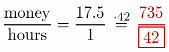
Alastair earns 17.5 per hour. Multiply the denominator and numerator by 42 to find the solution: $:
 Texas Go Math Grade 6 Lesson 7.2 Answer Key Rates 19
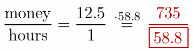
Taryn earns $12.5 per hour. Multiply the denominator 58.8 to find the solution: $:
Texas Go Math Grade 6 Lesson 7.2 Answer Key Rates 20

Alastair: 42 hours
Taryn: 58.8 hours

Question 17.
Multistep Tomas makes balloon sculptures at a circus. In 180 minutes, he uses 252 balloons to make 36 identical balloon sculptures.
a. How many minutes does it take to make 1 balloon sculpture?
Answer:
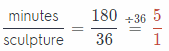
To find the unit rate, divide the numerator and denominator by 36:
Texas Go Math Grade 6 Lesson 7.2 Answer Key Rates 21
It takes 5 minutes.

b. How many balloons are used in one balloon sculpture?
Answer:
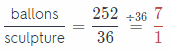
To find the unit rate, divide the numerator and denominator by 36:
Texas Go Math Grade 6 Lesson 7.2 Answer Key Rates 22
7 ballons.

c. What is Tomas’s unit rate for balloons used per minute?
Answer:
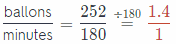
To find the unit rate, divide the numerator and denominator by 180:
Texas Go Math Grade 6 Lesson 7.2 Answer Key Rates 23

Go Math Grade 6 Pdf Lesson 7.2 Answer Key Question 18.
Quan and Krystal earned the same number of points playing the same video game. Quan played for 45 minutes and Krystal played for 30 minutes. Whose rate of points earned per minute was higher? Explain.
Answer:
Krystal’s rate of points earned per minute is higher. Number of points divided by 30 minutes will give higher rate then divided by 45 minutes.

For example, let number of points equals to 90.
Krystal’s rate of points:
\(\frac{90}{30}=\frac{3}{1}\)
Quan’s rate of points:
\(\frac{90}{45}=\frac{2}{1}\)

Mrs. Jacobsen is a music teacher. She wants to order toy instruments online to give as prizes to her students. The table below shows the prices for various order sizes.

Texas Go Math Grade 6 Lesson 7.2 Answer Key Rates 4

Question 19.
What is the highest unit price per kazoo?
Answer:
25 items:
To find the unit rate, divide the numerator and denominator by 25:
Texas Go Math Grade 6 Lesson 7.2 Answer Key Rates 24
The cost per item is $ 0.4

50 items:
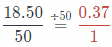
To find the unit rate, divide the numerator and denominator by 50:
Texas Go Math Grade 6 Lesson 7.2 Answer Key Rates 25
The cost per item is $ 0.37

80 items:
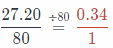
To find the unit rate, divide the numerator and denominator by 80:
Texas Go Math Grade 6 Lesson 7.2 Answer Key Rates 26
The cost per item is $ 0.34

The highest price is $ 0.4

Question 20.
Persevere in Problem Solving If Mrs. Jacobsen wants to buy the item with the lowest unit price, what item should she order and how many of that item should she order?
Answer:
She Should order 80 kazoos.

H.O.T. Focus On Higher Order Thinking

Question 21.
Draw Conclusions There are 2.54 centimeters in 1 inch. How many centimeters are there in 1 foot? in 1 yard? Explain your reasoning.
Answer:
There are 254 centimeters in 1 inch, and there are 12 inches in 1 foot, so there are 2.54 × 12 = 30.48 centimeters in 1 foot.

There are 30.48 centimeters in 1 foot and there are 3 feet in a yard, so there are 3 × 30.48 = 91.44 centimeters in 1 yard.

Grade 6 Go Math Answer Key Lesson 7.2 Question 22.
Critique Reasoning A 2 pound box of spaghetti costs $2.50. Philip says that the unit cost is \(\frac{2}{2.50}\) = $0.80 per pound. Explain his error.
Answer:
He has divided the total pounds with the total price giving pounds of spaghetti per dollar instead of unit cost. The correct rate is \(\frac{2.5}{2}\) = $ 1 .25 per pound.

He divided the total pounds with the total price.

Question 23.
Look for a Pattern A grocery store sells three different quantities of sugar. A 1-pound bag costs $1.10, a 2-pound bag costs $1.98, and a 3-pound bag costs $2.85. Describe how the unit cost changes as the quantity of sugar increases.
Answer:
Evaluate the unit price of each packing Therefore:
Cost of 1 pound in the 1 pound bag \(\frac{\$ 1.10}{1}\) = $ 1.10
Cost of 1 pound in the 2 pounds bag \(\frac{\$ 1.98}{2}\) = $ 0.99
Cost of 1 pound in the 3 pounds bag \(\frac{\$ 2.85}{3}\) = $ 0.95
It can be seen as the size of the packing increases, the unit cost decreases.

Texas Go Math Grade 6 Lesson 7.2 Answer Key Rates Read More »

Texas Go Math Grade 6 Module 9 Answer Key Percents

Refer to our Texas Go Math Grade 6 Answer Key Pdf to score good marks in the exams. Test yourself by practicing the problems from Texas Go Math Grade 6 Module 9 Answer Key Percents.

Texas Go Math Grade 6 Module 9 Answer Key Percents

Texas Go Math Grade 6 Module 9 Are You Ready? Answer Key

Write the equivalent fraction.

Question 1.
Texas Go Math Grade 6 Module 9 Answer Key Percents 1
Answer:
Solution to this example is given below
\(\frac{9}{18}=\frac{9 \div 3}{18 \div 3}\) = (Divide the numerator and denominator by the same)
= \(\frac{3}{6}\) (number to find an equivalent fraction.)
Final solution = \(\frac{3}{6}\)

Question 2.
Texas Go Math Grade 6 Module 9 Answer Key Percents 2
Answer:
Solution to this example is given below
\(\frac{4}{6}=\frac{4 \times 3}{6 \times 3}\) = (Multiply the numerator and denominator by the same)
= \(\frac{12}{18}\) (number to find an equivalent fraction.)
Final solution = \(\frac{12}{18}\)

Question 3.
Texas Go Math Grade 6 Module 9 Answer Key Percents 3
Answer:
The solution to this example is given below
\(\frac{25}{30}=\frac{25 \div 5}{30 \div 5}\) = (Divide the numerator and denominator by the same)
= \(\frac{5}{6}\) (number to find an equivalent fraction.)
Final solution = \(\frac{5}{6}\)

Go Math Grade 6 Module 9 Answer Key Question 4.
Texas Go Math Grade 6 Module 9 Answer Key Percents 4
Answer:
Solution to this example is given below
\(\frac{12}{15}=\frac{12 \times 3}{15 \times 3}\) = (Multiply the numerator and denominator by the same)
= \(\frac{36}{45}\) (number to find an equivalent fraction.)
Final solution = \(\frac{36}{45}\)

Question 5.
Texas Go Math Grade 6 Module 9 Answer Key Percents 5
Answer:
Solution to this example is given below
\(\frac{15}{24}=\frac{15 \div 3}{24 \div 3}\) = (Divide the numerator and denominator by the same)
= \(\frac{5}{8}\) (number to find an equivalent fraction.)
Final solution = \(\frac{5}{8}\)

Question 6.
Texas Go Math Grade 6 Module 9 Answer Key Percents 6
Answer:
Solution to this example is given below
\(\frac{24}{32}=\frac{24 \div 4}{32 \div 4}\) = (Divide the numerator and denominator by the same)
= \(\frac{6}{8}\) (number to find an equivalent fraction.)
Final solution = \(\frac{6}{8}\)

Question 7.
Texas Go Math Grade 6 Module 9 Answer Key Percents 7
Answer:
Solution to this example is given below
\(\frac{50}{60}=\frac{50 \div 5}{60 \div 5}\) = (Divide the numerator and denominator by the same)
= \(\frac{10}{12}\) (number to find an equivalent fraction.)
Final solution = \(\frac{10}{12}\)

Question 8.
Texas Go Math Grade 6 Module 9 Answer Key Percents 8
Answer:
Solution to this example is given below
\(\frac{5}{9}=\frac{5 \times 4}{9 \times 4}\) = (Divide the numerator and denominator by the same)
= \(\frac{20}{36}\) (number to find an equivalent fraction.)
Final solution = \(\frac{20}{36}\)

Multiply. Write each product in simplest form.

Question 9.
\(\frac{3}{8} \times \frac{4}{11}\) = _____________
Answer:
Write the problem as a single fraction
\(\frac{3 \times 4}{8 \times 11}\)
\(\frac{12}{88}\) (Multiply numerators, Multiply denominators.)
\(\frac{12 \div 4}{88 \div 4}\) (Simplify by dividing by the GCF.)
\(\frac{3}{22}\) (Write the answer in simplest form.)

Question 10.
\(\frac{8}{15} \times \frac{5}{6}\) = _____________
Answer:
Write the problem as a single fraction
\(\frac{8 \times 5}{15 \times 6}\)
\(\frac{40}{90}\) (Multiply numerators, Multiply denominators.)
\(\frac{40 \div 10}{90 \div 10}\) (Simplify by dividing by the GCF.)
\(\frac{4}{9}\) (Write the answer in simplest form.)

Question 11.
\(\frac{7}{12} \times \frac{3}{14}\) = _____________
Answer:
Write the problem as a single fraction
\(\frac{7 \times 3}{12 \times 14}\)
\(\frac{21}{168}\) (Multiply numerators, Multiply denominators.)
\(\frac{21 \div 21}{168 \div 21}\) (Simplify by dividing by the GCF.)
\(\frac{1}{8}\) (Write the answer in simplest form.)

Question 12.
\(\frac{9}{20} \times \frac{4}{5}\) = _____________
Answer:
Write the problem as a single fraction
\(\frac{9 \times 4}{20 \times 5}\)
\(\frac{36}{100}\) (Multiply numerators, Multiply denominators.)
\(\frac{36 \div 4}{100 \div 4}\) (Simplify by dividing by the GCF.)
\(\frac{9}{25}\) (Write the answer in simplest form.)

Module 9 Answer Key Go Math Grade 6 Question 13.
\(\frac{7}{10} \times \frac{20}{21}\) = _____________
Answer:
Given expression:
\(\frac{7}{10} \times \frac{20}{21}\)

Simplify, dividing out the common factor:
= \(\frac{1}{1} \times \frac{2}{3}\)
Evaluate:
= \(\frac{2}{3}\)
\(\frac{7}{10} \times \frac{20}{21}\) = \(\frac{2}{3}\)

Question 14.
\(\frac{8}{18} \times \frac{9}{20}\) = _____________
Answer:
Write the problem as a single fraction
\(\frac{8 \times 9}{18 \times 20}\)
\(\frac{72}{360}\) (Multiply numerators. Multiply denominators.)
\(\frac{72 \div 72}{360 \div 72}\) (Simplify by dividing by the GCF.)
\(\frac{1}{5}\) (Write the answer in simplest form.)

Multiply.

Question 15.
20 × 0.25 ___________
Answer:
Solution to this example is given below
Texas Go Math Grade 6 Module 9 Answer Key Percents 11

Question 16.
0.3 × 16.99 ________
Answer:
Solution to this example is given below
Texas Go Math Grade 6 Module 9 Answer Key Percents 12

Question 17.
0.2 × 75 __________
Answer:
Solution to this example is given below
Texas Go Math Grade 6 Module 9 Answer Key Percents 13

Question 18.
5.5 × 1.1 __________
Answer:
Solution to this example is given below
Texas Go Math Grade 6 Module 9 Answer Key Percents 14

Question 19.
11.99 × 0.8 ________
Answer:
Solution to this example is given below
Texas Go Math Grade 6 Module 9 Answer Key Percents 15

Question 20.
7.25 × 0.5 _________
Answer:
Solution to this example is given below
Texas Go Math Grade 6 Module 9 Answer Key Percents 16

Question 21.
4 × 0.75 ___________
Answer:
Solution to this example is given below
Texas Go Math Grade 6 Module 9 Answer Key Percents 17

Question 22.
0.15 × 12.50 _________
Answer:
Solution to this example is given below
Texas Go Math Grade 6 Module 9 Answer Key Percents 18

Question 23.
6.5 × 0.7 __________
Answer:
Solution to this example is given below
Texas Go Math Grade 6 Module 9 Answer Key Percents 19

Texas Go Math Grade 6 Module 9 Reading Start-Up Answer Key

Visualize Vocabulary

Use the ✓ words to complete the graphic. You may put more than one word in each box.

Texas Go Math Grade 6 Module 9 Answer Key Percents 9

Understand Vocabulary

Match the term on the left to the correct expression on the right.

Texas Go Math Grade 6 Module 9 Answer Key Percents 10
Answer:

  1.  – A
  2.  – C
  3.  – B

Texas Go Math Grade 6 Module 9 Answer Key Percents Read More »

Texas Go Math Grade 6 Lesson 9.3 Answer Key Solving Percent Problems

Refer to our Texas Go Math Grade 6 Answer Key Pdf to score good marks in the exams. Test yourself by practicing the problems from Texas Go Math Grade 6 Lesson 9.3 Answer Key Solving Percent Problems.

Texas Go Math Grade 6 Lesson 9.3 Answer Key Solving Percent Problems

Reflect

Question 1.
Justify Reasoning How did you determine the labels along the bottom of the bar model in Step D?
Answer:
Study the interval difference between 2 successive labels in the bottom label. Here it is 80 – 40 = 40 – 0 = 40.
This suggests that each unit represents 40 units so the next label after the 80 label is therefore 80 + 40 = 120 and so on.

Question 2.
Communicate Mathematical Ideas How can you use the bar model to find the number of left-handed gloves?
Answer:
Here 10% of gloves imply 40 gloves, so 30% would imply 40 × 3 = 120 gloves. This means that there are 120 left-handed gloves in the shipment.

Percent Problems 6th Grade Lesson 9.3 Answer Key Question 3.
Analyze Relationships In B, the percent is 35%. What is the part and what is the whole?
Answer:
The expression says: 35% of 60 so here 60 is the whole and 35% of 60 = \(\frac{35}{100}\) × 60 = 21 is the portion of it.

60 is whole and 21 is 35% of 60.

Question 4.
Communicate Mathematical Ideas Explain how to use proportional reasoning to find 35% of 600.
Answer:
Multiply by a fraction to find 35 % of 600

Write the percent as a fraction.
35% of 600 = \(\frac{35}{100}\) of 600

Multiply
\(\frac{35}{100}\) of 600 = \(\frac{35}{100}\) × 600
= \(\frac{21000}{100}\)
= 210

Final solution = 210
35% of 600 is 210

Your Turn

Find the percent of each number.

Question 5.
38% of 50 _____________
Answer:
Multiply by a fraction to find 38 % of 50

Write the percent as a fraction.
38% of 50 = \(\frac{38}{100}\) of 50

Multiply
\(\frac{38}{100}\) of 50 = \(\frac{38}{100}\) × 50
= \(\frac{1900}{100}\)
= 19

Final solution = 19
38% of 50 is 19

Go Math Grade 6 Practice and Homework Lesson 9.3 Answer Key Question 6.
27% of 300 ____________
Answer:
Multiply by a fraction to find 27 % of 300

Write the percent as a fraction.
27% of 300 = \(\frac{27}{100}\) of 300

Multiply
\(\frac{27}{100}\) of 300 = \(\frac{27}{100}\) × 300
= \(\frac{8100}{100}\)
= 81

Final solution = 81
27% of 300 is 81

Question 7.
60% of 75 ____________
Answer:
Multiply by a fraction to find 60 % of 72

Write the percent as a fraction.
60% of 75 = \(\frac{60}{100}\) of 75

Multiply
\(\frac{60}{100}\) of 75 = \(\frac{60}{100}\) × 75
= \(\frac{4500}{100}\)
= 45

Final solution = 45
60% of 75 is 45

Reflect

Question 8.
Communicate Mathematical Ideas Write 57% as a ratio. Which number in the ratio represents the part and which number represents the whole? Explain.
Answer:
57% when written as an equivalent fraction is \(\frac{57}{100}\) or 57 : 100 as a rati0. Here 100 is the whole and 57 is the portion.

Your Turn

Question 9.
Out of the 25 students in Mrs. Green’s class, 19 have a pet. What percent of the students in Mrs. Green’s class have a pet? ______________
Answer:
There are a total of 25 students in the class out of which 19 have pets, so the fraction of students who have pets is \(\frac{19}{25}\).
Multiply this fraction with 100% to convert to an equivalent percentage, therefore: \(\frac{19}{25}\) × 100% = 76%.

76% of the students in Mrs. Green’s class have a pet.

Reflect

Go Math 9.3 Answer Key Lesson 9.3 Homework Answers Question 10.
Multiple Representations Sixteen students in the school band play clarinet. Clarinet players make up 20% of the band. Use a bar model to find the number of students in the school band.
Texas Go Math Grade 6 Lesson 9.3 Answer Key Solving Percent Problems 1
Answer:
Texas Go Math Grade 6 Lesson 9.3 Answer Key Solving Percent Problems 8

20% of the number of students is 16.
Divide this number by 2 to find the 10%
10% is equal to 8.

Your Turn

Question 11.
6 is 30% of __________.
Answer:
let the total number here be x, then the equation of its portion is therefore:
30% of x = 6

Convert the given expression to an algebraic expression by replacing the percentage sign with × \(\frac{1}{100}\) and the word of with ×, so the expression becomes:
30 × \(\frac{1}{100}\) × x = 6
Solve for x:
x = \(\frac{6}{0.3}\)
Evaluate:
x = 20

6 is 30% of 20

Question 12.
15% of ___________ is 75.
Answer:
let the total number here be x, then the equation of its portion is therefore:
15% of x = 75

Convert the given expression to an algebraic expression by replacing the percentage sign with × \(\frac{1}{100}\) and the word of with ×, so the expression becomes:
15 × \(\frac{1}{100}\) × x = 75
Solve for x:
x = \(\frac{75}{0.15}\)
Evaluate:
x = 500

75 is 15% of 500.

Texas Go Math Grade 6 lesson 9.3 Guided Practice Answer Key

Question 1.
A store has 300 televisions on order, and 80% are high definition.

a. Use the bar model and complete the bottom of the bar.
Texas Go Math Grade 6 Lesson 9.3 Answer Key Solving Percent Problems 2
Answer:
Texas Go Math Grade 6 Lesson 9.3 Answer Key Solving Percent Problems 9

b. Complete the diagram to model this situation.
Texas Go Math Grade 6 Lesson 9.3 Answer Key Solving Percent Problems 3
Answer:
Texas Go Math Grade 6 Lesson 9.3 Answer Key Solving Percent Problems 10

C. How many televisions on the order are high definition?
Answer:
We can see that 80% of 300 is equal to 240

Lesson 9.3 Answer Key 6th Grade Go Math Question 2.
Use proportional reasoning to find 65% of 200.
Texas Go Math Grade 6 Lesson 9.3 Answer Key Solving Percent Problems 4
Answer:
Multiply by a fraction to find 65 % of 200

Write the percent as a fraction
65% of 200 = \(\frac{65}{100}\) of 200

Multiply
\(\frac{65}{100}\) of 200 = \(\frac{65}{100}\) × 200
= \(\frac{13000}{100}\)
= 130

Final solution = 130
65% of 200 is 130

Question 3.
Use multiplication to find 5% of 180
Texas Go Math Grade 6 Lesson 9.3 Answer Key Solving Percent Problems 5
5% of 180 is ___________ .
Answer:
Multiply by a fraction to find 5 % of 180

Write the percent as a fraction
5% of 180 = \(\frac{5}{100}\) of 180

Multiply
\(\frac{5}{100}\) of 180 = \(\frac{5}{100}\) × 180
= \(\frac{900}{100}\)
= 9

Final solution = 9
5% of 180 is 9

Question 4.
Ala na spent $21 of her $300 paycheck on a gift. What percent of her paycheck was spent on the gift? (Example 2)

Alana spent _____ of her paycheck on the gift.
Answer:
\(\frac{\text { gift }}{\text { paycheck }}=\frac{21}{300}=\frac{x}{100}\)
100 is a common denominator:
\(\frac{21}{300} \div \frac{3}{3}=\frac{x}{100}\)
\(\frac{7}{100}=\frac{x}{100}\)
⇒ x = 7 ⇒ 7%

Question 5.
At Pizza Pi, 9% of the pizzas made last week had extra cheese. If 27 pizzas had extra cheese, how many pizzas in all were made last week? ExampIe 3)

There were ______ pizzas made last week.
Answer:
\(\frac{\text { extra cheese }}{\text { pizza }}=\frac{9}{100}=\frac{27}{x}\)
127 is a common numerator:
\(\frac{9}{100} \cdot \frac{3}{3}=\frac{27}{x}\)
\(\frac{27}{300}=\frac{27}{x}\)
⇒ x = 300

Essential Question Check-In

Question 6.
How can you use proportional reasoning to solve problems involving percent?
Answer:
Proportional reasoning to solve problems involving percent by converting the given percentage to an equivalent fraction and equating it with the given fraction of \(\frac{\text { Portion }}{\text { Whole }}\)

Find the percent of each number.

Question 7.
64% of 75 tiles
Answer:
Multiply by a fraction to find 64 % of 75

Write the percent as a fraction
64% of 75 = \(\frac{64}{100}\) of 75

Multiply
\(\frac{64}{100}\) of 75 = \(\frac{64}{100}\) × 75
= \(\frac{4800}{100}\)
= 48

Final solution = 48
64% of 75 is 48 tiles

Go Math Grade 6 Lesson 9.3 Answer Key Question 8.
20% of 70 plants
Answer:
Multiply by a fraction to find 20 % of 70 plants

Write the percent as a fraction
20% of 70 = \(\frac{20}{100}\) of 70

Multiply
\(\frac{20}{100}\) of 70 = \(\frac{20}{100}\) × 70
= \(\frac{1400}{100}\)
= 14

Final solution = 14
20% of 70 is 14 plants

Question 9.
32% of 25 pages
Answer:
Multiply by a fraction to find 32 % of 25 pages

Write the percent as a fraction
32% of 25 = \(\frac{32}{100}\) of 25

Multiply
\(\frac{32}{100}\) of 25 = \(\frac{32}{100}\) × 75
= \(\frac{800}{100}\)
= 8

Final solution = 8
32% of 25 is 8 pages.

Question 10.
85% of 40 e-mails
Answer:
Multiply by a fraction to find 85% of 40 e-mails

Write the percent as a fraction
85% of 40 = \(\frac{85}{100}\) of 40

Multiply
\(\frac{85}{100}\) of 40 = \(\frac{85}{100}\) × 40
= \(\frac{3400}{100}\)
= 34

Final solution = 34
85% of 40 is 34 e-mails

Question 11.
72% of 350 friends
Answer:
Multiply by a fraction to find 72% of 350 friends

Write the percent as a fraction
72% of 350 = \(\frac{72}{100}\) of 350

Multiply
\(\frac{72}{100}\) of 350 = \(\frac{72}{100}\) × 350
= \(\frac{25200}{100}\)
= 252

Final solution = 252
72% of 350 is 252 friends

Question 12.
5% of 220 files
Answer:
Multiply by a fraction to find 5% of 220 friends

Write the percent as a fraction
5% of 220 = \(\frac{5}{100}\) of 220

Multiply
\(\frac{5}{100}\) of 220 = \(\frac{5}{100}\) × 220
= \(\frac{1100}{11}\)
= 11

Final solution = 11
5% of 350 is 220 is 11 files.

Complete each sentence.

Practice and Homework Lesson 9.3 Answer Key 4th Grade Question 13.
4 students is ______ % of 20 students.
Answer:
Multiply by a fraction to find 4 students is ? of 20 students

Multiply
Percent = \(\frac{4}{20}\) × 100%
= \(\frac{400}{20}\)
= 20%

Final Solution = 20%
4 students is 20% of 20 students

Question 14.
2 doctors is ______ % of 25 doctors.
Answer:
Multiply by a fraction to find 2 doctors is ? of 25 doctors

Multiply
Percent = \(\frac{2}{25}\) × 100%
= \(\frac{200}{25}\)
= 8%

Final Solution = 8%
2 doctors is 8% of 25 doctors.

Question 15.
_______ % of 50 shirts is 35 shirts.
Answer:
Multiply by a fraction to find ? % of 50 shirts is 35 shirts

Multiply
Percent = \(\frac{35}{50}\) × 100%
= \(\frac{3500}{50}\)
= 70%

Final Solution = 70%
70% of 50 shirts is 35 shirts

Question 16.
______ % of 200 miles is 150 miles.
Answer:
Multiply by a fraction to find ? % of 200 miles is 150 miles

Multiply
Percent = \(\frac{150}{200}\) × 100%
= \(\frac{15000}{200}\)
= 75%

Final Solution = 75%
75% of 200 miles is 150 miles

Question 17.
4% of ______ days is 56 days.
Answer:
Multiply by a fraction to find 4 % of ? days is 56 days

Multiply
Percent = \(\frac{56}{4}\) × 100%
= \(\frac{56000}{4}\)
= 1400

Final Solution = 1400
4% of 1400 days is 56 days.

Question 18.
60 minutes is 20% of ______ minutes.
Answer:
Multiply by a fraction to find 60 minutes is 20% of ? minutes.

Multiply
Percent = \(\frac{60}{20}\) × 100%
= \(\frac{6000}{20}\)
= 300

Final Solution = 300
60 minutes is 20% of 300 minutes.

Go Math 6th Grade Practice and Homework Lesson 9.3 Question 19.
80% of ______ games is 32 games.
Answer:
Multiply by a fraction to find 80% of ? games is 32 games

Multiply
Percent = \(\frac{32}{80}\) × 100%
= \(\frac{3200}{80}\)
= 40

Final Solution = 40
80% of 40 games is 32 games

Question 20.
360 kilometers is 24% of ______ kilometers.
Answer:
Multiply by a fraction to find 360 kilometers is 24% of ? kilometers.

Multiply
Percent = \(\frac{360}{24}\) × 100%
= \(\frac{36000}{24}\)
= 1500

Final Solution = 1500
360 kilometers is 24% of 1500 kilometers

Question 21.
75% of ______ peaches is 15 peaches.
Answer:
Multiply by a fraction to find 75% of ? peaches is 15 peaches.

Multiply
Percent = \(\frac{15}{75}\) × 100%
= \(\frac{1500}{75}\)
= 20

Final Solution = 2
75% of 20 peaches is 15 peaches

Question 22.
9 stores is 3% of ______ stores.
Answer:
Multiply by a fraction to find 9 stores is 3 % of ? stores

Multiply
Percent = \(\frac{9}{3}\) × 100%
= \(\frac{900}{3}\)
= 300

Final Solution = 300
9 stores is 3% of 300 stores

Question 23.
At a shelter, 15% of the dogs are puppies.
There are 60 dogs at the shelter.

How many are puppies? _______ puppies
Answer:
Multiply by a fraction to find 15 % of 60
Write the percent as a fraction.
15% of 60 = \(\frac{15}{100}\) of 60

Multiply
\(\frac{15}{100}\) of 60 = \(\frac{15}{100}\) × 60
= \(\frac{900}{100}\)
= 9

Final solution = 9
15% of 60 is 9 puppies

Question 24.
Carl has 200 songs on his MP3 player. Of these songs, 24 are country songs. What percent of Carl’s songs are country songs? ______
Answer:
Multiply by a fraction to find ? % of 200 songs is 24 country songs

Multiply
Percent = \(\frac{24}{100}\) × 100%
= \(\frac{2400}{200}\)
= 12%

Final Solution = 12%
12% of 200 songs is 24 country songs

Question 25.
Consumer Math The sales tax in the town where Amanda lives is 7%. Amanda paid $35 in sales tax on a new stereo. What was the price of the stereo? ______
Answer:
Multiply by a fraction to find 7 % is 35 of × dollars

Write the percent as a fraction.
7% = \(\frac{35}{x}\) × 100

Multiply
x = \(\frac{35}{7}\) × 100%
= \(\frac{3500}{100}\)
= 500

Final Solution = 500
7 % is 35 dollars of 500 dollars

The price of the stereo was 500 dollars

Question 26.
Financial literacy Ashton is saving money to buy a new bike. He needs $120 but has only saved 60% so far. How much more money does Ashton need to buy the scooter?
Answer:
Portion = x
Total = 120
Percent = 60

Write equation of percentage:

Percent = \(\frac{\text { Portion }}{\text { Total }}\) × 100%

Substitute values:
60% = \(\frac{x}{120}\) × 100%

Solve for x:
x = \(\frac{120 \times 60 \%}{100 \%}\)

Evaluate:
x = 72
He has saved $72 so he needs 120 – 72 = $ 48 more.

Ashton needs $48 more to buy the scooter.

Question 27.
Consumer Math Monica paid sales tax of $1.50 when she bought a new bike helmet. If the sales tax rate was 5%, how much did the store charge for the helmet before tax? ______
Answer:
Portion = 1.5
Total = x
Percent = 5

Write equation of percentage:

Percent = \(\frac{\text { Portion }}{\text { Total }}\) × 100%

Substitute values:
5% = \(\frac{1.5}{x}\) × 100%

Solve for x:
x = \(\frac{1.5 \times 100 \%}{5 \%}\)

Evaluate:
x = 30
The store charged $30 for the helmet before tax.
Ashton needs $48 more to buy the scooter.

Question 28.
Use the circle graph to determine how many hours per day Becky spends on each activity.
Texas Go Math Grade 6 Lesson 9.3 Answer Key Solving Percent Problems 6
School: ______ hours
Eating: ______ hours
Sleep: ______ hours
Homework: ______ hours
Free time: ______ hours
Answer:
There are a total of 24 hours in day, so evaluate the time in hours spent ¡n each activity by converting the given percentage to an equivalent fraction by removing the percentage sign and dividing it by 100 and multiplying it with 24, therefore:

Time spent in eating = \(\frac{10}{100}\) × 24 = 2.4
Time spent in free time = \(\frac{15}{100}\) × 24 = 3.6
Time spent in homework = \(\frac{10}{100}\) × 24 = 2.4
Time spent in school = \(\frac{25}{100}\) × 24 = 6
time spent in sleeping = \( \frac{40}{100}\) × 24 = 9.6

H.O.T. Focus On Higher Order Thinking

Question 29.
Multistep Marc ordered a rug. He gave a deposit of 30% of the cost and will pay the rest when the rug is delivered. If the deposit was $75, how much more does Marc owe? Explain how you found your answer.
Answer:
Portion = 75
Total = x
Percent = 30

Write equation of percentage:

Percent = \(\frac{\text { Portion }}{\text { Total }}\) × 100%

Substitute values:
30% = \(\frac{75}{x}\) × 100%

Solve for x:
x = \(\frac{75 \times 100 \%}{30 \%}\)

Evaluate:
x = 250
The total cost of the rug was $250. Since, $75 is paid, only 250 – 75 = $ 175 remains to be paid.
$175 remains to be paid.

Question 30.
Earth Science Your weight on different planets is affected by gravity. An object that weighs 150 pounds on Earth weighs only 56.55 pounds on Mars. The same object weighs only 24.9 pounds on the Moon.

a. What percent of an object’s Earth weight is its weight on Mars and on the Moon?
Answer:
\(\frac{\text { Mars }}{\text { Earth }}=\frac{56.55}{150}=\frac{x}{100}\)
100 is a common denominator:
\(\frac{56.55}{150} \div \frac{1.5}{1.5}=\frac{x}{100}\)
\(\frac{37.7}{100}=\frac{x}{100}\)
⇒ x = 37.7 ⇒ 37.7%
\(\frac{\text { Moon }}{\text { Earth }}=\frac{24.9}{150}=\frac{x}{100}\)
100 is a common denominator:
\(\frac{24.9}{150} \div \frac{1.5}{1.5}=\frac{x}{100}\)
\(\frac{16.6}{100}=\frac{x}{100}\)
⇒ x = 16.6 ⇒ 16.6%

b. Suppose x represents an object’s weight on Earth. Write two expressions: one that you can use to find the object’s weight on Mars and another that you can use to write the object’s weight on the Moon.
Answer:
Texas Go Math Grade 6 Lesson 9.3 Answer Key Solving Percent Problems 11

c. The space suit Neil Armstrong wore when he stepped on the Moon for the first time weighed about 180 pounds on Earth. How much did it weigh on the Moon?
Answer:
Moon = \(\frac{37.7}{100}\) ∙ Earth
Moon = \(\frac{37.7}{100}\) ∙ 180 = 67.86
67.86 pounds.

d. What If? If you could travel to Jupiter, your weight would be 236.4% of your Earth weight. How much would Neil Armstrong’s space suit weigh on Jupiter?
Answer:
Jupiter = \(\frac{236.4}{100}\) ∙ Earth = \(\frac{236.4}{100}\) ∙ 180 = 425.52
425.52 pounds

Question 31.
Explain the Error Fifteen students in the band play clarinet. These 15 students make up 12% of the band. Your friend used the proportion \(\frac{12}{100}=\frac{?}{15}\) to find the number of students in the band. Explain why your friend is incorrect and use the grid to find the correct answer.
Texas Go Math Grade 6 Lesson 9.3 Answer Key Solving Percent Problems 7
Answer:
Friends used the wrong proportion The correct proportion would be:
\(\frac{12}{100}=\frac{15}{?}\)
because 15 students make up 12% of the whole group.

12% represents 15 students.
100 squares represents 100%.
12 squares represents 12%.
Since \(\frac{15}{12}\) = \(\frac{5}{4}\) ⇒ 1 square represents \(\frac{5}{4}\) student.
100 ∙ \(\frac{5}{4}\) = 125
so 100 squares represent 125 students.
Texas Go Math Grade 6 Lesson 9.3 Answer Key Solving Percent Problems 12

Texas Go Math Grade 6 Lesson 9.3 Answer Key Solving Percent Problems Read More »

Texas Go Math Grade 6 Lesson 8.1 Answer Key Comparing Additive and Multiplicative Relationships

Refer to our Texas Go Math Grade 6 Answer Key Pdf to score good marks in the exams. Test yourself by practicing the problems from Texas Go Math Grade 6 Lesson 8.1 Answer Key Comparing Additive and Multiplicative Relationships.

Texas Go Math Grade 6 Lesson 8.1 Answer Key Comparing Additive and Multiplicative Relationships

Texas Go Math Grade 6 Lesson 8.1 Explore Activity Answer Key

Discovering Additive and Multiplicative Relationships

Texas Go Math Grade 6 Lesson 8.1 Answer Key Comparing Additive and Multiplicative Relationships 1

(A) Every state has two U.S. senators. The number of electoral votes a state has is equal to the total number of U.S. senators and U.S. representatives.

The number of electoral votes is _________________ the number of representatives.

Complete the table.
Texas Go Math Grade 6 Lesson 8.1 Answer Key Comparing Additive and Multiplicative Relationships 2
Describe the rule: The number of electoral votes is equal to the number of representatives [Plus/times] _______________ .
Answer:

(B) Frannie orders three DVDs per month from her DVD club. Complete the table.

Complete the table.
Texas Go Math Grade 6 Lesson 8.1 Answer Key Comparing Additive and Multiplicative Relationships 3
Describe the rule: The number of electoral votes is equal to the number of representatives [Plus/times] _______________ .
Answer:

Reflect

Question 1.
Look for a Pattern What operation did you use to complete the tables in (A) and (B)?
Answer:
Adding and multiplying

Your Turn

Additive Relationship Lesson 8.1 Answer Key 6th Grade Question 2.
Ky is seven years older than his sister Lu. Graph the relationship between Ky’s age and Lu’s age. Is the relationship additive or multiplicative? Explain.
Texas Go Math Grade 6 Lesson 8.1 Answer Key Comparing Additive and Multiplicative Relationships 4
Texas Go Math Grade 6 Lesson 8.1 Answer Key Comparing Additive and Multiplicative Relationships 5
Answer:

Lu’s age Ky’s age
1 8
2 9
3 10
4 11
5 12

The relationship is additive because
Ky’s age = Lu’s age + 7

Texas Go Math Grade 6 Lesson 8.1 Answer Key Comparing Additive and Multiplicative Relationships 16

Texas Go Math Grade 6 Lesson 8.1 Guided Practice Answer Key

Question 1.
Fred’s family already has two dogs. They adopt more dogs. Complete the table for the total number of dogs they will have. Then describe the rule. (Explore Activity)
Texas Go Math Grade 6 Lesson 8.1 Answer Key Comparing Additive and Multiplicative Relationships 6
Answer:

Dogs adopted Total number of dogs
1 3
2 4
3 5
4 6

Total number of dogs = Number of dogs they already have + Adopted dogs

Question 2.
Graph the relationship between the number of dogs adopted and the total number of dogs. (Example 1)
Texas Go Math Grade 6 Lesson 8.1 Answer Key Comparing Additive and Multiplicative Relationships 7
Answer:
Texas Go Math Grade 6 Lesson 8.1 Answer Key Comparing Additive and Multiplicative Relationships 17

List the ordered pairs from the table:
(1, 3), (2, 4), (3. 5). (4, 6)
and graph them on a coordinate plane.

Lesson 8.1 Answer Key 6th Grade Additive Relationship Graph Question 3.
Frank’s karate class meets three days every week. Complete the table for the total number of days the class meets. Then describe the rule.
Texas Go Math Grade 6 Lesson 8.1 Answer Key Comparing Additive and Multiplicative Relationships 8
Answer:

Weeks Days of class
1 3
2 6
3 9
4 12

Days of class = Weeks ∙ Three days

Question 4.
Graph the relationship between the number of weeks and the number of days of class.
Texas Go Math Grade 6 Lesson 8.1 Answer Key Comparing Additive and Multiplicative Relationships 9
Answer:
Texas Go Math Grade 6 Lesson 8.1 Answer Key Comparing Additive and Multiplicative Relationships 22

List the ordered pairs from the table:
(1, 3), (2, 6), (3, 9), (4, 12)
and graph them on a coordinate plane.

Go Math Grade 6 Lesson 8.1 Answer Key Question 5.
An internet cafe charges ten cents for each page printed. Graph the relationship between the number of pages printed and the printing charge. Is the relationship additive or multiplicative? Explain.
Texas Go Math Grade 6 Lesson 8.1 Answer Key Comparing Additive and Multiplicative Relationships 10
Answer:

Pages Printed Cost
1 10
2 20
3 30
4 40
5 50

Cost = Pages printed ∙ 10 cents
The relationship is multiplicative.

List the ordered pairs from the table:
(1, 10), (2, 20), (3, 30), (4, 40), (5, 50)
and graph them on a coordinate plane.

Texas Go Math Grade 6 Lesson 8.1 Answer Key Comparing Additive and Multiplicative Relationships 19
The relationship is multiplicative.

Essential Question Check-In

Question 6.
How do you represent, describe, and compare additive and multiplicative relationships?
Answer:
We use tables and ordered pairs to represent and describe additive and multiplicative relationships. You can compare these relationships by graphing them on a coordinate plane.

An additive relationship involves a constant that is added to another number.
A multiplicative relationship involves a constant that is multiplied by another number.

The tables give the price of a kayak rental from two different companies.

Texas Go Math Grade 6 Lesson 8.1 Answer Key Comparing Additive and Multiplicative Relationships 11

Question 7.
Is the relationship shown in each table multiplicative or additive? Explain.
Answer:
First table:
Cost = Hours ∙ 9
The relationship is multiplicative.

Second table
Cost = Hours + 40
The relationship is additive.

Go Math Lesson 8.1 6th Grade Multiplicative Relationships Question 8.
Yvonne wants to rent a kayak for 7 hours. How much would this cost to each company? Which one should she choose?
Answer:
First company:
Cost = Hours ∙ 9
She wants to rent it for 7 hours, so:
Cost = 7 ∙ 9 = 64

Second Company:
Cost = Hours + 40
She wants to rent it for 7 hours, so:
Cost = 7 + 40 = 47
She should choose the second company.

Question 9.
After how many hours is the cost for both kayak rental companies the same? Explain how you found your answer.
Answer:
Let y represent the cast and z represents the hours.
First company:
y1 = 9x
Second company:
y2 = x + 40
If the casts are the same,
y1 = y2
Substitute y1 with 9x and y2 with x + 40:
y1 = y2
9x = x + 40
9x – x = 40
8x = 40
x = 5

Check the answer After 5 hours, in the first company the cost is:
y = 9 ∙ 5 = 45
and in the second company:
y = 5 + 40 = 45.
After 5 hours.

The graph represents the distance traveled by a car and the number of hours it takes.

Texas Go Math Grade 6 Lesson 8.1 Answer Key Comparing Additive and Multiplicative Relationships 12

Lesson 8.1 Answer Key Additive and Multiplicative Relationships Worksheets Pdf Question 10.
Persevere in Problem Solving Based on the graph, was the car traveling at a constant speed? At what speed was the car traveling?
Answer:
The ordered pairs on the graph are:
(1, 60), (2, 120), (3, 180), (4, 240)
Distance = Time ∙ 60
The car was traveling at a constant speed.
Speed = \(\frac{\text { Distance }}{\text { Time }}\) = 60 mi per hour

Constant speed; 60 mi per hour

Question 11.
Make a Prediction If the pattern shown in the graph continues, how far will the car have traveled after 6 hours? Explain how you found your answer.
Answer:
Distance = Time ∙ 60
After 6 hours, distance is equal to
Distance = 6 ∙ 60 = 360
= 360 mi

Question 12.
What If? If the car had been traveling at 40 miles per hour, how would the graph be different?
Answer:
Distance = Time ∙ 40

Time Distance
1 40
2 80
3 120
4 160
5 200

List the ordered pairs from the table:
(1, 40), (2, 80), (3, 120), (4, 160), (5, 200)
and graph them on a coordinate plane.
Texas Go Math Grade 6 Lesson 8.1 Answer Key Comparing Additive and Multiplicative Relationships 20

Use the graph for Exercises 13 – 15.

Texas Go Math Grade 6 Lesson 8.1 Answer Key Comparing Additive and Multiplicative Relationships 13

Go Math Grade 6 Lesson 8.1 Answer Key Multiplicative Relationship Graph Question 13.
Which set of points represents an additive relationship? Which set of points represents a multiplicative relationship?
Answer:
Ordered pairs on the graph:
(1, 6), (2, 12), (3, 18), (4, 24)
y = 6x
This set of points represents a multiplicative relationship.

(1, 9), (2, 10), (3, 11), (4. 12)
y = x + 8
This set of points represents an additive relationship.

Question 14.
Represent Real-World Problems What is a real-life relationship that might be described by the red points?
Answer:
Ana is 8 years older than Ben
How old is he if she is 11 years old?

Question 15.
Represent Real-World Problems What is a real-life relationship that might be described by the black points?
Answer:
In Gunther’s class there are 6 times more girls than boys.
If there are 24 girls, how many boys there are?

H.O.T. Focus On Higher Order Thinking

Question 16.
Explain the Error An elevator Tin leaves the ground floor and rises three feet per second. Lili makes the table shown to analyze the relationship. What error did she make?
Texas Go Math Grade 6 Lesson 8.1 Answer Key Comparing Additive and Multiplicative Relationships 14
Answer:
Distance = Time ∙ 3

Time Distance
1 3
2 6
3 9
4 12

This is a multiplicative relationship, not an additive. If an elevator rises three feet per second, that means, in 2 seconds it will rise 3 + 3 = 2 ∙ 3 = 6 seconds, instead of 5

Question 17.
Analyze Relationships Complete each table. Show an additive relationship in the first table and a multiplicative relationship in the second table.
Texas Go Math Grade 6 Lesson 8.1 Answer Key Comparing Additive and Multiplicative Relationships 15
Use two columns of each table. Which table shows equivalent ratios?
Name two ratios shown in the table that are equivalent.
Answer:
First table.
B = A + 2

A B
1 3
2 4
3 5

First table.
B = A ∙ 16

A B
1 16
2 32
3 48

The second table shows equivalent ratios because
\(\frac{1}{16} \cdot \frac{2}{2}=\frac{2}{32}\)
\(\frac{1}{16} \cdot \frac{3}{3}=\frac{3}{48}\)

Lesson 8.1 Answer Key 6th Grade Additive or Multiplicative Question 18.
Represent Real-World Problems Describe a real-world situation that represents an additive relationship and one that represents a multiplicative relationship.
Answer:
Additive relationship:
Cart is 2 years older than his sister Julie. If she is 9 years old, how old is he?
Carl’s age = Julie’s age + 2

Multiplicative relationship:
One apple pie costs $3. Find the price of 4 pies.
Price = Pies ∙ 3

Additive relationship:
Carl is 2 years older than his sister Julie. If she is 9 years old, how old is he?
Multiplicative relationship:
One apple pie costs $3. Find the price of 4 pies.

Texas Go Math Grade 6 Lesson 8.1 Answer Key Comparing Additive and Multiplicative Relationships Read More »

Texas Go Math Grade 6 Unit 3 Study Guide Review Answer Key

Refer to our Texas Go Math Grade 6 Answer Key Pdf to score good marks in the exams. Test yourself by practicing the problems from Texas Go Math Grade 6 Unit 3 Study Guide Review Answer Key.

Texas Go Math Grade 6 Unit 3 Study Guide Review Answer Key

Module 7 Representing Ratios and Rates

Write three equivalent ratios for each ratio.

Question 1.
\(\frac{18}{6}\)
Answer:
Solution to this example is given below
Texas Go Math Grade 6 Unit 3 Study Guide Review Answer Key 10

Texas Go Math Grade 6 Unit 3 Study Guide Answer Key Question 2.
\(\frac{5}{45}\)
Answer:
Solution to this example is given below
Texas Go Math Grade 6 Unit 3 Study Guide Review Answer Key 11

Question 3.
\(\frac{3}{5}\)
Answer:
Given ratio: \(\frac{3}{5}\)

Evaluate an equivalent ratio of the given ratio by multiplying both the numerator and the denominator of the given ratio with the same number, therefore:
\(\frac{3}{5}=\frac{3 \times 2}{5 \times 2}=\frac{6}{10}\)

And:
\(\frac{3}{5}=\frac{3 \times 3}{5 \times 3}=\frac{9}{15}\)

And:
\(\frac{3}{5}=\frac{3 \times 4}{5 \times 4}=\frac{12}{20}\)

\(\frac{3}{5}=\frac{6}{10}=\frac{9}{15}=\frac{12}{20}\)

Question 4.
To make a dark orange color, Ron mixes 3 ounces of red paint with 2 ounces of yellow paint. Write the ratio of red paint to yellow paint three ways. (lesson 7.1)
Answer:
The ratio of red paint to yellow paint is 3 : 2 = \(\frac{3}{2}\)
Expand that fraction (multiply its numerator and denominator with the same number) to get fractions equivalent to it, i.e. to get ratios equivalent to 3 : 2
Texas Go Math Grade 6 Unit 3 Study Guide Review Answer Key 12
So, the corresponding equivalent ratios of red paint to yellow paint are:
6 : 4, 9 : 6, and 15: 10

Go Math Grade 6 Unit 3 Study Guide Answer Key Question 5.
A box of a dozen fruit tarts costs $15.00. What is the cost of one fruit tart? (lesson 7.2)
Answer:
1 dozen contains 12 units. Here this implies that 12 fruit tarts cost $ 15 so the cost of 1 fruit tart is equal to \(\frac{15}{12}\) = $ 1.25

The cost of 1 fruit tart is $ 1.25

Compare the ratios.

Question 6.
\(\frac{2}{5}\) ____________ \(\frac{3}{4}\)
Answer:
It can be seen that the denominators of the given fractions are not equal so they can not be directly compared.
Therefore, evaluate the decimal equivalent of the given fractions to compare them, therefore:
\(\frac{2}{5}\) = 0.4
And:
\(\frac{3}{4}\) = 0.75
Here 0.4 < 0.75 so \(\frac{2}{5}\) < \(\frac{3}{4}\)

Question 7.
\(\frac{9}{2}\) ____________ \(\frac{10}{7}\)
Answer:
Expand the given fractions so they have common denominators (the best candidate is always the lCM of those denominators):
Texas Go Math Grade 6 Unit 3 Study Guide Review Answer Key 13
Now we easily see that
\(\frac{9}{2}=\frac{63}{14}\) > \(\frac{20}{14}=\frac{10}{7}\)

Question 8.
\(\frac{2}{11}\) ____________ \(\frac{3}{12}\)
Answer:
It can be seen that the denominators of the given fractions are not equal so they can not be directly compared.
Therefore, evaluate the decimal equivalent of the given fractions to compare them, therefore:
\(\frac{2}{11}\) = \(0 . \overline{1} \overline{8}\)
And:
\(\frac{3}{12}\) = 0.25
Here \(0 . \overline{1} \overline{8}\) < 0.25 so \(\frac{2}{11}\) < \(\frac{3}{12}\)

Unit 3 Study Guide Go Math 6th Grade Answer Key Question 9.
\(\frac{6}{7}\) ____________ \(\frac{8}{9}\)
Answer:
Expand the given fractions so they have common denominators (the best candidate is always the lCM of those denominators):
Texas Go Math Grade 6 Unit 3 Study Guide Review Answer Key 14
Now we easily see that
\(\frac{6}{7}=\frac{54}{63}\) < \(\frac{56}{63}=\frac{8}{9}\)
\(\frac{6}{7}\) < \(\frac{8}{9}\)

Module 8 Applying Ratios and Rates

Question 1.
Thaddeus already has $5 saved. He wants to save more to buy a book. Complete the table, and graph the ordered pairs on the coordinate graph. (lesson 8.1, 8.2)
Texas Go Math Grade 6 Unit 3 Study Guide Review Answer Key 1
Texas Go Math Grade 6 Unit 3 Study Guide Review Answer Key 2
Answer:

New savings Total savings
4 9
6 11
8 13
10 15

Total savings = New Savings + 5

list the ordered pairs from the table:
(4, 9), (6, 11), (8, 13), (10, 15)
and graph them on a coordinate plane.
Texas Go Math Grade 6 Unit 3 Study Guide Review Answer Key 15

Question 2.
There are 2 hydrogen atoms and 1 oxygen atom in a water molecule. Complete the table, and list the equivalent ratios shown on the table. (lesson 8.1, 8.2)
Texas Go Math Grade 6 Unit 3 Study Guide Review Answer Key 3
Answer:

New savings Total savings
8 4
12 6
16 8
20 10

Hydrogen atoms = Oxygen atoms ∙ 2

Equivalent ratios:
\(\frac{8}{4}=\frac{12}{6}=\frac{16}{8}=\frac{20}{10}\)

Grade 6 Unit 3 Answer Key Go Math Question 3.
Sam can solve 30 multiplication problems in 2 minutes. How many can he solve in 20 minutes? (Lesson 8.3)
Answer:
To find the unit rate, divide the numerator and denominator by 2:
Texas Go Math Grade 6 Unit 3 Study Guide Review Answer Key 16
He can solve 15 problems in 1 minute.
Therefore, in 20 minutes he can solve
20 ∙ 15 = 300 problems

Question 4.
A male Chihuahua weighs 5 pounds. How many ounces does he weigh?
Answer:
1 pound = 16 ounces
⇒ 5 ∙ 16 = 80 ounces

Module 9 Percents

Write each fraction as a decimal and a percent. (lessons 9.1, 9.2)

Question 1.
\(\frac{3}{4}\)
Answer:
Write an equivalent fraction with a denominator of 100
\(\frac{3}{4}=\frac{3 \times 25}{4 \times 25}=\frac{75}{100}\) (Multiply both the numerator and denominator by 25)

Write the decimal equivalent
\(\frac{75}{100}\) = 0.75

Write the percent equivalent.
\(\frac{75}{100}\) = 0.75 = 75% (Move the decimal point 2 places to the right)

Final Solution ⇒ \(\frac{3}{4}\) = 0.75 = 75%

Question 2.
\(\frac{7}{20}\)
Answer:
Write an equivalent fraction with a denominator of 100
\(\frac{7}{20}=\frac{7 \times 5}{20 \times 5}=\frac{35}{100}\) (Multiply both the numerator and denominator by 25)

Write the decimal equivalent
\(\frac{35}{100}\) = 0.35

Write the percent equivalent.
\(\frac{35}{100}\) = 0.35 = 35% (Move the decimal point 2 places to the right)

Final solution ⇒ \(\frac{7}{20}\) = 0.35 = 35%

6th Grade Unit 3 Study Guide Answer Key Question 3.
\(\frac{8}{5}\)
Answer:
Write an equivalent fraction with a denominator of 100
\(\frac{8}{5}=\frac{8 \times 20}{5 \times 20}=\frac{160}{100}\) (Multiply both the numerator and denominator by 25)

Write the decimal equivalent
\(\frac{160}{100}\) = 1.60

Write the percent equivalent.
\(\frac{160}{100}\) = 1.60 = 160% (Move the decimal point 2 places to the right)

Final solution ⇒ \(\frac{8}{5}\) = 1.6 = 160%

Complete each statement. (lessons 9.1, 9.2)

Question 4.
25% of 200 is ______________ .
Answer:
Explanation A:

Multiply by a fraction to find 25 % of 200
Write the percent as a fraction.

Multiply
\(\frac{25}{100}\) of 200 = \(\frac{25}{100}\) × 200
= \(\frac{5000}{100}\)
= 50

Final Solution = 50
25% of 200 is 50

Explanation B

Data:
Portion = x
Total = 200
Percent = 25

Write equation of percentage:
Percent = \(\frac{\text { Portion }}{\text { Total }}\) × 100%

Substitute values:
25% = \(\frac{x}{200}\) × 100%

Solve for x:
x = \(\frac{200 \times 25 \%}{100 \%}\)

Evaluate:
x = 50
25% of 200 is 50

Question 5.
16 is ___________ of 20.
Answer:
Data:
Portion = 16
Total = 20
Percent = x

Write equation of percentage:
Percent = \(\frac{\text { Portion }}{\text { Total }}\) × 100%

Substitute values:
x = \(\frac{16}{20}\) × 100%

Evaluate:
x = 80%

Explanation B:

Multiply by a fraction to find 16 is x of 20
Write the percent as a fraction.

Multiply
\(\frac{16}{20}\) of 100 = \(\frac{16}{20}\) × 100%
= \(\frac{1600}{20}\)
= 80%

Final Solution = 80%
16 is 80% of 20

Unit 3 Review/Test 6th Grade Math Answer Key Question 6.
21 is 70% of ______________ .
Answer:
Multiply by a fraction to find 21 is 70% of x
Write the percent as a fraction.

Multiply
\(\frac{21}{70}\) of 100 = \(\frac{21}{70}\) × 100%
= \(\frac{2100}{70}\)
= 30

Final Solution = 30
21 is 70% of 30

Explanation B

Data:
Portion = 21
Total = x
Percent = 70

Write the equation of percentage:
Percent = \(\frac{\text { Portion }}{\text { Total }}\) × 100%

Substitute values:
70% = \(\frac{21}{x}\) × 100%

Solve for x:
x = \(\frac{21 \times 100 \%}{70 \%}\)

Evaluate:
x = 30
21 is 70% of 30

Question 7.
42 of the 150 employees at Carlo’s Car Repair wear contact lenses. What percent of the employees wear contact lenses? (lesson 9.3)
Answer:
Multiply by a fraction to find 42 is x of 50
Write the percent as a fraction.

Multiply
x = \(\frac{42}{150}\) of 100 = \(\frac{42}{150}\) × 100%
x = \(\frac{4200}{150}\)
x = 28%

Final Solution = 28%
42 is 28% of 150

Explanation B

Data:
Portion = 42
Total = 150
Percent = x

Write equation of percentage:
Percent = \(\frac{\text { Portion }}{\text { Total }}\) × 100%

Substitute values:
x = \(\frac{42}{150}\) × 100%

Evaluate:
x = 28%
28% of the employees at Carlo’s Car Repair wear Contact lenses.

Question 8.
last week at Best Bargain, 75% of the computers sold were laptops. If 340 computers were sold last week, how many were laptops? (lesson 9.3)
Answer:
Multiply by a fraction to find 75% of 340
Write the percent as a fraction.

Multiply
x = \(\frac{75}{100}\) of 340 = \(\frac{75}{100}\) × 340
x = \(\frac{25500}{100}\)
x = 255

Final Solution = 255
75% of 340 is 255

255 laptops were sold last week.

Explanation B

Data:
Portion = x
Total = 340
Percent = 75

Write equation of percentage:
Percent = \(\frac{\text { Portion }}{\text { Total }}\) × 100%

Substitute values:
75% = \(\frac{x}{340}\) × 100%

Solve for x:
x = \(\frac{340 \times 75 \%}{100 \%}\)

Evaluate:
x = 255
21 is 70% of 30

255 laptops were sold.

Texas Go Math Grade 6 Unit 3 Performance Task Answer Key

Question 1.
CAREERS IN MATH Residential Builder Kaylee, a residential builder, is working on a paint budget for a custom-designed home she is building. A gallon of paint costs $38.50, and its label says it covers about 350 square feet.

a. Explain how to calculate the cost of paint per square foot. Find this value. Show your work.
Answer:
To find the unit rate, divide the numerator and denominator by 350
Texas Go Math Grade 6 Unit 3 Study Guide Review Answer Key 17
The cost per square foot is
$0.11

b. Kaylee measured the room she wants to paint and calculated a total area of 825 square feet. If the paint is only available in one-gallon cans, how many cans of paint should she buy? Justify your answer.
Answer:
\(\frac{825}{350}\) = 2.35 ⇒ 3 cans
She should buy 3 cans (because she can not buy 2.35 cans, and if she buy 2 cans, she would not have enough for the whole room).

Question 2.
Davette wants to buy flannel sheets. She reads that a weight of at least 190 grams per square meter is considered high quality.

a. Davette finds a sheet that has a weight of 920 grams for 5 square meters. Does this sheet satisfy the requirement for high-quality sheets? If not, what should the weight be for 5 square meters? Explain.
Answer:
To find the unit rate, divide the numerator and denominator by 5:
Texas Go Math Grade 6 Unit 3 Study Guide Review Answer Key 18
Since 184 < 190, this sheet does not satisfy the requirement for high-quality sheets.
The weight should be
5 ∙ 190 = 950

b. Davette finds 3 more options for flannel sheets:
Option 1:1,100 g of flannel in 6 square meters, $45
Option 2: 1,260 g of flannel in 6.6 square meters, $42
Option 3: 1,300 g of flannel in 6.5 square meters, $52
She would like to buy the sheet that meets her requirements for high quality and has the lowest price per square meter. Which option should she buy? Justify your answer.
Answer:
Option 1:
To find the unit rate, divide the numerator and denominator by 6:
Texas Go Math Grade 6 Unit 3 Study Guide Review Answer Key 19
Since 183.33 < 190, this sheet does not satisfy the requirement for high-quality sheets.

Option 2:
To find the unit rate, divide the numerator and denominator by 6.6:
Texas Go Math Grade 6 Unit 3 Study Guide Review Answer Key 2
Since 190.9 > 190, this sheet does satisfy the requirement for high-quality sheets.
To find the unit rate, divide the numerator and denominator by 6.6:
Texas Go Math Grade 6 Unit 3 Study Guide Review Answer Key 21
The price per square meter is
= $ 6.361

Option 3:
To find the unit rate, divide the numerator and denominator by 6.5:
Texas Go Math Grade 6 Unit 3 Study Guide Review Answer Key 22
Since 200 > 190, this sheet does satisfy the requirement for high-quality sheets.
Texas Go Math Grade 6 Unit 3 Study Guide Review Answer Key 23
The price per square meter is $8

Texas Go Math Grade 6 Unit 1 Texas Test Prep Answer Key

Selected Response

Question 1.
The deepest part of a swimming pool is 12 feet deep. The shallowest part of the pool is 3 feet deep. What is the ratio of the depth of the deepest part of the pool to the depth of the shallowest part of the pool?
(A) 4:1
(B) 12:15
(C) 1:4
(D) 15:12
Answer:
(A) 4 : 1

Explanation:
The deepest part of a swimming pool is 12 feet deep The shallowest part of the pool is 3 feet deep. Therefore, the ratio of the depth of the deepest part of the pool to the depth of the shallowest part of the pool is 12 : 3. This in fraction form is equal to \(\frac{12}{3}=\frac{4}{1}\) = 4 : 1.

Question 2.
How many centimeters are in 15 meters?
(A) 0.15 centimeters
(B) 1.5 centimeters
(C) 150 centimeters
(D) 1,500 centimeters
Answer:
(D) 1,500 centimeters

Explanation:
There are 100 centimeters in 1 meter. Therefore in 15 meters there are 15 × 100 = 1500 centimeters.

Go Math 6th Grade Answers Unit 3 Answer Key Question 3.
Barbara can walk 3,200 meters in 24 minutes. How far can she walk in 3 minutes?
(A) 320 meters
(B) 400 meters
(C) 640 meters
(D) 720 meters
Answer:
(B) 400 meters

Explanation:
Barbara can walk 3,200 meters in 24 minutes This implies that her rate is \(\frac{3200}{24}\) = 133.\(\overline{3}\) meters per minute.
Therefore, she can walk 133.\(\overline{3}\) × 3 = 400 meters in 3 minutes.

Question 4.
The table below shows the number of windows and panes of glass in the windows.
Texas Go Math Grade 6 Unit 3 Study Guide Review Answer Key 27
Which represents the number of panes?
(A) windows × 5
(B) windows × 6
(C) windows + 10
(D) windows + 15
Answer:
(B) windows × 6

Explanation:
It can be seen that the number of panes is always 6 times that of the windows, therefore Option B.

Question 5.
The graph below represents Donovan’s speed while riding his bike.
Texas Go Math Grade 6 Unit 3 Study Guide Review Answer Key 5
Which would be an ordered pair on the line?
(A) (1,3)
(B) (2, 2)
(C) (6,4)
(D) (9, 3)
Answer:
(D) (9, 3)

Explanation:
It can be seen that only point (9, 3) lies on the line.

Hot Tip! Read the graph or diagram as closely as you read the actual test question. These visual aids contain important information.

Question 6.
Which percent does this shaded grid represent?
Texas Go Math Grade 6 Unit 3 Study Guide Review Answer Key 6
(A) 42%
(B) 48%
(C) 52%
(D) 58%
Answer:
(B) 48%

Explaination:
Count the number of shaded boxes. It can be seen that 48 out of 100 are shaded, this means that 48% of them are shaded.

Question 7.
Ivan saves 20% of his monthly paycheck for music equipment. He earned $335 last month. How much money did Ivan save for music equipment?
(A) $65
(B) $67
(C) $70
(D) $75
Answer:
(B) $67

Explanation:
Multiply by a fraction to find 20% of 335
Write the percent as a fraction.

Multiply
x = \(\frac{20}{100}\) of 335 = \(\frac{20}{100}\) × 355
x = \(\frac{6700}{100}\)
x = 67

20% of 335 is 67
Ivan saves 67 dollars

Unit 3 Test Study Guide Answer Key Go Math Grade 6 Question 8.
How many 0.6-liter glasses can you fill up with a 4.5-liter pitcher?
(A) 1.33 glasses
(B) 3.9 glasses
(C) 7.3 glasses
(D) 7.5 glasses
Answer:
(D) 7.5 glasses

Explanation:
The divisor has one decimal place, so multiply both the dividend and the divisor by 10 so that the divisor is a whole number
0.6 × 10 = 6
4.5 × 10 = 45

Divide
Texas Go Math Grade 6 Unit 3 Study Guide Review Answer Key 24

Question 9.
Which shows the integers in order from greatest to least?
(A) 22, 8, 7, 2, – 11
(B) 2, 7, 8, – 11, 22
(C) – 11, 2, 7, 8, 22
(D) 22, – 11, 8, 7, 2
Answer:
(A) 22, 8, 7, 2, – 11

Explanation:
We can easily see that A) is correct because:
22 > 8 > 7 > 2 > – 11

Let’s check the other options:
B) is incorrect because, for example: 2 Texas Go Math Grade 6 Unit 3 Study Guide Review Answer Key 287
C) is incorrect because, for example: – 11 Texas Go Math Grade 6 Unit 3 Study Guide Review Answer Key 282
D) is incorrect because, for example: – 11 Texas Go Math Grade 6 Unit 3 Study Guide Review Answer Key 28 8

Note: There was not really any need to check the other options once we noticed that the same 5 numbers appeared in all options – one set of numbers can be ordered from greatest to least in I was only

Gridded Response

Question 10.
Melinda bought 6 bowls for $13.20. What was the unit rate, in dollars?
Texas Go Math Grade 6 Unit 3 Study Guide Review Answer Key 7
Answer:
To find the unit rate, divide the numerator and denominator by 6:
Texas Go Math Grade 6 Unit 3 Study Guide Review Answer Key 25
The cost per bowl is $2.2

Question 11.
A recipe calls for 6 cups of water and 4 cups of flour. If the recipe is increased, how many cups of water should be used with 6 cups of flour?
Texas Go Math Grade 6 Unit 3 Study Guide Review Answer Key 8
Answer:
\(\frac{\text { water }}{\text { flour }}=\frac{6}{4}=\frac{x}{6}\)
6 is a common denominator:
\(\frac{6}{4} \cdot \frac{1.5}{1.5}=\frac{x}{6}\)
\(\frac{9}{6}=\frac{x}{6}\)
⇒ x = 9

9 cups of water.

Hot Tip! Estimate your answer before solving the question. Use your estimate to check the reasonableness of your answer.

Question 12.
Broderick answered 21 of the 25 questions on his history test correctly. What decimal represents the fraction of problems he answered incorrectly?
Texas Go Math Grade 6 Unit 3 Study Guide Review Answer Key 9
Answer:
If 21 questions were answered correctly,
25 – 21 = 4 questions
were answered wrongly.
⇒ \(\frac{4}{25}\) = 016 = 16%

Texas Go Math Grade 6 Unit 3 Study Guide Review Answer Key Read More »

Scroll to Top