Prasanna

Texas Go Math Grade 6 Lesson 16.2 Answer Key Area of Triangles

Refer to our Texas Go Math Grade 6 Answer Key Pdf to score good marks in the exams. Test yourself by practicing the problems from Texas Go Math Grade 6 Lesson 16.2 Answer Key Area of Triangles.

Texas Go Math Grade 6 Lesson 16.2 Answer Key Area of Triangles

Texas Go Math Grade 6 Lesson 16.2 Explore Activity Answer Key

Explore Activity 1

Area of a Right Triangle
A. Draw a large rectangle on grid paper.
What is the formula for the area of a rectangle? A = ____________
Texas Go Math Grade 6 Lesson 16.2 Answer Key 1
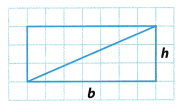
B. Draw one diagonal of your rectangle.
The diagonal divides the rectangle into ____________.
Each one represents ____________ of the rectangle.
Use this information and the formula for the area of a rectangle to write a formula for the area of a right triangle. A = ____________

Reflect

Go Math Grade 6 Answer Key Lesson 16.2 Area of Triangle Question 1.
Communicate Mathematical Ideas In the formula for the area of a right triangle, what do b and h represent?
Answer:
b is the base of the right triangle and h is the height of the right triangle.

Explore Activity 2

Area of a Triangle

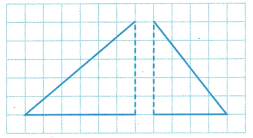
A. Draw a large triangle on grid paper. Do not draw a right triangle.
Texas Go Math Grade 6 Lesson 16.2 Answer Key 2
B. Cut out your triangle. Then trace around it to make a copy of your triangle. Cut out the copy.
C. Cut one of your triangles into two pieces by cutting through one angle directly across to the opposite side. Now you have three triangles — one large triangle and two smaller triangles.
When added together, the areas of the two smaller triangles equal the __________ of the large triangle.
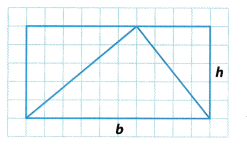
D. Arrange the three triangles into a rectangle.
Texas Go Math Grade 6 Lesson 16.2 Answer Key 3
What fraction of the rectangle does the large triangle represent? __________
The area of the rectangle is A = bh. What is the area of the large triangle? A = __________
How does this formula compare to the formula for the area of a right triangle that you found in Explore Activity 1 ? __________

Reflect

Question 2.
Communicate Mathematical Ideas What type of angle is formed by the base and height of a triangle?
Answer:
The height of a triangle is always the perpendicular distance between the base and its top edge, so it can be said that the angle between the base and height of a triangle is always 90°.

Your Turn

Find the area of the triangle.

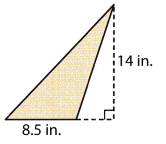
Question 3.
Texas Go Math Grade 6 Lesson 16.2 Answer Key 4
A = _____________
Answer:
Find the area of the triangle.
b = 8.5 inches h = 14 inches
A = \(\frac{1}{2}\) bh
= \(\frac{1}{2}\) (8.5 inches)(14 inches) Substitute
= 59.5 square inches Multiply
= 59.5 in2

Texas Go Math Grade 6 Lesson 16.2 Area of Triangles Answer Key Question 4.
Amy needs to order a shade for a triangular-shaped window that has a base of 6 feet and a height of 4 feet. What is the area of the shade?
Answer:
Data:
b = 6
h = 4
Write the equation of the area of a triangle:
Area = \(\frac{1}{2}\) × b × h
Substitute values:
Area = \(\frac{1}{2}\) × 6 × 4
Evaluate:
Area = 12
Area of the shade is 12 square feet.

Texas Go Math Grade 6 Lesson 16.2 Guided Practice Answer Key

Question 1.
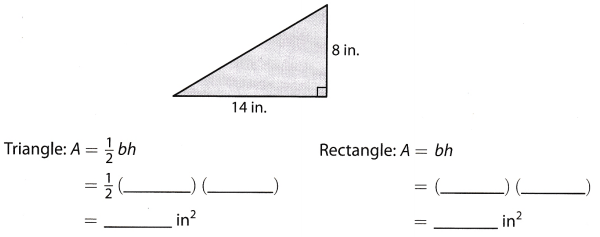
Show how you can use a copy of the triangle to form a rectangle. Find the area of the triangle and the area of the rectangle. What is the relationship between the areas? (Explore Activities 1 and 2, Example 1)
Texas Go Math Grade 6 Lesson 16.2 Answer Key 5
Answer:
Transforming the triangle to rectangle.
Texas Go Math Grade 6 Lesson 16.2 Answer Key 14
Determine the area of the triangle.
A = \(\frac{1}{2}\) (14) (8) substitute for the area of the triangle
A = \(\frac{1}{2}\) (112) simplify
A = 56 sq. in. area of the triangle
A = 14 × 8 substitute for the area of the rectangle
A = 112 sq. in. area of the rectangle
The area of the triangle is 56 sq. in. while the area of the rectangle is 112 sq. in. which shows that the area of the triangle is half of the area of the rectangle.

Question 2.
A pennant in the shape of a triangle has a base of 12 inches and a height of 30 inches. What is the area of the pennant? (Example 2)
Texas Go Math Grade 6 Lesson 16.2 Answer Key 6
A = \(\frac{1}{2}\)bh
= \(\frac{1}{2}\) (________) (_______)
= ________ in2
Answer:
Data:
b = 12
h = 30
Write the equation of the area of a triangle:
Area = \(\frac{1}{2}\) × b × h
Substitute values:
Area = \(\frac{1}{2}\) × 12 × 30
Evaluate:
Area = 180
The area of the pennant is 180 square inches.

Essential Question Check-In

Area of a Triangle Grade 6 Lesson 16.2 Practice Answer Key Question 3.
How do you find the area of a triangle?
Answer:
The area of a triangle is the product of its height and base divided by 2. Mathematically the formula for the area of a triangle is:
Area = \(\frac{1}{2}\) × b × h

Texas Go Math Grade 6 Lesson 16.2 Independent Practice Answer Key

Find the area of each triangle.

Question 4.
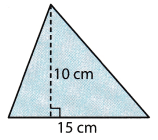
Texas Go Math Grade 6 Lesson 16.2 Answer Key 7
Answer:
Find the area of the triangle.
b = 15 cm h = 10 cm
A = \(\frac{1}{2}\)bh
= \(\frac{1}{2}\) (15 cm) (10 cm) Substitute
= 75 square centimeters Multiply
= 75 cm2

Question 5.
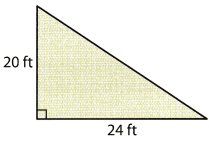
Texas Go Math Grade 6 Lesson 16.2 Answer Key 8
Answer:
Find the area of the triangle.
b = 24 feet; h = 20 feet
A = \(\frac{1}{2}\)bh
= \(\frac{1}{2}\) (24 feet) (20 feet) Substitute
= 240 square feet Multiply
= 240 ft2

Question 6.
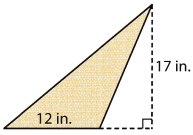
Texas Go Math Grade 6 Lesson 16.2 Answer Key 9
Answer:
Find the area of the triangle.
b = 12 inches; h = 17 inches
A = \(\frac{1}{2}\)bh
= \(\frac{1}{2}\) (12 inches) (17 inches) Substitute
= 102 square inches Multiply
= 102 in2

Question 7.
Texas Go Math Grade 6 Lesson 16.2 Answer Key 10
Answer:
Find the area of the triangle.
b = 18 feet; h = 32 feet
A = \(\frac{1}{2}\)bh
= \(\frac{1}{2}\) (18 feet) (32 feet) Substitute
= 288 square feet Multiply
= 288 ft2

Texas Go Math Grade 6 Answer Key Pdf Area of Triangle Question 8.
What is the area of a triangle that has a base of 15\(\frac{1}{4}\) in. and a height of 18 in.?
Answer:
Solution to this example is given below
\(15 \frac{1}{4}=\frac{15 \times 4+1}{4}=\frac{61}{4}\) = 15.25 Convert to decimal number
Find the area of the triangle.
b = 15.25 inches; h = 18 inches
A = \(\frac{1}{2}\)bh
= \(\frac{1}{2}\) (15.25 inches) (18 inches) Substitute
= 137.25 square inches Multiply
= 137.25 in2

Question 9.
A right triangle has legs that are 11 in. and 13 in. long. What is the area of the triangle?
Answer:
Find the area of the triangle
b = 11 inches; h = 13 inches
A = \(\frac{1}{2}\)bh
= \(\frac{1}{2}\) (11 inches) (13 inches) Substitute
= 71.5 square inches Multiply
= 71.5 in2

Question 10.
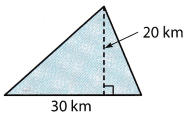
A triangular plot of land has the dimensions shown in the diagram. What is the area of the land?
Texas Go Math Grade 6 Lesson 16.2 Answer Key 11
Answer:
Find the area of the triangle.
b = 30km; h = 20 km
A = \(\frac{1}{2}\)bh
= \(\frac{1}{2}\) (30 km) (20 km) Substitute
= 300 square kilometer Multiply
= 300 km2

Question 11.
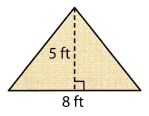
The front part of a tent has the dimensions shown in the diagram. What is the area of this part of the tent?
Texas Go Math Grade 6 Lesson 16.2 Answer Key 12
Answer:
Data:
b = 8
h = 5
Write equation of area of a triangle:
Area = \(\frac{1}{2}\) × b × h
Substitute values:
Area = \(\frac{1}{2}\) × 8 × 5
Evaluate:
Area = 20
Area of the front of the tent is 20 square feet.

Question 12.
Multistep The sixth-grade art students are making a mosaic using tiles in the shape of right triangles. Each tile has leg measures of 3 centimeters and 5 centimeters. If there are 200 tiles in the mosaic, what is the area of the mosaic?
Answer:
Data:
b = 3
h = 5
Write equation of area of a triangle:
Area = \(\frac{1}{2}\) × b × h
Substitute values:
Area = \(\frac{1}{2}\) × 3 × 5
Evaluate:
Area = 7.5
The area of 1 tile is 7.5 square centimeters so the total area of 200 tiles is 7.5 × 200 = 1500 square centimeters.
Total area of 200 tiles is 1500 square centimeters.

6th Grade Answer Key Go Math Area of Triangle Question 13.
Critique Reasoning Monica has a triangular piece of fabric. The height of the triangle is 15 inches and the triangle’s base is 6 inches. Monica says that the area of the fabric is 90 in2. What error did Monica make? Explain your answer.
Answer:
Find the area of the triangle
b = 6 inches h = 15 inches
A = \(\frac{1}{2}\)bh
= \(\frac{1}{2}\) (6 inches) (15 inches) Substitute
= 45 square inches Multiply
Area of the piece of cloth is 45 square inches.
= 45 in2

Question 14.
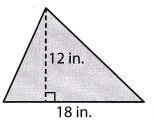
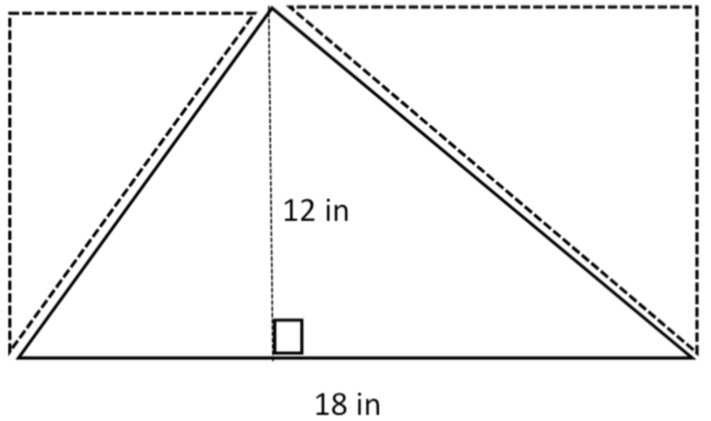
Show how you can use the given triangle and its two smaller right triangles to form a rectangle. What is the relationship between the area of the original triangle and the area of the rectangle?
Texas Go Math Grade 6 Lesson 16.2 Answer Key 13
Answer:
Transform the triangle together with its two smaller triangles to form a rectangle.
Texas Go Math Grade 6 Lesson 16.2 Answer Key 15
Determine the area of the triangle.
A = \(\frac{1}{2}\) (18) (12) substitute for the area of the triangle
A = \(\frac{1}{2}\) (216) simplify
A = 108 sq. in. area of the triangle
A = 18 × 12 substitute for the area of the rectangle
A = 216 sq. in. area of the rectangle
The area of the triangle is 108 sq. in. while the area of the rectangle is 216 sq. in. which shows that the area of the rectangle is twice the area of the triangle.

H.O.T. Focus on Higher Order Thinking

Question 15.
Communicate Mathematical Ideas Explain how the areas of a triangle and a parallelogram with the same base and height are related.
Answer:
The area of a parallelogram with a base b and height h is always twice that of a triangle with the same dimensions. This is because this parallelogram when cut along its diagonal, gives 2 triangles with the same dimensions but half the area as that of the parallelogram.

Question 16.
Analyze Relationships A rectangle and a triangle have the same area. If their bases are the same lengths, how do their heights compare? Justify your answer.
Answer:
The area of a rectangle with a length b and height h is always twice that of a triangle with the same dimensions. If their areas and their bases are the same, then this implies that the height of the rectangle will be half of that of the triangle.

Area of Triangle 6th Grade Go Math Lesson 16.2 Question 17.
What If? A right triangle has an area of 18 square inches.
a. If the triangle is an isosceles triangle, what are the lengths of the legs of the triangle?
Answer:
Data:
Area = 18
l = b = x
Write the equation of the area of a triangle:
Area = \(\frac{1}{2}\) × b × h
Substitute values:
18 = \(\frac{1}{2}\) × x × x
Solve for x:
x2 = 18 × 2
Apply square root on both sides of the equation:
Evaluate:
x = 6
The base and height of the isosceles triangle is equal to 6 inches.

b. If the triangle is not an isosceles triangle, what are all the possible lengths of the legs, if the lengths are whole numbers?
Answer:
Data:
Area = 18
From a we know that the area before division must be 36 so evaluate the factors of 36:
36 = 2 × 18
36 = 3 × 12
36 = 4 × 9
The triangle can have the dimensions in the form: b × h in the form: 2 × 18, 3 × 12 or 4 × 9.

Texas Go Math Grade 6 Lesson 16.2 Answer Key Area of Triangles Read More »

Texas Go Math Grade 6 Module 16 Answer Key Area and Volume Equations

Refer to our Texas Go Math Grade 6 Answer Key Pdf to score good marks in the exams. Test yourself by practicing the problems from Texas Go Math Grade 6 Module 16 Answer Key Area and Volume Equations.

Texas Go Math Grade 6 Module 16 Answer Key Area and Volume Equations

Texas Go Math Grade 6 Module 16 Are You Ready? Answer Key

Evaluate.

Question 1.
\(\frac{1}{2}\)(3)(5 + 7)
Answer:
Solution to this example is given below
\(\frac{1}{2}\)(3)(5 + 7) = \(\frac{1}{2}\)(3)(12) Perform operations inside parentheses first
= 1.5(12) Multiply left to right
= 18 Multiply again.
= 18 Final solution.

Go Math Grade 6 Module 16 Answer Key Question 2.
\(\frac{1}{2}\)(15)(13 + 17)
Answer:
Solution to this example is given below
\(\frac{1}{2}\)(15)(13 + 17) = \(\frac{1}{2}\)(15)(30) Perform operations inside parentheses first
= 7.5(30) Multiply left to right
= 225 Multiply again.
= 225 Final solution.

Question 3.
\(\frac{1}{2}\)(10)(9.4 + 3.6)
Answer:
Solution to this example is given below
\(\frac{1}{2}\)(10)(9.4 + 3.6) = \(\frac{1}{2}\)(10)(13) Perform operations inside parentheses first
= 5(13) Multiply left to right
= 65 Multiply again.
= 65 Final solution.

Grade 6 Module 16 Study Guide Answer Key Go Math Question 4.
\(\frac{1}{2}\)(2.1)(3.5 + 5.7)
Answer:
Solution to this example is given below
\(\frac{1}{2}\)(2.1)(3.5 + 5.7) = \(\frac{1}{2}\)(2.1)(9.2) Perform operations inside parentheses first
= 1.05(9.2) Multiply left to right
= 9.66 Multiply again.
= 9.66 Final solution.

Find the area of each figure.

Question 5.
a triangle with base 6 in. and height 3 in. _____________
Answer:
Find the area of the triangle
b = 6 inches h = 3 inches
A = \(\frac{1}{2}\)bh
= \(\frac{1}{2}\)(6 inches)(3 inches) Substitute
= 9 square inches Multiply
= 9 in2

Go Math Expressions Grade 6 Module 16 Review Answer Key Question 6.
a square with sides of 7.6 m ______________
Answer:
s = 7.6
Write equation of area of a square:
Area = s2
Substitute values:
Area = 7.62
Evaluate:
Area = 57.76
Area of the given square is 57.76 square meters.

Question 7.
a rectangle with length 3\(\frac{1}{4}\) ft and width 2\(\frac{1}{2}\) ft. ____________
Answer:
Solution to this example is given below
\(3 \frac{1}{4}=\frac{3 \times 4+1}{4}=\frac{13}{4}=3.25\) Convert to decimal number
\(2 \frac{1}{2}=\frac{2 \times 2+1}{2}=\frac{5}{2}=2.5\) Convert to decimal number
Find the area of the rectangle.
base = 3.25 ft. and height = 2.5 ft
A = bh Use the formula for the area of a parallelogram.
= 3.25 × 2.5 Substitute for base and height.
= 8.125
The area is 8.125 square feet.

Go Math Module 16 Answer Key Area and Volume Vocabulary Review Question 8.
a triangle with base 8.2 cm and height 5.1 cm ____________
Answer:
Find the area of the triangle.
b = 8.2cm h = 5.1 cm
A = bh
= \(\frac{1}{2}\)(8.2 cm)(5.1 cm) Substitute
= 20.91 square centimeters Multiply
= 20.91 cm2

Texas Go Math Grade 6 Module 16 Reading Start-Up Answer Key

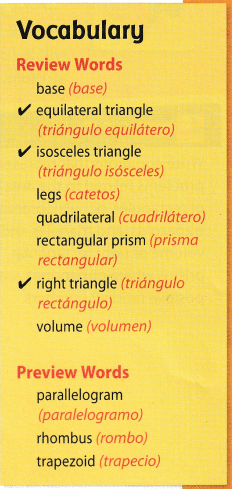
Visualize Vocabulary

Use the ✓words to complete the graphic. You will put one word in each oval.
Texas Go Math Grade 6 Module 16 Answer Key 1
Texas Go Math Grade 6 Module 16 Answer Key 2

Understand Vocabulary

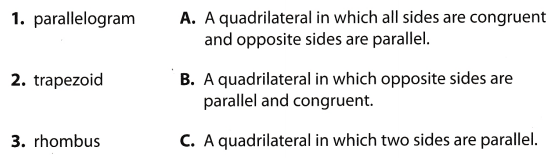
Match the term on the left to the correct expression on the right.
Texas Go Math Grade 6 Module 16 Answer Key 3
Answer:
1 – B. A parallelogram is a type of quadrilateral with opposite sides equal and parallel.
2 – C. A trapezoid is a type of quadrilateral with one pair of opposite parallel sides.
3 – A. A rhombus is a type of quadrilateral with all sides equal and opposite sides are parallel.

Active Reading
Booklet Before beginning the module, create a booklet to help you learn the concepts in this module. Write the main idea of each lesson on each page of the booklet. As you study each lesson, write important details that support the main idea, such as vocabulary and formulas. Refer to your finished booklet as you work on assignments and study for tests.
Texas Go Math Grade 6 Module 16 Answer Key 4

Texas Go Math Grade 6 Module 16 Answer Key Area and Volume Equations Read More »

Texas Go Math Grade 6 Lesson 15.3 Answer Key Relationships Between Sides and Angles in a Triangle

Refer to our Texas Go Math Grade 6 Answer Key Pdf to score good marks in the exams. Test yourself by practicing the problems from Texas Go Math Grade 6 Lesson 15.3 Answer Key Relationships Between Sides and Angles in a Triangle.

Texas Go Math Grade 6 Lesson 15.3 Answer Key Relationships Between Sides and Angles in a Triangle

Essential Question
How can you use the relationships between side lengths and angle measures in a triangle to solve problems?

Texas Go Math Grade 6 Lesson 15.3 Explore Activity Answer Key

Explore Activity
Exploring the Relationship Between Sides and Angles in a Triangle
There is a special relationship between the lengths of sides and the measures of angles in a triangle.
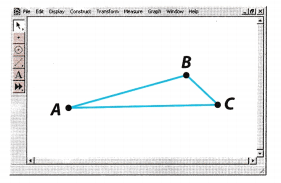
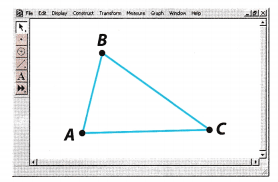
A. Use geometry software to make triangle ABC. Make ∠A the smallest angle.
Texas Go Math Grade 6 Lesson 15.3 Answer Key 1
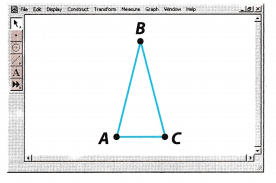
B. Choose one vertex and drag it s0 that you lengthen the side of the triangle opposite angle A. Describe what happens to ∠A.
Texas Go Math Grade 6 Lesson 15.3 Answer Key 2

C. Drag the vertex to shorten the side opposite ∠B. What happens to ∠B?
Texas Go Math Grade 6 Lesson 15.3 Answer Key 3

D. Make several new triangles. In each case, note the locations of the longest and shortest sides in relation to the largest and smallest angles. Describe your results.

Your Turn

Question 1.
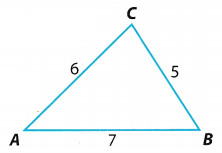
Triangle ABC has side lengths of 11, 16, and 19.
Match each side with its correct length.
AB = ___ AC = ____ BC = ____
Texas Go Math Grade 6 Lesson 15.3 Answer Key 4
Answer:
Determine the side lengths of the triangle.
AB = 16 opposite the mid-size angle
AC = 19 opposite the largest angle
BC = 11 opposite the smallest angle

The side lengths of the triangle are AB = 16; AC = 19; and BC = 11.

Texas Go Math Grade 6 Answer Key Lesson 15.3 Question 2.
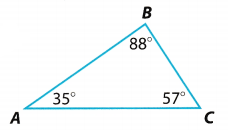
Triangle ABC has angle measures of 45°, 58°, and 77°. Match each angle with its correct measure.
m∠A = ___ m∠B = __ m∠C = ___
Texas Go Math Grade 6 Lesson 15.3 Answer Key 5
Answer:
Determine the angle measures of the triangle.
m∠A = 45 opposite the shortest side
m∠B = 58 opposite the midsize side
m∠C = 77 opposite the longest side

The angle measures of the triangle are ∠A = 45; ∠B = 58; and ∠C = 77

Your Turn

Question 3.
A fence around a rock garden is in the shape of a right triangle. Two angles measure 30° and 60°. Two sides measure 10 feet and 17.3 feet. The total length of the fence is 47.3 feet. How long is the side opposite the right angle? ______
Answer:
Determine the length of the opposite side of the right angle.
10 + 17.3 = 27.3 sum of the two side lengths
47.3 – 27.3 = 20 value of the third side length
a = 10 opposite the smallest angle
b = 17.3 opposite the midsize angle
c = 20 opposite the largest angle

The side length opposite to the right angle measures 20 feet.

Texas Go Math Grade 6 Lesson 15.3 Guided Practice Answer Key

Question 1.
Triangle ABC has side lengths of 17, 13, and 24. Match each side with its correct length. (Example 1)
____ = 24 ____ = 13 ____ = 17
Texas Go Math Grade 6 Lesson 15.3 Answer Key 6
Answer:
Determine the side of the triangle for each given measurement
AC = 24 opposite the largest angle
AB = 13 opposite the smallest angle
BC = 17 opposite the midsize angle

The sides of the triangle with the given measurements are:
AC = 24;
AB = 13;
BC = 17

Go Math Grade 6 Answer Key Lesson 15.3 Question 2.
The figure represents a traffic island with angles measuring 60°, 20°, and 100°. Match each angle with its correct measure. (Example 1)
m∠___ = 100° m∠___ = 20° m∠___ = 60°
Texas Go Math Grade 6 Lesson 15.3 Answer Key 7
Answer:
Determine the angles of the triangle using its side lengths.
m∠M = 100° opposite the longest side
m∠P = 20° opposite the shortest side
m∠N = 60° opposite the midsize side

The angle measurements are: ∠M = 100°; ∠P = 20°; ∠N = 60°

Question 3.
Vocabulary Explain how the relationship between the sides and angles of a triangle applies to equilateral triangles. (Example 2)
Answer:
Equilateral triangle is a triangle with all sides equal and all angles equal. Therefore, the relationship between the angles and its sides will also be equal.
An equilateral triangle have equal angles and sides thus alt opposite sides of angles will have similar value.

Question 4.
Ramone is building a fence around a vegetable garden in his backyard. The fence will be in the shape of a right isosceles triangle. Two of the side measures are 12 feet and 16 feet. Use a problem solving model to find the total length of fencing he needs. Explain. (Example 2)
Answer:
Right isosceles triangle have two sides and two angles equal. The angle measures are 90° – 45° = 45°. If the opposite side of the largest angle measures 16 ft then the remaining two sides will measure 12 ft each. Add all the
side lengths to determine the total length of fencing he needs or the perimeter
P = 12 + 12 + 16 = 40 feet

The total length of fencing needed for the vegetable garden is 40 feet.

Essential Question Check-In

Question 5.
Describe the relationship between the lengths of the sides and the measures of the angles in a triangle.
Answer:
The relationship of sides and angles in a triangle are opposites The opposite of the largest angle is the longest side while the opposite of the smallest angle is the shortest side and the opposite of the midsize angle is the midsize side.
Texas Go Math Grade 6 Lesson 15.3 Answer Key 13
The longest side is opposite of the largest angle. The midsize side is opposite of the midsize angle. The shortest side is opposite of the smallest angle.

Texas Go Math Grade 6 Lesson 15.3 Independent Practice Answer Key

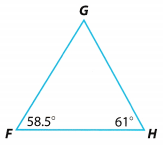
Use the figure for 6-8.
Texas Go Math Grade 6 Lesson 15.3 Answer Key 8

Lesson 15.3 Texas Go Math Grade 6 Answer Key Pdf Question 6.
Critique Reasoning Dustin says that ΔFGH is an equilateral triangle because the sides appear to be the same length. Is his reasoning valid? Explain.
Answer:
An equilateral triangle has all sides and all angels equal. Based from the figure, the measure of ∠F = 58.5° and ∠H = 61° while the unknown angle is ∠G = 60.5. It shows that the angles have different measurements which
do not comprise an equilateral triangle having 60° angles. With the indicated measurements, it denotes that the side lengths of the triangle varies because of the different angle measurements.

It is not an equilateral triangle since the angles have different measurements then the side lengths will also have different measurements.

Question 7.
What additional information do you need to know before you can determine which side of the triangle is the longest? How can you find it?
Answer:
The additional information needed is the measure of the unknown angle to determine the longest side. In getting the measure of the unknown angle, add the given angles then subtract from 180°

Determine the measure of the unknown angle.
m∠F + m∠G + m∠H = 180° measures of each angle
58.5° + x + 61° = 180° substitute for the sum of angle measures in triangle
119.5° + x = 180° sum of the two angles
119.5° + x – 119.5° = 180° – 119.5° subtract 119.5° from both sides of the equation
x = 60.5° measure of the unknown angle
The largest angle is ∠H therefore, the longest side is side FG.

Question 8.
Which side of the triangle is the longest? Explain how you found the answer.
Answer:
Determine the longest side of the triangLe.
m∠F = 58. 5° = GH opposite the smallest angLe
m∠G = 60.5° = FH opposite the midsize angle
m∠H = 61° = FG opposite the largest angle

The longest side is the side opposite the largest angle which is side FG.

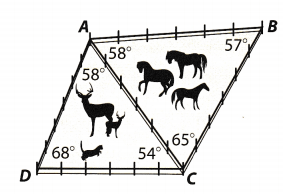
The figure shows the angle measurements formed by two fenced-in animal pens that share a side. Use the figure for 9-10.

Texas Go Math Grade 6 Lesson 15.3 Answer Key 9

Question 9.
Caitlin says that \(\overline{A C}\) is the longest segment of fencing because it is opposite 68°, the largest angle measure in the figure. Is her reasoning valid? Explain.
Answer:
Her answer is invalid because her longest side of the triangle is only based on ∆ADC alone and not as a whole figure. By looking at the figure, it shows that there can still be other basis for the longest segment

The longest segment of the figure is not based on one triangle only

Lesson 15.3 Go Math Answer Key Grade 6 Question 10.
What is the longest segment of fencing in ΔABC? Explain your reasoning.
Answer:
Determine the longest segment of the ΔABC.
m∠4 = 58° = BC opposite the midsize angle
m∠B = 57° = AC opposite the smallest angle
m∠C = 65° = AB opposite the largest angle

Based on the concept of opposite angles, the longest segment of the indicated triangle is segment AB.

Question 11.
Find the longest segment of fencing in the figure. Explain your reasoning.
Answer:
Segment AC is the longest segment for the ΔADC white segment AB is the longest segment for ΔABC. Therefore, the longest segment of the whole figure is segment AB because segment AC is less than segment AB.

Segment AB

Question 12.
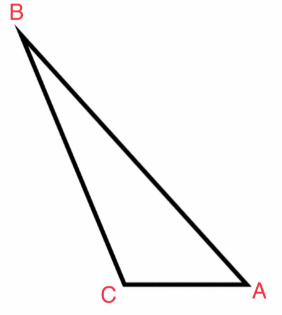
In triangle ABC, \(\overline{A B}\) is longer than \(\overline{B C}\) and \(\overline{B C}\) is longer than \(\overline{A C}\).

a. Draw a sketch of triangle ABC.
Answer:
Sketch of the triangle.
Texas Go Math Grade 6 Lesson 15.3 Answer Key 14
Triangle ABC has a longest side of segment AB, midsize side of segment BC, and shortest side of segment AC.

b. Name the smallest angle in the triangle. Explain your reasoning.
Answer:
Based from the figure, the smallest angle is ∠B because it is the opposite angle of the smallest side which is segment AC
The smallest angle is ∠B.

Texas Go Math Grade 6 Lesson 15.3 H.O.T. Focus On Higher Order Thinking Answer Key

Question 13.
Persevere in Problem Solving Determine the shortest line segment in the figure. Explain how you found the answer.
Texas Go Math Grade 6 Lesson 15.3 Answer Key 10
Answer:
The shortest line segment of the whole figure is segment ZY in reference to ∆WYZ.
m∠W = 30 = ZY opposite the smallest angle
m∠Y = 90 = WZ opposite the largest angle
m∠Z = 60 = WY opposite the midsize angle

Segment ZY is the shortest segment of the triangle.

Texas Go Math Grade 6 Angles of Triangles Answer Key Question 14.
Communicate Mathematical Ideas Explain how the relationship between the sides and angles of a triangle applies to isosceles triangles.
Answer:
An isosceles triangle has two sides of equal length. If two sides of an isosceles triangle have equal length, then the opposite angles of those two sides are also equal. Therefore, an isosceLes triangle has two equal sides and two equal angles.

Two sides of an isosceles triangle are equal therefore, two angles are also equal.

Question 15.
Critical Thinking Can a scalene triangle contain a pair of congruent angles? Explain.
Answer:
A scalene triangle has no equal sides. Knowing the relationship of the sides and its opposite angles, therefore it shows that a scalene triangle does not have equal angles. Thus, it also denotes that it cannot have a pair of congruent angles.

A scalene triangle cannot have a pair of congruent angles because all of its sides and angles are not equal.

Texas Go Math Grade 6 Lesson 15.3 Answer Key Relationships Between Sides and Angles in a Triangle Read More »

Texas Go Math Grade 6 Lesson 17.5 Answer Key Categorical Data

Refer to our Texas Go Math Grade 6 Answer Key Pdf to score good marks in the exams. Test yourself by practicing the problems from Texas Go Math Grade 6 Lesson 17.5 Answer Key Categorical Data.

Texas Go Math Grade 6 Lesson 17.5 Answer Key Categorical Data

Essential Question
How can you summarize and describe categorical data?

Texas Go Math Grade 6 Lesson 17.5 Explore Activity Answer Key

Explore Activity
Describing Categorical Data
Some data are quantitative, such as height or number of siblings of all students in a class. Other data are qualitative, such as eye color or favorite type of music. Categorical data are data that are sorted into categories on the basis of qualitative characteristics.
You can use the mode to summarize or describe categorical data. The mode of a categorical data set is the category that occurs most often. If all categories have the same frequency, there is no mode.

Karl sells red, blue, black, white, and green shirts online. One day Karl received orders for 4 red, 5 blue, 6 black, 6 white, and 3 green shirts.

A. Complete the dot plot of Karl’s shirt orders for the day.
Texas Go Math Grade 6 Lesson 17.5 Answer Key 1

Math Talk
Mathematical Processes
Could the colors in the dot plot be displayed in a different order? Would this change the overall results? Explain.

B. Which shirt color or colors were the most and least popular that day?
Answer:

C. Identify the mode(s) of the data. _______________________________
Answer:

Reflect

Question 1.
Justify Reasoning Is it possible to find the mean or median of Karl’s data set? Explain.
Answer:
It is not possible to find the mean or median of the indicated data set because the data values are not numerical. The categorical data is based on the qualitative characteristics of the shirt

Not possible because the data indicates quality and not quantity.

Your Turn

Texas Go Math Grade 6 Lesson 17.5 Answer Key Question 2.
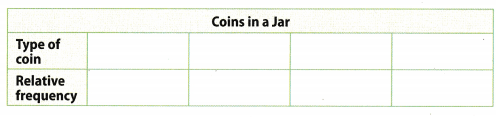
Chuy has 40 dimes, 20 pennies, 10 nickels, and 10 quarters in his coin jar. Make a relative frequency table of the coins in the jar.
Texas Go Math Grade 6 Lesson 17.5 Answer Key 2
Answer:
Texas Go Math Grade 6 Lesson 17.5 Answer Key 10
Identify the relative frequency by dividing the number of coins according to type then divide by the total number of coins and multiply by 100.

Reflect

Question 3.
Analyze Relationships Why is it helpful to arrange the categories in the order of their relative frequencies?
Answer:
It is easier to visualize the graph if the categories are arranged in order based on its relative frequency. The percentages of the data can easily be identified and compared to other categories if the height if the graph is determined clearly.

To visualize the relativity of data among indicated categories.

Your Turn

Question 4.
Devon is growing tulips in his garden. He has 24 red tulips, 11 yellow tulips, and 15 purple tulips. Make a percent bar graph and describe the distribution.
Answer:
Texas Go Math Grade 6 Lesson 17.5 Answer Key 11
percent bar graph of the data.
Texas Go Math Grade 6 Lesson 17.5 Answer Key 12
Based on the percent bar graph, almost half of the tulips in the garden are color red.

Texas Go Math Grade 6 Lesson 17.5 Guided Practice Answer Key

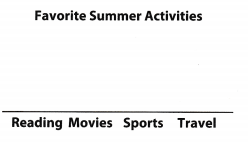
Mrs. Valentine surveyed her class about their favorite Favorite summer activity. Four students chose reading, 7 chose movies, 7 chose sports, and 5 chose travel. (Explore Activity)

Texas Go Math Grade 6 Answer Key Pdf Categorical Data Question 1.
Make a dot plot of the data.
Answer:
Dot plot of the data
Texas Go Math Grade 6 Lesson 17.5 Answer Key 13
Dot plot of the frequency of the data.

Texas Go Math Grade 6 Lesson 17.5 Answer Key 3

Question 2.
Identify the mode(s) of the data set.
Answer:
The mode of the data set shows the data in which the category occurs most frequent than any other categories. In the indicated data set, the data with the most number of students are those who chose movies and sports.
movies and sports

The garden club is planning their spring and summer garden. They have 20 plots. Tomatoes will be in 3 plots, kale will be in 5 plots, strawberries will be In 6 plots, zucchini will be in 2 plots, and melons will be in 4 plots.

Question 3.
Make a relative frequency table of the data that shows both fractions and percents.
Texas Go Math Grade 6 Lesson 17.5 Answer Key 4
Answer:
Texas Go Math Grade 6 Lesson 17.5 Answer Key 14
Relative frequency of the given data with percentages.

Question 4.
Make a percent bar graph of the relative frequencies of the garden plots.
Answer:
Texas Go Math Grade 6 Lesson 17.5 Answer Key 15
Percent bar graph of the relative frequency of the given data.

Texas Go Math Grade 6 Lesson 17.5 Answer Key 5

Essential Question Check-In

Question 5.
How can you calculate relative frequencies as percents?
Answer:
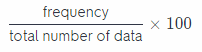
Relative frequencies can be computed by dividing the frequency of the data by the total number of sample then multiply by 100.
Texas Go Math Grade 6 Lesson 17.5 Answer Key 16
Divide the frequency of each data then divide it by the total number of the data then multiply the result by 100.

Texas Go Math Grade 6 Lesson 17.5 Independent Practice Answer Key

Mr. Anderson’s fifth grade class is getting a class pet. Seven students vote to get a gerbil, 3 vote for a fish, 6 vote for a mouse, and 4 vote for a lizard.

Lesson 17.5 Answer Key Go Math Grade 6 Question 6.
What is the mode of the data set? What does it mean for this situation?
Answer:
In a categorical data, mode is the category that occurs most often. Based from the given data, there is no category with the same frequency. However, the most number of votes on a specific category is having a gerbil for class pet.

The class will choose gerbil for a pet.

Question 7.
If each pet had received 9 votes, what would the mode have been?
Answer:
If all pets will receive the same number of votes, then there will be no value for mode since it cannot be decided which pet to acquire.

There is no visible mode since all pets will receive the same number of votes.

Question 8.
Analyze Relationships Make a dot plot of the data. Use the dot plot to describe the data.
Answer:
Dot plot of the given data
Texas Go Math Grade 6 Lesson 17.5 Answer Key 17
It shows that almost half of the class voted for gerbil to be their class pet

Texas Go Math Grade 6 Lesson 17.5 Answer Key 6

Question 9.
The service club sells snacks at school basketball games. In the first quarter they sell 6 servings of nachos, 4 bags of popcorn, 7 pieces of fruit, and 3 bags of nuts.
a. Make a relative frequency table. Include both fractions and percents.
Texas Go Math Grade 6 Lesson 17.5 Answer Key 7
Answer:
Relative frequency table
Texas Go Math Grade 6 Lesson 17.5 Answer Key 18
Relative frequency of the data using fraction and percentage.

b. Analyze Relationships Deloria says she can find the relative frequency of nuts based on another relative frequency. What might she be doing?
Answer:
If the relative frequency of nuts is unknown, it can be determined thru the use of other relative frequencies which are available. Add all the given relative frequencies for nachos, popcorn, and fruit then subtract the result from 100 and the relative frequency for nuts will be determined.
30% + 20% + 35% = 85%
100% – 85% = 15%
Add all the available values then subtract from 100.

c. Draw Conclusions If 9 bags of popcorn were sold rather than 4, which relative frequencies would be affected? Explain.
Answer:
Conclusion
All relative frequencies will be affected. Since there was an increase in one of the frequencies therefore the total number of values will also increase while the other relative frequencies will decrease.
Texas Go Math Grade 6 Lesson 17.5 Answer Key 19
If one of the values will increase, its relative frequency will also increase but the other relative frequencies will decrease due to the increase in the total frequency of the data.

The percent bar graph shows the relative frequencies that resulted from a survey about eye color.

Texas Go Math Grade 6 Lesson 17.5 Categorical Data Question 10.
Draw Conclusions Can you tell from the bar graph how many people were surveyed? Why or why not?
Answer:
The total number of people who were surveyed cannot be determined because the value of the relative frequency is not indicated for each category. The bars show the height for each category.

The data has missing information.

Texas Go Math Grade 6 Lesson 17.5 Answer Key 8

Question 11.
Communicate Mathematical Ideas Describe how the data are distributed.
Answer:
Based from the survey, the dominant eye color is brown and Less than 10 percent of the people who were surveyed have blue eye color.

Sixty percent of the people who were surveyed have brown eye color.

Texas Go Math Grade 6 Lesson 17.5 H.O.T. Focus On Higher Order Thinking Answer Key

Question 12.
What If? Suppose 250 people were surveyed to create the eye color data shown in the graph for Exercises 10 and
Answer:
Determine the number of people who have brown eyes.
\(\frac{n}{250}\) = 60% get the frequency of the people who have brown eye color
[250]\(\frac{n}{250}\) = 0.60 (250) multiply both sides of the equation by 250
n = 150 people who have brown eye color
There are 150 persons with brown eye color

Texas Go Math Grade 6 Lesson 17.5 Answer Key 9

Texas Go Math Grade 6 Answer Key Pdf Lesson 17.5 Question 13.
Multiple Representations Describe how this circle graph is similar to and different from the percent bar graph shown for Exercises 10-11.
Answer:
Both graph shows the area of each eye color category. The data for both visual representations can easily be compared by looking at the area of each colored category. The bar graph does not indicate the exact value of the relative frequency for each category while in the pie graph, the relative frequency is indicated.

They both represent the indicated data for the eye color and is distributed according to categories. However, they vary in how the data is being displayed since the bar graph does not indicate the relative frequency.

Question 14.
Justify Reasoning Jayshree says the number of dots in a dot plot for Exercise 8 shows that the data is numeric and not categorical. Is she right? Explain. If not, what is her mistake?
Answer:
The data in the dot plot shows the number of votes each pet gets. Jayshree made a mistake because the data is categorical as it displays the type of pet the class wants to get.

The data is categorical

Texas Go Math Grade 6 Lesson 17.5 Answer Key Categorical Data Read More »

Texas Go Math Grade 6 Module 15 Quiz Answer Key

Refer to our Texas Go Math Grade 6 Answer Key Pdf to score good marks in the exams. Test yourself by practicing the problems from Texas Go Math Grade 6 Module 15 Quiz Answer Key.

Texas Go Math Grade 6 Module 15 Quiz Answer Key

Texas Go Math Grade 6 Module 15 Ready to Go On? Answer Key

15.1 Determining When Three Lengths Form o Triangle

Determine whether the three side lengths form a triangle.

Question 1.
3, 5, 7 ____
Answer:
Find the sum of the two sides of the triangle then compare to the third side.
3 + 5 :> 7 add the two sides and compare to the third side
8 > 7 the sum of the two sides is greater than the third side

3 + 7;’ 5 add the two sides and compare to the third side
10 > 5 the sum of the two sides is greater than the third side

5 + 7> 3 add the two sides and compare to the third side
12 > 3 The sum of the two sides is greater than the third side

Yes, the given side lengths can form a triangle.

6th Grade Math Quiz Module 15 Answer Key Question 2.
9, 15, 4 ____
Answer:
Find the sum of the two sides of the triangle then compare to the third side.
9 + 15 > 4 add the two sides and compare to the third side
24 > 4 the sum of the two sides is greater than the third side

15 + 4 > 9 add the two sides and compare to the third side
19 > 9 the sum of the two sides is greater than the third side

9 + 4> 15 add the two sides and compare to the third side
13 ≯ 15 the sum of the two sides is less than the third side

The given side lengths cannot be used to form a triangle because two sides will have a sum of less than the third side.

Question 3.
17, 5, 23 _________________
Answer:
Find the sum of the two sides of the triangle then compare to the third side.
17 + 5 > 23 add the two sides and compare to the third side
22 ≯ 23 the sum of the two sides is less than the third side

5 + 23> 17 add the two sides and compare to the third side
28 > 17 the sum of the two sides is greater than the third side

17 + 23 > 5 add the two sides and compare to the third side
40 > 5 the sum of the two sides is less than the third side

The given side lengths cannot be used to form a triangle because two sides will have a sum of less than the third side.

Question 4.
28, 16, 38 _________________
Answer:
Find the sum of the two sides of the triangle then compare to the third side.
28 + 16 > 38 add the two sides and compare to the third side
44 > 38 the sum of the two sides is greater than the third side

28 + 38 > 16 add the two sides and compare to the third side
66> 16 the sum of the two sides is greater than the third side

16 + 38 > 28 add the two sides and compare to the third side
54 > 28 the sum of the two sides is greater than the third side

The given side lengths can be used to form a triangle.

15.2 Sum of Angle Measures in a Triangle

Find the unknown angle measures.

Question 5.
_________________
Texas Go Math Grade 6 Module 15 Quiz Answer Key 1
Answer:
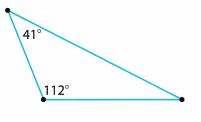
Determine the unknown angle by adding the given angles and subtracting the result from 180°.
41° + 112° + x = 180° substitute for the sum of angle measures in triangle
153° + x = 180° sum of the two angles
153° + x – 153° = 180° – 153° subtract 153° from both sides of the equation
x = 27° measure of the unknown angle

The unknown angle measures 27°.

6th Grade Go Math Module 15 Review Quiz Answer Key Question 6.
_________________
Texas Go Math Grade 6 Module 15 Quiz Answer Key 2
Answer:
Determine the unknown angle by adding the given angles and subtracting the result from 180°.

38° + 88° + x = 180° substitute for the sum of angle measures in triangle
126° + x = 180° sum of the two angles
126° + x – 126°= 180° – 126° subtract 126° from both sides of the equation
x = 54° measure of the unknown angle

The unknown angle measures 54°.

15.3 Relationships Between Sides and Angles in a Triangle

Match each of the given measures to the correct side or angle.

Question 7.
11, 7.5, 13
_________________
Texas Go Math Grade 6 Module 15 Quiz Answer Key 3
Answer:
Determine the side lengths of the triangle.
AB = 7.5 opposite the smallest angle
AC = 11 opposite the midsize angle
BC = 13 opposite the largest angle

Correct sides of the triangle according to angle measurement:
a. shortest side – segment AB
b. midsize side – segment AC
c. longest side – segment BC

Question 8.
24°, 44°, 112°
Texas Go Math Grade 6 Module 15 Quiz Answer Key 4
Answer:
Determine the angles based on the given side lengths of the triangle.
∠D = 24° opposite the shortest segment
∠E = 44° opposite the midsize segment
∠F = 112° opposite the longest segment

Correct angle according to the side lengths of the triangle
a. ∠D – smallest angle
b. ∠E-mid size angle
c. ∠F – largest angle

Essential Question

Texas Go Math Grade 6 Answer Key Module 15 Study Guide Question 9.
How can you describe the relationships among angles and sides in a triangle?
Answer:
The angles and sides are related in terms of their opposites. In a triangle, the measure of the angles or sides will determine the size of the angle or side opposite to it. The larger angle is opposite the longest side, the midsize angle is opposite the midsize side, and the smaller angle is opposite the shorter side.

The side lengths in a triangle indicate the size of angles opposite to them.

Texas Go Math Grade 6 Module 15 Mixed Review Texas Test Prep Answer Key

Selected Response

Question 1.
The two longer sides of a triangle measure 16 and 22. Which of the following is a possible length of the shortest side?
(A) 4
(B) 6
(C) 11
(D) 19
Answer:
(C) 11

Explanation:

a. 16, 22, 4
Find the sum of the two sides of the triangle then compare to the third side.
16 + 22 > 4 add the two sides and compare to the third side
38 > 4 the sum of the two sides is greater than the third side

22 + 4> 16 add the two sides and compare to the third side
26 > 16 the sum of the two sides is greater than the third side

4 + 16> 22 add the two sides and compare to the third side
20 ≯ 22 the sum of the two sides is less than the third side

b. 16, 22, 6
Find the sum of the two sides of the triangle then compare to the third side.

16 + 22 > 6 add the two sides and compare to the third side
38 > 6 the sum of the two sides is greater than the third side

22 + 6> 16 add the two sides and compare to the third side
28 > 16 the sum of the two sides is greater than the third side

6 + 16 > 22 add the two sides and compare to the third side
22 ≯ 22 the sum of the two sides is not greater than the third side

c. 16, 22, 11
Find the sum of the two sides of the triangle then compare to the third side.

16 + 22 > 11 add the two sides and compare to the third side
38 > 11 the sum of the two sides is greater than the third side

22 + 11 > 16 add the two sides and compare to the third side
33 > 16 the sum of the two sides is greater than the third side

11 + 16 > 22 add the two sides and compare to the third side
27 > 22 the sum of the two sides is greater than the third side

d. 16, 22, 19
Find the sum of the two sides of the triangle then compare to the third side.
16 + 22 > 19 add the two sides and compare to the third side
38 > 19 The sum of the two sides is greater than the third side

22 + 19> 16 add the two sides and compare to the third side
41 > 16 The sum of the two sides is greater than the third side

19 + 16 > 22 Add the two sides and compare to the third side
35 > 22 The sum of the two sides is greater than the third side

The shortest side of the triangle is C. 11

Math Quiz for Grade 6 Texas Go Math Module 15 Question 2.
Part of a large metal sculpture will be a triangle formed by welding three bars together. The artist has four bars that measure 12 feet, 7 feet, 5 feet, and 3 feet. Which bar could not be used with two of the others to form a triangle?
(A) the 3-foot bar
(B) the 5-foot bar
(C) the 7-foot bar
(D) the 12-foot bar
Answer:
(D) the 12-foot bar

Explanation:
Find the sum of the two sides of the triangle then compare to the third side.
7 + 5 > 3 add the two sides and compare to the third side
12 > 3 the sum of the two sides is greater than the third side

7 + 3 > 5 add the two sides and compare to the third side
10 > 5 the sum of the two sides is greater than the third side

3 + 5 > 7 add the two sides and compare to the third side
8 > 7 the sum of the two sides is greater than the third side

The D. 12-foot bar cannot be used in combination with other two measures to form a triangle.

Question 3.
What is the measure of the missing angle in the triangle below?
Texas Go Math Grade 6 Module 15 Quiz Answer Key 5
(A) 39°
(B) 49°
(C) 59°
(D) 69°
Answer:
(C) 59°

Explanation:
Determine the unknown angle by adding the given angles and subtracting the result from 180°.
65° + 56° + x = 180° substitute for the sum of angle measures in triangle
121° + x = 180° sum of the two angles
121° + x – 121° = 180° – 121° subtract 121° from both sides of the equation
x = 59° measure of the unknown angle

The measure of the missing angle is C. 59°.

Question 4.
The measure of ∠A in ∆ABC is 88°. The measure of ∠B is 60% of the measure of ∠A. What is the measure of ∠C?
(A) 39.2°
(B) 52.8°
(D) 91°
(D) 127.2°
Answer:
(A) 39.2°

Explanation:
Determine the size of the unknown angle.
m∠B = 0.60 × 88° multiplied by the measure of ∠A by 60%
= 52.8° measure of ∠B
m∠A + m∠B + m∠C = 180°
88° + 52.8° + x = 180° substitute for the sum of angle measures in triangle
140.8 + x = 180° sum of two angles
140.8° + x – 140.8° = 180 – 140.8° subtract 140.8° from both of the equation
x = 39.2° measure of the unknown angle
The measure of ∠C is A. 39.2°.

Go Math Answer Key Grade 6 Module 15 Test Answers Geometry Question 5.
Which of these could be the value of x in the triangle below?
Texas Go Math Grade 6 Module 15 Quiz Answer Key 6
(A) 5
(B) 6
(C) 7
(D) 10
Answer:
(A) 5

Explanation:
Substitute the value for x
a. 4 × 5 = 20 multiply the given number by 5
side lengths of 29 – 22 – 20

b. 4 × 6 = 24 multipLy the given number by 6
side lengths of 29 – 22 – 24

c. 4 × 7 = 28 multiply the given number by 7
side lengths of 29 – 22 – 28

d. 4 × 10 = 40 multiply the given number by 10
side lengths of 29 – 22 – 40

The unknown side length of the triangle is the opposite side of the smallest angle which is ∠C. Therefore, the side length is also the shortest side among all the given values which makes the value of x at 5.

The value of x in the triangle is A. 5

Gridded Response

Grade 6 Math Quiz Module 15 Answer Key Question 6.
Find m∠Z.
Texas Go Math Grade 6 Module 15 Quiz Answer Key 7
Answer:
Determine the size of the unknown angle.

m∠X + m∠Y + m∠Z = 180°
133° + 29° + m∠Z = 180° substitute for the sum of angle measures in triangle
162° + m∠Z = 180° sum of the two angles
162° + m∠Z – 162° = 180° – 162° subtract 162° from both sides of the equation
m∠Z = 18° measure of the missing angle
The answer on the grid is 18.00.

Texas Go Math Grade 6 Module 15 Quiz Answer Key Read More »

Texas Go Math Grade 6 Lesson 15.1 Answer Key Determining When Three Lengths Form a Triangle

Refer to our Texas Go Math Grade 6 Answer Key Pdf to score good marks in the exams. Test yourself by practicing the problems from Texas Go Math Grade 6 Lesson 15.1 Answer Key Determining When Three Lengths Form a Triangle.

Texas Go Math Grade 6 Lesson 15.1 Answer Key Determining When Three Lengths Form a Triangle

Essential Question
How can you use the relationship between side lengths to determine when three lengths form a triangle?

Texas Go Math Grade 6 Lesson 15.1 Explore Activity Answer Key

Explore Activity
Drawing Three Sides
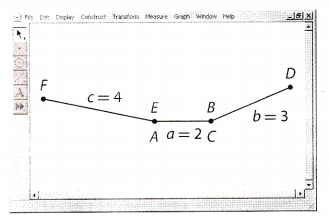
Use geometry software to draw a triangle whose sides have the following lengths: 2 units, 3 units, and 4 units.

A. Draw three line segments of 2, 3, and 4 units of length.
Texas Go Math Grade 6 Lesson 15.1 Answer Key 1
B. Let \(\overline{A B}\) be the base of the triangle. Place endpoint C on top of endpoint B and endpoint E on top of endpoint A. These will become two of the vertices of the triangle.
Texas Go Math Grade 6 Lesson 15.1 Answer Key 2
C. Using the endpoints C and E as fixed vertices, rotate endpoints F and D to see if they will meet in a single point.
The line segments of 2, 3, and 4 units Texas Go Math Grade 6 Lesson 15.1 Answer Key 3 form a triangle.
Texas Go Math Grade 6 Lesson 15.1 Answer Key 4
D. Repeat Steps 2 and 3, but start with a different base length. Do the line segments make the exact same triangle as the original?
The line segments Texas Go Math Grade 6 Lesson 15.1 Answer Key 5 make the same triangle as the original.
E. Draw three line segments of 2, 3, and 6 units. Can you form a triangle with the given segments?
The line segments of 2, 3, and 6 units Texas Go Math Grade 6 Lesson 15.1 Answer Key 5 form a triangle.

Reflect

Texas Go Math Grade 6 Lesson 15.1 Independent Practice Answer Key Question 1.
Conjecture Try to make triangles using real-world objects such as three straws of different lengths. Find three side lengths that form a triangle and three side lengths that do not form a triangle. What do you notice about the lengths that do not form a triangle?
Answer:
The lengths of the line segments of Figure 2 triangle do not meet that it cannot form a triangle.
Texas Go Math Grade 6 Lesson 15.1 Answer Key 9
The lengths of the line segments do not meet to form a triangle.

Your Turn

Tell whether a triangle can have sides with the given lengths. Explain.

Question 2.
3 cm, 6 cm, 9 cm
Answer:
Find the sum of the two sides of the triangle then compare to the third side.

3 + 6 > 9 add the two sides and compare to the third side
9 ≯ 9 the sum of the two sides is NOT greater than the third side

6 + 9 > 3 add the two sides and compare to the third side
15 > 3 the sum of the two sides is greater than the third side

3 + 9> 6 add the two sides and compare to the third side
12 > 6 the sum of the two sides is greater than the third side

The given side lengths cannot form a triangle because the sum of two side lengths is not greater than the third side.

Question 3.
4m, 5m, 8m
Answer:
Find the sum of the two sides of the triangle then compare to the third side.

4 + 5 > 8 add the two sides and compare to the third side
9 > 8 the sum of the two sides is greater than the third side

5 + 8 > 4 add the two sides and compare to trie third side
13 > 4 The sum of the two sides is greater than the third side

4 + 8 > 5 add the two sides and compare to the third side
12 > 5 The sum of the two sides is greater than the third side

The given side lengths can form a triangle because the sum of two side lengths is greater than the third side.

Your Turn

Texas Go Math Grade 6 Answer Key Pdf Lesson 15.1 Question 4.
Which value could be the length of x?
x = 35 x = 13
_______
Texas Go Math Grade 6 Lesson 15.1 Answer Key 6
Answer:
Determine the value of x.
Texas Go Math Grade 6 Lesson 15.1 Answer Key 10
The length of the third side of the triangle must be 13.

Texas Go Math Grade 6 Lesson 15.1 Guided Practice Answer Key

Determine whether a triangle can have sides with the given length Explain. (Explore Activity and Example 1)

Question 1.
3 cm, 10 cm, 8 cm
Answer:
Find the sum of the two sides of the triangle then compare to the third side.

3 + 10> 8 add the two sides and compare to the third side
13 > 8 the sum of the two sides is greater than the third side

10 + 8 > 3 add the two sides and compare to the third side
18 > 3 the sum of the two sides is greater than the third side

3 + 8 > 10 add the two sides and compare to the third side
11 > 10 the sum of the two sides is greater than the third side

The given lengths can make up a triangle.

Question 2.
10 ft, 10 ft, 18 ft
Answer:
Find the sum of the two sides of the triangLe then compare to the third side.

10 + 10 > 18 add the two sides and compare to the third side
20 > 18 the sum of the two sides is greater than the third side

10 + 18 > 10 add the two sides and compare to the third side
28 > 10 the sum of the two sides is greater than the third side

10 + 18 > 10 add the two sides and compare to the third side
28 > 10 the sum of the two sides is greater than the third side

The given lengths can be used to make a triangle.

Question 3.
30 in., 20 in., 40 in.
Answer:
Find the sum of the two sides of the triangle then compare to the third side.

30 + 20> 40 add the two sides and compare to the third side
50 > 40 the sum of the two sides is greater than the third side

20 + 40> 30 add the two sides and compare to the third side
60 > 30 the sum of the two sides is greater than the third side

30 + 40 > 20 add the two sides and compare to the third side
70 > 20 the sum of the two sides is greater than the third side

The given lengths can be used to make a triangle.

Question 4.
16 cm, 12 cm, 3 cm
Answer:
Find the sum of the two sides of the triangle then compare to the third side.

16 + 12 > 3 add the two sides and compare to the third side
28 > 3 the sum of the two sides ¡s greater than the third side

12 + 3 > 16 add the two sides and compare to the third side
15 ≯ 16 the sum of the two sides is NOT greater than the third side

16 + 3 > 12 add the two sides and compare to the third side
19 > 12 The sum of the two sides is greater than the third side

The given lengths cannot be used to make a triangle.

Lesson 15.1 Go Math Grade 6 Answer Key  Question 5.
Which value could be the length of x? (Example 2)
x = 29 x = 45
Texas Go Math Grade 6 Lesson 15.1 Answer Key 7
Answer:
Determine the value of x.
Texas Go Math Grade 6 Lesson 15.1 Answer Key 11
The length of the third side must be 29.

Essential Question Check-In

Question 6.
Explain how you can determine whether three metal rods can be joined to form a triangle.
Answer:

  • Measure the Lengths of the given metal rods.
  • Find the sum of the two lengths of the metal rods.
  • Compare the sum of the two lengths to the third length.
  • If the sum of the two lengths is greater than the third length, then it can be joined to form a triangle.

Get the lengths of the metal rods and find the sum of the two lengths. If the sum is greater than the third length, then it can be a triangle.

Texas Go Math Grade 6 Lesson 15.1 Independent Practice Answer Key

Question 7.
A map of a new dog park shows that it is triangular and that the sides measure 18.5 m, 36.9 m, and 16.9 m. Are the dimensions correct? Explain your reasoning.
Answer:
Find the sum of the two sides of the triangLe then compare to the third side.
18.5 + 36.9 > 16.9 add the two sides and compare to the third side
55.4 > 16.9 the sum of the two sides is greater than the third side

18.5 + 16.9 > 36.9 add the two sides and compare to the third side
35.4 ≯ 36.9 the sum of the two sides is NOT greater than the third side

36.9 + 16.9> 18.5 add the two sides and compare to the third side
53.8 > 18.5 the sum of the two sides is greater than the third side

The dimensions are not correct because the sum of two sides, 18.5 and 16.9 is not greater than the third side which is 36.9.

Question 8.
Choose a real world object that you can cut into three different lengths to form a triangle. Find three side lengths that form a triangle and three lengths that do not form a triangle. For each triangle, give the side lengths and explain why those lengths do or do not form a triangle.
Triangle 1: __________________________
Triangle 2: __________________________
Answer:

  • Triangle 1: Cotton bud with side lengths of 2 mm, 3 mm, and 4 mm.
    2 + 3 > 4 add the two sides and compare to the third side
    5 > 4 the sum of the two sides is greater than the third side

2 + 4 > 3 add the two sides and compare to the third side
6 > 3 the sum of the two sides is greater than the third side

3 + 4 > 2 add the two sides and compare to the third side
7 > 2 the sum of the two sides is greater than the third side

  • Triangle 2: Barbecue stick with side lengths of 5 cm,1 cm, and 3 cm.
    5 + 3 > 1 add the two sides and compare to the third side
    8 > 1 the sum of the two sides is greater than the third side

5 + 1 > 3 add the two sides and compare to the third side
6 > 3 the sum of the two sides is greater than the third side

3 + 1 > 5 add the two sides and compare to the third side
4 ≯ 5 the sum of the two sides is NOT greater than the third side

Triangle 1 with side lengths of 2 mm, 3 mm, and 4 mm can for a triangle.
Triangle 2 with side lengths of 5 cm, 1 cm, and 3 cm cannot form a triangle because the sum of the two sides, 3 and 1, is not greater than the third side, 5.

Question 9.
Could the three sides of a triangular shopping mall measure \(\frac{1}{2}\) mi, \(\frac{1}{3}\) mi and \(\frac{1}{4}\) mi? Show how you found your answer.
Answer:
Find the sum of the two sides of the triangle then compare to the third side
Texas Go Math Grade 6 Lesson 15.1 Answer Key 12
Yes, the side lengths can be the dimensions of a triangular shopping mall.

Texas Go Math Grade 6 Geometry Lesson 15.1 Answers Question 10.
Geography The map shows the distance in air miles from Flouston to both Austin and San Antonio.
Texas Go Math Grade 6 Lesson 15.1 Answer Key 8

a. What is the greatest possible distance from Austin to San Antonio?
Answer:

b. How did you find the answer?
Answer:

c. What is the least possible distance from Austin to San Antonio?
Answer:

d. How did you find the answer?
Answer:

Question 11.
Critical Thinking Two sides of an isosceles triangle measure 3 inches and 13 inches respectively. Find the length of the third side. Explain your reasoning.
Answer:
Determine if the length of the third side is 3 inch or 13 inch.
Texas Go Math Grade 6 Lesson 15.1 Answer Key 13
The length of the third side of an isosceles triangle is 13 inches.

Texas Go Math Grade 6 Lesson 15.1 H.O.T. Focus On Higher Order thinking Answer Key

Question 12.
Critique Reasoning While on a car trip with her family, Erin saw a sign that read, “Amarillo 100 miles, Lubbock 80 miles.” She concluded that the distance from Amarillo to Lubbock is 100 – 80 = 20 miles. Was she right? Explain.
Answer:

Question 13.
Make a Conjecture Is there a value of n for which there could be a triangle with sides of length n, 2n, and 3n? Explain.
Answer:
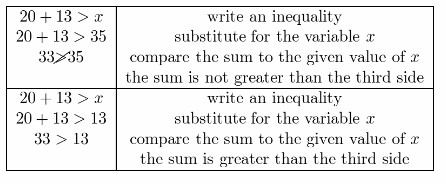
Find the sum of two sides of the triangle and compare to the third side.
n + 2n > 3n add the two sides and compare to the third side
3n ≯ 3n the sum of the two sides is NOT greater than the third side

2n + 3n> n add the two sides and compare to the third side
5n > n the sum of the two sides is greater than the third side

n + 3n > 2n add the two sides and compare to the third side
4n > 2n the sum of the two sides is greater than the third side

There is no value for n which can be a side for the length of the triangle based on the solution.

Question 14.
Persevere in Problem Solving A metalworker cut an 8-foot length of pipe into three pieces and welded them to form a triangle. Each of the 3 sections measured a whole number of feet in length. How long was each section? Explain your reasoning.
Answer:
Determine the sides of the triangle using an 8-foot length pipe.

3 + 2 > 3 add the two sides and compare to the third side
5 > 3 The sum of the two sides is greater than the third side

2 + 3 > 3 add the two sides and compare to the third side
5 > 3 The sum of the two sides is greater than the third side

3 + 3 > 2 add the two sides and compare to the third side
6 > 2 The sum of the two sides is greater than the third side

The lengths of each section are 3 ft, 2 ft. and 3 ft because when the length of the two sides are added, the sum ¡s greater than the length of the third side.

Texas Go Math Grade 6 Lesson 15.1 Answer Key Determining When Three Lengths Form a Triangle Read More »

Texas Go Math Grade 6 Module 15 Answer Key Angles, Triangles, and Equations

Refer to our Texas Go Math Grade 6 Answer Key Pdf to score good marks in the exams. Test yourself by practicing the problems from Texas Go Math Grade 6 Module 15 Answer Key Angles, Triangles, and Equations.

Texas Go Math Grade 6 Module 15 Answer Key Angles, Triangles, and Equations

Essential Question
How can you use angles, triangles, and equations to solve real-world problems?

Texas Go Math Grade 6 Module 15 Answer Key 1

Texas Go Math Grade 6 Module 15 Are You Ready? Answer Key

Complete these exercises to review skills you will need for this chapter.

Solve each equation using the inverse operation.

Question 1.
9p = 54 ________
Answer:
Simplify the equation.
\(\frac{9 p}{9}\) = \(\frac{54}{9}\) divide both sides of the equation by 9
p = 6 value of the variable p

The value of the variable is 6.

Question 2.
m – 15 = 9 ________
Answer:
Simplify the equation.
m – 15 + 15 = 0 + 15 add 15 to both sides of the equation
m = 24 value of the variable m

The value of the variable is 24.

Question 3.
\(\frac{b}{8}\) = 4 __________
Answer:
Simplify the eqsatton.
8 . \(\frac{b}{8}\) = 4 . 8 multiply both sides of the equation by 8
b = 32 value of the variable b

The value of the variable is 32.

Question 4.
z + 17 = 23 _________
Answer:
Simplify the equation.
z + 17 – 17 = 23 – 17 subtract 17 from both sides of the equation
z = 6 value of the variable z

The value of the variable is 6.

Give two names for the angle formed by the dashed rays.

Question 5.
Texas Go Math Grade 6 Module 15 Answer Key 2
Answer:
The angles formed by the rays on the diagram are ∠SKN and ∠K.

Angles are ∠SKN and ∠K.

Question 6.
Texas Go Math Grade 6 Module 15 Answer Key 3
Answer:
The angles formed by the rays on the diagram are ∠TRJ and ∠R.

Angles are ∠TRJ and ∠R.

Question 7.
Texas Go Math Grade 6 Module 15 Answer Key 4
Answer:
The angles formed by the rays on the diagram are ∠MFL and ∠F
Angles are ∠MFL and ∠F

Texas Go Math Grade 6 Module 15 Reading Start-Up Answer Key

Visualize Vocabulary
Use the ✓ words to complete the graphic. You will put one word in each oval.

Texas Go Math Grade 6 Module 15 Answer Key 5

Understand Vocabulary

Complete the sentences using the review words.

Question 1.
A triangle that contains a right angle is a ________
Answer:
A triangle that contains a right angle is a right triangle

The missing phrase is right triangle.

right triangle

Question 2.
An ______________________ has three congruent sides and three congruent angles.
Answer:
An equilateral triangle has three congruent sides and three congruent angles.

The missing phrase is equilateral triangle.

equilateral triangle

Question 3.
The sides of triangles are ____. Where two lines meet to form an angle of a triangle is called a __________________
Answer:
The sides of triangles are line segments. Where two lines meet to form an angle of a triangle is called a vertex

The missing phrases are line segments and vertex.

Line segments
vertex

Texas Go Math Grade 6 Module 15 Answer Key Angles, Triangles, and Equations Read More »

Texas Go Math Grade 6 Lesson 15.2 Answer Key Sum of Angle Measures in a Triangle

Refer to our Texas Go Math Grade 6 Answer Key Pdf to score good marks in the exams. Test yourself by practicing the problems from Texas Go Math Grade 6 Lesson 15.2 Answer Key Sum of Angle Measures in a Triangle.

Texas Go Math Grade 6 Lesson 15.2 Answer Key Sum of Angle Measures in a Triangle

Essential Question
How do you use the sum of angles in a triangle to find an unknown angle measure?

Texas Go Math Grade 6 Lesson 15.2 Explore Activity Answer Key

Explore Activity
Exploring Angles in a Triangle
Recall that a triangle is a closed figure with three line segments and three angles. The measures of the angles of a triangle have a special relationship with one another.
Texas Go Math Grade 6 Lesson 15.2 Answer Key 1
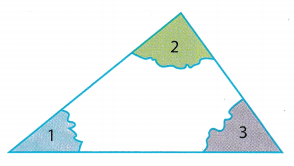
A. Use a straightedge to draw a large triangle. Label the angles 1, 2, and 3.

B. Use scissors to cut out the triangle.
Texas Go Math Grade 6 Lesson 15.2 Answer Key 2

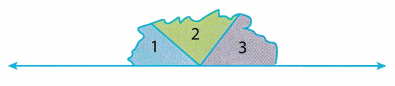
C. Tear off the three angles. Arrange them around a point on a line as shown.

D. What is the measure of the straight angle formed by the three angles?

E. What is the sum of the measures of the three angles? Explain.

F. Compare your results with those of your classmates. What guess can you make?

Reflect

Question 1.
Justify Reasoning How can you show that your guess is correct?
Answer:
When the corner angles of the triangle are placed together as seen on the image, it can form the angle of a straight line Therefore the sum of the inner corner angles in a triangle is equal to 180° which is similar to the angle of a straight angle.
Sum of the inner corner angles is equal to the measurement of the angle in a straight angle.

Your Turn

Find the unknown angle measures.

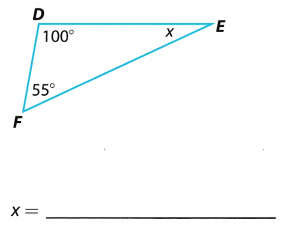
Question 2.
Texas Go Math Grade 6 Lesson 15.2 Answer Key 3
Answer:
Determine the size of the missing angle
55° + 100° + x = 180° substitute for the sum of angle measures in triangle
155° + x = 180° sum of the two angles
155° + x – 155° = 180° – 155° subtract 155° from both sides of the equation
x = 25° measure of the missing angle

The unknown angle measures 25°.

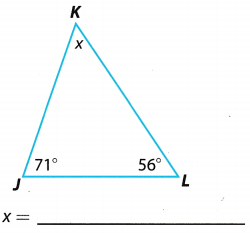
Question 3.
Texas Go Math Grade 6 Lesson 15.2 Answer Key 4
Answer:
Determine the size of the missing angle.
71° + x + 56° = 180° substitute for the sum of angle measures in triangle
127° + x = 180° sum of the two angles
127° + x – 127° = 180° – 127° subtract 127° from both sides of the equation
= 53° measure of the missing angle
The unknown angle is 53°

Example 2.
Find the angle measures in the equilateral triangle.
Texas Go Math Grade 6 Lesson 15.2 Answer Key 15
Each angle in an equilateral triangle measures 60°.

Reflect

Question 4.
Multiple Representations Write a different equation to find the angle measures in Example 2. Will the answer be the same? Explain.
Answer:
Different equations for the equilateral triangle.

x + x + x = 180° Add all the inner angles in a triangle
3x = 180° sum of all the inner angles
3x = 180°
\(\frac{3 x}{3}\) = \(\frac{180^{\circ}}{3}\) divide both sides of the equation by 3
x = 60° value of each angle in an equilateral triangle
The answer is still the same even though a different equation was used.

Go Math Lesson 15.2 Draw Quadrilaterals Answer Key Question 5.
Draw Conclusions Triangle ABC is a right triangle. What conclusions can you draw about the measures of the angles of the triangle?
Answer:
A right triangle has one angle that measures exactly 90°. If the sum of the angles in a triangle is 180°, then the other two angles must have a total measure of 90°.
The possible measures of the angles can be:
90° + 45° + 45° = 180°
90° + 35° + 55° = 180°
90° + 25° + 65° = 180°
If one angle of a right triangle is a right angle, then the other two angles will, be acute angles.

Your Turn

Write an equation to find the unknown angle measure in each triangle.

Question 6.
The measures of two of the angles are 25° and 65°.
Answer:
Determine the equation to find the size of the missing angle.
25° + 65° + x = 180°
25° + 65° + x = 180° substitute for the sum of angle measures in triangle
90° + x = 180° sum of the two angles
90° + x – 90° = 180° – 90° subtract 90° from both sides of the equation
x = 90° measure of the missing angle

The equation for the missing angle is 25° + 65° + x = 180° or x = 180° – 90°. The measure of the missing angle is 90°

Question 7.
The measures of two of the angles are 60°.
Answer:
Determine the equation to find the size of the missing angle.
60° + 60° + x = 180° or x = 180° – 120°
60° + 60° – x = 180° substitute for the sum of angle measures in triangle
120° + x = 180° sum of the two angles
120° + x – 120° = 180° – 120° subtract 120° from both sides of the equation
x = 60° measure of the missing angle

The equation for the missing angle is 60° + 60° + x = 180° or x = 180° – 120°.
The measure of the missing angle is 60°.

Question 8.
The measures of two of the angles are 35°.
Answer:
Determine the equation to find the size of the missing angle.
35° +x = 180°or x = 180° – 70°
ResuLt
35° + 35° + x = 180° substitute for the sum of angle measures in triangle
70° + x = 180° sum of the two angles
70° + x – 70° = 180° – 70° subtract 70° from both sides of the equation
x = 110° measure of the missing angle
The equation for the missing angle is 35° + 35° + x = 180° or x = 180° – 70°. The measure of the missing angle is 110°.

Texas Go Math Grade 6 Lesson 15.2 Guided Practice Answer Key

Question 1.
The sum of the angle measures in a triangle is ______ (Explore Activity)
Answer:
The sum of the angle measures in a triangle is 180°

When all the inner angles of the triangle are added, the total measurement is 180°

Example 1
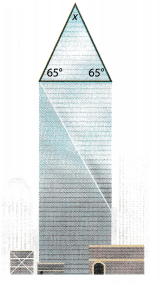
Fountain Place, shown to the right, is a 720-foot Dallas skyscraper. Find the measure of the unknown angle in the triangle at the top of the building.
m∠1 + m∠2 + m∠3 = 180° The sum of the angle measures in a triangle is 180°.
65 + 65° + x = 180° Write an equation.
130° + x = 180° Add.
Texas Go Math Grade 6 Lesson 15.2 Answer Key 16
Texas Go Math Grade 6 Lesson 15.2 Answer Key 17
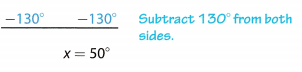
x = 50°
The angle at the top of the triangle measures 50°.

Find the unknown angle measure in each triangle. (Examples 1 and 2)

Question 2.
Texas Go Math Grade 6 Lesson 15.2 Answer Key 5
Answer:
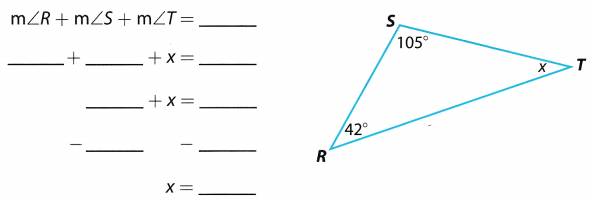
Determine the size of the missing angle if the total is 180°.
42° + 105° + x = 180° substitute for the sum of angle measures in triangle
147° + x = 180° sum of the two angles
147° + x – 147° = 180° – 147° subtract 147° from both sides of the equation
x = 33° measure of the missing angle

The missing angle measures 33°.

Question 3.
Texas Go Math Grade 6 Lesson 15.2 Answer Key 6
Answer:
Determine the size of the missing angle.
m∠J + m∠K + m∠L = 180° measures of each angle
x + 96° + 42° = 180° substitute for the sum of angle measures in triangle
x + 138° = 180° sum of the two angles
x + 138° – 138° = 180° – 138° subtract 138° from both sides of the equation
x = 42° measure of the missing angle

The unknown angle measures 42°.

Question 4.
Texas Go Math Grade 6 Lesson 15.2 Answer Key 7
Answer:
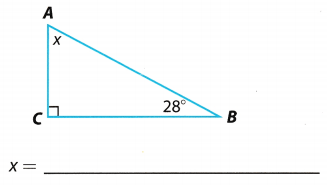
Determine the size of the missing angle.

m∠A + m∠B + m∠C = 180° measures of each angle
x + 28° + 90° = 180° substitute for the sum of angle measures in triangle
x + 118° = 180° sum of the two angLes
x + 118° – 118° = 180° – 118° subtract 118° from both sides of the equation
x = 62° measure of the missing angle
The unknown angle measures 62°.

Question 5.
Texas Go Math Grade 6 Lesson 15.2 Answer Key 8
Answer:
Determine the size of the missing angle.
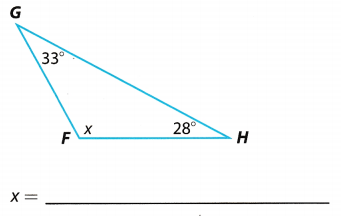
m∠F + m∠G + m∠H = 180° measures of each angle
x + 33° + 28° = 180° substitute for the sum of angle measures in triangle
x + 61° = 180° sum of the two angles
x + 61° – 61° = 180° – 61° subtract 61° from both sides of the equation
x = 119° measure of the missing angle

The unknown angle measures 119°.

Question 6.
Texas Go Math Grade 6 Lesson 15.2 Answer Key 9
Answer:
Determine the size of the missing angle
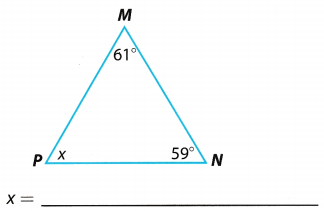
m∠M + m∠N + m∠P = 180° measures of each angle
61° + 59° + x = 180° substitute for the sum of angle measures in triangle
120° + x = 180° sum of the two angles
120° + x – 120° = 180° – 120° subtract 120° from both sides of the equation
x = 60° measure of the missing angle

The unknown angle measures 60°.

Lesson 15.2 Independent Practice Answer Key Question 7.
The measures of two of the angles are 45°. __________
Answer:
Determine the size of the missing angle.
45° + 45° + x = 180° substitute for the sum of angle measures in triangle
90° + x = 180° sum of the two angles
90° + x – 90° = 180° – 90° subtract 90° from both sides of the equation
x = 90° measure of the missing angle
The unknown angle measures 90°.

Question 8.
The measures of two of the angles are 50° and 30°. ____
Answer:
Determine the size of the missing angle.
50° + 30° + x = 180° substitute for the sum of angle measures in triangle
80° + x = 180° sum of the two angles
80° + x – 80° = 180° – 80° subtract 80° from both sides of the equation
x = 100° measure of the missing angle

The unknown angle measures 100°.

Essential Question Check-In

Question 9.
Arlen knows the measures of two angles of a triangle. Explain how he can find the measure of the third angle. Why does your method work?
Answer:
The sum of the angles of a triangle is 180°. If two angles of a triangle are given, he can add the given angles then subtract the sum from 180° to determine the measurement of the third angle.

Add the measurement of the two given angles then subtract from 180° to know the measure of the third angle.

Texas Go Math Grade 6 Lesson 15.2 Independent Practice Answer Key

Figure ABCD represents a garden crossed by a straight walkway \(\overline{A C} \text {. }\) Use the figure for 10-15.

Texas Go Math Grade 6 Lesson 15.2 Answer Key 10

Question 10.
Find m∠DAC.
Answer:
Determine the size of the missing angle.
m∠D + m∠A + m∠C = 180° measures of each angle
100° + x + 32° = 180° substitute for the sum of angle measures in triangle
132° + x = 180° sum of the two angles
132° + x – 132° = 180° – 132° subtract 132° from both sides of the equation
x = 48° measure of the unknown angle
The measure of ∠DAC = 48°

Question 11.
Explain how you found m∠DAC.
Answer:
The unknown angle is determined by adding the measures of ∠D and ∠C then subtract it from 180°.

Add m∠D and m∠C and subtract the result from 180°.

Question 12.
Find m∠BAC.
Answer:
Determine the size of the unknown angle.
m∠B + m∠A + m∠C = 180° measures of each angle
57° + x + 88° = 180° substitute for the sum of angle measures in triangle
145° + x = 180° sum of the two angles
145° + x – 145° = 180° – 145° subtract 145° from both sides of the equation
x = 35° measure of the unknown angle

The measure of ∠BAC = 35°.

Question 13.
Explain how you found m∠BAC.
Answer:
The unknown angle is determined by adding the measures of ∠B and ∠C then subtract it from 180°

Add m∠B and m∠C and subtract the result from 180°.

Question 14.
Find m∠DAB.
Answer:
Determine the measure of ∠DAB.
m∠DAB = 48° + 35° add the measures of ∠A from ∠DAC and ∠BAC
m∠DAB = 83°
The measure of ∠DAB = 83°.

Question 15.
Explain how you found m∠DAB.
Answer:
In order to determine the measure of the unknown angle, get the measure of ∠A from ∠DAC and ∠A from ∠BAC. Get the sum of the two angles and that will be the measure of ∠DAB. The indicated angle did not form a triangle therefore, the sum will not be subtracted to 180°.
Add the measures of ∠DAC and ∠BAC.

Question 16.
An observer at point O sees airplane P directly over airport A. The observer measures the angle of the plane at 40.5°.
Texas Go Math Grade 6 Lesson 15.2 Answer Key 11
Answer:
Determine the measure of the unknown angle..
m∠O + m∠P + m∠4 = 180° measures of each angle
40.5° + x + 90° = 180° substitute for the sum of angle measures in triangle
130.5° + x = 180° sum of the two angles
130.5° + x – 130.5° = 180° – 130.5° subtract 130.5° from both sides of the equation
x = 49.5° measure of the unknown angle

The measure of ∠P = 49.5°.

The map shows the intersection of three streets in San Antonio’s River Walk district. Use the map for 17-18.

Texas Go Math Grade 6 Lesson 15.2 Answer Key 12

Question 17.
Find the measures of the three angles of the triangle.
Answer:
Determine the measure of the unknown angle.
m∠A + m∠B + m∠C = 180° measures of each angle
48° + 90° + n = 180° substitute for the sum of angle measures in triangle
138° + n = 180° sum of the two angles
138° + n – 138° = 180° – 138° subtract 138° from both sides of the equation
x = 42° measure of the unknown angle

The measures of the three angles are as follows:
m∠A = 48° as indicated on the map
m∠B = 90° because the angle forms a right angle which measures 90°
m∠C = 42° based from the solution

Question 18.
Explain how you found the angle measures.
Answer:
Measurement of angles are indicated in the figure. However, there are instances when the exact value is not shown but some symbols will describe its measurement. In the given map, the measure of ∠A is already indicated, but the others are not. For ∠B, the small square corner represents a right angle thus the measure is 90°. To get the measure of ∠C, add the measures of the two angles then subtract the sum from 180°

The measure of ∠C can be determined by getting the sum of ∠A and ∠B and subtract the result from 180°.

Texas Go Math Grade 6 Lesson 15.2 H.O.T. Focus On Higher Order Thinking Answer Key

Question 19.
Persevere in Problem Solving Find the measure of ∠ACB. Explain how you found your answer.
Texas Go Math Grade 6 Lesson 15.2 Answer Key 13
Answer:
Determine the inner angle of ∠B from the straight angle which measures 180°.
180° – 148° = 32° measure of the inner angle ∠B
Find the unknown angle.
m∠A + m∠B + m∠C = 180° measures of each angle
83° + 32° + x = 180° substitute for the sum of angle measures in triangle
115° + x = 180° sum of the two angles
115° + x – 115° = 180° – 115° subtract 115° from both sides of the equation
x = 65° measure of the unknown angle

The unknown angle measures 65°.

Question 20.
Communicate Mathematical Ideas Explain how you can use the figure to find the sum of the measures of the angles of quadrilateral ABCD. What is the sum?
Texas Go Math Grade 6 Lesson 15.2 Answer Key 14
Answer:
The given figure is divided by a segment at the middle which creates two triangles. If the sum of the angles in a triangle measures 180°, therefore the sum of the angles in the given quadrilateral is 360°.

The total measure of the angles in the quadrilateral is 360°.

Question 21.
Draw Conclusions Recall that a right triangle is a triangle with one right angle. One angle of a triangle measures 89.99 degrees. Can the triangle be a right triangle? Explain your reasoning.
Answer:
The given measurement of one angle in the triangle is not exactly equal to 90° therefore the triangle cannot be named as a right triangle.

It cannot be a right triangle because it does not have a right angle.

Texas Go Math Grade 6 Lesson 15.2 Answer Key Sum of Angle Measures in a Triangle Read More »

Texas Go Math Grade 6 Lesson 17.3 Answer Key Dot Plots and Data Distribution

Refer to our Texas Go Math Grade 6 Answer Key Pdf to score good marks in the exams. Test yourself by practicing the problems from Texas Go Math Grade 6 Lesson 17.3 Answer Key Dot Plots and Data Distribution.

Texas Go Math Grade 6 Lesson 17.3 Answer Key Dot Plots and Data Distribution

Essential Question
How can you summarize and display numeric data?

Texas Go Math Grade 6 Lesson 17.3 Explore Activity Answer Key

Explore Activity 1
Variable Data and Statistical Questions
The question “How much does a typical cat weigh?” is an example of a statistical question. A statistical question is a question that has many different, or variable, answers.

A. Decide whether each of the situations below could yield variable data.

1. Your sister wants to know the typical weight for an adult cat. ____

2. You want to know how tall your friend is. ____

3. You want to know how far your house is from school, ____________
4. A car owner wants to know how much money people usually pay for a new tire. ____________

5. How many students were in line for lunch at the cafeteria today at 12:30? _______________

B. For which of the situations in part A can you write a statistical question? Write questions for these situations.

Reflect

Question 1.
Choose one of the questions you wrote in part B. How might you find answers to this question? What units would you use for the answers?
Answer:

  • Question: How much is the cost of a new tire?
  • The answers might be taken from the published amount through the websites of the tire manufacturing company. Or through interview from tire shops or people who have purchased car tire recently.
  • Currency: Dollars

The cost of a new tire can be determined through interview from selected respondents.

Reflect

Question 2.
How many games did the team play during the season? How can you tell from looking at the dot plot?
Answer:
The team played 19 games during the season based on the number of dots. It was shown on the dot plot because the dots above the number line represents the frequency of data.

The dots on the number line indicate 19 games.

Lesson 17.2 Shape of Data Distributions Answers Question 3.
At how many games did the team score 2 runs or fewer? How do you know?
Answer:
The team scored 2 runs or fewer in 10 games based on the number of dots indicated on points 0, 1, and 2 of the dot plot.
10 games

Your Turn

Question 4.
A different baseball team scores the following numbers of runs in its games for several weeks:
Texas Go Math Grade 6 Lesson 17.3 Answer Key 1
4, 4, 6, 1, 2, 4, 1, 2, 5, 3, 3, 5, 4, 2
Use the data to make a dot plot. Tell how many games the team played, and identify the data value with the greatest frequency.
Answer:
Dot plot of the given data
Texas Go Math Grade 6 Lesson 17.3 Answer Key 10
The numbers on the line represent me runs scored by the team while the dots represent me number of games made for each run. Based from the dot plot and by counting the dots, the team played 14 games with 4 runs as the data value with the greatest frequency.
They played 14 games and the data with the greatest frequency is 4 runs.

Your Turn

Question 5.
Describe the spread, center, and shape of the data distribution from Example 1.
Answer:
The data values are spread out from 0 to 11 with data value of 11 as an outlier. The data has a cluster from 0 to 7 with one peak at 2, which is the center of distribution. The distribution is not symmetric as the data values are clustered at one end of the distribution.

The data showed one outlier and non symmetric.

Your Turn

Question 6.
Find the mean, median, and range of the data from Your Turn question 4. What is the typical number of runs the team scores in a game? Justify your answer.
Answer:
Determine the mean, median, and range of the given data.
Texas Go Math Grade 6 Lesson 17.3 Answer Key 11
The mean of the data is about 3.29 while the median is 3.5, and the range is 5. Since the mean and median have closer values, it shows that the more typical number of runs the team scores in a game is around 3 to 4 runs.

Texas Go Math Grade 6 Lesson 17.3 Guided Practice Answer Key

Tell whether the situation could yield variable data. If possible, write a statistical question.

Question 1.
The town council members want to know how much recyclable trash a typical household in town generates each week.
Answer:
The given situation can give variabLe data depending on the consumption of each household due to the number of people. The statistical question could be, how much recyclable trash in the household can be generated in a week?
How much recyclable trash are there in your house each week?

Kate asked some friends how many movies they saw last winter. Use her data for 2 and 3.
Texas Go Math Grade 6 Lesson 17.3 Answer Key 2

Question 2.
Make a dot plot of the data. (Example 1)
Texas Go Math Grade 6 Lesson 17.3 Answer Key 3
Answer:
Dot plot for the given data
Texas Go Math Grade 6 Lesson 17.3 Answer Key 12
Dot plot of the movies seen last Winter.

Question 3.
Find the mean, median, and range of the data. (Example 3)
Answer:
Determine the mean, median, and range of the given data.
Texas Go Math Grade 6 Lesson 17.3 Answer Key 13
mean = 5.19
median = 5
range = 17 – 0
range = 17

Mean = 5.19
Median = 5
Range = 17

Question 4.
Describe the spread, center, and shape of the data. (Example 2)
Answer:
The data values are spread out from 0 to 17 with a data value 17 that appears to be an outlier. The data is clustered from 0 to 9 with two peaks at 4 and 5 which represents the value with the greatest frequency. Without the outlier, the distribution is symmetric and clustered around the center of the distribution.

Without the outlier, the distribution is symmetric.

Essential Question Check-In

Question 5.
What are some measures of center and spread that you can find from a dot plot? How can making a dot plot help you visualize a data distribution?
Answer:
Mean, median, and range can easily be identified using a dot plot since the dots represent the value of the data in a distribution. It also shows the frequency of the data value because the number of dots placed above the number line denotes the number of times a value has been given in the data. It can also help visualize the cluster of data represented whether it is symmetric or not.

The dots help visualize the mean, mean, and range of a given data.

Texas Go Math Grade 6 Lesson 17.3 Independent Practice Answer Key

Question 6.
Vocabulary Describe how a statistical question yields an answer with variability. Give an example.
Answer:
A question is statistical if there is variation in the responses. If the question only specifies one answer, then it is not statistical since there is only one particular answer. However, if the question has varied responses then it becomes statistical. For example, determine the time spent watching television on Sunday by all students in the classroom.

Statistical question generates varied responses.

For 7-10, determine whether the question is a statistical question. If it is a statistical question, identify the units for the answer.

Question 7.
An antique collector wants to know the age of a particular chair in a shop.
Answer:
It is not a statistical question because the expected answer is very specific as to the age of a particular chair in the shop.
Not a statistical question.

Dot Plots and Data Distribution Lesson 17.3 Answer Key Question 8.
How tall do the people in your immediate and extended family tend to be?
Texas Go Math Grade 6 Lesson 17.3 Answer Key 4
Answer:
It is a statistical question because the responses may vary since the data will be the height of different members of the immediate and extended family. The unit that can be used to measure the height is inches or centimeters.
A statistical question because it generates varied responses.

Question 9.
How tall is Sam?
Answer:
It is not a statistical question because the expected answer is very specific as to the height of Sam.

Not a statistical question because there is only one answer.

Question 10.
How much did your classmates typically spend on music downloads last year?
Answer:
It is a statistical question because the responses may vary since the data will be the time spent for music downloads of the students and not of a particular person only. The unit that can be used to measure the time is hours or minutes.

A statistical question because of different responses from the classmates.

For 11-14, use the following data. The data give the number of days of precipitation per month during one year in a city.

Texas Go Math Grade 6 Lesson 17.3 Answer Key 5

Question 11.
Make a dot plot of the data.
Texas Go Math Grade 6 Lesson 17.3 Answer Key 6
Answer:
Dot plot for the given data
Texas Go Math Grade 6 Lesson 17.3 Answer Key 14
The dot plot for the data on the number of days of precipitation per month.

Question 12.
What does each dot represent? How many months are represented?
Answer:
The dot represents the value of the data taken from the number of days of precipitation per month. The number of dots represent the number of months which is 12 months.

Each dot represents the number of days while the number of dots represent the total number of months the data
was gathered.

Question 13.
Describe the shape, center, and spread of the data distribution. Are there any outliers?
Answer:
The data values are spread out from 7 to 12 with no outlier. The data is cLustered from 7 to 12 with one peak at 9 which represents the value with the greatest frequency. The distribution is not symmetric because the data values are clustered at one end of the distribution.

The data has no outlier and the distribution is not symmetric.

Question 14.
Find the mean, median, and range of the data.
Answer:
Determine the mean, median, and range of the given data.
Texas Go Math Grade 6 Lesson 17.3 Answer Key 15
Mean = 9.67
Median = 9.5
Range = 5

Question 15.
What If? During one month there were 7 days of precipitation. What if there had only been 3 days of precipitation that month? How would that change the measures of center?
Answer:
Determine the mean, median, and range of the given data.
Texas Go Math Grade 6 Lesson 17.3 Answer Key 16
When the least data was changed, the value of mean and range also changed. The mean vaLue of 9.33 is less than the original mean and the range value of 9 is greater than the original range.

For 16 and 17, use the dot plot of the number of cars sold at a car dealership per week during the first half of the year.

Texas Go Math Grade 6 Lesson 17.3 Answer Key 7

Question 16.
Find the mean, median, and range.
Mean= ______ Median= ______
Range = ________
Answer:
Determine the mean, median, and range of the given data.
Texas Go Math Grade 6 Lesson 17.3 Answer Key 17
Mean = 10.25
Median = 10
Range = 17

Dot Plots and Data Distribution Answer Key Question 17.
The owner of the car dealership decides to treat the value 22 as an outlier. Which measure of center or spread is affected the most if the owner removes this outlier? Explain.
Answer:
If the value of 22 will be considered as an outlier, the affected measure of center or spread ¡s the value of the mean and the range. The mean value of 9.74 and range value of 10 is lesser than the original mean and range value.

The value of the mean and range are affected by the outlier.

Question 18.
How many cars are sold in a typical week at the dealership? Explain.
Answer:
There are about 10 cars that were sold in a week based on the given data. It is determined through the computed value of the mean of about 10 cars

Question 19.
Write an expression that represents the total number of cars sold during the first half of the year.
Answer:
The total number of cars sold during the first half of the year is 246 cars.
246 cars

Question 20.
Describe the spread, center, and shape of the data distribution.
Answer:
The data values are spread out from 5 to 22 with a data value 22 that appears to be an outlier. The data is c[ustered from 5 to 15 with one peak at 10 which represents the value with the greatest frequency. Without the outlier, the distribution is symmetric and clustered around the center of the distribution.

The data has one outlier and the distribution is symmetric if the outlier is not included.

Question 21.
Vocabulary Explain how you can tell the frequency of a data value by looking at a dot plot.
Answer:
The number of dots above a specific data value indicates the frequency of that data. For the given dot plot on item 16, it shows that there are 5 dots on the point 10, it means that the data value of 10 appears five times in the gathered data.

Number of dots indicate the frequency of the data value.

For 22—26 use the following data. The data give the number of runs scored by opponents of the Boston Red Sox in June 2010.

4, 4, 9, 0, 2, 4, 1, 2, 11, 8, 2, 2, 5, 3, 2, 5, 6, 4, 0

Question 22.
Make a dot plot for the data.
Texas Go Math Grade 6 Lesson 17.3 Answer Key 8
Answer:
Dot plot of the given data.
Texas Go Math Grade 6 Lesson 17.3 Answer Key 18
The dot plot based on the number of runs scored by the opponents of Boston Red Sox

Question 23.
How many games did the Boston Red Sox play in June 2010? Explain.
Answer:
The data has 19 entries which indicates that the Boston Red Sox played 19 games in June 2010.

19 games

Question 24.
Which data value in your dot plot has the greatest frequency? Explain what that frequency means for this data.
Answer:
The data value with the greatest frequency is at point 2. It shows that the opponent of Boston Red Sox had more two runs.
The greatest frequency falls on point 2 of the dot plot

Question 25.
Find the mean, median, and range of the data.
Answer:
Determine the mean, median, and range of the given data.
Texas Go Math Grade 6 Lesson 17.3 Answer Key 19
mean = 3.89
median = 4
range = 11

Question 26.
What is a statistical question that you could answer using the dot plot? Answer your question and justify your response.
Answer:
How many games did the opponent of the Boston Red Sox got with the given the number of runs?
They scored the following:
0 runs – 2 games
1 run – 1 game
2 runs – 5 games
3 runs – 1 game
4 runs – 4 games
5 runs – 2 games
6 runs – 1 game
8 runs – 1 game
9 runs – 1 game
11 runs – 1 game
The statistical question could be, how many games did the opponents scored with the given number of runs.

Texas Go Math Grade 6 Lesson 17.3 H.O.T. Focus On Higher Order Thinking Answer Key

Question 27.
A pediatrician records the ages of the patients seen in one day:
1, 2, 5, 7, 9, 17, 13, 16, 18, 12, 3, 5, 1.

a. Explain the Error Assuming that some of the patients are infants who are less than 1 year old, what information did the pediatrician forget to write down?
Answer:
The data is about the ages of the patients and based on the situation, there are infants who are less than 1 year old. There is an error on the data because the unit of measurement is not indicated. Ages can be measured by year or months.
The unit of measurement is missing from the data.

b. Critical Thinking Can you make a dot plot of the pediatrician’s data? Can you find the mean, median, and range? Why or why not?
Answer:
A dot plot cannot be created because the unit of measurement is not indicated in the data. Thus, the value of the mean, median, and range cannot also be computed.

There was an error in the data gathering therefore a dot plot cannot be created.

Question 28.
Multistep A nurse measured a patient’s heart rate at different times over several days.
Texas Go Math Grade 6 Lesson 17.3 Answer Key 9
a. Make a dot plot.
Answer:
Dot plot for the given data
Texas Go Math Grade 6 Lesson 17.3 Answer Key 20
The dot plot of the heart rate of a patient at different time intervals.

b. Describe the shape, center, and spread of the data. Then find the mean, median, range, and IQR for the data.
Answer:
The data values are spread out from 82 to 90 with no outlier. The data is clustered from 82 to 90 with one peak at 86 which represents the value with the greatest frequency. The distribution is symmetric and clustered around the center of the distribution.

Determine the mean, median, range, and IQR of the given data.
Texas Go Math Grade 6 Lesson 17.3 Answer Key 21
range = 90 – 82
range = 8
IQR = 87.5 – 84.5
IQR = 3
The distribution is symmetric.

c. What If? The nurse collected the data when the patient was resting. How might the dot plot and the measures change if the nurse collects the data when the patient is exercising?
Answer:
If the data values to be collected will be coming from a patient who is exercising then the heart rate will be different because of the level of exercise that he will be doing. The dot plot and the measure of change will also vary depending on the gathered data from the patient who is exercising.

The dot plot and measure of center and spread may vary based on the heart rate of an exercising patient.

Texas Go Math Grade 6 Lesson 17.3 Answer Key Dot Plots and Data Distribution Read More »

Texas Go Math Grade 6 Unit 4 Study Guide Review Answer Key

Refer to our Texas Go Math Grade 6 Answer Key Pdf to score good marks in the exams. Test yourself by practicing the problems from Texas Go Math Grade 6 Unit 4 Study Guide Review Answer Key.

Texas Go Math Grade 6 Unit 4 Study Guide Review Answer Key

Module 10 Generating Equivalent Numerical Expressions

Essential Question
How can you generate equivalent numerical expressions and use them to solve real-world problems?

Exercises

Use exponents to write each expression. (Lesson 10.1)

Question 1.
3.6 × 3.6 ______
Answer:
Solution to this example is given below
3.6 × 3.6
Find the base, or the numbers being multiplied. The base is 3.6
Find the exponents by counting the number of 3.6s being multiplied
The exponents is 2 (Final solution)
Texas Go Math Grade 6 Unit 4 Study Guide Review Answer Key 12

Go Math Answer Key Grade 6 Unit 4 Study Guide Question 2.
9 × 9 × 9 × 9 ______
Answer:
Solution to this example is given below
9 × 9 × 9 × 9
Find the base, or the numbers being multiplied. The base is 9
Find the exponents by counting the number of 9s being multiplied
The exponents is 4 Final solution
Texas Go Math Grade 6 Unit 4 Study Guide Review Answer Key 13

Question 3.
\(\frac{4}{5}\) × \(\frac{4}{5}\) × \(\frac{4}{5}\)
Answer:
Texas Go Math Grade 6 Unit 4 Study Guide Review Answer Key 32
Texas Go Math Grade 6 Unit 4 Study Guide Review Answer Key 33

Find the value of each power. (Lesson 10.1)

Question 4.
12° ____
Answer:
Solution to this example is given below
12°
Identify the base and the exponents
The base is 12 and the exponents is 0.
Evaluate: 12° = 1 (Any power raised to exponent 0 is always equal to 1)
1 (Final solution)

Question 5.
132 ______
Answer:
The solution to this example is given below
132
Identify the base and the exponents
The base is 13 and the exponents are 2. (Final solution)
Evaluate: 132 = 13 × 13 = 169
169

Go Math Expressions Grade 6 Answer Key Unit 4 Study Guide Question 6.
\(\left(\frac{2}{7}\right)^{3}\) ______
Answer:
Texas Go Math Grade 6 Unit 4 Study Guide Review Answer Key 35

Write the prime factorization of each number. (Lesson 10.2)

Question 7.
75 ____
Answer:
The prime factorization of a number is the number written as the product of its prime factors. For example, the prime factors of 75 are 3, 5 and 5.
The prime factorization of 75 is: (Final solution)
75 = 3 × 5 × 5 or 3 × 52
3 × 52

Question 8.
29 ____
Answer:
Given number: 29

Factorize the given number using its prime factors, therefore:
29 = 29
Prime factor of 29 is 29. This implies that 29 is a prime number

Prime factor of 29 is 29.

Question 9.
168 ______
Answer:

Question 10.
Eduardo is building a sandbox that has an area of 84 square feet. What are the possible whole number measurements for the length and width of the sandbox? (Lesson 10.2)
Answer:
Given number:
84

Write the given number as a product of its factors, therefore:
84 = 2 × 42
84 = 3 × 28
84 = 4 × 21
84 = 6 × 14
84 = 7 × 12
The required sandbox can have the dimensions of 2 by 42, 3 by 28, 4 by 21, 6 by 14, and 7 by 12.

Unit 4 Study Guide Answer Key 6th Grade Go Math Question 11.
2 × 52 – (4 + 1) ____
Answer:
Solution to this example is given below
2 × 52 – (4 + 1)
2 × 52 – (4 + 1) = 2 × 25 – (4 + 1) Evaluate 52.
= 2 × 25 – 5 Perform operations inside parentheses.
= 50 5 Multiply.
= 45 Subtract.
45 (Final solution)

Question 12.

Texas Go Math Grade 6 Unit 4 Study Guide Review Answer Key 1
Answer:
Texas Go Math Grade 6 Unit 4 Study Guide Review Answer Key 36

Module 11 Generating Equivalent Algebraic Expressions

Essential Question
How can you generate equivalent algebraic expressions and use them to solve real-world problems?

Exercises

Write each phrase as an algebraic expression. (Lesson 11.1)

Question 1.
x subtracted from 15 _____ 4
Answer:
Solution to this example is given below
x subtracted from 15. The operation is subtraction.
The algebraic expression is 15 – x
15 – x (Final solution)

Question 2.
12 divided by t ____
Answer:
Solution to this example is given below
12 divided by t. The operation is division.
The algebraic expression is \(\frac{12}{t}\)
\(\frac{12}{t}\) (Final solution)

Write a phrase for each algebraic expression. (Lesson 11.1)

Question 3.
8p ______
Answer:
Solution to this example is given below
8p The operation is Multiplication.
The product of 8 and p (Fina solution)
The product of 8 and p

Question 4.
s + 7 _____
Answer:
Solution to this example is given below
s + 7 The operation is Addition (Final solution)
The sum of s and 7

Evaluate each expression for the given value of the variable. (Lesson 11.2)

Question 5.
8z + 3; z = 8 ________
Answer:
Solution to this example is given below
8z + 3; z = 8
8(8) + 3 Substitute 8 for z
64 + 3 Multiply
67 Add
When z = 8, 8z + 3 = 67
Final solution

6th Grade Unit 4 Test Study Guide Answer Key Question 6.
3(7 + x2);x = 2 ______
Answer:
Solution to this example is given below
3(7 + x2); x = 2
3(7 + 22) Substitute 2 for x
3(7 + 4) Evaluate exponents
3(11) Add inside the parentheses
33 Multiply
When x = 2, 3(7 + x2) = 33
33 Final solution

Question 7.
s – 5t + s2; s = 4, t = -1 ____________
Answer:
Solution to this example is given below
s – 5t + s2; s = 4, and t = – 1
4 – 5(-1) + 42 Substitute 4 for s, and (-1) for t
4 – 5(-1) + 16 Evaluate exponents
4 + 5 + 16 Multiply
25 Add
When s = 4, and t = -1s – 5t + s2 = 25
25 Final sotution

Question 8.
x – y3; x = -7, y = 3 ______
Answer:
Solution to this example is given below
x – y3; x = -7, and y = 3
-7 – 33 Substitute (-7) for x, and 3 for y
– 7 – 27 Evaluate exponents
-34 Subtract
When x = -7, and y = 3, x – y3 = -34
-34 Final solution

Question 9.
The expression \(\frac{1}{2}\)(h)(b1 + b2) gives the area of a trapezoid, with b1, and b2 representing the two base lengths of a trapezoid and h representing the height. Find the area of a trapezoid with base lengths 4 in. and 6 in. and a height of 8 in. (Lesson 11.2) ________
Answer:
Solution to this example is given betow
\(\frac{1}{2}\)(h)(b1 + b2); h = 8, b1 = 4, and b2 = 6
\(\frac{1}{2}\)(8)(4 + 6) Substitute 8 for h, 4 for b1, and 6 for b2
4(4 + 6) Multiply
4(10) Add inside the parentheses
40 Multiply
When h = 8, b1 = 4, and b2 = \(\frac{1}{2}\)(h)(b1 + b2) = 40
Area of the given trapezoid is 40 square inches
40 Final solution

Determine if the expressions are equivalent. (Lesson 11.3)

Question 10.
7 + 7x; 7(x + \(\frac{1}{7}\))
Answer:
Given expression:
7(x + \(\frac{1}{7}\))
Apply distributive property to expand the parentheses:
= 7(x) + 7( \(\frac{1}{7}\))
Simplify:
= 7x + 1
Compare:
7x + 1 ≠ 7x + 7
The 2 expressions are not equivalent

Question 11.
2.5(3 + x); 2.5x + 7.5 ______
Answer:
Given expression:
2.5(3 + x)
Apply distributive property to expand the parentheses:
= 2.5(3) + 2.5(x)
Simplify:
= 7.5 + 2.5x
Compare:
7.5 + 2.5x = 7.5 + 2.5x
The 2 expressions are equivalent

Combine like terms. (Lesson 11.3)

Question 12.
3m – 6 + m2 – 5m + 1 ____
Answer:
Combine like terms
3m – 6 + m2 – 5m + 1
3m – 6 + m2 – 5m + 1 = m2 – 5m + 3m – 6 + 1 Commutative Property
= m2 – 2m – 5 Distributive Property
3m – 6 + m2 – 5m + 1 = m2 – 2m – 5
m2 – 2m – 5 Final Solution

6th Grade Unit 4 Study Guide Answer Key Question 13.
7x + 4(2x – 6) _____
Answer:
Combine like terms
7x + 4(2x – 6)
7x + 4(2x – 6) = 7x + 8x – 24 Distributive Property
= 15x – 24 Add
7x + 4(2x – 6) = 15x – 24
15x – 24 Final Solution
15x – 24

Module 12 Equations and Relationships

Essential Question
How can you use equations and relationships to solve real-world problems?

Exercises

Determine whether the given value is a solution of the equation. (Lesson 12.1)

Question 1.
7x = 14; x = 3 _____
Answer:
Solution to this example is given below
7x = 14; x = 3
7(3) = 14 Substitute
21 ≠ 14 Multiply
3 is not a solution of 7x = 14.
x ≠ 3 Final solution

Question 2.
y + 13 = -4; y = -17 _____
Answer:

Write an equation to represent the situation. (Lesson 12.1)

Question 3.
Don has three times as much money as his brother, who has $25. ______
Answer:
Solution to this example is given below
\(\frac{x}{3}\) = 25
\(\frac{x}{3}\) × 3 = 25 × 3 Multiply both sides by3
x = 75 Simplify
Don has dollars
x = 75 Final solution

Question 4.
There are s students enrolled in Mr. Rodriguez’s class. There are 6 students absent and 18 students present today. _____
Answer:
The total number of student s is the sum of the students who are present and who are absent, so the equation becomes:
s = 18 + 6

Evaluate:
s = 24
24 students are enrolled in Mr. Rodriguez’s class.

Solve each equation. Check your answer. (Lessons 1 2.2,12.3)

Question 5.
p – 5 = 18
Answer:
Solution to this example is given below
p – 5 = 18
p – 5 + 5 = 18 + 5 Add both sides by 5
p = 23 Simplify
Check; 23 – 5 = 18 Substitute
18 = 18
p = 23 Final solution
p = 23

Question 6.
\(\frac{t}{4}\) = -12
Answer:
We wilt multiply both sides by 4 and get:
4(\(\frac{t}{4}\)) = 12(4)
t = 48
Now, we will substitute 48 for t into original equation to check our solution:
\(\frac{48}{4}\) = 12
So,
the solution is t = 48
t = 48

Question 7.
9q = 18.9 ____
Answer:
Solution to this example is given below
9q = 18.9
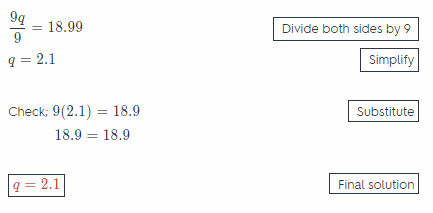
Texas Go Math Grade 6 Unit 4 Study Guide Review Answer Key 14

Question 8.
3.5 + x = 7
Answer:
Solution to this example is given below
3.5 + x = 7
3.5 + x – 3.5 = 7 – 3.5 Subtract both sides by 3.5
x = 3.5 Simplify
Check; 3.5 + 3.5 = 7 Substitute
7 = 7 Add on the left side
x = 3.5 Final solution

Question 9.
18 = x – 31 ____
Answer:
We will add 31 to both sides in order to isolate x:
49 = x
Now, we will check our solution substituting 49 for x into the original equation and get:
49 – 31 = 18
So, conclusion is that x = 49 is a solution.
x = 49

Question 10.
\(\frac{2}{7}\) = 2x _____
Answer:
Solution to this example is given below
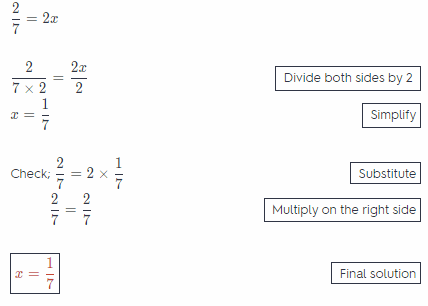
Texas Go Math Grade 6 Unit 4 Study Guide Review Answer Key 15

Question 11.
Sonia used $12.50 to buy a new journal. She has $34.25 left in her savings account. How much money did Sonia have before she bought the journal? Write and solve an equation to solve the problem. (Lesson 12.2)
Answer:
Solution to this example is given below
x – 12.5 = 34.25
x – 12.5 + 12.5 = 34.25 + 12.5 Add both sides by 125
x = 46.75 Simplify
Check; 46.75 – 12.5 = 34.25 Substitute
34.25 = 31.25 Subtract on the left side
Sonia had 46.75 dollars before she bought the journal
x = 46.75 Final solution
x = 46.75

Question 12.
Tom read 132 pages in 4 days. He read the same number of pages each day. How many pages did he read each day? Write and solve an equation to solve the problem. (Lesson 12.3) _____
Answer:
Let x represent the number of pages Tom red each day. Using all informations in this task, we get the following equation:
4x = 132
In order to solve it, we need to divide both sides by 4 and get:
\(\frac{4 x}{4}\) = \(\frac{132}{4}\)
x = 33
So,
Tom red 33 pages each day.
33

Module 13 Inequalities and Relationships

Essential Question
How can you use inequalities and relationships to solve real-world problems?

Exercises

Write and graph an inequality to represent each situation (Lesson 13.1)

Question 1.
Orange Tech’s stock is worth less than $2.50 per share. ____

Texas Go Math Grade 6 Unit 4 Study Guide Review Answer Key 2
Answer:
Because here we have less than 2.50 and if x represent. Orange Techs stock, we get the following inequality:
x < 2.50

Question 2.
Tina got a haircut, and her hair is still at least 15 inches long. ____

Texas Go Math Grade 6 Unit 4 Study Guide Review Answer Key 3
Answer:
Draw a solid circle at 15 to show that 15 is a solution.
Shade the number tine to the right of 15 to show that numbers greater than 15 are solutions.
Check your solution.
Choose a number that is on the shaded section of the number line, such as 16. Substitute 16 for x.
16 ≥ 15 : 16 greater than 15, so 16 is a solution
x ≥ 15 Final solution

Solve each inequality. Graph and check your solutions (Lessons 13.2, 13.3, 1 3.4)

Question 3.
q – 12 > 3 ____
Answer:
First we will add 12 to both sides and get:
q > 15
Now, we will graph the solution.
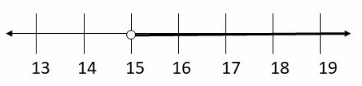
Texas Go Math Grade 6 Unit 4 Study Guide Review Answer Key 16
Now, we will check our solution substituting 16 for q into the original inequality and get:
16 – 12 > 3
4 > 3
so, the inequality is true.
q > 15

Question 4.
\(\frac{t}{4}\) ≤ -1 ____
Answer:
In order to solve the given inequality, we wilt multiply both sides by 4 and get:
\(\frac{t}{4}\) ≤ (-1)(4)
t ≤ -4
Now, we will graph the solution:
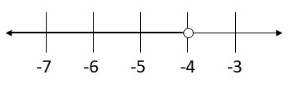
Texas Go Math Grade 6 Unit 4 Study Guide Review Answer Key 17
Next step ¡s to check the solution by substituting some value from the shaded area on the number line.
For example, we Wilt substitute 8 for t into the original inequality:
\(\frac{-8}{4}\) ≤ -4
-2 ≤ -1
S0, the inequality is true.
t ≤ -4

Go Math Grade 6 Unit 4 Unit Assessment Answer Key Question 5.
9q > 10.8 ____
Answer:
In order to solve this inequality, we will divide both sides by 9 and get:
\(\frac{9q}{8}\) > \(\frac{10.8}{9}\)
q > 1.2
Now, we will graph the solution:
Texas Go Math Grade 6 Unit 4 Study Guide Review Answer Key 18
Next step is to check the solution substituting value from the shaded area on the number line.
For example, we will substitute 3.2 for q into the original inequality:
9 . 3.2 > 10.8
28.8 > 10.8
So, the Inequality is true
q > 1.2

Question 6.
87 ≤ 25 + x ____
Answer:
We wilt use Subtracting Property of Inequality, we will actually subtract 25 from both sides:
62 ≤ x
Now, we will graph the solution:
Texas Go Math Grade 6 Unit 4 Study Guide Review Answer Key 19
Next step is to check the solution substituting some value from the shaded area on the number line.
For example, we will substitute 65 for x into the original inequality:
87 ≤ 25 + 65
87 ≤ 90
So, the Inequality is true.
x ≥ 62

Question 7.
–\(\frac{4}{5}\) < 8 _____
Answer:
5 4
The first step is to multipLy both sides by –\(\frac{5}{4}\), which is reciprocal of –\(\frac{4}{5}\)
Because –\(\frac{4}{5}\) is a negative number, we need to reverse the inequality symbol in order to original inequality still be true.
So, we have the following:
Texas Go Math Grade 6 Unit 4 Study Guide Review Answer Key 20

Next step is to check the solution substituting some value from the shaded area on the number line.
For example, we will substitute 0 for x into the original inequality:
–\(\frac{4}{5}\) . 0 < 8
0 < 8 So, the Inequality is true. x > – 10

Question 8.
-4 ≥ -0.5x ____
Answer:
The first step is to divide both sides by -0.5. -0.5 is a negative number, we need to reverse the inequality symbol in order to original inequality still be true.
So, we have the following:
Texas Go Math Grade 6 Unit 4 Study Guide Review Answer Key 21
Next step is to check the solution substituting some value from the shaded area on the number line.
For example, we will substitute 10 for x into the original inequality:
-4 ≥ – 0.5 . 10
-4 ≥ -5
So, the Inequality is true.
x ≥ 8

Question 9.
Write a real-world comparison that can be described by x – 3 ≥ 11. (Lesson 13.2)
Answer:
A real-world comparison that can be described by given inequality could be:
If Tom gives to his brother 3 candies, he will left at least 11 candies more. How many candies Tom had?

Question 10.
Omar wants a rectangular vegetable garden. He only has enough space to make the garden 5 feet wide, and he wants the area of the garden to be more than 80 square feet. Write and solve an inequality to find the possible lengths of the garden. (Lesson 13.3)
Answer:
The area of this rectangular garden is a product of its width and length. Here, let x represent the possible length of the garden.
Using all pieces of information, we get the following inequality:
5x > 80
In order to solve this inequa1ity we need to divide both sides by 5 and get:
x > 16
So, the length of the garden can be greater than 16 feet.
x > 16

Module 14 Relationships in Two Variables

Essential Question
How can you use relationships in two variables to solve real-world problems?

Exercises

Graph and label each point on the coordinate plane. (Lesson 14.1)

Question 1.
(4, 4)
Answer:
(4, 4 ) is located 4 units right of the origin, and 4 units up. It has x-coordinate 4 and y-coordinate 4, written (4, 4). It is located in Quadrant I.
Texas Go Math Grade 6 Unit 4 Study Guide Review Answer Key 22

Texas Go Math Grade 6 Unit 4 Study Guide Review Answer Key 4

Question 2.
(-3, -1)
Answer:
(-3, -1) is located 3 units left of the origin, and 1 units down. It has x-coordinate -3 and y-coordinate -1, (-3, -1) is in Quadrant III
Texas Go Math Grade 6 Unit 4 Study Guide Review Answer Key 23

Question 3.
(-1, 4) ____
Answer:
(-1, 4 ) is located 1 units left of the origin, and 4 units up. It has x-coordinate -1 and y-coordinate 4.
(-1, 4) is in Quadrant II.
Texas Go Math Grade 6 Unit 4 Study Guide Review Answer Key 24

Use the graph to answer the questions. (Lesson 14.2)

Question 4.
What is the independent variable? __________________________
Answer:
What is the independent variable? Time in hours.
The independent variable is the variable taken on the x-axis of the graph It is time in hours here.
Time in hours.

Question 5.
What is the dependent variable? __________________ _________
Answer:
What is the dependent variable? Distance in miles.

The dependent variable is the variable taken on the y-axis of the graph. It is distance in miles here.
Distance in miles.

Question 6.
Describe the relationship between the independent variable and the dependent variable.
Answer:

Question 7.
Use the data on the table to write an equation to express y in terms of x. Then graph the equation. (Lessons 14.3, 14.4)
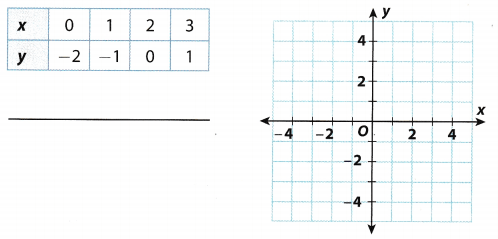
Texas Go Math Grade 6 Unit 4 Study Guide Review Answer Key 5
Answer:
Using the data in the table, we will try to find a relationship between x between x and y. Let x1 be 0 and x2 be 1.
So, y1 will be -2 and y2 will be -1. We will use the line through those two points and get:
Texas Go Math Grade 6 Unit 4 Study Guide Review Answer Key 25
So, required equation is y = x – 2. Now, we will graph the solution.
Texas Go Math Grade 6 Unit 4 Study Guide Review Answer Key 26
y = x – 2

Texas Go Math Grade 6 Unit 4 Performance Tasks Answer Key

Question 1.
Careers In Math Botanist Dr. Adama is a botanist. She measures the daily height of a particular variety of sunflower, Sunny Yellow, beginning when the sunflower is 60 days old. At 60 days, the height of the sunflower is 205 centimeters. Dr. Adama finds that the growth rate of this sunflower is 2 centimeters per day after the first 60 days.

a. Write an expression to represent the sunflower’s height d days after the 60th day.
Answer:
Let h represent the height of the sunflower using all pieces of information, we get the following equation:
h = 205 + 2d

b. How many days after the 60th day does it take for the sunflower to reach 235 centimeters? Show your work.
Answer:
We will substitute 235 for h in previous equation and solve it for d.
235 = 205 + 2d
30 = 2d
d = 15
So, after 15 days after the 60th day
sunflower will reach 235 centimeters.

c. Dr. Adama is studying a different variety of sunflower, Suntracker, which grows at a rate of 2.5 centimeters per day after the first 60 days. If this sunflower is 195 centimeters tall when it is 60 days old, write an expression to represent Suntracker’s height d days after the 60th day. Which sunflower will be taller 22 days after the 60th day? Explain how you found your answer.
Answer:
Let h represent height of the sunflower, using all informations, we get the following equation:
h = 195 + 2.5d
Now, we will substitute 22 for d into the previous equation and solve it for h.
h = 195 + 2.5 . 22 = 250
So, the sunflower will reach 2.50 centimeters 22 days after the 60th day in second case.
Now we wilt substitute 22 for d into equation form part a and solve it for h:
h = 205 – 2 . 22 = 249
We can notice that sunflower in trie second case, from this part c, wilt be taller.

Question 2.
Vernon practiced soccer 5\(\frac{3}{4}\) hours this week. He practiced 4\(\frac{1}{3}\) hours on weekdays and the rest over the weekend.

a. Write an equation that represents the situation. Define your variable.
Answer:
Let x represent a number of hours Vermon practiced during the work days in the week. We get the following equation:
x = 5\(\frac{3}{4}\) – 4\(\frac{1}{3}\)

b. What is the least common multiple of the denominators of 5\(\frac{3}{4}\) and 4\(\frac{1}{3}\)? Show your work.
Answer:
First we need to rewrite those mixed numbers as a fractions:
5\(\frac{3}{4}\) = \(\frac{23}{4}\)
4\(\frac{1}{3}\) = \(\frac{13}{3}\)
The denominators are 4, 3 and their the least common multiple is 12.

c. Solve the equation and interpret the solution. Show your work.
Answer:
Now, we will calculate z:
Texas Go Math Grade 6 Unit 4 Study Guide Review Answer Key 27
So, over the weekend, Vermon practiced 1\(\frac{5}{12}\) hour

Texas Go Math Grade 6 Unit 4 Mixed Review Texas Test Prep Answer Key

Selected Response

Question 1.
Which expression is equivalent to 2.3 × 2.3 × 2.3 × 2.3 × 2.3?
(A) 2.3 × 5
(B) 235
(C) 25 × 35
(D) 2.35
Answer:
(D) 2.35

Explanation:
Solution to this example is given below
2.3 × 2.3 × 2.3 × 2.3 × 2.3
Find the base, or the numbers being multiplied. The base is 2.3
Find The exponents by counting the number of 2.3s being multiplied
The exponents is 5 (This option is correct answer)
Texas Go Math Grade 6 Unit 4 Study Guide Review Answer Key 28
D

Question 2.
Which operation should you perform first when you simplify 63 – (2 + 54 × 6) ÷ 5?
(A) addition
(B) division
(C) multiplication
(D) subtraction
Answer:
(C) multiplication

Explanation:
Solution to this example is given below
63 – (2 + 54 × 6) ÷ 5 (This operation is correct answer)
63 – (2 + 54 × 6) ÷ 5 = 63 – (2 + 324) ÷ 5 Perform operations inside parentheses.
C

Question 3.
Sheena was organizing items in a scrapbook. She took 25 photos and divided them evenly among p pages. Which algebraic expression represents the number of photos on each page?
(A) p – 25
(B) 25 – p
(C) \(\frac{p}{25}\)
(D) \(\frac{25}{p}\)
Answer:
(D) \(\frac{25}{p}\)

Explanation:
The solution to this example is given below
25 divided p. The operation is division.
The algebraic expression is \(\frac{25}{p}\) (This option is correct answer)
D

Grade 6 Unit 4 Review Answer Key Go Math Question 4.
The number line below represents which equation?
Texas Go Math Grade 6 Unit 4 Study Guide Review Answer Key 6
(A) -2 + 6 = 4
(B) -2 – 6 = 4
(C) 4 + 6 = -2
(D) 4 – 6 = -2
Answer:
(A) -2 + 6 = 4

Explanation:
Looking at this line below, we can conclude that the equation which represents this line is A.
-2 + 6 = 4
A

Question 5.
No more than 7 copies of a newspaper are left in the newspaper rack. Which inequality represents this situation? (A) n < 7 (B) n ≤ 7 (C) n > 7
(D) n ≥ 7
Answer:
(B) n ≤ 7

Explanation:
The words no more than indicate that the maximum number of copies on the rack were 7. so the inequality is: n ≤ 7
Option B

Question 6.
For which of the inequalities below is v = 4 a solution?
(A) v + 5 > 9
(B) v + 5 > 9
(C) v + 5 ≤ 8
(D) v + 5 < 8
Answer: (A) v + 5 > 9

Explanation:
Substitute v = 4 in each inequaLity and check for which inequality the inequality holds true, therefore:

A. 4 + 5 ≥ 9
Simplify:
9 ≥ 9
Inequality holds true.

B. 4 + 5 > 9
Simplify:
9 > 9
Inequality does not hold true.

C. 4 + 5 ≤ 8
Simplify:
9 ≤ 8
Inequality does not hold true.

D. 4 + 5 < 9
Simplify:
9 < 8
Inequality does not hold true.
Option A

Question 7.
Sarah has read aloud in class 3 more times than Joel. Sarah has read 9 times. Which equation represents this situation?
(A) j – 9 = 3
(B) 3j = 9
(C) j – 3 = 9
(D) j + 3 = 9
Answer:
(B) 3j = 9

Explanation:
Let the number of Joel’s reading turn be j, then Sarah’s turns are 3 × j = 9.
Option B.

Question 8.
The number line below represents the solution to which inequality?

Texas Go Math Grade 6 Unit 4 Study Guide Review Answer Key 7
(A) \(\frac{m}{4}\) > 1.1
(B) \(\frac{m}{3}\) < 1.2
(C) 2m < 8.8
(D) 5m < 22
Answer:
(C) 2m < 8.8

Explanation:
We can notice that the solution of inequality at C represents the number line below, really:
\(\frac{2m}{2}\) < \(\frac{8.8}{2}\)
m < 4.4
C) m < 4.4

Hot Tip! When possible, use logic to eliminate at least two answer choices.

Question 9.
Brian is playing a video game. He earns the same number of points for each star he picks up. He earned 2,400 points for 6 stars, 4,000 points for 10 stars, and 5,200 points for 13 stars. Which is the independent variable in the situation?
(A) the number of stars picked up
(B) the number of points earned
(C) the number of hours played
(D) the number of stars available
Answer:
(A) the number of stars picked up

Explanation:
Brian is playing a video game. He earns the same number of points for each star he picks up. Therefore, here the number of stars picked is the independent quantity.
option A

Question 10.
Which ratio is not equivalent to the other three?
(A) \(\frac{2}{5}\)
(B) \(\frac{12}{25}\)
(C) \(\frac{6}{15}\)
(B) \(\frac{18}{45}\)
Answer:
(B) \(\frac{12}{25}\)

Explanation:
Solution to this example is given below
Texas Go Math Grade 6 Unit 4 Study Guide Review Answer Key 29

Question 11.
One inch is 2.54 centimeters. About how many centimeters is 4.5 inches?
(A) 1.8 centimeters
(B) 11.4 centimeters
(C) 13.7 centimeters
(D) 114 centimeters
Answer:
(B) 11.4 centimeters

Explanation:
Solution to this example is given below
1 inch = 2.54 centimeters.
4.5 inch = x centimeters
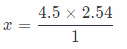
Texas Go Math Grade 6 Unit 4 Study Guide Review Answer Key 30
x = 11.43 centimeters
B This option is correct answer

Gridded Response

Questions 12.
The area of a rectangular mural is 84 square feet. The mural’s width is 7 feet. What is its length in feet?
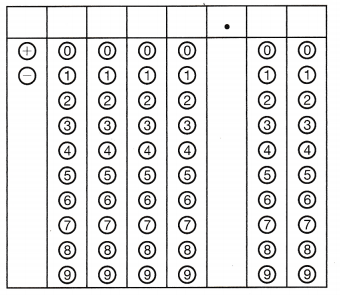
Texas Go Math Grade 6 Unit 4 Study Guide Review Answer Key 8
Answer:
The area of a rectangular mural is a product of its width and its length, so, we get the following equation, according to this:
84 = 7x
Where x represents a length of this mural in feet. In order to solve it, we need to divide both by 7 and get:
\(\frac{84}{7}\) = \(\frac{7 x}{7}\)
12 = x
So, the length of this mural is 12 feet.
12 feet

Question 13.
What is the y-coordinate of point 6 on the coordinate grid below?
Texas Go Math Grade 6 Unit 4 Study Guide Review Answer Key 9
Answer:
We can see that point on x-axes which is corresponding to G is 2 and the corresponding point on y-axes is 3 point
So, conclusion is that corresponding y-coordinate is 3.
3

Hot Tip!
Gridded responses can be positive or negative numbers. Enter any negative signs in the first column. Check your work!

Question 14.
When traveling in Canada, Patricia converts the temperature given in degrees Celsius to a Fahrenheit temperature by using the expression 9x ÷ 5 + 32, where x is the Celsius temperature. Find the temperature in degrees Fahrenheit when it is 25°C.
Texas Go Math Grade 6 Unit 4 Study Guide Review Answer Key 10
Answer:
In order to find the temperature in degrees Fahrenheit, we will substitute 25 for x in the equation from this task and get:
9 • 25 ÷ 5 + 32 = 225 ÷ 5 + 32
45 + 32 = 77
So 25°C is actually 77 degrees in Fahrenheit
77°F

Vocabulary Preview

Use the puzzle to preview key vocabulary from this unit. Unscramble the circled letters within found words to answer the riddle at the bottom of the page.
Texas Go Math Grade 6 Unit 4 Study Guide Review Answer Key 31

  • A number that is multiplied by a variable in an algebraic expression. (Lesson 11-l)
  • A value of the variable that makes the equation true. (Lesson 12-1)
  • The numbers in an ordered pair. (Lesson 14-1)
  • The point where the axes intersect to form the coordinate plane. (Lesson 14-1)
  • The part of an expression that is added or subtracted. (Lesson 11-1)
  • The two number lines that intersect at right angles to form a coordinate plane. (Lesson 14-1)
  • Tells how many times the base is used in the product. (Lesson 10-1)

Q: Why did the paper rip when the student tried to stretch out the horizontal axis of his graph?
A. Too much __ – __ __ __ __ __ !

Texas Go Math Grade 6 Unit 4 Study Guide Review Answer Key Read More »

Scroll to Top