Prasanna

Texas Go Math Grade 5 Lesson 13.2 Answer Key Customary Length

Refer to our Texas Go Math Grade 5 Answer Key Pdf to score good marks in the exams. Test yourself by practicing the problems from Texas Go Math Grade 5 Lesson 13.2 Answer Key Customary Length.

Texas Go Math Grade 5 Lesson 13.2 Answer Key Customary Length

Essential Question
How can you compare and convert units of length?
Answer:
To convert a smaller unit to a larger unit (eg to ), divide it by the number of smaller units that are needed to make. To convert from a larger unit to a smaller one, multiply. To convert from a smaller unit to a larger one, divide.

Unlock the Problem

To build a new swing, Mr. Mattson needs 9 feet of rope for each side of the swing and 6 more feet for the monkey bar. The hardware store sells rope by the yard.

A.
How many feet of rope does Mr. Mattson need for the swing?
Answer:
It is given that
To build a new swing, Mr. Mattson needs 9 feet of rope for each side of the swing
Now,
We know that,
A swing has 2 sides
So,
The total length of the rope Mr. Mattson needs for the swing = 9 + 9 = 18 feet
Hence, from the above,
We can conclude that
The number of feet of rope does Mr. Mattson need for the swing is: 18 feet

B.
How many feet does Mr. Mattson need for the swing and the monkey bar combined?
Answer:
It is given that
Mr. Mattson needs 9 feet of rope for each side of the swing and 6 more feet for the monkey bar
So,
The combined length of the rope Mr. Mattson needed = The total length of the rope needed for both ends of the swing + The length of the rope needed for the monkey bar
= 18 + 6
= 24 feet
Hence, from the above,
We can conclude that
The combined length of the rope Mr. Mattson needed is: 24 feet

Mr. Mattson needs to find how many yards of rope he needs to buy. He will need to convert 24 feet to yards. 1 low many groups of 3 feet are in 24 feet?
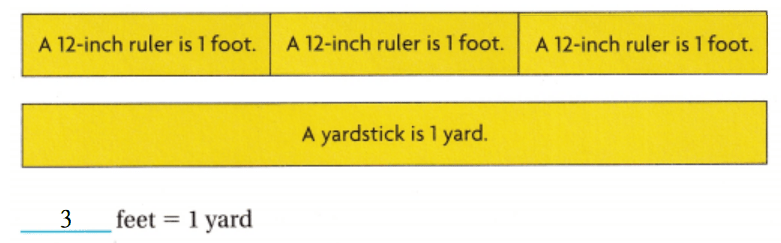
Use a strip diagram to write an equation.


So,
Mr. Mattson needs to buy 8 yards of rope.

Math Talk
Mathematical Processes
What operation did you use when you found groups of 3 feet in 24 feet? Do you multiply or divide when you convert a smaller unit to a larger unit? Explain.
Answer:
When you have to find the number of groups of 3 feet in 24 feet, the operation we will use is: Division
To convert a smaller unit to a larger unit (eg to ), divide it by the number of smaller units that are needed to make. To convert from a larger unit to a smaller one, multiply. To convert from a smaller unit to a larger one, divide.

Example

Use the table to find the relationship between miles and feet.

The distance between the new high school and the football field is 2 miles. How does this distance compare to 10,000 feet?
When you convert larger units to smaller units, you need to multiply.
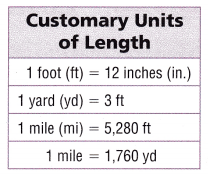
Texas Go Math Grade 5 Lesson 13.2 Answer Key 4
Step 1
Convert 2 miles to feet.
Think: 1 mile is equal to 5,280 feet.
I need to multiply the total number of miles by 5,280 feet

So,
2 miles = 10,560 feet.

Step 2:

Since 10,560 is greater than 10,000, the distance between the new high school and the football field is greater than 10,000 feet.

• Sometimes you need to convert a single unit of measurement to mixed measures. Convert 62 inches into feet and inches.
Think: 1 foot is equal to 12 inches.
62 ÷ 12 = 5 R 2 or 5 ft 2 in.

Share and Show

Convert.

Question 1.
2 mi = ___ yd
Answer:
The given unit is: Miles
The conversion unit must be: Yards
Now,
From the given table,

We can observe that
1 mile = 1,760 yd
So,
2 miles = 2 × 1,760 yd
= 3,520 yd
Hence, from the above,
We can conclude that
2 miles = 3,520 yards

Go Math Answer Key Grade 5 Lesson 13.2 Question 2.
6 yd = __ ft.
Answer:
The given unit is: Yards
The conversion unit must be: Feet
Now,
From the given table,

We can observe that
1 yard = 3 feet
So,
6 yards = 6 × 3 feet
= 18 feet
Hence, from the above,
We can conclude that
6 yards = 18 feet

Question 3.
90 in. = ___ ft ___ in.
Answer:
The given unit is: Inches
The conversion unit must be: Feet
Now,
From the given table,

We can observe that
1 Inch = \(\frac{1}{12}\) feet
So,
90 inches = 90 × \(\frac{1}{12}\) feet
= 7 R 6
= 7 feet 6 inches
Hence, from the above,
We can conclude that
90 inches = 7 feet 6 inches

Math talk
Mathematical Processes
Explain how you know to measure it.

Practice: Copy and Solve Convert.

Question 4.
60 in. = __ ft
Answer:
The given unit is: Inches
The conversion unit must be: Feet
Now,
From the given table,

We can observe that
1 inch = \(\frac{1}{12}\) feet
So,
60 inches = 60 × \(\frac{1}{12}\) feet
= 5 feet
Hence, from the above,
We can conclude that
60 inches = 5 feet

Go Math Answer Key Grade 5 Customary Length Question 5.
__ ft = 7 yd
Answer:
The given unit is: yard
The conversion unit must be: Feet
Now,
From the given table,

We can observe that
1 Yard = 3 feet
So,
7 yards = 7 × 3 feet
= 21 feet
Hence, from the above,
We can conclude that
21 feet = 7 yards

Question 6.
4 mi = ___yd
Answer:
The given unit is: Miles
The conversion unit must be: Yards
Now,
From the given table,

We can observe that
1 mile = 1,760 yd
So,
4 miles = 4 × 1,760 yd
= 7,040 yd
Hence, from the above,
We can conclude that
4 miles = 7,040 yards

Question 7.
120 in. = __ ft
Answer:
The given unit is: Inches
The conversion unit must be: Feet
Now,
From the given table,

We can observe that
1 Inch = \(\frac{1}{12}\) feet
So,
120 inches = 120 × \(\frac{1}{12}\)
= 10 feet
Hence, from the above,
We can conclude that
120 inches = 10 feet

Question 8.
46 ft = __ yd __ft
Answer:
The given unit is: Feet
The conversion unit must be: Yards
Now,
From the given table,

We can observe that
1feet = \(\frac{1}{3}\) yd
So,
46 feet = 46 × \(\frac{1}{3}\) yd
= 15 R 1
= 15 yards 1 feet
Hence, from the above,
We can conclude that
46 feet = 15 yards 1 feet

Go Math Answer Key 5th Grade Lesson 13.2 Question 9.
42 yd = __ ft
Answer:
The given unit is: yards
The conversion unit must be: Feet
Now,
From the given table,

We can observe that
1 Yard = 3 feet
So,
42 yards = 42 × 3 feet
= 126 feet
Hence, from the above,
We can conclude that
42 yards = 126 feet

Use Symbols Compare. Write <> or =.

Question 10.
8 ft Texas Go Math Grade 5 Lesson 13.2 Answer Key 7 3yd
Answer:
The given units are: Feet, Yard
Now,
The given table is:

Now,
From the given table,
We can observe that
3 yards = 3 × 3 feet
= 9 feet
So,
8 feet < 9 feet
Hence, from the above,
We can conclude that

Question 11.
2 mi Texas Go Math Grade 5 Lesson 13.2 Answer Key 7 10,500 ft
Answer:
The given units are: Mile, Feet
Now,
The given table is:

Now,
From the given table,
We can observe that
2 miles = 2 × 5,280 feet
= 10,560 feet
So,
10,560 feet > 10,500 feet
Hence, from the above,
We can conclude that

Question 12.
3 yd 2 ft Texas Go Math Grade 5 Lesson 13.2 Answer Key 7 132 in.
Answer:
The given units are: Yard, Feet, and Inch
Now,
The given table is:

Now,
From the given table,
We can observe that
3 yards 2 feet = (3 × 3 feet) + 2 feet
= 11 feet
= 11 × 12 inches
132 inches
So,
132 inches = 132 inches
Hence, from the above,
We can conclude that

Go Math 5th Grade Answer Key Lesson 13.2 Question 13.
H.O.T. Representations Make a table that shows the number of feet and inches in 1, 2, 3, and 4 yards. What do you notice about the relationship between the number of larger units and the number of smaller units as the length increases?
Answer:
It is given that
Make a table that shows the number of feet and inches in 1, 2, 3, and 4 yards.
Now,
The representation of the given values of yards in terms of feet and inches is:

Now,
From the above table,
We can observe that
As the length in yards inches,
The number of larger units increases as the multiples of 3
The number of smaller units increases as the multiples of 12
Hence, from the above,
We can conclude that
The number of larger units increases as the multiples of 3
The number of smaller units increases as the multiples of 12

Problem Solving.

Question 14.
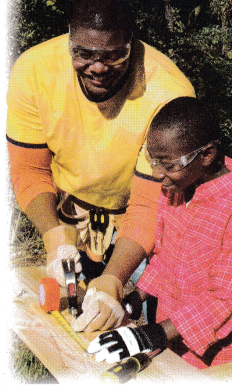
H.O.T. Multi-Step Javon is helping his dad build a treehouse. He has a piece of trim that ¡s 13 feet long. How many pieces can Javon cut that is 1 yard long? How much of a yard will he have leftover?
Texas Go Math Grade 5 Lesson 13.2 Answer Key 8
Answer:
It is given that
Javon is helping his dad build a treehouse. He has a piece of trim that ¡s 13 feet long
Now,
The given table is:

Now,
From the given table,
We can observe that
1 feet = \(\frac{1}{3}\) yards
So,
13 feet = 13 × \(\frac{1}{3}\) yards
= 4 R 1
= 4 yards 1 foot
Hence, from the above,
We can conclude that
The number of pieces can Javon cut that is 1 yard long is: 4 pieces
The amount of a yard that Javon will have leftover is: 1 piece

Question 15.
H.O.T. Multi-Step Patty is building a rope ladder for a treehouse. She needs two 5-foot pieces of rope for the sides of the ladder. She needs 7 pieces of rope, each 18 inches long for the steps. How many feet of rope does Patty need to make the ladder? Write your answer as a mixed number and as a mixed measure in feet and inches.
Texas Go Math Grade 5 Lesson 13.2 Answer Key 9
Answer:
It is given that
Patty is building a rope ladder for a treehouse. She needs two 5-foot pieces of rope for the sides of the ladder. She needs 7 pieces of rope, each 18 inches long for the steps
Now,
We know that,
1 inch = \(\frac{1}{12}\) feet
So,
The number of feet of rope does Patty need to make the ladder = (The number of feet of the rope needed for the sides of the ladder) + (The number of feet of rope needed for the steps of the ladder)
= (2 × 5 feet) + (7 × 18 inches)
= 10 feet + 126 inches
= 10 feet + 126 × \(\frac{1}{12}\)
= 10 feet + 10 R 6
= 10 feet + 10 feet 6 inches
= 20 R 6
= 20 feet 6 inches
Hence, from the above,
We can conclude that
The number of feet of rope Patty needs to make the ladder is: 20 feet 6 inches

Daily Assessment Task

Fill in the bubble completely to show your answer.

Lesson 13.2 5th Grade Go Math Answer Key Question 16.
Kelly lives 2 miles from school. Harry lives closer to the school than Kelly. What could be the distance that Harry lives from school?
(A) 3,800 yards
(B) 10,560 feet
(C) 10,600 feet
(D) 3,461 yards
Answer:
It is given that
Kelly lives 2 miles from school. Harry lives closer to the school than Kelly
Now,
The given table is:

Now,
From the above table,
We can observe that
2 miles = 2 × 5,280 feet (or) 2 × 1,760 yd
= 10,560 feet (or) 3,520 yd
Hence, from the above,
We can conclude that
The distance that Harry lives from school is:

Question 17.
Bart measured a piece of wood to be 9 feet long. How could he calculate the length of the wood in inches?
(A) 9 ÷ 12
(B) 9 × 12
(C) 12 + 9
(D) 12 ÷ 9
Answer:
It is given that
Bart measured a piece of wood to be 9 feet long
Now,
We know that,
1 inch = \(\frac{1}{12}\) feet
1 feet = 12 inches
So,
The length of the wood in inches = 9 × 12 inches
Hence, from the above,
We can conclude that
The length of the wood in inches is:

Question 18.
Multi-Step Aliesha has a 55-inch rope. Mike has a rope that is 17 inches long. what is the length of Mike’s rope?
(A) 1 yard
(B) 5 feet
(C) 2 yards
(D) 7 feet
Answer:
It is given that
Aliesha has a 55-inch rope. Mike has a rope that is 17 inches long
Now,
According to the given information,
The length of Mike’s rope = 55 + 17
= 72 inches
Now,
The given table is:

Now,
From the given table,
We can observe that
72 inches = 72 ×\(\frac{1}{12}\) feet
= 6 feet
6 feet = 6 × \(\frac{1}{3}\) yd
= 2 yards
Hence, from the above,
We can conclude that
The length of Mike’s rope is:

Texas Test Prep

Go Math Lesson 13.2 Answer Key Grade 5 Question 19.
Katy’s driveway is 120 feet long. How many yards long is Katy’s driveway?
(A) 60 yards
(B) 40 yards
(C) 20 yards
(D) 10 yards
Answer:
It is given that
Katy’s driveway is 120 feet long
Now,
We know that,
1 feet = \(\frac{1}{3}\) yards
So,
The length of Kathy’s driveway in yards = 120 × \(\frac{1}{3}\) yards
= 40 yards
Hence, from the above,
We can conclude that
The length of Kathy’s driveway in yards is:

Texas Go Math Grade 5 Lesson 13.2 Homework and Practice Answer Key

Convert.

Question 1.
3 mi = __ yd
Answer:
The given unit is: Miles
The conversion unit must be: Yards
Now,
From the given table,

We can observe that
1 Mile = 1,760 Yards
So,
3 miles = 3 × 1,760 yards
= 5,280 yards
Hence, from the above,
We can conclude that
3 miles = 5,280 yards

Question 2.
72 in. = ___ ft
Answer:
The given unit is: Inches
The conversion unit must be: Feet
Now,
From the given table,

We can observe that
1 Inch = \(\frac{1}{12}\) feet
So,
72 inches = 72 × \(\frac{1}{12}\) feet
= 6 feet
Hence, from the above,
We can conclude that
72 inches = 6 feet

Question 3.
__ ft = 8 yd
Answer:
The given unit is: yards
The conversion unit must be: Feet
Now,
From the given table,

We can observe that
1 Yard = 3 feet
So,
8 yards = 8 × 3 feet
= 24 feet
Hence, from the above,
We can conclude that
24 feet = 8 yards

Question 4.
132 in. = __ ft
Answer:
The given unit is: Inches
The conversion unit must be: Feet
Now,
From the given table,

We can observe that
1 Inch = \(\frac{1}{12}\) feet
So,
132 inches = 132 × \(\frac{1}{12}\) feet
= 11 feet
Hence, from the above,
We can conclude that
132 inches = 11 feet

Question 5.
36 ft = __ yd
Answer:
The given unit is: Feet
The conversion unit must be: Yards
Now,
From the given table,

We can observe that
1 Feet = \(\frac{1}{3}\) yards
So,
36 feet = 36 × \(\frac{1}{3}\) yards
= 12 yards
Hence, from the above,
We can conclude that
36 feet = 12 yards

Question 6.
46 yd = __ ft
Answer:
The given unit is: yards
The conversion unit must be: Feet
Now,
From the given table,

We can observe that
1 Yard = 3 feet
So,
46 yards = 46 × 3 feet
= 138 feet
Hence, from the above,
We can conclude that
46 yards = 138 feet

Question 7.
15 ft = __ in.
Answer:
The given unit is: Feet
The conversion unit must be: Inches
Now,
From the given table,

We can observe that
1 Feet = 12 inches
So,
15 feet = 15 × 12 inches
= 180 inches
Hence, from the above,
We can conclude that
15 feet = 180 inches

Question 8.
__ ft = 24 yd 2 ft
Answer:
The given unit is: yards
The conversion unit must be: Feet
Now,
From the given table,

We can observe that
1 Yard = 3 feet
So,
24 yards 2 feet = (24 × 3 feet) + 2 feet
= 74 feet
Hence, from the above,
We can conclude that
74 feet = 24 yards 2 feet

Texas Go Math Grade 5 Answer Key Pdf Customary Length Question 9.
__ ft = 7 mi
Answer:
The given unit is: Miles
The conversion unit must be: Feet
Now,
From the given table,

We can observe that
1 Mile = 5,280 feet
So,
7 miles = 7 × 5,280 feet
= 36,960 feet
Hence, from the above,
We can conclude that
36,960 feet = 7 miles

Compare. Write <, >, or =.

Question 10.
2 mi Texas Go Math Grade 5 Lesson 13.2 Answer Key 10 3,526 yd
Answer:
The given units are: Mile, Yard
Now,
The given table is:

Now,
From the given table,
We can observe that
2 miles = 2 × 1,760 yards
= 3,520 yards
So,
3,520 yards < 3,526 yards
Hence, from the above,
We can conclude that

Question 11.
4 yd Texas Go Math Grade 5 Lesson 13.2 Answer Key 10 13 ft
Answer:
The given units are: Yard, Feet
Now,
The given table is:

Now,
From the given table,
We can observe that
4 yards = 4 × 3 feet
= 12 feet
So,
12 feet < 13 feet
Hence, from the above,
We can conclude that

Question 12.
5 mi Texas Go Math Grade 5 Lesson 13.2 Answer Key 10 26,300 ft
Answer:
The given units are: Miles, Feet
Now,
The given table is:

Now,
From the given table,
We can observe that
5 miles = 5 × 5,280 feet
= 26,400 feet
So,
26,400 feet > 26,300 feet
Hence, from the above,
We can conclude that

Question 13.
90 ft Texas Go Math Grade 5 Lesson 13.2 Answer Key 10 32 yd
Answer:
The given units are: Feet, Yard
Now,
The given table is:

Now,
From the given table,
We can observe that
32 yards = 32 × 3 feet
= 96 feet
So,
90 feet < 96 feet
Hence, from the above,
We can conclude that

Question 14.
27 ft Texas Go Math Grade 5 Lesson 13.2 Answer Key 10 324 in.
Answer:
The given units are: Feet, Inch
Now,
The given table is:

Now,
From the given table,
We can observe that
27 feet = 27 × 12 inches
= 324 inches
So,
324 inches = 324 inches
Hence, from the above,
We can conclude that

Question 15.
5 yd 2 ft Texas Go Math Grade 5 Lesson 13.2 Answer Key 10 200 in.
Answer:
The given units are: yard, Feet, and Inch
Now,
The given table is:

Now,
From the given table,
We can observe that
5 yard 2 feet = (5 × 3 feet) + 2 feet
= 17 feet
17 feet = 17 × 12 inches
= 204 inches
So,
204 inches > 200 inches
Hence, from the above,
We can conclude that

Problem Solving

Question 16.
A prickly pear cactus is 1 yard tall. A yucca plant is 35 inches tall. Which plant is taller? Tell me how you know.
Answer:
It is given that
A prickly pear cactus is 1 yard tall. A yucca plant is 35 inches tall
Now,
The given table is:

Now,
From the given table,
We can observe that
1 yard = 3 feet
1 feet = 12 inches
So,
3 feet = 3 ×12 inches
= 36 inches
Now,
Since both the values of the heights have the same unit measures, compare both the heights
So,
36 inches > 35 inches
Hence, from the above,
We can conclude that
A prickly pear cactus is taller than a Yucca plant

Question 17.
The length of the Beecher family’s driveway is 20 yd. The length of their SUV is one-fourth the length of the driveway. How many feet long is the SUV?
Answer:
It is given that
The length of the Beecher family’s driveway is 20 yd. The length of their SUV is one-fourth the length of the driveway
Now,
We know that,
1 yard = 3 feet
So,
20 yards = 20 × 3 feet
= 60 feet
So,
The length of the Beecher’s family driveway is: 60 feet
Now,
According to the given information,
The length of their SUV = \(\frac{60 feet}{4}\)
= 15 feet
Hence, from the above,
We can conclude that
The length of the Beecher’s family’s SUV is: 15 feet

Lesson Check

Texas Test Prep

Fill in the bubble completely to show your answer.

Question 18.
The length of a cruise ship is 1,092 feet. How many yards long is the cruise ship?
(A) 3,276 yards
(B) 91 yards
(C) 330 yards
(D) 364 yards
Answer:
It is given that
The length of a cruise ship is 1,092 feet
Now,
The given table is:

Now,
From the above table,
We can observe that
1 feet = \(\frac{1}{3}\) yards
So,
1,092 feet = 1,092 × \(\frac{1}{3}\)
= 364 yards
Hence, from the above,
We can conclude that
The length of the cruise ship in terms of yards is:

Question 19.
Nadia runs 8 miles each weekend. How many yards does Nadia run each weekend?
(A) 14,080 yards
(B) 42,240 yards
(C) 14,960 yards
(D) 220 yards
Answer:
It is given that
Nadia runs 8 miles each weekend
Now,
The given table is:

Now,
From the given table,
We can observe that
1 mile = 1,760 yards
So,
8 miles = 8 × 1,760 yards
= 14,080 yards
Hence, from the above,
We can conclude that
The number of yards does Nadia run each weekend is:

Question 20.
Since the 1980 eruption of Mount St. Helens in Washington state, the elevation of its summit is about 1,300 feet lower. How can you calculate the difference ¡n elevation in inches?
(A) 1,300 × 12
(B) 1,300 ÷ 12
(C) 1,300 × 3
(D) 1,300 – 12
Answer:
It is given that
Since the 1980 eruption of Mount St. Helens in Washington state, the elevation of its summit is about 1,300 feet lower
Now,
We know that,
1 feet = 12 inches
So,
The elevation of the summit in inches = 1,300 × 12
Hence, from the above,
We can conclude that
The elevation of the summit in inches is:

Question 21.
The height of the U.S. Capitol building from the ground to the top of the Statue of Freedom is 96 yards. The height of the Texas State Capitol building is greater than the U.S. Capitol. Which could be the height of the Texas State Capitol?
(A) 310 feet
(B) 288 feet
(C) 3,452 inches
(D) 3,420 inches
Answer:
It is given that
The height of the U.S. Capitol building from the ground to the top of the Statue of Freedom is 96 yards. The height of the Texas State Capitol building is greater than the U.S. Capitol
Now,
We know that,
1 yard = 3 feet
1 feet = 12 inches
So,
The height of the U.S. Capitol building = 96 × 3 feet
= 288 feet
= 288 × 12
= 3,456 inches
Hence, from the above,
We can conclude that
The height of the Texas State Capitol building is:

Question 22.
Multi-Step Tyler’s older brother Joseph is 5 feet 6 inches tall. Joseph is 16 inches taller than Tyler. How tall is Tyler?
(A) 4 ft 2 in.
(B) 4 ft
(C) 6 ft 10 in.
(D) 6 ft 4 in.
Answer:
It is given that
Tyler’s older brother Joseph is 5 feet 6 inches tall. Joseph is 16 inches taller than Tyler
Now,
We know that,
1 feet = 12 inches
So,
The height of Joseph = 5 feet 6 inches
= (5 × 12) + 6
= 60 + 6
= 66 inches
Now,
According to the given information,
The height of Tyler = 66 – 16
= 50 inches
= 4 feet 2 inches
Hence, from the above,
We can conclude that
The height of Tyler is:

Question 23.
Multi-Step Calvin fishes from a dock that is 85 inches long. Which of the following is equal to 85 inches?
(A) 2 yd 12 ft 1 in.
(B) 2 yd 1 ft 1 in.
(C) 1 yd 3 ft 1 in.
(D) 1 yd 4 ft 3 in.
Answer:
It is given that
Calvin fishes from a dock that is 85 inches long.
Now,
The given table is:

Now,
We know that,
1 inch = \(\frac{1}{12}\) feet
1 yard = 3 feet
So,
85 inches = 85 × \(\frac{1}{12}\)
= 7 R 1
= 7 feet 1 inch
= 2 yards 1 feet 1 inch
Hence, from the above,
We can conclude that
The measurement that is equal to 85 inches is:

Texas Go Math Grade 5 Lesson 13.2 Answer Key Customary Length Read More »
Texas Go Math Grade 5 Lesson 12.2 Answer Key Understand Volume

Refer to our Texas Go Math Grade 5 Answer Key Pdf to score good marks in the exams. Test yourself by practicing the problems from Texas Go Math Grade 5 Lesson 12.2 Answer Key Understand Volume.

Texas Go Math Grade 5 Lesson 12.2 Answer Key Understand Volume

Essential Question
How can you use unit cubes to find the volume of a rectangular prism?
Answer:
To find the volume of a rectangular prism, multiply its 3 dimensions: length x width x height. The volume is expressed in cubic units

Investigate

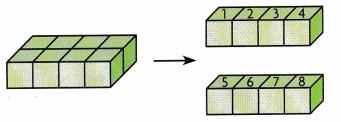
Connect You can find the volume of a rectangular prism by counting unit cubes. Volume is the measure of the amount of space a solid figure occupies and is measured in cubic units. Each unit cube has a volume of 1 cubic unit.
Texas Go Math Grade 5 Lesson 12.2 Answer Key 1
The rectangular prism above is made up of 8 unit cubes and has a volume of 8 cubic units.

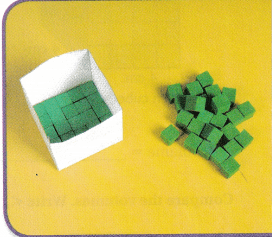
Materials Texas Go Math Grade 5 Lesson 12.2 Answer Key 2 rectangular prism net A Texas Go Math Grade 5 Lesson 12.2 Answer Key 2 centimeter cubes

A. Cut out, fold, and tape the net to form a rectangular prism.

B. Use centimeter cubes to fill the base of the rectangular prism without gaps or overlaps. Each centimeter cube has a length, width, and height of 1 centimeter and a volume of 1 cubic centimeter.

  • How many centimeter cubes make up the length of the first layer? the width? the height?
    length: 4 cm width: 5 cm height: 1 cm
  • How many centimeter cubes are used to fill the base?
    Answer:
    The number of centimeter cubes that are used to fill the base is: 20-centimeter cubes

Texas Go Math Grade 5 Lesson 12.2 Answer Key 3
C. Continue filling the rectangular prism, layer by layer. Count the number of centimeter cubes used for each layer.

  • How many centimeter cubes are in each layer?
    Answer:
    The number of centimeter cubes present in each layer is: 5 cubes
  • How many layers of cubes fill the rectangular prism?
    Answer:
    The number of layers that filled the rectangular prism is: 4 layers
  • How many centimeter cubes fill the prism?
    Answer:
    The number of centimeter cubes that filled the prism is: 20- centimeter cubes
    So,
    The volume of the rectangular prism is 20 cubic centimeters.

Make Connections

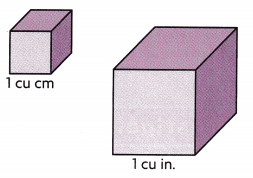
To find the volume of three-dimensional figures, you measure in three directions. For a rectangular prism, you measure its length, width, and height. Volume is measured using cubic units, such as cubic centimeters or cubic inches. You can also write these as cu cm or cu in.

Texas Go Math Grade 5 Lesson 12.2 Answer Key 4

• Which has a greater volume, 1 cu cm or 1 cu in.? Explain.
Answer:
The given figures are:
Texas Go Math Grade 5 Lesson 12.2 Answer Key 4
Now,
From the given figures,
We can observe that
1 cu. inch cube is greater than 1 cu. cm
Hence, from the above,
We can conclude that
1 cu. inch has a greater volume than 1 cu. cm

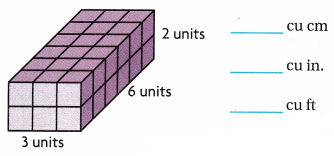
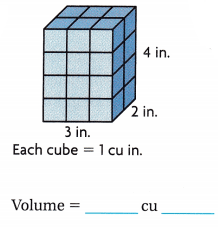
Find the volume of the prism if each cube represents 1 cu cm, 1 cu in, and 1 cu ft.
Texas Go Math Grade 5 Lesson 12.2 Answer Key 5
Answer:
The given figure is:

Now,
The volume of the given figure (V) = Length × Width × Height
= 3 × 6 × 2
= 36 cubic units
Hence, from the above,
We can conclude that
The volume of the given figure is: 36 cubic cm (or) 36 cubic inches (or) 36 cubic feet

Math Talk
Mathematical processes
Would the prism above be the same size if it were built with centimeter cubes, inch cubes, or foot cubes? Explain.
Answer:
We know that,
1 cm = 0.39 inches
1 cm = 0.032 feet
Hence,
The prisms will not be the same size if it were built with cubic cm, cubic in, or cubic foot

Share and Show

Question 1.
Texas Go Math Grade 5 Lesson 12.2 Answer Key 6
Answer:
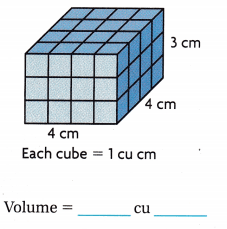
The given figure is:

Now,
The volume of the given figure = Length × Width × height
= 4 × 4 × 3
= 48 cm³
Hence, from the above,
We can conclude that
The volume of the given figure is: 48 cm³

Go Math Grade 5 Chapter 12 Lesson 12.2 Answer Key Pdf Question 2.
Texas Go Math Grade 5 Lesson 12.2 Answer Key 7
Answer:
The given figure is:

Now,
The volume of the given figure = Length × Width × height
= 2 × 4 × 3
= 24 in.³
Hence, from the above,
We can conclude that
The volume of the given figure is: 24 in.³

Compare the volumes. Write <, >, or =.

Question 3.
Texas Go Math Grade 5 Lesson 12.2 Answer Key 8
Answer:
The given figures are:

Now,
The volume of the first figure = 4 × 4 × 2
= 32 cm³
The volume of the second figure = 4 × 4 × 2
= 32 in.³
= 32 × 16.38 cm³
= 32 × 16 cm³
= 512 cm³
So,
32 cm³ < 512 cm³
Hence, from the above,
We can conclude that

Problem Solving

Question 4.
H.O.T. Connect What is the relationship between the number of centimeter cubes you used to fill each layer, the number of layers, and the volume of the prism on page 441?
Answer:
On page 441,
The volume of the prism is: 20 cubic units
The number of centimeter cubes in each layer is: 5
The number of layers is: 4
So,
The relationship between the number of centimeter cubes you used to fill each layer, the number of layers, and the volume of the prism on page 441 is:
The volume of the prism = (The number of layers) × (The number of centimeter cubes in each layer)
Hence, from the above,
We can conclude that
The relationship between the number of centimeter cubes you used to fill each layer, the number of layers, and the volume of the prism on page 441 is:
The volume of the prism = (The number of layers) × (The number of centimeter cubes in each layer)

Go Math Grade 5 Volume Answer Key Lesson 12.2 Question 5.
H.O.T. If you had a rectangular prism that had a length of 3 units, a width of 4 units, and a height of 2 units, how many unit cubes would you need for each layer? How many unit cubes would you need to fill the rectangular prism?
Answer:
It is given that
You had a rectangular prism that had a length of 3 units, a width of 4 units, and a height of 2 units
So,
The number of cubes you would need for each layer = 3 × 4
= 12 cubes
So,
The number of cubes you need to fill the rectangular prism = 3 × 4 × 2
= 24 units³
Hence, from the above,
We can conclude that
The number of cubes you would need for each layer is: 12 cubes
The number of cubes you need to fill the rectangular prism is: 24 units³

Question 6.
H.O.T. What’s the Error? Al says that a cube with edges that measure 10 cm has a volume that is twice as much as a cube with sides that measure 5 cm. Explain and correct Al’s error.
Answer:
It is given that
Al says that a cube with edges that measure 10 cm has a volume that is twice as much as a cube with sides that measure 5 cm
Now,
The volume of the cube with side length 10 cm (x) = 10 × 10 × 10 = 1,000 cm³
The volume of the cube with side length 5 cm (y) = 5 × 5 × 5 = 125 cm³
Now,
\(\frac{x}{y}\) = \(\frac{1,000}{125}\)
= 8 times
Hence, from the above,
We can conclude that
Al’s error is:
A cube with edges that measure 10 cm has a volume that is twice as much as a cube with sides that measure 5 cm
The correct answer is:
A cube with edges that measure 10 cm has a volume that is eight times as much as a cube with sides that measure 5 cm

Question 7.
H.O.T. pia built a rectangular prism with cubes. The base of her prism has 12 cm cubes. If the prism was built with 108 cm cubes, what is the height of her prism?
Texas Go Math Grade 5 Lesson 12.2 Answer Key 9
Answer:
It is given that
Pia built a rectangular prism with cubes. The base of her prism has 12 cm cubes. The prism was built with 108 cm cubes
Now,
The volume of a rectangular prism = Length × Width × Height
108 = 12 × Height
Height = \(\frac{108}{12}\)
= 9 cm cubes
Hence, from the above,
We can conclude that
The height of Pia’s prism is: 9 cm cubes

Texas Go Math Grade 5 Volume Pdf Lesson 12.2 Question 8.
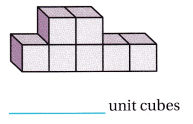
Multi-Step A packing company makes boxes with edges each measuring 3 feet. What is the volume of a box? If 10 boxes are put in a shipping container and completely filled with no gaps or overlaps, what is the volume of the shipping container?
Answer:
It is given that
A packing company makes boxes with edges each measuring 3 feet. and 10 boxes are put in a shipping container and completely filled with no gaps or overlaps
Now,
The volume of a box = 3 × 3 × 3
= 27 feet³
So,
The volume of the shipping container = 27 × 10
= 270 feet³
Hence, from the above,
We can conclude that
The volume of a box is: 27 feet³
The volume of the shipping container is: 270 feet³

Daily Assessment Task

Fill in the bubble completely to show your answer.

Question 9.
Nabanita needs 140 cubes to make a model. The figure shows the number of cubes in a box. How many boxes of cubes does Nabanita need to buy so she has enough cubes for her model?

(A) 2 boxes
(B) 3 boxes
(C) 14 boxes
(D) 16 boxes
Answer:
It is given that
Nabanita needs 140 cubes to make a model. The figure shows the number of cubes in a box
Now,
The given figure is:

Now,
From the above figure,
We can observe that
The number of cubes in the given figure is: 32 cubes
Now,
We know that,
The number of boxes of cubes should be an integer
Now,
From the given options,
The number of boxes of cubes does Nabanita need to buy so she has enough cubes for her model = 32 + 3
= 35 boxes
Hence, from the above,
We can conclude that
The number of boxes of cubes does Nabanita need to buy so she has enough cubes for her model is:

Question 10.
A box is filled with speakers. Each speaker has a volume of 1 cubic foot. Ten speakers can fit in each layer and the height of the box is 4 feet. What is the volume of the box?
(A) 40 cubic feet
(B) 14 cubic feet
(C) 10 cubic feet
(D) 20 cubic feet
Answer:
It is given that
A box is filled with speakers. Each speaker has a volume of 1 cubic foot. Ten speakers can fit in each layer and the height of the box is 4 feet
So,
The volume of the box = 1 × 10 × 4
= 40 cubic feet
Hence, from the above,
We can conclude that
The volume of the box is:

Texas Go Math Grade 5 Volume Answer Key Lesson 12.2 Question 11.
Multi-Step A jewelry box has 3 drawers. Each drawer is 10 inches long, 5 inches wide, and 6 inches tall. Find the combined volume of the drawers.
(A) 11 cu.in
(B) 300 cu. in
(C) 33 cu. in
(D) 900 cu. in
Answer:
It is given that
A jewelry box has 3 drawers. Each drawer is 10 inches long, 5 inches wide, and 6 inches tall
Now,
The combined volume of the drawers = 3 × 10 × 5 × 6
= 900 cubic inches
Hence, from the above,
We can conclude that
The combined volume of the drawers is:

Texas Test Prep

Question 12.
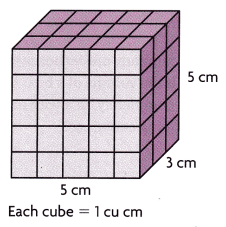
Find the volume of the rectangular prism.
(A) 25 cubic feet
(B) 25 cubic meters
(C) 75 cubic meters
(D) 75 cubic centimeters
Texas Go Math Grade 5 Lesson 12.2 Answer Key 10
Answer:
The given figure is:

Now,
The volume of the given figure = 5 × 3 × 5
= 75 cm³
Hence, from the above,
We can conclude that
The volume of the given figure is:

Texas Go Math Grade 5 Lesson 12.2 Homework and Practice Answer Key

Question 1.
Texas Go Math Grade 5 Lesson 12.2 Answer Key 11
Answer:
The given figure is:

Now,
The volume of the given figure = Length × Width × Height
= 6 × 4 × 2
= 48 in.³
Hence, from the above,
We can conclude that
The volume of the given figure is: 48 in³

Go Math Grade 5 Combining Volumes Lesson 12.2 Answers Question 2.
Texas Go Math Grade 5 Lesson 12.2 Answer Key 12
Answer:
The given figure is:

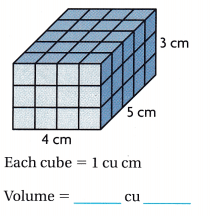
Now,
The volume of the given figure = Length × Width × Height
= 3 × 4 × 5
= 60 cm³
Hence, from the above,
We can conclude that
The volume of the given figure is: 60 cm³

Compare the volumes. Write <, >, or =

Question 3.
Texas Go Math Grade 5 Lesson 12.2 Answer Key 13
Answer:
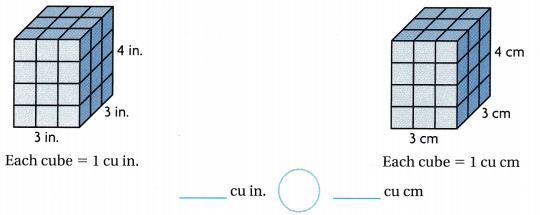
The given figures are:

Now,
From the given figures,
We can observe that
The volume of the first figure = 3 × 3 × 4
= 36 in.³
The volume of the second figure = 3 × 3 × 4
= 36 cm³
= 36 × 0.06
= 2.16 in.³
Hence, from the above,
We can conclude that

Problem Solving

Question 4.
Salim built a rectangular prism with a length of 5 inches, a width of 4 inches, and a height of 3 inches. Would the prism Natalie built with a length of 3 inches, a width of 4 inches, and a height of 5 inches have the same volume or a different volume than Salim’s prism? Explain.
Answer:
It is given that
Salim built a rectangular prism with a length of 5 inches, a width of 4 inches, and a height of 3 inches. and the prism Natalie built with a length of 3 inches, a width of 4 inches, and a height of 5 inches
Now,
According to the given information,
The volume of a rectangular prism built by Salim = 5 × 4 × 3
= 60 in.³
The volume of a rectangular prism built by Natalie = 3 × 4 × 5
= 60 in.³
Hence, from the above,
We can conclude that
The volume of a rectangular prism built by Salim is the same as the volume of a rectangular prism built by Natalie

Go Math 5th Grade Math Answer Key Lesson 12.2 Question 5.
Oliver and Layla each built a rectangular prism with centimeter cubes. Both prisms have a volume of 24 cubic centimeters, but they do not look the same. Give possible dimensions for each prism.
Answer:
It is given that
Oliver and Layla each built a rectangular prism with centimeter cubes. Both prisms have a volume of 24 cubic centimeters, but they do not look the same
Now,
The dimensions of a rectangular prism built by Oliver with a volume of 24 cubic cm = 6 cm × 2 cm × 2 cm
The dimensions of a rectangular prism built by Layla with a volume of 24 cubic cm = 4cm × 2 cm × 3 cm
Hence, from the above,
We can conclude that
The dimensions of a rectangular prism built by Oliver with a volume of 24 cubic cm is: 6 cm × 2 cm × 2 cm
The dimensions of a rectangular prism built by Layla with a volume of 24 cubic cm is: 4cm × 2 cm × 3 cm

Lesson Check

Texas Test Prep

Fill in the bubble completely to show your answer.

Question 6.
Find the volume of the rectangular prism.
Texas Go Math Grade 5 Lesson 12.2 Answer Key 14
(A) 120 cubic inches
(B) 120 cubic centimeters
(C) 70 cubic inches
(D) 70 cubic centimeters
Answer:
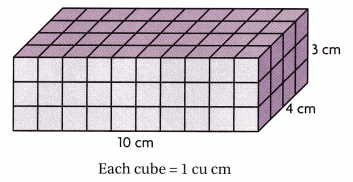
The given figure is:

Now,
The volume of the given figure = Length × Width × Height
= 10 × 4 × 3
= 120 cm³
Hence, from the above,
We can conclude that
The volume of the given figure is:

Question 7.
Mason builds a tower with centimeter cubes for his design project. The figure below shows the part of the tower that he has completed so far.
Texas Go Math Grade 5 Lesson 12.2 Answer Key 15
What does Mason need to do for the tower to have a volume of 54 cubic centimeters?
(A) Add one layer of cubes.
(B) Add 33 cubes.
(C) Add 2 cubes.
(D) Add two layers of cubes.
Answer:
It is given that
Mason builds a tower with centimeter cubes for his design project. The figure below shows the part of the tower that he has completed so far.
Now,
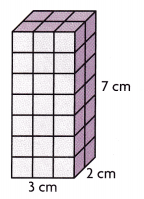
The given figure is:
Texas Go Math Grade 5 Lesson 12.2 Answer Key 15
Now,
From the given figure,
We can observe that
The number of cubes in each layer = 3 × 2 = 6 cubes
Now,
The volume of the tower = 3 × 2 × 7 = 42 cm³
Now,
The more cubes that ahve to be added by the mason = 54 – 42 = 12 cubes
Hence, from the above,
We can conclude that
The Mason needed to do for the tower to have a volume of 54 cubic centimeters is:

Go Math Volume Grade 5 Answer Key Lesson 12.2 Question 8.
A chest is filled with toy blocks. Each block has a volume of 1 cubic foot. Twenty-five blocks fit in the bottom of the chest and the height of the chest is 3 feet. What is the volume of the chest?
(A) 75 cubic feet
(B) 60 cubic feet
(C) 28 cubic feet
(D) 25 cubic feet
Answer:
It is given that
A chest is filled with toy blocks. Each block has a volume of 1 cubic foot. Twenty-five blocks fit in the bottom of the chest and the height of the chest is 3 feet
Now,
Accordin to the given information,
The volume of the chest = 1 × 25 × 3
= 75 cubic feet
Hence, from the above,
We can conclude that
The volume of the chest is:

Question 10.
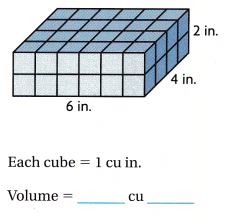
Multi-Step Lily serves 1-inch cheese cubes to her guests on a rectangular tray that is 6 inches long, 4 inches wide, and 2 inches tall. When the tray is only half full, what is the volume of the cheese cubes?
(A) 96 cu in.
(B) 12 cu in.
(C) 48 cu in.
(D) 24 cu in.
Answer:
It is given that
Lily serves 1-inch cheese cubes to her guests on a rectangular tray that is 6 inches long, 4 inches wide, and 2 inches tall
Now,
According to the given information,
The volume of the cheese cubes when the tray is full = 6 × 4 × 2
= 48 in³
Now,
The volume of the cheese cubes when the tray is only half-full = \(\frac{48}{2}\)
= 24 in³
Hence, from the above,
We can conclude that
The volume of the cheese cubes when the tray is only half-full is:

Go Math Grade 5 Answers Pdf Understand Volume Question 11.
Multi-Step Fernando builds a rectangular prism with centimeter cubes. The length of the prism is 2 centimeters. The width is twice the length and the height is twice the width. What is the volume of Fernando’s prism?
(A) 48 cu cm
(B) 16 cu cm
(C) 8 cu cm
(D) 64 cu cm
Answer:
It is given that
Fernando builds a rectangular prism with centimeter cubes. The length of the prism is 2 centimeters. The width is twice the length and the height is twice the width
Now,
According to the given information,
The volume of Fernanado’s prism = Length × Width × Height
= 2 × 4 × 8
= 64 cm³
Hence, from the above,
We can conclude that
The volume of Fernando’s prism is:

Texas Go Math Grade 5 Lesson 12.2 Answer Key Understand Volume Read More »

Texas Go Math Grade 5 Module 12 Assessment Answer Key

Refer to our Texas Go Math Grade 5 Answer Key Pdf to score good marks in the exams. Test yourself by practicing the problems from Texas Go Math Grade 5 Module 12 Assessment Answer Key.

Texas Go Math Grade 5 Module 12 Assessment Answer Key

Vocabulary

Choose the best term from the box.

Question 1.
A ___ has a length, width, and height of 1 unit. (p. 435)
Answer:
We know that,
A “Rectangular Prism” has a length, width, and height of 1 unit
Hence, from the above,
We can conclude that
The best term that is suitable for the given statement is: Rectangular Prism

Texas Go Math Grade 5 Module 12 Answer Key Question 2.
Volume is measured in ____. (p. 441)
Answer:
We know that,
The volume is measured in “Cubic Units”
Hence, from the above,
We can conclude that
The best term that is suitable for the given statement is: Cubic Units

Concepts and Skills

Count the number of cubes used to build each solid figure. TEKS 5.6.A

Question 3.
Texas Go Math Grade 5 Module 12 Assessment Answer Key 1
Answer:
The given figure is:

Now,
From the given figure,
We can observe that
There are 4 cubes in the given figure
Hence, from the above,
We can conclude that
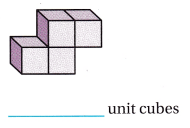
The number of cubes present in the given figure is: 4 cubes

Question 4.
Texas Go Math Grade 5 Module 12 Assessment Answer Key 2
Answer:
The given figure is:

Now,
From the given figure,
We can observe that
There are 7 cubes in the given figure
Hence, from the above,
We can conclude that
The number of cubes present in the given figure is: 7 cubes

Question 5.
Texas Go Math Grade 5 Module 12 Assessment Answer Key 3
Answer:
The given figure is:

Now,
From the given figure,
We can observe that
There are 4 cubes in the given figure
Hence, from the above,
We can conclude that
The number of cubes present in the given figure is: 4 cubes

Find the volume. TEKS 5.6, A. 5.6.B

Go Math 5th Grade Module 12 Answer Key Question 6.
Texas Go Math Grade 5 Module 12 Assessment Answer Key 4
Answer:
The given figure is:

Now,
We know that,
Volume = Length × Width × Height
So,
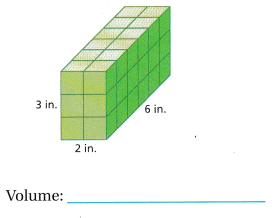
The volume of the given figure = 2 × 3 × 6
= 36 in.³
Hence, from the above,
We can conclude that
The volume of the given figure is: 36 in³

Question 7.
Texas Go Math Grade 5 Module 12 Assessment Answer Key 5
Answer:
The given figure is:

Now,
We know that,
Volume = Length × Width × Height
So,
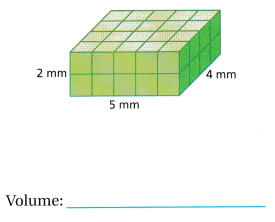
The volume of the given figure = 2 × 5 × 4
= 40 mm³
Hence, from the above,
We can conclude that
The volume of the given figure is: 40 mm³

Question 8.
Texas Go Math Grade 5 Module 12 Assessment Answer Key 6
Answer:
The given figure is:

Now,
We know that,
Volume = Length × Width × Height
So,
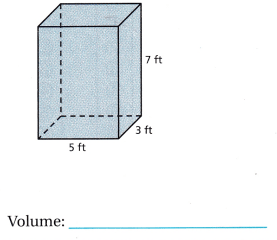
The volume of the given figure = 3 × 5 × 7
= 105 ft³
Hence, from the above,
We can conclude that
The volume of the given figure is: 105 ft³

Texas Go Math Grade 5 Volume Pdf Module 12 Answer Key Question 9.
Texas Go Math Grade 5 Module 12 Assessment Answer Key 7
Answer:
The given figure is:

Now,
We know that,
Volume = Length × Width × Height
So,
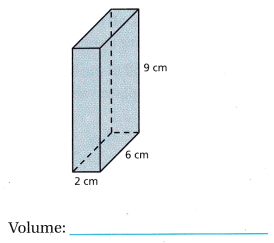
The volume of the given figure = 2 × 6 × 9
= 108 cm³
Hence, from the above,
We can conclude that
The volume of the given figure is: 108 cm³

Texas Test Prep

Fill in the bubble completely to show your answer.

Question 10.
Sharri packed away her old summer clothes in a storage tote that had a length of 3 feet, a width of 4 feet, and a height of 3 feet. What was the volume of the tote that Sharri used? TEKS 5.6.B
(A) 36 cu ft
(B) 21 cu ft
(C) 24 cu ft
(D) 10 cu ft
Answer:
It is given that
Sharri packed away her old summer clothes in a storage tote that had a length of 3 feet, a width of 4 feet, and a height of 3 feet
Now,
According to the given information,
The volume of the tote that Sharri used = 3 × 4 × 3
= 36 ft³
Hence, from the above,
We can conclude that
The volume of the tote that Sharri used is:

Question 11.
A manufacturing company constructs a shipping box to hold its cereal boxes. Each cereal box has a volume of 40 cubic inches. If the shipping box holds 8 layers with 4 cereal boxes in each layer, what is the volume of the shipping box? TEKS 5.6.B
(A) 160 cu in.
(B) 320 cu in.
(C) 480 cu in.
(D) 1,280 cu in.
Answer:
It is given that
A manufacturing company constructs a shipping box to hold its cereal boxes. Each cereal box has a volume of 40 cubic inches and the shipping box holds 8 layers with 4 cereal boxes in each layer
So,
According to the given information,
The total number of cereal boxes = 4 × 8 = 32 cereal boxes
Now,
The volume of the shipping box = 40 × 32
= 1,280 in³
Hence, from the above,
We can conclude that
The volume of the shipping box is:

Go Math Grade 5 Module 12 Answer Key Question 12.
Angela is deciding which of the two aquariums to buy. One aquarium has a base that is 18 inches by 14 inches and a height that is 12 inches. The other aquarium has a base that is 25 inches by 9 inches and a height that is 14 inches. What is the difference between the volumes of the two aquariums? TEKS 5.6.B
(A) 3,024 cu in.
(B) 3,150 cu in.
(C) 126 cu in.
(C) 150 cu in.
Answer:
It is given that
Angela is deciding which of two aquariums to buy. One aquarium has a base that is 18 inches by 14 inches and a height that is 12 inches. The other aquarium has a base that is 25 inches by 9 inches and a height that is 14 inches
Now,
According to the given information,
The volume of the first aquarium = 18 × 14 × 12
= 3,024 inches³
The volume of the second aquarium = 25 × 9 × 14
= 3,150 inches³
Now,
The difference between the volumes of the two aquariums = 3,150 – 3,024
= 126 inches³
Hence, from the above,
We can conclude that
The difference between the volumes of the two aquariums is:

Grade 5 Go Math Module 12 Answer Key Question 13.
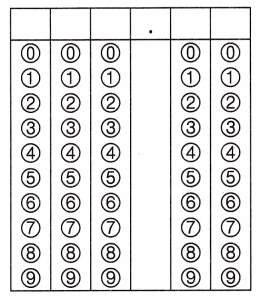
Roberto wants to build a wooden box with a volume of 8 cubic feet. How many different boxes, all with whole-number dimensions and a different-size base, will have a volume of 8 cubic feet? TEKS 5.6.B
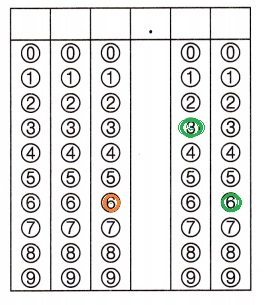
Record your answer and fill in the bubbles on the grid.
Be sure to use the correct place value.
Texas Go Math Grade 5 Module 12 Assessment Answer Key 8
Answer:
It is given that
Roberto wants to build a wooden box with a volume of 8 cubic feet
Now,
We know that,
The factors of 8 are:
1, 2, 4, and 8
So,
The different dimensions for the volume of a wooden box built by Roberto is:
(1 × 8) × 1 = 8
(2 × 4) × 1 = 8
(1 × 4) × 2 = 8
(4 × 1) × 2 = 8
(1 × 1) × 8 = 8
(8 × 1) × 1 = 8
(4 × 2) × 1 = 8
Hence, from the above,
We can conclude that
The number of different boxes that have a volume of 8 cubic feet is:

Texas Go Math Grade 5 Module 12 Assessment Answer Key Read More »

Texas Go Math Grade 5 Lesson 13.7 Answer Key Customary and Metric Conversions

Refer to our Texas Go Math Grade 5 Answer Key Pdf to score good marks in the exams. Test yourself by practicing the problems from Texas Go Math Grade 5 Lesson 13.7 Answer Key Customary and Metric Conversions.

Texas Go Math Grade 5 Lesson 13.7 Answer Key Customary and Metric Conversions

Essential Question

How can you use the strategy to make a table to help you solve problems about customary and metric conversions?
Answer:
Conversion factors are used in solving problems in which a certain measurement must be expressed with different units. When a given measurement is multiplied by an appropriate conversion factor, the numerical value changes, but the actual size of the quantity measured remains the same.

Unlock the Problem
Aaron is making fruit punch for a family reunion. He needs to make 120 cups of punch. If he wants to store the fruit punch in gallon containers, how many gallon containers will Aaron need?
Texas Go Math Grade 5 Lesson 13.7 Answer Key 1
Use the graphic organizer below to help you solve the problem.

Solve

There are 16 cups in 1 gallon. So, each cup is \(\frac{1}{16}\) of a gallon.
Complete the table below.

So, Aaron needs \(\frac{15}{2}\) gallon containers to store the punch.

• Will all of the gallon containers Aaron uses be filled to capacity? Explain.
Answer:
From the above problem,
We can observe that
Aaron needs \(\frac{15}{2}\) gallon containers to store the punch
Now,
\(\frac{15}{2}\) = 7.5
So,
All  of the 7-gallon containers will be filled and the 8th container will be half-filled
Hence, from the above.
We can conclude that
All the gallon containers of Aaron used are not filled to the capacity

Try Another Problem

Sharon is working on a project for art class. She needs to cut strips of wood that are each 1 decimeter long to complete the project. If Sharon has 7 strips of wood that are each 1 meter long, how many 1-decimeter strips can she cut?
Texas Go Math Grade 5 Lesson 13.7 Answer Key 3

So,
Sharon can cut 70 1-decimeter lengths to complete her project.

• What relationship did the table shows that you made?
Answer:
The given table is:
Texas Go Math Grade 5 Lesson 13.7 Answer Key 3
Now,
From the given table,
We can observe that
The given table shows the relationship between the metric lengths and the customary lengths
Hence, from the above,
We can conclude that
The given table shows the relationship between the metric lengths and the customary lengths

Math Talk
Mathematical Processes
Explain how you could use another strategy to solve this problem.
Answer:
The other strategy to solve the above problem is:
Step 1:
Write the given information
Step 2:
Formulate a strategy to solve the required information
Step 3:
Convert the metric units into customary units
Step 4:
Find the required quantity by using the given information

Share and Show

Question 1.
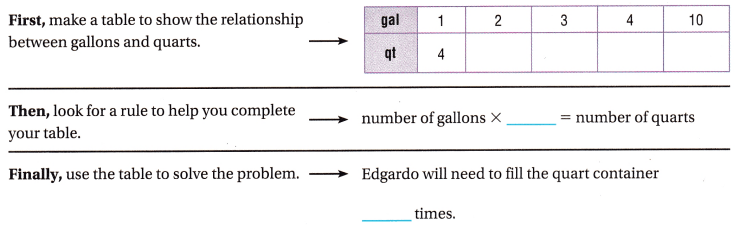
Edgardo has a drink cooler that holds 10 gallons of water. He is filling the cooler with a 1-quart container. How many times will he have to fill the quart container?
Texas Go Math Grade 5 Lesson 13.7 Answer Key 6
Answer:
It is given that
Edgardo has a drink cooler that holds 10 gallons of water. He is filling the cooler with a 1-quart container
Now,

Hence, from the above,
We can conclude that
Edgardo will need to fill the quart container 10 times

Go Math Answer Key Grade 5 Customary and Metric Conversions Question 2.
What if Edgardo only uses 32 quarts of water to fill the cooler? How many gallons of water does he use?
Answer:
It is given that
Edgardo only uses 32 quarts of water to fill the cooler
Now,
We know that,
1 gallon = 4 quarts
So,
The number of gallons of water does Edgardo used = \(\frac{32}{4}\)
= 8 gallons
Hence, from the above,
We can conclude that
The number of gallons of water Edgardo used is: 8 gallons

Question 3.
If Edgardo uses a 1-cup container to fill the cooler, how many times will he fill the 1-cup container?
Answer:
It is given that
Edgardo uses a 1-cup container to fill the cooler
Now,
We know that,
1 gallon = 16 cups
So,
The number of times will Edgardo fill the 1-cup container = 1 × 16
= 16 times
Hence, from the above,
We can conclude that
The number of times will Edgardo fill the 1-cup container is: 16 times

Problem Solving

Question 4.
Multi-Step Jane is making 13 leather belts. Each belt is 6.4 decimeters long. How many meters of leather does she use?
Answer:
It is given that
Jane is making 13 leather belts. Each belt is 6.4 decimeters long
Now,
We know that,
1 decimeter = 0.1 meters
1 meter = 10 decimeters
So,
The number of decimeters of leather did Jane used = 13 × 6.4
= 83.2 decimeters
So,
The number of meters of leather did jane used = 83.2 × 0.1 meters
= 8.32 meters
Hence, from the above,
We can conclude that
The number of meters of leather did jane used is: 8.32 meters

Question 5.
H.O.T. Evaluate Carl is packing sports equipment in a box that can hold 22 kilograms. He packed equipment with a mass of 220 dekagrams and says the box can’t hold anymore. Is Carl right? Explain.
Answer:
It is given that
Carl is packing sports equipment in a box that can hold 22 kilograms. He packed equipment with a mass of 220 dekagrams and says the box can’t hold any more
Now,
We know that,
1 kg = 1,000 grams
1 dekagram = 0.01 kg
So,
220 dekagrams = 220 × 0.01 kg
= 2.2 kg
So,
2.2 kg < 22 kg
Hence, from the above,
We can conclude that
Carl is not right

Metric Conversion Answer Key 5th Grade Go Math Question 6.
Multi-Step Maria put trim around a banner that is the shape of a triangle. Each side is 22 inches long. Maria has \(\frac{1}{2}\) foot of trim left. What was the length of the trim when she started? Write your answer in yards.
Texas Go Math Grade 5 Lesson 13.7 Answer Key 7
Answer:
It is given that
Maria put trim around a banner that is the shape of a triangle. Each side is 22 inches long. Maria has \(\frac{1}{2}\) foot of trim left
So,
The total length of the banner = 22 × 3
= 66 inches
Now,
We know that,
1 feet = 12 inches
1 yard = 3 feet
So,
The total length of the banner in feet = \(\frac{66}{12}\)
= 5.5 feet
So,
The total length of the trim when Maria started = 5.5 + 0.5
= 6 feet
So,
The total length of the trim when Maria started in yards = \(\frac{6}{3}\)
= 2 yards
Hence, from the above,
We can conclude that
The total length of the trim, when Maria started in yards, is: 2 yards

Daily Assessment Task

Fill in the bubble completely to show your answer.

Question 7.
Representations Three lizards ran across a patch of grass. Larry ran 3.6 meters, Lou ran 2,600 millimeters, and Lola ran 310 centimeters. Which statement correctly compares the distances the lizards ran?
(A) Larry ran the farthest.
(B) Lou ran farther than Lola.
(C) Lola ran farther than Larry.
(D) Lola ran the shortest distance.
Answer:
It is given that
Three lizards ran across a patch of grass. Larry ran 3.6 meters, Lou ran 2,600 millimeters, and Lola ran 310 centimeters
Now,
We know that,
1 meter = 1,000 mm
1 cm = 10 mm
So,
The distance Larry ran = 3.6 × 1,000
= 3,600 mm
The distance Lou ran = 2,600 mm
The distance Lola ran = 310 × 10
= 3,100 mm
Hence, from the above,
We can conclude that
The statement that correctly compares the distances the lizards ran is:

Metric Conversions Answer Key Go Math Grade 5 Question 8.
Miranda is making lemonade from a powdered mix. She needs to add 3 cups of powdered mix to a large pitcher of water, but she only has a scoop that holds 2 ounces. How many 2-ounce scoops will she use?
(A) 4 scoops
(B) 8 scoops
(C) 10 scoops
(D) 12 scoops
Answer:
It is given that
Miranda is making lemonade from a powdered mix. She needs to add 3 cups of powdered mix to a large pitcher of water, but she only has a scoop that holds 2 ounces
Now,
We know that,
1 cup = 8 fluid ounces
So,
The number of ounces of powdered mix that needs to add to a large pitcher of water = 3 × 8
= 24 fluid ounces
So,
The number of 2-ounce scoops will Mirands used = \(\frac{24}{2}\)
= 12 2-ounce scoops
Hence, from the above,
We can conclude that
The number of 2-ounce scoops will Mirands used is:

Question 9.
Multi-Step Mrs. Gonzalez is adding a border to her bulletin board. She has a strip of green border that is 8 feet long. How many 16-inch pieces can she cut from the strip?
(A) 4 pieces
(B) 6 pieces
(C) 8 pieces
(D) 12 pieces
Answer:
It is given that
Mrs. Gonzalez is adding a border to her bulletin board. She has a strip of green border that is 8 feet long
Now,
We know that,
1 feet = 12 inches
So,
8 feet = 8 × 12
= 96 inches
Now,
The number of 16-inch pieces can Mrs. Gonzalez cut from the strip = \(\frac{96}{16}\)
= 6  pieces
Hence, from the above,
We can conclude that
The number of 16-inch pieces can Mrs. Gonzalez cut from the strip is:

Texas Test Prep

Grade 5 Go Math Answer Key Length 13.7 Question 10.
Tony needs 16-inch-long pieces of gold chain to make each of the 3 necklaces. He has a piece of chain that is 4 feet 6 inches long. How much chain will he have left after making the necklaces?
(A) 6 inches
(B) 12 inches
(C) 18 inches
(D) 24 inches
Answer:
It is given that
Tony needs 16-inch-long pieces of gold chain to make each of the 3 necklaces. He has a piece of chain that is 4 feet 6 inches long.
Now,
We know that,
1 feet = 12 inches
So,
4 feet 6 inches = (4 × 12) + 6
= 54 inches
Now,
The total length of the 3 necklaces = 16 × 3
= 48 inches
So,
The amount of chain will Tony have left after making the necklaces = 54 – 48
= 6 inches
Hence, from the above,
We can conclude that
The amount of chain will Tony have left after making the necklaces is:

Texas Go Math Grade 5 Lesson 13.7 Homework and Practice Answer Key

Question 1.
Jeremy walks through a maze. He begins by walking 25 feet, turning right, and walking 6 yards. Then he walks 32 more feet. He has 13 more yards to walk to complete the maze. What is the length of the maze? Write your answer in yards.
Answer:
It is given that
Jeremy walks through a maze. He begins by walking 25 feet, turning right, and walking 6 yards. Then he walks 32 more feet. He has 13 more yards to walk to complete the maze
Now,
We know that,
1 feet = \(\frac{1}{3}\) yard
So,
The total length of the maze = 25 feet + 6 yards + 32 feet + 13 yards
= 57 feet + 19 yards
= \(\frac{57}{3}\) yards + 19 yards
= 19 yards + 19 yards
= 38 yards
Hence, from the above,
We can conclude that
The total length of the maze is: 38 yards

Question 2.
Randy uses a pedometer to keep track of the distances he walks each day. He discovers that the trip to his mailbox and back is 300 meters. How many kilometers does Randy walk to his mailbox and back if he collects his mail 6 days a week for 4 weeks?
Answer:
It is given that
Randy uses a pedometer to keep track of the distances he walks each day. He discovers that the trip to his mailbox and back is 300 meters
Now,
We know that,
1 meter = \(\frac{1}{1,000}\) kilometers
So,
The number of meters does Randy walk to his mailbox and back if he collects his mail 6 days a week for 4 weeks = 300 × 6 × 4 meters
= 300 × 24 meters
= 7,200 meters
So,
The number of kilometers Randy walks to his mailbox and back if he collects his mail 6 days a week for 4 weeks = 7,200 × \(\frac{1}{1,000}\)
= 7.2 kilometers
Hence, from the above,
We can conclude that
The number of kilometers Randy walks to his mailbox and back if he collects his mail 6 days a week for 4 weeks is: 7.2 kilometers

Go Math Answer Key Grade 5 Homework Length 13.7 Question 3.
Team members are participating in a scavenger hunt. They meet at the starting point and ride their bikes 2 kilometers. They find the first clue that says the second clue is 10 hectometers away. When they reach the second clue, they are told to go back 300 dekameters. Will the team members reach the point where they started after they follow the instructions for the second clue? Explain.
Answer:
It is given that
Team members are participating in a scavenger hunt. They meet at the starting point and ride their bikes 2 kilometers. They find the first clue that says the second clue is 10 hectometers away. When they reach the second clue, they are told to go back 300 dekameters
Now,
Let us convert our given distance in meters.
So,
1 km = 1,000 meter.
So,
2 km = 2 × 1,000 meters
= 2,000 meters
Now,
1 hectometer = 100 meters
So,
10 hectometers = 10 × 100 meters
= 1,000 meters
Now,
1 Decameter = 10 meters
So,
300 decameters = 300 × 10 meters
= 3,000 meters
Now,
Let us Assume that team members traveled in a straight line.
So,
The distance between the starting point and the 2nd clue = 2,000 + 1,000
= 3,000 meters
Now,
Since the second clue asked the participants to go back 300 decameters,
We will subtract 300 decameters from the total distance covered to reach 2nd clue.
So,
The change in the position = 3,000 – 3,000
= 0
Hence, from the above,
We can conclude that
The team members will reach the point where they started after they follow the instructions for the second clue.

Problem Solving

Question 4.
Mrs. Arnold is serving hamburgers to her family of 6 tonight for dinner. She uses \(\frac{1}{2}\) pound of ground meat for each hamburger patty. She buys a package of meat that weighs 50 ounces. Will Mrs. Arnold have enough meat? Explain.
Answer:
It is given that
Mrs. Arnold is serving hamburgers to her family of 6 tonight for dinner. She uses \(\frac{1}{2}\) pound of ground meat for each hamburger patty. She buys a package of meat that weighs 50 ounces
Now,
The total number of pieces of hamburgers Mrs. Arnold is serving = 6 ÷\(\frac{1}{2}\)
= 6 × 2
= 12 pieces
Now,
We know that,
1 pound = 16 ounces
So,
The total weight of the total number of pieces of hamburgers Mrs. Arnold is serving = 12 × 2 × 16
= 24 × 16
= 384 ounces
So,
384 ounces > 50 ounces
Hence, from the above,
We can conclude that
Mrs. Arnold will have enough meat

Lesson Check

Fill in the bubble completely to show your answer.

Question 5.
The lengths of three snakes exhibited in the zoo’s reptile house are labeled. The king snake is 65 inches. The eastern diamondback rattlesnake is 2 yards. The ridge-nosed rattlesnake is 4 feet. Which statement correctly compares the lengths of the snakes?
(A) The king snake is the longest snake.
(B) The ridge-nosed rattlesnake is longer than the eastern diamondback rattlesnake.
(C) The eastern diamondback rattlesnake is the longest snake.
(D) The eastern diamondback rattlesnake is shorter than the king snake.
Answer:
It is given that
The lengths of three snakes exhibited in the zoo’s reptile house are labeled. The king snake is 65 inches. The eastern diamondback rattlesnake is 2 yards. The ridge-nosed rattlesnake is 4 feet
Now,
We know that,
1 feet = 12 inches
1 yard = 36 inches
So,
The length of the King snake = 65 inches
The length of eastern diamondback rattlesnake = 2 ×36 = 72 inches
The length of ridge-nosed rattlesnake = 4 × 12 = 48 inches
Hence, from the above,
We can conclude that
The statement that correctly compares the lengths of the snakes is:

Go Math Answer Key 5th Grade Length 13.7 Question 6.
Mr. Martinez has 2.5 kilograms of colored sand for his art students to use on their sand art projects. He packages the sand into individual bags with 125 grams in each bag. How many bags of sand can Mr. Martinez make?
(A) 2.5
(B) 16
(C) 20
(D) 200
Answer:
It is given that
Mr. Martinez has 2.5 kilograms of colored sand for his art students to use on their sand art projects. He packages the sand into individual bags with 125 grams in each bag
Now,
We know that,
1 kg = 1,000 grams
So,
2.5 kilograms = 2.5 × 1,000
= 2,500 grams
So,
The number of bags of sand Mr. Martinez can make = \(\frac{2,500}{125}\)
= 20 bags
Hence, from the above,
We can conclude that
The number of bags of sand Mr. Martinez can make is:

Question 7.
A baker needs 6 quarts of milk for a cupcake frosting recipe. He only has an 8-ounce measuring cup to measure the milk into the bowl. How many cups of milk will he use?
(A) 16 cups
(B) 24 cups
(C) 20 cups
(D) 32 cups
Answer:
It is given that
A baker needs 6 quarts of milk for a cupcake frosting recipe. He only has an 8-ounce measuring cup to measure the milk into the bowl.
Now,
We know that,
1 cup = 8 fluid ounces
1 quart = 32 fluid ounces
So,
6 quarts = 6 × 32
= 192 cups
8 ounces = 1 cup
So,
The number of cups will a baker use = \(\frac{192}{8}\)
= 24 cups
Hence, from the above,
We can conclude that
The number of cups will a baker use is:

Question 8.
When Rosa makes lemonade, she uses 500 milliliters of lemon juice for every liter of water. If she made 12 liters of lemonade, how much lemon juice did she use?
(A) 4,000 milliliters
(B) 6,000 milliliters
(C) 8,000 milliliters
(D) 2,000 milliliters
Answer:
It is given that
When Rosa makes lemonade, she uses 500 milliliters of lemon juice for every liter of water and she made 12 liters of lemonade
Now,
We know that,
1 liter = 1,000 milliliters
So,
12 liters = 12 × 1,000
= 12,000 milliliters
So,
The amount of lemon juice did Rosa used = 12,000 – (12 × 500)
= 12,000 – 6,000
= 6,000 milliliters
Hence, from the above,
We can conclude that
The amount of lemon juice did Rosa used is:

5th Grade Go Math Answer Key Customary and Metric Conversions Question 9.
Multi-Step A Komodo dragon is 3 meters long. A dwarf gecko is 15 millimeters long. How many dwarf geckos lined up end-to-end would match the length of the Komodo dragon?
(A) 200
(B) 100
(C) 150
(D) 300
Answer:
It is given that
A Komodo dragon is 3 meters long. A dwarf gecko is 15 millimeters long
Now,
We know that,
1 meter = 1,000 mm
So,
3 meters = 3 × 1,000 mm
= 3,000 mm
So,
The number of dwarf geckos lined up end-to-end would match the length of the Komodo dragon = \(\frac{3,000}{15}\)
= 200
Hence, from the above,
We can conclude that
The number of dwarf geckos lined up end-to-end would match the length of the Komodo dragon is:

Question 10.
Multi-Step Campers use a roll of string that is 250 yards long to make kites. Each kite will have 50 feet of kite line. How many kite lines can they cut from the roll of string?
(A) 5
(B) 50
(C) 150
(D) 15
Answer:
It is given that
Campers use a roll of string that is 250 yards long to make kites. Each kite will have 50 feet of kite line
Now,
We know that,
1 yard= 3 feet
So,
250 yards = 250 × 3 feet
= 750 feet
So,
The number of kite lines that can the Campers cut from the roll of string = \(\frac{750}{50}\)
= 15 kite lines
Hence, from the above,
We can conclude that
The number of kite lines can the Campers cut from the roll of string is:

Texas Go Math Grade 5 Lesson 13.7 Answer Key Customary and Metric Conversions Read More »

Texas Go Math Grade 5 Module 11 Assessment Answer Key

Refer to our Texas Go Math Grade 5 Answer Key Pdf to score good marks in the exams. Test yourself by practicing the problems from Texas Go Math Grade 5 Module 11 Assessment Answer Key.

Texas Go Math Grade 5 Module 11 Assessment Answer Key

Vocabulary

Choose the best term from the box.

Question 1.
A closed plane figure with all sides congruent and all angles congruent is called a ____. (p.410)
Answer:
We know that,
A closed plane figure with all sides congruent and all angles congruent is called a “Regular Polygon”
Hence, from the above,
We can conclude that
The term that is suitable for the given statement is: Regular Polygon

Go Math Answer Key Grade 5 Module 11 Question 2.
Line segments that have the same length or angles that have the same measure are ___. (p. 410)
Answer:
We know that,
Line segments that have the same length or angles that have the same measure are “Congruent”
Hence, from the above,
We can conclude that
The term that is suitable for the given statement is: Congruent

Concepts and Skills

Draw the triangle in the correct group. TEKS 5.5.A

Texas Go Math Grade 5 Lesson 11.4 Answer Key 16

Question 3.
All three sides are 2 cm long.
Answer:
It is given that
All three sides are 2 cm long.
Now,
We know that,
An “Equilateral Triangle” has three congruent sides
Hence, from the above,
We can conclude that
The representation of the given triangle in the given Venn diagram is:

Question 4.
Two sides are 2 cm long. The third side is 1 cm long.
Answer:
It is given that
Two sides are 2 cm long. The third side is 1 cm long.
Now,
We know that,
An “Isosceles triangle” has 2 congruent sides
Hence, from the above,
We can conclude that
The representation of the given triangle in the given Venn diagram is:

Classify each triangle. Write isosceles, scalene, or equilateral. Then write acute, obtuse, or right. TEKS 5.5.A

Go Math Answer Key 5th Grade Module 11 Question 5.
Texas Go Math Grade 5 Lesson 11.4 Answer Key 17
Answer:
The given triangle is:

Now,
From the given triangle,
We can observe that
All the sides are congruent and all the angle measures are less than 90°
Hence, from the above,
We can conclude that
The given triangle is an “Equilateral Triangle” and an “Acute Triangle”

Question 6.
Texas Go Math Grade 5 Lesson 11.4 Answer Key 18
Answer:
The given triangle is:

Now,
From the given triangle,
We can observe that
Out of the three angles, two angle measures are the congruent
All the angle measures are not less than 90°
Hence, from the above,
We can conclude that
The given triangle is an “Isosceles Triangle” and an “Obtuse Triangle”

Classify the quadrilateral in as many ways as possible. Write quadrilateral, parallelogram, rectangle, rhombus, square, or trapezoid. TEKS 5.5.A

Question 7.
Texas Go Math Grade 5 Lesson 11.4 Answer Key 19
Answer:
The given quadrilateral is:

Now,
From the given quadrilateral,
We can observe that
There are only 1 pair of parallel sides
Hence, from the above,
We can conclude that
The given quadrilateral is: Trapezium (or) Trapezoid

Grade 5 Go Math Module 11 Answer Key Question 8.
Texas Go Math Grade 5 Lesson 11.4 Answer Key 20
Answer:
The given quadrilateral is:

Now,
From the given quadrilateral,
We can observe that
The parallel sides are congruent
All the angle measures are 90°
Hence, from the above,
We can conclude that
The given quadrilateral is: Rectangle

Fill in the bubble completely to show your answer.

Question 9.
What type of triangle is shown below? TEKS 5.5.A
Texas Go Math Grade 5 Lesson 11.4 Answer Key 21
(A) right isosceles
(B) right scalene
(C) equilateral
(D) obtuse scalene
Answer:
The given triangle is:
Texas Go Math Grade 5 Lesson 11.4 Answer Key 21
Now,
From the given triangle,
We can observe that
There is one perpendicular side and 2 congruent sides
Hence, from the above,
We can conclude that
The type of triangle that is given is:

Texas 5th Grade Math Module 11 Worksheets Question 10.
Which of the following figures can never be classified as a square? TEKS 5.5.A
(A) rectangle
(B) parallelogram
(C) rhombus
(D) trapezoid
Answer:
We know that,
A square is always a Rhombus
A rhombus is sometimes a square
Hence, from the above,
We can conclude that
The figures that can never be classified as a square is:

Question 11.
Which of the following CANNOT be used for the unknown shape in the graphic organizer? TEKS 5.5.A
Texas Go Math Grade 5 Lesson 11.4 Answer Key 22
(A) scalene triangle
(B) irregular pentagon
(C) equilateral triangle
(D) irregular nonagon
Answer:
The following can not be used for the unknown shape in the graphic organizer:

Texas Go Math Grade 5 Module 11 Assessment Answer Key Read More »

Texas Go Math Grade 5 Unit 4 Answer Key Geometry and Measurement

Refer to our Texas Go Math Grade 5 Answer Key Pdf to score good marks in the exams. Test yourself by practicing the problems from Texas Go Math Grade 5 Unit 4 Answer Key Geometry and Measurement.

Texas Go Math Grade 5 Unit 4 Answer Key Geometry and Measurement

Show What You Know

Check your understanding of important skills.

Measure Length to the Nearest Inch
Use an inch ruler. Measure the length to the nearest inch.

Texas Go Math Grade 5 Unit 4 Answer Key 1

Question 1.
Texas Go Math Grade 5 Unit 4 Answer Key 2
Answer:

Question 2.
Texas Go Math Grade 5 Unit 4 Answer Key 3
Answer:

Classify and Measure Angles

Classify the angle. Write acute, right, or obtuse.

Geometry Unit 4 Answer Key Grade 5 Question 3.
Texas Go Math Grade 5 Unit 4 Answer Key 4
Answer:
The given figure is:

Now,
We know that,
If the angle is 90°, then it is a “Right angle”
If the angle is less than 90°, then it is “Acute angle”
If the angle is greater than 90°, then it is “Obtuse angle”
Hence, from the above,
We can conclude that
The given figure is a “Right angle”

Question 4.
Texas Go Math Grade 5 Unit 4 Answer Key 5
Answer:
The given figure is:

Now,
We know that,
If the angle is 90°, then it is a “Right angle”
If the angle is less than 90°, then it is “Acute angle”
If the angle is greater than 90°, then it is “Obtuse angle”
Hence, from the above,
We can conclude that
The given figure is an “Obtuse angle”

Question 5.
Texas Go Math Grade 5 Unit 4 Answer Key 6
Answer:
The given figure is:

Now,
We know that,
If the angle is 90°, then it is a “Right angle”
If the angle is less than 90°, then it is “Acute angle”
If the angle is greater than 90°, then it is “Obtuse angle”
Hence, from the above,
We can conclude that
The given figure is an “Acute angle”

Unit 4 Math Test 5th Grade Answer Key Question 6.
Texas Go Math Grade 5 Unit 4 Answer Key 7
Answer:
The given figure is:

Now,
We know that,
If the angle is 90°, then it is a “Right angle”
If the angle is less than 90°, then it is “Acute angle”
If the angle is greater than 90°, then it is “Obtuse angle”
Hence, from the above,
We can conclude that
The given figure is an “Obtuse angle”

Write intersecting, parallel, or perpendicular to describe the numbered sides.

Question 7.
Texas Go Math Grade 5 Unit 4 Answer Key 8
Answer:
The given figure is:

Now,
We know that,
When two lines intersect and they don’t have an intersecting angle of 90°, they are “Intersecting Lines”
When two lines do not intersect, they are “parallel lines”
When two lines intersect and  have an intersecting angle of 90°, they are “Perpendicular Lines”
Hence, from the above,
We can conclude that
The numbered sides are “Perpendicular lines”

Question 8.
Texas Go Math Grade 5 Unit 4 Answer Key 9
Answer:

The given figure is:

Now,
We know that,
When two lines intersect and they don’t have an intersecting angle of 90°, they are “Intersecting Lines”
When two lines do not intersect, they are “parallel lines”
When two lines intersect and  have an intersecting angle of 90°, they are “Perpendicular Lines”
Hence, from the above,
We can conclude that
The numbered sides are “Parallel lines”

5th Grade Geometry Unit 4 Test Answer Key Question 9.
Texas Go Math Grade 5 Unit 4 Answer Key 10
Answer:
The given figure is:

Now,
We know that,
When two lines intersect and they don’t have an intersecting angle of 90°, they are “Intersecting Lines”
When two lines do not intersect, they are “parallel lines”
When two lines intersect and  have an intersecting angle of 90°, they are “Perpendicular Lines”
Hence, from the above,
We can conclude that
The numbered sides are “Perpendicular lines”

Vocabulary Builder

Visualize It
Sort the checked words into the circle map.

Understand Vocabulary

Complete the sentences using the preview words.

Question 1.
The pair of numbers used to locate points on a grid is an ____.
Answer:
We know that,
The pair of numbers used to locate points on a grid is an “ordered Pair”
Hence, from the above,
We can conclude that
The word that is suitable for the given statement is: Ordered Pair

Question 2.
All sides and all angles are ___ in a regular polygon.
Answer:
We know that,
All sides and all angles are equal in a regular polygon.
Hence, from the above,
We can conclude that
The word that is suitable for the given statement is: Equal

Question 3.
The first number in an ordered pair is the __ and the second number in an ordered pair is the ___
Answer:
We know that,
The first number in an ordered pair is the “X-Coordinate” and the second number in an ordered pair is the “Y-Coordinate”
Hence, from the above,
We can conclude that
The words that are suitable for the given statement is: X-Coordinate and Y-Coordinate

Question 4.
A cube with length, width, and height of 1 unit is a ____
Answer:
We know that,
A cube with length, width, and height of 1 unit is a “Unit Cube”
Hence, from the above,
We can conclude that
The word that is suitable for the given statement is: Unit Cube

Question 5.
All three sides are the same length in a(n) _____
Answer:
We know that,
All three sides are the same length in an “Equilateral Triangle”
Hence, from the above,
We can conclude that
The word that is suitable for the given statement is: Equilateral Triangle

Unit 4 Geometry Answer Key Grade 5 Question 6.
The point, (0, 0), also called the ____, is where the x-axis and the y-axis intersect.
Answer:
We know that,
The point, (0, 0), also called the “Origin”, is where the x-axis and the y-axis intersect.
Hence, from the above,
We can conclude that
The word that is suitable for the given statement is: Origin

Reading & Writing Math

Reading In reading, thinking about what you already know helps you to understand a new topic. You already know a lot about geometry. You can use what you know to move ahead.

Texas Go Math Grade 5 Unit 4 Answer Key 12
Texas Go Math Grade 5 Unit 4 Answer Key 13

Before beginning a module on geometry, Lauren lists three things she already knows.

Writing Think about all the words in your math vocabulary that relate to angles and lines, for example, right angle, parallel lines, and obtuse angle. Work with a partner to write five more things you know about the topic.
Answer:
There are three types of triangles based on the type of angle. They are:
a. Acute Triangle
b. Right Triangle
c. Obtuse Triangle
There are three types of triangles based on the length of the sides. They are:
a. Equilateral triangle
b. Isosceles triangle
c. Scalene Triangle
Theere are three types of lines based on the intersecting points. They are:
a. Intersecting lines
b. Parallel lines
c. Perepndicular lines

Get Ready Game

Three-in-a-Row

The object of the Game
Identify and draw geometric figures.

Materials

  • Counters
  • 3-by-3 Grid
  • Geometry Cards

SetUp
Give each player a 3-by-3 grid.
Players shuffle the Geometry Cards
and place them face down in a stack.
Number of Players 2—3

How to Play

  1. Each player sketches the following geometric figures in any space on their grid:
    Texas Go Math Grade 5 Unit 4 Answer Key 14
    Texas Go Math Grade 5 Unit 4 Answer Key 15
  2. Students take turns turning over the top card from the stack.
  3. Students place a counter over the drawing on their grid that matches the Geometry Card.
  4. The first player to get three in a row horizontally, vertically, or diagonally is the winner.
    Texas Go Math Grade 5 Unit 4 Answer Key 16


Texas Go Math Grade 5 Unit 4 Answer Key Geometry and Measurement Read More »

Texas Go Math Grade 5 Lesson 11.1 Answer Key Polygons

Refer to our Texas Go Math Grade 5 Answer Key Pdf to score good marks in the exams. Test yourself by practicing the problems from Texas Go Math Grade 5 Lesson 11.1 Answer Key Polygons.

Texas Go Math Grade 5 Lesson 11.1 Answer Key Polygons

Essential Question
How can you identify and classify polygons?
Answer:
A polygon is a two-dimensional closed figure that has three or more straight sides. Any figure with straight edges, such as a triangle or rectangle, is a polygon. Figures that have any curved sides or open sides are not classed as polygons
Polygons are classified according to their number of sides, according to their angles, and are also classified according to their equality or inequality of their angles and sides, that is, whether they are regular or irregular

Unlock the Problem
The Castel del Monte in Apulia, Italy, was built more than 750 years ago. The fortress has one central building with eight surrounding towers. Which polygon do you see repeated in the structure? How many sides, angles, and vertices does this polygon have?
Texas Go Math Grade 5 Lesson 11.1 Answer Key 1
A polygon is a closed plane figure formed by three or more line segments that meet at points called vertices. It is named by the number of sides and angles it has. To identify the repeated polygon in the fortress, complete the tables below.

So,
The “Octagon” is the repeated polygon in the Castel del Monte because
It has 8 sides, 8 angles, and 8 vertices.

Math Talk
Mathematical Processes
What pattern do you see among the number of sides, angles, and vertices a polygon has?
Answer:
Based on the number of sides,
Polygons are classified into 2 types. They are:
a. Regular Polygons
b. Irregular Polygons
In Regular Polygons,
All the sides lengths and angle measures are equal
In Irregular Polygons,
The side lengths and angle measures are not equal

Try This! Label the Venn diagram to classify the polygons in each group. Then draw a polygon that belongs only to each group.

Share and Show

Name each polygon. Then tell whether it is a regular polygon or not a regular polygon.

Question 1.
Texas Go Math Grade 5 Lesson 11.1 Answer Key 4
Answer:
The given polygon is:

Now,
We know that,
In a Regular Polygon, the side lengths and the angle measures all must be equal
Now,
From the given figure,
We can observe that
All the side lengths are not equal
The parallel side lengths are equal
All the angle measures are equal
Hence, from the above,
We can conclude that
The given polygon is not a Regular Polygon
The name of the given Polygon is: Rectangle

Go Math 5th Grade Answer Key Lesson 11.1 Similar Polygons Question 2.
Texas Go Math Grade 5 Lesson 11.1 Answer Key 5
Answer:
The given polygon is:

Now,
We know that,
In a Regular Polygon, the side lengths and the angle measures all must be equal
Now,
From the given figure,
We can observe that
All the side lengths are equal
The parallel side lengths are equal
All the angle measures are equal
Hence, from the above,
We can conclude that
The given polygon is a Regular Polygon
The name of the given Polygon is: Octagon

Question 3.
Texas Go Math Grade 5 Lesson 11.1 Answer Key 6
Answer:
The given polygon is:

Now,
We know that,
In a Regular Polygon, the side lengths and the angle measures all must be equal
Now,
From the given figure,
We can observe that
All the side lengths are equal
The parallel side lengths are equal
All the angle measures are equal
Hence, from the above,
We can conclude that
The given polygon is a Regular Polygon
The name of the given Polygon is: Hexagon

Question 4.
Texas Go Math Grade 5 Lesson 11.1 Answer Key 7
Answer:
The given polygon is:

Now,
We know that,
In a Regular Polygon, the side lengths and the angle measures all must be equal
Now,
From the given figure,
We can observe that
All the side lengths are not equal
The parallel side lengths are equal
All the angle measures are equal
Hence, from the above,
We can conclude that
The given polygon is not a Regular Polygon
The name of the given Polygon is: Hexagon

Problem Solving

Go Math Answer Key Grade 5 Lesson 11.1 Geometry Practice Answers Question 5.
H.O.T. Compare the polygons shown in Exercises 3 and 4. Use Math Language to describe how they are alike and how they are different.
Answer:
The figures that will be in Exercises 3 and 4 are:

Now,
From the given figures,
We can observe that
The shapes of the two figures are the same
The side lengths of the two figures are not the same
The angle measures of the two figures are not the same
One figure is a “Regular Polygon” whereas the other figure is an “Irregular Polygon”

Question 6.
Why do all regular pentagons have the same shape? Explain.
Answer:
A polygon with five sides of equal length is called an equilateral pentagon. However, all the five internal angles of a pentagon can take a range of sets of values. They are thus allowing it to form a family of pentagons. Therefore, the regular pentagon is unique up to similarity.

Problem Solving

For 7-8, use the Castel del Monte floor plan at the right.

Question 7.
Multi-Step Which polygons in the floor plan have four equal sides and four congruent angles? How many of these polygons are there?
Texas Go Math Grade 5 Lesson 11.1 Answer Key 8
Answer:
The given floor plan is:
Texas Go Math Grade 5 Lesson 11.1 Answer Key 8
Now,
From the given floor plan,
We can observe that
The polygon in the given floor plan that has four sides and four angles congruent is: Octagon
The number of Octagons in the given floor plan are: 8 Octagons

Question 8.
Multi-Step Is there a quadrilateral in the floor plan that is not a regular polygon? Name the quadrilateral and tell how many of the quadrilaterals are in the floor plan.
Answer:
The given floor plan is:
Texas Go Math Grade 5 Lesson 11.1 Answer Key 8
Now,
From the given floor plan,
We can observe that
There is a quadrilateral in the given floor plan that is not a regular polygon
The quadrilateral that is not a regular polygon in the given floor plan is: Trapezoid
The number of Trapezoids in the given floor plan are: 8

5th Grade Go Math Lesson 11.1 Practice Geometry Answers Question 9.
H.O.T. Look at the angles for all regular polygons. As the number of sides increases, do the measures of the angles increase or decrease? What pattern do you see?
Texas Go Math Grade 5 Lesson 11.1 Answer Key 9
Answer:

Daily Assessment Task

Fill in the bubble completely to show your answer.

Question 10.
Marianna would like to create a mosaic using pieces that have only four angles. Which shapes could Marianna use?
Texas Go Math Grade 5 Lesson 11.1 Answer Key 10
(A) A and B
(B) B and C
(C) A and D
(D) B and D
Answer:
It is given that
Marianna would like to create a mosaic using pieces that have only four angles
Hence, from the above,
We can conclude that
The shapes that Marianna could use is:

Question 11.
Lino found a small green piece of glass with this shape. What is the name of the shape? Is it regular?
Texas Go Math Grade 5 Lesson 11.1 Answer Key 11
(A) hexagon; regular
(B) octagon; regular
(C) hexagon; not regular
(D) octagon; not regular
Answer:
It is given that
Lino found a small green piece of glass with this shape
Now,
The given small piece of glass is:
Texas Go Math Grade 5 Lesson 11.1 Answer Key 11
Now,
From the given figure,
We can observe that
There are 8 sides in the given small piece of glass
The shape is not regular
Hence, from the above,
We can conclude that
The shape of the small piece of glass is:

Go Math Lesson 11.1 Answer Key 5th Grade Question 12.
Multi-Step Lois began a mosaic using congruent regular triangles. She first placed a triangle as a centerpiece. She then placed three triangles so that one side of each triangle lined up with one side of the original triangle. What shape was formed by the first four pieces?
(A) regular hexagon
(B) quadrilateral
(C) regular triangle
(D) nonagon
Answer:
It is given that
Lois began a mosaic using congruent regular triangles. She first placed a triangle as a centerpiece. She then placed three triangles so that one side of each triangle lined up with one side of the original triangle
Hence, from the above,
We can conclude that
The shape that was formed by the first four pieces is:

Texas Test Prep

Question 13.
Which of the following is a regular hexagon?
Texas Go Math Grade 5 Lesson 11.1 Answer Key 12
Answer:
We know that,
A “regular Polygon” is a polygon that has equal side lengths and equal angle measures
Hence, from the above,
We can conclude that
The regular hexagon from the following given figures is:

Texas Go Math Grade 5 Lesson 11.1 Homework and Practice Answer Key

Name each polygon. Then tell whether It is a regular polygon or not a regular polygon.

Question 1.
Texas Go Math Grade 5 Lesson 11.1 Answer Key 13
Answer:
The given polygon is:

Now,
We know that,
In a Regular Polygon, the side lengths and the angle measures all must be equal
Now,
From the given figure,
We can observe that
All the side lengths are equal
The parallel side lengths are equal
All the angle measures are equal
Hence, from the above,
We can conclude that
The given polygon is a Regular Polygon
The name of the given Polygon is: Square

Question 2.
Texas Go Math Grade 5 Lesson 11.1 Answer Key 14
Answer:
The given polygon is:

Now,
We know that,
In a Regular Polygon, the side lengths and the angle measures all must be equal
Now,
From the given figure,
We can observe that
All the side lengths are equal
All the angle measures are equal
Hence, from the above,
We can conclude that
The given polygon is a Regular Polygon
The name of the given Polygon is: Triangle

Question 3.
Texas Go Math Grade 5 Lesson 11.1 Answer Key 15
Answer:
The given polygon is:

Now,
We know that,
In a Regular Polygon, the side lengths and the angle measures all must be equal
Now,
From the given figure,
We can observe that
All the side lengths are not equal
The parallel sides are equal
All the angle measures are not equal
Hence, from the above,
We can conclude that
The given polygon is not a Regular Polygon
The name of the given Polygon is: Pentagon

Question 4.
Texas Go Math Grade 5 Lesson 11.1 Answer Key 16
Answer:
The given polygon is:

Now,
We know that,
In a Regular Polygon, the side lengths and the angle measures all must be equal
Now,
From the given figure,
We can observe that
All the side lengths are equal
The parallel sides are equal
All the angle measures are equal
Hence, from the above,
We can conclude that
The given polygon is a Regular Polygon
The name of the given Polygon is: Pentagon

Problem Solving

Question 5.
Chantal draws a polygon with seven congruent sides and angles. Name Chantai’s shape. Is the shape a regular polygon? Explain.
Answer:
It is given that
Chantal draws a polygon with seven congruent sides and angles
Now,
According to the given information,
The shape drawn by Chantal is: Heptagon
Since there are congruent sides and angles, “Heptagon” is a regular polygon
Hence, from the above,
We can conclude that
The shape drawn by Chantal is: Heptagon
Since there are congruent sides and angles, “Heptagon” is a regular polygon

Go Math 5th Grade Lesson 11.1 Homework Answer Key Pdf Question 6.
Name the shapes that make up the Texas state flag. Are any of the shapes regular polygons? Explain.
Texas Go Math Grade 5 Lesson 11.1 Answer Key 17
Answer:
The given Texas state flag is:
Texas Go Math Grade 5 Lesson 11.1 Answer Key 17
Now,
From the given Texas state flag,
We can observe that
The flag is made up of 3 Rectangles
Now,
We know that,
In a Rectangle,
All the sides are not equal
The parallel sides are equal
All the angle measures are equal
So,
There are not any shapes that are “Regular Polygons” in the Texas state flag
Hence, from the above,
We can conclude that
There are not any shapes that are “Regular Polygons” in the Texas state flag

Texas Test Prep

Lesson Check

Fill in the bubble completely to show your answer.

Question 7.
Which of the following is a regular octagon?
Texas Go Math Grade 5 Lesson 11.1 Answer Key 18
Answer:
We know that,
In a regular Octagon,
All 8 sides are equal and all the angle measures are equal
Hence, from the above,
We can conclude that
The regular Octagon from the following given figures is:

Question 8.
Bradley uses only regular polygons in his shape mobile. Which polygon could NOT be in Bradley’s mobile?
Texas Go Math Grade 5 Lesson 11.1 Answer Key 19
Answer:
It is given that
Bradley uses only regular polygons in his shape mobile
Now,
We know that,
The “Parallelogram” has the parallel equal side lengths
Hence, from the above,
We can conclude that
The shapes that could not be in Bradley’s mobile is:

Question 9.
How many regular triangles are in this figure?
Texas Go Math Grade 5 Lesson 11.1 Answer Key 20
(A) 0
(B) 8
(C) 4
(D) 6
Answer:
The given figure is:
Texas Go Math Grade 5 Lesson 11.1 Answer Key 20
Hence, from the above,
We can conclude that
The number of triangles in the given figure is:

Question 10.
An artist made a pendant with the shape shown below. What is the name of the shape? Is it regular?
Texas Go Math Grade 5 Lesson 11.1 Answer Key 21
(A) hexagon; regular
(B) hexagon; not regular
(C) octagon; regular
(D) octagon; not regular
Answer:
It is given that
An artist made a pendant with the shape shown below
Now,
The given shape is:
Texas Go Math Grade 5 Lesson 11.1 Answer Key 21
Now,
From the given shape,
We can observe that
There are 6 sides
All the sides and the angles are equal
Hence, from the above,
We can conclude that
The name of the given shape is:

Question 11.
Multi-Step Which are the next two polygons
Texas Go Math Grade 5 Lesson 11.1 Answer Key 22
(A) triangle; square
(B) quadrilateral; triangle
(C) quadrilateral; pentagon
(D) pentagon; triangle
Answer:
The given pattern is:
Texas Go Math Grade 5 Lesson 11.1 Answer Key 22
Now,
From the above pattern,
We can observe that
The figures after the given pattern are: Quadrilateral, Pentagon
Hence, from the above,
We can conclude that
The next two polygons in the given pattern are:

Question 12.
Multi-Step How can you classify the sides in the pattern? and angles of a square?
(A) 2 pairs of congruent sides; 2 pairs of congruent angles
(B) 4 congruent angles; 4 congruent sides
(C) 0 congruent angles; 4 congruent sides
(D) 2 pairs of congruent sides; 1 pair of congruent angles
Answer:
We know that,
In a square,
All the side lengths are equal
All the angle measures are equal
Hence, from the above,
We can conclude that
The sides and the angles of a square in the pattern is:

Texas Go Math Grade 5 Lesson 11.1 Answer Key Polygons Read More »

Texas Go Math Grade 5 Lesson 11.4 Answer Key Properties of Two-Dimensional Figures

Refer to our Texas Go Math Grade 5 Answer Key Pdf to score good marks in the exams. Test yourself by practicing the problems from Texas Go Math Grade 5 Lesson 11.4 Answer Key Properties of Two-Dimensional Figures.

Texas Go Math Grade 5 Lesson 11.4 Answer Key Properties of Two-Dimensional Figures

Essential Question
How can you use the strategy  “Act it out” to approximate whether the sides of a figure are congruent?
Answer:
The strategy to find whether the sides of a figure are congruent or not is:
Step 1:
Draw a figure with the given specifications
Step 2:
Measure the side lengths
Step 3:
If any 2 of the side lengths are the same, then those 2 lines are congruent
Step 4:
Repeat step 3 to check whether there are other side lengths that are the same

Unlock the problem

Lori has a quadrilateral with vertices A, B, C, and D. The quadrilateral has four right angles. She wants to show that quadrilateral ABCD is a square, but she does not have a ruler to measure the lengths of the sides. How can she show that the quadrilateral has four congruent sides and is a square?
Texas Go Math Grade 5 Lesson 11.4 Answer Key 1
Use the graphic organizer below to help you solve the problem.

Read
What do I need to find?
I need to determine whether the quadrilateral has 4 congruent sides and is a square

What information am I given?

The quadrilateral has 4 right angles. To be a square, it must also have 4 congruent sides.

Plan

What is my plan or strategy?
I can trace the figure, cut it out, and then fold it to match each pair of sides to show that sides are equal and congruent

Solve

I traced the quadrilateral and cut it out. I used  “Act it out” by folding to match each pair of sides.

• 1 folded the quadrilateral to match side AB to side DC.
Texas Go Math Grade 5 Lesson 11.4 Answer Key 2
• I folded the quadrilateral to match side AD to side BC.
Texas Go Math Grade 5 Lesson 11.4 Answer Key 3
• 1 folded the quadrilateral A diagonally to match side AD to side AB and side CD to side CB.
Texas Go Math Grade 5 Lesson 11.4 Answer Key 4

Question 1.
What else do you need to do to solve the problem?
Answer:
You need the length of 4 sides of the given quadrilateral ABCD to solve the given problem
So,
The quadrilateral ABCD is a square.

Try Another Problem

Terrence has drawn a triangle with vertices E, F, and G. The triangle has three congruent angles. He wants to show that the triangle EFG has three congruent sides, but he does not have a ruler to measure the lengths of the sides. How can he show that the triangle has three congruent sides?
Texas Go Math Grade 5 Lesson 11.4 Answer Key 5

Go Math Grade 5 Lesson 11.4 Answer Key Question 2.
How can you use reasoning to show that all three sides of the triangle are congruent using just two folds? Explain.
Answer:
When we folded the triangle EFG,
If the sides are matched with each other, then we can say that the sides are congruent
Hence, from the above,
We can conclude that
We can show that all three sides of the triangle are congruent by using just two folds

Share and Show

Question 1.
Erica thinks that triangle XYZ, at the right, has two congruent sides, but she does not have a ruler to measure the sides. Are two sides congruent?
First, trace the triangle and cut out the tracing.
Then, fold the triangle to match each pair of sides to determine if at least two of the sides are congruent. As you test the sides, record or draw the results for each pair to make sure that you have checked all pairs of sides.
Texas Go Math Grade 5 Lesson 11.4 Answer Key 7
Finally, answer the question.
Answer:
It is given that
Erica thinks that triangle XYZ, at the right, has two congruent sides, but she does not have a ruler to measure the sides
Now,
Step 1:
Draw a triangle XYZ with some lengths and with congruent angles
Step 2:
Cut the line segment XY and fold the remaining portion
Step 3:
The cut portion and the folded portion matches perfectly. So, the 2 line segments are congruent
Hence, from the above,
We can conclude that
The two sides are congruent

Math Talk
Mathematical Processes
What if Erica also wants to show, without using a protractor, that the triangle has one right angle and two acute angles? Explain how she can show this.
Answer:
In the Triangle XYZ, if the line is perpendicular, then
We know that the perpendicular line has the angle of 90° and the remaining two line segments are not perpendicular lines and hence the two line segments have the acute angles

Question 2.
December, January, and February were the coldest months in Kristen’s town last year. February was the warmest of these months. December was not the coldest. What is the order of these months from coldest to warmest?
Answer:
It is given that
December, January, and February were the coldest months in Kristen’s town last year. February was the warmest of these months. December was not the coldest
So,
The order of the given months from the coldest to warmest is:
January > December > February
Hence, from the above,
We can conclude that
The order of the given months from the coldest to warmest is:
January > December > February

Problem Solving

Lesson 11.4 Answer Key Go Math Grade 5 Question 3.
H.O.T. Multi-Step Jan enters a 20-foot by 30-foot rectangular room. The long sides face north and south. Jan enters the exact center of the south side and walks 10 feet north. Then she walks 8 feet east. How far is she from the east side of the room?
Answer:
It is given that
Jan enters a 20-foot by 30-foot rectangular room. The long sides face north and south. Jan enters the exact center of the south side and walks 10 feet north. Then she walks 8 feet east
Now,
According to the given information,
The distance of Jan from the east side of the room = (30 – 15 + 10) – 8
= 17 feet
Hence, from the above,
We can conclude that
The distance of Jan from the east side of the room is: 17 feet

Question 4.
Use Diagrams Max drew a grid to divide a piece of paper into 18 congruent squares. What is the least number of lines Max can draw to divide the grid into 6 congruent rectangles? Use the diagram to show your reasoning.
Texas Go Math Grade 5 Lesson 11.4 Answer Key 8
Answer:
It is given that
Max drew a grid to divide a piece of paper into 18 congruent squares
Now,
The given grid is:

Now,
According to the given information,
The least number of lines Max can draw to divide the grid into 6 congruent rectangles = \(\frac{18}{6}\)
= 3 lines
Hence, from the above,
We can conclude that
The least number of lines Max can draw to divide the grid into 6 congruent rectangles is: 3 lines

Daily Assessment Task

Fill in the bubble completely to show your answer.

Question 5.
Pierre uses a sheet of printer paper for origami. How can he check if the paper is a rectangle?
(A) Use a square corner to see if the paper has four right angles.
(B) Fold the paper in half both ways to see if the opposite sides are congruent.
(C) Both A and B
(D) Neither A nor B
Answer:
It is given that
Pierre uses a sheet of printer paper for origami.
Hence, from the above,
We can conclude that
The steps to check whether the given paper is a rectangle or not is:

Go Math Lesson 11.4 5th Grade Answer Key Question 6.
Use Math Language Meaghan has drawn and cut out triangle LMN. She folds side LM to side MN and they match evenly. She folds side MN to side NL and they do not match evenly. Which of these describes Meaghan’s triangle?
(A) scalene triangle
(B) equilateral triangle
(C) isosceles triangle
(D) right triangle
Answer:
It is given that
Meaghan has drawn and cut out triangle LMN. She folds side LM to side MN and they match evenly. She folds side MN to side NL and they do not match evenly
Hence, from the above,
We can conclude that
The type of triangle that describes Meaghan’s triangle is:

Question 7.
Multi-Step Bethany uses six congruent equilateral triangles to create a polygon. Which of the following describes the polygon she creates?
(A) regular pentagon
(B) regular hexagon
(C) square
(D) regular triangle
Answer:
It is given that
Bethany uses six congruent equilateral triangles to create a polygon
Hence, from the above,
We can conclude that
The type of polygon that describes the polygon Bethany created is:

Texas Test Prep

Go Math Lesson 11.4 Answer Key 5th Grade Question 8.
Which figure below is a quadrilateral that has opposite sides that are congruent and parallel?
Texas Go Math Grade 5 Lesson 11.4 Answer Key 9
Answer:
The quadrilateral that have opposite sides that are congruent and parallel are:

Texas Go Math Grade 5 Lesson 11.4 Homework and Practice Answer Key

Question 1.
Explain a strategy you can use to draw a figure that is congruent to the figure at the right.
Texas Go Math Grade 5 Lesson 11.4 Answer Key 10
Answer:
The given figure is:
Texas Go Math Grade 5 Lesson 11.4 Answer Key 10
Now,
The strategy that you can use to draw a figure that is congruent to the given figure is:
Step 1:
Measure the lengths of the line segments of the given figure
Step 2:
Reproduce the lengths of the line segments of the given figure to the right of the given figure
Step 3:
Represent the angles that is present to the right side of the given figure so that the given figure’s angle measures and the figure that is to the right’s angle measures are congruent

Go Math Grade 5 Practice and Homework Lesson 11.4 Answer Key Question 2.
Classify the figure at the right in as many ways as possible. Explain your strategy.
Texas Go Math Grade 5 Lesson 11.4 Answer Key 11
Answer:
The given figure is:
Texas Go Math Grade 5 Lesson 11.4 Answer Key 11
Now,
From the given figure,
We can observe that
The parallel sides are congruent and equal
The angle measures are 90° i..e., congruent angle measures
Hence, from the above,
We can conclude that
The given figure is: Rectangle

Question 3.
Draw two polygons with the same number of sides and angles in each polygon. Make one of the polygons regular and one of the polygons not regular. Are the figures congruent? Explain.
Answer:
It is given that
Draw two polygons with the same number of sides and angles in each polygon. Make one of the polygons regular and one of the polygons not regular
Now,
According to the given information,
In a Regular polygon, all the side lengths and angle measures are congruent
In an irregular polygon, all the side lengths and angle measures are not congruent
Hence, from the above,
We can conclude that
The two polygons are not congruent

Question 4.
Combine the two congruent trapezoids at the right to make new polygons. Draw your new polygons and classify them.
Texas Go Math Grade 5 Lesson 11.4 Answer Key 12
Answer:
The given figure is:
Texas Go Math Grade 5 Lesson 11.4 Answer Key 12
Hence, from the above,
We can conclude that
The combination of two congruent trapezoids is:

Problem Solving

Go Math 5th Grade Lesson 11.4 Homework Answers Question 5.
Shoshanna draws a square. What polygons can she make if she draws a line that cuts the square in half? Explain.
Texas Go Math Grade 5 Lesson 11.4 Answer Key 13
Answer:
It is given that
Shoshanna draws a square
Now,
The given figure is:
Texas Go Math Grade 5 Lesson 11.4 Answer Key 13
Now,
When we cut the given figure into two halves,
The two squares will be formed
Hence, from the above,
We can conclude that
The polygons that Shoshanna can make if she draws a line that cuts the square in half are: Squares

Lesson check

Texas Test Prep

Fill in the bubble completely to show your answer.

Question 6.
A regular octagon has a total perimeter of 24 inches. What is the length of the octagon?
(A) 8 inches
(B) 1 inch
(C) 4 inches
(D) 3 inches
Answer:
It is given that
A regular octagon has a total perimeter of 24 inches
Now,
We know that,
An “Octagon” has 8 sides
The “Perimeter” is the sum of all the side lengths
So,
The length of each side in the Octagon = \(\frac{Perimeter}{8}\)
= \(\frac{24}{8}\)
= 3 inches
Hence, from the above,
We can conclude that
The length of each side in the Octagon is:

Question 7.
Adolfo drew a quadrilateral. He says at least one side of one of the angles is acute. Which polygon could Adolfo have drawn?
(A) parallelogram
(B) square
(C) rectangle
(D) isosceles triangle
Answer:
It is given that
Adolfo drew a quadrilateral. He says at least one side of one of the angles is acute
Now,
We know that,
A quadrilateral has 4 sides
Hence, from the above,
We can conclude that
The polygon that Adolfo can draw is:

Question 8.
Classify the polygon named MNPR in the figure below
Texas Go Math Grade 5 Lesson 11.4 Answer Key 14
(A) trapezoid
(B) triangle
(C) rectangle
(D) parallelogram
Answer:
The given figure is:
Texas Go Math Grade 5 Lesson 11.4 Answer Key 14
Hence, from the above,
We can conclude that
The polygon named MNPR is called as:

Go Math Grade 5 Lesson 11.4 Homework Answers Question 9.
Which describes the quadrilateral?
Texas Go Math Grade 5 Lesson 11.4 Answer Key 15
(A) 2 pairs of parallel sides
(B) 2 pairs of perpendicular sides
(C) 1 pair of parallel sides
(D) no pairs of parallel sides
Answer:
The given figure is:
Texas Go Math Grade 5 Lesson 11.4 Answer Key 15
Now,
From the given figure,
We can observe that
The given figure is: Trapezoid
Hence, from the above,
We can conclude that
The options that describe the given quadrilateral is:

Question 10.
Multi-Step Veronica folded an equilateral triangle in half and cut along the fold to make two congruent figures. What figures did she make?
(A) two scalene right triangles
(B) a triangle and a trapezoid
(C) two isosceles acute triangles
(D) two equilateral triangles
Answer:
It is given that
Veronica folded an equilateral triangle in half and cut along the fold to make two congruent figures
Hence, from the above,
We can conclude that
The figures that Veronica can make is:

Question 11.
Multi-Step Rocco places four congruent squares side by side in a row. The length of one side of a square ¡s 2 cm. What are the perimeter and the area of the larger rectangle Rocco makes?
(A) P = 32 cm; A = 16 sq cm
(B) P = 20 cm; A = 8 sq cm
(C) P = 10 cm; A = 4 sq cm
(D) P = 20 cm; A = 16 sq cm
Answer:
It is given that
Rocco places four congruent squares side by side in a row. The length of one side of a square ¡s 2 cm
So,
According to the given information,
The perimeter of the larger rectangle = 16 × 2 = 32 cm
The area of the larger rectangle = 4 × 2² = 16 cm²
Hence, from the above,
We can conclude that
The perimeter and the area of the larger rectangle Rocco can make is:

Texas Go Math Grade 5 Lesson 11.4 Answer Key Properties of Two-Dimensional Figures Read More »

Texas Go Math Grade 5 Module 10 Assessment Answer Key

Refer to our Texas Go Math Grade 5 Answer Key Pdf to score good marks in the exams. Test yourself by practicing the problems from Texas Go Math Grade 5 Module 10 Assessment Answer Key.

Texas Go Math Grade 5 Module 10 Assessment Answer Key

Vocabulary

Choose the best term from the box.

Vocabulary
input/output table
pattern
pattern rule

Question 1.
You can use a graph or an __________ to show a pattern. (p. 375)
Answer:
pattern rule,

Explanation:
We will use a graph or pattern rule to show a pattern,
Pattern rules mean numerical pattern is a sequence of numbers
that has been created based on a formula or rule called a pattern rule.
Pattern rules can use one or more mathematical operations to describe
the relationship between consecutive numbers in the pattern.

Go Math Answer Key Grade 5 Module 10 Assessment Question 2.
A __________ is an ordered set of numbers or objects. (p. 375)
Answer:
Pattern,

Explanation:
Pattern means an ordered set of numbers or objects in which the
order helps you predict what will come next.

Use the rule to complete the table. (TEKS 5.4.C)Concepts and Skills

Question 3.
Rule: m = n + 10.
Texas Go Math Grade 5 Module 10 Assessment Answer Key 1
Answer:
Texas Go Math Grade 5 Module 10 Assessment Answer Key-1

Explanation:
Given Rule m = n + 10,
if n = 1 then m = 1 + 10 = 11, (1,11),
if  n = 2 then m = 2 + 10 = 12, (2,12),
if n= 3 then m = 3 + 10 = 13, (3,13) as shown
above in the table.

Question 4.
Rule: p = s × 4.
Texas Go Math Grade 5 Module 10 Assessment Answer Key 2
Answer:
Texas Go Math Grade 5 Module 10 Assessment Answer Key-2
Explanation:
Given p = s X  4,
if s = 2 then p = 2 X 4 = 8, (2,8),
if s = 4 then p = 4 X 4 = 16, (4,16),
if s = 6 then p = 6 X 4 = 24, (6, 24),
if s = 8 then p = 8 X 4 = 32,(8,32) as shown
above in the table.

Decide if the pattern shown in the table is additive or multiplicative.
Write a rule to describe the pattern. (TEKS 5.4.D)

Grade 5 Math Module 10 Answer Key Pdf Question 5.
Texas Go Math Grade 5 Module 10 Assessment Answer Key 3
The pattern is ____________.
Rule: ____________
Answer:
The pattern is additive,
Rule is t = r + 2,

Explanation:
As we see if input r = 5 then output t = 5 + 2 = 7,
if input r = 6 then output t = 6 + 2 = 8 and
if input r = 7 then output t = 7 + 2 = 9 therefore
the pattern is additive and rule is t = r + 2.

Question 6.
Texas Go Math Grade 5 Module 10 Assessment Answer Key 4
The pattern is ____________.
Rule: ____________
Answer:
The pattern is multiplicative,
Rule: p = a X 7,

Explanation:
As we see if input a = 1 then output p = 1 X 7 = 7,
if input a = 2 then output p = 2 X 7= 14
if input a = 3 then output p = 3 X 7 = 21 and
if input a = 4 then output p = 4 X 7 = 28 therefore
the pattern is multiplicative and rule is p = a x 7.

Fill in the bubble completely to show your answer.

Use the graph for 7-8.
Texas Go Math Grade 5 Module 10 Assessment Answer Key 5
Question 7.
The graph shows the relationship between the number of
work days and the number of weeks. Which rule best describes the
the pattern in the graph? (TEKS 5.4.D)
(A) d = w + 5
(B) w = 5d
(C) d = 5w
(D) w = d + 5
Answer:
(B) w = 5d,

Explanation:
The graph shows the relationship between the number of
work days and the number of weeks. the rule best describes the
pattern in the graph is w = 5d as if d = 1 then w = 5 X  1 = 5,
d = 2 then w = 5 X 2 = 10,
if d = 3 then w = 5 X 3 = 15,
if d = 4 then w = 5 X 4 = 20 so the rule is w = 5d
which matches with (B).

Grade 5 Go Math Module 10 Assessment Answer Key Question 8.
Which of the following number pairs extends the pattern on the graph? (TEKS 5.4.C)
(A) (5, 25)
(B) (6, 25)
(C) (25, 5)
(D) (5, 20)
Answer:
(A) (5, 25),

Explanation:
Number pairs extend the pattern on the graph is as w = 5d after d = 4
the next one is d = 5 so w = 5 x 5 = 25 therefore next number pair
extends the pattern on the graph is (5,25) matches with (A).

Question 9.
Party favors cost $1, plus $5 for shipping. The rule is t = 5 + p,
where t is the total cost in dollars and p is the number of party favors bought.
Which point on the graph shows the total cost of 4 party favors? (TEKS 5.4.C)
Texas Go Math Grade 5 Module 10 Assessment Answer Key 6
(A) Point A
(B) Point B
(C) Point C
(D) Point D
Answer:
(D) Point D

Explanation:
Given Party favors cost $1, plus $5 for shipping. The rule is t = 5 + p,
where t is the total cost in dollars and p is the number of party favors bought.
the point on the graph shows the total cost of 4 party favors if p = 4
then t = 5 + 4 = 9 so point D, (4,9) matches with (D).

Texas Go Math Grade 5 Answer Key Pdf Module 10 Question 10.
The rule for a pattern is e = 6w. What is the output, e, when the input, w, is 6? (TEKS 5.4.C)
Texas Go Math Grade 5 Module 10 Assessment Answer Key 7
Record your answer and fill in the bubbles in the grid.
Be sure to use the correct place value.
Answer:
Texas Go Math Grade 5 Module 10 Assessment Answer Key-3
The output is 36 when w is 6,

Explanation:
Given the rule for a pattern is e = 6w. The output e when the input w is 6 is
e = 6 X 6 = 36, which is shown in the bubbles in the grid above.

Texas Go Math Grade 5 Module 10 Assessment Answer Key Read More »

Texas Go Math Grade 5 Lesson 10.4 Answer Key Make Graphs

Refer to our Texas Go Math Grade 5 Answer Key Pdf to score good marks in the exams.
Test yourself by practicing the problems from Texas Go Math Grade 5 Lesson 10.4 Answer Key Make Graphs.

Texas Go Math Grade 5 Lesson 10.4 Answer Key Make Graphs

Unlock the Problem

An airport taxi uses the rule f= m + 2 to calculate the fare for passengers.
The number of miles m is the input and the output is the fare f in dollars.
Graph the pattern.
Texas Go Math Grade 5 Lesson 10.4 Answer Key 1
STEP 1: Label the horizontal number line to show that the input is number of miles.
Label the vertical number line to show that the output is the fare.

STEP 2 Write a number pair and graph it.
For a trip that is 2 miles, the fare will be $ _______.
The number pair is (2, _4_).
Move right _______ units. Then move up _______ units and draw a point to represent the number pair.

STEP 3: Graph several number pairs.
Move right __________ units. (__________, __________) Move up __________ units.

Math Talk
Mathematical Processes

Explain what each number in the number pair represents.
Answer:
Texas Go Math Grade 5 Lesson 10.4 Answer Key Make Graphs-1
The numbers on x – axis is number of miles m and
y- axis is the output fare as f =m +$2, so the number pair
represented are A(2,4), B(4,6), C(6,8) and D(8,10),

Explanation:
STEP 1: Labeled the horizontal number line to show that the input is number of miles m,
Labeled the vertical number line to show that the output is the fare f,
STEP 2: Given An airport taxi uses the rule f= m + 2 to calculate the fare for passengers.
Wrote a number pair and graphed  it as shown above,
For a trip that is 2 miles, the fare will be f = 2 + $2  = $4,
so the number pair is (2,4), Moved right 2 units. Then moved up 4 units and
drawn a point to represent the number pair as A(2,4),
STEP 3: Graphed several number pairs as
Moved right 2 more units from 2 we get 4
then moved up 4 + $2 = 6 units, So we get B(4,6),
Moved right 2 more units from 4 we get 6
then moved up 6 + $2 = 8 units, we get C(6, 8),
Moved right 2 more units from 6 we get 8
then moved up 8 + $2 = 10 units, So we get B(8,10),
The numbers in the number pair represents A(2,4), B(4,6), C(6,8) and
D(8,10) respectively.

Example

Graph a multiplicative pattern.

Celina is counting the number of wheels on tricycles. The rule is w = 3t,
where t is the number of tricycles and w is the number of wheels.
Use the rule to show a pattern on the graph.
Texas Go Math Grade 5 Lesson 10.4 Answer Key 3

STEP 1: Label the horizontal number line to show the input is the number of tricycles.
Label the vertical number line to show the output is the number of __________.

STEP 2: Write a number pair and graph it.
The input _________ times 3 is equal to the output __________.
The number pair is (__________, __________)

STEP 3; Graph several number pairs.
Move right __________ units. (__________, __________) Move up __________ units.
Answer:
Texas Go Math Grade 5 Lesson 10.4 Answer Key Make Graphs-2
The numbers on x – axis is number of tricycles t and
y- axis is the output number of wheels w as w =3t, so the number pair
represented are A(1,3), B(2,6), C(3,9) and D(4,12),

Explanation:
Given Celina is counting the number of wheels on tricycles. The rule is w = 3t,
where t is the number of tricycles and w is the number of wheels.
Used the rule to show a pattern on the graph.
STEP 1: Labeled the horizontal number line to show the input is the
number of tricycles as t, Labeled the vertical number line to show
the output is the number of wheels w,
STEP 2: Wrote a number pair and graphed it above,
The input t times 3 is equal to the output w.
The number pair is (1,3),
STEP 3: Graphed several number pairs as
Moved right 1 more units from 0 we get 1
then moved up  1X 3 = 3 units, So we get A(1,3),
Moved right 1 more units from 1 we get 2
then moved up 2 x 3 = 6 units, we get B(2,6),
Moved right 1 more units from 2 we get 3
then moved up 3 X 3 = 9 units, So we get C(3,9),
Moved right 1 more units from 3 we get 4
then moved up 4 X 3 = 12 units, So we get D(4,12),
The numbers in the number pair represents A(1,3), B(2,6), C(3,9) and
D(4,12) respectively.

Share and Show

Use the rule of graphing a pattern.

Go Math Lesson 10.4 5th Grade Answer Key Pdf Question 1.
Each doll needs 2 shoes. The rule is s = 2d where d is the number of dolls and s is the number of shoes.
Texas Go Math Grade 5 Lesson 10.4 Answer Key 4
Answer:
Texas Go Math Grade 5 Lesson 10.4 Answer Key Make Graphs-3
The numbers on x-axis are the number of dolls d and
the y-axis is the output number of shoes s as s =2d, so the number of pair
represented are A(1,2), B(2,4), C(3,6) and D(4,8),

Explanation:
Given each doll needs 2 shoes. The rule is s = 2d where d
is the number of dolls and s is the number of shoes

Used the rule to show a pattern on the graph.
STEP 1: Labeled the horizontal number line to show the input is the
number of dolls as d, Labeled the vertical number line to show
the output is the number of shoes s,
STEP 2: Wrote a number pair and graphed it above,
The input d times 2 is equal to the output s.
The number pair is (1,2),
STEP 3: Graphed several number pairs as
Moved right 1 more units from 0 we get 1
then moved up  1X 2 = 2 units, So we get A(1,2),
Moved right 1 more units from 1 we get 2
then moved up 2 x 2 = 4 units, we get B(2,4),
Moved right 1 more units from 2 we get 3
then moved up 3 X 3 = 9 units, So we get C(3,9),
Moved right 1 more units from 3 we get 4
then moved up 4 X 3 = 12 units, So we get D(4,12),
The numbers in the number pair represents A(1,3), B(2,6), C(3,9) and
D(4,12) respectively.

Question 2.
The score for guessing the correct word is 4 and the number of letters in the word.
The rule is s = 4 + l where l is the number of letters and s is the score.
Texas Go Math Grade 5 Lesson 10.4 Answer Key 5
Answer:
Texas Go Math Grade 5 Lesson 10.4 Answer Key Make Graphs-4
The numbers on x – axis is number of letters l and
y- axis is the output score s as s =4 +l, so the number pair
represented are A(1,5), B(2,6), C(3,7) and D(4,8),

Explanation:
Given the score for guessing the correct word is 4 and the number of letters in the word.
The rule is s = 4 + l where l is the number of letters and s is the score.

Used the rule to show a pattern on the graph.
STEP 1: Labeled the horizontal number line to show the input is the
number of letters as l, Labeled the vertical number line to show
the output is the score s,
STEP 2: Wrote a number pair and graphed it above,
The input l times plus 4 is equal to the output s.
The number pair is (1,5),
STEP 3: Graphed several number pairs as
Moved right 1 more units from 0 we get 1
then moved up  1+ 4  = 5 units, So we get A(1,5),
Moved right 1 more units from 1 we get 2
then moved up 2 + 4 = 6 units, we get B(2,6),
Moved right 1 more units from 2 we get 3
then moved up 3 + 4 = 7 units, So we get C(3,7),
Moved right 1 more units from 3 we get 4
then moved up 4 + 4 = 8 units, So we get D(4,8),
The numbers in the number pair represents A(1,5), B(2,6), C(3,7) and
D(4,8) respectively.

Problem Solving

Go Math 5th Grade Answer Key Lesson 10.4 Question 3.
Write Math Explain how you can plot a point on the graph to represent a number pair.
Answer:
A point is named by its ordered pair of the form of (x, y).
The first number corresponds to the x-coordinate and the second to the y-coordinate.
To graph a point, We draw a dot at the coordinates that correspond to the ordered pair.
It’s always a good idea to start at the origin.

Explanation:
The numbers on a coordinate grid are used to locate points.
Each point can be identified by an ordered pair of numbers that is,
a number on the x-axis called an x-coordinate, and a
number on the y-axis called a y-coordinate.
Ordered pairs are written in parentheses (x-coordinate, y-coordinate).
The origin is located at (0,0).

Question 4.
H.O.T. Write Math Explain how the first point in your graph for Exercise 2
would change if the rule changes to s = 5 + l.
Answer:
If the first point in my graph for for Exercise 2
would change if the rule changes to s = 5 + l.
The numbers on x – axis is number of letters l and
y- axis is the output score s as s =5 +l, so the number pairs
represented will changes to  A(1,6), B(2,7), C(3,8) and D(4,9),

Explanation:
If the first point in my graph for for Exercise 2
would change if the rule changes to s = 5 + l.
The numbers on x – axis is number of letters l and
y- axis is the output score s as s =5 +l, so the number pairs
represented will changes to  Moved right 1 more units from 0 we get 1
then moved up  1+ 5  =  6 units, So we get A(1,6),
Moved right 1 more units from 1 we get 2
then moved up 2 + 5 = 7 units, we get B(2,7),
Moved right 1 more units from 2 we get 3
then moved up 3 + 5 = 8 units, So we get C(3,8),
Moved right 1 more units from 3 we get 4
then moved up 4 + 5 = 9 units, So we get D(4,9),
The numbers in the number pair represents will changes to
A(1,6), B(2,7), C(3,8) and D(4,9) respectively.

Problem Solving

Question 5.
H.O.T. Multi-Step Rita uses red and blue ribbons in a design.
The length of the blue ribbon, b, is always 3 inches greater
than the length of the red ribbons, r.
Write a rule and plot 4 points on the graph to show the pattern.
Texas Go Math Grade 5 Lesson 10.4 Answer Key 6
Texas Go Math Grade 5 Lesson 10.4 Answer Key 7
Answer:
Texas Go Math Grade 5 Lesson 10.4 Answer Key Make Graphs-5
Rule: b= 3 + r
The numbers on x – axis is red ribbons and
y- axis is the output is blue ribbons as b = 3 + r, so the number pair
represented are A(1,4), B(2,5), C(3,6) and D(4,7),

Explanation:
Given Rita uses red and blue ribbons in a design.
The length of the blue ribbon, b, is always 3 inches greater
than the length of the red ribbons, r.
Wrote a rule and plotted 4 points on the graph to show the pattern above
as b = 3 + r,
if r =1 then b = 3 + 1 = 4,
if r =2 then b = 3 + 2 = 5,
if r = 3 then b = 3 + 3 = 6 and
if r = 4 then b = 3 + 4 = 7,
so the number pair represented on the graph
are A(1,4), B(2,5), C(3,6) and D(4,7).

Go Math Answer Key Grade 5 Lesson 10.4 Question 6.
H.O.T. Multi-Step Mina uses green and red ribbons for her design.
The length of the green ribbons, g, is always twice the length of the red ribbons, r.
Write a rule to describe Mina’s design and plot 4 points on the graph to show the pattern.
Texas Go Math Grade 5 Lesson 10.4 Answer Key 7
Answer:
Texas Go Math Grade 5 Lesson 10.4 Answer Key Make Graphs-6
Rule: g= 2 X  r
The numbers on x – axis is red ribbons and
y- axis is the output is green ribbons as g = 2 X r, so the number pair
represented are A(1,2), B(2,4), C(3,6) and D(4,8),

Explanation:
Given Mina uses green and red ribbons for her design.
The length of the green ribbons, g, is always twice the length of the red ribbons, r.
Wrote a rule to describe Mina’s design and
plotted 4 points on the graph to show the pattern above
Rule: g = 2 X r,
if r =1 then g = 2 X 1 = 2,
if r =2 then g = 2 X 2 = 4,
if r = 3 then g = 2 X 3 = 6 and
if r = 4 then g = 2 x 4 = 8,
so the number pair represented on graph
are A(1,2), B(2,4), C(3,6) and D(4,8).

Daily Assessment Task

Fill in the bubble completely to show your answer.

Question 7.
A recipe for carrot juice uses the formula j = 6c,
where j is the amount of juice in ounces and c is the number of
pounds of carrots needed. How many pounds of carrots are needed for a
30-ounce glass of carrot juice?
(A) 5 pounds
(B) 24 pounds
(C) 180 pounds
(D) 36 pounds
Answer:
(C) 180 pounds

Explanation:
Given a recipe for carrot juice uses the formula j = 6c,
where j is the amount of juice in ounces and c is the number of
pounds of carrots needed. Pounds of carrots are needed for a
A 30-ounce glass of carrot juice is 6 X 30 = 180 pounds.

Go Math Grade 5 Lesson 10.4 Answer Key Question 8.
Harrison uses the rule y = x + 5 to complete a table and make a graph.
Which number pair will be on the graph?
Texas Go Math Grade 5 Lesson 10.4 Answer Key 8
(A) (6, 1)
(B) (4, 8)
(C) (5, 0)
(D) (4, 9)
Answer:
(D) (4, 9),

Explanation:
Given Harrison uses the rule y = x + 5 to complete a table and make a graph.
so number pair will be on the graph are
if  x = 3 then y = 3 + 5 = 8, (3,8),
if x = 4 then y = 4 + 5 = 9, (4,9),
if x = 5 then y = 5 + 6 = 10, (5,10),
So number pair (D) (4,9) will be on the graph.

Question 9.
Multi-Step The rule d = 12t shows the cost in dollars, d, for
the number of movie tickets, t. Which two points could be on the graph?
(A) (0, 12) and (36, 3)
(B) (1, 11) and (2, 24)
(C) (0, 0) and (3, 36)
(D) (0, 12) and (3, 36)
Answer:
(C) (0, 0) and (3, 36),

Explanation:
The rule d = 12t shows the cost in dollars, d, for
the number of movie tickets t ,
1. we will check with the given options if we take option A the
second points  t  is 36 then d should be 12 X 36 = 432 ≠ 3
which will not match with the rule,
2. If t is 1 then d= 12 X 1 = 12 ≠ 11 so (B) will not match,
3. if t = 0 then d = 12 X 0 = 0 and if t = 3 then d = 12 X  3 = 36
which matches with (C),
4. Now we will check with (D) if t= 0 then d = 12 X 0 =0 ≠ 12
so (D) will not match,
therefore  the correct  match is (C) (0, 0) and (3, 36).

Texas Test Prep

Question 10.
Lamar uses the rule s = 7g to show the number of snacks he needs, s,
for the number of guests at his party, g. Which number pair shows the
number of snacks needed for 4 guests?
(A) (4, 28)
(B) (1, 8)
(C) (4, 14)
(D) (28, 4)
Answer:
(A) (4, 28),

Explanation:
Given Lamar uses the rule s = 7g to show the number of snacks he needs, s
for the number of guests at his party g. So the number pair that shows the
number of snacks needed for 4 guests is if g = 4 then s = 7 X 4 = 28 means
number pair is (4,28) which matches with (A).

Texas Go Math Grade 5 Lesson 10.4 Homework and Practice Answer Key

Use the rule to graph a pattern.

Question 1.
The cost for printing pages at a print shop is a $5 processing fee and $1 for each page.
The rule is c = 5 + p, where p is the number of pages and c is the total cost.
Texas Go Math Grade 5 Lesson 10.4 Answer Key 9
Answer:
Texas Go Math Grade 5 Lesson 10.4 Answer Key Make Graphs-7
Rule : c = 5 + p,

Explanation:
Given the cost for printing pages at a print shop is a $5 processing fee and $1 for each page.
The rule is c = 5 + p, where p is the number of pages and c is the total cost,
the 4 points on the graph to show the pattern above
if p =1 then c = 5 + 1 = 6, (1,6)
if p =2 then c = 5 + 2 = 7, (2,7)
if p = 3 then c = 5 + 3 = 8, (3,8) and
if p = 4 then c = 5 + 4 = 9, (4,9)
so the number pair represented on the graph
are (1,6), (2,7), (3,8) and (4,9).

Go Math Grade 5 Lesson 10.4 Homework Answer Key Question 2.
Mario uses craft sticks to form triangles. The rule is c = 3t,
where c represents the number of craft sticks and t represents
the number of triangles.
Texas Go Math Grade 5 Lesson 10.4 Answer Key 9
Answer:
Texas Go Math Grade 5 Lesson 10.4 Answer Key Make Graphs-8
Explanation:
Given Mario uses craft sticks to form triangles. The rule is c = 3t,
where c represents the number of craft sticks and
t represents the number of triangles.
the 3 points on the graph to show the pattern above
if t =1 then c = 3 x 1 = 3, (1,3)
if t =2 then c = 3 X 2 = 6, (2,6) and
if t = 3 then c = 3 X 3 = 9, (3,9) so the number pair represented on graph
are (1,3), B(2,6) and C(3,9).

Problem Solving

Use the graph for 3-4.
Texas Go Math Grade 5 Lesson 10.4 Answer Key 9

Question 3.
A department store offers free samples of a 2-ounce container of
lotion with every fragrance purchase. Write a rule to describe the
number of ounces of product for each purchase.
Plot 3 points on the graph to show the pattern.
Use t for the total number of ounces and f for the ounces of fragrance.
Answer:
Texas Go Math Grade 5 Lesson 10.4 Answer Key Make Graphs-9
Rule to describe the number of ounces of product for each purchase is
t = f + 2,

Explanation:
Given a department store offers free samples of a 2-ounce container of
lotion with every fragrance purchase. Using t for the total number of ounces and
f for the ounces of fragrance. Wrote a rule to describe the
number of ounces of product for each purchase as t = f + 2
Plotted 3 points on the graph to show the pattern as
if f = 1 then t = 1 + 2 = 3, (1,3),
if f = 2 then t = 2 + 2 = 4, (2,4) and
if f =3 then t = 3 + 2 = 5, (3,5) respectively.

Lesson 10.4 Answer Key 5th Grade Go Math Question 4.
Clara bought 6 ounces of fragrance on Monday and
returns to buy another 4 ounces of fragrance on Friday.
How many ounces of fragrance will she have in all?
Answer:
Clara will have 10 ounces of fragrance in all,

Explanation:
Given Clara buys 6 ounces of fragrance on Monday and
returns to buy another 4 ounces of fragrance on Friday.
So number of ounces of fragrance will she have in all is
6 + 4 = 10 ounces of fragrance.

Lesson Check

Fill in the bubble completely to show your answer.

Question 5.
Duncan uses the rule b = 4a to complete a table and make a graph.
Which number pair will be on the graph?
Texas Go Math Grade 5 Lesson 10.4 Answer Key 10
(A) (3, 12)
(B) (3, 7)
(C) (4, 8)
(D) (12, 3)
Answer:
(A) (3, 12) number pair will be on the graph,

Explanation:
Given Duncan uses the rule b = 4a to complete  the table and
make a graph, so number pair on graph will be
if a = 2, b= 4 X 2 = 8, (2,8),
if a = 3, b = 4 X 3 = 12, (3, 12),
if a = 4, b= 4 X 4 = 16, (4, 16) and
if a  = 5, b = 4 X 5 = 20, (5,20) so from given choices
the matching pair is (A) (3, 12).

Question 6.
The online music store charges a $6 fee for becoming a member and
$1 to download each song. Noriko uses the rule c = 6 + s to calculate her cost.
Which number pair shows the cost of 5 songs?
(A) (5, 6)
(B) (5, 11)
(C) (5, 5)
(D) (1, 5)
Answer:
Number pair shows the cost of 5 songs is (B) (5,11),

Explanation:
Given the online music store charges a $6 fee for becoming a member and
$1 to download each song. Noriko uses the rule c = 6 + s to calculate her cost.
So number pair shows the cost of 5 songs is c = 6 + 5 = 11 means (5,11).

Question 7.
The camp counselors use the equation c = 8g where c is the number of
campers and g is the number of groups. Which number pair will not be a
point on the graph of the equation?
(A) (0, 0)
(B) (3, 24)
(C) (2, 16)
(D) (8, 1)
Answer:
(D) (8, 1) number pair will not be a point on the graph of the equation,

Explanation:
Given the camp counselors use the equation c = 8g,
where c is the number of campers and g is the number of groups,
now we will see which number pair will not be a point on the graph of the equation,
first (A) (0,0) means if g = 0 then c = 8 X 0 =0, so (0,0) will be on the graph,
now (B) (3,24) means if g = 3 then c = 8 X 3 = 24, so (3,24) will be on the graph,
now (C) (2,16) means if g =2 then c = 8 X 2 = 16, so(2, 16) will be on the graph,
and finally (D) (8,1) means if g = 8 then c = 8 X 8 = 64 ≠ 1 will be not on the graph,
therefore (D) (8, 1) number pair will not be a point on the graph of the equation.

Question 8.
Multi-Step The rule j = 16p shows the number of ounces j for
each p pint of orange juice. Which two points will be on the graph?
(A) (2, 32) and (3, 48)
(B) (0, 16) and (1, 32)
(C) (2, 32) and (4, 40)
(D) (1, 8) and (2, 16)
Answer:
(A) (2, 32) and (3, 48),

Explanation:
The rule j = 16p shows the number of ounces j for
each p pint of orange juice,
1. we will check with the given options if we take option A the
if p is 2 then j is 16 X 2 = 32 and second point if p is 3 then
j is 16 X 3 = 48 which matches the rule,
2. If p is 0 then j= 16 X 0 = 0 ≠ 16 so (B) will not match,
3. if p = 2 then j = 16 X 2 = 32 and if p = 4 then j = 16 X  4 = 64 ≠ 40
so (C) will not match,
4. Now we will check with (D) if p= 1 then j = 16 X 1 =16 ≠ 8
so (D) will not match,
therefore the correct match is (A) (2, 32) and (3, 48).

Go Math Lesson 10.4 Homework Answers 5th Grade Question 9.
Multi-Step The rule g = 5 + y shows the relationship of yellow, y, and
green, g, split peas in Wendy’s soup recipe.
Which point on the grid does NOT show the relationship?
Texas Go Math Grade 5 Lesson 10.4 Answer Key 11
(A) (5, 10)
(B) (20, 25)
(C) (15, 10)
(D) (15, 20)
Answer:
(C) (15, 10) point on the grid does NOT show the relationship,

Explanation:
Given the rule g = 5 + y shows the relationship of yellow, y, and
green, g, split peas in Wendy’s soup recipe
the points on the grid are 1. (5,10), 2. (15,10), 3. (15,20), 4. (20,25),
Now, check the rule for each
1. (5,10) means if y = 5 then g = 5 + 5 = 10 is correct,
2. (15,10) means if y = 15 then g = 15 + 5 = 20 ≠ 10 which is incorrect,
3. (15,20) means if y = 15 then g = 15 + 5 = 20 is correct,
4. (20,25) means if y = 20 then g = 20 + 5 = 25 which is correct,
therefore, (C) (15, 10) point on the grid does NOT show the relationship,

Texas Go Math Grade 5 Lesson 10.4 Answer Key Make Graphs Read More »

Scroll to Top