Prasanna

Texas Go Math Grade 3 Lesson 11.1 Answer Key Write Related Facts

Refer to our Texas Go Math Grade 3 Answer Key Pdf to score good marks in the exams. Test yourself by practicing the problems from Texas Go Math Grade 3 Lesson 11.1 Answer Key Write Related Facts.

Texas Go Math Grade 3 Lesson 11.1 Answer Key Write Related Facts

Essential Question
How can you write a set of related multiplication and division facts?
Answer:
Related facts are set of addition and subtractions equations that involve the same numbers.
Related facts are also a set of multiplication and division equations that involve the same numbers.
Explanation:
For example;
2 + 3 = 5  and  5 – 3  = 2
8 ÷ 2 = 4  and 4 x 2 = 8
they are invers operations.

Unlock the Problem
Related facts are a set of related multiplication and division equations. What related facts can you write for 2, 4, and 8?
Answer:
2 x 4 = 8
8÷ 4 = 2
Explanation:
As we know related facts are a set of related multiplication and division,
as they are inverse operations.

• What model can you use to show how multiplication and division are related?
Answer:
we can write or use an array as a model to show how multiplication and division are related
the array can help us to write  related multiplication and division equations that contains related facts.

Activity
Materials Texas Go Math Grade 3 Lesson 11.1 Answer Key 1 square tiles

Step 1
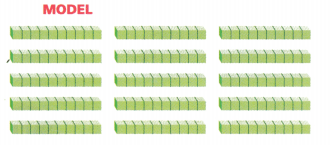
Use 8 tiles to make an array with 2 equal rows. Draw the rest of the tiles.
How many tiles are in each row? ____
Answer:
4 tiles in each row

Explanation:
we can write or use an array as a model to show how multiplication and division are related
the array can help us to write  related multiplication and division equations that contains related facts.
Draw  an array of total 8 tiles,
which are arranged in 2 equal rows.
Answer:
8 ÷ 2 = 4
So, 4 tiles in each row.

Explanation:
Write a division equation for the array using the total number of tiles as the dividend and the number of rows as the divisor.
___  ÷  ___ = ___
8 ÷ 2 = 4
Texas Go Math Grade 3 Lesson 11.1 Answer Key 2
Write a multiplication equation for the array.
___ × ___ = ____
Answer:
8 ÷ 2 = 4

2 x 4 = 8

Explanation:
Using 8 tiles an array is drawn.
Both multiplication and division facts are related to each other.

Step 2
Now, use 8 tiles to make an array with 4 equal rows.
Draw the rest of the tiles.
How many tiles are in each row? ___
Write a division equation for the array using the total number of tiles as the dividend and the number of rows as the divisor.
___ ÷ ___ = ___
So, 8 ÷ 2 = ____, 2 × 4 = ___, 8 ÷ 4 = ___ and 4 × 2 = ___ are related facts.
Texas Go Math Grade 3 Lesson 11.1 Answer Key 3
Write a multiplication equation for the array.
___ × ___ =____
Answer:
8 ÷ 2 = 4,

2 × 4 =8,

8 ÷ 4 =2 and 4 × 2 = 8 are related facts.
           
Explanation:
we can write or use an array is a model to show how multiplication and division are related
the array can help us to write  related multiplication and division equations that contains related facts.

Try This! Draw an array with 4 rows of 4 tiles.
Your array shows the related facts for 4, 4, and 16.
4 × 4 = ___ 16 ÷ 4 = ___
Since both factors are the same, there are only two equations in this set of related facts.
Texas Go Math Grade 3 Lesson 11.1 Answer Key 4
Answer:
4 × 4 = 16 and  16 ÷ 4 = 4

Explanation:
Now, use 16 tiles to make an array with 4 equal rows.
Draw the rest of the tiles.
Each row has 4 tiles.
Related facts are also a set of multiplication and division equations that involve the same numbers.

Math Talk
Mathematical Processes
Look at the multiplication and division equations in a set of related facts. What do you notice about the products and dividends? Explain.

Show Your Work

Question 1.
Complete the related facts for this array.
Texas Go Math Grade 3 Lesson 11.1 Answer Key 12
2 × 8 = 16
______
16 ÷ 2 = 8
______

Explanation:
An array is a model to show how multiplication and division are related,
the array can help us to write  related multiplication and division equations that contains related facts, both are inverse operations.

Write the related facts for the array.

Go Math Grade 3 Lesson 11.1 Answer Key Question 2.
Texas Go Math Grade 3 Lesson 11.1 Answer Key 5
Answer:

Explanation:
As we know that multiplication and division are inverse operations.
With the help of array we can represent the related facts.

Question 3.
Texas Go Math Grade 3 Lesson 11.1 Answer Key 6
Answer:

Explanation:
As we know that multiplication and division are inverse operations.
With the help of array we can represent the related facts.

Question 4.
Texas Go Math Grade 3 Lesson 11.1 Answer Key 7
Answer:

Explanation:
Explanation:
As we know that multiplication and division are inverse operations.
With the help of array we can represent the related facts.

Complete the related facts.

Question 5.
4 × 7 = ____
7 × __ = 28
28 ÷ __ = 4
28 ÷ 4 = __
Answer:
4 × 7 = 28
7 × 4 = 28
28 ÷ 7 = 4
28 ÷ 4 = 7
Explanation:
Division as the reverse operation of multiplication,
i.e. multiplication is about summing up equal groups of objects and
division is about dividing numbers of objects into equal-sized groups.

Go Math Lesson 11.1 Answer Key 3rd Grade Question 6.
5 × __ = 30
6 × __ = 30
30 ÷ 6 = ___
30 ÷ 5 = ___
Answer:
5 × 6 = 30
6 × 5 = 30
30 ÷ 6 = 5
30 ÷ 5 = 6
Explanation:
Division as the reverse operation of multiplication,
i.e. multiplication is about summing up equal groups of objects and
division is about dividing numbers of objects into equal sized groups.

Question 7.
__ × 9 = 27
__ × 3 = 27
__ ÷ 9 = 3
27 ÷ ___ = 9
Answer:
3 × 9 = 27
9 × 3 = 27
27÷ 9 = 3
27 ÷ 3 = 9
Explanation:
Division as the reverse operation of multiplication,
i.e. multiplication is about summing up equal groups of objects and
division is about dividing numbers of objects into equal sized groups.

Problem Solving

Use the table for 8-9.

Question 8.
HO.T. Multi-Step Mr. Lee divides 1 package of clay and 1 package of glitter dough equally among 4 students. How many more glitter dough sections than clay sections does each student get?
Texas Go Math Grade 3 Lesson 11.1 Answer Key 8
Answer:
6 more glitter dough sections than clay sections each student get.
Explanation:
Mr. Lee divides 1 package of clay = 12 sections
1 package of glitter dough = 36 sections
equally distributed among 4 students.
12 ÷ 4 = 3
36 ÷ 4 = 9
Number of more glitter dough sections than clay sections each student get
9 – 3 = 6

Question 9.
Write Math What’s the Error? Ty has a package of glitter dough. He says he can give 9 friends 5 equal sections. Explain his error.
Answer:
Ty need 45 sections of glitter dough, but he has only 36 sections.
Explanation:
1 package of glitter dough = 36 sections
Ty want to distribute among 9 friends in 5 equal sections.
But 9 x 5 = 45
So, he cannot distribute equally.
Question 10.
H.O.T. Pose a Problem Write a word problem that can be solved by using 35 ÷ 5. Solve your problem.
Answer:
A class has 5 students. Teacher want to distribute 35 markers among them equally. How many markers each student get?
Explanation:
Total markers = 35
Total students = 5
Number of markers each student get
35 ÷ 5 = 7

Question 11.
Write a set of related facts that has only two equations.
Answer:
In math, a fact family can be defined as a group of math facts or equations created using the same set of numbers.
The fact family shows the relationships between the three numbers involved.
Similarly, in a multiplication and division fact family, there are multiplication and division sentences created using three numbers.
Explanation:
For example;
A fact family has been created using the numbers 12, 4 and 3 where 4 and 3 are parts, while 12 is the whole.

Daily Assessment Task

Fill in the bubble for the correct answer choice.

Question 12.
There are 36 water bottles. Water bottles come in packages of 6. Which equation gives the related fact for the number of water bottles in each package?
(A) 36 ÷ 12 = 3
(B) 12 × 3 = 36
(C) 6 × 6 = 36
(D) 36 ÷ 9 = 4
Answer:
Option(C)
Explanation:
There are 36 water bottles.
Water bottles come in packages of 6.
The number of water bottles in each package 6 x 6 = 36

Question 13.
Analyze Which equation is NOT included in the same set of related facts as 6 × 8 = 48?
(A) 48 ÷ 6 = 8
(B) 8 × 6 = 48
(C) 48 ÷ 8 = 6
(D) 48 ÷ 16 = 3
Answer:
Option(D)
Explanation:
The fact family shows the relationships between the three numbers involved.
But in 48 ÷ 16 = 3 is not related in set of related facts.

Go Math Answer Key Grade 3 Lesson 11.1 Question 14.
Multi-Step Ryan and Madison are using an array to write equations. Ryan writes 6 × 2 = 12. Madison writes 12 ÷ 2 = 6. Which is a true statement about the equations?
Texas Go Math Grade 3 Lesson 11.1 Answer Key 9
(A) Both equations are correct.
(B) Only Ryan is correct.
(C) Only Madison is correct.
(D) Both equations are incorrect.
Answer:
Option (A)
Explanation:
Ryan writes 6 × 2 = 12.
Madison writes 12 ÷ 2 = 6.
The fact family shows the relationships between the three numbers involved,
as multiplication and division are inverse operations.
Texas Test Prep

Question 15.
Megan wrote an equation that is NOT included in the same set of related facts as 9 × 4 = 36. Which equation did Megan write?
(A) 4 × 9 = 36
(B) 36 ÷ 6 = 6
(C) 36 ÷ 4 = 9
(D) 36 ÷ 9 = 4
Answer:
Option(B)
Explanation:
The fact family shows the relationships between the three numbers involved.
But in 36 ÷ 6 = 6 is not related in set of related facts.

Texas Go Math Grade 3 Lesson 11.1 Homework and Practice Answer Key

Write the related facts for the array.

Question 1.
Texas Go Math Grade 3 Lesson 11.1 Answer Key 10
Answer:
4 x 4 = 16
16 ÷ 4 = 4
Explanation:
Division as the reverse operation of multiplication,
i.e. multiplication is about summing up equal groups of objects and
division is about dividing numbers of objects into equal sized groups.

Question 2.
Texas Go Math Grade 3 Lesson 11.1 Answer Key 11
Answer:
3 x 6 = 12
12 ÷ 3 = 6
Explanation:
Division as the reverse operation of multiplication,
i.e. multiplication is about summing up equal groups of objects and
division is about dividing numbers of objects into equal sized groups.

Complete the related facts.

Question 3.
___ × 4 = 32
___ × 8 = 32
____ ÷ 4 = 8
32 ÷ __ = 4
Answer:
8 × 4 = 32
4 × 8 = 32
32 ÷ 4 = 8
32 ÷ 8 = 4
Explanation:
Multiplication and division are closely related,
given that division is the inverse operation of multiplication.
When we divide, we look to separate into equal groups,
while multiplication involves joining equal groups.

Question 4.
____ × 5 = 35
____ × 7 = 35
35 ÷ ___= 7
35 ÷ ___ = 5
Answer:
7 × 5 = 35
5 × 7 = 35
35 ÷ 5 = 7
35 ÷ 7 = 5
Explanation:
Multiplication and division are closely related,
given that division is the inverse operation of multiplication.
When we divide, we look to separate into equal groups,
while multiplication involves joining equal groups.

Question 5.
7 × ___ = 63
9 × ___ = 63
___ ÷ 7 = 9
63 ÷ ___ = 7
Answer:
7 × 9 = 63
9 × 7 = 63
63 ÷ 7 = 9
63 ÷ 9 = 7
Explanation:
Multiplication and division are closely related,
given that division is the inverse operation of multiplication.
When we divide, we look to separate into equal groups,
while multiplication involves joining equal groups.

Problem Solving

Question 6.
Ms. Cohn divides 21 markers equally among 7 students. Write an equation to show how many markers each student gets Then write a related fact.
Answer:
3 markers
21 ÷ 7 = 3
Explanation:
Ms. Cohn divides 21 markers equally among 7 students.
Related fact equation is 21 ÷ 7 = 3
Each students get 3 markers.

Grade 3 Practice and Homework Lesson 11.1 Answer Key Question 7.
Bethany makes an array of 5 rows of 5 tiles. What multiplication and related division equation can Bethany write about her array?
Answer:
5 x 5 = 25
25 ÷ 5 = 5
Explanation:
Bethany makes an array of 5 rows of 5 tiles.
multiplication related equation 5 x 5 = 25
division related equation 25 ÷ 5 = 5

Lesson Check

Fill in the bubble completely to show your answer.

Question 8.
Sheila has 24 coins in a coin book. The coins are in rows of 4. Which equation gives the related fact for the number of coins in each row?
(A) 24 ÷ 3 = 8
(B) 4 × 6 = 24
(C) 3 × 8 = 24
(D) 24 ÷ 8 = 3
Answer:
Option (B)
Explanation:
Sheila has 24 coins in a coin book.
The coins are in rows of 4.
The number of coins in each row
24 ÷ 4 = 6

Question 9.
Jared has 4 boxes. He puts 9 toy cars in each box. Which equation gives the related fact for the number of toy cars Jared has in all?
(A) 36 = 9 × 4
(B) 36 = 6 × 6
(C) 36 ÷ 6 = 6
(D) 36 ÷ 3 = 12
Answer:
Option(A)
Explanation:
Jared has 4 boxes.
He puts 9 toy cars in each box.
The number of toy cars Jared has in all 4 x 9 = 36

Question 10.
Which equation is NOT included in the same set of related facts as 7 × 6 = 42?
(A) 6 × 7 = 42
(B) 7 × 7 = 49
(C) 42 ÷ 6 = 7
(D) 42 ÷ 7 = 6
Answer:
Option(B)
Explanation:
The fact family shows the relationships between the three numbers involved,
as multiplication and division are inverse operations.
But 7 × 7 = 49 equation is not related.

Question 11.
Which equation is NOT included in the same set of related facts as 6 × 9 = 54?
(A) 54 ÷ 6 = 9
(B) 9 × 6 = 54
(C) 54 ÷ 9 = 54
(D) 3 × 18 = 54
Answer:
Option(D)
Explanation:
The fact family shows the relationships between the three numbers involved,
as multiplication and division are inverse operations.
But 3 × 18 = 54 equation is not related.

Question 12.
Multi-Step Enrico makes an array of 3 rows of 4 tiles. He writes 3 × 4 = 12 and 3 + 4 = 12. He says these are related facts. Which statement is true about Enrico’s equations?
(A) They are related facts.
(B) Only 3 × 4 is a related fact.
(C) Only 3 + 4 is a related fact.
(D) Both are not related facts.
Answer:
Option(B)
Explanation:
Enrico makes an array of 3 rows of 4 tiles.
He writes 3 × 4 = 12 and 3 + 4 = 12.
But 3 + 4 = 12 is not correct as it is 7.

Question 13.
Multi-Step Maria makes an array of 4 rows of 5 tiles. She wants to make an array to show the fact 5 × 5. What can she do to change the array to show 5 × 5 as a related fact?
(A) Add one row of 5 tiles.
(B) Add 5 rows of 5 tiles.
(C) Take away one row of 5 tiles.
(D) Add 4 more tiles.
Answer:
option(A)
Explanation:
Maria makes an array of 4 rows of 5 tiles = 20 tiles
She wants to make an array to show the fact 5 × 5 = 25 tiles
So, one more row of tiles to be added to show that the array has 5 x 5 related fact.

Texas Go Math Grade 3 Lesson 11.1 Answer Key Write Related Facts Read More »
Texas Go Math Grade 3 Lesson 10.4 Answer Key Relate Subtraction and Division

Refer to our Texas Go Math Grade 3 Answer Key Pdf to score good marks in the exams. Test yourself by practicing the problems from Texas Go Math Grade 3 Lesson 10.4 Answer Key Relate Subtraction and Division.

Texas Go Math Grade 3 Lesson 10.4 Answer Key Relate Subtraction and Division

Essential Question
How is division related to subtraction?
Answer:
Repeated Subtraction is a method that subtracts the equal number of items from a group, also known as division.

Unlock the Problem
Serena and Mandy brought a total of 12 newspapers to school for the recycling program. Each girl brought in one newspaper each day. For how many days did the girls bring in newspapers?

• How many newspapers were brought in altogether?
Answer:
12 newspapers
Explanation:
Serena and Mandy brought a total of 12 newspapers to school for the recycling program.
Each girl brought in one newspaper each day.
Total number of days girls bring the newspaper
12 ÷ 1 = 12

• How many newspapers did the two girls bring in altogether each day?
Answer:
2 newspapers
Explanation:
Serena and Mandy brought a total of 12 newspapers to school for the recycling program.
Total newspapers the two girls bring in altogether each day is 2

One Way
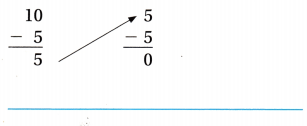
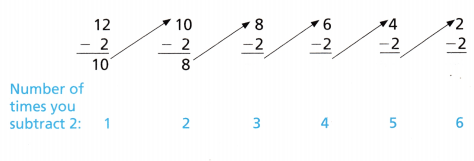
Use repeated subtraction.

  • Start with 12.
  • Subtract 2 until you reach 0.
  • Count the number times you subtract 2.

Texas Go Math Grade 3 Lesson 10.4 Answer Key 1
Since you subtract 2 six times, there are ___ groups of 2 in 12.
So, Serena and Mandy brought in newspapers for ___ days.
Answer:
Since you subtract 2 six times, there are 6 groups of 2 in 12.
So, Serena and Mandy brought in newspapers for 6 days.

Error Alert
Be sure to keep subtracting 2 until you are unable to subtract 2 anymore.

Texas Go Math Grade 3 Lesson 10.4 Answer Key 2

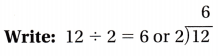
Read: Twelve divided by two equal six.

Another Way
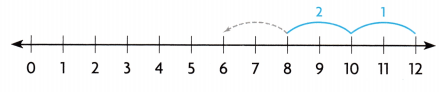
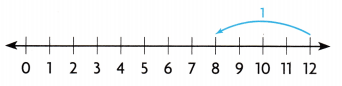
Count back on a number line.

  • Start at 12.
  • Count back by 2s as many times as you can. Draw the rest of the jumps on the number line.
  • Count the number of times you jumped back 2.

Texas Go Math Grade 3 Lesson 10.4 Answer Key 3
You jumped back by 2 six times.
There are ___ jumps of 2 in 12.
12 ÷ 2 = ____
Answer:
There are 6 jumps of 2 in 12.
12 ÷ 2 = 6
Explanation:
Count back by 2s as many times as you can.
• What do your jumps of 2 represent?
Answer:
Represents the number of times jumped back 2.

Math Talk
Mathematical Processes
Explain in your own words how you found the answer.

Question 1.
Draw the rest of the jumps on the number line to complete the division equation.
12 ÷ 4 = ___
Texas Go Math Grade 3 Lesson 10.4 Answer Key 4
Answer:
3 jumps
12 ÷ 4 = 3

Explanation:
Start at 12
Count back by 3s
Count the number of times you jumped back 3.

Math Talk
Mathematical Processes
Explain how counting back on a number line is like using repeated subtraction.
Answer:
Repeated Subtraction is a method that subtracts the equal number of items from a group, also known as division

Write a division equation.

Question 2.
Texas Go Math Grade 3 Lesson 10.4 Answer Key 5
Answer:
10 ÷ 5 = 2

Explanation:
Start at 10
Count back by 5s
Count the number of times you jumped back 2.

Go Math Grade 3 Lesson 10.4 Answer Key Question 3.
Texas Go Math Grade 3 Lesson 10.4 Answer Key 6
Answer:

8 ÷ 2 = 4
Explanation:

Start with 8.
Subtract 2 until you reach 0.
Count the number times you subtract 2.

Problem Solving

Question 4.
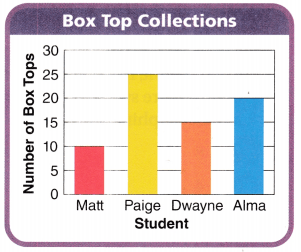
Matt puts his box tops in 2 equal piles. How many box tops are in each pile?

Texas Go Math Grade 3 Lesson 10.4 Answer Key 7
Answer:
5 box tops in each pile.
Explanation:
Matt puts his box tops in 2 equal piles.
Matt has 10 tops,
Number of box tops in each pile
10 ÷ 2 =5

Question 5.
H.O.T. Multi-Step Paige brought an equal number of box tops to school each day for 5 days. Alma also brought an equal number of box tops each day for 5 days. How many box tops did the two students bring in altogether each day? Explain.
Texas Go Math Grade 3 Lesson 10.4 Answer Key 8
Answer:
9 box tops each day.
Explanation:
Paige brought an equal number of box tops to school each day for 5 days.
Total box tops Paige have 25
So, 25 ÷ 5 = 5
Alma also brought an equal number of box tops each day for 5 days.
Total box tops Alma have 20
20 ÷ 5 = 4
Number of box tops the two students brought altogether each day
5 + 4 = 9

Go Math Lesson 10.4 3rd Grade Answer Key Question 6.
Write Math What’s the Question? Dwayne puts all his box tops into bins. He puts an equal number in each bin. The answer is 5. What’s the question?
Answer:
3 equal number of box tops in each bin.
Explanation:
Dwayne has 15 box tops.
the answer is given as 5
So, 15 ÷ 5 = 3
He puts 3 equal numbers of box tops in each bin.

Question 7.
H.O.T. Pose a Problem Write a word problem about collecting box tops that can be solved by using the division equation 28 ÷ 7 = 4. Then solve the problem.
Answer:
Paige adds 3 more box tops and puts in 7 equal piles. How many box tops are in each box?
Each box has 4 box tops.
Explanation:
Paige have 25 box tops
Paige adds 3 more box tops and puts in 7 equal piles.
Total box tops in each box
28 ÷ 7 = 4.
Each box has 4 box tops.

Daily Assessment Task

Fill in the bubble for the correct answer choice.
You may use models or strategies to solve.

Question 8.
Multi-Step There are 16 dolphins in a pod. Each pod has the same number of males and females. The female dolphins are swimming in pairs. How many pairs of female dolphins are there?
(A) 8
(B) 4
(C) 6
(D) 2
Answer:
Option(B)
Explanation:
There are 16 dolphins in a pod.
Each pod has the same number of males and females 16 ÷ 8 = 2
So, 8 males and 8 females.
The female dolphins are swimming in pairs.
Total pairs of female dolphins
8 ÷ 2 = 4

Question 9.
Representations What division equation is shown?
Texas Go Math Grade 3 Lesson 10.4 Answer Key 9
(A) 18 ÷ 2 = 9
(B) 18 ÷ 9 = 2
(C) 2 × 9 = 18
(D) 18 ÷ 6 = 3
Answer:
Option(D)
Explanation:
Given number line is divided into 3 equal parts.
Each part contains 6 counters.

Go Math Grade 3 Lesson 10.4 Subtraction and Division Question 10.
Multi-Step Tim has 30 grapes. He keeps 9 grapes for himself. Then he gives 7 grapes each to some of his friends. To how many friends does Tim give grapes?
(A) 3
(B) 4
(C) 10
(D) 7
Answer:
Option(A)
Explanation:
Tim has 30 grapes.
He keeps 9 grapes for himself.
So, 30 – 9 = 21
Then he gives 7 grapes each to some of his friends.
Tim gives grapes to his friends
21 ÷ 7 = 3

Texas Test Prep

Question 11.
Renee has 18 photos. She wants to put the same number of photos on each of 6 pages in her photo album. How many photos will be on each page?
(A) 4
(B) 3
(C) 2
(D) 5
Answer:
Option(B)
Explanation:
Renee has 18 photos.
She wants to put the same number of photos on each of 6 pages in her photo album.
Number of photos on each page
18 ÷ 6 = 3

Texas Go Math Grade 3 Lesson 10.4 Homework and Practice Answer Key

Write a division equation.

Question 1.
Texas Go Math Grade 3 Lesson 10.4 Answer Key 10
Answer:
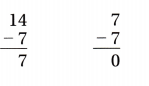
14 ÷  7 = 2

Explanation:
Start at 14
Count back by 7s
Count the number of times you jumped back 2.

Question 2.
Texas Go Math Grade 3 Lesson 10.4 Answer Key 11
Answer:
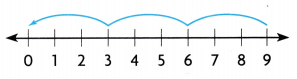
9 ÷ 3 = 3
Explanation:
Given number line is divided into 3 equal parts.
Each part contains 3 counters.

Problem Solving

Use the graph for 3-6.

Question 3.
Beth sorts an equal number of her bottles into 3 bins. How many bottles are in each bin?

Texas Go Math Grade 3 Lesson 10.4 Answer Key 12
Answer:
4 bottles in each bin.
Explanation:
Beth sorts an equal number of her bottles into 3 bins.
Total number of bottles of Beth 12
Number of bottles in each bin
12 ÷ 3 = 4

Go Math Lesson 10.4 Answer Key 3rd Grade Question 4.
Malik and Kimi combine their bottles, then sort an equal number of each into 3 bins. How many bottles are in each bin?
Answer:
9 bottles in each bin.
Explanation:
Malik and Kimi combine their bottles, 18 + 9 = 27
then sort an equal number of each into 3 bins.
Number of bottles in each bin
27 ÷  3 = 9

Question 5.
Kimi collects another 7 bottles and sorts an equal number into 4 bins. How many bottles are in each bin?
Answer:
4 bottles in each bin.
Explanation:
Kimi has 9 bottles at first and then,
collects another 7 bottles and sorts an equal number into 4 bins.
Number of bottles in each bin
16 ÷ 4 = 4

Question 6.
All of the students want to combine their bottles and sort an equal number into 6 bins. Can they do this? Explain.
Answer:
No, they cannot sort an equal number into 6 bins.
Explanation:
All of the students want to combine their bottles and sort an equal number into 6 bins.
Total number of bottles altogether 12 + 18 + 9 = 39
No, they cannot sort an equal number into 6 bins,
because when 39 ÷ 6, we get the remainder as 3.

Texas test Prep

Lesson Check

Fill in the bubble completely to show your answer.

Question 7.
Wendy draws this number line.
Texas Go Math Grade 3 Lesson 10.4 Answer Key 13
Which division equation does she show?
(A) 12 ÷ 6 = 2
(B) 2 × 6 = 12
(C) 12 ÷ 3 = 4
(D) 12 ÷ 4 = 3
Answer:
Option(A)
Explanation:
Division using number line diagrams with one-unit intervals,
indicate hops in the reverse order as you divide up to 12 using 1 to 10 as divisors, and complete the
 division sentences. 

Go Math Grade 3 Lesson 10.4 Homework Answer Key Question 8.
Tomas draws this number line.
Texas Go Math Grade 3 Lesson 10.4 Answer Key 14
Which division equation does he show?
(A) 16 ÷ 8 = 2
(B) 16 ÷ 2 = 8
(C) 4 × 4 = 16
(D) 16 ÷ 4 = 4
Answer:
Option(D)
Explanation:
The number line has 4 equal parts, in 4 groups.
Total numbers on number line are 16.

Question 9.
Key bakes 18 mini-pies. There are 6 pies on each tray. How many trays does Key use?
(A) 12
(B) 6
(C) 4
(D) 3
Answer:
Option(D)
Explanation:
Key bakes 18 mini-pies.
There are 6 pies on each tray.
Number of trays Key used
18 ÷ 6 = 3

Question 10.
Keesha has 14 shoes in all. How many pairs of shoes does Keesha have?
(A) 7
(B) 2
(C) 28
(D) 14
Answer:
Option(A)
Explanation:
Keesha has 14 shoes in all.
Total pairs of shoes Keesha have
14 ÷ 2 = 7

Question 11.
Multi-Step Tara has 32 beads. She takes out 4 red heads, then sorts the rest into 4 equal groups. How many beads are in each group?
(A) 7
(B) 4
(C) 8
(D) 9
Answer:
Option (A)
Explanation:
Tara has 32 beads.
She takes out 4 red beads,
so, 32 – 4 = 28
then sorts the rest into 4 equal groups.
Number of beads in each group
28 ÷ 4 = 7

Go Math Practice and Homework Lesson 10.4 Answer Key 3rd Grade Question 12.
Multi-Step Jeff has a booklet of 30 stickers. He uses one page of stickers. If there are 6 stickers on each page, how many pages are left?
(A) 4
(B) 24
(C) 5
(D) 6
Answer:
Option (A)
Explanation:
Jeff has a booklet of 30 stickers.
He uses one page of stickers.
If there are 6 stickers on each page,
Total pages of stickers 30 ÷  6 = 5
Number of pages left 5 – 1 = 4

Texas Go Math Grade 3 Lesson 10.4 Answer Key Relate Subtraction and Division Read More »

Texas Go Math Grade 3 Lesson 9.4 Answer Key Partial Products

Refer to our Texas Go Math Grade 3 Answer Key Pdf to score good marks in the exams. Test yourself by practicing the problems from Texas Go Math Grade 3 Lesson 9.4 Answer Key Partial Products.

Texas Go Math Grade 3 Lesson 9.4 Answer Key Partial Products

Essential Question
How can you model and record the products of 2-digit and 1-digit numbers?
Answer:
We can  model and record the products of 2-digit and 1-digit numbers by different ways like arranging them vertically and doing multiplication or expanded form.

Explanation:
Way:1:
Step I: Arrange the numbers vertically.

Step II: First multiply the digit at the ones place by 2.
2 × 4 = 8 ones.

Step III: Now multiply the digit at the tens place by 2.
2 × 3 = 6 tens.

Way:2. Multiply 20 by 3 by using expanded form

Solution:

20         →                           2 tens + 0 ones

×    3         →                                       ×      3

6 tens + 0 ones

= 60 + 0

= 60

Therefore, 20 × 3 = 60


Unlock the Problem
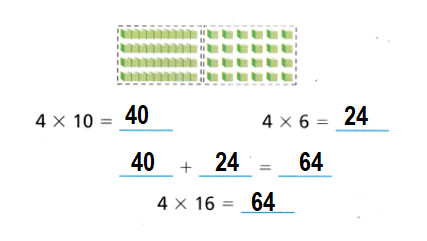
For a field trip to the science center, there are 4 buses from Maddie’s school with 16 students on each bus. How many students are going on the field trip?
4 × 16 = ___

When you multiply the tens and the ones separately and then add the products, you are finding partial products.

One Way
Make an array with base-ten blocks to model the problem.

Step 1
Use 1 ten 6 ones to show 16. Make 4 rows of l6 to show 4 × 16.
Texas Go Math Grade 3 Lesson 9.4 Answer Key 1

Step 2
Combine the tens and the ones to find the product.
Texas Go Math Grade 3 Lesson 9.4 Answer Key 2

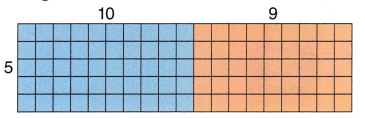
Another Way
Draw an array on grid paper.
Texas Go Math Grade 3 Lesson 9.4 Answer Key 3
So, ___ students are going on the field trip.
Answer:
Number of buses from Maddie’s school = 4.
Number of students on each bus = 16.
Number of students are going on the field trip = Number of buses from Maddie’s school  × Number of students on each bus
= 4 × 16
= (4 × 10) + (4 × 6)
= 40 + 24
= 64.
One Way:
Texas Go Math Grade 3 Lesson 9.4 Answer Key 1
Texas-Go-Math-Grade-3-Lesson-9.4-Answer-Key-Partial-Products-Unlock the Problem..

Another way:
Texas-Go-Math-Grade-3-Lesson-9.4-Answer-Key-Partial-Products-Unlock the Problem

Connect Record Multiplication.
You can use what you have learned about the Distributive Property to find products of 2-digit and 1-digit numbers.
Texas Go Math Grade 3 Lesson 9.4 Answer Key 4

Shade the model to show each step.

Texas Go Math Grade 3 Lesson 9.4 Answer Key 5
Answer:
Product: 23 × 6 = 138.
Texas-Go-Math-Grade-3-Lesson-9.4-Answer-Key-Partial-Products-Connect Record Multiplication

Explanation:
23 × 6 = ???
Multiply the tens :
23 × 6 = 120.
Multiply the ones :
23 × 6 = 18.
Product:
23 × 6 = 120 + 18 = 138.

Math Talk
Mathematical Processes
Why you record the tens first in step 1.
Answer:
We record tens place in step 1 because the place value of it highest.

Explanation:
Tens place first we multiply because its the highest place and covers both ones place also.

Share and Show
Question 1.
Model 5 × 18 with base-ten blocks or grid paper. Use paper and pencil to record your multiplication.
Answer:
Texas-Go-Math-Grade-3-Lesson-9.4-Answer-Key-Partial-Products-Math Talk-Share and Show-1

Explanation:
Number of rows = 5.
Number of columns = 18.
Product = Number of rows  × Number of columns
= 5 × 18
= (5 × 10) + (5 × 8)
= 50 + 40
= 90.

Find the product.

Go Math Lesson 9.4 Answer Key 3rd Grade Question 2.
Texas Go Math Grade 3 Lesson 9.4 Answer Key 6
Answer:
Texas-Go-Math-Grade-3-Lesson-9.4-Answer-Key-Partial-Products-Find the product-2

Explanation:
Multiply the number of rows:
3 × 10 = 30.
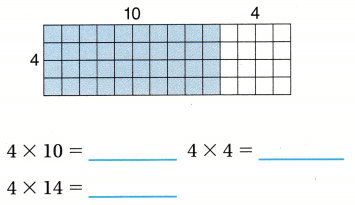
3 × 4 = 12
Add the rows and multiply:
3 × (10 + 4) = 30 + 12
3 × 14 = 42.


Question 3.
Texas Go Math Grade 3 Lesson 9.4 Answer Key 7
Answer:
Texas-Go-Math-Grade-3-Lesson-9.4-Answer-Key-Partial-Products-Find the product-3

Explanation:
Multiply the number of rows:
2 × 10 = 20.
2 × 8 = 16
Add the rows and multiply:
2 × (20 + 8) = 20 + 16
2 × 18 = 36.


Find the product. Use base-ten blocks or draw an array to help.

Question 4.
14 × 4
Answer:
Product: 14 × 4 = 56.
Texas-Go-Math-Grade-3-Lesson-9.4-Answer-Key-Partial-Products-Find the product-Use base-ten blocks or draw an array to help-4

Explanation:
Number of rows = 4.
Number of columns = 14.
Product = Number of rows  × Number of columns
= 4 × 14
= (4 × 10) + (4 × 4)
= 40  + 16
= 56.


3rd Grade Go Math Lesson 9.4 Answer Key Question 5.
17 × 3
Answer:
Product: 17 × 3 = 51.
Texas-Go-Math-Grade-3-Lesson-9.4-Answer-Key-Partial-Products-Find the product-Use base-ten blocks or draw an array to help-5

Explanation:
Number of rows = 3.
Number of columns = 17.
Product = Number of rows  × Number of columns
= 3 × 17
= (3× 10) + (3 × 7)
= 30 + 21
= 51.


Question 6.
52 × 6
Answer:
Product: 52 × 6 = 312.
Texas-Go-Math-Grade-3-Lesson-9.4-Answer-Key-Partial-Products-Find the product-Use base-ten blocks or draw an array to help-6

Explanation:
Number of rows = 6.
Number of columns = 52.
Product = Number of rows  × Number of columns
= 6 × 52
= (6 × 10) + (6 × 10) + (6 × 10) + (6 × 10) + (6 × 10) + (6 × 2)
= 60 + 60 + 60 + 60 + 60 + 12
= 120 + 60 + 60 + 60 + 12
= 180 + 60 + 60 + 12
= 240 + 60 + 12
= 300 + 12
= 312.
= 90.


Go Math Grade 3 Answer Key Lesson 9.4 Question 7.
41 × 7
Answer:
Product: 41 × 7 = 287.
Texas-Go-Math-Grade-3-Lesson-9.4-Answer-Key-Partial-Products-Find the product-Use base-ten blocks or draw an array to help-7

Explanation:
Number of rows = 7.
Number of columns = 41.
Product = Number of rows  × Number of columns
= 7 × 41
= (7 × 10) + (7 × 10) + (7 × 10) + (7 × 10) + (7 × 1)
= 70 + 70 + 70 + 70 + 7
= 140 +  70 + 70 + 7
= 210 + 70 + 7
= 280 + 7
= 287.


Problem Solving
Use the table for 8-13.
Question 8.
Representations What is the cost of 3 Purple Lilac trees?
Texas Go Math Grade 3 Lesson 9.4 Answer Key 8
Answer:
Cost of 3 Purple Lilac trees = $87.

Explanation:
Number of Purple Lilac trees = 3.
Cost of each Purple Lilac trees = $29.
Cost of 3 Purple Lilac trees = Number of Purple Lilac trees × Cost of each Purple Lilac trees
= 3 × $29
= (3 × $10) + (3 × $10) + (3 × $9)
= $30 + $30 + $27
= $60 + $27
= $87.


Question 9.
Multi-Step What is the cost of 2 Magnolia trees and 1 American Redbud?
Answer:
Cost of 2 Magnolia trees and 1 American Redbud = $137.

Explanation:
Cost of each Magnolia trees = $59.
Number of Magnolia trees = 2.
Cost of 2 Magnolia trees = Cost of each Magnolia trees × Number of Magnolia trees
= $59 × 2
= ($10 × 2) + ($10 × 2) + ($10 × 2) + ($10 × 2) + ($10 × 2) + ($9 × 2)
= $20 + $20 + $20 + $20 + $20 + $18
= $40 + $20 + $20 + $20 + $18
= $60 + $20 + $20 + $18
= $80 + $20 + $18
= $100 + $18
= $118.
Cost of each American Redbud = $19.
Number of American Redbud = 1.
Cost of 1 American Redbud = Cost of each American Redbud × Number of American Redbud
= $19 × 1
= $19.
Cost of 2 Magnolia trees and 1 American Redbud = Cost of 2 Magnolia trees + Cost of 1 American Redbud
= $118 + $19
= $137.


Question 10.
H.O.T. Multi-Step What is the difference in cost of 3 Crepe Myrtle trees and 4 Purple Lilacs?
Texas Go Math Grade 3 Lesson 9.4 Answer Key 9
Answer:
$101 is the difference in cost of 3 Crepe Myrtle trees and 4 Purple Lilacs.

Explanation:
Cost of each Purple Lilac trees = $29.
Actual cost of 4 Purple Lilacs = Cost of each Purple Lilac trees × 4
= $29 × 4
= ($10 × 4) + ($10 × 4) + ($9 × 4)
= $40 + $40 + $36
= $80 + $36
= $116.
Discounted for each Purple Lilacs  = $25.
Discounted for each Purple Lilacs = $25 × 4
= ($10 × 4) + ($10 × 4) + ($5 × 4)
= $40 + $40 + $20
= $80 + $20
= $100.
Cost of 4 Purple Lilacs = Cost of 4 Purple Lilacs – Discounted for each Purple Lilacs
= $116 – $100
= $16.
Cost of each Crepe Myrtle trees = $39.
Actual cost of 3 Crepe Myrtle trees = Cost of each Crepe Myrtle trees × 3
= $39 × 3
= ($10 × 3) + ($10 × 3) + ($10 × 3) + ($9 × 3)
= $30 + $30 + $30 + $27
= $60 + $30 + $27
= $90 + $27
= $117.
Difference in cost of 3 Crepe Myrtle trees and 4 Purple Lilacs = Actual cost of 3 Crepe Myrtle trees – Cost of 4 Purple Lilacs
= $117 – $16
= $101.


Texas Go Math Grade 3 Answer Key Pdf Lesson 9.4 Question 11.
Pose a Problem Look back at Problem 10. Write a similar problem by changing the number and type of trees. Then solve the problem.
Answer:
Question: What is the difference in cost of 3 Magnolia trees and 2 American Redbud?
Solution: $139 is the difference in cost of 3 Magnolia trees and 2 American Redbud.

Explanation:
Cost of Magnolia trees = $59.
Cost of 3 Magnolia trees = 3 ×  $59
= (3 × 10) + (3 × 10) + (3 × 10) + (3 × 10) + (3 × 10) + (3 × 9)
= 30 + 30 + 30 + 30 + 30 + 27
= 60 + 30 + 30 + 30 + 27
= 90 + 30 + 30 + 27
= 120 + 30 + 27
= 150 + 27
= $177.
Cost of American Redbud = $19.
Cost of  2 American Redbud = 2 × $19
= (2 × 10) + (2 × 9)
= 20 + 18
= $38.
Difference:
Cost of 3 Magnolia trees – Cost of  2 American Redbud
= $177 – $38
= $139.


Question 12.
H.O.T. Multi-Step How much will you save by buying 6 American Redbuds at the discounted price instead of at the regular price?
Answer:
$24 will be saved by buying 6 American Redbuds at the discounted price instead of at the regular price.

Explanation:
Cost of American Redbuds = $19.
Regular cost of 6 American Redbuds = 6 × $19
= (6 × 10) + (6 × 9)
= 60 + 54
= $114.
Cost of discounted price per tree American Redbuds = $15.
Cost of discounted price per tree 6 American Redbuds = 6 × $15
= (6 × 10) + (6 × 5)
= 60 + 30
= $90.

Cost of 6 American Redbuds after the discounted price = Regular cost of 6 American Redbuds – Cost of discounted price per tree 6 American Redbuds
= $114 – $90
= $24.
Texas Go Math Grade 3 Lesson 9.4 Answer Key 8


Question 13.
write Math What’s the Question? Mario multiplied by 4 and used the information in the table. The answer is $204.
Answer:
No, answer is not correct because Mario multiplied by 4 and used the information in the table, the answer is $84 not $204.

Explanation:
Texas Go Math Grade 3 Lesson 9.4 Answer Key 8
Cost of Magnolia Grandiflora = $59.
Cost of America Redbud = $19.
Cost of Zuni Crepe Myrtle = $39.
Cost of Purple Lilac = $29.
Actual price of all trees = Cost of Magnolia Grandiflora + Cost of America Redbud + Cost of Zuni Crepe Myrtle + Cost of Purple Lilac
= $59 + $19 + $39 + $29
= $78 + $39 + $29
= $117 +$29
= $146.
Discounted price per each Magnolia Grandiflora tree (4 or more) = $51.
Discounted price per each America Redbud (4 or more) = $15.
Discounted price per each Zuni Crepe Myrtle (4 or more) = $34.
Discounted price per each Purple Lilac (4 or more) = $25.
Total discounted price of all trees (4 or more) = Discounted price per each Magnolia Grandiflora tree (4 or more) + Discounted price per each America Redbud (4 or more) + Discounted price per each Zuni Crepe Myrtle (4 or more) + Discounted price per each Purple Lilac (4 or more)
= $51 + $15 + $34 + $25
= $66 + $34 + $25
= $100 + $25
= $125.
Mario multiplied by 4.
=> Total price of all trees = Actual price of all trees – Total discounted price of all trees (4 or more)
= ($146 – $125) × 4
= $21 × 4
= ($10 × 4) + ($10 × 4) + ($1 × 4)
= $40 + $40 + $4
= $80 + $4
= $84.


Daily Assessment Task
Fill in the bubble for the correct answer choice.
Question 14.
There are 26 teams in the spring baseball league. Each team needs 5 parent volunteers. How many volunteers do the teams need?
(A) 31
(B) 30
(C) 100
(D) 130
Answer:
Number of volunteers do the teams needs = 130.
(D) 130.

Explanation:
Number of teams in the spring baseball league = 26.
Number of parent volunteer each team needs = 5.
Number of volunteers do the teams needs = Number of teams in the spring baseball league × Number of parent volunteer each team needs
= 26 × 5
= (10 × 5) + (10 × 5) + (6 × 5)
= 50 + 50 + 30
= 100 + 30
= 130.


Texas Go Math Lesson 9.4 Answer Key 3rd Grade Question 15.
Use Tools Richmond Elementary School has 5 reading classes. Each class sends 19 students to the school spelling bee. How many students are in the school spelling bee?
Texas Go Math Grade 3 Lesson 9.4 Answer Key 10
(A) 24
(B) 45
(C) 95
(D) 545
Answer:
Number of students  are in the school spelling bee = 95.
(C) 95.

Explanation:
Number of reading classes Richmond Elementary School has = 5.
Number of students each class sends to the school spelling bee = 19.
Number of students  are in the school spelling bee = Number of reading classes Richmond Elementary School has  × Number of students each class sends to the school spelling bee
= 5 × 19
= (5 × 10) + (5 × 9)
= 50 + 45
= 95.


Question 16.
Multi-Step Kyle lives 17 miles away from Main City Park, He goes to the park and then back home 3 times each week. How many miles does Kyle travel to and from Main City Park each week?
Texas Go Math Grade 3 Lesson 9.4 Answer Key 11
(A) 102 miles
(B) 17 miles
(C) 34 miles
(D) 912 miles
Answer:
Number of miles Kyle travel to and from Main City Park each week = 102.
(A) 102 miles.

Explanation:
Number of miles away from Main City Park Kyle lives = 17.
Number of times he goes to the park and then back home each week = 3.
Number of miles Kyle travel to and from Main City Park each week = (2 × Number of miles away from Main City Park Kyle lives) × Number of times he goes to the park and then back home each week
= (2 × 17) × 3
=[(10 × 2) + (7 × 2)] × 3
= (20 + 14) × 3
= 34 × 3
= (3 × 10) + (3 × 10) + (3 × 10)  + (3 × 4)
= 30 + 30 + 30 + 12
= 60 + 30 + 12
= 90 + 12
= 102.


Texas Test Prep
Question 17.
Mr. Perry bought 6 gallons of juice for a class party. Each gallon has 16 cups. ¡f3 cups of juice were left over, how many cups did students drink?
(A) 48 cups
(B) 9 cups
(C) 93 cups
(D) 13 cups
Answer:
Number of cups students drink = 93.
(C) 93 cups.

Explanation:
Number of gallons of juice for a class party Mr. Perry bought = 6.
Number of cups each gallon has = 16.
Number of cups of juice were left over = 3.
Number of cups students drink = (Number of gallons of juice for a class party Mr. Perry bought × Number of cups each gallon has) – Number of cups of juice were left over
=(6 × 16) – 3
= [(6 × 10) + (6 × 6)] – 3
= (60 + 36)- 3
= 96 – 3
= 93.


Texas Go Math Grade 3 Lesson 9.4 Homework and Practice Answer Key

Find the product.
Question 1.
Texas Go Math Grade 3 Lesson 9.4 Answer Key 12
Answer:
Texas-Go-Math-Grade-3-Lesson-9.4-Answer-Key-Partial-Products-Texas Go Math Grade 3 Lesson 9.4 Homework and Practice Answer Key-Find the product-1

Explanation:
Number of rows = 4.
Number of columns = 14.
Product =  Number of columns × Number of rows
= 14 × 4
= (10 × 4) + (4 × 4)
= 40 + 16
= 56.


Question 2.
Texas Go Math Grade 3 Lesson 9.4 Answer Key 13
Answer:
Texas-Go-Math-Grade-3-Lesson-9.4-Answer-Key-Partial-Products-Texas Go Math Grade 3 Lesson 9.4 Homework and Practice Answer Key-Find the product-2

Explanation:
Number of columns = 12.
Number of rows = 3.
Product =  Number of columns × Number of rows
= 12 × 3
= (10 × 3) + (2 × 3)
= 30 + 6
= 36.


Find the product. Draw an array to help.

Question 3.
Texas Go Math Grade 3 Lesson 9.4 Answer Key 14
Answer:
Product = 23 × 6 = 138.
Texas-Go-Math-Grade-3-Lesson-9.4-Answer-Key-Partial-Products-Texas Go Math Grade 3 Lesson 9.4 Homework and Practice Answer Key-Find the product-Draw an array to help-3

Explanation:
Number of columns = 23.
Number of rows = 6.
Product =  Number of columns × Number of rows
= 23 × 6
= (10 × 6) + (10 × 6) + (3 × 6)
= 60 + 60 + 18
= 120 + 18
= 138.


Go Math Practice and Homework Lesson 9.4 Grade 3 Question 4.
Texas Go Math Grade 3 Lesson 9.4 Answer Key 15
Answer:
Product =  18 × 9 = 162.
Texas-Go-Math-Grade-3-Lesson-9.4-Answer-Key-Partial-Products-Texas Go Math Grade 3 Lesson 9.4 Homework and Practice Answer Key-Find the product-Draw an array to help-4

Explanation:
Number of columns = 18.
Number of rows = 9.
Product =  Number of columns × Number of rows
= 18 × 9
= (10 × 9) + (8 × 9)
= 90 + 72
= 162.


Question 5.
Texas Go Math Grade 3 Lesson 9.4 Answer Key 16
Answer:
Product = 32 × 4 = 128.
Texas-Go-Math-Grade-3-Lesson-9.4-Answer-Key-Partial-Products-Find the product-Draw an array to help-5

Explanation:
Number of columns = 32.
Number of rows = 4.
Product =  Number of columns × Number of rows
= 32 × 4
= (10 × 4) + (10 × 4) + (10 × 4) + (2 × 4)
= 40 + 40 + 40 + 8
= 80 + 40 + 8
= 120 + 8
= 128.


Question 6.
Texas Go Math Grade 3 Lesson 9.4 Answer Key 17
Answer:
Product: 75 × 3 = 225.
Texas-Go-Math-Grade-3-Lesson-9.4-Answer-Key-Partial-Products-Find the product-Draw an array to help-6

Explanation:
Number of columns = 75.
Number of rows = 3.
Product =  Number of columns × Number of rows
= 75 × 3
= (10 × 3) + (10 × 3) + (10 × 3) + (10 × 3) +(10 × 3) + (10 × 3) +(10 × 3) + (5 × 3)
= 30 + 30 + 30 + 30 + 30 + 30 + 30 + 15
= 60 + 30 + 30 + 30 + 30 + 30 + 15
= 90 + 30 + 30 + 30 + 30 + 15
= 120 + 30 + 30 + 30 + 15
= 150 + 30 + 30 + 15
= 180 + 30 + 15
= 210 + 15
= 225.

Problem Solving
Use the table for 7-9.
Question 7.
If a cow eats 43 pounds of feed in one week, how many pounds do 7 cows eat?
Texas Go Math Grade 3 Lesson 9.4 Answer Key 18
Answer:
Number of pounds of feed in one week 7 cows eats = 301.

Explanation:
Number of pounds of feed in one week a cow eats = 43.
Number of cows = 7.
Number of pounds of feed in one week 7 cows eats = Number of pounds of feed in one week a cow eats × Number of cows
= 43 × 7
= (10 × 7) + (10 × 7) + (10 × 7) + (10 × 7) + (3 × 7)
= 70 + 70 + 70 + 70 + 21
= 140 + 70 + 70  + 21
= 210 + 70 + 21
= 280 +  21
= 301.

Go Math Grade 3 Lesson 9.4 Homework Answer Key Question 8.
There are 3 female hogs and 5 male hogs. How many pounds of feed do they eat altogether?
Answer:
Number of pounds of feed they eat altogether = 296.

Explanation:
Number of female hogs = 3.
Number of male hogs = 5.
Number of pounds hogs eat = 37.
Number of pounds of feed they eat altogether = (Number of female hogs + Number of male hogs) Number of pounds hogs eat
= (3 + 5) 37
= 8 × 37
= (8 × 10) + (8 × 10) + (8 × 10) + (8 × 7)
= 80 + 80 + 80 + 56
= 160 + 80 + 56
= 240 + 56
= 296.


Question 9.
How many more pounds of feed do 5 steer eat than 5 cows?
Answer:
40 more pounds of feed 5 steer eat than 5 cows.

Explanation:
Number of steer = 5.
Number of cows = 5.
Number of pounds steer eat = 51.
Number of pounds cows eat = 43.
Total number of pounds 5 steer eat = Number of steer × Number of pounds steer eat
= 5 × 51
= (5 × 10) + (5 × 10) + (5 × 10) + (5 × 10) + (5 × 10) + (5 × 1)
= 50 + 50 + 50 + 50 + 50 + 5
= 100 + 50 + 50 + 50 + 5
= 150 + 50 + 50 + 5
= 200 + 50 + 5
= 250 + 5
= 255.
Total number of pounds 5 cows eat = Number of cows × Number of pounds cows eat
= 5 × 43
= (5 × 10) + (5 × 10) + (5 × 10) + (5 × 10) + (5 × 3)
= 50 + 50 + 50 + 50 + 15
= 100 + 50 + 50 + 15
= 150 + 50 + 15
= 200 + 15
= 215.
Difference:
Total number of pounds 5 steers eat – Total number of pounds 5 cows eat
= 255 – 215
= 40.


Texas test Prep
Lesson Check
Fill in the bubble completely to show your answer.
Question 10.
The soccer league has 28 teams. Each team has 9 players. How many players are there in all?
(A) 72
(B) 152
(C) 289
(D) 252
Answer:
Number of players are there in all = 252.
(D) 252.

Explanation:
Number of teams soccer league has = 28.
Number of players each team has = 9.
Number of players are there in all = Number of teams soccer league has × Number of players each team has
= 28 × 9
= (10 × 9) + (10 × 9) + (8 × 9)
= 90 + 90 + 72
= 180 + 72
= 252.


Question 11.
An apple orchard has 8 rows of trees. Each row has 34 trees. How many trees are in the orchard?
(A) 272
(B) 332
(C) 172
(D) 348
Answer:
Number of trees are in the orchard = 272.
(A) 272.

Explanation:
Number of rows of trees an apple orchard has = 8.
Number of trees each row has = 34.
Number of trees are in the orchard = Number of rows of trees an apple orchard has × Number of trees each row has
= 8 × 34
= (8 × 10) + (8 × 10) + (8 × 10) + (8 × 4)
= 80 + 80 + 80 + 32
= 160 + 80 + 32
= 240 + 32
= 272.


Question 12.
On a school trip, there are 4 buses of students. Each bus holds 58 students. How many students go on the school trip?
(A) 458
(B) 132
(C) 532
(D) 232
Answer:
Number of students go on the school trip = 232.
(D) 232.

Explanation:
Number of buses of students on a school trip = 4.
Number of students each bus holds = 58.
Number of students go on the school trip = Number of buses of students on a school trip × Number of students each bus holds
= 4 × 58
= (4 × 10) + (4 × 10) + (4 × 10) + (4 × 10) + (4 × 10) + (4 × 8)
= 40 + 40 + 40 + 40 + 40 + 32
= 80 + 40 + 40 + 40 + 32
= 120 + 40 + 40 + 32
= 160 + 40 + 32
= 200 + 32
= 232.


Question 13.
A train travels 47 miles between two cities. If the train makes 4 trips in one day, how many miles does it travel?
(A) 167 miles
(B) 128 miles
(C) 188 miles
(D) 168 miles
Answer:
Number of miles it travel = 188.
(C) 188 miles.

Explanation:
Number of miles between two cities a train travels = 47.
Number of trips in one day a train makes = 4.
Number of miles it travel = Number of miles between two cities a train travels × Number of trips in one day a train makes
= 47 × 4
= 188.

Texas Go Math Grade 3 Lesson 9.4 Homework Answer Key Question 14.
Multi-Step Luz makes an array of 6 rows of 27 cubes. If he has 9 cubes left over, how many cubes did he have to start with?
(A) 171
(B) 243
(C) 162
(D) 153
Answer:
Number of cubes he has to start with = 171.
(A) 171.

Explanation:
Number of rows Luz makes an array = 6.
Number of cubes = 27.
Number of cubes left over = 9.
Number of cubes he has to start with = (Number of rows Luz makes an array × Number of cubes ) + Number of cubes left over
= (6 × 27) + 9
= 162 + 9
= 171.

Question 15.
Multi-Step There are 8 trays of sandwiches at a picnic. Each tray holds 22 sandwiches. If 12 sandwiches are left over, how many sandwiches were eaten?
(A) 176
(B) 164
(C) 188
(D) 174
Answer:
Number of sandwiches were eaten = 164.
(B) 164.

Explanation:
Number of trays of sandwiches at a picnic = 8.
Number of sandwiches each tray holds = 22.
Number of sandwiches are left over = 12.
Number of sandwiches were eaten = (Number of trays of sandwiches at a picnic × Number of sandwiches each tray holds) + Number of sandwiches are left over
= (8 × 22) – 12
= 176 – 12
= 164.

Texas Go Math Grade 3 Lesson 9.4 Answer Key Partial Products Read More »

Texas Go Math Grade 3 Lesson 9.2 Answer Key Multiplication Strategies with Multiples of 10

Refer to our Texas Go Math Grade 3 Answer Key Pdf to score good marks in the exams. Test yourself by practicing the problems from Texas Go Math Grade 3 Lesson 9.2 Answer Key Multiplication Strategies with Multiples of 10.

Texas Go Math Grade 3 Lesson 9.2 Answer Key Multiplication Strategies with Multiples of 10

Essential Question
What strategies can you use to multiply with multiples of 10?

Unlock the Problem
You can use models and place value to multiply with multiples of 10.

• What is a product of 10 and the counting numbers 1, 2, 3, and so on?
Answer:
A multiple of a number is the product of the number and a counting number.

Explanation:
Multiple of 10 and the counting number is going to be the product.
For example:
10 × 1 = 10.
10 × 2 = 20.
10 × 3 = 30.
And so on……


Activity
Model multiples of 10.
Materials Texas Go Math Grade 3 Lesson 9.2 Answer Key 1 base-ten blocks
Model the first nine multiples of 10.
Texas Go Math Grade 3 Lesson 9.2 Answer Key 2
What are the first nine multiples of 10?
10, 20, 30, __, ___, ___, ___, ___, ____
Best Care Veterinary Clinic offered free pet care classes for 5 days. Erin attended the pet care class for 30 minutes each day. How many minutes did Erin attend the class?

One Way
Use a number line.
5 × 30 = __
Think: 30 = 3 tens

Step 1
Complete the number line. Write the labels for the multiples of 10.

Step 2
Draw jumps on the number line to show 5 groups of 3 tens.
Texas Go Math Grade 3 Lesson 9.2 Answer Key 3
So, Erin attended the pet care class for ___ minutes.

Answer:
So, Erin attended the pet care class for 150 minutes.
5 × 30 = 150.

Explanation:
Number of days Best Care Veterinary Clinic offered free pet care classes = 5 days.
Time of Erin attended the pet care class each day = 30 minutes.
Number of minutes Erin attend the class = Number of days Best Care Veterinary Clinic offered free pet care classes × Time of Erin attended the pet care class each day
= 5 × 30
= (5 × 10) + (5 × 10) + (5 × 10)
= 50 + 50 + 50
= 100 + 50
= 150.
Texas-Go-Math-Grade-3-Lesson-9.2-Answer-Key-Multiplication-Strategies-with-Multiples-of-10-Activity

Another Way
Use place value.
Texas Go Math Grade 3 Lesson 9.2 Answer Key 4
So, 5 × 30 = ___

Think
5 × 30 = 5 × __ tens
= ___ tens = ___
Answer:
5 × 30 = 150.

Explanation:
Using Place value:
5 × 30 = 5 × 3 tens(30)
= 15 tens = 15 × 10 = 150.


Math Talk
Mathematical processes
Explain why 5 × 30 has one zero in the product and 4 × 50 has two zeros in the product.
Answer:
5 × 30 has one zero in the product and 4 × 50 has two zeros in the product because 5 is multiplied with 3 into 10  so product is 15 into 10  = 150 and 4 is multiplied with 5 into 10 so product is 20 into 10 = 200.

Explanation:
Product of 5 × 30:
= (5 × 10) + (5 × 10) + (5 × 10)
= 50 + 50 + 50
= 100 + 50
= 150.
Product of 4 × 50:
= (4 × 10) +  (4 × 10)  + (4 × 10)  + (4 × 10)  + (4 × 10)
= 40 + 40 + 40 + 40 + 40
= 80 + 40 + 40 + 40
= 120 + 40 + 40
= 160 + 40
= 200.


Share and Show
Use the number line to find the product.
Question 1.
3 × 40 = ___
Think: There are 3 jumps of 40.
Texas Go Math Grade 3 Lesson 9.2 Answer Key 5
Answer:
Texas-Go-Math-Grade-3-Lesson-9.2-Answer-Key-Multiplication-Strategies-with-Multiples-of-10-Share and Show-Use the number line to find the product-1

Explanation:
3 × 40 = (3 × 10) + (3 × 10) + (3 × 10) + (3 × 10)
= 30 + 30 + 30 + 30
= 60 + 30 + 30
= 90 + 30
= 120.


Go Math Grade 3 Lesson 9.2 Answer Key Question 2.
8 × 20 = ___
Texas Go Math Grade 3 Lesson 9.2 Answer Key 6
Answer:
Texas-Go-Math-Grade-3-Lesson-9.2-Answer-Key-Multiplication-Strategies-with-Multiples-of-10-Share and Show-Use the number line to find the product-2

Explanation:
8 × 20 = (8 × 10) + (8 × 10)
= 80 + 80
= 160.

Use place value to find the product.

Question 3.
3 × 70 = 3 × __ tens
= __ tens = ___
Answer:
3 × 70 = 210.

Explanation:
3 × 70 = 3 × 7 tens
= 21 tens = 21 × 10 = 210.


Question 4.
50 × 2 = __ tens × 2
= __ tens = ___
Answer:
50 × 2 = 100.

Explanation:
50 × 2 = 5 tens × 2
= 10 tens = 10 × 10 = 100.


Math Talk
Mathematical Processes
Will the product of 50 × 2 be the same as the product of 2 × 50? Explain.
Answer:
Yes, the product of 50 × 2 be the same as the product of 2 × 50 will be the same by using distributive property where (a × b = b × a).

Explanation:
Product of :
50 × 2 = 100.
2 × 50 = 100.


Use the table for 5-7.
Question 5.
Representations The cost of a bottle of shampoo is $9. If the clinic sells their entire supply of shampoo, how much money will they receive?
Texas Go Math Grade 3 Lesson 9.2 Answer Key 7
Answer:
Amount of money for the entire supply of shampoo received = $180.

Explanation:
Number of bottles of shampoo = 20.
Amount of money  for each bottle of shampoo = $9.
Amount of money for the entire supply of shampoo received = Number of bottles of shampoo × Amount of each bottle of shampoo
= 20 × $9
= (10 × $9) + (10 × $9)
= $90 + $90
= $180.


Question 6.
What’s the Question? Each bag of treats has 30 treats. The answer is 240.
Answer:
Question: How bags of treats the clinic sold.

Explanation:
Number of treats in each bag of treats = 30.
Answer given = 240.
Division:
Answer given ÷ Number of treats in each bag of treats
= 240 ÷ 30
= (24 × 10) ÷ (3 × 10)
= 24 ÷ 3
= 8.

Go Math Lesson 9.2 Grade 3 Answer Key Question 7.
Multi-Step There are 4 bottles of vitamins in each box of vitamins. Each bottle of vitamins has 20 vitamins. If the clinic wants to have a supply of 400 vitamins, how many more boxes should they order?
Texas Go Math Grade 3 Lesson 9.2 Answer Key 8
Answer:
Number of more boxes they should order = 5.

Explanation:
Number of bottles of vitamins in each box of vitamins = 4.
Number of vitamins each bottle of vitamins has = 20.
Number of vitamins in the boxes of vitamins = Number of bottles of vitamins in each box of vitamins × Number of vitamins each bottle of vitamins has
= 4 × 20
= (4 × 10) + (4 × 10)
= 40 + 40
= 80.
Total number of vitamins the clinic supplies = 400.
Number of more boxes they should order = Total number of vitamins the clinic supplies ÷ Number of vitamins in the boxes of vitamins
= 400 ÷ 80
= (4 × 10 × 10) ÷ (8 ×10)
= (4 × 10) ÷ 8
= 5.


Question 8.
Multi-Step Hiromi needs to set up 155 chairs for people to attend pet care classes. So far she has set up 6 rows with 20 chairs in each row. How many more chairs does Hiromi need to set up?
Answer:
Number of chairs more she needs to set up = 35.

Explanation:
Total number of chairs for people to attend pet care classes Hiromi needs to set up = 155.
Number of rows she set up = 6.
Number of chairs in each row she set up = 20.
Number of chairs she set up till now = Number of rows she set up × Number of chairs in each row she set up
= 6 × 20
= (6 × 10) + (6 × 10)
= 60 + 60
= 120.
Number of chairs more she needs to set up = Total number of chairs for people to attend pet care classes Hiromi needs to set up – Number of chairs she set up till now
= 155 – 120
= 35.


Question 9.
Multi-Step Last week, Dr. Newman examined the paws of 30 dogs at her clinic. She examined the paws of 20 cats. What is the total number of paws Dr. Newman examined last week?
Answer:
Total number of paws Dr. Newman examined last week = 50.

Explanation:
Number of paws of dogs Dr. Newman examined at her clinic last week = 30.
Number of paws of cats Dr. Newman examined at her clinic last week = 20.
Total number of paws Dr. Newman examined last week = Number of paws of dogs Dr. Newman examined at her clinic last week + Number of paws of cats Dr. Newman examined at her clinic last week
= 30 + 20
= 10(3 + 2)
= 10 × 5
= 50.

Fill in the bubble for the correct answer choice.
Question 10.
Orca whales have 50 teeth. How many teeth do 6 orcas have?
(A) 560
(B) 30
(C) 300
(D) 56
Answer:
Total number of teeth Orca whales have =  300.
(C) 300.

Explanation:
Number of teeth Orca whales have = 50.
Number of Orca whales = 6.
Total number of teeth Orca whales have =  Number of teeth Orca whales have × Number of Orca whales
= 50 × 6
= (10 × 6) + (10 × 6) + (10 × 6) + (10 × 6) + (10 × 6)
= 60 + 60 + 60 + 60 + 60
= 120 + 60 + 60 + 60
= 180 + 60 + 60
= 240 + 60
= 300.

Question 11.
Apply A song mentions 10 drummers drumming. Singers repeat that part 3 times. 1f they are singing about different drummers in each part, how many drummers are they singing about in all?
(A) 13
(B) 30
(C) 310
(D) 130
Answer:
Number of drummers are they singing about in all = 30.
(B) 30.

Explanation:
Number of drummers drumming a song mentions = 10.
Number of times Singers repeats that part = 3.
Number of drummers are they singing about in all = Number of drummers drumming a song mentions × Number of times Singers repeats that part
= 10 × 3
= 30.

3rd Grade Multiplication Strategies Lesson 9.2 Go Math Question 12.
Multi-Step The U.S. flag has 50 stars. One box has 2 U.S. flags in it. How many stars are in 8 boxes?
(A) 800
(B) 40
(C) 400
(D) 100
Answer:
Number of stars in 8 boxes of U.S. flag = 800.
(A) 800.

Explanation:
Number of stars the U.S. flag has = 50.
Number of flags one box has =2.
Number of stars in U.S. flag box has = Number of stars the U.S. flag has × Number of flags one box has
= 50 × 2
= (10 × 2) + (10 × 2) + (10 × 2) + (10 × 2) + (10 × 2)
= 20 + 20 + 20 + 20 + 20
= 40 + 20 + 20 + 20
= 60 + 20 + 20
= 80 + 20
= 100.
Number of stars in 8 boxes of U.S. flag = 8 × Number of stars in U.S. flag box has
= 8 × 100
= 800.


Texas Test Prep
Question 13.
There are 8 rows of chairs set up in the gym for the career day program. If there are 30 chairs in each row, how many chairs are there?
(A) 38
(B) 240
(C) 80
(D) 22
Answer:
Total number of chairs are there = 240.
(B) 240.

Explanation:
Number of rows of chairs set up in the gym for the career day program = 8.
Number of chairs in each row = 30.
Total number of chairs are there = Number of rows of chairs set up in the gym for the career day program  × Number of chairs in each row
= 8 × 30
= (8 × 10) + (8 × 10) + (8 × 10)
= 80 + 80 + 80
= 160 + 80
= 240.


Texas Go Math Grade 3 Lesson 9.2 Homework and Practice Answer Key

Use the number line to find the product.

Question 1.
5 × 30 = ___
Texas Go Math Grade 3 Lesson 9.2 Answer Key 9
Answer:
Texas-Go-Math-Grade-3-Lesson-9.2-Answer-Key-Multiplication-Strategies-with-Multiples-of-10-Texas Go Math Grade 3 Lesson 9.2 Homework and Practice Answer Key-1

Explanation:
5 × 30 = (5 × 10) + (5 × 10) + (5 × 10)
= 50 + 50 + 50
= 100 + 50
= 150.


Question 2.
7 × 20 = ___
Texas Go Math Grade 3 Lesson 9.2 Answer Key 10
Answer:
Texas-Go-Math-Grade-3-Lesson-9.2-Answer-Key-Multiplication-Strategies-with-Multiples-of-10-Texas Go Math Grade 3 Lesson 9.2 Homework and Practice Answer Key-2

Explanation:
7 × 20 = (7 × 10) + (7 × 10)
= 70 + 70
= 140.

Use place value to find the product.

Question 3.
4 × 60 = 4 × __ tens
= ___ tens = ____
Answer:
4 × 60 = 240.

Explanation:
4 × 60 = 4 × 6 tens
= 240 tens = 24 × 10 = 240.


Question 4.
30 × 9 = ___ tens × 9
= ___ tens = ___ tens
Answer:
30 × 9 = 270.

Explanation:
30 × 9 = 3 tens × 9
= 27 tens = 27 × 10 = 270.


Problem Solving
Use the table for 5-7.
Question 5.
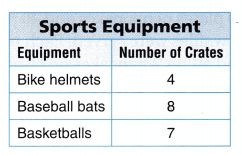
At the sports store, there are 70 bike helmets in each crate. If the store sells all the crates, how many bike helmets Bike helmets does the store sell?
Texas Go Math Grade 3 Lesson 9.2 Answer Key 11
Answer:
Total number of Bike helmets does the store sell = 280.

Explanation:
Number of bike helmets in each crate = 70.
Number of crates sports equipment has of bike helmets = 4.
Total number of Bike helmets does the store sell = Number of bike helmets in each crate × Number of crates sports equipment has of bike helmets
= 70 × 4
= 280.


Practice and Homework Lesson 9.2 Answer Key 3rd Grade Question 6.
There are 30 basketballs in each crate. How many basketballs are there in all?
Answer:
Number of basketballs are there in all = 210.

Explanation:
Number of basketballs in each crate = 30.
Number of crates of basketballs = 7.
Number of basketballs are there in all = Number of basketballs in each crate × Number of crates of basketballs
= 30 × 7
= (10 × 7) + (10 × 7) + (10 × 7)
= 70 + 70 + 70
= 140 + 70
= 210.


Question 7.
Each crate of baseball bats contains 30 bats. If the store sells 2 crates of bats, how many bats are left?
Answer:
Number of bats are left = 180.

Explanation:
Number of bats each crate of baseball bats contains = 30.
Number of crates of bats the store sells = 2.
Number of crates of bats the store has = 8.
Total number of bats the store has = Number of bats each crate of baseball bats contains × Number of crates of bats the store has
= 30 × 8
= (10 × 8) + (10 × 8) + (10 × 8)
= 80 + 80 + 80
= 160 + 80
= 240.
Total number of bats the store sells = Number of bats each crate of baseball bats contains × Number of crates of bats the store sells
= 30 × 2
= (10 × 2) + (10 × 2) + (10 × 2)
= 20 + 20 + 20
= 40 + 20
= 60.
Number of bats are left = Total number of bats the store has – Total number of bats the store sells
= 240 – 60
= 10(24 – 6)
= 10 × 18
= 180.


Texas Test Math
Lesson Check
Fill in the bubble completely to show your answer.
Question 8.
A school cafeteria has 30 tables. Each table seats 6 students. How many students can be seated?
(A) 120
(B) 150
(C) 180
(D) 306
Answer:
Number of students can be seated = 180.
(C) 180.

Explanation:
Number of tables a school cafeteria has = 30.
Number of seats for students in each table = 6.
Number of students can be seated = Number of tables a school cafeteria has × Number of seats for students in each table
= 30 × 6
= (10 × 6) + (10 × 6) + (10 × 6)
= 60 + 60 + 60
= 120 + 60
= 180.

Question 9.
The cafeteria serves 50 bowls of fruit. Each bowl has 8 pieces of fruit. How many pieces of fruit were served?
(A) 508
(B) 400
(C) 450
(D) 40
Answer:
Number of pieces of fruit were served = 400.
(B) 400.

Explanation:
Number of bowls of fruits the cafeteria serves = 50.
Number of pieces of fruit each bowl has = 8.
Number of pieces of fruit were served = Number of bowls of fruits the cafeteria serves × Number of pieces of fruit each bowl has
= 50 × 8
= (10 × 8) + (10 × 8) + (10 × 8)+ (10 × 8)+ (10 × 8)
= 80 + 80 + 80 + 80 + 80
= 160 + 80 + 80 + 80
= 240 + 80 + 80
= 320 + 80
= 400.


Go Math Grade 3 Lesson 9.2 Practice and Homework Answer Key Question 10.
In the gym, there are 7 rows of bleacher seats. Each row holds 40 people. How many people can sit in the bleacher seats?
(A) 240
(B) 210
(C) 407
(D) 280
Answer:
Number of people can sit in the bleacher seats = 280.
(D) 280.

Explanation:
Number of rows of bleacher seats in the gym = 7.
Number of people each row holds = 40.
Number of people can sit in the bleacher seats = Number of rows of bleacher seats in the gym × Number of people each row holds
= 7 × 40
= (7 × 10) + (7 × 10) + (7 × 10) + (7 × 10)
= 70 + 70 + 70 + 70
= 140 + 70 + 70
= 210 + 70
= 280.

Question 11.
A marching band concert has a total of 9 bands. Each band has 50 students. How many students are in the marching bands?
(A) 480
(B) 540
(C) 409
(D) 450
Answer:
Number of students are in the marching bands = 450.
(D) 450.

Explanation:
Total number of bands A marching band concert has = 9.
Number of students each band has = 50.
Number of students are in the marching bands = Total number of bands A marching band concert has × Number of students each band has
= 9 × 50
= (9 × 10) + (9 × 10) + (9 × 10)+ (9 × 10) + (9 × 10)
= 90 + 90 + 90 + 90 + 90 + 90
= 180 + 90 + 90 + 90
= 270 + 90 + 90 +
= 360 + 90
= 450.

Question 12.
Multi-Step At the school brunch, 20 plates of pancakes and 40 plates of waffles were served. Each plate had either 2 pancakes or 2 waffles. How many waffles and pancakes were served?
(A) 120
(B) 200
(C) 60
(D) 280
Answer:
Number of waffles and pancakes were served = 120.
(A) 120.

Explanation:
Number of plates of pancakes were served = 20.
Number of pancakes each plate had = 2.
Total number of pancakes served = Number of plates of pancakes were served  × Number of pancakes each plate had
= 20 × 2
= (10× 2) + (10× 2)
= 20 + 20
= 40.
Number of plates of waffles were served = 40.
Number of waffles each plate had = 2.
Total number of waffles served = Number of plates of waffles were served × Number of waffles each plate had
= 40 × 2
= (10 × 2) + (10 × 2) + (10 × 2) + (10 × 2)
= 20 + 20 + 20 + 20
= 40 + 20 + 20
= 60 + 20
= 80.
Number of waffles and pancakes were served = Total number of pancakes served + Total number of waffles served
= 40 + 80
= 10 (4 + 8)
= 10 × 12
= 120.


Question 13.
Multi-Step At the football game, there are 6 cartons of apple juice and 8 cartons of grape juice. Each carton holds 40 bottles of juice. How many bottles of juice are there?
(A) 320
(B) 560
(C) 650
(D) 480
Answer:
Total number of bottles of juice are there = 560.
(B) 560.

Explanation:
Number of cartons of apple juice at the football game = 6.
Number of cartons of grape juice at the football game = 8.
Number of bottles of juice each carton holds = 40.
Total number of cartons of apple juice = Number of cartons of apple juice at the football game × Number of bottles of juice each carton holds
= 6 × 40
= (6 × 10) + (6 × 10) + (6 × 10)  + (6 × 10)
= 60 + 60 + 60 + 60
= 120 + 60 + 60
= 180 + 60
= 240.
Total number of cartons of grape juice = Number of cartons of grape juice at the football game × Number of bottles of juice each carton holds
= 8 × 40
= (8 × 10) + (8 × 10) + (8 × 10)  + (8 × 10)
= 80 + 80 + 80 + 80
= 160 + 80 + 80
= 240 + 80
= 320.
Total number of bottles of juice are there = Total number of cartons of apple juice + Total number of cartons of grape juice
= 240 + 320
= 10 (24 + 32)
= 10 × 56
= 560.

Texas Go Math Grade 3 Lesson 9.2 Answer Key Multiplication Strategies with Multiples of 10 Read More »

Texas Go Math Grade 3 Lesson 8.6 Answer Key Two-Step Multiplication Problems

Refer to our Texas Go Math Grade 3 Answer Key Pdf to score good marks in the exams. Test yourself by practicing the problems from Texas Go Math Grade 3 Lesson 8.6 Answer Key Two-Step Multiplication Problems.

Texas Go Math Grade 3 Lesson 8.6 Answer Key Two-Step Multiplication Problems

Essential Question
How can you use the strategy make a table to solve one-step and two-step multiplication problems?

Unlock the Problem
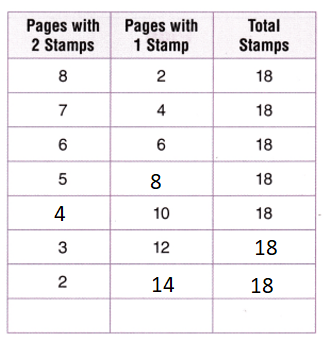
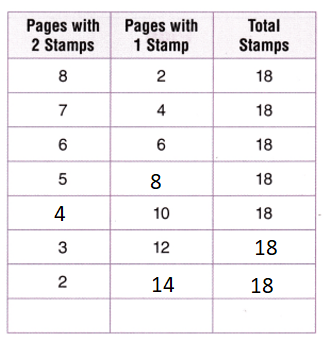
Scott has a stamp album. Some pages have I stamp on them, and other pages have 2 stamps on them. If Scott has 18 stamps, show how many different ways he could put them in the album. Use the graphic organizer below to solve the problem.

Read
What do I need to find?

What information am I given?

Scott has ___ stamps. Some album pages have __ stamp on them, and the other pages have ___ stamps.

Plan
What is my plan or strategy?
I will make a ___ showing all the different ways of arranging the stamps in the album.

Solve
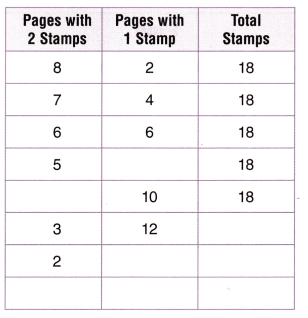
Make a table to show the number of pages with 1 stamp and with 2 stamps. Each row must equal ___, the total number of stamps.
Pages with Pages with Total

Texas Go Math Grade 3 Lesson 8.6 Answer Key 7
Answer:
Texas-Go-Math-Grade-3-Lesson-8.6-Answer-Key-Two-Step-Multiplication-Problems-solve

Explanation:
Pages with 2 stamps + Pages with 1 stamp = Total stamps.
2(5) + ?? = 18
=> 10 + ?? = 18.
=> ?? = 18 – 10
=> ?? = 8.
??(2) + 10 = 18.
=> ??(2) = 18 – 10
=> ?? = 8 ÷ 2
=> ?? = 4.
3 (2) + 12 = 6 + 12 = 18.
2(2) + ?? = 18.
=> 4 + ?? = 18
=> ?? = 18 – 4
=> ?? = 14.


Try Another Problem
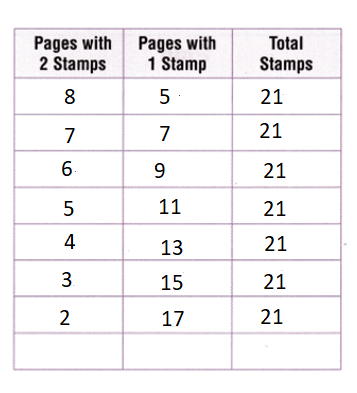
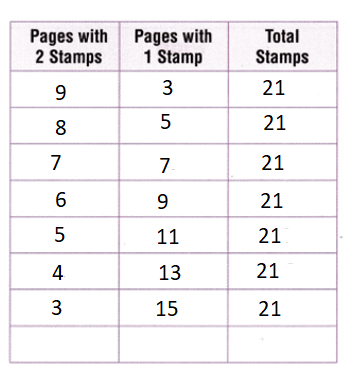
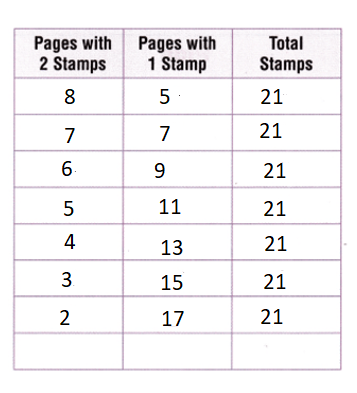
What if Scott bought 3 more stamps and now has 21 stamps? Some album pages have 1 stamp and some pages have 2 stamps. Show how many different ways he could put the odd number of stamps in the album.

Read
What do I need to find?

What information am I given?

Plan
What is my plan or strategy?

Solve

So, there are ___ different ways.
Answer:
So, there are 2 different ways.

Explanation:
Texas-Go-Math-Grade-3-Lesson-8.6-Answer-Key-Two-Step-Multiplication-Problems-solve
Texas-Go-Math-Grade-3-Lesson-8.6-Answer-Key-Two-Step-Multiplication-Problems-Try Another Problem-solve

One way:
Pages with 2 stamps + Pages with 1 stamp = Total stamps.
Add 2 stamps in pages with 2 stamps and 1 in pages with 2 stamp = Total stamps.
Texas-Go-Math-Grade-3-Lesson-8.6-Answer-Key-Two-Step-Multiplication-Problems-Try Another Problem-Read-solve

Other way:
Pages with 2 stamps + Pages with 1 stamp = Total stamps.
Pages with 2 stamps + Add 3 pages to Pages with 1 stamp = Total stamps.
Texas-Go-Math-Grade-3-Lesson-8.6-Answer-Key-Two-Step-Multiplication-Problems-Try Another Problem-solve

Go Math Grade 3 Lesson 8.6 Answer Key Question 2.
What patterns do you see in this table?
Answer:
Patterns saw in this table is if pages with 2 pages with 1 stamps increased by 2 then the pages with 1 stamp also increased by 2.

Explanation:
It is noticed that if pages with 2 pages with 1 stamps increased by 2 then the pages with 1 stamp also increased by 2.


Math Talk
Mathematical Processes
Explain how these patterns are different from the patterns in the table on page 267.

Share and Show

Question 1.
Aaron’s mother is making lemonade. For each pitcher, she uses 1 cup of lemon juice, 1 cup of sugar, and 6 cups of water. What is the total number of cups of ingredients she will use to make 5 pitchers of lemonade?
First, make a table to show the number of cups of lemon juice, sugar, and water that are in 1 pitcher of lemonade.
Next, multiply to find the number of cups of water needed for each pitcher of lemonade.
Last, use the table to solve the problem.
Texas Go Math Grade 3 Lesson 8.6 Answer Key 8
Texas Go Math Grade 3 Lesson 8.6 Answer Key 9
So, in 5 pitchers of lemonade, there are ___ cups of lemon juice, ___ cups of sugar, and ___ cups of water. This makes a total of ___ cups of ingredients.
Answer:
Texas-Go-Math-Grade-3-Lesson-8.6-Answer-Key-Two-Step-Multiplication-Problems-Math Talk-Share and Show-1

Explanation:
Number of cups of lemon juice she uses = 1.
Number of cups of sugar she uses = 1.
Number of cups of water she uses = 6.
Texas-Go-Math-Grade-3-Lesson-8.6-Answer-Key-Two-Step-Multiplication-Problems-Math Talk-Share and Show-1..
Total number of cups of ingredients she will use to make 5 pitchers of lemonade = (Number of cups of lemon juice she uses + Number of cups of sugar she uses + Number of cups of water she uses) × 5
= (1 + 1 + 6) × 5
= (2 + 6) × 5
= 8 × 5
= 40.
Texas-Go-Math-Grade-3-Lesson-8.6-Answer-Key-Two-Step-Multiplication-Problems-Math Talk-Share and Show-1


Go Math Lesson 8.6 Answer Key 3rd Grade Question 2.
What pattern do you see in the total number of cups of ingredients?
Answer:
It is noticed that a total number of cups of ingredients is been increased and doubled for each ingredient.

Explanation:
Texas-Go-Math-Grade-3-Lesson-8.6-Answer-Key-Two-Step-Multiplication-Problems-Math Talk-Share and Show-1


Question 3.
Multi-Step Cammi needs 36 postcards. She buys 4 packages of 10 postcards. How many postcards will Cammi have left over? Explain.
Answer:
Number of postcards Cammi have left over = 4.

Explanation:
Number of postcards Multi-Step Cammi needs = 36.
Number of packages she buys =  4.
Number of postcards in each package = 10.
Number of postcards Cammi have left over = (Number of packages she buys × Number of postcards in each package) – Number of postcards Multi-Step Cammi needs
= (4 × 10) – 36
= 40 – 36
= 4.


Daily Assessment Task
Fill in the bubble for the correct answer choice.
Question 4.
There are 5 boats in a race. Each boat has 6 rowers and 1 coach. How many people are in the race? Use the table to solve the problem.
Texas Go Math Grade 3 Lesson 8.6 Answer Key 10
(A) 7
(B) 30
(C) 12
(D) 35
Answer:
Number of people are in the race = 35.
(D) 35.

Explanation:
Number of boats in a race = 5.
Number of rowers each boat has = 6.
Number of coach each boat has = 1.
Number of people are in the race = Number of boats in a race × (Number of rowers each boat has + Number of coach each boat has)
= 5 × (6 + 1)
= 5 × 7
= 35.
Texas-Go-Math-Grade-3-Lesson-8.6-Answer-Key-Two-Step-Multiplication-Problems-Daily Assessment Task-4


Go Math 3rd Grade Lesson 8.6 Answer Key Question 5.
Apply For each pan of bread, you need 2 cups of white flour and 1 cup of wheat flour. What is the total number of cups of flour you will need to make 4 pans of bread?
(A) 7 cups
(B) 3 cups
(C) 8cups
(D) 12 cups
Answer:
Total number of cups of flour you will need to make 4 pans of bread = 12.
(D) 12 cups.

Explanation:
Number of cups of white flour needed to make each pan of bread = 2.
Number of cups of wheat flour needed to make each pan of bread = 1.
Total number of cups of flour you will need to make 4 pans of bread = 4  × (Number of cups of white flour needed to make each pan of bread + Number of cups of wheat flour needed to make each pan of bread)
= 4 × (2 + 1)
= 4 × 3
= 12.


Question 6.
Multi-Step Sheri puts 16 pictures in an album. Some pages have 2 pictures. The other pages have 4 pictures. There are 3 pages with 4 pictures. How many pages have 2 pictures?
(A) 3
(B) 2
(C) 4
(D) 1
Answer:
Number of pages have 2 pictures = 4.
(C) 4.

Explanation:
Number of pictures in an album Sheri puts = 16.
Number of pictures some pages have = 2.
Number of pictures some other pages have = 4.
Number of pages with 4 pictures = 3.
Total number of pages with 4 pictures = 4 × Number of pages with 4 pictures
= 4 × 3
= 12.
Number of pages have 2 pictures = Number of pictures in an album Sheri puts – Total number of pages with 4 pictures
= 16 – 12
= 4.


Texas Test Prep

Go Math Lesson 8.6 Third Grade Multiplication Problems Question 7.
Each year for 8 states, the Williams family visited 6 different states on vacation. How many more states do they need to visit before they have seen all 50 states?
(A) 36
(B) 14
(C) 48
(D) 2
Answer:
Number of more states do they need to visit before they have seen all 50 states = 2.
(D) 2.

Explanation:
Number of states each year for = 8.
Number of different states on vacation the Williams family visited = 6.
Number of more states do they need to visit before they have seen all 50 states = 50 – (Number of states each year for × Number of different states on vacation the Williams family visited)
= 50 – (8 × 6)
= 50 – 48
= 2.


Texas Go Math Grade 3 Lesson 8.6 Homework and Practice Answer Key

Make a table to solve the problem.
Question 1.
Janey is making party mix. For each bowl of mix, she uses 2 cups of raisins, 1 cup of peanuts, and 4 cups of granola. What is the total number of cups of ingredients she will use to make 6 bowls of party mix?
Texas Go Math Grade 3 Lesson 8.6 Answer Key 11
So, in 6 bowls of party mix, there are __ cups of raisins, ___ cups of peanuts, and __ cups of granola.
This makes a total of ___ cups of ingredients.
Answer:
Total number of cups of ingredients she will use to make 6 bowls of party mix =42.
Texas-Go-Math-Grade-3-Lesson-8.6-Answer-Key-Two-Step-Multiplication-Problems-Texas Go Math Grade 3 Lesson 8.6 Homework and Practice Answer Key-Make a table to solve the problem-1

Explanation:
Number of cups of raisins she uses = 2.
Number of cups of peanuts she uses = 1.
Number of cups of granola she uses = 4.
Total number of cups of ingredients she will use to make 6 bowls of party mix = 6 × (Number of cups of raisins she uses + Number of cups of peanuts she uses + Number of cups of granola she uses)
= 6 × (2 + 1 + 4)
= 6 × (3 + 4)
= 6 × 7
= 42.


Problem Solving

3rd Grade Go Math Lesson 8.6 Homework Answer Key Question 2.
To make an apple pie, Mimi needs 2 cups of flour and 3 cups of apples. How many cups of ingredients does Mimi need to make 5 pies?
Answer:
Number of cups of ingredients Mimi needs to make 5 pies = 25.

Explanation:
Number of cups of flour Mimi needs = 2.
Number of cups of apples Mimi needs = 3.
Number of cups of ingredients Mimi need to make 5 pies = 5 × (Number of cups of flour Mimi needs + Number of cups of apples Mimi needs)
= 5 × (2 + 3)
= 5 × 5
= 25.


Question 3.
To make muffins, Seth needs 3 cups of mix and 1 cup of raisins. How many cups of ingredients does Seth need to make 3 batches of muffins?
Answer:
Number of cups of ingredients Seth need to make 3 batches of muffins = 12.

Explanation:
Number of cups of mix Seth needs = 3.
Number of cups of raisins Seth needs = 1.
Number of cups of ingredients Seth need to make 3 batches of muffins = 3 × (3 + 1)
= 3 × 4
=  12.


Texas Test Prep
Lesson Check
Question 4.
There are 6 relay teams at a race. Each team has 4 runners and 1 captain. How many people are in the race?
(A) 11
(B) 30
(C) 24
(D) 25
Answer:
Number of people are in the race = 30.
(B) 30.

Explanation:
Number of relay teams at a race = 6.
Number of runners each team has = 4.
Number of captain each team has = 1.
Number of people are in the race = Number of relay teams at a race  × (Number of runners each team has + Number of captain each team has)
= 6 × (4 + 1)
= 6 × 5
= 30.


Question 5.
Sara makes 7 fruit baskets for the senior center. She puts 3 apples and 4 pears in each basket. How many pieces of fruit are there?
(A) 14
(B) 21
(C) 49
(D) 28
Answer:
Number of pieces of fruit are there = 49.
(C) 49.

Explanation:
Number of fruit baskets for the senior center Sara makes = 7.
Number of apples she puts in each basket = 3.
Number of pears she puts in each basket = 4.
Number of pieces of fruit are there = Number of fruit baskets for the senior center Sara makes × (Number of apples she puts in each basket + Number of pears she puts in each basket)
= 7 × (3 + 4)
= 7 × 7
= 49.


3rd Grade Go Math Practice and Homework Lesson 8.6 Question 6.
Thomas wants to collect 40 toy cars for his collection. If he has 6 boxes of 4 toy cars each, how many more cars does Thomas need?
(A) 16
(B) 24
(C) 50
(D) 34
Answer:
Number of cars Thomas needs = 16.
(A) 16.

Explanation:
Number of toy cars for his collection Thomas wants to collect = 40.
Number of boxes he has = 6.
Number of toy cars in each box = 4.
Number of cars Thomas needs = Number of toy cars for his collection Thomas wants to collect – (Number of boxes he has × Number of toy cars in each box)
= 40 – (6 × 4)
= 40 – 24
= 16.


Question 7.
Vernon needs to sell 60 granola bars for his scout troop. If he sells 4 boxes of 8 bars each, how many more bars does Vernon need to sell?
(A) 48
(B) 32
(C) 28
(D) 30
Answer:
Number of more bars Vernon needs to sell = 28.
(C) 28.

Explanation:
Number of granola bars for his scout troop Vernon needs to sell = 60.
Number of boxes of granola he sells = 4.
Number of bars in each box = 8.
Number of more bars Vernon needs to sell = Number of granola bars for his scout troop Vernon needs to sell – (Number of boxes of granola he sells × Number of bars in each box)
= 60 – (4 × 8)
= 60 – 32
= 28.


Question 8.
Multi-Step Jessie has 4 boxes of 8 crayons and 3 boxes of 5 markers and 2 single markers. How many more crayons than markers does Jessie have?
(A) 17
(B) 22
(C) 15
(D) 20
Answer:
15 more crayons than markers Jessie have.
(C) 15.

Explanation:
Number of boxes of crayons Jessie has = 4.
Number of crayons in each box = 8.
Number of boxes of markers Jessie has = 3.
Number of markers in each box = 5.
Number of single markers = 2.
Number of crayons Jessie have = Number of boxes of crayons Jessie has × Number of crayons in each box
= 4 × 8
= 32.
Number of markers Jessie have = (Number of boxes of markers Jessie has × Number of markers in each box) + Number of single markers
=  (3 × 5) + 2
= 15 + 2
= 17.
Difference:
Number of crayons Jessie has – Number of markers Jessie have
= 32 – 17
= 15.

Texas Go Math Lesson 8.6 Homework Answer Key Grade 3 Question 9.
Multi-Step To make a salad, Alan needs 3 cups of lettuce and 1 cup of tomatoes. Alan makes 6 bowls of salad. How many more cups of lettuce than tomatoes does Alan need?
(A) 10 cups
(B) 12 cups
(C) 2 cups
(D) 15 cups
Answer:
12 more cups of lettuce than tomatoes Alan needs.
(B) 12 cups.

Explanation:
Number of cups of lettuce Alan needs = 3.
Number of cups of tomatoes Alan needs = 1.
The number of bowls of salad Alan makes = 6.
Total number of lettuce Alan makes = Number of cups of lettuce Alan needs × Number of bowls of salad Alan makes
= 3 × 6
= 18.
Total number of tomatoes Alan makes = Number of cups of tomatoes Alan needs × Number of bowls of salad Alan makes
= 1 × 6
= 6.
Difference:
Total number of lettuce Alan makes – Total number of tomatoes Alan makes
= 18 – 6
= 12.

Texas Go Math Grade 3 Lesson 8.6 Answer Key Two-Step Multiplication Problems Read More »

Texas Go Math Grade 3 Lesson 8.5 Answer Key Multiply with 9

Refer to our Texas Go Math Grade 3 Answer Key Pdf to score good marks in the exams. Test yourself by practicing the problems from Texas Go Math Grade 3 Lesson 8.5 Answer Key Multiply with 9.

Texas Go Math Grade 3 Lesson 8.5 Answer Key Multiply with 9

Essential Question
What strategies can you use to multiply with 9?

Unlock the Problem
Lindsey’s class is studying the solar system. Seven students are making models of the solar system. Each model has 9 spheres (eight for the planets and one for Pluto, a dwarf planet). How many spheres do the 7 students need for all the models?

• What are you asked to find?
Answer:
How many spheres do the 7 students need for all the models?

Explanation:
It is asked to find how many spheres do the 7 students need for all the models?


• How many students are making models?
Answer:
7 students are making models.

Explanation:
Number of students making models = 7.


Find 7 × 9.
One Way
Use the Distributive Property.

A. With multiplication and addition
Texas Go Math Grade 3 Lesson 8.5 Answer Key 1

B. With multiplication and subtraction
Texas Go Math Grade 3 Lesson 8.5 Answer Key 2
So, 7 students need ___ spheres for all models.

Another Way
Use patterns of 9.
The table shows the 9s facts.

  • What do you notice about the tens digit in the product?
    The tens digit is ___ less than the factor that is multiplied by 9.
  • What do you notice about the sum of the digits in the product?

The sum of the digits in the product is always ___.
So, to multiply 7 × 9, think: the tens digit is ___ and the ones digit is ___. The product is ___.
Texas Go Math Grade 3 Lesson 8.5 Answer Key 3

Try This!
Complete the table above.
Use the patterns to find 8 × 9 and 9 × 9.
Answer:
Texas-Go-Math-Grade-3-Lesson-8.5-Answer-Key-Multiply-with-9-Try This

Explanation:
7 × 9 = 7 × (3 + 6)
= (7 × 3) + (7 × 6)
= 21 + 42
= 63.
8 × 9 = 8 × (3 + 6)
= (8 × 3) + (8 × 6)
= 24 + 48
= 72.
9 × 9 = 9 × (3 + 6)
= (9 × 3) + (9 × 6)
= 27 + 54
= 81.


Math Talk
Mathematical Processes
Explain how you know the ones digit in the product 3 × 9.
Answer:
When we have to calculate the unit digit of any function we need to work on the unit digit only i.e. all operations like addition,multiplication etc will be carried out on the unit digits.

Explanation:
You see, when we have to calculate the unit digit of any function we need to work on the unit digit only i.e. all operations like addition,multiplication etc will be carried out on the unit digits.
3 × 9 = 3 × (3 + 6)
= (3 × 3) + (3 × 6)
= 9 + 18
= 27.


Share and Show
Question 1.
What is the tens digit in the product 3 × 9? ___
Think: What number is 1 less than 3?
Answer:
The tens digit in the product 3 × 9 is 2.

Explanation:
3 × 9 = 3 × (10 – 1)
= (3 × 10) – (3 × 1)
= 30 – 3
= 27.


Find the product.

Question 2.
9 × 8 = ___
Answer:
9 × 8 = 72.

Explanation:
9 × 8 = (3 + 6) × 8
= (3 × 8) + (6 × 8)
= 24 + 48
= 72.


Question 3.
__ = 2 × 9
Answer:
18 = 2 × 9.

Explanation:
2 × 9 = 2 × (3 + 6)
= (2 × 3) + (2 × 6)
= 6 + 12
= 18.


Go Math Lesson 8.5 Answer Key 3rd Grade Question 4.
__ = 6 × 9
Answer:
54 = 6 × 9.

Explanation:
6 × 9 = 6 × (3 + 6)
= (6 × 3) + (6 × 6)
= 18 + 36
= 54.


Question 5.
9 × 1 = __
Answer:
9 × 1 = 9.

Explanation:
9 × 1 = (3 + 6) × 1
= (3 × 1) + (6 × 1)
= 3 + 6
= 9.


Question 6.
4 × 9 = __
Answer:
4 × 9 = 36.

Explanation:
4 × 9 = 4 × (3 + 6)
= (4 × 3) + (4 × 6)
= 12 + 24
= 36.


Question 7.
5 × 9 = __
Answer:
5 × 9 = 45.

Explanation:
5 × 9 = 5 × (3 + 6)
= (5 × 3) + (5 × 6)
= 15 + 30
= 45.


Question 8.
10 × 9 = __
Answer:
10 × 9 = 90.

Explanation:
10 × 9 = 10 × (3 + 6)
= (10 × 3) + (10 × 6)
= 30 + 60
= 90.


Question 9.
9 × 9 = __
Answer:
9 × 9 = 81.

Explanation:
9 × 9 = 9 × (3 + 6)
= (9 × 3) + (9 × 6)
= 27 + 54
= 81.


Problem Solving
H.O.T. Algebra Compare. Write <, >, or =.
Question 10.
2 × 9 Texas Go Math Grade 3 Lesson 8.5 Answer Key 4 3 × 6
Answer:
2 × 9 = 3 × 6.

Explanation:
2 × 9 = 18.
3 × 6 = 18.


Question 11.
5 × 9 Texas Go Math Grade 3 Lesson 8.5 Answer Key 4 6 × 7
Answer:
5 × 9  > 6 × 7.

Explanation:
5 × 9 = 45.
6 × 7 = 42.


Question 12.
1 × 9 Texas Go Math Grade 3 Lesson 8.5 Answer Key 4 3 × 3
Answer:
1 × 9  = 3 × 3.

Explanation:
1 × 9 = 9.
3 × 3 = 9.


Question 13.
9 × 4 Texas Go Math Grade 3 Lesson 8.5 Answer Key 4 7 × 5
Answer:
9 × 4  > 7 × 5.

Explanation:
9 × 4 = 36.
7 × 5 = 35.


Go Math Grade 3 Answer Key Lesson 8.5 Question 14.
9 × 0 Texas Go Math Grade 3 Lesson 8.5 Answer Key 4 2 × 3
Answer:
9 × 0  <  2 × 3.

Explanation:
9 × 0 = 0.
2 × 3 = 6.


Question 15.
5 × 8 Texas Go Math Grade 3 Lesson 8.5 Answer Key 4 3 × 9
Answer:
5 × 8  > 3 × 9.

Explanation:
5 × 8 = 40.
3 × 9 = 27.


Problem Solving
Use the table for 16-19.
Question 16.
The number of moons for one of the planets can be found by multiplying 7 × 9. Which planet is it?
Answer:
Jupiter planet it is.

Explanation:
7 × 9 = 7 × (3 + 6)
= (7 × 3) + (7 × 6)
= 21 + 42
= 63.
Jupiter has 63 moons.


Question 17.
H.O.T. Uranus has 27 moons. What multiplication fact with 9 can be used to find the number of moons Uranus has? Use Math Language to describe how you can find the fact.
Texas Go Math Grade 3 Lesson 8.5 Answer Key 5
Answer:
3 × 9 = 27 multiplication fact with 9 can be used to find the number of moons Uranus has.

Explanation:
Uranus has 27 moons.
=> ?? × 9 = 27.
= ?? = 27 ÷ 9
= ?? = 3.


Question 18.
H.O.T. Multi-Step This planet has 9 times the number of moons that Mars and Earth have together. Which planet is it? Explain your answer.
Answer:
Uranus has 27 moons.

Explanation:
Number of moons Mars has = 2.
Number of moons Earth has = 1.
Total number of moons Mars and Earth has = Number of moons Mars has + Number of moons Earth has
= 2 + 1
= 3.
This planet has 9 times the number of moons that Mars and Earth have together.
=> 3 × 9 = 3 × (3 + 6)
= (3 × 3) + (3 × 6)
= 9 + 18
= 27.


Question 19.
Write Math What’s the Question? Nine students made models of Mars and its moons. The answer is 18. What’s the question?
Answer:
Question:
Nine students made models of Mars and its moons. The answer is 18. How many moons are there for Mars?

Explanation:
Nine students made models of Mars and its moons. The answer is 18. What’s the question?
Question:
Nine students made models of Mars and its moons. The answer is 18. How many moons are there for Mars?


Question 20.
Multi-Step The school library has 97 books about space. John and 3 of his friends each check out 9 books. How many space books are still in the school library?
Answer:
Number of space books are still in the school library = 61.

Explanation:
Number of books about space the school library has = 97.
Number of books John and 3 of his friends each check out = 9.
Number of people took books check out = 4.
Number of space books are still in the school library = Number of books about space the school library has – (Number of books John and 3 of his friends each check out × Number of people took books check out)
= 97 – (9 × 4)
= 97 – 36
= 61.


Daily Assessment Task
Fill in the bubble for the correct answer choice.
Question 21.
A sea otter has 4 paws. How many paws do 9 sea otters have?
(A) 32
(B) 36
(C) 40
(D) 38
Answer:
Number of paws paws 9 sea otters have = 36.
(B) 36.

Explanation:
Number of paws a sea otter has = 4.
Number of paws paws 9 sea otters have = 9 × Number of paws a sea otter has
= 9 × 4
= (3 + 6) × 4
= (3 × 4) + (6 × 4)
= 12 + 24
= 36.


Go Math Grade 3 Lesson 8.5 Answer Key Question 22.
Trevor is saving to buy new skates. He saves $10 each week. How much will he have saved after 9 weeks?
(A) $80
(B) $100
(C) $19
(D) $90
Answer:
Amount of money he have saved after 9 weeks = $90.
(D) $90.

Explanation:
Amount of money each week he saves = $10.
Amount of money he have saved after 9 weeks = 9 × $10
= (3 + 6) × $10
= (3 × $10) + (6 × $10)
= $30 + $60
= $90.


Question 23.
Multi-Step There are 4 girls and 5 boys in Kara’s class. Each student in the class takes 2 books from the library. How many books does the class take from the library?
(A) 18
(B) 11
(C) 8
(D) 16
Answer:
Number of books the class take from the library = 18.
(A) 18.

Explanation:
Number of boys in Kara’s class = 5.
Number of girls in Kara’s class = 4.
Number of books each students takes = 2.
Number of books the class take from the library = (Number of boys in Kara’s class + Number of girls in Kara’s class) × Number of books each students takes
= (5 + 4) × 2
= (5 × 2) + (4 × 2)
= 10 + 8
= 18.


Texas Test Prep
Question 24.
Joel has 5 shelves of model airplanes. He has 9 airplanes on each shelf. How many model airplanes does he have?
(A) 45
(B) 9
(C) 5
(D) 36
Answer:
Number of model airplanes he have = 45.
(A) 45.

Explanation:
Number of shelves of model airplanes Joel has = 5.
Number of airplanes on each shelf he has = 9.
Number of model airplanes he have = Number of shelves of model airplanes Joel has × Number of airplanes on each shelf he has
= 5 × 9
= 5 × (3 + 6)
= (5 × 3) + (5 × 6)
= 15 + 30
= 45.


Texas Go Math Grade 3 Lesson 8.5 Homework and Practice Answer Key

Find the product.

Question 1.
9 × 3 = ___
Answer:
9 × 3 = 27.

Explanation:
9 × 3 = (3 + 6) × 3
= (3 × 3) + (6 × 3)
= 9 + 18
= 27.


Question 2.
___ = 9 × 6
Answer:
54 = 9 × 6.

Explanation:
9 × 6 = (3 + 6) × 6
= (3 × 6) + (6 × 6)
= 18 + 36
= 54.


Question 3.
4 × 9 = ___
Answer:
4 × 9 = 36.

Explanation:
4 × 9 = 4 × (3 + 6)
= (4 × 3) + ( 4 × 6)
= 12 + 24
= 36.


Question 4.
7 × 9 = ___
Answer:
7 × 9 = 63.

Explanation:
7 × 9 = 7 × (3 + 6)
= (7 × 3) + (7 × 6)
= 21 + 42
= 63.


Go Math Grade 3 Lesson 8.5 Homework Answer Key Question 5.
9 × 5 = ___
Answer:
9 × 5 = 45.

Explanation:
9 × 5 = (3 + 6) × 5
= (3 × 5) + (6 × 5)
= 15 + 30
= 45.


Question 6.
__ = 9 × 9
Answer:
81 = 9 × 9.

Explanation:
9 × 9 = 9 × (3 + 6)
= (9 × 3) + (9 × 6)
= 27 + 54
= 81.


Problem Solving
Use the table for 7-9.
Question 7.
The number of points scored for which team can be found by multiplying 6 × 9?
Texas Go Math Grade 3 Lesson 8.5 Answer Key 6
Answer:
Cougars team has the points of 6 × 9 = 54.

Explanation:-
6 × 9 = 6 × (3 + 6)
= (6 × 3) + ( 6 × 6)
= 18 + 36
= 54.


Question 8.
The Huskies scored 45 points. What multiplication fact with 9 can be used to find the number of points?
Answer:
5 × 9 = 45 multiplication fact with 9 can be used to find the number of points.

Explanation:
The Huskies scored 45 points.
=> ?? × 9 = 45.
=> ?? = 45 ÷ 9
=> ?? = 5.


Question 9.
Suppose the Dolphins score another 9 points. What multiplication fact with 9 can be used to find the total points?
Answer:
8  ×  9 = 72 multiplication fact with 9 can be used to find the total points.

Explanation:
Number of points Dolphins scored = 63.
Suppose the Dolphins score another 9 points.
=> Total number of points Dolphins scored = Number of points Dolphins scored + 9
= 63 + 9
= 72.
Multiplication fact with 9:
?? × 9 = 72
=> ?? = 72 ÷ 9
=> ?? = 8.


Question 10.
A school bus has 2 × 9 girls and 27 boys. How many girls are on the bus? What multiplication fact can be used to find the number of boys?
Answer:
Number of girls school bus has = 18.
3 × 9 = 27 multiplication fact can be used to find the number of boys.

Explanation:
Number of girls school bus has = 2 × 9
= 9 + 9
= 18.
Number of boys school bus has = 27.
=> ?? × 9 = 27.
=> ?? = 27 ÷ 9
=> ?? = 3.


Question 11.
There are 4 students on each relay team in a race. There are 36 students in all. What multiplication fact can be used to show how many relay teams there are?
Answer:
4 × 9 = 36 multiplication fact can be used to show how many relay teams there are.

Explanation:
Number of students on each relay team in a race = 4.
Total number of students in all = 36.
Number of relay teams there are  × Number of students on each relay team in a race = Total number of students in all
=> ?? × 4 = 36
=> ?? = 36 ÷ 4
=> ?? = 9.


Texas Test Prep
Lesson Check
Question 12.
An octopus has 8 arms. How many arms do 9 octopuses have?
(A) 81
(B) 63
(C) 89
(D) 72
Answer:
Number of arms 9 octopuses have = 72.
(D) 72.

Explanation:
Number of arms an octopus has = 8.
Number of arms 9 octopuses have = 9 × Number of arms an octopus has
= 9 × 8
= (3 + 6) × 8
= (3 × 8) + (6 × 8)
= 24 + 48
= 72.


Question 13.
A starfish has 5 arms. How many arms do 9 starfish have?
(A) 45
(B) 50
(C) 35
(D) 59
Answer:
Number of arms 9 starfish have = 45.
(A) 45.

Explanation:
Number of arms a starfish has = 5.
Number of arms 9 starfish have = 9 × Number of arms a starfish has
= 9 × 5
= (3 + 6) × 5
= (3 × 5) + (6 × 5)
= 15 + 30
= 45.


Question 14.
Miss Lincoln has a total of 27 students in her class. Which fact can be completed to show the number of students?
(A) 3 + 9
(B) 3 × 9
(C) 4 × 9
(D) 4 × 8
Answer:
Multiplication fact showing number of students = 3 × 9.
(B) 3 × 9.

Explanation:
Total number of students in her class Miss Lincoln has = 27.
Multiplication fact showing number of students = ?? × 9 = 27
=> ?? = 27 ÷ 9
=> ?? = 3.


Question 15.
Deanna puts 63 postcards into groups of 7. Which number sentence shows the number of postcards?
(A) 8 × 7 = 63
(B) 7 + 9 = 63
(C) 8 × 9 = 63
(D) 7 × 9 = 63
Answer:
Multiplication fact showing the number of postcards = 7 × 9 = 63.
(B) 7 + 9 = 63.

Explanation:
Number of postcards Deanna has = 63.
Number of groups he puts them = 7.
Multiplication fact of number of postcards:
Number of postcards Deanna has =  Number of groups he puts them × ??
=> 63 = 7 × ??
=> 63 ÷ 7 = ??
=> 9 = ??


Question 16.
Multi-Step There are 3 girls and 6 boys at a table in art class. Each student paints 3 pictures. How many pictures do the students paint in all?
(A) 12
(B) 27
(C) 18
(D) 21
Answer:
Number of pictures the students paint in all = 27.
(B) 27.

Explanation:
Number of girls at a table in art class = 3.
Number of boys at a table in art class = 6.
Number of pictures each student paints = 3.
Number of pictures the students paint in all = (Number of girls at a table in art class + Number of boys at a table in art class) × Number of pictures each student paints
= (3 + 6) × 3
= (3 × 3) + (6 × 3)
= 9 + 18
= 27.


Question 17.
Multi-Step Frank makes a tile design with 4 rows of 9 tiles. If he adds 3 more rows to the tiles, how many tiles will he have in his design?
(A) 54
(B) 36
(C) 16
(D) 63
Answer:
Number of tiles will he have in his design = 63.
(D) 63.

Explanation:
Number of rows of tiles = 4.
Number of tiles Frank makes a tile design = 9.
Number of more rows of tiles added = 3.
Number of tiles will he have in his design = (Number of rows of tiles + Number of more rows of tiles added) × Number of tiles Frank makes a tile design
= (4 + 3) × 9
= 7 × (3 + 6)
= (7 × 3) + (7 × 6)
= 21 + 42
= 63.


Texas Go Math Grade 3 Lesson 8.5 Answer Key Multiply with 9 Read More »

Texas Go Math Grade 3 Module 8 Assessment Answer Key

Refer to our Texas Go Math Grade 3 Answer Key Pdf to score good marks in the exams. Test yourself by practicing the problems from Texas Go Math Grade 3 Module 8 Assessment Answer Key.

Texas Go Math Grade 3 Module 8 Assessment Answer Key

Choose the best term from the box to complete the sentence.

Question 1.
The ___ Property of Multiplication states that when the grouping of factors is changed, the product is the same. (p. 243)
Answer: commutative
Explanation:
The commutative property of multiplication states that when two numbers are being multiplied, their order can be changed without affecting the product.

Concepts and Skills

Use arrays to show each property. TEKS 3.4.F, 3.5.B

Question 2.
Distributive Property
8 × 6 = (4 × 6) + (4 × 6).
Texas Go Math Grade 3 Module 8 Assessment Answer Key 1
Answer: 48
Explanation:
The distributive property of multiplication is a property of real numbers that shows how we can break apart multiplication problems into separate terms.

Question 3.
Associative Property of Multiplication
Break apart the array to show Circle groups to show 3 × (2 × 3).
Texas Go Math Grade 3 Module 8 Assessment Answer Key 2
Answer: 18

Find the product. TEKS 3.4.F, 3.5.B

Question 4.
Texas Go Math Grade 3 Module 8 Assessment Answer Key 3
Answer:

Explanation:
Written the product of given two numbers
Question 5.
Texas Go Math Grade 3 Module 8 Assessment Answer Key 4
Answer:

Explanation:
Written the product of given two numbers

Question 6.
Texas Go Math Grade 3 Module 8 Assessment Answer Key 5
Answer:

Explanation:
Written the product of given two numbers

Texas Go Math Grade 3 Module 8 Answer Key Question 7.
Texas Go Math Grade 3 Module 8 Assessment Answer Key 6
Answer:

Explanation:
Written the product of given two numbers
Question 8.
Texas Go Math Grade 3 Module 8 Assessment Answer Key 7
Answer:

Explanation:
Written the product of given two numbers

Question 9.
Texas Go Math Grade 3 Module 8 Assessment Answer Key 8
Answer:

Explanation:
Written the product of given two numbers

Question 10.
9 × 0 = ___
Answer:  0
Explanation:
Written the product of given two numbers

Question 11.
7 × 8 = ___
Answer: 56
Explanation:
Written the product of given two numbers

Question 12.
4 × 8 = ___
Answer: 32
Explanation:
Written the product of given two numbers

Question 13.
9 × 7 = ___
Answer: 63
Explanation:
Written the product of given two numbers

Question 14.
9 × 9 = ___
Answer: 81
Explanation:
Written the product of given two numbers

Question 15.
7 × 5 = ___
Answer: 35
Explanation:
Written the product of given two numbers

Question 16.
5 × 10 = ___
Answer: 50
Explanation:
Written the product of given two numbers

Question 17.
7 × 3 = ___
Answer: 21
Explanation:
Written the product of given two numbers

Texas Test Prep

Question 18.
Adele needs 5 pieces of ribbon, each 8 centimeters long. How many centimeters of ribbon does she need altogether? 4 TEKS 3.4.K
Record your answer and fill in the bubbles on the grid. Be sure to use the correct place value.
Texas Go Math Grade 3 Module 8 Assessment Answer Key 9
Answer: 40 Centimeters

Explanation:
She need 40 centimeter of ribbon altogether.
Place value of digit = (Face value) × (numerical value of place)

Fill in the bubble for the correct answer choice.

Question 19.
When Chloe finds the multiplication facts for 2, which digit will NOT be in the ones place of the products? TEKS 3.4.E
(A) 4
(B) 8
(C) 6
(D) 3
Answer: (D) 3
Explanation:
Digit 3 will NOT be in the ones place of the products

Question 20.
A honeybee is an insect. It has 6 legs. How many more legs do 9 honeybees have than 7 honeybees? TEKS 3.4.K
(A) 54
(B) 42
(C) 12
(D) 16
Answer:  (C) 12
Explanation:
A honeybee is an insect. It has 6 legs. So 9 honeybees have 54 legs.
A honeybee is an insect. It has 6 legs. So 7 honeybees have 42 legs.
So 12  more legs do 9 honeybees have than 7 honeybees. Since, 54 -42 =12

Question 21.
Jody has bags of shells. Each bag has 6 shells. She gives 3 bags each to 2 friends. How many shells did Jody give away? TEKS 3.4.F, 3.4.K, 3.5.B
(A) 36
(B) 18
(C) 6
(D) 12
Answer: A
Explanation:
Jody gave 36 shells to friends

Question 22.
Austin was on summer vacation for 7 weeks. He spent 3 weeks at band camp and the rest of the time at home. How many days did he spend at home? TEKS 3.4.K, 3.5.B
(A) 10 days
(B) 28 days
(C) 21 days
(D) 4 days
Answer: B
Explanation:
28 days she spend at home

Texas Go Math Grade 3 Module 8 Assessment Answer Key Read More »

Texas Go Math Grade 3 Module 7 Assessment Answer Key

Refer to our Texas Go Math Grade 3 Answer Key Pdf to score good marks in the exams. Test yourself by practicing the problems from Texas Go Math Grade 3 Module 7 Assessment Answer Key.

Texas Go Math Grade 3 Module 7 Assessment Answer Key

Choose the best term from the box to complete the sentence.

Question 1.
A ___ of 4 is any product that has 4 as one of its factors. (p. 217)
Answer: Multiple
Explanation:
A number that may be divided by another a certain number of times without a remainder.

Go Math Grade 3 Module 7 Answer Key Question 2.
This is an example of the ___ Property.
3 × 8 = (3 × 6) + (3 × 2)
This property states that multiplying a sum by a number is the same as multiplying each addend by the number and then adding the products. (p.229)
Answer:
Distributive property
Explanation:
The distributive property of multiplication can be used when you multiply a number by a sum.
For example,
suppose you want to multiply 3 by the sum of 10 + 2.

Concepts and Skills

Write one way to break apart the array. Then find the product. TEKS 3.4.E, 3.4.K

Question 3.
Texas Go Math Grade 3 Module 7 Assessment Answer Key 1
Answer:

Explanation:
The equations are written in three possible ways

Question 4.
Texas Go Math Grade 3 Module 7 Assessment Answer Key 2
Answer:

Explanation:
The equations are written in three possible ways

Find the product. TEK 3.4.E, 3.4.K.

Question 5.
3 × 1 = ___
Answer: 3
Explanation:
The product of two numbers
3 x 1 = 3

Question 6.
5 × 6 = ___
Answer:
Explanation:
The product of two numbers
5 x 6 = 30

Question 7.
4 × 7 = ____
Answer:
Explanation:
The product of two numbers
4 x 7 = 28

Grade 3 Module 7 Answer Key Go Math Question 8.
2 × 10 = ___
Answer:
Explanation:
The product of two numbers
2 x 10 = 20

Question 9.
Texas Go Math Grade 3 Module 7 Assessment Answer Key 3
Answer:

Explanation:
The multiplication is done in vertical form
the product of two numbers
2 x 1 = 2

Question 10.
Texas Go Math Grade 3 Module 7 Assessment Answer Key 4
Answer:

Explanation:
The multiplication is done in vertical form
the product of two numbers

Question 11.
Texas Go Math Grade 3 Module 7 Assessment Answer Key 5
Answer:

Explanation:
The multiplication is done in vertical form
the product of two numbers
6 x7 = 42

Question 12.
Texas Go Math Grade 3 Module 7 Assessment Answer Key 6
Answer:

Explanation:
The multiplication is done in vertical form
the product of two numbers
6 x 3 = 18

Question 13.
Texas Go Math Grade 3 Module 7 Assessment Answer Key 7
Answer:

Explanation:
The multiplication is done in vertical form
the product of two numbers
3 x 8 =24

Texas Test Prep

Fill in the bubble for the correct answer choice.
You may use models to solve.

Question 14.
Lori saw 6 lightning bugs. They each had 6 legs. How many legs did the lightning bugs have in all? TEKS 3.4.E, 3.4.K
(A) 36
(B) 6
(C) 12
(D) 24
Answer: (A) 36
Explanation:
Lori saw 6 lightning bugs.
They each had 6 legs.
36 legs did the lightning bugs have in all, Since 6 x 6 =36.

Go Math Answer Key Grade 3 Module 7 Question 15.
Zach gave his dog 1 dog biscuit each day, for 5 days. Then he gave his dog 2 dog biscuits a day for the next
5 days. How many biscuits did Zach give to his dog? TEKS 3.4.E, 3.4.K
(A) 5
(B) 30
(C) 15
(D) 7
Answer: (C) 15
Explanation:
Zach gave his dog 1 dog biscuit each day, for 5 days. So first 5days he given 5 biscuits, Since 5 x 1= 5.
he gave his dog 2 dog biscuits a day for the next 5 days. So next 5 days he given 10 biscuits, Since 5 x 2= 10.
So Total is 10 + 5 = 15.

Question 16.
Annette bought 4 boxes of pencils. If there are 8 pencils in each box, how many pencils did she buy? TEKS 3.4.E, 3.4.K
(A) 32
(B) 12
(C) 16
(D) 24
Answer: (A) 32
Explanation:
Annette bought 4 boxes of pencils. If there are 8 pencils in each box, 32 pencils did she buy? Since 4 x 8 =32.

Go Math Grade 3 Module 7 Assessment Answer Key Question 17.
Shelly can paint 4 pictures in a day. How many pictures can she paint in 7 days? TEKS 3.4.E, 3.4.K
Record your answer and fill in the bubbles on the grid. Be sure to use the correct place value.
Texas Go Math Grade 3 Module 7 Assessment Answer Key 8
Answer:

Explanation:
Shelly can paint 4 pictures in a day. 28  pictures can she paint in 7 days. Since 4 x 7 =28.
Place value of digit = (Face value) × (numerical value of place)

Texas Go Math Grade 3 Module 7 Assessment Answer Key Read More »

Texas Go Math Grade 3 Lesson 8.3 Answer Key Patterns on the Multiplication Table

Refer to our Texas Go Math Grade 3 Answer Key Pdf to score good marks in the exams. Test yourself by practicing the problems from Texas Go Math Grade 3 Lesson 8.3 Answer Key Patterns on the Multiplication Table.

Texas Go Math Grade 3 Lesson 8.3 Answer Key Patterns on the Multiplication Table

Essential Question
How can you use properties to explain patterns on the multiplication table?

Unlock the Problem
You can use a multiplication table to explore number patterns.

Activity 1
Materials Texas Go Math Grade 3 Lesson 8.3 Answer Key 1 Math Board
• Write the products for the green squares. What do you notice about the products?

Texas Go Math Grade 3 Lesson 8.3 Answer Key 2

Write the multiplication sentences for the products on your MathBoard. ‘ What do you notice about the factors?

• Will this be true in the yellow squares? Explain using a property you know.

Write the products for the yellow squares.

• Complete the columns for 1, 5, and 6. Look across each row and compare the products. What do you notice?

What property does this show?

Math Talk
Mathematical Processes
Explain how you can use these patterns to find other products.

Activity 2
Materials Texas Go Math Grade 3 Lesson 8.3 Answer Key 3 yellow and blue crayons

  • Shade the rows for 0, 2, 4, 6, 8, and 10 yellow.
    Texas Go Math Grade 3 Lesson 8.3 Answer Key 4
  • What pattern do you notice about each shaded row?
  • Shade the columns for 1, 3, 5, 7, and 9 blue.
  • What do you notice about the products for each shaded column?

Remember
Even numbers end in 0, 2, 4, 6, or 8. Odd numbers end in 1, 3, 5, 7, or 9.

Share and Show

Question 1.
Use the table to write the products for the row for 2.
__, __, __, __, ___, ___
__, __, __, __, ___, ___, ___
Describe a pattern you see.
Answer:
Product for row 2: 0, 2, 4, 6, 8, 10, 12, 14, 16, 18, 20. It is noticed that  all numbers of products of 2 are all even numbers.

Explanation:
Product for row 2:
2 × 0 = 0.
2 × 1 = 2.
2 × 2 = 4.
2 × 3 = 6.
2 × 4 = 8.
2 × 5 = 10.
2 × 6 = 12.
2 × 7 = 14.
2 × 8 = 16.
2 × 9 = 18.
2 × 10 = 20.

Math Talk
Mathematical Processes
What do you notice about the product of any number and 2?
Answer:
It is noticed that any number odd or even multiplied with 2 number, their product is even number not odd number.

Explanation:
It is noticed that any number odd or even multiplied with 2 number, their product is even number not odd number.

Is the product even or odd? Write even or odd.

Question 2.
5 × 8 ___
Answer:
5 × 8 = 40.(Even number)

Explanation:
Product:
5 × 8  = 40.(ends with 0 => Even number)

Go Math 3rd Grade Lesson 8.3 Answer Key Question 3.
6 × 3 __
Answer:
6 × 3 = 18.(Even number)

Explanation:
Product:
6 × 3 = 18(ends with 8 => Even number)

Question 4..

3 × 5 ___
Answer:
3 × 5 = 15. (Odd number)

Explanation:
Product:
3 × 5 = 15. (ends with 5 => Odd number)

Question 5.
4 × 4 ____
Answer:
4 × 4 = 16.(Even number)

Explanation:
Product:
4 × 4 = 16.(ends with 6 => Even number)

Use the multiplication table. Describe a pattern you see.
Question 6.
in the column for 10
Answer:
It is noticed that pattern in column for 10 is 0, 10, 20, 30, 40, 50, 60, 70, 80, 90, 100.

Explanation:
Pattern in column for 10:
0 × 10 = 0.
1 × 10 = 10.
2 × 10 = 20.
3 × 10 = 30.
4 × 10 = 40.
5 × 10 = 50.
6 × 10 = 60.
7 × 10 = 70.
8 × 10 = 80.
9× 10 = 90.
10 × 10 = 100.

Texas Go Math 8.3 Answer Key 3rd Grade Question 7.
in the column for 8
Answer:
It is noticed that the pattern in a column for 8 is 0, 8, 16, 24, 32, 48, 56, 64, 72, 80.

Explanation:
the pattern in a column 8:
0 × 1 = 0.
8 × 1 = 8.
8 × 2 = 16.
8 × 3 = 24.
8 × 4 = 32.
8 × 5 = 40.
8 × 6 = 48.
8 × 7 = 56.
8 × 8 = 64.
8× 9 = 72.
8 × 10 = 80.


Problem Solving
Complete the table. Then describe a pattern you see in the products.
Question 8.
Texas Go Math Grade 3 Lesson 8.3 Answer Key 5
Answer:
Texas-Go-Math-Grade-3-Lesson-8.3-Answer-Key-Patterns-on-the-Multiplication-Table-Problem Solving-8

Explanation:
Products:
5 × 2 = 10.
5 × 4 = 20.
5 × 6 = 30.
5 × 8 = 40.
5 × 10 = 50.
Noticed products are multiples of 10 and are even numbers.


Question 9.
Texas Go Math Grade 3 Lesson 8.3 Answer Key 6
Answer:
Texas-Go-Math-Grade-3-Lesson-8.3-Answer-Key-Patterns-on-the-Multiplication-Table-Problem Solving-9

Explanation:
Products:
5 × 1= 5.
5 × 3 = 15.
5 × 5 = 25.
5 × 7 = 35.
5 × 9 = 45.
Noticed products are multiples of 5 and are odd numbers.


Go Math Lesson 8.3 3rd Grade Patterns in the Multiplication Table Question 10.
H.O.T. Write Math Explain how patterns of the ones digits in the products relate to the factors in Exercises 8 and 9.
Answer:
It is noticed that patterns of the ones digits in the products relate to the factors in Exercises 8 and 9, they are odd numbers when 5 number is multiplied with , 3, 5, 7 ,9 products are 5, 15, 25, 35, 45 and even numbers when multiplied by 0, 2, 4, 6, 8 and 10 products are 0, 10, 20, 30, 40, 50.

Explanation:
Noticed that patterns of the ones digits in the products relate to the factors in Exercises 8 and 9, they are odd numbers when 5 number is multiplied with , 3, 5, 7 ,9 products are 5, 15, 25, 35, 45 and even numbers when multiplied by 0, 2, 4, 6, 8 and 10 products are 0, 10, 20, 30, 40, 50.


H.O.T. Multi-Step Sense or Nonsense?

Question 11.
Elijah says the product of an odd number and an even number is even. Chloe says the product of two even numbers is even. Whose statement makes sense? Whose statement is nonsense? Use Math Language to explain your reasoning.
Texas Go Math Grade 3 Lesson 8.3 Answer Key 7
Answer:
Both statements are true and correct because the product of an odd number and an even number is even and the product of two even numbers is even.

Explanation:
Elijah says the product of an odd number and an even number is even. Chloe says the product of two even numbers is even. Both statements are true and correct.


Daily Assessment Task
Fill in the bubble for the correct answer choice.
Question 12.
A spider has 8 legs. Josie is using the multiplication table to find the number of legs on 1, 2, 3, 4, 5, and 6 spiders.
Which pattern do the products show?
Texas Go Math Grade 3 Lesson 8.3 Answer Key 8
(A) odd, then even, then repeat
(B) even, then odd, then repeat
(C) all odd
(D) all even
Answer:
Products:  5, 16, 24, 32, 40, 48 are all even numbers.(ending with 0,2,4,6,8)
(D) all even.

Explanation:
Product:
8 × 1 = 8.
8 × 2 = 16.
8 × 3 = 24.
8 × 4 = 32.
8 × 5 = 40.
8 × 6 = 48.

Question 13.
Xavier is counting groups of students at tables in the lunchroom. Which describes Xavier’s pattern?
6, 12, 18, 24, 30, 36
(A) Multiply by 2.
(B) Multiply by 3.
(C) Add 6.
(D) Add 12.
Answer:
6, 12, 18, 24, 30, 36.
It is noticed they are multiples of 6 or add of 6.
(C) Add 6.

Explanation:
6 × 1 = 6.
6 × 2 = 12.(6 + 6)
6 × 3 = 18.(12 + 6)
6 × 4 = 24.(18 + 6)
6 × 5 = 30.(24 + 6)
6 × 6 = 36.(30 + 6)


Go Math Grade 3 Lesson 8.3 Answer Key Question 14.
Multi-Step What are the next 2 numbers in this pattern?
7, 14, 21, 28, 35, ?, ?
(A) 37, 39
(B) 42, 49
(C) 70, 80
(D) 49, 56
Answer:
7, 14, 21, 28, 35, ?, ?
Missing numbers are 42 and 49.
(B) 42, 49.

Explanation:
7, 14, 21, 28, 35, ?, ?
=> 7 + 7 = 14.
14 + 7 = 21.
21 + 7 = 28.
28 + 7 = 35.
35 + 7 = 42.
42 + 7 = 49.


Texas Test Prep
Question 15.
Which of the following describes this pattern?
12, 16, 20, 24, 28
(A) Multiply by 4.
(B) Add 4.
(C) Multiply by 5.
(D) subtract 4.
Answer:
12, 16, 20, 24, 28 are multiples of 4.
(A) Multiply by 4.
(B) Add 4.

Explanation:
12, 16, 20, 24, 28.
4 × 1 = 4.(0 + 4 = 4)
4 × 2 = 8.(4 + 4 = 8)
4 × 3 = 12.(8 + 4 = 12)
4 × 4 = 16.(12 + 4= 16)
4 × 5 = 20.(16 + 4 = 20)
4 × 6 = 24.(20 + 4 = 24)
4 × 7 = 28.(24 + 4 = 28)

Texas Go Math Grade 3 Lesson 8.3 Homework and Practice Answer Key

Use the multiplication table. Describe a pattern you see.
Question 1.
in the column for 4
Answer:

Texas Go Math Grade 3 Lesson 8.3 Answer Key 9
Answer:
Product in the column 4: 0, 4, 8, 12, 16, 20, 24, 28, 32, 36, 40
It is noticed they are multiples of 4 and all are even numbers.

Explanation:
Product in the column 4:
4 × 0 = 0.
4 × 1 = 4.
4 × 2 = 8.
4 × 3 = 12.
4 × 4 = 16.
4 × 5 = 20.
4× 6 = 24.
4 × 7 = 28.
4 × 8 = 32.
4 × 9 = 36.
4 × 10 = 40.


Go Math 3rd Grade Practice and Homework Lesson 8.3 Answer Key Question 2.
in the column for 5
Answer:
Product in the column 5: 0, 5, 10, 15, 20, 25, 30, 35, 40, 45, 50.
It is noticed they are multiples of 5 and numbers 5, 15, 25, 35, 45 are odd numbers and 0, 10, 20, 30, 40, 50 are even numbers(multiples of 10).

Explanation:
Product in the column 5:
5 × 0 = 0.
5 × 1 = 5.
5 × 2 = 10.
5 × 3 = 15.
5 × 4 = 20.
5 × 5 = 25.
5× 6 = 30.
5 × 7 = 35.
5 × 8 = 40.
5 × 9 = 45.
5 × 10 = 50.


Complete the table. Then describe a pattern you see in the products.
Question 3.
Texas Go Math Grade 3 Lesson 8.3 Answer Key 10
Answer:
Texas-Go-Math-Grade-3-Lesson-8.3-Answer-Key-Patterns-on-the-Multiplication-Table-Texas Go Math Grade 3 Lesson 8.3 Homework and Practice Answer Key-3

Explanation:
2 × 1 = 2.
2 × 2 = 4.
2 × 3 = 6.
2 × 4 = 8.
2 × 5 = 10.

Go Math Lesson 8.3 Homework Answer Key Grade 3 Question 4.
Texas Go Math Grade 3 Lesson 8.3 Answer Key 11
Answer:
Texas-Go-Math-Grade-3-Lesson-8.3-Answer-Key-Patterns-on-the-Multiplication-Table-Texas Go Math Grade 3 Lesson 8.3 Homework and Practice Answer Key-4

Explanation:
3 × 1 = 3.
3 × 2 = 6.
3 × 3 = 9.
3 × 4 = 12.
3 × 5 = 15.
3 × 6 = 18.


Problem Solving
Question 5.
Lani says that the product of an odd number and an odd number is an odd number. Draw a picture and write a number sentence that shows how Lani’s statement makes sense.
Answer:
Lani’s statement makes sense because the product of an odd number and an odd number is an odd number.
Total number of stars = 3 × 5 = 15.
Texas-Go-Math-Grade-3-Lesson-8.3-Answer-Key-Patterns-on-the-Multiplication-Table-Texas Go Math Grade 3 Lesson 8.3 Homework and Practice Answer Key-problem solving-5

Explanation:
The product of an odd number and an odd number is an odd number:
3 × 5 = 15.
Texas-Go-Math-Grade-3-Lesson-8.3-Answer-Key-Patterns-on-the-Multiplication-Table-Texas Go Math Grade 3 Lesson 8.3 Homework and Practice Answer Key-problem solving-5
Number of rows of stars = 3.
Number of columns of stars = 5.
Total number of stars = Number of rows of stars × Number of columns of stars
= 3 × 5
= 15.


Texas Test Prep
Lesson Check
Question 6.
A store sells tricycles. Each tricycle has 3 wheels. Jin uses a multiplication table to find the total number of wheels. Which pattern do the products show?
Texas Go Math Grade 3 Lesson 8.3 Answer Key 12
(A) all odd
(B) all even
(C) odd, then even, then repeat
(D) even, then odd, then repeat
Answer:
6, 12, 18, 24, 30 are all even numbers.
(B) all even.
Texas-Go-Math-Grade-3-Lesson-8.3-Answer-Key-Patterns-on-the-Multiplication-Table-Texas Go Math Grade 3 Lesson 8.3 Homework and Practice Answer Key-Texas Test Prep-6

Explanation:
3 × 1 = 3.
3 × 2 = 6.
3 × 4 = 12.
3 × 6 = 18.
3 × 8 = 24.
3 × 10 = 30.


3rd Grade Go Math Lesson 8.3 Homework Answer Key Question 7.
Jin also uses a multiplication table to find the total number of wheels on the bicycles in the store. Which pattern do the products show?
Texas Go Math Grade 3 Lesson 8.3 Answer Key 13
(A) all odd
(B) all even
(C) odd, then even, then repeat
(D) odd, even, odd, then repeat
Answer:
2,  6, 10, 14, 18 are even numbers and multiples of 2.
(B) all even.
Texas-Go-Math-Grade-3-Lesson-8.3-Answer-Key-Patterns-on-the-Multiplication-Table-Texas Go Math Grade 3 Lesson 8.3 Homework and Practice Answer Key-Texas Test Prep-7

Explanation:
2 × 1 = 2.
2 × 3 = 6.
2 × 5 = 10.
2 × 7 = 14.
2 × 9 = 18.


Question 8.
Matt is counting groups of squares on a quilt he is making. Which describes Matt’s pattern?
3, 6, 9, 12, 15, 18
(A) Skip count by 2.
(B) Multiply by 3.
(C) Add 3.
(D) Add 6.
Answer:
3, 6, 9, 12, 15, 18.
They are the multiples of 3 and add of 3.
(B) Multiply by 3.
(C) Add 3.

Explanation:
3, 6, 9, 12, 15, 18
3 × 1 = 3.(0 + 3 = 3)
3 × 2 = 6.(3 + 3 = 6)
3 × 3 = 9.(6 + 3 = 9)
3 × 4 = 12.(9 + 3 = 12)
3 × 5 = 15.(12 + 3 = 15)
3 × 6 = 18.(15 + 3 = 18)


Question 9.
Cassie is counting groups of beads on a necklace. Which describes Cassie’s pattern?
4, 9, 14, 19, 24, 29
(A) Add by 4
(B) Multiply by 4.
(C) Multiply by 5.
(D) Add 5.
Answer:
4, 9, 14, 19, 24, 29.
They are the add of 5.
(D) Add 5.

Explanation:
4, 9, 14, 19, 24, 29.
4 + 5 = 9.
9 + 5 = 14.
14 + 5 = 19.
19 + 5 = 24.
24 + 5 = 29.


Go Math Grade 3 Lesson 8.3 Homework Answer Key Question 10.
Multi-Step lacy makes a pattern with triangles. How many triangles does Jacy need to place in the next two parts of his pattern?
4, 10, 16, 22, 28, ?, ?
(A) 29, 30
(B) 34, 40
(C) 32, 36
(D) 30, 32
Answer:
4, 10, 16, 22, 28, ?, ?
34, 40 triangles Jacy needs to place in the next two parts of his pattern.
(B) 34, 40.

Explanation:
4, 10, 16, 22, 28, ?, ?
4 + 6 = 10
10 + 6 = 16.
16 + 6 = 22.
22 + 6 = 28.
28 + 6 = 34.
34 + 6 = 40.


Question 11.
Multi-Step Vito makes a pattern with puzzle pieces. How many puzzle pieces does Vito have in the first part of the pattern?
?, ?, 8, 11, 14, 17, 20
(A) 2, 4
(B) 1, 3
(C) 2, 5
(D) 3, 5
Answer:
?, ?, 8, 11, 14, 17, 20
2, 5 are puzzle pieces Vito have in the first part of the pattern.
(C) 2, 5.

Explanation:
?, ?, 8, 11, 14, 17, 20.
20 – 17 = 3.
17 – 3 = 14.
14 – 3 = 11.
11 – 3 = 8.
8 – 3 = 5.
5 – 3 = 2.

Texas Go Math Grade 3 Lesson 8.3 Answer Key Patterns on the Multiplication Table Read More »

Texas Go Math Grade 3 Lesson 8.2 Answer Key Associative Property of Multiplication

Refer to our Texas Go Math Grade 3 Answer Key Pdf to score good marks in the exams. Test yourself by practicing the problems from Texas Go Math Grade 3 Lesson 8.2 Answer Key Associative Property of Multiplication.

Texas Go Math Grade 3 Lesson 8.2 Answer Key Associative Property of Multiplication

Essential Question
How can you use the Associative Property of Multiplication to find products?

Connect You have learned the Associative Property of Addition. When the grouping of the addends is changed, the sum stays the same.
(2 + 3) + 4 = 2 + (3 + 4)

Math Idea
Always multiply the numbers inside the parentheses first.

The Associative Property of Multiplication states that when the grouping of the factors is changed, the product is the same. It is also called the Grouping Property of Multiplication.

Unlock the Problem

Each car on the roller coaster has 2 rows of seats. Each row has 2 seats. There are 3 cars in each train. How many seats are on each roller coaster train?

  • Underline what you need to find.
  • Describe the grouping of the seats.

Use an array

Texas Go Math Grade 3 Lesson 8.2 Answer Key 1
You can use an array to show 3 × (2 × 2).
3 × (2 × 2) = __
3 × ___ = ___
So, there are 3 cars with 4 seats in each car.
There are ___ seats on each roller coaster train.

You can change the grouping with parentheses and the product is the same.
3 × (2 × 2) = __
____ × 2 = ____

Math Talk
Mathematical Processes
Explain why the products 3 × (2 × 2) and (3 × 2) × 2 are the same.
Answer:
3 × (2 × 2) and (3 × 2) × 2 When the grouping of the addends is changed, the sum stays the same.

Explanation:
The Associative Property of Multiplication states that when the grouping of the factors is changed, the product is the same. It is also called the Grouping Property of Multiplication.
When the grouping of the addends is changed, the sum stays the same.
3 × (2 × 2) = 3 × 4 = 12.
(3 × 2) × 2 = 6 × 2 = 12.

Example
Use the Commutative and Associative Properties.

You can also change the order of the factors.
The product is the same.
Texas Go Math Grade 3 Lesson 8.2 Answer Key 2

Share and Show

Question 1.
Find the product of 5, 2, and 3. Write another way to group the factors. Is the product the same? Why?
Answer:
Product is same because numbers order has changed yet not the numbers.
5 × (3 × 2)  is commutative property.
=> 5 × 6 = 30.
(5 × 2) × 3 is associative property.
=> 10 × 3 = 30.

Explanation:
Product: (5 × 2) × 3
5 × (2 × 3) is associative property.
=> 5 × 6 = 30.
5 × (3 × 2)  is commutative property.
=> 5 × 6 = 30.
(5 × 2) × 3 is associative property.
=> 10 × 3 = 30.


Write another way to group the factors. Then find the product.
Question 2.
(2 × 1) × 7
Answer:
Product: 1 × (2 × 7) = 1 × 14 = 14.

Explanation:
Product:
(2 × 1) × 7 = 2 × 7 = 14.
Another way:
Change order: 1 × 2 × 7
=> 1 × (2 × 7) = 1 × 14 = 14.


Go Math Lesson 8.2 Grade 3 Associative Property Question 3.
3 × (3 × 4)
Answer:
Product:
(3 × 4) × 3= 12 × 3 = 36.

Explanation:
Product:
3 × (3 × 4) = 3 × 12 = 36.
Another way:
Change order: 3 × 4 × 3
=> (3 × 4) × 3= 12 × 3 = 36.


Question 4.
5 × (2 × 5)
Answer:
Product: (5 × 5) × 2 = 25 × 2 = 50.

Explanation:
Product:
5 × (2 × 5) = 5 × 10 = 50.
Another way:
Change order: 5 × 5 × 2
=> (5 × 5) × 2 = 25 × 2 = 50.


Question 5.
3 × (2 × 6)
Answer:
Product: (3 × 6) × 2 = 18 × 2 = 36.

Explanation:
Product:
3 × (2 × 6) = 3 × 12 = 36.
Another way:
Change order: 3 × 6 × 2
=> (3 × 6) × 2 = 18 × 2 = 36.

H.O.T. Algebra Find the unknown factor.

Question 6.
7 × (2 × ___) = 56
Answer:
7 × (2 × __4__) = 56.

Explanation:
7 × (2 × ___) = 56.
=> 7 × 2 × ?? = 56.
=> (7 × 2) × ?? = 56.
=> 14 × ?? = 56
=> ?? = 56 ÷ 14
=> ?? = 4.


Question 7.
60 = (2 × ___) × 6
Answer:
60 = (2 × _5__) × 6

Explanation:
60 = (2 × ___) × 6.
=> 60 = 2 × ?? × 6
=> 60 = ?? × (2 × 6)
=> 60 = ?? × 12
=> 60 ÷ 12 = ??
=> 5 = ??


Go Math Lesson 8.2 Answer Key 3rd Grade Question 8.
___ × (2 × 2) = 32
Answer:
_8__ × (2 × 2) = 32.

Explanation:
___ × (2 × 2) = 32.
=> ?? × 4 = 32.
=> ?? = 32 ÷ 4
=> ?? = 8.


Question 9.
42 = 7 × (2 × __)
Answer:
42 = 7 × (2 × _3_).

Explanation:
42 = 7 × (2 × __)
=> 42 = 7 × 2 × ??
=> 42 = (7 × 2) × ??
=> 42 = 14 × ??
=> 42 ÷ 14 = ??
=> 3 = ??.


Question 10.
8 × (5 × ___) = 4o
Answer:
8 × (5 × _1__) = 40.

Explanation:
8 × (5 × ___) = 40.
=> 8 × 5 × ?? = 40.
=> ( 8 × 5) × ?? = 40.
=> 40 × ?? = 40.
=> ?? = 40 ÷ 40
=> ?? = 1.


Question 11.
0 = ____ × (25 × 1)
Answer:
0 = __0__ × (25 × 1)

Explanation:
0 = ____ × (25 × 1)
=> 0 = ?? × (25 × 1)
=> 0 = ?? × 25
=> 0 ÷ 25 = ??
=> 0 = ??


Problem Solving
Use the graph for 12-13.
Question 12.
Multi-Step Each car on the Steel Force train has 3 rows with 2 seats in each row. How many seats are on the train? Draw a quick picture.
Texas Go Math Grade 3 Lesson 8.2 Answer Key 3
Answer:
Number of seats are on the train = 6.

Explanation:
Number of rows each car on the Steel Force train has = 3.
Number of seats in each row each car on the Steel Force train has = 2.
Number of seats are on the train = Number of rows each car on the Steel Force train has × Number of seats in each row each car on the Steel Force train has
= 3 × 2
= 6.
Texas-Go-Math-Grade-3-Lesson-8.2-Answer-Key-Associative-Property-of-Multiplication-Problem Solving-Multi-Step-12

Go Math 3rd Grade Lesson 8.2 Associative Property of Multiplication Question 13.
H.O.T. Multi-Step A Kingda Ka train has 4 seats per car, but the last car has only 2 seats. How many seats are on one Kingda Ka train?
Answer:
Number of seats are on one Kingda Ka train = 18.

Explanation:
Number of seats per car a Kingda Ka train has = 4.
Number of seats last car a Kingda Ka train has = 2.
Number of cars a Kingda Ka train has = 5.
Number of seats are on one Kingda Ka train = (Number of cars a Kingda Ka train has × Number of seats per car a Kingda Ka train has) – Number of seats last car a Kingda Ka train has
= (5 × 4) – 2
= 20 – 2
= 18.

Question 14.
Sense or Nonsense? Each week, Kelly works 2 days for 4 hours each day and earns $5 an hour. Len works 5 days for 2 hours each day and earns $4 an hour. Kelly says they both earn the same amount. Does this statement make sense? Explain.
Answer:
Yes, the statement makes sense because both earn same amount of $40.

Explanation:
Number of days Kelly works = 2.
Number of hours each day Kelly works = 4.
Cost of amount for an hour = $5.
Amount of money Kelly works a week = Number of days Kelly works × (Number of hours each day Kelly works × Cost of amount for an hour )
= 2 × (4 × $5)
= 2 × $20
= $40.
Number of days Len works = 5.
Number of hours each day Len works = 2.
Cost of amount for an hour = $4.
Amount of money Len works a week = Number of days Len works × (Number of hours each day Len works × Cost of amount for an hour )
= 5 × (2 × $4)
= 5 × $8
= $40.


Go Math 3rd Grade Lesson 8.2 Answer Key Question 15.
Representations What number sentence does this array represent? Write another way to group the factors.
Texas Go Math Grade 3 Lesson 8.2 Answer Key 4
Answer:
Another way:  Number of columns × Number of rows
= 8 × 3
= 24.

Explanation:
Number of rows = 3.
Number of columns = 8.
Array represent = Number of rows × Number of columns
= 3 × 8
= 24.
Another way:
Number of columns = 8.
Number of rows = 3.
Array represent = Number of columns × Number of rows
= 8 × 3
= 24.

Daily Assessment Task
Fill in the bubble for the correct answer choice. You can use an array, area model, or a strip diagram to represent and solve.
Question 16.
Michael plays a fishing game at the school carnival. He plays 4 times and catches 3 fish each time. For each fish Michael catches, he wins a set of 3 toy planes. How many toy planes does Michael win?
(A) 18
(B) 12
(C) 36
(D) 9
Answer:
Number of planes Michael wins = 36.
(C) 36.

Explanation:
Number of times he plays = 4.
Number of fishes he catches each time = 3.
Number of set of toy planes when he wins  = 3.
Number of planes Michael wins = Number of times he plays × ( Number of fishes he catches each time × Number of set of toy planes when he wins )
= 4 (3 × 3)
= 4 × 9
= 36.

Question 17.
Emma helps at a farm 2 days each week. She works 4 hours each day and earns $8 for each hour. How much money does Emma earn each week?
(A) $64
(B) $40
(C) $48
(D) $32
Answer:
Amount of money  Emma earns each week = $64.
(A) $64.

Explanation:
Number of days each week Emma helps at a farm = 2.
Number of hours each day she works = 4.
Cost of amount she earns each hour = $8.
Amount of money  Emma earns each week = Number of days each week Emma helps at a farm × (Number of hours each day she works × Cost of amount she earns each hour)
= 2 × (4 × $8)
= 2 × 32
= $64.


Question 18.
Multi-Step Mrs. Lee has 25 baskets of books. She wants to put them on the 2 bookcases in her classroom. Each bookcase has 4 shelves. Each shelf can hold 3 baskets. How many baskets will be left over?
(A) 7
(B) 1
(C) 10
(D) 5
Answer:
Number of baskets will be left over = 1.
(B) 1.

Explanation:
Number of baskets of books Mrs. Lee has = 25.
Number of bookcases in her classroom she wants to put them = 2.
Number of shelves each bookcase has = 4.
Number of baskets each shelf can hold = 3.
Number of baskets will be left over = Number of baskets of books Mrs. Lee has -[ Number of bookcases in her classroom she wants to put them × (Number of shelves each bookcase has × Number of baskets each shelf can hold)]
= 25 – [2 × (4 × 3)]
= 25 – (2 × 12)
= 25 – 24
= 1.

Texas Test Prep

Go Math Lesson 8.2 Associative Property Grade 3 Question 19.
Mark has 2 rows of 3 car models on each of his 3 shelves. How many car models does he have?
(A) 11
(B) 9
(C) 8
(D) 18
Answer:
Number of car models he have = 18.
(D) 18.

Explanation:
Number of rows Mark has = 2.
Number of car models Mark has = 3.
Number of cars on each shelves = 3.
Number of car models he have = Number of rows Mark has × (Number of car models Mark has × Number of cars on each shelves)
= 2 × (3 ×3)
= 2 × 9
= 18.


Texas Go Math Grade 3 Lesson 8.2 Homework and Practice Answer Key

Write another way to group the factors. Then find the product.

Question 1.
(3 × 2) × 5
Answer:
(3 × 2) × 5 = 3 × (2 × 5) = 30.

Explanation:
Another way:
(3 × 2) × 5 = 3 × (2 × 5)
= 3 × 10
= 30.


Question 2.
6 × (2 × 2)
Answer:
6 × (2 × 2) = (6 × 2) × 2 = 24.

Explanation:
Another way:
6 × (2 × 2) = (6 × 2) × 2
= 12 × 2
= 24.


Question 3.
5 × (2 × 4)
Answer:
5 × (2 × 4) = (5 × 2) × 4 = 40.

Explanation:
Another way:
5 × (2 × 4) = (5 × 2) × 4
= 10 × 4
= 40.


Question 4.
(2 × 3) × 6
Answer:
(2 × 3) × 6 = 2 × (3 × 6) = 36.

Explanation:
Another way:
(2 × 3) × 6 = 2 × (3 × 6)
= 2 × 18
= 36.


Problem Solving
Use the pictograph for 5-7.
Question 5.
Mario’s sticker books have 4 rows of 3 stickers in each row. How many stickers are in Mario’s books? Draw a picture.
Texas Go Math Grade 3 Lesson 8.2 Answer Key 5
Answer:
Number of stickers are in Mario’s books = 12.

Explanation:
Number of rows Mario’s sticker books = 4.
Number of stickers in each row = 3.
Number of stickers are in Mario’s books = Number of rows Mario’s sticker books × Number of stickers in each row
= 4 × 3
= 12.


Question 6.
Pang’s sticker books have 3 rows of 3 stickers. He uses 5 stickers. How many stickers are still in the sticker books?
Answer:
Number of stickers are still in the sticker books = 4.

Explanation:
Number of rows Pang’s sticker books = 3.
Number of stickers in each row = 3.
Number of stickers used by Pang’s  = 5.
Number of stickers are still in the sticker books = (Number of rows Pang’s sticker books ×  Number of stickers in each row) – Number of stickers used by Pang’s
= (3 × 3) – 5
= 9 – 5
= 4.


Question 7.
Tamisha’s sticker books have 3 rows of 3 stickers in each row. If Mario’s sticker books have 4 rows of 3 stickers in each row, who has more stickers? Explain.
Answer:
Mario’s sticker books has 3 more stickers than Tamisha’s sticker books.

Explanation:
Number of rows Tamisha’s sticker books = 3.
Number of stickers in each row = 3.
Number of stickers are in Tamisha’s books = Number of rows Tamisha’s sticker books  × Number of stickers in each row
= 3 × 3
= 9.
Number of rows Mario’s sticker books = 4.
Number of stickers in each row = 3.
Number of stickers are in Mario’s books = Number of rows Mario’s sticker books × Number of stickers in each row
= 4 × 3
= 12.
Difference:
Number of stickers are in Mario’s books – Number of stickers are in Tamisha’s books
= 12 – 9
= 3.

Lesson Check

Question 8.
Malcolm put stamps on 5 pages of an album. He puts 3 rows of 2 stamps on each page. How many stamps does Malcolm have in his album?
(A) 10
(B) 30
(C) 20
(D) 25
Answer:
Number of stamps Malcolm have in his album = 30.
(B) 30.

Explanation:
Number of pages of an album Malcolm put stamps on = 5.
Number of rows he puts = 3.
Number of stamps on each page he puts = 2.
Number of stamps Malcolm has in his album = Number of pages of an album Malcolm put stamps on  × (Number of rows he puts × Number of stamps on each page he puts)
= 5 × (3 × 2)
= 5 × 6
= 30.

Go Math Grade 3 Lesson 8.2 Practice and Homework Answers Question 9.
Ana works at the library 3 days a week. She works for 2 hours each day and earns $7 each hour. How much money does Ana earn each week?
(A) $42
(B) $21
(C) $12
(D) $35
Answer:
Amount of money Ana earns each week = $42.
(A) $42.

Explanation:
Number of days in a week Ana works at the library = 3.
Number of hours each day she works = 2.
Money she earns each hour = $7.
Amount of money Ana earn each week = Number of days in a week Ana works at the library × (Number of hours each day she works × Money she earns each hour)
= 3 × (2 × $7)
= 3 × $14
= $42.

Question 10.
Zeff, Maggie, and Jani each make 2 kites. Each kite has 4 tails. How many tails are there on all of the kites?
(A) 8
(B) 24
(C) 12
(D) 18
Answer:
Number of tails are there on all of the kites = 24.
(B) 24.

Explanation:
Number of kites each make = 2.
Number of people making kites = 3.(Zeff, Maggie, and Jani)
Number of tails each kite has = 4.
Number of tails are there on all of the kites = (Number of kites each make × Number of people making kites) × Number of tails each kite has
= (2 × 3) × 4
= 6 × 4
= 24.


Question 11.
There are 6 boxes of paint. Each box has 3 rows of 2 paint cans. Which shows how many paint cans in all?
(A) 6 + (3 × 2) = 12
(B) (6 × 3) + 2 = 20
(C) (6 × 3) × 2 = 18
(D) 6 × (3 × 2) = 36
Answer:
Number of paint cans in all = 36.
(D) 6 × (3 × 2) = 36

Explanation:
Number of boxes of paints = 6.
Number of rows in each box has = 3.
Number of paints cans = 2.
Number of paint cans in all = Number of boxes of paints × (Number of rows in each box has × Number of paints cans)
= 6 × (3 × 2)
= 6 × 6
= 36.


Question 12.
Multi-Step Gwen has 30 action figures. She puts them in 2 boxes. Each box holds 3 rows of 4 action figures. How many action figures will be left over?
(A) 24
(B) 6
(C) 8
(D) 21
Answer:
Number of action figures will be left over = 6.
(B) 6.

Explanation:
Number of action figures Gwen has = 30.
Number of boxes she puts them = 2.
Number of rows each box holds = 3.
Number of action figures = 4.
Number of action figures will be left over = Number of action figures Gwen has – [Number of boxes she puts them × (Number of rows each box holds × Number of action figures)]
= 30 – [2 × (3 × 4)]
= 30 – [2 × 12]
= 30 – 24
= 6.

Question 13.
Multi-Step Reggie has 65 quilt patches. He makes 2 quilts with 5 rows of 6 patches in each quilt. How many quilt patches will be left over?
(A) 43
(B) 8
(C) 5
(D) 52
Answer:
Number of quilt patches will be left over = 5.
(C) 5.

Explanation:
Number of quilt patches Reggie has = 65.
Number of quilts he makes = 2.
Number of rows he makes = 5.
Number of patches in each quilt = 6.
Number of quilt patches will be left over = Number of quilt patches Reggie has – [ Number of quilts he makes × (Number of rows he makes × Number of patches in each quilt )]
= 65 – [2 × (5 × 6)]
= 65 – [2 × 30]
= 65 – 60
= 5.

Texas Go Math Grade 3 Lesson 8.2 Answer Key Associative Property of Multiplication Read More »
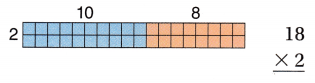
Scroll to Top