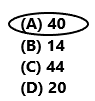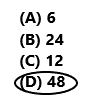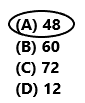
Texas Go Math

Texas Go Math Grade 5 Lesson 7.3 Answer Key Numerical Expressions

Refer to our Texas Go Math Grade 5 Answer Key Pdf to score good marks in the exams. Test yourself by practicing the problems from Texas Go Math Grade 5 Lesson 7.3 Answer Key Numerical Expressions.

Texas Go Math Grade 5 Lesson 7.3 Answer Key Numerical Expressions

Unlock the Problem

A numerical expression is a mathematical phrase that has numbers and operation signs but does not have an equal sign. Some numerical expressions have parentheses.

Doug went fishing for 3 days. Each day he put $15 in his pocket. At the end of each day, he had $5 left. How much money did Doug spend by the end of the trip?
• Underline the events for each day.
• Circle the number of days these events happened.

Which expression matches the meaning of the words?

Think: Each day he took $15 and had $5 left. He did this for 3 days.
($15 – $5) ← Think: What expression can you write to show how much money Doug spends in one day?
3 × ($15 – $5) ← Think: What expression can you write to show how much money Doug spends in three days?
Answer:
Texas-Go-Math-Grade-5-Lesson-7.3-Answer-Key-1(1.1)
The expression matches the meaning of the words is 3 × ($15 – $5).
Explanation:
Doug went fishing for 3 days. Each day he put $15 in his pocket. At the end of each day, he had $5 left. In one day Doug spend ($15 – $5). By the end of the trip Doug spend 3 x ($15 – $5). The expression matches the meaning of the words is 3 × ($15 – $5). Doug spend $30 by the end of the trip.

Math Talk
Mathematical Processes

Explain how the expression of what Doug spent in three days compares to the expression of what he spent in one day.
Answer:

Example

Which problem matches the expression $20 – ($12 + $3)?

Kim has $20 to spend for her fishing trip. She spends $12 on a fishing pole. Then she finds $3. How much money does Kim have now?

List the events in order.
First: Kim has $20.
Next: ________________
Then: ________________
Do these words match the expression? ____________
Answer:
First: Kim has $20.
Next: $20 – $12 
Then: ($20 – $12) + $3
Do these words match the expression? No
Explanation:
Kim has $20 to spend for her fishing trip. She spends $12 on a fishing pole. The expression is ($20 – $12). Then she finds $3. Now the expression is ($20 – $12) + $3. Now Kim have $11. These words does not matches with the expression $20 – ($12 + $3).
Kim has $20 to spend for her fishing trip. She spends $12 on a fishing pole and $3 on bait. How much money does Kim have now?
List the events in order.
First: Kim has $20.
Next: ________________
Then: ________________
Do these words match the expression? ____________
Answer:
First: Kim has $20.
Next: $20 – $12
Then: $20 – ($12 + $3)
Do these words match the expression? Yes
Explanation:
Kim has $20 to spend for her fishing trip. She spends $12 on a fishing pole and $3 on bait. The expression is $20 – ($12 + $3). These words matches the given expression $20 – ($12 + $3). Now Kim have $5.

Share and Show

Circle the expression that matches the words.

Question 1.
Teri had 18 worms. She gave 4 worms to Susie and 3 worms to Jamie.
(18 – 4) + 3
18 – (4 + 3)
Answer:
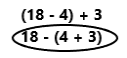
Texas-Go-Math-Grade-5-Lesson-7.3-Answer-Key-1(1)
Explanation:
Teri had 18 worms. She gave 4 worms to Susie and 3 worms to Jamie. The expression that matches the words is
18 – (4 + 3). So draw a circle to this expression 18 – (4 + 3).

Go Math 5th Grade Lesson 7.3 Answer Key Question 2.
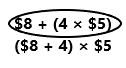
Rick had $8. He then worked 4 hours for $5 each hour.
$8 + (4 × $5)
($8 + 4) × $5
Answer:
Texas-Go-Math-Grade-5-Lesson-7.3-Answer-Key-1(2)
Explanation:
Rick had $8. He then worked 4 hours for $5 each hour. The expression that matches the words is $8 + (4 × $5). So draw a circle to this expression $8 + (4 × $5).

Write an expression to match the words.

Question 3.
Greg walks dogs for 5 days. He walks 4 dogs each morning and 3 dogs each afternoon.
Answer:
5 x (4 + 3)
Explanation:
Greg walks dogs for 5 days. He walks 4 dogs each morning and 3 dogs each afternoon. The word that matches the expression is 5 x (4 + 3).

Question 4.
Lynda has 27 fewer fish than Jack. Jack has 80 fish.
Answer:
80 – 27
Explanation:
Lynda has 27 fewer fish than Jack. Jack has 80 fish. The words that match the expression are 80 – 27.

Write words to match the expression.

Question 5.
34 – 17
Answer:
Varun had 34 cookies and he gave 17 of them to his friend.
Explanation:
Varun had 34 cookies and he gave 17 of them to his friend. These words match the given expression 34 – 17.

Question 6.
6 × (12 – 4)
Answer:
For the last 6 years, Susie got $12 for her birthday and gave $ 4 of that to her little brother.
Explanation:
For the last 6 years, Susie got $12 for her birthday and gave $ 4 of that to her little brother. These words matches the given expression 6 x (12 – 4).

Problem Solving

Write an expression to match the words.

Question 7.
Jose has 9 pens. He buys 3 more. He shares all the pens equally among 6 friends.
Answer:
(9 + 3) ÷ 6
Explanation:
Jose has 9 pens. He buys 3 more. He shares all the pens equally among 6 friends. These words match with this expression (9 + 3) ÷ 6.

Go Math Lesson 7.3 Answer Key 5th Grade Math Expressions Question 8.
Monique had $20. She spent $5 on lunch and $10 at the bookstore.
Answer:
$20 – ($5 + $10)
Explanation:
Monique had $20. She spent $5 on lunch and $10 at the bookstore. These words match with this expression
$20 – ($5 + $10).

Write words to match the expression.

Question 9.
($8 + $14) – (4 × $5)
Answer:
Jasmine has $8 and her husband gave $14. She bought 4 chocolates which were $5 each. These words match with the expression ($8 + $14) – (4 × $5).

Question 10.
(12 × 6) – (3 × 2)
Answer:
In one year, Pooja will get 6 balloons for every month. She gave two balloons each to her three brothers. These words match with the expression (12 × 6) – (3 × 2).

Connect Draw a line to match the expression with the words.

Question 11.
Texas Go Math Grade 5 Lesson 7.3 Answer Key 1
Answer:
Texas-Go-Math-Grade-5-Lesson-7.3-Answer-Key-1
Explanation:
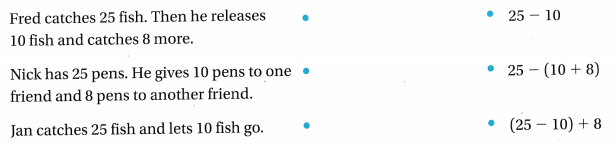
Fred catches 25 fish. Then he releases 10 fish and catches 8 more. The expression is (25 – 10) + 8. Draw a line from these words to the expression (25 – 10) + 8.
Nick has 25 pens. He gives 10 pens to one friend and 8 pens to another friend. The expression is 25 – (10 + 8). Draw a line from these words to the expression 25 – (10 + 8).
Jan catches 25 fish and lets 10 fish go. The expression is 25 – 10. Draw a line from these words to the expression
25 – 10.

Problem-Solving

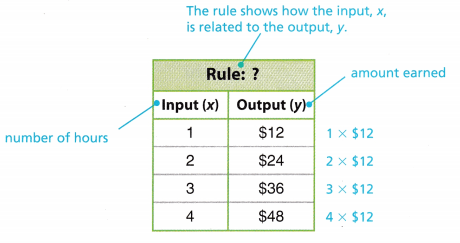
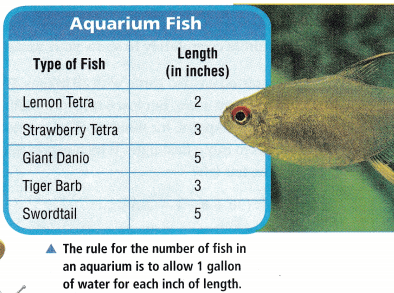
Use the rule and the table for 12-13.
Texas Go Math Grade 5 Lesson 7.3 Answer Key 2
Go Math Answer Key Grade 5 Lesson 7.3 Question 12.
Represent Write a numerical expression to represent the total number of lemon tetras that could be in a 20-gallon aquarium.
Answer:
20 ÷ 2
The total number of tetras in 20-gallon of aquarium is 10.
Explanation:
The fish in a aquarium allows 1 gallon of water for each inch of length. The lemon tetra is 2 inches length. The numerical expression 10 x 2 represents the total number of lemon tetras that could be in a 20-gallon aquarium. The total number of tetras in 20-gallon of aquarium is 10.

Question 13.
H.O.T. There are tiger barbs in a 15-gallon aquarium and giant danios in a 30-gallon aquarium. Write a numerical expression to represent the total number of fish that could be in both aquariums.
Texas Go Math Grade 5 Lesson 7.3 Answer Key 3
Answer:
(15 ÷ 3) + (30 ÷ 5)
The above numerical expression represents the total number of fish in both aquariums.
Explanation:
The fish in a aquarium allows 1 gallon of water for each inch of length. There are tiger barbs in a 15-gallon aquarium and giant danios in a 30-gallon aquarium. The tiger barbs is 3 inches length. The giant danios is 5 inches length. The numerical expression (15 ÷ 3) + (30 ÷ 5) represent the total number of fish in both aquariums.

Question 14.
Write a word problem for an expression that is three times as great as (15 + 7). Then write the expression.
Answer:
The three brothers Ram, Rahim, Robert each have 15 mangoes and 7 cherries with them. The total number of fruits altogether they have is 3 x (15 + 7). The expression is 3 x (15 + 7).

Question 15.
What’s the Question? Lu has 3 swordtails in her aquarium. She buys 2 more swordtails.
Answer:
How many gallons of water is needed in an aquarium when Lu buys two more swordtails along with the three swordtails already he have.

Question 16.
Multi-Step Tammy has 26 stamps. She buys 19 more stamps. She shares all the stamps equally among 9 friends. Write an expression to match the words. How many stamps does each friend get?
Answer:
The expression matches the words
(26 + 19) ÷ 9
(45) ÷ 9
5
Each friend gets 5 stamps.
Explanation:
Tammy has 26 stamps. She buys 19 more stamps. She shares all the stamps equally among 9 friends. The expression that matches the words is (26 + 19) ÷ 9. Add 26 stamps with 19 stamps the sum is 45 stamps. Divide 45 stamps by 9 friends the result is 5 stamps. Each friend gets 5 stamps.

Daily Assessment Task

Fill in the bubble completely to show your answer.

Lesson 7.3 Answer Key 5th Grade Go Math Question 17.
Daniel started a video game with 30 tokens. He earned 8 more tokens for jumping on a star but lost 6 tokens for falling into a hole. When he passed a checkpoint, his number of tokens doubled! Then he spent 20 tokens to buy a flashlight. Which expression shows how many tokens he has left?
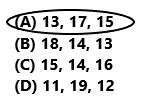
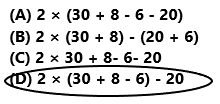
(A) 2 × (30 + 8 – 6 – 20)
(B) 2 × (30 + 8) – (20 + 6)
(C) 2 × 30 + 8- 6- 20
(D) 2 × (30 + 8 – 6) – 20
Answer:
Texas-Go-Math-Grade-5-Lesson-7.3-Answer-Key-2(1)
The expression 2 x (30 + 8 – 6) – 20  shows the token left with him.
So, option D is correct.
Explanation:
Daniel started a video game with 30 tokens. He earned 8 more tokens for jumping on a star, but lost 6 tokens for falling into a hole. The expression is (30 + 8 – 6). When he passed a checkpoint, his number of tokens is doubled. Then he spent 20 tokens to buy a flashlight. The expression 2 x (30 + 8 – 6) – 20  shows the token left with him.

Question 18.
Enrique brought $30 to the mall and spent $14 on a soccer ball and $6 on lunch. Which expression represents the situation?
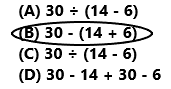
(A) 30 ÷ (14 – 6)
(B) 30 – (14 + 6)
(C) 30 ÷ (14 – 6)
(D) 30 – 14 + 30 – 6
Answer:
Texas-Go-Math-Grade-5-Lesson-7.3-Answer-Key-2(2)
The expression is 30 – (14 + 6).
So, option B is correct.
Explanation:
Enrique brought $30 to the mall and spent $14 on a soccer ball and $6 on lunch. The expression 30 – (14 + 6) represents the situation.

Question 19.
Multi-Step Terrel has 8 nickels. Heather has twice as many nickels as Terrel. Heather spends 4 nickels to buy a pencil. Each nickel is worth 5 cents. Which expression shows how many cents Heather has left?
(A) 5 + 2 + 8 – 4
(B) 5 × (2 × 8) – 4
(C) 5 × (2 × 8 – 4)
(D) 5 × 2 + 8 – 4
Answer:

Texas Test Prep

Math Expressions 5th Grade Answer Key Lesson 7.3 Question 20.
Josh has 3 fish in each of the 5 buckets. Then he releases 4 fish. Which expression matches the words?
(A) (3 × 4) – 5
(B) (5 × 4) – 3
(C) (5 × 3) – 4
(D) (5 – 3) × 4
Answer:
Texas-Go-Math-Grade-5-Lesson-7.3-Answer-Key-2(4)
The expression is (5 x 3) – 4.
So, option C is correct.
Explanation:
Josh has 3 fish in each of 5 buckets. Then he releases 4 fish. The expression that matches the words is (5 x 3) – 4.

Texas Go Math Grade 5 Lesson 7.3 Homework and Practice Answer Key

Write an expression to match the words.

Question 1.
Frank had $25 in his checking account. He withdrew $15 cash and $9 to pay a bill.
Answer:
$25 – ($15 + $9)
Explanation:
Frank had $25 in his checking account. He withdrew $15 cash and $9 to pay a bill. The expression that matches the words is $25 – ($15 + $9).

Question 2.
Patricia charges $12 to rake the yard. She charges $5 per hour to bag the piles of leaves for 2 hours.
Answer:
$12 + ($5 x 2)
Explanation:
Patricia charges $12 to rake the yard. She charges $5 per hour to bag the piles of leaves for 2 hours. The expression that matches the words is $12 + ($5 x 2).

Write words to match the expressions.

Question 3.
(5 × 2) × (3 × 15)
Answer:
Each person in the five couples are holding three sets of fifteen pens each. These words matches the expression (5 × 2) × (3 × 15).

Go Math 5th Grade Practice and Homework Lesson 7.3 Answer Key Question 4.
36 + (2 × 3)
Answer:
Rohan has 36 coins with him. His two brothers gave extra three coins each. These words matches the expression 36 + (2 × 3).

Question 5.
(5 + 10) ÷ 5
Answer:
Raj decided to distribute five chocolates and ten fruits to his five best friends equally. These words matches the expression (5 + 10) ÷ 5.

Question 6.
(12 × 2) + (4 × 3)
Answer:
In Joe’s apartment, surprisingly twelve couples have twins and four couples have triplets. These words matches the expression (12 × 2) + (4 × 3).

Problem-Solving

Question 7.
Dominick makes a design with 5 rows of 6 tiles. He frames the same design in 7 different frames to sell at the craft fair. Write an expression to match the words. How many tiles does Dominick use?
Answer:

Go Math Grade 5 Chapter 7 Lesson 7.3 Answer Key Question 8.
Tim buys three 6-packs of apple juice boxes and five 4-packs of cranberry juice boxes for his party. Write an expression to match the words. How many boxes of juice does Tim buy?
Answer:
The expression that matches the words is (3 x 6) + (5 x 4).
(3 x 6) + (5 x 4)
18 + 20
38
Tim buys 38 boxes of juice.
Explanation:
Tim buys three 6-packs of apple juice boxes and five 4-packs of cranberry juice boxes for his party. The expression that matches the words is (3 x 6) + (5 x 4). Tim buys 38 boxes of juice.

Lesson Check

Fill in the bubble completely to show your answer.

Use the price list for 9-11.
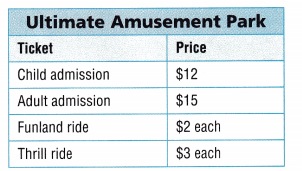
Texas Go Math Grade 5 Lesson 7.3 Answer Key 4

Question 9.
Which expression shows the cost of one adult admission ticket and 9 thrill ride tickets?
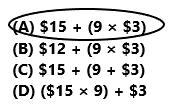
(A) $15 + (9 × $3)
(B) $12 + (9 × $3)
(C) $15 + (9 + $3)
(D) ($15 × 9) + $3
Answer:
Texas-Go-Math-Grade-5-Lesson-7.3-Answer-Key-4(1)
So, option A is correct.
Explanation:
The above table is the ultimate amusement park. In that, we can observe tickets and prices. The cost of one adult admission ticket is $15. For each person, the thrill ride ticket is $3. Multiply 9 with $3. The expression is $15 + (9 × $3) shows the cost of one adult admission ticket and 9 thrill ride tickets.

Go Math Lesson 7.3 5th Grade Answer Key Question 10.
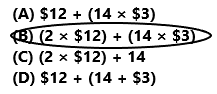
Bandar and Courtney each paid $ 12 for admission. They bought 14 thrill-ride tickets. Which expression shows their cost?
(A) $12 + (14 × $3)
(B) (2 × $12) + (14 × $3)
(C) (2 × $12) + 14
(D) $12 + (14 + $3)
Answer:
Texas-Go-Math-Grade-5-Lesson-7.3-Answer-Key-4(2)
Option B is correct.
Explanation:
Bandar and Courtney each paid $12 for admission. They bought 14 thrill-ride tickets. For each person, the thrill ride ticket is $3as we can observe in the above table. The expression (2 × $12) + (14 × $3) shows their cost.

Question 11.
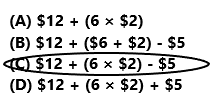
Riley bought a child admission ticket and 6 fun land ride tickets. He used a coupon for a $5 discount. Which expression shows Riley’s total cost?
(A) $12 + (6 × $2)
(B) $12 + ($6 + $2) – $5
(C) $12 + (6 × $2) – $5
(D) $12 + (6 × $2) + $5
Answer:
Texas-Go-Math-Grade-5-Lesson-7.3-Answer-Key-4(3)
Riley’s total cost is $12 + (6 × $2) – $5.
So, option C is correct.
Explanation:
Riley bought a child admission ticket and 6 fun land ride tickets. The cost of a child admission ticket is $12 and each person the thrill ride ticket is $3 as we can observe in the above table. He used a coupon for a $5 discount. The expression $12 + (6 × $2) – $5 shows the Riley’s total cost.

5th Grade Math Expressions Lesson 7.3 Reteach Answer Key Question 12.
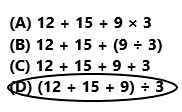
Multi-Step The classroom has 12 chairs on the right side of the room, 15 chairs on the left, and 9 chairs stacked in the back. Mrs. Kim wants to divide the chairs evenly into 3 groups. Which expression represents the situation?
(A) 12 + 15 + 9 × 3
(B) 12 + 15 + (9 ÷ 3)
(C) 12 + 15 + 9 + 3
(D) (12 + 15 + 9) ÷ 3
Answer:
Texas-Go-Math-Grade-5-Lesson-7.3-Answer-Key-4(4)
The expression is (12 + 15 + 9) ÷ 3.
So, option D is correct.
Explanation:
The classroom has 12 chairs on the right side of the room, 15 chairs on the left, and 9 chairs stacked in the back. Mrs. Kim divides the chairs evenly into 3 groups. The expression represents the situation is (12 + 15 + 9) ÷ 3.

Question 13.
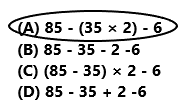
Multi-Step Mr. Richardson is driving to a town 85 miles away. He drives 35 miles per hour for 2 hours before stopping for lunch. He drives 6 more miles and stops for gas. Which expression shows how many miles Mr. Richardson has left to drive?
(A) 85 – (35 × 2) – 6
(B) 85 – 35 – 2 -6
(C) (85 – 35) × 2 – 6
(D) 85 – 35 + 2 -6
Answer:
Texas-Go-Math-Grade-5-Lesson-7.3-Answer-Key-4(5)
The expression shows the miles of Mr. Richardson has left to drive 85 – (35 × 2) – 6.
So, option A is correct.
Explanation:
Mr. Richardson is driving to a town 85 miles away. He drives 35 miles per hour for 2 hours before stopping for lunch. He drives 6 more miles and stops for gas. The expression shows the miles of Mr. Richardson has left to drive 85 – (35 × 2) – 6. So, option A is correct.

Texas Go Math Grade 5 Lesson 7.3 Answer Key Numerical Expressions Read More »

Texas Go Math Grade 5 Lesson 7.4 Answer Key Simplify Numerical Expressions

Refer to our Texas Go Math Grade 5 Answer Key Pdf to score good marks in the exams. Test yourself by practicing the problems from Texas Go Math Grade 5 Lesson 7.4 Answer Key Simplify Numerical Expressions.

Texas Go Math Grade 5 Lesson 7.4 Answer Key Simplify Numerical Expressions

Unlock the Problem

A cake recipe calls for 4 cups of flour and 2 cups of sugar. To triple the recipe, how many cups of flour and sugar are needed in all?

Simplify 3 × 4 + 3 × 2 to find the total number of cups.
A. Heather did not follow the order of operations correctly.
Texas Go Math Grade 5 Lesson 7.4 Answer Key 1
Explain why Heather’s answer is not correct.
Answer:
Heather’s answer is not correct. Because he first added 4 and 3 and then multiplied 3 with 7 and 2 then the product is 42. He does not follow the order of operations by multiplying first and then adding.

B. Follow the order of operations by multiplying first and then adding.
Texas Go Math Grade 5 Lesson 7.4 Answer Key 2
So, ________ cups of flour and sugar are needed.
Answer:
Texas-Go-Math-Grade-5-Lesson-7.4-Answer-Key-2
So, 18 cups of flour and sugar are needed.
Explanation:
A cake recipe calls for 4 cups of flour and 2 cups of sugar. The recipe was tripled. The expression is 3 x 4 + 3 x 2. So first I multiplied 3 with 4 and 3 with 2 the product is 12 and 6. Then I added 12 with 6 the sum is 18.

Example

Each batch of cupcakes Lena makes uses 3 cups of flour, 1 cup of milk, and 2 cups of sugar. Lena wants to make 5 batches of cupcakes. How many cups of flour, milk, and sugar will she need in all?
Write the expression. 5 × (3 + 1 + 2)
I First, perform the operations in parentheses. 5 × (_________)
Then multiply. _________
So, Lena will use _________ cups of flour, milk, and sugar in all.
Answer:
The expression is 5 x (3 + 1 + 2).
I First, perform the operations in parentheses.
5 × (3 + 1 + 2)
5 x (6)
Then multiply.
5 x 6
30
So, Lena will use 30 cups of flour, milk, and sugar in all.
Explanation:
Each batch of cupcakes Lena makes uses 3 cups of flour, 1 cup of milk, and 2 cups of sugar. Lena wants to make 5 batches of cupcakes. The expression is 5 × (3 + 1 + 2). First perform the operations in parentheses. Add 3 with 1 and 2 the sum is 6. Then multiply 5 with 6 the product is 30. So, Lena will use 30 cups of flour, milk, and sugar in all.

Share and Show

Simplify the numerical expression.

Question 1.
10 + 36 ÷ 9
Think: I need to divide first.
Answer:
10 + 36 ÷ 9
10 + 4
14
Explanation:
The numerical expression is 10 + 36 ÷ 9. First I divided 36 by 9 the result is 4. Then I added 10 with 4 the sum is 14. The simplified form of the given numerical expression is 14.

Simplify Numerical Expressions Go Math Grade 5 Answer Key Pdf Question 2.
10 + (25 – 10) ÷ 5
Answer:
10 + (25 – 10) ÷ 5
10 + 15 ÷ 5
10 + 3
13
Explanation:
The numerical expression is 10 + (25 – 10) ÷ 5. First I Subtracted 10 from 25 then the difference is 15. Next, I divided 15 by 5 the result is 3. Then I added 10 with 3 the sum is 13. The simplified form of the given numerical expression is 13.

Question 3.
9 – (3 × 2) + 8
Answer:
9 – (3 × 2) + 8
9 – (6) + 8
3 + 8
11
Explanation:
The numerical expression is 9 – (3 × 2) + 8. First I multiplied 3 with 2 the product is 6. Next I subtracted 6 from 9 the difference is 3. Then I added 3 with 8 the sum is 11.The simplified form of given numerical expression is 11.

Math Talk
Mathematical Processes

Raina simplified the expression 5 × 2 + 2 by adding first and then multiplying. Will her answer be correct? Explain.
Answer:
5 × 2 + 2
5 x 4
20
No, her answer is 20 it is not correct. The correct answer is 12.
Explanation:
Raina simplified the expression 5 × 2 + 2 by adding first and then multiplying. Her answer will not be correct. Because Raina has to perform multiplication first and then adding.

Problem Solving

Question 4.
H.O.T. Use Symbols Write 12 + 17 – 3 × 2 with parentheses so it has a value of 23.
Answer:
One type:
12 + 17 – (3 x 2)
12 + 17 – 6
29 – 6
23
Another type:
(12 + 17) – 3 x 2
29 – 6
23
Explanation:
The parentheses for the expression 12 + 17 – 3 × 2 is 12 + 17 – (3 x 2) or (12 + 17) – 3 x 2. By solving this numerical expression with parentheses the value is 23.

Go Math Expressions Grade 5 Pdf Answer Key Lesson 7.4 Question 5.
Multi-Step The value of 100 – 30 ÷ 5 with parentheses can have a value of 14 or 94. Explain.
Answer:
One type:
100 – (30 ÷ 5)
100 – 6
94
The value of the given expression with the above parentheses is 94.
100 – (30 ÷ 5)
70 ÷ 5
14
The value of the given expression with the above parentheses is 14.
Explanation:
The two possible ways of the given expression with parentheses is 100 – (30 ÷ 5), 100 – (30 ÷ 5). By solving these two expression the values is 94 and 14.

Unlock the Problem

Question 6.
Multi-Step A movie theater has 4 groups of seats. The largest group of seats, in the middle, has 20 rows, with 20 seats in each row. There are 2 smaller groups of seats on the sides, each with 20 rows and 6 seats in each row. A group of seats in the back has 5 rows, with 30 seats in each row. How many seats are in the movie theater?
Texas Go Math Grade 5 Lesson 7.4 Answer Key 3

a. What do you need to know?
Answer:
We need to know the total seats in the movie theater.

b. What operation can you use to find the number of seats in the back group of seats? Write the expression.
Answer:
The expression is 5 x 30.
150
Explanation:
Multiplication operation is used to find the number of seats in the back group of seats. A group of seats in the back has 5 rows, with 30 seats in each row. The expression is 5 x 30. There are 150 seats in the back group of seats.

c. What operation can you use to find the number of seats in both groups of side seats? Write the expression.
Answer:
The expression is 2 x (20 x 6).
2 x 120
240
Explanation:
Multiplication operation is used to find the number of seats in both groups of side seats. There are 2 smaller groups of seats on the sides, each with 20 rows and 6 seats in each row. The expression is 2 x (20 x 6). There are 240 seats in both groups of side seats.

d. What operation can you use to find the number of seats in the middle group? Write the expression.
Answer:
The expression is 20 x 20.
400
Explanation:
Multiplication operation is used to find the number of seats in the middle group. The largest group of seats, in the middle, has 20 rows, with 20 seats in each row. The expression is 20 x 20. There are 400 seats in the middle group.

e. Write an expression to represent the total number of seats in the theater.
Answer:
The expression to represent the total number of seats in the theater is (20 x 20) + 2 x (20 x 6) + (5 x 30).

f. How many seats are in the theater? Show the steps you use to solve the problem.
Answer:
(20 x 20) + 2 x (20 x 6) + (5 x 30)
400 + 2 x 120 + 150
400 + 240 + 150
790
The total number of seats in the theater is 790.

Simplifying Numerical Expressions Lesson 7.4 Answer Key 5th Grade Question 7.
Multi-Step In the wild, an adult giant panda eats about 30 pounds of food each day. Write and simplify a numerical expression that shows how many pounds of food 6 pandas eat in 3 days.
Answer:
3 x (6 x 30)
3 x 180
540 
In 3 days 6 pandas eat 540 pounds of food.
Explanation:
In the wild, an adult giant panda eats about 30 pounds of food each day. The numerical expression for the 6 pandas eats food in 3 days is 3 x (6 x 30). In 3 days 6 pandas eat 540 pounds of food.

Question 8.
H.O.T. Connect Write and simplify two equivalent numerical expressions that show the Distributive Property of Multiplication.
Texas Go Math Grade 5 Lesson 7.4 Answer Key 4
Answer:

Daily Assessment Task

Fill in the bubble completely to show your answer.

Question 9.
The books in an unusual library are labeled with numerical expressions. Katrina needs to find the book with a numerical expression that has a value of 12. Which one should she choose?
(A) (6 + 26) – (4 × 5)
(B) 2 × (15 – 7)
(C) 10 + 8 – 36 ÷ 9
(D) (25 – 4) ÷ 7
Answer:
Texas-Go-Math-Grade-5-Lesson-7.4-Answer-Key-4(1)
(6 + 26) – (4 × 5)
32 – 20
12
The book with a numerical expression that has a value of 12 is (6 + 26) – (4 × 5).
So, option A is correct.
Explanation:
The books in an unusual library are labeled with numerical expressions. Katrina needs to find the book with a numerical expression that has a value of 12. The book with a numerical expression is (6 + 26) – (4 × 5). First we have to add 6 with 26 the sum is 32. Next multiply 4 with 5 the result is 20. Then subtracting 20 from 32 the difference is 12. So, option A is correct.

Question 10.
Franco needs to simplify 3 × (8 – 4) + 7. What should be his first step?
(A) Add 7 to 4.
(B) Subtract 4 from 8.
(C) Multiply 3 by 7.
(D) Add 3 to 7.
Answer:
Texas-Go-Math-Grade-5-Lesson-7.4-Answer-Key-4(2)
3 × (8 – 4) + 7
3 x 4 + 7
12 + 7
19
The first step is to solve (8 – 4).
So, option B is correct.
Explanation:
The given numerical expression is 3 × (8 – 4) + 7. First we have to solve the values within the parentheses.  Subtract 4 from 8 the difference is 4. Next we have to perform a multiplication operation. Multiply 3 with 4 the result is 12. Then add 12 with 7 the sum is 19.

Go Math Grade 5 Lesson 7.4 Answer Key Question 11.
Multi-Step Sarah simplified each of the expressions shown. What is the difference between the values of the two expressions?
3 × 12 – 9 + 10
3 × (12 – 9) + 10
(A) 9
(B) 18
(C) 12
(D) 22
Answer:
Texas-Go-Math-Grade-5-Lesson-7.4-Answer-Key-4(3)
3 × 12 – 9 + 10
36 – 9 + 10
27 + 10
37
3 × (12 – 9) + 10
3 x 3 + 10
9 + 10
19
37 – 19 = 18
The difference between the values of the two expression is 18.
So, option B is correct.
Explanation:
Sarah simplified each of the given expressions. The first expression is 3 × 12 – 9 + 10. First Sarah multiplied 3 with 12 the product is 36. Then she subtracted 9 from 36 the difference is 27. Then she added 27 with 10 the sum is 37.  The second expression is 3 × (12 – 9) + 10. First Sarah subtracted 9 from 12 the difference is 3. Then she multiplied 3 with 3 the product is 9. Then she added the 9 with 10 the sum is 18. Subtract 18 from 37 the difference is 18. The difference between the values of the two expression is 18. So, option B is correct.

Texas Test Prep

Texas Go Math Grade 5 Lesson 7.4 Answer Key Question 12.
Which expression has a value of 6?
(A) (6 ÷ 3) × 4 + 8
(B) 27 – 9 ÷ 3 × (4 + 1)
(C) (18 + 12) × 6 – 4
(D) 71 – 5 × (9 + 4)
Answer:
Texas-Go-Math-Grade-5-Lesson-7.4-Answer-Key-4(4)
71 – 5 × (9 + 4)
71 – 5 x (13)
71 – 65
6
The expression that has a value of 6 is 71 – 5 × (9 + 4).
So, option D is correct.
Explanation:
The expression that has a value of 6 is 71 – 5 × (9 + 4). First add the values within the parentheses. Add 9 with 4 the sum is 13. Then multiply 5 with 13 the product is 65. Then subtract 65 from 71 the difference is 6.

Texas Go Math Grade 5 Lesson 7.4 Homework and Practice Answer Key

Simplify the numerical expression.

Question 1.
10 – (2 × 4) + 12
Answer:
The given expression is 10 – (2 × 4) + 12.
10 – 8 + 12
2 + 12
14
Explanation:
The given expression is 10 – (2 × 4) + 12. First simplify the values within the parentheses. Multiply 2 with 4 the product is 8. Then subtract 8 from 10 then the difference is 2. Then add 2 with 12 the sum is 14. The simplified form of given numerical expression is 14.

Question 2.
14 + 35 ÷ 7
Answer:
The given expression is 14 + 35 ÷ 7.
14 + 5
19
Explanation:
The given expression is 14 + 35 ÷ 7. First, divide 35 by 7 the result is 5. Then add 5 with 14 the sum is 19. The simplified form of the given numerical expression is 19.

5th Grade Go Math Expressions Grade 5 Answer Key Lesson 7.4 Question 3.
11 + (31 – 4) ÷ 9
Answer:
The given expression is 11 + (31 – 4) ÷ 9.
11 + 27 ÷ 9
11 + 3
14
Explanation:
The given expression is 11 + (31 – 4) ÷ 9. First, simplify the values within the parentheses. Subtract 4 from 31 the difference is 27. Then divide 27 by 9 the result is 3. Then add 11 with 3 the sum is 14. The simplified form of the given numerical expression is 14.

Question 4.
25 – 4 × 5
Answer:
The given expression is 25 – 4 × 5.
25 – 20
5
Explanation:
The given expression is 25 – 4 × 5. First multiply 4 with 5 the product is 20. Then subtract 20 from 25 the difference is 5. The simplified form of given numerical expression is 5.

Question 5.
3 × (6 + 3) – 15
Answer:
The given expression is 3 × (6 + 3) – 15.
3 x 9 – 15
27 – 15
12
Explanation:
The given expression is 3 × (6 + 3) – 15. First simplify the values within the parentheses. Add 6 with 3 the sum is 9. Then multiply 3 with 9 the product is 27. Subtract 15 from 27 the difference is 12. The simplified form of given numerical expression is 12.

Question 6.
30 – 14 ÷ 2
Answer:
The given expression is 30 – 14 ÷ 2.
30 – 7
23
Explanation:
The given expression is 30 – 14 ÷ 2. First divide 14 by 2 the result is 7. Then subtract 7 from 30 the difference is 23. The simplified form of given numerical expression is 23.

Rewrite the expression with parentheses to equal the given value.

Question 7.
12 + 6 ÷ 2 + 4; value: 13
Answer:
The given expression is 12 + 6 ÷ 2 + 4.
Rewrite the expression with parentheses.
12 + 6 ÷ (2 + 4)
12 + 6 ÷ 6
12 + 1
13
Explanation:
The given expression 12 + 6 ÷ 2 + 4 had rewrite with parentheses 12 + 6 ÷ (2 + 4) to equal to the given value. The given expression with parentheses is equal to the given value 17.

Go Math Grade 5 Practice and Homework Lesson 7.4 Answer Key Question 8.
42 – 24 ÷ 6; value: 3
Answer:
The given expression is 42 – 24 ÷ 6.
Rewrite the expression with parentheses.
(42 – 24) ÷ 6
18 ÷ 6
3
Explanation:
The given expression 42 – 24 ÷ 6 had rewritten with parentheses (42 – 24 )÷ 6 to equal to the given value. The given expression with parentheses is equal to the given value 17.

Question 9.
9 + 16 – 2 × 4; value: 17
Answer:
The given expression is 9 + 16 – 2 × 4.
Rewrite the expression with parentheses.
9 + 16 – (2 × 4)
9 + 16 – 8
9 + 8
17
Explanation:
The given expression 9 + 16 – 2 × 4 had rewrite with parentheses  9 + 16 – (2 × 4) to equal to the given value. The given expression with parentheses is equal to the given value 17.

Question 10.
60 – 3 + 2 × 5; value: 35
Answer:
The given expression is 60 – 3 + 2 × 5.
Rewrite the expression with parentheses.
60 – (3 + 2) × 5
60 – 5 x 5
60 – 25
35
Explanation:
The given expression 60 – 3 + 2 × 5 had rewrite with parentheses  60 – (3 + 2) × 5 to equal to the given value. The given expression with parentheses is equal to the given value 35.

Question 11.
18 + 9 ÷ 3; value: 21
Answer:
The given expression is 18 + 9 ÷ 3.
Rewrite the expression with parentheses.
18 + (9 ÷ 3)
18 + 3
21
Explanation:
The given expression 18 + 9 ÷ 3 had rewrite with parentheses 18 + (9 ÷ 3) to equal to the given value. The given expression with parentheses is equal to the given value 21.

Go Math Grade 5 Practice and Homework Lesson 7.4 Question 12.
5 × 2 + 4 + 3; value: 45
Answer:
The given expression is 5 × 2 + 4 + 3.
Rewrite the expression with parentheses.
5 × (2 + 4 + 3)
5 x 9
45
Explanation:
The given expression 5 × 2 + 4 + 3 had rewrite with parentheses 5 × (2 + 4 + 3) to equal to the given value. The given expression with parentheses is equal to the given value 45.

Problem Solving

Question 13.
Julian paid his library fines. He paid $2 each for 4 overdue books and $16 for a lost book. Write and simplify a numerical expression that shows how much Julian paid in library fines.
Answer:
The numerical expression is as below.
$2 x 4 +$16 
$8 + $16
$24
Julian paid $24 in library fines.
Explanation:
Julian paid his library fines. He paid $2 each for 4 overdue books and $16 for a lost book. The numerical expression is $2 x 4 + $16. The simplified form of numerical expression value is $24. Julian paid $24 in library fines.

Question 14.
For 5 days in a row last week, Addison read 9 pages of a poetry book and 16 pages of her favorite novel. Write and simplify a numerical expression that shows how many pages Addison read last week.
Answer:
5 x (9 + 16)
5 x 25
125
Addison read 125 pages last week.
Explanation:
For 5 days in a row last week, Addison read 9 pages of a poetry book and 16 pages of her favorite novel. The numerical expression is 5 x (9 + 16). The simplified form of numerical expression value is 125. Addison read 125 pages last week.

Lesson Check

Fill in the bubble completely to show your answer.

Question 15.
Mrs. Harrison writes a numerical expression on the board that has a value of 16. Which expression does Mrs. Harrison write?
(A) (15 + 3) – 14 ÷ 2
(B) 20 – 4 ÷ 2
(C) 3 × (5 + 1)
(D) 18 + 13 – (5 × 3)
Answer:
Texas-Go-Math-Grade-5-Lesson-7.4-Answer-Key-4(5)
18 + 13 – (5 × 3)
18 + 13 – 15
31 – 15
16
So, option D is correct.
Explanation:
Mrs. Harrison writes a numerical expression on the board that has a value of 16. Mrs. Harrison wrote 18 + 13 – (5 × 3) expression on the board. The value of this expression is equal to 16.

Question 16.
Omar wants to simplify the expression below. What should be his first step?
6 × (3 + 9) – 5
(A) Multiply 6 by 3.
(B) Subtract 5 from 9.
(C) Add 9 to 3.
(D) Subtract 5 from 6.
Answer:
Texas-Go-Math-Grade-5-Lesson-7.4-Answer-Key-4(6)
6 × (3 + 9) – 5
6 x 12 – 5
72 – 5
67
Omar first step is to add 9 to the 3.
Explanation:
Omar wants to simplify the expression 6 × (3 + 9) – 5. First Omar has to solve the values within the parentheses. So, Omar’s first step is to add 9 to 3. So, option C is correct.

Question 17.
What is the value of the numerical expression below?
30 ÷ (3 + 2) × 8
(A) 96
(B) 48
(C) 26
(D) 40
Answer:
Texas-Go-Math-Grade-5-Lesson-7.4-Answer-Key-4(7)
30 ÷ (3 + 2) × 8
30 ÷ 5 x 8
6 x 8
48
So, option B is correct.
Explanation:
The given numerical expression is 30 ÷ (3 + 2) × 8. First, add 3 with 2 the sum is 5. Then divide 30 by 5 the result is 6. Then after multiplying 6 with 8, the product is 48. So, option B is correct.

5th Grade Go Math Answer Key Lesson 7.4 Question 18.
Becka says that when she simplifies the expression below, the value is 6 less than her age. What is Becka’s age?
(7 + 11) – 8 ÷ 2
(A) 20
(B) 14
(C) 26
(D) 11
Answer:
Texas-Go-Math-Grade-5-Lesson-7.4-Answer-Key-4(8)
(7 + 11) – 8 ÷ 2
18 – 8 ÷ 2
18 – 4
14
20 – 6 = 14
Becka’s age is 20.
So, option A is correct.
Explanation:
Becka said that when she simplifies the given expression (7 + 11) – 8 ÷ 2, the value is 6 less than her age. The simplified form of the given expression is 14. Becka’s age is 20. So, option A is correct.

Question 19.
Multi-Step Kalani and Porter each simplified one of the expressions below. If they add their results together, what will be their sum?
Kalani: 4 × 11 -5 + 12
Porter: 4 × 11 – (5 + 12)
(A) 78
(B) 44
(C) 102
(D) 54
Answer:
Texas-Go-Math-Grade-5-Lesson-7.4-Answer-Key-4(9)
Kalani: 4 × 11 -5 + 12
44 – 5 + 12
39 + 12
51
Porter: 4 × 11 – (5 + 12)
44 – 17
27
51 + 27 = 78
So, option A is correct.
Explanation:
Kalani simplified the given expression 4 × 11 -5 + 12. The value of the Kalani’s expression is 51. Porter simplified the given expression 4 × 11 – (5 + 12). The value of the Porter expression is 27. They added their results together. Add 51 with 27 the sum is 78. So, option A is correct.

Question 20.
Multi-Step Nicole simplified the expression below. Then she multiplied the value of the expression by 5. What is Nicole’s product?
36 + 6 ÷ 3 + 2
(A) 16
(B) 80
(C) 40
(D) 200
Answer:
Texas-Go-Math-Grade-5-Lesson-7.4-Answer-Key-4(10)
36 + 6 ÷ 3 + 2
36 + 2 + 2
40
Nicole multiplied the value of the expression by 5.
40 x 5 = 200
Nicole’s product is 200.
So, option D is correct.
Explanation:
Nicole simplified the expression 36 + 6 ÷ 3 + 2. The value of the simplified given expression is 40. Then she multiplied the value of the expression by 5. Nicole’s product is 200. So, option D is correct.

Texas Go Math Grade 5 Lesson 7.4 Answer Key Simplify Numerical Expressions Read More »

Texas Go Math Grade 5 Lesson 8.1 Answer Key Equations

Refer to our Texas Go Math Grade 5 Answer Key Pdf to score good marks in the exams. Test yourself by practicing the problems from Texas Go Math Grade 5 Lesson 8.1 Answer Key Equations.

Texas Go Math Grade 5 Lesson 8.1 Answer Key Equations

Investigate

Materials: a pan balance, connecting cubes

A pan balance weighs objects whose weights are unknown by balancing them with objects whose weights are known. When the two pans are balanced, the objects have the same weight.

You can use a pan balance to model and solve an equation. An equation is a mathematical sentence that shows that two amounts are equal.
Texas Go Math Grade 5 Lesson 8.1 Answer Key 1
A. Use a pan balance to model and solve the equation 11 = 8 + x. Place 11 connecting cubes in the left pan of a pan balance. Place 8 connecting cubes in the right pan. Are the pans balanced? Explain.
Answer:
In the left pan there are 11 connecting cubes and in the right pan there are 8 connecting cubes. The pans is not balanced because more cubes are there in left pan compared to right pan.

B. Use your pan balance to find the value of x in the equation. Add cubes to the right pan, one at a time, until the pans are balanced. What is the value of x?
Answer:
11 = 8 + x
11 = 8 + 3
The value of X is 3.
Explanation:
In the left pan there are 11 connecting cubes and in the right pan there are 8 connecting cubes. Add 1 cube to the right pan the pans are not balanced. Now the right pan contains 9 connecting cubes. Add 1 more cube to the right pan again the pans are not balanced. Now the right pan contains 10 connecting cubes. Add 1 more cube to the right pan the pans are balanced. The right pan contains 11 connecting cubes. So, the value of x is 3.

Complete the picture of the pan balance below by drawing blocks to show how you balanced the equation.
Texas Go Math Grade 5 Lesson 8.1 Answer Key 2
Answer:
Texas-Go-Math-Grade-5-Lesson-8.1-Answer-Key-2
11 = 8 + x
11 = 8 + 3
11 = 11
The pans are balanced.

Example

Use the pan balance to solve 4 + 2 × 3 = 7 + y.
STEP 1: Use the order of operations to simplify the equation.
4 + 2 × 3 = 7 + y Multiply first.
4 + 6 = 7 + y Then add.

STEP 2: Model the equation.
Texas Go Math Grade 5 Lesson 8.1 Answer Key 3

STEP 3: Solve the equation. Complete the pan balance picture by drawing squares to balance the equation.
Texas Go Math Grade 5 Lesson 8.1 Answer Key 4
Answer:
Texas-Go-Math-Grade-5-Lesson-8.1-Answer-Key-4
The pans are balanced.
Explanation:
The equation is 4 + 2 × 3 = 7 + y. In first step we have to multiply the 2 with 3. Now the equation is 4 + 6 = 7 + y. Next we have to add 4 with 6 the sum is 10. The equation is 10 = 7 + y. In the above image we can observe 10 squares in left pan and 7 + y squares in right pan. To balance the pans we have to add three squares to the right pan. Add 7 squares with 3 squares the sum is 10. Now both pans have equal squares. So both pans are balanced.

Mathematical Processes

How can you tell that your solution to an equation is correct?
Answer:
10 = 7 + y
10 = 7 + 3
10 = 10
The solution to the equation is correct because both pans are balanced.

Share and Show

Use the pan balance to model and solve the equation.

Question 1.
1 + b = 3 + 8
Texas Go Math Grade 5 Lesson 8.1 Answer Key 5
b = ___________
Answer:
Texas-Go-Math-Grade-5-Lesson-8.1-Answer-Key-5
1 + b = 3 + 8
1 + b = 11
1 + 10 = 11
b = 10
The pans are balanced by adding 10 squares to the left pan.
Explanation:
The equation is 1 + b = 3 + 8. First, we have to add squares in the right pan. Add 3 squares with 8 squares the sum is 11 squares. In the right pan, there are 11 squares. In the right pan, there are 1 + b squares. We have to calculate the b value. Add 1 with 10 the sum is 11. The value of b is 10. In the left pan, there are 11 squares. Now the pans are balanced.

Go Math Lesson 8.1 5th Grade Answer Key Question 2.
7 + 6 = B + k
Texas Go Math Grade 5 Lesson 8.1 Answer Key 6
____________ = k
Answer:
Texas-Go-Math-Grade-5-Lesson-8.1-Answer-Key-6
7 + 6 = B + K
13 = B + K
13 = 8 + K
13 = 8 + 5
The pans are balanced by adding 5 squares to the right pan.
Explanation:
The equation is 7 + 6 = B + k. First add 7 squares with 6 squares in the left pan. The total squares in right pan are 13. In the above image we can observe 8 + K squares in right pan. So B value is 8. We have to find out the K value. Add 5 squares to the 8 squares the sum is 13 squares. The value of K is 5. In left pan there are 13 squares. Now the pans are balanced.

Which value of m, 4, 8, or 10, makes the equation true?

Question 3.
5 + 4 + 4 = 9 + m
_________ = m
Answer:
5 + 4 + 4 = 9 + m
13 = 9 + m
13 = 9 + 4
m = 4
The value m = 4 makes the equation true.
Explanation:
The equation is 5 + 4 + 4 = 9 + m. We can make the equation true by calculating m value. First add 5 with 4 and 4 the sum is 13. The equation is 13 = 9 + m. Add 4 to the 9 the sum is 13. So m is equal to 4. The value m = 4 makes the equation true.

Question 4.
3 + m + 2 = 7 + 4 + 2
m = _________
Answer:
3 + m + 2 = 7 + 4 + 2
5 + m = 13
5 + 8 = 13
m = 8
The value m= 8 makes the equation true.
Explanation:
The equation is 3 + m + 2 = 7 + 4 + 2. We can make the equation true by calculating m value. First add right side values. Add 7 with 4 and 2 the sum is 13. The equation is 5 + m = 13. Add 8 to the 5 the sum is 13. So m is equal to 8. The value m = 8 makes the equation true.

Go Math Lesson 8.1 Answer Key 5th Grade Question 5.
H.O.T. Explain why there is only one solution to the equation 8 = w + 5.
Answer:
8 = w + 5
8 = 3 + 5
w = 3
The value w = 3 makes the equation true.
Explanation:
There is only one solution to the above equation because we have to calculate only w value.

Problem Solving

When two pans are balanced, the objects on the pans have the same weight. Use the pan balances to solve 6-8.

Question 6.
H.O.T. Multi-Step Zane found the weight of 6 blocks on the first pan balance. He wants to find the weight of the green cylinder on the second pan balance. How can Zane find the weight of the green cylinder? What is the weight of the green cylinder? Explain.
Texas Go Math Grade 5 Lesson 8.1 Answer Key 7
Answer:
Texas-Go-Math-Grade-5-Lesson-8.1-Answer-Key-7
1 block is equal to 5 grams.
4 blocks is equal to 20 grams.
The weight of the green cylinder is 20 grams.
Explanation:
Zane found the weight of 6 blocks on the first pan balance. The weight of 6 blocks is 30 grams as we can observe in the above image. He wants to find the weight of the green cylinder on the second pan balance. Here 1 block is equal to 5 grams there are total 4 blocks as we can observe in the below pan balance. Multiply 4 blocks with 5 grams the product is 20 grams. So, the weight of the green cylinder is 20 grams.

Question 7.
Write Math what If a pyramid and a block together have the same weight as 2 cylinders? How could Zane use the information from Problem 6 to find the weight of 1 pyramid? Explain.
Texas Go Math Grade 5 Lesson 8.1 Answer Key 8
Answer:
Texas-Go-Math-Grade-5-Lesson-8.1-Answer-Key-8

Go Math Lesson 8.1 5th Grade Answer Key Question 8.
What if the weight on the right side of the first balance weighed the same as 3 blocks? What is the weight of one block? Of one green cylinder?
Answer:

Question 9.
H.O.T. Multi-Step Lucia placed 12 spheres on one side of a pan balance and 10 triangular prisms on the other side. Each side weighs 60 grams. What is the weight of one sphere? One triangular prism?
Answer:
Each side weighs 60 grams.
12 spheres on one side of a pan balance.
12 spheres x X = 60 grams
12 spheres x 5 grams = 60 grams
1 sphere = 5 grams
10 triangular prisms on the other side.
10 triangular prisms x Y = 60 grams
10 triangular prisms x 6 grams = 60 grams
1 triangular prism = 6 grams
Explanation:
Lucia placed 12 spheres on one side of a pan balance and 10 triangular prisms on the other side. Each side weighs 60 grams. To calculate the weight of one sphere we have to divide 60 grams by 12 spheres the result is 5 grams. The weight of one sphere is equal to 5 grams. To calculate the weight of one triangular prism we have to divide 60 grams by 10 triangular prism the result is 6 grams. The weight of one triangular prism is equal to 6 grams.

Daily Assessment Task

Fill in the bubble completely to show your answer.

Question 10.
Reasoning On the right side of a balance, there are two birds that each weigh 12 ounces. On the left side, there is a bird that weighs 14 ounces, and a bird with an unknown weight. If both sides of the balance have the same weight, how much does the unknown bird weigh?
(A) 5 oz
(B) 48 oz
(C) 10 oz
(D) 12 oz
Answer:
Texas-Go-Math-Grade-5-Lesson-8.1-Answer-Key-7(1)
On the right side of a balance, there are two birds that each weigh 12 ounces.
12 ounces + 12 ounces = 24 ounces
On right side the weight of two birds is 24 ounces.
On the left side, there is a bird that weighs 14 ounces, and a bird with an unknown weight.
14 ounces + X = 24 ounces
14 ounces + 10 ounces = 24 ounces
The bird with an unknown weight is 10 ounces.
So option C is correct.
Explanation:
On the right side of a balance, there are two birds that each weigh 12 ounces. Add 12 ounces with 12 ounces the sum is 24 ounces. On right side the weight of two birds is 24 ounces. On the left side, there is a bird that weighs 14 ounces and a bird with an unknown weight. Both sides of the balance have the same weight. Add 14 ounces with 10 ounces the sum is 24 ounces. The bird with an unknown weight is 10 ounces. So, option C is correct.

Lesson 8.1 Answer Key 5th Grade Go Math Question 11.
Use Tools How would you balance the pan balance?
Texas Go Math Grade 5 Lesson 8.1 Answer Key 9
(A) Take away 8 cubes from the left side of the balance.
(B) Add 11 more cubes to the right side of the balance.
(C) Add 27 more cubes to the right side of the balance.
(D) It is already balanced.
Answer:
Texas-Go-Math-Grade-5-Lesson-8.1-Answer-Key-7(2)
So, option B is correct.
Explanation:
In the above pans balance we can observe that cubes are in both left pan and right pan. We can see 19 cubes in the left pan of a pan balance. We can see 8 cubes in the right pan of a pan balance. To balance the pan we need to add 11 more cubes to the right side of the balance. So option B is correct.

Question 12.
Multi-Step Kevin placed 10 cubes on the right side of a pan balance. He placed 4 cubes on the left side. Then he doubled the number of cubes on the right side. Find the number of cubes that he must add to the left side to balance the pans.
(A) 14
(B) 6
(C) 16
(D) 24
Answer:
Texas-Go-Math-Grade-5-Lesson-8.1-Answer-Key-7(3)
on right side
10 cubes + 10 cubes = 20 cubes
On left side
4 cubes + X = 20 cubes
4 cubes + 16 cubes = 20 cubes
So, option C is correct.
Explanation:
Kevin placed 10 cubes on the right side of a pan balance. He placed 4 cubes on the left side. Then he doubled the number of cubes on the right side. Add 10 cubes with 10 cubes the sum is 20 cubes. We have to calculate the number of cubes that he must add to the left side to balance the pans. We have added 16 cubes to balance the pans. So, option C is correct.

Texas Test Prep

Go Math Lesson 8.1 Answer Key 5th Grade Question 13.
What is the weight of 1 cube?
Texas Go Math Grade 5 Lesson 8.1 Answer Key 10
(A) 28 ounces
(B) 10 ounces
(C) 14 ounces
(D) 7 ounces
Answer:
Texas-Go-Math-Grade-5-Lesson-8.1-Answer-Key-7(4)
The weight one sphere is 7 ounces
The weight one cube
7 ounces x 4 spheres = 28 ounces
So, option A is correct.
Explanation:
There are pans balance in the above images. In right side image we can see that one sphere is equal to 7 ounces. In left side image there are four spheres in left side pan balance and 1 cube in right side pan balance. Multiply 4 spheres with 7 ounces the product is 28 ounces. One cube is equal to 28 ounces. So, option A is correct.

Texas Go Math Grade 5 Lesson 8.1 Homework and Practice Answer Key

Use the pan balance to model and solve the equation.

Question 1.
8 + 7 = 5 + x
Texas Go Math Grade 5 Lesson 8.1 Answer Key 11
___________ = x
Answer:
8 + 7 = 5 + x
15 = 5 + x
15 = 5 + 10
The value of x is 10.
Explanation:
The equation is 8 + 7 = 5 + x. In the above image, we can observe the left side pan and right side pan. In left side pan 15 cubes. In the right side pan 5 + x cubes. We have to calculate the x value. Add 10 cubes to the right side pan to balance the pans. The value of x is 10.

Go Math Practice and Homework Lesson 8.1 Answer Key 5th Grade Question 2.
2 + z = 4 + 10
Texas Go Math Grade 5 Lesson 8.1 Answer Key 12
z = ___________
Answer:
2 + z = 4 + 10
2 + z = 14
2 + 12 = 14
The value of z is 12.
Explanation:
The equation is 2 + z = 4 + 10. In the above image we can observe left side pan and right side pan. In left side pan 2 + z cubes. In right side pan 14 cubes. We have to calculate the z value. Add 12 cubes to the left side pan to balance the pans. The value of x is 12.

Which value of p, 4, 6, or 8, makes the equation true?

Question 3.
6 + 4 + 3 = 7 + p
_________ = p
Answer:
6 + 4 + 3 = 7 + p
13 = 7 + p
13 = 7 + 6
The value p = 6 makes the equation true.
Explanation:
The equation is 6 + 4 + 3 = 7 + p. We can make the equation true by calculating p value. First add left side values. Add 6 with 4 and 3 the sum is 13. The equation is 13 = 7 + 6. Add 6 to the 7 the sum is 13. So p is equal to 6. The value p = 6 makes the equation true.

Question 4.
5 + p + 7 = 5 + 6 + 5
p = __________
Answer:
5 + p + 7 = 5 + 6 + 5
12 + p = 16
12 + 4 = 16
The value p = 4 makes the equation true.
Explanation:
The equation is 5 + p + 7 = 5 + 6 + 5. We can make the equation true by calculating p value. First add right side values. Add 5 with 6 and 5 the sum is 16. The equation is 12 + p = 16. Add 4 to the 12 the sum is 16. So p is equal to 4. The value p = 4 makes the equation true.

Which value of g, 8, 9, or 10, makes the equation true?

Question 5.
3 × 2 + 4 = 2 + g
_________ = g
Answer:
3 × 2 + 4 = 2 + g
6 + 4 = 2 + g
10 = 2 + 8
The value g = 8 makes the equation true.
Explanation:
The equation is 3 x 2 + 4 = 2 + g. We can make the equation true by calculating g value. First add left side values. First perform multiplication operation with the values 3 and 2. Multiply 3 with 2 the product is 6. Next add 6 with with 4 the sum is 10. The equation is 10 = 2 + g. Add 8 to the 2 the sum is 10. So, the value g is equal to 8 makes the equation true.

Go Math Grade 5 Lesson 8.1 Answer Key Question 6.
3 + 2 × 6 = g + 5
g = _________
Answer:
3 + 2 × 6 = g + 5
3 + 12 = g + 5
15 = 10 + 5
The value g = 10 makes the equation true.
Explanation:
The equation is3 + 2 × 6 = g + 5. We can make the equation true by calculating g value. First add left side values. First perform multiplication operation with the values 2 and 6. Multiply 2 with 6 the product is 12. Next add 3 with with 12 the sum is 15. The equation is 15 = g + 5. Add 10 to the 5 the sum is 15. So, the value g is equal to 10 makes the equation true.

Problem Solving

Question 7.
Carlo places 8 apple slices on one side of a pan balance and 12 orange slices on the other side. Each side weighs 48 grams. What is the weight of one apple slice? One orange slice?
Answer:
Carlo places 8 apple slices on one side of a pan balance.
1 apple slice = ?
8 apple slices = 48 grams
48 grams / 8 = 6 grams
1 apple slice is equal to 6 grams.
Carlo places 12 orange slices on the other side.
1 orange slice = ?
12 orange slices = 48 grams
48 grams / 12 = 4 grams
1 orange slice is equal to 4 grams.
Explanation:
Carlo places 8 apple slices on one side of a pan balance and 12 orange slices on the other side. Each side weighs 48 grams. Divide 48 grams by 8 apple slices the result is 6 grams. 1 apple slice weight is equal to 6 grams. Divide 48 grams by 12 orange slices the result is equal to 4 grams. one orange slice is equal to 4 grams.

Question 8.
On another pan balance, Carlo places 3 of the apple slices and 4 of the orange slices on the left side. He places I apple slice on the right side. How many orange slices will Carlo need to place on the right side so that pans are balanced?
Answer:
Carlo places 3 of the apple slices and 4 of the orange slices on the left side.
1 apple slice is equal to 6 grams.
3 x 6 = 18
3 apple slices is equal to 18 grams.
1 orange slice is equal to 4 grams.
4 x 4 = 16
4 orange slices is equal to 16 grams.
18 grams+ 16 grams = 34 grams
On left side of the pan balance the weight of apple slices and oranges are 34 grams.
Carlos places 1 apple slice on the right side.
1 x 6 = 6
1 apple slice is equal to 6 grams.
7 x 4 = 28
7 oranges is equal to 28 grams.
Carlo need to place 7 oranges on the right side so that pans are balanced.
On right side of the pan balance the weight of apple slices and oranges are 34 grams.
Explanation:
On another pan balance, Carlo places 3 of the apple slices and 4 of the orange slices on the left side. He places I apple slice on the right side. He needs to place 7 orange slices on the right side so that pans are balanced.

Lesson Check

Fill in the bubble completely to show your answer.

Question 9.
How would you balance the pan balance?
Texas Go Math Grade 5 Lesson 8.1 Answer Key 13
(A) Add 4 cubes to the left side of the balance.
(B) Take away 4 cubes from the right side of the balance.
(C) Move 4 cubes from the right side of the balance to the left side of the balance.
(D) Move 8 cubes from the right side of the balance to the left side of the balance.
Answer:
Texas-Go-Math-Grade-5-Lesson-8.1-Answer-Key-13(1)
So, option C is correct.
Explanation:
In the above image, we can observe the pans balance. In left side pan balance, there are only 4 cubes. In right side pan balance there are 12 cubes. The pans are balanced by moving 4 cubes from the right side of the balance to the left side of the balance. Now in left side pan balance 8 cubes and in right side pan balance 8 cubes. Both the pans are balanced. So, option C is correct.

Go Math Grade 5 Lesson 8.1 Equations Question 10.
Brandy places weights measuring 1 gram, 5 grams, and 10 grams on the right side of a pan balance. She has a box of 2-gram weights and a box of 4-gram weights. Which combination of weights cannot be placed on the left side if Brandy wants the pans to balance?
(A) four 4-gram weights
(B) eight 2 – gram weights
(C) two 4-gram weights and four 2-gram weights
(D) three 4-gram weights and one 2-gram weight
Answer:
Texas-Go-Math-Grade-5-Lesson-8.1-Answer-Key-13(2)
So, option D is correct.
Explanation:
Brandy places weights measuring 1 gram, 5 grams, and 10 grams on the right side of a pan balance. Add 1 gram with 5 grams and 10 grams then the sum is 15 grams. She has a box of 2-gram weights and a box of 4-gram weights. we have to calculate the unbalanced weight. Three 4 grams weight is 12 grams and one 2 grams weight is 2 grams. Add 12 grams with 2 grams the sum is 14 grams. To balance the pans 14 grams weight cannot be placed on the left side. So option D is correct.

Question 11.
On the left side of a pan balance, there are two model cars that each weigh 8 ounces. On the right side, there is a model truck that weighs 12 ounces and a model car with an unknown weight. If both sides of the balance have the same weight, how much does the unknown model car weigh?
(A) 28 oz
(B) 4 oz
(C) 20 oz
(D) 8 oz
Answer:
Texas-Go-Math-Grade-5-Lesson-8.1-Answer-Key-13(3)
On left side, there are two model cars that each weigh 8 ounces.
8 ounces + 8 ounces = 16 ounces
on right side, there is a model truck that weighs 12 ounces and a model car with an unknown weight.
12 ounces + unknown weight = 16 ounces
12 ounces + 4 ounces = 16 ounces
The unknown model car weight is 4 ounces.
So, option B is correct.
Explanation:
On the left side of a pan balance, there are two model cars that each weigh 8 ounces. On the right side, there is a model truck that weighs 12 ounces and a model car with an unknown weight. If both sides of the balance have the same weight, then we have to calculate the unknown weight. Add 4 ounces to the 12 ounces the sum is 16 ounces. The unknown model car weight is 4 ounces. So, option B is correct.

Question 12.
Multi-Step Casey placed 14 cubes on the right side of a pan balance. She placed 5 cubes on the left side. Then she removed half the cubes on the right side. Find the number of cubes that Casey must add to the left side to balance the pans.
(A) 9
(B) 7
(C) 5
(D) 2
Answer:
Texas-Go-Math-Grade-5-Lesson-8.1-Answer-Key-13(4)
So, option D is correct.
Explanation:
Casey placed 14 cubes on the right side of a pan balance. She placed 5 cubes on the left side. Then she removed half the cubes on the right side. The number of cubes left on the right side is 7 cubes. We have to calculate the number of cubes that Casey must add to the left side to balance the pans. Casey need to add 2 cubes on the left side to balance the pans. So, option D is correct.

Question 13.
Multi-Step The total weight of the shape blocks on both sides of Michael’s pan balance equals 30 grams. Circles weigh 5 grams, squares weigh 10 grams, and triangles weigh 3 grams. The right side has a circle and a square. How many triangles are on the left side?
(A) 5
(B) 4
(D) 6
(D) 10
Answer:
Texas-Go-Math-Grade-5-Lesson-8.1-Answer-Key-13(5)
On right side a circle and a square.
5 grams + 10 grams = 15grams
On left side triangles.
3 grams + 3 grams + 3 grams + 3 grams + 3 grams = 15grams
There are 5 triangles on the left side.
So, option A is correct.
Explanation:
The total weight of the shape blocks on both sides of Michael’s pan balance equals 30 grams. Circles weigh 5 grams, squares weigh 10 grams, and triangles weigh 3 grams. The right side has a circle and a square. Add 5 grams with 10 grams the sum is 15 grams. To balance the pans we need to keep 5 triangles on the left side. Add the triangle’s weight. Add 3 grams as 5 times the sum is 15 grams. So, option A is correct.

Go Math Lesson 8.1 5th Grade Question 14.
Multi-Step Will placed 12 cubes on the right side of a pan balance. He placed 3 cubes on the left side. Then he added 14 cubes on the left side. Find the number of cubes he must add to the right side to balance the pans.
(A) 5
(B) 9
(C) 23
(D) 3
Answer:
Texas-Go-Math-Grade-5-Lesson-8.1-Answer-Key-13(6)
On left side of pan balance.
3 cubes + 14 cubes = 17 cubes
On right side of pan balance.
12 cubes + ? = 17 cubes
12 cubes + 5 cubes = 17 cubes
To balance the pans Will need to add 5 cubes to the right side.
So, option A is correct.
Explanation:
Will placed 12 cubes on the right side of a pan balance. He placed 3 cubes on the left side. Then he added 14 cubes on the left side. The total cubes on the left side is 17 cubes. To balance the pans Will need to add 5 cubes to the right side. So, option A is correct.

Texas Go Math Grade 5 Lesson 8.1 Answer Key Equations Read More »

Texas Go Math Grade 5 Lesson 7.2 Answer Key Prime and Composite Numbers

Refer to our Texas Go Math Grade 5 Answer Key Pdf to score good marks in the exams. Test yourself by practicing the problems from Texas Go Math Grade 5 Lesson 7.2 Answer Key Prime and Composite Numbers.

Texas Go Math Grade 5 Lesson 7.2 Answer Key Prime and Composite Numbers

Unlock the Problem

Students are arranging square tables to make one larger, rectangular table at a fundraiser for an animal shelter. If the students want to choose from the greatest number of ways to arrange the tables, should they use 12 or 13 square tables?

• What are the factors of 12?
Answer:

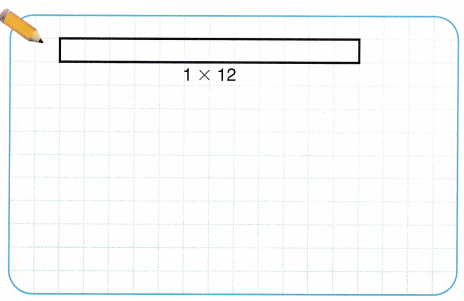
Use a grid to show all the possible arrangements of 12 and 13 tables.

Label each drawing with the factors modeled.
Texas Go Math Grade 5 Lesson 7.2 Answer Key 1

ERROR Alert
The same factors in a different order should be counted only once. For example, 3 × 4 and 4 × 3 are the same factor pair.

So, there are more ways to arrange ___________ tables.
Answer:

Math Talk
Mathematical Processes

Explain how knowing whether 12 and 13 are prime or helped you solve the problem above.
Answer:

• A prime number is a whole number greater than 1 that has exactly two factors, 1 and itself.
• A composite number ¡s a whole number greater than 1 that has more than two factors.
Factors of 12: _______ , _______, _______ , _______ , _______ , _____
Factors of 13: _______, _______
12 is a _______ number, and 13 is a _______ number.
Answer:
Factors of 12: 1 , 2, 3 , 4 , 6, 12
Factors of 13: 1, 13
12 is a composite number, and 13 is a prime number.

Divisibility You can use divisibility rules to help tell whether a number is prime or composite. If a number is divisible by any number other than 1 and itself, then the number is composite.

Math Idea
The number 1 is neither prime nor composite, since it has only one factor: 1.

Tell whether 51 is prime or composite.
Is 51 divisible by 2? _______________________
Is 51 divisible by 3? _______________________
Think: 51 is divisible by a number other than 1 and 51. 51 has more than two factors.
So, 51 is ____________.
Answer:
Is 51 divisible by 2? No
Is 51 divisible by 3? Yes, 51 ÷ 3 = 17
51 is divisible by a number other than 1 and 51. 51 has more than two factors.
So, 51 is composite number.
Explanation:
51 is not a prime number because there are three factors of 51. By the division method, we find that 1, 3,17, and 51 divide 51 evenly without any remainder. Hence, any number that has more than 2 factors is called as composite number. So, 51 is composite number.

Share and Show

Tell whether the number is prime or composite.

Question 1.
11
Think: Does 11 have other factors besides 1 and itself?
Answer:
The factors of 11 are 1, 11. So, 11 is a prime number.
Explanation:
11 is a prime number. The number 11 is divisible only by 1 and the number itself. For a number to be classified as a prime number, it should have exactly two factors.

Go Math Grade 5 Lesson 7.2 Answer Key Question 2.
73
Answer:
The factors of 73 are 1, 73. So, 73 is a prime number.
Explanation:
73 is a prime number. The number 73 is divisible only by 1 and the number itself. For a number to be classified as a prime number, it should have exactly two factors. Since 73 has exactly two factors, 1 and 73, it is a prime number.

Question 3.
69
Answer:
1 x 69 = 69
3 x 23 = 69
So, 69 is a composite number.
Explanation:
69 is a composite number because 69 has more than 2 factors. The factors of 69 are 1, 3, 23, 69.

Question 4.
42
Answer:
1 x 42 = 42
2 x 21 = 42
3 x 14 = 42
6 x 7 = 42
So, 42 is a composite number.
Explanation:
42 is a composite number because 42 has more than 2 factors. The factors of 42 are 1, 2, 3, 6, 7, 14, 21, and 42.

Math Talk
Mathematical Processes

Is the product of two prime numbers prime or composite? Explain.
Answer:

Problem Solving

H.O.T. Analyze Write true or false for each statement. Explain or give an example to support your answer.

Question 5.
The number 1 is not prime.
Answer:
True, The number 1 is not prime.
Number 1 has positive divisors as 1 and itself. According to the definition of prime numbers, any number having only two positive divisors are known as prime numbers. So,1 is not a prime number and it is not a composite number.

Question 6.
A composite number cannot have three factors.
Answer:
False, A composite number can have three factors.
Explanation:
Composite numbers are whole numbers that have at least three factors. Prime numbers have two factors one and itself. For example, the only factors for 2 is 1 and 2 (1 x 2). However, 4 has three factors 1, 2, and 4 (1 x 4 and 2 x 2).

Question 7.
Only odd numbers are prime numbers.
Answer:
False, The prime number 2 is a even number.
Explanation:
A prime number is a positive integer having exactly two factors. If p is a prime, then it’s only factors are necessarily 1 and p itself. The first ten primes are 2, 3, 5, 7, 11, 13, 17, 19, 23, 29.

Question 8.
Every multiple of 7 is a composite number.
Answer:
False
Multiples of 7: 7, 14, 21, 28, 35, 42, 49, 56, 63, 70…..
Explanation:
The numbers which can be generated by multiplying the two smallest positive integers and containing at least one divisor other than the number ‘1’ and itself are known as composite numbers. These numbers always have more than two factors. The number 7 itself is a multiple of 7 [7 * 1 = 7] and it is not a composite.

Go Math Answer Key Grade 5 Lesson 7.2 Question 9.
H.O.T. Name a 2-digit odd number that is prime. Name a 2-digit odd number that is composite.
Answer:
The 2-digit odd number 11 is prime number.
The 2-digit odd number 69 is composite number.
Explanation:
The 2 digit means it has two numbers. A prime number is a positive integer having exactly two factors. Prime meaning its factors must be 1 and itself, and it also must be odd number. The 2-digit odd number 11 is prime number.
The 2 digit means it has two numbers. In Mathematics, composite numbers are numbers that have more than two factors. The 2-digit odd number 69 is composite number. 69 is a composite number because 69 has more than 2 factors. The factors of 69 are 1, 3, 23, 69.

Problem Solving

Eratosthenes was a Greek mathematician who lived more than 2,200 years ago. He invented a method of finding prime numbers, which is now called the Sieve of Eratosthenes.

Question 10.
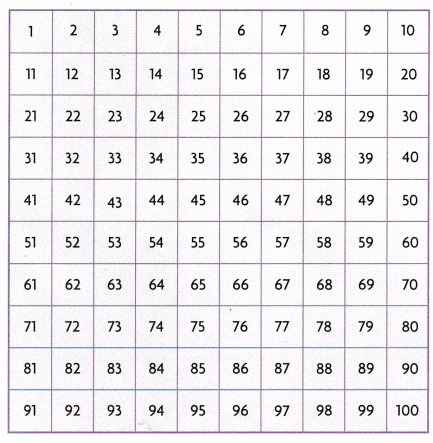
Multi-Step Follow the steps below to circle all prime numbers less than 100. Then list the prime numbers.

STEP 1:
Cross out 1, since 1 is not prime.

STEP 2:
Circle 2, since it is prime. Cross out all other multiples of 2.

STEP 3:
Circle the next number that is not crossed out. This number is prime. Cross out all the multiples of this number.

STEP 4:
Repeat Step 3 until every number is either circled or crossed out.

Texas Go Math Grade 5 Lesson 7.2 Answer Key 2
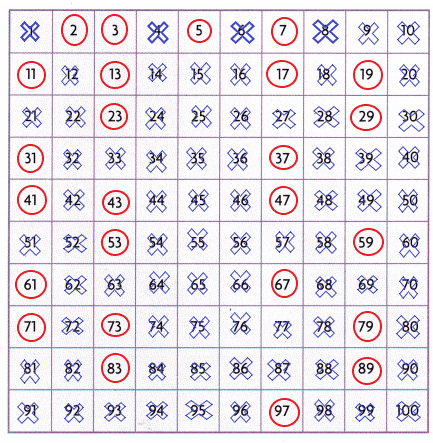
So, the prime numbers less than 100 are _______________
Answer:
Texas-Go-Math-Grade-5-Lesson-7.2-Answer-Key-2
So, the prime numbers less than 100 are 2, 3, 5, 7, 11, 13, 17, 19, 23, 29, 31, 37, 41, 43, 47, 53, 59, 61, 67, 71, 73, 79, 83, 89, 97.

Question 11.
H.O.T. Explain why the multiples of any number other than 1 are not prime numbers.
Texas Go Math Grade 5 Lesson 7.2 Answer Key 3
Answer:

Daily Assessment Task

Fill in the bubble completely to show your answer.

Question 12.
Reasoning Talia’s locker combination consists of three prime numbers. The sum of these numbers is also a prime number. Which of these might be her combination?
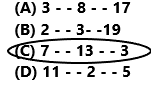
(A) 3 – – 8 – – 17
(B) 2 – – 3- -19
(C) 7 – – 13 – – 3
(D) 11 – – 2 – – 5
Answer:
Texas-Go-Math-Grade-5-Lesson-7.2-Answer-Key-3(1)
7 + 13 + 3 = 23
The sum of above prime numbers is also a prime number.
So, option C is correct.
Explanation:
Talia’s locker combination consists of three prime numbers. The sum of these numbers is also a prime number. The combination is 7 – – 13 – – 3. Add these three prime numbers the sum is 23. 23 is also a prime number. So, option C is correct.

Question 13.
A certain number is a whole number. If the number is also composite, what must be true about the number?
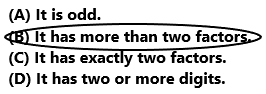
(A) It is odd.
(B) It has more than two factors.
(C) It has exactly two factors.
(D) It has two or more digits.
Answer:
Texas-Go-Math-Grade-5-Lesson-7.2-Answer-Key-3(2)
So, option B is correct.
Explanation:
A certain number is a whole number. If the number is also composite then it has more than two factors. So, option B is correct.

5th Grade Go Math Practice and Homework Lesson 7.2 Answer Key Question 14.
Multi-Step The sum of three prime numbers is 12. What could the numbers be?
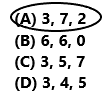
(A) 3, 7, 2
(B) 6, 6, 0
(C) 3, 5, 7
(D) 3, 4, 5
Answer:
Texas-Go-Math-Grade-5-Lesson-7.2-Answer-Key-3(3)
3 + 7 + 2 = 12
So, option A is correct.
Explanation:
The three prime numbers are 3, 7, 2. The sum of these three prime numbers is 12. So, option A is correct.

Texas Test Prep

Question 15.
The number 2 is
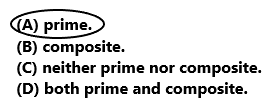
(A) prime.
(B) composite.
(C) neither prime nor composite.
(D) both prime and composite.
Answer:
Texas-Go-Math-Grade-5-Lesson-7.2-Answer-Key-3(4)
So, option A is correct.
Explanation:
The number 2 is a prime number. So, option A is correct.

Texas Go Math Grade 5 Lesson 7.2 Homework and Practice Answer Key

Tell whether the number is prime or composite.

Question 1.
19
Answer:
1 x 19 = 19
So, the number 19 is a prime number.
Explanation:
Prime numbers are the positive integers having only two factors, 1 and the integer itself. The factors of 19 are 1, 19. So the number 19 is a prime number.

Question 2.
81
Answer:
The factors of 81 are 1, 3, 9, 27, 81
So, the number 81 is a composite number.
Explanation:
A composite number is a number that can be divided evenly by more numbers than 1 and itself. It is the opposite of a prime number. The number 81 can be evenly divided by 1, 3, 9, 27 and 81, with no remainder. Since 81 cannot be divided by just 1 and 81. So, it is a composite number.

Question 3.
52
Answer:
The factors of 52 are 1, 2, 4, 13, 26, 52.
So, the number 52 is a composite number.
Explanation:
The number 52 has more than two factors. The factors of 52 are 1, 2, 4, 13, 26, 52. In other words, 52 is a composite number because 52 has more than 2 factors.

Question 4.
23
Answer:
1 x 23 = 23
So, the number 23 is a prime number.
Explanation:
Prime numbers are the positive integers having only two factors, 1 and the integer itself. The factors of 23 are 1, 23. So the number 23 is a prime number.

Question 5.
33
Answer:
The factors of 33 are 1, 3, 11, 33.
So, the number 33 is a composite number.
Explanation:
A composite number is a number that can be divided evenly by more numbers than 1 and itself. The number 33 can be evenly divided by 1, 3, 11 and 33, with no remainder. Since 33 cannot be divided by just 1 and 33. So, 33 is a composite number.

Go Math Grade 5 Lesson 7.2 Homework Answer Key Question 6.
60
Answer:
The factors of 60 are 1, 2, 3, 4, 5, 6, 10, 12, 15, 20, 30, 60.
So, the number 60 is a composite number.
Explanation:
A composite number is a number that can be divided evenly by more numbers than 1 and itself. The number 60 can be evenly divided by 1, 2, 3, 4, 5, 6, 10, 12, 15, 20, 30, 60, with no remainder. Since 60 cannot be divided by just 1 and 60. So, 60 is a composite number.

Question 7.
31
Answer:
1 x 31 = 31
So, the number 31 is a prime number.
Explanation:
Prime numbers are the positive integers having only two factors, 1 and the integer itself. The factors of 31 are 1, 31. So the number 31 is a prime number.

Question 8.
25
Answer:
The factors of 25 are 1, 5, 25.
So, the number 25 is a composite number.
Explanation:
A composite number is a number that can be divided evenly by more numbers than 1 and itself. The number 25 can be evenly divided by 1, 5, 25, with no remainder. Since 25 cannot be divided by just 1 and 25. So, 25 is a composite number.

Write true or false for each statement. Explain or give an example to support your answer.

Question 9.
A prime number is always greater than 1.
Answer:
True, A prime number is always greater than 1.
Prime numbers are 2, 3, 5, 7, 11, 13…..
Explanation:
A prime number is a whole number greater than 1. It has exactly two factors, that is, 1 and the number itself. There is only one even prime number, that is, 2. Any two prime numbers are always co-prime to each other. So the given statement is True.

Question 10.
The number 17 is a prime number.
Answer:
True, The number 17 is a prime number.
Explanation:
A prime number is a whole number greater than 1. It has exactly two factors, that is, 1 and the number itself. The factors of 17 is 1, 17. The number 17 is a prime number. So the given statement is True.

Question 11.
Every multiple of 5 is a composite number.
Answer:
True, Every multiple of 5 is a composite number.
Explanation:
In Mathematics, composite numbers are numbers that have more than two factors. The multiples of 5 are 10, 15, 20, 25, 30, 35 and so on. The above-given statement is true. Every multiple of 5 is a composite number. Except for 5 because 5 is a prime number.

Practice and Homework Lesson 7.2 Go Math Grade 5 Question 12.
A number can be both prime and composite.
Answer:
False, A number cannot be both prime and composite numbers.
Explanation:
Numbers can be classified on the basis of the number of factors they have. If a number has just two factors – 1 and the number itself, then it is a prime number. However, most numbers have more than two factors, and they are called composite numbers. The opposite of composite is prime numbers. So, the above-given statement is false.

Problem Solving

Question 13.
The students in math class use square tiles to make arrays. Celia says they can make more arrays with 8 tiles than with 9 tiles because 8 has more factors. Is Celia correct? Explain.
Answer:

Lesson Check

Fill in the bubble completely to show your answer.

Question 14.
Four boys compare the numbers on their football jerseys. Parker has the number 55. Nick has 47. Marshall has 16, and Leon has 9. Whose jersey has a prime number?
(A) Parker
(B) Nick
(C) Marshall
(D) Leon
Answer:
Texas-Go-Math-Grade-5-Lesson-7.2-Answer-Key-3(5)
The number on the Nick jersey is 47. Where 47 is a prime number.
So, option B is correct.
Explanation:
Four boys compare the numbers on their football jerseys. Parker has the number 55. Nick has 47. Marshall has 16, and Leon has 9. The number on the Nick jersey is 47. The factors of 47 is 1, 47. Where 47 is a prime number. So, option B is correct.

Question 15.
Harlan played her favorite game app three times this morning. In each game, the number of points she scored was a prime number. When she adds the points for the three games together, the sum is also a prime number. Which of these might be her scores?
(A) 17, 19, 20
(B) 11, 17, 21
(C) 21, 23, 13
(D) 29, 19, 23
Answer:
Texas-Go-Math-Grade-5-Lesson-7.2-Answer-Key-3(6)
She scored 29, 19, 23 points in each game.
29 + 19 + 23 = 71
The points 29, 19, 23 are prime numbers. The sum of these three points is 71.  It is also a prime number.
So, option D is correct.
Explanation:
Harlan played her favorite game app three times this morning. In each game, the number of points she scored was a prime number. She scored 29, 19, 23 points in each game. When she adds the points for the three games together, the sum is also a prime number. The sum of these three points is 71. So, option D is correct.

Question 16.
Esteban made a list of prime numbers less than 40. He listed the numbers in order from least to greatest. Which number did Esteban put on his list after 29?
(A) 41
(B) 23
(C) 33
(D) 31
Answer:
Texas-Go-Math-Grade-5-Lesson-7.2-Answer-Key-3(7)
The prime number that Esteban put on his list after 29 is 31.
So, option D is correct.
Explanation:
Esteban made a list of prime numbers less than 40. He listed the numbers in order from least to greatest. The prime numbers less than 40 are 2, 3, 5, 7, 11, 13, 17, 19, 23, 29, 31, 37. The prime number that Esteban put on his list after 29 is 31. So, option D is correct.

Question 17.
Carolyn found that the difference between two prime numbers is a composite number. Which could be the prime numbers?
(A) 2, 5
(B) 13, 2
(C) 23, 19
(D) 13, 11
Answer:
Texas-Go-Math-Grade-5-Lesson-7.2-Answer-Key-3(8)
23 – 19 = 4
The number 4 is a composite number.
So, option C is correct.
Explanation:
Carolyn found that the difference between two prime numbers is a composite number. The prime numbers are 23, 19. Subtract 19 from 23 the difference is 4. The number 4 is a composite number. So, option C is correct.

5th Grade Go Math Homework Answer Key Question 18.
Multi-Step Trisha spins a spinner. The pointer lands on three prime numbers. She says the sum is less than 12. Which could be the numbers?
(A) 2, 3, 5
(B) 2, 4, 5
(C) 2, 7, 3
(D) 0, 9, 1
Answer:
Texas-Go-Math-Grade-5-Lesson-7.2-Answer-Key-3(9)
The three prime numbers are 2, 3, 5.
2 + 3 + 5 = 10
So, option A is correct.
Explanation:
Trisha spins a spinner. The pointer lands on three prime numbers. The three prime numbers are 2, 3, 5. She says the sum is less than 12. Add 2 with 3 and 5 the sum is 10. So, option A is correct.

Question 19.
Multi-Step Felix found the sum of two prime numbers and one composite number to be 45. The difference between the greatest and least number is 4. Which could be the three numbers?
(A) 13, 17, 15
(B) 18, 14, 13
(C) 15, 14, 16
(D) 11, 19, 12
Answer:
Texas-Go-Math-Grade-5-Lesson-7.2-Answer-Key-3(10)
The three numbers are 13, 17 , 15.
17 – 13 = 4
So, option A is correct.
Explanation:
Felix found the sum of two prime numbers and one composite number to be 45. The two prime numbers are 13, 17 and composite number is 15. The greatest number is 17 and the least number is 13. The difference between the greatest and least number is 4. Subtract 13 from 17 the difference is 4. So, option A is correct.

Texas Go Math Grade 5 Lesson 7.2 Answer Key Prime and Composite Numbers Read More »

Texas Go Math Grade 5 Lesson 6.6 Answer Key Fraction and Whole-Number Division

Refer to our Texas Go Math Grade 5 Answer Key Pdf to score good marks in the exams. Test yourself by practicing the problems from Texas Go Math Grade 5 Lesson 6.6 Answer Key Fraction and Whole-Number Division.

Texas Go Math Grade 5 Lesson 6.6 Answer Key Fraction and Whole-Number Division

Unlock the Problem

Three friends share a \(\frac{1}{4}\)-pound block of fudge equally. What fraction of a pound of fudge does each friend get?

Divide, \(\frac{1}{4}\) ÷ 3
Let the rectangle represent a 1-pound block of fudge.
Divide the rectangle into fourths and then divide each fourth into three equal parts.
The rectangle is now divided into ___________ equals parts.
Texas Go Math Grade 5 Lesson 6.6 Answer Key 1
When you divide one fourth into 3 equal parts, you are finding one of three equal parts or \(\frac{1}{3}\) of \(\frac{1}{4}\). Shade \(\frac{1}{3}\) of \(\frac{1}{4}\).
The shaded part is ___________ of the whole rectangle.
So, each friend gets ____________ of a pound of fudge.
Answer:
Divide, 1/4 ÷ 3
Let the rectangle represent a 1-pound block of fudge.
Divide the rectangle into fourths and then divide each fourth into three equal parts.
The rectangle is now divided into 12 equals parts.
Texas-Go-Math-Grade-5-Lesson-6.6-Answer-Key-1
When we divide one fourth into 3 equal parts, we are finding one of three equal parts or 1/3 of 1/4. Shade 1/3 of 1/4.
The shaded part is 1/12 of the whole rectangle.
So, each friend gets 1/12  of a pound of fudge.

Example

Brad has 9 pounds of ground turkey to make turkey burgers for a picnic. How many \(\frac{1}{3}\)-pound turkey burgers can he make?

Divide. 9 ÷ \(\frac{1}{3}\)
Draw 9 rectangles to represent each pound of ground turkey. Divide each rectangle into thirds.
When you divide the _________ rectangles into thirds, you are finding the number of thirds in 9 rectangles or finding 9 groups of _______. There are ________ thirds.
Texas Go Math Grade 5 Lesson 6.6 Answer Key 2
Complete the number sentence.
So, Brad can make ________ one-third-pound turkey burgers.
Answer:
Divide. 9 ÷ 1/3
Draw 9 rectangles to represent each pound of ground turkey. Divide each rectangle into thirds.
When we divide the 9 rectangles into thirds, we are finding the number of thirds in 9 rectangles or finding 9 groups of 3. There are 27 thirds.
Texas-Go-Math-Grade-5-Lesson-6.6-Answer-Key-2
Complete the number sentence.
9 ÷ 1/3 = 9 x 3 = 27
So, Brad can make 27 one-third-pound turkey burgers.

Math Talk
Mathematical Processes

Will the number of turkey burgers be less than or greater than 9? Explain.
Answer:
The number of turkey burgers are greater than 9.

Share and Show

Question 1.
Use the model to complete the number sentence.
Texas Go Math Grade 5 Lesson 6.6 Answer Key 3
Answer:
Texas-Go-Math-Grade-5-Lesson-6.6-Answer-Key-3
Explanation:
In the above image we can observe 2 rectangles. Divide 2 ÷ 1/4. Draw 2 rectangles and divide each rectangle into fourths. When we divide the 2 rectangles into fourths, we are finding the number of fourths in 2 rectangles or finding 2 groups of 4. There are 8 fourths.

Go Math 5th Grade Lesson 6.6 Answer Key Question 2.
Use the model to divide.
Texas Go Math Grade 5 Lesson 6.6 Answer Key 4
Answer:
Texas-Go-Math-Grade-5-Lesson-6.6-Answer-Key-4
Explanation:
In the above image we can observe 12 blocks. Divide, 1/6 ÷ 2. Divide the rectangle into sixths and then divide each sixths into two equal parts. The rectangle is now divided into 12 equals parts. When we divide one sixth into two equal parts, we are finding one of two equal parts or 1/2 of 1/6. Shaded 1/2 of 1/6. The shaded part is 1/12 of the whole rectangle.

Problem Solving

Divide.

Question 3.
5 ÷ \(\frac{1}{3}\)
Answer:
5 ÷ 1/3 = 5 x 3 = 15
Explanation:
In the above division problem 5 ÷ 1/3 we can observe that the whole number is divided by a fraction. Divide 5 by 1/3 the result is 15. The result 15 is obtained by multiplying 5 with 3.

Question 4.
8 ÷ \(\frac{1}{2}\)
Answer:
8 ÷ 1/2 = 8 x 2 = 16
Explanation:
In the above division problem 8 ÷ 1/2 we can observe that the whole number is divided by a fraction. Divide 8 by 1/2 the result is 16. The result 16 is obtained by multiplying 8 with 2.

Question 5.
\(\frac{1}{7}\) ÷ 4
Answer:
1/7 ÷ 4 = 1/7 x 1/4 = 1/28
Explanation:
In the above division problem 1/7 ÷ 4 we can observe that the fraction is divided by a whole number. Divide 1/7 by 4 the result is 1/28. The result 1/28 is obtained by multiplying 1/7 with 1/4.

Question 6.
\(\frac{1}{3}\) ÷ 4
Answer:
1/3 ÷ 4 = 1/3 x 1/4 = 1/12
Explanation:
In the above division problem 1/3 ÷ 4 we can observe that the fraction is divided by a whole number. Divide 1/3 by 4 the result is 1/12. The result 1/12 is obtained by multiplying 1/3 with 1/4.

Lesson 6.6 Answer Key 5th Grade Go Math Question 7.
\(\frac{1}{4}\) ÷ 12
Answer:
1/4 ÷ 12 = 1/4 x 1/12 = 1/48
Explanation:
In the above division problem 1/4 ÷ 12 we can observe that the fraction is divided by a whole number. Divide 1/4 by 12 the result is 1/48. The result 1/48 is obtained by multiplying 1/4 with 1/12.

Question 8.
6 ÷ \(\frac{1}{5}\)
Answer:
6 ÷ 1/5 = 6 x 5 = 30
Explanation:
In the above division problem 6 ÷ 1/5 we can observe that the whole number is divided by a fraction. Divide 6 by 1/5 the result is 30. The result 30 is obtained by multiplying 6 with 5.

Question 9.
Write Math Communicate Describe how the model shows that dividing by \(\frac{1}{2}\) is the same as multiplying by 2.
Texas Go Math Grade 5 Lesson 6.6 Answer Key 5
Answer:
The model shows that there are 8 halves in 4 wholes, and it shows that 4 groups of 2 is 8.
Explanation:
In the above image we can observe that whole number is divided by a fraction. If we divide 4 by 1/2 then the result is 8. Because when we multiply 8 with 1/2 the product is 4. So, dividing by 1/2 is same as multiplying by 2.

Question 10.
Describe how the model shows that dividing by 2 is the same as finding \(\frac{1}{2}\) of \(\frac{1}{4}\).
Texas Go Math Grade 5 Lesson 6.6 Answer Key 6
Answer:
The model shows that 1/4 divided into 2 equal groups is 1/8, and it shows that 1/2 of 1/4 is 1/8.
Explanation:
In the above image we can observe 8 blocks. Divide, 1/4 ÷ 2. Divide the rectangle into fourths and then divide each fourths into two equal parts. The rectangle is now divided into 8 equals parts. When we divide one fourth into two equal parts, we are finding one of two equal parts or 1/2 of 1/4. Shaded 1/2 of 1/4. The shaded part is 1/8 of the whole rectangle.

Unlock the Problem

Question 11.
Multi-Step The slowest mammal is the three-toed sloth. The top speed of a three-toed sloth on the ground is about \(\frac{1}{4}\) foot per second. The top speed of a giant tortoise on the ground is about \(\frac{1}{3}\) foot per second. How much longer would it take a three-toed sloth than a giant tortoise to travel 10 feet on the ground?
Texas Go Math Grade 5 Lesson 6.6 Answer Key 7
(A) 10 seconds
(B) 30 seconds
(C) 40 seconds
(D) 70 seconds

a. What do you need to find?
Answer:

b. What operations will you use to solve the problem?
Answer:

c. Show the steps you used to solve the problem.
Answer:

d. Complete the sentences.
A three-toed sloth would travel 10 feet in __________ seconds.
A giant tortoise would travel 10 feet in __________ seconds.
Since _______ – _________ = _________.
it would take a three-toed sloth _________ seconds longer to travel 10 feet.
Answer:

e. Fill in the bubble for the correct answer choice.
Answer:

Go Math Lesson 6.6 Answer Key 5th Grade Question 12.
Robert divides 8 cups of almonds into \(\frac{1}{8}\)-cup servings. How many servings does he have?
Answer:
8 ÷ 1/8 = 8 x 8 = 64
He have 64 servings.
Explanation:
Robert divides 8 cups of almonds into 1/8-cup servings. In this division problem 8 ÷ 1/8 we can observe that the whole number is divided by a fraction. Divide 8 by 1/8 the result is 64. The result 64 is obtained by multiplying 8 with 8. So, Robert have 64 servings.

Daily Assessment Task

Fill In the bubble completely to show your answer.

Question 13.
Your friend asks you to watch his iguana. He gives you 1/3 pound of food for 4 days. He tells you if you feed the iguana the same amount each day, you will have no food left over. How much food should you feed the iguana each day?
(A) \(\frac{1}{7}\) pound
(B) 7 pounds
(C) 12 pounds
(D) \(\frac{1}{12}\) pound
Answer:

Question 14.
Representations lake modeled a division problem. Which problem does his model represent?
Texas Go Math Grade 5 Lesson 6.6 Answer Key 8
Answer:
Texas-Go-Math-Grade-5-Lesson-6.6-Answer-Key-8
The number sentence is 6 ÷ 1/4 = 6 x 4 = 24
So, Option A is correct.
Explanation:
Divide 6 ÷ 1/4. Draw 6 rectangles and divide each rectangle into fourths. When we divide the 6 rectangles into fourths, we are finding the number of fourths in 6 rectangles or finding 6 groups of 4. There are 24 fourths.
The problem 6 ÷ 1/4 represents the above model. So, draw a circle for option A.

Question 15.
Multi-Step Five people are going to share \(\frac{1}{4}\) gallon of juice. After the juice is poured equally, Sheila gives her glass to Maria. How much juice does Maria have?
(A) \(\frac{1}{40}\) gal
(B) \(\frac{4}{16}\) gal
(C) \(\frac{1}{10}\) gal
(D) \(\frac{1}{20}\) gal
Answer:
Texas-Go-Math-Grade-5-Lesson-6.6-Answer-Key-8(1)
1/4 ÷ 5 = 1/20
1/20 + 1/20 = 2/20 = 1/10
Maria have 1/10 gallon of juice.
So, option C is correct.
Explanation:
Five people are going to share 1/4 gallon of juice. The juice is poured equally. divide 1/4 by 5 the result is 1/20. After the juice is poured equally. Sheila gives her glass to Maria. Add 1/20 with 1/20 the sum is 1/10. So, Maria has 1/10 gallon of juice. Draw a circle for option C.

Texas Test Prep

Go Math Lesson 6.6 5th Grade Fraction and Whole Number Division Question 16.
Tina cuts \(\frac{1}{3}\) yard of fabric into 4 equal parts. What is the length of each part?
(A) 12 yards
(B) 1\(\frac{1}{3}\) yards
(C) 3\(\frac{2}{3}\) yards
(D) \(\frac{1}{12}\) yard
Answer:
Texas-Go-Math-Grade-5-Lesson-6.6-Answer-Key-8(2)
1/3 ÷ 4 = 1/3 x 1/4 = 1/12
The length of each part is 1/12.
So, option D is correct.
Explanation:
Tina cuts 1/3 yard of fabric into 4 equal parts. Divide 1/3 by 4 the result is 1/12. The result 1/12 is obtained by multiplying 1/3 with 1/4. The length of each part is 1/12. So, draw a circle for option D.

Texas Go Math Grade 5 Lesson 6.6 Homework and Practice Answer Key

Divide.

Question 1.
6 ÷ \(\frac{1}{3}\)
Answer:
6 ÷ 1/3 = 6 x 3 = 18
Explanation:
In the above division problem 6 ÷ 1/3 we can observe that the whole number is divided by a fraction. Divide 6 by 1/3 the result is 18. The result 18 is obtained by multiplying 6 with 3.

Question 2.
4 ÷ \(\frac{1}{8}\)
Answer:
4 ÷ 1/8 = 4 x 8 = 32
Explanation:
In the above division problem 4 ÷ 1/8 we can observe that the whole number is divided by a fraction. Divide 4 by 1/8 the result is 32. The result 32 is obtained by multiplying 4 with 8.

Question 3.
\(\frac{1}{3}\) ÷ 9
Answer:
1/3 ÷ 9 = 1/3 x 1/9 = 1/27
Explanation:
In the above division problem 1/3 ÷ 9 we can observe that the fraction is divided by a whole number. Divide 1/3 by 9 the result is 1/27. The result 1/27 is obtained by multiplying 1/3 with 1/9.

Go Math 5th Grade Practice and Homework Lesson 6.6 Answer Key Question 4.
7 ÷ \(\frac{1}{2}\)
Answer:
7 ÷ 1/2 = 7 x 2 = 14
Explanation:
In the above division problem 7 ÷ 1/2 we can observe that the whole number is divided by a fraction. Divide 7 by 1/2 the result is 14. The result 14 is obtained by multiplying 7 with 2.

Question 5.
8 ÷ \(\frac{1}{3}\)
Answer:
8 ÷ 1/3 = 8 x 3 = 24
Explanation:
In the above division problem 8 ÷ 1/3 we can observe that the whole number is divided by a fraction. Divide 8 by 1/3 the result is 24. The result 24 is obtained by multiplying 8 with 3.

Question 6.
\(\frac{1}{4}\) ÷ 4
Answer:
1/4 ÷ 4 = 1/4 x 1/4 = 1/16
Explanation:
In the above division problem 1/4 ÷ 4 we can observe that the fraction is divided by a whole number. Divide 1/4 by 4 the result is 1/16. The result 1/16 is obtained by multiplying 1/4 with 1/4.

Question 7.
9 ÷ \(\frac{1}{4}\)
Answer:
9 ÷ 1/4 = 9 x 4 = 36
Explanation:
In the above division problem 9 ÷ 1/4 we can observe that the whole number is divided by a fraction. Divide 9 by 1/4 the result is 36. The result 36 is obtained by multiplying 9 with 4.

Question 8.
\(\frac{1}{7}\) ÷ 2
Answer:
1/7 ÷ 2 = 1/7 x 1/2 = 1/14
Explanation:
In the above division problem 1/7 ÷ 2 we can observe that the fraction is divided by a whole number. Divide 1/7 by 2 the result is 1/14. The result 1/14 is obtained by multiplying 1/7 with 1/2.

Go Math Lesson 6.6 Answer Key Homework 5th Grade Question 9.
10 ÷ \(\frac{1}{5}\)
Answer:
10 ÷ 1/5 = 10 x 5 = 50
Explanation:
In the above division problem 10 ÷ 1/5 we can observe that the whole number is divided by a fraction. Divide 10 by 1/5 the result is 50. The result 50 is obtained by multiplying 10 with 5.

Question 10.
5 ÷ \(\frac{1}{5}\)
Answer:
5 ÷ 1/5 = 5 x 5 = 25
Explanation:
In the above division problem 5 ÷ 1/5 we can observe that the whole number is divided by a fraction. Divide 5 by 1/5 the result is 25. The result 25 is obtained by multiplying 5 with 5.

Question 11.
\(\frac{1}{5}\) ÷ 12
Answer:
1/5 ÷ 12 = 1/5 x 1/12 = 1/60
Explanation:
In the above division problem 1/5 ÷ 12 we can observe that the fraction is divided by a whole number. Divide 1/5 by 12 the result is 1/60 The result 1/60 is obtained by multiplying 1/5 with 1/12.

Question 12.
\(\frac{1}{9}\) ÷ 5
Answer:
1/9 ÷ 5 = 1/9 x 1/5 = 1/45
Explanation:
In the above division problem 1/9 ÷ 5 we can observe that the fraction is divided by a whole number. Divide 1/9 by 5 the result is 1/45. The result 1/45 is obtained by multiplying 1/9 with 1/5.

Problem Solving

Question 13.
Cooks at a food booth at the state fair made an extra-large 8-foot long burrito. If they cut the burrito into \(\frac{1}{4}\)-foot servings, how many people will the extra-large burrito serve?
Answer:
8 ÷ 1/4 = 8 x 4 = 32
The extra-large burrito is served by 32 people.
Explanation:
Cooks at a food booth at the state fair made an extra-large 8-foot long burrito. They cut the burrito into 1/4-foot servings. Divide 8 by 1/4 the result is 32. So, the extra-large burrito is served by 32 people.

Go Math 5th Grade Lesson 6.6 Homework Answer Key Question 14.
A serving of the burrito contains \(\frac{1}{4}\) pound of meat. Franklin and two friends share his serving equally. How much meat does each friend get?
Answer:
1/4 ÷ 3 = 1/12
Each friend get 1/12 meat.
Explanation;
A serving of the burrito contains 1/4 pound of meat. Franklin and two friends share his serving equally. Divide 1/4 by 3 the result is 1/12.

Lesson Check

Fill in the bubble completely to show your answer.

Question 15.
Toby used the model below to help him divide.
Texas Go Math Grade 5 Lesson 6.6 Answer Key 9
Which problem was he trying to solve?
(A) \(\frac{1}{6}\) ÷ 2
(B) 2 ÷ 6
(C) 2 ÷ \(\frac{1}{6}\)
(D) 2 × \(\frac{1}{6}\)
Answer:
Texas-Go-Math-Grade-5-Lesson-6.6-Answer-Key-9(1)

The number sentence is 2 ÷ 1/6 = 2 x 6 = 12
So, Option C is correct.
Explanation:
Divide 2 ÷ 1/6. Draw 2 rectangles and divide each rectangle into sixths. When we divide the 2 rectangles into sixths, we are finding the number of sixths in 2 rectangles or finding 2 groups of 6. There are 12 sixths.
The problem 2 ÷ 1/6 represents the above model. So, draw a circle for option C.

Question 16.
Which model shows the solution for \(\frac{1}{2}\) ÷ 3?
Texas Go Math Grade 5 Lesson 6.6 Answer Key 10
Answer:
Texas-Go-Math-Grade-5-Lesson-6.6-Answer-Key-10
1/2 ÷ 3 = 1/6
So, option A is correct.
Explanation:
Divide, 1/2 ÷ 3. Divide the rectangle into 1/2 and then divide each 1/2 into three equal parts. The rectangle is now divided into 6 equal parts. When we divide 1/2 into two equal parts, we are finding one of two equal parts or 1/2 of 1/3.  The shaded part is 1/6 of the whole rectangle. So, draw a circle for option A.

Go Math Grade 5 Lesson 6.6 Homework Answers Question 17.
Analise cuts \(\frac{1}{2}\) yard of rope into 8 equal parts. What is the length of each part?
(A) \(\frac{1}{16}\) yard
(B) \(\frac{1}{10}\) yard
(C) \(\frac{1}{4}\) yard
(D) \(\frac{1}{6}\) yard
Answer:
Texas-Go-Math-Grade-5-Lesson-6.6-Answer-Key-10(1)
1/2 ÷ 8 = 1/16
The length of each part is 1/16.
So, option A is correct.
Explanation:
Analise cuts 1/2 yard of rope into 8 equal parts. Divide 1/2 by 8 the result is 1/16. The result 1/16 is obtained by multiplying 1/2 with 1/8. So, draw a circle for option A.

Question 18.
The dragon costume for the new year celebration is 9 yards long. If Brittany sews a button on each \(\frac{1}{6}\)-yard section, how many buttons will she sew?
(A) 63
(B) 56
(C) 15
(D) 54
Answer:
Texas-Go-Math-Grade-5-Lesson-6.6-Answer-Key-10(2)
9 ÷ 1/6 = 9 x 6 = 54
She sewed 54 buttons.
So, option D is correct.
Explanation:
The dragon costume for the new year celebration is 9 yards long. Brittany sews a button on each 1/6-yard section. Divide 9 by 1/6 the result is 54. The result 64 is obtained by multiplying 9 with 6. She sewed 54 buttons. So draw a circle for option D.

Question 19.
Multi-Step Ruby has a collection of 16 stuffed animals. She gives \(\frac{1}{4}\) of her collection to her younger brother. Then she gives half of the remaining animals to her baby sister. How many animals does Ruby give her sister?
(A) 4
(B) 2
(C) 6
(D) 8
Answer:
Texas-Go-Math-Grade-5-Lesson-6.6-Answer-Key-10(3)
16 x (1/4) = 4
She gave 4 of her collections to her younger brother.
16 – 4 = 12
Now, Ruby have 12 animals.
12 ÷ 2 = 6
Ruby gave 6 animals to her sister.
So option C is correct.
Explanation:
Ruby has a collection of 16 stuffed animals. She gives 1/4 of her collection to her younger brother. Multiply 16 with 1/4 the product is 4. She gave 4 of her collections to her younger brother. Subtract 4 from 16 the difference is 12. Then she gives half of the remaining animals to her baby sister. Divide 12 by 2 the result is 6. Ruby gave 6 animals to her sister. So draw a circle for option C.

Go Math 5th Grade Lesson 6.6 Homework Answers Question 20.
Multi-Step Ahmad and Kiera are mixing paints for the students in their art class. They mix 2 pints of blue paint, 2 pints of white paint, and 1 pint of green paint. How many \(\frac{1}{3}\)-pint containers can they fill with mixed paint?
(A) 15
(B) 12
(C) 6
(D) 1\(\frac{2}{3}\)
Answer:
Texas-Go-Math-Grade-5-Lesson-6.6-Answer-Key-10(4)
2 + 2 + 1 = 5
The mixed paint is 5 pints.
5 ÷ 1/3 = 15
So, option A is correct.
Explanation:
Ahmad and Kiera are mixing paints for the students in their art class. They mix 2 pints of blue paint, 2 pints of white paint, and 1 pint of green paint. The total amount of mixed paint is 5 pints. Divide 5 by 1/3 the result is 15. They can fill 15 containers with the mixed paint. So, draw a circle for option A.

Texas Go Math Grade 5 Lesson 6.6 Answer Key Fraction and Whole-Number Division Read More »

Texas Go Math Grade 5 Unit 3 Answer Key Algebraic Reasoning

Refer to our Texas Go Math Grade 5 Answer Key Pdf to score good marks in the exams. Test yourself by practicing the problems from Texas Go Math Grade 5 Unit 3 Answer Key Algebraic Reasoning.

Texas Go Math Grade 5 Unit 3 Answer Key Algebraic Reasoning

Show What You Know

Check your understanding of important skills.

Question 1.
Since 3 × _______ = 12
then 12 ÷ 3 = _________.
Answer:
Since 3 × 4 = 12
then 12 ÷ 3 = 4.
Explanation:
Multiplication is also known as the inverse (or “opposite”) of Division. For example, since , then 12 ÷ 3 = 4.  As such, knowing the multiplication tables can be helpful with division.

Question 2.
Since 48 ÷ 6 = _______.
then _______ × 6 = 48.
Answer:
Since 48 ÷ 6 = 8.
then 8 × 6 = 48.
Explanation:
Division is a basic algebraic operation where we split a number into equal parts of groups. This is expressed as    48 ÷ 6 = 8. Division is also known as the inverse (or “opposite”) of Multiplication. For example, since 48 ÷ 6 = 8 , then 8 x 6 = 48.

Question 3.
Since 7 × _______ = 70
then 70 ÷ 7 = _________.
Answer:
Since 7 × 10 = 70
then 70 ÷ 7 = 10.
Explanation:
Multiplication is also known as the inverse (or “opposite”) of Division. For example, since , then
70 ÷ 7 = 10.  As such, knowing the multiplication tables can be helpful with division.

Question 4.
Since 54 ÷ 9 = _______.
then _______ × 9 = 54.
Answer:
Since 54 ÷ 9 = 6.
then 6 × 9 = 54.
Explanation:
Division is a basic algebraic operation where we split a number into equal parts of groups. This is expressed as    54 ÷ 9 = 6. Division is also known as the inverse (or “opposite”) of Multiplication. For example, since 54 ÷ 9 = 6 , then 6 x 9 = 54.

Missing Factors Find the missing factor.

Question 5.
4 × ______ = 24
Answer:
4 x 6 = 24
Explanation:
The missing factor in the above multiplication operation is 6.

Question 6.
6 × _______ = 36
Answer:
6 x 6 = 36
Explanation:
The missing factor in the above multiplication operation is 6.

Question 7.
________ × 9 = 63
Answer:
7 x 9 = 63
Explanation:
The missing factor in the above multiplication operation is 7.

Question 8.
_________ × 5 = 40
Answer:
8 x 5 = 40
Explanation:
The missing factor in the above multiplication operation is 8.

Question 9.
_________ × 8 = 16
Answer:
2 x 8 = 16
Explanation:
The missing factor in the above multiplication operation is 2.

Question 10.
11 × ________ = 88
Answer:
11 x 8 = 88
Explanation:
The missing factor in the above multiplication operation is 8.

Area Write the area of each figure.

Question 11.
Texas Go Math Grade 5 Unit 3 Answer Key 1
____________ square units
Answer:
Texas-Go-Math-Grade-5-Unit-3-Answer-Key-1
Area of the rectangle = length x breadth
Area of the rectangle = 3 x 6 = 18 square units
The area is 18 square units.
Explanation:
In the above figure we can observe that some area is covered. The covered are is in the shape of rectangle. We have to calculate the area of the rectangle for the above figure. The covered area is 18 square units.

Question 12.
Texas Go Math Grade 5 Unit 3 Answer Key 2
____________ square units
Answer:
Texas-Go-Math-Grade-5-Unit-3-Answer-Key-2
Area is 26 square units.
Explanation:
In the above figure we can observe that some area is covered. We have to calculate the area for the above figure. The covered area is 26 square units.

Question 13.
Texas Go Math Grade 5 Unit 3 Answer Key 3
____________ square units
Answer:
Texas-Go-Math-Grade-5-Unit-3-Answer-Key-3
Area of the rectangle = length x breadth
Area of the rectangle = 1 x 7 = 7 square units
Area is 7 square units.
Explanation:
In the above figure we can observe that some area is covered. The covered area is in the shape of rectangle. We have to calculate the area of the rectangle for the above figure. The covered area is 7 square units.

Question 14.
Texas Go Math Grade 5 Unit 3 Answer Key 4
____________ square units
Answer:
Texas-Go-Math-Grade-5-Unit-3-Answer-Key-4
Area of square = side x side
Area of square = 4 x 4 = 16 square units
Area is 16 square units.
Explanation:
In the above figure we can observe that some area is covered. The covered area is in the shape of square. We have to calculate the area of the square for the above figure. The covered area is 16 square units.

Vocabulary Builder

Visualize It

Match the ✓ words with their examples.

Texas Go Math Grade 5 Unit 3 Answer Key 5
Answer:
Texas-Go-Math-Grade-5-Unit-3-Answer-Key-5

Understand Vocabulary

Complete the sentences with the words.

Question 1.
A ___________ is an ordered set of numbers or objects.
Answer:
A pattern is an ordered set of numbers or objects.

Question 2.
___________ is the distance around a closed plane figure.
Answer:
Perimeter is the distance around a closed plane figure.

Question 3.
A ___________ is a mathematical phrase that has numbers and operation signs but does not have an equal sign.
Answer:
A numerical expression is a mathematical phrase that has numbers and operation signs but does not have an equal sign.

Question 4.
___________ is the measure of the number of unit squares.
Answer:
Area is the measure of the number of units squares.

Question 5.
An ___________ is an algebraic or numerical sentence that shows that two quantities are equal.
Answer:
An equation is an algebraic or numerical sentence that shows that two quantities are equal.

Question 6.
___________ are the symbols used to show which operation or operations in an expression should be done first.
Answer:
Parentheses are the symbols used to show which operation or operations in an expression should be done first.

Question 7.
___________ is the measure of the space a solid figure occupies.
Answer:
Volume is the measure of the space a solid figure occupies.

Question 8.
A ___________ is a number multiplied by another number to find a product.
Answer:
A factor is a number multiplied by another number to find a product.

Reading & Writing Math

Reading When you read a story, you interpret the words, sentences, and paragraphs. When you read math, you have to go beyond words. Often you must analyze graphs and tables to get the information you need.

Read the problem. Study the input/output table.

Vann works part-time for the Transit Authority. He earns $12 an hour. The input column of the input/output table shows the number of hours, x, that he works. The output column shows how much he earns, y. What is the rule for the table?
Texas Go Math Grade 5 Unit 3 Answer Key 6

Writing Keith drives a limo to the airport. He can take 4 passengers at a time. Write a problem that can be answered by using this information and an input/output table. Ask a classmate to solve the problem.
Answer:
Texas Go Math Grade 5 Unit 3 Answer Key 7

Get Ready Game

Make It Even
Object of the Game Make an expression equal to an even number.

Materials
Number/Symbol Cards: 3 sets labeled 0—9, 2 sets labeled +, —
Number of Players 2

Set Up
Give each player a set of symbol cards. Shuffle the number cards and place them face down in a stack.

How to Play

(1) Each player draws 3 number cards from the stack. Players use the number cards and one or two of his or her symbol cards to make an expression.
(2) A player as score is the value of the expression. If the value is an even number, the score is doubled.
(3) Return all the cards to the deck and shuffle. Repeat steps 1-2.
(4) The player with the highest score after 4 rounds wins.
Texas Go Math Grade 5 Unit 3 Answer Key 8
Answer:

Texas Go Math Grade 5 Unit 3 Answer Key Algebraic Reasoning Read More »

Texas Go Math Grade 5 Lesson 9.3 Answer Key Volume of a Cube

Refer to our Texas Go Math Grade 5 Answer Key Pdf to score good marks in the exams. Test yourself by practicing the problems from Texas Go Math Grade 5 Lesson 9.3 Answer Key Volume of a Cube.

Texas Go Math Grade 5 Lesson 9.3 Answer Key Volume of a Cube

Unlock the Problem

Keyshon built the cube shown at the right using centimeter cubes. What is the volume of the cube? Use centimeter cubes to build Keyshon’s cube.

Count the cubes in your model. The base is a square with the length of _________ centimeters and a width of _________ centimeters. The height
is centimeters.
Texas Go Math Grade 5 Lesson 9.3 Answer Key 1
The volume of the cube is Texas Go Math Grade 5 Lesson 9.3 Answer Key 2 cubic centimeters.

You can also use the formula V = Bh to find the volume. The volume of the cube is Texas Go Math Grade 5 Lesson 9.3 Answer Key 3 cubic centimeters.

Question 1.
What if the cube had a length of s centimeters? What would the width and height of the cube be?
Answer:

Lesson 9.3 Answer Key Go Math Grade 5 Question 2.
Write a special formula for the volume of a cube with length s centimeters
Answer:

Math Talk
Mathematical Processes

Explain how to find the volume of a cube if each side has a length of 3 meters.
Answer:

Share and Show

Use a formula to find the volume.

Question 1.
The length of the cube is _________. The width is _________ and the height is _________.
The volume of the cube is Texas Go Math Grade 5 Lesson 9.3 Answer Key 4
Volume = _________cubic cm
Texas Go Math Grade 5 Lesson 9.3 Answer Key 5
Answer:

Question 2.
Texas Go Math Grade 5 Lesson 9.3 Answer Key 6
Volume = _________cubic cm

Question 3.
Texas Go Math Grade 5 Lesson 9.3 Answer Key 7
Volume = _________cubic cm
Answer:

Problem Solving

Question 4.
H.O.T. Reasoning Can you use the formula for the volume of a rectangular prism to find the volume of a cube? Explain.
Answer:

Lesson 9.3 Answer Key 5th Grade Question 5.
Multi-Step How much greater is the volume of the green cube than that of the blue cube?
Texas Go Math Grade 5 Lesson 9.3 Answer Key 8
Answer:

Problem Solving

H.O.T. Pose a Problem
Question 6.
Mustafa builds two cubes using 1-cm cubes. The first cube has a side length of 7 cm. The second cube has a side length of 8 cm.
Use the information about Mustafa’s cubes to write a word problem about volume.
Pose a Problem
Solve your problem.
Answer:

Question 7.
H.O.T. Multi-Step Fun Mix cereal comes in two types of boxes. The first box is shaped like a rectangular prism. It is 10 inches long, 5 inches wide, and 12 inches tall. The second box is shaped like a cube with a side length of 9 inches. Which cereal box has a greater volume?
Texas Go Math Grade 5 Lesson 9.3 Answer Key 9
Answer:

Question 8.
H.O.T. Reasoning A warehouse is shaped like a cube. Its volume is 1,000 cubic meters. The area of the base is 100 square meters. Explain how you can find the height of the warehouse.
Answer:

Daily Assessment Task

Fill in the bubble completely to show your answer.

Question 9.
Apply Andy orders a stack of pancakes for breakfast. The pancake stack is in the shape of a cube that has a height of 8 inches. If the cost is $0.02 per cubic inch, what is the cost of his breakfast?
(A) $10.24
(B) $5.12
(C) $12.80
(D) $6.40
Answer:

Question 10.
A cube has side lengths of 10 inches. What is the volume of the cube?
(A) 3,000 cubic inches
(B) 100 cubic inches
(C) 1,000 cubic inches
(D) 30 cubic inches
Answer:

Question 11.
Multi-Step What is the total volume of the two cubes?
Texas Go Math Grade 5 Lesson 9.3 Answer Key 10
(A) 16 cubic units
(B) 34 cubic units
(C) 30 cubic units
(D) 152 cubic units
Answer:

Texas Test Prep

Go Math Grade 5 Lesson 9.3 Answer Key Question 12.
Which of the following shows the equation for finding the volume of the cube at the right?
Texas Go Math Grade 5 Lesson 9.3 Answer Key 11
(A) V = 4 + 4 + 4
(B) V = 4 × 3
(C) V = 4 × 4
(D) V = 4 × 4 × 4
Answer:

Texas Go Math Grade 5 Lesson 9.3 Homework and Practice Answer Key

Use a formula to find the volume.

Question 1.
Texas Go Math Grade 5 Lesson 9.3 Answer Key 12
Volume = _________ cubic meters
Answer:

Question 2.
Texas Go Math Grade 5 Lesson 9.3 Answer Key 13
Volume = _________ cubic ft
Answer:

Question 3.
Texas Go Math Grade 5 Lesson 9.3 Answer Key 14
Volume = _________ cubic cm
Answer:

Go Math 5th Grade Practice and Homework Lesson 9.3 Answer Key Question 4.
Texas Go Math Grade 5 Lesson 9.3 Answer Key 15
Volume = _________ cubic in.
Answer:

Problem Solving

Question 5.
Karin and Hector build two cubes using 1-in. cubes. Hector’s cube has a side length of 12 in. Karin’s cube has a side length of 14 in. What is the difference in volume between the two cubes? Explain.
Answer:

Question 6.
The office supply store sells erasers that fill the box shown at right. Each eraser is 1 cubic inch. Mr. Williams wants to give one eraser to each of his 365 students. If he buys one box of erasers, will he have enough? Explain.
Texas Go Math Grade 5 Lesson 9.3 Answer Key 16
Answer:

Lesson Check

Fill in the bubble completely to show your answer.

Question 7.
Use the information in Exercise 6 on the previous page to find the cost of a full box of erasers if one eraser costs $0.05
(A) $17.15
(B) $2.45
(C) $3.43
(D) $18.25
Answer:

Question 8.
A cube has side lengths of 9 centimeters. What is the volume of the cube?
(A) 81 cubic centimeters
(B) 27 cubic centimeters
(C) 729 cubic centimeters
(D) 162 cubic centimeters
Answer:

Question 9.
Which of the following shows the equation for finding the volume of the cube shown below?
Texas Go Math Grade 5 Lesson 9.3 Answer Key 17
(A) V = 5 × 5 × 5
(B) V = 5 + 5 + 5
(C) V = 5 × 3
(D) V = 5 × 5
Answer:

Question 10.
The total volume of a cube-shaped shipping container is 729 cubic feet. The area of the base is 81 square feet. Which is the length of one side of the container?
(A) 81 feet
(B) 3 feet
(C) 27 feet
(D) 9 feet
Answer:

Go Math Grade 5 Chapter 9 Lesson 9.3 Answer Key Question 11.
Multi-Step What is the difference between the volume of the rectangular prism and the cube?
Texas Go Math Grade 5 Lesson 9.3 Answer Key 18
(A) 312 cubic units
(B) 280 cubic units
(C) 120 cubic units
(D) 216 cubic units
Answer:

Question 12.
Multi-Step Bethany stacked a cube on top of a rectangular prism to build the model below. What is the total volume of the model?
Texas Go Math Grade 5 Lesson 9.3 Answer Key 20
(A) 27 cubic units
(B) 77 cubic units
(C) 40 cubic units
(D) 120 cubic units
Answer:

Texas Go Math Grade 5 Lesson 9.3 Answer Key Volume of a Cube Read More »

Texas Go Math Grade 5 Lesson 7.1 Answer Key Factors and Divisibility

Refer to our Texas Go Math Grade 5 Answer Key Pdf to score good marks in the exams. Test yourself by practicing the problems from Texas Go Math Grade 5 Lesson 7.1 Answer Key Factors and Divisibility.

Texas Go Math Grade 5 Lesson 7.1 Answer Key Factors and Divisibility

Unlock the Problem

Students in Carlo’s art class painted 32 square tiles for a mosaic. They will arrange the tiles to make a rectangle. Can the rectangle have 32 tiles arranged into 3 equal rows, without gaps or overlaps?
Texas Go Math Grade 5 Lesson 7.1 Answer Key 1
A composite number is a whole number greater than 1 that has more than two factors. You can use models and division to find factors of composite numbers.
Answer:
No, because 32 is not divisible by 3. There will be either be an excess of 2 tiles (3 by 10 rectangle) or a lack of 1 tile (3 by 11 rectangle)

One Way Draw a model.
Think: Try to arrange the tiles into 3 equal rows to make a rectangle.
Texas Go Math Grade 5 Lesson 7.1 Answer Key 2
A rectangle ___________ have 32 tiles arranged into 3 equal rows.
Answer:

Math Idea
A factor of a number divides the number evenly. This means the quotient is a whole number and the remainder is 0.

Another Way Use division.
If 3 is a factor of 32, then the unknown factor in 3 × ☐ = 32 is a whole number.
Texas Go Math Grade 5 Lesson 7.1 Answer Key 3
The unknown factor in 3 × ☐ = 32 a whole number.
So, a rectangle ___________ have 32 tiles arranged in 3 rows.
Answer:

Math Talk
Mathematical Processes

Explain how the model relates to the quotient and remainder for 32 ÷ 3.
Answer:

Divisibility Rules
A number is divisible by another number if the quotient is a counting number and the remainder is 0.
Texas Go Math Grade 5 Lesson 7.1 Answer Key 4
Some numbers have a divisibility rule. You can use a divisibility rule to tell whether one number is a factor of another.

Is 6 a factor of 72?
Think: If 72 is divisible by 6, then 6 is a factor of 72.
Test for divisibility by 6:
Is 72 even? _______
What is the sum of the digits of 72?
_______ + _______ = _______
Is the sum of the digits divisible by 3?
_______________________
72 is divisible by _______.
So, 6 is a factor of 72.
Answer:
If 72 is divisible by 6, then 6 is a factor of 72.
Test for divisibility by 6:
Is 72 even? Yes 72 is even.
What is the sum of the digits of 72?
7 + 2 = 9
Is the sum of the digits divisible by 3?
Yes the sum of digits is 9. So 9 is divisible by 3.
72 is divisible by 6.
So, 6 is a factor of 72.

Math Talk
Mathematical Processes

How are divisibility and factors related? Explain.
Answer:
Divisibility rules are a collection of general rules that we use to check if a given number is entirely divisible by another number.
Point out that “divisible by” means that when we divide one number by another, the result is a whole number. That is, a number ‘a’ is divisible by another number ‘b’ if the division a ÷ b is exact (no remainder). For example,
12 ÷ 4 = 3; therefore, 12 is divisible by 4.
Also, 12 is divisible by 3, because we can write the other division 12 ÷ 3 = 4. So, 12 is divisible by both 4 and 3. We can also say 4 and 3 are divisors or factors of 12.
A factor of a number divides the number evenly. This means the quotient is a whole number and the remainder is 0.

Share and Show

Question 1.
Is 4 a factor of 28? Draw a model to help.
Think: Can you make a rectangle with 28 squares in 4 equal rows?
Texas Go Math Grade 5 Lesson 7.1 Answer Key 5
4 ________ a factor of 28.
Answer:
Texas-Go-Math-Grade-5-Lesson-7.1-Answer-Key-5
We can make a rectangle with 28 squares in 4 equal rows.
So, 4 is a factor of 28.
Explanation:
We can make a rectangle with 28 squares in 4 equal rows as we can observe in the above image. In the rectangle we can observe 4 rows and 7 columns with 28 squares. So, 4 is a factors of 28.

Is 5 a factor of the number? Write yes or no.

5th Grade Go Math Answer Key Lesson 7.1 Question 2.
27
Answer:
No, 5 is not a factor of 27.
Explanation:
A factor of a number divides the number evenly. This means the quotient is a whole number and the remainder is 0. In this case the remainder is 2 and the quotient is not a whole number. So 5 is not a factor of 27.

Question 3.
30
Answer:
Yes, 5 is a factor of 30.
Explanation:
A factor of a number divides the number evenly. This means the quotient is a whole number and the remainder is 0. In this case the remainder is 0 and the quotient is 6. We know that 6 is a whole number. So 5 is a factor of 30.

Question 4.
36
Answer:
No, 5 is not a factor of 36.
Explanation:
A factor of a number divides the number evenly. This means the quotient is a whole number and the remainder is 0. In this case the remainder is 1 and the quotient not a whole number. So 5 is not a factor of 36.

Question 5.
53
Answer:
No, 5 is not a factor of 53.
Explanation:
A factor of a number divides the number evenly. This means the quotient is a whole number and the remainder is 0. In this case the remainder is 3 and the quotient is not a whole number. So 5 is not a factor of 53.

Problem Solving

List all the factor pairs in the table. Use a model or paper and pencil to help.

Question 6.
Texas Go Math Grade 5 Lesson 7.1 Answer Key 6
Answer:
Texas-Go-Math-Grade-5-Lesson-7.1-Answer-Key-6
The Factors of 24 are 1, 2, 3, 4, 6, 8, 12 and 24.
The factors of 24 in pairs are (1,24), (2,12) (3,8) and (4,6).
Explanation:
We can find the factors of number 24 , by multiplying two numbers in a pair to get the original number as 24, such as;
1 × 24 = 24
2 × 12 = 24
3 × 8 = 24
4 × 6 = 24

Question 7.
Texas Go Math Grade 5 Lesson 7.1 Answer Key 7
Answer:
Texas-Go-Math-Grade-5-Lesson-7.1-Answer-Key-7
The factors of 39 are: 1, 3, 13 and 39.
The factors of 39 in pairs are (1,39), (3, 13).
Explanation:
The factors of any number can be both positive and negative. To find the pair factors of 39, multiply the 2 numbers in a pair to have the original number as 39. Such numbers are as follows:
1 × 39 = 39; (1, 39)
3 × 13 = 39; (3, 13)
These are the positive pair factors for 39.

List all the factor pairs for the number. Make a table to help.

Question 8.
56
Answer:
Factor pairs of 56 are as below.
1 x 56 = 56 ⇒ (1, 56)
2 x 28 = 56 ⇒ (2, 28)
4 x 14 = 56 ⇒ (4, 14)
7 x 8 = 56 ⇒ (7, 8)
Explanation:
To find the pair factors, multiply the two numbers in a pair to get the original number as 56, such numbers are as follows. The pair factors of 56 are (1, 56), (2, 28), (4, 14) and (7, 8).

Question 9.
64
Answer:
Factor pairs of 64 are as below.
1 x 64 = 64 ⇒ (1, 64)
2 x 32 = 64 ⇒ (2, 32)
4 x 16 = 64 ⇒ (4, 16)
8 x 8 = 64 ⇒ (8, 8)
Explanation:
Factors are often written as pairs of numbers, which when multiplied together give the original number. Here, the required number is 64. The pair factors of 64 are (1, 64), (2, 32), (4, 16), (8, 8).

Lesson 7.1 Practice Answer Key Go Math Grade 5 Question 10.
What’s the Error? George said if 2 and 4 are factors of a number, then 8 is a factor of the number, Is he correct? Explain.
Answer:
No, he is not correct.
Explanation:
I think George is not correct because 12 is a multiple of 2 and 4 but not 8.

Problem Solving

Use the table to solve 11-12.
Texas Go Math Grade 5 Lesson 7.1 Answer Key 8
Question 11.
Multi-Step Dirk bought a set of stamps. The number of stamps in the set he bought is divisible by 2, 3, 5, 6, and 9. Which set is it?
Answer:
The set is a Germany country with 90 stamps. 90 stamps he bought is divisible by 2, 3, 5, 6, and 9.
90 ÷ 2 = 45
90 ÷  3 = 30
90 ÷  5 = 18
90 ÷  6 = 15
90 ÷  9 = 10
Explanation:
In the above stamps sets table we can observe a country with number of stamps. The 90 stamps he bought  are divisible by 2, 3, 5, 6, 9.  So, the set is a Germany country with 90 stamps.

Question 12.
H.O.T. Multi-Step Gen wants to put 6 stamps on some pages in her stamp book and 9 stamps on other pages. Explain how she could do this with the stamp set for Sweden.
Texas Go Math Grade 5 Lesson 7.1 Answer Key 9
Answer:

Daily Assessment Task

Fill in the bubble completely to show your answer.

Question 13.
There are 54 people attending a party. Carla is arranging chairs and tables. How should she arrange the chairs so that there will be an equal number of people seated at each table?
(A) 12 chairs at each table
(B) 8 chairs at each table
(C) 9 chairs at each table
(D) 10 chairs at each table
Answer:
Texas-Go-Math-Grade-5-Lesson-7.1-Answer-Key-9(1)
54 ÷ 9 = 6
She arranged 9 chairs. So that there will be an equal number of people seated at each table.
So, option C is correct.
Explanation:
There are 54 people attending a party. Carla is arranging chairs and tables. Divide 54 with 9 the result is 6. She arranged 9 chairs. So that there will be an equal number of people seated at each table. So, option C is correct.

Question 14.
Analyze Jake organizes 48 marbles into packs. He places the same number of marbles into each pack. How could he arrange the marbles?
(A) 8 or 10 in each pack
(B) 9 or 12 in each pack
(C) 10 or 12 in each pack
(D) 8 or 12 in each pack
Answer:
Texas-Go-Math-Grade-5-Lesson-7.1-Answer-Key-9(2)
48 ÷ 8 = 6, 48 ÷ 12 = 4
Jack can place 8 marbles or 12 marbles in each pack.
So, option D is correct.
Explanation:
Jake organizes 48 marbles into packs. He places the same number of marbles into each pack. If we divide 48 by 8 then the result is 8. So, Jack can place 8 marbles in each pack. If we divide 48 by 12 then the result is 4. So, Jack can place 12 marbles in each pack. So, option D is correct.

Question 15.
Multi-Step Megan has 34 rocks in her rock collection. She wants to put 5 rocks in some cases and 7 rocks in other cases. How could she arrange the rocks?
(A) Have 6 cases of 5 rocks, and 1 case of 7 rocks.
(B) Have 4 cases of 5 rocks, and 2 cases of 7 rocks.
(C) Have 2 cases of 5 rocks, and 4 cases of 7 rocks.
(D) Have 5 cases of 5 rocks, and 2 cases of 7 rocks.
Answer:
Texas-Go-Math-Grade-5-Lesson-7.1-Answer-Key-9(3)
If she put 5 rocks in 4 cases, and 7 rocks in 2 cases
5 x 4 + 7 x 2
20 + 14
34
So, option B is correct.
Explanation:
Megan has 34 rocks in her rock collection. She wants to put 5 rocks in some cases and 7 rocks in other cases. She arranged 5 rocks in 4 cases and 7 rocks in 2 cases. So, option B is correct.

Texas Test Prep

Go Math Grade 5 Pdf Download Lesson 7.1 Answer Key Question 16.
Mrs. Mastrioni bought a set of 80 stamps. She wanted to give all the stamps to her students as a reward. She could give equal numbers of stamps to
(A) 2 or 3 students.
(B) 2 or 6 students.
(C) 2, 4, 5, or 8 students.
(D) 2, 4, 8, or 9 students.
Answer:
Texas-Go-Math-Grade-5-Lesson-7.1-Answer-Key-9(4)
80 ÷ 2 = 40
80 ÷ 4 = 20
80 ÷ 5 = 16
80 ÷ 8 = 10
She could give equal number of stamps to 2, 4, 5, or 8 students.
So, option C is correct.
Explanation:
Mrs. Mastrioni bought a set of 80 stamps. She wanted to give all the stamps to her students as a reward. She could give equal numbers of stamps to 2, 4, 5, or 8 students. So, option C is correct.

Texas Go Math Grade 5 Lesson 7.1 Homework and Practice Answer Key

List all the factor pairs in the table.

Question 1.
Texas Go Math Grade 5 Lesson 7.1 Answer Key 10
Answer:
Texas-Go-Math-Grade-5-Lesson-7.1-Answer-Key-10
The factors of 30 are 1, 2, 3, 5, 6, 10, 15, 30.
The pair factors of 30 are (1, 30), (2, 15), (3, 10) and (5, 6).
Explanation:
Factors of 30 are the numbers, which gives the result as 30 when multiplied together in pair of two. We can also say factors are the numbers that divide a number completely, leaving zero as a remainder. A pair of numbers, which are multiplied together resulting in an original number 30 is called the pair factors of 30. The pair factors of 30 are (1, 30), (2, 15), (3, 10) and (5, 6).

Question 2.
Texas Go Math Grade 5 Lesson 7.1 Answer Key 11
Answer:
Texas-Go-Math-Grade-5-Lesson-7.1-Answer-Key-11
The factors of 15 are: 1, 3, 5 and 15.
The factors of 15 in pairs are (1,15), (3, 5).
Explanation:
The factors of any number can be both positive and negative. To find the pair factors of 15, multiply the 2 numbers in a pair to have the original number as 15. Such numbers are as follows:
1 × 15 = 15; (1, 15)
3 × 5 = 15; (3, 5)
These are the positive pair factors for 15.

List all the factor pairs for the number. Make a table to help.

Question 3.
18
Answer:
The factor pairs of 18 are as below.
1 x 18 = 18 ⇒ (1, 18)
2 x 9 = 18 ⇒ (2, 9)
3 x 6 = 18 ⇒ (3, 6)
Explanation:
The numbers which are multiplied together give 18 are called pair factors of 18. The pair factor of 18 can be positive or negative. So, (1, 18), (2, 9) and (3, 6) are Positive Pair Factors of 18.

Question 4.
45
Answer:
The factor pairs of 45 are as below.
1 x 45 = 45 ⇒ (1, 45)
3 x 15 = 45 ⇒ (3, 15)
5 x 9 = 45 ⇒ (5, 9)
Explanation:
The numbers which are multiplied together give 45 are called pair factors of 45. The pair factor of 45 can be positive or negative. So, (1, 45), (3, 15) and (5, 9) are Positive Pair Factors of 45.

Question 5.
36
Answer:
The factor pairs of 36 are as below.
1 x 36 = 36 ⇒ (1, 36)
2 x 18 = 36 ⇒ (2, 18)
3 x 12= 36 ⇒ (3, 12)
4 x 9 = 36 ⇒ (4, 9)
6 x 6 = 36 ⇒ (6, 6)
Explanation:
The numbers which are multiplied together give 36 are called pair factors of 36. The pair factor of 36 can be positive or negative. So, (1, 36), (2, 18) and (3, 12), (4, 9), (6, 6) are Positive Pair Factors of 36.

Grade 5 Go Math Answer Key Lesson 7.1 Factors and Divisibility Question 6.
63
Answer:
The factor pairs of 63 are as below.
1 x 63 = 63 ⇒ (1, 63)
3 x 21 = 63 ⇒ (3, 21)
7 x 9 = 63 ⇒ (7, 9)
Explanation:
The numbers which are multiplied together give 63 are called pair factors of 63. The pair factor of 63 can be positive or negative. So, (1, 63), (3, 21) and (7, 9), are Positive Pair Factors of 63.

Problem Solving

Question 7.
Planners for the city’s botanical garden are planting a rose garden. They want to plant 56 rose bushes. Can they arrange the rose bushes into 4 equal rows? Explain.
Answer:
56 ÷ 4 = 14
In one row they can plant 14 rose bushes.
Yes, they can arrange the 56 rose bushes into 4 equal rows.
Explanation:
Planners for the city’s botanical garden are planting a rose garden. They want to plant 56 rose bushes into 4 equal rows. Divide 56 by 4 the result is 14. So they can arrange 14 rose bushes in one row. So, in 4 equal rows they can arrange 56 rose bushes.

Question 8.
A marching band with 75 members makes two rectangular marching formations. One rectangle has 6 rows and the other rectangle has 9 rows. Explain how the members can form the two rectangles.
Answer:
One rectangle has 6 rows.
6 x 5 = 30
One rectangular marching have 30 members.
The other rectangle has 9 rows.
9 x 5 = 45
Other rectangular marching have 45 members.
Explanation:
A marching band with 75 members makes two rectangular marching formations. One rectangle has 6 rows. Multiply 6 rows with 5 columns the product is 30. One rectangular marching have 30 members. The other rectangle has 9 rows. Multiply 9 with 5 the product is 45. The other rectangular marching have 45 members.

Lesson Check

Fill In the bubble completely to show your answer.

Question 9.
Which number is divisible by 2, 3, and 6?
(A) 60
(B) 33
(C) 46
(D) 21
Answer:
Texas-Go-Math-Grade-5-Lesson-7.1-Answer-Key-11(1)
60 ÷ 2 = 30
60 ÷ 3 = 20
60 ÷ 6 = 10
So, option A is correct.
Explanation:
The number 60 is divisible by 2, 3 and 6. So, option A is correct.

Question 10.
Jo Beth organizes 63 party favors into gift bags. She places the same number of favors in each bag. How could she arrange the favors?
(A) 3 or 6 in each bag
(B) 6 or 9 in each bag
(C) 7 or 8 in each bag
(D) 7 or 9 in each bag
Answer:
Texas-Go-Math-Grade-5-Lesson-7.1-Answer-Key-11(2)
63 ÷  7 = 9
63 ÷  9 = 7
She can arrange 7 favors in each bag or she can arrange 9 favors in each bag.
So, option D is correct.
Explanation:
Jo Beth organizes 63 party favors into gift bags. She places the same number of favors in each bag. She can arrange 7 favors in each bag or she can arrange 9 favors in each bag. So, option D is correct.

Question 11.
A package of marbles contains 20 blue marbles, 38 red marbles, 48 green marbles, and 16 yellow marbles. Which color of marbles can be divided evenly between 6 people?
(A) blue
(B) red
(C) green
(D) yellow
Answer:
Texas-Go-Math-Grade-5-Lesson-7.1-Answer-Key-11(3)
Blue marbles:
20 ÷ 6 = 3.33
Red marbles:
38 ÷ 6 = 6.33
Green marbles:
48 ÷ 6 = 8
Yellow marbles:
16 ÷ 6 = 2.66
Green color marbles are divided evenly between 6 people.
So, option C is correct.
Explanation:
A package of marbles contains 20 blue marbles, 38 red marbles, 48 green marbles, and 16 yellow marbles. Divide 48 by 6 the result is 8. So, Green color marbles are divided evenly between 6 people. So, option C is correct.

Question 12.
The fifth-grade students participating In the math competition will be evenly divided into teams of 3 students each. How many students could be participating?
(A) 25
(B) 21
(C) 23
(D) 26
Answer:
Texas-Go-Math-Grade-5-Lesson-7.1-Answer-Key-11(4)
25 ÷ 3 = 8.33
21 ÷ 3 = 7
23 ÷ 3 = 7.66
26 ÷ 3 = 8.66
So, 21 students are participating in the math competition.
So, option B is correct.
Explanation:
The fifth-grade students participating in the math competition will be evenly divided into teams of 3 students each. Divide 21 by 3 the result is 7. So, option B is correct.

Go Math Lesson 7.1 5th Grade Homework Answer Key Question 13.
Multi-Step The librarian has 94 books to organize. He wants to put 5 books on some shelves and 6 books on other shelves. How could he arrange the books?
(A) Have 8 shelves of 5 books, and 9 shelves of 6 books.
(B) Have 9 shelves of 5 books, and 8 shelves of 6 books.
(C) Have 5 shelves of 6 books, and 6 shelves of 5 books.
(D) Have 7 shelves of 5 books, and 6 shelves of 6 books.
Answer:
Texas-Go-Math-Grade-5-Lesson-7.1-Answer-Key-11(5)
He arranged the 5 books on 8 shelves and 6 books on 9 shelves.
5 x 8 + 6 x 9
40 + 54
94
So, option A is correct.
Explanation:
The librarian has 94 books to organize. He wants to put 5 books on some shelves. Multiply 5 with 8 the product is 40. He wants to put 6 books on other shelves. Multiply 6 with 9 the product is 54. Add 40 with 54 the sum is 94. He arranged the 5 books on 8 shelves and 6 books on 9 shelves. So, option A is correct.

Question 14.
Multi-Step A group of 72 students went on a field trip. The students traveled in vans, with an equal number of girls and boys in each van. If 42 boys went on the trip, how many vans were there?
(A) 9
(B) 8
(C) 7
(D) 6
Answer:
Texas-Go-Math-Grade-5-Lesson-7.1-Answer-Key-11(6)
72 – 42 = 30
30 ÷  6 = 5
There are 6 vans.
So, option D is correct.
Explanation:
A group of 72 students went on a field trip. The students traveled in vans, with an equal number of girls and boys in each van. If 42 boys went on the trip, then we have to subtract 42 from 72 the difference is 30. So, 30 girls went on the trip. So divide 30 by 6 the result is 5. So 6 vans are there with 5 boys and 5 girls in each van. So, option D is correct.

Texas Go Math Grade 5 Lesson 7.1 Answer Key Factors and Divisibility Read More »

Texas Go Math Grade 5 Lesson 6.5 Answer Key Use Multiplication

Refer to our Texas Go Math Grade 5 Answer Key Pdf to score good marks in the exams. Test yourself by practicing the problems from Texas Go Math Grade 5 Lesson 6.5 Answer Key Use Multiplication.

Texas Go Math Grade 5 Lesson 6.5 Answer Key Use Multiplication

Unlock the Problem

Erica makes 6 submarine sandwiches and cuts each sandwich into thirds. How many \(\frac{1}{3}\)-size sandwich pieces does she have?
Texas Go Math Grade 5 Lesson 6.5 Answer Key 1
Read
What do I need to find?
I need to find __________________

What information am I given?
I need to use the size of each __________ of sandwich and the number of ___________ she cuts.

Plan
What s my plan or strategy?
I can _______________ to organize the information from the problem.
Then I can use the organized information to find ___________________

Solve
Since Erica cuts 6 submarine sandwiches, my diagram needs to show 6 rectangles to represent the sandwiches. I can divide each of the 6 rectangles into thirds.
Texas Go Math Grade 5 Lesson 6.5 Answer Key 2
To find the total number of thirds in the 6 rectangles, I can multiply the number of thirds in each rectangle by the number of rectangles.
6 ÷ \(\frac{1}{3}\) = 6 × _________ = ___________

So, Erica has __________ one-third-size sandwich pieces.
Answer:
Read
I need to find the number of 1/3 size sandwich pieces does Eric has after she cuts 6 sandwiches into thirds.
I need to use the size of each piece of sandwich and the number of sandwiches she cuts.
Plan
I can draw a diagram to organize the information from the problem.
Then I can use the organized information to find the number of 1/3 size sandwich pieces does Eric has after she cuts 6 sandwiches into thirds.

Solve
Since Erica cuts 6 submarine sandwiches, my diagram needs to show 6 rectangles to represent the sandwiches. I can divide each of the 6 rectangles into thirds.
Texas-Go-Math-Grade-5-Lesson-6.5-Answer-Key-2
To find the total number of thirds in the 6 rectangles, I can multiply the number of thirds in each rectangle by the number of rectangles.
6 ÷ 1/3 = 6 × 3 = 18
So, Erica has 18 one-third-size sandwich pieces.

Math Talk
Mathematical Processes

Explain how you can use multiplication to check your answer.
Answer:
I can multiply the quotient and the divisor to see if the product is equal to the dividend.

Try Another Problem

Roberto is cutting 3 blueberry pies into halves to give to his neighbors. How many neighbors will get a \(\frac{1}{2}\)-size pie piece?
Read
What do I need to find?

What information am I given?

Plan
What is my plan or strategy?

Solve

So, _________ neighbors will get a \(\frac{1}{2}\)-size pie piece.
Answer:
Read
I need to find how many neighbors will get 1/2 of a pie.
The information given is that Roberto is cutting 3 blueberry pies into halves to give to his neighbors. Some neighbors will get a 1/2 size pie piece.
Plan
I can draw a diagram to organize the information from the problem. Then i can use the diagram to find the number of neighbors that will get 1/2 of a pie.
Solve
Texas-Go-Math-Grade-5-Lesson-6.5-Answer-Key-2(1)

So, 6 neighbors will get a 1/2 -size pie piece.

Explain how the diagram you drew for the division problem helps you write a multiplication sentence.
Answer:
Since Roberto is cutting 3 pies, my diagram needs to show 3 circles to represent the pies. I can divide each of the circles into halves.
To find the total number of halves in the 3 circles, I can multiply the number of halves in each circle by the number of circles.

Share and Show

Question 1.
A chef has 5 blocks of butter. Each block weighs 1 pound. She cuts each block into fourths. How many \(\frac{1}{4}\)pound pieces of butter does the chef have?
First, draw rectangles to represent the blocks of butter.
Then, divide each rectangle into fourths.
Finally, multiply the number of fourths in each block by the number of blocks.
So, the chef has _________ one-fourth-pound pieces of butter.
Answer:
Texas-Go-Math-Grade-5-Lesson-6.5-Answer-Key-2(2)
So, the chef has 20 one-fourth-pound pieces of butter.
Explanation:
A chef has 5 blocks of butter. Each block weighs 1 pound. She cuts each block into fourths. First we have to draw rectangles to represent the blocks of butter as we can observe in the above image. Then, we have to divide each rectangle into fourths. Multiply the number of fourths in each block by the number of blocks. Divide 5 by 1/4 the result is 20. So, the chef has 20 one-fourth-pound pieces of butter.

Go Math Grade 5 Lesson 6.5 Answer Key Question 2.
What if the chef had 3 blocks of butter and cut the blocks into thirds? How many \(\frac{1}{3}\)-pound pieces of butter would the chef have?
Answer:
Texas-Go-Math-Grade-5-Lesson-6.5-Answer-Key-2(3)
So, the chef has 9 one-third-pound pieces of butter.
Explanation:
A chef has 3 blocks of butter. Each block weighs 1 pound. She cuts each block into thirds. First, we have to draw rectangles to represent the blocks of butter as we can observe in the above image. Then, we have to divide each rectangle into thirds. Multiply the number of thirds in each block by the number of blocks. Divide 3 by 1/3 the result is 9. So, the chef has 9 one-third-pound pieces of butter.

Problem Solving

Question 3.
H.O.T. Multi-Step Julie makes a drawing that is \(\frac{1}{4}\) the size of the original drawing. Sahil makes a drawing that is \(\frac{1}{3}\) the size of the original. A tree in the original drawing is 12 inches tall. What will be the difference between the height of the tree in Julie and Sahil’s drawings?
Texas Go Math Grade 5 Lesson 6.5 Answer Key 3
Answer:
1/4 x 12 = 3 inches
The height of the tree in Julie’s drawing is 3 inches.
1/3 x 12 = 4 inches
The height of the tree in Sahil’s drawing is 4 inches.
4 inches – 3 inches = 1 inch
The difference between the height of the tree in Julie and Sahil’s drawings is 1 inch.
Explanation:
A tree in the original drawing is 12 inches tall. Julie makes a drawing that is 1/4 the size of the original drawing. Multiply 1/4 with 12 the product is 3. The height of the tree in Julie’s drawing is 3 inches. Sahil makes a drawing that is1/3 the size of the original. Multiply 1/3 with 12 the product is 4. The height of the tree in Sahil’s drawing is 4 inches. Subtract 3 inches from 4 inches the difference is 1 inch. The difference between the height of the tree in Julie and Sahil’s drawings is 1 inch.

Question 4.
H.O.T. Use Tools Brianna has a sheet of paper that is 6 feet long. She cuts the length of paper into sixths and then cuts the length of each of these \(\frac{1}{6}\)-pieces into thirds. How many pieces does she have? How many inches long is each piece?
Answer:

Daily Assessment Task

Fill in the bubble completely to show your answer.

Question 5.
A structure is made out of foam cubes that are each 1/4 foot tall. The height of the structure is 8 feet. How many cubes were used to build the structure?
(A) 2 cubes
(B) 16 cubes
(C) 8 cubes
(D) 32 cubes
Answer:
Texas-Go-Math-Grade-5-Lesson-6.5-Answer-Key-2(5)
8 ÷ 1/4 = 32
To build the structure 32 cubes are used.
So, option D is correct.
Explanation:
A structure is made out of foam cubes that are each 1/4 foot tall. The height of the structure is 8 feet. Divide 8 by 1/4 the product is 32. So, 32 cubes are used to build the structure. Draw a circle for option D.

Lesson 6.5 Answer Key 5th Grade Go Math Question 6.
Use Diagrams Terrance needs to divide 9 by \(\frac{1}{2}\). How can he find the quotient?
(A) Draw 9 rectangles and divide each into halves. Count the halves.
(B) Draw 9 rectangles and shade \(\frac{1}{2}\) of each. Count the shaded parts.
(C) Shade a rectangle to show \(\frac{1}{2}\), and then divide the shaded part into 9 parts. Find the amount shaded.
(D) Draw a rectangle with a length of 9 and a width of \(\frac{1}{2}\), Find the area.
Answer:
Texas-Go-Math-Grade-5-Lesson-6.5-Answer-Key-2(6)
Option A is correct.
Explanation:
Terrance needs to divide 9 by 1/2. First, draw 9 rectangles and divide each rectangle into two halves. Then count the halves. There are 18 halves. So, draw a circle to option A.

Question 7.
Multi-Step Dorothy has a ribbon that is 3 feet long, and a ribbon that is 8 feet long. She needs to cut the ribbon into pieces that are \(\frac{1}{4}\) foot long. How many pieces will she have in all?
(A) 12 pieces
(B) 32 pieces
(C) 11 pieces
(D) 44 pieces
Answer:
Texas-Go-Math-Grade-5-Lesson-6.5-Answer-Key-2(7)
3 ÷ 1/4 = 3 x 4 = 12
She have 12 pieces.
8 ÷ 1/4 = 8 x 4 = 32
12 + 32 = 44 pieces.
So, option D is correct.
Explanation:
Dorothy has a ribbon that is 3 feet long, and a ribbon that is 8 feet long. She needs to cut the ribbon into pieces that are 1/4 foot long. First divide 3 by 1/4 the result is 12 pieces. Next divide 8 by 1/4 the result is 32 pieces. Add 12 pieces with 32 pieces the sum is 44 pieces. She have 44 pieces in all. So, draw a circle for option D.

Texas Test Prep

Question 8.
Adrian made 3 carrot cakes. He cut each cake into fourths. How many \(\frac{1}{4}\)-size cake pieces does he have?
(A) 16
(B) 12
(C) 1
(D) 1\(\frac{1}{3}\)
Answer:
Texas-Go-Math-Grade-5-Lesson-6.5-Answer-Key-2(8)
3 ÷ 1/4 = 3 x 4 = 12
He have 12 one-fourth size cake pieces.
So, option B is correct.
Explanation:
Adrian made 3 carrot cakes. He cut each cake into fourths. Divide 3 by 1/4 the result is 12. He has 12 one-fourth size cake pieces. So, draw a circle for option B.

Texas Go Math Grade 5 Lesson 6.5 Homework and Practice Answer Key

Question 1.
Julian wants to put a border around two sides of his rectangular-shaped garden. He has a 12-foot piece of lumber that will be cut into \(\frac{1}{3}\)-foot pieces. How many \(\frac{1}{3}\)-foot pieces can Julian cut from the lumber?
Answer:
12 ÷ 1/3 = 12 x 3 = 36
Julian can cut 36-foot pieces from the lumber.
Explanation:
Julian wants to put a border around two sides of his rectangular-shaped garden. He has a 12-foot piece of lumber that will be cut into 1/3-foot pieces. Divide 12 by 1/3 the result is 36. So, Julian can cut 36-foot pieces from the lumber.

Go Math Lesson 6.5 Answer Key Homework 5th Grade Question 2.
The camp counselors bought a 6-pound bag of raisins for an afternoon snack for the campers. If the counselors package the raisins into \(\frac{1}{8}\)-pound individual servings, how many individual servings can they make?
Answer:
6 ÷ 1/8 = 6 x 8 = 48
They can make 48 individual servings.
Explanation:
The camp counselors bought a 6-pound bag of raisins for an afternoon snack for the campers. The counselors package the raisins into 1/8-pound individual servings. Divide 6 by 1/8 the result is 48. So, they can make 48 individual servings.

Question 3.
Kim has 5 yards of denim. She cuts each yard of denim into thirds. How many \(\frac{1}{3}\)-yard pieces of denim does she have?
Answer:
5 ÷ 1/3 = 5 x 3 = 15
She have 15 pieces with 1/3-yard pieces of denim.
Explanation:
Kim has 5 yards of denim. She cuts each yard of denim into thirds. Divide 5 by 1/3 the result is 15. She have 15 pieces with 1/3-yard pieces of denim.

Question 4.
If it takes Fran \(\frac{1}{5}\) of an hour to paint one section of the fence, how many sections can she paint in 2 hours?
Answer:
1/5 x 2 = 2/5
She can paint 2/5 sections in 2 hours.
Explanation:
Fran takes 1/5 of an hour to paint one section of the fence. Multiply 1/5 with 2 the product is 2/5. So, she can paint 2/5 sections in 2 hours.

Problem Solving

Question 5.
You plan to sell pumpkin pie slices at the fall festival. If you cut 4 pies into \(\frac{1}{8}\)-size pieces, how many slices will you have to sell? Describe your strategy for solving the problem.
Answer:
4 ÷ 1/8 = 4 x 8 = 32
I have to sell 32 slices.
Explanation:
I plan to sell pumpkin pie slices at the fall festival. If I cut 4 pies into 1/8-size pieces. Divide 4 by 1/8 the result is 32. So, I have to sell 32 slices.

Go Math 5th Grade Lesson 6.5 Homework Answer Key Question 6.
Marcel has 6 strips of paper. Each strip is 1 foot long. He folds each strip into \(\frac{1}{4}\)-foot sections. Describe how you can draw a diagram to find the number of sections Marcel made when he folded the paper strips.
Answer:

Lesson Check

Fill in the bubble completely to show your answer.

Question 7.
The students in Mrs. Lester’s fifth-grade class are planting seeds in individual pots. Mrs. Lester supplied 8 pounds of potting soil. If each pot holds \(\frac{1}{4}\) pound of soil, how many pots can the students fill?
(A) 12
(B) 32
(C) 16
(D) 36
Answer:
Texas-Go-Math-Grade-5-Lesson-6.5-Answer-Key-2(9)
8 ÷ 1/4 = 8 x 4 = 32
The student can fill 32 pots.
So, option B is correct.
Explanation:
The students in Mrs. Lester’s fifth-grade class are planting seeds in individual pots. Mrs. Lester supplied 8 pounds of potting soil. Each pot holds 1/4 pound of soil. Divide 8 by 1/4 the result is 32. The student can fill 32 pots. So draw a circle for option B.

Question 8.
Jake’s Cafe receives a 10-pound delivery of ground beef each day. How many \(\frac{1}{4}\)-pound hamburgers can Jake make each day?
(A) 40
(B) 14
(C) 44
(D) 20
Answer:
Texas-Go-Math-Grade-5-Lesson-6.5-Answer-Key-2(10)
10 ÷ 1/4 = 10 x 4 = 40
Jake makes 40 hamburgers each day.
So, option A is correct.
Explanation:
Jake’s Cafe receives a 10-pound delivery of ground beef each day. Divide 10 by 1/4 the result is 40. Jake makes 40 hamburgers each day. So draw a circle for option A.

Question 9.
Mrs. Miller is cutting 2 pizzas into eighths for students. How many students will get a \(\frac{1}{8}\)-size slice of pizza?
(A) 7
(B) 8
(C) 16
(D) 6
Answer:
Texas-Go-Math-Grade-5-Lesson-6.5-Answer-Key-2(11)
2 ÷ 1/8 = 2 x 8 = 16
16 students got 1/8 size slice of pizza.
So, option C is correct.
Explanation:
Mrs. Miller is cutting 2 pizzas into eighths for students. Divide 2 by 1/8 the result is 16. So, 16 students got 1/8 size slice of pizza. Draw a circle for option C.

Go Math Lesson 6.5 5th Grade Homework Answers Question 10.
A home building company purchases 24 acres of land and divides it into \(\frac{1}{2}\)-acre plots for sale. How many \(\frac{1}{2}\)-acre plots will be for sale?
(A) 6
(B) 24
(C) 12
(D) 48
Answer:
Texas-Go-Math-Grade-5-Lesson-6.5-Answer-Key-2(12)
24 ÷ 1/2 = 24 x 2 = 48
48 plots with 1/2 acre are sale.
So, option D is correct.
Explanation:
A home building company purchases 24 acres of land and divides it into 1/2-acre plots for sale. Divide 24 by 1/2 the result is 48. So, 48 plots with 1/2 acre are sale. Draw a circle for option D.

Question 11.
Multi-Step Cleo bought 10 feet of ribbon for costumes. He used 2 feet of ribbon last week. He cut the remaining ribbon into \(\frac{1}{6}\)-foot pieces. How many pieces of ribbon does Cleo have?
(A) 48
(B) 60
(C) 72
(D) 12
Answer:
Texas-Go-Math-Grade-5-Lesson-6.5-Answer-Key-2(13)
10 – 2 = 8
8 ÷ 1/6 = 8 x 6 = 48
Cleo have 48 pieces of ribbon.
So, option A is correct.
Explanation:
Cleo bought 10 feet of ribbon for costumes. He used 2 feet of ribbon last week. Subtract  2 feet from 10 feet the difference is 8 feet. He cut the remaining 8-foot ribbon into 1/6-foot pieces. Divide 8 by 1/6 the result is 48. So draw a circle for option A.

Go Math Grade 5 Chapter 6 Lesson 6.5 Answer Key Question 12.
Multi-Step Reese brought 2 sandwiches for her school lunch. Each sandwich was cut into fourths. After she ate lunch, Reese had 3 pieces of sandwich left. How many pieces did Reese eat?
(A) 5
(B) 3
(C) 2
(D) 1
Answer:
Texas-Go-Math-Grade-5-Lesson-6.5-Answer-Key-2(14)
2 ÷ 1/4 = 2 x 4 = 8
8 – 3 = 5
Reese ate 5 pieces.
So, option A is correct.
Explanation:
Reese brought 2 sandwiches for her school lunch. Each sandwich was cut into fourths. Divide 2 by 1/4 the result is 8. After she ate lunch, Reese has 3 pieces of sandwich left. Subtract 3 from 8 the difference is 5. Reese ate 5 pieces.
So, draw a circle for option A.

Texas Go Math Grade 5 Lesson 6.5 Answer Key Use Multiplication Read More »

Texas Go Math Grade 5 Lesson 6.4 Answer Key Divide Fractions and Whole Numbers

Refer to our Texas Go Math Grade 5 Answer Key Pdf to score good marks in the exams. Test yourself by practicing the problems from Texas Go Math Grade 5 Lesson 6.4 Answer Key Divide Fractions and Whole Numbers.

Texas Go Math Grade 5 Lesson 6.4 Answer Key Divide Fractions and Whole Numbers

Investigate

Materials; fraction strips

A. Mia walks a 2-mile fitness trail. She stops to exercise every \(\frac{1}{5}\) mile. How many times does Mia stop to exercise?
Draw a number line from 0 to 2. Divide the number line into fifths. Label each fifth on your number line.
Texas Go Math Grade 5 Lesson 6.4 Answer Key 1
Skip count by fifths from 0 to 2 to find 2 ÷ \(\frac{1}{5}\).
There are ________ one-fifths in 2 wholes.

You can use the relationship between multiplication and division to explain and check your solution.

Record and check the quotient.
2 ÷ \(\frac{1}{5}\) = ________ because ________ × \(\frac{1}{5}\) = 2.
So, Mia stops to exercise ________ times.
Answer:
We have to draw a number line from 0 to 2. Divide the number line into fifths. We have to label each fifth on our number line.
Texas-Go-Math-Grade-5-Lesson-6.4-Answer-Key-1

Skip count by fifths from 0 to 2 to find 2 ÷ (1/5).
There are 10 one-fifths in 2 wholes.
We can use the relationship between multiplication and division to explain and check our solution.
Record and check the quotient.
2 ÷ (1/5) =10 because 10 × \(\frac{1}{5}\) = 2.
So, Mia stops to exercise 10 times.

B. Roger has 2 yards of string. He cuts the string into pieces that are \(\frac{1}{3}\) yard long. How many pieces of string does Roger have?
Texas Go Math Grade 5 Lesson 6.4 Answer Key 2
Model 2 using 2 whole fraction strips.
Then place enough \(\frac{1}{3}\) strips to fit exactly under the 2 wholes. There are _________ one-third-size pieces in 2 wholes.
Record and check the quotient.
2 ÷ \(\frac{1}{3}\) = _________ because _________ × \(\frac{1}{3}\) = 2.
So, Roger has ________ pieces of string.
Answer:
Roger has 2 yards of string. He cuts the string into pieces that are 1/3 yard long.
Model 2 using 2 whole fraction strips.
Then place enough 1/3 strips to fit exactly under the 2 wholes. There are 6 one-third-size pieces in 2 wholes.
Record and check the quotient.
2 ÷(1/3) = 6 because 6 × 1/3 = 2.
So, Roger has 6 pieces of string.

Make Connections

You can use fraction strips to divide a fraction by a whole number.

Calla shares half of a package of clay equally among herself and each of 2 friends. What fraction of the whole package of clay will each friend get?
Texas Go Math Grade 5 Lesson 6.4 Answer Key 13
STEP 1: Place a strip under a \(\frac{1}{2}\)-whole strip to show the \(\frac{1}{2}\) package of clay.

STEP 2: Find 3 fraction strips, all with the same denominator, that fit exactly under the \(\frac{1}{2}\) strip.
Each piece is __________ of the whole.

STEP 3: Record and check the quotient.
\(\frac{1}{2}\) ÷ 3 = __________ because _________ × 3 = \(\frac{1}{2}\).
So, each friend will get __________ of the whole package of clay.
Answer:
STEP 1:
Place a strip under a 1/2 whole strip to show the 1/2 package of clay.
STEP 2:
We have to find 3 fraction strips, all with the same denominator, that fit exactly under the 1/2 strip.
Each piece is 1/6 of the whole.
STEP 3:
Record and check the quotient.
1/2 ÷ 3 = 1/6 because 1/6 × 3 = \(\frac{1}{2}\).
So, each friend will get 1/6 of the whole package of clay.

Math Talk
Mathematical Processes

When you divide a fraction by a whole number how does the quotient compare to the dividend? Explain.
Answer:

Share and Show

Divide and check the quotient.

Question 1.
Texas Go Math Grade 5 Lesson 6.4 Answer Key 14
Answer:
Texas-Go-Math-Grade-5-Lesson-6.4-Answer-Key-14
Explanation:
In the above image, we can observe 3 units with 3 fraction strips in each unit. Divide the whole number by a fraction. If we divide 3 by 1/3 then the result is 9 because when we multiply 9 with 1/3 the result is 3.

Go Math 5th Grade Lesson 6.4 Answer Key Question 2.
Texas Go Math Grade 5 Lesson 6.4 Answer Key 15
Think: What label should I write for each tick mark?
3 ÷ \(\frac{1}{6}\) = ____________ because ________ × \(\frac{1}{6}\) = 3.
Answer:
3 ÷ 1/6 = 18 because 18 × 1/6 = 3.
Explanation:
In the above image, we can observe that the whole number is divided by a fraction. If we divide 3 by 1/6 then the result is 18. Because when we multiply 18 with 1/6 the product is 3. So, the quotient is correct.

Question 3.
Texas Go Math Grade 5 Lesson 6.4 Answer Key 16
\(\frac{1}{4}\) ÷ 2= ____________ because ________ × 2 = \(\frac{1}{4}\).
Answer:
1/4 ÷ 2= 1/8 because 1/8 × 2 =1/4.
Explanation:
In the above image we can observe that 1/4 is divided into 2 equal fraction strips. If we divide 1/4 by 2 then the result is 1/8. Because when we multiply 1/8 with 2 the product is 1/4. So, the quotient is correct.

Problem Solving

H.O.T. Sense or Nonsense?

Question 4.
Emilio and Julia used different ways to find \(\frac{1}{2}\) ÷ 4. Emilio used a model to find the quotient. Julia used a related multiplication equation to find the quotient. Whose answer makes sense? Whose answer is nonsense? Explain your reasoning.
Texas Go Math Grade 5 Lesson 6.4 Answer Key 3
Emilio’s Work
Texas Go Math Grade 5 Lesson 6.4 Answer Key 4

Julia’s Work
If \(\frac{1}{2}\) ÷ 4 = ☐, then ☐ × \(\frac{1}{2}\)
I know that \(\frac{1}{8}\) × 4 = \(\frac{1}{2}\)
So, \(\frac{1}{2}\) ÷ 4 = \(\frac{1}{8}\) because \(\frac{1}{8}\) × 4 = \(\frac{1}{2}\)
Answer:
Emilio’s Work
Texas-Go-Math-Grade-5-Lesson-6.4-Answer-Key-4
Emilio’s answer is nonsense.
Julia’s Work
If 1/2 ÷ 4 = 1/8, then 1/8 × 4 = 1/2.
I know that 1/8 × 4 = 1/2
So,1/2 ÷ 4 = 1/8 because 1/8 × 4 =1/2.
Julia’s answer have sense.
Explanation:
Emilio and Julia used different ways to find 1/2 ÷ 4. Emilio used a model to find the quotient. Emilio answer is nonsense because when we divide 1/2 by 4 the result is 1/8. But Emilio’s answer is 1/4. Julia used a related multiplication equation to find the quotient. If we divided 1/2 by 4 the result is 1/8 then multiply 1/8 with 4 the result is 1/2. So, Julia’s answer have sense.

Lesson 6.4 Answer Key Go Math Grade 5 Question 5.
For the answer that is nonsense, describe how to find the correct answer.
Answer:
1/2 ÷ 4 = 1/2 x 1/4 = 1/8
Explanation:
The answer that is nonsense we can find the correct answer by using a related multiplication equation. Divide 1/2 by 4 then the result is 1/8.

Question 6.
Multi-Step If you were going to find \(\frac{1}{2}\) ÷ 5, explain how you would find the quotient using fraction strips. Write an equation to show the quotient.
Answer:
Place a strip under a 1/2. We have to find 5 fraction strips, all with the same denominator, that fit exactly under the 1/2 strip.
Each piece is 1/10 of the whole.
Record and check the quotient.
1/2 ÷ 5 = 1/10 because 1/10 × 5 = 1/2.
Explanation:
We can find the quotient using fraction strips. Divide 1/2 by 5 the result is 1/10. The equation is 1/2 ÷ 5 = 1/10.

Daily Assessment Task

Fill in the bubble completely to show your answer.

Question 7.
Ants are lined up along the edges of your sandwich at a picnic. If the sandwich is 9 inches around and each ant is \(\frac{1}{6}\) of an inch, how many ants are lined up around the sandwich?
(A) 15 ants
(B) 16 ants
(C) 27 ants
(D) 54 ants
Answer:
Texas-Go-Math-Grade-5-Lesson-6.4-Answer-Key-4(1)
9 ÷ 1/6 = 9 x 6/1 = 54
54 ants are lined up around the sandwich.
So, option D is correct.
Explanation:
Ants are lined up along the edges of our sandwich at a picnic. If the sandwich is 9 inches around and each ant is 1/6 of an inch. Divide 9 by 1/6 the result is 54. The ants that are lined up around the sandwich are 54. So, draw a circle to option D.

Question 8.
Use Tools Which is the division problem modeled by the picture?
Texas Go Math Grade 5 Lesson 6.4 Answer Key 5
(A) 4 ÷ \(\frac{1}{12}\)
(B) 3 ÷ \(\frac{1}{4}\)
(C) 3 ÷ \(\frac{1}{3}\)
(D) 12 ÷ \(\frac{1}{3}\)
Answer:
Texas-Go-Math-Grade-5-Lesson-6.4-Answer-Key-5(1)
3 ÷ 1/3 = 9
So, option C is correct.
Explanation:
The division problem that modeled by the above picture is 3 ÷ 1/3. Divide 3 by 1/3 the result is 9. So, draw a circle for option C.

Question 9.
Multi-Step Maddie divided 6 by \(\frac{1}{2}\), and then divided that answer by \(\frac{1}{3}\). What was her final answer?
(A) 9
(B) 1
(C) 12
(D) 36
Answer:
Texas-Go-Math-Grade-5-Lesson-6.4-Answer-Key-5(2)
6 ÷ 1/2 = 12
12 ÷ 1/3 = 36
The final answer is 36.
So, option D is correct.
Explanation:
Maddie divided 6 by 1/2, and then divided that answer by 1/3. First divide 6 by 1/2 the result is 12. Divide 12 by 1/3 the result is 36. The final answer is 36. So, draw a circle for option D.

Texas Test Prep

Lesson 6.4 Answer Key 5th Grade Go Math Question 10.
Reid has 4 bags of soil. He uses \(\frac{1}{3}\) of a bag to fill each planter. How many planters can Reid fill with the bags of soil?
(A) 1\(\frac{1}{3}\)
(B) 12
(C) 3\(\frac{2}{3}\)
(D) 4\(\frac{1}{3}\)
Answer:
Texas-Go-Math-Grade-5-Lesson-6.4-Answer-Key-5(3)
Reid can fill 13/3 planters with the bag of soil.
So, option D is correct.
Explanation:
Reid has 4 bags of soil. He uses 1/3 of a bag to fill each planter. 4(1/3) planters can Reid fill with the bag of soil.
So, draw a circle for option D.

Texas Go Math Grade 5 Lesson 6.4 Homework and Practice Answer Key

Divide and check the quotient.

Question 1.
Texas Go Math Grade 5 Lesson 6.4 Answer Key 6
Answer:
Texas-Go-Math-Grade-5-Lesson-6.4-Answer-Key-6
Explanation:
In the above image we can observe 4 units with 4 fraction strips in each unit. Divide the whole number by fraction. If we divide 4 by 1/4 then the result is 16 because when we multiply 16 with 1/4 the result is 4.

Question 2.
Texas Go Math Grade 5 Lesson 6.4 Answer Key 7
Answer:
Texas-Go-Math-Grade-5-Lesson-6.4-Answer-Key-7
Explanation:
In the above image, we can observe that the whole number is divided by a fraction. If we divide 2 by 1/6 then the result is 12. Because when we multiply 12 with 1/6 the product is 2. So, the quotient is correct.

Go Math Lesson 6.4 Answer Key Homework 5th Grade Question 3.
Texas Go Math Grade 5 Lesson 6.4 Answer Key 8
Answer:
Texas-Go-Math-Grade-5-Lesson-6.4-Answer-Key-8
Explanation:
In the above image we can observe that 1/3 is divided into 2 equal fraction strips. If we divide 1/3 by 2 then the result is 1/6. Because when we multiply 1/6 with 2 the product is 1/3. So, the quotient is correct.

Question 4.
Texas Go Math Grade 5 Lesson 6.4 Answer Key 9
Answer:
Texas-Go-Math-Grade-5-Lesson-6.4-Answer-Key-9
Explanation:
In the above image we can observe that whole number is divided by a fraction. If we divide 3 by 1/5 then the result is 15. Because when we multiply 15 with 1/5 the product is 3. So, the quotient is correct.

Question 5.
Texas Go Math Grade 5 Lesson 6.4 Answer Key 10
Answer:
Texas-Go-Math-Grade-5-Lesson-6.4-Answer-Key-10
Explanation:
In the above image we can observe that 1/5 is divided into 2 equal fraction strips. If we divide 1/5 by 2 then the result is 1/10. Because when we multiply 1/10 with 2 the product is 1/5. So, the quotient is correct.

Problem Solving

Question 6.
Julie buys a board that is 6 feet long. She wants to cut it into pieces that are \(\frac{1}{2}\) foot each. How many pieces will Julie have after she cuts the board?
Answer:
6 ÷ 1/2 = 6 x 2/1 = 12
Julie have 12 pieces after she cuts the board.
Explanation:
Julie buys a board that is 6 feet long. She wants to cut it into pieces that are 1/2 foot each. Divide 6 by 1/2 the product is 12. Julie have 12 pieces after she cuts the board.

Go Math Lesson 6.4 Homework Answer Key 5th Grade Question 7.
Mr. Morales makes four batches of cookies for family math night. He divides half of a pound of butter equally into 4 mixing bowls. How much butter is in each bowl?
Answer:
1/4 x 1/2 = 1/8
In each bowl 1/8 butter.
Explanation:
Mr. Morales makes four batches of cookies for family math night. He divides half of a pound of butter equally into 4 mixing bowls. Divide 1/2 pound of butter into four equal parts. Each part contains 1/4 of butter. Multiply 1/4 with 1/2 the product is 1/8. In each bowl 1/8 butter.

Lesson Check

Fill in the bubble completely to show your answer.

Question 8.
Which is the division problem modeled by the picture?
Texas Go Math Grade 5 Lesson 6.4 Answer Key 11
(A) \(\frac{1}{2}\) ÷ 6
(B) \(\frac{1}{6}\) ÷ 12
(C) \(\frac{1}{6}\) ÷ 2
(D) \(\frac{1}{12}\) ÷ 2
Answer:
Texas-Go-Math-Grade-5-Lesson-6.4-Answer-Key-11(1)
Option C is correct.
Explanation:
In the above image we can observe that 1/6 is divided into 2 equal fraction strips. If we divide 1/6 by 2 then the result is 1/12. Because when we multiply 1/12 with 2 the product is 1/6. The division problem modeled by the above picture is 1/6 ÷ 2. So, draw a circle for option C.

Question 9.
Which is the division problem modeled by the picture?
Texas Go Math Grade 5 Lesson 6.4 Answer Key 12

(A) 3 ÷ \(\frac{1}{8}\)
(B) 24 ÷ \(\frac{1}{4}\)
(C) 3 ÷ \(\frac{1}{24}\)
(D) 8 ÷ \(\frac{1}{3}\)
Answer:
Texas-Go-Math-Grade-5-Lesson-6.4-Answer-Key-12(1)
Option A is correct.
Explanation:
In the above image we get the information by observing the number line. The whole number is divided by a fraction. If we divide 3 by 1/8 then the result is 24. Because when we multiply 24 with 1/8 the product is 3. The division problem modeled by the above picture is 3 ÷ 1/8. So, draw a circle for option A.

Go Math 5th Grade Lesson 6.4 Homework Answers Question 10.
Evan brings 8 liters of juice to be served at family math night. He pours 1/5 liter into each glass. How many glasses of juice can be served?
(A) 8
(B) 40
(C) 13
(D) 10
Answer:
Texas-Go-Math-Grade-5-Lesson-6.4-Answer-Key-12(2)
8 ÷ 1/5 = 8 x 5/1 = 40
40 glasses of juice can be served at family math night.
So, option B is correct.
Explanation:
Evan brings 8 liters of juice to be served at family math night. He pours 1/5 liter into each glass. Divide 8 by 1/5 the result is 40. At family math night 40 glasses of juice can be served. So, draw a circle for option B.

Question 11.
Marissa is painting one of her bedroom walls. She marks off \(\frac{1}{4}\) of the wall. Then she divides the marked section into 3 equal parts and paints one part blue. What fraction of the whole wall is blue?
(A) \(\frac{1}{3}\)
(B) \(\frac{1}{4}\)
(C) \(\frac{1}{7}\)
(D) \(\frac{1}{12}\)
Answer:
Texas-Go-Math-Grade-5-Lesson-6.4-Answer-Key-12(3)
1/4 ÷ 3 = 1/4 x 1/3 = 1/12
1/12 fraction of the whole wall is blue.
So, option D is correct.
Explanation:
Marissa is painting one of her bedroom walls. She marks off 1/4 of the wall. Then she divides the marked section into 3 equal parts and paints one part blue. Divide 1/4 by 3 the result is 1/12. 1/12 fraction of the whole wall is blue. So, option D is correct.

Question 12.
Multi-Step Rex combines \(\frac{1}{4}\) cup sugar and 1/4 cup flour Into a small bowl. Then he divides the amount in the small bowl into 4 empty mixing bowls. What amount of dry Ingredients is in each mixing bowl?
(A) \(\frac{1}{16}\) cup
(B) \(\frac{1}{2}\) cup
(C) \(\frac{1}{8}\) cup
(D) 2 cups
Answer:
Texas-Go-Math-Grade-5-Lesson-6.4-Answer-Key-12(4)
1/4 + 1/4 = 1/2
1/2 ÷ 4 = 1/8
In each mixing bowl 1/8 amount of dry ingredients.
So, option C is correct.
Explanation:
Rex combines 1/4 cup sugar and 1/4 cup flour Into a small bowl. Add 1/4 with 1/4 the sum is 1/2. Then he divides the amount in the small bowl into 4 empty mixing bowls. Divide 1/2 by 4 the result is 1/8. In each mixing bowl 1/8 amount of dry ingredients. So, draw a circle for option C.

Go Math Grade 5 Lesson 6.4 Answer Key Question 13.
Multi-Step Jamie divided 8 by \(\frac{1}{2}\), and then multiplied that answer by \(\frac{1}{4}\). What was her final answer?
(A) 4
(B) 1
(C) 64
(D) 32
Answer:
Texas-Go-Math-Grade-5-Lesson-6.4-Answer-Key-12(5)
8 ÷ 1/2 = 16
16 x 1/4 = 4
The final answer is 4.
So, option A is correct.
Explanation:
Jamie divided 8 by 1/2 and then multiplied that answer by 1/4. First, divide 8 by 1/2 the result is 16. Multiply 16 with 1/4 the product is 4. The final answer is 4. So, draw a circle for option A.

Texas Go Math Grade 5 Lesson 6.4 Answer Key Divide Fractions and Whole Numbers Read More »

Scroll to Top