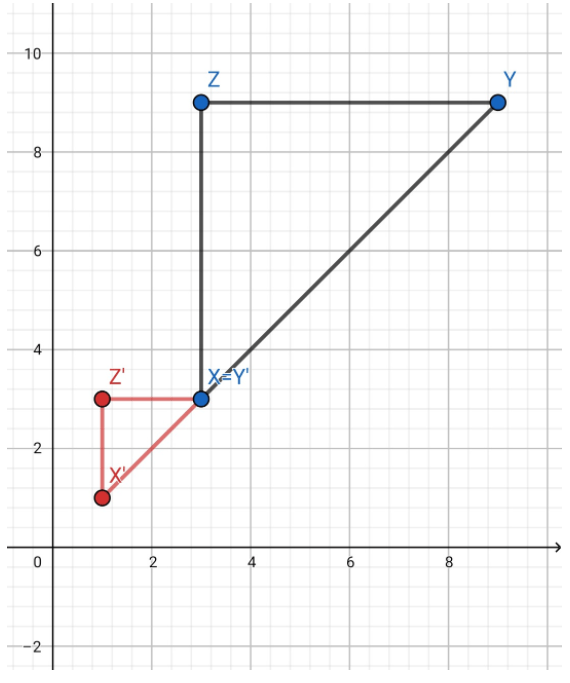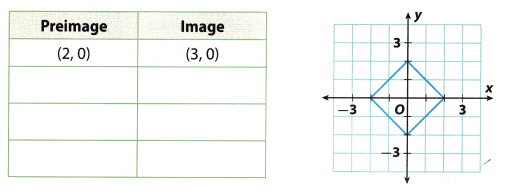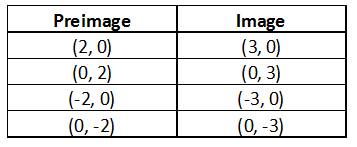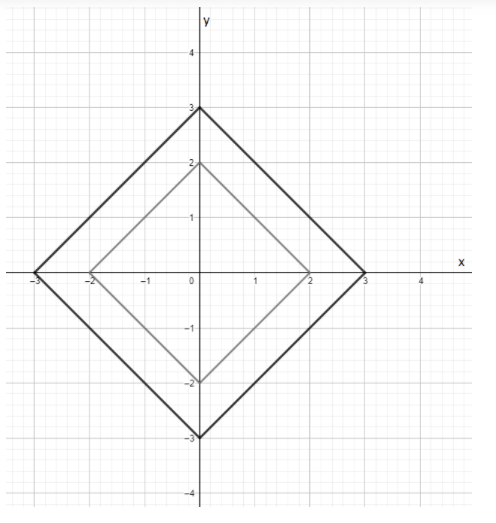
Texas Go Math

Texas Go Math Grade 8 Unit 5 Study Guide Review Answer Key

Refer to our Texas Go Math Grade 8 Answer Key Pdf to score good marks in the exams. Test yourself by practicing the problems from Texas Go Math Grade 8 Unit 5 Study Guide Review Answer Key.

Texas Go Math Grade 8 Unit 5 Study Guide Review Answer Key

Texas Go Math Grade 8 Unit 5 Exercises Answer Key

Module 12 Transformations and Congruence

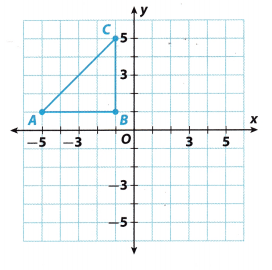
Perform the transformation shown. (Lessors 12.1, 12.2, 12.3)

Question 1.
Reflection over the x-axis
Texas Go Math Grade 8 Unit 5 Study Guide Review Answer Key 1
Answer:
In this task, we are going to Reflect triangle with given vertices over x-axis.

Reflection is shown in equation (x, y) → (x, y).
Coordinates after reflection
A(-5, 1) → A’-5, 1) …………… (1)
B(-1, 1) → B'( 1, 1) ………….. (2)
C(-1, 5) → C'(- 1, 5) ………….. (3)
Transformations is shown on graph below:
Texas Go Math Grade 8 Unit 5 Study Guide Review Answer Key 15

8th Grade Unit 5 Study Guide Answer Key Question 2.
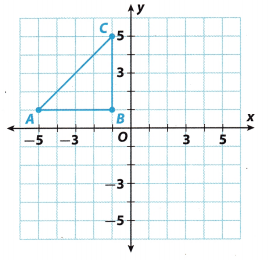
Translation 5 units right
Texas Go Math Grade 8 Unit 5 Study Guide Review Answer Key 2
Answer:
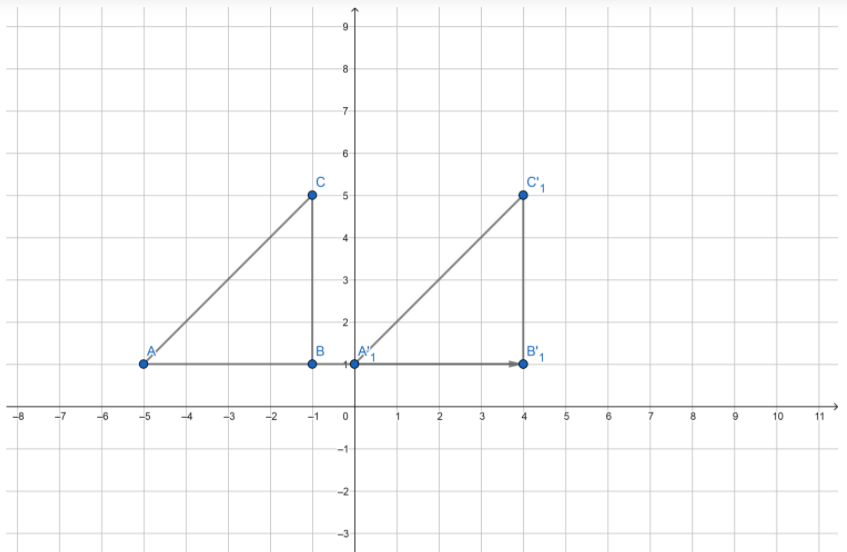
In this task, we will translate the given triangle 5 units right

Translation 5 units right is shown by formula (x, y) → (x + 5, y).
Coordinates after refLection
A(-5, 1) → A'(- 5 + 5, 1) → A'(0, 1) ……………. (1)
B(-1, 1) → B'(-1 + 5, 1) → B'(4, 1) …………….. (2)
C(-1, 5) → C'(-1 + 5, 5) → C'(4, 5) ……………. (3)
Transformation is shown in the graph below:
Texas Go Math Grade 8 Unit 5 Study Guide Review Answer Key 16

Question 3.
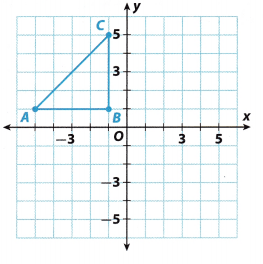
Rotation 90° counterclockwise about the origin
Texas Go Math Grade 8 Unit 5 Study Guide Review Answer Key 3
Answer:
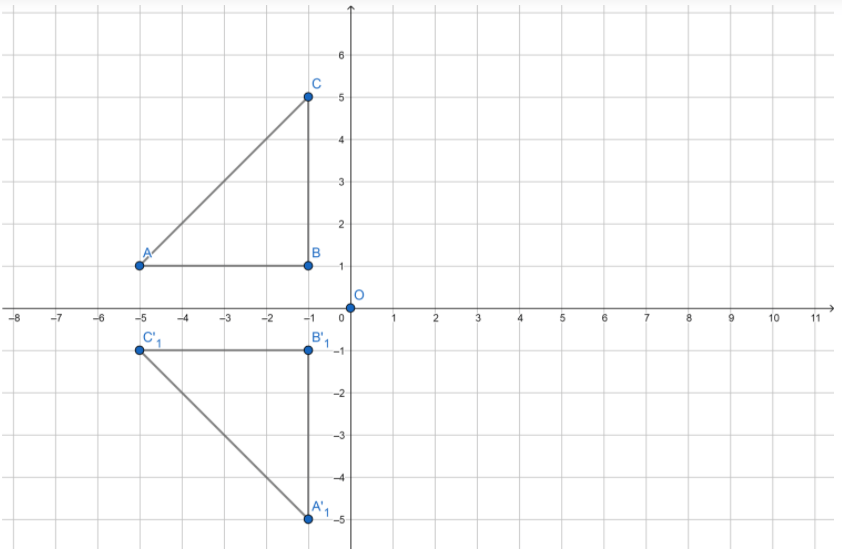
The triangle rotates around the origin for 90°. We need to find the coordinates of the image.

Rotation for 90° is shown by transformation (x, y) → ( y, x).
Coordinates after refLection
A(-5, 1) → A'(-1, -5) ……………… (1)
B(-1, 1) → B'(-1, -1) ………………. (2)
C(-1, 5) → C'(-5, -1) ……………… (3)
Rotation is shown on the graph below:
Texas Go Math Grade 8 Unit 5 Study Guide Review Answer Key 17

Unit 5 End of Unit Assessment Answer Key Grade 8 Question 4.
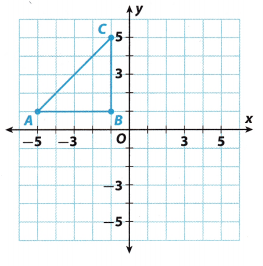
Translation 4 units right and 4 units down
Texas Go Math Grade 8 Unit 5 Study Guide Review Answer Key 4
Answer:
We need to translate the given triangle in two steps: The first translation is for Li units right: (x, y) → (x + 4, y), second translation is 4 units down (x, y) → (x, y – 4).

Coordinates after transformation
A(-5, 1) → A'(- 5 + 4, 1) → A'(- 1, 1) → A”(-1, -1, -4) → A”(- 1, -5) ………………….. (1)
B(-1, 1) → B'(- 1 + 4, 1) → B'(3, 1) → B”(3, 1 – 4) → B”(3, -3) ………………. (2)
C(-1, 5) → C'(- 1 + 4, 5) → C'(3, 5) → C”(3, 5 – 4) → C”(3, 1) ………………… (3)

Question 5.
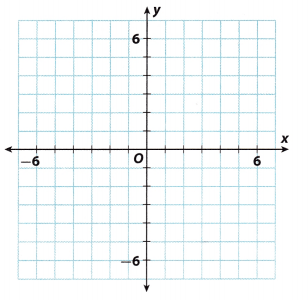
Quadrilateral ABCD with vertices 4(4, 4), B(5, 1), C(5, -1) and D(4, -2) is translated left 2 units and down 3 units. Graph the preimage and the image. (Lesson 12.4)
Texas Go Math Grade 8 Unit 5 Study Guide Review Answer Key 5
Answer:
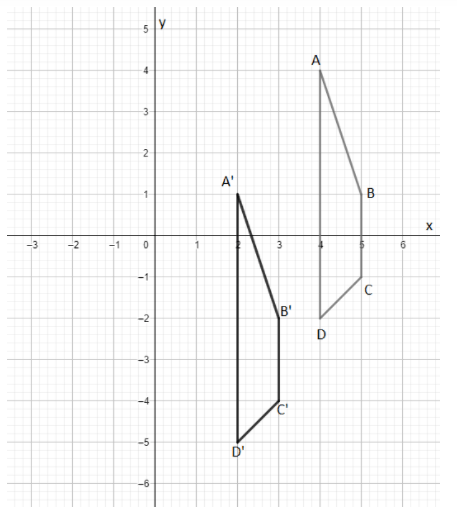
Considering the fact that the figure is translated 2 units to the left and 3 units down, we can calculate the coordinates of the translated image by subtracting 2 from the x coordinate and 3 from the y coordinate.

Therefore, using my explained principle, we can calculate the coordinates of the translated image as follows:
A(4, 4) ⇒ A'(2, 1)
B(5, 1) ⇒ B'(3, -2)
C(5, 1) ⇒ C'(3, -4)
D(4, 2) ⇒ D'(2, -5)
After finding the obtained coordinates on the plane, we can connect them and get the translated image.
The picture below illustrates the preimage and image.
Texas Go Math Grade 8 Unit 5 Study Guide Review Answer Key 18

Transformation Study Guide Answer Key Unit 5 Math Test 8th Grade Question 6.
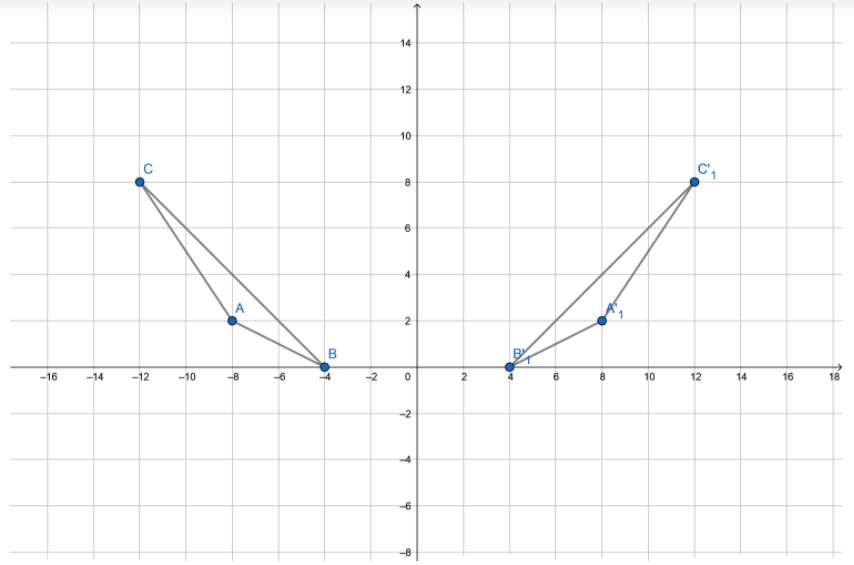
Triangle RST has vertices at (-8, 2), (-4, 0), and (-12, 8). Find the vertices after the triangle has been reflected over the y-axis. (Lesson 1 2.4)
Answer:
Let’s find the coordinates of the given point after reflection over the y-axis. Reflection over the y-axis is shown in the formula
(x, y) → (-x, y).
Coordinates after reflection
A(-8, 2) → A'(8, 2) ………….. (1)
B(-4, 0) → B'(4, 0) …………… (2)
C(-12, 8) → C’12, 8) …………… (3)
Transformation is shown on the graph below.
Texas Go Math Grade 8 Unit 5 Study Guide Review Answer Key 19

Question 7.
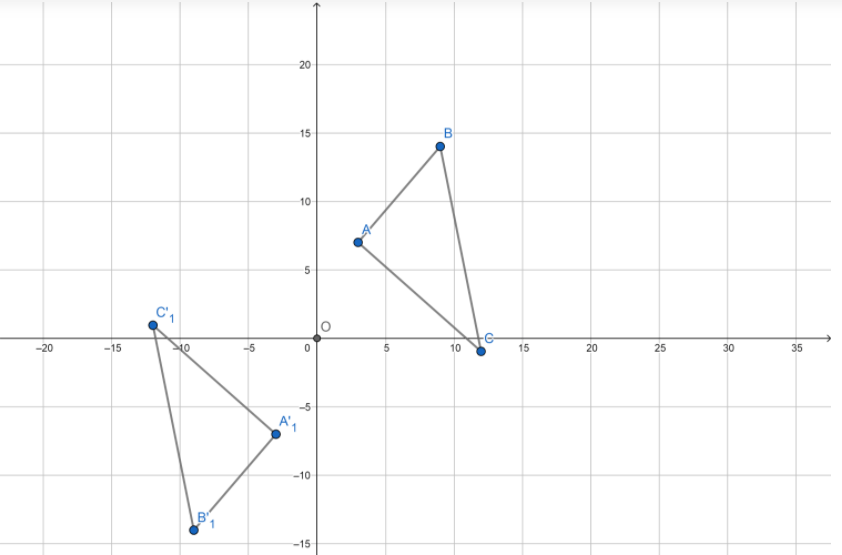
Triangle XYZ has vertices at (3, 7), (9, 14), and (12, -1). Find the vertices after the triangle has been rotated 180° about the origin. (Lesson 1 2.4)
Answer:
The triangle is rotated by 180°. Rotation is given by equation (x, y) → (-x, -y).
Rotated triangle ABC is shown on the graph below:
Texas Go Math Grade 8 Unit 5 Study Guide Review Answer Key 20
Coordinates after rotation are:
X(3, 7) → X'(-3, -7) …………….. (1)
Y(9, 14) → Y'(-9, -14) …………… (2)
Z(12, -1) → Z'(-12, 1) ……………. (3)

Module 13 Dilations, Similarity, and Proportionality

Question 1.
For each pair of corresponding vertices, find the ratio of the x-coordinates and the ratio of they-coordinates. (Lesson 13.1)
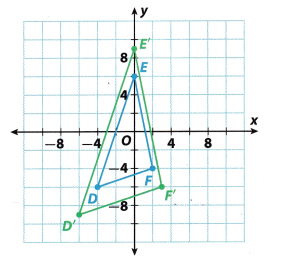
Texas Go Math Grade 8 Unit 5 Study Guide Review Answer Key 6
Ratio of x-coordinates: ________________
Ratio of y-coordinates: ________________
What is the scale factor of the dilation? _______________
Answer:
Ratio of x-coordinates: 1.5
Ratio of y-coordinates: 1.5
F'(x,y)/F(x,y) = x/3/2 = y/-6/-4 = 1.5
Thus the scale factor of the dilation is 1.5

Mathematics Grade 8 Unit 5 Study Guide Answer Key Question 2.
Andrew’s old television had a width of 32 inches and a height of 18 inches. His new television is larger by a scale factor of 2.5. Find the perimeter and area of Andrew’s old television and his new television. (Lesson 13.3)
Perimeter of old TV: ________________
Area of old TV: ________________

Perimeter of new TV: ________________
Area of new TV: ________________
Answer:
The television is in the shape of a rectangle.
Perimeter of the old TV = 2( w + h)
Width = 32 inches.
Height = 18 inches.
= 2(32 + 18)
= 100 square inches.
Area of the old TV = w x h = 32 x 18 = 576.
The perimeter of new TV = perimeter of old TV x 2
= 100 x 2
= 200 square inches
Area of the new TV = area of the old TV x square of 2
= 576 x 4
= 2304.

Dilate each figure with the origin as the center of the dilation. List the vertices of the dilated figure then graph the figure. (Lesson 13.2)

Question 3.
(x, y) → (\(\frac{1}{4}\)x, \(\frac{1}{4}\)y)
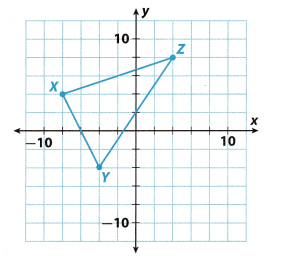
Texas Go Math Grade 8 Unit 5 Study Guide Review Answer Key 7
Answer:
Firstly, we will write down the coordinates of points X, Y and Z, so we could calculate coordinates after dilation.
Therefore:
X(-8,4)
Y(-4, 4)
Z(4,8)
Using the algebraic expression of dilation (x, y) → (\(\frac{1}{4}\)x, \(\frac{1}{4}\)y), we can calculate the vertices of the dilated figure as following:
X(-8, 4) ⇒ X'(-2, 1)
Y(-4, -4) ⇒ Y'(-1, -1)
Y(4, 8) ⇒ Y'(1, 2)
We can graph obtained coordinates and connect them to get the preimage and image. Picture below shows the figure before and after dilation.
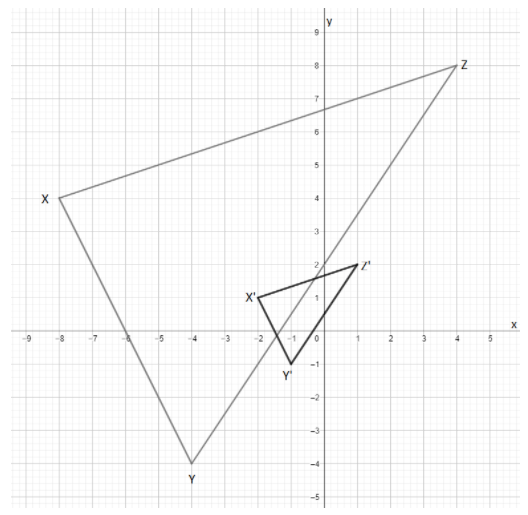
Texas Go Math Grade 8 Unit 5 Study Guide Review Answer Key 22

Study Guide 8th Grade Math Unit 5 Answer Key Question 4.
(x, y) → (2x, 2y)
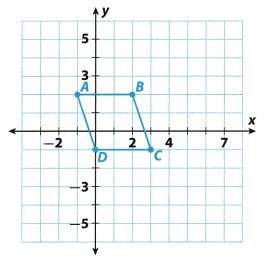
Texas Go Math Grade 8 Unit 5 Study Guide Review Answer Key 8
Answer:
Rectangle WXYZ has vertices at ( 2, 1), (- 2, 1), (2, -1), and (2, 1). It is first dilated by (x, y) → (2x, 2y), and then translated by (x, y) → (x, y + 3). Let us determine the vertices of the image.
a. Determining the vertices by dilating the image from (x, y) → (2x, 2y). using the points (-2, -1), (-2, 1), (2, -1), and (2, 1).
(-2, -1) → (-4, -2)
(-2, 1) → (-4, 2)
(2, -1) → (4, -2)
(2, 1) → (4, 2)
Translating the ¡mage from (x, y) → (x, y + 3), using the points (-4, -2), (-4, 2), (4, -2), and (4, 4)
(-4, -2) → ( 4, 1)
(-4, 2) → (-4, 5)
(4, -2) → (4, 1)
(4, 2) → (4, 5)
Thus, the vertices of the image are (-4, 1), (-4, 5), (4, 1), and (4, 5).

b. Two figures are said to be congruent if one can be obtained from the other by a sequence of translations, reflections, and rotations. Congruent figures have the same size and shape. Now, Let us determine if the preimage and the translated image are congruent and/or similar.
Let us illustrate the images using the graph.
Texas Go Math Grade 8 Unit 5 Study Guide Review Answer Key 21
As we can see on the graph the two images are both similar in shape but their sizes are different, the translated image is obviously bigger than the image, so the pre image and translated image are similar but not congruent.

Texas Go Math Grade 8 Unit 5 Performance Tasks Answer Key

Question 1.
CAREERS IN MATH Contractor Fernando is expanding his dog’s play yard. The original yard has a fence represented by rectangle LMNO on the coordinate plane. Fernando hires a contractor to construct a new fence that should enclose 6 times as much area as the current fence. The shape of the fence must remain the same. The contractor constructs the fence shown by rectangle L’M’N’O’.
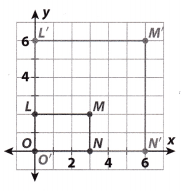
Texas Go Math Grade 8 Unit 5 Study Guide Review Answer Key 9
a. Did the contractor increase the area by the amount Fernando wanted? Explain.
Answer: Yes, the original area was 6 square units and the new area is 36 square units.
Explanation:
Area of LMNO,
A = 3 × 2 = 6
Area of rectangle LMNO is 6 square units
Area of L’M’N’O’,
A = 6 × 6 = 36
Area of rectangle L’M’N’O is 36 square units

b. Does the new fence maintain the shape of the old fence? Flow do you know?
Answer: No, the corresponding side lengths are not proportional.

Unit 5 Math Test 8th Grade Study Guide Answer Key Question 2.
A sail for a sailboat is represented by a triangle on the coordinate plane with vertices (0, 0), (5, 0), and (5, 4). The triangle is dilated by a scale factor of 1.5 with the origin as the center of dilation. Find the coordinates of the dilated triangle. Are the triangles similar? Explain.
Answer:
A sail for a sailboat is represented by a triangle on the coordinate plane with vertices (0, 0), (5, 0), and (5, 4). The triangle is dilated by a scale factor of 1.5 with the origin as the center of dilation. To determine the vertices of the dilated triangle, let us use the expression below
(x, y) → (1.5x, 1.5y)
Having the vertices of the triangle (0, 0), (5, 0), and (5, 4), the dilated triangle has the vertices which are
(x, y) → (1.5x, 1.5y)
(0, 0) → (1.5(0), 1.5(0)) = (0, 0)
(5, 0) → (1.5(5), 1.5(0)) = (7.5, 0)
(5, 4) → (1.5(5), 1.5(4)) = (7.5, 6)
Thus, the vertices of the dilated triangle are (0, 0), (7.5, 0), and (7.5, 6).
Looking at the graph of the two figures, we can say that they are similar triangles since they have the same shape and their corresponding angles are congruent
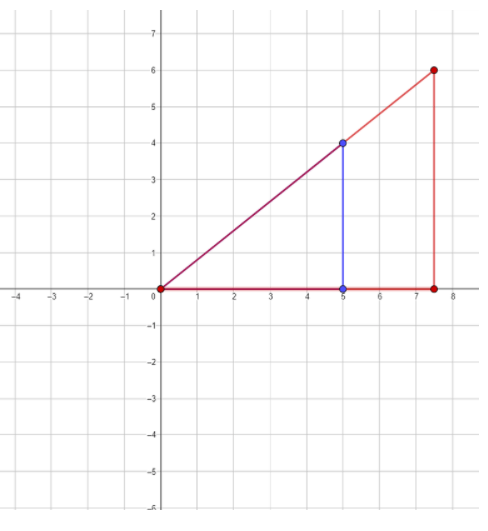
Texas Go Math Grade 8 Unit 5 Study Guide Review Answer Key 23

Texas Go Math Grade 8 Unit 5 Mixed Review Texas Test Prep Answer Key

Selected Response

Question 1.
What would be the orientation of the figure below after a reflection over the x-axis?
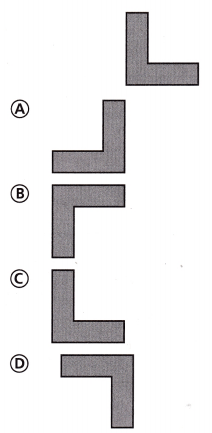
Texas Go Math Grade 8 Unit 5 Study Guide Review Answer Key 10
Answer:
(B)

Explanation:
Lets find the picture that corresponds to given figure.
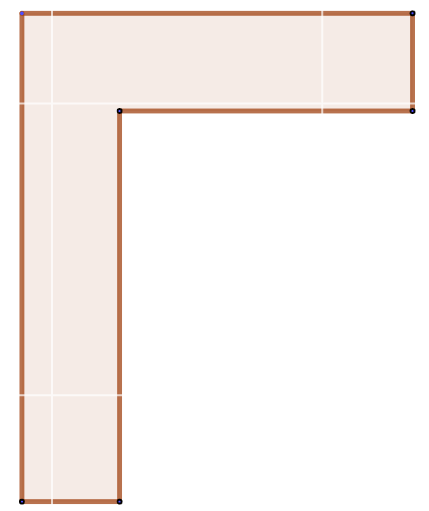
Texas Go Math Grade 8 Unit 5 Study Guide Review Answer Key 24

Question 2.
A triangle with coordinates (4, 2), (0, 3), and (-5, 3) is translated 5 units right and rotated 180° about the origin. What are the coordinates of its image?
(A) (9, 2), (-1, -2), (5, -7)
(B) (-10, 3), (-1, 2), (-5, -3)
(C) (2,-1), (-3, -5), (3, -10)
(D) (-9, -2), (-5, 3), (0, -3)
Answer:
(D) (-9, -2), (-5, -3), (0, -3)

Explanation:
Given triangle is translated 5 units right, and rotated by 18O. Let’s find coordinates after the transformation.
Translation 5 units right is shown by equation (x, y) → (x + 5, y) Rotation by 180° is (x, y) → (- x, y)
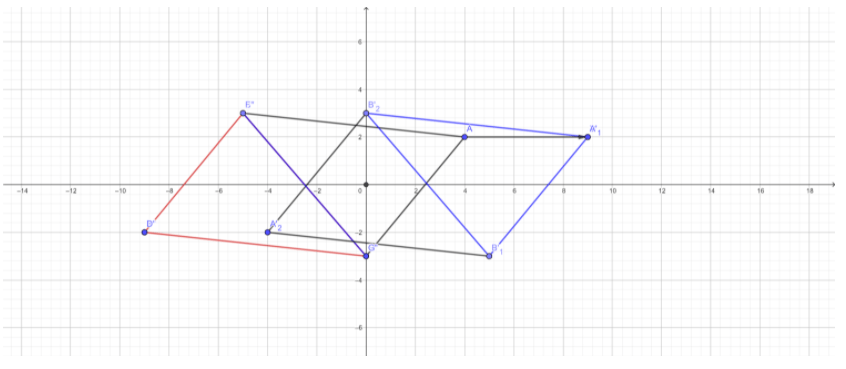
Texas Go Math Grade 8 Unit 5 Study Guide Review Answer Key 25
Coordinates after rotation
A(4, 2) → A'(4 + 5, 2) → A'(9, 2) → A”(-9, -2) ……………………… (1)
B(0, 3) → B'(0 + 5, 3) → B'(5, 3) → B”(- 5, -3) ………………… (2)
C(-5, 3) → C'(-5 + 5, 3) → C'(0, 3) → C”(0, -3) ………………… (3)

Texas Go Math Grade 8 Unit 5 End of Unit Assessment Answer Key Question 3.
Quadrilateral LMNP has sides measuring 16, 28,12, and 32. Which could be the side lengths of a dilation of LMNP?
(A) 24, 40, 18, 90
(B) 32, 60, 24, 65
(C) 20, 35, 15, 40
(D) 40, 70, 30, 75
Answer:
(C) 20, 35, 15, 40

Explanation:
Quadrilateral LMNP has sides measuring 16, 28, 12, and 32. A quadriLiteral which is dilation of LMNP have proportional side lengths, so we should see if the scale factor is correct.
(A) 24, 40, 18, 90
\(\frac{16}{24}=\frac{2}{3}\)
\(\frac{28}{40}=\frac{7}{10}\)
⇒ \(\frac{2}{3} \neq \frac{7}{10}\)
⇒ This quadrilateral is not dilation of LMNP

(B) 32, 60, 24, 65
\(\frac{16}{32}=\frac{1}{2}\)
\(\frac{28}{60}=\frac{7}{15}\)
⇒ \(\frac{1}{2} \neq \frac{7}{15}\)
⇒ This quadrilateral is not dilation of LMNP

(C) 20, 35, 15, 40
\(\frac{16}{20}=\frac{4}{5}\)
\(\frac{28}{35}=\frac{4}{5}\)
\(\frac{12}{15}=\frac{4}{5}\)
\(\frac{32}{40}=\frac{4}{5}\)
⇒ This quadrilateral is a dilation of LMNP

(D) 40, 70, 30, 75
\(\frac{16}{40}=\frac{2}{5}\)
\(\frac{28}{70}=\frac{2}{5}\)
\(\frac{12}{30}=\frac{2}{5}\)
\(\frac{32}{40}=\frac{4}{5}\)
⇒ \(\frac{2}{5} \neq \frac{4}{5}\)
⇒ This quadrilateral is dilation of LMNP

Question 4.
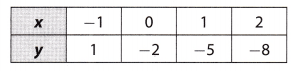
The table below represents which equation?
Texas Go Math Grade 8 Unit 5 Study Guide Review Answer Key 11
(A) y = x + 2
(B) y = -x
(C) y = 3x + 6
(D) y = -3x – 2
Answer:
(D) y = -3x – 2

Explanation:
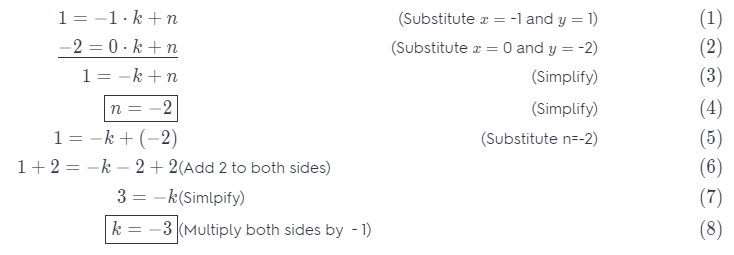
Lets write linear equation using values from the table, and change in equation y = kx + n to calculate coefficients k and n.
Texas Go Math Grade 8 Unit 5 Study Guide Review Answer Key 26
Using k = -3 and n = -2 we can now write the linear equation.
y = -3x – 2

Question 5.
Which of the following is not true of a trapezoid that has been translated 8 units down?
(A) The new trapezoid is the same size as the original trapezoid.
(B) The new trapezoid is the same shape as the original trapezoid.
(C) The new trapezoid is in the same orientation as the original trapezoid.
(D) The y-coordinates of the new trapezoid are the same as the y-coordinates of the original trapezoid.
Answer:
(D) The y-coordinates of the new trapezoid are the same as the y-coordinates of the original trapezoid.

Explanation:
To determine among the options is not true of a trapezoid that has been translated 8 units down. Let us analyze each statements.

First, the statement is The new trapezoid is the same size as the original trapezoid. It is true because even if it is translated 8 units down, still the new trapezoid has the same size as the original and nothing will be change when it comes to size.

Second, the statement is The new trapezoid is the same shape as the original trapezoid. This statement is correct, because nothing will change in their shape. The new trapezoid is the same as the shape of the original trapezoid.

Third, the statement is The new trapezoid is in the same orientation as the original trapezoid. This is also correct since the direction of the new and original trapezoid remains the same.

Lastly, the statement is The y-coordinates of the new trapezoid are the same as the y-coordinates of the original trapezoid. This statement is not true., since it is said that the trapezoid has been translated 8 units down. The direction of the units is downward which is vertical, then the y-coordinates will change. So, the y-coordinates of the new trapezoid are the not same as the y-coordinates of the original trapezoid.

Question 6.
Which represents a reduction?
(A) (x, y) → (0.9x, 0.9y)
(B) (x, y) → (1.4x, 1.4y)
(C) (x, y) → (0.7x, 0.3y)
(D) (x, y) → (2.5x, 2.5y)
Answer:
(A) (x, y) → (0.9x, 0.9y)

Explanation:
A dilation can produce a larger figure (an enlargement) or a smaller figure (a reduction). The scale factor k describes how much the figure is enlarged or reduced. If the scale factor k is between 0 and 1 the image is a reduction. If the scale factor is greater than 1, the image is an enlargement.

To determine which represents a reduction among the following, let us identify the scale factor of each given.
(x, y) → (0.9x, 0.9y)
(x, y) → (1.4x, 1.4y)
(x, y) → (0.7x, 0.3y)
(x, y) → (2.5x, 2.5y)
Determining g the scale factor k.
(x, y) → (0.9x, 0.9y); since k = 0.9 is between 0 and 1, then this is reduction
(x, y) → (1.4x, 1.4y); since k = 1.4 is greater than 1, then this is enlargement
(x, y) → (0.7x, 0.3y); cannot be identify as reduction or enlargement since k are different
(x, y) → (2.5x, 2.5y); since k = 2.5 is greater than 1, then this is enlargement
Since (x, y) → (0.9x, 0.9y) represents reduction, then the answer is Letter A.

Question 7.
Grain is stored in cylindrical structures called silos. Which is the best estimate for the volume of a silo with a diameter of 12.3 feet and a height of 25 feet?
(A) 450 cubic feet
(B) 900 cubic feet
(C) 2970 cubic feet
(D) 10,800 cubic feet
Answer:
Given,
Grain is stored in cylindrical structures called silos.
Diameter = 123 ft
height = 25 ft
The volume of any regular-shaped object = Area of base × height.
The volume of the cylinder = πr²h
V = 3.14 × (12.3/2)² × 25
V = 2970.5 cubic ft
Thus the correct answer is option C.

Question 8.
A rectangle has vertices (8, 6), (4, 6), (8, -4), and (4, -4). What are the coordinates after dilating from the origin by a scale factor of 1.5?
(A) (9, 6), (3, 6), (9, -3), (3, -3)
(B) (10, 8), (5, 8), (10, -5), (5, -5)
(C) (16, 12), (8, 12), (16, -8), (8, -8)
(D) (12, 9), (6, 9), (12, -6), (6, -6)
Answer:
(D) (12, 9), (6, 9), (12, -6), (6, -6)

Explanation:
A rectangle has vertices (8, 6), (4, 6), (8, 4), and (4, 4). We need to find the coordinates after dilating from the origin by a scare factor of 1.5
Step2 2of3
(8, 6) → 8 ∙ 1.5, 6 ∙ 1.5) → (12, 9) ………….. (1)
(4, 6) → 4 ∙ 1.5, 6 ∙ 1.5) → (6, 9) …………… (2)
(8, -4) → 8 ∙ 1.5, -4 ∙ 1.5) → (12, -6) …………… (3)
(4, 4) → 4 ∙ 1.5, 4 ∙ 1.5) → (6, -6) …………… (4)

Question 9.
Two sides of a right triangle have lengths of 56 centimeters and 65 centimeters. The third side is not the hypotenuse. How long is the third side?
(A) 9 centimeters
(B) 27 centimeters
(C) 33 centimeters
(D) 86 centimeters
Answer: (C) 33 centimeters
Explanation:
Given,
Two sides of a right triangle have lengths of 56 centimeters and 65 centimeters.
The third side is not the hypotenuse.
56² + b² = 65²
b² = 1089
b = 33
Thus the correct answer is option C.

8th Grade Go Math Answer Key Unit 5 Assessment Answers Question 10.
Which statement is false?
(A) No integers are irrational numbers.
(B) All whole numbers are integers.
(C) No real numbers are rational numbers.
(D) All integers greater than or equal to 0 are whole numbers.
Answer:
(C) No real numbers are rational numbers.

Explanation:
To determine the false statement, let us analyze each statement in the given choices.

The first is “No integers are irrational numbers”. Integers is the set of rational numbers that include zero, positive, and negative numbers. By definition of integers, we can say that all integers are rational numbers and not irrational. Thus, the statement is true.

Second, “All whole numbers are integers”. Whole numbers is the set of zero and natural numbers, and natural numbers are the numbers that include positive integers starting from 1 up to infinity. By definition of whole numbers, we can say that all whole numbers are integers. Thus, the statement is true

Third, “No real numbers are rational numbers.” The real numbers is the set of numbers containing all the rational and all of the irrational numbers. By definition of real numbers, we can say that real numbers can be irrational numbers which contradicts the given statement. Thus, the statement is false.

Fourth. “All integers greater than or equal to 0 are whole numbers”. Whole numbers are the set of zero and natural numbers, and natural numbers are the numbers that include positive integers starting from 1 up to infinity. By definition of whole numbers, we can say that all integers greater than or equal to 0 are whole numbers. Thus, the statement is true

Thus, the false statement among the four choices is the letter C, No real numbers are rational numbers.

Hot Tips! Make sure you look at all answer choices before making your decision. Try substituting each answer choice into the problem if you are unsure of the answer.

Question 11.
Which inequality represents the solution to 1.5x + 4.5 < 2.75x – 5.5?
(A) x > 8
(B) x < 8
(C) x > 12.5
(D) x < 12.5
Answer:
1.5x + 4.5 < 2.75x – 5.5
10 < 1.25x
8 < x
x >8
Thus the correct answer is option A.

Gridded Response

Question 12.
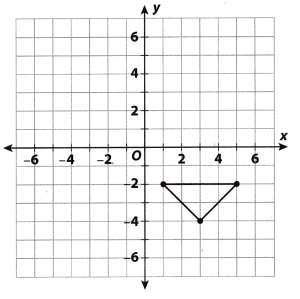
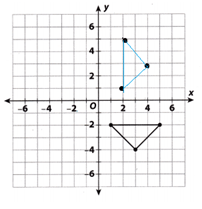
In what quadrant would the triangle below be located after a rotation of 90° counterclockwise?
Texas Go Math Grade 8 Unit 5 Study Guide Review Answer Key 12
Texas Go Math Grade 8 Unit 5 Study Guide Review Answer Key 13
Answer:
The coordinates of the given triangle is (5,-2),(1,-2), (3,-4)
Rotation in 90 degrees counterclockwise about the origin is (x,y) = (-y.x)
(5,-2) = (2,5)
(1,2) = (2, 1)
(3, -4) = (4,3)
After rotation of 90 degrees the triangle is in the 1st quadrant.
Texas-Go-Math-Grade-8-Unit-5-Study-Guide-Review-Answer-Key-12
Texas-Go-Math-Grade-8-Unit-5-Study-Guide-Review-Answer-Key-12_1

Question 13.
An equilateral triangle has a perimeter of 48 centimeters. If the triangle is dilated by a factor of 0.75, what is the length of each side of the new triangle?
Texas Go Math Grade 8 Unit 5 Study Guide Review Answer Key 14
Answer:
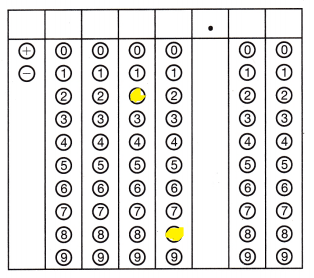
The length of each side is 28 cm.
The perimeter of the equilateral triangle is 48 cm.
To find each side of the original triangle, you do 48/3=16cm.
Since the triangle dilates by 0.75,
0.75×16=12cm.
Then you have to add 12 to 16 because the triangle gets bigger by 12 cm.
so 16+12=28 cm.
Texas-Go-Math-Grade-8-Unit-5-Study-Guide-Review-Answer-Key-14

Texas Go Math Grade 8 Unit 5 Vocabulary Preview

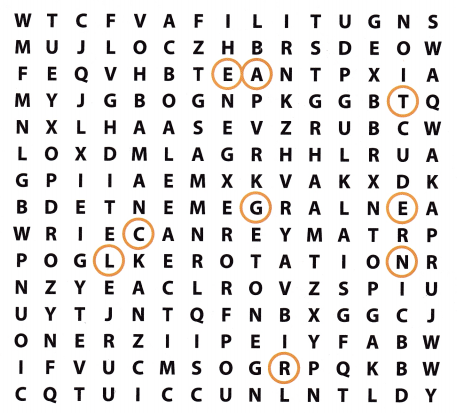
Use the puzzle to preview key vocabulary from this unit. Unscramble the circled letters within found words to answer the riddle at the bottom of the page.
Texas Go Math Grade 8 Unit 5 Study Guide Review Answer Key 27

The input of a transformation. (Lesson 12.1)
A transformation that flips a figure across a line. (Lesson 12.2)
A transformation that slides a figure along a straight line. (Lesson 12.1)
A transformation that turns a figure around a given point. (Lesson 12.3)
The product of a figure is made larger by dilation. (Lesson 13.1)
The product of a figure is made smaller by dilation. (Lesson 13.1)
Scaled replicas that change the size but plot the shape of a figure. (Lesson 13.1)

Question.
What do you call an angle that s broken?
Answer:
A ____ ____ ____ ____ ____ ____ ____ ____ ____!
The broken angle is called a rectangle.

Texas Go Math Grade 8 Unit 5 Study Guide Review Answer Key Read More »

Texas Go Math Grade 8 Lesson 13.3 Answer Key Dilations and Measurement

Refer to our Texas Go Math Grade 8 Answer Key Pdf to score good marks in the exams. Test yourself by practicing the problems from Texas Go Math Grade 8 Lesson 13.3 Answer Key Dilations and Measurement.

Texas Go Math Grade 8 Lesson 13.3 Answer Key Dilations and Measurement

Texas Go Math Grade 8 Lesson 13.3 Explore Activity Answer Key

Exploring Dilations and Measurement

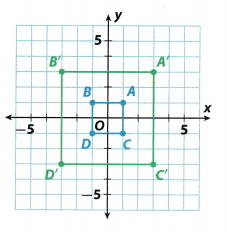
The blue rectangle is a dilation (enlargement) of the green rectangle.
Texas Go Math Grade 8 Lesson 13.3 Answer Key 1
A. Using a centimeter ruler, measure and record the length of each side of both rectangles. Then calculate the ratios of all pairs of corresponding sides.
Texas Go Math Grade 8 Lesson 13.3 Answer Key 2
Answer:
Dilation means transformation which is used to make the object into smaller size or larger size.
The length of AB = 4cm
The length of BC = 3cm
The length of CD = 4cm
The length of DA = 3cm
The length of AB’ = 8cm
The length of B’C’ = 6cm
The length of C’D’ = 8cm
The length of D’A’ = 8cm
A’B’/AB = 8/4 = 4cm
B’C’/BC = 6/3 = 3cm
C’D’/CD = 8/4 = 4cm
D’A’/DA = 6/3 = 3cm
What is true about the ratios that you calculated?
Answer: The blue rectangle is double the green rectangle. The ratio of the blue rectangle and the green rectangle is calculated then we get the length of the green rectangle.

What scale factor was used to dilate the green rectangle to the blue rectangle?
Answer:
The scale factor is used to dilate the green rectangle to the blue rectangle.
Scalar factor = A’B’/AB = 8/4 = 4cm
Scalar factor = B’C’/BC = 6/3 = 3cm
Scalar factor = C’D’/CD = 8/4 = 4cm
Scalar factor = D’A’/DA = 6/3 = 3cm

How are the side lengths of the blue rectangle related to the side lengths of the green rectangle?
The sides of the blue rectangle are double times the green rectangle.
The lengths of the green rectangle.
The length of AB = 4cm
The length of BC = 3cm
The length of CD = 4cm
The length of DA = 3cm
The lengths of the blue rectangle.
The length of AB’ = 8cm
The length of B’C’ = 6cm
The length of C’D’ = 8cm
The length of D’A’ = 8cm

B. What is the perimeter of the green rectangle? _______________
What is the perimeter of the blue rectangle? _______________
How is the perimeter of the blue rectangle related to the perimeter of the green rectangle?
Answer:
i. The formula for the perimeter of the rectangle = 2(l + w)
The length of the green rectangle = 4cm
The width of the green rectangle = 3cm.
P = 2(4 + 3)
P = 14
The perimeter of the green rectangle = 14cm
ii. The formula for the perimeter of the rectangle = 2(l + w)
The length of the blue rectangle = 8cm
The width of the blue rectangle = 6cm.
P = 2(8 + 6)
P = 28
The perimeter of the blue rectangle = 28cm
iii. The perimeter of the green rectangle = 14cm
The perimeter of the blue rectangle = 28cm
The perimeter of the green rectangle is half of the blue rectangle.

C. What is the area of the green rectangle? _______________
What is the area of the blue rectangle? _______________
How is the area of the blue rectangle related to the area of the green rectangle?
Answer:
i. The formula for the area of the rectangle = l x w
The length of the green rectangle = 4cm
The width of the green rectangle = 3cm.
A = 4 x 3
A = 12
The area of the green rectangle = 12 square units.
ii. The formula for the perimeter of the rectangle = l x w
The length of the blue rectangle = 8cm
The width of the blue rectangle = 6cm.
P = 8 x 6
P = 48
iii. The area of the green rectangle = 12 square units
The area of the blue rectangle = 48 square units.
The area of the green rectangle is 4 times the blue rectangle.

Reflect

Dilations and Measurements Answer Key Grade 8 Go Math Question 1.
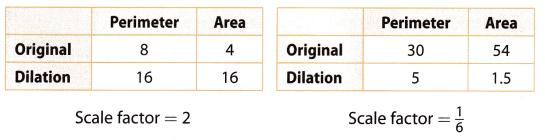
Make a Conjecture The perimeter and area of two shapes before and after dilation are given. How are the perimeter and area of a dilated figure related to the perimeter and area of the original figure?
Texas Go Math Grade 8 Lesson 13.3 Answer Key 3
Answer:
For the first shape
The perimeter of the original figure = 8
The perimeter of the dilation figure = 16
The perimeter of the original figure is half the dilation figure.
The area of the original figure = 4 square units.
The area of the dilation figure = 16 square units.
The area of the dilation is 4 times more than the original figure.
For the original figure
The perimeter of the original figure = 30
The perimeter of the dilation figure = 5
The perimeter of the original figure is 6 times the dilation figure.
The area of the original figure = 54 square units.
The area of the dilation figure = 1.5 square units.
The area of the dilation is 36 times more than the original figure.

Your Turn

Question 2.
Johnson Middle School is selling mouse pads that are replicas of a student’s award-winning artwork. The rectangular mouse pads are dilated from the original artwork and have a length of 9 inches and a width of 8 inches. The perimeter of the original artwork is 136 inches. What is the area of the original artwork?
Answer:
Given that,
The perimeter of the original artwork = 136inches.
The formula for the perimeter of the rectangle = 2(l +b)
The length of the dilated mouse = 9inches
The Width of the dilated mouse = 8 inches.
The length of the original mouse = 9 x 4 = 36inches.
The width of the original mouse = 8 x 4 = 32 inches.
= 2(36 + 32) = 136 inches.
Area of the rectangle = l x b
= 36 x 32 = 1152inches.
The area of the original artwork = 1152 inches.

Texas Go Math Grade 8 Lesson 13.3 Guided Practice Answer Key

Find the perimeter and area of the image after dilating the figures shown with the given scale factor. (Explore Activity and Example 1)

Question 1.
Scale factor = 5
Texas Go Math Grade 8 Lesson 13.3 Answer Key 4
Answer:
Given that,
The perimeter of the square = 12
Scale factor = 3.
The perimeter of the P’ = P x square factor
= 12 x 3
The perimeter of the P’ = 36
The area of the P = 9
The area of the P’ = 9 x square of scale factor = 12 x 3² = 108

Go Math Lesson 13.3 Answer Key Dilations and Measurements Question 2.
Scale factor = \(\frac{3}{4}\)
Texas Go Math Grade 8 Lesson 13.3 Answer Key 5
Answer:
Given that,
The perimeter of the square = 48
Scale factor = ¾ = 0.75
Perimeter of the P’ = P x square factor
= 48 x 0.75 = 36
Perimeter of the P’ = 36
The area of the P = 128
The area of the P’ = 128 x square of scale factor = 128 x 0.75² = 71.68

A group of friends is roping off a soccer field in a back yard. A full-size soccer field is a rectangle with a length of 100 yards and a width of 60 yards. To fit the field in the back yard, the group needs to reduce the size of the field so its perimeter is 128 yards. (Example 1)

Question 3.
What is the perimeter of the full-size soccer field?
Answer:
The length of the soccer field = 100 yards.
The width of the soccer field = 60 yards.
The perimeter of the rectangle = 2(l + b)
= 2(100 + 60)
= 320yards
The perimeter of the full-size soccer field = 320 yards.

Question 4.
What is the scale factor of the dilation?
Answer:
The dilation soccer field perimeter = 128 yards.
The formula for the perimeter of the rectangle = 2(l + b)
The length of the soccer field = 100 yards.
The width of the soccer field = 60 yards
The length of the dilated field = 42 yards.
The length of the dilated field is 2.4 times less than the original length.
The width of the dilated field = 22 yards
The width of the dilated field is 2.7 times less than the original width.
Scale factor of the dilation = larger length/smaller length = 100/42 = 2.38
The scale factor of the dilation = 21/50

Question 5.
What is the area of the soccer field in the backyard?
Answer:
The formula for the area of the rectangular soccer field in the backyard = l x b
The length of the soccer field in the backyard = 100 yards.
The width of the soccer field in the backyard = 60 yards.
= 100 x 60
= 6000 square yards.
The area of the rectangular soccer field in the backyard = 6000 square yards.

Essential Question Check-In

Lesson 13.3 Dilations and Measurement Answers 8th Grade Question 6.
When a rectangle is dilated, how do the perimeter and area of the rectangle change?
Answer:
The perimeter of the dilated rectangular soccer field in the backyard = 128 yards.
The perimeter of the original rectangular soccer field in the backyard = 2(100 + 60) = 130 yards
The area of the rectangular soccer field in the backyard = 6000 square yards.
The area of the dilated rectangle = 42 x 22 = 924.
The perimeter and area of the rectangle are less than the original rectangle.

Texas Go Math Grade 8 Lesson 13.3 Independent Practice Answer Key

Question 7.
When you make a photocopy of an image, is the photocopy a dilation? What is the scale factor? How do the perimeter and area change?
Answer:
Assume that the image is in the shape of a rectangle.
Dilation length = 4cm
Dilation Breadth = 2cm
Perimeter of the dilation photocopy = 2(4 + 2) = 12
The area of the dilation photocopy = l x b = 4 x 2 = 8 square cm
Scale factor 4/2 = 2.

Question 8.
Problem-Solving
The universally accepted film size for movies has a width of 35 millimeters. If you want to project a movie onto a square sheet that has an area of 100 square meters, what is the scale factor that is needed for the projection of the movie? Explain.
Answer:
The film size for movies has a width = 35 millimeters.
The movie onto a square sheet that has an area = 100 square meters.
Width od the square sheet = 4a = 100/4 = 25mm
Scale factor = 35/25 = 7/5.

Question 9.
The perimeter of a square is 48 centimeters. If the square is dilated by a scale factor of 0.75, what is the length of each side of the new square?
Answer:
Given that,
The perimeter of a square = 48 centimeters
48/4 = 12.
The formula for the perimeter of the square = 4a
The square is dilated by a scale factor = 0.75,
The length of each side of a square = 12.
The length of the new square = 12 x 0.75 = 9 cm.

Lesson 13.3 Grading Scale Texas Go Math 8th Grade Question 10.
The screen of an eReader has a length of 8 inches and a width of 6 inches. Can the page content from an atlas that measures 19 inches by 12 inches be replicated in the eReader? If not, propose a solution to move the atlas content into the eReader format.
Answer:
The screen of an eReader length = 8 inches.
The screen of an eReader width of 6 inches.
The page content from an atlas that length = 19 inches.
The page content from an atlas that breadth = 12 inches
The page content of the atlas cannot be replicated on the eReader.

Question 11.
Represent Real-World Problems There are 64 squares on a chessboard. Each square on a tournament chessboard measures 2.25 × 2.25 inches. A travel chessboard is a dilated replica of the tournament chessboard using a scale factor of \(\frac{1}{3}\).

a. What is the size of each square on the travel chessboard?
Answer: The size of each square on the travel chessboard is 2.25 x 2.25 = 5.062.

b. How long is each side of the travel board?
Answer: Each side of the travel board = 2.25 inches.

c. How much table space do you need to play on the travel chessboard?
Answer:
The number of squares on the chessboard = 64.
The size of each square = 5.062.
The tablespace on the travel chessboard = 64 x 5.062 = 323.968.

Question 12.
Draw Conclusions The legs of a right triangle are 3 units and 4 units long. Another right triangle is dilated from this triangle using a scale factor of 3. What are the side lengths and the perimeter of the dilated triangle?
Answer:
The legs of a right rectangle = 3 units and 4 units.
Scale factor = 3.
The side lengths of the dilated triangle = 3 x 3 = 9
And 4 x 3 = 12
The side lengths of the dilated triangle = 9 units and 12 units
Perimeter of the dilated triangle = P = a + b + √(a²+ b²)
A = 9units
B = 12 units
P = 9 + 12 + √(9²+ 12²)
= 9 + 12 + 153
The perimeter of the dilated triangle = 174 units.

H.O.T. Focus on Higher Order Thinking

Texas Go Math Grade Scale 8th Grade Pdf Question 13.
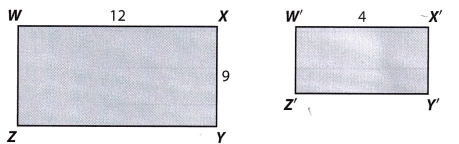
Critique Reasoning Rectangle W’X’Y’Z’ below is a dilation of rectangle WXYZ. A student calculated the area of rectangle W’X’Y’Z’ to be 36 square units. Do you agree with this student’s calculation? If not, explain and correct the mistake.
Texas Go Math Grade 8 Lesson 13.3 Answer Key 6
Answer:
Given that
The area of the W’X’Y’Z’ is 36 square units.
The area of the WXYZ is 12 x 9 = 108.
The length of the original rectangle = 12
The width of the original rectangle = 9
The length of the dilation rectangle = 4
It means 12/4 = 3
The dilation rectangle is 3 times less than the original rectangle.
The width of the dilation rectangle = 9/3 = 3
The area of the W’X’Y’Z’ is l x b = 4 x 3 = 12
The area of the W’X’Y’Z’ to be 36 square units is wrong.

Texas Grading Scale Go Math Grade 8 Question 14.
Multistep Rectangle A’B’C’D’ is a dilation of rectangle ABCD, and the scale factor is 2. The perimeter of ABCD is 18 mm. The area of ABCD is 20 mm2.
a. Write an equation for, and calculate, the perimeter of A’B’C’D’.
Answer:
The perimeter of ABCD is 18 mm.
Rectangle A’B’C’D’ is a scale factor of 2.
The perimeter of A’B’C’D’ = 18 x 2 = 32mm

b. Write an equation for, and calculate, the area of A’B’C’D’.
Answer:
The area of ABCD is 20 mm².
The area of the A’B’C’D’ = ABCD area x square of scale factor.
= 20 x 2²
= 80mm²

c. The side lengths of both rectangles are whole numbers of millimeters. What are the side lengths of ABCD and A’B’C’D’?
Answer:
The perimeter of ABCD is 18 mm.
The formula for the perimeter of the rectangle = 2(l + b).
Scale factor = 2
The sides lengths of the ABCD = 18/2 = 9mm
The perimeter of A’B’C’D’ = 18 x 2 = 32mm
The sides lengths of the A’B’C’D’ = 32/2 = 16mm

Texas Go Math Grade 8 Lesson 13.3 Answer Key Dilations and Measurement Read More »

Texas Go Math Grade 8 Lesson 13.2 Answer Key Algebraic Representations of Dilations

Refer to our Texas Go Math Grade 8 Answer Key Pdf to score good marks in the exams. Test yourself by practicing the problems from Texas Go Math Grade 8 Lesson 13.2 Answer Key Algebraic Representations of Dilations.

Texas Go Math Grade 8 Lesson 13.2 Answer Key Algebraic Representations of Dilations

Texas Go Math Grade 8 Lesson 13.2 Explore Activity Answer Key

Explore Activity 1

Graphing Enlargements

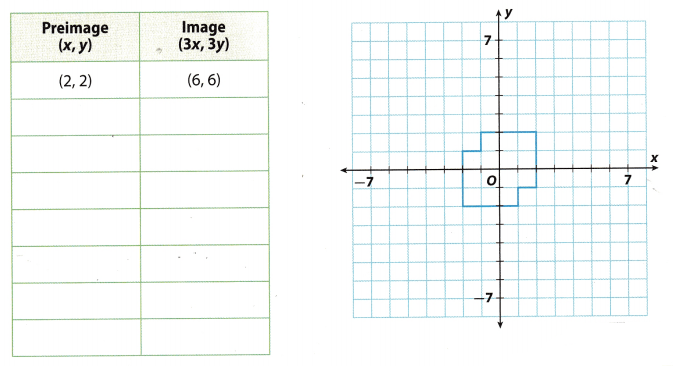
When a dilation in the coordinate plane has the origin as the center of dilation, you can find points on the dilated image by multiplying the x- and y-coordinates of the original figure by the scale factor. For scale factor k, the algebraic representation of the dilation is (x, y) → (kx, ky).
For enlargements, k > 1.

The figure shown on the grid is the preimage. The center of dilation is the origin.
Texas Go Math Grade 8 Lesson 13.2 Answer Key 1
A. List the coordinates of the vertices of the preimage in the first column of the table.
Texas Go Math Grade 8 Lesson 13.2 Answer Key 2
B. What is the scale factor for the dilation?
C. Apply the dilation to the preimage and write the coordinates of the vertices of the image in the second column of the table.
D. Sketch the image after the dilation on the coordinate grid.

Reflect

Question 1.
How does the dilation affect the length of line segments?
Answer:
Dilation is a process of changing the size of an object while the object remains in the same Shape. Depending on the scale factor, dilation may increase or decrease the starting object.

Therefore, we can conclude that dilation affects the length of line segments by either increasing or decreasing their length.

Dilations on the Coordinate Plane Answer Key Math 8th Grade Question 2.
How does the dilation affect angle measures?
Answer:
Dilation is defined as a transformation that changes the size of a figure. A dilation can produce a larger figure an enlargement a smaller figure or a reduction.

Since it changes the size of a figure, it has nothing to do with the changes when it comes to the angles of the image. The measures of the angles of dilated figures remain the same as in the original image.

Thus, the dilation has no effect on the measures of the angles of the image.

Explore Activity 2

Graphing Reductions

For scale factors between 0 and 1, the image is smaller than the preimage. This is called a reduction.

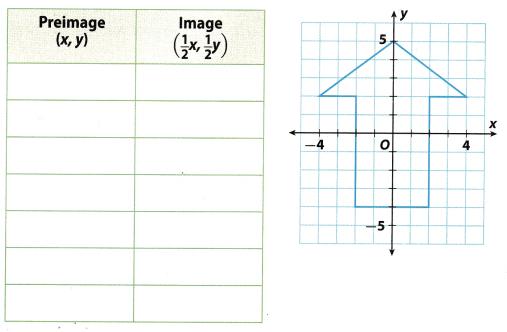
The arrow shown is the preimage. The center of dilation is the origin.
A. List the coordinates of the vertices of the preimage in the first column of the table.
Texas Go Math Grade 8 Lesson 13.2 Answer Key 3
B. What is the scale factor for the dilation?
C. Apply the dilation to the preimage and write the coordinates of the vertices of the image in the second column of the table.
D. Sketch the image after the dilation on the coordinate grid.

Reflect

Question 3.
How does the dilation affect the length of line segments?
Answer:
A dilation can produce a larger figure (an enlargement) or a smaller figure (a reduction).

The dilation affects the length of line segments. If the dilation produces a larger figure the line segments of the dilated figure are longer than the original figure Also, if the dilation produces a smaller figure, the line segments of the dilated figure are smaller than the original figure.

Question 4.
How would a dilation with scale factor 1 affect the preimage?
Answer:
A dilation can produce a larger figure (an enlargement) or a smaller figure (a reduction). The scale factor k describes how much the figure is enlarged or reduced. If the scale factor k is between 0 and 1 the image is a reduction. If the scale factor is greater than 1, the image is an enlargement.

By definition a dilation can only be enlarged or reduced with respect to the scale factor k between 0 and 1 or greater than 1, respectively, if the scale factor in the dilation is equal to 1, then the image would be the same as the preimage. There will be no change in their sizes and has no effect on the preimage.

Your Turn

Question 5.
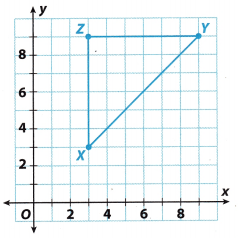
Graph the image of △XYZ after a dilation with a scale factor of \(\frac{1}{3}\) and the origin as its center. Then write an algebraic rule to describe the dilation.
Texas Go Math Grade 8 Lesson 13.2 Answer Key 4
Answer:
Texas Go Math Grade 8 Lesson 13.2 Answer Key 10
Texas Go Math Grade 8 Lesson 13.2 Answer Key 11
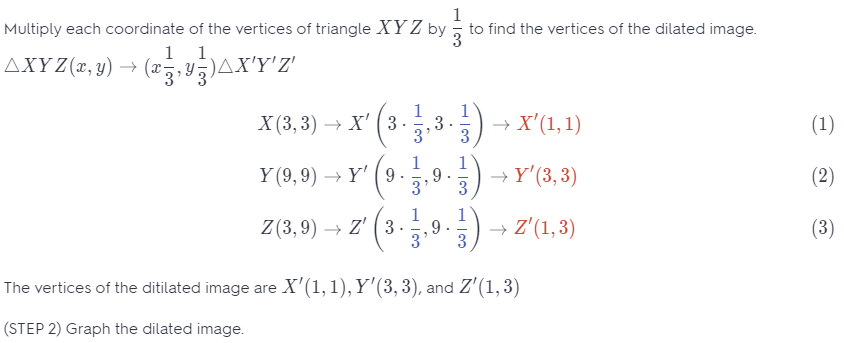
The vertices of the dilated image are X'(1, 1), Y'(3, 3) and Z'(1, 3)

Texas Go Math Grade 8 Lesson 13.2 Guided Practice Answer Key

8th Grade Dilations Worksheet Answer Key Question 1.
The grid shows a diamond-shaped preimage. Write the coordinates of the vertices of the preimage in the first column of the table. Then apply the dilation (x, y) → (\(\frac{3}{2}\)x, \(\frac{3}{2}\)y) and write the coordinates of the vertices of the image in the second column. Sketch the image of the figure after the dilation. (Explore Activities 1 and 2)
Texas Go Math Grade 8 Lesson 13.2 Answer Key 5
Answer:
Firstly, we will write the coordinates of the vertices of the preimage. To calculate the vertices of the image after dilation, we will use the following rule:
(x, y) ⇒ (\(\frac{3}{2}\)x, \(\frac{3}{2}\)y)
meaning that we will multiply every coordinate with \(\frac{3}{2}\).

Filled table is shown in the picture below.
Texas Go Math Grade 8 Lesson 13.2 Answer Key 12
After calculating the coordinates, we can graph every point of the image after dilation and connect them to get the wanted figure. The picture below shows the image of the figure before and after dilation.
Texas Go Math Grade 8 Lesson 13.2 Answer Key 13

Graph the image of each figure after a dilation with the origin as its center and the given scale factor. Then write an algebraic rule to describe the dilation. (Example 1)

Question 2.
The scale factor of 1.5
Texas Go Math Grade 8 Lesson 13.2 Answer Key 6
Answer:
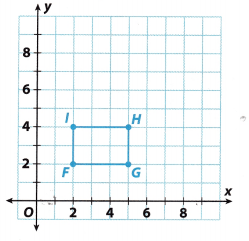
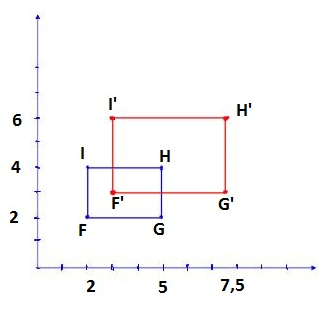
Multiply each coordinate of the vertices of rectangle FGHI by 1, 5 to find the vertices of the dilated image.
Rectangle FGHI(x, y) → (1.5x, 1.5y)
F(2, 2) → F'(2 ∙ 1.5, 2 ∙ 1.5) → F'(3, 3) ……………….. (1)
G(5, 2) → G'(5 ∙ 1.5, 2 ∙ 1.5) → G'(7.5, 3) …………… (2)
I(2, 4) → I'(2 ∙ 1.5, 4 ∙ 1.5) → I'(3, 6) ………………… (3)
H(5, 4) → H'(5 ∙ 1.5, 4 ∙ 1.5) → H'(7.5, 6) …………… (4)
The vertices of the dilated image are F'(3.5, 3.5), G'(7.5, 3.5), H'(7.5, 6) and I'(, 9).

Graph the dilated image.
Texas Go Math Grade 8 Lesson 13.2 Answer Key 14

Question 3.
scale factor of \(\frac{1}{3}\)
Texas Go Math Grade 8 Lesson 13.2 Answer Key 7
Answer:
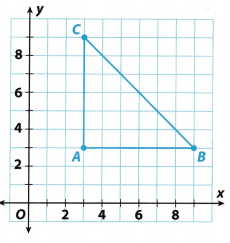
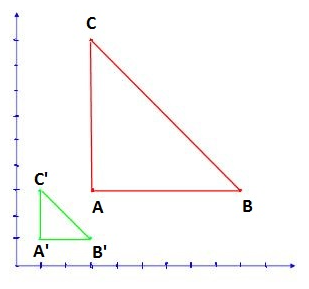
Multiply each coordinate of the vertices of triangle ABC by \(\frac{1}{3}\) to find the vertices of the dilated image.
△ABC(x,y) —* (x,y.)△A’B’C’
A(3, 3) → A'(3 ∙ \(\frac{1}{3}\), 3 ∙ \(\frac{1}{3}\)) → A'(1, 1) ………….. (1)
B(9, 3) → B'(9 ∙ \(\frac{1}{3}\), 3 ∙ \(\frac{1}{3}\)) → B'(3, 1) ………….. (2)
C(3, 9) → C'(3 ∙ \(\frac{1}{3}\), 9 ∙ \(\frac{1}{3}\)) → C'(1, 3) …………… (3)
The vertices of the dilated image are A'(1, 1), B'(3, 1), and C'(1, 3)

Graph the dilated image.
Texas Go Math Grade 8 Lesson 13.2 Answer Key 15

Essential Question Check-In

8th Grade Math Dilations Coordinates Answer Key Question 4.
A dilation of (x, y) → (kx, ky) when 0 < k < 1 has what effect on the figure? What is the effect on the figure when k > 1?
Answer:
Explanation A:
When 0 < k < the dilation is a reduction of the original by the scale k. What k > 1 the dilation is an enlargement of the original by the scale k.

Explanation B:
When k is between 0 and 1, the dilation is a reduction by the scale factor k.
When k is greater than 1, the dilation is an enlargement by the scale factor k.

Texas Go Math Grade 8 Lesson 13.2 Independent Practice Answer Key

Question 5.
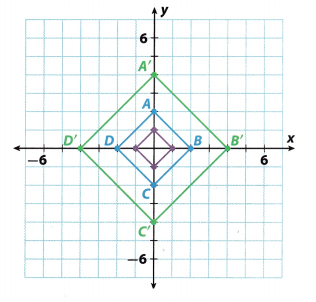
The blue square is the preimage. Write two algebraic representations, one for the dilation to the green square and one for the dilation to the purple square.
Texas Go Math Grade 8 Lesson 13.2 Answer Key 8
Answer:
The blue square ABCD is the preimage.
The coordinates of the vertices of the original image are multiplied by 2 for the green square.
(x, y) → (2x, 2y)
The coordinates of the vertices of the original image are multiplied by \(\frac{1}{2}\) for the purple square.
(x, y) → (\(\frac{1}{2}\)x, \(\frac{1}{2}\)y)

Question 6.
Critical Thinking A triangle has vertices A(-5, -4), B(2, 6), and C(4, -3). The center of dilation is the origin and (x, y) → (3x, 3y). What are the vertices of the dilated image?
Answer:
Multiply each coordinate of the vertices of △ABC by 3 to find the vertices of the dilated image.
A(-5, -4) → A'(3 ∙ (-5), 3 ∙ (-4)) → A'(-15, -12) ……………… (1)
B(2, 6) → B'(3 ∙ 2, 3 ∙ 6) → B'(6, 12) …………… (2)
C(4, -3) → C'(3 ∙ 4, 3 ∙ (-3)) → C'(12, -9) ………….. (3)
A'(-15, -12), B'(6, 12) and C'(12, -9)

Question 7.
Critical Thinking M’N’O’P’ has vertices at M'(3, 4), N'(6, 4), O'(6, 7), and P'(3, 7). The center of dilation is the origin. MNOP has vertices at M(4.5, 6), N(9, 6), O'(9, 10.5), and P'(4.5, 10.5). What is the algebraic representation of this dilation?
Answer:
When a dilation in the coordinate plane has the origin as the center of dilation, we can find points on the dilated image by multiplying the x and y coordinates of the original figure by the scale factor. For scale factor k, the algebraic representation of the dilation is (x, y) → (kx, ky).

Given M(4.5, 6), N(9, 6), 0(9, 10.5), P(4.5, 10.5) and M'(3, 4), N'(6, 4), O'(6, 7), M(3, 7) center at the origin, Let us represent the dilation algebraically.

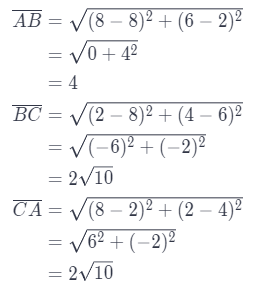
To start, let us determine the scale factor k by dividing the length of one side of the dilated image by the corresponding length of the original image. But before this, let us soLve first the length of one side of the dilated image and the corresponding length of the originaL image using the distance formula
d = \(\sqrt{\left(x_{2}-x_{1}\right)^{2}+\left(y_{2}-y_{1}\right)^{2}}\)
Length of MN, given M(4.5, 6), N(9, 6).
MN = \(\sqrt{(9-4.5)^{2}+(6-6)^{2}}\)
MN = \(\sqrt{(4.5)^{2}+(0)^{2}}\)
MN = \(\sqrt{20.25}\)
MN = 4.5

Length of M’N’, given M'(3, 4), N'(6, 4).
M’N’ = \(\sqrt{(6-3)^{2}+(4-4)^{2}}\)
M’N’ = \(\sqrt{(3)^{2}+(0)^{2}}\)
M’N’ = \(\sqrt{9}\)
M’N’ = 3

Now, let us determine the value of k, that is
k = \(\frac{M^{\prime} N^{\prime}}{M N}\)
k = \(\frac{3}{4.5}\)
k = \(\frac{2}{3}\)

Next, Let us represent the dilation algebraically, using
(x, y) → (kx, ky)
Substituting the value of k
(x, y) → (\(\frac{2}{3}\)x, \(\frac{2}{3}\)y)

Dilations Classwork Answers Lesson 13.2 Answer Key Question 8.
Critical Thinking A dilation with center (0, 0) and scale factor k is applied to a polygon. What dilation can you apply to the image to return it to the original preimage?
Answer:
A dilation with center (0, 0) and scale factor k is applied to a polygon. Let us determine the dilation that can be applied to the image to return it to the original preimage.

Let x and y be the coordinates of the original image When a dilation ¡n the coordinate plane has the origin as the center of dilation, you can find points on the dilated image by multiplying the x- and y-coordinates of the original figure by the scale factor k, that is
(x, y) → (kx, ky)
Now, to return the dilated image to preimage having the coordinates of (kx, ky), dilate it by a scale factor \(\frac{1}{k}\), as shown below.
(kx, ky) → (\(\frac{1}{k}\)(kx), \(\frac{1}{k}\)(ky)) → (x, y)
Thus, the dilation that you can apply to the image to return it to the original preimage with center (0, 0) and scale factor k ¡s to dilate the image by the scale factor \(\frac{1}{k}\)

Question 9.
Represent Real-World Problems The blueprints for a new house are scaled so that \(\frac{1}{4}\) inch equals 1 foot. The blueprint is the preimage and the house is the dilated image. The blueprints are plotted on a coordinate plane.
a. What is the scale factor in terms of inches to inches?
Answer:
The blueprints for a new house are scaled so that \(\frac{1}{4}\) inch equals 1 foot.
a. Since 1 foot = 12 inch, the scale factor is k = \(\frac{12}{\frac{1}{4}}\) = 48

b. One inch on the blueprint represents how many inches in the actual house? How many feet?
Answer:
One inch on the blueprint represents 1 ∙ 48 feet = 48 ∙ \(\frac{1}{12}\) inch = 4 inch

c. Write the algebraic representation of the dilation from the blueprint to the house.
Answer:
The algebric dilation is (x, y) → (48x, 48y)

d. A rectangular room has coordinates Q(2, 2), 6(7, 2), S(7, 5), and T(2, 5) on the blueprint. The homeowner wants this room to be 25% larger. What are the coordinates of the new room?
Answer:
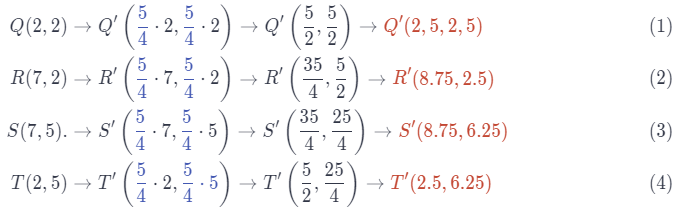
New rectangular room should be 25% larger, so its 125% of previous value. Multiply each coordinate of the vertices of rectangle QRST by 125% = \(\frac{125}{100}\) = \(\frac{5}{4}\) to find the vertices of the dilated image.
Texas Go Math Grade 8 Lesson 13.2 Answer Key 16

e. What are the dimensions of the new room, in inches, on the blueprint? What will the dimensions of the new room be, in feet, in the new house?
Answer:
The dimension of a new room on a blueprint is now:
length |QR| = |8.75 – 2.5| = 6.25 inch
height: |QT| = |6.25 – 2.5| = 3.75 inch
In feet 6.25 ∙ 4 = 25ft and 3.75 ∙ 4 = 15 ft

Question 10.
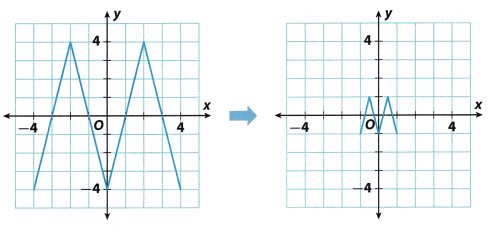
Write the algebraic representation of the dilation shown.
Texas Go Math Grade 8 Lesson 13.2 Answer Key 9
Answer:
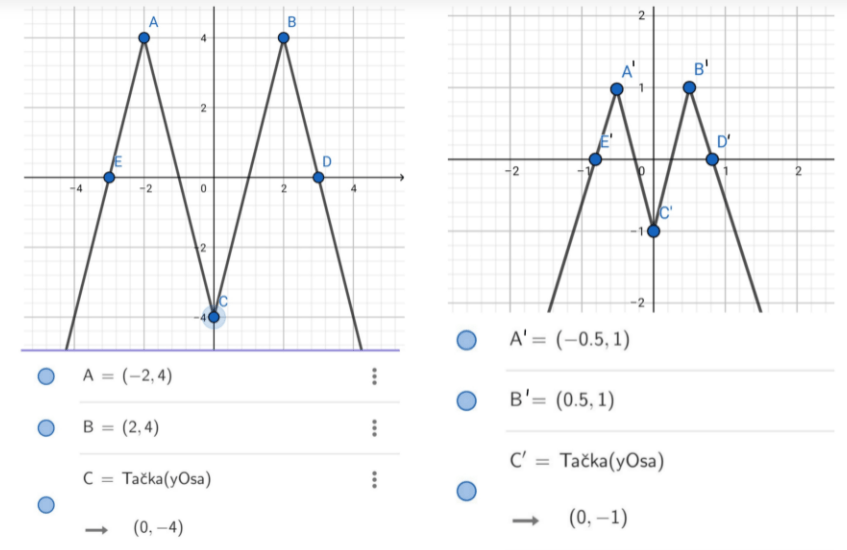
Write the coordinates of some of the points on the first graph: A(-2, 4), B(2, 4), C(0, -4), and on the second graph:
A'(-\(\frac{1}{2}\), 1) , B'(\(\frac{1}{2}\), 1) C'(0, -1). Let’s find the ratio of: the x-coordinates of corresponding points
\(\frac{-\frac{1}{2}}{-2}=\frac{\frac{1}{2}}{2}=\frac{1}{4}\)
and the ratio of the y-coordinates of corresponding points
\(\frac{1}{4}\) = \(\frac{1}{4}\)
The scale factor is \(\frac{1}{4}\)
Algebraic rule of dilation will be (x, y) → (\(\frac{1}{4}\)x, \(\frac{1}{4}\)y)
Texas Go Math Grade 8 Lesson 13.2 Answer Key 17

H.O.T. Focus on Higher Order Thinking

Question 11.
Critique Reasoning The set for a school play needs a replica of a historic building painted on a backdrop that is 20 feet long and 16 feet high. The actual building measures 400 feet long and 320 feet high. A stage crew member writes (x, y) → (\(\frac{1}{12}\)x, \(\frac{1}{12}\)y) to represent the dilation. Is the crew member’s calculation correct if the painted replica is to cover the entire backdrop? Explain.
Answer:
The painted replica is 20 feet long and 16 feet high The actual building measures 400 feet long and 320 feet high. Lets find the ratio of length \(\frac{20}{400}\) = \(\frac{1}{20}\)
and find the ratio of height: \(\frac{16}{320}\) = \(\frac{1}{20}\)
So, the scale factor is \(\frac{1}{20}\), and algebraic rule of dilation is (x, y) → (\(\frac{1}{20}\)x, \(\frac{1}{20}\)y)
A crewmember wrote wrong, the dilation is (x, y) → (\(\frac{1}{20}\)x, \(\frac{1}{20}\)y)

Algebraic Rule for Dilation Activity 8th Grade Pdf Question 12.
Communicate Mathematical Ideas Explain what each of these algebraic transformations does to a figure.
a. (x, y) → (y, -x)
Answer:
In the given expression, we can notice that the x and y coordinates are replaced and that the x coordinate changed its sign.
Therefore, we can conclude that the algebraic transformation rotated a figure counterclockwise for 90°.

b. (x, y) → ( x, -y)
Answer:
In the given expression, we can notice that both coordinates changed their sign Considering the fact that the positive and negative parts of both axes are spaced 180° apart, we can conclude that the algebraic transformation rotated a figure for 180°.

c. (x, y) → (x, 2y)
Answer:
In the given expression, we can notice that the y coordinate is multiplied by 2 Considering the fact that the x coordinate stayed the same and the fact that the y coordinate is multiplied by a number bigger than 1, we can conclude that the given figure is vertically stretched.

d. (x, y) → (\(\frac{2}{3}\)x, y)
Answer:
In the given expression, we can notice that the x coordinate is multiplied with \(\frac{2}{3}\). Considering the fact that the y coordinate stayed the same and the fact that x coordinate is multiplied with a number smaller than 1, we can conclude that the given figure is horizontally shrunk.

e. (x, y) → (0.5x, 1.5y)
Answer:
In the given expression, we can notice that the x-coordinate is multiplied by 0.5 and that the y-coordinate is multiplied by 1.5. Therefore, considering the fact that the coordinate is multiplied by a number smaller than 1 and the fact that the y coordinate is multiplied by a number bigger than 1, we can conclude that the given figure is horizontally shrieked and vertically stretched.

Question 13.
Communicate Mathematical Ideas Triangle ABC has coordinates A(1, 5), B(-2, 1), and C(-2, 4). Sketch triangle ABC and A’B’C’ for the dilation (x, y) → (-2x, – 2y). What is the effect of a negative scale factor?
Answer:
Multiply each coordinate of the vertices of △ABC by 3 to find the vertices of the dilated image.
A(1, 5) → A'( 2 ∙ 1, 2 ∙ 5) → A'(- 2,- 10) …………….. (1)
B(-2, 1) → B'( 2 ∙ ( 2), 2 ∙ 1) → B'(4, -2) …………….. (2)
C(-2, 4) → C'( 2 ∙ (- 2), 2 ∙ 4) → C'(4, -8) ……………. (3)
The orientation of the figure in the coordinate plane is rotated 180°.
Texas Go Math Grade 8 Lesson 13.2 Answer Key 18

Texas Go Math Grade 8 Lesson 13.2 Answer Key Algebraic Representations of Dilations Read More »

Texas Go Math Grade 8 Module 13 Quiz Answer Key

Refer to our Texas Go Math Grade 8 Answer Key Pdf to score good marks in the exams. Test yourself by practicing the problems from Texas Go Math Grade 8 Module 13 Quiz Answer Key.

Texas Go Math Grade 8 Module 13 Quiz Answer Key

Texas Go Math Grade 8 Module 13 Ready to Go On? Answer Key

13.1 Properties of Dilations

Determine whether one figure is a dilation of the other. Justify your answer.

Question 1.
Triangle XYZ has angles measuring 54° and 29°. Triangle XYZ’ has angles measuring 29° and 92°.
Answer:
We need to see if triangle X’Y’Z’ is the dilation of triangle XYZ Triangles are similar if alt corresponding angles are equal.

Triangle XYZ has angLes measuring 54° and 29°. Let’s calculate the measure of the third angle:
180° – (54° + 29°) = 180° – 83° (Calculate) ………………. (1)
= 97° (Simplify) ………………….. (2)

Triangle X’Y’Z’ has angles measuring 29° and 92°. The measure of the third angle is
180° – (29° + 92°) = 180° – 121° (Calculate) …………….. (3)
= 69° (Simplify) ……………… (4)
Since these triangles have only one pair of congruent angles, the triangle X’Y’Z’ is not a dilation of XYZ.

Go Math Grade 8 Dilations Quiz Module 13 Question 2.
Quadrilateral DEFG has sides measuring 16 m, 28m, 24m, and 20m. Quadrilateral D’E’F’G’ has sides measuring 20 m, 35 m, 30 m, and 25 m.
Answer:
Quadrilateral DEFG has sides measuring 16 m, 28 m, 24 m, and 20 m.
Quadrilateral D’E’F’G’ has sides measuring 20 m, 35 m, 30 m, and 25 m
Let’s find the scale factor of the corresponding sides
\(\frac{20}{16}=\frac{35}{28}=\frac{30}{24}=\frac{25}{20}=\frac{5}{4}\)
Since the scale factor is the same, the quadrilateral D’E’F’G’ is a dilation of quadrilateral DEFG.

13.2 Algebraic Representations of Dilations

Dilate each figure with the origin as the center of dilation.

Question 3.
(x, y) → (0.8x, 0.8y)
Texas Go Math Grade 8 Module 13 Quiz Answer Key 1
Answer:
Dilatation is (x, y) → (0.8x, 0.8y)
(0, -5) → (0 ∙ 0.8, -5 ∙ 0.8) → (0, -4) …………… (1)
(5, 0) → (5 ∙ 0.8, 2 ∙ 0.8) → (4, 0) ……………. (2)
(0, 5) → (0 ∙ 0.8, 5 ∙ 0.8) → (0, 4) ……………. (3)
(-5, 0) → (- 5 ∙ 0.8, 0 ∙ 0.8) → ( 4, 0) …………… (4)
Coordinates of vertices of the dilated figure are (0, -4), (4, 0), (0, 4) and (-4, 0)

Module 13 Answer Key Go Math Grade 8 Question 4.
(x, y) → (2.5x, 2.5y)
Texas Go Math Grade 8 Module 13 Quiz Answer Key 5
Answer:
Dilation equation (x, y) → (2.5x, 2.5y)
(2, -1) → (2 ∙ 2.5, -1 ∙ 2.5) → (5, -2.5) ………………. (1)
(2, 2) → (∙ 2.5, 2 ∙ 2.5) → (5, 5) ………… (2)
(1, 1) → (1 ∙ 2.5, 1 ∙ 2.5) → (2.5, 2.5) ……………. (3)
The coordinates of dilated vertices are (5, 2.5), (5, 5), and (2.5, 2.5).

13.3 Dilations and Measurement

Question 5.
A rectangle with a length of 8 cm and width of 5 cm is dilated by a scale factor of 3. What are the perimeter and area of the image?
Answer:
Given,
A rectangle with a length of 8 cm and a width of 5 cm is dilated by a scale factor of 3.
length = 8 cm
width = 5 cm
We know that,
Area of the rectangle = length × width
A = 8 × 5
A = 40 sq. cm
The scale factor is 3
Area of the rectangle with scale factor = 40 × 3 = 120 sq. cm
We know that,
Perimeter of the rectangle = 2L + 2W
P = (2 × 8 + 2 × 5)
P = 16 + 10
P = 26
The scale factor is 3
The perimeter of the rectangle with a scale factor of 3 is 26 × 3 = 78 cm.

Essential Question

Question 6.
How can you use dilations to solve real-world problems?
Answer:
A dilations in real life are used for making models of buildings in architecture, projects, making maps.

Texas Go Math Grade 8 Module 13 Mixed Review Texas Test Prep Answer Key

Selected Response

Dilation Quiz 8th Grade Go Math Question 1.
Quadrilateral HIJK has sides measuring 12 cm, 26 cm, 14 cm, and 30 cm. Which could be the side lengths of a dilation of HIJK?
(A) 24 cm, 50 cm, 28 cm, 60 cm
(B) 6 cm, 15 cm, 7 cm, 15 cm
(C) 18 cm, 39 cm, 21 cm, 45 cm
(D) 30 cm, 78 cm, 35 cm, 75 cm
Answer: (C) 18 cm, 39 cm, 21 cm, 45 cm
Explanation:
The quadrilateral HIJK has sides measuring 12 cm, 26 cm, 14 cm, and 30 cm.
Scale factor = 1.5
12 × 1.5 = 18 cm
26 × 1.5 = 39 cm
14 × 1.5 = 21 cm
30 × 1.5 = 45 cm
Thus the side lengths of dilation of HIJK are 18 cm, 39 cm, 21 cm, 45 cm
So, the correct answer is option C.

Question 2.
A rectangle has vertices (6, 4), (2, 4), (6, -2), and (2, -2). What are the coordinates of the vertices of the image after a dilation with the origin as its center and a scale factor of 2.5?
(A) (9, 6), (3, 6), (9, -3), (3, -3)
(B) (3, 2), (1, 2), (3, -1), (1, -1)
(C) (12, 8), (4, 8), (12, -4), (4, -4)
(D) (15, 10), (5, 10), (15, -5), (5, -5)
Answer:
(A) (9, 6), (3, 6), (9, -3), (3, -3)

Explanation:
Let’s find coordinates of vertices after a dilation, by multiplying each coordinate by 1.5, and we can easily find the correct answer.

Coordinates of vertices of the image after a dilation are:
(6, 4) → (6 ∙ 1.5, 4 ∙ 1.5) → (9, 6) …………… (1)
(2, 4) → (2 ∙ 1.5, 4 ∙ 1.5) → (3, 6) ………….. (2)
(6, -2) → (6. 1.5, -2 ∙ 1.5) → (9, -3) ……………….. (3)
(2, 2) → (2 ∙ 1.5, 2 ∙ 1.5) → (3, 3) …………… (4)
So, the correct answer is (A)

Question 3.
Which represents the dilation shown where the black figure is the preimage?
Texas Go Math Grade 8 Module 13 Quiz Answer Key 3
(A) (x, y) → (1 .5x, 1 .5y)
(B) (x, y) → (2.5x, 2.5y)
(C) (x, y) → (3x, 3y)
(D) (x, y) → (6x, 6y)
Answer:
(B) (x, y) → (2.5x, 2.5y)

Explanation:
First, we can see that one shape is dilation of other. Lets look at the picture and see which sides can we find measures. It’s easiest to count units on sides parallel with axis. Count, and write the measures.

Use that measures to calculate scale factor
\(\frac{5}{2}\) = 2.5 (horizontal sides) …………… (1)
\(\frac{10}{4}\) = 2.5 (vertical sides) …………… (2)
Scale factor is 2.5
A dilation with scale factor 2.5 is (x, y) → (2.5x, 2.5y)

Dilations Practice Quiz Answer Key Question 4.
Solve -a + 7 = 2a – 8.
(A) a = – 3
(B) a = –\(\frac{1}{3}\)
(C) a = 5
(D) a = 15
Answer:
(C) a = 5

Explanation:
Lets solve equation a + 7 = 2a – 8 and than we can choose correct answer.

Given equation
-a + 7 = 2a – 8 (Rewrite) ……………… (1)
-a + 7 – 7 = 2a – 8 – 7 (Take 7 from both sides) …………….. (2)
-a = 2a – 15 (Simplify) ………….. (3)
-a – 2a = -2a – 15 – 2a (Take 2a from both sides) …………….. (4)
-3a = -15 (Simplify) …………… (5)
a = \(\frac{-15}{-3}\) (divide both sides by -3) …………….. (6)
a = 5 (Calculate) ………………… (7)

Question 5.
An equilateral triangle has a perimeter of 24 centimeters. If the triangle is dilated by a factor of 0.5, what is the length of each side of the new triangle?
(A) 4 centimeters
(B) 12 centimeters
(C) 16 centimeters
(D) 48 centimeters
Answer: (A) 4 centimeters
Explanation:
Given,
An equilateral triangle has a perimeter of 24 centimeters.
24/3 = 8
The triangle is dilated by a factor of 0.5 and the triangle is equilateral, the side lengths of the new triangle is
8 × 0.5 = 4
The correct answer is option A.

Question 6.
Which equation does not represent a line with an x-intercept of 3?
(A) y = -2x + 6
(B) y = –\(\frac{1}{3}\)x + 1
(C) y = \(\frac{2}{3}\)x – 2
(D) y = 3x – 1
Answer:
(D) y = 3x – 1

Explanation:
Coordinates of the point where the Line intersects the x-axis are (x, 0). So, if an x-intercept is 3, then the coordinates (3, 0) satisfy the equation.

(A): y = 2x + 6 → y = 0, x = 3:
0 = -2 ∙ 3 + 6
0 = -6 + 6 (Calculate)
0 = 0 (Simplify)
= This equation represent a line with an x-intercept of 3

(B): y = –\(\frac{1}{3}\)x + 1
0 = –\(\frac{1}{3}\) ∙ 3 + 1
0 = -1 + 1 (Calculate
0 = 0 (Simplify)
⇒ This equation represent a line with an x-intercept of 3

(C): y = \(\frac{2}{3}\)x – 2
0 = \(\frac{2}{3}\) ∙ 3 – 2
0 = 2 – 2 (Calculate)
0 = 0 (Simplify)
= This equation represent a line with an x-intercept of 3

(D): y = 3x – 1 → y = 0, x = 3
0 = 3 ∙ 3 – 1
0 = 9 – 1 (Calculate)
0 ≠ 8 (Simplify)
= This equation does not represent a line with an x-intercept of 3

Gridded Response

Dilations and Measurements Answer Key 8th Grade Go Math Question 7.
A car is traveling at a constant speed. After 2.5 hours, the car has traveled 80 miles. If the car continues to travel at the same constant speed, how many hours will it take to travel 270 miles?
Texas Go Math Grade 8 Module 13 Quiz Answer Key 4
Answer:
Given,
A car is traveling at a constant speed.
After 2.5 hours, the car has traveled 80 miles.
2.5 hour = 80 miles
x hour = 270 miles
x × 80 = 270 × 2.5
x × 80 = 675
x = 675/80
x = 8.43
Therefore it takes 8.43 hours to travel 270 miles.

Texas Go Math Grade 8 Module 13 Quiz Answer Key Read More »

Texas Go Math Grade 8 Lesson 13.1 Answer Key Properties of Dilations

Refer to our Texas Go Math Grade 8 Answer Key Pdf to score good marks in the exams. Test yourself by practicing the problems from Texas Go Math Grade 8 Lesson 13.1 Answer Key Properties of Dilations.

Texas Go Math Grade 8 Lesson 13.1 Answer Key Properties of Dilations

Texas Go Math Grade 8 Lesson 13.1 Explore Activity Answer Key

Explore Activity 1

Exploring Dilations

The missions that placed 12 astronauts on the moon were controlled at the Johnson Space Center in Houston. The toy models at the right are scaled-down replicas of the Saturn V rocket that powered the moon flights. Each replica is a transformation called a dilation. Unlike the other transformations you have studied—translations, rotations, and reflections—dilations change the size (but not the shape) of a figure.
Texas Go Math Grade 8 Lesson 13.1 Answer Key 1
Every dilation has a fixed point called the center of dilation located where the lines connecting corresponding parts of figures intersect.

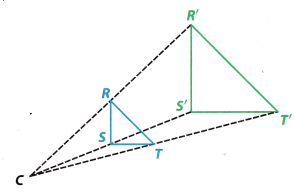
Triangle R’S’T’ is a dilation of triangle RST. Point C is the center of dilation.
Texas Go Math Grade 8 Lesson 13.1 Answer Key 2
A. Use a ruler to measure segments \(\overline{C R}, \overline{C R^{\prime}}, \overline{C S}, \overline{C S^{\prime}}, \overline{C T}\) and \(\overline{C T^{\prime}}\) to the nearest millimeter. Record the measurements and ratios in the table.
Texas Go Math Grade 8 Lesson 13.1 Answer Key 3
B. Write a conjecture based on the ratios in the table.

C. Measure and record the corresponding side lengths of the triangles.
Texas Go Math Grade 8 Lesson 13.1 Answer Key 4

D. Write a conjecture based on the ratios in the table.

E. Measure the corresponding angles and describe your results.

Reflect

Question 1.
Are triangles RSTand R’S’T’ similar? Why or why not?
Answer:
Triangles RST and R’S’T’ are similar because their corresponding sides are proportional, and their corresponding angles are congruent.

Lesson 13.1 Properties of Dilations Go Math Grade 8 Question 2.
Compare the orientation of a figure with the orientation of its dilation.
Answer:
To determine the answer here, we will review the definition of a dilation.
Dilation is a transformation in which a certain shape changes its size, but shape and orientation stay the same. Therefore, we can claim that a certain figure and its dilation have the same orientation.

Explore Activity 2

Exploring Dilations on a Coordinate Plane

In this activity, you will explore how the coordinates of a figure on a coordinate plane are affected by a dilation.
Texas Go Math Grade 8 Lesson 13.1 Answer Key 5
A. Complete the table. Record the x- and y-coordinates of the points in the two figures and the ratios of the x-coordinates and the y-coordinates.
Texas Go Math Grade 8 Lesson 13.1 Answer Key 6
B. Write a conjecture about the ratios of the coordinates of a dilation image to the coordinates of the original figure.

Reflect

Question 3.
In Explore Activity 1, triangle R’S’T’ was larger than triangle RST. How is the relationship between quadrilateral A’B’C’D’ and quadrilateral ABCD different?
Answer:
Dilation is a transformation in which a certain object changes size depending on its scale factor. If the scale factor is bigger than 1, the image will be an enlargement and if the scale factor is less than 1, the picture will be a reduction.

Therefore, considering the fact that quadrilateral A’B’C’D’ is smaller than its original ABCD, we can claim that the scale factor was less than 1, so given dilation was a reduction.

Example 1

An art supply store sells several sizes of drawing triangles. All are dilations of a single basic triangle. The basic triangle and one of its dilations are shown on the grid. Find the scale factor of the dilation.
Texas Go Math Grade 8 Lesson 13.1 Answer Key 7
STEP 1: Use the coordinates to find the lengths of the sides of each triangle.
Triangle ABC: AC = 2 CB = 3
Triangle A’B’C’: A’C’ = 4 C’B’ = 6
Since the scale factor is the same for all corresponding sides you can record just two pairs of side lengths. Use one pair as a check on the other.

STEP 2: Find the ratios of the corresponding sides.
\(\frac{A^{\prime} C^{\prime}}{A C}=\frac{4}{2}\) = 2
\(\frac{C^{\prime} B^{\prime}}{C B}=\frac{6}{3}\) = 3
The scale factor of the dilation is 2.

Reflect

Question 4.
Is the dilation an enlargement or a reduction? How can you tell?
Answer:
Dilation is a transformation in which a certain object changes size depending on its scale factor. If the scale factor is bigger than 1, the image will be an enlargement and if the scale factor is less than 1, the picture will be a reduction.

Therefore, considering the fact that the sides of a triangle A’B’G’ are bigger than the sides of the original image, we can conclude that the scale factor is bigger than 1.
Hence, given dilation is an enlargement.

Your Turn

Go Math Lesson 13.1 Dilations Answer Key Question 5.
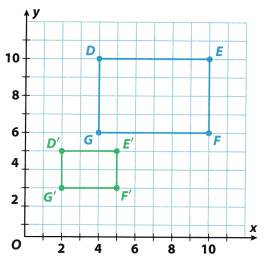
Find the scale factor of the dilation.
Texas Go Math Grade 8 Lesson 13.1 Answer Key 28
Answer:
Use the coordinates to find the lengths of the sides of each rectangle:
Rectangle DEFG:
DE = FG = 6 ………………….. (1)
DG = EF = 4 ………………….. (2)
Rectangle D’E’F’G’ :
D’E’ = F’G’ = 3 ………………. (3)
D’G’ = E’F’ = 2 ……………… (4)
Find the ratios of the corresponding sides.
\(\frac{D^{\prime} G^{\prime}}{D G}=\frac{E^{\prime} F^{\prime}}{E F}=\frac{2}{4}=\frac{1}{2}\) …………….. (5)
\(\frac{D^{\prime} E^{\prime}}{D E}=\frac{F^{\prime} G^{\prime}}{F G}=\frac{3}{6}=\frac{1}{2}\) ……………… (6)

Texas Go Math Grade 8 Lesson 13.1 Guided Practice Answer Key

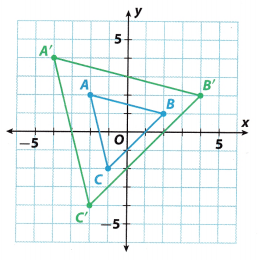
Use triangles ABC and A’B’C’ for 1-5. (Explore Activities 1 and 2, Example 1)
Texas Go Math Grade 8 Lesson 13.1 Answer Key 9

Question 1.
For each pair of corresponding vertices, find the ratio of the x-coordinates and the ratio of the y-coordinates.
ratio of x-coordinates = ____________.
ratio of y-coordinates = ____________.
Answer:
Firstly, we will have to identify x and y coordinates of triangles ABC and A’B’C’ by measuring how many units they are away from the origin.

Therefore, we can write coordinates as:
A(2, 2) A'(-4, 4)
B(2, 1) B'(4, 2)
C(-1, -2) C'(-2, -4)

To find the ratio of the x and y coordinates, we will firstly calculate the ratio between x coordinates for points ABC and A’B’C’ as follows:
Texas Go Math Grade 8 Lesson 13.1 Answer Key 16
Hence, we can conclude that the ratio of x coordinates is \(\frac{1}{2}\).

Secondly, we will calculate the ratio of y coordinates using the same principle:
Texas Go Math Grade 8 Lesson 13.1 Answer Key 17
Hence, we can conclude that the ratio of y coordinates is \(\frac{1}{2}\).

Lesson 13.2 Properties of Dilations Answer Key Question 2.
I know that triangle A’B’C is a dilation of triangle ABC because the ratios of the corresponding
x-coordinates are ___________ and the ratios of the corresponding y-coordinates are ___________.
Answer:
I know that triangle A’B’C’ is a dilation of triangle ABC because the ratios of the corresponding x-coordinates are equal and the ratios of the corresponding y-coordinates are equal.

Question 3.
The ratio of the lengths of the corresponding sides of triangle A’B’C’ and triangle ABC equals ___________.
Answer:
To find the ratio of lengths, we first have to calculate the values of lengths using the given formula:
d = \(\sqrt{\left(x_{2}-x_{1}\right)^{2}+\left(y_{2}-y_{1}\right)^{2}}\)
where d is a distance between two points A(x1, y1) and B(x2, y2).

Using the formula given under (1), we can calculate the values of lengths for triangle A’B’C’ as following:
Texas Go Math Grade 8 Lesson 13.1 Answer Key 18

Using the formula given under (1), we can calculate the values of lengths for triangle ABC as following:
Texas Go Math Grade 8 Lesson 13.1 Answer Key 19

Using the obtained values, we can the ratio of the lengths as following:
Texas Go Math Grade 8 Lesson 13.1 Answer Key 20
Hence, we can conclude that ratio of the lengths is 2.

Question 4.
The corresponding angles of triangle ABC and triangle A’B’C’ are _________.
Answer:
To determine the answer here, we will review the definition of congruent angles.
Two angles are congruent if their corresponding sides and angles have equal measure. Considering the fact that in the given exercise that is the case, we can claim that the corresponding angles of triangles ABC and A’B’C’ are congruent.

Question 5.
The scale factor of the dilation is __________.
Answer:
Considering the fact that the scale factor of a dilation is defined as the ratio of the lengths of corresponding sides, we will use the answer on Exercise 3.
Therefore, the scale factor is 2, meaning that triangle A’B’C’ is an enlargement of triangle ABC.

Essential Question Check-In

Question 6.
How can you find the scale factor of a dilation?
Answer:
A scale factor describes how much the figure is enlarged or reduced. It is the ratio of the length of the image to the corresponding length on the original figure.

By definition, to determine the scale factor of a dilation, we need to divide the length of the dilated image by the corresponding length of the original figure.

Texas Go Math Grade 8 Lesson 13.1 Independent Practice Answer Key

For 7-11, tell whether one figure is a dilation of the other or not. Explain your reasoning.

Question 7.
Quadrilateral MNPQ has side lengths: of 15 mm, 24 mm, 21 mm, and 18 mm. Quadrilateral M’N’P’Q’ has side lengths of 5 mm, 8 mm, 7 mm, and 4 mm.
Answer:
Quadrilateral MNPQ has side lengths of 15 mm, 24 mm, 21 mm, and 18 mm. Quadrilateral M’N’P’Q’ has side lengths of 5 mm, 8 mm, 7 mm, and 4 mm. Find the ratios of the corresponding sides.
\(\frac{5}{15}=\frac{1}{3}\) …………………….. (1)
\(\frac{8}{24}=\frac{1}{3}\) …………………….. (2)
\(\frac{7}{21}=\frac{1}{3}\) …………………….. (3)
\(\frac{4}{18}=\frac{2}{9}\) …………………….. (4)
Since the ratios of the corresponding sides are not equal, the quadrilateraL MNPQ of M’N’P’Q’.

Go Math Grade 8 Lesson 13.1 Answer Key Question 8.
Triangle RST has angles measuring 38° and 75°. Triangle R’ST has angles measuring 67° and 38°.
Answer:
Triangle RST has angles measuring 38° and 75°. We have to find third angle: 180° – 38° – 75° = 67°
Triangle R’S’T’ has angles measuring 67° and 38°. The measure of third angle is: 180° – 38° – 67° = 75°
Since the triangles have the same angle measures, the corresponding sides are proportional.

Question 9.
Two triangles, Triangle 1 and Triangle 2, are similar.
Answer:
A dilation produces an image similar to the original figure, so Triangle 1 is a dilation of Triangle 2.

Question 10.
Quadrilateral MNPQ is the same shape but a different size than quadrilateral M’N’P’Q.
Answer:
Quadrilateral MNPQ is the same like quadrilateral M’N’P’Q, so they are similar, and one is a dilation of the other.
Quadrilateral MNPQ is a dilation of quadrilateral M’N’P’Q.

Question 11.
On a coordinate plane, triangle UVW has coordinates U(20, -12), V(8, 6), and W(-24, -4). Triangle U’V’W’ has coordinates U'(15, -9), V'(6, 4.5), and W'(-18, -3).
Answer:
Triangle UVW has coordinates U(20, -12), V(8, 6), and W(-24, -4). Triangle U’V’W’ has coordinates U'(15, -9), V'(6, 4.5), and W'(-18, 3) Find ratio of x-coordinates.
\(\frac{15}{20}=\frac{3}{4}\) = (Divide fraction by 5) …………….. (1)
\(\frac{6}{8}=\frac{3}{4}\) = (Divide fraction by 2) ……………… (2)
\(\frac{-18}{-24}=\frac{3}{4}\) = (Divide fraction by -6) …………….. (3)
Find the ratio of y-coordinates
\(\frac{-9}{-12}=\frac{3}{4}\) (Divide fraction by -3) ………………. (4)
\(\frac{4.5}{6}=\frac{1.5}{2}=\frac{3}{4}\) (Divide fraction by 3 and then Expand the fraction with 2) ……………….. (5) (6)
\(\frac{-3}{-4}=\frac{3}{4}\) = (Divide fraction by -1) ……………………… (7)
The ratio of the corresponding coordinates is equal, so the triangle UVW is a dilation of U’V’W’.

Complete the table by writing “same” or “changed” to compare the image with the original figure in the given transformation.

Question 12.
Texas Go Math Grade 8 Lesson 13.1 Answer Key 10
Answer:
The translation is a movement where we slide a geometric figure in any direction, meaning that the figure changes only its location, but orientation, size, and shape stay the same. Therefore, we can fill the given table as it is shown in the picture below.
Texas Go Math Grade 8 Lesson 13.1 Answer Key 21

Question 13.
Texas Go Math Grade 8 Lesson 13.1 Answer Key 11
Answer:
Reflection is a movement where we flip a geometric figure regarding a certain line or a point, meaning that the figure changes its orientation, but size and shape stay the Same. Therefore, we can fill the given table as it is shown in the picture below.
Texas Go Math Grade 8 Lesson 13.1 Answer Key 22

Question 14.
Texas Go Math Grade 8 Lesson 13.1 Answer Key 12
Answer:
Rotation is a movement where we rotate a geometric figure around any point for a certain amount of degrees, meaning that figure changes only its orientation, but size and shape stay the same Therefore, we can fill the given table as it is shown in the picture below.
Texas Go Math Grade 8 Lesson 13.1 Answer Key 23

Question 15.
Texas Go Math Grade 8 Lesson 13.1 Answer Key 13
Answer:
Dilation is a transformation where we change a size of a given geometry object for a certain scale factor. Orientation and shape stay the same. Therefore, we can fill given table as it is shown in the picture below.
Texas Go Math Grade 8 Lesson 13.1 Answer Key 24

Question 16.
Describe the image of a dilation with a scale factor of 1.
Answer:
If the scale factor is 1, then the length of the corresponding sides is equal, so the image is congruent to the original figure.

Identify the scale factor used in each dilation.

Question 17.
Texas Go Math Grade 8 Lesson 13.1 Answer Key 14
Answer:
Use the coordinates to find the lengths of the sides of each rectangle:
Rectangle ABCD: AB = BC = CD = AD = 2 (ABCD is a square)
A’B’C’D’: A’B’ = B’C’ = C’D’ = D’A’ = 6
Find the ratios of the corresponding sides.
\(\frac{A^{\prime} B^{\prime}}{A B}=\frac{6}{2}\) (Substitute) (1)
= 3 (Calculate) (2)

Question 18.
Texas Go Math Grade 8 Lesson 13.1 Answer Key 15
Answer:
To identify the scale factor, we firstly have to write coordinates of given points and then calculate the distance between them.

Coordinates of points ABC and A’B’C’ are:
A = (8, 2), B = (8, 6), C = (2, 4)
A’ = (4, 1), B’ = (4, 3), C’ = (1, 2)

To calculate the length of each side of triangle, we will use following formula:
d = \(\sqrt{\left(x_{2}-x_{1}\right)^{2}+\left(y_{2}-y_{1}\right)^{2}}\)
where distance between points A(x1, y1) and B(x2, y2) is d.

Using formula under (1), we can calculate length of each side in triangle ABC as following:
Texas Go Math Grade 8 Lesson 13.1 Answer Key 25

Using formula under (1), we can calculate length of each side in triangle A’B’C’ as following:
Texas Go Math Grade 8 Lesson 13.1 Answer Key 26

To calculate the scale factor of given dilation, we will calculate the ratio of belonging sides as following:
Texas Go Math Grade 8 Lesson 13.1 Answer Key 27
Hence, we can conclude that scale factor used in given dilation is \(\frac{1}{2}\).

H.O.T. Focus on Higher Order Thinking

Question 19.
Critical Thinking Explain how you can find the center of dilation of a triangle and its dilation.
Answer:
Center of dilation is either a point or a plane from which we measure distance in dilation. We can find the center of dilation by drawing a line through the corresponding points of the picture before and after dilation. Those points intersect at the center of dilation.

Question 20.
Make a Conjecture
a. A square on the coordinate plane has vertices at (-2, 2), (2, 2), (2, -2), and (-2, -2). A dilation of the square has vertices at (-4, 4), (4, 4), (4, -4), and (-4, -4). Find the scale factor and the perimeter of each square.
Answer:
A square on the coordinate pLane has vertices at (- 2, 2), (2, 2), (2, 2), and ( 2, 2). A dilation of the square has vertices at (- 4, 4), (4, 4), (4, 4), and (- 4, 4). Lets find the ratio of the corresponding coordinates.
\(\frac{-4}{-2}\) = \(\frac{4}{2}\) = 2
Length of one side of the original square is |2 (- 2)| = |2 + 2| = 4, so the perimeter P0 is
P0 = 4 ∙ 4 = 16
Length of one side of image square is |4 – (-4)| = |4 + 4| = 8, so the perimeter Pi is
Pi = 4 ∙ 8 = 32

b. A square on the coordinate plane has vertices at (-3, 3), (3, 3), (3, -3), and (-3, -3). A dilation of the square has vertices at (-6, 6), (6, 6), (6, -6), and (-6, -6). Find the scale factor and the perimeter of each square.
Answer:
A square on the coordinate plane has vertices at (-3, 3), (3, 3), (3, -3),and (-3, -3). A dilation of the square has vertices at ( 6, 6), (6, 6), (6, 6), and (-6, -6). Let’s find the ratio of the corresponding coordinates.
\(\frac{-6}{-3}\) = \(\frac{6}{3}\) = 2
Length of one side of the original square is |3 – (-3)| = |3 + 3| = 6, so the perimeter is
P0 = 4 ∙ 6 = 24
Length of one side of image square is |6 – (-6) = |6 + 6| = 12, so the perimeter is
Pi = 4 ∙ 12 = 48

c. Make a conjecture about the relationship of the scale factor to the perimeter of a square and its image.
Answer:
The ratio of the perimeter of the image and the perimeter of the original is equal to the scale factor of dilation. So, the perimeter of the image is the perimeter of the original figure times scale factor.

Texas Go Math Grade 8 Lesson 13.1 Answer Key Properties of Dilations Read More »

Texas Go Math Grade 8 Lesson 12.1 Answer Key Properties of Translations

Refer to our Texas Go Math Grade 8 Answer Key Pdf to score good marks in the exams. Test yourself by practicing the problems from Texas Go Math Grade 8 Lesson 12.1 Answer Key Properties of Translations.

Texas Go Math Grade 8 Lesson 12.1 Answer Key Properties of Translations

Texas Go Math Grade 8 Lesson 12.1 Explore Activity Answer Key

Explore Activity 1

Exploring Translations

You learned that a function is a rule that assigns exactly one output to each input. A transformation is a function that describes a change in the position, size, or shape of a figure. The input of a transformation is the preimage, and the output of a transformation is the image.
Texas Go Math Grade 8 Lesson 12.1 Answer Key 22
A translation is a transformation that slides a figure along a straight line. The image has the same size and shape as the preimage.

The triangle shown on the grid is the preimage (input). The arrow shows the motion of a translation and how point A is translated to point A’.
Texas Go Math Grade 8 Lesson 12.1 Answer Key 2
A. Trace triangle ABC onto a piece of paper. Cut out your traced triangle.
B. Slide your triangle along the arrow to model the translation that maps point A to point A’.
C. The image of the translation is the triangle produced by the translation. Sketch the image of the translation.
D. The vertices of the image are labeled using prime notation. For example, the image of A is A’. Label the images of points B and C.
E. Describe the motion modeled by the translation.
Move ________ units right and ________ units down.
F. Check that the motion you described in part E. is the same motion that maps point A onto A’, point B onto B’, and point C onto C.

Reflect

Lesson 12.1 Translations Answer Key Texas Go Math Grade 8 Pdf Question 1.
How is the orientation of the triangle affected by the translation?
Answer:
The image and the preimage of the triangle have the same orientation.
The orientation doesn’t change.

Explore Activity 2

Properties of Translations

Use trapezoid TRAP to investigate the properties of translations.
Texas Go Math Grade 8 Lesson 12.1 Answer Key 3
A. Trace the trapezoid onto a piece of paper. Cut out your traced trapezoid.
B. Place your trapezoid on top of the trapezoid in the figure. Then translate your trapezoid 5 units to the left and 3 units up. Sketch the image of the translation by tracing your trapezoid in this new location. Label the vertices of the image T’, R’, A’, and P’.
C. Use a ruler to measure the sides of trapezoid TRAP in centimeters.
TR = ___________ RA = ___________ AP = ___________ TP = ___________
D. Use a ruler to measure the sides of trapezoid T’R’A’P’ in centimeters.
T’R’ = ___________ R’A’ = ___________ A’P’ = ___________ T’P’ = ___________
E. What do you notice about the lengths of corresponding sides of the two figures?
F. Use a protractor to measure the angles of trapezoid TRAP.
m∠T = ___________ m∠R = ___________ m∠A = ___________ m∠P = ___________.
G. Use a protractor to measure the angles of trapezoid T’R’A’P’.
m∠T’ = ___________ m∠R’ = ___________ m∠A’ = ___________ m∠P’ = ___________.
H. What do you notice about the measures of corresponding angles of the two figures?
I. Which sides of trapezoid TRAP are parallel? How do you know?
Which sides of trapezoid T’R’A’P’ are parallel?.
What do you notice?

Reflect

Question 2.
Make a Conjecture Use your results from parts E, H, and I to make a conjecture about translations.
Answer:
The size, shape and orientation stays the same after translations.

Question 3.
What can you say about translations and congruence?
Answer:
A translation produces a figure that is congruent to the original figure.

Your Turn

Question 4.
The figure shows parallelogram ABCD. Graph the image of the parallelogram after a translation of 5 units to the left and 2 units down.
Texas Go Math Grade 8 Lesson 12.1 Answer Key 4
Answer:
Step 1: Translate point A.
Count left 5 units and down 2 units and plot point E(-5, 1).

Step 2: Translate point B.
Count left 5 units and down 2 units and plot point F(-2, 1)

Step 3: Translate point C.
Count left 5 units and down 2 units and plot point G(0, -3).

Step 4: Translate point D.
Count left 5 units and down 2 units and plot point H(-3, -3).

Step 5: Connect E, F, G and H to form parallelogram EFGH.
Texas Go Math Grade 8 Lesson 12.1 Answer Key 13
E(-5, 1)
F(-2, 1)
G(0, -3)
H(-3, -3)

Texas Go Math Grade 8 Lesson 12.1 Guided Practice Answer Key

Question 1.
Vocabulary A __________ is a change in the position, size, or shape of a figure.
Answer:
A transformation is a change in the position, size, or shape of a figure.

Question 2.
Vocabulary When you perform a transformation of a figure on the coordinate plane, the input of the transformation is called the __________, and the output of the transformation is called the ___________.
Answer:
When you perform a transformation of a figure on the coordinate plane, the input of the transformation is called the preimage, and the output of the transformation is called the image.

Texas Go Math Grade 8 Pdf Translations Answer Key Pdf Question 3.
Joni translates a right triangle 2 units down and 4 units to the right. How does the orientation of the image of the triangle compare with the orientation of the preimage? (Explore Activity 1)
Answer:
A translation doesn’t change the shape and size of a geometric figure.
This means that two triangles are identical in shape and size, so they are congruent and the orientation is the same.

Question 4.
Rashid drew a rectangle PQRS on a coordinate plane. He then translated the rectangle 3 units up and 3 units to the left and labeled the image P’Q’R’S’. How do rectangle PQRS and rectangle P’Q’R’S’ compare? (Explore Activity 2)
Answer:
A translation doesn’t change the shape and size of a geometric figure.
This means that two rectangles are identical in shape and size, so they are congruent.

Question 5.
The figure shows trapezoid WXYZ. Graph the image of the trapezoid after a translation of 4 units up and 2 units to the left. (Example 1)
Texas Go Math Grade 8 Lesson 12.1 Answer Key 5
Answer:
Step 1: Translate point W.
Count up 4 units and leave 2 units and plot point E(-4, 3).

Step 2: Translate point X.
Count up 4 units and leave 2 units and plot point F(2, 3).

Step 3: Translate point Y.
Count up 4 units leave 2 units and plot point G(1, 1).

Step 4: Translate point Z.
Count up 4 units leave 2 units and plot point H(-3, 1).

Step 5: Connect E, F, G and H to form trapezoid EFGH.
Texas Go Math Grade 8 Lesson 12.1 Answer Key 14
E(-4, 3)
F(2, 3)
G(1, 1)
H(-3, 1)

Essential Question Check-In

Question 6.
What are the properties of translations?
Answer:
A translation is a geometric transformation that moves every point of a figure for a space by the same amount in a given direction.
This means that the figures are identical and congruent.

Texas Go Math Grade 8 Lesson 12.1 Independent Practice Answer Key

Texas Go Math Grade 8 Pdf Lesson 12.1 Answer Key Question 7.
The figure shows triangle DEF.
Texas Go Math Grade 8 Lesson 12.1 Answer Key 6
a. Graph the image of the triangle after the translation that maps point D to point D’.
Answer:
From the photo, we can see that point D has been moved 4 units down and 2 units to the left. On the same way, we move the other points.
Step 1: Translate point E.
Count down 4 units and left 2 units and plot point E'(-2, 1).

Step 2: Translate point F.
Count down 4 units and left 2 units and plot point F'(3, -2).

Step 3: Connect D’, E’ and F’ to form triangle D’E’F’.
Texas Go Math Grade 8 Lesson 12.1 Answer Key 15

b. How would you describe the translation?
Answer:
With a translation, we moved the triangle 4 units down and 2 units to the left.

c. How does the image of triangle DEF compare with the preimage?
Answer:
The preimage has the same size, orientation and shape, but a different location from the image.

Question 8.
a. Graph quadrilateral KLMN with vertices K(-3, 2), L(2, 2), M(0, -3), and N(-4, 0) on the coordinate grid.
Texas Go Math Grade 8 Lesson 12.1 Answer Key 7
Answer:
Step 1: Translate point K
Count 3 units to the right and 4 units up and plot point K'(0, 6).

Step 2: Translate point L.
Count 3 units to the right and 4 units up and plot point L'(5, 6).

Step 3: Translate point M.
Count 3 units to the right and 4 units up and plot point M'(3, 1).

Step 4: Translate point N
Count 3 units to the right and 4 units up and plot point N'(-1, 4)

b. On the same coordinate grid, graph the image of quadrilateral KLMN after a translation of 3 units to the right and 4 units up.
Answer:
Connect K’, L’, M’, and N’ to form quadrilateral K’L’M’N’
Texas Go Math Grade 8 Lesson 12.1 Answer Key 16

c. Which side of the image is congruent to side \(\overline{L M}\)?
Name three other pairs of congruent sides.
Answer:
\(\overline{L^{\prime} M^{\prime}}\) is conguent to \(\overline{L M}\).
\(\overline{K^{\prime} L^{\prime}}\) is conguent to \(\overline{K L}\).
\(\overline{M^{\prime} N^{\prime}}\) is conguent to \(\overline{M N}\).
\(\overline{K^{\prime} N^{\prime}}\) is conguent to \(\overline{K N}\).

Draw the image of the figure after each translation.

Question 9.
4 units left and 2 units down
Texas Go Math Grade 8 Lesson 12.1 Answer Key 8
Answer:
Step 1: Translate point P.
Count 4 units to the left and 2 units down and plot point P'(-3, 1).

Step 2: Translate point Q.
Count 4 units to the left and 2 units down and plot point Q'(0, 2).

Step 3: TransLate point R.
Count 4 units to the left and 2 units down and plot point R'(0, 1).

Step 4: Translate point S.
Count 4 units to the left and 2 units down and plot point S'(-3, -3).

Step 5: Connect P’, Q’, R’ and S’ to form quadrilateral P’Q’R’S’.
Texas Go Math Grade 8 Lesson 12.1 Answer Key 17
Connect P'(-3, 1), Q'(0, 2), R'(0, -1) and S'(-3, -3) to form quadriLateraL P’Q’R’S’.

Lesson 12.1 Properties of Translations Worksheet Go Math Grade 8 Question 10.
5 units right and 3 units up
Texas Go Math Grade 8 Lesson 12.1 Answer Key 9
Answer:
Step 1: Translate point A.
Count 5 units to the right and 3 units up and plot point A'(0, 4).

Step 2: Translate point B.
Count 5 units to the right and 3 units up and plot point B'(3, 5).

Step 3: Translate point C.
Count 5 units to the right and 3 units up and plot point C'(3, 1).

Step 4: Translate point D.
Count 5 units to the right and 3 units up and plot point D'(0, 0).

Step 5: Connect A’, B’, C’ and D’ to form quadrilateral A’B’C’D’.
Texas Go Math Grade 8 Lesson 12.1 Answer Key 18

Question 11.
The figure shows the ascent of a hot air balloon. How would you describe the translation?
Texas Go Math Grade 8 Lesson 12.1 Answer Key 10
Answer:
From the picture we can see that the balloon moved 4 units to the right and 5 units up.

Question 12.
Critical Thinking Is it possible that the orientation of a figure could change after it is translated? Explain.
Answer:
No, it’s not possible. A translation is a transformation when a figure moves to another location without any change in size or orientation.

H.O.T. Focus on Higher Order Thinking

Question 13.
a. Multistep Graph triangle XYZ with vertices X(-2, -5), Y(2, -2), and Z(4, -4) on the coordinate grid.
Texas Go Math Grade 8 Lesson 12.1 Answer Key 11
Answer:
Step 1: Translate point X.
Count left 3 units and up 6 units and plot point X'(-5, 1).

Step 2: Translate point Y
Count left 3 units and up 6 units and plot point Y'(-1, 4).

Step 3: Translate point Z.
Count left 3 units and up 6 units and plot point Z'(1, 2).

b. On the same coordinate grid, graph and label triangle X’Y’Z’, the image of triangle XYZ after a translation of 3 units to the left and 6 units up.
Answer:
Connect X’, Y’ and Z’ to form triangle X’Y’Z’
Texas Go Math Grade 8 Lesson 12.1 Answer Key 19

c. Now graph and label triangle X”Y”Z”, the image of triangle X’Y’Z’ after a translation of 1 unit to the left and 2 units down.
Answer:
Step 1: Translate point X’.
Count left 1 unit and down 2 units and plot point X”(-6, -1)

Step 2: Translate point Y’
Count left 1 unit and down 2 units and plot point Y”(-2, 2)

Step 3: Translate point Z’.
Count left 1 unit and down 2 units and plot point Z”(0, 0).

Step 4: Connect X”, Y” and Z” to form triangle X”Y”Z”.

d. Analyze Relationships How would you describe the translation that maps triangle XYZ onto triangle X”Y”Z”?
Answer:
After a translation of 4 units up and 4 units to the left, we get triangle X”Y”Z”, the image of the triangle XYZ.
Texas Go Math Grade 8 Lesson 12.1 Answer Key 20

Lesson 12.1 Graphing on the Coordinate Plane Answer Key Question 14.
Critical Thinking The figure shows rectangle P’Q’R’S’, the image of rectangle PQRS after a translation of 5 units to the right and 7 units up. Graph and label the preimage PQRS.
Texas Go Math Grade 8 Lesson 12.1 Answer Key 12
Answer:
The figure shows us the image of a rectangle PQRS after a translation of 5 units to the right and 7 units up. We need to find the preimage of the rectangle. So, we will come back 5 units to the left, and 7 units down.
Count 5 units to the left and 7 units down and plot point P(-3, -2).
Count 5 units to the left and 7 units down and plot point O(-1, -2).
Count 5 units to the left and 7 units down and plot point R(-1, -5).
Count 5 units to the left and 7 units down and plot point S(-3, -5).
Connect P, Q, R, and S and form a rectangle PQRS.
Texas Go Math Grade 8 Lesson 12.1 Answer Key 21
P(-3, -2)
O(-1, -2)
R(-1, -5)
S(-3, -5)

Question 15.
Communicate Mathematical Ideas Explain why the image of a figure after a translation is congruent to its preimage.
Answer:
A translation is a geometric transformation that moves every point of a figure for a space by the same amount in a given direction. This means that the preimage and image of a figure are identical. and the translated figure is congruent to its preimage.

Texas Go Math Grade 8 Lesson 12.1 Answer Key Properties of Translations Read More »

Texas Go Math Grade 8 Module 12 Answer Key Transformations and Congruence

Refer to our Texas Go Math Grade 8 Answer Key Pdf to score good marks in the exams. Test yourself by practicing the problems from Texas Go Math Grade 8 Module 12 Answer Key Transformations and Congruence.

Texas Go Math Grade 8 Module 12 Answer Key Transformations and Congruence

Texas Go Math Grade 8 Module 12 Are you Ready? Answer Key

Find each difference.

Question 1.
5 – (-9) ___________
Answer:
5 – (-9) = 5 + 9 = 14 (To subtract an integer, add its opposite)

Question 2.
-6 – 8 ___________
Answer:
(To subtract an integer, add it’s opposite) -6 – 8 = – 6 + (- 8)
(The signs are the same negative, so the sum of integers is negative) = – 14

Texas Go Math Grade 8 Module 12 Answer Key Absolute Value Question 3.
2 – 9 ___________
Answer:
(To subtract an integer, add it’s opposite) 2 – 9 = 2 + (- 9)
(The signs are different, so find the difference of the absolute values: 9 – 2 = 7.) = |2| – |-9|
(Use the sign of the number with the greater absolute vaue) = -7

Question 4.
-10 – (-6) ___________
Answer:
(To subtract an integer, add it’s opposite.) -10 – (- 6) = -10 + 6
(The signs are different, so find the difference of the absolute values: 10 – 6 = 4.) = -(|-10| – |-6|)
(Use the sign of the number with the greater absolute value) = -4

Question 5.
3 – (-11) ___________
Answer:
3 – (-11) = 3 + 11 = 14 (To subtract an integer, add it’s opposite.)

Question 6.
12 – 7 ___________
Answer:
(To subtract an integer, add it’s opposite) 12 – 7 = 12 + (- 7)
(The signs are different, so find the difference of the absolute values: 12 – 7 = 5.) = |12| – |7|
(Use the sign of the number with the greater absolute value) = 5

Question 7.
-4 – 11 ___________
Answer:
(To subtract an integer, add it’s opposite.) -4 – 11 = – 4 + (-11)
(The signs are both negative, so the sum of integers is negative.) = -15

Texas Go Math Grade 8 Transformations and Congruence Module 12 Answer Key Question 8.
0 – (-12) ___________
Answer:
0 – (-12) = 0 + 12 = 12 (To subtract an integer, add it’s opposite)

Use a protractor to measure each angle.

Question 9.
Texas Go Math Grade 8 Module 12 Answer Key 1
Answer:
Use a protractor to determine the angle measure.
The angle measure is 35°.

Question 10.
Texas Go Math Grade 8 Module 12 Answer Key 2
Answer:
Use a protractor to determine the angle measure.
The angle measure is 130°.

Module 12 Transformations and Congruence Answer Key Question 11.
Texas Go Math Grade 8 Module 12 Answer Key 3
Answer:
Use a protractor to determine the angle measure.
The angle measure is 85°.

Texas Go Math Grade 8 Module 12 Reading Start-Up Answer Key

Visualize Vocabulary

Use the ✓ words to complete the graphic organizer. You will put one word in each oval.
Texas Go Math Grade 8 Module 12 Answer Key 4
Texas Go Math Grade 8 Module 12 Answer Key 5

Understand Vocabulary

Match the term on the left to the correct expression on the right.
Texas Go Math Grade 8 Module 12 Answer Key 6
Answer:
1. – A. Transformation is a function that describes a change in the position, size,or shape of a figure.

2. – C. Reflection is a transformation that flips a figure across a line.

3. – B. Translation is a function that slides a figure along a straight line.

Active Reading
Booklet Before beginning the module, create a booklet to help you learn the concepts in this module. Write the main idea of each lesson on each page of the booklet. As you study each lesson, write important details that support the main idea, such as vocabulary and formulas. Refer to your finished booklet as you work on assignments and study for tests.
Texas Go Math Grade 8 Module 12 Answer Key 7

Texas Go Math Grade 8 Module 12 Answer Key Transformations and Congruence Read More »

Texas Go Math Grade 8 Unit 4 Study Guide Review Answer Key

Refer to our Texas Go Math Grade 8 Answer Key Pdf to score good marks in the exams. Test yourself by practicing the problems from Texas Go Math Grade 8 Unit 4 Study Guide Review Answer Key.

Texas Go Math Grade 8 Unit 4 Study Guide Review Answer Key

Texas Go Math Grade 8 Unit 4 Exercises Answer Key

Module 11 Equations and Inequalities with the Variable on Both Sides

Solve. (Lessons 11.1. 11.2, 11.3, 11.4)

Question 1.
13 – 6y = 8y
Answer:
13 = 8y + 6y
14y = 13
y = 13/14
y = 0.9

Grade 8 Math Unit 4 Assessment Answers Question 2.
\(\frac{1}{5}\)x + 5 = 19 – \(\frac{1}{2}\)x
Answer:
Determine the least common multiple of the denominators: LCM(5, 2) = 10.
Then, multiply both sides of the equation by the LCM to eliminate the fraction.
\(\frac{1}{5}\)x + 5 = 19 – \(\frac{1}{2}\)x
10(\(\frac{1}{5}\)x + 5) = 10(19 – \(\frac{1}{2}\)x)
2x + 50 = 190 – 5x
(Subtract 50 from both sides.) 2x = 140 – 5x
(Add 5x to both sides.) 7x = 140
(Divide both sides by 7) x = 20
x = 20

Question 3.
7.3t + 22 ≤ 2.1t – 22.2
Answer:
Multiply both sides of the equation by 10. Multiplying by 10 clears the equation of decimals
7.3t + 22 = 2.1t – 22.2
73t + 220 = 21t – 222
(Subtract 220 from each side) 73t = 21t – 442
(Subtract 21t from each side.) 52t = -442
(Divide by 52) y = -8.5
y = -8.5

Question 4.
7 – 45z < 5z + 13
Answer:
Given,
7 – 45z < 5z + 13
7 – 13 < 5z + 45z
-6 < 50z
50z > -6
z > -3/25

Question 5.
1.4 + \(\frac{2}{5}\)e ≥ \(\frac{3}{15}\)e – 0.8
Answer:
Determine the least common multiple of the denominators: LCM(5, 15) = 15.
Then, multiply both sides of the equation by the LCM to eliminate the fraction.
1.4 + \(\frac{2}{5}\)e ≥ \(\frac{3}{15}\)e – 0.8
15(1.4 + \(\frac{2}{5}\)e) = 15(\(\frac{3}{15}\)e – 0.8)
21 + 6e = 3e – 12
(Subtract 3e from both sides.) 21 + 3e = – 12
(Subtract 21 from both sides.) 3e = -33
(Divide both sides by 3) e = -11
e = 11

Question 6.
0.75x – 6.5 = -0.5 – 0.25x
Answer:
Given,
0.75x – 6.5 = -0.5 – 0.25x
0.75x + 0.25x = -0.5 + 6.5
x = 6
So, the value of x is 6.

Unit 4 Math Test 8th Grade Answer Key Question 7.
Write a real-world situation that could be modeled by the equation 650 + 10m = 60m + 400. (Lesson 11.1)
Answer:
A handyman charges 650 dollars plus 10 dollars per hour for house painting. A painter charges 400 dollars plus 60 dollars per hour. How many hours would a job have to take for the handyman’s fee and the painter’s fee to be the same?

Question 8.
John is trying to decide which carpeting company to use to put carpet in his living room. Carla’s Carpeting charges $45 plus $5.50 per square foot. Fred’s Flooring charges $195 plus $4.25 per square foot. For what size room is Carla’s Carpeting cheaper than Fred’s Flooring? (Lesson 11.3)
Answer:
45 + 5.50f = 195 + 4.25f

Texas Go Math Grade 8 Unit 4 Performance Tasks Answer Key

Question 1.
CARRERS IN MATH Hydraulic Engineer A hydraulic engineer studies the pressure in a particular fluid. The pressure is equal to the atmospheric pressure 101 kN/m plus 8 kN/m for every meter below the surface, where kN/m is kilonewtons per meter, a unit of pressure.
a. Write an expression for the pressure at a depth of d, meters below the liquid surface.
Answer:
where P is the pressure at d1 below the surface
P = 8d1 + 101

b. Write and solve an equation to find the depth at which the pressure is 200 kN/m.
Answer:
When P = 200 kN/m
200 = 8d1 + 101
Subtract 101 from both sides
200 – 101 = 8d1 + 101 – 101
8d1 = 99
Divide both sides by 8
d1 = 12.375

c. The hydraulic engineer alters the density of the fluid so that the pressure at depth d2 below the surface is atmospheric pressure 101 kN/m plus 9 kN/m for every meter below the surface. Write an expression for the pressure at depth d2.
Answer:
where P is the pressure at d2 below the surface
P = 9d2 + 101

d. If the pressure at depth d1 in the first fluid is equal to the pressure at depth d2 in the second fluid, what is the relationship between d1 and d2? Explain how you found your answer.
Answer:
When pressure is equal the equations from a and c should be set equal
8d1 + 101 = 9d2 + 101
Subtract 101 from both sides
8d1 + 101 – 101 = 9d2 + 101 – 101
8d1 = 9d2
Divide both sides by 8
d1 = \(\frac{9}{8}\) d2

Texas Go Math Grade 8 Unit 4 Mixed Review Texas Test Prep Answer Key

Selected Response

Question 1.
Ricardo and John start swimming from the same location. Ricardo starts 15 seconds before John and swims at a rate of 3 feet per second. John swims at a rate of 4 feet per second in the same direction as Ricardo. Which equation could you solve to find how long it will take John to catch up with Ricardo?
(A) 4t + 3 = 3t
(B) 4t + 60 = 3t
(C) 3t + 3 = 4t
(D) 3t + 45 = 4t
Answer:
(D) 3t + 45 = 4t

Explanation:
If v shows at which rate Ricardo and John swim, d is the distance between two locations and t is their time, then we use the formula for speed:
v = \(\frac{d}{t}\)
t ∙ (v) = t ∙ (\(\frac{d}{t}\)) (Multiply both sides by t)
t ∙ (v) = d
John swims at a rate of 4 feet per second
d1 = 4t (for v = 4 ft/s)
Ricardo swims 15 seconds more than John and swims at a rate of 3 feet per second.
d2 = 3(15 + t) = 45 + 3t
d1 = d2 (for v = 3 ft/s and his time is t + 15)
4t = 45 + 3t
The correct answer is D.

Question 2.
Gina and Rhonda work for different real estate agencies. Gina earns a monthly salary of $5,000 plus a 6% commission on her sales. Rhonda earns a monthly salary of $6,500 plus a 4% commission on her sales. How much must each sell to earn the same amount in a month?
(A) $1,500
(B) $15,000
(C) $75,000
(D) $750,000
Answer:
(C) $75,000

Explanation:
We write an expression representing the monthly earnings of Gina. Let’s denote the number of sales by s.
5000 + 0.06s
We write an expression representing the monthly earnings of Rhonda. Let’s denote the number of sales by s.
6500 + 0.04s
We write an equation that can be solved to find how much must each sell to earn the same amount in a month.
5000 + 0.06s = 6500 + 0.04s
100 ∙ (5000 + 0.06s) = (6500 + 0.04s) ∙ 100
500000 + 6s = 650000 + 4s
500000 + 6s – 4s = 650000 + 4s – 4s
500000 + 2s = 650000
500000 + 2s – 500000 = 650000 – 500000
2s = 150000
s = \(\frac{150000}{2}\)
s = 75000
Each of them should sell $75000 to earn the same amount in a month.

Study Guide 8th Grade Math Unit 4 Answer Key Question 3.
Which is the measure of ∠BAC in the triangle below?
Texas Go Math Grade 8 Unit 4 Study Guide Review Answer Key 1
(A) 51°
(B) 61°
(C) 68°
(D) 71°
Answer:
∠ACD = 129°
Sum of angles = 180°
∠BAC = 180° – 129°
∠BAC = 51°
Thus the correct answer is option A.

Question 4.
A movie theater has two membership plans. Under Plan A you pay $6 a month plus $4 for each ticket you buy. Under Plan B you pay $18 a month plus $2 for each ticket you buy. Which inequality represents the situation when Plan B becomes less expensive than Plan A?
(A) x > 2
(B) x< 2
(C) x > 6
(D) x < 6
Answer:
Plan A you pay per month = $6 + $4 for each ticket.
Plan B you pay per month = $18 + $2 for each ticket.
$18 + $2x < $6 + $4x
$18 -$6 < $4x – $2x
$12 < $2x
x < $12/$2
x < 6
Option B is the correct answer.

Question 5.
Which inequality represents the solution to 1.75x + 3.5 > 3.25x – 8.5?
(A) x > 8
(B) x < 8
(C) x > 3.3
(D) x < 3.3
Answer:
1.75x + 3.5 > 3.25x – 8.5
3.5 + 8.5 > 3.25x – 1.75x
12 > 1.5x
x < 12/1.5
x < 8
Thus the correct answer is option B.

Question 6.
The triangle and the rectangle have the same perimeter.
Texas Go Math Grade 8 Unit 4 Study Guide Review Answer Key 2
Find the value of x.
(A) 2
(B) 10
(C) 18
(D) 24
Answer:
(A) 2

Explanation:
The perimeter of the rectangle is
Pr = 2l + 2w
Pr = 2(x + 7) + 2(2x – 1)
Pr = 2r + 14 + 4x – 2
Pr = 6x+ 12
The perimeter of the triangle is
Pt = a + b + c
Pt = (x + 5) + (x + 6) + (x + 7)
Pt = x + 5 + x + 6 + x + 7
Pt = 3x + 18
The perimeter of the rectangle is equal to the perimeter of the triangle, therefore we solve for x
Pr = Pt
6x + 12 = 3x + 18
6x + 12 – 3x = 3x + 18 – 3x
3x + 12 = 18
3x = 6
x = \(\frac{6}{3}\)
x = 2

Unit 4 Test Study Guide Congruent Triangles Answer Key Question 7.
What is the slope of the line?
Texas Go Math Grade 8 Unit 4 Study Guide Review Answer Key 3
(A) -3
(B) –\(\frac{1}{3}\)
(C) \(\frac{1}{3}\)
(D) 3
Answer:
(C) \(\frac{1}{3}\)

Explanation:
In general, the slope of a Line is the ratio of the change in y-vaLues for a segment of the graph to the
corresponding change in x-values.
slope = \(\frac{y_{2}-y_{1}}{x_{2}-x_{1}}\)
Choosing the points (1, 0) and (4, 1) on the given Line, we substitute the x- and y- values in equation (1).
slope = \(\frac{1-0}{4-1}=\frac{1}{3}\)
slope = \(\frac{1}{3}\)

Question 8.
A square wall tile has an area of 58,800 square millimeters. Between which two measurements is the length of one side?
(A) between 24 and 25 millimeters
(B) between 76 and 77 millimeters
(C) between 242 and 243 millimeters
(D) between 766 and 767 millimeters
Answer: (C) between 242 and 243 millimeters
Explanation:
A square wall tile has an area of 58,800 square millimeters.
Area of a square = s . s
A = 58,800
s = √58800
Perfect square close to 58800 is 58564 < 58800 < 59049
= 242 <√58800 < 243
The correct answer is option C.

Gridded Response

8th Grade Unit 4 Study Guide Congruent Triangles Question 9.
For the inequality 3x – 5 ≥ 5x – 25, what is the greatest value of x that makes the statement true?
Texas Go Math Grade 8 Unit 4 Study Guide Review Answer Key 4
Answer:
3x – 5 = 5x – 25
3x – 5x = -25 + 5
-2x = -20
x = 20/2
x = 10

Hot Tips! Correct answers in gridded problems can be positive or negative. Enter the negative sign in the first column when it is appropriate. Check your work!

Question 10.
Two cars are traveling in the same direction. The first car is going 45 mi/h and the second car is going 60 mi/h. The first car left 2 hours before the second car. How many hours will it take for the second car to travel the same distance as the first car?
Texas Go Math Grade 8 Unit 4 Study Guide Review Answer Key 9
Answer:
Given that,
The first car is going per mi/h = 45.
The second car is going per mi/h = 60.
The first car left 2 hours before the second car.
The equation is
45(t + 2) = 60 × t
45t + 90 = 60 × t
45t + 90/t = 60
45 + 90/t = 60
90/t = 15
90 = 15t
t = 90/15
t = 6.
The second car takes 6 hours to travel the same distance as the first car.

Study Guide 8th Grade Math Unit 4 Question 11.
Mickey is ordering some clothes online. One website charges $1.25 per pound for shipping. The other website charges $0.75 per pound for shipping plus a $2 handling fee. How many pounds of clothing would Mickey need to order for the shipping costs to be the same?
Texas Go Math Grade 8 Unit 4 Study Guide Review Answer Key 6
Answer:
One website charges for shipping = $1.25 per pound.
Other websites charge for shipping = $0.75 per pound + $2 handling fee.
$1.25x = $0.75x + $2.
$1.25x – $0.75x = $2
$0.5x = $2
x = 2/0.5
x = 4 pounds.
Mickey needs 4 pounds to order for the shipping costs to be the same.

Texas Go Math Grade 8 Unit 4 Vocabulary Preview Answer Key

Use the puzzle to preview key vocabulary from this unit. Unscramble the circled letters to answer the riddle at the bottom of the page.

Texas Go Math Grade 8 Unit 4 Study Guide Review Answer Key 7

  1. A number that is multiplied by the variable in an algebraic expression, where the number is a fraction. (Lesson 11.2)
  2. A number that is multiplied by the variable in an algebraic expression, where the number is a decimal. (Lesson 11.2)
  3. A mathematical statement that two expressions are equal. (Lesson 11.1)
  4. A number that is formed by repeated multiplication of the same factor, Multiply this to remove decimals from an unsolved equation. (Lesson 11.2)
  5. A statement that two expressions are not equal. (Lesson 11.3)

Question.
What is the best time to divide a half-dollar between two people?
Answer:
at a ____ ____ ____ ____ ____ ____ ____ ____ ____ ____ ____ ____!

Texas Go Math Grade 8 Unit 4 Study Guide Review Answer Key Read More »
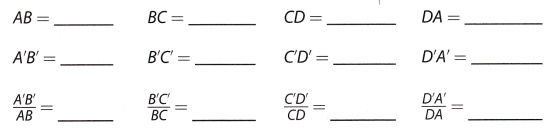
Texas Go Math Grade 8 Module 13 Answer Key Dilations, Similarity, and Proportionality

Refer to our Texas Go Math Grade 8 Answer Key Pdf to score good marks in the exams. Test yourself by practicing the problems from Texas Go Math Grade 8 Module 13 Answer Key Dilations, Similarity, and Proportionality.

Texas Go Math Grade 8 Module 13 Answer Key Dilations, Similarity, and Proportionality

Texas Go Math Grade 8 Module 13  Are You Ready? Answer Key

Write each ratio in the simplest form.

Question 1.
\(\frac{6}{15}\) ____________
Answer:
To write a ratio in simplest form, find the greatest factor of the numerator and denominator.
\(\frac{6}{15}=\frac{6 \div 3}{15 \div 3}\) (Divide the numerator and denominator by the GCF)
= \(\frac{2}{5}\)

Go Math Grade 8 Answer Key Pdf Similarity Question 2.
\(\frac{8}{20}\) ____________
Answer:
To write a ratio in simplest form, find the greatest factor of the numerator and denominator.
\(\frac{8}{20}=\frac{8 \div 4}{20 \div 4}\) (Divide the numerator and denominator by the GCF)
= \(\frac{2}{5}\)

Question 3.
\(\frac{30}{18}\) ____________
Answer:
To write a ratio in simplest form, find the greatest factor of the numerator and denominator.
\(\frac{30}{18}=\frac{30 \div 6}{18 \div 6}\) (Divide the numerator and denominator by the GCF)
= \(\frac{5}{3}\)

Question 4.
\(\frac{36}{30}\) ____________
Answer:
To write a ratio in simplest form, find the greatest factor of the numerator and denominator.
\(\frac{36}{30}=\frac{36 \div 6}{30 \div 6}\) (Divide the numerator and denominator by the GCF)
= \(\frac{6}{5}\)

Find the perimeter.

Question 5.
square with sides of 8.9 cm
Answer:
side = 8.9 cm
We know that,
Perimeter of the square = 4s
P = 4 × 8.9
P = 35.6 cm
Thus the perimeter of the square = 35.6 cm

Similarity Go Math Grade 8 Answer Key Pdf Question 6.
rectangle with length 5\(\frac{1}{2}\) ft and width 2\(\frac{3}{4}\) ft
Answer:
Given,
length 5\(\frac{1}{2}\) ft and width 2\(\frac{3}{4}\) ft
We know that,
Perimeter of the rectangle = 2L + 2W
P = 2 (5\(\frac{1}{2}\) + 2\(\frac{3}{4}\))
P = 2 (\(\frac{11}{2}\) + \(\frac{11}{4}\))
P = 2 (\(\frac{33}{4}\)
P = 33/2
P = 16 \(\frac{1}{2}\)
Thus the perimeter of the rectangle is 16 \(\frac{1}{2}\) ft

Question 7.
equilateral triangle with sides of 8\(\frac{3}{8}\) in.
Answer:
Given,
s = 8\(\frac{3}{8}\) in or 8.3
We know that,
Perimeter of the equilateral triangle = 3a
P = 3 × 8.3
P = 24.9 ft
Thus the perimeter of the equilateral triangle is 24.9 ft

Find the area.

Question 8.
Square with sides of 6.5 cm: ___________
Answer:
Given,
side = 6.5 cm
We know that,
Area of a square = s × s
A = 6.5 × 6.5
A = 42.25 sq. cm
Thus the area of the square is 42.25 sq. cm

Question 9.
Triangle with base 10 in. and height 6 in.:
Answer:
Given,
Triangle with base 10 in. and height 6 in
We know that,
Area of triangle = 1/2 × base × height
A = 1/2 × 10 × 6
A = 5 × 6
A = 30 sq. inches

Dilations and Similarity Iready Grade 8 Go Math Question 10.
Rectangle with length 3\(\frac{1}{2}\) ft and width 2\(\frac{1}{2}\) ft:
Answer:
Given,
length 3\(\frac{1}{2}\) ft and width 2\(\frac{1}{2}\) ft
We know that,
Area of the rectangle = l × w
A = 3\(\frac{1}{2}\) × 2\(\frac{1}{2}\)
A = \(\frac{7}{2}\) × \(\frac{5}{2}\)
A = \(\frac{35}{4}\)
Thus the area of the rectangle is \(\frac{35}{4}\) sq. ft

Texas Go Math Grade 8 Module 13 Reading Start-Up Answer Key

Visualize Vocabulary

Use the ✓ words to complete the graphic organizer. You will put one word in each rectangle.
Texas Go Math Grade 8 Module 13 Answer Key 1
Texas Go Math Grade 8 Module 13 Answer Key 2

Understand Vocabulary

Complete the sentences using the review words.

Question 1.
A figure larger than the original, produced through dilation, is an ____________
Answer:
A figure larger than the original, produced through dilation, is an enlargement.

Grade 8 Module 13 Answer Key Question 2.
A figure smaller than the original, produced through dilation, is a ____________
Answer:
A figure smaller than the original, produced through dilation, is a reduction.

Active Reading

Key-Term Fold Before beginning the module, create a key-term fold to help you learn the vocabulary in this module. Write the highlighted vocabulary words on one side of the flap. Write the definition for each word on the other side of the flap. Use the key-term fold to quiz yourself on the definitions used in this module.
Texas Go Math Grade 8 Module 13 Answer Key 3

Texas Go Math Grade 8 Module 13 Answer Key Dilations, Similarity, and Proportionality Read More »

Texas Go Math Grade 8 Lesson 11.1 Answer Key Equations with the Variable on Both Sides

Refer to our Texas Go Math Grade 8 Answer Key Pdf to score good marks in the exams. Test yourself by practicing the problems from Texas Go Math Grade 8 Lesson 11.1 Answer Key Equations with the Variable on Both Sides.

Texas Go Math Grade 8 Lesson 11.1 Answer Key Equations with the Variable on Both Sides

Texas Go Math Grade 8 Lesson 11.1 Explore Activity Answer Key

Explore Activity

Modeling an Equation with a Variable on Both Sides

Algebra tiles can model equations with a variable on both sides.

Use algebra tiles to model and solve x + 5 = 3x – 1.
Texas Go Math Grade 8 Lesson 11.1 Answer Key 13

Reflect

Go Math Grade 8 Answer Key Lesson 11.1 Pdf Question 1.
How can you check the solution to x + 5 = 3x – 1 using algebra tiles?
Answer:
The following model for the equation x + 5 = 3x – 1 is given. We found in the previous exercise that the solution was x = 3 and now we need to check the solution using algebra tiles.
Texas Go Math Grade 8 Lesson 11.1 Answer Key 5

Place one +1-tile on both sides and remove the zero pairs
Texas Go Math Grade 8 Lesson 11.1 Answer Key 6

Replace every x-tile with three of +1-tiles. We can see that the number of +1-tiles is equal on both sides, therefore the solution that we had found proves the equation.
Texas Go Math Grade 8 Lesson 11.1 Answer Key 7

Example 1

Andy’s Rental Car charges an initial fee of $20 plus an additional $30 per day to rent a car. Buddy’s Rental Car charges an initial fee of $36 plus an additional $28 per day. For what number of days is the total cost charged by the companies the same?
STEP 1: Write an expression representing the total cost of renting a car from Andy’s Rental Car.
Initial fee + Cost for x days
20 + 30x

STEP 2: Write an expression representing the total cost of renting a car from Buddy’s Rental Car.
Initial fee + Cost for x days
36 + 28x

STEP 3: Write an equation that can be solved to find the number of days for which the total cost charged by the companies would be the same.
Total cost at Andy’s = Total cost at Buddy’s
20 + 30x = 36 + 28x

STEP 4: Solve the equation for x.
Texas Go Math Grade 8 Lesson 11.1 Answer Key 2
The total cost is the same if the rental is for 8 days.

Your Turn

Question 2.
A water tank holds 256 gallons but is leaking at a rate of 3 gallons per week. A second water tank holds 384 gallons but is leaking at a rate of 5 gallons per week. After how many weeks will the amount of water in the two tanks be the same?
Answer:
Write an expression for the remaining gallons in the first tank.
A water tank holds 256 gallons 3 gallons per x weeks:
256 – 3x
Write an expression for the remaining gallons in the second tank.
A second water tank holds 384 gallons – 5 gallons per x week:
384 – 5x
Write an equation that can be solved to find the number of weeks for which the amount of water in the two tanks would be the same.
The remaining gallons in the first tank = the remaining gallons in the second tank:
256 – 3x = 384 – 5x
Solve the equation for x
(Write the equation.)256 – 3x = 384 – 5x
(Add 5x to both sides.)256 – 3x + 5x = 384 – 5x + 5x
256 + 2x = 384
(Subtract 256 from both sides.)256 + 2x – 256 = 384 — 256
2x = 128
(Divide both sides by 2) \(\frac{2x}{2}\) = \(\frac{128}{2}\)
x = 64
The amount of water in the two tanks will be the same for 64 weeks.

Example 2

Write a real-world situation that could be modeled by the equation 150 + 25x = 55x.
STEP 1: The left side of the equation consists of a constant plus a variable term. It could represent the total cost for doing a job where there is an initial fee plus an hourly charge.

STEP 2: The right side of the equation consists of a variable term. It could represent the cost for doing the same job based on an hourly charge only.

STEP 3: The equation 150 + 25x = 55x could be represented by this situation: A handyman charges $150 plus $25 per hour for house painting. A painter charges $55 per hour. How many hours would a job have to take for the handyman’s fee and the painter’s fee to be the same?

Go Math Grade 8 Answer Key Pdf Question 3.
Write a real-world situation that could be modeled by the equation 30x = 48 + 22x.
Answer:
Ben’s Rental Car charges just 30 dollars per day to rent a car. Marry’s Rental Car charges an initial fee of 48 dollars plus an additional 22 dollars per day. For what number of days is the total cost charged by the companies the same?

Texas Go Math Grade 8 Lesson 11.1 Guided Practice Answer Key

Use algebra tiles to model and solve each equation. (Explore Activity)

Question 1.
x + 4 = -x – 4 _____________
Answer:
Model x + 4 on the left side of the mat and -x – 4 on the right side.
Texas Go Math Grade 8 Lesson 11.1 Answer Key 8
Add one x-tile to both sides. This represents adding x to both sides of the equation. Remove zero pairs.
Texas Go Math Grade 8 Lesson 11.1 Answer Key 9
Place four -1-tiles on both sides. This represents subtracting -4 from both sides of the equation. Remove zero pairs.
Texas Go Math Grade 8 Lesson 11.1 Answer Key 10
Separate each side into 2 equal groups. One x-tile is equivalent to four -1 -tiles.
Texas Go Math Grade 8 Lesson 11.1 Answer Key 11
The solution is x = -4

Question 2.
2 – 3x = -x – 8 _____________
Answer:
Solve the equation for x.
2 – 3x = -x – 8
(Add 3 to both sides)2 – 3x + 3x = -x – 8 + 3x
2 = 2x – 8
(Add 8 to both sides.)2 + 8 = 2x – 8 + 8
10 = 2x
or
2x = 10
(Divide both sides by 2)\(\frac{2x}{2}\) = \(\frac{10}{2}\)
x = 5
Check:
2 – 3(5) = -5 – 8
2 – 15 = -13 (for x = 5)
-13 = -13
x = 5

Texas Go Math Grade 8 Pdf Workbook Answer Key Question 3.
At Silver Gym, membership is $25 per month, and personal training sessions are $30 each. At Fit Factor, membership is $65 per month, and personal training sessions are $20 each. In one month, how many personal training sessions would Sarah have to buy to make the total cost at the two gyms equal? (Example 1)
Answer:
Write an equation for the membership at Silver Gym
Membership + Personal training session
25 + 30x

Write an equation for the membership at Fit Factor
Membership + Personal training session
65 + 20x

Write an equation that can be solved to find the number of weeks for which the number of gallons in the two tank would be the same
Membership at Silver Gym = Membership at Fit Factor
25 + 30x = 65 + 20x

Solve for x
25 + 30x = 65+20x
Subtract 20x from both sides
25 + 30x – 20x = 65 + 20x – 20x
25 + 10x = 65
Subtract 25 from both sides
25 + 10x – 25 = 65 – 25
10x = 40
Divide both sides by 10
x = \(\frac{40}{10}\) = 4
Sarah would have to buy $4$ session for the total cost at the two gyms to be equal.

Question 4.
Write a real-world situation that could be modeled by the equation 120 + 25x = 45x. (Example 2)
Answer:
Given
120 + 25x = 45x
The Left side of the equation consists of a constant plus a variable
Sarah offers a plan to tutor a student at $25 per her plus a one-time registration fee of $120.

The right side of the equation consists of a variable term.
Surah offers an alternative plan to tutot a student at $45 per hour and no registration fee.

How many hours would a student have to take for the two plans cost the same
120 + 25x = 45x

Question 5.
Write a real-world situation that could be modeled by the equation 100 – 6x = 160 – 10x. (Example 2)
Answer:
A water tanks holds 100 gallons but is leaking at a rate of 6 gallons per week. A second water tank holds 160 gallons but is leaking at a rate of 10 gallons per week. After how many weeks will the amount of water in the two tanks be the same?

Essential Question Check-In

Question 6.
How can you solve an equation with the variable on both sides?
Answer:
Isolate the variable on one side Add/subtract the variable with a lower coefficient from both sides Add/subtract the constant (with the variable) from both sides. Divide both sides by the coefficient of the isolated variable.

Texas Go Math Grade 8 Lesson 11.1 Independent Practice Answer Key

Question 7.
Derrick’s Dog Sitting and Darlene’s Dog Sitting are competing for new business. The companies ran the ads shown.
Texas Go Math Grade 8 Lesson 11.1 Answer Key 3
a. Write and solve an equation to find the number of hours for which the total cost will be the same for the two services.
Answer:
Write an expression for the cost of Derrick’s Dog Sitting.
5x + 12
Write an expression for the cost of Darlene’s Dog Sitting.
3x + 18
Write an equation that can be solved to find the number of hours for which the cost would be the same.
5x + 12 = 3x + 18
Solve the equation for x
(Write the equation.)5x + 12 = 3x + 18
(Subtract 3x from both sides.)5x + 12 – 3x = 3x + 18 – 3x
2x + 12 = 18
(Subtract 12 from both sides.)2x + 12 – 12 = 18 – 12
2x = 6
(Divide both sides by 2)\(\frac{2x}{2}\) = \(\frac{6}{2}\)
x = 3

b. Analyze Relationships Which dog sitting service is more economical to use if you need 5 hours of service? Explain.
Answer:
The total cost will. be the same for 3 hours.
The unknown x is 5 hours
5(5) + 12 = 25 + 12 = 37
3(5) + 18 = 15 + 18 = 33
33 < 37
Darlene’s Dog Sitting would be cheaper.

Texas Go Math Grade 8 Answer Key Pdf Question 8.
Country Carpets charges $22 per square yard for carpeting and an additional installation fee of $100. City Carpets charges $25 per square yard for the same carpeting and an additional installation fee of $70.
a. Write and solve an equation to find the number of square yards of carpeting for which the total cost charged by the two companies will be the same.
Answer:
Country Carpets charges 22 dollars per square yard for carpeting and an additional installation fee of 100 dollars.
Write an expression:
22x + 100
City Carpets charges 25 dollars per square yard for the same carpeting and an additional installation fee of 70 dollars.
Write an expression:
25x + 70
Write and solve an equation to find the number of square yards of carpeting for which the total cost charged by the two companies will be the same.
22x + 100 = 25x + 70
Solve the equation for x.
(Write the equation.)22x + 100 = 25x + 70
(Subtract 22x from both sides.)22x + 100 – 22x = 25x + 70 – 22x
100 = 3x + 70
(Subtract 70 from both sides.) 100 – 70 = 3x + 70 – 70
30 = 3x
(Divide both sides by 3.) \(\frac{3x}{3}\) = \(\frac{30}{3}\)
x = 10
The total cost will be the same for 10 square yards of carpeting.

b. Justify Reasoning Mr. Shu wants to hire one of the two carpet companies to install carpeting in his basement. Is he more likely to hire Country Carpets or City Carpets? Explain your reasoning.
Answer:
x < 10
22(9) + 100 = 198 + 100 = 298
25(9) + 70 = 225 + 70 = 295
City Carpets are cheaper when x < 10. x > 10
22(11) + 100 = 232 + 100 = 342
25(11) + 70 = 275 + 70 = 345
Country Carpets are cheaper when x > 10.
If Mr. Shu needs the carpeting done for less than 10 square yards, he will hire City Carpets and if he needs carpeting for more than 10 square yards, he will hire Country Carpets.

Write an equation to represent each relationship. Then solve the equation.

Question 9.
Two less than 3 times a number ¡s the same as the number plus 10.
Answer:
Given
Two less than 3 times a number is the same as the number plus 10
Represent the unknown with a variable Times means multiplication
Two less than 3 times x is the same as x plus 10
Plus means addition
Two less than 3x is the same as x + 10
Less than means subtraction
3x – 2 is the same as x + 10
Place the equal sign
3x – 2 = x + 10
Solve for x
3x – 2 = x + 10
Subtract x from both sides
3x – 2 – x = x + 10 – x
2x – 2 = 10
Add 2 to both sides
2x – 2 + 2 = 10 + 2
2x = 12
Divide both sides by 2
x = \(\frac{12}{2}\) = 6
x = 6

Question 10.
A number increased by 4 is the same as 19 minus 2 times the number.
Answer:
Given
A number increased by 4 is the same as 19 minus 2 times the number
Represent the unknown with a variable Times means multiplication
x increased by 4 is the same as 19 minus 2x
Increased by means addition
x + 4 is the same as 19 minus 2x
minus means subtraction
x + 4 is the same as 19 – 2x
Place the equal sign
x + 4 = 19 – 2x
Solve for x
x + 4 = 19 – 2x
Add 2x to both sides
x + 4 + 2x = 19 – 2x + 2x
3x + 4 = 19
Subtract 4 from both sides
3x + 4 – 4 = 19 – 4
3x = 15
Divide both sides by 3
x = \(\frac{15}{3}\) = 5

Question 11.
Twenty less than 8 times a number is the same as 15 more than the number.
Answer:
Given
Twenty less than 8 times a number is the same as 15 more than the number
Represent the unknown with a variable Times means multiplication
Twenty less than 8 times x is the same as 15 more than the x
More than means addition
Twenty less than 8x is the same as x + 15
Less than means subtraction
8x – 20 is the same as x + 15
Place the equal sign
8x – 20 = x + 15
Solve for x
8x – 20 = x + 15
Subtract x from both sides
8x – 20 – x = x + 15 – x
7x – 20 = 15
Add 20 to both sides
7x – 20 + 20 = 15 + 20
7x = 35
Divide both sides by 7
x = \(\frac{35}{7}\) = 5

Question 12.
The charges for an international call made using the calling card for two phone companies are shown in the table.
Texas Go Math Grade 8 Lesson 11.1 Answer Key 4
a. What is the length of a phone call that would cost the same no matter which company is used?
Answer:
The charges for an international call made using the calling card for Company A.
35 + 3x
The charges for an internationaL call made using the calling card for Company B.
45 + 2x
Write an equation that can be solved to find the length of a phone call that would cost the same no matter which company is used.
35 + 3x = 45 + 2x
Solve the equation for x.
(Write the equation.) 35 + 3x = 45 – 2x
(Subtract 2x from both sides.) 35 + 3x – 2x = 45 + 2x – 2x
35 + x = 45
(Subtract 35 from both sides.) 35 + x – 35 = 45 – 35
x = 10

b. Analyze Relationships When is it better to use the card from Company B?
Answer:
A phone call would cost the same, no matter which company is used, for 10 minutes.
Check solution if x > 10, for example, it can be x = 11:
(Company A) 35 + 3(11) = 35 + 33 = 68 dollars
(Company B) 45 + 2(11) = 45 + 22 = 67 dollars
If the length of the phone call is more then 10 minutes, it’s cheaper to use the card from Company B.

H.O.T. Focus on Higher Order Thinking

Question 13.
Draw Conclusions Liam is setting up folding chairs for a meeting. If he arranges the chairs in 9 rows of the same length, he has 3 chairs left over. If he arranges the chairs in 7 rows of that same length, he has 19 left over. How many chairs does Liam have?
Answer:
The number of chairs in 9 rows and 3 chairs left over:
9 + 3
The number of chairs in 7 rows and 19 chairs left over
7x + 19
Write an equation that can be solved to find the number of chairs in a row for which the total number of chairs is the same
9x + 3 = 7x + 19
Solve the equation for x
(Write the equation) 9x + 3 = 7x + 19
(Subtract 7x from both sides) 9x + 3 – 7x = 7x + 19 – 7x
2x + 3 = 19
(Subtract 3 from both sides) 2x + 3 – 3 = 19 – 3
2x = 16
(Divide both sides by 2) \(\frac{2x}{2}\) = \(\frac{16}{2}\)
x = 8
The total number of chairs is:
9(8) + 3 = 72 + 3 = 75
75 chairs

Lesson 11.1 Answer Key 8th Grade Go Math Question 14.
Explain the Error Rent-A-Tent rents party tents for a flat fee of $365 plus $125 a day. Capital Rentals rents party tents for a flat fee of $250 plus $175 a day. Delia wrote the following equation to find the number of days for which the total cost charged by the two companies would be the same:
365x + 125 = 250x + 175
Find and explain the error in Delia’s work. Then write the correct equation.
Answer:
The error is that she attached the variable with the flat fee (which is constant) and put the daily rent as a constant (which is variable).
The correct equation 5:
365 + 125x = 250 + 175x

Question 15.
Persevere in Problem Solving Lilliana is training for a marathon. She runs the same distance every day for a week. On Monday, Wednesday, and Friday, she runs 3 laps on a running trail and then runs 6 more miles. On Tuesday and Sunday, she runs 5 laps on the trail and then runs 2 more miles. On Saturday, she just runs laps. How many laps does Lilliana run on Saturday?
Answer:
Let x be the number of miles for one lap.
On Monday, Wednesday, and Friday, Lituana runs 3 Laps on a running trail and then runs 6 more miles.
Write an expression:
3x + 6
On Tuesday and Sunday, she runs 5 laps on the trail and then runs 2 more miles.
Write an expression:
5x + 2
She runs the same distance every day for a week.
3x + 6 = 5x + 2
Solve the equation for x.
(Write the equation.) 3x + 6 = 5x + 2
(Subtract 3x from both sides.) 3x + 6 – 3x = 5x + 2 – 3x
6 = 2x + 2
(Subtract 2 from both sides.) 6 – 2 = 2x + 2 – 2
4 = 2x
(Divide both sides by 2.) \(\frac{2x}{2}\) = \(\frac{4}{2}\)
x = 2
Lulliana runs 2 miles for one lap.
The number of miles she runs every day for a week:
5(2) + 2 = 10 + 2 = 12 laps
2 miles for one lap:
\(\frac{12}{2}\) = 6 laps on Saturday.

Texas Go Math Grade 8 Lesson 11.1 Answer Key Equations with the Variable on Both Sides Read More »

Scroll to Top