McGraw Hill Math

McGraw Hill Math Grade 5 Chapter 10 Lesson 5 Answer Key Attributes of Polygons

All the solutions provided in McGraw Hill Math Grade 5 Answer Key PDF Chapter 10 Lesson 5 Attributes of Polygons are as per the latest syllabus guidelines.

McGraw-Hill Math Grade 5 Answer Key Chapter 10 Lesson 5 Attributes of Polygons

Categorize and Identify

Question 1.
Look at the row of figures. Which figures are polygons? Which are not?
McGraw Hill Math Grade 5 Chapter 10 Lesson 5 Answer Key Attributes of Polygons 18

Name each polygon.

Question 2.
McGraw Hill Math Grade 5 Chapter 10 Lesson 5 Answer Key Attributes of Polygons 19
Answer:
The above polygon is a triangle.
Explanation:
A triangle is a polygon having three sides and three vertices. In a triangle the sum of interior angles is equal to 180 degrees.

Question 3.
McGraw Hill Math Grade 5 Chapter 10 Lesson 5 Answer Key Attributes of Polygons 20
Answer:
The above polygon is a hexagon.
Explanation:
A hexagon is a polygon having six sides and six vertices.

Question 4.
McGraw Hill Math Grade 5 Chapter 10 Lesson 5 Answer Key Attributes of Polygons 21
Answer:
The above polygon is a parallelogram.
Explanation:
A parallelogram is a quadrilateral having opposite sides are parallel and equal.

Question 5.
Is a circle a polygon? Why or why not?
Answer:
No, circle is not a polygon. Because circle is not made up of line segments it is made up points.
A polygon is a closed figure having finite number of line segments.
A circle is made up of points which is equidistant from center.

McGraw Hill Math Grade 5 Chapter 10 Lesson 5 Answer Key Attributes of Polygons Read More »

McGraw Hill Math Grade 5 Chapter 10 Lesson 4 Answer Key Classifying Quadrilaterals

All the solutions provided in McGraw Hill Math Grade 5 Answer Key PDF Chapter 10 Lesson 4 Classifying Quadrilaterals are as per the latest syllabus guidelines.

McGraw-Hill Math Grade 5 Answer Key Chapter 10 Lesson 4 Classifying Quadrilaterals

Classify

Classify each quadrilateral.

Question 1.
McGraw Hill Math Grade 5 Chapter 10 Lesson 4 Answer Key Classifying Quadrilaterals 14
Answer:
A trapezoid has four sides and having one pair of parallel sides.

Question 2.
McGraw Hill Math Grade 5 Chapter 10 Lesson 4 Answer Key Classifying Quadrilaterals 15
Answer:
The above quadrilateral is square.
Explanation:
A square is a quadrilateral having all four sides equal and all the interior angles of square are equal to 90 degrees.

Question 3.
McGraw Hill Math Grade 5 Chapter 10 Lesson 4 Answer Key Classifying Quadrilaterals 16
Answer:
The above quadrilateral is Rhombus.
Explanation:
A rhombus is a quadrilateral having four equal sides. The opposite sides of rhombus are parallel to each other.

Question 4.
McGraw Hill Math Grade 5 Chapter 10 Lesson 4 Answer Key Classifying Quadrilaterals 17
Answer:
The above quadrilateral is Rectangle.
Explanation:
A rectangle is a quadrilateral having four sides. The opposite sides of a rectangle are parallel and equal in length. All the interior angles of rectangle are equal to 90 degrees.

Question 5.
Hugo says that all squares have four right angles because all squares are rhombi and all rhombi have four right angles. Do you agree? Why or why not??
Answer:

McGraw Hill Math Grade 5 Chapter 10 Lesson 4 Answer Key Classifying Quadrilaterals Read More »

McGraw Hill Math Grade 5 Chapter 10 Lesson 3 Answer Key Classifying Triangles

All the solutions provided in McGraw Hill Math Grade 5 Answer Key PDF Chapter 10 Lesson 3 Classifying Triangles are as per the latest syllabus guidelines.

McGraw-Hill Math Grade 5 Answer Key Chapter 10 Lesson 3 Classifying Triangles

Classify

Classify each triangle as equilateral, scalene, or isosceles. Then classify each triangle as acute, obtuse, or right?

Question 1.
McGraw Hill Math Grade 5 Chapter 10 Lesson 3 Answer Key Classifying Triangles 8
Answer:
An equilateral triangle has three sides of equal length. In the above image we can observe the triangle having three sides with a same length as 3.4 m. So, the above triangle is equilateral triangle.
In the above triangle we can observe all the angles are 60 degrees. The angle which measures less than 90 degrees is called as acute angle. So, the above triangle is acute angle triangle.

Question 2.
McGraw Hill Math Grade 5 Chapter 10 Lesson 3 Answer Key Classifying Triangles 9
Answer:
A scalene triangle has no sides of equal length. In the above image we can observe the triangle having three sides with a different lengths. So, the above triangle is scalene triangle.
In the above triangle we can observe the angle is 90 degrees. The angle which measures exactly 90 degrees is called as right angle. So, the above triangle is right angle triangle.

Question 3.
McGraw Hill Math Grade 5 Chapter 10 Lesson 3 Answer Key Classifying Triangles 10
Answer:
A scalene triangle has no sides of equal length. In the above image we can observe the triangle having three sides with a different lengths. So, the above triangle is scalene triangle.
In the above triangle we can observe the angle is 125 degrees. The angle which measures greater than 90 degrees and less than 180 degrees is called as obtuse angle. So, the above triangle is obtuse angle triangle.

Question 4.
McGraw Hill Math Grade 5 Chapter 10 Lesson 3 Answer Key Classifying Triangles 11
Answer:
A scalene triangle has no sides of equal length. In the above image we can observe the triangle having three sides with a different lengths. So, the above triangle is scalene triangle.
In the above triangle we can observe the angle is 120 degrees. The angle which measures greater than 90 degrees and less than 180 degrees is called as obtuse angle. So, the above triangle is obtuse angle triangle.

Question 5.
McGraw Hill Math Grade 5 Chapter 10 Lesson 3 Answer Key Classifying Triangles 12
Answer:
An isosceles triangle has two sides of equal length. In the above image we can observe the triangle having two sides of length 5 mi and one side with a length 2.6 mi. So, the above triangle is isosceles triangle.
In the above triangle we can observe all the angles are less than 90 degrees. The angle which measures less than 90 degrees is called as acute angle. So, the above triangle is acute angle triangle.

Question 6.
McGraw Hill Math Grade 5 Chapter 10 Lesson 3 Answer Key Classifying Triangles 13
Answer:
An equilateral triangle has three sides of equal length. In the above image we can observe the triangle having three sides with a same length as 8 cm. So, the above triangle is equilateral triangle.
In the above triangle we can observe all the angles are 60 degrees. The angle which measures less than 90 degrees is called as acute angle. So, the above triangle is acute angle triangle.

McGraw Hill Math Grade 5 Chapter 10 Lesson 3 Answer Key Classifying Triangles Read More »

McGraw Hill Math Grade 5 Chapter 10 Lesson 2 Answer Key Identifying and Measuring Angles

All the solutions provided in McGraw Hill Math Grade 5 Answer Key PDF Chapter 10 Lesson 2 Identifying and Measuring Angles are as per the latest syllabus guidelines.

McGraw-Hill Math Grade 5 Answer Key Chapter 10 Lesson 2 Identifying and Measuring Angles

Identify and Measure

Classify each angle as straight, right, obtuse, or acute. Measure each angle with a protractor. You may have to extend the rays of an angle to measure it. Write each measure?

Question 1.
McGraw Hill Math Grade 5 Chapter 10 Lesson 2 Answer Key Identifying and Measuring Angles 2

Question 2.
McGraw Hill Math Grade 5 Chapter 10 Lesson 2 Answer Key Identifying and Measuring Angles 3
Answer:
McGraw-Hill-Math-Grade-5-Chapter-10-Lesson-2-Answer-Key-Identifying-and-Measuring-Angles-3
Obtuse angle
Explanation:
In the above image we can observe the measured angle 147 degrees. The angle which measures greater than 90 degrees and less than 180 degrees is called as obtuse angle. So, the above angle is obtuse angle.
Question 3.
McGraw Hill Math Grade 5 Chapter 10 Lesson 2 Answer Key Identifying and Measuring Angles 4
Answer:
McGraw-Hill-Math-Grade-5-Chapter-10-Lesson-2-Answer-Key-Identifying-and-Measuring-Angles-4

Obtuse angle
Explanation:
In the above image we can observe the measured angle 169 degrees. The angle which measures greater than 90 degrees and less than 180 degrees is called as obtuse angle. So, the above angle is obtuse angle.

Question 4.
McGraw Hill Math Grade 5 Chapter 10 Lesson 2 Answer Key Identifying and Measuring Angles 5
Answer:
McGraw-Hill-Math-Grade-5-Chapter-10-Lesson-2-Answer-Key-Identifying-and-Measuring-Angles-5

Right angle
Explanation:
In the above image we can observe the measured angle 90 degrees. The angle which measures exactly 90 degrees is called as right angle. So, the above angle is right angle.

Question 5.
McGraw Hill Math Grade 5 Chapter 10 Lesson 2 Answer Key Identifying and Measuring Angles 6
Answer:
McGraw-Hill-Math-Grade-5-Chapter-10-Lesson-2-Answer-Key-Identifying-and-Measuring-Angles-6
Straight angle
Explanation:
In the above image we can observe the measured angle 180 degrees. The angle which measures 180 degrees is called as straight angle. So, the above angle is straight angle.

Question 6.
McGraw Hill Math Grade 5 Chapter 10 Lesson 2 Answer Key Identifying and Measuring Angles 7
Answer:
McGraw-Hill-Math-Grade-5-Chapter-10-Lesson-2-Answer-Key-Identifying-and-Measuring-Angles-7
Acute angle
Explanation:
In the above image we can observe the angle is 21 degrees. The angle which measures less than 90 degrees is called as acute angle. So, the above angle is acute angle.

McGraw Hill Math Grade 5 Chapter 10 Lesson 2 Answer Key Identifying and Measuring Angles Read More »

McGraw Hill Math Grade 5 Chapter 10 Lesson 13 Answer Key Problem Solving: Using Formulas

All the solutions provided in McGraw Hill Math Grade 5 Answer Key PDF Chapter 10 Lesson 13 Problem Solving: Using Formulas are as per the latest syllabus guidelines.

McGraw-Hill Math Grade 5 Answer Key Chapter 10 Lesson 13 Problem Solving: Using Formulas

Solve.

Solve. Use the formulas V= (l × w) × h, V = B × h, or A = l × w if necessary.

Question 1.
A large fish pond is 5 meters long, 4 meters wide, and 12 centimeters deep. What is the volume of the pond in centimeters?
Answer:
2,400.000 cm3

Question 2.
A rectangular pool has a base area of 600 ft2. The total volume of the pool is 4,800 ft3. How deep is the pool?
Answer:
Given rectangular pool,
Area of base (b) = 600 ft2
Total volume of the pool (v) = 4,800 ft3
Deep of the pool (h)= ?
v = b x h
4,800 ft3 = 600 ft2 x h
4,800 ft3/600 ft2 = h
8 feet = h
The pool is 8 feet deep.

Question 3.
A store sells dragon figures in 10-inch cube boxes. How many boxes of figures can fit on a shelf that is 30 inches long, 20 inches high, and 30 inches wide?
Answer:

Question 4.
Dylan covers the rectangular floor of his room with 24 square meters of carpet The length of the room is 6 meters. What is the width of the room?
Answer:
Area of the rectangular floor (A)= 24 square meters
Length of the room (l) = 6 meters
Width of the room (w) = ?
A = l x w
24 m2 = 6 m x w
24 m2 /6 m= w
4 m = w
Width of the room is 4 meters.

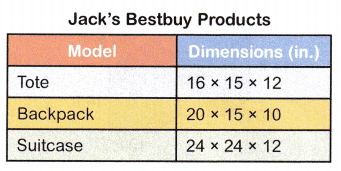
Use the table for exercise 5.
McGraw Hill Math Grade 5 Chapter 10 Lesson 13 Answer Key Problem Solving Using Formulas 50

Question 5.
How much greater in volume is the backpack than the tote?
Answer:
Volume of Tote (V) = 16 in x 15 in x 12 in = 2,880 in3
Volume of Backpack (V) = 20 in x 15 in x 10 in = 3,000 in3
3,000 in3 – 2,800 in3 = 120 in3
The volume of backpack is 120 in3 greater than the tote.

McGraw Hill Math Grade 5 Chapter 10 Lesson 13 Answer Key Problem Solving: Using Formulas Read More »

McGraw Hill Math Grade 5 Chapter 10 Lesson 12 Answer Key Finding the Volume of Irregular Solids

All the solutions provided in McGraw Hill Math Grade 5 Answer Key PDF Chapter 10 Lesson 12 Finding the Volume of Irregular Solids are as per the latest syllabus guidelines.

McGraw-Hill Math Grade 5 Answer Key Chapter 10 Lesson 12 Finding the Volume of Irregular Solids

Calculate

Find the volume of each object.

Question 1.
McGraw Hill Math Grade 5 Chapter 10 Lesson 12 Answer Key Finding the Volume of Irregular Solids 46

Question 2.
McGraw Hill Math Grade 5 Chapter 10 Lesson 12 Answer Key Finding the Volume of Irregular Solids 47
Answer:
McGraw-Hill-Math-Grade-5-Chapter-10-Lesson-12-Answer-Key-Finding-the-Volume-of-Irregular-Solids-47
Explanation:
First we have to separate the given object into two solids then we have to find the volume of each solid.
Volume of one solid:
Length (l) = 10 feet
Width (w) = 10 feet
height (h) = 14 feet
Volume (v) = (l x w) x h
v = (10 ft x 10 ft) x 14 ft
v = 1,400 cubic feet
Volume of another solid:
Length (l) = 20 feet
Width (w) = 10 feet
height (h) = 14 feet
Volume (v) = (l x w) x h
v = (20 ft x 10 ft) x 14 ft
v =2,800 cubic feet
Now we have to add the two volumes.
1,400 cubic feet +2,800 cubic feet = 4,200 cubic feet
The volume of the object is 4,200 cubic feet.

Question 3.
McGraw Hill Math Grade 5 Chapter 10 Lesson 12 Answer Key Finding the Volume of Irregular Solids 48
Answer:
McGraw-Hill-Math-Grade-5-Chapter-10-Lesson-12-Answer-Key-Finding-the-Volume-of-Irregular-Solids-48
Explanation:
First we have to separate the given object into two solids then we have to find the volume of each solid.
Volume of one solid:
Length (l) = 12 km
Width (w) = 9 km
height (h) = 12 km
Volume (v) = (l x w) x h
v = (12 km x 9 km) x 12 km
v = 1,296 cubic kilometer
Volume of another solid:
Length (l) = 4 km
Width (w) = 9 km
height (h) = 13 km
Volume (v) = (l x w) x h
v = (4 km x 9 km) x 13 km
v =468 cubic kilometer
Now we have to add the two volumes.
1,296 cubic kilometer + 468 cubic kilometer = 1,764 cubic kilometer
The volume of the object is 1,764 cubic kilometer.

Question 4.
McGraw Hill Math Grade 5 Chapter 10 Lesson 12 Answer Key Finding the Volume of Irregular Solids 49
Answer:
McGraw-Hill-Math-Grade-5-Chapter-10-Lesson-12-Answer-Key-Finding-the-Volume-of-Irregular-Solids-49

Explanation:
First we have to separate the given object into two rectangular prisms then we have to find the volume of each solid.
Volume of one rectangular prism:
Length (l) = 45 m
Width (w) = 36 m
height (h) = 8 m
Volume (v) = (l x w) x h
v = (45 m x 36 m) x 8 m
v = 12,960 cubic meters
Volume of another rectangular prism:
Length (l) = 45 m
Width (w) = 16 m
height (h) = 16 m
Volume (v) = (l x w) x h
v = (45 m x 16 m) x 16 m
v = 11,520 cubic meters
Now we have to add the two volumes.
12,960 cubic meters + 11,520 cubic meters = 24,480 cubic meters
The volume of the object is 24,480 cubic meters.

McGraw Hill Math Grade 5 Chapter 10 Lesson 12 Answer Key Finding the Volume of Irregular Solids Read More »

McGraw Hill Math Grade 5 Chapter 10 Lesson 11 Answer Key Finding Volume Using Formulas

All the solutions provided in McGraw Hill Math Grade 5 Answer Key PDF Chapter 10 Lesson 11 Finding Volume Using Formulas are as per the latest syllabus guidelines.

McGraw-Hill Math Grade 5 Answer Key Chapter 10 Lesson 11 Finding Volume Using Formulas

Calculate

Find the volume of each object. Use V = B × h or V = (l × w) × h.

Question 1.
McGraw Hill Math Grade 5 Chapter 10 Lesson 11 Answer Key Finding Volume Using Formulas 43

Question 2.
McGraw Hill Math Grade 5 Chapter 10 Lesson 11 Answer Key Finding Volume Using Formulas 44
Answer:
Form the above rectangular figure,
Width = 29 feet
Length = 13 feet
Height = 6 feet
Volume of the rectangular prism (V) = (l x w) x h
V = (13 x 29) x 6
V = 2,262 cubic feet
The volume of the rectangular prism is 2,262 cubic feet.

Question 3.
A cube with a base area of 676 square miles and a height of 26 miles
Answer:
Given,
Area of base (b) = 676 square miles
Height (h) = 26 miles
Volume of the cube (V) = b x h
V = 676 x 26
V = 17,576 cubic miles
Volume of the cube is equal to 17,576 cubic miles.

Question 4.
McGraw Hill Math Grade 5 Chapter 10 Lesson 11 Answer Key Finding Volume Using Formulas 45
Answer:
Given,
Area of base (b) = 289 square inches
Height (h) = 17 inches
Volume of the cube (V) = b x h
V = 289 x 17
V = 4913 cubic inches
Volume of the cube is equal to 4913 cubic inches.

Question 5.
A rectangular prism that is 7 yards high and a base area of 84 square yards
Answer:
Given Rectangular prism,
height (h) = 7 yards
Area of base (b) = 84 square yards
Volume of rectangular prism (V) = b x h
V = 84 x 7
V = 588 cubic yards
Volume of rectangular prism is equal to 588 cubic yards.

Question 6.
A rectangular prism that is 15 kilometers high, 13 kilometers wide, and 9 kilometers long
Answer:
Given rectangular prism,
height (h) = 15 km
Width = 13 km
Length = 9 km
Volume of the rectangular prism (V) = (l x w) x h
V = (9 x 13) x 15
V = 117 x 15
V = 1,755 cubic kilometers
Volume of the rectangular prism is equal to 1,755 cubic kilometers.

McGraw Hill Math Grade 5 Chapter 10 Lesson 11 Answer Key Finding Volume Using Formulas Read More »

McGraw Hill Math Grade 5 Chapter 10 Lesson 10 Answer Key Multiplying Using Unit Cubes

All the solutions provided in McGraw Hill Math Grade 5 Answer Key PDF Chapter 10 Lesson 10 Multiplying Using Unit Cubes are as per the latest syllabus guidelines.

McGraw-Hill Math Grade 5 Answer Key Chapter 10 Lesson 10 Multiplying Using Unit Cubes

Multiply

Find the volume of each object. Write the equation you used.

Question 1.
McGraw Hill Math Grade 5 Chapter 10 Lesson 10 Answer Key Multiplying Using Unit Cubes 39

Question 2.
McGraw Hill Math Grade 5 Chapter 10 Lesson 10 Answer Key Multiplying Using Unit Cubes 40
Answer:
From the above object,
length = 11 in
Width = 11 in
Height = 11 in
Volume of the square object (V) = (length x width) x height
V = (11 in x 11 in) x 11 in
V = 1,331 cubic inches
The volume of square object is 1,331 cubic inches.

Question 3.
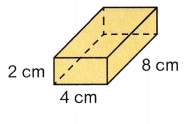
McGraw Hill Math Grade 5 Chapter 10 Lesson 10 Answer Key Multiplying Using Unit Cubes 41
Answer:
From the above object,
length = 8 cm
Width = 4 cm
Height = 2 cm
Volume of the rectangular object (V) = (length x width) x height
V = (8 cm x 4 cm) x 2 cm
V = 64 cubic centimeter
The volume of rectangular object is 64 cubic centimeter.

Question 4.
McGraw Hill Math Grade 5 Chapter 10 Lesson 10 Answer Key Multiplying Using Unit Cubes 42
Answer:
From the above object,
length = 16 yards
Width = 8 yards
Height = 3 yards
Volume of the rectangular object (V) = (length x width) x height
V = (16 yd x 8 yd) x 3 yd
V = 384 cubic yards
The volume of rectangular object is 384 cubic yards.

McGraw Hill Math Grade 5 Chapter 10 Lesson 10 Answer Key Multiplying Using Unit Cubes Read More »

McGraw Hill Math Grade 5 Chapter 10 Lesson 1 Answer Key Lines and Segments

All the solutions provided in McGraw Hill Math Grade 5 Answer Key PDF Chapter 10 Lesson 1 Lines and Segments are as per the latest syllabus guidelines.

McGraw-Hill Math Grade 5 Answer Key Chapter 10 Lesson 1 Lines and Segments

McGraw Hill Math Grade 5 Chapter 10 Lesson 1 Answer Key Lines and Segments 1
Question 1.
Identify two points.
Answer:
Point A.
Point G

Question 2.
Identify two line segments.
Answer:
A line segment is part of a line and it has two end points.
One line segment is BD.
Second line segment is GF.

Question 3.
Identify two parallel lines.
Answer:
Parallel lines never meet and the lines are equidistant from each other.
The two parallel lines are BE and AF.

Question 4.
Identify two perpendicular lines.
Answer:
Perpendicular lines forms right angles where they cross.
The two perpendicular lines are AF and FE

Question 5.
Identify two intersecting lines that are not perpendicular.
Answer:
The two intersecting lines that are not perpendicular are GD and BE.

McGraw Hill Math Grade 5 Chapter 10 Lesson 1 Answer Key Lines and Segments Read More »

McGraw Hill Math Grade 4 Chapter 13 Lesson 5 Answer Key Subtracting Angle Measures

Practice the questions of McGraw Hill Math Grade 4 Answer Key PDF Chapter 13 Lesson 5 Subtracting Angle Measures to secure good marks & knowledge in the exams.

McGraw-Hill Math Grade 4 Answer Key Chapter 13 Lesson 5 Subtracting Angle Measures

Solve

Write an equation and find the answer.

Question 1.
∠ABD measures 95°.
∠ABC measures 32°.
What is the measure of ∠CBD?
McGraw Hill Math Grade 4 Chapter 13 Lesson 5 Answer Key Subtracting Angle Measures 1
Answer:
95° – 32° = 63° or 32° + x = 95°

Question 2.
∠EFH measures 151°.
∠EFG measures 77°.
What is the measure of ∠GFH?
McGraw Hill Math Grade 4 Chapter 13 Lesson 5 Answer Key Subtracting Angle Measures 2
Answer:
74°

Explanation:
∠EFH measures 151°
∠EFG measures 77°
151 – 77 = x
Subtract 77 from 151
151 – 77 = 74
X = 74
So, ∠GFH measures 74°.

Question 3.
A lock is set at 0. Its arrow is turned 117 degrees forward and 23 degrees backward Then it is turned forward 54 degrees. At what degree measure is the arrow pointing?
Answer:
148 degree

Explanation:
A lock is set at 0
Its arrow is turned 117 degrees forward and 23 degrees backward
Subtract: 117 – 23 = 94
Then it is turned forward 54 degrees
Add: 94 + 54 = 148
So, the arrow is pointing at 148 degrees.

McGraw Hill Math Grade 4 Chapter 13 Lesson 5 Answer Key Subtracting Angle Measures Read More »

Scroll to Top