Prasanna

Texas Go Math Grade 5 Lesson 11.3 Answer Key Quadrilaterals

Refer to our Texas Go Math Grade 5 Answer Key Pdf to score good marks in the exams. Test yourself by practicing the problems from Texas Go Math Grade 5 Lesson 11.3 Answer Key Quadrilaterals.

Texas Go Math Grade 5 Lesson 11.3 Answer Key Quadrilaterals

Essential Question
How can you classify and compare quadrilaterals?
Answer:

Unlock the Problem
A seating chart for a baseball field has many four-sided figures or quadrilaterals. What types of quadrilaterals can you find in the seating chart?

There are five special types of quadrilaterals. You can classify quadrilaterals by their properties, such as parallel sides and perpendicular sides. Parallel lines are lines that are always the same distance apart. Perpendicular lines are lines that intersect to form four right angles.
Texas Go Math Grade 5 Lesson 11.3 Answer Key 1

Complete the sentence that describes each type of quadrilateral.

A general quadrilateral has 4 sides and 4 angles.
Texas Go Math Grade 5 Lesson 11.3 Answer Key 2

A rectangle is a special parallelogram with 4 right angles and 4 pairs of congruent sides.
Texas Go Math Grade 5 Lesson 11.3 Answer Key 4

A square is a special parallelogram with 4 congruent sides and 4 right angles.
Texas Go Math Grade 5 Lesson 11.3 Answer Key 5

A parallelogram has opposite sides that are congruent and parallel.
Texas Go Math Grade 5 Lesson 11.3 Answer Key 6

A rhombus is a special parallelogram with 2 pairs of congruent sides.
Texas Go Math Grade 5 Lesson 11.3 Answer Key 7

A trapezoid is a quadrilateral with exactly 1 pair of congruent sides.
Texas Go Math Grade 5 Lesson 11.3 Answer Key 8

So,
The types of quadrilaterals you can find in the seating chart of the field are: General Quadrilateral and Rectangle

Math Talk
Mathematical Processes
Explain how trapezoids and parallelograms are different?
Answer:
A trapezoid has one pair of parallel sides and a parallelogram has two pairs of parallel sides. A trapezoid has at least one pair of parallel sides, but it can also have another.

Activity

Materials Texas Go Math Grade 5 Lesson 11.3 Answer Key 9 quadrilaterals Texas Go Math Grade 5 Lesson 11.3 Answer Key 9 scissors

You can use a Venn diagram to sort quadrilaterals and find out how they are related.

  • Draw the diagram below on your MathBoard.
  • Cut out the quadrilaterals and sort them into the Venn diagram.
  • Record your work by drawing each figure you have placed in the Venn diagram below.

Texas Go Math Grade 5 Lesson 11.3 Answer Key 10

Complete the sentences by writing always, sometimes, or never.

A rhombus is “Sometimes” a square.
A parallelogram is _”Sometimes” a rectangle.
A rhombus is “Always” a parallelogram.
A trapezoid is “Sometimes” a parallelogram.
A square is “Always” a rhombus.

Question 1.
Explain why the circle for parallelograms does not intersect the circle for trapezoids.
Answer:
We know that,
The “Parallelogram” has 2 pairs of parallel sides and the “trapezium” has one pair of parallel sides only
Hence, from the above,
We can conclude that
The circle for parallelograms does not intersect the circle for trapezoids

Lesson 11.3 Answer Key Quadrilaterals Question 2.
Draw a quadrilateral with four pairs of perpendicular sides and four congruent sides.
Answer:
It is given that
Draw a quadrilateral with four pairs of perpendicular sides and four congruent sides.
Hence, from the above information,
The representation of the quadrilateral with the given specifications is:

Share and Show

Question 1.
Use quadrilateral ABCD to answer each question. Complete the sentence.

Texas Go Math Grade 5 Lesson 11.3 Answer Key 11

a. Measure the sides. Are any of the sides congruent? ___
Mark any congruent sides.
Answer:
In quadrilateral ABCD, there are congruent sides
Hence,
The representation of the congruent sides in the quadrilateral ABCD is:

b. How many right angles, if any, does the quadrilateral have? ____
Answer:
The representation of quadrilateral ABCD with its congruent sides is:

Now,
From the above quadrilateral,
We can observe that
There are no angles that have the angle measure of 90°
Hence, from the above,
We can conclude that
There are no right angles in a quadrilateral ABCD

c. How many pairs of parallel sides, if any, does the quadrilateral have?
Answer:
The representation of quadrilateral ABCD with its congruent sides is:

Now,
From the above quadrilateral,
We can observe that
There are 2 pairs of parallel sides in the quadrilateral ABCD
Hence, from the above,
We can conclude that
The number of parallel sides the quadrilateral ABCD has is: 2 pairs
So,
The quadrilateral ABCD is a “Parallelogram”

Math Talk
Mathematical Processes
Can the parallel sides of a trapezoid be the same length? Explain your answer.
Answer:
We know that,
In a trapezoid, there is only 1 pair of parallel sides i.e., the sides that have the base angles
In an isosceles trapezoid, two opposite sides (the bases) are parallel, and the two other sides (the legs) are of equal length (properties shared with the parallelogram).

Classify the quadrilateral in as many ways as possible. Write quadrilateral, parallelogram, rectangle, rhombus, square, or trapezoid.

Question 2.
Texas Go Math Grade 5 Lesson 11.3 Answer Key 12
Answer:
The given quadrilateral is:
Texas Go Math Grade 5 Lesson 11.3 Answer Key 12
Now,
From the given quadrilateral,
We can observe that
There are 4 pairs of congruent sides and all the congruent angles that are perpendicular
Hence, from the above,
We can conclude that
The shape of the given quadrilateral is: Rectangle

Go Math Lesson 11.3 5th Grade Answer Key Question 3.
Texas Go Math Grade 5 Lesson 11.3 Answer Key 13
Answer:
The given quadrilateral is:
Texas Go Math Grade 5 Lesson 11.3 Answer Key 13
Now,
From the given quadrilateral,
We can observe that
The shape is: Flat-based
There is only 1 pair of parallel sides
Hence, from the above,
We can conclude that
The shape of the given quadrilateral is: Trapezium (or) Trapezoid

Problem Solving

Solve the problems.

Question 4.
H.O.T. What’s the Error? A quadrilateral has exactly 3 congruent sides. Davis claims that the figure must be a rectangle. Why is his claim incorrect? Use diagrams to explain your answer.
Texas Go Math Grade 5 Lesson 11.3 Answer Key 14

Answer:
It is given that
A quadrilateral has exactly 3 congruent sides. Davis claims that the figure must be a rectangle.
Now,
We know that,
A triangle has 3 sides
A quadrilateral has 4 sides
A rectangle has 4 pairs of parallel sides with 4 congruent angles of 90°
Hence, from the above,
We can conclude that
The error in Davis’ claim is:
A quadrilateral has 4 sides
A rectangle has 4 pairs of parallel sides with 4 congruent angles of 90°

Question 5.
Multi-Step I am a figure with four sides. I can be placed in the following categories: quadrilateral, parallelogram, rectangle, rhombus, and square. Draw me. Explain why I fit into each category.
Answer:
It is given that
I am a figure with four sides. I can be placed in the following categories: quadrilateral, parallelogram, rectangle, rhombus, and square
Now,
We know that,
A “Quadrilateral” is a shape that has 4 sides
Now,
The representation of the given figures is:

Hence, from the above,
We can conclude that
A “Quadrilateral” is a shape that has 4 sides

Daily Assessment Task

Fill in the bubble completely to show your answer.

Question 6.
Rita only uses parallelograms in her design. Which of the following shapes can she use?
Texas Go Math Grade 5 Lesson 11.3 Answer Key 15
(A) B, C, D only
(B) A, B, C only
(C) A and D only
(D) B and C only
Answer:
It is given that
Rita only uses parallelograms in her design
Now,
We know that,
A “Parallelogram” will sometimes be a “rectangle”
Hence, from the above,
We can conclude that
The shapes that Rita can use is:

Go Math Quadrilaterals 5th Grade Lesson 11.3 Question 7.
Which statement is true about squares and rhombuses?
(A) A square is never a rhombus.
(B) A rhombus is never a square.
(C) A square is always a rhombus.
(D) A rhombus is always a square.
Answer:
We know that,
A “Square” is always a “Rhombus”
A “Rhombus” is sometimes a “Square”
Hence, from the above,
We can conclude that
The statement that is true about squares and rhombuses is:

Question 8.
Multi-Step A quadrilateral has two pairs of parallel sides. It also has four congruent sides. What might the shape be?
(A) square or rhombus
(B) rectangle or trapezoid
(C) square or trapezoid
(D) trapezoid or parallelogram
Answer:
It is given that
A quadrilateral has two pairs of parallel sides. It also has four congruent sides
Hence, from the above,
We can conclude that
The shapes might be:

Texas Test Prep

Question 9.
A quadrilateral has exactly 1 pair of parallel sides and no congruent sides. What type of quadrilateral is it?
(A) rectangle
(B) rhombus
(C) parallelogram
(D) trapezoid
Answer:
It is given that
A quadrilateral has exactly 1 pair of parallel sides and no congruent sides
Hence, from the above,
We can conclude that
The type of quadrilateral with the given information is:

Texas Go Math Grade 5 Lesson 11.3 Homework and Practice Answer Key

Classify the quadrilateral in as many ways as possible. Write quadrilateral, parallelogram, rectangle, rhombus, square, or trapezoid.

Question 1.
Texas Go Math Grade 5 Lesson 11.3 Answer Key 16
Answer:
The given quadrilateral is:

Now,
From the given quadrilateral,
We can observe that
All the sides are congruent
All the angles are congruent
Hence, from the above,
We can conclude that
The given quadrilateral is: Square

Question 2.
Texas Go Math Grade 5 Lesson 11.3 Answer Key 17
Answer:
The given quadrilateral is:

Now,
From the given quadrilateral,
We can observe that
There is only 1 pair of parallel sides and no congruent sides
Hence, from the above,
We can conclude that
The given quadrilateral is: Trapezoid (or) trapezium

Question 3.
Texas Go Math Grade 5 Lesson 11.3 Answer Key 18
Answer:
The given quadrilateral is:

Now,
From the given quadrilateral,
We can observe that
There are no congruent side lengths and angle measures
Hence, from the above,
We can conclude that
The given quadrilateral is: General quadrilateral

Question 4.
Texas Go Math Grade 5 Lesson 11.3 Answer Key 19
Answer:
The given quadrilateral is:

Now,
From the given quadrilateral,
We can observe that
All the angle measures are congruent and have an angle of 90°
There are 2 pairs of parallel sides and 4 pairs of congruent sides
Hence, from the above,
We can conclude that
The given quadrilateral is: Rectangle

Question 5.
Texas Go Math Grade 5 Lesson 11.3 Answer Key 20
Answer:
The given quadrilateral is:

Now,
From the given quadrilateral,
We can observe that
There are 2 pairs of parallel sides
There are no congruent angle measures
Hence, from the above,
We can conclude that
The given quadrilateral is: Parallelogram

Quadrilaterals Lesson 11.3 Homework Answer Key Question 6.
Texas Go Math Grade 5 Lesson 11.3 Answer Key 21
Answer:
The given quadrilateral is:

Now,
From the given quadrilateral,
We can observe that
There are 2 pairs of parallel sides and 4 pairs of congruent sides
There are no congruent angle measures
Hence, from the above,
We can conclude that
The given quadrilateral is: parallelogram

Problem Solving

Question 7.
Brooke draws quadrilaterals on a canvas in her art class. Is it possible for Brooke to draw a parallelogram that is not a rectangle? Explain.
Answer:
It is given that
Brooke draws quadrilaterals on a canvas in her art class
Now,
We know that,
There are 3 types of parallelograms. They are:
a. Rhombus
b. Rectangle
c. Square
Now,
Brooke can draw quadrilaterals on a canvas that is not a rectangle i.e., Brooke can draw squares and rhombuses on a canvas
Hence, from the above,
We can conclude that
It is possible for Brooke to draw a parallelogram that is not a rectangle

Question 8.
Is it possible for Brooke to draw a square and a rhombus that are congruent? Explain.
Answer:
We know that,
There are 3 types of parallelograms. They are:
a. Rhombus
b. Rectangle
c. Square
Now,
We know that,
A square is always a rhombus but a rhombus will not always be a square
Hence, from the above,
We can conclude that
It may be possible for Brooke to draw a square and a rhombus that are congruent

Texas Test Prep

Lesson Check

Fill in the bubble completely to show your answer.

Question 9.
Which figures have perpendicular sides?
Texas Go Math Grade 5 Lesson 11.3 Answer Key 22
(A) A and B only
(B) A and C only
(C) B and D only
(D) C and D only
Answer:
We know that,
The “Perpendicular side” is nothing but a side with an angle of 90°
Hence, from the above,
We can conclude that
The figures that have perpendicular sides are:

Question 10.
Which statement is true about the two figures below?
Texas Go Math Grade 5 Lesson 11.3 Answer Key 23
(A) They have a different number of right angles.
(B) They are not congruent.
(C) They are rhombuses.
(D) They are squares.
Answer:
The given figures are:
Texas Go Math Grade 5 Lesson 11.3 Answer Key 23
Now,
From the given figures,
We can observe that
The first and second figures are Square and rectangle respectively
Now,
We know that,
In a rectangle, 2 pairs of parallel sides and 4 congruent angles are present
In a square, 4 pairs of congruent sides and angles are present
Hence, from the above,
We can conclude that
The statement that is true about the given two figures is:

Question 11.
Which of the following is NOT a parallelogram?
(A) rhombus
(B) square
(C) trapezoid
(D) rectangle
Answer:
We know that,
There are 3 types of parallelograms. They are:
a. Rhombus
b. Rectangle
c. Square
Hence, from the above,
We can conclude that
The quadrilateral that is not a parallelogram is:

Question 12.
Which of the following is a regular polygon?
(A) parallelogram
(B) rectangle
(C) rhombus
(D) square
Answer:
We know that,
A “Regular Polygon” is a polygon that has congruent sides and angle measures
Hence, from the above,
We can conclude that
The regular polygon is:

Question 13.
Multi-Step Becka draws two different quadrilaterals. Both quadrilaterals have two pairs of parallel sides. Only one quadrilateral has four right angles. What might the quadrilaterals be?
(A) square and parallelogram
(B) rectangle and square
(C) rectangle and trapezoid
(D) parallelogram and trapezoid
Answer:
It is given that
Becka draws two different quadrilaterals. Both quadrilaterals have two pairs of parallel sides. Only one quadrilateral has four right angles
Now,
From the given information,
We can observe that
The first quadrilateral will be a “Parallelogram”
The second quadrilateral will be a “Rectangle” or a “Square”
Hence, from the above,
We can conclude that
The quadrilaterals might be:

Question 14.
Multi-Step Tim cuts out paper quadrilaterals like the one below to use in an art project.
Texas Go Math Grade 5 Lesson 11.3 Answer Key 24
If he cuts the quadrilateral in half, which quadrilaterals result from the cut?
(A) two rhombuses
(B) two parallelograms
(C) two trapezoids
(D) a trapezoid and a parallelogram
Answer:
It is given that
Tim cuts out paper quadrilaterals like the one below to use in an art project.
Now,
The given figure is:
Texas Go Math Grade 5 Lesson 11.3 Answer Key 24
Now,
From the given figure,
We can observe that
When the parallelogram is cut into 2 halves,
We can say that 2 parallelograms will be formed
Hence from the above,
We can conclude that
The quadrilateral that results from the cut is:

Texas Go Math Grade 5 Lesson 11.3 Answer Key Quadrilaterals Read More »

Texas Go Math Grade 5 Unit 3 Assessment Answer Key

Refer to our Texas Go Math Grade 5 Answer Key Pdf to score good marks in the exams. Test yourself by practicing the problems from Texas Go Math Grade 5 Unit 3 Assessment Answer Key.

Texas Go Math Grade 5 Unit 3 Assessment Answer Key

Vocabulary

Choose the best term from the box.

Vocabulary
composite number
cubic units
formula
prime number

Question 1.
A ___________ has more than two factors. (p. 291)
Answer: A composite number has more than two factors.

Question 2.
Volume is measured using __________. (p. 355)
Answer: Volume is measured using cubic units.

Concepts and Skills

List all the factor pairs for the number. Tell whether the number is prime or composite. (TEKS 5.4.A)

Texas Go Math Grade 5 Unit 3 Assessment Answer Key Question 3.
69
Answer:
The factor pairs of 69 are:
1 × 69 = 69
3 × 23 = 69
Thus it is a composite number.

Question 4.
17
Answer:
1 × 17 = 17
17 × 1 = 17
Thus 17 is a multiple of one and itself.
Thus it is a prime number.

Question 5.
63
Answer:
The factor pairs of 63 are:
1 × 63 = 63
3 × 21 = 63
7 × 9 = 63
Thus it is a composite number.

Simplify the numerical expression. (TEKS 5.4.F)

Question 6.
35 – (9 + 6)
Answer:
35 – (9 + 6)
35 – (15) = 35 – 15 = 20

Question 7.
15 + (20 – 4) + 4
Answer:
15 + (20 – 4) + 4
15 + 16 + 4
= 15 + 20
= 35

Question 8.
6 × [(5 × 3) – (2 + 9)]
Answer:
6 × [(5 × 3) – (2 + 9)]
6 × [15 – 11]
6 × 4 = 24

Go Math Expressions Grade 5 Unit 3 Test Answer Key Question 9.
Use formulas to find the area and perimeter. (TEKS 5.4.H)
Texas Go Math Grade 5 Unit 3 Assessment Answer Key 1
Perimeter: _________________
Area: ________________
Answer:
The above figure is a rectangle.
length = 5 cm
width = 6 cm
We know that,
area of the rectangle = lw
A = 5 × 6 = 30 sq.cm
perimeter of the rectangle = 2l + 2w
P = 2 (l + w)
P = 2 (5 + 6)
P = 2(11) = 22 cm
Perimeter: 22 cm
Area: 30 sq.cm

Question 10.
Use a formula to find the volume. (TEKS 5.4.G)
Texas Go Math Grade 5 Unit 3 Assessment Answer Key 2
Volume: ________________
Answer:
Volume of a cube = 4 ft × 4 ft × 4 ft
V = 64 cu. ft

Fill in the bubble completely to show your answer.

Question 11.
Moesha has some books. Her mother gives her 5 new books and her father gave her 4 new books. Now Moesha has 11 books. If s stands for the number of books Moesha starts with, which equation represents the problem? (TEKS5.4.B)
(A) s = 11 + 5
(B) 11 = 5 × 4 + s
(C) s = 11 × 5 + 4
(D) 11 = s + 5 + 4
Answer: 11 = s + 5 + 4
The correct answer is option D.

Texas Go Math Grade 5 Pdf Unit 3 Assessment Answer Key Question 12.
The graph shows the amount of flour it takes to make croissants. Which rule describes the pattern on the graph? (TEKS 5.4.D)
Texas Go Math Grade 5 Unit 3 Assessment Answer Key 3
(A) c = f + 1
(B) f = c + 1
(C) c = 2f
(D) f = 2c
Answer: (C) c = 2f

Question 13.
Marcello needs to cut a piece of canvas that is 48 sq cm. The width of the sheet of canvas is 8 cm. Which of the following shows the equation Marcello could have used and the length of the canvas? (TEKS 5.4.B, 5.4.H)
(A) 64 sq cm, l = 8 × 8
(B) 6 cm, 48 = 8 × l
(C) 32 cm, 8 + 8 + 8 + 8 = l
(D) 12 cm, 48 = 4 × l
Answer:
Given,
Marcello needs to cut a piece of canvas that is 48 sq cm.
The width of the sheet of the canvas is 8 cm.
(B) 6 cm, 48 = 8 × l

Question 14.
Steve uses the rule l = 8s to determine the number of legs 5 spiders have. What is the value of ☐? (TEKS 5.4.C)
Texas Go Math Grade 5 Unit 3 Assessment Answer Key 4
(A) 8
(B) 40
(C) 10
(D) 14
Answer:
5 × 8 = 40
Thus the correct answer is option B.

Go Math Expressions Grade 5 Answer Key Pdf Unit 3 Question 15.
An adult elephant eats about 300 pounds of food each day. Which expression shows about how many pounds of food 12 elephants eat in 5 days? (TEKS 5.4.E)
(A) 5 + (300 × 12)
(B) 5 × (300 × 12)
(C) (300 × 12) ÷ 5
(D) (300 × 12) – 5
Answer:
Given,
An adult elephant eats about 300 pounds of food each day.
5 × (300 × 12)
Thus the correct answer is option B.

Question 16.
Paula is building a box to store her marble collection. The box is a rectangular prism. The area of the base will be 15 sq inches. She wants the volume of the box to be 150 cu in. Which of the following shows the equation Paula can use and the height of the box? (TEKS 5.4.B, 5.4.H)
(A) 150 = 15 h, 10 in.
(B) h + 15 = 150, 135 in.
(C) h = 15 × 15, 225 sq in.
(D) 150 = h × 15, 5 in.
Answer:
Given,
Paula is building a box to store her marble collection. The box is a rectangular prism.
The area of the base will be 15 sq inches. She wants the volume of the box to be 150 cu in.
150 = 15 h, 10 in.
Thus the correct answer is option A.

Question 17.
Ling uses a formula to find the area of her rectangular garden. The garden measures 12 feet by 5 feet. She wants to divide the garden into 10 equal areas. Which equation can Ling use to find out how large each area, t, will be? (TEKS 5.4.B, 5.4.H)
(A) (12 × 5) ÷ t = 10
(B) t = 12 × 5 × 10
(C) t = (12 + 5) ÷10
(D) (12 × 5) ÷ 10 = t
Answer:
Given,
The garden measures 12 feet by 5 feet. She wants to divide the garden into 10 equal areas.
(12 × 5) ÷ t = 10

Question 18.
Amy builds a rectangular prism using centimeter cubes. The length of the prism is 3 centimeters. The width is 2 centimeters and the height is 5 centimeters. Which equation shows a formula for finding the volume of the rectangular prism? (TEKS 5.4.B, 5.4.G)
Texas Go Math Grade 5 Unit 3 Assessment Answer Key 5
(A) V = 3 × 2
(B) V = 3 × 5
(C) V = 6 × 5
(D) V = 3 + 2 + 5
Answer:
Given,
Amy builds a rectangular prism using centimeter cubes.
The length of the prism is 3 centimeters. The width is 2 centimeters and the height is 5 centimeters.
V = 6 × 5
Thus the correct answer is option C.

5th Grade Go Math Unit 3 Assessment Answer Key Question 19.
Jim wants to put a wallpaper border around a rectangular room. The room measures 14 feet by 10 feet. If the wallpaper border comes in strips that are 20 feet long, how many strips will Jim need? (TEKS 5.4.H)
(A) 48
(B) 2
(C) 3
(D) 140
Answer: 3 strips

Question 20.
A pack of 8 bottles of olive oil costs $96. Marsha wants to write an equation to calculate the cost of 1 bottle. If b represents the cost of 1 bottle of olive oil, which of the following shows the equation Marsha could use and the cost of 1 bottle? (TEKS 5.4.B)
(A) 96 = b + 8, $88
(B) 96 = 8b, $12
(C) Not here
(D) b = 96 ÷ 8, $16
Answer:96 = b + 8, $88

Question 21.
Which equation describes the pattern in the table below? (TEKS 5.4.D)
Texas Go Math Grade 5 Unit 3 Assessment Answer Key 6
(A) c = w × 3
(B) c = w + 4
(C) c = w × 4
(D) w = c × 3
Answer: (A) c = w × 3

5th Grade Unit 3 Math Unit 3 End of Unit Assessment Question 22.
Drew’s weekly allowance is $8. Jan’s weekly allowance is $10. Drew spends $3 a week. Jan spends $4 a week. The video game Drew and Jan want to buy costs $55. Write an expression to show how many weeks it will take them to save $55. Then simplify the expression. Describe the steps you used to write and simplify the expression. (TEKS 5.4.E, 5.4.F)
Answer:
Drew has 8 and spends 3 so ($8-3$)
Jan has 10 and spends 4 so ($10-$4)

Texas Go Math Grade 5 Unit 3 Assessment Answer Key Read More »

Texas Go Math Grade 5 Lesson 11.2 Answer Key Triangles

Refer to our Texas Go Math Grade 5 Answer Key Pdf to score good marks in the exams. Test yourself by practicing the problems from Texas Go Math Grade 5 Lesson 11.2 Answer Key Triangles.

Texas Go Math Grade 5 Lesson 11.2 Answer Key Triangles

Essential Question
How can you classify triangles?
Answer:
Triangles can be classified either according to their sides or according to their angles. All of each may be of different or the same sizes; any two sides or angles may be of the same size; there may be one distinctive angle
Now,
According to the sides, the triangles are classified into:
a. Equilateral triangle
b. Isosceles triangle
c. Scalene triangle
According to the angles, the triangles are classified into:
a. Acute triangle
b. Right triangle
c. Obtuse triangle

Unlock the Problem
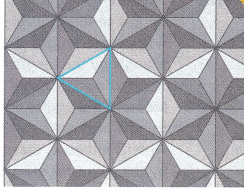
If you look closely at Epcot Center’s Spaceship Earth building in Orlando, Florida, you may see a pattern of triangles. The triangle outlined in the pattern at the right has 3 congruent sides and 3 acute angles. What type of triangle is outlined?
Texas Go Math Grade 5 Lesson 11.2 Answer Key 1
Complete the sentence that describes each type of triangle.

Classify triangles by the lengths of their sides.

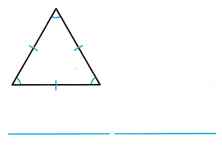
An equilateral triangle has 3 congruent sides.
Texas Go Math Grade 5 Lesson 11.2 Answer Key 2

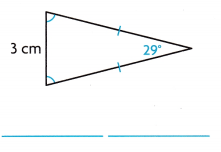
An isosceles triangle has 2 congruent sides.
Texas Go Math Grade 5 Lesson 11.2 Answer Key 3

A scalene triangle has no congruent sides.
Texas Go Math Grade 5 Lesson 11.2 Answer Key 4

Classify triangles by the measures of their angles.

A right triangle has one 90° or one right angle.
Texas Go Math Grade 5 Lesson 11.2 Answer Key 5

An acute triangle has 3 acute angles.
Texas Go Math Grade 5 Lesson 11.2 Answer Key 6

An obtuse triangle has 1 obtuse angle.
Texas Go Math Grade 5 Lesson 11.2 Answer Key 7

The type of triangle outlined in the pattern can be classified by the length of its sides as an “Equivalent triangle”.
The triangle can also be classified by the measures of its angles as an “Acute triangle”.

Math Talk
Mathematical Processes
Is an equilateral triangle also a regular polygon? Explain.
Answer:
In the familiar Euclidean geometry, an equilateral triangle is also equiangular; that is, all three internal angles are also congruent to each other and are each 60°. It is also a regular polygon. So, it is also referred to as a regular triangle

Activity

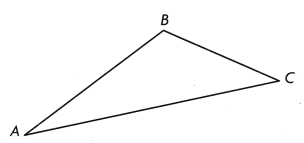
Classify triangle ABC by the lengths of its sides and by the measures of its angles.

Materials Texas Go Math Grade 5 Lesson 11.2 Answer Key 8 centimeter ruler Texas Go Math Grade 5 Lesson 11.2 Answer Key 8 protractor
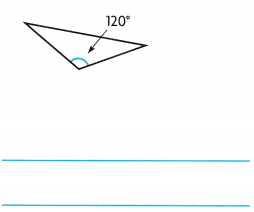
Step 1
Measure the sides of the triangle using a centimeter ruler. Label each side with its length. Classify the triangle by the lengths of its sides.

Step 2
Measure the angles of the triangle using a protractor. Label each angle with its measure. Classify the triangle by the measures of its angles.
Texas Go Math Grade 5 Lesson 11.2 Answer Key 9

Triangle ABC is a “Scalene triangle”

• What type of triangle has 3 sides of different lengths?
Answer:
We know that,
The triangle that has 3 different side lengths is: Scalene triangle
Hence, from the above,
We can conclude that
The triangle that has 3 different side lengths is: Scalene triangle

• What is an angle called that is greater than 90° and less than 180°?
Answer:
We know that,
The angle that is greater than 90° and less than 180° is: Obtuse angle
Hence, from the above,
We can conclude that
The angle that is greater than 90° and less than 180° is: Obtuse angle

Try This! Draw the type of triangle described by the lengths of its sides and by the measures of its angles.

Math Talk
Mathematical Processes
Can you draw a triangle that is right equilateral? Explain.
Answer:
We already know that to be equilateral all the sides should be equal and all the corresponding angles also should be equal. So, it is not possible to draw a right-angled equilateral triangle

Share and Show

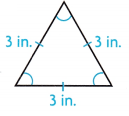
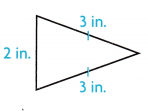
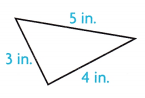
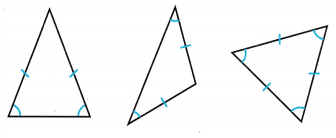
Classify each triangle. Write isosceles, scalene, or equilateral. Then write acute, obtuse, or right.

Question 1.
Texas Go Math Grade 5 Lesson 11.2 Answer Key 11
Answer:
The given triangle is:

Now,
From the given figure,
We can observe that
The side lengths are not equal
The angle measures are not equal
All the angle measures are less than 90°
Hence, from the above,
We can conclude that
The given triangle is a “Scalene Triangle” and an “Acute Triangle”

Question 2.
Texas Go Math Grade 5 Lesson 11.2 Answer Key 12
Answer:
The given triangle is:

Now,
From the given triangle,
We can observe that
All the side lengths are equal
All the angle measures are equal
All the angle measures are less than 90°
Hence, from the above,
We can conclude that
The given triangle is an “Equilateral Triangle” and an “Acute Triangle”

Geometry Lesson 11.2 Similar Triangles Answer Key Question 3.
Texas Go Math Grade 5 Lesson 11.2 Answer Key 13
Answer:
The given triangle is:

Now,
From the given triangle,
We can observe that
The two side lengths are equal and one unequal side length
The two angle measures are equal
All the angle measures are less than 90°
Hence, from the above,
We can conclude that
The given triangle is an “Isosceles Triangle” and an “Acute Triangle”

Problem Solving

Question 4.
H.O.T. Can you tell that a triangle is obtuse, right, or acute without measuring the angles? Explain.
Answer:
To determine whether the triangle is acute, right, or obtuse, add the squares of the two smaller sides and compare the sum to the square of the largest side. If this sum is greater, the triangle is acute, and if this sum is smaller, the triangle is obtuse

Question 5.
Multi-Step Draw 2 equilateral triangles that are congruent and share a side. What polygon is formed? Is it a regular polygon?
Answer:
It is given that
Draw 2 equilateral triangles that are congruent and share a side
Now,
According to the given information,
The figure that can be drawn is:

Now,
From the above polygon,
We can observe that
All the side lengths are equal
The angle measures are not the same
There are 4 sides
Hence, from the above,
We can conclude that
The polygon that is formed from the given information is: Quadrilateral
Since the angle measures are not the same, the polygon formed is not a “Regular Polygon”

Problem Solving

Triangle With No Congruent Sides Lesson 11.2 Geometry Answers Question 6.
Analyze Shannon said that a triangle with exactly 2 congruent sides and an obtuse angle is an equilateral obtuse triangle. Describe her error.
Texas Go Math Grade 5 Lesson 11.2 Answer Key 14
Answer:
It is given that
Shannon said that a triangle with exactly 2 congruent sides and an obtuse angle is an equilateral obtuse triangle
Now,
We know that,
In an Equilateral triangle,
All three sides are equal and all the angle measures are also the same
In an Isosceles triangle,
Any two side lengths are the same and any two angle measures are the same
Hence, from the above,
We can conclude that
The error made by Shannon is:
The triangle is an “Obtuse Isosceles Triangle” but not the “equilateral Obtuse Triangle”

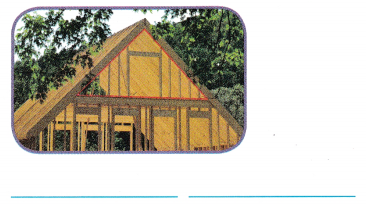
Classify the triangles in the structures below. Write isosceles, scalene, or equilateral. Then write acute, obtuse, or right.

Question 7.
Texas Go Math Grade 5 Lesson 11.2 Answer Key 15
Answer:
The given triangle is:

Now,
From the given triangle,
The side lengths are different and the angle measures are acute
Hence, from the above,
We can conclude that
The given triangle is an “Acute Triangle” and a “Scalene triangle”

Question 8.
Texas Go Math Grade 5 Lesson 11.2 Answer Key 16
Answer:
The given triangle is:

Now,
From the given triangle,
We can observe that
One of the angle measures is the “Right angle”
Hence, from the above,
We can conclude that
The given triangle is a “Right Triangle”

Daily Assessment Task

Fill in the bubble completely to show your answer.

Question 9.
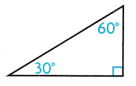
Ricky drew a triangle with angles measuring 90°, 30°, and 60°, and no congruent sides. Which of these describes the triangle?
(A) isosceles right
(B) equilateral obtuse
(C) scalene acute
(D) scalene right
Answer:
It is given that
Ricky drew a triangle with angles measuring 90°, 30°, and 60°, and no congruent sides
Hence, from the above,
We can conclude that

Geometry Lesson 11.2 Similar Triangles Answers Question 10.
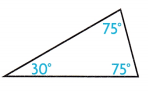
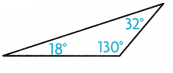
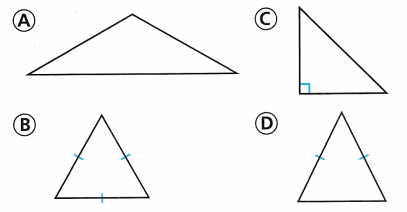
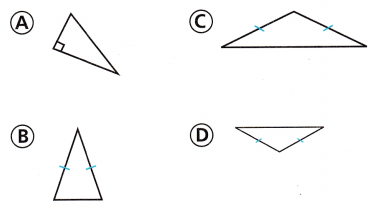
Which of these triangles is isosceles and obtuse?
Texas Go Math Grade 5 Lesson 11.2 Answer Key 17
Answer:
We know that
An “Obtuse angle” is a measure that is greater than 90° and less than 180°
Hence, from the above,
We can conclude that
The triangle that is Isosceles and obtuse from the given triangles is:

Question 11.
Multi-Step Jenna drew this triangle and then drew the dotted line down the center. What type of triangle did she draw first? What triangles resulted from the dotted line?
(A) right; two scalene obtuse triangles
(B) equilateral; two right triangles
(C) scalene right; two right triangles
(D) isosceles acute; two equilateral triangles
Texas Go Math Grade 5 Lesson 11.2 Answer Key 18
Answer:
It is given that
Jenna drew this triangle and then drew the dotted line down the center
Now,
The given triangle is:
Texas Go Math Grade 5 Lesson 11.2 Answer Key 18
Now,
From the given triangle,
We can observe that
The triangle is an “Equilateral triangle”
After the dotted line, there are 2 right triangles
Hence, from the above,
We can conclude that

Texas Test Prep

Question 12.
Which kind of triangle has exactly 2 congruent sides?
(A) isosceles
(B) equilateral
(C) scalene
(D) right
Answer:
We know that,
The triangle that ahs exactly 2 congruent sides is: isosceles Triangle
Hence, from the above,
We can conclude that
The triangle that has exactly 2 congruent sides is:

Texas Go Math Grade 5 Lesson 11.2 Homework and Practice Answer Key

Classify each triangle. Write isosceles, scalene, or equilateral. Then write acute, obtuse, or right.

Question 1.
Texas Go Math Grade 5 Lesson 11.2 Answer Key 19
Answer:
The given triangle is:

Now,
From the given triangle,
We can observe that
There are 2 congruent sides and 2 congruent angles that are less than 90°
Hence, from the above,
We can conclude that
The given triangle is an ‘Isosceles triangle” and an “Acute Triangle”

Question 2.
Texas Go Math Grade 5 Lesson 11.2 Answer Key 20
Answer:
The given triangle is:

Now,
From the given triangle,
We can observe that
One of the angles is an obtuse angle and all the side lengths are not equal
Hence, from the above,
We can conclude that
The given triangle is an “Obtuse Triangle” and a “Scalene Triangle”

Question 3.
Texas Go Math Grade 5 Lesson 11.2 Answer Key 21
Answer:
The given triangle is:

Now,
From the given triangle,
We can observe that
All the side lengths are equal and all the angle measures are the same and less than 90°
Hence, from the above,
We can conclude that
The given triangle is an “Equilateral Triangle” and an “Acute Triangle”

Lesson 11.2 Triangles Homework Answer Key Question 4.
Texas Go Math Grade 5 Lesson 11.2 Answer Key 22
Answer:
The given triangle is:

Now,
From the given figure,
We can observe that
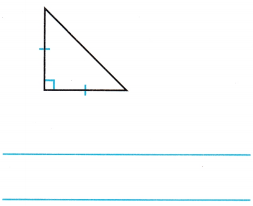
There are 2 congruent sides and 1 right angle
Hence, from the above,
We can conclude that
The given triangle is an “Isosceles triangle” and a “Right Triangle”

Question 5.
Texas Go Math Grade 5 Lesson 11.2 Answer Key 23
Answer:
The given triangle is:

From the given figure,
We can observe that
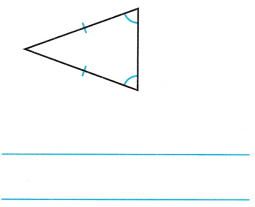
The two side lengths are congruent and the two angle measures are congruent
The angle measures are less than 90°
Hence, from the above,
We can conclude that
The given triangle is an “Isosceles triangle” and an “Acute Triangle”

Question 6.
Texas Go Math Grade 5 Lesson 11.2 Answer Key 24
Answer:
The given triangle is:

Now,
From the given triangle,
We can observe that
One of the angles is  a right angle and all the side lengths are not the same
Hence, from the above,
We can conclude that
The given triangle is a “Scalene Triangle” and a “Right triangle”

Circle the figure that does not belong. Explain.

Question 7.
Texas Go Math Grade 5 Lesson 11.2 Answer Key 25
Answer:
The given figures are:
Texas Go Math Grade 5 Lesson 11.2 Answer Key 25
Now,
From the given figures,
We can observe that
There are only 2 congruent sides in the first 2 figures and there are 3 congruent sides in the third figure
Hence, from the above,
We can conclude that
The figure that does not belong is:

Problem Solving

Question 8.
Parker drew a triangle with no congruent sides and a 95° angle. Classify the triangle by the lengths of its sides and measures of its angles. Explain.
Answer:
It is given that
Parker drew a triangle with no congruent sides and a 95° angle
Now,
Since there are no congruent sides, the triangle is a “Scalene Triangle”
Now,
95° is an angle that is greater than 90° and less than 180° and this angle is called an “Obtuse angle”
Hence, from the above,
We can conclude that
The triangle is a “Scalene Triangle” since there are no congruent sides and is also called an “Obtuse Triangle” since one of the angles is 95°

Lesson Check

Fill in the bubble completely to show your answer.

Question 9.
Lindsay draws a right triangle and adds the measures of the right angle and one acute angle. Which is a possible sum of the two angles?
(A) 180°
(B) 45°
(C) 90°
(D) 120°
Answer:
It is given that
Lindsay draws a right triangle and adds the measures of the right angle and one acute angle
Now,
We know that,
The sum of the angles in a triangle is 180°
Now,
The sum of the angles is greater than 90° and less than 180°
Hence, from the above,
We can conclude that
The possible sum of the two angles is:

Question 10.
Which of these triangles is isosceles and acute?
Texas Go Math Grade 5 Lesson 11.2 Answer Key 26
Answer:
We know that,
An “Isosceles triangle” is a triangle that has 2 congruent sides and 2 congruent angles and the angles less than 90°
Hence, from the above,
We can conclude that
The following triangles that are isosceles and acute are:

Question 11.
Which kind of triangle has 3 congruent sides?
(A) right
(B) isosceles
(C) equilateral
(D) scalene
Answer:
We know that,
The triangle that has 3 congruent sides is: Equilateral Triangle
Hence, from the above,
We can conclude that
The triangle that has 3 congruent sides is:

Question 12.
Which of the following is another way to classify a scalene triangle with one angle greater than 90°?
(A) acute
(B) obtuse
(C) right
(D) equilateral
Answer:
We know that,
The angle that is greater than 90°and less than 180° is an “Obtuse angle”
Hence, from the above,
We can conclude that
Another way to classify a scalene triangle with one angle greater than 90° is:

Question 13.
Multi-Step Mrs. Bennett has a rug that is an equilateral triangle with a perimeter of 12 feet. Which could be the lengths of the sides of the rug?
(A) 4 ft, 4 ft, 4 ft
(B) 5 ft, 5 ft, 2 ft
(C) 3 ft, 3 ft, 3 ft
(D) 3 ft, 4 ft, 5 ft
Answer:
It is given that
Mrs. Bennett has a rug that is an equilateral triangle with a perimeter of 12 feet
We know that,
The “Perimeter” is the sum of all the side lengths
In an equilateral triangle, all the side lengths are the same
So,
The perimeter of the equilateral triangle = 3 × Side length
3 × Side length = 12
Side length = \(\frac{12}{3}\)
Side length = 4 ft
Hence, from the above,
We can conclude that
The lengths of the sides of the rug are:

Question 14.
Multi-Step Nathan cut a square tile in half for his kitchen floor design. He made one cut along a diagonal from one vertex to another vertex. Which triangles resulted from the cut?
(A) two scalene right triangles
(B) two isosceles obtuse triangles
(C) two isosceles right triangles
(D) two equilateral right triangles
Answer:
It is given that
Nathan cut a square tile in half for his kitchen floor design. He made one cut along a diagonal from one vertex to another vertex
Now,
We know that,
The “Square” has equal side lengths
Now,
When we cut along a diagonal from one vertex to another vertex, 2 isosceles right triangles will be formed
Hence, from the above,
We can conclude that
The triangles that are resulted from the cut are:

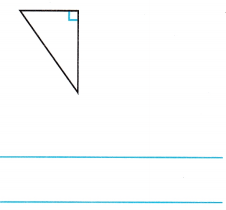
Texas Go Math Grade 5 Lesson 11.2 Answer Key Triangles Read More »

Texas Go Math Grade 5 Lesson 10.3 Answer Key Number Patterns in Graphs

Refer to our Texas Go Math Grade 5 Answer Key Pdf to score good marks in the exams. Test yourself by practicing the problems from Texas Go Math Grade 5 Lesson 10.3 Answer Key Number Patterns in Graphs.

Texas Go Math Grade 5 Lesson 10.3 Answer Key Number Patterns in Graphs

Unlock the Problem

Sona has some dimes. Adil offers to give her nickels for her dimes.
The graph shows the relationship between the number of dimes Sona gives to
Adil and the number of nickels she receives in exchange. Find a rule to describe the pattern.
Texas Go Math Grade 5 Lesson 10.3 Answer Key 1
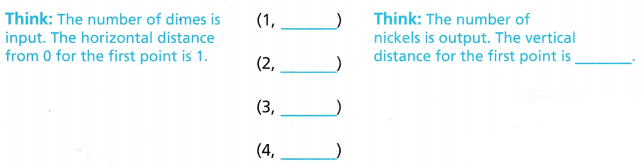
STEP 1: Write number pairs that relate the number of dimes to the number of nickels
Texas Go Math Grade 5 Lesson 10.3 Answer Key 2
STEP 2 Describe the relationship between the number of dimes and the number of nickels.
The output is __________ times the input. The pattern uses multiplication.

STEP 3 Write the rule. Let n stand for number of nickels, and d stand for the number of dimes.
n = __________ × ___________
Think: The relationship is multiplicative. Use multiplication to write the rule.

Answer:
Step 1:
Pairs that relate between Sona and Adil the number of dimes to the
number of nickels are (1,2), (2,4), (3,6), (4,8),
Step 2:
The output is 2 times the input,
Step 3:
Rule: n = d X 2,

Explanation:
Step 1:
As the number of dimes is the input, the horizontal distance from
0 for the first point is 1 and the number of nickels is output the vertical distance
for the first point is 2, So the pairs that relate between Sona and Adil
the number of dimes to the number of nickels are (1,2), (2,4), (3,6), (4,8),
Step 2:
By seeing the pairs the relationship between the number of dimes is
twice the number of nickels. so the output is two times the input.
The pattern uses multiplication,
Step 3:
Let n stand for number of nickels, and d stand for the number of dimes.
as the relationship is multiplicative. Using multiplication to write the rule as
n = d X 2.

Math Idea

An additive pattern uses addition ¡n its rule. A multiplicative pattern uses multiplication in its rule.

Example

Find the rule for the pattern shown in the graph.

Jack mails some magazines in a box. The graph shows the relationship between
the number of magazines and the total weight of the magazines and the box.
Texas Go Math Grade 5 Lesson 10.3 Answer Key 3
STEP 1: Write number pairs that relate the number of magazines and the total weight.
(1, ______)
(2, ______)
(3, ______)
(4, ______)

STEP 2: Describe the relationship between the number of magazines and the weight.
The output is the sum of the number of magazines and __________.
The pattern uses addition.

STEP 3: Write the rule. Let w stand for total weight, and m stand for the number of magazines.
w = __________ + __________
Answer:
Pairs are (1,3), (2,4), (3,5), (4,6),
The output total weight is the sum of the number of magazines and 2,
rule is w = m + 2,

Explanation:
Step 1: Number pairs that relate the number of magazines and the total weight is
(1,3), (2,4), (3,5), (4,6),
Step 2: By seeing the graph The output is the sum of the number of magazines and 2
the relationship between the number of magazines and the weight.
The output is the sum of the number of magazines and 2 by using
addition pattern and let w stand for total weight, and
m stand for the number of magazines the rule is  w = m + 2.

Math Talk
Mathematical Processes

Explain what the 2 stands for in w = m + 2.
Answer:
2 stands for adding 2 more plus number of magazines we get the weight,

Explanation:
As w = m + 2 here 2 stands we are adding 2 more to the
number of magazines we will get the weight.

Share and Show

Is the pattern additive or multiplicative? Find the rule for the pattern.

Question 1.
Texas Go Math Grade 5 Lesson 10.3 Answer Key 4
Answer:
Pattern is multiplicative,
Rule : t = s X 3,

Explanation:
Step 1: Number pairs that relate input s and output t we see
(1,3),(2,6), (3,6),
Step 2:  By seeing the graph the relationship between the input and output is
the output t is multiplication of 3 times with input s by using
multiplication pattern rule is  t = s X 3.

Go Math 5th Grade Lesson 10.3 Answer Key Question 2.
Texas Go Math Grade 5 Lesson 10.3 Answer Key 5
Answer:
Pattern is additive,
Rule : t = s + 3,

Explanation:
Step 1: Number pairs that relate input s and output t we see
(1,4),(2,5), (3,6),
Step 2:  By seeing the graph the relationship between the input and output is
the output t is addition of 3 more with input s by using
addition pattern rule is  t = s + 3.

Problem Solving

Question 3.
H.O.T. Write Math Explain the differences between the graphs in Exercises 1 and 2.
Answer:
One is multiplicative pattern and other is additive pattern,

Explanation:
The main difference between the graphs in Exercise 1 and 2 is
the first 1 is multiplicative pattern with steeper(larger) slope and linear and
seeing relations between input and output,
In the second graph it is additive pattern with linear and deeper(closer) slope
and seeing relations between input and output.

Question 4.
Write Math Explain how you can tell whether a pattern shown in a graph is additive or multiplicative.
Answer:
By seeing the graph and points
origin, slope is deeper or steeper, linear
and relations between input and outputs,

Explanation:
In additive graph it will not start from origin and slope
will be deeper(closer) and it will be linear and we see the
relationship between input and output,
In multiplicative graph it can will start from origin and slope
will be steeper(increases) and it will be linear and we see the
relationship between input and output.

Problem Solving

Use the graph for 5-6.
Texas Go Math Grade 5 Lesson 10.3 Answer Key 6

Go Math Lesson 10.3 5th Grade Answer Key Question 5.
H.O.T. Multi-Step Maryanne’s map uses a scale to show how many miles each inch on the map represents.
Use the pattern shown in the graph to find the rule for calculating the actual distance.
Use in for number of miles and j for number of inches.
Texas Go Math Grade 5 Lesson 10.3 Answer Key 7
Answer:
Rule in = j X 10,

Explanation:
Given Maryanne’s map uses a scale to show how many miles each inch on the map represents.
Step 1: Number pairs that relate input  and output  is
(1,0),(2,20), (3,30),(4,40),
Step 2:  By seeing the graph the relationship between
in for number of miles and j for number of inches on map rule is
the number of miles is multiplication of 10 times with number of inches on the map
using multiplication pattern rule is (actual distance) in  = j X 10
Used the pattern shown in the graph to find the rule for calculating the actual distance.

Question 6.
H.O.T. If the distance on the map is 2.5 inches, how many miles is the actual distance?
Explain how you calculated the actual distance.
Answer:
The actual distance is 25 miles,

Explanation:
Given the distance on the map is 2.5inches to calculate
the actual distance by using the graph and rule of question 5 we have
(actual distance) in  = j X 10(where j is number of inches on the map)
substituting j = 2.5 we get in = 2.5 X 10 = 25 miles the actual distance.

Question 7.
H.O.T. Apply Olivia uses 1 red button for the nose and 2 blue buttons
for the eyes for each rag doll she makes.
Would the pattern comparing the number of nose buttons to
the total number of buttons be multiplicative or additive? Explain.
Answer:
The number of nose buttons to total number of buttons
will be multiplicative,

Explanation:
Given Olivia uses 1 red button for the nose and 2 blue buttons
for the eyes for each rag doll she makes. If n is the total number of buttons
let r is red button for the nose and b for blue button we have
1 rag doll = 3 buttons = 1 red button + 2 blue buttons
means the total number of buttons is
depending upon number of red buttons and also on
blue buttons which means it is multiplicative
if 2 rag dolls = 3 x 2 = 6 buttons = (2 X 1r + 2 X 2b) = 2 + 4 = 6.

Daily Assessment Task

Fill in the bubble completely to show your answer. Use the graph.

Go Math Grade 5 Lesson 10.3 Answer Key Question 8.
The graph shows the number of pounds of fish the seals at an aquarium eat each day.
Which statement and equation about the relationship is true?
Texas Go Math Grade 5 Lesson 10.3 Answer Key 8
(A) additive pattern, d = p + 3
(B) addition pattern, p = d + 3
(C) multiplicative pattern, p = 10 × d
(D) multiplicative pattern, d = 3 × p
Answer:
(C) multiplicative pattern, p = 10 × d is true,

Explanation:
Given the graph shows the number of pounds of fish the seals
at an aquarium eat each day the pattern is if
p is the number of pounds of fish the seals and d is number of days
Step 1: Number pairs that relate input d and output p we see
(1,10),(2,20), (3,30),(4,40),
Step 2:  By seeing the graph the relationship between the input and output is
multiplicative of 10 times with input d is output p by using
multiplicative pattern rule is  p = 10 X d which exactly matches with (C).

Use the graph for 9-10.
Texas Go Math Grade 5 Lesson 10.3 Answer Key 9
Question 9.
The graph shows the relationship between the number of days and
the amount of food that a bottlenose dolphin eats.
Which point on the graph shows the amount of food that the dolphin consumes in two days?
(A) point A
(B) point B
(C) point C
(D) point D
Answer:
(C) point C,

Explanation:
Given the graph shows the relationship between the number of days and
the amount of food that a bottlenose dolphin eats. If we see points on the
graph Point A is day 0, Point B is day 1, Point C is day 2 and Point D is day 3,
So point on the graph that shows the amount of food that the
dolphin consumes in two days is Point C matches with (C).

Question 10.
Multi-Step If  s is the amount of food a bottlenose dolphin cats in a
day and n is the number of days, which of the following describes the
rule for the pattern shown in the graph?
(A) s = n + 23
(B) s = n × 23
(C) n = s × 23
(D) n = s + 23
Answer:
(A) s = n + 23,

Explanation:
If  s is the amount of food a bottlenose dolphin cats in a
day and n is the number of days, Number pairs that relate
input n and output s we see
(1,23),(2,46), (3,69), the following describes the
rule for the pattern shown in the graph the relationship between the
input number of days n and output s is the amount of food a
bottlenose dolphin cats in a day is additive of 23 more with input n
is output s by using additive pattern rule is  s = n + 23
which exactly matches with (A).

Texas Test Prep

Go Math 5th Grade Lesson 10.3 Answer Key Question 11.
Which of the following rules describes the pattern in the graph?
Texas Go Math Grade 5 Lesson 10.3 Answer Key 10
(A) a = 4b
(B) b = 4a
(C) b = 4 + a
(D) a = 4 + b
Answer:
(C) b = 4 + a,

Explanation:
Number pairs that relate input a and output b we see
(1,5), (2,6), (3,7), (4, 8) the following describes the
rule for the pattern shown in the graph the relationship between the
input a and output b is additive of 4 more with input a is output b by using
additive pattern rule we have b = 4 + a which exactly matches with (C).

Texas Go Math Grade 5 Lesson 10.3 Homework and Practice Answer Key

Is the pattern additive or multiplicative? Write the rule for the pattern.

Question 1.
Texas Go Math Grade 5 Lesson 10.3 Answer Key 11
Answer:
Pattern is additive,
Rule is b = a + 4,

Explanation:
Number pairs that relate input a and output b we see
(1,5), (2,6), (3,7) the following describes the
rule for the pattern shown in the graph the relationship between the
input a and output b are additive of 4 more with input a is output b by using
additive pattern rule is b = a + 4.

Go Math 5th Grade Practice and Homework Lesson 10.3 Answer Key Question 2.
Texas Go Math Grade 5 Lesson 10.3 Answer Key 12
Answer:
Pattern is Multiplicative,
Rule is d = c X  4,

Explanation:
Number pairs that relate input c and output d we see
(1,4), (2,8), (3,12) the following describes the
rule for the pattern shown in the graph the relationship between the
input c and output d is multiplicative of 4 more with input c is output d
by using multiplicative pattern rule is d = c X 4.

Question 3.
Texas Go Math Grade 5 Lesson 10.3 Answer Key 13
Answer:
Pattern is Multiplicative,
Rule is f = e X  5,

Explanation:
Number pairs that relate input e and output f we see
(1,5), (2,10), (3,15) the following describes the
rule for the pattern shown in the graph the relationship between the
input e and output f is multiplicative of 5 more with input e is output f
by using multiplicative pattern rule is f = e X 5.

Question 4.
Texas Go Math Grade 5 Lesson 10.3 Answer Key 14
Answer:
Pattern is additive,
Rule is h = g + 5,

Explanation:
Number pairs that relate input a and output b we see
(1,6), (2,7), (3,8) the following describes the
rule for the pattern shown in the graph the relationship between the
input g and output h is additive of 5 more with input g  is output h
by using additive pattern rule is h = g + 5.

Problem Solving

Texas Go Math Grade 5 Lesson 10.3 Answer Key 15
Practice and Homework Lesson 10.3 Answer Key 5th Grade Question 5.
Patrice rents a rowboat for several hours. Use the pattern shown
in the graph to write the rule for calculating the cost of renting the rowboat.
Use c for the cost and h for the number of hours.
Answer:
The rule for calculating the cost of renting the rowboat is
c = h X $15, where c for the cost and h for the number of hours,

Explanation:
Given Patrice rents a rowboat for several hours the pattern shown
in the graph if c is for the cost and h for the number of hours is
Number pairs that relate hours h and cost c we see
(1,15), (2,30), (3,45) the following describes the
rule for the pattern shown in the graph the relationship between the
hours h and costs c is multiplicative of 15 times
by using multiplicative pattern rule is c = h X $15.

Question 6.
If Patrice rents the boat for 4 hours, what is the cost of the rental?
Answer:
The cost of the rental is $60,

Explanation:
we have the rule for calculating the cost of renting the rowboat is
c = h X $15, where c for the cost and h for the number of hours,
so if Patrice rents the boat for 4 hours,  the cost of the rental is
c= 4 X $ 15 = $60.

Lesson Check

Fill in the bubble completely to show your answer.

Question 7.
The graph shows the relationship between the number of hours
Ivana bikes and the distance she travels. How many miles does Ivana bike in 4 hours?
Texas Go Math Grade 5 Lesson 10.3 Answer Key 16
(A) 28 miles
(B) 12 miles
(C) 32 miles
(D) 30 miles
Answer:
(C) 32 miles,

Explanation:
Given the graph shows the relationship between the number of hours
Ivana bikes and the distance she travels
Step 1: Number pairs that relate hours h and number of miles m we see
(1,8),(2,16), (3,24),
Step 2:  By seeing the graph the relationship between the input and output is
multiplicative of 8 times with input hours h is output number of miles m by using
multiplicative pattern rule is  m = 8 X h so number of miles does
Ivana bike in 4 hours is 8 X 4 = 32 miles which matches with (C).

Go Math Lesson 10.3 5th Grade Homework Answer Key Question 8.
Rashid uses cubes to build towers. The graph shows the relationship between
the number of towers, t, and the number of cubes, c, he uses.
Which equation describes this relationship?
Texas Go Math Grade 5 Lesson 10.3 Answer Key 17
(A) c = 12 + t
(B) c = 12t
(C) t = 12 + c
(D) t = 12c
Answer:
(B) c = 12t,

Explanation:
Given Rashid uses cubes to build towers.
The graph shows the relationship between
the number of towers t and the number of cubes c,
Step 1: Number pairs that relate the number of towers t and the number of cubes  c,
we see (1,12),(2,24), (3,36),
Step 2:  By seeing the graph the relationship between the input and output is
multiplicative of 12 times with input the number of towers t  is
output  by using the number of cubes c multiplicative pattern rule is
c = 12 X t therefore equation describes this relationship is (B).

Question 9.
Multi-Step For every $1 Paula donates to her favorite charity,
her mom donates $3. Which of the following identifies the pattern and
the amount her mom donates if Paula donates $6?
Texas Go Math Grade 5 Lesson 10.3 Answer Key 18
(A) $18, multiplicative
(B) $24, multiplicative
(C) $24, additive
(D) $12, additive
Answer:
(A) $18, multiplicative,

Explanation:
Given for every $1 Paula donates to her favorite charity,
her mom donates $3, The graph shows the relationship between
Paula donation as p and mom donation as m
Step 1: Number pairs that relate the Paula donation as p and mom donation m
we see (1,3),(2,6), (3,9),
Step 2:  By seeing the graph the relationship between the input and output is
multiplicative of 3 times with input Paula donation p  is
output  mom donation as m by using multiplicative pattern rule is
m = 3 X p therefore the amount her mom donates if Paula donates $6
is 3 X $6 = $18 matches with (A) $18, multiplicative.

Number Patterns Answer Key Go Math Grade 5 Lesson 10.3 Question 10.
Multi-Step The graph shows how much time Christina spends making
flower arrangements to sell. How many baskets can she make in two hours?
Texas Go Math Grade 5 Lesson 10.3 Answer Key 19
(A) 15
(B) 4
(C) 30
(D) 8
Answer:
(D) 8

Explanation:
The graph shows how much time Christina spends making
flower arrangements to sell. Number of baskets can she make in two hours
as we know 2 hours means 2 X 60 minutes = 120 minutes,
Step 1: Number pairs that relate the Christina as b means baskets and
minutes as m we see as (1,15),(2,30), (3,45),(4,60),
Step 2:  By seeing the graph the relationship between the input and output is
multiplicative of 15 times with input baskets b  is
output  minutes as m by using the multiplicative pattern rule is
m = b X 15, so for 120 minutes means 120/15 = 8 baskets,
which matches with (D).

Texas Go Math Grade 5 Lesson 10.3 Answer Key Number Patterns in Graphs Read More »

Texas Go Math Grade 5 Lesson 10.2 Answer Key Number Patterns in Tables

Refer to our Texas Go Math Grade 5 Answer Key Pdf to score good marks in the exams. Test yourself by practicing the problems from Texas Go Math Grade 5 Lesson 10.2 Answer Key Number Patterns in Tables.

Texas Go Math Grade 5 Lesson 10.2 Answer Key Number Patterns in Tables

Unlock the Problem

When the output in a pattern depends on the input, you can write a rule to describe the relationship between inputs and outputs.

Marcus wants to buy light-up balls for a party. They cost $1 each.
The store charges the same shipping fee regardless of how many light-up balls are ordered.
So, Marcus has to pay for the light-up balls and pay a shipping fee.
The table below shows the cost c for w light-tip balls.
How much will Marcus pay for 12 light-up balls?

Write a rule to describe the pattern in the table.
Texas Go Math Grade 5 Lesson 10.2 Answer Key 1
STEP 1: Describe the relationship between the number of light-up balls and the cost.
Texas Go Math Grade 5 Lesson 10.2 Answer Key 2
The output is _________ more than the input.

STEP 2: Decide what operation to use to write a rule.
c = _________ + __________
Think: Add 2 to the input to get the output
Since the pattern is additive, use addition to write a rule.

STEP 3: Use the rule to find the cost of 12 light-up balls,
c = w + 2
c = _________ + 2 Replace w with the number of light-up balls.
c = _________ Add to find the cost.
So, the 12 light-up balls cost $ ________.
Answer:
Step 1 : The output is 2 more than the input,
Step 2 : The operation used to write a rule is c = w + 2,
Step 3: The 12 light-up balls cost $14,

Explanation:
Given Marcus wants to buy light-up balls for a party. They cost $1 each.
The store charges the same shipping fee regardless of how many light-up balls are ordered.
So, Marcus has to pay for the light-up balls and pay a shipping fee.
The table above showed the cost c for w light-tip balls.
So Marcus pay for 12 light-up balls is
Step 1: Described the relationship between the number of light-up balls and the cost.
Texas Go Math Grade 5 Lesson 10.2 Answer Key 2
The output is 2 more than the input.
Step 2: Decided what operation to use to write a rule as for c,
Thinking: Add 2 to the input to get the output
Since the pattern is additive, use addition to write a rule as
c = w + 2,
Step 3: Used the rule to find the cost of 12 light-up balls,
c = w + 2, Replaced w with the number of light-up balls as 12.
c = 12 + 2 = 14.
So, the 12 light-up balls cost $14.

Example

Find the rule.
Patterns can also involve multiplication
Texas Go Math Grade 5 Lesson 10.2 Answer Key 3
The output is _________ times the input. The pattern is multiplicative.
The rule is y = _________ × _________.
Answer:
The output is 7 times the input. The pattern is multiplicative,
the  rule is y = n X 7,

Explanation:
Step 1:
Texas Go Math Grade 5 Lesson 10.2 Answer Key 3
the output is 7 times more than the input.
Step 2: Decided what operation to use to write a rule as for y,
Thinking: Multiplying 7 to the input to get the output,
Since the pattern is multiplicative, using multiplication to write a rule as
y = 7n.

Share and Show

Go Math Answer Key Grade 5 Lesson 10.2 Answer Key Question 1.
Use a rule to describe the pattern in the table.
Texas Go Math Grade 5 Lesson 10.2 Answer Key 4
Multiply by _________.
Rule: _________
Answer:
The output is 9 times the input. The pattern is multiplicative,
the  rule is t = s X 9,

Explanation:
Step 1:
If input is 1, output is 1 X 9 = 9,
if input  is 2, output is 2 X 9 = 18,
if input is 3, output is 3 X 9 = 27,
if input is 4, output is 4 X 9 = 36,
the output is 9 times more than the input.
Step 2: Decided what operation to use to write a rule as for t,
Thinking: Multiplying 9 to the input to get the output,
Since the pattern is multiplicative, using multiplication to write a rule as
t = s X 9.

Decide if the pattern shown in the table is additive or multiplicative.
Write a rule to describe the pattern.

Question 2.
Texas Go Math Grade 5 Lesson 10.2 Answer Key 5
The pattern is _______________
Rule: ______________
Answer:
The pattern is additive,
Rule is c = a + 3,

Explanation:
Step 1:
If input is 2, output is 2 + 3  = 5,
if input  is 4, output is 4 + 3 = 7,
if input is 6, output is 6 + 3 = 9,
if input is 8, output is 8 + 3 = 11,
the output is 3 more than the input.
Step 2: Decided what operation to use to write a rule as for c,
Thinking: Adding 3 to the input to get the output,
Since the pattern is additive, using addition to write a rule as
c = a + 3.

Question 3.
Texas Go Math Grade 5 Lesson 10.2 Answer Key 6
The pattern is _______________
Rule: ______________
Answer:
The output is 13 times the input. The pattern is multiplicative,
the  rule is p = r X 13,

Explanation:
Step 1:
If input is 1, output is 1 X 13 = 13,
if input  is 2, output is 2 X 13 = 26,
if input is 3, output is 3 X 13 = 39,
if input is 4, output is 4 X 13 = 52,
the output is 13 times more than the input.
Step 2: Decided what operation to use to write a rule as for p,
Thinking: Multiplying 13 to the input to get the output,
Since the pattern is multiplicative, using multiplication to write a rule as
p = r X 13.

Problem Solving

Lesson 10.2 Answer Key 5th Grade Go Math Question 4.
Write Math Explain how you can find a rule for a pattern in a table.
Answer:
Checking rule either using the pattern is added, subtracted, multiplied, or divided,

Explanation:
To determine the rule for a table, simply look at one pair of input/output numbers and
figure out what number has been added, subtracted, multiplied, or divided by it.
Then, make sure that the pattern matches the rest of the numbers.
Once we know the rule for a table, we can finish filling in the rest of it.

Question 5.
H.O.T. Explain whether the formula for the area of a rectangle can be
used to show an additive pattern or a multiplicative pattern.
Answer:
The area of a rectangle can be used to show a multiplicative pattern,

Explanation:
As the formula for the area of a rectangle is area = length X breadth,(a = l X b)
it clearly shows the multiplication of length and breadth,
therefore the area of a rectangle can be used to show a multiplicative pattern.

Problem Solving

Question 6.
Multi-Step To make soup, Juan adds 3 cups of hot water to each package of dried soup.
Write a rule for the pattern. Make a table to determine how many cups of hot water
are needed for 18 packages of dried soup.
Answer:
The output is 3 times the input. The pattern is multiplicative,
the  rule is c = p X 3,
Texas Go Math Grade 5 Lesson 10.2 Answer Key Number Patterns in Tables-1
Number of cups c of hot water needed for
18 packages of dried soup is 18 X 3 = 54 cups,

Explanation:
Given to make soup, Juan adds 3 cups of hot water to each package of dried soup.
Wrote a rule for the pattern. as c = p X 3, here c is cups of hot water
and p is number of packages, Made a table above to determine how many cups of
hot water are needed for 18 packages of dried soup above as
Step 1:
If input is 1, output is 1 X 3 = 3,
if input  is 2, output is 2 X 3 = 6,
if input is 3, output is 3 X 3 = 9,
if input is 4, output is 4 X 3 = 12,
If input is 5, output is 5 X 3 = 15,
if input  is 6, output is  6 X 3 = 18,
if input is 7, output is 7 X 3 = 21,
if input is 8, output is 8 X 3 = 24,
If input is 9, output is 9 X 3 = 27,
if input  is 10, output is 10 X 3 = 30,
if input is 11, output is 11 X 3 = 33,
if input is 12, output is 12 X 3 = 36,
If input is 13, output is 13 X 3 = 39,
if input  is 14, output is 14 X 3 = 42,
if input is 15, output is 15 X 3 = 45,
if input is 16, output is 16 X 3 = 48,
If input is 17, output is 17 X 3 = 51,
if input  is 18, output is 18 X 3 = 54,
the output is 3 times more than the input.
Step 2: Decided what operation to use to write a rule as for packages p,
Thinking: Multiplying 3 to the input to get the output,
Since the pattern is multiplicative, using multiplication to write a rule as
c = p X 3, therefore the number of cups c of hot water needed for
18 packages of dried soup is 18 X 3 = 54 cups.

Texas Go Math Answer Key 5th Grade Lesson 10.2 Question 7.
H.O.T. Multi-Step Liam and Nora are playing a spelling game.
The number of points for each word a player spells correctly is
the sum of the number of letters in the word and 3 bonus points for spelling correctly.
The table below shows the scoring system. Find the rule and
the number of points for spelling an eight-letter word correctly.
Texas Go Math Grade 5 Lesson 10.2 Answer Key 7
Answer:
Rule : p = l + 3,
Number of points for spelling an eight-letter word correctly is 11,

Explanation:
Given Liam and Nora are playing a spelling game.
The number of points for each word a player spells correctly is
the sum of the number of letters in the word and 3 bonus points for spelling correctly.
The table showed the scoring system as
If input is 3, output is 3 + 3 = 6,
if input  is 4, output is 4 + 3 = 7,
if input is 5, output is 5 + 3 = 8,
if input is 6, output is 6 + 3 = 9,
therefore the rule is additive pattern as p = l + 3,
so the number of points for spelling an eight-letter word correctly is
p = 8 + 3 = 11 points.

Question 8.
H.O.T Apply Kirk is building a storage cabinet.
To be sure of having enough wood, he allows an extra 2 inches on measurements.
Write a rule for the pattern. Make a table to find the number of inches that
Kirk would measure if he wanted an 11-inch board.
Answer:
Texas Go Math Grade 5 Lesson 10.2 Answer Key Number Patterns in Tables-2
Kirk need  11 + 2 = 13 inch measure if he wanted an 11-inch board,

Explanation:
Given Kirk is building a storage cabinet.
To be sure of having enough wood, he allows an
extra 2 inches on measurements.
if If input is 1, output is 1 + 2 = 3,
if input  is 2, output is 2 + 2 = 4,
if input is 3, output is 3 + 2 = 5 and so on till
if input is 11, output is 11 + 2 = 13,
The rule for the pattern is c = i + 2, where c  is cabinet wood and
i is number inches of wood to make cabinet, Made the table above and
the number of inches that Kirk would measure if he wanted an
11-inch board is 11 + 2 = 13 inch.

Daily Assessment Task

Fill in the bubble completely to show your answer. Use the table for 9-10.
Texas Go Math Grade 5 Lesson 10.2 Answer Key 8

Go Math 5th Grade Practice and Homework Lesson 10.2 Answer Key Question 9.
Analyze Using the recipe shown in the table, how many cups of flour will you need to make 13 model volcanoes?
(A) 30 cups
(B) 48 cups
(C) 78 cups
(D) 54 cups
Answer:
(C) 78 cups,

Explanation:
Using the recipe shown in the table, number of cups of
flour I will need to make 13 model volcanoes is
as Number of volcanoes if 2 means flour(c) is 12,
if 3 means 18 and so on its rule is c =  n X 6 where
c is cups of flour and n is number of volcanoes,
therefore for 13 we require 13 X 6 = 78 cups of flour
which matches with (C).

Question 10.
If v is the number of volcanoes and s is the number of cups of salt,
which of the following rules describes the pattern in the table?
(A) v = s + 2
(B) j = n × 2
(C) s = v + 2
(D) s = v × 2
Answer:
(D) s = v x 2,

Explanation:
Using the recipe shown in the table, If v is the number of volcanoes and
s is the number of cups of salt, the following rules describes
the pattern in the table as if v = 2 then s = v X 2 = 4,
if v =3 then s = 3 X 2 = 6 and so on
therefore the pattern in the table is s = v X 2 which matches with (D).

Question 11.
Multi-Step The table shows the shipping boxes received by
Snazzy Stuff clothing store. Suppose that the store pays $8 for a shirt.
How much money does the store pay for 10 boxes of shirts?
Texas Go Math Grade 5 Lesson 10.2 Answer Key 9
(A) $120
(B) $96
(C) $960
(D) $192
Answer:
(C) $960,

Explanation:
Given the table shows the shipping boxes received by
Snazzy Stuff clothing store. Suppose that the store pays $8 for a shirt.
seeing the table the rule is s = n X 12 where n is number of boxes and
s is number of shirts so for 10 boxes means shirts are 10 X 12 = 120,
now given that the store pays $8 for a shirt  so money does
the store pay for 10 boxes of shirts is 120 X $8 = $960 which matches with (C).

TEXAS Test Prep

Go Math Grade 5 Lesson 10.2 Answer Key Question 12.
Which of the following rules describes the pattern in the table?
Texas Go Math Grade 5 Lesson 10.2 Answer Key 10
(A) e = b + 4
(B) e = b × 4
(C) b = e + 4
(D) b = e × 4
Answer:
(B), e = b X 4,

Explanation:
Given table where input b = 1 output e = 1 X 4 =4,
if input b =2 output e = 2 X 4 =8,
if input b =3 output e = 3 X 4 =12 therefore the pattern
in the table is e = b X 4 which matches with (B).

Texas Go Math Grade 5 Lesson 10.2 Homework and Practice Answer Key

Find the rule to describe the pattern in the table. Decide if the rule is additive or multiplicative.

Question 1.
Texas Go Math Grade 5 Lesson 10.2 Answer Key 11
The rule is ________________.
Rule: ______________
Answer:
The rule is n = m X 11,

Explanation:
Step 1:
If input is 1, output is 1 X 11 = 11,
if input  is 2, output is 2 X 11 = 22,
if input is 3, output is 3 X 11 = 33,
if input is 4, output is 4 X 11 = 44,
the output is 11 times more than the input.
Step 2: Decided what operation to use to write a rule as for n,
Thinking: Multiplying 11  to the input to get the output,
Since the pattern is multiplicative, using multiplication to write a rule as
n = m X 11.

Grade 5 Math Answer Key Practice and Homework Lesson 10.2 Question 2.
Texas Go Math Grade 5 Lesson 10.2 Answer Key 12
The rule is ______________
Rule: _____________
Answer:
Rule f = d + 4,

Explanation:
Step 1:
If input is 3, output is  3 + 4  = 7,
if input  is 5, output is 5 + 4 = 9,
if input is 7, output is 7 + 4 = 11,
if input is 9, output is 9 + 4 = 13,
the output is 4 more than the input.
Step 2: Decided what operation to use to write a rule as for f,
Thinking: Adding 4 to the input to get the output,
Since the pattern is additive, using addition to write a rule as
f = d + 4.

Question 3.
Texas Go Math Grade 5 Lesson 10.2 Answer Key 13
The rule is ______________
Rule: _____________
Answer:
The rule is q = p X 15,

Explanation:
Step 1:
If input is 2, output is 2 X 15 = 30,
if input  is 3, output is 3 X 15 = 45,
if input is 4, output is 4 X 15 = 60,
if input is 5, output is 5 X 15 = 75,
the output is 15 times more than the input.
Step 2: Decided what operation to use to write a rule as for q,
Thinking: Multiplying 15 to the input to get the output,
Since the pattern is multiplicative, using multiplication to write a rule as
q = p X 15.

Question 4.
Texas Go Math Grade 5 Lesson 10.2 Answer Key 14
The rule is ______________
Rule: _____________
Answer:
Rule t = s + 6,

Explanation:
Step 1:
If input is 4, output is  4 + 6  = 10,
if input  is 6, output is 6 + 6 = 12,
if input is 8, output is 8 + 6 = 14,
if input is 10, output is 10 + 6 = 16,
the output is 6 more than the input.
Step 2: Decided what operation to use to write a rule as for f,
Thinking: Adding 6 to the input to get the output,
Since the pattern is additive, using addition to write a rule as
t = s + 6.

Problem Solving

Go Math Lesson 10.2 Homework Answers Grade 5 Question 5.
Marcus pours 12 ounces of cranberry juice into a punch bowl.
He uses a container to add sparkling water to the bowl one ounce at a time.
Write a rule to show the pattern and use it to calculate how many ounces of
liquid Marcus will have in the bowl after adding 8 containers of sparkling water.
Answer:
Number of ounces of liquid Marcus will have in the bowl after
adding 8 containers of sparkling water is 8 ounces,

Explanation:
Given Marcus pours 12 ounces of cranberry juice into a punch bowl.
He uses a container to add sparkling water to the bowl one ounce at a time.
Rule to show the pattern and use it to calculate how many ounces of
liquid Marcus will have in the bowl after adding 8 containers of sparkling water is
taking ounces as o and c as containers of sparkling water
therefore rule is o = c X one ounce so number of ounces of liquid Marcus
will have in the bowl after adding 8 containers of sparkling water is 8 ounces.

Lesson Check

Fill in the bubble completely to show your answer.

Question 6.
The winning entry in the inventors’ competition was a robot made with wheels,
gears, and bolts. Using the table shown below, how many bolts are needed to make 7 robots?
Texas Go Math Grade 5 Lesson 10.2 Answer Key 15
(A) 40
(B) 21
(C) 28
(D) 56
Answer:
(D) 56,

Explanation:
The winning entry in the inventors’ competition was a robot made with wheels,
gears, and bolts. Using the table shown above if
1 robot with 8 bolts,
2 robot for 16 bolts therefore rule is b = r X 8 where
b is bolts and r is robot so number of bolts are needed to make 7 robots are
b = 7 X 8 = 56 which matches with (D) respectively.

Question 7.
Which of the following rules describes the pattern in the table?
Texas Go Math Grade 5 Lesson 10.2 Answer Key 16
(A) j = h + 9
(B) j = 9h
(C) h = j + 9
(D) h = 9j
Answer:
(A) j = h + 9,

Explanation:
Step 1:
If input h = 3, output j is  3 + 9  = 12,
if input h = 4, output j is 4 + 9 = 13,
if input h = 5, output j is 5 + 9 = 14,
the output is 9 more than the input.
Step 2: Decided what operation to use to write a rule as for j,
Thinking: Adding 9 to the input to get the output,
Since the pattern is additive, using addition to write a rule as
j = h + 9 which matches with (A).

Go Math Grade 5 Lesson 10.2 Homework Answer Key Question 8.
The equation c = $0.75p represents the cost of mailing a package for each pound,
where c is the cost and p is the number of pounds.
If Lelia mails a package that weighs 5 pounds, what is the total cost?
(A) $3.00
(B) $4.50
(C) $3.75
(D) $3.55
Answer:
(C) $3.75,

Explanation:
Given the equation c = $0.75p represents the cost of
mailing a package for each pound, where c is the cost and
p is the number of pounds If Lelia mails a package that weighs 5 pounds,
the total cost is c = $0.75 X 5 = $3.75 which matches with (C).

Question 9.
The equation d = m + 16 represents the total distance traveled after driving m number of miles.
If Mrs. Endo drives 35 miles, what is the total distance traveled?
(A) 41 miles
(B) 21 miles
(C) 51 miles
(D) 19 miles
Answer:
(D) 19 miles,

Explanation:
Given the equation d = m + 16 represents the total distance traveled
after driving m number of miles. If Mrs. Endo drives 35 miles,
the total distance traveled is 35 = m + 16, so m= 35 – 16 = 19 miles
which matches with (D).

Question 10.
Multi-Step Nathanial has a dog walking business.
He charges $3 for every 15 minutes of walking. How much will
Nathanial charge to walk a dog for one hour?
(A) $18
(B) $45
(C) $60
(D) $12
Answer:
(D) 12,

Explanation:
Given Nathanial has a dog-walking business.
He charges $3 for every 15 minutes of walking.
Nathanial charge to walk a dog for one hour is
as we know 1 hour is 60 minutes and 60 minutes means
four times 15, 4 X 15 minutes , So Nathanial charges 4 X $3 = $12
which matches with (D).

Texas Go Math Grade 5 Practice and Homework Lesson 10.2 Question 11.
Multi-Step The table shows the number of magazines Mr. Gomez receives.
He pays $2 for each magazine. How much does Mr. Gomez pay for magazines in 12 months?
Texas Go Math Grade 5 Lesson 10.2 Answer Key 17
(A) $24
(B) $48
(C) $12
(D) $36
Answer:
(A) $24,

Explanation:
Given the table showed the number of magazines Mr. Gomez receives.
He pays $2 for each magazine. So Mr. Gomez pay for magazines in 12 months
is 12 X $2 = $24 which matches with (A).

Texas Go Math Grade 5 Lesson 10.2 Answer Key Number Patterns in Tables Read More »

Texas Go Math Grade 5 Lesson 10.1 Answer Key Number Patterns

Refer to our Texas Go Math Grade 5 Answer Key Pdf to score good marks in the exams. Test yourself by practicing the problems from Texas Go Math Grade 5 Lesson 10.1 Answer Key Number Patterns.

Texas Go Math Grade 5 Lesson 10.1 Answer Key Number Patterns

Unlock the Problem

Luisa is making flan. For every egg, she can make three flans. The rule f= 3e describes the relationship between the number of flans, f and the number of eggs, e. How many flans can Luisa make if she uses 5 eggs?
Texas Go Math Grade 5 Lesson 10.1 Answer Key 1
You can use an input/output table or a list to show a pattern. When a pattern is shown in a table, it shows the relationship between the inputs and outputs. When a pattern is shown in a list, it only shows the outputs in order.

Complete the input/output table. Replace e in the equation f= 3e with the value shown in the table to find the value of the output f.
Texas Go Math Grade 5 Lesson 10.1 Answer Key 2
The pattern for the number of flans is 3, 6, ______, ______, ______.
The fifth number in the pattern is ______.
So, Luisa can make ______ flans.
Answer:
Texas Go Math Grade 5 Lesson 10.1 Answer Key Number Patterns-1
The pattern for the number of flans is 3, 6, 9, 12, 15,
The fifth number in the pattern is 15,
Luisa can make 15 flans if she uses 5 eggs,

Explanation:
Given Luisa is making flan. For every egg, she can make three flans.
The rule f= 3e describes the relationship between the number of flans,
f and the number of eggs, e
The pattern for the number of flans is shown in
above the input/output table is e = 1, f = 3 X 1 = 3 flans
if e = 2, f =  3 X 2 = 6 flans,
if e = 3, f = 3 X 3 = 9  flans,
if e = 4, f = 3 X 4 = 12 flans,
if e = 5, f = 3 X 5 = 15 flans,
therefore the fifth number in the pattern is 15,
So Luisa can make 15 flans if she uses 5 eggs.

Math Talk
Mathematical Processes

Explain how you can use the pattern to find how many flans can be made using 9 eggs.
Answer:
Number of flans can be made using 9 eggs is 27 flans,

Explanation:
We use the rule f= 3e which describes the relationship between
the number of flans f and the number of eggs e
The number of flans can be made using 9 eggs is
f= 3 X 9 = 27 flans, therefore number of flans can be made
using 9 eggs is 27 flans.

What if the Luisa changed her recipe to make 4 flans with every egg? How would the pattern change?
Answer:
The pattern changes to f = 4e,

Explanation:
Before Luisa is making flan. For every egg, she can make three flans.
The rule f= 3e describes the relationship between
the number of flans f and the number of eggs e,
now Luisa changed her recipe to make 4 flans with every egg instead of 3,
so very simple the pattern changes to f = 4e where f is the number of flans
and e is the number of eggs respectively.

Example
Find the pattern.
The rule for the number of circles in a figure is c = f + 2
where c is the number of circles and f is the figure number.
How many circles will be in Figure 8?
Texas Go Math Grade 5 Lesson 10.1 Answer Key 3
The pattern for the number of circles is 3, 4, ______, ______, ______, ______, ______, ______.
The eighth number in the pattern is ______.
So, there are ______ circles in Figure 8.
Answer:
Texas Go Math Grade 5 Lesson 10.1 Answer Key Number Patterns-2
The pattern for the number of circles is 3, 4, 5, 6, 7, 8, 9, 10,
The eighth number in the pattern is 10,
So, there will be 10 circles in Figure 8,

Explanation:
Given the rule for the number of circles in a figure is c = f + 2
where c is the number of circles and f is the figure number,
Completed the the input/output table as shown above
The pattern for the number of circles is
if f = 1, c = 1 + 2 = 3,
if f = 2, c = 2 + 2 = 4,
if f = 3, c = 3 + 2 = 5,
if f = 4, c = 4 + 2 = 6,
if f = 5, c = 5 + 2 = 7,
if f = 6, c = 6 + 2 = 8,
if f = 7, c = 7 + 2 = 9,
if f =8, c = 8 + 2 = 10,
therefore the eighth number in the pattern is 10,
So, there will be 10 circles in Figure 8.

Share and Show

Use the rule to complete the table.

Question 1.
Rule: g = n + 6.
Texas Go Math Grade 5 Lesson 10.1 Answer Key 4
Answer:
Texas Go Math Grade 5 Lesson 10.1 Answer Key Number Patterns-3

Explanation:
Used the rule g = n + 6 as
if n = 1, g= 1 + 6 = 7,
if n = 2, g = 2 + 6 = 8,
if n = 3, g  = 3 + 6 = 9,
if n = 4, g = 4 + 6 = 10 and completed the table as shown above.

Go Math Grade 5 Lesson 10.1 Answer Key Question 2.
Rule: p = r × 12
Texas Go Math Grade 5 Lesson 10.1 Answer Key 5
Answer:
Texas Go Math Grade 5 Lesson 10.1 Answer Key Number Patterns-4

Explanation:
Used the rule p = r X 12 as
if r = 2, p = 2 X 12 = 24,
if r = 4, p = 4 X 12 = 48,
if r = 6, p = 6 X 12 = 72,
if r = 8, p = 8 X 12 = 96 and completed the table as shown above.

Problem Solving

Practice: Copy and Solve Use the rule to make an input/output table.
Include four input/output pairs in your table.

Question 3.
For input x and output y, the rule is y = x + 4
Answer:
Texas Go Math Grade 5 Lesson 10.1 Answer Key Number Patterns-5

Explanation:
Used the rule y = x + 4 as
if  x = 1, y = 1 + 4 = 5,
if  x = 2, y = 2 + 4 = 6,
if  x = 3, y = 3 + 4 = 7,
if  x = 4, y = 4 + 4 = 8 and completed the table as shown above.

Question 4.
For input s and output a, the rule is a = 11 s
Answer:
Texas Go Math Grade 5 Lesson 10.1 Answer Key Number Patterns-6

Explanation:
Used the rule a = 11s as
if  s = 1, a = 11 X 1 = 11,
if  s = 2, a = 11 X 2 = 22,
if  s = 3, a = 11 X 3 = 33,
if  s = 4, a = 11 X 4 = 44 and completed the table as shown above.

Lesson 10.1 Answer Key Go Math Grade 5 Question 5.
For input u and output v, the rule is v = 7u
Answer:
Texas Go Math Grade 5 Lesson 10.1 Answer Key Number Patterns-7

Explanation:
Used the rule v = 7u as
if  u = 1, v = 7 X 1 = 7,
if  u = 2, v = 7 X 2 = 14,
if  u = 3, v = 7 X 3 = 21,
if  u = 4, v = 7 X 4 = 28 and completed the table as shown above.
Question 6.
For input m and output n, the rule is n = m × 10
Answer:
Texas Go Math Grade 5 Lesson 10.1 Answer Key Number Patterns-8

Explanation:
Used the rule n = m X 10 as
if  m = 1, n = 1 X 10 = 10,
if  m = 2, n = 2 X 10 = 20,
if  m = 3, n = 3 X 10 = 30,
if  m = 4, n = 4 X 10 = 40 and completed the table as shown above.

Question 7.
H.O.T. Explain how you can use the formula for the perimeter of a square,
P = 4s, to generate a pattern. Use the pattern to find the perimeter of a
square with sides that are 5 cm long.
Answer:
The perimeter of a square with sides that are 5 cm long is
p = 20 cm,

Explanation:
Given and we know to use the formula for the perimeter of a square,
P = 4s, to generate a pattern. So using the pattern in finding
the perimeter of a square with sides that are 5 cm long is simple
here s is 5 cm, therefore p = 4 X 5 cm = 20 cm.

Problem Solving

Question 8.
Max makes origami paper cranes for a mobile.
He can make 5 cranes with each sheet of paper.
Complete the input/output table to show the
number of cranes Max can make with 6 sheets of paper.
Texas Go Math Grade 5 Lesson 10.1 Answer Key 6
Answer:
Texas Go Math Grade 5 Lesson 10.1 Answer Key Number Patterns-9
number of cranes Max can make with 6 sheets of paper are 30,

Explanation:
Given Max makes origami paper cranes for a mobile.
He can make 5 cranes with each sheet of paper.
So pattern is cranes  =  5 X sheet, So if
s = 1 , c = 5 X 1 = 5,
if s = 2, c = 5 X 2 = 10,
if s = 3, c = 5 X 3 = 15,
if s= 4, c = 5 X 4 = 20,
if s = 5, c = 5 X 5 = 25 and
if s = 6, c= 6 X 5 = 30,
Completed the input/output table to show the number of cranes
Max can make with 6 sheets of paper are 30 above.

Grade 5 Lesson 10.1 Number Patterns Answer Key Question 9.
H.O.T. Multi-Step Max decides to make paper owls.
He can make 4 paper owls from each sheet of paper.
Complete and use the input/output table to find how many sheets of
paper Max would use to make 24 paper owls.
Texas Go Math Grade 5 Lesson 10.1 Answer Key 7
Answer:
Texas Go Math Grade 5 Lesson 10.1 Answer Key Number Patterns-10
Max can use 6 sheets of paper to make 24 paper owls,

Explanation:
Given Max decides to make paper owls.
He can make 4 paper owls from each sheet of paper.
So pattern is owls  =  4 X sheet, So if
if s = 1, o = 4 X 1 = 4,
if s = 2, o = 4 X 2 = 8,
if s = 3, o = 4 X 3 = 12,
if s= 4, o = 4 X 4 = 16,
if s = 5, o = 5 X 4 = 20 and
if s = 6, o = 6 X 4 = 24,
Completed the input/output table to show the number of owls above
so as per table and pattern Max can use 6 sheets of paper
to make 24 paper owls.

Daily Assessment Task

Fill in the bubble completely to show your answer.

Question 10.
Apply Matilda is reading a map of the route to her grandfather’s house in another state.
The equation m = 25i describes the relationship between i,
the number of inches on the map, and m, the number of actual miles.
How many miles are represented by 12 inches?
(A) 200 miles
(B) 600 miles
(C) 400 miles
(D) 300 miles
Answer:
The number of miles that are represented by 12 inches are 300 miles
matches with (D),

Explanation:
Given Matilda is reading a map of the route to her grandfather’s house in another state.
The equation m = 25i describes the relationship between i,
the number of inches on the map and m the number of actual miles.
So number of miles that are represented by 12 inches are
applying in m = 25i we get  25 X 12 = 300 miles which is (D).

Question 11.
To find the total cost of a field trip, use the equation c = 4s,
where s is the number of students and c is the cost of the field trip.
How much will it cost for 14 students to attend the field trip?
Texas Go Math Grade 5 Lesson 10.1 Answer Key 8
(A) $15
(B) $17
(C) $56
(D) $60
Answer:
It will cost for 14 students to attend the field trip is $56,
So (C),

Explanation:
Given to find the total cost of a field trip, using the equation c = 4s,
where s is the number of students and c is the cost of the field trip.
So it cost for 14 students to attend the field trip is c = 4 X 14 = $56
which matches with (C).

Lesson 10.1 Homework Answer Key 5th Grade Question 12.
Multi-Step Robin places 3 roses and 2 daffodils in each vase.
How many flowers will she need if she has 6 vases?
(A) 30
(B) 12
(C) 18
(D) 5
Answer:
30 flowers Robin needs is she has 6 vases,
match is (A),

Explanation:
Given Robin places 3 roses and 2 daffodils in each vase means
in each vase she is keeping 1 vase = 3 + 2 = 5 flowers(5 f)
so 1 vase  =  5f here v is vase and f  is flowers, therefore 6 vases will have
6 X 5 = 30 flowers which matches with (A).

Texas Test Prep

Question 13.
Sergei uses the pattern rule y = 4 + b to generate the first three outputs in the pattern.
Which of the following is the fifth output in the pattern?
Texas Go Math Grade 5 Lesson 10.1 Answer Key 9
(A) 5
(B) 9
(C) 8
(D) 10
Answer:
9, matches with (B),

Explanation:
Given Sergei uses the pattern rule y = 4 + b to generate
the first three outputs in the pattern. The following is the fifth
output in the pattern is y = 4 + 5 = 9 which matches with (B).

Texas Go Math Grade 5 Lesson 10.1 Homework and Practice Answer Key

Use the rule to make an input/output table. Include four input/output pairs in your table.

Question 1.
Rule: The output is a + 5.
Answer:
Texas Go Math Grade 5 Lesson 10.1 Answer Key Number Patterns-11

Explanation:
Given the rule output is a + 5 means a is input lets take b as
output equal to b= a + 5,
Used  the rule to make an input/output table as shown above ,
Included four input/output pairs in the table as
if a= 1 then b = 1 + 5 = 6,
if a = 2 then b = 2 + 5 = 7,
if a = 3 then b = 3 + 5 = 8,
if a = 4 then b = 4 + 5 = 9 as shown above in the table.

Question 2.
Rule: The output is 3c.
Answer:
Texas Go Math Grade 5 Lesson 10.1 Answer Key Number Patterns-12

Explanation:
Given the rule output is 3c means c is input lets take d as
output equal to d= 3c,
Used  the rule to make an input/output table as shown above ,
Included four input/output pairs in the table as
if c = 1 then d = 3  X 1  = 3,
if c = 2 then d = 3 X 2 = 6,
if c = 3 then d = 3 X 3 = 9,
if c = 4 then d = 3 X 4 = 12 as shown above in the table.

Go Math 5th Grade Number Patterns Lesson 10.1 Question 3.
Rule: The output is d × 6.
Answer:
Texas Go Math Grade 5 Lesson 10.1 Answer Key Number Patterns-13

Explanation:
Given the rule output is d X 6 means d is input let’s take e as
output equal to e= d X 6,
Used  the rule to make an input/output table as shown above,
Included four input/output pairs in the table as
if d= 1 then e = 1 X 6  = 6,
if d = 2 then e = 2 X 6 = 12,
if d = 3 then e = 3 X 6 = 18,
if d = 4 then e = 4 X 6 = 24 as shown above in the table.

Question 4.
Rule: The output is 10 + b.
Answer:
Texas Go Math Grade 5 Lesson 10.1 Answer Key Number Patterns-14

Explanation:
Given the rule output is 10 + b means b is input lets take c as
output equal to c =10 + b,
Used  the rule to make an input/output table as shown above ,
Included four input/output pairs in the table as
if b = 1 then c = 10 + 1 = 11,
if b = 2 then c = 10 + 2 = 12,
if b = 3 then c = 10 + 3 = 13,
if b = 4 then c = 10 + 4 = 14 as shown above in the table.

Question 5.
Rule: The output is 8e.
Answer:
Texas Go Math Grade 5 Lesson 10.1 Answer Key Number Patterns-15

Explanation:
Given the rule output is 8e means e is input lets take f as
output equal to f = 8e,
Used  the rule to make an input/output table as shown above,
Included four input/output pairs in the table as
if e = 1 then f = 8 X 1 = 8,
if e = 2 then f = 8 X 2 = 16,
if e = 3 then f = 8 X 3 = 24,
if e = 4 then f = 8 X 4 = 32 as shown above in the table.

Question 6.
Rule: The output is 12f.
Answer:
Texas Go Math Grade 5 Lesson 10.1 Answer Key Number Patterns-16

Explanation:
Given the rule output is 12f means f is input lets take g as
output equal to g = 12f,
Used  the rule to make an input/output table as shown above,
Included four input/output pairs in the table as
if g = 1 then g = 12 X 1 = 12,
if g = 2 then g = 12 X 2 = 24,
if g = 3 then g = 12 X 3 = 36,
if g = 4 then g = 12 X 4 = 48 as shown above in the table.

Question 7.
Rule: The output is 8 + g.
Answer:
Texas Go Math Grade 5 Lesson 10.1 Answer Key Number Patterns-17

Explanation:
Given the rule output is 8 + g means g is input lets take h as
output equal to h =8 + g,
Used  the rule to make an input/output table as shown above,
Included four input/output pairs in the table as
if g = 1 then h = 8 + 1 = 9,
if g = 2 then h = 8 + 2 = 10,
if g = 3 then h = 8 + 3 = 11,
if g = 4 then h = 8 + 4 = 12 as shown above in the table.

Lesson 10.1 Answer Key 5th Grade Go Math Question 8.
Rule: The output is k × 2.
Answer:
Texas Go Math Grade 5 Lesson 10.1 Answer Key Number Patterns-18

Explanation:
Given the rule output is k x 2 means k is input lets take l as
output equal to l = k x 2,
Used  the rule to make an input/output table as shown above,
Included four input/output pairs in the table as
if k = 1 then l = 1 X 2 = 2,
if k = 2 then l = 2 X 2 = 4,
if k = 3 then l = 3 X 2 = 6,
if k = 4 then l = 4 X 2 = 8 as shown above in the table.

Problem Solving

Question 9.
Suki uses toothpicks to build a number of separate shapes for her math project.
She uses 1 toothpick for each side of a shape. Complete the input/output table to
show how many toothpicks Suki needs to make 6 hexagons.
Texas Go Math Grade 5 Lesson 10.1 Answer Key 10
Answer:
Texas Go Math Grade 5 Lesson 10.1 Answer Key Number Patterns-19
number of toothpicks Suki needs to make 6 hexagons.
are 36 toothpicks,

Explanation:
Given Suki uses toothpicks to build a number of separate shapes for her math project.
She uses 1 toothpick for each side of a shape. Completed the input/output table to
show how many toothpicks Suki needs to make 6 hexagons.
as we know hexagon means six sides so rule is t = h x 6(sides)  means t  is
toothpicks needed as input and h is hexagons so output equal to t = h x 6,
Used  the rule to make an input/output table as shown above,
if h= 1 then t = 1 X 6 = 6,
if h = 2 then t = 2 X 6 = 12,
if h = 3 then t = 3 X 6 = 18,
if h = 4 then t = 4 X 6 = 24,
if h = 5 then t = 5 X 6 = 30,
if h = 6 then t = 6 X 6 = 36 as shown above in the table,
therefore number of toothpicks Suki needs to make 6 hexagons.
are 36 toothpicks.

Lesson Check

Fill in the bubble completely to show your answer.

Question 10.
If c is cups of sugar and b is number of batches of cookies,
which rule matches the information in the table?
Texas Go Math Grade 5 Lesson 10.1 Answer Key 11
(A) The output is b × 2.
(B) The output is c × 2.
(C) The output is b + 2.
(D) The output is c + 2.
Answer:
The rule that matches the information in the table is
(A) The output is b × 2,

Explanation:
Given if c is cups of sugar and b is number of batches of cookies
by seeing the information in the table input b = 2,3,4 and output
c is 4,6,8 if we check (A) b x 2 means
if b = 2 c is 2 X 2 = 4,
if b= 3, c is 3 X 2 = 6,
if b = 4, c is 4 X 2 = 8,
if we check (B) c X 2 output multiplied again by 2 means it will not match,
if we check (C) b + 2 means
if b = 2, c= 2 + 2 = 4,
if b = 3, c= 3 + 2 = 5,
if b = 4, c = 4 + 2 = 6, which is not matching and
if we check (D) c + 2 means output again added by 2 means which will not match,
therefore the rule that matches the information in the table is
(A) The output is b × 2.

Question 11.
Tia hangs chili-shaped party lights in her backyard.
The rule c — 14/gives the number of chili lights, c,
there are for each foot,/ of wire. How many lights are on 8 feet of wire?
(A) 126
(B) 112
(C) 98
(D) 96
Answer:
The number of lights on 8 feet of wire is 112, which matches with (B),

Explanation:
Given Tia hangs chili-shaped party lights in her backyard.
The rule c — 14/gives the number of chili lights, c,
there are for each foot,/ of wire, number of lights are on
8 feet of wire are 14 X 8 = 112 which matches with (B).

Question 12.
Harlan uses the pattern rule l = d + 2 to represent the number of laps
she swims each day for a week. Which is the number of laps she swims on the sixth day?
Texas Go Math Grade 5 Lesson 10.1 Answer Key 12
(A) 6
(B) 7
(C) 8
(D) 9
Answer:
8 laps which matches with (C),

Explanation:
Given Harlan uses the pattern rule l = d + 2 to represent the number of laps
she swims each day for a week.
So the number of laps she swims on the sixth day is l = 6 + 2 = 8 laps,
which matches with (C).

Go Math Lesson 10.1 Answer Key Grade 5 Question 13.
Erik uses the equation e = 25b to determine how much he earns for
selling hand-carved bowls at the craft fair. If b represents the number of
bowls sold and e represents his earnings, how much will Erik earn if he sells 9 bowls?
Texas Go Math Grade 5 Lesson 10.1 Answer Key 13
(A) $225
(B) $100
(C) $150
(D) $45
Answer:
Erik earns $225 if he sells 9 bowls which matches with (A),

Explanation:
Given Erik uses the equation e = 25b to determine how much Erik earns for
selling hand-carved bowls at the craft fair. If b represents the number of
bowls sold and e represents his earnings, Erik earns if he sells 9 bowls
is 25 X 9 = $225 which matches with (A).

Question 14.
Multi-Step Gina paints beach scenes on notecards.
She sells packages of 8 notecards for $8 for one package,
$16 for 2 packages, and $24 for 3 packages. Which equation is
the rule for the pattern if n is the number of packages and d is the selling price in dollars?
(A) n = 8d
(B) d = 8 + n
(C) n = 8 + d
(D) d = 8n
Answer:
The rule for the pattern is d = 8n matches with (D),

Explanation:
Given Gina paints beach scenes on notecards.
She sells packages of 8 notecards for $8 for one package,
$16 for 2 packages, and $24 for 3 packages.
Now the rule for the pattern if n is the number of packages and
d is the selling price in dollars
if (A) matches means if d = $1, n = 8 packages
if d= 2, n = 16 and if d =3, n= 24 packages which will not match,
if (B) matches means if n = 1, d = 8 + 1 = $9 ,
if n = 2, d = 8 + 2 = $10 which will not at match,
If (C) if d $1, n = 9 packages
if d= 2, n = 10 and if d =3, n= 11 packages which will not match,
if (D) matches means if n = 1, d = $8,
if n = 2 means d =$16 and if n = 3 means d = $24 which matches,
so The rule for the pattern is d = 8n matches with (D).

Question 15.
Multi-Step At his job at the deli, Sam makes 9 sandwiches and 6 salads each hour.
Which of the following patterns can you use to find the number of sandwiches he makes in 4 hours?
(A) 9, 18, 27, 36, ………
(B) 6, 12, 18, 24,……..
(C) 9, 15, 21, 27, ………
(D) 8, 16, 24, 28, ……….
Answer:
Pattern (A) 9, 18, 27, 36,…………

Explanation:
Given at his job at the deli, Sam makes 9 sandwiches and 6 salads each hour.
We see which of the following patterns can we use to find the
number of sandwiches he makes in 4 hours are
1. if (A) means 1 hour 9 sandwiches , 2 hour= 2 x 9 sandwiches = 18,
3 hour = 3 x 9 sandwiches = 27 and 4th hour = 4 x 9 sandwiches = 36
which exactly matches,
Now (B) means 1 hour it is showing 6 but each hour it is 9 not 6 so does not
at all match,
If (C) 1 hour 9 sandwiches , 2 hour= 2 x 9 sandwiches = 18 ≠  15,
3 hour = 3 x 9 sandwiches = 27 ≠  21 and 4th hour = 4 x 9 sandwiches = 36 ≠ 27
which means it will not match,
Now if (D) means 1 hour it is showing 8 but each hour it is 9 not 8 so does not
at all match,
therefore Pattern (A) 9, 18, 27, 36,………… exactly matches.

Texas Go Math Grade 5 Lesson 10.1 Answer Key Number Patterns Read More »

Texas Go Math Grade 5 Lesson 9.4 Answer Key Apply Formulas

Refer to our Texas Go Math Grade 5 Answer Key Pdf to score good marks in the exams.
Test yourself by practicing the problems from Texas Go Math Grade 5 Lesson 9.4 Answer Key Apply Formulas.

Texas Go Math Grade 5 Lesson 9.4 Answer Key Apply Formulas

Unlock the Problem

Mei Lin builds a jewelry box. The length of the box is 8 inches,
the width is 4 inches, and the height is 6 inches. How much velvet
does she need to line the bottom of the box?
Texas Go Math Grade 5 Lesson 9.4 Answer Key 1
STEP 1: Decide which formula to use.
The jewelry box is a rectangular prism. The base of the prism is a ___rectangle_______.
To find the amount of velvet needed to cover
the base of the prism, you need to find the ___area_______.
What formula should you use to find the area? _length X width_________

STEP 2: Find the area.
___a_______ = ___8_____ × _____4______
So, Mel Lin needs ____32______ square inches of velvet.

Remember
You have used these formulas
to find area, perimeter, and
volume.
A = l × w
P = 2l + 2w
V = l × w × h
Answer:
Mel Lin needs 32 square inches of velvet  to cover
the base of the prism,

Explanation:
Given Mei Lin builds a jewelry box. The length of the box is 8 inches,
the width is 4 inches, and the height is 6 inches. To know how much velvet
does she need to line the bottom of the box  as the jewelry box is a rectangular prism.
The base of the prism is a rectangle  we need to find the area of rectangle,
we use the formula A = l X w = 8 inches X 4 inches = 32 square inches,
therefore Mel Lin needs 32 square inches of velvet  to cover the base of the prism.

Try This

Choose a formula to find the amount of space the jewelry box will occupy.
To find the amount of space, you need to find the __volume_________.
__v_____ = __l___ × ___w____ × __h_____ Write the formula.
___v____ = ___8____ × ___4____ × ___6____ Solve.
So, the jewelry box will occupy _____192______ cubic inches of space.
Answer:
The jewelry box will occupy 192 cubic inches of space,

Explanation:
The amount of space the jewelry box will occupy as
the length of the box is 8 inches, the width is 4 inches and
the height is 6 inches so the volume =  length X width X height =
v = 8 inches X 4 inches X 6 inches = 192 cubic inches,
therefore the jewelry box will occupy 192 cubic inches of space.

Math Talk
Mathematical Processes

What if you only knew the area of the base and the height?
Explain how you could find the volume.
Answer:
volume = area of the base X height,

Explanation:
If we knew the area of the base and the height then as the formula for
volume = area of the base X height.

Example

Find the unknown measurement.
Texas Go Math Grade 5 Lesson 9.4 Answer Key 2
V = l × w × h
60 = ___5___ × __4____ × ☐
60 = _____20__ × ☐
Think: If I filled this prism with centimeter cubes, each layer would have 20 cubes.
How many layers of 20 cubes are equal to 60?
So, the unknown measurement is ___3_______ cm.
Answer:
The unknown measurement is 3 cm,

Explanation:
Given volume of prism as 60, length of the prism as 5 cm, width as 4 cm and
unknown measurement is height of the prism, as we know
volume = length X width X height so 60 = 5 X 4 X h,
h= 60 ÷ 20 = 3 cm, therefore the unknown measurement is 3 cm.

Share and Show

Use a formula to solve.

Question 1.
Find the perimeter.
Texas Go Math Grade 5 Lesson 9.4 Answer Key 3
P = _____18 m______
Answer:
Perimeter is 18 m,

Explanation:
Given rectangle has length l is 6 m and width w is 3 m as
we know perimeter of rectangle is 2(l + w) so P = 2(6m + 3m),
P = 2(9 m) = 18 m.

Go Math 5th Grade Lesson 9.4 Answer Key Question 2.
Find the volume.
Texas Go Math Grade 5 Lesson 9.4 Answer Key 4
V = ____343 cubic ft_______
Answer:
The volume is 343 cubic ft,

Explanation:
Given cube has edge 7 ft as we know volume of cube =
edge X edge X edge = 7 ft X 7 ft X 7 ft = 343 cubic ft.

Question 3.
Find the unknown measurement.
Texas Go Math Grade 5 Lesson 9.4 Answer Key 5
A = 108 sq m ☐ = ____9____ m
Answer:
The unknown measurement is 9 m,

Explanation:
Given area of rectangle as 108 sq m and width is 12 m,
let l be the unknown measurement as we know A = length X width, 108 = l X 12,
So l = 108 ÷ 12 = 9 m.

Math Talk
Mathematical Processes

Explain how you found the unknown measurement in Exercise 3.
Answer:
Using the formula of area of rectangle,

Explanation:
Given is Area as A and the figure is a rectangle and even width is given,
so the unknown measurement is length using the formula of area of rectangle
a = l X w we can calculate the unknown measurement.

Problem Solving

Question 4.
H.O.T. The perimeter of a rectangle is 40 ft. The length is 15 ft.
Explain how you can find the width of the rectangle.
Answer:
The width of the rectangle is 5 ft,

Explanation:
Given the perimeter of a rectangle is 40 ft the length is 15 ft,
and let w be the width of the rectangle as we know perimeter of
rectangle p = 2(l + w), So 40 = 2(15 + w),
40 = 30 + 2w, 2w = 10, w = 10 ÷ 2 = 5 ft,
therefore the width of the rectangle is 5 ft.

Lesson 9.4 Answer Key Go Math 5th Grade Question 5.
H.O.T. Multi-Step The area of a square is 64 sq cm. What is the perimeter of the square?
Answer:
The perimeter of the square is 32 cm,

Explanation:
Given the area of as square is 64 sq cm as we know
area of square is side X side so the side of the square
s X s = 64 sq cm, s X s = 8 cm X 8 cm, therefore s = 8 cm,
as we know the perimeter of the square is 4 X side,
so p = 4 X 8 = 32 cm.

Problem Solving

Use the diagram for 6-8.
Texas Go Math Grade 5 Lesson 9.4 Answer Key 6

Question 6.
Martita uses the diagram to the right to make a cedar chest.
She wants to add a copper border around of the base of the chest.
How much of the copper border should she buy?
Answer:
The copper border Martita should  buy is (16 in X 10 in) = 160 square in,

Explanation:
Given Martita uses the diagram to the right to make a cedar chest.
She wants to add a copper border around of the base of the chest.
As base of the chest is in rectangular prism the formula is
area of the base = length X width, therefore the copper border
should she buy is (16 in X 10 in) = 160 square in.

Question 7.
Multi-Step Martita wants to line the bottom of the chest with felt.
She will use two colors of felt so that each color covers half of the area.
How much felt does she need for each color?
Answer:
Felt Martita need for each color is 26 in,

Explanation:
As Martita wants to line the bottom of the chest with felt.
She has used two colors of felt so that each color covers half of the area.
So felt does she need as we have perimeter of the base as 2l + 2w upon
substituting (2 X 16 in+ 2 X 10 in) = (32 + 20) = 52 in.

Question 8.
H.O.T. The instructions for making the chest are smudged.
Martita cannot read what the height of the chest should be.
She knows that the volume should be 6,400 cubic inches.
Explain how you can find the height of the chest.
Texas Go Math Grade 5 Lesson 9.4 Answer Key 7
Answer:
The chest should be 40 in,

Explanation:
As the instructions for making the chest are smudged.
and Martita cannot read what the height of the chest should be,
She knows that the volume should be 6,400 cubic inches and
length is 16 in, width is 10 in as we know Volume = length X width x height so
6400 cubic inches = 16 in X 10 in X h,
h = 6400 cubic inch ÷ 160 square in,
h = 40 in.

Daily Assessment Task

Fill in the bubble completely to show your answer.

Go Math Grade 5 Chapter 9 Lesson 9.4 Answer Key Question 9.
A thin plastic cover must be placed on top of this box. How much plastic is needed?
Texas Go Math Grade 5 Lesson 9.4 Answer Key 8
(A) 525 sq cm
(B) 1,400 sq cm
(C) 21,000 sq cm
(D) 600 sq cm
Answer:
Plastic needed is (B) 1,400 sq cm,

Explanation:
Given to find a thin plastic cover must be placed on top of the above  box,
As base and top same we have base = length X width,
So plastic needed is only 40 cm X 35 cm = 1,400 sq cm which matches with (B).

Question 10.
Representations Emily wants to put a rosebud wallpaper border on
the walls of her room. The border will form a rectangle around the room.
Which formula should she use to find the length of wallpaper she needs?
(A) V = l × w × h
(B) A = l × w
(C) P = 4s
(D) P = l + l + w + w
Answer:
To find the length of wallpaper Emily needs formula of  P = l + l + w + w,
(D),

Explanation:
Given Emily wants to put a rosebud wallpaper border on the walls of her room.
The border will form a rectangle around the room.
So formula should she use to find the length of wallpaper she needs means
perimeter(means border) from the formula of the perimeter she can find the
length as we know perimeter of rectangle is P= 2(l + w) or P = l + l + w + w
which matches with (D).

Question 11.
Multi-Step Spencer and Kamden are comparing the size of their suitcases.
Both suitcases are shaped like rectangular prisms. Spencer’s suitcase is
15 inches long, 18 inches wide, and 5 inches tall. Kamden’s suitcase is
14 inches long, 15 inches wide, and 7 inches tall. Which statement is correct?
(A) Kamden’s suitcase can hold more because it has a greater volume.
(B) Kamden’s suitcase can hold more because it has a greater area.
(C) Spencer’s suitcase can hold more because it has a greater volume.
(D) Spencer’s suitcase can hold more because it has a greater area.
Answer:
Both (A) Kamden’s suitcase can hold more because it has a greater volume,
(D) Spencer’s suitcase can hold more because it has a greater area,
So (A) and (D)statements are correct,

Explanation:
As we know Rectangular prism formula as Volume = l X w X h and
surface area A = 2(lw + lh + wh), so first we calculate volume and area of
Spencer’s suitcase of 15 inches long, 18 inches wide, and 5 inches tall
V = 15 X 18 X 5 = 1,350 cubic inches and Area = 2(15 X 18 + 15 X  5 + 18  X  5),
A = 2 X (270 + 75 + 90), A = 2 X 435, A = 870 square inches,
Now we calculate volume and area of Kamden’s suitcase of
14 inches long, 15 inches wide, and 7 inches tall V = 14  X  15 X  7 = 1,470 cubic inches,
A = 2(14 x 15 + 14 X 7 + 15 X 7), A = 2 (210 + 98 + 105),
A = 2 X 413, A = 826 square inches, Now comparing between areas and volumes of
Kamden’s suitcase can hold more because it has a greater volume and
Spencer’s suitcase can hold more because it has a greater area,
So (A) and (D)statements are correct.

Texas Test Prep

Lesson 9.4 Go Math 5th Grade Answer Key Question 12.
Julio’s room has a rectangular floor. He covers the floor with 180 square feet of carpet.
If the width of the room is 9 feet, what is the length of the room?
(A) 2 feet
(B) 20 feet
(C) 58 feet
(D) 20 square feet
Answer:
(B) 20 feet,

Explanation:
Given Julio’s room has a rectangular floor.
He covers the floor with 180 square feet of carpet.
If the width of the room is 9 feet,  So the length of the room as
Area of floor= length X width,
180 square feet = l X 9 feet,
l= 180 square feet ÷ 9 = 20 feet which matches with (B).

Texas Go Math Grade 5 Lesson 9.4 Homework and Practice Answer Key

Use a formula to solve.

Question 1.
Find the perimeter.
Texas Go Math Grade 5 Lesson 9.4 Answer Key 9
P = ____20 m________
Answer:
Perimeter of given square is 20 m,

Explanation:
Given side of the square as 5m as perimeter of square is
4 X side, therefore P = 4 x 5m = 20 m.

Question 2.
Find the volume.
Texas Go Math Grade 5 Lesson 9.4 Answer Key 10
V = ____72 cubic ft________
Answer:
Volume is 72 cubic ft,

Explanation:
Given to find the volume of a rectangular cube of
length 4 ft, width 6 ft and height 3 ft,
As formula for volume =  length X width X height =
4 ft X 6 ft X 3 ft = 72 cubic ft.

Find the unknown measurement.

Go Math Practice and Homework Lesson 9.4 Answer Key Question 3.
Texas Go Math Grade 5 Lesson 9.4 Answer Key 11
Answer:
Unknown measurement is 10 m,

Explanation:
Given area of rectangle as 150 sq m and length as 15 m,
so unknown measurement is width w as we know area of rectangle is
A = length X width,
150 sq m = 15 m X w,
w = 150 sq m ÷ 15 m = 10 m.

Question 4.
Texas Go Math Grade 5 Lesson 9.4 Answer Key 12
Answer:
Unknown measurement is 14 in,

Explanation:
Given perimeter of rectangle as 42 in and length as 7 in,
so unknown measurement is width w as we know perimeter of rectangle is
P = 2(length + width),
42 in = 2(7in + w),
42 in = 14 in + 2w,
2w = 42 in – 14 in = 28 in
so w = 28 in ÷ 2 in = 14 in,
therefore unknown measurement is 14 in.

Problem Solving

Question 5.
Yuan is mailing the package shown at right. He needs to find the volume of
the package so he can decide what size bag of packing materials to buy
to fill the package. What is the volume of the package?
Texas Go Math Grade 5 Lesson 9.4 Answer Key 13
Answer:
The volume of the package is 6,912 cubic cm,

Explanation:
Given Yuan is mailing the package shown at right. He needs to find the volume of
the package so he can decide what size bag of packing materials to buy
to fill the package as it has length 18 cm width 16 cm and height 24 cm,
As volume = length X width X height,
V = 18 cm X 16 cm X 24 cm,
V = 6,912 cubic cm, therefore the volume of the package is 6,912 cubic cm.

Lesson Check

Fill in the bubble completely to show your answer.

Question 6.
A classroom floor will be covered with carpet. Which formula is needed
to find the amount of carpet needed?
(A) P = 2l + 2w
(B) V = l × w × h
(C) A = l × w
(D) P = 4s
Answer:
Amount of carpet needed is A = l × w, (C),

Explanation:
Given a classroom floor will be covered with carpet. Formula is needed
to find the amount of carpet needed will be base area so as we know
Base Area A = length X width, A = l x w which matches with (C).

Go Math Lesson 9.4 5th Grade Homework Answers Question 7.
A storage locker measures 5 feet by 6 feet by 14 feet.
How much space in the warehouse will the storage locker occupy?
(A) 420 cubic feet
(B) 154 cubic feet
(C) 1,176 cubic feet
(D) 120 cubic feet
Answer:
(A) 420 cubic feet,

Explanation:
Given a storage locker measures 5 feet by 6 feet by 14 feet.
So space in the warehouse will the storage locker occupy is
5 feet X 6 feet X 14 feet = 420 cubic feet which matches with (A).

Question 8.
The diagram below shows the number of square tiles on a playhouse floor.
The length and width of one tile are labeled in inches.
Texas Go Math Grade 5 Lesson 9.4 Answer Key 14
What is the total area of the playhouse floor?
(A) 144 square inches
(B) 2,304 square inches
(C) 2,880 square inches
(D) 216 square inches
Answer:
(C) 2,880 square inches,

Explanation:
Given the diagram that shows the number of square tiles on a playhouse floor.
The length and width of one tile are labeled in inches.
Total length is 12 in X 5 tiles = 60 in,
Total width is 12 in X 4 = 48 in, therefore total area of the
playhouse floor is length X width = 60 in X 48 in = 2,880 square inches,
which matches with (C).

Question 9.
Multi-Step At Hal’s Shipping Store, the cost of mailing a box increases
as the size of the box increases. Ming mails a box that measures
11 inches by 12 inches by 9 inches. Eli mails a box that measures
12 inches by 14 inches by 6 inches. Which statement is correct?
(A) Ming’s cost is less because her box has less volume.
(B) Ming’s and Eli’s costs are the same because the boxes have the same volume.
(C) Eli’s cost is greater because his box has greater volume.
(D) Ming’s cost is greater because her box has greater volume.
Answer:
(D) Ming’s cost is greater because her box has greater volume,

Explanation:
Given at Hal’s Shipping Store, the cost of mailing a box increases
as the size of the box increases. Ming mails a box that measures
11 inches by 12 inches by 9 inches. Eli mails a box that measures
12 inches by 14 inches by 6 inches.
As we know Volume = l X w X h first we calculate volume of
Ming mails box that measures 11 inches by 12 inches by 9 inches.
V = 11 X 12 X 9 = 1,188 cubic inches
Now we calculate volume of Eli mails box that measures
12 inches by 14 inches by 6 inches
V = 12  X 14 X  6 = 1,008 cubic inches,
Now comparing the volumes Ming mailbox measures greater so
Ming’s cost is greater therefore statement (D) Ming’s cost is greater
because her box has greater volume is correct.

Lesson 9.4 Answer Key 5th Grade Go Math Question 10.
Multi-Step Angela is lining the bottom of some cabinet drawers with paper.
How much paper will she need to cover the bottom of three drawers?
Texas Go Math Grade 5 Lesson 9.4 Answer Key 15
(A) 960 sq cm
(B) 480 sq cm
(C) 160 sq cm
(D) 2,880 sq cm
Answer:
(B) 480 sq cm

Explanation:
Given Angela is lining the bottom of some cabinet drawers with paper.
So paper will she need to cover the bottom of three drawers of
length 16 cm, width 10 cm, and height 6 cm as Base area we have
length X width, A = 16 cm X 10 cm = 160 sq cm for one drawer,
therefore for 3 drawers, Angela needs 3 X 160 sq cm = 480 sq cm
which matches with (B).

Texas Go Math Grade 5 Lesson 9.4 Answer Key Apply Formulas Read More »

Texas Go Math Grade 5 Module 9 Assessment Answer Key

Refer to our Texas Go Math Grade 5 Answer Key Pdf to score good marks in the exams. Test yourself by practicing the problems from Texas Go Math Grade 5 Module 9 Assessment Answer Key.

Texas Go Math Grade 5 Module 9 Assessment Answer Key

Vocabulary

Choose the best term from the box.

Vocabulary
cubic units
formula
volume

Question 1.
_Volume____ is the amount of space occupied by a solid figure. (p. 355)
Answer:
Volume,

Explanation:
As we know in math, volume is defined as the 3 dimensional space
enclosed by a boundary or occupied by an object.

Go Math Grade 5 Assessment Module 9 Answer Key Question 2.
A ___formula______ is an equation that expresses a mathematical rule. (p. 349)
Answer:
formula,

Explanation:
A formula can also be called an equation that expresses
a relationship between two or more variables.

Concepts and Skill

Use formulas to find the perimeter and area. (TEKS 5.4.H)

Question 3.
Texas Go Math Grade 5 Module 9 Assessment Answer Key 1
Perimeter: _______________
Area: ______________
Answer:

Question 4.
Texas Go Math Grade 5 Module 9 Assessment Answer Key 2
Perimeter: ____20 ft___________
Area: _____25 square ft_________
Answer:
Perimeter: 20 ft,
Area: 25 square ft,

Explanation:
Given square with side 5 feet as we know perimeter of square is
4 X side, so perimeter = 4 X 5 feet = 20 ft and area of square is
side X side = 5 fet X 5 ft = 25 square ft.

Use formulas to find the volume. (TEKS 5.4.G, 5.4.H)

Question 5.
Texas Go Math Grade 5 Module 9 Assessment Answer Key 3
Volume: _____512 cubic m________
Answer:
Volume is 512 cubic m,

Explanation:
Given rectangular cube with edge 8 m,
so volume is edge X edge X edge =
8 m X 8 m X 8 m = 512 cubic m.

Question 6.
Texas Go Math Grade 5 Module 9 Assessment Answer Key 4
Volume: _____________
Answer:
Volume is 1287 cubic cm,

Explanation:
Given rectangular cuboid with length 11 cm, width 9 cm and
height 13 cm, so volume is length X width X height =
11 cm X 9 cm X 13 cm = 1287 cubic cm.

Go Math Module 9 Assessment Answer Key Grade 5 Question 7.
Find the area of the polygon. Show how you find your answer. (TEKS 5.4.H)
Texas Go Math Grade 5 Module 9 Assessment Answer Key 5
Area: _____52 square cm________
Answer:
Area of the polygon is 52 square cm,
Texas Go Math Grade 5 Module 9 Assessment Answer Key-1

Explanation:
Given to find area of the polygon but is irregular polygon we divide into
regular shapes of two rectangles as shown above one with 8 cm length and
width 5 cm other with length 6 cm and width 2 cm then we add to get
the area of total polygon, so first rectangle area is 8 cm X 5 cm = 40 square cm,
other rectangle area is 6 cm X 2 cm = 12 square cm,
total area is 40 square cm + 12 square cm = 52 square cm.

Fill in the bubble completely to show your answer.

Question 8.
Which equation shows how to find the volume of the model? (TEKS 5.4.G, 5.4.H)
Texas Go Math Grade 5 Module 9 Assessment Answer Key 6
(A) 8 × 5 = 40
(B) (2 × 8) + (2 × 5) = 26
(C) 8 × 5 × 4 = 160
(D) 8 + 5 + 4 = 17
Answer:
(C) 8 × 5 × 4 = 160

Explanation:
Given model shape is regular cuboid with length 8 cm,
width 5 cm and height 4 cm, so equation showing
to find the volume of the model as V = length X width X height is
V = 8 X 5 X 4 = 160 which matches with (C).

Question 9.
Sanaya has a rectangular bulletin board that is 3 feet long and 2 feet wide.
She wants to cover the board with felt and add a satin ribbon around
the border of the bulletin board.
How much felt and ribbon does Sanaya need? (TEKS 5.4.H)
(A) 6 feet of felt, 10 feet of ribbon
(B) 6 sq feet of felt, 10 feet of ribbon
(C) 10 sq feet of felt, 6 feet of ribbon
(D) 6 sq feet of felt, 5 feet of ribbon
Answer:
(B) 6 sq feet of felt, 10 feet of ribbon,

Explanation:
Given Sanaya has a rectangular bulletin board that is 3 feet long and 2 feet wide.
She wants to cover the board with felt and add a satin ribbon around
the border of the bulletin board. So felt and ribbon does Sanaya need is
as felt is base area A = long X wide, A= 3 feet X 2 feet = 6 sq feet,
and ribbon is perimeter = 2 (long + wide) = 2 X (3feet + 2 feet) = 3 X 5 feet = 10 feet,
therefore Sanaya needs 6 sq feet of felt, 10 feet of ribbon which matches with (B).

5th Grade Go Math Module 9 Assessment Answer Key Question 10.
Hicham buys a rectangular sheet of plywood that measures 18 square meters.
The sheet of plywood is 3 meters long.
What is the perimeter of the sheet of plywood? (TEKS 5.4.H)
(A) 9 meters
(B) 6 meters
(C) 18 meters
(D) 18 square meters
Answer:
(C) 18 meters,

Explanation:
Given Hicham buys a rectangular sheet of plywood that measures 18 square meters.
The sheet of plywood is 3 meters long. To find the perimeter of the sheet of plywood
we need first width as Area = long X wide, 18 square meters = 3 meters X w,
w = 18 ÷ 3 meters = 6 meters, Now the perimeter of the sheet of plywood is
2( long + wide) = 2 X (3 meters + 6 meters) = 2 X (9 meters) = 18 meters
which matches with (C).

Question 11.
Melinda is making a tin box shaped like a rectangular prism.
For the base, Melinda cuts out a square with a side length of 12 inches.
If Melinda wants the volume of the tin box to be 1,440 cubic inches,
how tall should the box be? (TEKS 5.4.H )
(A) 12 inches
(B) 10 inches
(C) 6 inches
(D) 8 inches
Answer:
(B) 10 inches,

Explanation:
Given Melinda is making a tin box shaped like a rectangular prism.
For the base, Melinda cuts out a square with a side length of 12 inches.
If Melinda wants the volume of the tin box to be 1,440 cubic inches,
the height of the box must be given length is 12 inches and
width also 12 inches(square) as we know volume = length X width X height ,
1,440 cubic inches = 12 inches X 12 inches X height/tall,
1,440 cubic inches = 144 square inches X height/tall,
therefore height/tall = 1,440 cubic inches ÷ 144 square inches,
height/tall = 10 inches which matches with (B).

Go Math Grade 5 Module 9 Answer Key Pdf Question 12.
Deval has a rectangular patio that is 15 feet long and 5 feet wide.
If Deval uses square tiles with a side length of 1 foot,
how many tiles will he need to cover the patio? (TEKS 5.4.H)
Texas Go Math Grade 5 Module 9 Assessment Answer Key 7
Record your answer and fill in the bubbles on the grid.
Be sure to use the correct place value.
Answer:
Texas Go Math Grade 5 Module 9 Assessment Answer Key-2
Explanation:
Given Deval has a rectangular patio that is 15 feet long and 5 feet wide.
If Deval uses square tiles with a side length of 1 foot,
The number of  tiles will he need to cover the patio is 15 X 5 = 75 tiles,
Recorded my answer and filled the bubbles on the grid as shown above.

Texas Go Math Grade 5 Module 9 Assessment Answer Key Read More »

Texas Go Math Grade 5 Lesson 9.2 Answer Key Formulas for Volume

Refer to our Texas Go Math Grade 5 Answer Key Pdf to score good marks in the exams. Test yourself by practicing the problems from Texas Go Math Grade 5 Lesson 9.2 Answer Key Formulas for Volume.

Texas Go Math Grade 5 Lesson 9.2 Answer Key Formulas for Volume

Unlock the Problem

Margo is modeling a building using 1-centimeter cubes.
The model has a rectangular base and a height of the 5 cubes.
What is the volume of the rectangular prism that Margo built?
Texas Go Math Grade 5 Lesson 9.2 Answer Key 1
Use centimeter cubes to show Margo’s model.
Count the total number of cubes after each layer.
Use the information to complete the table.
Texas Go Math Grade 5 Lesson 9.2 Answer Key 2
• What multiplication pattern do the numbers in the table show?
________v= 8 X h_____________
• Why do we multiply by 8?
_______because the cubic has 8 edges,______________
Answer:
Texas Go Math Grade 5 Lesson 9.2 Answer Key Formulas for Volume-1
Multiplication pattern does the numbers in the table show are v = 8 X h,
We multiply by 8 because cubic has 8 edges,

Explanation:
Counting the total number of cubes after each layer.
Using the information and completed the table as shown above,
Multiplication pattern does the numbers in the table shown are v = 8 X h
where h is height in layers and v is volume in cubic centimeters,
if h =1 then v = 8 X 1 = 8,
if h = 2 then v = 8 X 2 = 16,
if h = 3 then v = 8 X 3 = 24,
if h = 4 then v = 8 X 4 =32 and
if h = 5 then v = 8  X 5 = 40,

You can find the volume of a prism in cubic units by multiplying the
number of square units in the base shape by the number of layers, or its height.
• Write a formula for finding the volume of a rectangular prism.
Use B for the area of the base and h for the height.
________v =B X h_____________
So, the volume of Margo’s rectangular prism is ____Bh_______ cubic centimeters.
Answer:
v = Bh,

Explanation:
For finding the volume of a rectangular prism we use
B for the area of the base and h for the height
So, the volume of Margo’s rectangular prism is B X h cubic centimeters.

Relate Height to Volume

You can use the formula for the area of a rectangle to rewrite the
formula for the volume of a rectangular prism.
• What are the dimensions of the base of the box?
_____________________
• What operation can you use to find the area of the base shape?
_____________________
Answer:
The dimensions of the base of the box is b,
We use multiplication to find the area of the base shape as
a or v= Bh,

Explanation:
The formula for the area of a rectangle if  B is breadth and length is h
which is similar to volume of a rectangular prism with Base B and height h
is a or v = Bh, where the dimensions of the base of the box is b,
used multiplication to find the area of the base shape as a or v= Bh.

Toni stacks cube-shaped beads that measure 1 centimeter on each edge in a storage box.
The box can hold 6 layers of 24 cubes with no gaps or overlaps.
What is the volume of Toni’s storage box?
Texas Go Math Grade 5 Lesson 9.2 Answer Key 3
One Way
Use V = Bh.
The volume of each bead is ___1______ cubic cm.
The storage box has a base with an area of ____6_____ square cm.
The height of the storage box is _____24____ centimeters.
The volume of the storage box is
Base area (____6_____ × ___24______), or __144__ cubic cm.

Another Way
Use length, width, and height.
The base is a rectangle. Replace B with an expression for the area of the base shape.
V = B × h, B = base area; l = length; W = width
V = Base area (_____6____ × ___24______) × h
The base has a length of ______6______ centimeters and a width of _____24____ centimeters.
The height is ____1_______ centimeters.
The volume of the storage box is ( _____6___ × ____24____) × ____1____, or __6______ × ____24____, or ___144_____ cubic cm.
So, the volume of Toni’s storage box is _____144____ cubic cm.
Answer:
The volume of storage box is 144 cubic cm,

Explanation:
One Way is using V = Bh.
Given the volume of each bead is 1 cubic cm.
The storage box has a base with an area of 6 square cm.
The height of the storage box is 24 centimeters.
The volume of the storage box is Base area 6 X 24, or 144 cubic cm,
Another Way is Using length, width, and height
The base is a rectangle. Replace B with an expression for the area of the base shape.
V = B × h, B = base area; l = length; W = width
V = 6 X 24 × h
The base has a length of 6 centimeters and a width of 24 centimeters,
The height is 1 centimeters.
The volume of the storage box is 6 X 24 X 1 or 6 X 24 or 144 cubic cm.
So, the volume of Toni’s storage box is 144 cubic cm.

Share and Show

Find the volume.

Question 1.
The length of the rectangular prism is ____5 in________.
The width is ___4 in_________ . So, the area of the base is ___20 square inches_________.
The height is _____6 in_______. So, the volume of the prism is ___120 cubic inches_________.
Texas Go Math Grade 5 Lesson 9.2 Answer Key 15
Answer:
The area of the base is 20 square inches,
The volume of the prism is 120 cubic inches,

Explanation:
Given the length of the rectangular prism is 5 in,
the width is 4 in. So, the area of the base is 5 X 4 =20 square inches.
and the height is 6 in. So, the volume of the prism is l  X w X h =
5 in X 4 in  X 6 in = 120 cubic inches.

Texas Go Math Grade 5 Volume Pdf Lesson 9.2 Answer Key Question 2.
Texas Go Math Grade 5 Lesson 9.2 Answer Key 16
Volume: _____18 cubic cm________
Answer:
Volume is 18 cubic cm,

Explanation:
Given the length of the rectangular prism is 2 cm,
the width is 3 cm and the height is 3 cm.
So, the volume of the prism is l  X w X h =
2 cm X 3 cm X 3 cm = 18 cubic cm.

Question 3.
Texas Go Math Grade 5 Lesson 9.2 Answer Key 17
Volume: _____12 cubic inches_________
Answer:
Volume is 12 cubic inches,

Explanation:
Given the length of the rectangular prism is 2 in,
the width is 6 in and the height is 1 in.
So, the volume of the prism is l  X w X h =
2 in X 6 in X 1 in = 12 cubic inches.

Problem Solving

Question 4.
H.O.T. Connect What happens to the volume of a rectangular prism
if you double the height? Give an example.
Answer:
The volume of a rectangular prism increases,

Explanation:
Let us take the length of the rectangular prism is 5 in,
the width is 3 in and the height is 2 in.
So, the volume of the prism is l  X w X h =
5 in X 3 in X 2 in = 30 cubic inches now if we double
the height from 2 in to 4 in the volume of the prism will
become 5 in X 3 in X 4 in = 60 cubic inches,
so the volume of a rectangular prism increased from 30 cubic inches
to 60 cubic inches.

Question 5.
H.O.T. Write Math Explain how the two formulas for the
volume of a rectangular prism V = Bh and V = l × w × h are related.
Use a model with centimeter cubes to justify your reasoning.
Answer:
Texas Go Math Grade 5 Lesson 9.2 Answer Key Formulas for Volume-2
Explanation:
The two formulas for the volume of a rectangular prism are
V = Bh and V = l × w × h as l X w = area of base B
so both formulas are related, for example, let us take
the length of the rectangular prism is 4 cm,
the width is 5 cm and the height is 3 cm.
So, the volume of the prism is l X w X h = 4 X 5 X 3 = 60 cubic cm as
we know Base area B = l X w so we substitute for
volume of the prism is (l X w ) X h = 20 square cm X 3 cm = 60 cubic cm,
therefore the volume of the prism is lwh or Bh as B = lh both are related.

Problem Solving

Go Math Grade 5 Lesson 9.2 Answer Key Question 6.
H.O.T. Multi-Step Rich is building a travel crate for his dog,
Thomas, a beagle-mix who is about 30 inches long, 12 inches wide, and
24 inches tall. For Thomas to travel safely, his crate needs to be a
rectangular prism that is about 12 inches greater than his length and width, and
6 inches greater than his height. What is the volume of the travel crate that Rich should build?
Texas Go Math Grade 5 Lesson 9.2 Answer Key 18
Answer:
The volume of the travel crate that Rich should build is

Explanation:
Given Rich is building a travel crate for his dog,
Thomas, a beagle-mix who is about 30 inches long, 12 inches wide, and
24 inches tall. For Thomas to travel safely, his crate needs to be a
rectangular prism that is about 12 inches greater than his length and width, and
6 inches greater than his height so the crate has length = 30 + 12 = 42 inches,
width = 12 + 12 = 24 inches and height 24 + 6 = 30 inches,
so the volume of the travel crate that Rich should build 42 X 24 X 30 = 30,240 cubic inches.

Fill in the bubble completely to show your answer.

Question 7.
Sandra orders a box of cube-shaped beads. The beads are neatly
stacked in layers, with the same number of beads in each layer.
Each layer is 12 beads across and 7 beads wide. There are 4 layers.
How many beads does she receive?
(A) 23 beads
(B) 336 beads
(C) 76 beads
(D) 88 beads
Answer:
(B) 336 beads

Explanation:
Given Sandra orders a box of cube-shaped beads. The beads are neatly
stacked in layers, with the same number of beads in each layer.
Each layer is 12 beads across and 7 beads wide. There are 4 layers.
So number of beads does she receive are 12 X 7 X 4 = 336 beads
which matches with (B).

Question 8.
Which equation can you use to find the number of cubes in the rectangular prism?
Texas Go Math Grade 5 Lesson 9.2 Answer Key 4
(A) V = 11 × 8 × 5
(B) V = 11 + 8 + 5
(C) V = 11 × 8 + 5
(D) V = 2(11 × 8 × 5)
Answer:
(A) V = 11 × 8 × 5,

Explanation:
To find the number of cubes in the rectangular prism as we
have V = length X width X height the prism has length 11, width 8 and
height 5 so the equation we can use is V = 11 × 8 × 5 matches with (A).

Question 9.
Multi-Step How many cubic units of material were used to make the two rectangular prisms?
Texas Go Math Grade 5 Lesson 9.2 Answer Key 5
(A) 144 cubic units
(B) 8,640 cubic units
(C) 60 cubic units
(D) 204 cubic units
Answer:
(D) 204 cubic units,

Explanation:
Given two rectangular prisms with one prism has length 8, width 6 and
height 3 so 1 prism used 8 X 6 X 3 = 144 cubic units other prism has
length 6 width 5 and  height 2 so 2 prism used 6 X 5 X 2 = 60 cubic units,
So total cubic units of material were used to make the two rectangular prisms are
144 + 60 = 204 cubic units matches with (D).

Texas Test Prep

Go Math Lesson 9.2 5th Grade Volume Formulas Answer Key Question 10.
What is the volume of the rectangular prism at the right?
Texas Go Math Grade 5 Lesson 9.2 Answer Key 6
(A) 125 cu in.
(B) 35 cu in.
(C) 155 cu in.
(D) 175 cu in.
Answer:
(D) 175 cu in,

Explanation:
The given rectangular prism has length 5 in, width 7 in and
height 5 in so the volume of the rectangular prism is 5 in × 7 in × 5 in =
175 cu in matches with (D).

Texas Go Math Grade 5 Lesson 9.2 Homework and Practice Answer Key

Find the volume.

Question 1.
Texas Go Math Grade 5 Lesson 9.2 Answer Key 7
Volume: _______12 cubic cm_______
Answer:
Volume is 12 cubic cm,

Explanation:
The given rectangular prism has length 3 cm, width 2 cm and
height 2 cm so the volume of the rectangular prism is 3 cm × 2 cm × 2 cm = 12 cubic cm.

Question 2.
Texas Go Math Grade 5 Lesson 9.2 Answer Key 8
Volume: ____12 cubic in__________
Answer:
Volume is 12 cubic in,

Explanation:
The given rectangular prism has length 3 in, width 4 in and
height 1 in so the volume of the rectangular prism is 3 in × 4 in × 1 in = 12 cubic in.

Question 3.
Texas Go Math Grade 5 Lesson 9.2 Answer Key 9
Volume: _____90 cubic cm_________
Answer:
Volume is 90 cubic cm,

Explanation:
The given rectangular prism has length 6 cm, width 3 cm and
height 5 cm so the volume of the rectangular prism is 6 cm × 3 cm × 5 cm = 90 cubic cm.

Texas Go Math Grade 5 Practice and Homework Lesson 9.2 Question 4.
Texas Go Math Grade 5 Lesson 9.2 Answer Key 10
Volume: ______125 cubic in________
Answer:
Volume is 125 cubic in,

Explanation:
The given rectangular prism has length 5 in, width 5 in and
height 5 in so the volume of the rectangular prism is 5 in × 5 in × 5 in = 125 cubic in.

Question 5.
Texas Go Math Grade 5 Lesson 9.2 Answer Key 11
Volume: _____72 cubic cm_________
Answer:
Volume is 72 cubic cm,

Explanation:
The given rectangular prism has length 4 cm, width 6 cm and
height 3 cm so the volume of the rectangular prism is 4 cm × 6 cm × 3 cm = 72 cubic cm.

Question 6.
Texas Go Math Grade 5 Lesson 9.2 Answer Key 12
Volume: ____36 cubic in__________
Answer:
Volume is 36 cubic in,

Explanation:
The given rectangular prism has length 3 in, width 3 in and
height 4 in so the volume of the rectangular prism is 3 in × 3 in × 4 in = 36 cubic in.

Problem Solving

Question 7.
A small refrigerator fits into a cabinet that measures 2 feet wide, 2 feet deep, and
4 feet high. What is the volume of the cabinet?
Answer:
The volume of the cabinet is 16 cubic feet,

Explanation:
Given a small refrigerator fits into a cabinet that measures 2 feet wide, 2 feet deep, and
4 feet high. So the volume of the cabinet is 2 feet X  2 feet X 4 feet = 16 cubic feet.

Practice and Homework Lesson 9.2 Answer Key 5th Grade Question 8.
Mr. Otis built a storage shed. The shed has a length of 5 meters,
a width of 3 meters, and a height of 4 meters. His goal was for the
shed to have a volume greater than 50 cubic meters.
Did Mr. Otis meet his goal? Explain.
Answer:
Yes, Mr. Otis meet his goal,

Explanation:
Given Mr. Otis built a storage shed. The shed has a length of 5 meters,
a width of 3 meters, and a height of 4 meters the volume of the shed is
5 X 3 X 4 = 60 cubic meters, As Mr. Otis goal was for the shed to have a
volume greater than 50 cubic meters and 60 cubic meters is greater than
50 cubic meters, therefore Mr. Otis will meet his goal.

Lesson Check

Fill in the bubble completely to show your answer.

Question 9.
What is the volume of the rectangular prism shown below?
Texas Go Math Grade 5 Lesson 9.2 Answer Key 13
(A) 48 cu cm
(B) 84 cu cm
(C) 288 cu cm
(D) 384 cu cm
Answer:
(C) 288 cu cm,

Explanation:
The given rectangular prism has length 6 cm, width 8 cm and
height 6 cm, so the volume of the rectangular prism is
6 cm × 8 cm × 6 cm = 288 cubic cm which matches with (C).

Question 10.
Hannah used centimeter cubes to build the model shown below.
Texas Go Math Grade 5 Lesson 9.2 Answer Key 14
Which equation can you use to find the volume of Hannah’s model?
(A) V = 6 + 7 + 3
(B) V = (6 × 7) + 3
(C) V = (6 + 7) × 3
(D) V = 6 × 7 × 3
Answer:
(D) V = 6 × 7 × 3,

Explanation:
To find the volume of Hannah used centimeter cubes to build the model as we
have V = length X width X height the model has length 6, width 7 and
height 3 so the equation we can use is V = 6 × 7 × 3 matches with (D).

Question 11.
A shipping clerk packs a box of cube-shaped notepads.
He packs 8 layers of notepads with 8 rows of 6 notepads in each layer.
How many notepads does the clerk pack?
(A) 336
(B) 112
(C) 96
(D) 384
Answer:
(D) 384,

Explanation:
Given a shipping clerk packs a box of cube-shaped notepads.
He packs 8 layers of notepads with 8 rows of 6 notepads in each layer.
So number of notepads does the clerk pack are 8 X 8 X 6 = 384
which matches with (D).

Question 12.
The number cubes the fifth-grade math classes use are packed into a box.
When the box is full, it has 5 rows of 4 cubes with 6 layers of cubes.
Mrs. Benson sees that one layer of cubes is missing from the box.
How many number cubes are In the box?
(A) 96
(B) 100
(C) 90
(D) 50
Answer:
(B) 100

Explanation:
Given the number cubes the fifth-grade math classes use are packed into a box.
When the box is full, it has 5 rows of 4 cubes with 6 layers of cubes.
5 X 4 = 20 cubes in each layer, if the box is full it will have 20 X 6 = 120 cubes,
As Mrs. Benson sees that one layer of cubes is missing from the box.
So number cubes are In the box are 120 – 20 = 100 cubes which matches with (B).

Grade 5 Volume Answer Key Go Math Lesson 9.2 Question 13.
Multi-Step Alexis uses toy blocks to build a model of a building.
Each toy block is 1 cubic inch. The first three floors of the model are made
up of 6 rows of 4 blocks. Floors four through eight are made up of 4 rows of 4 blocks.
What is the volume of the model?
(A) 104 Cu in.
(B) 152 cu in.
(C) 88 cu in.
(D) 136 cu in.
Answer:
(B) 152 cu in.

Explanation:
Given Alexis uses toy blocks to build a model of a building.
Each toy block is 1 cubic inch. The first three floors of the model are made
up of 6 rows of 4 blocks. Floors four through eight are made up of 4 rows of 4 blocks.
So the volume of the model is first 3 floors volume is 6 X 4 X 3 = 72 cu in,
the volume from four through eight  floors is 5 X 4 X 4 = 80 cu in,
therefore the volume of the model is 72 + 80 = 152 cu in which matches with (B).

Question 14.
Multi-Step Aaden is packing boxes into a carton that is 8 inches long,
8 inches wide, and 4 inches tall. The boxes are 2 inches long, 1 inch wide, and
1 inch tall. How many boxes will fit into the carton?
(A) 128
(B) 256
(C) 64
(D) 512
Answer:
(A) 128,

Explanation:
Given Aaden is packing boxes into a carton that is 8 inches long,
8 inches wide, and 4 inches tall, So the volume of the carton is
8 X 8 X 4 = 256 cubic inches, the volume of each box is 2 X 1 X 1 = 2 cubic inches,
therefore number of boxes that will fit into the carton are 256 ÷ 2 = 128 boxes
which matches with (A).

Texas Go Math Grade 5 Lesson 9.2 Answer Key Formulas for Volume Read More »

Texas Go Math Grade 5 Lesson 8.3 Answer Key Multiplication and Division Equations

Refer to our Texas Go Math Grade 5 Answer Key Pdf to score good marks in the exams. Test yourself by practicing the problems from Texas Go Math Grade 5 Lesson 8.3 Answer Key Multiplication and Division Equations.

Texas Go Math Grade 5 Lesson 8.3 Answer Key Multiplication and Division Equations

Unlock the Problem

Jake is buying a movie ticket and a box of popcorn for $12. The ticket costs 2 times as much as the popcorn. How much does the popcorn cost? How much does the ticket cost?
The cost of the tickets is 2 × p, where p is the price of the popcorn.

• How does knowing that a ticket costs 2 times as much as the popcorn help you choose an operation to write an expression?
________________________
The expression is 2 x p + p = $12

Use a related equation.

STEP 1:
Complete the strip diagram to represent the popcorn and ticket cost.
Texas Go Math Grade 5 Lesson 8.3 Answer Key 1
The popcorn costs p. Label the strip for the popcorn.
It represents 1 unit.
The cost of the ticket is _________ times as much. Label the strips for the ticket.
What is the total cost? ___________
How many units are shown in the model? __________

STEP 2:

Use the strip diagram to write a multiplication equation.
Texas Go Math Grade 5 Lesson 8.3 Answer Key 2
To find a missing factor, write a division equation that is related to the multiplication equation. Then divide.
________ ÷ 3 = p __________ = p
So, 1 bag of popcorn costs ___________.
The cost 1 tickets is 2 times the cost of 1 bag of popcorn.
So, 1 ticket costs _________.
Answer:
STEP 1:
Texas-Go-Math-Grade-5-Lesson-8.3-Answer-Key-1

The popcorn costs p is $4. Label the strip for the popcorn.
It represents 1 unit.
The cost of the ticket is 2 x p times as much. Label the strips for the ticket.
The total cost is $12.
3 units are shown in the model.

Texas-Go-Math-Grade-5-Lesson-8.3-Answer-Key-2

To find a missing factor, We have to write a division equation that is related to the multiplication equation. Then divide.
12 ÷ 3 = p
4 = p
So, 1 bag of popcorn costs  $4.
The cost 1 tickets is 2 times the cost of 1 bag of popcorn.
2 x $4 = $8
So, 1 ticket costs $8.

Example

Use a related equation.
Katrina buys a package of trading cards. She divides the cards into 4 equal piles. Each pile contains 12 cards. The equation that describes the number of cards in the package is c ÷ 4 = 12. How many cards were in the package when Katrina bought it?

Write a related equation.
MODEL
• Use a strip diagram to represent the problem.
Texas Go Math Grade 5 Lesson 8.3 Answer Key 3

SOLVE
Write a related multiplication equation.
Multiplication equation: _____________
c = ____________
So, the package Katrina bought had _________ trading cards in it.
Answer:
c ÷ 4 = 12
Multiplication equation:
c = 12 x 4
c = 48
So, the package Katrina bought had 48 trading cards in it.
Explanation:
Katrina buys a package of trading cards. She divides the cards into 4 equal piles. Each pile contains 12 cards. The equation that describes the number of cards in the package is c ÷ 4 = 12. The multiplication equation is c = 12 x 4
the product is 48. So the value of c is 48. So, the package Katrina bought had 48 trading cards in it.

Math Talk
Mathematical Processes

Explain how the strip diagrams for multiplication and division are related.
Answer:

Share and Show

Use the strip diagrams to write an equation. Then solve.

Question 1.
The cost of 3 pencils is 96 cents. Each pencil costs the same. What is the cost of 1 pencil, p?
Texas Go Math Grade 5 Lesson 8.3 Answer Key 4
Equation: _______ = 96 p = __________
One pencil costs __________ cents.
Answer:
Texas-Go-Math-Grade-5-Lesson-8.3-Answer-Key-4
Equation:
3 x p = 96
p = 96 ÷ 3
p = 32
One pencil costs 32 cents.
Explanation:
The cost of 3 pencils is 96 cents. Each pencil costs the same. The equation is 3 x p = 96. To calculate the p value we have to perform division operation. Divide 96 by 3 the quotient is 32. The value of p is 32. One pencil costs 32 cents.

Go Math 5th Grade Lesson 8.3 Answer Key Question 2.
A gardener is planting 6 rows of spring bulbs. Each row has 15 bulbs. How many bulbs is he planting? Let b equal the total number of bulbs.
Texas Go Math Grade 5 Lesson 8.3 Answer Key 5
Equation: ____________ b = ________
He is planting ________ bulbs.
Answer:
Texas-Go-Math-Grade-5-Lesson-8.3-Answer-Key-5
Equation:
b ÷ 6 = 15
b = 15 x 6
b = 90
Here b is equal to the total number of bulbs.
He is planting 90 bulbs.
Explanation:
A gardener is planting 6 rows of spring bulbs. Each row has 15 bulbs. The equation is b ÷ 6 = 15. Perform multiplication operation to find the value of b. Multiply 15 with 6 the product is 90. Here b is equal to the total number of bulbs. He is planting 90 bulbs.

Problem Solving

Practice: Copy and Solve Use a strip diagram or a related equation to solve. Check your solution.

Question 3.
128 = 8 × d
Answer:
128 = 8 × d
Related equation:
128 ÷  8 = d
16 = d
Explanation:
The given equation is 128 = 8 x d. We have to find out the d value. So, the related equation for the given equation is 128 ÷  8 = d. Perform division operation on 128 ÷  8 the quotient is 16. The value of d is 16.

Question 4.
r ÷ 9 = 17
Answer:
r ÷ 9 = 17
Related equation:
r = 17 x 9
r = 153
Explanation:
The given equation is r ÷ 9 = 17. We have to find out the r value. So, the related equation for the given equation is r = 17 x 9. Perform multiplication operation with 17 and 9 the product is 153. The value of r is 153.

Question 5.
6m = 78
Answer:
6m = 78
Related equation:
m = 78 ÷ 6
m = 13
Explanation:
The given equation is 6m = 78. We have to find out the m value. So, the related equation for the given equation is 78 ÷  6 = m. Perform division operation on 78 ÷  6 the quotient is 13. The value of m is 13.

Go Math 5th Grade Multiplication Equation Lesson 8.3 Question 6.
7 = b ÷ 17
Answer:
7 = b ÷ 17
Related equation:
7 x 17 = b
119 = b
Explanation:
The given equation is 7 = b ÷ 17. We have to find out the b value. So, the related equation for the given equation is b = 7 x 17. Perform multiplication operation with 17 and 7 the product is 119. The value of b is 119.

Question 7.
How can you justify that j = 348 is the solution to j ÷ 12 = 29? Explain.
Answer:
The equation is j ÷ 12 = 29
we know that j = 348
Related equation
j = 29 x 12
j = 348
The value j = 348 is the solution to j ÷ 12 = 29.
Explanation:
The given equation is j ÷ 12 = 29. Here j is equal to 348. So, the related equation for the given equation is
j = 29 x 12 Perform multiplication operation with 29 and 12 the product is 348. Hence the value j is equal to 348 is the solution to j ÷ 12 = 29.

Problem Solving

Use the table to complete 8-9. Use a strip diagram to write each equation. Then solve.
Texas Go Math Grade 5 Lesson 8.3 Answer Key 6

Question 8.
Multi-Step On Friday, the snack bar made $992 selling large buckets of popcorn. How many large buckets of popcorn did the snack bar sell on Friday?
In your equation1 let p represent the number of large buckets of popcorn sold.
Answer:

Question 9.
H.O.T. Multi-Step On Thursday, the snack bar made total of $340 in medium drink sales and a total of $216 in yogurt bar sales. Which item did the snack bar sell more of on Thursday? Explain how you found your answer.
Texas Go Math Grade 5 Lesson 8.3 Answer Key 7
Answer:

Question 10.
H.O.T. Multi-Step Asher wants to buy a video game console. In order to save the money needed to buy it in 5 months, he divides the cost by 5. He finds he needs to save $37 a month. What is the total cost, c, of the game console?
Answer:
Equation:
c ÷ 5 = $37
Related equation:
c = $37 x 5
c = $185
The total cost of the video game console is $185.
Explanation:
Asher wants to buy a video game console. In order to save the money needed to buy it in 5 months, he divides the cost by 5. He finds he needs to save $37 a month. The equation is c ÷ 5 = $37. The related equation for the given equation is c = $37 x 5. Perform multiplication operation with 37 and 5 the product is $185. The total cost of the video game console is $185.

Go Math Grade 5 Lesson 8.3 Answer Key Question 11.
Representations Mariah bought a bag of buttons. She divides the buttons equally among 15 containers. Each container has 10 buttons. How many buttons does Mariah have?
In your equation, let b represent the number of buttons Mariah has.
Answer:
Equation:
b ÷ 15 = 10
Related equation:
b = 10 x 15
b = 150
Here b represents the number of buttons does Mariah have.
Mariah have 150 buttons.
Explanation:
Mariah bought a bag of buttons. She divides the buttons equally among 15 containers. Each container has 10 buttons. The equation is b ÷ 15 = 10. The related equation for the given equation is b = 10 x 15. Perform multiplication operation with 10 and 15 the product is 150. Here b represents the number of buttons does Mariah have. Mariah have 150 buttons.

Daily Assessment Task

Fill in the bubble completely to show your answer.

Question 12.
Mr. Tune took a vacation to Neptune. His vacation lasted for 144 hours. A day on Neptune lasts for 16 hours. Which equation and solution shows how many days Mr. Tune’s vacation lasted?
(A) 16d = 144; d = 9
(B) d = 16 × 144; d = 2,304
(C) 16 + d = 144; d = 128
(D) d = 16 + 144; d = 160
Answer:
Texas-Go-Math-Grade-5-Lesson-8.3-Answer-Key-5(1)
Equation:
16 x d = 144
d = 144 ÷ 16
d = 9
Mr. Tune’s vacation lasted for 9 days.
So, option A is correct.
Explanation:
Mr. Tune took a vacation to Neptune. His vacation lasted for 144 hours. A day on Neptune lasts for 16 hours. The equation is 16 x d = 144. The related equation for this equation is d = 144 ÷ 16. Divide 144 by 16 the quotient is 9. Mr. Tune’s vacation lasted for 9 days.

Question 13.
Which equation does the strip diagram represent?
Texas Go Math Grade 5 Lesson 8.3 Answer Key 8
(A) 6a = 12
(b) a ÷ 6 = 12
(C) 12a = 6
(D) a + 6 = 12
Answer:
Texas-Go-Math-Grade-5-Lesson-8.3-Answer-Key-5(2)
a ÷ 6 = 12
a = 12 x 6
a = 72
So, option B is correct
Explanation:
For the above strip diagram, we can observe that each block has 12 and there are a total of 6 blocks. The equation is
a ÷ 6 = 12. The related equation for this equation is a = 12 x 6. Perform multiplication operations on 12 and 6 the product is 72. So, option B is correct.

Go Math Division Equations Grade 5 Lesson 8.3 Question 14.
Multi-Step Noah bought 5 CDs and a DVD for a total of $57. The DVD cost $12. The CDs were each the same price. How much did Noah pay for each CD?
(A) $12
(B) $15
(C) $11
(D) $9
Answer:
Texas-Go-Math-Grade-5-Lesson-8.3-Answer-Key-5(3)
5 CDs + DVD = $57
5 CDs + $12 = $57
5 CDs = $57 – $12
5 CDs = $45
1 CD = $45 ÷ 5 = $9
Noah pay $9 for each CD.
So, option D is correct.
Explanation:
Noah bought 5 CDs and a DVD for a total of $57. The DVD cost $12. The CDs were each the same price. The equation is 5 CDs + $12 = $57. Subtract $12 from $57 the difference is $45. Divide $45 by 5 the result is $9. Noah pay $9 for each CD. So, option D is correct.

Texas Test Prep

Question 15.
Rick earned $133 for 7 hours of work. How much does Rick earn per hour? The equation 7p = 133 can be used to find p, the amount Rick earns per hour.
(A) $19
(B) $6
(C) $931
(D) $69
Answer:
Texas-Go-Math-Grade-5-Lesson-8.3-Answer-Key-5(4)
7p = $133
p = $133 ÷ 7
p = $19
Rick earns $19 per hour.
So, option A is correct.
Explanation:
Rick earned $133 for 7 hours of work. The equation 7p = 133 can be used to find p, the amount Rick earns per hour is calculated by dividing 133 by 7 the result is 19. Rick earns $19 per hour. So, option A is correct.

Texas Go Math Grade 5 Lesson 8.3 Homework and Practice Answer Key

Use a strip diagram or a related equation to solve.

Check your solution.

Question 1.
c ÷ 5 = 13
Answer:
c ÷ 5 = 13
Related equation:
c = 13 x 5
c = 65
Explanation:
The given equation is c ÷ 5 = 13. We have to find out the c value. So, the related equation for the given equation is c = 13 x 5. Perform multiplication operation with 13 and 5 the product is 65. The value of c is 65.

Question 2.
112 = 7 × b
Answer:
112 = 7 × b
Related equation:
112 ÷ 7 = b
16 = b
Explanation:
The given equation is 112 = 7 x b. We have to find out the b value. So, the related equation for the given equation is 112 ÷ 7 = b . Perform division operation 112 by 7 the result is 16. The value of b is 16.

Texas Go Math Practice and Homework Lesson 8.3 Answer Key Question 3.
4p = 68
Answer:
4p = 68
Related equation:
p = 68 ÷ 4
p = 17
Explanation:
The given equation is 4p = 68. We have to find out the p value. So, the related equation for the given equation is 68 ÷ 4 =p . Perform division operation on 68 by 4 the result is 17. The value of p is 17.

Question 4.
9 = d ÷ 21
Answer:
9 = d ÷ 21
Related equation:
9 x 21 = d
189 = d
Explanation:
The given equation is 9 = d ÷ 21. We have to find out the d value. So, the related equation for the given equation is d = 9 x 21. Perform multiplication operation with 9 and 21 the product is 189. The value of d is 189.

Question 5.
105 = 3 × a
Answer:
105 = 3 x a
Related equation:
105 ÷ 3 = a
35 = a
Explanation:
The given equation is 105 = 3 x a. We have to find out the a value. So, the related equation for the given equation is 105 ÷ 3 =a . Perform division operation on 105 by 3 the result is 35. The value of a is 35.

Question 6.
9g = 99
Answer:
9g = 99
Related equation:
g = 99 ÷ 9 
g = 11
Explanation:
The given equation is 9g = 99. We have to find out the g value. So, the related equation for the given equation is g = 99 ÷ 9. Perform division operation on 99 by 9 the result is 11. The value of g is 11.

Question 7.
m ÷ 10 = 16
Answer:
m ÷ 10 = 16
Related equation:
m = 16 x 10 
m = 160
Explanation:
The given equation is m ÷ 10 = 16. We have to find out the m value. So, the related equation for the given equation is m = 16 x 10. Perform multiplication operations with 16 and 10 the product is 160. The value of m is 160.

Go Math Lesson 8.3 5th Grade Division Answer Key Question 8.
22 = n ÷ 7
Answer:
22 = n ÷ 7
Related equation:
22 x 7 = n
154 = n
Explanation:
The given equation is 22 = n ÷ 7. We have to find out the n value. So, the related equation for the given equation is n = 22 x 7. Perform multiplication operation with 22 and 7 the product is 154. The value of n is 154.

Question 9.
92 = f × 4
Answer:
92 = f x 4
Related equation:
92 ÷ 4 = f
23 = f
Explanation:
The given equation is 92 = f x 4. We have to find out the f value. So, the related equation for the given equation is f = 92 ÷ 4. Perform division operation on 92 by 4 the result is 23. The value of f is 23.

Question 10.
h ÷ 9 = 14
Answer:
h ÷ 9 = 14
Related equation:
h = 14 x 9
h = 126
Explanation:
The given equation is h ÷ 9 = 14. We have to find out the h value. So, the related equation for the given equation is h = 14 x 9. Perform multiplication operation with 14 and 9 the product is 126. The value of h is 126.

Question 11.
13 = j ÷ 8
Answer:
13 = j ÷ 8
Related equation:
13 x 8 = j
104 = j
Explanation:
The given equation is 13 = j ÷ 8. We have to find out the j value. So, the related equation for the given equation is 13 x 8 = j. Perform multiplication operation with 13 and 8 the product is 104. The value of j is 104.

Question 12.
165 = 11r
Answer:
165 = 11r
Related equation:
165 ÷ 11 = r
15 = r
Explanation:
The given equation is 165 = 11r. We have to find out the r value. So, the related equation for the given equation is r = 165 ÷ 11 . Perform division operation on 165 by 11 the result is 15. The value of r is 15.

Problem Solving

Question 13.
Sierra arranges fabric squares to sew together to make a blanket for her baby sister. She divides the fabric squares equally among 12 rows. Each row has 8 squares. How many fabric squares does Sierra have?
In your equation, let f represent the number of fabric squares Sierra has.
Answer:
f ÷ 12 = 8
Related equation:
f = 8 x 12
f = 96
Here f represent the number of fabric squares does Sierra have.
Sierra have 96 fabric squares.
Explanation:
Sierra arranges fabric squares to sew together to make a blanket for her baby sister. She divides the fabric squares equally among 12 rows. Each row has 8 squares. The equation is f ÷ 12 = 8. The related equation is f = 8 x 12. Multiply 8 with 12 the product is 96. Here f represent the number of fabric squares. Sierra have 96 fabric squares.

Go Math Grade 5 Lesson 8.3 Division Strip Diagrams Question 14.
A school district purchased 90 new computers. The computers were divided equally among 6 classrooms. How many new computers are in each classroom?
In your equation, let c represent the number of computers in each classroom.
Answer:
90 ÷ 6 = c
15 = c
Here c represent the number of computers in each classroom.
In each classroom there are 15 computers.
Explanation:
A school district purchased 90 new computers. The computers were divided equally among 6 classrooms. The equation is 90 ÷ 6 = c. Divide 90 by 6 the result is 15. Here c represent the number of computers in each classroom. In each classroom there are 15 computers.

Question 15.
Write a real-world problem for the equation 4 × y = 60. Then solve.
Answer:

Lesson Check

Fill In the bubble completely to show your answer.

Question 16.
Which equation does the strip diagram represent?
Texas Go Math Grade 5 Lesson 8.3 Answer Key 9
(A) b ÷ 5 = 14
(B) 14b = 5
(C) 14 ÷ 5 = b
(D) 5b = 14
Answer:
Texas-Go-Math-Grade-5-Lesson-8.3-Answer-Key-9(1)
b ÷ 5 = 14
b = 14 x 5
b = 70
So, option A is correct.
Explanation:
In the above strip diagram we can observe 5 rows with each row having 14. We have to write the equation by using strip diagram. The equation is b ÷ 5 = 14. The value b is calculated by multiplying 14 with 5 the product is 70. So, option A is correct.

Question 17.
Which equation does the strip diagram represent?
Texas Go Math Grade 5 Lesson 8.3 Answer Key 10
(A) d + 4 = 88
(B) d ÷ 4 = 88
(C) 4d = 88
(D) d = 4 × 88
Answer:
Texas-Go-Math-Grade-5-Lesson-8.3-Answer-Key-10(1)
Option c is correct.
Explanation:
The above strip diagram represents the equation is 88 ÷ 4 = d. The related equation is 4d = 88. So option C is correct.

Question 18.
Dori earned 95 points on her science test. She received 5 points for each question she answered correctly. How many questions did Dori answer correctly? The equation 5q = 95 can be used to find q, the number of questions answered correctly.
(A) 100
(B) 90
(C) 19
(D) 11
Answer:
Texas-Go-Math-Grade-5-Lesson-8.3-Answer-Key-10(2)
5q = 95
Related equation
q = 95 ÷ 5
q = 19
Here q is the number of questions answered correctly.
So, option C is correct.
Explanation:
Dori earned 95 points on her science test. She received 5 points for each question she answered correctly. The equation 5q = 95 can be used to find q, the number of questions answered correctly. Divide 95 by 5the result is 19. So, option C is correct.

Question 19.
The Adams family drove 270 miles to reach their vacation destination. If they drove 45 miles each hour, how many hours did they drive? Which equation can you use to represent the problem?
(A) h = 270 × 45
(B) 270 = 45h
(C) 45 ÷ h = 270
(D) h + 45 = 270
Answer:
Texas-Go-Math-Grade-5-Lesson-8.3-Answer-Key-10(3)
Option B is correct.
Explanation:
The Adams family drove 270 miles to reach their vacation destination. If they drove 45 miles each hour then we have to calculate how many hours did they drive. The equation that represents the problem is 270 = 45 x h. So, option B is correct.

Go Math Grade 5 Chapter 8 Lesson 8.3 Answer Key Question 20.
Multi-Step The movie theater has 176 seats. There are 9 rows of 18 seats plus an additional section of handicapped-accessible seats. Write and solve an equation to find the number of handicapped-accessible seats in the theater.
(A) 9
(B) 14
(C) 4
(D) 12
Answer:
Texas-Go-Math-Grade-5-Lesson-8.3-Answer-Key-10(5)
18 x 9 = 162
176 – 162 = 14
The number of handicapped-accessible seats in the theater is 14.
So, option B is correct.
Explanation:
The movie theater has 176 seats. There are 9 rows of 18 seats plus an additional section of handicapped-accessible seats. Multiply 18 seats with 9 the product is 162. Subtract 162 from 176 the difference is 14. The number of handicapped-accessible seats in the theater is 14. So, option B is correct.

Question 21.
Multi-Step Sergei had $75 when he arrived at the mall. He spent $9 at the food court. Then he bought 3 posters that each cost the same amount. Sergei has $27 left. Write and solve an equation to find the cost of one poster.
(A) $9
(B) $3
(C) $13
(D) $7
Answer:
Texas-Go-Math-Grade-5-Lesson-8.3-Answer-Key-10(4)
He spent $9 at the food court.
$75 – $9 – 3p = $27
$75 – $9 – $27 = 3p
$39 = 3p
$39 ÷ 3 = p
$13 = p
The cost of one poster is $13.
So, option C is correct.
Explanation:
Sergei had $75 when he arrived at the mall. He spent $9 at the food court. Then he bought 3 posters that each cost the same amount. Sergei has $27 left. The equation is $75 – $9 – 3p = $27. Subtract $27 and $9 from $75 the difference is $39. Divide $39 ÷ 3 the result is $13. The cost of one poster is $13. So, option C is correct.

Texas Go Math Grade 5 Lesson 8.3 Answer Key Multiplication and Division Equations Read More »

Scroll to Top