Prasanna

go-math-grade-4-answer-key-chapter-11-angles

Go Math Grade 4 Chapter 11 Answer Key Pdf Angles

Go Math Grade 4 Chapter 11 Answer Key Pdf: Students who are looking for quick learning with basic fundamentals can Download Go Math Grade 4 Answer Key Chapter 11 Angles pdf for free. There are different types of questions with detailed and simple explanations here. So, the students of Grade 4 can make HMH Go Math Answer Key as a reference while practicing the problems. There is a scope to learn simple techniques to solve the problems. Go Math Grade 4 Answer Key helps the parents to explain the concepts in an easy manner to their children.

Angles Go Math Grade 4 Chapter 11 Answer Key Pdf

We have provided the solutions for not only the exercised but also for the mid-chapter checkpoint and review tests. So, the students can check the solutions after practicing from Go Math Grade Chapter 11 Answer Key. Check out the topics given below before starting your preparation. Get step by step procedure for each and every problem with suitable examples in our Go Math Answer Key for Grade 4 Chapter 11 Angles. Hence make use of the links and start practicing now.

Lesson 1:

Lesson 2:

Lesson 3: Measure and Draw Angles

Mid-Chapter Checkpoint

Lesson 4:

Common Core – New

Lesson 5:

Common Core – New

Chapter 11 Review/Test

Common Core – New – Page No. 605

Angles and Fractional Parts of a Circle

Tell what fraction of the circle the shaded angle represents.

Question 1.
Go Math Grade 4 Answer Key Chapter 11 Angles Common Core - New img 1

The figure shows that the \(\frac{1}{4}\)th part of the circle is shaded. So, the fraction of the shaded angle is \(\frac{1}{4}\)

Question 2.
Go Math Grade 4 Answer Key Chapter 11 Angles Common Core - New img 2
\(\frac{□}{□}\)

Answer: \(\frac{1}{2}\)

Explanation:

Half of the circle is shaded. Thus the fraction of the shaded angle is \(\frac{1}{2}\)

Question 3.
Go Math Grade 4 Answer Key Chapter 11 Angles Common Core - New img 3
\(\frac{□}{□}\)

Answer: \(\frac{1}{1}\)

Explanation:

From the above figure, we can observe that the complete circle is shaded. So, the fraction of the shaded angle is \(\frac{1}{1}\) or 1.

Tell whether the angle on the circle shows a \(\frac{1}{4}, \frac{1}{2}, \frac{3}{4}\), or 1 full turn clockwise or counterclockwise.

Question 4.
Go Math Grade 4 Answer Key Chapter 11 Angles Common Core - New img 4
\(\frac{□}{□}\)

Answer: \(\frac{1}{2}\) turn counter-clockwise

Explanation:

From the figure, we can see that the circle is rotating in the anti-clockwise direction. And it has completed the half-turn.
Thus the fraction is \(\frac{1}{2}\) turn counter-clockwise

Go Math Grade 4 Chapter 11 Answer Key Pdf Question 5.
Go Math Grade 4 Answer Key Chapter 11 Angles Common Core - New img 5
\(\frac{□}{□}\)

Answer: \(\frac{3}{4}\) turn clockwise

Explanation:

The arrow is turned in a clockwise direction. It has completed \(\frac{3}{4}\) turn. So, the angle with direction is \(\frac{3}{4}\) turn clockwise.

Question 6.
Go Math Grade 4 Answer Key Chapter 11 Angles Common Core - New img 6
_________

Answer: 1 full turn counter clockwise

Explanation:

From the above picture, we can observe that the circle has completed the full turn in the counter clockwise direction.

Problem Solving

Question 7.
Shelley exercised for 15 minutes. Describe the turn the minute hand made.
Go Math Grade 4 Answer Key Chapter 11 Angles Common Core - New img 7
Type below:
_________

Answer: The minute hand made a turn of \(\frac{1}{4}\) clockwise.

Explanation:

Given that,

Shelley exercised for 15 minutes.
So, the fraction of the minute hand made is \(\frac{1}{4}\).
The direction of the minute hand made is clockwise.
So, the answer is the minute hand made a turn of \(\frac{1}{4}\) clockwise.

Question 8.
Mark took 30 minutes to finish lunch. Describe the turn the minute hand made.
Go Math Grade 4 Answer Key Chapter 11 Angles Common Core - New img 8
Type below:
_________

Answer: The minute hand made a turn of \(\frac{1}{2}\) clockwise.

Explanation:

Given, Mark took 30 minutes to finish lunch.
The minute hand made a turn in the clockwise direction from 12 to 6.
That means the fraction of the angle is \(\frac{1}{2}\).
Thus the turn minute hand made is \(\frac{1}{2}\) clockwise.

Common Core – New – Page No. 606

Lesson Check

Question 1.
What fraction of the circle does the shaded angle represent
Go Math Grade 4 Answer Key Chapter 11 Angles Common Core - New img 9
Options:
a. \(\frac{1}{1}\) or 1
b. \(\frac{3}{4}\)
c. \(\frac{1}{2}\)
d. \(\frac{1}{4}\)

Answer: \(\frac{1}{4}\)

Explanation:

From the figure we can say that the fraction of the shaded angle is \(\frac{1}{4}\).
Thus the answer is option D.

Question 2.
Which describes the turn shown below?
Go Math Grade 4 Answer Key Chapter 11 Angles Common Core - New img 10
Options:
a. \(\frac{1}{4}\) turn clockwise
b. \(\frac{1}{2}\) turn clockwise
c. \(\frac{1}{4}\) turn counterclockwise
d. \(\frac{1}{2}\) turn counterclockwise

Answer: \(\frac{1}{2}\) turn clockwise

Explanation:

From the figure, we can see that the circle is rotating in the clockwise direction. And it has completed the half turn.
So, the answer is \(\frac{1}{2}\) turn clockwise.

Spiral Review

Question 3.
Which shows \(\frac{2}{3}\) and \(\frac{3}{4}\) written as a pair of fractions with a common denominator?
Options:
a. \(\frac{2}{3} \text { and } \frac{4}{3}\)
b. \(\frac{6}{9} \text { and } \frac{6}{8}\)
c. \(\frac{2}{12} \text { and } \frac{3}{12}\)
d. \(\frac{8}{12} \text { and } \frac{9}{12}\)

Answer: \(\frac{8}{12} \text { and } \frac{9}{12}\)

Explanation:

\(\frac{2}{3}\) and \(\frac{3}{4}\)
The denomintors are different here. So you have to make the denominators common.
\(\frac{2}{3}\) × \(\frac{4}{4}\) = \(\frac{8}{12}\)
\(\frac{3}{4}\) × \(\frac{3}{3}\) = \(\frac{9}{12}\)
So the answer is option D.

Question 4.
Raymond bought \(\frac{3}{4}\) of a dozen rolls. How many rolls did he buy?
Options:
a. 3
b. 6
c. 7
d. 9

Answer: 9

Explanation:

Raymond bought \(\frac{3}{4}\) of a dozen rolls.
Dozen = 12
\(\frac{3}{4}\) × 12 = 9
Thus the correct answer is option D.

Question 5.
Which of the following lists all the factors of 18?
Options:
a. 1, 2, 4, 9, 18
b. 1, 2, 3, 6, 9, 18
c. 2, 3, 6, 9
d. 1, 3, 5, 9, 18

Answer: 1, 2, 3, 6, 9, 18

Explanation:

The factors of 18 are
1 × 18 = 18
2 × 9 = 18
3 × 6 = 18
6 × 3 = 18
9 × 2 = 18
18 × 1 = 18
Thus the correct answer is option B.

Question 6.
Jonathan rode 1.05 miles on Friday, 1.5 miles on Saturday, 1.25 miles on Monday, and 1.1 miles on Tuesday. On which day did he ride the shortest distance?
Options:
a. Monday
b. Tuesday
c. Friday
d. Saturday

Answer: Friday

Explanation:

Jonathan rode 1.05 miles on Friday, 1.5 miles on Saturday, 1.25 miles on Monday, and 1.1 miles on Tuesday.
The shortest among all is 1.05 miles.
Therefore the answer is option C.

Page No. 609

Question 1.
Find the measure of the angle.
Go Math Grade 4 Answer Key Chapter 11 Angles img 11
Through what fraction of a circle does the angle turn?
\(\frac{1}{3}=\frac{■}{360}\)
Think: 3 × 12 = 36, so 3 × _____ = 360.
So, the measure of the angle is _____.
_____ degrees

Answer: 120°

Explanation:

The fraction of the shaded angle is \(\frac{1}{3}\)
To measure the angle we have to multiply the fraction of the shaded angle with the total angle.
That means, \(\frac{1}{3}\) × 360
360/3 = 120 degrees.
Thus the angle of the shaded part is 120°

Tell the measure of the angle in degrees.

Question 2.
Go Math Grade 4 Answer Key Chapter 11 Angles img 12
____ °

Answer: 45°

Explanation:

The fraction of the shaded angle is \(\frac{45}{360}\)
Multiply the fraction with the complete angle
\(\frac{45}{360}\) × 360° = 45°
Thus the angle of the above figure is 45°

Question 3.
Go Math Grade 4 Answer Key Chapter 11 Angles img 13
____ degrees

Answer: 30°

Explanation:

The figure shows the fraction of the shaded angle is \(\frac{1}{12}\)
Multiply the fraction with the complete angle
\(\frac{1}{12}\) × 360° = 30°
Therefore the measure of the shaded angle is 30°

Tell the measure of the angle in degrees.

Question 4.
Go Math Grade 4 Answer Key Chapter 11 Angles img 14
____ °

Answer: 360°

Explanation:

We observe that the circle is shaded completely.
\(\frac{360}{360}\) × 360° = 360°
Thus the above figure is the complete angle.

Go Math Grade 4 Topic 11 Lesson 11.2 Question 5.
Go Math Grade 4 Answer Key Chapter 11 Angles img 15
____ °

Answer: 36°

Explanation:

The fraction of the shaded angle is \(\frac{1}{10}\)
Multiply the fraction with the complete angle
\(\frac{1}{10}\) × 360° = 36°
Therefore the measure of the shaded angle is 36°

Classify the angle. Write acute, obtuse, right, or straight.

Question 6.
Go Math Grade 4 Answer Key Chapter 11 Angles img 16
_________

Answer: Obtuse

An obtuse angle has a measurement greater than 90 degrees but less than 180 degrees. However, A reflex angle measures more than 180 degrees but less than 360 degrees.

Question 7.
Go Math Grade 4 Answer Key Chapter 11 Angles img 17
_________

Answer: Right

A right angle is an angle of exactly 90° (degrees), corresponding to a quarter turn. If a ray is placed so that its endpoint is on a line and the adjacent angles are equal, then they are right angles.

Question 8.
Go Math Grade 4 Answer Key Chapter 11 Angles img 18
_________

Answer: Acute

The acute angle is the small angle which is less than 90°.

Question 9.
Go Math Grade 4 Answer Key Chapter 11 Angles img 19
_________

Answer: Straight

A straight angle is 180 degrees. A straight angle changes the direction to point the opposite way.

Question 10.
Is this an obtuse angle? Explain.
Go Math Grade 4 Answer Key Chapter 11 Angles img 20
Type below:
_________

Answer: Obtuse

An obtuse angle has a measurement greater than 90 degrees but less than 180 degrees. However, A reflex angle measures more than 180 degrees but less than 360 degrees.

Question 11.
Alex cut a circular pizza into 8 equal slices. He removed 2 of the slices of pizza. What is the measure of the angle made by the missing slices of pizza?
Go Math Grade 4 Answer Key Chapter 11 Angles img 21
____ °

Answer: 90°

Explanation:

Alex cut a circular pizza into 8 equal slices.
He removed 2 of the slices of pizza.
The fraction of the missing slices = \(\frac{2}{8}\) = \(\frac{1}{4}\)
The fraction of the missing slices is \(\frac{1}{4}\)
To know the angle we have to multiply the fraction with complete angle i.e., 360°
\(\frac{1}{4}\) × 360° = 90°
Thus the angle of the missing slices is 90°

Page No. 610

Question 12.
Ava started reading at 3:30 p.m. She stopped for a snack at 4:15 p.m. During this time, through what fraction of a circle did the minute hand turn? How many degrees did the minute hand turn?
Go Math Grade 4 Answer Key Chapter 11 Angles img 22
a. What are you asked to find?
Type below:
_________

Answer: I am asked to find the fraction of a circle did the minute hand turn and how many degrees did the minute hand turn

Question 12.
b. What information can you use to find the fraction of a circle through which the minute hand turned?
Type below:
_________

Answer: The fraction of a circle through which the minute hand-turned \(\frac{3}{4}\) Clockwise.

Question 12.
c. How can you use the fraction of a circle through which the minute hand turned to find how many degrees it turned?
Type below:
_________

Answer:

The figure shows that the fraction of a circle through which the minute hand turned is \(\frac{3}{4}\) Clockwise.
Let the shaded part be x
And the nonshaded part is 90°
x + 90° = 360°
x = 360°- 90°
x = 270°
Therefore the minute hand turns 270° clockwise.

Question 12.
d. Show the steps to solve the problem.
Step 1:
\(\frac{3 × ■}{4 × ■}=\frac{?}{360}\)
Step 2:
\(\frac{3 × 90}{4 × 90}=\frac{■}{360}\)
Type below:
_________

Answer:
\(\frac{3 × 90}{4 × 90}=\frac{■}{360}\)
\(\frac{270}{360} = \frac{■}{360}\)
If the denominators are equal then the numerators must be equated.
■ = 270

Question 12.
e. Complete the sentences. From 3:30 p.m. to 4:15 p.m., the minute hand made a ______ turn clockwise. The minute hand turned ______ degrees.
Type below:
_________

Answer:
From 3:30 p.m. to 4:15 p.m., the minute hand made a \(\frac{3}{4}\) turn clockwise. The minute hand turned 270 degrees.

Angles Grade 4 Pdf Chapter 11 Answer Key Question 13.
An angle represents \(\frac{1}{15}\) of a circle. Select the number to show how to find the measure of the angle in degrees.
Go Math Grade 4 Answer Key Chapter 11 Angles img 23
Go Math Grade 4 Answer Key Chapter 11 Angles img 24
\(\frac{1}{15}=\frac{1 × □}{15 × □}=\frac{□}{360}\)
Type below:
_________

Answer: 24°
\(\frac{1}{15} × 360° = 24°

Common Core – New – Page No. 611

Degrees

Tell the measure of the angle in degrees.

Question 1.
Go Math Grade 4 Answer Key Chapter 11 Angles Common Core - New img 25
Answer: 60°

Explanation:

Given that the fraction of the shaded angle is [latex]\frac{60}{360}\)
\(\frac{60}{360}\) × 360 = 60°
Thus the angle for the above figure is 60°

Question 2.
Go Math Grade 4 Answer Key Chapter 11 Angles Common Core - New img 26
____ °

Answer: 180°

Explanation:

Half of the circle is shaded. The fraction of the shaded angle is \(\frac{1}{2}\)
\(\frac{1}{2}\) × 360 = 360/2 = 180°

Question 3.
Go Math Grade 4 Answer Key Chapter 11 Angles Common Core - New img 27
____ °

Answer: 90°

Explanation:

The fraction of the shaded angle is \(\frac{1}{4}\)
To find the angle we need to multiply the fraction with the total angle.
\(\frac{1}{4}\) × 360° = 90°

Classify the angle. Write acute, obtuse, right, or straight.

Question 4.
Go Math Grade 4 Answer Key Chapter 11 Angles Common Core - New img 28
_________

Answer: Acute

Explanation:

25° < 90°
So, the above figure is an acute angle.

Question 5.
Go Math Grade 4 Answer Key Chapter 11 Angles Common Core - New img 29
_________

Answer: Obtuse

Explanation:

110° > 90°
So, the figure shown above is an obtuse angle.

Question 6.
Go Math Grade 4 Answer Key Chapter 11 Angles Common Core - New img 30
_________

Answer: Acute

Explanation:

60° < 90°
Acute angles measure less than 90 degrees. Thus the above angle is an acute angle.

Classify the triangle. Write acute, obtuse, or right.

Question 7.
Go Math Grade 4 Answer Key Chapter 11 Angles Common Core - New img 31
_________

Answer: Right

Explanation:

65 + 25 = 90
The sum of two angles = 90°
Thus the above figure is a right-angled triangle.

Question 8.
Go Math Grade 4 Answer Key Chapter 11 Angles Common Core - New img 32
_________

Answer: Obtuse

Explanation:

110° > 90°
So, the above triangle is an obtuse angle.

Question 9.
Go Math Grade 4 Answer Key Chapter 11 Angles Common Core - New img 33
_________

Answer: Acute

Explanation:

50° is less than 90°
Thus the above triangle is an acute angle triangle.

Problem Solving

Ann started reading at 4:00 P.M. and finished at 4:20 P.M.
Go Math Grade 4 Answer Key Chapter 11 Angles Common Core - New img 34

Question 10.
Through what fraction of a circle did the minute hand turn?
\(\frac{□}{□}\)

Answer: \(\frac{1}{3}\) turn clockwise

Explanation:

The fraction of the shaded clock is \(\frac{12}{4}\)
\(\frac{12}{4}\) = \(\frac{1}{3}\)
The minute hand turn clockwise direction.
So, the answer is \(\frac{1}{3}\) turn clockwise

Question 11.
How many degrees did the minute hand turn?
____ °

Answer: 120°

Explanation:

The fraction of the minute hand turn is \(\frac{1}{3}\)
\(\frac{1}{3}\) × 360° = 120°
The minute hand turn 120°

Common Core – New – Page No. 612

Lesson Check

Question 1.
What kind of angle is shown?
Go Math Grade 4 Answer Key Chapter 11 Angles Common Core - New img 35
Options:
a. acute
b. obtuse
c. right
d. straight

Answer: straight

A straight angle is 180 degrees. This is a straight angle. A straight angle changes the direction to point the opposite way.
So, the answer is option D.

Question 2.
How many degrees are in an angle that turns through \(\frac{1}{4}\) of a circle?
Options:
a. 45°
b. 90°
c. 180°
d. 270°

Answer: 90°

Explanation:

\(\frac{1}{4}\) × 360°
\(\frac{360}{4}\) = 90°
Thus the correct answer is option B.

Spiral Review

Question 3.
Mae bought 15 football cards and 18 baseball cards. She separated them into 3 equal groups. How many sports cards are in each group?
Options:
a. 5
b. 6
c. 11
d. 12

Answer: 11

Explanation:

Mae bought 15 football cards and 18 baseball cards.
She separated them into 3 equal groups.
Total number of cards = 15 + 18 = 33
33/3 = 11
There are 11 sports cards in each group.

Question 4.
Each part of a race is \(\frac{1}{10}\) mile long. Marsha finished 5 parts of the race. How far did Marsha race?
Options:
a. \(\frac{1}{10}\) mile
b. \(\frac{5}{12}\) mile
c. \(\frac{1}{2}\) mile
d. 5 \(\frac{1}{10}\) miles

Answer: \(\frac{1}{2}\) mile

Explanation:

Each part of a race is \(\frac{1}{10}\) mile long.
Marsha finished 5 parts of the race.
\(\frac{1}{10}\) × 5 = 5/10 = \(\frac{1}{2}\) mile
Thus the correct answer is option C.

Question 5.
Jeff said his city got \(\frac{11}{3}\) inches of snow. Which shows this fraction written as a mixed number?
Options:
a. 3 \(\frac{2}{3}\)
b. 3 \(\frac{1}{3}\)
c. 2 \(\frac{2}{3}\)
d. 1 \(\frac{2}{3}\)

Answer: 3 \(\frac{2}{3}\)

Explanation:

Jeff said his city got \(\frac{11}{3}\) inches of snow.
The mixed fraction of \(\frac{11}{3}\) is 3 \(\frac{2}{3}\)
The correct answer is option A.

Go Math Grade 4 Chapter 11 Answer Key Question 6.
Amy ran \(\frac{3}{4}\) mile. Which decimal shows how many miles she ran?
Options:
a. 0.25 mile
b. 0.34 mile
c. 0.5 mile
d. 0.75 mile

Answer: 0.75 mile

Explanation:

Amy ran \(\frac{3}{4}\) mile.
\(\frac{3}{4}\) = \(\frac{75}{100}\)
The decimal form of \(\frac{75}{100}\) is 0.75
So, the answer is option D.

Page No. 615

Question 1.
Measure ∠ABC.
Go Math Grade 4 Answer Key Chapter 11 Angles img 36
Place the center of the protractor on point ____.
Align ray BC with ____ .
Read where ____ intersects the same scale.
So, m∠ABC is _____.
Type below:
_________

Answer: 65°

Use a protractor to find the angle measure.

Question 2.
Go Math Grade 4 Answer Key Chapter 11 Angles img 37
m∠ONM = ____ °

Answer: 55°

Question 3.
Go Math Grade 4 Answer Key Chapter 11 Angles img 38
m∠TSR = ____ °

Answer: 105°

Use a protractor to draw the angle.

Question 4.
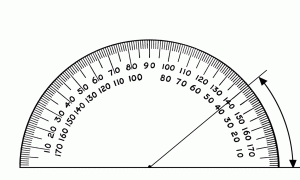
170°
Type below:
_________

Answer:

Go Math grade 4 chapter 11 angles answer key image_1

Question 5.
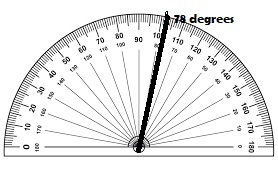
78°
Type below:
_________

Answer:

Go Math Grade 4 Chapter 11 Answer Key image_2

Use a protractor to find the angle measure.

Question 6.
Go Math Grade 4 Answer Key Chapter 11 Angles img 39
m∠QRS = ____ °

Answer: 90°

Question 7.
Go Math Grade 4 Answer Key Chapter 11 Angles img 40
m∠XYZ = ____ °

Answer: 155°

Use a protractor to draw the angle.

Question 8.
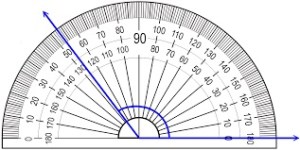
115°
Type below:
_________

Answer:

Go Math Grade 5 Solution Key Angles image_3

Question 9.
67°
Type below:
_________

Answer:

Draw an example of each. Label the angle with its measure.

Question 10.
an acute angle
Type below:
_________

Answer:

Go Math Grade 4 Answer Key Chapter 11 Angles img 18

Question 11.
an obtuse angle
Type below:
_________

Answer:

Go Math Grade 4 Answer Key Chapter 11 Angles Common Core - New img 29

Question 12.
Elizabeth is making a quilt with scraps of fabric. What is the difference between m∠ABC and m∠DEF?
Go Math Grade 4 Answer Key Chapter 11 Angles img 41
____ °

Answer: 15°

Go Math Grade 4 Chapter 11 Pdf Question 13.
Draw an angle with a measure of 0°.
Describe your drawing.
Type below:
_________

Answer:

HMH Go Math Grade 4 Key Chapter 11 image_4

Page No. 616

Question 14.
Hadley wants to divide this angle into three angles with equal measure. What will the measure of each angle be?
Go Math Grade 4 Answer Key Chapter 11 Angles img 42
____ °

Answer: 30°

Explanation:

Given,
Hadley wants to divide this angle into three angles with equal measure.
The above figure is a right angle = 90°
If he divides into three equal angles
90/3 = 30°
So, the measure of angle will be 30°

Question 15.
Tracy measured an angle as 50° that was actually 130°. Explain her error.
Type below:
_________

Answer: She has measured the angle in the counterclockwise direction. So, that is why she got 50°.

Question 16.
Choose the word or number to complete a true statement about ∠QRS.
Go Math Grade 4 Answer Key Chapter 11 Angles img 43
∠QRS is a(n) Go Math Grade 4 Answer Key Chapter 11 Angles img 44 angle that has a measure of Go Math Grade 4 Answer Key Chapter 11 Angles img 45
Type below:
_________

Answer: ∠QRS is an obtuse angle that has a measure of 135°.

Earth’s Axis Earth revolves around the sun yearly. The Northern Hemisphere is the half of Earth that is north of the equator. The seasons of the year are due to the tilt of Earth’s axis.

Use the diagrams and a protractor for 17–18.
Go Math Grade 4 Answer Key Chapter 11 Angles img 46

Question 17.
In the Northern Hemisphere, Earth’s axis is tilted away from the sun on the first day of winter, which is often on December 21. What is the measure of the marked angle on the first day of winter, the shortest day of the year?
____ °

Answer: 115°

Explanation:

By seeing the above figure we can say that the angle is an obtuse angle. The mark is above 90° and the marked angle is 115°.
Therefore the measure of the marked angle on the first day of winter, the shortest day of the year is 115°.

Question 18.
Earth’s axis is not tilted away from or toward the sun on the first days of spring and fall, which are often on March 20 and September 22. What is the measure of the marked angle on the first day of spring or fall?
____ °

Answer: 90°

Explanation:

The mark is exactly 90°. So, the angle on the first day of spring or fall is 90°

Common Core – New – Page No. 617

Measure and Draw Angles

Use a protractor to find the angle measure.

Question 1.
Go Math Grade 4 Answer Key Chapter 11 Angles Common Core - New img 47
m∠ABC = 120°

By using the protractor we can measure the angle m∠ABC i.e., 120°

Question 2.
Go Math Grade 4 Answer Key Chapter 11 Angles Common Core - New img 48
m∠MNP = ____ °

Answer: m∠MNP = 90°

By observing the above figure we can say that the angle of m∠MNP is 90°

Question 3.
Go Math Grade 4 Answer Key Chapter 11 Angles Common Core - New img 49
m∠RST = ____ °

Answer: m∠RST = 65°
By using the protractor we can measure m∠RST = 65°

Use a protractor to draw the angle.

Question 4.
40°

Answer:

Go Math Grade 4 Answer Key Chapter 11 image_5

Question 5.
170°

Answer:

Go Math grade 4 chapter 11 angles answer key image_1

Draw an example of each. Label the angle with its measure.

Question 6.
a right angle

Answer:

A right angle is an angle of exactly 90°

Go Math Grade 4 Answer Key Chapter 11 Angles img 39

Question 7.
an acute angle

Answer:

The acute angle is the small angle which is less than 90°.

Go Math Grade 4 Answer Key Chapter 11 Angles Common Core - New img 28

Problem Solving

The drawing shows the angles a stair tread makes with a support board along a wall. Use your protractor to measure the angles.
Go Math Grade 4 Answer Key Chapter 11 Angles Common Core - New img 50

Question 8.
What is the measure of ∠A?
____ °

Answer: 45°

By using the protractor we can measure the angle for A = 45°

Question 9.
What is the measure of ∠B?
____ °

Answer: 135°

The same process is used to measure ∠B = 135°

Common Core – New – Page No. 618

Lesson Check

Question 1.
What is the measure of ∠ABC?
Go Math Grade 4 Answer Key Chapter 11 Angles Common Core - New img 51
Options:
a. 15°
b. 25°
c. 155°
d. 165°

Answer: 15°

Explanation:

Step 1: Place the center point of the protractor on the point B.
Step 2: Align the 0° mark on the scale of the protractor with ray BC.
Step 3: Find the point where AC meets. Read the angle measure on that scale.
So, the measure of ∠ABC is 15°
Thus the correct answer is option A.

Question 2.
What is the measure of ∠XYZ?
Go Math Grade 4 Answer Key Chapter 11 Angles Common Core - New img 52
Options:
a. 20°
b. 30°
c. 150°
d. 160°

Answer: 150°

Explanation:

Step 1: Place the center point of the protractor on the point Y.
Step 2: Align the 0° mark on the scale of the protractor with ray XY.
Step 3: Find the point where YZ meet. Read the angle measure on that scale.
So, ∠XYZ = 150°
Therefore the correct answer is option C.

Spiral Review

Question 3.
Derrick earned $1,472 during the 4 weeks he had his summer job. If he earned the same amount each week, how much did he earn each week?
Options:
a. $360
b. $368
c. $3,680
d. $5,888

Answer: $368

Explanation:

Given that, Derrick earned $1,472 during the 4 weeks he had his summer job.
Let the amount he earned per week = x
x × 4 = $1,472
x = 1472 ÷ 4
x = 1472/4 = 368
So, Derrick earned $368 per week.

Go Math Workbook Grade 4 Chapter 11 Review/Test Answer Key Question 4.
Arthur baked 1 \(\frac{7}{12}\) dozen muffins. Nina baked 1 \(\frac{1}{12}\) dozen muffins. How many dozen muffins did they bake in all?
Options:
a. 3 \(\frac{2}{3}\)
b. 2 \(\frac{2}{3}\)
c. 2 \(\frac{1}{2}\)
d. \(\frac{6}{12}\)

Answer: 2 \(\frac{2}{3}\)

Explanation:

Given:
Arthur baked 1 \(\frac{7}{12}\) dozen muffins. Nina baked 1 \(\frac{1}{12}\) dozen muffins.
Add both the fractions
Convert mixed fraction into normal fractions
1 \(\frac{7}{12}\) = \(\frac{19}{12}\)
1 \(\frac{1}{12}\) = \(\frac{13}{12}\)
\(\frac{19}{12}\) + \(\frac{13}{12}\) = \(\frac{32}{12}\)
= \(\frac{8}{3}\)
Convert \(\frac{8}{3}\) into mixed fraction = 2 \(\frac{2}{3}\)
So, the answer is option B.

Question 5.
Trisha drew the figure below. What figure did she draw?
Go Math Grade 4 Answer Key Chapter 11 Angles Common Core - New img 53
Options:
a. line segment ST
b. ray ST
c. ray TS
d. line TS

Answer: ray TS

A ray can be defined as a part of a line that has a fixed starting point but no endpoint.
Here the point starts from T and ends at S.
So, the figure Trisha drew is ray TS.
The correct answer is option C.

Question 6.
Which describes the turn shown by the angle?
Go Math Grade 4 Answer Key Chapter 11 Angles Common Core - New img 54
Options:
a. 1 full turn clockwise
b. \(\frac{3}{4 }\) turn clockwise
c. \(\frac{1}{2}\) turn clockwise
d. \(\frac{1}{4}\) turn clockwise

Answer: \(\frac{1}{4}\) turn clockwise

Explanation:

The figure shows that the point turned \(\frac{1}{4}\) in a clockwise direction.
So, the answer is option D.

Page No. 619

Choose the best term from the box.
Go Math Grade 4 Answer Key Chapter 11 Angles img 55

Question 1.
The unit used to measure an angle is called a ________.
________

Answer: The unit used to measure an angle is called a degree.

Question 2.
________ is the opposite of the direction in which the hands of a clock move.
________

Answer: Counterclockwise is the opposite of the direction in which the hands of a clock move.

Question 3.
A ________ is a tool for measuring the size of an angle.
________

Answer: A protractor is a tool for measuring the size of an angle.

Tell whether the angle on the circle shows a \(\frac{1}{4}, \frac{1}{2}, \frac{3}{4}\), or 1 full turn clockwise or counterclockwise.

Question 4.
Go Math Grade 4 Answer Key Chapter 11 Angles img 56
\(\frac{□}{□}\)

Answer: \(\frac{1}{4}\) turn clockwise
The figure shows that the angle turn \(\frac{1}{4}\) in the clockwise direction.

Question 5.
Go Math Grade 4 Answer Key Chapter 11 Angles img 57
\(\frac{□}{□}\)

Answer: \(\frac{1}{2}\) turn counterclockwise
From the above figure, we can see that the angle turn \(\frac{1}{2}\) in the counterclockwise direction.

Question 6.
Go Math Grade 4 Answer Key Chapter 11 Angles img 58
\(\frac{□}{□}\)

Answer: \(\frac{3}{4}\) turn clockwise
The figure shows that the angle turn \(\frac{3}{4}\) in the clockwise direction.

Question 7.
Go Math Grade 4 Answer Key Chapter 11 Angles img 59
____

Answer: \(\frac{1}{1}\) or 1 turn counterclockwise
From the above figure, we can see that the angle turn \(\frac{1}{1}\) or 1 in the counterclockwise direction.

Tell the measure of the angle in degrees.

Question 8.
Go Math Grade 4 Answer Key Chapter 11 Angles img 60
____ °

Answer: 100°

\(\frac{100}{360}\) × 360° = 100°

Question 9.
____ °

Use a protractor to draw the angle.

Question 10.
75°
Type below:
________

HMH Go Math Key Chapter 11 Angles Image_6

Question 11.
127°
Type below:
________

Chapter 11 Go Math Grade 4 Answer Key Angles Image_7

Page No. 620

Question 12.
Phillip watched a beach volleyball game from 1:45 p.m. to 2:00 p.m. How many degrees did the minute hand turn?
Go Math Grade 4 Answer Key Chapter 11 Angles img 61
____ °

Answer: 90°

Explanation:

Phillip watched a beach volleyball game from 1:45 p.m. to 2:00 p.m.
The minute hand turned for 15 minutes.
That means \(\frac{1}{4}\) turn clockwise.
Complete angle = 360°
\(\frac{1}{4}\) × 360° = 360°/4 = 90°
Therefore the minute hand turn 90°

Question 13.
What angle does this piece of pie form?
Go Math Grade 4 Answer Key Chapter 11 Angles img 62
____ °

Answer: 180°

From the above figure, we can see that half of the pie is completed.
Complete angle = 360°
\(\frac{1}{2}\) × 360°
= 180°
The angle for the piece of pie form is 180°

Question 14.
What is m∠CBT? Use a protractor to help you.
Go Math Grade 4 Answer Key Chapter 11 Angles img 63
____ °

Answer: 60°

By using the protractor we can say that the angle for the above figure is 60°

Question 15.
Matt cut a circle into 8 equal sections. He drew an angle that measures the same as the total measure of 3 of the sections in the circle. What is the measure of the angle Matt drew?
____ °

Answer: 135°

Explanation:

Matt cut a circle into 8 equal sections.
He drew an angle that measures the same as the total measure of 3 of the sections in the circle.
Complete angle = 360°
Divide the total number of sections by 360°
\(\frac{360}{8}\) = 45°
So, the angle for each section is 45°
The angle for 3 of the sections in the circle = 3 × 45° = 135°
Thus the measure of the angle Matt drew is 135°

Page No. 623

Add to find the measure of the angle. Write an equation to record your work.

Question 1.
Go Math Grade 4 Answer Key Chapter 11 Angles img 64
∠PQT = ____ °

Answer: 80°

To find the ∠PQT you have to add 43° and 37°
∠PQT = 43° + 37°
∠PQT = 80°

Question 2.
Go Math Grade 4 Answer Key Chapter 11 Angles img 65
∠JKL = ____ °

Answer: 100°
Let ∠JKL = x°
∠JKL = 90° + 10°
∠JKL = 100°

Question 3.
Go Math Grade 4 Answer Key Chapter 11 Angles img 66
∠RHT = ____ °

Answer:
Let ∠RHT = x°
x = 55° + 27° + 78°
x = 160°
Therefore ∠RHT = 160°

Use a protractor to find the measure of each angle. Label each angle with its measure.
Write the sum of the angle measures as an equation.

Question 4.
Go Math Grade 4 Answer Key Chapter 11 Angles img 67
Type below:
________

Answer:

By using the protractor we can measure the angles of the above figures.
m∠KLM = 160°
m∠KLJ = 80°
m∠LMJ = 120°

Question 5.
Go Math Grade 4 Answer Key Chapter 11 Angles img 68
Type below:
________

Answer:

By using the protractor we can measure the angles of the above figures.

m∠WVZ = 90°
m∠YVZ = 90°
m∠WVX = 140°
m∠YVX = 40°

Question 6.
Use Diagrams What is m∠QRT?
Go Math Grade 4 Answer Key Chapter 11 Angles img 69
∠QRT = ____ °

Answer: 20°

The above figure is a straight angle.
∠QRT + ∠LRD + ∠RLT = 180
∠QRT + 75° + 85° = 180°
∠QRT + 160° = 180°
∠QRT = 180°- 160°
∠QRT = 20°

Question 7.
Look back at Exercise 1. Suppose you joined an angle measuring 10° to ∠PQT. Draw the new angle, showing all three parts. What type of angle is formed?
Type below:
________

Page No. 624

Question 8.
Stephanie, Kay, and Shane each ate an equal-sized piece of a pizza. The measure of the angle of each piece was 45°. When the pieces were together, what is the measure of the angle they formed?
Go Math Grade 4 Answer Key Chapter 11 Angles img 70
a. What are you asked to find?
Type below:
________

Answer: What is the measure of the angle for the pizza leftover?

Question 8.
b. What information do you need to use?
Type below:
________

Answer: I need the information about the angle for each piece of pizza.

Question 8.
c. Tell how you can use addition to solve the problem.
Type below:
________

Answer:
The measure of the angle of each piece was 45°
There are 3 pieces of pizza = 45° + 45° + 45° = 135°

Question 8.
d. Complete the sentence. The three pieces of pizza formed a _________ angle.
________

Answer: Obtuse angle

Question 9.
What is the measure of ∠XZW?
Go Math Grade 4 Answer Key Chapter 11 Angles img 71
____ °

Answer: 113°

Explanation:

∠XZW = ∠XZY + ∠YZW
∠XZY = 42°
∠YZW = 71°
∠XZW = 42° + 71°
∠XZW = 113°

Go Math Grade 4 Chapter 11 Review Test Answer Key Question 10.
What is m∠PRS? Use equations to explain and check your answer.
Go Math Grade 4 Answer Key Chapter 11 Angles img 72
____ °

Answer: 12°

Explanation:

The above figure is a straight angle.
The sum of the three angles must be equal to 180°
m∠PRS + m∠PRN + m∠TRN = 180°
m∠PRS + 90° + 78° = 180°
m∠PRS = 180° – 90° – 78°
m∠PRS = 12°

Common Core – New – Page No. 625

Join and Separate Angles

Add to find the measure of the angle. Write an equation to record your work.

Question 1.
Go Math Grade 4 Answer Key Chapter 11 Angles Common Core - New img 73
50°+75° = 125°
m∠ABD = 125°

Explanation:

m∠ABC = 50°
m∠CBD = 75°
To find the measure of m∠ABD we have to add m∠ABC and m∠CBD
m∠ABD = 50°+75°
m∠ABD = 125°

Question 2.
Go Math Grade 4 Answer Key Chapter 11 Angles Common Core - New img 74
____ ° + ____ ° = ____ ° ;   m∠FGJ = ____ °

Answer: 140° + 20° = 160°
m∠FGJ = 160°

Explanation:

m∠FGH = 140°
m∠JGH = 20°
To find the measure of m∠FGJ we need to add m∠FGH and m∠JGH
m∠FGJ = 140° + 20°
m∠FGJ = 160°

Question 3.
Go Math Grade 4 Answer Key Chapter 11 Angles Common Core - New img 75
____ ° + ____ ° = ____ ° ; m∠KLN = ____ °

Answer: 30° + 90° + 45° = 165°
m∠KLN = 165°

Explanation:

m∠KLM = 30°
m∠MLP = 90°
m∠PLN = 45°
To find the measure of m∠KLN we need to add m∠KLM, m∠MLP and m∠PLN
m∠KLN = 30° + 90° + 45° = 165°
m∠KLN = 165°

Use a protractor to find the measure of each angle in the circle.
Go Math Grade 4 Answer Key Chapter 11 Angles Common Core - New img 76

Question 4.
m∠ABC = ____ °

Answer: 115°

Question 5.
m∠DBE = ____ °

Answer: 90°

Question 6.
m∠CBD = ____ °

Answer: 75°

Question 7.
m∠EBA = ____ °

Answer: 80°

Question 8.
Write the sum of the angle measures as an equation.
____ ° + ____ ° + ____ ° + ____ ° = ____ °

Answer:

Sum all the angles = m∠DBE + m∠ABC + m∠CBD + m∠EBA
= 115° + 90° + 75° + 80° = 360°

Problem Solving
Go Math Grade 4 Answer Key Chapter 11 Angles Common Core - New img 77

Question 9.
Ned made the design at the right. Use a protractor. Find and write the measure of each of the 3 angles.
____ ° ; ____ ° ; ____ ° ;

Answer: 50°; 60°; 70°

The above figure is a straight angle.
By using the protractor we can measure the angles of the above figure.
The angle of above 3 shades is 50°; 60°; 70°

Question 10.
Write an equation to find the measure of the total angle.
____ ° + ____ ° + ____ ° = ____ °

Answer: Sum of three angles = 50° + 60° + 70° = 180°

Common Core – New – Page No. 626

Lesson Check

Question 1.
What is the measure of m∠WXZ?
Go Math Grade 4 Answer Key Chapter 11 Angles Common Core - New img 78
Options:
a. 32°
b. 83°
c. 88°
d. 97°

Answer: 83°

Explanation:

m∠WXZ = m∠WXY + m∠YXZ
Let m∠WXZ be x°
x° = 58° + 25°
x° = 83°
Thus the correct answer is option B.

Question 2.
Which equation can you use to find the m∠MNQ?
Go Math Grade 4 Answer Key Chapter 11 Angles Common Core - New img 79
Options:
a. 148° – 24° = ■
b. 148° × 24° = ■
c. 148° ÷ 24° = ■
d. 148° + 24° = ■

Answer: 148° + 24° = ■

Explanation:

To measure the unknown angle we need to add both the angles
m∠MNQ = m∠MNP + m∠PNQ
■ = 148° + 24°
So, the correct answer is option D.

Spiral Review

Question 3.
Joe bought 6 packages of envelopes. Each package contains 125 envelopes. How many envelopes did he buy?
Options:
a. 750
b. 723
c. 720
d. 650

Answer: 750

Explanation:

Joe bought 6 packages of envelopes.
Each package contains 125 envelopes.
To find the total number of envelopes in all 6 packages
We have to multiply number of packages and number of envelopes
= 125 × 6 =750
Thus Joe bought 750 envelopes.
The correct answer is option A.

Question 4.
The Lake Trail is \(\frac{3}{10}\) mile long and the Rock Trail is \(\frac{5}{10}\) long. Bill hiked each trail once. How many miles did he hike in all?
Options:
a. \(\frac{1}{5}\) mile
b. \(\frac{4}{10}\) mile
c. \(\frac{1}{2}\) mile
d. \(\frac{8}{10}\) mile

Answer: \(\frac{8}{10}\) mile

Explanation:

The Lake Trail is \(\frac{3}{10}\) mile long and the Rock Trail is \(\frac{5}{10}\) long. Bill hiked each trail once.
We need to both the fractions
\(\frac{3}{10}\) +\(\frac{5}{10}\)
The denominators are common. So add the numerators.
= \(\frac{8}{10}\)
Bill hiked \(\frac{8}{10}\) miles in all.
Thus the correct answer is option D.

Question 5.
Ron drew a quadrilateral with 4 right angles and 4 sides with the same length. Which best describes the figure he drew?
Options:
a. square
b. rhombus
c. trapezoid
d. parallelogram

Answer: square

Explanation:

A square has got 4 sides of equal length and 4 right angles (right angle = 90 degrees).
So, the answer is option A.

Question 6.
How many degrees are in an angle that turns through \(\frac{3}{4}\) of a circle?
Options:
a. 45°
b. 90°
c. 180°
d. 270°

Answer: 270°

Explanation:

Complete angle = 360°
To measure the angle that turns through is \(\frac{3}{4}\)
multiply \(\frac{3}{4}\) with 360°
360° × \(\frac{3}{4}\) = 270°
So, the answer is option D.

Page No. 629

Question 1.
Laura cuts a square out of scrap paper as shown. What is the angle measure of the piece left over?
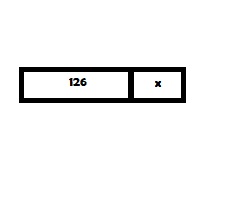
First, draw a bar model to represent the problem.
Go Math Grade 4 Answer Key Chapter 11 Angles img 80

Type below:
_________

Go Math Grade 4 Chapter 11 Answer Key image_11

Question 1.
Next, write the equation you need to solve.
Type below:
_________

Answer:

m∠MNQ + m∠QNP = m∠MNP
x + 90° = 115°
x = 115° – 90°

Question 1.
Last, find the angle measure of the piece left over.
m∠MNQ =
So, the angle measure of the piece left over is _____.
____ °

Answer:
x + 90° = 115°
x = 115° – 90°
x = 25°
So, the angle measure of the piece left over is 25°

Question 2.
Jackie trimmed a piece of scrap metal to make a straight edge as shown. What is the measure of the piece she trimmed off?
Go Math Grade 4 Answer Key Chapter 11 Angles img 81
x = ____ °

Answer:
x + 180° = 225°
x = 225°- 180°
x = 45°
Thus the measure of the piece she trimmed off is 45°

Go Math Workbook Grade 4 Chapter 11 Answer Key Pdf Question 3.
What if Laura cut a smaller square as shown? Would m∠MNQ be different? Explain.
Go Math Grade 4 Answer Key Chapter 11 Angles img 82
Type below:
_________

Answer: No
m∠MNQ would still be 25°. Only the size of the square changed the angle will be the same.
m∠PNQ and m∠MNP did not change.

Question 4.
The map shows Marco’s paper route. When Marco turns right onto Center Street from Main Street, what degree turn does he make? Hint: Draw a dashed line to extend Oak Street to form a 180° angle.
Go Math Grade 4 Answer Key Chapter 11 Angles img 83

Answer:

x° + 125° + 180° = 360°
x° = 360° – 125° – 180°
x° = 360° – 215°
x° = 145°

Page No. 630

Question 5.
Write an Equation Two angles form a straight angle. One angle measures 89°. What is the measure of the other angle? Explain.
____ °

Answer: 91°

A straight angle measures 180°, so you can subtract 89° from 180°
180° – 89° = 91°

Question 6.
Pose a Problem Look back at Problem 5. Write a similar problem about two angles that form a right angle.
____ °

Answer: Two angles form a right angle. The measure of one angle is 25°. What is the measure of the other angle?
x + 25° = 90°
x °= 90° – 25°
x° = 65°
The measure of other angle is 65°

Question 7.
Sam paid $20 for two T-shirts. The price of each T-shirt was a multiple of 5. What are the possible prices of the T-shirts?
Type below:
_________

Answer:
Sam paid $20 for two T-shirts.
The price of each T-shirt was a multiple of 5.
$20 – 2 T-shirts
x – 1 T-shirt
x = $10
The possible prices of the T-shirts are $10, $10
Another possible price of the T-shirts are $5, $15

Question 8.
Zayna has 3 boxes with 15 art books in each box. She has 2 bags with 11 math books in each bag. If she gives 30 books away, how many art and math books does she have left?
_____ books

Answer: 37 art and math books

Explanation:

Zayna has 3 boxes with 15 art books in each box = 15 × 3 = 45
She has 2 bags with 11 math books in each bag = 11 × 2 = 22
Total number of books = 45 + 22 = 67
If she gives 30 books away, then we have to subtract 30 from 67
67 – 30 = 37
37 art and math books are left.

Question 9.
What’s the Question? It measures greater than 0° and less than 90°.
Type below:
_________

Answer: What is an acute angle?

Question 10.
Two angles, ∠A and ∠B, form a straight angle. ∠A measures 65°. For numbers 10a–10c, select True or False for the statement.
a. ∠B is an acute angle.
i. True
ii. False

Answer: False

Explanation:

Two angles, ∠A and ∠B, form a straight angle. ∠A measures 65°.
65° + ∠B = 180°
∠B = 180° – 65°
∠B = 115°
115° is not an acute angle.
So, the above statement is false.

Question 10.
b. The equation 180° – 65° = x° can be used to find the measure of ∠B.
i. True
ii. False

Answer: True

Question 10.
c. The measure of ∠B is 125°.
i. True
ii. False

Answer: False

65° + ∠B = 180°
∠B = 180° – 65°
∠B = 115°
So, the above statement is false.

Common Core – New – Page No. 631

Problem Solving Unknown Angle Measures

Solve each problem. Draw a diagram to help.

Question 1.
Go Math Grade 4 Answer Key Chapter 11 Angles Common Core - New img 84
Go Math Grade 4 Answer Key Chapter 11 Angles Common Core - New img 85

Question 2.
An artist is cutting a piece of metal as shown. What is the angle measure of the piece left over?
Go Math Grade 4 Answer Key Chapter 11 Angles Common Core - New img 86
x = ____ °

Answer: 95°

x + 130° = 225°
x = 225° – 130°
x = 95°
Therefore the angle of the piece leftover is 95°.

Question 3.
Joan has a piece of material for making a costume. She needs to cut it as shown. What is the angle measure of the piece left over?
Go Math Grade 4 Answer Key Chapter 11 Angles Common Core - New img 87
x = ____ °

Answer: 50°

Joan has a piece of material for making a costume. She needs to cut it as shown.
By seeing the above figure we can say that it is a right angle.|
The sum of two must be equal to 90°
Let the unknown angle be x
x + 40° = 90°
x = 90° – 40°
x = 50°
Thue the angle measure of the piece leftover is 50°

Common Core – New – Page No. 632

Lesson Check

Question 1.
Angelo cuts a triangle from a sheet of paper as shown. What is the measure of ∠x in the triangle?
Go Math Grade 4 Answer Key Chapter 11 Angles Common Core - New img 88
Options:
a. 15°
b. 25°
c. 75°
d. 105°

Answer: 15°

Explanation:

The above figure is a right angle.
So, to measure the ∠x we have to subtract 75° from 90°
∠x + 75° = 90°
∠x = 90° – 75°
∠x = 15°
Thus the correct answer is option A.

Question 2.
Cindy cuts a piece of wood as shown. What is the angle measure of the piece left over?
Go Math Grade 4 Answer Key Chapter 11 Angles Common Core - New img 89
Options:
a. 30°
b. 90°
c. 120°
d. 150°

Answer: 120°

Explanation:

x + 90° = 210°
x = 210° – 90°
x = 120°
120° is the measure of the piece leftover.
So, the correct answer is option C.

Spiral Review

Question 3.
Tyronne worked 21 days last month. He earned $79 each day. How much did Tyronne earn last month?
Options:
a. $869
b. $948
c. $1,659
d. $2,169

Answer: $1,659

Explanation:

Tyronne worked 21 days last month.
He earned $79 each day.
$79 × 21 = 1659
Thus Tyronne earned $1,659 last month.
So, the correct answer is option C.

Question 4.
Meg inline skated for \(\frac{7}{10}\) mile. Which shows this distance written as a decimal?
Options:
a. 0.07 mile
b. 0.1 mile
c. 0.7 mile
d. 7.1 miles

Answer: 0.7 mile

Explanation:

Meg inline skated for \(\frac{7}{10}\) mile.
The decimal of the fraction \(\frac{7}{10}\) is 0.7
So, the answer is option C.

Question 5.
Kerry ran 34 mile. Sherrie ran \(\frac{1}{2}\) mile. Marcie ran \(\frac{2}{3}\) mile. Which list orders the friends from least to greatest distance
run?
Options:
a. Kerry, Sherrie, Marcie
b. Kerry, Marcie, Sherrie
c. Sherrie, Kerry, Marcie
d. Sherrie, Marcie, Kerry

Answer: Sherrie, Marcie, Kerry

Explanation:

Kerry ran 34 miles. Sherrie ran \(\frac{1}{2}\) mile. Marcie ran \(\frac{2}{3}\) mile.
The order of the above fractions is Sherrie ran \(\frac{1}{2}\), \(\frac{2}{3}\), 34
The distance from least to greatest is Sherrie, Marcie, Kerry.
so, the correct answer is option D.

Question 6.
What is the measure of m∠ABC?
Go Math Grade 4 Answer Key Chapter 11 Angles Common Core - New img 90
Options:
a. 32°
b. 84°
c. 88°
d. 94°

Answer: 84°

Explanation:

m∠ABC = m∠ABD + m∠DBC
m∠ABC = 58° + 26°
m∠ABC = 84°
So, the correct answer is option B.

Page No. 633

Question 1.
An angle represents \(\frac{1}{12}\) of a circle. Use the numbers to show how to find the measure of the angle in degrees.
Go Math Grade 4 Answer Key Chapter 11 Angles img 91
Go Math Grade 4 Answer Key Chapter 11 Angles img 92
Go Math Grade 4 Answer Key Chapter 11 Angles img 93
The angle measure is ____ °

Answer: 30°
\(\frac{1}{12}\) × \(\frac{30}{30}\) = \(\frac{30}{360}\)
Thus the angle measure is 30°

Question 2.
Match the measure of each ∠C with the measure of ∠D that forms a straight angle.
Go Math Grade 4 Answer Key Chapter 11 Angles img 94
Type below:
_________

i. 122° + 58° = 180°
ii. 35° + 145° = 180°
iii. 62° + 118° = 180°
iv. 105° + 75° = 180°

Question 3.
Katie drew an obtuse angle. Which could be the measure of the angle she drew? Mark all that apply.
Options:
a. 35°
b. 157°
c. 180°
d. 92°

Answer: 157° and 92°
An obtuse angle has a measurement greater than 90 degrees but less than 180 degrees.
From the above options, B and D are more than 90°
So, the answer is options B and D.

Go Math Grade 4 Chapter 11 Test Pdf Question 4.
Draw an angle that represents a \(\frac{1}{4}\) and turn counterclockwise on the circle.
Go Math Grade 4 Answer Key Chapter 11 Angles img 95
Type below:
_________

Go Math Answer Key Grade 4 Chapter 11 solution image_8

Page No. 634

Question 5.
Renee drew the figure shown. For 5a–5c, select Yes or No to tell whether the statement is true.
Go Math Grade 4 Answer Key Chapter 11 Angles img 96
a. The measure of a straight angle is 180°.
i. yes
ii. no

Answer: Yes

By seeing the above figure we can say that the angle is a straight angle.
So, the above statement is true.

Question 5.
b. To find the measure of x, Renee can subtract 75° from 180°.
i. yes
ii. no

Answer: Yes

To know the value of x we have to subtract 75° from 180°.
x = 180° – 75°
Thus the above statement is true.

Question 5.
c. The measure of x is 115°.
i. yes
ii. no

Answer: No
x = 180° – 75°
x = 105°
Thus the above statement is false.
So, the answer is no.

Question 6.
Trey drew this figure with a protractor.
Go Math Grade 4 Answer Key Chapter 11 Angles img 97
Part A
Write an equation that can be used to find m∠KFG.
Type below:
_________

Answer: 55° + 80° + x = 180°

The figure is a straight angle.
So, the sum of the three angles must be equal to 180°
Let m∠KFG = x
55° + 80° + x = 180°

Question 6.
Part B
What is the measure of m∠KFG? Describe how you solved the equation and how you can check your answer.
____ °
Explain:
_________

Answer: 45°

Explanation:

55° + 80° + x = 180°
x = 180° – 80° – 55°
x = 45°

Question 7.
Use a protractor to find the measure of the angle.
Go Math Grade 4 Answer Key Chapter 11 Angles img 98
The angle measures ____ °

Answer: 40°
By using a protractor we can measure the angle.
The angle of the above figure is 40°

Page No. 635

Question 8.
Alex drew this angle on the circle. Which describes the angle? Mark all that apply.
Go Math Grade 4 Answer Key Chapter 11 Angles img 99
Options:
a. \(\frac{1}{4}\) turn
b. clockwise
c. \(\frac{1}{2}\) turn
d. counterclockwise

Answer: \(\frac{1}{2}\) turn

The above figure shows that it is straight angle. So, the fraction of the circle is \(\frac{1}{2}\) turn.
The correct answer is option C.

Question 9.
Miles has a piece of paper that is \(\frac{1}{4}\) of a large circle. He cuts the paper into three equal parts from the center point of the circle. What is the angle measure of each part?
Go Math Grade 4 Answer Key Chapter 11 Angles img 100
The angle measure is ____ °

Answer: 30°

Explanation:

Miles has a piece of paper that is \(\frac{1}{4}\) of a large circle. He cuts the paper into three equal parts from the center point of the circle.
\(\frac{1}{4}\) of a large circle = 90°
Given that he cut into 3 equal parts = \(\frac{90}{3}\) = 30°
So, the angle for each part is 30°

Question 10.
Use a protractor to find the measure of each angle. Write each angle and its measure in a box ordered by the measure of the angles from least to greatest.
Go Math Grade 4 Answer Key Chapter 11 Angles img 101
Go Math Grade 4 Answer Key Chapter 11 Angles img 102

Answer:

Go-Math-Grade-4-Answer-Key-Chapter-11-Angles-solution-img-9

Question 11.
Use the numbers and symbols to write an equation that can be used to find the measure of the unknown angle.
Go Math Grade 4 Answer Key Chapter 11 Angles img 103
What is the measure of the unknown angle?
____ °

Answer: 57°

Explanation:

Let the unknown angle be x
It is a straight angle.
The sum of three angles = 180°
90° + 33° + x = 180°
x = 180° – 90° – 33°
x = 57°

Page No. 636

Question 12.
Choose the word or number to complete a true statement about m∠JKL.
Go Math Grade 4 Answer Key Chapter 11 Angles img 104
Go Math Grade 4 Answer Key Chapter 11 Angles img 105
m∠JKL is a(n) ______ angle that has a measure of ____ °.

Answer: m∠JKL is an Obtuse angle that has a measure of 120°.

Question 13.
Vince began practicing piano at 5:15 p.m. He stopped at 5:35 p.m. How many degrees did the minute hand turn during Vince’s practice time?
Explain how you found your answer.
Go Math Grade 4 Answer Key Chapter 11 Angles img 106
____ °
Explain:
_________

Answer: 120°

I shaded the part of the clock that the minute hand turned from 5:15 p.m. to 5:35 p.m. anmd found that it is \(\frac{1}{3}\) of the circle.
Next, I multiplied \(\frac{1}{3}\) × 360° = 120°
Thus the minute hand moved 120°

Question 14.
An angle measures 125°. Through what fraction of a circle does the angle turn?
\(\frac{□}{□}\) of a circle

Answer: \(\frac{125}{360}\)

The fraction of the circle the angle turned is \(\frac{125}{360}\)

Question 15.
Write the letter for each angle measure in the correct box.
Go Math Grade 4 Answer Key Chapter 11 Angles img 107
Type below:
__________

Answer:

Go-Math-Grade-4-Answer-Key-Chapter-11-Angles-solution-img-10

Page No. 637

Question 16.
For numbers 16a–16b, select the fraction that makes a true statement about the figure.
Go Math Grade 4 Answer Key Chapter 11 Angles img 108

Question 16.
a. The angle in Figure 1 represents a Go Math Grade 4 Answer Key Chapter 11 Angles img 109 turn.
\(\frac{□}{□}\) turn

Answer: The angle in Figure 1 represents a \(\frac{3}{4}\) turn

The above figure shows that \(\frac{3}{4}\) part of the circle is shaded. So, the angle represents \(\frac{3}{4}\) turn.

Question 16.
b. The angle in Figure 2 represents a Go Math Grade 4 Answer Key Chapter 11 Angles img 110 turn.
\(\frac{□}{□}\) turn

Answer: The angle in Figure 2 represents a \(\frac{1}{2}\) turn.
From the second figure, we observe that half of the circle is shaded. So, The angle in Figure 2 represents a \(\frac{1}{2}\) turn.

Question 17.
Melanie cuts a rectangle out of a piece of scrap paper as shown. She wants to calculate the angle measure of the piece that is left over.
Go Math Grade 4 Answer Key Chapter 11 Angles img 111
Part A
Draw a bar model to represent the problem.

Go Math Grade 4 Chapter 11 Answer Key Angles Image_7

Question 17.
Part B
Write and solve an equation to find x.
The angle measures ____ °.

Answer: 36°
m∠RST = 90°
m∠RSN = 126°
m∠TSN = x°
x + 90° = 126°
x = 126° – 90°
x = 36°
m∠TSN = 36°

Page No. 638

Question 18.
Two angles, m∠A and m∠B, form a right angle. m∠A measures 32°.
For numbers, 18a–18c, select True or False for the statement.
a. m∠B is an acute angle.
i. True
ii. False

Answer: True

If the sum of two angles is 90°, if one angle is acute then the other angle will be acute.
So, the above statement is true.

Question 18.
b. The equation 180° − 32° = x° can be used to find the measure of m∠B.
i. True
ii. False

Answer: False

Explanation:

Given that the sum of 2 angles is 90°
The sum of m∠A and m∠B = 90°
90° – 32° = x°
So, the above statement is false.

Question 18.
c. The measure of m∠B is 58°.
i. True
ii. False

Answer: True

Explanation:

Let m∠B = x
x° + 32° = 90°
x = 90 – 32
x = 58°.
So, the above statement is true.

Question 19.
A circle is divided into parts. Which sum could represent the angle measures that make up the circle? Mark all that apply.
Options:
a. 120° + 120° + 120° + 120°
b. 25° + 40° + 80° + 105° + 110°
c. 33° + 82° + 111° + 50° + 84°
d. 40° + 53° + 72° + 81° + 90° + 34°

Answer: 25° + 40° + 80° + 105° + 110°; 33° + 82° + 111° + 50° + 84°

Explanation:

The sum of all the angles must be equal to 360°
i. 120° + 120° + 120° + 120° = 480° ≠ 360°
ii. 25° + 40° + 80° + 105° + 110° = 360°
iii. 33° + 82° + 111° + 50° + 84° = 360°
iv. 40° + 53° + 72° + 81° + 90° + 34° = 370° ≠ 360°
So, the correct answers are option B, C.

Question 20.
Use a protractor to find the measures of the unknown angles.
Go Math Grade 4 Answer Key Chapter 11 Angles img 112
What do you notice about the measures of the unknown angles? Is this what you would have expected? Explain your reasoning.
m∠x = ____ ° m∠y = ____ °

Answer: m∠x = 70°; m∠y = 110°
By using a protractor we can find the measure of m∠y
m∠y = 110°
Let m∠x = x°
Sum of supplementary angles = 180°
110° + x = 180°
x = 180° – 110°
x = 70°
Therefore m∠x = 70°

Page No. 643

Use benchmarks to choose the metric unit you would use to measure each.
Go Math Grade 4 Answer Key Chapter 11 Angles img 113

Question 1.
mass of a strawberry
__________

Answer: gram
The metric unit used to measure the mass of a strawberry is the gram.

Question 2.
length of a cell phone
__________

Answer: Centimeter
The metric unit used to measure the length of a cell phone is Centimeter.

Circle the better estimate.

Question 3.
width of a teacher’s desk
10 meters or 1 meter
__________

Answer: 1 meter
The estimation of the width of the teacher’s desk is 1 meter.

Question 4.
The amount of liquid a punch bowl holds
2 liters or 20 liters
__________

Answer: 2 liters

20 liters is greater than 2 liters.
The estimation of the amount of liquid a punch bowl holds is 2 liters.

Question 5.
distance between Seattle and San Francisco
6 miles or 680 miles
__________

Answer: 680 miles
The distance between Seattle and San Francisco is 680 miles.

Use benchmarks to choose the customary unit you would use to measure each.
Go Math Grade 4 Answer Key Chapter 11 Angles img 114

Question 6.
length of a football field
__________

Answer: Yard
The units to measure the length of a football field is Yards.

Question 7.
weight of a pumpkin
__________

Answer: Pound
The customary unit I use to measure the weight of a pumpkin is pounds.

Circle the better estimate.

Question 8.
weight of a watermelon
4 pounds or 4 ounces
__________

Answer: 4 pounds
The estimation of the weight of the watermelon is 4 pounds.

Question 9.
The amount of liquid a fish tank holds
10 cups or 10 gallons
__________

Answer: 10 gallons
The estimation of the amount of liquid a fish tank holds is 10 gallons.

Complete the sentence. Write more or less.

Question 10.
Matthew’s large dog weighs ________ than one ton.
________

Answer: Less
1 ton = 1000 kgs
The weight of dogs can’t be more than a ton.
So, Matthew’s large dog weighs less than one ton.

Question 11.
The amount of liquid a sink can hold is _______ than one cup of water.
________

Answer: More
1 cup holds a very small amount of water.
So, The amount of liquid a sink can hold is more than one cup of water.

Go Math Grade 4 Chapter 11 Mid Chapter Checkpoint Answer Key Question 12.
A paper clip has a mass of _______ than one kilogram.
________

Answer: Less

The weight of a paper clip is about 1 gram.
So, A paper clip has a mass of less than one kilogram.

Page No. 644

For 13–15, use benchmarks to explain your answer.
Go Math Grade 4 Answer Key Chapter 11 Angles img 115

Question 13.
Cristina is making macaroni and cheese for her family. Would Cristina use 1 pound of macaroni or 1 ounce of macaroni?
__________

Answer: Cristina should use 1 pound of macaroni.

Question 14.
Which is the better estimate for the length of a kitchen table, 200 centimeters or 200 meters?
__________

Answer: 200 centimeters

Centimeters are less than meters. The length of the kitchen will be measured in centimeters.
So, the answer is 200 centimeters.

Question 15.
Jodi wants to weigh her cat and measure its standing height. Which two units should she use?
weight: ________
height: ________

Answer:
The weight of the cat should be measured in Kilograms.
The height of the cat should be measured in Centimeters.

Question 16.
Evaluate Reasonableness Dalton used benchmarks to estimate that there are more cups than quarts in one gallon. Is Dalton’s estimate reasonable? Explain.
Type below:
__________

Answer: Dalton’s reasoning is correct because the measurement of cups is smaller than the measurement of quarts, therefore there would be more cups in a gallon than quarts.

Question 17.
Select the correct word to complete the sentence. Justine is thirsty after running two miles.
She should Go Math Grade 4 Answer Key Chapter 11 Angles img 116 of water.
__________

Answer: 1 pint

The suitable word for the above sentence is the pint. A pint is a measure of liquid equal to about half a liter. There are eight pints in a gallon.

Conclusion

Make maths your favorite subject by solving the problems. If you understand the concepts you can prepare the questions on your own. It is an easy and scoring subject compared to all. So, go through the Go Math Grade 4 Solution Key Chapter 11 Angles to secure the highest marks in the exams. If you have doubts regarding the subject you can comment in the below comment box. All the best!!!!

Go Math Grade 4 Chapter 11 Answer Key Pdf Angles Read More »

go-math-grade-4-answer-key-chapter-13-algebra-perimeter-and-area

Go Math Grade 4 Chapter 13 Answer Key Pdf Algebra: Perimeter and Area

Go Math Grade 4 Chapter 13 Answer Key Pdf: Hello students!!! Are you searching for the Grade 4 Answer Key of Go Math Chapter 13 Algebra: Perimeter and Area. Then what are you waiting for Download Go Math Grade 4 Answer Key Chapter 13 Algebra: Perimeter and Area pdf for free of cost here. Make our Go Math Grade 4 Chapter 13 Solution Key as a reference while practicing for your exams. Check out the topics covered in Go Math Grade 4 Answer Key Chapter 13 Algebra: Perimeter and Area from the below.

Algebra: Perimeter and Area Go Math Grade 4 Chapter 13 Answer Key Pdf

Students can get the solution for only for the exercises and homework problems but also for the Mid-Chapter checkpoint and review test. So, the students who are practicing seriously for the exams can go through the Go Math 4th Grade Key of Chapter 13 Perimeter and Area. You can test your knowledge by solving the problems in this HMH Go Math Grade 4 Answer Key Chapter Perimeter and Area.

Common Core – New – Page No. 721

Perimeter

Find the perimeter of the rectangle or square.

Question 1.
Go Math Grade 4 Answer Key Chapter 13 Algebra Perimeter and Area Common Core - New img 1
9+3+9+3=24
24 inches

Explanation:

Length = 9 inches
Width = 3 inches
Perimeter of the rectangle = l + w + l + w
9+3+9+3=24
Therefore the Perimeter of the rectangle = 24 inches.

Question 2.
Go Math Grade 4 Answer Key Chapter 13 Algebra Perimeter and Area Common Core - New img 2
_____ meters

Answer: 32 meters

Explanation:

Side of a square = 8 meters
The perimeter of a square = 4a
= 4 × 8 meters = 32 meters
Thus the perimeter of a square = 32 meters.

Class 4 Maths Chapter 13 Perimeter and Area Question 3.
Go Math Grade 4 Answer Key Chapter 13 Algebra Perimeter and Area Common Core - New img 3
_____ feet

Answer: 44 feet

Explanation:

Length = 10 ft
Width = 12 ft
Perimeter of the rectangle = l + w + l + w
P = 10 + 12 + 10 + 12 = 20 + 24 = 44 feets
Thus the perimeter of the rectangle = 44 feet.

Remember: perimeter is the total distance around the outside, which can be found by adding together the length of each side. In the case of a rectangle, opposite sides are equal in length, so the perimeter is twice its width plus twice its height.

Question 4.
Go Math Grade 4 Answer Key Chapter 13 Algebra Perimeter and Area Common Core - New img 4
_____ centimeters

Answer: 108 centimeters

Explanation:

Length = 30 cm
Width = 24 cm
Perimeter of the rectangle = l + w + l + w
= 30 + 24 + 30 + 24 = 60 + 48
= 108 centimeters
Therefore the perimeter of the rectangle = 108 centimeters

Question 5.
Go Math Grade 4 Answer Key Chapter 13 Algebra Perimeter and Area Common Core - New img 5
_____ inches

Answer: 216 inches

Explanation:

Length = 25 in.
Width = 83 in.
Perimeter of the rectangle = l + w + l + w
= 25 + 83 + 25 + 83
= 216 inches
Thus the perimeter of the rectangle = 216 inches

Question 6.
Go Math Grade 4 Answer Key Chapter 13 Algebra Perimeter and Area Common Core - New img 6
_____ meters

Answer: 240 meters

Explanation:

The side of a square = 60 meters
The perimeter of the square = 4a
= 4 × 60 meters = 240 meters
Thus the perimeter of the square = 240 meters.

Problem Solving

Question 7.
Troy is making a flag shaped like a square. Each side measures 12 inches. He wants to add ribbon along the edges. He has 36 inches of ribbon. Does he have enough ribbon? Explain.
_____

Answer: No. He needs 48 inches of ribbon.

Explanation:

Troy is making a flag shaped like a square. Each side measures 12 inches.
He wants to add a ribbon along the edges.
He has 36 inches of ribbon.
36 inches + 12 inches = 48 inches

Question 8.
The width of the Ochoa Community Pool is 20 feet. The length is twice as long as its width. What is the perimeter of the pool?
_____ feet

Answer: 120 feet

Explanation:

The width of the Ochoa Community Pool is 20 feet.
The length is twice as long as its width.
Length = 2 × 20 feet = 40 feet
Perimeter of the rectangle = l + w + l + w
= 40 + 20 + 40 + 20 = 120 feet
Thus the perimeter of the pool is 120 feet.

Common Core – New – Page No. 722

Lesson Check

Question 1.
What is the perimeter of a square window with sides 36 inches long?
Options:
a. 40 inches
b. 72 inches
c. 144 inches
d. 1,296 inches

Answer: 144 inches

Explanation:

Given, Side of a square = 36 inches
The perimeter of the square = 4 × side = 4a
= 4 × 36 inches = 144 inches
Thus the perimeter of the square = 144 inches
The correct answer is option C.

Question 2.
What is the perimeter of the rectangle below?
Go Math Grade 4 Answer Key Chapter 13 Algebra Perimeter and Area Common Core - New img 7
Options:
a. 11 meters
b. 14 meters
c. 18 meters
d. 400 meters

Answer: 18 meters

Explanation:

Length of the rectangle = 5 meter
Width of the rectangle = 4 meters
The perimeter of the rectangle = l + w + l + w
= 5 + 4 + 5 + 4 = 18 meters
Thus the correct answer is option C.

Spiral Review

Question 3.
Which is the most reasonable estimate for the measure of the angle Natalie drew?
Go Math Grade 4 Answer Key Chapter 13 Algebra Perimeter and Area Common Core - New img 8
Options:
a. 30°
b. 90°
c. 180°
d. 210°

Answer: 90°

Explanation:

By seeing the above figure we can say that it is the right angle.
The correct answer is option B.

Question 4.
Ethan has 3 pounds of mixed nuts. How many ounces of mixed nuts does Ethan have?
Options:
a. 30 ounces
b. 36 ounces
c. 48 ounces
d. 54 ounces

Answer: 48 ounces

Explanation:

Given that, Ethan has 3 pounds of mixed nuts.
1 pound = 16 ounces
3 pounds = 3 × 16 ounces = 48 ounces
Therefore the correct answer is option C.

Question 5.
How many lines of symmetry does the shape below appear to have?
Go Math Grade 4 Answer Key Chapter 13 Algebra Perimeter and Area Common Core - New img 9
Options:
a. 0
b. 1
c. 2
d. more than 2

Answer: 1

Explanation:

The above shape has 1 line of symmetry.
The correct answer is option B.

Go Math Grade 4 Chapter 13 Pdf Perimeter for a Square Question 6.
Which of the following comparisons is correct?
Options:
a. 0.70 > 7.0
b. 0.7 = 0.70
c. 0.7 < 0.70
d. 0.70 = 0.07

Answer: 0.7 = 0.70

Explanation:

a. 0.70 > 7.0
7.0 = 7
0.7 is less than 7

b. 0.7 = 0.70
0.7 is nothing but 0.70
So, the comparision is correct.
The answer is option B.

Page No. 725

Question 1.
Find the area of the rectangle.
Go Math Grade 4 Answer Key Chapter 13 Algebra Perimeter and Area img 10
A = _____ square cm

Answer: 143 square cm

Explanation:

Length = 11 cm
Width = 13 cm
Area of the rectangle = l × w
= 11 cm × 13 cm = 143 square cm
Therefore the area of the rectangle = 143 square cm

Find the area of the rectangle or square.

Question 2.
Go Math Grade 4 Answer Key Chapter 13 Algebra Perimeter and Area img 11
A = _____ square inches

Answer: 14 square inches

Explanation:

Length = 7 inches
Width = 2 inches
Area of the rectangle = l × w
= 7 inches × 2 inches = 14 inches
Therefore the area of the rectangle = 14 square inches

Question 3.
Go Math Grade 4 Answer Key Chapter 13 Algebra Perimeter and Area img 12
A = _____ square meters

Answer: 81 square meters

Explanation:

Side of the square = 9 m
Area of a square = s × s
= 9 m × 9 m = 81 square meters
Thus the area of a square = 81 square meters

Question 4.
Go Math Grade 4 Answer Key Chapter 13 Algebra Perimeter and Area img 13
A = _____ square feet

Answer: 112 square feet

Explanation:

Length = 8 feet
Width = 14 feet
Area of the rectangle = l × w
= 8 feet × 14 feet = 112 square feet
Therefore, area of the rectangle = 112 square feet

Find the area of the rectangle or square.

Question 5.
Go Math Grade 4 Answer Key Chapter 13 Algebra Perimeter and Area img 14
A = _____ square feet

Answer: 65 square feet

Explanation:

Length of the rectangle = 13 ft
Width of the rectangle = 5 feet
Area of a rectangle = l × w
= 13 feet × 5 feet = 65 square feet
Thus, the area of the rectangle = 65 square feet

Question 6.
Go Math Grade 4 Answer Key Chapter 13 Algebra Perimeter and Area img 15
A = _____ square yards

Answer: 169 square yards

Explanation:

Side of the square = 13 yards
Area of a square = s × s
= 13 yards × 13 yards = 169 square yards
Therefore, the area of a square = 169 square yards

Question 7.
Go Math Grade 4 Answer Key Chapter 13 Algebra Perimeter and Area img 16
A = _____ square centimeters

Answer: 40 square centimeters

Explanation:

Length of the rectangle = 20 cm
Width of the rectangle = 2 cm
Area of a rectangle = l × w
= 20 cm × 2 cm = 40 square centimeters
Therefore the area of the rectangle = 40 square centimeters.

Practice: Copy and Solve Find the area of the rectangle.

Question 8.
base: 16 feet
height: 6 feet
A = _____ square feet

Answer: 96 square feet

Explanation:

base: 16 feet
height: 6 feet
Area of a rectangle = b ×h
= 16 feet × 6 feet = 96 square feet
Thus the area of the rectangle = 96 square feet

Question 9.
base: 9 yards
height: 17 yards
A = _____ square yards

Answer: 153 square yards

Explanation:

base: 9 yards
height: 17 yards
Area of a rectangle = b × h
9 yards × 17 yards = 153 square yards
The area of the rectangle = 153 square yards

Question 10.
base: 14 centimeters
height: 11 centimeters
A = _____ square centimeters

Answer: 154 square centimeters

Explanation:

base: 14 centimeters
height: 11 centimeters
Area of a rectangle = b × h
14 centimeters × 11 centimeters = 154 square centimeters
The area of the rectangle = 154 square centimeters

Question 11.
Terry’s rectangular yard is 15 meters by 18 meters. Todd’s rectangular yard is 20 meters by 9 meters. How much greater is the area of Terry’s yard than Todd’s yard?
_____ square meters

Answer: 90 square meters

Explanation:

Given,
Terry’s rectangular yard is 15 meters by 18 meters.
Todd’s rectangular yard is 20 meters by 9 meters.
Terry’s rectangular yard:
Area of a rectangle = b × h
= 15 meters × 18 meters = 270 square meters
Todd’s rectangular yard:
Area of a rectangle = b × h
20 meters × 9 meters = 180 square meters
270 square meters – 180 square meters = 90 square meters
Terry’s yard is 90 square meters greater than Todd’s yard.

Question 12.
Reason Quantitatively Carmen sewed a square baby quilt that measures 36 inches on each side. What is the area of the quilt?
A = _____ square inches

Answer: 1296 square inches

Explanation:

Carmen sewed a square baby quilt that measures 36 inches on each side.
Area of a square = s × s
= 36 inches × 36 inches = 1296 square inches
Therefore the area of the quilt is 1296 square inches.

Page No. 726

Go Math Grade 4 Answer Key Chapter 13 Algebra Perimeter and Area img 17

Question 13.
Nancy and Luke are drawing plans for rectangular flower gardens. In Nancy’s plan, the garden is 18 feet by 12 feet. In Luke’s plan, the garden is 15 feet by 15 feet. Who drew the garden plan with the greater area? What is the area?
a. What do you need to find?
Type below:
__________

Answer: I need to find who drew the garden plan with the greater area.

Question 13.
b. What formula will you use?
Type below:
__________

Answer: I will Area of rectangle and Area of a square formula

Question 13.
c. What units will you use to write the answer?
Type below:
__________

Answer: Square feet units

Question 13.
d. Show the steps to solve the problem.
Type below:
__________

Answer:
First, we need to find the area of Nancy’s plan
Length = 18 feet
Width = 12 feet
Area of a rectangle = l × w
A = 18 feet × 12 feet = 216 square feet
And now we need to find the area of Luke’s plan
A = s × s
A = 15 feet × 15 feet = 225 square feet

Question 13.
e. Complete the sentences.
The area of Nancy’s garden is _______.
The area of Luke’s garden is _______.
_______ garden has the greater area.
Type below:
__________

Answer:
The area of Nancy’s garden is 216 square feet.
The area of Luke’s garden is 225 square feet.
Luke’s garden has a greater area.

Question 14.
Victor wants to buy fertilizer for his yard. The yard is 35 feet by 55 feet. The directions on the bag of fertilizer say that one bag will cover 1,250 square feet. How many bags of fertilizer should Victor buy to be sure that he covers the entire yard?
______ bags

Answer: 2 bags

Explanation:
Given that,
Victor wants to buy fertilizer for his yard. The yard is 35 feet by 55 feet.
The directions on the bag of fertilizer say that one bag will cover 1,250 square feet.
A = b × h
A = 35 feet × 55 feet
A = 1925 square feet
1925 square feet is greater than 1,250 square feet.
So, Victor has to buy 2 bags to be sure that he covers the entire yard.

Question 15.
Tuan is an artist. He is painting on a large canvas that is 45 inches wide. The height of the canvas is 9 inches less than the width. What is the area of Tuan’s canvas?
A = ______ square inches

Answer: 1620 square inches

Explanation:
Tuan is an artist. He is painting on a large canvas that is 45 inches wide.
The height of the canvas is 9 inches less than the width.
So, h = 45 – 9 = 36 inches
A = b × h
A = 45 inches × 36 inches
A = 1,620 square inches
Therefore the area of Tuan’s canvas is 1620 square inches.

Common Core – New – Page No. 727

Area

Find the area of the rectangle or square.

Question 1.
Go Math Grade 4 Answer Key Chapter 13 Algebra Perimeter and Area Common Core - New img 18

Question 2.
Go Math Grade 4 Answer Key Chapter 13 Algebra Perimeter and Area Common Core - New img 19
______ square yards

Answer: 64 square yards

Explanation:

Side of the square = 8 yards
Area of the square = s × s
8 yards × 8 yards = 64 square yards
Therefore, The area of the square is 64 square yards.

Question 3.
Go Math Grade 4 Answer Key Chapter 13 Algebra Perimeter and Area Common Core - New img 20
_____ square meters

Answer: 45 square meters

Explanation:

Length of the rectangle = 15 m
Width of the rectangle = 3 m
Area of the rectangle = b × h
= 15 m × 3 m = 45 square meters
Thus the area of the rectangle is 45 square meters.

Question 4.
Go Math Grade 4 Answer Key Chapter 13 Algebra Perimeter and Area Common Core - New img 21
______ square inches

Answer: 78 square inches

Explanation:

The base of the rectangle = 13 in.
Height of the rectangle = 6 in.
Area of the rectangle = b × h
13 in. × 6 in. = 78 square inches
Thus the area of the rectangle is 78 square inches.

Question 5.
Go Math Grade 4 Answer Key Chapter 13 Algebra Perimeter and Area Common Core - New img 22
______ square centimeters

Answer: 150 square centimeters

Explanation:

The base of the rectangle = 30 cm
Height of the rectangle = 5 cm
Area of the rectangle = b × h
30 cm × 5 cm = 150 square centimeters
Therefore, the area of the rectangle = 150 square centimeters

Go Math Grade 4 Book My Homework Chapter 13 Perimeter and Area Question 6.
Go Math Grade 4 Answer Key Chapter 13 Algebra Perimeter and Area Common Core - New img 23
______ square feet

Answer: 56 square feet

Explanation:

The base of the rectangle = 14 feet
Height of the rectangle = 4 feet
Area of the rectangle = b × h
14 feet × 4 feet = 56 square feet
Therefore, the area of the rectangle = 56 square feet.

Problem Solving

Question 7.
Meghan is putting wallpaper on a wall that measures 8 feet by 12 feet. How much wallpaper does Meghan need to cover the wall?
______ square feet wallpaper

Answer: 96 square feet

Explanation:

Meghan is putting wallpaper on a wall that measures 8 feet by 12 feet.
The base of the rectangle = 8 feet
Height of the rectangle = 12 feet
Area of the rectangle = b × h
8 feet × 12 feet = 96 square feet
Thus the Area of the rectangle = 96 square feet

Question 8.
Bryson is laying down sod in his yard to grow a new lawn. Each piece of sod is a 1-foot by 1-foot square. How many pieces of sod will Bryson need to cover his yard if his yard measures 30 feet by 14 feet?
______ pieces

Answer: 420 pieces

Explanation:

Bryson is laying down sod in his yard to grow a new lawn.
Each piece of sod is a 1-foot by 1-foot square.
The base of the rectangle = 30 feet
Height of the rectangle = 14 feet
Area of the rectangle = b × h
= 30 feet × 14 feet = 420 sq. ft.
Therefore Bryson needs 420 pieces of sod to cover his yard.

Common Core – New – Page No. 728

Lesson Check

Question 1.
Ellie and Heather drew floor models of their living rooms. Ellie’s model represented 20 feet by 15 feet. Heather’s model represented 18 feet by 18 feet. Whose floor model represents the greater area? How much greater?
Options:
a. Ellie; 138 square feet
b. Heather; 24 square feet
c. Ellie; 300 square feet
d. Heather; 324 square feet

Answer: Heather; 24 square feet

Explanation:

Given,
Ellie and Heather drew floor models of their living rooms.
Ellie’s model represented 20 feet by 15 feet.
Heather’s model represented 18 feet by 18 feet.
Area of Ellie’s model = 20 feet × 15 feet = 300 square feet
Area of Heather’s model = 18 feet × 18 feet = 324 square feet
Now subtract the area of Ellie’s model from Heather’s model = 324 square feet – 300 square feet = 24 square feet
Thus the area of Heather’s model is greater than Ellie’s model
The correct answer is option B.

Question 2.
Tyra is laying down square carpet pieces in her photography studio. Each square carpet piece is 1 yard by 1 yard. If Tyra’s photography studio is 7 yards long and 4 yards wide, how many pieces of square carpet will Tyra need?
Options:
a. 10
b. 11
c. 22
d. 28

Answer: 28

Explanation:

Tyra is laying down square carpet pieces in her photography studio.
Each square carpet piece is 1 yard by 1 yard. Tyra’s photography studio is 7 yards long and 4 yards wide
Area of the rectangle = b × h
= 7 yards × 4 yards
= 28 square yards
Thus the correct answer is option D.

Spiral Review

Question 3.
Typically, blood fully circulates through the human body 8 times each minute. How many times does blood circulate through the body in 1 hour?
Options:
a. 48
b. 240
c. 480
d. 4,800

Answer: 480

Explanation:

Blood fully circulates through the human body 8 times each minute.
1 minute = 60 seconds
8 × 60 seconds = 480 seconds
The correct answer is option C.

Question 4.
Each of the 28 students in Romi’s class raised at least $25 during the jump-a-thon. What is the least amount of money the class raised?
Options:
a. $5,200
b. $700
c. $660
d. $196

Answer: $700

Explanation:

Each of the 28 students in Romi’s class raised at least $25 during the jump-a-thon.
Multiply number od students with $25
28 × $25 = $700
The correct answer is option B.

Question 5.
What is the perimeter of the shape below if 1 square is equal to 1 square foot?
Go Math Grade 4 Answer Key Chapter 13 Algebra Perimeter and Area Common Core - New img 24
Options:
a. 12 feet
b. 14 feet
c. 24 feet
d. 28 feet

Answer: 28 feet

Explanation:

Given that 1 square is equal to 1 square foot
There are 14 squares
Length = 14 squares
Width = 2 squares
Area of the rectangle = l × w = 14 × 2 = 28 sq. feets
The correct answer is option D.

Question 6.
Ryan is making small meat loaves. Each small meat loaf uses \(\frac{3}{4}\) pound of meat. How much meat does Ryan need to make 8 small meat loaves?
Options:
a. 4 pounds
b. 6 pounds
c. 8 pounds
d. 10 \(\frac{2}{3}\) pounds

Answer: 6 pounds

Explanation:

Ryan is making small meatloaves.
Each small meatloaf uses \(\frac{3}{4}\) pound of meat.
Ryan need to make 8 small meatloaves.
\(\frac{3}{4}\) × 8 = 6 pounds
The correct answer is option B.

Page No. 731

Question 1.
Explain how to find the total area of the figure.
Go Math Grade 4 Answer Key Chapter 13 Algebra Perimeter and Area img 25
A = ______ square units

Answer: 23 square units

Explanation:
Rectangle:
Each square box = 1 unit
There are 7 units
Base = 7 units
Height = 2 units
The area of the figure = b × h
A = 7 units × 2 units = 14 square units
Square:
The side is 3 units
Area of the square = 3 units × 3 units = 9 square units
Add both the areas = 14 square units + 9 square units = 23 square units
Therefore the area of the above figure is 23 square units.

Find the area of the combined rectangles.

Question 2.
Go Math Grade 4 Answer Key Chapter 13 Algebra Perimeter and Area img 26
A = ______ square mm

Answer: 72 square mm

Explanation:
Area of top rectangle = b × h
Base = 12 mm
Height = 3 mm
A = 12 mm × 3 mm = 36 square mm
Area of square = s × s
s = 6 mm
A = 6 mm × 6 mm = 36 square mm
Area of the figure = 36 square mm + 36 square mm = 72 square mm
Thus the area of the above figure is 72 square mm.

Question 3.
Go Math Grade 4 Answer Key Chapter 13 Algebra Perimeter and Area img 27
A = ______ square miles

Answer: 146 square miles

Explanation:
Area of rectangle = b × h
Area of the first rectangle = 10 mi × 9 mi
A = 90 square miles
Area of the second rectangle = 8 mi × 7 mi
A = 56 square miles
Area of the figure = Area of first rectangle + Area of the second rectangle
Area of the figure = 90 square mi + 56 square miles
Thus the Area of the figure = 146 square miles

Question 4.
Go Math Grade 4 Answer Key Chapter 13 Algebra Perimeter and Area img 28
A = ______ square feet

Answer: 96 square feet

Explanation:
There are 2 squares and one rectangle in this figure
Area of the square = s × s
A = 4 ft × 4 ft = 16 square ft
Area of the square = s × s
A = 4 ft × 4 ft = 16 square ft
Area of the rectangle = b × h
A = 16 ft × 4 ft = 64 square ft
Area of the figure = 16 square ft + 16 square ft + 64 square ft
Thus the Area of the figure = 96 square feet.

Find the area of the combined rectangles.

Question 5.
Attend to Precision Jamie’s mom wants to enlarge her rectangular garden by adding a new rectangular section. The garden is now 96 square yards. What will the total area of the garden be after she adds the new section?
Go Math Grade 4 Answer Key Chapter 13 Algebra Perimeter and Area img 29
A = ______ square yards

Answer: 180 square yards

Explanation:

There are 2 rectangles in the above figure
Area of rectangle = b × h
A = 12 yard × 8 yards  = 96 square yards
Area of rectangle = b × h
A = 6 yards × 14 yards = 84 square yards
Area of the figure = 96 square yards + 84 square yards
Therefore the area of the figure = 180 square yards.

Go Math Workbook Grade 4 Area and Perimeter Answer Key Question 6.
Explain how to find the perimeter and area of the combined rectangles at the right.
Go Math Grade 4 Answer Key Chapter 13 Algebra Perimeter and Area img 30
P = ______ feet; A = ______ square feet

Answer: A = 92 square feet; P = 52 feet

Explanation:
There are 2 rectangle in the figure
Area of rectangle = b × h
A = 5 ft × 4 ft = 20 square ft
Area of rectangle = b × h
A = 8 ft × 9 ft = 72 square ft
Area of the figure = 20 square ft + 72 square ft = 92 square ft
Perimeter of the rectangle = 2l + 2w
P = 2 × 5 + 2 × 4 = 10 + 8 = 18 feet
Perimeter of the rectangle = 2l + 2w
P = 2 × 8 + 2 × 9 = 16 + 18 = 34 feet
Perimeter of the figure = 52 feet

Page No. 732

Go Math Grade 4 Answer Key Chapter 13 Algebra Perimeter and Area img 31

Question 7.
The diagram shows the layout of Mandy’s garden. The garden is the shape of combined rectangles. What is the area of the garden?
a. What do you need to find?
Type below:
__________

Answer: I need to find the area of the garden.

Question 7.
b. How can you divide the figure to help you find the total area?
Type below:
__________

Answer: I will divide the figure into 3 parts to find the total area

Question 7.
c. What operations will you use to find the answer?
Type below:
__________

Answer: I will use the addition operation to find the area.

Question 7.
d. Draw a diagram to show how you divided the figure. Then show the steps to solve the problem.
Type below:
__________

Answer:
Go-Math-Grade-4-Answer-Key-Chapter-13-Algebra-Perimeter-and-Area-img-31
There are 2 rectangles and 1 square in this figure.
Area of rectangle = b × h
Base = 1 ft
H = 7 ft
A = 1 ft × 7 ft = 7 square ft
Area of rectangle = b × h
Base = 5 ft
H = 2 ft
A = 5 ft × 2 ft = 10 square ft
Area of the square = s × s
A = 3 ft × 3 ft = 9 square ft
Total area = 7 square ft + 10 square ft + 9 square ft
= 26 square ft

Question 8.
Workers are painting a large letter L for an outdoor sign. The diagram shows the dimensions of the L. For numbers 8a–8c, select Yes or No to tell whether you can add the products to find the area that the workers will paint.
Go Math Grade 4 Answer Key Chapter 13 Algebra Perimeter and Area img 32
8a. 2 × 8 and 2 × 4
i. yes
ii. no

Answer: Yes
Explanation:
There are 2 rectangles in the above figure
B = 2 ft
H = 8 ft
A = 2 × 8
B = 4 ft
H = 2 ft
A = 4 × 2
Thus the above statement is correct.

Question 8.
8b. 2 × 6 and 2 × 8
i. yes
ii. no

Answer: No
There are 2 rectangles in the above figure
B = 6 ft
H = 2 ft
A = 2 × 6
Then 2 will be subtracted from 8 = 6
So, the above statement 2 × 6 and 2 × 8 is false.

Question 8.
8c. 2 × 6 and 6 × 2
i. yes
ii. no

Answer: Yes
Explanation:
There are 2 rectangles in the above figure
B = 6 ft
H = 2 ft
A = 6 × 2
B = 2 ft
H = 6 ft
A = 2 × 6
Thus the above statement is true.

Common Core – New – Page No. 733

Area of Combined Rectangles

Find the area of the combined rectangles.

Question 1.
Go Math Grade 4 Answer Key Chapter 13 Algebra Perimeter and Area Common Core - New img 33

Question 2.
Go Math Grade 4 Answer Key Chapter 13 Algebra Perimeter and Area Common Core - New img 34
______ square feet

Answer: 143 square feet

Explanation:

Go-Math-Grade-4-Answer-Key-Chapter-13-Algebra-Perimeter-and-Area-img-34

Area of A = 9 ft × 5 ft = 45 sq. ft.
Area of B = 14 ft. × 7 ft. = 98 sq. ft.
Total Area = Area of A + Area of B
= 45 sq. ft. + 98 sq. ft. = 143 square feet
Therefore the total Area = 143 square feet

Question 3.
Go Math Grade 4 Answer Key Chapter 13 Algebra Perimeter and Area Common Core - New img 35
______ square inches

Answer: 63 square inches

Explanation:

Go-Math-Grade-4-Answer-Key-Chapter-13-Algebra-Perimeter-and-Area-img-35

Area of A = 9 in. × 5 in. = 45 square inches
Area of B = 6 inches × 3 inches = 18 square inches
Total Area = Area of A + Area of B
Total Area = 45 square inches + 18 square inches
Total Area = 63 square inches

Question 4.
Go Math Grade 4 Answer Key Chapter 13 Algebra Perimeter and Area Common Core - New img 36
______ square feet

Answer: 50 square feet

Explanation:

Go-Math-Grade-4-Answer-Key-Chapter-13-Algebra-Perimeter-and-Area-img-36

Area of A = 4 feet × 2 feet = 8 square feet
Area of B = 7 feet × 6 feet = 42 square feet
Total Area = Area of A + Area of B
Total Area = 8 square feet + 42 square feet
Total Area = 50 square feet

Question 5.
Go Math Grade 4 Answer Key Chapter 13 Algebra Perimeter and Area Common Core - New img 37
______ square centimeters

Answer: 180 square centimeters

Explanation:

Go-Math-Grade-4-Answer-Key-Chapter-13-Algebra-Perimeter-and-Area-img-37

Area of A = 12 cm × 7 cm = 84 square cm
Area of B = 16 cm × 6 cm = 96 square cm
Total Area = Area of A + Area of B
Total Area = 84 square cm + 96 square cm
Total Area = 180 square centimeters

Question 6.
Go Math Grade 4 Answer Key Chapter 13 Algebra Perimeter and Area Common Core - New img 38
______ square yards

Answer: 68 square yards

Explanation:

Go-Math-Grade-4-Answer-Key-Chapter-13-Algebra-Perimeter-and-Area-img-38

Area of A = 14 yd × 1 yd = 14 square yards
Area of B = 9 yd × 6 yd = 54 square yards
Total Area = Area of A + Area of B
Total Area = 14 square yards + 54 square yards
Total Area = 68 square yards

Problem Solving

Use the diagram for 7–8.

Nadia makes the diagram below to represent the counter space she wants to build in her craft room.
Go Math Grade 4 Answer Key Chapter 13 Algebra Perimeter and Area Common Core - New img 39

Question 7.
What is the area of the space that Nadia has shown for scrapbooking?
______ square feet

Answer: 52 square feet

Explanation:

Length = 13 feet
Width = 9 feet – 5 feet = 4 feet
Area of scrapbooking = l × w
= 13 feet × 4 feet
= 52 square feet
Therefore the area of the space that Nadia has shown for scrapbooking is 52 square feet.

Question 8.
What is the area of the space she has shown for painting?
______ square feet

Answer: 25 square feet

Explanation:
The space for painting is a square.
Side of the square is 5 feet
Area of the square = 5 feet × 5 feet
= 25 square feet
Thus the area of the space she has shown for painting is 25 square feet.

Common Core – New – Page No. 734

Lesson Check

Question 1.
What is the area of the combined rectangles below?
Go Math Grade 4 Answer Key Chapter 13 Algebra Perimeter and Area Common Core - New img 40
Options:
a. 136 square yards
b. 100 square yards
c. 76 square yards
d. 64 square yards

Answer: 76 square yards

Explanation:
Area of 1st rectangle = 5 yards × 8 yards = 40 square yards
Area of 2nd rectangle = 12 yards × 3 yards = 36 square yards
Area of the figure = Area of 1st rectangle + Area of 2nd rectangle
Area of the figure = 40 square yards + 36 square yards
Therefore, the Area of the figure is 76 square yards.
So, the correct answer is option C.

Question 2.
Marquis is redecorating his bedroom. What could Marquis use the area formula to find?
Options:
a. how much space should be in a storage box
b. what length of wood is needed for a shelf
c. the amount of paint needed to cover a wall
d. how much water will fill up his new aquarium

Answer: the amount of paint needed to cover a wall

Spiral Review

Question 3.
Giraffes are the tallest land animals. A male giraffe can grow as tall as 6 yards. How tall would the giraffe be in feet?
Options:
a. 2 feet
b. 6 feet
c. 12 feet
d. 18 feet

Answer: 18 feet

Explanation:
Giraffes are the tallest land animals. A male giraffe can grow as tall as 6 yards.
6 yards + 6 yards + 6 yards = 18 yards
The correct answer is option D.

Question 4.
Drew purchased 3 books for $24. The cost of each book was a multiple of 4. Which of the following could be the prices of the 3 books?
Options:
a. $4, $10, $10
b. $4, $8, $12
c. $5, $8, $11
d. $3, $7, $14

Answer: $4, $8, $12

Explanation:
Given that,
Drew purchased 3 books for $24.
The cost of each book was a multiple of 4.
So, the prices of books will be multiple of 4.
That means $4 × 1, $4 × 2, $4 × 3
=  $4, $8, $12
The correct answer is option B.

Question 5.
Esmeralda has a magnet in the shape of a square. Each side of the magnet is 3 inches long. What is the perimeter of her magnet?
Options:
a. 3 inches
b. 7 inches
c. 9 inches
d. 12 inches

Answer: 12 inches

Explanation:
Esmeralda has a magnet in the shape of a square. Each side of the magnet is 3 inches long.
Side = 3 inches
The perimeter of the square = 4s
P = 4 × 3 = 12 inches
The correct answer is option D.

Question 6.
What is the area of the rectangle below?
Go Math Grade 4 Answer Key Chapter 13 Algebra Perimeter and Area Common Core - New img 41
Options:
a. 63 square feet
b. 32 square feet
c. 18 square feet
d. 16 square feet

Answer: 63 square feet

Explanation:
Area of the rectangle = base × height
Base = 9 feet
Height = 7 feet
A = 9 feet × 7 feet
A = 63 square feet
Thus the correct answer is option A.

Page No. 735

Choose the best term from the box.
Go Math Grade 4 Answer Key Chapter 13 Algebra Perimeter and Area img 42

Question 1.
A square that is 1 unit wide and 1 unit long is a ________.
__________

Answer: Square unit

Question 2.
The _______ of a two-dimensional figure can be any side.
__________

Answer: Base

Question 3.
A set of symbols that expresses a mathematical rule is called a ______.
__________

Answer: Formula

Question 4.
The ______ is the distance around a shape.
__________

Answer: Perimeter

Find the perimeter and area of the rectangle or square.

Question 5.
Go Math Grade 4 Answer Key Chapter 13 Algebra Perimeter and Area img 43
Perimeter = ______ cm
Area = ______ square cm

Answer:
Perimeter = 52 cm
Area = 169 square cm

Explanation:
P = 4s
P = 4 × 13 = 52 cm
A = s × s
A = 13 × 13 = 169 square cm

Go Math 4th Grade Answers Chapter 13 Area and Perimeter Question 6.
Go Math Grade 4 Answer Key Chapter 13 Algebra Perimeter and Area img 44
Perimeter = ______ ft
Area = ______ square ft

Answer:
Perimeter: 48 ft
Area = 63 square ft

Explanation:
Base = 21 ft
Height = 3 ft
P = 2l +2w
P = 2 (21 ft + 3 ft)
P = 2 × 24 = 48 feet
A = b × h
A = 21 × 3
A = 63 square ft

Question 7.
Go Math Grade 4 Answer Key Chapter 13 Algebra Perimeter and Area img 45
Perimeter = ______ in.
Area = ______ square in.

Answer:
Perimeter = 46 in.
Area = 120 square in.

Explanation:
P = 2l +2w
P = 2 × 15 + 2 × 8
P = 30 + 16 = 46 inches
A = l × w
A = 15 × 8 = 120 square inches

Question 8.
Go Math Grade 4 Answer Key Chapter 13 Algebra Perimeter and Area img 46
Area = ____ square yd

Answer:
Area of the rectangle = 20 yards × 5 yards = 100 square yards
Area of the rectangle = 18 yards × 5 yards = 90 square yards
Area of the figure = 100 square yards + 90 square yards = 190 square yards

Question 9.
Go Math Grade 4 Answer Key Chapter 13 Algebra Perimeter and Area img 47
Area = ____ square meters

Answer:
A = b × h
A = 5 m × 2 m = 10 square meters
A = b × h
A = 5 m × 2 m = 10 square meters
A = b × h
A = 4 m × 2 m = 8 square meters
Now add all the areas
10 square meters + 10 square meters + 8 square meters
= 28 square meters
Therefore the area of the figures is 28 square meters

Question 10.
Go Math Grade 4 Answer Key Chapter 13 Algebra Perimeter and Area img 48
Area = ____ square feet
Answer:
Area of the rectangle = b × h
A = 14 ft × 2 ft = 28 square feet
A = s × s
A = 8 ft × 8 ft = 64 square feet
Area of the figures = 64 square feet + 28 square feet
Therefore Area of the figure = 92 square feet

Page No. 736

Question 11.
Which figure has the greatest perimeter?
Go Math Grade 4 Answer Key Chapter 13 Algebra Perimeter and Area img 49
Go Math Grade 4 Answer Key Chapter 13 Algebra Perimeter and Area img 50
Go Math Grade 4 Answer Key Chapter 13 Algebra Perimeter and Area img 51
Go Math Grade 4 Answer Key Chapter 13 Algebra Perimeter and Area img 52
________

Answer: Figure B has the highest perimeter.

Explanation:
Go Math Grade 4 Answer Key Chapter 13 Algebra Perimeter and Area img 49
P = 2l +2w
P = 2 × 3 + 2 ×5 = 6 + 10 = 16
Go Math Grade 4 Answer Key Chapter 13 Algebra Perimeter and Area img 51

P = 2 × 6 + 2 × 3 = 12 + 6 = 18
Go Math Grade 4 Answer Key Chapter 13 Algebra Perimeter and Area img 50
P = 4a = 4 × 4 = 16
Go Math Grade 4 Answer Key Chapter 13 Algebra Perimeter and Area img 52
P = 2 × 4 + 2 × 3 = 8+ 6 = 14
Thus the greatest perimeter is figure B.

Question 12.
Which figure has an area of 108 square centimeters?
Go Math Grade 4 Answer Key Chapter 13 Algebra Perimeter and Area img 53
Go Math Grade 4 Answer Key Chapter 13 Algebra Perimeter and Area img 54
Go Math Grade 4 Answer Key Chapter 13 Algebra Perimeter and Area img 55
Go Math Grade 4 Answer Key Chapter 13 Algebra Perimeter and Area img 56
________

Answer: Figure C

Explanation:
Go Math Grade 4 Answer Key Chapter 13 Algebra Perimeter and Area img 53
A = 13 cm × 6 cm = 78 square cm.
Go Math Grade 4 Answer Key Chapter 13 Algebra Perimeter and Area img 55
A = 11 cm × 11 cm = 121 square cm.
Go Math Grade 4 Answer Key Chapter 13 Algebra Perimeter and Area img 54
A = 12 cm × 9 cm = 108 square cm.
Go Math Grade 4 Answer Key Chapter 13 Algebra Perimeter and Area img 56
A = 16 cm × 38 cm = 608 square cm.
Thus the area of 108 square centimeters is Figure C.

Question 13.
Which of the combined rectangles has an area of 40 square feet?
Go Math Grade 4 Answer Key Chapter 13 Algebra Perimeter and Area img 57
Go Math Grade 4 Answer Key Chapter 13 Algebra Perimeter and Area img 58
Go Math Grade 4 Answer Key Chapter 13 Algebra Perimeter and Area img 59
Go Math Grade 4 Answer Key Chapter 13 Algebra Perimeter and Area img 60
________

Answer: Figure A

Explanation:
Go Math Grade 4 Answer Key Chapter 13 Algebra Perimeter and Area img 57
Area of top rectangle = 6 ft × 2 ft = 12 square feet
Area of bottom rectangle = 6 ft × 2 ft = 12 square feet
Area of square = 4 ft × 4 ft = 16 square feet
Add Area of top rectangle, Area of bottom rectangle and Area of square
= 12 square feet +  12 square feet + 16 square feet = 40 square feet.
Thus the correct answer is option A.

Page No. 739

Question 1.
Find the unknown measure. The area of the rectangle is 36 square feet.
Go Math Grade 4 Answer Key Chapter 13 Algebra Perimeter and Area img 61
A = b × h
The base of the rectangle is ________ .
base = _____ ft

Answer: 12 feet

Explanation:
Given,
The area of the rectangle = 36 square feet
Height = 3 feet
Base =?
A = b × h
36 square feet = b × 3 feet
b × 3 feet = 36 square feet
b = 36/3 = 12 feet
The base of the rectangle is 12 feets.

Find the unknown measure of the rectangle.

Question 2.
Go Math Grade 4 Answer Key Chapter 13 Algebra Perimeter and Area img 62
Perimeter = 44 centimeters
width = _____ cm

Answer: 10 cm

Explanation:
Given,
Perimeter = 44 centimeters
Length = 12 cm
width =?
The perimeter of the rectangle = 2 (l + w)
P = 2l + 2w
44 cm = 24 cm + 2w
2w = 44 cm – 24 cm
2w = 20 cm
w = 20/2 = 10
Therefore width = 10 cm

Question 3.
Go Math Grade 4 Answer Key Chapter 13 Algebra Perimeter and Area img 63
Area = 108 square inches
height = _____ in.

Answer: 12 inches

Explanation:
Given,
Area = 108 square inches
Base = 9 inches
height = _____ in.
A = b × h
108 square inches = 9 inches × h
h = 108/9
Height = 12 inches
Therefore the height of the rectangle = 12 inches

Question 4.
Go Math Grade 4 Answer Key Chapter 13 Algebra Perimeter and Area img 64
Area = 90 square meters
base = _____ cm

Answer: 18 meters

Explanation:
Given,
Area = 90 square meters
Height = 5 meters
base = _____ cm
A = b × h
90 square meters = b × 5 meters
b × 5 meters = 90 square meters
b = 90/5 = 18 meters
Therefore the base of the rectangle = 18 meters

Question 5.
Go Math Grade 4 Answer Key Chapter 13 Algebra Perimeter and Area img 65
Perimeter = 34 yards
length = _____ yd

Answer: 12 yards

Explanation:
Given,
Perimeter = 34 yards
Width = 5 yards
Length =?
The perimeter of the rectangle = 2 (l + w)
P = 2l + 2w
34 yards = 2 × l + 2 × 5 yards
34 yards = 2 × l + 10 yards
2 × l + 10 yards = 34 yards
2l = 34 yards – 10 yards
2l = 24 yards
l = 24/2 = 12 yards
Therefore the length of the rectangle = 12 yards.

Question 6.
Go Math Grade 4 Answer Key Chapter 13 Algebra Perimeter and Area img 66
Area = 96 square feet
base = ______ ft

Answer: 12 feet

Explanation:
Given,
Area = 96 square feet
Height = 8 feet
Base =?
A = b × h
96 square feet = b × 8 feet
b × 8 feet = 96 square feet
b = 96/8 = 12 feet
Thus base of the rectangle = 12 feet.

Question 7.
Go Math Grade 4 Answer Key Chapter 13 Algebra Perimeter and Area img 67
Area = 126 square centimeters
height = _____ centimeters

Answer: 14 centimeters

Explanation:
Given,
Area = 126 square centimeters
Base = 9 cm
height = _____ centimeters
A = b × h
126 square centimeters = 9 cm × h
9 cm × h = 126 square centimeters
h = 126/9 = 14 centimeters
Therefore the Height of the rectangle = 14 centimeters

Question 8.
A square has an area of 49 square inches. Explain how to find the perimeter of the square.
Type below:
________

Answer:

Explanation:
Given that,
A square has an area of 49 square inches.
A = 49 square inches
s^2 = 49 square inches
The square root of 49 is 7
So, each side of the square is 7 inches
The perimeter of the square = 4 × s
4 × 7 inches = 28 inches.
Therefore the perimeter of the square is 28 inches.

Page No. 740

Question 9.
Identify Relationships The area of a swimming pool is 120 square meters. The width of the pool is 8 meters. What is the length of the pool in centimeters?
length = _____ centimeters

Answer:
Given that the area of a swimming pool is 120 square meters.
The width of the pool is 8 meters.
We have to find the length of the pool in centimeters.
We know that Area of the rectangle = l × w
A = l × w
120 square meters = l × 8 meters
l × 8 meters = 120 square meters
l = 120/8 = 15 meters
Therefore, the length of the pool = 15 meters
Convert meters to centimeters
1 meter = 100 centimeters
15 meters = 1500 centimeters.
The length of the pool in centimeters = 1500 centimeters

Go Math Grade 4 Additional Practice 13.6 Answer Key Question 10.
An outdoor deck is 7 feet wide. The perimeter of the deck is 64 feet. What is the length of the deck? Use the numbers to write an equation and solve it. A number may be used more than once.
Go Math Grade 4 Answer Key Chapter 13 Algebra Perimeter and Area img 68
P=(2 × l) + (2 × w)
So, the length of the deck is _______ feet.
length = _____ ft

Answer:
An outdoor deck is 7 feet wide.
The perimeter of the deck is 64 feet.
We know that,
P=(2 × l) + (2 × w)
64 feet = (2 × l) + (2 × 7)
64 feet = 2l + 14 feet
2 × l = 64 feet – 14 feet
2 × l = 50 feet
l = 50/2 = 25 feet
Therefore the length of the deck = 25 feet.

Question 11.
A male mountain lion has a rectangular territory with an area of 96 square miles. If his territory is 8 miles wide, what is the length of his territory?
Go Math Grade 4 Answer Key Chapter 13 Algebra Perimeter and Area img 69
length = _____ miles

Answer:
A male mountain lion has a rectangular territory with an area of 96 square miles.
Width = 8 miles
Length =?
A = l × w
96 square miles = l × 8 miles
l × 8 miles = 96 square miles
l = 96/8
l = 12 miles
Therefore, length of his territory = 12 miles

Common Core – New – Page No. 741

Find Unknown Measures

Find the unknown measure of the rectangle.

Question 1.
Go Math Grade 4 Answer Key Chapter 13 Algebra Perimeter and Area Common Core - New img 70
Perimeter = 54 feet
width = 7 feet
Think: P = (2 × l) + (2 × w)
54 = (2 × 20) + (2 × w)
54 = 40 + (2 × w)
Since 54 = 40 + 14, 2 × w = 14, and w = 7.

Question 2.
Go Math Grade 4 Answer Key Chapter 13 Algebra Perimeter and Area Common Core - New img 71
Perimeter = 42 meters
length = _____ meters

Answer: length = 12 meters

Explanation:

Given, Perimeter = 42 meters
Width = 9 meters
P = (2 × l) + (2 × w)
P = (2 × l) + (2 × 9 m)
42 m = 2l + 18 m
42 m – 18 m = 2l
2l = 24 meters
l = 24 meters/2 = 12 meters
Therefore length = 12 meters

Question 3.
Go Math Grade 4 Answer Key Chapter 13 Algebra Perimeter and Area Common Core - New img 72
Area = 28 square centimeters
height = _____ centimeters

Answer: height = 7 centimeters

Explanation:

Given,
Area = 28 square centimeters
Base = 4 cm
A = b × h
28 square centimeters = 4 cm × h
4 × h = 28
h = 28/4 = 7 cm
The height of the rectangle = 7 centimeters

Question 4.
Go Math Grade 4 Answer Key Chapter 13 Algebra Perimeter and Area Common Core - New img 73
Area = 200 square inches
base = _____ inches

Answer: base = 8 inches

Explanation:

Given,
Area = 200 square inches
Height = 25 inches
Base = ?
Area of the rectangle = b × h
200 square inches = b × 25 inches
b × 25 inches = 200 square inches
b = 200/25 = 8 inches
The base of the rectangle = 8 inches.

Problem Solving

Question 5.
Susie is an organic vegetable grower. The perimeter of her rectangular vegetable garden is 72 yards. The width of the vegetable garden is 9 yards. How long is the vegetable garden?
length = _____ yards

Answer: 27 yards

Explanation:

Susie is an organic vegetable grower.
The perimeter of her rectangular vegetable garden is 72 yards.
The width of the vegetable garden is 9 yards.
P = 72 yards
W = 9 yards
L =?
We know that,
P = (2 × l) + (2 × w)
72 yards = (2 × l) + (2 × 9)
72 yards – 18 yards = (2 × l)
(2 × l) = 72 yards – 18 yards
2l = 54 yards
l = 54/2 = 27 yards
Thus the vegetable garden is 27 yards long.

Question 6.
An artist is creating a rectangular mural for the Northfield Community Center. The mural is 7 feet tall and has an area of 84 square feet. What is the length of
the mural?
length = _____ feet

Answer: 12 feet

Explanation:

An artist is creating a rectangular mural for the Northfield Community Center.
The mural is 7 feet tall and has an area of 84 square feet.
A = 84 square feet
W = 7 feet
L =?
A = l × w
84 square feet = l × 7 feet
l × 7 feet = 84 square feet
l = 84/7 = 12 feet
Thus the length of Murali is 12 feet.

Common Core – New – Page No. 742

Lesson Check

Question 1.
The area of a rectangular photograph is 35 square inches. If the width of the photo is 5 inches, how tall is the photo?
Options:
a. 5 inches
b. 7 inches
c. 25 inches
d. 30 inches

Answer: 7 inches

Explanation:

The area of a rectangular photograph is 35 square inches.
Width = 5 inches
A = l × w
35 square inches = l × 5 inches
Length = 35/5 = inches
Thus the photo is 7 inches tall.
The correct answer is option B.

Question 2.
Natalie used 112 inches of blue yarn as a border around her rectangular bulletin board. If the bulletin board is 36 inches wide, how long is it?
Options:
a. 20 inches
b. 38 inches
c. 40 inches
d. 76 inches

Answer: 20 inches

Explanation:

Natalie used 112 inches of blue yarn as a border around her rectangular bulletin board.
Width = 36 inches
A = 112 inches
A = l × w
112 inches = l × 36 inches
l × 36 inches = 112 inches
l = 112/36 = 20 inches
Length = 20 inches
The correct answer is option A.

Spiral Review

Question 3.
A professional basketball court is in the shape of a rectangle. It is 50 feet wide and 94 feet long. A player ran one time around the edge of the court. How far did the player run?
Options:
a. 144 feet
b. 194 feet
c. 238 feet
d. 288 feet

Answer: 288 feet

Explanation:

A professional basketball court is in the shape of a rectangle.
It is 50 feet wide and 94 feet long.
A player ran one time around the edge of the court.
P = (2 × l) + (2 × w)
P = (2 × 94 feet) + (2 × 50 feet)
P = 188 feet + 100 feet = 288 feet
Therefore the perimeter of the rectangle is 288 feet.

Question 4.
On a compass, due east is a \(\frac{1}{4}\) turn clockwise from due north. How many degrees are in a \(\frac{1}{4}\) turn?
Options:
a. 45°
b. 60°
c. 90°
d. 180°

Answer: 90°

Explanation:

On a compass, due east is a \(\frac{1}{4}\) turn clockwise from due north.
\(\frac{1}{4}\) × 360° = 360°/4 = 90°
The correct answer is option C.

Question 5.
Hakeem’s frog made three quick jumps. The first was 1 meter. The second jump was 85 centimeters. The third jump was 400 millimeters. What was the total length of the frog’s three jumps?
Options:
a. 189 centimeters
b. 225 centimeters
c. 486 centimeters
d. 585 millimeters

Answer: 225 centimeters

Explanation:

Hakeem’s frog made three quick jumps.
The first was 1 meter. The second jump was 85 centimeters. The third jump was 400 millimeters.
Convert other units to centimeters
1 meter = 100 centimeters
400 millimeters = 40 centimeters
100 + 85 + 40 = 225 centimeters
Thus the correct answer is option B.

Question 6.
Karen colors in squares on a grid. She colored \(\frac{1}{8}\) of the squares blue and \(\frac{5}{8}\) of the squares red. What fraction of the squares are not colored in?
Options:
a. \(\frac{1}{8}\)
b. \(\frac{1}{4}\)
c. \(\frac{1}{2}\)
d. \(\frac{3}{4}\)

Answer: \(\frac{1}{4}\)

Explanation:

Karen colors in squares on a grid.
She colored \(\frac{1}{8}\) of the squares blue and \(\frac{5}{8}\) of the squares red.
\(\frac{1}{8}\) + \(\frac{5}{8}\) = \(\frac{6}{8}\)
Total number of fractions = \(\frac{8}{8}\)
\(\frac{8}{8}\) – \(\frac{6}{8}\) = \(\frac{2}{8}\)
\(\frac{1}{4}\) fraction of the squares are not colored.

Page No. 745

Question 1.
Lila is wallpapering one wall of her bedroom, as shown in the diagram. She will cover the whole wall except for the doorway. How many square feet of wall does Lila need to cover?
Go Math Grade 4 Answer Key Chapter 13 Algebra Perimeter and Area img 74
First, find the area of the wall.
A = b × h
Awall = _____ square feet

Answer:
Base = 12 feet
Height = 8 feet
A = b × h
Awall = 12 feet × 8 feet
Awall = 96 square feet

Question 1.
Next, find the area of the door.
A = b × h
Adoor = _____ square feet

Answer:
Base = 3 feet
Height = 7 feet
A = b × h
Adoor = 3 feet × 7 feet
Adoor = 21 square feet

Question 1.
Last, subtract the area of the door from the area of the wall.
_____ – _____ = _____ square feet
So, Lila needs to cover _____ of wall.
Type below:
________

Answer:
Adoor = 21 square feet
Awall = 96 square feet
Last, subtract the area of the door from the area of the wall.
A = Awall – Adoor
A = 96 square feet – 21 square feet
A = 75 square feet
So, Lila needs to cover 75 square feet

Question 2.
What if there was a square window on the wall with a side length of 2 feet? How much wall would Lila need to cover then? Explain.
______ square feet

Answer:
If there is a square window of length 2 feet
Area of square = s × s
Awindow = 2 × 2 = 4 square feet
Now Subtract the area of the door, area of the window from the area of the wall.
A = 96 square feet – 21 square feet – 4 square feet
A = 71 square feet
Therefore Lila need to cover 71 square feet.

Question 3.
Ed is building a model of a house with a flat roof, as shown in the diagram. There is a chimney through the roof. Ed will cover the roof with square tiles. If the area of each tile is 1 square inch, how many tiles will he need? Explain.
Go Math Grade 4 Answer Key Chapter 13 Algebra Perimeter and Area img 75
_____ tiles

Answer:
Roof:
Base = 20 inches
Height = 30 inches
Area of the roof = b × h
Aroof = 20 inches × 30 inches
Aroof = 600 inches
Chimney:
Base = 3 inches
Height = 4 inches
Area of the chimney = b × h
Achimney = 3 × 4 = 12 inches
Now subtract Area of Chimney from Area of the roof
A = 600 inches – 12 inches
A = 588 inches
Therefore Ed needs 588 tiles.

Page No. 746

Question 4.
Make Sense of Problems Lia has a dog and a cat. Together, the pets weigh 28 pounds. The dog weighs 3 times as much as the cat. How much does each pet weigh?
cat weight = _____  pounds dog weight = _____ pounds

Answer:
Given that, the pets weigh 28 pounds.
28 = 7 + 7 + 7 + 7
The dog weighs 3 times as much as the cat.
= 3 × 7 = 21 pounds
The dog weighs 21 pounds
28 – 21 = 7
The cat weighs = 7 pounds.

Question 5.
Mr. Foster is covering two rectangular pictures with glass. One is 6 inches by 4 inches and the other one is 5 inches by 5 inches. Does he need the same number of square inches of glass for each picture? Explain.
_____

Answer: No

Explanation:
Mr. Foster is covering two rectangular pictures with glass.
One is 6 inches by 4 inches and the other one is 5 inches by 5 inches.
Area of first rectangular picture = 6 × 4 = 24 square inches
Area of second rectangular picture = 5 × 5 = 25 square inches
Area of two rectangular pictures = 25 square inches – 24 square inches
1 square inch.
Therefore, he doesn’t need the same number of square inches of glass for each picture.

Question 6.
Claire says the area of a square with a side length of 100 centimeters is greater than the area of a square with a side length of 1 meter. Is she correct? Explain.
_____

Answer: No

Explanation:
Claire says the area of a square with a side length of 100 centimeters is greater than the area of a square with a side length of 1 meter.
Her statement is not correct because 1 meter = 100 centimeters.
So, the area of a square with a side length of 100 centimeters is equal to the area of a square with a side length of 1 meter.

Question 7.
A rectangular floor is 12 feet long and 11 feet wide. Janine places a rug that is 9 feet long and 7 feet wide and covers part of the floor in the room. Select the word(s) to complete the sentence.
To find the number of square feet of the floor that is NOT covered by the rug,
Go Math Grade 4 Answer Key Chapter 13 Algebra Perimeter and Area img 76 the Go Math Grade 4 Answer Key Chapter 13 Algebra Perimeter and Area img 77 Go Math Grade 4 Answer Key Chapter 13 Algebra Perimeter and Area img 78 the area of the floor.
_____ square feet

Answer:
Length = 12 feet
Width = 11 feet
Area of the rectangular floor = l × w
= 12 feet × 11 feet = 132 square feet
Room:
Length = 9 feet
Width = 7 feet
Area of the floor in the room = l × w
= 9 feet × 7 feet
= 63 square feet
Subtract the area of the rug from the area of the floor
= 132 square feet – 63 square feet = 69 square feet
The number of square feet of the floor that is NOT covered by the rug is 69 square feet.

Common Core – New – Page No. 747

Problem Solving Find the Area

Solve each problem.

Question 1.
A room has a wooden floor. There is a rug in the center of the floor. The diagram shows the room and the rug. How many square feet of the wood floor still shows?
Go Math Grade 4 Answer Key Chapter 13 Algebra Perimeter and Area Common Core - New img 79
82 square feet
Area of the floor: 13 × 10 = 130 square feet
Area of the rug: 8 × 6 = 48 square feet
Subtract to find the area of the floor still showing: 130 – 48 = 82 square feet

Question 2.
A rectangular wall has a square window, as shown in the diagram.
Go Math Grade 4 Answer Key Chapter 13 Algebra Perimeter and Area Common Core - New img 80
What is the area of the wall NOT including the window?
The area of the wall NOT including the window = _____ square feet

Answer: 96 square feet

Explanation:
Wall:
Base = 14 feet
Height = 8 feet
Area of the wall = b × h
A = 14 feet × 8 feet
A = 112 square feet
Window:
Length = 4 feet
Area of the square = s × s
Area of the window = 4 feet × 4 feet = 16 square feet
Now subtract Area of the window from the area of the rectangular wall
= 112 square feet – 16 square feet
= 96 square feet
Therefore the area of the wall NOT including the window = 96 square feet.

Question 3.
Bob wants to put down new sod in his backyard, except for the part set aside for his flower garden. The diagram shows Bob’s backyard and the flower garden.
Go Math Grade 4 Answer Key Chapter 13 Algebra Perimeter and Area Common Core - New img 81
How much sod will Bob need?
The area covered with new sod = _____ square yards

Answer: 235 square yards

Flower Garden:
Base = 20 yards
Height = 14 yards
Area of the rectangular flower garden = b × h
A = 20 yards × 14 yards
A = 280 square yards
Sod:
Base = 5 yards
Height = 9 yards
Area of sod = b × h
= 5 yards × 9 yards = 45 square yards
Now subtract area of sod from area of flower garden
= 280 square yards – 45 square yards
= 235 square yards
Thus the area covered with new sod = 235 square yards

Question 4.
A rectangular painting is 24 inches wide and 20 inches tall without the frame. With the frame, it is 28 inches wide and 24 inches tall. What is the area of the frame not covered by the painting?
The area of the frame = _____ square inches

Answer: 192 square inches

Explanation:
A rectangular painting is 24 inches wide and 20 inches tall without the frame.
A = b × h
A = 24 inches × 20 inches
A = 480 square inches
With the frame, it is 28 inches wide and 24 inches tall.
A = b × h
A = 28 inches × 24 inches
A = 672 square inches
The area of the frame not covered by the painting
= 672 square inches – 480 square inches
= 192 square inches
Therefore, The area of the frame = 192 square inches

Question 5.
One wall in Jeanne’s bedroom is 13 feet long and 8 feet tall. There is a door 3 feet wide and 6 feet tall. She has a poster on the wall that is 2 feet wide and 3 feet tall. How much of the wall is visible?
The area of the wall visible = _____ square feet

Answer: 80 square feet

Explanation:
One wall in Jeanne’s bedroom is 13 feet long and 8 feet tall.
Area of Jeanne’s bedroom = 13 feet × 8 feet = 104 square feet
Area of door = 3 feet × 6 feet = 18 square feet
Area of the wall = 2 feet × 3 feet = 6 square feet
To find the area of the wall visible we have to subtract Area of the wall, Area of the door from Area of Jeanne’s bedroom.
104 square feet – 18 square feet – 6 square feet
= 80 square feet
The area of the wall visible = 80 square feet

Common Core – New – Page No. 748

Lesson Check

Question 1.
One wall in Zoe’s bedroom is 5 feet wide and 8 feet tall. Zoe puts up a poster of her favorite athlete. The poster is 2 feet wide and 3 feet tall. How much of the wall is not covered by the poster?
Options:
a. 16 square feet
b. 34 square feet
c. 35 square feet
d. 46 square feet

Answer: 34 square feet

Explanation:
One wall in Zoe’s bedroom is 5 feet wide and 8 feet tall.
Area of the wall in Zoe’s bedroom = b × h
A = 5 feet × 8 feet
A = 40 square feet
Zoe puts up a poster of her favorite athlete. The poster is 2 feet wide and 3 feet tall.
Area of the poster = b × h
A = 2 feet × 3 feet = 6 square feet
Now subtract Area of the poster from the Area of the wall in Zoe’s bedroom
= 40 square feet – 6 square feet
= 34 square feet
Thus the area of the wall is not covered by the poster = 34 square feet.
The correct answer is option B.

Question 2.
A garage door is 15 feet wide and 6 feet high. It is painted white, except for a rectangular panel 1 foot high and 9 feet wide that is brown. How much of the garage door is white?
Options:
a. 22 square feet
b. 70 square feet
c. 80 square feet
d. 81 square feet

Answer: 81 square feet

Explanation:
A garage door is 15 feet wide and 6 feet high.
Area of the garage door = b × h
A = 15 feet × 6 feet
A = 90 square feet
It is painted white, except for a rectangular panel 1 foot high and 9 feet wide that is brown.
b = 9 feet
h = 1 foot
A = b × h
A = 9 feet × 1 feet
A = 9 square feet
Area of the garage door is white = 90 square feet – 9 square feet
Area of the garage door is white = 81 square feet
The correct answer is option D.

Spiral Review

Question 3.
Kate baked a rectangular cake for a party. She used 42 inches of frosting around the edges of the cake. If the cake was 9 inches wide, how long was the cake?
Options:
a. 5 inches
b. 12 inches
c. 24 inches
d. 33 inches

Answer: 12 inches

Explanation:
Kate baked a rectangular cake for a party. She used 42 inches of frosting around the edges of the cake.
Width = 9 inches
P = (2 × l) + (2 × w)
42 inches = (2 × l) + (2 × 9)
(2 × l) + (2 × 9) = 42 inches
(2 × l) = 42 inches – 18 inches
2l = 24 inches
l = 24/2 = 12 inches
Therefore the cake is 12 inches long.
Thus the correct answer is option B.

Question 4.
Larry, Mary, and Terry each had a full glass of juice. Larry drank \(\frac{3}{4}\) of his. Mary drank \(\frac{3}{8}\) of hers. Terry drank \(\frac{7}{10}\) of his. Who drank less than \(\frac{1}{2}\) of their juice?
Options:
a. Larry
b. Mary
c. Mary and Terry
d. Larry and Terry

Answer: Mary

Explanation:
Larry, Mary, and Terry each had a full glass of juice.
Larry drank \(\frac{3}{4}\), Mary drank \(\frac{3}{8}\) and Terry drank \(\frac{7}{10}\) of \(\frac{1}{2}\)
\(\frac{3}{8}\) is less than \(\frac{1}{2}\) of their juice.
The correct answer is Option B.

Question 5.
Which of the following statements is NOT true about the numbers 7 and 9?
Options:
a. 7 is a prime number.
b. 9 is a composite number.
c. 7 and 9 have no common factors other than 1.
d. 27 is a common multiple of 7 and 9.

Answer: 27 is a common multiple of 7 and 9

Explanation:
a. 7 is a prime number is true.
b. 9 is a composite number is true
c. 7 and 9 have no common factors other than 1 is true.
d. 27 is a common multiple of 7 and 9 is not true because 7 is not the multiple of 27.
Thus the correct answer is option D.

Question 6.
Tom and some friends went to a movie. The show started at 2:30 P.M. and ended at 4:15 P.M. How long did the movie last?
Options:
a. 1 hour 35 minutes
b. 1 hour 45 minutes
c. 1 hour 55 minutes
d. 2 hours 15 minutes

Answer: 1 hour 45 minutes

Explanation:
Tom and some friends went to a movie. The show started at 2:30 P.M. and ended at 4:15 P.M.
Subtract 2:30 P.M. from 4:15 P.M.
4 hour 15 minutes
-2 hour 30 minutes
1 hour 45 minutes
The movie last for 1 hour 45 minutes
Thus the correct answer is option B.

Page No. 749

Question 1.
For numbers 1a–1e, select Yes or No to indicate if a rectangle with the given dimensions would have a perimeter of 50 inches.
a. length: 25 inches; width: 2 inches
i. yes
ii. no

Answer: No

Explanation:
P = (2 × l) + (2 × w)
50 inches = (2 × 25 in.) + (2 × w)
(2 × w) = 50 inches – 50 inches
w = 0
Thus the above statement is false

Question 1.
b. length: 20 inches; width: 5 inches
i. yes
ii. no

Answer: Yes

Explanation:
P = (2 × l) + (2 × w)
50 inches = (2 × 20 in.) + (2 × 5)
50 inches = 40 in. + 10 in.
Thus the above statement is true.

Question 1.
c. length: 17 inches; width: 8 inches
i. yes
ii. no

Answer: Yes

Explanation:
P = (2 × l) + (2 × w)
50 inches = (2 × 17 in.) + (2 × 8 in.)
50 inches = 34 in. + 16 in.
Thus the above statement is true.

Question 1.
d. length: 15 inches; width: 5 inches
i. yes
ii. no

Answer: No

Explanation:
P = (2 × l) + (2 × w)
50 inches = (2 × 15 in.) + (2 × 5 in.)
50 inches = 30 in. + 10 in.
50 inches = 40 inches
Thus the above statement is false.

Question 1.
e. length: 15 inches; width: 10 inches
i. yes
ii. no

Answer: Yes

Explanation:
P = (2 × l) + (2 × w)
50 inches = (2 × 15 in.) + (2 × 10 in.)
50 inches = 30 in. + 20 in.
50 inches = 50 inches
Thus the above statement is true.

Question 2.
The swimming club’s indoor pool is in a rectangular building.
Marco is laying tile around the rectangular pool.
Go Math Grade 4 Answer Key Chapter 13 Algebra Perimeter and Area img 82
Part A
What is the area of the pool and the area of the pool and the walkway? Show your work.
A(pool) = ____ m2    A(building) = ____ m2

Answer:
Pool:
Base = 20 m
Height = 16 m
A = b × h
Area of the pool = 20 m × 16 m = 320 square meters
Pool and the walkway:
Area of the pool and the walkway = 26 m × 22 m = 572 square meters

Question 2.
Part B
How many square meters of tile will Marco need for the walkway?
Explain how you found your answer.
A(walkway) = ____ m2

Answer: 252 square meters

Explanation:
Area of walkway = Area of the pool and the walkway – Area of pool
Area of the walkway = 572 square meters – 320 square meters
= 252 square meters
Therefore the Area of walkway = 252 square meters

Page No. 750

Question 3.
Match the dimensions of the rectangles in the top row with the correct area or perimeter in the bottom row
Go Math Grade 4 Answer Key Chapter 13 Algebra Perimeter and Area img 83

Answer:

Go-Math-Grade-4-Answer-Key-Chapter-13-Algebra-Perimeter-and-Area-img-83

Question 4.
Kyleigh put a large rectangular sticker on her notebook. The height of the sticker measures 18 centimeters. The base is half as long as the height. What area of the notebook does the sticker cover?
________ square centimeters

Answer: 162 square centimeters

Explanation:
Kyleigh put a large rectangular sticker on her notebook.
The height of the sticker measures 18 centimeters.
The base is half as long as the height.
Base = h/2 = 18/2 = 9 centimeters
Area of the rectangle = b × h
A = 9 cm × 18 cm
A = 162 square centimeters
Thus the area of the notebook the sticker cover is 162 square centimeters.

Question 5.
A rectangular flower garden in Samantha’s backyard has 100 feet around its edge. The width of the garden is 20 feet. What is the length of the garden? Use the numbers to write an equation and solve. A number may be used more than once.
Go Math Grade 4 Answer Key Chapter 13 Algebra Perimeter and Area img 84
□ = (2 × l) + (2 × □)
□ = 2 × l + □
□ = 2 × l
□ = l
So, the length of the garden _____ feet.

Answer:
P = (2 × l) + (2 × w)
100 = (2 × l) + (2 × 20)
100 – 40 = 2 × l
2 × l = 60
l = 60/2 = 30 feet
Length = 30 feet
So, the length of the garden 30 feet.

Question 6.
Gary drew a rectangle with a perimeter of 20 inches. Then he tried to draw a square with a perimeter of 20 inches.
Draw 3 different rectangles that Gary could have drawn. Then draw the square, if possible.
Type below:
__________

Answer:
The possible rectangles with a perimeter of 20 inches are:
Go Math Grade 4 Chapter 13 Answer Key review solution image-1HMH Grade 4 Go Math Answer Key review solution image-2Go Math 4th Grade Solution Key Review solution image-3
The possible square with a perimeter of 20 inches is:
Go Math Grade 4 Chapter 13 solution key review solution image-4

Page No. 751

Question 7.
Ami and Bert are drawing plans for rectangular vegetable gardens. In Ami’s plan, the garden is 13 feet by 10 feet. In Bert’s plan, the garden is 12 feet by 12 feet. For numbers 7a−7d, select True or False for each statement.
a. The area of Ami’s garden is 130 square feet.
i. True
ii. False

Answer: True

Explanation:
A = b × h
Area of Ami’s garden = 13 feet × 10 feet =
Area of Ami’s garden = 130 square feet
The above statement is true.

Question 7.
b. The area of Bert’s garden is 48 square feet.
i. True
ii. False

Answer: False

Explanation:
Area of Bert’s garden = 12 feet × 12 feet = 144 square feet
The above statement is false.

Question 7.
c. Ami’s garden has a greater area than Bert’s garden.
i. True
ii. False

Answer: False

Explanation:
Area of Ami’s garden = 13 feet × 10 feet = 130 square feet
Area of Bert’s garden = 12 feet × 12 feet = 144 square feet
130 square feet is less than 144 square feet
The area of Ami’s garden is less than Area of Bert’s garden.
The above statement is false.

Question 7.
d. The area of Bert’s garden is 14 square feet greater than Ami’s.
i. True
ii. False

Answer: True

Explanation:
Area of Ami’s garden = 13 feet × 10 feet = 130 square feet
Area of Bert’s garden = 12 feet × 12 feet = 144 square feet
144 square feet – 130 square feet = 14 square feet
The above statement is true.

Question 8.
A farmer planted corn in a square field. One side of the field measures 32 yards. What is the area of the cornfield? Show your work.
_______ square yards

Answer: 1024 square yards

Explanation:
A farmer planted corn in a square field. One side of the field measures 32 yards.
Area of the square = 32 yards × 32 yards
A = 1,024 square yards
Therefore the area of the cornfield is 1,024 square yards.

Question 9.
Harvey bought a frame in which he put his family’s picture.
Go Math Grade 4 Answer Key Chapter 13 Algebra Perimeter and Area img 85
What is the area of the frame not covered by the picture?
_______ square inches

Answer: 136 square inches

Explanation:
Area of the picture = 12 in. × 18 in.
A = 216 square inches
Area of the frame = 16 in. × 22 in.
A = 352 square inches
The area of the frame not covered by the picture = 352 square inches – 216 square inches
= 136 square inches
Therefore the area of the frame not covered by the picture is 136 square inches.

Question 10.
Kelly has 236 feet of fence to use to enclose a rectangular space for her dog. She wants the width to be 23 feet. Draw a rectangle that could be the space for Kelly’s dog. Label the length and width.
Type below:
________

Answer:

Kelly has 236 feet of fence to use to enclose a rectangular space for her dog.
She wants the width to be 23 feet.
Perimeter = (2 × l) + (2 × w)
236 = (2 × l) + (2 × w)
236 = (2 × l) + (2 × 23)
236 – 46 = (2 × l)
(2 × l) = 190HMH Go Math Answer Key Grade 4 Chapter 13 review solution img- 5
l = 190/2
l = 95 feet
Therefore length = 95 feet.

Page No. 752

Question 11.
The diagram shows the dimensions of a new parking lot at Helen’s Health Food store.
Go Math Grade 4 Answer Key Chapter 13 Algebra Perimeter and Area img 86
Use either addition or subtraction to find the area of the parking lot. Show your work.
_______ square yards

Answer: 1100 square yards

Explanation:
Addition:
Top:
Base = 40 yards
Height = 20 yards
Area of the top rectangle = b × h
A = 40 yards × 20 yards = 800 square yards
Bottom:
Base = 30 yards
Height = 10 yards
Area of the rectangle = b × h
A = 30 yards × 10 yards = 300 square yards
Area of the parking = Area of top + Area of bottom
A = 800 square yards + 300 square yards
Area of parking = 1100 square yards.

Question 12.
Chad’s bedroom floor is 12 feet long and 10 feet wide. He has an area rug on his floor that is 7 feet long and 5 feet wide. Which statement tells how to find the amount of the floor that is not covered by the rug? Mark all that apply.
Options:
a. Add 12 × 10 and 7 × 5.
b. Subtract 35 from 12 × 10
c. Subtract 10 × 5 from 12 × 7.
d. Add 12 + 10 + 7 + 5.
e. Subtract 7 × 5 from 12 × 10.
f. Subtract 12 × 10 from 7 × 5.

Answer: B, F

Chad’s bedroom floor is 12 feet long and 10 feet wide.
A = 12 feet × 10 feet = 120 square feet
Area rug on his floor = 7 feet × 5 feet = 35 square feet
To find the amount of the floor that is not covered by the rug we have to subtract 120 square feet from 35 square feet or 35 square feet from 12 × 10.
So, the correct answers are B and F.

Question 13.
A row of plaques covers 120 square feet of space along a wall. If the plaques are 3 feet tall, what length of the wall do they cover?
____ feet

Answer: 40 feet

Explanation:
Given that,
A row of plaques covers 120 square feet of space along a wall.
Height = 3 feet
A = b × h
120 square feet = b × 3 feet
b = 120/3 = 40
Therefore the base is 40 feet.

Page No. 753

Question 14.
Ms. Bennett wants to buy carpeting for her living room and dining room.
Go Math Grade 4 Answer Key Chapter 13 Algebra Perimeter and Area img 87
Explain how she can find the amount of carpet she needs to cover the floor in both rooms. Then find the amount of carpet she will need.
____ square feet

Answer:
She can find the area of each rectangle and then find the sum. The area of the living room is 20 × 20 = 400 square feet.
The area of the dining room is 15 × 10 = 150 square feet.
The sum of the two rooms = 400 + 150 = 550 square feet.
She needs 550 square feet of carpeting.

Question 15.
Lorenzo built a rectangular brick patio. He is putting a stone border around the edge of the patio. The width of the patio is 12 feet. The length of the patio is two feet longer than the width.
How many feet of stone will Lorenzo need? Explain how you found your answer.
____ feet

Answer: 52 feet

Explanation:
Width = 12 feet
Length = 2 × width
Length = 2 + 12 feet = 14 feet
Perimeter = (2 × l) + (2 × w)
P = (2 × 14) + (2 × 12)
P = 28 + 24
P = 52 feet

Page No. 754

Question 16.
Which rectangle has a perimeter of 10 feet? Mark all that apply.
Go Math Grade 4 Answer Key Chapter 13 Algebra Perimeter and Area img 88
Rectangle: ____
Rectangle: ____

Answer: A, C

Explanation:
i. Perimeter of A = (2 × l) + (2 × w)
P = (2 × 1) + (2 × 4) = 2 + 8 = 10 feet
ii. Perimeter of B = (2 × l) + (2 × w)
P = (2 × 2) + (2 × 5) = 4 + 10 = 14 feet
iii. Perimeter of C = (2 × l) + (2 × w)
P = (2 × 2) + (2 × 3) = 4 + 6 = 14 feet
iv. Perimeter of D = (2 × l) + (2 × w)
P = (2 × 4) + (2 × 6) = 8 + 12 = 20 feet
The correct answer is option A and C.

Question 17.
A folder is 11 inches long and 8 inches wide. Alyssa places a sticker that is 2 inches long and 1 inch wide on the notebook. Choose the words that correctly complete the sentence.
To find the number of square inches of the folder that is NOT covered by the sticker,
Go Math Grade 4 Answer Key Chapter 13 Algebra Perimeter and Area img 89
Type below:
________

Answer: Subtract the area of the sticker from the area of the notebook.

Question 18.
Tricia is cutting her initial from a piece of felt. For numbers 18a–18c, select Yes or No to tell whether you can add the products to find the number of square centimeters Tricia needs.
Go Math Grade 4 Answer Key Chapter 13 Algebra Perimeter and Area img 90
a. 1 × 8 and 5 × 2 _______
b. 3 × 5 and 1 × 8 _______
c. 2 × 5 and 1 × 3 and 1 × 3 _______

Answer:
a. 1 × 8 and 5 × 2 _______
Yes
b. 3 × 5 and 1 × 8 _______
No
c. 2 × 5 and 1 × 3 and 1 × 3 _______
No

Question 19.
Mr. Butler posts his students’ artwork on a bulletin board.
Go Math Grade 4 Answer Key Chapter 13 Algebra Perimeter and Area img 91
The width and length of the bulletin board are whole numbers. What could be the dimensions of the bulletin board Mr. Butler uses?
Type below:
________

Answer: 5 feet long by 3 feet wide
Area of the rectangle = l × w
A = 15 square feet
The factor of 15 is 5 and 3.
So, the length = 5 feet long
Width = 3 feet long.

Quick learning is not only important but also understanding is important to learn the concepts. You can’t love maths if you don’t understand the subject. So, to help you guys we have provided the images for your better understanding. Learn the simple techniques to solve the problem in less time in our Go Math Answer Key.

Conclusion:

Hope you are satisfied with the solutions provided in the Go Math Grade 4 Answer Key Chapter 13 Algebra: Perimeter and Area. For unlimited practice check out the questions in the review at the end of the chapter. You can also find all chapter’s solutions in our Go Math Answer Key. Make use of the links and score the highest marks in the exams. Best Of Luck!!!!

Go Math Grade 4 Chapter 13 Answer Key Pdf Algebra: Perimeter and Area Read More »

Go Math Grade 4 Answer Key Chapter 8 Multiply Fractions by Whole Numbers

Go Math Grade 4 Chapter 8 Answer Key Pdf Multiply Fractions by Whole Numbers

Go Math Grade 4 Chapter 8 Answer Key Pdf: Go Math Grade 4 Answer Key Chapter 8 Multiply Fractions by Whole Numbers will help the students to enhance math skills. Improve logical thinking with the best practice of 4th Grade HMH Go Math problems. The 4th Grade Go Math Answer Key is provided with solved questions that make the students show interest in doing maths. Also, the Go Math Grade 4 Answer Key Chapter 8 will reach the student’s expectations. It is totally developed on user standards. Every candidate can easily understand and solve every math problem using HMH Go Math Answer Key.

1, 2, 3, 4….. counting the number of advantages with Go Math Grade 4 Solution Key is an infinite process. From a very basic level to standard level, all problems are solved in an easy manner. By referring step by step process involved in Go Math Grade 4 Chapter Answer Key, students can learn all the concepts included in their math book. The learning way of math is simplified and explained with the best examples. So, quickly interact with Go Math Solution Key and improve your math skills.

Multiply Fractions by Whole Numbers Go Math Grade 4 Chapter 8 Answer Key Pdf

Use the provided handy solutions of all questions included in our HMH Go Math Grade 4 Answer Key. Learn quick math with the best approach. You can implement these math practices into your real-time life and solve daily life math calculations within a fraction of seconds. Get the best and do the best with the help of Go Math Grade 4 Chapter 8 Answer Key.

Lesson 1: Multiples of Unit Fractions

Lesson 2: Multiples of Fractions

Mid-Chapter Checkpoint

Lesson 3: Multiply a Fraction by a Whole Number Using Models

Lesson 4: Multiply a Fraction or Mixed Number by a Whole Number

Lesson 5: Problem Solving • Comparison Problems with Fractions

Review/Test

Common Core – New – Page No. 459

Multiples of Unit Fractions

Write the fraction as a product of a whole number and a unit fraction.

Question 1.
Go Math Grade 4 Answer Key Chapter 8 Multiply Fractions by Whole Numbers Common Core - New img 1

Answer:
5 x 1/6

Explanation:
Given that 5/6 or 5 sixth-size parts.
Each sixth-size part of the given fraction can be shown by the unit fraction 1/6.
You can use unit fractions to show 5/6
5/6 = 5 x 1/6.

Question 2.
\(\frac{7}{8}\) =
Type below:
__________

Answer:
7 x 1/8

Explanation:
Given that 7/8 or 7 eighth-size parts.
Each eighth-size part of the given fraction can be shown by the unit fraction 1/8.
You can use unit fractions to show 7/8
7/8 = 7 x 1/8.

Question 3.
\(\frac{5}{3}\) =
Type below:
__________

Answer:
5 x 1/3

Explanation:
Given that 5/3 or 5 third-size parts.
Each third-size part of the given fraction can be shown by the unit fraction 1/3.
You can use unit fractions to show 5/6
5/3 = 5 x 1/3.

Go Math Grade 4 Chapter 8 Lesson 8.1 Answer Key Question 4.
\(\frac{9}{10}\) =
Type below:
__________

Answer:
9 x 1/10

Explanation:
Given that 9/10 or 9-tenth-size parts.
Each tenth-size part of the given fraction can be shown by the unit fraction 1/10.
You can use unit fractions to show 9/10
9/10 = 9 x 1/10.

Question 5.
\(\frac{3}{4}\) =
Type below:
__________

Answer:
3 x 1/4

Explanation:
Given that 3/4 or 3 fourth-size parts.
Each fourth-size part of the given fraction can be shown by the unit fraction 1/4.
You can use unit fractions to show 5/6
3/4 = 3 x 1/4.

Question 6.
\(\frac{11}{12}\) =
Type below:
__________

Answer:
11 x 1/12

Explanation:
Given that 11/12 or 11 twelve-size parts.
Each twelve-size part of the given fraction can be shown by the unit fraction 1/12.
You can use unit fractions to show 5/6
11/12 = 11 x 1/12.

Question 7.
\(\frac{4}{6}\) =
Type below:
__________

Answer:
4 x 1/6

Explanation:
Given that 4/6 or 4 sixth-size parts.
Each sixth-size part of the given fraction can be shown by the unit fraction 1/6.
You can use unit fractions to show 4/6
4/6 = 4 x 1/6.

Question 8.
\(\frac{8}{20}\) =
Type below:
__________

Answer:
8 x 1/20

Explanation:
Given that 8/20 or 8 twenty-size parts.
Each twenty-size part of the given fraction can be shown by the unit fraction 1/20.
You can use unit fractions to show 8/20
8/20 = 8 x 1/20.

Question 9.
\(\frac{13}{100}\) =
Type below:
__________

Answer:
13 x 1/100

Explanation:
Given that 13/100 or 13 hundred-size parts.
Each hundred-size part of the given fraction can be shown by the unit fraction 1/100.
You can use unit fractions to show 13/100
13/100 = 13 x 1/100.

List the next four multiples of the unit fraction.

Question 10.
\(\frac{1}{5}\) ,
Type below:
__________

Answer:
2/5, 3/5, 4/5, 5/5

Explanation:
Grade 4 Chapter 8 Multiply Fractions Image 2
2/5, 3/5, 4/5, 5/5

Question 11.
\(\frac{1}{8}\) ,
Type below:
__________

Answer:
2/8, 3/8, 4/8, 5/8

Explanation:
Grade 4 Chapter 8 Multiply Fractions Image 3
2/8, 3/8, 4/8, 5/8

Problem Solving

Question 12.
So far, Monica has read \(\frac{5}{6}\) of a book. She has read the same number of pages each day for 5 days. What fraction of the book does Monica read each day?
\(\frac{□}{□}\) of the book

Answer:
1/6 of the book

Explanation:
Monica has read 5/6 of a book. She has read the same number of pages each day for 5 days.
For 1 day, she read one page. In total, she read 5 pages in 5 days. So, Monica read 1/6 of a book each day.

Question 13.
Nicholas buys \(\frac{3}{8}\) pound of cheese. He puts the same amount of cheese on 3 sandwiches. How much cheese does Nicholas put on each sandwich?
\(\frac{□}{□}\) pound of cheese

Answer:
1/8 pound of cheese

Explanation:
Nicholas buys 3/8 pound of cheese. He bought 3 sandwiches. Then, he applied 3/8 pound of cheese on 3 sandwiches. So, 3 x 1/8 cheese he put on 3 sandwiches. So, for one sandwich he put 1/8 pound of cheese.

Common Core – New – Page No. 460

Lesson Check

Question 1.
Selena walks from home to school each morning and back home each afternoon. Altogether, she walks \(\frac{2}{3}\) mile each day. How far does Selena live from school?
Options:
a. \(\frac{1}{3}\) mile
b. \(\frac{2}{3}\) mile
c. 1 \(\frac{1}{3}\) mile
d. 2 miles

Answer:
a. \(\frac{1}{3}\) mile

Explanation:
Selena walks from home to school each morning and back home each afternoon. Altogether, she walks 2/3 miles each day. The distance between home and school will remain the same. So, 2/3 x 1/2 = 1/3 mile far Selena live from the school.

Go Math Lesson 8.1 4th Grade Question 2.
Will uses \(\frac{3}{4}\) cup of olive oil to make 3 batches of salad dressing. How much oil does Will use for one batch of salad dressing?
Options:
a. \(\frac{1}{4}\) cup
b. \(\frac{1}{3}\) cup
c. 2 \(\frac{1}{3}\) cups
d. 3 cups

Answer:
1/8 pound of cheesa. \(\frac{1}{4}\) cup

Explanation:
Will uses 34 cups of olive oil to make 3 batches of salad dressing. To know the one batch of salad dressing, we need to take one part of salad dressing = 1/3. So, 3/4 x 1/3 = 1/4 cup of olive oil will use for one batch of salad dressing.

Spiral Review

Question 3.
Liza bought \(\frac{5}{8}\) pound of trail mix. She gives \(\frac{2}{8}\) pound of trail mix to Michael. How much trail mix does Liza have left?
Options:
a. \(\frac{1}{8}\) pound
b. \(\frac{2}{8}\) pound
c. \(\frac{3}{8}\) pound
d. \(\frac{4}{8}\) pound

Answer:
c. \(\frac{3}{8}\) pound

Explanation:
Liza bought 58 pound of trail mix. She gives 28 pound of trail mix to Michael.
So, Liza have left 5/8 – 2/8 = 3/8 trail mix.

Question 4.
Leigh has a piece of rope that is 6 \(\frac{2}{3}\) feet long. How do you write 6 \(\frac{2}{3}\) as a fraction greater than 1?
Options:
a. \(\frac{11}{3}\)
b. \(\frac{15}{3}\)
c. \(\frac{20}{3}\)
d. \(\frac{62}{3}\)

Answer:
c. \(\frac{20}{3}\)

Explanation:
Multiply the denominator with the whole number. i.e Multiply 3 with 6 in the given example, 6 (2/3).
3 x 6 =18.
Add 18 + 2 =20.
Keep the Denominator the same i.e. 3.
The obtained fraction is 20/3.

Question 5.
Randy’s house number is a composite number. Which of the following could be Randy’s house number?
Options:
a. 29
b. 39
c. 59
d. 79

Answer:
b. 39

Explanation:
The composite numbers can be defined as whole numbers that have more than two factors. Whole numbers that are not prime are composite numbers because they are divisible by more than two numbers. 39 is the composite number. 39 is divided by 13 and 3.

Question 6.
Mindy buys 12 cupcakes. Nine of the cupcakes have chocolate frosting and the rest have vanilla frosting. What fraction of the cupcakes have vanilla frosting?
Options:
a. \(\frac{1}{4}\)
b. \(\frac{1}{3}\)
c. \(\frac{2}{3}\)
d. \(\frac{3}{4}\)

Answer:
a. \(\frac{1}{4}\)

Explanation:
Mindy buys 12 cupcakes.
Nine of the cupcakes have chocolate frosting = 9/12.
The rest have vanilla frosting. So, there are 3 cups remaining = 3/12 = 1/4.
1/4 cupcakes have vanilla frosting.

Page No. 463

Question 1.
Write three multiples of \(\frac{3}{8}\).
Go Math Grade 4 Answer Key Chapter 8 Multiply Fractions by Whole Numbers img 2
1 × \(\frac{3}{8}\) = \(\frac{■}{8}\)
2 × \(\frac{3}{8}\) = \(\frac{■}{8}\)
3 × \(\frac{3}{8}\) = \(\frac{■}{8}\)
Multiples of \(\frac{3}{8}\) are ____ , ____ , and ____ .
Type below:
__________

Answer:
3/8, 6/8, 9/8, 12/8.

Explanation:
1 x 3/8 = 3/8.
2 x 3/8 = 6/8.
3 x 3/8 = 9/8.
4 x 3/8 = 12/8.
Multiples of 3/8 are 3/8, 6/8, 9/8, 12/8.

List the next four multiples of the fraction.

Question 2.
\(\frac{3}{6}\) ,
Type below:
__________

Answer:
6/6, 9/6, 12/6, 20/6

Explanation:
1 x 3/6 = 3/6.
2 x 3/6 = 6/6.
3 x 3/6 = 9/6.
4 x 3/6 = 12/6.
5 x 4/6 = 20/6.
Next four multiples of 3/6 are 6/6, 9/6, 12/6, 20/6.

Question 3.
\(\frac{2}{10}\) ,
Type below:
__________

Answer:
4/10, 6/10, 8/10, 10/10

Explanation:
1 x 2/10 = 2/10.
2 x 2/10 = 4/10.
3 x 2/10 = 6/10.
4 x 2/10 = 8/10.
5 x 2/10 = 10/10.
The next four multiples of 2/10 are 4/10, 6/10, 8/10, 10/10.

Write the product as the product of a whole number and a unit fraction.

Question 4.
Go Math Grade 4 Answer Key Chapter 8 Multiply Fractions by Whole Numbers img 3
3 × \(\frac{3}{4}\) =
Type below:
__________

Answer:
9/4 = 9 x 1/4

Explanation:
1 group of 3/4 = 3/4
2 groups of 3/4 = 6/4
3 groups of 3/4 = 9/4
3 x 3/4 = 9/4.

Question 5.
Go Math Grade 4 Answer Key Chapter 8 Multiply Fractions by Whole Numbers img 4
2 × \(\frac{4}{6}\) =
Type below:
__________

Answer:
8/6 = 8 x 1/6

Explanation:
1 group of 4/6 = 4/6
2 groups of 4/6 = 8/6
2 x 4/6 = 8/6 = 8 x 1/6.

List the next four multiples of the fraction.

Question 6.
\(\frac{4}{5}\) ,
Type below:
__________

Answer:
8/5, 12/5, 16/5, 20/5

Explanation:
1 x 4/5 = 4/5.
2 x 4/5 = 8/5.
3 x 4/5 = 12/5.
4 x 4/5 = 16/5.
5 x 4/5 = 20/5.
The next four multiples of 4/5 are 8/5, 12/5, 16/5, 20/5.

Question 7.
\(\frac{2}{4}\) ,
Type below:
__________

Answer:
4/4, 6/4, 8/4, 10/4

Explanation:
1 x 2/4 = 2/4.
2 x 2/4 = 4/4.
3 x 2/4 = 6/4.
4 x 2/4 = 8/4.
5 x 2/4 = 10/4.
The next four multiples of 2/4 are 4/4, 6/4, 8/4, 10/4.

Write the product as the product of a whole number and a unit fraction.

Question 8.
Go Math Grade 4 Answer Key Chapter 8 Multiply Fractions by Whole Numbers img 5
4 × \(\frac{2}{8}\) =
Type below:
__________

Answer:
8/8 = 8 x 1/8

Explanation:
1 group of 2/8 = 2/8
2 groups of 2/8 = 4/8
3 groups of 2/8 = 6/8
4 groups of 2/8 = 8/8
4 x 2/8 = 8/8 = 8 x 1/8.

Question 9.
Go Math Grade 4 Answer Key Chapter 8 Multiply Fractions by Whole Numbers img 6
3 × \(\frac{3}{5}\) =
Type below:
__________

Answer:
9/5 = 9 x 1/5

Explanation:
1 group of 3/5 = 3/5
2 groups of 3/5 = 6/5
3 groups of 3/5 = 9/5
3 x 3/5 = 9/5 = 9 x 1/5.

Question 10.
Use Repeated Reasoning Are \(\frac{6}{10}\) and \(\frac{6}{30}\) multiples of \(\frac{3}{10}\)?
Explain.
Type below:
__________

Answer:
3/30

Explanation:
Use Repeated Reasoning Are 6/10 and 6/30 multiples of 3/10 and 3/30.

Question 11.
Which is greater, 4 × \(\frac{2}{7}\) or 3 × \(\frac{3}{7}\)? Explain.
4 × \(\frac{2}{7}\) _____ 3 × \(\frac{3}{7}\)

Answer:
4 × \(\frac{2}{7}\) __<___ 3 × \(\frac{3}{7}\)

Explanation:
8/7 < 9/7
So, 4 x 2/7 < 3 x 3/7

Page No. 464

Question 12.
Josh is watering his plants. He gives each of 2 plants \(\frac{3}{5}\) pint of water. His watering can holds \(\frac{1}{5}\) pint. How many times will he fill his watering can to water both plants?
Go Math Grade 4 Answer Key Chapter 8 Multiply Fractions by Whole Numbers img 7
a. What do you need to find?
Type below:
__________

Answer:
We need to find how many times Josh needs to fill his watering can to water both plants.

Question 12.
b. What information do you need to use?
Type below:
__________

Answer:
Use the Number of plants = 2.
He gives each plant a 3/5 pint of water.
His watering can hold 1/5 pint.

Question 12.
c. How can drawing a model help you solve the problem?
Type below:
__________

Answer:
Go Math Grade 4 Answer Key Chapter 8 Multiply Fractions by Whole Numbers img 6

Question 12.
d. Show the steps you use to solve the problem.
Type below:
__________

Answer:
If Josh gives each plant 3/5 pint, then that’s a total of 6/5 pint.
6/5 = 6 x 1/5.

Question 12.
e. Complete the sentence. Josh will fill his watering can ____ times.
____ times

Answer:
Josh will fill his watering can 6 times.

Go Math 4th Grade Pdf Practice and Homework Lesson 8.2 Question 13.
Alma is making 3 batches of tortillas. She adds \(\frac{3}{4}\) cup of water to each batch. The measuring cup holds \(\frac{1}{4}\) cup. How many times must Alma measure \(\frac{1}{4}\) cup of water to have enough for the tortillas? Shade the model to show your answer.
Go Math Grade 4 Answer Key Chapter 8 Multiply Fractions by Whole Numbers img 8
Alma must measure \(\frac{1}{4}\) cup ______ times.
____ times

Answer:
12 times

Explanation:
Alma is making 3 batches of tortillas. She adds a 3/4 cup of water to each batch. The measuring cup holds 1/4 cup.
Alma must measure 1/4 cup 12 times.

Common Core – New – Page No. 465

Multiples of Fractions

List the next four multiples of the fraction.

Question 1.
\(\frac{3}{5}\) ,
Type below:
__________

Answer:
6/5, 9/5, 12/5, 20/5

Explanation:
1 x 3/5 = 3/5.
2 x 3/5 = 6/5.
3 x 3/5 = 9/5.
4 x 3/5 = 12/5.
5 x 4/5 = 20/5.
The next four multiples of 3/5 are 6/5, 9/5, 12/5, 20/5.

Question 2.
\(\frac{2}{6}\) ,
Type below:
__________

Answer:
4/6, 6/6, 8/6, 10/6

Explanation:
1 x 2/6 = 2/6.
2 x 2/6 = 4/6.
3 x 2/6 = 6/6.
4 x 2/6 = 8/6.
5 x 2/6 = 10/6.
The next four multiples of 2/6 are 4/6, 6/6, 8/6, 10/6.

Question 3.
\(\frac{4}{8}\) ,
Type below:
__________

Answer:
8/8, 12/8, 16/8, 20/8

Explanation:
1 x 4/8 = 4/8.
2 x 4/8 = 8/8.
3 x 4/8 = 12/8.
4 x 4/8 = 16/8.
5 x 4/8 = 20/8.
The next four multiples of 4/8 are 8/8, 12/8, 16/8, 20/8.

Question 4.
\(\frac{5}{10}\) ,
Type below:
__________

Answer:
10/10, 15/10, 20/10, 25/10

Explanation:
1 x 5/10 = 5/10.
2 x 5/10 = 10/10.
3 x 5/10 = 15/10.
4 x 5/10 = 20/10.
5 x 5/10 = 25/10.
The next four multiples of 5/10 are 10/10, 15/10, 20/10, 25/10.

Write the product as the product of a whole number and a unit fraction.

Question 5.
Go Math Grade 4 Answer Key Chapter 8 Multiply Fractions by Whole Numbers Common Core - New img 9
2 × \(\frac{4}{5}\) =
Type below:
__________

Answer:
8/5 = 8 x 1/5

Explanation:
1 group of 4/5 = 4/5
2 groups of 4/5 = 8/5
2 x 4/5 = 8/5 = 8 x 1/5.

Question 6.
Go Math Grade 4 Answer Key Chapter 8 Multiply Fractions by Whole Numbers Common Core - New img 10
5 × \(\frac{2}{3}\) =
Type below:
__________

Answer:
10/3 = 10 x 1/3

Explanation:
1 group of 2/3 = 2/3
2 group of 2/3 = 4/3
3 group of 2/3 = 6/3
4 group of 2/3 = 8/3
5 group of 2/3 = 10/3
5 x 2/3 = 10/3 = 10 x 1/3.

Problem Solving

Question 7.
Jessica is making 2 loaves of banana bread. She needs \(\frac{3}{4}\) cup of sugar for each loaf. Her measuring cup can only hold \(\frac{1}{4}\) cup of sugar. How many times will Jessica need to fill the measuring cup in order to get enough sugar for both loaves of bread?
_____ times

Answer:
6 times

Explanation:
Jessica is making 2 loaves of banana bread. She needs a 3/4 cup of sugar for each loaf.
For 2 loaves, she needs 2 x 3/4 = 6/4 cups of sugar.
Her measuring cup can only hold 1/4 cup of sugar. So, to get the 3/4 cup of sugar, she needs to fill the cup 3 times. 1/4 + 1/4 + 1/4 = 3/4.
So, to fill 2 loaves, she needs to fill cup 3 x 2 = 6 times.

Question 8.
A group of four students is performing an experiment with salt. Each student must add \(\frac{3}{8}\) teaspoon of salt to a solution. The group only has a \(\frac{1}{8}\) teaspoon measuring spoon. How many times will the group need to fill the measuring spoon in order to perform the experiment?
_____ times

Answer:
12 times

Explanation:
A group of four students is performing an experiment with salt. Each student must add a 3/8 teaspoon of salt to a solution. 4 x 3/8 = 12/8 teaspoon of salt required to finish the experiment.
If they have 1/8 teaspoon measuring spoon, 12 x 1/8.
So, the group needs to fill the measuring spoon 12 times in order to perform the experiment.

Common Core – New – Page No. 466

Lesson Check

Question 1.
Eloise made a list of some multiples of \(\frac{5}{8}\). Which of the following lists could be Eloise’s list?
Options:
a. \(\frac{5}{8}, \frac{10}{16}, \frac{15}{24}, \frac{20}{32}, \frac{25}{40}\)
b. \(\frac{5}{8}, \frac{10}{8}, \frac{15}{8}, \frac{20}{8}, \frac{25}{8}\)
c. \(\frac{5}{8}, \frac{6}{8}, \frac{7}{8}, \frac{8}{8}, \frac{9}{8}\)
d. \(\frac{1}{8}, \frac{2}{8}, \frac{3}{8}, \frac{4}{8}, \frac{5}{8}\)

Answer:
b. \(\frac{5}{8}, \frac{10}{8}, \frac{15}{8}, \frac{20}{8}, \frac{25}{8}\)

Explanation:
1 x 5/8 = 5/8.
2 x 5/8 = 10/8.
3 x 5/8 = 15/8.
4 x 5/8 = 20/8.
5 x 5/8 = 25/8.
The next four multiples of 5/8 are 10/8, 15/8, 20/8, 25/8.

Go Math Workbook Grade 4 Pdf Multiples of Fractions Lesson 8.2 Question 2.
David is filling five \(\frac{3}{4}\) quart bottles with a sports drink. His measuring cup only holds \(\frac{1}{4}\) quart. How many times will David need to fill the measuring cup in order to fill the 5 bottles?
Options:
a. 5
b. 10
c. 15
d. 20

Answer:
c. 15

Explanation:
David is filling five 3/4 quart bottles with a sports drink = 5 x 3/4 = 15/4.
His measuring cup only holds 1/4 quart.
So, 15 x 1/4. David needs to fill the measuring cup 15 times in order to fill the 5 bottles.

Spiral Review

Question 3.
Ira has 128 stamps in his stamp album. He has the same number of stamps on each of the 8 pages. How many stamps are on each page?
Options:
a. 12
b. 14
c. 16
d. 18

Answer:
c. 16

Explanation:
Ira has 128 stamps in his stamp album. He has the same number of stamps on each of the 8 pages.
128/8 = 16 stamps on each page.

Question 4.
Ryan is saving up for a bike that costs $198. So far, he has saved $15 per week for the last 12 weeks. How much more money does Ryan need in order to be able to buy the bike?
Options:
a. $ 8
b. $ 18
c. $ 48
d. $ 180

Answer:
b. $ 18

Explanation:
Ryan is saving up for a bike that costs $198.
So far, he has saved $15 per week for the last 12 weeks = $15 x 12 = $180.
$198 – $180 = $18 needed in order to buy the bike.

Question 5.
Tina buys 3 \(\frac{7}{8}\) yards of material at the fabric store. She uses it to make a skirt. Afterward, she has 1 \(\frac{3}{8}\) yards of the fabric left over. How many yards of material did Tina use?
Options:
a. 1 \(\frac{4}{8}\)
b. 2 \(\frac{1}{8}\)
c. 2 \(\frac{4}{8}\)
d. 5 \(\frac{2}{8}\)

Answer:
c. 2 \(\frac{4}{8}\)

Explanation:
Tina buys 3 7/8 yards of material at the fabric store. She uses it to make a skirt. Afterward, she has 1 3/8 yards of the fabric left over.
3 -1 = 2; 7/8 – 3/8 = 4/8. So, the answer is 2 4/8.

Question 6.
Which list shows the fractions in order from least to greatest?
Options:
a. \(\frac{2}{3}, \frac{3}{4}, \frac{7}{12}\)
b. \(\frac{7}{12}, \frac{3}{4}, \frac{2}{3}\)
c. \(\frac{3}{4}, \frac{2}{3}, \frac{7}{12}\)
d. \(\frac{7}{12}, \frac{2}{3}, \frac{3}{4}\)

Answer:
d. \(\frac{7}{12}, \frac{2}{3}, \frac{3}{4}\)

Explanation:
2/3 = 0.666
3/4 = 0.75
7/12 = 0.5833
7/12, 2/3, 3/4

Page No. 467

Choose the best term from the box.
Go Math Grade 4 Answer Key Chapter 8 Multiply Fractions by Whole Numbers img 11

Question 1.
A __________ of a number is the product of the number and a counting number.
__________

Answer:
Multiple

Question 2.
A _________ always has a numerator of 1.
_________

Answer:
Unit Fraction

List the next four multiples of the unit fraction.

Question 3.
\(\frac{1}{2}\) ,
Type below:
_________

Answer:
2/2, 3/2, 4/2, 5/2

Explanation:
1 x 1/2 = 1/2.
2 x 1/2 = 2/2.
3 x 1/2 = 3/2.
4 x 1/2 = 4/2.
5 x 1/2 = 5/2.
The next four multiples of 1/2 are 2/2, 3/2, 4/2, 5/2.

Question 4.
\(\frac{1}{5}\) ,
Type below:
_________

Answer:
2/5, 3/5, 4/5, 5/5

Explanation:
1 x 1/5 = 1/5.
2 x 1/5 = 2/5.
3 x 1/5 = 3/5.
4 x 1/5 = 4/5.
5 x 1/5 = 5/5.
The next four multiples of 1/5 are 2/5, 3/5, 4/5, 5/5.

Write the fraction as a product of a whole number and a unit fraction.

Question 5.
\(\frac{4}{10}\) = _____ × \(\frac{1}{10}\)

Answer:
4

Explanation:
4/10 = 4 x 1/10

Question 6.
\(\frac{8}{12}\) = _____ × \(\frac{1}{12}\)

Answer:
8

Explanation:
8/12 = 8 x 1/12

Question 7.
\(\frac{3}{4}\) = _____ × \(\frac{1}{4}\)

Answer:
3

Explanation:
3/4 = 3 x 1/4

List the next four multiples of the fraction.

Question 8.
\(\frac{2}{5}\) ,
Type below:
_________

Answer:
4/5, 6/5, 8/5, 10/5

Explanation:
1 x 2/5 = 1/5.
2 x 2/5 = 4/5.
3 x 2/5 = 6/5.
4 x 2/5 = 8/5.
5 x 2/5 = 10/5.
The next four multiples of 1/5 are 4/5, 6/5, 8/5, 10/5.

Question 9.
\(\frac{5}{6}\) ,
Type below:
_________

Answer:
10/6, 15/6, 20/6, 25/6

Explanation:
1 x 5/6 = 5/6.
2 x 5/6 = 10/6.
3 x 5/6 = 15/6.
4 x 5/6 = 20/6.
5 x 5/6 = 25/6.
The next four multiples of 5/6 are 10/6, 15/6, 20/6, 25/6.

Write the product as the product of a whole number and a unit fraction.

Question 10.
Go Math Grade 4 Answer Key Chapter 8 Multiply Fractions by Whole Numbers img 12
4 × \(\frac{2}{6}\) =
Type below:
_________

Answer:
8/6 = 8 x 1/6

Explanation:
1 group of 2/6 = 2/6
2 groups of 2/6 = 4/6
3 groups of 2/6 = 6/6
4 groups of 2/6 = 8/6
4 x 2/6 = 8/6 = 8 x 1/6.

Question 11.
Go Math Grade 4 Answer Key Chapter 8 Multiply Fractions by Whole Numbers img 13
3 × \(\frac{3}{8}\) =
Type below:
_________

Answer:
9/8 = 9 x 1/8

Explanation:
1 group of 3/8 = 3/8
2 groups of 3/8 = 6/8
3 groups of 3/8 = 9/8
3 x 3/8 = 9/8 = 9 x 1/8.

Page No. 468

Question 12.
Pedro cut a sheet of poster board into 10 equal parts. His brother used some of the poster board and now \(\frac{8}{10}\) is left. Pedro wants to make a sign from each remaining part of the poster board. How many signs can he make?
______ signs

Answer:
8 signs

Explanation:
Pedro cut a sheet of poster board into 10 equal parts.
His brother uses some of the poster board and now an 8/10 is left.
So, the remaining part of the b\poster board is 8/10 parts.
Pedro can use 8/ 10 parts of the board to make signs.
So, he can make 8 signs.

Question 13.
Ella is making 3 batches of banana milkshakes. She needs \(\frac{3}{4}\) gallon of milk for each batch. Her measuring cup holds \(\frac{1}{4}\) gallon. How many times will she need to fill the measuring cup to make all 3 batches of milkshakes?
______ times

Answer:
9 times

Explanation:
Ella is making 3 batches of banana milkshakes. She needs 3/4 gallon of milk for each batch. So, she needs 3 x 3/4 = 9/4 cups for 3 batches of banana milkshakes. Her measuring cup holds 1/4 gallon.
9/4 = 9 x 1/4.
So, Ella needs to fill the measuring cup 9 times to make all 3 batches of milkshakes.

Question 14.
Darren cut a lemon pie into 8 equal slices. His friends ate some of the pie and now \(\frac{5}{8}\) is left. Darren wants to put each slice of the leftover pie on its own plate. What part of the pie will he put on each plate?
\(\frac{□}{□}\) of the pie on each plate.

Answer:
5/8 of the pie on each plate

Explanation:
Darren cut a lemon pie into 8 equal slices. His friends ate some of the pie and now 5/8 is left. So, 5 pie slices leftover.
Darren can put 5/8 parts of the pie on each plate.

Question 15.
Beth is putting liquid fertilizer on the plants in 4 flowerpots. Her measuring spoon holds \(\frac{1}{8}\) teaspoon. The directions say to put \(\frac{5}{8}\) teaspoon of fertilizer in each pot. How many times will Beth need to fill the measuring spoon to fertilize the plants in the 4 pots?
______ times

Answer:
20 times

Explanation:
Beth is putting liquid fertilizer on the plants in 4 flowerpots. Her measuring spoon holds 1/8 teaspoon.
The directions say to put 5/8 teaspoons of fertilizer in each pot. So, 4 x 5/8 = 20/8.
20/8 = 20 x 1/8. Beth needs to fill the measuring spoon 20 times to fertilize the plants in the 4 pots.

Page No. 471

Question 1.
Find the product of 3 × \(\frac{5}{8}\).
1 group of \(\frac{5}{8}\) = \(\frac{□}{8}\)
2 groups of \(\frac{5}{8}\) = \(\frac{□}{8}\)
3 groups of \(\frac{5}{8}\) = \(\frac{□}{8}\)
3 × \(\frac{5}{8}\) = \(\frac{□}{□}\)

Answer:
15/8

Explanation:
1 group of 5/8 = 2/8
2 groups of 5/8 = 4/8
3 groups of 5/8 = 6/8
3 x 5/8 = 15/8.

Multiply.

Question 2.
2 × \(\frac{4}{5}\) = \(\frac{□}{□}\)

Answer:
8/5

Explanation:
1 group of 4/5 = 4/5
2 groups of 4/5 = 8/5
2 x 4/5 = 8/5.

Question 3.
4 × \(\frac{2}{3}\) = \(\frac{□}{□}\)

Answer:
8/3

Explanation:
1 group of 2/3 = 2/3
2 groups of 2/3 = 4/3
3 groups of 2/3 = 6/3
4 groups of 2/3 = 8/3
4 x 2/3 = 8/3

Question 4.
5 × \(\frac{3}{10}\) = \(\frac{□}{□}\)

Answer:
15/10

Explanation:
1 group of 3/10 = 3/10
2 groups of 3/10 = 6/10
3 groups of 3/10 = 9/10
4 groups of 3/10 = 12/10
5 groups of 3/10 = 15/10
5 x 3/10 = 15/10

Question 5.
4 × \(\frac{5}{6}\) = \(\frac{□}{□}\)

Answer:
20/6

Explanation:
1 group of 5/6 = 5/6
2 groups of 5/6 = 10/6
3 groups of 5/6 = 15/6
4 groups of 5/6 = 20/6
4 x 5/6 = 20/6

Multiply.

Question 6.
2 × \(\frac{7}{12}\) = \(\frac{□}{□}\)

Answer:
7/6

Explanation:
1 group of 7/12 = 7/12
2 groups of 7/12 = 14/12
2 x 7/12 = 14/12 = 7/6

Question 7.
6 × \(\frac{3}{8}\) = \(\frac{□}{□}\)

Answer:
9/4

Explanation:
1 group of 3/8 = 3/8
2 groups of 3/8 = 6/8
3 groups of 3/8 = 9/8
4 groups of 3/8 = 12/8
5 groups of 3/8 = 15/8
6 groups of 3/8 = 18/8
6 x 3/8 = 18/8 = 9/4

Question 8.
5 × \(\frac{2}{4}\) = \(\frac{□}{□}\)

Answer:
5/2

Explanation:
1 group of 2/4 = 2/4
2 groups of 2/4 = 4/4
3 groups of 2/4 = 6/4
4 groups of 2/4 = 8/4
5 groups of 2/4 = 10/4
5 x 2/4 = 10/4 = 5/2

Question 9.
3 × \(\frac{4}{6}\) = \(\frac{□}{□}\)

Answer:
2

Explanation:
1 group of 4/6 = 4/6
2 groups of 4/6 = 8/6
3 groups of 4/6 = 12/6
3 x 4/6 = 12/6 = 2

Question 10.
2 × \(\frac{5}{10}\) = \(\frac{□}{□}\)

Answer:
2

Explanation:
1 group of 5/10 = 5/10
2 groups of 5/10 = 10/10
2 x 10/10 = 2 x 1 = 2

Question 11.
4 × \(\frac{2}{8}\) = \(\frac{□}{□}\)

Answer:
1

Explanation:
1 group of 2/8 = 2/8
2 groups of 2/8 = 4/8
3 groups of 2/8 = 6/8
4 groups of 2/8 = 8/8
4 x 2/8 = 8/8 = 1

Look for a Pattern Algebra Write the unknown number.

Question 12.
□ × \(\frac{2}{3}\) = \(\frac{12}{3}\)
□ = ____

Answer:
6

Explanation:
Let the unknown number is s.
s x 2/3 = 12/3
s = 12/3 x 3/2 = 6.

Question 13.
5 × \(\frac{□}{4}\) = \(\frac{10}{4}\)
□ = ____

Answer:
2

Explanation:
Let the unknown number is s.
5 x s/4 = 10/4
5/4 x s = 10/4
s = 10/4 x 4/5 =2.

Question 14.
2 × \(\frac{7}{□}\) = \(\frac{14}{8}\)
□ = ____

Answer:
8

Explanation:
Let the unknown number is s.
2 x 7/s = 14/8
14/s = 14/8
s x 14/8 = 14
s = 14 x 8/14
s = 8.

Page No. 472

Question 15.
Lisa makes clothes for pets. She needs \(\frac{5}{6}\) yard of fabric to make 1 dog coat. How much fabric does she need to make 3 dog coats?
a. What do you need to find?
Type below:
_________

Answer:
The number of fabric yards required for 3 dog coats

Question 15.
b. What information do you need?
Type below:
_________

Answer:
How much she needs of fabric for 1 dog coat can help to find 3 dog coats.

Question 15.
c. Show the steps you use to solve the problem.
Type below:
_________

Answer:
Lisa makes clothes for pets. She needs a 5/6 yard of fabric to make 1 dog coat.
For 3 dogs = 5/6 x 3 =5/2

Question 15.
d. Complete the sentence.
Lisa needs _____ yards of fabric to make 3 dog coats.
\(\frac{□}{□}\)

Answer:
Lisa needs a 5/2 yard of fabric to make 3 dog coats.

Go Math Grade 4 Chapter 8 Answer Key Pdf Question 16.
Manuel’s small dog eats \(\frac{2}{4}\) bag of dog food in 1 month. His large dog eats \(\frac{3}{4}\) bag of dog food in 1 month. How many bags do both dogs eat in 6 months?
\(\frac{□}{□}\) bags

Answer:
2 bags

Explanation:
Manuel’s small dog eats a 2/4 bag of dog food in 1 month. His large dog eats a 3/4 bag of dog food in 1 month.
In total 2/4 + 3/4 = 5/4 bag of dog food eaten in 1 month.
So, for 6 months = 6 x 5/4 = 30/4 = 15/2.
So, 2 bags are needed for 6 months.

Question 17.
Select the correct product for the equation.
9 × \(\frac{2}{12}\) = □
3 × \(\frac{6}{7}\) = □
6 × \(\frac{4}{7}\) = □
8 × \(\frac{3}{12}\) = □
Type below:
_________

Answer:
8 × \(\frac{3}{12}\) = 2

Explanation:
9 × \(\frac{2}{12}\) = 3/2
3 × \(\frac{6}{7}\) = 18/7
6 × \(\frac{4}{7}\) = 24/7
8 × \(\frac{3}{12}\) = 2

Common Core – New – Page No. 473

Multiply a Fraction by a Whole Number Using Models

Multiply.

Question 1.
Go Math Grade 4 Answer Key Chapter 8 Multiply Fractions by Whole Numbers Common Core - New img 14

Answer:
Go Math Grade 4 Answer Key Chapter 8 Multiply Fractions by Whole Numbers Common Core - New img 14

Question 2.
3 × \(\frac{2}{5}\) = \(\frac{□}{□}\)

Answer:
Grade 4 Chapter 8 Image 1 473
3 x 2/5 = 6/5

Question 3.
7 × \(\frac{3}{10}\) = \(\frac{□}{□}\)

Answer:
Grade 4 Chapter 8 Image 2 473
7 x 3/10 = 21/10

Question 4.
3 × \(\frac{5}{12}\) = \(\frac{□}{□}\)

Answer:
Grade 4 Chapter 8 Image 3 473
3 x 5/12 = 15/12

Question 5.
6 × \(\frac{3}{4}\) = \(\frac{□}{□}\)

Answer:
Grade 4 Chapter 8 Image 4 473
6 x 3/4 = 18/4

Question 6.
4 × \(\frac{2}{8}\) = \(\frac{□}{□}\)

Answer:
Grade 4 Chapter 8 Image 5 473
4 x 2/8 = 8/8

Question 7.
5 × \(\frac{2}{3}\) = \(\frac{□}{□}\)

Answer:
Grade 4 Chapter 8 Image 6 473
5 x 2/3 = 10/3

Question 8.
2 × \(\frac{7}{8}\) = \(\frac{□}{□}\)

Answer:
Grade 4 Chapter 8 Image 7 473
2 x 7/8 = 14/8

Question 9.
6 × \(\frac{4}{5}\) = \(\frac{□}{□}\)

Answer:
Grade 4 Chapter 8 Image 8 473
6 x 4/5 = 28/5

Problem Solving

Question 10.
Matthew walks \(\frac{5}{8}\) mile to the bus stop each morning. How far will he walk in 5 days?
\(\frac{□}{□}\)

Answer:
25/8 miles

Explanation:
Matthew walks 5/8 mile to the bus stop each morning.
In 5 days, 5 x 5/8 = 25/8 miles.

Question 11.
Emily uses \(\frac{2}{3}\) cup of milk to make one batch of muffins. How many cups of milk will Emily use if she makes 3 batches of muffins?
\(\frac{□}{□}\)

Answer:
6/3 cups of milk

Explanation:
Emily uses a 2/3 cup of milk to make one batch of muffins.
Emily use 3 x 2/3 = 6/3 cups of milk to make 3 batches of muffins

Common Core – New – Page No. 474

Lesson Check

Question 1.
Aleta’s puppy gained \(\frac{3}{8}\) pound each week for 4 weeks. Altogether, how much weight did the puppy gain during the 4 weeks?
Options:
a. \(\frac{8}{12}\) pound
b. 1 \(\frac{2}{8}\) pounds
c. \(\frac{12}{8}\) pounds
d. 4 \(\frac{3}{8}\) pounds

Answer:
6/3 cups of milk

Explanation:
Aleta’s puppy gained 3/8 pound each week.
It gained 4 x 3/8 = 12/8 pounds in 4 weeks.

Question 2.
Pedro mixes \(\frac{3}{4}\) teaspoon of plant food into each gallon of water. How many teaspoons of plant food should Pedro mix into 5 gallons of water?
Options:
a. \(\frac{3}{20}\) teaspoon
b. \(\frac{4}{15}\) teaspoon
c. \(\frac{8}{4}\) teaspoons
d. \(\frac{15}{4}\) teaspoons

Answer:
d. \(\frac{15}{4}\) teaspoons

Explanation:
If Pedro mixes 3/4 teaspoon of plant food into each gallon of water, then 5 x 3/4 = 15/4 teaspoon of plant food mix into 5 gallons of water.

Spiral Review

Question 3.
Ivana has \(\frac{3}{4}\) pound of hamburger meat. She makes 3 hamburger patties. Each patty weighs the same amount. How much does each hamburger patty weigh?
Options:
a. \(\frac{1}{4}\) pound
b. \(\frac{1}{3}\) pound
c. 2 \(\frac{1}{4}\) pounds
d. 3 pounds

Answer:
a. \(\frac{1}{4}\) pound

Explanation:
Ivana has 3/4 pound of hamburger meat. She makes 3 hamburger patties.
Each patty weighs the same amount. So, each hamburger patty weight 1/4 pound.

Question 4.
Which of the following expressions is NOT equal to \(\frac{7}{10}\)?
Options:
a. \(\frac{5}{10}+\frac{1}{10}+\frac{1}{10}\)
b. \(\frac{2}{10}+\frac{2}{10}+\frac{3}{10}\)
c. \(\frac{3}{10}+\frac{3}{10}+\frac{2}{10}\)
d. \(\frac{4}{10}+\frac{2}{10}+\frac{1}{10}\)

Answer:
c. \(\frac{3}{10}+\frac{3}{10}+\frac{2}{10}\)

Explanation:
a. \(\frac{5}{10}+\frac{1}{10}+\frac{1}{10}\) = 7/10
b. \(\frac{2}{10}+\frac{2}{10}+\frac{3}{10}\) = 7/10
c. \(\frac{3}{10}+\frac{3}{10}+\frac{2}{10}\) = 8/10
d. \(\frac{4}{10}+\frac{2}{10}+\frac{1}{10}\) = 7/10

Question 5.
Lance wants to find the total length of 3 boards. He uses the expression 3 \(\frac{1}{2}\) + (2 + 4 \(\frac{1}{2}\)). How can Lance rewrite the expression using both the Associative and Commutative Properties of Addition?
Options:
a. 5 + 4 \(\frac{1}{2}\)
b. (3 \(\frac{1}{2}\) + 2) + 4 \(\frac{1}{2}\)
c. 2 + (3 \(\frac{1}{2}\) + 4 \(\frac{1}{2}\))
d. 3 \(\frac{1}{2}\) + (4 \(\frac{1}{2}\) + 2)

Answer:
She can write as (3 \(\frac{1}{2}\) + 2) + 4 \(\frac{1}{2}\)

Question 6.
Which of the following statements is true?
Options:
a. \(\frac{5}{8}>\frac{9}{10}\)
b. \(\frac{5}{12}>\frac{1}{3}\)
c. \(\frac{3}{6}>\frac{4}{5}\)
d. \(\frac{1}{2}>\frac{3}{4}\)

Answer:
6/3 cups of milk

Explanation:
0.625 > 0.9
0.416 > 0.333
0.5 > 0.8
0.5 > 0.75

Page No. 477

Question 1.
2 × 3 \(\frac{2}{3}\) = □
_____ \(\frac{□}{□}\)

Answer:
7\(\frac{1}{3}\)

Explanation:
3 \(\frac{2}{3}\) = 11/3
2 x 11/3 = 22/3
22/3 = 7 and remainder 1. So, 22/3 = 7 (1/3)

Multiply. Write the product as a mixed number.

Question 2.
6 × \(\frac{2}{5}\) = _____ \(\frac{□}{□}\)

Answer:
2\(\frac{2}{5}\)

Explanation:
6 × \(\frac{2}{5}\) = 12/5. 12/5 = 2 and remainder. So, 12/5 = 2 2/5

Question 3.
3 × 2 \(\frac{3}{4}\) = _____ \(\frac{□}{□}\)

Answer:
8\(\frac{1}{4}\)

Explanation:
2 \(\frac{3}{4}\) = 11/4
3 x 11/4 = 33/4. 33/4 = 8 and the remainder 1. So, 33/4 = 8 1/4

Go Math 4th Grade Lesson 8.4 Homework Answer Key Question 4.
4 × 1 \(\frac{5}{6}\) = _____ \(\frac{□}{□}\)

Answer:
7 \(\frac{2}{6}\)

Explanation:
1 \(\frac{5}{6}\) = 11/6
4 x 11/6 = 44/6. 44/6 = 7 and the remainder 2. So, 44/6 = 7 2/6

Question 5.
4 × \(\frac{5}{8}\) = _____ \(\frac{□}{□}\)

Answer:
2\(\frac{1}{2}\)

Explanation:
4 × \(\frac{5}{8}\) = 5/2. 5/2 = 2 and remainder 1. So, 5/2 = 2 1/2

Question 6.
6 × \(\frac{5}{12}\) = _____ \(\frac{□}{□}\)

Answer:
2\(\frac{1}{2}\)

Explanation:
6 × \(\frac{5}{12}\) = 5/2. 5/2 = 2 and remainder 1. So, 5/2 = 2 1/2

Question 7.
3 × 3 \(\frac{1}{2}\) = _____ \(\frac{□}{□}\)

Answer:
10 \(\frac{1}{2}\)

Explanation:
3 \(\frac{1}{2}\) = 7/2
3 x 7/2 = 21/2. 21/2 = 10 and remainder 1. So, 21/2 = 10 1/2

Question 8.
2 × 2 \(\frac{2}{3}\) = _____ \(\frac{□}{□}\)

Answer:
5\(\frac{1}{3}\)

Explanation:
2 \(\frac{2}{3}\) = 8/3
2 x 8/3 = 16/3. 16/3 = 5 and remainder 1. So, 16/3 = 5 1/3

Question 9.
5 × 1 \(\frac{2}{4}\) = _____ \(\frac{□}{□}\)

Answer:
7 \(\frac{1}{2}\)

Explanation:
1 \(\frac{2}{4}\) = 6/4
5 x 6/4 = 30/4 = 15/2. 15/2 = 7 and remainder 1. So, 15/2 = 7 1/2

Question 10.
4 × 2 \(\frac{2}{5}\) = _____ \(\frac{□}{□}\)

Answer:
9\(\frac{3}{5}\)

Explanation:
2 \(\frac{2}{5}\) = 12/5
4 x 12/5 = 48/5. 48/5 = 9 and remainder 3. So, 48/5 = 9 3/5

Look for a Pattern Algebra Write the unknown number.

Question 11.
□ × 2 \(\frac{1}{3}\) = 9 \(\frac{1}{3}\)
□ = ______

Answer:
4

Explanation:
2 \(\frac{1}{3}\) = 7/3
9 \(\frac{1}{3}\) = 28/3
Let the unknown numer s.
s x 7/3 = 28/3
s = 4

Question 12.
3 × 2 \(\frac{2}{□}\) = 7 \(\frac{2}{4}\)
□ = ______

Answer:
4

Explanation:
7 \(\frac{2}{4}\) = 30/4
Let the unknown number s. If s is 4, 3 × 2 \(\frac{2}{4}\) = 3 x 10/4 = 30/4.
So, the unknown number is 4.

Question 13.
3 × □ \(\frac{3}{8}\) = 4 \(\frac{1}{8}\)
□ = ______

Answer:
1

Explanation:
4 \(\frac{1}{8}\) = 33/8
Let the unknown number is s. If s is 1, 3 × 1 \(\frac{3}{8}\) = 3 x 11/8 = 33/8.

Question 14.
Describe two different ways to write \(\frac{7}{3}\) as a mixed number.
Type below:
_________

Answer:
One is 2\(\frac{1}{3}\)
Another one is 2 + 1/3

Explanation:
7/3 = 2 and the remainder is 1. So, 2 1/3 is one mixed fraction.
Seond method is 3/3 + 3/3 + 1/3 = 2 + 1/3.

Page No. 478

Use the recipe for 15–18.
Go Math Grade 4 Answer Key Chapter 8 Multiply Fractions by Whole Numbers img 15

Question 15.
Otis plans to make 3 batches of sidewalk chalk. How much plaster of Paris does he need?
______ \(\frac{□}{□}\) cups plaster of Paris

Answer:
4\(\frac{1}{2}\) cups plaster of Paris

Explanation:
1\(\frac{1}{2}\) = 3/2 + 3/2 + 3/2 = 9/2
9/2 = 4, the remainder is 1. So, 4 1/2 cups plaster of Paris need for 3 batches of sidewalk chalk.

Question 16.
What’s the Question? The answer is \(\frac{32}{3}\).
Type below:
_________

Answer:
How many tablespoons of powdered paint are needed for 4 batches of chalk?

Question 17.
Patty has 2 cups of warm water. Is that enough water to make 4 batches of sidewalk chalk? Explain how you know without finding the exact product.
______

Answer:
No. 4 x 1/2 = 2 and also 3/4 is greater than 1/2. So, 4 x 3/4 is greater than 2.

Go Math Lesson 8.4 4th Grade Question 18.
Rita makes sidewalk chalk 2 days a week. Each of those days, she spends 1 \(\frac{1}{4}\) hours making the chalk. How much time does Rita spend making sidewalk chalk in 3 weeks?
______ \(\frac{□}{□}\) hours

Answer:
7\(\frac{1}{2}\) hours

Explanation:
Rita makes sidewalk chalk 2 days a week. Each of those days, she spends 1 1/4 hours making the chalk.
1 week = 2 x 5/4 = 10/4 = 5/2.
3 weeks = 3 x 5/2 = 15/2 = 7 1/2.

Question 19.
Oliver has music lessons Monday, Wednesday, and Friday. Each lesson is \(\frac{3}{4}\) of an hour. Oliver says he will have lessons for 3 \(\frac{1}{2}\) hours this week. Without multiplying, explain how you know Oliver is incorrect.
Type below:
__________

Answer:
3/4 is less than 1, and 1 × 3 = 3. So 3/4 × 3 will also be less than 3.
Oliver’s answer, 3 1/2 is greater than 3, so it is incorrect.

Common Core – New – Page No. 479

Multiply a Fraction or Mixed Number by a Whole Number.

Multiply. Write the product as a mixed number.

Question 1.
Go Math Grade 4 Answer Key Chapter 8 Multiply Fractions by Whole Numbers Common Core - New img 16

Answer:
1\(\frac{5}{10}\)

Explanation:
5 x 3/10 = 15/10 = 1 and remainder is 5. So, the mixed fraction is 1 5/10

Question 2.
3 × \(\frac{3}{5}\) =
______ \(\frac{□}{□}\)

Answer:
1\(\frac{4}{5}\)

Explanation:
3 x 3/5 = 9/5 = 1 and remainder is 4. So, the mixed fraction is 1 4/5

Question 3.
5 × \(\frac{3}{4}\) =
______ \(\frac{□}{□}\)

Answer:
3\(\frac{3}{4}\)

Explanation:
15/4 = 3 and remainder is 3. So, the mixed fraction is 3 3/4

Question 4.
4 × 1 \(\frac{1}{5}\) =
______ \(\frac{□}{□}\)

Answer:
4\(\frac{4}{5}\)

Explanation:
1 \(\frac{1}{5}\) = 6/5.
4 x 6/5 = 24/5 = 4 and the remainder is 4. So, the mixed fraction is 4 4/5

Question 5.
2 × 2 \(\frac{1}{3}\) =
______ \(\frac{□}{□}\)

Answer:
4\(\frac{2}{3}\)

Explanation:
2 \(\frac{1}{3}\) = 7/3.
2 x 7/3 = 14/3.
14/3 = 4 and the remainder is 2. So, the mixed fraction is 4 2/3

Question 6.
5 × 1 \(\frac{1}{6}\) =
______ \(\frac{□}{□}\)

Answer:
5\(\frac{5}{6}\)

Explanation:
1 \(\frac{1}{6}\) = 7/6
5 x 7/6 = 35/6.
35/6 = 5 and the remainder is 5. So, the mixed fraction is 5 5/6

Question 7.
2 × 2 \(\frac{7}{8}\) =
______ \(\frac{□}{□}\)

Answer:
6\(\frac{1}{1}\)

Explanation:
2 \(\frac{7}{8}\) = 23/8
2 x 23/8 = 46/8 = 6 1/1

Question 8.
7 × 1 \(\frac{3}{4}\) =
______ \(\frac{□}{□}\)

Answer:
9\(\frac{3}{4}\)

Explanation:
1 \(\frac{3}{4}\) = 7/4
7 x 7/4 = 39/4
39/4 = 9 and the remainder is 3. So, the mixed fraction is 9 3/4

Question 9.
8 × 1 \(\frac{3}{5}\) =
______ \(\frac{□}{□}\)

Answer:
12\(\frac{4}{5}\)

Explanation:
1 \(\frac{3}{5}\) = 8/5
8 x 8/5 = 64/5
64/5 = 12 and the remainder is 4. So, the mixed fraction is 12 4/5

Problem Solving

Question 10.
Brielle exercises for \(\frac{3}{4}\) hour each day for 6 days in a row. Altogether, how many hours does she exercise during the 6 days?
______ \(\frac{□}{□}\)

Answer:
4\(\frac{2}{4}\)

Explanation:
6 x 3/4 = 18/4 = 4 and the remainder is 2. So, the mixed fraction is 4 2/4.

Question 11.
A recipe for quinoa calls for 2 \(\frac{2}{3}\) cups of milk. Conner wants to make 4 batches of quinoa. How much milk does he need?
______ \(\frac{□}{□}\)

Answer:
10\(\frac{2}{3}\)

Explanation:
quinoa calls for 8/3 cups of milk. Conner wants to make 4 batches of quinoa.
So, 4 x 8/3 = 32/3 = 10 and the remainder is 2. So, the mixed fraction is 10 2/3

Common Core – New – Page No. 480

Lesson Check

Question 1.
A mother is 1 \(\frac{3}{4}\) times as tall as her son. Her son is 3 feet tall. How tall is the mother?
Options:
a. 4 \(\frac{3}{4}\) feet
b. 5 \(\frac{1}{4}\) feet
c. 5 \(\frac{1}{2}\) feet
d. 5 \(\frac{3}{4}\) feet

Answer:
b. 5 \(\frac{1}{4}\) feet

Explanation:
A mother is 1 3/4 times as tall as her son. Her son is 3 feet tall.
So, 3 x 7/4 = 21/4 = 5 and the remainder is 1. The mixed fraction is 5 1/4 feet.

Question 2.
The cheerleaders are making a banner that is 8 feet wide. The length of the banner is 1 \(\frac{1}{3}\) times the width of the banner. How long is the banner?
Options:
a. 8 \(\frac{1}{3}\) feet
b. 8 \(\frac{3}{8}\) feet
c. 10 \(\frac{1}{3}\) feet
d. 10 \(\frac{2}{3}\) feet

Answer:
d. 10 \(\frac{2}{3}\) feet

Explanation:
The cheerleaders are making a banner that is 8 feet wide. he length of the banner is 1 1/3 times the width of the banner.
So, 8 x 4/3 = 32/3 =10 and the remainder is 2. The mixed fraction is 10 2/3 feet.

Spiral Review

Question 3.
Karleigh walks \(\frac{5}{8}\) mile to school every day. How far does she walk to school in 5 days?
Options:
a. \(\frac{5}{40}\) mile
b. \(\frac{25}{40}\) mile
c. \(\frac{10}{8}\) miles
d. \(\frac{25}{8}\) miles

Answer:
d. \(\frac{25}{8}\) miles

Explanation:
5 x 5/8 = 25/8.

Question 4.
Which number is a multiple of \(\frac{4}{5}\)?
Options:
a. \(\frac{8}{10}\)
b. \(\frac{12}{15}\)
c. \(\frac{16}{20}\)
d. \(\frac{12}{5}\)

Answer:
d. \(\frac{12}{5}\)

Explanation:
The multiple of \(\frac{4}{5}\) has the denominator 5. So, \(\frac{12}{5}\) is the correct answer.

Go Math Chapter 8 Grade 4 Answer Key Question 5.
Jo cut a key lime pie into 8 equal-size slices. The next day, \(\frac{7}{8}\) of the pie is left. Jo puts each slice on its own plate. How many plates does she need?
Options:
a. 5
b. 6
c. 7
d. 8

Answer:
c. 7

Explanation:
Jo cut a key lime pie into 8 equal-size slices. The next day, \(\frac{7}{8}\) of the pie is left. Jo puts each slice on its own plate. She needs 7 plates.

Question 6.
Over the weekend, Ed spent 1 \(\frac{1}{4}\) hours doing his math homework and 1 \(\frac{3}{4}\) hours doing his science project. Altogether, how much time did Ed spend doing homework over the weekend?
Options:
a. 3 hours
b. 2 \(\frac{3}{4}\) hours
c. 2 \(\frac{1}{2}\) hours
d. 2 hours

Answer:
a. 3 hours

Explanation:
5/4 + 7/4 = 12/4 = 3 hours

Page No. 483

Question 1.
Komodo dragons are the heaviest lizards on Earth. A baby Komodo dragon is 1 \(\frac{1}{4}\) feet long when it hatches. Its mother is 6 times as long. How long is the mother?
First, draw a bar model to show the problem.
Type below:
_________

Answer:
Grade 4 Chapter 8 Image 1 483

Question 1.
Then, write the equation you need to solve.
Type below:
_________

Answer:
A baby Komodo dragon is 5/4 feet.
Her mother is 6 x 5/4 = 30/4 feet long.

Question 1.
Finally, find the length of the mother Komodo dragon.
The mother Komodo dragon is _____ feet long.
______ \(\frac{□}{□}\)

Answer:
7\(\frac{2}{4}\)

Explanation:
30/4 = 7 and the remainder is 2. The mixed fraction is 7 2/4 feet.

Question 2.
What if a male Komodo dragon is 7 times as long as the baby Komodo dragon? How long is the male? How much longer is the male than the mother?
______ \(\frac{□}{□}\) feet long
______ \(\frac{□}{□}\) feet longer

Answer:
35/4 feet long
5/4 feet longer

Explanation:
If a male Komodo dragon is 7 times as long as the baby Komodo dragon, then 7 x 5/4 = 35/4.
35/4 – 30/4 = 5/4 feet male Komodo dragon is grater than female Komodo dragon.

Question 3.
The smallest hummingbird is the Bee hummingbird. It has a mass of about 1 \(\frac{1}{2}\) grams. A Rufous hummingbird’s mass is 3 times the mass of the Bee hummingbird. What is the mass of a Rufous hummingbird?
______ \(\frac{□}{□}\) grams

Answer:
9/2 grams

Explanation:

The smallest hummingbird is the Bee hummingbird. It has a mass of about 1 \(\frac{1}{2}\) grams. A Rufous hummingbird’s mass is 3 times the mass of the Bee hummingbird.
3 x 3/2 = 9/2 grams.

Question 4.
Sloane needs \(\frac{3}{4}\) hour to drive to her grandmother’s house. It takes her 5 times as long to drive to her cousin’s house. How long does it take to drive to her cousin’s house?
______ \(\frac{□}{□}\) hours

Answer:
\(\frac{15}{4}\) hours

Explanation:
5 x 3/4 = 15/4
To drive to her cousin’s house, it takes 15/4 hours.

Page No. 484

Use the table for 5 and 6.

Payton has a variety of flowers in her garden. The table shows the average heights of the flowers.
Go Math Grade 4 Answer Key Chapter 8 Multiply Fractions by Whole Numbers img 17

tulip = 5/4 = 1.25
daisy = 5/2 = 2.5
tiger lily = 10/3 = 3.33
sunflower = 31/4 = 7.75

Question 5.
Make Sense of Problems What is the difference between the height of the tallest flower and the height of the shortest flower in Payton’s garden?
______ \(\frac{□}{□}\) feet

Answer:
6\(\frac{2}{4}\) feet

Explanation:
tallest flower = sunflower
shortest flower = tulip
The difference between the tallest flower and shortest flower = 31/4 – 5/4 = 26/4 =6 and the remainder is 2. So, the mixed fraction is 6 2/4 feet.

Question 6.
Payton says her average sunflower is 7 times the height of her average tulip. Do you agree or disagree with her statement? Explain your reasoning.
Type below:
_________

Answer:
I will disagree with her statement. Tulip = 5/4. 7 x 5/4 = 35/4. 31/4 is smaller than 35/4. So the statement is not correct.

Question 7.
Miguel ran 1 \(\frac{3}{10}\) miles on Monday. On Friday, Miguel ran 3 times as far as he did on Monday. How much farther did Miguel run on Friday than he did on Monday?
______ \(\frac{□}{□}\) miles

Answer:
3\(\frac{9}{10}\) miles

Explanation:
Miguel ran 13/10 miles on Monday.
On Friday, 3 x 13/10 = 39/10 miles = 3 and the remainder is 9. the mixed fraction is 3 9/10 miles

Question 8.
The table shows the lengths of different types of turtles at a zoo.
Go Math Grade 4 Answer Key Chapter 8 Multiply Fractions by Whole Numbers img 18
For numbers 8a–8d, select True or False for each statement.
a. Daisy is 4 times as long as Tuck.
i. True
ii. False

Answer:
ii. False

Explanation:
Tuck = 7/6
Lolly = 35/6
Daisy = 7/2
7/6 x 4 = 28/6.
So, the statement is false.

Question 8.
b. Lolly is 5 times as long as Tuck.
i. True
ii. False

Answer:
i. True

Explanation:
5 x 7/6 = 35/6.
So, the statement is true.

Question 8.
c. Daisy is 3 times as long as Tuck.
i. True
ii. False

Answer:
i. True

Explanation:
3 x 7/6 = 21/6 = 7/2
So, the statement is true.

Question 8.
d. Lolly is 2 times as long as Daisy.
i. True
ii. False

Answer:
ii. False

Explanation:
2 x 7/2 = 7.
So, the statement is false.

Common Core – New – Page No. 485

Problem Solving Comparison

Problems with Fractions

Read each problem and solve.

Question 1.
A shrub is 1 \(\frac{2}{3}\) feet tall. A small tree is 3 times as tall as the shrub. How tall is the tree?
Go Math Grade 4 Answer Key Chapter 8 Multiply Fractions by Whole Numbers Common Core - New img 19

Answer:
5 feet

Explanation:
Go Math Grade 4 Answer Key Chapter 8 Multiply Fractions by Whole Numbers Common Core - New img 19

Question 2.
You run 1 \(\frac{3}{4}\) miles each day. Your friend runs 4 times as far as you do. How far does your friend run each day?
__________ miles

Answer:
7 miles

Explanation:
4 x 7/4 = 7 miles each day

Question 3.
At the grocery store, Ayla buys 1 \(\frac{1}{3}\) pounds of ground turkey. Tasha buys 2 times as much ground turkey as Ayla. How much ground turkey does Tasha buy?
______ \(\frac{□}{□}\) pounds

Answer:
2\(\frac{2}{3}\) pounds

Explanation:
2 x 4/3 = 8/3 = 2 and the remainder is 2. The mixed fraction is 2 2/3 pounds

Go Math Grade 4 Chapter 8 Review Test Answers Question 4.
When Nathan’s mother drives him to school, it takes \(\frac{1}{5}\) hour. When Nathan walks to school, it takes him 4 times as long to get to school. How long does it take Nathan to walk to school?
\(\frac{□}{□}\) hours

Answer:
\(\frac{4}{5}\) hours

Explanation:
4 x 1/5 = 4/5 hour

Common Core – New – Page No. 486

Lesson Check

Question 1.
A Wilson’s Storm Petrel is a small bird with a wingspan of 1 \(\frac{1}{3}\) feet. A California Condor is a larger bird with a wingspan almost 7 times as wide as the wingspan of the petrel. About how wide is the wingspan of the California Condor?
Options:
a. \(\frac{4}{21}\) foot
b. 2 \(\frac{1}{3}\) feet
c. 7 \(\frac{1}{3}\) feet
d. 9 \(\frac{1}{3}\) feet

Answer:
d. 9 \(\frac{1}{3}\) feet

Explanation:
1 1/3 = 4/3.
7 x 4/3 = 28/3 feet = 9 and the remainder is 1. The mixed fraction is 9 1/3

Question 2.
The walking distance from the Empire State Building in New York City to Times Square is about \(\frac{9}{10}\) mile. The walking distance from the Empire State Building to Sue’s hotel is about 8 times as far. About how far is Sue’s hotel from the Empire State Building?
Options:
a. \(\frac{9}{80}\) mile
b. \(\frac{72}{80}\) mile
c. 1 \(\frac{7}{10}\) miles
d. 7 \(\frac{2}{10}\) miles

Answer:
d. 7 \(\frac{2}{10}\) miles

Explanation:
8 x 9/10 mile = 72/10 mile = 7 and the remainder is 2. The mixed fraction is 7 2/10 miles.

Spiral Review

Question 3.
Which of the following expressions is NOT equal to 3 × 2 \(\frac{1}{4}\)?
Options:
a. 3 × \(\frac{9}{4}\)
b. (3 × 2) + (3 × \(\frac{1}{4}\))
c. 6 \(\frac{3}{4}\)
d. 3 × 2 + \(\frac{1}{4}\)

Answer:
d. 3 × 2 + \(\frac{1}{4}\)

Explanation:
3 × 2 \(\frac{1}{4}\) = 3 x 9/4 = 27/4
a. 3 × \(\frac{9}{4}\) = 27/4
b. (3 × 2) + (3 × \(\frac{1}{4}\)) = 6 + 3/4 = 27/4
c. 6 \(\frac{3}{4}\) = 27/4
d. 3 × 2 + \(\frac{1}{4}\) = 6 + 1/4 = 25/4

Question 4.
At a bake sale, Ron sells \(\frac{7}{8}\) of an apple pie and \(\frac{5}{8}\) of a cherry pie. Altogether, how much pie does he sell at the bake sale?
Options:
a. \(\frac{2}{8}\)
b. \(\frac{12}{16}\)
c. \(\frac{12}{8}\)
d. \(\frac{35}{8}\)

Answer:
c. \(\frac{12}{8}\)

Explanation:
7/8 + 5/8 = 12/8
The bake sale 12/8 pie.

Question 5.
On a ruler, which measurement is between \(\frac{3}{16}\) inch and \(\frac{7}{8}\) inch?
Options:
a. \(\frac{1}{16}\) inch
b. \(\frac{1}{8}\) inch
c. \(\frac{11}{16}\) inch
d. \(\frac{15}{16}\) inch

Answer:
c. \(\frac{11}{16}\) inch

Question 6.
Which of the following numbers is composite?
Options:
a. 4
b. 3
c. 2
d. 1

Answer:
a. 4

Explanation:
4 has more than 2 factors.

Page No. 487

Question 1.
What are the next four multiples of \(\frac{1}{8}\)?
Type below:
_________

Answer:
2/8, 3/8, 4/8, 5/8

Explanation:
1 x 1/8 = 1/8.
2 x 1/8 = 2/8.
3 x 1/8 = 3/8.
4 x 1/8 = 4/8.
5 x 1/8 = 5/8.
Next four multiples of 1/8 are 2/8, 3/8, 4/8, 5/8.

Question 2.
Marta is making 3 servings of fruit salad. She adds \(\frac{3}{8}\) cup blueberries for each serving. Her measuring cup holds \(\frac{1}{8}\) cup. How many times must Marta measure \(\frac{1}{8}\) cup of blueberries to have enough for the fruit salad? Shade the models to show your answer.
Go Math Grade 4 Answer Key Chapter 8 Multiply Fractions by Whole Numbers img 20
Marta must measure \(\frac{1}{8}\) _________ cup times.
_________

Answer:
Grade 4 Chapter 8 Image 1 487

Marta must measure \(\frac{1}{8}\) 9 cup times.

Question 3.
Mickey exercises \(\frac{3}{4}\) hour every day. How many hours does he exercise in 8 days?
_____ hours

Answer:
6 hours

Explanation:
8 x 3/4 = 24/4 = 6

Page No. 488

Question 4.
Molly is baking for the Moms and Muffins event at her school. She will bake 4 batches of banana muffins. She needs 1 \(\frac{3}{4}\) cups of bananas for each batch of muffins.
Part A
Molly completed the multiplication below and said she needed 8 cups of bananas for 4 batches of muffins. What is Molly’s error?
\(4 \times 1 \frac{3}{4}=4 \times \frac{8}{4}=\times \frac{32}{4}=8\)
Type below:
_________

Answer:
4 x 1 3/4 = 4 x 8/4 = 8
Molly did not write the mixed number, 1 3/4 as a fraction correctly. 1 3/4 is not equal to 8/4.

Question 4.
Part B
What is the correct number of cups Molly needs for 4 batches of muffins? Explain how you found your answer.
_____ cups

Answer:
7 cups

Explanation:
She will bake 4 batches of banana muffins. She needs 7/4 cups of bananas for each batch of muffins.
So, if she prepares 4 batches of muffins = 4 x 7/4 = 7 cups of banana.

Question 5.
Which fraction is a multiple of \(\frac{1}{9}\)? Mark all that apply.
Options:
a. \(\frac{3}{9}\)
b. \(\frac{9}{12}\)
c. \(\frac{2}{9}\)
d. \(\frac{4}{9}\)
e. \(\frac{9}{10}\)
f. \(\frac{9}{9}\)

Answer:
a. \(\frac{3}{9}\)
c. \(\frac{2}{9}\)
d. \(\frac{4}{9}\)
f. \(\frac{9}{9}\)

Explanation:
The multiples of \(\frac{1}{9}\) have the denominator of 9.

Question 6.
Mimi recorded a soccer game that lasted 1 \(\frac{2}{3}\) hours. She watched it 3 times over the weekend to study the plays. How many hours did Mimi spend watching the soccer game? Show your work.
_____ hours

Answer:
5 hours

Explanation:
3 x 1 2/3 = 3 x 5/3 = 5 hours.

Question 7.
Theo is comparing shark lengths. He learned that a horn shark is 2 \(\frac{3}{4}\) feet long. A blue shark is 4 times as long. Complete the model. Then find the length of a blue shark.
Go Math Grade 4 Answer Key Chapter 8 Multiply Fractions by Whole Numbers img 21
A blue shark is ____ feet long.
_____

Answer:
Grade 4 Chapter 8 Image 2 487
4 x 11/4 = 11.
A blue shark is 11 feet long.

Page No. 489

Question 8.
Joel made a number line showing the multiples of \(\frac{3}{5}\).
Go Math Grade 4 Answer Key Chapter 8 Multiply Fractions by Whole Numbers img 22
The product 2 × \(\frac{3}{5}\) is shown by the fraction _________ on the number line.
\(\frac{□}{□}\)

Answer:
The product 2 × \(\frac{3}{5}\) is shown by the fraction \(\frac{6}{5}\) on the number line.

Question 9.
Bobby has baseball practice Monday, Wednesday, and Friday. Each practice is 2 \(\frac{1}{2}\) hours. Bobby says he will have practice for 4 hours this week.
Part A
Without multiplying, explain how you know Bobby is incorrect.
Type below:
_________

Answer:
Bobby needs to find 3 × 2 1/2. If he estimates 3 × 2 hours, then he finds the practice is at least 6 hours. 6 is greater than 4, so Bobby’s answer is incorrect.

Question 9.
Part B
How long will Bobby have baseball practice this week? Write your answer as a mixed number. Show your work.
______ \(\frac{□}{□}\) hours

Answer:
7\(\frac{1}{2}\) hours

Explanation:
3 x 2 1/2 = 3 x 5/2 = 15/2 = 7 1/2

Question 10.
Look at the number line. Write the missing fractions.
Go Math Grade 4 Answer Key Chapter 8 Multiply Fractions by Whole Numbers img 23
Type below:
_________

Answer:
9/6, 10/6, 11/6, 12/6

Go Math Grade 4 Pdf Chapter 8 Review/Test Answer Key Question 11.
Ana’s dachshund weighed 5 \(\frac{5}{8}\) pounds when it was born. By age 4, the dog weighed 6 times as much. Fill each box with a number or symbol from the list to show how to find the weight of Ana’s dog at age 4. Not all numbers and symbols may be used.
Go Math Grade 4 Answer Key Chapter 8 Multiply Fractions by Whole Numbers img 24
Go Math Grade 4 Answer Key Chapter 8 Multiply Fractions by Whole Numbers img 25
Type below:
_________

Answer:
Grade 4 Chapter 8 Image 1 489

Page No. 490

Question 12.
Asta made a fraction number line to help her find 3 × \(\frac{4}{5}\).
Go Math Grade 4 Answer Key Chapter 8 Multiply Fractions by Whole Numbers img 26
Select a way to write 3 × \(\frac{4}{5}\) as the product of a whole number and a unit fraction.
Go Math Grade 4 Answer Key Chapter 8 Multiply Fractions by Whole Numbers img 27
Type below:
_________

Answer:
Grade 4 Chapter 8 Image 1 490
12 × \(\frac{1}{5}\)

Explanation:
3 x 4/5 = 12/5 = 12 x 1/5.

Question 13.
Yusif wanted to give \(\frac{1}{3}\) of his total toy car collection to 2 of his friends. How many of his toy cars will he give away?
\(\frac{□}{□}\)

Answer:
\(\frac{2}{3}\)

Explanation:
Yusif wanted to give \(\frac{1}{3}\) of his total toy car collection to 2 of his friends. He has three toy cars in total. He has given 2 cars out of 3 cars. So, the answer is \(\frac{2}{3}\).

Question 14.
Select the correct product for the equation.
Go Math Grade 4 Answer Key Chapter 8 Multiply Fractions by Whole Numbers img 28
4 × \(\frac{5}{8}\) = □ 4 × \(\frac{4}{8}\) = □
Type below:
_________

Answer:
4 × \(\frac{5}{8}\) = \(\frac{20}{8}\)
4 × \(\frac{4}{8}\) = \(\frac{16}{8}\)

Page No. 491

Question 15.
The lengths of different types of snakes at a zoo are shown in the table.
Go Math Grade 4 Answer Key Chapter 8 Multiply Fractions by Whole Numbers img 29
For numbers 15a–15d, select True or False for the statement.
a. Bobby is 4 times as long as Kenny.
i. True
ii. False

Answer:
ii. False

Explanation:
Kenny = 3/2
Bobby = 9/2
Puck = 15/2
4 x 3/2 =6
So, the statement is false.

Question 15.
b. Bobby is 3 times as long as Kenny.
i. True
ii. False

Answer:
i. True

Explanation:
3 x 3/2 = 9/2
So, the statement is true.

Question 15.
c. Puck is 5 times as long as Kenny.
i. True
ii. False

Answer:
i. True

Explanation:
5 x 3/2 = 15/2
So, the statement is true.

Question 15.
d. Puck is 2 times as long as Bobby.
i. True
ii. False

Answer:
ii. False

Explanation:
2 x 9/2 = 9
So, the statement is false.

Question 16.
Hank used 3 \(\frac{1}{2}\) bags of seed to plant grass in his front yard. He used 3 times as much seed to plant grass in his back yard. How much seed did Hank need for the backyard?
_____ \(\frac{□}{□}\)

Answer:
10\(\frac{1}{2}\)

Explanation:
3 x 7/2 = 21/2 = 10 and the remainder is 1. The answer is 10 1/2.

Question 17.
Jess made a big kettle of rice and beans. He used 1 \(\frac{1}{2}\) cups of beans. He used 4 times as much rice.
Part A
Draw a model to show the problem.
Type below:
_________

Answer:
Grade 4 Chapter 8 Image 1 491

Question 17.
Part B
Use your model to write an equation. Then solve the equation to find the amount of rice Jess needs.
Type below:
_________

Answer:
6 cups

Explanation:
Rice = 4 x 3/2 = 12/2 = 6.
Jess needs 6 cups of rice.

Page No. 492

Question 18.
Mrs. Burnham is making modeling clay for her class. She needs \(\frac{2}{3}\) cup of warm water for each batch.
Part A
Mrs. Burnham has a 1-cup measure that has no other markings. Can she make 6 batches of modeling clay using only the 1-cup measure? Describe two ways you can find the answer.
Type below:
_________

Answer:
Yes. She needs 6 x 2/3 cups of water. 6 x 2/3 = 12/3 = 4 cups.
So, she can use the 1-cup measure 4 times to make 6 batches.

Question 18.
Part B
The modeling clay recipe also calls for \(\frac{1}{2}\) cup of cornstarch. Nikki says Mrs. Burnham will also need 4 cups of cornstarch. Do you agree or disagree? Explain.
Type below:
_________

Answer:
Disagree; 6 x 1/2 = 3 cups of cornstrach.
She doesn’t need 4 cups of cornstarch.

Question 19.
Donna buys some fabric to make place mats. She needs \(\frac{1}{5}\) yard of each type of fabric. She has 9 different types of fabrics to make her design. Use the following equation. Write the number in the box to make the statement true.
\(\frac{9}{5}\) = ______ × \(\frac{1}{5}\)

Answer:
9

Question 20.
Mr. Tuyen uses \(\frac{5}{8}\) of a tank of gas each week to drive to and from his job. How many tanks of gas does Mr. Tuyen use in 5 weeks? Write your answer two different ways.
Mr. Tuyen uses __________ or _________ tanks of gas.
Type below:
_________

Answer:
Mr. Tuyen uses 25/8 or 3\(\frac{1}{8}\) tanks of gas

Explanation:
5 x 5/8 = 25/8 = 3 and the remainder is 1. So, the mixed fraction is 3 1/8.

Question 21.
Rico is making 4 batches of salsa. Each batch needs \(\frac{2}{3}\) cup of corn. He only has a \(\frac{1}{3}\)– cup measure. How many times must Rico measure \(\frac{1}{3}\) cup of corn to have enough for all of the salsa?
______ times

Answer:
8 times

Explanation:
Rico is making 4 batches of salsa. Each batch needs \(\frac{2}{3}\) cup of corn. He only has a \(\frac{1}{3}\)– cup measure.
So, he needs 2x 1/3 cups for one batch. For 4 batches of salsa, 4 x 2 = 8 cups of corn required.

Page No. 497

Question 1.
Write five tenths as a fraction and as a decimal.
Go Math Grade 4 Answer Key Chapter 8 Multiply Fractions by Whole Numbers img 30
Fraction: __________ Decimal: __________
Type below:
_________

Answer:
Grade 4 Chapter 8 Image 1 497
5/10 = 0.5

Write the fraction or mixed number and the decimal shown by the model.

Question 2.
Go Math Grade 4 Answer Key Chapter 8 Multiply Fractions by Whole Numbers img 31
Type below:
_________

Answer:
3\(\frac{2}{10}\)
three and two-tenths

Question 3.
Go Math Grade 4 Answer Key Chapter 8 Multiply Fractions by Whole Numbers img 32
Type below:
_________

Answer:
\(\frac{8}{10}\)
Grade 4 Chapter 8 Image 2 497

Write the fraction or mixed number and the decimal shown by the model.

Question 4.
Go Math Grade 4 Answer Key Chapter 8 Multiply Fractions by Whole Numbers img 33
Type below:
_________

Answer:
4/10 = 0.4

Explanation:
4 boxes are shaded out of 10 boxes. So, the fraction is 4/10.

Question 5.
Go Math Grade 4 Answer Key Chapter 8 Multiply Fractions by Whole Numbers img 34
Type below:
_________

Answer:
1\(\frac{2}{10}\)

Question 6.
Go Math Grade 4 Answer Key Chapter 8 Multiply Fractions by Whole Numbers img 35
Type below:
_________

Answer:
2\(\frac{9}{10}\)

Question 7.
Go Math Grade 4 Answer Key Chapter 8 Multiply Fractions by Whole Numbers img 36
Type below:
_________
Answer:
3\(\frac{4}{10}\)

Practice: Copy and Solve Write the fraction or mixed number as a decimal.

Question 8.
5 \(\frac{9}{10}\) = _____

Answer:
\(\frac{59}{10}\)

Explanation:
Multiply 10 x 5 = 50.
Add 50 + 9 = 59.
The fraction is 59/10

Question 9.
\(\frac{1}{10}\) = _____

Answer:
0.1

Question 10.
\(\frac{7}{10}\) = _____

Answer:
0.7

Question 11.
8 \(\frac{9}{10}\) = _____

Answer:
\(\frac{89}{10}\)

Explanation:
Multiply 10 x 8 = 80.
Add 80 + 9 = 89.
The fraction is 89/10

Question 12.
\(\frac{6}{10}\) = _____

Answer:
0.6

Question 13.
6 \(\frac{3}{10}\) = _____

Answer:
\(\frac{63}{10}\)

Explanation:
Multiply 10 x 6 = 60.
Add 60 + 3 = 63.
The fraction is 63/10

Question 14.
\(\frac{5}{10}\) = _____

Answer:
0.5

Question 15.
9 \(\frac{7}{10}\) = _____

Answer:
\(\frac{97}{10}\)

Explanation:
Multiply 10 x 9 = 90.
Add 90 +7 = 97.
The fraction is 97/10

Page No. 498

Use the table for 16−19.
Go Math Grade 4 Answer Key Chapter 8 Multiply Fractions by Whole Numbers img 37
Go Math Grade 4 Answer Key Chapter 8 Multiply Fractions by Whole Numbers img 38

Question 16.
What part of the rocks listed in the table are igneous? Write your answer as a decimal.
_____

Answer:
0.5

Question 17.
Sedimentary rocks make up what part of Ramon’s collection? Write your answer as a fraction and in word form.
Type below:
_________

Answer:
3/10 and three-tenths

Question 18.
What part of the rocks listed in the table are metamorphic? Write your answer as a fraction and as a decimal.
Type below:
_________

Answer:
2/10 or 0.2

Question 19.
Communicate Niki wrote the following sentence in her report: “Metamorphic rocks make up 2.0 of Ramon’s rock collection.” Describe her error.
Type below:
_________

Answer:
Metamorphic rocks make up 2.0 of Ramon’s rock collection. But from the given table, it is clearly mentioned that the answer is 0.2. So, she made a mistake to make up Ramon’s rock collection.

Question 20.
Josh paid for three books with two $20 bills. He received $1 in change. Each book was the same price. How much did each book cost?
$ _____ each book

Answer:
$19/3 for each book.

Explanation:
Josh paid for three books with two $20 bills. He received $1 in change. So, he paid $19 for three books. As the each book has same price, the answer is $19/3 for each book.

Question 21.
Select a number shown by the model. Mark all that apply.
Go Math Grade 4 Answer Key Chapter 8 Multiply Fractions by Whole Numbers img 39
Type below:
_________

Answer:
1\(\frac{7}{10}\)
1.7

Conclusion:

Go Math Grade 4 Answer Key Chapter 8 Multiply Fractions by Whole Numbers PDF with solved problems are provided here. Review every problem and way of answering. Refer Grade 4 Chapter 8 Answer Key to get success in exams. Get your estimated grade with easy learning. It is possible when you use Go Math Grade 4 Chapter 8 Multiply Fractions by Whole Numbers Solution Key.

Go Math Grade 4 Chapter 8 Answer Key Pdf Multiply Fractions by Whole Numbers Read More »

go-math-grade-4-answer-key-chapter-6-fraction-equivalence-and-comparison

Go Math Grade 4 Chapter 6 Answer Key Pdf Fraction Equivalence and Comparison

Go Math Grade 4 Chapter 6 Answer Key Pdf: Get access to Go Math Grade 4 Answer Key Chapter 6 Fraction Equivalence and Comparison for free. Don’t look for the resource of Go Math Grade 4 Answer Key. Just check out here for the Go Math Grade 4 Chapter 6 Fraction Equivalence and Comparison Solution Key for all the questions, answers, and also explanations for every question. The top-rated Go Math Grade 4 Answer Key and Practice Books are provided for all the students for free.

Fraction Equivalence and Comparison Go Math Grade 4 Chapter 6 Answer Key Pdf

Join in the list of the top-ranking students by taking the help of Go Math 4th Grade Solution key. HMH Go Math Grade 4 Answer Key PDF also provided for free. Download it now and start solving every question to gain knowledge. Online and also offline practice will easy with the Go Math Grade 4 Answer Key Chapter 6 Fraction Equivalence and Comparison. The HMH Grade 4 Answer Key is designed with easy problem-solving.

Lesson 1: Investigate • Equivalent Fractions

Lesson 2: Generate Equivalent Fractions

Lesson 3: Simplest Form

Lesson 4: Common Denominators

Lesson 5: Problem Solving • Find Equivalent Fractions

Mid-Chapter Checkpoint

Lesson 6: Compare Fractions Using Benchmarks

Lesson 7: Compare Fractions

Lesson 8: Compare and Order Fractions

Review/Test

Common Core – Equivalent Fractions – Page No. 331

Equivalent Fractions
Use the model to write an equivalent fraction.

Question 1.
Go Math Grade 4 Answer Key Chapter 6 Fraction Equivalence and Comparison Common Core Equivalent Fractions img 1
\(\frac{4}{6}=\frac{2}{3}\)

Answer:
\(\frac{4}{6}=\frac{2}{3}\)

Explanation:
The first image has 4 parts shaded our of 6 parts. Divide \(\frac{8}{10}\) with 2. You will get \(\frac{2}{3}\). That means 2 parts are shaded out of 3 parts.

Question 2.
Go Math Grade 4 Answer Key Chapter 6 Fraction Equivalence and Comparison Common Core Equivalent Fractions img 2
\(\frac{3}{4}\) = \(\frac{□}{□}\)

Answer:
\(\frac{3}{4}\) = \(\frac{6}{8}\)

Explanation:
The first image has 3 parts shaded our of 4 parts. Multiply \(\frac{8}{10}\) with 2. You will get \(\frac{6}{8}\). That means 6 parts are shaded out of 8 parts.

Tell whether the fractions are equivalent. Write = or ≠.

Question 3.
\(\frac{8}{10}\) _______ \(\frac{4}{5}\)

Answer:
\(\frac{8}{10}\) = \(\frac{4}{5}\)

Explanation:
Multiply the numerator and denominator of 4 / 5 with 2
8 / 10 = (2 / 2 ) x (4 / 5 )
= 8 / 10
So, 8 / 10 = 4 / 5.

Question 4.
\(\frac{1}{2}\) _______ \(\frac{7}{12}\)

Answer:
\(\frac{1}{2}\) ≠ \(\frac{7}{12}\)

Explanation:
Multiply the numerator and denominator of 1 / 2 with 6
1 / 2 = (6 / 6) x (1 / 2)
= (6 / 12)
So, 1/2 ≠ 7 / 12

My Homework Lesson 6 Answer Key 4th Grade Question 5.
\(\frac{3}{4}\) _______ \(\frac{8}{12}\)

Answer:
\(\frac{3}{4}\) ≠ \(\frac{8}{12}\)

Explanation:
Multiply the numerator and denominator of 3 / 4 with 3
3 / 4 = (3 / 3) x (3 / 4)
= (9 / 12)
So, 3 / 4 ≠ 8 / 12

Question 6.
\(\frac{2}{3}\) _______ \(\frac{4}{6}\)

Answer:
\(\frac{2}{3}\) = \(\frac{4}{6}\)

Explanation:
Multiply the numerator and denominator of 2 / 3 with 2
2 / 3 = (2 / 2) x ( 2 / 3 )
= 4 / 6
So, 2 / 3 = 4 / 6.

Question 7.
\(\frac{5}{8}\) _______ \(\frac{4}{10}\)

Answer:
\(\frac{5}{8}\) ≠ \(\frac{4}{10}\)

Explanation:
Multiply the numerator and denominator of 5 / 8 with 2
5 / 8 =(2 / 2) x (5 / 8)
= (10 / 16)
So, 5 / 8 ≠ 4 / 10

Question 8.
\(\frac{2}{6}\) _______ \(\frac{4}{12}\)

Answer:
\(\frac{2}{6}\) = \(\frac{4}{12}\)

Explanation:
Multiply the numerator and denominator of 2 / 6 with 2
2 / 6 = (2 / 2) x (2 / 6)
= (4 / 12)
So, 2 / 6 = 4 / 12.

Question 9.
\(\frac{20}{100}\) _______ \(\frac{1}{5}\)

Answer:
\(\frac{20}{100}\) = \(\frac{1}{5}\)

Explanation:
Cross Multiply the 20 / 100 with 20 / 20
20 / 100 = (20 / 20) x (20 / 100)
= (1 / 5)
So, 20 / 100 = 1 / 5.

Question 10.
\(\frac{5}{8}\) _______ \(\frac{9}{10}\)

Answer:
\(\frac{5}{8}\) ≠ \(\frac{9}{10}\)

Explanation:
Multiply the numerator and denominator of 5 / 8 with 2
5 / 8 = (2 / 2) x (5 / 8)
= 10 / 16
So, 5 / 8 ≠ 9 / 10

Question 11.
Jamal finished \(\frac{5}{6}\) of his homework. Margaret finished \(\frac{3}{4}\) of her homework, and Steve finished \(\frac{10}{12}\) of his homework. Which two students finished the same amount of homework?
_______

Answer:
Jamal and Steve

Explanation:
As per the given data,
Jamal finished work = 5 /6 of his homework
Margaret finished work = 3 / 4th of her homework
Steve finished work = 10 / 12 of his homework
Multiply the numerator and denominator of 5/ 6 with 2
Then, (2 / 2) x (5 / 6) = 10 / 12
Then, Jamal and Steve finished the same amount of homework.

Go Math Grade 4 Chapter 6 Review/Test Answer Key Question 12.
Sophia’s vegetable garden is divided into 12 equal sections. She plants carrots in 8 of the sections. Write two fractions that are equivalent to the part of Sophia’s garden that is planted with carrots.
Type below:
___________

Answer:
\(\frac{2}{3}\) and \(\frac{4}{6}\)

Explanation:
As per the given data,
Sophia’s vegetable garden is divided into 12 equal sections
She plants carrots in 8 of the sections out of 12 sections = 8 / 12
By simplifying the 8 / 12, we will get 4 / 6
Again simplify the 4 /6 by dividing method, you will get 2 /3
2 / 3 = (2 / 2) x (2 / 3)
= 4 / 6
Then, the equivalent fractions are 2 / 3, 4 /6

Common Core – Equivalent Fractions – Page No. 332

Question 1.
A rectangle is divided into 8 equal parts. Two parts are shaded. Which fraction is equivalent to the shaded area of the rectangle?
Options:
a. \(\frac{1}{4}\)
b. \(\frac{1}{3}\)
c. \(\frac{2}{6}\)
d. \(\frac{3}{4}\)

Answer:
a. \(\frac{1}{4}\)

Explanation:
As per the given data,
A rectangle is divided into 8 equal parts
Two parts are shaded
Then, the shaded area of the rectangle = 2 / 8
By simplifying the 2/ 8, you will get 1/ 4
So, the shaded area of the rectangle = 1 / 4

Question 2.
Jeff uses 3 fifth-size strips to model \(\frac{3}{5}\). He wants to use tenth-size strips to model an equivalent fraction. How many tenth-size strips will he need?
Options:
a. 10
b. 6
c. 5
d. 3

Answer:
b. 6

Explanation:
From the given data,
Jeff uses 3 fifth–size strips to model = 3 / 5 size strips
If he wants to use tenth–size strips to an equivalent fraction = 1 / 10 size strips
The number of strips = x
(1 / 10) x = 3 / 5
x = 30/5
Then, the required number of tenth-size trips = 6

Go Math Grade 4 Chapter 6 Answer Key Pdf Question 3.
Cassidy places 40 stamps on each of the 8 album pages. How many stamps does she place in all?
Options:
a. 300
b. 320
c. 360
d. 380

Answer:
b. 320

Explanation:
As per the given data,
Cassidy places 40 stamps on each of 8 album pages = 8 x 40
= 320
So, the total placed stamps on album pages by Cassidy = 320 stamps

Question 4.
Maria and 3 friends have 1,200 soccer cards. If they share the soccer cards equally, how many will each person receive?
Options:
a. 30
b. 40
c. 300
d. 400

Answer:
c. 300

Explanation:
As per the given data,
Maria and 3 friends have 1200 soccer cards
If soccer cards shared equally by four members = 1200/4
= 300
Then, each person received soccer cards = 300

Question 5.
Six groups of students sell 162 balloons at the school carnival. There are 3 students in each group. If each student sells the same number of balloons, how many balloons does each student sell?
Options:
a. 9
b. 18
c. 27
d. 54

Answer:
a. 9

Explanation:
As per the given, data,
Six groups of students sell 162 balloons at the school carnival
There are 3 students in each group
Then, total number of students in 6 groups = 6 x 3 = 18
If each student sells the same number of balloons = 162 / 18
= 9
Number of balloons sells by each student = 9

Question 6.
Four students each made a list of prime numbers.
Eric: 5, 7, 17, 23
Maya: 3, 5, 13, 17
Bella: 2, 3, 17, 19
Jordan: 7, 11, 13, 21
Who made an error and included a composite number?
Options:
a. Eric
b. Maya
c. Bella
d. Jordan

Answer:
d. Jordan

Explanation:
As per the given data,
Four students each made a list of prime numbers.
Eric: 5, 7, 17, 23
Maya: 3, 5, 13, 17
Bella: 2, 3, 17, 19
Jordan: 7, 11, 13, 21
21 is not a prime number
So, An error made by Jordan

Page No. 335

Question 1.
Complete the table below.
Go Math Grade 4 Answer Key Chapter 6 Fraction Equivalence and Comparison img 3
Type below:
___________

Answer:
chapter 6 - Common Core - Image 3. jpg

Write two equivalent fractions.

Question 2.
\(\frac{4}{5}\)
\(\frac{4}{5}\) = \(\frac { 4×□ }{ 5×□ } \) = \(\frac{□}{□}\)
\(\frac{4}{5}\) = \(\frac{□}{□}\) = \(\frac{□}{□}\)
Type below:
___________

Answer:
\(\frac{4}{5}\) = \(\frac{8}{10}\) = \(\frac{80}{100}\)

Explanation:
Two equivalent fractions of 4/5,
(4/5) x (2/2) = 8/10
And
(4/5) x (20/20) = 80/100
8/10 = (8/10) (10/10)
= (80/100)
So, the equivalent fractions of 4/5 = 8/10, 80/100

Question 3.
\(\frac{2}{4}\)
\(\frac{2}{4}\) = \(\frac { 2×□ }{ 4×□ } \) = \(\frac{□}{□}\)
\(\frac{2}{4}\) = \(\frac{□}{□}\) = \(\frac{□}{□}\)
Type below:
___________

Answer:
\(\frac{2}{4}\) = \(\frac{4}{8}\) = \(\frac{8}{16}\)

Explanation:
Two equivalent fractions of 2/4,
(2/4) x (2/2) = 4/8
And
(2/4) x (4/4) = 8/16
4/8 = (4/8) (2/2)
= (8/16)
So, the equivalent fractions of 2/4 = 4/8, 8/16

Write two equivalent fractions.

Question 4.
\(\frac{3}{6}\)
\(\frac{3}{6}\) = \(\frac{□}{□}\) = \(\frac{□}{□}\)
Type below:
___________

Answer:
\(\frac{3}{6}\) = \(\frac{6}{12}\) = \(\frac{12}{24}\)

Explanation:
Two equivalent fractions of 3/6,
(3/ 6) x (2/2) = 6/12
And
(3/6) x (4/ 4) = 12/24
6/12 = (6/12) (2/2)
= (12/24)
So, the equivalent fractions of 3/6 = 6/12, 12/24

Question 5.
\(\frac{3}{10}\)
\(\frac{3}{10}\) = \(\frac{□}{□}\) = \(\frac{□}{□}\)
Type below:
___________

Answer:
\(\frac{3}{10}\) = \(\frac{6}{20}\) = \(\frac{12}{40}\)

Explanation:
Two equivalent fractions of 3/10,
(3/ 10) x (2/2) = 6/20
And
(3/10) x (4/ 4) = 12/40
6/20 = (6/20) (2/2)
= (12/40)
So, the equivalent fractions of 3/10 = 6/20, 12/40

Question 6.
\(\frac{2}{5}\)
\(\frac{2}{5}\) = \(\frac{□}{□}\) = \(\frac{□}{□}\)
Type below:
___________

Answer:
\(\frac{2}{5}\) = \(\frac{4}{10}\) = \(\frac{8}{20}\)

Explanation:
Two equivalent fractions of 2/5,
(2/ 5) x (2/2) = 4/10
And
(2/5) x (4/ 4) = 8/20
4/10 = (4/10) (2/2)
= (8/20)
So, the equivalent fractions of 2/5 = 4/10, 8/20

Tell whether the fractions are equivalent. Write = or ≠.

Question 7.
\(\frac{5}{6}\) ______ \(\frac{10}{18}\)

Answer:
\(\frac{5}{6}\) ≠ \(\frac{10}{18}\)

Explanation:
Multiply the numerator and denominator of 5/6 with 2
5/6 =(2/2) x (5/6)
= (10/12)
So, 5/6 ≠ 10/ 18

Go Math Grade 4 Answer Key Chapter 6 Question 8.
\(\frac{4}{5}\) ______ \(\frac{8}{10}\)

Answer:
\(\frac{4}{5}\) = \(\frac{8}{10}\)

Explanation:
Multiply the numerator and denominator of 4/5 with 2
4/5 =(2/2) x (4/5)
= (8/10)
So, 4/5 = 8/10

Question 9.
\(\frac{1}{5}\) ______ \(\frac{4}{10}\)

Answer:
\(\frac{1}{5}\) ≠ \(\frac{4}{10}\)

Explanation:
Multiply the numerator and denominator of 1/5 with 4
1/5 =(4/4) x (1/5)
= (4/20)
So, 1/5 ≠ 4/10

Question 10.
\(\frac{1}{4}\) ______ \(\frac{2}{8}\)

Answer:
\(\frac{1}{4}\) = \(\frac{2}{8}\)

Explanation:
Multiply the numerator and denominator of 1/4 with 2
1/4 =(2/2) x (1/4)
= (2/8)
So, 1/4 = 2/8

Page No. 336

Use the recipe for 11–12.
Go Math Grade 4 Answer Key Chapter 6 Fraction Equivalence and Comparison img 4

Question 11.
Kim says the amount of flour in the recipe can be expressed as a fraction. Is she correct? Explain.
______

Answer:
As per the given data, Kim says the amount of flour in the recipe can be expressed as a fraction. But in the recipe, 1 tablespoon flour is added. So, Kim says wrong.

Question 12.
How could you use a \(\frac{1}{8}\) – cup measuring cup to measure the light corn syrup?
Type below:
_________

Answer:
As per the given data,
By using the 1/8 cup measure the 9/12 cup light corn syrup
(9/12)/(1/8) = (9 x 8)/12
= (3 x 8)/4
= (3 x 2)
= 6
So, required 6 cups of 1/8 to measure the light corn syrup of 9/12.

Question 13.
Communicate Explain using words how you know a fraction is equivalent to another fraction.
Type below:
_________

Answer:
If you multiply the numerator and denominator of the first fraction by the same number and the products are the numerator and denominator of the second fraction, then the fractions are equivalent

Question 14.
Kyle drank \(\frac{2}{3}\) cup of apple juice. Fill in each box with a number from the list to generate equivalent fractions for \(\frac{2}{3}\). Not all numbers will be used.
Type below:
_________

Answer:
\(\frac{4}{6}\) and \(\frac{12}{18}\)

Explanation:
As per the given data,
Kyle drank 2/3 cup of apple juice
(2/3) x (2/2) = 4/6
(4/6) x (3/3) = 12/18
Equivalent fractions of 2/3 are 4/6 and 12/18

Common Core – Equivalent Fractions – Page No. 337

Write two equivalent fractions for each.

Question 1.
Go Math Grade 4 Answer Key Chapter 6 Fraction Equivalence and Comparison Common Core Equivalent Fractions img 5

Answer:
\(\frac{2}{6}\) and \(\frac{4}{12}\)

Explanation:
1/3
(1/3) x (2/2) = 2/6
(1/3) x (4/4) = 4/12
So, the equivalent fractions of 1/3 are 2/6 and 4/12

Question 2.
\(\frac{2}{3}\)
Type below:
_________

Answer:
\(\frac{4}{6}\) and \(\frac{8}{12}\)

Explanation:
2/3
(2/3) x (2/2) = 4/6
(2/3) x (4/4) = 8/12
Then, the equivalent fractions of 2/3 = 4/6 and 8/12

Go Math Grade 4 Lesson 6.2 Answer Key Question 3.
\(\frac{1}{2}\)
Type below:
_________

Answer:
\(\frac{2}{4}\) and \(\frac{4}{8}\)

Explanation:
1/2
(1/2) x (2/2) = 2/4
(1/2) x (4/4) = 4/8
Then, the equivalent fractions of 1/2 = 2/4, 4/8

Question 4.
\(\frac{4}{5}\)
Type below:
_________

Answer:
\(\frac{8}{10}\) and \(\frac{80}{100}\)

Explanation:
4/5
(4/5) x (2/2) = 8/10
(4/5) x (20/20) = 80/100
Then, the equivalent fractions of 4/5 = 8/10 and 80/100

Tell whether the fractions are equivalent. Write # or ≠.

Question 5.
\(\frac{1}{4}\) ______ \(\frac{3}{12}\)

Answer:
\(\frac{1}{4}\) = \(\frac{3}{12}\)

Explanation:
1/4
Multiply the numerator and denominator of 1/4 with 3
Then, (1/4) x (3/3) = 3/12
So, 1/4 = 3/12

Question 6.
\(\frac{4}{5}\) ______ \(\frac{5}{10}\)

Answer:
\(\frac{4}{5}\) ≠ \(\frac{5}{10}\)

Explanation:
4/5
Multiply numerator and denominator of 4/5 with 2
(4/5) x (2/2) = 8/10
Then 4/5 ≠ 5/10

Question 7.
\(\frac{3}{8}\) ______ \(\frac{2}{6}\)

Answer:
\(\frac{3}{8}\) ≠ \(\frac{2}{6}\)

Explanation:
3/8 ≠ 2/6

Question 8.
\(\frac{3}{4}\) ______ \(\frac{6}{8}\)

Answer:
\(\frac{3}{4}\) = \(\frac{6}{8}\)

Explanation:
3/4
Multiply the numerator and denominator of 3/4 with 2
Then, (3/4) x (2/2) = 6/8
So, 3/4 = 6/8

Question 9.
\(\frac{5}{6}\) ______ \(\frac{10}{12}\)

Answer:
\(\frac{5}{6}\) = \(\frac{10}{12}\)

Explanation:
5/6
Multiply the numerator and denominator with 2
(5/6) x (2/2) = 10/12
So, 5/6 = 10/12

Question 10.
\(\frac{6}{12}\) ______ \(\frac{5}{8}\)

Answer:
\(\frac{6}{12}\) ≠ \(\frac{5}{8}\)

Explanation:
6/12 ≠ 5/8

Question 11.
\(\frac{2}{5}\) ______ \(\frac{4}{10}\)

Answer:
\(\frac{2}{5}\) = \(\frac{4}{10}\)

Explanation:
2/5
Multiply the numerator and denominator of 2/5 with 2
(2/5) x (2/2) = 4/10
So, 2/5 = 4/10

Question 12.
\(\frac{2}{4}\) ______ \(\frac{3}{12}\)

Answer:
\(\frac{2}{4}\) ≠ \(\frac{3}{12}\)

Explanation:
2/4
Multiply the numerator and denominator of 2/4 with 3
(2/4) x (3/3) = 6/12
So, 2/4 ≠ 3/ 12

Question 13.
Jan has a 12-ounce milkshake. Four ounces in the milkshake are vanilla, and the rest is chocolate. What are two equivalent fractions that represent the fraction of the milkshake that is vanilla?
Type below:
_________

Answer:
\(\frac{1}{3}\) and \(\frac{2}{6}\)

Explanation:
As per the given data,
Jan has a 12-ounce milkshake
Four ounces in the milkshake are vanilla = 4/12 = 1/3
Then, 8-ounces in milkshake are chocolate = 8/12 = 2/3
4/12 = 1/3
By multiplying 1/3 with 2
(1/3) x (2/2) = 2/6
So, the equivalent fractions of vanilla milkshake are 1/3 and 2/6

Question 14.
Kareem lives \(\frac{4}{10}\) of a mile from the mall. Write two equivalent fractions that show what fraction of a mile Kareem lives from the mall.
Type below:
_________

Answer:
\(\frac{2}{5}\) and \(\frac{8}{20}\)

Explanation:
As per the given data,
Kareem lives 4/10 of a mile from the mall
To find the equivalent fractions of 4/10
Simplify the 4/10 = 2/5
Multiply the numerator and denominator of 2/5 with 4
(2/5) x (4/4) = 8/20
Then, the equivalent fraction of a mile Kareem lives from the mall = 2/5 and 8/20

Common Core – Equivalent Fractions – Page No. 338

Question 1.
Jessie colored a poster. She colored \(\frac{2}{5}\) of the poster red. Which fraction is equivalent to \(\frac{2}{5}\)?
Options:
a. \(\frac{4}{10}\)
b. \(\frac{7}{10}\)
c. \(\frac{4}{5}\)
d. \(\frac{2}{2}\)

Answer:
a. \(\frac{4}{10}\)

Explanation:
As per the given data,
Jessie colored a poster
She colored 2/5th of the poster red
Multiply the numerator and denominator of 2/5 with 2
Then, (2/5) x (2/2) = 4 /10
So, the equivalent fraction of 2/5 is 4/10

Question 2.
Marcus makes a punch that is \(\frac{1}{4}\) cranberry juice. Which two fractions are equivalent to \(\frac{1}{4}\)?
Options:
a. \(\frac{2}{5}, \frac{3}{12}\)
b. \(\frac{2}{8}, \frac{4}{12}\)
c. \(\frac{3}{4}, \frac{6}{8}\)
d. \(\frac{2}{8}, \frac{3}{12}\)

Answer:
d. \(\frac{2}{8}, \frac{3}{12}\)

Explanation:
As per the given data,
Marcus makes a punch that is 1/4th of cranberry juice
Multiply the numerator and denominator of 1/4 with 2
Then, (1/4) x (2/2) = 2/8
Multiply the numerator and denominator of 1/4 with 3
Then, (1/4) x (3/3) = 3/12
Equivalent fractions of 1/4 are 2/8 and 3/12

Question 3.
An electronics store sells a large flat-screen television for $1,699. Last month, the store sold 8 of these television sets. About how much money did the store make on the television sets?
Options:
a. $160,000
b. $16,000
c. $8,000
d. $1,600

Answer:
b. $16,000

Explanation:
As per the given data,
An electronics store sells a large flat-screen television for $1,699
Last month, the store sold 8 of these television sets = 8 x $1,699 = $13,952. The money is about to $16,000.

Question 4.
Matthew has 18 sets of baseball cards. Each set has 12 cards. About how many baseball cards does Matthew have in all?
Options:
a. 300
b. 200
c. 150
d. 100

Answer:
b. 200

Explanation:
From the given data,
Matthew has 18 sets of basketball cards
Each set has 12 cards = 12 x 18
= 216
Total number of basketball cards with Matthew = 216. So, it is near to 200.

Question 5.
Diana had 41 stickers. She put them in 7 equal groups. She put as many as possible in each group. She gave the leftover stickers to her sister. How many stickers did Diana give to her sister?
Options:
a. 3
b. 4
c. 5
d. 6

Answer:
d. 6

Explanation:
As per the given data,
Diana has 41 stickers
She put them in 7 equal groups = 41/7
= 5 (remaining 6)
She gave the leftover stickers to her sister
The number of stickers Diana gives to her sister = 6

Question 6.
Christopher wrote the number pattern below. The first term is 8.
8, 6, 9, 7, 10, …
Which is a rule for the pattern?
Options:
a. Add 2, add 3.
b. Add 6, subtract 3.
c. Subtract 6, add 3.
d. Subtract 2, add 3

Answer:
d. Subtract 2, add 3

Explanation:
From the given data,
Christopher wrote the number pattern = 8, 6, 9, 7, 10, …..
The first number in the pattern = 8
8 – 2 = 6 + 3 = 9 – 2 = 7 +3 = 10 ….
So, the rule for the above pattern is to subtract 2, add 3

Page No. 341

Question 1.
Write \(\frac{8}{10}\) in simplest form.
\(\frac{8}{10}\) = \(\frac { 8÷□ }{ 10÷□ } \) = \(\frac{□}{□}\)
\(\frac{□}{□}\)

Answer:
\(\frac{4}{5}\)

Explanation:
8/10 in simplest form
Divide the 8/10 with 2
(8/2)/(10/2) = 4/5
So, the simplest form of 8/10 is 4/5

Write the fraction in simplest form.

Question 2.
\(\frac{6}{12}\)
\(\frac{□}{□}\)

Answer:
\(\frac{1}{2}\)

Explanation:
6/12 in simplest form
Divide the 6/12 with 6
(6/6)/(12/6) = 1/2
So, the simplest form of 6/12 is 1/2

Question 3.
\(\frac{2}{10}\)
\(\frac{□}{□}\)

Answer:
\(\frac{1}{5}\)

Explanation:
2/10 in simplest form
Divide the 2/10 with 2
(2/2)/(10/2) = 1/5
So, the simplest form of 2/10 is 1/5

Question 4.
\(\frac{6}{8}\)
\(\frac{□}{□}\)

Answer:
\(\frac{3}{4}\)

Explanation:
6/8 in simplest form
Divide the 6/8 with 2
(6/2)/(8/2) = 3/4
So, the simplest form of 6/8 is 3/4

Question 5.
\(\frac{4}{6}\)
\(\frac{□}{□}\)

Answer:
\(\frac{2}{3}\)

Explanation:
4/6 in simplest form
Divide the 4/6 with 2
(4/2)/(6/2) = 2/3
So, the simplest form of 4/6 is 2/3

Write the fraction in simplest form.

Question 6.
\(\frac{9}{12}\)
\(\frac{□}{□}\)

Answer:
\(\frac{3}{4}\)

Explanation:
9/12in simplest form
Divide the 9/12 with 3
(9/3)/(12/3) = 3/4
So, the simplest form of 9/12 is 3/4

Lesson 6.3 Answer Key 4th Grade Question 7.
\(\frac{4}{8}\)
\(\frac{□}{□}\)

Answer:
\(\frac{1}{2}\)

Explanation:
4/8in simplest form
Divide the 4/8 with 4
(4/4)/(8/4) = 1/2
So, the simplest form of 4/8 is 1/2

Question 8.
\(\frac{10}{12}\)
\(\frac{□}{□}\)

Answer:
\(\frac{5}{6}\)

Explanation:
10/12 in simplest form
Divide the 10/12 with 2
(10/2)/(12/2) = 5/6
So, the simplest form of 10/12 is 5/6

Question 9.
\(\frac{20}{100}\)
\(\frac{□}{□}\)

Answer:
\(\frac{1}{5}\)

Explanation:
20 /100 in simplest form
Divide the 20/100 with 20
(20/20)/(100/20) = 1/5
So, the simplest form of 20/100 is 1/5

Tell whether the fraction is in simplest form. Write yes or no.

Question 10.
\(\frac{2}{8}\)
______

Answer:
No

Explanation:
2/8 in simplest form
Divide the 2/8 with 2
(2/2)/(8/2) = 1/4
The simplest form of 2/8 is 1/4
So, 2/8 is not the simplest form

Question 11.
\(\frac{9}{12}\)
______

Answer:
No

Explanation:
9/12 in simplest form
Divide the 9/12 with 3
(9/3)/(12/3) = 3/4
The simplest form of 9/12 is 3/4
So, 9/12 is not the simplest form

Question 12.
\(\frac{5}{6}\)
______

Answer:
Yes

Explanation:
5/6 is not divided by any number
Yes, 5/6 is the simplest form

Question 13.
\(\frac{4}{10}\)
______

Answer:
No

Explanation:
4/10 in simplest form
Divide the 4/10 with 2
(4/2)/(10/2) = 2/5
So, 4/10 is not the simplest form

Question 14.
There are 18 students in Jacob’s homeroom. Six students bring their lunch to school. The rest eat lunch in the cafeteria. In the simplest form, what fraction of students eat lunch in the cafeteria?
\(\frac{□}{□}\) of students

Answer:
\(\frac{2}{3}\) of students

Explanation:
As per the given data,
There are 18 students in Jacob’s homeroom
6 students bring their lunch to school = 6/18 = 1/3
The rest eat lunch in the cafeteria = 18 – 6 = 12/18
Divide the numerator and denominator of 12/18 with 6
(12/6) x (18/6) = 2/3
So, 2/3 of students eat lunch in the cafeteria

Page No. 342

Use the map for 15−16.
Go Math Grade 4 Answer Key Chapter 6 Fraction Equivalence and Comparison img 6

Question 15.
Identify Relationships What fraction of the states in the southwest region share a border with Mexico? Is this fraction in simplest form?
\(\frac{□}{□}\)

Answer:
Yes, \(\frac{3}{4}\)

Explanation:
As per the given data,
Southwest region states = 4
Number of states in the southwest region shares a border with Mexico out of total southwest region states = 3/4
Yes, 3/4 is the simplest form

Question 16.
What’s the Question? \(\frac{1}{3}\) of the states in this region are on the Gulf of Mexico.
Type below:
_________

Answer:
In the simplest form, what fraction of the states in the southeast area on the Gulf of Mexico?

Common Denominators Lesson 6.4 Question 17.
Pete says that to write \(\frac{4}{6}\) as \(\frac{2}{3}\), you combine pieces, but to write \(\frac{4}{6}\) as \(\frac{8}{12}\), you break apart pieces. Does this make sense? Explain.
______

Answer:
As per the given data,
Yes, it makes sense,
To write 4/6 as 2/3 combine sixth-size pieces into equal groups of 2
Then (4/2)/(6/2) = 2/3
To write 4/6 as 8/12, break each sixth piece into 2 pieces
Then, 4/6 = (4 x 2)/(6 x 2) = 8/12

Question 18.
In Michelle’s homeroom, \(\frac{9}{15}\) of the students ride the bus to school, \(\frac{4}{12}\) get a car ride, and \(\frac{2}{30}\) walk to school.
For numbers 18a–18c, select True or False for each statement.
a. In simplest form, \(\frac{3}{5}\) of the students ride the bus to school.
i. True
ii. False

Answer:
i. True

Explanation:
9/15 of the students ride the bus to school
By dividing the numerator and denominator of 9/15 with 3
(9/3)/(15/3) =3/5
So, 3/5 of the students ride the bus to school
True

Question 18.
b. In simplest form, \(\frac{1}{4}\) of the students get a car ride to school.
i. True
ii. False

Answer:
ii. False

Explanation:
a. 4/12 of the students get a car ride
The simplest form of 4/12 = 1/3
So, 1/4 of the students get a car ride to school is a False statement

Question 18.
c. In simplest form, \(\frac{1}{15}\) of the students walk to school.
i. True
ii. False

Answer:
i. True

Explanation:
a. 2/30 of the students walk to school
By dividing the 2/30 with 2
(2/2)/(30/2) = 1/15
So, 1/15 of the students walk to school is a true statement

Common Core – Simplest Form – Page No. 343

Write the fraction in simplest form.

Question 1.
Go Math Grade 4 Answer Key Chapter 6 Fraction Equivalence and Comparison Common Core Simplest Form img 7

Answer:
\(\frac{3}{5}\)

Explanation:
To write the 6/10 in the simplest form
Divide the numerator and denominator of 6/10 with 2
(6 ÷2)/(10 ÷2) = 3/5
So, the simplest form of 6/10 = 3/5

Question 2.
\(\frac{6}{8}\) = \(\frac{□}{□}\)

Answer:
\(\frac{3}{4}\)

Explanation:
To write the 6/8in a simplest form
Divide the numerator and denominator of 6/8 with 2
(6 ÷2)/(8 ÷2) = 3/4
So, the simplest form of 6/8 = 3/4

Question 3.
\(\frac{5}{5}\) = \(\frac{□}{□}\)

Answer:
\(\frac{1}{1}\) = 1

Explanation:
To write the 5/5in a simplest form
Divide the numerator and denominator of 5/5 with 5
(5 ÷5)/(5 ÷5) = 1/1
So, the simplest form of 5/5 = 1

Question 4.
\(\frac{8}{12}\) = \(\frac{□}{□}\)

Answer:
\(\frac{2}{3}\)

Explanation:
To write the 8/12in a simplest form
Divide the numerator and denominator of 8/12 with 4
(8 ÷4)/(12 ÷4) = 2/3
So, the simplest form of 8/12 = 2/3

Question 5.
\(\frac{100}{100}\) = \(\frac{□}{□}\)

Answer:
\(\frac{1}{1}\) = 1

Explanation:
The simplest form of 100/100 = 1

Question 6.
\(\frac{2}{6}\) = \(\frac{□}{□}\)

Answer:
\(\frac{1}{3}\)

Explanation:
To write the 2/6in a simplest form
Divide the numerator and denominator of 2/6 with 2
(2 ÷2)/(6 ÷2) = 1/3
So, the simplest form of 2/6 = 1/3

Question 7.
\(\frac{2}{8}\) = \(\frac{□}{□}\)

Answer:
\(\frac{1}{4}\)

Explanation:
To write the 2/8in a simplest form
Divide the numerator and denominator of 2/8 with 2
(2 ÷2)/(8 ÷2) = 1/4
So, the simplest form of 2/8 = 1/4

Question 8.
\(\frac{4}{10}\) = \(\frac{□}{□}\)

Answer:
\(\frac{2}{5}\)

Explanation:
To write the 4/10 in a simplest form
Divide the numerator and denominator of 4 /10 with 2
(4 ÷2)/(10 ÷2) = 2/5
So, the simplest form of 4/10 = 2/5

Tell whether the fractions are equivalent. Write = or ≠. (if you do not have ≠on your keyboard, copy and paste this one: ≠ )

Question 9.
\(\frac{6}{12}\) _______ \(\frac{1}{12}\)

Answer:
\(\frac{6}{12}\) ≠ \(\frac{1}{12}\)

Explanation:
6/12 ≠ 1/12

Question 10.
\(\frac{3}{4}\) _______ \(\frac{5}{6}\)

Answer:
\(\frac{3}{4}\) ≠ \(\frac{5}{6}\)

Explanation:
3/4 ≠ 5/6

Question 11.
\(\frac{6}{10}\) _______ \(\frac{3}{5}\)

Answer:
\(\frac{6}{10}\) = \(\frac{3}{5}\)

Explanation:
6/10
Divide the numerator and denominator of 6/10 with 2
(6 ÷ 2)/( 10 ÷ 2) = 3/5
So, 6/10 = 3/5

Question 12.
\(\frac{3}{12}\) _______ \(\frac{1}{3}\)

Answer:
\(\frac{3}{12}\) ≠ \(\frac{1}{3}\)

Explanation:
3/12 ≠ 1/3

Question 13.
\(\frac{6}{10}\) _______ \(\frac{60}{100}\)

Answer:
\(\frac{6}{10}\) = \(\frac{60}{100}\)

Explanation:
6/10
Multiply the numerator and denominator of 6/10 with 10
(6 x 10)/(10 x 10) = 60/100
So, 6/10 = 60/100

Lesson 6.4 Go Math 4th Grade Question 14.
\(\frac{11}{12}\) _______ \(\frac{9}{10}\)

Answer:
\(\frac{11}{12}\) ≠ \(\frac{9}{10}\)

Explanation:
11/12 ≠ 9/10

Question 15.
\(\frac{2}{5}\) _______ \(\frac{8}{20}\)

Answer:
\(\frac{2}{5}\) = \(\frac{8}{20}\)

Explanation:
2/5
Multiply the numerator and denominator of 2/5 with 4
(2 x 4)/(5 x 4) = 8/20
So, 2/5 = 8/20

Question 16.
\(\frac{4}{8}\) _______ \(\frac{1}{2}\)

Answer:
\(\frac{4}{8}\) = \(\frac{1}{2}\)

Explanation:
4/8
Divide the numerator and denominator of 4/8 with 4
(4 x 4)/(8 x 4) = 1/2
So, 4/8 = 1/2

Question 17.
At Memorial Hospital, 9 of the 12 babies born on Tuesday were boys. In the simplest form, what fraction of the babies born on Tuesday were boys?
_______

Answer:
\(\frac{3}{4}\)

Explanation:
As per the given data,
At Memorial Hospital, 9 of the 12 babies born on Tuesday were boys = 9/12
Divide the numerator and denominator of 9/12 with 3
(9 ÷ 3)/(12 ÷ 3) = 3/4
So, in the simplest form
3/4 of the babies born on Tuesday were boys

Question 18.
Cristina uses a ruler to measure the length of her math textbook. She says that the book is \(\frac{4}{10}\) meter long. Is her measurement in simplest form? If not, what is the length of the book in simplest form?
\(\frac{□}{□}\)

Answer:
\(\frac{2}{5}\)

Explanation:
As per the given data,
Cristiana uses a ruler to measure the length of her math textbook
She says that the book is 4/10meter long
It is not in the simplest form
Divide the numerator and denominator of 4/10 with 2
(4÷ 2)/( 10 ÷ 2) = 2/5
The length of the book in the simplest form = 2/5

Common Core – Simplest Form – Page No. 344

Question 1.
Six out of the 12 members of the school choir are boys. In the simplest form, what fraction of the choir is boys?
Options:
a. \(\frac{1}{6}\)
b. \(\frac{6}{12}\)
c. \(\frac{1}{2}\)
d. \(\frac{12}{6}\)

Answer:
c. \(\frac{1}{2}\)

Explanation:
As per the given data,
Six out of the 12 members of the school choir are boys = 6/12
To write the simplest form of 6/12, divide the numerator and denominator with 6
Then, (6 ÷ 6)/(12 ÷ 6) = 1/2
In the simplest form, 1/2 of the choir is boys

Question 2.
Which of the following fractions is in simplest form?
Options:
a. \(\frac{5}{6}\)
b. \(\frac{6}{8}\)
c. \(\frac{8}{10}\)
d. \(\frac{2}{12}\)

Answer:
a. \(\frac{5}{6}\)

Explanation:
5/6 is in the simplest form
6/8 simplest form = 3/4
8/10 simplest form = 4/5
2/12 simplest form = 1/6

Question 3.
Each of the 23 students in Ms. Evans’ class raised $45 for the school by selling coupon books. How much money did the class raise in all?
Options:
a. $207
b. $225
c. $1,025
d. $1,035

Answer:
d. $1,035

Explanation:
As per the given data,
Each of the 23 students in Ms. Evan’s class raised $45 for the school by selling coupon books
= 23 x $45
= $1,035

Question 4.
Which pair of numbers below have 4 and 6 as common factors?
Options:
a. 12, 18
b. 20, 24
c. 28, 30
d. 36, 48

Answer:
d. 36, 48

Explanation:
36, 48
Here, 36 = 4 x 9
= 2 x 2 x 3 x 3
48 = 6 x 8
= 2 x 3 x 4 x 2

Question 5.
Bart uses \(\frac{3}{12}\) cup milk to make muffins. Which fraction is equivalent to \(\frac{3}{12}\)?
Options:
a. \(\frac{1}{4}\)
b. \(\frac{1}{3}\)
c. \(\frac{1}{2}\)
d. \(\frac{2}{3}\)

Answer:
a. \(\frac{1}{4}\)

Explanation:
As per the given data,
Bart uses 3/12 cup of milk to make muffins
Divide the fraction with 3
(3 ÷ 3)/(12 ÷ 3) = 1/4
So, the equivalent fraction for 3/12 = 1/4

Go Math Lesson 6.4 Answer Key Homework 4th Grade Question 6.
Ashley bought 4 packages of juice boxes. There are 6 juice boxes in each package. She gave 2 juice boxes to each of 3 friends. How many juice boxes does Ashley have left?
Options:
a. 24
b. 22
c. 18
d. 12

Answer:
c. 18

Explanation:
As per the given data,
Ashley bought 4 packages of juice boxes
There are 6 juice boxes in each package = 6 x 4 = 24
She gave 2 juice boxes to each of 3 friends = 2 x 3 = 6 juice boxes
So, 24 – 6 = 18
Total number of juice boxes left with Ashley = 18

Page No. 347

Question 1.
Find a common denominator for \(\frac{1}{3}\) and \(\frac{1}{12}\) by dividing each whole into the same number of equal parts. Use the models to help.
Go Math Grade 4 Answer Key Chapter 6 Fraction Equivalence and Comparison img 8
common denominator:

Answer:
common denominator: 12

Explanation:
List the multiples of 3 = 3, 6, 9, 12, 15, 18, 21, ….
List the multiples of 12 = 12, 24, 36, 48, ….
So, the common denominators of 1/3 and 1/ 12 are 12

Write the pair of fractions as a pair of fractions with a common denominator.

Question 2.
\(\frac{1}{2}\) and \(\frac{1}{4}\)
Type below:
_________

Answer:
\(\frac{4}{8}\) and \(\frac{2}{8}\)

Explanation:
Common denominator of 1/2 and 1/4
List the multiples of 2 = 2, 4, 6, 8, 10, …
List the multiples of 4 = 4, 8, 12, 16, 20, 24, . . .
Then, the common denominator of 1/2 and 1/4 is 4
For the Common pair of fractions, multiply the common denominator with fractions
That is, (1 x 4) ÷( 2 x 4) and ( 1 x 4 ) ÷ ( 4 x 4)
So, the common pair of fractions = 4/8 and 2/8

Question 3.
\(\frac{3}{4}\) and \(\frac{5}{8}\)
Type below:
_________

Answer:
\(\frac{6}{8}\) and \(\frac{5}{8}\)

Explanation:
Common denominator of 3/4 and 5/8
List the multiples of 4 = 4, 8, 12, 16, 20, 24, . . .
List the multiples of 8 = 8, 16, 24, 32, . . . .
Then, the common denominator of 3/4 and 5/8 is 8
For the Common pair of fractions, multiply the common denominator with fractions
That is, (3 x 8) ÷( 4 x 8) and ( 5 x 8 ) ÷ ( 8 x 8)
So, the common pair of fractions = 6/8 and 5/8

Question 4.
\(\frac{1}{3}\) and \(\frac{1}{4}\)
Type below:
_________

Answer:
\(\frac{4}{12}\) and \(\frac{3}{12}\)

Explanation:
The common denominator of 1/3 and 1/4
List the multiples of 3 = 3, 6, 9, 12, 15, 18, 21, 24, ….
List the multiples of 4 = 4, 8, 12, 16, 20, 24, . . .
Then, the common denominator of 1 /3 and 1/4 is 12
For the Common pair of fractions, multiply the common denominator with fractions
That is, (1 x 12) ÷( 3 x 12) and ( 1 x 12 ) ÷ ( 4 x 12)
So, the common pair of fractions = 4/12 and 3/12

Question 5.
\(\frac{4}{12}\) and \(\frac{5}{8}\)
Type below:
_________

Answer:
\(\frac{8}{24}\) and \(\frac{15}{24}\)

Explanation:
Common denominator of 4/12 and 5/8
List the multiples of 12 = 12, 24, 36, 48, 60, …..
List the multiples of 8 = 8, 16, 24, 32, 40, 48, …
Then, the common denominator of 4/12 and 5/8 is 24
For the Common pair of fractions, multiply the common denominator with fractions
That is, (4 x 24) ÷( 12 x 24) and ( 5 x 24 ) ÷ ( 8 x 24)
So, the common pair of fractions = 8/24 and 15/24

Write the pair of fractions as a pair of fractions with a common denominator.

Question 6.
\(\frac{1}{4}\) and \(\frac{5}{6}\)
Type below:
_________

Answer:
\(\frac{3}{12}\) and \(\frac{10}{12}\)

Explanation:
The common denominator of 1/4 and 5/6
List the multiples of 4 = 4, 8, 12, 16, 20, 24, . . .
List the multiples of 6 = 6, 12, 18, 24, 30, 36, ….
Then, the common denominator of 1/4 and 5/6 is 12
For the Common pair of fractions, multiply the common denominator with fractions
That is, (1 x 12) ÷( 4 x 12) and ( 5 x 12 ) ÷ ( 6 x 12)
So, common pair of fractions = 3/12 and 10/12

Lesson 6.4 Common Denominators Answer Key Question 7.
\(\frac{3}{5}\) and \(\frac{4}{10}\)
Type below:
_________

Answer:
\(\frac{6}{10}\) and \(\frac{4}{10}\)

Explanation:
The common denominator of 3/5 and 4/10
List the multiples of 5 = 5, 10, 15, 20, 25, 30, …..
List the multiples of 10 = 10, 20, 30, 40, 50 ….
Then, the common denominator of 3/5 and 4/10 is 10
For the Common pair of fractions, multiply the common denominator with fractions
That is, (3 x 10) ÷( 5 x 10) and ( 4 x 10 ) ÷ ( 10 x 10)
So, the common pair of fractions = 6/10 and 4/10

Tell whether the fractions are equivalent. Write = or ≠.

Question 8.
\(\frac{3}{4}\) ______ \(\frac{1}{2}\)

Answer:
\(\frac{3}{4}\) ≠ \(\frac{1}{2}\)

Explanation:
3/4 ≠ 1/2

Question 9.
\(\frac{3}{4}\) ______ \(\frac{6}{8}\)

Answer:
\(\frac{3}{4}\) = \(\frac{6}{8}\)

Explanation:
3/4
Multiply the numerator and denominator of 3/4 with 2
(3 x 2) ÷ ( 4 x 2 ) = 6/8
So, 3/4 = 6/8

Question 10.
\(\frac{1}{2}\) ______ \(\frac{4}{8}\)

Answer:
\(\frac{1}{2}\) = \(\frac{4}{8}\)

Explanation:
1/2
Multiply the numerator and denominator of 1/2 with 4
(1 x 4) ÷ ( 2 x 4 ) = 4/8
So, 1/2 = 4/8

Question 11.
\(\frac{6}{8}\) ______ \(\frac{4}{8}\)

Answer:
\(\frac{6}{8}\) ≠ \(\frac{4}{8}\)

Explanation:
6/8 ≠ 4/8

Question 12.
Jerry has two same-size circles divided into the same number of equal parts. One circle has \(\frac{3}{4}\) of the parts shaded, and the other has \(\frac{2}{3}\) of the parts shaded. His sister says the least number of pieces each circle could be divided into is 7. Is his sister correct? Explain.
______

Answer:
As per the given data,
Jerry has two same size circles divided into the same number of equal parts
One circle has 3/4 of the parts shaded
So, non-shaded parts of one circle = 1 – 3/4 = 1/4
Another circle has 2/3 of the parts shaded
Non – shaded parts = 1 – 2/3 = 1/3
We can’t draw a conclusion about how many parts or pieces a circle can be divided
So, his sister is incorrect

Page No. 348

Question 13.
Carrie has a red streamer that is \(\frac{3}{4}\) yard long and a blue streamer that is \(\frac{5}{6}\) yard long. She says the streamers are the same length. Does this make sense? Explain.
Go Math Grade 4 Answer Key Chapter 6 Fraction Equivalence and Comparison img 9
______

Answer:
Carrie has a red streamer that is 3/4 yard long
The blue streamer that is 5/6 yard long
3/4 ≠ 5/6
She says the streamers are the same length, it doesn’t make any sense.

Question 14.
Leah has two same-size rectangles divided into the same number of equal parts. One rectangle has \(\frac{1}{3}\) of the parts shaded, and the other has \(\frac{2}{5}\) of the parts shaded. What is the least number of parts into which both rectangles could be divided?
______ parts

Answer:
15 parts

Explanation:
As per the given data,
Leah has two same size rectangles divided into the same number of equal parts
One rectangle has 1/3 of the parts shaded
Other rectangle has 2/5 of the parts shaded
15 parts

Question 15.
Julian says a common denominator for \(\frac{3}{4}\) and \(\frac{2}{5}\) is 9. What is Julian’s error? Explain.
Type below:
___________

Answer:
As per the given data,
Julian says a common denominator for 3/4 and 2/5 is 9
To find the common denominator for 3/4 and 2/5
List the multiples of 4 = 4, 8, 12, 16, 20, 24, 28, 32, …..
List the multiples of 5 = 5, 10, 15, 20, 25, 30, ….
So, the common denominator for 3/4 and 2/5 is 20
Julian says 9 in place of 20 and it is wrong.

Go Math 4th Grade Chapter 6 Answer Key Question 16.
Miguel has two same-size rectangles divided into the same number of equal parts. One rectangle has \(\frac{3}{4}\) of the parts shaded, and the other has \(\frac{5}{8}\) of the parts shaded.
Into how many parts could each rectangle be divided? Show your work by sketching the rectangles.
Go Math Grade 4 Answer Key Chapter 6 Fraction Equivalence and Comparison img 10
______ parts

Answer:
chapter 6 - simplest form - image 1. jpg
8 parts

Explanation:
As per the given data,
Miguel has two same–size rectangles divided into the same number of equal parts.
One rectangle has 3/4 of the parts shaded.
Another has 5/8 of the parts shaded.
The possible parts are 8.

Common Core – Common Denominators – Page No. 349

Write the pair of fractions as a pair of fractions with a common denominator.

Question 1.
\(\frac{2}{3} \text { and } \frac{3}{4}\)
Go Math Grade 4 Answer Key Chapter 6 Fraction Equivalence and Comparison Common Core Common Denominators img 11

Answer:
\(\frac{8}{12} \text { and } \frac{9}{12}\)

Explanation:
2/3 and 3/4
List the multiples of 3 = 3, 6, 9, 12, 15, 18, 21, 24, …
List the multiples of 4 = 4, 8, 12, 16, 20, …
Common multiple of 3 and 4 is 12
For the Common pair of fractions, multiply the common denominator with fractions
That is, (2 x 12) ÷( 3 x 12) and ( 3 x 12 ) ÷ ( 4 x 12)
So, common pair of fractions = 8/12 and 9/12

Question 2.
\(\frac{1}{4} \text { and } \frac{2}{3}\)
Type below:
_________

Answer:
\(\frac{3}{12} \text { and } \frac{8}{12}\)

Explanation:
1/4 and 2/3
List the multiples of 4 = 4, 8, 12, 16, 20, …
List the multiples of 3 = 3, 6, 9, 12, 15, 18, …
Common multiple of 4 and 3 is 12
For the Common pair of fractions, multiply the common denominator with fractions
That is, (1 x 12) ÷( 4 x 12) and ( 2 x 12 ) ÷ ( 3 x 12)
So, common pair of fractions = 3/12 and 8/12

Question 3.
\(\frac{3}{10} \text { and } \frac{1}{2}\)
Type below:
_________

Answer:
\(\frac{3}{10} \text { and } \frac{5}{10}\)

Explanation:
3/10 and 1/2
List the multiples of 10 = 10, 20, 30, 40, 50, ….
List the multiples of 2 = 2, 4, 6, 8, 10, 12, 14, ….
Common multiple of 10 and 2 is 10
For the Common pair of fractions, multiply the common denominator with fractions
That is, (3 x 10) ÷( 10 x 10) and ( 1 x 10 ) ÷ ( 2 x 10)
So, common pair of fractions = 3/10 and 5/10

Question 4.
\(\frac{3}{5} \text { and } \frac{3}{4}\)
Type below:
_________

Answer:
\(\frac{12}{20} \text { and } \frac{15}{20}\)

Explanation:
3/5 and 3/4
List the multiples of 5 = 5, 10, 15, 20, 25, 30, ….
List the multiples of 4 = 4, 8, 12, 16, 20, 24, …
Common multiple of 5 and 4 is 20
For the Common pair of fractions, multiply the common denominator with fractions
That is, (3 x 20) ÷( 5 x 20) and ( 3 x 20 ) ÷ ( 4 x 20)
So, common pair of fractions = 12/20 and 15/20

Question 5.
\(\frac{2}{4} \text { and } \frac{7}{8}\)
Type below:
_________

Answer:
\(\frac{4}{8} \text { and } \frac{7}{8}\)

Explanation:
2/4 and 7/8
List the multiples of 4 = 4, 8, 12, 16, 20, 24, …
List the multiples of 8 = 8, 16, 24, 32, 40, ….
Common multiple of 4 and 8 is 8
For the Common pair of fractions, multiply the common denominator with fractions
That is, (2 x 8) ÷( 4 x 8) and ( 7 x 8 ) ÷ ( 8 x 8)
So, common pair of fractions = 4/8 and 7/8

Question 6.
\(\frac{2}{3} \text { and } \frac{5}{12}\)
Type below:
_________

Answer:
\(\frac{8}{12} \text { and } \frac{5}{12}\)

Explanation:
2/3 and 5/12
List the multiples of 3 = 3, 6, 9, 12, 15, 18, …
List the multiples of 12 = 12, 24, 36, 48, 60, …
Common multiple of 3 and 12 is 12
For the Common pair of fractions, multiply the common denominator with fractions
That is, (2 x 12) ÷( 3 x 12) and ( 5 x 12 ) ÷ ( 12 x 12)
So, common pair of fractions = 8/12 and 5/12

Question 7.
\(\frac{1}{4} \text { and } \frac{1}{6}\)
Type below:
_________

Answer:
\(\frac{3}{12} \text { and } \frac{2}{12}\)

Explanation:
1/4 and 1/6
List the multiples of 4 = 4, 8, 12, 16, 20, 24, …
List the multiples of 6 = 6, 12, 18, 24, 30, …
Common multiple of 4 and 6 is 12
For the Common pair of fractions, multiply the common denominator with fractions
That is, (1 x 12) ÷( 4 x 12) and ( 1 x 12 ) ÷ ( 6 x 12)
So, common pair of fractions = 3/12 and 2/12

Tell whether the fractions are equivalent. Write = or ≠.

Question 8.
\(\frac{1}{2}\) ______ \(\frac{2}{5}\)

Answer:
\(\frac{1}{2}\) ≠ \(\frac{2}{5}\)

Explanation:
Multiply the numerator and denominator of 1/2 with 2
(1 x 2) ÷ (2 x 2) = 2/4
So, 1/2 ≠ 2/5

Question 9.
\(\frac{1}{2}\) ______ \(\frac{3}{6}\)

Answer:
\(\frac{1}{2}\) = \(\frac{3}{6}\)

Explanation:
1/2
Multiply the numerator and denominator of 1/2 with 3
(1 x 3) ÷ (2 x 3) = 3/6
So, 1/2 = 3/6

Question 10.
\(\frac{3}{4}\) ______ \(\frac{5}{6}\)

Answer:
\(\frac{3}{4}\) ≠ \(\frac{5}{6}\)

Explanation:
3/4 ≠ 5/6

Question 11.
\(\frac{6}{10}\) ______ \(\frac{3}{5}\)

Answer:
\(\frac{6}{10}\) = \(\frac{3}{5}\)

Explanation:
6/10
Divide the numerator and denominator of 6/10 with 2
(6 ÷ 2)/(10 ÷2) = 3/5
So, 6/10 = 3/5

Question 12.
\(\frac{6}{8}\) ______ \(\frac{3}{4}\)

Answer:
\(\frac{6}{8}\) = \(\frac{3}{4}\)

Explanation:
6/8
Divide the numerator and denominator of 6/8 with 2
(6 ÷2)/(8 ÷2) = 3/4
So, 6/8 = 3/4

Question 13.
\(\frac{3}{4}\) ______ \(\frac{2}{3}\)

Answer:
\(\frac{3}{4}\) ≠ \(\frac{2}{3}\)

Explanation:
3/4 ≠ 2/3

Question 14.
\(\frac{2}{10}\) ______ \(\frac{4}{5}\)

Answer:
\(\frac{2}{10}\) ≠ \(\frac{4}{5}\)

Explanation:
2/10
Divide the numerator and denominator of 2/10 with 2
(2 ÷ 2)/(10 ÷ 2) = 1/5
So, 2/10 ≠ 1/5

Question 15.
\(\frac{1}{4}\) ______ \(\frac{3}{12}\)

Answer:
\(\frac{1}{4}\) = \(\frac{3}{12}\)

Explanation:
1/4
Multiply the numerator and denominator of 1/4 with 3
(1 x 3)/(4 x 3) = 3/12
So, 1/4 = 3/12

Go Math Grade 4 Chapter 6 Review Test Answer Key Question 16.
Adam drew two same-sized rectangles and divided them into the same number of equal parts. He shaded \(\frac{1}{3}\) of one rectangle and \(\frac{1}{4}\) of other rectangle. What is the least number of parts into which both rectangles could be divided?
_________

Answer:
12 parts

Explanation:
As per the given data,
Adam drew two same size rectangles and divided them into the same number of equal parts
He shaded 1/3 of one rectangle
1/4 of another rectangle
List the multiples of 3 = 3, 6, 9, 12, 15, 18, …
List the multiples of 4 = 4, 8, 12, 16, 20, …
A common multiple of 3 and 4 is 12
So, the least number of parts which rectangles could be divided = 12 parts

Question 17.
Mera painted equal sections of her bedroom wall to make a pattern. She painted \(\frac{2}{5}\) of the wall white and \(\frac{1}{2}\) of the wall lavender. Write an equivalent fraction for each using a common denominator.
Type below:
_________

Answer:
1/2 are 4/10 and 5/10

Explanation:
As per the given data,
Mera painted equal sections of her bedroom wall to make a pattern
She painted 2/5 of the wall white and 1/2 of the wall lavender
List the multiples of 5 = 5, 10, 15, 20, 25, 30, …
List the multiples of 2 = 2 ,4, 6, 8, 10, 12, 14, …
The common denominator of 2/5 and 1/2 = 10
Multiply the 2/5 and 1/2 with 10
(2 x 10)/(5 x 10) and (1 x 10)/(2 x 10)
4/10 and 5/10
So, common fractions of 2/5 and 1/2 are 4/10 and 5/10

Common Core – Common Denominators – Page No. 350

Question 1.
Which of the following is a common denominator of \(\frac{1}{4}\) and \(\frac{5}{6}\)?
Options:
a. 8
b. 9
c. 12
d. 15

Answer:
c. 12

Explanation:
The common denominator of 1/4 and 5/6
List the multiples of 4 = 4, 8, 12, 16, 20, 24, …
List the multiples of 6 = 6, 12, 18, 24, 30, ….
So, the common denominator of 1/4 and 5/6 is 12

Question 2.
Two fractions have a common denominator of 8. Which of the following could be the two fractions?
Options:
a. \(\frac{1}{2} \text { and } \frac{2}{3}\)
b. \(\frac{1}{4} \text { and } \frac{1}{2}\)
c. \(\frac{3}{4} \text { and } \frac{1}{6}\)
d. \(\frac{1}{2} \text { and } \frac{4}{5}\)

Answer:
b. \(\frac{1}{4} \text { and } \frac{1}{2}\)

Explanation:
As per the given data,
Two fractions have a common denominator of 8
a. 1/2 and 2/3
List the multiples of 2 = 2, 4, 6, 8,10, ….
List the multiples of 3 = 3, 6, 9, 12, …
There is no common denominator of 8 for 1/2 and 2/3
b. 1/4 and 1 /2
List the multiples of 2 = 2, 4, 6, 8,10, ….
List the multiples of 4 = 4, 8, 12, 16, …
Here, the common denominator of 1 /4 and 1 /2 is 8
So, the answer is 1/4 and 1/2

Question 3.
Which number is 100,000 more than seven hundred two thousand, eighty-three?
Options:
a. 703,083
b. 712,083
c. 730,083
d. 802,083

Answer:
d. 802,083

Explanation:
802,083

Question 4.
Aiden baked 8 dozen muffins. How many total muffins did he bake?
Options:
a. 64
b. 80
c. 96
d. 104

Answer:
c. 96

Explanation:
As per the given data,
Aiden baked 8 dozen muffins
1 dozen = 12
then, 8 dozens = 12 x 8 = 96
So, Aiden baked total 96 muffins

Question 5.
On a bulletin board, the principal, Ms. Gomez, put 115 photos of the fourth grade students in her school. She put the photos in 5 equal rows. How many photos did she put in each row?
Options:
a. 21
b. 23
c. 25
d. 32

Answer:
b. 23

Explanation:
As per the given data,
On a bulletin board, the principal, Ms. Gomez, put 115 photos of the fourth-grade students in her school
She put the photos in 5 equal rows
Then, number of photos in each row = 115/5 = 23
So, Ms. Gomez put photos in each row = 23

Question 6.
Judy uses 12 tiles to make a mosaic. Eight of the tiles are blue. What fraction, in simplest form, represents the tiles that are blue?
Options:
a. \(\frac{2}{3}\)
b. \(\frac{2}{5}\)
c. \(\frac{3}{4}\)
d. \(\frac{12}{18}\)

Answer:
a. \(\frac{2}{3}\)

Explanation:
As per the given data,
Judy uses 12 tiles to make a mosaic
Eight of the tiles are blue = 8/12
Divide the numerator and denominator of 8/12 with 4
(8 ÷ 4)/(12 ÷ 4) = 2/3
The simplest form of 8/12 is 2/3

Page No. 353

Question 1.
Keisha is helping plan a race route for a 10-kilometer charity run. The committee wants to set up the following things along the course.
Viewing areas: At the end of each half of the course
Water stations: At the end of each fifth of the course
Distance markers: At the end of each tenth of the course
Which locations have more than one thing located there?
First, make a table to organize the information.
Go Math Grade 4 Answer Key Chapter 6 Fraction Equivalence and Comparison img 12
Next, identify a relationship. Use a common denominator, and find equivalent fractions.
Finally, identify the locations at which more than one thing will be set up. Circle the locations.
Type below:
___________

Answer:
Keisha is helping plan a race route for a 10-kilometer charity run.

Question 2.
What if distance markers will also be placed at the end of every fourth of the course? Will any of those markers be set up at the same location as another distance marker, a water station, or a viewing area? Explain.
Type below:
___________

Answer:
It really depends on where you place the other markers.

Question 3.
Fifty-six students signed up to volunteer for the race. There were 4 equal groups of students, and each group had a different task.
How many students were in each group?
_____ students

Answer:
14 students

Explanation:
As per the given data,
Fifty-six students signed up to volunteer for the race
There are four groups of students
Number of students in each group = 56/4 = 14
Total number of students in each group = 14

Page No. 354

Question 4.
A baker cut a pie in half. He cut each half into 3 equal pieces and each piece into 2 equal slices. He sold 6 slices. What fraction of the pie did the baker sell?
\(\frac{□}{□}\)

Answer:
\(\frac{1}{2}\)

Explanation:
A baker cut a pie in half. He cut each half into 3 equal pieces and each piece into 2 equal slices. He sold 6 slices. So, the remaining part is 1/2 of the pie.

Question 5.
Andy cut a tuna sandwich and a chicken sandwich into a total of 15 same-size pieces. He cut the tuna sandwich into 9 more pieces than the chicken sandwich. Andy ate 8 pieces of the tuna sandwich. What fraction of the tuna sandwich did he eat?
\(\frac{□}{□}\)

Answer:
\(\frac{2}{3}\)

Explanation:
Let x be the number of pieces of the chicken sandwich so that x + 9 is the number of pieces of a tuna sandwich.
There is a total of 15 same-size pieces. So, we can write as
x + (x + 9) = 15
2x + 9 = 15
2x = 6
x = 3.
This means that there ate 3 + 9 = 12 pieces of a tuna sandwich. Since Andy ate 8, then this corresponds to a fraction of 8/12 = 2/3.

Question 6.
Luke threw balls into these buckets at a carnival. The number on the bucket gives the number of points for each throw. What is the least number of throws needed to score exactly 100 points? Explain.
Go Math Grade 4 Answer Key Chapter 6 Fraction Equivalence and Comparison img 13
_____ throws

Answer:
13 throws

Explanation:
Take the maximum number to get the minimum throws = 9 X 10 = 90.
6 X 1 = 6; 2 X 2 = 4.
Add 90 + 6 + 4 = 100;
So, the least number of throws needed to score exactly 100 points = 10 + 1 + 2 = 13.

Question 7.
Victoria arranges flowers in vases at her restaurant. In each arrangement, \(\frac{2}{3}\) of the flowers are yellow. What other fractions can represent the part of the flowers that are yellow? Shade the models to show your work.
Go Math Grade 4 Answer Key Chapter 6 Fraction Equivalence and Comparison img 14
\(\frac{□}{□}\)

Answer:
chapter 6
\(\frac{2}{3}\), \(\frac{8}{12}\), \(\frac{40}{60}\)

Explanation:
Basically, any fraction obtained by multiplying both the numerator and denominator by the same value would be an equivalent fraction:
2/3 = 2/3 * 4/4 = 8/12
8/12 = 8/12 * 5/5 = 40/60
etc.

Common Core – Find Equivalent Fractions – Page No. 355

Question 1.
Miranda is braiding her hair. Then she will attach beads to the braid. She wants \(\frac{1}{3}\) of the beads to be red. If the greatest number of beads that will fit on the braid is 12, what other fractions could represent the part of the beads that are red?
Go Math Grade 4 Answer Key Chapter 6 Fraction Equivalence and Comparison Common Core Find Equivalent Fractions img 15

Answer:
\(\frac{2}{6}\), \(\frac{3}{9}\), \(\frac{4}{12}\)

Explanation:
Miranda is braiding her hair. Then she will attach beads to the braid. She wants \(\frac{1}{3}\) of the beads to be red. If the greatest number of beads that will fit on the braid is 12.
\(\frac{1}{3}\) X \(\frac{2}{2}\) = \(\frac{2}{6}\)
\(\frac{1}{3}\) X \(\frac{3}{3}\) = \(\frac{3}{9}\)
\(\frac{1}{3}\) X \(\frac{4}{4}\) = \(\frac{4}{12}\)

Question 2.
Ms. Groves has trays of paints for students in her art class. Each tray has 5 colors. One of the colors is purple. What fraction of the colors in 20 trays is purple?
\(\frac{□}{□}\)

Answer:
\(\frac{20}{100}\) or \(\frac{1}{5}\)

Explanation:
If you have 20 trays that are 100 colors with 20 being purple. 20/ 100 is 1/5

Question 3.
Miguel is making an obstacle course for field day. At the end of every sixth of the course, there is a tire. At the end of every third of the course, there is a cone. At the end of every half of the course, there is a hurdle. At which locations of the course will people need to go through more than one obstacle?
Type below:
_________

Answer:
\(\frac{1}{3}\), \(\frac{1}{2}\), \(\frac{2}{3}\) and final locations

Explanation:
We have three fractions with different denominators: sixths, thirds, and halves.
The first step is to make all the denominators equal for 1/6, 1/3, 1/2.
In this case, we want sixths since LCM(2, 3, 6) = 6
since 1/3 = 2/6, and 1/2 = 3/6. Now we can start solving.
1. There are six tires at the following: 1/6, 2/6, 3/6, 4/6, 5/6, and 6/6.
2. There are three cones at the following (G.C.F.): 2/6 (or 1/3), 4/6 (or 2/3), and 6/6 (or 3/3).
3. There are two hurdles at the following (G.C.F.): 3/6 (or 1/2) and 6/6 (or 2/2).
We look for common numbers.
1. On 2/6, there are two obstacles: a tire and a cone.
2. On 3/6, there are two obstacles: a tire and a hurdle.
3. On 4/6, there are two obstacles: a tire and a cone.
4. At 6/6, there are three obstacles: a tire, cone, and a hurdle.
2/6 = 1/3
3/6 = 1/2
4/6 = 2/3
6/6 = 1
The answers are 1/3, 1/2, 2/3, and 1.

Question 4.
Preston works in a bakery where he puts muffins in boxes. He makes the following table to remind himself how many blueberry muffins should go in each box.
Go Math Grade 4 Answer Key Chapter 6 Fraction Equivalence and Comparison Common Core Find Equivalent Fractions img 16
How many blueberry muffins should Preston put in a box with 36 muffins?
_________

Answer:
12 blueberry muffins

Explanation:
Preston works in a bakery where he puts muffins in boxes. He makes the following table to remind himself how many blueberry muffins should go in each box.
So, he had 2 blueberry muffins out of 6 muffins.
2/6 X 2/2 = 4/12. 4 blueberry muffins out of 12 muffins.
2/6 X 4/4 = 8/24. 8 blueberry muffins out of 24 muffins.
2/6 X 6/6 = 12/36. 12 blueberry muffins out of 36 muffins.

Common Core – Find Equivalent Fractions – Page No. 356

Question 1.
A used bookstore will trade 2 of its books for 3 of yours. If Val brings in 18 books to trade, how many books can she get from the store?
Options:
a. 9
b. 12
c. 18
d. 27

Answer:
b. 12

Explanation:
A used bookstore will trade 2 of its books for 3 of yours. If Val brings in 18 books to trade 2/3 X 6/6 = 12/18, she get 12 books

Question 2.
Every \(\frac{1}{2}\) hour Naomi stretches her neck; every \(\frac{1}{3}\) hour she stretches her legs; and every \(\frac{1}{6}\) hour she stretches her arms. Which parts of her body will Naomi stretch when \(\frac{2}{3}\) of an hour has passed?
Options:
a. neck and legs
b. neck and arms
c. legs and arms
d. none

Answer:
c. legs and arms

Explanation:
Summing \(\frac{1}{2}\)‘s only gives integer values giving 1, 2, 3, 4…or
integer values +\(\frac{1}{2}\) and 0 + \(\frac{1}{2}\) = \(\frac{1}{2}\), 1 \(\frac{1}{2}\), 2 \(\frac{1}{2}\)…
So neck is excluded
Every \(\frac{1}{3}\): \(\frac{1}{3}\) + \(\frac{1}{2}\) = \(\frac{2}{3}\)
Legs will be stretched at \(\frac{2}{3}\) hour
Every \(\frac{1}{6}\): \(\frac{1}{6}\) + \(\frac{1}{6}\) + \(\frac{1}{6}\) + \(\frac{1}{6}\) = \(\frac{4}{6}\)
Divide top and bottom by 2 giving:
(4 ÷ 2)/(6 ÷ 2) = \(\frac{2}{3}\)
Arms will be stretched at latex]\frac{2}{3}[/latex] hour

Question 3.
At the beginning of the year, the Wong family car had been driven 14,539 miles. At the end of the year, their car had been driven 21,844 miles. How many miles did the Wong family drive their car during that year?
Options:
a. 6,315 miles
b. 7,295 miles
c. 7,305 miles
d. 36,383 miles

Answer:
c. 7,305 miles

Explanation:
If at the beginning of the year, the Wong family’s car had driven 14539 miles and at the end of the year, it had driven 21844 miles, then subtract 14539 from 21844 to determine the difference between the two values, which will tell you how many miles the Wong family drove their car for during the year.
21844 – 14539 = 7305 miles

Question 4.
Widget Company made 3,600 widgets in 4 hours. They made the same number of widgets each hour. How many widgets did the company make in one hour?
Options:
a. 80
b. 90
c. 800
d. 900

Answer:
d. 900

Explanation:

3,600 widgets in 4 hours therefore 3,600 / 4 for one hour = 900 widgets 900 widgets in one hour.

Question 5.
Tyler is thinking of a number that is divisible by 2 and by 3. By which of the following numbers must Tyler’s number also be divisible?
Options:
a. 6
b. 8
c. 9
d. 12

Answer:
a. 6

Explanation:
The number 6 is divisible by 2 and by 3.

Question 6.
Jessica drew a circle divided into 8 equal parts. She shaded 6 of the parts. Which fraction is equivalent to the part of the circle that is shaded?
Options:
a. \(\frac{2}{3}\)
b. \(\frac{3}{4}\)
c. \(\frac{10}{16}\)
d. \(\frac{12}{18}\)

Answer:
b. \(\frac{3}{4}\)

Explanation:
Jessica drew a circle divided into 8 equal parts. She shaded 6 of the parts.
6/8 = 3/4

Page No. 357

Choose the best term from the box.
Go Math Grade 4 Answer Key Chapter 6 Fraction Equivalence and Comparison img 17

Question 1.
________ name the same amount.
________

Answer:
Equivalent Fractions

Question 2.
A _________ is a common multiple of two or more denominators
________

Answer:
Common Denominator

Write two equivalent fractions.

Question 3.
\(\frac{2}{5}\)
Type below:
________

Answer:
\(\frac{4}{10}\) and \(\frac{6}{15}\)

Explanation:
Two equivalent fractions of 2/5
Multiply the 2/5 with 2
(2 x 2)/(5 x 2) = 4/10
Multiply the 2/5 with 3
(2 x 3)/(5 x 3) = 6/15
So, the equivalent fractions of 2/5 are 4/10 and 6/15

Question 4.
\(\frac{1}{3}\)
Type below:
________

Answer:
\(\frac{2}{6}\) and \(\frac{3}{9}\)

Explanation:
Two equivalent fractions of 1/3
Multiply the 1/3 with 2
(1 x 2)/(3 x 2) = 2/6
Multiply the 1/3 with 3
(1 x 3)/(3 x 3) = 3/9
So, the equivalent fractions of 1/3 are 2/6 and 3/9

Question 5.
\(\frac{3}{4}\)
Type below:
________

Answer:
\(\frac{6}{8}\) and \(\frac{9}{12}\)

Explanation:
Two equivalent fractions of 3/4
Multiply the 3/4 with 2
(3 x 2)/(4 x 2) = 6/8
Multiply the 3/4 with 3
(3 x 3)/(4 x 3) = 9/12
So, the equivalent fractions of 3/4 are 6/8 and 9/12

Tell whether the fractions are equivalent. Write = or ≠.

Question 6.
\(\frac{2}{3}\) ______ \(\frac{4}{12}\)

Answer:
\(\frac{2}{3}\) ≠ \(\frac{4}{12}\)

Explanation:
2/ 3
Multiply the numerator and denominator of 2/3 with 2
(2 x 2)/(3 x 2) = 4/6
So, 2/3 ≠ 4/12

Question 7.
\(\frac{5}{6}\) ______ \(\frac{10}{12}\)

Answer:
\(\frac{5}{6}\) =_ \(\frac{10}{12}\)

Explanation:
5/6
Multiply the 5/6 with 2
(5 x 2)/(6 x 2) = 10/12
So, 5/6 = 10/12

Question 8.
\(\frac{1}{4}\) ______ \(\frac{4}{8}\)

Answer:
\(\frac{1}{4}\) ≠ \(\frac{4}{8}\)

Explanation:
1/4
Multiply the numerator and denominator of 1/4 with 4
(1 x 4)/(4 x 4) = 4/16
So, 1/4 ≠ 4/8

Write the fraction in simplest form.

Question 9.
\(\frac{6}{8}\)
\(\frac{□}{□}\)

Answer:
\(\frac{3}{4}\)

Explanation:
6/8
Divide the numerator and denominator of 6/8 with 2
(6 ÷ 2)/( 8 ÷ 2) = 3/4
The simplest form of 6/8 is 3/4

Question 10.
\(\frac{25}{100}\)
\(\frac{□}{□}\)

Answer:
\(\frac{1}{4}\)

Explanation:
25/100
Divide the numerator and denominator of 25/100 with 25
(25 ÷ 25)/( 100 ÷ 25) = 1/4
The simplest form of 25/100 is 1/4

Question 11.
\(\frac{8}{10}\)
\(\frac{□}{□}\)

Answer:
\(\frac{4}{5}\)

Explanation:
8/10
Divide the numerator and denominator of 8/10 with 2
(8 ÷ 2)/( 10 ÷ 2) = 4/5
The simplest form of 8/10 is 4/5

Write the pair of fractions as a pair of fractions with a common denominator.

Question 12.
\(\frac{3}{10} \text { and } \frac{2}{5}\)
Type below:
_________

Answer:
\(\frac{3}{10} \text { and } \frac{4}{10}\)

Explanation:
3/ 10 and 2/5
List the multiples of 10 = 10, 20, 30, 40, 50, …
List the multiples of 5 = 5, 10, 15, 20, 25, 30, …
Common denominator of 3/10 and 2/5 = 10
Multiply the 3/10 and 2/5 with 10
(3 x 10)/(10 x 10) and (2 x 10)/(5 x 10)
3/ 10 and 4/10
Pair of fractions of 3/10 and 2/5 are 3/10 and 4/10

My Homework Lesson 6 Compare and Order Fractions Answer Key Question 13.
\(\frac{1}{3} \text { and } \frac{3}{4}\)
Type below:
_________

Answer:
\(\frac{3}{12} \text { and } \frac{9}{12}\)

Explanation:
1/3 and 3/4
List the multiples of 3 = 3, 6, 9, 12, 15, 18, …
List the multiples of 4 = 4, 8, 12, 16, 20, ….
The common denominator of 1/3 and 3/4 are 12
Multiply the 1/3 and 3/4 with 12
(1 x 12)/(3 x 12) and (3 x 12)/(4 x 12)
3/ 12 and 9/12.
Pair of fractions of 1/3 and 3/4 are 3/12 and 9/12

Page No. 358

Question 14.
Sam needs \(\frac{5}{6}\) cup mashed bananas and \(\frac{3}{4}\) cup mashed strawberries for a recipe. He wants to find out whether he needs more bananas or more strawberries. How can he write \(\frac{5}{6}\) and \(\frac{3}{4}\) as a pair of fractions with a common denominator?
Type below:
_________

Answer:
\(\frac{10}{12}\) and \(\frac{9}{12}\)

Explanation:
Sam needs 5/6 cup mashed bananas and 3/4 cup mashed strawberries for a recipe
He wants to find out whether he needs more bananas or strawberries
List the multiples of 6 = 6, 12, 18, 24, 30, 36, 42,…..
List the multiples of 4 = 4, 8, 12, 16, 20, 24, ….
The common denominator of 6 and 4 is 12
Multiply the numerator and denominator of 5/6 and 3/4 with 12
(5 x 12)/(6 x 12) and (3 x 12)/(4 x 12)
10/12 and 9/12
Pair of fractions with a common denominator for 5/6 and 3/4 are 10/12 and 9/12

Question 15.
Karen will divide her garden into equal parts. She will plant corn in \(\frac{8}{12}\) of the garden. What is the fewest number of parts she can divide her garden into?
______ parts

Answer:
\(\frac{2}{3}\) parts

Explanation:
As per the given data,
Keren will divide her garden into equal parts
She will plant corn in 8/12 of the garden
To get the least number of parts she can divide her garden, simplify the 8/12
Divide the numerator and denominator of 8/12 with 4
(8 ÷ 4)/(12 ÷ 4) = 2/3
So, Karen can divide her garden into 2/3 of parts

Question 16.
Olivia is making scarves. Each scarf will have 5 rectangles, and \(\frac{2}{5}\) of the rectangles will be purple. How many purple rectangles does she need for 3 scarves?
______ purple rectangles

Answer:
6 purple rectangles

Explanation:
As per the given data,
Olivia is making scarves
Each scarf will have 5 rectangles and 2/5 of the rectangles will be purple = 5 x 2/5 = 2
That means each scarf will have 2 purple rectangles
For 3 scarves = 3 x 2 = 6
So, she needs 6 purple rectangles.

Question 17.
Paul needs to buy \(\frac{5}{8}\) pound of peanuts. The scale at the store measures parts of a pound in sixteenths. What measure is equivalent to \(\frac{5}{8}\) pound?
\(\frac{□}{□}\) pound of peanuts

Answer:
\(\frac{10}{16}\) pound of peanuts

Explanation:
As per the given data,
Paul needs to buy 5/8 pounds of peanuts
The scale at the store measures parts of a pound in sixteenths = 16 x 5/8 = 10
To find an Equivalent fraction of 5/8
Multiply the numerator and denominator of 5/8 with 2
(5 x 2)/( 8 x 2) = 10/16
So, the equivalent fraction of 5/8 is 10/16

Page No. 361

Question 1.
Compare \(\frac{2}{5}\) and \(\frac{1}{8}\). Write < or >.
Go Math Grade 4 Answer Key Chapter 6 Fraction Equivalence and Comparison img 18
\(\frac{2}{5}\) _____ \(\frac{1}{8}\)

Answer:
\(\frac{2}{5}\) > \(\frac{1}{8}\)

Explanation:
Least common denominator of 5 and 8 = 40
Multiply the numerator and denominator of 2/5 and 1/8 with 40
2/ 5 = (2 x 8)/(5 x 8) = 16/40
1/8 = (1 x 5)/(8 x 5) = 5/40
The denominators are the same now
So, compare the numerator to find the greater number
16/40 > 5/40
So, 2/5 > 1/8

Compare. Write < or >.

Question 2.
\(\frac{1}{2}\) _____ \(\frac{4}{6}\)

Answer:
\(\frac{1}{2}\) < \(\frac{4}{6}\)

Explanation:
1/2 and 4/6
Least common denominator of 2 and 6 = 6
Multiply the numerator and denominator of 1/2 and 4/6 with 6
1/ 2 = (1 x 6)/(2 x 6) = 6/12
4/ 6 = (4x 2)/(6 x 2) = 8/12
The denominators are the same now
So, compare the numerator to find the greater number.
6/12 < 8/12
So, 1/2 < 4/6

Question 3.
\(\frac{3}{10}\) _____ \(\frac{1}{2}\)

Answer:
\(\frac{3}{10}\) > \(\frac{1}{2}\)

Explanation:
1 / 10 and 1/2
The least common denominator of 10 and 2 = 10
Multiply the numerator and denominator of 3/10 and 1/2 by 10
3/ 10 = (3 x 2)/(10 x 2) = 6/20
1/2 = (1 x 10)/(2 x 10) = 10/20
The denominators are the same now
So, compare the numerator to find the greater number.
6/20 < 10/20
So, 3/10 > 1/2

Question 4.
\(\frac{11}{12}\) _____ \(\frac{4}{8}\)

Answer:
\(\frac{11}{12}\) > \(\frac{4}{8}\)

Explanation:
11/12 and 4/8
Least common denominator of 12 and 8 = 24
Multiply the numerator and denominator of 11/12 and 4/8 with 24
11/ 12 = (11 x 8)/(12 x 8) = 88/96
4/8 = (4 x 12)/(8 x 12) = 48/96
The denominators are the same now
So, compare the numerator to find the greater number
88/96 > 48/96
So, 11/12 > 4/8

Practice and Homework Lesson 6.6 Answer Key Question 5.
\(\frac{5}{8}\) _____ \(\frac{2}{5}\)

Answer:
\(\frac{5}{8}\) > \(\frac{2}{5}\)

Explanation:
5/ 8 and 2/5
Least common denominator of 5 and 8 = 40
Multiply the numerator and denominator of 5/8 and 2/8 with 40
5/ 8 = (5 x 5)/(8 x 5) = 25/40
2/5 = (2 x 8)/(5 x 8) = 16/40
The denominators are same now
So, compare the numerator to find the greater number
25/ 40 > 16/40
So, 5/8 > 2/5

Question 6.
\(\frac{8}{10}\) _____ \(\frac{3}{8}\)

Answer:
\(\frac{8}{10}\) > \(\frac{3}{8}\)

Explanation:
8/10 and 3/8
Least common denominator of 10 and 8 = 40
Multiply the numerator and denominator of 8/10 and 3/8 with 40
8/ 10 = (8 x 8)/(10 x 8) = 64/80
3/8 = (3 x 10)/(8 x 10) = 30/80
The denominators are same now
So, compare the numerator to find the greater number
64/80 > 30/80
So, 8/10 > 3/8

Question 7.
\(\frac{1}{3}\) _____ \(\frac{7}{12}\)

Answer:
\(\frac{1}{3}\) < \(\frac{7}{12}\)

Explanation:
1/3 and 7/12
Least common denominator of 3 and 12 = 12
Multiply the numerator and denominator of 1/3 and 7/12 with 40.
1/ 3 = (1 x 12)/(3 x 12) = 12/36
7/12 = (7 x 3)/(12 x 3) = 21/36
The denominators are same now
So, compare the numerator to find the greater number
12/36 < 21/36
So, 1/3 < 7/12

Question 8.
\(\frac{2}{6}\) _____ \(\frac{7}{8}\)

Answer:
\(\frac{2}{6}\) < \(\frac{7}{8}\)

Explanation:
2/6 and 7/8
Least common denominator of 6 and 8 = 24
Multiply the numerator and denominator of 2/6 and 7/8 with 40
2/ 6 = (2 x 8)/(6 x 8) = 16/48
7/8 = (7 x 6)/(8 x 6) = 42/48
The denominators are same now
So, compare the numerator to find the greater number
16/48<42/48
So, 2/6 < 7/8

Question 9.
\(\frac{4}{8}\) _____ \(\frac{2}{10}\)

Answer:
\(\frac{4}{8}\) > \(\frac{2}{10}\)

Explanation:
4/8 and 2/10
Least common denominator of 8 and 10 = 40
Multiply the numerator and denominator of 4/8 and 2/10 with 40
4/ 8 = (4 x 10)/(8 x 10) = 40/80
2/10 = (2 x 8)/(10 x 8) = 16/80
The denominators are same now
So, compare the numerator to find the greater number
40/80 > 16/80
So, 4/8 > 2/10

Reason Quantitatively Algebra Find a numerator that makes the statement true.

Question 10.
\(\frac{2}{4}<\frac { □ }{ 6 } \)
□ = _____

Answer:
4

Explanation:
2/4 < x/6
Least common denominator of 4 and 6 = 12
Multiply the numerator and denominator of 2/4 < x/6 with 40
2/4 = (2 x 6)/(4 x 6) = 12/24
x/6 = (x x 4)/(6 x 4) = 4 x/24
The denominators are same now
So, compare the numerator to find the greater number
12/24 < 4 X 4/24

Question 11.
\(\frac{8}{10}>\frac { □ }{ 8 } \)
□ = _____

Answer:
1

Explanation:
8/10 < x/8
Least common denominator of 10 and 8 = 40
8/10 = (8 x 4)/(10 x 4) = 32/40
x/8 = (x X 5)/(8 x 5) = 5x/40
The denominators are same now
So, compare the numerator to find the greater number
8/10 < 5x/40. X will be 1

Question 12.
\(\frac{10}{12}>\frac { □ }{ 4 } \)
□ = _____

Answer:
1

Explanation:
10/12 < x/4
Least common denominator of 12 and 4 = 12
10/12 = (10 x 1)/(12 x 1) = 10/12
x/4 = (x X 3)/(4 x 3) = 3x/12
The denominators are same now
So, compare the numerator to find the greater number
10/12 < 3/12. X will be 1.

Question 13.
\(\frac{2}{5}<\frac { □ }{ 10 } \)
□ = _____

Answer:
5

Explanation:
2/5 < x/10
Least common denominator of 5 and 10 = 10
2/5 = (2x 2)/(5 x 2) = 4/10
x/10 = (x X 1)/(10 x 1) = x/10
The denominators are same now
So, compare the numerator to find the greater number
2/5 < 5/10. X will be 5.

Question 14.
When two fractions are between 0 and \(\frac{1}{2}\), how do you know which fraction is greater? Explain.
Type below:
_______

Answer:
When two fractions are between 0 and \(\frac{1}{2}\). \(\frac{1}{2}\) is greater. As the tenths place of 5 is greater than 0. \(\frac{1}{2}\) is greater.

Question 15.
If you know that \(\frac{2}{6}<\frac{1}{2}\) and \(\frac{3}{4}<\frac{1}{2}\), what do you know about \(\frac{2}{6} \text { and } \frac{3}{4}\)?
Type below:
_______

Answer:

Explanation:
As per the given data,
2/6 < 1/2 and 3/4 < 1/2
Then, 2/6 and 3/4 is
The least common denominator of 6 and 4 is 12
(2 x 4)/(6 x 4) and (3 x 6)/(4 x 6)
8/24 and 18/24
Now, the denominators are same, then compare the numerators
8/24 > 18/24
So, 2/6 > 3/4

Question 16.
Sandra has ribbons that are \(\frac{3}{4}\) yard, \(\frac{2}{6}\) yard, \(\frac{1}{5}\) yard, and \(\frac{4}{7}\) yard long. She needs to use the ribbon longer than \(\frac{2}{3}\) yard to make a bow. Which length of ribbon could she use for the bow?
\(\frac{□}{□}\) yard

Answer:

Explanation:

Page No. 362

Question 17.
Saundra ran \(\frac{7}{12}\) of a mile. Lamar ran \(\frac{3}{4}\) of a mile. Who ran farther? Explain.
_______

Answer:
As per the given data,
Saundra ran 7/12 of a mile
Lamar ran 3/4 of a mile
The least common denominator of 7/12 and 3/4 is 12
(7x 1)/( 12 x 1) and ( 3 x 3 )/( 4 x 3)
7/12 and 9/12
So, 7/12 < 9/12
So, 7/12 < 3/4
Lamar ran greater distance than Saundra

Question 18.
What’s the Question? Selena ran farther than Manny.
Type below:
_______

Answer:
Who ran farther? Selena or Manny

Go Math Grade 4 Practice Book Pdf Lesson 6.6 Question 19.
Chloe made a small pan of ziti and a small pan of lasagna. She cut the ziti into 8 equal parts and the lasagna into 9 equal parts. Her family ate \(\frac{2}{3}\) of the lasagna. If her family ate more lasagna than ziti, what fraction of the ziti could have been eaten?
Type below:
_______

Answer:
\(\frac{1}{4}\)

Explanation:
As per the given data,
Chloe made a small pan of ziti and a small pan of lasagna
She cut the ziti into 8 equal parts and the lasagna into 9 equal parts
Her family ate 2/3 of the lasagna = (2/3) x 9 = 6 parts
If her family ate more lasagna than ziti, then that is less than 6 parts
So, 1/4 of the ziti = (1/4) x 8 = 2 parts
So, 1/4 of the ziti eaten by Chloe’s family

Question 20.
James, Ella, and Ryan biked around Eagle Lake. James biked \(\frac{2}{10}\) of the distance in an hour. Ella biked \(\frac{4}{8}\) of the distance in an hour. Ryan biked \(\frac{2}{5}\) of the distance in an hour. Compare the distances biked by each person by matching the statements to the correct symbol. Each symbol may be used more than once or not at all.
Go Math Grade 4 Answer Key Chapter 6 Fraction Equivalence and Comparison img 19
Type below:
_______

Answer:
2/10 < 4/8
1 / 8 > 2/5
2/10 < 2/5

Explanation:
As per the given data,
James, Ella, and Ryan biked around eagle lake
James biked 2/10 of the distance in an hour
Ella biked 4/8 of the distance in an hour
Ryan biked 2/5 of the distance in an hour
Least common denominator of 2 /10, 4/8, and 2/5 is 40
(2x 4)/(10 x 4), (4 x 5)/(8 x 5), and (2 x 8)/(5 x 8)
8/40, 20/ 40, and 16/ 40
8/40 < 16/40 < 20/40
2/10 < 2/5 < 4/8
So, 2/10 < 4/8
1 / 8 > 2/5
2/10 < 2/5

Common Core – Compare Fractions Using Benchmarks – Page No. 363

Compare. Write < or > .

Question 1.
Go Math Grade 4 Answer Key Chapter 6 Fraction Equivalence and Comparison Common Core Compare Fractions Using Benchmarks img 20

Answer:
\(\frac{1}{8}\) < \(\frac{6}{10}\)

Explanation:
Go Math Grade 4 Answer Key Chapter 6 Fraction Equivalence and Comparison Common Core Compare Fractions Using Benchmarks img 20

Question 2.
\(\frac{4}{12}\) _______ \(\frac{4}{6}\)

Answer:
\(\frac{4}{12}\) < \(\frac{4}{6}\)

Explanation:
4/12 and 4/6
4/12 is less than 1/2
4/6 is greater than 1/2
So, 4/12 < 4/6

Question 3.
\(\frac{2}{8}\) _______ \(\frac{1}{2}\)

Answer:
\(\frac{2}{8}\) < \(\frac{1}{2}\)

Explanation:
2/8 and 1/2
2/8 is less than 1/2
1/2 is equal to 1/2
So, 2/8 < 1/2

Question 4.
\(\frac{3}{5}\) _______ \(\frac{3}{3}\)

Answer:
\(\frac{3}{5}\) < \(\frac{3}{3}\)

Explanation:
3/5 and 3/3
3/5 is greater than 1/2
3/3 is equal to 1
So, 3/5 < 3/3

Question 5.
\(\frac{7}{8}\) _______ \(\frac{5}{10}\)

Answer:
\(\frac{7}{8}\) > \(\frac{5}{10}\)

Explanation:
7/8 and 5/10
7/8 is greater than 1/2
5/10 is equal to 1/2
So, 5/10 < 7/8

Question 6.
\(\frac{9}{12}\) _______ \(\frac{1}{3}\)

Answer:
\(\frac{9}{12}\) > \(\frac{1}{3}\)

Explanation:
9/12 and 1/3
9/ 12 is greater than 1/2
1/3 is less than 1/2
1/3 < 9/12

Question 7.
\(\frac{4}{6}\) _______ \(\frac{7}{8}\)

Answer:
\(\frac{4}{6}\) < \(\frac{7}{8}\)

Explanation:
4/6 and 7/8
4/6 is greater than 1/2
7/8 is closer to 1
So, 4/6 < 7/8

Question 8.
\(\frac{2}{4}\) _______ \(\frac{2}{3}\)

Answer:
\(\frac{2}{4}\) < \(\frac{2}{3}\)

Explanation:
2/4 and 2/3
2/4 is equal to 1/2
2/3 is greater than 1/2
So, 2/4 < 2/3

Question 9.
\(\frac{3}{5}\) _______ \(\frac{1}{4}\)

Answer:
\(\frac{3}{5}\) > \(\frac{1}{4}\)

Explanation:
3/5 and 1/4
3/5 is greater than 1/2
1/4 is less than 1/2
So, 1/4 < 3/5

Question 10.
\(\frac{6}{10}\) _______ \(\frac{2}{5}\)

Answer:
\(\frac{6}{10}\) > \(\frac{2}{5}\)

Explanation:
6/10 and 2/5
6/10 is greater than 1/2
2/5 is less than 1/2
So, 2/5 < 6/10

Question 11.
\(\frac{1}{8}\) _______ \(\frac{2}{10}\)

Answer:
\(\frac{1}{8}\) < \(\frac{2}{10}\)

Explanation:
1/8 and 2/10
1/8 is less than 1/2
2/10 is less than 1/2 but greater than 1/8
So, 1/8 < 2/10

Question 12.
\(\frac{2}{3}\) _______ \(\frac{5}{12}\)

Answer:
\(\frac{2}{3}\) > \(\frac{5}{12}\)

Explanation:
2/3 and 5/12
2/3 is greater than 1/2
5/12 is less than 1/2
So, 5/12 < 2/3

Question 13.
\(\frac{4}{5}\) _______ \(\frac{5}{6}\)

Answer:
\(\frac{4}{5}\)< \(\frac{5}{6}\)

Explanation:
4/5 and 5/6
4/5 is greater than 1/2
5/6 is greater than 1/2
Common denominator is 30
(4×6)/(5×6) and (5×5)/(6×5)
24/30 and 25/30
24/30 < 25/30
So, 4/5 < 5/6

Question 14.
\(\frac{3}{5}\) _______ \(\frac{5}{8}\)

Answer:
\(\frac{3}{5}\) < \(\frac{5}{8}\)

Explanation:
3/5 and 5/8
3/5 is greater than 1/2
5/8 is greater than 1/2
Common denominator is 40
(3×8)/(5×8) and (5×5)/(8×5)
24/40 and 25/ 40
24/40 < 25/40
3/5 < 5/8

Question 15.
\(\frac{8}{8}\) _______ \(\frac{3}{4}\)

Answer:
\(\frac{8}{8}\) > \(\frac{3}{4}\)

Explanation:
8/8 and 3/4
8/8 is equal to 1
3/4 is less than 1
3/4 < 8/8

Question 16.
Erika ran \(\frac{3}{8}\) mile. Maria ran \(\frac{3}{4}\) mile. Who ran farther?
_________

Answer:
Maria

Explanation:
As per the data,
Erika ran 3/8 mile
Maria ran 3/4 mile
Multiply the numerator and denominator of 3/4 with 2
(3×2)/(4×2) = 6/8
3/8 < 6/8
So, 3/8 < 3/4
So, Maria ran faster than Erika

Lesson 6.8 Compare and Order Fractions Question 17.
Carlos finished \(\frac{1}{3}\) of his art project on Monday. Tyler finished \(\frac{1}{2}\) of his art project on Monday. Who finished more of his art project on Monday?
_________

Answer:
Tyler

Explanation:
From the given data,
Carlos finished 1/3 of his art project on Monday
Tyler finished ½ of his art project on Monday
1/3 is less than 1/2
1/2 is equal to 1/2
So, 1/3 < 1/2
Then, Tyler finished more of his work on Monday

Common Core – Compare Fractions Using Benchmarks – Page No. 364

Question 1.
Which symbol makes the statement true?
Go Math Grade 4 Answer Key Chapter 6 Fraction Equivalence and Comparison Common Core Compare Fractions Using Benchmarks img 21
Options:
a. >
b.<
c. =
d. none

Answer:
a. >

Explanation:
4/6 ? 3/8
By comparing 4/6 with 1/2, 4/6 > 1/2
By comparing 3/8 with 1/2, 3/8 < 1/2
So, 4/6 > 3/8

Question 2.
Which of the following fractions is greater than \(\frac{3}{4}\)?
Options:
a. \(\frac{1}{4}\)
b. \(\frac{5}{6}\)
c. \(\frac{3}{8}\)
d. \(\frac{2}{3}\)

Answer:
b. \(\frac{5}{6}\)

Explanation:
From the given data,
By comparing the 3/4 with 1/2, 3/4 > 1/2
Same as above, compare the options with ½
a. 1/4 < 1/2
b. 5/6 > 1/2
c. 3/8 < 1/2
d. 2/3 > 1/2
5/6 and 2/3 are greater than the 1/2
So, compare the 5/6 with 2/3
Then, 5/6 > 2/3
So, 5/6 > 3/4

Question 3.
Abigail is putting tiles on a tabletop. She needs 48 tiles for each of the 8 rows. Each row will have 6 white tiles. The rest of the tiles will be purple. How many purple tiles will she need?
Options:
a. 432
b. 384
c. 336
d. 48

Answer:
c. 336

Explanation:
As per the given data
Abigail is putting tiles on a tabletop
Number of rows = 8
She needs 48 tiles for each row = 48×8 = 384
Number of white tiles per row = 6×8 = 48
Rest of the tiles will be purple = 384 – 48 =336
So, the total number of purple color tiles = 336

Question 4.
Each school bus going on the field trip holds 36 students and 4 adults. There are 6 filled buses on the field trip. How many people are going on the field trip?
Options:
a. 216
b. 240
c. 256
d. 360

Answer:
b. 240

Explanation:
From the given data,
Each school bus going on the field trip holds 36 students and 4 adults
There are 6 filled buses on the field trip
6 x (36 + 4) = 6 x 40 = 240
So, the total number of people on the field trip = 240

Question 5.
Noah wants to display his 72 collector’s flags. He is going to put 6 flags in each row. How many rows of flags will he have in his display?
Options:
a. 12
b. 15
c. 18
d. 21

Answer:
a. 12

Explanation:
As mentioned in the data,
Noah wants to display his 72 collector’s flag
He is going to put 6 flags in each row = 6x = 72
X = 12
So, a total 12 number of rows of flags will have on his display

Question 6.
Julian wrote this number pattern on the board:
3, 10, 17, 24, 31, 38.
Which of the numbers in Julian’s pattern are composite numbers?
Options:
a. 3, 17, 31
b. 10, 24, 38
c. 10, 17, 38
d. 17, 24, 38

Answer:
b. 10, 24, 38

Explanation:
As per the given information
Julian wrote his number pattern on the board =3, 10, 17, 24, 31, 38
Factors of 3 = 1,3
Factors of 10 = 1,2,5,10
Factors of 17 = 1, 17
Factors of 24 = 1, 2, 3, 4, 6
Factors of 31 = 1, 31
Factors of 38 = 1, 2, 19, 38
So, the composite number is 10, 24, and 38, which numbers have more than 2 factors

Page No. 367

Question 1.
Compare \(\frac{2}{5}\) and \(\frac{1}{10}\).
Think: Use ______ as a common denominator.
\(\frac{2}{5}=\frac { □×□ }{ □×□ } \) = \(\frac{□}{□}\)
\(\frac{1}{10}\)
Think: 4 tenth-size parts Go Math Grade 4 Answer Key Chapter 6 Fraction Equivalence and Comparison img 22 1 tenth-size part.
\(\frac{2}{5}\) _____ \(\frac{1}{10}\)

Answer:
\(\frac{2}{5}\) > \(\frac{1}{10}\)

Explanation:
Compare 2/5 and 1/10
Think: 10 as common denominator
Multiply the numerator and denominator of 2/5 with 2
Then, (2×2) ÷ (5×2) = 4/10
Now, compare the 4/10 with 1/10
4/10 > 1/10
So, 2/5 > 1/10

Question 2.
Compare \(\frac{6}{10}\) and \(\frac{3}{4}\).
Think: Use ______ as a common denominator.
\(\frac{6}{10}\)
\(\frac{3}{4}=\frac { □×□ }{ □×□ } \) = \(\frac{□}{□}\)
Think: A tenth-size part Go Math Grade 4 Answer Key Chapter 6 Fraction Equivalence and Comparison img 23 an eighth-size part.
\(\frac{6}{10}\) _____ \(\frac{3}{4}\)

Answer:
\(\frac{6}{10}\) < \(\frac{3}{4}\)

Explanation:
Compare 6/10 and 3/4
Think: Use 40 as a common denominator
So, multiply the denominator and numerator of 3/4 with 10
That is, (3×10) ÷ (4×10) = 30/40
Multiply the numerator and denominator of 6/10 with 4
That is, (6×4) ÷ (10×4) = 24/40
Denominators are same, compare the numerator values of 24/40 and 30/40
So, 24/40 < 30/40
Then, 6/10 < 3/4

Compare. Write <, >, or =.

Question 3.
\(\frac{7}{8}\) _____ \(\frac{2}{8}\)

Answer:
\(\frac{7}{8}\) > \(\frac{2}{8}\)

Explanation:
Compare 7/8 and 2/8
Denominator values are same but numerator values are different
Now, compare the numerator values of 7/8 and 2/8
Then, 7/8 > 2/8

Question 4.
\(\frac{5}{12}\) _____ \(\frac{3}{6}\)

Answer:
\(\frac{5}{12}\) < \(\frac{3}{6}\)

Explanation:
Compare 5/12 and 3/6
Multiply the numerator and denominator of 3/6 with 2
(3×2) ÷ (6×2) = 6/12
So, 5/12 < 6/12

Question 5.
\(\frac{4}{10}\) _____ \(\frac{4}{6}\)

Answer:
\(\frac{4}{10}\) < \(\frac{4}{6}\)

Explanation:
Compare 4/10 and 4/6
Multiply the numerator and denominator of 4/6 with 10
(4×10) ÷ (6×10) = 40/60
Multiply the numerator and denominator of 4/10 with 6
(4×6) ÷ (10×6) = 24/60
So, 24/60 < 40/60
Then, 4/10 < 4/6

Question 6.
\(\frac{6}{12}\) _____ \(\frac{2}{4}\)

Answer:
\(\frac{6}{12}\) = \(\frac{2}{4}\)

Explanation:
Compare 6/12 and 2/4
Multiply the numerator and denominator of 2/4 with 3
(2×3) ÷ (4×3) = 6/12
So, 6/12 = 6/12
Then, 6/12 = 2/4

Question 7.
\(\frac{1}{3}\) _____ \(\frac{1}{4}\)

Answer:
\(\frac{1}{3}\) < \(\frac{1}{4}\)

Explanation:
Compare 1/3 and 1/4
Multiply the numerator and denominator of 1/3 with 4
(1×4) ÷ (3×4) = 4/12
Multiply the numerator and denominator of 1/4 with 3
(1×3) ÷ (4×3) = 3/12
So, 4/12 < 3/12
Then, 1/3 < 1/4

Question 8.
\(\frac{4}{5}\) _____ \(\frac{8}{10}\)

Answer:
\(\frac{4}{5}\) = \(\frac{8}{10}\)

Explanation:
Compare 4/5 and 8/10
Multiply the numerator and denominator of 4/5 with 2
(4×2) ÷ (5×2) = 8/10
So, 8/10 = 8/10
Then, 4/5 = 8/10

Question 9.
\(\frac{3}{4}\) _____ \(\frac{2}{6}\)

Answer:
\(\frac{3}{4}\) < \(\frac{2}{6}\)

Explanation:
Compare 3/4 and 2/6
Multiply the numerator and denominator of 3/4 with 6
(3×6) ÷ (4×6) = 18/24
Multiply the numerator and denominator of 2/6 with 4
(2×4) ÷ (6×4) = 8/24
So, 18/24 < 8/24
Then, 3/4 < 2/6

Question 10.
\(\frac{1}{2}\) _____ \(\frac{5}{8}\)

Answer:
\(\frac{1}{2}\) < \(\frac{5}{8}\)

Explanation:
Compare 1/2 and 5/8
Multiply the numerator and denominator of 1/2 with 4
(1×4) ÷ (2×4) = 4/8
So, 4/8 < 5/8
Then, 1/2 < 5/8

Reason Quantitatively Algebra Find a number that makes the statement true.

Question 11.
\(\frac{1}{2}>\frac { □ }{ 3 } \)
□ = ______

Answer:
1

Explanation:
1/2 > x/3
Multiply the numerator and denominator of 1/2 with 3
(1×3) ÷ (2×3) = 3/6
Multiply the numerator and denominator of x/3 with 2
(Xx2) ÷ (3×2) = 2x/6
3/6 > 2x/6
So, x= 1
Then, 3/6 > 2/6
1/2 > 1/3

Question 12.
\(\frac{3}{10}>\frac { □ }{ 5 } \)
□ = ______

Answer:
1

Explanation:
3/10 > x/5
Multiply the numerator and denominator of x/5 with 2
(Xx2) ÷ (5×2) =2x/10
3/10 > 2x/10
So, x=1
3/10 > 2/10
3/10 > 1/5

Question 13.
\(\frac{5}{12}>\frac { □ }{ 3 } \)
□ = ______

Answer:
1

Explanation:
5/12 > x/3
Multiply numerator and denominator of x/3 with 4
(Xx4) ÷(3×4) = 4x/12
5/12 > 4x/12
So, x = 1
Then, 5/12 > 4/12
5/12 > 1/3

Question 14.
\(\frac{2}{3}>\frac { 4 }{ □ } \)
□ = ______

Answer:

Explanation:

Question 15.
Students cut a pepperoni pizza into 12 equal slices and ate 5 slices. They cut a veggie pizza into 6 equal slices and ate 4 slices. Use fractions to compare the amounts of each pizza that were eaten.
Type below:
_________

Answer:
\(\frac{5}{12}\) < \(\frac{4}{6}\)

Explanation:
As per the given data,
Students cut a pepperoni pizza into 12 equal slices and ate 5 slices
=5/12
They cut veggie pizza into 6 equal slices and ate 4 slices = 4/6
Compare 5/12 and 4/6
Multiply the numerator and denominator of 4/6 with 2
(4×2) ÷ (6×2) = 8/12
So, 5/12 < 8/12
Then, 5/12 < 4/6

Page No. 368

Question 16.
Jerry is making a strawberry smoothie. Which measure is greatest, the amount of milk, cottage cheese, or strawberries?
Go Math Grade 4 Answer Key Chapter 6 Fraction Equivalence and Comparison img 24
a. What do you need to find?
Type below:
_________

Answer:
I need to find the greatest measure from milk, cottage cheese, or strawberries

Question 16.
b. How will you find the answer?
Type below:
_________

Answer:
Equal the denominators of 3/4, 2/6, and 8/12
Multiply the numerator and denominator of 3/4 with 3
(3×3) ÷ (4×3) = 9/12
Multiply the numerator and denominator of 2/6 with 2
(2×2) ÷ (6×2) = 4/12
Compare 4/12 < 8/12 < 9/12
So, 2/6 < 8/12 <3/4

Question 16.
c. Show your work.
Type below:
_________

Answer:
2/6 < 8/12 < 3/4

Question 16.
d. Jerry needs more ________ than the other two ingredients.
________

Answer:
Jerry needs more strawberries than the other two ingredients

Question 17.
Angie, Blake, Carlos, and Daisy went running. Angie ran \(\frac{1}{3}\) mile, Blake ran \(\frac{3}{5}\) mile, Carlos ran \(\frac{7}{10}\) mile, and Daisy ran \(\frac{1}{2}\) mile. Which runner ran the shortest distance? Who ran the greatest distance?
The shortest distance: ________
The greatest distance: ________

Answer:
The shortest distance: \(\frac{1}{3}\)
The greatest distance: \(\frac{7}{10}\)

Explanation:
As per the given data,
Angie, Blake, Carlos, and Daisy went running
Angie ran 1/3 mile, Blake ran 3/5 mile, Carlos ran 7/10 mile, and Daisy ran 1/2 mile
Least common denominator of 1/3, 3/5, 7/10, and 1/2 =30
(1x 10)/(3×10), (3×6)/(5×6), (7×3)/(10×3), (1×15)/(2×15)
10/30, 18/30, 21/30, 15/30
10/30 < 15/30 < 18/30 < 21/30
1/3 < 1/2 < 3/5 < 7/10
The shortest distance ran by Angie and that is 1/ 3
The greatest distance ran by Carlos and that is 7/10

Question 18.
Elaine bought \(\frac{5}{8}\) pound of potato salad and \(\frac{4}{6}\) pound of macaroni salad for a picnic. Use the numbers to compare the amounts of potato salad and macaroni salad Elaine bought.
Go Math Grade 4 Answer Key Chapter 6 Fraction Equivalence and Comparison img 25
Type below:
_________

Answer:
As per the given data,
Elaine bought 5/8 pound of potato salad and 4/6 pound of macaroni salad for a picnic
Multiply the numerator and denominator of 5/8 with 6
(5×6) / (8×6) = 30/48
Multiply the numerator and denominator of 4/6 with 8
(4×8) / (6×8) = 32/48
30/48 < 32/48
So, 5/8 < 4/6
Elaine bought more macaroni salad than potato salad

Common Core – Compare Fractions – Page No. 369

Compare. Write <, >, or =

Question 1.
Go Math Grade 4 Answer Key Chapter 6 Fraction Equivalence and Comparison Common Core Compare Fractions img 26

Answer:
\(\frac{1}{5}\) < \(\frac{2}{10}\)

Explanation:
Go Math Grade 4 Answer Key Chapter 6 Fraction Equivalence and Comparison Common Core Compare Fractions img 26

Question 2.
\(\frac{1}{5}\) _____ \(\frac{2}{10}\)

Answer:
\(\frac{1}{5}\) = \(\frac{2}{10}\)

Explanation:
1/5 and 2/10
Think: 10 is a common denominator
1/5 = (1×2) / (5×2) = 2/10
2/10 = 2/10
So, 1/5 = 2/10

Question 3.
\(\frac{2}{4}\) _____ \(\frac{2}{5}\)

Answer:
\(\frac{2}{4}\) > \(\frac{2}{5}\)

Explanation:
2/4 and 2/5
20 is a common denominator
2/4 = (2×5)/(4×5) = 10/20
2/5 = (2×4)/(5×4) = 8/20
10/20 > 8/20
So, 2/4 > 2/5

Question 4.
\(\frac{3}{5}\) _____ \(\frac{7}{10}\)

Answer:
\(\frac{3}{5}\) < \(\frac{7}{10}\)

Explanation:
3/5 and 7/10
10 is a common denominator
3/5 = (3×2)/(5×2) = 6/10
7/10
6/10 < 7/10
So, 3/5 < 7/10

Question 5.
\(\frac{4}{12}\) _____ \(\frac{1}{6}\)

Answer:
\(\frac{4}{12}\) > \(\frac{1}{6}\)

Explanation:
4/12 and 1/6
12 is a common denominator
4/12
1/6 = (1×2)/(6×2) = 2/12
4/12 > 2/12
So, 4/12 > 1/6

Question 6.
\(\frac{2}{6}\) _____ \(\frac{1}{3}\)

Answer:
\(\frac{2}{6}\) = \(\frac{1}{3}\)

Explanation:
2/6 and 1/3
6 is a common denominator
2/6
1/3 = (1×2)/(3×2) = 2/6
So, 2/6 =2/6
So, 2/6 = 1/3

Question 7.
\(\frac{1}{3}\) _____ \(\frac{2}{4}\)

Answer:
\(\frac{1}{3}\) < \(\frac{2}{4}\)

Explanation:
1/3 and 2/4
12 is a common denominator
1/3 = (1×4)/(3×4) = 4/12
2/4 = (2×3)/(4×3) = 6/12
4/12 < 6/12
So, 1/3 < 2/4

Question 8.
\(\frac{2}{5}\) _____ \(\frac{1}{2}\)

Answer:
\(\frac{2}{5}\) < \(\frac{1}{2}\)

Explanation:
2/5 and 1/2
10 is a common denominator
2/5 = (2×2)/(5×2) = 4/10
1/2 = (1×5)/(2×5) = 5/10
4/10 < 5/10
So, 2/5 < 1/2

Question 9.
\(\frac{4}{8}\) _____ \(\frac{2}{4}\)

Answer:
\(\frac{4}{8}\) = \(\frac{2}{4}\)

Explanation:
4/8 and 2/4
8 is a common denominator
4/8
2/4 = (2×2)/(4×2) = 4/8
2/4 = 4/8
So, 4/8 = 2/4

Question 10.
\(\frac{7}{12}\) _____ \(\frac{2}{4}\)

Answer:
\(\frac{7}{12}\) < \(\frac{2}{4}\)

Explanation:
7/12 and 2/4
12 is a common denominator
7/12
2/4 = (2×3)/(4×3) = 6/12
7/12 < 6/12
So, 7/12 < 2/4

Question 11.
\(\frac{1}{8}\) _____ \(\frac{3}{4}\)

Answer:
\(\frac{1}{8}\) <  \(\frac{3}{4}\)

Explanation:
1/8 and 3/4
8 is a common denominator
1/8
3/4 = (3×2)/(4×2) = 6/8
1/8 < 6/8
So, 1/8 < 3/4

Question 12.
A recipe uses \(\frac{2}{3}\) of flour and \(\frac{5}{8}\) cup of blueberries. Is there more flour or more blueberries in the recipe?
more _____

Answer:
flour

Explanation:
From the given data,
A recipe uses 2/3 of flour and 5/8 cup of blueberries
Common denominator is 24
2/3 = (2×8)/(3×8) = 16/24
5/8 = (5×3)/(8×3) = 15/24
16/24 > 15/24
So, 2/3 > 5/8
So, flour is more in the recipe

Question 13.
Peggy completed \(\frac{5}{6}\) of the math homework and Al completed \(\frac{4}{5}\) of the math homework. Did Peggy or Al complete more of the math homework?
_________

Answer:
Peggy completed more work than Al

Explanation:
As per the given data,
Peggy completed 5/6 of the math homework
A1 completed 4/5 of the math homework
30 is a common denominator
5/6 = (5×5)/(6×5) = 25/30
4/5 = (4×6)/(5×6) =24/30
25/30 > 24/30
So, 5/6 > 4/5
So, Peggy completed more work than Al

Common Core – Compare Fractions – Page No. 370

Question 1.
Pedro fills a glass \(\frac{2}{4}\) full with orange juice. Which of the following fractions is greater than \(\frac{2}{4}\)?
Options:
a. \(\frac{3}{8}\)
b. \(\frac{4}{6}\)
c. \(\frac{5}{12}\)
d. \(\frac{1}{3}\)

Answer:
b. \(\frac{4}{6}\)

Explanation:
\(\frac{4}{6}\) > \(\frac{2}{4}\)

Question 2.
Today Ian wants to run less than \(\frac{7}{12}\) mile. Which of the following distances is less than \(\frac{7}{12}\) mile?
Options:
a. \(\frac{3}{4}\) mile
b. \(\frac{2}{3}\) mile
c. \(\frac{5}{6}\) mile
d. \(\frac{2}{4}\) mile

Answer:
d. \(\frac{2}{4}\) mile

Explanation:
\(\frac{2}{4}\) is less than \(\frac{7}{12}\)

Question 3.
Ms. Davis traveled 372,645 miles last year on business. What is the value of 6 in 372,645?
Options:
a. 6
b. 60
c. 600
d. 6,000

Answer:
c. 600

Explanation:
Ms. Davis traveled 372, 645 miles last year on business
The value of 6 in 372,645 is 600

Question 4.
One section of an auditorium has 12 rows of seats. Each row has 13 seats. What is the total number of seats in that section?
Options:
a. 25
b. 144
c. 156
d. 169

Answer:
c. 156

Explanation:
From the given information
One section of an auditorium has 12 rows of seats
Each row has 13 seats = 13×12 = 156 seats
So, the total number of seats in the auditorium = 156 seats

Question 5.
Sam has 12 black-and-white photos and 18 color photos. He wants to put the photos in equal rows so each row has either black-and-white photos only or color photos only. In how many rows can Sam arrange the photos?
Options:
a. 1, 2, 3, or 6 rows
b. 1, 3, 6, or 9 rows
c. 1, 2, or 4 rows
d. 1, 2, 3, 4, 6, or 9 rows

Answer:
a. 1, 2, 3, or 6 rows

Explanation:
As per the given information
Sam has 12 black and white photos 18 color photos
He wants to put the photos in equal rows
So each row has either black and white photos only or color photos only
H.C.F of 12 and 18 is 6
Rows of 6.
2 rows of black equal 12.
3 rows of white equals 18.

Question 6.
The teacher writes \(\frac{10}{12}\) on the board. He asks students to write the fraction in simplest form. Who writes the correct answer?
Options:
a. JoAnn writes \(\frac{10}{12}\)
b. Karen writes \(\frac{5}{12}\)
c. Lynn writes \(\frac{6}{5}\)
d. Mark writes \(\frac{5}{6}\)

Answer:
d. Mark writes \(\frac{5}{6}\)

Explanation:
As per the given data,
The teacher writes 10/12 on the board
He asks students to write the fraction in simplest form
For the simplest form of 10/12, divide the 10/12 with 2
(10÷2)/(12÷2) = 5/6
5/6 is the simplest form of 10/12
So, Mark writes the correct answer

Page No. 373

Question 1.
Locate and label points on the number line to help you write \(\frac{3}{10}, \frac{11}{12}, \text { and } \frac{5}{8}\) in order from least to greatest.
Go Math Grade 4 Answer Key Chapter 6 Fraction Equivalence and Comparison img 27
Type below:
___________

Answer:
chapter 6 - compare fractions and order fractions- image1

Explanation:
3/10, 11/12, 5/8
3/10 is closer to 0
11/12 is closer to 1
5/8 is closer to 1/2
So, 3/10 < 5/8 < 11/12

Write the fraction with the greatest value.

Question 2.
\(\frac{7}{10}, \frac{1}{5}, \frac{9}{10}\)
\(\frac{□}{□}\)

Answer:
\(\frac{9}{10}\)

Explanation:
7/10, 1/5, and 9/10
7/10 is closer to 1/2
1/5 is closer to 0
9/10 is closer to 1
So, 9/10 > 7/10 > 1/5
Greatest value is 9/10

Question 3.
\(\frac{5}{6}, \frac{7}{12}, \frac{7}{10}\)
\(\frac{□}{□}\)

Answer:
\(\frac{5}{6}\)

Explanation:
7/12 is less than 1/2
7/10 and 5/6 are greater than 1/2
Compare 5/6 and 7/12
Multiply the numerator and denominator of 5/6 with 2
(5×2)/(6×2) = 10/12 > 7/12
So, 5/6 > 7/12
Compare 5/6 and 7/10
Multiply the 5/6 with 10
(5×10)/(6×10) = 50/60
Multiply the 7/10 with 6
(7×6)/(10×6) = 42/60
So, 5/6> 7/10
So, 7/12 <7/10<5/6

Question 4.
\(\frac{2}{8}, \frac{1}{8}, \frac{2}{4}, \frac{2}{6}\)
\(\frac{□}{□}\)

Answer:
\(\frac{2}{4}\)

Explanation:
2/8, 1/8, 2/4, 2/6
Common denominator of 4,6,8 = 24
(2×3)/(8×3), (1×3)/(8×3), (2×6)/(4×6), (2×4)/(6×4)
6/24, 3/24, 12/24, 8/24
Compare the numerator values
12/24 > 8/24 > 6/24 > 3/24
So, 2/4 > 2/6 > 2/8 >1/8

Write the fractions in order from least to greatest.

Question 5.
\(\frac{1}{4}, \frac{3}{6}, \frac{1}{8}\)
\(\frac{□}{□}\)
Type below:
________

Answer:
\(\frac{1}{8}, \frac{3}{6}, \frac{1}{4}\)

Explanation:
1/4, 3/6, 1/8
1/ 4 is closer to 1/2
3/6 is equal to 1/2
1/8 is closer to 0
So, 1/8 < 3/6 < 1/4

Question 6.
\(\frac{3}{5}, \frac{2}{3}, \frac{3}{10}, \frac{4}{5}\)
\(\frac{□}{□}\)
Type below:
________

Answer:
\(\frac{4}{5}, \frac{3}{10}, \frac{3}{5}, \frac{2}{3}\)

Explanation:
3/5, 2/3, 3/10, 4/5
3/5 is closer to 1/2
2/3 is greater than 1/2
3/10 is less than 1/2
4/5 is closer to 0
So, 4/5 < 3/10 < 3/5 < 2/3

Question 7.
\(\frac{3}{4}, \frac{7}{12}, \frac{5}{12}\)
\(\frac{□}{□}\)
Type below:
________

Answer:
\(\frac{5}{12}, \frac{7}{12}, \frac{3}{4}\)

Explanation:
3/4, 7/12, 5/12
3/ 4 is closer to 1
7/12 is greater than 1/2
5/ 12 is closer to 1/2
So, 5/12 < 7/12 < 3/4

Write the fractions in order from least to greatest.

Question 8.
\(\frac{2}{5}, \frac{1}{3}, \frac{5}{6}\)
\(\frac{□}{□}\)
Type below:
________

Answer:
\(\frac{1}{3}, \frac{2}{5}, \frac{5}{6}\)

Explanation:
2/5, 1/3, 5/6
2/5 is closer to 1/2
1/3 is closer to 0
5/6 is closer to 1
So, 1/3 < 2/5 < 5/6

Question 9.
\(\frac{4}{8}, \frac{5}{12}, \frac{1}{6}\)
\(\frac{□}{□}\)
Type below:
________

Answer:
\(\frac{1}{6}, \frac{5}{12}, \frac{4}{8}\)

Explanation:
4/8, 5/12, 1/6
4/8 is equal to1/2
5/12 is closer to 1/2
1/6 is closer to 0
So, 1/6 < 5/12 < 4/ 8

Question 10.
\(\frac{7}{100}, \frac{9}{10}, \frac{4}{5}\)
\(\frac{□}{□}\)
Type below:
________

Answer:
\(\frac{7}{100}, \frac{4}{5}, \frac{9}{10}\)

Explanation:
7/100, 9/10, 4/5
7/100 is closer to 0
9/10 is closer to 1
4/5 is greater than 1/2
So, 7/100 < 4/5 < 9/10

Reason Quantitatively Algebra Write a numerator that makes the statement true.

Question 11.
\(\frac{1}{2}<\frac { □ }{ 10 } <\frac{4}{5}\)
□ = _____

Answer:
6 or 7

Explanation:
1/2 < x/10 < 4/5
Common denominator is 10
(1×5)/(2×5) < x/10 < (4×2)/(5×2)
5/10 < x/10 < 8/10
Then, x = 6 or 7

Question 12.
\(\frac{1}{4}<\frac{5}{12}<\frac { □ }{ 6 } \)
□ = _____

Answer:
6

Explanation:
1/4 < 5/12 < x/6
Common denominator is 24
(1×6)/(4×6) < (5×2)/(12×2) < 4x/(6×4)
6/24 < 10/24 < 4x/24
If x = 6, then 4x = 24
So, 6/24 < 10/24 < 24/24

Question 13.
\(\frac { □ }{ 8 } <\frac{3}{4}<\frac{7}{8}\)
□ = _____

Answer:
1,2,3,4,5

Explanation:
x/8 < 3/4 < 7/8
Common denominator is 8
x/8 < (3×2)/(4×2) < 7/8
x/8 < 6/8 < 7/8
so x = 1,2,3,4,5

Page No. 374

Question 14.
Nancy, Lionel, and Mavis ran in a 5-kilometer race. The table shows their finish times. In what order did Nancy, Lionel, and Mavis finish the race?
Go Math Grade 4 Answer Key Chapter 6 Fraction Equivalence and Comparison img 28
a. What do you need to find?

Answer:
In which Nancy, Lionel, and Mavis finished the race?

Question 14.
b. What information do you need to solve the problem?
Type below:
_________

Answer:
the amount of time it took each runner to finish the race

Question 14.
c. What information is not necessary?
Type below:
_________

Answer:
the distance of the race

Question 14.
d. How will you solve the problem?
Type below:
_________

Answer:
By using the running race time of Nancy, Lionel, and Mavis

Question 14.
e. Show the steps to solve the problem.
Type below:
_________

Answer:
Common denominator of 2/3, 7/12, 3/4 is 12
(2×4)/(3×4), (7/12), (3×3)/(4×3)
8/12, 7/12, 9/12
7/12 < 8/12 < 9/12
7/12 < 2/3 < 3/4
Lionel < Nancy < Mavis

Question 14.
f. Complete the sentences.
The runner who finished first is _______.
The runner who finished second is _______.
The runner who finished third is _______.
The first: _______
The second: _______
The third: _______

Answer:
Lionel finished the race first
Nancy finished the race second
Mavis finished the race third
Lionel
Nancy
Mavis

Common Core – Compare and Order Fractions – Page No. 375

Write the fractions in order from least to greatest.

Question 1.
\(\frac{5}{8}, \frac{2}{12}, \frac{8}{10}\)
Go Math Grade 4 Answer Key Chapter 6 Fraction Equivalence and Comparison Common Core Compare and Order Fractions img 29

Answer:
\(\frac{2}{12}, \frac{5}{8}, \frac{8}{10}\)

Explanation:
Go Math Grade 4 Answer Key Chapter 6 Fraction Equivalence and Comparison Common Core Compare and Order Fractions img 29

Question 2.
\(\frac{1}{5}, \frac{2}{3}, \frac{5}{8}\)
Type below:
_________

Answer:
\(\frac{1}{5}, \frac{5}{8}, \frac{2}{3}\)

Explanation:
chapter 6 - compare fractions and order fractions- image4
1/5, 2/3, 5/8
1/5 is closer to 0
2/3 is greater than 1/2
5/8 greater than 1/2
1/5 < 5/8 < 2/3

Question 3.
\(\frac{1}{2}, \frac{2}{5}, \frac{6}{10}\)
Type below:
_________

Answer:
\(\frac{2}{5}, \frac{1}{2}, \frac{6}{10}\)

Explanation:
chapter 6 - compare fractions and order fractions- image5
1/2, 2/5, 6/10
1/2 is equal to 1/2
2/5 is less than 1/2
6/10 is greater than 1/2

Question 4.
\(\frac{4}{6}, \frac{7}{12}, \frac{5}{10}\)
Type below:
_________

Answer:
\(\frac{5}{10}\) < \(\frac{7}{12}\) < \(\frac{4}{6}\)

Explanation:
chapter 6 - compare fractions and order fractions- image6
4/6, 7/12, 5/10
4/6 is closer to 1
7/12 is greater than 1/2
5/10 is equal to 1/2

Question 5.
\(\frac{1}{4}, \frac{3}{6}, \frac{1}{8}\)
Type below:
_________

Answer:
\(\frac{1}{8}\) < \(\frac{1}{4}\) < \(\frac{3}{6}\)

Explanation:
chapter 6 - compare fractions and order fractions- image7
1/4, 3/6, 1/8
1/4 is less than 1/2
3/6 is equal to 1/2
1/8 is closer to 0

Question 6.
\(\frac{1}{8}, \frac{3}{6}, \frac{7}{12}\)
Type below:
_________

Answer:
\(\frac{1}{8}\) < \(\frac{7}{12}\) < \(\frac{3}{6}\)

Explanation:
chapter 6 - compare fractions and order fractions- image8
1/8, 3/6, 7/12
1/8 is closer to 0
3/6 is equal to 1/2
7/12 is greater than 1/2

Question 7.
\(\frac{8}{100}, \frac{3}{5}, \frac{7}{10}\)
Type below:
_________

Answer:
\(\frac{8}{100}\) < \(\frac{3}{5}\) < \(\frac{7}{10}\)

Explanation:
chapter 6 - compare fractions and order fractions- image9
8/100, 3/5, 7/10
8/100 is closer to 0
3/5 is greater than 1/2
7/10 is closer to 1

Question 8.
\(\frac{3}{4}, \frac{7}{8}, \frac{1}{5}\)
Type below:
_________

Answer:
\(\frac{1}{5}\) < \(\frac{3}{4}\) < \(\frac{7}{8}\)

Explanation:
chapter 6 - compare fractions and order fractions- image10
3/4, 7/8, 1/5
3/4 is greater than 1/2
7/8 is closer to 1
1/5 is closer to 0

Question 9.
Amy’s math notebook weighs \(\frac{1}{2}\) pound, her science notebook weighs \(\frac{7}{8}\) pound, and her history notebook weighs \(\frac{3}{4}\) pound. What are the weights in order from lightest to heaviest?
Type below:
_________

Answer:
\(\frac{1}{2}\) pound, \(\frac{3}{4}\) pound, \(\frac{7}{8}\) pound

Explanation:
From the given data,
Amy’s math notebook weighs 1/2 pound
Science notebook weighs 7/8 pound
History notebook weighs 3/4 pound
7/8 is closer to 1
3/4 is greater than 1/2
1/2 < 3/4 < 7/8
So, Amy’s math notebook weight < history notebook weight < science notebook

Question 10.
Carl has three picture frames. The thicknesses of the frames are \(\frac{4}{5}\) inch, \(\frac{3}{12}\) inch, and \(\frac{5}{6}\) inch. What are the thicknesses in order from least to greatest?
Type below:
_________

Answer:
\(\frac{3}{12}\) inch, \(\frac{4}{5}\) inch, \(\frac{5}{6}\) inch

Explanation:
As per the given data,
Carl has three picture frames
The thickness of the frames are 4/5 inch, 3/12 inch, 5/6 inch
4/5 is greater than 1/2
3/12 is less than 1/2
5/6 is closer to 1
3/12 < 4/5 < 5/6

Common Core – Compare and Order Fractions – Page No. 376

Question 1.
Juan’s three math quizzes this week took him \(\frac{1}{3}\) hour, \(\frac{4}{6}\) hour, and \(\frac{1}{5}\) hour to complete. Which list shows the lengths of time in order from least to greatest?
Options:
a. \(\frac{1}{3}\) hour, \(\frac{4}{6}\) hour, \(\frac{1}{5}\) hour
b. \(\frac{1}{5}\) hour, \(\frac{1}{3}\) hour, \(\frac{4}{6}\) hour
c. \(\frac{1}{3}\) hour, \(\frac{1}{5}\) hour, \(\frac{4}{6}\) hour
d. \(\frac{4}{6}\) hour, \(\frac{1}{3}\) hour, \(\frac{1}{5}\) hour

Answer:
b. \(\frac{1}{5}\) hour, \(\frac{1}{3}\) hour, \(\frac{4}{6}\) hour

Explanation:
From the given information
Juan’s three math quizzes this week took him 1/3 hour, 4/6 hour, and 1/5 hour
Compare 1/3 and 1/2
1/3 is less than 1/2
4/6 is greater than 1/2
1/5 is closer to 0
1/5 < 1/3 < 4/6
So, Juan’s math quizzes times from least to greatest is 1/5, 1/3, 4/6

Question 2.
On three days last week, Maria ran \(\frac{3}{4}\) mile, \(\frac{7}{8}\) mile, and \(\frac{3}{5}\) mile. What are the distances in order from least to greatest?
Options:
a. \(\frac{3}{4}\) mile, \(\frac{7}{8}\) mile, \(\frac{3}{5}\) mile
b. \(\frac{3}{5}\) mile, \(\frac{3}{4}\) mile, \(\frac{7}{8}\) mile
c. \(\frac{7}{8}\) mile, \(\frac{3}{4}\) mile, \(\frac{3}{5}\) mile
d. \(\frac{7}{8}\) mile, \(\frac{3}{5}\) mile, \(\frac{3}{4}\) mile

Answer:
b. \(\frac{3}{5}\) mile, \(\frac{3}{4}\) mile, \(\frac{7}{8}\) mile

Explanation:
As per the information
On three days last week, Maria ran 3/4 mile, 7/8 mile, and 3/5 mile
3/4 is greater than 1/2
7/8 is closer to 1
3/5 is greater than 1/2
Compare 3/5 and 3/4
3/4 is greater than 3/5
So, 3/5 < 3/4 < 7/8
Distance from least to greatest is 3/5, 3/4 , 7/8

Question 3.
Santiago collects 435 cents in nickels. How many nickels does he collect?
Options:
a. 58
b. 78
c. 85
d. 87

Answer:
d. 87

Explanation:
As per the given data,
Santiago collects 435 cents in nickels
1 nickel worth is 5 cents
Then, nickels per 435 cents = 435/5 = 87
So, Santiago collects 87 nickels

Question 4.
Lisa has three classes that each last 50 minutes. What is the total number of minutes the three classes last?
Options:
a. 15 minutes
b. 150 minutes
c. 153 minutes
d. 156 minutes

Answer:
b. 150 minutes

Explanation:
From the given data,
Lisa has three classes that each last 50 minutes
The total number of minutes the three classes last = 3×50 =150 minutes

Question 5.
Some students were asked to write a composite number. Which student did NOT write a composite number?
Options:
a. Alicia wrote 2.
b. Bob wrote 9.
c. Arianna wrote 15.
d. Daniel wrote 21.

Answer:
a. Alicia wrote 2.

Explanation:
As per the information
Some students were asked to write a composite number
a. Alicia wrote 2
Factors of 2 is 1 and 2
b. Bob wrote 9
Factors of 9 is 1, 3, 9
c. Arianna wrote 15
Factors of 15 is 1, 3, 5, 15
d. Daniel wrote 21
Factors of 21 is 1,3,7,21
So, Alicia did not write a composite number

Question 6.
Mrs. Carmel serves \(\frac{6}{8}\) of a loaf of bread with dinner. Which fraction is equivalent to \(\frac{6}{8}\)?
Options:
a. \(\frac{2}{4}\)
b. \(\frac{9}{16}\)
c. \(\frac{2}{3}\)
d. \(\frac{3}{4}\)

Answer:
d. \(\frac{3}{4}\)

Explanation:
As per the given information
Mrs. Carmel serves 6/8 of a loaf of bread with dinner
To find the equivalent fraction of 6/8, simplify the 6/8 by dividing with the 2
(6÷2)/(8÷2) = ¾
So, the equivalent fraction of 6/8 is 3/4

Page No. 377

Question 1.
For numbers 1a–1d, tell whether the fractions are equivalent by selecting the correct symbol.
a. \(\frac{4}{16}\) _____ \(\frac{1}{4}\)

Answer:
\(\frac{4}{16}\) = \(\frac{1}{4}\)

Explanation:
4/16 and 1/4
Divide the numerator and denominator of 4/16 with 4
(4÷4)/(16÷4) = 1/4
So, 4/16 = 1/4

Question 1.
b. \(\frac{3}{5}\) _____ \(\frac{12}{15}\)

Answer:
\(\frac{3}{5}\) ≠ \(\frac{12}{15}\)

Explanation:
3/5 and 12/15
Multiply the numerator and denominator of 3/5 with 3
(3×3)/(5×3) = 9/15
So, 3/5 ≠ 12/15

Question 1.
c. \(\frac{5}{6}\) _____ \(\frac{25}{30}\)

Answer:
\(\frac{5}{6}\) = \(\frac{25}{30}\)

Explanation:
c. 5/6 and 25/30
Multiply the numerator and denominator of 5/6 with 5
(5×5)/(6×5) = 25/30
So, 5/6 = 25/30

Question 1.
d. \(\frac{6}{10}\) _____ \(\frac{5}{8}\)

Answer:
\(\frac{6}{10}\) ≠ \(\frac{5}{8}\)

Explanation:
6/10 and 5/8
Divide the numerator and denominator of 6/10 with 2
(6÷2)/(10÷2) = 3/5
6/10 ≠5/8

Question 2.
Juan’s mother gave him a recipe for trail mix.
\(\frac{3}{4}\) cup cereal \(\frac{2}{3}\) cup almonds
\(\frac{1}{4}\) cup peanuts \(\frac{1}{2}\) cup raisins
Order the ingredients used in the recipe from least to greatest.
Type below:
_________

Answer:
As per the given data,
Juan’s mother gave him a recipe for trail mix
3/4 cup cereal and 2/3 cup almonds
1/4 cup peanuts and 1/2 cup raisins
3/4 is closer to 1
2/3 is greater than 1/2
1/4 is less than 1/2
1/2 is equal to 1/2
So, 1/4 < 1/2 <2/3 < 3/4
So, Jaun’s mother gave him a recipe for trail mix in order
1/4 cup of peanuts < 1/2 cup of raisins < 2/3 cup almonds < 3/4 cup of cereals

Question 3.
Taylor cuts \(\frac{1}{5}\) sheet of construction paper for an arts and crafts project. Write \(\frac{1}{5}\) as an equivalent fraction with the denominators shown.
Go Math Grade 4 Answer Key Chapter 6 Fraction Equivalence and Comparison img 30
Type below:
_________

Answer:
From the given data,
Taylor cuts 1/5 sheet of construction paper for an arts and crafts project
So, the equivalent fractions of 1/5
Multiply the numerator and denominator of 1/5 with 2
(1×2)/(5×2) = 2/10
Multiply the numerator and denominator of 1/5 with 3
(1×3)/(5×3) = 3/15
Multiply the numerator and denominator of 1/5 with 5
(1×5)/(5×5) = 5/25
Multiply the numerator and denominator of 1/5 with 8
(1×8)/(5×8) = 8/40
So, the equivalent fractions of 1/5 are 2/10, 3/15, 5/25, 8/40

Question 4.
A mechanic has sockets with the sizes shown below. Write each fraction in the correct box.
\(\frac{7}{8} in. \frac{3}{16} in. \frac{1}{4} in. \frac{3}{8} in. \frac{4}{8} in. \frac{11}{16} in.\)
Go Math Grade 4 Answer Key Chapter 6 Fraction Equivalence and Comparison img 31
Type below:
_________

Answer:
chapter 6 - compare fractions and order fractions- image11

Explanation:
As per the given data,
A mechanic has sockets with the sizes 7/8 inch, 3/16 inch, 1/4 inch, 3/8 inch, 4/8 inch, 11/16 inch
7/8 is greater than 1/2
3/16 is less than 1/2
1/4 is less than 1/2
3/8 is less than 1/2
4/8 is equal to 1/2
11/16 is greater than 1/2

Page No. 378

Question 5.
Darcy bought \(\frac{1}{2}\) pound of cheese and \(\frac{3}{4}\) pound of hamburger for a barbecue. Use the numbers to compare the amounts of cheese and hamburger Darcy bought.
Go Math Grade 4 Answer Key Chapter 6 Fraction Equivalence and Comparison img 32

Answer:
grade 4 chapter 6 image 3

Explanation:
From the given data,
Darcy bought 1/2 pound of cheese and 3/4 pound of hamburger for a barbecue
3/4 is greater than 1/2

Question 6.
Brad is practicing the piano. He spends \(\frac{1}{4}\) hour practicing scales and \(\frac{1}{3}\) hour practicing the song for his recital. For numbers 6a–6c, select Yes or No to tell whether each of the following is a true statement.
a. 12 is a common denominator of \(\frac{1}{4}\) and \(\frac{1}{3}\).
i. yes
ii. no

Answer:
i. yes

Explanation:
12 is a common denominator of 1/3 and 1/4

Question 6.
b. The amount of time spent practicing scales can be rewritten as \(\frac{3}{12}\).
i. yes
ii. no

Answer:
i. yes

Explanation:
b. The amount of time spent practicing scales can be rewritten as 3/12
Multiply the numerator and denominator of 1/4 with 3
(1×3)/(4×3) = 3/12
Yes, amount of time spent practicing scales can be rewritten as 3/12

Question 6.
c. The amount of time spent practicing the song for the recital can be rewritten as \(\frac{6}{12}\).
i. yes
ii. no

Answer:
ii. no

Explanation:
c. The amount of time spent practicing the song for the recital can be rewritten as 6/12
The amount of time spent practicing for the song for his recital = 1/3
Multiply the numerator and denominator of 1/3 with 4
(1×4)/(3×4) = 4/12
No, time spent practicing the song for the recital can not be written as 6/12

Question 7.
In the school chorus, \(\frac{4}{24}\) of the students are fourth graders. In simplest form, what fraction of the students in the school chorus are fourth graders?
\(\frac{□}{□}\)

Answer:
\(\frac{1}{6}\)

Explanation:
As per the given information,
In the school chorus,
4/24 of the students are fourth graders
For the simplest form of 4/24
Divide the numerator and denominator of 4/24 with 4
(4÷4)/(24÷4) =1/6
The simplest form of 4/24 is 1/6

Question 8.
Which pairs of fractions are equivalent? Mark all that apply.
a. \(\frac{8}{12} \text { and } \frac{2}{3}\)
b. \(\frac{3}{4} \text { and } \frac{20}{24}\)
c. \(\frac{4}{5} \text { and } \frac{12}{16}\)
d. \(\frac{7}{10} \text { and } \frac{21}{30}\)

Answer:
a. \(\frac{8}{12} \text { and } \frac{2}{3}\)

Explanation:
a. 8/12 and 2/3
Multiply the numerator and denominator of 2/3 with 4
(2×4)/(3×4) = 8/12
So, 8/12 = 2/3
b. 3/4 and 20/24
Multiply the numerator and denominator of 3/4 with 6
(3×6)/(4×6) = 18/24
c. 4/5 and 12/16
4/5 ≠ 12/16
d. 7/10 and 21/30
Multiply the numerator and denominator of 7/10 with 3
(7×3)/(10×3) =21/30
So, 7/10 = 21/30

Question 9.
Sam worked on his science fair project for \(\frac{1}{4}\) hour on Friday and \(\frac{1}{2}\) hour on Saturday. What are four common denominators for the fractions? Explain your reasoning.

Answer:
From the given data,
Sam worked on his science fair project for 1/4 hour on Friday and 1/2 hour on Saturday
4,8,12,16 are all common denominators because they all multiples of 2 and 4

Page No. 379

Question 10.
Morita works in a florist shop and makes flower arrangements. She puts 10 flowers in each vase, and \(\frac{2}{10}\) of the flowers are daisies.
Part A
If Morita makes 4 arrangements, how many daisies does she need? Show how you can check your answer.
_____ daisies

Answer:
8 daisies

Explanation:
If Morita makes 4 arrangements, 4 X 2 = 8.

Question 10.
Part B
Last weekend, Morita used 10 daisies to make flower arrangements. How many flowers other than daisies did she use to make the arrangements? Explain your reasoning.
_____ other flowers

Answer:
40 other flowers

Explanation:
If she used 10 daises, she must have made 5 arrangements. In each vase, she put \(\frac{2}{10}\) of the flowers are daisies. So, remaining flowers for each vase = 10 – 2 = 8. If she made 5 arrangements, 8 X 5 = 40 other flowers.

Question 11.
In Mary’s homeroom, \(\frac{10}{28}\) of the students have a cat, \(\frac{6}{12}\) have a dog, and \(\frac{2}{14}\) have a pet bird. For numbers 11a–11c, select True or False for each statement.
a. In simplest form, \(\frac{5}{14}\) of the students have a cat.
i. True
ii. False

Answer:
i. True

Explanation:
In simplest form 5/14 of the students have a cat
From the above, 10/28 of the students have a cat
Divide the numerator and denominator of 10/28 with 2
(10÷2)/(28÷2) = 5/14
True

Question 11.
b. In simplest form, \(\frac{2}{4}\) of the students have a dog.
i. True
ii. False

Answer:
i. True

Explanation:
In simplest form, 2/4 of the students have a dog
From the above, 6/12 of the students have a dog
Divide the 6/12 with 3
(6 = 2/4
True

Question 11.
c. In simplest form, \(\frac{1}{7}\) of the students have a pet bird.
i. True
ii. False

Answer:
i. True

Explanation:
In the simplest form, 1/7 of the students have a pet bird
From the data, 2/14 of the students have a pet bird
Divide the numerator and denominator of 2/14 with 2
(2÷2)/(14÷2) = 1/7
True

Page No. 380

Question 12.
Regina, Courtney, and Ellen hiked around Bear Pond. Regina hiked \(\frac{7}{10}\) of the distance in an hour. Courtney hiked \(\frac{3}{6}\) of the distance in an hour. Ellen hiked 38 of the distance in an hour. Compare the distances hiked by each person by matching the statements to the correct symbol. Each symbol may be used more
than once or not at all.
Go Math Grade 4 Answer Key Chapter 6 Fraction Equivalence and Comparison img 33
Type below:
_________

Answer:
chapter 6 - compare fractions and order fractions- image13

Explanation:
From the given information
Regina, Courtney, and Ellen hiked around Bear Pond
Regina hiked 7/10 of the distance in an hour
Courtney hiked 3/6 of the distance in an hour
Ellen hiked 3 /8 of the distance in an hour
Compare 7/10 and 3/6
The common denominator of 7/10 and 3/6 is 30
(7×3)/(10×3) and (3×5)/(6×5)
21/30 and 15/30
So, 21/30 > 15/30
So, 7/10 > 15/30
Compare 3/8 and 3/6
The common denominator of 3/8 and 3/6 is 24
(3×3)/(8×3) and (3×4)/(6×4)
9/24 and 12/24 = 9/24 < 12/24 = 3/8 < 3/6
Compare 7/10 and 3/8
The common denominator of 7/10 and 3/8 is 40
(7×4)/(10×4) and (3×5)/(8×5)
28/40 >15/40 = 7/10 > 3/8

Question 13.
Ramon is having some friends over after a baseball game. Ramon’s job is to make a vegetable dip. The ingredients for the recipe are given.
Go Math Grade 4 Answer Key Chapter 6 Fraction Equivalence and Comparison img 34
Part A
Which ingredient does Ramon use the greater amount of, buttermilk or cream cheese? Explain how you found your answer.
Type below:
_________

Answer:
Ramon use 5/8 cup of buttermilk and 1/2 cup cream cheese
By comparing these two ingredients
The common denominator of 5/8 and 1/2 are 8
(1×4)/(2×4) =4/8
So, 5/8 > 4/8
So, 5/8 cup buttermilk is > ½ cup cream cheese

Question 13.
Part B
Ramon says that he needs the same amount of two different ingredients. Is he correct? Support your answer with information from the problem.
______

Answer:
Ramon says that he needs the same amount of two ingredients
Yes, Ramon uses 3/4 cup parsley and 6/8 cup scallions
Multiply the 3/4 with 2
(3×2)/(4×2) = 6/8
So, Ramon uses the same amount that is 3/4 cup for parsley and scallions

Page No. 381

Question 14.
Sandy is ordering bread rolls for her party. She wants \(\frac{3}{5}\) of the rolls to be whole wheat. What other fractions can represent the part of the rolls that will be whole wheat? Shade the models to show your work.
Go Math Grade 4 Answer Key Chapter 6 Fraction Equivalence and Comparison img 35
Type below:
_________

Answer:
chapter 6 - compare fractions and order fractions- image15

Explanation:
As per the information,
Sandy is ordering bread rolls for her party
She wants 3/5 of the rolls to be whole wheat
For an equivalent fraction of 3/5, multiply with 5
(3×5)/(5×5) = 15/25
Again multiply the 15/25 with 4
(15×4)/(25×4) = 60/100

Question 15.
Angel has \(\frac{4}{8}\) yard of ribbon and Lynn has \(\frac{3}{4}\) yard of ribbon. Do Angel and Lynn have the same amount of ribbon? Shade the model to show how you found your answer. Explain your reasoning.
Go Math Grade 4 Answer Key Chapter 6 Fraction Equivalence and Comparison img 36
Type below:
_________

Answer:
grade 4 chapter 6 image 4
Angel and Lynn didn’t have the same amount of ribbon. 4/8 is a greater fraction compared to 3/4. So, Angel’s ribbon is long compared to Lynn’s ribbon.

Question 16.
Ella used \(\frac{1}{4}\) yard of red ribbon. Fill in each box with a number from the list to show equivalent fractions for \(\frac{1}{4}\). Not all numbers will be used.
Go Math Grade 4 Answer Key Chapter 6 Fraction Equivalence and Comparison img 37
Type below:
_________

Answer:
grade 4 chapter 6 image 3

Explanation:
1/4 = 2/8 = 4/16 = 3/12

Page No. 382

Question 17.
Frank has two same-size rectangles divided into the same number of equal parts. One rectangle has \(\frac{3}{4}\) of the parts shaded, and the other has \(\frac{1}{3}\) of the parts shaded.
Part A
Into how many parts could each rectangle be divided? Show your work by drawing the parts of each rectangle.
Go Math Grade 4 Answer Key Chapter 6 Fraction Equivalence and Comparison img 38
_____ parts

Answer:
grade 4 chapter 6 image 2
12 parts

Question 17.
Part B
Is there more than one possible answer to Part A? If so, did you find the least number of parts into which both rectangles could be divided? Explain your reasoning.
Type below:
_________

Answer:
Yes, as long it is a multiple of 12.
And yes,12 is the least in order to have 1 rectangle have 3/4 shaded and the other 1/3 shaded.

Question 18.
Suki rode her bike \(\frac{4}{5}\) mile. Claire rode her bike \(\frac{1}{3}\) mile. They want to compare how far they each rode their bikes using the benchmark \(\frac{1}{2}\). For numbers 18a–18c, select the correct answers to describe how to solve the problem.
a. Compare Suki’s distance to the benchmark:
\(\frac{4}{5}\) _____ \(\frac{1}{2}\)

Answer:
\(\frac{4}{5}\) ≠ \(\frac{1}{2}\)

Explanation:
The fraction \(\frac{4}{5}\) is not equal to \(\frac{1}{2}\).

Question 18.
b. Compare Claire’s distance to the benchmark:
\(\frac{1}{3}\) _____ \(\frac{1}{2}\)

Answer:
\(\frac{1}{3}\) ≠ \(\frac{1}{2}\)

Explanation:
The fraction \(\frac{1}{3}\) is not equal to \(\frac{1}{2}\)

Question 18.
c. Suki rode her bike _____ Claire.

Answer:
Suki rode her bike faster than Claire.

Page No. 387

Use the model to write an equation.

Question 1.
Go Math Grade 4 Answer Key Chapter 6 Fraction Equivalence and Comparison img 39
Type below:
_________

Answer:
\(\frac{3}{5}\) + \(\frac{1}{5}\) = \(\frac{4}{5}\)

Question 2.
Go Math Grade 4 Answer Key Chapter 6 Fraction Equivalence and Comparison img 40
Type below:
_________

Answer:
\(\frac{2}{3}\) – \(\frac{1}{3}\) = \(\frac{1}{3}\)

Question 3.
Go Math Grade 4 Answer Key Chapter 6 Fraction Equivalence and Comparison img 41
Type below:
_________

Answer:
\(\frac{1}{4}\) + \(\frac{1}{4}\) = \(\frac{2}{4}\)

Question 4.
Go Math Grade 4 Answer Key Chapter 6 Fraction Equivalence and Comparison img 42
Type below:
_________

Answer:
1 – \(\frac{5}{8}\) = \(\frac{8}{8}\) – \(\frac{5}{8}\) = \(\frac{3}{8}\)

Use the model to solve the equation.

Question 5.
Go Math Grade 4 Answer Key Chapter 6 Fraction Equivalence and Comparison img 43
\(\frac{3}{4}-\frac{1}{4}\) = \(\frac{□}{□}\)

Answer:
\(\frac{2}{4}\)

Question 6.
Go Math Grade 4 Answer Key Chapter 6 Fraction Equivalence and Comparison img 44
\(\frac{5}{6}+\frac{1}{6}\) = \(\frac{□}{□}\)

Answer:
\(\frac{6}{6}\) = 1

Question 7.
Reason Abstractly Sean has \(\frac{1}{5}\) of a cupcake and \(\frac{1}{5}\) of a large cake.
a. Are the wholes the same? Explain.
______

Answer:
Yes; From the given information, the fraction of the cupcake and large cake are the same.

Explanation:

Question 7.
Does the sum \(\frac{1}{5}+\frac{1}{5}=\frac{2}{5}\) make sense in this situation? Explain.
______

Answer:
Yes; it makes sense. From the given data, 1 part is out of 5 parts. So, adding two fractions (1 part is out of 5 parts), the complete fraction becomes 2/5.

Question 8.
Carrie’s dance class learned \(\frac{1}{5}\) of a new dance on Monday, and \(\frac{2}{5}\) of the dance on Tuesday. What fraction of the dance is left for the class to learn on Wednesday?
\(\frac{□}{□}\)

Answer:
\(\frac{3}{5}\)

Explanation:
The fraction of left for the class to learn on Wednesday is \(\frac{3}{5}\).

Page No. 388

Question 9.
Samantha and Kim used different models to help find \(\frac{1}{3}+\frac{1}{6}\). Whose model makes sense? Whose model is nonsense? Explain your reasoning below each model.
Go Math Grade 4 Answer Key Chapter 6 Fraction Equivalence and Comparison img 45

Answer:
Both Samantha and Kim’s statements make sense. Because both models have an equal number of fractions for each diagram.

Question 10.
Draw a model you could use to add \(\frac{1}{4}+\frac{1}{2}\).
Type below:
___________

Answer:
grade 4 chapter 6 image 1

Question 11.
Cindy has two jars of paint. One jar is \(\frac{3}{8}\) full. The other jar is \(\frac{2}{8}\) full. Use the fractions to write an equation that shows the amount of paint Cindy has.
Go Math Grade 4 Answer Key Chapter 6 Fraction Equivalence and Comparison img 46
Go Math Grade 4 Answer Key Chapter 6 Fraction Equivalence and Comparison img 47
Type below:
___________

Answer:
\(\frac{3}{8}+\frac{2}{8}\) = \(\frac{5}{8}\)

Explanation:

Conclusion:

Download Go Math Grade 4 Answer Key Chapter 6 Fraction Equivalence and Comparison PDF for free. Make your students ready for the test with the practice of Go Math Grade 4 Answers. Get all the types of questions, answers in one place for free.

Go Math Grade 4 Chapter 6 Answer Key Pdf Fraction Equivalence and Comparison Read More »

go-math-grade-4-answer-key-chapter-7-add-and-subtract-fractions

Go Math Grade 4 Chapter 7 Answer Key Pdf Add and Subtract Fractions

Go Math Grade 4 Chapter 7 Answer Key Pdf: Download Go Math Grade 4 Answer Key Chapter 7 Add and Subtract Fractions pdf for free. Get the steps to add and subtract the fractions in our Go Math Grade 4 Answer Key. Here we discuss the different possible models students use to find the correct way to solve the fractions.

Add and Subtract Fractions Go Math Grade 4 Chapter 7 Answer Key Pdf

Students master their understanding if they understand the concepts of adding and subtracting fractions. Check out the below links to get the clear cut explanation for all the questions with images. Get the ability to write the fractions as sum and subtractions.

Lesson: 1 – Add and Subtract Parts of a Whole

Lesson: 2 – Add and Subtract Parts of a Whole

Lesson: 3 – Add and Subtract Parts of a Whole

Lesson: 4 – Add and Subtract Parts of a Whole

Lesson: 5 – Add Fractions Using Models

Lesson: 6 – Subtract Fractions Using Models

Lesson: 7 – Subtract Fractions Using Models

Lesson: 8 – Add and Subtract Fractions

Lesson: 9 – Add and Subtract Fractions

Lesson: 10 – Add and Subtract Fractions

Lesson: 11 – Rename Fractions and Mixed Numbers

Lesson: 12 – Rename Fractions and Mixed Numbers

Lesson: 13 – Add and Subtract Mixed Numbers

Lesson: 14 – Add and Subtract Mixed Numbers

Lesson: 15 – Record Subtraction with Renaming

Lesson: 16 – Record Subtraction with Renaming

Lesson: 17 – Fractions and Properties of Addition

Lesson: 18 – Fractions and Properties of Addition

Lesson: 19 – Fractions and Properties of Addition

Lesson: 20 – Fractions and Properties of Addition

Lesson: 21 – Fractions and Properties of Addition

Lesson: 22 – Fractions and Properties of Addition

Add and Subtract Parts of a Whole Page No – 389

Use the model to write an equation.

Question 1:
Go Math Grade 4 Answer Key Chapter 7 Add and Subtract Fractions Page 389 Question 1

Answer: 3/8 + 2/8 = 5/8

Explanation:
By seeing the above 3 figures we can say that the fraction of the shaded part of the first circle is 3/8, the fraction of the second figure is 2/8
By adding the 2 fractions we get the fraction of the third circle.
3/8 + 2/8 = 5/8

Question 2:
Go Math Grade 4 Answer Key Chapter 7 Add and Subtract Fractions Page 389 Question 2

Answer: 4/5 – 3/5 = 1/5

Explanation:
The fraction of the shaded part for the above rectangle is 4/5
The fraction of the box is 3/5
The equation for the above figure is 4/5 – 3/5 = 1/5

Question 3:
Go Math Grade 4 Answer Key Chapter 7 Add and Subtract Fractions Page 389 Question 3

Answer: 1/4 + 2/4 = 3/4

Explanation:
The name of the fraction for the shaded part of first figure is 1/4
The name of the fraction for the shaded part of second figure is 1/4
The name of the fraction for the shaded part of third figure is 3/4
So, The equation for the above figure is 1/4 + 2/4 = 3/4

Question 4:
Go Math Grade 4 Answer Key Chapter 7 Add and Subtract Fractions Page 389 Question 4

\(\frac { 2 }{ 6 } +\frac { 3 }{ 6 } =\frac { }{ } \)

Answer: \(\frac { 2 }{ 6 } +\frac { 3 }{ 6 } =\frac { 5 }{ 6 } \)

Explanation:
The name of the fraction for the shaded part of first figure is 2/6
The name of the fraction for the shaded part of second figure is 3/6
The name of the fraction for the shaded part of third figure is 5/6
So, The equation for the above figure is \(\frac { 2 }{ 6 } +\frac { 3 }{ 6 } =\frac { 5 }{ 6 } \)

Go Math Student Edition Grade 4 Math Boxes Lesson 7.1 Answer Key Question 5.
Go Math Grade 4 Answer Key Chapter 7 Add and Subtract Fractions Page 389 Question 5

\(\frac { 3 }{ 5 } -\frac { 2 }{ 5 } =\frac { }{ } \)

Answer: \(\frac { 3 }{ 5 } -\frac { 2 }{ 5 } =\frac { 1 }{ 5 } \)

Explanation:
The name of the fraction for the shaded part of figure is 3/5
The name of the fraction for the shaded part of closed box is 2/5
So, The equation for the above figure is \(\frac { 3 }{ 5 } -\frac { 2 }{ 5 } =\frac { 1 }{ 5 } \)

Question 6:
Jake ate \(\frac { 4 }{ 8 } \) of a pizza. Millie ate \(\frac { 3}{ 8 } \) of the same pizza. How much of the pizza was eaten by Jake and Millie?

Answer: 7/8 of pizza

Explanation:
Given that,
Jake ate \(\frac { 4 }{ 8 } \) of a pizza.
Millie ate \(\frac { 3}{ 8 } \) of the same pizza.
To find how much of the pizza was eaten by Jake and Millie
We have to add both the fractions
\(\frac { 4 }{ 8 } \) + \(\frac { 3 }{ 8 } \) = \(\frac { 7 }{ 8 } \)
Thus the fraction of the pizza eaten by Jake and Millie is \(\frac { 7 }{ 8 } \)

Question 7:
Kate ate \(\frac { 1 }{ 4 } \) of her orange. Ben ate \(\frac { 2 }{ 4 } \) of his banana. Did Kate and Ben eat \(\frac { 1 }{ 4 } +\frac { 2}{ 4 } =\frac { 3}{ 4 } \) of their fruit?

Answer: No, one whole refers to orange and the other whole to a banana.

Add and Subtract Parts of a Whole Page No – 390

Question 1:
A whole pie is cut into 8 equal slices. Three of the slices are served. How much of the pie is left?
(a) \(\frac { 1 }{ 8 } \)
(b) \(\frac { 3 }{ 8 } \)
(c) \(\frac { 5 }{ 8} \)
(d)\(\frac { 7 }{ 8 } \)

Answer: \(\frac { 5 }{ 8} \)

Explanation:
Given,
A whole pie is cut into 8 equal slices. Three of the slices are served.
The fraction of 8 slices is 8/8.
Out of which 3/8 are served.
8/8 – 3/8 = 5/8
Therefore \(\frac { 5 }{ 8} \) of the pie is left.
Thus the correct answer is option c.

Question 2:
An orange is divided into 6 equal wedges. Jody eats 1 wedge. Then she eats 3 more wedges. How much of the orange did Jody eat?
(a) \(\frac { 1 }{ 6} \)
(b) \(\frac { 4}{ 6 } \)
(c) \(\frac { 5}{ 6 } \)
(d) \(\frac { 6}{ 6} \)

Answer: \(\frac { 4}{ 6 } \)

Explanation:
Given,
An orange is divided into 6 equal wedges.
Jody eats 1 wedge.
Then she eats 3 more wedges.
The fraction of orange that Jody eat is \(\frac { 4}{ 6 } \).
Thus the correct answer is option b.

Question 3:
Which list of distances is in order from least to greatest?
(a) \(\frac { 1 }{ 8 } \) Mile, \(\frac { 3 }{ 16 } \) Mile, \(\frac { 3 }{ 4 } \) Mile
(b) \(\frac { 3 }{ 4 } \) Mile, \(\frac { 1 }{ 8 } \) Mile, \(\frac { 3 }{ 16 } \) Mile
(c) \(\frac { 1 }{ 8} \) Mile, \(\frac { 3 }{ 4 } \) Mile, \(\frac { 3 }{ 16 } \) Mile
(d)\(\frac { 3 }{ 16 } \) Mile, \(\frac { 1 }{ 8 } \) Mile, \(\frac { 3 }{ 4 } \) Mile

Answer: \(\frac { 1 }{ 8 } \) Mile, \(\frac { 3 }{ 16 } \) Mile, \(\frac { 3 }{ 4 } \) Mile

Explantion:
Compare the three fractions 1/8, 3/4 and 3/16
Make the common denominators.
1/8 × 2/2 = 2/16
3/4 × 4/4 = 12/16
The fractions are 2/16, 12/16 and 3/16
The numerator with the highest number will be the greatest.
The fractions from least to greatest is \(\frac { 1 }{ 8 } \) Mile, \(\frac { 3 }{ 16 } \) Mile, \(\frac { 3 }{ 4 } \) Mile.
Thus the correct answer is option d.

Go Math 4th Grade Chapter 7 Review Test Question 4:
Jeremy walked 6/8 of the way to school and ran the rest of the way. What fraction, in simplest form, shows the part of the way that Jeremy walked?
(a) \(\frac { 1 }{ 4 } \)
(b) \(\frac { 3 }{ 8 } \)
(c) \(\frac { 1 }{ 2} \)
(d)\(\frac { 3 }{ 4 } \)

Answer: \(\frac { 3 }{ 4 } \)

Explanation:
Given,
Jeremy walked 6/8 of the way to school and ran the rest of the way.
The simplest form of 6/8 is 3/8.
The simplest form of part of the way that Jeremy walked is 3/8.
Thus the correct answer is option b.

Question 5:
An elevator starts on the 100th floor of a building. It descends 4 floors every 10 seconds. At what floor will the elevator be 60 seconds after it starts?
(a) 60th floor
(b) 66th floor
(c) 72nd floor
(d) 76th floor

Answer: 76th floor

Explanation:
Given,
An elevator starts on the 100th floor of a building.
It descends 4 floors every 10 seconds.
4 floors – 10 seconds
? – 60 seconds
60 × 4/10 = 240/10 = 24 floors
100 – 24 = 76th floor
Thus the correct answer is option d.

Question 6:
For a school play, the teacher asked the class to set up chairs in 20 rows with 25 chairs in each row. After setting up all the chairs, they were 5 chairs short. How many chairs did the class set up?
(a) 400
(b) 450
(c) 495
(d) 500

Answer: 495

Explanation:
Given,
For a school play, the teacher asked the class to set up chairs in 20 rows with 25 chairs in each row.
After setting up all the chairs, they were 5 chairs short.
20 × 25 = 500
500 – 5 = 495
Therefore the class set up 495 chairs.
Thus the correct answer is c.

Add and Subtract Parts of a Whole Page No – 393

Question 1:
Write \(\frac { 3 }{ 4 }\) as a sum of unit fractions.
Go Math Grade 4 Answer Key Chapter 7 Add and Subtract Fractions Page 393 Question 1
\(\frac { 3 }{ 4 } = \)

Answer:
The sum of the unit fraction for 3/4 is 1/4 + 1/4 + 1/4

Explanation:
A unit fraction is a rational number written as a fraction where the numerator is one and the denominator is a positive integer. The sum of the unit fraction for 3/4 is 1/4 + 1/4 + 1/4.

Write the fraction as a sum of unit fractions.
Question 2:
Go Math Grade 4 Answer Key Chapter 7 Add and Subtract Fractions Page 393 Question 2
\(\frac { 5 }{ 6 } = \)

Answer:
The sum of the unit fraction for 5/6 is 1/6 + 1/6 + 1/6 + 1/6 + 1/6

Explanation:
A unit fraction is a rational number written as a fraction where the numerator is one and the denominator is a positive integer. The sum of the unit fraction for 5/6 is 1/6 + 1/6 + 1/6 + 1/6 + 1/6

Question 3:
Go Math Grade 4 Answer Key Chapter 7 Add and Subtract Fractions Page 393 Question 3
\(\frac { 2 }{ 3 } = \)

Answer:
The sum of the unit fraction for 2/3 is 1/3 + 1/3.

Explanation:
A unit fraction is a rational number written as a fraction where the numerator is one and the denominator is a positive integer. The sum of the unit fraction for 2/3 is 1/3 + 1/3.

Question 4:
\(\frac { 4 }{ 12 } = \)

Answer:
The sum of the unit fraction for 4/12 is 1/12 + 1/12 + 1/12 + 1/12

Explanation:
A unit fraction is a rational number written as a fraction where the numerator is one and the denominator is a positive integer. The sum of the unit fraction for 4/12 is 1/12 + 1/12 + 1/12 + 1/12

4th Grade Chapter 7 Lesson 7.2 Answer Key Question 5:
\(\frac { 6 }{ 8 } = \)

Answer:
The sum of the unit fraction for 6/8 is 1/8 + 1/8 + 1/8 + 1/8 + 1/8 + 1/8

Explanation:
A unit fraction is a rational number written as a fraction where the numerator is one and the denominator is a positive integer. The sum of the unit fraction for 6/8 is 1/8 + 1/8 + 1/8 + 1/8 + 1/8 + 1/8

Question 6:
\(\frac { 8 }{ 10 } = \)

Answer:
The sum of the unit fraction for 8/10 is 1/10 + 1/10 + 1/10 + 1/10 + 1/10 + 1/10 + 1/10 + 1/10

Explanation:
A unit fraction is a rational number written as a fraction where the numerator is one and the denominator is a positive integer. The sum of the unit fraction for 8/10 is 1/10 + 1/10 + 1/10 + 1/10 + 1/10 + 1/10 + 1/10 + 1/10

Question 7:
\(\frac { 6 }{ 6 } = \)

Answer:
The sum of the unit fraction for 6/6 is 1/6 + 1/6 + 1/6 + 1/6 + 1/6 + 1/6

Explanation:
A unit fraction is a rational number written as a fraction where the numerator is one and the denominator is a positive integer. The sum of the unit fraction for 6/6 is 1/6 + 1/6 + 1/6 + 1/6 + 1/6 + 1/6

Question 8:
Compare Representations How many different ways can you write a fraction that has a numerator of 2 as a sum of fractions? Explain.

Answer:
Let’s say we have the fraction 2/9.
We can split this one fraction into two by modifying the numerator, like so: 2/9 = 1/9 + 1/9
This works because since both fractions have a numerator of 9, you can easily add the numerators to give 2, and that will give 2/9 in return. However, you can’t separate the denominators.
2/9 is not equal to 2/6 + 2/3
2/9 = 1/9 + 1/9
2/9 = 0.5/9 + 1.5/9 (which simplifies to 1/18 + 3/18, also giving 2/9)
2/9 = 0.5/9 + 0.5/9 + 0.5/9 + 0.5/9 = 1/18 + 1/18 + 1/18 + 1/18
I basically split it up into more and more fractions that add up to give 2/9. So, in short, there are infinitely many ways to do it.

Add and Subtract Parts of a Whole Page No – 394

Question 9:
Holly’s garden is divided into 5 equal sections. She will fence the garden into 3 areas by grouping some equal sections together. What part of the garden could each fenced area be?
Go Math Grade 4 Answer Key Chapter 7 Add and Subtract Fractions Page 394 Question 9
a. What information do you need to use?

Answer:
We need the information about the equal sections and fence the garden into 3 areas by grouping some equal sections together.

b. How can writing an equation help you solve the problem?

Answer: The equation helps to find what part of the garden could each fenced area be.

Explanation:
If you write an equation with 3 addends whose sum is 5/5, you could find the possible sizes of each fenced area. The size of each section is 1/5. Each addend represents the size of a fenced area.

c. How can drawing a model help you write an equation?

Answer: If you draw a model that shows 5 fifth-size parts representing the sections, you can see how to group the parts into 3 areas in different ways.

d. Show how you can solve the problem.

Answer:
Go Math Grade 4 Answer Key Chapter 7 img_1

Go Math Chapter 7 Mid Chapter Checkpoint Question 9:
Complete the sentence.
The garden can be fenced into ______, ______, and ______ parts or ______, ______, and ______ parts.

Answer: 3/5, 1/5 and 1/5 parts or 2/5, 2/5 and 1/5 parts

Add and Subtract Parts of a Whole Page No – 395

Question 1:
Go Math Grade 4 Answer Key Chapter 7 Add and Subtract Fractions Page 394 Question 1
Answer: 1/5 + 1/5 + 1/5 + 1/5

Explanation:
The sum of the unit fractions for 4/5 is 1/5 + 1/5 + 1/5 + 1/5.

Question 2:
\(\frac { 3 }{ 8 }= \)

Answer: 1/8 + 1/8 + 1/8

Explanation:
The sum of the unit fractions for 3/8 is 1/8 + 1/8 + 1/8

Question 3:
\(\frac { 6 }{ 12 }= \)

Answer: 1/12 + 1/12 + 1/12 + 1/12 + 1/12 + 1/12

Explanation:
The sum of the unit fractions for 6/12 is 1/12 + 1/12 + 1/12 + 1/12 + 1/12 + 1/12

Question 4:
\(\frac { 4 }{ 4 }= \)

Answer: 1/4 + 1/4 + 1/4 + 1/4

Explanation:
The sum of the unit fractions for 4/4 is 1/4 + 1/4 + 1/4 + 1/4

Question 5:
\(\frac { 7 }{ 10 }= \)

Answer: 1/10 + 1/10 + 1/10 + 1/10 + 1/10 + 1/10 + 1/10

Explanation:
The sum of the unit fractions for 7/10 is 1/10 + 1/10 + 1/10 + 1/10 + 1/10 + 1/10 + 1/10

Question 6:
\(\frac { 6 }{ 6 } =\)

Answer: 1/6 + 1/6 + 1/6 + 1/6 + 1/6 + 1/6

Explanation:
The sum of the unit fractions for 6/6 is 1/6 + 1/6 + 1/6 + 1/6 + 1/6 + 1/6

Go Math Grade 4 Chapter 7 Review/Test Pdf Question 7:
Miguel’s teacher asks him to color \(\frac { 4 }{ 8 }\) of his grid. He must use 3 colors: red, blue, and green. There must be more green sections than red sections. How can Miguel color the sections of his grid to follow all the rules?

Answer: 1/8 red, 1/8 blue, and 2/8 green

Explanation:
If there are 8 tiles, coloring \(\frac { 4 }{ 8 }\) means coloring 4 tiles. Using those three colors, we could use each 1 time with 1 leftover. Since we must have more green, we would use it twice; this would give us 2 green, 1 red and 1 blue.
Since the grid is not necessarily 8 squares, we must account for this by saying 2/8 green, 1/8 red, and 1/8 blue.

Question 8:
Petra is asked to color \(\frac { 6 }{ 6 }\) of her grid. She must use 3 colors: blue, red, and pink. There must be more blue sections than red sections or pink sections. What are the different ways Petra can color the sections of her grid and follow all the rules?

Answer: 3/6 blue, 2/6 red, 1/6 pink

Explanation:
1. 3 blues, 2 red, 1 pink.
2. 3 blues, 2 pink, 1 red.
3. 4 blues, 1 red, 1 pink
The different ways in which Petra can color the sections of her grid and follow the rules are;
1. 3 blues, 2 red, 1 pink.
2. 3 blues, 2 pink, 1 red.
3. 4 blues, 1 red, 1 pink
All these three ways follows the rules that; there must be three colors an also Blue sections are more than red sections or pink sections.

Add and Subtract Parts of a Whole Page No – 396

Question 1:
Jorge wants to write \(\frac { 4 }{ 5 } \) as a sum of unit fractions. Which of the following should he write?
(a) \(\frac { 3 }{ 5 } +\frac { 1 }{ 5 } \)
(b) \(\frac { 2 }{ 5 } +\frac { 2 }{ 5 } \)
(c) \(\frac { 1 }{ 5 } +\frac { 1 }{ 5 }+\frac { 2 }{ 5 } \)
(d) \(\frac { 1 }{ 5 } +\frac { 1 }{ 5 } +\frac { 1 }{ 5 } +\frac { 1 }{ 5 } \)

Answer: \(\frac { 1 }{ 5 } +\frac { 1 }{ 5 } +\frac { 1 }{ 5 } +\frac { 1 }{ 5 } \)

Explanation:
Given,
Jorge wants to write \(\frac { 4 }{ 5 } \) as a sum of unit fractions.
The sum of the unit fraction for \(\frac { 4 }{ 5 } \) is \(\frac { 1 }{ 5 } +\frac { 1 }{ 5 } +\frac { 1 }{ 5 } +\frac { 1 }{ 5 } \)
Thus the correct answer is option d.

Question 2:
Which expression is equivalent to \(\frac { 7 }{ 8 } \) ?
(a) \(\frac { 5 }{ 8 } +\frac { 2 }{ 8}+\frac { 1 }{ 8 } \)
(b) \(\frac { 3 }{ 8 } +\frac {3 }{ 8 } +\frac { 1 }{ 8 } +\frac { 1 }{ 8 } \)
(c) \(\frac { 4 }{ 8 } +\frac { 2 }{ 8 }+\frac { 1 }{ 8 } \)
(d) \(\frac { 4 }{ 8 } +\frac { 2 }{ 8 }+\frac { 2 }{ 8 } \)

Answer: \(\frac { 4 }{ 8 } +\frac { 2 }{ 8 }+\frac { 1 }{ 8 } \)

Explanation:
The fraction equivalent to \(\frac { 7 }{ 8 } \) is \(\frac { 4 }{ 8 } +\frac { 2 }{ 8 }+\frac { 1 }{ 8 } \).
Thus the correct answer is option c.

Question 3:
An apple is cut into 6 equal slices. Nancy eats 2 of the slices. What fraction of the apple is left?
(a) \(\frac { 1 }{ 6 } \)
(b) \(\frac { 2 }{ 6 } \)
(c) \(\frac { 3 }{ 6 } \)
(d) \(\frac { 4 }{ 6 } \)

Answer: \(\frac { 4 }{ 6 } \)

Explanation:
Given,
An apple is cut into 6 equal slices. Nancy eats 2 of the slices.
6 – 2 = 4
\(\frac { 6 }{ 6 } \) – \(\frac { 2 }{ 6 } \) = \(\frac { 4 }{ 6 } \)
Thus the correct answer is option d.

Question 4:
Which of the following numbers is a prime number?
(a) 1
(b) 11
(c) 21
(d) 51

Answer: 11

Explanation:
A prime number is a natural number greater than 1 that is not a product of two smaller natural numbers.
11 is a multiple of 1 and itself.
Thus the correct answer is option b.

Question 5:
A teacher has a bag of 100 unit cubes. She gives an equal number of cubes to each of the 7 groups in her class. She gives each group as many cubes as she can. How many unit cubes are left over?
(a) 1
(b) 2
(c) 3
(d) 6

Answer: 2

Explanation:
Given,
A teacher has a bag of 100 unit cubes. She gives an equal number of cubes to each of the 7 groups in her class.
She gives each group as many cubes as she can.
100 divided by 7 is 14 r 2, so there are 2 leftover.
Thus the correct answer is option b.

Question 6:
Jessie sorted the coins in her bank. She made 7 stacks of 6 dimes and 8 stacks of 5 nickels. She then found 1 dime and 1 nickel. How many dimes and nickels does Jessie have in all?
(a) 84
(b) 82
(c) 80
(d) 28

Answer: 84

Explanation:
Given,
Jessie sorted the coins in her bank. She made 7 stacks of 6 dimes and 8 stacks of 5 nickels.
She then found 1 dime and 1 nickel.
43 dimes and 41 nickles
43 + 41 = 84
Jessie has 84 dimes and nickels in all.
Thus the correct answer is option a.

Add and Subtract Parts of a Whole Page No – 399

Question 1:
Adrian’s cat ate \(\frac { 3 }{ 5 } \) of a bag of cat treats in September and \(\frac { 1 }{ 5 } \) of the same bag of cat treats in October. What part of the bag of cat treats did Adrian’s cat eat in both months? Use the model to find the sum \(\frac { 3 }{ 5 } \)+\(\frac { 1 }{ 5 } \). How many fifth-size pieces are shown?
Go Math Grade 4 Answer Key Chapter 7 Add and Subtract Fractions Page 399 Question 1
Use the model to find the sum \(\frac { 3 }{ 5 } \)+\(\frac { 1 }{ 5 } \). How many fifth-size pieces are shown? fifth-size pieces

Answer: 4/5

Explanation:
Given,
Adrian’s cat ate \(\frac { 3 }{ 5 } \) of a bag of cat treats in September and \(\frac { 1 }{ 5 } \) of the same bag of cat treats in October.
From the above figure, we can see that there are 4 fifth size pieces.
\(\frac { 3 }{ 5 } \)+\(\frac { 1 }{ 5 } \) = \(\frac { 4 }{ 5 } \).

Use the model to find the sum.
Question 2:
Go Math Grade 4 Answer Key Chapter 7 Add and Subtract Fractions Page 399 Question 2
\(\frac { 1 }{ 4 } +\frac { 2 }{ 4 } =\frac { }{ } \)

Answer: 3/4

Explanation:
From the above figure, we can see that there are 3 one-fourth shaded parts.
So, \(\frac { 1 }{ 4 } +\frac { 2 }{ 4 } =\frac { 3 }{ 4 } \)

Question 3:
Go Math Grade 4 Answer Key Chapter 7 Add and Subtract Fractions Page 399 Question 3
\(\frac { 6 }{ 10 } +\frac { 3 }{ 10 } =\frac { }{ } \)

Answer: 9/10

Explanation:
From the above figure, we can see that there are 9 one-tenth shaded parts.
So, \(\frac { 6 }{ 10 } +\frac { 3 }{ 10 } =\frac { 9 }{ 10 } \).

Find the sum. Use models to help.
Question 4:
\(\frac { 3 }{ 6 } +\frac { 3 }{ 6 } =\frac { }{ } \)

Answer: 6/6 = 1

Explanation:
3/6 and 3/6 has same numerators and same denominators so we have to add both the fractions.
\(\frac { 3 }{ 6 } +\frac { 3 }{ 6 } =\frac { 6 }{ 6 } \)
6/6 = 1

Question 5:
\(\frac { 1 }{ 3 } +\frac { 1 }{ 3 } =\frac { }{ } \)

Answer: 2/3

Explanation:
1/3 and 1/3 has same numerators and same denominators so we have to add both the fractions.
\(\frac { 1 }{ 3 } +\frac { 1 }{ 3 } =\frac { 2 }{ 3 } \)

Question 6:
\(\frac { 5 }{ 8 } +\frac { 2 }{ 8 } =\frac { }{ } \)

Answer: 7/8

Explanation:
Given the expressions 5/8 and 2/8.
The above fractions have the same denominators but the numerators are different.
So, \(\frac { 5 }{ 8 } +\frac { 2 }{ 8 } =\frac { 7 }{ 8 } \)

Find the sum. Use models or iTools to help.
Question 7:
\(\frac { 5 }{ 8 } +\frac { 2 }{ 8 } =\frac { }{ } \)
Answer: 7/8

Explanation:
Given the expressions 5/8 and 2/8.
The above fractions have the same denominators but the numerators are different.
So, \(\frac { 5 }{ 8 } +\frac { 2 }{ 8 } =\frac { 7 }{ 8 } \)

Question 8:
\(\frac { 2 }{ 5 } +\frac { 2 }{ 5 } =\frac { }{ } \)
Answer: 4/5

Explanation:
2/5 and 2/5 have the same numerators and same denominators so we have to add both the fractions.
\(\frac { 2 }{ 5 } +\frac { 2 }{ 5 } =\frac { 4 }{ 5 } \)

Question 9:
\(\frac { 4 }{ 6 } +\frac { 1 }{ 6 } =\frac { }{ } \)
Answer: 5/6

Explanation:
Given the fractions 4/6 and 1/6.
The above fractions have the same denominators but the numerators are different.
\(\frac { 4 }{ 6 } +\frac { 1 }{ 6 } =\frac { 5 }{ 6 } \)

Question 10:
Jason is making a fruit drink. He mixes \(\frac { 2 }{ 8 } \) quart of grape juice with \(\frac { 3 }{ 8 } \) quart of apple juice. Then he adds \(\frac { 1 }{ 8 } \) quart of lemonade. How much fruit drink does Jason make?
\(\frac { }{ } \) quart.
Answer: \(\frac { 6 }{ 8 } \) quart.

Explanation:
Given that,
Jason is making a fruit drink. He mixes \(\frac { 2 }{ 8 } \) quart of grape juice with \(\frac { 3 }{ 8 } \) quart of apple juice.
Then he adds \(\frac { 1 }{ 8 } \) quart of lemonade
Add all the three fractions to how much fruit drink Jason makes.
2/8 + 3/8 + 1/8 = \(\frac { 6 }{ 8 } \) quart.

Question 11:
A sum has five addends. Each addend is a unit fraction. The sum is 1. What are the addends?

Answer: 1/5

Explanation:
Given that,
A sum has five addends. Each addend is a unit fraction. The sum is 1.
1/5 + 1/5 + 1/5 + 1/5 + 1/5 = 5/5 = 1
Thus the addend is 1/5.

Question 12:
In a survey, \(\frac { 4 }{ 12 } \) of the students chose Friday and \(\frac { 5 }{ 12 } \) chose Saturday as their favorite day of the week. What fraction shows the students who chose Friday or Saturday as their favorite day? Shade the model to show your answer.
Go Math Grade 4 Answer Key Chapter 7 Add and Subtract Fractions Page 399 Question 12
\(\frac { }{ } \)
Answer: \(\frac { 9 }{ 12 } \)

Explanation:
Given that,
In a survey, \(\frac { 4 }{ 12 } \) of the students chose Friday and \(\frac { 5 }{ 12 } \) chose Saturday as their favorite day of the week.
Add both the fractions 4/12 and 5/12
\(\frac { 4 }{ 12 } \) + \(\frac { 5 }{ 12 } \) = \(\frac { 9 }{ 12 } \)

Add and Subtract Parts of a Whole Page No – 400

Question 13:
Model Mathematics Jin is putting colored sand in a jar. She filled \(\frac {2 }{ 10} \) of the jar with blue sand and \(\frac { 4}{ 10} \) of the jar with pink sand. Describe one way to model the part of the jar filled with sand.
Go Math Grade 4 Answer Key Chapter 7 Add and Subtract Fractions Page 400 Question 13

Answer: \(\frac { 4}{ 10} \)

Explanation:
the answer is 4/10 because 4/10 + 2/10= 6/10+ 4/10 = 10/10. a bit confusing
4 + 2 = 6 right the, 6 + 4 = 10 so 10/10.

Have you ever seen a stained glass window in a building or home? Artists have been designing stained glass windows for hundreds of years.

Go Math Grade 4 Answer Key Chapter 7 Add and Subtract Fractions Page 400 Question 13 - i

Help design the stained glass sail on the boat below.

Materials • color pencils

Look at the eight triangles in the sail. Use the guide below to color the triangles:

Go Math Grade 4 Answer Key Chapter 7 Add and Subtract Fractions Page 400 Question 13 - ii

  • \(\frac {2 }{8 } \) blue
  • \(\frac {3 }{8 } \) red
  • \(\frac { 2}{ 8} \) orange
  • \(\frac {1 }{8 } \) yellow

Question 14:
Write an Equation Write an equation that shows the fraction of triangles that are red or blue.
Answer: \(\frac {3 }{8 } \) red

Question 15:
What color is the greatest part of the sail? Write a fraction for that color. How do you know that fraction is greater than the other fractions? Explain.
Answer: Red

Explanation:
Among all the colors Red color has the greatest part of the sail.

Add Fractions Using Models – Page No 401

Find the sum. Use fraction strips to help.

Question 1:
Go Math Grade 4 Answer Key Chapter 7 Add and Subtract Fractions Page 401 Question 1

Answer: 3/6

Question 2:
\(\frac { 4 }{ 10 } +\frac { 5 }{ 10 } =\frac { }{ } \)

Answer: 9/10
HMH Go Math Grade 4 Answer Key Chapter 7 Add and Subtract Fractions Img_6

Go Math Lesson 7.6 4th Grade Answers Question 3:
\(\frac { 1 }{ 3 } +\frac { 2 }{ 3 } =\frac { }{ } \)

Answer: 3/3
HMH Go Math Grade 4 Answer Key Chapter Add & Subtract Fractions Img_7

Question 4:
\(\frac { 2 }{ 4 } +\frac { 1 }{ 4 } =\frac { }{ } \)

Answer: 3/4
HMH Go Math Grade 4 Key Chapter 7 Add and Subtract Fractions Img_8

Question 5:
\(\frac { 2 }{ 12 } +\frac { 4 }{ 12 } =\frac { }{ } \)

Answer: 6/12
HMH Go Math Grade 4 Key Chapter 7 Add & Subtract Fractions Img_9

Question 6:
\(\frac { 1 }{ 6 } +\frac { 3 }{ 6 } =\frac { }{ } \)

Answer: 3/6
Go Math Grade 4 Key Chapter 7 Add & Subtract Fractions Img_10

Question 7:
\(\frac { 3 }{ 12 } +\frac { 9 }{ 12 } =\frac { }{ } \)

Answer: 12/12

Go Math Grade 4 Answer Key Chapter 7 Add & Subtract Fractions Img_11

Question 8:
\(\frac { 3 }{ 8 } +\frac { 4 }{ 8 } =\frac { }{ } \)

Answer: 7/8

Go Math 4th Grade Key Chapter 7 Add & Subtract Fractions Img_12

Question 9:
\(\frac { 3 }{ 4 } +\frac { 1 }{ 4 } =\frac { }{ } \)

Answer: 4/4
Go Math 4th Grade Answer Key Chapter 7 Add & Subtract Fractions Img_13

Question 9:
\(\frac { 1 }{ 5 } +\frac { 2 }{ 5 } =\frac { }{ } \)

Answer: 3/5

Explanation:
Go Math Grade 4 Answer Key Chapter Img_14

Question 10:
\(\frac { 6 }{ 10 } +\frac { 3 }{ 10 } =\frac { }{ } \)

Answer: 9/10
Go Math Grade 4 Answer Key Chapter 7 Img_15

Question 11:
Lola walks \(\frac { 4 }{ 10} \) mile to her friend’s house. Then she walks \(\frac { 5 }{ 10 } \) mile to the store. How far does she walk in all?

Answer: \(\frac { 9 }{ 10 } \) mile

Explanation:
Given,
Lola walks \(\frac { 4 }{ 10} \) mile to her friend’s house.
Then she walks \(\frac { 5 }{ 10 } \) mile to the store.
\(\frac { 4 }{ 10} \) + \(\frac { 5 }{ 10 } \) = \(\frac { 9 }{ 10 } \)
Therefore she walked \(\frac { 9 }{ 10 } \) mile in all.

Question 12:
Evan eats \(\frac { 1 }{ 8 } \) of a pan of lasagna and his brother eats \(\frac { 2 }{ 8 } \) of it. What fraction of the pan of lasagna do they eat in all?
Answer: \(\frac { 3 }{ 8 } \) of the pan

Explanation:
Given,
Evan eats \(\frac { 1 }{ 8 } \) of a pan of lasagna and his brother eats \(\frac { 2 }{ 8 } \) of it.
\(\frac { 1 }{ 8 } \) + \(\frac { 2 }{ 8 } \)
= \(\frac { 3 }{ 8 } \)

Question 13:
Jacqueline buys \(\frac { 2 }{ 4 } \) yard of green ribbon and \(\frac { 1 }{ 4 } \) yard of pink ribbon. How many yards of ribbon does she buy in all?

Answer: \(\frac { 3 }{ 4 } \) yard

Explanation:
Given,
Jacqueline buys \(\frac { 2 }{ 4 } \) yard of green ribbon and \(\frac { 1 }{ 4 } \) yard of pink ribbon.
\(\frac { 2 }{ 4 } \) + \(\frac { 1 }{ 4 } \)
= \(\frac { 3 }{ 4 } \)
Thus Jacqueline bought \(\frac { 3 }{ 4 } \) yards of ribbon in all.

Question 14:
Shu mixes \(\frac { 2 }{ 3 } \) pound of peanuts with \(\frac { 1 }{ 3 } \) pound of almonds. How many pounds of nuts does Shu mix in all?

Answer: 3/3 pound

Explanation:
Given,
Shu mixes \(\frac { 2 }{ 3 } \) pound of peanuts with \(\frac { 1 }{ 3 } \) pound of almonds.
\(\frac { 2 }{ 3 } \) + \(\frac { 1 }{ 3 } \)
= \(\frac { 3 }{ 3 } \)
Therefore Shu mix \(\frac { 3 }{ 3 } \) pounds of nuts in all.

Add Fractions Using Models – Lesson Check – Page No 402

Question 1:
Mary Jane has \(\frac { 3 }{ 8 } \) of a medium pizza left. Hector has \(\frac { 2 }{ 8 } \) of another medium pizza left. How much pizza do they have altogether?

(a) \(\frac { 1 }{ 8 } \)
(b) \(\frac { 4 }{ 8 } \)
(c) \(\frac { 5 }{ 8 } \)
(d) \(\frac { 6 }{ 8 } \)

Answer: \(\frac { 5 }{ 8 } \)

Explanation:
Given,
Mary Jane has \(\frac { 3 }{ 8 } \) of a medium pizza left.
Hector has \(\frac { 2 }{ 8 } \) of another medium pizza left.
To find how much pizza do they have altogether we have to add both the fractions.
\(\frac { 3 }{ 8 } \) + \(\frac { 2 }{ 8 } \) = \(\frac { 5 }{ 8 } \)
Therefore Mary Jane and Hector has \(\frac { 5 }{ 8 } \) pizza altogether.
Thus the correct answer is option c.

Question 2:
Jeannie ate \(\frac { 1 }{ 4 } \) of an apple. Kelly ate \(\frac { 2 }{ 4 } \) of the apple. How much did they eat in all?

(a) \(\frac { 1 }{ 8 } \)
(b) \(\frac { 2 }{ 8 } \)
(c) \(\frac { 3 }{ 8 } \)
(d) \(\frac { 3 }{ 4 } \)

Answer: \(\frac { 3 }{ 4 } \)

Explanation:
Given,
Jeannie ate \(\frac { 1 }{ 4 } \) of an apple.
Kelly ate \(\frac { 2 }{ 4 } \) of the apple.
\(\frac { 1 }{ 4 } \) + \(\frac { 2 }{ 4 } \) = \(\frac { 3 }{ 4 } \)
Thus the correct answer is option d.

Question 3:
Karen is making 14 different kinds of greeting cards. She is making 12 of each kind. How many greeting cards is she making?

(a) 120
(b) 132
(c) 156
(d) 168

Answer: 168

Explanation:
Given,
Karen is making 14 different kinds of greeting cards.
She is making 12 of each kind.
To find how many greeting cards she is making we have to multiply 14 and 12.
14 × 12 = 168.
Thus the correct answer is option d.

Go Math Chapter 7 Test Practice and Homework Lesson 7.8 Question 4:
Jefferson works part-time and earns $1,520 in four weeks. How much does he earn each week?

(a) $305
(b) $350
(c) $380
(d) $385

Answer: $380

Explanation:
Jefferson works part-time and earns $1,520 in four weeks.
1520 – 4 weeks
? – 1 week
1520/4 = $380
Thus the correct answer is option c.

Question 5:
By installing efficient water fixtures, the average American can reduce water use to about 45 gallons of water per day. Using such water fixtures, about how many gallons of water would the average American use in December?

(a) about 1,200 gallons
(b) about 1,500 gallons
(c) about 1,600 gallons
(d) about 2,000 gallons

Answer: about 1,500 gallons

Explanation:
Given,
By installing efficient water fixtures, the average American can reduce water use to about 45 gallons of water per day.
1 day – 45 gallons
31 days – ?
45 × 31 = 1395 gallons
The number near to 1395 is 1500 gallons.
Thus the correct answer is option b.

Question 6:
Collin is making a bulletin board and note center. He is using square cork tiles and square dry-erase tiles. One of every 3 squares will be a cork square. If he uses 12 squares for the center, how many will be cork squares?

(a) 3
(b) 4
(c) 6
(d) 8

Answer: 4

Explanation:
Given that,
Collin is making a bulletin board and note center.
He is using square cork tiles and square dry-erase tiles.
One of every 3 squares will be a cork square.
12/3 = 4
Thus the correct answer is option b.

Add Fractions Using Models – Lesson Check – Page No 405

Question 1:
Lisa needs 4/5 pound of shrimp to make shrimp salad. She has 1/5 pound of shrimp. How much more shrimp does Lisa need to make the salad?
Add Fractions Using Models - Lesson Check - Page No 405 Q1
Subtract \(\frac { 4 }{ 5 } – \frac { 1 }{ 5 }\). Use the model to help.
Shade the model to show how much shrimp Lisa needs.
Then shade the model to show how much shrimp Lisa has.
Compare the difference between the two shaded rows.
\(\frac { 4 }{ 5 } – \frac { 1 }{ 5 } = \frac {■ }{ 5} \)
Lisa needs _____ pound more shrimp.

Answer: 3/5

Explanation:
Given that,
Lisa needs 4/5 pounds of shrimp to make shrimp salad. She has 1/5 pound of shrimp.
The denominators have the same numbers and numerators have different numbers.
4/5 – 3/5 = 1/5
Thus Lisa needs 1/5 pounds more shrimp.

Use the model to find the difference.

Question 2:
\(\frac { 3 }{ 6 } – \frac { 2 }{ 6 } = \frac {■ }{ 6} \)
Add Fractions Using Models - Lesson Check - Page No 405 Q2

Answer: 1/6

Explanation:
Given two fractions 3/6 and 2/6
Denominators are same but the numerators are different.
3/6 – 2/6 = 1/6

Question 3:
\(\frac { 8 }{ 10 } – \frac { 5 }{ 10 } = \frac {■ }{ 10} \)
Add Fractions Using Models - Lesson Check - Page No 405 Q 3

Answer: 3/10

Explanation:
Given two fractions 8/10 and 5/10
Denominators are the same but the numerators are different.
8/10 – 5/10 = 3/10

Subtract. Use models to help.

Question 4:
\(\frac { 5 }{ 8 } – \frac { 2 }{ 8 } = \frac { }{ } \)

Answer: 3/8

Explanation:
Given two fractions 5/8 and 2/8
Denominators are same but the numerators are different.
\(\frac { 5 }{ 8 } – \frac { 2 }{ 8 } = \frac { 3 }{ 8 } \)
Go Math Grade 4 Answer Key Chapter 7 Add and Subtract Fractions img_1

Question 5:
\(\frac { 7 }{ 12 } – \frac { 2 }{ 12 } = \frac { }{ } \)

Answer: 5/12

Explanation:
Given two fractions 7/12 and 2/12
Denominators are same but the numerators are different.
\(\frac { 7 }{ 12 } – \frac { 2 }{ 12 } = \frac { 5 }{ 12 } \)
Go Math Grade 4 Answer Key Chapter 7 Add and Subtract Fractions img_2

Question 6:
\(\frac { 3 }{4 } – \frac { 2 }{ 4 } = \frac { }{ } \)

Answer: 1/4

Explanation:
Given two fractions 3/4 and 2/4
Denominators are same but the numerators are different.
\(\frac { 3 }{4 } – \frac { 2 }{ 4 } = \frac { 1 }{ 4 } \)
Go Math Grade 4 Answer Key Chapter 7 Add & Subtract Fractions img_3

Question 7:
\(\frac { 2 }{ 3 } – \frac { 1 }{ 3 } = \frac { }{ } \)

Answer: 1/3

Go Math Grade 4 Answer Key Chapter 7 Add & Subtract Fractions img_4

Question 8:
\(\frac { 7 }{ 8 } – \frac { 5 }{ 8 } = \frac { }{ } \)

Answer: 2/8

Go Math Grade 4 Answer Key Chapter 7 Add and Subtract Fractions img_5

Question 9:
Explain how you could find the unknown addend in \(\frac { 2 }{ 6 } \) + _____ = 1 without using a model.
Answer: 4/6

Explanation:
1 can be written in the fraction form as 6/6
2/6 + x = 6/6
x = 6/6 – 2/6
x = 4/6

Add Fractions Using Models – Lesson Check – Page No 406

Question 10:
Mrs. Ruiz served a pie for dessert two nights in a row. The drawings below show the pie after her family ate dessert on each night. What fraction of the pie did they eat on the second night?
Go Math Grade 4 Answer Key Chapter 7 Add Fractions Using Models - Lesson Check - Page No 406 Q 10

\( \frac { }{ } \)

Answer: 10/12

a. What do you need to know?

Answer: We need to find the fraction of the pie did they eat on the second night.

b. How can you find the number of pieces eaten on the second night?

Answer: We can find the number of pieces eaten on the second night by dividing the number of eaten pieces by the total number of pieces.

c. Explain the steps you used to solve the problem.
Complete the sentences.
After the first night, _______ pieces were left.
After the second night, _______ pieces were left.
So, _______ of the pie was eaten on the second night.

Answer:
After the first night, 9 pieces were left.
After the second night, 2 pieces were left.
So, 10 of the pie was eaten on the second night.

Question 11:
Make Connection Between Models Judi ate \(\frac { 7}{8} \) of a small pizza and Jack ate \(\frac { 2}{ 8 } \) of a second small pizza. How much more of a pizza did Judi eat?
\(\frac { }{ } \)
Answer: \(\frac {5}{8} \)

Explanation:
Given,
Make Connection Between Models Judi ate \(\frac { 7}{8} \) of a small pizza and Jack ate \(\frac { 2}{ 8 } \) of a second small pizza.
\(\frac {7}{8} \) – \(\frac {2}{8} \) = \(\frac {5}{8} \)
Therefore Judi eat \(\frac {5}{8} \) of a pizza.

Question 12:
Keiko sewed \(\frac { 3}{4} \) yard of lace on her backpack. Pam sewed \(\frac { 1}{4} \) yard of lace on her backpack. Shade the model to show how much more lace Keiko sewed on her backpack than Pam
Go Math Grade 4 Answer Key Chapter 7 Add Fractions Using Models - Lesson Check - Page No 406 Q 12
\(\frac { ■ }{  ■ } \)
Answer: 2/4

Explanation:
Given,
Keiko sewed \(\frac { 3}{4} \) yard of lace on her backpack. Pam sewed \(\frac { 1}{4} \) yard of lace on her backpack.
\(\frac {3}{4} \) – \(\frac {1}{4} \) = \(\frac {2}{4} \)

Subtract Fractions Using Models – Page No 407

Subtract. Use fraction strips to help.
Question 1:
Go Math Grade 4 Answer Key Chapter 7 Subtract Fractions Using Models Q1
Answer: 3/5

Explanation:
Given the fraction, 4/5 and 1/5
The denominators of both the fractions are the same so subtract the numerators.
4/5 – 1/5 = 3/5

Question 2:
\(\frac { 3}{ 4 } – \frac { 1}{ 4 } = \frac { —}{ — } \)

Answer: 2/4

Explanation:
Given the fractions \(\frac { 3}{ 4 } \) and [/latex] \frac { 1}{ 4 } [/latex]
The denominators of both the fractions are the same so subtract the numerators.
\(\frac { 3}{ 4 } – \frac { 1}{ 4 } = \frac { 2 }{ 4 } \)

Go Math Grade 4 Lesson 7.8 Subtraction with Renaming Question 3:
\(\frac { 5}{ 6 } – \frac { 1}{ 6 } = \frac { —}{ — } \)

Answer: 4/6

Explanation:
Given the fractions \(\frac { 5 }{ 6 } \) and [/latex] \frac { 1 }{ 6 } [/latex]
The denominators of both the fractions are the same so subtract the numerators.
\(\frac { 5}{ 6 } – \frac { 1}{ 6 } = \frac { 4 }{ 6 } \)

Question 4:
\(\frac { 7}{ 8 } – \frac { 1}{ 8 } = \frac { —}{ — } \)

Answer: 6/8

Explanation:
Given the fractions \(\frac { 7 }{ 8 } \) and [/latex] \frac { 1 }{ 8 } [/latex]
The denominators of both the fractions are the same so subtract the numerators.
\(\frac { 7}{ 8 } – \frac { 1}{ 8 } = \frac { 6 }{ 8 } \)

Question 5:
\(\frac { 1}{ 3 } – \frac { 2}{ 3 } = \frac { —}{ — } \)

Answer: 1/3

Explanation:
Given the fractions \(\frac { 1 }{ 3 } \) and [/latex] \frac { 2 }{ 3 } [/latex]
The denominators of both the fractions are the same so subtract the numerators.
\(\frac { 1}{ 3 } – \frac { 2}{ 3 } = \frac { 1}{ 3 } \)

Question 6:
\(\frac { 8}{ 10 } – \frac { 2}{ 10 } = \frac { —}{ — } \)

Answer: 6/10

Explanation:
Given the fractions \(\frac { 8 }{ 10 } \) and [/latex] \frac { 2 }{ 10 } [/latex]
The denominators of both the fractions are the same so subtract the numerators.
\(\frac { 8}{ 10 } – \frac { 2}{ 10 } = \frac { 6 }{ 10 } \)

Question 7:
\(\frac { 3}{ 4 } – \frac { 1}{ 4 } = \frac { —}{ — } \)

Answer: 2/4

Explanation:
Given the fractions \(\frac { 3 }{ 4 } \) and [/latex] \frac { 1 }{ 4 } [/latex]
The denominators of both the fractions are the same so subtract the numerators.
\(\frac { 3}{ 4 } – \frac { 1}{ 4 } = \frac { 2 }{ 4 } \)

Question 8:
\(\frac { 7}{ 6 } – \frac {5}{ 6 } = \frac { —}{ — } \)

Answer: 2/6

Explanation:
Given the fractions \(\frac { 7 }{ 6 } \) and [/latex] \frac { 5 }{ 6 } [/latex]
The denominators of both the fractions are the same so subtract the numerators.
\(\frac { 7}{ 6 } – \frac {5}{ 6 } = \frac { 2 }{ 6 } \)

Problem Solving
Use the table for 9 and 10.
Go Math Grade 4 Answer Key Chapter 7 Subtract Fractions Using Models Q9
Question 9:
Ena is making trail mix. She buys the items shown in the table. How many more pounds of pretzels than raisins does she buy?
\(\frac { —}{ — } \)

Answer: 5/8 pound

Explanation:
Given that,
Ena is making trail mix.
pretzels = 7/8
Raisins = 2/8
To find the number of more pounds of pretzels than raisins she buy
we have to subtract both the fractions.
7/8 – 2/8 = 5/8

Question 10:
How many more pounds of granola than banana chips does she buy?
\(\frac { —}{ — } \)

Answer: 2/8 pound

Explanation:
Granola = 5/8
Banana Chips = 3/8
To find How many more pounds of granola than banana chips does she buy we have to subtract both the fractions.
5/8 – 3/8 = 2/8 pounds

Subtract Fractions Using Models – Page No 408

Question 1:
Lee reads for \(\frac { 3}{ 4} \) hour in the morning and \(\frac {2}{ 4} \) hour in the afternoon. How much longer does Lee read in the morning than in the afternoon?
(a) 5 hours
(b) \(\frac { 5}{ 4} \)
(c) \(\frac { 4}{ 4} \)
(d) \(\frac { 1}{ 4} \)

Answer: \(\frac { 1}{ 4} \)

Explanation:
Given,
Lee reads for \(\frac { 3}{ 4} \) hour in the morning and \(\frac {2}{ 4} \) hour in the afternoon.
\(\frac { 3}{ 4} \) – \(\frac {2}{ 4} \) = \(\frac { 1}{ 4} \)
Lee read \(\frac { 1}{ 4} \) hour in the morning than in the afternoon.
Thus the correct answer is option d.

Question 2:
Which equation does the model below represent?
Go Math Grade 4 Answer Key Chapter 7 Add Fractions Using Models - Lesson Check - Page No 408 Q2
(a) \(\frac { 3}{ 6} – \frac { 2}{ 6} = \frac { 1}{ 6} \)
(b) \(\frac { 2}{ 6} – \frac { 1}{ 6} = \frac { 1}{ 6} \)
(c) \(\frac { 5}{ 6} – \frac { 3}{ 6} = \frac { 2}{ 6} \)
(d) 1 – \( \frac { 3}{ 6} = \frac {3}{ 6} \)

Answer: \(\frac { 5}{ 6} – \frac { 3}{ 6} = \frac { 2}{ 6} \)

Explanation:
From the above figure, we can say that \(\frac { 5}{ 6} – \frac { 3}{ 6} = \frac { 2}{ 6} \)
Thus the correct answer is option c.

Question 3:
A city received 2 inches of rain each day for 3 days. The meteorologist said that if the rain had been snow, each inch of rain would have been 10 inches of snow. How much snow would that city have received in the 3 days?

(a) 20 inches
(b) 30 inches
(c) 50 inches
(d) 60 inches

Answer: 60 inches

Explanation:
Given,
A city received 2 inches of rain each day for 3 days.
2 × 3 inches = 6 inches
The meteorologist said that if the rain had been snow, each inch of rain would have been 10 inches of snow.
6 × 10 inches = 60 inches
Therefore the city has received 60 inches of snow in 3 days.
Thus the correct answer is option d.

Additional Practice 7.8 Add Mixed Numbers Answer Key Question 4:
At a party there were four large submarine sandwiches, all the same size. During the party, \(\frac { 2}{ 3} \) of the chicken sandwich, \(\frac { 3}{ 4} \) of the tuna sandwich, \(\frac { 7}{ 12} \) of the roast beef sandwich, and \(\frac { 5}{ 6} \) of the veggie sandwich were eaten. Which sandwich had the least amount left?

(a) chicken
(b) tuna
(c) roast beef
(d) veggie

Answer: veggie

Explanation:
Given,
At a party there were four large submarine sandwiches, all the same size. During the party, \(\frac { 2}{ 3} \) of the chicken sandwich, \(\frac { 3}{ 4} \) of the tuna sandwich, \(\frac { 7}{ 12} \) of the roast beef sandwich, and \(\frac { 5}{ 6} \) of the veggie sandwich were eaten.
Compare the fractions \(\frac { 2}{ 3} \), \(\frac { 3}{ 4} \) , \(\frac { 7}{ 12} \) and \(\frac { 5}{ 6} \).
Among all the fractions veggie has the least fraction.
Thus the correct answer is option d.

Question 5:
Deena uses \(\frac { 3}{ 8} \) cup milk and \(\frac { 2}{ 8} \) cup oil in a recipe. How much liquid does she use in all?

(a) \(\frac {1}{ 8} \) cup
(b) \(\frac {5}{ 8} \) cup
(c) \(\frac {6}{ 8} \) cup
(d) 5 cups

Answer: \(\frac {5}{ 8} \) cup

Explanation:
Given,
Deena uses \(\frac { 3}{ 8} \) cup milk and \(\frac { 2}{ 8} \) cup oil in a recipe.
\(\frac { 3}{ 8} \) + \(\frac { 2}{ 8} \) = \(\frac {5}{ 8} \) cup
Therefore she used \(\frac {5}{ 8} \) cup of milk in all.
Thus the correct answer is option b.

Question 6:
In the car lot, \(\frac { 4}{ 12} \) of the cars are white and \(\frac { 3}{ 12} \) of the cars are blue. What fraction of the cars in the lot are either white or blue?
(a) \(\frac { 1}{ 12} \)
(b) \(\frac { 7}{ 24} \)
(c) \(\frac { 7}{ 12} \)
(d) 7

Answer: \(\frac { 7}{ 12} \)

Explanation:
Given,
In the car lot, \(\frac { 4}{ 12} \) of the cars are white and \(\frac { 3}{ 12} \) of the cars are blue.
\(\frac { 4}{ 12} \) + \(\frac { 3}{ 12} \) = \(\frac { 7}{ 12} \)
Thus the correct answer is option c.

Subtract Fractions Using Models – Page No 411

Question 1:
9 twelfth-size parts − 5 twelfth-size parts =
\(\frac { —}{ — } \)

Answer: 4/12

Explanation:
9 twelfth-size parts − 5 twelfth-size parts
9 × \(\frac { 1 }{ 12 } \) = \(\frac { 9 }{ 12 } \)
5 × \(\frac { 1 }{ 12 } \) = \(\frac { 5 }{ 12 } \)
The denominators of both the fractions are the same so subtract the numerators.
\(\frac { 9 }{ 12 } \) – \(\frac { 5 }{ 12 } \) = \(\frac { 4 }{ 12 } \)

Question 2:
\(\frac { 3}{ 12} + \frac {8}{ 12 } = \frac { —}{ — } \)

Answer: 11/12

Explanation:
Given the fractions,
\(\frac { 3 }{ 12 } \) and \(\frac { 8 }{ 12 } \)
Add both the fractions
The denominators of both the fractions are the same so add the numerators.
\(\frac { 3}{ 12} + \frac {8}{ 12 } = \frac { 11 }{ 12 } \)

Question 3:
\(\frac { 1}{ 3 } + \frac {1}{ 3 } = \frac { —}{ — } \)

Answer: 2/3

Explanation:
Given the fractions,
\(\frac { 1 }{ 3 } \) and \(\frac { 1 }{ 3 } \)
Add both the fractions
The denominators of both the fractions are the same so add the numerators.
\(\frac { 1}{ 3 } + \frac {1}{ 3 } = \frac { 2 }{ 3 } \)

Question 4:
\(\frac { 3}{ 4 } – \frac {1}{ 4 } = \frac { —}{ — } \)

Answer: 2/4

Explanation:
Given the fractions,
\(\frac { 3 }{ 4 } \) and \(\frac { 1 }{ 4 } \)
Subtract both the fractions
The denominators of both the fractions are the same so Subtract the numerators.
\(\frac { 3}{ 4 } – \frac {1}{ 4 } = \frac { 2 }{ 4 } \)

Question 5:
\(\frac { 2}{ 6 } + \frac {2}{ 6 } = \frac { —}{ — } \)

Answer: 4/6

Explanation:
Given the fractions,
\(\frac { 2 }{ 6 } \) and \(\frac { 2 }{ 6 } \)
Add both the fractions
The denominators of both the fractions are the same so add the numerators.
\(\frac { 2}{ 6 } + \frac {2}{ 6 } = \frac { 4 }{ 6 } \)

Question 6:
\(\frac { 3}{ 8 } – \frac {1}{ 8 } = \frac { —}{ — } \)

Answer: 2/8

Explanation:
Given the fractions,
\(\frac { 3 }{ 8 } \) and \(\frac { 1 }{ 8 } \)
Subtract both the fractions
The denominators of both the fractions are the same so Subtract the numerators.
\(\frac { 3}{ 8 } – \frac {1}{ 8 } = \frac { 2 }{ 8 } \)

Question 7:
\(\frac { 6}{ 10 } – \frac {2}{ 10 } = \frac { —}{ — } \)

Answer: 4/10

Explanation:
Given the fractions,
\(\frac { 6 }{ 10 } \) and \(\frac { 2 }{ 10 } \)
Subtract both the fractions
The denominators of both the fractions are the same so Subtract the numerators.
\(\frac { 6}{ 10 } – \frac {2}{ 10 } = \frac { 4 }{ 10 } \)

Question 8:
\(\frac { 1}{ 2 } – \frac {1}{2 } = \frac { —}{ — } \)

Answer: 0

Explanation:
Given the fractions,
\(\frac { 1 }{ 2 } \) and \(\frac { 1 }{ 2 } \)
Subtract both the fractions
The denominators of both the fractions are the same so Subtract the numerators.
\(\frac { 1}{ 2 } – \frac {1}{2 } \) = 0

Question 9:
\(\frac {5}{ 6 } – \frac {4}{ 6 } = \frac { —}{ — } \)

Answer: 1/6

Explanation:
Given the fractions,
\(\frac { 5 }{ 6 } \) and \(\frac { 4 }{ 6 } \)
Subtract both the fractions
The denominators of both the fractions are the same so Subtract the numerators.
\(\frac {5}{ 6 } – \frac {4}{ 6 } = \frac { 1 }{ 6 } \)

Question 10:
\(\frac { 4}{ 5 } – \frac {2}{ 5 } = \frac { —}{ — } \)

Answer: 2/5

Explanation:
Given the fractions,
\(\frac { 4 }{ 5 } \) and \(\frac { 2 }{ 5 } \)
Subtract both the fractions
The denominators of both the fractions are the same so Subtract the numerators.
\(\frac { 4}{ 5 } – \frac {2}{ 5 } = \frac { 2 }{ 5 } \)

Question 11:
\(\frac { 1}{ 4 } + \frac {1}{ 4 } = \frac { —}{ — } \)

Answer: 2/4

Explanation:
Given the fractions,
\(\frac { 1 }{ 4 } \) and \(\frac { 1 }{ 4 } \)
Add both the fractions
The denominators of both the fractions are the same so add the numerators.
\(\frac { 1}{ 4 } + \frac {1}{ 4 } = \frac { 2 }{ 4 } \)

Question 12:
\(\frac { 9}{ 10 } – \frac {5}{ 10 } = \frac { —}{ — } \)

Answer: 4/10

Explanation:
Given the fractions,
\(\frac { 9 }{ 10 } \) and \(\frac { 5 }{ 10 } \)
Subtract both the fractions
The denominators of both the fractions are the same so Subtract the numerators.
\(\frac { 9}{ 10 } – \frac {5}{ 10 } = \frac { 4 }{ 10 } \)

Question 13:
\(\frac { 1}{ 12 } + \frac {7}{ 12 } = \frac { —}{ — } \)

Answer: 8/12

Explanation:
Given the fractions,
\(\frac { 1 }{ 12 } \) and \(\frac { 7 }{ 12 } \)
Add both the fractions
The denominators of both the fractions are the same so add the numerators.
\(\frac { 1}{ 12 } + \frac {7}{ 12 } = \frac { 8 }{ 12 } \)

Question 14:
Christopher mixes \(\frac { 3}{ 8} \) gallon of red paint with \(\frac { 5}{ 8} \) gallon of blue paint to make purple paint. He uses \(\frac { 2}{8} \) gallon of the purple paint. How much purple paint is left?
\(\frac { —}{ — } \) gallon

Answer: \(\frac { 6 }{ 8 } \) gallon

Explanation:
Given,
Christopher mixes \(\frac { 3}{ 8} \) gallon of red paint with \(\frac { 5}{ 8} \) gallon of blue paint to make purple paint.
He uses \(\frac { 2}{8} \) gallon of the purple paint.
\(\frac { 3}{ 8} \) + \(\frac { 5}{ 8} \) = \(\frac { 8 }{ 8 } \)
\(\frac { 8 }{ 8 } \) – \(\frac { 2 }{ 8 } \) = \(\frac { 6 }{ 8 } \) gallon

Question 15:
A city worker is painting a stripe down the center of Main Street. Main Street is \(\frac { 8}{ 10} \) mile long. The worker painted \(\frac { 4}{ 10} \) mile of the street. Explain how to find what part of a mile is left to paint.
\(\frac { —}{ — } \) mile

Answer: \(\frac { 4 }{ 10 } \) mile

Explanation:
Given,
A city worker is painting a stripe down the center of Main Street.
Main Street is \(\frac { 8}{ 10} \) mile long.
The worker painted \(\frac { 4}{ 10} \) mile of the street.
\(\frac { 8 }{ 10 } \) – \(\frac { 4 }{ 10 } \) = \(\frac { 4 }{ 10 } \) mile

Math Homework Book Grade 4 Lesson 7 Subtract Unlike Fractions Question 16:
Sense or Nonsense? Brian says that when you add or subtract fractions with the same denominator, you can add or subtract the numerators and keep the same denominator. Is Brian correct? Explain.

Answer: Correct

Explanation:
The statement of Brian is correct because when you add or subtract fractions with the same denominator, you can add or subtract the numerators and keep the same denominator.

Question 17:
The length of a rope was \(\frac { 6}{8} \) yard. Jeff cut the rope into 3 pieces. Each piece is a different length measured in eighths of a yard. What is the length of each piece of rope?

Answer: \(\frac { 2}{8} \)

Explanation:
Given,
The length of a rope was \(\frac { 6}{8} \) yard.
Jeff cut the rope into 3 pieces. Each piece is a different length measured in eighths of a yard.
Divide \(\frac { 6}{8} \) into 3 pieces.
\(\frac { 6}{8} \) ÷ 3 = \(\frac { 2}{8} \)

Question 18:
For 18a–18d, choose Yes or No to show if the sum or difference is correct.

a. \(\frac { 3}{ 5 } – \frac {1}{ 5 } = \frac {4 }{5 } \)
(i) yes
(ii) no

Answer: no

Explanation:
The denominators of both the fractions are the same so Subtract the numerators.
\(\frac { 3}{ 5 } – \frac {1}{ 5 } = \frac {2 }{5 } \)
Thus the above statement is not correct.

b. \(\frac { 1}{ 4 } – \frac {2}{4 } = \frac {3 }{8 } \)
(i) yes
(ii) no

Answer: no

Explanation:
The denominators of both the fractions are the same so Subtract the numerators.
\(\frac { 1}{ 4 } – \frac {2}{4 } = \frac {1 }{4 } \)
Thus the above statement is not correct.

c. \(\frac { 5}{ 8} – \frac {4}{ 8 } = \frac {1 }{8 } \)
(i) yes
(ii) no

Answer: yes

Explanation:
The denominators of both the fractions are the same so Subtract the numerators.
\(\frac { 5}{ 8} – \frac {4}{ 8 } = \frac {1 }{8 } \)
Thus the above statement is correct.

d. \(\frac { 4}{ 9 } – \frac {2}{ 9 } = \frac {6 }{9 } \)
(i) yes
(ii) no
Answer: no

Explanation:
The denominators of both the fractions are the same so Subtract the numerators.
d. \(\frac { 4}{ 9 } – \frac {2}{ 9 } = \frac {2 }{9 } \)
Thus the above statement is not correct.

Sense or Nonsense? – Page No. 412

Question 19.
Harry says that \(\frac{1}{4}\) + \(\frac{1}{8}\) = \(\frac{2}{8}\). Jane says \(\frac{1}{4}\) + \(\frac{1}{8}\) = \(\frac{3}{8}\).
Whose answer makes sense? Whose answer is nonsense? Explain your reasoning. Draw a model to help.
Go Math Grade 4 Answer Key Chapter 7 Add and Subtract Fractions Page No. 412 Q 19
Type below:
___________

Answer: Jane’s Answer Makes Sense. Because the numerators are the same but the denominators are different. So, in order to add the fractions first, they have to make the denominators equal.
1/4 + 1/8 = 2/8 + 1/8 = 3/8

Add and Subtract Fractions – Page No. 413

Find the sum or difference.

Question 1.
Go Math Grade 4 Answer Key Chapter 7 Add and Subtract Fractions Common Core - New Page No. 413 Q 1

Answer: 12/12

Explanation:
The denominators of both the fractions are the same so add the numerators.
\(\frac{4}{12}\) + \(\frac{8}{12}\)
= \(\frac{12}{12}\)

Question 2.
\(\frac{3}{6}-\frac{1}{6}\) = \(\frac{□}{□}\)

Answer: 2/6

Explanation:
The denominators of both the fractions are the same so Subtract the numerators.
\(\frac{3}{6}\) – \(\frac{1}{6}\)
= \(\frac{2}{6}\)

Question 3.
\(\frac{4}{5}-\frac{3}{5}\) = \(\frac{□}{□}\)

Answer: 1/5

Explanation:
The denominators of both the fractions are the same so Subtract the numerators.
\(\frac{4}{5}\) – \(\frac{3}{5}\)
= \(\frac{1}{5}\)

Question 4.
\(\frac{6}{10}+\frac{3}{10}\) = \(\frac{□}{□}\)

Answer: 9/10

Explanation:
The denominators of both the fractions are the same so add the numerators.
\(\frac{6}{10}+\frac{3}{10}\) = \(\frac{9}{10}\)

Question 5.
1 – \(\frac{3}{8}\) = \(\frac{□}{□}\)

Answer: 5/8

Explanation:
The denominators of both the fractions are the same so Subtract the numerators.
1 – \(\frac{3}{8}\)
= \(\frac{8}{8}\) – \(\frac{3}{8}\)
= \(\frac{5}{8}\)

Question 6.
\(\frac{1}{4}+\frac{2}{4}\) = \(\frac{□}{□}\)

Answer: 3/4

Explanation:
The denominators of both the fractions are the same so add the numerators.
\(\frac{1}{4}+\frac{2}{4}\) = \(\frac{3}{4}\)

Question 7.
\(\frac{9}{12}-\frac{5}{12}\) = \(\frac{□}{□}\)

Answer: 4/12

Explanation:
The denominators of both the fractions are the same so Subtract the numerators.
\(\frac{9}{12}-\frac{5}{12}\) = \(\frac{4}{12}\)

Question 8.
\(\frac{5}{6}-\frac{2}{6}\) = \(\frac{□}{□}\)

Answer: 3/6

Explanation:
The denominators of both the fractions are the same so Subtract the numerators.
\(\frac{5}{6}-\frac{2}{6}\) = \(\frac{3}{6}\)

Question 9.
\(\frac{2}{3}+\frac{1}{3}\) = \(\frac{□}{□}\)

Answer: 3/3 = 1

Explanation:
The denominators of both the fractions are the same so add the numerators.
\(\frac{2}{3}+\frac{1}{3}\) = \(\frac{3}{3}\) = 1

Problem Solving

Use the table for 10 and 11.
Go Math Grade 4 Answer Key Chapter 7 Add and Subtract Fractions Common Core - New Page No. 413 Q 10

Question 10.
Guy finds how far his house is from several locations and makes the table shown. How much farther away from Guy’s house is the library than the cafe?
\(\frac{□}{□}\)

Answer: \(\frac{5}{10}\) mile

Explanation:
The distance from Guy’s house to the library is \(\frac{9}{10}\) mile
The distance from Guy’s house to the cafe is \(\frac{4}{10}\) mile
To find how much farther away from Guy’s house is the library than the cafe subtract both the fractions.
\(\frac{9}{10}\) – \(\frac{4}{10}\) = \(\frac{5}{10}\) mile

Question 11.
If Guy walks from his house to school and back, how far does he walk?
\(\frac{□}{□}\)

Answer: 10/10 mile

Explanation:
The distance from Guy’s house to school = \(\frac{5}{10}\) mile
From school to house \(\frac{5}{10}\) mile
\(\frac{5}{10}\) + \(\frac{5}{10}\) = \(\frac{10}{10}\) mile

Add and Subtract Fractions – Lesson Check – Page No. 414

Question 1.
Mr. Angulo buys \(\frac{5}{8}\) pound of red grapes and \(\frac{3}{8}\)pound of green grapes. How many pounds of grapes did Mr. Angulo buy in all?
Options:
a. \(\frac{1}{8}\) pound
b. \(\frac{2}{8}\) pound
c. 1 pound
d. 2 pounds

Answer: 1 pound

Explanation:
Given that,
Mr. Angulo buys \(\frac{5}{8}\) pound of red grapes and \(\frac{3}{8}\)pound of green grapes.
\(\frac{5}{8}\) + \(\frac{3}{8}\)
= \(\frac{8}{8}\)
= 1
Thus the correct answer is option c.

Question 2.
Which equation does the model below represent?
Go Math Grade 4 Answer Key Chapter 7 Add and Subtract Fractions Page No. 414 Q 2
Options:
a. \(\frac{7}{8}\) + \(\frac{2}{8}\) = \(\frac{9}{8}\)
b. \(\frac{5}{8}\) – \(\frac{2}{8}\) = \(\frac{3}{8}\)
c. \(\frac{8}{8}\) – \(\frac{5}{8}\) = \(\frac{3}{8}\)
d. \(\frac{7}{8}\) – \(\frac{2}{8}\) = \(\frac{5}{8}\)

Answer: \(\frac{7}{8}\) – \(\frac{2}{8}\) = \(\frac{5}{8}\)

Explanation:
By seeing the above figure we can say that, the equation of the model is
\(\frac{7}{8}\) – \(\frac{2}{8}\) = \(\frac{5}{8}\)
Thus the correct answer is option d.

Spiral Review

Question 3.
There are 6 muffins in a package. How many packages will be needed to feed 48 people if each person has 2 muffins?
Options:
a. 4
b. 8
c. 16
d. 24

Answer: 16

Explanation:
There are 6 muffins in a package.
Number of people = 48
48/6 = 8
Also given that each person gets 2 muffins.
8 × 2 = 16
Thus the correct answer is option c.

Question 4.
Camp Oaks gets 32 boxes of orange juice and 56 boxes of apple juice. Each shelf in the cupboard can hold 8 boxes of juice. What is the least number of shelves
needed for all the juice boxes?
Options:
a. 4
b. 7
c. 11
d. 88

Answer: 11

Explanation:
Given,
Camp Oaks gets 32 boxes of orange juice and 56 boxes of apple juice.
Each shelf in the cupboard can hold 8 boxes of juice.
First, add the boxes of orange juice and apple juice.
32 + 56 = 88 boxes of juice
Now divide 88 by 8
88/8 = 11
Thus the correct answer is option c.

Add and Subtract Mixed Numbers Lesson 7.7 Answer Key Question 5.
A machine makes 18 parts each hour. If the machine operates 24 hours a day, how many parts can it make in one day
Options:
a. 302
b. 332
c. 362
d. 432

Answer: 432

Explanation:
Given,
A machine makes 18 parts each hour.
Multiply the number of parts with the number of hours.
18 × 24 = 432 parts in a day.
Thus the correct answer is option d.

Question 6.
Which equation does the model below represent?
Go Math Grade 4 Answer Key Chapter 7 Add and Subtract Fractions Common Core - New Page No. 414 Q 6
Options:
a. \(\frac{5}{6}\) – \(\frac{4}{6}\) = \(\frac{1}{6}\)
b. \(\frac{4}{5}\) – \(\frac{1}{5}\) = \(\frac{3}{5}\)
c. \(\frac{5}{5}\) – \(\frac{4}{5}\) = \(\frac{1}{5}\)
d. \(\frac{6}{6}\) – \(\frac{4}{6}\) = \(\frac{2}{6}\)

Answer: \(\frac{5}{6}\) – \(\frac{4}{6}\) = \(\frac{1}{6}\)

Explanation:
By observing the figure we can say that the equation is \(\frac{5}{6}\) – \(\frac{4}{6}\) = \(\frac{1}{6}\).
Thus the correct answer is option a.

Add and Subtract Fractions – Page No. 415

Choose the best term from the box.
Go Math Grade 4 Answer Key Chapter 7 Add and Subtract Fractions Page No. 415 Q 1

Question 1.
A ___________ always has a numerator of 1.
________________

Answer: unit fraction

Explanation:
A unit fraction is a rational number written as a fraction where the numerator is one and the denominator is a positive integer.

Write the fraction as a sum of unit fractions.

Question 2.
Type below:
____________

Answer: 1/3 + 1/3 + 1/3

Explanation:
A unit fraction is a rational number written as a fraction where the numerator is one and the denominator is a positive integer. The unit fraction of 3/3 is 1/3 + 1/3 + 1/3

Question 3.
Type below:
____________

Answer: 1/12 + 1/12 + 1/12 + 1/12

A unit fraction is a rational number written as a fraction where the numerator is one and the denominator is a positive integer. The unit fraction of 4/12 is 1/12 + 1/12 + 1/12 + 1/12.

Use the model to write an equation.

Question 4.
Go Math Grade 4 Answer Key Chapter 7 Add and Subtract Fractions Page No. 415 Q 4
Type below:
_________

Answer: 1/5

Explanation:
By using the above model we can write the equation
3/5 – 2/5 = 1/5

Question 5.
Go Math Grade 4 Answer Key Chapter 7 Add and Subtract Fractions Page No. 415 Q 5
Type below:
_________

Answer: 4/6

Explanation:
By using the above model we can write the equation
5/6 – 1/6 = 4/6

Use the model to solve the equation.

Question 6.
Go Math Grade 4 Answer Key Chapter 7 Add and Subtract Fractions Page No. 415 Q 6
\(\frac{3}{8}+\frac{2}{8}\) = \(\frac{□}{□}\)

Answer: 5/8

Explanation:
The denominators of both the fractions are the same so add the numerators.
\(\frac{3}{8}+\frac{2}{8}\) = \(\frac{5}8}\)

Question 7.
\(\frac{4}{10}+\frac{5}{10}\) = \(\frac{□}{□}\)

Answer: 9/10

Explanation:
The denominators of both the fractions are the same so add the numerators.
\(\frac{4}{10}+\frac{5}{10}\) = \(\frac{9}{10}\)

Find the sum or difference.

Question 8.
\(\frac{9}{12}-\frac{7}{12}\) = \(\frac{□}{□}\)

Answer: 2/12

Explanation:
The denominators of both the fractions are the same so subtract the numerators.
\(\frac{9}{12}-\frac{7}{12}\) = \(\frac{2}{12}\)

Question 9.
\(\frac{2}{3}+\frac{1}{3}\) = \(\frac{□}{□}\)

Answer: 3/3

Explanation:
The denominators of both the fractions are the same so add the numerators.
\(\frac{2}{3}+\frac{1}{3}\) = \(\frac{3}{3}\)

Question 10.
\(\frac{1}{5}+\frac{3}{5}\) = \(\frac{□}{□}\)

Answer: 4/5

Explanation:
The denominators of both the fractions are the same so add the numerators.
\(\frac{1}{5}+\frac{3}{5}\) = \(\frac{4}{5}\)

Question 11.
\(\frac{2}{6}+\frac{2}{6}\) = \(\frac{□}{□}\)

Answer: 4/6

Explanation:
The denominators of both the fractions are the same so add the numerators.
\(\frac{2}{6}+\frac{2}{6}\) = \(\frac{4}{6}\)

Question 12.
\(\frac{4}{4}-\frac{2}{4}\) = \(\frac{□}{□}\)

Answer: 2/4

Explanation:
The denominators of both the fractions are the same so subtract the numerators.
\(\frac{4}{4}-\frac{2}{4}\) = \(\frac{2}{4}\)

Question 13.
\(\frac{7}{8}-\frac{4}{8}\) = \(\frac{□}{□}\)

Answer: 3/8

Explanation:
The denominators of both the fractions are the same so subtract the numerators.
\(\frac{7}{8}-\frac{4}{8}\) = \(\frac{3}{8}\)

Add and Subtract Fractions – Page No. 416

Question 14.
Tyrone mixed \(\frac{7}{12}\) quart of red paint with \(\frac{1}{12}\) quart of yellow paint. How much paint does Tyrone have in the mixture?
\(\frac{□}{□}\) quart

Answer: 8/12 quart

Explanation:
Given that,
Tyrone mixed \(\frac{7}{12}\) quart of red paint with \(\frac{1}{12}\) quart of yellow paint.
Add both the fraction of paints.
\(\frac{7}{12}\) + \(\frac{1}{12}\) = \(\frac{8}{12}\) quart
Therefore Tyrone has \(\frac{8}{12}\) quart in the mixture.

Question 15.
Jorge lives \(\frac{6}{8}\) mile from school and \(\frac{2}{8}\) mile from a ballpark. How much farther does Jorge live from school than from the ballpark?
\(\frac{□}{□}\) mile

Answer: 4/8 mile

Explanation:
Given,
Jorge lives \(\frac{6}{8}\) mile from school and \(\frac{2}{8}\) mile from a ballpark.
Subtract both the fractions.
\(\frac{6}{8}\) – \(\frac{2}{8}\) = \(\frac{4}{8}\)
Therefore Jorge live \(\frac{4}{8}\) mile from school than from the ballpark.

Question 16.
Su Ling started an art project with 1 yard of felt. She used \(\frac{2}{6}\) yard on Tuesday and \(\frac{3}{6}\) yard on Wednesday. How much felt does Su Ling have left?
\(\frac{□}{□}\) yard

Answer: 1/6 yard

Explanation:
Given,
Su Ling started an art project with 1 yard of felt.
She used \(\frac{2}{6}\) yard on Tuesday and \(\frac{3}{6}\) yard on Wednesday.
\(\frac{3}{6}\) – \(\frac{2}{6}\) = \(\frac{1}{6}\) yard
Therefore, Su Ling \(\frac{1}{6}\) yard left.

Question 17.
Eloise hung artwork on \(\frac{2}{5}\) of a bulletin board. She hung math papers on \(\frac{1}{5}\) of the same bulletin board. What part of the bulletin board has artwork or math papers?
\(\frac{□}{□}\)

Answer: 3/5

Explanation:
Given,
Eloise hung artwork on \(\frac{2}{5}\) of a bulletin board.
She hung math papers on \(\frac{1}{5}\) of the same bulletin board.
\(\frac{2}{5}\) + \(\frac{1}{5}\) = \(\frac{3}{5}\)
\(\frac{3}{5}\) part of the bulletin board has artwork or math papers.

Add and Subtract Fractions – Page No. 419

Write the unknown numbers. Write mixed numbers above
the number line and fractions greater than one below the number line.

Question 1.
Go Math Grade 4 Answer Key Chapter 7 Add and Subtract Fractions Page No. 419 Q 1
Type below:
___________

Answer:
Go-Math-Grade-4-Answer-Key-Chapter-7-Add-and-Subtract-Fractions-Page-No.-419-Q-1

Write the mixed number as a fraction.

Question 2.
1 \(\frac{1}{8}\) = \(\frac{□}{□}\)

Answer: 9/8

Explanation:
Given the expression,
1 \(\frac{1}{8}\)
Convert from the mixed fraction to the improper fraction.
1 \(\frac{1}{8}\) = (1 × 8 + 1)/8 = 9/8

Question 3.
1 \(\frac{3}{5}\) = \(\frac{□}{□}\)

Answer: \(\frac{8}{5}\)

Explanation:
Given the expression,
1 \(\frac{3}{5}\)
Convert from the mixed fraction to the improper fraction.
1 \(\frac{3}{5}\) = (5 × 1 + 3)/5 = \(\frac{8}{5}\)

Question 4.
1 \(\frac{2}{3}\) = \(\frac{□}{□}\)

Answer: 5/3

Explanation:
Given the expression,
1 \(\frac{2}{3}\)
Convert from the mixed fraction to the improper fraction.
1 \(\frac{2}{3}\) = (3 × 1 + 2)/3 = \(\frac{5}{3}\)

Write the fraction as a mixed number.

Question 5.
\(\frac{11}{4}\) = _____ \(\frac{□}{□}\)

Answer: 2 \(\frac{3}{4}\)

Explanation:
Given the expression,
\(\frac{11}{4}\)
Convert from the improper fraction to the mixed fraction.
\(\frac{11}{4}\) = 2 \(\frac{3}{4}\)

Question 6.
\(\frac{6}{5}\) = _____ \(\frac{□}{□}\)

Answer: 1 \(\frac{1}{5}\)

Explanation:
Given the expression,
\(\frac{6}{5}\)
Convert from the improper fraction to the mixed fraction.
\(\frac{6}{5}\) = 1 \(\frac{1}{5}\)

Question 7.
\(\frac{13}{10}\) = _____ \(\frac{□}{□}\)

Answer: 1 \(\frac{3}{10}\)

Explanation:
Given the expression,
\(\frac{13}{10}\)
Convert from the improper fraction to the mixed fraction.
\(\frac{13}{10}\) = 1 \(\frac{3}{10}\)

Write the mixed number as a fraction.

Question 8.
2 \(\frac{7}{10}\) = \(\frac{□}{□}\)

Answer: \(\frac{27}{10}\)

Explanation:
Given the expression,
2 \(\frac{7}{10}\)
Convert from the mixed fraction to the improper fraction.
2 \(\frac{7}{10}\) = \(\frac{27}{10}\)

Question 9.
3 \(\frac{2}{3}\) = \(\frac{□}{□}\)

Answer: \(\frac{11}{3}\)

Explanation:
Given the expression,
3 \(\frac{2}{3}\)
Convert from the mixed fraction to the improper fraction.
3 \(\frac{2}{3}\) = \(\frac{11}{3}\)

Question 10.
4 \(\frac{2}{5}\) = \(\frac{□}{□}\)

Answer: \(\frac{22}{5}\)

Explanation:
Given the expression,
4 \(\frac{2}{5}\)
Convert from the mixed fraction to the improper fraction.
4 \(\frac{2}{5}\) = \(\frac{22}{5}\)

Use Repeated Reasoning Algebra Find the unknown numbers.

Question 11.
\(\frac{13}{7}\) = 1 \(\frac{■}{7}\)
■ = _____

Answer: 1 \(\frac{6}{7}\)

Explanation:
Given the expression,
\(\frac{13}{7}\)
Convert from the mixed fraction to the improper fraction.
\(\frac{13}{7}\) = 1 \(\frac{6}{7}\)

Question 12.
■ \(\frac{5}{6}\) = \(\frac{23}{6}\)
■ = _____

Answer: 3

Explanation:
Given the expression,
■ \(\frac{5}{6}\) = \(\frac{23}{6}\)
■ \(\frac{5}{6}\) × 6 = 23
■ ×  = 23 – 5
■ = 18/6
■ = 3

Question 13.
\(\frac{57}{11}\) = ■ \(\frac{■}{11}\)
_____ \(\frac{□}{□}\)

Answer: 5 \(\frac{2}{11}\)

Explanation:
Given the expression,
\(\frac{57}{11}\) = ■ \(\frac{■}{11}\)
Convert from the improper fraction to the mixed fraction.
\(\frac{57}{11}\) = 5 \(\frac{2}{11}\)

Question 14.
Pen has \(\frac{1}{2}\)-cup and \(\frac{1}{8}\)-cup measuring cups. What are two ways he could measure out 1 \(\frac{3}{4}\) cups of flour?
Type below:
_________________

Answer: 3 \(\frac{1}{2}\)-cups and 2 \(\frac{1}{8}\)-cup

Explanation:
Pen has \(\frac{1}{2}\)-cup and \(\frac{1}{8}\)-cup measuring cups.
1 \(\frac{3}{4}\) = \(\frac{1}{2}\) + \(\frac{1}{2}\) + \(\frac{1}{2}\) + \(\frac{1}{8}\) + \(\frac{1}{8}\)
= 1 \(\frac{3}{4}\) = 3 \(\frac{1}{2}\)-cups + 2 \(\frac{1}{8}\)-cup

Go Math Grade 4 Chapter 7 Pdf Lesson 7.7 Add and Subtract Mixed Numbers Question 15.
Juanita is making bread. She needs 3 \(\frac{1}{2}\) cups of flour. Juanita only has a \(\frac{1}{4}\)-cup measuring cup. How many \(\frac{1}{4}\) cups of flour will Juanita use to prepare the bread?
_____ \(\frac{1}{4}\) cups of flour

Answer: 14 \(\frac{1}{4}\) cups of flour

Explanation:
Juanita is making bread. She needs 3 \(\frac{1}{2}\) cups of flour. Juanita only has a \(\frac{1}{4}\)-cup measuring cup.
3 \(\frac{1}{2}\) = \(\frac{1}{4}\) + \(\frac{1}{4}\) + \(\frac{1}{4}\) + \(\frac{1}{4}\) + \(\frac{1}{4}\) + \(\frac{1}{4}\) + \(\frac{1}{4}\) + \(\frac{1}{4}\) + \(\frac{1}{4}\) + \(\frac{1}{4}\) + \(\frac{1}{4}\) + \(\frac{1}{4}\) + \(\frac{1}{4}\)
Therefore she needs 14 \(\frac{1}{4}\) cups of flour.

Add and Subtract Fractions – Page No. 420

Use the recipe to solve 16–18.
Go Math Grade 4 Answer Key Chapter 7 Add and Subtract Fractions Page No. 420 Q 16

Question 16.
Reason Quantitatively Cal is making energy squares. How many \(\frac{1}{2}\) cups of peanut butter are used in the recipe?
_____ \(\frac{1}{2}\) cups of peanut butter

Answer: 3 \(\frac{1}{2}\) cups of peanut butter

Explanation:
Given that 1 \(\frac{1}{2}\) cups of peanut butter are used in the recipe.
We have to find how many \(\frac{1}{2}\) cups of peanut butter are used in the recipe.
\(\frac{1}{2}\) + \(\frac{1}{2}\)  + \(\frac{1}{2}\)
Therefore 3 \(\frac{1}{2}\) cups of peanut butter are used in the recipe.

Question 17.
Suppose Cal wants to make 2 times as many energy squares as the recipe makes. How many cups of bran cereal should he use? Write your answer as a mixed number and as a fraction greater than 1 in simplest form.
Type below:
____________

Answer:
Take the amount of bran Cal is using and multiply it by 2
Given that 3 \(\frac{1}{4}\) cups of bran cereal is used in the recipe.
3 \(\frac{1}{4}\) × 2
= \(\frac{13}{4}\) × 2
= \(\frac{13}{2}\)
= 6 \(\frac{1}{2}\)
Thus 6 \(\frac{1}{2}\) cups of bran cereal he should use.

Question 18.
Cal added 2 \(\frac{3}{8}\) cups of raisins. Write this mixed number as a fraction greater than 1 in the simplest form.
\(\frac{□}{□}\)

Answer: \(\frac{19}{8}\)

Explanation:
Given,
Cal added 2 \(\frac{3}{8}\) cups of raisins.
Convert from the mixed fraction to the improper fraction.
2 \(\frac{3}{8}\) = \(\frac{19}{8}\)

Question 19.
Jenn is preparing brown rice. She needs 1 \(\frac{1}{2}\) cups of brown rice and 2 cups of water. Jenn has only a \(\frac{1}{8}\)– cup measuring cup. How many \(\frac{1}{8}\) cups each of rice and water will Jenn use to prepare the rice?
brown rice: ________ \(\frac{1}{8}\) cups
water: _________ \(\frac{1}{8}\) cups

Answer:
Number of water cups = 16
Number of brown rice cups = 12

Explanation:
Brown rice needed = 1 1/2 cups = 3/2 cups
Water needed = 2 cups
Measuring cups = 1/8
No. of cups used of water = 2/1/8 = 16
No. of cups used of rice = 3/2/1/8 = 12 cups

Question 20.
Draw a line to show the mixed number and fraction that have the same value.
Go Math Grade 4 Answer Key Chapter 7 Add and Subtract Fractions Page No. 420 Q 20
Type below:
____________

Answer:
Go-Math-Grade-4-Answer-Key-Chapter-7-Add-and-Subtract-Fractions-Page-No.-420-Q-20

Rename Fractions and Mixed Numbers – Page No. 421

Write the mixed number as a fraction.

Question 1.
2 \(\frac{3}{5}\)
Go Math Grade 4 Answer Key Chapter 7 Add and Subtract Fractions Common Core - New Page No. 421 Q 1

Question 2.
4 \(\frac{1}{3}\)
\(\frac{□}{□}\)

Answer: \(\frac{13}{3}\)

Explanation:
\(\frac{3}{3}\) + \(\frac{3}{3}\) + \(\frac{3}{3}\) + \(\frac{3}{3}\) + \(\frac{1}{3}\) = \(\frac{13}{3}\)

Question 3.
1 \(\frac{2}{5}\)
\(\frac{□}{□}\)

Answer: \(\frac{7}{5}\)

Explanation:
\(\frac{5}{5}\) + \(\frac{2}{5}\) = \(\frac{7}{5}\)

Question 4.
3 \(\frac{3}{2}\)
\(\frac{□}{□}\)

Answer: \(\frac{9}{2}\)

Explanation:
\(\frac{2}{2}\) + \(\frac{2}{2}\) + \(\frac{2}{2}\) + \(\frac{2}{2}\) + \(\frac{1}{2}\) = \(\frac{9}{2}\)

Question 5.
4 \(\frac{1}{8}\)
\(\frac{□}{□}\)

Answer: \(\frac{33}{8}\)

Explanation:
\(\frac{8}{8}\) + \(\frac{8}{8}\) + \(\frac{8}{8}\) + \(\frac{8}{8}\) + \(\frac{1}{8}\) = \(\frac{33}{8}\)

Question 6.
1 \(\frac{7}{10}\)
\(\frac{□}{□}\)

Answer: \(\frac{17}{10}\)

Explanation:
\(\frac{10}{10}\) + \(\frac{7}{10}\) = \(\frac{17}{10}\)

Question 7.
5 \(\frac{1}{2}\)
\(\frac{□}{□}\)

Answer: \(\frac{11}{2}\)

Explanation:
\(\frac{2}{2}\) + \(\frac{2}{2}\) + \(\frac{2}{2}\) + \(\frac{2}{2}\) + \(\frac{2}{2}\) + \(\frac{1}{2}\) = \(\frac{11}{2}\)

Question 8.
2 \(\frac{3}{8}\)
\(\frac{□}{□}\)

Answer: \(\frac{19}{8}\)

Explanation:
\(\frac{8}{8}\) + \(\frac{8}{8}\) + \(\frac{3}{8}\)

Write the fraction as a mixed number.

Question 9.
\(\frac{31}{6}\)
______ \(\frac{□}{□}\)

Answer: 5 \(\frac{1}{6}\)

Explanation:
\(\frac{6}{6}\) + \(\frac{6}{6}\) + \(\frac{6}{6}\) + \(\frac{6}{6}\) + \(\frac{6}{6}\) + \(\frac{1}{6}\)
1 + 1 + 1 + 1 + 1 + \(\frac{1}{6}\) = 5 \(\frac{1}{6}\)

Question 10.
\(\frac{20}{10}\)
______ \(\frac{□}{□}\)

Answer: 2

Explanation:
\(\frac{10}{10}\) + \(\frac{10}{10}\) = 1 + 1 = 2

Question 11.
\(\frac{15}{8}\)
______ \(\frac{□}{□}\)

Answer: 1 \(\frac{7}{8}\)

Explanation:
\(\frac{8}{8}\) + \(\frac{7}{8}\)
1 + \(\frac{7}{8}\) = 1 \(\frac{7}{8}\)

Question 12.
\(\frac{13}{6}\)
______ \(\frac{□}{□}\)

Answer: 2 \(\frac{1}{6}\)

Explanation:
\(\frac{6}{6}\) + \(\frac{6}{6}\) + \(\frac{1}{6}\)
= 1 + 1 + \(\frac{1}{6}\) = 2 \(\frac{1}{6}\)

Question 13.
\(\frac{23}{10}\)
______ \(\frac{□}{□}\)

Answer: 2 \(\frac{3}{10}\)

Explanation:
\(\frac{10}{10}\) + \(\frac{10}{10}\) + \(\frac{3}{10}\)
1 + 1 + \(\frac{3}{10}\) = 2 \(\frac{3}{10}\)

Question 14.
\(\frac{19}{5}\)
______ \(\frac{□}{□}\)

Answer: 3 \(\frac{4}{5}\)

Explanation:
\(\frac{5}{5}\) + \(\frac{5}{5}\) + \(\frac{5}{5}\) + \(\frac{4}{5}\)
1 + 1 + 1 + \(\frac{4}{5}\) = 3 \(\frac{4}{5}\)

Question 15.
\(\frac{11}{3}\)
______ \(\frac{□}{□}\)

Answer: 3 \(\frac{2}{3}\)

Explanation:
\(\frac{3}{3}\) + \(\frac{3}{3}\) + \(\frac{3}{3}\) + \(\frac{2}{3}\)
= 1 + 1 + 1 \(\frac{2}{3}\)
= 3 \(\frac{2}{3}\)

Question 16.
\(\frac{9}{2}\)
______ \(\frac{□}{□}\)

Answer: 4 \(\frac{1}{2}\)

Explanation:
\(\frac{2}{2}\) + \(\frac{2}{2}\) + \(\frac{2}{2}\) + \(\frac{2}{2}\) + \(\frac{1}{2}\)
= 1 + 1 + 1 + 1 + \(\frac{1}{2}\)
= 4 \(\frac{1}{2}\)

Question 17.
A recipe calls for 2 \(\frac{2}{4}\) cups of raisins, but Julie only has a \(\frac{1}{4}\) -cup measuring cup. How many \(\frac{1}{4}\) cups does Julie need to measure out 2 \(\frac{2}{4}\) cups of raisins?
She needs ______ \(\frac{1}{4}\) cups

Answer: 10 \(\frac{1}{4}\) cups

Explanation:
Given,
A recipe calls for 2 \(\frac{2}{4}\) cups of raisins, but Julie only has a \(\frac{1}{4}\) -cup measuring cup.
\(\frac{4}{4}\) + \(\frac{4}{4}\) + \(\frac{1}{4}\) + \(\frac{1}{4}\)
= 10 \(\frac{1}{4}\) cups

Question 18.
If Julie needs 3 \(\frac{1}{4}\) cups of oatmeal, how many \(\frac{1}{4}\) cups of oatmeal will she use?
She will use ______ \(\frac{1}{4}\) cups of oatmeal

Answer: 13 \(\frac{1}{4}\) cups of oatmeal

Explanation:
\(\frac{4}{4}\) + \(\frac{4}{4}\) + \(\frac{1}{4}\) + \(\frac{1}{4}\) + \(\frac{1}{4}\)
= 13 \(\frac{1}{4}\)
Therefore Julie needs 13 \(\frac{1}{4}\) cups of oatmeal.

Rename Fractions and Mixed Numbers – Lesson Check – Page No. 422

Question 1.
Which of the following is equivalent to \(\frac{16}{3}\) ?
Options:
a. 3 \(\frac{1}{5}\)
b. 3 \(\frac{2}{5}\)
c. 5 \(\frac{1}{3}\)
d. 5 \(\frac{6}{3}\)

Answer: 5 \(\frac{1}{3}\)

Explanation:
Convert from improper fraction to the mixed fraction.
\(\frac{16}{3}\) = \(\frac{3}{3}\) + \(\frac{3}{3}\) + \(\frac{3}{3}\) + \(\frac{3}{3}\) + \(\frac{3}{3}\) + \(\frac{1}{3}\)
= 5 \(\frac{1}{3}\)
Thus the correct answer is option c.

Question 2.
Stacey filled her \(\frac{1}{2}\)cup measuring cup seven times to have enough flour for a cake recipe. How much flour does the cake recipe call for?
Options:
a. 3 cups
b. 3 \(\frac{1}{2}\) cups
c. 4 cups
d. 4 \(\frac{1}{2}\) cups

Answer: 3 \(\frac{1}{2}\) cups

Explanation:
Given,
Stacey filled her \(\frac{1}{2}\)cup measuring cup seven times to have enough flour for a cake recipe.
\(\frac{2}{2}\) + \(\frac{2}{2}\) + \(\frac{2}{2}\) + \(\frac{1}{2}\)
1 + 1 + 1 + \(\frac{1}{2}\)
= 3 \(\frac{1}{2}\) cups
Thus the correct answer is option b.

Spiral Review

Question 3.
Becki put some stamps into her stamp collection book. She put 14 stamps on each page. If she completely filled 16 pages, how many stamps did she put in the book?
Options:
a. 224
b. 240
c. 272
d. 275

Answer: 224

Explanation:
Becki put some stamps into her stamp collection book.
She put 14 stamps on each page.
If she completely filled 16 pages
Multiply 14 with 16 pages.
14 × 16 = 224 pages
Thus the correct answer is option a.

Question 4.
Brian is driving 324 miles to visit some friends. He wants to get there in 6 hours. How many miles does he need to drive each hour?
Options:
a. 48 miles
b. 50 miles
c. 52 miles
d. 54 miles

Answer: 54 miles

Explanation:
Brian is driving 324 miles to visit some friends. He wants to get there in 6 hours.
Divide the number of miles by hours.
324/6 = 54 miles
Thus the correct answer is option d.

Question 5.
During a bike challenge, riders have to collect various colored ribbons. Each \(\frac{1}{2}\) mile they collect a red ribbon, each \(\frac{1}{8}\) mile they collect a green ribbon, and each \(\frac{1}{4}\) mile they collect a blue ribbon. Which colors of ribbons will be collected at the \(\frac{3}{4}\) mile marker?
Options:
a. red and green
b. red and blue
c. green and blue
d. red, green, and blue

Answer: green and blue

Explanation:
Given,
During a bike challenge, riders have to collect various colored ribbons.
Each \(\frac{1}{2}\) mile they collect a red ribbon, each \(\frac{1}{8}\) mile they collect a green ribbon, and each \(\frac{1}{4}\) mile they collect a blue ribbon.
Green and Blue colors of ribbons will be collected at the \(\frac{3}{4}\) mile marker.
Thus the correct answer is option c.

Question 6.
Stephanie had \(\frac{7}{8}\) pound of bird seed. She used \(\frac{3}{8}\) pound to fill a bird feeder. How much bird seed does Stephanie have left?
Options:
a. \(\frac{3}{8}\) pound
b. \(\frac{4}{8}\) pound
c. 1 pound
d. \(\frac{10}{8}\) pound

Answer: \(\frac{4}{8}\) pound

Explanation:
Given,
Stephanie had \(\frac{7}{8}\) pound of bird seed.
She used \(\frac{3}{8}\) pound to fill a bird feeder.
\(\frac{7}{8}\) – \(\frac{3}{8}\) = \(\frac{4}{8}\) pound
Thus the correct answer is option b.

Rename Fractions and Mixed Numbers – Page No. 425

Write the sum as a mixed number with the fractional part less than 1.

Question 1.
1 \(\frac{1}{6}\)
+3 \(\frac{3}{6}\)
———————–
_______ \(\frac{□}{□}\)

Answer: 4 \(\frac{2}{3}\)

Explanation:
1 \(\frac{1}{6}\)
+3 \(\frac{3}{6}\)
4 \(\frac{4}{6}\) = 4 \(\frac{2}{3}\)

Question 2.
1 \(\frac{4}{5}\)
+7 \(\frac{2}{5}\)
———————–
_______ \(\frac{□}{□}\)

Answer: 9 \(\frac{1}{5}\)

Explanation:
1 \(\frac{4}{5}\)
+7 \(\frac{2}{5}\)
8 \(\frac{6}{5}\) = 9 \(\frac{1}{5}\)

Question 3.
2 \(\frac{1}{2}\)
+3 \(\frac{1}{2}\)
———————–
_______

Answer: 6

Explanation:
2 \(\frac{1}{2}\)
+3 \(\frac{1}{2}\)
5 \(\frac{2}{2}\) = 6

Find the difference.

Question 4.
3 \(\frac{7}{12}\)
-2 \(\frac{5}{12}\)
———————–
_______ \(\frac{□}{□}\)

Answer: 1 \(\frac{1}{6}\)

Explanation:
3 \(\frac{7}{12}\)
-2 \(\frac{5}{12}\)
1 \(\frac{2}{12}\) = 1 \(\frac{1}{6}\)

Go Math Book Grade 4 Fractions and Properties of Addition Lesson 7.9 Question 5.
4 \(\frac{2}{3}\)
-3 \(\frac{1}{3}\)
———————–
_______ \(\frac{□}{□}\)

Answer: 1 \(\frac{1}{3}\)

Explanation:
4 \(\frac{2}{3}\)
-3 \(\frac{1}{3}\)
1 \(\frac{1}{3}\)

Question 6.
6 \(\frac{9}{10}\)
-3 \(\frac{7}{10}\)
———————–
_______ \(\frac{□}{□}\)

Answer: 3 \(\frac{1}{5}\)

Explanation:
6 \(\frac{9}{10}\)
-3 \(\frac{7}{10}\)
3 \(\frac{2}{10}\)

Write the sum as a mixed number with the fractional part less than 1.

Question 7.
7 \(\frac{4}{6}\)
+4 \(\frac{3}{6}\)
———————–
_______ \(\frac{□}{□}\)

Answer: 12 \(\frac{1}{6}\)

Explanation:
7 \(\frac{4}{6}\)
+4 \(\frac{3}{6}\)
12 \(\frac{1}{6}\)

Question 8.
8 \(\frac{1}{3}\)
+3 \(\frac{2}{3}\)
———————–
_______ \(\frac{□}{□}\)

Answer: 12

Explanation:
8 \(\frac{1}{3}\)
+3 \(\frac{2}{3}\)
11 \(\frac{3}{3}\) = 12

Question 9.
5 \(\frac{4}{8}\)
+3 \(\frac{5}{8}\)
———————–
_______ \(\frac{□}{□}\)

Answer: 9 \(\frac{1}{8}\)

Explanation:
5 \(\frac{4}{8}\)
+3 \(\frac{5}{8}\)
9 \(\frac{1}{8}\)

Question 10.
5 \(\frac{5}{12}\)
+4 \(\frac{2}{12}\)
———————–
_______ \(\frac{□}{□}\)

Answer: 9 \(\frac{7}{12}\)

Explanation:
5 \(\frac{5}{12}\)
+4 \(\frac{2}{12}\)
9 \(\frac{7}{12}\)

Find the difference.

Question 11.
5 \(\frac{7}{8}\)
-2 \(\frac{3}{8}\)
———————–
_______ \(\frac{□}{□}\)

Answer: 3 \(\frac{1}{2}\)

Explanation:
5 \(\frac{7}{8}\)
-2 \(\frac{3}{8}\)
3 \(\frac{1}{2}\)

Question 12.
5 \(\frac{7}{12}\)
-4 \(\frac{1}{12}\)
———————–
_______ \(\frac{□}{□}\)

Answer: 1 \(\frac{1}{2}\)

Explanation:
5 \(\frac{7}{12}\)
-4 \(\frac{1}{12}\)
1 \(\frac{1}{2}\)

Question 13.
3 \(\frac{5}{10}\)
-1 \(\frac{3}{10}\)
———————–
_______ \(\frac{□}{□}\)

Answer: 2 \(\frac{1}{5}\)

Explanation:
3 \(\frac{5}{10}\)
-1 \(\frac{3}{10}\)
2 \(\frac{1}{5}\)

Question 14.
7 \(\frac{3}{4}\)
-2 \(\frac{2}{4}\)
———————–
_______ \(\frac{□}{□}\)

Answer: 5 \(\frac{1}{4}\)

Explanation:
7 \(\frac{3}{4}\)
-2 \(\frac{2}{4}\)
5 \(\frac{1}{4}\)

Practice: Copy and Solve Find the sum or difference.

Question 15.
\(1 \frac{3}{8}+2 \frac{7}{8}\) = _______ \(\frac{□}{□}\)

Answer: 4 \(\frac{1}{4}\)

Explanation:
First add the whole numbers
1 + 2 = 3
3/8 + 7/8 = 10/8
Convert from improper fraction to the mixed fraction
10/8 = 5/4 = 1 1/4
3 + 1 1/4 = 4 1/4

Question 16.
\(6 \frac{5}{8}\) – 4 = _______ \(\frac{□}{□}\)

Answer: 2 \(\frac{5}{8}\)

Explanation:
\(6 \frac{5}{8}\) – 4
Subtract the whole numbers
6 – 4 = 2
= 2 \(\frac{5}{8}\)

Question 17.
\(9 \frac{1}{2}+8 \frac{1}{2}\) = _______

Answer: 18

Explanation:
9 \(\frac{1}{2}\)
+ 8 \(\frac{1}{2}\)
18

Question 18.
\(6 \frac{3}{5}+4 \frac{3}{5}\) = _______ \(\frac{□}{□}\)

Answer: 11 \(\frac{1}{5}\)

Explanation:
6 \(\frac{3}{5}\)
+ 4 \(\frac{3}{5}\)
11 \(\frac{1}{5}\)

Question 19.
\(8 \frac{7}{10}-\frac{4}{10}\) = _______ \(\frac{□}{□}\)

Answer: 8 \(\frac{3}{10}\)

Explanation:
8 \(\frac{7}{10}\)
 – \(\frac{4}{10}\)
8 \(\frac{3}{10}\)

Question 20.
\(7 \frac{3}{5}-6 \frac{3}{5}\) = _______

Answer: 1

Explanation:
7 \(\frac{3}{5}\)
+ 6 \(\frac{3}{5}\)
1

Rename Fractions and Mixed Numbers – Page No. 426

Solve. Write your answer as a mixed number.

Question 21.
Make Sense of Problems The driving distance from Alex’s house to the museum is 6 \(\frac{7}{10}\) miles. What is the round-trip distance?
_______ \(\frac{□}{□}\) miles

Answer: 13 \(\frac{2}{5}\) miles

Explanation:
Given that,
The driving distance from Alex’s house to the museum is 6 \(\frac{7}{10}\) miles.
To find the round-trip distance we have to multiply the driving distance with 2.
6 \(\frac{7}{10}\) × 2 = 13 \(\frac{4}{10}\)
= 13 \(\frac{2}{5}\) miles

Question 22.
The driving distance from the sports arena to Kristina’s house is 10 \(\frac{9}{10}\) miles. The distance from the sports arena to Luke’s house is 2 \(\frac{7}{10}\) miles. How much greater is the driving distance between the sports arena and Kristina’s house than between the sports arena and Luke’s house?
_______ \(\frac{□}{□}\) miles

Answer: 8 \(\frac{1}{5}\) miles

Explanation:
Given,
The driving distance from the sports arena to Kristina’s house is 10 \(\frac{9}{10}\) miles.
The distance from the sports arena to Luke’s house is 2 \(\frac{7}{10}\) miles.
10 \(\frac{9}{10}\) –  2 \(\frac{7}{10}\)
First, subtract the whole numbers and then subtract the fractions
10 – 2 = 8
\(\frac{9}{10}\) – \(\frac{7}{10}\) = \(\frac{1}{5}\)
= 8 \(\frac{1}{5}\) miles

Question 23.
Pedro biked from his house to the nature preserve, a distance of 23 \(\frac{4}{5}\) miles. Sandra biked from her house to the lake, a distance of 12 \(\frac{2}{5}\) miles. How many miles less did Sandra bike than Pedro?
_______ \(\frac{□}{□}\) miles

Answer: 11 \(\frac{2}{5}\) miles

Explanation:
Pedro biked from his house to the nature preserve, a distance of 23 4/5 miles. Converting 23 4/5 miles to an improper fraction, it becomes 119/5 miles.
Sandra biked from her house to the lake, a distance of 12 2/5 miles.
Converting 12 2/5 miles to an improper fraction, it becomes 62/5 miles.
Therefore, the difference in the number of miles biked by Sandra and Pedro is
119/5 – 62/5 = 57/5 = 11 2/5 miles

Subtraction with Renaming Lesson 7.8 Question 24.
During the Martinez family trip, they drove from home to a ski lodge, a distance of 55 \(\frac{4}{5}\) miles, and then drove an additional 12 \(\frac{4}{5}\) miles to visit friends. If the family drove the same route back home, what was the distance traveled during their trip?
_______ \(\frac{□}{□}\) miles

Answer: 68 \(\frac{3}{5}\) miles

Explanation:
Given,
During the Martinez family trip, they drove from home to a ski lodge, a distance of 55 \(\frac{4}{5}\) miles, and then drove an additional 12 \(\frac{4}{5}\) miles to visit friends.
55 \(\frac{4}{5}\) + 12 \(\frac{4}{5}\) = 67 \(\frac{8}{5}\) = 68 \(\frac{3}{5}\) miles

Question 25.
For 25a–25d, select True or False for each statement.
a. 2 \(\frac{3}{8}\) + 1 \(\frac{6}{8}\) is equal to 4 \(\frac{1}{8}\).
i. True
ii. False

Answer: True

Explanation:
Given the statement 2 \(\frac{3}{8}\) + 1 \(\frac{6}{8}\) is equal to 4 \(\frac{1}{8}\).
First add the whole numbers
2 + 1 = 3
\(\frac{3}{8}\) + \(\frac{6}{8}\) = \(\frac{9}{8}\)
Convert the improper fraction to the mixed fraction.
\(\frac{9}{8}\) = 1 \(\frac{1}{8}\)
3 +1 \(\frac{1}{8}\) = 4 \(\frac{1}{8}\).
Thus the above statement is true.

Question 25.
b. 1 \(\frac{1}{6}\) + 1 \(\frac{4}{12}\) is equal to 2 \(\frac{2}{12}\).
i. True
ii. False

Answer: False

Explanation:
1 \(\frac{1}{6}\) + 1 \(\frac{4}{12}\) is equal to 2 \(\frac{2}{12}\).
First add the whole numbers
1 + 1 = 2
\(\frac{1}{6}\) = \(\frac{2}{12}\)

\(\frac{2}{12}\) + \(\frac{4}{12}\) = \(\frac{6}{12}\)
= 2 \(\frac{6}{12}\)
Thus the above statement is false.

Question 25.
c. 5 \(\frac{5}{6}\) – 2 \(\frac{4}{6}\) is equal to 1 \(\frac{3}{6}\).
i. True
ii. False

Answer: False

Explanation:
5 \(\frac{5}{6}\) – 2 \(\frac{4}{6}\) is equal to 1 \(\frac{3}{6}\).
5 – 2 = 3
\(\frac{5}{6}\) – \(\frac{4}{6}\) = \(\frac{1}{6}\)
= 3 \(\frac{1}{6}\)
Thus the above statement is false.

Question 25.
d. 5 \(\frac{5}{8}\) – 3 \(\frac{2}{8}\) is equal to 2 \(\frac{3}{8}\).
i. True
ii. False

Answer: True

Explanation:
5 \(\frac{5}{8}\) – 3 \(\frac{2}{8}\) is equal to 2 \(\frac{3}{8}\)
First, subtract the whole numbers
5 – 3 = 2
\(\frac{5}{8}\) – \(\frac{2}{8}\) = \(\frac{3}{8}\)
= 2 \(\frac{3}{8}\)
Thus the above statement is true.

Add and Subtract Mixed Numbers – Page No. 427

Find the sum. Write the sum as a mixed number, so the fractional part is less than 1.

Question 1.
Go Math Grade 4 Answer Key Chapter 7 Add and Subtract Fractions Common Core - New Page No. 427 Q 1

Question 2.
4 \(\frac{1}{2}\)
+2 \(\frac{1}{2}\)
_______ \(\frac{□}{□}\)

Answer: 7

4 \(\frac{1}{2}\)
+2 \(\frac{1}{2}\)
6 \(\frac{2}{2}\) = 6 + 1 = 7

Question 3.
2 \(\frac{2}{3}\)
+3 \(\frac{2}{3}\)
_______ \(\frac{□}{□}\)

Answer: 6 \(\frac{1}{3}\)

Explanation:
2 \(\frac{2}{3}\)
+3 \(\frac{2}{3}\)
5 \(\frac{4}{3}\)
= 5 + 1 \(\frac{1}{3}\)
= 6 \(\frac{1}{3}\)

Question 4.
6 \(\frac{4}{5}\)
+7 \(\frac{4}{5}\)
_______ \(\frac{□}{□}\)

Answer: 14 \(\frac{3}{5}\)

Explanation:
6 \(\frac{4}{5}\)
+7 \(\frac{4}{5}\)
13 \(\frac{8}{5}\)
13 + 1 \(\frac{3}{5}\)
= 14 \(\frac{3}{5}\)

Question 5.
9 \(\frac{3}{6}\)
+2 \(\frac{2}{6}\)
_______ \(\frac{□}{□}\)

Answer: 11 \(\frac{5}{6}\)

Explanation:
9 \(\frac{3}{6}\)
+2 \(\frac{2}{6}\)
11 \(\frac{5}{6}\)

Question 6.
8 \(\frac{4}{12}\)
+3 \(\frac{6}{12}\)
_______ \(\frac{□}{□}\)

Answer: 11 \(\frac{10}{12}\)

Explanation:
8 \(\frac{4}{12}\)
+3 \(\frac{6}{12}\)
11 \(\frac{10}{12}\)

Question 7.
4 \(\frac{3}{8}\)
+1 \(\frac{5}{8}\)
_______ \(\frac{□}{□}\)

Answer: 6

Explanation:
4 \(\frac{3}{8}\)
+1 \(\frac{5}{8}\)
5 \(\frac{8}{8}\)
= 5 + 1 = 6

Question 8.
9 \(\frac{5}{10}\)
+6 \(\frac{3}{10}\)
_______ \(\frac{□}{□}\)

Answer: 15 \(\frac{8}{10}\)

Explanation:
9 \(\frac{5}{10}\)
+6 \(\frac{3}{10}\)
15 \(\frac{8}{10}\)

Find the difference.

Question 9.
6 \(\frac{7}{8}\)
-4 \(\frac{3}{8}\)
_______ \(\frac{□}{□}\)

Answer: 2 \(\frac{4}{8}\)

Explanation:
6 \(\frac{7}{8}\)
-4 \(\frac{3}{8}\)
2 \(\frac{4}{8}\)

Question 10.
4 \(\frac{2}{3}\)
-3 \(\frac{1}{3}\)
_______ \(\frac{□}{□}\)

Answer: 1 \(\frac{1}{3}\)

Explanation:
4 \(\frac{2}{3}\)
-3 \(\frac{1}{3}\)
1 \(\frac{1}{3}\)

Question 11.
6 \(\frac{4}{5}\)
-3 \(\frac{3}{5}\)
_______ \(\frac{□}{□}\)

Answer: 3 \(\frac{1}{5}\)

Explanation:
6 \(\frac{4}{5}\)
-3 \(\frac{3}{5}\)
3 \(\frac{1}{5}\)

Question 12.
7 \(\frac{3}{4}\)
-2 \(\frac{1}{4}\)
_______ \(\frac{□}{□}\)

Answer: 5 \(\frac{1}{2}\)

Explanation:
7 \(\frac{3}{4}\)
-2 \(\frac{1}{4}\)
5 \(\frac{2}{4}\) = 5 \(\frac{1}{2}\)

Problem Solving

Question 13.
James wants to send two gifts by mail. One package weighs 2 \(\frac{3}{4}\) pounds. The other package weighs 1 \(\frac{3}{4}\) pounds. What is the total weight of the packages?
_______ \(\frac{□}{□}\)

Answer: 4 \(\frac{1}{2}\)

Explanation:
2 \(\frac{3}{4}\)
+ 1 \(\frac{3}{4}\)
4 \(\frac{1}{2}\)

Question 14.
Tierra bought 4 \(\frac{3}{8}\) yards blue ribbon and 2 \(\frac{1}{8}\) yards yellow ribbon for a craft project. How much more blue ribbon than yellow ribbon did Tierra buy?
_______ \(\frac{□}{□}\)

Answer: 2 \(\frac{1}{4}\)

Explanation:
Given,
4 \(\frac{3}{8}\)
-2 \(\frac{1}{8}\) 
2 \(\frac{1}{4}\)

Add and Subtract Mixed Numbers – Lesson Check – Page No. 428

Question 1.
Brad has two lengths of copper pipe to fit together. One has a length of 2 \(\frac{5}{12}\) feet and the other has a length of 3 \(\frac{7}{12}\) feet. How many feet of pipe does he have in all?
Options:
a. 5 feet
b. 5 \(\frac{6}{12}\) feet
c. 5 \(\frac{10}{12}\) feet
d. 6 feet

Answer: 5 feet

Explanation:
Given,
Brad has two lengths of copper pipe to fit together. One has a length of 2 \(\frac{5}{12}\) feet and the other has a length of 3 \(\frac{7}{12}\) feet.
Add both the lengths
2 \(\frac{5}{12}\) + 3 \(\frac{7}{12}\)
= 5 \(\frac{12}{12}\) = 5 feet
Thus the correct answer is option a.

Go Math 4th Grade Lesson 7.7 Answer Key Question 2.
A pattern calls for 2 \(\frac{1}{4}\) yards of material and 1 \(\frac{1}{4}\) yards of lining. How much total fabric is needed?
Options:
a. 2 \(\frac{2}{4}\) yards
b. 3 yards
c. 3 \(\frac{1}{4}\) yards
d. 3 \(\frac{2}{4}\) yards

Answer: 3 \(\frac{2}{4}\) yards

Explanation:
Given,
A pattern calls for 2 \(\frac{1}{4}\) yards of material and 1 \(\frac{1}{4}\) yards of lining.
2 \(\frac{1}{4}\) + 1 \(\frac{1}{4}\)
= 3 + \(\frac{1}{4}\) + \(\frac{1}{4}\)
= 3 \(\frac{2}{4}\) yards
Thus the correct answer is option d.

Spiral Review

Question 3.
Shanice has 23 baseball trading cards of star players. She agrees to sell them for $16 each. How much will she get for the cards?
Options:
a. $258
b. $358
c. $368
d. $468

Answer: $368

Explanation:
Given,
Shanice has 23 baseball trading cards of star players. She agrees to sell them for $16 each.
To find how much will she get for the cards
23 × 16 = 368
Therefore she will get $368 for the cards.
Thus the correct answer is option c.

Question 4.
Nanci is volunteering at the animal shelter. She wants to spend an equal amount of time playing with each dog. She has 145 minutes to play with all 7 dogs. About how much time can she spend with each dog?
Options:
a. about 10 minutes
b. about 20 minutes
c. about 25 minutes
d. about 26 minutes

Answer: about 20 minutes

Explanation:
Given,
Nanci is volunteering at the animal shelter. She wants to spend an equal amount of time playing with each dog. She has 145 minutes to play with all 7 dogs.
145/7 = 20.7
Therefore she can spend about 20 minutes with each dog.
Thus the correct answer is option b.

Question 5.
Frieda has 12 red apples and 15 green apples. She is going to share the apples equally among 8 people and keep any extra apples for herself. How many apples will Frieda keep for herself?
Options:
a. 3
b. 4
c. 6
d. 7

Answer: 3

Explanation:
Given,
Frieda has 12 red apples and 15 green apples.
She is going to share the apples equally among 8 people and keep any extra apples for herself.
12 + 15 = 27
27/8
27 – 24 = 3
Thus Frieda keep for herself 3 apples.
Thus the correct answer is option a.

Question 6.
The Lynch family bought a house for $75,300. A few years later, they sold the house for $80,250. How much greater was the selling price than the purchase price?
Options:
a. $4,950
b. $5,050
c. $5,150
d. $5,950

Answer: $4,950

Explanation:
Given,
The Lynch family bought a house for $75,300.
A few years later, they sold the house for $80,250.
$80,250 – $75,300 = $4,950
Thus the correct answer is option a.

Add and Subtract Mixed Numbers – Page No. 431

Question 1.
Rename both mixed numbers as fractions. Find the difference.
3 \(\frac{3}{6}\) = \(\frac{■}{6}\)
−1 \(\frac{4}{6}\) = – \(\frac{■}{6}\)
—————————————-
_______ \(\frac{□}{□}\)

Answer: 1 \(\frac{5}{6}\)

Explanation:
Convert from mixed fractions to the improper fractions.
3 \(\frac{3}{6}\) = \(\frac{21}{6}\)
1 \(\frac{4}{6}\) = \(\frac{10}{6}\)
\(\frac{21}{6}\)
– \(\frac{10}{6}\)
\(\frac{11}{6}\)
Convert from improper fractions to the mixed fractions.
\(\frac{11}{6}\) = 1 \(\frac{5}{6}\)

Find the difference.

Question 2.
1 \(\frac{1}{3}\)
− \(\frac{2}{3}\)
———————
\(\frac{□}{□}\)

Answer: \(\frac{2}{3}\)

Explanation:
Convert from mixed fractions to improper fractions.
1 \(\frac{1}{3}\) = \(\frac{4}{3}\)
\(\frac{4}{3}\)
– \(\frac{2}{3}\)
\(\frac{2}{3}\)

Question 3.
4 \(\frac{7}{10}\)
− 1 \(\frac{9}{10}\)
———————
______ \(\frac{□}{□}\)

Answer: 2 \(\frac{8}{10}\)

Explanation:
Convert from mixed fractions to improper fractions.
4 \(\frac{7}{10}\) = \(\frac{47}{10}\)
1 \(\frac{9}{10}\) = \(\frac{19}{10}\)
\(\frac{47}{10}\)
– \(\frac{19}{10}\)
\(\frac{28}{10}\) = 2 \(\frac{8}{10}\)

Question 4.
3 \(\frac{5}{12}\)
− \(\frac{8}{12}\)
———————
_____ \(\frac{□}{□}\)

Answer: 2 \(\frac{9}{12}\)

Explanation:
Convert from mixed fractions to improper fractions.
3 \(\frac{5}{12}\) = \(\frac{41}{12}\)
\(\frac{41}{12}\)
− \(\frac{8}{12}\)
2 \(\frac{9}{12}\)

Question 5.
8 \(\frac{1}{10}\)
− 2 \(\frac{9}{10}\)
———————
\(\frac{□}{□}\)

Answer: 5 \(\frac{1}{5}\)

Explanation:
Convert from mixed fractions to improper fractions.
8 \(\frac{1}{10}\) = \(\frac{81}{10}\)
2 \(\frac{9}{10}\) = \(\frac{29}{10}\)
\(\frac{81}{10}\)
–\(\frac{29}{10}\)
\(\frac{52}{10}\) = 5 \(\frac{1}{5}\)

Question 6.
2
− 1 \(\frac{1}{4}\)
———————
\(\frac{□}{□}\)

Answer: \(\frac{3}{4}\)

Explanation:
Convert from mixed fractions to improper fractions.
1 \(\frac{1}{4}\) = \(\frac{5}{4}\)
2
− 1 \(\frac{1}{4}\)
\(\frac{3}{4}\)

Question 7.
4 \(\frac{1}{5}\)
− 3 \(\frac{2}{5}\)
———————
\(\frac{□}{□}\)

Answer: \(\frac{4}{5}\)

Explanation:
Convert from mixed fractions to improper fractions.
4 \(\frac{1}{5}\) = \(\frac{21}{5}\)
3 \(\frac{2}{5}\) = \(\frac{17}{5}\)
\(\frac{21}{5}\)
–\(\frac{17}{5}\)
\(\frac{4}{5}\)

Practice: Copy and Solve Find the difference.

Question 8.
\(4 \frac{1}{6}-2 \frac{5}{6}\)
_____ \(\frac{□}{□}\)

Answer: 1 \(\frac{1}{3}\)

Explanation:
Convert from mixed fractions to improper fractions.
4 \(\frac{1}{6}\) = \(\frac{25}{6}\)
2 \(\frac{5}{6}\) = \(\frac{17}{6}\)
\(\frac{25}{6}\)
–\(\frac{17}{6}\)
\(\frac{8}{6}\) = 1 \(\frac{1}{3}\)

Question 9.
\(6 \frac{9}{12}-3 \frac{10}{12}\)
_____ \(\frac{□}{□}\)

Answer: 2 \(\frac{11}{12}\)

Explanation:
Convert from mixed fractions to improper fractions.
6 \(\frac{9}{12}\)
– 3 \(\frac{10}{12}\)
2 \(\frac{11}{12}\)

Question 10.
\(3 \frac{3}{10}-\frac{7}{10}\)
_____ \(\frac{□}{□}\)

Answer: 2 \(\frac{3}{5}\)

Explanation:
Convert from mixed fractions to improper fractions.
3 \(\frac{3}{10}\) = \(\frac{33}{10}\)
\(\frac{33}{10}\)
– \(\frac{7}{10}\)
2 \(\frac{3}{5}\)

Question 11.
4 – 2 \(\frac{3}{5}\)
_____ \(\frac{□}{□}\)

Answer: 1 \(\frac{2}{5}\)

Explanation:
Convert from mixed fractions to improper fractions.
2 \(\frac{3}{5}\) = \(\frac{13}{5}\)
4
–\(\frac{13}{5}\) 
1 \(\frac{2}{5}\)

Question 12.
Lisa mixed 4 \(\frac{2}{6}\) cups of orange juice with 3 \(\frac{1}{6}\) cups of pineapple juice to make fruit punch. She and her friends drank 3 \(\frac{4}{6}\) cups of the punch. How much of the fruit punch is left?
_____ \(\frac{□}{□}\) cups

Answer: 3 \(\frac{5}{6}\) cups

Explanation:
Given,
Lisa mixed 4 \(\frac{2}{6}\) cups of orange juice with 3 \(\frac{1}{6}\) cups of pineapple juice to make fruit punch.
She and her friends drank 3 \(\frac{4}{6}\) cups of the punch.
Convert from mixed fractions to improper fractions.
4 \(\frac{2}{6}\)
+ 3 \(\frac{1}{6}\)
7 \(\frac{3}{6}\)
Now subtract 3 \(\frac{4}{6}\) from 7 \(\frac{3}{6}\).
7 \(\frac{3}{6}\)
-3 \(\frac{4}{6}\)
3 \(\frac{5}{6}\)

Add and Subtract Mixed Numbers – Page No. 432

Rename the fractions to solve.

Many instruments are coiled or curved so that they are easier for the musician to play, but they would be quite long if straightened out completely.
Go Math Grade 4 Answer Key Chapter 7 Add and Subtract Fractions Page No. 432 Q 13

Question 13.
Analyze Relationships Trumpets and cornets are brass instruments. Fully stretched out, the length of a trumpet is 5 \(\frac{1}{4}\) feet and the length of a cornet is 4 \(\frac{2}{4}\) feet. The trumpet is how much longer than the cornet?
\(\frac{□}{□}\) feet

Answer: \(\frac{3}{4}\) feet

Explanation:
Given,
Trumpets and cornets are brass instruments. Fully stretched out, the length of a trumpet is 5 \(\frac{1}{4}\) feet and the length of a cornet is 4 \(\frac{2}{4}\) feet.
5 \(\frac{1}{4}\) – 4 \(\frac{2}{4}\)
First subtract the whole numbers
5 – 4 = 1
\(\frac{1}{4}\) – \(\frac{2}{4}\) = \(\frac{1}{4}\)
1 – \(\frac{1}{4}\) = \(\frac{3}{4}\) feet
Therefore trumpet is \(\frac{3}{4}\) feet longer than the cornet.

Question 14.
Tubas, trombones, and French horns are brass instruments. Fully stretched out, the length of a tuba is 18 feet, the length of a trombone is 9 \(\frac{11}{12}\) feet, and the length of a French horn is 17 \(\frac{1}{12}\) feet. The tuba is how much longer than the French horn? The French horn is how much longer than the trombone?
Type below:
_____________

Answer:
First, convert the fractions to decimals making the trombone 8.93 feet and the french horn 17.21 feet. The tuba would be 0.79 feet longer than the french horn, and the french horn would be 8.23 feet longer than the trombone. However, if you need the answer to remain a fraction, the tuba would be 11/14 feet longer than a french horn, and a french horn would be 8 3/14 feet longer than a trombone.

Question 15.
The pitch of a musical instrument is related to its length. In general, the greater the length of a musical instrument, the lower its pitch. Order the brass instruments identified on this page from lowest pitch to the highest pitch.
____________
____________
____________

Answer:
Tuba
French Horn
Trombone

Explanation:
By seeing the above answer we can write the order of the brass instruments from the lowest pitch to the highest pitch. The order is tuba, french horn, and trombone.

Go Math Grade 4 Lesson 7.8 Answer Key Question 16.
Alicia had 3 \(\frac{1}{6}\)yards of fabric. After making a tablecloth, she had 1 \(\frac{3}{6}\) yards of fabric. Alicia said she used 2 \(\frac{3}{6}\) yards of fabric for the tablecloth. Do you agree? Explain.
______

Answer: Yes

Explanation:
An easier way to do this is to make the fractions improper fractions.
3 1/6 can be rewritten as 19/6. 1 4/6 can be rewritten as 10/6.
Multiply the denominator by the number at its side, and add it to the numerator.
2 3/6 is 15/6.
Subtract 10/6 from 19/6.
19/6-10/6=9/6.
9/6 is not 15/6, therefore she did not use 2 3/6 yards of fabric.

Record Subtraction with Renaming – Page No. 433

Find the difference.

Question 1.
Go Math Grade 4 Answer Key Chapter 7 Add and Subtract Fractions Common Core - New Page No. 433 Q 1

Question 2.
6
– 3 \(\frac{2}{5}\)
_______ \(\frac{□}{□}\)

Answer: 2 \(\frac{3}{5}\)

Explanation:
First subtract the whole numbers
6 – 3 = 3
Next subtract the fractions,
3 – \(\frac{2}{5}\) = 2 \(\frac{3}{5}\)

Question 3.
5 \(\frac{1}{4}\)
– 2 \(\frac{3}{4}\)
_______ \(\frac{□}{□}\)

Answer: 2 \(\frac{1}{2}\)

Explanation:
First subtract the whole numbers
5 – 2 = 3
Next subtract the fractions,
\(\frac{1}{4}\) – \(\frac{3}{4}\) = – \(\frac{1}{2}\)
3 – \(\frac{1}{2}\)
= 2 \(\frac{1}{2}\)

Question 4.
9 \(\frac{3}{8}\)
– 8 \(\frac{7}{8}\)
_______ \(\frac{□}{□}\)

Answer: \(\frac{1}{2}\)

Explanation:
First subtract the whole numbers
9 – 8 = 1
Next subtract the fractions,
\(\frac{3}{8}\) – \(\frac{7}{8}\)
= – \(\frac{4}{8}\)
= – \(\frac{1}{2}\)
= 1 – \(\frac{1}{2}\)
= \(\frac{1}{2}\)

Question 5.
12 \(\frac{3}{10}\)
– 7 \(\frac{7}{10}\)
_______ \(\frac{□}{□}\)

Answer: 4 \(\frac{3}{5}\)

Explanation:
First subtract the whole numbers
12 – 7 = 5
Next subtract the fractions,
\(\frac{3}{10}\) – \(\frac{7}{10}\) = – \(\frac{4}{10}\)
5 – \(\frac{4}{10}\)
5 – \(\frac{2}{5}\) = 4 \(\frac{3}{5}\)

Question 6.
8 \(\frac{1}{6}\)
– 3 \(\frac{5}{6}\)
_______ \(\frac{□}{□}\)

Answer: 4 \(\frac{1}{3}\)

Explanation:
First subtract the whole numbers
8 – 3 = 5
Next subtract the fractions,
\(\frac{1}{6}\) – \(\frac{5}{6}\) = – \(\frac{2}{3}\)
5 – \(\frac{2}{3}\) = 4 \(\frac{1}{3}\)

Question 7.
7 \(\frac{3}{5}\)
– 4 \(\frac{4}{5}\)
_______ \(\frac{□}{□}\)

Answer: 2 \(\frac{4}{5}\)

Explanation:
First subtract the whole numbers
7 – 4 = 3
Next subtract the fractions,
\(\frac{3}{5}\) – \(\frac{4}{5}\) = – \(\frac{1}{5}\)
3 – \(\frac{1}{5}\) = 2 \(\frac{4}{5}\)

Question 8.
10 \(\frac{1}{2}\)
– 8 \(\frac{1}{2}\)
_______ \(\frac{□}{□}\)

Answer: 2

Explanation:
First subtract the whole numbers
10 – 8 = 2
\(\frac{1}{2}\) – \(\frac{1}{2}\) = 0

Question 9.
7 \(\frac{1}{6}\)
– 2 \(\frac{5}{6}\)
_______ \(\frac{□}{□}\)

Answer: 4 \(\frac{1}{3}\)

Explanation:
First subtract the whole numbers
7 – 2 = 5
Next subtract the fractions,
\(\frac{1}{6}\) – \(\frac{5}{6}\) = – \(\frac{4}{6}\)
5 – \(\frac{4}{6}\) = 4 \(\frac{1}{3}\)

Question 10.
9 \(\frac{3}{12}\)
– 4 \(\frac{7}{12}\)
_______ \(\frac{□}{□}\)

Answer: 2 \(\frac{2}{3}\)

Explanation:
First subtract the whole numbers
9 – 4 = 5
Next subtract the fractions,
\(\frac{3}{12}\) – \(\frac{7}{12}\) = – \(\frac{4}{12}\) = – \(\frac{1}{3}\)
5 – \(\frac{1}{3}\) = 2 \(\frac{2}{3}\)

Question 11.
9 \(\frac{1}{10}\)
– 8 \(\frac{7}{10}\)
_______ \(\frac{□}{□}\)

Answer: \(\frac{2}{5}\)

Explanation:
First subtract the whole numbers
9 – 8 = 1
Next subtract the fractions,
\(\frac{1}{10}\) – \(\frac{7}{10}\) = – \(\frac{6}{10}\)
1 – \(\frac{3}{5}\) = \(\frac{2}{5}\)

Question 12.
9 \(\frac{1}{3}\)
– \(\frac{2}{3}\)
_______ \(\frac{□}{□}\)

Answer: 8 \(\frac{2}{3}\)

Explanation:
9 \(\frac{1}{3}\)
– \(\frac{2}{3}\)
8 \(\frac{2}{3}\)

Question 13.
3 \(\frac{1}{4}\)
– 1 \(\frac{3}{4}\)
_______ \(\frac{□}{□}\)

Answer: 1 \(\frac{1}{2}\)

3 \(\frac{1}{4}\)
– 1 \(\frac{3}{4}\)
1 \(\frac{1}{2}\)

Question 14.
4 \(\frac{5}{8}\)
– 1 \(\frac{7}{8}\)
_______ \(\frac{□}{□}\)

Answer: 2 \(\frac{3}{4}\)

Explanation:
First subtract the whole numbers
4 – 1 = 3
Next subtract the fractions,
\(\frac{5}{8}\) – \(\frac{7}{8}\) = – \(\frac{1}{4}\)
3 – \(\frac{1}{4}\) = 2 \(\frac{3}{4}\)

Question 15.
5 \(\frac{1}{12}\)
– 3 \(\frac{8}{12}\)
_______ \(\frac{□}{□}\)

Answer: 1 \(\frac{5}{12}\)

Explanation:
First subtract the whole numbers
5 – 3 = 2
Next subtract the fractions,
\(\frac{1}{12}\) – \(\frac{8}{12}\) = – \(\frac{7}{12}\)
2 – \(\frac{7}{12}\) = 1 \(\frac{5}{12}\)

Question 16.
7
– 1 \(\frac{3}{5}\)
_______ \(\frac{□}{□}\)

Answer: 5 \(\frac{2}{5}\)

Explanation:
7
– 1 \(\frac{3}{5}\)
5 \(\frac{2}{5}\)

Problem Solving

Question 17.
Alicia buys a 5-pound bag of rocks for a fish tank. She uses 1 \(\frac{1}{8}\) pounds for a small fish bowl. How much is left?
_______ \(\frac{□}{□}\)

Answer: 3 \(\frac{7}{8}\)

Explanation:
Given,
Alicia buys a 5-pound bag of rocks for a fish tank. She uses 1 \(\frac{1}{8}\) pounds for a small fish bowl.
First subtract the whole numbers
5 – 1 = 4
4 – 1 \(\frac{1}{8}\)
= 3 \(\frac{7}{8}\)

Question 18.
Xavier made 25 pounds of roasted almonds for a fair. He has 3 \(\frac{1}{2}\) pounds left at the end of the fair. How many pounds of roasted almonds did he sell at the fair?
_______ \(\frac{□}{□}\)

Answer: 21 \(\frac{1}{2}\)

Explanation:
Given,
Xavier made 25 pounds of roasted almonds for a fair.
He has 3 \(\frac{1}{2}\) pounds left at the end of the fair.
First subtract the whole numbers
25 – 3 = 22
22 – \(\frac{1}{2}\) = 21 \(\frac{1}{2}\)

Record Subtraction with Renaming – Lesson Check – Page No. 434

Question 1.
Reggie is making a double-layer cake. The recipe for the first layer calls for 2 \(\frac{1}{4}\) cups sugar. The recipe for the second layer calls for 1 \(\frac{1}{4}\) cups sugar. Reggie has 5 cups of sugar. How much will he have left after making both recipes?
Options:
a. 1 \(\frac{1}{4}\) cups
b. 1 \(\frac{2}{4}\) cups
c. 2 \(\frac{1}{4}\) cups
d. 2 \(\frac{2}{4}\) cups

Answer: 1 \(\frac{2}{4}\) cups

Explanation:
Given,
Reggie is making a double-layer cake. The recipe for the first layer calls for 2 \(\frac{1}{4}\) cups sugar.
The recipe for the second layer calls for 1 \(\frac{1}{4}\) cups sugar.
Reggie has 5 cups of sugar.
2 \(\frac{1}{4}\) + 1 \(\frac{1}{4}\) = 3 \(\frac{1}{2}\)
5 – 3 \(\frac{1}{2}\) = 1 \(\frac{2}{4}\) cups
Thus the correct answer is option b.

Question 2.
Kate has 4 \(\frac{3}{8}\) yards of fabric and needs 2 \(\frac{7}{8}\) yards to make a skirt. How much extra fabric will she have left after making the skirt?
Options:
a. 2 \(\frac{4}{8}\) yards
b. 2 \(\frac{2}{8}\) yards
c. 1 \(\frac{4}{8}\) yards
d. 1 \(\frac{2}{8}\) yards

Answer: 1 \(\frac{4}{8}\) yards

Explanation:
Given,
Kate has 4 \(\frac{3}{8}\) yards of fabric and needs 2 \(\frac{7}{8}\) yards to make a skirt.
First, subtract the whole numbers
4 – 2 = 2
Next, subtract the fractions,
\(\frac{3}{8}\) – \(\frac{7}{8}\) = – \(\frac{4}{8}\)
2 – \(\frac{4}{8}\) = 1 \(\frac{4}{8}\) yards
Thus the correct answer is option c.

Spiral Review

Question 3.
Paulo has 128 glass beads to use to decorate picture frames. He wants to use the same number of beads on each frame. If he decorates 8 picture frames, how many beads will he put on each frame?
Options:
a. 6
b. 7
c. 14
d. 16

Answer: 16

Explanation:
Given,
Paulo has 128 glass beads to use to decorate picture frames. He wants to use the same number of beads on each frame
128/8 = 16
Thus the correct answer is option d.

My Homework Lesson 7 Subtract Mixed Numbers Answer Key Question 4.
Madison is making party favors. She wants to make enough favors so each guest gets the same number of favors. She knows there will be 6 or 8 guests at the party. What is the least number of party favors Madison should make?
Options:
a. 18
b. 24
c. 30
d. 32

Answer: 24

Explanation:
Given,
Madison is making party favors. She wants to make enough favors so each guest gets the same number of favors.
She knows there will be 6 or 8 guests at the party.
To find the least number of party favors, we have to consider the number of guests.
In this case, there are two possibilities—6 or 8.
For 6: 6, 12, 18, 24 (Add 6 to each number)
For 8: 8, 16, 24 (Add 8 to each number)
Now in both series, the least number (that is in common) is 24. Hence, Madison should make at least 24 party favors.
Thus the correct answer is option b.

Question 5.
A shuttle bus makes 4 round-trips between two shopping centers each day. The bus holds 24 people. If the bus is full on each one-way trip, how many passengers are carried by the bus each day?
Options:
a. 96
b. 162
c. 182
d. 192

Answer: 96

Explanation:
Given,
A shuttle bus makes 4 round-trips between two shopping centers each day. The bus holds 24 people.
4 × 24 = 96
Thus the correct answer is option a.

Question 6.
To make a fruit salad, Marvin mixes 1 \(\frac{3}{4}\) cups of diced peaches with 2 \(\frac{1}{4}\) cups of diced pears. How many cups of peaches and pears are in the fruit salad?
Options:
a. 4 cups
b. 3 \(\frac{2}{4}\) cups
c. 3 \(\frac{1}{4}\) cups
d. 3 cups

Answer: 4 cups

Explanation:
Given,
To make a fruit salad, Marvin mixes 1 \(\frac{3}{4}\) cups of diced peaches with 2 \(\frac{1}{4}\) cups of diced pears.
1 \(\frac{3}{4}\) + 2 \(\frac{1}{4}\)
= 4 cups
Thus the correct answer is option a.

Record Subtraction with Renaming – Page No. 437

Question 1.
Complete. Name the property used.
\(\left(3 \frac{4}{10}+5 \frac{2}{10}\right)+\frac{6}{10}\)
______ \(\frac{□}{□}\)

Answer:
The property used is associative property.
9 \(\frac{2}{10}\)

Explanation:
The associative property states that you can add or multiply regardless of how the numbers are grouped.
Given,
\(\left(3 \frac{4}{10}+5 \frac{2}{10}\right)+\frac{6}{10}\)
First add the whole numbers in the group.
(3 \(\frac{4}{10}\) + 5 \(\frac{2}{10}\)) + \(\frac{6}{10}\)
3 + 5 = 8
8 + \(\frac{4}{10}\) + \(\frac{2}{10}\) + \(\frac{6}{10}\)
Now add the fractions
8 + \(\frac{6}{10}\) + \(\frac{6}{10}\)
8 + \(\frac{12}{10}\)
Convert from improper fractions to the mixed fractions.
\(\frac{12}{10}\) = 1 \(\frac{2}{10}\)
8 + 1 \(\frac{2}{10}\) = 9 \(\frac{2}{10}\)
Thus \(\left(3 \frac{4}{10}+5 \frac{2}{10}\right)+\frac{6}{10}\) = 9 \(\frac{2}{10}\)

Use the properties and mental math to find the sum.

Question 2.
\(\left(2 \frac{7}{8}+3 \frac{2}{8}\right)+1 \frac{1}{8}\)
______ \(\frac{□}{□}\)

Answer: 7 \(\frac{1}{4}\)

Explanation:
The associative property states that you can add or multiply regardless of how the numbers are grouped.
Given
\(\left(2 \frac{7}{8}+3 \frac{2}{8}\right)+1 \frac{1}{8}\)
First add the whole numbers in the group.
(2 \(\frac{7}{8}\) + 3 \(\frac{2}{8}\)) + 1 \(\frac{1}{8}\)
2 + 3 = 5
5 + \(\frac{7}{8}\) + \(\frac{2}{8}\) + 1 \(\frac{1}{8}\)
5 + \(\frac{9}{8}\) + 1 \(\frac{1}{8}\)
6 + \(\frac{10}{8}\) = 7 \(\frac{1}{4}\)
Thus \(\left(2 \frac{7}{8}+3 \frac{2}{8}\right)+1 \frac{1}{8}\) = 7 \(\frac{1}{4}\)

Question 3.
\(1 \frac{2}{5}+\left(1+\frac{3}{5}\right)\)
______

Answer: 3

Explanation:
The associative property states that you can add or multiply regardless of how the numbers are grouped.
Given,
\(1 \frac{2}{5}+\left(1+\frac{3}{5}\right)\)
First add the whole numbers in the group.
1 + \(\frac{3}{5}\) = 1 \(\frac{3}{5}\)
1 \(\frac{2}{5}\) + 1 \(\frac{3}{5}\)
1 + 1 + \(\frac{5}{5}\)
1 + 1 + 1 = 3
Thus \(1 \frac{2}{5}+\left(1+\frac{3}{5}\right)\) = 3

Question 4.
\(5 \frac{3}{6}+\left(5 \frac{5}{6}+4 \frac{3}{6}\right)\)
______ \(\frac{□}{□}\)

Answer: 15 \(\frac{5}{6}\)

Explanation:
The associative property states that you can add or multiply regardless of how the numbers are grouped.
Given,
\(5 \frac{3}{6}+\left(5 \frac{5}{6}+4 \frac{3}{6}\right)\)
First add the whole numbers in the group.
5 + 4 = 9
\(\frac{5}{6}\) + \(\frac{3}{6}\) = \(\frac{8}{6}\)
5 \(\frac{3}{6}\) + 9 \(\frac{8}{6}\)
5 \(\frac{3}{6}\) + 10 \(\frac{2}{6}\) = 15 \(\frac{5}{6}\)
Thus \(5 \frac{3}{6}+\left(5 \frac{5}{6}+4 \frac{3}{6}\right)\) = 15 \(\frac{5}{6}\)

Question 5.
\(\left(1 \frac{1}{4}+1 \frac{1}{4}\right)+2 \frac{3}{4}\)
______ \(\frac{□}{□}\)

Answer: 5 \(\frac{1}{4}\)

Explanation:
The associative property states that you can add or multiply regardless of how the numbers are grouped.
Given,
\(\left(1 \frac{1}{4}+1 \frac{1}{4}\right)+2 \frac{3}{4}\)
First add the whole numbers in the group.
(1 \(\frac{1}{4}\) + 1 \(\frac{1}{4}\)) + 2 \(\frac{3}{4}\)
1 + 1 = 2
2 \(\frac{1}{4}\) + \(\frac{1}{4}\) + 2 \(\frac{3}{4}\)
2 \(\frac{1}{2}\) + 2 \(\frac{3}{4}\)
Add the whole numbers
2 + 2 = 4
4 \(\frac{1}{2}\) + \(\frac{3}{4}\) = 5 \(\frac{1}{4}\)
Thus \(\left(1 \frac{1}{4}+1 \frac{1}{4}\right)+2 \frac{3}{4}\) = 5 \(\frac{1}{4}\)

Question 6.
\(\left(12 \frac{4}{9}+1 \frac{2}{9}\right)+3 \frac{5}{9}\)
______ \(\frac{□}{□}\)

Answer: 17 \(\frac{2}{9}\)

Explanation:
The associative property states that you can add or multiply regardless of how the numbers are grouped.
Given,
\(\left(12 \frac{4}{9}+1 \frac{2}{9}\right)+3 \frac{5}{9}\)
First add the whole numbers in the group.
12 + 1 = 13
Add the fraction in the group.
\(\frac{4}{9}\) + \(\frac{2}{9}\) + 3 \(\frac{5}{9}\)
= 13 \(\frac{6}{9}\) + 3 \(\frac{5}{9}\)
= 16 \(\frac{11}{9}\)
= 17 \(\frac{2}{9}\)
Thus \(\left(12 \frac{4}{9}+1 \frac{2}{9}\right)+3 \frac{5}{9}\) = 17 \(\frac{2}{9}\)

Question 7.
\(\left(\frac{3}{12}+1 \frac{8}{12}\right)+\frac{9}{12}\)
______ \(\frac{□}{□}\)

Answer: 2 \(\frac{2}{3}\)

Explanation:
The associative property states that you can add or multiply regardless of how the numbers are grouped.
Given,
\(\left(\frac{3}{12}+1 \frac{8}{12}\right)+\frac{9}{12}\)
First add the fractions in the group.
\(\frac{3}{12}\) + \(\frac{8}{12}\) = \(\frac{11}{12}\)
1 \(\frac{11}{12}\) + \(\frac{9}{12}\) = 1 \(\frac{20}{12}\)
= 2 \(\frac{2}{3}\)
Thus \(\left(\frac{3}{12}+1 \frac{8}{12}\right)+\frac{9}{12}\) = 2 \(\frac{2}{3}\)

Use the properties and mental math to find the sum.

Question 8.
\(\left(45 \frac{1}{3}+6 \frac{1}{3}\right)+38 \frac{2}{3}\)
______ \(\frac{□}{□}\)

Answer: 90 \(\frac{1}{3}\)

Explanation:
Given,
\(\left(45 \frac{1}{3}+6 \frac{1}{3}\right)+38 \frac{2}{3}\)
First add the whole numbers in the group.
45 + 6 = 51
(51 \(\frac{1}{3}\) + \(\frac{1}{3}\)) + 38 \(\frac{2}{3}\)
51 \(\frac{2}{3}\) + 38 \(\frac{2}{3}\)
= 89 \(\frac{4}{3}\)
= 90 \(\frac{1}{3}\)
Thus \(\left(45 \frac{1}{3}+6 \frac{1}{3}\right)+38 \frac{2}{3}\) = 90 \(\frac{1}{3}\)

Question 9.
\(\frac{1}{2}+\left(103 \frac{1}{2}+12\right)\)
______ \(\frac{□}{□}\)

Answer: 116

Explanation:
Given,
\(\frac{1}{2}+\left(103 \frac{1}{2}+12\right)\)
First add the whole numbers in the group.
103 + \(\frac{1}{2}\) + 12 = 115 \(\frac{1}{2}\)
115 \(\frac{1}{2}\) + \(\frac{1}{2}\) = 116
Thus \(\frac{1}{2}+\left(103 \frac{1}{2}+12\right)\) = 116

Question 10.
\(\left(3 \frac{5}{10}+10\right)+11 \frac{5}{10}\)
______

Answer: 25

Explanation:
Given,
\(\left(3 \frac{5}{10}+10\right)+11 \frac{5}{10}\)
First add the whole numbers in the group.
3 + 10 = 13
13 + \(\frac{5}{10}\) + 11 \(\frac{5}{10}\)
Add the whole numbers
13 + 11 = 24
24 + \(\frac{5}{10}\) + \(\frac{5}{10}\) = 25
Thus \(\left(3 \frac{5}{10}+10\right)+11 \frac{5}{10}\) = 25

Question 11.
Pablo is training for a marathon. He ran 5 \(\frac{4}{8}\) miles on Friday, 6 \(\frac{5}{8}\) miles on Saturday, and 7 \(\frac{4}{8}\) miles on Sunday. How many miles did he run on all three days?
______ \(\frac{□}{□}\) miles

Answer: 19 \(\frac{5}{8}\) miles

Explanation:
Given,
Pablo is training for a marathon. He ran 5 \(\frac{4}{8}\) miles on Friday, 6 \(\frac{5}{8}\) miles on Saturday, and 7 \(\frac{4}{8}\) miles on Sunday.
Add all the fractions to find how many miles he runs on all three days.
5 \(\frac{4}{8}\) + 6 \(\frac{5}{8}\) + 7 \(\frac{4}{8}\)
First add the whole numbers
5 + 6 + 7 = 18
18 + \(\frac{4}{8}\) + \(\frac{5}{8}\) + \(\frac{4}{8}\)
= 18 + \(\frac{13}{8}\)
= 19 \(\frac{5}{8}\) miles
Therefore Pablo runs 19 \(\frac{5}{8}\) miles on all three days.

Question 12.
At lunchtime, Dale’s Diner served a total of 2 \(\frac{2}{6}\) pots of vegetable soup, 3 \(\frac{5}{6}\) pots of chicken soup, and 4 \(\frac{3}{6}\) pots of tomato soup. How many pots of soup were served in all?
______ \(\frac{□}{□}\) pots

Answer: 10 \(\frac{2}{3}\) pots

Explanation:
Given,
At lunchtime, Dale’s Diner served a total of 2 \(\frac{2}{6}\) pots of vegetable soup, 3 \(\frac{5}{6}\) pots of chicken soup, and 4 \(\frac{3}{6}\) pots of tomato soup.
2 \(\frac{2}{6}\) + 3 \(\frac{5}{6}\) + 4 \(\frac{3}{6}\)
First add the whole numbers
2 + 3 + 4 = 9
Next add the fractions.
\(\frac{2}{6}\) + \(\frac{5}{6}\) + \(\frac{3}{6}\)
= \(\frac{10}{6}\)
9 + \(\frac{10}{6}\) = 10 \(\frac{2}{3}\) pots
Therefore 10 \(\frac{2}{3}\) pots of soup were served in all.

Use the expressions in the box for 13–14.
Go Math Grade 4 Answer Key Chapter 7 Add and Subtract Fractions Page No. 437 Q 13

Question 13.
Which property of addition would you use to regroup the addends in Expression A?
______ property

Answer: Associative Property

Explanation:
The associative property states that you can add or multiply regardless of how the numbers are grouped.
Expression A is \(\frac{1}{8}\) + (\(\frac{7}{8}\) + \(\frac{4}{8}\))
The denominators of all three fractions are the same. So, the property for expression A is Associative Property.

Question 14.
Which two expressions have the same value?
________ and _________

Answer: A and C

Explanation:
Expression A is \(\frac{1}{8}\) + (\(\frac{7}{8}\) + \(\frac{4}{8}\))
\(\frac{1}{8}\) + (\(\frac{11}{8}\) = \(\frac{12}{8}\)
Expression B is 1/2 + 2
1/2 + 4/2 = 5/2
Expression C is \(\frac{3}{7}\) + (\(\frac{1}{2}\) + \(\frac{4}{7}\))
\(\frac{1}{2}\) + \(\frac{4}{7}\) = \(\frac{7}{14}\) + \(\frac{8}{14}\) = \(\frac{15}{14}\)
\(\frac{15}{14}\) + \(\frac{3}{7}\) = \(\frac{15}{14}\) + \(\frac{6}{14}\) = \(\frac{21}{14}\)
Thus the expressions A and C has the same value.

Question 15.
Match the equation with the property used.
Go Math Grade 4 Answer Key Chapter 7 Add and Subtract Fractions Page No. 437 Q 15
Type below:
_________

Answer:
Go-Math-Grade-4-Answer-Key-Chapter-7-Add-and-Subtract-Fractions-Page-No.-437-Q-15

Record Subtraction with Renaming – Page No. 438

Pose a Problem
Go Math Grade 4 Answer Key Chapter 7 Add and Subtract Fractions Page No. 438 Q 16

Question 16.
Costumes are being made for the high school musical. The table at the right shows the amount of fabric needed for the costumes of the male and female leads. Alice uses the expression \(7 \frac{3}{8}+1 \frac{5}{8}+2 \frac{4}{8}\) to find the total amount of fabric needed for the costume of the female lead. To find the value of the expression using mental math, Alice used the properties of addition.
\(7 \frac{3}{8}+1 \frac{5}{8}+2 \frac{4}{8}=\left(7 \frac{3}{8}+1 \frac{5}{8}\right)+2 \frac{4}{8}\)
Alice added 7 + 1 and was able to quickly add \(\frac{3}{8}\) and \(\frac{5}{8}\) to the sum of 8 to get 9. She added 2 \(\frac{4}{8}\) to 9, so her answer was 11 \(\frac{4}{8}\).
So, the amount of fabric needed for the costume of the female lead actor is 11 \(\frac{4}{8}\) yards.
Write a new problem using the information for the costume for the male lead actor.
Pose a Problem                     Solve your problem. Check your solution.
Type below:
_____________

Answer:
Alice used the expressions 1 2/8 + 2 3/8 + 5 6/8 to find the total amount of frabric needed for the costume of the male lead. What is the total amount of fabric needed for the costume?
Answer: Alice wrote the expressions as (1 2/8 + 5 6/8) + 2 3/8 and simplified it by adding the whole number parts and the fraction parts in the parentheses.
Then she added the mixed number: 1 + 5 + 1 + 2 3/8 = 9 3/8.
So, the male leads costume needed 9 3/8 yards of fabric.

Question 16.
Identify Relationships Explain how using the properties of addition makes both problems easier to solve.
Type below:
____________

Answer:
The properties make the properties the easier to solve because you can rearrange the mixed numbers so that their fraction parts add to 1.

Fractions and Properties of Addition – Page No. 439

Use the properties and mental math to find the sum.

Question 1.
Go Math Grade 4 Answer Key Chapter 7 Add and Subtract Fractions Common Core - New Page No. 439 Q 1

Question 2.
\(10 \frac{1}{8}+\left(3 \frac{5}{8}+2 \frac{7}{8}\right)\)
_______ \(\frac{□}{□}\)

Answer: 16 \(\frac{5}{8}\)

Explanation:
Given,
\(10 \frac{1}{8}+\left(3 \frac{5}{8}+2 \frac{7}{8}\right)\)
First add the whole numbers in the bracket.
3 + 2 = 5
10 \(\frac{1}{8}\) + 5 + \(\frac{5}{8}\) + \(\frac{7}{8}\)
10 \(\frac{1}{8}\) + 5 + \(\frac{12}{8}\)
10 + 5 = 15
15 + \(\frac{1}{8}\) + \(\frac{12}{8}\)
15 + \(\frac{13}{8}\)
16 \(\frac{5}{8}\)
\(10 \frac{1}{8}+\left(3 \frac{5}{8}+2 \frac{7}{8}\right)\) = 16 \(\frac{5}{8}\)

Question 3.
\(8 \frac{1}{5}+\left(3 \frac{2}{5}+5 \frac{4}{5}\right)\)
_______ \(\frac{□}{□}\)

Answer: 17 \(\frac{2}{5}\)

Explanation:
\(8 \frac{1}{5}+\left(3 \frac{2}{5}+5 \frac{4}{5}\right)\)
8 \(\frac{1}{5}\) + 3 \(\frac{2}{5}\) + 5 \(\frac{4}{5}\)
3 + 5 = 8
8 \(\frac{1}{5}\) + 8 + \(\frac{2}{5}\) + \(\frac{4}{5}\)
8 \(\frac{1}{5}\) + 8 + \(\frac{6}{5}\)
8 + 8 = 16
16 + \(\frac{1}{5}\) + \(\frac{6}{5}\)
16 + \(\frac{7}{5}\)
17 \(\frac{2}{5}\)
\(8 \frac{1}{5}+\left(3 \frac{2}{5}+5 \frac{4}{5}\right)\) = 17 \(\frac{2}{5}\)

Question 4.
\(6 \frac{3}{4}+\left(4 \frac{2}{4}+5 \frac{1}{4}\right)\)
_______ \(\frac{□}{□}\)

Answer: 16 \(\frac{1}{2}\)

Explanation:
\(6 \frac{3}{4}+\left(4 \frac{2}{4}+5 \frac{1}{4}\right)\)
First add the whole numbers in the bracket.
6 \(\frac{3}{4}\) + 4 \(\frac{2}{4}\) + 5 \(\frac{1}{4}\)
4 + 5 = 9
6 \(\frac{3}{4}\) + 9 \(\frac{3}{4}\)
6 + 9 = 15
15 + \(\frac{3}{4}\) + \(\frac{3}{4}\)
16 \(\frac{1}{2}\)
\(6 \frac{3}{4}+\left(4 \frac{2}{4}+5 \frac{1}{4}\right)\) = 16 \(\frac{1}{2}\)

Question 5.
\(\left(6 \frac{3}{6}+10 \frac{4}{6}\right)+9 \frac{2}{6}\)
_______ \(\frac{□}{□}\)

Answer: 26 \(\frac{3}{6}\)

Explanation:
\(\left(6 \frac{3}{6}+10 \frac{4}{6}\right)+9 \frac{2}{6}\)
6 \(\frac{3}{6}\) + 10 \(\frac{4}{6}\) + 9 \(\frac{2}{6}\)
First add the whole numbers in the bracket.
6 + 10 = 16
16 + \(\frac{3}{6}\) + \(\frac{4}{6}\) + 9 \(\frac{2}{6}\)
16 + \(\frac{7}{6}\) + 9 \(\frac{2}{6}\)
16 + 9 = 25
25 + \(\frac{7}{6}\) + \(\frac{2}{6}\)
25 + \(\frac{9}{6}\)
= 26 \(\frac{3}{6}\)
\(\left(6 \frac{3}{6}+10 \frac{4}{6}\right)+9 \frac{2}{6}\) = 26 \(\frac{3}{6}\)

Question 6.
\(\left(6 \frac{2}{5}+1 \frac{4}{5}\right)+3 \frac{1}{5}\)
_______ \(\frac{□}{□}\)

Answer: 11 \(\frac{2}{5}\)

Explanation:
\(\left(6 \frac{2}{5}+1 \frac{4}{5}\right)+3 \frac{1}{5}\)
6 \(\frac{2}{5}\) + 1 \(\frac{4}{5}\) + 3 \(\frac{1}{5}\)
First add the whole numbers in the bracket.
6 + 1 = 7
7 \(\frac{2}{5}\) + \(\frac{4}{5}\) + 3 \(\frac{1}{5}\)
7 + \(\frac{6}{5}\) + 3 \(\frac{1}{5}\)
7 + 3 = 10
10 + \(\frac{6}{5}\) + \(\frac{1}{5}\)
10 + \(\frac{7}{5}\) = 11 \(\frac{2}{5}\)
Therefore \(\left(6 \frac{2}{5}+1 \frac{4}{5}\right)+3 \frac{1}{5}\) = 11 \(\frac{2}{5}\)

Question 7.
\(7 \frac{7}{8}+\left(3 \frac{1}{8}+1 \frac{1}{8}\right)\)
_______ \(\frac{□}{□}\)

Answer: 12 \(\frac{1}{8}\)

Explanation:
\(7 \frac{7}{8}+\left(3 \frac{1}{8}+1 \frac{1}{8}\right)\)
7 \(\frac{7}{8}\) + 3 \(\frac{1}{8}\) + 1 \(\frac{1}{8}\)
First add the whole numbers in the bracket.
3 + 1 = 4
7 \(\frac{7}{8}\) + 4 + \(\frac{1}{8}\) + \(\frac{1}{8}\)
7 \(\frac{7}{8}\) + 4 +\(\frac{2}{8}\)
7 + 4 = 11
11 + \(\frac{7}{8}\) + \(\frac{2}{8}\)
11 + \(\frac{9}{8}\) = 12 \(\frac{1}{8}\)
Thus \(7 \frac{7}{8}+\left(3 \frac{1}{8}+1 \frac{1}{8}\right)\) = 12 \(\frac{1}{8}\)

Question 8.
\(14 \frac{1}{10}+\left(20 \frac{2}{10}+15 \frac{7}{10}\right)\)
_______ \(\frac{□}{□}\)

Answer: 50

Explanation:
\(14 \frac{1}{10}+\left(20 \frac{2}{10}+15 \frac{7}{10}\right)\)
First add the whole numbers in the bracket.
14 \(\frac{1}{10}\) + 20 \(\frac{2}{10}\) + 15 \(\frac{7}{10}\)
20 + 15 = 35
14 \(\frac{1}{10}\) + 35 + \(\frac{2}{10}\) + \(\frac{7}{10}\)
14 \(\frac{1}{10}\) + 35 \(\frac{9}{10}\)
49 \(\frac{1}{10}\) + \(\frac{9}{10}\)
49 + 1 = 50
Thus \(14 \frac{1}{10}+\left(20 \frac{2}{10}+15 \frac{7}{10}\right)\) = 50

Question 9.
\(\left(13 \frac{2}{12}+8 \frac{7}{12}\right)+9 \frac{5}{12}\)
_______ \(\frac{□}{□}\)

Answer: 31 \(\frac{2}{12}\)

Explanation:
\(\left(13 \frac{2}{12}+8 \frac{7}{12}\right)+9 \frac{5}{12}\)
13 \(\frac{2}{12}\) + 8 \(\frac{7}{12}\) + 9 \(\frac{5}{12}\)
First add the whole numbers in the bracket.
13 + 8 = 21
21 + \(\frac{2}{12}\) + \(\frac{7}{12}\) + 9 \(\frac{5}{12}\)
21 + \(\frac{9}{12}\) + 9 \(\frac{5}{12}\)
30 + \(\frac{9}{12}\) + \(\frac{5}{12}\) = 31 \(\frac{2}{12}\)
Thus \(\left(13 \frac{2}{12}+8 \frac{7}{12}\right)+9 \frac{5}{12}\) = 31 \(\frac{2}{12}\)

Problem Solving

Question 10.
Nate’s classroom has three tables of different lengths. One has a length of 4 \(\frac{1}{2}\) feet, another has a length of 4 feet, and a third has a length of 2 \(\frac{1}{2}\) feet. What is the length of all three tables when pushed end to end?
_______ \(\frac{□}{□}\)

Answer: 11

Explanation:
Given,
Nate’s classroom has three tables of different lengths. One has a length of 4 \(\frac{1}{2}\) feet, another has a length of 4 feet, and a third has a length of 2 \(\frac{1}{2}\) feet.
4 \(\frac{1}{2}\) + 4 + 2 \(\frac{1}{2}\)
4 + 4 + 2 = 10
\(\frac{1}{2}\) + \(\frac{1}{2}\) = 1
10 + 1 = 11
Therefore the length of all three tables when pushed end to end is 11 feet.

Question 11.
Mr. Warren uses 2 \(\frac{1}{4}\) bags of mulch for his garden and another 4 \(\frac{1}{4}\) bags for his front yard. He also uses \(\frac{3}{4}\) bag around a fountain. How many total bags of mulch does Mr. Warren use?
_______ \(\frac{□}{□}\)

Answer: 7 \(\frac{1}{4}\)

Explanation:
Given,
Mr. Warren uses 2 \(\frac{1}{4}\) bags of mulch for his garden and another 4 \(\frac{1}{4}\) bags for his front yard.
He also uses \(\frac{3}{4}\) bag around a fountain.
2 \(\frac{1}{4}\) + 4 \(\frac{1}{4}\) + \(\frac{3}{4}\)
2 + 4 = 6
6 + \(\frac{1}{4}\) + \(\frac{1}{4}\) + \(\frac{3}{4}\)
= 7 \(\frac{1}{4}\)

Fractions and Properties of Addition – Lesson Check – Page No. 440

Question 1.
A carpenter cut a board into three pieces. One piece was 2 \(\frac{5}{6}\) feet long. The second piece was 3 \(\frac{1}{6}\) feet long. The third piece was 1 \(\frac{5}{6}\) feet long. How long was the board?
Options:
a. 6 \(\frac{5}{6}\) feet
b. 7 \(\frac{1}{6}\) feet
c. 7 \(\frac{5}{6}\) feet
d. 8 \(\frac{1}{6}\) feet

Answer: c. 7 \(\frac{5}{6}\) feet

Explanation:
Given,
A carpenter cut a board into three pieces. One piece was 2 \(\frac{5}{6}\) feet long. The second piece was 3 \(\frac{1}{6}\) feet long.
The third piece was 1 \(\frac{5}{6}\) feet long.
Add three pieces.
2 \(\frac{5}{6}\) + 3 \(\frac{1}{6}\)
= 5 + \(\frac{6}{6}\)
= 5 + 1 = 6
6 + 1 \(\frac{5}{6}\)
= 7 \(\frac{5}{6}\) feet
Thus the correct answer is option c.

Question 2.
Harry works at an apple orchard. He picked 45 \(\frac{7}{8}\) pounds of apples on Monday. He picked 42 \(\frac{3}{8}\) pounds of apples on Wednesday. He picked 54 \(\frac{1}{8}\) pounds of apples on Friday. How many pounds of apples did Harry pick those three days?
Options:
a. 132 \(\frac{3}{8}\) pounds
b. 141 \(\frac{3}{8}\) pounds
c. 142 \(\frac{1}{8}\) pounds
d. 142 \(\frac{3}{8}\) pounds

Answer: 142 \(\frac{3}{8}\) pounds

Explanation:
Given,
Harry works at an apple orchard. He picked 45 \(\frac{7}{8}\) pounds of apples on Monday.
He picked 42 \(\frac{3}{8}\) pounds of apples on Wednesday.
He picked 54 \(\frac{1}{8}\) pounds of apples on Friday.
45 \(\frac{7}{8}\) + 42 \(\frac{3}{8}\) + 54 \(\frac{1}{8}\)
Add the whole numbers first
45 + 42 + 54 = 141
141 + \(\frac{7}{8}\) + \(\frac{3}{8}\) + \(\frac{1}{8}\)
141 + 1 \(\frac{3}{8}\)
= 142 \(\frac{3}{8}\) pounds
Thus the correct answer is option d.

Spiral Review

Question 3.
There were 6 oranges in the refrigerator. Joey and his friends ate 3 \(\frac{2}{3}\) oranges. How many oranges were left?
Options:
a. 2 \(\frac{1}{3}\) oranges
b. 2 \(\frac{2}{3}\) oranges
c. 3 \(\frac{1}{3}\) oranges
d. 9 \(\frac{2}{3}\) oranges

Answer: 9 \(\frac{2}{3}\) oranges

Explanation:
Given,
There were 6 oranges in the refrigerator.
Joey and his friends ate 3 \(\frac{2}{3}\) oranges.
6 + 3 \(\frac{2}{3}\)
= 9 \(\frac{2}{3}\) oranges
Thus the correct answer is option d.

Question 4.
Darlene was asked to identify which of the following numbers is prime. Which number should she choose?
Options:
a. 2
b. 12
c. 21
d. 39

Answer: 2

Explanation:
A prime number is an integer, or whole number, that has only two factors 1 and itself.
In the above options, all are composite numbers except 2.
Therefore 2 is a prime number.
Thus the correct answer is option a.

Question 5.
A teacher has 100 chairs to arrange for an assembly. Which of the following is NOT a way the teacher could arrange the chairs?
Options:
a. 10 rows of 10 chairs
b. 8 rows of 15 chairs
c. 5 rows of 20 chairs
d. 4 rows of 25 chairs

Answer: 8 rows of 15 chairs

Explanation:
A teacher has 100 chairs to arrange for an assembly.
15 × 8 = 120
So, 8 rows of 15 chairs are not the way to arrange the chairs.
Thus the correct answer is option b.

Question 6.
Nic bought 28 folding chairs for $16 each. How much money did Nic spend on chairs?
Options:
a. $196
b. $348
c. $448
d. $600

Answer: c. $448

Explanation:
Given,
Nic bought 28 folding chairs for $16 each.
28 × 16 = 448
Thus the correct answer is option c.

Fractions and Properties of Addition – Lesson Check – Page No. 443

Question 1.
Last week, Sia ran 1 \(\frac{1}{4}\) miles each day for 5 days and then took 2 days off. Did she run at least 6 miles last week? First, model the problem. Describe your model.
Type below:
_________

Answer:
I will model the problem using fraction strips. I need a 1 strip for the whole and a 1/4 part for each of the 5 days. My model has a total of five 1 strops and five 1/4 parts.

Question 1.
Then, regroup the parts in the model to find the number of whole miles Sia ran.
Sia ran ___________ whole miles and ___________ mile.
Finally, compare the total number of miles she ran to 6 miles.
So, Sia ___________ run at least 6 miles last week.
6 \(\frac{1}{4}\) miles _____ 6 miles

Answer:
Sia ran 6 whole miles and 1/4 mile.
So, Sia did run at least 6 miles last week.
6 \(\frac{1}{4}\) miles > 6 miles

Question 2.
What if Sia ran only \(\frac{3}{4}\) mile each day. Would she have run at least 6 miles last week? Explain.
_____

Answer: No

Explanation:
She would have run \(\frac{3}{4}\) + \(\frac{3}{4}\) + \(\frac{3}{4}\) + \(\frac{3}{4}\) + \(\frac{3}{4}\) + \(\frac{3}{4}\) = \(\frac{15}{4}\) or 3 \(\frac{3}{4}\) miles.

Question 3.
A quarter is \(\frac{1}{4}\) dollar. Noah has 20 quarters. How much money does he have? Explain.
$ _____

Answer: 5

Explanation:
Since each quarter is 1/4 dollar, each group of 4 quarters is 1 dollar. Since 4/4 + 4/4 + 4/4 + 4/4 + 4/4 = 20/4, Noah has 1 + 1 + 1 + 1 + 1 = 5 dollars

Question 4.
How many \(\frac{2}{5}\) parts are in 2 wholes?
_____

Answer: 5

Explanation:
\(\frac{2}{5}\)/2 = 5

Fractions and Properties of Addition – Lesson Check – Page No. 444

Question 5.
A company shipped 15,325 boxes of apples and 12,980 boxes of oranges. How many more boxes of apples than oranges did the company ship?
_____ boxes

Answer: 2345 boxes

Explanation:
Given,
A company shipped 15,325 boxes of apples and 12,980 boxes of oranges.
Subtract 12,980 from 15,325 boxes
15,325 – 12,980 = 2,345 boxes.

Go Math Workbook Grade 4 Lesson 16 Add and Subtract Fractions Answer Key Question 6.
Analyze A fair sold a total of 3,300 tickets on Friday and Saturday. It sold 100 more on Friday than on Saturday. How many tickets did the fair sell on Friday?
_____ tickets

Answer: 1700 tickets

Explanation:
Given,
Analyze A fair sold a total of 3,300 tickets on Friday and Saturday. It sold 100 more on Friday than on Saturday.
3,300 – 100 = 3,200 tickets
3200/2 = 1,600 tickets
It sold 1600 tickets on saturday and 1700 tickets on Friday.

Question 7.
Emma walked \(\frac{1}{4}\) mile on Monday, \(\frac{2}{4}\) mile on Tuesday, and \(\frac{3}{4}\) mile on Wednesday. If the pattern continues, how many miles will she walk on Friday? Explain how you found the number of miles.
\(\frac{□}{□}\) miles

Answer: \(\frac{5}{4}\) miles

Explanation:
I made a table that shows each day and the distance she walked. Then I looked for a pattern. The pattern showed that she walked 1/4 mile more each day. I continued the pattern to show she walked 4/4 mile on Thursday and 5/4 miles on Friday.

Question 8.
Jared painted a mug \(\frac{5}{12}\) red and \(\frac{4}{12}\) blue. What part of the mug is not red or blue?
\(\frac{□}{□}\)

Answer: \(\frac{3}{12}\)

Explanation:
Given,
Jared painted a mug \(\frac{5}{12}\) red and \(\frac{4}{12}\) blue.
We have to find What part of the mug is not red or blue that means \(\frac{3}{12}\) part is neither red nor blue.

Question 9.
Choose the number that correctly completes the sentence.
Each day, Mrs. Hewes knits \(\frac{1}{3}\) of a scarf in the morning and \(\frac{1}{3}\) of a scarf in the afternoon.
It will take Mrs. Hewes Go Math Grade 4 Answer Key Chapter 7 Add and Subtract Fractions Page No. 444 Q 9 days to knit 2 scarves.
_____

Answer: 3

Explanation:
Given,
Each day, Mrs. Hewes knits \(\frac{1}{3}\) of a scarf in the morning and \(\frac{1}{3}\) of a scarf in the afternoon.
\(\frac{1}{3}\) + \(\frac{1}{3}\) = \(\frac{2}{3}\)
Thus it takes 3 days to knit 2 scarves.

Fractions and Properties of Addition – Page No. 445

Read each problem and solve.

Question 1.
Each child in the Smith family was given an orange cut into 8 equal sections. Each child ate \(\frac{5}{8}\) of the orange. After combining the leftover sections, Mrs. Smith noted that there were exactly 3 full oranges left. How many children are in the Smith family?
Go Math Grade 4 Answer Key Chapter 7 Add and Subtract Fractions Common Core - New Page No. 445 Q 1

Question 2.
Val walks 2 \(\frac{3}{5}\) miles each day. Bill runs 10 miles once every 4 days. In 4 days, who covers the greater distance?
_________

Answer: Val

Explanation:
Given,
Val walks 2 \(\frac{3}{5}\) miles each day. Bill runs 10 miles once every 4 days.
2 \(\frac{3}{5}\) × 4
Convert from mixed fraction to the improper fraction.
2 \(\frac{3}{5}\) = \(\frac{13}{5}\) × 4 = 10.4
10.4 > 10
Thus Val covers the greater distance.

Question 3.
Chad buys peanuts in 2-pound bags. He repackages them into bags that hold \(\frac{5}{6}\) pound of peanuts. How many 2-pound bags of peanuts should Chad buy so that he can fill the \(\frac{5}{6}\) -pound bags without having any peanuts left over?
_________ 2-pound bags

Answer: 5

Explanation:
Given,
Chad buys peanuts in 2-pound bags. He repackages them into bags that hold \(\frac{5}{6}\) pound of peanuts.
\(\frac{5}{6}\) + \(\frac{5}{6}\) + \(\frac{5}{6}\) + \(\frac{5}{6}\) + \(\frac{5}{6}\)
Thus 5 2-pound bags of peanuts are left.

Question 4.
A carpenter has several boards of equal length. He cuts \(\frac{3}{5}\) of each board. After cutting the boards, the carpenter notices that he has enough pieces left over to make up the same length as 4 of the original boards. How many boards did the carpenter start with?
_________

Answer: 10

Explanation:
Given,
A carpenter has several boards of equal length. He cuts \(\frac{3}{5}\) of each board. After cutting the boards, the carpenter notices that he has enough pieces left over to make up the same length as 4 of the original boards.
4 of the original boards have a summed length of 20 units. 5 x 4 = 20.
Since 2/5 is left from each board, you simply add them until the 2’s add to 20.
So, 2 x 10 = 20. Hence, there are 10 2/5 boards.
That’s just 4 of the boards that the 2/5 make up, but that should also mean that there are 10 3/5 boards as well.
30/5 + 20/5 = 50/5 = 10

Fractions and Properties of Addition – Lesson Check – Page No. 446

Question 1.
Karyn cuts a length of ribbon into 4 equal pieces, each 1 \(\frac{1}{4}\) feet long. How long was the ribbon?
Options:
a. 4 feet
b. 4 \(\frac{1}{4}\) feet
c. 5 feet
d. 5 \(\frac{1}{4}\) feet

Answer: 5 feet

Explanation:
Given,
Karyn cuts a length of ribbon into 4 equal pieces, each 1 \(\frac{1}{4}\) feet long.
1 \(\frac{1}{4}\) × 4
Convert from the mixed fraction to the improper fraction.
1 \(\frac{1}{4}\) = \(\frac{5}{4}\)
\(\frac{5}{4}\) × 4 = 5 feet
Thus the correct answer is option c.

Question 2.
Several friends each had \(\frac{2}{5}\) of a bag of peanuts left over from the baseball game. They realized that they could have bought 2 fewer bags of peanuts between them. How many friends went to the game?
Options:
a. 6
b. 5
c. 4
d. 2

Answer: 5

Explanation:
Given,
Several friends each had \(\frac{2}{5}\) of a bag of peanuts left over from the baseball game.
They realized that they could have bought 2 fewer bags of peanuts between them
2 ÷ \(\frac{2}{5}\) = 5
Thus the correct answer is option b.

Spiral Review

Question 3.
A frog made three jumps. The first was 12 \(\frac{5}{6}\) inches. The second jump was 8 \(\frac{3}{6}\) inches. The third jump was 15 \(\frac{1}{6}\) inches. What was the total distance the frog jumped?
Options:
a. 35 \(\frac{3}{6}\) inches
b. 36 \(\frac{1}{6}\) inches
c. 36 \(\frac{3}{6}\) inches
d. 38 \(\frac{1}{6}\) inches

Answer: 36 \(\frac{3}{6}\) inches

Explanation:
Given,
A frog made three jumps. The first was 12 \(\frac{5}{6}\) inches. The second jump was 8 \(\frac{3}{6}\) inches. The third jump was 15 \(\frac{1}{6}\) inches.
First add the whole numbers
12 + 8 + 15 = 35
Next add the fractions,
\(\frac{5}{6}\) + \(\frac{3}{6}\) + \(\frac{1}{6}\) = 1 \(\frac{3}{6}\)
35 + \(\frac{3}{6}\) = 36 \(\frac{3}{6}\) inches
Thus the correct answer is option c.

Question 4.
LaDanian wants to write the fraction \(\frac{4}{6}\) as a sum of unit fractions. Which expression should he write?
Options:
a. \(\frac{1}{6}+\frac{1}{6}+\frac{1}{6}+\frac{1}{6}\)
b. \(\frac{2}{6}+\frac{2}{6}\)
c. \(\frac{3}{6}+\frac{1}{6}\)
d. \(\frac{1}{6}+\frac{1}{6}+\frac{2}{6}\)

Answer: \(\frac{1}{6}+\frac{1}{6}+\frac{1}{6}+\frac{1}{6}\)

Explanation:
Given,
LaDanian wants to write the fraction \(\frac{4}{6}\) as a sum of unit fractions.
The unit fraction for \(\frac{4}{6}\) is \(\frac{1}{6}+\frac{1}{6}+\frac{1}{6}+\frac{1}{6}\)
Thus the correct answer is option a.

Question 5.
Greta made a design with squares. She colored 8 out of the 12 squares blue. What fraction of the squares did she color blue?
Options:
a. \(\frac{1}{4}\)
b. \(\frac{1}{3}\)
c. \(\frac{2}{3}\)
d. \(\frac{3}{4}\)

Answer: \(\frac{2}{3}\)

Explanation:
Given,
Greta made a design with squares. She colored 8 out of the 12 squares blue.
\(\frac{8}{12}\)
= \(\frac{2}{3}\)
Thus the correct answer is option c.

Question 6.
The teacher gave this pattern to the class: the first term is 5 and the rule is add 4, subtract 1. Each student says one number. The first student says 5. Victor is tenth in line. What number should Victor say?
Options:
a. 17
b. 19
c. 20
d. 21

Answer:
given
a=5
d=4-1=3
to find t10
tn=a + (n-1) d
t10=5 + (10-1) 3
t10=5 + 27
t10 = 32
victor is tenth in line,therefore he should say the number 32

Fractions and Properties of Addition – Page No. 447

Question 1.
A painter mixed \(\frac{1}{4}\) quart of red paint with \(\frac{3}{4}\) blue paint to make purple paint.
Go Math Grade 4 Answer Key Chapter 7 Add and Subtract Fractions Page No. 447 Q 1
How much purple paint did the painter make?
_____ quart of purple paint

Answer: 1

Explanation:
Given,
A painter mixed \(\frac{1}{4}\) quart of red paint with \(\frac{3}{4}\) blue paint to make purple paint.
\(\frac{1}{4}\) + \(\frac{3}{4}\) = \(\frac{4}{4}\) or 1.

Question 2.
Ivan biked 1 \(\frac{2}{3}\) hours on Monday, 2 \(\frac{1}{3}\) hours on Tuesday, and 2 \(\frac{2}{3}\) hours on Wednesday. What is the total number of hours Ivan spent biking?
Ivan spen _______ hours biking.
_____ \(\frac{□}{□}\)

Answer: 6 \(\frac{2}{3}\)

Explanation:
Given,
Ivan biked 1 \(\frac{2}{3}\) hours on Monday, 2 \(\frac{1}{3}\) hours on Tuesday, and 2 \(\frac{2}{3}\) hours on Wednesday.
1 \(\frac{2}{3}\) + 2 \(\frac{1}{3}\) + 2 \(\frac{2}{3}\)
First add the whole numbers,
1 + 2 + 2 = 5
2/3 + 1/3 + 2/3 = 5/3
Convert from improper fraction to the mixed fraction.
5/3 = 1 2/3
5 + 1 1/3  = 6 \(\frac{2}{3}\)

Question 3.
Tricia had 4 \(\frac{1}{8}\) yards of fabric to make curtains. When she finished she had 2 \(\frac{3}{8}\) yards of fabric left. She said she used 2 \(\frac{2}{8}\) yards of fabric for the curtains. Do you agree? Explain.
______

Answer: No

Explanation:
When I subtract 2 \(\frac{3}{8}\) and 4 \(\frac{1}{8}\), the answer is not 2 \(\frac{2}{8}\).
The mixed number 4 \(\frac{1}{8}\) needs to be regrouped as a mixed number with a fraction greater than 1.
4 \(\frac{1}{8}\) = 3 \(\frac{9}{8}\)
So, 3 \(\frac{9}{8}\) – 2 \(\frac{3}{8}\) = 1 \(\frac{6}{8}\) or 1 \(\frac{3}{4}\)

Fractions and Properties of Addition – Page No. 448

Question 4.
Miguel’s class went to the state fair. The fairground is divided into sections. Rides are in \(\frac{6}{10}\) of the fairground. Games are in \(\frac{2}{10}\) of the fairground. Farm exhibits are in \(\frac{1}{10}\) of the fairground.
Part A
Use the model. What fraction of the fairground is rides and games?
Go Math Grade 4 Answer Key Chapter 7 Add and Subtract Fractions Page No. 448 Q 4
The fraction of the fairground with games and rides is ______ .
\(\frac{□}{□}\)

Answer: \(\frac{8}{10}\)

Explanation:
Given,
Miguel’s class went to the state fair. The fairground is divided into sections. Rides are in \(\frac{6}{10}\) of the fairground.
Games are in \(\frac{2}{10}\) of the fairground.
\(\frac{6}{10}\) + \(\frac{2}{10}\) = \(\frac{8}{10}\)

Question 4.
Part B
How much greater is the part of the fairground with rides than with farm exhibits? Explain how the model could be used to find the answer.
\(\frac{□}{□}\)

Answer: \(\frac{5}{10}\)

Explanation:
I could shade 6 sections to represent the section with the rides, and then I could cross out 1 section to represent the farm exhibits. This leaves 5 sections, so the part of the fairground with rides is 5/10 or 1/2 greater than the part with farm exhibits.

Question 5.
Rita is making chili. The recipe calls for 2 \(\frac{3}{4}\) cups of tomatoes. How many cups of tomatoes, written as a fraction greater than one, are used in the recipe?
_____ cups

Answer: 11/4 cups

Explanation:
Given,
Rita is making chili. The recipe calls for 2 \(\frac{3}{4}\) cups of tomatoes.
Convert from the mixed fraction to the improper fraction.
2 \(\frac{3}{4}\) = 11/4 cups

Question 6.
Lamar’s mom sells sports equipment online. She sold \(\frac{9}{10}\) of the sports equipment. Select a way \(\frac{9}{10}\) can be written as a sum of fractions. Mark all that apply.
Options:
a. \(\frac{1}{10}+\frac{1}{10}+\frac{1}{10}+\frac{1}{10}+\frac{2}{10}\)
b. \(\frac{3}{10}+\frac{2}{10}+\frac{3}{10}+\frac{1}{10}\)
c. \(\frac{2}{10}+\frac{2}{10}+\frac{2}{10}+\frac{2}{10}\)
d. \(\frac{4}{10}+\frac{1}{10}+\frac{1}{10}+\frac{3}{10}\)
e. \(\frac{4}{10}+\frac{3}{10}+\frac{1}{10}+\frac{1}{10}+\frac{1}{10}\)
f. \(\frac{2}{10}+\frac{2}{10}+\frac{2}{10}+\frac{3}{10}\)

Answer: \(\frac{3}{10}+\frac{2}{10}+\frac{3}{10}+\frac{1}{10}\)

Explanation:
a. \(\frac{1}{10}+\frac{1}{10}+\frac{1}{10}+\frac{1}{10}+\frac{2}{10}\) = 6/10 ≠ 9/10
b. \(\frac{3}{10}+\frac{2}{10}+\frac{3}{10}+\frac{1}{10}\) = 9/10
c. \(\frac{2}{10}+\frac{2}{10}+\frac{2}{10}+\frac{2}{10}\) = 8/10
d. \(\frac{4}{10}+\frac{1}{10}+\frac{1}{10}+\frac{3}{10}\) = 9/10
e. \(\frac{4}{10}+\frac{3}{10}+\frac{1}{10}+\frac{1}{10}+\frac{1}{10}\) = 10/10 ≠ 9/10
f. \(\frac{2}{10}+\frac{2}{10}+\frac{2}{10}+\frac{3}{10}\) = 9/10
Thus the suitable answers are b, d, f.

Fractions and Properties of Addition – Page No. 449

Question 7.
Bella brought \(\frac{8}{10}\) gallon of water on a hiking trip. She drank \(\frac{6}{10}\) gallon of water. How much water is left?
\(\frac{□}{□}\) gallons

Answer: \(\frac{2}{10}\) gallons

Explanation:
Given,
Bella brought \(\frac{8}{10}\) gallon of water on a hiking trip.
She drank \(\frac{6}{10}\) gallon of water.
To find how much water is left we have to subtract the two fractions.
\(\frac{8}{10}\) – \(\frac{6}{10}\) = \(\frac{2}{10}\) gallons

Question 8.
In a survey, \(\frac{6}{10}\) of the students chose Saturday and \(\frac{1}{10}\) chose Monday as their favorite day of the week. What fraction shows the students who chose Saturday or Monday as their favorite day?
Part A
Shade the model to show your answer.
Go Math Grade 4 Answer Key Chapter 7 Add and Subtract Fractions Page No. 449 Q 8
\(\frac{□}{□}\)

Answer: \(\frac{7}{10}\)

Explanation:
Given,
In a survey, \(\frac{6}{10}\) of the students chose Saturday and \(\frac{1}{10}\) chose Monday as their favorite day of the week.
\(\frac{6}{10}\) + \(\frac{1}{10}\) = \(\frac{7}{10}\)

Question 8.
Part B
How are the numerator and denominator of your answer related to the model? Explain.
Type below:
___________

Answer:
The numerator shows the number of parts shaded. The denominator shows the size of the parts.

Question 9.
Match the equation with the property used.
Go Math Grade 4 Answer Key Chapter 7 Add and Subtract Fractions Page No. 449 Q 9
Type below:
__________________

Answer:
Go-Math-Grade-4-Answer-Key-Chapter-7-Add-and-Subtract-Fractions-Page-No.-449-Q-9

Fractions and Properties of Addition – Page No. 450

Question 10.
For numbers 10a–10e, select Yes or No to show if the sum or difference is correct.
(a) \(\frac{2}{8}+\frac{1}{8}=\frac{3}{8}\)
i. yes
ii. no

Answer: Yes

Explanation:
Denominators are the same but the numerators are different. So, add the numerators.
\(\frac{2}{8}+\frac{1}{8}=\frac{3}{8}\)
Thus the above statement is true.

Question 10.
(b) \(\frac{4}{5}+\frac{1}{5}=\frac{5}{5}\)
i. yes
ii. no

Answer: Yes

Explanation:
Denominators are the same but the numerators are different. So, add the numerators.
\(\frac{4}{5}+\frac{1}{5}=\frac{5}{5}\)
Thus the above statement is true.

Question 10.
(c) \(\frac{4}{6}+\frac{1}{6}=\frac{5}{12}\)
i. yes
ii. no

Answer: No

Explanation:
Denominators are the same but the numerators are different. So, add the numerators.
\(\frac{4}{6}+\frac{1}{6}=\frac{5}{6}\)
Thus the above statement is false.

Question 10.
(d) \(\frac{6}{12}-\frac{4}{12}=\frac{2}{12}\)
i. yes
ii. no

Answer: Yes

Explanation:
Denominators are the same but the numerators are different. So, subtract the numerators.
\(\frac{6}{12}-\frac{4}{12}=\frac{2}{12}\)
Thus the above statement is true.

Question 10.
(e) \(\frac{7}{9}-\frac{2}{9}=\frac{9}{9}\)
i. yes
ii. no

Answer: No

Explanation:
Denominators are the same but the numerators are different. So, subtract the numerators.
\(\frac{7}{9}-\frac{2}{9}=\frac{5}{9}\)
Thus the above statement is false.

Question 11.
Gina has 5 \(\frac{2}{6}\) feet of silver ribbon and 2 \(\frac{4}{6}\) of gold ribbon. How much more silver ribbon does Gina have than gold ribbon?
______ \(\frac{□}{□}\) feet more silver ribbon.

Answer: 2 \(\frac{4}{6}\) feet more silver ribbon.

Explanation:
Given,
Gina has 5 \(\frac{2}{6}\) feet of silver ribbon and 2 \(\frac{4}{6}\) of gold ribbon.
5 \(\frac{2}{6}\) – 2 \(\frac{4}{6}\)
= \(\frac{32}{6}\) – \(\frac{16}{6}\)
= \(\frac{16}{6}\)
Convert from improper fraction to the mixed fraction.
2 \(\frac{4}{6}\) feet more silver ribbon
Therefore Gina has 2 \(\frac{4}{6}\) feet more silver ribbon than gold ribbon.

Question 12.
Jill is making a long cape. She needs 4 \(\frac{1}{3}\) yards of blue fabric for the outside of the cape. She needs 3 \(\frac{2}{3}\) yards of purple fabric for the lining of the cape.
Part A
Jill incorrectly subtracted the two mixed numbers to find how much more blue fabric than purple fabric she should buy. Her work is shown below.
\(4 \frac{1}{3}-3 \frac{2}{3}=\frac{12}{3}-\frac{9}{3}=\frac{3}{3}\)
Why is Jill’s work incorrect?
Type below:
__________________

Answer:
Jill changed only the whole number parts of the mixed number to thirds. She forgot to add the fraction part of the mixed number.

Question 12.
Part B
How much more blue fabric than purple fabric should Jill buy? Show your work.
\(\frac{□}{□}\)

Answer:
4 \(\frac{1}{3}\) – 3 \(\frac{2}{3}\)
= \(\frac{13}{3}\) – \(\frac{11}{3}\) = \(\frac{2}{3}\)
Jill should buy \(\frac{2}{3}\) yard more blue fabric than purple fabric.

Fractions and Properties of Addition – Page No. 451

Question 13.
Russ has two jars of glue. One jar is \(\frac{1}{5}\) full. The other jar is \(\frac{2}{5}\) full.
Go Math Grade 4 Answer Key Chapter 7 Add and Subtract Fractions Page No. 451 Q 13
Use the fractions to write an equation to find the amount of glue Russ has.
Go Math Grade 4 Answer Key Chapter 7 Add and Subtract Fractions Page No. 451 Question 13
Type below:
_________________

Answer:
Go-Math-Grade-4-Answer-Key-Chapter-7-Add-and-Subtract-Fractions-Page-No.-451-Question-13

Explanation:
Given,
Russ has two jars of glue. One jar is \(\frac{1}{5}\) full.
The other jar is \(\frac{2}{5}\) full.
\(\frac{1}{5}\) + \(\frac{2}{5}\) = \(\frac{3}{5}\)

Question 14.
Gertie ran \(\frac{3}{4}\) mile during physical education class. Sarah ran \(\frac{2}{4}\) mile during the same class. How much farther did Gertie run than Sarah? Shade the model to show your answer.
Go Math Grade 4 Answer Key Chapter 7 Add and Subtract Fractions Page No. 451 Q 14
\(\frac{□}{□}\)

Answer: \(\frac{1}{4}\)

Explanation:
Given that,
Gertie ran \(\frac{3}{4}\) mile during physical education class.
Sarah ran \(\frac{2}{4}\) mile during the same class.
\(\frac{3}{4}\) – \(\frac{2}{4}\) = \(\frac{1}{4}\)

Question 15.
Teresa planted marigolds in \(\frac{2}{8}\) of her garden and petunias in \(\frac{3}{8}\) of her garden. What fraction of the garden has marigolds and petunias?
\(\frac{□}{□}\)

Answer: \(\frac{5}{8}\)

Explanation:
Given,
Teresa planted marigolds in \(\frac{2}{8}\) of her garden and petunias in \(\frac{3}{8}\) of her garden.
Add both the fractions 2/8 and 3/8 to find the fraction of the garden has marigolds and petunias.
\(\frac{2}{8}\) + \(\frac{3}{8}\) = \(\frac{5}{8}\)

Question 16.
Draw a line to show the mixed number and fraction that have the same value.
Go Math Grade 4 Answer Key Chapter 7 Add and Subtract Fractions Page No. 451 Q 16

Answer:
Go-Math-Grade-4-Answer-Key-Chapter-7-Add-and-Subtract-Fractions-Page-No.-451-Q-16

Question 17.
Each day, Tally’s baby sister eats \(\frac{1}{4}\) cup of rice cereal in the morning and \(\frac{1}{4}\) cup of rice cereal in the afternoon. It will take Tally’s sister Go Math Grade 4 Answer Key Chapter 7 Add and Subtract Fractions Page No. 451 Q 17 days to eat 2 cups of rice cereal.
Type below:
_________________

Answer: 4

Explanation:
Each day she eats 1/2 cups of rice. But we want to know how long it will take to each 2 cups worth. so lets make an equation.
1/2 × x = 2
x = 4
Thus It will take 4 days to eat 2 cups of rice cereal.

Fractions and Properties of Addition – Page No. 452

Question 18.
Three girls are selling cases of popcorn to earn money for a band trip. In week 1, Emily sold 2 \(\frac{3}{4}\) cases, Brenda sold 4 \(\frac{1}{4}\) cases, and Shannon sold 3 \(\frac{1}{2}\) cases.
Part A
How many cases of popcorn have the girls sold in all? Explain how you found your answer.
______ \(\frac{□}{□}\)

Answer: 10 \(\frac{1}{2}\) cases

Explanation:
Given,
Three girls are selling cases of popcorn to earn money for a band trip. In week 1, Emily sold 2 \(\frac{3}{4}\) cases, Brenda sold 4 \(\frac{1}{4}\) cases, and Shannon sold 3 \(\frac{1}{2}\) cases.
First I add the whole numbers 2 + 4 + 3 = 9 cases. Then I add the fractions by combining 3/4 + 1/4 into one whole.
So, 9 + 1 + 1/2 = 10 \(\frac{1}{2}\) cases

Question 18.
Part B
The girls must sell a total of 35 cases in order to have enough money for the trip. Suppose they sell the same amount in week 2 and week 3 of the sale as in week 1. Will the girls have sold enough cases of popcorn to go on the trip? Explain.
______

Answer: No

Explanation:
Given,
The girls must sell a total of 35 cases in order to have enough money for the trip.
Suppose they sell the same amount in week 2 and week 3 of the sale as in week 1.
If I add the sales from the 3 weeks, or 10 1/2 + 10 1/2 + 10 1/2, the sum is only 31 1/2 cases of popcorn. Thus is less than 35 cases.

Question 19.
Henry ate \(\frac{3}{8}\) of a sandwich. Keith ate \(\frac{4}{8}\) of the same sandwich. How much more of the sandwich did Keith eat than Henry?
\(\frac{□}{□}\) of the sandwich

Answer: \(\frac{1}{8}\) of the sandwich

Explanation:
Given,
Henry ate \(\frac{3}{8}\) of a sandwich.
Keith ate \(\frac{4}{8}\) of the same sandwich.
\(\frac{4}{8}\) – \(\frac{3}{8}\) = \(\frac{1}{8}\) of the sandwich

Question 20.
For numbers 20a–20d, choose True or False for each sentence.
a. \(1 \frac{4}{9}+2 \frac{6}{9}\) is equal to 4 \(\frac{1}{9}\)
i. True
ii. False

Answer: True

Explanation:
\(1 \frac{4}{9}+2 \frac{6}{9}\) = 4 \(\frac{1}{9}\)
First add the whole numbers
1 + 2 = 3
4/9 + 6/9 = 10/9
Convert it into the mixed fractions
10/9 = 1 \(\frac{1}{9}\)
3 + 1 \(\frac{1}{9}\) = 4 \(\frac{1}{9}\)
Thus the above statement is true.

Question 20.
b. \(3 \frac{5}{6}+2 \frac{3}{6}\) is equal to 5 \(\frac{2}{6}\)
i. True
ii. False

Answer: False

Explanation:
First add the whole numbers
3 + 2 = 5
5/6 + 3/6 = 8/6
Convert it into the mixed fractions
8/6 = 1 \(\frac{2}{6}\)
5 + 1 \(\frac{2}{6}\) = 6 \(\frac{2}{6}\)
Thus the above statement is false.

Question 20.
c. \(4 \frac{5}{8}-2 \frac{4}{8}\) is equal to 2 \(\frac{3}{8}\)
i. True
ii. False

Answer: False

Explanation:
\(4 \frac{5}{8}-2 \frac{4}{8}\)
First subtract the whole numbers
4 – 2 = 2
5/8 – 4/8 = 1/8
= 2 \(\frac{1}{8}\)
Thus the above statement is false.

Question 20.
d. \(5 \frac{5}{8}-3 \frac{2}{8}\) is equal to 2 \(\frac{3}{8}\)
i. True
ii. False

Answer: True

Explanation:
\(5 \frac{5}{8}-3 \frac{2}{8}\)
5 – 3 = 2
5/8 – 2/8 = 3/8
= 2 \(\frac{3}{8}\)
\(5 \frac{5}{8}-3 \frac{2}{8}\) = 2 \(\frac{3}{8}\)
Thus the above statement is true.

Question 21.
Justin lives 4 \(\frac{3}{5}\) miles from his grandfather’s house. Write the mixed number as a fraction greater than one.
4 \(\frac{3}{5}\) = \(\frac{□}{□}\)

Answer: \(\frac{23}{5}\)

Explanation:
Justin lives 4 \(\frac{3}{5}\) miles from his grandfather’s house.
Convert from mixed fractions to an improper fraction.
4 \(\frac{3}{5}\) = \(\frac{23}{5}\)

Fractions and Properties of Addition – Page No. 457

Question 1.
Use the picture to complete the equations.
Go Math Grade 4 Answer Key Chapter 7 Add and Subtract Fractions Page No. 457 Q 1
\(\frac{3}{4}\) = _ + _ + _
\(\frac{3}{4}\) = _ × \(\frac{1}{4}\)
Type below:
___________

Answer: 3

Explanation:
\(\frac{3}{4}\)
The unit fraction of \(\frac{3}{4}\) is \(\frac{1}{4}\) + \(\frac{1}{4}\) + \(\frac{1}{4}\)
\(\frac{3}{4}\) = 3 × \(\frac{1}{4}\)
Thus the whole number is 3.

Write the fraction as a product of a whole number and a unit fraction.

Question 2.
\(\frac{4}{5}\) = ______ × \(\frac{1}{5}\)

Answer: 4

Explanation:
The unit fraction for \(\frac{4}{5}\) is \(\frac{1}{5}\) + \(\frac{1}{5}\) + \(\frac{1}{5}\) + \(\frac{1}{5}\)
\(\frac{4}{5}\) = 4 × \(\frac{1}{5}\)
Thus the whole number is 4.

Question 3.
\(\frac{3}{10}\) = ______ × \(\frac{1}{10}\)

Answer: 3

Explanation:
The unit fraction for \(\frac{3}{10}\) is \(\frac{1}{10}\) + \(\frac{1}{10}\) + \(\frac{1}{10}\)
\(\frac{3}{10}\) = 3 × \(\frac{1}{10}\)
Thus the whole number is 3.

Question 4.
\(\frac{8}{3}\) = ______ × \(\frac{1}{3}\)

Answer: 8

Explanation:
The unit fraction for \(\frac{8}{3}\) is \(\frac{1}{3}\) + \(\frac{1}{3}\) + \(\frac{1}{3}\) + \(\frac{1}{3}\) + \(\frac{1}{3}\) + \(\frac{1}{3}\) + \(\frac{1}{3}\) + \(\frac{1}{3}\)
\(\frac{8}{3}\) = 8 × \(\frac{1}{3}\)
Thus the whole number is 8.

List the next four multiples of the unit fraction.

Question 5.
\(\frac{1}{6}\) ,
Type below:
___________

Answer: 2/6, 3/6, 4/6, 5/6

Explanation:
The next four multiples of \(\frac{1}{6}\) is \(\frac{2}{6}\) , \(\frac{3}{6}\) , \(\frac{4}{6}\) , \(\frac{5}{6}\)

Question 6.
\(\frac{1}{3}\) ,
Type below:
___________

Answer: 2/3, 3/3, 4/3, 5/3

Explanation:
The next four multiples of \(\frac{1}{3}\) is \(\frac{2}{3}\), \(\frac{3}{3}\), \(\frac{4}{3}\) and \(\frac{5}{3}\)

Write the fraction as a product of a whole number and a unit fraction.

Question 7.
\(\frac{5}{6}\) = ______ × \(\frac{1}{6}\)

Answer: 5

Explanation:
The unit fraction for \(\frac{5}{6}\) is \(\frac{1}{6}\) + \(\frac{1}{6}\) + \(\frac{1}{6}\) + \(\frac{1}{6}\) + \(\frac{1}{6}\)
\(\frac{5}{6}\) = 5 × \(\frac{1}{6}\)
Thus the whole number is 5.

Question 8.
\(\frac{9}{4}\) = ______ × \(\frac{1}{4}\)

Answer: 9

Explanation:
The unit fraction for \(\frac{9}{4}\) is \(\frac{1}{4}\) + \(\frac{1}{4}\) + \(\frac{1}{4}\) + \(\frac{1}{4}\) + \(\frac{1}{4}\) + \(\frac{1}{4}\) + \(\frac{1}{4}\) + \(\frac{1}{4}\) + \(\frac{1}{4}\)
\(\frac{9}{4}\) = 9 × \(\frac{1}{4}\)
Thus the whole number is 9.

Question 9.
\(\frac{3}{100}\) = ______ × \(\frac{1}{100}\)

Answer: 3

Explanation:
The unit fraction for \(\frac{3}{100}\) is \(\frac{1}{100}\) + \(\frac{1}{100}\) + \(\frac{1}{100}\)
\(\frac{3}{100}\) = 3 × \(\frac{1}{100}\)
Thus the whole number is 3.

List the next four multiples of the unit fraction.

Question 10.
\(\frac{1}{10}\) ,
Type below:
___________

Answer: 2/10, 3/10, 4/10, 5/10

Explanation:
The next four multiples of \(\frac{1}{10}\) is 2/10, 3/10, 4/10, 5/10

Question 11.
\(\frac{1}{8}\) ,
Type below:
___________

Answer: 2/8, 3/8, 4/8, 5/8

Explanation:
The next four multiples of \(\frac{1}{8}\) is 2/8, 3/8, 4/8, 5/8.

Question 12.
Robyn uses \(\frac{1}{2}\) cup of blueberries to make each loaf of blueberry bread. Explain how many loaves of blueberry bread she can make with 2 \(\frac{1}{2}\) cups of blueberries.
_____ loaves of blueberry bread

Answer: 5 loaves of blueberry bread

Explanation:
Given,
Robyn uses \(\frac{1}{2}\) cup of blueberries to make each loaf of blueberry bread.
The unit fraction for 2 \(\frac{1}{2}\) is \(\frac{1}{2}\) + \(\frac{1}{2}\) + \(\frac{1}{2}\) + \(\frac{1}{2}\) + \(\frac{1}{2}\)
=  5 loaves of blueberry bread

Question 13.
Nigel cut a loaf of bread into 12 equal slices. His family ate some of the bread and now \(\frac{5}{12}\) of the loaf is left. Nigel wants to put each of the leftover slices in its own bag. How many bags does Nigel need?
_____ bags

Answer: 5 bags

Explanation:
Given,
Nigel cut a loaf of bread into 12 equal slices. His family ate some of the bread and now \(\frac{5}{12}\) of the loaf is left.
Nigel wants to put each of the leftover slices in its own bag.
\(\frac{5}{12}\) = \(\frac{1}{12}\) + \(\frac{1}{12}\) + \(\frac{1}{12}\) + \(\frac{1}{12}\) + \(\frac{1}{12}\)
= 5 bags

Question 14.
Which fraction is a multiple of \(\frac{1}{5}\)? Mark all that apply.
Options:
a. \(\frac{4}{5}\)
b. \(\frac{5}{7}\)
c. \(\frac{5}{9}\)
d. \(\frac{3}{5}\)

Answer: \(\frac{4}{5}\), \(\frac{3}{5}\)

Explanation:
The multiples of the \(\frac{1}{5}\) is \(\frac{4}{5}\), \(\frac{3}{5}\).

Fractions and Properties of Addition – Page No. 458

Sense or Nonsense?

Question 15.
Whose statement makes sense? Whose statement is nonsense? Explain your reasoning.
Go Math Grade 4 Answer Key Chapter 7 Add and Subtract Fractions Page No. 458 Q 15
Type below:
_________________

Answer: The boy’s statement makes sense. Because 4/5 is not the multiple of 1/4.

Question 15.
For the statement that is nonsense, write a new statement that makes sense.
Type below:
_________________

Answer: 4/5 is the multiple of 1/5.

Conclusion:

Use the practice and Homework pages to provide 4th grade students with more practice of the concepts of add and subtract fractions. Encourage students to use our Go Math Answer Key to record the answers. To solve more questions go through the Go Math Grade 4 Answer Key Chapter 7 Add and Subtract Fractions Homework Practice FL pdf.

Go Math Grade 4 Chapter 7 Answer Key Pdf Add and Subtract Fractions Read More »

Go Math Grade 4 Answer Key Chapter 3 Multiply 2-Digit Numbers

Go Math Grade 4 Chapter 3 Answer Key Pdf Multiply 2-Digit Numbers

Go Math Grade 4 Chapter 3 Answer Key Pdf: Do you want real-time learning for your students? Then, you must follow Go Math Grade 4 Answer Key Chapter 3 Multiply 2-Digit Numbers. The unlimited practice with different question types and detailed explanation. HMH Go Math Grade 4 Chapter 3 Multiply 2-Digit Numbers Answer Key is the guide for all students who want to achieve their top grades easily.

Students can learn the easy methods to solve problems using HMH Go Math Grade 4 Answer Key. All the problems are solved per the student’s understanding level and provided every answer with an explanation. Houghton Mifflin Harcourt Go Math Grade 4 Answer key is the one-stop solution for every student who wants to choose the correct path to maths skills.

Multiply 2-Digit Numbers Go Math Grade 4 Chapter 3 Answer Key Pdf

The chapter-wise questions and answers along with mid-chapter solutions and review test questions explanations are given. By solving with the HMH grade 4 Go Math Answer Key, students can get success in solving all kinds of Math problems efficiently. Every problem is mentioned in step-by-step solving. The concepts are very clear and included in an understandable way.

Lesson 1: Multiply by Tens

Lesson 2: Estimate Products

Lesson 3: Investigate • Area Models and Partial Products

Lesson 4: Multiply Using Partial Products

Mid-Chapter Checkpoint

Lesson 5: Multiply with Regrouping

Lesson 6: Choose a Multiplication Method

Lesson 7: Problem Solving • Multiply 2-Digit Numbers

Review/Test

Common Core – Page No. 149

Multiply by Tens

Choose a method. Then find the product.

Question 1.
16 × 60 = 960
Use the halving-and-doubling strategy.
Find half of 16: 16 ÷ 2 = 8.
Multiply this number by 60: 8 × 60 = 480
Double this result: 2 × 480 = 960

Answer:
960

Explanation:
Use the halving-and-doubling strategy.
Find half of 16: 16 ÷ 2 = 8.
Multiply this number by 60: 8 × 60 = 480
Double this result: 2 × 480 = 960

Question 2.
80 × 22 = ______

Answer:
1760

Explanation:
By using the place value method, Multiply 80 x 22
You can think of 80 as 8 tens
80 x 22 = (22 x 8) tens
= 176 tens
= 176 x 10 = 1760
80 x 22 = 1760

Go Math Grade 4 Chapter 3 Lesson 3.1 Multiply by Tens Question 3.
30 × 52 = ______

Answer:
1560

Explanation:
Use the Associative Property
You can think of 30 as 3 x 10
30 x 52 = (3 x 10) x 52
= 3 x (10 x 52)
=  3 x 520
= 1560
30 x 52 = 1560

Question 4.
60 × 20 = ______

Answer:
1200

Explanation:
60 x 20
Use the halving and doubling strategy
half of the 60 to make the problem simpler
60/ 2 = 30
Multiply 30 with 20
30 x 20 = 600
Double the 600
2 x 600= 1200
60 x 20 = 1200

Question 5.
40 × 35 = ______

Answer:
1400

Explanation:
By using the Associative Property 40 x 35
You can think of 40 as 4 x 10
40 x 35 = (4 x 10) x 35
= 4  x (10 x 35)
= 4 x 350
= 1400
40 x 35 = 1400

Question 6.
10 × 90 = ______

Answer:
900

Explanation:
By using the place value method, Multiply 10 x 90
You can think of 90 as 9 tens
10 x 90 = (10 x 9) tens
= 90 tens
= 10 x 90 = 900

Question 7.
31 × 50 = ______

Answer:
1,550

Explanation:
Use the place value method to multiply 31 x 50
You can think of 50 as 5 tens
31 x 50 = 31 x 5 tens
= 155 tens
= 1,550
31 x 50 = 1,550

Problem Solving

Question 8.
Kenny bought 20 packs of baseball cards. There are 12 cards in each pack. How many cards did Kenny buy?
______ cards

Answer:
240 cards

Explanation:
From the given data,
Kenny bought 20 packs of basketball cards
There are 12 cards in each pack = 12 x 20 cards
Use the associative property
You can write 20 as 2 x 10
12 x 20 = 12 x (2 x 10)
= (12 x 2) x 10
= (24) x 10
= 240 cards
Kenny bought 240 cards

Question 9.
The Hart family drove 10 hours to their vacation spot. They drove an average of 48 miles each hour. How many miles did they drive in all?
______ miles

Answer:
480 miles

Explanation:
As per the given data,
Hart family drove 10 hours to their vacation spot
Average speed per each hour is = 48 miles
Total miles = 48 x 10
Use the halving and doubling strategy
Half of the 48 to make the problem simpler
48/ 2 = 24
Multiply 24 with 10 = 24x 10 = 240
Double the value = 2 x 240 = 480 miles
Total miles drove by hart family = 480 miles.

Common Core – Page No. 150

Lesson Check

Question 1.
For the school play, 40 rows of chairs are set up. There are 22 chairs in each row. How many chairs are there in all?
Options:
a. 800
b. 840
c. 880
d. 8,800

Answer:
c. 880

Explanation:
As per the given data
For the school play, 40 rows of chairs are available. 22 chairs are available in each row.
Then total chairs in school play are = 22 x 40
By using the place value method
You can think of 40 as 4 tens
22 x 40 = 22 x 4 tens
= 88 tens
= 880
Total chairs in school are = 880

Question 2.
At West School, there are 20 classrooms. Each classroom has 20 students. How many students are at West School?
Options:
a. 40
b. 400
c. 440
d. 4,000

Answer:
b. 400

Explanation:
From the given data,
Total classrooms in west school = 20
Number of students per each classroom = 20
Then, total students at West School = 20 x 20
By using the associative property
You can think of 20 as 2 x 10
20 x 20 = 20 x (2 x 10)
= (20 x 2) x 10
=(40) x 10
=400
Total number of students at West School = 400

Spiral Review

Question 3.
Alex has 48 stickers. This is 6 times the number of stickers Max has. How many stickers does Max have?
Options:
a. 6
b. 7
c. 8
d. 9

Answer:
c. 8

Explanation:
As per the give data,
Alex has 48 stickers
That means, X= 48
This is 6 times the number of stickers max has = Y = 6X = 48
Then, number of stickers with Max = Y = X = 48/6 = 8
Number of stickers with Max = Y = 8 Stickers.

Question 4.
Ali’s dog weighs 8 times as much as her cat. Together, the two pets weigh 54 pounds. How much does Ali’s dog weigh?
Options:
a. 6 pounds
b. 42 pounds
c. 46 pounds
d. 48 pounds

Answer:
d. 48 pounds

Explanation:
From the given data,
Ali’s cat weight = X
Ali’s dog weight = 8 times as much as Ali’s cat = 8X
Together, the two pets weight = (X+8X) = 54 pounds
= 9X = 54 pounds
= X = 54/9 pounds = 6 pounds
Then, Ali’s dog weight = 8X =8 x 6 = 48 pounds.

Question 5.
Allison has 3 containers with 25 crayons in each. She also has 4 boxes of markers with 12 markers in each box. She gives 10 crayons to a friend. How many crayons and markers does Allison have now?
Options:
a. 34
b. 113
c. 123
d. 133

Answer:
b. 113

Explanation:
As per the given data,
Allison has 3 containers with 25 crayons in each = X = 3 x 25 = 75
Allison has 4 boxes of markers with 12 markers in each box = Y = 4 x 12 = 48
Allison gives 10 crayons to a friend = Z = 75-10 = 65
Now, total number of crayons and markers with Allison = Y + Z = 48 + 65 = 113

Question 6.
The state of Utah covers 82,144 square miles. The state of Montana covers 145,552 square miles. What is the total area of the two states?
Options:
a. 63,408 square miles
b. 223,408 square miles
c. 227,696 square miles
d. 966,992 square miles

Answer:
c. 227,696 square miles

Explanation:
From the given data,
The state of Utah covers 82,144 square miles
The state of Montana covers 145,552 square miles
Then, Total area of the two states = 82,144 + 145,552
The total area of two states = 227,696 square miles.

Page No. 153

Question 1.
To estimate the product of 62 and 28 by rounding, how would you round the factors? What would the estimated product be?
about _____

Answer:
1800

Explanation:
By using rounding and mental math
Estimate 62 x 28
Firstly, round each factor
62 x 28
Go Math Grade 4 Answer Key Chapter 3 Multiply 2-Digit Numbers      Go Math Grade 4 Answer Key Chapter 3 Multiply 2-Digit Numbers
60 x 30
Use mental math
6 x 3 = 18
60 x 30 = 1800
So, estimated product of 62 and 28 = 1800

Estimate the product. Choose a method.

Question 2.
96 × 34
Estimate: _____

Answer:
3000

Explanation:
Use mental math and compatible numbers
96 x 34
Go Math Grade 4 Answer Key Chapter 3 Multiply 2-Digit Numbers      Go Math Grade 4 Answer Key Chapter 3 Multiply 2-Digit Numbers
100 x 30
Use mental math
1 x 30 = 30
100 x 30= 3000

Go Math Chapter 3 Grade 4 Lesson 2 Estimate Products Question 3.
47 × $39
Estimate: $ _____

Answer:
2000

Explanation:
Round to the nearest ten
47 x $39
Go Math Grade 4 Answer Key Chapter 3 Multiply 2-Digit Numbers      Go Math Grade 4 Answer Key Chapter 3 Multiply 2-Digit Numbers
50 x $40
50 x $ 4 = $200
50 x $40 = 2000

Question 4.
78 × 72
Estimate: _____

Answer:
5600

Explanation:
Use rounding and mental math
Round each factor
78 x 72
Go Math Grade 4 Answer Key Chapter 3 Multiply 2-Digit Numbers      Go Math Grade 4 Answer Key Chapter 3 Multiply 2-Digit Numbers
80 x 70
Use mental math
8 x 7 = 56
80 x 70 = 5600

Question 5.
41 × 78
Estimate: _____

Answer:
3200

Explanation:
Use compatible numbers and mental math
41 x 78
Go Math Grade 4 Answer Key Chapter 3 Multiply 2-Digit Numbers      Go Math Grade 4 Answer Key Chapter 3 Multiply 2-Digit Numbers
40 x 80
Use mental math
40 x 8 = 320
40 x 80 = 3200

Question 6.
51 × 73
Estimate: _____

Answer:
3500

Explanation:
Round to the nearest ten
51 x 73
Go Math Grade 4 Answer Key Chapter 3 Multiply 2-Digit Numbers      Go Math Grade 4 Answer Key Chapter 3 Multiply 2-Digit Numbers
50 x 70 = 3500

Question 7.
34 × 80
Estimate: _____

Answer:
2400

Explanation:
Round each factor
34 x 80
Go Math Grade 4 Answer Key Chapter 3 Multiply 2-Digit Numbers      Go Math Grade 4 Answer Key Chapter 3 Multiply 2-Digit Numbers
30 x 80
3 x 8 = 240
30 x 80 = 2400

Practice: Copy and Solve Estimate the product. Choose a method.

Question 8.
61 × 31
Estimate: _____

Answer:
1800

Explanation:
Round to the nearest ten
61 x 31
Go Math Grade 4 Answer Key Chapter 3 Multiply 2-Digit Numbers      Go Math Grade 4 Answer Key Chapter 3 Multiply 2-Digit Numbers
60 x 30 = 1800

Go Math Key Answers Estimate Products Lesson 3.2 Question 9.
52 × 68
Estimate: _____

Answer:
3500

Explanation:
Round each factor
52 x 68
Go Math Grade 4 Answer Key Chapter 3 Multiply 2-Digit Numbers      Go Math Grade 4 Answer Key Chapter 3 Multiply 2-Digit Numbers
50 x 70
Use mental math
5 x 7 =35
50 x 70 = 3500

Question 10.
26 × 44
Estimate: _____

Answer:
1200

Explanation:
Round to the nearest tens
26 x 44
Go Math Grade 4 Answer Key Chapter 3 Multiply 2-Digit Numbers      Go Math Grade 4 Answer Key Chapter 3 Multiply 2-Digit Numbers
30 x 40 = 1200

Question 11.
57 × $69
Estimate: $ _____

Answer:
$4200

Explanation:
Round each factor
57 x $69
Go Math Grade 4 Answer Key Chapter 3 Multiply 2-Digit Numbers      Go Math Grade 4 Answer Key Chapter 3 Multiply 2-Digit Numbers
60 x $70
Use mental math
6 x $7 = $42
60 x $70 = $4200

Find two possible factors for the estimated product.

Question 12.
2,800
Type below:
___________

Answer:
2800

Explanation:
Let us consider 7 x 4 = 28
70 x 40 = 2800

Question 13.
8,100
Type below:
___________

Answer:
8,100

Explanation:
Let us take 9 x 9 = 81
90 x 90 = 8,100

Question 14.
5,600
Type below:
___________

Answer:
5,600

Explanation:
Let us consider 7 x 8 = 56
70 x 80 = 5,600

Question 15.
2,400
Type below:
___________

Answer:
2,400

Explanation:
Let us take 4 x 6 = 24
40 x 60 = 2400
Or 3 x 8 = 24
30 x 80 = 2,400

Question 16.
Mr. Parker jogs for 35 minutes each day. He jogs 5 days in week 1, 6 days in week 2, and 7 days in week 3. About how many minutes does he jog?
about _____ minutes

Answer:
about 630 minutes

Explanation:
From the given data,
Mr. Parker jogs per day = 35 minutes
He jogs 5 days in week 1 = 5 x 35 = 175 minutes
6 days in week 2 = 6 x 35 = 210 minutes
7 days in week 3 = 7 x 35 = 245 minutes
Total minutes of jog by Mr. Parker = week 1 + week 2 + week 3
= 175 + 210 + 245
= 630 minutes
So, total minutes of jog by Mr. Parker = 630 minutes

Question 17.
There are 48 beads in a package. Candice bought 4 packages of blue, 9 packages of gold, 6 packages of red, and 2 packages of silver beads. About how many beads did Candice buy?
about _____ beads

Answer:
about 1008 beads

Explanation:
As per the given data,
48 beads are there in a package
Candice bought 4 packages of blue beads = 4 x 48 = 192
9 packages of gold beads = 9 x 48 = 432
6 packages of red beads = 6 x 48 = 288
2 packages of silver beads = 2 x 48 = 96
Total beads bought by Candice = 192 + 432 + 288 + 96
= 1008 beads
So, total beads bought by Candice = 1008.

Page No. 154

Question 18.
On average, a refrigerator door is opened 38 times each day. Len has two refrigerators in his house. Based on this average, about how many times in a 3-week period are the refrigerator doors opened?
about _____ times

Answer:
about 1600 times

Explanation:
From the given data,
On average, a refrigerator door is opened per day = 38 times
3-week period = 7 x 3 = 21
Then, a refrigerator door is opened per 21 days = 21 x 38 = 798 times
Len has 2 refrigerators in his house
Then, two refrigerators door are opened per 21 days = 2 x 798
= 1596 times
So, in a 3 – week period refrigerator door is opened about 1600 times

Question 19.
The cost to run a refrigerator is about $57 each year. About how much will it have cost to run by the time it is 15 years old?
about $ _____

Answer:
1200

Explanation:
As per the data,
The cost to run a refrigerator per each year = $57
Cost to run a refrigerator by the time it is 15 years old = $57 * 15
Round to the nearest tens
$57 x 15
Go Math Grade 4 Answer Key Chapter 3 Multiply 2-Digit Numbers      Go Math Grade 4 Answer Key Chapter 3 Multiply 2-Digit Numbers
$60 x 20
Use mental math
$6 x 2 = 12
$ 60 x 20 = 1200

Question 20.
If Mel opens his refrigerator door 36 times every day, about how many times will it be opened in April? Will the exact answer be more than or less than the estimate? Explain.
Type below:
___________

Answer:
1200

Explanation:
From the given data,
Mel opens his refrigerator door per day = 36 times
Number of days in April month = 30 days
Refrigerator door opened in April month = 36 * 30
Round the factors
36 x 30
Go Math Grade 4 Answer Key Chapter 3 Multiply 2-Digit Numbers      Go Math Grade 4 Answer Key Chapter 3 Multiply 2-Digit Numbers
40 x 30 = 1200

Go Math Grade 4 Chapter 3 Test Question 21.
Represent a Problem What question could you write for this answer? The estimated product of two numbers, that are not multiples of ten, is 2,800.
Type below:
___________

Answer:
2800

Explanation:
Let us take
1.
38 × 21
↓        ↓
40 × 20 = 800
2,800 = 42 x 68
↓    ↓
40 x  70 = 2800

Question 22.
Which is a reasonable estimate for the product? Write the estimate. An estimate may be used more than once.
Go Math Grade 4 Answer Key Chapter 3 Multiply 2-Digit Numbers img 1
26 × 48 __________
28 × 21 __________
21 × 22 __________
51 × 26 __________

Answer:
25 x 50 = 1250
30 x 20 = 600
20 x 20 = 400
50 x 25 = 1250

Explanation:
26 x 48 -> 25 x 50 = 1250
28 x 21 -> 30 x 20 = 600
21 x 22 -> 20 x 20 = 400
51 x 26 -> 50 x 25 = 1250

Common Core – Page No. 155

Estimate Products
Estimate the product. Choose a method.

Question 1.
38 × 21
38 × 21
↓       ↓
40 × 20
800

Answer:
800

Explanation:
38 × 21
↓        ↓
40 × 20
800

Question 2.
63 × 19
Estimate: _____

Answer:
1200

Explanation:
63 x 19
Go Math Grade 4 Answer Key Chapter 3 Multiply 2-Digit Numbers      Go Math Grade 4 Answer Key Chapter 3 Multiply 2-Digit Numbers
60 x 20 = 1200
Estimated product of 63 x 19 = 1200

Question 3.
27 × $42
Estimate: $ _____

Answer:
$1000

Explanation:
27 × $42
Go Math Grade 4 Answer Key Chapter 3 Multiply 2-Digit Numbers      Go Math Grade 4 Answer Key Chapter 3 Multiply 2-Digit Numbers
25 x $40 = $1000
Estimated Product of 25 x $ 42 = $1000

Question 4.
73 × 67
Estimate: _____

Answer:
4900

Explanation:
73 × 67
Go Math Grade 4 Answer Key Chapter 3 Multiply 2-Digit Numbers      Go Math Grade 4 Answer Key Chapter 3 Multiply 2-Digit Numbers
70 x 70 = 4900
Estimated Product of 73 x 67 = 4900

Question 5.
37 × $44
Estimate:$ _____

Answer:
$1600

Explanation:
37 × $44
Go Math Grade 4 Answer Key Chapter 3 Multiply 2-Digit Numbers      Go Math Grade 4 Answer Key Chapter 3 Multiply 2-Digit Numbers
40 x $40 = $1600
Estimated Product of 37 x $44 = $1600

Question 6.
85 × 71
Estimate: _____

Answer:
6300

Explanation:
85 × 71
Go Math Grade 4 Answer Key Chapter 3 Multiply 2-Digit Numbers      Go Math Grade 4 Answer Key Chapter 3 Multiply 2-Digit Numbers
90 x 70 = 6300
Estimated Product of 85 x 71 = 6300

Question 7.
88 × 56
Estimate: _____

Answer:
4950

Explanation:
88 × 56
Go Math Grade 4 Answer Key Chapter 3 Multiply 2-Digit Numbers      Go Math Grade 4 Answer Key Chapter 3 Multiply 2-Digit Numbers
90 x 55 = 4950
Estimated Product of 90 x 55 = 4950

Question 8.
97 × 13
Estimate: _____

Answer:
1,000

Explanation:
97 × 13
Go Math Grade 4 Answer Key Chapter 3 Multiply 2-Digit Numbers      Go Math Grade 4 Answer Key Chapter 3 Multiply 2-Digit Numbers
100 x 10 = 1,000

Question 9.
92 × 64
Estimate: _____

Answer:
5850

Explanation:
92 × 64
Go Math Grade 4 Answer Key Chapter 3 Multiply 2-Digit Numbers      Go Math Grade 4 Answer Key Chapter 3 Multiply 2-Digit Numbers
90 x 65 = 5850

Problem Solving

Question 10.
A dime has a diameter of about 18 millimeters. About how many millimeters long would a row of 34 dimes be?
about _____ millimeters

Answer:
about 600 millimeters

Explanation:
From the given data,
A dime has a diameter of about 18 millimeters
Then, 34 dimes diameter = 18 * 34
18 x 34
Go Math Grade 4 Answer Key Chapter 3 Multiply 2-Digit Numbers      Go Math Grade 4 Answer Key Chapter 3 Multiply 2-Digit Numbers
20 x 30 = 600
So, 34 dimes have a diameter of about 600 millimeters long

Go Math Grade 4 Chapter 3 Mid Chapter Checkpoint Question 11.
A half-dollar has a diameter of about 31 millimeters. About how many millimeters long would a row of 56 half-dollars be?
about _____ millimeters

Answer:
1800 millimeters

Explanation:
As per the given data,
A half–dollar has a diameter of about 31 millimeters
Then, 56 half-dollars diameter = 31 * 56
31 * 56
Go Math Grade 4 Answer Key Chapter 3 Multiply 2-Digit Numbers      Go Math Grade 4 Answer Key Chapter 3 Multiply 2-Digit Numbers
30 * 60
So, 56 half-dollars have a diameter of about 1800 millimeters long.

Common Core – Page No. 156

Lesson Check

Question 1.
Which is the best estimate for the product
43 × 68?
Options:
a. 3,500
b. 2,800
c. 2,400
d. 280

Answer:
b. 2,800

Explanation:
Round to the nearest tens
43 x 68
Go Math Grade 4 Answer Key Chapter 3 Multiply 2-Digit Numbers      Go Math Grade 4 Answer Key Chapter 3 Multiply 2-Digit Numbers
40 x 70
Use mental math
4 x 7 = 28
40 x 70 = 2800
Estimated product of 43 x 68 = 2800

Question 2.
Marissa burns 93 calories each time she plays fetch with her dog. She plays fetch with her dog once a day. About how many calories will Marissa burn playing fetch with her dog in 28 days?
Options:
a. 4,000
b. 2,700
c. 2,000
d. 270

Answer:
b. 2,700

Explanation:
From the given data,
Marissa burned calories each time when she plays fetch with her dog= 93 calories
Then, Marissa burned calories in 28 days while playing fetch with her dog = 28 x 93
Round to the nearest tens
28 x 93
Go Math Grade 4 Answer Key Chapter 3 Multiply 2-Digit Numbers      Go Math Grade 4 Answer Key Chapter 3 Multiply 2-Digit Numbers
30 x 90
Then, estimated burned calories in 28 days by Marissa = 2700 calories

Spiral Review

Question 3.
Use the model to find 3 × 126.
Go Math Grade 4 Answer Key Chapter 3 Multiply 2-Digit Numbers Common Core img 2
Options:
a. 368
b. 378
c. 468
d. 478

Answer:
b. 378

Explanation:
From the above Figure,
3 x 126 = 3 x 100 + 3 x 20 + 3 x 6
= 300 + 60 + 18
= 378
3 x 126 = 378

Question 4.
A store sells a certain brand of jeans for $38. One day, the store sold 6 pairs of jeans of that brand. How much money did the store make from selling the 6 pairs of jeans?
Options:
a. $188
b. $228
c. $248
d. $288

Answer:
b. $228

Explanation:
As per the given data,
A store sells a certain brand of jeans for rupees = $38
One day, the store sold 6 pairs of jeans of that brand = 6 x $38
6 x $38 = $228
The total amount of 6 pairs of jeans = $228

Question 5.
The Gateway Arch in St. Louis, Missouri, weighs about 20,000 tons. Which amount could be the exact number of tons the Arch weighs?
Options:
a. 31,093 tons
b. 25,812 tons
c. 17,246 tons
d. 14,096 tons

Answer:
c. 17,246 tons

Explanation:
From the given data,
The Gateway Arch in St.Louis, Missouri weight = about 20,000 tons
From the available options, 17,246 tons is closer to 20,000 tons
Then, the exact number of tons the Arch weighs = 17,246 tons

Question 6.
Which is another name for 23 ten thousands?
Options:
a. 23,000,000
b. 2,300,000
c. 230,000
d. 23,000

Answer:
c. 230,000

Explanation:
As per the data,
Another name for 23 ten thousands = 23 x 10,000
= 230,000
Another name for 23 ten thousand = 2,30,000

Page No. 159

Find the product.

Question 1.
16 × 19
Go Math Grade 4 Answer Key Chapter 3 Multiply 2-Digit Numbers img 3
16 × 19 = _____

Answer:
304

Explanation:
Go Math Grade 4 Answer Key Chapter 3 Multiply 2-Digit Numbers img 3
16 x 19 = 304

Question 2.
18 × 26
Go Math Grade 4 Answer Key Chapter 3 Multiply 2-Digit Numbers img 4
18 × 26 = _____

Answer:
468

Explanation:
Chapter 3 - Common core - Image 1. jpg
200 + 160 + 60 + 48 = 468

Question 3.
27 × 39
Go Math Grade 4 Answer Key Chapter 3 Multiply 2-Digit Numbers img 5
27 × 39 = ______

Answer:
1,053

Explanation:
Chapter 3 - Common core - image 2
600 + 210 + 180 +63 = 1053

Draw a model to represent the product.
Then record the product.

Question 4.
14 × 16 = ______

Answer:
224

Explanation:
Chapter 3 - Common core - Image 3
100 + 40 + 60 + 24 = 224

Question 5.
23 × 25 = ______

Answer:
575

Explanation:
Chapter 3 - Common core - Image 4
400 + 60 + 100 + 15 = 575

Question 6.
Explain how modeling partial products can be used to find the products of greater numbers.
Type below:
__________

Answer:
You can use mental math to find the partial products and then find the sum of the partial products.

Explanation:

Question 7.
Emma bought 16 packages of rolls for a party. There were 12 rolls in a package. After the party there were 8 rolls left over. How many rolls were eaten? Explain.
______ rolls

Answer:
184 rolls were eaten

Explanation:
From the given data,
Emma bought 16 packages of rolls for a party
There were 12 rolls in a package
Then, total rolls = 16 x 12 = 192
Chapter 3 - Common core - Image 5
100 + 60 + 20 + 12 =192
After the party there were 8 rolls left over
Then, total eaten rolls are = 192 – 8 = 184

Page No. 160

Question 8.
Jamal and Kim used different ways to solve 12 × 15 by using partial products. Whose answer makes sense? Whose answer is nonsense? Explain your reasoning.
Jamal’s Work
Go Math Grade 4 Answer Key Chapter 3 Multiply 2-Digit Numbers img 6
100 + 20 + 10 = 130

Kim’s Work
Go Math Grade 4 Answer Key Chapter 3 Multiply 2-Digit Numbers img 7
120 + 60 = 180
a. For the answer that is nonsense, write an answer that makes sense.
Type below:
__________

Answer:
a. Jamal’s work makes nonsense.
100 + 20 + 50 + 10 = 180 it makes sense

Question 8.
b. Look at Kim’s method. Can you think of another way Kim could use the model to find the product? Explain.
Go Math Grade 4 Answer Key Chapter 3 Multiply 2-Digit Numbers img 8
Type below:
__________

Answer:
Other method: 12 x 15
10 x 12 = 120
5 x 12 = 60
120 + 60 = 180.

Explanation:
Kim follows another method to find 12 x 15
That is, 100 + 50 = 150
20 + 10 = 30
Then, 150 + 30 =180
12 x 15 = 180

Question 9.
Look at the model in 8b. How would the partial products change if the product was 22 × 15? Explain why you think the products changed.
Type below:
__________

Answer:
330

Explanation:
Following the 8b method
22 x 15 =330
Chapter 3 - Common core - Image 6
200 + 100 = 300
20 + 10 = 30
Now, 300 + 30 = 330
Finally, 22 x 15 = 330
The factor of 15 is increased in present problem. So, the product also increases for 15 x 22.

Common Core – Page No. 161

Area Models and Partial Products

Draw a model to represent the product.
Then record the product.

Question 1.
13 × 42
Go Math Grade 4 Answer Key Chapter 3 Multiply 2-Digit Numbers Common Core img 9

Answer:
Go Math Grade 4 Answer Key Chapter 3 Multiply 2-Digit Numbers Common Core img 9

Question 2.
18 × 34 = ______

Answer:
chapter 3 - Area models and partial products- image 1. jpg
300 + 40 + 240 + 32 = 612

Question 3.
22 × 26 = ______

Answer:
chapter 3 - Area models and partial products- image 2. jpg
400 + 120 + 40 + 12 = 572

Question 4.
1 5 × 33 = ______

Answer:
chapter 3 - Area models and partial products- image 3. jpg
300 + 30 + 150 + 15 = 495

Question 5.
23 × 29 = ______

Answer:
chapter 3 - Area models and partial products- image 4. jpg
400 + 180 + 60 + 27 = 667

Question 6.
19 × 36 = ______

Answer:
chapter 3 - Area models and partial products- image 5. jpg
300 + 60 + 270 + 54 = 684

Problem Solving

Question 7.
Sebastian made the following model to find the product 17 × 24.
Go Math Grade 4 Answer Key Chapter 3 Multiply 2-Digit Numbers Common Core img 10
Is his model correct? Explain.
a. yes
b. no

Answer:
b. no

Explanation:
chapter 3 - Area models and partial products- image 6. jpg
200 + 40 + 140 + 28 = 408

Question 8.
Each student in Ms. Sike’s kindergarten class has a box of crayons. Each box has 36 crayons. If there are 18 students in Ms. Sike’s class, how many crayons are
there in all?
______ crayons

Answer:
648 crayons

Explanation:
From the given information,
Each student in Ms.Sike’s kindergarten class has a box of crayons
Crayons in each box = 36 Crayons
Number of students in Mr.Sike’s class = 18 students
Total crayons = 18 x 36
chapter 3 - Area models and partial products- image 7. jpg
300 + 60 + 240 + 48 = 648

Common Core – Page No. 162

Lesson Check

Question 1.
Which product does the model below represent?
Go Math Grade 4 Answer Key Chapter 3 Multiply 2-Digit Numbers Common Core img 11
Options:
a. 161
b. 230
c. 340
d. 391

Answer:
d. 391

Explanation:
200 + 30 + 140 + 21 = 391
17 x 23 = 391

Question 2.
Which product does the model below represent?
Go Math Grade 4 Answer Key Chapter 3 Multiply 2-Digit Numbers Go Math Grade 4 Answer Key Chapter 3 Multiply 2-Digit Numbers img 12 img 12
Options:
a. 219
b. 225
c. 244
d. 275

Answer:
b. 225

Explanation:
130 + 20 + 65 + 10 = 225
15 x 15 = 225

Spiral Review

Question 3.
Mariah builds a tabletop using square tiles. There are 12 rows of tiles and 30 tiles in each row. How many tiles in all does Mariah use?
Options:
a. 100
b. 180
c. 360
d. 420

Answer:
c. 360

Explanation:
From the given data,
Mariah builds a tabletop using square tiles
The square contains 12 rows of tiles and 30 tiles in each row = 12 x 30
12 x 30 = 360 tiles
Total tiles used by Mariah = 360 tiles

Go Math Answer Key Chapter 3 Review Test Answer Key Question 4.
Trevor bakes 8 batches of biscuits, with 14 biscuits in each batch. He sets aside 4 biscuits from each batch for a bake sale and puts the rest in a jar. How many biscuits does Trevor put in the jar?
Options:
a. 112
b. 80
c. 50
d. 32

Answer:
b. 80

Explanation:
As per the given data,
Number of biscuits baked by Trevor = 8 batches
Number of biscuits in each batch = 14 biscuits
So, total biscuits = 14 x 8 = 112
Trevor sets aside 4 biscuits from each batch for a bake = 8*4 = 32 biscuits are aside for a bake
Trevor kept rest of biscuits in a jar = 112 – 32 = 80
So, 80 biscuits are put in the jar by the Trevor

Question 5.
Li feeds her dog 3 cups of food each day. About how many cups of food does her dog eat in 28 days?
Options:
a. 60 cups
b. 70 cups
c. 80 cups
d. 90 cups

Answer:
c. 80 cups

Explanation:
As per the given data,
Li feeds her dog per day = 3 cups of food
Then, Li feeds her dog for 28 days = 3 x 28
= 84 cups of food
So, Li feeds her dog with 84 cups of food in 28 days

Question 6.
Which symbol makes the number sentence true?
4 ■ 0 = 0
Options:
a. +
b. –
c. ×
d. ÷

Answer:
c. ×

Explanation:
4 x 0 = 0

Page No. 165

Question 1.
Find 24 × 34.
Go Math Grade 4 Answer Key Chapter 3 Multiply 2-Digit Numbers img 13
Go Math Grade 4 Answer Key Chapter 3 Multiply 2-Digit Numbers img 14
_____

Answer:
816

Explanation:
Go Math Grade 4 Answer Key Chapter 3 Multiply 2-Digit Numbers img 13
chapter 3 - Area models and partial products- image 9. jpg

Question 2.
1 2
× 1 2
——–
_____

Answer:
144

Explanation:
chapter 3 - Area models and partial products- image 10. jpg
chapter 3 - Area models and partial products- image 11. jpg

Question 3.
3 1
× 2 4
——-
_____

Answer:
744

Explanation:
chapter 3 - Area models and partial products- image 12. jpg
chapter 3 - Area models and partial products- image 13. jpg

Question 4.
2 5
× 4 3
——-
_____

Answer:
1,075

Explanation:
chapter 3 - Area models and partial products- image 14. jpg
chapter 3 - Area models and partial products- image 15. jpg

Multiply Using Partial Products Lesson 3.4 Answer Key Question 5.
3 7
× 2 4
——-
_____

Answer:
888

Explanation:
chapter 3 - Area models and partial products- image 16. jpg
chapter 3 - Area models and partial products- image 17. jpg

Question 6.
5 4
× 1 5
——-
_____

Answer:
810

Explanation:
chapter 3 - Area models and partial products- image 18. jpg
chapter 3 - Area models and partial products- image 19. jpg

Question 7.
8 7
× 1 6
——-
_____

Answer:
1,392

Explanation:
chapter 3 - Area models and partial products- image 20. jpg
chapter 3 - Area models and partial products- image 21. jpg

Question 8.
6 2
× 5 6
——-
_____

Answer:
3,472

Explanation:
chapter 3 - Area models and partial products- image 22. jpg
chapter 3 - Area models and partial products- image 23. jpg

Question 9.
4 9
× 6 3
——-
_____

Answer:
3,087

Explanation:
chapter 3 - Area models and partial products- image 24. jpg
chapter 3 - Area models and partial products- image 25. jpg

Practice: Copy and Solve Record the product.

Question 10.
38 × 47
_____

Answer:
1,786

Explanation:
chapter 3 - Area models and partial products- image 26. jpg
chapter 3 - Area models and partial products- image 27. jpg

Question 11.
46 × 27
_____

Answer:
1,242

Explanation:
chapter 3 - Area models and partial products- image 28. jpg
chapter 3 - Area models and partial products- image 29. jpg

Question 12.
72 × 53
_____

Answer:
3,816

Explanation:
chapter 3 - Area models and partial products- image 30. jpg
chapter 3 - Area models and partial products- image 31. jpg

Question 13.
98 × 69
_____

Answer:
6,762

Explanation:
chapter 3 - Area models and partial products- image 32. jpg
chapter 3 - Area models and partial products- image 33. jpg

Multiply Using Partial Products Lesson 3.4 Question 14.
53 × 68
_____

Answer:
3,604

Explanation:
chapter 3 - Area models and partial products- image 34. jpg
chapter 3 - Area models and partial products- image 35. jpg

Question 15.
76 × 84
_____

Answer:
6,384

Explanation:
chapter 3 - Area models and partial products- image 36. jpg
chapter 3 - Area models and partial products- image 37. jpg

Question 16.
92 × 48
_____

Answer:
4,416

Explanation:
chapter 3 - Area models and partial products- image 38. jpg
chapter 3 - Area models and partial products- image 39. jpg

Question 17.
37 × 79
_____

Answer:
2,923

Explanation:
chapter 3 - Area models and partial products- image 40. jpg
chapter 3 - Area models and partial products- image 41. jpg

Reason Abstractly Algebra Find the unknown digits. Complete the problem.

Question 18.
Go Math Grade 4 Answer Key Chapter 3 Multiply 2-Digit Numbers img 15
Type below:
___________

Answer:
1,824

Explanation:
chapter 3 - Area models and partial products- image 42. jpg

Question 19.
Go Math Grade 4 Answer Key Chapter 3 Multiply 2-Digit Numbers img 16
Type below:
___________

Answer:
7,954

Explanation:
chapter 3 - Area models and partial products- image 43. jpg

Question 20.
Go Math Grade 4 Answer Key Chapter 3 Multiply 2-Digit Numbers img 17
Type below:
___________

Answer:
1,908

Explanation:
chapter 3 - Area models and partial products- image 44. jpg

Question 21.
Go Math Grade 4 Answer Key Chapter 3 Multiply 2-Digit Numbers img 18
Type below:
___________

Answer:
952

Explanation:
chapter 3 - Area models and partial products- image 45. jpg

Page No. 166

Use the picture graph for 22–24.
Go Math Grade 4 Answer Key Chapter 3 Multiply 2-Digit Numbers img 19

Question 22.
Use Graphs A fruit-packing warehouse is shipping 15 boxes of grapefruit to a store in Santa Rosa, California. What is the total weight of the shipment?
______ pounds

Answer:
1275 pounds

Explanation:
From the given data,
A fruit packing warehouse is shipping 15 boxes of grapefruit to store in Santa Rose, California
Grapefruit weight per box = 85 pounds
Total weight of the shipment = 85 x 15
chapter 3 - Area models and partial products- image 46. jpg
So, the total weight of the shipment = 1275 pounds

Question 23.
How much less do 13 boxes of tangelos weigh than 18 boxes of tangerines?
______ pounds

Answer:
450 pounds

Explanation:
As per the given data,
Tangelos weight per box = 90 pounds
Then, the weight of the 13 boxes of tangelos = 90 x 13
chapter 3 - Area models and partial products- image 47. jpg
And, the weight of the 18 boxes of tangelos = 90 x 18
chapter 3 - Area models and partial products- image 48. jpg
1620 – 1170 = 450
So, 13 boxes of tangelos weight are 450 pounds less than 18 boxes of tangelos weight

Question 24.
What is the weight of 12 boxes of oranges?
______ pounds

Answer:
1,080 pounds

Explanation:
The weight of the oranges per box = 90 pounds
then, weight of 12 boxes oranges = 90 x 12
chapter 3 - Area models and partial products- image 49. jpg
So, weight of 12 boxes oranges = 1,080 pounds

Question 25.
Each person in the United States eats about 65 fresh apples each year. Based on this estimate, how many apples do 3 families of 4 eat each year?
______ apples

Answer:
780 apples

Explanation:
From the given data,
Each person in the united states eats fresh apples per year = 65
3 families of 4 persons = 3 x 4 = 12 persons
Then, the number of apples eat by 12 persons = 65 x 12
chapter 3 - Area models and partial products- image 50. jpg
So, the total number of apples eat by 12 persons per year = 780

Question 26.
The product 26 × 93 is greater than 25 × 93. How much greater? Explain how you know without multiplying.
______

Answer:
The difference is 93
26 x 93 is one more group of 93 than 25 x 93

Question 27.
Margot wants to use partial products to find 22 × 17. Write the numbers in the boxes to show 22 × 17.
Go Math Grade 4 Answer Key Chapter 3 Multiply 2-Digit Numbers img 20
Type below:
__________

Answer:
chapter 3 - Area models and partial products- image 51. jpg

Explanation:
22 x 17
(20 + 2) x 17
20 x 17 + 2 x 17
20 x (10 + 7) + 2 x (10 + 7)
(20 x 10) + (20 x 7) + (2 x 10) + (2 x 7)
chapter 3 - Area models and partial products- image 51. jpg

Common Core – Page No. 167

Multiply Using Partial Products

Record the product.

Question 1.
2 3
× 7 9
———
1, 4 0 0
2 1 0
1 8 0
+ 2 7
——–
1, 8 1 7

Answer:
1, 8 1 7

Explanation:
2 3
× 7 9
———
1, 4 0 0
2 1 0
1 8 0
+ 2 7
——–
1, 8 1 7

Question 2.
5 6
× 3 2
——-
_______

Answer:
1,792

Explanation:
Chapter 3 - Common core - Image 7

Question 3.
8 7
× 6 4
——-
_______

Answer:
5,568

Explanation:
Chapter 3 - Common core - Image 8

Question 4.
3 3
× 2 5
——-
_______

Answer:
825

Explanation:
Chapter 3 - Common core - Image 9

Question 5.
9 4
× 1 2
——-
_______

Answer:
1,128

Explanation:
Chapter 3 - Common core - Image 10

Question 6.
5 1
× 7 7
——-
_______

Answer:
3,927

Explanation:
Chapter 3 - Common core - Image 11

Question 7.
6 9
× 4 9
——-
_______

Answer:
3,381

Explanation:
Chapter 3 - Common core - Image 12

Question 8.
8 6
× 8 4
——-
_______

Answer:
7,224

Explanation:
Chapter 3 - Common core - Image 13

Question 9.
9 8
× 4 2
——-
_______

Answer:
4,116

Explanation:
Chapter 3 - Common core - Image 14

Question 10.
7 3
× 3 7
——-
_______

Answer:
2,701

Explanation:
Chapter 3 - Common core - Image 15

Question 11.
8 5
× 5 1
——-
_______

Answer:
4,335

Explanation:
Chapter 3 - Common core - Image 16

Problem Solving

Question 12.
Evelyn drinks 8 glasses of water a day, which is 56 glasses of water a week. How many glasses of water does she drink in a year? (1 year = 52 weeks)
_______ glasses

Answer:
2,912 glasses

Explanation:
As per the given data,
Evelyn drinks 8 glasses of water a day
Evelyn drinks water per week = 56 glasses
Then, the number of glasses per 52 weeks = 52 x 56
Chapter 3 - Common core - Image 17
Total number of glasses of water drink by Evelyn per year = 2912 glasses of water

Multiply Using Partial Products Lesson 3.4 Answer Key Question 13.
Joe wants to use the Hiking Club’s funds to purchase new walking sticks for each of its 19 members. The sticks cost $26 each. The club has $480. Is this enough money to buy each member a new walking stick? If not, how much more money is needed?
Is the money enough? _______
How much more is needed? _______

Answer:
This amount is not enough to buy walking sticks
Still, $14 amount is needed to buy walking sticks

Explanation:
From the given data,
Joe wants to use the Hiking club funds to purchase new walking sticks for each of its 19 members
Cost per each stick = $26
Total walking sticks cost per 19 members = $26 x 19
Chapter 3 - Common core - Image 18
Total cost for walking sticks for 19 members = $494
The club has = $480
This amount is not enough to buy walking sticks
Still, $14 amount is needed to buy walking sticks

Common Core – Page No. 168

Lesson Check

Question 1.
A carnival snack booth made $76 selling popcorn in one day. It made 22 times as much selling cotton candy. How much money did the snack booth make selling
cotton candy?
Options:
a. $284
b. $304
c. $1,562
d. $1,672

Answer:
d. $1,672

Explanation:
As per the given data,
A carnival snack booth made popcorn in one day = $76
It made 22 times as much selling cotton candy
Then, total selling cotton candy made by snack booth = $76 x 22
Chapter 3 - Common core - Image 19
So, $1672 money snack booth will get for selling cotton candy

Question 2.
What are the partial products of
42 × 28?
Options:
a. 800, 80, 40, 16
b. 800, 16
c. 800, 40, 320, 16
d. 80, 16

Answer:
c. 800, 40, 320, 16

Explanation:
Chapter 3 - Common core - Image 20
So, partial products of 42 x 28 are 800, 40, 320, 16

Spiral Review

Question 3.
Last year, the city library collected 117 used books for its shelves. This year, it collected 3 times as many books. How many books did it collect this year?
Options:
a. 832
b. 428
c. 351
d. 72

Answer:
c. 351

Explanation:
From the given data,
Last year, the number of used books collected by city library by its shelves = 117 books
This year, it collected 3 times as many books = 3 x 117 =351 books
Total number of books collected by the city library for this year = 351 books

Question 4.
Washington Elementary has 232 students. Washington High has 6 times as many students. How many students does Washington High have?
Options:
a. 1,392
b. 1,382
c. 1,292
d. 1,281

Answer:
a. 1,392

Explanation:
As per the given data,
The number of students in Washington elementary = 232 students
Washington High has 6 times as many students = 6 x 232 = 1392
Total number of students in Washington High = 1392 students

Question 5.
What are the partial products of 35 × 7?
Options:
a. 10, 12
b. 21, 35
c. 210, 35
d. 350, 21

Answer:
c. 210, 35

Explanation:
Partial products of 35 x 7 are 210, 35

Question 6.
Shelby has ten $5 bills and thirteen $10 bills. How much money does Shelby have in all?
Options:
a. $15
b. $60
c. $63
d. $180

Answer:
d. $180

Explanation:
From the given data,
Shelby has ten $5 bills and thirteen $10 bills = (10 x $5) + (13 x $10)
= ($50) + ($130)
=$180
Total money with Shelby = $180

Page No. 169

Question 1.
Explain how to find 40 × 50 using mental math.
Type below:
__________

Answer:
200

Explanation:
40 x 50
By using mental math
4 x 5 = 20
40 x 50 = 200

Question 2.
What is the first step in estimating 56 × 27?
Type below:
__________

Answer:
18 centimeters

Explanation:
Round to the nearest values.
So, the first step of the estimated 56 x 27 is rounding to the nearest values that is 60 x 30

Choose a method. Then find the product.

Question 3.
35 × 10 = _____

Answer:
350

Explanation:
By using the place value method
You can take 10 as 1 ten
35 x 10 = 35 x 1 ten
= 35 ten
35 x 10 = 350

Question 4.
19 × 20 = _____

Answer:
380

Explanation:
19 x 20
By using the associative property
You can think of 20 as (2 x 10)
19 x 20 = 19 x (2 x 10)
= (19 x 2) x 10
= 38 x 10
19 x 20 = 380

Question 5.
12 × 80 = _____

Answer:
960

Explanation:
Use the halving and doubling strategy
half of the 80 to make the problem simpler
80/ 2 = 40
Multiply 40 with 12
40*12 = 480
Double the 480
2*480= 960
12*80 = 960

Question 6.
70 × 50 = _____

Answer:
3,500

Explanation:
70 x 50
By using the place value method
You can take 50 as 5 tens
70 x 50 = 70 x 5 tens
= 350 tens
70 x 50 = 3,500

Question 7.
58 × 40 = _____

Answer:
2,320

Explanation:
By using the associative property
You can think of 40 as (4 x 10)
58 x 40 = 58 x (4 x 10)
= (58 x 4) x 10
= 232 x 10
58 x 40 = 2,320

Question 8.
30 × 40 = _____

Answer:
1,200

Explanation:
Use the halving and doubling strategy
half of the 40 to make the problem simpler
40/ 2 = 20
Multiply 20 with 30
20*30 = 600
Double the 600
2*600= 1200
30*40 = 1,200

Question 9.
14 × 60 = _____

Answer:
840

Explanation:
By using the place value method
You can take 60 as 6 tens
14 x 60 = 14 x 6 tens
= 84 tens
14 x 60 = 840

Question 10.
20 × 30 = _____

Answer:
600

Explanation:
By using the associative property
You can think of 30 as (3 x 10)
20 x 30 = 20 x (3 x 10)
= (20 x 3) x 10
= 60 x 10
20 x 30 = 600

Question 11.
16 × 90 = _____

Answer:
1,440

Explanation:
Use the halving and doubling strategy
half of the 90 to make the problem simpler
90/ 2 = 45
Multiply 45 with 16
16*45 = 720
Double the 720
2*720= 1440
16*90 = 1,440

Estimate the product. Choose a method.

Question 12.
81 × 38
Estimate: _____

Answer:
3,200

Explanation:
Round to the nearest tens.
81 is close to 80; 38 is close to 40;
80 x 40 = 3,200

Question 13.
16 × $59
Estimate: $ _____

Answer:
$120

Explanation:
Round to the nearest tens.
16 is close to 20; $59 is close to $60;
Use the mental math to find the product of 20 x $60
2 x $6 = $12
20 x $60 = $120
Estimated product of 16 x $59 = $120

Question 14.
43 × 25
Estimate: _____

Answer:
1,000

Explanation:
Round to the nearest tens.
43 is close to 40; 25 is close to 25;
40 x 25 = 1000
Estimated product of 43 x 25 = 1,000

Question 15.
76 × 45
Estimate: _____

Answer:
3,200

Explanation:
Round to the nearest tens.
76 is close to 80; 45 is close to 40;
Use the mental math
8 x 4 = 32
80 x 40 = 3200
So, the estimated product of 76 x 45 = 3,200

Question 16.
65 × $79
Estimate: _____

Answer:
$4,800

Explanation:
Round to the nearest tens.
65 is close to 60; $79 is close to $80;
Use the mental math
6 x $8 = $48
60 x $80 = $4800
So, estimated product of 65 x $79 = $4,800

Question 17.
92 × 38
Estimate: _____

Answer:
3,600

Explanation:
Round to the nearest tens.
92 is close to 90; 38 is close to 40;
Use the mental math, then
9 x 4 = 36
90 x 40 = 3,600
So, estimated product of 92 x 38 = 3,600

Question 18.
37 × 31
Estimate: _____

Answer:
1,200

Explanation:
Round to the nearest tens.
37 is close to 40; 31 is close to 30;
Use the mental math, then
4 x 3 = 12
40 x 30 = 1,200
So, estimated product of 37 x 31 = 1,200

Question 19.
26 × $59
Estimate: _____

Answer:
$1,800

Explanation:
Round to the nearest tens.
26 is close to 30; $59 is close to $60;
Use the mental math, then
3 x $6 = $18
30 x $60 = $1,800
So, estimated product of 26 x $59 = $1,800

Question 20.
54 × 26
Estimate: _____

Answer:
18 centimeters

Explanation:
Round to the nearest tens.
54 is close to 50; 26 is close to 30;
Use the mental math
5 x 3 = 15
50 x 30 = 1,500
So, estimated product of 54 x 26 = 1,500

Question 21.
52 × 87
Estimate: _____

Answer:
4,500

Explanation:
Round to the nearest tens.
52 is close to 50; 87 is close to 90;
Use the mental math
5 x 9 = 45
50 x 90 = 4500
So, estimated product of 52 x 87 = 4,500

Question 22.
39 × 27
Estimate: _____

Answer:
18 centimeters

Explanation:
Round to the nearest tens.
39 is close to 40; 27 is close to 30;
Use the mental math
4 x 3 = 12
40 x 30 = 1,200
So, estimated product of 39 x 27 = 1,200

Question 23.
63 × 58
Estimate: _____

Answer:
3,600

Explanation:
Round to the nearest tens.
63 is close to 60; 58 is close to 60;
Use the mental math
6 x 6 = 36
60 x 60 = 3,600
So, estimated product of 63 x 58 = 3,600

Page No. 170

Question 24.
Ms. Traynor’s class is taking a field trip to the zoo. The trip will cost $26 for each student. There are 22 students in her class. What is a good estimate for the cost of the students’ field trip?
Type below:
__________

Answer:
18 centimeters

Explanation:
As per the given data,
Ms. Traynor’s class is taking a field trip to the zoo
Cost of the trip for each student = $26
Total number of students in her class = 22
The total cost of the trip for students = $26 x 22
Round to the nearest tens.
26 is close to 30; 22 is close to 20;
Use the mental math
$3 x 2 = $6
$30 x 20 = $600
Then, the total estimated cost for the trip for students = $600

Go Math Grade 4 Chapter 3 Test Pdf Question 25.
Tito wrote the following on the board. What is the unknown number?
Go Math Grade 4 Answer Key Chapter 3 Multiply 2-Digit Numbers img 21
______

Answer:
400

Explanation:
An unknown number is 50 x 8 = 400

Question 26.
What are the partial products that result from multiplying 15 × 32?
Type below:
__________

Answer:
Partial products are 300, 150, 20, 10

Explanation:
Chapter 3 - Common core - Image 36
Partial products are 300, 150, 20, 10

Question 27.
A city bus company sold 39 one-way tickets and 20 round-trip tickets from West Elmwood to East Elmwood. One-way tickets cost $14. Round trip tickets cost $25. How much money did the bus company collect?
$ ______

Answer:
$1,046

Explanation:
As per the given data,
Number of one – way tickets sold by the city bus company = 39
Round trip tickets from west Elmwood to east Elmwood = 20
Cost of one – way tickets = $14
Then, cost of 39 one – way tickets = 39 x $14 =$546
Cost of round trip tickets = $25
Then, cost of 20 round trip tickets = $25 x 20 = $500
Total money collected by the city bus company = $546 + $500 = $1,046

Page No. 173

Question 1.
Look at the problem. Complete the sentences.
Multiply ____ and ____ to get 0.
Multiply ____ and ____ to get 1,620.
Add the partial products.
0 + 1,620 = ____
Go Math Grade 4 Answer Key Chapter 3 Multiply 2-Digit Numbers img 22
_____

Answer:
Multiply 27 and 0 to get 0.
Multiply 27 and 6 to get 1,620.
Add the partial products. 0 + 1,620 = 1,620.

Estimate. Then find the product.

Question 2.
6 8
× 5 3
——-
Estimate: _________
Product: __________

Answer:
Estimate: 3,500
Product: 3,604

Explanation:
68 is closer to 70 and 53 is closer to 50
Estimate: 70 x 50 = 3,500
60 x 53 = 3180
8 x 53 = 424
3180 + 424 = 3604
Product 3,604

Question 3.
6 1
× 5 4
——-
Estimate: _________
Product: __________

Answer:
Estimate: 3,000
Product: 3,294

Explanation:
61 is closer to 60 and 54 is closer to 50
Estimate: 60 x 50 = 3,000
60 x 54 = 3240
1 x 54 = 54
3240 + 54 = 3294
Product 3,294

Question 4.
9 0
× 2 7
——-
Estimate: _________
Product: __________

Answer:
Estimate: 2,700
Product: 2,430

Explanation:
27 is closer to 30
Estimate: 90 x 30 = 2,700
90 x 27 = 2430
Product 2,430

Question 5.
3 0
× 4 7
——-
Estimate: _________
Product: __________

Answer:
Estimate: 1,500
Product: 1,410

Explanation:
47 is closer to 50
Estimate: 30 x 50 = 1,500
30 x 47 = 1410
Product 1,410

Question 6.
7 8
× 5 6
——-
Estimate: _________
Product: __________

Answer:
Estimate: 4,800
Product: 4,368

Explanation:
78 is closer to 80 and 56 is closer to 60
Estimate: 80 x 60 = 4,800
70 x 56 = 3920
8 x 56 = 448
3920 + 448 = 4368
Product 4,368

Question 7.
2 7
× 2 5
——-
Estimate: _________
Product: __________

Answer:
Estimate: 600
Product: 675

Explanation:
27 is closer to 30 and 25 is closer to 20
Estimate: 30 x 20 = 600
20 x 25 = 500
7 x 25 = 175
500 + 175 = 675
Product 675

Practice: Copy and Solve Estimate. Then find the product.

Question 8.
34 × 65
Estimate: _________
Product: __________

Answer:
Estimate: 1,800
Product: 2,210

Explanation:
34 is closer to 30 and 65 is closer to 60
Estimate: 30 x 60 = 1,800
30 x 65 = 1950
4 x 65 = 260
1950 + 260 = 2210
Product 2,210

Question 9.
42 × $13
Estimate: $ _________
Product: $ _________

Answer:
Estimate: $400
Product: $546

Explanation:
42 is closer to 40 and 13 is closer to 10
Estimate: 40 x 10 = 400
40 x $13 = $520
2 x $13= $26
$520 + $26 = $546
Product $546

Question 10.
60 × 17
Estimate: _________
Product: __________

Answer:
Estimate: 1,200
Product: 1,020

Explanation:
17 is closer to 20
Estimate: 60 x 20 = 1,200
60 x 17 = 1020
Product = 1,020

Question 11.
62 × 45
Estimate: _________
Product: __________

Answer:
Estimate: 2,400
Product: 2,790

Explanation:
62 is closer to 60 and 45 is closer to 40
Estimate: 60 x 40 = 2,400
60 x 45 = 2700
2 x 45= 90
2700 + 90 = 2790
Product 2,790

Question 12.
57 × $98
Estimate: $ _________
Product: $ _________

Answer:
Estimate: 6,000
Product: 5,586

Explanation:
57 is closer to 60 and 98 is closer to 100
Estimate: 60 x 100 = 6,000
50 x 98 = 4900
7 x 98= 686
4900 + 686 = 5586
Product 5,586

Look for a Pattern Algebra Write a rule for the pattern.
Use your rule to find the unknown numbers.

Question 13.
Go Math Grade 4 Answer Key Chapter 3 Multiply 2-Digit Numbers img 23
Rule _____________
Type below:
_________

Answer:
Chapter 3 - Common core - Image 37

Explanation:
1 hour = 60 min
Then, 5hr = 5 x 60 = 300 min
10hr = 10 x 60 = 600 min
15hr = 15 x 60 = 900 min
20hr = 20 x 60 = 1200 min
25hr = 25 x 60 = 1500 min

Question 14.
Owners of a summer camp are buying new cots for their cabins. There are 16 cabins. Each cabin needs 6 cots. Each cot costs $92. How much will the new cots cost?
$ _______

Answer:
$8,832

Explanation:
As per the given data,
Owners pf a summer camp are buying new cots for their cabins
Number of cabins = 16
Each cabin needs 6 cots
Then, total cots = 16 x 6 = 96
Each cot cost = $92
Then, cost for total cots = $92 x 96
92 is closer to 90 and 96 is closer to 100
Estimate = 90 x 100 = 9,000
90 x 96 = 8640
2 x 96 = 192
8640 + 192 = 8832
Product = 8,832

Question 15.
A theater has 28 rows of 38 seats downstairs and 14 rows of 26 seats upstairs. How many seats does the theater have?
______ seats

Answer:
1,428 seats

Explanation:
As per the given data,
A theatre has 28 rows of 38 seats downstairs = 28 x 38 = 1064
14 rows of 26 seats upstairs = 14 x 26 = 364
Total number of seats = 1064 + 364 = 1,428 seats

Page No. 174

Question 16.
Machine A can label 11 bottles in 1 minute. Machine B can label 12 bottles in 1 minute. How many bottles can both machines label in 15 minutes?
Go Math Grade 4 Answer Key Chapter 3 Multiply 2-Digit Numbers img 24
a. What do you need to know?
Type below:
__________

Answer:
number of bottles labeled by Machine A and Machine B in 15 minutes

Question 16.
b. What numbers will you use?
Type below:
__________

Answer:
15x 11 and 15 x 12

Question 16.
c. Tell why you might use more than one operation to solve the problem.
Type below:
__________

Answer:
To find out the total number of bottle made by both machines A & B

Question 16.
d. Solve the problem.
So, both machines can label ____ bottles in ____ minutes.
Type below:
__________

Answer:
Machine A can label 11 bottles in 1 minute
Then, the number of bottles labeled by machine A in 15 minutes = 15 x 11 = 165
Machine B can label 12 bottles in 1 minute
Then, number of bottles labelled by Machine B in 15 minutes = 15 x 12 = 180
Total bottles labelled by both the machines in 15 minutes = 165 + 180 = 345

Question 17.
Make Sense of Problems
A toy company makes wooden blocks. A carton holds 85 blocks. How many blocks can 19 cartons hold?
______ blocks

Answer:
1,615 blocks

Explanation:
From the given data,
A toy company makes wooden blocks
A carton holds 85 blocks
Then, number of blocks hold by 19 cartons = 19 x 85 = 1615
Total number of blocks held by 19 cartons = 1,615

Question 18.
A company is packing cartons of candles. Each carton can hold 75 candles. So far, 50 cartons have been packed, but only 30 cartons have been loaded on a truck. How many more candles are left to load on the truck?
______ candles

Answer:
1,500 candles

Explanation:
As per the given data,
A company is packing cartons of candles
Each carton can hold 75 candles
Then, number of candles hold by 50 cartons = 50 x 75 = 3750
Number of candles hold by 30 cartons = 30 x 75 = 2250
50 cartons have been packed, but only 30 cartons have been loaded on a truck
Remaining candles are left to load on truck = 3750 – 2250 = 1,500

Question 19.
Mr. Garcia’s class raised money for a field trip to the zoo. There are 23 students in his class. The cost of the trip will be $17 for each student. What is the cost for all the students? Explain how you found your answer.
$ ______

Answer:
$391

Explanation:
As per the given data,
Mr. Garcia’s class raised money for a field trip to the zoo
Total number of students in his class = 23 students
Cost of the trip for each student = $17
Then, total cost for all the students = $17 x 23 = $391

Common Core – Page No. 175

Multiply with Regrouping
Estimate. Then find the product.

Question 1.
Estimate: 2,700
Think: 87 is close to 90 and 32 is close to 30.
90 × 30 = 2,700
Go Math Grade 4 Answer Key Chapter 3 Multiply 2-Digit Numbers Common Core img 25

Answer:
2,784

Explanation:
Think: 87 is close to 90 and 32 is close to 30.
90 × 30 = 2,700
Go Math Grade 4 Answer Key Chapter 3 Multiply 2-Digit Numbers Common Core img 25

Question 2.
7 3
× 2 8
——–
Estimate: ______
Product: _______

Answer:
Estimate: 2,100
Product: 2,044

Explanation:
Estimate: 73 is close to 70; 28 is close to 30.
So, 70 x 30 = 2,100.
Product: Write 73 as 7 tens and 3 ones. Multiply 28 by 3 ones.
2
28
x 73
——–
84 <– 3 x 28
Multiply 28 by 7 tens
5
28
x 73
——–
1960 <– 70 x 28
Add the partial products.
84 + 1960 = 2,044.
So, 73 x 28 = 2,044.

Go Math Grade 4 Chapter 3 Answer Key Pdf Question 3.
4 8
× 3 8
——–
Estimate: ______
Product: _______

Answer:
Estimate: 2,000
Product: 1,824

Explanation:
48 is close to 50 and 38 is close to 40.
Estimate: 50 × 40 = 2,000
40 x 38 = 1520
8 x 38 = 304
1520 + 304 = 1824.
Product: 1,824

Question 4.
5 9
× 5 2
——–
Estimate: ______
Product: _______

Answer:
Estimate: 3,000
Product: 3,068

Explanation:
59 is close to 60 and 52 is close to 50.
Estimate: 60 × 50 = 3,000
50 x 52 = 2600
9 x 52 = 468
2600 + 468 = 3068.
Product: 3,068.

Question 5.
8 4
× 4 0
——–
Estimate: ______
Product: _______

Answer:
Estimate: 3,200
Product: 3,360

Explanation:
84 is close to 80 and 40 is close to 40.
Estimate: 80 × 40 = 3,200
80 x 40 = 3,200
4 x 40 = 160
3200 + 160 = 3,360.
Product: 3,360.

Question 6.
8 3
× 7 7
——–
Estimate: ______
Product: _______

Answer:
Estimate: 6,400
Product: 6,391

Explanation:
83 is close to 80 and 77 is close to 80.
Estimate: 80 × 80 = 6,400
80 x 77 = 6,160
3 x 77 = 231
6,160 + 231 = 6,391.
Product: 6,391.

Question 7.
9 1
× 1 9
——–
Estimate: ______
Product: _______

Answer:
Estimate: 1,800
Product: 1,729

Explanation:
91 is close to 90 and 19 is close to 20.
Estimate: 90 × 20 = 1,800
90 x 19 = 1,710
1 x 19 = 19
1,710+ 19 = 1,729.
Product: 1,729.

Problem Solving

Question 8.
Baseballs come in cartons of 84 baseballs. A team orders 18 cartons of baseballs. How many baseballs does the team order?
_______ baseballs

Answer:
1,512 baseballs

Explanation:
To find total baseballs, 84 x 18
80 x 18 = 1,440
4 x 18 = 72
84 x 18 = 1,512

Question 9.
There are 16 tables in the school lunch room. Each table can seat 22 students. How many students can be seated at lunch at one time?
_______ students

Answer:
352 students

Explanation:
Total Students = 16 x 22
10 x 22 = 220
6 x 22 = 132
220 + 132 = 352.
352 students can be seated at lunch at one time

Common Core – Page No. 176

Lesson Check

Question 1.
The art teacher has 48 boxes of crayons. There are 64 crayons in each box. Which is the best estimate of the number of crayons the art teacher has?
Options:
a. 2,400
b. 2,800
c. 3,000
d. 3,500

Answer:
c. 3,000

Explanation:
1. Total number of crayons = 48 x 64
48 is close to 50; 64 is close to 60
50 x 60 = 3,000.
The art teacher has about to 3, 000 crayons.

Question 2.
A basketball team scored an average of 52 points in each of 15 games. How many points did the team score in all?
Options:
a. 500
b. 312
c. 780
d. 1,000

Answer:
c. 780

Explanation:
Total Points = 52 x 15
50 x 15 = 750
2 x 15 = 30
750 + 30 = 780.
The basketball team scored 780 points in total.

Spiral Review

Question 3.
One Saturday, an orchard sold 83 bags of apples. There are 27 apples in each bag. Which expression represents the total number of apples sold?
Options:
a. 16 + 6 + 56 + 21
b. 160 + 60 + 56 + 21
c. 160 + 60 + 560 + 21
d. 1,600 + 60 + 560 + 21

Answer:
d. 1,600 + 60 + 560 + 21

Explanation:
Total number of apples sold = 83 x 27
80 x 27 = 2,160
3 x 27 = 81
2,160 + 81 = 2,241.
The total number of apples sold = 2,241.
16 + 6 + 56 + 21 = 99 not equal to 2,241
160 + 60 + 56 + 21 = 297 not equal to 2,241
160 + 60 + 560 + 21 = 801 not equal to 2,241
1,600 + 60 + 560 + 21 = 2,241 equal to 2,241
1,600 + 60 + 560 + 21 = 2,241 is correct.

Question 4.
Hannah has a grid of squares that has 12 rows with 15 squares in each row. She colors 5 rows of 8 squares in the middle of the grid blue. She colors the rest of
the squares red. How many squares does Hannah color red?
Options:
a. 40
b. 140
c. 180
d. 220

Answer:
b. 140

Explanation:
Hannah has a grid of squares that has 12 rows with 15 squares in each row = 12 x 15 = 180.
The grid of squares in blue = 5 x 8 = 40.
The grid of squares in red = 180 – 40 = 140.

Question 5.
Gabriella has 4 times as many erasers a Leona. Leona has 8 erasers. How many erasers does Gabriella have?
Options:
a. 32
b. 24
c. 12
d. 2

Answer:
a. 32

Explanation:
Gabriella have 4 x 8 = 32 erasers.

Question 6.
Phil has 3 times as many rocks as Peter. Together, they have 48 rocks. How many more rocks does Phil have than Peter?
Options:
a. 36
b. 24
c. 16
d. 12

Answer:
b. 24

Explanation:
Phil has 3 times as many rocks as Peter. Together, they have 48 rocks
If Peter has x rocks, Phil has 3x rocks
3x + x = 48.
4x = 48.
x = 48/4 = 12.
Peter has 12 rocks. Phil has 3 x 12 = 36 rocks.
Phil has 36 – 12 = 24 more rocks than Peter.

Page No. 179

Question 1.
Find the product.
Go Math Grade 4 Answer Key Chapter 3 Multiply 2-Digit Numbers img 26
Estimate: ______
Product: _______

Answer:
Estimate: 1,500
Product: 1,566

Explanation:
54 x 29
Estimate: Think 54 is close to 50; 29 is close to 30.
50 x 30 = 1,500
Product:
20 x 5 tens = 100 tens
20 x 4 ones = 80 ones
9 x 5 tens = 45 tens
9 x 4 ones = 36 ones.
Add partial products.
1000 + 80 + 450 + 36 = 1,566.

Estimate. Then choose a method to find the product.

Question 2.
3 6
× 1 4
——-
Estimate: ______
Product: _______

Answer:
Estimate: 400
Product: 504

Explanation:
36 x 14
Estimate: Think 36 is close to 40; 14 is close to 10.
40 x 10 = 400
Product:
10 x 3 tens = 30 tens
10 x 6 ones = 60 ones
4 x 3 tens = 12 tens
4 x 6 ones = 24 ones.
Add partial products.
300 + 60 + 120 + 24 = 504.

Go Math Grade 4 Chapter 3 Answer Key Question 3.
6 3
× 4 2
——-
Estimate: ______
Product: _______

Answer:
Estimate: 2,400
Product: 2646

Explanation:
63 x 42
Estimate: Think 63 is close to 60; 42 is close to 40.
60 x 40 = 2400
Product:
40 x 6 tens = 240 tens
40 x 3 ones = 120 ones
2 x 6 tens = 12 tens
2 x 3 ones = 6 ones.
Add partial products.
2400 + 120 + 120 + 6 = 2646.

Question 4.
8 4
× 5 3
——-
Estimate: ______
Product: _______

Answer:
Estimate: 4,000
Product: 4,452

Explanation:
84 x 53
Estimate: Think 84 is close to 80; 53 is close to 50.
80 x 50 = 4,000
Product:
50 x 8 tens = 400 tens
50 x 4 ones = 200 ones
3 x 8 tens = 24 tens
3 x 4 ones = 12 ones.
Add partial products.
4000 + 200 + 240 + 12 = 4,452.

Question 5.
7 1
× 1 3
——-
Estimate: ______
Product: _______

Answer:
Estimate: 700
Product: 923

Explanation:
71 x 13
Estimate: Think 71 is close to 70; 13 is close to 10.
70 x 10 = 700
Product:
10 x 7 tens = 70 tens
10 x 1 ones = 10 ones
3 x 7 tens = 21 tens
3 x 1 ones = 3 ones.
Add partial products.
700 + 10 + 210 + 3 = 923.

Practice: Copy and Solve Estimate. Find the product.

Question 6.
29 × $82
Estimate: $ _______
Product: $ _______

Answer:
Estimate: $2,400
Product: $2,378

Explanation:
29 x $82
Estimate: Think 29 is close to 30; $82 is close to $80.
30 x $80 = $2,400
Product:
$80 x 2 tens = $160 tens
$80 x 9 ones = $720 ones
$2 x 2 tens = $4 tens
$2 x 9 ones = $18 ones.
Add partial products.
$1600 + $720 + $40 + $18 = $2,378.

Question 7.
57 × 79
Estimate: _______
Product: _______

Answer:
Estimate: 4,800
Product: 4,503

Explanation:
57 x 79
Estimate: Think 57 is close to 60; 79 is close to 80.
60 x 80 = 4,800
Product:
70 x 5 tens = 350 tens
70 x 7 ones = 490 ones
9 x 5 tens = 45 tens
9 x 7 ones = 63 ones.
Add partial products.
3500 + 490 + 450 + 63 = 4,503.

Question 8.
80 × 27
Estimate: _______
Product: _______

Answer:
Estimate: 2,400
Product: 2,160

Explanation:
80 x 27
Estimate: Think 27 is close to 30.
30 x 80 = 2,400
Product:
20 x 8 tens = 160 tens
20 x 0 ones = 0 ones
7 x 8 tens = 56 tens
7 x 0 ones = 0 ones.
Add partial products.
1600 + 0 + 560 + 0 = 2,160.

Question 9.
32 × $75
Estimate: $ _______
Product: $ _______

Answer:
Estimate: $2,100
Product: $2,400

Explanation:
32 × $75
Estimate: Think 32 is close to 30; $75 is close to $70.
30 x $70 = $2,100
Product:
$70 x 3 tens = $210 tens
$70 x 2 ones = $140 ones
$5 x 3 tens = $15 tens
$5 x 2 ones = $10 ones.
Add partial products.
$2100 + $140 + $150 + $10 = $2,400.

Question 10.
55 × 48
Estimate: _______
Product: _______

Answer:
Estimate: 2,750
Product: 2,640

Explanation:
55 × 48
Estimate: Think 48 is close to 50.
55 x 50 = 2,750
Product:
40 x 5 tens = 200 tens
40 x 5 ones = 200 ones
8 x 5 tens = 40 tens
8 x 5 ones = 40 ones.
Add partial products.
2000 + 200 + 400 + 40 = 2,640.

Question 11.
19 × $82
Estimate: $ _______
Product: $ _______

Answer:
Estimate: $1,600
Product: $1,558

Explanation:
19 × $82
Estimate: Think 19 is close to 20; $82 is close to $80.
20 x $80 = $1,600
Product:
$80 x 1 tens = $80 tens
$80 x 9 ones = $720 ones
$2 x 1 tens = $2 tens
$2 x 9 ones = $18 ones.
Add partial products.
$800 + $720 + $20 + $18 = $1,558.

Question 12.
25 × $25
Estimate: $ _______
Product: $ _______

Answer:
Estimate: $625
Product: $625

Explanation:
25 × $25
Estimate:
25 x $25 = $625
Product:
$20 x 2 tens = $40 tens
$20 x 5 ones = $100 ones
$5 x 2 tens = $10 tens
$5 x 5 ones = $25 ones.
Add partial products.
$400 + $100 + $100 + $25 = $625.

Question 13.
41 × 98
Estimate: _______
Product: _______

Answer:
Estimate: 4,000
Product: 4,018

Explanation:
41 × 98
Estimate: Think 41 is close to 40; 98 is close to 100.
40 x 100 = 4,000
Product:
90 x 4 tens = 360 tens
90 x 1 ones = 90 ones
8 x 4 tens = 32 tens
8 x 1 ones = 8 ones.
Add partial products.
3600 + 90 + 320 + 8 = 4,018.

Identify Relationships Algebra Use mental math to find the number.

Question 14.
30 × 14 = 420, so
30 × 15 = ______

Answer:
30 × 15 = 450

Explanation:
30 × 15 = 30 + 420
30 × 15 = 450

Question 15.
25 × 12 = 300, so
25 × ______ = 350

Answer:
25 x 14 = 350

Explanation:
25 × 12 = 300
For every next multiplication, the product value is increased by 25.
25 x 13 = 325.
25 x 14 =350.

Question 16.
The town conservation manager bought 16 maple trees for $26 each. She paid with five $100 bills. How much change will the manager receive? Explain.
$ ______

Answer:
$84

Explanation:
The town conservation manager bought 16 maple trees for $26 each = 16 x $26 = $416.
She paid with five $100 bills = 5 x $100 = $500.
The manager receive = $500 – $416 = $84.

Question 17.
Each of 25 students in Group A read for 45 minutes. Each of 21 students in Group B read for 48 minutes. Which group read for more minutes? Explain.
_________

Answer:
Group A read for more minutes than Group B.

Explanation:
Group A read for 25 x 45 = 1125 minutes.
Group B read for 21 x 48 = 1008 minutes.
Group A read for more minutes than Group B.

Page No. 180

Question 18.
Martin collects stamps. He counted 48 pages in his collector’s album. The first 20 pages each have 35 stamps in 5 rows. The rest of the pages each have 54 stamps. How many stamps does Martin have in his album?
Go Math Grade 4 Answer Key Chapter 3 Multiply 2-Digit Numbers img 27
a. What do you need to know?
Type below:
_________

Answer:
The total stamps in the first 20 pages + The total stamps in the remaining pages.

Question 18.
b. How will you use multiplication to find the number of stamps?
Type below:
_________

Answer:
The first 20 pages each have 35 stamps in 5 rows.
So, 35 x 5 = 175 stamps.

Question 18.
c. Tell why you might use addition and subtraction to help solve the problem.
Type below:
_________

Answer:
As mentioned that the number of stamps available in the first 20 pages and the number of stamps available in the rest of the pages. We need to add all pages to get 48 pages stamps.

Question 18.
d. Show the steps to solve the problem.
Type below:
_________

Answer:
Martin has 48 pages in his collector’s album.
The first 20 pages each have 35 stamps in 5 rows.
So, 35 x 5 = 175 stamps.
The first 20 pages have 175 stamps.
The rest of the pages each have 54 stamps.
So, total stamps = 175 + 54 = 229 stamps.

Question 18.
e. Complete the sentences.
Martin has a total of _____ stamps on the first 20 pages.
There are _____ more pages after the first 20 pages in Martin’s album.
There are _____ stamps on the rest of the pages.
There are _____ stamps in the album.
Type below:
_________

Answer:
Martin has a total of __175___ stamps on the first 20 pages.
There are __24___ more pages after the first 20 pages in Martin’s album.
There are __54___ stamps on the rest of the pages.
There are ___229__ stamps in the album.

Question 19.
Select the expressions that have the same product as 35 × 17. Mark all that apply.
Options:
a. (30 × 10) + (30 × 7) + (5 × 10) + (5 × 7)
b. (30 × 17) + (5 × 17)
c. (35 × 30) + (35 × 5) + (35 × 10) + (35 × 7)
d. (35 × 10) + (35 × 7)
e. (35 × 10) + (30 × 10) + (5 × 10) + (5 × 7)
f. (35 × 30) + (35 × 5)

Answer:
a. (30 × 10) + (30 × 7) + (5 × 10) + (5 × 7)
b. (30 × 17) + (5 × 17)
d. (35 × 10) + (35 × 7)

Explanation:
35 × 17
30 x 10 =300
30 x 7 = 210
5 x 10 = 50
5 x 7 = 35
300 + 210 + 50 + 35 = 595.
a. (30 × 10) + (30 × 7) + (5 × 10) + (5 × 7) = 300 + 210 + 50 + 35 = 595 equal to 595.
b. (30 × 17) + (5 × 17) = 510 + 85 = 595 equal to 595.
c. (35 × 30) + (35 × 5) + (35 × 10) + (35 × 7) = 1050 + 175 + 350 + 245 = 1820 not equal to 595.
d. (35 × 10) + (35 × 7) = 350 + 245 = 595 equal to 595
e. (35 × 10) + (30 × 10) + (5 × 10) + (5 × 7) = 350 + 300 + 50 + 35 = 735 not equal to 595.
f. (35 × 30) + (35 × 5) = 1050 + 175 = 1,225 not equal to 595.

Common Core – Page No. 181

Choose a Multiplication Method

Estimate. Then choose a method to find the product.

Question 1.
Estimate: 1,200
3 1
× 4 3
——-
9 3
+ 1, 2 4 0
————
1, 3 3 3

Answer:
Estimate: 1,200
Product: 1, 3 3 3

Explanation:
Estimate: 1,200
3 1
× 4 3
——-
9 3
+ 1, 2 4 0
————
1, 3 3 3

Question 2.
6 7
× 8 5
——-
Estimate: _____
Product: ______

Answer:
Estimate: 6,300
Product: 5,695

Explanation:
Estimate: 67 is close to 70; 85 is close to 90.
70 x 90 = 6,300.
Product: 67 x 85
80 x 6 tens = 480 tens
80 x 7 ones = 560 ones
5 x 6 tens = 30 tens
5 x 7 ones = 35 ones.
Add partial products.
4800 + 560 + 300 + 35 = 5,695.

Question 3.
6 8
× 3 8
——-
Estimate: _____
Product: ______

Answer:
Estimate: 2,800
Product: 2,584

Explanation:
Estimate: 68 is close to 70; 38 is close to 40.
70 x 40 = 2,800.
Product: 68 x 38
30 x 6 tens = 180 tens
30 x 8 ones = 240 ones
8 x 6 tens = 48 tens
8 x 8 ones = 64 ones.
Add partial products.
1800 + 240 + 480 + 64 = 2,584.

Question 4.
9 5
× 1 7
——-
Estimate: _____
Product: ______

Answer:
Estimate: 1,700
Product: 1,615

Explanation:
Estimate: 95 is close to 100.
100 x 17 = 1,700.
Product: 95 x 17
10 x 9 tens = 90 tens
10 x 5 ones = 50 ones
7 x 9 tens = 63 tens
7 x 5 ones = 35 ones.
Add partial products.
900 + 50 + 630 + 35 = 1,615.

Question 5.
4 9
× 5 4
——-
Estimate: _____
Product: ______

Answer:
Estimate: 2,500
Product: 2,646

Explanation:
Estimate: 49 is close to 50; 54 is close to 50.
50 x 50 = 2,500.
Product: 49 x 54
50 x 4 tens = 200 tens
50 x 9 ones = 450 ones
4 x 4 tens = 16 tens
4 x 9 ones = 36 ones.
Add partial products.
2000 + 450 + 160 + 36 = 2,646.

Go Math Grade 4 Answer Key Chapter 3 Question 6.
9 1
× 2 6
——-
Estimate: _____
Product: ______

Answer:
Estimate: 2,700
Product: 2,366

Explanation:
Estimate: 91 is close to 90; 26 is close to 30.
90 x 30 = 2,700.
Product: 49 x 54
20 x 9 tens = 180 tens
20 x 1 ones = 20 ones
6 x 9 tens = 54 tens
6 x 1 ones = 6 ones.
Add partial products.
1800 + 20 + 540 + 6 = 2,366.

Question 7.
8 2
× 1 9
——-
Estimate: _____
Product: ______

Answer:
Estimate: 1,600
Product: 1,558

Explanation:
Estimate: 82 is close to 80; 19 is close to 20.
80 x 20 = 1,600.
Product: 82 x 19
10 x 8 tens = 80 tens
10 x 2 ones = 20 ones
9 x 8 tens = 72 tens
9 x 2 ones = 18 ones.
Add partial products.
800 + 20 + 720 + 18 = 1,558.

Question 8.
4 6
× 2 7
——-
Estimate: _____
Product: ______

Answer:
Estimate: 1,500
Product: 1,242

Explanation:
Estimate: 46 is close to 50; 27 is close to 30.
50 x 30 = 1,500.
Product: 46 x 27
20 x 4 tens = 80 tens
20 x 6 ones = 120 ones
7 x 4 tens = 28 tens
7 x 6 ones = 42 ones.
Add partial products.
800 + 120 + 280 + 42 = 1,242.

Question 9.
4 1
× 3 3
——-
Estimate: _____
Product: ______

Answer:
Estimate: 1,200
Product: 1,353

Explanation:
Estimate: 41 is close to 40; 33 is close to 30.
40 x 30 = 1,200.
Product: 41 x 33
30 x 4 tens = 120 tens
30 x 1 ones = 30 ones
3 x 4 tens = 12 tens
3 x 1 ones = 3 ones.
Add partial products.
1200 + 30 + 120 + 3 = 1,353.

Question 10.
9 7
× 1 3
——-
Estimate: _____
Product: ______

Answer:
Estimate: 1,300
Product: 1,261

Explanation:
Estimate: 97 is close to 100.
100 x 13 = 1,300.
Product: 97 x 13
10 x 9 tens = 90 tens
10 x 7 ones = 70 ones
3 x 9 tens = 27 tens
3 x 7 ones = 21 ones.
Add partial products.
900 + 70 + 270 + 21 = 1,261.

Question 11.
7 5
× 6 9
——-
Estimate: _____
Product: ______

Answer:
Estimate: 5,600
Product: 5,195

Explanation:
Estimate: 75 is close to 80; 69 is close to 70.
80 x 70 = 5,600.
Product: 75 x 69
60 x 7 tens = 420 tens
60 x 5 ones = 300 ones
9 x 7 tens = 63 tens
9 x 5 ones = 45 ones.
Add partial products.
4200 + 300 + 630 + 45 = 5,195.

Problem Solving

Question 12.
A movie theatre has 26 rows of seats. There are 18 seats in each row. How many seats are there in all?
______ seats

Answer:
468 seats

Explanation:
26 x 18 = 468 seats.
20 x 18 = 360
6 x 18 = 108
108+360 = 468.

Question 13.
Each class at Briarwood Elementary collected at least 54 cans of food during the food drive. If there are 29 classes in the school, what was the least number of
cans collected?
______ cans

Answer:
1,566 cans

Explanation:
Each class at Briarwood Elementary collected at least 54 cans of food.
If there are 29 classes in the school,
the least number of cans collected = 54 x 29 = 1,566 cans.

Common Core – Page No. 182

Lesson Check

Question 1.
A choir needs new robes for each of its 46 singers. Each robe costs $32. What will be the total cost for all 46 robes?
Options:
a. $1,472
b. $1,372
c. $1,362
d. $230

Answer:
a. $1,472

Explanation:
46 x $32
40 x $32 = $1,280
6 x $32 = $192
$1,280 + $192 = $1,472

Question 2.
A wall on the side of a building is made up of 52 rows of bricks with 44 bricks in each row. How many bricks make up the wall?
Options:
a. 3,080
b. 2,288
c. 488
d. 416

Answer:
b. 2,288

Explanation:
52 x 44
50 x 44 = 2,200
2 x 44 = 88
2,200 + 88 = 2,288.
2,288 bricks make up the wall.

Spiral Review

Question 3.
Which expression shows how to multiply 4 × 362 by using place value and expanded form?
Options:
a. (4 × 3) + (4 × 6) + (4 × 2)
b. (4 × 300) + (4 × 600) +(4 × 200)
c. (4 × 300) + (4 × 60) + (4 × 20)
d. (4 × 300) + (4 × 60) + (4 × 2)

Answer:
d. (4 × 300) + (4 × 60) + (4 × 2)

Explanation:
4 × 362 = 1,448
a. (4 × 3) + (4 × 6) + (4 × 2) = 12 + 24 + 8 = 44 not equal to 1,448.
b. (4 × 300) + (4 × 600) +(4 × 200) = 1200 + 2400 + 800 = 4,400 not equal to 1,448.
c. (4 × 300) + (4 × 60) + (4 × 20) = 1200 + 240 + 80 = 1,520 not equal to 1,448.
d. (4 × 300) + (4 × 60) + (4 × 2) = 1200 + 240 + 8 = 1,448 equal to 1,448.

Question 4.
Use the model below. What is the product 4 x 492?
Go Math Grade 4 Answer Key Chapter 3 Multiply 2-Digit Numbers Common Core img 28
Options:
a. 16 + 36 + 8 = 60
b. 160 + 36 + 8 = 204
c. 160 + 360 + 8 = 528
d. 1,600 + 360 + 8 = 1,968

Answer:
d. 1,600 + 360 + 8 = 1,968

Explanation:
Grade 4 Chapter 3 Common Core 182
1,600 + 360 + 8 = 1,968

Question 5.
What is the sum 13,094 + 259,728?
Options:
a. 272,832
b. 272,822
c. 262,722
d. 262,712

Answer:
c. 262,722

Explanation:
13,094 + 259,728 = 262,722

Question 6.
During the 2008–2009 season, there were 801,372 people who attended the home hockey games in Philadelphia. There were 609,907 people who attended the home hockey games in Phoenix. How much greater was the home attendance in Philadelphia than in Phoenix that season?
Options:
a. 101,475
b. 191,465
c. 201,465
d. 202,465

Answer:
b. 191,465

Explanation:
801,372 – 609,907 = 191,465
Philadelphia attendance is 191,465 greater than in Phoenix that season.

Page No. 185

Question 1.
An average of 74 reports with bird counts were turned in each day in June. An average of 89 were turned in each day in July. How many reports were turned in for both months? (Hint: There are 30 days in June and 31 days in July.)
First, write the problem for June.
Type below:
__________

Answer:
Given that An average of 74 reports with bird counts was turned in each day in June.
For June Month, there are 30 days = 30 x 74 = 2,220.

Question 1.
Next, write the problem for July.
Type below:
__________

Answer:
An average of 89 reports with bird counts was turned in each day in July.
For July Month, there are 31 days = 31 x 89 = 2,759.

Question 1.
Last, find and add the two products.
____________ reports were turned in for both months.
Type below:
__________

Answer:
Given that An average of 74 reports with bird counts was turned in each day in June.
For June Month, there are 30 days = 30 x 74 = 2,220.
An average of 89 reports with bird counts was turned in each day in July.
For July Month, there are 31 days = 31 x 89 = 2,759.
Add two products to get the total number of reports that were turned in for both months.
2,220 + 2,759 = 4,979.

Question 2.
What if an average of 98 reports were turned in each day for the month of June? How many reports were turned in for June? Describe how your answer for June would be different.
______ reports

Answer:
720 more reports

Explanation:
Given that an average of 98 reports was turned in each day for the month of June.
June has 30 days.
Total number of reports were turned in for June = 30 x 98 = 2, 940.
From the above answer, 98 − 74 = 24. So, there would be 30 × 24, or 720 more reports.

Question 3.
There are 48 crayons in a box. There are 12 boxes in a carton. Mr. Johnson ordered 6 cartons of crayons for the school. How many crayons did he get?
______ crayons

Answer:
3,456 crayons

Explanation:
There are 48 crayons in a box.
There are 12 boxes in a carton.
So, 1 carton = 48 x 12 = 576 crayons.
If Mr. Johnson ordered 6 cartons of crayons for the school, 6 x 576 crayons = 3,456 crayons.
He gets 3,456 crayons.

Question 4.
Make Sense of Problems Each of 5 birdwatchers reported seeing 15 roseate spoonbills in a day. If they each reported seeing the same number of roseate spoonbills over 14 days, how many would be reported?
______ roseate spoonbills

Answer:
1,050 roseate spoonbills

Explanation:
Given that, 1 day –>5 birdwatchers reported 15 roseate spoonbills = 5 x 15 = 75 roseate spoonbills.
So, in 14 days –> 5 birdwatchers reported 75 x 14 = 1,050 roseate spoonbills.

Page No. 186

Question 5.
On each of Maggie’s bird-watching trips, she has seen at least 24 birds. If she has taken 4 of these trips each year over the past 16 years, at least how many birds has Maggie seen?
at least ______ birds

Answer:
Maggie seen 1,536 birds

Explanation:
Given that, 1 trip –> Maggie seen 24 birds.
For 1 year she goes for 4 bird-watching trips.
So, she has seen 4 x 24 = 96 birds for 1 year.
For 16 years, 16 x 96 = 1,536 birds have Maggie seen.

Question 6.
Make Sense of Problems There are 12 inches in a foot. In September, Mrs. Harris orders 32 feet of ribbon for the Crafts Club. In January, she orders 9 feet less. How many inches of ribbon does Mrs. Harris order? Explain how you found your answer.
______ inches

Answer:
660 inches

Explanation:
There are 12 inches in a foot.
In September, Mrs. Harris orders 32 feet of ribbon for the Crafts Club = 32 x 12 = 384.
In January, she orders 9 feet less = 32 – 9 = 23.
So, in January, she orders 23 x 12 = 276.
Mrs. Harris order 276 + 384 = 660 inches of ribbon in total.
(or)
9 less than 32 is 23, so I added 23 + 32 = 55.
Then, I multiplied 55 × 12 = 660.

Question 7.
Lydia is having a party on Saturday. She decides to write a riddle on her invitations to describe her house number on Cypress Street. Use the clues to find Lydia’s address.
Go Math Grade 4 Answer Key Chapter 3 Multiply 2-Digit Numbers img 29
______ Cypress Street

Answer:
14827 Cypress Street

Explanation:
Given that tens digit is 5 less than 7 = 7 – 5 = 2. 2 is the tens digit.
The thousands digit is twice the digit in the tens place = 2 x 2 = 4.
The hundreds digit is the greatest even number that is less than 10 i.e, 8.
The ones digit is the product of 7 and 1 = 7 x 1 = 7.
The ten thousands digit is the difference between the hundreds digit and the ones digit. So, 8 – 7 = 1.
Add the products to get the final answer = 14827.
Lydia’s address ( house number ) is 14827 Cypress Street.

Question 8.
A school is adding 4 rows of seats to the auditorium. There are 7 seats in each row. Each new seat costs $99. What is the total cost for the new seats? Show your work.
$ ______

Answer:
$2,772

Explanation:
Given that A school is adding 4 rows of seats to the auditorium. There are 7 seats in each row.
So, 7 x 4 = 28 seats are available in an auditorium.
Each new seat costs $99.
28 x $99 = $2,772 for total cost of the new seats.

Common Core – Page No. 187

Problem Solving Multiply 2 – Digit numbers

Solve each problem. Use a bar model to help.

Question 1.
Mason counted an average of 18 birds at his bird feeder each day for 20 days. Gloria counted an average of 21 birds at her bird feeder each day for 16 days. How many more birds did Mason count at his feeder than Gloria counted at hers?
Go Math Grade 4 Answer Key Chapter 3 Multiply 2-Digit Numbers Common Core img 30
Birds counted by Mason: 18 × 20 = 360
Birds counted by Gloria: 21 × 16 = 336
Draw a bar model to compare.
Subtract. 360 – 336 = 24
So, Mason counted 24 more birds.

Answer:
Birds counted by Mason: 18 × 20 = 360
Birds counted by Gloria: 21 × 16 = 336
Draw a bar model to compare.
Go Math Grade 4 Answer Key Chapter 3 Multiply 2-Digit Numbers Common Core img 30
Subtract. 360 – 336 = 24
So, Mason counted 24 more birds.

Question 2.
The 24 students in Ms. Lee’s class each collected an average of 18 cans for recycling. The 21 students in Mr. Galvez’s class each collected an average of 25 cans for recycling. How many more cans were collected by Mr. Galvez’s class than Ms. Lee’s class?
______ more cans

Answer:
The number of cans collected by Ms. Lee’s class = 18 x 24 = 432.
The number of cans collected by Mr. Galvez’s class = 25 x 21 = 525.
Use Bar Model
Grade 4 Chapter 3 Common Core 187
Subtract. 525 – 432 = 93 more cans.
So, Mr. Galvez’s class collected 93 more cans than Ms. Lee’s class.

Question 3.
At East School, each of the 45 classrooms has an average of 22 students. At West School, each of the 42 classrooms has an average of 23 students. How many more students are at East School than at West School?
______ more students

Answer:
Students in East school = 45 x 22 = 990.
Students in West School = 42 x 23 = 966.
Use Bar Model
Grade 4 Chapter 3 Common Core image 2 187
Subtract. 990 – 966 = 24.
So, East School has 24 students more than West School.

Question 4.
A zoo gift shop orders 18 boxes of 75 key rings each and 15 boxes of 80 refrigerator magnets each. How many more key rings than refrigerator magnets does the gift shop order?
______ more key rings

Answer:
Number of Key Rings = 75 x 18 = 1,350.
Number of Refrigerator Magnets= 80 x 15 = 1,200.
Use Bar Model
Grade 4 Chapter 3 Common Core image 3 187
Subtract. 1,350 – 1,200 = 150.
So, key rings are 150 more than refrigerator magnets.

Common Core – Page No. 188

Lesson Check

Question 1.
Ace Manufacturing ordered 17 boxes with 85 ball bearings each. They also ordered 15 boxes with 90 springs each. How many more ball bearings than springs did they order?
Options:
a. 5
b. 85
c. 90
d. 95

Answer:
d. 95

Explanation:
Number of ball bearings = 85 x 17 = 1,445.
Number of springs = 90 x 15 = 1,350.
Use Bar Model
Grade 4 Chapter 3 Common Core image 1 188
Subtract. 1,445 – 1,350 = 95.
So, ball bearings are 95 more than springs.

Question 2.
Elton hiked 16 miles each day on a 12-day hiking trip. Lola hiked 14 miles each day on her 16-day hiking trip. In all, how many more miles did Lola hike than Elton hiked?
Options:
a. 2 miles
b. 18 miles
c. 32 miles
d. 118 miles

Answer:
c. 32 miles

Explanation:
Hiking trip by Elton = 12 x 16 = 192.
Hiking trip by Lola = 16 x 14 = 224.
Use Bar Model
Grade 4 Chapter 3 Common Core image 2 188
Subtract. 224 – 192 = 32.
So, the Hiking trip by Lola is 32 times more than the Hiking trip by Elton.

Spiral Review

Question 3.
An orchard has 24 rows of apple trees. There are 35 apple trees in each row. How many apple trees are in the orchard?
Options:
a. 59
b. 192
c. 740
d. 840

Answer:
d. 840

Explanation:
An orchard has 24 rows of apple trees. There are 35 apple trees in each row.
24 x 35 = 840 apple trees are in the orchard.

Question 4.
An amusement park reported 354,605 visitors last summer. What is this number rounded to the nearest thousand?
Options:
a. 354,600
b. 355,000
c. 360,000
d. 400,000

Answer:
b. 355,000

Explanation:
An amusement park reported 354,605 visitors last summer. 4,605 is close to 5,000. So, the answer is 355,000.

Question 5.
Attendance at the football game was 102,653. What is the value of the digit 6?
Options:
a. 6
b. 60
c. 600
d. 6,000

Answer:
c. 600

Explanation:
Digit 6 is at hundreds of positions. So, the answer is 6 x 100 = 600.

Question 6.
Jill’s fish weighs 8 times as much as her parakeet. Together, the pets weigh 63 ounces. How much does the fish weigh?
Options:
a. 7 ounces
b. 49 ounces
c. 55 ounces
d. 56 ounces

Answer:
d. 56 ounces

Explanation:
Let Jill’s parakeet = X.
Jill’s fish weighs 8 times as much as her parakeet = 8X.
Together, the pets weigh 63 ounces.
X + 8X = 63.
9X = 63.
X = 63/9 = 7.
So, Jill’s parakeet =7.
Jill’s fish = 7 x 8 = 56 ounces.

Review/Test – Page No. 189

Question 1.
Explain how to find 40 × 50 using mental math
Type below:
_________

Answer:
200

Explanation:
40 x 50
By using mental math
4 x 5 = 20
40 x 50 = 200

Mrs. Traynor’s class is taking a field trip to the zoo. The trip will cost $26 for each student. There are 22 students in her class.

Question 2.
Part A
Round each factor to estimate the total cost of the students’ field trip.
$ ______

Answer:
$600

Explanation:
Total cost of the students’ field trip = 22 x $26.
22 x $26
20 x $30 = $600
The total cost would be about $600.

Question 2.
Part B
Use compatible numbers to estimate the total cost of the field trip.
$ ______

Answer:
$500

Explanation:
If we use compatible numbers to estimate the total cost of the field trip.
22 x $26
20 × 25 = 500
The total cost would be about $500.

Question 2.
Part C
Which do you think is the better estimate? Explain.
Better estimate: _________

Answer:
Using rounded numbers is a better estimate. When rounded numbers are used, one estimated factor was $4 more than the actual factor and the other estimated factor was $2 that is less than the actual factor. So, the estimate should be close to the actual one. When compatible numbers are used both estimated factors were less than the actual factors. So, the product will be an underestimate.

Review/Test – Page No. 190

For numbers 3a–3e, select Yes or No to show if the answer is correct.

Question 3.
3a. 35 × 10 = 350
i. yes
ii. no

Answer:
i. yes

Explanation:
35 x 10 = 350
30 x 10 = 300.
5 x 10 = 50.
300 + 50 = 350.

Question 3.
3b. 19 × 20 = 380
i. yes
ii. no

Answer:
i. yes

Explanation:
19 × 20 = 380
19 x 20 = 19 x 2 tens.
19 x 20 = 38 tens = 380.

Question 3.
3c. 12 × 100 = 120
i. yes
ii. no

Answer:
ii. no

Explanation:
12 x 100 = 120.
10 x 100 = 1000
2 x 100 = 200.
1000 + 200 = 1200.

Question 3.
3d. 70 × 100 = 7,000
i. yes
ii. no

Answer:
i. yes

Explanation:
70 x 100 = 7,000
100 x 7 tens = 700 tens = 7,000

Question 3.
3e. 28 × 30 = 2,100
i. yes
ii. no

Answer:
ii. no

Explanation:
28 × 30
20 x 30 = 600
8 x 30 = 240
600 + 240 = 840

Question 4.
There are 23 boxes of pencils in Mr. Shaw’s supply cabinet. Each box contains 100 pencils. How many pencils are in the supply cabinet?
_____ penciles

Answer:
2,300 pencils

Explanation:
23 x 100 = 2,300 pencils are in the supply cabinet.

Question 5.
Which would provide a reasonable estimate for each product? Write the estimate beside the product. An estimate may be used more than once
23 × 38 __________
31 × 32 __________
46 × 18 __________
39 × 21 __________

Answer:
23 × 38 –> 25 x 40
31 x 32 –> 30 × 30
46 × 18 –> 50 × 20
39 × 21 –> 25 × 40

Explanation:
23 × 38; 23 is close to 25; 38 is close to 40.
So, the estimated product is 25 x 40
31 x 32; 31 is close to 30; 32is close to 30.
So, the estimated product is 30 × 30
46 × 18; 46 is close to 50; 18 is close to 20.
So, the estimated product is 50 × 20
39 × 21; 39 is close to 40; 21 is close to 25.
So, the estimated product is 25 × 40

Question 6.
There are 26 baseball teams in the league. Each team has 18 players. Write a number sentence that will provide a reasonable estimate for the number of players in the league. Explain how you found your estimate.
Type below:
__________

Answer:
There are 26 baseball teams in the league. Each team has 18 players.
26 x 18
25 x 20
We Rounded each factor to its close factor, then simplified the multiplication.

Question 7.
The model shows 48 × 37. Write the partial products.
Go Math Grade 4 Answer Key Chapter 3 Multiply 2-Digit Numbers Review/Test img 31
Type below:
__________

Answer:
Grade 4 Chapter 3 Common Core image 1 190
Partial Products are 1200, 240, 280, 56

Review/Test – Page No. 191

Question 8.
Jess made this model to find the product 32 × 17. Her modelis incorrect.
Go Math Grade 4 Answer Key Chapter 3 Multiply 2-Digit Numbers Review/Test img 32
Part A
What did Jess do wrong?
Type below:
__________

Answer:
Jess added the numbers in the model instead of multiplying.

Question 8.
Part B
Redraw the model so that it is correct.
Go Math Grade 4 Answer Key Chapter 3 Multiply 2-Digit Numbers Review/Test img 33
Type below:
__________

Answer:
Grade 4 Chapter 3 Common Core image 2 190

Question 8.
Part C
What is the actual product 32 × 17?
______

Answer:
544

Explanation:
32 × 17
10 x 32 = 320
7 x 32 = 224
320 + 224 = 544.

Question 9.
Tatum wants to use partial products to find 15 × 32. Write the numbers in the boxes to show 15 × 32.
Go Math Grade 4 Answer Key Chapter 3 Multiply 2-Digit Numbers Review/Test img 34
Type below:
__________

Answer:
Grade 4 Chapter 3 Common Core image 4 190

Review/Test – Page No. 192

Question 10.
Which product is shown by the model? Write the letter of the product on the line below the model.
Go Math Grade 4 Answer Key Chapter 3 Multiply 2-Digit Numbers Review/Test img 35
Type below:
__________

Answer:
Go Math Grade 4 Answer Key Chapter 3 Multiply 2-Digit Numbers Review/Test img 35
C                                              A                                                  B
10 + 3 = 13
10 + 3 = 13
13 x 13
2. 10 + 7 = 17
30 + 6 = 36
17 x 36
3. 20 + 4 = 24
10 + 4 = 14
24 x 14

Question 11.
Mrs. Jones places 3 orders for school T-shirts. Each order has 16 boxes of shirts and each box holds 17 shirts. How many T-shirts does Mrs. Jones order? Use partial products to help you.
Type below:
__________

Answer:
816 T-shirts

Explanation:
Mrs. Jones places 3 orders for school T-shirts. Each order has 16 boxes of shirts and each box holds 17 shirts.
Each box has 17 shirts.
16 boxes = 16 x 17 = 272.
Each order = 16 boxes = 272 shirts.
3 orders = 3 x 272 = 816 shirts.
Mrs. Jones order 816 T-shirts.

Question 12.
Write the unknown digits. Use each digit exactly once.
Go Math Grade 4 Answer Key Chapter 3 Multiply 2-Digit Numbers Review/Test img 36
Type below:
__________

Answer:
Grade 4 Chapter 3 Common Core image 1 192
90 x 40 = 3,600
90 x 6 = 540
3 x 40 = 120
3 x 6 = 18.
3,600 + 540 + 120 + 8 = 4,278.

Question 13.
Mike has 16 baseball cards. Niko has 17 times as many baseball cards as Mike does. How many baseball cards does Niko have?
________ baseball cards

Answer:
272 baseball cards

Explanation:
Mike has 16 baseball cards. Niko has 17 times as many baseball cards as Mike does.
Niko have 16 x 17 = 272 baseball cards.

Question 14.
Multiply.
36 × 28 = ________

Answer:
1,008

Explanation:
36 x 28
20 x 30 = 600
20 x 6 = 120
8 x 30 = 240
8 x 6 = 48
600 + 120 + 240 + 48 = 1,008

Review/Test – Page No. 193

Question 15.
A farmer planted 42 rows of tomatoes with 13 plants in each row. How many tomato plants did the farmer grow?
42 × 13 = ______ tomato plants

Answer:
420 + 126 = 546 tomato plants

Explanation:
42 × 13
10 x 42 = 420
3 x 42 = 126
420 + 126 = 546 tomato plants

Question 16.
Select another way to show 25 × 18. Mark all that apply.
Options:
a. (20 × 10) + (20 × 8) + (5 × 10) + (5 × 8)
b. (25 × 20) + (25 × 5) + (25 × 10) + (25 × 8)
c. (20 × 18) + (5 × 10) + (5 × 8)
d. (25 × 10) + (25 × 8)
e. (25 × 20) + (25 × 5)

Answer:
a. (20 × 10) + (20 × 8) + (5 × 10) + (5 × 8)
c. (20 × 18) + (5 × 10) + (5 × 8)
d. (25 × 10) + (25 × 8)

Explanation:
25 × 18
10 x 25 = 250
8 x 25 = 200
250 + 200 = 450.
a. (20 × 10) + (20 × 8) + (5 × 10) + (5 × 8) = 200 + 160 + 50 + 40 = 450
b. (25 × 20) + (25 × 5) + (25 × 10) + (25 × 8) = 500 + 125 + 250 + 200 = 1,075
c. (20 × 18) + (5 × 10) + (5 × 8) = 360 + 50 + 40 = 450
d. (25 × 10) + (25 × 8) = 250 + 200 = 450
e. (25 × 20) + (25 × 5) = 500 + 125 = 625

Question 17.
Terrell runs 15 sprints. Each sprint is 65 meters. How many meters does Terrell run? Show your work.
______ meters

Answer:
975 meters

Explanation:
Terrell run 15 x 65 = 975 meters.

Question 18.
There are 3 new seats in each row in a school auditorium. There are 15 rows in the auditorium. Each new seat cost $74. What is the cost for the new seats? Explain how you found your answer.
$ ______

Answer:
$3,330

Explanation:
Given that There are 3 new seats in each row in a school auditorium. There are 15 rows in the auditorium. Each new seat cost $74.
So, 3 x 15 = 45 seats are available in an auditorium.
Each new seat costs $74.
45 x $74 = $3,330 for total cost of the new seats.

Question 19.
Ray and Ella helped move their school library to a new building. Ray packed 27 boxes with 25 books in each box. Ella packed 23 boxes with 30 books in each box. How many more books did Ella pack? Show your work.
______ books

Answer:
15 books

Explanation:
Ray packed 27 x 25 = 675 books.
Ella packed 23 x 30 = 690 books
Ella packed 690 – 675 = 15 books more than Ray.

Review/Test – Page No. 194

Question 20.
Julius and Walt are finding the product of 25 and 16.
Go Math Grade 4 Answer Key Chapter 3 Multiply 2-Digit Numbers Review/Test img 37
Part A
Julius’ answer is incorrect. What did Julius do wrong?
Type below:
__________

Answer:
Julius multiplied 25 by 10 and then multiplied 25 by 6 correctly. He added the two partial products incorrectly.

Question 20.
Part B
What did Walt do wrong?
Type below:
__________

Answer:
Walt multiplied 6 by 5 and got 300 instead of 30

Question 20.
Part C
What is the correct product?
Type below:
__________

Answer:
25 x 16 = 400

Question 21.
A clothing store sells 26 shirts and 22 pairs of jeans. Each item of clothing costs $32.
Part A
What is a reasonable estimate for the total cost of the clothing?
Show or explain how you found your answer.
$ ______

Answer:
$1500

Explanation:
A clothing store sells 26 shirts and 22 pairs of jeans. 26 + 22 = 48 clothes.
Each item of clothing costs $32.
48 x $32
50 x $30 = $1500

Question 21.
Part B
What is the exact answer for the total cost of the clothing? Show or explain how you found your answer.
$ ______

Answer:
$1,536

Explanation:
48 x $32
40 x $32 = $1,280
8 x $32 = $256
$1,280 + $256 = $1,536

Page No. 199

Question 1.
A restaurant has 68 chairs. There are six chairs at each table. About how many tables are in the restaurant?
Estimate. 68 ÷ 6
Think: What number times 6 is about 68?
10 × 6 = ___
11 × 6 = ___
12 × 6 = ___
68 is closest to ______, so the best estimate is about _______ tables are in the restaurant.
Type below:
__________

Answer:
68 is close to 70 and 6 is close to 5.
So, 70/5 = 12.
10 × 6 = __60_
11 × 6 = _66__
12 × 6 = _72__
68 is closest to ___66___, so the best estimate is about 11 x 6 = 66 tables are in the restaurant.

Find two numbers the quotient is between. Then estimate the quotient.

Question 2.
41 ÷ 3
between _______ and _______

Answer:
between 13 and 14
about 14

Explanation:
13 x 3 = 39; 14 x 3 = 42.
The quotient of 41 ÷ 3 is between 13 and 14.

Question 3.
192 ÷ 5
between _______ and _______

Answer:
between 30 and 40
about 40

Explanation:
30 x 5 = 150; 40 x 5 = 200.
The quotient of 192 ÷ 5 is between 30 and 40.

Find two numbers the quotient is between. Then estimate the quotient.

Question 4.
90 ÷ 7
between _______ and _______

Answer:
between 12 and 13
about 13

Explanation:
12 x 7 = 84; 13 x 7 = 91.
The quotient of 90 ÷ 7 is between 12 and 13.

Question 5.
67 ÷ 4
between _______ and _______

Answer:
between 16 and 17
about 17

Explanation:
16 x 4 = 64; 17 x 4 = 68.
The quotient of 67 ÷ 4 is between 16 and 17.

Question 6.
281 ÷ 9
between _______ and _______

Answer:
between 30 and 40
about 30

Explanation:
30 x 9 = 270; 40 x 9 = 360.
The quotient of 281 ÷ 9 is between 30 and 40.

Question 7.
102 ÷ 7
between _______ and _______

Answer:
between 14 and 15
about 15

Explanation:
14 x 7 = 98; 15 x 7 = 105.
The quotient of 102 ÷ 7 is between 14 and 15.

Question 8.
85 ÷ 6
between _______ and _______

Answer:
between 14 and 15
about 14

Explanation:
14 x 6 = 84; 15 x 6 = 90.
The quotient of 85 ÷ 6 is between 14 and 15.

Question 9.
220 ÷ 8
between _______ and _______

Answer:
between 20 and 30
about 30

Explanation:
20 x 8 = 160; 30 x 8 = 240.
The quotient of 220 ÷ 8 is between 20 and 30.

Decide whether the actual quotient is greater than or less than the estimate given. Write < or >.

Question 10.
83 ÷ 8 _______ 10

Answer:
>

Explanation:
83 ÷ 8 = 10.375 > 10

Question 11.
155 ÷ 4 _______ 40

Answer:
<

Explanation:
155 ÷ 4 = 38.75 < 40

Question 12.
70 ÷ 6 _______ 11

Answer:
>

Explanation:
70 ÷ 6 = 11.666 > 11

Question 13.
What’s the Question? A dolphin’s heart beats 688 times in 6 minutes. Answer: about 100 times.
Type below:
__________

Answer:
About how many times does a dolphin’s heart beats in 1 minute?

Question 14.
Analyze A mother bottlenose ate about 278 pounds of food in one week. About how much food did she eat in a day?
about _____ pounds

Answer:
about 40 pounds

Explanation:
278 ÷ 7
The quotient of 278 ÷ 7 is between 39 and 40.

Question 15.
Tanya has $42 to spend at the Dolphin Island store. T-shirts sell for $7 each and a pair of sunglasses sells for $6. Tanya buys 3 T-shirts. How many pairs of sunglasses can she buy with the amount of money she has left?
_____ pairs of sunglasses

Answer:
3 pairs of sunglasses

Explanation:
Given that Tanya has $42 to spend at the Dolphin Island store. T-shirts sell for $7 each and a pair of sunglasses sell for $6.
Tanya buys 3 T-shirts = 3 x $7 = $21.
pair of sunglasses = $42 – $21 = $21.
1 pair of sunglasses sells for $6.
So, $21 ÷ $7 = 3.
3 pairs of sunglasses can Tanya buy with the amount of money she has left.

Page No. 200

Question 16.
If a bottlenose dolphin can eat 175 pounds of fish, squid, and shrimp in a week, about how many pounds of food does it eat in a day? Milo says the answer is about 20 pounds. Leah says the answer is about 30 pounds. Who is correct? Explain.
Go Math Grade 4 Answer Key Chapter 3 Multiply 2-Digit Numbers img 38
________

Answer:
The bottlenose dolphin can eat 25 pounds for 1 day.
Both answers are correct. Because the 25 pounds is in between 20 and 30 pounds.

Explanation:
1 week = 7 days.
The bottlenose dolphin can eat 175 pounds for 7 days.
For 1 day = 175 ÷ 7 = 25 pounds.
The bottlenose dolphin can eat 25 pounds for 1 day.
Both answers are correct. Because the 25 pounds is in between 20 and 30 pounds.

Question 17.
Four families went out for lunch. The total food bill came to $167. The families also left a $30 tip for the waitress. If each family spent the same amount, about how much did each family spend on dinner? Explain how you found your answer.
$ ______

Answer:
$98.5

Explanation:
Four families went out for lunch. The total food bill came to $167. The families also left a $30 tip for the waitress.
So, total amount = $167 + $30 = $197.
If each family spent the same amount = $197 ÷ 2 = $98.5
Each family spent $98.5.

Question 18.
There are 6 showings of a film about Van Gogh at the Art Museum. A total of 459 people saw the film. The same number of people were at each showing. About how many people were at each showing? Circle the numbers the quotient is between. Then explain how you found your answer.
40 50 60 70 80
Type below:
_________

Answer:
40 50 60 70 80
I found multiples of 6 that 459 is between. 70 × 6 = 420 and 80 × 6 = 480. Since 459 is closer to 480, 459 ÷ 6 is about 80.

Conclusion

Check the links and solved problems for better math practice. Use Go Math Grade 4 Answer Key Chapter 3 Multiply 2-Digit Numbers to achieve more knowledge. Enhance practical knowledge and solving-skills with the help of HMH Go Math Grade 4 Answer Key. Be the first to grab the best approach by downloading Go Math HMH Answer Key.

Go Math Grade 4 Chapter 3 Answer Key Pdf Multiply 2-Digit Numbers Read More »

go-math-grade-4-answer-key-chapter-4-divide-by-1-digit-numbers

Go Math Grade 4 Chapter 4 Answer Key Pdf Divide by 1-Digit Numbers

Go Math Grade 4 Chapter 4 Answer Key Pdf: Quick and easy learning is possible with our Go Math Answer Key. We have provided the solutions for all the questions with a brief explanation. The solutions are prepared by the Math Experts. So, we suggest the students and parents to Download Go Math Grade 4 Answer Key Chapter 4 Divide by 1-Digit Numbers pdf.

Divide by 1-Digit Numbers Go Math Grade 4 Chapter 4 Answer Key Pdf

Get the step by step explanations for all the questions. This Go Math Answer Key helps a lot while doing the homework and also while preparing for the exams. All you have to do is to click on the below link and solve the questions. In addition to the exercise and homework problems, we have also provided the answers for the mid-chapter checkpoint and review test.

Chapter 4 Divide by 1-Digit Numbers – Lesson: 1

Chapter 4 Divide by 1-Digit Numbers – Lesson: 2

Chapter 4 Divide by 1-Digit Numbers – Lesson: 3

Chapter 4 Divide by 1-Digit Numbers – Lesson: 4

Chapter 4 Divide by 1-Digit Numbers – Lesson: 5

Chapter 4 Divide by 1-Digit Numbers – Lesson: 6

Chapter 4 Divide by 1-Digit Numbers – Lesson: 7

Chapter 4 Divide by 1-Digit Numbers – Lesson: 8

Chapter 4 Divide by 1-Digit Numbers – Lesson: 9

Chapter 4 Divide by 1-Digit Numbers – Lesson: 10

Chapter 4 Divide by 1-Digit Numbers – Lesson: 11

Mid Chapter Checkpoint

Chapter 4 Divide by 1-Digit Numbers – Lesson: 12

Chapter 4 Divide by 1-Digit Numbers – Lesson: 13

Chapter 4 Divide by 1-Digit Numbers – Lesson: 14

Chapter 4 Divide by 1-Digit Numbers – Lesson: 15

Chapter 4 Divide by 1-Digit Numbers – Lesson: 16

Chapter 4 Divide by 1-Digit Numbers – Lesson: 17

Chapter 4 Divide by 1-Digit Numbers – Lesson: 18

Chapter 4 Divide by 1-Digit Numbers – Lesson: 19

Chapter 4 Divide by 1-Digit Numbers – Lesson: 20

Chapter 4 Divide by 1-Digit Numbers – Lesson: 21

Chapter 4 Divide by 1-Digit Numbers – Lesson: 22

Chapter 4 Divide by 1-Digit Numbers – Lesson: 23

Chapter 4 – Review/Test

Common Core – Page No. 201

Estimate Quotients Using Multiples

Find two numbers the quotient is between. Then estimate the quotient.

Question 1.
175 ÷ 6
Think: 6 × 20 = 120 and 6 × 30 = 180. So, 175 ÷ 6 is between 20 and 30. Since 175 is closer to 180 than to 120, the quotient is about 30.
between 20 and 30
about 30

Answer: About 30

Explanation:
6 × 20 = 120 and 6 × 30 = 180. 175 is between 120 and 180. 175 ÷ 6 is closest to 20 and 30. So, 175 ÷ 6 is between 20 and 30. So, 175 ÷ 6 will be about 30.

Question 2.
53 ÷ 3
between ______ and
about ______

Answer: About 18

Explanation:
17 × 3= 51 and 18 × 3 = 54. 53 is between 51 and 54. 53 ÷ 3 is closest to 17 and 18. So, 53 ÷ 3 is between 17 and 18. So, 53 ÷ 3 will be about 18.

Go Math Grade 4 Lesson 4 Homework Answer Key Question 3.
75 ÷ 4
between ______ and
about ______

Answer: About 19

Explanation:
18 × 4= 72 and 19 × 4= 76. 75 is between 72 and 76. 75 ÷ 4 is closest to 18 and 19. So, 75÷ 4 is between 18 and 19. So, 75 ÷ 4 will be about 19.

Question 4.
215 ÷ 9
between ______ and
about ______

Answer: About 24

Explanation:
23 × 9= 207 and 24 × 9 = 216. 24 is between 207 and 216. 215 ÷ 9 is closest to 23 and 24. So, 215 ÷ 9 is between 23 and 24. So, 215 ÷ 9 will be about 24.

Question 5.
284 ÷ 5
between ______ and
about ______

Answer: About 57

Explanation:
56 × 5 = 280 and 57 × 5 = 285. 284 is between 280 and 285. 284 ÷ 5 is closest to 56 and 57. So, 284 ÷ 5 is between 56 and 57. So, 175 ÷ 6 will be about 57.

Question 6.
191 ÷ 3
between ______ and
about ______

Answer: About 64

Explanation:
63 × 3 = 189 and 64 × 3 = 192. 191 is between 189 and 192. 191 ÷ 3 is closest to 63 and 64. So, 191 ÷ 3 is between 63 and 64. So, 175 ÷ 6 will be about 64.

Question 7.
100 ÷ 7
between ______ and
about ______

Answer: About 14

Explanation:
14 × 7 = 98 and 15 × 7 = 105. 100 is between 98 and 105. 100 ÷ 7 is closest to 14 and 15. So, 100 ÷ 7 is between 14 and 15. So, 100 ÷ 7 will be about 14.

Question 8.
438 ÷ 7
between ______ and
about ______

Answer: About 63

Explanation:
63 × 7 = 441 and 62 × 7 = 434. 438 is between 434 and 441. 438 ÷ 7 is closest to 62 and 63. So, 438 ÷ 7 is between 62 and 63. So, 438 ÷ 7 will be about 63.

Question 9.
103 ÷ 8
between ______ and
about ______

Answer: About 13

Explanation:
13 × 8 = 104 and 12 ×8 = 96. 103 is between 96 and 104. 103 ÷ 8 is closest to 12 and 13. So, 103 ÷ 8 is between 12 and 13. So, 103 ÷ 8 will be about 13.

Question 10.
255 ÷ 9
between ______ and
about ______

Answer: About 28

Explanation:
28 × 9 = 252 and 29 × 9 = 261. 255 is between 252 and 261. 255 ÷ 9 is closest to 28 and 29. So, 255 ÷ 9 is between 28 and 29. So, 255 ÷ 9 will be about 28.

Problem Solving

Question 11.
Joy collected 287 aluminum cans in 6 hours. About how many cans did she collect per hour?
about ______ cans

Answer: About 48 cans

Explanation:
47 × 6 = 282 and 48 × 6 = 288. 287 is between 282 and 288. 287 ÷ 6 is closest to 47 and 48. So, 287 ÷ 6 is between 47 and 48. So, 287 ÷6 will be about 48.

Go Math Grade 4 Chapter 4 Pdf Question 12.
Paul sold 162 cups of lemonade in 5 hours. About how many cups of lemonade did he sell each hour?
about ______ cups

Answer: He about 32 cups of lemonade he sold in each hour

Explanation:
32 × 5 = 160 and 33 × 5 = 165. 162 is between 160 and 165. 162 ÷ 5 is closest to 32 and 33. So, 162 ÷ 5 is between 32 and 33. So, 162 ÷ 5 will be about 32.

Common Core – Page No. 202

Lesson Check

Question 1.
Abby did 121 sit-ups in 8 minutes. Which is the best estimate of the number of sit-ups she did in 1 minute?
Options:
a. about 12
b. about 15
c. about 16
d. about 20

Answer: b. About 15

Explanation:
15 × 8 = 120 and 16 × 8 = 128. 121 is between 120 and 128. 121 ÷ 8 is closest to 120 and 128. So, 121 ÷ 8 is between 15 and 16. So, 121 ÷ 8 will be about 15.

Question 2.
The Garibaldi family drove 400 miles in 7 hours. Which is the best estimate of the number of miles they drove in 1 hour?
Options:
a. about 40 miles
b. about 57 miles
c. about 60 miles
d. about 70 miles

Answer: b. About 57 miles

Explanation:
57 × 7 = 399 and 58 × 7 = 406. 400 is between 399 and 406. 400 ÷ 7 is closest to 57 and 58. So, 400 ÷ 7 is between 57 and 58. So, 400 ÷ 7 will be about 57.

Spiral Review

Question 3.
Twelve boys collected 16 aluminium cans each. Fifteen girls collected 14 aluminium cans each. How many more cans did the girls collect than the boys?
Options:
a. 8
b. 12
c. 14
d. 18

Answer: 18

Explanation:
Number of aluminium cans boys had= 12× 16=192
Number of aluminium cans girls had = 15× 14=210
Girls collected more cans compared to boys,
Number of more cans collected by girls= 210-192=18

Question 4.
George bought 30 packs of football cards. There were 14 cards in each pack. How many cards did George buy?
Options:
a. 170
b. 320
c. 420
d. 520

Answer: c. 420

Explanation:
Number of packs of football cards= 30
Number of cards in each pack= 14
Total number of cards George bought=30×14=420

Question 5.
Sarah made a necklace using 5 times as many blue beads as white beads. She used a total of 30 beads. How many blue beads did Sarah use?
Options:
a. 5
b. 6
c. 24
d. 25

Answer: d. 25

Explanation:
Let the number of white beads be x while the number of blue beads are 5x.
Total number of beads in the necklace=30 beads
According to the problem,
5x+x=30
6x=30
x=30/6=5
Therefore the number of blue beads in the necklace are 5x= 5×5=25

Question 6.
This year, Ms. Webster flew 145,000 miles on business. Last year, she flew 83,125 miles on business. How many more miles did Ms. Webster fly on business this year?
Options:
a. 61,125 miles
b. 61,875 miles
c. 61,985 miles
d. 62,125 miles

Answer: b. 61,875 miles

Explanation:
Number of miles Ms Webster flew in this year= 145,000 miles
Number of miles Ms Webster flew in the last year=83,125 miles
Number of more miles travelled by Ms Webster =145,000-83,125=61,875

Page No. 205

Use counters to find the quotient and remainder.

Question 1.
10 ÷ 3
_____ R ______

Answer: Quotient: 3 Remainder: 1

Explanation:
Quotient:
A. Use 10 counters to represent the 10 dominoes. Then draw 3 circles to represent the divisor.
B. Share the counters equally among the 3 groups by placing them in the circles.
C. Number of groups of counters formed = quotient of 10 ÷ 3
D. Number of circles equally filled are 3, therefore, the quotient is 3

Remainder:
The number of counters left over is the remainder. The number of counters leftover= 1

For 10 ÷ 3, the quotient is 3 and the remainder is 1, or 3 r1.

Question 2.
28 ÷ 5
_____ R ______

Answer: Quotient: 5 Remainder: 3

Explanation:

Quotient:
A. Use 28 counters to represent the 28 dominoes. Then draw 5 circles to represent the divisor.
B. Share the counters equally among the 5 groups by placing them in the circles.
C. Number of groups of  counters formed = quotient of  28÷ 5

Remainder:
The number of counters left over is the remainder. The number of counters leftover= 3

For 28 ÷ 5, the quotient is 5 and the remainder is 3, or 5 r3.

Question 3.
15 ÷ 6
_____ R ______

Answer: Quotient:2 Remainder:3

Explanation:

Quotient:
A. Use 15 counters to represent the 15 dominoes. Then draw 6 circles to represent the divisor.
B. Share the counters equally among the 6 groups by placing them in the circles.
C. Number of circles filled= quotient of 28 ÷ 6

Remainder:
The number of counters left over is the remainder. The number of counters leftover= 3

For 28 ÷ 6, the quotient is 2 and the remainder is 3, or 2 r3.

Question 4.
11 ÷ 3
_____ R ______

Answer:Quotient:3 Remainder:2

Explanation:

Quotient:
A. Use 11 counters to represent the 3 dominoes. Then draw 3 circles to represent the divisor.
B. Share the counters equally among the 3 groups by placing them in the circles.
C. Number of  circles filled = quotient of 11 ÷ 3

Remainder:
The number of counters left over is the remainder. The number of counters leftover= 2

For 11 ÷ 3, the quotient is 3 and the remainder is 2, or 3 r2.

Question 5.
29 ÷ 4
_____ R ______

Answer: Quotient:7  Remainder:1

Explanation:

Quotient:
A. Use 29 counters to represent the 29 dominoes. Then draw 4 circles to represent the divisor.
B. Share the counters equally among the 4 groups by placing them in the circles.
C. Number of circles filled = quotient of 29 ÷ 4

Remainder:
The number of counters left over is the remainder. The number of counters leftover= 1

For 29 ÷ 3, the quotient is 7 and the remainder is 1, or 7 r1.

Lesson 4 Problem Set 4.2 Answer Key Question 6.
34 ÷ 5
_____ R ______

Answer:Quotient: 6 Remainder: 4

Explanation:

Quotient:
A. Use 34 counters to represent the 34 dominoes. Then draw 5 circles to represent the divisor.
B. Share the counters equally among the 5 groups by placing them in the circles.
C. Number of circles filled = quotient of 34 ÷ 5

Remainder:
The number of counters left over is the remainder. The number of counters leftover= 4

For 34 ÷ 5, the quotient is 6 and the remainder is 4, or 6 r4.

Question 7.
25 ÷ 3
_____ R ______

Answer:Quotient: 8 Remainder: 1

Explanation:

Quotient:
A. Use 25  counters to represent the 25 dominoes. Then draw 3 circles to represent the divisor.
B. Share the counters equally among the 3 groups by placing them in the circles.
C. Number of circles filled= quotient of  25 ÷ 3

Remainder:
The number of counters left over is the remainder. The number of counters leftover= 1

For 25 ÷ 3, the quotient is 8 and the remainder is 1, or 8 r1.

Question 8.
7)\(\overline { 20 } \)
_____ R ______

Answer: Quotient:2 Remainder:6

Explanation:

Quotient:
A. Use 20 counters to represent the 20 dominoes. Then draw 7 circles to represent the divisor.
B. Share the counters equally among the 7 groups by placing them in the circles.
C. Number of circles filled= quotient of 7 qw20

Remainder:
The number of counters left over is the remainder. The number of counters leftover= 1

Divide. Draw a quick picture to help.

Question 9.
4)\(\overline { 35 } \)
_____ R ______

Answer: Quotient: 8 Remainder:3

Explanation:

Quotient:
A. Use 35 counters to represent the 35 dominoes. Then draw 4 circles to represent the divisor.
B. Share the counters equally among the 4 groups by placing them in the circles.
C. Number of circles filled= quotient of \(\overline { 35 } \)=8

Remainder:
The number of counters left over is the remainder. The number of counters leftover= 3

Question 10.
23 ÷ 8
_____ R ______

Answer: Quotient: 2 Remainder: 7

Explanation:

Quotient:
A. Use 23 counters to represent the 23 dominoes. Then draw 8 circles to represent the divisor.
B. Share the counters equally among the 8 groups by placing them in the circles.
C. Number of circles filled= quotient of 23 ÷ 8 = 2

Remainder:
The number of counters left over is the remainder. The number of counters leftover= 7

Question 11.
Explain how you use a quick picture to find the quotient and remainder.
Type below:
_________

Answer: Quick pictures can be used to find the quotient and the remainder visually and accurately.

Explanation:
Example: 39÷ 5.
Use 39 counters.
Share the counters equally among 5 groups. The number of counters left over is the remainder.
For 39 ÷ 5, the quotient is 7 and the remainder is 2, or 7 r2.
When a number cannot be divided evenly, the amount left over is called the remainder.

Question 12.
Alyson has 46 beads to make bracelets. Each bracelet has 5 beads. How many more beads does Alyson need so that all the beads she has are used? Explain.
_____ more beads

Answer: 4 beads

Explanation:
Number of beads Alyson has= 46
Number of beads each bracelet needs=5
The number of bracelets which can be made = 46÷5

Since, the remainder is one we can say that one bead is leftover after making 9 bracelets.
Therefore, 4 beads should be added to 1 so that all the beads are used up.

Question 13.
For 13a–13d, choose Yes or No to tell whether the division expression has a remainder.
a. 36 ÷ 9
i. yes
ii. no

Answer: ii. no

Explanation:

Question 13.
b. 23 ÷ 3
i. yes
ii. no

Answer: i. yes

Explanation:

Question 13.
c. 82 ÷ 9
i. yes
ii. no

Answer: i. yes

Explanation:

Question 13.
d. 28 ÷ 7
i. yes
ii. no

Answer: ii. no

Explanation:

Page No. 206

Question 14.
Macy, Kayley, Maddie, and Rachel collected 13 marbles. They want to share the marbles equally. How many marbles will each of the 4 girls get? How many marbles will be left over?
Oscar used a model to solve this problem. He says his model represents 4)\(\overline { 13 } \). What is his error?
Go Math Grade 4 Answer Key Chapter 4 Divide by 1-Digit Numbers img 1
Look at the way Oscar solved this problem. Find and describe his error.
_________________________________________________________
Draw a correct model and solve the problem.
So, each of the 4 girls will get _______ marbles and _______ marble will be left over.
Type below:
_________

Answer: Quotient: 3 Remainder: 1

Explanation:

Quotient:
A. Use 13 counters to represent the 13 dominoes. Then draw 4 circles to represent the divisor.
B. Share the counters equally among the 4 groups by placing them in the circles.
C. Number of circles filled= quotient of 13 ÷ 4 = 3

Remainder:
The number of counters left over is the remainder. The number of counters leftover= 1
Therefore each girl will get 3 marbles.

Common Core – Page No. 207

Remainders

Use counters to find the quotient and remainder.

Question 1.
13 ÷ 4
3 r1

Answer: 3 r1

Explanation:

Quotient:
A. Use 13 counters to represent the 13 dominoes. Then draw 4 circles to represent the divisor.
B. Share the counters equally among the 4 groups by placing them in the circles.
C. Number of counters formed in each group = quotient of 13 ÷ 4
D. Number of circles are equally filled with 4 counters, therefore, the quotient is 3

Remainder:
The number of counters left over is the remainder. The number of counters leftover= 1

For 13 ÷ 4, the quotient is 3 and the remainder is 1, or 3 r1.

Go Math 4th Grade Lesson 4.3 Answer Key Question 2.
24 ÷ 7
_____ R ______

Answer: 3 r3

Explanation:

Quotient:
A. Use 24 counters to represent the 24 dominoes. Then draw 7 circles to represent the divisor.
B. Share the counters equally among the 7 groups by placing them in the circles.
C. Number of counters formed in each group = quotient of 24 ÷ 7
D. Number of circles are equally filled with 3 counters, therefore, the quotient is 3

Remainder:
The number of counters left over is the remainder. The number of counters leftover= 3

For 24 ÷ 7, the quotient is 3 and the remainder is 3, or 3 r3.

Question 3.
39 ÷ 5
_____ R ______

Answer: 7 r4

Explanation:

Quotient:
A. Use 39 counters to represent the 39dominoes. Then draw 5 circles to represent the divisor.
B. Share the counters equally among the 5 groups by placing them in the circles.
C. Number of counters formed in each group = quotient 39 ÷ 5
D. Number of circles are equally filled with 7 counters, therefore, the quotient is 7

Remainder:
The number of counters left over is the remainder. The number of counters leftover= 4

For 39 ÷ 5, the quotient is 7 and the remainder is 4, or 7 r4.

Question 4.
36 ÷ 8
_____ R ______

Answer: 4 r4

Explanation:

Quotient:
A. Use 36 counters to represent the 36 dominoes. Then draw 8 circles to represent the divisor.
B. Share the counters equally among the 8 groups by placing them in the circles.
C. Number of counters formed in each group = quotient of 36 ÷ 8
D. Number of circles are equally filled with 4 counters, therefore, the quotient is 4

Remainder:
The number of counters left over is the remainder. The number of counters leftover= 4

For 36 ÷ 8, the quotient is 4 and the remainder is 4, or 4 r4.

Question 5.
6)\(\overline { 27 } \)
_____ R ______

Answer: 4 r3

Explanation:

Quotient:
A. Use 27 counters to represent the 27 dominoes. Then draw 6 circles to represent the divisor.
B. Share the counters equally among the 6 groups by placing them in the circles.
C. Number of counters formed in each group = quotient of 27 ÷6
D. Number of circles are equally filled with 4 counters, therefore, the quotient is 4

Remainder:
The number of counters left over is the remainder. The number of counters leftover= 3

For 27 ÷ 6, the quotient is 4 and the remainder is 3, or 4 r3.

Question 6.
25 ÷ 9
_____ R ______

Answer: 2 r7

Explanation:

Quotient:
A. Use 25 counters to represent the 25 dominoes. Then draw 9 circles to represent the divisor.
B. Share the counters equally among the 9 groups by placing them in the circles.
C. Number of counters formed in each group = quotient of 25 ÷ 9
D. Number of circles are equally filled with 2 counters, therefore, the quotient is 2

Remainder:
The number of counters left over is the remainder. The number of counters leftover= 7

For 25 ÷ 7, the quotient is 2 and the remainder is 7, or 2 r7.

Question 7.
3)\(\overline { 17 } \)
_____ R ______

Answer: 5 r2

Explanation:

Quotient:
A. Use 17 counters to represent the 17 dominoes. Then draw 3 circles to represent the divisor.
B. Share the counters equally among the 3 groups by placing them in the circles.
C. Number of counters formed in each group = quotient of 17 ÷ 3
D. Number of circles are equally filled with 5 counters, therefore, the quotient is 5

Remainder:
The number of counters left over is the remainder. The number of counters leftover= 2

For 17 ÷ 3, the quotient is 5 and the remainder is 2, or 5 r2.

Question 8.
26 ÷ 4
_____ R ______

Answer: 6 r2

Explanation:

Quotient:
A. Use 26 counters to represent the 26 dominoes. Then draw 4 circles to represent the divisor.
B. Share the counters equally among the 4 groups by placing them in the circles.
C. Number of counters formed in each group = quotient of 26 ÷ 4
D. Number of circles are equally filled with 6 counters, therefore, the quotient is 6

Remainder:
The number of counters left over is the remainder. The number of counters leftover= 2

For 26 ÷ 4, the quotient is 6 and the remainder is 2, or 6 r2.

Divide. Draw a quick picture to help.

Question 9.
14 ÷ 3
_____ R ______

Answer: Quotient: 4 Remainder: 2

Explanation:

Quotient:
A. Use 14 counters to represent the 14 dominoes. Then draw 3 circles to represent the divisor.
B. Share the counters equally among the 3 groups by placing them in the circles.
C. Number of circles filled= quotient of 14 ÷ 3 = 4

Remainder:
The number of counters left over is the remainder. The number of counters leftover= 2

Question 10.
5)\(\overline { 29 } \)
_____ R ______

Answer: Quotient: 5 Remainder: 4

Explanation:

Quotient:
A. Use 29 counters to represent the 29 dominoes. Then draw 5 circles to represent the divisor.
B. Share the counters equally among the 5 groups by placing them in the circles.
C. Number of circles filled= quotient of 29 ÷ 5 = 5

Remainder:
The number of counters left over is the remainder. The number of counters leftover= 4

Problem Solving

Question 11.
What is the quotient and remainder in the division problem modeled below?
Go Math Grade 4 Answer Key Chapter 4 Divide by 1-Digit Numbers Common Core img 2
_____ R ______

Answer: quotient:6  remainder2

Explanation:

Quotient:
A. Use 20 counters to represent the 20 dominoes. Then draw 3 circles to represent the divisor.
B. Share the counters equally among the 3  groups by placing them in the circles.
C. Number of counters formed in each group = quotient of 20 ÷ 3
D. Number of circles are equally filled with 6 counters, therefore, the quotient is 6

Remainder:
The number of counters left over is the remainder. The number of counters leftover= 2

For 20 ÷ 3, the quotient is 6 and the remainder is 2, or 6 r2.

Question 12.
Mark drew the following model and said it represented the problem 21 ÷ 4. Is Mark’s model correct? If so, what is the quotient and remainder? If not, what is the correct quotient and remainder?
Go Math Grade 4 Answer Key Chapter 4 Divide by 1-Digit Numbers Common Core img 3
_____ ; _____ r

Answer: 4 r5

Explanation:

Quotient:
A. Use 21 counters to represent the 21 dominoes. Then draw 4 circles to represent the divisor.
B. Share the counters equally among the 4 groups by placing them in the circles.
C. Number of counters formed in each group = quotient of 21 ÷ 4
D. Number of circles are equally filled with 4 counters, therefore, the quotient is 4

Remainder:
The number of counters left over is the remainder. The number of counters leftover= 5

For 21 ÷ 4, the quotient is 4 and the remainder is 5, or 4 r5.

Common Core – Page No. 208

Lesson Check

Question 1.
What is the quotient and remainder for 32 ÷ 6?
Options:
a. 4 r3
b. 5 r1
c. 5 r2
d. 6 r1

Answer: c. 5 r2

Explanation:

Quotient:
A. Use 32 counters to represent the 32 dominoes. Then draw 6 circles to represent the divisor.
B. Share the counters equally among the 5 groups by placing them in the circles.
C. Number of counters formed in each group = quotient of 32 ÷ 6
D. Number of circles are equally filled with 5 counters, therefore, the quotient is 5

Remainder:
The number of counters left over is the remainder. The number of counters leftover= 2

For 32 ÷ 6, the quotient is 5 and the remainder is 2, or 5 r2.

Question 2.
What is the remainder in the division problem modeled below?
Go Math Grade 4 Answer Key Chapter 4 Divide by 1-Digit Numbers Common Core img 4
Options:
a. 8
b. 4
c. 3
d. 1

Answer: c. 3

Explanation:
When a number cannot be divided evenly, the amount left over is called the remainder.
The number of counters that are left  = remainder = 3

Spiral Review

Question 3.
Each kit to build a castle contains 235 parts. How many parts are in 4 of the kits?
Options:
a. 1,020
b. 940
c. 920
d. 840

Answer: b. 940

Explanation:
Number of parts used to build a castle in each kit=235 parts
Number of kits= 4
Total number of parts in 4 of the kits= 235 x 4=940 parts

Question 4.
In 2010, the population of Alaska was about 710,200. What is this number written in word form?
Options:
a. seven hundred ten thousand, two
b. seven hundred twelve thousand
c. seventy-one thousand, two
d. seven hundred ten thousand, two hundred

Answer: d. seven hundred ten thousand, two hundred

Explanation:
The ones and tens place of the number are zeroes, so the next place which is hundreds is considered and the value is 7 so, it can be written as seven hundred and in the thousands period it can be written as seven hundred ten thousand.

Question 5.
At the theater, one section of seats has 8 rows with 12 seats in each row. In the center of the first 3 rows are 4 broken seats that cannot be used. How many seats can be used in the section?
Options:
a. 84
b. 88
c. 92
d. 96

Answer: c. 92

Explanation:
Number of rows at the theatre = 8
Number of seats each row= 12
Number of seats broken and that cannot be used to sit= 4
Total number of seats that can be used = 12 x 8-4=96-4=92

Question 6.
What partial products are shown by the model below?
Go Math Grade 4 Answer Key Chapter 4 Divide by 1-Digit Numbers Common Core img 5
Options:
a. 300, 24
b. 300, 600, 40, 60
c. 300, 60, 40, 24
d. 300, 180, 40, 24

Answer: d. 300, 180, 40, 24

Explanation:
The whole rectangle is divided into four small rectangles the areas of these rectangles are:

Area of yellow rectangle= 30 x 10=300
Area of green rectangle= 4 x 10 = 40
Area of pink rectangle= 6 x 30= 180
Area of blue rectangle= 4 x 6= 24

Common Core – Page No. 211

Question 1.
Olivia baked 53 mini-loaves of banana bread to be sliced for snacks at a craft fair. She will place an equal number of loaves in 6 different locations. How many loaves will be at each location?
a. Divide to find the quotient and remainder.
□ r □
6)\(\overline { 53 } \)
_____ R ______

Answer: Quotient: 8 Remainder: 5

Explanation:

Quotient:
A. Use 53 counters to represent the 53 dominoes. Then draw 6 circles to represent the divisor.
B. Share the counters equally among the 6  groups by placing them in the circles.
C. Number of counters formed in each group = quotient of 53 ÷ 6
D. Number of circles are equally filled with 8 counters, therefore, the quotient is 8

Remainder:
The number of counters left over is the remainder. The number of counters leftover= 5

Therefore, there will be 8 loaves at each location.

Question 1.
b. Decide how to use the quotient and remainder to answer the question.
Type below:
____________

Answer:

The quotient is used to determine the number of loaves at each location, while the remainder gives us information about the number of loaves left after placing them in different locations.

Explanation:

Quotient:
A. Use 53 counters to represent the 53 dominoes. Then draw 6 circles to represent the divisor.
B. Share the counters equally among the 6  groups by placing them in the circles.
C. Number of counters formed in each group = quotient of 53 ÷ 6
D. Number of circles are equally filled with 8 counters, therefore, the quotient is 8

Remainder:
The number of counters left over is the remainder. The number of counters leftover= 5
Therefore, there will be 8 mini loaves at each location.

Interpret the remainder to solve.

Question 2.
What if Olivia wants to put only whole loaves at each location? How many loaves will be at each location?
_______ whole loaves

Answer: Since there are 8 mini loaves at each location. Then there will be 4 whole loaves.

Explanation:
Olivia baked 53 mini-loaves of banana bread

Go Math Grade 4 Lesson 4.4 Answer Key Question 3.
Ed carved 22 small wooden animals to sell at the craft fair. He displays them in rows with 4 animals in a row. How many animals will not be in equal rows?
_______ animals

Answer: 2

Explanation:
Total number of small wooden animals=22
Number of animals in each row=4
Number of rows= 22÷4 =5
The total number of animals in the rows= 5 x 4=20
Number of animals which are not in a row= 22-20=2

Interpret the remainder to solve.

Question 4.
Myra has a 17-foot roll of crepe paper to make 8 streamers to decorate for a party. How long will each streamer be if she cuts the roll into equal pieces?
Type below:
____________

Answer: 2 foot

Explanation:
Length of the crepe paper = 17 foot
Number of streamers in the party=8
Length of each part if they are cut into equal pieces = 17 ÷ 8

Question 5.
Juan has a piano recital next month. Last week he practiced for 8 hours in the morning and 7 hours in the afternoon. Each practice session is 2 hours long. How many full practice sessions did Juan complete?
_______ full practice sessions

Answer: 7 full practice sessions

Explanation:
Number of hours he practiced in the morning= 8 hours
Each practice session is 2 hours long
Number of full practice sessions attended by Juan in the morning= 8÷2=4
Number of hours he practiced in the afternoon= 7 hours
Number of full practice sessions attended by Juan in the evening= 7÷2=3

Question 6.
A total of 25 students sign up to be hosts on Parent’s Night. Teams of 3 students greet parents. How many students cannot be on a team? Explain.
_______ student

Answer: 1 student

Explanation:
Total number of students = 25
Number of students in each group = 3
The number of students who cannot be in the group= remainder obtained when 25÷3= 1

Page No. 212

Use the picture for 7–9.
Go Math Grade 4 Answer Key Chapter 4 Divide by 1-Digit Numbers img 6

Question 7.
Teresa is making sock puppets just like the one in the picture. If she has 53 buttons, how many puppets can she make?
_______ sock puppets

Answer: 17 sock puppets

Explanation:
Total number of buttons Teresa has=53
Number of buttons each puppet needs= 3
Number of sock puppets made= Quotient of 53÷3=17 sock puppets

Question 8.
Write a question about Teresa and the sock puppets for which the answer is 3. Explain the answer.
Type below:
____________

Answer: How many buttons did Teresa use for one sock puppet?

Explanation:
Total number of sock puppets made= 17
Number of buttons used for making 17 sock puppets = 52
then,
Number of buttons used for one sock puppet= Quotient of 52÷17= 3 buttons

Question 9.
Interpret a Result How many more buttons will Teresa need if she wants to make 18 puppets? Explain.
_______ buttons

Answer: 1 button

Explanation:
After preparing 17 puppets there was 2 buttons leftover then on the addition of 1 button gives 3 buttons which can be used to prepare another puppet.

Question 10.
A total of 56 students signed up to play in a flag football league. If each team has 10 students, how many more students will need to sign up so all of the students can be on a team?
_______ students

Answer: 4 students

Explanation:
Total number of students in the football league= 56
Number of students in each group= 10
then,
Number of groups= Quotient of 56÷10=5 groups
Remainder= 6
By the addition of 4 students, the group of 6 gets completed by 10
Therefore, 4 students should be added so that all students can be on a team.

Question 11.
A teacher plans for groups of her students to eat lunch at tables. She has 34 students in her class. Each group will have 7 students. How many tables will she need? Explain how to use the quotient and remainder to answer the question.
_______ tables

Answer: She needs 3 tables

Explanation:

Quotient:
A. Use 34 counters to represent the 34 dominoes. Then draw 7 circles to represent the divisor.
B. Share the counters equally among the 7 groups by placing them in the circles.
C. Number of counters formed in each group = quotient of 34 ÷ 7
D. Number of circles are equally filled with 4 counters, therefore, the quotient is 4

Remainder:
The number of counters left over is the remainder. The number of counters leftover= 6
The quotient is used to indicate the number of groups
Therefore, there will be 4 tables.
While the remainder is used to determine the number of students in the incomplete group.

Common Core – Page No. 213

Interpret the Remainder

Interpret the remainder to solve.

Question 1.
Hakeem has 100 tomato plants. He wants to plant them in rows of 8. How many full rows will he have?
Think: 100 ÷ 8 is 12 with a remainder of 4. The question asks “how many full rows,” so use only the quotient.
12 full rows

Answer: 12 full rows

Explanation:
Quotient:
A. Use 100 counters to represent the 100 dominoes. Then draw 8 circles to represent the divisor.
B. Share the counters equally among the 8 groups by placing them in the circles.
C. Number of counters formed in each group = quotient of 100 ÷ 8
D. Number of circles are equally filled with 12 counters, therefore, the quotient is 12
Therefore, the tomatoes placed in full rows are 12

Go Math Grade 4 Chapter 4 Review Answer Key Question 2.
A teacher has 27 students in her class. She asks the students to form as many groups of 4 as possible. How many students will not be in a group?
_______ students

Answer: 3 students will not be the group

Explanation:
Total number of students in the class= 27
Number of students who make a group=4
Number of groups that can be made =Quotient of 27÷ 4=6
Number of students who do not come under a group= Remainder of 27÷ 4=3

Question 3.
A sporting goods company can ship 6 footballs in each carton. How many cartons are needed to ship 75 footballs?
_______ cartons

Answer: 12 full cartons and 0.5 or 1/2 carton to ship all the 75 footballs

Explanation:
Total number of footballs that should be shipped= 75
Number of footballs placed in each carton = 6
Number of cartons required=Quotient of 75÷ 6=12


Since each carton carries 6 balls, half carton contains 3 balls because 6÷3=2, therefore, each half of the carton contains 3 balls.

Question 4.
A carpenter has a board that is 10 feet long. He wants to make 6 table legs that are all the same length. What is the longest each leg can be?
_______ foot

Answer: The length of the longest leg=4 foot-long

Explanation:
According to the question,
Length of the board the carpenter has= 10 foot long
Number of table legs that are to be made = 6
Length of the 6 table legs are equal
then,
Length of each table leg= Quotient of 10÷6=1 foot
Length of the longest table leg= Remainder of 10÷6= 4 foot.

Question 5.
Allie wants to arrange her flower garden in 8 equal rows. She buys 60 plants. What is the greatest number of plants she can put in each row?
_______ plants

Answer: 7

Explanation:
Total number of plants Allie bought= 60
Number of rows= 8
Number of plants in each row= Quotient of 60÷8=7

Problem Solving

Question 6.
Joanna has 70 beads. She uses 8 beads for each bracelet. She makes as many bracelets as possible. How many beads will Joanna have left over?
_______ beads

Answer: 6 beads

Explanation:
Total number of beads Joanna has= 70 beads
Number beads used for each bracelet= 8 beads
Number of bracelets made with these beads= Quotient of 70÷8= 7 bracelets
then,
The number of beads leftover= Remainder of 70÷8= 6 beads

Question 7.
A teacher wants to give 3 markers to each of her 25 students. Markers come in packages of 8. How many packages of markers will the teacher need?
_______ packages

Answer: 10 packages

Explanation:
Total number of students= 25
Number of markers each student got= 3
Total number of markers the teacher needs to distribute= 25 x 3= 75
Number of markers in each package= 8
Number of packages the teacher required= Quotient of 75÷8=9
While the remainder= 3
Therefore the total number packages=10

Common Core – Page No. 214

Lesson Check

Question 1.
Marcus sorts his 85 baseball cards into stacks of 9 cards each. How many stacks of 9 cards can Marcus make?
Options:
a. 4
b. 8
c. 9
d. 10

Answer: d. 10

Explanation:
Total number of baseball cards=85
Number of cards in each stack=9
Number of stacks sorted= Quotient of 85÷9=9
While the remainder=4
So the total number of stacks required= 10

Question 2.
A minivan can hold up to 7 people. How many minivans are needed to take 45 people to a basketball game?
Options:
a. 3
b. 5
c. 6
d. 7

Answer: d. 7

Explanation:
A minivan can hold up to 7 people.
Total number of people who want to hire the minivan= 45 people
Number of minivans required= Quotient of 45÷7= 6 vans
While the remainder is 3.
Total number of minivans required to take the people to the baseball game= 7 minivans

Spiral Review

Question 3.
Mrs. Wilkerson cut some oranges into 20 equal pieces to be shared by 6 friends. How many pieces did each person get and how many pieces were left over?
Options:
a. 2 pieces with 4 pieces leftover
b. 3 pieces with 2 pieces leftover
c. 3 pieces with 4 pieces leftover
d. 4 pieces with 2 pieces leftover

Answer: b. 3 pieces with 2 pieces leftover

Explanation:
Total number of orange pieces= 20
Number of friends= 6
Number of pieces each friend got= Quotient of 20÷6= 3 pieces
Number of pieces leftover= Remainder of 20÷6= 2 pieces

Question 4.
A school bought 32 new desks. Each desk cost $24. Which is the best estimate of how much the school spent on the new desks?
Options:
a. $500
b. $750
c. $1,000
d. $1,200

Answer: b. $750

Explanation:
Total number of desks= 32
Cost of each desk= $24
Total cost spent on the desks= 32 x 24=$768

So the estimated value can be $768

Question 5.
Kris has a box of 8 crayons. Sylvia’s box has 6 times as many crayons as Kris’s box. How many crayons are in Sylvia’s box?
Options:
a. 48
b. 42
c. 36
d. 4

Answer: 48 crayons

Explanation:
Number of crayons in Kris box=8
Number of crayons in Sylvia’s box= 6 times as many crayons as Kris’s box= 6 x 8=48

Question 6.
Yesterday, 1,743 people visited the fair. Today, there are 576 more people at the fair than yesterday. How many people are at the fair today?
Options:
a. 1,167
b. 2,219
c. 2,319
d. 2,367

Answer: c. 2,319

Explanation:
Number of people in the fair yesterday= 1,743
Number of more people at the fair than yesterday= 576
Total number of people in the fair today=2,319

Page No. 216

Question 1.
Divide. 2,800 ÷ 7
What basic fact can you use? ___________
2,800 = 28 ___________
28 hundreds ÷ 7 = ___________
2,800 ÷ 7 = ___________
Type below:
___________

Answer: 400

Explanation:
STEP 1 Identify the basic fact. 28 ÷ 7
STEP 2 Use place value. 2,800 = 28 hundreds
STEP 3 Divide. 28 hundreds ÷ 4 = 4 hundreds
2,800 ÷ 7 = 400

Go Math Grade 4 Chapter 4 Lesson 6 Homework Answer Key Question 2.
Divide. 280 ÷ 7
What basic fact can you use? ___________
280 = 28 ___________
28 tens ÷ _____ = 4 ___________
280 ÷ 7 = _____
Type below:
___________

Answer: 40

Explanation:
STEP 1 Identify the basic fact. 28 ÷ 7
STEP 2 Use place value. 280 = 28 tens
STEP 3 Divide. 28 tens ÷ 4 = 4 tens
280 ÷ 7 = 40

Use basic facts and place value to find the quotient.

Lesson 4.6 Answer Key 4th Grade Question 3.
360 ÷ 6 = ______

Answer: 60

Explanation:
STEP 1 Identify the basic fact. 36 ÷ 6
STEP 2 Use place value. 360 = 36 tens
STEP 3 Divide. 36 tens ÷6 = 6 tens
360 ÷ 6 = 60

Question 4.
2,000 ÷ 5 = ______

Answer: 400

Explanation:
STEP 1 Identify the basic fact. 20 ÷ 5
STEP 2 Use place value. 2,000 = 20 hundreds
STEP 3 Divide. 20 hundreds ÷ 5 = 4 hundreds
2,000 ÷ 5 = 400

Question 5.
4,500 ÷ 9 = ______

Answer: 500

Explanation:
STEP 1 Identify the basic fact. 45 ÷ 9
STEP 2 Use place value. 4,500 = 45 hundreds
STEP 3 Divide. 45 hundreds ÷ 9 = 5 hundreds
4,500 ÷ 9 = 500

Question 6.
560 ÷ 8 = ______

Answer: 70

Explanation:
STEP 1 Identify the basic fact. 56 ÷ 8
STEP 2 Use place value. 560 = 56 tens
STEP 3 Divide. 56 tens ÷ 8 = 7 tens
560 ÷ 8 = 70

Question 7.
6,400 ÷ 8 = ______

Answer: 800

Explanation:
STEP 1 Identify the basic fact. 64 ÷ 8
STEP 2 Use place value. 6,400 =64 hundreds
STEP 3 Divide. 64 hundreds ÷ 8 = 8 hundreds
6,400 ÷ 8 = 800

Question 8.
3,500 ÷ 7 = ______

Answer:

Explanation:
STEP 1 Identify the basic fact. 35 ÷ 7
STEP 2 Use place value. 3,500 = 35 hundreds
STEP 3 Divide. 35 hundreds ÷ 7 = 5 hundreds
3,500 ÷ 7 = 500

Use Patterns Algebra Find the unknown number.

Question 9.
420 ÷ ______ = 60

Answer: 7

Explanation:
To find the divisor (the missing number) divide 420 with 60

Therefore the quotient of 420 ÷ 60= The missing number=7

Lesson 4.6 Division and the Distributive Property Question 10.
______ ÷ 4 = 30

Answer: 120

Explanation:
To find the dividend (the missing number) we must multiply the divisor and the quotient.
Therefore the dividend is 30 x 4=120.

Question 11.
810 ÷ ______ = 90

Answer: 9

Explanation:
To find the divisor (the missing number) divide 810 with 90

Therefore the quotient of 810 ÷ 90= The missing number=9

Question 12.
Divide 400 ÷ 40. Explain how patterns and place value can help.
______

Answer: 10

Explanation:
STEP 1 Identify the basic fact. 40 ÷ 4
STEP 2 Use place value. 400 = 40 tens
STEP 3 Divide. 40 tens ÷ 4 = 1 tens
400 ÷ 40 = 10

Question 13.
Eileen collected 98 empty cans to recycle, and Carl collected 82 cans. They packed an equal number of cans into each of three boxes to take to the recycling center.
How many cans were in each box?
______ cans

Answer: 60 cans

Explanation:
Total number of cans = 98+82=180 cans
Number of boxes= 3
Number of cans in each box= 180 ÷3=60 cans

Question 14.
It costs a baker $18 to make a small cake. He sells 8 small cakes for $240. How much more is the selling price of each cake than the cost?
$ ______

Answer: $96

Explanation:
Cost of each cake= $18
Number of cakes baked= 8
The actual cost of the cakes = $18 x $8=$144
The selling price of the cakes=$240
Amount gained on the cakes= $240-$144=$96

Page No. 217

Question 15.
Jamal put 600 pennies into 6 equal rolls. How many pennies were in each roll?
Go Math Grade 4 Answer Key Chapter 4 Divide by 1-Digit Numbers img 7
______ pennies

Answer: 100 pennies

Explanation:
Total number of pennies= 600
Number of rolls= 6
The number of pennies= Quotient of 600 ÷ 6=100

Question 16.
Sela has 6 times as many coins now as she had 4 months ago. If Sela has 240 coins now, how many coins did she have 4 months ago?
______ coins

Answer: 60 coins

Explanation:
Let the number of coins four months ago be x coins.
According to the question,
Number of coins Sela has at present = 4x
4x=240
x= 240 ÷ 4=60
Therefore the number of coins Sela has=60

Question 17.
Chip collected 2,090 dimes. Sue collected 1,910 dimes. They divided all their dimes into 8 equal stacks. How many dimes are in each stack?
______ dimes

Answer:

Explanation:
Number of dimes Chip collected= 2,090
Number of dimes Sue collected= 1,910
Total number of dimes= 2,090+1,910= 4100
Number of stacks= 8
Number of dimes in each stack = Quotient of 4100 ÷8=512

Question 18.
Communicate Mr. Roberts sees a rare 1937 penny. The cost of the penny is $210. If he saves $3 each week, will Mr. Roberts have enough money to buy the penny in one year? Explain.
______

Answer: No Mr. Roberts cannot buy the penny in one year.

Explanation:
Amount saved in each week= $3
Number of weeks in a year= 52
The total amount saved= 52 x 3=$156
Cost of the penny=$210
Therefore Mr. Roberts cannot buy the penny in one year.

Question 19.
Mrs. Fletcher bought 5 coins for $32 each. Later, she sold all the coins for $300. How much more did Mrs. Fletcher receive for each coin than she paid? Explain.
$ ______

Answer:$60

Explanation:
Number of coins=5
Cost of each coin = $32
Total cost of the coins= $32 x 5=$160
She sold the coins for $300
Cost of each coin= $300 ÷ 5= $60

Page No. 218

Question 20.
Which quotients are equal to 20? Mark all that apply.
Options:
a. 600 ÷ 2
b. 1,200 ÷ 6
c. 180 ÷ 9
d. 140 ÷ 7
e. 500 ÷ 5

Answer: c. 180 ÷ 9
d. 140 ÷ 7

Explanation:
Quotient:
A. Use 180 counters to represent the 180 dominoes. Then draw 9 circles to represent the divisor.
B. Share the counters equally among the 9 groups by placing them in the circles.
C. Number of counters formed in each group = quotient of 180 ÷ 9
D. Number of circles are equally filled with 20 counters, therefore, the quotient is 20

Quotient:
A. Use 140 counters to represent the 140 dominoes. Then draw 7 circles to represent the divisor.
B. Share the counters equally among the 7 groups by placing them in the circles.
C. Number of counters formed in each group = quotient of 140 ÷ 7
D. Number of circles are equally filled with 20 counters, therefore, the quotient is 20

Insect Flight

True flight is shared only by insects, bats, and birds. Flight in insects varies from the clumsy flight of some beetles to the acrobatic moves of dragonflies.
The wings of insects are not moved by muscles attached to the wings. Muscles in the middle part of the body, or thorax, move the wings. The thorax changes shape as the wings move.
Go Math Grade 4 Answer Key Chapter 4 Divide by 1-Digit Numbers img 8

Question 21.
About how many times does a damselfly’s wings beat in 1 minute?
______ times

Answer: 900

Explanation:
Total number of wingbeats of Damselfly in 3 minutes= 2,700
Number of wingbeats of Damselfly in 1 minute= 2,700 ÷3=900

Question 22.
About how many times do a scorpion fly’s wings beat in 6 minutes?
______ times

Answer: 10,000

Explanation:
Total number of wingbeats of scorpionfly in 3 minutes=5,000
Number of parts of time-intervals in 6 minutes = 6÷3=2
Number of wingbeats of scorpionfly in 6 minutes= 5,000 x 2 = 10,000

Question 23.
In one minute, about how many more times do a damselfly’s wings beat than a large white butterfly’s wings?
______ more times

Answer: 200

Explanation:
Total number of wingbeats of Damselfly in 3 minutes= 2,700
Number of wingbeats of Damselfly in 1 minute= 2,700 ÷3=900

Total number of wingbeats of large white butterfly in 3 minutes= 2,100
Number of wingbeats of large white butterfly in 1 minute= 2,100 ÷3=700

Number of more times the damselfly’s wings beat than a large white butterfly=900-700=200

Lesson 4.7 Divide Using Repeated Subtraction Question 24.
What’s the Question? The answer is about 2,300 times.
Type below:
___________

Answer: About how many times do an Aeschind dragonfly’s wings beat in 1 minute?

Explanation:
Total number of wingbeats of Aeschind dragonfly’s in 3 minutes= 6,900
Number of wingbeats of Aeschind dragonfly’s in 1 minute= 6,900 ÷3=2,300

Common Core – Page No. 219

Divide Tens, Hundreds, and Thousands

Use basic facts and place value to find the quotient.

Question 1.
3,600 ÷ 4 = 900
Think: 3,600 is 36 hundreds.
Use the basic fact 36 ÷ 4 = 9.
So, 36 hundreds ÷ 4 = 9 hundreds, or 900.

Answer: 900

Explanation:
STEP 1 Identify the basic fact. 36 ÷ 4
STEP 2 Use place value. 3,600 = 36 hundreds
STEP 3 Divide. 36 hundered ÷ 4 = 9 hundreds
3,600 ÷ 4 = 900

Question 2.
240 ÷ 6 = ______

Answer: 40

Explanation:
STEP 1 Identify the basic fact. 24 ÷ 6
STEP 2 Use place value. 240 = 24 tens
STEP 3 Divide. 24 tens ÷ 6 = 4 tens
240 ÷ 6 = 40

Go Math Chapter 4 Grade 4 Lesson 4.7 Answer Key Question 3.
5,400 ÷ 9 = ______

Answer: 600

Explanation:
STEP 1 Identify the basic fact. 54 ÷ 9
STEP 2 Use place value. 5,400 = 54 hundreds
STEP 3 Divide. 54 hundreds ÷ 9 = 6 hundreds
5,400 ÷ 9 = 600

Question 4.
300 ÷ 5 = ______

Answer: 60

Explanation:
STEP 1 Identify the basic fact. 30 ÷ 5
STEP 2 Use place value. 300 = 30 tens
STEP 3 Divide. 30 tens ÷ 5 = 60 tens
300 ÷ 5 = 60

Question 5.
4,800 ÷ 6 = ______

Answer: 800

Explanation:
STEP 1 Identify the basic fact. 48 ÷ 6
STEP 2 Use place value. 4,800 = 48 hundreds
STEP 3 Divide. 48 hundreds ÷ 6 = 80 hundreds
4,800 ÷ 6 = 800

Question 6.
420 ÷ 7 = ______

Answer: 60

Explanation:
STEP 1 Identify the basic fact. 42 ÷ 7
STEP 2 Use place value. 420 = 42 tens
STEP 3 Divide. 42 tens ÷ 7 = 60 tens
420 ÷ 7 = 60

Question 7.
150 ÷ 3 = ______

Answer: 50

Explanation:
STEP 1 Identify the basic fact. 15 ÷ 3
STEP 2 Use place value. 150 = 15 tens
STEP 3 Divide. 15 tens ÷ 3 = 5 tens
150 ÷ 3 = 50

Question 8.
6,300 ÷ 7 = ______

Answer: 900

Explanation:
STEP 1 Identify the basic fact. 63 ÷ 7
STEP 2 Use place value. 6,300 = 63 hundreds
STEP 3 Divide. 63 hundreds ÷ 7 = 9 hundreds
6,300 ÷ 7 = 900

Question 9.
1,200 ÷ 4 = ______

Answer: 300

Explanation:
STEP 1 Identify the basic fact. 12 ÷ 4
STEP 2 Use place value. 1,200 = 12 hundreds
STEP 3 Divide. 12 hundreds ÷ 4 = 3 hundreds
1,200 ÷ 4 = 300

Question 10.
360 ÷ 6 = ______

Answer: 60

Explanation:
STEP 1 Identify the basic fact. 36 ÷ 6
STEP 2 Use place value. 360 = 36 tens
STEP 3 Divide. 36 tens ÷ 6 = 6 tens
360 ÷ 6 = 60

Find the quotient.

Question 11.
28 ÷ 4 = ______
280 ÷ 4 = ______
2,800 ÷ 4 = ______

Answer: 7, 70, 700

Explanation:
Quotient:
A. Use 28 counters to represent the 28 dominoes. Then draw 4 circles to represent the divisor.
B. Share the counters equally among the 4 groups by placing them in the circles.
C. Number of counters formed in each group = quotient of 28 ÷ 4
D. Number of circles are equally filled with 7 counters, therefore, the quotient is 7

STEP 1 Identify the basic fact. 28 ÷ 4
STEP 2 Use place value. 280 = 28 tens
STEP 3 Divide. 28 tens ÷ 4 = 7 tens
280 ÷ 4 = 70

STEP 1 Identify the basic fact. 28 ÷ 4
STEP 2 Use place value. 2,800 = 28 hundreds
STEP 3 Divide. 28 hundreds ÷ 4 = 7 hundreds
2,800 ÷ 4 = 700

Go Math Grade 4 Lesson 4.7 Answer Key Question 12.
18 ÷ 3 = ______
180 ÷ 3 = ______
1,800 ÷ 3 = ______

Answer: 6, 60, 600

Explanation:
Quotient:
A. Use 18 counters to represent the 18 dominoes. Then draw 3 circles to represent the divisor.
B. Share the counters equally among the 3 groups by placing them in the circles.
C. Number of counters formed in each group = quotient of 18 ÷ 3
D. Number of circles are equally filled with 6 counters, therefore, the quotient is 6

STEP 1 Identify the basic fact. 18 ÷ 3
STEP 2 Use place value. 180 = 18 tens
STEP 3 Divide. 18 tens ÷ 3 = 6 tens
180 ÷ 6 = 60

STEP 1 Identify the basic fact. 18 ÷ 3
STEP 2 Use place value. 1,800 = 18 hundreds
STEP 3 Divide. 18 hundreds ÷ 3 = 6 hundreds
1,800 ÷ 3 = 600

Question 13.
45 ÷ 9 = ______
450 ÷ 9 = ______
4,500 ÷ 9 = ______

Answer: 5, 50, 500

Explanation:
Quotient:
A. Use 45 counters to represent the 45 dominoes. Then draw 9 circles to represent the divisor.
B. Share the counters equally among the 9 groups by placing them in the circles.
C. Number of counters formed in each group = quotient of 45 ÷ 9
D. Number of circles are equally filled with 5 counters, therefore, the quotient is 5

STEP 1 Identify the basic fact. 45 ÷ 9
STEP 2 Use place value. 450 = 45 tens
STEP 3 Divide. 45 tens ÷ 9 = 5 tens
450 ÷ 9 = 50

STEP 1 Identify the basic fact. 45 ÷ 9
STEP 2 Use place value. 4,500 = 45 hundreds
STEP 3 Divide. 45 hundreds ÷ 9 = 5 hundreds
4,500 ÷ 9 = 500

Problem Solving

Question 14.
At an assembly, 180 students sit in 9 equal rows. How many students sit in each row?
______ students

Answer: 20

Explanation:
Total number of students= 180
Number of rows= 9
Number of students in each row= 180 ÷9=20

Question 15.
Hilary can read 560 words in 7 minutes. How many words can Hilary read in 1 minute?
______ words

Answer: 80

Explanation:
Total number of words Hilary can read in 7 minutes = 560
Number of words Hilary can read in 1 minute= 560 ÷ 7= 80

Question 16.
A company produces 7,200 gallons of bottled water each day. The company puts 8 one-gallon bottles in each carton. How many cartons are needed to hold all the one-gallon bottles produced in one day?
______ cartons

Answer: 900

Explanation:
Total number of gallons bottled in each day= 7,200
Number of gallons bottled in each carton= 8
Number of cartons used= 7,200 ÷ 8= 900

Question 17.
An airplane flew 2,400 miles in 4 hours. If the plane flew the same number of miles each hour, how many miles did it fly in 1 hour?
______ miles

Answer: 600

Explanation:
Total number of miles flew in 4 hours= 2,400
Number of miles flew in 1 hour= 2,400÷4=600

Common Core – Page No. 220

Lesson Check

Question 1.
A baseball player hits a ball 360 feet to the outfield. It takes the ball 4 seconds to travel this distance. How many feet does the ball travel in 1 second?
Options:
a. 9 feet
b. 40 feet
c. 90 feet
d. 900 feet

Answer: c. 90 feet

Explanation:
The height to which the player hits a ball=360 feet
Height to which the ball travels in 1 second= 360÷4= 90 feet

Question 2.
Sebastian rides his bike 2,000 meters in 5 minutes. How many meters does he bike in 1 minute?
Options:
a. 4 meters
b. 40 meters
c. 50 meters
d. 400 meters

Answer: d. 400 meters

Explanation:
Total number of meters travelled in 5 minutes= 2,000
Number of meters travelled in 1 minute= 2,000÷5= 400

Spiral Review

Question 3.
A full container of juice holds 63 ounces. How many 7-ounce servings of juice are in a full container?
Options:
a. 1
b. 8
c. 9
d. 10

Answer: c. 9

Explanation:
A full container of juice holds= 63 ounces
Quantity of servings of juice in one glass=7 ounce
The number of servings of the juice are = 63÷7=9

Go Math Lesson 4.7 4th Grade Answer Key Question 4.
Paolo pays $244 for 5 identical calculators. Which is the best estimate of how much Paolo pays for one calculator?
Options:
a. $40
b. $50
c. $60
d. $245

Answer: b. $50

Explanation:
Amount Paolo pays for the identical calculators = $244
Number of identical calculators=5
The best estimated value of each identical calculator=$244 ÷ 5is approximately $50

Question 5.
A football team paid $28 per jersey. They bought 16 jerseys. How much money did the team spend on jerseys?
Options:
a. $44
b. $196
c. $408
d. $448

Answer: d. $448

Explanation:
Cost of each jersey=$28
Number of jerseys= 16
Total cost of the jerseys= $28 x 16= $448

Question 6.
Suzanne bought 50 apples at the apple orchard. She bought 4 times as many red apples as green apples. How many more red apples than green apples did Suzanne buy?
Options:
a. 10
b. 25
c. 30
d. 40

Answer: d. 40

Explanation:
Let the number of green apples be x and the number of red apples be 4x
4x + x = 50
x = 50  ÷ 5= 10
Number of red balls = 4x = 4 x 10 = 40

Page No. 222

Question 1.
Estimate. 1,718 ÷ 4
Think: What number close to 1,718 is easy to divide by 4?
______ is close to 1,718. What basic fact can you use?
______ ÷ 4
______ is close to 1,718. What basic fact can you use?
______ ÷ 4
Choose 1,600 because
__________________________________.
16 ÷ 4 = ______
1,600 ÷ ______ = ______
1,718 ÷ 4 is about ______
Type below:
_________

Answer:

Explanation:
What number close to 1,718 is easy to divide by 4?
1,600 is close to 1,718. What basic fact can you use?
1,600 ÷ 4
Choose 1,600 because it is close to 1,718 and can easily be divided by 4.
16 ÷ 4 = 4
1,600 ÷ 4 = 400
1,600 ÷ 4 is about 400

Use compatible numbers to estimate the quotient.

Question 2.
455 ÷ 9
______

Answer: 50

Explanation:
What number close to 455 is easy to divide by 9?
450 is close to 455. What basic fact can you use?
450 ÷ 9
Choose 450 because it is close to 455 and can easily be divided by 9.
45 ÷ 9 = 5
450 ÷ 9 = 50
455 ÷ 9 is about 50

Question 3.
1,509 ÷ 3
______

Answer: 500

Explanation:
What number close to 1,509 is easy to divide by 3?
1,500 is close to 1,509. What basic fact can you use?
1,500 ÷ 3
Choose 1,500 because it is close to 1,509 and can easily be divided by 3.
15 ÷ 3 = 5
1,500 ÷ 3 = 500
1,509 ÷ 3 is about 500

Question 4.
176 ÷ 8
______

Answer:

Explanation:
What number close to 176 is easy to divide by 8?
160 is close to 176. What basic fact can you use?
160 ÷ 8
Choose 160 because it is close to 176 and can easily be divided by 8.
16 ÷ 8 = 2
160 ÷ 8 = 20
176 ÷ 8 is about 20

Go Math Grade 4 Chapter 4 Answer Key Lesson 4.8 Question 5.
2,795 ÷ 7
______

Answer:  400

Explanation:
What number close to 2,795 is easy to divide by 7?
2,800 is close to 2,795. What basic fact can you use?
2,800 ÷ 7
Choose 2,800 because it is close to 2,795 and can easily be divided by 7.
28 ÷ 7 = 4
2,800 ÷ 7 = 400
2,795 ÷ 7 is about 400

Use compatible numbers to find two estimates that the quotient is between.

Question 6.
5,321 ÷ 6
______ and ______

Answer: 900

Explanation:
What number close to 5,321 is easy to divide by 6?
5,400 is close to 5,321. What basic fact can you use?
5,400 ÷ 6
Choose 5,400 because it is close to 5,321 and can easily be divided by 6.
54 ÷ 6 = 9
5,400 ÷ 6 = 900
5,321 ÷ 6 is about 900

Question 7.
1,765 ÷ 6
______ and ______

Answer: 300

Explanation:
What number close to 1,765 is easy to divide by 6?
1,800 is close to 1,765. What basic fact can you use?
1,800 ÷ 6
Choose 1,800 because it is close to 1,765 and can easily be divided by 6.
18 ÷ 6 = 3
1,800 ÷ 6 = 300
1,765 ÷ 6 is about 300

Question 8.
1,189 ÷ 3
______ and ______

Answer: 400

Explanation:
What number close to 1,189 is easy to divide by 3?
1,200 is close to 1,189. What basic fact can you use?
1,200 ÷ 3
Choose 1,200 because it is close to 1,189 and can easily be divided by 3.
12 ÷ 3 = 4
1,200 ÷ 3 = 400
1,189 ÷ 3 is about 400

Question 9.
2,110 ÷ 4
______ and ______

Answer: 500

Explanation:
What number close to 2,110 is easy to divide by 4?
2,000 is close to 2,110. What basic fact can you use?
2,000 ÷ 4
Choose 2,000 because it is close to 2,110 and can easily be divided by 4.
20 ÷ 4 = 5
2,000 ÷ 4 = 500
2,110 ÷ 4 is about 500

Reason Abstractly Algebra Estimate to compare. Write <, >, or =.

Question 10.
613 ÷ 3 ______ 581 ÷ 2

Answer: 613 ÷ 3 < 581 ÷ 2

Explanation:
What number close to 613 is easy to divide by 3?
600 is close to 613. What basic fact can you use?
600 ÷ 3
Choose 600 because it is close to 613 and can easily be divided by 3.
6 ÷ 3 = 2
600 ÷ 3 = 200
613 ÷ 3 is about 200

What number close to 581 is easy to divide by 2?
580 is close to 581. What basic fact can you use?
580 ÷ 2
Choose 580 because it is close to 581 and can easily be divided by 2.
58 ÷ 2 = 29
580 ÷ 2 = 290
581 ÷ 2 is about 290

Question 11.
364 ÷ 4 ______ 117 ÷ 6

Answer: 364 ÷ 4 >  117 ÷ 6

Explanation:
What number close to 364 is easy to divide by 4?
360 is close to 364. What basic fact can you use?
360 ÷ 4
Choose 360 because it is close to 364 and can easily be divided by 4.
36 ÷ 4 = 9
360 ÷ 4 = 90
364 ÷ 4 is about 90

What number close to 117 is easy to divide by 6?
120 is close to 117. What basic fact can you use?
120 ÷ 6
Choose 120 because it is close to 117 and can easily be divided by 6.
12 ÷ 6 = 2
120 ÷ 6 = 20
117 ÷ 6 is about 20

Question 12.
2,718 ÷ 8 ______ 963 ÷ 2

Answer: 2,718 ÷ 8 < 963 ÷ 2

Explanation:
What number close to 2,718 is easy to divide by 8?
2,400 is close to 2,718. What basic fact can you use?
2,400 ÷ 8
Choose 2,400 because it is close to 2,718 and can easily be divided by 8.
24 ÷ 8 = 3
2,400 ÷ 8 = 300
2,718 ÷ 8 is about 300

What number close to 963 is easy to divide by 2?
960 is close to 963. What basic fact can you use?
960 ÷ 2
Choose 960 because it is close to 963 and can easily be divided by 2.
96 ÷ 2 = 48
960 ÷ 2 = 480
963 ÷ 2 is about 480

Question 13.
If Cade shoots 275 free throw baskets in 2 hours, about how many can he shoot in 5 hours?
about ______ free throw baskets

Answer: 688 free throw baskets

Explanation:
Number of free-throw baskets in 2 hours= 275
Number of free-throw baskets in 1 hour = 275÷2=137.5
Number of free-throw baskets in 5 hours= 137.5 x 5= 687.5 =rounding to nearest whole number 688 free throw baskets ( approx)

Question 14.
A carpenter has 166 doorknobs in his workshop. Of those doorknobs, 98 are round and the rest are square. If he wants to place 7 square doorknobs in each bin, about how many bins would he need?
about ______ bins

Answer: 10

Explanation:
The total number of doorknobs in a workshop= 166
Number of round doorknobs in a workshop= 98
Number of square doorknobs in a workshop=166-98=68
Number of square doorknobs in each bin= 7
Number of bins= 68÷7= 9.7= rounding to nearest whole number 10 bins (approx)

Page No. 223

Use the table for 15–17.
Go Math Grade 4 Answer Key Chapter 4 Divide by 1-Digit Numbers img 9

Question 15.
About how many times does a chicken’s heart beat in 1 minute?
about ______ times

Answer: 275

Explanation:
Number of times the chicken’s heartbeats in 5 minutes= 1,375
Number of times the chicken’s heartbeats in 1 minute= 1,375÷ 5= 275

Question 16.
About how many times does a cow’s heart beat in 2 minutes?
about ______ times

Answer: 130

Explanation:
Number of times the cow’s heartbeats in 5 minutes= 325
Number of times the cow’s heartbeats in 1 minute= 325÷5=65
Number of times the cow’s heartbeats in 2 minutes= 65 x 2=130

Question 17.
Use Reasoning About how many times faster does a cow’s heartbeat than a whale’s?
about ______ times

Answer: nearly 11 times

Explanation:
Number of times the cow’s heartbeats in 5 minutes= 325
Number of times the cow’s heartbeats in 1 minute= 325÷5=65

Number of times the whale’s heartbeats in 5 minutes= 31
Number of times the whale’s heartbeats in 1 minute= 31÷5=6.2= rounding to nearest whole number 6 (approx)

Number of more times the cow’s heartbeats compared to whale’s=65÷6=10.8 times=rounding to a nearest whole number 11(approx)

Question 18.
Martha had 154 stamps and her sister had 248 stamps. They combined their collections and put the stamps in an album. If they want to put 8 stamps on each page, about how many pages would they need?
about ______ times

Answer: 50.25 pages

Explanation:
Number of stamps Martha has= 154
Number of stamps Martha’s sister has= 248
The total number of stamps they have= 154+248=402
Number of stamps on each page= 8
Number of pages= 402÷8= 50.25 pages= 51 (approx)

Question 19.
Jamie and his two brothers divided a package of 125 toy cars equally. About how many cars did each of them receive?
about ______ times

Answer: 41.67

Explanation:
Number of toys Jamie has= 125 toy cars
Number of toys Jamie and his two brothers divide= 125÷3= 41.67

Go Math Grade 4 Chapter 4 Test Pdf Question 20.
Harold and his brother collected 2,019 cans over a 1-year period. Each boy collected the same number of cans. About how many cans did each boy collect? Explain how you found your answer.
about ______ times

Answer: 1,010

Explanation:
Number of cans Harold and his brother collected = 2,019 cans
Number of cans each boy collected = 2,019÷2= 1,009.5 cans = 1,010 cans(approx)

Page No. 224

Question 21.
Cause and Effect
The reading skill cause and effect can help you understand how one detail in a problem is related to another detail.
Go Math Grade 4 Answer Key Chapter 4 Divide by 1-Digit Numbers img 10
Chet wants to buy a new bike that costs $276. Chet mows his neighbor’s lawn for $15 each week. Since Chet does not have money saved, he needs to decide which layaway plan he can afford to buy the new bike.
Go Math Grade 4 Answer Key Chapter 4 Divide by 1-Digit Numbers img 11
Which plan should Chet choose?
3-month layaway:
$276 ÷ 3
Estimate.
$270 ÷ 3 ______
6-month layaway:
$276 ÷ 6
Estimate.
$300 ÷ 6 _____
Chet earns $15 each week. Since there are usually 4 weeks in a month, multiply to see which payment he can afford.
$15 × 4 = _______
So, Chet can afford the ______ layaway plan.
Type below:
___________

Answer: Chet can afford the 3-months layaway plan.

Explanation:
What number close to $276  is easy to divide by 3?
$270 is close to $276. What basic fact can you use?
$270 ÷ 3
Choose 270 because it is close to 276 and can easily be divided by 3.
27 ÷ 3 = 9
270 ÷ 3 = 90
$276 ÷ 3 is about 90

Use estimation to solve.

Question 21.
Sofia wants to buy a new bike that costs $214. Sofia helps her grandmother with chores each week for $18. Estimate to find which layaway plan Sofia should choose and why.
Type below:
___________

Answer: 3 months

Explanation:
What number close to $214  is easy to divide by 3?
$215 is close to $214. What basic fact can you use?
$215 ÷ 3
Choose 215 because it is close to 214 and can easily be divided by 3.
215 ÷ 3 = 71.6=72 (approx)
$214 ÷ 3 is about 72

Question 22.
Describe a situation when you have used cause and effect to help you solve a math problem.
Type below:
___________

Answer: To buy a bike

Explanation:
3-month layaway:
$276 ÷ 3
Estimate.
$270 ÷ 3 ______
6-month layaway:
$276 ÷ 6
Estimate.
$300 ÷ 6 _____
Chet earns $15 each week. Since there are usually 4 weeks in a month, multiply to see which payment he can afford.
$15 × 4 = _______
So, Chet can afford the ______ layaway plan.

The above is a profit gaining plan to buy a bike.

Common Core – Page No. 224

Estimate Quotients Using Compatible Numbers

Use compatible numbers to estimate the quotient.

Question 1.
389 ÷ 4
400 ÷ 4 = 100

Answer: 100

Explanation:
What number close to 389 is easy to divide by 4?
400 is close to 389. What basic fact can you use?
400 ÷ 4
Choose 400 because it is close to 389 and can easily be divided by 4.
40 ÷ 4 = 10
400 ÷ 4 = 100
389 ÷ 4 is about 100

Question 2.
358 ÷ 3
_____ ÷ 3 = _____

Answer: 120

Explanation:
What number close to 358 is easy to divide by 3?
360 is close to 358. What basic fact can you use?
360 ÷ 3
Choose 360 because it is close to 358 and can easily be divided by 3.
36 ÷3 = 12
360 ÷ 3 =120
358 ÷ 3 is about 120

Question 3.
784 ÷ 8
_____ ÷ 8 = _____

Answer: 100

Explanation:
What number close to 784 is easy to divide by 8?
800 is close to 784. What basic fact can you use?
800 ÷ 8
Choose 800 because it is close to 784 and can easily be divided by 8.
80 ÷ 8 = 10
800 ÷ 8 = 100
784 ÷ 8 is about 100

Question 4.
179 ÷ 9
_____ ÷ 9 = _____

Answer: 20

Explanation:
What number close to 179 is easy to divide by 9?
180 is close to 179. What basic fact can you use?
180 ÷ 9
Choose 180 because it is close to 179 and can easily be divided by 9.
18 ÷ 9 = 2
180 ÷ 9 = 20
179 ÷ 9 is about 20

Question 5.
315 ÷ 8
_____ ÷ 8 = _____

Answer: 40

Explanation:
What number close to 315 is easy to divide by 8?
320 is close to 315. What basic fact can you use?
320 ÷ 8
Choose 320 because it is close to 315 and can easily be divided by 8.
32 ÷ 8 = 4
320 ÷ 8 =40
315 ÷ 8 is about 40

Question 6.
2,116 ÷ 7
_____ ÷ 7 = _____

Answer: 300

Explanation:
What number close to 2,116 is easy to divide by 7?
2,100 is close to 2,116. What basic fact can you use?
2,100 ÷ 7
Choose 2,100 because it is close to 2,116 and can easily be divided by 7.
21 ÷ 7= 3
2,100 ÷ 7 = 300
2,116 ÷ 7 is about 300

Grade 4 Chapter 4 Divide By A One Digit Number Question 7.
4,156 ÷ 7
_____ ÷ 7 = _____

Answer: 600

Explanation:
What number close to 4,156 is easy to divide by 7?
4,200 is close to 4,156. What basic fact can you use?
4,200 ÷7
Choose 4,200 because it is close to 4,156 and can easily be divided by 7.
42 ÷ 7 = 6
4,200 ÷ 7 = 600
4,156 ÷ 7 is about 600

Question 8.
474 ÷ 9
_____ ÷ 9 = _____

Answer: 50

Explanation:
What number close to 474 is easy to divide by 9?
450 is close to 474. What basic fact can you use?
450 ÷ 9
Choose 450 because it is close to 474 and can easily be divided by 9.
45 ÷ 9 = 5
450 ÷ 9 = 50
474 ÷ 9 is about 50

Use compatible numbers to find two estimates that the quotient is between.

Question 9.
1,624 ÷ 3
_____ ÷ 3 = _____
_____ ÷ 3 = _____

Answer: The quotient is between 500 and 600

Explanation:
What number close to 1,624 is easy to divide by 3?
1,500 is close to 1,624. What basic fact can you use?
1,500 ÷ 3
Choose 1,500 because it is close to 1,624 and can easily be divided by 3.
15 ÷ 3 = 5
1,500 ÷ 3 = 500
1,624 ÷ 3 is about 500

What number close to 1,624 is easy to divide by 3?
1,800 is close to 1,624. What basic fact can you use?
1,800 ÷ 3
Choose 1,800 because it is close to 1,624 and can easily be divided by 3.
18 ÷ 3 = 6
1,800 ÷ 3 = 600
1,624 ÷ 3 is about 600

Question 10.
2,593 ÷ 6
_____ ÷ 6 = _____
_____ ÷ 6 = _____

Answer: The quotient is between 400 and 500

Explanation:
What number close to 2,593 is easy to divide by 6?
2,400 is close to 2,593. What basic fact can you use?
2,400 ÷ 6
Choose 2,400 because it is close to 2,593 and can easily be divided by 6.
24 ÷ 6 = 4
2,400 ÷ 6 = 400
2,593 ÷ 6 is about 400

What number close to 2,593 is easy to divide by 6?
3,000 is close to 2,593. What basic fact can you use?
3000 ÷ 6
Choose 3,000 because it is close to 2,593 and can easily be divided by 6.
30 ÷ 6 = 5
3,000 ÷ 6 = 500
2,593 ÷ 6 is about 500

Question 11.
1,045 ÷ 2
_____ ÷ 2 = _____
_____ ÷ 2 = _____

Answer: The quotient is between 520 and 525

Explanation:
What number close to 1,045 is easy to divide by 2?
1,040 is close to 1,045. What basic fact can you use?
1,040 ÷ 2
Choose 1,040 because it is close to 1,045 and can easily be divided by 2.
1,04 ÷ 2 = 52
1,040 ÷ 2 = 520
1,045 ÷ 2 is about 520

What number close to 1,045 is easy to divide by 2?
1,050 is close to 1,045. What basic fact can you use?
1,050 ÷ 2
Choose 1,050 because it is close to 1,045 and can easily be divided by 2.
1,050 ÷ 2 = 525
1,045 ÷ 2 is about 525

Go Math Grade 4 Chapter 4 Answer Key Pdf Question 12.
1,754 ÷ 9
_____ ÷ 9 = _____
_____ ÷ 9 = _____

Answer: The quotient is between 195 and 200

Explanation:
What number close to 1,754 is easy to divide by 9?
1,755 is close to 1,754. What basic fact can you use?
1,755 ÷ 9
Choose 1,755 because it is close to 1,754 and can easily be divided by 9.
1,755 ÷ 9 = 195
1,754 ÷ 9 is about 195

What number close to 1,754 is easy to divide by 9?
1,800 is close to 1,754. What basic fact can you use?
1,800 ÷ 9
Choose 1,800 because it is close to 1,754 and can easily be divided by 9.
18 ÷ 9 = 2
1,800 ÷ 9 = 200
1,754 ÷ 9 is about 200

Question 13.
2,363 ÷ 8
_____ ÷ 8 = _____
_____ ÷ 8 = _____

Answer: The quotient is between 295 and 300

Explanation:
What number close to 2,363 is easy to divide by 8?
2,360 is close to 2,363. What basic fact can you use?
2,360 ÷ 8
Choose 2,360 because it is close to 2,363 and can easily be divided by 8.
2,360 ÷ 8 = 295
2,363 ÷ 8 is about 295

What number close to 2,363 is easy to divide by 8?
2,400 is close to 2,363. What basic fact can you use?
2,400 ÷ 8
Choose 2,400 because it is close to 2,363 and can easily be divided by 8.
24 ÷ 8 = 3
2,400 ÷ 8= 300
2,363 ÷ 8 is about 300

Question 14.
1,649 ÷ 5
_____ ÷ 5 = _____
_____ ÷ 5 = _____

Answer: The quotient is between 329 and 330

Explanation:
What number close to 1,649 is easy to divide by 5?
1,645 is close to 1,649. What basic fact can you use?
1,645 ÷ 5
Choose 1,645 because it is close to 1,649 and can easily be divided by 5.
1,645 ÷ 5 = 329
1,649 ÷ 5 is about 329

What number close to 1,650 is easy to divide by 5?
1,650 is close to 1,649. What basic fact can you use?
1,650 ÷ 5
Choose 1,650 because it is close to 1,649 and can easily be divided by 5.
1,650 ÷ 5 = 330
1,649 ÷ 5 is about 330

Question 15.
5,535 ÷ 7
_____ ÷ 7 = _____
_____ ÷ 7 = _____

Answer: The quotient is between 790 and 791

Explanation:
What number close to 5,535 is easy to divide by 7?
5,530 is close to 5,535. What basic fact can you use?
5,530 ÷ 7
Choose 5,530 because it is close to 5,535 and can easily be divided by 7.
553 ÷ 7 = 79
5,530 ÷ 7 = 790
5,535 ÷ 7 is about 790

What number close to 5,535 is easy to divide by 7?
5,537 is close to 5,535. What basic fact can you use?
5,537 ÷ 7
Choose 5,537 because it is close to 5,535 and can easily be divided by 7.
553 ÷ 7 = 79
5,537 ÷ 7 = 791
5,535 ÷ 7 is about 791

Question 16.
3,640 ÷ 6
_____ ÷ 6 = _____
_____ ÷ 6 = _____

Answer: The quotient is between 606 and 607

Explanation:
What number close to 3,640 is easy to divide by 6?
3,636 is close to 3,640. What basic fact can you use?
3,636 ÷ 6
Choose 3,636 because it is close to 3,640 and can easily be divided by 6.
36 ÷ 6 = 6
3,636 ÷ 6 = 606
3,640 ÷ 6 is about 606

What number close to 3,640 is easy to divide by 6?
3,642 is close to 3,640. What basic fact can you use?
3,642 ÷ 6
Choose 3,642 because it is close to 3,640 and can easily be divided by 6.
3,642 ÷ 6 = 607
3,640 ÷ 6 is about 607

Problem Solving

Question 17.
A CD store sold 3,467 CDs in 7 days. About the same number of CDs were sold each day. About how many CDs did the store sell each day?
about _____ CDs

Answer: 495(approx)

Explanation:
Total number of CDs in the store= 3,467
Number of days= 7
Number of CDs sold on one day= 3,467 ÷ 7=495(approx)

Question 18.
Marcus has 731 books. He puts about the same number of books on each of 9 shelves in his a bookcase. About how many books are on each shelf?
about _____ books

Answer: 81 books(approx)

Explanation:
Total number of books Marcus has= 731
Number of shelves= 9
Number of books on each shelf= 731÷9= 81 (approx)

Common Core – Page No. 226

Lesson Check

Question 1.
Jamal is planting seeds for a garden nursery. He plants 9 seeds in each container. If Jamal has 296 seeds to plant, about how many containers will he use?
Options:
a. about 20
b. about 30
c. about 200
d. about 300

Answer: b. about 30

Explanation:
Total number of seeds Jamal has= 296
Number of seeds placed in each container= 9
Number of containers Jamal used= 296÷9= 32.8=33 (approx)
Therefore, the number of containers used is about 30

Question 2.
Winona purchased a set of vintage beads. There are 2,140 beads in the set. If she uses the beads to make bracelets that have 7 beads each, about how many bracelets can she make?
Options:
a. about 30
b. about 140
c. about 300
d. about 14,000

Answer: c. about 300

Explanation:
Total number of beads Winona has= 2,140
Number of beads in each bracelet= 7
Number of bracelets made= 2,140÷7=305.7=306(approx)
Therefore, the number of bracelets made are about 30

Spiral Review

Question 3.
A train traveled 360 miles in 6 hours. How many miles per hour did the train travel?
Options:
a. 60 miles per hour
b. 66 miles per hour
c. 70 miles per hour
d. 600 miles per hour

Answer: a. 60 miles per hour

Explanation:
Total number of miles travelled by the train= 360
Time taken by the train to cover 360 miles= 6 hours
Number of miles travelled in each hour= 360÷6=60 miles

Go Math Workbook Grade 4 Chapter 4 Multiply With One Digit Numbers Question 4.
An orchard has 12 rows of pear trees. Each row has 15 pear trees. How many pear trees are there in the orchard?
Options:
a. 170
b. 180
c. 185
d. 190

Answer: b. 180

Explanation:
Number of rows of pear trees in an orchard= 12
Number of pear trees in each row=15
Total number of pear trees in the orchard= 12 x 15=180

Question 5.
Megan rounded 366,458 to 370,000. To which place did Megan round the number?
Options:
a. hundred thousand
b. ten thousand
c. thousands
d. hundreds

Answer: b. ten thousand

Explanation:
The given number is 366,458, the ten thousand place digit has 6 which while rounding off should be changed to the next consecutive number and the digits in the other places should be written as zeroes.

Question 6.
Mr. Jessup, an airline pilot, flies 1,350 miles a day. How many miles will he fly in 8 days?
Options:
a. 1,358 miles
b. 8,400 miles
c. 10,800 miles
d. 13,508 miles

Answer: c. 10,800 miles

Explanation:
Number of miles flew by Mr.Jessup in one day= 1,350 miles
Number of days=8
Total number of miles flew by Mr.Jessup in 8 days= 1,350 x 8= 10,800 miles

Page No. 229

Model the division on the grid.

Question 1.
26 ÷ 2 = (□ ÷ 2) + (□ ÷ 2)
= □ + □
= □
Go Math Grade 4 Answer Key Chapter 4 Divide by 1-Digit Numbers img 12
Type below:
_________

Answer: 26 ÷ 2 = (20 ÷ 2) + (6 ÷ 2)
= 10 + 3
= 13

Explanation:
A. Outline a rectangle on a grid to model 26 ÷ 2. Shade columns of 2 until you have 26 squares.
How many groups of 2 can you make?
B. Think of 26 as 20 + 6. Break apart the model into two rectangles to show (20 + 6 ) ÷ 2. Label and shade the smaller rectangles. Use two different colours.
C. Each rectangle models a division.
26 ÷ 2 = (20÷ 2 ) + (6÷ 2)
= 10+ 3
= 13

Question 2.
45 ÷ 3 = (□ ÷ 3) + (□ ÷ 3)
= □ + □
= □
Go Math Grade 4 Answer Key Chapter 4 Divide by 1-Digit Numbers img 13
Type below:
_________

Answer: 45 ÷ 3 = (15 ÷ 3) + (30 ÷ 3)
= 5 + 10
= 15

Explanation:
A. Outline a rectangle on a grid to model 45 ÷ 3.
Shade columns of 3 until you have 45 squares.
How many groups of 3 can you make? _
B. Think of 45 as 15 + 30. Break apart the model into two rectangles to show (15 + 30 ) ÷ 3. Label and shade the smaller rectangles. Use two different colours.
C. Each rectangle models a division.
45 ÷ 3 = (15÷ 3 ) + (30÷ 3 )
= 5 + 10
= 15

Find the quotient.

Question 3.
82 ÷ 2 = (□ ÷ 2) + (□ ÷ 2)
= □ + □
= □
______

Answer: 82 ÷ 2 = (80 ÷ 2) + ( 2÷ 2)
= 40 + 1
= 41

Explanation:
A. Outline a rectangle on a grid to model 82 ÷ 2. Shade columns of 2 until you have 80 squares.
How many groups of 2 can you make?
B. Think of 82 as 80 + 2. Break apart the model into two rectangles to show (80 + 2 ) ÷ 2. Label and shade the smaller rectangles. Use two different colors.
C. Each rectangle models a division.
82 ÷ 2 = (80 ÷ 2 ) + (2÷ 2)
= 40 + 1
= 41

Question 4.
208 ÷ 4 = (□ ÷ 4) + (□ ÷ 4)
= □ + □
= □
______

Answer: 208 ÷ 4 = (200 ÷ 4) + (8 ÷ 4)
= 50 + 4
= 54

Explanation:
A. Outline another model to show 208 ÷ 4.
How many groups of 4 can you make?
B. Think of 208 as 200 + 8. Break apart the model, label, and shade to show two divisions.
208 ÷ 4 = (200 ÷ 4 ) + (8 ÷ 4 )
= 50 + 4
= 54

Use base-ten blocks to model the quotient.
Then record the quotient.

Question 5.
88 ÷ 4 = ______

Answer: 22

Explanation:

A. Outline another model to show 88 ÷ 4.
How many groups of 4 can you make?
B. Think of 88 as 80 + 8. Break apart the model, label, and shade to show two divisions.
88 ÷ 4 = (80 ÷ 4 ) + (8 ÷ 4 )
= 40 + 4
= 44

Question 6.
36 ÷ 3 = ______

Answer: 12

Explanation:

A. Outline a rectangle on a grid to model 36 ÷ 3.
Shade columns of 3 until you have 36 squares.
How many groups of 3 can you make? _
B. Think of 36 as 6 + 30. Break apart the model into two rectangles to show (6 + 30 ) ÷ 3. Label and shade the smaller rectangles. Use two different colours.
C. Each rectangle models a division.
36 ÷ 3 = (30÷ 3 ) + (6÷ 3 )
= 10 + 2
= 12

Question 7.
186 ÷ 6 = ______

Answer: 31

Explanation:

A. Outline a rectangle on a grid to model 186 ÷ 6.
Shade columns of 18 until you have 180 squares.
How many groups of 6 can you make? _
B. Think of 186 as 6 + 180. Break apart the model into two rectangles to show (6 + 180 ) ÷ 6. Label and shade the smaller rectangles. Use two different colours.
C. Each rectangle models a division.
186 ÷ 6 = (180÷ 6 ) + (6÷ 6 )
= 30 + 1
= 31

Question 8.
Explain how you can model finding quotients using the Distributive Property.
Type below:
_________

Answer: We can use the Distributive Property to break apart numbers to
make them easier to divide.

Explanation:
50
The Distributive Property of division says that dividing a sum by
a number is the same as dividing each addend by the number
and then adding the quotients.

Question 9.
Justin earned $50 mowing lawns and $34 washing cars. He wants to divide his money into 3 equal accounts. How much will he put in each account? Explain.
$ ______

Answer: $28

Explanation:
The amount earned by Justin on mowing lawns=$50
The amount earned by Justin on washing cars=$34
Total amount earned=$50 + $34= $84
Number of parts into which he wanted to divide the amount he earned= 3
The amount put in each account= $84 ÷ 3 = $28

Page No. 230

Question 10.
Christelle went to a gift shop. The shop sells candles in a variety of sizes and colors. The picture shows a display of candles. Write a problem that can be solved using the picture.
Go Math Grade 4 Answer Key Chapter 4 Divide by 1-Digit Numbers img 14
Pose a problem.      Solve your problem

Answer:
Question: How many candles are there in the gift shop?

Explanation:
Count the number of candles in the rows and columns and then multiply them, by this we can find out the total number of candles in the gift shop.

Describe how you could change the problem by changing the number of rows of candles. Then solve the problem.
Type below:
_________

Answer: There will be no change in the solution by changing the number of rows of candles.

Explanation:
By changing the number of rows of candles the number of columns increase but there will be no change in the total number of candles.

Question 11.
For 11a–11d, choose Yes or No to indicate if the expression shows a way to break apart the dividend to find the quotient 147 ÷ 7.
a. (135 ÷ 7) + (10 ÷ 7)
i. yes
ii. no

Answer: ii. no

Explanation:
Because 137+10 is not equal to 147

Question 11.
b. (147 ÷ 3) + (147 ÷ 4)
i. yes
ii. no

Answer: ii. no

Explanation:
Because according to the distributive property we need to divide the dividend into two parts, but not the divisor.

Question 11.
c. (140 ÷ 7) + (7 ÷ 7)
i. yes
ii. no

Answer: i. yes

Explanation:
147 ÷ 7
STEP1 Find the nearest estimates of the number 147
STEP2 We can break the number 147 into 140 + 7
STEP3 We must divide the two parts of the number (dividend) with the divisor.
STEP4 (140 ÷ 7) + (7 ÷ 7)
STEP5 Add quotients of the above 20 +1= 21

Question 11.
d. (70 ÷ 7) + (77 ÷ 7)
i. yes
ii. no

Answer: i. yes

Explanation:
147 ÷ 7
STEP1 Find the nearest estimates of the number 147
STEP2 We can break the number 147 into 70 + 77
STEP3 We must divide the two parts of the number (dividend) with the divisor.
STEP4 (70 ÷ 7) + (77 ÷ 7)
STEP5 Add quotients of the above 10 +11= 21

Common Core – Page No. 231

Division and the Distributive Property

Find the quotient.

Question 1.
54 ÷ 3 = (30 ÷ 3) + (24 ÷ 3)
= 10 + 8
= 18
Go Math Grade 4 Answer Key Chapter 4 Divide by 1-Digit Numbers Common Core img 15

Answer: 18

Explanation:
54 ÷ 3
STEP1 Find the nearest estimates of the number 54
STEP2 We can break the number 54 into 30 + 24
STEP3 We must divide the two parts of the number (dividend) with the divisor.
STEP4 (30 ÷ 3) + (24÷ 3)
STEP5 Add quotients of the above 10 +8= 18

Question 2.
81 ÷ 3 = ______

Answer: 27

Explanation:
81 ÷ 3
STEP1 Find the nearest estimates of the number 81
STEP2 We can break the number 81 into 21 + 60
STEP3 We must divide the two parts of the number (dividend) with the divisor.
STEP4 (60 ÷ 3) + (21 ÷ 3)
STEP5 Add quotients of the above 20 +7= 27

Question 3.
232 ÷ 4 = ______

Answer: 58

Explanation:
232 ÷ 4
STEP1 Find the nearest estimates of the number 232
STEP2 We can break the number 232 into 200 + 32
STEP3 We must divide the two parts of the number (dividend) with the divisor.
STEP4 (200 ÷ 4) + (32 ÷ 4)
STEP5 Add quotients of the above 50 +8= 58

Question 4.
305 ÷ 5 = ______

Answer: 61

Explanation:
305 ÷ 5
STEP1 Find the nearest estimates of the number 305
STEP2 We can break the number 305 into 300 + 5
STEP3 We must divide the two parts of the number (dividend) with the divisor.
STEP4 (300 ÷ 5) + (5 ÷ 5)
STEP5 Add quotients of the above 60 +1= 61

Place The First Digit Lesson 4.10 Answer Key Question 5.
246 ÷ 6 = ______

Answer: 41

Explanation:
246 ÷ 6
STEP1 Find the nearest estimates of the number 246
STEP2 We can break the number 246 into 240 + 6
STEP3 We must divide the two parts of the number (dividend) with the divisor.
STEP4 (240 ÷ 6) + (6 ÷ 6)
STEP5 Add quotients of the above 40 +1= 41

Question 6.
69 ÷ 3 = ______

Answer: 23

Explanation:
69 ÷ 3
STEP1 Find the nearest estimates of the number 69
STEP2 We can break the number 69 into 60 + 9
STEP3 We must divide the two parts of the number (dividend) with the divisor.
STEP4 (60 ÷ 3) + (9 ÷ 3)
STEP5 Add quotients of the above 20 +3= 23

Question 7.
477 ÷ 9 = ______

Answer: 53

Explanation:
477 ÷ 9
STEP1 Find the nearest estimates of the number 477
STEP2 We can break the number 477 into 450 + 27
STEP3 We must divide the two parts of the number (dividend) with the divisor.
STEP4 (450 ÷ 9) + (27 ÷ 9)
STEP5 Add quotients of the above 50 +3= 53

Question 8.
224 ÷ 7 = ______

Answer: 32

Explanation:
224 ÷ 7
STEP1 Find the nearest estimates of the number 224
STEP2 We can break the number 224 into 210 + 14
STEP3 We must divide the two parts of the number (dividend) with the divisor.
STEP4 (210 ÷ 7) + (14 ÷ 7)
STEP5 Add quotients of the above 30 +2= 32

Question 9.
72 ÷ 4 = ______

Answer: 18

Explanation:
72 ÷ 4
STEP1 Find the nearest estimates of the number 72
STEP2 We can break the number 72 into 40 + 32
STEP3 We must divide the two parts of the number (dividend) with the divisor.
STEP4 (40 ÷ 4) + (32 ÷ 4)
STEP5 Add quotients of the above 10 +8= 18

Question 10.
315 ÷ 3 = ______

Answer: 105

Explanation:
315 ÷ 3
STEP1 Find the nearest estimates of the number 315
STEP2 We can break the number 315 into 300 + 15
STEP3 We must divide the two parts of the number (dividend) with the divisor.
STEP4 (300 ÷ 3) + (15 ÷3)
STEP5 Add quotients of the above 100 +5= 105

Problem Solving

Question 11.
Cecily picked 219 apples. She divided the apples equally into 3 baskets. How many apples are in each basket?
______ apples

Answer: 73 apples

Explanation:
The total number of apples Cecily picked= 219 apples
Number of parts into which she wanted to divide the apples= 3
Number of apples in each part = Quotient of 147 ÷ 7
STEP1 Find the nearest estimates of the number 219
STEP2 We can break the number 219 into 210 + 9
STEP3 We must divide the two parts of the number (dividend) with the divisor.
STEP4 (210 ÷ 3) + (9 ÷ 3)
STEP5 Add quotients of the above 70 +3= 73

Question 12.
Jordan has 260 basketball cards. He divides them into 4 equal groups. How many cards are in each group?
______ cards

Answer: 65 cards

Explanation:
The total number of basketball cards Jordan has= 260 basketball cards
Number of parts into which he wanted to divide the cards= 4
Number of apples in each part = Quotient of 260 ÷ 4
STEP1 Find the nearest estimates of the number 260
STEP2 We can break the number 260 into 240 + 20
STEP3 We must divide the two parts of the number (dividend) with the divisor.
STEP4 (240 ÷ 4) + (20 ÷ 4)
STEP5 Add quotients of the above 60 +5= 65

Question 13.
The Wilsons drove 324 miles in 6 hours. If they drove the same number of miles each hour, how many miles did they drive in 1 hour?
______ miles

Answer: 54 miles

Explanation:
The total number of miles drove by Wilson= 324 miles
Number of hours he drove = 6
Number of miles drove in each hour = Quotient of 324 ÷ 6
STEP1 Find the nearest estimates of the number 324
STEP2 We can break the number 324 into 300 + 24
STEP3 We must divide the two parts of the number (dividend) with the divisor.
STEP4 (300 ÷ 6) + (24 ÷ 6)
STEP5 Add quotients of the above 50 +4= 54

Question 14.
Phil has 189 stamps to put into his stamp album. He puts the same number of stamps on each of 9 pages. How many stamps does Phil put on each page?
______ stamps

Answer: 21 stamps

Explanation:
The total number of stamps Phil has= 189 stamps
Number of pages= 9
Number of stamps put on each page  = Quotient of 189 ÷ 9
STEP1 Find the nearest estimates of the number 189
STEP2 We can break the number 189 into 180 + 9
STEP3 We must divide the two parts of the number (dividend) with the divisor.
STEP4 (180 ÷ 9) + (9 ÷ 9)
STEP5 Add quotients of the above 20 +1= 21

Common Core – Page No. 232

Lesson Check

Question 1.
A landscaping company planted 176 trees in 8 equal rows in the new park. How many trees did the company plant in each row?
Options:
a. 18
b. 20
c. 22
d. 24

Answer: c. 22

Explanation:
The total number of trees in the landscaping= 176 trees
Number of rows= 8
Number of trees in each row = Quotient of 176 ÷ 8
STEP1 Find the nearest estimates of the number 176
STEP2 We can break the number 176 into 160 + 16
STEP3 We must divide the two parts of the number (dividend) with the divisor.
STEP4 (160 ÷ 8) + (16 ÷ 8)
STEP5 Add quotients of the above 20 +2= 22

Question 2.
Arnold can do 65 pushups in 5 minutes. How many pushups can he do in 1 minute?
Options:
a. 11
b. 13
c. 15
d. 17

Answer: b. 13

Explanation:
The total number of pushups done by Arnold = 65
Number of minutes spent on pushups= 5
Number of pushups done in each minute = Quotient of 65 ÷ 5
STEP1 Find the nearest estimates of the number 65
STEP2 We can break the number 65 into 60 + 5
STEP3 We must divide the two parts of the number (dividend) with the divisor.
STEP4 (60 ÷ 5) + (5 ÷ 5)
STEP5 Add quotients of the above 12 +1= 13

Spiral Review

Question 3.
Last Saturday, there were 1,486 people at the Cineplex. There were about the same number of people in each of the 6 theaters. Which is the best estimate of the number of people in each theater?
Options:
a. between 20 and 30
b. between 80 and 90
c. between 100 and 200
d. between 200 and 300

Answer: d. between 200 and 300

Explanation:
Total number of people at the Cineplex= 1,486 people
Number of theatres =  6
Number of people at each theatre= estimate of the number of people 1,486 ÷ 6

What number close to 1,486 is easy to divide by 6?
1,488 is close to 1,486. What basic fact can you use?
1,488 ÷ 6
Choose 1,488 because it is close to 1,486 and can easily be divided by 6.
1,488 ÷ 6 = 248
1,486 ÷ 6 is about 248

What number close to 1,486 is easy to divide by 6?
1,482 is close to 1,486. What basic fact can you use?
1,482 ÷ 6
Choose 1,482 because it is close to 1,486 and can easily be divided by 6.
1,482 ÷ 6 = 247
1,486 ÷ 6 is about 247

Question 4.
Nancy walked 50 minutes each day for 4 days last week. Gillian walked 35 minutes each day for 6 days last week. Which statement is true?
Options:
a. Gillian walked 10 minutes more than Nancy.
b. Gillian walked 20 minutes more than Nancy.
c. Nancy walked 10 minutes more than Gillian.
d. Nancy walked 15 minutes more than Gillian.

Answer: d. Nancy walked 15 minutes more than Gillian.

Explanation:
Time walked by Nancy= 50 minutes
Time walked by Gillian= 35 minutes
Nancy walked more time compared to Gillian
50-35=15 minutes
Therefore,  Nancy walked 15 minutes more than Gillian.

Question 5.
Three boys share 28 toy cars equally. Which best describes how the cars are shared?
Options:
a. Each gets 3 cars with 1 left over.
b. Each gets 8 cars with 2 left over.
c. Each gets 9 cars with 1 left over.
d. Each gets 10 cars with 2 left over.

Answer: c. Each gets 9 cars with 1 left over.

Explanation:
Total number of toys three boys have= 28
Number of toys each boy got= 28 ÷3=9.33
Therefore we can say that each gets 9 cars with 1 leftover.

Question 6.
An airplane flies at a speed of 474 miles per hour. How many miles does the plane fly in 5 hours?
Options:
a. 2,070 miles
b. 2,140 miles
c. 2,370 miles
d. 2,730 miles

Answer: c. 2,370 miles

Explanation:
Number of miles flew by aeroplane in one hour= 474
Number of hours the aeroplane flew= 5 hours
Total number of miles flew in 5 hours= 474 x 5=  2,370 miles

Page No. 233

Choose the best term from the box to complete the sentence.
Go Math Grade 4 Answer Key Chapter 4 Divide by 1-Digit Numbers img 16

Question 1.
A number that is the product of a number and a counting number is called a _____________.
___________

Answer: Multiple

Explanation:
3 x 4 = 12
In which 4 is a multiple and also 4 is a counting number

Question 2.
Numbers that are easy to compute mentally are called _____________.
___________

Answer: Compatible numbers

Explanation:
Compatible numbers are pairs of numbers that are easy to add, subtract, multiply, or divide mentally. When using estimation to approximate a calculation, replace actual numbers with compatible numbers.

Question 3.
When a number cannot be divided evenly, the amount left over is called the _____________.
___________

Answer: Remainder

Explanation:
When we divide 10 with 3 there will be 1 remaining, which is called remainder.

Divide. Draw a quick picture to help.

Question 4.
26 ÷ 3
_____ R _____

Answer: Quotient: 8 Remainder: 2

Explanation:

Quotient:
A. Use 26 counters to represent the 26 dominoes. Then draw 3 circles to represent the divisor.
B. Share the counters equally among the 8 groups by placing them in the circles.
C. Number of circles filled= quotient of 26 ÷ 3 = 8

Remainder:
The number of counters left over is the remainder. The number of counters leftover= 2

Question 5.
19 ÷ 4
_____ R _____

Answer: Quotient: 4 Remainder: 3

Explanation:

Quotient:
A. Use 19 counters to represent the 19 dominoes. Then draw 4 circles to represent the divisor.
B. Share the counters equally among the 4 groups by placing them in the circles.
C. Number of circles filled= quotient of 19 ÷ 4 = 4

Remainder:
The number of counters left over is the remainder. The number of counters leftover= 3

Use basic facts and place value to find the quotient.

Question 6.
810 ÷ 9 = _____

Answer: 90

Explanation:
STEP 1 Identify the basic fact. 81 ÷ 9
STEP 2 Use place value. 810 = 81 tens
STEP 3 Divide. 81 tens ÷ 9 = 9 tens
810 ÷ 9 = 90

Question 7.
210 ÷ 7 = _____

Answer: 30

Explanation:
STEP 1 Identify the basic fact. 21 ÷ 7
STEP 2 Use place value. 210 = 21 tens
STEP 3 Divide. 21 tens ÷ 7 = 3 tens
210 ÷ 7 = 30

Question 8.
3,000 ÷ 6 = _____

Answer: 500

Explanation:
STEP 1 Identify the basic fact. 30 ÷ 6
STEP 2 Use place value. 3,000 = 30 hundreds
STEP 3 Divide. 30 hundreds ÷ 6 = 5 hundreds
3,000 ÷ 6 = 500

Use compatible numbers to estimate the quotient.

Question 9.
635 ÷ 9
about _____

Answer: 70

Explanation:
What number close to 635 is easy to divide by 9?
630 is close to 635. What basic fact can you use?
630 ÷ 9
Choose 630 because it is close to 635 and can easily be divided by 9.
63 ÷ 9 = 7
630 ÷ 9 = 70
635 ÷ 9 is about 70

Question 10.
412 ÷ 5
about _____

Answer: 82

Explanation:
What number close to 412 is easy to divide by 5?
410 is close to 412. What basic fact can you use?
410 ÷ 5
Choose 410 because it is close to 412 and can easily be divided by 5.
410 ÷ 5 = 82
412 ÷ 5 is about 82

Question 11.
490 ÷ 8
about _____

Answer: 60

Explanation:
What number close to 490 is easy to divide by 8?
480 is close to 490. What basic fact can you use?
480 ÷ 8
Choose 480 because it is close to 490 and can easily be divided by 8.
48 ÷ 8 = 6
480 ÷ 8 = 60
490 ÷ 8 is about 60

Use grid paper or base-ten blocks to model the quotient.
Then record the quotient.

Question 12.
63 ÷ 3 = _____

Answer: 21

Explanation:

A. Outline another model to show 63 ÷ 3.
How many groups of 3 can you make?
B. Think of 63 as 60 + 3. Break apart the model, label, and shade to show two divisions.
63 ÷ 3 = (60 ÷ 3 ) + (3 ÷ 3 )
= 20 + 1
= 21

Question 13.
85 ÷ 5 = _____

Answer: 17

Explanation:

A. Outline another model to show 85 ÷ 5.
How many groups of 5 can you make?
B. Think of 85 as 80 + 5. Break apart the model, label, and shade to show two divisions.
85 ÷ 5 = (80 ÷ 5 ) + (5 ÷ 5)
= 16 + 1
= 17

Question 14.
168 ÷ 8 = _____

Answer:21

Explanation:

A. Outline another model to show 168 ÷ 8.
How many groups of 8 can you make?
B. Think of 168 as 160 + 8. Break apart the model, label, and shade to show two divisions.
168 ÷ 8 = (160 ÷ 8 ) + (8 ÷ 8 )
= 20 + 1
= 21

Page No. 234

Question 15.
Ana has 296 coins in her coin collection. She put the same number of coins in each of 7 jars. About how many coins are in each jar?
about _____ coins

Answer: 42

Explanation:
The total number of coins Ana has= 296 coins
Number of Jars= 7
Number of coins in each Jar= 296 ÷ 7 = 42 coins

Question 16.
Which two estimates is the quotient 345 ÷ 8 between?
_____ and _____

Answer: The quotient is between 42 and 43

Explanation:

What number close to 345 is easy to divide by 8?
336 is close to 1,624. What basic fact can you use?
336 ÷ 8
Choose 336  because it is close to 345 and can easily be divided by 8.
336 ÷ 8 = 42
345 ÷ 8 is about 42

What number close to 345 is easy to divide by 8?
344 is close to 345. What basic fact can you use?
344 ÷ 8
Choose 344 because it is close to 345 and can easily be divided by 8.
344 ÷ 8 = 43
345 ÷ 8 is about 43

Go Math Grade 4 Chapter 4 Mid Chapter Checkpoint Answer Key Question 17.
A total of 8,644 people went to the football game. Of those people, 5,100 sat on the home side and the rest sat on the visitor’s side. If the people sitting on the visitor’s side filled 8 equal-sized sections, how many people sat in each of the sections?
about _____ people

Answer: 443

Explanation:
Total number of people in the football game= 8,644
Number of people who sat on the homeside= 5,100
Number of people who sat on the visitor’s side= 3,544
Number of equal-sized sections= 8
Number of people who sat in each of the sections= 3,544 ÷ 8= 443

Question 18.
There are 4 students on a team for a relay race. How many teams can be made from 27 students?
_____ teams

Answer: 7

Explanation:
The total number of students= 27
Number of students in each team= 4
Number of teams = 27 ÷ 4= 6.75 = 7 (approx)

Question 19.
Eight teams of high school students helped clean up trash in the community. Afterwards, they shared 23 pizzas equally. How many pizzas did each team get?
_____ \(\frac{ □ }{ □ }\)

Answer: 3

Explanation:
Total number of pizzas= 23
Number of teams= 8
Number of pizzas each team got= 23 ÷ 8=2.8=3(approx)

Page No. 237

Use repeated subtraction to divide.

Question 1.
84 ÷ 7
_____

Answer: 12

Explanation:
A. Begin with 84 counters. Subtract 7 counters.
B. Subtract 7 counters from 84 and repeat the processes until the remainder cannot be subtracted from the divisor.
C. Record the number of counters left and the number of times you subtracted.
D. The number of times you subtracted is the quotient is 12.

Question 2.
60 ÷ 4
_____

Answer: 15

Explanation:
A. Begin with 60 counters. Subtract 4 counters.
B. Subtract 4 counters from 60 and repeat the processes until the remainder cannot be subtracted from the divisor.
C. Record the number of counters left and the number of times you subtracted.
D. The number of times you subtracted is the quotient is 15.

Question 3.
91 ÷ 8
_____ R _____

Answer: 11.3=11(approx)

Explanation:
A. Begin with 91 counters. Subtract 8 counters.
B. Subtract 8 counters from 91 and repeat the processes until the remainder cannot be subtracted from the divisor.
C. Record the number of counters left and the number of times you subtracted.
D. The number of times you subtracted is the quotient is 11

Draw a number line to divide.

Question 4.
65 ÷ 5 = _____

Answer: 13

Explanation:
A. Begin with 65 counters. Subtract 5 counters.
B. Subtract 5 counters from 65 and repeat the processes until the remainder cannot be subtracted from the divisor.
C. Record the number of counters left and the number of times you subtracted.
D. The number of times you subtracted is the quotient is 13

Question 5.
Use Appropriate Tools Can you divide 32 by 3 evenly? Use the number line to explain your answer.
Go Math Grade 4 Answer Key Chapter 4 Divide by 1-Digit Numbers img 17
Type below:
__________

Answer: 11 (approx)

Explanation:
How many equal groups of 3 did you subtract?
So, 32 ÷ 3 = 10.8=11(approx).

Question 6.
John has $40 to spend at the yard sale. He buys 6 books for $2 each. He would like to spend the rest of his money on model cars for his collection. If the cars cost $7 each, how many can he buy? Explain.
_____ cars

Answer: 4 cars

Explanation:
Total amount John spent at the yard sale= $40
Number of books= 6
Cost of each book= $2
Cost of 6 books= 6 x $2 = $12
Amount left after John bought 6 books= $40 – $12 = $28
Cost of each car= $7
Number of cars bought = $28 ÷ $7 = $4

Page No. 238

Question 7.
A new playground will be 108 feet long. Builders need to allow 9 feet of space for each piece of climbing equipment. They want to put as many climbers along the length of the playground as possible. How many climbers can they place?
Go Math Grade 4 Answer Key Chapter 4 Divide by 1-Digit Numbers img 18
a. What are you asked to find?
Type below:
__________

Answer: 12

Explanation:
A. Begin with 108 counters. Subtract 9 counters.
B. Subtract 9 counters from 108 and repeat the processes until the remainder cannot be subtracted from the divisor.
C. Record the number of counters left and the number of times you subtracted.
D. The number of times you subtracted is the quotient is 12.

Question 7.
b. How can you use repeated subtraction to solve the problem?
Type below:
__________

Answer: Repeated subtraction is a method to solve and find the quotient.

Explanation:
Example:
A. Begin with 65 counters. Subtract 5 counters.
B. Subtract 5 counters from 65 and repeat the processes until the remainder cannot be subtracted from the divisor.
C. Record the number of counters left and the number of times you subtracted.
D. The number of times you subtracted is the quotient is 13

Question 7.
c. Tell why you might use multiples of the divisor to solve the problem.
Type below:
__________

Answer: The multiple which divides 108 is 12

Explanation:
The number 108 has multiples which divide 108 evenly,
1 x 108 =108
2 x 54   =108
3 x 36   =108
4 x 27   =108
6 x 18   =108
9 x  12  =108
12 x 9   =108
18 x 6   =108
27 x 4   =108
36 x 3   =108
54 x 2   =108
108 x 1   =108
Multiples which divide 108 are 1,2,3,4,5,6,9,12,18,27,36,54,108.

Question 7.
d. Show steps to solve the problem.
Type below:
__________

Answer: 108 ÷ 9 =12

Explanation:
A. Begin with 108 counters. Subtract 9 counters.
B. Subtract 9 counters from 108 and repeat the processes until the remainder cannot be subtracted from the divisor.
C. Record the number of counters left and the number of times you subtracted.
D. The number of times you subtracted is the quotient is 12

Question 7.
e. Complete the sentences.
There are _______ equal parts of the playground, each _______ feet long.
So, _______ climbers can fit along the length of the playground.
Type below:
__________

Answer: There are ___108____ equal parts of the playground, each __09_____ feet long. So, __12_____ climbers can fit along the length of the playground.

Explanation:
A new playground will be 108 feet long.
Builders need to allow 9 feet of space for each piece of climbing equipment.
Number of climbers that can fit along the length of the playground= 108 ÷ 9 =12

Question 8.
Which model matches each expression?
Write the letter on the line next to the model.
Go Math Grade 4 Answer Key Chapter 4 Divide by 1-Digit Numbers img 19
Type below:
__________

Answer: 240 ÷ 80 expression resembles the second model while 240 ÷ 60 expression resembles the first model.

Explanation:
240 ÷ 80
A. Draw a number line with 80 as each interval.
B. Draw up to 240 and count the intervals, it gives the quotient.
C. The quotient is 3
240 ÷ 60
A. Draw a number line with 60 as each interval.
B. Draw up to 240 and count the intervals, it gives the quotient.
C. The quotient is 4

Common Core – Page No. 239

Divide Using Repeated Subtraction
Use repeated subtraction to divide.

Question 1.
42 ÷ 3 = 14
3)\(\overline { 42 } \)
-30 ← 10 × 3 | 10
——-
12
-12 ← 4 × 3 | +4
——-    ———–
0             14

Answer: 14

Explanation:
A. Begin with 42 counters. Subtract 3 counters.
B. Subtract 3 counters from 42 and repeat the processes until the remainder cannot be subtracted from the divisor.
C. Record the number of counters left and the number of times you subtracted.
D. The number of times you subtracted is the quotient is 14

Question 2.
72 ÷ 4 = _____

Answer: 18

Explanation:
A. Begin with 72 counters. Subtract 4 counters.
B. Subtract 4 counters from 72 and repeat the processes until the remainder cannot be subtracted from the divisor.
C. Record the number of counters left and the number of times you subtracted.
D. The number of times you subtracted is the quotient is 18

Question 3.
93 ÷ 3 = _____

Answer: 31

Explanation:
A. Begin with 93 counters. Subtract 3 counters.
B. Subtract 3 counters from 93 and repeat the processes until the remainder cannot be subtracted from the divisor.
C. Record the number of counters left and the number of times you subtracted.
D. The number of times you subtracted is the quotient is 31

Question 4.
35 ÷ 4 = _____ r _____

Answer: 8r3

Explanation:

Quotient:
A. Use 35 counters to represent the 35 dominoes. Then draw 4 circles to represent the divisor.
B. Share the counters equally among the 4 groups by placing them in the circles.
C. Number of counters formed in each group = quotient of 35 ÷ 4
D. Number of circles are equally filled with 4 counters, therefore, the quotient is 8

Remainder:
The number of counters left over is the remainder. The number of counters leftover= 3

For 35 ÷ 4, the quotient is 8 and the remainder is 3, or 8 r3.

Question 5.
93 ÷ 10 = _____ r _____

Answer: 9r3

Explanation:

Quotient:
A. Use 93 counters to represent the 93 dominoes. Then draw 10 circles to represent the divisor.
B. Share the counters equally among the 10 groups by placing them in the circles.
C. Number of counters formed in each group = quotient of 93 ÷ 10
D. Number of circles are equally filled with 10 counters, therefore, the quotient is 9

Remainder:
The number of counters left over is the remainder. The number of counters leftover= 3

For 93 ÷ 10, the quotient is 9 and the remainder is 3, or 9 r3.

Question 6.
86 ÷ 9 = _____ r _____

Answer: 9r5

Explanation:

Quotient:
A. Use 86 counters to represent the 86 dominoes. Then draw 9 circles to represent the divisor.
B. Share the counters equally among the 9 groups by placing them in the circles.
C. Number of counters formed in each group = quotient of 86 ÷ 9
D. Number of circles are equally filled with 9 counters, therefore, the quotient is 9

Remainder:
The number of counters left over is the remainder. The number of counters leftover= 5

For 86 ÷ 9, the quotient is 9 and the remainder is 5, or 9 r5.

Draw a number line to divide.

Question 7.
70 ÷ 5 = _____

Answer: 14

Explanation:
A. Draw a number line with 5 as each interval.
B. Draw up to 70 and count the intervals, it gives the quotient.
C. The quotient is 14

Problem Solving

Question 8.
Gretchen has 48 small shells. She uses 2 shells to make one pair of earrings. How many pairs of earrings can she make?
_____ pairs

Answer: 24 pairs

Explanation:
Total number of small shells= 48
Number of shells used to make one pair of earrings = 2
Number of pair of earrings made = 48 ÷ 2 =24

Question 9.
James wants to purchase a telescope for $54. If he saves $3 per week, in how many weeks will he have saved enough to purchase the telescope?
_____ weeks

Answer: $18

Explanation:
Cost of the telescope=$54
Amount saved each week = $3
Number of weeks he has to save the money to purchase the telescope = $54 ÷ $3 = $18

Common Core – Page No. 240

Lesson Check

Question 1.
Randall collects postcards that his friends send him when they travel. He can put 6 cards on one scrapbook page. How many pages does Randall need to fit 42 postcards?
Options:
a. 3
b. 4
c. 6
d. 7

Answer: d. 7

Explanation:
Total number of postcards Randall has = 42 postcards
Number of postcards on one scrapbook page = 6 cards
Number of pages needed to fit the postcards = 42 ÷ 6=7

Question 2.
Ari stocks shelves at a grocery store. He puts 35 cans of juice on each shelf. The shelf has 4 equal rows and another row with only 3 cans. How many cans are in each of the equal rows?
Options:
a. 6
b. 7
c. 8
d. 9

Answer: c. 8

Explanation:
Total number of cans of juice on each shelf = 35
Number of rows = 4
Number of cans on the other shelf = 3
Number of cans placed on the first shelf = 35 – 3 = 32
Number of juice cans in the first row = 32 ÷ 4 = 8 cans

Spiral Review

Question 3.
Fiona sorted her CDs into separate bins. She placed 4 CDs in each bin. If she has 160 CDs, how many bins did she fill?
Options:
a. 4
b. 16
c. 40
d. 156

Answer: c. 40

Explanation:
Total number of CD’s in Fiona has = 160 CD’s
Number of CD’s placed in each bin = 4
Number of bins required to place the CD’s = 160 ÷ 4 = 40

Question 4.
Eamon is arranging 39 books on 3 shelves. If he puts the same number of books on each shelf, how many books will there be on each shelf?
Options:
a. 11
b. 12
c. 13
d. 14

Answer: c. 13

Explanation:
Total number of books Eamon has = 39 books
Number of shelves = 3
Number of books in each shelf = 39 ÷ 3 = 13

Question 5.
A newborn boa constrictor measures 18 inches long. An adult boa constrictor measures 9 times the length of the newborn plus 2 inches. How long is the adult?
Options:
a. 142 inches
b. 162 inches
c. 164 inches
d. 172 inches

Answer: c. 164 inches

Explanation:
Length of newborn boa constrictor = 18 inches
Length of an adult boa constrictor = 9 x Length of newborn boa constrictor = 9 x 18 = 162
Total length of an adult boa constrictor = 162 + 2 = 164 inches

Question 6.
Madison has 6 rolls of coins. Each roll has 20 coins. How many coins does Madison have in all?
Options:
a. 110
b. 120
c. 125
d. 130

Answer: b. 120

Explanation:
Number of rolls of coins = 6
Number of coins in each roll = 20
Total number of coins Madison has = 20 x 6 = 120

Page No. 243

Question 1.
Lacrosse is played on a field 330 ft long. How many yards long is a lacrosse field? (3 feet = 1 yard)
Divide. Use partial quotients.
Go Math Grade 4 Answer Key Chapter 4 Divide by 1-Digit Numbers img 20
So, the lacrosse field is _____ yards long.
______ yards

Answer: 37 yards (approx)

Explanation:
STEP 1
Start by subtracting a greater multiple, such as 100 times the divisor. For example, you know that you can make at least 100 ft which is long 33 yards.
Continue subtracting until the remaining number is less than the multiple, 3.
STEP 2
Subtract smaller multiples, such as 3 times the divisor until the remaining number is less than the divisor. In other words, keep going until you no longer a remainder is left in the place of the remainder. Then add the partial quotients to find the quotient.
So, there are 110 ft =  110 ÷ 3 = 36.6 yards = 37 yards (approx).

Divide. Use partial quotients.

Question 2.
3)\(\overline { 225 } \)
____

Answer: 75

Explanation:
STEP 1
Start by subtracting a greater multiple, such as 50 times the divisor.
Continue subtracting until the remaining number is less than the multiple, 3.
STEP 2
Subtract smaller multiples, such as 3 times the divisor until the remaining number is less than the divisor. In other words, keep going until you no longer a remainder is left in the place of the remainder. Then add the partial quotients to find the quotient.
So, there are 50 x 3 = 150 : 225 – 150 = 75
3 x 25 = 75 : 75 – 75 = 0
Therefore the quotient is 75 ( 50 + 25)

Divide. Use rectangular models to record the partial quotients.

Question 3.
428 ÷ 4 =
____

Answer: 107

Explanation:
STEP 1
Start by subtracting a greater multiple, such as 50 times the divisor.
Continue subtracting until the remaining number is less than the multiple, 4.
STEP 2
Subtract smaller multiples, such as 4 times the divisor until the remaining number is less than the divisor. In other words, keep going until you no longer a remainder is left in the place of the remainder. Then add the partial quotients to find the quotient.
So, there are 50 x 4 = 200 : 428 – 200 = 228
4 x 50 = 200 : 228 – 200 = 28
7 x 4 = 28 : 28 – 28 = 0
Therefore the quotient is 107 ( 50 + 50 + 7)
The rectangle models are given below :

Divide. Use partial quotients.

Question 4.
7)\(\overline { 224 } \)
____

Answer: 32

Explanation:
STEP 1
Start by subtracting a greater multiple, such as 30 times the divisor.
Continue subtracting until the remaining number is less than the multiple, 7.
STEP 2
Subtract smaller multiples, such as 7 times the divisor until the remaining number is less than the divisor. In other words, keep going until you no longer a remainder is left in the place of the remainder. Then add the partial quotients to find the quotient.
So, there are 30 x 7 = 210 : 224 – 210 = 14
7 x 2 = 14 : 14 – 14 = 0
Therefore the quotient is 32 ( 30 + 2)

Question 5.
7)\(\overline { 259 } \)
____

Answer: 37

Explanation:
STEP 1
Start by subtracting a greater multiple, such as 30 times the divisor.
Continue subtracting until the remaining number is less than the multiple, 7.
STEP 2
Subtract smaller multiples, such as 7 times the divisor until the remaining number is less than the divisor. In other words, keep going until you no longer a remainder is left in the place of the remainder. Then add the partial quotients to find the quotient.
So, there are 30 x 7 = 210 : 225 – 210 = 49
7 x 7 = 49 : 49 – 49 = 0
Therefore the quotient is 37 ( 30 + 7)

Question 6.
8)\(\overline { 864 } \)
____

Answer: 108

Explanation:
STEP 1
Start by subtracting a greater multiple, such as 100 times the divisor.
Continue subtracting until the remaining number is less than the multiple, 8.
STEP 2
Subtract smaller multiples, such as 8 times the divisor until the remaining number is less than the divisor. In other words, keep going until you no longer a remainder is left in the place of the remainder. Then add the partial quotients to find the quotient.
So, there are 100 x 8 = 800 : 864 – 800 = 64
8 x 8 = 64 : 64 – 64 = 0
Therefore the quotient is 108 ( 100 + 8)

Question 7.
6)\(\overline { 738 } \)
____

Answer: 123

Explanation:
STEP 1
Start by subtracting a greater multiple, such as 100 times the divisor.
Continue subtracting until the remaining number is less than the multiple, 6.
STEP 2
Subtract smaller multiples, such as 6 times the divisor until the remaining number is less than the divisor. In other words, keep going until you no longer a remainder is left in the place of the remainder. Then add the partial quotients to find the quotient.
So, there are 100 x 6 = 600 : 738 – 600 = 138
6 x 23 = 138 : 138 – 138 = 0
Therefore the quotient is 123 ( 100 + 23)

Divide. Use rectangular models to record the partial quotients.

Question 8.
328 ÷ 2 =
____

Answer: 164

Explanation:
STEP 1
Start by subtracting a greater multiple, such as 100 times the divisor.
Continue subtracting until the remaining number is less than the multiple, 2.
STEP 2
Subtract smaller multiples, such as 2 times the divisor until the remaining number is less than the divisor. In other words, keep going until you no longer a remainder is left in the place of the remainder. Then add the partial quotients to find the quotient.
So, there are 100 x 2 = 200 : 328 – 200 = 128
2 x 64 = 128 : 128 – 128 = 0
Therefore the quotient is 164 ( 100 + 64)
The rectangle models are given below :

Question 9.
475 ÷ 5 =
____

Answer: 95

Explanation:
STEP 1
Start by subtracting a greater multiple, such as 90 times the divisor.
Continue subtracting until the remaining number is less than the multiple, 5.
STEP 2
Subtract smaller multiples, such as 5 times the divisor until the remaining number is less than the divisor. In other words, keep going until you no longer a remainder is left in the place of the remainder. Then add the partial quotients to find the quotient.
So, there are 90 x 5 = 450 : 475 – 450 = 25
5 x 5 = 25 : 25 – 25 = 0
Therefore the quotient is 95 (90 + 5)
The rectangle models are given below :

Question 10.
219 ÷ 3 =
____

Answer: 73

Explanation:
STEP 1
Start by subtracting a greater multiple, such as 70 times the divisor.
Continue subtracting until the remaining number is less than the multiple, 3.
STEP 2
Subtract smaller multiples, such as 3 times the divisor until the remaining number is less than the divisor. In other words, keep going until you no longer a remainder is left in the place of the remainder. Then add the partial quotients to find the quotient.
So, there are 70 x 3 = 210 : 219 – 210 = 9
3 x 3 = 9 : 9 – 9 = 0
Therefore the quotient is 73 ( 70 + 3)
The rectangle models are given below :

Question 11.
488 ÷ 4 =
____

Answer: 122

Explanation:
STEP 1
Start by subtracting a greater multiple, such as 100 times the divisor.
Continue subtracting until the remaining number is less than the multiple, 4.
STEP 2
Subtract smaller multiples, such as 4 times the divisor until the remaining number is less than the divisor. In other words, keep going until you no longer a remainder is left in the place of the remainder. Then add the partial quotients to find the quotient.
So, there are 100 x 4 = 400 : 488 – 400 = 88
4 x 22 = 88 : 88 – 88 = 0
Therefore the quotient is 122 ( 100 + 22)
The rectangle models are given below :

Question 12.
Use Reasoning What is the least number you can divide by 5 to get a three-digit quotient? Explain how you found your answer.
____

Answer: The quotient can be a three-digit number or a two-digit number.

Explanation:
Example:

475 ÷ 5 =
____

Answer: 95

Explanation:
STEP 1
Start by subtracting a greater multiple, such as 90 times the divisor.
Continue subtracting until the remaining number is less than the multiple, 5.
STEP 2
Subtract smaller multiples, such as 5 times the divisor until the remaining number is less than the divisor. In other words, keep going until you no longer a remainder is left in the place of the remainder. Then add the partial quotients to find the quotient.
So, there are 90 x 5 = 450 : 475 – 450 = 25
5 x 5 = 25 : 25 – 25 = 0
Therefore the quotient is 95 (90 + 5)

Page No. 244

Use the table for 13–15.
Go Math Grade 4 Answer Key Chapter 4 Divide by 1-Digit Numbers img 21

Question 13.
Rob wants to put 8 baseball cards on each page in an album. How many pages will he fill?
____ pages

Answer: 31 pages

Explanation:
Total number of baseball cards = 248
Number of cards in each page = 8
Number of pages required = 248 ÷ 8 = 31 pages

Question 14.
Rob filled 5 plastic boxes with hockey cards. There were the same number of cards in each box. How many cards did he put in each box? How many cards were left over?
Type below:
___________

Answer: There where 12 hockey cards in each box, number of cards leftover = 4

Explanation:
Total number of hockey cards = 64
Number of boxes = 5
Number of cards in each box = 64 ÷ 5 = 12.8 that is exactly 60 cards can be fit in 5 boxes and 12 in each box
Number of cards leftover = 64 – 60 = 4

Question 15.
Rob filled 3 fewer plastic boxes with football cards than basketball cards. He filled 9 boxes with basketball cards. How many boxes did he fill with football cards? How many football cards were in each box?
____ boxes ____ cards

Answer: 6 boxes and 16 cards in each box

Explanation:
Number of basketball cards= 189
Number of boxes in which the basketball cards were kept= 9 boxes
Number of football cards= 96
Number of boxes in which the football cards were kept =  number of boxes in which the basketball cards were kept – 3 =
9-3=6boxes
Number of football cards in each box = 96 ÷ 6 =16 cards

Question 16.
Marshall can buy 5 T-shirts for $60. If each shirt costs the same amount, what is the cost of 4 T-shirts?
$ ____

Answer: $48

Explanation:
Number of T-shirts = 5
Cost of 5 T-shirts = $60
Cost of each T- shirt = $60 ÷ 5 = $12
Cost of 4 T-shirts = 12 x 4 = $48

Question 17.
Use partial quotients. Fill in the blanks.
Go Math Grade 4 Answer Key Chapter 4 Divide by 1-Digit Numbers img 22
Type below:
___________

Answer: 97

Explanation:
STEP 1
Start by subtracting a greater multiple, such as 80 times the divisor.
Continue subtracting until the remaining number is less than the multiple, 5.
STEP 2
Subtract smaller multiples, such as 5 times the divisor until the remaining number is less than the divisor. In other words, keep going until you no longer a remainder is left in the place of the remainder. Then add the partial quotients to find the quotient.
So, there are 80 x 5 = 400 : 485 – 400 = 85
5 x 17 = 85 : 85 – 85 = 0
Therefore the quotient is 97 ( 80 + 17)

Common Core – Page No. 245

Divide Using Partial Quotients
Divide. Use partial quotients.

Question 1.
8)\(\overline { 184 } \)
-80 ← 10 × 8 10
——-
104
-80 ← 10 × 8 + 10
——-
-24
-24 ← 3 × 8 + 3
——– ——–
0 23

Answer: 23

Explanation:
STEP 1
Start by subtracting a greater multiple, such as 10 times the divisor.
Continue subtracting until the remaining number is less than the multiple, 8.
STEP 2
Subtract smaller multiples, such as 10 times the divisor until the remaining number is less than the divisor. In other words, keep going until you no longer a remainder is left in the place of the remainder. Then add the partial quotients to find the quotient.
So, there are 10 x 8 = 80 : 184 – 80 = 104
10 x 8 = 80 : 104 – 80 = 24 : 3 x 8 = 24 : 24 – 24 = 0
Therefore the quotient is 23 ( 10 + 10 + 3)

Question 2.
6)\(\overline { 258 } \)
_____

Answer: 43

Explanation:
STEP 1
Start by subtracting a greater multiple, such as 40 times the divisor.
Continue subtracting until the remaining number is less than the multiple, 6.
STEP 2
Subtract smaller multiples, such as 3 times the divisor until the remaining number is less than the divisor. In other words, keep going until you no longer a remainder is left in the place of the remainder. Then add the partial quotients to find the quotient.
So, there are 40 x 6 = 240 : 258 – 240 = 18
3 x 6 = 18 : 18 – 18 = 0
Therefore the quotient is 43 ( 40 + 3)

Question 3.
5)\(\overline { 630 } \)
_____

Answer: 126

Explanation:
STEP 1
Start by subtracting a greater multiple, such as 100 times the divisor.
Continue subtracting until the remaining number is less than the multiple, 5.
STEP 2
Subtract smaller multiples, such as 20 times the divisor until the remaining number is less than the divisor. In other words, keep going until you no longer a remainder is left in the place of the remainder. Then add the partial quotients to find the quotient.
So, there are 100 x 5 = 500 : 630 – 500 = 130
5 x 20 = 100 : 130 – 100 = 30 : 5 x 6 = 30 : 30 – 30 = 0
Therefore the quotient is 126 ( 100 + 20 + 6)

Divide. Use rectangular models to record the partial quotients.

Question 4.
246 ÷ 3 = _____

Answer: 82

Explanation:
STEP 1
Start by subtracting a greater multiple, such as 80 times the divisor.
Continue subtracting until the remaining number is less than the multiple, 3.
STEP 2
Subtract smaller multiples, such as 80 times the divisor until the remaining number is less than the divisor. In other words, keep going until you no longer a remainder is left in the place of the remainder. Then add the partial quotients to find the quotient.
So, there are 80 x 3 = 240 : 246 – 240 = 6
3 x 2 = 6 : 6 – 6 = 0
Therefore the quotient is 82 ( 80 + 2)
The rectangle models are given below :

Question 5.
126 ÷ 2 = _____

Answer: 63

Explanation:
STEP 1
Start by subtracting a greater multiple, such as 60 times the divisor.
Continue subtracting until the remaining number is less than the multiple,2.
STEP 2
Subtract smaller multiples, such as 60 times the divisor until the remaining number is less than the divisor. In other words, keep going until you no longer a remainder is left in the place of the remainder. Then add the partial quotients to find the quotient.
So, there are 60 x 2 = 120 : 126 – 120 = 6
2 x 3 = 6 : 6 – 6 = 0
Therefore the quotient is 63 ( 60 +3)
The rectangle models are given below :

Question 6.
605 ÷ 5 = _____

Answer: 121

Explanation:
STEP 1
Start by subtracting a greater multiple, such as 100 times the divisor.
Continue subtracting until the remaining number is less than the multiple, 5.
STEP 2
Subtract smaller multiples, such as 20 times the divisor until the remaining number is less than the divisor. In other words, keep going until you no longer a remainder is left in the place of the remainder. Then add the partial quotients to find the quotient.
So, there are 100 x 5 = 500 : 605 – 500 = 105
5 x 20 = 100 : 105 – 100 = 5 : 5 x 1 = 5 : 5 – 5 = 0
Therefore the quotient is 121 ( 100 + 20 + 1)
The rectangle models are given below :

Divide. Use either way to record the partial quotients.

Question 7.
492 ÷ 3 = _____

Answer: 164

Explanation:
STEP 1
Start by subtracting a greater multiple, such as 100 times the divisor.
Continue subtracting until the remaining number is less than the multiple, 3.
STEP 2
Subtract smaller multiples, such as 50 times the divisor until the remaining number is less than the divisor. In other words, keep going until you no longer a remainder is left in the place of the remainder. Then add the partial quotients to find the quotient.
So, there are 100 x 3 = 300 : 492 – 300 = 192
50 x 3 = 150 : 192 – 150 = 42 : 3 x 14 = 42 : 42 – 42 = 0
Therefore the quotient is 164  ( 100 + 50 + 14)

Question 8.
224 ÷ 7 = _____

Answer: 32

Explanation:
STEP 1
Start by subtracting a greater multiple, such as 30 times the divisor.
Continue subtracting until the remaining number is less than the multiple, 7.
STEP 2
Subtract smaller multiples, such as 30 times the divisor until the remaining number is less than the divisor. In other words, keep going until you no longer a remainder is left in the place of the remainder. Then add the partial quotients to find the quotient.
So, there are 30 x 7 = 210 : 224 – 210 = 14
7 x 2 = 14 : 14 – 14 = 0
Therefore the quotient is 32 ( 30 + 2)

Question 9.
692 ÷ 4 = _____

Answer: 173

Explanation:
STEP 1
Start by subtracting a greater multiple, such as 100 times the divisor.
Continue subtracting until the remaining number is less than the multiple, 4.
STEP 2
Subtract smaller multiples, such as 100 times the divisor until the remaining number is less than the divisor. In other words, keep going until you no longer a remainder is left in the place of the remainder. Then add the partial quotients to find the quotient.
So, there are 100 x 4 = 400 : 692 – 400 = 392
4 x 50 = 200 : 392 – 200 = 192 : 4 x 48 = 192 : 192 – 192 = 0
Therefore the quotient is 198 ( 100 + 50 + 48)

Problem Solving

Question 10.
Allison took 112 photos on vacation. She wants to put them in a photo album that holds 4 photos on each page. How many pages can she fill?
_____ pages

Answer: 28

Explanation:
STEP 1
Start by subtracting a greater multiple, such as 20 times the divisor.
Continue subtracting until the remaining number is less than the multiple, 4.
STEP 2
Subtract smaller multiples, such as 20 times the divisor until the remaining number is less than the divisor. In other words, keep going until you no longer a remainder is left in the place of the remainder. Then add the partial quotients to find the quotient.
So, there are 20 x 4 = 80 : 112 – 80 = 32
4 x 8 = 32 : 32 – 32 = 0
Therefore the quotient is 28 ( 20 + 8)

Question 11.
Hector saved $726 in 6 months. He saved the same amount each month. How much did Hector save each month?
$ _____

Answer: $121

Explanation:
STEP 1
Start by subtracting a greater multiple, such as 100 times the divisor.
Continue subtracting until the remaining number is less than the multiple, 6.
STEP 2
Subtract smaller multiples, such as 100 times the divisor until the remaining number is less than the divisor. In other words, keep going until you no longer a remainder is left in the place of the remainder. Then add the partial quotients to find the quotient.
So, there are 100 x 6 = 600 : 726 – 600 = 126
6 x 20 = 120 : 126 – 120 = 6 : 6 x 1 = 6 : 6 – 6 = 0
Therefore the quotient is 121 ( 100 + 20 +1)

Common Core – Page No. 246

Lesson Check

Question 1.
Annaka used partial quotients to divide 145 ÷ 5. Which shows a possible sum of partial quotients?
Options:
a. 50 + 50 + 45
b. 100 + 40 + 5
c. 10 + 10 + 9
d. 10 + 4 + 5

Answer: c. 10 + 10 + 9

Explanation:
STEP 1
Start by subtracting a greater multiple, such as 100 times the divisor.
Continue subtracting until the remaining number is less than the multiple, 4.
STEP 2
Subtract smaller multiples, such as 10 times the divisor until the remaining number is less than the divisor. In other words, keep going until you no longer a remainder is left in the place of the remainder. Then add the partial quotients to find the quotient.
So, there are 10 x 5 = 50 : 145 – 50 = 95
5 x 10 = 50 : 95 – 50 = 45 : 5 x 9 = 45 : 45 – 45 = 0
Therefore the quotient is 29 ( 10 + 10 +9)

Question 2.
Mel used partial quotients to find the quotient 378 ÷ 3. Which might show the partial quotients that Mel found?
Options:
a. 100, 10, 10, 9
b. 100, 10, 10, 6
c. 100, 30, 30, 6
d. 300, 70, 8

Answer: b. 100, 10, 10, 6

Explanation:
STEP 1
Start by subtracting a greater multiple, such as 100 times the divisor.
Continue subtracting until the remaining number is less than the multiple, 3.
STEP 2
Subtract smaller multiples, such as 10 times the divisor until the remaining number is less than the divisor. In other words, keep going until you no longer a remainder is left in the place of the remainder. Then add the partial quotients to find the quotient.
So, there are 100 x 3 = 300 : 378 – 300 = 78
10 x 3 =30 : 78 – 30 = 48 : 3 x 16 = 48 : 48 – 48 = 0
Therefore the quotient is 126 ( 100 + 10 +10 + 6)

Spiral Review

Question 3.
What are the partial products of 42 × 5?
Options:
a. 9 and 7
b. 20 and 10
c. 200 and 7
d. 200 and 10

Answer: d. 200 and 10

Explanation:
STEP1
42 x 5
Start by multiplying the digit five with the units digit 2 = 5 x 2 =10
Multiply the digit 5 with 4 in the tens place = 4 x 5 = 20
Since 4 is in the tens place when we multiply 4 and 5 we must place it in the hundreds place by assuming units digit to be zero.
Therefore, the partial product of 42 x 5 = 200

Question 4.
Mr. Watson buys 4 gallons of paint that cost $34 per gallon. How much does Mr. Watson spend on paint?
Options:
a. $38
b. $126
c. $136
d. $1,216

Answer: c. $136

Explanation:
Cost of each gallon of paint = $34
Number of gallons = 4
The total cost of the gallons = $ 34 x 4 = $136

Question 5.
Use the area model to find the product 28 × 32.
Go Math Grade 4 Answer Key Chapter 4 Divide by 1-Digit Numbers Common Core img 23
Options:
a. 840
b. 856
c. 880
d. 896

Answer: d. 896

Explanation:
The whole rectangle is divided into four small rectangles the areas of these rectangles are:

Area of yellow rectangle= 30 x 20=600
Area of green rectangle= 2 x 20 = 40
Area of pink rectangle= 8 x 30= 240
Area of blue rectangle= 2 x 8= 16
Product of 32 and 28 = Area of yellow rectangle + Area of green rectangle + Area of pink rectangle + Area of the blue rectangle = 600+40+240+16 =  896

Question 6.
An adult male lion eats about 108 pounds of meat per week. About how much meat does an adult male lion eat in one day?
Options:
a. about 14 pounds
b. about 15 pounds
c. about 16 pounds
d. about 17 pounds

Answer: b. about 15 pounds

Explanation:
Mass of meat an adult lion eats in one week = 108
Number of days in a week = 7
Mass of meat ate by the lion in one day = 108 ÷ 7 = 15.4 pounds = about 15 pounds

Page No. 249

Divide. Use base-ten blocks.

Question 1.
48 ÷ 3
_____

Answer: 16

Explanation:
A. Draw 3 circles to represent the divisor. Then use base-ten blocks to model 48. Show 48 as 4 tens and 8 ones.
B. Share the tens equally among the 3 groups.
C. If there are any tens left, regroup them as ones. Share the ones equally among the 3 groups.
D. There are 1 ten(s) and 6 one(s) in each group. So, the quotient is 16.

Question 2.
84 ÷ 4
_____

Answer: 21

Explanation:
A. Draw 4 circles to represent the divisor. Then use base-ten blocks to model 84. Show 84 as 8 tens and 4 ones.
B. Share the tens equally among the 4 groups.
C. If there are any tens left, regroup them as ones. Share the ones equally among the 4 groups.
D. There are 2 ten(s) and 1 one(s) in each group. So, the quotient is 21.

Question 3.
72 ÷ 5
_____ R _____

Answer: 14 (approx) with 2 as remainder.

Explanation:
A. Draw 5 circles to represent the divisor. Then use base-ten blocks to model 72. Show 72 as 7 tens and 2 ones.
B. Share the tens equally among the 5 groups.
C. If there are any tens left, regroup them as ones. Share the ones equally among the 5 groups.
D. There are 1 ten(s) and 4 one(s) in each group. So, the quotient is 14.

Question 4.
Divide. Draw a quick picture. Record the steps.
84 ÷ 3
Go Math Grade 4 Answer Key Chapter 4 Divide by 1-Digit Numbers img 24
_____

Answer: 28

Explanation:
STEPS:
A. Draw 3 circles to represent the divisor. Then use base-ten blocks to model 84. Show 84 as 8 tens and 4 ones.
B. Share the tens equally among the 3 groups.
C. If there are any tens left, regroup them as ones. Share the ones equally among the 3 groups.
D. There are 2 ten(s) and 8 one(s) in each group. So, the quotient is 28.

Question 5.
Explain why you did not need to regroup in Exercise 2.
Type below:
___________

Answer: We did not regroup in exercise two because we used the method of counters in which we placed the counters one after the other in the circles and concluded with number of counters in each group and the number of counters left over.

Explanation:
Example: 28 ÷ 3(in the form of exercise 2)
A. Use 28 counters to represent the 28 dominoes. Then draw 3 circles to represent the 3 players.
B. Share the counters equally among the 3 groups by placing them in the circles.
C. Find the number of counters in each group and the number of counters left over. Record your answer. 9 counters in each group and 3 counters are leftover.

Example: 84 ÷ 3

A. Draw 3 circles to represent the divisor. Then use base-ten blocks to model 84. Show 84 as 8 tens and 4 ones.
B. Share the tens equally among the 3 groups.
C. If there are any tens left, regroup them as ones. Share the ones equally among the 3 groups.
D. There are 2 ten(s) and 8 one(s) in each group. So, the quotient is 28.

Question 6.
Mindy is preparing fruit boxes for gifts. She divides 36 apples evenly into 6 boxes. Then she divided 54 bananas evenly into the same 6 boxes. How many pieces of fruit are in each of Mindy’s boxes?
_____ pieces of fruit

Answer: 6+9=15 pieces of fruits are in each box of Mindy’s

Explanation:
Total number of apples = 36
Number of boxes in which the apples were kept = 6
Number of apple pieces in each box = 36 ÷ 6 = 6
Total number of bananas = 54
Number of boxes in which the bananas were kept = 6
Number of banana pieces in each box = 54 ÷ 6 = 9
Total number of fruit pieces in each box = 9 + 6 = 15

Question 7.
Ami needs to divide these base-ten blocks into 4 equal groups.
Go Math Grade 4 Answer Key Chapter 4 Divide by 1-Digit Numbers img 25
Describe a model that would show how many are in each group.
Type below:
___________

Answer: 14

Explanation:
A. Draw 4 circles to represent the divisor. Then use base-ten blocks to model 56. Show 56 as 5 tens and 6 ones.
B. Share the tens equally among the 4 groups.
C. If there are any tens left, regroup them as ones. Share the ones equally among the 4 groups.
D. There are 1 ten(s) and 4 one(s) in each group. So, the quotient is 14.

Page No. 250

Sense or Nonsense?

Question 8.
Angela and Zach drew quick pictures to find 68 ÷ 4. Whose quick picture makes sense? Whose quick picture is nonsense? Explain your reasoning.
Go Math Grade 4 Answer Key Chapter 4 Divide by 1-Digit Numbers img 26
Type below:
___________

Answer: Zach’s quick picture is correct while Angela’s is not correct.

Explanation:
A. Draw 4 circles to represent the divisor. Then use base-ten blocks to model 68. Show 68 as 6 tens and 8 ones.
B. Share the tens equally among the 4 groups.
C. If there are any tens left, regroup them as ones. Share the ones equally among the 4 groups.
D. There are 1 ten(s) and 7 one(s) in each group. So, the quotient is 17.
Hence Zach’s statement and the quick picture are correct.

Question 9.
Analyze What did Angela forget to do after she shared the tens equally among the 4 groups?
Type below:
___________

Answer: Angela forgot to regroup the leftover tens into ones. Share the ones equally among the 4 groups.

Explanation:
Since there are 6 tens and 4 circles only 4 tens can be placed in them while the other 2 tens are leftover which must be converted into 20 ones.

Common Core – Page No. 251

Model Division with Regrouping

Divide. Use base-ten blocks.
Question 1.
63 ÷ 4 = 15 r3
Go Math Grade 4 Answer Key Chapter 4 Divide by 1-Digit Numbers Common Core img 27

Answer: 15 r 3

Explanation:
A. Draw 4 circles to represent the divisor. Then use base-ten blocks to model 63. Show 63 as 6 tens and 3 ones.
B. Share the tens equally among the 4 groups.
C. If there are any tens left, regroup them as ones. Share the ones equally among the 4 groups.
D. There are 1 ten(s) and 5 one(s) in each group. So, the quotient is 15.
E. After grouping, there are 3 blocks which weren’t grouped. So, the remainder is 3

Question 2.
83 ÷ 3
_____ R _____

Answer: 27 r 2

Explanation:
A. Draw 3 circles to represent the divisor. Then use base-ten blocks to model 83. Show 83 as 8 tens and 3 ones.
B. Share the tens equally among the 3 groups.
C. If there are any tens left, regroup them as ones. Share the ones equally among the 3 groups.
D. There are 2 ten(s) and 7 one(s) in each group. So, the quotient is 27.
E. After grouping, there are 2 blocks which weren’t grouped. So, the remainder is 2

Divide. Draw quick pictures. Record the steps.

Question 3.
85 ÷ 5
_____

Answer: 17

Explanation:
A. Draw 5 circles to represent the divisor. Then use base-ten blocks to model 85. Show 85 as 8 tens and 5 ones.
B. Share the tens equally among the 5 groups.
C. If there are any tens left, regroup them as ones. Share the ones equally among the 5 groups.
D. There are 1 ten(s) and 7 one(s) in each group. So, the quotient is 17.

Question 4.
97 ÷ 4
_____ R _____

Answer: 24 r 1

Explanation:
A. Draw 4 circles to represent the divisor. Then use base-ten blocks to model 97. Show 97 as 9 tens and 7 ones.
B. Share the tens equally among the 4 groups.
C. If there are any tens left, regroup them as ones. Share the ones equally among the 4 groups.
D. There are 2 ten(s) and 4 one(s) in each group. So, the quotient is 24.
E. After grouping, there is 1 block which wasn’t grouped. So, the remainder is 1

Problem Solving

Question 5.
Tamara sold 92 cold drinks during her 2-hour shift at a festival food stand. If she sold the same number of drinks each hour, how many cold drinks did she sell each hour?
_____ cold drinks

Answer: 46 cold drinks

Explanation:
Total number of cold drinks Tamara sold = 92
The time in which she sold the drinks = 2 hours
Number of drinks she sold in each hour = 92 ÷ 2 = 46

Question 6.
In 3 days Donald earned $42 running errands. He earned the same amount each day. How much did Donald earn from running errands each day?
$ _____

Answer: $14

Explanation:
Total amount earned by Donald = $42
Number of days = 3
Amount earned on each day = $42 ÷ 3 = $14

Common Core – Page No. 252

Lesson Check

Question 1.
Gail bought 80 buttons to put on the shirts she makes. She uses 5 buttons for each shirt. How many shirts can Gail make with the buttons she bought?
Options:
a. 14
b. 16
c. 17
d. 18

Answer: b. 16

Explanation:
Total number of buttons = 80
Number of buttons used for each shirt = 5
Number of shirts she can make = 80 ÷ 5 =16

Question 2.
Marty counted how many breaths he took in 3 minutes. In that time, he took 51 breaths. He took the same number of breaths each minute. How many breaths did Marty take in one minute?
Options:
a. 15
b. 16
c. 17
d. 19

Answer: c. 17

Explanation:
Total number of breaths Marty counted = 51
Time in which the breath was counted = 3 minutes
Number of breaths in one minute = 51 ÷ 3 = 17

Spiral Review

Question 3.
Kate is solving brain teasers. She solved 6 brain teasers in 72 minutes. How long did she spend on each brain teaser?
Options:
a. 12 minutes
b. 14 minutes
c. 18 minutes
d. 22 minutes

Answer: a. 12 minutes

Explanation:
Number of brain teasers solved = 6
Number of minutes spent on brain teasers = 72 minutes
Number of minutes spent on each problem = 72 ÷ 6 =12 minutes

Question 4.
Jenny works at a package delivery store. She puts mailing stickers on packages. Each package needs 5 stickers. How many stickers will Jenny use if she is mailing 105 packages?
Options:
a. 725
b. 625
c. 525
d. 21

Answer: c. 525

Explanation:
Number of packages = 105
Number of stickers on each package = 5
Total number of stickers on the packages = 105 x 5 = 525

Question 5.
The Puzzle Company packs standardsized puzzles into boxes that hold 8 puzzles. How many boxes would it take to pack up 192 standard-sized puzzles?
Options:
a. 12
b. 16
c. 22
d. 24

Answer: d. 24

Explanation:
Total number of puzzles = 192
Number of puzzles in each box = 8
Number of boxes used = 192 ÷ 8 = 24 boxes

Question 6.
Mt. Whitney in California is 14,494 feet tall. Mt. McKinley in Alaska is 5,826 feet taller than Mt. Whitney. How tall is Mt. McKinley?
Options:
a. 21,310 feet
b. 20,320 feet
c. 20,230 feet
d. 19,310 feet

Answer: b. 20,320 feet

Explanation:
Height of Mt. Whitney in California = 14,494 feet
Height of Mt. McKinley in Alaska is 5,826 feet taller than Mt. Whitney.
Therefore the height of Mt. McKinley in Alaska = 14,494 feet + 5,826 feet  =  20,320 feet

Page No. 255

Question 1.
There are 452 pictures of dogs in 4 equal groups. How many pictures are in each group? Explain how you can use place value to place the first digit in the quotient.
Go Math Grade 4 Answer Key Chapter 4 Divide by 1-Digit Numbers img 28
______ pictures

Answer: 113

Explanation:
STEP 1 Use place value to place the first digit. Look at the hundreds in 452. 400 hundred can be shared among 4 groups
without regrouping.
Now there is 1 ten to share among 4 groups.
The first digit of the quotient will be in the hundreds place.
STEP 2 Divide the tens.
Divide. 45 ÷ 4
Multiply. 4 × 11 = 44
Subtract. 45  − 44 = 1 tens
STEP 3 Divide the ones.
Regroup 1 ten as 10 ones.
Now there are 12 ones to share among 4 groups.
Divide. 12 ones ÷ 4
Multiply. 4×3 ones
Subtract. 12 ones − 12 ones = 0

So, the quotient is 113

Divide.

Question 2.
4)\(\overline { 166 } \)
______ R ______

Answer: 41

Explanation:
STEP 1 Use place value to place the first digit. Look at the hundreds in 166. 1 hundred cannot be shared among 4 groups
without regrouping.
Now there is 1 ten to share among 4 groups.
The first digit of the quotient will be in the tens place.
STEP 2 Divide the tens.
Divide. 166 ÷ 4
Multiply. 4 × 40 = 160
Subtract. 166 − 160 = 6
STEP 3 Divide the ones.
Now there are 6 ones to share among 4 groups.
Divide. 6 ones ÷ 4
Multiply. 4×1 ones
Subtract. 6 ones − 4 ones = 2

So, the quotient is 41 and remainder is 2

Question 3.
5)\(\overline { 775 } \)
______

Answer: 155

Explanation:
STEP 1 Use place value to place the first digit. Look at the hundreds in 775. 700 hundred can be shared among 5 groups
without regrouping.
Now there is 70 ten to share among 5 groups.
The first digit of the quotient will be in the hundreds place.
STEP 2 Divide the tens.
Divide. 700 ÷ 5
Multiply. 5 × 140 = 700
Subtract. 700  − 700 = 0
STEP 3 Divide the ones.
Now there are 70 tens to share among 5 groups.
Divide. 70 tens  ÷ 5
Multiply. 5×14
Subtract. 75 − 70 tens = 5 ones
Multiply 5 x 1 = 5
Subtract 5 ÷ 5 = 0

So, the quotient is 155 (140 + 14 + 1)

Question 4.
4)\(\overline { 284 } \)
______

Answer: 71

Explanation:
STEP 1 Use place value to place the first digit. Look at the hundreds in 284. 200 hundred can be shared among 4 groups
without regrouping.
Now there are 20 tens to share among 4 groups.
The first digit of the quotient will be in the tens place.
STEP 2 Divide the tens.
Divide. 200 ÷ 4
Multiply. 4 × 50 = 200
Subtract. 20  − 20 = 0 tens
STEP 3 Divide the ones.
Now there are 80 tens to share among 4 groups.
Divide. 80 tens ÷ 4
Multiply. 4×20 = 80
Subtract. 80 tens − 80 tens = 0 ones
There are 4 ones
Multiply 4 x 1 = 4
Subtract 4-4 =0

So, the quotient is 71 (50+20+1)

Question 5.
5)\(\overline { 394 } \)
______ R ______

Answer: 78

Explanation:
STEP 1 Use place value to place the first digit. Look at the hundreds in 394. 300 hundred can be shared among 5 groups
without regrouping.
Now there is 30 ten to share among 5 groups.
The first digit of the quotient will be in the tens place.
STEP 2 Divide the tens.
Divide. 300 ÷ 5
Multiply. 5 × 60 = 300
Subtract. 300  − 300 = 0 tens
STEP 3 Divide the tens.
Now there are 9 tens to share among 5 groups.
Divide. 9 tens ÷ 5
Multiply. 5×18 tens
Subtract. 90 tens − 90 tens = 0 ones
There are 4 ones
4 is the remainder.
So, the quotient is 78(60+18)

Question 6.
3)\(\overline { 465 } \)
______

Answer: 155

Explanation:
STEP 1 Use place value to place the first digit. Look at the hundreds in 465. 400 hundred can be shared among 3 groups
without regrouping.
Now there are 40 tens to share among 3 groups.
The first digit of the quotient will be in the hundreds place.
STEP 2 Divide the tens.
Divide. 400 ÷ 3
Multiply. 3 × 130  = 390
Subtract. 400  − 390 = 1 tens
STEP 3 Divide the tens.
Now there are 7 tens and 5 ones to share among 3 groups.
Divide. 75  ÷ 3
Multiply. 3 × 25 = 75
Subtract. 75 tens − 75 tens = 0

So, the quotient is 155 ( 130+ 25)

Question 7.
8)\(\overline { 272 } \)
______

Answer: 34

Explanation:
STEP 1 Use place value to place the first digit. Look at the hundreds in 272. 200 hundred can be shared among 8 groups
without regrouping.
Now there is 27 tens and 2 ones to share among 8 groups.
The first digit of the quotient will be in the tens place.
STEP 2 Divide the tens.
Divide. 270 ÷ 8
Multiply. 8 × 30 = 240
Subtract. 270  − 240 = 3 tens
STEP 3 Divide the ones.
Regroup 3 tens as 30 ones.
Now there are 30 + 2 = 32 ones to share among 8 groups.
Divide. 32 ones ÷ 8
Multiply. 8×4 ones
Subtract. 32 ones − 32 ones = 0

So, the quotient is 34 (30 + 4)

Practice: Copy and Solve Divide.

Question 8.
516 ÷ 2 = ______

Answer: 258

Explanation:
STEP 1 Use place value to place the first digit. Look at the hundreds in 516. 500 hundred can be shared among 2 groups
without regrouping.
Now there is 50 tens and 16 ones to share among 2 groups.
The first digit of the quotient will be in the hundreds place.
STEP 2 Divide the tens.
Divide. 500 ÷ 2
Multiply. 2 × 250 = 500
Subtract. 516  − 500 = 16 ones
STEP 3 Divide the ones.
Now there are 16 ones to share among 2 groups.
Divide. 16 ones ÷ 2
Multiply. 2×8 ones
Subtract. 16 ones − 16 ones = 0

So, the quotient is 258 (250 + 8)

Question 9.
516 ÷ 3 = ______

Answer: 172

Explanation:
STEP 1 Use place value to place the first digit. Look at the hundreds in 516. 500 hundred can be shared among 3 groups
without regrouping.
Now there is 50 tens and 16 ones to share among 3 groups.
The first digit of the quotient will be in the hundreds place.
STEP 2 Divide the tens.
Divide. 500 ÷ 3
Multiply. 3 × 160 = 480
Subtract. 516  − 480 = 36 ones
STEP 3 Divide the ones.
Now there are 36 ones to share among 3 groups.
Divide. 36 ones ÷ 3
Multiply. 3×12 ones
Subtract. 36 ones − 36 ones = 0

So, the quotient is 172 (160 + 12)

Question 10.
516 ÷ 4 = ______

Answer: 129

Explanation:
STEP 1 Use place value to place the first digit. Look at the hundreds in 516. 500 hundred can be shared among 4 groups
without regrouping.
Now there is 50 tens and 16 ones to share among 4 groups.
The first digit of the quotient will be in the hundreds place.
STEP 2 Divide the tens.
Divide. 500 ÷ 4
Multiply. 4 × 125 = 500
Subtract. 516  − 500 = 16 ones
STEP 3 Divide the ones.
Now there are 16 ones to share among 4 groups.
Divide. 16 ones ÷ 4
Multiply. 4×4 ones
Subtract. 16 ones − 16 ones = 0

So, the quotient is 129 (125 + 4)

Question 11.
516 ÷ 5 = ______ R ______

Answer: 103 R 1

Explanation:
STEP 1 Use place value to place the first digit. Look at the hundreds in 516. 500 hundred can be shared among 5 groups
without regrouping.
Now there is 50 tens and 16 ones to share among 5 groups.
The first digit of the quotient will be in the hundreds place.
STEP 2 Divide the tens.
Divide. 500 ÷ 5
Multiply. 5 × 100 = 500
Subtract. 516  − 500 = 16 ones
STEP 3 Divide the ones.
Now there are 16 ones to share among 5 groups.
Divide. 16 ones ÷ 5
Multiply. 5×3 ones
Subtract. 16 ones − 15 ones = 1 one

So, the quotient is 103 (100 + 3) and the remainder is 1

Question 12.
Look back at your answers to Exercises 8–11. What happens to the quotient when the divisor increases? Explain.
The quotient ______

Answer: The quotient gets decreased when we increase the divisor.

Explanation:

Example:

516 ÷ 4 = ______

Answer: 129

Explanation:
STEP 1 Use place value to place the first digit. Look at the hundreds in 516. 500 hundred can be shared among 4 groups
without regrouping.
Now there is 50 tens and 16 ones to share among 4 groups.
The first digit of the quotient will be in the hundreds place.
STEP 2 Divide the tens.
Divide. 500 ÷ 4
Multiply. 4 × 125 = 500
Subtract. 516  − 500 = 16 ones
STEP 3 Divide the ones.
Now there are 16 ones to share among 4 groups.
Divide. 16 ones ÷ 4
Multiply. 4×4 ones
Subtract. 16 ones − 16 ones = 0

So, the quotient is 129 (125 + 4)

516 ÷ 5 = ______ R ______

Answer: 103 R 1

Explanation:
STEP 1 Use place value to place the first digit. Look at the hundreds in 516. 500 hundred can be shared among 5 groups
without regrouping.
Now there is 50 tens and 16 ones to share among 5 groups.
The first digit of the quotient will be in the hundreds place.
STEP 2 Divide the tens.
Divide. 500 ÷ 5
Multiply. 5 × 100 = 500
Subtract. 516  − 500 = 16 ones
STEP 3 Divide the ones.
Now there are 16 ones to share among 5 groups.
Divide. 16 ones ÷ 5
Multiply. 5×3 ones
Subtract. 16 ones − 15 ones = 1 one

So, the quotient is 103 (100 + 3) and the remainder is 1

Question 13.
Reggie has 192 pictures of animals. He wants to keep half and then divide the rest equally among three friends. How many pictures will each friend get?
______ pictures

Answer: 32

Explanation:
Total number of animal pictures = 192
Number of animal pictures he kept with him = 192 ÷ 2 = 96
Number of pictures each of his friends got = 96 ÷ 3 = 32 pictures

Question 14.
There are 146 students, 5 teachers, and 8 chaperones going to the theater. To reserve their seats, they need to reserve entire rows. Each row has 8 seats. How many rows must they reserve?
______ rows

Answer: 20 rows

Explanation:
Total people who went to the theatre = 146 + 5 + 8 = 159
Number of seats in each row = 8
Number of rows which must be reserved for the students = 159 ÷ 8 =19.8 = 20 (approx)

Page No. 256

Question 15.
Nan wants to put 234 pictures in an album with a blue cover. How many full pages will she have in her album?
Go Math Grade 4 Answer Key Chapter 4 Divide by 1-Digit Numbers img 29
a. What do you need to find?
Type below:
_________

Answer: How many full pages will she have in her album?
We can find number of pictures in blue pages?
We can find number of pictures in green pages?
We can find number of pictures in red pages?

Explanation:

Question 15.
b. How will you use division to find the number of full pages?
Type below:
_________

Answer: Since the total number of pictures and the number of colour pages are given we can divide the total number of pictures are the number of pages to find the number of full pages.

Explanation:
Total number of pictures =234
Number of pictures per page = 4 + 6+ 8 = 18
Number of full pages  = 234 ÷ 18 =13

Question 15.
c. Show the steps you will use to solve the problem.
Type below:
_________

Answer: 13

Explanation:
Total number of pictures =234
Number of pictures per page = 4 + 6+ 8 = 18
Number of full pages  = 234 ÷ 18 =13

Question 15.
d. Complete the following sentences.
Nan has _______ pictures.
She wants to put the pictures in an album with pages that each hold _______ pictures.
She will have an album with _______ full pages and _______ pictures on another page.
Type below:
_________

Answer: 234 pictures, 18 pictures, 13 full pages, 0 pictures on another page

Explanation:
Total number of pictures =234
Number of pictures per page = 4 + 6+ 8 = 18
Number of full pages  = 234 ÷ 18 =13 full pages

Since the remainder is 0 the number of pictures on another page = 0

Question 16.
Mr. Parsons bought 293 apples to make pies for his shop. Six apples are needed for each pie. If Mr. Parsons makes the greatest number of apple pies possible, how many apples will be left?
_____ pies _____ apples left over.

Answer: 48 pies and 5 apples are leftover

Explanation:
Total number of apples= 293
Number of apples that make a pie = 6
Number of pies = Quotient of 293 ÷ 6 = 48
Number of apples leftover = 5

Question 17.
Carol needs to divide 320 stickers equally among 4 classes. In which place is the first digit of the quotient? Choose the word that completes the sentence.
The first digit of the quotient is in the Go Math Grade 4 Answer Key Chapter 4 Divide by 1-Digit Numbers img 30 place.
_________

Answer: tens

Explanation:
Total number of stickers = 320
Number of classes = 4
Number of stickers in each class = Quotient of 320 ÷ 4 = 80
The first digit of quotient is in the tens place.

Common Core – Page No. 257

Place the First Digit

Divide.

Question 1.
62
——-
3)\(\overline { 186 } \)
-18
——-
06
-6
——-
0

Answer: 62

Explanation:
STEP 1 Use place value to place the first digit. Look at the hundreds in 186. 180 hundred can be shared among 3 groups
without regrouping.
Now there is 18 tens and 6 ones to share among 3 groups.
The first digit of the quotient will be in the tens place.
STEP 2 Divide the tens.
Divide. 180 ÷ 3
Multiply. 3 × 60 = 180
Subtract. 186  − 180 = 6 ones
STEP 3 Divide the ones.
Now there are 6 ones to share among 3 groups.
Divide. 6 ones ÷ 3
Multiply. 2×3 ones
Subtract. 6 ones − 2 ones =0 one

So, the quotient is 62 (60 + 2) and the remainder is 0

Question 2.
4)\(\overline { 298 } \)
_____ R _____

Answer:

Explanation:
STEP 1 Use place value to place the first digit. Look at the hundreds in 298. 280 hundred can be shared among 4 groups
without regrouping.
Now there is 28 tens and 18 ones to share among 4 groups.
The first digit of the quotient will be in the hundreds place.
STEP 2 Divide the tens.
Divide. 280 ÷ 4
Multiply. 4 × 70 = 280
Subtract. 280  − 280 = 0 ones
STEP 3 Divide the ones.
Now there are 18 ones to share among 4 groups.
Divide. 18 ones ÷ 4
Multiply. 4×4 ones
Subtract. 18 ones − 16 ones = 2 ones

So, the quotient is 74 (70 + 4) and the remainder is 2

Question 3.
3)\(\overline { 461 } \)
_____ R _____

Answer: 153

Explanation:
STEP 1 Use place value to place the first digit. Look at the hundreds in 461. 450 hundred can be shared among 3 groups
without regrouping.
Now there is 45 tens and 11 ones to share among 3 groups.
The first digit of the quotient will be in the hundreds place.
STEP 2 Divide the tens.
Divide. 450 ÷ 3
Multiply. 3 × 150 = 450
Subtract. 450  − 450 = 0 ones
STEP 3 Divide the ones.
Now there are 11 ones to share among 3 groups.
Divide. 11 ones ÷ 3
Multiply. 3×3 ones
Subtract. 11 ones − 9 ones = 2 ones

So, the quotient is 153 (150 + 3) and the remainder is 2

Question 4.
9)\(\overline { 315 } \)
_____ R _____

Answer: 35

Explanation:
STEP 1 Use place value to place the first digit. Look at the hundreds in 315. 310 hundred can be shared among 9 groups
without regrouping.
Now there is 31 tens and 5 ones to share among 9 groups.
The first digit of the quotient will be in the hundreds place.
STEP 2 Divide the tens.
Divide.310 ÷ 9
Multiply. 9 × 30 = 270
Subtract. 310  − 270 = 40 ones
STEP 3 Divide the ones.
Now there are 40 + 5 = 45 ones to share among 9 groups.
Divide. 45 ones ÷ 9
Multiply. 5×9 ones
Subtract. 45 ones − 45 ones = 0 ones

So, the quotient is 35 (30 + 5) and the remainder is 0

Question 5.
2)\(\overline { 766 } \)
_____ R _____

Answer: 383

Explanation:
STEP 1 Use place value to place the first digit. Look at the hundreds in 766. 760 hundred can be shared among 2 groups
without regrouping.
Now there is 76 tens and 6 ones to share among 2 groups.
The first digit of the quotient will be in the hundreds place.
STEP 2 Divide the tens.
Divide. 760 ÷ 2
Multiply. 2 × 380 = 760
Subtract. 760  − 760 = 0 ones
STEP 3 Divide the ones.
Now there are 6 ones to share among 2 groups.
Divide. 6 ones ÷ 2
Multiply. 2×3 ones
Subtract. 6 ones − 6 ones = 0 ones

So, the quotient is 383 (380 + 3) and the remainder is 0

Question 6.
4)\(\overline { 604 } \)
_____ R _____

Answer: 151

Explanation:
STEP 1 Use place value to place the first digit. Look at the hundreds in 604. 600 hundred can be shared among 4 groups
without regrouping.
Now there is 60 tens and 4 ones to share among 4 groups.
The first digit of the quotient will be in the hundreds place.
STEP 2 Divide the tens.
Divide. 600 ÷ 4
Multiply. 4 × 150 = 600
Subtract. 600  − 600 = 0 ones
STEP 3 Divide the ones.
Now there are 4 ones to share among 4 groups.
Divide. 4 ones ÷ 4
Multiply. 4×1 ones
Subtract. 4 ones − 4 ones = 0 ones

So, the quotient is 151 (150 + 1) and the remainder is 0

Question 7.
6)\(\overline { 796 } \)
_____ R _____

Answer: 132

Explanation:
STEP 1 Use place value to place the first digit. Look at the hundreds in 796. 790 hundred can be shared among 6 groups
without regrouping.
Now there is 79 tens and 6 ones to share among 6 groups.
The first digit of the quotient will be in the hundreds place.
STEP 2 Divide the tens.
Divide. 790 ÷ 6
Multiply. 6 × 131 = 786
Subtract. 790  − 786 = 4 ones
STEP 3 Divide the ones.
Now there are 4 + 6 = 10 ones to share among 6 groups.
Divide. 10 ones ÷ 6
Multiply. 6×1 ones
Subtract. 10 ones − 6 ones = 4 ones

So, the quotient is 132 (131 + 1) and the remainder is 4

Question 8.
5)\(\overline { 449 } \)
_____ R _____

Answer: 89

Explanation:
STEP 1 Use place value to place the first digit. Look at the hundreds in 449. 440 hundred can be shared among 5 groups
without regrouping.
Now there is 44 tens and 9 ones to share among 5 groups.
The first digit of the quotient will be in the hundreds place.
STEP 2 Divide the tens.
Divide. 440 ÷ 5
Multiply. 5 × 88 = 440
Subtract. 440  − 440 = 0 ones
STEP 3 Divide the ones.
Now there are 9 ones to share among 5 groups.
Divide. 9 ones ÷ 5
Multiply. 5×1 ones
Subtract. 9 ones − 5 ones = 4 ones

So, the quotient is 89 (88 + 1) and the remainder is 4

Question 9.
6)\(\overline { 756 } \)
_____ R _____

Answer: 126

Explanation:
STEP 1 Use place value to place the first digit. Look at the hundreds in 756. 750 hundred can be shared among 6 groups
without regrouping.
Now there is 75 tens and 6 ones to share among 6 groups.
The first digit of the quotient will be in the hundreds place.
STEP 2 Divide the tens.
Divide. 750 ÷ 6
Multiply. 6 × 125 = 750
Subtract. 750  − 750 = 0 ones
STEP 3 Divide the ones.
Now there are 6 ones to share among 6 groups.
Divide. 6 ones ÷ 6
Multiply. 6×1 ones
Subtract. 6 ones − 6 ones =  0 ones

So, the quotient is 126 (125 + 1) and the remainder is 0

Question 10.
7)\(\overline { 521 } \)
_____ R _____

Answer: 74

Explanation:
STEP 1 Use place value to place the first digit. Look at the hundreds in 521. 520 hundred can be shared among 7 groups
without regrouping.
Now there is 52 tens and 1 one to share among 7 groups.
The first digit of the quotient will be in the hundreds place.
STEP 2 Divide the tens.
Divide. 520 ÷ 7
Multiply. 7 × 74 = 518
Subtract. 520  − 518 = 2 ones
STEP 3 Divide the ones.
Now there are 2 + 1 = 3 ones to share among 7 groups.
Divide. 3 ones ÷ 7 (not possible)

So, the quotient is 74  and the remainder is 3

Question 11.
5)\(\overline { 675 } \)
_____ R _____

Answer: 135

Explanation:
STEP 1 Use place value to place the first digit. Look at the hundreds in 675. 670 hundred can be shared among 5 groups
without regrouping.
Now there is 67 tens and 5 ones to share among 5 groups.
The first digit of the quotient will be in the hundreds place.
STEP 2 Divide the tens.
Divide. 670 ÷ 5
Multiply. 5 × 134 = 670
Subtract. 670  − 670 = 0 ones
STEP 3 Divide the ones.
Now there are 5 ones to share among 5 groups.
Divide. 5 ones ÷ 5
Multiply. 5×1 ones
Subtract. 5 ones − 5 ones = 0 ones

So, the quotient is 135 (134 + 1) and the remainder is 0

Question 12.
8)\(\overline { 933 } \)
_____ R _____

Answer: 116

Explanation:
STEP 1 Use place value to place the first digit. Look at the hundreds in 933. 930 hundred can be shared among 8 groups
without regrouping.
Now there is 93 tens and 3 ones to share among 8 groups.
The first digit of the quotient will be in the hundreds place.
STEP 2 Divide the tens.
Divide. 930 ÷ 8
Multiply. 8 × 116 = 928
Subtract. 930  − 928 = 2 ones
STEP 3 Divide the ones.
Now there are 2 + 3 = 5 ones to share among 8 groups.
Divide. 5 ones ÷ 8 (not possible)

So, the quotient is 116 (100 + 3) and the remainder is 5

Problem Solving

Question 13.
There are 132 projects in the science fair. If 8 projects can fit in a row, how many full rows of projects can be made? How many projects are in the row that is not full?
_____ full rows
_____ projects in the non-full row

Answer: 16 full rows and 4 projects in the non-full row

Explanation:
Total number of projects = 132
Number of projects placed in full row = 8
Number of rows having full projects =Quotient of  132 ÷ 8 = 16
Number of projects in the non-full row = Remainder of 132 ÷ 8 = 4

Question 14.
There are 798 calories in six 10-ounce bottles of apple juice. How many calories are there in one 10-ounce bottle of apple juice?
_____ R _____ calories in one 10-ounce bottles of juice

Answer: 133 calories

Explanation:
Number of calories in 6 bottles of apple juice = 798
Number of calories in each bottle = 798 ÷6 = 133 calories

Common Core – Page No. 258

Lesson Check

Question 1.
To divide 572 ÷ 4, Stanley estimated to place the first digit of the quotient. In which place is the first digit of the quotient?
Options:
a. ones
b. tens
c. hundreds
d. thousands

Answer: c. hundreds

Explanation:
The quotient of  572÷ 4 is 143
STEP 1 Use place value to place the first digit. Look at the hundreds in 572. 560 hundred can be shared among 4 groups
without regrouping.
Now there is 1 ten to share among 4 groups.
The first digit of the quotient will be in the hundreds place.

Question 2.
Onetta biked 325 miles in 5 days. If she biked the same number of miles each day, how far did she bike each day?
Options:
a. 1,625 miles
b. 320 miles
c. 65 miles
d. 61 miles

Answer: c. 65 miles

Explanation:
Total number of miles biked = 325 miles
Number of days biked = 5
Number of miles biked on each day = Quotient of 325 ÷ 5 = 65

Spiral Review

Question 3.
Mort makes beaded necklaces that he sells for $32 each. About how much will Mort make if he sells 36 necklaces at the local art fair?
Options:
a. $120
b. $900
c. $1,200
d. $1,600

Answer: c. $1,200

Explanation:
Cost of each beaded necklace = $32
Number of necklaces = 36
The total cost of the necklaces = $32 x 36 = $1,200 (approx)

Question 4.
Which is the best estimate of 54 × 68?
Options:
a. 4,200
b. 3,500
c. 3,000
d. 350

Answer: b. 3,500

Explanation:

Taking the terms nearest to the 54 x 68 as 54 x 65 = 3510 = 3500 (approx)

Question 5.
Ms. Eisner pays $888 for 6 nights in a hotel. How much does Ms. Eisner pay per night?
Options:
a. $5,328
b. $882
c. $148
d. $114

Answer: c. $148

Explanation:
Total pays of Ms Eisner in a hotel = $888
Number of nights = 6
Amount Ms Eisner pay per night = $888 ÷ 6 = $148

Question 6.
Which division problem does the model show?
Go Math Grade 4 Answer Key Chapter 4 Divide by 1-Digit Numbers Common Core img 31
Options:
a. 42 ÷ 3
b. 44 ÷3
c. 51 ÷ 3
d. 54 ÷ 3

Answer: d. 54 ÷ 3

Explanation:
Number of counters in each model = 18
Number of models = 3
Total number of counters = 18 x 3 = 54
Therefore the model displays = 54 ÷ 3

Page No. 261

Question 1.
Ollie used 852 beads to make 4 bracelets. He put the same number of beads on each bracelet. How many beads does each bracelet have? Check your answer.
Go Math Grade 4 Answer Key Chapter 4 Divide by 1-Digit Numbers img 32
Divide             Check
2
4)\(\overline { 852 } \)
So, each bracelet has _____ beads.
_____ beads

Answer: 213

Explanation:
Total number of beads =852
Number of bracelets = 4
Number of beads in each bracelet = 852 ÷ 4 = 213

Divide and check.

Question 2.
2)\(\overline { 394 } \)
_____

Answer: 197

Explanation:
STEP 1 Use place value to place the first digit.  The first digit of the quotient will be in the hundreds place.
STEP 2 Divide the hundreds.
STEP 3 Divide the tens.
STEP 4 Divide the ones.

Question 3.
2)\(\overline { 803 } \)
_____ R _____

Answer: 401 R 1

Explanation:
STEP 1 Use place value to place the first digit.  The first digit of the quotient will be in the hundreds place.
STEP 2 Divide the hundreds.
STEP 3 Divide the tens.
STEP 4 Divide the ones.

Question 4.
3)\(\overline { 3,448 } \)
_____ R _____

Answer: 1149 R 1

Explanation:
STEP 1 Use place value to place the first digit. Look at the thousands in 3,448. 3 thousand can be shared among 3 groups without regrouping. The first digit of the quotient will be in the thousands place.
STEP 2 Divide the thousands.
STEP 3 Divide the hundreds.
STEP 4 Divide the tens.
STEP 5 Divide the ones.

Question 5.
2)\(\overline { 816 } \)
_____

Answer: 408

Explanation:
STEP 1 Use place value to place the first digit.  The first digit of the quotient will be in the hundreds place.
STEP 2 Divide the hundreds.
STEP 3 Divide the tens.
STEP 4 Divide the ones.

Question 6.
4)\(\overline { 709 } \)
_____ R _____

Answer: 177 R 1

Explanation:
STEP 1 Use place value to place the first digit.  The first digit of the quotient will be in the hundreds place.
STEP 2 Divide the hundreds.
STEP 3 Divide the tens.
STEP 4 Divide the ones.

Question 7.
3)\(\overline { 267 } \)
_____

Answer: 89

Explanation:
STEP 1 Use place value to place the first digit.  The first digit of the quotient will be in the hundreds place.
STEP 2 Divide the hundreds.
STEP 3 Divide the tens.
STEP 4 Divide the ones.

Question 8.
The flower shop received a shipment of 248 pink roses and 256 red roses. The shop owner uses 6 roses to make one arrangement. How many arrangements can the shop owner make if he uses all the roses?
_____ arrangement

Answer: 84 arrangements

Explanation:
Number of pink roses = 248
Number of red roses = 256
Total number of roses = 504
Number of roses in each arrangement = 6
Number of arrangements = 504 ÷ 6 = 84

Page No. 262

Use the table for 9–11.
Go Math Grade 4 Answer Key Chapter 4 Divide by 1-Digit Numbers img 33

Question 9.
Four teachers bought 10 origami books and 100 packs of origami paper for their classrooms. They will share the cost of the items equally. How much should each teacher pay?
_____ $

Answer: $210

Explanation:
Number of origami books = 10
Cost of each origami book = $24
Total cost of origami books = $24 x 10 = $240
Number of origami papers = 100
Cost of each origami book = $6
Total cost of origami books = $6 x 100 = $600
Total cost of items = $240 + $600 = $840
Number of teachers = 4
Cost earned by each teacher = $840 ÷ 4 = $210

Question 10.
Communicate Six students shared equally the cost of 18 of one of the items in the chart. Each student paid $24. What item did they buy? Explain how you found your answer.
__________

Answer: The students bought origami kit.

Explanation:
Number of students = 6
Number of items they bought = 18
Amount each student paid = $24
The total amount paid = $24 x 6 =$144
The item they bought can be found by knowing the cost of the item:
Cost of the item=
The total amount paid ÷ Number of items =  144 ÷ 18 = $8
Therefore the item is origami kit.

Question 11.
Ms Alvarez has $1,482 to spend on origami paper. How many packs can she buy?
_____ packs

Answer: 247

Explanation:
Cost of origami paper = $6
Amount Ms Alvarez was supposed to spend on origami paper = $1,482
Number of packs bought = $1,482 ÷ $6 = 247

Question 12.
Evan made origami cranes with red, blue, and yellow paper. The number of cranes in each color is the same. If there are 342 cranes, how many of them are blue or yellow?
_____ blue, or yellow

Answer: 114

Explanation:
Evan made origami cranes with red, blue, and yellow paper.
The number of cranes in each colour is the same.
Total number of cranes = 342
Number of cranes of each colour = 342 ÷ 3 = 114
Therefore there are 114 cranes of blue and yellow.

Question 13.
On Monday 336 fourth graders went on a field trip to a local park. The teachers divided the students into 8 groups.
Use a basic fact. Estimate the number of students in each group. Show your work.
_____ about

Answer: 42

Explanation:
Total number who went to the field trip = 336
Number of groups into which they were divided = 8 groups
Number of students in each group = 336 ÷ 8 = 42 students

Common Core – Page No. 263

Divide by 1-Digit Numbers

Divide and check.

Question 1.
318
2)\(\overline { 636 } \) 318
-6       × 2
——   ——-
03    636
-2
——
16
-16
——-
0

Answer: 318

Explanation:
STEP 1 Use place value to place the first digit.  The first digit of the quotient will be in the hundreds place.
STEP 2 Divide the hundreds.
STEP 3 Divide the tens.
STEP 4 Divide the ones.

Question 2.
4)\(\overline { 631 } \)
_____ R _____

Answer:

Explanation:
STEP 1 Use place value to place the first digit.  The first digit of the quotient will be in the hundreds place.
STEP 2 Divide the hundreds.
STEP 3 Divide the tens.
STEP 4 Divide the ones.

Question 3.
8)\(\overline { 906 } \)
_____ R _____

Answer:

Explanation:
STEP 1 Use place value to place the first digit.  The first digit of the quotient will be in the hundreds place.
STEP 2 Divide the hundreds.
STEP 3 Divide the tens.
STEP 4 Divide the ones.

Question 4.
6)\(\overline { 6,739 } \)
_____ R _____

Answer:

Explanation:
STEP 1 Use place value to place the first digit. Look at the thousands in 6,739. 6 thousand can be shared among 6 groups without regrouping. The first digit of the quotient will be in the thousands place.
STEP 2 Divide the thousands.
STEP 3 Divide the hundreds.
STEP 4 Divide the tens.
STEP 5 Divide the ones.

Question 5.
4)\(\overline { 2,328 } \)
_____ R _____

Answer:

Explanation:
STEP 1 Use place value to place the first digit. Look at the thousands in 2,328. 2 thousand can be shared among 4 groups without regrouping. The first digit of the quotient will be in the thousands place.
STEP 2 Divide the thousands.
STEP 3 Divide the hundreds.
STEP 4 Divide the tens.
STEP 5 Divide the ones.

Question 6.
5)\(\overline { 7,549 } \)
_____ R _____

Answer:

Explanation:
STEP 1 Use place value to place the first digit. Look at the thousands in 7,549. 7 thousand can be shared among 5 groups without regrouping. The first digit of the quotient will be in the thousands place.
STEP 2 Divide the thousands.
STEP 3 Divide the hundreds.
STEP 4 Divide the tens.
STEP 5 Divide the ones.

Problem Solving

Use the table for 7 and 8.
Go Math Grade 4 Answer Key Chapter 4 Divide by 1-Digit Numbers Common Core img 34

Question 7.
The Briggs rented a car for 5 weeks. What was the cost of their rental car per week?
$ _____

Answer: $197

Explanation:
Cost of the car of Briggs = $985
Number of weeks = 5
Cost of rent per week = $985 ÷ 5 =$ 197

Question 8.
The Lees rented a car for 4 weeks. The Santos rented a car for 2 weeks. Whose weekly rental cost was lower? Explain.
The rental cost of _____

Answer: Weekly rental cost was lower for Lees compared to Santos

Explanation:
Cost of the car of Lees = $632
Number of weeks = 4
Cost of rent per week = $632 ÷ 4 =$ 158

Cost of the car of Santos = $328
Number of weeks = 2
Cost of rent per week = $328 ÷ 2 =$ 164
Therefore weekly rental cost was lower for Lees compared to Santos.

Common Core – Page No. 264

Lesson Check

Question 1.
Which expression can be used to check
the quotient 646 ÷ 3?
Options:
a. (251 × 3) + 1
b. (215 × 3) + 2
c. (215 × 3) + 1
d. 646 × 3

Answer: c. (215 × 3) + 1

Explanation:
Multiply 215 x 3 = 645
Then add 1 to 645
Then the dividend is 645 + 1 = 646

Question 2.
There are 8 volunteers at the telethon. The goal for the evening is to raise $952. If each volunteer raises the same amount, what is the minimum amount each needs to raise to meet the goal?
Options:
a. $7,616
b. $944
c. $119
d. $106

Answer: a. $7,616

Explanation:
Number of volunteers = 8
Amount raised by each volunteer = $952
Total amount raised = $952 x 8 = $7,616

Spiral Review

Question 3.
Which product is shown by the model?
Go Math Grade 4 Answer Key Chapter 4 Divide by 1-Digit Numbers Common Core img 35
Options:
a. 5 × 15 = 75
b. 5 × 16 = 80
c. 5 × 17 = 75
d. 5 × 17 = 85

Answer: d. 5 × 17 = 85

Explanation:
By counting the number of counters we can give the expression.
Number of counters in one row = 17
Number of rows = 5
Therefore the expression = 5 × 17 = 85

Question 4.
The computer lab at a high school ordered 26 packages of CDs. There were 50 CDs in each package. How many CDs did the computer lab order?
Options:
a. 1,330
b. 1,300
c. 1,030
d. 130

Answer: b. 1,300

Explanation:
Number of packages = 26
Number of CDs in each pack = 50
Total number of CDs the computer lab ordered = 26 x 50 = 1,300

Question 5.
Which of the following division problems has a quotient with the first digit in the hundreds place?
Options:
a. 892 ÷ 9
b. 644 ÷ 8
c. 429 ÷ 5
d. 306 ÷ 2

Answer: d. 306 ÷ 2

Explanation:
Use place value to place the first digit. Look at the hundreds in 306. 300 hundred can be shared among 2 groups
without regrouping.
Now there is 30 tens and 6 ones to share among 2 groups.
The first digit of the quotient will be in the hundreds place.

Question 6.
Sharon has 64 ounces of juice. She is going to use the juice to fill as many 6-ounce glasses as possible. She will drink the leftover juice. How much juice will Sharon drink?
Options:
a. 4 ounces
b. 6 ounces
c. 10 ounces
d. 12 ounces

Answer: a. 4 ounces

Explanation:
The total quantity of juice = 64 ounces
Quantity of juice she filled = 6 ounces
Quantity of juice she drank = Remainder of 64 ÷  6 = 4

Page No. 267

Question 1.
A firehouse pantry has 52 cans of vegetables and 74 cans of soup. Each shelf holds 9 cans. What is the least number of shelves needed for all the cans?
First, draw a bar model for the total number of cans.
Next, add to find the total number of cans.
Then, draw a bar model to show the number of shelves needed.
Finally, divide to find the number of shelves needed.
So, _______ shelves are needed to hold all of the cans.
_______ shelves

Answer: 14

Explanation:
Number of vegetable cans = 52

Number of soup cans = 74


Total number of cans = 74 +52 = 126
126 ÷ 9 = 14

So, 14 shelves are needed to hold all of the cans.

Question 2.
What if 18 cans fit on a shelf? What is the least number of shelves needed? Describe how your answer would be different.
_______ shelves

Answer: 7 shelves

Explanation:
Total number of cans = 126
Number of cans which can fit in one shelf = 18
Number of shelves required to place all the cans = 126 ÷ 18 = 7 shelves

Question 3.
Julio’s dad bought 10 dozen potatoes. The potatoes were equally divided into 6 bags. How many potatoes are in each bag?
_______ potatoes

Answer: 20 potatoes

Explanation:
Total number of potatoes = 10 dozens x 12 = 120
Number of bags = 6
Number of potatoes in each bag = 120 ÷ 6 = 20

Question 4.
At the garden shop, each small tree costs $125 and each large tree costs $225. How much will 3 small trees and 1 large tree cost?
$ _______

Answer: $600

Explanation:
Number of small trees = 3
Cost of each small tree = $125
Total cost of the small trees = $125 x 3 = $375
Number of large trees = 1
Cost of each large tree = $225
Total cost of the plants = $375 + $225 = $600

Page No. 268

Question 5.
Ms Johnson bought 6 bags of balloons. Each bag has 25 balloons. She fills all the balloons and puts 5 balloons in each bunch. How many bunches can she make?
_______ bunches

Answer: 30

Explanation:
Number of bags = 6
Number of ballons in each bag = 25
Total number of ballons = 25 x 6 = 150
Number of ballons in each bunch = 5
Number of bunches = Total number of ballons ÷ Number of ballons in each bunch = 150 ÷ 5 = 30

Question 6.
An adult’s dinner costs $8. A family of 2 adults and 2 children pays $26 for their dinners. How much does a child’s dinner cost? Explain.
$ _______

Answer: $10

Explanation:
Number of adults = 2
Number of children = 2
Cost of dinner of an adult = $8
The total cost of dinner of the adults = $8 x 2 = $16
Total amount paid = $26
Amount spent on children dinner = $26 – $16 = $10
Cost of dinner for the diner = $10 ÷ 2 = $5

Question 7.
Communicate Use the table at the right. Maria bought 80 ounces of apples. She needs 10 apples to make a pie. How many apples will be left over? Explain.
_______ apples

Answer: 6

Explanation:
Given the average weight of the apples = 5 ounces
Mass of apples Maria bought = 80 ounces
Number of apples =  Mass of apples Maria bought ÷ average weight of the apples = 80 ÷ 5 = 16
Number of apples which make a pie = 10
Number of apples leftover = 16 – 10 = 6

Question 8.
Taylor has 16 tacks. She buys 2 packages of 36 tacks each. How many garage sale posters can she put up if she uses 4 tacks for each poster?
_______ posters

Answer: 18

Explanation:
Number of packages = 2
Number of posters in each package = 36
Total number of tacks = 36 x 2 = 72
Number of tacks for each poster = 4
Number of garage sale posters = 72 ÷ 4 = 18

Question 9.
Ryan bought 8 dozen bandages for the track team first-aid kit. The bandages were divided equally into 4 boxes. How many bandages are in each box?
_______ bandages

Answer: 24

Explanation:
Number of bandages bought for the track team first-aid kit = 8 dozens x 12 = 96
Number of boxes = 4
Number of bandages in each box = 96 ÷ 4 = 24

Common Core – Page No. 269

Problem Solving Multistep Division Problems

Solve. Draw a diagram to help you.

Question 1.
There are 3 trays of eggs. Each tray holds 30 eggs. How many people can be served if each person eats 2 eggs?
Go Math Grade 4 Answer Key Chapter 4 Divide by 1-Digit Numbers Common Core img 36
Think: What do I need to find? How can I draw a diagram to help?
45 people can be served

Answer: 45 people can be served.

Explanation:
Drawbar models to visualize the information given.

First, draw the model and compare to find the number of eggs they had.
Then we must model and divide to find how many eggs are served to each person.

Question 2.
There are 8 pencils in a package. How many packages will be needed for 28 children if each child gets 4 pencils?
________ packages

Answer: 14 packages

Explanation:
Number of pencils in each package = 8

Number of children = 28

Number of pencils each child needs = 4
Total number of pencils = 28 x 4 =112
Number of packages = 112 ÷ 8 = 14

Question 3.
There are 3 boxes of tangerines. Each box has 93 tangerines. The tangerines will be divided equally among 9 classrooms. How many tangerines will each classroom get?
________ tangerines

Answer:31

Explanation:
Number of boxes = 3
Number of tangerines in each box = 93
Total number of tangerines = 93 x 3 = 279

Number of classrooms = 9
Number of tangerines in each classroom = 279 ÷ 9 = 31

Question 4.
Misty has 84 photos from her vacation and 48 photos from a class outing. She wants to put all the photos in an album with 4 photos on each page. How many pages does she need?
______ pages

Answer: 33

Explanation:
Number of photos from her vacation = 84

Number of photos from her class outing = 48

Total number of photos = 84 + 48 = 132
Number of photos in each page = 4
Number of pages required = 132 ÷ 4 = 33

Common Core – Page No. 270

Lesson Check

Question 1.
Gavin buys 89 blue pansies and 86 yellow pansies. He will plant the flowers in 5 rows with an equal number of plants in each row. How many plants will be in each row?
Options:
a. 875
b. 175
c. 35
d. 3

Answer: c. 35

Explanation:
Number of blue pansies = 89
Number of yellow pansies = 86
Total number of pansies = 89 + 86 = 175
Number of rows = 5
Number of plants in each row = 175 ÷ 5 = 35

Question 2.
A pet store receives 7 boxes of cat food. Each box has 48 cans. The store wants to store the cans in equal stacks of 8 cans. How many stacks can be formed?
Options:
a. 8
b. 42
c. 56
d. 336

Answer: b. 42

Explanation:
Number of boxes of cat food = 7
Number of cans in a box = 48
Total number of cans = 48 x 7 = 336
Number of cans in each stack = 8
Number of stacks = 336 ÷ 8 = 42

Spiral Review

Question 3.
What product does the model show?
Go Math Grade 4 Answer Key Chapter 4 Divide by 1-Digit Numbers Common Core img 37
Options:
a. 284
b. 304
c. 340
d. 364

Answer: d. 364

Explanation:
Length = 20 +6 = 26
Breadth = 10 + 4 = 14
Area of the rectangle = 26 x 14 = 364

Question 4.
Mr. Hatch bought 4 round-trip airplane tickets for $417 each. He also paid $50 in baggage fees. How much did Mr. Hatch spend?
Options:
a. $467
b. $1,698
c. $1,718
d. $16,478

Answer: c. $1,718

Explanation:
Cost of each ticket of the airplane = $417
Cost baggage fees = $50
Number of trips of the airplane = 5
Cost of the trips = $417 x 5 = $1,668
The total cost of the trip = $1,668 + $50 = $1,718

Question 5.
Mae read 976 pages in 8 weeks. She read the same number of pages each week. How many pages did she read each week?
Options:
a. 109
b. 120
c. 122
d. 984

Answer: c. 122

Explanation:
Total number of pages = 976
Number of weeks = 8
Number of pages Mae read in each week = 976 ÷ 8 = 122

Question 6.
Yolanda and her 3 brothers shared a box of 156 toy dinosaurs. About how many dinosaurs did each child get?
Options:
a. 40
b. 50
c. 60
d. 80

Answer: b. 50

Explanation:
Total number of  toy dinosaurs = 156
Number of brothers = 3
Number of toy dinosaurs each brother got = 156 ÷ 3 = 50

Page No. 271

Question 1.
There are 9 showings of a film about endangered species at the science museum. A total of 459 people saw the film. The same number of people were at each showing. About how many people were at each showing? Select the numbers the quotient is between.
Go Math Grade 4 Answer Key Chapter 4 Divide by 1-Digit Numbers img 38
Options:
A. 40
B. 50
C. 60
D. 70
E. 80

Answer: B. 50 C. 60 The quotient is between 50 and 60

Explanation:
Number of people at the showings = 459
Number of showings of a film = 9
Number of people at each showing = Quotient of 459 ÷ 9 = 51

Question 2.
Between which two numbers is the quotient of 87 ÷ 5? Write the numbers in the boxes.
Go Math Grade 4 Answer Key Chapter 4 Divide by 1-Digit Numbers img 39
The quotient is between _____ and _____.

Answer: The quotient is between 15 and 20.

Explanation:

Therefore the quotient is 17 and the remainder is 2.

Question 3.
Look at the model. What division does it show?
Go Math Grade 4 Answer Key Chapter 4 Divide by 1-Digit Numbers img 40
_____ ÷ _____ = _____ r _____

Answer: 19 ÷ 3 = 6 r 1

Explanation:
Count the total number of counters =Dividend = 19
Number of circles = Divisor = 3
After the distribution of the counters,
The quotient is 6 because in each circle there are 6 counters
The leftover counter is the remainder = 1

For 4a–4d, choose Yes or No to tell whether the division sentence has a remainder.

Question 4.
a. 28 ÷ 4
i. yes
ii. no

Answer: ii. no

Explanation:

Therefore the quotient is 7 and the remainder is 0

Question 4.
b. 35 ÷ 2
i. yes
ii. no

Answer: i. yes

Explanation:

Therefore the quotient is 17 and the remainder is 1

Question 4.
c. 40 ÷ 9
i. yes
ii. no

Answer: i. yes

Explanation:

Therefore the quotient is 4 and the remainder is 4

Question 4.
d. 45 ÷ 5
i. yes
ii. no

Answer: ii. no

Explanation:

Therefore the quotient is 5 and the remainder is 0

Page No. 272

Question 5.
A park guide plans the swan boat rides for 40 people. Each boat can carry 6 people at a time. What is the best way to interpret the remainder in this situation so that everyone gets a ride?
Type below:
____________

Answer: 4 people are leftover after the boat takes 6 people at a time for a ride, therefore, these four people go on the ride in the next round.

Explanation:
Quotient:
A. Use 40 counters to represent the 40 people. Then draw 6 circles to represent the divisor.
B. Share the counters equally among the 6 groups by placing them in the circles.
C. Number of counters formed in each group = quotient of 40 ÷ 6
D. Number of circles are equally filled with 6 counters, therefore, the quotient is 6
Therefore, the quotient is 6 and the remainder is 4
It means that the boat takes 7 rounds in which 6 are filled with 6 people while 4 people are leftover they take the last ride.

Question 6.
Nolan divides his 88 toy cars into boxes. Each box holds 9 cars. How many boxes does Nolan need to store all of his cars?
______ boxes

Answer: 10

Explanation:
Total number of toys Nolan has = 88
Number of cars placed in each box  = 9
Number of boxes = 88 ÷ 9 = 9.7 = 10 (approx)
We take approximate value because all the toys must be fit in the box.

A group of 140 tourists are going on a tour. The tour guide rents 15 vans. Each van holds 9 tourists.

Question 7.
Part A
Write a division problem that can be used to find the number of vans needed to carry the tourists. Then solve.
Type below:
____________

Answer: 140 divided by 9 gives the number of vans  needed to carry the tourists

Explanation:

Total number of tourists = 140
Number of students who fit in each van = 9
Number of vans = Quotient of 150 ÷ 9 = 15
The leftover of tourists = Remainder =5
Can be placed in a different van or can be adjusted in the 15 vans.

Question 7.
Part B
What does the remainder mean in the context of the problem?
Type below:
____________

Answer: The leftover of tourists = Remainder =5

Explanation:
The leftover of tourists= Remainder =5
Can be placed in a different van or can be adjusted in the 15 vans.

Question 7.
Part C
How can you use your answer to determine if the tour guide rented enough vans? Explain.
Type below:
____________

Answer: The number of vans would be correct if they were 16 instead of 15

Explanation:
Then the answer can be determined as all the 140  tourists have enjoyed their trip to the fullest and traveled comfortably without any hassle and bustle.

Question 8.
Solve.
3,200 ÷ 8 = ______

Answer: 400

Explanation:

Therefore we can say that the quotient is 400 while the remainder is 0

Page No. 273

Question 9.
Which quotients are equal to 300? Mark all that apply.
Options:
a. 1,200 ÷ 4
b. 180 ÷ 9
c. 2,400 ÷ 8
d. 2,100 ÷ 7
e. 90 ÷ 3
f. 3,000 ÷ 3

Answer: a. 1,200 ÷ 4, c. 2,400 ÷ 8, d. 2,100 ÷ 7

Explanation:

1,200 ÷ 4

Therefore the quotient is 300 and the remainder is 0.

2,400 ÷ 8

Therefore the quotient is 300 and the remainder is 0.

2,100 ÷ 7


Therefore the quotient is 300 and the remainder is 0.

Question 10.
Margo estimated 188 ÷ 5 to be between 30 and 40. Which basic facts did she use to help her estimate? Mark all that apply.
Options:
a. 10 ÷ 5
b. 15 ÷ 5
c. 20 ÷ 5
d. 25 ÷ 5

Answer: b. 15 ÷ 5 c. 20 ÷ 5

Explanation:
188 ÷ 5
STEP 1 Identify the basic fact. 15 ÷ 5
STEP 2 Use place value. 150 = 15 tens
STEP 3 Divide. 15 tens ÷ 5 = 3 tens
150 ÷ 3 = 30

STEP 1 Identify the basic fact. 20 ÷ 5
STEP 2 Use place value. 200 = 20 tens
STEP 3 Divide. 20 tens ÷ 5 = 4 tens
200 ÷ 5 = 40

Therefore we can say that the quotient is between 30 to 40

Question 11.
Mathias and his brother divided 2,029 marbles equally. About how many marbles did each of them receive?
About _________

Answer: about 1,014 marbles each one recieved

Explanation:
Total number of marbles = 2,029
Number of people = 2
Number of marbles each one received = 2,029 ÷ 2 = 1,014

For 12a–12d, choose Yes or No to show how to use the Distributive Property to break apart the dividend to find the quotient 132 ÷ 6.

Question 12.
a. (115 ÷ 6) + (17 ÷ 6)
i. yes
ii. no

Answer: ii. no

Explanation:
According to the question, the nearest estimates are 115 and 17 but these are not divisible by 6.

Question 12.
b. (100 ÷ 6) + (32 ÷ 6)
i. yes
ii. no

Answer: ii. no

Explanation:
According to the question, the nearest estimates are 100 and 32 but these are not divisible by 6.

Question 12.
c. (90 ÷ 6) + (42 ÷ 6)
i. yes
ii. no

Answer: i. yes

Explanation:
STEP1 Find the nearest estimates of the number 132
STEP2 We can break the number 132 into 90 + 42
STEP3 We must divide the two parts of the number (dividend) with the divisor.
STEP4 (90 ÷ 6) + (42 ÷ 6)
STEP5 Add quotients of the above 15 +7= 22

Question 12
d. (72 ÷ 6) + (60 ÷ 6)
i. yes
ii. no

Answer: i. yes

Explanation:
STEP1 Find the nearest estimates of the number 132
STEP2 We can break the number 132 into 72 + 60
STEP3 We must divide the two parts of the number (dividend) with the divisor.
STEP4 (72 ÷ 6) + (60 ÷ 6)
STEP5 Add quotients of the above 12 +10= 22

Question 13.
There are 60 people waiting for a river raft ride. Each raft holds 15 people. Silvia used the work below to find the number of rafts needed. Explain how Silvia’s work can be used to find the number of rafts needed.
Go Math Grade 4 Answer Key Chapter 4 Divide by 1-Digit Numbers img 41
Type below:
_________

Answer: 4

Explanation:
Total number of people = 60
Number of people each river raft can hold = 15
Number of rafts needed to give a ride to all the people = 60 ÷ 15 = 4

Page No. 274

A travelling circus brings along everything it needs for a show in big trucks.

Question 14.
Part A
The circus sets up chairs in rows with 9 seats in each row. How many rows will need to be set up if 513 people are expected to attend the show?
______ rows

Answer: 57

Explanation:
The total number of people = 513
Number of seats in each row = 9
Number of rows = 513 ÷ 9 = 57

Question 14.
Part B
Can the rows be divided into a number of equal sections? Explain how you found your answer.
Type below:
_________

Answer: Yes, the rows can be divided into equal sections. 57 ÷ 3 = 19

Explanation:
We can divide 57 using the divisor as 3, then the quotient is 19 and the remainder is 0.

Question 14.
Part C
Circus horses eat about 250 pounds of horse food per week. About how many pounds of food does a circus horse eat each day? Explain.
About ______ pounds

Answer: About 35 pounds

Explanation:
Mass of food the horses ate in one week = 250 pounds
Number of days in a week =7
Mass of food the horses ate per day = Quotient of 250 ÷  7 = about 35

Question 15.
Hilda wants to save 825 digital photographs in an online album. Each folder of the album can save 6 photographs. She uses division to find out how may full folders she will have. In what place is the first digit of the quotient?
_________

Answer: Hundreds place

Explanation:
Use place value to place the first digit. Look at the hundreds in 825. 800 hundred can be shared among 6 groups
without regrouping.
Now there is 80 tens and 25 ones to share among 6 groups.
The first digit of the quotient will be in the hundreds place.

Page No. 275

Question 16.
Which model matches each expression? Write the letter in the box next to the model.
Go Math Grade 4 Answer Key Chapter 4 Divide by 1-Digit Numbers img 42
Go Math Grade 4 Answer Key Chapter 4 Divide by 1-Digit Numbers img 43

Answer: 1st picture – 150 ÷ 30
2nd picture – 160 ÷ 40
3rd picture – 150 ÷ 50
4th picture – 160 ÷ 80

Explanation:
150 ÷ 30

160 ÷ 40

150 ÷ 50

160 ÷ 80

Question 17.
Popcorn was donated for the school fair by 3 different popcorn vendors. They donated a total of 636 bags of popcorn. Each vendor donated the same number of bags. How many bags of popcorn did each vendor donate?
______ bags

Question 18.
Use partial quotients. Fill in the blanks.
Go Math Grade 4 Answer Key Chapter 4 Divide by 1-Digit Numbers img 44

Answer: 212

Explanation:
Total number of popcorn bags = 636
Number of popcorn vendors = 3
Number of popcorn bags donated by each vendor = 636 ÷ 3 = 212

Therefore the number of bags donated by each vendor = 212

Page No. 276

Question 19.
Zack needs to divide these base-ten blocks into 3 equal groups.
Go Math Grade 4 Answer Key Chapter 4 Divide by 1-Digit Numbers img 45
Draw or describe a model to show how many are in each group.
Type below:
________

Answer: 16

Explanation:
Total number of counters = 48
Number of groups they are supposed to be divided = 3
Then, 48 ÷ 3

Therefore the quotient is 16 and the remainder is 0.

Question 20.
Jim needs to divide 750 coupon books equally among 9 stores. In which place is the first digit of the quotient? Choose the word that makes the sentence true.
The first digit of the quotient is in the Go Math Grade 4 Answer Key Chapter 4 Divide by 1-Digit Numbers img 46 place.
________

Answer: tens place

Explanation:
Use place value to place the first digit. Look at the hundreds in 750. 720 hundred can be shared among 9 groups
without regrouping.
Now there is 72 tens and 30 ones to share among 9 groups.
The first digit of the quotient will be in the tens place.

Question 21.
Ursula bought 9 dozen rolls of first aid tape for the health office. The rolls were divided equally into 4 boxes. How many rolls are in each box?
_____ rolls

Answer: 27 rolls

Explanation:
Number of rolls = 9 dozen x 12 = 108
Number of boxes = 4
Number of rolls in each box = Quotient of 108 ÷ 4 = 27 rolls

Question 22.
There are 112 seats in the school auditorium. There are 7 seats in each row. There are 70 people seated, filling up full rows of seats. How many rows are empty?
_____ empty rows

Answer: 6 rows are empty

Explanation:
Total number of seats = 112
Number of seats in each row = 7
Number of rows = 112÷7 = 16

Number of people seated = 70
Number of rows fully occupied by the people = 70 ÷ 7 = 10
Number of empty rows = 16 – 10 = 6

Page No. 280

Question 1.
Use the arrays to name the factors of 12.
a. Go Math Grade 4 Answer Key Chapter 4 Divide by 1-Digit Numbers img 47
_____ × _____ = 12

Answer: 6 x 2 = 12

Explanation:
There are a total of 12 counters in the given figure.
So, we can see that 6 + 6 = 12 from the above figure.
Hence we can write as 6 x 2 = 12

Question 1.
b. Go Math Grade 4 Answer Key Chapter 4 Divide by 1-Digit Numbers img 48
_____ × _____ = 12

Question 1.

Answer: 4 x 3 = 12

Explanation:
The number of columns and rows are 4 and 3 respectively.
So we can calculate the multiplication by 4 x 3 = 12

c. Go Math Grade 4 Answer Key Chapter 4 Divide by 1-Digit Numbers img 49
_____ × _____ = 12

Answer: 6 x 2 = 12

Explanation:
The number of columns and rows are 4 and 3 respectively.
So we can calculate the multiplication by 4 x 3 = 12.

Use tiles to find all the factors of the product. Record the arrays and write the factors shown.

Question 2.
5: __________
Type below:
________

Answer:

Explanation:

Question 3.
20: __________
Type below:
________

Answer:

Explanation:

Question 4.
25: __________
Type below:
________

Answer:

Explanation:

Page No. 281

Practice: Copy and Solve Use tiles to find all the factors of the product. Record the arrays on grid paper and write the factors shown.

Question 5.
9: ______________
Type below:
________

Answer:

Explanation:

Question 6.
21: ______________
Type below:
________

Answer:

Explanation:

Question 7.
17: ______________
Type below:
________

Answer:

Explanation:

Question 8.
18: ______________
Type below:
________

Answer:

Explanation:

Use the diagram for 9–10.
Go Math Grade 4 Answer Key Chapter 4 Divide by 1-Digit Numbers img 50

Question 9.
Pablo is using 36 tiles to make a patio. Can he arrange the tiles in another way and show the same factors? Draw a quick picture and explain.
Type below:
________

Answer:

Explanation:

Question 10.
How many different rectangular arrays can Pablo make with all 36 tiles, so none of the arrays show the same factors?
________ rectangular arrays

Answer:

Explanation:

Question 11.
If 6 is a factor of a number, what other numbers must be factors of the number?
Type below:
________

Answer:

Explanation:

Question 12.
Jean spent $16 on new T-shirts. If each shirt cost the same whole-dollar amount, how many could she have bought?
Type below:
________

Answer:

Explanation:

Page No. 282

Question 13.
Carmen has 18 connecting cubes. She wants to model a house shaped like a rectangle. If the model has a height of one connecting cube, how many different ways can Carmen model the house using all 18 connecting cubes?
Go Math Grade 4 Answer Key Chapter 4 Divide by 1-Digit Numbers img 51
a. What do you need to know?
Type below:
________

Answer:

Explanation:

Question 13.
b. How is finding the number of ways to model a rectangular house related to finding factor pairs?
Type below:
________

Answer:

Explanation:

Question 13.
c. Why is finding the factor pairs only the first step in solving the problem?
Type below:
________

Answer:

Explanation:

Question 13.
d. Show the steps you used to solve the problem.
Type below:
________

Answer:

Explanation:

Question 13.
Complete the sentences. Factor pairs for 18 are ___________________ .
There are ______ different ways Carmen can arrange the cubes to model the house.
Type below:
________

Answer:

Explanation:

Question 14.
Sarah was organizing vocabulary words using index cards. She arranged 40 index cards in the shape of a rectangle on a poster. For 14a–14e, choose Yes or No to tell whether a possible arrangement of cards is shown.
a. 4 rows of 10 cards
i. yes
ii. no

Answer:

Explanation:

Question 14.
b. 6 rows of 8 cards
i. yes
ii. no

Answer:

Explanation:

Question 14.
c. 20 rows of 2 cards
i. yes
ii. no

Answer:

Explanation:

Question 14.
d. 40 rows of 1 card
i. yes
ii. no

Answer:

Explanation:

Question 14.
e. 35 rows of 5 cards
i. yes
ii. no

Answer:

Explanation:

Conclusion:

I think the answers provided in the Go Math Grade 4 Answer Key Chapter 4 Divide by 1-Digit Numbers are beneficial for all the students of 4th grade. Our aim is to help the students to become masters in maths. So, Refer to our HMH Go Math 4th Grade Answer Key Chapter 4 Divide by 1-Digit Numbers and secure good marks in the exams.

Go Math Grade 4 Chapter 4 Answer Key Pdf Divide by 1-Digit Numbers Read More »

go-math-grade-5-answer-key-chapter-3-add-and-subtract-decimals

Go Math Grade 5 Chapter 3 Answer Key Pdf Add and Subtract Decimals

Go Math Grade 5 Chapter 3 Answer Key Pdf: The most extensive collection of free Go Math Grade 5 Answer Key Chapter 3 Add and Subtract Decimals PDF is available here. If you choose the right place for your practice, you may find the best way of learning in your life. Searching for an answer for math questions will hesitate the students. When the students have a clear idea of an answer, then they can make their process of solving easy and learn quickly. So, to help the students, we included Go Math Grade 5 Chapter 3 Add and Subtract Decimals PDF Solution Key. You can get the Go Math Grade 5 Answer Key for free.

Add and Subtract Decimals Go Math Grade 5 Chapter 3 Answer Key Pdf

HMH Go Math Grade 5 Answer Key PDF is easy-to-use and understand. You can get the questions, answers, explanations along with the practice questions. You get the best results by practicing with Go math grade 5 Chapter 3 Answer Key. No fees required to refer HMH Go Math Grade 5 Answer Key. Just open and use it at your comfort level. Go Math Grade 5 Answer Key Chapter 3 Add and Subtract Decimals are easy to download and easy to use. You can get free access to all the solutions and explanations. Make your practice easier using Go Math Grade 5 Chapter 3 Solution Key.

Lesson 1: Investigate • Thousandths

Lesson 2: Place Value of Decimals

Lesson 3: Compare and Order Decimals

Lesson 4: Round Decimals

Lesson 5: Investigate • Decimal Addition

Lesson 6: Investigate • Decimal Subtraction

Mid-Chapter Checkpoint

Lesson 7: Estimate Decimal Sums and Differences

Lesson 8: Add Decimals

Lesson 9: Subtract Decimals

Lesson 10: Algebra • Patterns with Decimals

Lesson 11: Problem Solving • Add and Subtract Money

Lesson 12: Choose a Method

Review/Test

Share and Show – Page No. 111

Write the decimal shown by the shaded parts of each model.

Question 1.
Go Math Grade 5 Answer Key Chapter 3 Add and Subtract Decimals img 1
______

Answer:
0.665

Explanation:
The given picture shows
6 hundredths, 6 tenths, and 5 thousandths are shaded
665/1000 = 0.665

Question 2.
Go Math Grade 5 Answer Key Chapter 3 Add and Subtract Decimals img 2
______

Answer:
0.398

Explanation:
The given picture shows
3 hundredths, 9 tenths, and 8 thousandths are shaded
398/1000 = 0.398

Go Math Grade 5 Chapter 3 Answer Key Pdf Question 3.
Go Math Grade 5 Answer Key Chapter 3 Add and Subtract Decimals img 3
______

Answer:
0.181

Explanation:
The given picture shows
1 hundredth, 8 tenths, and 1 thousandth are shaded
181/1000 = 0.181

Question 4.
Go Math Grade 5 Answer Key Chapter 3 Add and Subtract Decimals img 4
______

Answer:
0.990

Explanation:
The given picture shows
9 hundredth, 9 tenths, and 0 thousandths are shaded
990/1000 = 0.990

Complete the sentence.

Question 5.
0.6 is 10 times as much as ______ .
______

Answer:
\(\frac{6}{100}\) = 0.06

Explanation:
Let the unknown number is S
0.6 = 10S
S = 0.6/10 = \(\frac{6}{10}\) x \(\frac{1}{10}\)
S = \(\frac{6}{100}\) = 0.06

Question 6.
0.007 is \(\frac{1}{10}\) of _______ .
______

Answer:
0.07

Explanation:
Let the unknown number is S
0.007 = \(\frac{1}{10}\)S
S = 0.007 x 10 = 0.07

Question 7.
0.008 is \(\frac{1}{10}\) of ________ .
______

Answer:
0.08

Explanation:
Let the unknown number is S
0.008 = \(\frac{1}{10}\)S
S = 0.008 x 10 = 0.08

Go Math Grade 5 Chapter 3 Pdf Question 8.
0.5 is 10 times as much as ______.
______

Answer:
0.05

Explanation:
Let the unknown number is S
0.5 = 10S
S = 0.5/10 = \(\frac{5}{10}\) x \(\frac{1}{10}\)
S = \(\frac{5}{100}\) = 0.05

Use place-value patterns to complete the table.

Question 9.
Go Math Grade 5 Answer Key Chapter 3 Add and Subtract Decimals img 5
Type below:
_________

Answer:
grade 5 chapter 3 Add and Subtract Decimals image 1

Explanation:
0.2 is 10 times as much as
Let the unknown number is S
0.2 = 10S
S = 0.2/10 = 0.02
0.2 is 1/10 of
0.2 = S/10
S = 0.2 x 10 = 2
0.07 is 10 times as much as
Let the unknown number be S
0.07 = 10S
S = 0.07/10 = 0.007
0.07 is 1/10 of
0.07 = S/10
S = 0.07 x 10 = 0.7
0.05 is 10 times as much as
Let the unknown number be S
0.05 = 10S
S = 0.05/10 = 0.005
0.05 is 1/10 of
0.05 = S/10
S = 0.05 x 10 = 0.5
0.4 is 10 times as much as
Let the unknown number be S
0.4 = 10S
S = 0.4/10 = 0.04
0.4 is 1/10 of
0.4 = S/10
S = 0.4 x 10 = 4

Question 10.
Go Math Grade 5 Answer Key Chapter 3 Add and Subtract Decimals img 6
Type below:
_________

Answer:
grade 5 chapter 3 Add and Subtract Decimals image 2

Explanation:
0.06 is 10 times as much as
Let the unknown number is S
0.06 = 10S
S = 0.06/10 = 0.006
0.06 is 1/10 of
0.06 = S/10
S = 0.06 x 10 = 0.6
0.9 is 10 times as much as
Let the unknown number is S
0.9 = 10S
S = 0.9/10 = 0.09
0.9 is 1/10 of
0.9 = S/10
S = 0.9 x 10 = 9
0.3 is 10 times as much as
Let the unknown number is S
0.3 = 10S
S = 0.3/10 = 0.03
0.3 is 1/10 of
0.3 = S/10
S = 0.3 x 10 = 3
0.08 is 10 times as much as
Let the unknown number is S
0.08 = 10S
S = 0.08/10 = 0.006
0.08 is 1/10 of
0.08 = S/10
S = 0.08 x 10 = 0.8

Problem Solving Applications – Page No. 112

Use the table for 17 and 20.
Go Math Grade 5 Answer Key Chapter 3 Add and Subtract Decimals img 7

Question 17.
A science teacher showed an image of a carpenter bee on a wall. The image is 10 times as large as the actual bee. Then he showed another image of the bee that is 10 times as large as the first image. What is the length of the bee in the second image?
______ meters

Answer:
2.5 meters

Explanation:
A science teacher showed an image of a carpenter bee on a wall. The image is 10 times as large as the actual bee.
carpenter bee = 0.025
The first image = 0.025 x 10 = 0.25
The second image = 10 times as large as the first image = 0.25 x 10 = 2.5

Go Math Grade 5 Chapter 3 Answer Key Question 18.
Math Explain how you can use place value to describe how 0.05 and 0.005 compare.
Type below:
_________

Answer:
Both numbers have 0 ones. So, we cannot compare these two numbers.
Look at the tenths. Both numbers have 0 tenths. So, we cannot compare these numbers.
Look at the hundredths.
The first number has 5 hundredths. The second number has 0 hundredths.
So, 0.05 > 0.005

Question 19.
Use Repeated Reasoning Terry, Sasha, and Harry each chose a number. Terry’s number is ten times as much as Sasha’s. Harry’s number is \(\frac{1}{10}\) of Sasha’s. Sasha’s number is 0.4. What number did each person choose?
Terry’s number: ______
Harry’s number: ______

Answer:
Terry’s number: 4
Harry’s number: 0.04

Explanation:
Sasha’s number is 0.4
Terry’s number is ten times as much as Sasha’s.
Terry’s number = 10 x 0.4 = 10 x \(\frac{4}{10}\) = 4
Harry’s number is \(\frac{1}{10}\) of Sasha’s.
Harry’s number = \(\frac{1}{10}\) x 0.4 = \(\frac{1}{10}\) x \(\frac{4}{10}\) = \(\frac{4}{100}\) = 0.04
Sasha’s number is 0.4
Terry’s number is 4
Harry’s number is 0.04

Question 20.
An atlas beetle is about 0.14 of a meter long. How does the length of the atlas beetle compare to the length of a leafcutting bee?
Type below:
_________

Answer:
An atlas beetle is about 0.14 of a meter long.
length of a leafcutting bee = 0.014
1 tenth is greater than 0 tenths.
So, 0.14 > 0.014
So, atlas beetle length is greater than the length of a leafcutting bee

Question 21.
Choose the numbers that make the statement true.
0.65 is 10 times as much as Go Math Grade 5 Answer Key Chapter 3 Add and Subtract Decimals img 8 and \(\frac{1}{10}\) of Go Math Grade 5 Answer Key Chapter 3 Add and Subtract Decimals img 9
Type below:
_________

Answer:
0.65 is 10 times as much as 0.065
0.65 is \(\frac{1}{10}\) of 6.5

Explanation:
0.65 is 10 times as much as
0.65 = 10S
S = 0.65/10 = 0.065
0.65 is \(\frac{1}{10}\) of
0.65 x 10 = 6.5
So, 0.65 is 10 times as much as 0.065
0.65 is \(\frac{1}{10}\) of 6.5

Share and Show – Page No. 115

Question 1.
Complete the place-value chart to find the value of each digit.
Go Math Grade 5 Answer Key Chapter 3 Add and Subtract Decimals img 10
Type below:
_________

Answer:
grade 5 chapter 3 Add and Subtract Decimals 115image 1

Explanation:
3 x 1 = 3
5 Tenths = 5 x 1/10 = 0.5
2 hundredths = 2 x 1/100 = 0.02
3 thousandths = 3 x 1/1000 = 0.003

Write the value of the underlined digit.

Question 2.
0.543
Type below:
_________

Answer:
0.04

Explanation:
(0 x 1) + (5 x \(\frac{1}{10}\)) + (4 x \(\frac{1}{100}\)) + (3 x \(\frac{1}{1000}\))
4 x \(\frac{1}{100}\) = 4 hundredths = 0.04

Question 3.
6.234
Type below:
_________

Answer:
0.2

Explanation:
(6 x 1) + (2 x \(\frac{1}{10}\)) + (3 x \(\frac{1}{100}\)) + (4 x \(\frac{1}{1000}\))
2 x \(\frac{1}{10}\) = 2 tenths = 0.2

Go Math Grade 5 Chapter 3 Review Test Question 4.
3.954
Type below:
_________

Answer:
0.004

Explanation:
(3 x 1) + (9 x \(\frac{1}{10}\)) + (5 x \(\frac{1}{100}\)) + (4 x \(\frac{1}{1000}\))
4 x \(\frac{1}{1000}\) = 4 thousandths = 0.004

Write the number in two other forms.

Question 5.
0.253
Type below:
_________

Answer:
Word Form: two hundred fifty-three thousandths
Expanded Form: (0 x 1) + (2 x \(\frac{1}{10}\)) + (5 x \(\frac{1}{100}\)) + (3 x \(\frac{1}{1000}\))

Question 6.
7.632
Type below:
_________

Answer:
Word Form: seven and six hundred thirty-two thousandths
Expanded Form: (7 x 1) + (6 x \(\frac{1}{10}\)) + (3 x \(\frac{1}{100}\)) + (2 x \(\frac{1}{1000}\))

On Your Own

Write the value of the underlined digit.

Question 7.
0.496
Type below:
_________

Answer:
0.09

Explanation:
(0 x 1) + (4 x \(\frac{1}{10}\)) + (9 x \(\frac{1}{100}\)) + (6 x \(\frac{1}{1000}\))
9 x \(\frac{1}{100}\) = 9 hundredths = 0.09

Question 8.
2.726
Type below:
_________

Answer:
0.7

Explanation:
(2 x 1) + (7 x \(\frac{1}{10}\)) + (2 x \(\frac{1}{100}\)) + (6 x \(\frac{1}{1000}\))
7 x \(\frac{1}{10}\) = 0.7

Question 9.
1.066
Type below:
_________

Answer:
0.006

Explanation:
(1 x 1) + (0 x \(\frac{1}{10}\)) + (6 x \(\frac{1}{100}\)) + (6 x \(\frac{1}{1000}\))
6 x \(\frac{1}{1000}\) = 0.006

Go Math Grade 5 Chapter 3 Mid Chapter Checkpoint Answer Key Question 10.
6.399
Type below:
_________

Answer:
0.3

Explanation:
(6 x 1) + (3 x \(\frac{1}{10}\)) + (9 x \(\frac{1}{100}\)) + (9 x \(\frac{1}{1000}\))
3 x \(\frac{1}{10}\) = 0.3

Question 11.
0.002
Type below:
_________

Answer:
0.002

Explanation:
(0 x 1) + (0 x \(\frac{1}{10}\)) + (0 x \(\frac{1}{100}\)) + (2 x \(\frac{1}{1000}\))
2 x \(\frac{1}{1000}\) = 0.002

Question 12.
4.371
Type below:
_________

Answer:
0.001

Explanation:
(4 x 1) + (3 x \(\frac{1}{10}\)) + (7 x \(\frac{1}{100}\)) + (1 x \(\frac{1}{1000}\))
1 x \(\frac{1}{1000}\) = 0.001

Write the number in two other forms.

Question 13.
0.489
Type below:
_________

Answer:
Word Form: four hundred eighty-nine thousandths
Expanded Form: (0 x 1) + (4 x \(\frac{1}{10}\)) + (8 x \(\frac{1}{100}\)) + (9 x \(\frac{1}{1000}\))

5th Grade Go Math Chapter 3 Review Test Question 14.
5.916
Type below:
_________

Answer:
Word Form: five and nine hundred sixteen thousandths
Expanded Form: (5 x 1) + (9 x \(\frac{1}{10}\)) + (1 x \(\frac{1}{100}\)) + (6 x \(\frac{1}{1000}\))

Problem Solving Applications – Page No. 116

Use the table for 15–16.
Go Math Grade 5 Answer Key Chapter 3 Add and Subtract Decimals img 11

Question 15.
What is the value of the digit 7 in New Mexico’s average annual rainfall?
Type below:
_________

Answer:
0.07

Explanation:
New Mexico’s average annual rainfall = 0.372
(0 x 1) + (3 x \(\frac{1}{10}\)) + (7 x \(\frac{1}{100}\)) + (2 x \(\frac{1}{1000}\))
7 x \(\frac{1}{100}\) = 0.07

Question 16.
Which of the states has an average annual rainfall with the least number in the thousandths place? What is another way to write the total annual rainfall in this state?
_________

Answer:
Wisconsin
(0 x 1) + (8 x \(\frac{1}{10}\)) + (2 x \(\frac{1}{100}\)) + (0 x \(\frac{1}{1000}\))

Explanation:
California = 0.564
New Mexico = 0.372
New York = 1.041
Wisconsin = 0.820
Maine = 1.074
The state that has an average annual rainfall with the least number in the thousandths place
0 < 1 < 2 < 4. So, the state is Wisconsin.
Another way to write the total annual rainfall in Wisconsin state is (0 x 1) + (8 x \(\frac{1}{10}\)) + (2 x \(\frac{1}{100}\)) + (0 x \(\frac{1}{1000}\))

Question 17.
Verify the Reasoning of Others Damian wrote the number four and twenty-three thousandths as 4.23. Describe and correct his error.
Type below:
_________

Answer:
four and twenty-three thousandths = 4 ones and 0 tenths, 2 hundredths, three thousandths = 4.023.
He has written 4.23 which is wrong.

Go Math 5th Grade Chapter 3 Add and Subtract Decimals Question 18.
Dan used a meter stick to measure some seedlings in his garden. One day, a corn stalk was 0.85 m tall. A tomato plant was 0.850 m. A carrot top was 0.085 m. Which plant was the shortest?
_________

Answer:
the carrot top is the shortest plant

Explanation:
Dan used a meter stick to measure some seedlings in his garden. One day, a corn stalk was 0.85 m tall. A tomato plant was 0.850 m. A carrot top was 0.085 m. 0 tenths are less than the 8 tenths. So, 0.085 is less than 0.85 or 0.850. So, the carrot top is the shortest plant.

Question 19.
Math Explain how you know that the digit 6 does not have the same value in the numbers 3.675 and 3.756.
Type below:
_________

Answer:
In 3.675, the digit of 6 is in the tenths place. So, its value is 6 x 1/10 or 0.6.
In 3.756, the digit of 6 is in the thousandths place, so its value is 6 x 1/1000 or 0.006.

Question 20.
What is the value of the underlined digit? Mark all that apply.
0.589
Options:
a. 0.8
b. 0.08
c. eight tenths
d. eight hundredths
e. 8 × (\(\frac{1}{10}\))

Answer:
b. 0.08
d. eight hundredths

Explanation:
(0 x 1) + (5 x \(\frac{1}{10}\)) + (8 x \(\frac{1}{100}\)) + (9 x \(\frac{1}{1000}\))
8 x \(\frac{1}{100}\) = 8 hundredths = 0.08

Share and Show – Page No. 119

Question 1.
Use the place-value chart to compare the two numbers. What is the greatest place-value position where the digits differ?
Go Math Grade 5 Answer Key Chapter 3 Add and Subtract Decimals img 12
Type below:
_________

Answer:
3.472 > 3.445
They differ in hundredths position

Explanation:
Compare the ones; 3 = 3
Compare the tenths; 4 = 4
Compare the hundredths; 7 > 4
So, 3.472 > 3.445

Compare. Write <, >, or =.

Question 2.
4.563 ______ 4.536

Answer:
4.563 > 4.536

Explanation:
Compare the ones; 4 = 4
Compare the tenths; 5 = 5
Compare the hundredths; 6 > 3
So, 4.563 > 4.536

Go Math Grade 5 Chapter 3 Review/Test Answer Key Pdf Question 3.
5.640 ______ 5.64

Answer:
5.640 = 5.64

Explanation:
Compare the ones; 5 = 5
Compare the tenths; 6 = 6
Compare the hundredths; 4 = 4
Compare the thousandths; 0 = 0
So, 5.640 = 5.64

Question 4.
8.673 ______ 8.637

Answer:
8.673 > 8.637

Explanation:
Compare the ones; 8 = 8
Compare the tenths; 6 = 6
Compare the hundredths; 7 > 3
So, 8.673 > 8.637

Name the greatest place-value position where the digits differ.

Name the greater number.

Question 5.
3.579; 3.564
______

Answer:
3.579 > 3.564
The greatest place-value position where the digits differ are hundredths

Explanation:
Compare the ones; 3 = 3
Compare the tenths; 5 = 5
Compare the hundredths; 7 > 6
So, 3.579 > 3.564
The greatest place-value position where the digits differ are hundredths

Question 6.
9.572; 9.637
______

Answer:
9.572 < 9.637
The greatest place-value position where the digits differ are tenths

Explanation:
Compare the ones; 9 = 9
Compare the tenths; 5 < 6
So, 9.572 < 9.637
The greatest place-value position where the digits differ are tenths

Question 7.
4.159; 4.152
______

Answer:
4.159 > 4.152
The greatest place-value position where the digits differ are thousandths

Explanation:
Compare the ones; 4 = 4
Compare the tenths; 1 = 1
Compare the hundredths; 5 = 5
Compare the thousandths; 9 > 2
So, 4.159 > 4.152
The greatest place-value position where the digits differ are thousandths

Order from least to greatest.

Question 8.
4.08; 4.3; 4.803; 4.038

Answer:
4.038, 4.08, 4.3, 4.803

Explanation:
Compare the ones; All are equal
Compare the tenths; 0 < 3 < 8.
So, 4.08, 4.038, 4.3, 4.803
Compare the hundredths of 4.08 and 4.038; 8 > 3
So, 4.038, 4.08, 4.3, 4.803

Go Math Grade 5 Chapter 3 Test Question 9.
1.703; 1.037; 1.37; 1.073

Answer:
1.037, 1.073, 1.37, 1.703

Explanation:
Compare the ones; All are equal
Compare the tenths; 0 < 3 < 7.
So, 1.037; 1.073; 1.37; 1.703
Compare the hundredths of 1.037 and 1.073; 3 < 7
So, 1.037, 1.073, 1.37, 1.703

On Your Own

Compare. Write <, >, or =.

Question 10.
8.72 ______ 8.720

Answer:
8.72 = 8.720

Explanation:
Compare the ones; 8 = 8
Compare the tenths; 7 = 7
Compare the hundredths; 2 = 2
Compare the thousands; 0 = 0
So, 8.72 = 8.720

Question 11.
5.4 ______ 5.243

Answer:
5.4 > 5.243

Explanation:
Compare the ones; 5 = 5
Compare the tenths; 4 > 2
So, 5.4 > 5.243

Question 12.
1.036 ______ 1.306

Answer:
1.036 < 1.306

Explanation:
Compare the ones; 1 = 1
Compare the tenths; 0 < 3
So, 1.036 < 1.306

Question 13.
2.573 ______ 2.753

Answer:
2.573 < 2.753

Explanation:
Compare the ones; 2 = 2
Compare the tenths; 5 < 7
So, 2.573 < 2.753

Question 14.
9.300 ______ 9.3

Answer:
9.300 = 9.3

Explanation:
Compare the ones; 9 = 9
Compare the tenths; 3 = 3
Compare the hundredths; 0 = 0
Compare the thousands; 0 = 0
So, 9.300 = 9.3

Go Math Pdf Grade 5 Chapter 3 Lesson 3.3 Answer Key Question 15.
6.76 ______ 6.759

Answer:
6.76 > 6.759

Explanation:
Compare the ones; 6 = 6
Compare the tenths; 7 = 7
Compare the hundredths; 6 > 5
So, 6.76 > 6.759

Order from greatest to least.

Question 16.
2.007; 2.714; 2.09; 2.97
______ ; ______ ; ______ ; ______

Answer:
2.97; 2.714; 2.09; 2.007

Explanation:
Compare the ones; All are equal
Compare the tenths; 0 < 7 < 9.
So, 2.007; 2.09; 2.714; 2.97
Compare the hundredths of 2.007 and 2.09; 0 < 9
So, 2.007; 2.09; 2.714; 2.97
Order from greatest to least = 2.97; 2.714; 2.09; 2.007

Question 17.
0.386; 0.3; 0.683; 0.836
______ ; ______ ; ______ ; ______

Answer:
0.836; 0.683; 0.386; 0.3

Explanation:
Compare the ones; All are equal
Compare the tenths; 0 < 3 < 6 < 8.
So, 0.386; 0.3; 0.683; 0.836
Compare the hundredths of 0.386 and 0.3; 8 > 0
So, 0.3; 0.386; 0.683; 0.836
Order from greatest to least = 0.836; 0.683; 0.386; 0.3

Question 18.
5.249; 5.43; 5.340; 5.209
______ ; ______ ; ______ ; ______

Answer:
5.43; 5.340; 5.249; 5.209

Explanation:
Compare the ones; All are equal
Compare the tenths; 2 < 3 < 4.
So, 5.249; 5.209; 5.340; 5.43
Compare the hundredths of 5.249 and 5.209; 4 > 0
So, 5.209; 5.249; 5.340; 5.43
Order from greatest to least = 5.43; 5.340; 5.249; 5.209

Question 19.
0.678; 1.678; 0.587; 0.687
______ ; ______ ; ______ ; ______

Answer:
1.678; 0.687; 0.678; 0.587

Explanation:
Compare the ones; 0 < 1
So, 0.678; 0.587; 0.687; 1.678
Compare the tenths of 0.678; 0.587; 0.687; 5 < 6.
So, 0.587; 0.678; 0.687; 1.678
Compare the hundredths of 0.678 and 0.687; 7 < 8
So, 0.587; 0.678; 0.687; 1.678
Order from greatest to least = 1.678; 0.687; 0.678; 0.587

Use Reasoning Algebra Find the unknown digit to make each statement true.

Question 20.
3.59 > 3.5 ______ 1 > 3.572

Answer:
3.59 > 3.581 > 3.572

Explanation:
The possible values are
3.573; 3.574; 3.575; 3.578; 3.579; 3.580; 3.581; 3.582; 3.583; 3.584; 3.585; 3.586; 3.587; 3.588; 3.589;
The digit that ends with 1 is 3.581.
So, the unknown digit is 3.581

Go Math Grade 5 Answer Key Chapter 3 Compare and Order Decimals Lesson 3.3 Question 21.
6.837 > 6.83 ______ > 6.835

Answer:
6.837 > 6.836 > 6.835

Explanation:
The value must be 6.836. Because 6 is the only digit between 5 and 7.
So, the unknown digit is 6.836

Question 22.
2.45 < 2 ______ 6 < 2.461

Answer:
2.45 < 2.456 < 2.461

Explanation:
2.451; 2.452; 2.453; 2.454; 2.455; 2.456; 2.457; 2.458; 2.459; 2.460; 2.461
The digit that ends with 6 is 2.456.
So, the unknown digit is 2.456

Problem Solving Applications – Page No. 120

Use the table for 23–26.
Go Math Grade 5 Answer Key Chapter 3 Add and Subtract Decimals img 13

Question 23.
In comparing the height of the mountains, which is the greatest place value where the digits differ?
_________

Answer:
The greatest place value where the digits differ is hundredths

Explanation:
3.104; 3.134; 3.152
0 hundredths < 3 hundredths < 5 hundredths
3.152; Mount Steele, Yukon is the greatest mountain.
The greatest place value where the digits differ is hundredths.

Question 24.
Use Math Vocabulary How does the height of Mount Steele compare to the height of Mount Blackburn? Compare the heights using words.
Type below:
_________

Answer:
The Height of Mount Steele is greater than Height of Mount Blackburn.

Explanation:
Height of Mount Steele = 3.152
Height of Mount Blackburn = 3.104
3.152 > 3.104
The Height of Mount Steele is greater than the Height of Mount Blackburn.

Lesson 3 Add and Subtract Whole Numbers Answer Key Question 25.
Explain how to order the heights of the mountains from greatest to least.
Type below:
_________

Answer:
3.152 > 3.134 > 3.104

Explanation:
3.104; 3.134; 3.152
0 hundredths < 3 hundredths < 5 hundredths
3.152 > 3.134 > 3.104

Question 26.
What if the height of Mount Blackburn were 0.05 miles greater? Would it then be the mountain with the greatest height? Explain.
______

Answer:
Height of Mount Blackburn = 3.104 + 0.05 = 3.154
3.154 > 3.152 > 3.134.
Yes, Mount Blackburn would have the greatest height if it had been 0.05 miles greater.

Question 27.
Orlando kept a record of the total rainfall each month for 5 months.
Go Math Grade 5 Answer Key Chapter 3 Add and Subtract Decimals img 14
Order the months from the least amount of rainfall to the greatest amount of rainfall.
Least ______ ______ ______ ______ ______ Greatest

Answer:
Least: 3.09; 3.75; 4.04; 4.09; 4.42 Greatest

Explanation:
3.75; 4.42; 4.09; 3.09; 4.04
3 < 4
3.75; 3.09; 4.42; 4.09; 4.04
Compare tenths of 3.75 and 3.09; 0 < 7
3.09; 3.75; 4.42; 4.09; 4.04
Compare tenths of 4.42; 4.09; 4.04; 0 <4
3.09; 3.75; 4.09; 4.04; 4.42
Compare hundredths of 4.09 and 4.04; 4 < 9
So, 3.09; 3.75; 4.04; 4.09; 4.42

Share and Show – Page No. 123

Write the place value of the underlined digit. Round each number to the place of the underlined digit.

Question 1.
0.673
Place value: ________
Round: ________

Answer:
Place value: 7 hundredths = 0.07
Round: 0.670

Explanation:
0.673
(0 x 1) + (6 x \(\frac{1}{10}\)) + (7 x \(\frac{1}{100}\)) + (3 x \(\frac{1}{1000}\))
Place Value: 7 x \(\frac{1}{100}\) = 7 hundredths = 0.07
0.673
3 < 5
0.670

Question 2.
4.282
Place value: ________
Round: ________

Answer:
Place value: 2 tenths = 0.2
Round: 4.300

Explanation:
4.282
(4 x 1) + (2 x \(\frac{1}{10}\)) + (8 x \(\frac{1}{100}\)) + (2 x \(\frac{1}{1000}\))
Place Value: 2 x \(\frac{1}{10}\) = 2 tenths = 0.2
4.282
8 > 5
4.300

Go Math Grade 5 Chapter 3 Lesson 3.4 Answer Key Question 3.
12.917
Place value: ________
Round: ________

Answer:
Place value: 2 ones = 2
Round: 13

Explanation:
12.917
(1 x 10) + (2 x 1) + (9 x \(\frac{1}{10}\)) + (1 x \(\frac{1}{100}\)) + (7 x \(\frac{1}{1000}\))
Place Value: 2 x 1 = 2 ones = 2
12.917
9 > 5
13

Name the place value to which each number was rounded.

Question 4.
0.982 to 0.98
________

Answer:
The hundredths

Explanation:
As 2 < 5, We round 0.982 to 0.98.
The place value of the digit 8 is hundredths.
The hundredths

Question 5.
3.695 to 4
________

Answer:
The ones

Explanation:
As 6 > 5, We round 3.695 to 4.
The place value of the digit 3 is ones.
The ones

Question 6.
7.486 to 7.5
________

Answer:
The tenths

Explanation:
As 8 > 5, We round 7.486 to 7.5.
The place value of the digit 4 is tenths.
The tenths

On Your Own

Write the place value of the underlined digit. Round each number to the place of the underlined digit.

Question 7.
0.592
Place value: ________
Round: ________

Answer:
Place value: 5 tenths = 0.5
Round: 0.6

Explanation:
0.592
(0 x 1) + (5 x \(\frac{1}{10}\)) + (9 x \(\frac{1}{100}\)) + (2 x \(\frac{1}{1000}\))
Place Value: 5 x \(\frac{1}{10}\) = 5 tenths = 0.5
0.592
9 > 5
0.6

Go Math Grade 5 Lesson 3.4 Answer Key Question 8.
6.518
Place value: ________
Round: ________

Answer:
Place value: 6 ones = 6
Round: 7

Explanation:
6.518
(6 x 1) + (5 x \(\frac{1}{10}\)) + (1 x \(\frac{1}{100}\)) + (8 x \(\frac{1}{1000}\))
Place Value: 6 x 1 = 6 ones = 6
6.518
5 = 5
7

Question 9.
0.809
Place value: ________
Round: ________

Answer:
Place value: 0 hundredths = 0
Round: 0.8

Explanation:
0.809
(0 x 1) + (8 x \(\frac{1}{10}\)) + (0 x \(\frac{1}{100}\)) + (9 x \(\frac{1}{1000}\))
Place Value: 0 x \(\frac{1}{100}\) = 0 hundredths = 0
0.809
0 < 5
0.800

Question 10.
3.334
Place value: ________
Round: ________

Answer:
Place value: 7 tenths = 0.7
Round: 3

Explanation:
3.334
(3 x 1) + (3 x \(\frac{1}{10}\)) + (3 x \(\frac{1}{100}\)) + (4 x \(\frac{1}{1000}\))
Place Value: 3 x \(\frac{1}{10}\) = 7 tenths = 0.7
3.334
3 < 5
3.000

Question 11.
12.074
Place value: ________
Round: ________

Answer:
Place value: 0 tenths = 0
Round: 12.1

Explanation:
12.074
(1 x 10) + (2 x 1) + (0 x \(\frac{1}{10}\)) + (7 x \(\frac{1}{100}\)) + (4 x \(\frac{1}{1000}\))
Place Value: 0 x \(\frac{1}{10}\) = 0 tenths = 0
12.074
7 > 5
12.1

Question 12.
4.494
Place value: ________
Round: ________

Answer:
Place value: 9 hundredths = 0.09
Round: 4.49

Explanation:
4.494
(4 x 1) + (4 x \(\frac{1}{10}\)) + (9 x \(\frac{1}{100}\)) + (4 x \(\frac{1}{1000}\))
Place Value: 9 x \(\frac{1}{100}\) = 9 hundredths = 0.09
4.494
4 < 5
4.49

Name the place value to which each number was rounded.

Question 13.
0.328 to 0.33
________

Answer:
The hundredths

Explanation:
As 8 > 5, We round 0.328 to 0.33.
The place value of the digit 2 is hundredths.
The hundredths

Question 14.
2.607 to 2.61
________

Answer:
The hundredths

Explanation:
As 7 > 5, We round 2.607 to 2.61.
The place value of the digit 0 is hundredths.
The hundredths

Question 15.
12.583 to 13
________

Answer:
The ones

Explanation:
As 5 = 5, We round 12.583 to 13.
The place value of the digit 2 is one.
The ones

Round 16.748 to the place named.

Question 16.
tenths: ______

Answer:
16.7

Explanation:
Round 16.748 to the nearest tenths
The tenth digit is 7. So, 4 < 5
16.7

Question 17.
hundredths: ______

Answer:
16.75

Explanation:
Round 16.748 to the nearest hundredths
The hundredth digit is 4. So, 8 > 5
16.75

Question 18.
ones: ______

Answer:
17

Explanation:
Round 16.748 to the nearest ones
The ones digit is 6. So, 7 > 5
17

Question 19.
Explain what happens when you round 4.999 to the nearest tenth.
Type below:
_________

Answer:
5

Explanation:
round 4.999 to the nearest tenth
The tenth digit is 9. So, 9 > 5
5

Problem Solving Applications – Page No. 124

Use the table for 20–22.
Go Math Grade 5 Answer Key Chapter 3 Add and Subtract Decimals img 15

Question 20.
The speeds of two insects when rounded to the nearest whole number are the same. Which two insects are they?
_________
_________

Answer:
Bumblebee
Honeybee

Explanation:
Dragonfly = 6.974 meters; nearest whole number = 7
Horsefly = 3.934 meters; nearest whole number = 4
Bumblebee = 2.861 meters; nearest whole number = 3
Honeybee = 2.548 meters; nearest whole number = 3
Housefly = 1.967 meters; nearest whole number = 2
Bumblebee and Honeybee speeds are the same if their rounded to the nearest whole number.

Question 21.
What is the speed of the housefly rounded to the nearest hundredth?
______ meters per second

Answer:
3.93 meters per second

Explanation:
Horsefly = 3.934 meters rounded to the nearest hundredth
The hundredth digit is 3. So, 4 < 5
3.93

Question 22.
What’s the Error? Mark said that the speed of a dragonfly rounded to the nearest tenth was 6.9 meters per second. Is he correct? If not, what is his error?
Type below:
_________

Answer:
Dragonfly = 6.974 meters rounded to the nearest tenth.
The tenth digit is 9. So, 7 > 5
7.
So, Mark said is wrong.

Question 23.
A rounded number for the speed of an insect is 5.67 meters per second. What are the fastest and slowest speeds to the thousandths that could round to 5.67 meters per second? Explain.
Type below:
_________

Answer:
The slowest speed to the thousandths that could round to 5.67 meters per second is 5.671
The fastest speed to the thousandths that could round to 5.67 meters per second is 5.674

Explanation:
To find the slowest speed to the thousandths that could round to 5.67 meters per second we need to find the lowest digit which will not affect the digit in the hundredths place, and that is 1. So, the slowest speed to the thousandths that could round to 5.67 meters per second is 5.671.
To find the fastest speed to the thousandths that could round to 5.67 meters per second we need to find the greatest digit which will not affect the digit in the hundredths place, and that is 4. So, the fastest speed to the thousandths that could round to 5.67 meters per second is 5.674.

Question 24.
The price of a certain box of cereal at the grocery store is $0.258 per ounce. For numbers 24a–24c, select True or False for each statement.
a. Rounded to the nearest whole number, the price is $1 per ounce.
i. yes
ii. no

Answer:
ii. no

Explanation:
$0.258
2 < 5.
So, if we rounded to the nearest whole number, the value becomes 0.

Question 24.
b. Rounded to the nearest tenth, the price is $0.3 per ounce.
i. yes
ii. no

Answer:
i. yes

Explanation:
$0.258
5 = 5
So, $3 is the answer.

Question 24.
c. Rounded to the nearest hundredth, the price is $0.26 per ounce.
i. yes
ii. no

Answer:
i. yes

Explanation:
$0.258
8 > 5
$0.26

Share and Show – Page No. 127

Complete the quick picture

Question 1.
1.37 + 1.85 =
Go Math Grade 5 Answer Key Chapter 3 Add and Subtract Decimals img 16
______

Answer:
grade 5 chapter 3 Add and Subtract Decimals 127 image 1

Explanation:
1.37 + 1.85 = 3. 22
Add hundredths; 7 + 5 = 12; Regroup
Add tenths; 3 + 8 + 1 = 12; Regroup
Add tens; 1 + 1 + 1 = 3

Add. Draw a quick picture.

Question 2.
0.9 + 0.7 =
______

Answer:
0.9 + 0.7 = 1.6
grade 5 chapter 3 Add and Subtract Decimals 127 image 2

Explanation:
0.9 + 0.7 =
Add tenths 9 + 7 = 16; Regroup
Add ones 0 + 0 + 1 = 1
0.9 + 0.7 = 1.6

Go Math Chapter 3 Test Grade 5 Lesson 3.5 Thousandths Question 3.
0.65 + 0.73 =
______

Answer:
0.65 + 0.73 = 1.38
grade 5 chapter 3 Add and Subtract Decimals 127 image 3

Explanation:
0.65 + 0.73 = 1.38
Add hundredths 5 + 3 = 8;
Add tenths 6 + 7 = 13; Regroup
Add ones 0 + 0 + 1 = 1
0.65 + 0.73 = 1.38

Question 4.
1.3 + 0.7 =
______

Answer:
1.3 + 0.7 = = 2
grade 5 chapter 3 Add and Subtract Decimals 127 image 4

Explanation:
Add tenths 3 + 7 = 10; Regroup
Add ones 1 + 1 = 2
1.3 + 0.7 = = 2

Question 5.
2.72 + 0.51 =
______

Answer:
2.72 + 0.51 = 3.23
grade 5 chapter 3 Add and Subtract Decimals 127 image 5

Explanation:
Add hundredths 2 + 1 = 3
Add tenths 5 + 7 = 12; Regroup
Add ones 2 + 0 + 1 = 3
2.72 + 0.51 = 3.23

Problem Solving Applications

Question 6.
Carissa bought 2.35 pounds of chicken and 2.7 pounds of turkey for lunch this week. She used a quick picture to and the amount of lunch meat. Does Carissa’s work make sense? Explain.
Go Math Grade 5 Answer Key Chapter 3 Add and Subtract Decimals img 17
______

Answer:
Yes; Because she bought 2.35 pounds of chicken and 2.7 pounds
2.35 + 2.7 = 5.05 pounds.
there is 5 ones and 5 hundredths.

Sense or Nonsense? – Page No. 128

Question 7.
Robyn and Jim used quick pictures to model 1.85 + 2.73.
Robyn’s Work
Go Math Grade 5 Answer Key Chapter 3 Add and Subtract Decimals img 18
1.85 + 2.73 = 3.158
Does Robyn’s work make sense?
Explain your reasoning.
Type below:
_________

Answer:
Robyn’s work doesn’t make sense. Because 7 + 8 = 15. So, he needs to regroup and then add 1 to the one’s digits.
1 + 2 + 1 = 4
1.85 + 2.73 = 4.58 is the correct answer.

Jim’s Work
Go Math Grade 5 Answer Key Chapter 3 Add and Subtract Decimals img 19
1.85 + 2.73 = 4.58
Does Jim’s work make sense?
Explain your reasoning.

Answer:
Jim’s work makes sense.
Add: 1.85 + 2.73 = 4.58.
4 ones, 5 tenths, and 8 hundredths.

Go Math Book 5th Grade Lesson 3.5 Answer Key Question 8.
Make Arguments Explain how you would help Robyn understand that regrouping is important when adding decimals.
Type below:
_________

Answer:
Regrouping is important when adding decimals. When you add two digits, if their addition is more than 10 then we need to regroup the values to find the correct answer.

Question 9.
Write a decimal addition problem that requires regrouping the hundredths. Explain how you know you will need to regroup.
Type below:
_________

Answer:
Let’s add 1.47 and 1.35 As we have more than 9 hundredths we have to regroup and mid the tenths.
So, now we have 8 tenths and two-hundredths left.
Also, as we have less than 9 tenths we do not have to regroup and add the ones.
The answer is 2.82.
As we have more than 9 hundredths we have to regroup and mid the tenths.

Share and Show – Page No. 131

Complete the quick picture to find the difference.

Question 1.
0.62 − 0.18 =
Go Math Grade 5 Answer Key Chapter 3 Add and Subtract Decimals img 20
______

Answer:
grade 5 chapter 3 Add and Subtract Decimals 131 image 1

Explanation:
0.62 − 0.18
Subtract hundredths:  2 – 8;
There are not enough hundredths. So, regroup
12 – 8 = 4
Subtract tenths: 5 – 1 = 4
Subtract ones: 0 – 0 = 0
So, 0.62 − 0.18 = 0.44

Subtract. Draw a quick picture.

Question 2.
3.41 − 1.74 =
______

Answer:
grade 5 chapter 3 Add and Subtract Decimals 131 image 2

Explanation:
3.41 − 1.74
Subtract hundredths:  1 – 4;
There are not enough hundredths. So, regroup
11 – 4 = 7
Subtract tenths: 3 – 7
There are not enough tenths. So, regroup
13 – 7 = 6
Subtract ones: 2 – 1 = 1
So, 3.41 − 1.74 = 1.67

Question 3.
0.84 − 0.57 =
______

Answer:
grade 5 chapter 3 Add and Subtract Decimals 131 image 3

Explanation:
0.84 − 0.57
Subtract hundredths:  4 – 7;
There are not enough hundredths. So, regroup
14 – 7 = 7
Subtract tenths: 7 – 5 = 2
Subtract ones: 0 – 0 = 0
So, 0.84 − 0.57 = 0.27

Go Math Grade 5 Chapter 3 Lesson 3.6 Answer Key Question 4.
4.05 − 1.61 =
______

Answer:
grade 5 chapter 3 Add and Subtract Decimals 131 image 4

Explanation:
4.05 − 1.61
Subtract hundredths:  5 – 1 = 4;
Subtract tenths: 0 – 6
There are not enough hundredths. So, regroup
10 – 6 = 4
Subtract ones: 3 – 1 = 2
So, 4.05 − 1.61 = 2.44

Problem Solving Applications

Question 6.
Write a decimal subtraction equation that requires regrouping from the tenths. Explain how you know you will need to regroup.
Type below:
__________

Answer:
Subtract 0.32 and 0.05
Subtract hundredths. As there are not enough hundredths we have to regroup. So, we have 10 more hundredths and one-tenth I.
Subtract tenths. As there are enough tenths we do not have to regroup.
The answer: 0.27

Pose a Problem – Page No. 132

Question 7.
Antonio left his MathBoard on his desk during lunch. The quick picture below shows the problem he was working on when he left.
Go Math Grade 5 Answer Key Chapter 3 Add and Subtract Decimals img 21
Write a word problem that can be solved using the quick picture above.
Pose a problem.          Solve your problem.
Type below:
__________

Answer:
From the given picture, he has drawn eight-hundredths and crosses two-hundredths. Then, he has drawn six tenths and crossed four-tenths. When comes to ones. he has taken three ones and crossed two out of them.
there are 7 – 2 = 5 hundredths
6 – 4 = 2 tenths
3 – 2 = 1 ones
1.25

Question 7.
Use Reasoning Describe how you can change the problem by changing the quick picture.
Type below:
__________

Answer:
By changing the quick picture, the value of place value is changed.

Question 8.
The price of a box of markers at a retail store is $4.65. he price of a box of markers at the school bookstore is $3.90. How much more do the markers cost at the retail store? Explain how you can use a quick picture to solve the problem.
$ ______

Answer:
The price of a box of markers at a retail store is $4.65. he price of a box of markers at the school bookstore is $3.90.
$4.65 – $3.90 = $0.75
grade 5 chapter 3 Add and Subtract Decimals 131 image 5

Concepts and Skills – Page No. 133

Question 1.
Explain how you can use base-ten blocks to find 1.54 + 2.37.
Type below:
__________

Answer:
1.54 + 2.37
Add hundredths 4 + 7 = 11; Regroup
Add tenths 5 + 3 + 1 = 9;
Add ones 2 + 1 = 3
1.54 + 2.37 = 3.91
We have to use three square boxes to show three ones, 9 lines to show 9 tenths, and 1 dot to show one hundredth

Complete the sentence.

Question 2.
0.04 is \(\frac{1}{10}\) of

Answer:
0.04 is \(\frac{1}{10}\) of 0.4

Explanation:
Let the unknown number is S
0.04 = \(\frac{1}{10}\)S
S = 0.04 x 10 = 0.4

Question 3.
0.06 is 10 times as much as

Answer:
\(\frac{6}{1000}\) = 0.006

Explanation:
Let the unknown number is S
0.06 = 10S
S = 0.06/10
S = \(\frac{6}{100}\) x \(\frac{1}{10}\)
S = \(\frac{6}{1000}\) = 0.006

Write the value of the underlined digit.

Question 4.
6.54
Type below:
__________

Answer:
4 hundredths = 0.04

Explanation:
(6 x 1) + (5 x \(\frac{1}{10}\)) + (4 x \(\frac{1}{100}\))
4 x \(\frac{1}{100}\) = 4 hundredths = 0.04

Question 5.
0.837
Type below:
__________

Answer:
8 tenths = 0.8

Explanation:
(0 x 1) + (8 x \(\frac{1}{10}\)) + (3 x \(\frac{1}{100}\)) + (7 x \(\frac{1}{1000}\))
8 x \(\frac{1}{10}\) = 8 tenths = 0.8

Question 6.
8.702
Type below:
__________

Answer:
2 thousandths = 0.002

Explanation:
(8 x 1) + (7 x \(\frac{1}{10}\)) + (0 x \(\frac{1}{100}\)) + (2 x \(\frac{1}{1000}\))
2 x \(\frac{1}{1000}\) = 2 thousandths = 0.002

Question 7.
9.173
Type below:
__________

Answer:
9 ones = 9

Explanation:
(9 x 1) + (1 x \(\frac{1}{10}\)) + (7 x \(\frac{1}{100}\)) + (3 x \(\frac{1}{1000}\))
9 x 1 = 9 ones = 9

Compare. Write <, >, or =.

Question 8.
6.52 _____ 6.520

Answer:
6.52 = 6.520

Explanation:
Compare the ones; 6 = 6
Compare the tenths; 5 = 5
Compare the hundredths; 2 = 2
Compare the thousandths; 0 = 0
So, 6.52 = 6.520

Question 9.
3.589 _____ 3.598

Answer:
3.589 < 3.598

Explanation:
Compare the ones; 3 = 3
Compare the tenths; 5 = 5
Compare the hundredths; 8 < 9
So, 3.589 < 3.598

Question 10.
8.483 _____ 8.463

Answer:
8.483 > 8.463

Explanation:
Compare the ones; 8 = 8
Compare the tenths; 4 = 4
Compare the hundredths; 8 > 6
So, 8.483 > 8.463

Write the place value of the underlined digit. Round each number to the place of the underlined digit.

Question 11.
0.724
Place value: __________
Round: __________

Answer:
Place value: 7 tenths = 0.7
Round: 0.7

Explanation:
0.724
(0 x 1) + (7 x \(\frac{1}{10}\)) + (2 x \(\frac{1}{100}\)) + (4 x \(\frac{1}{1000}\))
Place Value: 7 x \(\frac{1}{10}\) = 7 tenths = 0.7
0.724
2 < 5
0.7

Question 12.
2.576
Place value: __________
Round: __________

Answer:
Place value: 2 ones = 2
Round: 3

Explanation:
2.576
(2 x 1) + (5 x \(\frac{1}{10}\)) + (7 x \(\frac{1}{100}\)) + (6 x \(\frac{1}{1000}\))
Place Value: 2 x 1 = 2 ones = 2
2.576
5 = 5
3

Question 13.
4.769
Place value: __________
Round: __________

Answer:
Place value: 6 hundredths = 0.06
Round: 4.77

Explanation:
4.769
(4 x 1) + (7 x \(\frac{1}{10}\)) + (6 x \(\frac{1}{100}\)) + (9 x \(\frac{1}{1000}\))
Place Value: 6 x \(\frac{1}{100}\)) = 6 hundredths = 0.06
4.769
9 > 5
4.77

Draw a quick picture to find the sum or difference.

Question 14.
2.46 + 0.78 =

Answer:
grade 5 chapter 3 Add and Subtract Decimals 133 image 1

Explanation:
2.46 + 0.78 = 3.24

Question 15.
3.27 − 1.84 =

Answer:
grade 5 chapter 3 Add and Subtract Decimals 133 image 2

Explanation:
3.27 − 1.84 = 1.43

Page No. 134

Question 16.
Marco read that a honeybee can fly up to 2.548 meters per second. He rounded the number to 2.55. To which place value did Marco round the speed of a honeybee?
__________

Answer:
Marco read that a honeybee can fly up to 2.548 meters per second. He rounded the number to 2.55.
The speed of a honeybee is 2.548.
Marco has to round this number to the nearest hundredth to get 2.55.
The digit in the hundredths places increases by 1.
The 8 > 5
So, the rounded number is 2.55.

Question 17.
What is the relationship between 0.04 and 0.004?
Type below:
__________

Answer:
Compare ones; 0 = 0
Compare tenths; 0 = 0
Compare hundredths; 4 > 0
So, 0.04 > 0.004

Go Math Grade 5 Workbook Lesson 3.7 Answer Key Question 18.
Jodi drew a quick picture to model the answer for 3.14 − 1.75. Draw what her picture might look like.
Type below:
__________

Answer:
grade 5 chapter 3 Add and Subtract Decimals 133 image 3

Explanation:
Jodi drew a quick picture to model the answer for 3.14 − 1.75
3.14 – 1.75 = 1.39

Question 19.
The average annual rainfall in California is 0.564 of a meter per year. What is the value of the digit 4 in that number?
Type below:
__________

Answer:
The average annual rainfall in California is 0.564 of a meter per year.
(0 x 1) + (5 x \(\frac{1}{10}\)) + (6 x \(\frac{1}{100}\)) + (4 x \(\frac{1}{1000}\))
4 x \(\frac{1}{1000}\) = 4 thousandths = 0.004

Question 20.
Jan ran 1.256 miles on Monday, 1.265 miles on Wednesday, and 1.268 miles on Friday. What were her distances from greatest to least?
_____ mi; _____ mi; _____ mi

Answer:
1.268 mi; 1.265 mi; 1.256 mi

Explanation:
Jan ran 1.256 miles on Monday, 1.265 miles on Wednesday, and 1.268 miles on Friday.
Compare hundredths: 6 > 5
So, 1.265; 1.268; 1.256
Compare thousandths in 1.265 and 1.268
8 > 5
1.268 mi; 1.265 mi; 1.256 mi

Share and Show – Page No. 137

Use rounding to estimate.

Question 1.
2.3 4
1.9
+5.2 3
————
Estimate: _____

Answer:
Estimate: About 9

Explanation:
2.34; 3 < 5; 2
1.9; 9 > 5; 2
5.23; 2 < 5; 5
Add: 2 + 2 + 5 = 9

Question 2.
10.3 9
-4.2 8
————
Estimate: _____

Answer:
Estimate: About 6

Explanation:
10.39; 3 < 5; 10
4.28; 2 < 5; 4
Subtract: 10 – 4 = 6

Go Math Lesson 3.7 5th Grade Answer Key Question 3.
$ 19.7 5
+$3.9 8
————
Estimate: $ _____

Answer:
Estimate: About $24

Explanation:
19.7 5; 7 > 5; 20
3.98; 9 > 5; 4
20 + 4 = 24

Use benchmarks to estimate.

Question 4.
0.3 4
0.1
+0.2 5
————
Estimate: _____

Answer:
Estimate: About 0.55

Explanation:
0.3 4 is closer to 0.35
0.1 is closer to 0
0.25
0.35 + 0 + 0.25 = 0.55

Question 5.
10.3 9
-4.2 8
————
Estimate: _____

Answer:
Estimate: About 6

Explanation:
10.3 9 is closer to 10
4.2 8 is closer to 4
10 – 4 = 6

On Your Own

Use rounding to estimate.

Question 6.
0.9 3
+0.1 8
————
Estimate: _____

Answer:
Estimate: About 1

Explanation:
0.93; 9 >5; 1
0.18; 1 < 5; 0
1 + 0 = 1

Question 7.
7.4 1
-3.8 8
————
Estimate: _____

Answer:
Estimate: About 3

Explanation:
7.41; 4 < 5; 7
3.88; 8 > 5; 4
7 – 4 = 3

Question 8.
14.6 8
-3.9 3
————
Estimate: _____

Answer:
Estimate: About 11

Explanation:
14.68; 6 > 5; 15
3.93; 9 > 5; 4
15 – 4 = 11

Use benchmarks to estimate.

Question 9.
12.4 1
-6.4 7
————
Estimate: _____

Answer:
Estimate: About 6

Explanation:
12.41 is closer to 12
6.47 is closer to 6
12 – 6 = 6

Question 10.
8.1 2
-5.5 2
————
Estimate: _____

Answer:
Estimate: About 2

Explanation:
8.12 is closer to 8
5.52 is closer to 6
8 – 6 = 2

Question 11.
9.7 5
-3.4 7
————
Estimate: _____

Answer:
Estimate: About 7

Explanation:
9.75 is closer to 10
3.47 is closer to 3
10 – 3 = 7

Practice: Copy and Solve Use rounding or benchmarks to estimate.

Question 12.
12.83 + 16.24
Estimate: _____

Answer:
Estimate: About 29

Explanation:
12.83; 8 > 5; 13
16.24; 2 <5; 16
13 + 16 = 29

Question 13.
$26.92 − $11.13
Estimate: $ _____

Answer:
Estimate: About $16

Explanation:
26.92; 9 > 5; 27
11.13; 1 < 5; 11
27 – 11 = 16

Go Math Grade 5 Lesson 3.7 Answer Key Question 14.
9.41 + 3.82
Estimate: _____

Answer:
Estimate: About 13

Explanation:
9.41; 4 < 5; 9
3.82; 8 > 5; 4
9 + 4 = 13

Use Reasoning Estimate to compare. Write < or >.

Question 15.
2.74 + 4.22 _____ 3.13 + 1.87

Answer:
2.74 + 4.22 > 3.13 + 1.87

Explanation:
2.74; 7 > 5; 3
4.22; 2 < 5 ; 4
3 + 4 = 7
3.13; 1 < 5; 3
1.87; 8 > 5; 2
3 + 2 = 5
So, 7 > 5
2.74 + 4.22 > 3.13 + 1.87

Question 16.
6.25 – 2.39 _____ 9.79 – 3.84

Answer:
6.25 – 2.39 < 9.79 – 3.84

Explanation:
6.25; 2 < 5; 6
2.39; 3 < 5; 2
6 – 2 = 4
9.79; 7 > 5; 10
3.84; 8 >5; 4
10 – 4 = 6
4 < 6
6.25 – 2.39 < 9.79 – 3.84

Problem Solving Applications – Page No. 138

Use the table to solve 17–18. Show your work.
Go Math Grade 5 Answer Key Chapter 3 Add and Subtract Decimals img 22

Question 17.
For the week of April 4, 1964, the Beatles had the top four songs. About how long would it take to listen to these four songs?
about _____ minutes

Answer:
about 10 minutes

Explanation:
Can’t Buy Me Love = 2.30 min
She Loves You = 2.50 min
I Want to Hold You Hand = 2.75 min
Please Please Me = 2.00 min
2.30; 3 < 5; 2
2.50; 5 = 5; 3
2.75; 7 > 5; 3
2.00; 2 < 5; 2
2 + 3 + 3 + 2 = 10 min

Question 18.
What’s the Error? Isabelle says she can listen to the first three songs in the table in 6 minutes.
Type below:
_________

Answer:
Can’t Buy Me Love = 2.30 min
She Loves You = 2.50 min
I Want to Hold You Hand = 2.75 min
2.30; 3 < 5; 2
2.50; 5 = 5; 3
2.75; 7 > 5; 3
2 + 3 + 3 = 8 minutes
About 8 minutes

Question 19.
Tracy ran a lap around the school track in 74.2 seconds. Malcolm ran a lap in 65.92 seconds. Estimate the difference in the times in which the students completed the lap.
about _____ seconds

Answer:
about 8 seconds

Explanation:
Tracy ran a lap around the school track in 74.2 seconds.
74.2; 2 < 5; 74
Malcolm ran a lap in 65.92 seconds.
65.92; 9 > 5; 66
74 – 66 = 8
about 8 seconds

Nutrition

Your body needs protein to build and repair cells. You should get a new supply of protein each day. The average 10-year-old needs 35 grams of protein daily. You can find protein in foods like meat, vegetables, and dairy products.
Go Math Grade 5 Answer Key Chapter 3 Add and Subtract Decimals img 23
Use estimation to solve.

Question 20.
Gina had a scrambled egg and a cup of low-fat milk for breakfast. She had an oat bran muffin for a morning snack. About how many more grams of protein did Gina have for breakfast than for a snack?
about _____ grams

Answer:
about 17 grams

Explanation:
Gina had a scrambled egg and a cup of low-fat milk for breakfast. She had an oat bran muffin for a morning snack.
1 scrambled egg = 6.75 grams
1 cup shredded whear cereal = 5.56 grams
1 oat bran muffin = 3.99 grams
1 cup low-fat milk = 8.22 grams
6.75; 7 > 5; 7
8.22; 2 < 5; 8
3.99; 9 > 5; 4
7 + 2 + 9 = 18
The average 10-year-old needs 35 grams of protein daily.
So, 35 – 18 = 17
Gina have 17 more grams of protein for breakfast than for a snack.

Question 21.
Pablo had a cup of shredded wheat cereal, a cup of low-fat milk, and one other item for breakfast. He had about 21 grams of protein. What was the third item Pablo had for breakfast?
_________

Answer:
6 grams

Explanation:
1 cup shredded wheat cereal = 5.56 grams
1 cup low-fat milk = 8.22 grams
5.56; 5 = 5; 6
8.22; 2 < 5; 9
6 + 9 = 15
15 + S = 21 grams
S = 21 – 15 = 6 grams
The third item Pablo had 6 grams for breakfast

Share and Show – Page No. 140

Estimate. Then find the sum.

Question 1.
2.5
+4.6
Estimate: _____
Sum: _____

Answer:
Estimate: 8
Sum: 7.1

Explanation:
2.5 nearest whole number is 3
4.6 nearest whole number is 5
Estimate: 3 + 5 = 8
Sum: 2.5 + 4.6 = 7.1

Question 2.
8.7 5
+6.4 3
Estimate: _____
Sum: _____

Answer:
Estimate: 15
Sum: 15.18

Explanation:
8.75 nearest whole number is 9
6.43 nearest whole number is 6
Estimate: 9 + 6 = 15
Sum: 8.75 + 6.43 = 15.18

Question 3.
2.0 3
+7.8 9
Estimate: _____
Sum: _____

Answer:
Estimate: 10
Sum: 9.92

Explanation:
2.03 nearest whole number is 2
7.89 nearest whole number is 8
Estimate: 2 + 8 = 10
Sum: 2.03 + 7.89 = 9.92

Question 4.
6.34 + 3.8 =
Estimate: _____
Sum: _____

Answer:
Estimate: 10
Sum: 10.14

Explanation:
6.34 nearest whole number is 6
3.8 nearest whole number is 4
Estimate: 6 + 4 = 10
Sum: 6.34 + 3.8 = 10.14

5th Grade Go Math Chapter 3 Practice and Homework Lesson 3.8 Question 5.
5.63 + 2.6 =
Estimate: _____
Sum: _____

Answer:
Estimate: 9
Sum: 8.23

Explanation:
5.63 nearest whole number is 6
2.6 nearest whole number is 3
Estimate: 6 + 3 = 9
Sum: 5.63 + 2.6 = 8.23

On Your Own – Page No. 141

Connect Symbols and Words Find the sum.

Question 6.
seven and twenty-five hundredths added to nine and four tenths
Type below:
________

Answer:
7.25 + 9.4 = 16.65

Explanation:
seven and twenty-five hundredths = 7.25
nine and four tenths = 9.4
7.25 + 9.4 = 16.65

Question 7.
twelve and eight hundredths added to four and thirty-five hundredths
Type below:
________

Answer:
12.08 + 4.35 = 16.43

Explanation:
twelve and eight hundredths = 12.08
four and thirty-five hundredths = 4.35
12.08 + 4.35 = 16.43

Question 8.
nineteen and seven tenths added to four and ninety-two hundredths
Type below:
________

Answer:
19.7 + 4.92 = 24.62

Explanation:
nineteen and seven tenths  = 19.7
four and ninety-two hundredths = 4.92
19.7 + 4.92 = 24.62

Question 9.
one and eighty-two hundredths added to fifteen and eight tenths
Type below:
________

Answer:
1.82 + 15.8 = 17.62

Explanation:
one and eighty-two hundredths = 1.82
fifteen and eight tenths = 15.8
1.82 + 15.8 = 17.62

Practice: Copy and Solve Find the sum.

Question 10.
7.99 + 8.34
_____

Answer:
16.33

Explanation:
7.99 + 8.34
Add hundredths; 9 + 4 = 13; regroup
Add tenths; 9 + 3 + 1 = 13; regroup
Add tens; 7 + 8  + 1 = 16
16.33

Question 11.
15.76 + 8.2
_____

Answer:
23.96

Explanation:
15.76 + 8.2
Add hundredths; 6 + 0 = 6;
Add tenths; 7 + 2 = 9;
Add tens; 5 + 8  = 13; regroup
Add hundreds; 1 + 1 = 2
23.96

Question 12.
9.6 + 5.49
_____

Answer:
15.09

Explanation:
9.6 + 5.49
Add hundredths; 0 + 9 = 9;
Add tenths; 6 + 4 = 10; regroup;
Add tens; 9 + 5 +  1 = 15; regroup
15.09

Question 13.
33.5 + 16.4
_____

Answer:
49.9

Explanation:
33.5 + 16.4
Add tenths; 5 + 4 = 9;
Add tens; 3 + 6 = 9;
Add hundreds; 3 + 1 = 4
49.9

Question 14.
9.84 + 21.52
_____

Answer:
31.36

Explanation:
9.84 + 21.52
Add hundredths; 4 + 2 = 6;
Add tenths; 8 + 5 = 13; regroup
Add tens; 9 + 1 + 1  = 11; regroup
Add hundreds; 0 + 2 + 1 = 3
31.36

Question 15.
3.89 + 4.6
_____

Answer:
8.49

Explanation:
3.89 + 4.6
Add hundredths; 9 + 0 = 9;
Add tenths; 8 + 6 = 14;
Add tens; 3 + 4 + 1 = 8;
8.49

Question 16.
42.19 + 8.8
_____

Answer:
50.99

Explanation:
42.19 + 8.8
Add hundredths; 0 + 9 = 9;
Add tenths; 1 + 8 = 9;
Add tens; 2 + 8  = 10; regroup
Add hundreds; 4 + 1 = 5
50.99

Question 17.
16.74 + 5.34
_____

Answer:
22.08

Explanation:
16.74 + 5.34
Add hundredths; 4 + 4 = 8;
Add tenths; 7 + 3 = 10; regroup
Add tens; 6 + 5 + 1 = 12; regroup
Add hundreds; 1 + 1 = 2
22.08

Question 18.
27.58 + 83.9
_____

Answer:
111.48

Explanation:
27.58 + 83.9
Add hundredths; 8 + 0 = 8;
Add tenths; 5 + 9 = 14; regroup
Add tens; 7 + 3 + 1  = 11; regroup
Add hundreds; 2 + 8 + 1 = 11
111.48

Question 19.
Tania measured the growth of her plant each week. The first week, the plant’s height measured 2.65 decimeters. During the second week, Tania’s plant grew 0.7 decimeter. How tall was Tania’s plant at the end of the second week?
Describe the steps you took to solve the problem.
_____ decimeters

Answer:
3.35 decimeters

Explanation:
Tania measured the growth of her plant each week. The first week, the plant’s height measured 2.65 decimeters. During the second week, Tania’s plant grew 0.7 decimeters.
2.65 + 0.7 = 3.35

Question 20.
Maggie had $35.13. Then her mom gave her $7.50 for watching her younger brother. She was paid $10.35 for her old roller skates. How much money does Maggie have now?
$ _____

Answer:
$52.98

Explanation:
Maggie had $35.13. Then her mom gave her $7.50 for watching her younger brother. She was paid $10.35 for her old roller skates.
35.13 + 7.50 + 10.35 = 52.98

Unlock the Problem – Page No. 142

Go Math Grade 5 Answer Key Chapter 3 Add and Subtract Decimals img 24

Question 21.
A city receives an average rainfall of 16.99 centimeters in August. One year, during the month of August, it rained 8.33 centimeters by August 15th. Then it rained another 4.65 centimeters through the end of the month. What was the total rainfall in centimeters for the month?
a. What do you need to find?
Type below:
________

Answer:
We need to find out what was the total rainfall in centimeters for the month, so we have to find the sum 8.33+ 4.65.

Explanation:
A city receives an average rainfall of 16.99 centimeters in August. One year, during the month of August, it rained 8.33 centimeters by August 15th. Then it rained another 4.65 centimeters through the end of the month. We need to find out what was the total rainfall in centimeters for the month, so we have to find the sum 8.33+ 4.65.

Question 21.
b. What information are you given?
Type below:
________

Answer:
We know that one year during the month Aug., it rained 8.33 centimeters by Aug. 15th. Then it rained another 4.65 centimeters through the end of the month.

Question 21.
c. How will you use addition to find the total number of centimeters of rain that fell?
Type below:
________

Answer:
We have to add the hundredths first, then the tenths and in the end the ones.

Question 21.
d. Show how you solved the problem.
Type below:
________

Answer:
sum 8.33+ 4.65.
Add the hundredths first. 3 hundredths + 5 hundredths = 8 hundredths.
Add the tenths. 3 tenths + 6 tenths = 9 tenths.
Add the ones. 8 + 4 = 12 tens
Therefore, the sum is 8.33+ 4.65 = 12.98.

Question 21.
e. Complete the sentence. It rained _________ centimeters for the month.
______ centimeters

Answer:
12.98 centimeters

Explanation:
It rained 12.98 centimeters for the month.

Question 22.
Horatio caught a fish that weighed 1.25 pounds. Later he caught another fish that weighed 1.92 pounds. What was the combined weight of both fish? Use the digits on the tiles to solve the problem. Digits may be used more than once or not at all.
Go Math Grade 5 Answer Key Chapter 3 Add and Subtract Decimals img 25
______ pounds

Answer:
3.17 pounds

Explanation:
Horatio caught a fish that weighed 1.25 pounds. Later he caught another fish that weighed 1.92 pounds.
1.25 + 1.92 = 3.17 pounds
grade 5 chapter 3 Add and Subtract Decimals 143 image 1

Share and Show – Page No. 144

Estimate. Then find the difference.

Question 1.
5.8 3
−2.1 8
———-
Estimate: ______
Difference: ______

Answer:
Estimate: 4
Difference: 3.65

Explanation:
5.83 is closer to 6
2.18 is closer to 2
6 – 2 = 4
5.83 – 2.18 = 3.65

Question 2.
4.4 5
−1.8 6
———–
Estimate: ______
Difference: ______

Answer:
Estimate: 2
Difference: 2.59

Explanation:
4.45 is closer to 4
1.86 is closer to 2
4 – 2 = 2
4.45 – 1.86 = 2.59

Question 3.
4.0 3
−2.2 5
———-
Estimate: ______
Difference: ______

Answer:
Estimate: 2
Difference: 1.78

Explanation:
4.03 is closer to 4
2.25 is closer to 2
4 – 2 = 2
4.03 – 2.25 = 1.78

Find the difference. Check your answer.

Question 4.
0.7 0
−0.4 3
———-
______

Answer:
0.27

Explanation:
0.70 − 0.43
Subtract hundredths: 0 – 3;
There are not enough hundredths. So, regroup
10 – 3 = 7
Subtract tenths: 6 – 4 = 2
Subtract ones: 0 – 0 = 0
0.27
Check: 0.70 − 0.43 = 0.27
0.27 = 0.27

Question 5.
13.2
−8.0 4
———-
______

Answer:
5.16

Explanation:
13.2 − 8.04
Subtract hundredths: 0 – 4;
There are not enough hundredths. So, regroup
10 – 4 = 6
Subtract tenths: 1 – 0 = 1
Subtract ones: 3 – 8;
There are not enough tens. So, regroup
13 – 8 = 5
Subtract hundreds: 0 – 0 = 0;
5.16
Check: 13.2 − 8.04 = 5.16
5.16 = 5.16

Go Math Grade 5 Chapter 3 Pdf Lesson 3.9 Answer Key Question 6.
15.8
−9.6 7
———-
______

Answer:
6.13

Explanation:
15.8 − 9.67
Subtract hundredths: 0 – 7;
There are not enough hundredths. So, regroup
10 – 7 = 3
Subtract tenths: 7 – 6 = 1
Subtract ones: 5 – 9;
There are not enough ones. So, regroup
15 – 9 = 6
Subtract hundreds: 0 – 0 = 0;
6.13
Check: 15.8 − 9.67 = 6.13
6.13 = 6.13

On Your Own – Page No. 145

Connect Symbols and Words Find the difference.

Question 7.
three and seventy-two hundredths subtracted from five and eighty-one hundredths
______

Answer:
three and seventy-two hundredths = 3.72
five and eighty-one hundredths = 5.81
5.81 – 3.72 = 2.09

Question 8.
one and six-hundredths subtracted from eight and thirty-two hundredths
______

Answer:
one and six-hundredths = 1.06
eight and thirty-two hundredths = 8.23
8.23 – 1.06 = 7.17

Use Reasoning Algebra Write the unknown number for n.

Question 9.
5.28 − 3.4 = n
n = ______

Answer:
n = 1.88

Explanation:
5.28 − 3.4 = 1.88

Question 10.
n − 6.47 = 4.32
n = ______

Answer:
n = 10.79

Explanation:
n − 6.47 = 4.32
n = 4.32 + 6.47
n = 10.79

Question 11.
11.57 − n = 7.51
n = ______

Answer:
n = 4.06

Explanation:
11.57 − n = 7.51
11.57 = 7.51 + n
n = 11.57 – 7.51
n = 4.06

Practice: Copy and Solve Find the difference.

Question 12.
8.42 − 5.14 = ______

Answer:
3.28

Explanation:
8.42 − 5.14
Subtract hundredths: 2 – 4;
There are not enough hundredths. So, regroup
12 – 4 = 8
Subtract tenths: 3 – 1 = 2
Subtract ones: 8 – 5 = 3
3.28

Question 13.
16.46 − 13.87 = ______

Answer:
2.59

Explanation:
16.46 − 13.87
Subtract hundredths: 6 – 7;
There are not enough hundredths. So, regroup
16 – 7 = 9
Subtract tenths: 3 – 8
There are not enough tenths. So, regroup
13 – 8 = 5
Subtract ones: 5 – 3 = 2;
Subtract hundreds: 1 – 1 = 0;
2.59

Question 14.
34.27 − 17.51 = ______

Answer:
16.76

Explanation:
34.27 − 17.51
Subtract hundredths: 7 – 1 = 6;
Subtract tenths: 2 – 5
There are not enough tenths. So, regroup
12 – 5 = 7;
Subtract ones: 3 – 7
There are not enough ones. So, regroup
13 – 7 = 6
Subtract hundreds: 2 – 1 = 1;
16.76

Question 15.
15.83 − 11.45 = ______

Answer:
4.38

Explanation:
15.83 − 11.45
Subtract hundredths: 3 – 5;
There are not enough hundredths. So, regroup
13 – 5 = 8
Subtract tenths: 7 – 4 = 3
Subtract ones: 5 – 1 = 4;
Subtract hundreds: 1 – 1 = 0;
4.38

Question 16.
12.74 − 10.54 = ______

Answer:
2.2

Explanation:
12.74 − 10.54
Subtract hundredths: 4 – 4 = 0;
Subtract tenths: 7 – 5 = 2
Subtract ones: 2 – 0 = 2;
Subtract hundreds: 1 – 1 = 0;
2.20

Question 17.
48.21 − 13.65 = ______

Answer:
34.56

Explanation:
48.21 − 13.65
Subtract hundredths: 1 – 5;
There are not enough hundredths. So, regroup
11 – 5 = 6
Subtract tenths: 1 – 6
There are not enough tenths. So, regroup
11 – 6 = 5
Subtract ones: 7 – 3 = 4;
Subtract hundreds: 4 – 1 = 3;
34.56

Question 18.
Beth finished a race in 3.35 minutes. Ana finished the race in 0.8 minute less than Beth. Fran finished the race in 1.02 minutes less than Ana. What was Fran’s time to finish the race in minutes?
______ minutes

Answer:
1.53 minutes

Explanation:
Beth finished a race in 3.35 minutes. Ana finished the race in 0.8 minute less than Beth.
3.35 – 0.8 = 2.55
Fran finished the race in 1.02 minutes less than Ana.
2.55 – 1.02 = 1.53

Question 19.
Fatima planted sunflower seeds in a flower patch. The tallest sunflower grew 2.65 meters tall. The height of the shortest sunflower was 0.34 meter less than the tallest sunflower. What was the height, in meters, of the shortest sunflower?
______ meters

Answer:
2.31 meters

Explanation:
Fatima planted sunflower seeds in a flower patch. The tallest sunflower grew 2.65 meters tall. The height of the shortest sunflower was 0.34 meter less than the tallest sunflower.
2.65 – 0.34 = 2.31

Unlock the Problem – Page No. 146

Question 20.
In peanut butter, how many more grams of protein are there than grams of carbohydrates? Use the label below.
Go Math Grade 5 Answer Key Chapter 3 Add and Subtract Decimals img 26
a. What do you need to know?
Type below:
_________

Answer:
We need to find how many more grams of protein are there than grams of carbohydrates.

Question 20.
b. How will you use subtraction to find how many more grams of protein there are than grams of carbohydrates?
Type below:
_________

Answer:
Grams of protein = 8.1 g
grams of carbohydrates = 6.2g
8.1 – 6.2 = 1.9 grams

Question 20.
c. Show how you solved the problem.
Type below:
_________

Answer:
8.1 – 6.2
Subtract tenths: 1 – 2
There are not enough tenths. So, regroup
11 – 2 = 9
Subtract ones:
7 – 6 = 1
1.9 grams

Question 20.
d. Complete each sentence.
The peanut butter has ______ grams of protein.
The peanut butter has ______ grams of carbohydrates.
There are ______ more grams of protein than grams of carbohydrates in the peanut butter.
Type below:
_________

Answer:
The peanut butter has 8.1 grams of protein.
The peanut butter has 6.2 grams of carbohydrates.
There are 1.9 more grams of protein than grams of carbohydrates in the peanut butter.

Question 21.
Kyle is building a block tower. Right now the tower stands 0.89 meters tall. How much higher does the tower need to be to reach a height of 1.74 meters?
______ meters

Answer:
0.85 meters

Explanation:
Kyle is building a block tower. Right now the tower stands 0.89 meters tall.
To reach a height of 1.74, 1.74 – 0.89 = 0.85

Question 22.
Dialyn scored 2.5 points higher than Gina at a gymnastics event. Select the values that could represent each student’s gymnastics score. Mark all that apply.
Options:
a. Dialyn: 18.4 points, Gina: 16.9 points
b. Dialyn: 15.4 points, Gina: 13.35 points
c. Dialyn: 16.2 points, Gina: 13.7 points
d. Dialyn: 19.25 points, Gina: 16.75 points

Answer:
c. Dialyn: 16.2 points, Gina: 13.7 points
d. Dialyn: 19.25 points, Gina: 16.75 points

Explanation:
Dialyn scored 2.5 points higher than Gina at a gymnastics event.
a. 18.4 – 16.9 = 1.5
b. 15.4 – 13.35 = 2.05
c. 16.2 – 13.7 = 2.5
d. 19.25 – 16.75 = 2.5

Share and Show – Page No. 149

Write a rule for the sequence.

Question 1.
0.5, 1.8, 3.1, 4.4, …
Think: Is the sequence increasing or decreasing?
Rule: _________

Answer:
Add 1.3 to the previous term in the sequence to get the next one.

Explanation:
Compare 0.5, 1.8; 0.5 < 1.8
The sequence is increasing as the second term is greater than the first term.
The operation will use addition.
0.5 + x = 1.8
x = 1.8 – 0.5 = 1.3
1.8 + 1.3 = 3.1
3.1 + 1.3 = 4.4
Add 1.3 to the previous term in the sequence to get the next one.

Question 2.
23.2, 22.1, 21, 19.9, …
Rule: _________

Answer:
Subtract 1.1 to the previous term in the sequence to get the next one.

Explanation:
Compare 23.2 and 22.1; 23.2 > 22.1
The sequence is decreasing as the second term is lesser than the first term.
The operation will use subtraction.
23.2 – 22.1 = 1.1
22.1 – 21 = 1.1
21 – 19.9 = 1.1
Subtract 1.1 to the previous term in the sequence to get the next one.

Write a rule for the sequence. Then find the unknown term.

Question 3.
0.3, 1.5, ____ , 3.9, 5.1
Missing value: ______
Rule: ______

Answer:
Missing value: 2.7
Rule: Add 1.2 to the previous term in the sequence to get the next one.

Explanation:
Compare 0.3 and 1.5; 0.3 < 1.5
The sequence is increasing as the second term is greater than the first term.
The operation will use addition.
1.5 – 0.3 = 1.2
0.3 + 1.2 = 1.5
1.5 + 1.2 = 2.7
2.7 + 1.2 = 3.9
3.9 + 1.2 = 5.1
Add 1.2 to the previous term in the sequence to get the next one.

Question 4.
19.5, 18.8, 18.1, 17.4, ______
Missing value: ______
Rule: ______

Answer:
Missing value: 16.7
Rule: Subtract 0.7 to the previous term in the sequence to get the next one.

Explanation:
Compare 19.5 and 18.8; 19.5 > 18.8
The sequence is decreasing as the second term is lesser than the first term.
The operation will use subtraction.
19.5 – 18.8 = 0.7
18.8 – 18.1 = 0.7
18.1 – 17.4 = 0.7
17.4 – 0.7 = 16.7
Subtract 0.7 to the previous term in the sequence to get the next one.

On Your Own

Write the first four terms of the sequence.

Question 5.
Rule: start at 10.64, subtract 1.45
______ ; ______ ; ______ ; ______

Answer:
9.19; 7.74; 6.29; 4.84

Explanation:
10.64 – 1.45 = 9.19
9.19 – 1.45 = 7.74
7.74 – 1.45 = 6.29
6.29 – 1.45 = 4.84
9.19; 7.74; 6.29; 4.84

Question 6.
Rule: start at 0.87, add 2.15
______ ; ______ ; ______ ; ______

Answer:
3.02; 5.17; 7.32; 9.47

Explanation:
0.87 + 2.15 = 3.02
3.02 + 2.15 = 5.17
5.17 + 2.15 = 7.32
7.32 + 2.15 = 9.47
3.02; 5.17; 7.32; 9.47

Question 7.
Rule: start at 19.3, add 1.8
______ ; ______ ; ______ ; ______

Answer:
21.1; 22.9; 24.7; 26.5

Explanation:
19.3 + 1.8 = 21.1
21.1 + 1.8 = 22.9
22.9 + 1.8 = 24.7
24.7 + 1.8 = 26.5
21.1; 22.9; 24.7; 26.5

Question 8.
Rule: start at 29.7, subtract 0.4
______ ; ______ ; ______ ; ______

Answer:
29.3; 28.9; 28.5; 28.1

Explanation:
29.7 – 0.4 = 29.3
29.3 – 0.4 = 28.9
28.9 – 0.4 = 28.5
28.5 – 0.4 = 28.1
29.3; 28.9; 28.5; 28.1

Question 9.
Marta put $4.87 in her coin bank. Each day she added 1 quarter, 1 nickel, and 3 pennies. How much money was in her coin bank after 6 days? Describe the pattern you used to solve.
$ ______

Answer:
$10.52
Add 1.13 to the previous term in the sequence to get the next one.

Explanation:
Marta put $4.87 in her coin bank. Each day she added 1 quarter, 1 nickel, and 3 pennies.
She added 1.13 each day.
4.87 + 1.13 = 6.00
6.00 + 1.13 = 7.13
7.13 + 1.13 = 8.26
8.26 + 1.13 = 9.39
9.39 + 1.13 = 10.52
Add 1.13 to the previous term in the sequence to get the next one.

Question 10.
Identify Relationships Look at the list below. Do the numbers show a pattern? Explain how you know.
11.23, 10.75, 10.3, 9.82, 9.37, 8.89
Type below:
_________

Answer:
Compare 11.23 and 10.75; 11.23 > 10.75
The sequence is decreasing as the second term is greater than the first term.
The operation will use subtraction.
11.23 – 10.75 = 0.48
10.75 – 10.3 = 0.45
10.3 – 9.82 = 0.48
9.82 – 9.37 = 0.45
9.37 – 8.89 = 0.48
First two terms difference is 0.48
Second and third-term difference is 0.45
third and fourth term difference is 0.48
fourth and fifth term difference is 0.45
fifth and sixth term difference is 0.48

Problem Solving Applications – Page No. 150

Pose a Problem

Question 11.
Bren has a deck of cards. As shown below, each card is labeled with a rule describing a pattern in a sequence. Select a card and decide on a starting number. Use the rule to write the first five terms in your sequence.
Go Math Grade 5 Answer Key Chapter 3 Add and Subtract Decimals img 27
Sequence: _____ , _____ , _____ , _____ , _____
Write a problem that relates to your sequence and requires the sequence be extended to solve.
Pose a Problem         Solve your problem.
Type below:
_________

Answer:
1.6 + 0.33 = 1.93
1.93 + 0.33 = 2.26
2.26 + 0.33 = 2.59
2.59 + 0.33 = 2.92
2.92 + 0.33 = 3.25
Start at 1.6 and write the first five terms of the sequence?
Add 0.3 to the previous term in the sequence to get the next one.

Question 12.
Colleen and Tom are playing a number pattern game. Tom wrote the following sequence.
33.5, 34.6, 35.7, ________, 37.9
What is the unknown term in the sequence?
_____

Answer:
36.8

Explanation:
33.5 < 34.6
34.6 – 33.5 = 1.1
33.5 + 1.1 = 34.6
34.6 + 1.1 = 35.7
35.7 + 1.1 = 36.8
36.8 + 1.1 = 37.9

Share and Show – Page No. 153

Question 1.
Sara wants to buy a bottle of apple juice from a vending machine. She needs exactly $2.30. She has the following bills and coins:
Go Math Grade 5 Answer Key Chapter 3 Add and Subtract Decimals img 28
Make and complete a table to find all the ways Sara could pay for the juice. First, draw a table with a column for each type of bill or coin. Next, fill in your table with each row showing a different way Sara can make exactly $2.30.
Type below:
_________

Answer:
Sara wants to buy a bottle of apple juice from a vending machine. She needs exactly $2.30.
grade 5 chapter 3 Add and Subtract Decimals 153 image 1

Question 2.
What if Sara decides to buy a bottle of water that costs $1.85? What are all the different ways she can make exactly $1.85 with the bills and coins she has? Which coin must Sara use?
Type below:
_________

Answer:
If Sara decides to buy a bottle of water that costs $1.85, then
1 bill, 3 quarters, 1 dime; 1 bill, 3 quarters, 2 nickels; quarter

Go Math 5th Grade 3.11 Answer Key Question 3.
At the end of August, Mr. Diaz had a balance of $441.62. Since then, he has written two checks for $157.34 and $19.74 and made a deposit of $575.00. Mr. Diaz says his balance is $739.54. Find Mr. Diaz’s correct balance.
$ _____

Answer:
At the end of August, Mr. Diaz had a balance of $441.62.
Since then, he has written two checks for $157.34 and $19.74 and made a deposit of $575.00.
Subtract the checks from the initial amount, and add the deposit.
441.85 – (157.34 + 19.74) + 575 = 839.77
So, $839.77

On Your Own – Page No. 154

Use the following information to solve 4–6.

At Open Skate Night, admission is $3.75 with a membership card and $5.00 without a membership card. Skate rentals are $3.00.

Question 4.
Aidan paid the admission for himself and two friends at Open Skate Night. Aidan had a membership card, but his friends did not. Aidan paid with a $20 bill. How much change should Aidan receive?
$ _____

Answer:
$6.25

Explanation:
Aidan had a membership card, but his friends did not.
$3.75 + $5.00 + $5.00 = $13.75
Aidan paid with a $20 bill.
$20 – $13.75 = $6.25

Question 5.
The Moores paid $6 more for skate rentals than the Cotters did. Together, the two families paid $30 for skate rentals. How many pairs of skates did the Moores rent?
_____ pairs of skates

Answer:
6 pairs of skates

Question 6.
Analyze Jennie and 5 of her friends are going to Open Skate Night. Jennie does not have a membership card. Only some of her friends have membership cards. What is the total amount that Jennie and her friends might pay for admission?
Type below:
_________

Answer:
They will pay $27.50 if only 2 of her friends have membership cards.

Question 7.
Marisol bought 5 movie tickets for a show. Each ticket cost $6.25. Complete the table to show the price of 2, 3, 4, and 5 tickets.
Go Math Grade 5 Answer Key Chapter 3 Add and Subtract Decimals img 29
Type below:
_________

Answer:
grade 5 chapter 3 Add and Subtract Decimals 153 image 2

Share and Show – Page No. 156

Find the sum or difference.

Question 1.
4.19 + 0.58
_____

Answer:
4.77

Explanation:
4.19 + 0.58 = 1.38
Add hundredths 9 + 8 = 17; Regroup;
Add tenths 1 + 5 + 1 = 7;
Add ones 4 + 0 = 4
4.19 + 0.58 = 4.77

Question 2.
9.99 − 4.1
_____

Answer:
5.89

Explanation:
9.99 − 4.1
Subtract hundredths: 9 – 0 = 9;
Subtract tenths: 9 – 1 = 8
Subtract ones: 9 – 4 = 5
So, 9.99 − 4.1 = 5.89

Question 3.
5.7 + 2.25 + 1.3
_____

Answer:
9.25

Explanation:
5.7 + 2.25 + 1.3
Add hundredths 0 + 5 + 0 = 5;
Add tenths 7 + 2 + 3 = 12; Regroup
Add ones 5 + 2 + 1 + 1 = 9
5.7 + 2.25 + 1.3 = 9.25

Question 4.
28.6 − 9.84
_____

Answer:
18.76

Explanation:
28.6 − 9.84
Subtract hundredths: 0 – 4;
There are not enough hundredths. So, regroup
10 – 4 = 6.
Subtract tenths: 5 – 8;
There are not enough tenths. So, regroup
15 – 8 = 7
Subtract ones: 7 – 9;
There are not enough ones. So, regroup
17 – 9 = 8
Subtract hundreds: 1 – 0 = 1;
So, 28.6 − 9.84 = 18.76

Question 5.
$15.79 + $32.81
$ _____

Answer:
$48.6

Explanation:
$15.79 + $32.81
Add hundredths 9 + 1 = 10; Regroup
Add tenths 7 + 8 + 1 = 16; Regroup
Add ones 5 + 2 + 1  = 8
Add hundreds 1 + 3 = 4
$15.79 + $32.81 = $48.60

Question 6.
38.44 − 25.86
_____

Answer:
12.58

Explanation:
38.44 − 25.86
Subtract hundredths: 4 – 6;
There are not enough hundredths. So, regroup
14 – 6 = 8
Subtract tenths: 3 – 8;
There are not enough tenths. So, regroup
13 – 8 = 5
Subtract ones: 7 – 5 = 2;
Subtract hundreds: 3 – 2 = 1;
So, 38.44 − 25.86 = 12.58

On Your Own – Page No. 157

Find the sum or difference.

Question 7.
$ 18.39
+$7.56
————
$ _____

Answer:
$25.95

Explanation:
$ 18.39 + $7.56
Add hundredths 9 + 6 = 15; Regroup
Add tenths 5 + 3 + 1 = 9;
Add ones 8 + 7  = 15; Regroup
Add hundreds 1 + 0 + 1 = 2
$ 18.39 + $7.56 = $25.95

Question 8.
8.22 − 4.39
_____

Answer:

Explanation:
8.22 − 4.39
Subtract hundredths: 2 – 9;
There are not enough hundredths. So, regroup
12 – 9 = 3
Subtract tenths: 1 – 3;
There are not enough tenths. So, regroup
11 – 3 = 8
Subtract ones: 7 – 4 = 3;
So, 8.22 − 4.39 = 3.83

Question 9.
93.6 − 79.84
_____

Answer:
13.76

Explanation:
93.6 − 79.84
Subtract hundredths: 0 – 4;
There are not enough hundredths. So, regroup
10 – 4 = 6
Subtract tenths: 5 – 8;
There are not enough tenths. So, regroup
15 – 8 = 7
Subtract ones: 2 – 9;
There are not enough ones. So, regroup
12 – 9 = 3
Subtract hundreds: 8 – 7 = 1;
So, 93.6 − 79.84 = 13.76

Question 10.
1.82
2.28
+2.18
————
_____

Answer:
6.28

Explanation:
1.82 + 2.28 + 2.18
Add hundredths 2 + 8 + 8 = 18; Regroup
Add tenths 8 + 2 + 1 + 1 = 12;  Regroup
Add ones 1 + 2 + 2 + 1  = 6;
1.82 + 2.28 + 2.18 = 6.28

Practice: Copy and Solve Find the sum or difference.

Question 11.
6.3 + 2.98 + 7.7
_____

Answer:
16.98

Explanation:
6.3 + 2.98 + 7.7
Add hundredths 0 + 8 + 0 = 8;
Add tenths 3 + 9 + 7 = 19;  Regroup
Add ones 6 + 2 + 7 + 1  = 16;
6.3 + 2.98 + 7.7 = 16.98

Question 12.
27.96 − 16.2
_____

Answer:
11.76

Explanation:
27.96 − 16.2
Subtract hundredths: 6 – 0 = 6;
Subtract tenths: 9 – 2 = 7;
Subtract ones: 7 – 6 = 1;
Subtract hundreds: 2 – 1 = 1;
So, 27.96 − 16.2 = 11.76

Question 13.
12.63 + 15.04
_____

Answer:
27.67

Explanation:
12.63 + 15.04
Add hundredths 3 + 4 = 7;
Add tenths 6 + 0 = 6;
Add ones 2 + 5 = 7;
Add hundreds 1 + 1 = 2
12.63 + 15.04 = 27.67

Question 14.
9.24 − 2.68
_____

Answer:
6.56

Explanation:
9.24 − 2.68
Subtract hundredths: 4 – 8;
There are not enough hundredths. So, regroup
14 – 8 = 6
Subtract tenths: 1 – 6;
There are not enough tenths. So, regroup
11 – 6 = 5
Subtract ones: 8 – 2 = 6;
So, 9.24 − 2.68 = 6.56

Question 15.
$18 − $3.55
$ _____

Answer:
$14.45

Explanation:
$18 − $3.55
Subtract hundredths: 0 – 5;
There are not enough hundredths. So, regroup
10 – 5 = 5
Subtract tenths;
There are not enough tenths. So, regroup
9 – 5 = 4
Subtract ones: 7 – 3 = 4;
Subtract hundreds: 1 – 0 = 0
So, $18 − $3.55 = $14.45

Question 16.
9.73 − 2.52
_____

Answer:
7.21

Explanation:
9.73 − 2.52
Subtract hundredths: 3 – 2 = 1;
Subtract tenths; 7 – 5 = 2
Subtract ones: 9 – 2 = 7;
So, 9.73 − 2.52 = 7.21

Question 17.
$54.78 + $43.62
$ _____

Answer:
$98.4

Explanation:
$54.78 + $43.62
Add hundredths 8 + 2 = 10; Regroup
Add tenths 7 + 6 + 1 = 14;  Regroup
Add ones 4 + 3 + 1 = 8;
Add hundreds 5 + 4 = 9
$54.78 + $43.62 = $98.40

Question 18.
7.25 + 0.25 + 1.5
_____

Answer:
9

Explanation:
7.25 + 0.25 + 1.5
Add hundredths 5 + 5 + 0 = 10; Regroup
Add tenths 2 + 2 + 5 + 1 = 10;  Regroup
Add ones 7 + 0 + 1 + 1 = 9;
7.25 + 0.25 + 1.5 = 9.00

Use Reasoning Algebra Find the missing number.

Question 19.
n − 9.02 = 3.85
n = _____

Answer:
n = 12.87

Explanation:
n − 9.02 = 3.85
n = 3.85 + 9.02
n = 12.87

Question 20.
n + 31.53 = 62.4
n = _____

Answer:
n = 30.87

Explanation:
n + 31.53 = 62.4
n = 62.4 – 31.53 = 30.87
n = 30.87

Question 21.
9.2 + n + 8.4 = 20.8
n = _____

Answer:
n = 3.2

Explanation:
9.2 + n + 8.4 = 20.8
n + 17.6 = 20.8
n = 20.8 – 17.6
n = 3.2

Problem Solving Applications

Question 22.
Jake needs 7.58 meters of wood to complete a school project. He buys a 2.25-meter plank of wood and a 3.12-meter plank of wood. How many more meters of wood does Jake need to buy?
_____ meters

Answer:
2.21 meters

Explanation:
Jake needs 7.58 meters of wood to complete a school project. He buys a 2.25-meter plank of wood and a 3.12-meter plank of wood.
2.25 + 3.12 = 5.37
7.58 – 5.37 = 2.21

Question 23.
Lori needs a length of twine 8.5 meters long to mark a row in her garden. Andrew needs a length of twine 7.25 meters long for his row. They have one length of twine that measures 16.27 meters. After they each take the lengths they need, how much twine will be left?
_____ meters

Answer:
0.52 meters

Explanation:
Lori needs a length of twine 8.5 meters long to mark a row in her garden. Andrew needs a length of twine 7.25 meters long for his row. They have one length of twine that measures 16.27 meters.
8.5 + 7.25 = 15.75
16.27 – 15.75 = 0.52

Page No. 158

Use the table to solve 24–26.
Go Math Grade 5 Answer Key Chapter 3 Add and Subtract Decimals img 30

Question 24.
How much farther did the gold medal winner jump than the silver medal winner?
_____ meters

Answer:
0.1 meters

Explanation:
Gold medal = 8.34 meters
Silver medal = 8.24 meters.
8.34 – 8.24 = 0.10 meters
gold medal winner jump 0.1 meters than the silver medal winner

Question 25.
The fourth-place competitor’s jump measured 8.19 meters. If his jump had been 0.10 meter greater, what medal would he have received? Explain how you solved the problem.
_________

Answer:

Explanation:
The fourth-place competitor’s jump measured 8.19 meters. If his jump had been 0.10 meter greater
8.19 + 0.1 = 8.29
He may receive a silver medal. 8.29 is in between 8.24 and 8.34

Question 26.
In the 2004 Olympics, the gold medalist for the men’s long jump had a jump of 8.59 meters. How much farther did the 2004 gold medalist jump compared to the 2008 gold medalist?
_____ meters

Answer:
0.25 meters

Explanation:
In the 2004 Olympics, the gold medalist for the men’s long jump had a jump of 8.59 meters.
In 2008, 8.34 meters
8.59 – 8.34 = 0.25 meters

Question 27.
Alexander and Holly are solving the following word problem.
At the supermarket Carla buys 2.25 pounds of hamburger. She also buys 3.85 pounds of chicken. How many pounds of hamburger and chicken did Carla buy?
Alexander set up his problem as 2.25 + 3.85.
Holly set up her problem as 3.85 + 2.25.
Who is correct? Explain your answer and solve the problem.

Answer:
Alexander and Holly are solving the following word problem.
At the supermarket, Carla buys 2.25 pounds of hamburger. She also buys 3.85 pounds of chicken. She buys 2.25 + 3.85 = 6.10 pounds.
From the commutative property, 2.25 + 3.85 = 3.85 + 2.25
So, both answers are correct

Chapter Review/Test – Page No. 159

Question 1.
Chaz kept a record of how many gallons of gas he purchased each day last week.
Go Math Grade 5 Answer Key Chapter 3 Add and Subtract Decimals Chapter Review/Test img 31
Order the days from least amount of gas Chaz purchased to greatest amount of gas Chaz purchased.
Go Math Grade 5 Answer Key Chapter 3 Add and Subtract Decimals Chapter Review/Test img 32
Least: _____ ; _____ ; _____ ; _____ ; _____ Greatest

Answer:
grade 5 chapter 3 Add and Subtract Decimals 153 image 3
Least: 3.75; 3.9; 4.256; 4.258; 4.5 Greatest

Explanation:
Monday = 4.5 gallons
Tuesday = 3.9 gallons
Wednesday = 4.258 gallons
Thursday = 3.75 gallons
Friday = 4.256 gallons
The days from least amount of gas Chaz purchased to the greatest amount of gas Chaz purchased
4.5; 3.9; 4.258; 3.75; 4.256
3 < 4
3.9; 3.75; 4.5; 4.258; 4.256
9 > 7. So, 3.9; 3.75
5 > 2; 4.5; 4.258; 4.256
8 > 6; 4.258; 4.256
4.5; 4.258; 4.256; 3.9; 3.75
3.75; 3.9; 4.256; 4.258; 4.5

For 2a–2c, select True or False for each statement

Question 2.
2a. 16.437 rounded to the nearest whole number is 16.
i. TRUE
ii. FALSE

Answer:
i. TRUE

Explanation:
16.437; 4 < 5.
So, the nearest whole number is 16

Question 2.
2b. 16.437 rounded to the nearest tenth is 16.4.
i. TRUE
ii. FALSE

Answer:
i. TRUE

Explanation:
16.437 rounded to the nearest tenth
3 < 5
16.4

Question 2.
2c. 16.437 rounded to the nearest hundredth is 16.43.
i. TRUE
ii. FALSE

Answer:
ii. FALSE

Explanation:
16.437 rounded to the nearest hundredth is
7 > 5
16.44

Question 3.
Students are selling muffins at a school bake sale. One muffin costs $0.25, 2 muffins cost $0.37, 3 muffins cost $0.49, and 4 muffins cost $0.61. If this pattern continues, how much will 7 muffins cost? Explain how you found your answer.
$ _____

Answer:
$0.97

Explanation:
Students are selling muffins at a school bake sale. One muffin costs $0.25, 2 muffins cost $0.37, 3 muffins cost $0.49, and 4 muffins cost $0.61.
0.37 – 0.25 = 0.12
0.49 – 0.37 = 0.12
0.61 – 0.49 = 0.12
For 5 muffins 0.61 + 0.12 = 0.73
For 6 muffins 0.73 + 0.12 = 0.85
For 7 muffins 0.85 + 0.12 = 0.97
Every muffin cost increases with 0.12.

Chapter Review/Test – Page No. 160

Question 4.
What is the value of the underlined digit? Mark all that apply. 0.679
Options:
a. 0.6
b. 0.06
c. six tenths
d. six hundredths
e. 6 × \(\frac{1}{10}\)

Answer:
a. 0.6
c. six tenths
e. 6 × \(\frac{1}{10}\)

Explanation:
0.679
(0 x 1) + (6 x \(\frac{1}{10}\)) + (7 x \(\frac{1}{100}\)) + (9 x \(\frac{1}{1000}\))
6 x \(\frac{1}{10}\) = 0.6 = 6 tenths

Question 5.
Rowanda jogged 2.14 kilometers farther than Terrance. Select the values that could represent how far each student jogged. Mark all that apply.
Options:
a. Rowanda: 6.5 km, Terrance: 4.36 km
b. Rowanda: 4.8 km, Terrance: 2.76 km
c. Rowanda: 3.51 km, Terrance: 5.65 km
d. Rowanda: 7.24 km, Terrance: 5.1 km

Answer:
a. Rowanda: 6.5 km, Terrance: 4.36 km
d. Rowanda: 7.24 km, Terrance: 5.1 km

Explanation:
Rowanda jogged 2.14 kilometers farther than Terrance.
a. Rowanda: 6.5 km, Terrance: 4.36 km
6.5 – 4.36 = 2.14
b. Rowanda: 4.8 km, Terrance: 2.76 km
4.8 – 2.76 = 2.04
c. Rowanda: 3.51 km, Terrance: 5.65 km
5.65 – 3.51 = 2.14
d. Rowanda: 7.24 km, Terrance: 5.1 km
7.24 – 5.1 = 2.14
The first and fourth values can represent how far each student jogged.

Question 6.
Shade the model to show the decimal 0.542.
Go Math Grade 5 Answer Key Chapter 3 Add and Subtract Decimals Chapter Review/Test img 33
Type below:
_________

Answer:
grade 5 chapter 3 Add and Subtract Decimals 160 image 1

Explanation:
0.542 = 542/1000
5 hundredths, 4 tenths, 2 thousandths

Question 7.
Benjamin rode his bicycle 3.6 miles on Saturday and 4.85 miles on Sunday. How many miles did he ride Saturday and Sunday combined?
Use the digits on the tiles to solve the problem. Digits may be used more than once or not at all.
Go Math Grade 5 Answer Key Chapter 3 Add and Subtract Decimals Chapter Review/Test img 34
_________ miles

Answer:
8.45 miles
grade 5 chapter 3 Add and Subtract Decimals 153 image 4

Explanation:
Benjamin rode his bicycle 3.6 miles on Saturday and 4.85 miles on Sunday.
3.6 + 4.85 = 8.45

Chapter Review/Test – Page No. 161

Question 8.
The school is 3.65 miles from Tonya’s house and 1.28 miles from Jamal’s house. How much farther from school is Tonya’s house than Jamal’s house? Explain how you can use a quick picture to solve the problem.
_____ miles

Answer:
grade 5 chapter 3 Add and Subtract Decimals 161 image 2
2.37 miles

Explanation:
The school is 3.65 miles from Tonya’s house and 1.28 miles from Jamal’s house.
3.65 – 1.28 = 2.37

Question 9.
A vet measured the mass of two birds. The mass of the robin was 76.64 grams. The mass of the blue jay was 81.54 grams. Estimate the difference in the masses of the birds.
≈ _____ grams

Answer:
5 grams

Explanation:
A vet measured the mass of two birds. The mass of the robin was 76.64 grams. The mass of the blue jay was 81.54 grams.
76.64 grams is closer to 77
81.54 grams is closer to 82
82 – 77 = 5
The estimated difference in the masses of the birds is 5 grams.

Question 10.
Rick bought 5 yogurt bars at a snack shop. Each yogurt bar cost $1.75. Complete the table to show the price of 2, 3, 4, and 5 yogurt bars.
Go Math Grade 5 Answer Key Chapter 3 Add and Subtract Decimals Chapter Review/Test img 35
Type below:
_________

Answer:
grade 5 chapter 3 Add and Subtract Decimals 161 image 1

Explanation:

Question 11.
Clayton Road is 2.25 miles long. Wood Pike Road is 1.8 miles long. Kisha used a quick picture to find the combined length of Clayton Road and Wood Pike Road. Does Kisha’s work make sense? Explain why or why not
Go Math Grade 5 Answer Key Chapter 3 Add and Subtract Decimals Chapter Review/Test img 36
i. Yes
ii. No

Answer:
i. Yes

Explanation:
Clayton Road is 2.25 miles long. Wood Pike Road is 1.8 miles long.
2.25 + 1.8 = 4.05
4 tens, 0 tenths, 5 hundredths

Chapter Review/Test – Page No. 162

Question 12.
Bob and Ling are playing a number pattern game. Bob wrote the following sequence.
28.9, 26.8, 24.7, __, 20.5
What is the unknown term in the sequence?
_____

Answer:
26.8

Explanation:
Bob and Ling are playing a number pattern game. Bob wrote the following sequence.
28.9, 26.8, 24.7, __, 20.5
28.9 – 26.8 = 2.1
26.8 – 24.7 = 2.1
Every number is increased by 2.1
So, the unknown number is 24.7 + 2.1 = 26.8

Rafael bought 2.15 pounds of potato salad and 4.2 pounds of macaroni salad to bring to a picnic. For 13a–13c, select Yes or No to indicate whether each statement is true.

Question 13.
13a. Rounded to the nearest whole number, Rafael bought 2 pounds of potato salad.
i. Yes
ii. No

Answer:
i. Yes

Explanation:
2.15 pounds of potato salad
1 < 5 ;
So, Rounded to the nearest whole number is 2

Question 13.
13b. Rounded to the nearest whole number, Rafael bought 4 pounds of macaroni salad.
i. Yes
ii. No

Answer:
i. Yes

Explanation:
4.2 pounds of macaroni salad
2 < 5
So, Rounded to the nearest whole number is 4

Question 13.
13c. Rounded to the nearest tenth, Rafael bought 2.1 pounds of potato salad.
i. Yes
ii. No

Answer:
ii. No

Explanation:
2.15 pounds of potato salad
5 = 5 ;
So, Rounded to the nearest whole number is 2.2

Question 14.
The four highest scores on the floor exercise at a gymnastics meet were 9.675, 9.25, 9.325, and 9.5 points. Choose the numbers that make the statement true.
Go Math Grade 5 Answer Key Chapter 3 Add and Subtract Decimals Chapter Review/Test img 37
The lowest: _________
The highest: _________

Answer:
The lowest: 9.25
The highest: 9.75

Explanation:
Compare ones; All ones are the same.
Compare tenths; 9.75 has the highest number of tenths and 9.25 has the lowest number of tenths.
The lowest of these four scores was 9.25 points. The highest of these four scores was 9.75 points.

Chapter Review/Test – Page No. 163

Question 15.
Michelle records the value of one euro in U.S. dollars each day for her social studies project. The table shows the data she has recorded so far.
Go Math Grade 5 Answer Key Chapter 3 Add and Subtract Decimals Chapter Review/Test img 38
On which two days was the value of 1 euro the same when rounded to the nearest hundredth of a dollar?
Options:
a. Monday
b. Tuesday
c. Wednesday
d. Thursday

Answer:
a. Monday
c. Wednesday

Explanation:
Monday = 1.448
The digit in the hundredths place is 4. 8 > 5; So, the rounded number is 1.45
Tuesday = 1.443
The digit in the hundredths place is 4. 3 < 5; So, the rounded number is 1.44
Wednesday = 1.452
The digit in the hundredths place is 5. 2 < 5; So, the rounded number is 1.45
Thursday = 1.458
The digit in the hundredths place is 5. 8 > 5; So, the rounded number is 1.46

Question 16.
Miguel has $20. He spends $7.25 on a movie ticket, $3.95 for snacks, and $1.75 for bus fare each way. How much money does Miguel have left?
$ _____

Answer:
$7.05

Explanation:
Miguel has $20. He spends $7.25 on a movie ticket, $3.95 for snacks, and $1.75 for bus fare each way.
$7.25 + $3.95 + $1.75 = $12.95
$20 – $12.95 = $7.05

Question 17.
Yolanda’s sunflower plant was 64.34 centimeters tall in July. During August, the plant grew 18.2 centimeters.
Part A
Estimate the height of Yolanda’s plant at the end of August by rounding each value to the nearest whole number. Will your estimate be less than or greater than the actual height? Explain your reasoning.
_____ cm

Answer:
First, we want to round the number 64.34 to the nearest whole number.
1. We have to round this number to the molest tenth. To round the number to the nearest tenth we need to look at the digit in the hundredths place. So, as 4 < 5, the rounded number is 64.3.
2. We now have to round this number to the nearest one. lb round the number to the nearest one we need to look at the digit in the tenths place. So, as 3 < 5, the rounded number is 64.
Now, we have to round the number 18.2 to the nearest whole number.
1. We have to round this number to the nearest one. To round the number to the nearest one we need to look at the digit in the tenths place. So, as 2 <5, the rounded number is 18.
So, we now have to find the sum of these rounded values: 64 + 18 = 82. Therefore, the estimated height of Volanda’s plant at the and of August is: 82 centimeters.
The estimate is less than the actual height because rounded values are less than the actual values.

Question 17.
Part B
What was the exact height of the plant at the end of August? Was the estimate less than or greater than the exact value?
_____ cm

Answer:
The exact height of the plant is: 64.34 + 18.2
Add the hundredths first.
4 hundre.dths + 0 hundredths = 4 hundredths
Add the tenths.
3 tenths + 2 tenths = 5 tenths Add the ones. Regroup as nee.ded
Add the tens.
6 tens + 1 ten + 1 regrouped ten = 8 tens.
Therefore, the exact height is 64.34+ 18.2 = 82.54.
The estimate is less than the actual height.

Chapter Review/Test – Page No. 164

Question 18.
Oscar ran the 100-yard dash in 12.41 seconds. Jesiah ran the 100-yard dash in 11.85 seconds. How many seconds faster was Jesiah’s time than Oscar’s time?
_____ second(s)

Answer:
0.56 seconds

Explanation:
Oscar ran the 100-yard dash in 12.41 seconds. Jesiah ran the 100-yard dash in 11.85 seconds.
12.41 – 11.85 = 0.56 seconds.
Jesiah’s time is 0.56 seconds faster than Oscar’s time.

Question 19.
Choose the value that makes the statement true.
Go Math Grade 5 Answer Key Chapter 3 Add and Subtract Decimals Chapter Review/Test img 39
Type below:
_________

Answer:
2 hundredths and 5 thousandths

Explanation:
1.025
(1 x 1) + (0 x \(\frac{1}{10}\)) + (2 x \(\frac{1}{100}\)) + (5 x \(\frac{1}{1000}\))
2 x \(\frac{1}{100}\) = 2 hundredths
5 x \(\frac{1}{1000}\) = 5 thousandths
In the number 1.025, the value of the digit 2 is 2 hundredths, and the value of the digit 5 is 5 thousandths.

Question 20.
Troy and Lazetta are solving the following word problem. Rosalie’s cat weights 9.8 pounds. Her dog weighs 25.4 pounds. What is the weight of both animals combined. Troy sets up his problem as 9.8 + 25.4. Lazetta sets up her problem as 25.4 + 9.8. Who is correct? Explain your answer and solve the problem.
_________

Answer:
Troy and Lazetta are solving the following word problem. Rosalie’s cat weighs 9.8 pounds. Her dog weighs 25.4 pounds.
9.8 + 25.4
Add tenths 8 + 4 = 12; regroup
Add ones 9 + 5 + 1 regrouped one = 15 ones; regroup
Add tens 0 + 2 + 1 regrouped ten = 3 tens.
35.2
Lazetta: 25.4 + 9.8 = 35.2
Therefore, the answer is 25.4 + 9.8 = 35.2
The weight of both animals combined is 35.2 pounds. So, both were right.

Question 21.
Go Math Grade 5 Answer Key Chapter 3 Add and Subtract Decimals Chapter Review/Test img 40
Type below:
_________

Answer:
0.084 and 8.4

Explanation:
0.84 is 10 times as much as
0.84 = 10S
S = 0.84/10 = 0.084
0.84 is 1/10 of
0.84 = 1/10 x S
S = 0.84 x 10 = 8.4
So, from the given answers, 0.84 is 10 times as much as 0.084 and 0.84 is 1/10 of 8.4

Conclusion:

Get the Go Math Grade 5 Answer Key Chapter 3 Add and Subtract Decimals PDF. Download Go Math Grade 5 Answer Key PDF for free. New ways of learning will make your life easier with the best practice. Quick learning and easy understanding will come with the Go Math Grade 5 Chapter 3 Solution Key. Refer to our Go math practice books and question banks for the fast way of learning. We developed the Go Math answer key to all levels of students. Every student can easily understand the math and love the math after practicing with the Go Math answer key.

Go Math Grade 5 Chapter 3 Answer Key Pdf Add and Subtract Decimals Read More »

go-math-grade-5-answer-key-chapter-4-multiply-decimals

Go Math Grade 5 Chapter 4 Answer Key Pdf Multiply Decimals

Go Math Grade 5 Chapter 4 Answer Key Pdf: Go Math Grade 5 Answer Key Chapter 4 Multiply Decimals is the best, especially when it comes to those tricky math questions. Go Math Grade 5 Chapter 4 Solution Key is developed by the professional experts. We included Go Math Grade 5 Answer Key with countless exercises and examples. So, every student can grab the complete knowledge on every problem as well as on every method of solving math problems. Contains A large number of practice problems along with answers and explanations included which is the best part for students to have more practice.

Multiply Decimals Go Math Grade 5 Chapter 4 Answer Key Pdf

All the questions included in the Go Math Grade 5 Chapter 4 Multiply Decimals solution key are from simple to difficulty level. Every question will create a room of interest to solve them. So, students will never feel bore to solve all the questions. If they face difficulties, then they can easily check the explanation and answer to clear their doubts. Go Math Grade 5 Chapter 4 Answer Key will make the students comfortable enough with math that makes them feel confident.

Lesson 1: Algebra • Multiplication Patterns with Decimals

Lesson 2: Investigate • Multiply Decimals and Whole Numbers

Lesson 3: Multiplication with Decimals and Whole Numbers

Lesson 4: Multiply Using Expanded Form

Lesson 5: Problem Solving • Multiply Money

Mid-Chapter Checkpoint

Lesson 6: Investigate • Decimal Multiplication

Lesson 7: Multiply Decimals

Lesson 8: Zeros in the Product

Review/Test

Share and Show – Page No. 165

Complete the pattern.

Question 1.
100 × 17.04 = 17.04
101 × 17.04 = 17.04
102 × 17.04 = 17.04
103 × 17.04 = 17.04
_____

Answer:
100 × 17.04 = 17.04
101 × 17.04 = 170.4
102 × 17.04 = 1,704
103 × 17.04 =17,040

Explanation:
As you multiply by increasing powers of 10, then the position of the decimal point moves towards the right side.
100 × 17.04 = 1 x 17.04 = 17.04
101 × 17.04 = 10 x 17.04 = 170.4
102 × 17.04 = 100 x 17.04 = 1,704
103 × 17.04 = 1000 x 17.04 = 17,040

Complete the pattern.

Question 2.
1 × 3.19 = _____
10 × 3.19 = _____
100 × 3.19 = _____
1,000 × 3.19 = _____

Answer:
1 × 3.19 = 3.19
10 × 3.19 = 31.9
100 × 3.19 = 319
1,000 × 3.19 = 3,190
As you multiply by increasing powers of 10, then the position of the decimal point moves towards the right side.

Go Math 5th Grade 4.1 Answer Key Question 3.
45.6 × 100 = _____
45.6 × 101 = _____
45.6 × 102 = _____
45.6 × 103 = _____

Answer:
45.6 × 100 = 45.6
45.6 × 101 = 456
45.6 × 102 = 4,560
45.6 × 103 = 45,600

Explanation:
As you multiply by increasing powers of 10, then the position of the decimal point moves towards the right side.
45.6 × 100 = 45.6 x 1 = 45.6
45.6 × 101 = 45.6 x 10 = 456
45.6 × 102 = 45.6 x 100 = 4,560
45.6 × 103 = 45.6 x 1000 = 45,600

Question 4.
1 × 6,391 = _____
0.1 × 6,391 = _____
0.01 × 6,391 = _____

Answer:
1 × 6,391 = 6,391
0.1 × 6,391 = 639.1
0.01 × 6,391 = 63.91
As you multiply by decreasing powers of 10, the position of the decimal point moves towards the left side

On Your Own

Complete the pattern.

Question 5.
1.06 × 1 = _____
1.06 × 10 = _____
1.06 × 100 = _____
1.06 × 1,000 = _____

Answer:
1.06 × 1 = 1.06
1.06 × 10 = 10.6
1.06 × 100 = 106
1.06 × 1,000 = 1,060
As you multiply by increasing powers of 10, then the position of the decimal point moves towards the right side.

Question 6.
1 × 90 = _____
0.1 × 90 = _____
0.01 × 90 = _____

Answer:
1 × 90 = 90
0.1 × 90 = 9.0 = 9
0.01 × 90 = 0.9

Explanation:
As you multiply by decreasing powers of 10, the position of the decimal point moves towards the left side
1 × 90 = 90
0.1 × 90 = 9.0
0.01 × 90 = 0.90

Question 7.
100 × $0.19 = $ _____
101 × $0.19 = $ _____
102 × $0.19 = $ _____
103 × $0.19 = $ _____

Answer:
100 × $0.19 = $ 0.19
101 × $0.19 = $ 1.9
102 × $0.19 = $ 19
103 × $0.19 = $ 190

Explanation:
As you multiply by increasing powers of 10, then the position of the decimal point moves towards the right side.
100 × $0.19 = $ 0.19
101 × $0.19 = $ 1.9
102 × $0.19 = $ 19
103 × $0.19 = $ 190

Go Math Lesson 4.1 5th Grade Question 8.
580 × 1 = _____
580 × 0.1 = _____
580 × 0.01 = _____

Answer:
580 × 1 = 580
580 × 0.1 = 58
580 × 0.01 = 5.8

Explanation:
As you multiply by increasing powers of 10, then the position of the decimal point moves towards the right side.
580 × 1 = 580
580 × 0.1 = 58.0 = 58
580 × 0.01 = 5.8

Question 9.
100 × 80.72 = _____
101 × 80.72 = _____
102 × 80.72 = _____
103 × 80.72 = _____

Answer:
100 × 80.72 = 80.72
101 × 80.72 = 807.2
102 × 80.72 = 8,072
103 × 80.72 = 80,720

Explanation:
As you multiply by decreasing powers of 10, the position of the decimal point moves towards the left side
100 × 80.72 = 80.72
101 × 80.72 = 807.2
102 × 80.72 = 8,072
103 × 80.72 = 80,720

Question 10.
1 × 7,230 = _____
0.1 × 7,230 = _____
0.01 × 7,230 = _____

Answer:
1 × 7,230 = 7,230
0.1 × 7,230 = 723
0.01 × 7,230 = 72.3

Explanation:
As you multiply by increasing powers of 10, then the position of the decimal point moves towards the right side.
1 × 7,230 = 7,230
0.1 × 7,230 = 723.0 = 723
0.01 × 7,230 = 72.3

Algebra Find the value

of n.

Question 11.
n × $3.25 = $325.00
n = _____

Answer:
n = 100

Explanation:
n × $3.25 = $325.00
n × $3.25 = $325.00
n x $325 x $0.01 = $325.00
n x $325 x $1/100 = $325.00
n =  $325.00/$325 x 100
n = 1 x 100 = 100

Question 12.
0.1 × n = 89.5
n = _____

Answer:
n = 895

Explanation:
0.1 × n = 89.5
1/10 x n = 895 x 0.1
n = 895 x 0.1 x 10
n = 895

Go Math Grade 5 Chapter 4 Lesson 4.3 Answer Key Question 13.
103 × n = 630
n = _____

Answer:
n = 0.63

Explanation:
103 × n = 630
1000 x n = 630
n = 630 x 1/1000
n = 630 x 0.001
n = 0.63

Problem Solving – Page No. 166

What’s the Error?

Question 14.
Kirsten is making lanyards for a convention. She needs to make 1,000 lanyards and knows that 1 lanyard uses 1.75 feet of cord. How much cord will Kirsten need?
Go Math Grade 5 Answer Key Chapter 4 Multiply Decimals img 1
Kirsten’s work is shown below.
1 × 1.75 = 1.75
10 × 1.75 = 10.75
100 × 1.75 = 100.75
1,000 × 1.75 = 1,000.75

Find and describe Kirsten’s error. Solve the problem using the correct pattern.
As you can see from the given pattern, by multiplying 1.75 by different multiplicands, she just replaced the whole number, the number before the decimal point (in our use number 1), with belonging.
But this is not the way we multiply decimal numbers with different powers of number 10.
1 x 1.75= 1.75
10 x 1.75= 17.5
100 x 1.75= 175
1,000 x 1.75= 1,750

So, Kirsten needs ______ feet of cord to make 1,000 lanyards.
Describe how Kirsten could have solved the problem without writing out the pattern needed.
Type below:
________

Answer:
Kirsten needs 1,750 feet of cord to make 1,000 lanyards.
that decimal point moves one Noce M to the right for each increasing power of 10. So, the answer is 1,750 feet.

Share and Show – Page No. 167

Use the decimal model to find the product.

Question 1.
5 × 0.06 =
Go Math Grade 5 Answer Key Chapter 4 Multiply Decimals img 2
_____

Answer:
5 × 0.06 = 0.3
Go Math Grade 5 Answer Key Chapter 4 Multiply Decimals img 2

Explanation:
The picture shows that 5 groups of 6 hundredths.
0.06 = 6 hundredths
Each square box shows 1/ 100.
So, shade 6 boxes 5 times to get the product.
Count the number of boxes shaded. There are 30 hundredths are shaded = 0.30 = 0.3
5 × 0.06 = 0.3

Question 2.
2 × 0.38 =
_____

Answer:
2 × 0.38 = 0.76
grade 5 chapter 4 Multiply Decimals 167 image 1

Explanation:
The picture shows 2 groups of 38 hundredths.
0.38 = 38 hundredths
Each square box shows 1/ 100.
So, shade 38 boxes 2 times to get the product. 38 hundredths + 38 hundredths = 76 hundredths = 0.76.

Chapter 4 Extra Practice Lesson 4.2 Answer Key Question 3.
4 × 0.24 =
_____

Answer:
4 × 0.24 = 0.96
grade 5 chapter 4 Multiply Decimals 167 image 2

Explanation:
4 groups of 24 hundredths
Each square box shows 1/ 100.
So, shade 24 boxes 4 times to get the product. 24 hundredths + 24 hundredths + 24 hundredths + 24 hundredths = 96 hundredths = 0.96.

Find the product. Draw a quick picture.

Question 4.
4 × 0.6 =
_____

Answer:
4 × 0.6 = 2.4
grade 5 chapter 4 Multiply Decimals 168 image 1

Explanation:
4 × 0.6
4 groups of 6-tenths
0.6 + 0.6 + 0.6 + 0.6 = 2.4
4 × 0.6 = 2.4

Question 5.
2 × 0.67 =
_____

Answer:
2 × 0.67 = 1.34
grade 5 chapter 4 Multiply Decimals 168 image 2

Explanation:
2 × 0.67
2 groups of 67 hundredths
0.67 + 0.67 = 1.34
2 × 0.67 = 1.34

Question 6.
3 × 0.62 =
_____

Answer:
3 × 0.62 = 1.86
grade 5 chapter 4 Multiply Decimals 168 image 3

Explanation:
3 × 0.62
3 groups of 62 hundredths
0.62 + 0.62 + 0.62 = 1.86
3 × 0.62 = 1.86

Question 7.
4 × 0.32 =
_____

Answer:
4 × 0.32 = 1.28
grade 5 chapter 4 Multiply Decimals 168 image 4

Explanation:
4 × 0.32
4 groups of 32 hundredths
0.32 + 0.32 + 0.32 + 0.32 = 1.28
4 × 0.32 = 1.28

Go Math Grade 5 Chapter 4 Review/Test Answer Key Question 8.
Describe how you solved Exercise 7 using place value and renaming.
Type below:
________

Answer:
4 × 0.32
4 groups of 32 hundredths
There are 32 hundredths.
32 hundredths there are 30 tenths and 2 hundredths.
Combine the tenths and rename.
2 + 2 + 2 + 2 = 8
Combine the tenths and rename.
There are 3-tenths.
3 + 3 + 3 + 3 = 12; 2 tenths and 1 tens
Cross out the tenths you renamed.
Combine the ones and rename them.
0 + 0 + 0 + 0 + 1 = 1
1.28
4 × 0.32 = 1.28

Problem Solving – Page No. 168

Use the table for 9–11.
Go Math Grade 5 Answer Key Chapter 4 Multiply Decimals img 3

Question 9.
Each day a bobcat drinks about 3 times as much water as a Canada goose drinks. How much water can a bobcat drink in one day?
_____ liter

Answer:
0.72 liters

Explanation:
Each day a bobcat drinks about 3 times as much water as a Canada goose drinks.
Canada goose = 0.24 liters
bobcat drinks = 3 x 0.24
3 x 0.24 = 0.72 liters

Question 10.
River otters drink about 5 times as much water as a bald eagle drinks in a day. How much water can a river otter drink in one day?
_____ liter

Answer:
0.8 liter

Explanation:
River otters drink about 5 times as much water as a bald eagle drink in a day.
Bald Eagle drinks 0.16 liters
5 times as 0.16 liters = 5 x 0.16 = 0.8 liter

Question 11.
Explain how you could use a quick picture to find the amount of water that a cat drinks in 5 days.
Type below:
________

Answer:
grade 5 chapter 4 Multiply Decimals 168 image 5

Explanation:
Cat drinks 0.15 liters of water in a day.
In 5 days, 5 x 0.15 = 0.75

Chapter 4 Review Test 5th Grade Answer Key Question 12.
Test Prep Jared has a parakeet that weighs 1.44 ounces. Susie has a Senegal parrot that weighs 3 times as much as Jared’s parakeet. How many ounces does Susie’s parrot weigh?
Options:
a. 0.32 ounce
b. 0.43 ounce
c. 4.32 ounces
d. 43.2 ounces

Answer:
c. 4.32 ounces

Explanation:
Jared has a parakeet that weighs 1.44 ounces. Susie has a Senegal parrot that weighs 3 times as much as Jared’s parakeet.
Susie’s parrot weigh 3 x 1.44 ounces = 4.32 ounces

Share and Show – Page No. 171

Place the decimal point in the product.

Question 1.
6.81
×   7
———-
4767
Think: The place value of the decimal factor is a hundredths.

Answer:
6.81 x 7 = 47.67

Explanation:
6.81 x 7 = 7 x 6.81
7 x (6 + 0.81) = (7 x 6) + (7 x 0.81) = 42 + 5.67 = 47.67

Question 2.
3.7
× 2
———-
74
_____

Answer:
7.4

Explanation:
3.7 x 2
3.7 x 10 = 37
37 x 2 = 74
37 x 0.1 = 3.7
74 x 0.1 = 7.4

Go Math 5th Grade 4.3 Answer Key Question 3.
19.34
×    5
———-
9670
_____

Answer:
96.7

Explanation:
19.34 x 100 = 1934
1934 x 5 = 9670
1934 x 0.01 = 19.34
9670 x 0.01 = 96.7

Find the product.

Question 4.
6.32
×  3
———-
_____

Answer:
18.96

Explanation:
6.32 x 100 = 632
632 x 3 = 1896
632 x 0.01 = 6.32
1896 x 0.01 = 18.96

Question 5.
4.5
× 8
———-
_____

Answer:
36

Explanation:
4.5 x 10 = 45
45 x 8 = 360
45 x 0.1 = 4.5
360 x 0.1 = 36.0

Question 6.
40.7
×  5
———-
_____

Answer:
203.5

Explanation:
40.7 x 10 = 407
407 x 5 = 2035
407 x 0.1 = 40.7
2035 x 0.1 = 203.5

On Your Own

Find the product.

Question 7.
4.93
×   7
———-
_____

Answer:
34.51

Explanation:
7 x 3 = 21 hundredths; 2 tenths and 1 hundredths
7 x 9 = 63 tenths; 63 + 2 tenths = 65 tenths; 6 ones and 5 tenths
4 x 7 = 28; 28 + 6 = 34 ones;
34.51

Question 8.
8.2
× 6
———-
_____

Answer:
49.2

Explanation:
6 x 2 = 12 tenths; 1 ones and 2 tenths
6 x 8 = 48; 48 + 1 = 49 ones
49.2

Go Math 5th Grade Lesson 4.3 Homework Answers Question 9.
0.49
×   4
———-
_____

Answer:
1.96

Explanation:
9 x 4 = 36 hundredths; 3 tenths and 6 hundredths
4 x 4 = 16 tenths; 16 + 3 tenths = 19 tenths; 1 ones and 9 tenths
4 x 0 = 0; 0 + 1 = 1ones;
1.96

Question 10.
9.08
×   9
———-
_____

Answer:
81.72

Explanation:
9 x 8 = 72 hundredths; 7 tenths and 2 hundredths
9 x 0 = 0 tenths; 0 + 7 tenths = 7 tenths; 7 tenths
9 x 9 = 81; 81
81.72

Question 11.
7.55
×  8
———-
_____

Answer:
60.4

Explanation:
8 x 5 = 40 hundredths; 4 tenths and 0 hundredths
8 x 5 = 40 tenths; 40 + 4 tenths = 44 tenths; 4 ones and 4 tenths
8 x 7 = 56 ones; 56 + 4 = 60 ones
60.40 = 60.4

Question 12.
15.37
×    5
———-
_____

Answer:
76.85

Explanation:
5 x 7 = 35 hundredths; 3 tenths and 5 hundredths
5 x 3 = 15 tenths; 15 + 3 tenths = 18 tenths; 1 ones and 8 tenths
5 x 5 = 25 ones; 25 + 1 = 26 ones; 2 hundreds and 6 ones
5 x 1 = 5 hundreds; 5 + 2 = 7 hundreds
76.85

Practice: Copy and Solve Find the product.

Question 13.
8 × 7.2 = _____

Answer:
8 × 7.2 = 57.6

Explanation:
8 × 7.2 = 8 x (7 + 0.2) = (8 x 7) + (8 x 0.2) = 56 + 1.6 = 57.6

Question 14.
3 × 1.45 = _____

Answer:
3 × 1.45 = 4.35

Explanation:
3 x 1.45 = 3 x (1 + 0.45) = (3 x 1) + (3 x 0.45) = 3 + 1.35 = 4.35

Question 15.
9 × 8.6 = _____

Answer:
9 × 8.6 = 77.4

Explanation:
9 × 8.6 = 9 x (8 + 0.6) = (9 x 8) + (9 x 0.6) = 72 + 5.4 = 77.4

Question 16.
6 × 0.79 = _____

Answer:
6 × 0.79 = 4.74

Explanation:
6 x 0.79 = 4.74

Question 17.
4 × 9.3 = _____

Answer:
4 × 9.3 = 37.2

Explanation:
4 × 9.3 = 4 x (9 + 0.3) = (4 x 9) + (4 x 0.3) = 36 + 1.2 = 37.2

Go Math Grade 5 Chapter 4 Test Pdf Question 18.
7 × 0.81 = _____

Answer:
7 × 0.81 = 5.67

Explanation:
7 × 0.81 = 5.67

Question 19.
6 × 2.08 = _____

Answer:
6 × 2.08 = 12.48

Explanation:
6 × 2.08 = 6 x (2 + 0.08) = (6 x 2) + (6 x 0.08) = 12 + 0.48 = 12.48

Question 20.
5 × 23.66 = _____

Answer:
5 × 23.66 = 118.3

Explanation:
5 × 23.66 = 5 x (23 + 0.66) = (5 x 23) + (5 x 0.66) = 115 + 3.3 = 118.3

Problem Solving – Page No. 172

Use the table for 21–23.
Go Math Grade 5 Answer Key Chapter 4 Multiply Decimals img 4

Question 21.
Sari has a bag containing 6 half dollars. What is the weight of the half dollars in Sari’s bag?
_____ grams

Answer:
68.04 grams

Explanation:
Sari has a bag containing 6 half dollars.
Half dollars = 11.34 grams
6 x 11.34 = 68.04 grams
The weight of the half dollars in Sari’s bag is 68.04 grams.

Question 22.
Felicia is running a game booth at a carnival. One of the games requires participants to guess the weight, in grams, of a bag of 9 dimes. What is the actual weight of the dimes in the bag?
_____ grams

Answer:
20.43 grams

Explanation:
Felicia is running a game booth at a carnival. One of the games requires participants to guess the weight, in grams, of a bag of 9 dimes.
9 x 2.27 grams = 20.43 grams

Question 23.
Chance has $2 in quarters. Blake has $5 in dollar coins. Whose coins have the greatest weight? Explain.
_________

Answer:
Dollar coins has the greatest weight than quarters.

Explanation:
$2 means 4 quarters = 4 x 5.67 = 22.68
$5 in dollar coins = 5 x 8.1 = 40.5
Dollar coins has the greatest weight than quarters.

Question 24.
Julie multiplies 6.27 by 7 and claims the product is 438.9. Explain without multiplying how you know Julie’s answer is not correct. Find the correct answer.
Type below:
_________

Answer:
6.27 has two decimal digits
438.9 has one decimal digit
Therefore, Julie’s answer is not correct.
6.27 x 7 = 43.89

Question 25.
Test Prep Every day on his way to and from school, Milo walks a total of 3.65 miles. If he walks to school 5 days, how many miles will Milo have walked?
_____ miles

Answer:
18.25 miles

Explanation:
Milo walks a total of 3.65 miles.
If he walks to school 5 days, 5 x 3.65 = 18.25 miles

Share and Show – Page No. 175

Draw a model to find the product.

Question 1.
19 × 0.75 =
Go Math Grade 5 Answer Key Chapter 4 Multiply Decimals img 5
_____

Answer:
grade 5 chapter 4 Multiply Decimals 175 image 1
14.25

Explanation:
19 × 0.75
19 = 10 + 9
0.75 = 0.7 + 0.05
10 x 0.7 = 7
10 x 0.05 = 0.5
9 x 0.7 = 6.3
9 x 0.05 = 0.45
7 + 0.5 + 6.3 + 0.45 = 14.25
19 × 0.75 = 14.25

Go Math Grade 5 Lesson 4 Multiply Decimals by Decimals Question 2.
27 × 8.3 =
_____

Answer:
grade 5 chapter 4 Multiply Decimals 175 image 2
224.1

Explanation:
27 × 8.3 = 224.1
27 = 20 + 7
8.3 = 8 + 0.3
20 x 8 = 160
20 x 0.3 = 6
7 x 8 = 56
7 x 0.3 = 2.1
160 + 6 + 56 + 2.1 = 224.1

Find the product.

Question 3.
18 × 8.7 = _____

Answer:
18 × 8.7 = 156.6

Explanation:
8.7 x 10 = 87
18 x 87 = 1566
87 x 0.1 = 8.7
1566 x 0.1 = 156.6

Question 4.
23 × 56.1 = _____

Answer:
1290.3

Explanation:
56.1 x 10 = 561
561 x 23 = 12,903
561 x 0.1 = 56.1
12,903 x 0.1 = 1290.3

Question 5.
47 × 5.92 = _____

Answer:
278.24

Explanation:
5.92 x 100 = 592
592 x 47 = 27,824
592 x 0.01 = 5.92
27,824 x 0.01 = 278.24

On Your Own

Draw a model to find the product.

Question 6.
71 × 8.3 =
_____

Answer:
grade 5 chapter 4 Multiply Decimals 175 image 3
589.3

Explanation:
71 = 70 + 1
8.3 = 8 + 0.3
70 x 8 = 560
70 x 0.3 = 21
1 x 8 = 8
1 x 0.3 = 0.3
560 + 21 + 8 + 0.3 = 589.3

Question 7.
28 × 0.91 =
_____

Answer:
grade 5 chapter 4 Multiply Decimals 175 image 4
25.48

Explanation:
28 = 20 + 8
0.91 = 0.90 + 0.01
20 x 0.90 = 18
20 x 0.01 = 0.2
8 x 0.90 = 7.2
8 x 0.01 = 0.08
18 + 0.2 + 7.2 + 0.08 = 25.48

Find the product.

Question 8.
19 × 0.65 = _____

Answer:
19 × 0.65 = 12.35

Explanation:
0.65 x 100 = 65
65 x 19 = 1235
65 x 0.01 = 0.65
1235 x 0.01 = 12.35

Question 9.
34 × 98.3 = _____

Answer:
34 × 98.3 = 3342.2

Explanation:
98.3 x 10 = 983
983 x 34 = 33,422
983 x 0.1 = 98.3
33,422 x 0.1 = 3342.2

Lesson 4 Homework Practice Multiply Decimals by Decimals Answer Key Question 10.
26 × 16.28 = _____

Answer:
26 × 16.28 = 423.28

Explanation:
16.28 x 100 = 1628
1628 x 26 = 42,328
1628 x 0.01 = 16.28
42,328 x 0.01 = 423.28

UNLOCK the Problem – Page No. 176

Question 11.
While researching facts on the planet Earth, Kate learned that a true Earth day is about 23.93 hours long. How many hours are in 2 weeks on Earth?
Go Math Grade 5 Answer Key Chapter 4 Multiply Decimals img 6
a. What are you being asked to find?
Type below:
_________

Answer:
We need to find How many hours are in 2 weeks on Earth? 2 weeks x 23.93 hours per day?

Question 11.
b. What information do you need to know to solve the problem?
Type below:
_________

Answer:
Number of days in a week
Hours per day

Question 11.
c. Write an expression to represent the problem to be solved.
Type below:
_________

Answer:
2 weeks = 14 days
14 x 23.93 hours

Question 11.
d. Show the steps you used to solve the problem.
Type below:
_________

Answer:
335.02 hours

Explanation:
23.93 = 23.93 x 100 = 2393
2393 x 14 = 33,502
2393 x 0.01 = 23.93
33502 x 0.01 = 335.02

Question 11.
e. Complete the sentences.
On Earth, there are about _____ hours in a day, _____ days in 1 week, and _____ days in two weeks.
Since _____ × _____ = _____, there are about _____ hours in 2 weeks on Earth.
Type below:
_________

Answer:
On Earth, there are about 23.93 hours in a day,  7 days in 1 week, and 14 days in two weeks.
Since 23.93 × 14 = 335.02, there are about 335.02 hours in 2 weeks on Earth.

Question 12.
Michael’s favorite song is 3.19 minutes long. If he listens to the song 15 times on repeat, how long will he have listened to the same song?
_____ minutes

Answer:
47.85 minutes

Explanation:
Michael’s favorite song is 3.19 minutes long.
If he listens to the song 15 times, 15 x 3.19 = 47.85 minutes

Question 13.
Test Prep A car travels 56.7 miles in an hour. If it continues at the same speed, how far will the car travel in 12 hours?
Options:
a. 68.004 miles
b. 680.04 miles
c. 680.4 miles
d. 6,804 miles

Answer:
c. 680.4 miles

Explanation:
A car travels 56.7 miles in an hour.
In 12 hours, 12 x 56.7 = 680.4 hours

Share and Show – Page No. 179

Question 1.
Manuel collects $45.18 for a fundraiser. Gerome collects $18.07 more than Manuel. Cindy collects 2 times as much as Gerome. How much money does Cindy collect for the fundraiser?
First, draw a diagram to show the amount Manuel collects.
Then, draw a diagram to show the amount Gerome collects.
Next, draw a diagram to show the amount Cindy collects.
Finally, find the amount each person collects.
Cindy collects ______ for the fundraiser.
Type below:
_________

Answer:
Manuel collects $45.18 for a fundraiser. Gerome collects $18.07 more than Manuel. Cindy collects 2 times as much as Gerome.
grade 5 chapter 4 Multiply Decimals 179 image 1
Manuel: $45.18
Gerome: $45.18 + $18.07 = $63.25
Cindy: 2 x $63.25 = $126.5

Question 2.
What if Gerome collects $9.23 more than Manuel? If Cindy still collects 2 times as much as Gerome, how much money would Cindy collect?
Type below:
_________

Answer:
Gerome collects $9.23 more than Manuel
Manuel: $45.18
Gerome: $45.18 + $9.23 = $54.41
Cindy: 2 x $54.41 = $108.82

Question 3.
It costs $5.15 to rent a kayak for 1 hour at a local state park. The price per hour stays the same for up to 5 hours of rental. After 5 hours, the cost is decreased to $3.75 per hour. How much would it cost to rent a kayak for 6 hours?
$ ______

Answer:
$29.5

Explanation:
It costs $5.15 to rent a kayak for 1 hour at a local state park. The price per hour stays the same for up to 5 hours of rental. After 5 hours, the cost is decreased to $3.75 per hour.
For first 5 hours, $5.15
Next hour after 5 hours, it decreased to $3.75
For 6 hours, 5 x $5.15 + 1 x $3.75
5 x $5.15 = $25.75
1 x $3.75 = $3.75
$25.75 + $3.75 = $29.5

Go Math 5th Grade Lesson 5 Multiply Decimals Question 4.
Jenn buys a pair of jeans for $24.99. Her friend Karen spends $3.50 more for the same pair of jeans. Vicki paid the same price as Karen for the jeans but bought 2 pairs. How much did Vicki spend?
$ ______

Answer:
$56.98

Explanation:
Jenn buys a pair of jeans for $24.99.
Karen: $24.99 + $3.50 = $28.49
Vicky: 2 x $28.49 = $56.98

On Your Own – Page No. 180

Use the sign for 5–8.
Go Math Grade 5 Answer Key Chapter 4 Multiply Decimals img 7

Question 5.
Austin shops at Surfer Joe’s Surf Shop before going to the beach. He buys 2 T-shirts, a pair of board shorts, and a towel. If he gives the cashier $60, how much change will Austin get back?
$ ______

Answer:
$2.86

Explanation:
T-Shirt = $12.75
Board Shorts = $25.99
Sandals = $8.95
Towel = $5.65
Sunglasses = $15.50
Austin shops at Surfer Joe’s Surf Shop before going to the beach. He buys 2 T-shirts, a pair of board shorts, and a towel.
(2 x $12.75) + ($25.99) + $5.65 = $25.5 + $31.64 = $57.14
$60 – $57.14 = $2.86

Question 6.
Maria buys 3 T-shirts and 2 pairs of sandals at Surfer Joe’s Surf Shop. How much does Maria spend?
$ ______

Answer:
$56.15

Explanation:
Maria buys 3 T-shirts and 2 pairs of sandals at Surfer Joe’s Surf Shop.
3 x $12.75 = $38.25
2 x $8.95 = $17.9
$38.25 + $17.9 = $56.15

Question 7.
Nathan receives a coupon in the mail for $10 off of a purchase of $100 or more. If he buys 3 pairs of board shorts, 2 towels, and a pair of sunglasses, will he spend enough to use the coupon? How much will his purchase cost?
Type below:
_________

Answer:
$94.77

Explanation:
3 pairs of board shorts, 2 towels, and a pair of sunglasses
3 x $25.99 = $77.97
2 x $5.65 = $11.3
Sunglasses = $15.50
$77.97 + $11.3 + $15.50 = $104.77
$10 off of a purchase of $100 or more
$104.77 – $10 = $94.77

Go Math Grade 4 Chapter 4 Mid Chapter Checkpoint Answer Key Question 8.
Moya spends $33.90 on 3 different items. If she did not buy board shorts, which three items did Moya buy?
Type below:
_________

Answer:
T-Shirt, Towel, and Sunglasses

Explanation:
Moya spends $33.90 on 3 different items. If she did not buy board shorts,
T-Shirt = $12.75
Towel = $5.65
Sunglasses = $15.50

Question 9.
Test Prep At a donut shop in town, each donut costs $0.79. If Mr. Thomas buys a box of 8 donuts, how much will he pay for the donuts?
Options:
a. $6.32
b. $8.79
c. $63.20
d. $87.90

Answer:
a. $6.32

Explanation:
At a donut shop in town, each donut costs $0.79. If Mr. Thomas buys a box of 8 donuts, 8 x $0.79 = $6.32

Mid-Chapter Checkpoint – Page No. 181

Concepts and Skills

Question 1.
Explain how you can use a quick picture to find 3 × 2.7.
Type below:
________

Answer:
3 × 2.7 = 8.1;
As there are 8 ones and 1 tenth, we can draw eight square boxes and 1 line to represent 1 tenth.

Complete the pattern.

Question 2.
1 × 3.6 = _______
10 × 3.6 = _______
100 × 3.6 = _______
1000 × 3.6 = _______

Answer:
1 × 3.6 = 3.6
10 × 3.6 = 36
100 × 3.6 = 360
1000 × 3.6 = 3,600

Question 3.
100 × 17.55 = _______
101 × 17.55 = _______
102 × 17.55 = _______
103 × 17.55 = _______

Answer:
100 × 17.55 = 17.55
101 × 17.55 = 175.5
102 × 17.55 = 1755
103 × 17.55 = 17,550

Explanation:
100 × 17.55 = 1 x 17.55 = 17.55
101 × 17.55 = 10 x 17.55 = 175.5
102 × 17.55 = 100 x 17.55 = 1755
103 × 17.55 = 1000 x 17.55 = 17,550

Question 4.
1 × 29 = _______
0.1 × 29 = _______
0.01 × 29 = _______

Answer:
1 × 29 = 29
0.1 × 29 = 2.9
0.01 × 29 = 0.29

Find the product.

Question 5.
3.14
×   8
———–
_____

Answer:
25.12

Explanation:
8 x (3.14) = 8 x (3 + 0.14) = (8 x 3) + (8 x 0.14) = 24 + 1.12 = 25.12

Question 6.
17 × 0.67 = _____

Answer:
11.39

Explanation:
0.67 x 100 = 67
67 x 17 = 1139
67 x 0.01 = 0.67
1139 x 0.01 = 11.39

Question 7.
29 × 7.3 = _____

Answer:
211.7

Explanation:
29 × 7.3 = 29 x (7 + 0.3) = (29 x 7) + (29 x 0.3) = 203 + 8.7 = 211.7

Draw a diagram to solve.

Question 8.
Julie spends $5.62 at the store. Micah spends 5 times as much as Julie. Jeremy spends $6.72 more than Micah. How much money does each person spend?
Julie: $ _______
Micah: $ _______
Jeremy: $ _______

Answer:
grade 5 chapter 4 Multiply Decimals 181 image 1
Julie: $ 5.62
Micah spends 5 times as much as Julie = 5 x $5.62 = $28.1
Jeremy spends $6.72 more than Micah = $28.1 + $6.72 = $34.82

Mid-Chapter Checkpoint – Page No. 182

Question 9.
Sarah is cutting ribbons for a pep rally. The length of each ribbon needs to be 3.68 inches. If she needs 1,000 ribbons, what is the length of ribbon Sarah needs?
_____ inches

Answer:
3680 inches

Explanation:
Sarah is cutting ribbons for a pep rally. The length of each ribbon needs to be 3.68 inches.
If she needs 1,000 ribbons, 3.68 x 1,000 = 3680 inches

Question 10.
Adam is carrying books to the classroom for his teacher. Each book weighs 3.85 pounds. If he carries 4 books, how many pounds is Adam carrying?
_____ pounds

Answer:
15.4 pounds

Explanation:
Adam is carrying books to the classroom for his teacher. Each book weighs 3.85 pounds. If he carries 4 books, 4 x 3.85 = 15.4 pounds.

Question 11.
A car travels 54.9 miles in an hour. If the car continues at the same speed for 12 hours, how many miles will it travel?
_____ miles

Answer:
658.8 miles

Explanation:
A car travels 54.9 miles in an hour. If the car continues at the same speed for 12 hours, 12 x 54.9 = 658.8 miles

Question 12.
Charlie saves $21.45 each month for 6 months. In the seventh month, he only saved $10.60. How much money will Charlie have saved after 7 months?
$ __________

Answer:
$139.3

Explanation:
Charlie saves $21.45 each month for 6 months. In the seventh month, he only saved $10.60.
6 x $21.45 + $10.60 = $128.7 + $10.60 = $139.3

Share and Show – Page No. 185

Multiply. Use the decimal model.

Question 1.
0.8 × 0.4 =
Go Math Grade 5 Answer Key Chapter 4 Multiply Decimals img 8

Answer:
0.8 × 0.4 = 0.32
grade 5 chapter 4 Multiply Decimals 183 image 1

Explanation:
The shaded and crossed parts represent the product.
32 hundredths = 0.32

Question 2.
0.1 × 0.7 =
Go Math Grade 5 Answer Key Chapter 4 Multiply Decimals img 9
_____

Answer:
grade 5 chapter 4 Multiply Decimals 183 image 2
0.1 × 0.7 = 0.7

Explanation:
Count the number of overlapped boxes to find the product. 7 tenths = 0.7

Chapter 4 Go Math 5th Grade Lesson 4.6 Answer Key Question 3.
0.4 × 1.6 =
Go Math Grade 5 Answer Key Chapter 4 Multiply Decimals img 10
_____

Answer:
0.4 × 1.6 = 0.64
grade 5 chapter 4 Multiply Decimals 185 image 1

Explanation:
Count the red line crossed boxes to get the product.
4 x 16 = 64
0.1 x 0.1 = 0.01
64 x 0.01 = 0.64

Question 4.
0.3 × 0.4 =
Go Math Grade 5 Answer Key Chapter 4 Multiply Decimals img 11
_____

Answer:
0.3 × 0.4 = 0.12
grade 5 chapter 4 Multiply Decimals 190 image 2

Explanation:
3 x 4 = 12
0.1 x 0.1 = 0.01
12 x 0.01 = 0.12

Question 5.
0.9 × 0.6 =
Go Math Grade 5 Answer Key Chapter 4 Multiply Decimals img 12
_____

Answer:
0.9 x 0.6 = 0.54
grade 5 chapter 4 Multiply Decimals 190 image 4

Explanation:
9 x 6 = 54
0.1 x 0.1 = 0.01
54 x 0.01 = 0.54

Question 6.
0.5 × 1.2 =
Go Math Grade 5 Answer Key Chapter 4 Multiply Decimals img 13
_____

Answer:
0.5 × 1.2 = 0.60
grade 5 chapter 4 Multiply Decimals 185 image 2

Explanation:
Count the red line crossed boxes to get the product.
5 x 12 = 60
0.1 x 0.1 = 0.01
60 x 0.01 = 0.60

Question 7.
0.8 × 0.9 =
Go Math Grade 5 Answer Key Chapter 4 Multiply Decimals img 14
_____

Answer:
0.8 × 0.9 = 0.72
grade 5 chapter 4 Multiply Decimals 190 image 3

Explanation:
8 x 9 = 72
0.1 x 0.1 = 0.01
72 x 0.01 = 0.72

Question 8.
0.5 × 0.3 =
Go Math Grade 5 Answer Key Chapter 4 Multiply Decimals img 15
_____

Answer:
0.5 × 0.3 = 0.15
grade 5 chapter 4 Multiply Decimals 190 image 1

Explanation:
5 x 3 = 15
0.1 x 0.1 = 0.01
15 x 0.01 = 0.15

Question 9.
0.5 × 1.5 =
Go Math Grade 5 Answer Key Chapter 4 Multiply Decimals img 16
_____

Answer:
0.5 × 1.5 = 0.75
grade 5 chapter 4 Multiply Decimals 185 image 3

Explanation:
Count the red line crossed boxes to get the product.
5 x 15 = 75
0.1 x 0.1 = 0.01
75 x 0.01 = 0.75

Go Math Lesson 4.6 Answer Key 5th Grade Question 10.
Explain why when you multiply and find one-tenth of one-tenth, it is equal to one hundredth.
Type below:
_________

Answer:
When you do one-tenth of one-tenth, it is one-tenth over 10 —-> (1/10) /10
So, you can consider it as (1/10) / (10/1). This is only for simplicity.
Now, you have to multiply the denominator of the fraction in the numerator with the numerator of the fraction in the denominator i.e., 10 with 10 and this comes in the denominator only.
and numerator of the fraction in the numerator with the denominator of the fraction in the denominator i.e., 1 with 1.
So, you get, (1*1) / (10*10) = 1/100
This is again the 10th part of one-tenth OR 100th part of 1 = one hundredth

Problem Solving – Page No. 186

Sense or Nonsense?

Question 11.
Randy and Stacy used models to find 0.3 of 0.5. Both Randy’s and Stacy’s models are shown below. Whose model makes sense? Whose model is nonsense? Explain your reasoning below each model. Then record the correct answer.
Randy’s Model
Go Math Grade 5 Answer Key Chapter 4 Multiply Decimals img 17

Stacy’s Model
Go Math Grade 5 Answer Key Chapter 4 Multiply Decimals img 18
0.3 × 0.5 =
• For the answer that is nonsense, describe the error the student made.
_________ model is correct

Answer:
Randy’s Model is correct. Stacy’s Model makes nonsense.
Because Stacy’s Model is showing 0.10 x 0.8 which is not equal to 0.3 x 0.5

Explanation:
Randy and Stacy used models to find 0.3 of 0.5
0.3 x 0.5 = 0.15

Share and Show – Page No. 188

Place the decimal point in the product.

Question 1.
3.62
× 1.4
———-

5068
Think: A hundredth is being multiplied by a tenth. Use the pattern 0.01 × 0.1.
___

Answer:
5.068

Explanation:
3.62 x 100 = 362 = 362 x 0.01
1.4 x 10 = 14 = 14 x 0.1
362 x 14 = 5068
0.01 x 0.1 = 0.001
5068 x 0.001 = 5.068

Question 2.
6.8
×1.2
———-
816
_____

Answer:
8.16

Explanation:
6.8 x 10 = 68 = 68 x 0.1
1.2 x 10 = 12 = 12 x 0.1
68 x 12 = 816
0.1 x 0.1 = 0.01
816 x 0.01 = 8.16

Find the product.

Question 3.
0.9
× 0.8
———-
_____

Answer:
0.72

Explanation:
0.9 x 10 = 9 = 9 x 0.1
0.8 x 10 = 8 = 8 x 0.1
9 x 8 = 72
0.1 x 0.1 = 0.01
72 x 0.01 = 0.72

Question 4.
84.5
×  5.5
———-
_____

Answer:
464.75

Explanation:
84.5 x 10 = 845 = 845 x 0.1
5.5 x 10 = 55 = 55 x 0.1
845 x 55 = 46475
0.1 x 0.1 = 0.01
46475 x 0.01 = 464.75

Lesson 4.7 Answer Key Chapter 4 Go Math 5th Grade Question 5.
2.39
×2.7
———-
_____

Answer:
6.453

Explanation:
2.39 x 100 = 239 = 239 x 0.01
2.7 x 10 = 27 = 27 x 0.1
239 x 27 = 6453
0.01 x 0.1 = 0.001
6453 x 0.001 = 6.453

On Your Own – Page No. 189

Find the product.

Question 6.
7.9
× 3.4
———-
_____

Answer:
26.86

Explanation:
7.9 x 10 = 79 = 79 x 0.1
3.4 x 10 = 34 = 34 x 0.1
79 x 34 = 2686
0.1 x 0.1 = 0.01
2686 x 0.01 = 26.86

Question 7.
9.2
×5.6
———-
_____

Answer:
51.52

Explanation:
9.2 x 10 = 92 = 92 x 0.1
5.6 x 10 = 56 = 56 x 0.1
92 x 56 = 5152
0.1 x 0.1 = 0.01
5152 x 0.01 = 51.52

Question 8.
3.45
× 9.7
———-
_____

Answer:
33.465

Explanation:
3.45 x 100 = 345 = 345 x 0.01
9.7 x 10 = 97 = 97 x 0.1
345 x 97 = 33465
0.01 x 0.1 = 0.001
33465 x 0.001 = 33.465

Question 9.
45.3
× 0.8
———-
_____

Answer:
36.24

Explanation:
45.3 x 10 = 453 = 453 x 0.1
0.8 x 10 = 8 = 8 x 0.1
453 x 8 = 3624
0.1 x 0.1 = 0.01
3624 x 0.01 = 36.24

Question 10.
6.98
× 2.5
———-
_____

Answer:
17.450

Explanation:
6.98 x 100 = 698 = 698 x 0.01
2.5 x 10 = 25 = 25 x 0.1
698 x 25 = 17,450
0.01 x 0.1 = 0.001
17450 x 0.001 = 17.450

Question 11.
7.02
×3.4
———-
_____

Answer:
23.868

Explanation:
7.02 x 100 = 702 = 702 x 0.01
3.4 x 10 = 34 = 34 x 0.1
702 x 34 = 23868
0.01 x 0.1 = 0.001
23868 x 0.001 = 23.868

Question 12.
14.9
×0.35
———-
_____

Answer:
5.215

Explanation:
14.9 x 10 = 149 = 149 x 0.1
0.35 x 100 = 35 = 35 x 0.01
149 x 35 = 5215
0.1 x 0.01 = 0.001
5215 x 0.001 = 5.215

Question 13.
50.99
×  3.7
———-
_____

Answer:
188.663

Explanation:
50.99 x 100 = 5099 = 5099 x 0.01
3.7 x 10 = 37 = 37 x 0.1
5099 x 37 = 188663
0.01 x 0.1 = 0.001
188663 x 0.001 = 188.663

Question 14.
18.43
×  1.9
———-
_____

Answer:
35.017

Explanation:
18.43 x 100 = 1843 = 1843 x 0.01
1.9 x 10 = 19 = 19 x 0.1
1843 x 19 = 35017
0.01 x 0.1 = 0.001
35017 x 0.001 = 35.017

Practice: Copy and Solve Find the product.

Question 15.
3.4 × 5.2 = _____

Answer:
17.68

Explanation:
3.4 × 5.2
34 x 52 = 1768
0.1 x 0.1 = 0.01
1768 x 0.01 = 17.68

Question 16.
0.9 × 2.46 = _____

Answer:
2.214

Explanation:
9 x 246 = 2214
0.1 x 0.01 = 0.001
2214 x 0.001 = 2.214

Question 17.
9.1 × 5.7 = ____

Answer:
51.87

Explanation:
91 x 57 = 5187
0.1 x 0.1 = 0.01
5187 x 0.01 = 51.87

Question 18.
4.8 × 6.01 = _____

Answer:
28.848

Explanation:
48 x 601 = 28848
0.1 x 0.01 = 0.001
28848 x 0.001 = 28.848

Question 20.
7.6 × 18.7 = _____

Answer:
142.12

Explanation:
76 x 187 = 14212
0.1 x 0.1 = 0.01
14212 x 0.01 = 142.12

Question 21.
0.77 × 14.9 = _____

Answer:
114.73

Explanation:
77 x 149 = 11473
0.01 x 0.1 = 0.01
11473 x 0.01 = 114.73

Question 22.
3.3 × 58.14 = _____

Answer:
191.862

Explanation:
33 x 5814 = 191862
0.1 x 0.01 = 0.001
191862 x 0.001 = 191.862

Problem Solving – Page No. 190

Go Math Grade 5 Answer Key Chapter 4 Multiply Decimals img 19

Question 23.
Charlie has an adult Netherlands dwarf rabbit that weighs 1.2 kilograms. Cliff’s adult Angora rabbit weighs 2.9 times as much as Charlie’s rabbit. How much does Cliff’s rabbit weigh?
_____ kilograms

Answer:
3.48 kilograms

Explanation:
Charlie has an adult Netherlands dwarf rabbit that weighs 1.2 kilograms. Cliff’s adult Angora rabbit weighs 2.9 times as much as Charlie’s rabbit.
1.2 x 2.9 = 3.48 kilograms

Question 24.
John has pet rabbits in an enclosure that has an area of 30.72 square feet. The enclosure Taylor is planning to build for his rabbits will be 2.2 times as large as John’s. What will be the area of the enclosure Taylor is planning to build?
_____ square feet

Answer:
67.584 square feet

Explanation:
John has pet rabbits in an enclosure that has an area of 30.72 square feet. The enclosure Taylor is planning to build for his rabbits will be 2.2 times as large as John’s.
30.72 x 2.2 = 67.584 square feet

Question 25.
A zoo is planning a new building for the penguin exhibit. First, they made a model that was 1.3 meters tall. Then, they made a more detailed model that was 1.5 times as tall as the first model. The building will be 2.5 times as tall as the height of the detailed model. What will be the height of the building?
_____ meters

Answer:
4.875 meters

Explanation:
A zoo is planning a new building for the penguin exhibit. First, they made a model that was 1.3 meters tall. Then, they made a more detailed model that was 1.5 times as tall as the first model.
1.3 x 1.5 = 1.95
The building will be 2.5 times as tall as the height of the detailed model.
2.5 x 1.95 = 4.875 meters

Question 26.
Leslie and Paul both solved the multiplication problem 5.5 x 4.6. Leslie says the answer is 25.30. Paul says the answer is 25.3. Whose answer is correct? Explain your reasoning.
Type below:
_________

Answer:
Both answers are correct. Because 25.30 = 25.3. The zeros have no value after the decimal point of a number.

Explanation:
5.5 x 4.6
55 x 46 = 2530
0.1 x 0.1 = 0.01
2530 x 0.01 = 25.30 = 25.3

Question 27.
Test Prep A vine in Mr. Jackson’s garden is 3.6 feet long. When it is measured again, it is 2.1 times as long. How long is the vine?
Options:
a. 5.7 feet
b. 6.6 feet
c. 7.5 feet
d. 7.56 feet

Answer:
a. 5.7 feet

Explanation:
A vine in Mr. Jackson’s garden is 3.6 feet long. When it is measured again, it is 2.1 times as long.
3.6 + 2.1 = 5.7 feet

Share and Show – Page No. 193

Write zeros in the product.

Question 1.
0.05
× 0.7
———-

Answer:

Explanation:

□35
Think: Hundredths are multiplied by tenths. What should be the place value of the product?
_____

Answer:
0.035

Explanation:
5 x 7 = 35
0.01 x 0.1 = 0.001
35 x 0.001 = 0.035

Question 2.
0.2
× 0.3
———-
_____

Answer:
0.06

Explanation:
2 x 3 = 6
0.1 x 0.1 = 0.01
6 x 0.01 = 0.06

Question 3.
0.02
× 0.2
———-
_____

Answer:
0.004

Explanation:
2 x 2 = 4
0.01 x 0.1 = 0.001
4 x 0.001 = 0.004

Find the product.

Question 4.
$0.05
× 0.8
———-
$ _____

Answer:
$0.04

Explanation:
5 x 8 = 40
0.01 x 0.1 = 0.001
40 x 0.001 = 0.040 = 0.04

Question 5.
0.09
× 0.7
———-
_____

Answer:
0.063

Explanation:
9 x 7 = 63
0.01 x 0.1 = 0.001
63 x 0.001 = 0.063

Question 6.
0.2
× 0.1
———-
_____

Answer:
0.02

Explanation:
2 x 1 = 2
0.1 x 0.1 = 0.01
2 x 0.01 = 0.02

On Your Own

Find the product.

Question 7.
0.3
× 0.3
———-
_____

Answer:
0.09

Explanation:
3 x 3 = 9
0.1 x 0.1 = 0.01
9 x 0.01 = 0.09

Question 8.
0.05
× 0.3
———-
_____

Answer:
0.015

Explanation:
5 x 3 = 15
0.01 x 0.1 = 0.001
15 x 0.001 = 0.015

Question 9.
0.02
× 0.4
———-
_____

Answer:
0.008

Explanation:
2 x 4 = 8
0.01 x 0.1 = 0.001
8 x 0.001 = 0.008

Question 10.
$0.40
× 0.1
———-
$ _____

Answer:
$0.04

Explanation:
40 x 1 = 40
0.10 x 0.1 = 0.010
40 x 0.010 = 0.04

Go Math Chapter 4 Test 5th Grade Answer Key Question 11.
0.09
× 0.2
———-
_____

Answer:
0.018

Explanation:
9 x 2 = 18
0.01 x 0.1 = 0.001
18 x 0.001 = 0.018

Question 12.
$ 0.05
× 0.6
———-
_____

Answer:
$0.3

Explanation:
5 x 6 = 30
0.01 x 0.1 = 0.001
30 x 0.001 = 0.30 = 0.3

Question 13.
0.04
× 0.5
———-
_____

Answer:
0.020

Explanation:
4 x 5 = 20
0.01 x 0.1 = 0.001
20 x 0.001 = 0.020

Question 14.
0.06
× 0.8
———-
_____

Answer:
0.048

Explanation:
6 x 8 = 48
0.01 x 0.1 = 0.001
48 x 0.001 = 0.048

Algebra Find the value of n.

Question 15.
0.03 × 0.6 = n
n = _____

Answer:
n = 0.018

Explanation:
0.03 × 0.6 = n
0.018 = n
n = 0.018

Question 16.
n × 0.2 = 0.08
n = _____

Answer:
n = 0.4

Explanation:
n × 0.2 = 0.08
n = 0.08/0.2
n = 0.4

Question 17.
0.09 × n = 0.063
n = _____

Answer:
n = 0.7

Explanation:
0.09 × n = 0.063
n = 0.063/0.09
n = 0.7

Page No. 194

Question 18.
On an average day, a garden snail can travel about 0.05 miles. If a snail travels 0.2 times as far as the average distance in a day, how far can it travel?
Go Math Grade 5 Answer Key Chapter 4 Multiply Decimals img 20
a. What are you being asked to find?
Type below:
_________

Answer:
We need to find how far a snail travels on 0.2 times as far as the average distance in a day.

Question 18.
b. What information will you use to solve the problem?
Type below:
_________

Answer:
On an average day, a garden snail can travel about 0.05 miles.
0.2 times as far as the average distance in a day

Question 18.
c. How will you use multiplication and place value to solve the problem?
Type below:
_________

Answer:
0.2 x 0.05

Question 18.
d. Show how you will solve the problem.
Type below:
_________

Answer:
2 x 5 = 10
0.1 x 0.01 = 0.001
10 x 0.001 = 0.010 = 0.01

Question 18.
e. Fill in the bubble for the correct answer choice above.
Options:
a. 0.7 mile
b. 0.25 mile
c. 0.1 mile
d. 0.01 mile

Answer:
d. 0.01 mile

Question 19.
In a science experiment, Tania uses 0.8 ounces of water to create a reaction. She wants the next reaction to be 0.1 times the size of the previous reaction. How much water should she use?
Options:
a. 0.08 ounce
b. 0.09 ounce
c. 0.8 ounce
d. 0.9 ounce

Answer:
a. 0.08 ounce

Explanation:
In a science experiment, Tania uses 0.8 ounces of water to create a reaction. She wants the next reaction to be 0.1 times the size of the previous reaction.
0.8 x 0.1 = 0.08 ounce

Question 20.
Michael multiplies 0.2 by a number. He records the product as 0.008. What number did Michael use?
Options:
a. 0.016
b. 0.04
c. 0.28
d. 0.4

Answer:
b. 0.04

Explanation:
Michael multiplies 0.2 by a number. He records the product as 0.008.
0.2 x n = 0.008
n = 0.008/0.2
n = 0.04
Michael use 0.04

Chapter Review/Test – Page No. 195

Check Concepts

Question 1.
Explain how estimation helps you to place the decimal point when multiplying 3.9 × 5.3.
Type below:
_________

Answer:
3.9 × 5.3
39 x 53 = 2067
0.1 x 0.1 = 0.01
2067 x 0.01 = 20.67

Complete the pattern.

Question 2.
1 × 7.45 = _______
10 × 7.45 = _______
100 × 7.45 = _______
1,000 × 7.45 = _______

Answer:
1 × 7.45 = 7.45
10 × 7.45 = 74.5
100 × 7.45 = 745
1,000 × 7.45 = 7,450

Question 3.
100 × 376.2 = _______
101 × 376.2 = _______
102 × 376.2 = _______
103 × 376.2 = _______

Answer:
100 × 376.2 = 376.2
101 × 376.2 = 3,762
102 × 376.2 = 37,620
103 × 376.2 = 376,200

Explanation:
100 × 376.2 = 1 x 376.2 = 376.2
101 × 376.2 = 10 x 376.2 = 3,762
102 × 376.2 = 100 x 376.2 =  37,620
103 × 376.2 = 1000 x 376.2 = 376,200

Question 4.
1 × 191 = _______
0.1 × 191 = _______
0.01 × 191 = _______

Answer:
1 × 191 = 191
0.1 × 191 = 19.1
0.01 × 191 = 1.91_

Find the product.

Question 5.
5 × 0.89 = _____

Answer:
4.45

Explanation:
5 × 0.89
5 x 9 = 45 hundredths; 4 tenths and 5 hundredths
5 x 8 = 40 tenths; 40 + 4 tenths = 44 tenths; 4 ones and 4 tenths
5 x 0 = 0; 0 + 4 = 4 ones
4.45

Question 6.
9 × 2.35 = _____

Answer:
21.15

Explanation:
9 × 2.35
9 x 5 = 45 hundredths; 4 tenths and 5 hundredths
9 x 3 = 27 tenths; 27 + 4 tenths = 31 tenths; 3 ones and 1 tenth
9 x 2 = 18; 18 + 3 = 21 ones
21.15

Question 7.
23 × 8.6 = _____

Answer:
197.8

Explanation:
23 x 8.6
23 x 6 = 138 tenths; 13 ones and 8 tenths
23 x 8 = 184 ones; 184 + 13 = 197 ones
197.8

Question 8.
7.3 × 0.6 = _____

Answer:
4.38

Explanation:
73 x 6 = 438
0.1 x 0.1 = 0.01
438 x 0.01 = 4.38

Question 9.
0.09 × 0.7 = _____

Answer:
0.063

Explanation:
9 x 7 = 63
0.01 x 0.1 = 0.001
63 x 0.001 = 0.063

Question 10.
0.8 × $0.40 = $ _____

Answer:
$0.32

Explanation:
8 x 4 = 32
0.1 x 0.1 = 0.01
32 x 0.01 = 0.32

Draw a diagram to solve.

Question 11.
In January, Dawn earns $9.25 allowance. She earns 3 times as much in February. If during March, she earns $5.75 more than she did in February, how much allowance does Dawn earn in March?
$ _________

Answer:
$33.5

Explanation:
In January, Dawn earns $9.25 allowance.
February: 3 x $9.25 = $27.75
March: $27.75 + $5.75 = $33.5

Chapter Review/Test – Page No. 196

Fill in the bubble completely to show your answer.

Question 12.
Janet hikes a trail at a local forest each day. The trail is 3.6 miles long, and she has hiked 5 days in the past week. How many miles has Janet hiked in the past week?
Options:
A. 18 miles
B. 15.3 miles
C. 11 miles
D. 8.6 miles

Answer:
A. 18 miles

Explanation:
Janet hikes a trail at a local forest each day. The trail is 3.6 miles long, and she has hiked 5 days in the past week.
3.6 x 5 = 18 miles

Question 13.
To earn money for his vacation, Grayson works at a local shop on weekends. His job is to cut bricks of fudge into 0.25 pound squares. If he cuts 36 equal-sized squares on Saturday, how many pounds of fudge has Grayson cut?
Options:
A. 7.25 pounds
B. 9 pounds
C. 90 pounds
D. 72.5 pounds

Answer:
B. 9 pounds

Explanation:
To earn money for his vacation, Grayson works at a local shop on weekends. His job is to cut bricks of fudge into 0.25 pound squares. If he cuts 36 equal-sized squares on Saturday,
0.25 x 36 = 9 pounds

Question 14.
James is making a scale model of his bedroom. The model is 0.6 feet wide. If the actual room is 17.5 times as wide as the model, what is the width of James’s room?
Options:
A. 18.1 feet
B. 17.11 feet
C. 16.9 feet
D. 10.5 feet

Answer:
D. 10.5 feet

Explanation:
James is making a scale model of his bedroom. The model is 0.6 feet wide. If the actual room is 17.5 times as wide as the model,
0.6 x 17.5 = 10.5 feet

Question 15.
The cost of admission to the matinee showing at a movie theater is $6.75. If 7 friends want to see the matinee showing of their favorite movie, how much will it cost?
Options:
A. $11.25
B. $14.75
C. $42.75
D. $47.25

Answer:
D. $47.25

Explanation:
The cost of admission to the matinee showing at a movie theater is $6.75. If 7 friends want to see the matinee showing of their favorite movie,
7 x $6.75 = $47.25

Chapter Review/Test – Page No. 197

Fill in the bubble completely to show your answer.

Question 16.
On Friday, Gail talked for 38.4 minutes on her cell phone. On Saturday, she uses 5.5 times as many minutes as she did on Friday. How long does Gail talk on her cell phone on Saturday?
Options:
A. 2.112 minutes
B. 21.12 minutes
C. 211.2 minutes
D. 2,112 minutes

Answer:
C. 211.2 minutes

Explanation:
On Friday, Gail talked for 38.4 minutes on her cell phone. On Saturday, she uses 5.5 times as many minutes as she did on Friday.
38.4 x 5.5 = 211.2 minutes

Question 17.
Harry walks to a produce market to buy bananas. If a pound of bananas costs $0.49, how much will Harry pay for 3 pounds of bananas?
Options:
A. $1.47
B. $3.49
C. $5.49
D. $10.47

Answer:
A. $1.47

Explanation:
Harry walks to a produce market to buy bananas. If a pound of bananas costs $0.49,
For 3 pound, 3 x $0.49 = $1.47

Question 18.
At Anne’s Fabric Emporium, a yard of chiffon fabric costs $7.85. Lee plans to purchase 0.8 yard for a craft project. How much money will Lee spend on chiffon fabric?
Options:
A. $0.63
B. $6.28
C. $7.05
D. $8.65

Answer:
B. $6.28

Explanation:
At Anne’s Fabric Emporium, a yard of chiffon fabric costs $7.85. Lee plans to purchase 0.8 yards for a craft project.
0.8 x $7.85 = $6.28

Question 19.
Mitchell has $18.79 in his savings account. Jeremy has 3 times as much as Mitchell. Maritza has $4.57 more than Jeremy. How much money does Maritza have in her savings account?
Options:
A. $13.71
B. $32.50
C. $56.37
D. $60.94

Answer:
D. $60.94

Explanation:
Mitchell: $18.79
Jeremy: 3 x $18.79 = $56.37
Maritza: $56.37 + $4.57 = $60.94

Chapter Review/Test – Page No. 198

Constructed Response

Question 20.
A river otter eats about 0.15 times its weight in food each day. At the Baytown Zoo, the male river otter weighs 5 pounds. About how much food will the otter at the zoo consume each day? Explain how you found your answer.
_____ pounds

Answer:
0.75 pounds

Explanation:
A river otter eats about 0.15 times its weight in food each day. At the Baytown Zoo, the male river otter weighs 5 pounds.
0.15 x 5 = 0.75 pounds

Performance Task

Question 21.
The cost of admission to the Baytown Zoo is shown below. Use the table to answer the questions.
Go Math Grade 5 Answer Key Chapter 4 Multiply Decimals Chapter Review/Test img 21
A. A family of 2 adults and 1 child plans to spend the day at the Baytown Zoo. How much does admission for the family cost? Explain how you found your answer.
$ _____

Answer:
$39.75

Explanation:
Senior Citizen = $10.50
Adult = $15.75
Child = $8.25
A family of 2 adults and 1 child plans to spend the day at the Baytown Zoo.
(2 x $15.75) + $8.25
$31.5 + $8.25 = $39.75

Question 21.
B. Describe another way you could solve the problem.
Type below:
________

Answer:
(2 x $15.75) + $8.25
$15.75 + $15.75 + $8.25 = $39.75

Question 21.
C. What if 2 more tickets for admission are purchased? If the two additional tickets cost $16.50, determine what type of tickets the family purchases.
Explain how you can determine the answer without calculating.
Options:
a. Senior tickets
b. Adult tickets
c. Child tickets

Answer:
c. Child tickets

Explanation:
If 2 more tickets for admission are purchased? If the two additional tickets cost $16.50,
$39.75 + $16.50 = $56.25
Two additional children’s tickets are purchased. Since senior citizen tickets cost about $10 each, then 2 tickets would cost about $20, which is too much. Adult tickets cost about $16 each, so 2 adult tickets would cost about $32, which is too much. Children’s tickets cost about $8, and 2 tickets would be about $16 which is correct.

Conclusion:

Download Go Math Grade 5 Answer Key Chapter 4 Multiply Decimals for Free. Get the best practice key to learn easy math. Every step of the explanation will help you to learn the process of solving math problems. Many of the students’ best choice is to refer to our Go Math Grade 5 Answer Key to learn math in an easy and tricky way.

Go Math Grade 5 Chapter 4 Answer Key Pdf Multiply Decimals Read More »

go-math-grade-5-answer-key-chapter-5-divide-decimals

Go Math Grade 5 Chapter 5 Answer Key Pdf Divide Decimals

Go Math Grade 5 Chapter 5 Answer Key Pdf: Learn the real math. Are you searching for Go Math Grade 5 Answer Key Chapter 5 Divide Decimals? You are at the right place to get Go Math Grade 5 Answer Key. Questions, answers, and explanations, all together at one place. Students can easily practice with the HMH Go math Grade 5 Chapter 5 Divide Decimals Solution Key. Practice all Grade 5 Chapter 5 for free.

Divide Decimals Go Math Grade 5 Chapter 5 Answer Key Pdf

Students can easily observe the improvement and growth in math learning by practicing with the Go Math Grade 5 Chapter 5 Answer Key. The best guide for math practice is HMH Go Math Grade 5 Answer Key. Practice more and learn more. Solve all the problems and learn the easy methods of math practice.

Lesson 1: Algebra • Division Patterns with Decimals

Lesson 2: Investigate • Divide Decimals by Whole Numbers

Lesson 3: Estimate Quotients

Lesson 4: Division of Decimals by Whole Numbers

Mid-Chapter Checkpoint

Lesson 5: Investigate • Decimal Divisions

Lesson 6: Divide Decimals

Lesson 7: Write Zeros in the Dividend

Lesson 8: Problem Solving • Decimal Operations

Chapter 5 Review/Test

Share and Show – Page No. 203

Complete the pattern.

Question 1.
456 ÷ 100 = 456
456 ÷ 101 = 45.6
456 ÷ 102 = 4.56
Think: The dividend is being divided by an increasing power of 10, so the decimal point will move to the left one place for each increasing power of 10.
456 ÷ 103 = _____

Answer:
456 ÷ 103 = 0.456

Explanation:
The dividend is being divided by an increasing power of 10, so the decimal point will move to the left one place for each increasing power of 10.
456 ÷ 100 = 456
456 ÷ 101 = 45.6
456 ÷ 102 = 4.56
456 ÷ 103 = 0.456

Complete the pattern.

Question 2.
225 ÷ 100 = _____
225 ÷ 101 = _____
225 ÷ 102 = _____
225 ÷ 103 = _____

Answer:
225 ÷ 100 = 225
225 ÷ 101 = 22.5
225 ÷ 102 = 2.25
225 ÷ 103 = 0.25

Explanation:
The dividend is being divided by an increasing power of 10, so the decimal point will move to the left one place for each increasing power of 10.
225 ÷ 100 = 225/1 = 225
225 ÷ 101 = 225/10 = 22.5
225 ÷ 102 = 225/100 = 2.25
225 ÷ 103 = 225/1,000 = 0.25

Chapter 5 Math Test 5th Grade Question 3.
605 ÷ 100 = _____
605 ÷ 101 = _____
605 ÷ 102 = _____
605 ÷ 103 = _____

Answer:
605 ÷ 100 = 605
605 ÷ 101 = 60.5
605 ÷ 102 = 6.05
605 ÷ 103 = 0.605

Explanation:
The dividend is being divided by an increasing power of 10, so the decimal point will move to the left one place for each increasing power of 10.
605 ÷ 100 = 605/1 = 605
605 ÷ 101 = 605/10 = 60.5
605 ÷ 102 = 605/100 = 6.05
605 ÷ 103 = 605/1,000 = 0.605

Question 4.
74.3 ÷ 1 = _____
74.3 ÷ 10 = _____
74.3 ÷ 100 = _____

Answer:
74.3 ÷ 1 = 74.3
74.3 ÷ 10 = 7.43
74.3 ÷ 100 = 0.743

Explanation:
The dividend is being divided by an increasing power of 10, so the decimal point will move to the left one place for each increasing power of 10.
74.3 ÷ 100 = 74.3 ÷ 1 = 74.3
74.3 ÷ 101 = 74.3 ÷ 10 = 7.43
74.3 ÷ 102 = 74.3 ÷ 100 = 0.743

On Your Own

Complete the pattern.

Question 5.
156 ÷ 1 = _____
156 ÷ 10 = _____
156 ÷ 100 = _____
156 ÷ 1,000 = _____

Answer:
156 ÷ 1 = 156
156 ÷ 10 = 15.6
156 ÷ 100 = 1.56
156 ÷ 1,000 = 0.156

Explanation:
The dividend is being divided by an increasing power of 10, so the decimal point will move to the left one place for each increasing power of 10.
156 ÷ 1 = 156
156 ÷ 10 = 15.6
156 ÷ 100 = 1.56
156 ÷ 1,000 = 0.156

Question 6.
32 ÷ 1 = _____
32 ÷ 10 = _____
32 ÷ 100 = _____
32 ÷ 1,000 = _____

Answer:
32 ÷ 1 = 32
32 ÷ 10 = 3.2
32 ÷ 100 = 0.32
32 ÷ 1,000 = 0.032

Explanation:
The dividend is being divided by an increasing power of 10, so the decimal point will move to the left one place for each increasing power of 10.
32 ÷ 1 = 32
32 ÷ 10 = 3.2
32 ÷ 100 = 0.32
32 ÷ 1,000 = 0.032

Question 7.
16 ÷ 100 = _____
16 ÷ 101 = _____
16 ÷ 102 = _____
16 ÷ 103 = _____

Answer:
16 ÷ 100 = 16
16 ÷ 101 = 1.6
16 ÷ 102 = 0.16
16 ÷ 103 = 0.016

Explanation:
The dividend is being divided by an increasing power of 10, so the decimal point will move to the left one place for each increasing power of 10.
16 ÷ 100 = 16
16 ÷ 101 = 1.6
16 ÷ 102 = 0.16
16 ÷ 103 = 0.016

Question 8.
12.7 ÷ 1 = _____
12.7 ÷ 10 = _____
12.7 ÷ 100 = _____
12.7 ÷ 1,000 = _____

Answer:
12.7 ÷ 1 = 12.7
12.7 ÷ 10 = 1.27
12.7 ÷ 100 = 0.127
12.7 ÷ 1,000 = 0.0127

Explanation:
The dividend is being divided by an increasing power of 10, so the decimal point will move to the left one place for each increasing power of 10.
12.7 ÷ 1 = 12.7
12.7 ÷ 10 = 1.27
12.7 ÷ 100 = 0.127
12.7 ÷ 1,000 = 0.0127

Chapter 5 Review Test 5th Grade Answers Question 9.
92.5 ÷ 100 = _____
92.5 ÷ 101 = _____
92.5 ÷ 102 = _____
92.5 ÷ 103 = _____

Answer:
92.5 ÷ 100 = 92.5
92.5 ÷ 101 = 9.25
92.5 ÷ 102 = 0.925
92.5 ÷ 103 = 0.0925

Explanation:
The dividend is being divided by an increasing power of 10, so the decimal point will move to the left one place for each increasing power of 10.
92.5 ÷ 100 = 92.5
92.5 ÷ 101 = 9.25
92.5 ÷ 102 = 0.925
92.5 ÷ 103 = 0.0925

Question 10.
86.3 ÷ 100 = _____
86.3 ÷ 101 = _____
86.3 ÷ 102 = _____
86.3 ÷ 103 = _____

Answer:
86.3 ÷ 100 = 86.3
86.3 ÷ 101 = 8.63
86.3 ÷ 102 = 0.863
86.3 ÷ 103 = 0.0863

Explanation:
The dividend is being divided by an increasing power of 10, so the decimal point will move to the left one place for each increasing power of 10.
86.3 ÷ 100 = 86.3
86.3 ÷ 101 = 8.63
86.3 ÷ 102 = 0.863
86.3 ÷ 103 = 0.0863

Algebra Find the value of n.

Question 11.
268 ÷ n = 0.268
n = _____

Answer:
n = 1000

Explanation:
268 ÷ n = 0.268
268 = n x 0.268
n = 268 ÷ 0.268
n = 1000

Question 12.
n ÷ 102 = 0.123
n = _____

Answer:
n = 12.3

Explanation:
n ÷ 102 = 0.123
n = 0.123 x 10²
n = 0.123 x 100
n = 12.3

Question 13.
n ÷ 101 = 4.6
n = _____

Answer:
n = 46

Explanation:
n ÷ 101 = 4.6
n = 4.6 x 101
n = 4.6 x 10
n = 46

Problem Solving – Page No. 204

Use the table to solve 14–16.
Go Math Grade 5 Answer Key Chapter 5 Divide Decimals img 1

Question 14.
If each muffin contains the same amount of cornmeal, how many kilograms of cornmeal are in each corn muffin?
_____ kilograms

Answer:
0.15 kilograms

Explanation:
There are 1,000 muffins. Cornmeal = 150 Kg
If each muffin contains the same amount of cornmeal, 150 ÷ 1000 = 0.15
0.15 kilograms of cornmeal is in each corn muffin

Question 15.
If each muffin contains the same amount of sugar, how many kilograms of sugar, to the nearest thousandth, are in each corn muffin?
_____ kilograms

Answer:
0.07 kilograms

Explanation:
There are 1,000 muffins. Sugar = 66.7 kilograms
If each muffin contains the same amount of sugar, 66.7 ÷ 1000 = 0.0667.
0.0667 kilograms of sugar is in each corn muffin.
The thousandth digit is 6. 6 > 5
So, 0.07

5th Grade Go Math Chapter 5 Review Test Question 16.
The bakery decided to make only 100 corn muffins on Tuesday. How many kilograms of sugar will be needed?
_____ kilograms

Answer:
0.007 kilograms

Explanation:
The bakery decided to make only 100 corn muffins on Tuesday.
As 0.07 kilograms are required for 1,000 muffins,
for 100 muffins, (100 x 0.07) ÷ 1000 = 0.007

Question 17.
Explain how you know that the quotient 47.3 ÷ 101 is equal to the product 47.3 × 0.1.
Type below:
_________

Answer:
Quotient 47.3 ÷ 101 = 47.3 ÷ 10 = 4.73. The power of 101 = 10.
47.3 × 0.1 = 4.73.
Dividing 10 to a number is equal to multiplying 0.1 by that number.

Question 18.
Test Prep Ella used 37.2 pounds of apples to make applesauce. She used one-tenth as many pounds of sugar as pounds of apples. How many pounds of sugar did Ella use?
Options:
a. 372 pounds
b. 3.72 pounds
c. 0.372 pound
d. 0.0372 pound

Answer:
b. 3.72 pounds

Explanation:
Ella used 37.2 pounds of apples to make applesauce. She used one-tenth as many pounds of sugar as pounds of apples.
37.2 ÷ 10 = 3.72 pounds

Share and Show – Page No. 207

Use the model to complete the number sentence.

Question 1.
1.6 ÷ 4 =
Go Math Grade 5 Answer Key Chapter 5 Divide Decimals img 2
_____

Answer:
1.6 ÷ 4  = 0.4

Explanation:
1.6 ÷ 4
Share your model among 4 equal groups.
Since 1 whole cannot be shared among 4 groups without regrouping, cut your model apart to show the tenths.
1 ones = 10 tenths
10 + 6 = 16 tenths
There are 16-tenths in 1.6.
Share the tenths equally among the 4 groups.
There are 0 ones and 16-tenths in each group.
Decimal for the amount in each group = 0.4
1.6 ÷ 4  = 0.4

Go Math Lesson 5.2 Answer Key 5th Grade Question 2.
3.42 ÷ 3 =
Go Math Grade 5 Answer Key Chapter 5 Divide Decimals img 3
_____

Answer:
3.42 ÷ 3 = 1.14

Explanation:
3.42 ÷ 3
Share your model among 3 equal groups.
1 whole in each group. So, 3 wholes shared equally in 3 groups. 1 ones
3 ÷ 3 = 1 ones
3 tenths shared equally in 3 groups. 1 tenth has remained. 1 tenth
3 ÷ 3 = 1 tenths
1 tenth = 10 hundredths.
10 + 2 = 12 hundredths.
Share 12 hundredths equally among the 3 groups.
12 hundredths ÷ 3 = 4 hundredths.
Decimal for the amount in each group = 1.14
3.42 ÷ 3 = 1.14

Divide. Use base-ten blocks.

Question 3.
1.8 ÷ 3 = _____

Answer:
1.8 ÷ 3 = 0.6

Explanation:
1.8 ÷ 3
Share your model among 3 equal groups.
Since 1 whole cannot be shared among 3 groups without regrouping, cut your model apart to show the tenths. 0 ones
1 ones = 10 tenths
10 + 8 = 18 tenths
There are 18 tenths in 1.8.
Share the 18 tenths equally among the 3 groups.
18 ÷ 3 = 6
There are 0 ones and 18 tenths in each group.
Decimal for the amount in each group = 0.6
1.8 ÷ 3 = 0.6

Question 4.
3.6 ÷ 4 = _____

Answer:
3.6 ÷ 4 = 0.9

Explanation:
3.6 ÷ 4
Share your model among 4 equal groups.
Since 3 whole cannot be shared among 4 groups without regrouping, cut your model apart to show the tenths. 0 ones
1 ones = 10 tenths
30 + 6 = 36 tenths
There are 36 tenths in 3.6.
Share the 36 tenths equally among the 4 groups.
There are 0 ones and 36 tenths in each group.
36 ÷ 4 = 9
Decimal for the amount in each group = 0.9
3.6 ÷ 4 = 0.9

Question 5.
2.5 ÷ 5 = _____

Answer:
2.5 ÷ 5 = 0.5

Explanation:
2.5 ÷ 5
Share your model among 5 equal groups.
Since 2 whole cannot be shared among 5 groups without regrouping, cut your model apart to show the tenths. 0 ones
1 ones = 10 tenths
20 + 5 = 25 tenths
There are 25 tenths in 2.5.
Share the 25 tenths equally among the 5 groups.
There are 0 ones and 25 tenths in each group.
25 ÷ 5 = 5
Decimal for the amount in each group = 0.5
2.5 ÷ 5 = 0.5

Go Math Grade 5 Lesson 5.2 Answer Key Question 6.
2.4 ÷ 8 = _____

Answer:
2.4 ÷ 8 = 0.3

Explanation:
2.4 ÷ 8
Share your model among 8 equal groups.
Since 2 whole cannot be shared among 8 groups without regrouping, cut your model apart to show the tenths. 0 ones
1 ones = 10 tenths
20 + 4 = 24 tenths
There are 24-tenths in 2.4.
Share the 24-tenths equally among the 8 groups.
There are 0 ones and 24-tenths in each group.
24 ÷ 8 = 3
Decimal for the amount in each group = 0.3
2.4 ÷ 8 = 0.3

Question 7.
3.78 ÷ 3 = _____

Answer:
3.78 ÷ 3 = 1.26

Explanation:
3.78 ÷ 3
Share your model among 3 equal groups.
1 whole in each group. So, 3 wholes are shared equally in 3 groups.
3 ÷ 3 = 1 ones
6 tenths are shared equally in 3 groups. 1 tenth has remained.
6 ÷ 3 = 2 tenths
1 tenth = 10 hundredths.
10 + 8 = 18 hundredths.
Share 18 hundredths equally among the 3 groups.
18 hundredths ÷ 3 = 6 hundredths.
Decimal for the amount in each group = 1.26
3.78 ÷ 3 = 1.26

Question 8.
1.33 ÷ 7 = _____

Answer:
1.33 ÷ 7 = 0.19

Explanation:
1.33 ÷ 7
Share your model among 7 equal groups.
Since 1 whole cannot be shared among 7 groups without regrouping, cut your model apart to show the tenths. 0 ones
1 ones = 10 tenths
10 + 3 = 13 tenths
There are 13 tenths in 1.3.
Share the 13 tenths equally among the 7 groups.
Share 7 tenths equally among the 3 groups. 6 tenths remained.
7 ÷ 7 = 1 tenths
Since 6 tenths cannot be shared among 7 groups without regrouping, cut your model apart to show the tenths.
1 tenths = 10 hundredths
60 + 3 = 63 hundredths
Share 63 hundredths equally among the 7 groups.
63 ÷ 7 = 9 hundredths
Decimal for the amount in each group = 0.19
1.33 ÷ 7 = 0.19

Question 9.
4.72 ÷ 4 = _____

Answer:
4.72 ÷ 4 = 1.18

Explanation:
4.72 ÷ 4
Share your model among 4 equal groups.
1 whole in each group. So, 4 wholes shared equally in 4 groups. 1 ones
4 ÷ 4 = 1 ones
4 tenths shared equally in 4 groups. 3 tenths have remained.
4 ÷ 4 = 1 tenths
1 tenth = 10 hundredths.
30 + 2 = 32 hundredths.
Share 32 hundredths equally among the 4 groups.
32 hundredths ÷ 4 = 8 hundredths.
Decimal for the amount in each group = 1.18
4.72 ÷ 4 = 1.18

Go Math Lesson 5.2 5th Grade Question 10.
2.52 ÷ 9 = _____

Answer:
2.52 ÷ 9 = 0.28

Explanation:
2.52 ÷ 9
Share your model among 9 equal groups.
Since 2 whole cannot be shared among 9 groups without regrouping, cut your model apart to show the tenths.
9 ÷ 9 = 1 ones
1 ones = 10 tenths
20 + 5 = 25 tenths
There are 25 tenths in 2.5.
Share the 18 tenths equally among the 9 groups. 7 tenths remained.
18 ÷ 9 = 2 tenths
1 tenth = 10 hundredths.
70 + 2 hundredths = 72 hundredths
Share the 72 hundredths equally among the 9 groups.
72 ÷ 9 = 8
Decimal for the amount in each group = 0.28
2.52 ÷ 9 = 0.28

Question 11.
6.25 ÷ 5 = _____

Answer:
6.25 ÷ 5 = 1.25

Explanation:
6.25 ÷ 5
Share your model among 5 equal groups.
1 whole in each group. So, 5 wholes shared equally in 5 groups. 1 whole remained.
5 ÷ 5 = 1 ones 
1 ones = 10 tenths
10 + 2 = 12 tenths
10 tenths shared equally in 5 groups. 2 tenths have remained.
10 ÷ 5 = 2 tenths
1 tenth = 10 hundredths.
20 + 5 = 25 hundredths.
Share 25 hundredths equally among the 5 groups.
25 hundredths ÷ 5 = 5 hundredths.
Decimal for the amount in each group = 1.25
6.25 ÷ 5 = 1.25

Problem Solving – Page No. 208

What’s the Error?

Question 12.
Aida is making banners from a roll of paper that is 4.05 meters long. She will cut the paper into 3 equal lengths. How long will each banner be?
Go Math Grade 5 Answer Key Chapter 5 Divide Decimals img 4
Look how Aida solved the problem.      Solve the problem and correct
Find the error.                                            the error.
Go Math Grade 5 Answer Key Chapter 5 Divide Decimals img 5
So, Aida said that each banner would be _________ meters long, but each banner should be _________ meters long.
Type below:
_________

Answer:
So, Aida said that each banner would be 4.05 meters long, but each banner should be 1.35 meters long.
So, 1 ones, 3 tenths, and 5 hundredths are shared among 3 groups.
But Aida draws only one whole and 5 hundredths among 3 groups.

Explanation:
Aida is making banners from a roll of paper that is 4.05 meters long. She will cut the paper into 3 equal lengths.
4.05 ÷ 3
Share your model among 3 equal groups.
1 whole in each group. So, 3 wholes shared equally in 5 groups. 1 whole remained.
3 ÷ 3 = 1 ones 
1 ones = 10 tenths
10 + 0 = 10 tenths
9 tenths shared equally in 3 groups. 1 tenth remained.
9 ÷ 3 = 3 tenths
1 tenth = 10 hundredths.
10 + 5 = 15 hundredths.
Share 6 hundredths equally among the 3 groups.
15 hundredths ÷ 3 = 5 hundredths.
Decimal for the amount in each group = 1.35
4.05 ÷ 3 = 1.35

Question 12.
• Describe Aida’s error.
Type below:
_________

Answer:
So, Aida said that each banner would be 4.05 meters long, but each banner should be 1.35 meters long.
So, 1 one, 3 tenths, and 5 hundredths are shared among 3 groups.
But Aida draws only one whole and 5 hundredths among 3 groups.

5th Grade Math Workbook Pdf With Answers Question 12.
• What if the roll of paper were 4.35 meters long? How long would each banner be?
Type below:
_________

Answer:
1.45 meters long

Explanation:
If the roll paper were 4.35 meters long,
4.35 ÷ 3
Share your model among 3 equal groups.
1 whole in each group. So, 3 wholes are shared equally in 5 groups. 1 whole remained.
3 ÷ 3 = 1 ones 
1 ones = 10 tenths
10 + 3 = 13 tenths
12 tenths shared equally in 3 groups. 1 tenth remained.
12 ÷ 3 = 4 tenths
1 tenth = 10 hundredths.
10 + 5 = 15 hundredths.
Share 6 hundredths equally among the 3 groups.
15 hundredths ÷ 3 = 5 hundredths.
Decimal for the amount in each group = 1.45
4.35 ÷ 3 = 1.45

Share and Show – Page No. 211

Use compatible numbers to estimate the quotient.

Question 1.
28.8 ÷ 9
Type below:
_________

Answer:
About to 3

Explanation:
28.8 is closer to 30
9 is closer to 10
30 ÷ 10 = 3

Question 2.
393.5 ÷ 41
_____ ÷ _____ = _____

Answer:
400 ÷ 40 = 10

Explanation:
Use a whole number greater than the dividend.
393.5 is closer to 400
41 is closer to 40
400 ÷ 40 = 10
Use a whole number less than the dividend.
393.5 is closer to 360
41 is closer to 40
360 ÷ 40 = 9
The quotient should be between 9 and 10.
393.5 is closer to 400.
So, the answer is about 10

Estimate the quotient.

Question 3.
161.7 ÷ 7
_____

Answer:
About 23

Explanation:
161.7 is closer to 161
161 ÷ 7 = 23

Question 4.
17.9 ÷ 9
_____

Answer:
About 2

Explanation:
17.9 is closer to 18
18 ÷ 9 = 2

Question 5.
145.4 ÷ 21
_____

Answer:
about 7

Explanation:
Use a whole number greater than the dividend.
145.4 is closer to 160
21 is closer to 20
160 ÷ 20 = 8
Use a whole number less than the dividend.
145.4 is closer to 140
21 is closer to 20
140 ÷ 20 = 7
The quotient should be between 7 and 8.
145.4 is closer to 140.
So, the answer is about 7

On Your Own

Estimate the quotient.

Question 6.
15.5 ÷ 4
_____

Answer:
About 4

Explanation:
15.5 is closer to 16
16 ÷ 4 = 4

Go Math Grade 5 Chapter 5 Review Test Answer Key Question 7.
394.8 ÷ 7
_____

Answer:
About 60

Explanation:
394.8 is closer to 420
420 ÷ 7 = 60
About 60

Question 8.
410.5 ÷ 18
_____

Answer:
About 22

Explanation:
410.5 is closer to 396
396 ÷ 18 = 22

Question 9.
72.1 ÷ 7
_____

Answer:
About 10

Explanation:
72.1 is closer to 70
70 ÷ 7 = 10

Question 10.
32.4 ÷ 52
_____

Answer:
About 1

Explanation:
32.4 is closer to 52
52 ÷ 52 = 1

Question 11.
$134.42 ÷ 28
$ _____

Answer:
about 4

Explanation:
Use a whole number greater than the dividend.
$134.42 is closer to 150
28 is closer to 30
150 ÷ 30 = 5
Use a whole number less than the dividend.
$134.42 is closer to 120
28 is closer to 30
120 ÷ 30 = 4
The quotient should be between 4 and 5.
$134.42 is closer to $120.
So, the answer is about 4

Question 12.
21.8 ÷ 4
_____

Answer:
About 5

Explanation:
21.8 is closer to 20
20 ÷ 4 = 5

Question 13.
3.4 ÷ 5
_____

Answer:
About 1

Explanation:
3.4 is closer to 5
5 ÷ 5 = 1
About 1

Question 14.
$759.92 ÷ 42
$ _____

Answer:
About $18

Explanation:
$759.92 is closer to $756
$756 ÷ 42 = 18
About 18

Go Math Grade 5 Chapter 5 Review Test Question 15.
157.5 ÷ 38
_____

Answer:
About 4

Explanation:
157.5 is closer to 152
152 ÷ 38 = 4

Question 16.
379.2 ÷ 6
_____

Answer:
About 63

Explanation:
379.2 is closer to 378
378 ÷ 6 = 63

Question 17.
108.4 ÷ 21
_____

Answer:
About 5

Explanation:
108.4 is closer to 100
21 is closer to 20
100 ÷ 20 = 5

Problem Solving – Page No. 212

Use the table to solve 18–20.
Go Math Grade 5 Answer Key Chapter 5 Divide Decimals img 6

Question 18.
Estimate the average daily snowfall for Alaska’s greatest 7-day snowfall.
_____ inches

Answer:
26 inches

Explanation:
Alaska = 186.9 inches snowfall for 7 days.
For 1 day, 186.9 ÷ 7
186.9 is closer to 182
1825 ÷ 7 = 26 inches

Question 19.
How does the estimate of the average daily snowfall for Wyoming’s greatest 7-day snowfall compare to the estimate of the average daily snowfall for South Dakota’s greatest 7-day snowfall?
Type below:
_________

Answer:
South Dakota’s snowfall is greater than Wyoming’s snowfall.

Explanation:
Wyoming’s = 84.5 inches of snowfall for 7 days.
For 1 day, 84.5 ÷ 7
84.5 is closer to 84
84 ÷ 7 = 12 inches
South Dakota’s = 112.7 inches of snowfall for 7 days.
For 1 day, 112.7 ÷ 7
112.7 is closer to 112
112 ÷ 7 = 16 inches

Question 20.
The greatest monthly snowfall total in Alaska is 297.9 inches. This happened in February 1953. Compare the daily average snowfall for February 1953, with the average daily snowfall for Alaska’s greatest 7-day snowfall. Use estimation.
Type below:
_________

Answer:
The average snowfall of Alaska in February 1953 is greater than the snowfall for Alaska’s greatest 7-day snowfall.

Explanation:
Alaska = 186.9 inches of snowfall for 7 days.
For 1 day, 186.9 ÷ 7
186.9 is closer to 182
1825 ÷ 7 = 26 inches
Alaska = 297.9 inches of snowfall for 7 days.
For 1 day, 297.9 ÷ 7
297.9 is closer to 294
294 ÷ 7 = 42 inches

Go Math 5th Grade Chapter 5 Review Test Answer Key Question 21.
What’s the Error? During a 3-hour storm, it snowed 2.5 inches. Jacob said that it snowed an average of about 8 inches per hour.
Type below:
_________

Answer:
During a 3-hour storm, it snowed 2.5 inches.
For 1 hour, 2.5 ÷ 3 = 0.833
Jacob said that it snowed an average of about 8 inches per hour. He missed the remained inches.

Question 22.
Test Prep A plant grew 23.8 inches over 8 weeks. Which is the best estimate of the average number of inches the plant grew each week?
Options:
a. 0.2 inch
b. 0.3 inch
c. 2 inch
d. 3 inch

Answer:
d. 3 inch

Explanation:
A plant grew 23.8 inches over 8 weeks.
23.8 is closer to 24
24 ÷ 8 = 3 inch

Share and Show – Page No. 215

Write the quotient with the decimal point placed correctly.

Question 1.
4.92 ÷ 2 = 246
_____

Answer:
2.46

Explanation:
Divide. 4 ones ÷ 2
Multiply. 2 × 2 ones = 4 ones. Subtract. 4 ones − 4 ones = 0
Check. 4 ones are shared among 2 groups as 2 wholes.
Divide. 9 tenths ÷ 2
Multiply. 2 × 4 tenths = 8 tenths. Subtract. 9 tenths − 8 tenths = 1 tenths
Check. 8 tenths shared among 2 groups as 4 tenths. 1 tenth remained.
1 tenth = 10 hundredths.
10 + 2 = 12 hundredths
Divide. 12 hundredths ÷ 2
Multiply. 2 × 6 hundredths = 12 hundredths. Subtract. 12 hundredths − 12 hundredths = 0 hundredths
Check. 12 hundredths shared among 2 groups as 6 hundredths.
So, 2.46

Question 2.
50.16 ÷ 38 = 132
_____

Answer:
1.32

Explanation:
Divide. 50 ones ÷ 38
Multiply. 38 × 1 ones = 38 ones. Subtract. 50 ones − 38 ones = 12 ones
Check. 38 ones shared among 38 groups as 1 whole.
12 one(s) cannot be shared among 38 groups without regrouping.
120 + 1 = 121 tenths
Divide. 121 tenths ÷ 38
Multiply. 38 x 3 tenths = 114 tenths. Subtract. 121 tenths − 114 tenths = 7 tenths
Check. 114 tenths shared among 38 groups as 3 tenths. 7 tenths remained.
1 tenth = 10 hundredths.
70 + 6 = 76 hundredths
Divide. 76 hundredths ÷ 38
Multiply. 38 x 2 hundredths = 76 hundredths. Subtract. 76 hundredths − 76 hundredths = 0 hundredths
Check. 76 hundredths shared among 38 groups as 2 hundredths.
So, 1.32

Divide.

Question 3.
5)\(\overline { 8.65 }\)
_____

Answer:
1.73

Explanation:
8.65 ÷ 5
Divide. 8 ones ÷ 5
Multiply. 5 × 1 ones = 5ones. Subtract. 8 ones − 5 ones = 3 ones
Check. 5 ones shared among 5 groups as 1 whole.
3 one(s) cannot be shared among 5 groups without regrouping.
30 + 6 = 36 tenths
Divide. 36 tenths ÷ 5
Multiply. 5 x 7 tenths = 35 tenths. Subtract. 36 tenths − 35 tenths = 7 tenths
Check. 35 tenths shared among 5 groups as 7 tenths.
1 tenths(s) cannot be shared among 5 groups without regrouping.
1 tenth = 10 hundredths.
10 + 5 = 15 hundredths
Divide. 15 hundredths ÷ 5
Multiply. 5 x 3 hundredths = 15 hundredths. Subtract. 15 hundredths − 15 hundredths = 0 hundredths
Check. 15 hundredths shared among 5 groups as 3 hundredths.
So, 1.73

5th Grade Go Math Chapter 5 Review Test Question 4.
3)\(\overline { 2.52 }\)
_____

Answer:
0.84

Explanation:
2.52 ÷ 3
2 one(s) cannot be shared among 3 groups without regrouping.
20 + 5 = 25 tenths
Divide. 25 tenths ÷ 3
Multiply. 3 x 8 tenths = 24 tenths. Subtract. 25 tenths − 24 tenths = 1 tenths
Check. 24 tenths shared among 3 groups as 8 tenths.
1 tenths(s) cannot be shared among 3 groups without regrouping.
1 tenth = 10 hundredths.
10 + 2 = 12 hundredths
Divide. 12 hundredths ÷ 3
Multiply. 3 x 4 hundredths = 12 hundredths. Subtract. 12 hundredths − 12 hundredths = 0 hundredths
Check. 12 hundredths shared among 3 groups as 4 hundredths.
So, 0.84

Question 5.
27)\(\overline { 97.2 }\)
_____

Answer:
3.6

Explanation:
97.2 ÷ 27
Divide. 97 ones ÷ 27
Multiply. 27 x 3 ones = 81 ones. Subtract. 97 ones − 81 ones = 16 ones
Check. 81 ones shared among 27 groups as 3 whole.
16 one(s) cannot be shared among 27 groups without regrouping.
160 + 2 = 162 tenths
Divide. 162 tenths ÷ 27
Multiply. 27 x 6 tenths = 162 tenths. Subtract. 162 tenths − 162 tenths = 0 tenths
Check. 162 tenths shared among 27 groups as 6 tenths.
So, 3.6

On Your Own

Divide.

Question 6.
6)\(\overline { 8.94 }\)
_____

Answer:
1.49

Explanation:
8.94 ÷ 6
Divide. 8 ones ÷ 6
Multiply. 6 × 1 ones = 6 ones. Subtract. 8 ones − 6 ones = 2 ones
Check. 6 ones shared among 6 groups as 1 whole.
2 one(s) cannot be shared among 6 groups without regrouping.
20 + 9 = 29 tenths
Divide. 29 tenths ÷ 6
Multiply. 6 x 4 tenths = 24 tenths. Subtract. 29 tenths − 24 tenths = 5 tenths
Check. 24 tenths shared among 6 groups as 4 tenths.
5 tenths(s) cannot be shared among 6 groups without regrouping.
1 tenth = 10 hundredths.
50 + 4 = 54 hundredths
Divide. 54 hundredths ÷ 6
Multiply. 6 x 9 hundredths = 54 hundredths. Subtract. 54 hundredths − 54 hundredths = 0 hundredths
Check. 54 hundredths shared among 6 groups as 54 hundredths.
So, 1.49

Question 7.
5)\(\overline { 3.75 }\)
_____

Answer:
0.75

Explanation:
3.75 ÷ 5
3 one(s) cannot be shared among 5 groups without regrouping.
30 + 7 = 37 tenths
Divide. 37 tenths ÷ 5
Multiply. 5 x 7 tenths = 35 tenths. Subtract. 37 tenths − 35 tenths = 2 tenths
Check. 35 tenths shared among 5 groups as 7 tenths.
2 tenths(s) cannot be shared among 5 groups without regrouping.
1 tenth = 10 hundredths.
20 + 5 = 25 hundredths
Divide. 25 hundredths ÷ 5
Multiply. 5 x 5 hundredths = 25 hundredths. Subtract. 25 hundredths − 25 hundredths = 0 hundredths
Check. 25 hundredths shared among 5 groups as 25 hundredths.
So, 0.75

Question 8.
19)\(\overline { 55.1 }\)
_____

Answer:
2.9

Explanation:
55.1 ÷ 19
Divide. 55 ones ÷ 19
Multiply. 19 × 2 ones = 38 ones. Subtract. 55 ones − 38 ones = 17 ones
Check. 38 ones shared among 19 groups as 2 whole.
17 one(s) cannot be shared among 19 groups without regrouping.
170 + 1 = 171 tenths
Divide. 171 tenths ÷ 19
Multiply. 19 x 9 tenths = 171 tenths. Subtract. 171 tenths − 171 tenths = 0 tenths
Check. 171 tenths shared among 19 groups as 9 tenths.
So, 2.9

Question 9.
23)\(\overline { 52.9 }\)
_____

Answer:
2.3

Explanation:
52.9 ÷ 23
Divide. 52 ones ÷ 23
Multiply. 23 × 2 ones = 46 ones. Subtract. 52 ones − 46 ones = 6 ones
Check. 46 ones shared among 23 groups as 2 whole.
6 one(s) cannot be shared among 23 groups without regrouping.
60 + 9 = 69 tenths
Divide. 69 tenths ÷ 23
Multiply. 23 x 3 tenths = 69 tenths. Subtract. 69 tenths − 69 tenths = 0 tenths
Check. 69 tenths shared among 23 groups as 3 tenths.
So, 2.3

Go Math Grade 5 Workbook Lesson 5.5 Answer Key Question 10.
8)\(\overline { $8.24 }\)
$ _____

Answer:

Explanation:
8.24 ÷ 8
Divide. 8 ones ÷ 8
Multiply. 8 × 1 ones = 8 ones. Subtract. 8 ones − 8 ones = 0 ones
Check. 8 ones shared among 8 groups as 1 whole.
2 tenths(s) cannot be shared among 8 groups without regrouping.
1 tenth = 10 hundredths.
20 + 4 = 24 hundredths
Divide. 24 hundredths ÷ 8
Multiply. 8 x 3 hundredths = 24 hundredths. Subtract. 24 hundredths − 24 hundredths = 0 hundredths
Check. 24 hundredths shared among 8 groups as 3 hundredths.
So, 1.03

Question 11.
5)\(\overline { 44.5 }\)
_____

Answer:

Explanation:
44.5 ÷ 5
Divide. 44 ones ÷ 5
Multiply. 5 x 8 ones = 40 ones. Subtract. 44 ones − 40 ones = 4 ones
Check. 40 ones shared among 5 groups as 8 wholes.
4 one(s) cannot be shared among 5 groups without regrouping.
40 + 5 = 45 tenths
Divide. 45 tenths ÷ 5
Multiply. 5 x 9 tenths = 45 tenths. Subtract. 45 tenths − 45 tenths = 0 tenths
Check. 45 tenths shared among 5 groups as 9 tenths.
So, 8.9

Practice: Copy and Solve Divide.

Question 12.
3)\(\overline { $7.71 }\)
$_____

Answer:
2.57

Explanation:
7.71 ÷ 3
Divide. 7 ones ÷ 3
Multiply. 3 x 2 ones = 6 ones. Subtract. 7 ones − 6 ones = 1 ones
Check. 6 ones shared among 3 groups as 2 wholes.
1 one(s) cannot be shared among 3 groups without regrouping.
10 + 7 = 17 tenths
Divide. 17 tenths ÷ 3
Multiply. 3 x 5 tenths = 15 tenths. Subtract. 17 tenths − 15 tenths = 2 tenths
Check. 15 tenths shared among 3 groups as 5 tenths.
2 tenths(s) cannot be shared among 3 groups without regrouping.
1 tenth = 10 hundredths.
20 + 1 = 21 hundredths
Divide. 21 hundredths ÷ 3
Multiply. 3 x 7 hundredths = 21 hundredths. Subtract. 21 hundredths − 21 hundredths = 0 hundredths
Check. 21 hundredths shared among 3 groups as 7 hundredths.
So, 2.57

Question 13.
14)\(\overline { 79.8 }\)
_____

Answer:
5.7

Explanation:
79.8 ÷ 14
Divide. 79 ones ÷ 14
Multiply. 14 x 5 ones = 70 ones. Subtract. 79 ones − 70 ones = 9 ones
Check. 70 ones shared among 14 groups as 5 wholes.
9 one(s) cannot be shared among 14 groups without regrouping.
90 + 8 = 98 tenths
Divide. 98 tenths ÷ 14
Multiply. 14 x 7 tenths = 98 tenths. Subtract. 98 tenths − 98 tenths = 0 tenths
Check. 98 tenths shared among 14 groups as 7 tenths.
So, 5.7

Question 14.
33)\(\overline { 25.41 }\)
_____

Answer:
0.77

Explanation:
25.41 ÷ 33
Divide. 25 ones ÷ 33
25 one(s) cannot be shared among 33 groups without regrouping.
250 + 4 = 254 tenths
Divide. 254 tenths ÷ 33
Multiply. 33 x 7 tenths = 231 tenths. Subtract. 254 tenths − 231 tenths = 23 tenths
Check. 231 tenths shared among 33 groups as 7 tenths.
23 tenths(s) cannot be shared among 33 groups without regrouping.
1 tenth = 10 hundredths.
230 + 1 = 231 hundredths
Divide. 231 hundredths ÷ 33
Multiply. 33 x 7 hundredths= 231 hundredths. Subtract. 231 hundredths− 231 hundredths = 0 hundredths
Check. 231 tenths shared among 33 groups as 7 tenths.
So, 0.77

Question 15.
7)\(\overline { 15.61 }\)
_____

Answer:
2.23

Explanation:
15.61 ÷ 7
Divide. 15 ones ÷ 7
Multiply. 7 x 2 ones =  14 ones. Subtract. 15 ones − 14 ones = 1 ones
Check. 14 ones shared among 7 groups as 2 wholes.
1 one(s) cannot be shared among 7 groups without regrouping.
10 + 6 = 16 tenths
Divide. 16 tenths ÷ 7
Multiply. 7 x 2 tenths = 14 tenths. Subtract. 16 tenths − 14 tenths = 2 tenths
Check. 14 tenths shared among 7 groups as 2 tenths.
2 tenths(s) cannot be shared among 7 groups without regrouping.
1 tenth = 10 hundredths.
20 + 1 = 21 hundredths
Divide. 21 hundredths ÷ 7
Multiply. 7 x 3 hundredths = 21 hundredths. Subtract. 21 hundredths − 21 hundredths = 0 hundredths
Check. 21 hundredths shared among 7 groups as 3 hundredths.
So, 2.23

Question 16.
14)\(\overline { 137.2 }\)
_____

Answer:
9.8

Explanation:
137.2 ÷ 14
Divide. 137 ones ÷ 14
Multiply. 14 x 9 ones =  126 ones. Subtract. 137 ones − 126 ones = 11 ones
Check. 126 ones shared among 14 groups as 9 wholes.
11 one(s) cannot be shared among 14 groups without regrouping.
110 + 2 = 112 tenths
Divide. 112 tenths ÷ 14
Multiply. 14 x 8 tenths = 112 tenths. Subtract. 112 tenths − 112 tenths = 0 tenths
Check. 112 tenths shared among 14 groups as 8 tenths.
So, 9.8

Lesson 5.4 Answer Key Grade 5 Question 17.
34)\(\overline { 523.6 }\)
_____

Answer:
15.4

Explanation:
523.6 ÷ 34
Divide. 523 ones ÷ 34
Multiply. 34 x 15 ones = 510 ones. Subtract. 523 ones − 510 ones = 13 ones
Check. 510 ones shared among 34 groups as 15 wholes.
13 one(s) cannot be shared among 34 groups without regrouping.
130 + 6 = 136 tenths
Divide. 136 tenths ÷ 34
Multiply. 34 x 4 tenths = 136 tenths. Subtract. 136 tenths − 136 tenths = 0 tenths
Check. 136 tenths shared among 34 groups as 4 tenths.
So, 15.4

Algebra Write the unknown number for each ■.

Question 18.
■ ÷ 5 = 1.21
■ = _____

Answer:
6.05

Explanation:
■ ÷ 5 = 1.21
■ = 1.21 x 5
■ = 6.05

Question 19.
46.8 ÷ 1.2 = ■
■ = _____

Answer:
39

Explanation:
46.8 ÷ 1.2 = ■
39 = ■

Question 20.
34.1 ÷ ■ = 22
■ = _____

Answer:
1.55

Explanation:
34.1 ÷ ■ = 22
■ = 34.1 ÷ 22
■ = 1.55

UNLOCK the Problem – Page No. 216

Question 21.
The standard width of 8 lanes in swimming pools used for competitions is 21.92 meters. The standard width of 9 lanes is 21.96 meters. How much wider is each lane when there are 8 lanes than when there are 9 lanes?
Go Math Grade 5 Answer Key Chapter 5 Divide Decimals img 7
a. What are you asked to find?
Type below:
_________

Answer:
We have to find how much wider is each line When there are 8 lanes than when there are 9 lanes.

Question 21.
b. What operations will you use to solve the problem?
Type below:
_________

Answer:
Division
Subtraction

Question 21.
c. Show the steps you used to solve the problem.
Type below:
_________

Answer:
21.92 ÷ 8 = 2.74 meters
21.96 ÷ 9 = 2.44 meters
2.74 – 2.44 = 0.30 meters

Question 21.
d. Complete the sentences.
Each lane is ______ meters wide when there are 8 lanes.
Each lane is ______ meters wide when there are 9 lanes.
Since ______ – ______ = ______ , the lanes are ______ meter(s) wider when there are 8 lanes than when there are 9 lanes.
Type below:
_________

Answer:
Each lane is 2.74 meters wide when there are 8 lanes.
Each lane is 2.44 meters wide when there are 9 lanes.
Since 2.74 – 2.44 = 0.30, the lanes are 0.30 meter(s) wider when there are 8 lanes than when there are 9 lanes.

Question 21.
e. Fill in the bubble for the correct answer choice.
Options:
a. 0.30 meter
b. 2.44 meters
c. 2.74 meters
d. 22.28 meters

Answer:
a. 0.30 meter

Go Math 5th Grade Lesson 5.4 Answer Key Question 22.
Robert pays $32.04 for 6 student tickets to the basketball game. What is the cost of each student ticket?
Options:
a. $192.24
b. $53.40
c. $26.04
d. $5.34

Answer:
d. $5.34

Explanation:
Robert pays $32.04 for 6 student tickets to the basketball game.
$32.04 ÷ 6 = $5.34

Question 23.
Jasmine uses 14.24 pounds of fruit for 16 servings of fruit salad. If each serving contains the same amount of fruit, how much fruit is in each serving?
Options:
a. 0.089 pound
b. 0.89 pound
c. 1.76 pounds
d. 17.6 pounds

Answer:
b. 0.89 pound

Explanation:
Jasmine uses 14.24 pounds of fruit for 16 servings of fruit salad. If each serving contains the same amount of fruit, 14.24 ÷ 16 = 0.89 pounds

Mid-Chapter Checkpoint – Page No. 217

Concepts and Skills

Question 1.
Explain how the position of the decimal point changes in a quotient as you divide by increasing powers of 10.
Type below:
_________

Answer:
Dividing a number by ten shifts the decimal point of the dividend one place to the left, making that into a smaller number, the desired quotient, which is one-tenth of the dividend.

Question 2.
Explain how you can use base-ten blocks to find 2.16 ÷ 3.
Type below:
_________

Answer:
0.72

Explanation:
2.16 ÷ 3
There are 2 ones, 1 tenths, and 6 hundredths.
2.16 ÷ 3 =
Chapter 5 grade 5 Divide Decimals 217 image 1
2 ones cannont be shared for 3 groups.
So, write 2 ones as 20 tenths.
20 + 1 = 21 tenths.
21 tenths ÷ 3 = 7 tenths.
7 tenths shared amount 3 groups = 21 tenths
6 hundredths ÷ 3 = 2 hundredths.
2 hundredths shared amount 3 groups = 6 hundredths.
0.72

Complete the pattern.

Question 3.
223 ÷ 1 = _______
223 ÷ 10 = _______
223 ÷ 100 = _______
223 ÷ 1000 = _______

Answer:
223 ÷ 1 = 223
223 ÷ 10 = 22.3
223 ÷ 100 = 2.23
223 ÷ 1000 = 0.223

Explanation:
223 ÷ 1 = 223
223 ÷ 10 = 22.3
223 ÷ 100 = 2.23
223 ÷ 1000 = 0.223

Question 4.
61 ÷ 1 = 61
61 ÷ 10 = 6.1
61 ÷ 100 = 0.61
61 ÷ 1,000 = 0.061

Answer:
61 ÷ 1 = 61
61 ÷ 10 = 6.1
61 ÷ 100 = 0.61
61 ÷ 1,000 = 0.061

Explanation:

Question 5.
57.4 ÷ 100 = _______
57.4 ÷ 101 = _______
57.4 ÷ 102 = _______

Answer:
57.4 ÷ 100 = 57.4
57.4 ÷ 101 = 5.74
57.4 ÷ 102 = 0.574

Explanation:
57.4 ÷ 100 = 57.4 ÷ 1 = 57.4
57.4 ÷ 101 = 57.4 ÷ 10 = 5.74
57.4 ÷ 102 = 57.4 ÷ 100 = 0.574

Estimate the quotient.

Question 6.
31.9 ÷ 4 = ______

Answer:
About 8

Explanation:
31.9 is closer to 32
32 ÷ 4 = 8

Question 7.
6.1 ÷ 8 = ______

Answer:
About 8

Explanation:
6.1 is closer to 64
64 ÷ 8 = 8

Question 8.
492.6 ÷ 48 = ______

Answer:
About 10

Explanation:
492.6 is closer to 480
480 ÷ 48 = 10

Divide.

Question 9.
5)\(\overline { 4.35 }\)
_____

Answer:
0.87

Explanation:
4.35 ÷ 5
Divide. 8 ones ÷ 5
4 one(s) cannot be shared among 5 groups without regrouping.
40 + 3 = 43 tenths
Divide. 43 tenths ÷ 5
Multiply. 5 x 8 tenths = 40 tenths. Subtract. 43 tenths − 40 tenths = 3 tenths
Check. 40 tenths shared among 5 groups as 8 tenths.
3 tenths(s) cannot be shared among 5 groups without regrouping.
1 tenth = 10 hundredths.
30 + 5 = 35 hundredths
Divide. 35 hundredths ÷ 5
Multiply. 5 x 7 hundredths = 35 hundredths. Subtract. 35 hundredths − 35 hundredths = 0 hundredths
Check. 35 hundredths shared among 5 groups as 7 hundredths.
So, 0.87

Question 10.
8)\(\overline { 9.92 }\)
_____

Answer:
1.24

Explanation:
9.92 ÷ 8
Divide. 9 ones ÷ 8
Multiply. 8 × 1 ones = 8 ones. Subtract. 9 ones − 8 ones = 1 ones
Check. 8 ones shared among 8 groups as 1 whole.
1 one(s) cannot be shared among 8 groups without regrouping.
10 + 9 = 19 tenths
Divide. 19 tenths ÷ 8
Multiply. 8 x 2 tenths = 16 tenths. Subtract. 19 tenths − 16 tenths = 3 tenths
Check. 16 tenths shared among 8 groups as 2 tenths.
3 tenths(s) cannot be shared among 8 groups without regrouping.
1 tenth = 10 hundredths.
30 + 2 = 32 hundredths
Divide. 32 hundredths ÷ 8
Multiply. 8 x 4 hundredths = 32 hundredths. Subtract. 32 hundredths − 32 hundredths = 0 hundredths
Check. 32 hundredths shared among 8 groups as 4 hundredths.
So, 1.24

Question 11.
61)\(\overline { 207.4 }\)
_____

Answer:
3.4

Explanation:
207.4 ÷ 61
Divide. 207 ones ÷ 61
Multiply. 61 x 3 ones = 183 ones. Subtract. 207 ones − 183 ones = 24 ones
Check. 183 ones shared among 61 groups as 3 wholes.
24 one(s) cannot be shared among 61 groups without regrouping.
240 + 4 = 244 tenths
Divide. 244 tenths ÷ 61
Multiply. 61 x 4 tenths = 244 tenths. Subtract. 244 tenths − 244 tenths = 0 tenths
Check. 244 tenths shared among 61 groups as 4 tenths.
So, 3.4

Mid-Chapter Checkpoint – Page No. 218

Question 12.
The Westside Bakery uses 440 pounds of flour to make 1,000 loaves of bread. Each loaf contains the same amount of flour. How many pounds of flour are used in each loaf of bread?
_____ pounds

Answer:
0.440 pounds

Explanation:
The Westside Bakery uses 440 pounds of flour to make 1,000 loaves of bread. Each loaf contains the same amount of flour.
440/1000 = 0.440 pounds

Question 13.
Elise pays $21.75 for 5 student tickets to the fair. What is the cost of each student ticket?
$ _____

Answer:
$4.35

Explanation:
Elise pays $21.75 for 5 student tickets to the fair.
$21.75/5 = $4.35

Question 14.
Jason has a piece of wire that is 62.4 inches long. He cuts the wire into 3 equal pieces. Estimate the length of 1 piece of wire.
_____ in

Answer:
20.8 inches

Explanation:
Jason has a piece of wire that is 62.4 inches long. He cuts the wire into 3 equal pieces.
62.4/3 = 20.8 inches

Question 15.
Elizabeth uses 23.25 ounces of granola and 10.5 ounces of raisins for 15 servings of trail mix. If each serving contains the same amount of trail mix, how much trail mix is in each serving?
_____ ounces

Answer:
2.25 ounces

Explanation:
Elizabeth uses 23.25 ounces of granola and 10.5 ounces of raisins for 15 servings of trail mix.
23.25 + 10.5 = 33.75
33.75/15 = 2.25 ounces

Share and Show – Page No. 221

Use the model to complete the number sentence.

Question 1.
1.2 ÷ 0.3 =
Go Math Grade 5 Answer Key Chapter 5 Divide Decimals img 8
_____

Answer:
1.2 ÷ 0.3 = 4

Explanation:
There are 4 groups of 3 tenths.
So, 1.2 ÷ 0.3 = 4

Question 2.
0.45 ÷ 0.09 =
Go Math Grade 5 Answer Key Chapter 5 Divide Decimals img 9
_____

Answer:
0.45 ÷ 0.09 = 5

Explanation:
There are 5 groups. Each group has 9 hundredths.
0.09 x 5 = 0.45
So, 0.45 ÷ 0.09 = 5

Question 3.
0.96 ÷ 0.24 =
Go Math Grade 5 Answer Key Chapter 5 Divide Decimals img 10
_____

Answer:
0.96 ÷ 0.24 = 4

Explanation:
There are 4 groups. Each group has 2 tenths and 4 hundredths. 24 hundredths
0.24 x 4 = 0.96
0.96 ÷ 0.24 = 4

Question 4.
1 ÷ 0.5 =
Go Math Grade 5 Answer Key Chapter 5 Divide Decimals img 11
_____

Answer:
2

Explanation:
There are 2 groups. Each group has 5 tenths.
0.5 x 2 = 1.0 = 1
1 ÷ 0.5 = 2

Divide. Use decimal models.

Question 5.
1.8 ÷ 0.6 =
_____

Answer:
3

Explanation:
1.8
There are 1 one(s) and 8 tenth(s).
Cut 1.8 to show groups of 0.6.
There are 3 groups of 1.8 tenths.
1.8 ÷ 0.6 = 3

Question 6.
1.2 ÷ 0.3 =
_____

Answer:
4

Explanation:
1.2
There are 1 one(s) and 2 tenth(s).
Cut 1.2 to show groups of 0.3.
There are 4 groups of 1.2 tenths.
1.2 ÷ 0.3 = 4

Question 7.
0.24 ÷ 0.04 =
_____

Answer:
6

Explanation:
0.24
There are 0 one(s) and 2 tenth(s) and 4 hundredth(s).
Cut 0.24 to show groups of 0.04.
There are 6 groups of 0.04 hundredths.
0.24 ÷ 0.04 = 6

Question 8.
1.75 ÷ 0.35 =
_____

Answer:
5

Explanation:
1.75
There are 1 one(s) and 7 tenth(s) and 5 hundredth(s).
Cut 1.75 to show groups of 0.35.
There are 5 groups of 1.75 hundredths.
1.75 ÷ 0.35 = 5

Question 9.
2 ÷ 0.4 =
_____

Answer:
5

Explanation:
2
There are 2 one(s).
Cut 2 to show groups of 0.4.
There are 5 groups of 2 ones.
2 ÷ 0.4 = 5

Question 10.
2.7 ÷ 0.9 =
_____

Answer:
3

Explanation:
2.7
There are 2 one(s) and 7 tenth(s).
Cut 2.7 to show groups of 0.9.
There are 3 groups of 2.7 tenths.
2.7 ÷ 0.9 = 3

Question 11.
1.24 ÷ 0.62 =
_____

Answer:
2

Explanation:
1.24
There are 1 one(s), 2 tenth(s) and 4 hundredth(s).
Cut 1.24 to show groups of 0.62.
There are 2 groups of 1.24 hundredths.
1.24 ÷ 0.62 = 2

Question 12.
0.84 ÷ 0.14 =
_____

Answer:
6

Explanation:
0.84
There are 0 one(s), 8 tenth(s) and 4 hundredth(s).
Cut 0.84 to show groups of 0.14.
There are 6 groups of 0.84 hundredths.
0.84 ÷ 0.14 = 6

Question 13.
1.6 ÷ 0.4 =
_____

Answer:
4

Explanation:
1.6
There are 1 one(s) and 6 tenth(s).
Cut 1.6 to show groups of 0.4.
There are 4 groups of 1.6 tenths.
1.6 ÷ 0.4 = 4

Use the model to find the unknown value.

Question 14.
2.4 ÷ □ = 3
Go Math Grade 5 Answer Key Chapter 5 Divide Decimals img 12
_____

Answer:
0.8

Explanation:
2.4 ÷ □ = 3
There are 3 groups with 8 tenths in each group.
So, 2.4 ÷ 0.8 = 3
The unknown number is 0.8

Question 15.
□ ÷ 0.32 = 4
Go Math Grade 5 Answer Key Chapter 5 Divide Decimals img 13
_____

Answer:
1.28

Explanation:
□ ÷ 0.32 = 4
There are 4 groups with 32 hundredths in each group.
So, 0.32 x 4 = 1.28
The unknown number is 1.28

Question 16.
Make a model to find 0.6 ÷ 0.15. Describe your model.
_____

Answer:
0.6 ÷ 0.15
Divide 6 tenths into 15 hundredths each group.
15 hundredths + 15 hundredths + 15 hundredths + 15 hundredths
4 groups.
0.6 ÷ 0.15 = 4

Question 17.
Explain, using the model, what the equation represents in Exercise 15.
Type below:
_________

Answer:
Using the decimal model, we have to find the value of 0.6 ÷ 0.15
0.6 ÷ 0.15 = 4

Problem Solving – Page No. 222

Pose a Problem
Go Math Grade 5 Answer Key Chapter 5 Divide Decimals img 14

Question 18.
Emilio buys 1.2 kilograms of grapes. He separates the grapes into packages that contain 0.3 kilogram of grapes each. How many packages of grapes does Emilio make?
Go Math Grade 5 Answer Key Chapter 5 Divide Decimals img 15
1.2 ÷ 0.3 = 4
Emilio made 4 packages of grapes.
Write a new problem using a different amount for the weight in each package. The amount should be a decimal with tenths. Use a total amount of 1.5 kilograms of grapes. Then use decimal models to solve your problem.
Pose a problem.                          Solve your problem. Draw a picture of the
model you used to solve your problem.
• Explain why you chose the amount you did for your problem.
Type below:
_________

Answer:
Emilio buys 1.5 kilograms of grapes. He separates the grapes into packages that contain 0.5 kilogram of grapes each.
1.5/0.5 = 3
3 groups

Share and Show – Page No. 225

Copy and complete the pattern.

Question 1.
45 ÷ 9 = _____
4.5 ÷ _____ = 5
_____ ÷ 0.09 = 5

Answer:
45 ÷ 9 = 5
4.5 ÷ 0.9 = 5
0.45 ÷ 0.09 = 5

Explanation:
45 ÷ 9 = 5
4.5 ÷ _____ = 5
45 ÷ 10 = 4.5. So, 9 ÷ 10 = 0.9
4.5 ÷ 0.9 = 5
_____ ÷ 0.09 = 5
0.9 ÷ 10 = 0.09
4.5 ÷ 10 = 0.45
0.45 ÷ 0.09 = 5

Go Math Grade 5 Chapter 5 Test Question 2.
175 ÷ 25 = _____
17.5 ÷ _____ = 7
_____ ÷ 0.25 = 7

Answer:
175 ÷ 25 = 7
17.5 ÷ 2.5 = 7
1.75 ÷ 0.25 = 7

Explanation:
175 ÷ 25 = 7
17.5 ÷ _____ = 7
175 ÷ 10 = 17.5. So, 25 ÷ 10 = 2.5
17.5 ÷ 2.5 = 7
_____ ÷ 0.25 = 7
2.5 ÷ 10 = 0.25
17.5 ÷ 10 = 1.75
1.75 ÷ 0.25 = 7

Question 3.
164 ÷ 2 = _____
16.4 ÷ _____ = 82
_____ ÷ 0.02 = 82

Answer:
164 ÷ 2 = 82
16.4 ÷ 0.2 = 82
1.64 ÷ 0.02 = 82

Explanation:
164 ÷ 2 = 82
16.4 ÷ _____ = 82
164 ÷ 10 = 16.4
2 ÷ 10 = 0.2
16.4 ÷ 0.2 = 82
_____ ÷ 0.02 = 82
0.2 ÷ 10 = 0.02
16.4 ÷ 10 = 1.64
1.64 ÷ 0.02 = 82

Divide.

Question 4.
1.6)\(\overline { 9.6 }\) = _____

Answer:
6

Explanation:
9.6 ÷ 1.6
9.6 x 10 = 96
1.6 x 10 = 16
96 ÷ 16 = 6
So, 9.6 ÷ 1.6 = 6

Question 5.
0.3)\(\overline { 0.24 }\) = _____

Answer:
0.8

Explanation:
0.24 ÷ 0.3
0.24 x 10 = 2.4
0.3 x 10 = 3
2.4 ÷ 3 = 0.8
0.24 ÷ 0.3 = 0.8

Question 6.
3.45 ÷ 1.5 = _____

Answer:
2.3

Explanation:
3.45 ÷ 1.5
3.45 x 10 = 34.5
1.5 x 10 = 15
34.5 ÷ 15 = 2.3
3.45 ÷ 1.5 = 2.3

On Your Own

Divide.

Question 7.
0.6)\(\overline { 13.2 }\) = _____

Answer:
22

Explanation:
13.2 ÷ 0.6
13.2 x 10 = 132
0.6 x 10 = 6
132 ÷ 6 = 22
13.2 ÷ 0.6 = 22

Question 8.
0.3)\(\overline { 0.9 }\) = _____

Answer:
3

Explanation:
0.9 ÷ 0.3
0.9 x 10 = 9
0.3 x 10 = 3
9 ÷ 3 = 3
0.9 ÷ 0.3 = 3

Go Math Chapter 5 Review Test 5th Grade Question 9.
0.26)\(\overline { 1.56 }\) = _____

Answer:
6

Explanation:
1.56 ÷ 0.26
1.56 x 100 = 156
0.26 x 100 = 26
156 ÷ 26 = 6
1.56 ÷ 0.26 = 6

Question 10.
0.45)\(\overline { 5.85 }\) = _____

Answer:
13

Explanation:
5.85 ÷ 0.45
5.85 x 100 = 585
0.45 x 100 = 45
585 ÷ 45 = 13

Question 11.
0.3)\(\overline { 0.69 }\) = _____

Answer:
2.3

Explanation:
0.69 ÷ 0.3
0.69 x 10 = 6.9
0.3 x 10 = 3
6.9 ÷ 3 = 2.3

Question 12.
3.6 ÷ 0.4 = _____

Answer:
9

Explanation:
3.6 ÷ 0.4
3.6 x 10 = 36
0.4 x 10 = 4
36 ÷ 4 = 9
3.6 ÷ 0.4 = 9

Question 13.
1.26 ÷ 2.1 = _____

Answer:
0.6

Explanation:
1.26 ÷ 2.1
1.26 x 10 = 12.6
2.1 x 10 = 21
12.6 ÷ 21 = 0.6

Question 14.
7.84 ÷ 0.28 = _____

Answer:
28

Explanation:
7.84 ÷ 0.28
7.84 x 100 = 784
0.28 x 100 = 28
784 ÷ 28 = 28
7.84 ÷ 0.28 = 28

Question 15.
9.28 ÷ 2.9 = _____

Answer:
3.2

Explanation:
9.28 ÷ 2.9
9.28 x 10 = 92.8
2.9 x 10 = 29
92.8 ÷ 29 = 3.2
9.28 ÷ 2.9 = 3.2

Problem Solving – Page No. 226

Use the table to solve 16—19.
Go Math Grade 5 Answer Key Chapter 5 Divide Decimals img 16

Question 16.
Connie paid $1.08 for pencils. How many pencils did she buy?
_____ pencils

Answer:
9 pencils

Explanation:
1 pencil = $0.12
Connie paid $1.08 for pencils.
$1.08 ÷ $0.12 = 9
she buys 9 pencils

Question 17.
Albert has $2.16. How many more pencils can he buy than markers?
_____

Answer:
Albert can buy 12 more pencils than markers

Explanation:
Albert has $2.16.
1 pencil = $0.12
$2.16/$0.12 = 18 pencils
1 marker = $0.36
$2.16/$0.36 = 6 markers
18 – 6 = 12 more pencils

Question 18.
How many erasers can Ayita buy for the same amount that she would pay for one notepad?
_____ erasers

Answer:
Ayita can buy 13 erasers with one notepad of money.

Explanation:
1 notepad = $0.65
$0.65/$0.05 = 13
Ayita can buy 13 erasers with one notepad of money.

Question 19.
Ramon paid $3.25 for notepads and $1.44 for markers. What is the total number of items he bought?
_____ items

Answer:
9 items

Explanation:
Ramon paid $3.25 for notepads.
$3.25/$0.65 = 5
He paid $1.44 for markers
$1.44/$0.36 = 4
5 + 4 = 9
He bought 9 items

Question 20.
What’s the Error? Katie divided 4.25 by 0.25 and got a quotient of 0.17.
_____

Answer:
Katie divided 4.25 by 0.25
4.25 ÷ 0.25
4.25 x 100 = 425
0.25 x 100 = 25
425 ÷ 25 = 17
4.25 ÷ 0.25 = 17
But he said 0.17

Go Math Grade 5 Chapter 5 Review Question 21.
Test Prep Marcus bought apples that cost $0.45 per pound. He paid $1.35 for the apples. How many pounds of apples did he buy?
Options:
a. 0.3 pound
b. 2.8 pounds
c. 3 pounds
d. 30 pounds

Answer:
c. 3 pounds

Explanation:
Marcus bought apples that cost $0.45 per pound.
He paid $1.35 for the apples.
$1.35 ÷ $0.45 = 3 pounds

Share and Show – Page No. 229

Write the quotient with the decimal point placed correctly.

Question 1.
5 ÷ 0.8 = 625
_____

Answer:
5 ÷ 0.8 = 6.25

Explanation:
5 ÷ 0.8 = 5 ÷ 0.800
50 ÷ 8 = 6.25
Divide 5 ÷ 0.8 until you get the remainder 0
Divide: 50 ÷ 8 = 6
8 x 6 = 48; Subtract: 50 – 48 = 2
Divide: 20 ÷ 8 = 2;
Subtract: 20 – 16 = 4
Divide: 40 ÷ 8 = 5
8 x 5 = 40; Subtract: 40 – 40 = 0
So, 6.25

Question 2.
26.1 ÷ 6 = 435
_____

Answer:

Explanation:
26.1 ÷ 6 = 26.1 ÷ 6.0
261 ÷ 60.0
Divide 26.1 ÷ 6 until you get the remainder 0
Divide: 261 ÷ 60 = 4;
60 x 4 = 240 Subtract: 261 – 240 = 21
Divide: 210 ÷ 60 = 3
60 x 3 = 180; Subtract: 210 – 180 = 30
Divide: 300 ÷ 60 = 5;
60 x 5 = 300; Subtract: 300 – 300 = 0
261 ÷ 60 = 4.35

Question 3.
0.42 ÷ 0.35 = 12
_____

Answer:
1.2

Explanation:
0.42 ÷ 0.35 = 42 ÷ 35
Divide 0.42 ÷ 0.35 until you get remainder 0
Divide: 42 ÷ 35 = 1;
35 x 1 = 35 Subtract: 42 – 35 = 7
Divide: 70 ÷ 35 = 2
35 x 2 = 70; Subtract: 70 – 70 = 0
0.42 ÷ 0.35 = 1.2

Question 4.
80 ÷ 50 = 16
_____

Answer:
1.6

Explanation:
80 ÷ 50
8 ÷ 5
Divide 8 ÷ 5
5 x 1 = 5 : Subtract: 8 – 5 = 3
Divide 30 ÷ 5 = 6
80 ÷ 50 = 1.6

Divide.

Question 5.
4)\(\overline { 32.6 }\) = _____

Answer:
8.15

Explanation:
32.6 ÷ 4
Divide: 32/4 = 8
8 x 4 = 32; Subtract: 32 – 32 = 0
Divide: 6/4 = 1
4 x 1 = 4; Subtract: 6 – 4 = 2
Add zero
20 ÷ 4 = 5
So, 8.15

Question 6.
1.2)\(\overline { 9 }\) = _____

Answer:
0.1333

Explanation:
1.2/9 = 12/90; 12 < 90
12 cannot be divided by 90. So add zero to 12.
120/90 = 1; 120 – 90 = 30; 30 < 90
300/90 = 3; 300 – 270 = 30
So, 0.13333

Question 7.
15)\(\overline { 42 }\) = _____

Answer:
2.8

Explanation:
42/15 = 2
15 x 2 = 30; 42 – 30 = 12
120/15 = 8;
So, 2.8

Go Math Grade 5 Chapter 5 Review/Test Answer Key Question 8.
0.14)\(\overline { 0.91 }\) = _____

Answer:
6.5

Explanation:
0.91/0.14 = 91/14
91/14 = 6
14 x 6 = 84; 91 – 84 = 7; 7 < 14
70/14 = 5
So, 6.5

On Your Own

Divide.

Question 9.
8)\(\overline { 84 }\) = _____

Answer:
10.5

Explanation:
84/8 = 10
8 x 10 = 80; 84 – 80 = 4;4 < 8
40/8 = 5
So, 10.5

Question 10.
2.5)\(\overline { 4 }\) = _____

Answer:

Explanation:
4/2.5 = 40/25
40/25 = 1;
40 – 25 = 15; 15 < 25
150/25 = 6
So, 1.6

Question 11.
5)\(\overline { 16.2 }\) = _____

Answer:
3.24

Explanation:
16.2/5 = 162/50
162/50 = 3
50 x 3 = 150; 162 – 150 = 12; 12 < 50
120/50 = 2
50 x 2 = 100; 120 – 100 = 20; 20 < 50
200/50 = 4
So, 3.24

Question 12.
0.6)\(\overline { 2.7 }\) = _____

Answer:
4.5

Explanation:
2.7/0.6 = 27/6
27/6 = 4
4 x 6 = 24; 27 – 24 = 3; 3 < 6
30/6 = 5
So, 4.5

Question 13.
18 ÷ 7.5 = _____

Answer:
2.4

Explanation:
18/7.5 = 180/75
180/75 = 2
75 x 2 = 150; 180 – 150 = 30; 30 < 75
300/75 = 4
So, 2.4

Question 14.
34.8 ÷ 24 = _____

Answer:
1.45

Explanation:
34.8/24 = 348/240
348/240 = 1;
240 x 1 = 240; 348 – 240 = 108 < 240
1080/240 = 4
240 x 4 = 960; 1080 – 960 = 120; 120 < 240
1200/240 = 5
So, 1.45

Question 15.
5.16 ÷ 0.24 = _____

Answer:
21.5

Explanation:
5.16/0.24 = 516/24
516/24 = 21
24 x 21 = 504: 516 – 504 = 12; 12 < 24
120/24 = 5;
So, 21.5

Question 16.
81 ÷ 18 = _____

Answer:
4.5

Explanation:
81/18 = 4
18 x 4 = 72; 81 – 72 = 9; 9 < 18
90/18 = 5
4.5

Practice: Copy and Solve Divide.

Question 17.
1.6)\(\overline { 20 }\) = _____

Answer:
12.5

Explanation:
20/1.6 = 200/16
200/16 = 12
16 x 12 = 192; 200 – 192 = 8; 8 < 16
80/16 = 5;
12.5

Question 18.
15)\(\overline { 4.8 }\) = _____

Answer:
0.32

Explanation:
4.8/15 = 48/150; 48 < 150
480/150 = 3
150 x 3 = 450; 480 – 450 = 30 < 150
300/150 = 2
0.32

Chapter 5 Review Test Go Math 5th Grade Answer Key Question 19.
0.54)\(\overline { 2.43 }\) = _____

Answer:
4.5

Explanation:
2.43/0.54 = 243/54
243/54 = 4
54 x 4 = 216; 243 – 216 = 27 < 54
270/54 = 5
4.5

Question 20.
28)\(\overline { 98 }\) = _____

Answer:
3.5

Explanation:
98/28 = 3
28 x 3 = 84; 98 – 84 = 14 < 28
140/28 = 5
3.5

Question 21.
1.8 ÷ 12 = _____

Answer:
0.15

Explanation:
1.8/12 = 18/120; 18 < 120
180/120 = 1;
120 x 1 = 120; 180 – 120 = 60; 60 < 120
600/120 = 5
0.15

Question 22.
3.5 ÷ 2.5 = _____

Answer:
1.4

Explanation:
3.5/2.5 = 35/25
35/25 = 1;
25 x 1 = 25; 35 – 25 = 10; 10 < 25
100/25 = 4
1.4

Question 23.
40 ÷ 16 = _____

Answer:
2.5

Explanation:
40/16 = 2
16 x 2 = 32; 40 – 32 = 8 < 16
80/16 = 5
2.5

Question 24.
2.24 ÷ 0.35 = _____

Answer:
6.4

Explanation:
2.24/0.35 = 224/35
224/35 = 6
35 x 6 = 210; 224 – 210 = 14 < 35
140/35 = 4
6.4

Problem Solving – Page No. 230

Solve.

Question 25.
Jerry takes trail mix on hikes. A package of dried apricots weighs 25.5 ounces. Jerry divides the apricots equally among 6 bags of trail mix. How many ounces of apricots are in each bag?
_____ ounces

Answer:
4.25 ounces

Explanation:
Jerry takes trail mix on hikes. A package of dried apricots weighs 25.5 ounces. Jerry divides the apricots equally among 6 bags of trail mix.
25.5/6 = 4.25 ounces

Question 26.
Amy has 3 pounds of raisins. She divides the raisins equally into 12 bags. How many pounds of raisins are in each bag? Tell how many zeros you had to write at the end of the dividend.
_____ pound

Answer:
4 pound

Explanation:
Amy has 3 pounds of raisins. She divides the raisins equally into 12 bags.
12/3 = 4 pound. There are no zeros required at the end of the dividend.

Question 27.
Find 65 ÷ 4. Write your answer using a remainder, a fraction, and a decimal. Then tell which form of the answer you prefer. Explain your choice.
Type below:
_________

Answer:
65 ÷ 4 = 16 and 1 remainder.
Fraction = 65/4
65/4 = 16.25
The decimal answer is best to choose as there are no mathematical operations required.

Question 28.
Test Prep Todd has a piece of rope that is 1.6 meters long. He cuts the rope into 5 equal pieces. What is the length of each piece?
Options:
a. 0.8 meter
b. 0.32 meter
c. 3.2 meters
d. 8 meters

Answer:
b. 0.32 meter

Explanation:
Todd has a piece of rope that is 1.6 meters long. He cuts the rope into 5 equal pieces.
1.6/5 = 0.32 meter

Connect to Science

Rate of Speed Formula

The formula for velocity, or rate of speed, is r = d ÷ t, where r represents rate of speed, d represents distance, and t represents time. For example, if an object travels 12 feet in 10 seconds, you can find its rate of speed by using the formula.
r = d ÷ t
r = 12 ÷ 10
r = 1.2 feet per second
Use division and the formula for rate of speed to solve.
Go Math Grade 5 Answer Key Chapter 5 Divide Decimals img 17

Question 29.
A car travels 168 miles in 3.2 hours. Find the car’s rate of speed in miles per hour.
_____ miles per hour

Answer:
52.5 miles per hour

Explanation:
168/3.2 = 52.5 miles per hour

Question 30.
A submarine travels 90 kilometers in 4 hours. Find the submarine’s rate of speed in kilometers per hour.
_____ kilometers per hour

Answer:
22.5 kilometers per hour

Explanation:
A submarine travels 90 kilometers in 4 hours.
For an hour, 90/4 = 22.5 kilometers per hour

Share and Show – Page No. 233

Question 1.
Hector spent $36.75 for 2 DVDs with the same cost. The sales tax was $2.15. Hector also used a coupon for $1.00 off his purchase. How much did each DVD cost?
First, make a flowchart to show the information and show how you would work backward.
Type below:
_________

Answer:
grade 5 Chapter 5 Divide Decimals 232 image 1
Question 1.
Then, work backward to find the cost of 2 DVDs.
Type below:
_________

Answer:
Price of the DVD is s
2s + $2.15 – $1.00 = $36.75
2s = $35.60

Question 1.
Finally, find the cost of one DVD.
So, each DVD costs ________ .
$ _____

Answer:
2s = $35.60
s = $35.60/2
s = $17.8

Question 2.
What if Hector spent $40.15 for the DVDs, the sales tax was $2.55, and he didn’t have a coupon? How much would each DVD cost?
$ _____

Answer:

Explanation:
If Hector spent $40.15 for the DVDs. The sales tax was $2.55, and he didn’t have a coupon
Price of the DVD is s
2s + $2.55 = $40.15
2s = $37.60
s = $18.8
Each DVD price =$18.8

Lesson 8 Divide Decimals by Decimals Answer Key Question 3.
Sophia spent $7.30 on school supplies. She spent $3.00 for a notebook and $1.75 for a pen. She also bought 3 large erasers. If each eraser had the same cost, how much did she spend for each eraser?
$ _____

Answer:
$0.85

Explanation:
Sophia spent $7.30 for school supplies. She spent $3.00 for a notebook and $1.75 for a pen.
$3.00 + $1.75 = $4.75
$7.30 – $4.75 = $2.55
If she bought 3 erasers, $2.55/3 = $0.85
Each eraser cost = $0.85

On Your Own – Page No. 234

Question 4.
The change from a gift purchase was $3.90. Each of 6 students donated an equal amount for the gift. How much change should each student receive?
$ _____

Answer:
$0.65

Explanation:
The change from a gift purchase was $3.90. Each of the 6 students donated an equal amount for the gift.
$3.90/6 = $0.65

Question 5.
If you divide this mystery number by 4, add 8, and multiply by 3, you get 42. What is the mystery number?
_____

Answer:
24

Explanation:
Let the unknown number = s.
(s/4 + 8) x 3 = 42
s/4 + 8 = 42/3
s/4 + 8 = 14
s/4 = 6
s = 6 x 4 = 24
s = 24

Question 6.
A mail truck picks up two boxes of mail from the post office. The total weight of the boxes is 32 pounds. One box is 8 pounds heavier than the other box. How much does each box weigh?
Type below:
_________

Answer:
20 pounds.
other box = 12 pounds

Explanation:
If one box weight is s, the other box weight is 8 pounds heavier than the other box. s – 8.
Total weight of two boxes =32
s + s – 8 = 32
2s = 40
s = 20

Question 7.
Stacy buys 3 CDs in a set for $29.98. She saved $6.44 by buying the set instead of buying the individual CDs. If each CD costs the same amount, how much does each of the 3 CDs cost when purchased individually?
$ _____

Answer:
$12.14

Explanation:
Stacy buys 3 CDs in a set for $29.98. She saved $6.44 by buying the set instead of buying the individual CDs.
Cost to buy 3 CDs = $29.98 + $6.44 = $36.42
$36.42/3 = $12.14

Question 8.
A school cafeteria sold 1,280 slices of pizza the first week, 640 the second week, and 320 the third week. If this pattern continues, in what week will the cafeteria sell 40 slices? Explain how you got your answer.
_____ th week

Answer:
sixth week

Explanation:
A school cafeteria sold 1,280 slices of pizza the first week, 640 the second week, and 320 the third week.
1280, 640, 320
1280/2 = 640
640/2 = 320
320/2 = 160
160/2 = 80
80/2 = 40
6th term shows 40. So, the answer is the sixth week.

Question 9.
Test Prep While working at the school store, John sold a jacket for $40.00 and notebooks for $1.50 each. If he collected $92.50, how many notebooks did he sell?
Options:
a. 3.5
b. 6.1
c. 35
d. 61

Answer:
c. 35

Explanation:
John sold a jacket for $40.00 and notebooks for $1.50 each.
$40 + $1.50S = $92.50
$1.50S = $52.5
S = $52.5/$1.50 = 35

Chapter Review/Test – Page No. 235

Concepts and Skills

Complete the pattern.

Question 1.
341 ÷ 1 = ________
341 ÷ 10 = ________
341 ÷ 100 = ________
341 ÷ 1,000 = ________

Answer:
341 ÷ 1 = 341
341 ÷ 10 = 34.1
341 ÷ 100 = 3.41
341 ÷ 1,000 = 0.341

Explanation:
341 ÷ 1 = 341
341 ÷ 10 = 34.1
341 ÷ 100 = 3.41
341 ÷ 1,000 = 0.341

Question 2.
15 ÷ 1 = ________
15 ÷ 10 = ________
15 ÷ 100 = ________
15 ÷ 1,000 = ________

Answer:
15 ÷ 1 = 15
15 ÷ 10 = 1.5
15 ÷ 100 = 0.15
15 ÷ 1,000 = 0.015

Explanation:
15 ÷ 1 = 15
15 ÷ 10 = 1.5
15 ÷ 100 = 0.15
15 ÷ 1,000 = 0.015

Question 3.
68.2 ÷ 100 = ________
68.2 ÷ 101 = ________
68.2 ÷ 102 = ________

Answer:
68.2 ÷ 100 = 68.2
68.2 ÷ 101 = 6.82
68.2 ÷ 102 = 0.682

Explanation:
68.2 ÷ 100 = 68.2 ÷ 1 = 68.2
68.2 ÷ 101 = 68.2 ÷ 10 = 6.82
68.2 ÷ 102 = 68.2 ÷ 100 = 0.682

Estimate the quotient.

Question 4.
49.3 ÷ 6 = _____

Answer:
About 8

Explanation:
49.3 is closer to 48
48 ÷ 6 = 8

Question 5.
3.5 ÷ 4 = _____

Answer:
about 1

Explanation:
3.5 is closer to 4
4 ÷ 4 = 1

Question 6.
396.5 ÷ 18 = _____

Answer:
About 22

Explanation:
396.5 is closer to 396
396 ÷ 18 = 22

Divide.

Question 7.
6)\(\overline { 3.24 }\) = _____

Answer:
0.54

Explanation:
3.24 ÷ 6
Divide. 3 ones ÷ 6
3 one(s) cannot be shared among 6 groups without regrouping.
30 + 2 = 32 tenths
Divide. 32 tenths ÷ 6
Multiply. 6 x 5 tenths = 30 tenths. Subtract. 32 tenths − 30 tenths = 2 tenths
Check. 30 tenths shared among 6 groups as 5 tenths.
2 tenths(s) cannot be shared among 6 groups without regrouping.
1 tenth = 10 hundredths.
20 + 4 = 24 hundredths
Divide. 24 hundredths ÷ 6
Multiply. 6 x 4 hundredths = 24 hundredths. Subtract. 24 hundredths − 24 hundredths = 0 hundredths
Check. 24 hundredths shared among 6 groups as 4 hundredths.
So, 0.54

Question 8.
5)\(\overline { 6.55 }\) = _____

Answer:
1.51

Explanation:
6.55 ÷ 5
Divide. 6 ones ÷ 5
Multiply. 5 × 1 ones = 5 ones. Subtract. 6 ones − 5 ones = 1 ones
Check. 5 ones shared among 5 groups as 1 whole.
1 one(s) cannot be shared among 5 groups without regrouping.
10 + 5 = 15 tenths
Divide. 15 tenths ÷ 5
Multiply. 5 x 3 tenths = 15 tenths. Subtract. 15 tenths − 15 tenths = 0 tenths
Check. 35 tenths shared among 5 groups as 3 tenths.
Divide. 5 hundredths ÷ 5
Multiply. 5 x 1 hundredths = 5 hundredths. Subtract. 5 hundredths − 5 hundredths = 0 hundredths
Check. 5 hundredths shared among 5 groups as 1 hundredth.
So, 1.51

Question 9.
26)\(\overline { 96.2 }\) = _____

Answer:
3.7

Explanation:
96.2 ÷ 26
Divide. 96 ones ÷ 26
Multiply. 26 × 3 ones = 78 ones. Subtract. 96 ones − 78 ones = 18 ones
Check. 78 ones shared among 26 groups as 3 wholes.
18 one(s) cannot be shared among 26 groups without regrouping.
180 + 2 = 182 tenths
Divide. 182 tenths ÷ 26
Multiply. 26 x 7 tenths = 182 tenths. Subtract. 182 tenths − 182 tenths = 0 tenths
So, 3.7

Question 10.
1.08 ÷ 0.4 = _____

Answer:
2.7

Explanation:
1.08 ÷ 0.4
1.08 x 10 = 10.8
0.4 x 10 = 4
10.8 ÷ 4 = 2.7

Question 11.
8.84 ÷ 0.68 = _____

Answer:
13

Explanation:
8.84 ÷ 0.68
8.84 x 100 = 884
0.68 x 100 = 68
884 ÷ 68 = 13

Question 12.
7.31 ÷ 1.7 = _____

Answer:
4.3

Explanation:
7.31 ÷ 1.7
7.31 x 10 = 73.1
1.7 x 10 = 17
73.1 ÷ 17 = 4.3

Question 13.
9.18 ÷ 0.9 = _____

Answer:
10.2

Explanation:
9.18 ÷ 0.9
9.18 x 10 = 91.8
0.9 x 10 = 9
91.8 ÷ 9 = 10.2

Question 14.
12.7 ÷ 5 = _____

Answer:
2.54

Explanation:
12.7 ÷ 5
12.7 x 10 = 127
5 x 10 = 50
127 ÷ 50 = 2.54

Question 15.
8.33 ÷ 0.34 = _____

Answer:
24.5

Explanation:
8.33 ÷ 0.34
8.33 x 100 = 833
0.34 x 100 = 34
833 ÷ 34 = 24.5

Chapter Review/Test – Page No. 236

Fill in the bubble completely to show your answer.

Question 16.
The Orchard Pie Company uses 95 pounds of apples to make 100 pies. Each pie contains the same amount of apples. How many pounds of apples are used in each pie?
Options:
A. 0.095 pound
B. 0.95 pound
C. 9.5 pounds
D. 95 pounds

Answer:
B. 0.95 pound

Explanation:
The Orchard Pie Company uses 95 pounds of apples to make 100 pies. Each pie contains the same amount of apples.
95/100 = 0.95 pounds

Question 17.
During a special sale, all CDs have the same price. Mr. Ortiz pays $228.85 for 23 CDs. Which is the best estimate of the price of each CD?
Options:
A. $9
B. $10
C. $12
D. $13

Answer:
B. $10

Explanation:
During a special sale, all CDs have the same price. Mr. Ortiz pays $228.85 for 23 CDs.
$228.85/23 = $9.95

Question 18.
Ryan earns $20.16 working for 3 hours. How much does he earn per hour?
Options:
A. $60.48
B. $6.82
C. $6.72
D. $6.71

Answer:
C. $6.72

Explanation:
Ryan earns $20.16 working for 3 hours.
$20.16/3 = $6.72

Question 19.
Anna hikes 6.4 miles during a 4-day vacation. If she hikes the same distance each day, how many miles does she hike each day?
Options:
A. 1.06 miles
B. 1.1 miles
C. 1.4 miles
D. 1.6 miles

Answer:
D. 1.6 miles

Explanation:
Anna hikes 6.4 miles during a 4-day vacation. If she hikes the same distance each day, 6.4/4 = 1.6 miles

Chapter Review/Test – Page No. 237

Fill in the bubble completely to show your answer.

Question 20.
Karina pays $1.92 for pencil erasers. The erasers cost $0.08 each. How many erasers does she buy?
Options:
A. 2.4
B. 2.5
C. 24
D. 25

Answer:
C. 24

Explanation:
Karina pays $1.92 for pencil erasers. The erasers cost $0.08 each.
$1.92/$0.08 = 24

Question 21.
Wyatt has 25.4 ounces of fruit juice. He divides the juice equally into 4 glasses. How much juice is in each glass?
Options:
A. 6 ounces
B. 6.35 ounces
C. 6.4 ounces
D. 6.45 ounces

Answer:
B. 6.35 ounces

Explanation:
Wyatt has 25.4 ounces of fruit juice. He divides the juice equally into 4 glasses.
25.4/4 = 6.35 ounces

Question 22.
Jacob walks 70.4 feet in 0.2 hour. If he walks at the same rate the whole time, what is his speed in feet per hour?
Options:
A. 352 feet per hour
B. 140.8 feet per hour
C. 35.2 feet per hour
D. 14.08 feet per hour

Answer:
A. 352 feet per hour

Explanation:
Jacob walks 70.4 feet in 0.2 hour. If he walks at the same rate the whole time,
7.4/0.2 = 352 feet per hour

Question 23.
Meghan earns $20.00 by walking dogs. She uses all of her earnings to buy a shirt for $12.85 and some stickers for $0.65 each. How many stickers does she buy?
Options:
A. 4.65
B. 11
C. 46
D. 110

Answer:
B. 11

Explanation:
Meghan earns $20.00 by walking dogs. She uses all of her earnings to buy a shirt for $12.85 and some stickers for $0.65 each.
$20 – $12.85 = $7.15
$7.15/$0.65 = 11

Chapter Review/Test – Page No. 238

Constructed Response

Question 24.
Percy buys tomatoes that cost $0.58 per pound. He pays $2.03 for the tomatoes. How many pounds of tomatoes does he buy? Show your work using words, pictures, or numbers. Explain how you know your answer is reasonable.
_____ pounds

Answer:
3.5 pounds

Explanation:
Percy buys tomatoes that cost $0.58 per pound. He pays $2.03 for the tomatoes.
$2.03/$0.58
200/50 = 4; Using Compitable numbers
Multiply the divisor by a power of 10 to make it a whole number. Then, multiply the dividend by the same power of 10.
0.58 x 100 = 58
2.03 x 100 = 203
203/58
Divide until you have an amour less than the divisor left over.
Insert a decimal point and a zero at the end of the dividend.
Place a decimal point in the quotient above the decimal point in the dividend.
203/58 = 3.5 pounds

Performance Task

Question 25.
Isabella is buying art supplies. The table at the right shows the prices of the items she wants to buy.
A Isabella spends $2.25 on poster boards. How many poster boards does she buy?
Go Math Grade 5 Answer Key Chapter 5 Divide Decimals Chapter Review/Test img 18
_____ posters

Answer:
3 posters

Explanation:
1 Poster Board = $0.75.
Isabella spends $2.25 on poster boards.
$2.25/$0.75 = 3

Question 25.
B Isabella spends $4.87 on paintbrushes and paint. How many of each item does she buy? Explain how you found your answer.
_______ paint brushes
_______ jars of paint

Answer:
2 paint brushes
3 jars of paint

Explanation:
paintbrushes = $0.95
Paint = $0.99
If she buys 2 paint brushes and 2 paints, she spent $1.9 for paintbrushes and $1.98 for 2 paints. The remaining amount is $0.99. So, she can buy one more paint with them. So, she can buy 2 paint brushes and 3 jars of paint.

Question 25.
C. Isabella spends less than $14.00 for glass beads, paintbrushes, poster board, and paint. She spends $1.68 on beads and $3.96 on paint. She buys more than 3 poster boards and more than 3 paintbrushes. Find how many ounces of glass beads and how many jars of paint she buys. Then, suggest the number of poster boards and paintbrushes she might buy for the total spent.
Type below:
_________

Answer:
Isabella spends less than $14.00 for glass beads, paintbrushes, poster board, and paint.
She spends $1.68 on beads and $3.96 on paint.
Each beads = $0.28
$1.68/$0.28 = 6 beads
Each paint = $0.99
$3.96/$0.99 = 4 paints
$14 – ($1.68 + $3.96) = $8.36.
So, $8.36 needs to spend on more than 3 poster boards and more than 3 paintbrushes.
So, Each poster board = $0.75
paintbrushes = $0.95
If she buys more than 3, 3 x $0.75 = $2.25
$0.95 x 3 = $2.85
$2.25 + $2.85 = $5.1
So, $8.36 – $5.1 = $3.26
If $0.75 x 3 = $2.25
$0.95 x 1 = $0.95
$2.25 + $0.95 = 3.2
So, she can buy 3 + 3 = 6 poster boards
and 3 + 1 = 4 paintbrushes.

Conclusion:

Free PDF of Go Math Grade 5 Answer Key Chapter 5 Divide Decimals is available here. Learn the easy tricks and tips to solve Grade 5 practice questions. Practice Books and questions are provided along with the explanations. Refer to Go Math Grade 5 Divide Decimals Answer Key for free.

Go Math Grade 5 Chapter 5 Answer Key Pdf Divide Decimals Read More »

Scroll to Top