Go Math Answer Key

McGraw Hill Math Grade 6 Unit Test Lessons 10-14 Answer Key

Practice questions available in McGraw Hill Math Grade 6 Answer Key PDF Unit Test Lessons 10-14 will engage students and is a great way of informal assessment.

McGraw-Hill Math Grade 6 Unit Test Lessons 10-14 Answer Key

In which place does the underlined number reside?

Question 1.
3,456.987 ___________
Answer:
The underlined number 8 reside at hundredths place.

Question 2.
539,992 ______________
Answer:
The underlined number 3 reside at Ten thousands place.

Question 3.
45,573.7934 ___________
Answer:
The underlined number 4 reside at Ten thousandths place.

Question 4.
817,993 _______________
Answer:
The underlined number 8 reside at hundred thousands place.

Round.

Question 5.
Round 567,893.546 to the nearest hundredth.
Answer:
567,893.55
Explanation:
We can see thousandths place is 6 which is greater than or equal to 5. So, we need to add 1 to the hundredths place in order to round it to the nearest hundredth. Finally after rounding the number will be 567,893.55.

Question 6.
Round 495,679.559 to the nearest ten thousand.
Answer:
500,000
Explanation:
We can see thousands place is 5 which is greater than or equal to 5. So, we need to add 1 to the thousands place in order to round it to the nearest ten thousands. Finally after rounding the number will be 500,000.

Convert decimals to fractions.

Question 7.
.85 = ____________
Answer:
The given decimal is .85.
To convert .85 to fraction we need to multiply and divide with 100. Because after decimal point there are two digits. So,10 to the power of 2 is equal to 100.
(.85 x 100)/100 = 85/100 = \(\frac{17}{20}\)
So, the decimal .85 is equal to the fraction \(\frac{17}{20}\).

Question 8.
.625 = ______________
Answer:
The given decimal is .625.
To convert .625 to fraction we need to multiply and divide with 1000. Because after decimal point there are three digits. So,10 to the power of 3 is equal to 1,000.
(.625 x 1000)/1000 = 625/1000 = \(\frac{5}{8}\)
So, the decimal .625 is equal to the fraction \(\frac{5}{8}\).

Question 9.
.06 = ______________
Answer:
The given decimal is .06.
To convert .06 to fraction we need to multiply and divide with 100. Because after decimal point there are two digits. So,10 to the power of 2 is equal to 100.
(.06 x 100)/100 = 6/100 = \(\frac{3}{50}\)
So, the decimal .06 is equal to the fraction \(\frac{3}{50}\).

Question 10.
.375 = _____________
Answer:
The given decimal is .375.
To convert .375 to fraction we need to multiply and divide with 1000. Because after decimal point there are three digits. So,10 to the power of 3 is equal to 1,000.
(.375 x 1000)/1000 = 375/1000 = \(\frac{3}{8}\)
So, the decimal .375 is equal to the fraction \(\frac{3}{8}\).

Convert fractions to decimals.

Question 11.
\(\frac{4}{5}\) = ______________
Answer:
To convert the fraction \(\frac{4}{5}\) to decimal we need to perform division operation. Divide 4 by 5 the result is equal to 0.8.
\(\frac{4}{5}\) = 0.8
So, the fraction \(\frac{4}{5}\) is equal to decimal 0.8.

Question 12.
\(\frac{4}{15}\) = ______________
Answer:
To convert the fraction \(\frac{4}{15}\) to decimal we need to perform division operation. Divide 4 by 15 the result is equal to 0.2667.
\(\frac{4}{15}\) = 0.2667
So, the fraction \(\frac{4}{15}\) is equal to decimal 0.2667.

Question 13.
\(\frac{7}{18}\) = ______________
Answer:
To convert the fraction \(\frac{7}{18}\) to decimal we need to perform division operation. Divide 7 by 18 the result is equal to 0.3889.
\(\frac{7}{18}\) = 0.3889
So, the fraction \(\frac{7}{18}\) is equal to decimal 0.3889.

Question 14.
4\(\frac{1}{8}\) = ______________
Answer:
4\(\frac{1}{8}\) = (32 + 1)/8 = \(\frac{33}{8}\)
The mixed number 4\(\frac{1}{8}\) in fraction form as \(\frac{33}{8}\).
To convert the fraction \(\frac{33}{8}\) to decimal we need to perform division operation. Divide 33 by 8 the result is equal to 4.125.
\(\frac{33}{8}\) = 4.125
So, the fraction 4\(\frac{1}{8}\) is equal to decimal 4.125.

Put the decimals in order from greatest to least.

Question 15.
.22, .45, .76, .765, .43, .432, .226, .89
Answer:
The given decimals from greatest to least are .89, .765, .76, .45, .432, .43, .226, .22.

Question 16
.117, .017, .033. .087, .243, .2043, .657, .0657, .0605
Answer:
The given decimals from greatest to least are .657, .243, .2043, .117, .087, .0657, .0605, .033, .017

Add or Subtract.

Question 17.
McGraw Hill Math Grade 6 Unit Test Lessons 10-14 Answer Key 1
Answer:
McGraw-Hill-Math-Grade-6-Unit-Test-Lessons-10-14-Answer-Key-1
Explanation:
Perform addition operation on above two given decimal numbers. Add .57397 with .3542 the sum is equal to .92817.

Question 18.
McGraw Hill Math Grade 6 Unit Test Lessons 10-14 Answer Key 2
Answer:
McGraw-Hill-Math-Grade-6-Unit-Test-Lessons-10-14-Answer-Key-2
Explanation:
Perform addition operation on above two given decimal numbers. Add .034056 with .43776 the sum is equal to .471816.

Question 19.
McGraw Hill Math Grade 6 Unit Test Lessons 10-14 Answer Key 3
Answer:
McGraw-Hill-Math-Grade-6-Unit-Test-Lessons-10-14-Answer-Key-3
Explanation:
Perform addition operation on above three given decimal numbers. Add .564 with .667 and .35832 the sum is equal to 1.58932.

Question 20.
McGraw Hill Math Grade 6 Unit Test Lessons 10-14 Answer Key 4
Answer:
McGraw-Hill-Math-Grade-6-Unit-Test-Lessons-10-14-Answer-Key-4
Explanation:
Perform subtraction operation on above two given numbers. Subtract 1.2505 from 4.5466 the difference is equal to 3.2961.

Question 21.
McGraw Hill Math Grade 6 Unit Test Lessons 10-14 Answer Key 5
Answer:
McGraw-Hill-Math-Grade-6-Unit-Test-Lessons-10-14-Answer-Key-5
Explanation:
Perform subtraction operation on above two given numbers. Subtract .600043 from .792654 the difference is equal to .192611.

Question 22.
McGraw Hill Math Grade 6 Unit Test Lessons 10-14 Answer Key 6
Answer:
McGraw-Hill-Math-Grade-6-Unit-Test-Lessons-10-14-Answer-Key-6
Explanation:
Perform subtraction operation on above two given numbers. Subtract .78334 from .1.476 the difference is equal to .69266.

Question 23.
Gwen went to the store to buy supplies for school. She spent $1.50 on a pencil sharpener, $4.05 on a set of markers, $3.70 for a used compass, $3.09 for a memo pad, and $6.28 for a new water bottle. How much did she spend altogether?
Answer:
Gwen spent $1.50 on a pencil sharpener.
Gwen spent $4.05 on a set of markers.
Gwen spent $3.70 for a used compass.
Gwen spent $3.09 for a memo pad.
Gwen spent $6.28 for a new water bottle.
$1.50 + $4.05 + $3.70 + $3.09 + $6.28 = $18.62
She spend altogether $18.62.

Calculate.

Question 24.
McGraw Hill Math Grade 6 Unit Test Lessons 10-14 Answer Key 7
Answer:
McGraw-Hill-Math-Grade-6-Unit-Test-Lessons-10-14-Answer-Key-7
Explanation:
Perform multiplication operation on above two given numbers. Multiply .3033 with 9 the product is equal to 2.7297.

Question 25.
McGraw Hill Math Grade 6 Unit Test Lessons 10-14 Answer Key 8
Answer:
McGraw-Hill-Math-Grade-6-Unit-Test-Lessons-10-14-Answer-Key-8
Explanation:
Perform multiplication operation on above two given numbers. Multiply 24.615 with 45 the product is equal to 1107.675.

Question 26.
McGraw Hill Math Grade 6 Unit Test Lessons 10-14 Answer Key 9
Answer:
McGraw-Hill-Math-Grade-6-Unit-Test-Lessons-10-14-Answer-Key-9
Explanation:
Perform multiplication operation on above two given numbers. Multiply .873 with 15 the product is equal to 13.095.

Question 27.
McGraw Hill Math Grade 6 Unit Test Lessons 10-14 Answer Key 10
Answer:
McGraw-Hill-Math-Grade-6-Unit-Test-Lessons-10-14-Answer-Key-10
Explanation:
Perform multiplication operation on above two given numbers. Multiply .539 with .98 the product is equal to .52822.

Question 28.
McGraw Hill Math Grade 6 Unit Test Lessons 10-14 Answer Key 11
Answer:
McGraw-Hill-Math-Grade-6-Unit-Test-Lessons-10-14-Answer-Key-11
Explanation:
Perform multiplication operation on above two given numbers. Multiply .438 with .64 the product is equal to .28032.

Question 29.
McGraw Hill Math Grade 6 Unit Test Lessons 10-14 Answer Key 12
Answer:
McGraw-Hill-Math-Grade-6-Unit-Test-Lessons-10-14-Answer-Key-12
Explanation:
Perform multiplication operation on above two given numbers. Multiply .7784 with .647 the product is equal to .5036248.

Question 30.
Jamie went to the store to buy lunch for his 6 friends. For each friend, he spent $4.75 for a sandwich, $1.25 for a cold beverage, and $.56 for a piece of fruit. How much did he spend in total to buy lunch for his friends?
Answer:
Jamie went to the store to buy lunch for his 6 friends.
For each friend, he spent $4.75 for a sandwich, $1.25 for a cold beverage, and $.56 for a piece of fruit.
6 x ($4.75 + $1.25 + $.56) = 6 x $6.56 = $39.36
Jamie spend $39.36 in total to buy lunch for his friends.

Calculate.

Question 31.
McGraw Hill Math Grade 6 Unit Test Lessons 10-14 Answer Key 13
Answer:
McGraw-Hill-Math-Grade-6-Unit-Test-Lessons-10-14-Answer-Key-13
Explanation:
Perform division operation on above two numbers. Here dividend is .9693 and divisor is 3. Divide .9693 by 3 the quotient is equal to .3231 and remainder is 0.

Question 32.
McGraw Hill Math Grade 6 Unit Test Lessons 10-14 Answer Key 14
Answer:
McGraw-Hill-Math-Grade-6-Unit-Test-Lessons-10-14-Answer-Key-14
Explanation:
Perform division operation on above two numbers. Here dividend is 15.387 and divisor is 23. Divide 15.387 by 23 the quotient is equal to .669 and remainder is 0.

Question 33.
McGraw Hill Math Grade 6 Unit Test Lessons 10-14 Answer Key 15
Answer:
McGraw-Hill-Math-Grade-6-Unit-Test-Lessons-10-14-Answer-Key-15
Explanation:
Perform division operation on above two numbers. Here dividend is 4.256715 and divisor is 2.55. Divide 4.256715 by 2.55 the quotient is equal to 1.6693 and remainder is 0.

Question 34.
McGraw Hill Math Grade 6 Unit Test Lessons 10-14 Answer Key 16
Answer:
McGraw-Hill-Math-Grade-6-Unit-Test-Lessons-10-14-Answer-Key-16
Explanation:
Perform division operation on above two numbers. Here dividend is .69092 and divisor is .23. Divide .69092 by .23 the quotient is equal to 3.004 and remainder is 0.

Question 35.
McGraw Hill Math Grade 6 Unit Test Lessons 10-14 Answer Key 17
Answer:
McGraw-Hill-Math-Grade-6-Unit-Test-Lessons-10-14-Answer-Key-17
Explanation:
Perform division operation on above two numbers. Here dividend is .545 and divisor is .025. Divide .545 by .025 the quotient is equal to 21.8 and remainder is 0.

Question 36.
McGraw Hill Math Grade 6 Unit Test Lessons 10-14 Answer Key 18
Answer:
McGraw-Hill-Math-Grade-6-Unit-Test-Lessons-10-14-Answer-Key-18
Explanation:
Perform division operation on above two numbers. Here dividend is .3224672 and divisor is .44. Divide .3224672 by .44 the quotient is equal to .73288 and remainder is 0.

Question 37.
McGraw Hill Math Grade 6 Unit Test Lessons 10-14 Answer Key 19
Answer:
McGraw-Hill-Math-Grade-6-Unit-Test-Lessons-10-14-Answer-Key-19
Explanation:
Perform division operation on above two numbers. Here dividend is .43043 and divisor is .215. Divide .43043 by .215 the quotient is equal to .2.002 and remainder is 0.

Question 38.
McGraw Hill Math Grade 6 Unit Test Lessons 10-14 Answer Key 20
Answer:
McGraw-Hill-Math-Grade-6-Unit-Test-Lessons-10-14-Answer-Key-20
Explanation:
Perform division operation on above two numbers. Here dividend is 124 and divisor is .25. Divide 124 by .25 the quotient is equal to 496 and remainder is 0.

Question 39.
Theo and his drama club raised a total of $1,563.75 for the local Boys and Girls Club. There are 15 people in the drama club. How much, per person, did the drama club raise? ___________
Answer:
Theo and his drama club raised a total of $1,563.75 for the local Boys and Girls Club.
There are 15 people in the drama club.
$1,563.75/15 = $104.25
The drama club raise $104.25 per person.

Question 40.
What is 30% of \(\frac{3}{5}\)?
Answer:
30% = 30/100
Multiply 30% with \(\frac{3}{5}\).
= 30/100 × \(\frac{3}{5}\)
= \(\frac{9}{50}\)
Explanation:
The given 30% in fraction form as 30/100. Multiply 30% with \(\frac{3}{5}\) the product is equal to \(\frac{9}{50}\). So, 30% of \(\frac{3}{5}\) is \(\frac{9}{50}\).

Question 41.
What is 40% of 240?
Answer:
40% = 40/100
Multiply 40% with 240.
= 40/100 × 240
= 4 x 24
= 96
Explanation:
The given 40% in fraction form as 40/100. Multiply 40% with 240 the product is equal to 96. So, 40% of 240 is 96.

Question 42.
What is \(\frac{3}{4}\) of 240%?
Answer:
240% = 240/100
Multiply \(\frac{3}{4}\) with 240%.
= \(\frac{3}{4}\) × 240/100
= 180%
Explanation:
The given 240% in fraction form as 240/100. Multiply \(\frac{3}{4}\) with 240% the product is equal to 180%. So,\(\frac{3}{4}\) of 240% is 180%.

Question 43.
\(\frac{5}{18}\) is what percentage of \(\frac{25}{72}\)?
Answer:
\(\frac{5}{18}\) x \(\frac{72}{25}\) x 100 = 80%

Question 44.
What is \(\frac{1}{3}\) of 42%?
Answer:
42% = 42/100
Multiply \(\frac{1}{3}\) with 42%.
= \(\frac{1}{3}\) × 42/100
= 14%
Explanation:
The given 42% in fraction form as 42/100. Multiply \(\frac{1}{3}\) with 42% the product is equal to 14%. So,\(\frac{1}{3}\) of 42% is 14%.

Question 45.
What is \(\frac{4}{5}\) of 90%?
Answer:
90% = 90/100
Multiply \(\frac{4}{5}\) with 90%.
= \(\frac{4}{5}\) × 90/100
= 72%
Explanation:
The given 90% in fraction form as 90/100. Multiply \(\frac{4}{5}\) with 90% the product is equal to 72%. So, \(\frac{4}{5}\) of 90% is 72%.

Question 46.
What is 23% of .605?
Answer:
23% = 0.23
Multiply 23% with .605.
= 0.23 × 0.605
= 0.13915
Explanation:
The given 23% in decimal form as 0.23. Multiply 23% with 0.605 the product is equal to 0.13915. So, 23% of .605 is equal to 0.13915.

Question 47.
What is 44% of .906?
Answer:
44% = 0.44
Multiply 44% with .906.
= 0.44 × 0.906
= 0.39864
Explanation:
The given 44% in decimal form as 0.44. Multiply 44% with 0.906 the product is equal to 0.39864. So, 44% of .906 is equal to 0.39864.


McGraw Hill Math Grade 6 Unit Test Lessons 10-14 Answer Key Read More »

McGraw Hill Math Grade 6 Pretest Answer Key

Practice questions available in McGraw Hill Math Grade 6 Answer Key PDF Pretest will engage students and is a great way of informal assessment.

McGraw-Hill Math Grade 6 Pretest Answer Key

Complete the following test items.

Question 1.
The Mayor of Tampa told Angela that there are three hundred thousand, six hundred, thirty five people living in their city. When she writes this number in standard form, Angela will write ______________
Answer:
Standard form: 300,635.

Explanation:
Number of people living in their city = three hundred thousand, six hundred, thirty five
Standard form: 300,000 + 600 + 35
= 300,600 + 35
= 300,635.

Question 2.
Yousef is collecting signatures to build a park in his town. He needs 8,000 signatures to submit his petition. So far he has collected 2,875. Rounding to the nearest thousand, how many signatures can we estimate Yousef still needs to collect? ______________________
Answer:
Number of signatures he needs to collect = 5,125.

Explanation:
Number of signatures to submit his petition he needs = 8,000.
Number of signatures he has collected = 2,875.
Number of signatures he needs to collect = Number of signatures to submit his petition he needs – Number of signatures he has collected
= 8,000 – 2,875
= 5,125.
Rounding to the nearest thousand:
5,125 – 5,000.

Calculate.
Question 3.
McGraw Hill Math Grade 6 Pretest Answer Key 1
Answer:
McGraw-Hill-Math-Grade-6-Pretest-Answer-Key-Calculate-3

Explanation:
48 multiplied by 19, we get the product 912.

Question 4.
McGraw Hill Math Grade 6 Pretest Answer Key 2
Answer:
McGraw-Hill-Math-Grade-6-Pretest-Answer-Key-Calculate-4

Explanation:
55 multiplied by 15, we get the product 825.

Question 5.
|-\(\frac{5}{6}\)|
Answer:
|-\(\frac{5}{6}\)| = \(\frac{5}{6}\)

Explanation:
Absolute value of |-\(\frac{5}{6}\)| = \(\frac{5}{6}\)

Question 6.
|0.02|
Answer:
|0.02| = 0.02

Explanation:
Absolute value of |0.02| = 0.02

Question 7.
Miguel bought 11 cheese pizzas for his math dub at school, but the club members only ate half of each pizza. How would Miguel express the amount of remaining pizza as an improper fraction? How would Miguel express the amount of remaining pizza as a mixed number?
Answer:
Amount of remaining pizza as an improper fraction = \(\frac{11}{2}\)
Amount of remaining pizza as an mixed fraction = 5\(\frac{1}{2}\)

Explanation:
Number of cheese pizzas for his math dub at school Miguel bought = 11.
Number of cheese pizzas the club members only ate = half of each pizza.
Amount of remaining pizza = Number of cheese pizzas for his math dub at school Miguel bought ÷ 2
= 11 ÷ 2
= 5.5 or \(\frac{11}{2}\) or 5\(\frac{1}{2}\)

Calculate.
Question 8.
McGraw Hill Math Grade 6 Pretest Answer Key 3
Answer:
McGraw-Hill-Math-Grade-6-Pretest-Answer-Key-Calculate-8

Explanation:
Sum of $33.25 + $27.50 + $16.15
= $60.75 + $16.15
= $76.90.

Question 9.
McGraw Hill Math Grade 6 Pretest Answer Key 4
Answer:
McGraw-Hill-Math-Grade-6-Pretest-Answer-Key-Calculate-9

Explanation:
Difference between $99.45 and $22.47

Question 10.
What is the least common multiple of 6 and 9?
Answer:
Least common multiple of 6 and 9 = 18.

Explanation:
Least common multiple of 6 and 9:
Multiples of 6: 6,12,18,24,30,36,42,48,54,60.
Multiples of 9: 9,18,27,36,45,54,63,72,81,90.

Question 11.
What is the greatest common factor of 6 and 18?
Answer:
Greatest common factor of 6 and 18 = 2.

Explanation:
Greatest common factor of 6 and 18:
Factor of 6:
1,2,3,6.
Factor of 8:
1,2,4,8.

Question 12.
George has been measuring the amount of rainfall for the last three months. He measured 3.562 inches in April, 2.765 inches in May, and 3.015 inches in June. Rounding to the nearest tenth of an inch, what was the total amount of rainfall during these three months? ______________
Answer:
Amount of rainfall for the last three months he measured = 9.342.

Explanation:
Number of inches of rainfall he measured in April = 3.562.
Number of inches of rainfall he measured in May = 2.765.
Number of inches of rainfall he measured in June = 3.015
Amount of rainfall for the last three months he measured = Number of inches of rainfall he measured in April + Number of inches of rainfall he measured in May + Number of inches of rainfall he measured in June
= 3.562 + 2.765 + 3.015
= 6.327 + 3.015
= 9.342.
Rounding to the nearest tenth of an inch:
9.342 – 10.

Calculate.
Question 13.
McGraw Hill Math Grade 6 Pretest Answer Key 5
Answer:
McGraw-Hill-Math-Grade-6-Pretest-Answer-Key-Calculate-13

Explanation:
Dividing 1951 by 78, we get the quotient 25.01.

Question 14.
McGraw Hill Math Grade 6 Pretest Answer Key 6
Answer:
McGraw-Hill-Math-Grade-6-Pretest-Answer-Key-Calculate-14

Explanation:
Dividing 625 by 34, we get the quotient 18.38.

Question 15.
McGraw Hill Math Grade 6 Pretest Answer Key 7
Answer:
McGraw-Hill-Math-Grade-6-Pretest-Answer-Key-Calculate-15

Explanation:
Dividing 77 by 16, we get the quotient 4.812.

Question 16.
McGraw Hill Math Grade 6 Pretest Answer Key 8
Answer:
McGraw-Hill-Math-Grade-6-Pretest-Answer-Key-Calculate-16

Explanation:
Dividing 145 by 11, we get the quotient 13.18.

Question 17.
Kaleigh is mixing paint for art class. The directions call for her to mix 17.25 milliliters of blue paint and 13.45 milliliters of yellow paint to achieve the right shade of green for her assignment. How much blue paint and how much yellow paint will she need in order to mix the right amount of paint for herself and two other classmates? _________
About how much green paint will she be making, altogether, for the three of them ? ______________
Answer:
Number of milliliters of blue paint and yellow paint she will need in order to mix the right amount of paint for herself and two other classmates = 92.10.

Explanation:
Number of milliliters of blue paint the directions call for her to mix = 17.25
Number of milliliters of yellow paint the directions call for her to mix = 13.45
Number of milliliters of blue paint and yellow paint she will need in order to mix the right amount of paint for herself = Number of milliliters of blue paint the directions call for her to mix + Number of milliliters of yellow paint the directions call for her to mix
= 17.25 + 13.45
= 30.70.
Number of milliliters of blue paint and yellow paint she will need in order to mix the right amount of paint for herself and two other classmates = Number of milliliters of blue paint and yellow paint she will need in order to mix the right amount of paint for herself  + 2(Number of milliliters of blue paint and yellow paint she will need in order to mix the right amount of paint for herself)
= 30.70 + 2(30.70)
= 30.70 + 61.40
= 92.10.

Question 18.
What is 60% of 120? _____
Answer:
60% of 120 = 72.

Explanation:
60% of 120 = \(\frac{60}{100}\) × 120
= \(\frac{6}{10}\) × 120
= \(\frac{6}{1}\) × 12
= 72.

Question 19.
What is 40% of \(\frac{3}{4}\)? Express the number in both decimal and fraction form.
Answer:
40% of \(\frac{3}{4}\)
Decimal form = 0.3
Fraction form = \(\frac{3}{10}\)

Explanation:
40% of \(\frac{3}{4}\)
= 40% × \(\frac{3}{4}\)
= \(\frac{40}{100}\) × \(\frac{3}{4}\)
= \(\frac{10}{100}\) × \(\frac{3}{1}\)
= \(\frac{1}{10}\) × \(\frac{3}{1}\)
= \(\frac{3}{10}\) or 0.3.

Question 20.
Terrence has a length of rope that is 14\(\frac{3}{4}\) meters long. Forty percent of the rope’s length is covered by a plastic film that makes it waterproof. What length of the rope is not waterproof?
Express your answer as a mixed fraction. ________________________
Answer:
Number of meters of the rope is not waterproof as a mixed fraction = 5\(\frac{9}{10}\)

Explanation:
Number of meters of rope Terrence has = 14\(\frac{3}{4}\)
Forty percent of the rope’s length is covered by a plastic film that makes it waterproof.
=> Number of meters of the rope is not waterproof = 40% × Number of meters of rope Terrence has
= 40% × 14\(\frac{3}{4}\)
= 40% × {[(14 × 4) + 3] ÷ 4}
= 40% × [(56 + 3) ÷ 4]
= 40% × (59 ÷ 4)
= \(\frac{40}{100}\) × \(\frac{59}{4}\)
= \(\frac{4}{10}\) × \(\frac{59}{4}\)
= \(\frac{1}{10}\) × \(\frac{59}{1}\)
= \(\frac{59}{10}\)  or 5.9 or 5\(\frac{9}{10}\)

Question 21.
1f x + 4 ≥ 12, could the value of x be 10? ___________ Could x be 8? ______
Answer:
Yes, x + 4 ≥ 12 is a true statement of x = 8 and 10.

Explanation:
x + 4 ≥ 12,
Let x = 10
=> x + 4 ≥ 12
=> 10 + 4 ≥ 12
=> 14 ≥ 12
Let x = 8.
=> x + 4 ≥ 12
=> 8 + 4 ≥ 12
=> 12 ≥ 12

Question 22.
Maynard bought a scale that records weight digitally. His math book weighs 2 kilograms, his science workbook weighs \(\frac{3}{4}\) of a kilogram, his social studies book weighs 1\(\frac{1}{3}\) kilograms, and his language arts book weighs 3\(\frac{1}{2}\) kilograms. What is the total weight of the four hooks, in kilograms? ___________
If a student is only allowed to carry 12.25 kilograms of books, will Maynard’s four books exceed the limit? ___________
Answer:
Number of kilograms the total weight of the four books = \(\frac{91}{12}\) or 7.58.
No, Maynard’s four books exceed the limit will not exceed if a student is only allowed to carry 12.25 kilograms of books.

Explanation:
Number of kilograms his math book weighs = 2.
Number of kilograms his science book weighs = \(\frac{3}{4}\)
Number of kilograms his social book weighs = 1\(\frac{1}{3}\)
Number of kilograms his art book weighs = 3\(\frac{1}{2}\)
Number of kilograms the total weight of the four books = Number of kilograms his math book weighs + Number of kilograms his science book weighs + Number of kilograms his social book weighs + Number of kilograms his art book weighs
= 2 + \(\frac{3}{4}\) + 1\(\frac{1}{3}\) + 3\(\frac{1}{2}\)
= 2 + \(\frac{3}{4}\) + {[(1 × 3) + 1] ÷ 3} + {[(3 × 2) + 1] ÷ 2}
= 2 + \(\frac{3}{4}\) + [(3 + 1) ÷ 3] + [(6 + 1) ÷ 2]
= 2 + \(\frac{3}{4}\) + \(\frac{4}{3}\) + \(\frac{7}{2}\)
= 2 + McGraw-Hill-Math-Grade-6-Pretest-Answer-Key-Calculate-22
= 2 + \(\frac{67}{12}\)
McGraw-Hill-Math-Grade-6-Pretest-Answer-Key-Calculate-22


Question 23.
McGraw Hill Math Grade 6 Pretest Answer Key 9
The chart shows how much time Nick and Laura spent last week listening to their favorite music. On which day did Laura listen to 90 minutes of music?
___________________
On which day did Nick listen to music 85 minutes longer than Laura?
__________________
Answer:
On Tuesday Laura listen to 90 minutes of music.
Thursday Nick listen to music 85 minutes longer than Laura.

Explanation:
Nick timings:
Number of minutes Nick spent last week listening to their favorite music on Monday = 15.
Number of minutes Nick spent last week listening to their favorite music on Tuesday = 90.
Number of minutes Nick spent last week listening to their favorite music on Wednesday = 10.
Number of minutes Nick spent last week listening to their favorite music on Thursday = 105.
Number of minutes Nick spent last week listening to their favorite music on Friday = 40.
Laura Timings:
Number of minutes Laura spent last week listening to their favorite music on Monday = 25.
Number of minutes Laura spent last week listening to their favorite music on Tuesday = 90.
Number of minutes Laura spent last week listening to their favorite music on Wednesday = 125.
Number of minutes Laura spent last week listening to their favorite music on Thursday = 20.
Number of minutes Laura spent last week listening to their favorite music on Friday = 30.
Difference:
Number of minutes Nick spent last week listening to their favorite music on Thursday – Number of minutes Laura spent last week listening to their favorite music on Thursday
= 105 – 20
= 85.

Question 24.
McGraw Hill Math Grade 6 Pretest Answer Key 10.
Which city is colder in June?
During which month is the difference in temperature the greatest?
Answer:
August month is the difference in temperature the greatest.

Explanation:
Dayton, Ohio temperature:
Temperature of Dayton, Ohio in June = 65°F
Temperature of Dayton, Ohio in July = 70°F
Temperature of Dayton, Ohio in August = 75°F
Temperature of Dayton, Ohio in September = 70°F
Sydney, Australia temperature:
Temperature of Sydney, Australia in June = 60°F
Temperature of Sydney, Australia in July = 50°F
Temperature of Sydney, Australia in August = 45°F
Temperature of Sydney, Australia in September = 50°F
Difference:
Temperature of Dayton, Ohio in June – Temperature of Sydney, Australia in June
= 65°F – 60°F
= 5°F
Temperature of Dayton, Ohio in July – Temperature of Sydney, Australia in July
= 70°F – 50°F
= 20°F
Temperature of Dayton, Ohio in August  – Temperature of Sydney, Australia in august
= 75°F – 45°F
= 30°F
Temperature of Dayton, Ohio in September  – Temperature of Sydney, Australia in September
= 70°F – 50°F
= 20°F

Question 25.
Travis is looking at a solid figure that has a circular base, with curved sides that meet at a single point. What shape is he looking at?
Answer:
Sphere shape is he looking at.

Explanation:
Travis is looking at a solid figure that has a circular base, with curved sides that meet at a single point.
=> A sphere is a solid figure which all the points on the round surface area with curved sides that meet at a single point

Question 26.
Fiona puts three small oranges, two apples, five pears, and ten carrots into a basket. What is the probability that if she reaches into the basket that she will pick a fruit? ______________
Answer:
Probability that she reaches into the basket that she will pick a fruit = \(\frac{10}{20}\)

Explanation:
Number of oranges Fiona puts into a basket = 3.
Number of apples Fiona puts into a basket = 2.
Number of pears Fiona puts into a basket = 5.
Number of carrots Fiona puts into a basket = 10.
Total number of fruits Fiona puts into a basket = Number of oranges Fiona puts into a basket + Number of apples Fiona puts into a basket + Number of pears Fiona puts into a basket + Number of carrots Fiona puts into a basket
= 3 + 2 + 5 + 10
= 5 + 5 + 10
= 10 + 10
= 20.
Total number of fruits = Number of orange Fiona puts into a basket  + Number of apples Fiona puts into a basket + Number of pear Fiona puts into a basket
= 3 + 2 + 5
= 5 + 5
= 10.
Probability that she reaches into the basket that she will pick a fruit = Total number of fruits ÷Total number of fruits Fiona puts into a basket
= 10 ÷ 20
= \(\frac{10}{20}\)
Probability that she reaches into the basket that she will pick a orange fruit = Number of oranges Fiona puts into a basket  ÷ Total number of fruits Fiona puts into a basket ÷
= 3 ÷ 20
= \(\frac{3}{20}\)
Probability that she reaches into the basket that she will pick a apple fruit =  Number of apple Fiona puts into a basket  ÷ Total number of fruits Fiona puts into a basket
= 2 ÷ 20
= \(\frac{2}{20}\)
Probability that she reaches into the basket that she will pick a pear fruit = Number of pear Fiona puts into a basket  ÷  Total number of fruits Fiona puts into a basket
= 5 ÷ 20
= \(\frac{5}{20}\)
Probability that she reaches into the basket that she will pick a carrot = Number of carrot Fiona puts into a basket  ÷ Total number of fruits Fiona puts into a basket
= 10 ÷ 20
= \(\frac{10}{20}\)

Question 27.
Which of the following triangles is
obse? ______
right ? _____
McGraw Hill Math Grade 6 Pretest Answer Key 11
acute? ___________
Answer:
Obtuse triangle: C
Right triangle: B
Acute triangle: A

Explanation:
An obtuse triangle (or obtuse-angled triangle) is a triangle with one obtuse angle (greater than 90°) and two acute angles.
obtuse: C
A right-angled triangle is a type of triangle that has one of its angles equal to 90 degrees.
right: B
An acute triangle (or acute-angled triangle) is a  triangle with three acute angles (less than 90°).
acute: A

Question 28.
Calculate the following expression: 5 + (7 — 4)2 + 4(3 + 2) – 6(2) = _____
Answer:
5 + (7 — 4)2 + 4(3 + 2) – 6(2) = 22.

Explanation:
5 + (7 — 4)2 + 4(3 + 2) – 6(2)
= 5 + (3)2 + 4(3 + 2) – 6(2)
= 5 + (3)2 + 4(5) – 6(2)
= 5 + 9 + 4(5) – 6(2)
= 5 + 9 + 20 – 6(2)
= 5 + 9 + 20 – 12
= 14 + 20 – 12
= 34 – 12
= 22.

Question 29.
Write the following number using scientific notation: 1,678,483.0043.
Answer:
Scientific notation of 1,678,483.0043 = 1,678,483.43x 10^-2.

Explanation:
Scientific notation: 1,678,483.0043.
1,678,483.43x 10^-2.

Question 30.
Leslie collects teacups and saucers. Her collection consists of 3 teacups and 2 saucers from England, 2 teacups and 4 saucers from France, and 3 teacups from Japan. If each teacup costs $9 and each saucer costs $7, how much did Leslie spend for her collection? ______________
Answer:
Amount of money she spent on her collection = $114.

Explanation:
Number of teacups from England she collects = 3.
Number of saucers from England she collects = 2.
Number of teacups from France she collects = 2.
Number of saucers from France she collects = 4.
Number of teacups from Japan she collects = 3.
Cost of each teacup = $9.
Cost of each saucer = $7.
Amount of money she spent on her collection = [Cost of each teacup × (Number of teacups from England she collects + Number of teacups from France she collects + Number of teacups from Japan she collects)] + [Cost of each saucer × (Number of saucers from England she collects + Number of saucers from France she collects)
= [$9 × (3 + 2 + 3)] + [$7 × (2 + 4)]
= ($9 × 8) + ($7 × 6)
= $72 + $42
= $114.

Question 31.
Which of the following angles is
acute? _____
McGraw Hill Math Grade 6 Pretest Answer Key 12
right? __________
obtuse? ______
Answer:
Obtuse triangle: C
Right triangle: D
Acute triangle: E

Explanation:
An obtuse triangle (or obtuse-angled triangle) is a triangle with one obtuse angle (greater than 90°) and two acute angles.
obtuse: C
A right-angled triangle is a type of triangle that has one of its angles equal to 90 degrees.
right: D
An acute triangle (or acute-angled triangle) is a  triangle with three acute angles (less than 90°).
acute: E

Question 32.
32 ÷ .25 = ____
Answer:
McGraw-Hill-Math-Grade-6-Pretest-Answer-Key-Calculate-32

Explanation:
Dividing 32 by .25, we get the quotient 128.

Question 33.
.2505 ÷ .05 = ____
Answer:
McGraw-Hill-Math-Grade-6-Pretest-Answer-Key-Calculate-33

Explanation:
Dividing .2505 by .05, we get the quotient 5.01.

Question 34.
What is \(\frac{24}{35}\) ÷ 6?
Answer:
\(\frac{24}{35}\) ÷ 6 = \(\frac{4}{35}\)

Explanation:
\(\frac{24}{35}\) ÷ 6
= \(\frac{24}{35}\) × \(\frac{1}{6}\)
= \(\frac{4}{35}\) × \(\frac{1}{1}\)
= \(\frac{4}{35}\)

Question 35.
What is 16 ÷ \(\frac{8}{17}\)?
Answer:
16 ÷ \(\frac{8}{17}\) = 34.

Explanation:
16 ÷ \(\frac{8}{17}\)
= 16 × \(\frac{17}{8}\)
= 4 × \(\frac{17}{2}\)
= 2 × \(\frac{17}{1}\)
= 34.

Question 36.
What is \(\frac{32}{57}\) ÷ \(\frac{16}{19}\)?
Answer:
\(\frac{32}{57}\) ÷ \(\frac{16}{19}\) = \(\frac{2}{3}\)

Explanation:
\(\frac{32}{57}\) ÷ \(\frac{16}{19}\)
= \(\frac{32}{57}\) × \(\frac{19}{16}\)
= \(\frac{2}{57}\) × \(\frac{19}{1}\)
= \(\frac{2}{3}\) × \(\frac{1}{1}\)
= \(\frac{2}{3}\)

Question 37.
Harry is distributing rations for the class hike to the nature conservancy. Each student will carry \(\frac{3}{4}\) liters of water and \(\frac{1}{3}\) pound of trail mix for consumption during the trip. If there are 24 students on the trip, how much water and trail mix should Harry bring to distribute?
Answer:
Quantity of water and trail mix should Harry should bring to distribute = 26.
Quantity of water should Harry should bring to distribute = 18.
Quantity of trail mix should Harry should bring to distribute = 6.

Explanation:
Number of liters of water each student will carry = \(\frac{3}{4}\)
Number of pounds of trail mix each student will carry = \(\frac{1}{3}\)
Number of students in the trip = 24.
Quantity of water and trail mix should Harry should bring to distribute = (Number of students in the trip × Number of liters of water each student will carry) + (Number of students in the trip × Number of pounds of trail mix each student will carry)
= (24 × \(\frac{3}{4}\) ) + (24 × \(\frac{1}{3}\))
= (6 × \(\frac{3}{1}\) ) + (8 × \(\frac{1}{1}\))
= \(\frac{18}{1}\) + \(\frac{8}{1}\)
= 18 + 8
= 26.

Question 38.
Last week Jonas spent 9\(\frac{1}{6}\) hours working on his homework over a period of 4\(\frac{2}{3}\) days. Approximately how many hours a day, on average, did Jonas spend on his homework? _____________
Answer:
Number of hours a day, on average, did Jonas spend on his homework = \(\frac{385}{9}\) or 42\(\frac{7}{9}\)

Explanation:
Number of hours working on his homework last week Jonas spent = 9\(\frac{1}{6}\)
Number of days = 4\(\frac{2}{3}\)
Number of hours a day, on average, did Jonas spend on his homework = Number of hours working on his homework last week Jonas spent ÷ Number of days
= 9\(\frac{1}{6}\) ÷ 4\(\frac{2}{3}\)
= {[(9 × 6) + 1] ÷ 6} ÷ {[(4 × 3) + 2] ÷ 3}
= [(54 + 1) ÷ 6] ÷ [(12 + 2) ÷ 3
= (55 ÷ 6) ÷ (14 ÷ 3)
= \(\frac{55}{6}\) × \(\frac{14}{3}\)
= \(\frac{55}{3}\) × \(\frac{7}{3}\)
= \(\frac{385}{9}\) or 42\(\frac{7}{9}\)

Question 39.
What is the decimal form of 7\(\frac{7}{8}\)?
Answer:
Decimal form of 7\(\frac{7}{8}\) = 7.875.

Explanation:
7\(\frac{7}{8}\) = {[(7 × 8) + 7] ÷ 8}
= [(56 + 7) ÷ 8]
= (63 ÷ 8)
= 7.875.

Question 40.
What is the fraction form of 1.2?
Answer:
Fraction form of 1.2 : 2.4 ÷ 2

Explanation:
Fraction form of 1.2:
1.2 × 2 = 2.4.

Question 41.
Freda is making a batch of multi-grain bread for the school picnic. Each loaf requires 1\(\frac{1}{2}\) cups of flour and \(\frac{3}{4}\) cups of water. Create a ratio table to show the amounts Freda will need to make 2, 3, or 4 loaves of bread.
Answer:
McGraw-Hill-Math-Grade-6-Pretest-Answer-Key-Calculate-41

Explanation:
Number of cups of  flour each loaf requires = 1\(\frac{1}{2}\)
Number of cups of water each loaf requires = \(\frac{3}{4}\)
Amount of cups Freda will need to make a loaves of bread = Number of cups of  flour each loaf requires + Number of cups of water each loaf requires
= 1\(\frac{1}{2}\) + \(\frac{3}{4}\)
= {[(1 ×2) + 1] ÷ 2} + \(\frac{3}{4}\)
= [(2 + 1) ÷ 2] + \(\frac{3}{4}\)
= (3 ÷ 2) + \(\frac{3}{4}\)
= \(\frac{3}{2}\) + \(\frac{3}{4}\)
McGraw-Hill-Math-Grade-6-Pretest-Answer-Key-Calculate-41
Amount of cups Freda will need to make a loaves of bread = \(\frac{9}{4}\)
Amount of cups Freda will need to make two loaves of bread = 2 × \(\frac{9}{4}\)
= 1 × \(\frac{9}{2}\)
= \(\frac{9}{2}\) or 4\(\frac{1}{2}\) or 4.5
Amount of cups Freda will need to make three loaves of bread = 3 × \(\frac{9}{4}\)
= \(\frac{27}{4}\) or  6.75 or 6\(\frac{3}{4}\)
Amount of cups Freda will need to make four loaves of bread = 4 × \(\frac{9}{4}\)
= 1 × \(\frac{9}{1}\)
= 9.

Question 42.
What is \(\frac{1}{3}\) of 60%? ________
Answer:
\(\frac{1}{3}\) of 60% = \(\frac{1}{5}\)

Explanation:
\(\frac{1}{3}\) of 60%
= \(\frac{1}{3}\) ×  60%
= \(\frac{1}{3}\) × \(\frac{60}{100}\)
= \(\frac{1}{1}\) × \(\frac{20}{100}\)
= \(\frac{1}{1}\) × \(\frac{1}{5}\)
= \(\frac{1}{5}\)

Question 43.
What is 40% of \(\frac{3}{4}\)
in decimal form? ______________
in fraction form? _______________
Answer:
40% of \(\frac{3}{4}\)
in decimal form: 0.3
in fraction form: \(\frac{3}{10}\)

Explanation:
40% of \(\frac{3}{4}\)
= 40% × \(\frac{3}{4}\)
= \(\frac{40}{100}\) × \(\frac{3}{4}\)
= \(\frac{10}{100}\) × \(\frac{3}{1}\)
= \(\frac{1}{10}\) × \(\frac{3}{1}\)
= \(\frac{3}{10}\) or 0.3.

Question 44.
What are the perimeter and area of the figure?
Perimeter ____________________________
Area ______________________
McGraw Hill Math Grade 6 Pretest Answer Key 13
Answer:
Perimeter of the rectangle = 14 cm.
Area of the rectangle = 12 square cm.

Explanation:
Length of the rectangle = 4 cm.
Width of the rectangle = 3 cm.
Perimeter of the rectangle = 2 (Length of the rectangle + Width of the rectangle)
= 2(4 + 3)
= 2 × 7
= 14 cm.
Area of the rectangle = Length of the rectangle × Width of the rectangle
= 4 × 3
= 12 square cm.

Question 45.
One inch is equivalent to 2.54 centimeters. How many inches is 2.54 meters? How many centimeters are in loo inches?
______ inches = 2.54 meters 100 inches = __________ centimeters
Answer:
0.0254 inches = 2.54 meters 100 inches = 254 centimeters.

Explanation:
1 m = 100 cm
?? m = 2.54 cm
=> 2.54 × 1 = ?? × 100
=> 2.54 ÷ 100 = ??
=> 0.0254 inches.
1 inch = 2.54 centimeters.
100 inches = ?? centimeters
=> ?? = 2.54 × 100
=> ?? = 254 centimeters.

Question 46.
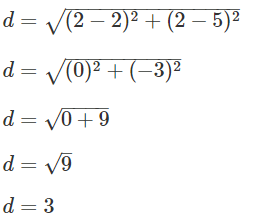
What figure is formed by connecting vertices at points A: (2, 5), B: (2, 2), C: (5, 2), and D: (5, 5) ?
What is the distance between points A and B? _______________________________________
Answer:
A square is formed by connecting vertices at points A: (2, 5), B: (2, 2), C: (5, 2), and D: (5, 5).
Distance between points A and B = 3.

Explanation:
vertices at points A: (2, 5), B: (2, 2), C: (5, 2), and D: (5, 5)
McGraw-Hill-Math-Grade-6-Pretest-Answer-Key-Calculate-46
Distance between points A and B =
McGraw-Hill-Math-Grade-6-Pretest-Answer-Key-Calculate-46..

Question 47.
What are the volume and surface area of the figure?
McGraw Hill Math Grade 6 Pretest Answer Key 14
Volume _____
Surface area ____
Answer:
Volume of the cuboid = 63.
Total Surface area of the cuboid = 109.

Explanation:
Length of the cuboid = 7
Width of the cuboid = 2
Height of the cuboid = 4.5
Volume of the cuboid = Length of the cuboid × Width of the cuboid × Height of the cuboid
= 7 × 2 × 4.5
= 14 × 4.5
= 63.
Total Surface area of the cuboid = 2 (length of the cuboid × Width of the cuboid) + 2(Width of the cuboid × height of the cuboid) + 2(length of the cuboid × height of the cuboid)
= 2(7 × 2) + 2(2 × 4.5) + 2(7 × 4.5)
= 2(14) + 2(9) + 2(31.5)
= 28 + 18 + 63
= 46 + 63
= 109.

Question 48.
Write an inequality to show that a number is greater than or equal to 10. _____
Answer:
The number must be 9 and above, to make x + 1  ≥ 10.

Explanation:
An inequality to show that a number is greater than or equal to 10:
Let the number be x.
=> x + 1  ≥ 10.
Let x must be 9 and above, to fulfill the equation.
=> x + 1 = 9 + 1 = 10.
=> x + 1 = 10 + 1 = 11.

McGraw Hill Math Grade 6 Pretest Answer Key Read More »

McGraw Hill Math Grade 6 Posttest Answer Key

Practice questions available in McGraw Hill Math Grade 6 Answer Key PDF Posttest will engage students and is a great way of informal assessment.

McGraw-Hill Math Grade 6 Posttest Answer Key

Complete the following test items.

Question 1.
There are three hundred thousand, two hundred, fifty-two people living in Cincinnati. How would you write this number in standard form?
Answer:
Standard form of three hundred thousand, two hundred, fifty-two people living in Cincinnati = 33,252.

Explanation:
Number of people living in Cincinnati = three hundred thousand, two hundred, fifty-two people living in Cincinnati.
Standard form – 33000 + 200 + 52
=> 33,252.

Question 2.
Jerry is collecting newspapers for a recycling contest at his school. He needs 2,152 newspapers to win the contest. So far he has collected 1,375. Rounding to the nearest thousand, how many newspapers can we estimate that Jerry still needs to collect?
Answer:
Rounding to nearest thousand number of newspapers can we estimate that Jerry still needs to collect = 1,000.

Explanation:
Number of newspapers to win the contest he needs = 2,152.
Number of newspapers he collected = 1,375.
Rounding to nearest thousand:
Number of newspapers can we estimate that Jerry still needs to collect = Number of newspapers to win the contest he needs – Number of newspapers he collected
= 2,152 – 1,375
= 777.
Rounding to nearest thousand:
1000.

Calculate. Compare using <, >, or =
Question 3.
McGraw Hill Math Grade 6 Posttest Answer Key 1
Answer:
McGraw-Hill-Math-Grade-6-Posttest-Answer-Key-calculate-3

Explanation:
Multiplying 27 by 17, we get the product 459.

Question 4.
McGraw Hill Math Grade 6 Posttest Answer Key 2
Answer:
McGraw-Hill-Math-Grade-6-Posttest-Answer-Key-calculate-4

Explanation:
Multiplying 9 by 56, we get the product 504.

Question 5.
|-14| __________ |14|
Answer:
|-14| = |14|

Explanation:
|-14| = 14.
|14| = 14.
=> Both are equal.

Question 6.
|-2| ___________ |-4|
Answer:
|-2| < |-4|

Explanation:
|-2| = 2.
|-4| = 4.
=> 2 is lesser than 4.

Question 7.
Marcia bought 13 apple pies for her class, but her classmates ate only half of each pie. How would Marcia express the amount of remaining apple pie as an improper fraction?
Answer:
Amount of remaining apple pie as an improper fraction = 6\(\frac{1}{2}\)

Explanation:
Number of apple pies for her class Marcia bought = 13.
But her classmates ate only half of each pie.
Number of apple pies left = 13 × \(\frac{1}{2}\)
= 6.5 or 6\(\frac{1}{2}\)

Calculate.
Question 8.
McGraw Hill Math Grade 6 Posttest Answer Key 3
Answer:
McGraw-Hill-Math-Grade-6-Posttest-Answer-Key-calculate-8

Explanation:
Sum of $29.81, $14.33 and $31.11, we get the $75.25.

Question 9.
McGraw Hill Math Grade 6 Posttest Answer Key 4
Answer:
McGraw-Hill-Math-Grade-6-Posttest-Answer-Key-calculate-9

Explanation:
Subtraction of $109.45 and $25.76, we get $83.69.

Question 10.
What is the greatest common factor of 8 and 12?
Answer:
Greatest common factor of 8 and 12 is 4.

Explanation:
Greatest common factor of 8 and 12:
Factors of 8:
1,2,4,8.
Factors of 12:
1,2,3,4,6,12.

Question 11.
What is the least common multiple of 3 and 7?
Answer:
Least common multiple of 3 and 7 is 21.

Explanation:
Least common multiple of 3 and 7:
Multiples of 3:
3,6,9,12,15,18,21,24,27,30.
Multiples of 7:
7,14,21,28,35,42,49,56,63,70.

Question 12.
Ellen has been measuring the amount of snowfall for the last three months. She measured 1.262 inches in November, 1.794 inches in December, and 2.115 inches in January. Rounding to the nearest tenth of an inch, what was the total amount of snowfall during these three months?
Answer:
Total amount of snowfall during these three months = 5.171 inches.
Rounding to the nearest tenth of an inch, the total amount of snowfall during these three months = 10 inches.

Explanation:
Number of inches in November she measured = 1.262.
Number of inches in December she measured = 1.794.
Number of inches in January she measured = 2.115.
Total amount of snowfall during these three months = Number of inches in November she measured + Number of inches in December she measured + Number of inches in January she measured
= 1.262 + 1.794 + 2.115
McGraw-Hill-Math-Grade-6-Posttest-Answer-Key-calculate-12
Rounding to the nearest tenth:
5.171 – 10 inches.

Calculate.
Question 13.
McGraw Hill Math Grade 6 Posttest Answer Key 5
Answer:
McGraw-Hill-Math-Grade-6-Posttest-Answer-Key-calculate-13

Explanation:
Dividing 1591 by 79, we get the quotient 20.13.

Question 14.
McGraw Hill Math Grade 6 Posttest Answer Key 6
Answer:
McGraw-Hill-Math-Grade-6-Posttest-Answer-Key-calculate-14

Explanation:
Dividing 630 by 35, we get the quotient 18.

Question 15.
McGraw Hill Math Grade 6 Posttest Answer Key 7
Answer:
McGraw-Hill-Math-Grade-6-Posttest-Answer-Key-calculate-15

Explanation:
Dividing 78 by 15, we get the quotient 5.2.

Question 16.
McGraw Hill Math Grade 6 Posttest Answer Key 8
Answer:
McGraw-Hill-Math-Grade-6-Posttest-Answer-Key-calculate-16

Explanation:
Dividing 160 by 12, we get the quotient 13.33.

Question 17.
Marvin is mixing the paint he will use to paint his living room. The directions to make 1 coat of paint call for him to mix 23.75 milliliters of black paint and 9.20 milliliters of white paint to achieve the correct shade of gray. How much black paint and how much white paint will he need in order to apply four coats of paint?
Answer:
Number of milliliters of black paint and white paint he needs to apply four coats of paint = 131.8.

Explanation:
Number of milliliters of black paint coat of paint call for him to mix = 23.75.
Number of milliliters of white paint to achieve the correct shade of gray = 9.20.
Number of milliliters of black paint and white paint he needs to apply four coats of paint = 4 (Number of milliliters of black paint coat of paint call for him to mix + Number of milliliters of  white paint to achieve the correct shade of gray)
= 4 (23.75 + 9.20)
= 4 × 32.95
= 131.8.

Question 18.
What is 40% of 150?
Answer:
40% of 150 = 60.

Explanation:
40% of 150 = \(\frac{40}{100}\) × 150
= \(\frac{40}{2}\) × 3
= \(\frac{20}{1}\) × 3
= 60.

Question 19.
What is 20% of \(\frac{4}{5}\)? Express the number in both decimal and fraction forms.
Answer:
20% of \(\frac{4}{5}\) = \(\frac{4}{25}\) or 0.16.

Explanation:
20% of \(\frac{4}{5}\) = \(\frac{20}{100}\) × \(\frac{4}{5}\)
= \(\frac{1}{5}\) × \(\frac{4}{5}\)
= \(\frac{4}{25}\) or 0.16.

Question 20.
Julia has a length of rope that is 17 \(\frac{1}{4}\) meters long. If 30 percent of the rope’s length has been painted blue, what length of the rope is not blue?
Answer:
Length of the rope is not blue = \(\frac{207}{40}\) or 5.175 meters.

Explanation:
Number of meters of rope that Julia has = 17 \(\frac{1}{4}\)
Length of the rope painted blue = 30%
Length of the rope is not blue = Number of meters of rope that Julia has × Length of the rope painted blue
= 17 \(\frac{1}{4}\) × 30%
= {[(17 × 4) + 1] ÷ 4} × 30%
= [(68 + 1) ÷ 4} × 30%
= \(\frac{69}{4}\) × \(\frac{30}{100}\)
= \(\frac{69}{2}\) × \(\frac{15}{100}\)
= \(\frac{69}{2}\) × \(\frac{3}{20}\)
= \(\frac{207}{40}\) or 5.175 meters.

Question 21.
Put the following decimals in order from least to greatest:
.0245, .06, .0003, .75, .029, .9, .0019, 3.084, .0925, .21
Answer:
Least to greatest:
0.003, 0.0019, 0.0245, 0.06, 0.21, 0.29, 0.75, 0.9, 0.925, 3.084.

Explanation:
0.9, 0.75, 0.21. 0.06, 0.29, 0.925, 0.003, 0.0019, 0.0245, 3.084.
Least to greatest:
0.003, 0.0019, 0.0245, 0.06, 0.21, 0.29, 0.75, 0.9, 0.925, 3.084.

Question 22.
Rob bought a scale that records weight digitally. His small luggage bag weighs 10.279 kilograms, his laptop bag weighs 15.653 kilograms, his clothing bag weighs 25.455 kilograms, and his large bag weighs 35.350 kilograms. What is the total weight of the four bags, in kilograms?
If a passenger is only allowed to carry 90 kilograms of luggage onto a flight, will Rob’s luggage exceed the limit?
Answer:
Total weight of the four bags = 86.737 kilograms.
No, Rob’s luggage will not exceed the limit because its lesser than 90 kilograms.

Explanation:
Number of kilograms his small luggage bag weighs = 10.279.
Number of kilograms his his laptop bag weighs = 15.653.
Number of kilograms his his clothing bag weighs = 25.455.
Number of kilograms his his large bag weighs = 35.350.
Total weight of the four bags = Number of kilograms his small luggage bag weighs + Number of kilograms his his laptop bag weighs + Number of kilograms his his clothing bag weighs + Number of kilograms his his large bag weighs
= 10.279 + 15.653 + 25.455 + 35.350
= 25.932 + 25.455 + 35.350
= 51.387 + 35.350
= 86.737 kilograms.

Question 23.
McGraw Hill Math Grade 6 Posttest Answer Key 9
The chart shows how much time Brad and Simon spent practicing the clarinet last week. On which day did Brad practice for 95 minutes? _______________
On which day did Simon practice105 minutes longer than Brad? _______________
Answer:
Number of minutes brad spent on Thursday = 95.
Wednesday Simon practices 105 minutes longer than Brad.

Explanation:
Brad Practicing Time:
Number of minutes brad spent on Monday = 40.
Number of minutes brad spent on Tuesday = 110.
Number of minutes brad spent on Wednesday = 20.
Number of minutes brad spent on Thursday = 95.
Number of minutes brad spent on Friday = 25.
Simon Practicing Time:
Number of minutes Simon spent on Monday = 30.
Number of minutes Simon spent on Tuesday = 60.
Number of minutes Simon spent on Wednesday = 125.
Number of minutes Simon spent on Thursday = 75.
Number of minutes Simon spent on Friday = 30.
Difference:
Number of minutes Simon spent on Wednesday – Number of minutes brad spent on Wednesday
= 125 – 20
= 105.

Question 24.
Which city is colder in June? _______________
During which month is the difference in temperature the greatest? _______________
Answer:
Buenos Aires, Argentina city is colder in June.
During August month the difference in temperature the greatest.

Explanation:
Buenos Aires, Argentina temperature:
Temperature in June = 60°F
Temperature in July = 50°F
Temperature in August = 50°F
Temperature in September = 55°F
Seattle, Washington temperature:
Temperature in June = 70°F
Temperature in July = 75°F
Temperature in August = 80°F
Temperature in September = 70°F
Difference:
Seattle, Washington Temperature in August – Buenos Aires, Argentina Temperature in August
= 80°F – 50°F
= 30°F.
Seattle, Washington Temperature in June – Buenos Aires, Argentina Temperature in June
= 70°F – 60°F
= 10°F.
Seattle, Washington Temperature in July – Buenos Aires, Argentina Temperature in July
= 75°F – 50°F
= 25°F.
Seattle, Washington Temperature in September – Buenos Aires, Argentina Temperature in September
= 70°F – 55°F
= 15°F

Question 25.
Frank is looking at a solid figure that has two circular ends. It also has curved sides. What shape is he looking at?
Answer:
Frank is in look of a cylinder shape because it has two circular ends and curved sides.

Explanation:
Frank is looking at a solid figure that has two circular ends. It also has curved sides.
=> In mathematics, a cylinder is a three-dimensional solid that holds two parallel bases joined by a curved surface, at a fixed distance.

Question 26.
Tyler puts 5 nickels, 3 dimes, and 10 pennies into a hat. If you were to reach into that hat, what is the probability that you would pick a penny?
A dime? _______________
A nickel? _______________
Answer:
Probability that would pick a nickel penny = \(\frac{3}{18}\)
Probability that would pick a dime penny = \(\frac{5}{18}\)
Probability that would pick a pennies penny = \(\frac{10}{18}\)

Explanation:
Number of nickels Tyler puts into a hat = 5.
Number of dimes Tyler puts into a hat = 3.
Number of pennies Tyler puts into a hat = 10.
Total pennies he puts into a hat = Number of nickels Tyler puts into a hat + Number of dimes Tyler puts into a hat + Number of pennies Tyler puts into a hat
= 5 + 3 +10
= 8 + 10
= 18.
Probability that would pick a nickel penny = (Number of nickels Tyler puts into a hat ÷ Total pennies he puts into a hat)
= 5 ÷ 18
= \(\frac{5}{18}\)
Probability that would pick a dime penny = Number of dimes Tyler puts into a hat ÷ Total pennies he puts into a hat)
= 3 ÷ 18
= \(\frac{3}{18}\)
Probability that would pick a Pennies penny = Number of Pennies Tyler puts into a hat ÷ Total pennies he puts into a hat)
= 10 ÷ 18
= \(\frac{10}{18}\)

Question 27.
Which of the following triangles is
McGraw Hill Math Grade 6 Posttest Answer Key 10
obtuse? _______________
right? _______________
acute? _______________
Answer:
Obtuse Triangle: C
Right Triangle: B
Acute Triangle: A

Explanation:
An obtuse triangle (or obtuse-angled triangle) is a triangle with one obtuse angle (greater than 90°) and two acute angles.
obtuse: C
A right-angled triangle is a type of triangle that has one of its angles equal to 90 degrees.
right: B
An acute triangle (or acute-angled triangle) is a  triangle with three acute angles (less than 90°).
acute: A

Question 28.
Calculate the following expression: 3 + (7 – 2)2 + 4(5 + 3) – 6(6) = _____________
Answer:
3 + (7 – 2)2 + 4(5 + 3) – 6(6) = 24.

Explanation:
3 + (7 – 2)2 + 4(5 + 3) – 6(6)
= 3 + (7 – 2)2 + 4(8) – 6(6)
= 3 + (5)2 + 4(8) – 6(6)
= 3 + 25 + 4(8) – 6(6)
= 3 + 25 + 32 – 6(6)
= 3 + 25 + 32 – 36
= 28 + 32 – 36
= 60 – 36
= 24.

Question 29.
Write the following number using scientific notation: 2,345,836.0071.
Answer:
Scientific notation of 2,345,836.0071 = 2345836.71 x 10^-2.

Explanation:
A number is written in scientific notation when a number between 1 and 10 is multiplied by a power of 10.
2,345,836.0071 = 2345836.71 x 10^-2.

Question 30.
Michael collects postcards and state flags. His collection consists of 3 postcards and 1 flag from New Hampshire, 5 postcards and 2 flags from Florida, and 7 postcards from Ohio. If each postcard costs $.50 and each flag costs $4.50, how much did Michael spend for his collection?
Answer:
Amount of money Michael spend for his collection = $22.

Explanation:
Number of postcards from New Hampshire he collects = 3.
Number of flags from New Hampshire he collects = 1.
Number of postcards from Florida he collects = 5.
Number of flags from Florida he collects = 2.
Number of postcards from Ohio he collects = 7.
Total number of postcards he collects = Number of postcards from New Hampshire he collects + Number of postcards from Florida he collects + Number of postcards from Ohio he collects
= 3 + 5 + 7
= 10 + 7
= 17.
Total number of flags he collects = Number of flags from New Hampshire he collects + Number of postcards from Florida he collects
= 1 + 2
= 3.
Cost of each postcard = $.50
Cost of each flag = $4.50,
Amount of money Michael spend for his collection = (Total number of postcards he collects × Cost of each postcard) + (Total number of flags he collects × Cost of each flag)
= (17 × $0.50) + (3 × $4.50)
= $8.50 + $13.50
= $22.

Question 31.
Which of the following angles is
McGraw Hill Math Grade 6 Posttest Answer Key 11
acute? _______________
right? _______________
obtuse? _______________
Answer:
Acute Triangle: E
Right Triangle: D
Obtuse Triangle: C

Explanation:
An acute triangle (or acute-angled triangle) is a  triangle with three acute angles (less than 90°).
acute: E
A right-angled triangle is a type of triangle that has one of its angles equal to 90 degrees.
right: D
An obtuse triangle (or obtuse-angled triangle) is a triangle with one obtuse angle (greater than 90°) and two acute angles.
obtuse: C

Question 32.
28 ÷ .25 = _____________
Answer:
McGraw-Hill-Math-Grade-6-Posttest-Answer-Key-calculate-32

Explanation:
28 divided by 0.25, gives the quotient 112.

Question 33.
.3606 ÷ .06 = _____________
Answer:
McGraw-Hill-Math-Grade-6-Posttest-Answer-Key-calculate-33

Explanation:
0.3606 divided by 0.06, gives the quotient 6.01.

Question 34.
What is \(\frac{22}{31}\) ÷ 7?
Answer:
\(\frac{22}{31}\) ÷ 7 = \(\frac{22}{217}\)

Explanation:
\(\frac{22}{31}\) ÷ 7
= \(\frac{22}{31}\) × \(\frac{1}{7}\)
= \(\frac{22}{217}\)

Question 35.
What is 18 ÷ \(\frac{4}{15}\)?
Answer:
18 ÷ \(\frac{4}{15}\) = 67 \(\frac{1}{2}\)

Explanation:
18 ÷ \(\frac{4}{15}\)
= 18 × \(\frac{15}{4}\)
= 9 × \(\frac{15}{2}\)
= \(\frac{135}{2}\)
= 67 \(\frac{1}{2}\)

Question 36.
What is \(\frac{38}{51}\) ÷ \(\frac{19}{17}\)?
Answer:
\(\frac{38}{51}\) ÷ \(\frac{19}{17}\) = \(\frac{2}{3}\)

Explanation:
\(\frac{38}{51}\) ÷ \(\frac{19}{17}\)
= \(\frac{38}{51}\) × \(\frac{17}{19}\)
= \(\frac{2}{51}\) × \(\frac{17}{1}\)
= \(\frac{2}{3}\) × \(\frac{1}{1}\)
= \(\frac{2}{3}\)

Question 37.
Latasha is in charge of providing bottled water and trail mix for her class field trip. Each student will be carrying \(\frac{3}{5}\) liters of water and \(\frac{1}{4}\) pound of trail mix during the trip. If there are 35 students on the trip, how much water and trail mix should Latasha bring for the class?
Answer:
Quantity of water and trail mix should Latasha bring for the class = 29\(\frac{3}{4}\)

Explanation:
Number of liters of water each student will be carrying = \(\frac{3}{5}\)
Number of pounds of trail mix each student will be carrying = \(\frac{1}{4}\)
Number of students = 35.
Quantity of water and trail mix should Latasha bring for the class = (Number of students × Number of liters of water each student will be carrying) + (Number of students × Number of pounds of trail mix each student will be carrying)
= (35 × \(\frac{3}{5}\)) + (35 × \(\frac{1}{4}\))
= (7 × \(\frac{3}{1}\)) + (35 × \(\frac{1}{4}\))
= \(\frac{21}{1}\) + \(\frac{35}{4}\)
McGraw-Hill-Math-Grade-6-Posttest-Answer-Key-calculate-37

Question 38.
Last week Matthew spent 5 \(\frac{1}{6}\) hours repairing his bike over a period of 3 \(\frac{1}{3}\) days. How many hours a day, on average, did Matthew spend working on his bike?
Answer:
Number of hours a day, on average, Matthew spend working on his bike = \(\frac{31}{20}\)

Explanation:
Number of hours repairing his bike last week Matthew spent = 5\(\frac{1}{6}\)
Number of days repairing his bike last week Matthew spent = 3\(\frac{1}{3}\)
Number of hours a day, on average, Matthew spend working on his bike = Number of hours repairing his bike last week Matthew spent  ÷ Number of days repairing his bike last week Matthew spent
= 5\(\frac{1}{6}\) ÷ 3\(\frac{1}{3}\)
= {[(5 × 6) + 1] ÷ 6} ÷ {[(3 × 3) + 1] ÷ 3}
= [(30 + 1) ÷ 6] ÷ [(9 + 1) ÷ 3]
= (31 ÷ 6) ÷ (10 ÷ 3)
= \(\frac{31}{6}\) ÷ \(\frac{10}{3}\)
= \(\frac{31}{6}\) × \(\frac{3}{10}\)
= \(\frac{31}{2}\) × \(\frac{1}{10}\)
= \(\frac{31}{20}\)

Question 39.
What is the decimal form of 9 \(\frac{3}{8}\)?
Answer:
Decimal form of 9 \(\frac{3}{8}\) = 9.375.

Explanation:
Decimal form of 9 \(\frac{3}{8}\) = {[(9 × 8) + 3] ÷ 8
= [(72 + 3) ÷ 8]
= (75 ÷ 8)
= 9.375.

Question 40.
What is the fraction form of 3.6?
Answer:
Fraction form of 3.6 = 7.2 ÷ 2.

Explanation:
Fraction form of 3.6:
3.6 × 2 = 7.2

Question 41.
Daniel is making chocolate chip cookies for his classmates at school. Each batch requires 3 \(\frac{2}{3}\) cups of sugar and \(\frac{1}{3}\) of a bag of chocolate chips. Create a ratio table to show the amounts Daniel will need to make 2, 3, or 4 batches of cookies.
Answer:
McGraw-Hill-Math-Grade-6-Posttest-Answer-Key-calculate-41

Explanation:
Number of cups of sugar each batch requires = 3\(\frac{2}{3}\)
Number of cups of of a bag of chocolate chips = \(\frac{1}{3}\)
Quantity of cups used to make each batch of cookies = Number of cups of sugar each batch requires + Number of cups of of a bag of chocolate chips
= 3\(\frac{2}{3}\) + \(\frac{1}{3}\)
= {[(3 × 3) + 2] ÷ 3} + \(\frac{1}{3}\)
= [(9 + 2) ÷ 3] + \(\frac{1}{3}\)
= \(\frac{11}{3}\) + \(\frac{1}{3}\)
= (11 + 1) ÷ 3
= 12 ÷ 3
= 4.
Quantity of cups used to make 2 batch of cookies = 2 × Quantity of cups used to make each batch of cookies
= 2 × 4
= 8.
Quantity of cups used to make 3 batch of cookies = 3 × Quantity of cups used to make each batch of cookies
= 3 × 4
= 12.
Quantity of cups used to make 4 batch of cookies = 4 × Quantity of cups used to make each batch of cookies
= 4 × 4
= 16.

Question 42.
What is \(\frac{1}{3}\) of 72%?
Answer:
\(\frac{1}{3}\) of 72% = \(\frac{6}{25}\)

Explanation:
\(\frac{1}{3}\) of 72%
= \(\frac{1}{3}\) × \(\frac{72}{100}\)
= \(\frac{1}{1}\) × \(\frac{24}{100}\)
= \(\frac{1}{1}\) × \(\frac{12}{50}\)
= \(\frac{1}{1}\) × \(\frac{6}{25}\)
= \(\frac{6}{25}\)

Question 43.
What is 60% of \(\frac{1}{4}\)
in decimal form? _____________
in fraction form? _____________
Answer:
60% of \(\frac{1}{4}\)
in decimal form – 0.15.
in fraction form – \(\frac{3}{20}\)

Explanation:
60% of \(\frac{1}{4}\)
= 60% × \(\frac{1}{4}\)
= \(\frac{60}{100}\) × \(\frac{1}{4}\)
= \(\frac{6}{10}\) × \(\frac{1}{4}\)
= \(\frac{3}{10}\) × \(\frac{1}{2}\)
= \(\frac{3}{20}\)
= 0.15.

Question 44.
What are the perimeter and area of the figure?
McGraw Hill Math Grade 6 Posttest Answer Key 12
Perimeter _____________________
Area __________________
Answer:
Perimeter – 24 cm.
Area – 35 square cm.

Explanation:
Length of the rectangle =  7cm.
Width of the rectangle =  5cm.
Perimeter of the rectangle = 2(Length of the rectangle + Width of the rectangle)
= 2(7 + 5)
= 2 × 12
= 24 cm.
Area of the rectangle = Length of the rectangle × Width of the rectangle
= 7 × 5
= 35 square cm.

Question 45.
One inch is equivalent to 2.54 centimeters. How many inches is 4 meters? How many centimeters are in 254 inches?
__________ inches = 4 meters
254 inches = __________ centimeters
Answer:
157.48 inches = 4 meters.
254 inches = 645.16 centimeters.

Explanation:
One inch = 2.54 centimeters.
1 meter = 100 centimeters.
=> One inch × 100 = 2.54 × 1
=> One inch = 2.54 ÷ 100
=> One inch = 0.0254 meters.
4 meters = One inch × 4 = 0.0254 × ??
=> 1 × 4 ÷ 0.0254 = ??
=> 157.48 inches.
One inch = 2.54 centimeters.
254 inches = ?? centimeters
=> ?? × 1 = 2.54 × 254
=> ?? = 645.16 centimeters.

Question 46.
What figure is formed by connecting vertices at points A: (2, 5), B: (2, 2), and C: (5, 2)?
What is the distance between points A and B?
Answer:
Distance between points A and B:
McGraw-Hill-Math-Grade-6-Posttest-Answer-Key-calculate-46..
Figured formed is a triangle by point A: (2, 5), B: (2, 2), and C: (5, 2).

Explanation:
Vertices at points A: (2, 5), B: (2, 2), and C: (5, 2)
Figure formed :
McGraw-Hill-Math-Grade-6-Posttest-Answer-Key-calculate-46

Question 47.
What are the volume and surface area of the figure?
McGraw Hill Math Grade 6 Posttest Answer Key 13
Volume _____________
Surface area ______________
Answer:
Volume – 52.
Surface area – 94.

Explanation:
Length of the cuboid = 6.5.
Breadth of the cuboid = 2.
Height of the cuboid = 4.
Volume of the cuboid = Length of the cuboid × Breadth of the cuboid × Height of the cuboid
= 6.5 × 2 × 4
= 13 × 4
= 52.
Total Surface area of cuboid = 2 (length × breadth) + 2(breadth × height) + 2(length × height)
= 2(6.5 × 2) + 2(2 × 4) + 2(6.5 × 4)
= 2(13) + 2(8) + 2(26)
= 26 + 16 + 52
= 42 + 52
= 94.

Question 48.
Write an inequality to show that a number is less than or equal to 7.
Answer:
Inequality to show that a number is less than or equal to 7:
x + 1 ≤ 7

Explanation:
Inequality to show that a number is less than or equal to 7:
To show inequality of numbers, let the number be x and less than 7.
=> x < 7.
Add 1:
x + 1 ≤ 7

McGraw Hill Math Grade 6 Posttest Answer Key Read More »

McGraw Hill Math Grade 6 Lesson 9.5 Answer Key Problem-Solving with Proportions

Practice questions available in McGraw Hill Math Grade 6 Answer Key PDF Lesson 9.5 Problem-Solving with Proportions will engage students and is a great way of informal assessment.

McGraw-Hill Math Grade 6 Answer Key Lesson 9.5 Problem-Solving with Proportions

Exercises Solve For x

Question 1.
If a car can travel 105 miles on 7 gallons of gas, how far can it travel on 9 gallons of gas?
Answer:
Number of miles a car can it travel on 9 gallons of gas = 135.

Explanation:
Number of miles car can travel = 105.
Number of gallons of gas = 7.
Number of miles a car can it travel on 9 gallons of gas =
105 miles – 7 gallon of gas
?? miles – 9 gallon of gas
=> 105 × 9 = 7 × ??
=> 945 ÷ 7 = ??
=> 135 = ??

Question 2.
Isabella runs 3 times per week. She ran for 15 minutes on Monday and 17 minutes on Wednesday. Her coach told her that she had run 80 percent of her goal that week. How many more minutes does she need to run to meet her goal for the week?
Answer:
Number of minutes she needs to run to meet her goal for the week = 8.

Explanation:
Number of times Isabella runs per week = 3.
Number of minutes she ran on Monday = 15.
Number of minutes she ran on Wednesday = 17.
Her coach told her that she had run 80 percent of her goal that week
=> Let the total minutes she ran be x.
80% of x = 15 + 17
=> 80% of x = 32
=> 80x = 3200
=> x = 3200 ÷ 80
=> x = 40.
Number of minutes she needs to run to meet her goal for the week = Total number of minutes she ran – (Number of minutes she ran on Monday + Number of minutes she ran on Wednesday)
= 40 – (15 + 17)
= 40 – 32
= 8.

Question 3.
It takes Kenny 25 minutes to inflate the tires of 55 bicycles. How long will it take him to inflate the tires of 121 bicycles?
Answer:
Number of minutes it takes him to inflate the tires of 121 bicycles = 55.

Explanation:
Number of minutes to inflate the tires Kenny takes = 25.
Number of bicycles Kenny takes to inflate the tires = 55.
Number of minutes it takes him to inflate the tires of 121 bicycles =
25 minutes – 55
?? minutes – 121
=> 121 × 25 = 55 × ??
=> 3,025 ÷ 55 = ??
=> 55 minutes = ??.

Question 4.
How many pizzas do you need for a party of 135 people if at the last party. 90 people ate 52 pizzas? (Assume the same rate of consumption.)
Answer:
Number of pizzas 135 people ate =  78.

Explanation:
Number of people = 90.
Number of pizzas = 52.
Number of pizzas 135 people ate =
90 people – 52 pizzas
135 people – ??
=> 90 × ?? = 135 × 52
=> ?? = 7,020 ÷ 90
=> ?? = 78.

Question 5.
Jim spent $55 at the last yard sale when he bought 14 items. If he sees 24 items that he liked at the yard sale across the street, how much money should he expect to spend? (Assume he spends the same amount per item.)
Answer:
Amount of money Jim should he expect to spend = $94.28.

Explanation:
Amount of money Jim spent at the last yard sale = $55.
Number of items he bought = 14.
Number of items yard sale across the street = 24.
Amount of money Jim should he expect to spend =
$55 – 14 items
$?? – 24 items
=> 55 × 24 = 14 × ??
=> 1,320 ÷ 14 = ??
=> $94.28 = ??

Question 6.
Kim wants to expand her lawn mowing business. She presently mows 58 lawns with 6 workers. how many workers will she need if she plans to mow a total of 87 lawns?
Answer:
Number of workers will she needs if she plans to mow a total of 87 lawns = 9.

Explanation:
Number of workers = 6.
Number of lawns she presently mows = 58.
Number of workers will she needs if she plans to mow a total of 87 lawns =
6 workers – 58 lawns
?? workers – 87 lawns
=> 87 × 6 = 58 × ??
=> 522 ÷ 58 = ??
=> 9 workers = ??.

Question 7.
At the apple orchard, each row of 7 apple trees yields 78 bushels of apples. If there are 112 trees in the orchard, how many bushels of apples should you expect to be harvested?
Answer:
Number of bushels of apples should you expect to be harvested = 1,248 bushels of apples.

Explanation:
Number of apples trees yields in each row = 7.
Number of bushels of apples = 78.
Number of bushels of apples should you expect to be harvested =
7 apple trees  – 78 bushels of apples
112 apple trees – ?? bushels of apples
=> 7 × ?? = 78 × 112
=> ?? = 8,736 ÷ 7
=> ?? = 1,248 bushels of apples.

Question 8.
Each troop of 32 girl scouts eats 11 pounds of cereal a week. If there are 45 troops at the scout camp, how many pounds of cereal should be purchased?
Answer:
Number of pounds of cereal should be purchased = 15.46.

Explanation:
Number of each troop has = 32.
Number of pounds of cereal a week girl scouts eats = 11.
Number of troops at the scout camp = 45.
Number of pounds of cereal should be purchased =
32 troop – 11 pounds of cereal
45 troop – ?? pounds of cereal
=> 32 × ?? = 11 × 45
=> ?? = 495 ÷ 32
=> ?? = 15.46 pounds of cereal.

McGraw Hill Math Grade 6 Lesson 9.5 Answer Key Problem-Solving with Proportions Read More »

McGraw Hill Math Grade 6 Lesson 9.4 Answer Key Rates

Practice questions available in McGraw Hill Math Grade 6 Answer Key PDF Lesson 9.4 Rates will engage students and is a great way of informal assessment.

McGraw-Hill Math Grade 6 Answer Key Lesson 9.4 Rates

Exercises Solve

Question 1.
Bob eats 6 apples in 2 days. How many days will it take for him to eat a basket of apples containing 51 apples?
Answer:
Number of days he can eats 51 apples = 17.

Explanation:
Number of apples Bob eats = 6.
Number of days = 2.
Number of apples he eats in a day = Number of apples Bob eats ÷ Number of days
= 6 ÷ 2
= 3.
Number of days he can eats 51 apples = 51 ÷ Number of apples he eats in a day
= 51 ÷ 3
= 17.

Question 2.
Fay travels 56 kilometers in 8 hours. How many kilometers will she travel in a day?
Answer:
Number of kilometers she travels in a day = 7.

Explanation:
Number of kilometers Fay travels = 56.
Number of hours = 8.
Number of kilometers she travels in a day = Number of kilometers Fay travels ÷ Number of hours
= 56 ÷ 8
= 7.

Question 3.
Bob can paint the lines in the middle of the road at a rate of 18 miles in a 9-hour work day. How many miles can he paint on Saturday when he works 5 hours?
Answer:
Number of miles he can paint on Saturday when he works 5 hours = 10.

Explanation:
Number of miles Bob can paint the lines in the middle of the road = 18.
Number of hours work per day = 9.
Number of Miles per hour he works = Number of miles Bob can paint the lines in the middle of the road ÷ Number of hours work per day
= 18 ÷ 9
= 2.
Number of miles he can paint on Saturday when he works 5 hours = Number of Miles per hour he works × 5
= 2 × 5
= 10.

Question 4.
In the first 3 hours of a concert, 2,100 people passed through the gates. How long will it take to fill a concert hall that has 2,800 seats?
Answer:
Number of hours it takes to fill a concert hall that has 2,800 seats = 4.

Explanation:
Number of hours = 3.
Number of people passed through the gates = 2,100.
Number of people passed in an hour = Number of people passed through the gates ÷ Number of hours
= 2,100 ÷ 3
= 700.
Number of hours it takes to fill a concert hall that has 2,800 seats = 2,800 ÷ Number of people passed in an hour
= 2800 ÷ 700
= 4.

Question 5.
5 horses can plow 20 acres of land in an hour. How many acres can 21 horses plow in an hour?
Answer:
Number of acres of land in an hour 21 horses can plow = 84.

Explanation:
Number of horses = 5.
Number of acres of land in an hour horses can plow = 20.
Number of acres of land in an hour 21 horses can plow =
5 horses  – 20 acres
21 horses – ??
=> 5 × ?? = 20 × 21
=> ?? = 420 ÷ 5
=> ?? = 84.

Question 6.
How many minutes will it take 5 people to stack 250 chairs if each person can stack 20 chairs a minute?
Answer:
Number of minutes it take 5 people to stack 250 chairs = 50.

Explanation:
Number of people to stack chairs = 5.
Number of chairs = 250.
Number of chairs if each person can stack in a minute = 20.
Number of minutes it take 5 people to stack 250 chairs = Number of chairs ÷ Number of people to stack chairs
= 250 ÷ 5
= 50.

Question 7.
George can polish 240 square feet of floor in 2 hours. How many square feet can he polish in 7 hours?
Answer:
Number of square feet of floor George can polish in 7 hours = 840.

Explanation:
Number of square feet of floor George can polish = 240.
Number of hours = 2.
Number of square feet of floor George can polish in an hour = Number of square feet of floor George can polish ÷ Number of hours
= 240 ÷ 2
= 120.
Number of square feet of floor George can polish in 7 hours = 7 × Number of square feet of floor George can polish in an hour
= 7 × 120
= 840.

Question 8.
It took 35 minutes for the first 45 people to pass through customs at the airport. If it takes the same amount of time for each person, how long will it take for the whole plane of 135 people to pass through customs?
Answer:
Number of minutes for the whole plane of 135 people to pass through customs = 105.

Explanation:
Number of minutes for the first people to pass through customs at the airport = 35.
Number of people people to pass through customs at the airport = 45.
Number of minutes for the whole plane of 135 people to pass through customs =
35 minutes – 45 people
?? – 135 people
=> 135 × 35 = ?? × 45
=> 4,725 ÷ 45 = ??
=> 105 minutes = ??

McGraw Hill Math Grade 6 Lesson 9.4 Answer Key Rates Read More »

McGraw Hill Math Grade 6 Lesson 9.3 Answer Key Ratio Tables

Practice questions available in McGraw Hill Math Grade 6 Answer Key PDF Lesson 9.3 Ratio Tables will engage students and is a great way of informal assessment.

McGraw-Hill Math Grade 6 Answer Key Lesson 9.3 Ratio Tables

Exercises Solve

Fill in the missing values in the table

Question 1.
Shortbread Cookie Recipe
McGraw Hill Math Grade 6 Chapter 9 Lesson 9.2 Answer Key Proportions and Cross-Multiplying 1
Answer:
McGraw-Hill-Math-Grade-6-Answer-Key-Lesson-9.3-Ratio-Tables-Solve-Fill in the missing values in the table-1

Explanation:
Flour = 3 cups for 12 cookies.
=> 36 cookies = ??
=> 3 × 36 = 12 × ??
=> 108 ÷ 12 = ??
=> 9 = ??.
Sugar = 1 cup for 12 cookies.
=> 36 cookies = ??
=> 1 × 36 = 12 × ??
=> 36 ÷ 12 = ??
=> 3 = ??.
Butter = 3 sticks for 12 cookies.
=> 36 cookies = ??
=> 3 × 36 = 12 × ??
=> 108 ÷ 12 = ??
=> 9 = ??.

Question 2.
The ratio of fifth graders to sixth graders at Lakeville Academy is 9:11.
McGraw Hill Math Grade 6 Chapter 9 Lesson 9.2 Answer Key Proportions and Cross-Multiplying 2
How many sixth graders are there? ________
Answer:
McGraw-Hill-Math-Grade-6-Answer-Key-Lesson-9.3-Ratio-Tables-Solve-Fill in the missing values in the table-2

Explanation:
Fifth Graders:
Ratio = 9.
Multiplier = 45 ÷ 9 = 5.
Actual number = 45.
Total Fifth Graders = 45 + 9 = 54.
Sixth Graders:
Ratio = 11.
Actual number = 45.
Total = 100.
=> 100 – 45 = 55.
Multiplier = 55 ÷ 11 = 5.
Total Sixth Graders = 11 + 55 = 66.

Question 3.
McGraw Hill Math Grade 6 Chapter 9 Lesson 9.2 Answer Key Proportions and Cross-Multiplying 3
Answer:
McGraw-Hill-Math-Grade-6-Answer-Key-Lesson-9.3-Ratio-Tables-Solve-Fill in the missing values in the table-3

Explanation:
x = 12
y = 120.
=> y ÷ x = 120 ÷ 12 = 10.
x = 15
y = ??
=> 15 × 10 = 150.

Question 4.
McGraw Hill Math Grade 6 Chapter 9 Lesson 9.2 Answer Key Proportions and Cross-Multiplying 4
Answer:
McGraw-Hill-Math-Grade-6-Answer-Key-Lesson-9.3-Ratio-Tables-Solve-Fill in the missing values in the table-4

Explanation:
x = 3
y = 9
=> y ÷ x = 9 ÷ 3 = 3.
x = 6
=> y = ??
=> 6 ×  3 = 18.

Find the missing value in the table and plot the points on a graph.

Question 5.
McGraw Hill Math Grade 6 Chapter 9 Lesson 9.2 Answer Key Proportions and Cross-Multiplying 5
McGraw Hill Math Grade 6 Chapter 9 Lesson 9.2 Answer Key Proportions and Cross-Multiplying 6
Answer:
McGraw-Hill-Math-Grade-6-Answer-Key-Lesson-9.3-Ratio-Tables-Solve-Fill in the missing values in the table-5

Explanation:
x = 1
y = 3
=> y – x = 3 – 1 = 2.
x = 2
=> 2 + 2 = 4.
McGraw-Hill-Math-Grade-6-Answer-Key-Lesson-9.3-Ratio-Tables-Solve-Fill in the missing values in the table-5..

Create a table and plot the points on a graph.

Question 6.
Every time Noah does a load of laundry, he makes $2.00. Make a table to find how much he could make for doing up to 4 loads and plot the values on the graph.
McGraw Hill Math Grade 6 Chapter 9 Lesson 9.2 Answer Key Proportions and Cross-Multiplying 7
Answer:
McGraw-Hill-Math-Grade-6-Answer-Key-Lesson-9.3-Ratio-Tables-Solve-Fill in the missing values in the table-6

Explanation:
Amount of money he makes = $2.00.
Number of loads = 4.
Amount of money he makes for 2 loads = 2 × Amount of money he makes
= 2 × $2
= $4.
Amount of money he makes for 3 loads = 3 × Amount of money he makes
= 3 × $2
= $6.
Amount of money he makes for 4 loads = 4 × Amount of money he makes
= 4 × $2
= $8.

McGraw Hill Math Grade 6 Lesson 9.3 Answer Key Ratio Tables Read More »

McGraw Hill Math Grade 6 Lesson 9.2 Answer Key Proportions and Cross-Multiplying

Practice questions available in McGraw Hill Math Grade 6 Answer Key PDF Lesson 9.2 Proportions and Cross-Multiplying will engage students and is a great way of informal assessment.

McGraw-Hill Math Grade 6 Answer Key Lesson 9.2 Proportions and Cross-Multiplying

Exercises Solve for x.

Question 1.
\(\frac{4}{7}\) = \(\frac{x}{28}\)
Answer:
\(\frac{4}{7}\) = \(\frac{x}{28}\)
=> x = 16.

Explanation:
\(\frac{4}{7}\) = \(\frac{x}{28}\)
=> \(\frac{4}{7}\) × 28 = x
=> \(\frac{4}{1}\) × 4 = x
=> 16 = x.

Question 2.
\(\frac{3}{5}\) = \(\frac{12}{x}\)
Answer:
\(\frac{3}{5}\) = \(\frac{12}{x}\)
=> x = 20.

Explanation:
\(\frac{3}{5}\) = \(\frac{12}{x}\)
=> \(\frac{3}{5}\) × x = 12
=> x = 12 × \(\frac{5}{3}\)
=> x = 4 × \(\frac{5}{1}\)
=> x = 20.

Question 3.
\(\frac{12}{x}\) = \(\frac{36}{51}\)
Answer:
\(\frac{12}{x}\) = \(\frac{36}{51}\)
=> x = 17.

Explanation:
\(\frac{12}{x}\) = \(\frac{36}{51}\)
=> 12 = x × \(\frac{36}{51}\)
=> 12 × \(\frac{51}{36}\) = x
=> 1 × \(\frac{51}{3}\) = x
=> \(\frac{17}{1}\) = x
=> 17 = x.

Question 4.
\(\frac{2}{3}\) = \(\frac{x}{21}\)
Answer:
\(\frac{2}{3}\) = \(\frac{x}{21}\)
=> x = 14.

Explanation:
\(\frac{2}{3}\) = \(\frac{x}{21}\)
=> \(\frac{2}{3}\) × 21 = x
=> \(\frac{2}{1}\) × 7 = x
=> 14 = x.

Question 5.
\(\frac{x}{14}\) = \(\frac{2}{7}\)
Answer:
\(\frac{x}{14}\) = \(\frac{2}{7}\)
=> x = 4.

Explanation:
\(\frac{x}{14}\) = \(\frac{2}{7}\)
=> x = 14 × \(\frac{2}{7}\)
=> x = 2 × \(\frac{2}{1}\)
=> x = 4.

Question 6.
\(\frac{10}{55}\) = \(\frac{x}{11}\)
Answer:
\(\frac{10}{55}\) = \(\frac{x}{11}\)
=> x = 2.

Explanation:
\(\frac{10}{55}\) = \(\frac{x}{11}\)
=> \(\frac{10}{55}\) × 11 = x
=> \(\frac{10}{5}\) × 1 = x
=> \(\frac{2}{1}\) = x
=> 2 = x.

Question 7.
\(\frac{33}{44}\) = \(\frac{3}{x}\)
Answer:
\(\frac{33}{44}\) = \(\frac{3}{x}\)
=> x = 4.

Explanation:
\(\frac{33}{44}\) = \(\frac{3}{x}\)
=> \(\frac{33}{44}\) × x = 3
=> x = 3 × \(\frac{44}{33}\)
=> x = 1 × \(\frac{44}{11}\)
=> x = \(\frac{4}{1}\)
=> x = 4.

Question 8.
\(\frac{3}{51}\) = \(\frac{1}{x}\)
Answer:
\(\frac{3}{51}\) = \(\frac{1}{x}\)
=> x = 17.

Explanation:
\(\frac{3}{51}\) = \(\frac{1}{x}\)
=> \(\frac{3}{51}\)  × x = 1
=> x = 1 × \(\frac{51}{3}\)
=> x = \(\frac{17}{1}\)
=> x = 17.

Question 9.
\(\frac{39}{63}\) = \(\frac{x}{126}\)
Answer:
\(\frac{39}{63}\) = \(\frac{x}{126}\)
=> x = 78.

Explanation:
\(\frac{39}{63}\) = \(\frac{x}{126}\)
=> \(\frac{39}{63}\)  × 126 = x
=> \(\frac{13}{21}\)  × 126 = x
=> \(\frac{13}{1}\)  × 6 = x
=> 78 = x.

Question 10.
\(\frac{49}{14}\) = \(\frac{7}{x}\)
Answer:
\(\frac{49}{14}\) = \(\frac{7}{x}\)
=> x = 2.

Explanation:
\(\frac{49}{14}\) = \(\frac{7}{x}\)
=> \(\frac{49}{14}\) × x = 7
=> x = 7 × \(\frac{14}{49}\)
=> x = 1 × \(\frac{14}{7}\)
=> x = \(\frac{2}{1}\)
=> x = 2.

Question 11.
\(\frac{5}{11}\) = \(\frac{x}{121}\)
Answer:
\(\frac{5}{11}\) = \(\frac{x}{121}\)
=> x = 55.

Explanation:
\(\frac{5}{11}\) = \(\frac{x}{121}\)
=> \(\frac{5}{11}\) × 121 = x
=> \(\frac{5}{1}\) × 11 = x
=> 55 = x.

Question 12.
\(\frac{4}{13}\) = \(\frac{x}{52}\)
Answer:
\(\frac{4}{13}\) = \(\frac{x}{52}\)
=> x = 16.

Explanation:
\(\frac{4}{13}\) = \(\frac{x}{52}\)
=> \(\frac{4}{13}\) × 52 = x
=> \(\frac{4}{1}\) × 4 = x
=> 16 = x.

Question 13.
\(\frac{7}{8}\) = \(\frac{91}{x}\)
Answer:
\(\frac{7}{8}\) = \(\frac{91}{x}\)
=> x = 104.

Explanation:
\(\frac{7}{8}\) = \(\frac{91}{x}\)
=> \(\frac{7}{8}\) × x = 91
=> x = 91 × \(\frac{8}{7}\)
=> x = 13 × \(\frac{8}{1}\)
=> x = 104.

Question 14.
\(\frac{10}{31}\) = \(\frac{110}{x}\)
Answer:
\(\frac{10}{31}\) = \(\frac{110}{x}\)
=> x = 341.

Explanation:
\(\frac{10}{31}\) = \(\frac{110}{x}\)
=> \(\frac{10}{31}\) × x = 110
=> x = 110 × \(\frac{31}{10}\)
=> x = 11 × \(\frac{31}{1}\)
=> x = 341.

Question 15.
\(\frac{19}{57}\) = \(\frac{4}{x}\)
Answer:
\(\frac{19}{57}\) = \(\frac{4}{x}\)
=> x = 12.

Explanation:
\(\frac{19}{57}\) = \(\frac{4}{x}\)
=> \(\frac{19}{57}\) × x = 4.
=> x = 4 × \(\frac{57}{19}\)
=> x = 4 × \(\frac{3}{1}\)
=> x = 12.

Question 16.
\(\frac{13}{117}\) = \(\frac{x}{27}\)
Answer:
\(\frac{13}{117}\) = \(\frac{x}{27}\)
=> x = 3.

Explanation:
\(\frac{13}{117}\) = \(\frac{x}{27}\)
=> \(\frac{13}{117}\) × 27 = x
=> \(\frac{13}{39}\) × 9 = x
=> \(\frac{1}{3}\) × 9 = x
=> \(\frac{1}{1}\) × 3 = x
=> 3 = x.

Question 17.
\(\frac{4}{7}\) = \(\frac{x}{35}\)
Answer:
\(\frac{4}{7}\) = \(\frac{x}{35}\)
=> x = 20.

Explanation:
\(\frac{4}{7}\) = \(\frac{x}{35}\)
=> \(\frac{4}{7}\) × 35 = x
=> \(\frac{4}{1}\) × 5 = x
=> 20 = x.

Question 18.
\(\frac{22}{x}\) = \(\frac{5}{110}\)
Answer:
\(\frac{22}{x}\) = \(\frac{5}{110}\)
=> x = 484.

Explanation:
\(\frac{22}{x}\) = \(\frac{5}{110}\)
=> 22 = x × \(\frac{5}{110}\)
=> 22 × \(\frac{110}{5}\) = x
=> 22 × \(\frac{22}{1}\) = x
=> 484 = x.

Question 19.
\(\frac{x}{130}\) = \(\frac{7}{91}\)
Answer:
\(\frac{x}{130}\) = \(\frac{7}{91}\)
=> x = 10.

Explanation:
\(\frac{x}{130}\) = \(\frac{7}{91}\)
=> x = 130 × \(\frac{7}{91}\)
=> x = 10 × \(\frac{7}{7}\)
=> x = 10 × \(\frac{1}{1}\)
=> x = 10.

Question 20.
\(\frac{18}{6}\) = \(\frac{81}{x}\)
Answer:
\(\frac{18}{6}\) = \(\frac{81}{x}\)
=> x = 27.

Explanation:
\(\frac{18}{6}\) = \(\frac{81}{x}\)
=> \(\frac{18}{6}\) × x = 81.
=> x = 81 × \(\frac{6}{18}\)
=> x = 9 × \(\frac{6}{2}\)
=> x = 9 × \(\frac{3}{1}\)
=>x = 27.

Question 21.
\(\frac{10}{121}\) = \(\frac{220}{x}\)
Answer:
\(\frac{10}{121}\) = \(\frac{220}{x}\)
=> x = 2,662.

Explanation:
\(\frac{10}{121}\) = \(\frac{220}{x}\)
=> \(\frac{10}{121}\) × x = 220
=> x = 220 × \(\frac{121}{10}\)
=> x = 22 × \(\frac{121}{1}\)
=> x = 2,662.

Question 22.
\(\frac{23}{x}\) = \(\frac{92}{16}\)
Answer:
\(\frac{23}{x}\) = \(\frac{92}{16}\)
=> x = 4.

Explanation:
\(\frac{23}{x}\) = \(\frac{92}{16}\)
=> 23 = x × \(\frac{92}{16}\)
=> 23 × \(\frac{16}{92}\) = x
=> 1 × \(\frac{16}{4}\) = x
=> 1 × \(\frac{4}{1}\) = x
=> 4 = x.

Question 23.
\(\frac{23}{4}\) = \(\frac{92}{x}\)
Answer:
\(\frac{23}{4}\) = \(\frac{92}{x}\)
=> x = 16.

Explanation:
\(\frac{23}{4}\) = \(\frac{92}{x}\)
=> \(\frac{23}{4}\) × x = 92
=> x = 92 × \(\frac{4}{23}\)
=> x = 4 × \(\frac{4}{1}\)
=> x = 16.

Question 24.
\(\frac{x}{17}\) = \(\frac{48}{68}\)
Answer:
\(\frac{x}{17}\) = \(\frac{48}{68}\)
=> x = 12.

Explanation:
\(\frac{x}{17}\) = \(\frac{48}{68}\)
=> x = 17 × \(\frac{48}{68}\)
=> x = 1 × \(\frac{48}{4}\)
=> x = 1 × \(\frac{12}{1}\)
=> x = 12.

Question 25.
\(\frac{12}{x}\) = \(\frac{2}{7}\)
Answer:
\(\frac{12}{x}\) = \(\frac{2}{7}\)
=> x = 42.

Explanation:
\(\frac{12}{x}\) = \(\frac{2}{7}\)
=> 12 = x × \(\frac{2}{7}\)
=> 12 × \(\frac{7}{2}\) = x
=> 6 × \(\frac{7}{1}\) = x
=> 42 = x.

Question 26.
\(\frac{7}{x}\) = \(\frac{70}{120}\)
Answer:
\(\frac{7}{x}\) = \(\frac{70}{120}\)
=> x = 12.

Explanation:
\(\frac{7}{x}\) = \(\frac{70}{120}\)
=> 7 = x × \(\frac{70}{120}\)
=> 7 × \(\frac{120}{70}\) = x
=> 1 × \(\frac{120}{10}\) = x
=> \(\frac{12}{1}\) = x
=> 12 = x.

Question 27.
\(\frac{3}{4}\) = \(\frac{123}{x}\)
Answer:
\(\frac{3}{4}\) = \(\frac{123}{x}\)
=> x = 164.

Explanation:
\(\frac{3}{4}\) = \(\frac{123}{x}\)
=> \(\frac{3}{4}\) x = 123
=> x = 123 × \(\frac{4}{3}\)
=> x = 41 × \(\frac{4}{1}\)
=> x = 164.

Question 28.
\(\frac{x}{55}\) = \(\frac{28}{220}\)
Answer:
\(\frac{x}{55}\) = \(\frac{28}{220}\)
=> x = 7.

Explanation:
\(\frac{x}{55}\) = \(\frac{28}{220}\)
=> x = 55 × \(\frac{28}{220}\)
=> x = 11 × \(\frac{28}{44}\)
=> x = 1 × \(\frac{28}{4}\)
=> x = 1 × \(\frac{7}{1}\)
=> x = 7.

McGraw Hill Math Grade 6 Lesson 9.2 Answer Key Proportions and Cross-Multiplying Read More »

McGraw Hill Math Grade 6 Lesson 8.4 Answer Key Dividing Mixed Numbers

Practice questions available in McGraw Hill Math Grade 6 Answer Key PDF Lesson 8.4 Dividing Mixed Numbers will engage students and is a great way of informal assessment.

McGraw-Hill Math Grade 6 Answer Key Lesson 8.4 Dividing Mixed Numbers

Exercises Divide

Question 1.
1\(\frac{1}{2}\) ÷ 2\(\frac{1}{2}\)
Answer:
Dividing 1\(\frac{1}{2}\) by 2\(\frac{1}{2}\),we get the quotient \(\frac{3}{5}\)

Explanation:
1\(\frac{1}{2}\) ÷ 2\(\frac{1}{2}\)
= {[(1 × 2) + 1] ÷ 2} ÷ {[(2 × 2) + 1] ÷ 2}
= [(2 + 1) ÷ 2] ÷ [(4 + 1) ÷ 2]
=(3 ÷ 2) ÷ (5 ÷ 2)
= \(\frac{3}{2}\) × \(\frac{2}{5}\)
= \(\frac{3}{1}\) × \(\frac{1}{5}\)
= \(\frac{3}{5}\)

Question 2.
3\(\frac{3}{5}\) ÷ 1\(\frac{1}{8}\)
Answer:
Dividing 3\(\frac{3}{5}\) by 1\(\frac{1}{8}\),we get the quotient \(\frac{72}{25}\)

Explanation:
3\(\frac{3}{5}\) ÷ 1\(\frac{1}{8}\)
= {[(3 × 5) + 3] ÷ 5} ÷ {[(1 × 8) + 1] ÷ 8}
= [(15 + 3) ÷ 5] ÷ [(9 + 1) ÷ 8]
=(18 ÷ 5) ÷ (10 ÷ 8)
= \(\frac{18}{5}\)  × \(\frac{8}{10}\)
= \(\frac{9}{5}\)  × \(\frac{8}{5}\)
= \(\frac{72}{25}\)

Question 3.
7\(\frac{1}{7}\) ÷ 3\(\frac{1}{3}\)
Answer:
Dividing 7\(\frac{1}{7}\) by 3\(\frac{1}{3}\),we get the quotient \(\frac{15}{7}\)

Explanation:
7\(\frac{1}{7}\) ÷ 3\(\frac{1}{3}\)
= {[(7 × 7) + 1] ÷ 7} ÷ {[(3 × 3) + 1] ÷ 3}
= [(49 + 1) ÷ 7] ÷ [(9 + 1) ÷ 3]
= (50 ÷ 7) ÷ (10 ÷ 3)
= \(\frac{50}{7}\) ÷ \(\frac{10}{3}\)
= \(\frac{50}{7}\) × \(\frac{3}{10}\)
= \(\frac{5}{7}\) × \(\frac{3}{1}\)
= \(\frac{15}{7}\)

Question 4.
3\(\frac{4}{7}\) ÷ 2\(\frac{2}{5}\)
Answer:
Dividing 3\(\frac{4}{7}\) by 2\(\frac{2}{5}\),we get the quotient \(\frac{125}{84}\)

Explanation:
3\(\frac{4}{7}\) ÷ 2\(\frac{2}{5}\)
= {[(3 × 7) + 4] ÷ 7} ÷ {[(2 × 5) + 2] ÷ 5}
= [(21 + 4) ÷ 7] ÷ [(10 + 2) ÷ 5]
=(25 ÷ 7) ÷ (12 ÷ 5)
= \(\frac{25}{7}\) ÷ \(\frac{12}{5}\)
= \(\frac{25}{7}\) × \(\frac{5}{12}\)
= \(\frac{125}{84}\)

Question 5.
6\(\frac{4}{5}\) ÷ 3\(\frac{2}{5}\)
Answer:
Dividing 6\(\frac{4}{5}\) by 3\(\frac{2}{5}\),we get the quotient 2.

Explanation:
6\(\frac{4}{5}\) ÷ 3\(\frac{2}{5}\)
= {[(6 × 5) + 4] ÷ 5} ÷ {[(3 × 5) + 2] ÷ 5}
= [(30 + 4) ÷ 5] ÷ [(15 + 2) ÷ 5]
= (34 ÷ 5) ÷ (17 ÷ 5)
= \(\frac{34}{5}\) ÷ \(\frac{17}{5}\)
= \(\frac{34}{5}\) × \(\frac{5}{17}\)
= \(\frac{34}{1}\) × \(\frac{1}{17}\)
= \(\frac{2}{1}\) × \(\frac{1}{1}\)
= \(\frac{2}{1}\)  or 2.

Question 6.
5\(\frac{1}{2}\) ÷ 3\(\frac{3}{4}\)
Answer:
Dividing 5\(\frac{1}{2}\) by 3\(\frac{3}{4}\),we get the quotient \(\frac{22}{15}\)

Explanation:
5\(\frac{1}{2}\) ÷ 3\(\frac{3}{4}\)
= {[(5 × 2) + 1] ÷ 2} ÷ {[(3 × 4) + 3] ÷ 4}
= [(10 + 1) ÷ 2] ÷ [(12 + 3) ÷ 4]
=(11 ÷ 2) ÷ (15 ÷ 4)
= \(\frac{11}{2}\) ÷ \(\frac{15}{4}\)
= \(\frac{11}{2}\) × \(\frac{4}{15}\)
= \(\frac{11}{1}\) × \(\frac{2}{15}\)
= \(\frac{22}{15}\)

Question 7.
4\(\frac{2}{9}\) ÷ 2\(\frac{4}{9}\)
Answer:
Dividing 4\(\frac{2}{9}\) by 2\(\frac{4}{9}\),we get the quotient \(\frac{19}{11}\)

Explanation:
4\(\frac{2}{9}\) ÷ 2\(\frac{4}{9}\)
= {[(4 × 9) + 2] ÷ 9} ÷ {[(2 × 9) + 4] ÷ 9}
= [(36 + 2) ÷ 9] ÷ [(18 + 4) ÷ 9]
=(38 ÷ 9) ÷ (22 ÷ 9)
= \(\frac{38}{9}\) ÷ \(\frac{22}{9}\)
= \(\frac{38}{9}\) × \(\frac{9}{22}\)
= \(\frac{38}{1}\) × \(\frac{1}{22}\)
= \(\frac{19}{1}\) × \(\frac{1}{11}\)
= \(\frac{19}{11}\)

Question 8.
9\(\frac{2}{7}\) ÷ 2\(\frac{1}{2}\)
Answer:
Dividing 9\(\frac{2}{7}\) by 2\(\frac{1}{2}\),we get the quotient \(\frac{26}{7}\)

Explanation:
9\(\frac{2}{7}\) ÷ 2\(\frac{1}{2}\)
= {[(9 × 7) + 2] ÷ 7} ÷ {[(2 × 2) + 1] ÷ 2}
= [(63 + 2) ÷ 7] ÷ [(4 + 1) ÷ 2]
= (65 ÷ 7) ÷ (5 ÷ 2)
= \(\frac{65}{7}\) ÷ \(\frac{5}{2}\)
= \(\frac{65}{7}\) × \(\frac{2}{5}\)
= \(\frac{13}{7}\) × \(\frac{2}{1}\)
= \(\frac{26}{7}\)

Question 9.
Frankie was making batches of cookies to bring to the school activities meeting. The recipe called for 1\(\frac{3}{4}\) cups of flour per batch. He had 5\(\frac{1}{4}\) cups of flour left in a bag. How many batches of cookies can Frankie bake?
Answer:
Number of batches of cookies can Frankie bake = 3.

Explanation:
Number of cups of flour per batch recipe called for = 1\(\frac{3}{4}\)
Number of cups of flour left in a bag = 5\(\frac{1}{4}\)
Number of batches of cookies can Frankie bake = Number of cups of flour left in a bag ÷ Number of cups of flour per batch recipe called for
= 5\(\frac{1}{4}\) ÷ 1\(\frac{3}{4}\)
= {[(5 × 4) + 1] ÷ 4} ÷ {[(1 × 4) + 3] ÷ 4}
= [(20 + 1) ÷ 4] ÷ [(4 + 3) ÷ 4]
= (21 ÷ 4) ÷ (7 ÷ 4)
= \(\frac{21}{4}\) × \(\frac{4}{7}\)
= \(\frac{3}{4}\) × \(\frac{4}{1}\)
= \(\frac{3}{1}\) × \(\frac{1}{1}\)
= \(\frac{3}{1}\) or 3.

Question 10.
Jonas was making balloon decorations for the school dance. Each balloon needs 3\(\frac{2}{3}\) feet of ribbon to tie it down to the refreshment table. He has 51\(\frac{1}{3}\) feet of ribbon. How many balloons can he secure to the table?
Answer:
Number of balloons he can secure to the table = 14.

Explanation:
Number of feet of balloons each balloon needs = 3\(\frac{2}{3}\)
Number of feet of balloons he has = 51\(\frac{1}{3}\)
Number of balloons he can secure to the table = Number of feet of balloons he has ÷ Number of feet of balloons each balloon needs
= 51\(\frac{1}{3}\) ÷ 3\(\frac{2}{3}\)
= {[(51 × 3) + 1] ÷ 3} ÷ {[(3 × 3) + 2] ÷ 3}
= [(153 + 1) ÷ 3] ÷ [(9 + 2) ÷ 3]
= (154 ÷ 3) ÷ (11 ÷ 3)
= \(\frac{154}{3}\) × \(\frac{3}{11}\)
= \(\frac{154}{1}\) × \(\frac{1}{11}\)
= \(\frac{14}{1}\) × \(\frac{1}{1}\)
= 14.

McGraw Hill Math Grade 6 Lesson 8.4 Answer Key Dividing Mixed Numbers Read More »

McGraw Hill Math Grade 6 Lesson 8.3 Answer Key Dividing Fractions by Fractions

Practice questions available in McGraw Hill Math Grade 6 Answer Key PDF Lesson 8.3 Dividing Fractions by Fractions will engage students and is a great way of informal assessment.

McGraw-Hill Math Grade 6 Answer Key Lesson 8.3 Dividing Fractions by Fractions

Exercises Divide

Question 1.
\(\frac{5}{7}\) ÷ \(\frac{1}{4}\)
Answer:
Dividing \(\frac{5}{7}\) by \(\frac{1}{4}\),we get the quotient  \(\frac{20}{7}\)

Explanation:
\(\frac{5}{7}\) ÷ \(\frac{1}{4}\)
= \(\frac{5}{7}\) × \(\frac{4}{1}\)
= \(\frac{20}{7}\)

Question 2.
\(\frac{2}{3}\) ÷ \(\frac{2}{7}\)
Answer:
Dividing \(\frac{2}{3}\) by \(\frac{2}{7}\),we get the quotient \(\frac{7}{3}\)

Explanation:
\(\frac{2}{3}\) ÷ \(\frac{2}{7}\)
= \(\frac{2}{3}\) × \(\frac{7}{2}\)
= \(\frac{1}{3}\) × \(\frac{7}{1}\)
= \(\frac{7}{3}\)

Question 3.
\(\frac{1}{9}\) ÷ \(\frac{3}{7}\)
Answer:
Dividing \(\frac{1}{9}\) by \(\frac{3}{7}\),we get the quotient \(\frac{7}{27}\)

Explanation:
\(\frac{1}{9}\) ÷ \(\frac{3}{7}\)
= \(\frac{1}{9}\) × \(\frac{7}{3}\)
= \(\frac{7}{27}\)

Question 4.
\(\frac{3}{4}\) ÷ \(\frac{1}{9}\)
Answer:
Dividing \(\frac{3}{4}\) by \(\frac{1}{9}\),we get the quotient \(\frac{27}{4}\)

Explanation:
\(\frac{3}{4}\) ÷ \(\frac{1}{9}\)
= \(\frac{3}{4}\) × \(\frac{9}{1}\)
= \(\frac{27}{4}\)

Question 5.
\(\frac{3}{13}\) ÷ \(\frac{2}{9}\)
Answer:
Dividing \(\frac{3}{13}\) by \(\frac{2}{9}\),we get the quotient \(\frac{27}{26}\)

Explanation:
\(\frac{3}{13}\) ÷ \(\frac{2}{9}\)
= \(\frac{3}{13}\) × \(\frac{9}{2}\)
= \(\frac{27}{26}\)

Question 6.
\(\frac{1}{9}\) ÷ \(\frac{1}{3}\)
Answer:
Dividing \(\frac{1}{9}\) by \(\frac{1}{3}\),we get the quotient \(\frac{1}{3}\)

Explanation:
\(\frac{1}{9}\) ÷ \(\frac{1}{3}\)
= \(\frac{1}{9}\) × \(\frac{3}{1}\)
= \(\frac{1}{3}\) × \(\frac{1}{1}\)
= \(\frac{1}{3}\)

Question 7.
\(\frac{2}{13}\) ÷ \(\frac{1}{5}\)
Answer:
Dividing \(\frac{2}{13}\) by \(\frac{1}{5}\),we get the quotient \(\frac{10}{13}\)

Explanation:
\(\frac{2}{13}\) ÷ \(\frac{1}{5}\)
= \(\frac{2}{13}\) × \(\frac{5}{1}\)
= \(\frac{10}{13}\)

Question 8.
\(\frac{3}{13}\) ÷ \(\frac{2}{13}\)
Answer:
Dividing \(\frac{3}{13}\) by \(\frac{2}{13}\),we get the quotient \(\frac{3}{2}\)

Explanation:
\(\frac{3}{13}\) ÷ \(\frac{2}{13}\)
= \(\frac{3}{13}\) × \(\frac{13}{2}\)
= \(\frac{3}{1}\) × \(\frac{1}{2}\)
= \(\frac{3}{2}\)

Question 9.
\(\frac{4}{3}\) ÷ \(\frac{1}{4}\)
Answer:
Dividing \(\frac{4}{3}\) by \(\frac{1}{4}\),we get the quotient \(\frac{16}{3}\)

Explanation:
\(\frac{4}{3}\) ÷ \(\frac{1}{4}\)
= \(\frac{4}{3}\) × \(\frac{4}{1}\)
= \(\frac{16}{3}\)

Question 10.
\(\frac{15}{4}\) ÷ \(\frac{4}{3}\)
Answer:
Dividing \(\frac{15}{4}\) by \(\frac{4}{3}\),we get the quotient \(\frac{45}{16}\)

Explanation:
\(\frac{15}{4}\) ÷ \(\frac{4}{3}\)
= \(\frac{15}{4}\) × \(\frac{3}{4}\)
= \(\frac{45}{16}\)

Question 11.
\(\frac{6}{7}\) ÷ \(\frac{1}{7}\)
Answer:
Dividing \(\frac{6}{7}\) by \(\frac{1}{7}\),we get the quotient 6.

Explanation:
\(\frac{6}{7}\) ÷ \(\frac{1}{7}\)
= \(\frac{6}{7}\) × \(\frac{7}{1}\)
= \(\frac{6}{1}\) × \(\frac{1}{1}\)
= \(\frac{6}{1}\)
= 6.

Question 12.
\(\frac{3}{17}\) ÷ \(\frac{4}{17}\)
Answer:
Dividing \(\frac{3}{17}\) by \(\frac{4}{17}\),we get the quotient \(\frac{3}{4}\)

Explanation:
\(\frac{3}{17}\) ÷ \(\frac{4}{17}\)
= \(\frac{3}{17}\) × \(\frac{17}{4}\)
= \(\frac{3}{1}\) × \(\frac{1}{4}\)
= \(\frac{3}{4}\)

Question 13.
\(\frac{1}{11}\) ÷ \(\frac{22}{3}\)
Answer:
Dividing \(\frac{1}{11}\) by \(\frac{22}{3}\),we get the quotient \(\frac{3}{242}\)

Explanation:
\(\frac{1}{11}\) ÷ \(\frac{22}{3}\)
= \(\frac{1}{11}\) × \(\frac{3}{22}\)
= \(\frac{3}{242}\)

Question 14.
\(\frac{3}{7}\) ÷ \(\frac{1}{21}\)
Answer:
Dividing \(\frac{3}{7}\) by \(\frac{1}{21}\),we get the quotient 9.

Explanation:
\(\frac{3}{7}\) ÷ \(\frac{1}{21}\)
= \(\frac{3}{7}\) × \(\frac{21}{1}\)
= \(\frac{3}{1}\) × \(\frac{3}{1}\)
= 9.

Question 15.
\(\frac{5}{14}\) ÷ \(\frac{1}{7}\)
Answer:
Dividing \(\frac{5}{14}\) by \(\frac{1}{7}\),we get the quotient \(\frac{5}{2}\)

Explanation:
\(\frac{5}{14}\) ÷ \(\frac{1}{7}\)
= \(\frac{5}{14}\) × \(\frac{7}{1}\)
= \(\frac{5}{2}\) × \(\frac{1}{1}\)
= \(\frac{5}{2}\)

McGraw Hill Math Grade 6 Lesson 8.3 Answer Key Dividing Fractions by Fractions Read More »

McGraw Hill Math Grade 6 Lesson 8.2 Answer Key Dividing Whole Numbers by Fractions

Practice questions available in McGraw Hill Math Grade 6 Answer Key PDF Lesson 8.2 Dividing Whole Numbers by Fractions will engage students and is a great way of informal assessment.

McGraw-Hill Math Grade 6 Answer Key Lesson 8.2 Dividing Whole Numbers by Fractions

Exercises Divide

Question 1.
5 ÷ \(\frac{1}{4}\)
Answer:
Dividing 5 by \(\frac{1}{4}\),we get the quotient 20.

Explanation:
5 ÷ \(\frac{1}{4}\)
= 5 ×  \(\frac{4}{1}\)
= 20.

Question 2.
3 ÷ \(\frac{4}{5}\)
Answer:
Dividing 3 by \(\frac{4}{5}\),we get the quotient \(\frac{15}{4}\)

Explanation:
3 ÷ \(\frac{4}{5}\)
= 3 × \(\frac{5}{4}\)
=  \(\frac{15}{4}\)

Question 3.
7 ÷ \(\frac{1}{7}\)
Answer:
Dividing 7 by \(\frac{1}{7}\),we get the quotient 49.

Explanation:
7 ÷ \(\frac{1}{7}\)
= 7 × \(\frac{7}{1}\)
= 49.

Question 4.
9 ÷ \(\frac{4}{7}\)
Answer:
Dividing 9 by \(\frac{4}{7}\),we get the quotient \(\frac{63}{4}\)

Explanation:
9 ÷ \(\frac{4}{7}\)
= 9 × \(\frac{7}{4}\)
= \(\frac{63}{4}\)

Question 5.
2 ÷ \(\frac{1}{2}\)
Answer:
Dividing 2 by \(\frac{1}{2}\),we get the quotient 4.

Explanation:
2 ÷ \(\frac{1}{2}\)
= 2 × \(\frac{2}{1}\)
= 4.

Question 6.
4 ÷ \(\frac{2}{7}\)
Answer:
Dividing 4 by \(\frac{2}{7}\),we get the quotient 14.

Explanation:
4 ÷ \(\frac{2}{7}\)
= 4 × \(\frac{7}{2}\)
= 2 × \(\frac{7}{1}\)
= 14.

Question 7.
15 ÷ \(\frac{5}{7}\)
Answer:
Dividing 15 by \(\frac{5}{7}\),we get the quotient 21.

Explanation:
15 ÷ \(\frac{5}{7}\)
= 15 × \(\frac{7}{5}\)
= 3 × \(\frac{7}{1}\)
= 21.

Question 8.
4 ÷ \(\frac{2}{9}\)
Answer:
Dividing 4 by \(\frac{2}{9}\),we get the quotient 18.

Explanation:
4 ÷ \(\frac{2}{9}\)
= 4 × \(\frac{9}{2}\)
= 2 × \(\frac{9}{1}\)
= 18.

Question 9.
17 ÷ \(\frac{2}{3}\)
Answer:
Dividing 17 by \(\frac{2}{3}\),we get the quotient \(\frac{51}{2}\)

Explanation:
17 ÷ \(\frac{2}{3}\)
= 17 × \(\frac{3}{2}\)
= \(\frac{51}{2}\)

Question 10.
5 ÷ \(\frac{3}{5}\)
Answer:
Dividing 5 by \(\frac{3}{5}\),we get the quotient \(\frac{25}{3}\)

Explanation:
5 ÷ \(\frac{3}{5}\)
= 5 × \(\frac{5}{3}\)
= \(\frac{25}{3}\)

Question 11.
6 ÷ \(\frac{2}{3}\)
Answer:
Dividing 6 by \(\frac{2}{3}\),we get the quotient 9.

Explanation:
6 ÷ \(\frac{2}{3}\)
= 6 × \(\frac{3}{2}\)
= 3 × \(\frac{3}{1}\)
= 9.

Question 12.
9 ÷ \(\frac{3}{2}\)
Answer:
Dividing 9 by \(\frac{3}{2}\),we get the quotient 6.

Explanation:
9 ÷ \(\frac{3}{2}\)
= 9 × \(\frac{2}{3}\)
= 3 × \(\frac{2}{1}\)
= 6.

Question 13.
5 ÷ \(\frac{1}{11}\)
Answer:
Dividing 5 by \(\frac{1}{11}\),we get the quotient 55.

Explanation:
5 ÷ \(\frac{1}{11}\)
= 5 × \(\frac{11}{1}\)
= 55.

Question 14.
14 ÷ \(\frac{7}{2}\)
Answer:
Dividing 14 by \(\frac{7}{2}\),we get the quotient 4.

Explanation:
14 ÷ \(\frac{7}{2}\)
= 14 × \(\frac{2}{7}\)
= 2 × \(\frac{2}{1}\)
= 4.

Question 15.
3 ÷ \(\frac{1}{9}\)
Answer:
Dividing 3 by \(\frac{1}{9}\),we get the quotient 27.

Explanation:
3 ÷ \(\frac{1}{9}\)
= 3 × \(\frac{9}{1}\)
= 27.

Question 16.
3 ÷ \(\frac{7}{2}\)
Answer:
Dividing 3 by \(\frac{7}{2}\),we get the quotient \(\frac{6}{7}\)

Explanation:
3 ÷ \(\frac{7}{2}\)
= 3 × \(\frac{2}{7}\)
=  \(\frac{6}{7}\)

Question 17.
5 ÷ \(\frac{3}{11}\)
Answer:
Dividing 5 by \(\frac{3}{11}\),we get the quotient \(\frac{55}{3}\)

Explanation:
5 ÷ \(\frac{3}{11}\)
= 5 × \(\frac{11}{3}\)
= \(\frac{55}{3}\)

Question 18.
11 ÷ \(\frac{22}{3}\)
Answer:
Dividing 11 by \(\frac{22}{3}\),we get the quotient \(\frac{3}{2}\)

Explanation:
11 ÷ \(\frac{22}{3}\)
= 11 × \(\frac{3}{22}\)
= 1 × \(\frac{3}{2}\)
= \(\frac{3}{2}\)

Question 19.
18 ÷ \(\frac{3}{13}\)
Answer:
Dividing 18 by \(\frac{3}{13}\),we get the quotient 78.

Explanation:
18 ÷ \(\frac{3}{13}\)
= 18 × \(\frac{13}{3}\)
= 6 × \(\frac{13}{1}\)
= 78.

Question 20.
7 ÷ \(\frac{1}{21}\)
Answer:
Dividing 7 by \(\frac{1}{21}\),we get the quotient 147.

Explanation:
7 ÷ \(\frac{1}{21}\)
= 7 × \(\frac{21}{1}\)
= 147.

Question 21.
16 ÷ \(\frac{4}{17}\)
Answer:
Dividing 16 by \(\frac{4}{17}\),we get the quotient 68.

Explanation:
16 ÷ \(\frac{4}{17}\)
= 16 × \(\frac{17}{4}\)
= 4 × \(\frac{17}{1}\)
= 68.

Question 22.
4 ÷ \(\frac{1}{19}\)
Answer:
Dividing 4 by \(\frac{1}{19}\),we get the quotient 76.

Explanation:
4 ÷ \(\frac{1}{19}\)
= 4 × \(\frac{19}{1}\)
= 76.

Question 23.
21 ÷ \(\frac{7}{3}\)
Answer:
Dividing 21 by \(\frac{7}{3}\),we get the quotient 9.

Explanation:
21 ÷ \(\frac{7}{3}\)
= 21 × \(\frac{3}{7}\)
= 3 × \(\frac{3}{1}\)
= 9.

Question 24.
55 ÷ \(\frac{11}{10}\)
Answer:
Dividing 55 by \(\frac{11}{10}\),we get the quotient 50.

Explanation:
55 ÷ \(\frac{11}{10}\)
= 55 × \(\frac{10}{11}\)
= 5 × \(\frac{10}{1}\)
= \(\frac{50}{1}\)
= 50.

Question 25.
23 ÷ \(\frac{46}{51}\)
Answer:
Dividing 23 by \(\frac{46}{51}\),we get the quotient \(\frac{51}{2}\)

Explanation:
23 ÷ \(\frac{46}{51}\)
= 23 × \(\frac{51}{46}\)
= 1 × \(\frac{51}{2}\)
= \(\frac{51}{2}\)

McGraw Hill Math Grade 6 Lesson 8.2 Answer Key Dividing Whole Numbers by Fractions Read More »

Scroll to Top